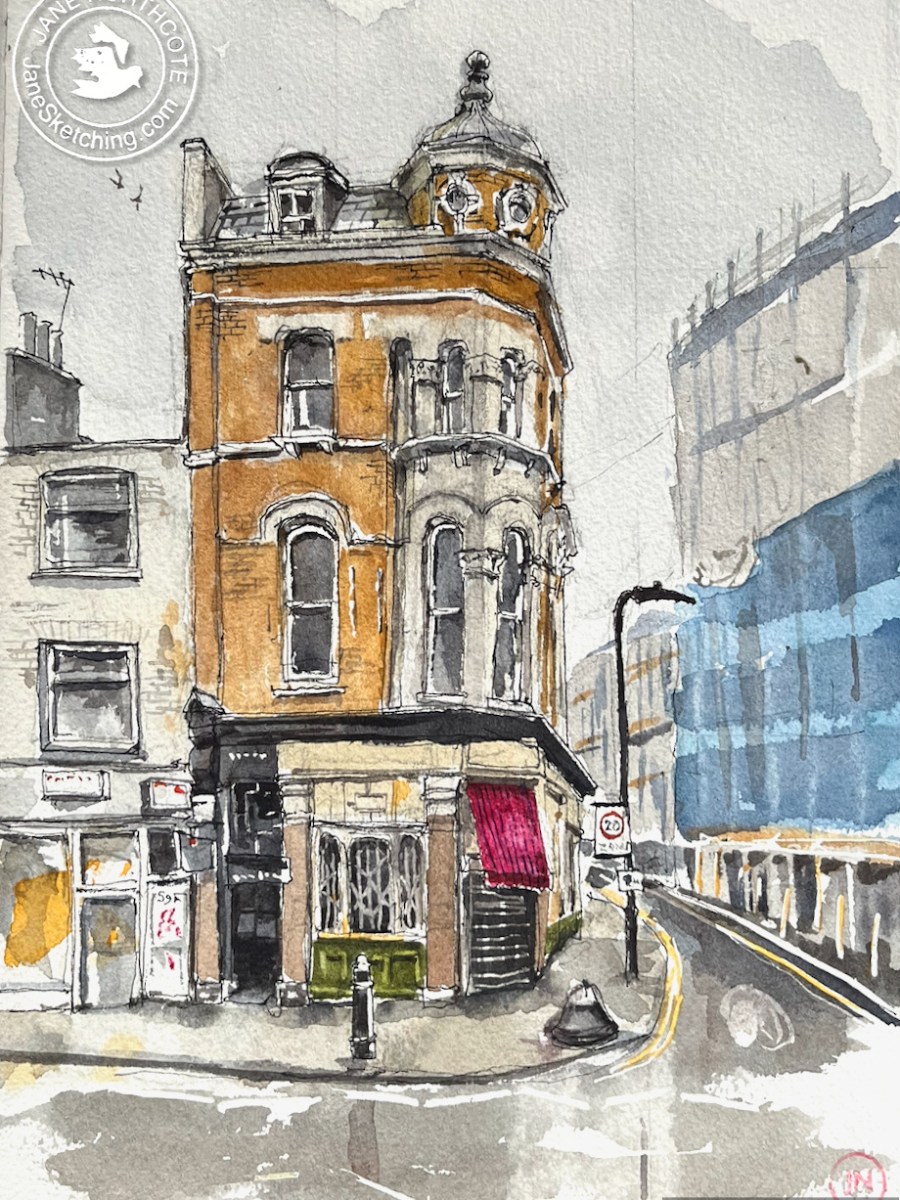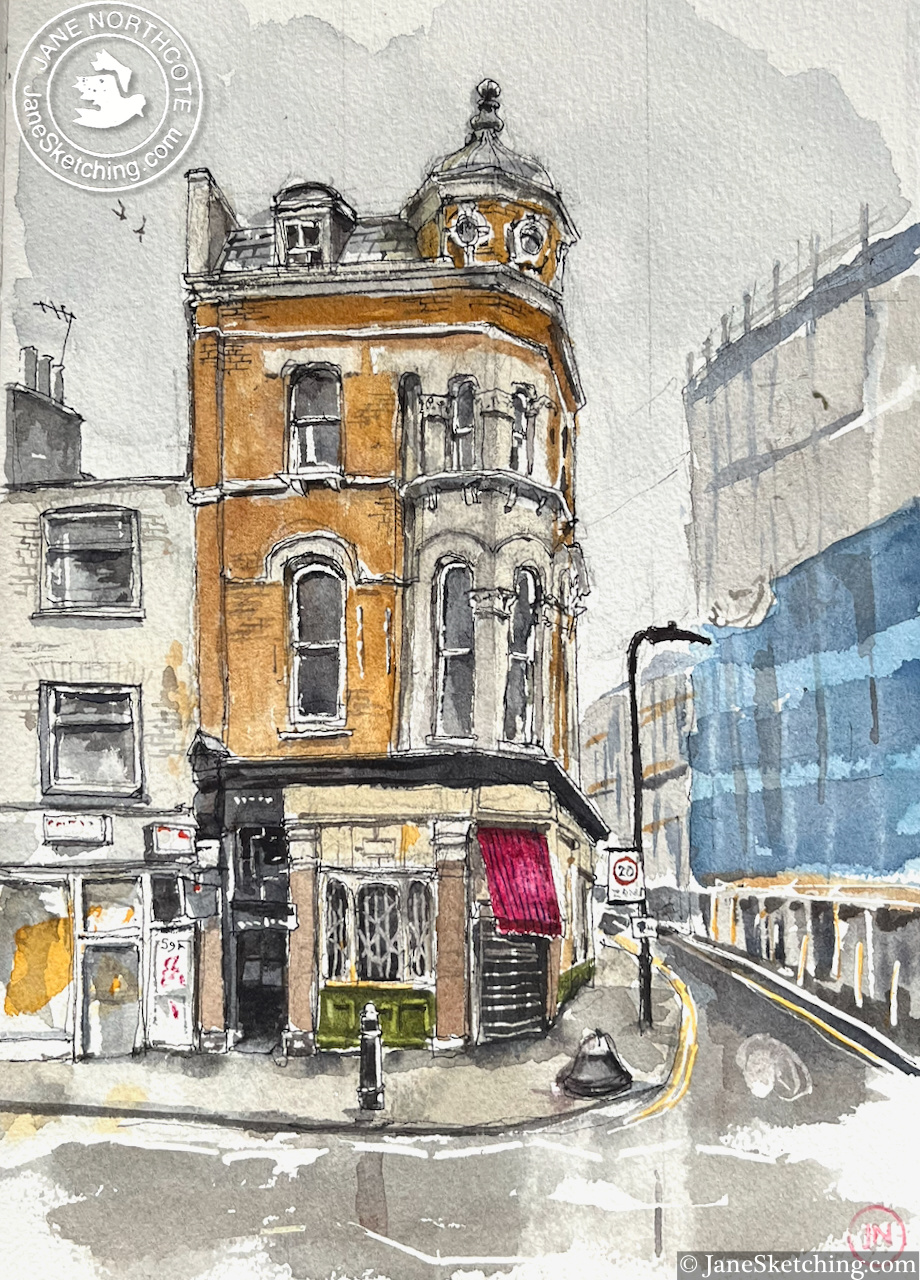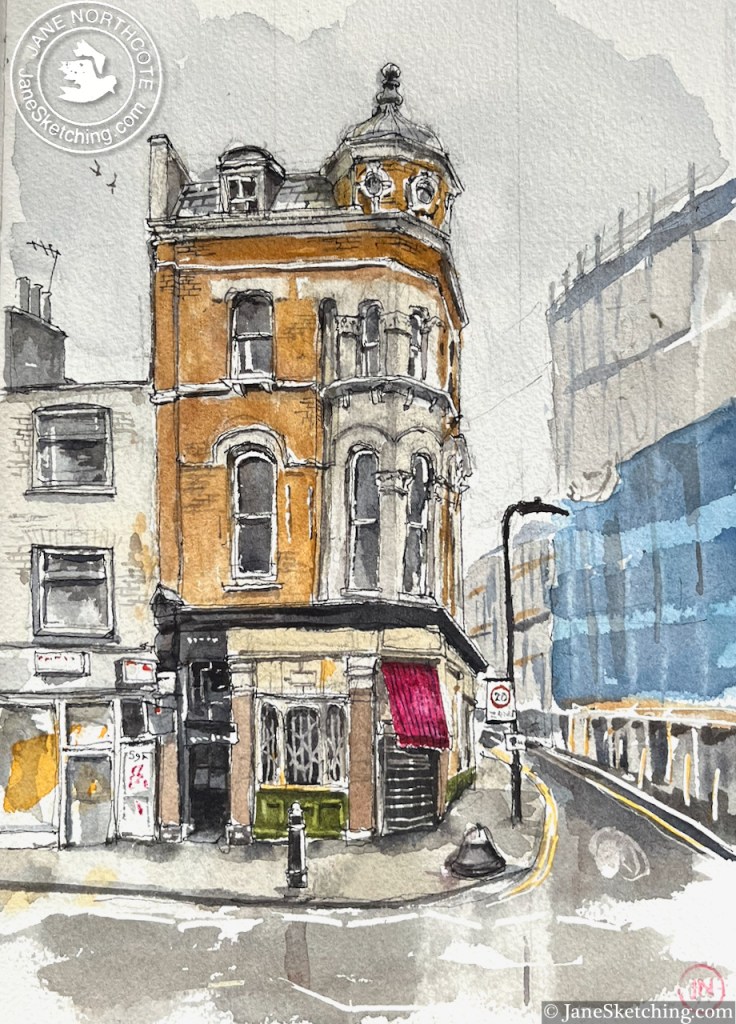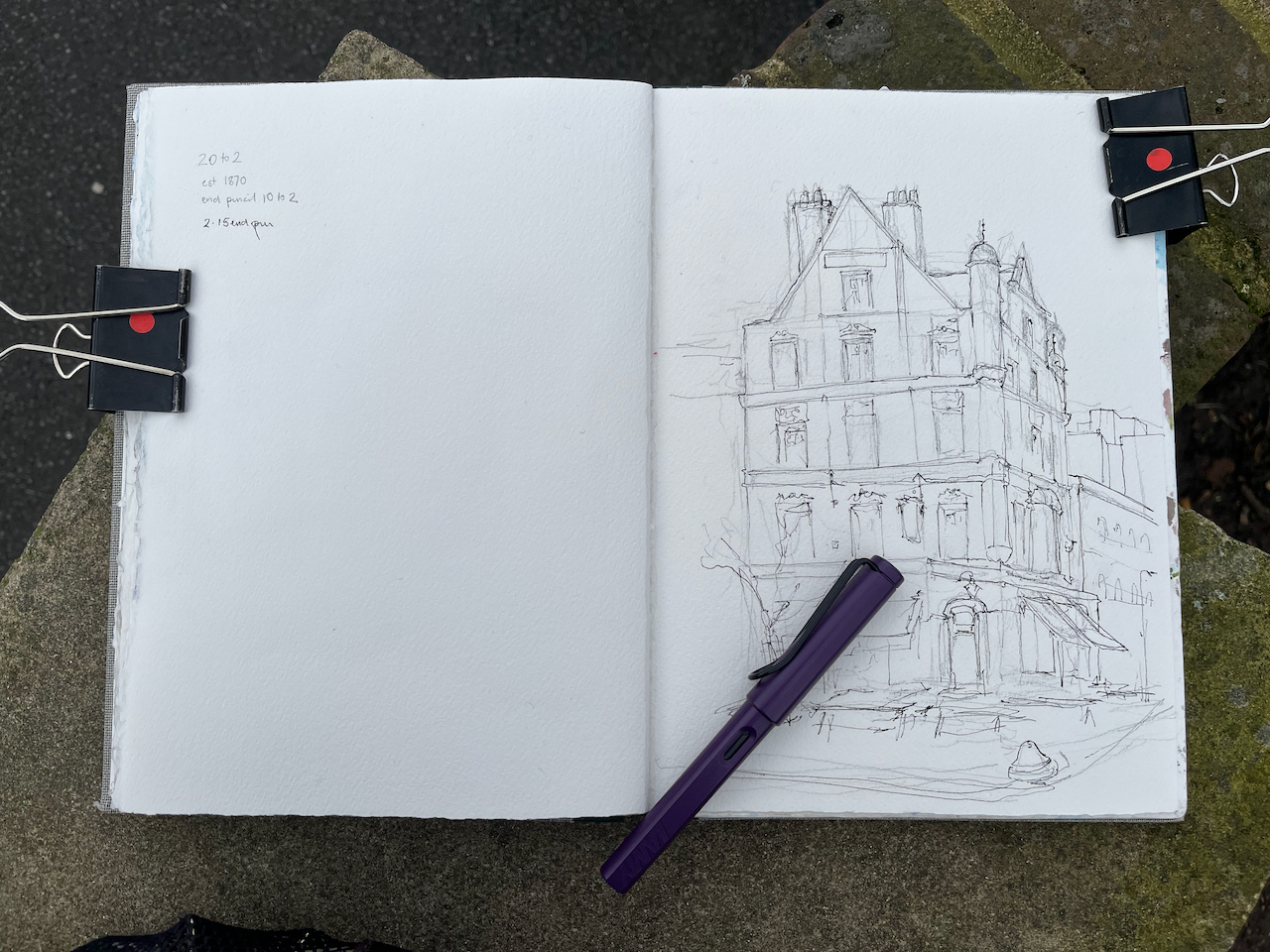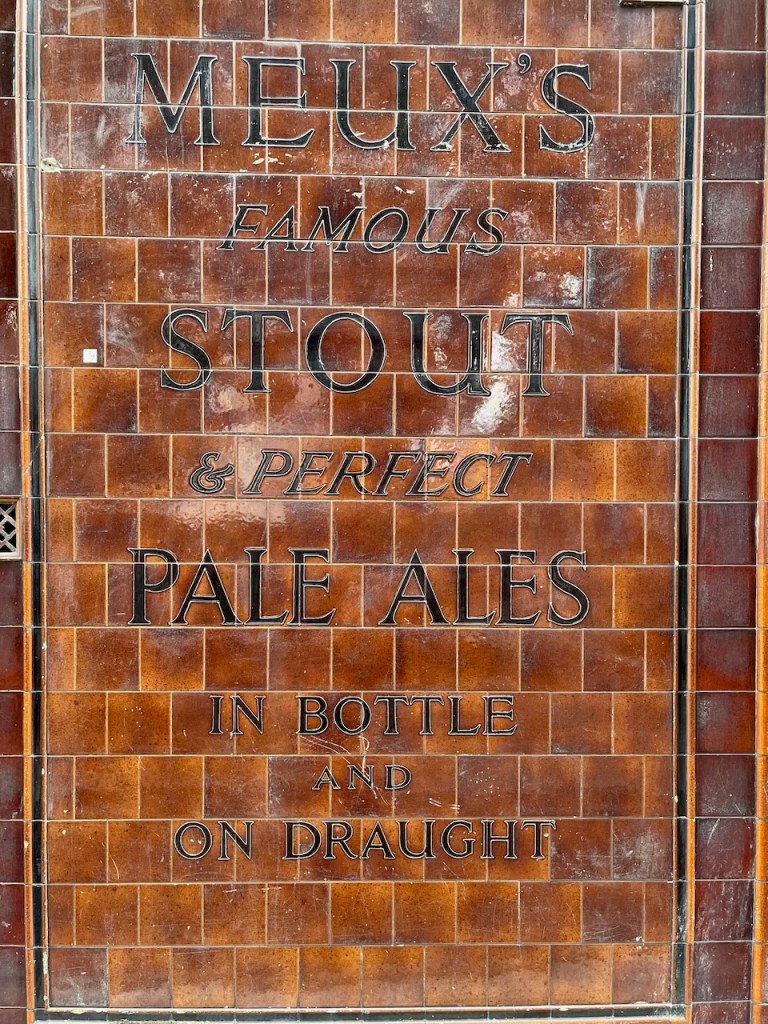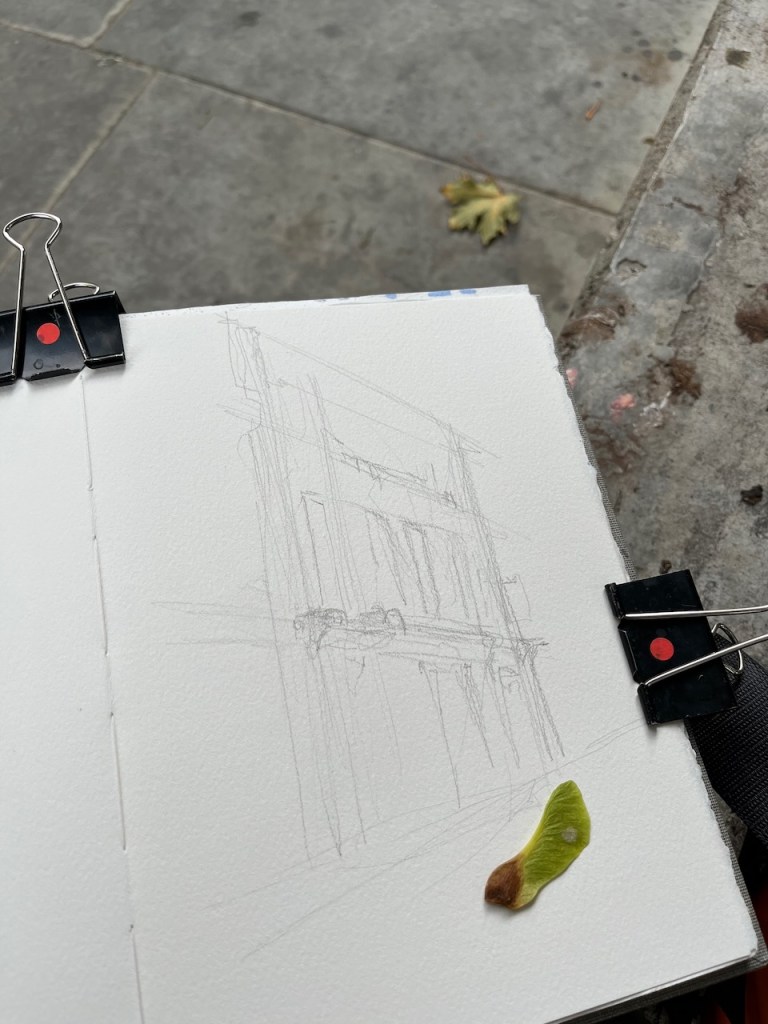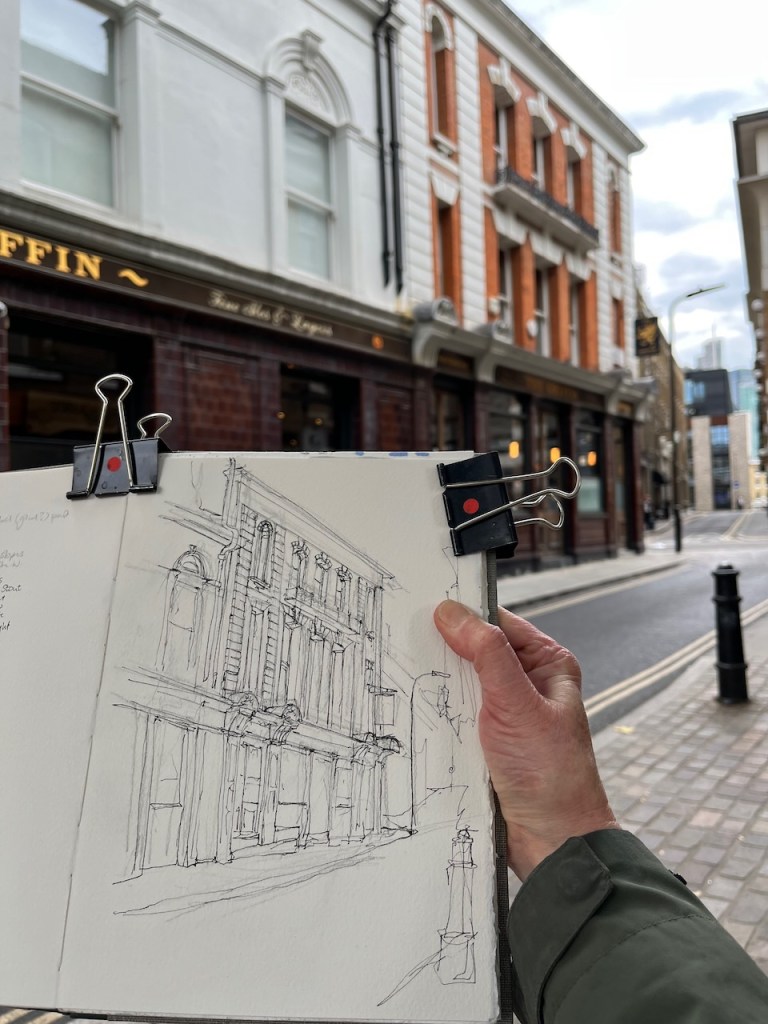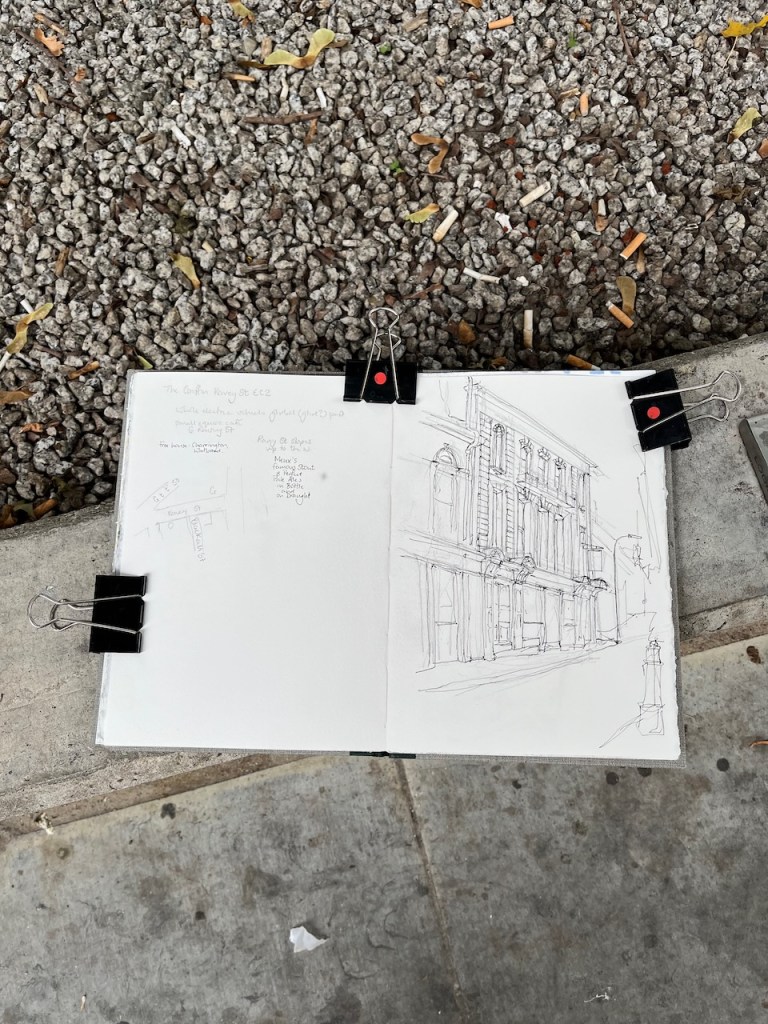
Bedford House, Quaker Street, London E1

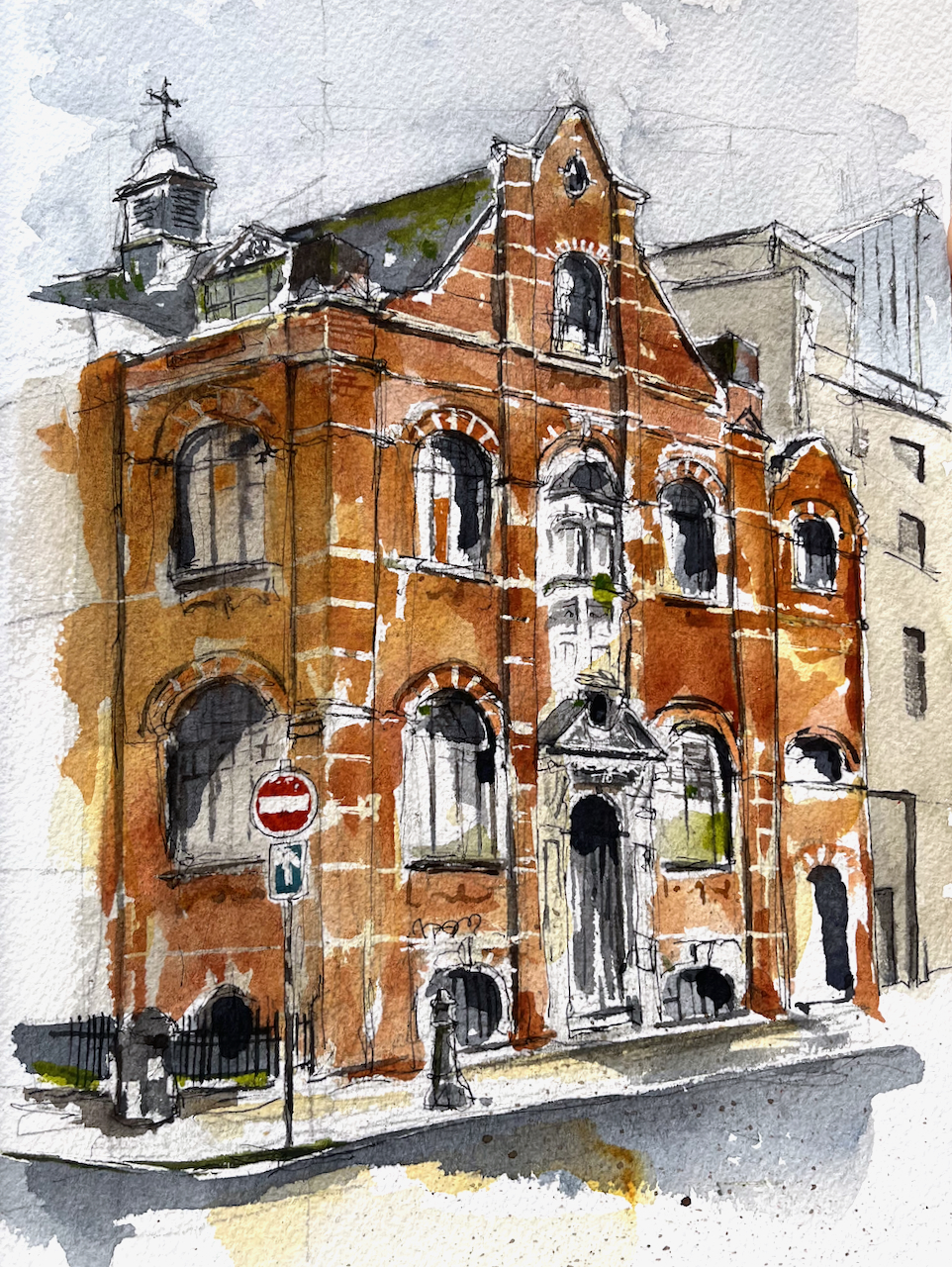
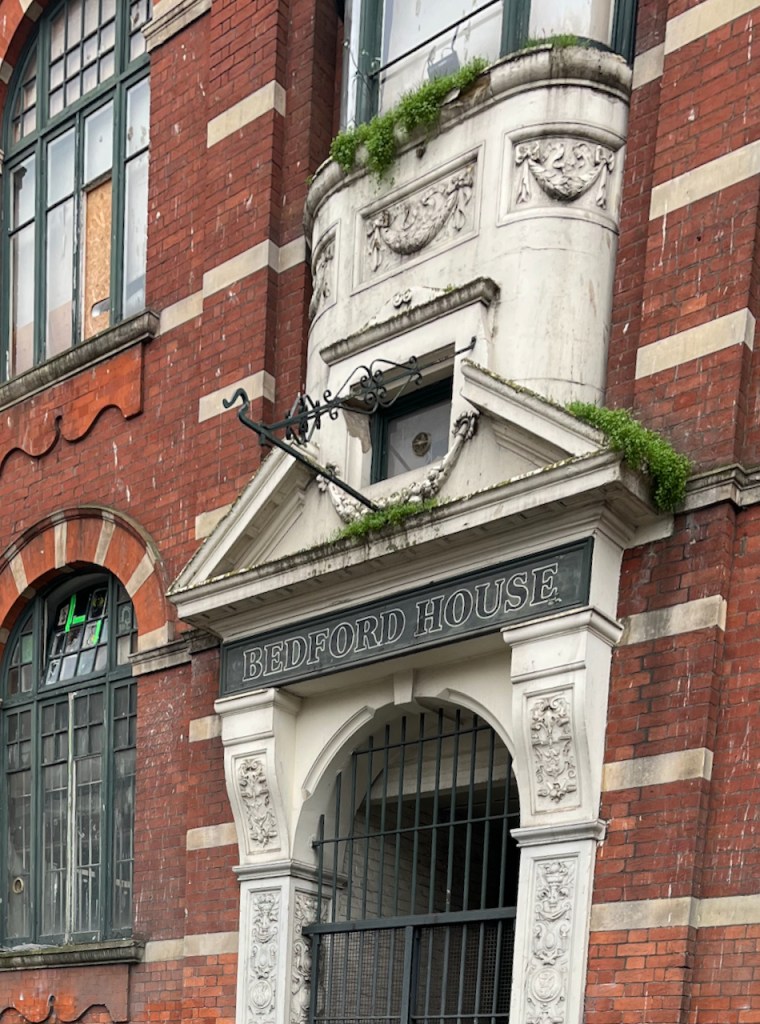
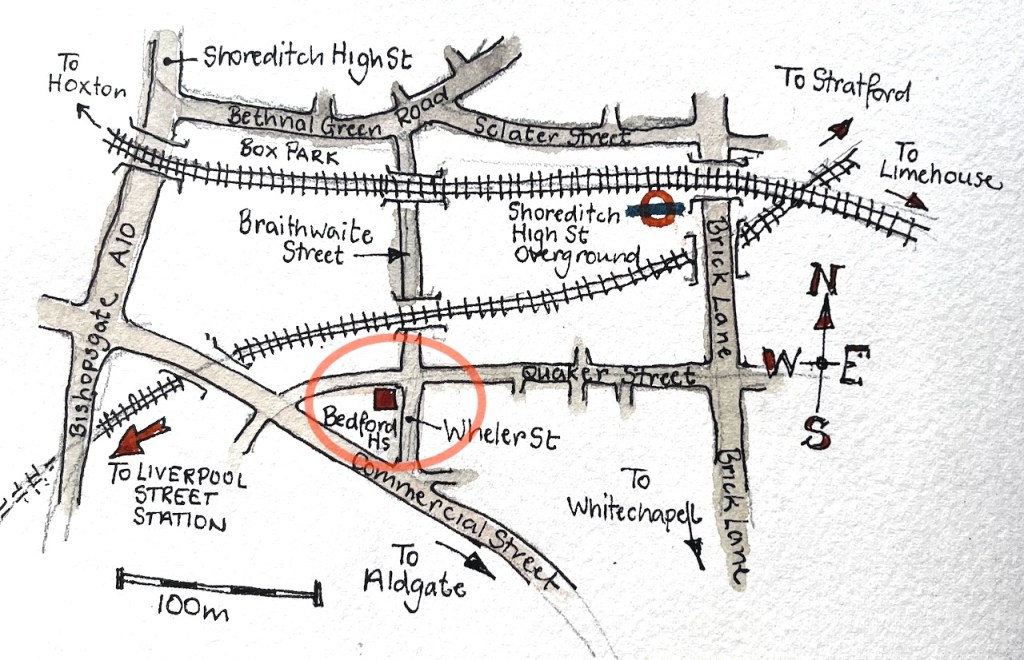
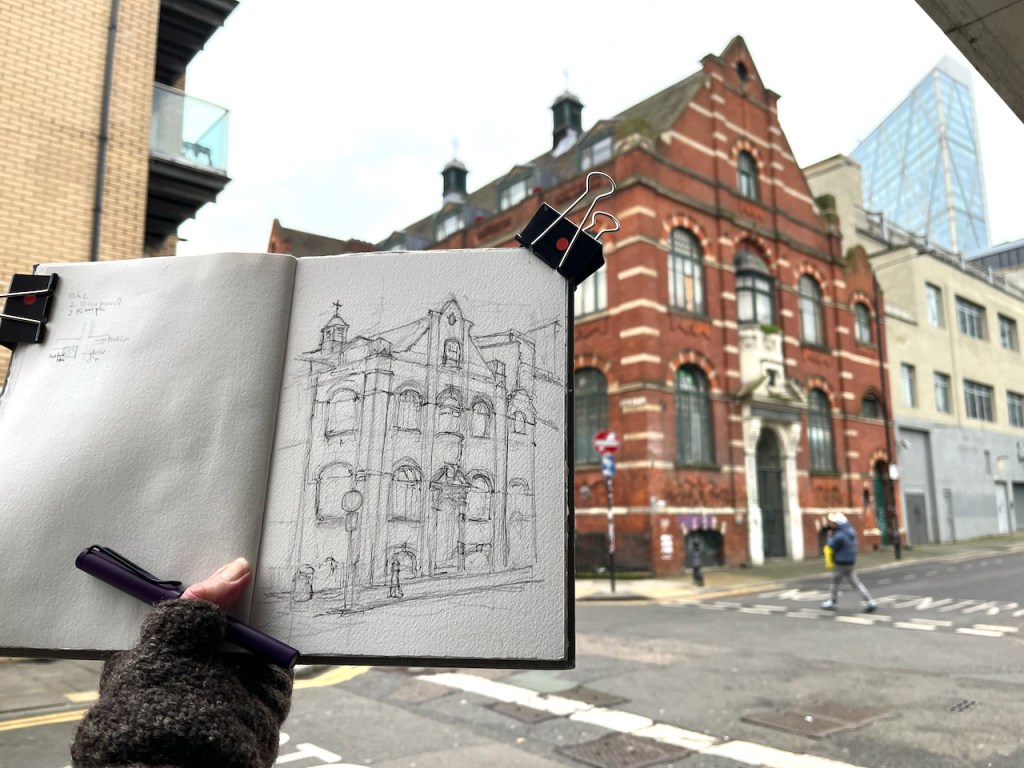
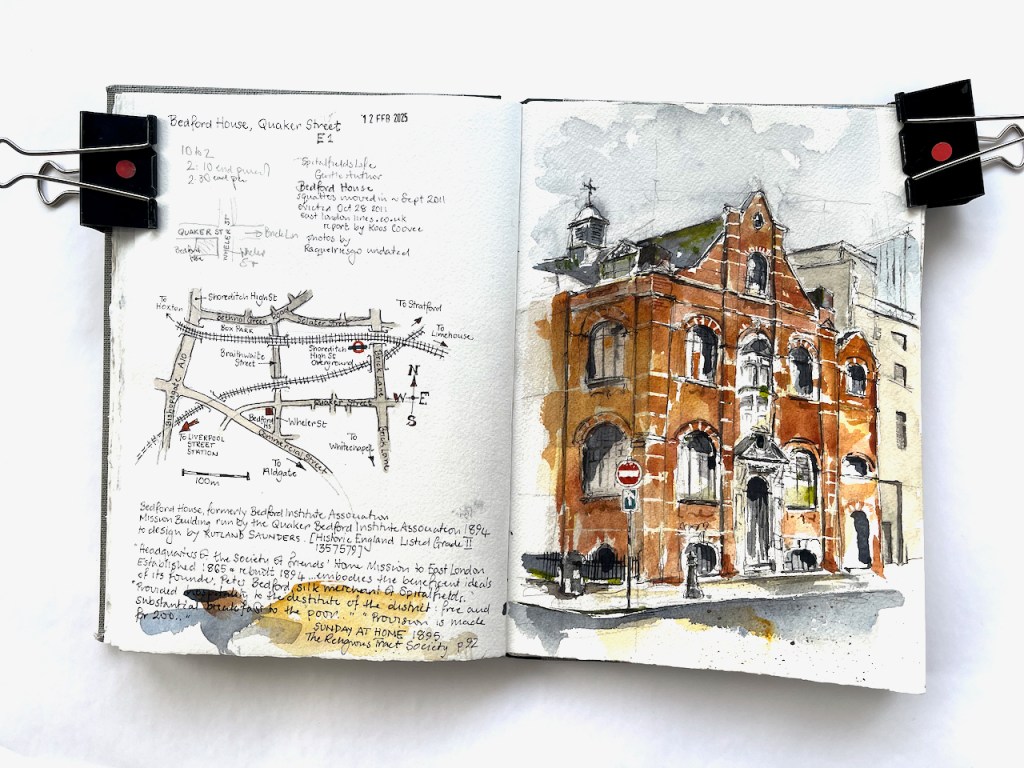
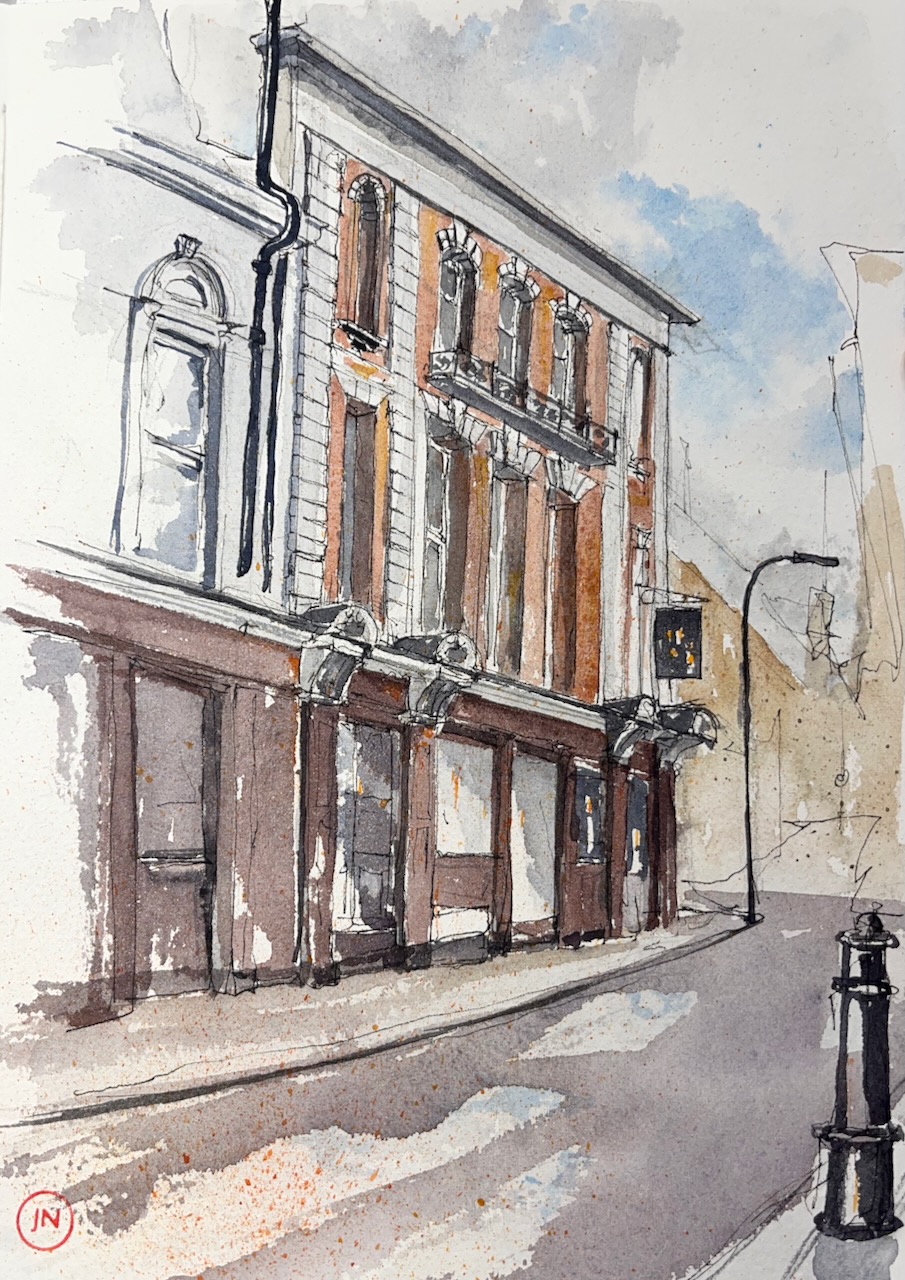
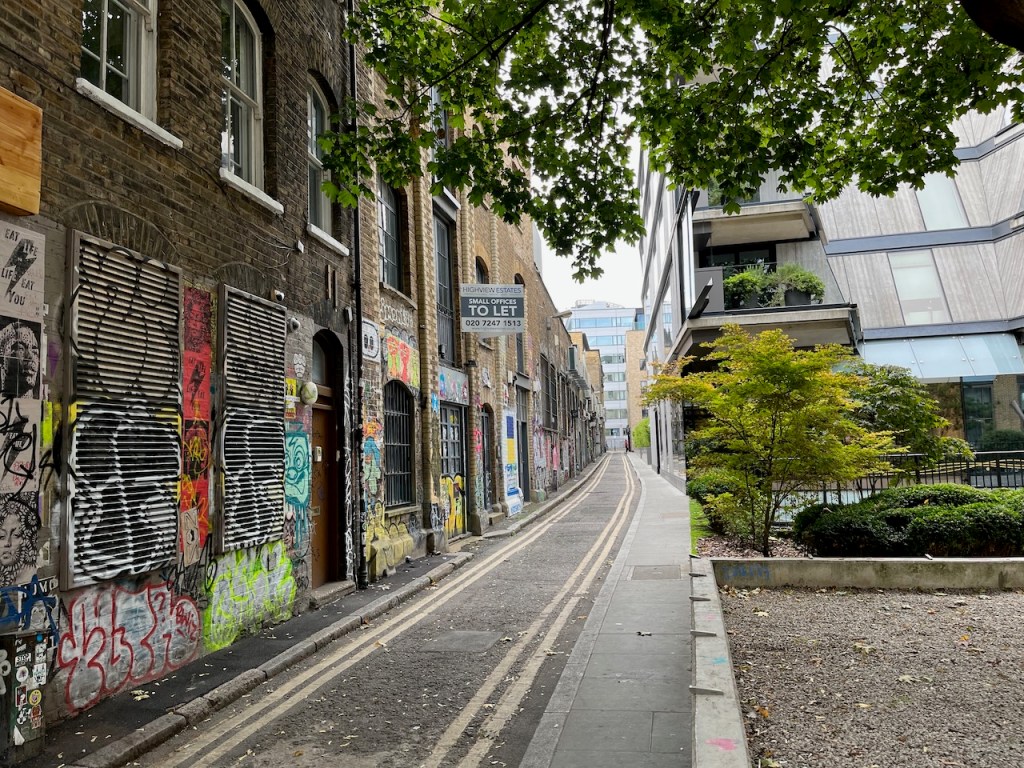
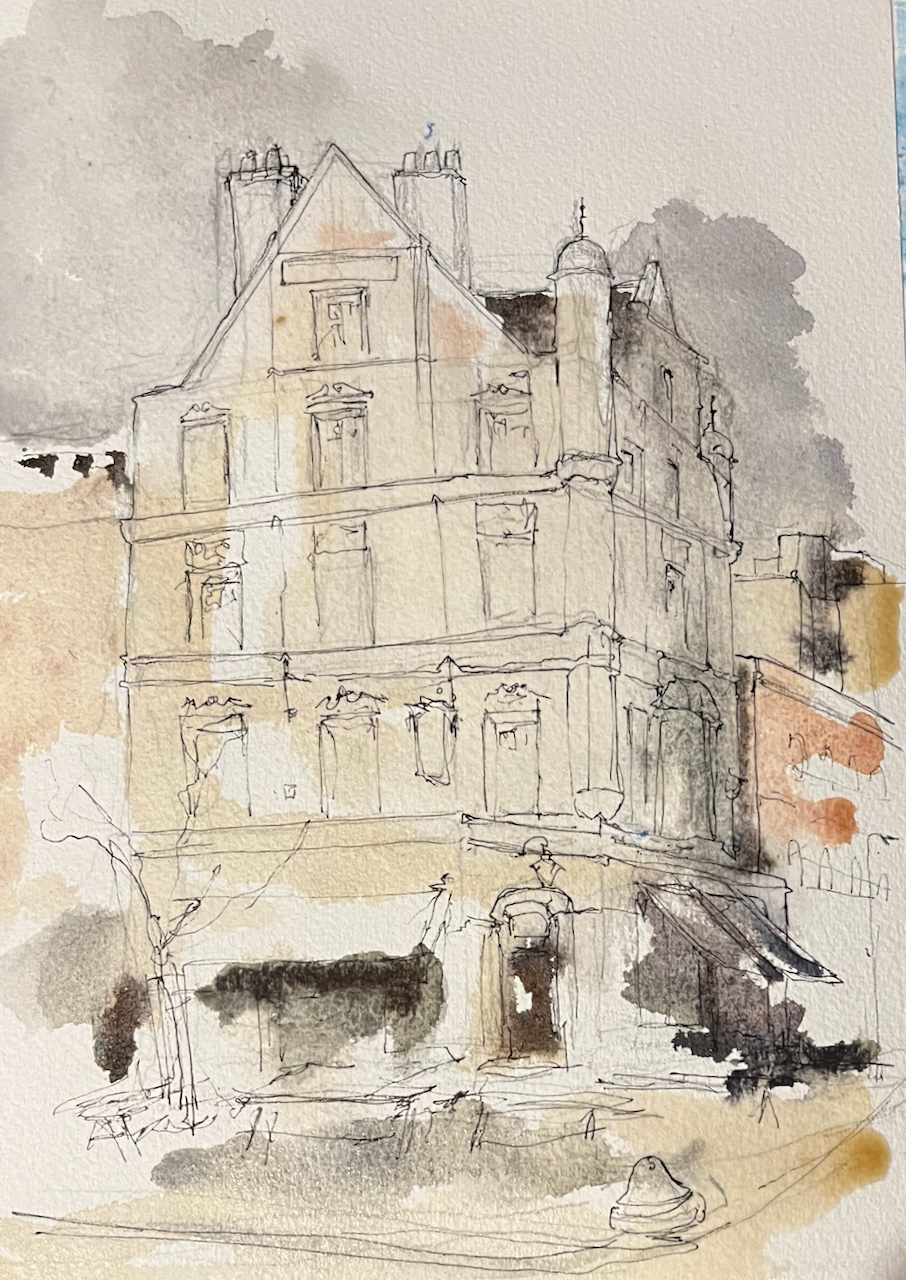
This magnificent building is on the corner of Quaker Street and Wheler Street, in east London, near Liverpool Street Station.

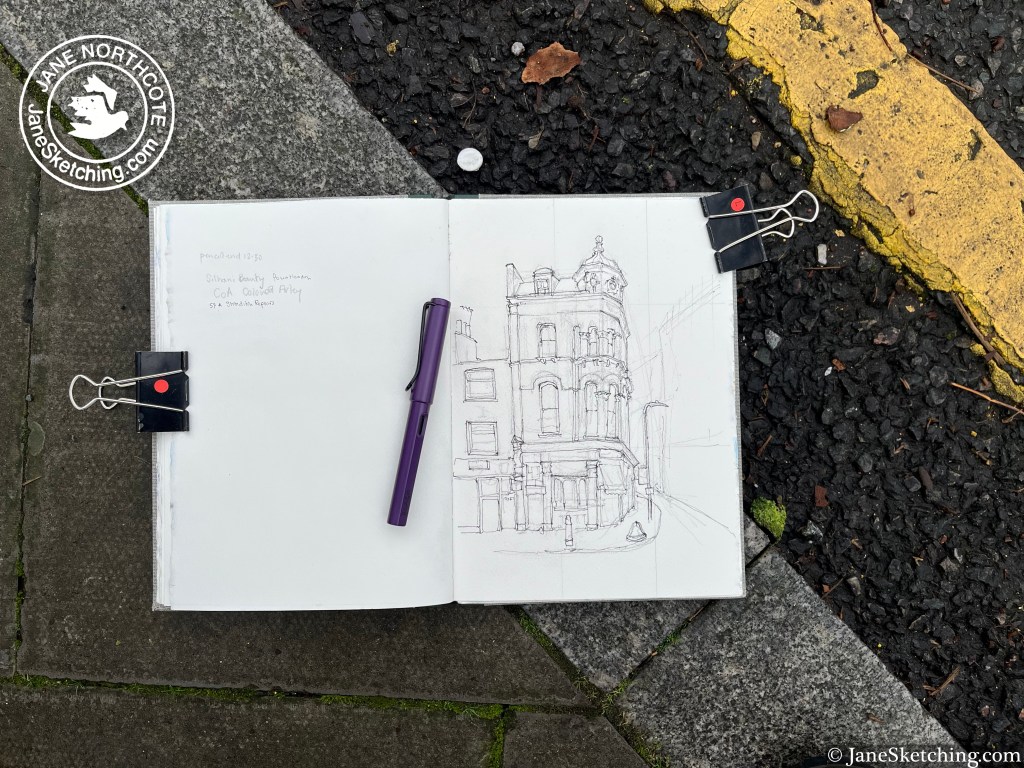
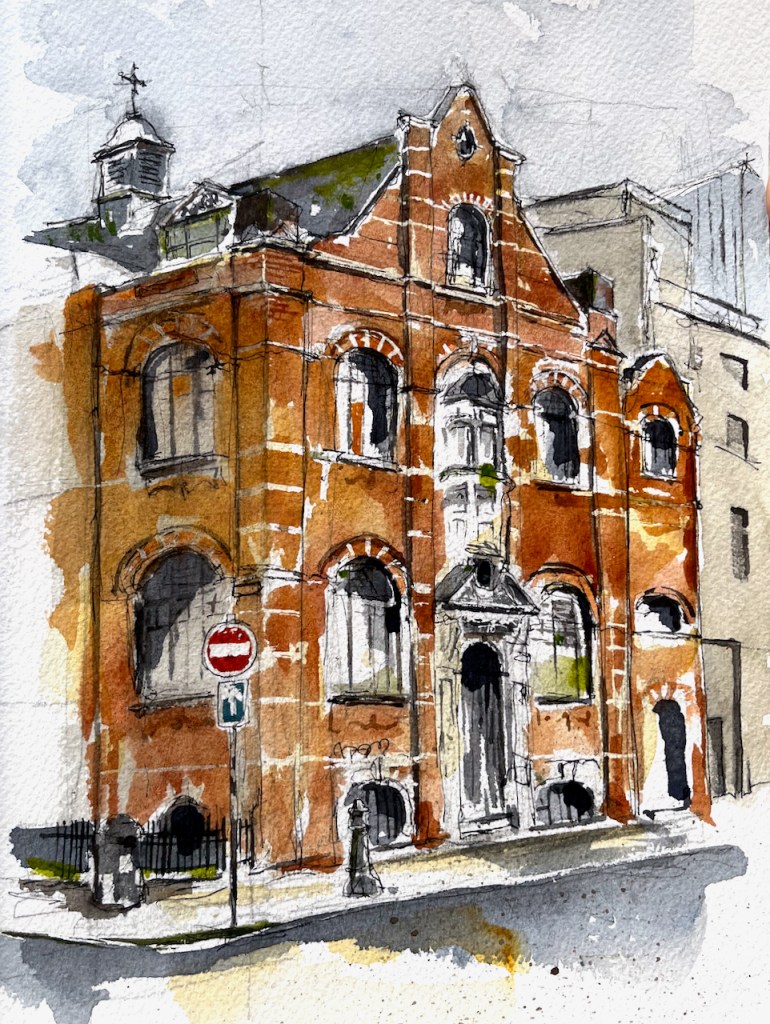
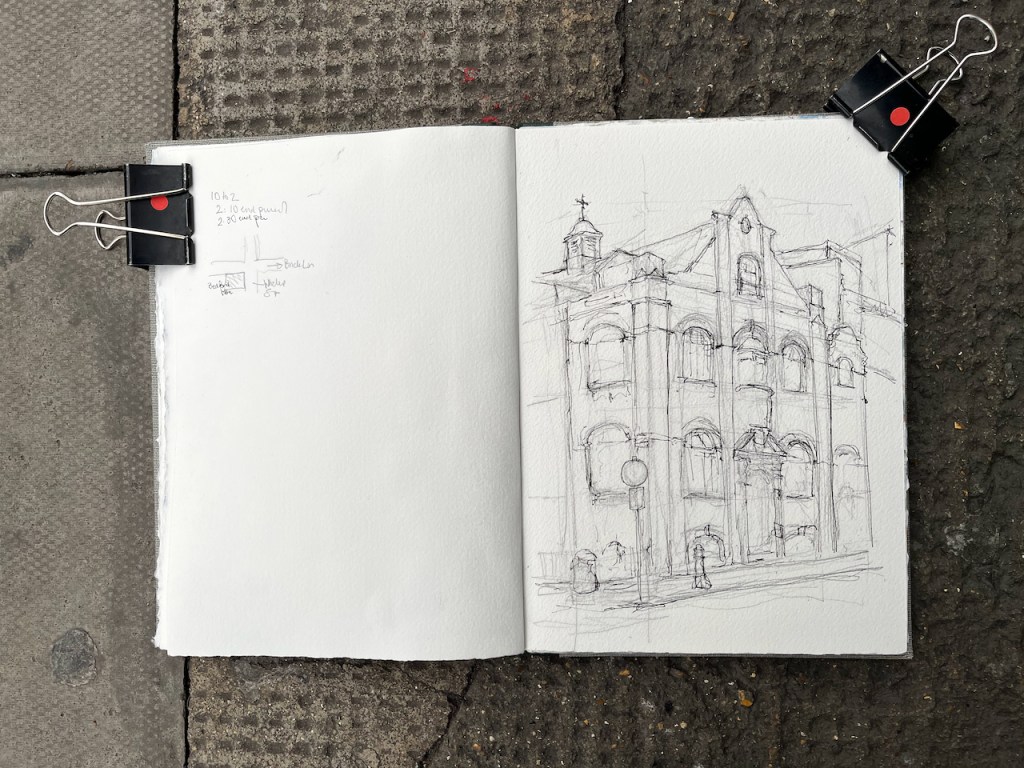
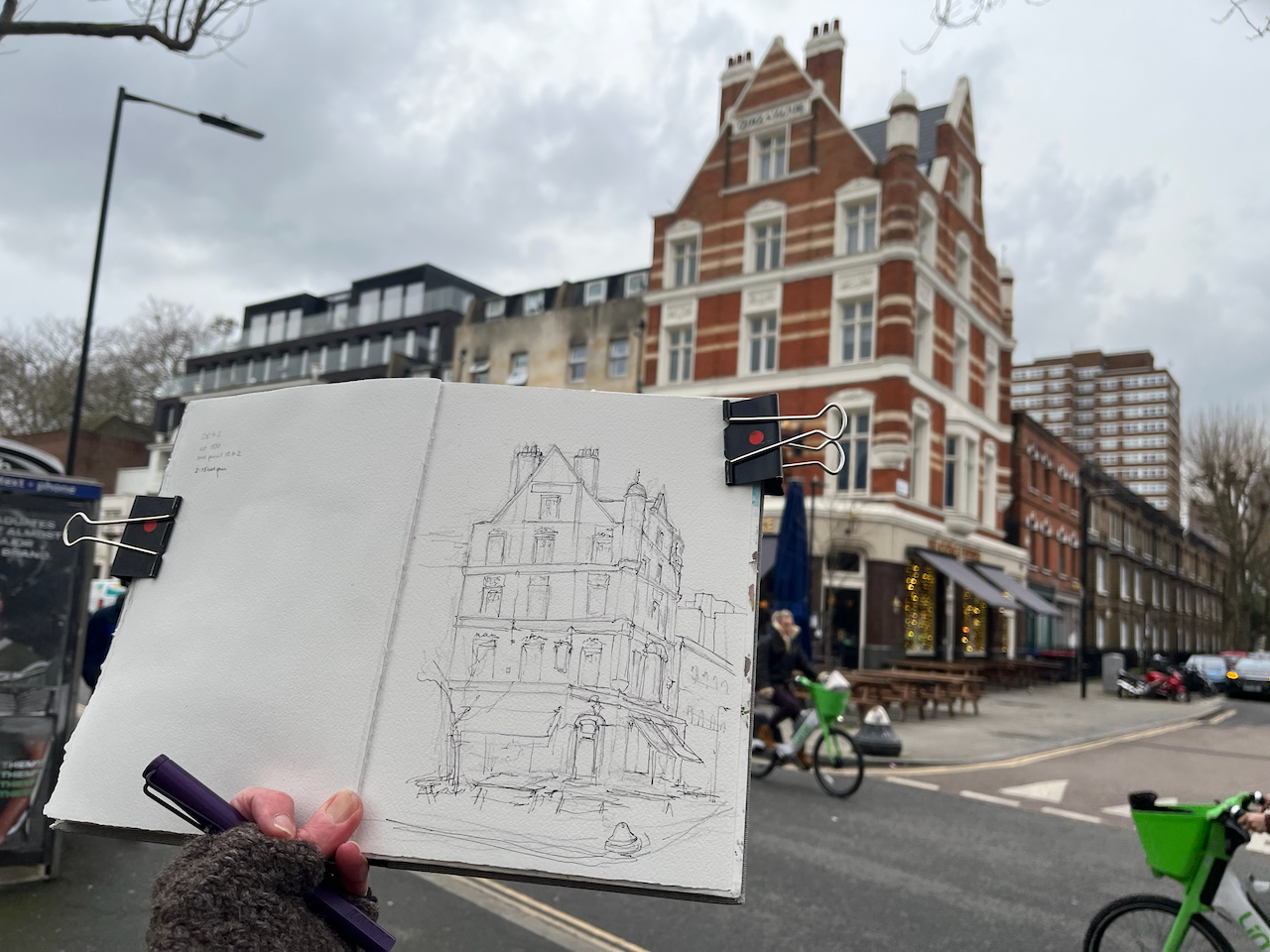
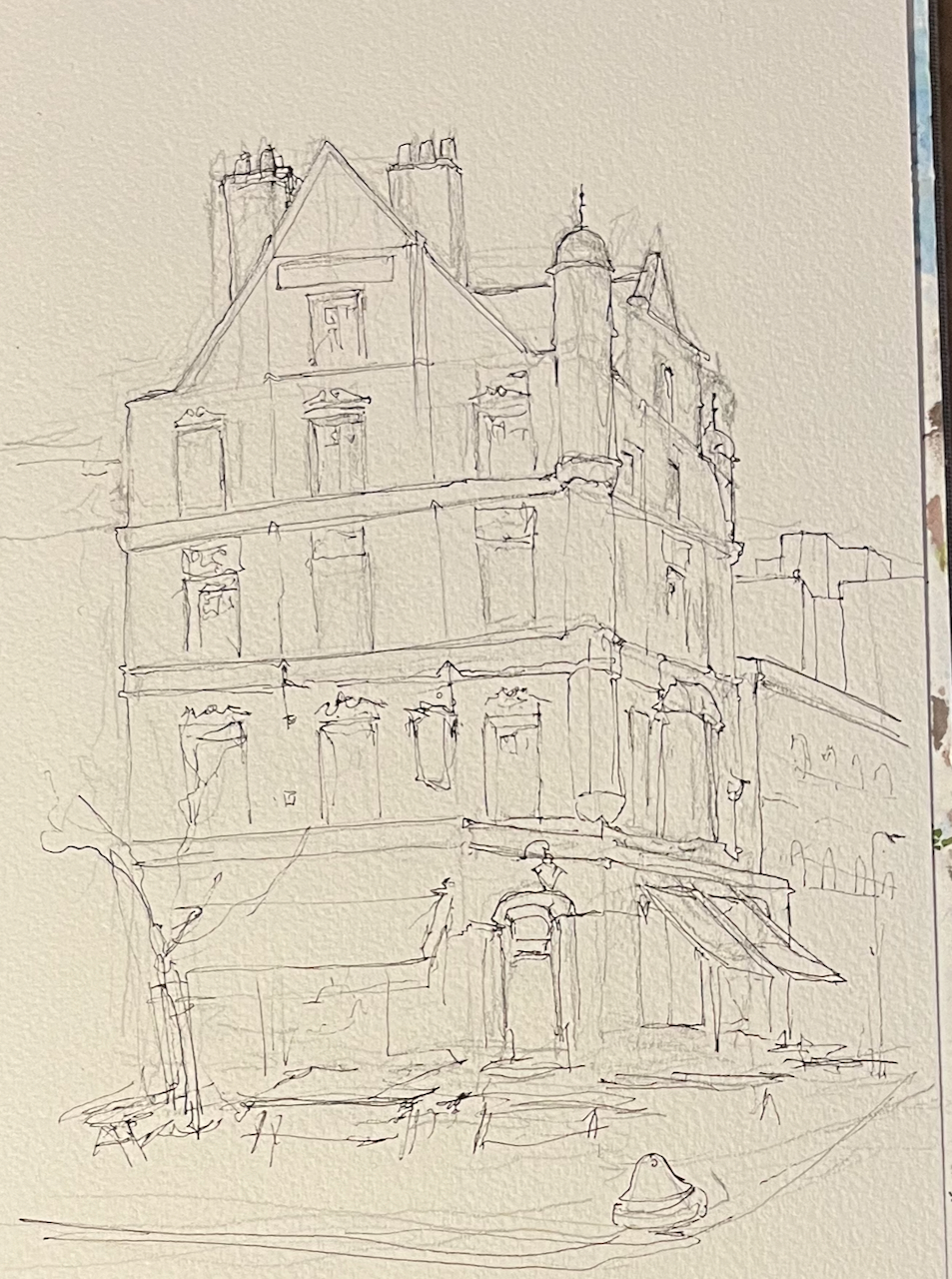
Bedford House, Quaker Street. Sketched 12 February 2025 in Sketchbook 15

It is intriguing: grand but dilapidated. Grass grows from the ledges, windows are broken and patched. The front door is blocked with a waste bin. But it has style.

At one time it was bright, new, clean and purposeful. This was the headquarters of a Quaker mission in east London: the Bedford Institute Association. It was built in 1894 replacing a previous building.

The lofty, picturesque, red-brick building, with its gables and tall roof, is constructed and equipped with solidity, and liberality and far-sightedness which distinguish all the admirable buildings erected by the trustees.”

“Sunday at Home” published by the Religious Tract Society, 1895, Volume 42, page 92

This issue of “Sunday at Home” published in 1895, goes on to describe the work which was undertaken in the building, which was less than a year old at the time of writing. Its purpose was to provide hospitality and education for the destitute of the locality.

“The Sunday begins with a well-planned hospitality to the destitute of the district – a free and substantial breakfast to the poor whose poverty is nowhere seen in a more aggravated form than in Spitalfields.

Provision is made for two hundred, who are supplied with tickets of admission by those who well know the district […] The large lower room in which they are received and comfortably seated is built for purpose, and is itself a lesson in cleanly living as well as of hospitality. The needful ventilation of a room crowded by two hundred guests, entirely devoid of any resources for personal cleanliness, is supplied by rapidly revolving steam fans placed over the doorways…

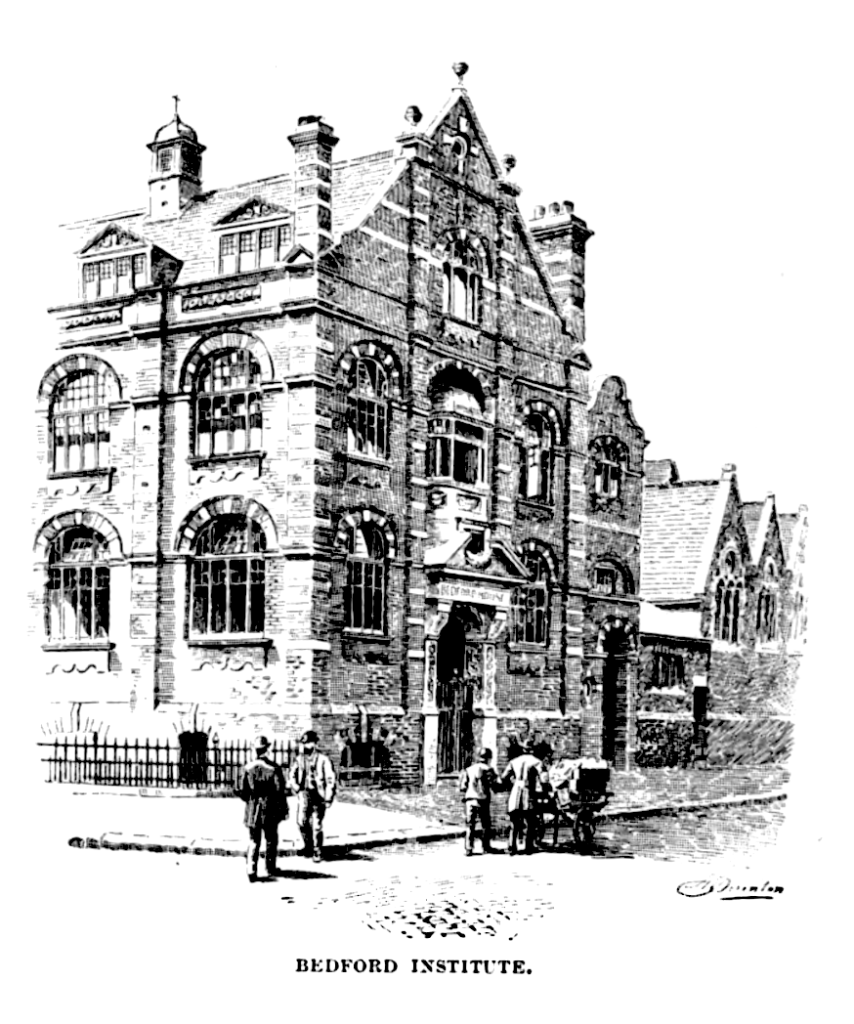
The article contains a picture, drawn from almost exactly the same spot where I was standing:

At that time there were tall chimneys on the front corners of the building, now reduced to stumps, as you see in my picture. Otherwise the building looks unchanged, on the outside at least. Even the cast-iron railings, centre left, are still there. The adjacent buildings on the right, with the ecclesiastical pointed windows, have been replaced by modern buildings, taller and boxier, with rectangular windows.

Although I was able to read in detail about the use of the building in 1895, I have been unable to discover much of its more recent history. In 2011, for a few months, squatters lived there. “The Gentle Author” visited the house during their occupation1 A photographer, Raquel Riesgo, documented her life during the squat. The squatters were evicted on October 28th 2011.

But what happened next? This building was created to serve destitute people in Spitalfields. Does it continue its mission?

If anyone knows what’s happening there now, I’d be really interested. Please comment below or get in touch.


I found “Sunday at Home” thanks to a link in a comment by Deidre Murray on the listing in Historic England.
“Sunday at Home – a family magazine for Sabbath reading v.42” is available on the website of the Hathi Trust on this link:
https://babel.hathitrust.org/cgi/pt?id=mdp.39015068375545&seq=108&view=1up
or if that doesn’t work try this link:
https://hdl.handle.net/2027/mdp.39015068375545

The publication is “Public Domain, Google-digitized.

The pages I have referenced start on this link: https://hdl.handle.net/2027/mdp.39015068375545?urlappend=%3Bseq=108%3Bownerid=13510798887051007-112

The name of the author of the article and of the artist who drew the picture are not given.

Click below to read or download the pages relating to the Bedford Institute:


  1. The Gentle Author describes his visit in a blog post: https://spitalfieldslife.com/2011/09/29/at-bedford-house/ Reading the comments on his post, there is a sense of the local mixed opinions surrounding this squat. ↩︎
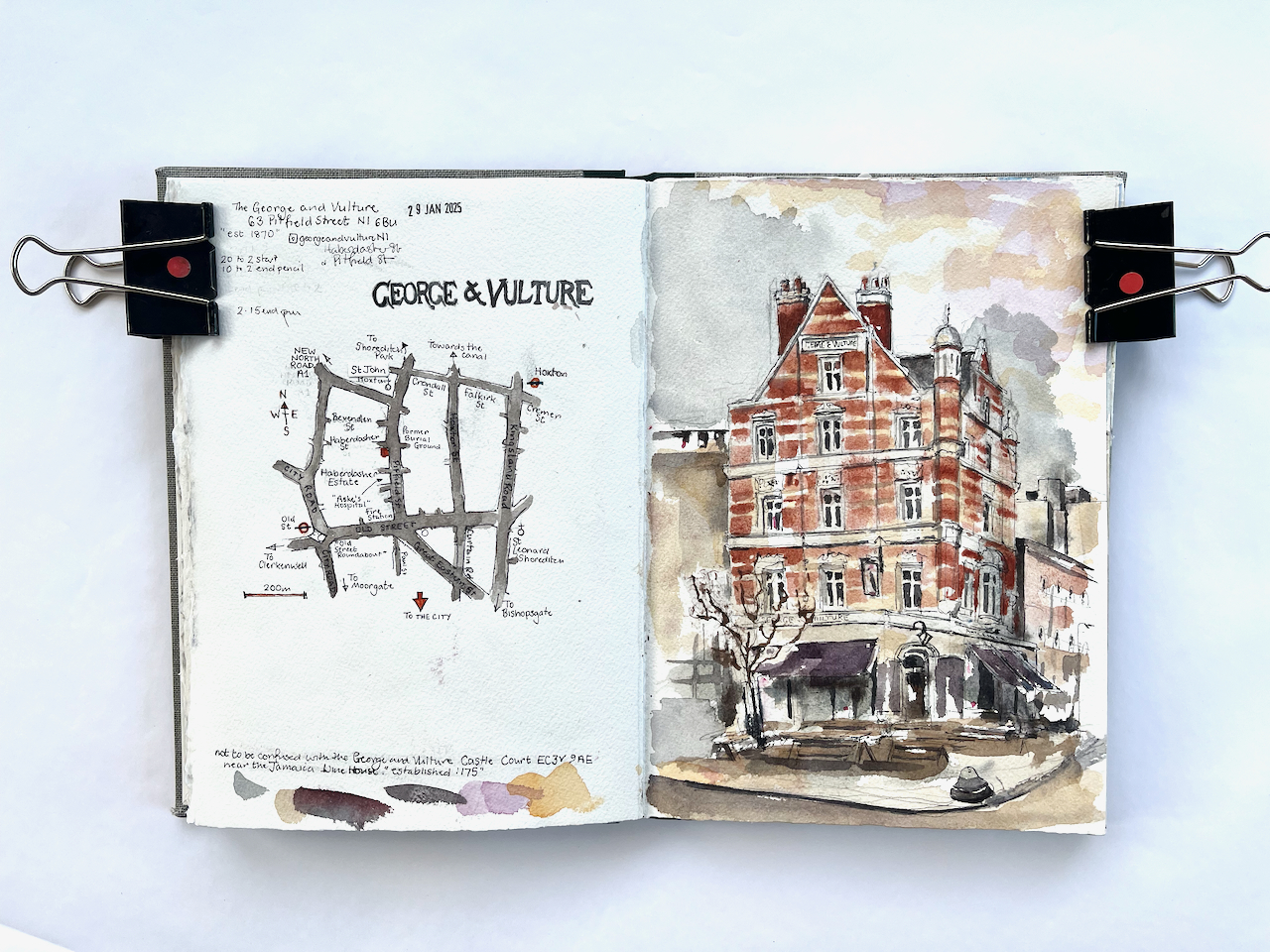
George and Vulture, Pitfield Street, N1

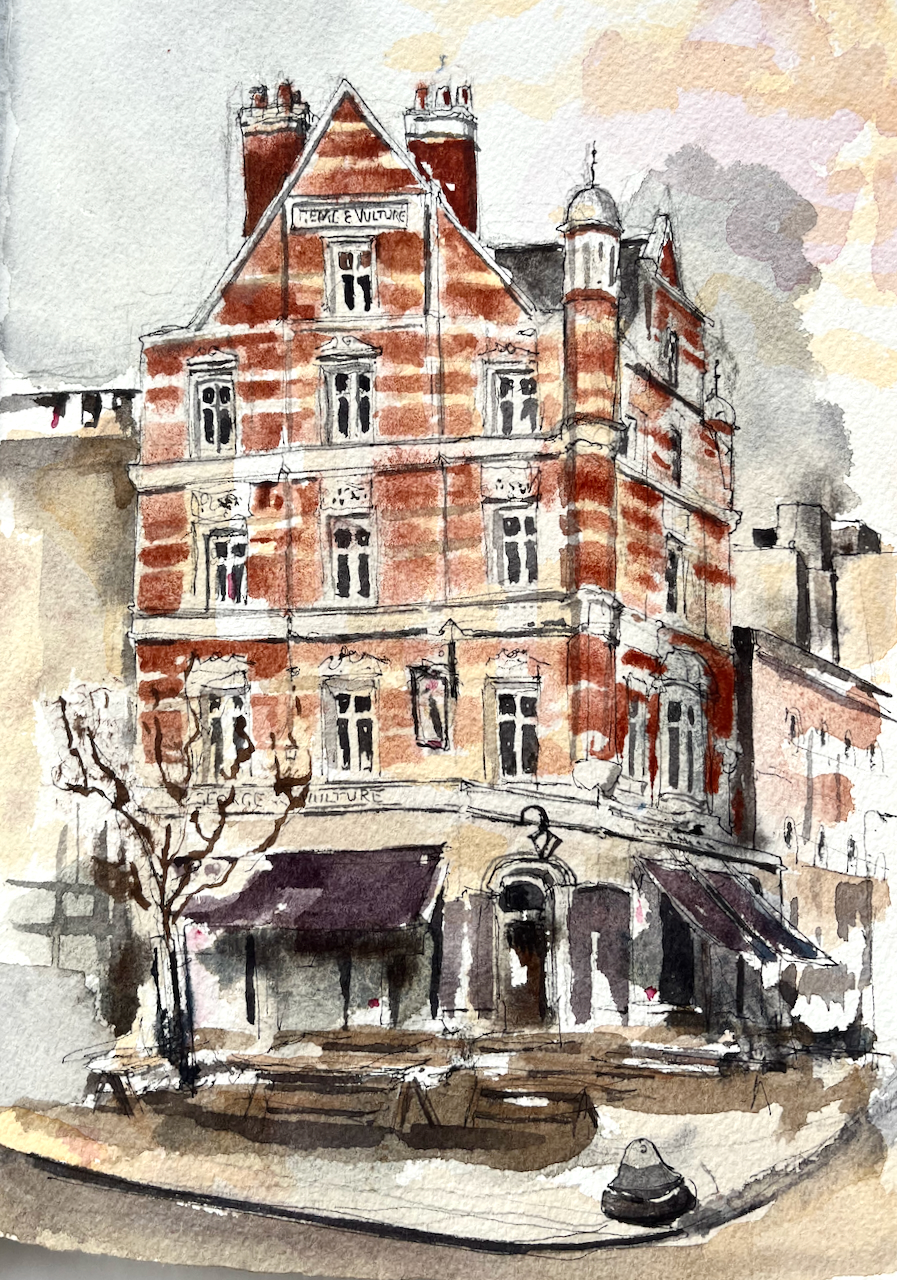
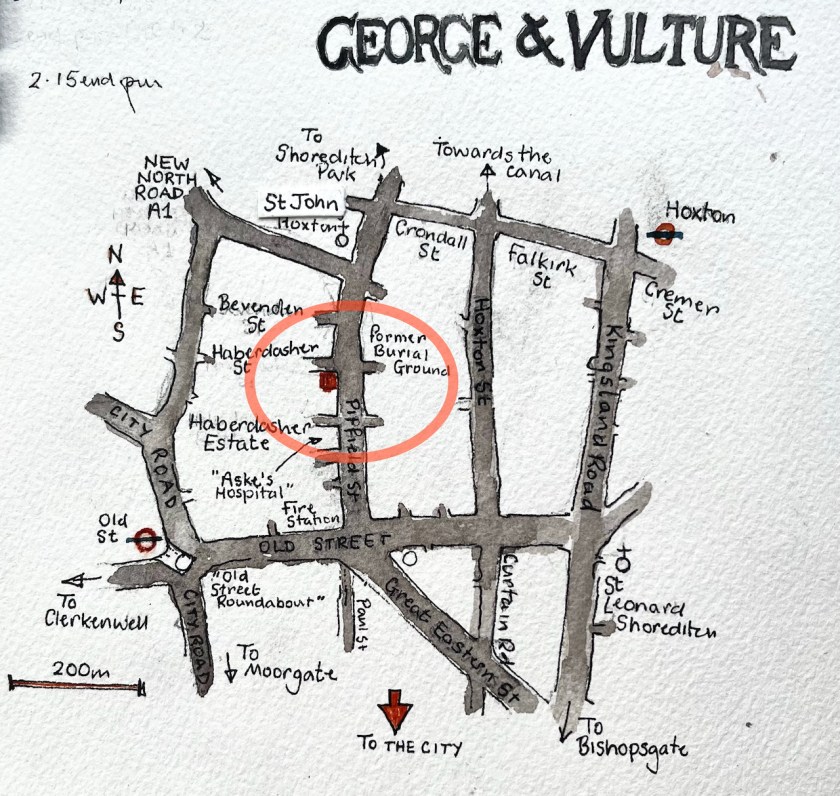
Pitfield Street is a historic London street going north from Old Street. About half-way along is the George and Vulture pub.
The George and Vulture describes itself as the tallest pub in London. The current building dates from 1870, according to the pub’s website.

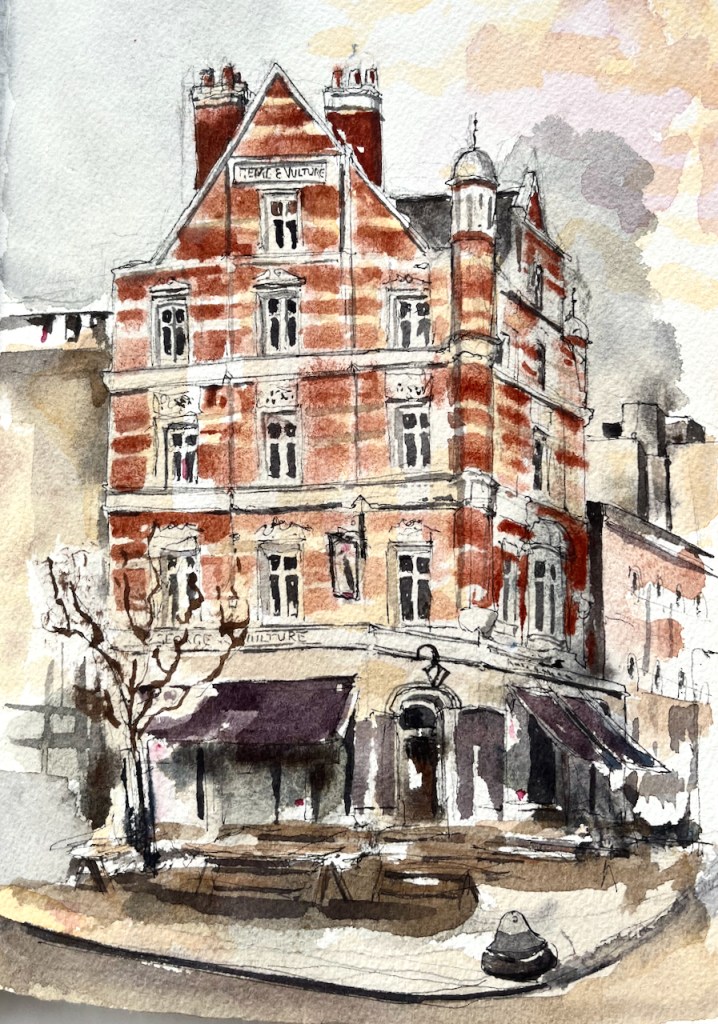
The George and Vulture, Pitfield Street. Sketched 29 Jan 2025, in sketchbook 15

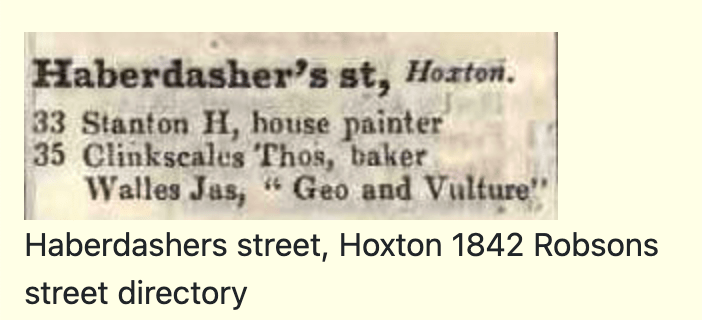
The “Pubs History” website lists licenced victuallers from 1827 onwards. Here is a scrap from Robsons Street Directory in 1832.

https://londonwiki.co.uk/streets1832/Haberdashersstreet.shtml

The original address of the pub was 35 Haberdashers Street. Much of the land round here was owned by the Haberdashers Livery company, bequeathed to them by Robert Aske, a merchant (1619-1689). In 1862 the Haberdashers company offered new leases on properties here:

Haberdashers’ Estate, Hoxton.
A free public-house, adjoining the high road, and 66 dwelling-houses.
To be let, by tender, by the worshipful Company of Haberdashers, Governors of Aske’s Charity Estate, Hoxton, on repairing leases, for 21 years, from Midsummer, 1863:—
The free public-house, known as the “George and Vulture,” situate in Haberdashers’ Street, which might be enlarged so as to form a corner house to the main street.
Also 12 houses, Nos. 1 to 12, Haberdashers’ Place, which may be converted into shops, at the option of the lessee.
Also 19 houses, Nos. 1 to 19, on the south side of Aske’s Terrace; and 35 houses, Nos. 1 to 35, on the north and south sides of Haberdashers’ Street, in the parish of St. Leonard, Shoreditch, in the county of Middlesex.
Plans of the property, and specifications of the repairs to be performed, may be seen at the offices of Mr. William Snooke, the surveyor to the governors, No. 6, Duke Street, London Bridge, between the hours of 10 and 4 o’clock.
Tenders, in writing only, are to be sent in to Haberdashers’ Hall, Gresham Street West, on or before Thursday, the 27th day of November 1862.

City of London Livery Companies Commission, ‘Report on the Charities of the Haberdashers’ Company: Appendix’, in City of London Livery Companies Commission. Report; Volume 4(London, 1884), British History Online https://www.british-history.ac.uk/livery-companies-commission/vol4/pp478-486 [accessed 30 January 2025].

One of the properties to be let, as you see, was
“The free public-house, known as the “George and Vulture,” situate in Haberdashers’ Street, which might be enlarged so as to form a corner house to the main street.”

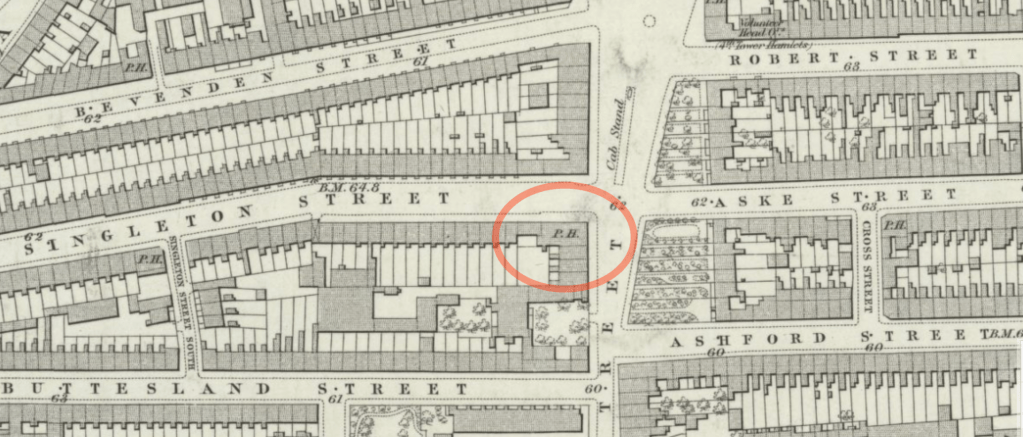
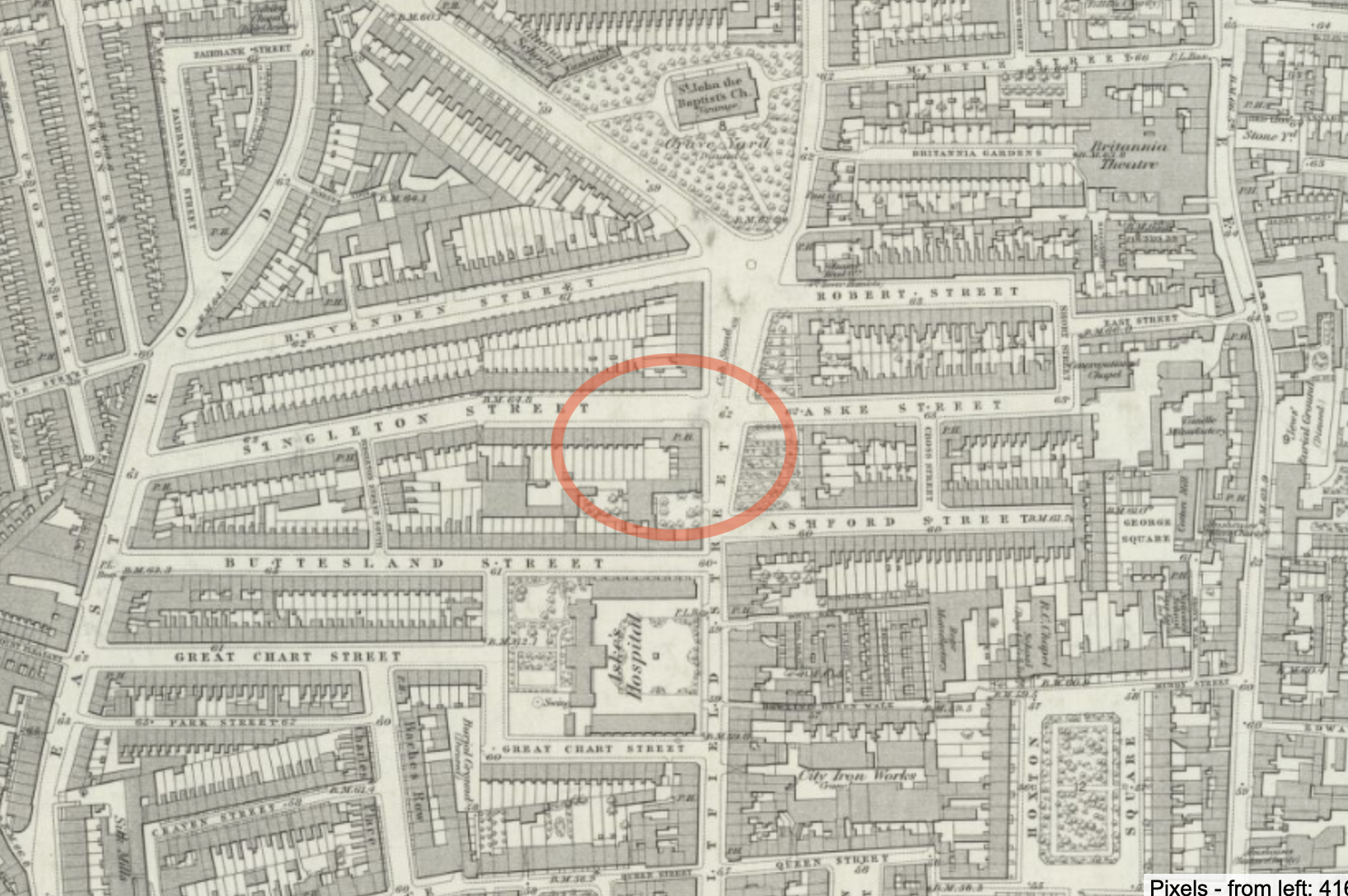
Evidently the lessee enlarged the pub, as the Haberdashers Company suggested, and it does indeed form a corner house to the main street. The address of the pub is now 63 Pitfield Street. Here is the 1877 map which shows the pub as a “corner house”. The road layout on the west of Pitfield Street is largely unchanged. Singleton Street is now called Haberdasher Street.

1972 Ordnance Survey map, from the National Library of Scotland, re-use: CC-BY (NLS)

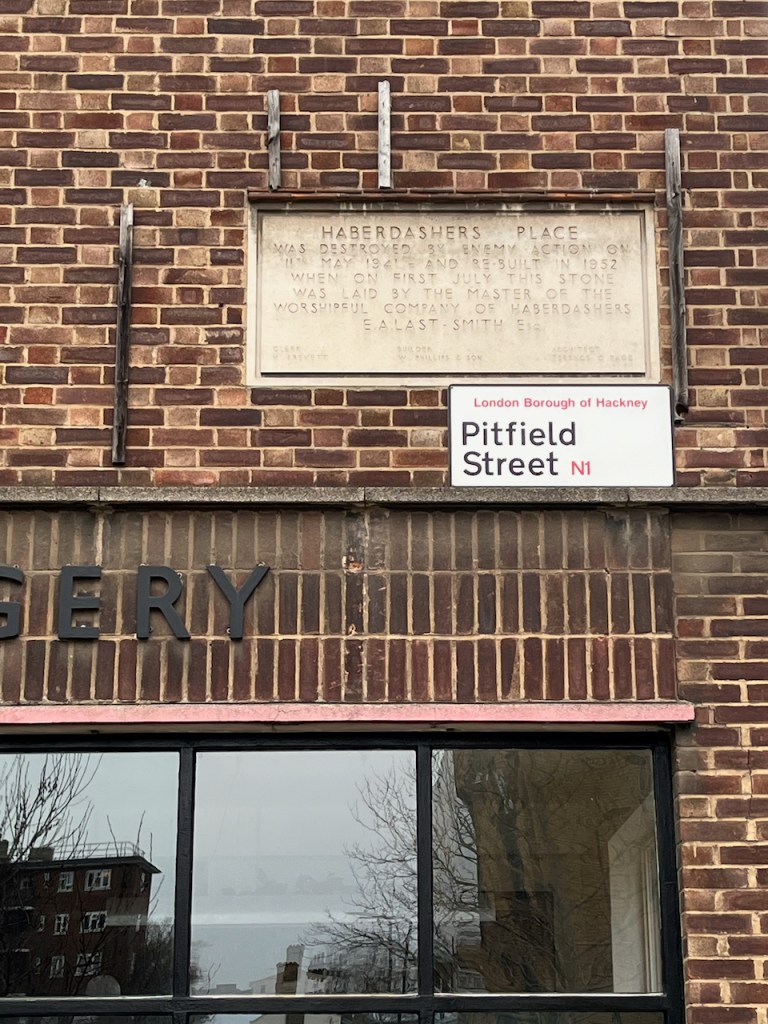
The area was bombed extensively in the 1939-45 conflict, but the pub survived. Bomb maps show that the area adjoining Aske Street on the other side of Pitfield Street was damaged beyond repair. A plaque on the row of shops just North of the pub describe the re-building.1

“Haberdashers Place was destroyed by enemy action on 11 May 1941 and re-built in 1952 when on first July this stone was laid by the master of the Worshipful Company of Haberdashers S.A. Last-Smith.
Clerk W B(?)revett – Builder W Philips & Son -Architect Terence C Page”
Photo: January 2025

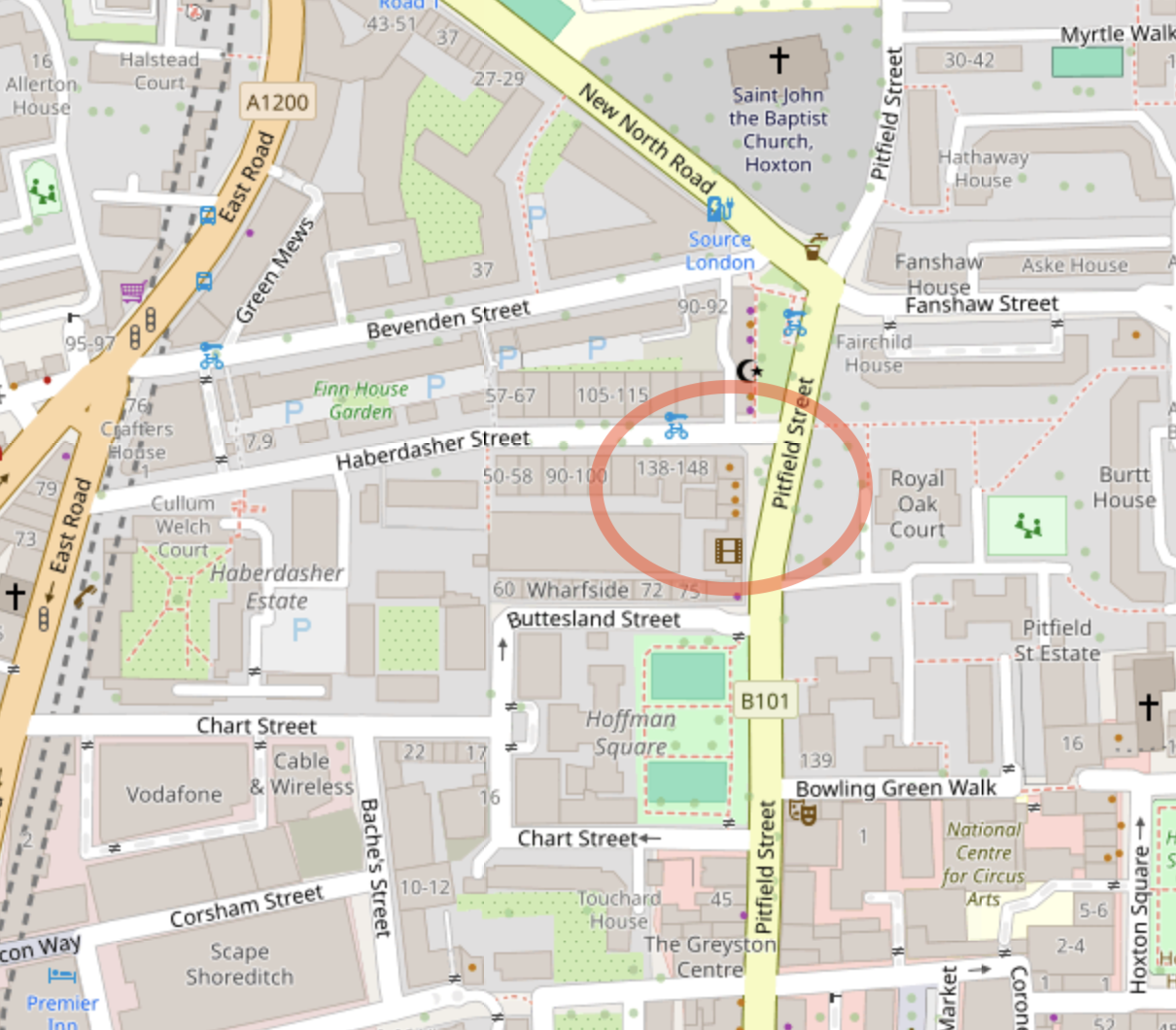
Here is the 1872 map alongside a modern map. You see that the rows of terraced houses on the east of Pitfield Street have gone, and are replaced by low-level residential housing blocks with a different layout.

I sketched the pub on a cold January day. I did the pen and ink on location and then retreated to my desk to do the colour.

Sketchbook 15

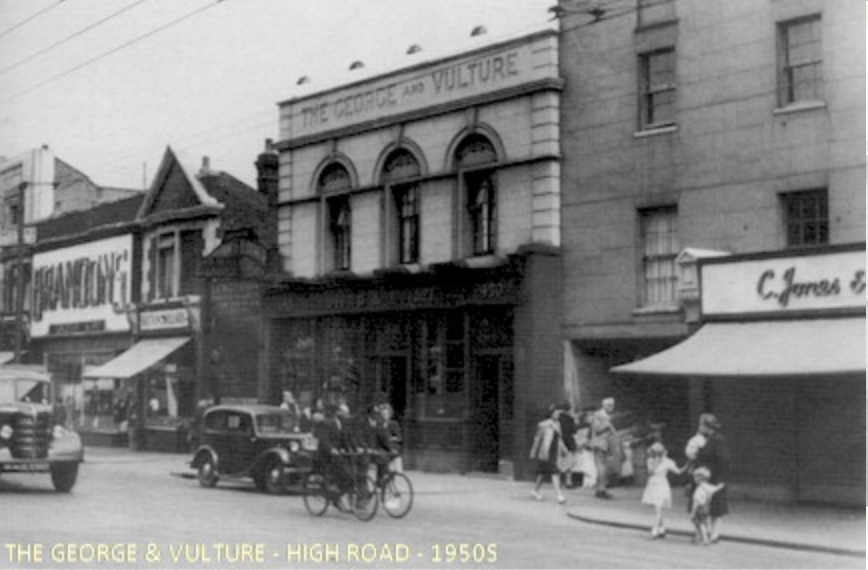
I cannot discover why the pub is called the “George and Vulture”. Why “vulture”? There is another pub in London of the same name, in the alleys of the City close to the Jamaica Wine House. That one was established in 1175. There was also a George and Vulture in Tottenham, 490 High Road, N172, from around 1759, now demolished.

The George and Vulture Tottenham in 1950,
image from: https://tottenham-summerhillroad.com/old_pubs_of_tottenham.htm

Can anyone throw any light on the meaning of the name?

  1. The site “urbannarrative” by local architect Steven Smith, comments on this re-building: https://urbannarrative.com/DITCHWATER ↩︎
  2. Website: “Pubology.co.uk”: https://www.pubology.co.uk/pubs/9402.html ↩︎

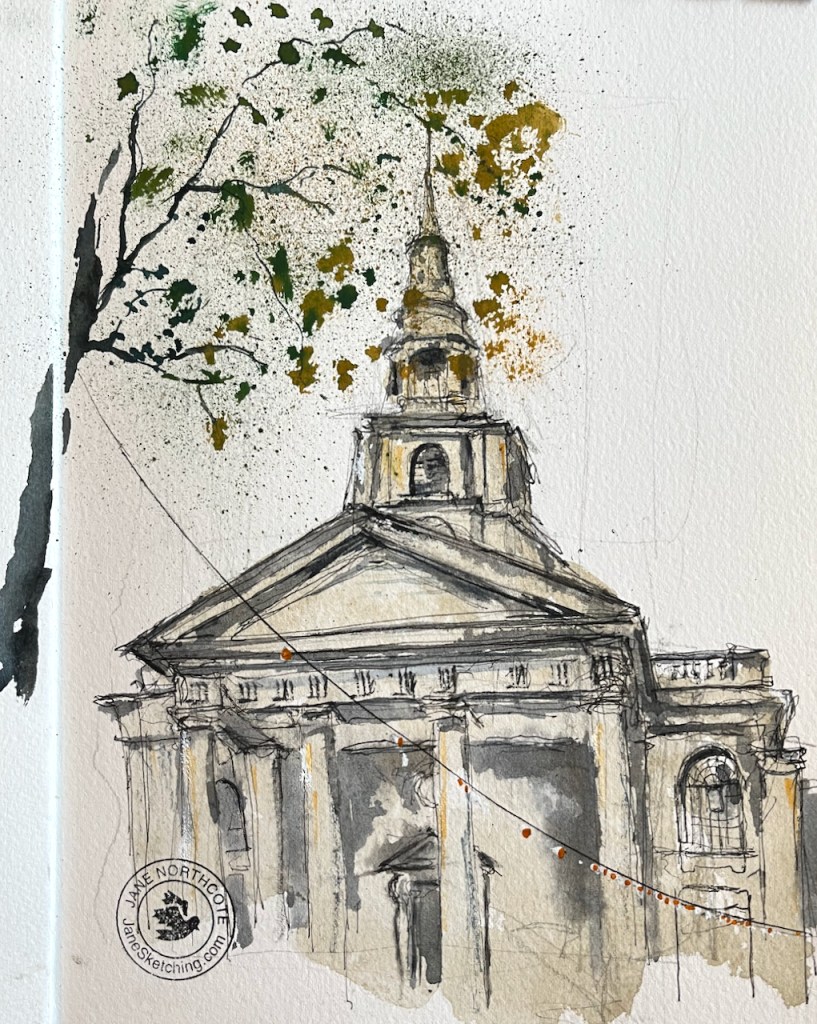
Shoreditch Church: St Leonard E1

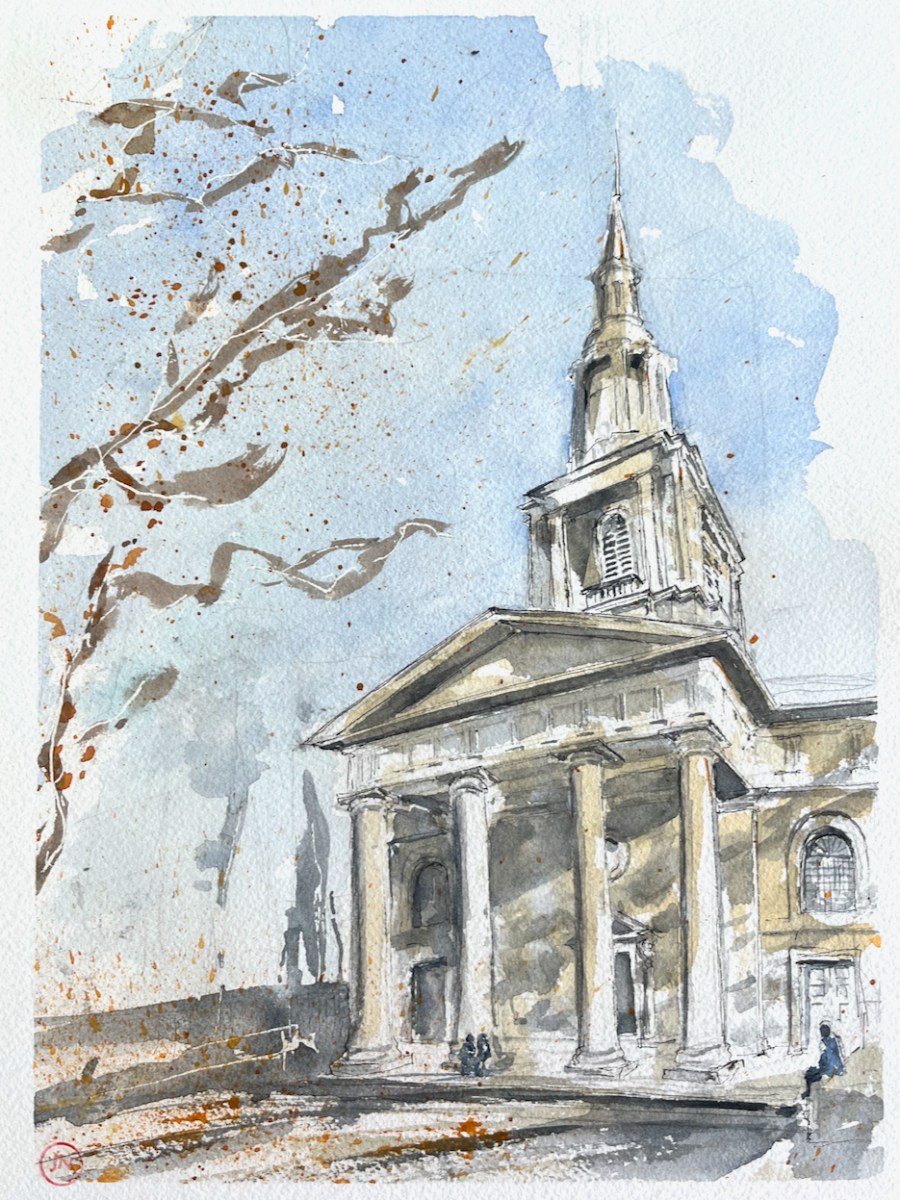
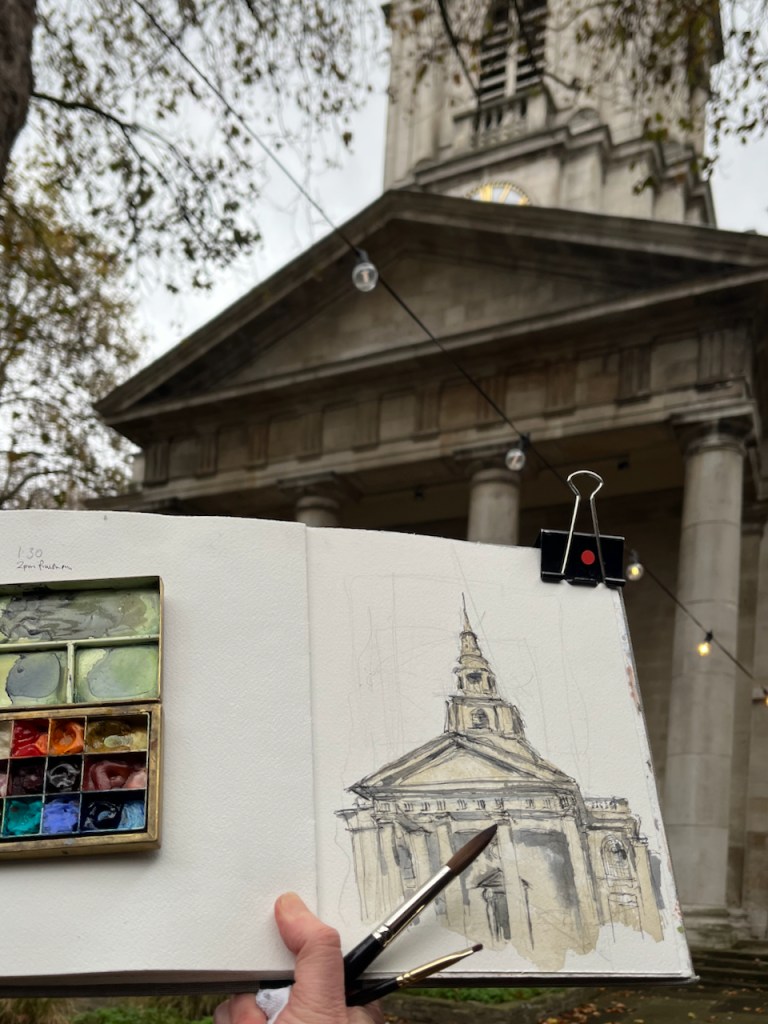
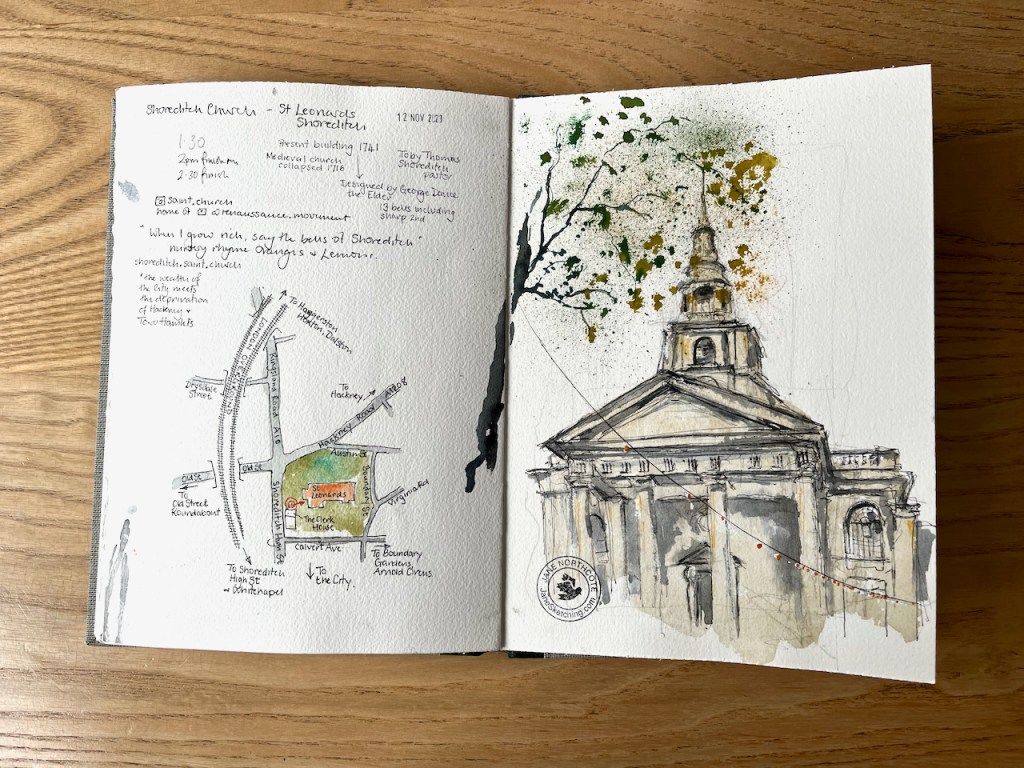
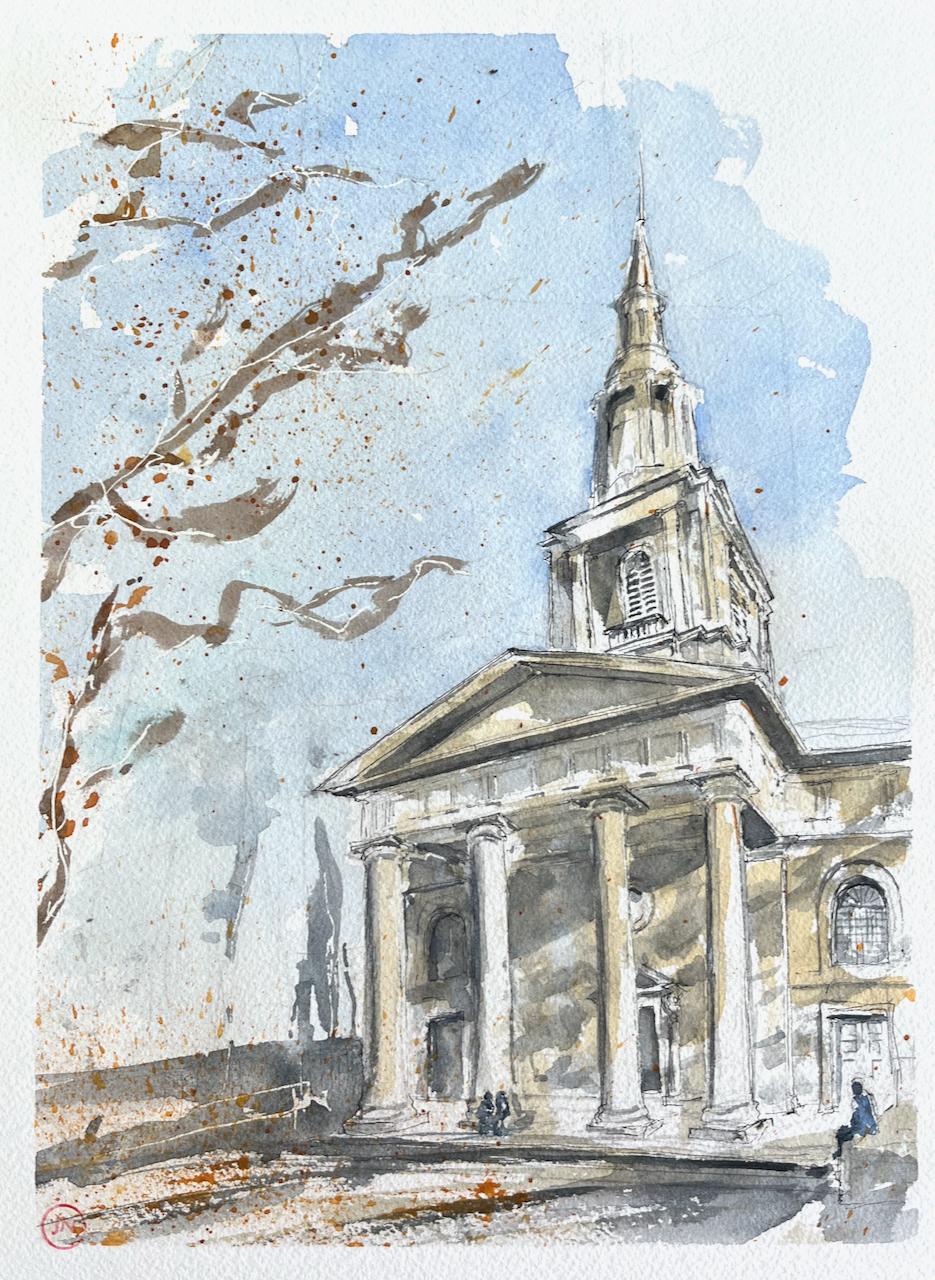
Here is St Leonard Shoreditch, which stands at the intersection of Shoreditch High St and the Hackney Road, postcode E1 6JN.

St Leonard’s, Shoreditch Church sketched 23 November 2023, 12″ x 9″ [sold]

There has been a Christian church here since medieval times. The present building dates from 1741 and was designed by George Dance the Elder (1695-1768). George Dance the Elder was the City of London surveyor at the time, and designed, amongst other buildings, Mansion House at Bank Junction.

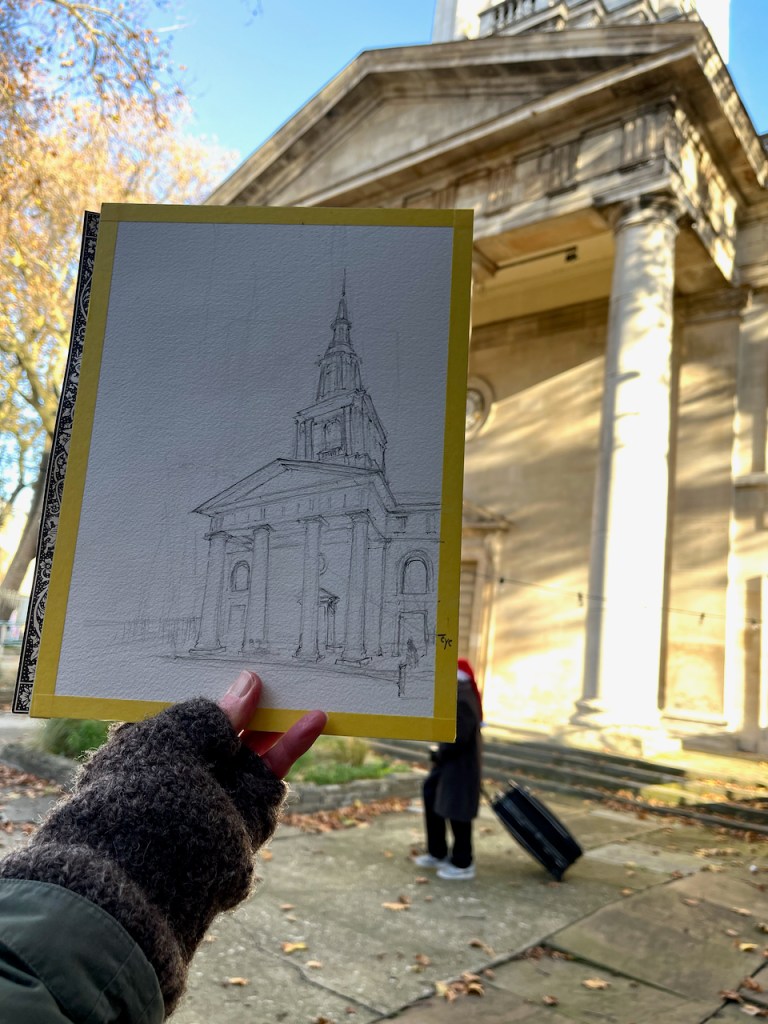
The current church is active in the community. On the day I was sketching, a Thursday, they were offering meals to local people. This is the Lighthouse Project, “providing practical help, food parcels and hot meals to local people in need” according to their website. You can see several guests in the picture.

Placard offering "Free Community meal for the people of East London"

When the church was recently rebuilt at the turn of the millenium, a large amount of money was spent on its community needs and no funds were left to buy paint. Hence it still looks a bit bohemian. We think it’s quite endearing and shows people where our priorities are – with the community rather than how we look.

The current community is highly diverse. The wealth of the City meets the deprivation of Hackney and Tower Hamlets. Our neighbours in Arnold Circus and St Hilda’s Community Centre are highly galvanised community groups acting for societal change.

Shoreditch Church website (https://shoreditch.saint.church/new-page-50)

This church houses the “bells of Shoreditch” from the children’s song “Oranges and Lemons”. If you go inside the church you can see a bell, which is resting on a wooden pallet on the right hand side of the nave.

when I grow rich, say the bells of Shoreditch.

The Society of Cumbernauld Youths in 1784 rang a complete peal of 12000 changes of Treble Bob Royal, taking nine hours and and five minutes.

Oranges and lemons,
Say the bells of St. Clement’s. (St Clement Danes)
You owe me five farthings,
Say the bells of St. Martin’s. (St Martin in the Fields)
When will you pay me?
Say the bells at Old Bailey. (St Sepulchre-without-Newgate)
When I grow rich,
Say the bells at Shoreditch. (St Leonard Shoreditch)
When will that be?
Say the bells of Stepney.(St Dunstan’s Stepney)
I do not know,
Says the great bell at Bow. (St Mary Le Bow)
Here comes a candle to light you to bed,
And here comes a chopper to chop off your head!

The Society of Cumbernauld Youths in 1784 rang a complete peal of 12000 changes of Treble Bob Royal, taking nine hours and and five minutes, according to a placard in the church porch.

The bells are still rung.

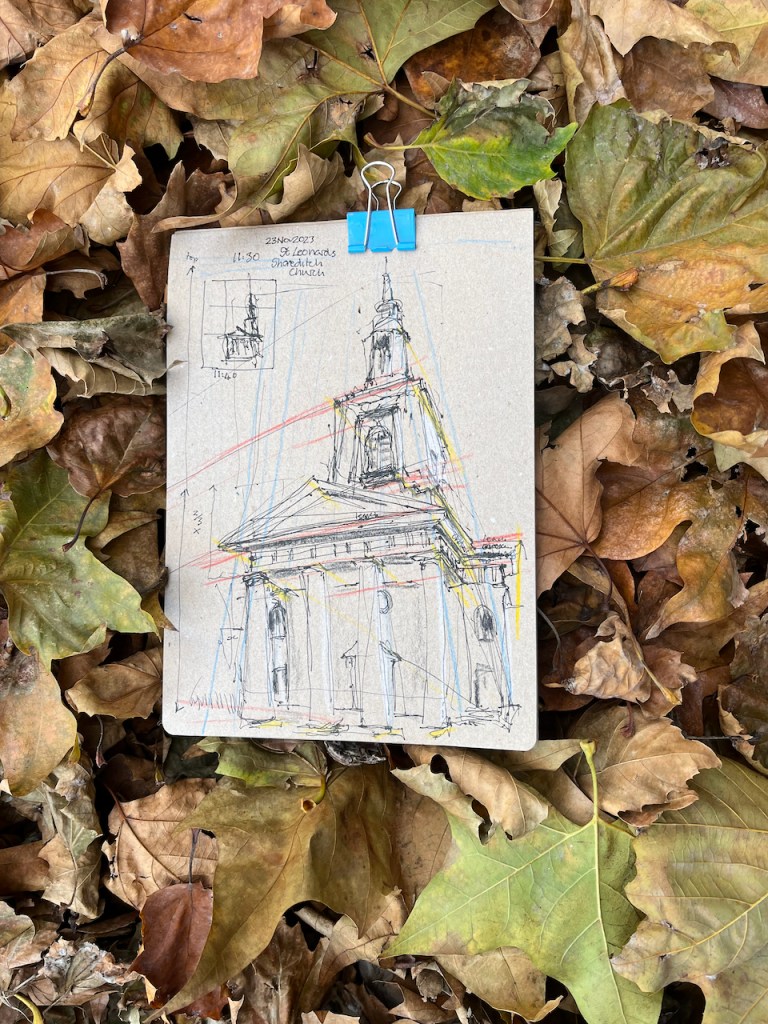
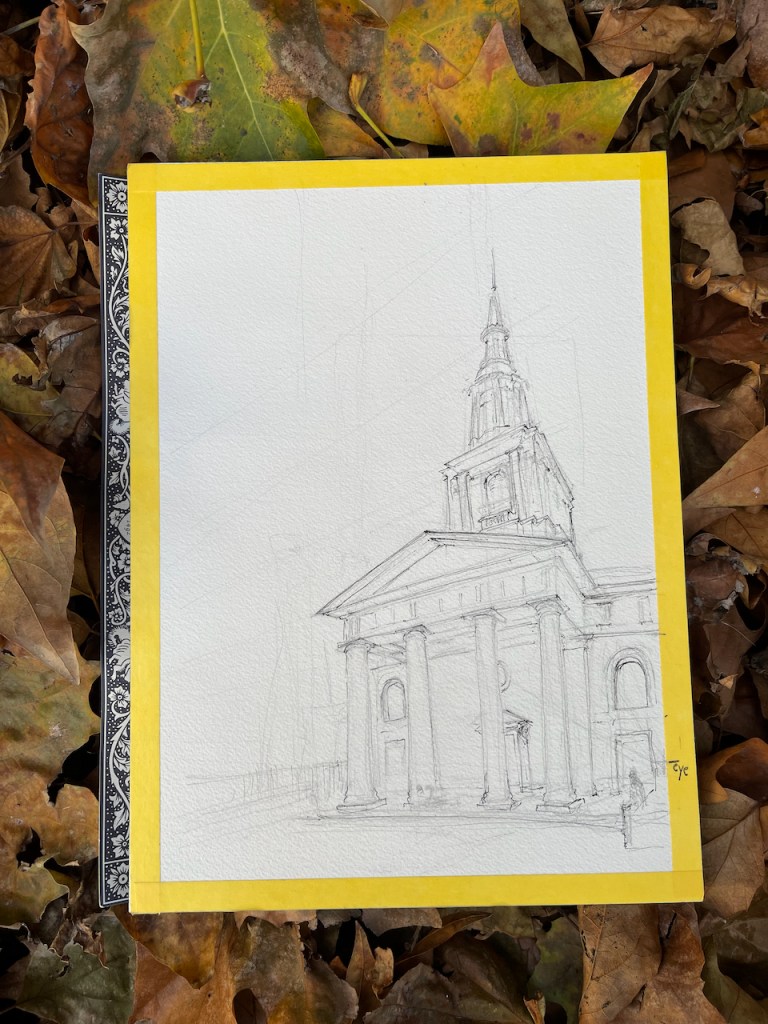
This picture was a commission. My client was keen to have this upward view showing the front of the church. I did some practice sketches to understand the tricky upward perspective.

Thank you to my client for suggesting I draw this inspiring church, and for their permission to publish the photos of the drawing online.

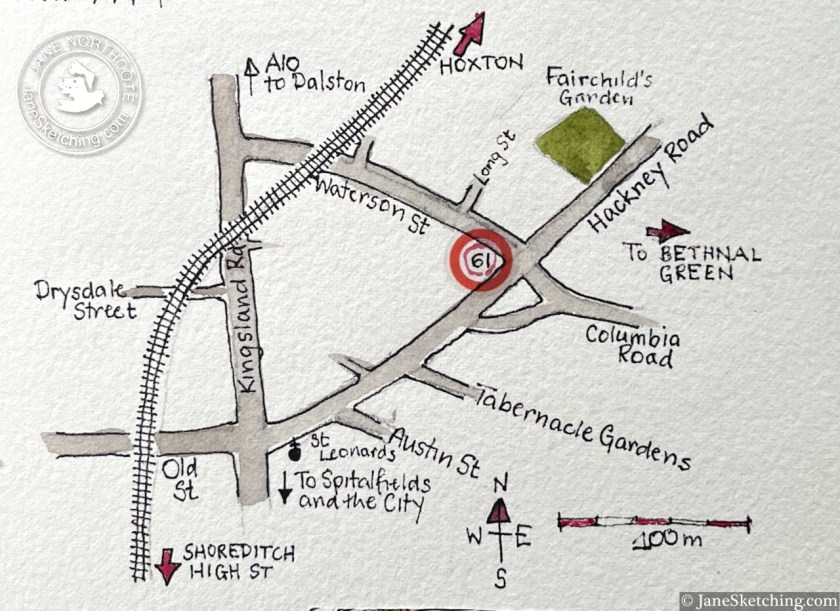
Here is a map showing the location:

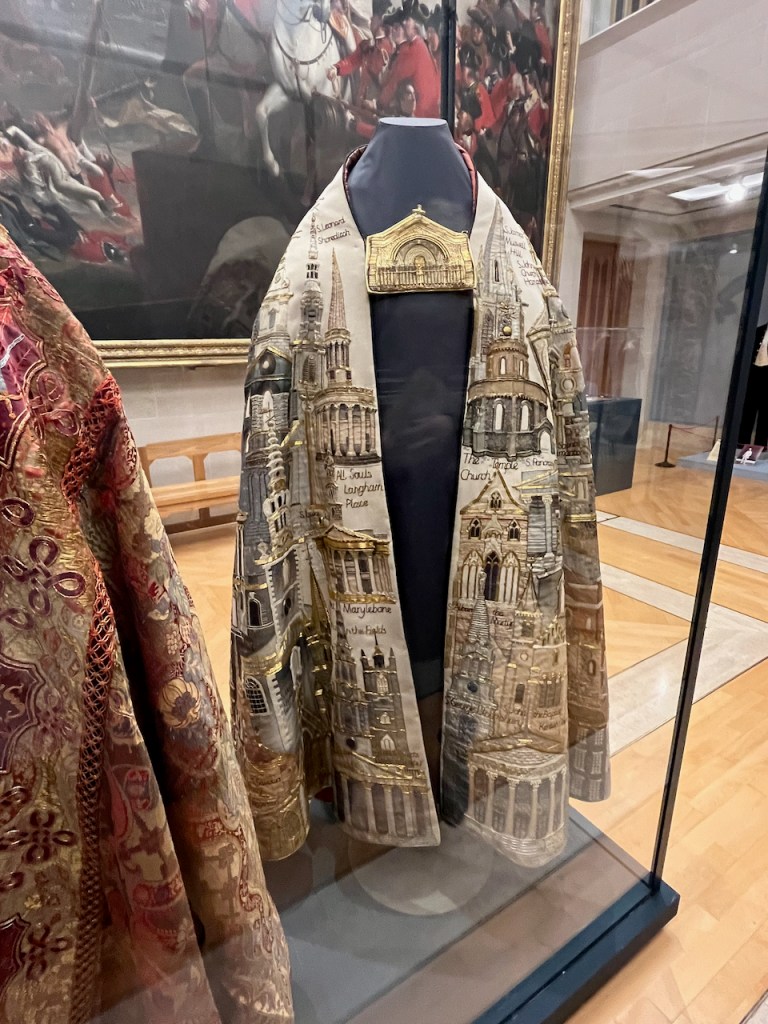
There is a current exhibition in the Guildhall London:

“Treasures of Gold and Silver Wire”
curated by Dr. Karen Watts, Emeritus at the Royal Armouries. It celebrates the 400 anniversary of the Worshipful Company of Gold and Silver Wyre Drawers.

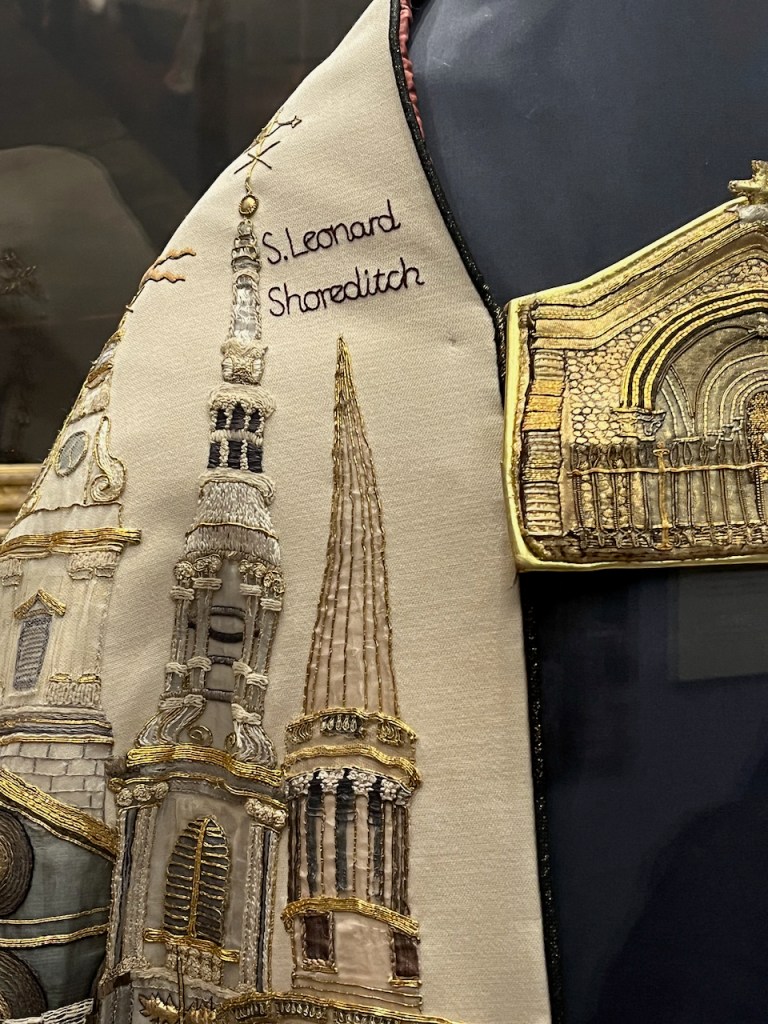
In that exhibition there is a cope, a cape for the Bishop of London, showing 73 London Churches. To my delight, St Leonard Shoreditch features, on the right shoulder. It was designed by British embroiderer Beryl Dean and made by needlework students of the Stanhope Institute. (https://trc-leiden.nl/trc-needles/individual-textiles-and-textile-types/commemorative-and-commissioned-textiles/silver-jubilee-cope-and-mitre)

Having myself had a go at depicting those arches and columns on the spire, I am full of admiration for the embroiderers who managed to create an accurate image in wire thread. Hugely accomplished! The exhibition is on until 31st December 2023- well worth seeing.

55 Holywell Lane, London EC2, Village Underground

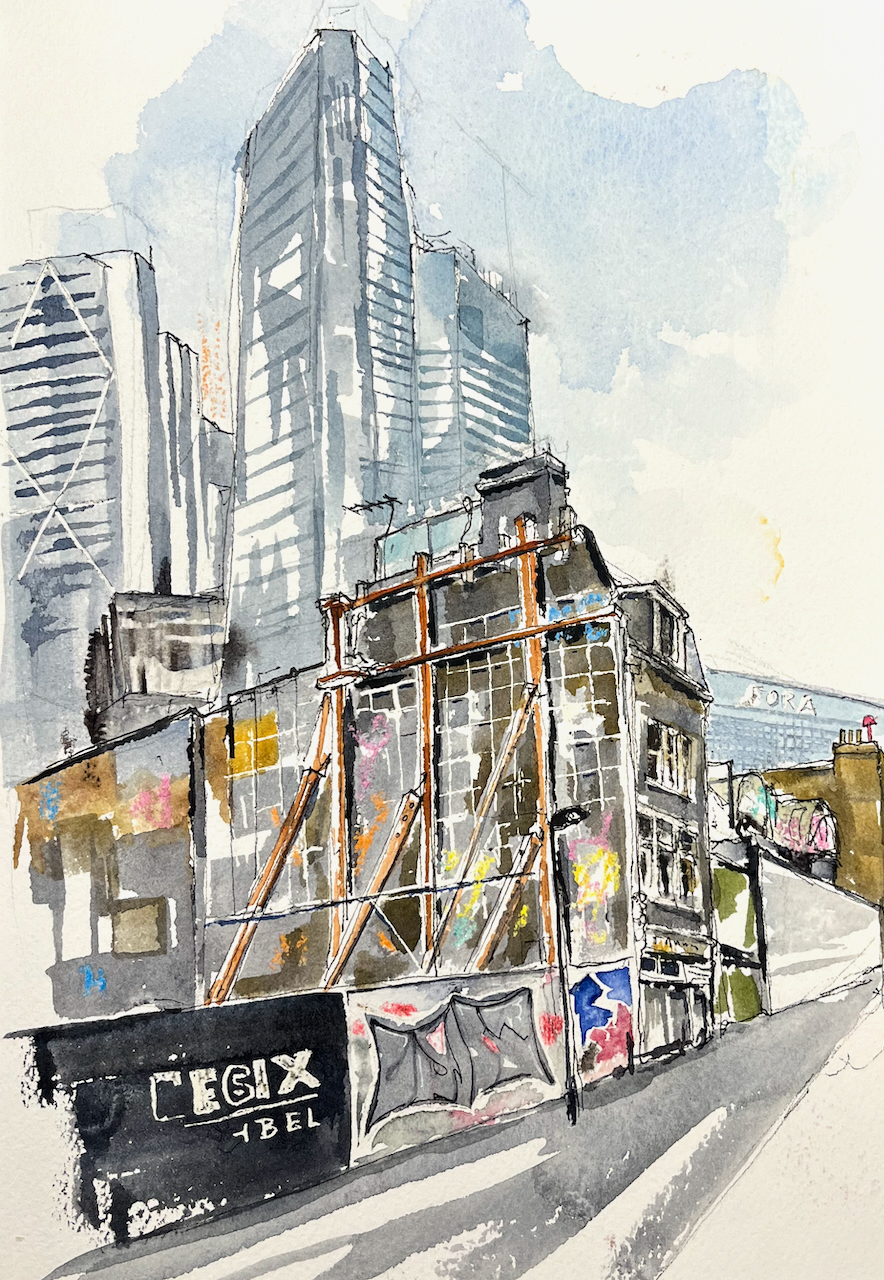
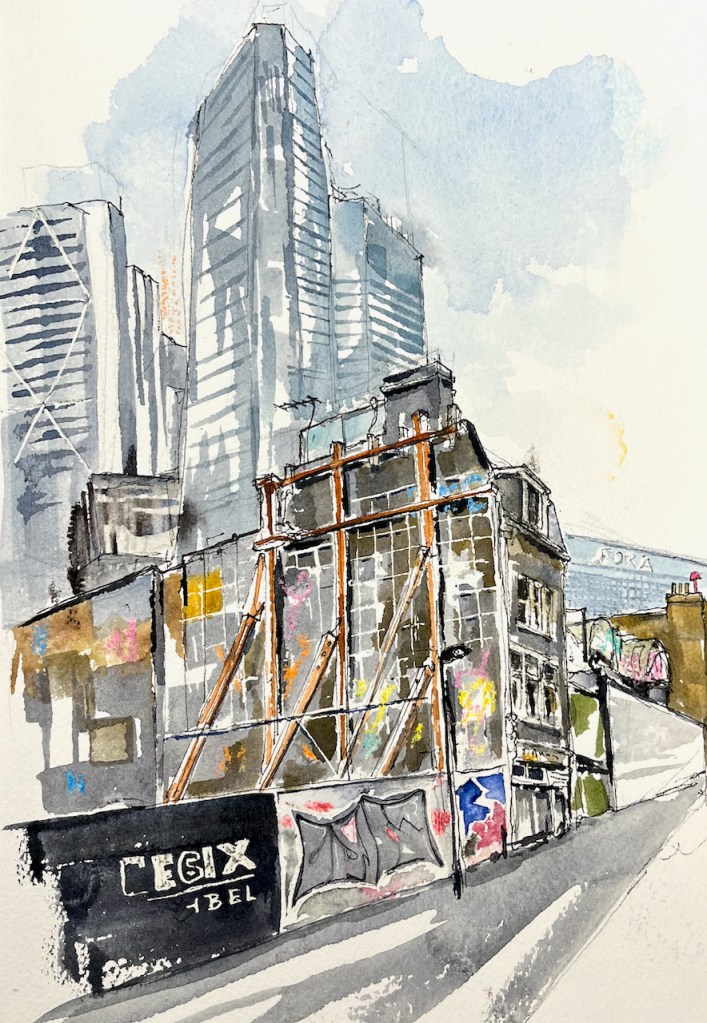
55 Holywell Lane, London EC2A 3PQ, sketched 17 November 2023 in Sketchbook 13

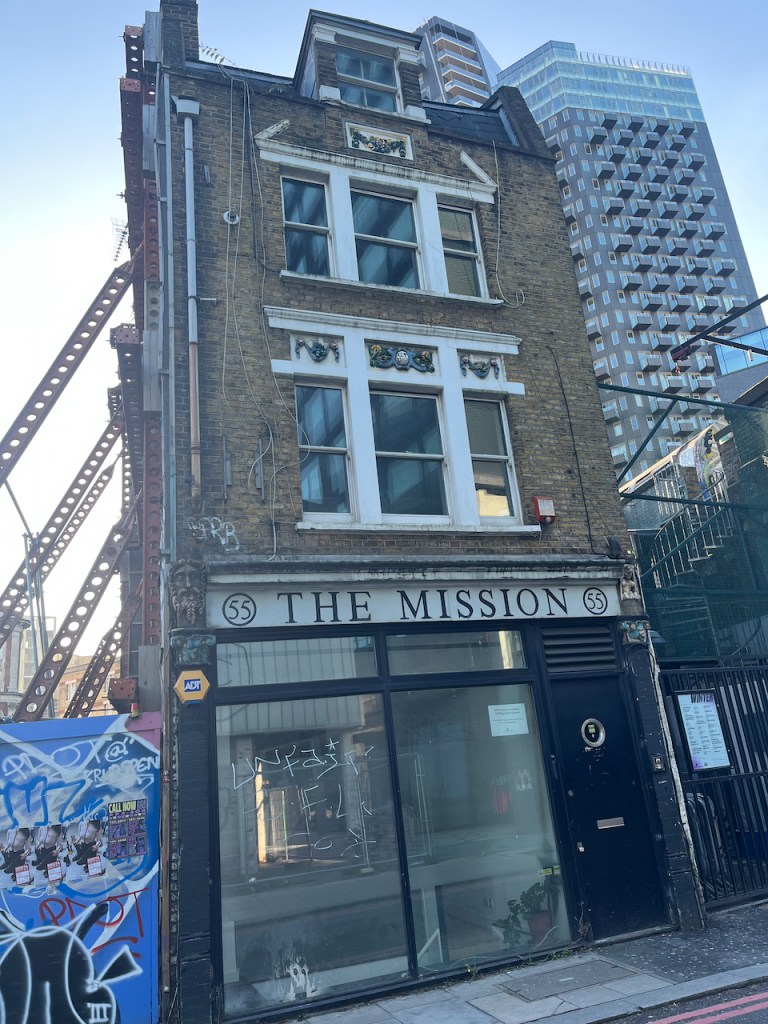
This apparently dilapidated building stands on the edge of a building site in Shoreditch. The flaking shopfront announces “The Mission”. It looks dusty and closed up.


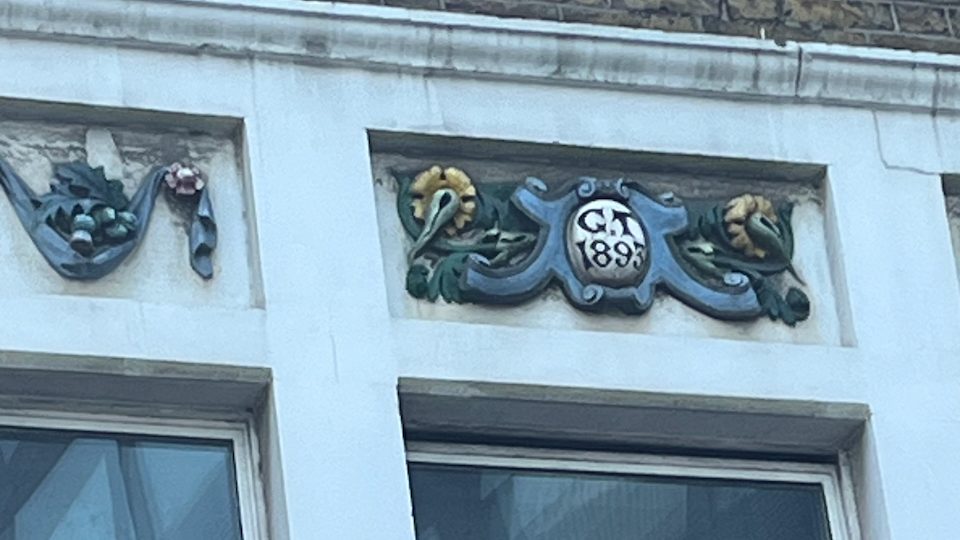
This is 55 Holywell Lane. The Victorian decorations on the front of the building say “G.T. 1893”.


Despite appearances, the building is in active use. It is part of “Village Underground” – “part creative community, part arts venue”. “home to cutting edge culture, clubbing and live music” founded in 2006.
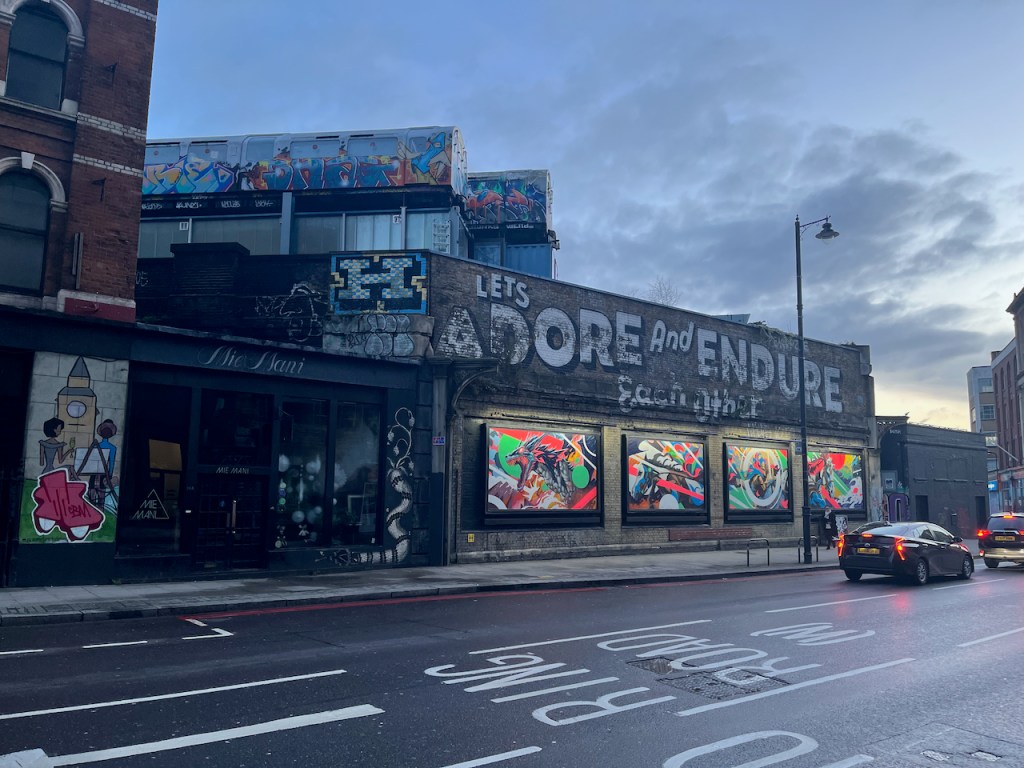
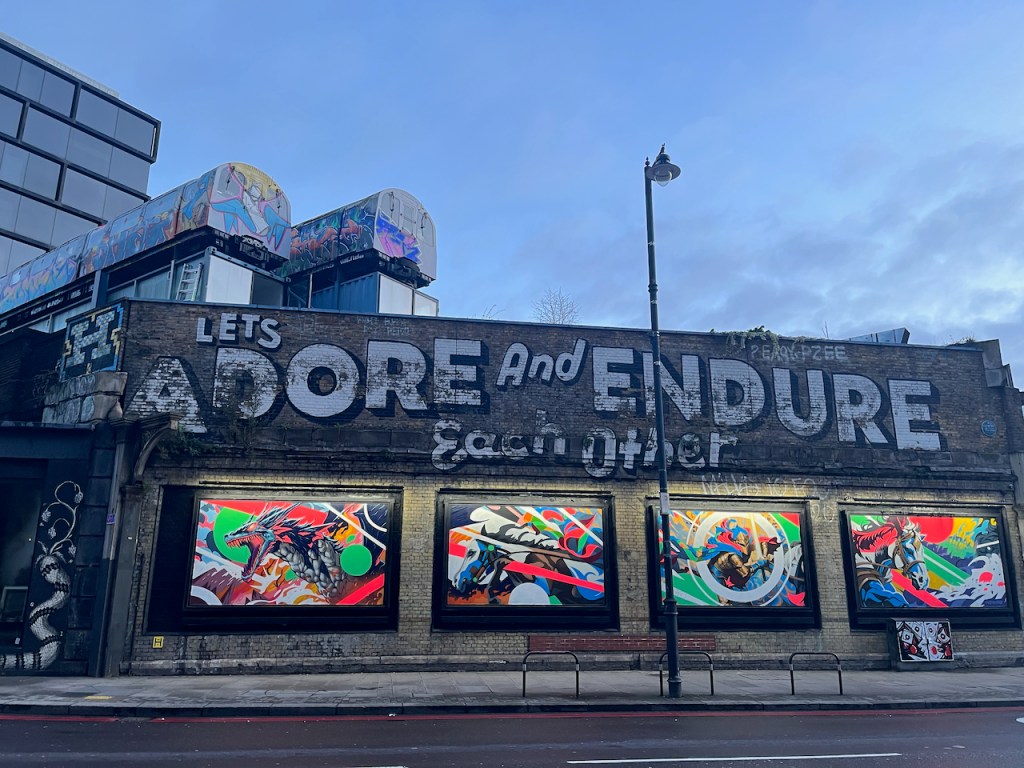
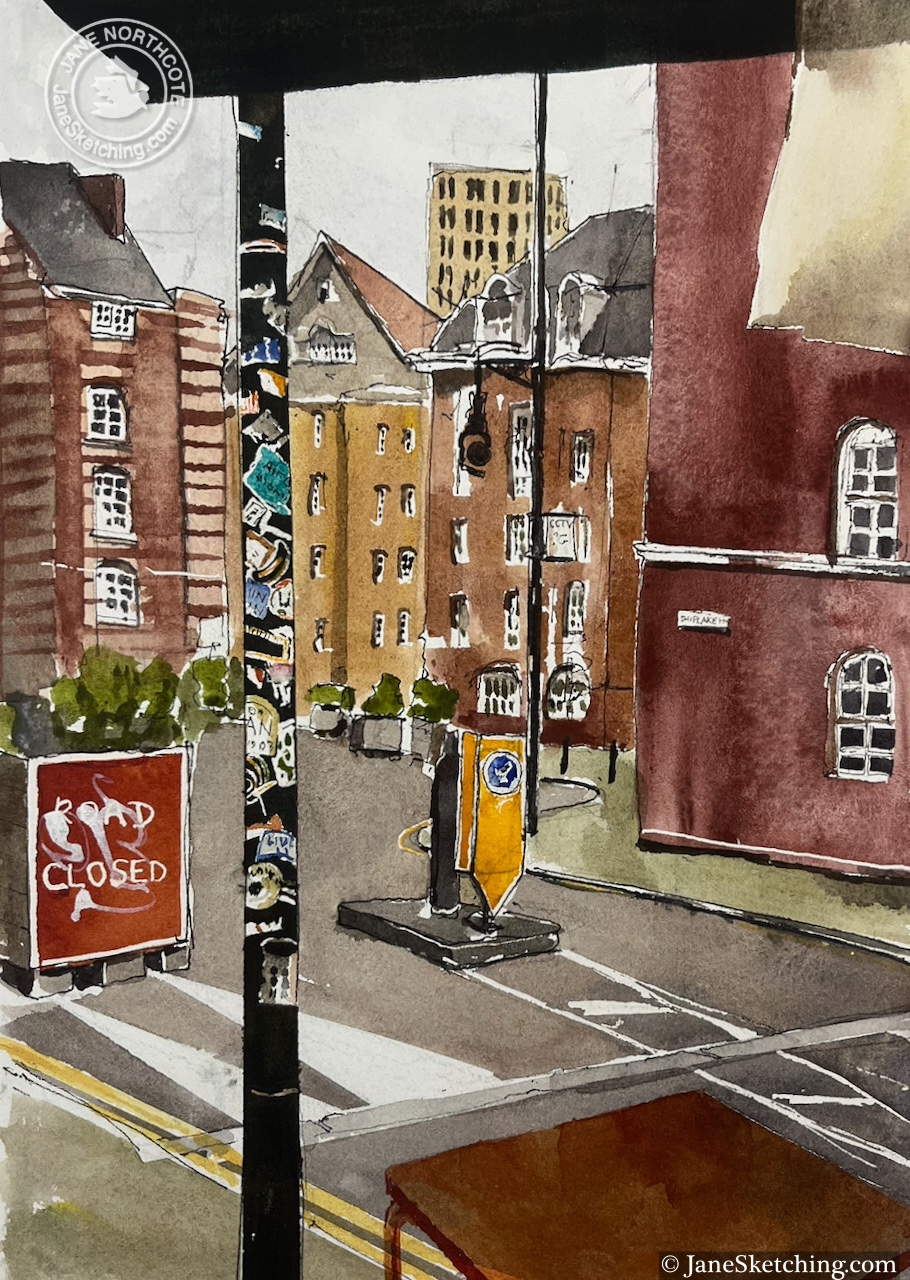
In the centre right of the drawing you can see the underground train carriages, hoisted on top of the venue.
Their website says

“It’s a strange little haven of calm in the carriages, above the chaos of Shoreditch, enclosed by skyscrapers on each side, where we grow fruit and veg in our little rooftop garden, get excited about new bands and parties, plot and plan how to improve the venue, decide which shows to book, and try to get more people to come to our shows. “

https://villageunderground.co.uk/about/history/


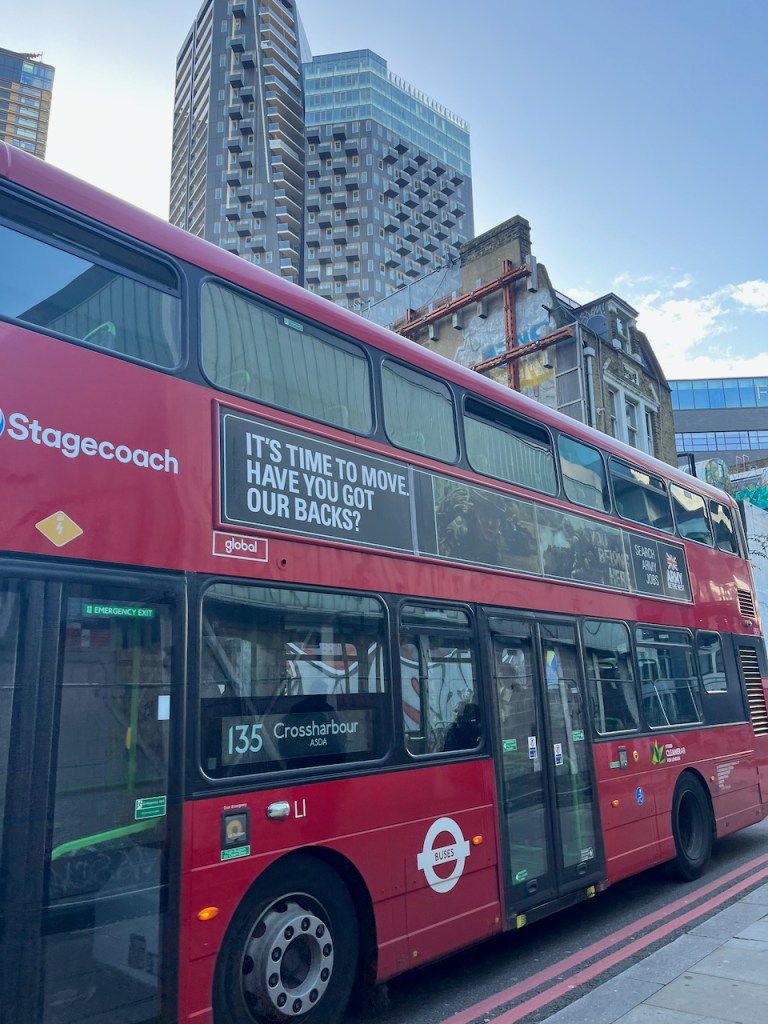
This is an area of London undergoing transition. In the background of my drawing you can see the huge residential and office towers next to Liverpool Street Station: “The Stage” and “Principal Place”. I sketched the picture standing under the elevated overground railway line, next to a building site. On the white wall shown to the right of my drawing, people were making a large mural, an advertisement for a whisky brand. The number 135 double-decker buses came past at what seemed like extraordinary frequency.


Cars and buses queued in this small street waiting to cross Shoreditch High St. It was a narrow pavement, and not a great place to sketch. But two people came and looked at the drawing: it’s a great skyline, they observed, looking at the view. And it is.

Here is the view of the site from Great Eastern Street early in the morning. The underground train carriages are visible top left.

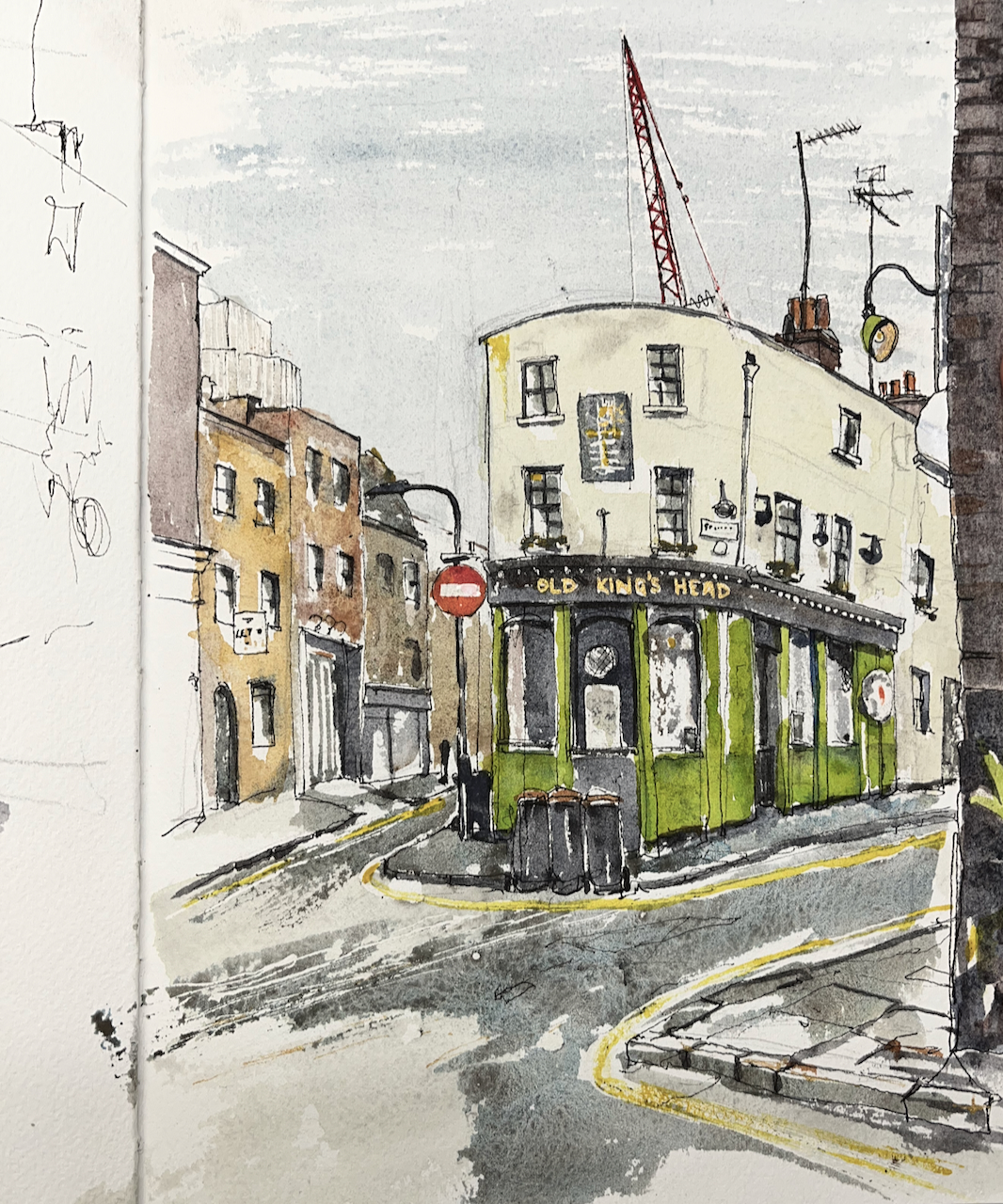
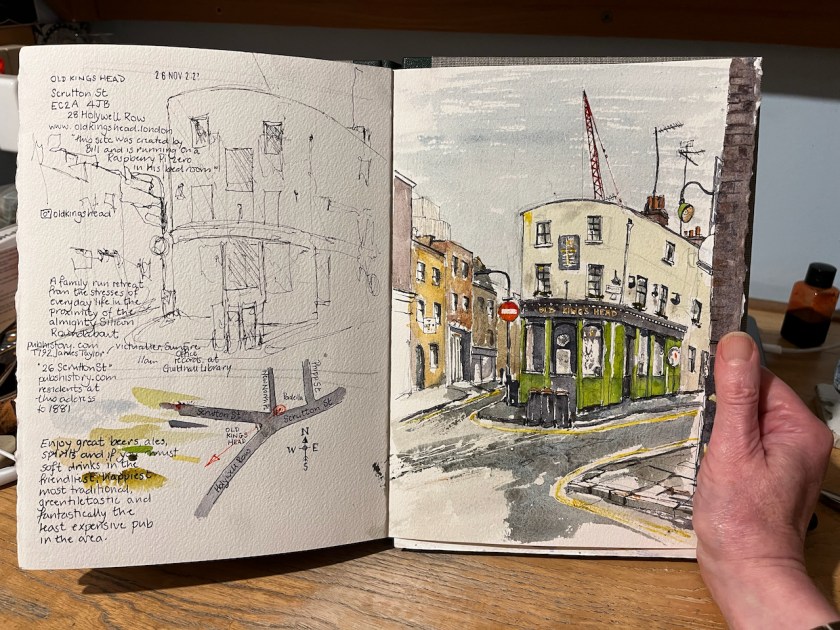
Old Kings Head, EC2

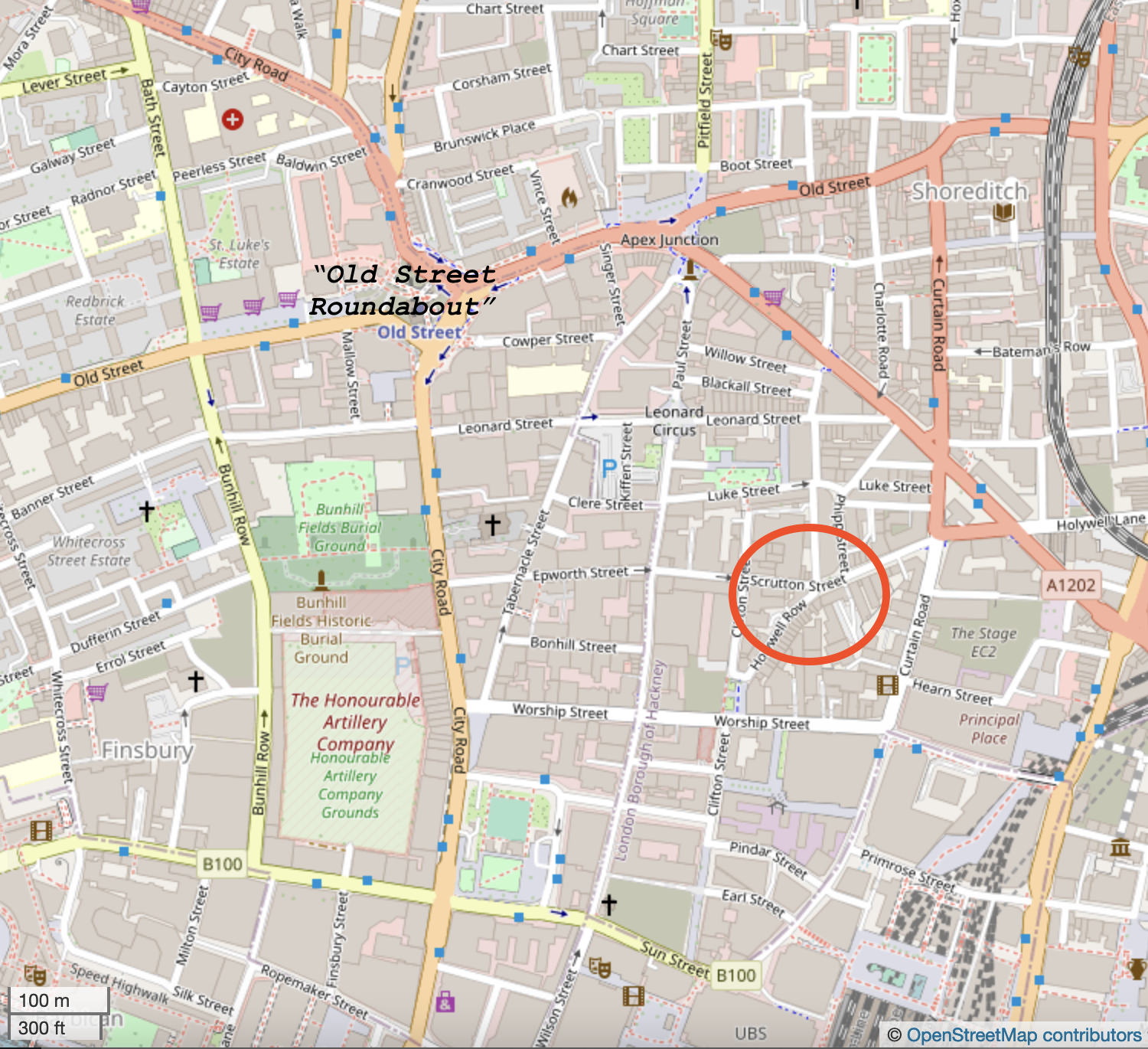
Here is the Old Kings Head, 28 Holywell Row, EC2A 4JB: ” a family-run retreat from the stresses of everyday life in the proximity of the almighty Silicon Roundabout” [oldkingshead.london]

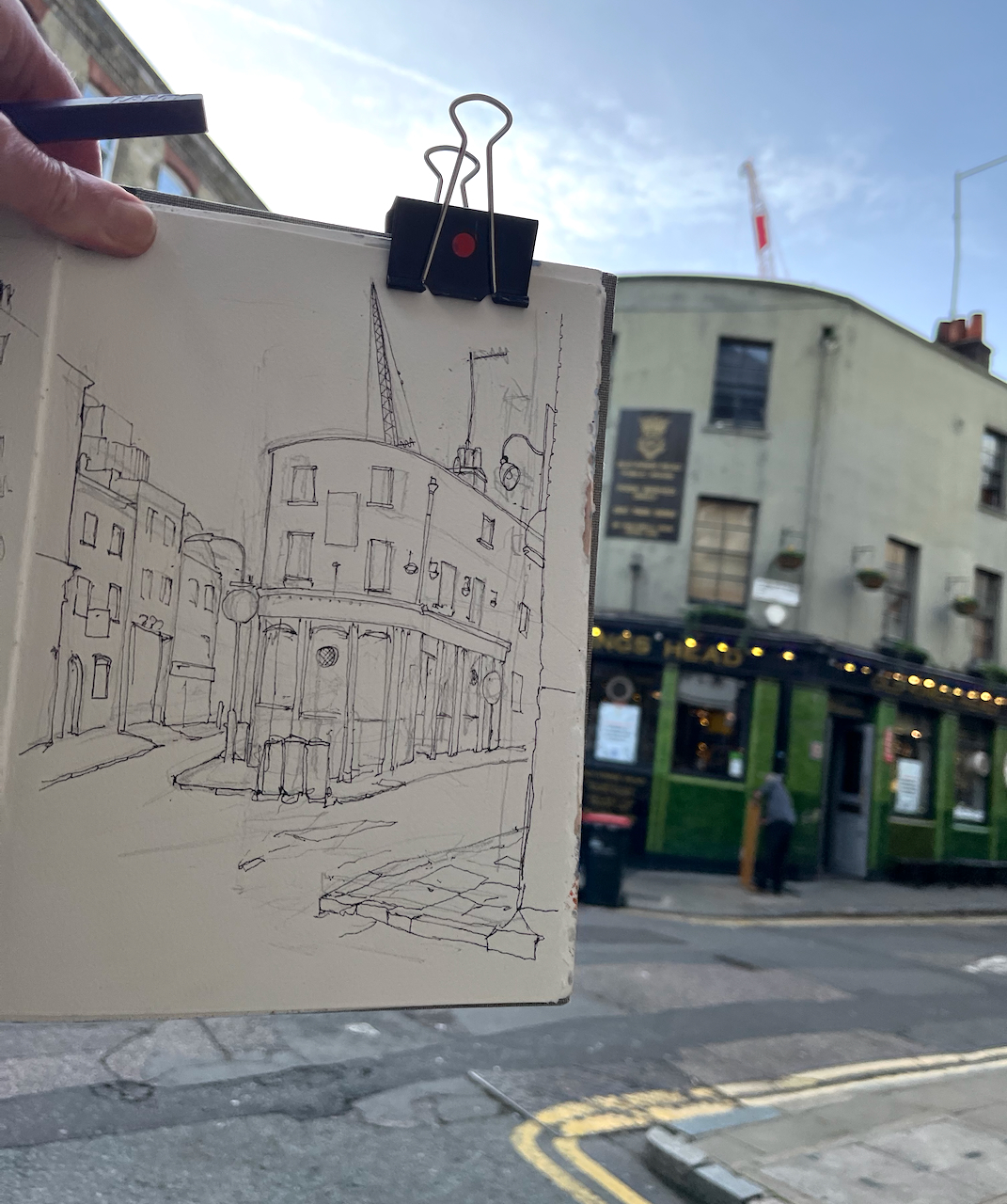
The Old Kings Head, Shoreditch 26 November 2022 in Sketchbook 12

“Enjoy great beers, ales, spirits and, if you must, soft drinks in the friendliest, happiest, most traditional, greentiletastic and fantastically the least expensive pub in the area” continues their website.

I love “greentiletastic“. The green tiles are indeed fantastic: I have tried to show them in my drawing.

This pub is in a network of tiny streets running at all sorts of unexpected angles. As I sketched, I saw, more than once, an expensively dressed person trailing a carry-on size suitcase, picking their way over the broken paving stones and patched up tarmac, in unsuitable shoes. The person drifted on, towards Old Street, bearing a dreamy mystified expression, as though these piebald buildings did not quite correspond to the mental image they had of their destination, or, more likely, the street pattern did not correspond to the image on their mobile phone. They saw neither me, nor the pub, but seemed to exist in another reality.

This pub is old. According to “pubhistory.com” the earliest landlord was “James Taylor, victualler” in 1792. This is from insurance records in the Guildhall Library.

It sounds like a great pub.

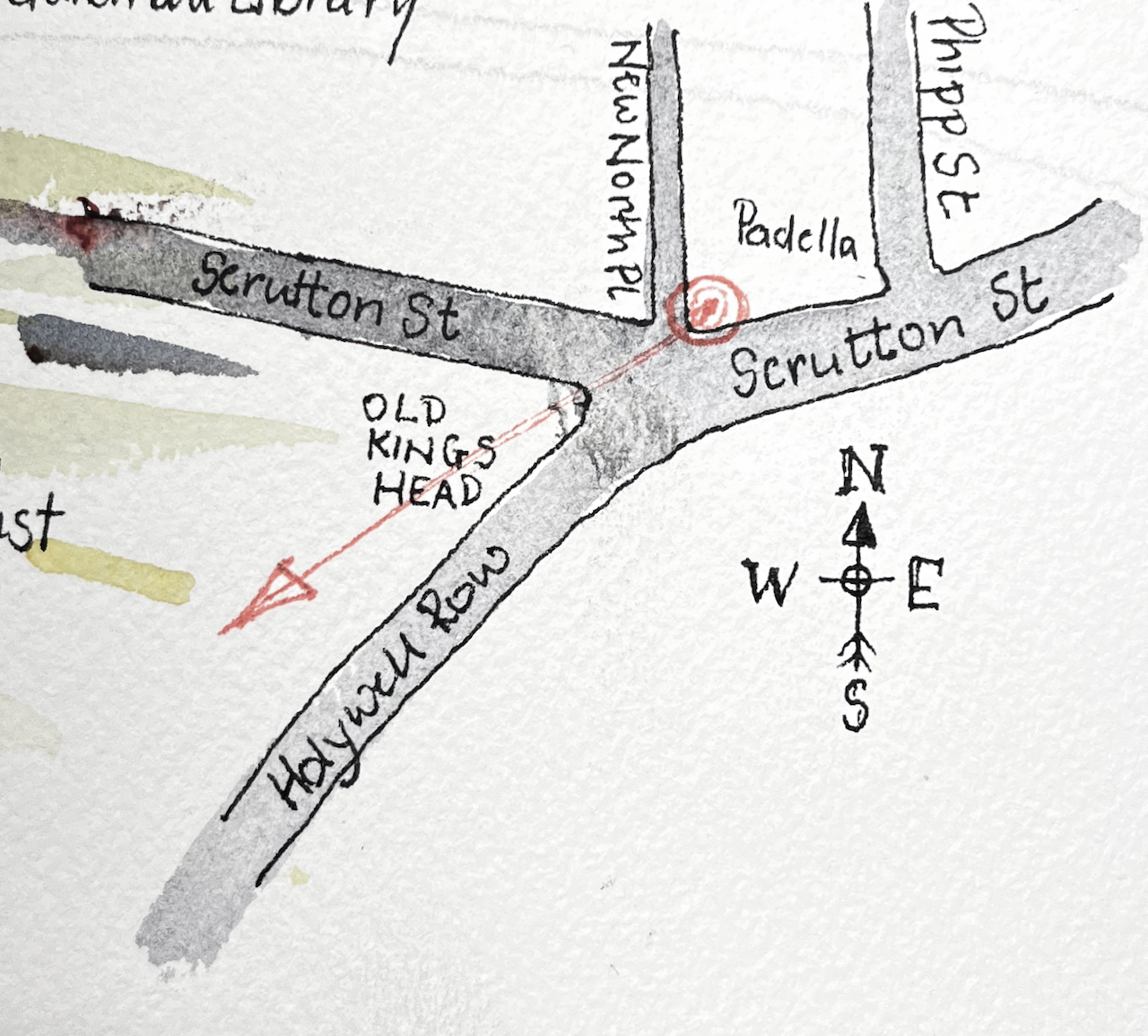
I drew it standing outside the restaurant “Padella”, next to a narrow alley called “New North Place”. New North Place is the opposite of new, but it does go North. To my total astonishment, a huge lorry emerged from this tiny alley, and blocked my view. This is a common hazard sketching in London. It soon moved on though. I was impressed that the driver had ventured into the alley.

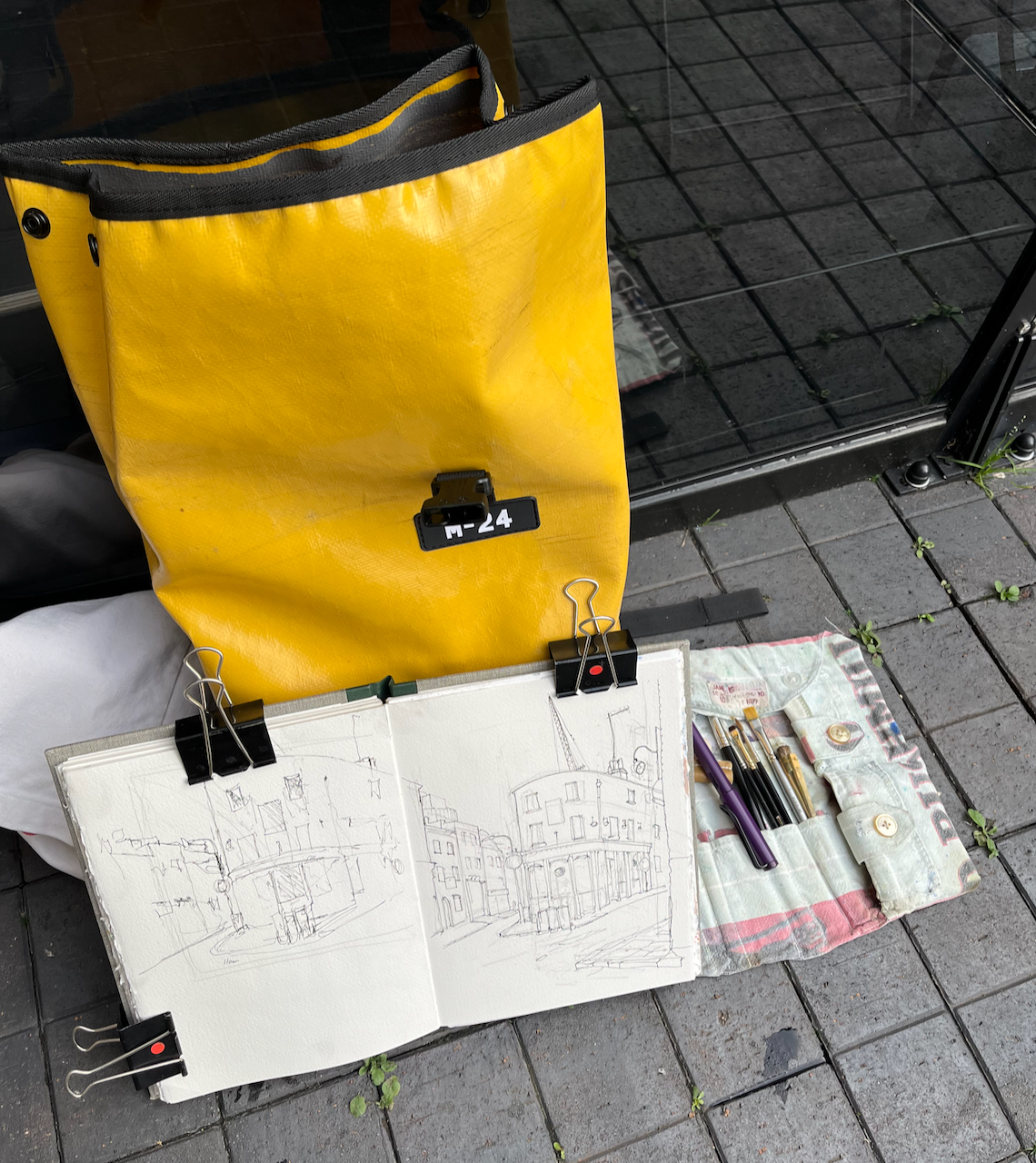
Sketchbook 12

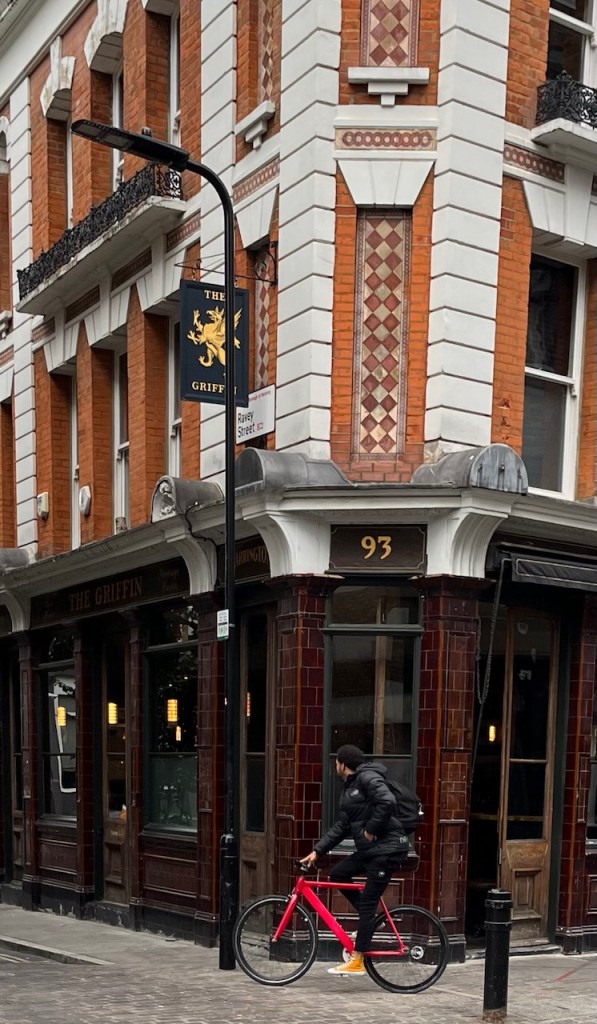
The Griffin, 93 Leonard St, EC2

After I’d sketched The Old Blue Last, I left the thundering traffic behind and walked through back streets of Shoreditch. I encountered “The Griffin”. It seemed like a friendly place, with neat brickwork, and welcoming lights inside. I sat on a low wall, and sketched it, as electric taxis glided past. Or should that be “glid”?

The Griffin, Leonard Street EC2. Sketched on 21 September 2022 in Sketchbook 12.

The pub is built on a slight slope. Ravey Street slopes upwards towards Leonard Street.

Map showing where I sat and sketched “The Griffin”

It’s an area of sharp contrasts. Behind me was the “Nobu Hotel” radically modern. Blackall Street, however, looks unkept, like the seamy side of a garment. The people walking by were various. A group of young people speaking a Germanic language rushed past onto Leonard Street following a route on a mobile phone. Several men in florescent jackets walked towards me in a tight group, studiously conversing and referring to a clipboard which one of them carried. As they passed I realised they were speaking another language, perhaps of a Baltic region, with soft “shh” sounds. A young woman strode past in the opposite direction, frowning, speaking no language but with her mobile phone held at her ear. None of these people paid me any heed. Then a totally different person appeared, dancing a jagged line along the street, with hair in long strands, and a huge smile. He noticed me and marched up, asked how I was, commented on the day, admired my drawing, and offered me a fist to bump in greeting. This done, he completed a 36o degree turn on the spot, and walked loosely on up the street, offering his benign greetings to other bemused passers-by. This is London.

The Griffin is in an area of contrasts.

The area containing The Griffin has recently been totally redeveloped. A new hotel was constructed on Great Eastern Street. These works took place in 2013-5. They included a renovation of the pub itself, and conversion of its first floor into flats. There is extraordinarily detailed research on the whole site done by “The Historic Environment Consultancy”. See this link.

The pub is Grade II listed, the buildings around were unstable, and archaeological investigations were called for. The Historic Environment Consultancy wrote a scholarly account of the state of The Griffin in 2013, in preparation for the redevelopment. They generously put this report online. You can read it on this link or download it here if that link is no longer valid:

The consultant carefully identified the phases of construction of the pub, by looking at details of its structure. For example they observe:

The timbers in the roof are machine-sawn where visible and thus they date the roof to post 1790 and likely to be post 1840.

The Historic Environment Consultancy, Colin Lacey 2013

They conclude that it was constructed in three phases, the first two between 1799 and 1872, and the later one after 1887. This later phase is dated because it included the installation of a Dumb Waiter which was only invented in 1887. It was built as a pub, and has always been a pub.

At the time of their inspection, the consultants noted that the building was on the “At Risk” register:

The building also appears on English Heritage’s Heritage at Risk Register. It is said to be in ‘poor’ condition because, according to the register, of a lack of maintenance.

The Historic Environment Consultancy, Colin Lacey 2013

This poor state is evident from the photos they include in their report, which show plants growing out of the roof, and crackling stone work.

When I sketched it, the pub was in an excellent state of repair, very neat looking, with beautiful patterned brickwork. Worth a visit.

I drew the pub in pen and ink on location and completed the colour at my desk.

The colours are:

  • Ultramarine Blue, Lavender and Burnt Umber for the sky
  • Fired Gold Ochre and Mars Yellow for the brickwork
  • A mixture of all of the above plus Perylene Maroon for the tiled ground level
  • All blacks and greys are Ultramarine Blue with Burnt Umber

The drawing is done on Arches Aquarelle 300gsm cold-pressed paper, made into a sketchbook by the Wyvern Bindery. The pen I use is a Lamy Safari with a fine nib and De Atramentis Document Black waterproof ink, both from “The Writing Desk”.

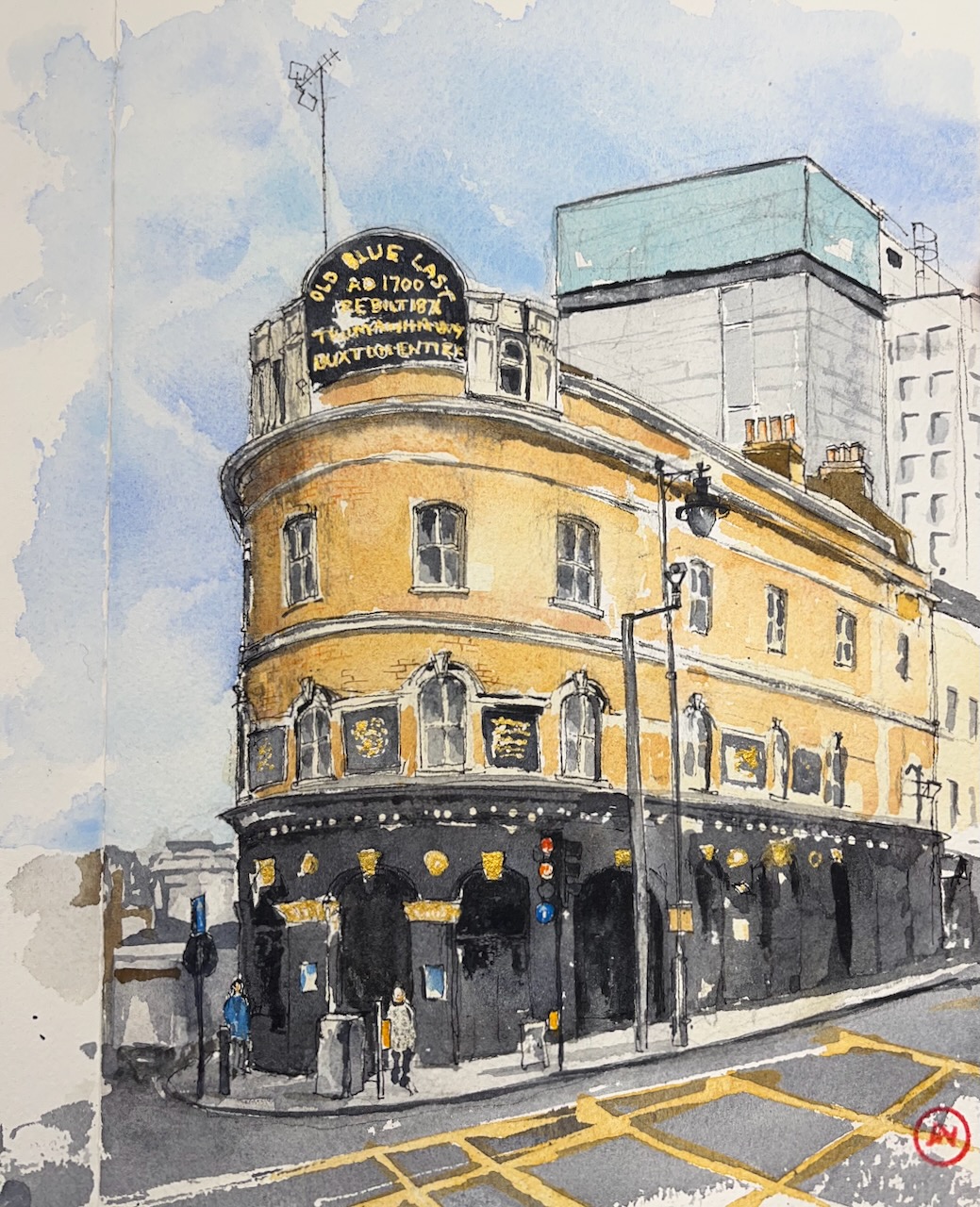
The Old Blue Last, Shoreditch, EC2

Yesterday, I went to look for “The Old Blue Last”, a pub which featured in a book I was reading.

“The Old Blue Last stood at the top of Great Eastern Street in Shoreditch, a snub-nosed, imposing three-storey brick building curved like the bow of a boat…..”

‘Career of Evil’ by Robert Galbraith, Chapter 12.
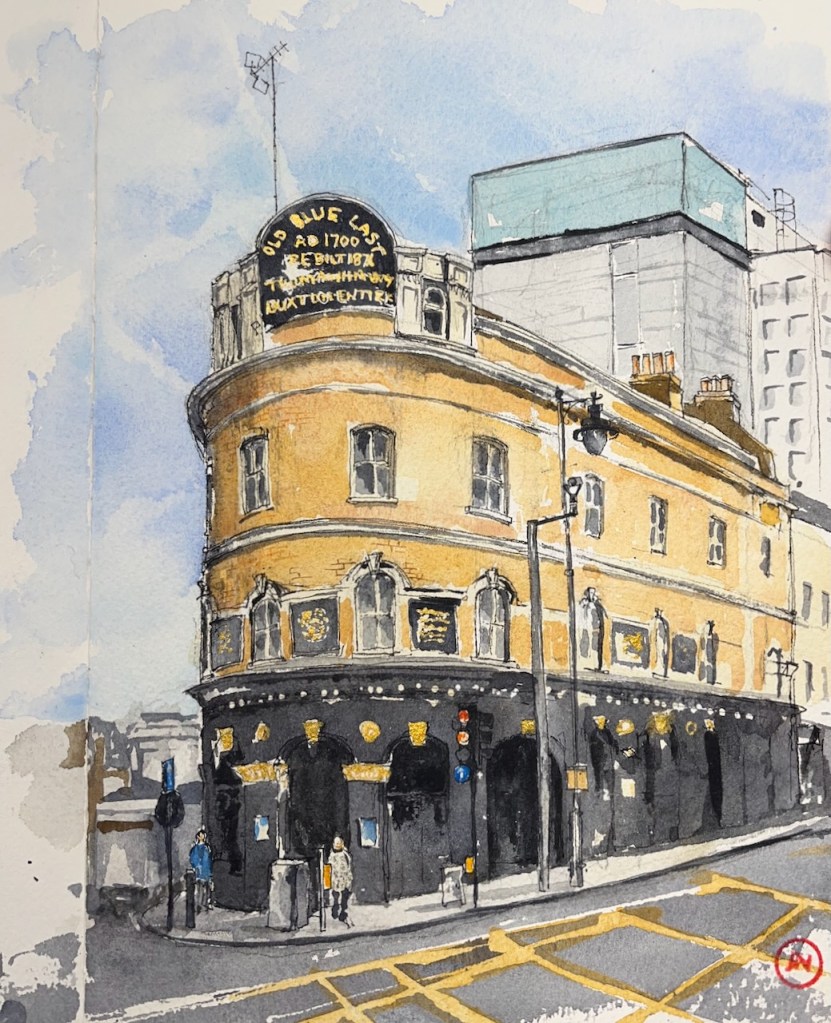
The Old Blue Last, Great Eastern Street, London EC2. Sketched on Wednesday 21st September in sketchbook 12.

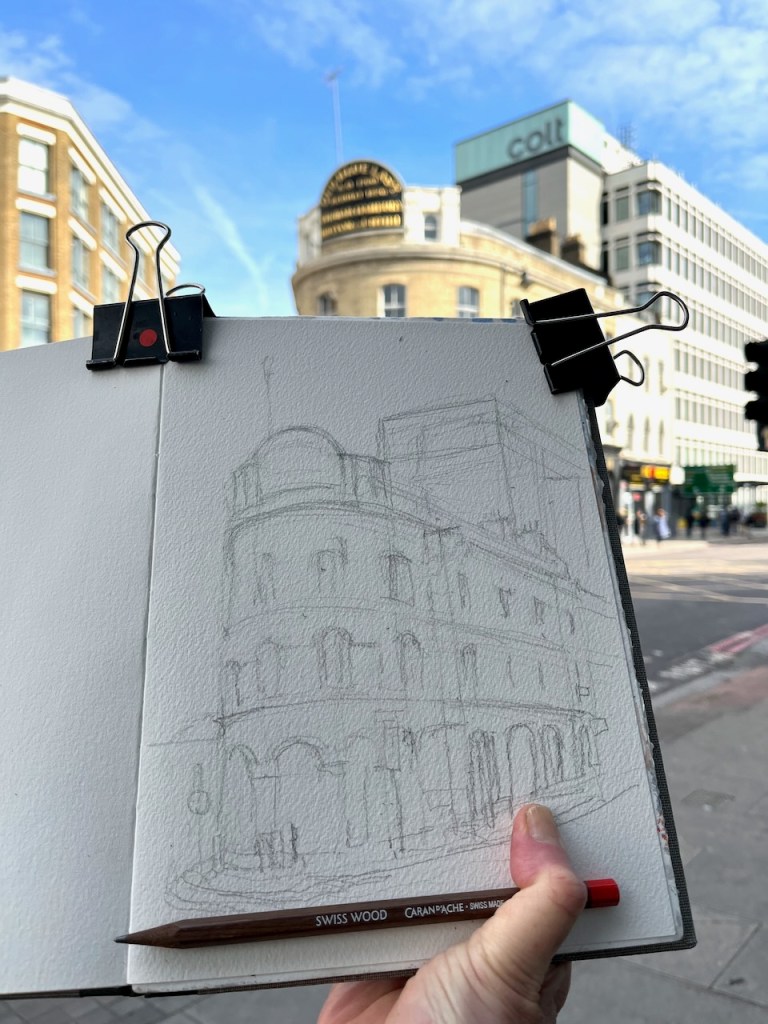
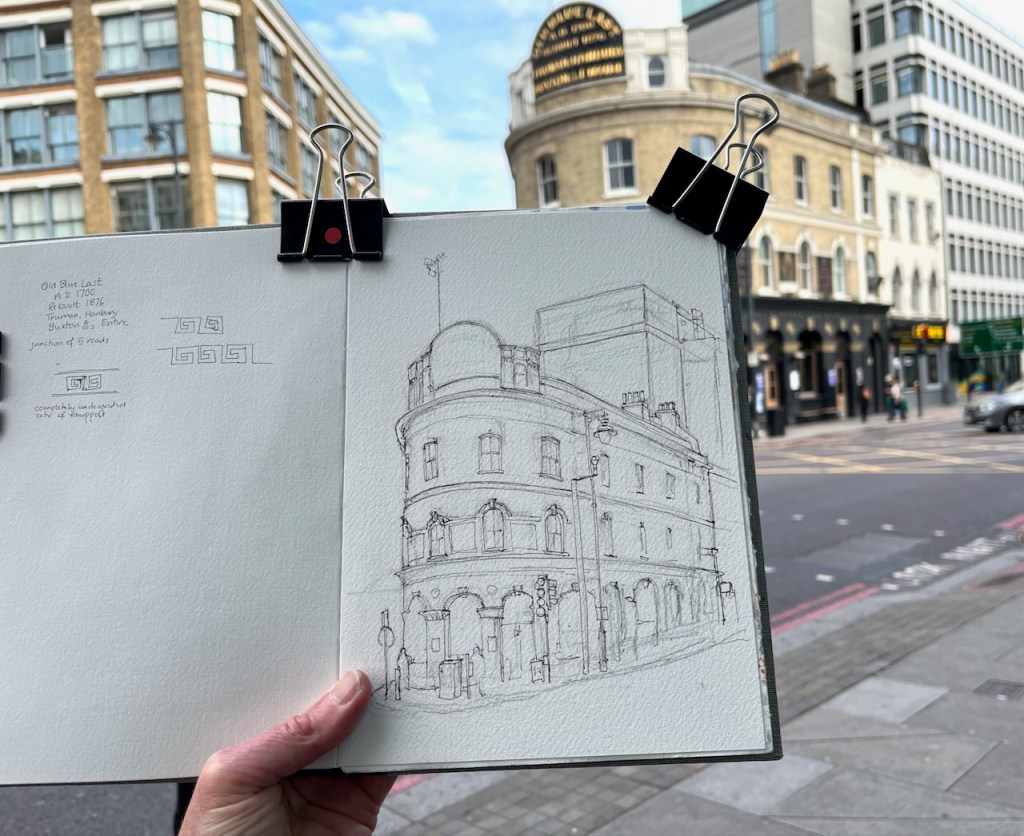
I sketched standing outside the estate agents Fraser and Co.

Map showing where I was standing, outside Fraser and Co, and my viewpoint. I later sketched “The Griffin” which is marked also.

This pub is now owned by “Vice Magazine” (“VICE is the definitive guide to enlightening information.”). Their website helpfully publishes a history of the pub:

“…in 1576 a venture capitalist named James Burbage built a venue called The Theatre where The Old Blue Last currently stands…..Eventually Burbage pulled down The Theatre and moved it south of the river, where it became The Globe….in 1700 a bar was built on the site of the old theater. It was called The Last, which, remarkably boringly, refers to a wooden block that a shoemaker uses to mold a shoe. The Last was owned by a brewer named Ralph Harwood, who went on to achieve a small level of fame when he was pronounced bankrupt one day by Gentleman’s Magazine…..In 1876, Truman’s brewery took over the pub. They pulled The Last down and rebuilt it as The Old Blue Last, which means “the old blue wooden pattern that is used to mold(sic) the shoe….Eventually Truman’s went down the toilet and Grand Metropolitan Hotels took over the OBL…[1970s, 1990s] —At that point, The Old Blue Last was a rough place full of rougher men and people who were afraid of being beaten up by them. It housed an illegal strip club and brothel, which was on the second floor…” [https://www.vice.com/en/article/ex575k/how-vice-bough-a-brothel-v10n12]

“Vice” bought The Old Blue Last in 2004 and turned it into a music venue.

“Anyway, it’s a great bar, all the gigs are fun, and it’s right by our office.” [https://www.vice.com/en/article/ex575k/how-vice-bough-a-brothel-v10n12]

“It’s not about great food, beer connoisseurship or child-friendliness (it’s very much 18+): it’s about atmosphere, which it has to spare, and dedication to live music…” [https://www.datathistle.com/place/54846-the-old-blue-last-london-ec2a/]

Great Eastern Street is a very busy thoroughfare, taking buses, lorries, delivery vehicles and cars between the Old Street Roundabout and places East. I noticed the crowd of street furniture outside the pub. See the lamp post, which, though modern, attempts to imitate some of the Victorian features of the pub. The CCTV camera next to it, however, is strictly utilitarian, on its unadorned pole. I wonder why they didn’t put the security camera on the lamp post. They are only about 3 feet apart.

I tired of the pounding noise of Great Eastern Street, despite the friendly location outside Fraser and Co. One of their employees, mobile phone clutched in his hand, paused and commented favourably on my drawing, as he re-entered the office. People passed by wrapt in intricate conversations about modules, funding agreements and childcare issues. After I finished the pen drawing, I retreated into the quiet back streets.

I added the colour later, at my desk.

The colours are:

Ultramarine Blue and Lavender for the sky and street signs, Mars Yellow and Burnt Umber for the brickwork, with some Fired Gold Ochre. The black is made of Ultramarine Blue and Burnt Umber. There’s some Cobalt Turquoise Light on the Colt Technologies building behind the pub. I used acrylic gold paint by Liquitex to pick out the gold on the pub, including the lettering.

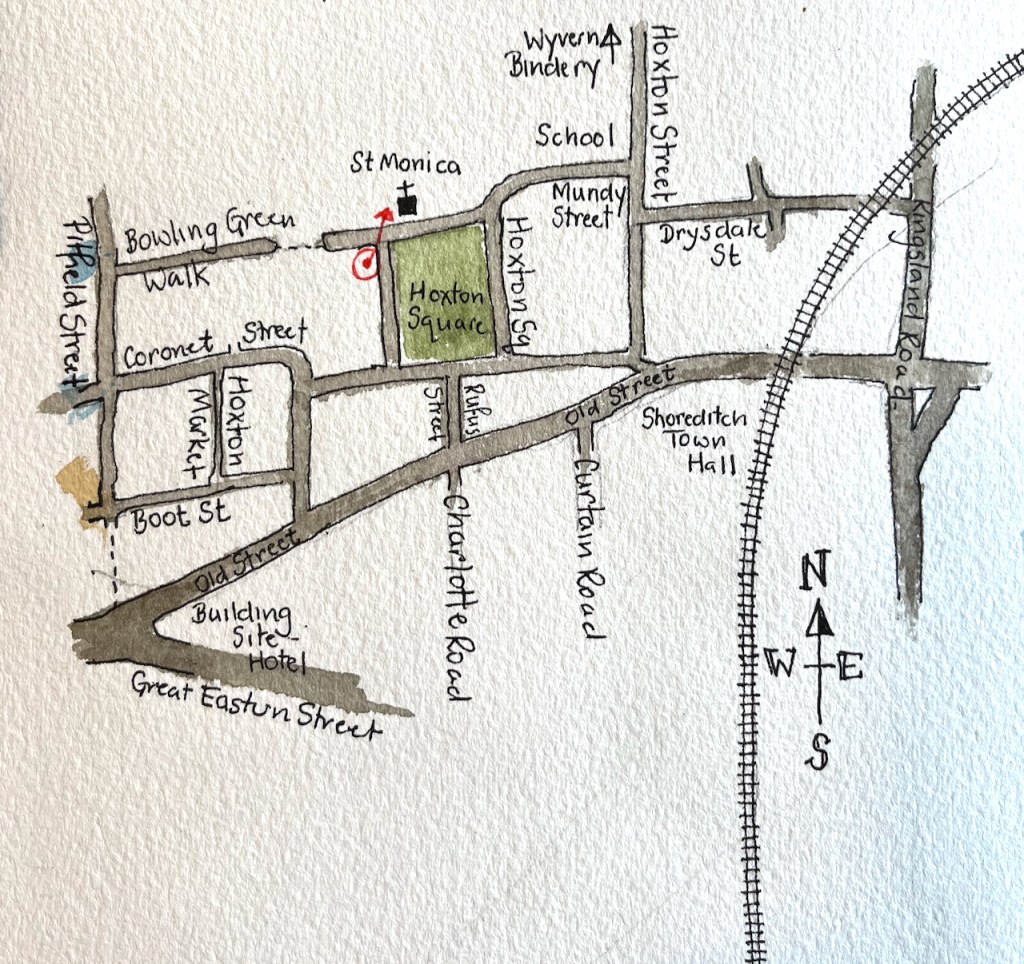
St Monica’s Church, Hoxton N1

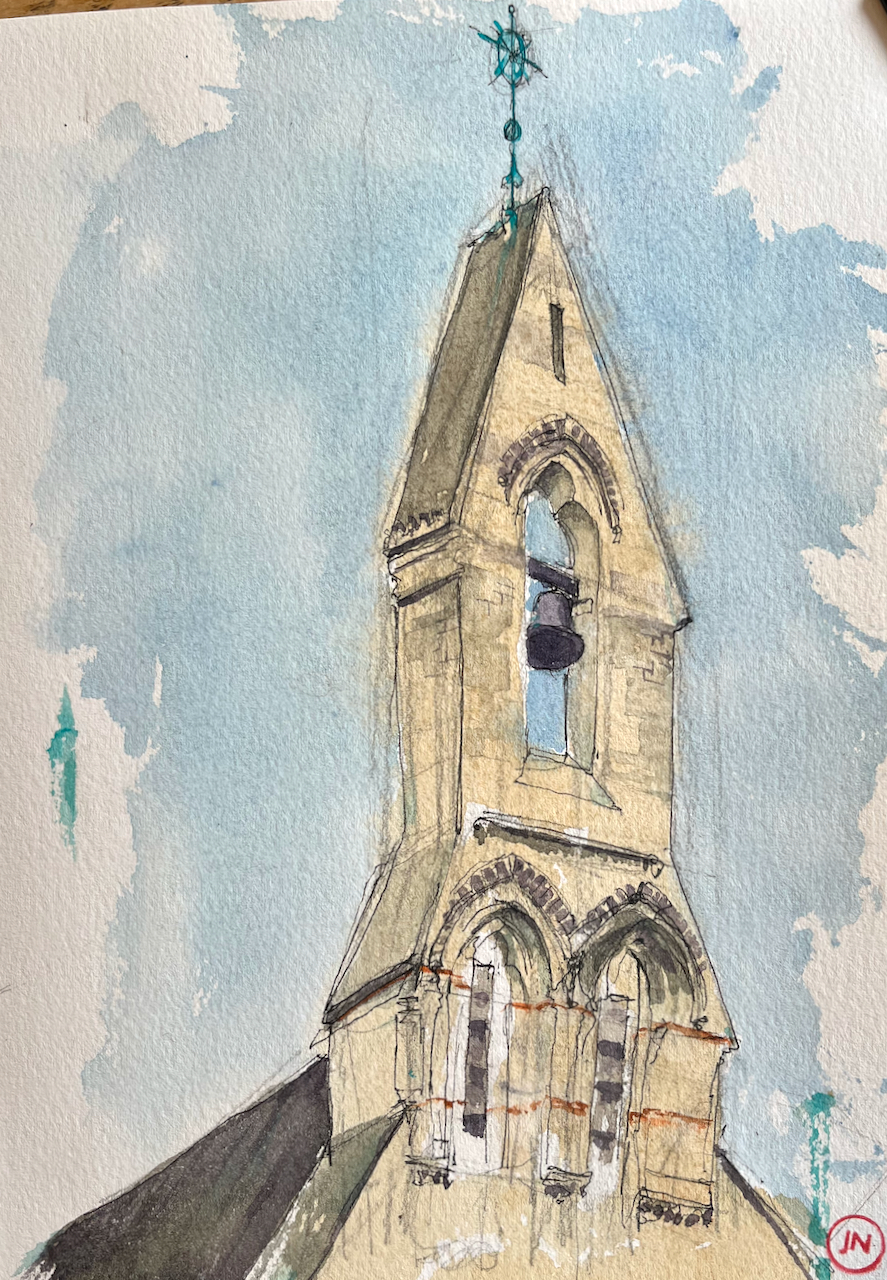
On a cold day, suddenly the sun came out and lit up the stone of St Monica’s Church.

Bell tower of St Monica’s Church, Hoxton Square. 26th January 2022, 13:40 in Sketchbook 11

This church was built in 1866, to the design of E.W. Pugin. It was part of the Augustinian Priory on this side of Hoxton Square.

E.W. Pugin (1834-75) is the son of A.W. Pugin, who collaborated with Charles Barry on the design of the Houses of Parliament. E.W. Pugin designed a large number of churches, 60 English churches are listed in his Wikipedia entry, with another 6 or so in Wales and Scotland and 16 in Ireland.

Clifton House 75-77 Worship Street EC2

This is the building on the corner of Worship Street and Clifton Street, on the northern edge of the City of London.

Clifton House, 75-77 Worship Street, EC2, 13 September 2021, 7″ x 10″ in Sketchbook 10
Location of the drawing

Holywell Street is to the left of the drawing. I sketched this from a bench in the little pedestrian square that now exists where Clifton Street meets Worship Street.

What is this building? Well, now it is inhabited by an organisation called “NEL NHS” according to the notice on the door. From what I can discover online, NEL stands for “North East London” and the organisation is an in-house consulting organisation for the NHS (the UK National Health Service). They are a “Commissioning Support Unit (CSU)” which means they supply services to, for example, GP practices, and area administrators of parts of the NHS. Computing projects and change programmes amongst the service offerings listed on their website. NEL is quite a big organisation. LinkedIn records it as having 967 employees of whom 457 work in London.

Clifton House circa 1920, from the website of the Tony and Sheelagh Williams Charitable Foundation.

That’s who’s there now. But the building has a history. It was built in 1900, for the printers Williams Lea. Williams Lea printed stamps, newspapers, and foreign language material. In the 1939-45 conflict, they printed UK government propaganda in German, which was dropped into Germany. They also printed the first copy of the Radio Times, in 1923, probably in this very building. Williams Lea has itself undergone various transformations, and is now called Perivan. The Perivan website has a history section which helpfully provided me with this information. (Note 1)

In 1978 Tony Williams took over the family business of Williams Lea. Under his leadership the business flourished. He took the decision

“to establish Williams Lea as a Financial Printer serving the City community with its specialist printing needs. This move coincided with the privatisations of many state-owned industries and utilities and in 1990 Williams Lea was awarded the printing for the privatisation of the electricity industry, one of the largest and most complex jobs of its type.” [https://www.tandswilliams.org/]

It did well. He sold the business in 2006, and with the money established a charitable foundation which exists today.

My drawing took 90 mins on location, with colour added later at my desk.

I spent a long time looking at this building. There are the large windows, which are also doors, so that large items can be lifted out from the different floors. Some of the windows have louvres for extraction fans.

There are many textures in the brickwork. Some cobwebs have been there a while.

Here is a 1945 map showing the location:

Map from “www.maps-of-london.com”

I sketched this location as a “microsketch” earlier this year:

Note 1: History of the building: references.

Pevsner LONDON 4: NORTH, page 525 refers to “Clifton House, at the corner of Clifton Street and Worship Street, another printers, (WIlliams Lea & Co) built 1900, five storeys, with handsome red brick arched windows.”

Perivan website: https://www.perivan.com/about-us/our-history/ Perivan say:

A Mr J E Lea became a partner of the business in 1864, and it was promptly renamed to Wertheimer Lea & Co. When John Wertheimer passed away in 1883, Mr J H Williams purchased his share (great grandfather of Philip Williams, who works within Perivan today). Over the years, J H Williams acquired the rest of the company and in 1899, Wertheimer Lea built a new factory in Worship Street, London, to consolidate 5 production sites. Now central London, at the time the new factory was built, it was possible to see fields from the top floor. The biggest USP was that all the machines were powered by electricity. The business was renamed in 1914 to Williams Lea to reflect the existing founders. A fun fact – Williams Lea printed the first edition of the Radio Times in 1923!……Throughout the wartime years, Williams Lea survived the blitz where many other printers did not. With its specialism in foreign language printing, this was understandably in very high demand at this point in history, and Williams Lea was heavily involved in the printing of propaganda materials in German which bombers distributed by throwing them out of aeroplanes over Germany – containing messages encouraging the enemy to give up. Williams Lee also printed newspapers for governments in exile in London, including Poland and Norway, and stamps for the Post Office.”

On a specialist postage stamp collectors site http://www.bermudastamps.co.uk/info/stamp-printers/ there is a reference to Williams Lea printing stamps:

“Williams Lea & Co
Contractor to De La Rue after their premises were bombed on 29th December 1940. William Lea & Co printed the Bermuda high value stamps during 1941.

Other historical information came from the website of the Tony and Sheelagh Williams Charitable Foundation.

67 Redchurch Street E2, “Jolene” bakery

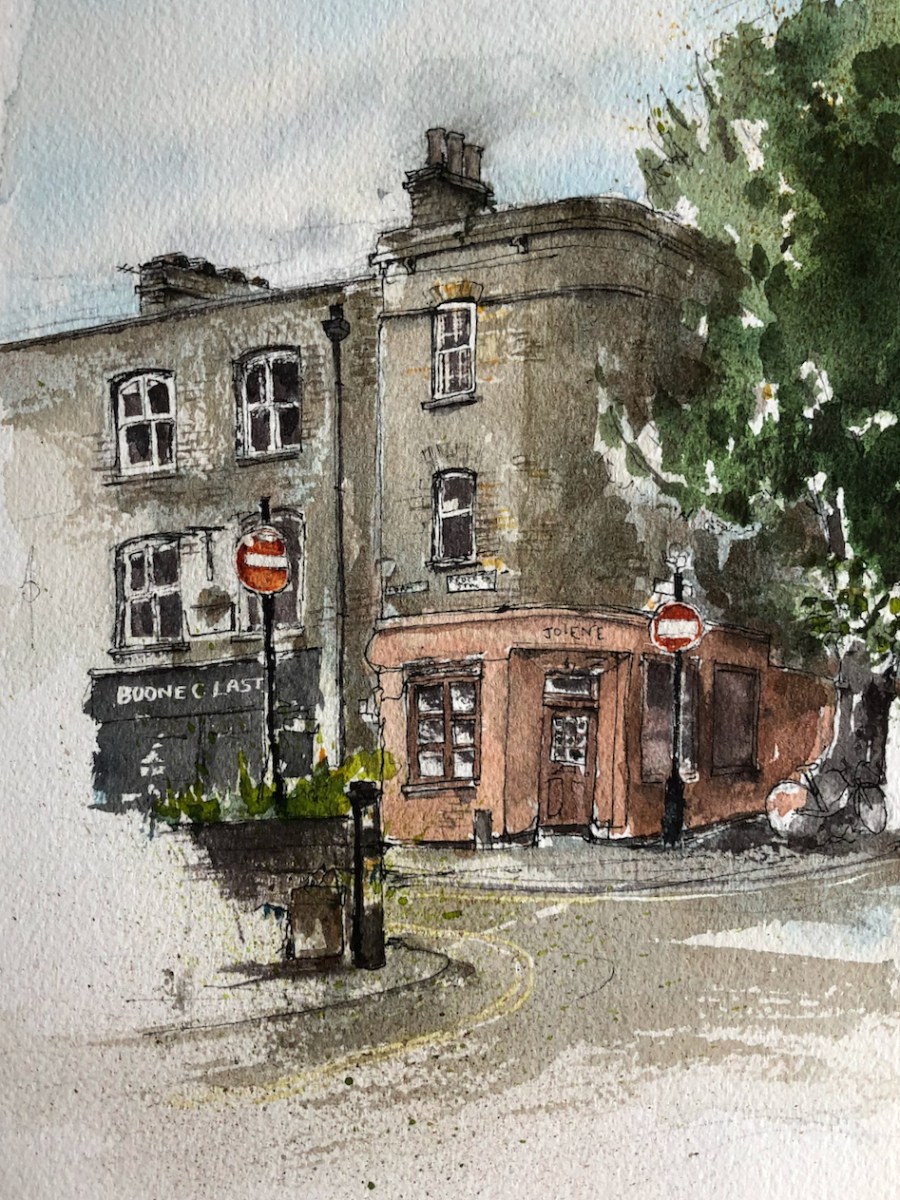
Jolene bakery is on the corner of Redchurch Street and Club Row.

Jolene, 67 Redchurch Street, from across the road. 19th August 2021. 10″ x 7″ in Sketchbook 10

This is a lively corner in a street on various edges: on the edge of the City, at the boundary between a new London and an old one, at the intersection of 21st century entrepreneurial culture and 19th century housing projects.

Redchurch Street is just North and West of Brick Lane. There are restaurants, independent clothes designers, hairdressers, and various 21st century businesses I couldn’t identify but categorised in my mind as broadly “creative”. It’s a good place to walk around, and Jolene is a great place to pause for coffee. They close at 3pm, though, so best be quick.

I arrived there at about 1pm today, and sat outside on one of their benches. Here’s the view looking up Club Row.

Looking North up Club Row, from “Jolene” Redchurch St. 9 September 2021, 2:45pm 10″ x 7″ in Sketchbook 10

Further North up Club Row, to the left of my drawing, is Arnold Circus. This is the centre point of the Boundary Estate which was the London County Council’s first social housing project, completed on 1900. I have drawn there and written about it here: