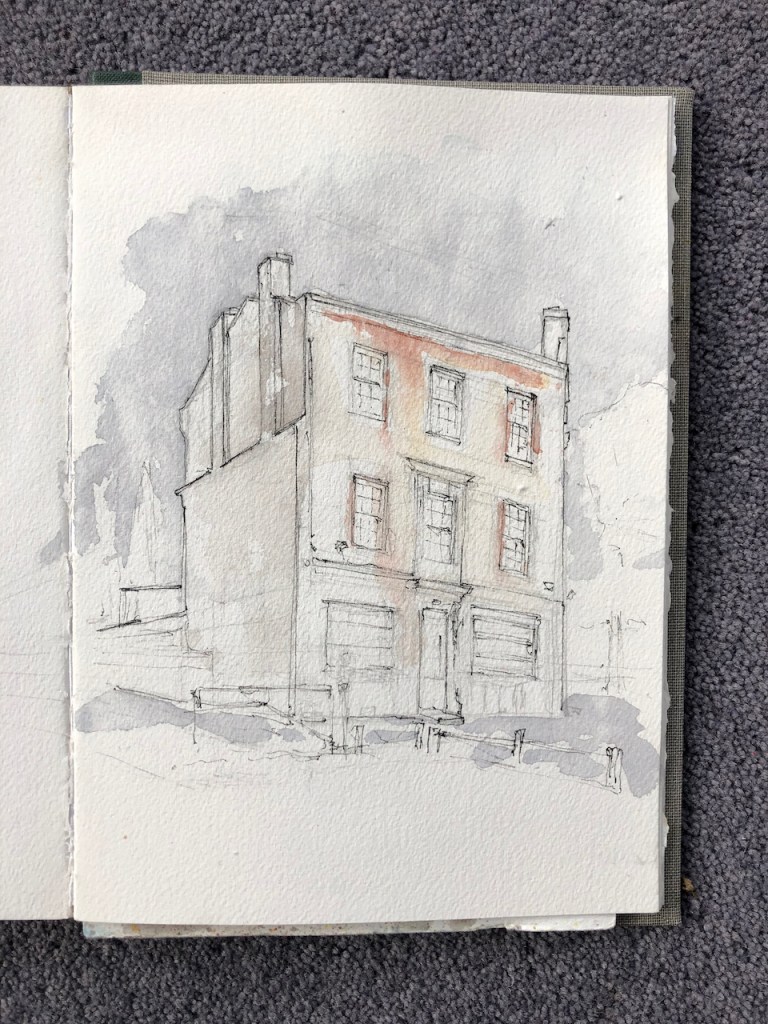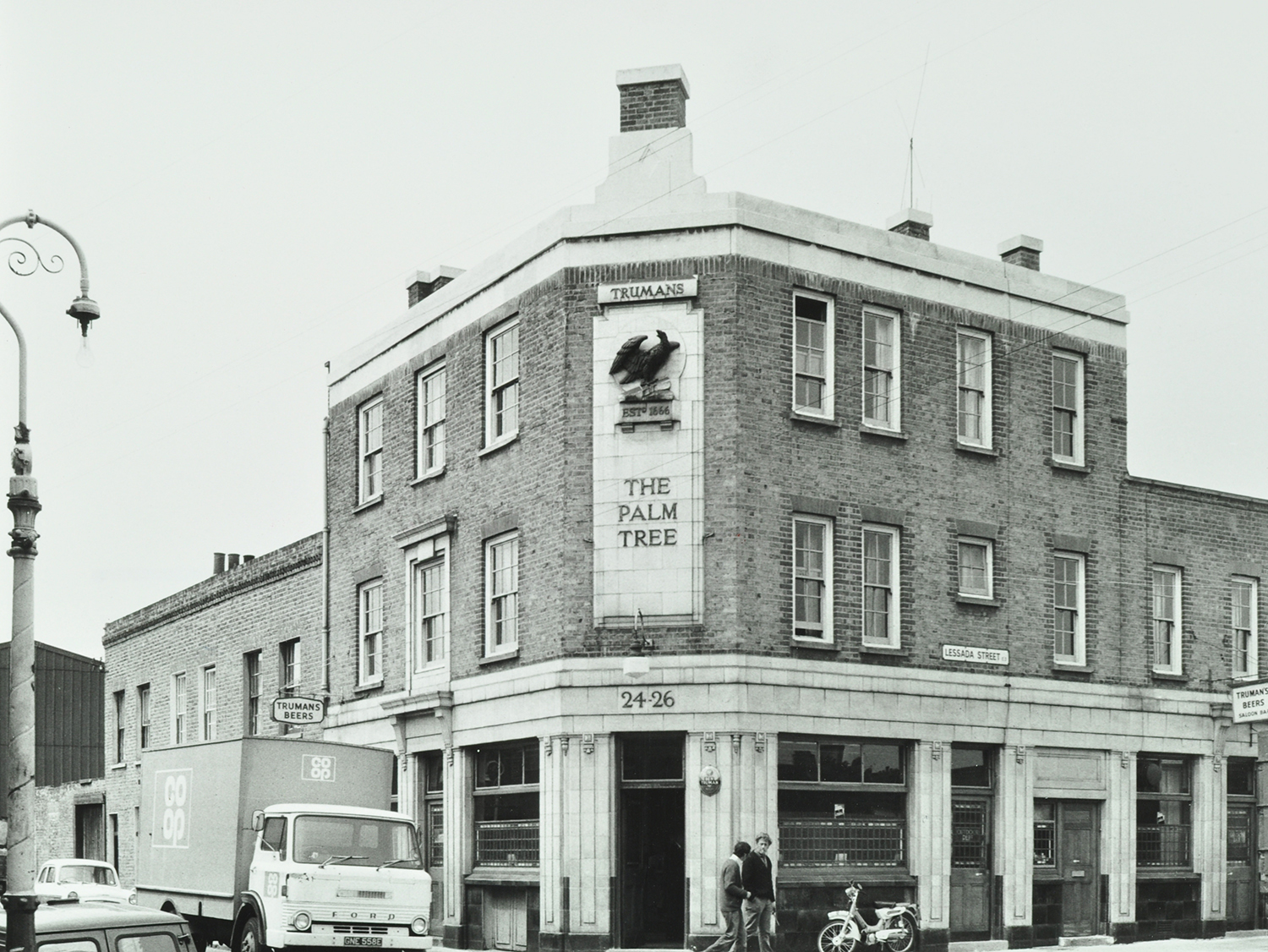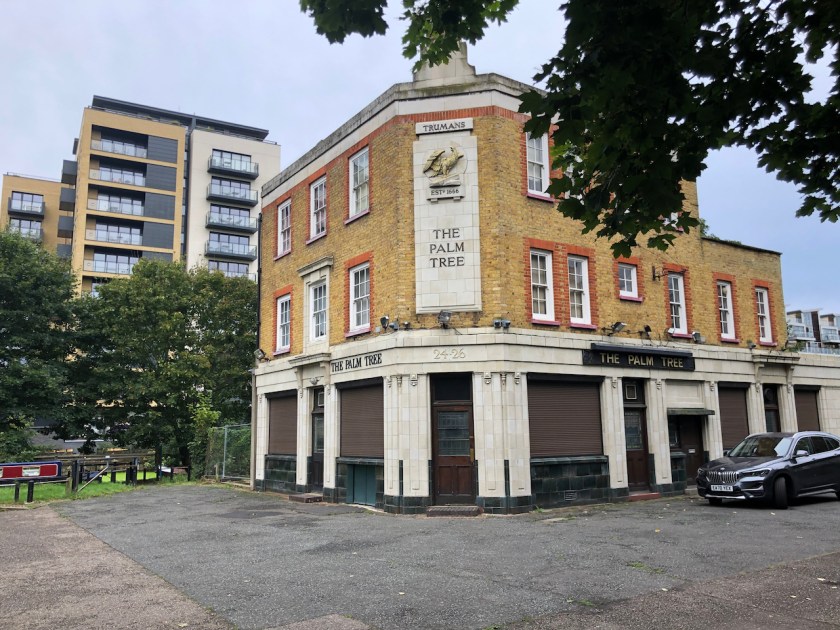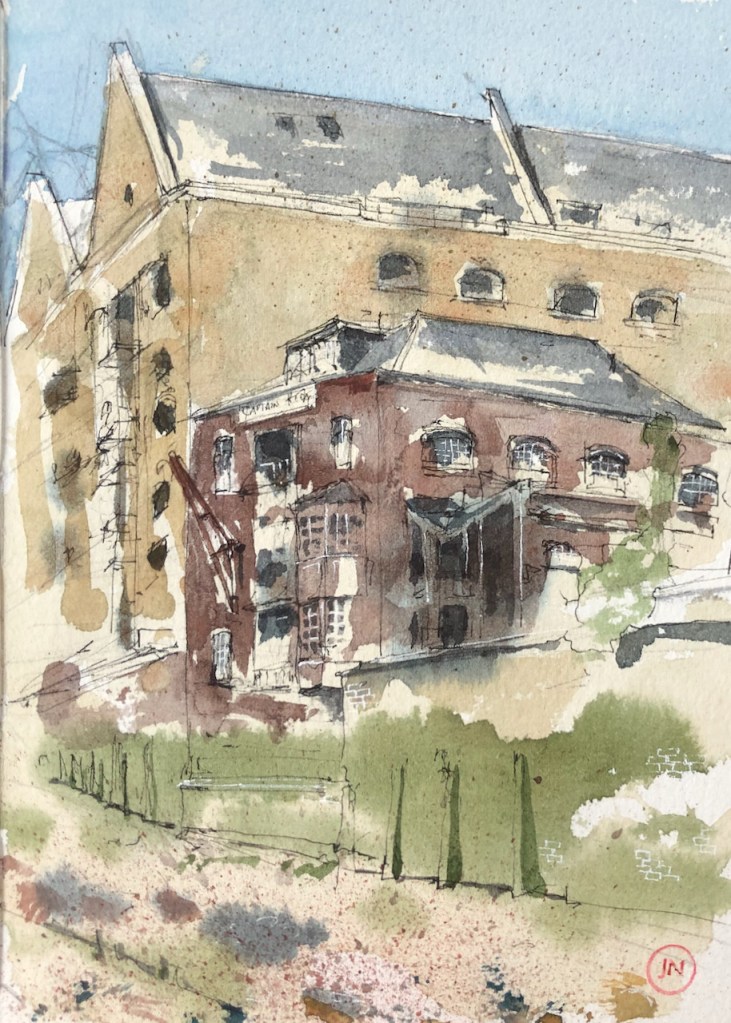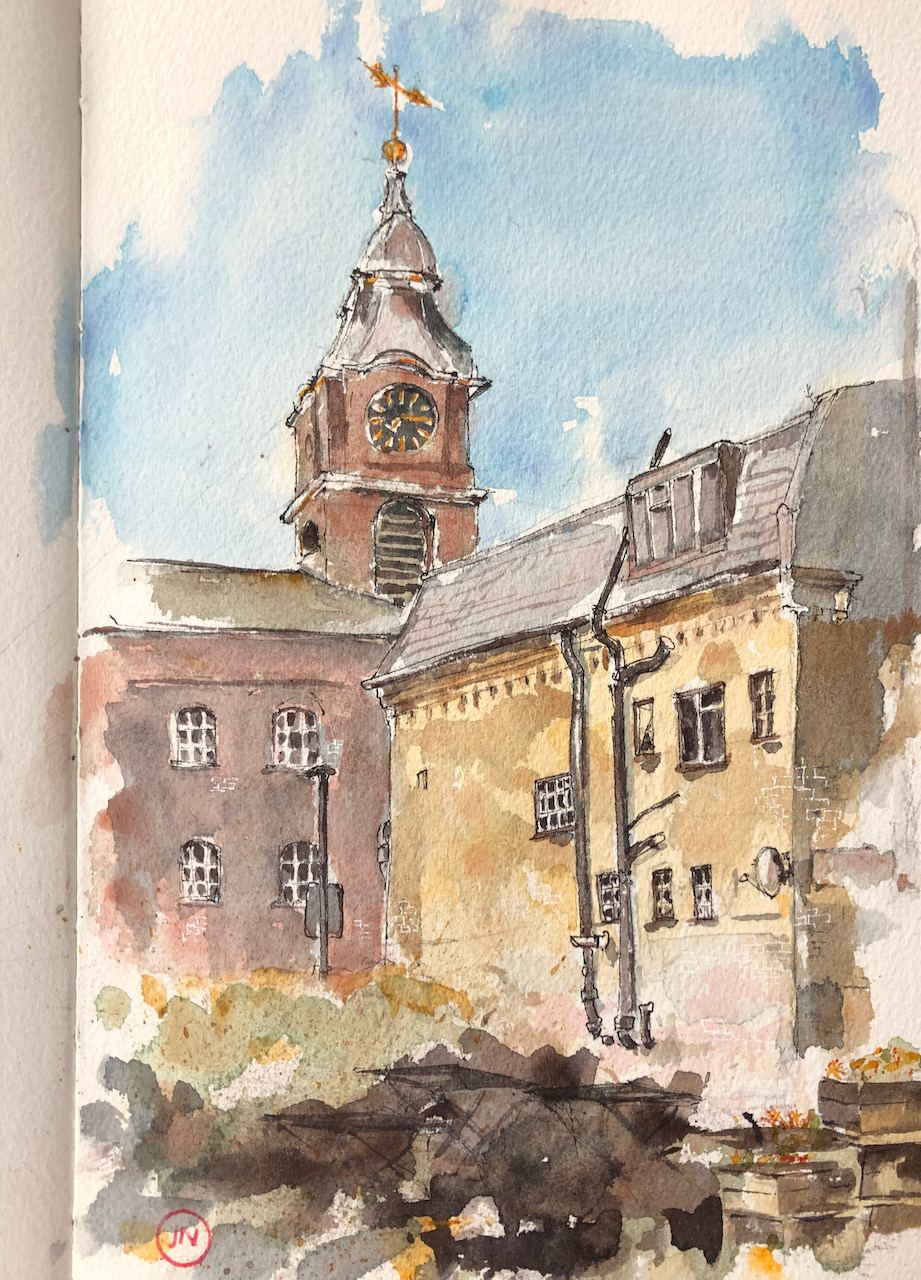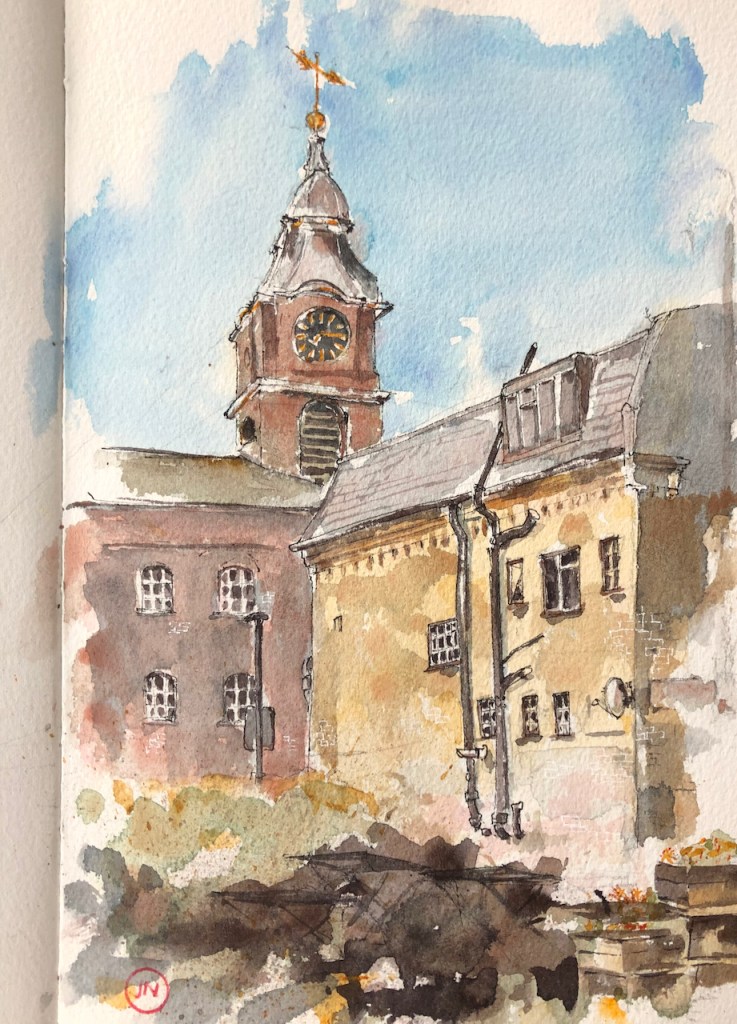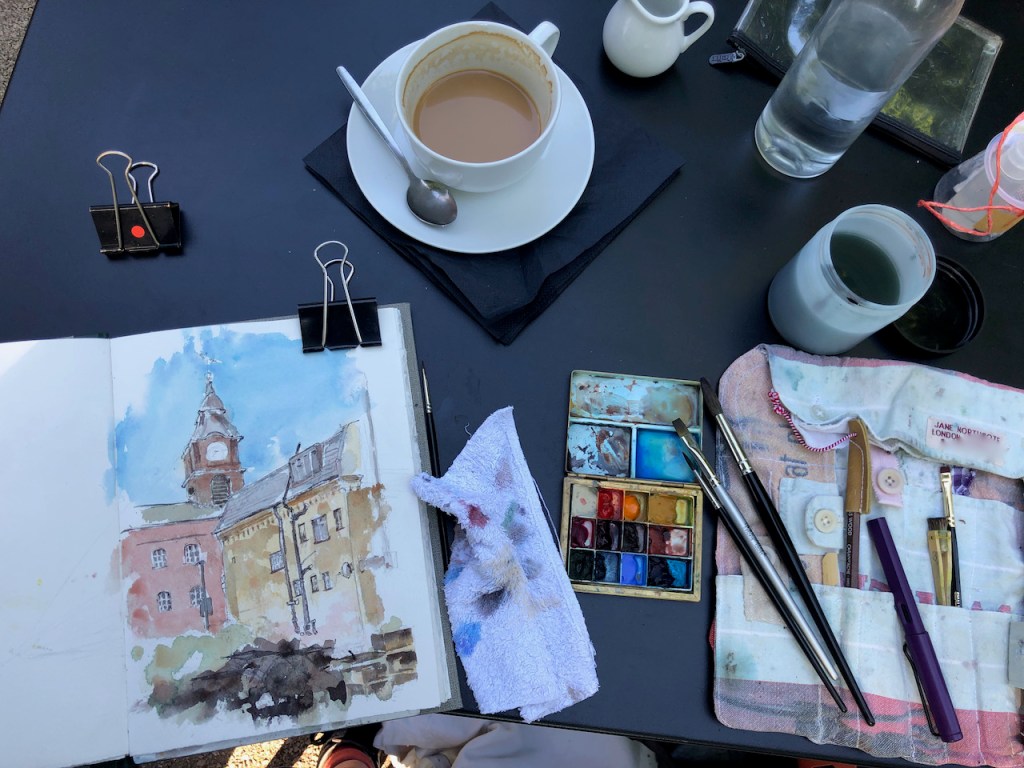
Here is the marvellous Turks Head Café, Wapping, rescued from demolition by local residents in the 1980s. Inside, I found warmth, quiet tables, and the gentle murmur of conversations: people actually talking to each other. I felt welcome here. The food was marvellous. Next time I’m going to have the Blueberry Tart. I only noticed it after I’d already had the substantial Chicken and Avocado Sandwich.…
Click a button below to share this post online, email it, or print it:
On a radiantly bright day I walked East from the City in search of horizons. Wapping, east of Tower Bridge, is where the buildings at last are of human size, and you can see the sky. Next to the pub called “Town of Ramsgate” on Wapping High Street, there is a small passage, a slot…
The passage is to the right, in front of the pub
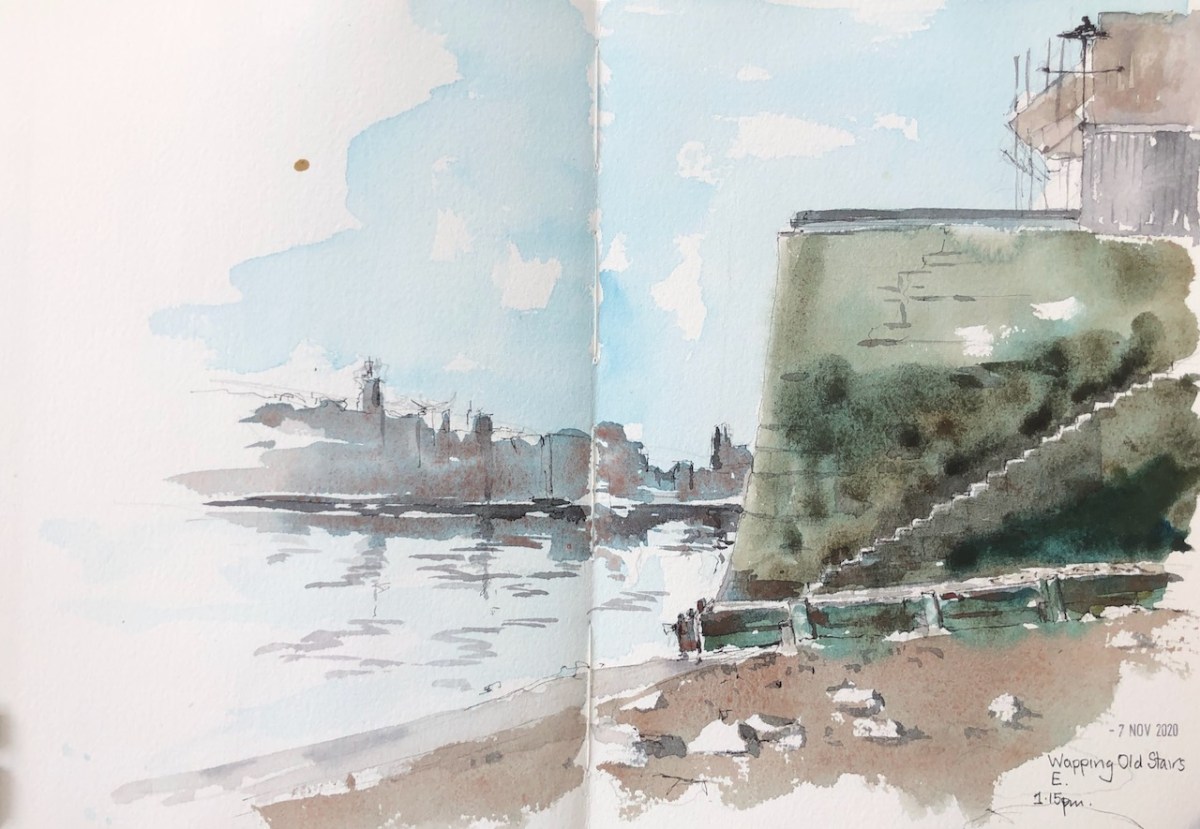
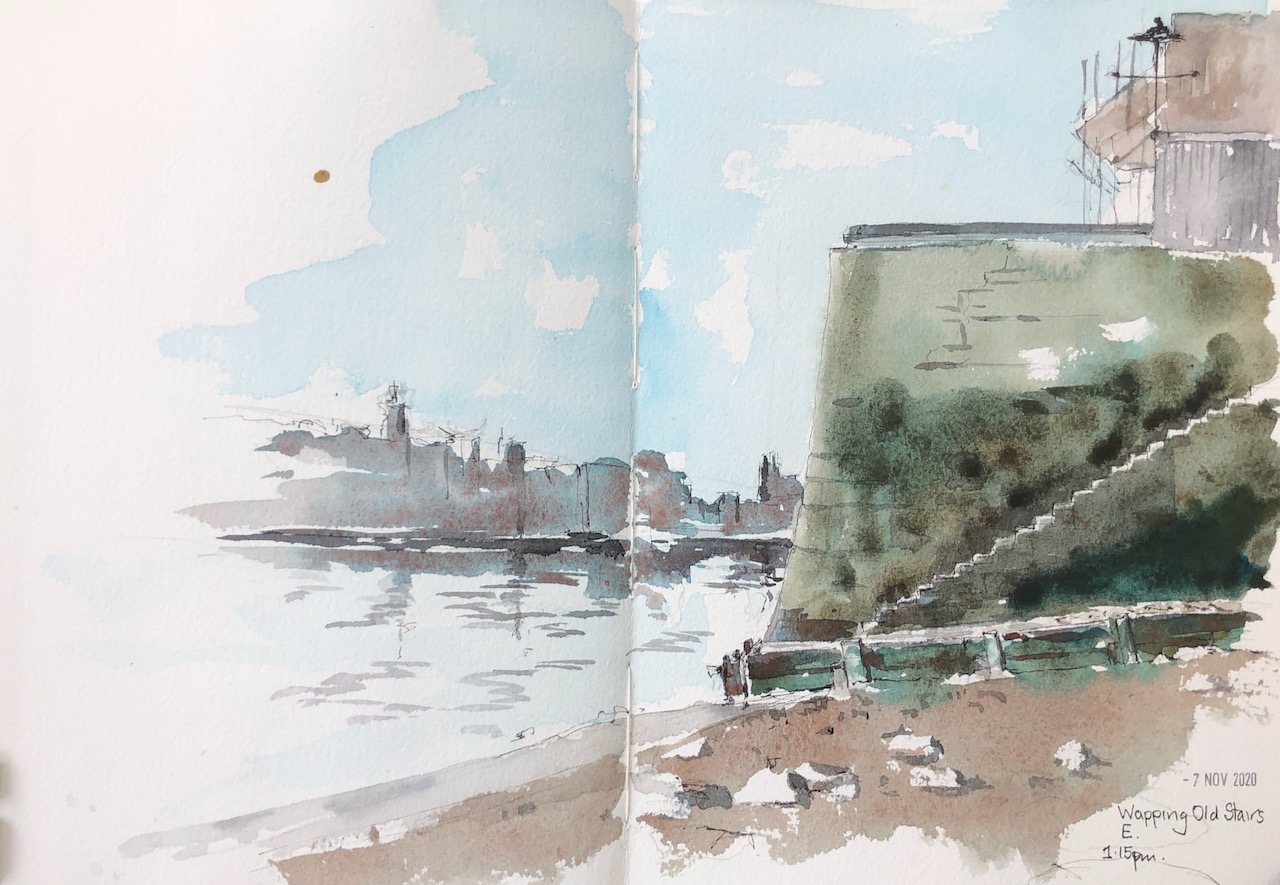
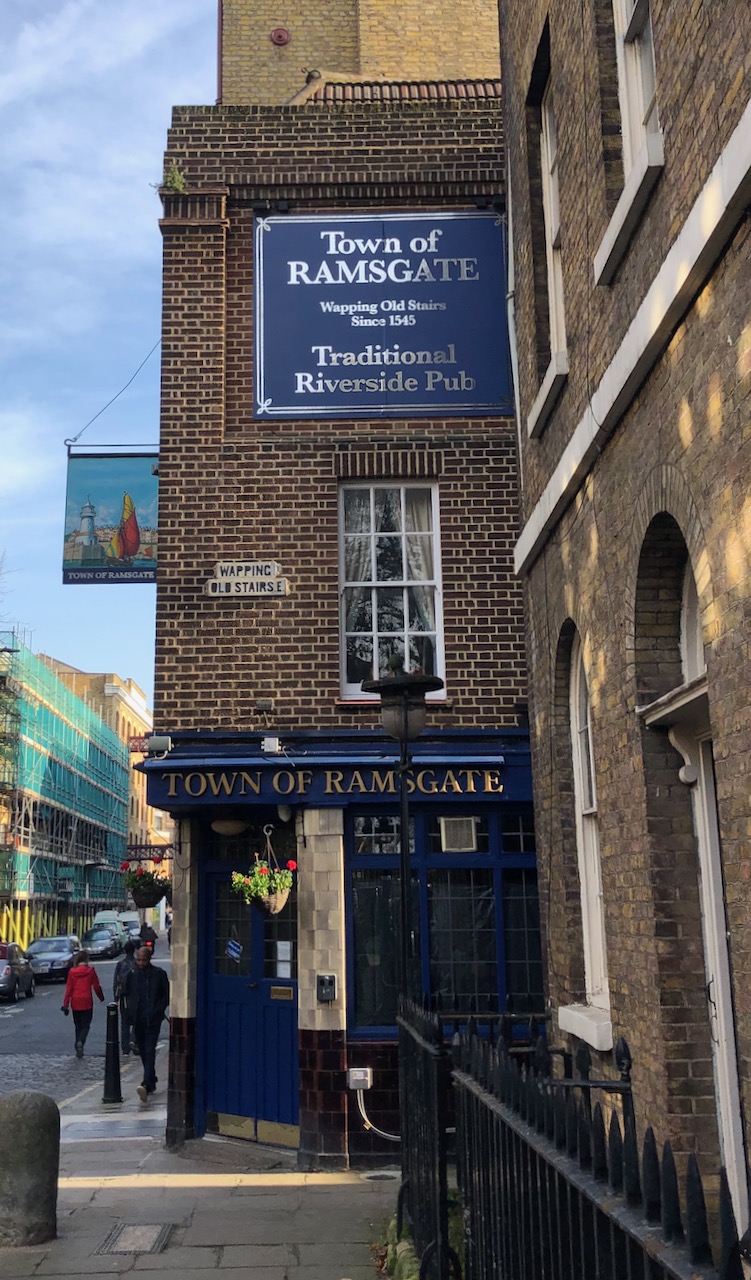
Wapping Old Stairs is quite hard to find. It is next to the “Town of Ramsgate” pub.
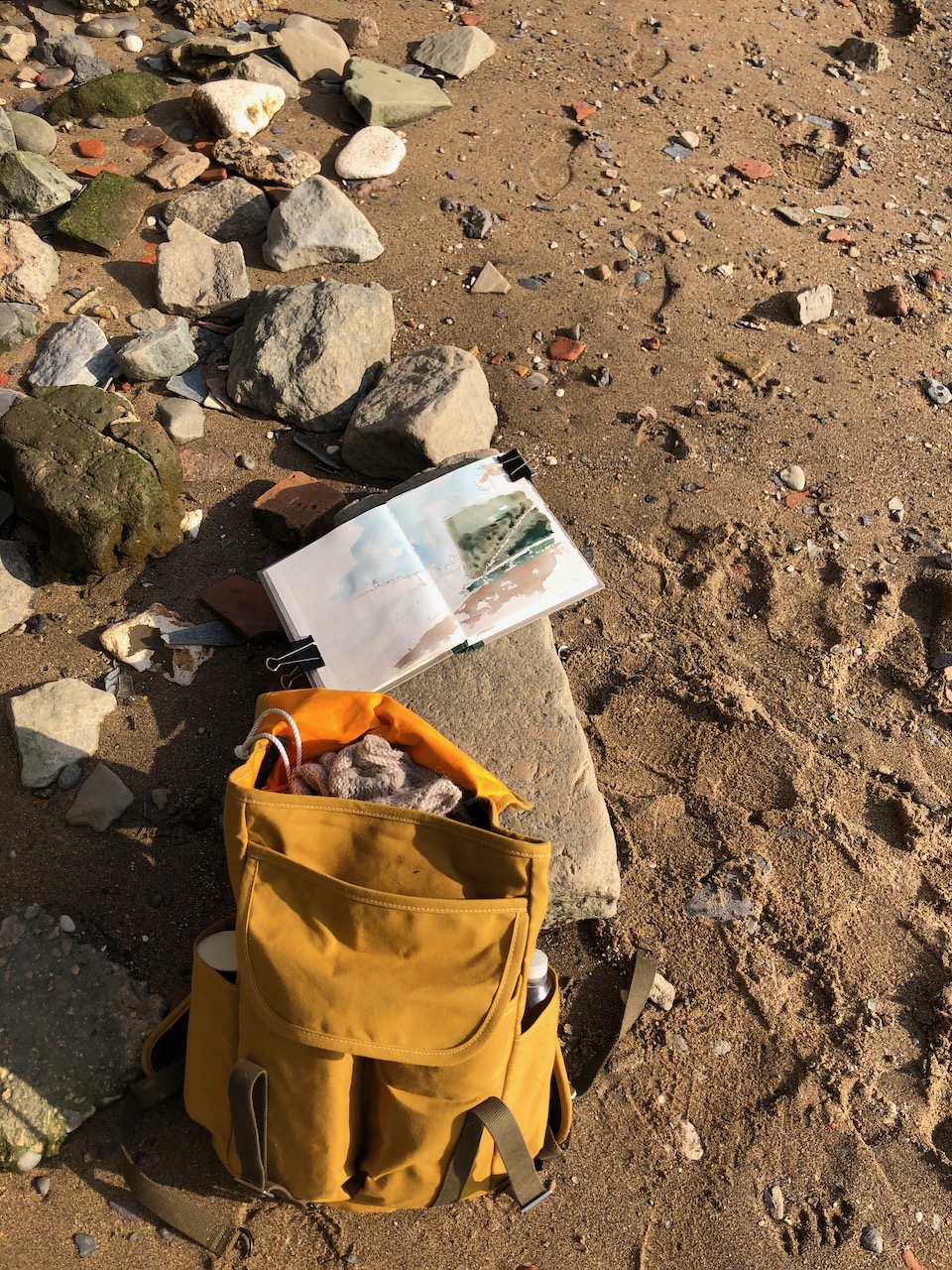
This sketch took about 45 minutes. The colours are Fired Gold Ochre (DS), Phthalo Turquoise (W&N), Perylene Maroon (DS), Mars Yellow (DS). I used the Fired Gold Ochre because it granulates so usefully to make the sand. The algae and green plants on the steps were slightly iridescent, glowing rather strangely even though in shadow.
Click a button below to share this post online, email it, or print it:
Here is the view across the river Thames from Trinity Buoy Wharf, E14. The drawing shows “The O2”, which used to be called “The Millenium Dome”. It is an events arena. I have never been inside. In the distance are the towers of Canary Wharf.
I drew this in a lovely peaceful spot sitting on a wooden step next to a shed at Trinity Buoy Wharf. Each person who walked past said hello. A man paused and commented, “Ah, Art is going on!”, which made me laugh, somehow. Perhaps it was the way he said it.
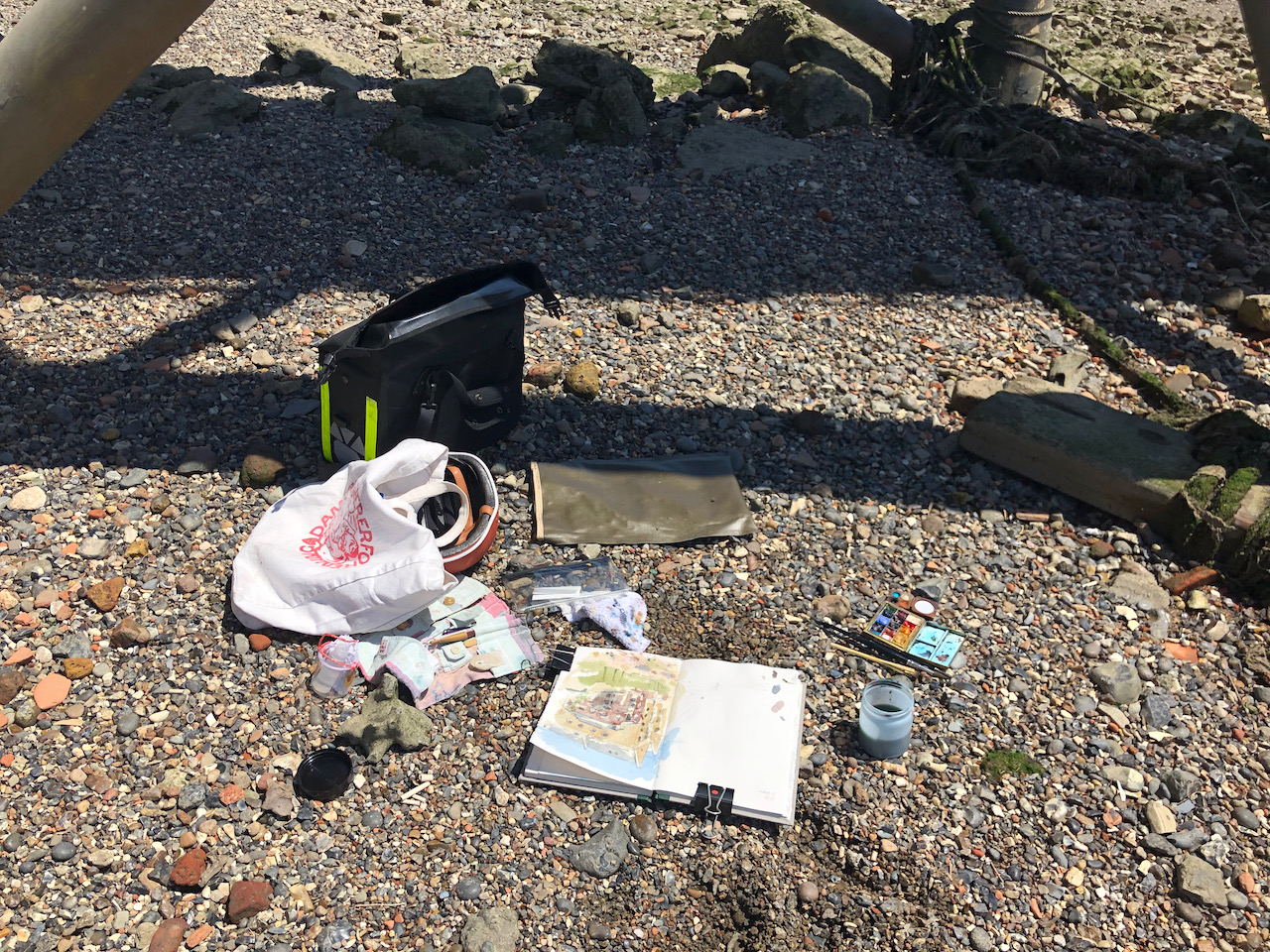
Here is work in progress, and a photo of my art materials and my bike helmet on the step.
The drawing took 1hour30mins. The colours are: Mars Yellow (Daniel Smith), Transparent Pyrrol Orange (Daniel Smith), Phthalo Turquoise (Winsor and Newton).
I have sketched at Trinity Buoy wharf before. See this blog post:
The headlines in the Evening Standard had described the pollution levels in central London at “Red Alert” levels. So I headed East to the clearer air and big skies of the maritime Thames. Trinity Buoy Wharf is here: I drew a picture of the lighthouse. Above me, four stories of shipping containers contain offices. Words…
Click a button below to share this post online, email it, or print it:
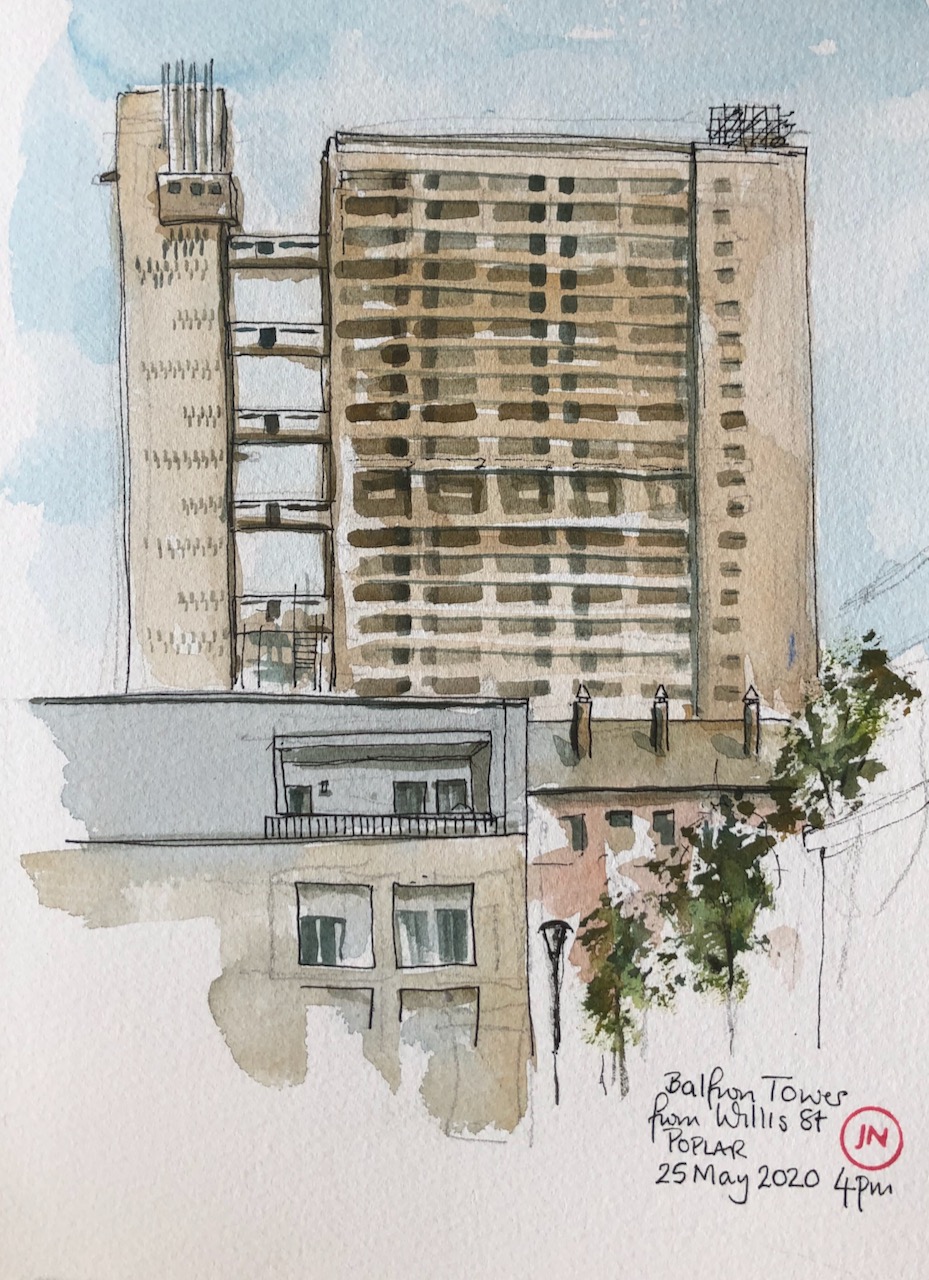
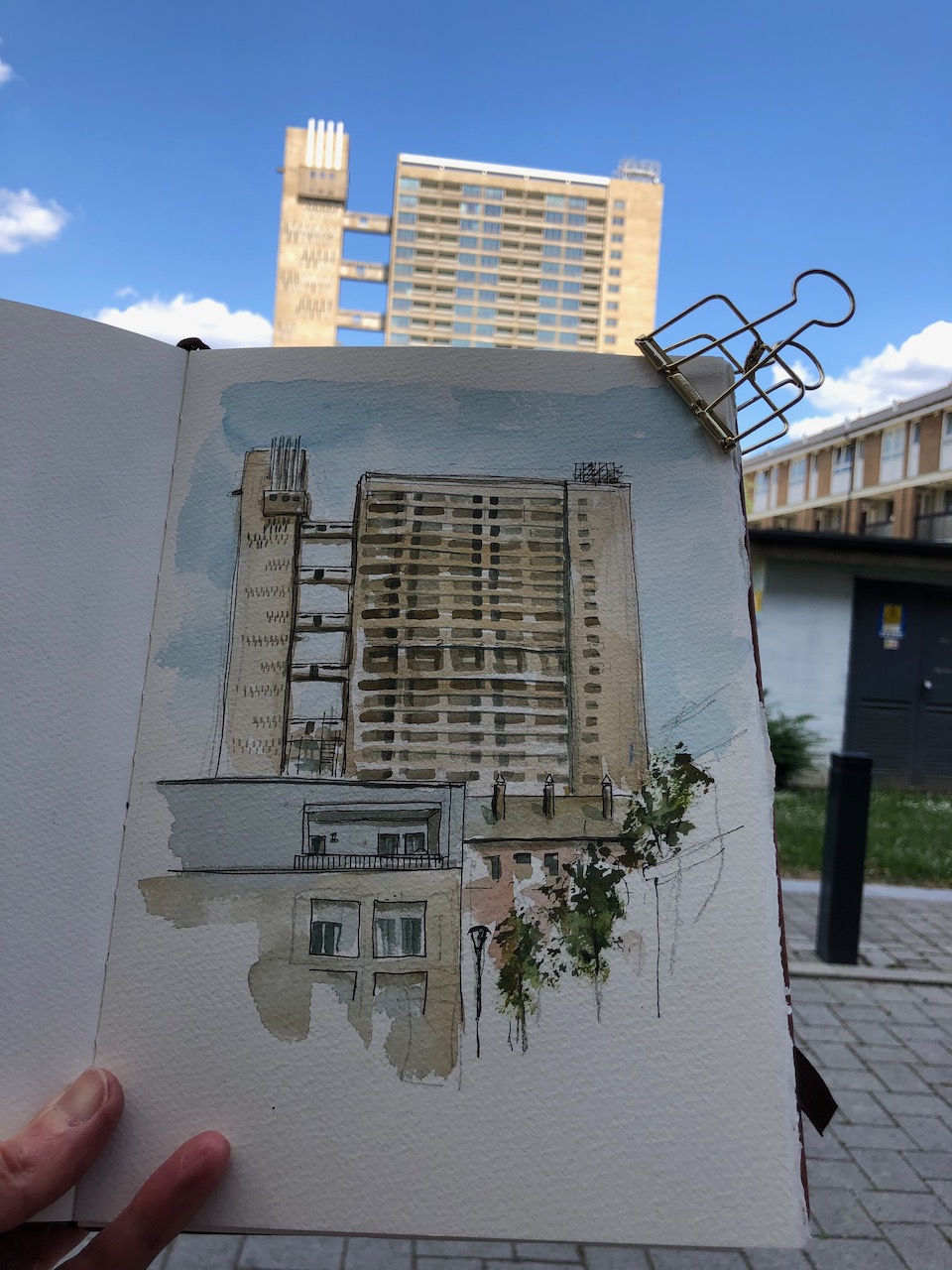
I went on a marvellous cycle ride in East London. The air was clear, the roads were wide and empty. As I came back I spotted this view of the Balfron Tower. I sat on a low wall in a housing estate off Willis Street, and sketched it.
Balfron Tower, Poplar, east London.
This tower is designed by the architect Ernő Goldfinger, and resembles his other famous tower, Trellick Tower, which is in North West London. Balfron Tower was built in 1967 as council housing.
It has recently been sold by Tower Hamlets Council, and redeveloped by the developer LondonNewcastle as luxury flats. You can see some of the scaffolding in the drawing.
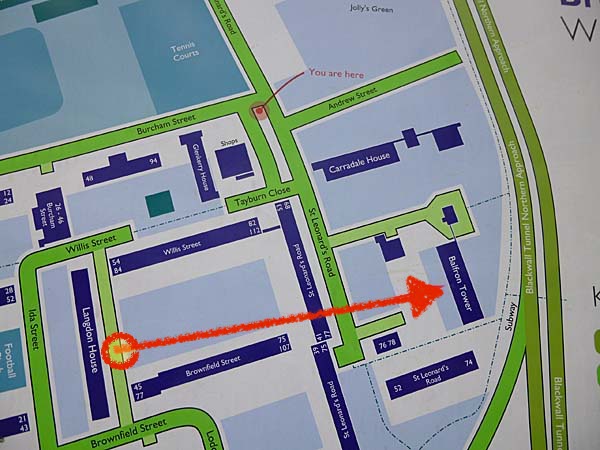
Here is where it is.
The arrow is my sightline for the drawing.
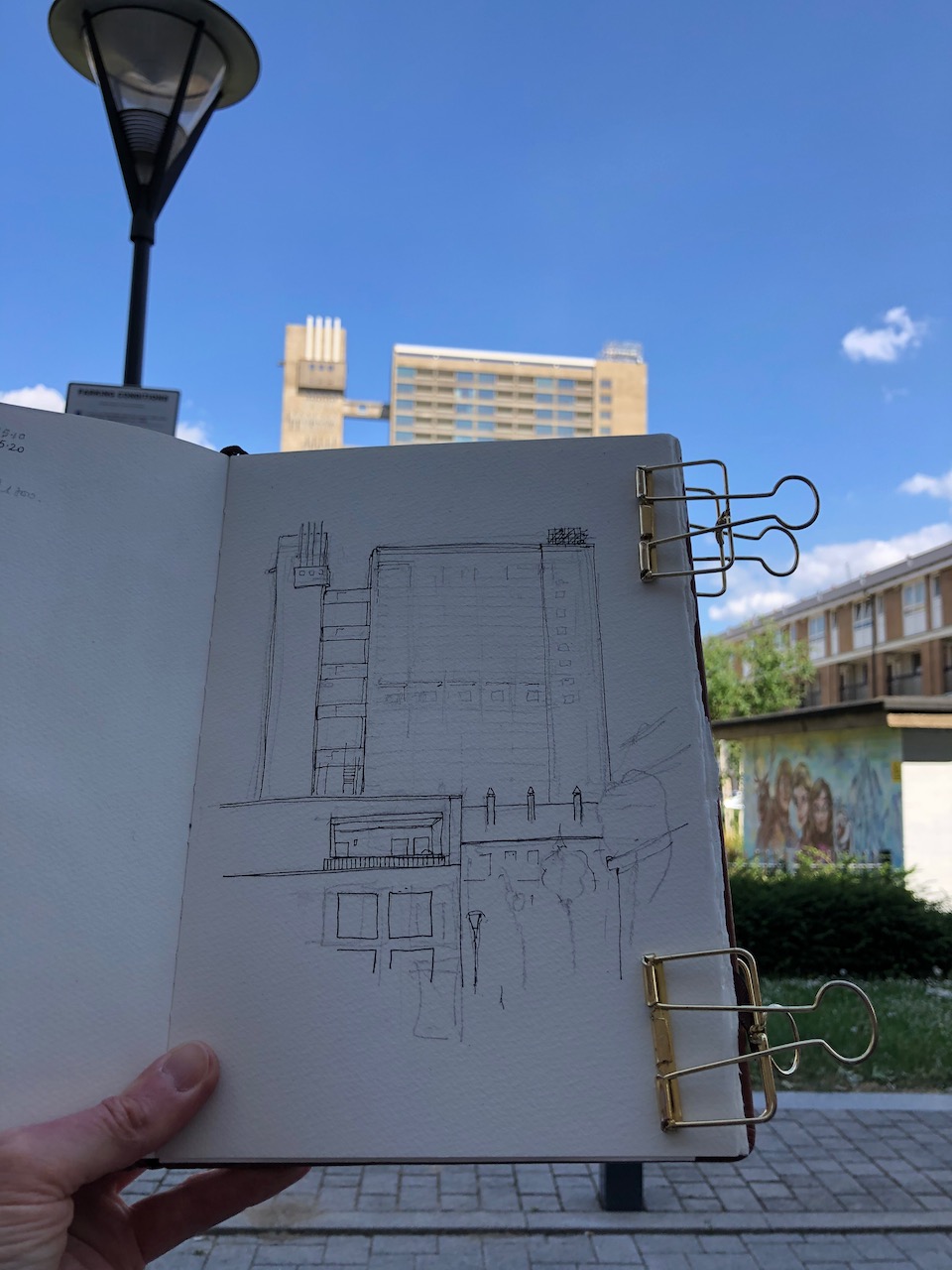
Here is work in progress. Also a glimpse of my bicycle.
As I sat sketching, a pale young man approached. “It’s beautiful,” he said as he strode past. He was referring to the Balfron Tower, not to my drawing.
“Yes, ” I agreed, “I think so”. I looked down to my drawing again. But the young man had something else to say.
“You should see Jesus,” he told me, “He’s beautiful too.” Taking my baffled silence as amazement, he continued, “I’ve seen Him, believe it or not”. He left this statement hanging in the air and walked on around the corner, without breaking step.
Click a button below to share this post online, email it, or print it:
On a radiantly bright day I walked East from the City in search of horizons. Wapping, east of Tower Bridge, is where the buildings at last are of human size, and you can see the sky.
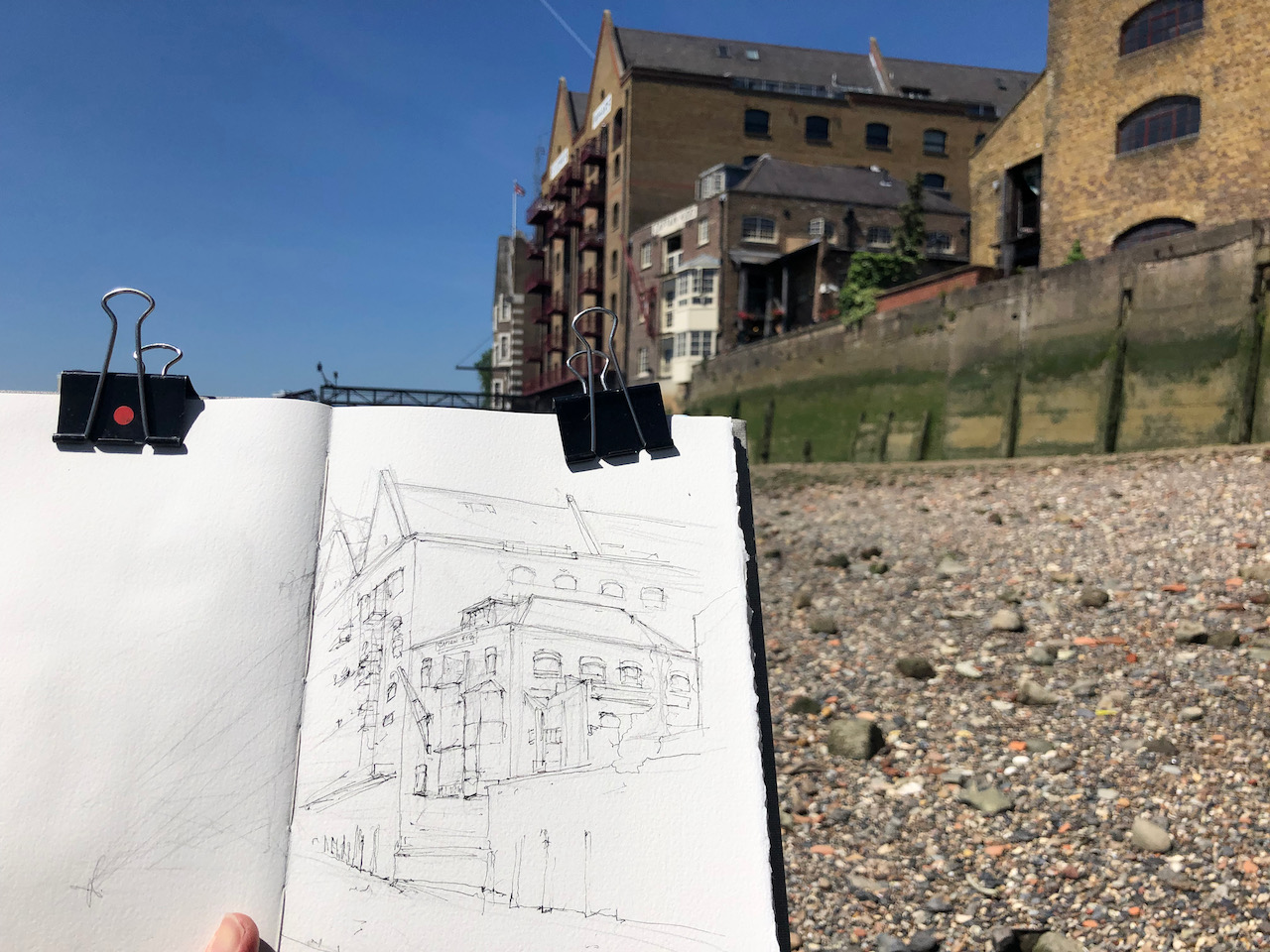
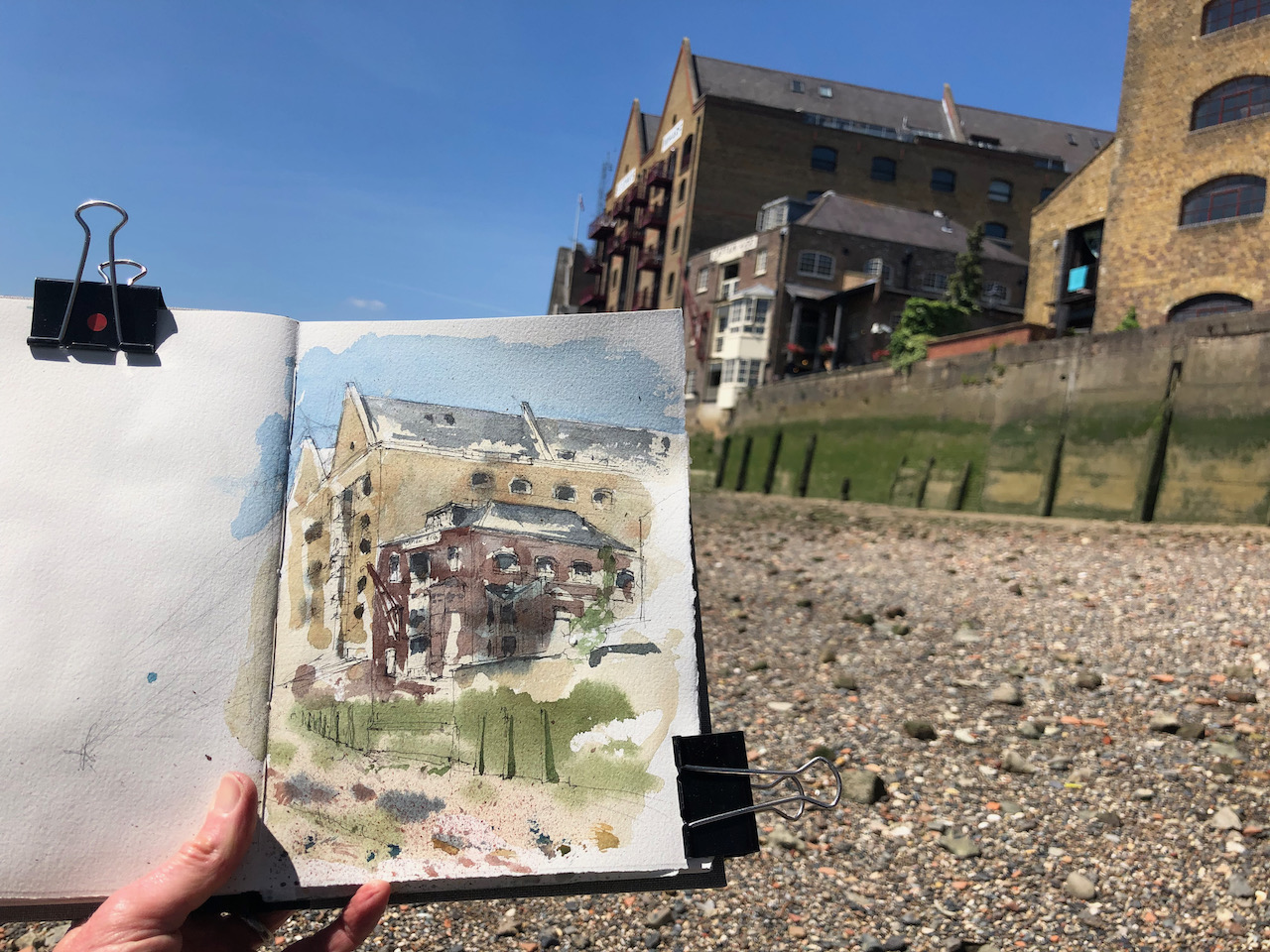
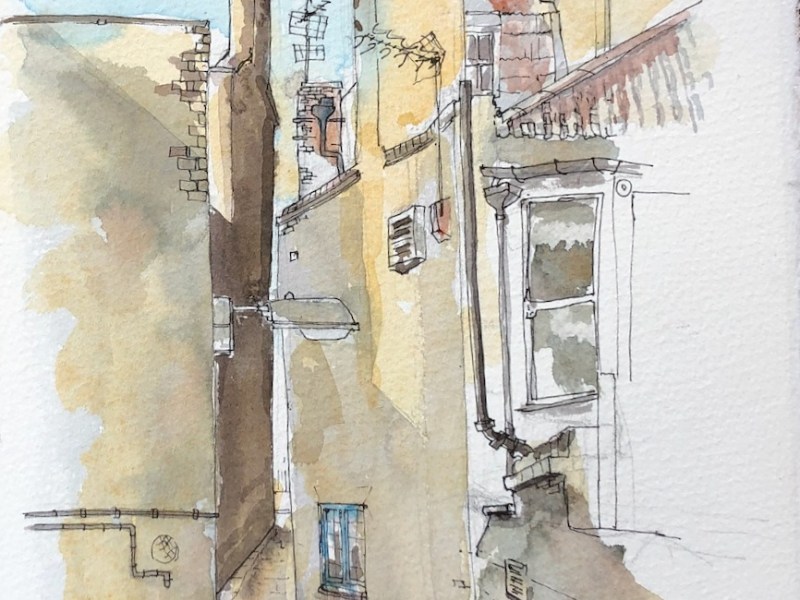
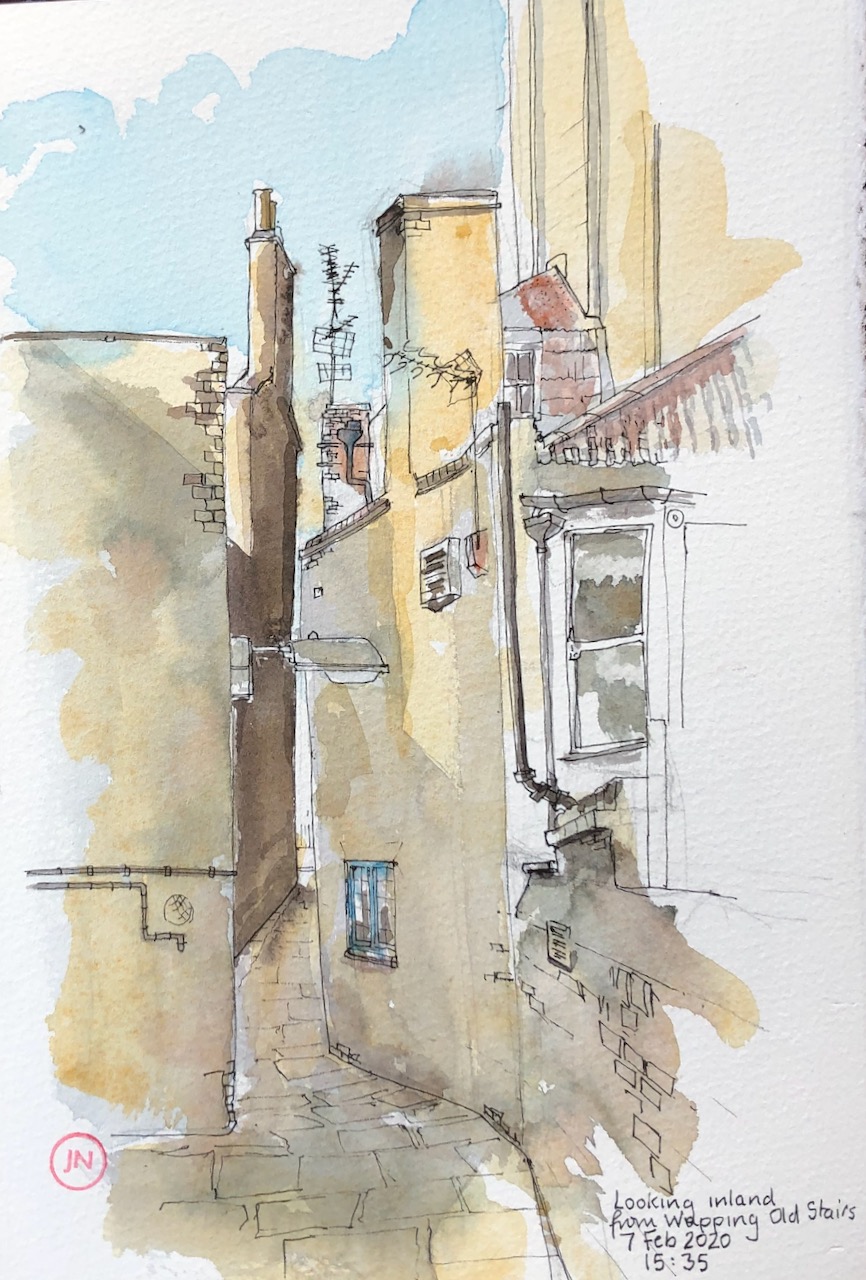
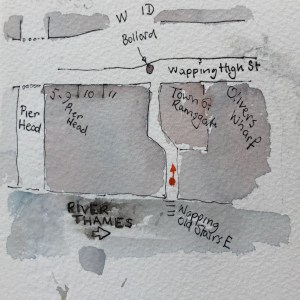
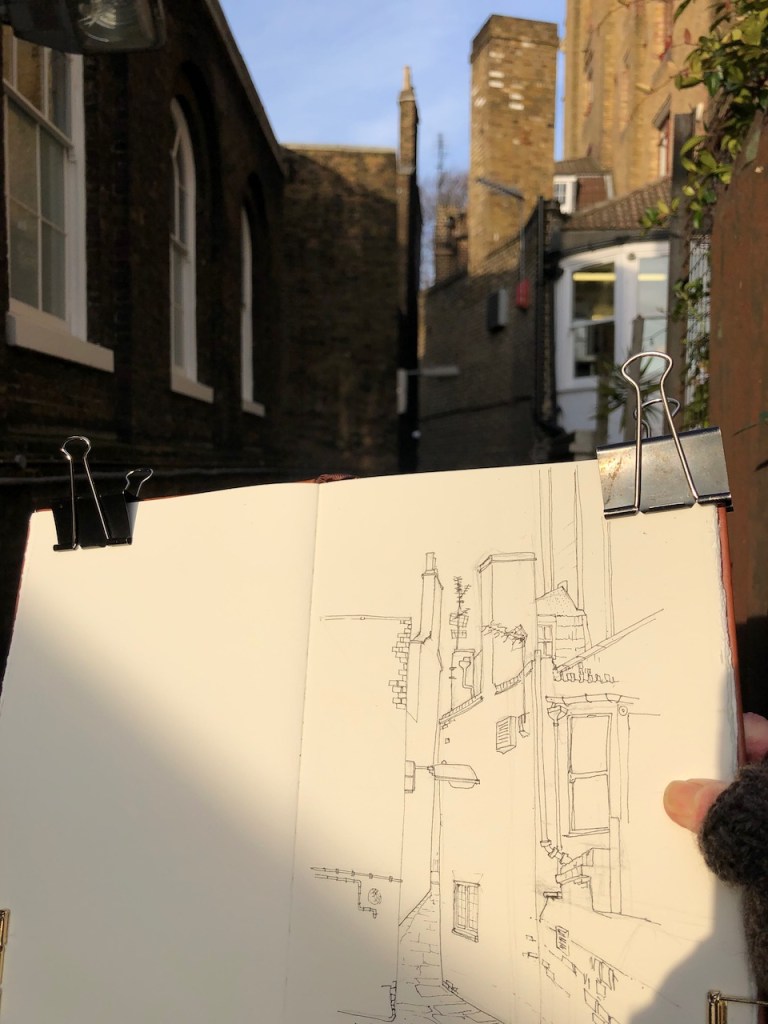
Next to the pub called “Town of Ramsgate” on Wapping High Street, there is a small passage, a slot between buildings. I darted down there, and found a long view over the Thames, and the stone steps leading down to the river. This is Wapping Old Stairs E. Turning round, to go back, I saw this mix of buildings.
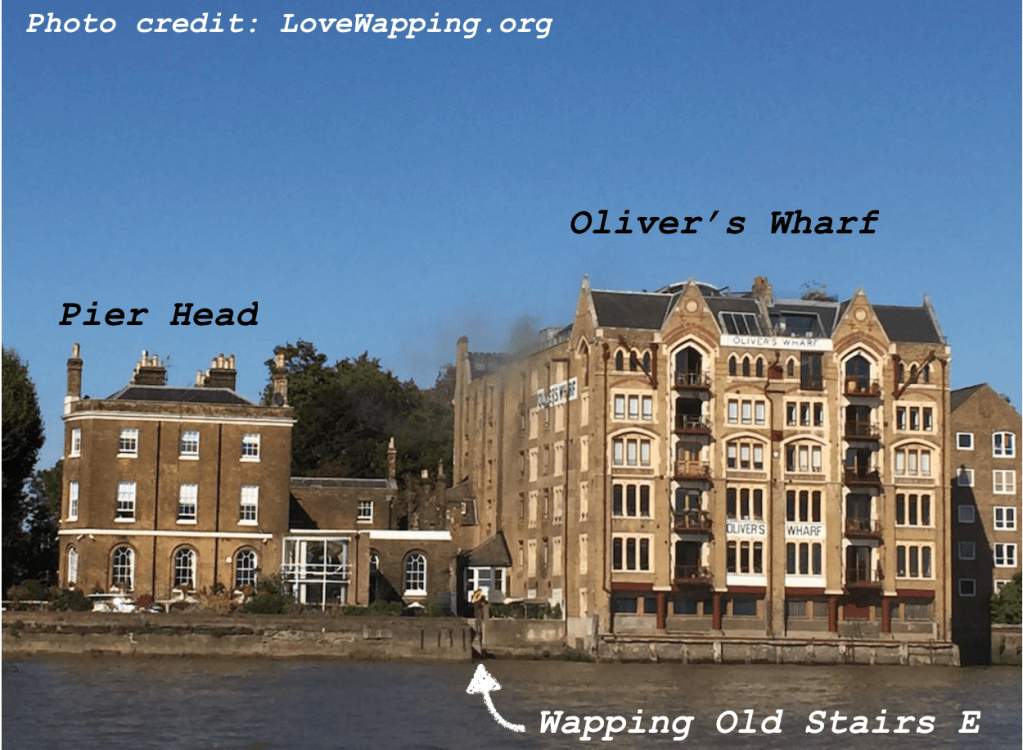
On the right, with the blue window, is the “Town of Ramsgate”. High above it are the walls of the former warehouse “Oliver’s Wharf”, built in 18691 The warehouse was turned into flats in 1970-1972, making it one of the very early warehouse conversions. Warehouse conversions later extended all the way down the river on both sides.
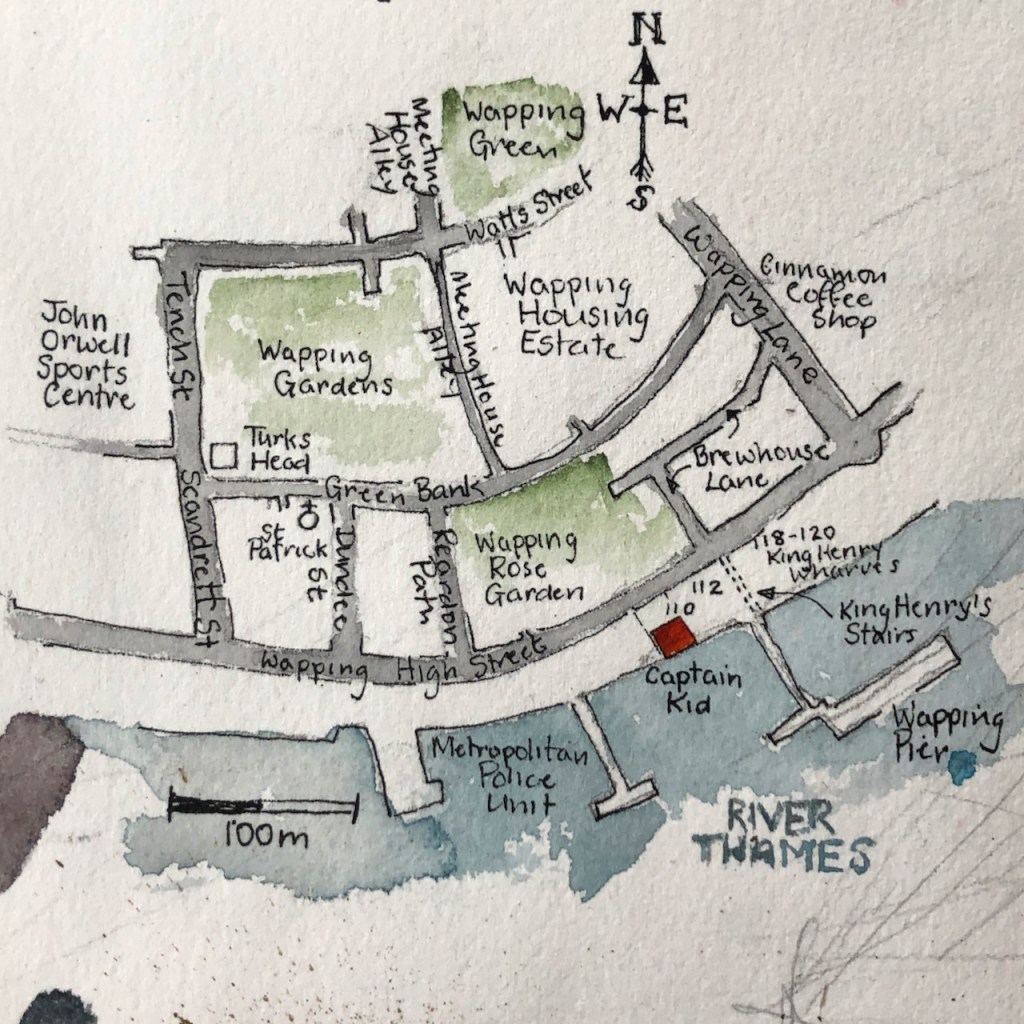
Sketch map showing the buildings around Wapping Old Stairs E.
On the left are the backs of the houses on “Pier Head”, which is a wide elegant road joining Wapping High Street to the river. There is a chain across the road to deter those of us who would like to look at the river from there.
One of the things I notice doing these sketches is the amazing number of television aerials that persist on rooftops, in defiance of the proliferation of broadband services. In this view there are two, both seriously complex and business-like examples of the genre. I think it is time for a exhibition of Television Aerials, as Art. If you are the V&A reading this, consider it now, before they all disappear, or become very valuable.
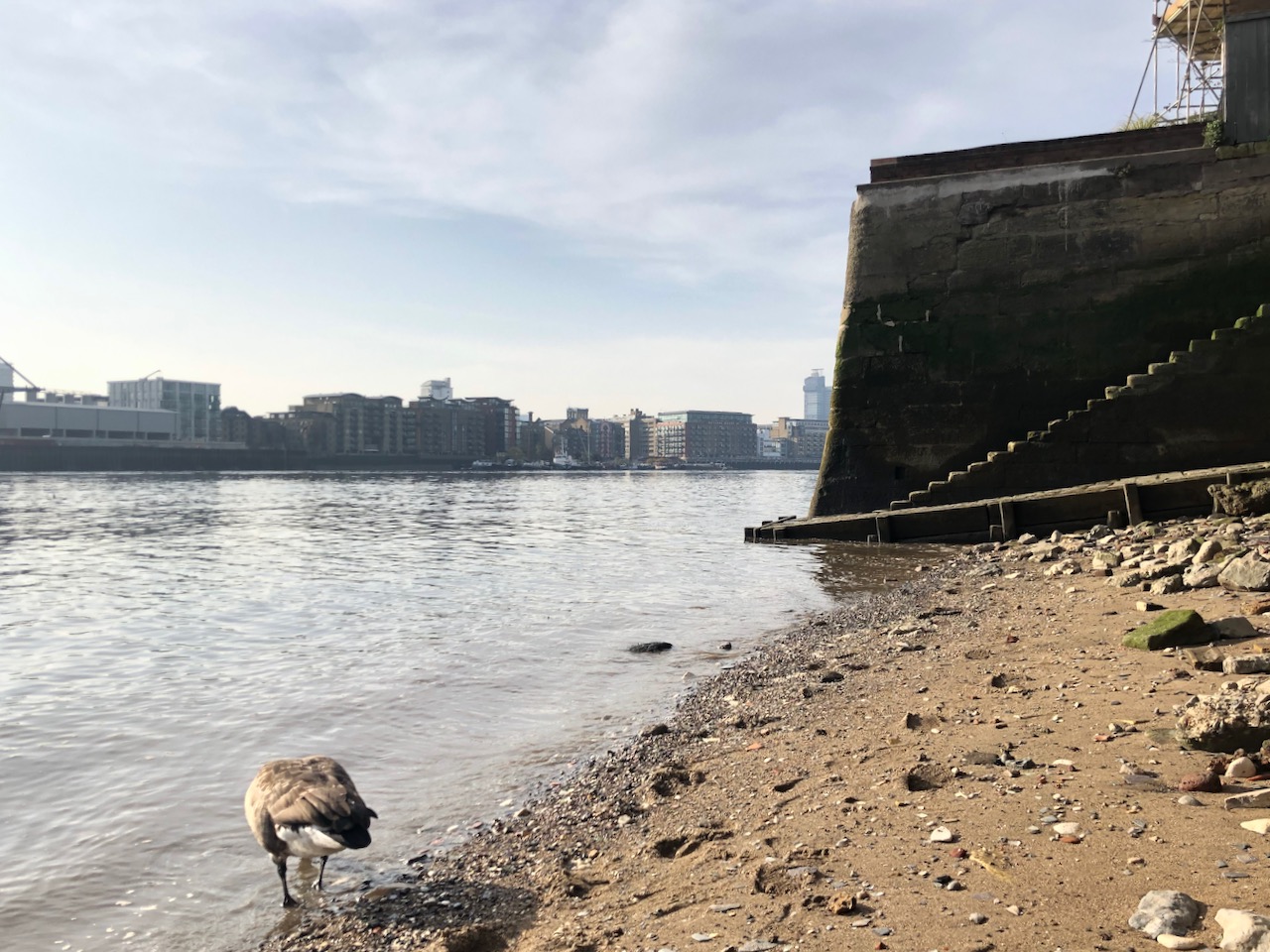
Wapping Old stairs is not a lonely place. It must feature in books. During the hour and a quarter I was there four couples and individuals walked along the passageway, looked out to the river, took photos and walked back. A man came with his tiny dog. The dog showed an unwise interest in my water pot, which by that time contained an unhealthy mix of Perinone Orange, Phthalo Turquoise and Mars Yellow. I tried to deter the dog from drinking it, and then had to explain to the dog’s owner that I didn’t mind the dog atall, but I didn’t think he should drink that particular water. They were going to go for a walk on the foreshore, but the tide was still high and sloshing over the steps, which put paid to that idea.
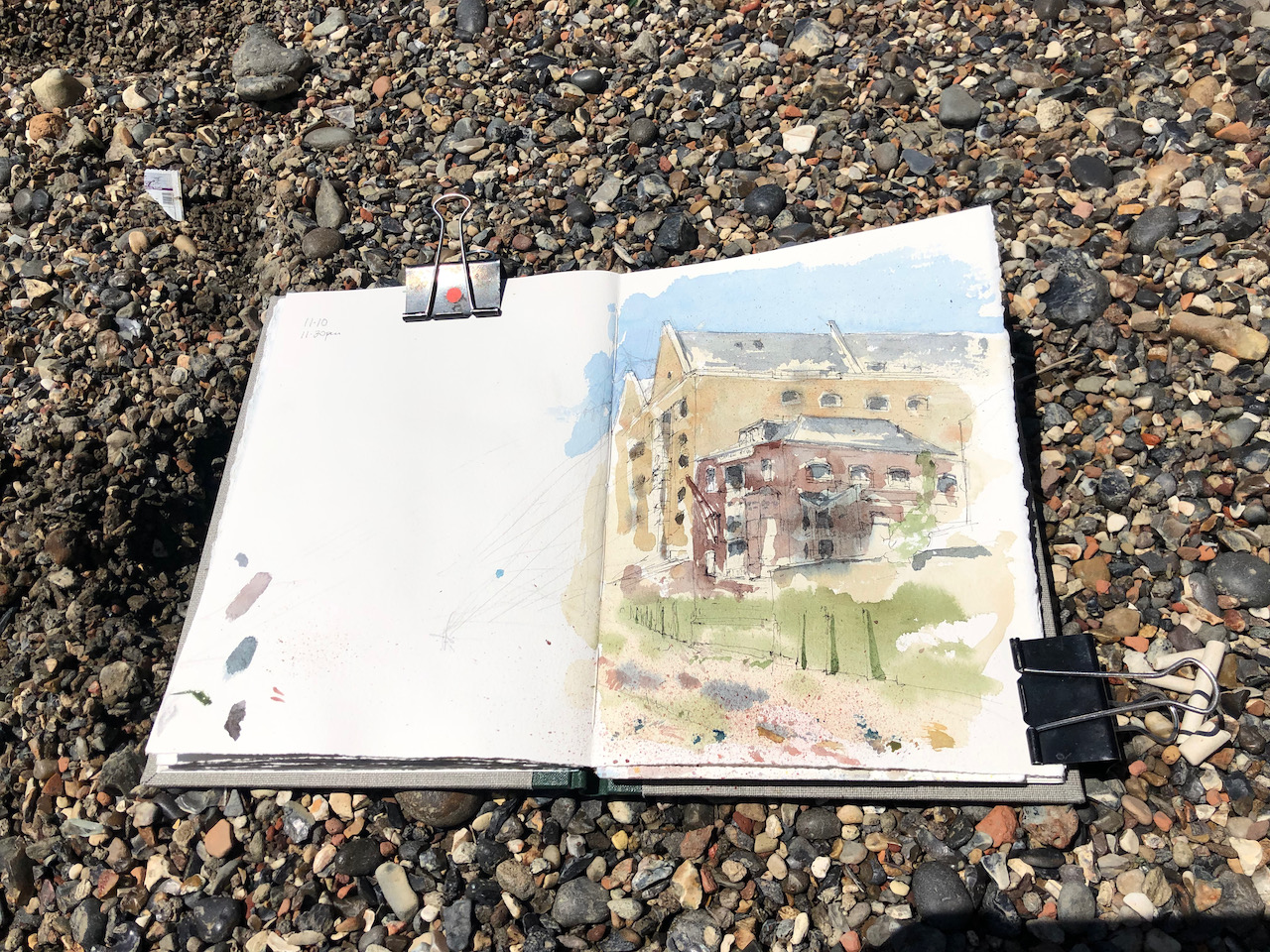
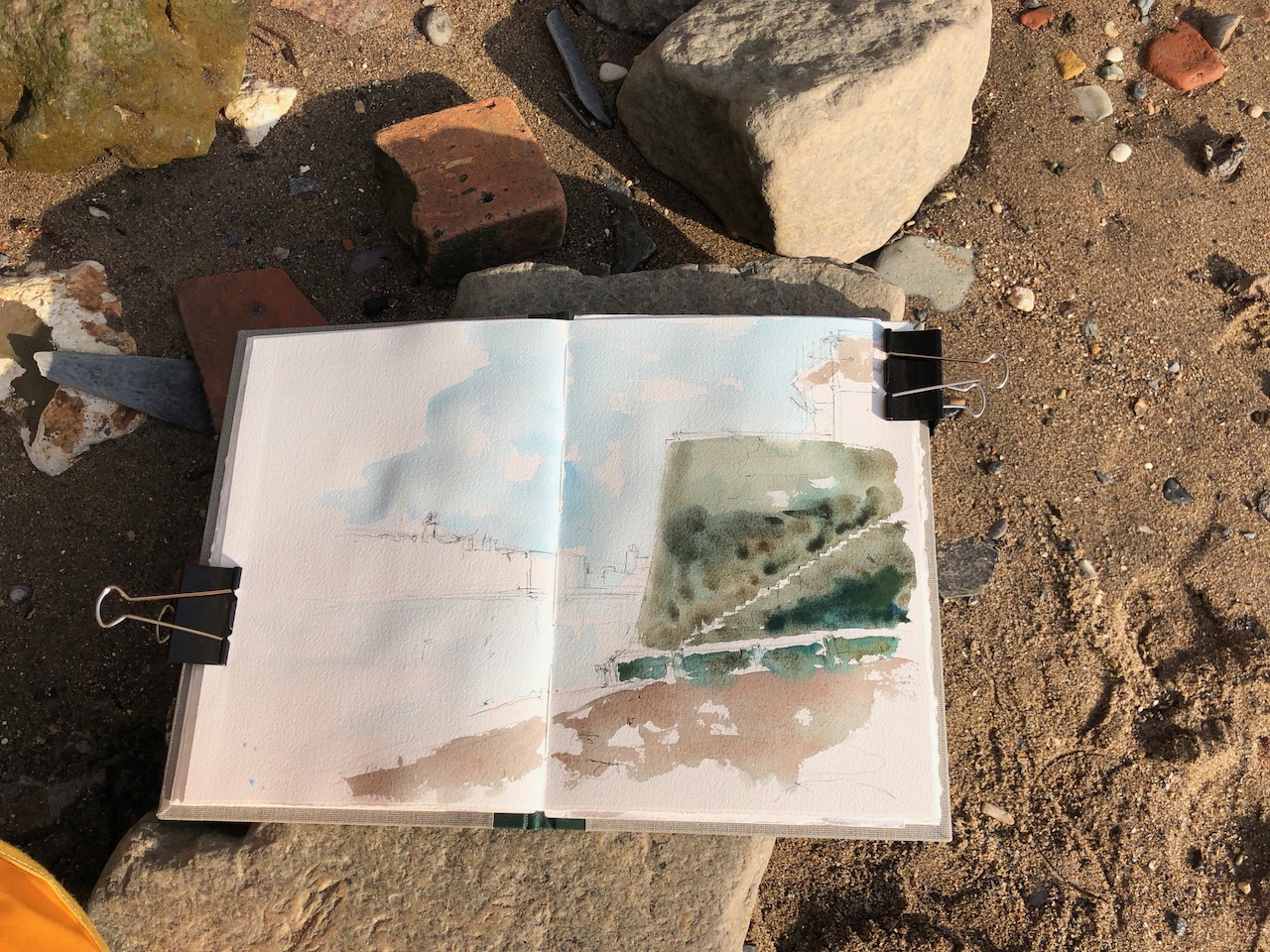
Here is work in progress.
(1) F. & H. Francis. 1869-70. Wapping, London E1. Built for George Oliver “in the Tudor gothic style, this wharf handled general cargo but had special facilities for tea” [Craig, Charles, et al. London’s Changing Riverscape: Panoramas from London Bridge to Greenwich. London: Francis Lincoln, 2009. Quoted in “victorianweb.org”]
View from the South side of the river, photo from “LoveWapping.org”. This photo shows the smoke from a fire which broke out in one of the flats, Sept 2019.
Click a button below to share this post online, email it, or print it:
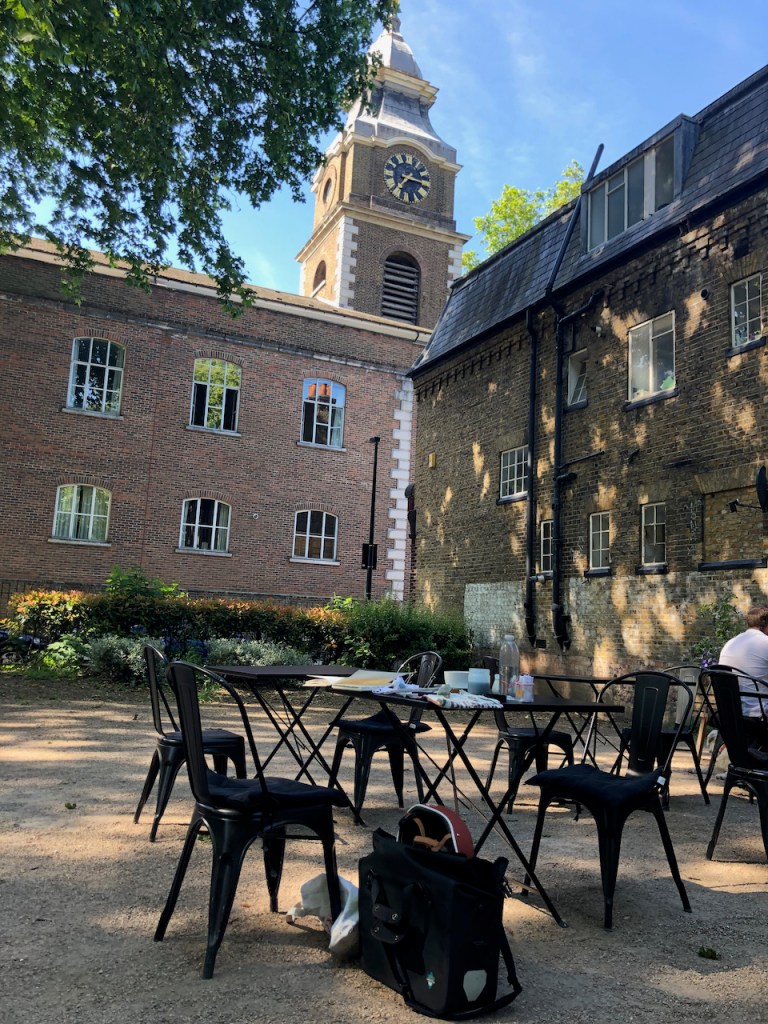
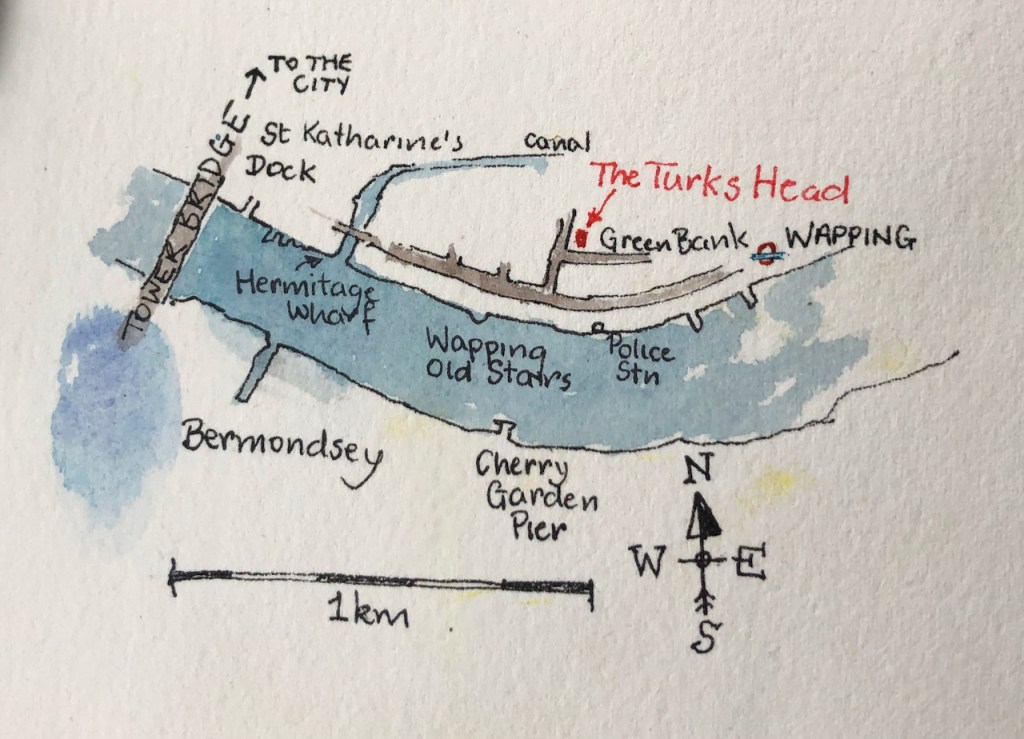
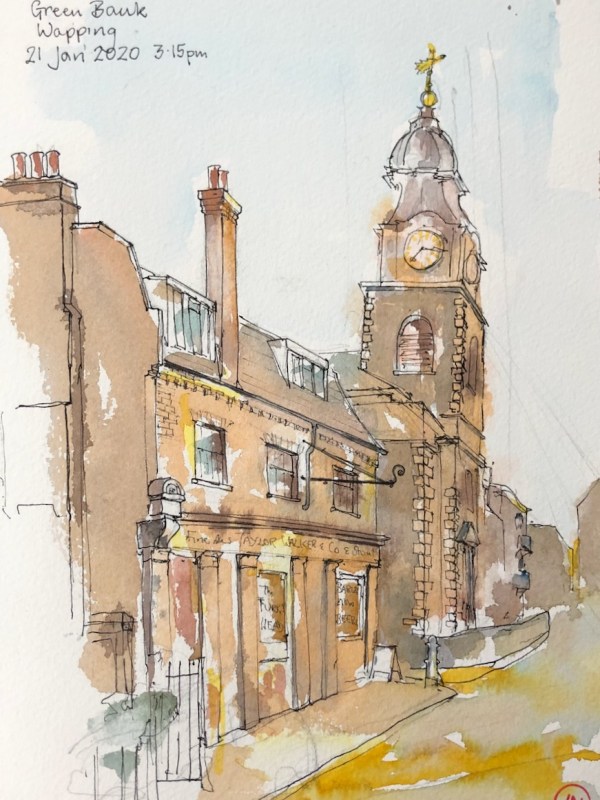
Here is the marvellous Turks Head Café, Wapping, rescued from demolition by local residents in the 1980s.
The Turks Head Cafe, in front of St John’s Tower
Inside, I found warmth, quiet tables, and the gentle murmur of conversations: people actually talking to each other. I felt welcome here. The food was marvellous. Next time I’m going to have the Blueberry Tart. I only noticed it after I’d already had the substantial Chicken and Avocado Sandwich.
Inside the Turks Head Café
I went to pay my bill. When I returned to my table, there was a little group of people admiring the sketch (above). I chatted to a man called Mark, who, it turns out, runs the website “lovewapping.org“. We exchanged anecdotes about the representation or otherwise of residents’ views on local councils. His group grapples with Tower Hamlets Council.
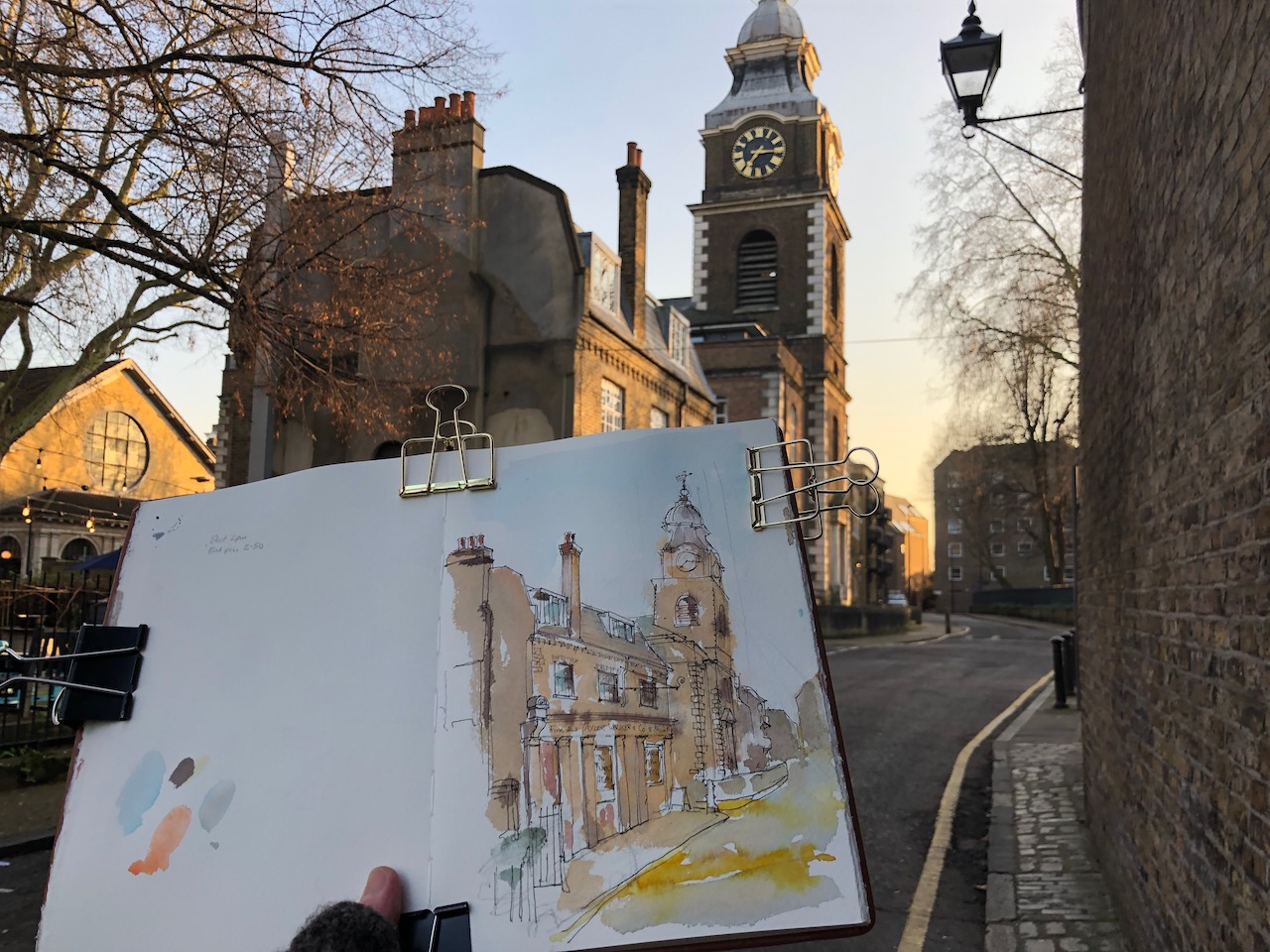
Then I went outside to draw the café.
The tower in the background is St Johns Tower. The tower is “all that remains of the parish church of St Johns circa 1756 … the surrounding ground was rebuilt as flats in the 1990s to an attractive design reflecting the previous building on the site” says the Knight Frank website (an estate agent).
This drawing took 1hour 15 mins, done from the pavement by a huge brick wall. The colours are Perinone Orange, Phthalo Turquoise, Mars Yellow and Hansa Yellow Mid. As you see, the front of the cafe faces West, and caught the setting sun.
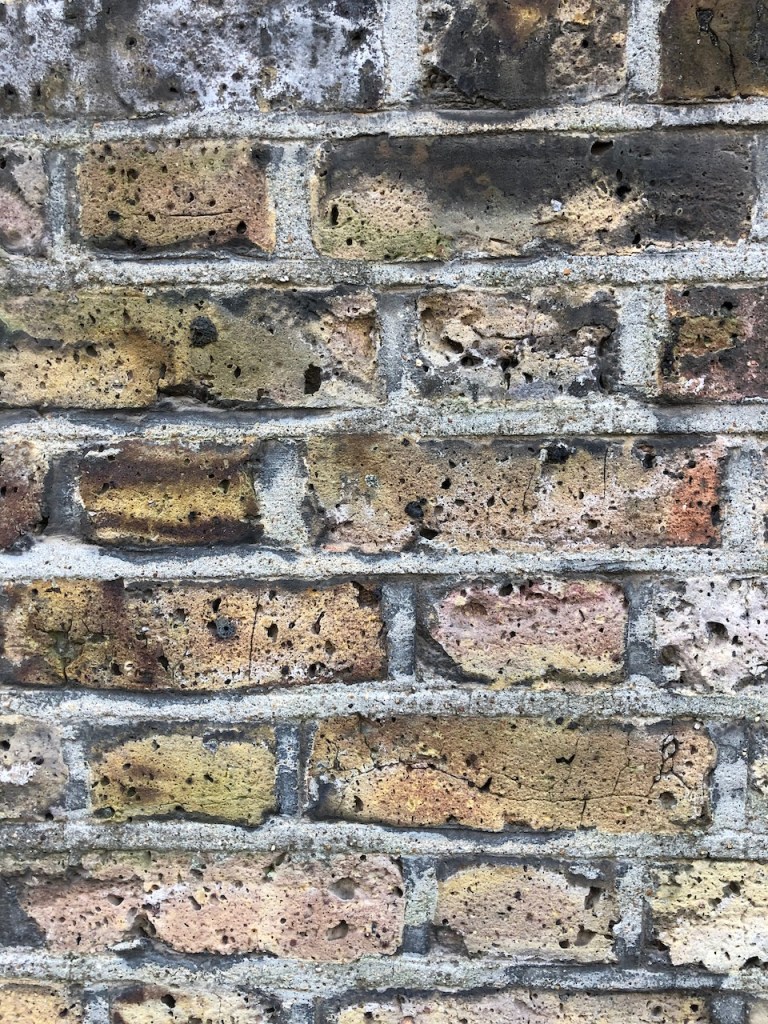
Here is the wall next to where I was standing.
London Bricks in Wapping.Notice outside the caféA man with a tiny cup of espresso coffee
Click a button below to share this post online, email it, or print it:
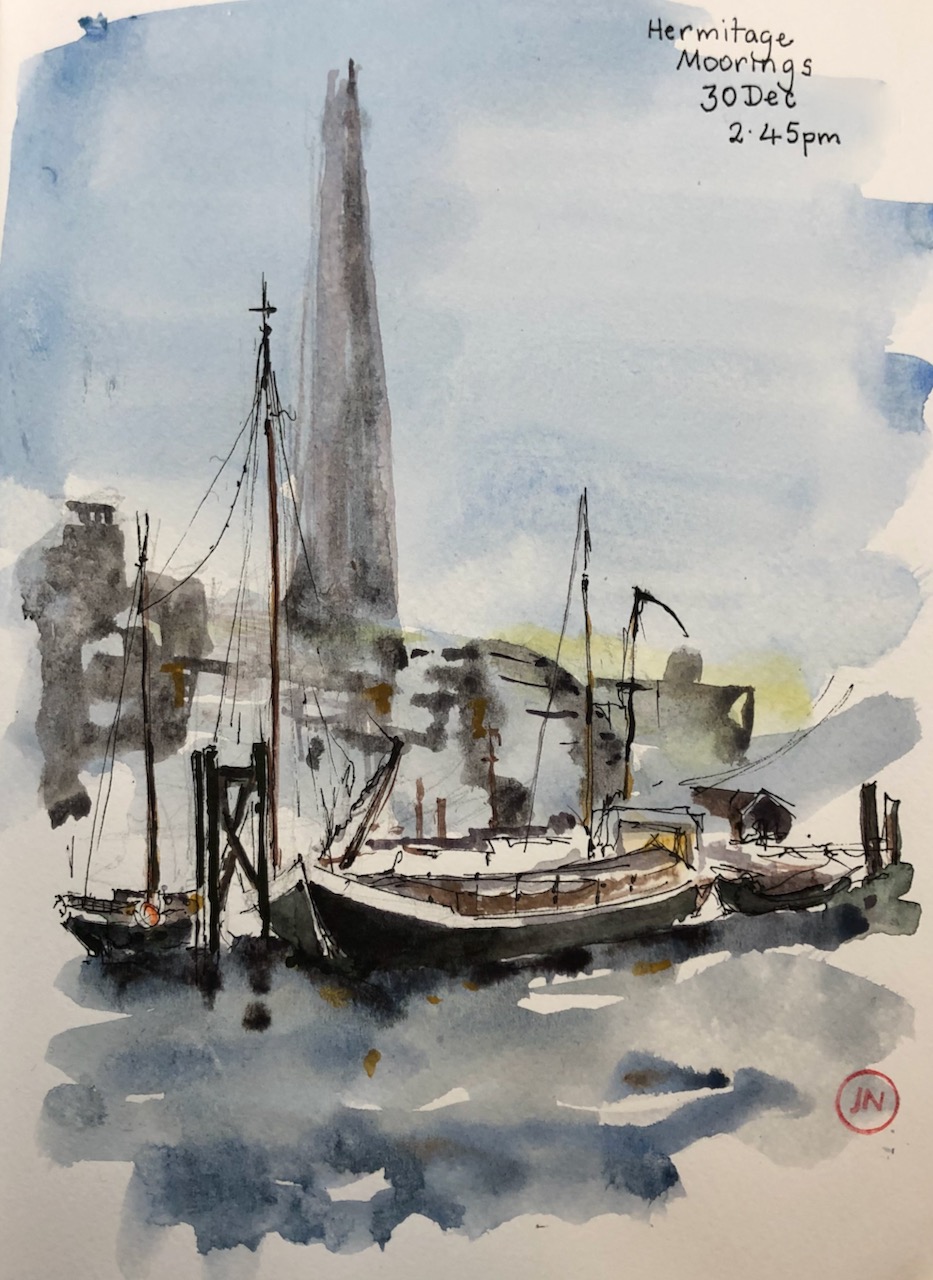
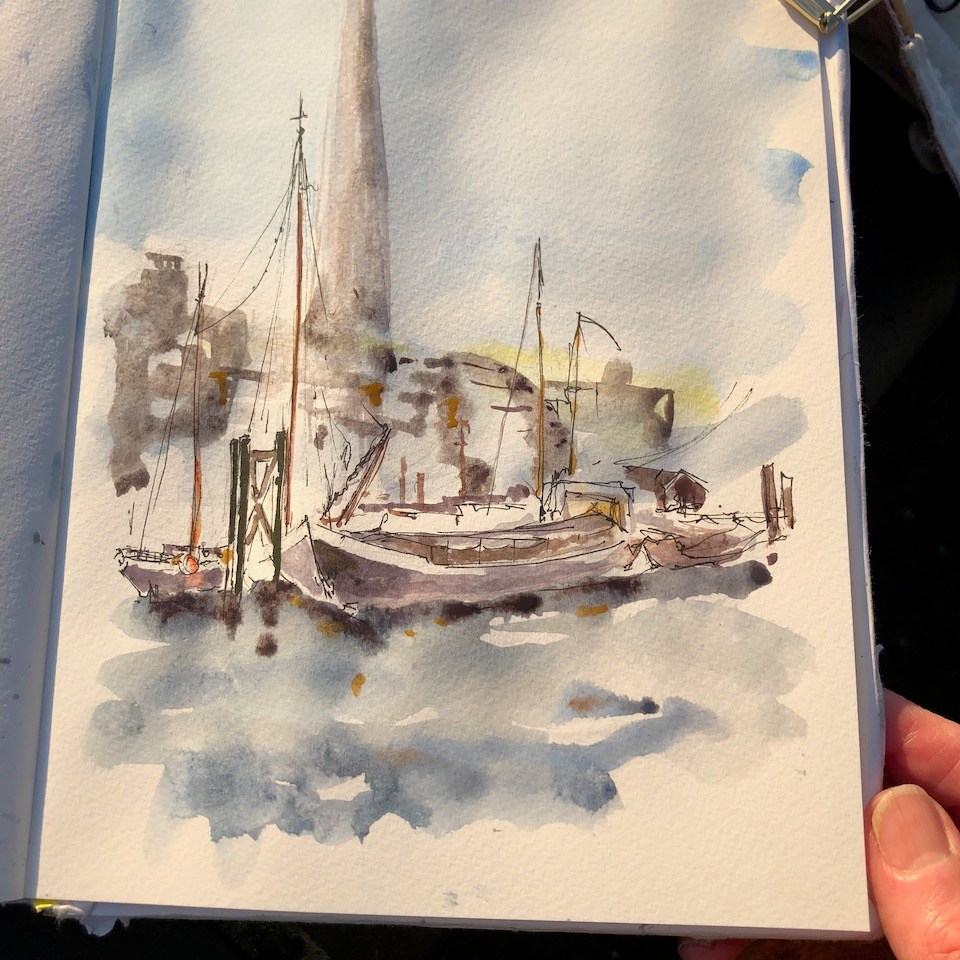
Walking east, downriver, the crowds left behind, suddenly there is space and silence.
Hermitage Moorings, with the boat “Twee Artsen”
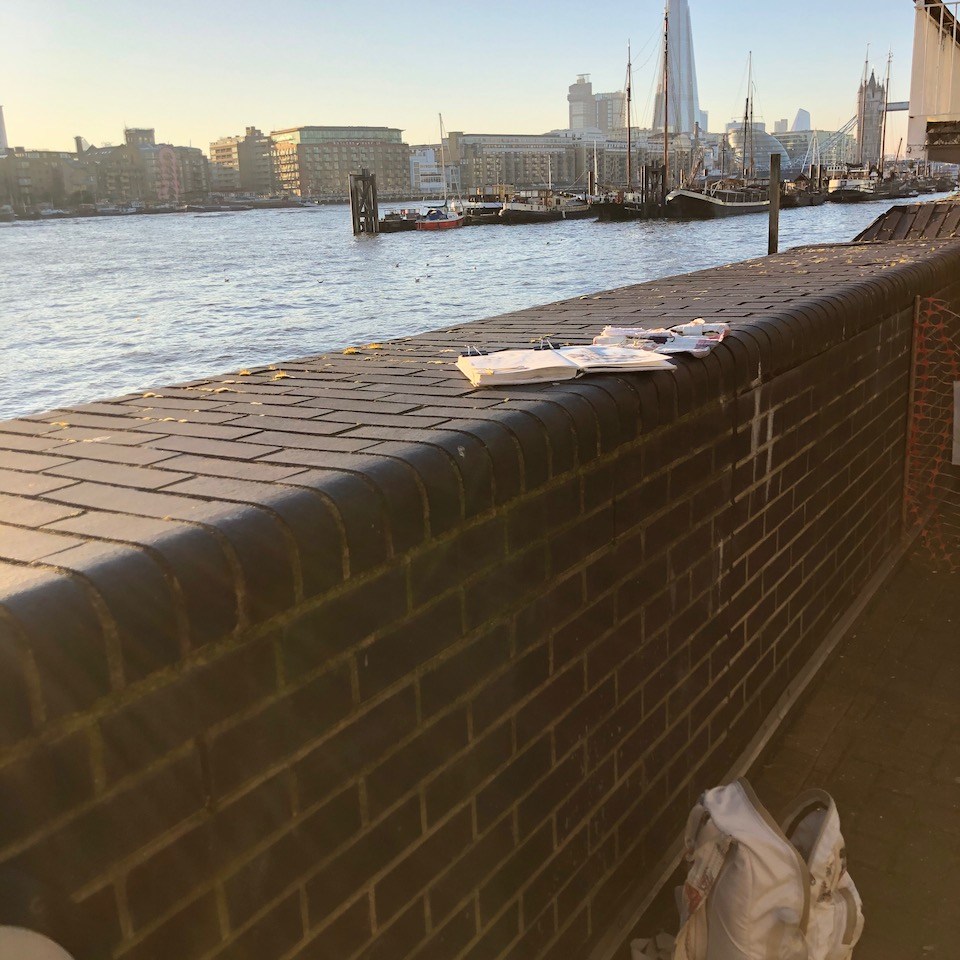
This drawing is a view across the river from the North bank. Tower Bridge is just off to the right. Opposite you see The Shard, and the waterfront buildings of Hays Galleria. The curved building in the background houses the Greater London Authority (GLA).
In the foreground is the boat which is called “Twee Artsen”. As far as I can work out, that is Dutch for “Two Doctors”, as in medical practitioners. It seems a strange name for a boat, so perhaps I got that wrong. Can anyone advise me?
This was a lovely place to draw.
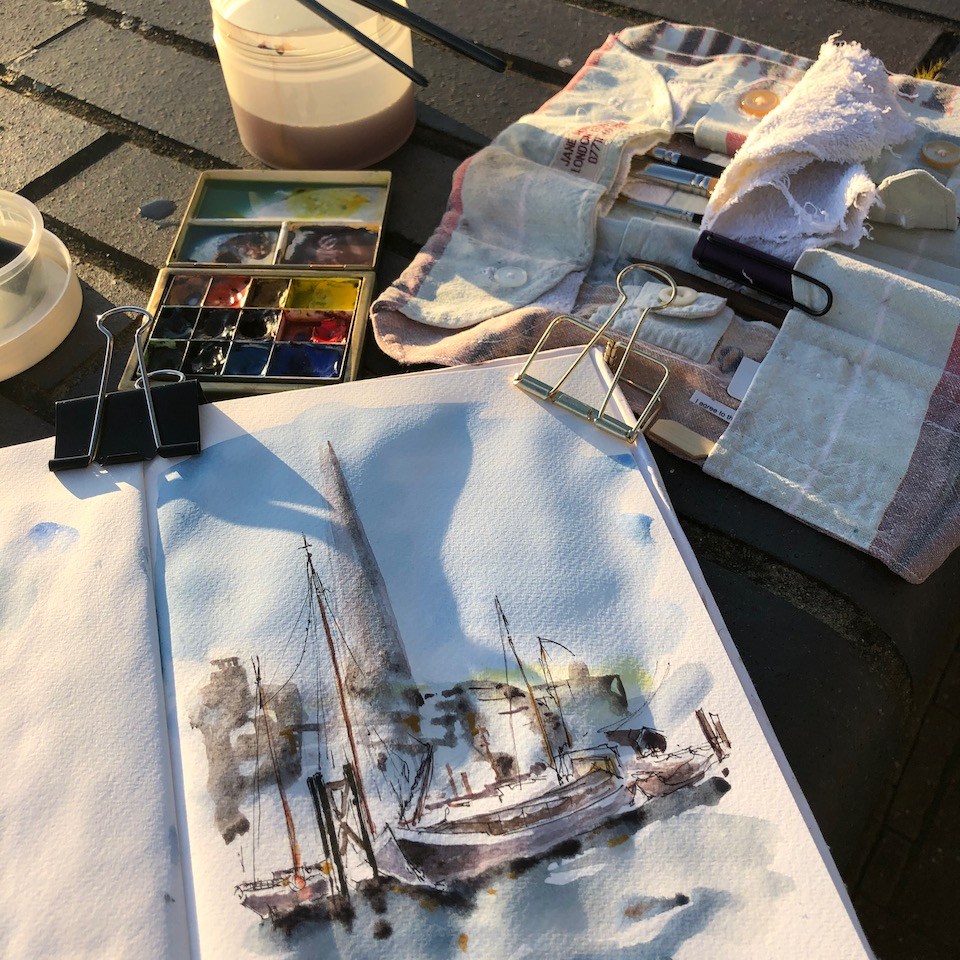
The drawing took about half an hour. The sky is cobalt blue, knocked back a bit with Naples Yellow Red. There’s some Mars Yellow and Perinone Orange for the masts of the boats. The Thames is Cobalt blue with Burnt Umber. The boat black is made from Phthalo Green (BS) and Perylene Maroon. There’s some Hansa Yellow Mid in there too, for the lower sky. Quite a lot of colours in this one. The Naples Yellow Red is a Rembrandt colour, all the rest are Daniel Smith.
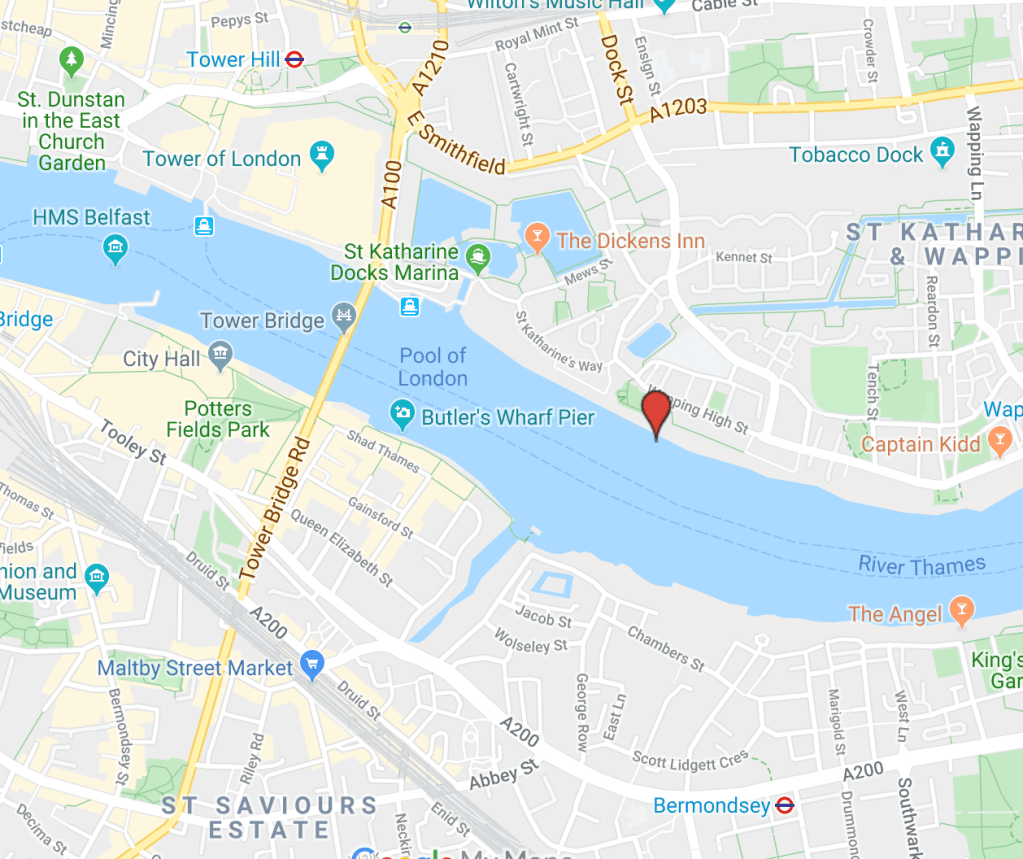
Where Hermitage Moorings is.
Click a button below to share this post online, email it, or print it:
I went down to the river to find the sun. It was there, flooding the North side of the Thames, and so were an extraordinary number of tourists.
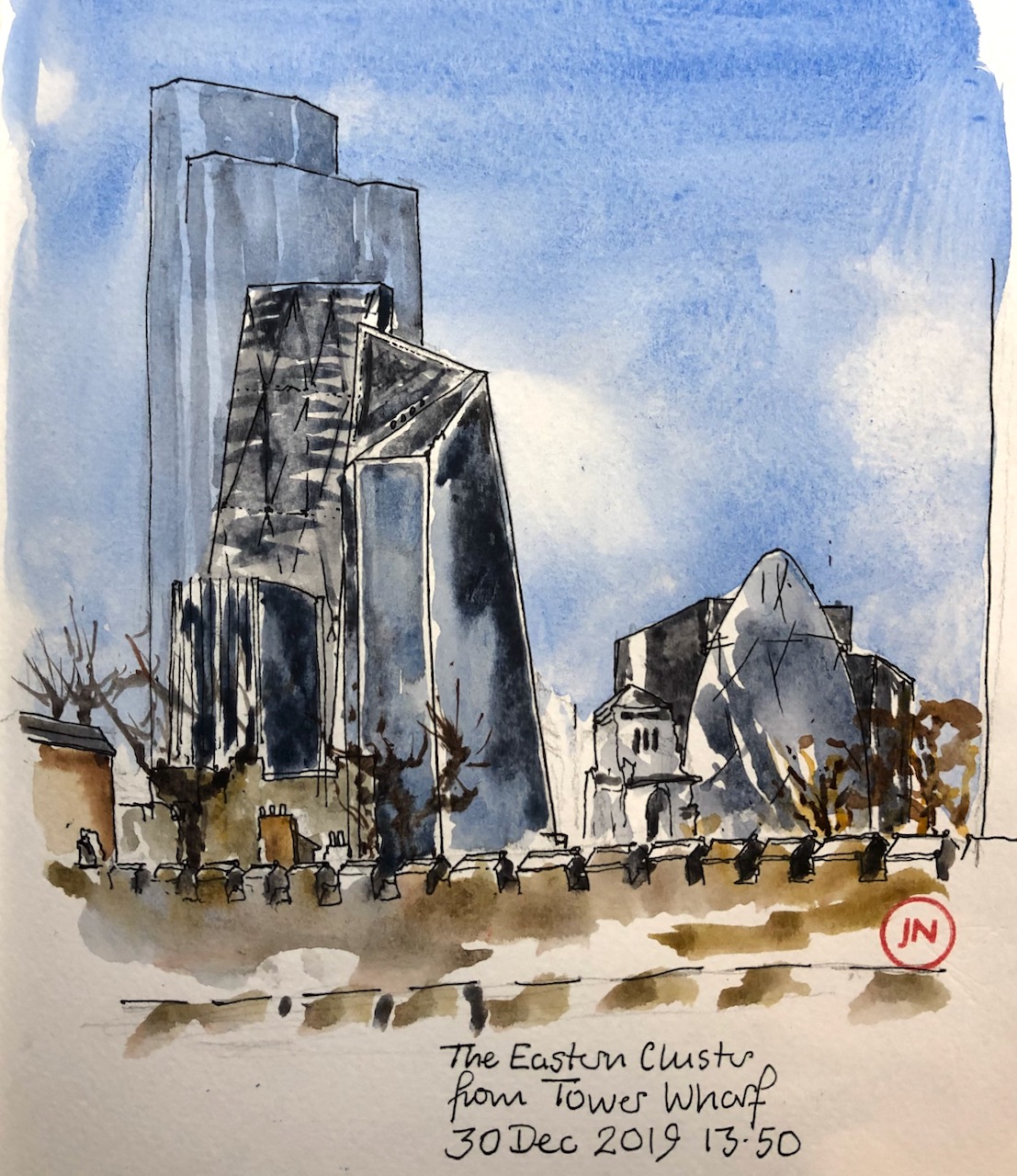
But who can blame them? The city was looking clear cut and perfect, there was a slight haze in the distance, a blue sky, and a low golden sun. I stopped by The Tower, and admired Tower Bridge, as everyone else was doing. Then I looked the other way, and saw the towers of the City.
From left to right: 22Bishopsgate (the tallest), the Cheesegrater, the Scalpel, the Gherkin.
I enjoyed the fact that you can see the pollarded trees and the chimneys of the buildings of the Tower of London, in front of the skyscrapers. The lower, pointed building, just to the left of the Gherkin, is the former headquarters of the Admiralty. Samuel Pepys (1633 – 1703), who wrote the diaries, worked there. This building is now an upmarket hotel.
The castellations in the foreground are part of the Tower of London.
The colours used are Cobalt Blue, Burnt Umber, and Mars Yellow, all Daniel Smith watercolours.
This drawing took about an hour, drawn and coloured on location.
Click a button below to share this post online, email it, or print it:
On Wednesday I went for a peregrination around Hackney, north and east of Brick Lane.
I drew this sitting on a bench on Weavers’ Fields. The tower block is Charles Dickens House. The church which you can just see is on the junction of Pollard Row and the Bethnal Green Road. It is a deconsecrated church, and looks as though it’s been converted to residential flats. The building with the roof, straight ahead, is on Derbyshire Road E2. It’s clearly been industrial in its time, now it looks vaguely high-tech. Note the long solar panel on the roof.
It was incredibly cold, about 5 degrees C. But very bright sun, so the solar panel must have been working.
I walked on back to the city. In amongst the office blocks it was warmer. I tucked myself into the angle of a building and drew this:
This is 101 Worship Street, in the beautiful row of workshops designed by Philip Webb. If I were to make the untold millions necessary, I would buy up this row and look after it. I have had my eye on it for a while, ready to campaign if it were threatened. At the far end, sketchily shown behind the cars, is a sort of font or water fountain, with a sharp angled roof. The houses are not in good repair, and evidently listed or they’d have been pulled down by now. They are surrounded by the huge developments of Hoxton and the City of London, as you see behind. This is the “fin tech” area. But these houses survive, against the odds, tribute to the utopian dreams of a previous era.
Click a button below to share this post online, email it, or print it:
This huge redbrick building in Leman Street stands proudly amongst the 21st century steel and glass. Inscribed round its windows and above its door in letters a foot high are the words “Co-operative Wholesale Society Limited”. The words are spelled out in full, and written in stone. Oh, those confident and visionary Victorians!
The Co-operative Wholesale Society’s London Branch headquarters were built to designs by J. F. Goodey of 1885. At the formal opening on 2 November 1887, the CWS announced that it should ‘be their aim to make this beautiful building a common home for all the various movements having for their object the interest and advancement of the working people. They had with them their friend, the Rev. S. A. Barnett, and they hoped to work hand in hand with him and the residents of Toynbee Hall, in giving a message of hope to the people of the neighbourhood’