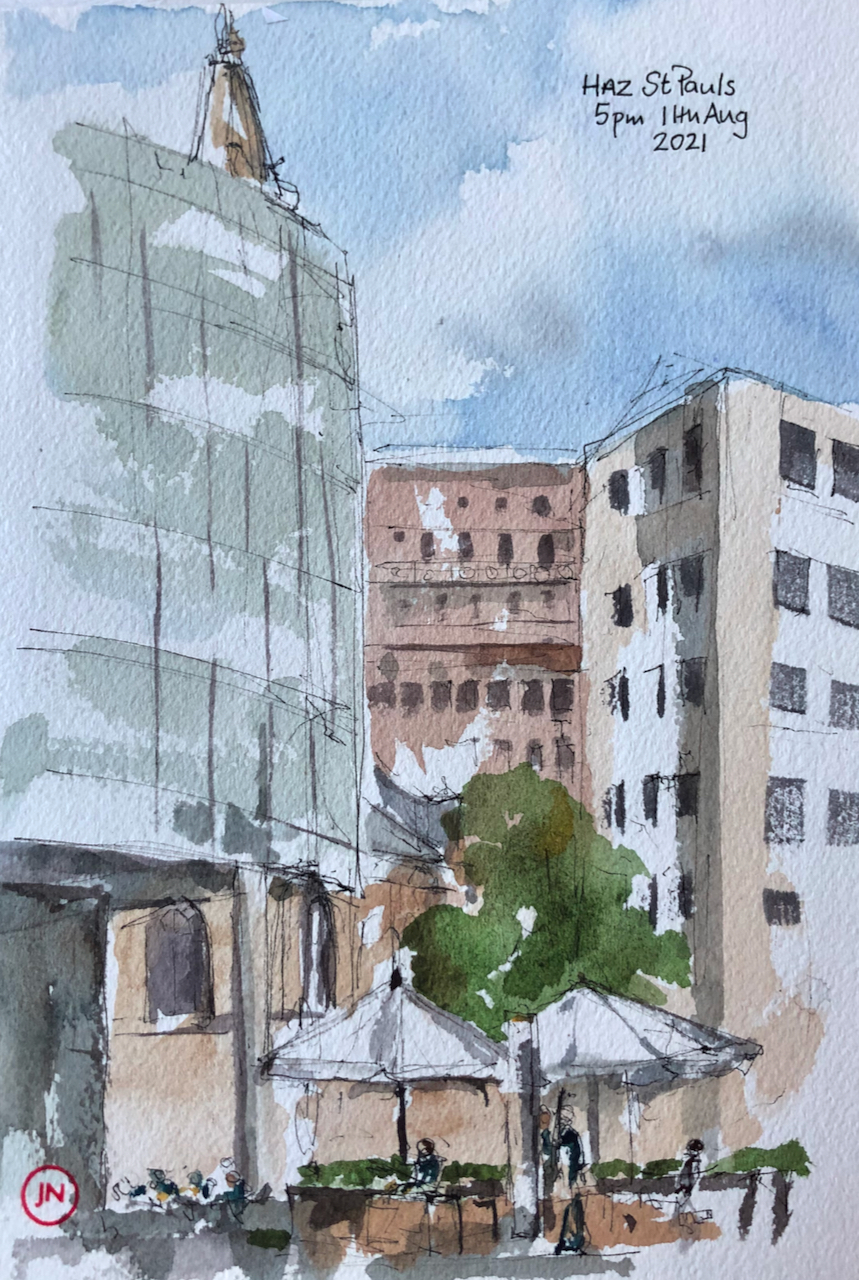
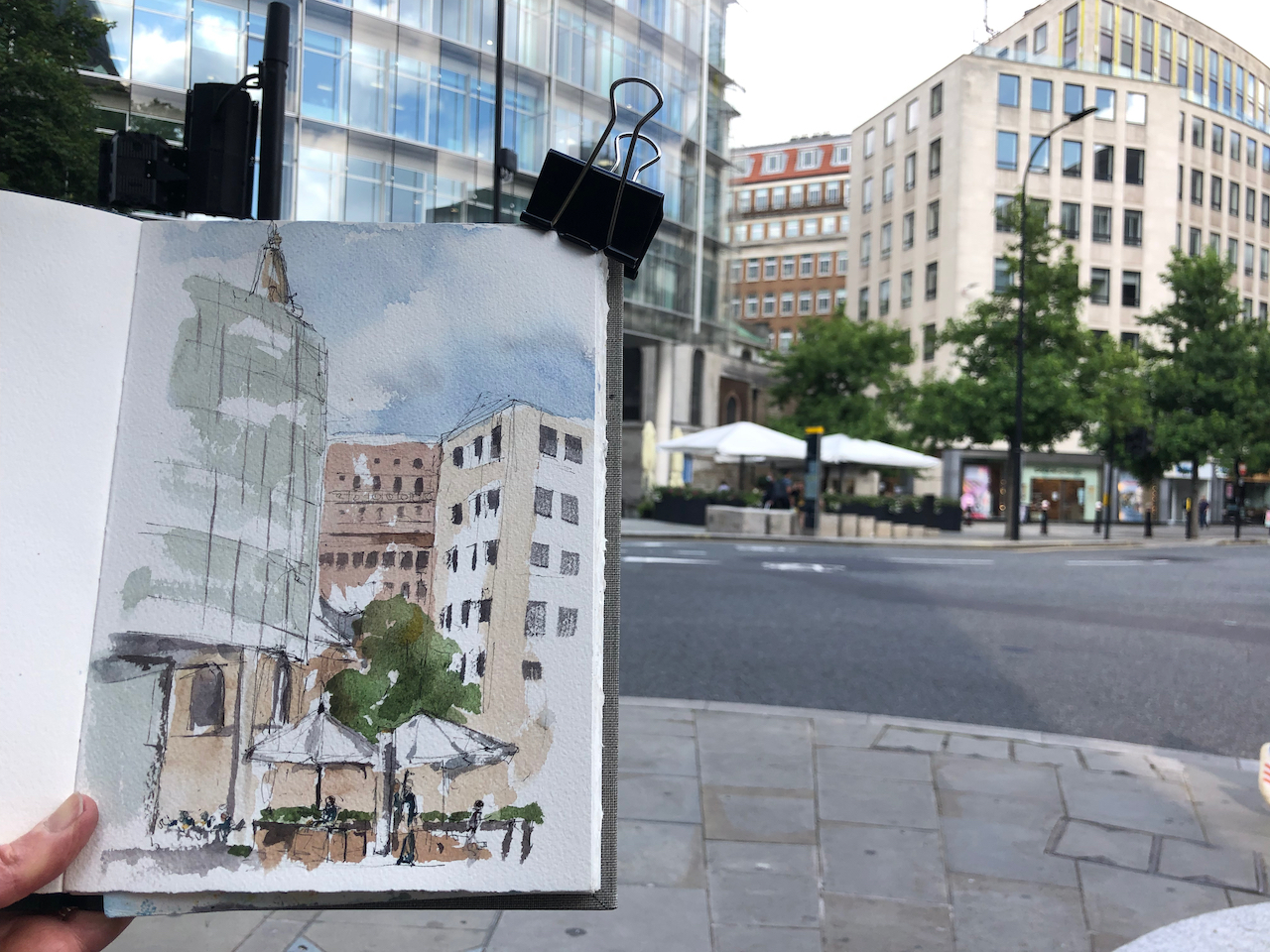
Here is the restaurant “Haz St Pauls“, 34 Foster Lane, London EC2.
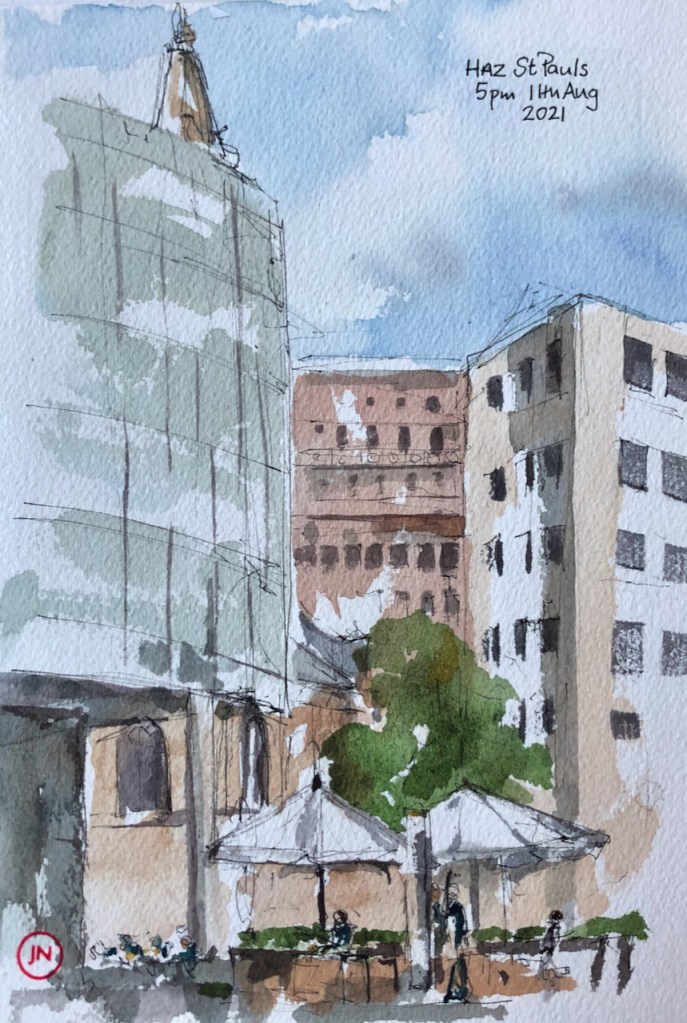
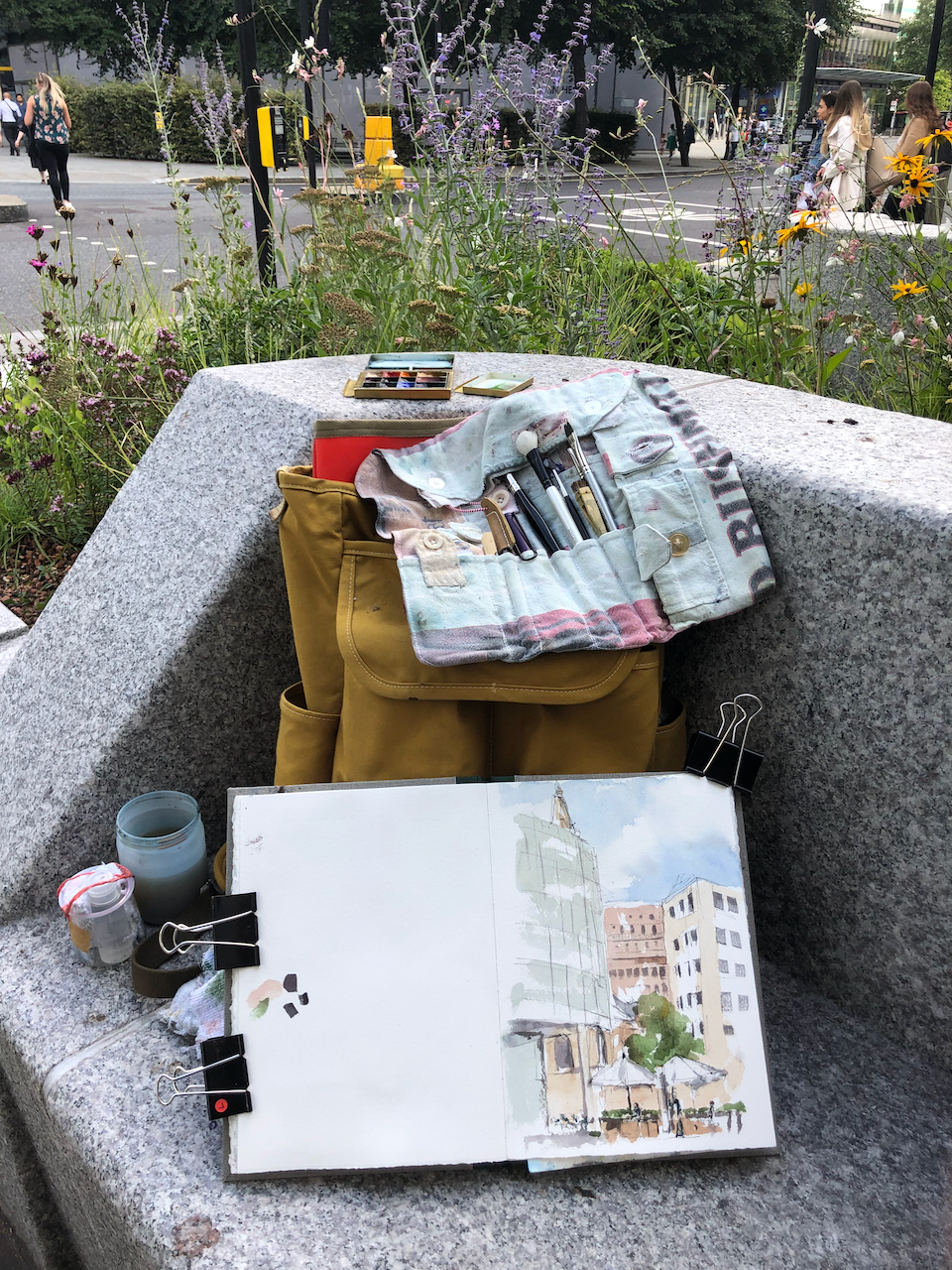
“Haz St Pauls” Foster Lane, EC2, sketched from across the road, in Sketchbook 10, 11th August 2021
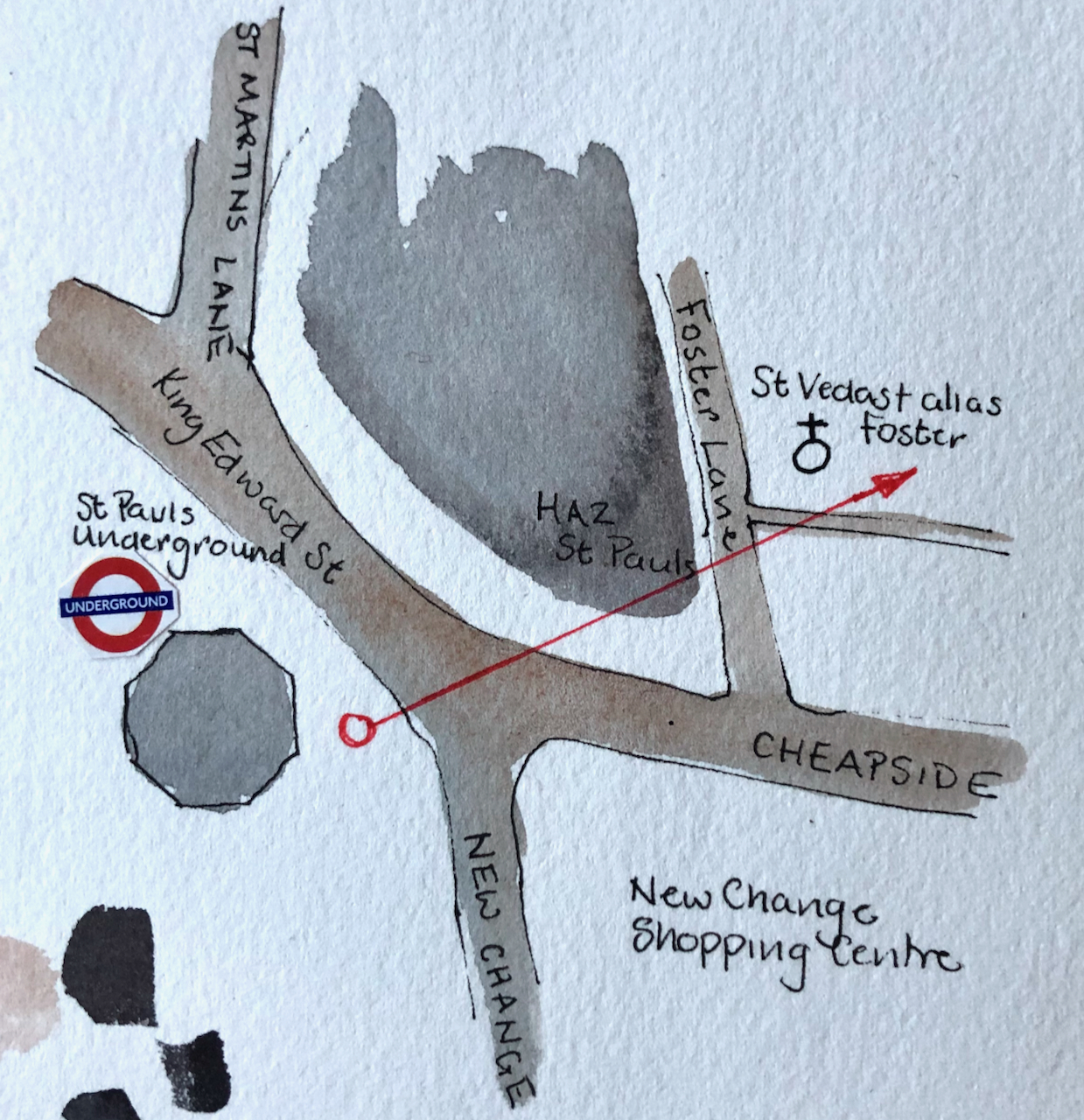
The restaurant has created a wonderful outside seating area on a part of the pavement. This corner has modern offices, the Haz restaurant, a coffee bar (Costa), and a church, St Vedast alias Foster. I sketched it from a new stone seat near St Pauls Underground station.
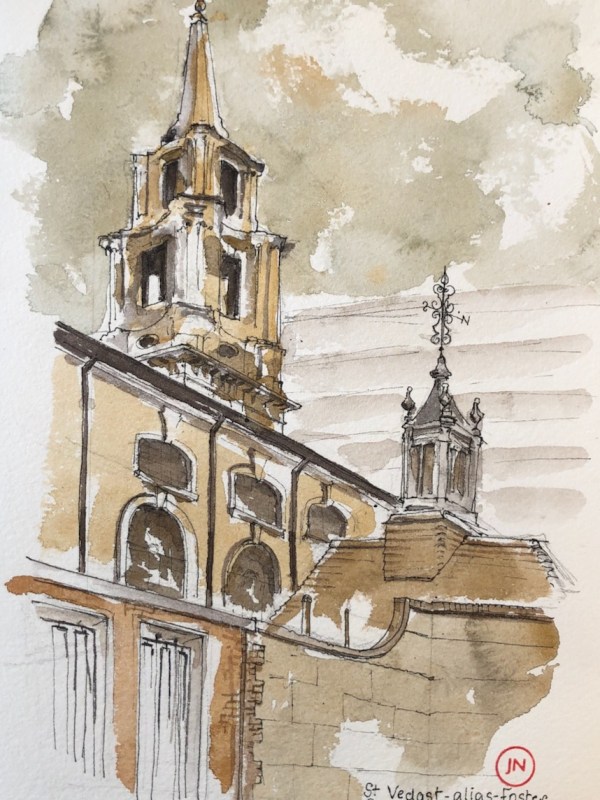
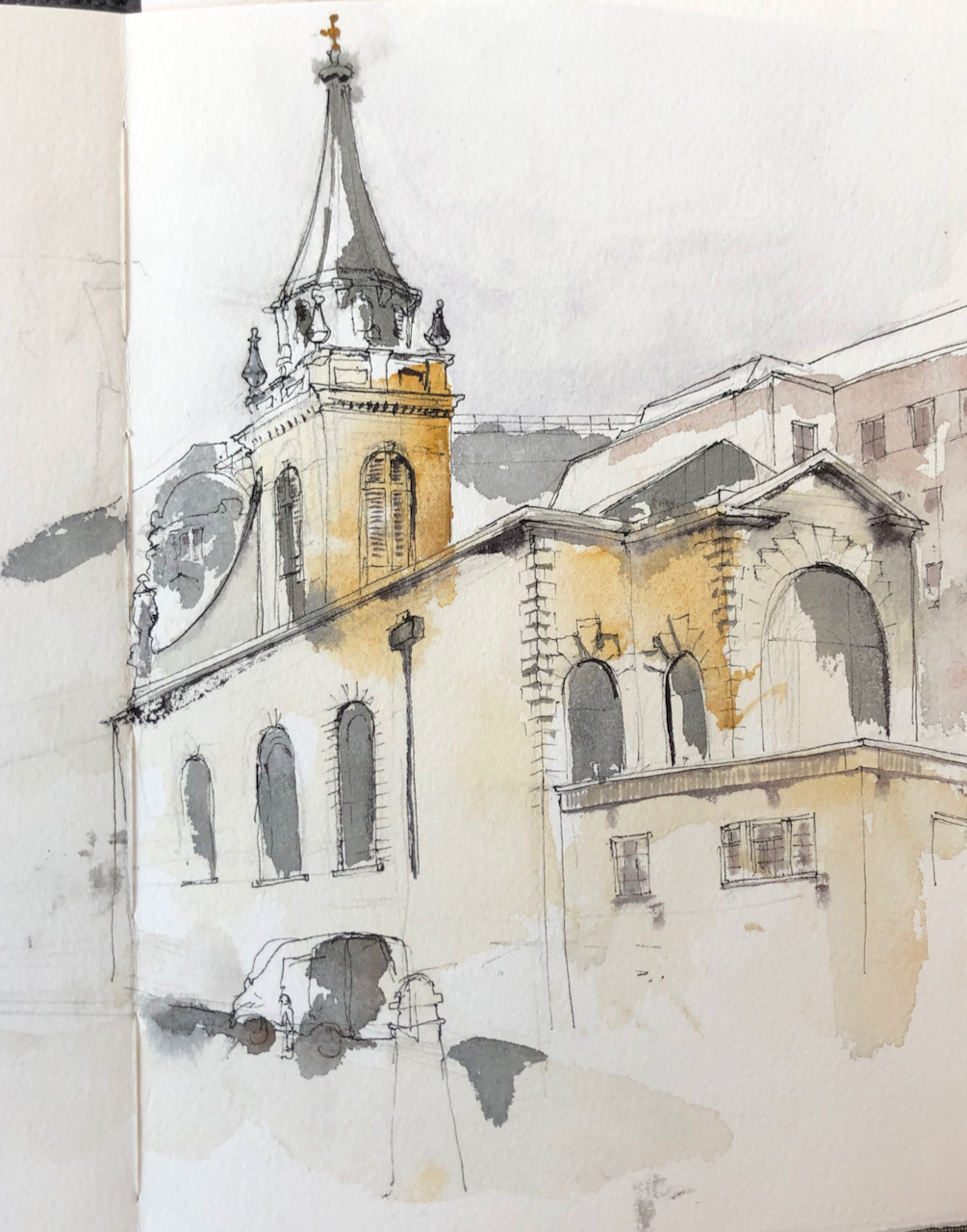
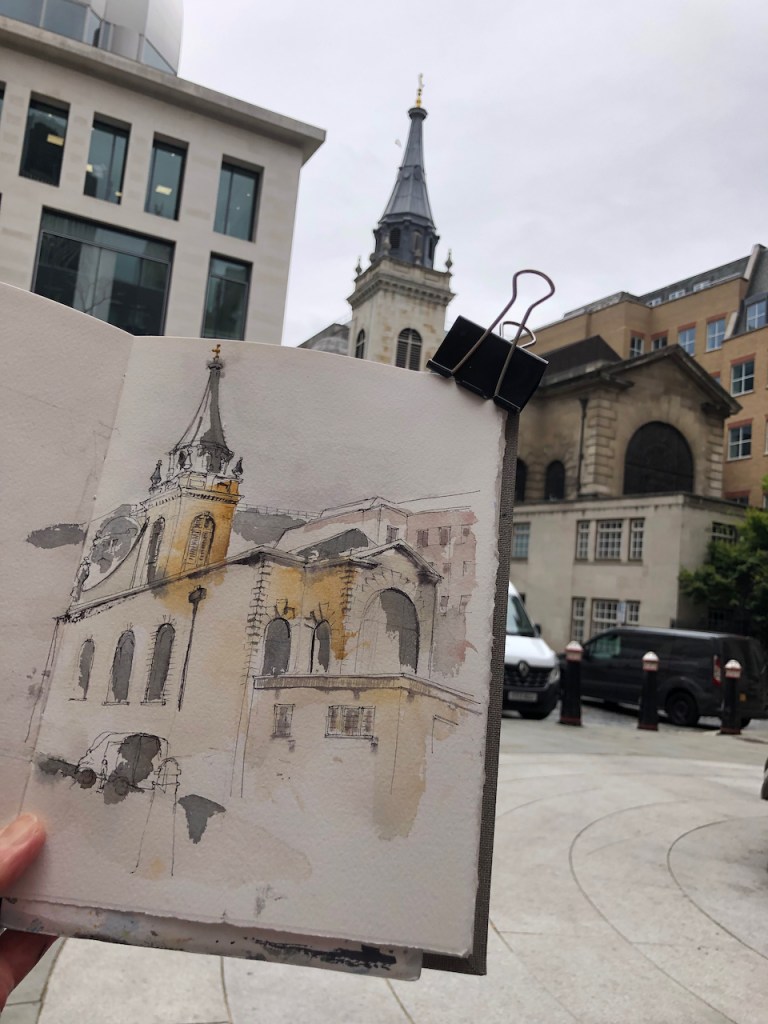
Here is the Anglican Church of St Vedast-alias-Foster, in the City of London, viewed from Priest’s Court. Before I drew this, I paused a while in the Fountain Court, a tranquil courtyard next to the church. In the shadow,…
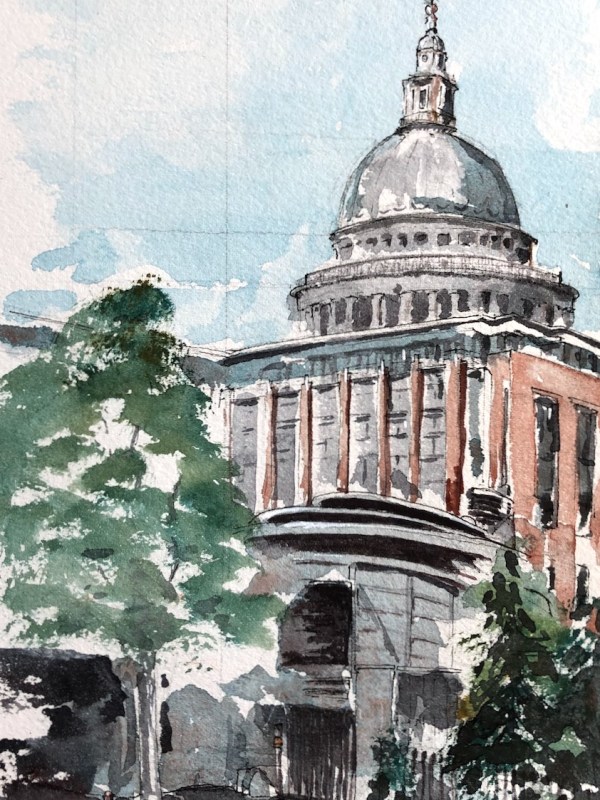
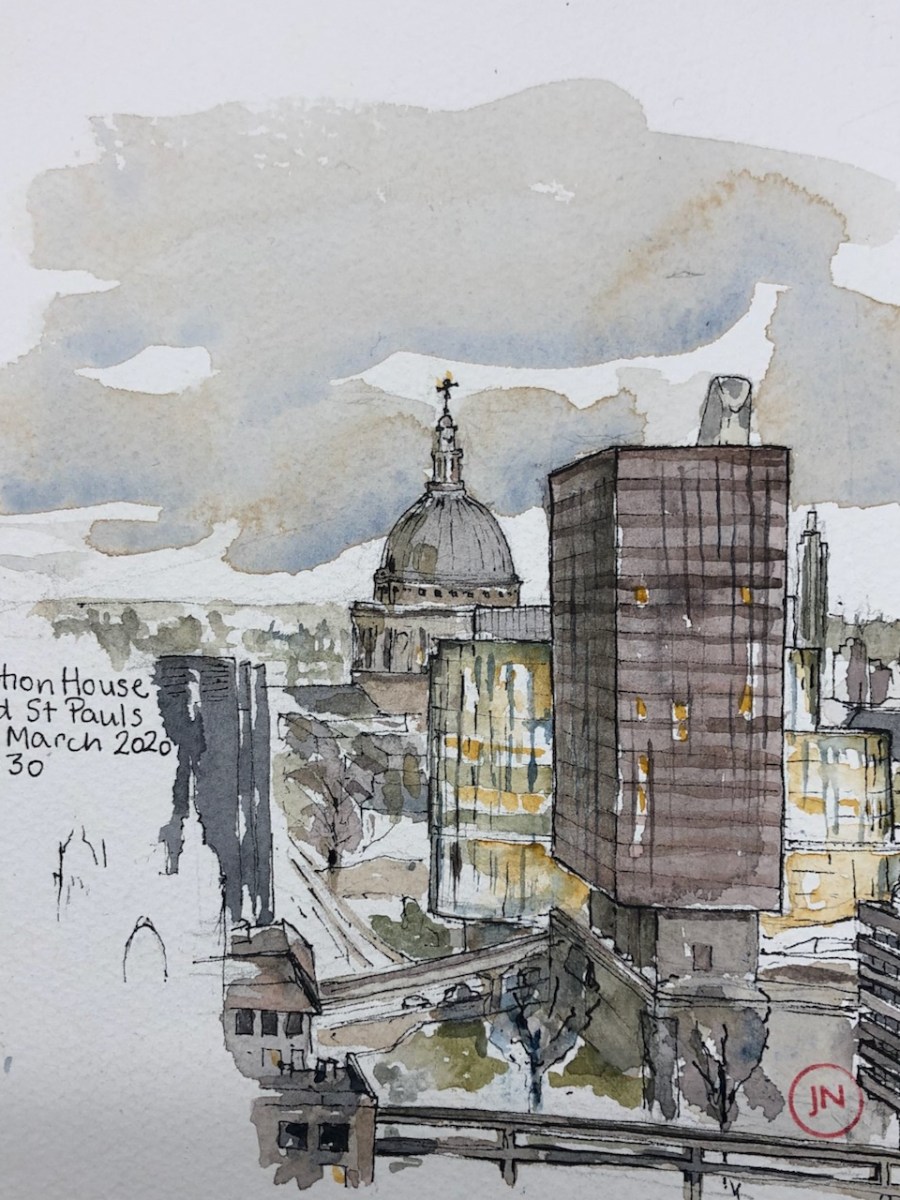
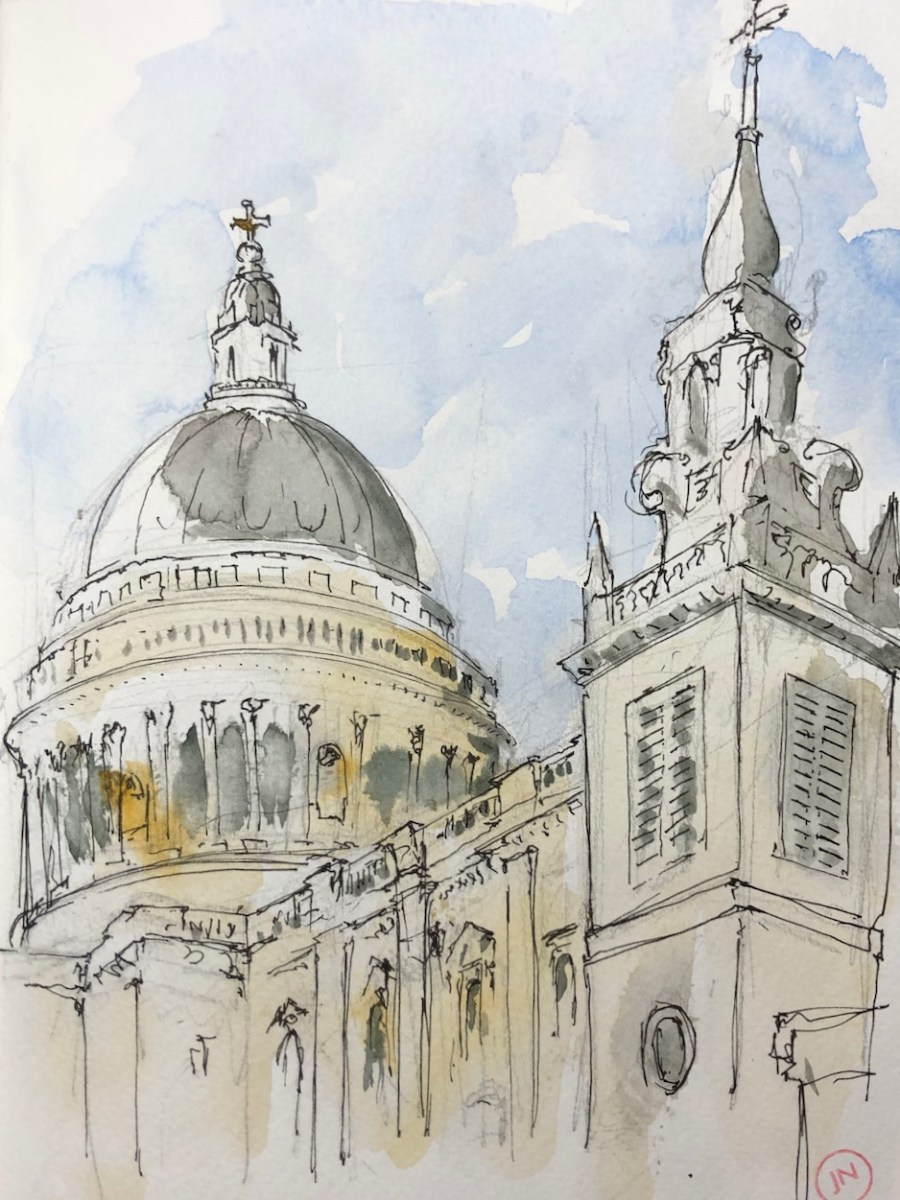
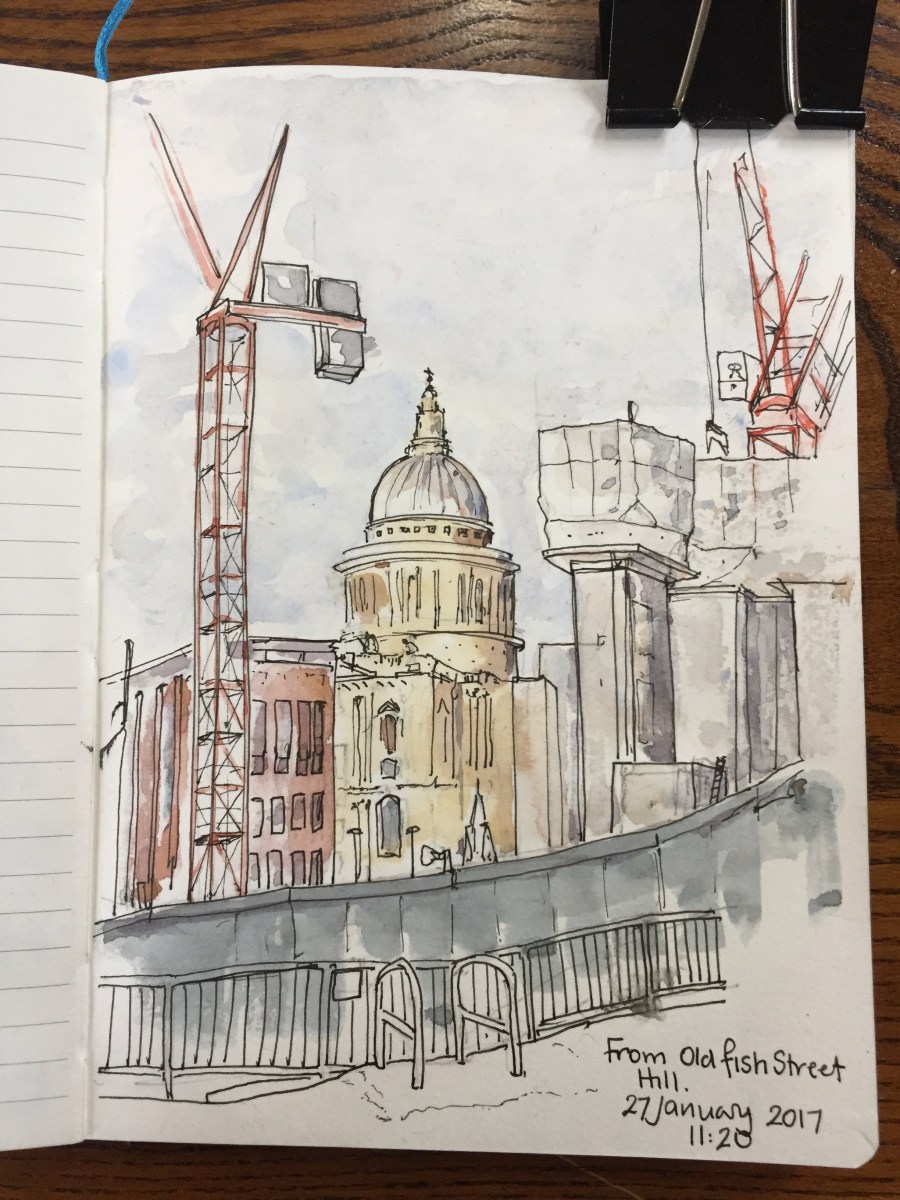
Here are some of my sketches of St Paul’s Cathedral, which was behind me as I sketched Haz.
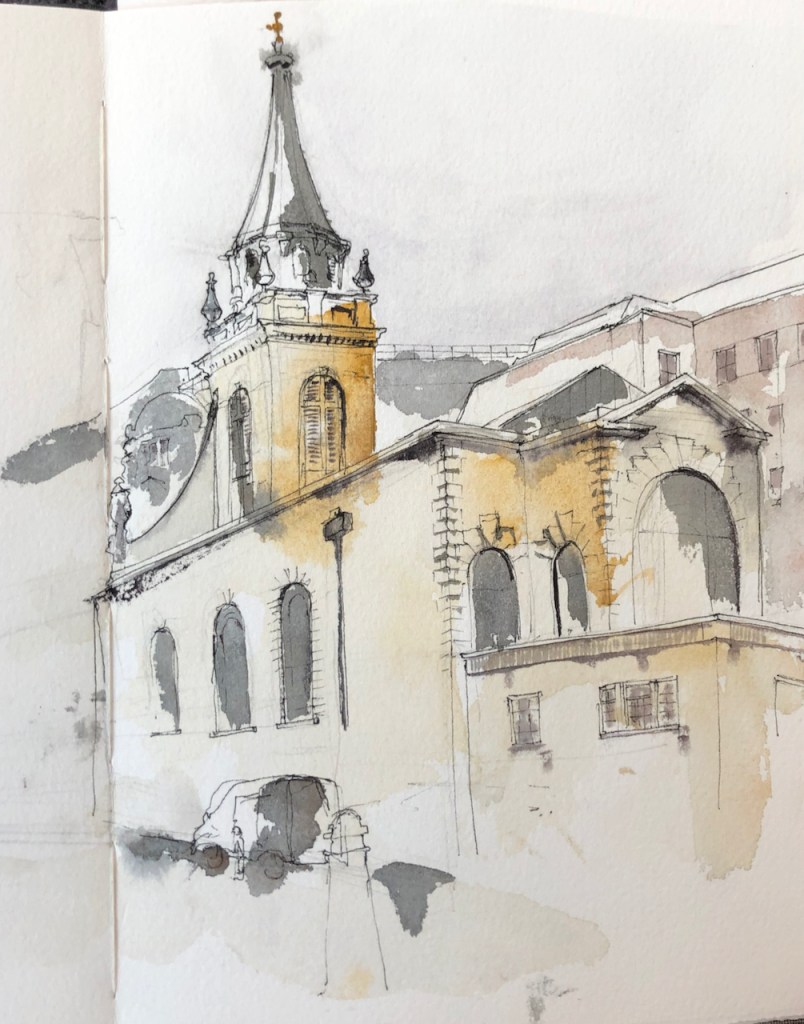
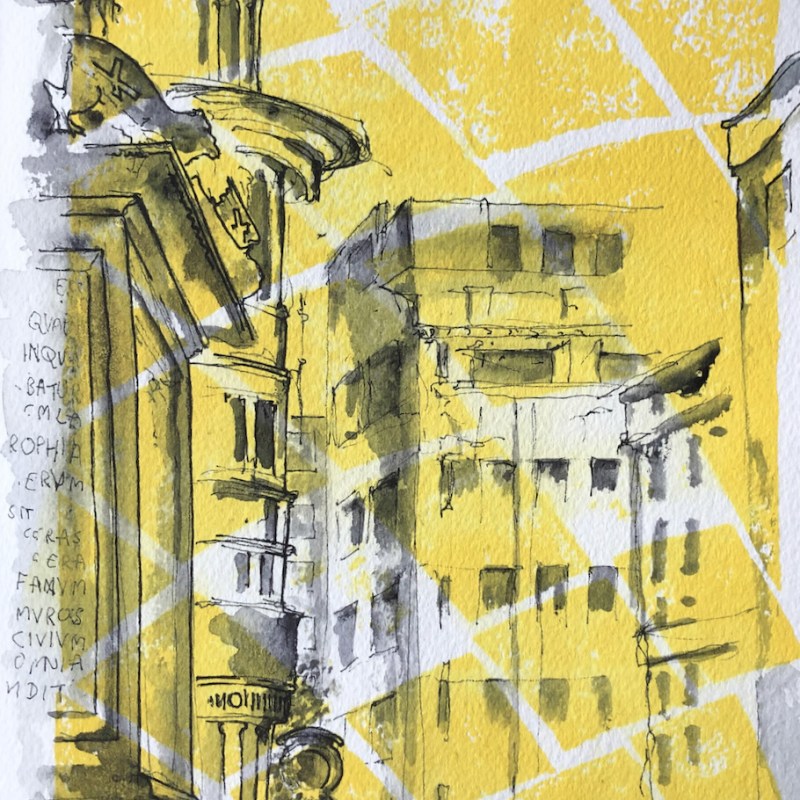
Here is a sketch of the church of “St Edmund King and Martyr” which is on Lombard St, City of London.
St Edmund King and Martyr, Lombard Street, from George Yard, EC3. 7″ x 10″ in Sketchbook 10
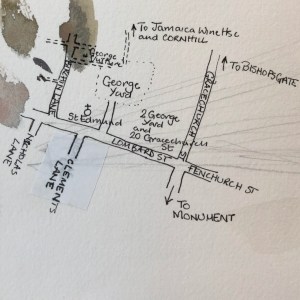
George Yard is at the intersection of a number of city lanes, one of which leads West to “The George and Vulture”, and another leads North to the Jamaica Wine House.
Also in George Yard is a marvellous leafy garden. In the garden, shaded by vegetation, is the tombstone of “Sir Henry Tulse”. Below the tombstone is the inscription telling you about its incumbent:
"Sir Henry Tulse was a benefactor of the Church of St Dionis Backchurch (formerly adjoining)
He was also grocer, Alderman, and Lord Mayor of this City.
In his memory, this tombstone was restored November 1937 by
"The Ancient Society of College Youths" during the 100th year of the society's foundation.
He was also Master of the Society during his Mayoralty in 1684"
St Edmund King and Martyr is an active church. The Church is, according to the notice on Lombard Street, “The Gregory Centre for Church Multiplication”. Church Multiplication has a clear mission statement on their website: “We equip and resource the Church to reach new people, in new places, in new ways with the good news of Jesus Christ.”
The Vestry Hall is the cubical building on the right of my drawing.
Just off the drawing to the left is 2 George Yard and 20 Gracechurch Street, a modern building, where a long list of companies are registered with financial sounding names: “The Close Investment 1988 Fund “A” “, “The Greater Mekong Capital Fund”. This is the City of London, with all its contrasts and juxtapositions.
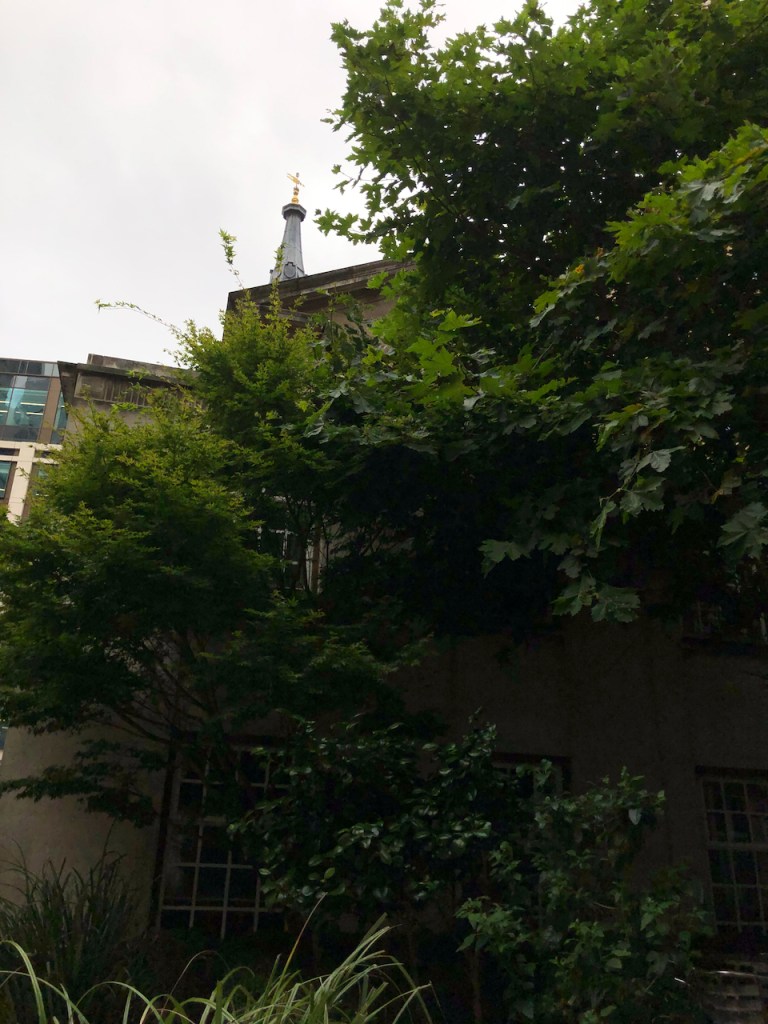
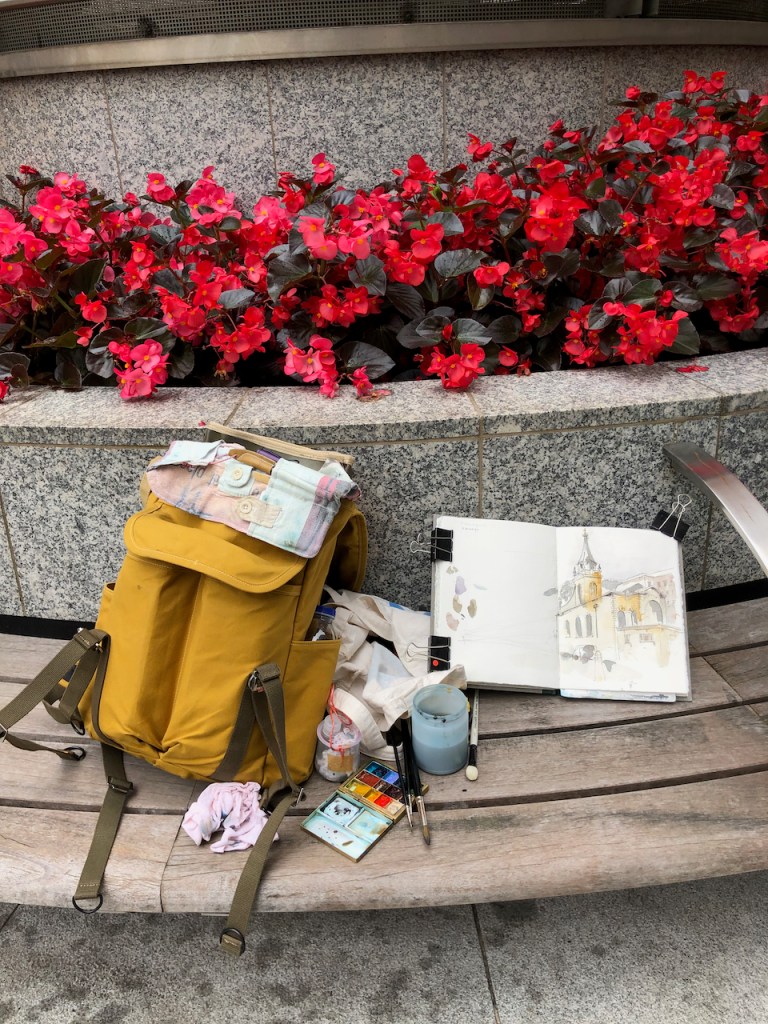
Here is work in progress on the drawing, and a view of the Church from the leafy garden.
This drawing took about 1 hour and 20 mins. The colours are Mars Yellow, Perylene Maroon, and Phthalo Blue Turquoise.
Click a button below to share this post online, email it, or print it:
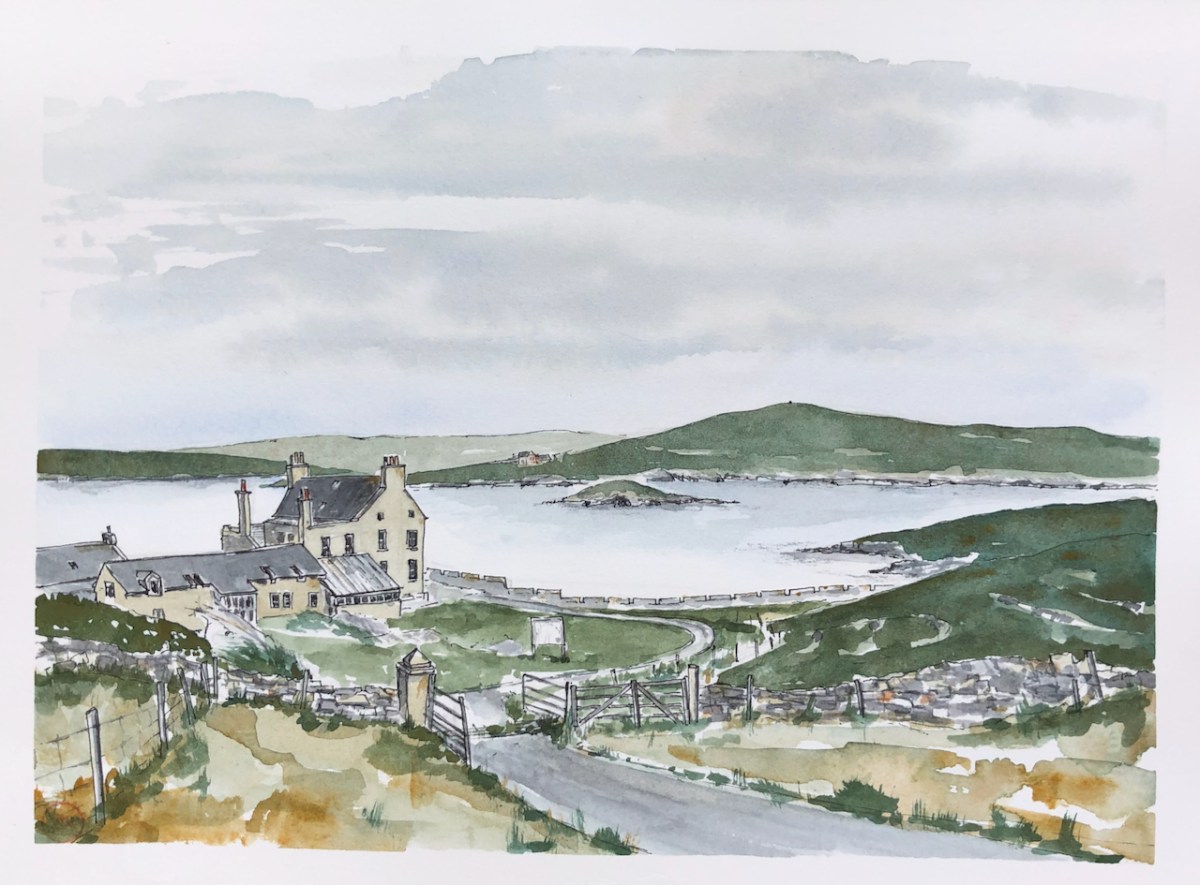
Here’s a view of Burrastow House, Walls, Shetland, as you enter the drive.
Burrastow and the bay, Picture 1, July 7th 2021
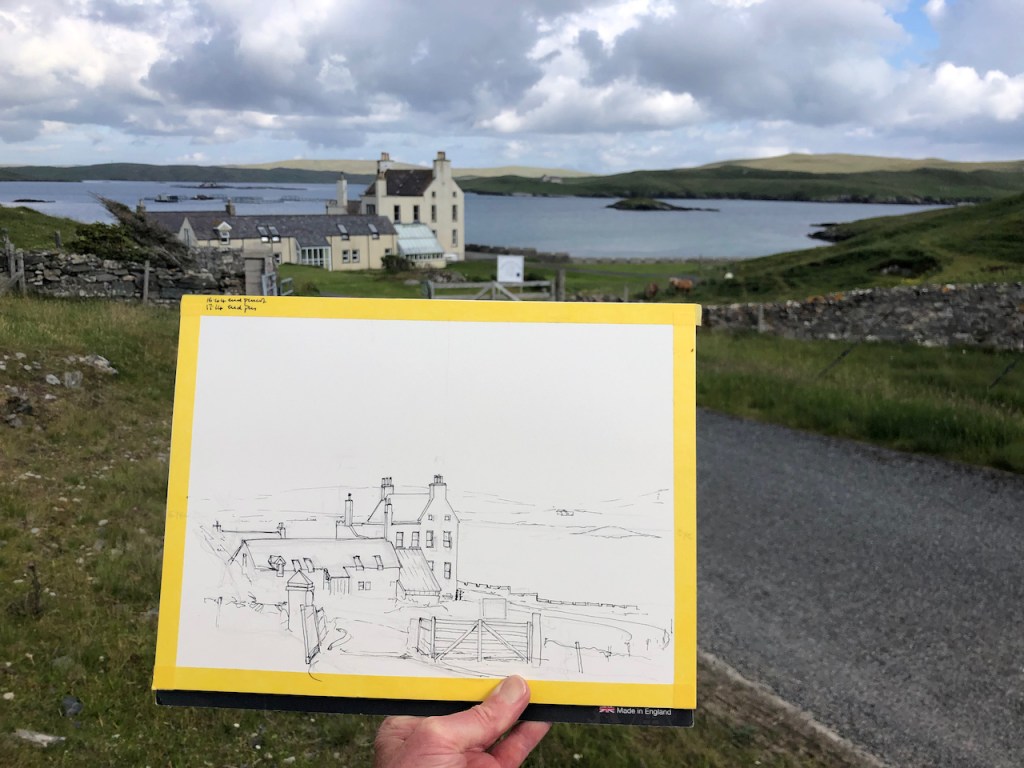
There was a lively wind. Those clouds looked like that, and kept changing. The small island on the right is the Holm of Burrastow. The hills behind it are the island of Vaila. Here is work in progress.
Then I drew another view, from higher up, on a mound above the road.
Burrastow and the bay, Picture 2, July 8th 2021 [SOLD]
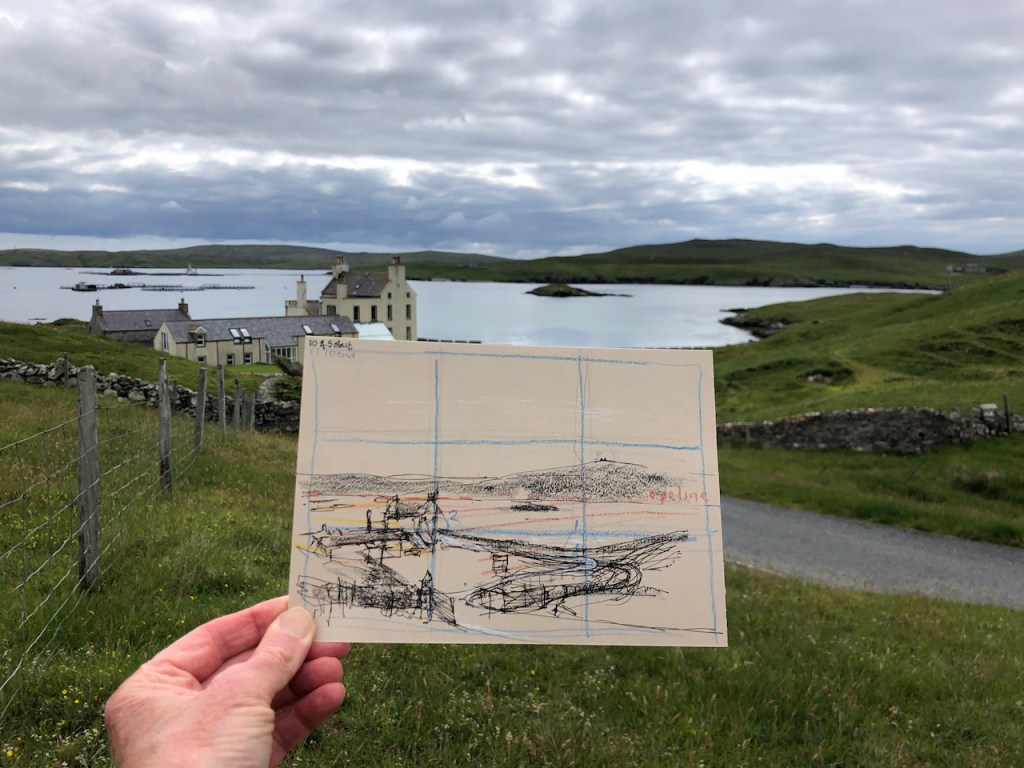
Here is work in progress and a view of my sketching location for picture 2: a chair perched on a hill.
Pen-and-ink stage
Sketching location
Sketching location
Preliminary sketch
Checking the perspective
Burrastow and the bay, Picture 2, work in progress
Both pictures on a block of Saunders Waterford 300gsm watercolour paper, “hot pressed”, 12 inches by 9inches. The yellow edging you see on the work-in-progress is masking tape. I put it round the edges for several reasons:
It enables me to hold the picture safely without leaving thumb-marks
I can write annotation on it, specifically “eye-line” and the heights of things.
When the picture is complete, I peel it off and it leaves a nice white border, which makes the picture easier to frame.
To see the comparison between the pen-and-ink and the colour, use the slider in the image below:
Compare the “before” and “after” on Picture 1
Click a button below to share this post online, email it, or print it:
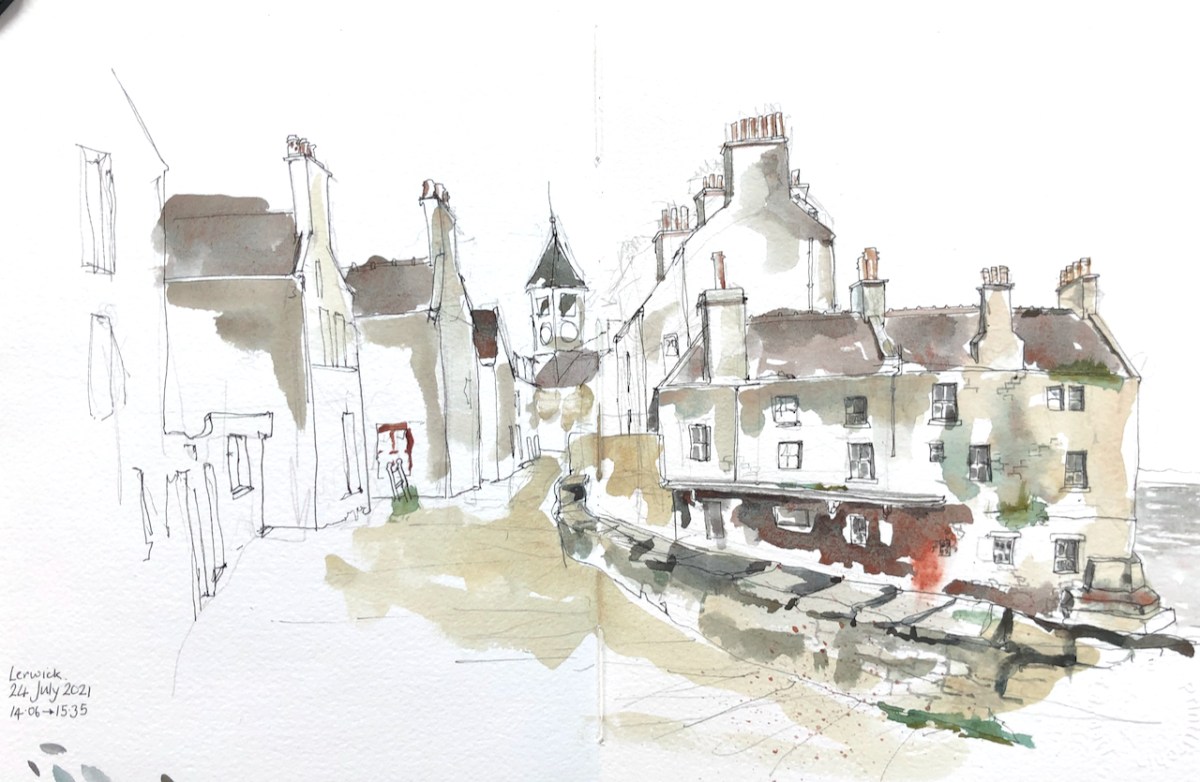
Here is a view of houses in Lerwick known as “lodberries”. They are built into the sea. Lerwick is one of the few capital cities in the world that has a beach. The other I know is Sydney Australia. The beach in Lerwick is somewhat smaller than Bondi beach, and is over the wall to the right of my picture.
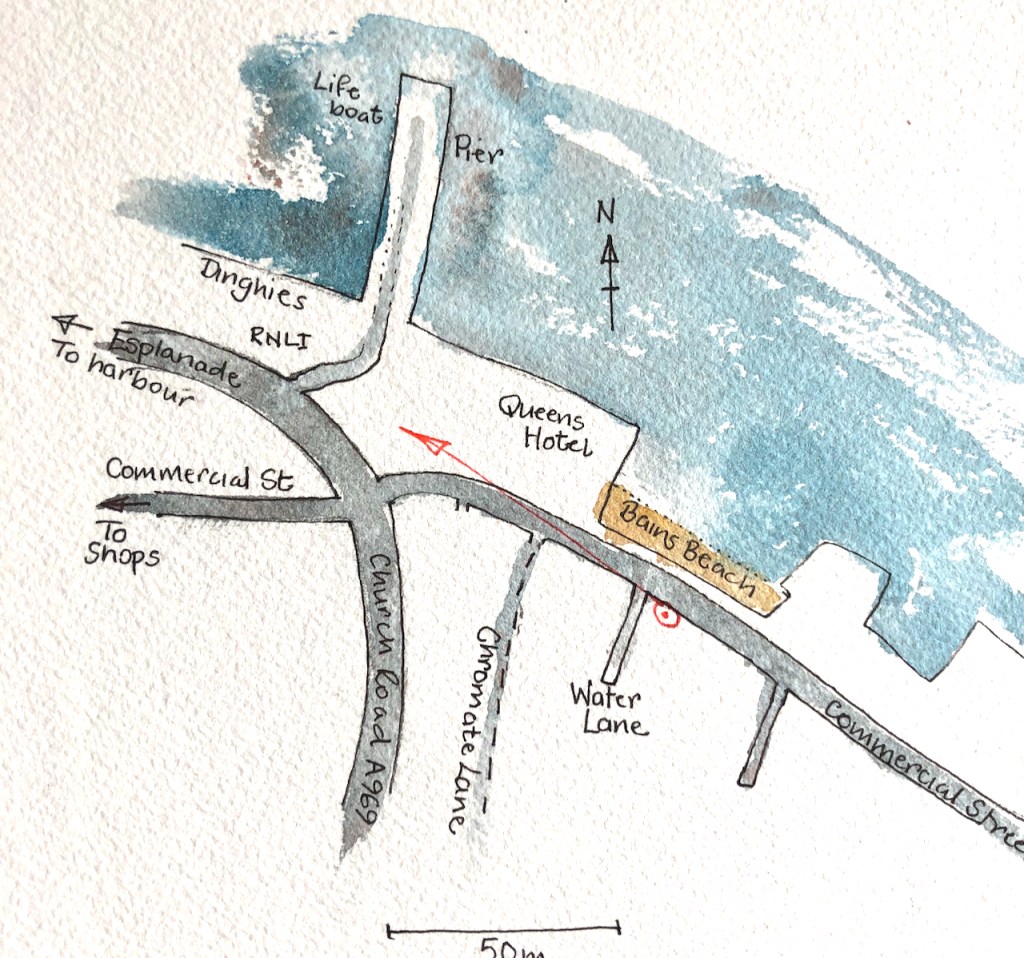
I drew this picture sitting on a bench next to the aptly named “Water Lane”. I was just thinking how peaceful it was, how few people, and how unlike London, when a car came and parked directly in my line of sight, blocking my view of the part I had yet to draw. A small family emerged out of the car. Children ran around with buckets and spades, a woman corralled them down the steps and onto the beach. A man got out of the driver’s seat and saw me. He smiled. It was a sunny day. I smiled a mixed smile. Suddenly he saw that I was drawing. “Oh!” he said, “Shall I move the car?” I said yes, that would be very kind. Without any hesitation he jumped back into the driver’s seat, fired up the engine and parked in a space up the road. He waved to me as he walked to join his family down on the beach. I waved back.
Commercial Street, Lerwick. Lodberries. July 24th 2021, in Sketchbook P1 double spread: 14″ x 10″ approx. 1½ hours on location
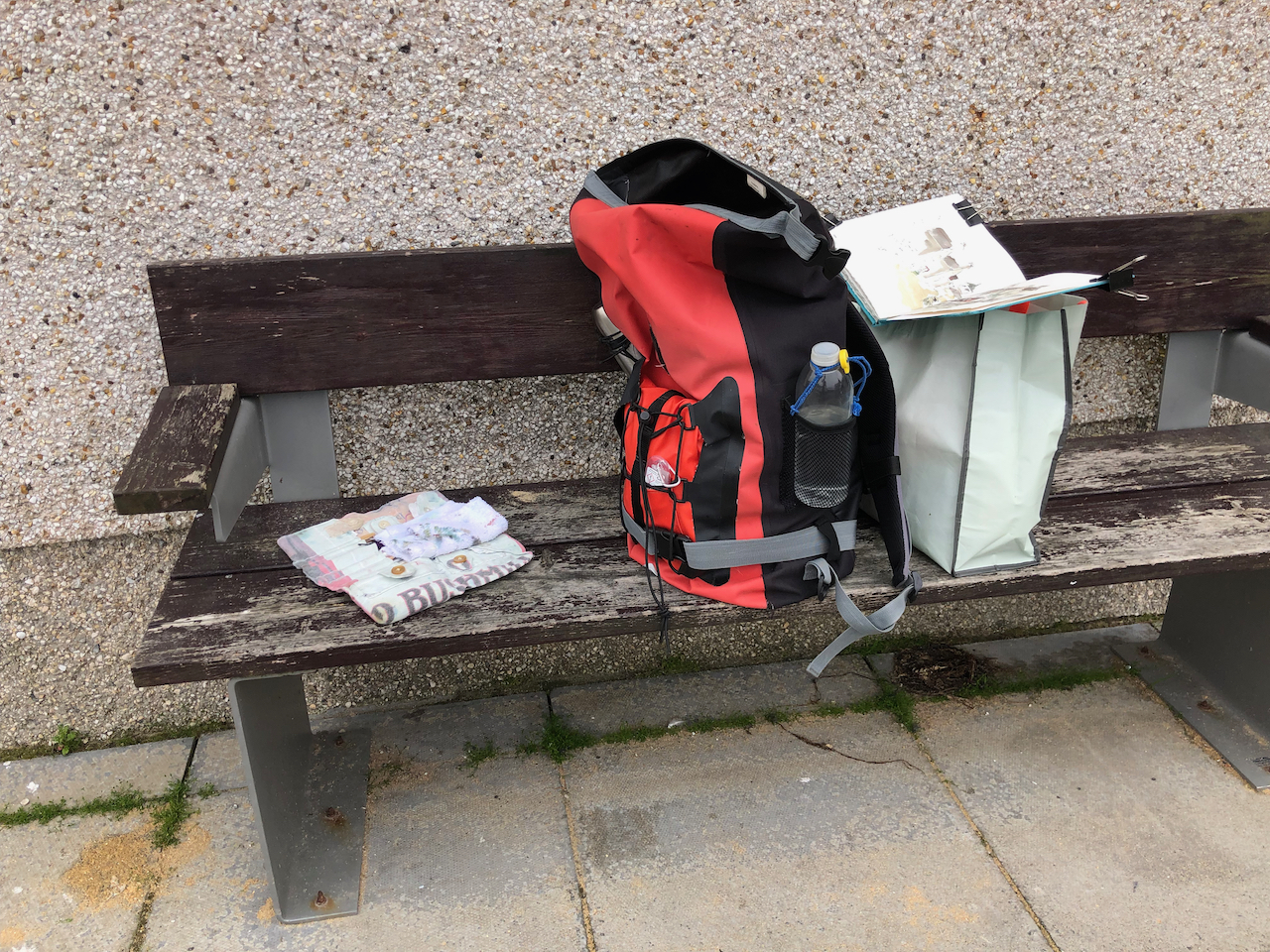
Here is work in progress:
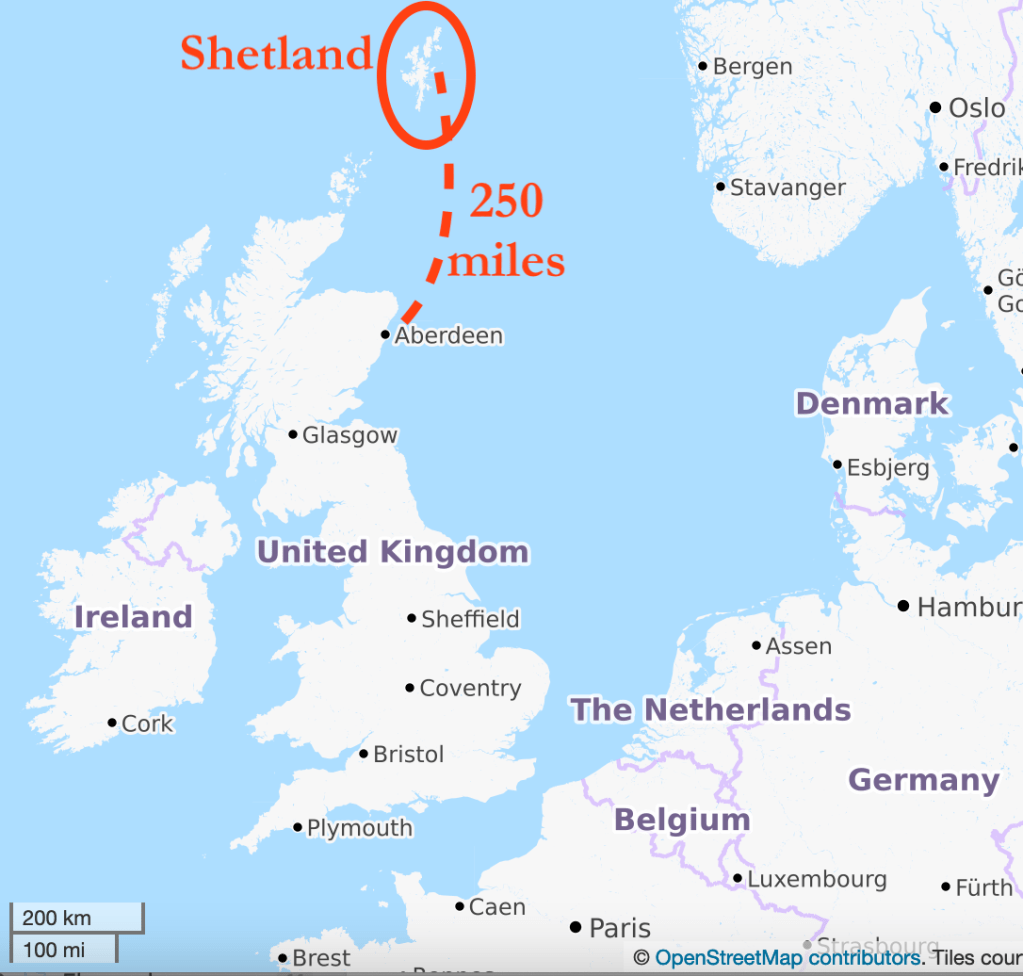
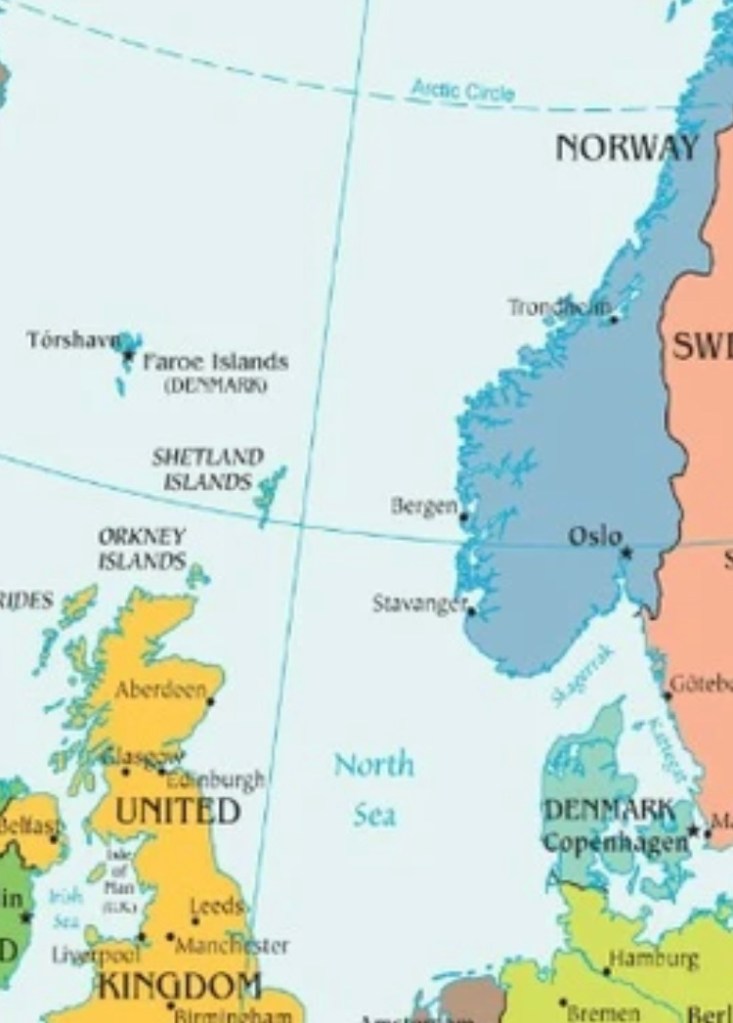
Here are some maps to show the location. I have also included maps showing where Shetland is, since people have asked. It is about 100 miles off the north coast of Scotland. From Aberdeen it is some 250 miles (400km) and takes 13 hours by ferry. Shetland is at a more Northerly latitude than Oslo and Stavanger, nearer Bergen than Aberdeen and nearer Copenhagen (590 miles) than London (600 miles).
Here is a view of the North Sea approaching Aberdeen. See the wind turbines.
Click a button below to share this post online, email it, or print it:
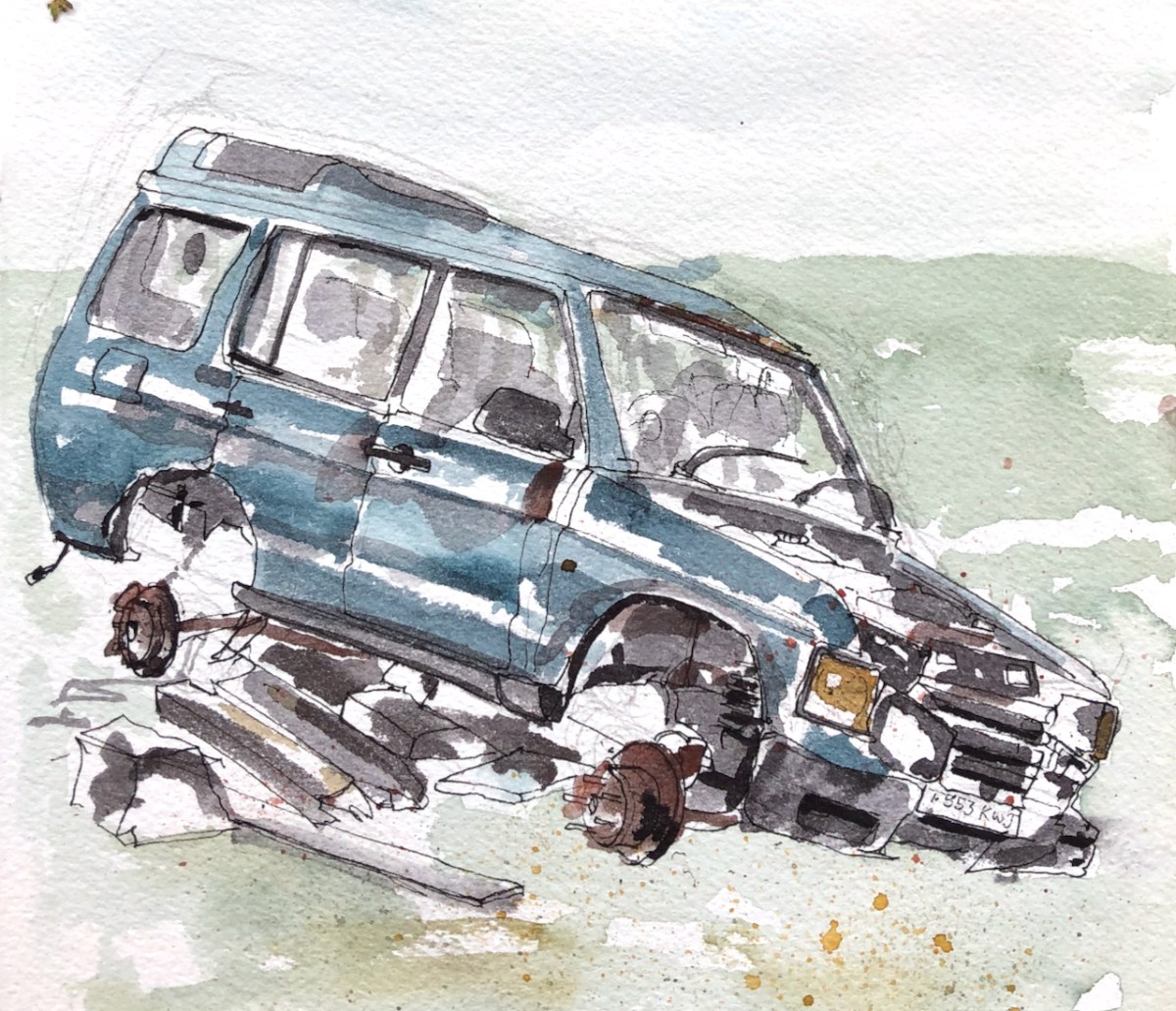
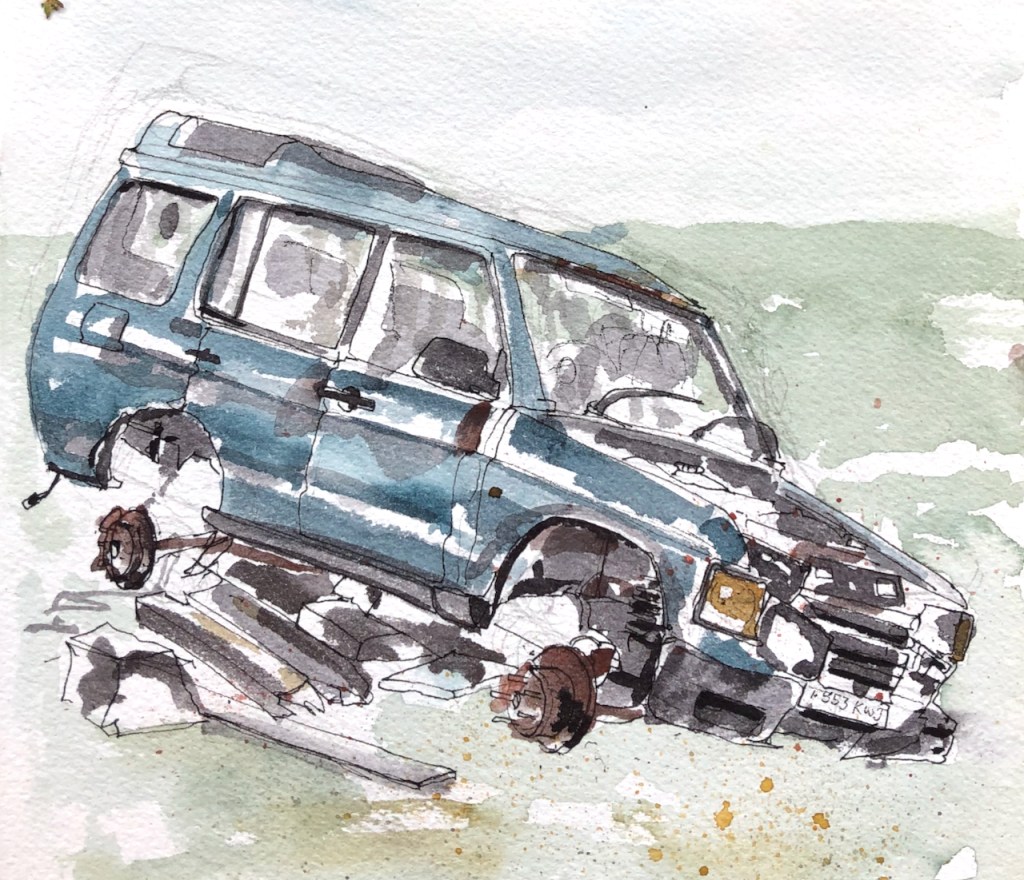
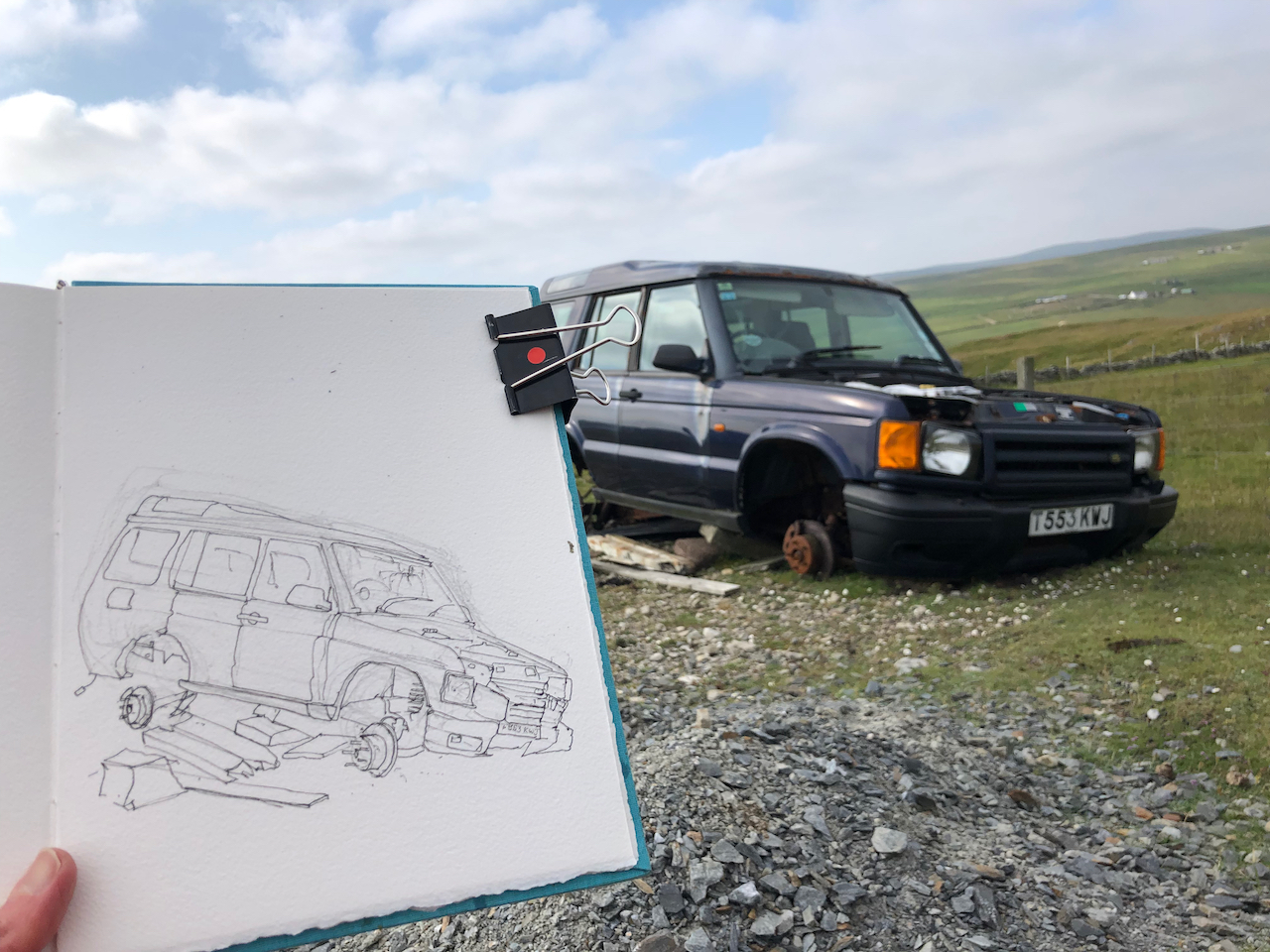
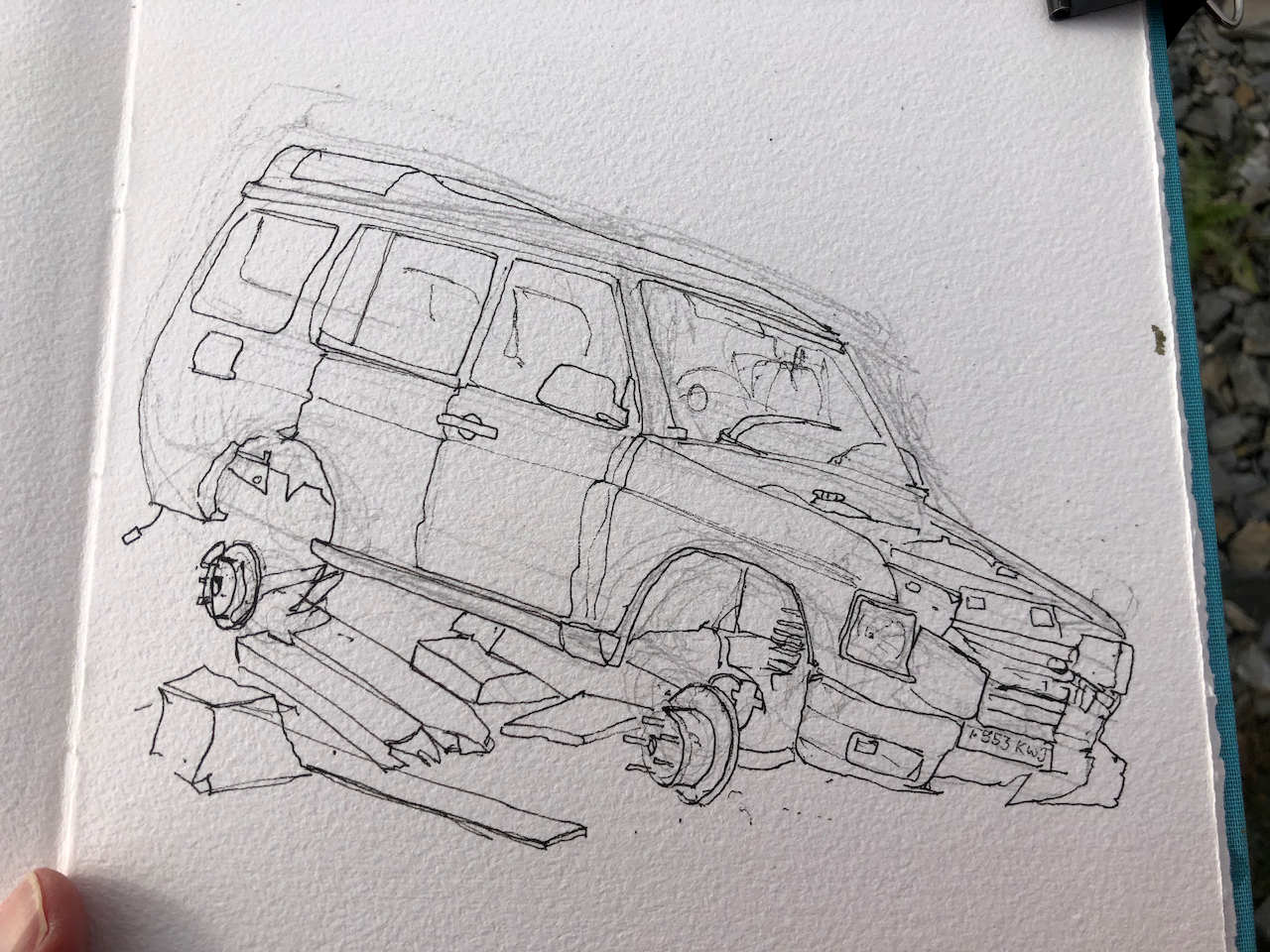
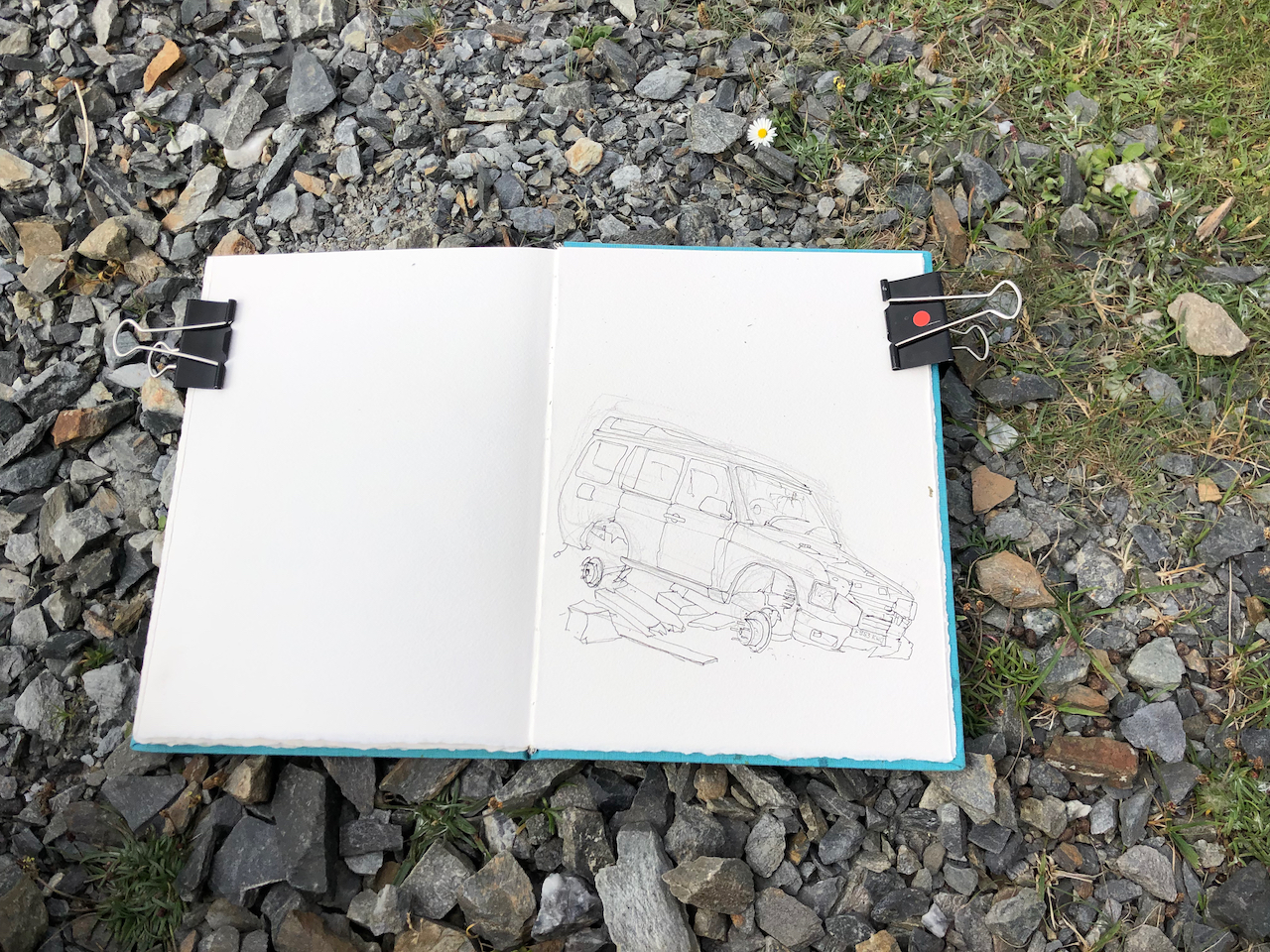
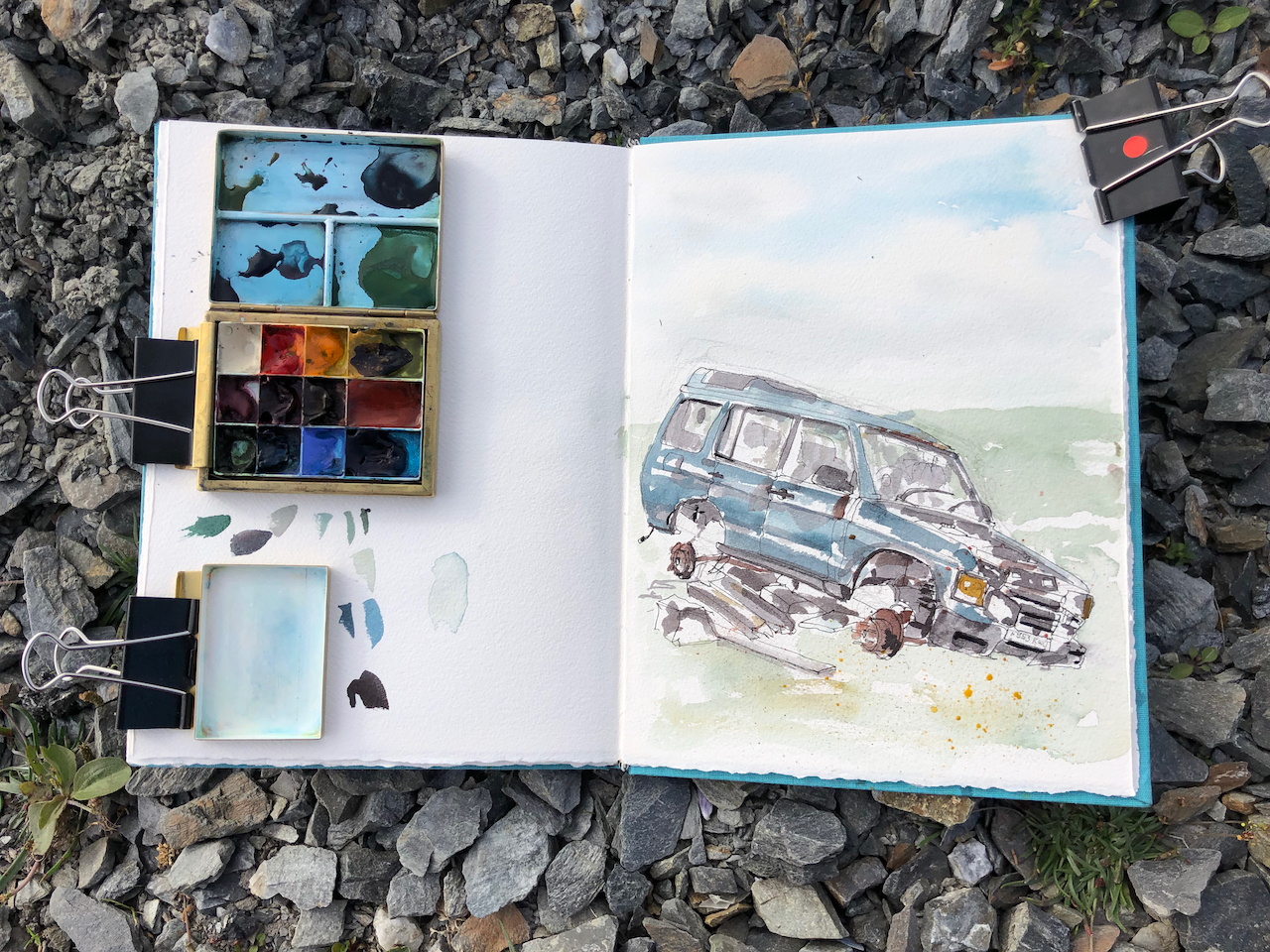
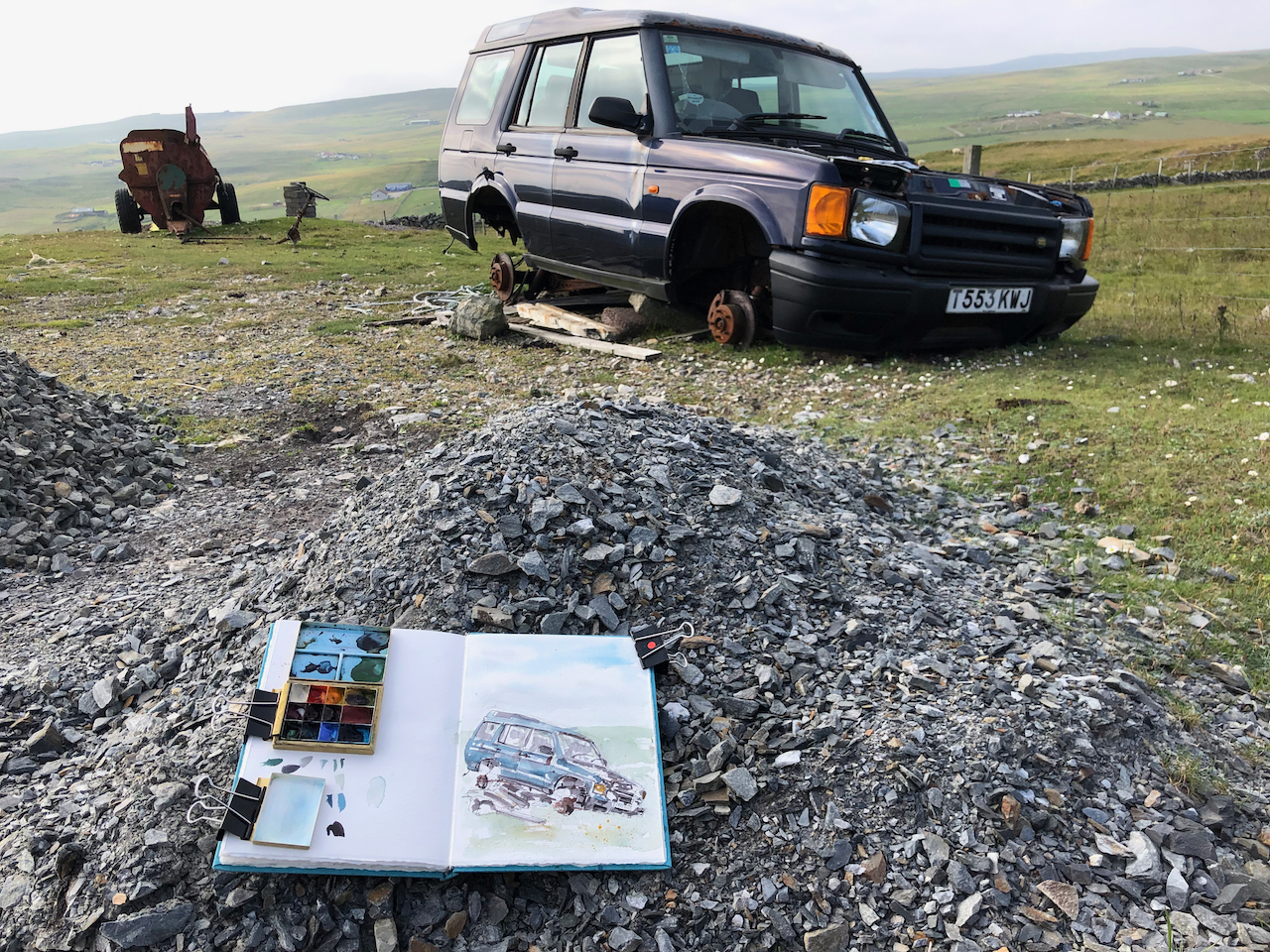
There’s a lot of empty space in Shetland. As I walked around, sometimes I encountered abandoned vehicles. Here is one. This was the last of a sequence of such car wrecks on a track.…
I thought the background was a bit bright, so I chose more muted colours for the next attempt.
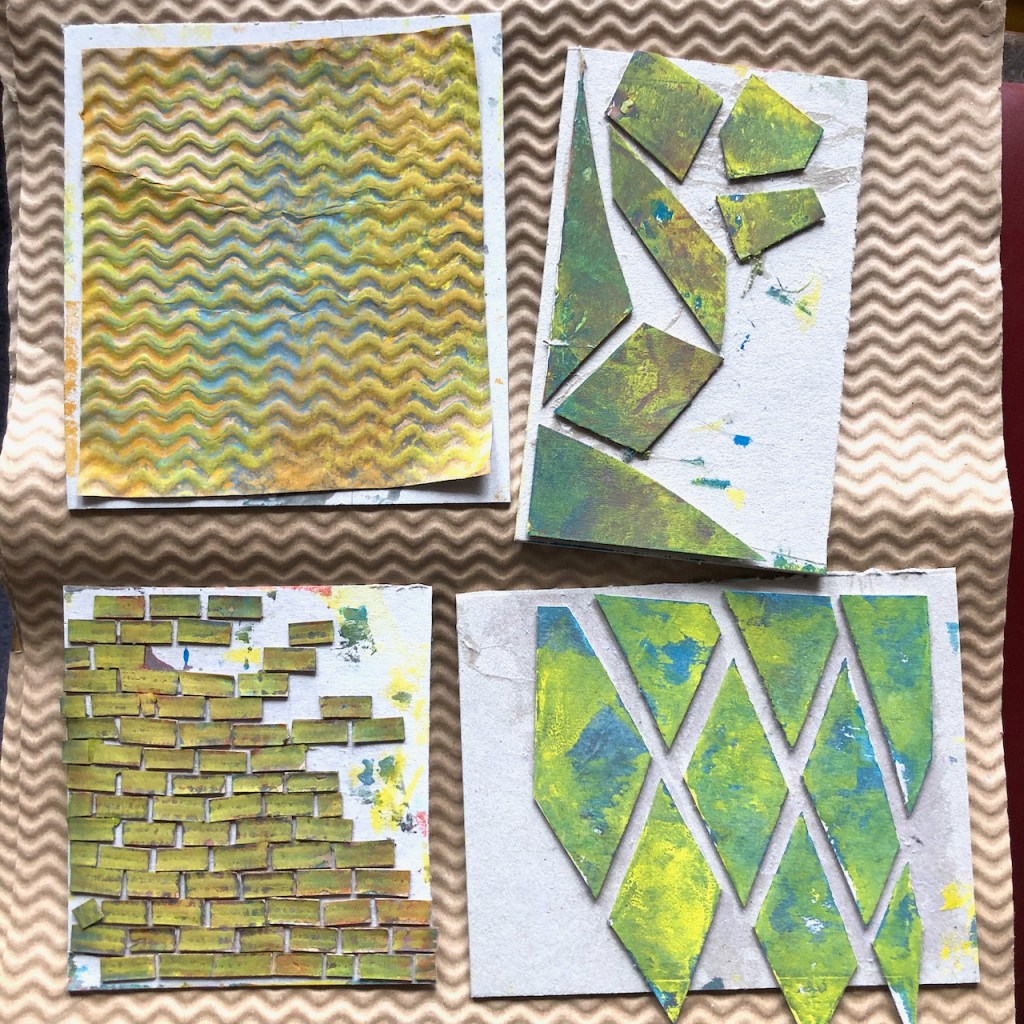
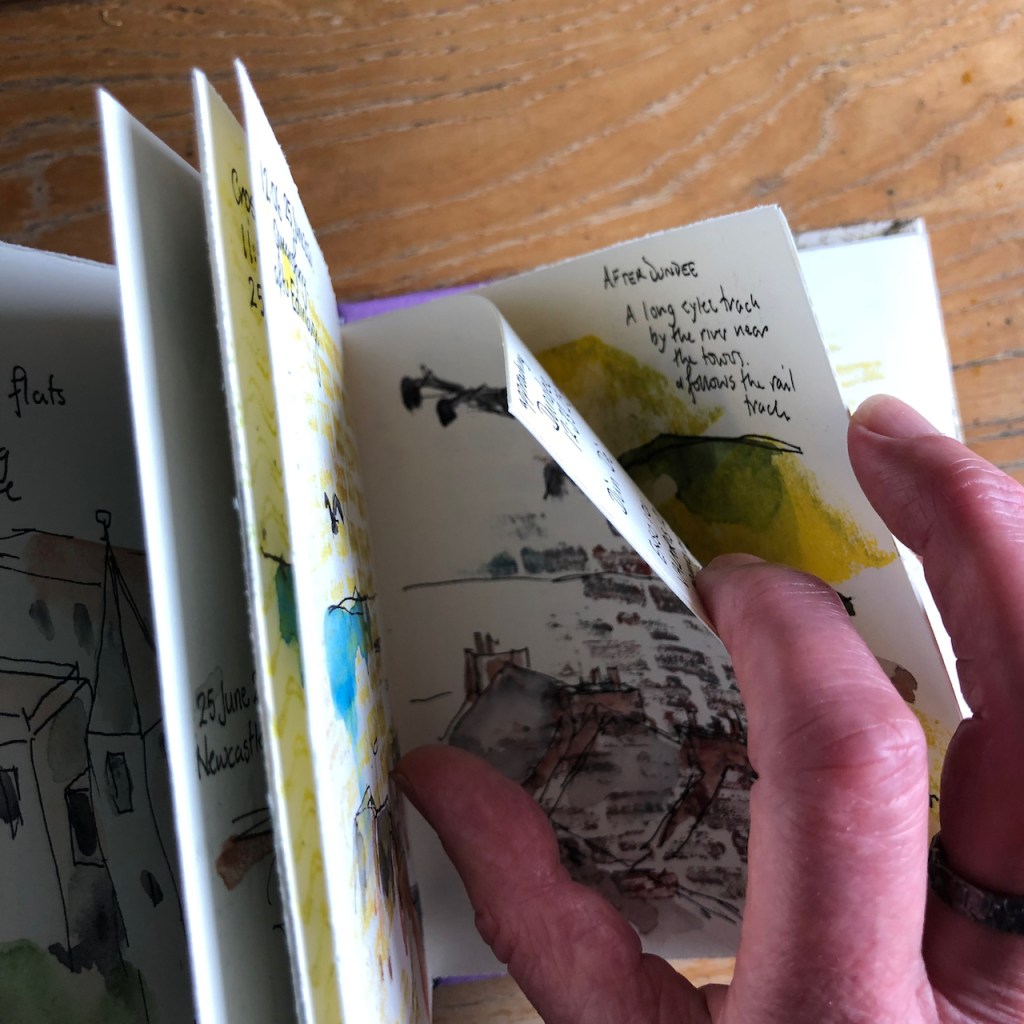
Here are the cardboard cutouts I used for making the relief prints. I used a small square sketchbook made by “PrintUrchin” and pre-printed the pages using relief printing ink, diluted with extender and water so it wasn’t too bright (learning from last time). It still came out quite bright. Those printing inks are heavily pigmented.
Cardboard cutouts
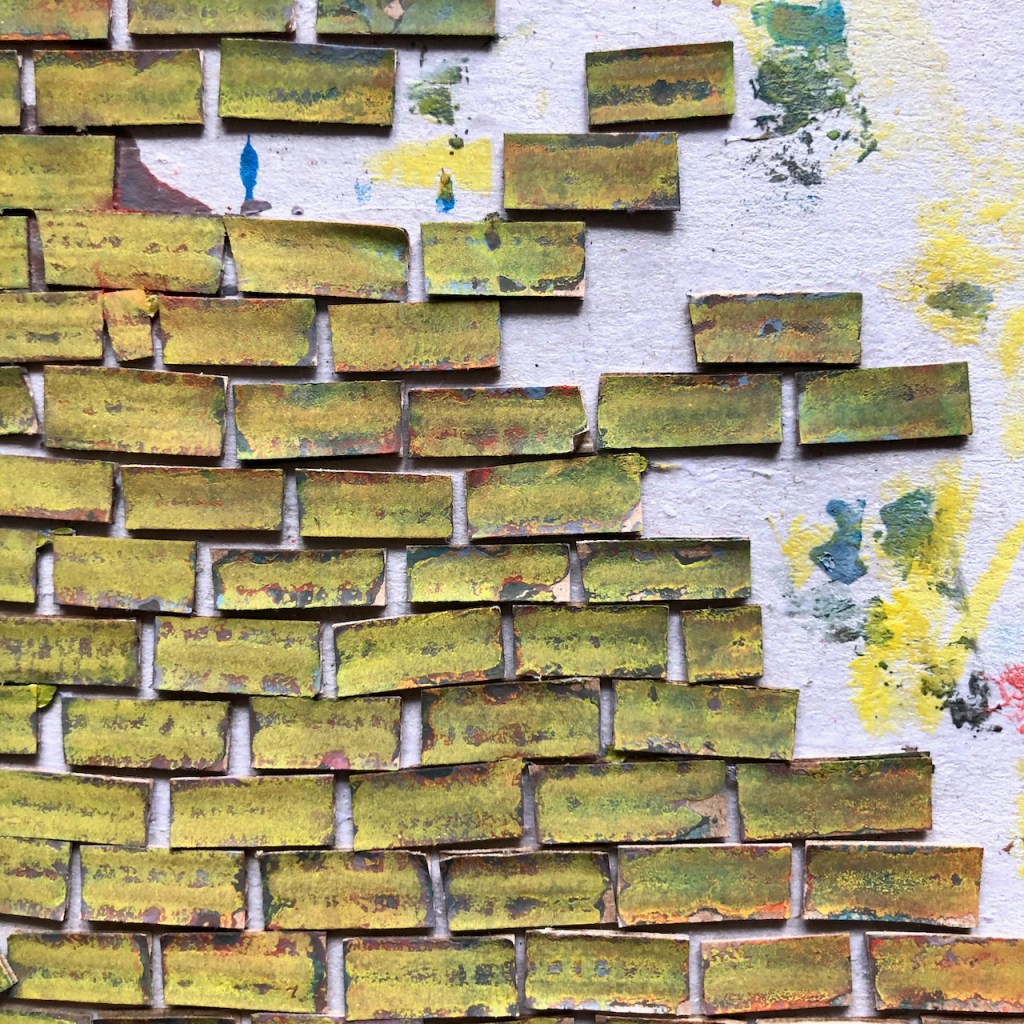
Cutout – close-up
PrintUrchin sketchbook
Sketchbook pages
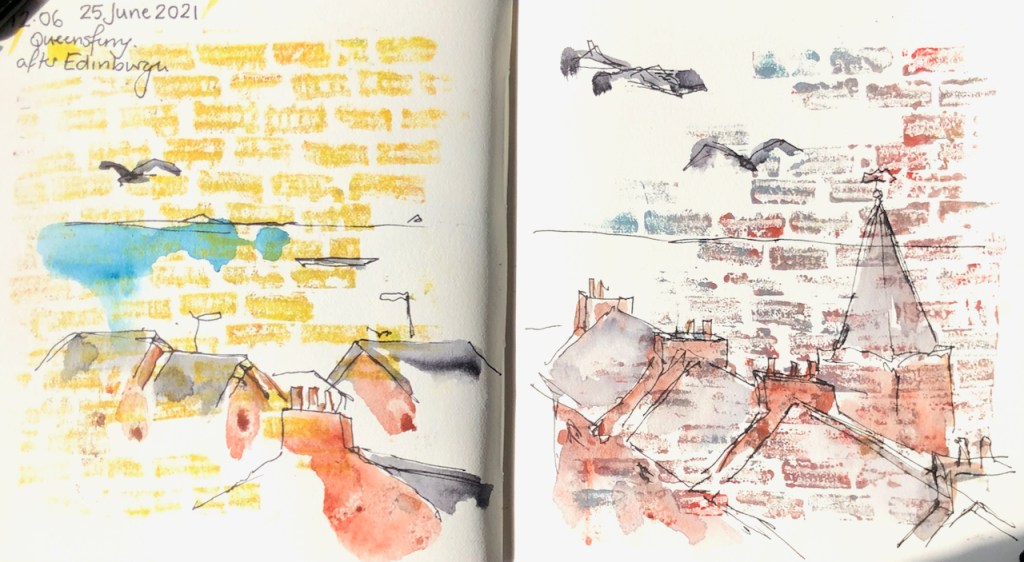
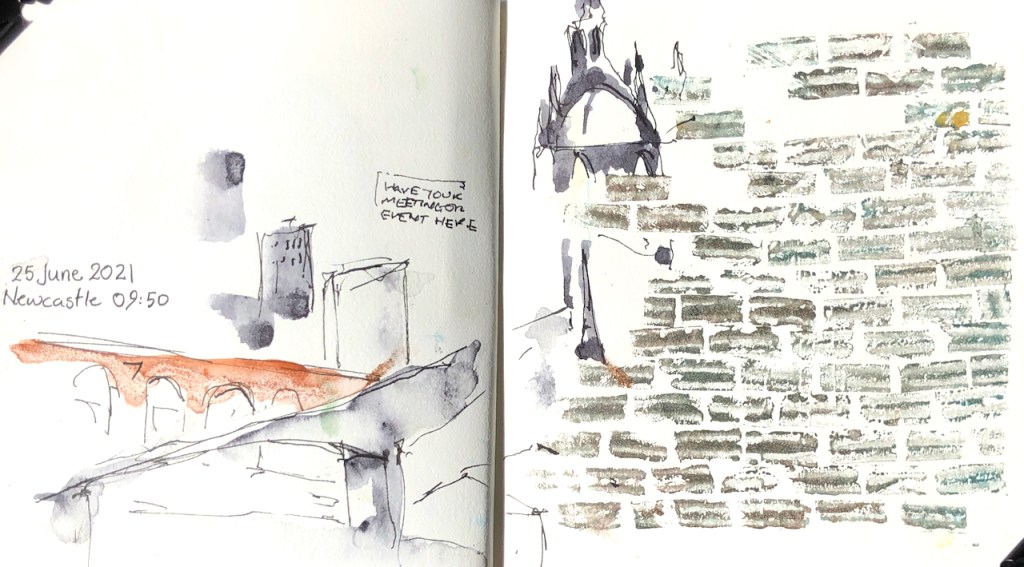
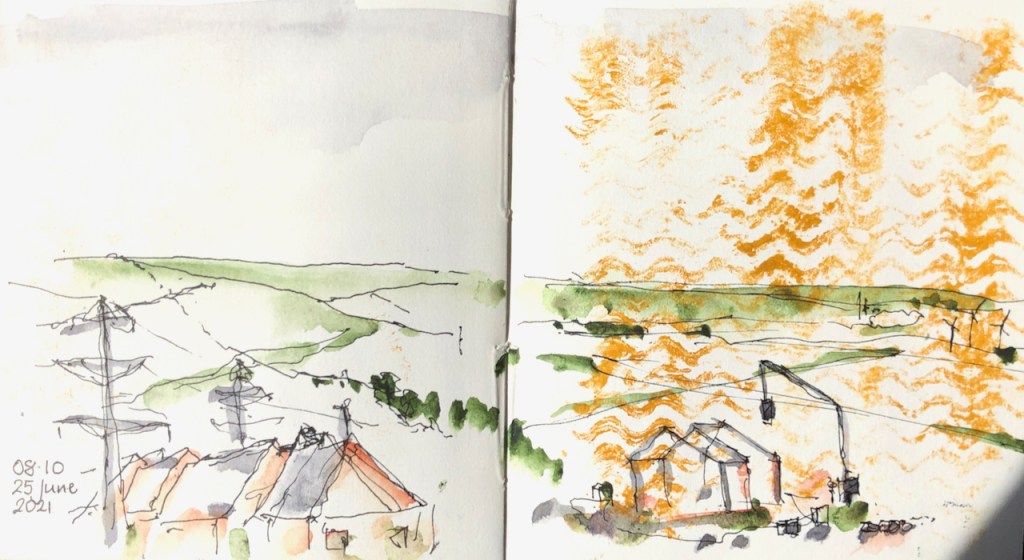
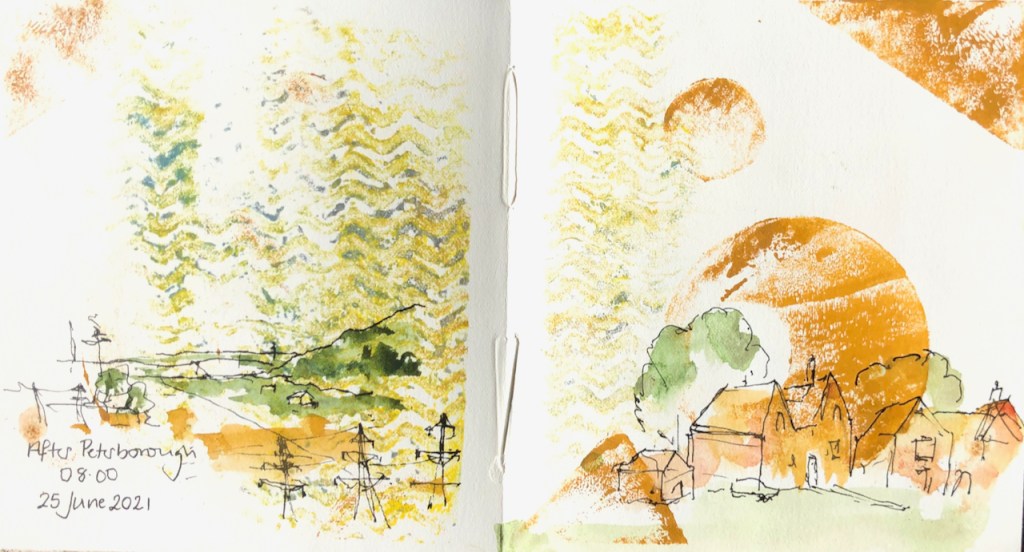
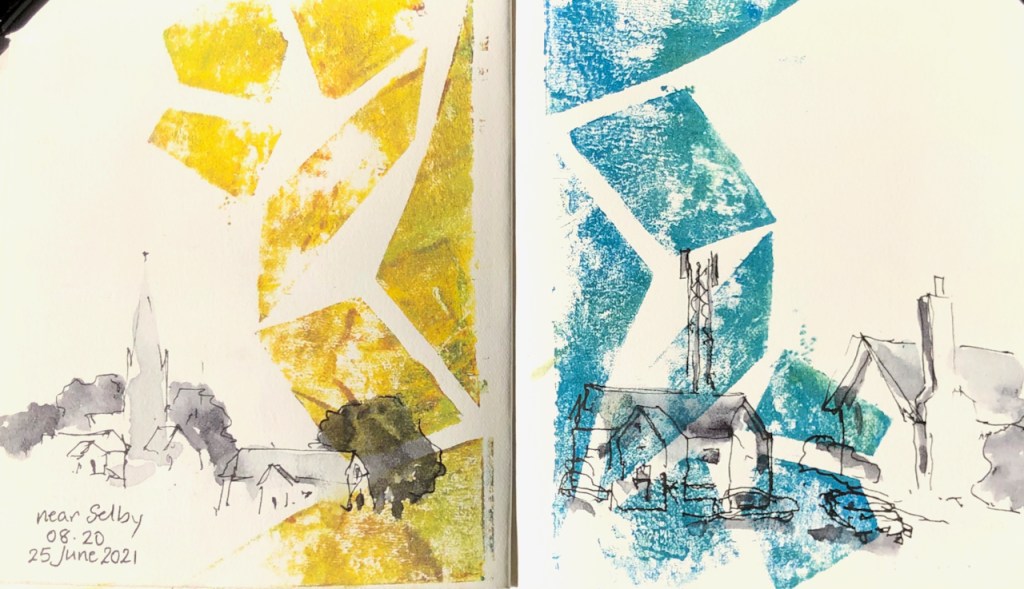
I printed the pages first, then took the sketchbook with me on my journey, and made sketches on top of the prints.
Here are some of the sketches. They are done on the train, hence the rather shaky lines. It’s amazing how the printing, done in advance, seems to fit the subject.
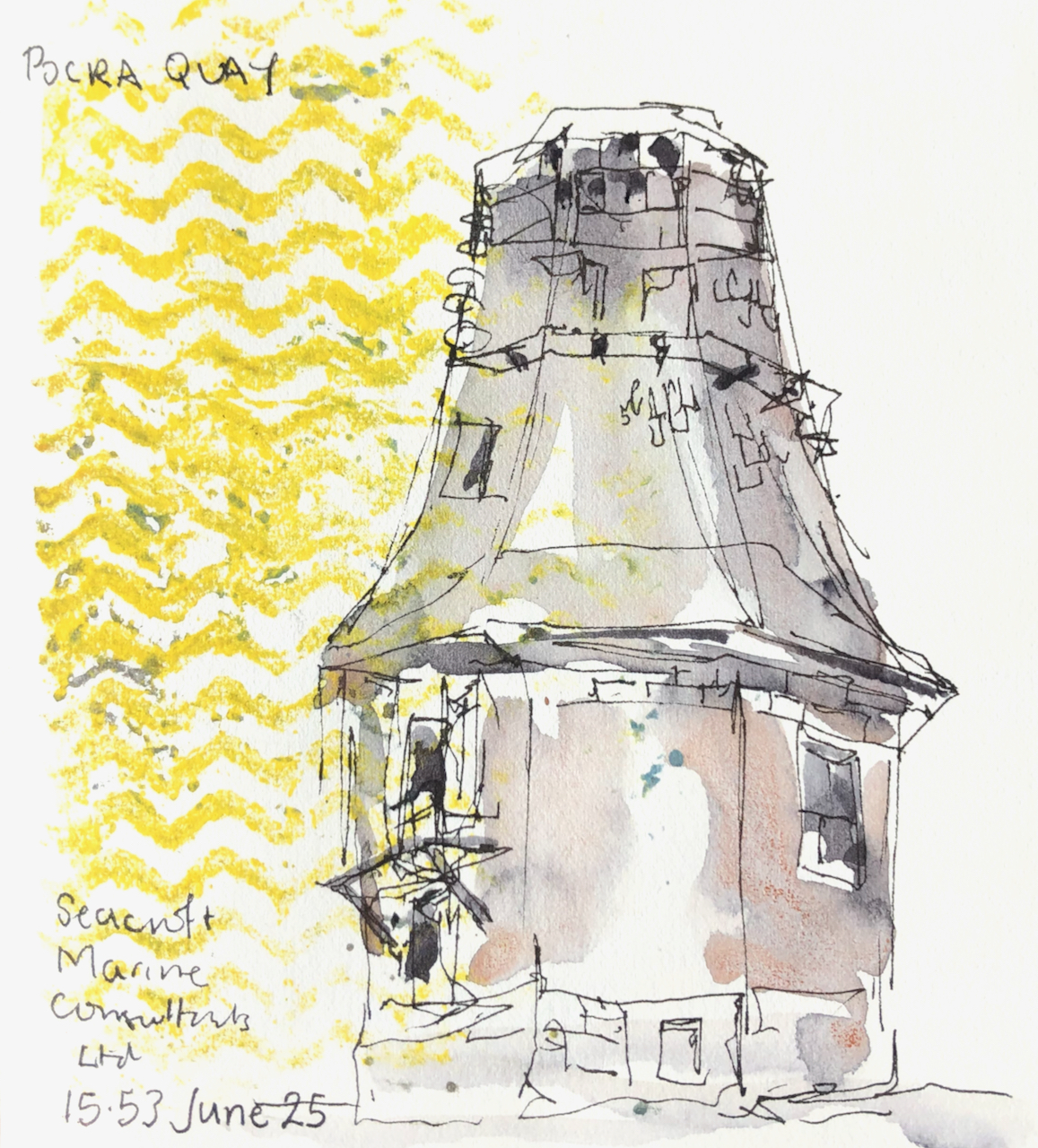
Here is the octagonal building at Pocra Quay, drawn while on a walk round Aberdeen waiting for the ferry.
Octagonal building at Pocra Quay, Aberdeen, 25th June 2021, printed background, 20th June 2021.
This octagonal building was a Navigation Control Centre, operating up until 1966. It was built in around 1797-8, according to the leaflet from the Aberdeen Heritage trail. I sketched it from the shelter of the doorway to the “Silver Herring” restaurant, on a cold, windy and rainy day.
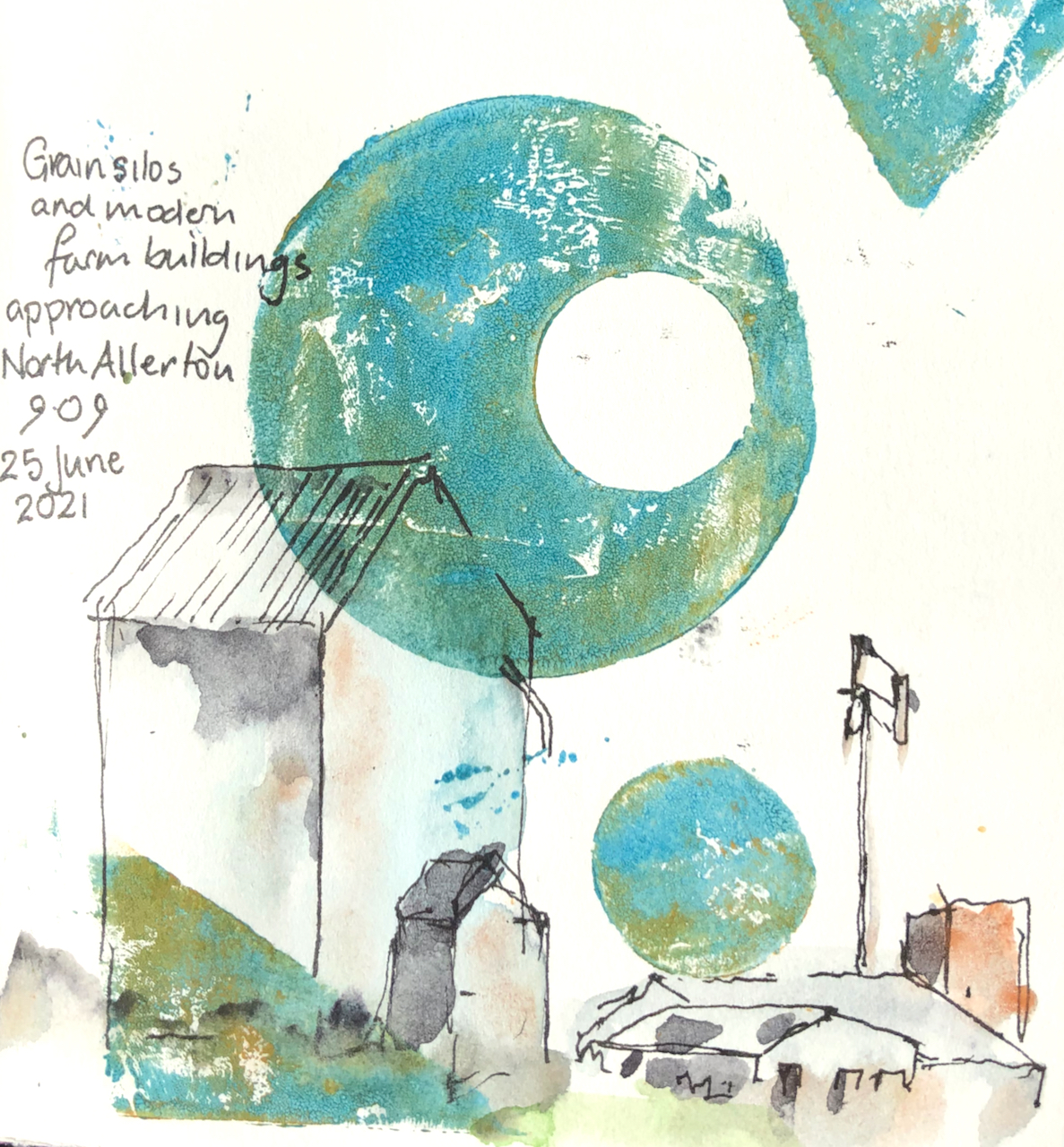
Grain silos at North Allerton, 25th June 2021
This is a really fun technique. I shall use it again.
Click a button below to share this post online, email it, or print it:
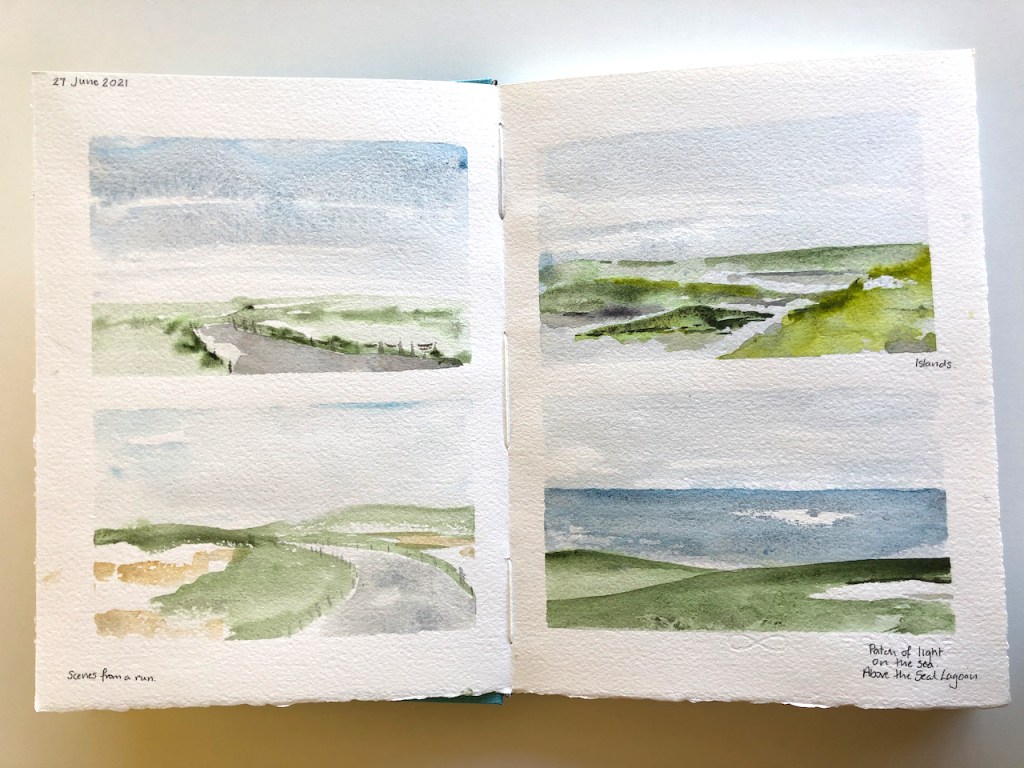
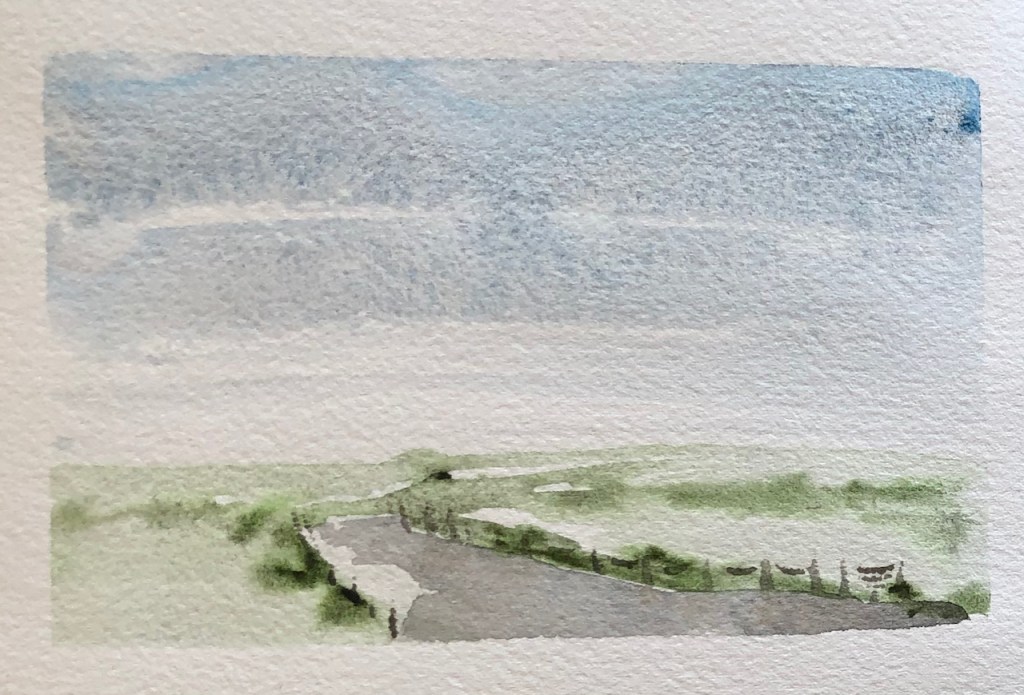
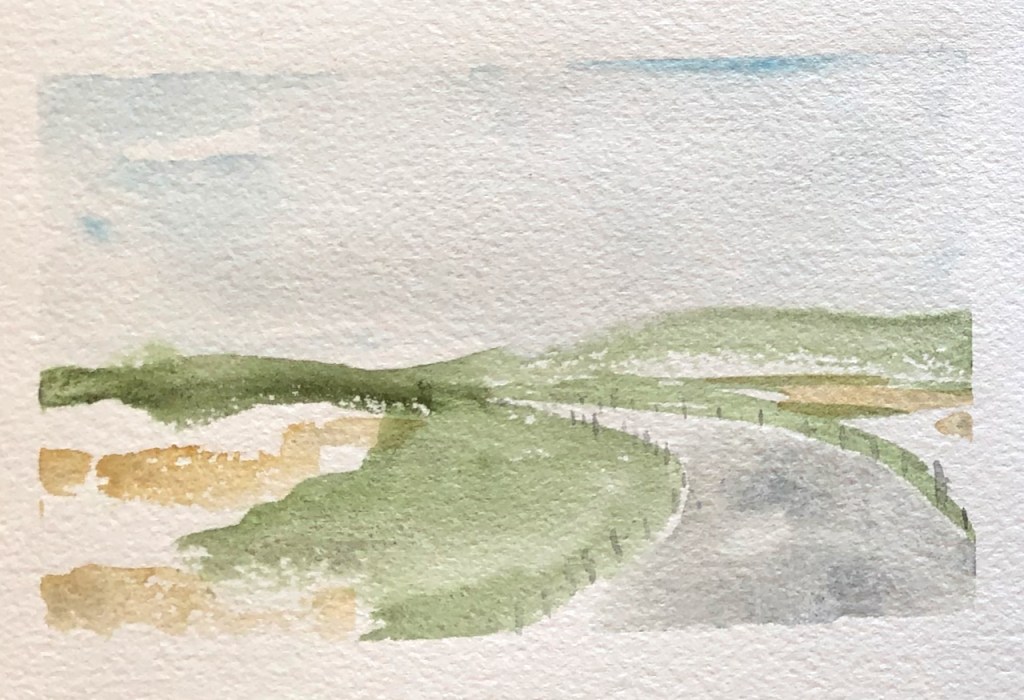
I enjoyed using a new colour: Lunar Blue from Daniel Smith. This is a highly granulating blue. You can see its effect here in the sky:
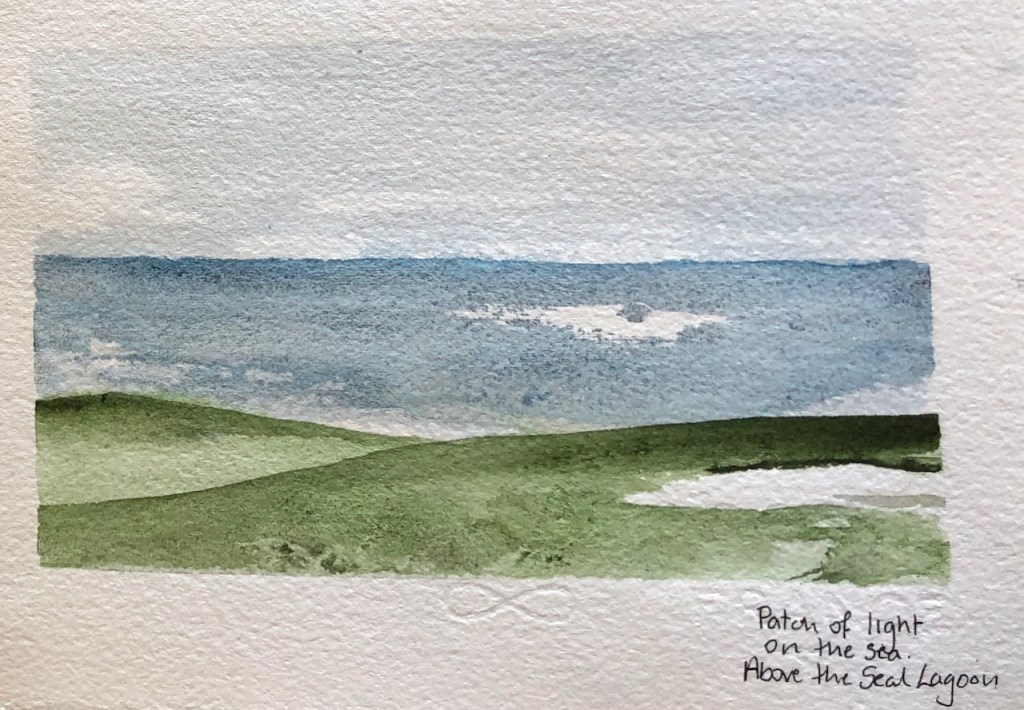
And here is Lunar Blue the sea:
Patch of light on the sea
A feature of the landscape round Littleure is the inland lakes, high up on the cliffs, as shown here on the right. On the sea, the sun shines through the clouds like a spotlight, which enchants me. In that picture you also see the granulating colour in the land: this is Green Apatite Genuine.
It was a misty day.
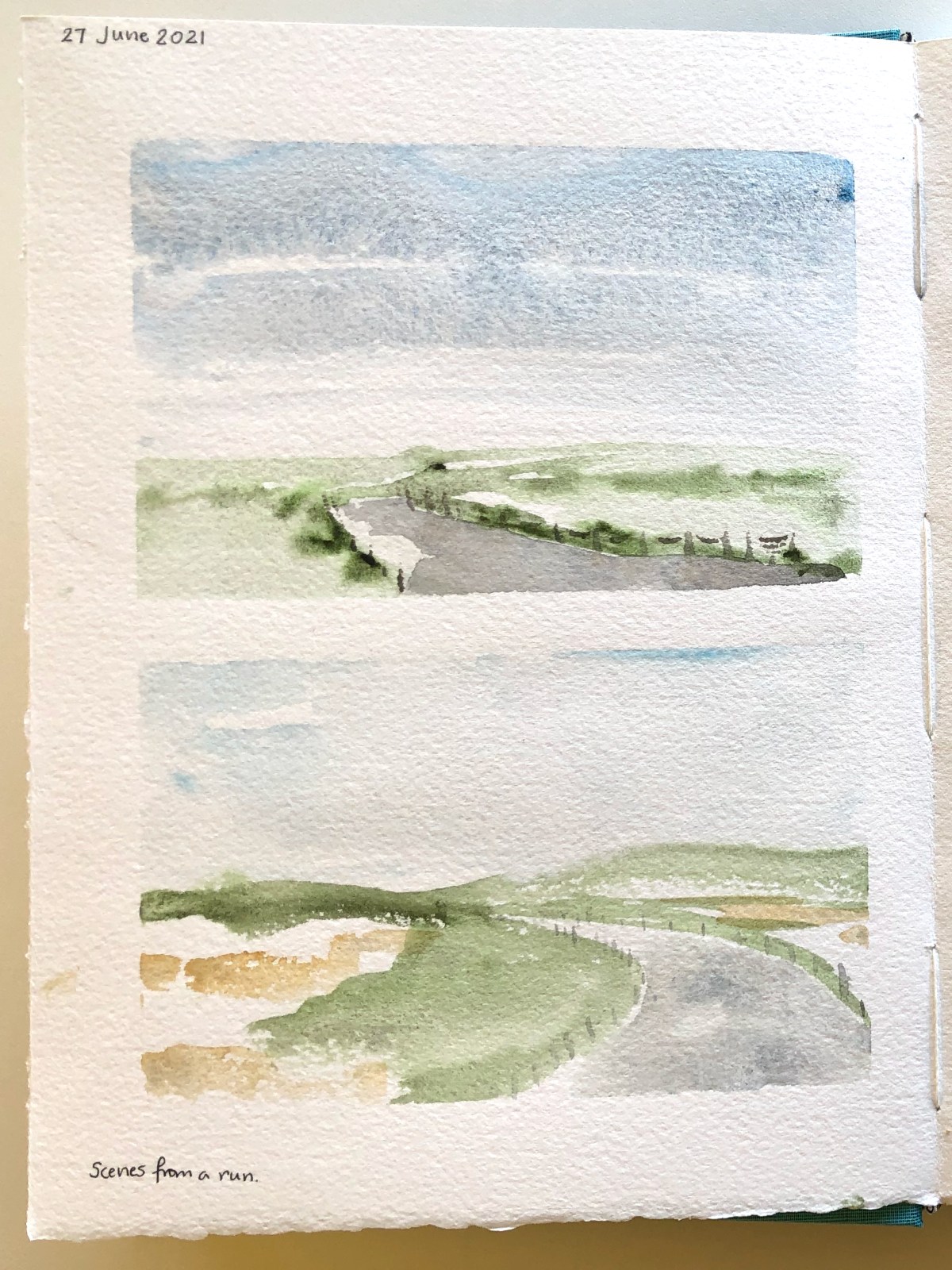
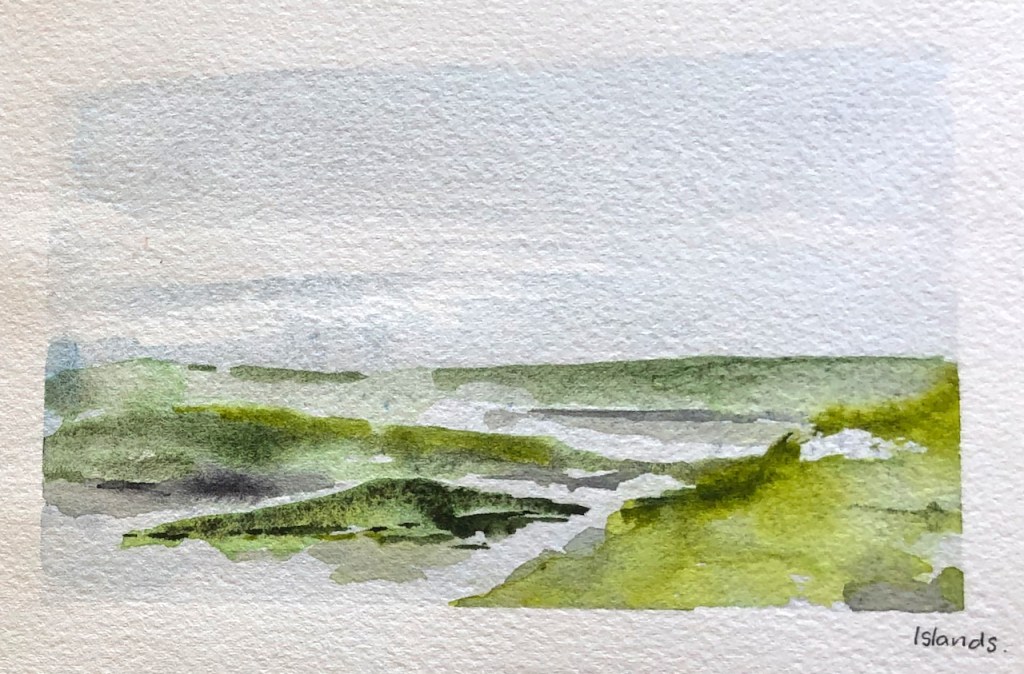
Over the brow of a hill, I see islands. It’s the end of the run. Time for a dip, and breakfast.
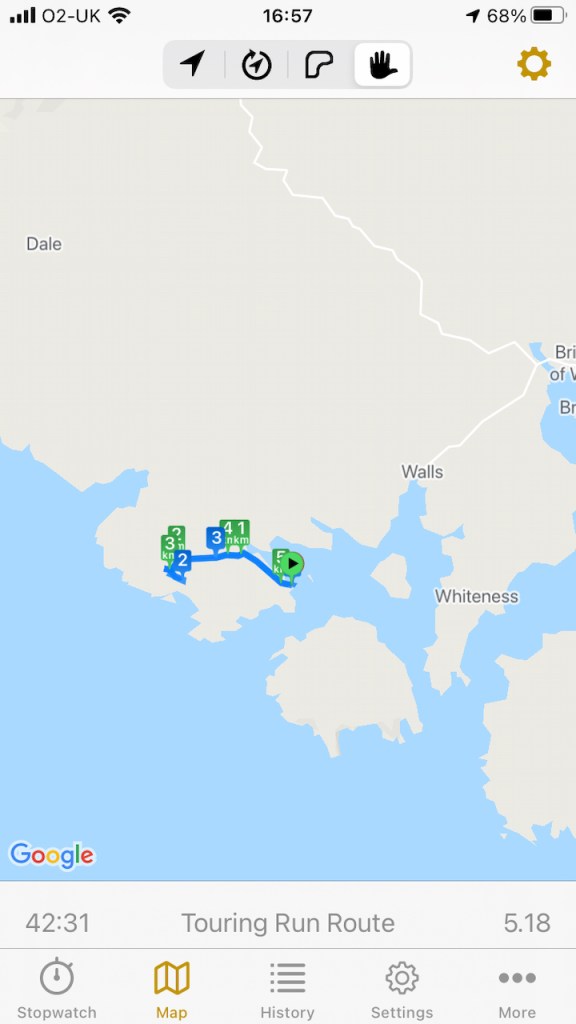
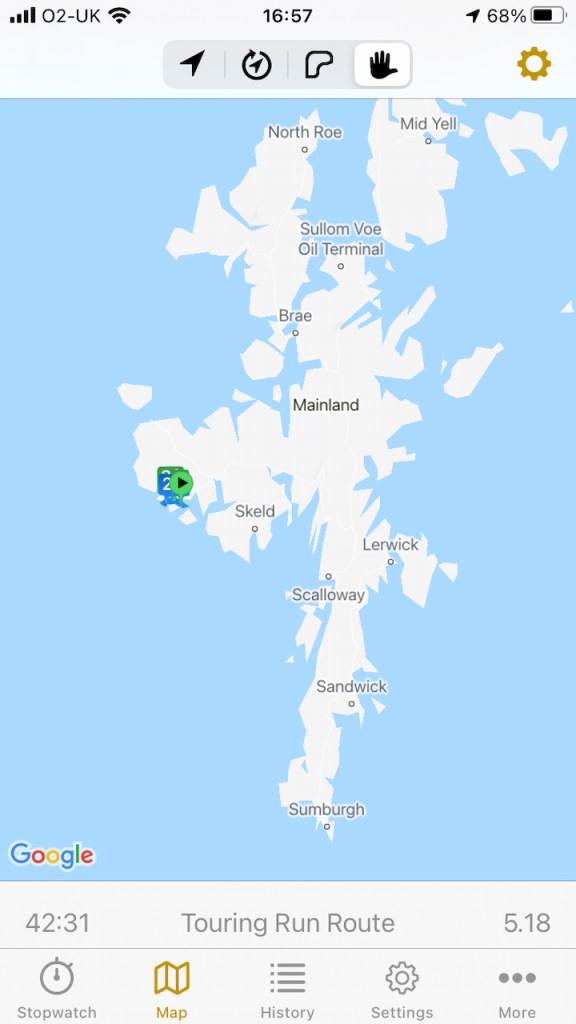
Running Route: maps from “cyclemeter” app
Click a button below to share this post online, email it, or print it:
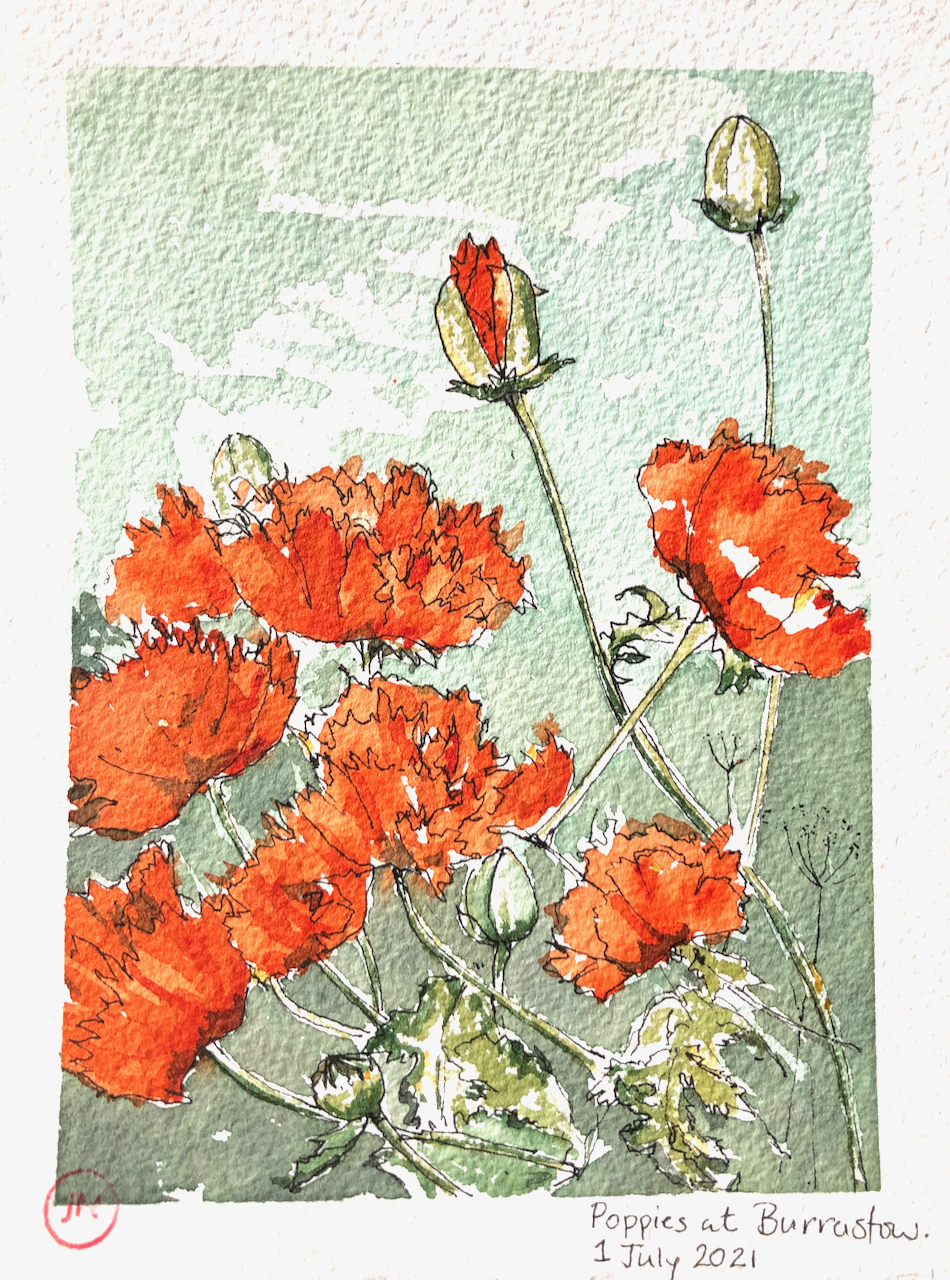
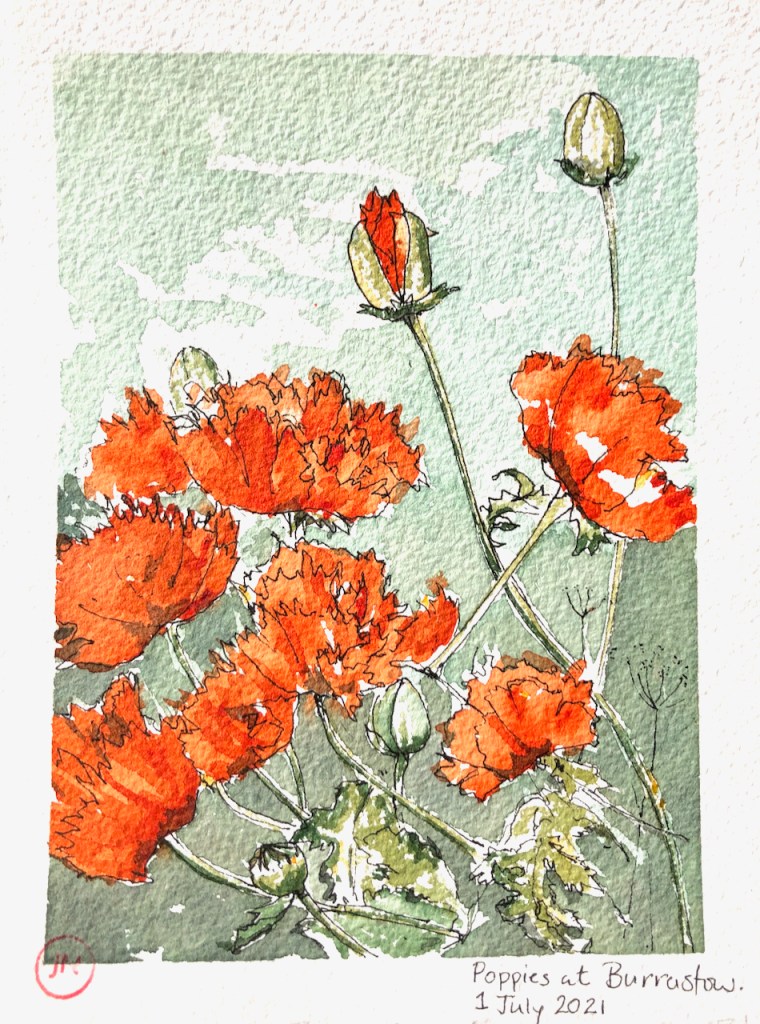
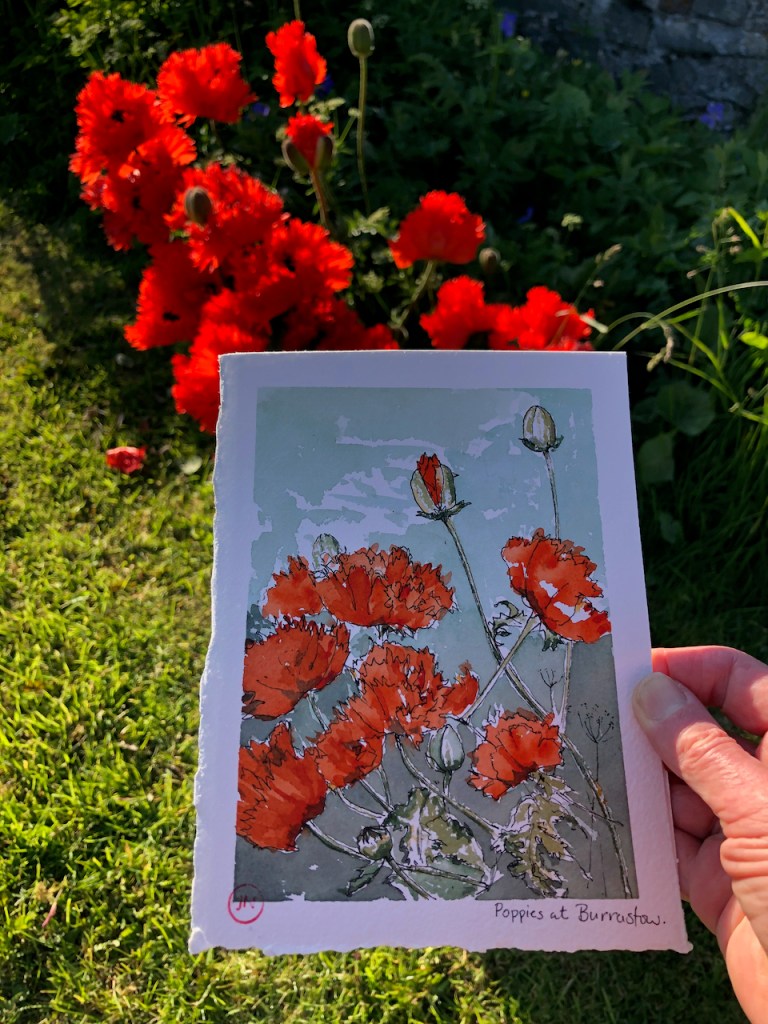
Poppies, Burrastow. 1 July 2021 on watercolour paper
These poppies were so stunning that I had to try to draw them. There and then. They are also ephemeral.
In a few days the petals had dropped making splashes of scarlet on the grass.
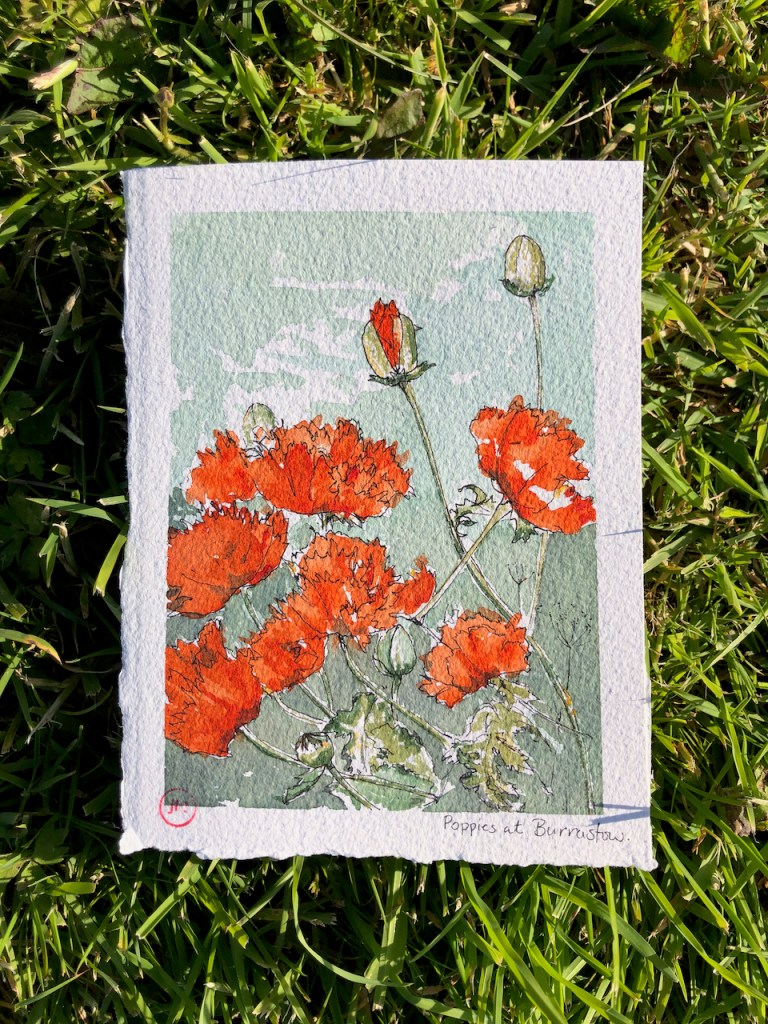
I drew this on special paper: handmade watercolour paper from the Vintage Paper Company. It is very heavily sized and takes the colour well. It’s also stiff, and easy to use out-doors.
The red is Transparent Pyrrol Orange waercolour from Daniel Smith.
Click a button below to share this post online, email it, or print it:
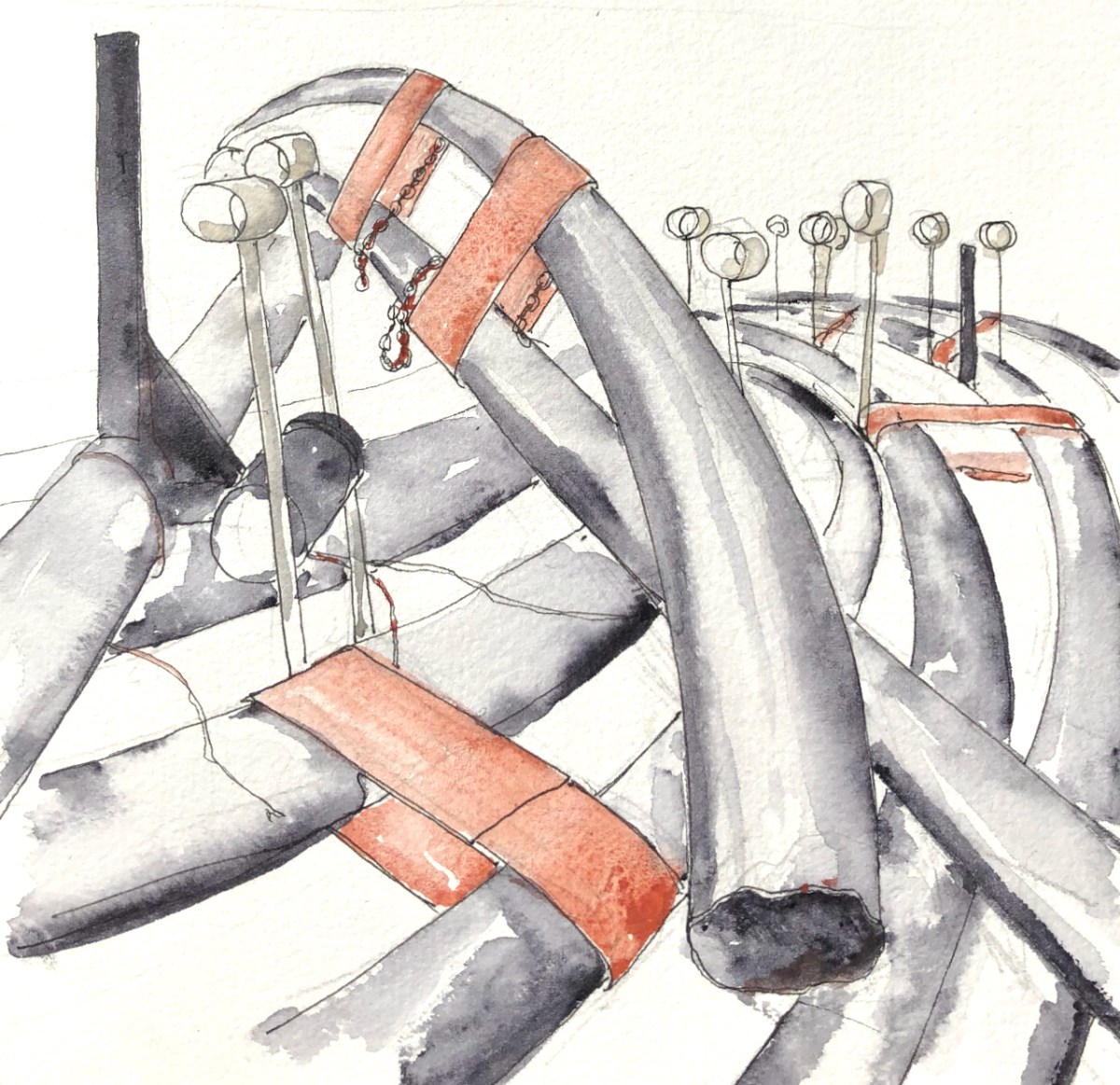
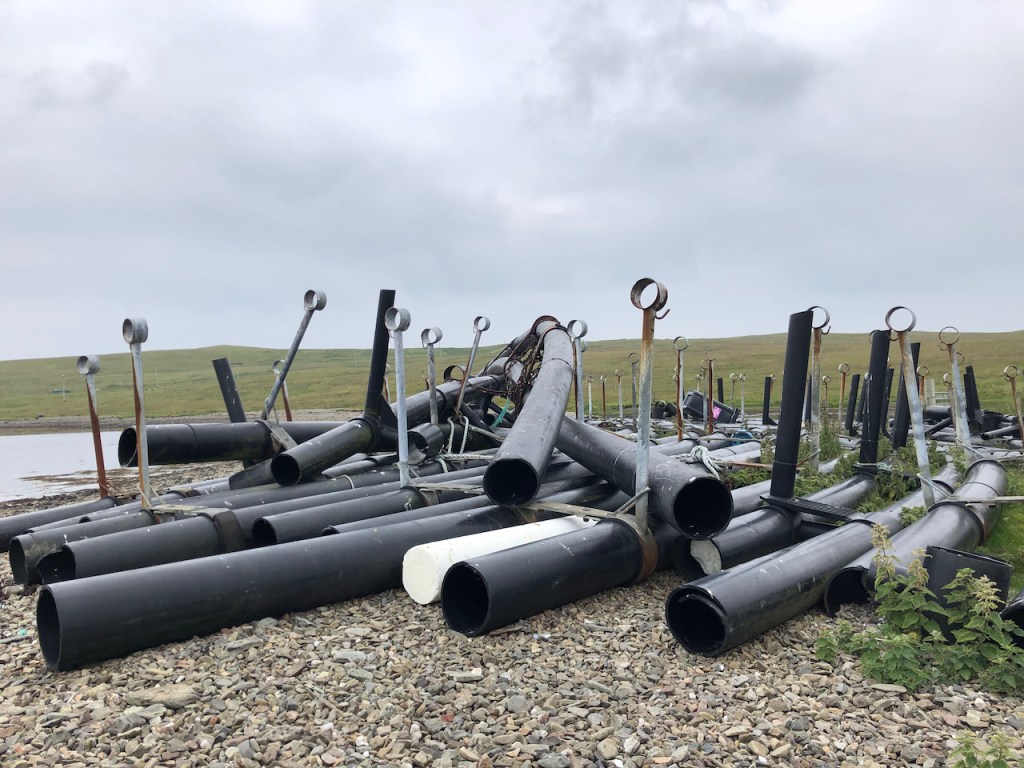
These black tubes seem to be indestructible. People find all sorts of uses for them: fence posts, cattle grids, boat slipways. I imagine they would make rather fine musical instruments. I have never heard of anyone using them for this.
But their primary use is to create the salmon cages that float out on the shallow seas in the area.
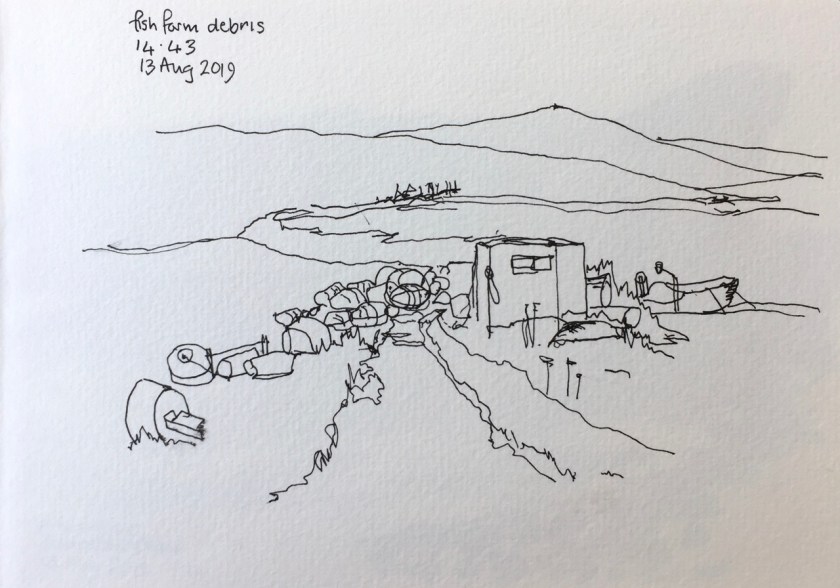
I saw these tubes on a walk from the Historic Site. I’ve drawn in this location before. In this sketch, you see the black tubes as the small scratchy lines in the centre distance.
Fish farm debris, 13th August 2019
Click a button below to share this post online, email it, or print it:
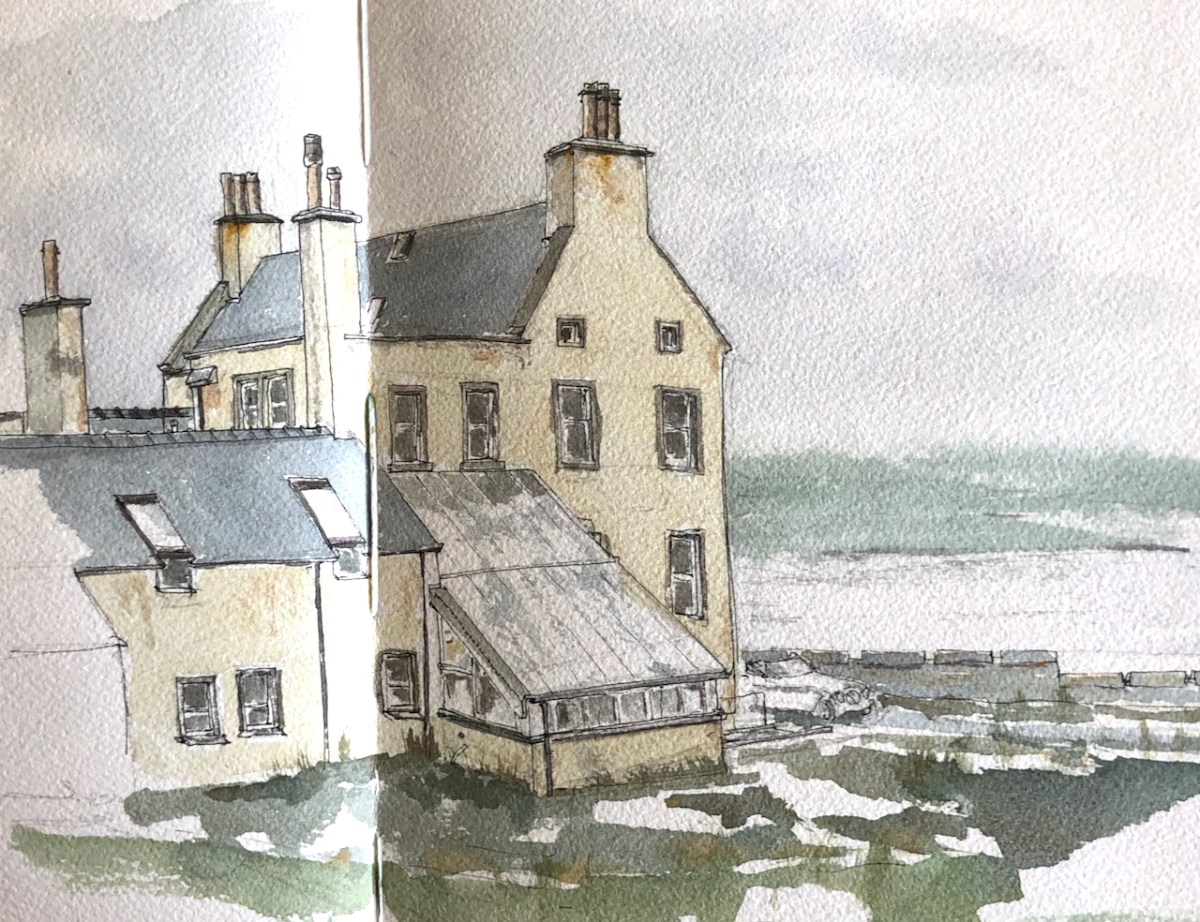
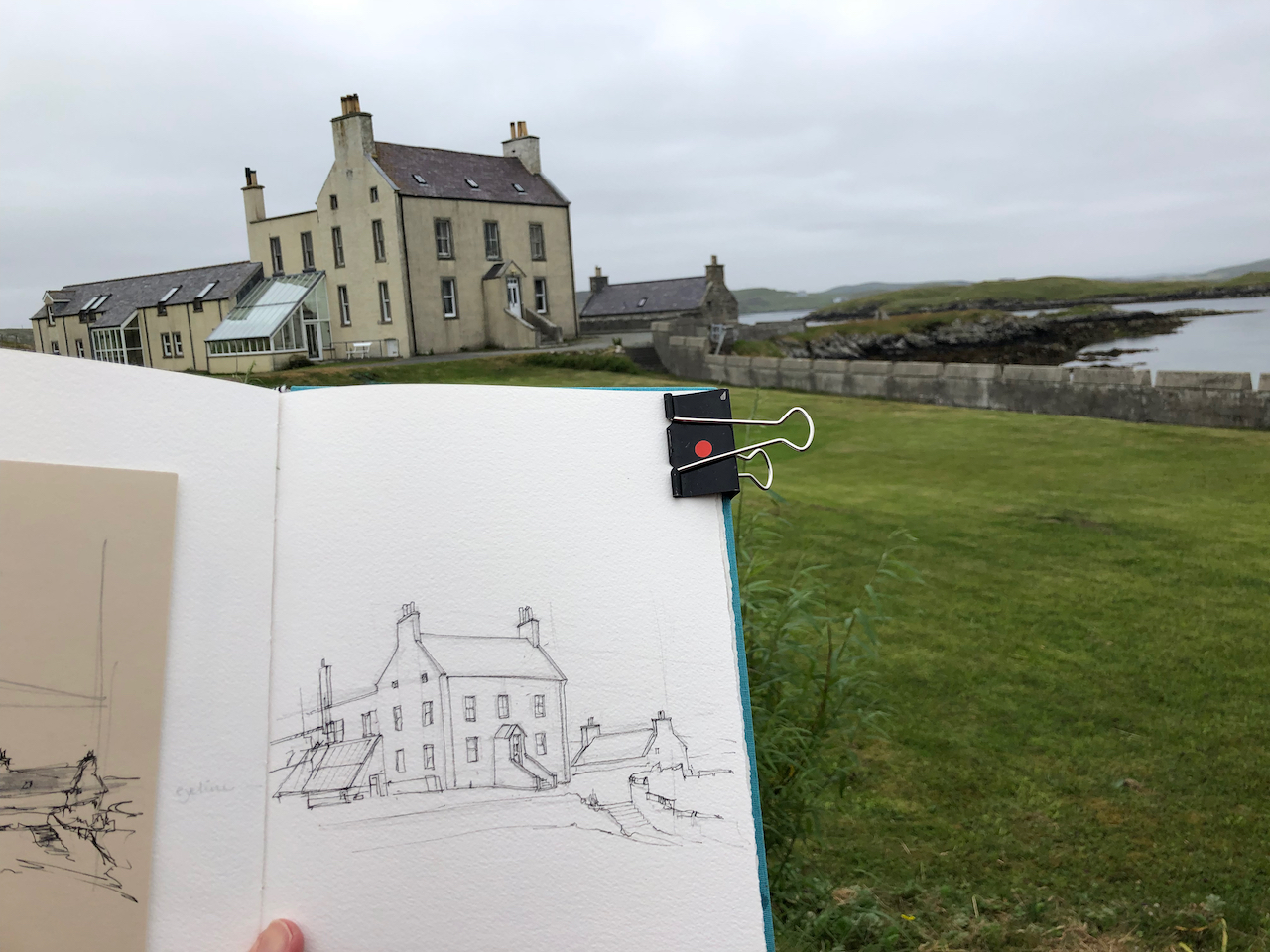
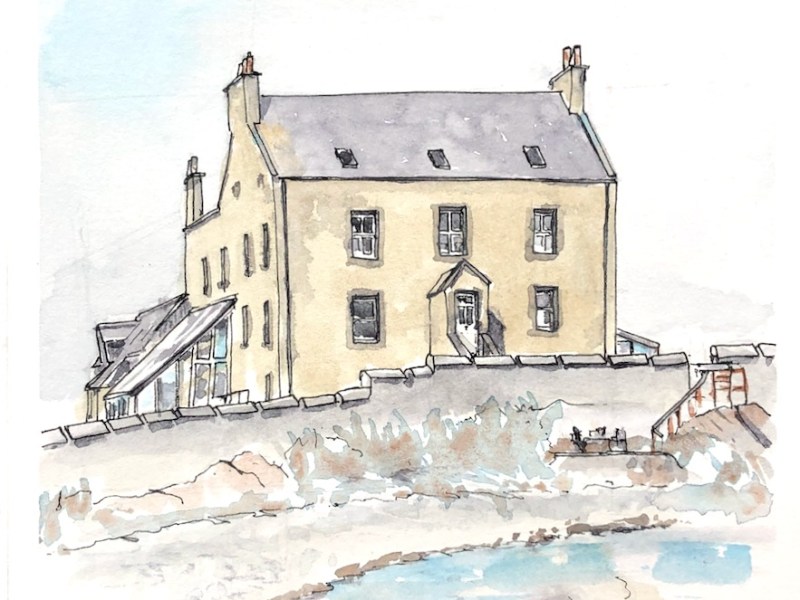
Here is Burrastow House near Walls on the West side of Shetland. It was built in 1759.
Burrastow House, from the garden. 20 July 2021. 10″ x 8 “
One of the delights of the house is that it has been adapted over the years. Here is a view from the vegetable garden. You see the different roof levels.
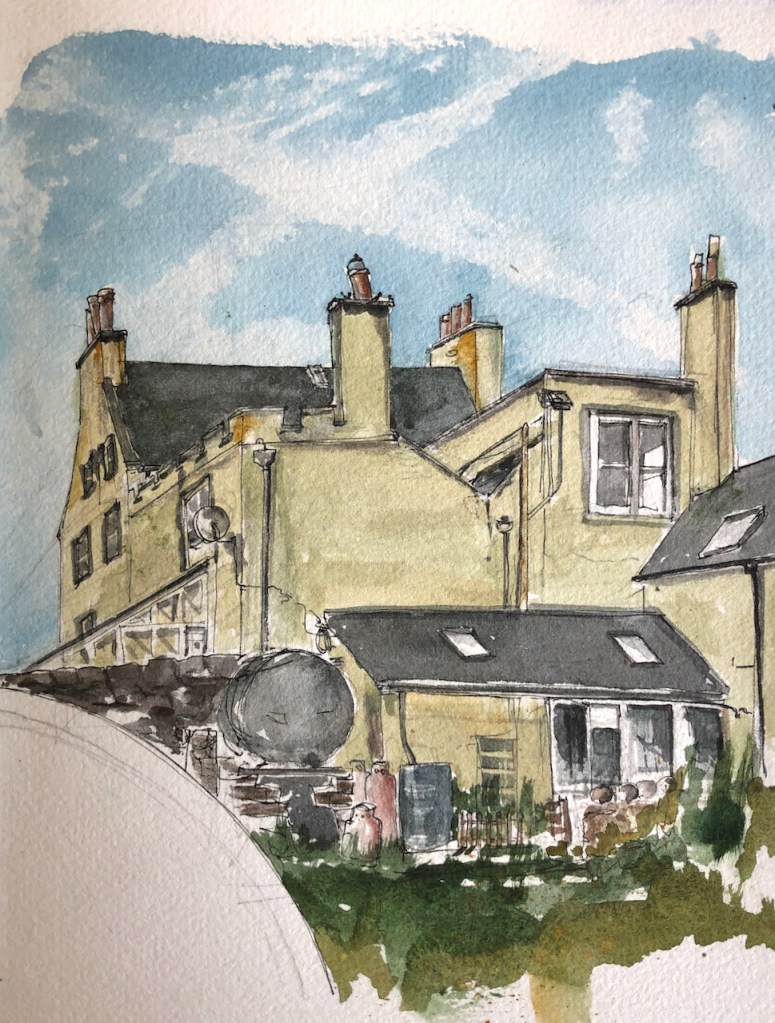
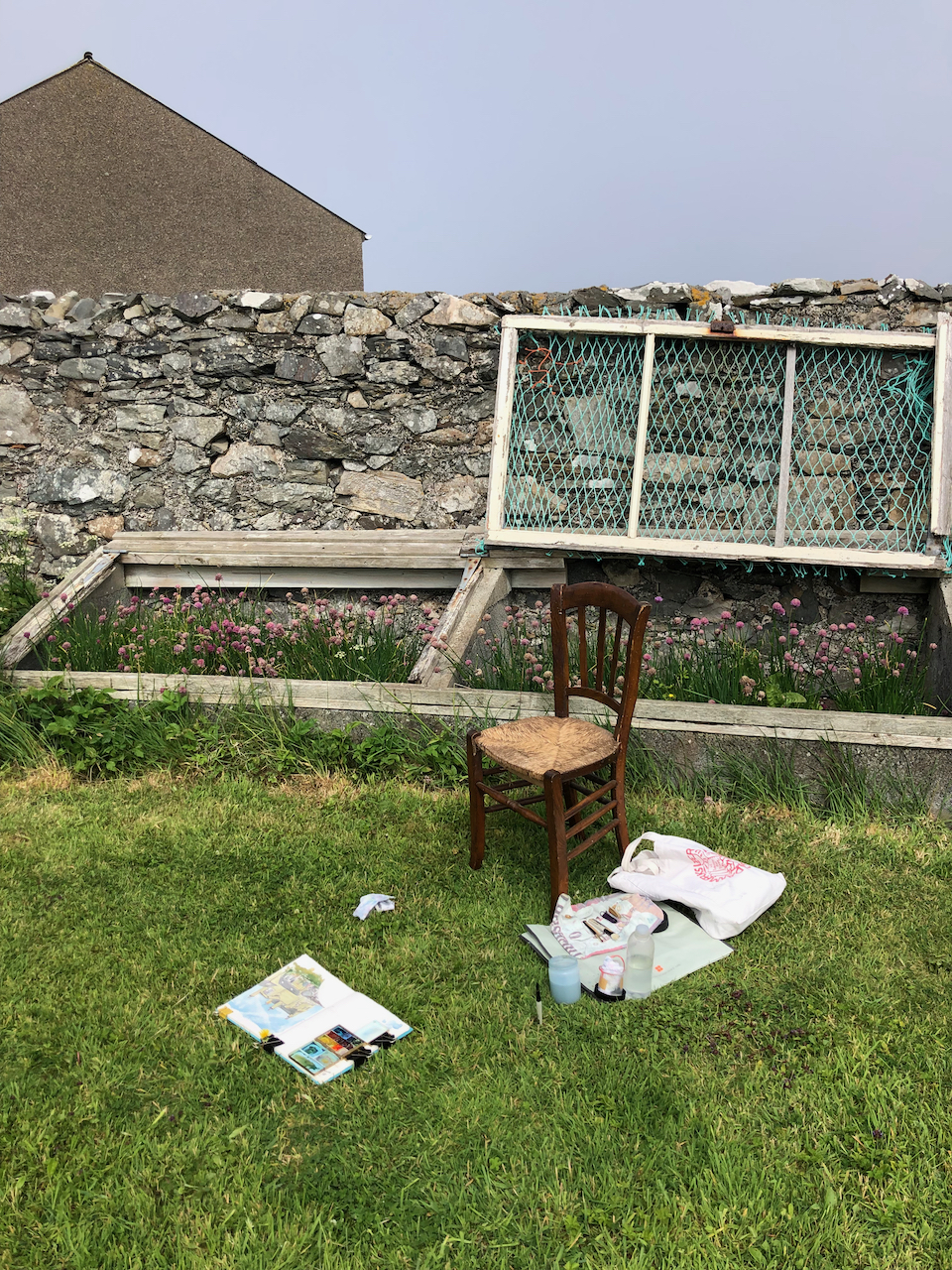
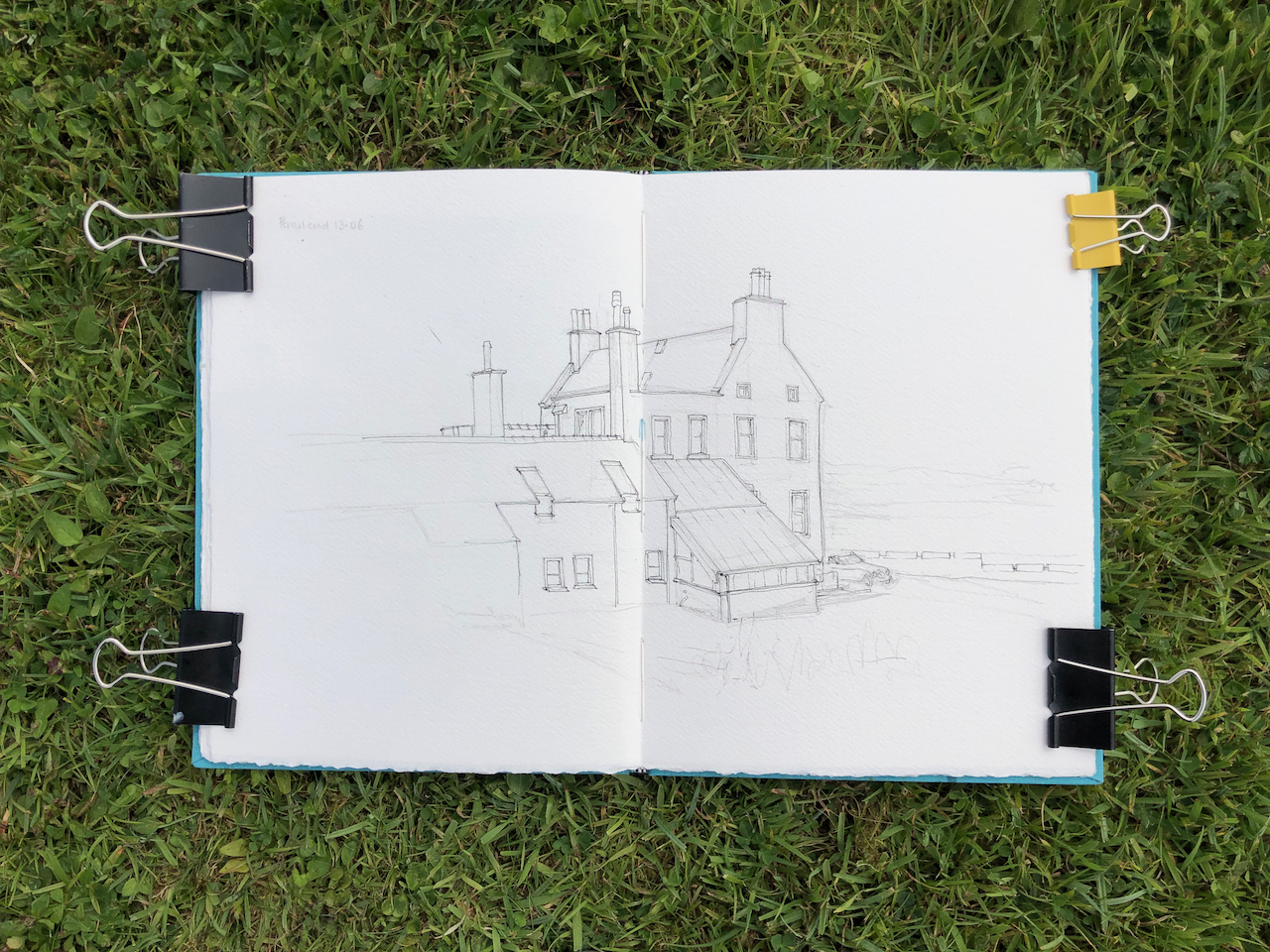
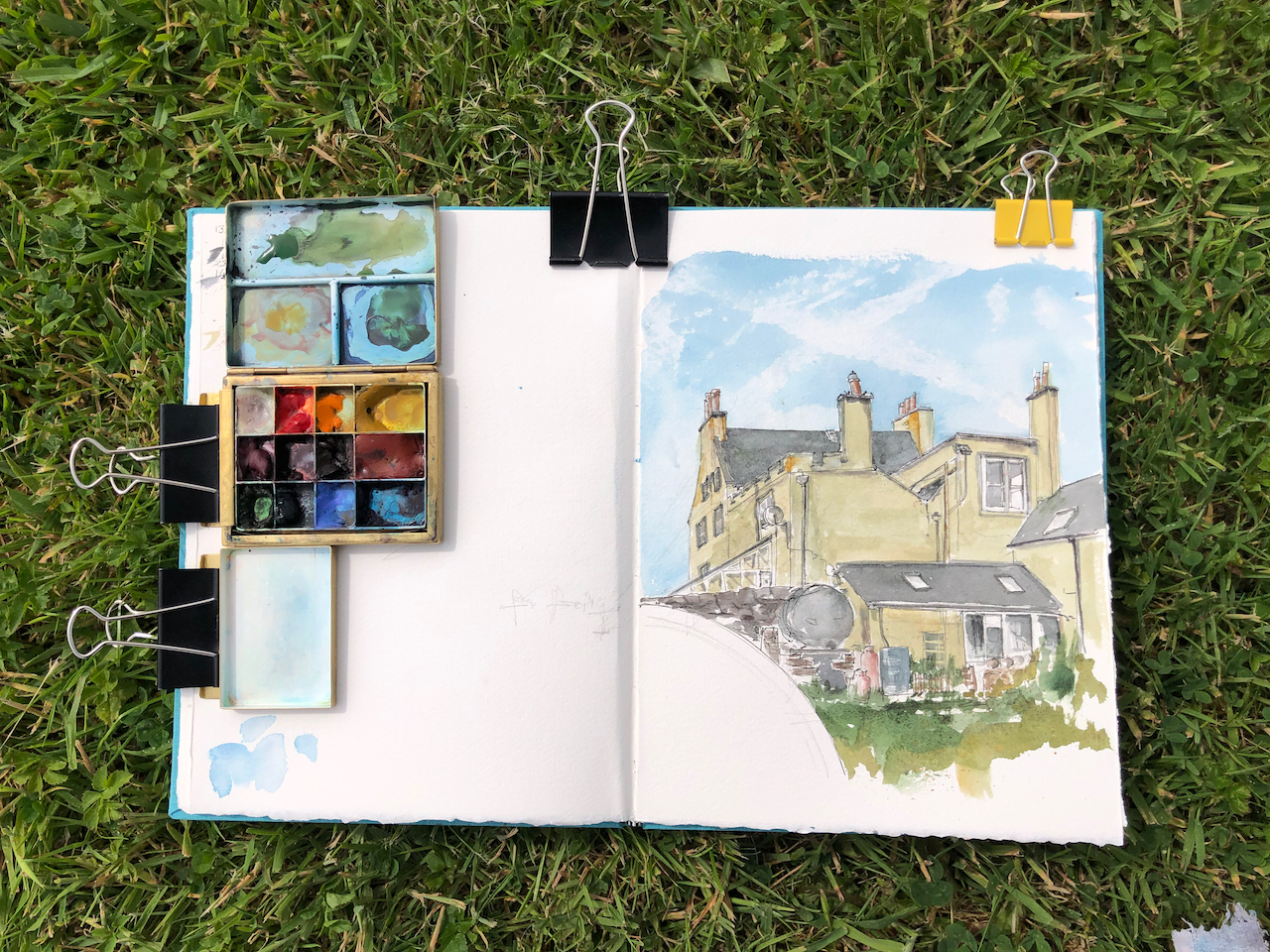
Burrastow House from the vegetable garden. 13th July 2021. 10″ x 8″
The white curved area on the left is a segment of the polytunnel. The grey circular item is the oil tank. Above that, the small circle is the satellite dish. I like the way you can see right through two windows, in the room on the top right of the picture.
Here is a view from the garden near the driveway.
Burrastow House, from the garden near the entrance. July 14th 2021
While I was drawing this, a Jaguar E-type throbbed up the drive. I put it in the picture. This was a misty day. I had to pause the work on the picture as the mist turned to rain, and then I resumed as the rain turned to mist again.
You see the front conservatory in the centre and the extension to the left. The extension dates from 1995, according to a small notice in the conservatory.
“On the remote west side of Shetland you can find spectacular scenery, peace and the ideal refuge for the escapist. The guest house welcomes you with peat fires, a cosy library and all the marvellous food you could want after…
Click a button below to share this post online, email it, or print it:




















 Jane Sketching