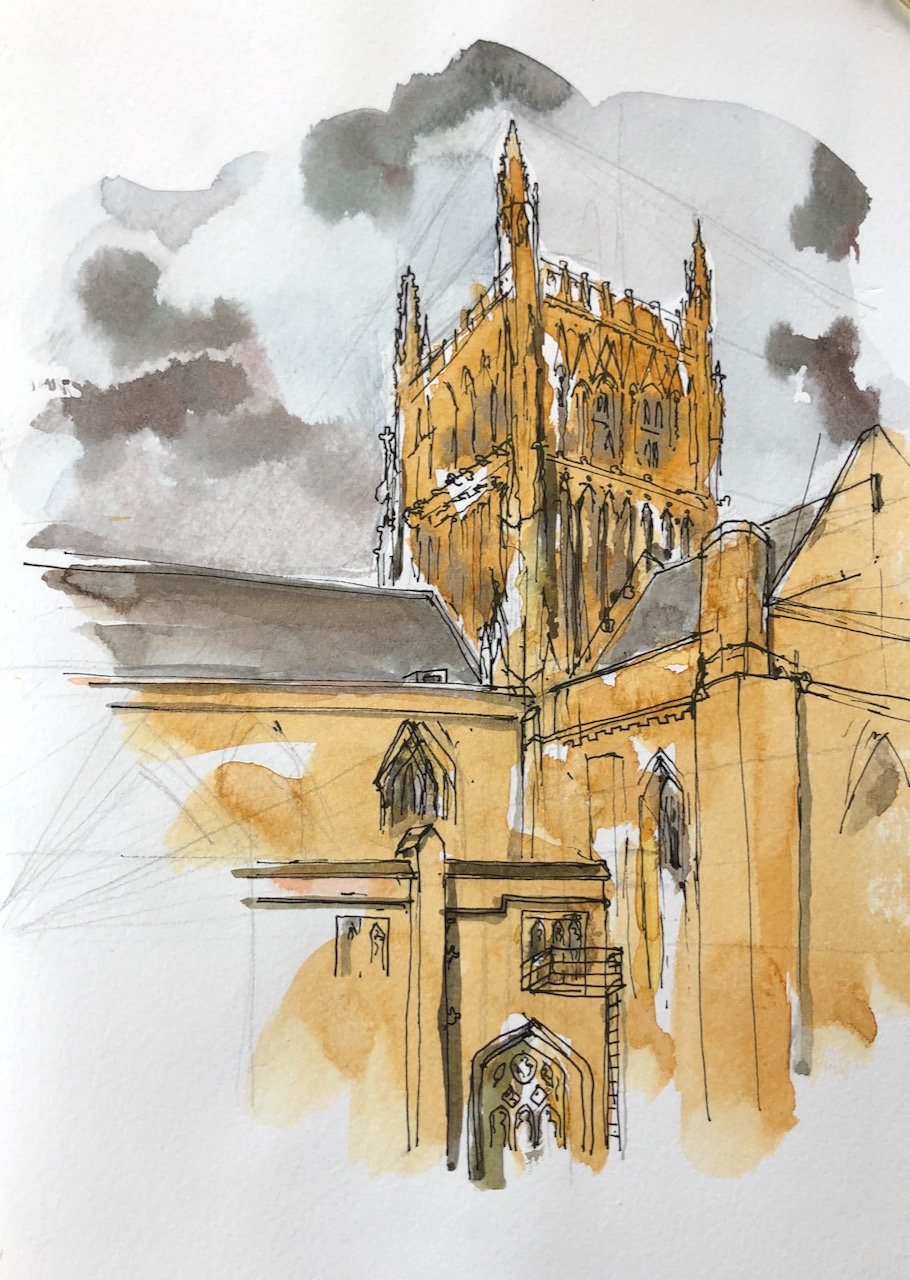
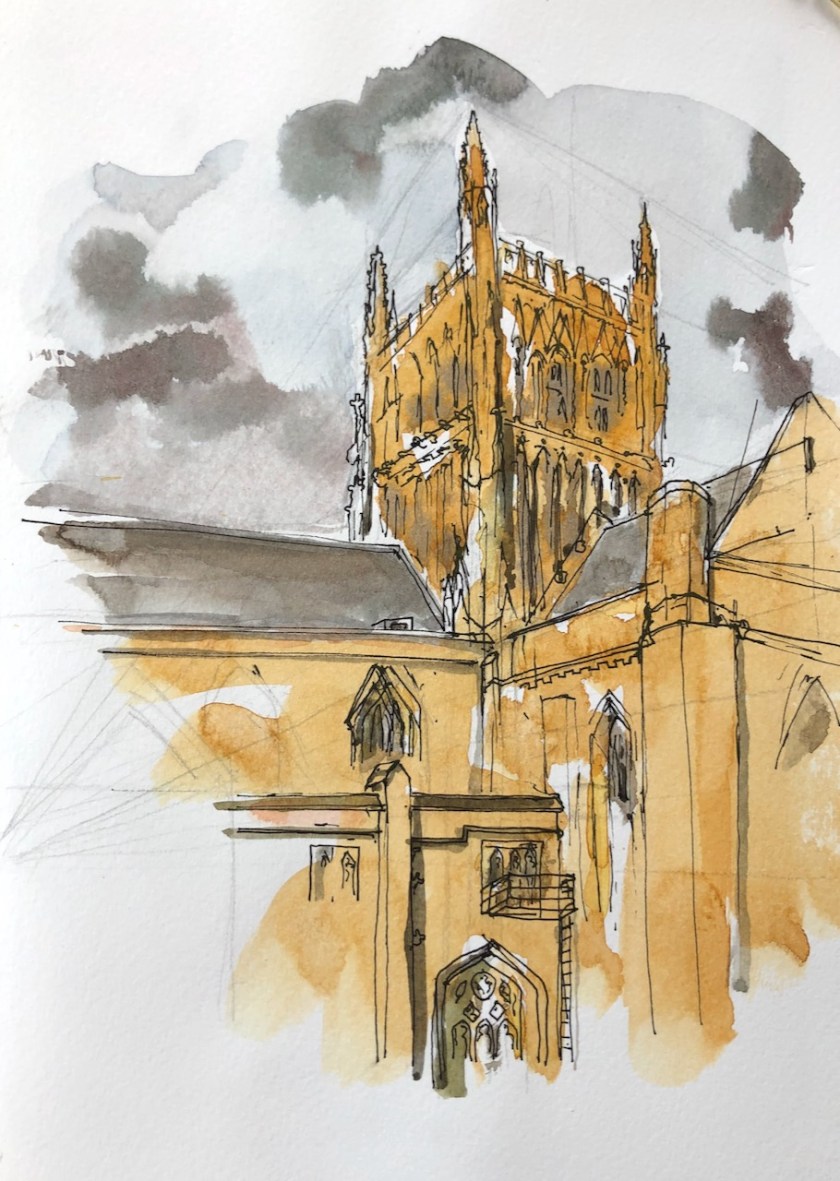
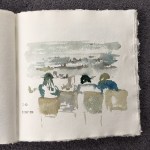
I sketched this view from the cloisters, which were glazed and enclosed. I did, however, find a chair, and a convenient inverted dustbin on which to place my tools.
Work in progress: Worcester
View from the cloisters, through the glazing.
In the cloister.
Work in progress: Worcester
The other Cathedral we visited this trip was Hereford:
Here I had an unrestricted view from the Chapter House garden, which was very peaceful and lovely.
We also visited a small church, Kilpeck, which is very ancient:
In this church there were viking carvings.
If you are in the area I recommend also Tewkesbury Abbey, which though not a cathedral is an inspiring and welcoming place. I had a terrible cold, and lacked the energy to make anything except a small indoor picture.
I must mention the excellent deli in Tewksbury High Street, Miss Muffet. We just had a sandwich, but suddenly I remembered what sandwiches are supposed to taste like. And for all its quality control and high-class ingredients, Pret in London cannot hope to match the Tewksbury offer: fresh home-made bread, pastrami just cut, and cracking piccalilli. Here’s the view from the window. Good food takes time.
Click a button below to share this post online, email it, or print it:
I did Inktober for the first time this year. This is a drawing challenge, described on the Inktober web page. The idea is to draw a picture, in ink, each day of October.
“Inktober is about the constraint of medium. You must draw with ink. When you sit down to do the challenge you don’t have to decide what colors you’re going to use, whether you’ll be rendering in pencil or watercolor. The challenge has stripped away all of these variables that can get you sidetracked or frustrated, allowing your creative energy to be focused straight into your drawing.” Jake Parker
I followed the official prompts:
Here are my pictures. They are all done in black ink on white paper. The reason they appear in different tints and tones is that they were photographed in different light, depending on where I was at the time.
“Ring”. This is a ring from Fred Rich.
“Mindless”. I’m not quite sure what this picture means. Sadness, lack of thought.
“Bait”. Here are people digging for bait on the Isle of Grain.
“Freeze”. This is a scene from an action movie.
This is inspired by a young person I know.
A voice made in smoke and hardship.
In this strange forest, you need a dog companion.
He contemplates his condition.
Dancing at the 100 Club.
All the people are left handed, I noticed, after I drew it.
Snow in the forest.
In the October rain, I wish for a dragon to warm my hands.
This is the shape of the ash tree.
Growing up is a puzzle.
The orator.
The open sea.
A former bank building on the Goswell Road.
It’s hard to fit in.
Bloodied but not bowed.
Tough on the knees.
One person digging and three people issuing instructions.
Who is the real person and who is the ghost?
Iron Age fort, Britain.
London office block.
“Tasty” means “skilled” in the context of martial arts such as boxing.
Am I sufficiently hidden?
A tribute to my sister.
Fun to ride in a cart.
Injuries are not always physical.
The crab
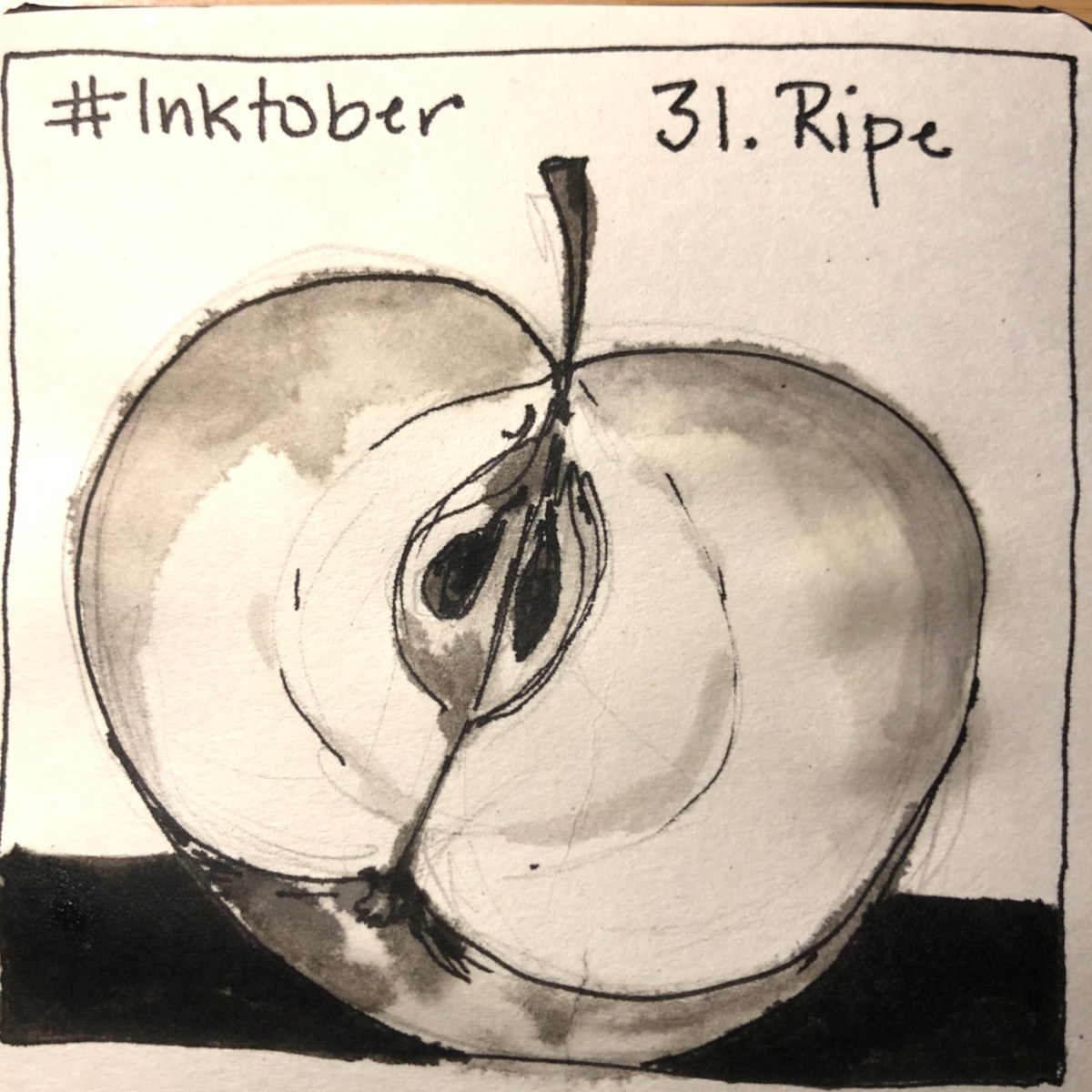
Ready to eat.
I used De Atramentis document ink (waterproof) and a Sailor Fountain pen with EF nib. For the tones, I diluted the ink with water.
Here’s what I learned from Inktober:
I could do it. It was fun to do, and an achievement.
The drawings are mostly small, 2½” square. “15” and “16” are 8″ square. If I do it again, I’ll use a bigger sketchbook.
I used a sketchbook with quite soft, low quality paper. Next time: use smooth watercolour-quality paper, which will take the ink better and not buckle.
I started doing drawings of any size. These get cut to a square when posted on Instagram. If I do it again, I’ll do all square drawings.
It was a good idea to write “#inktober” and the day on the drawing.
Click a button below to share this post online, email it, or print it:
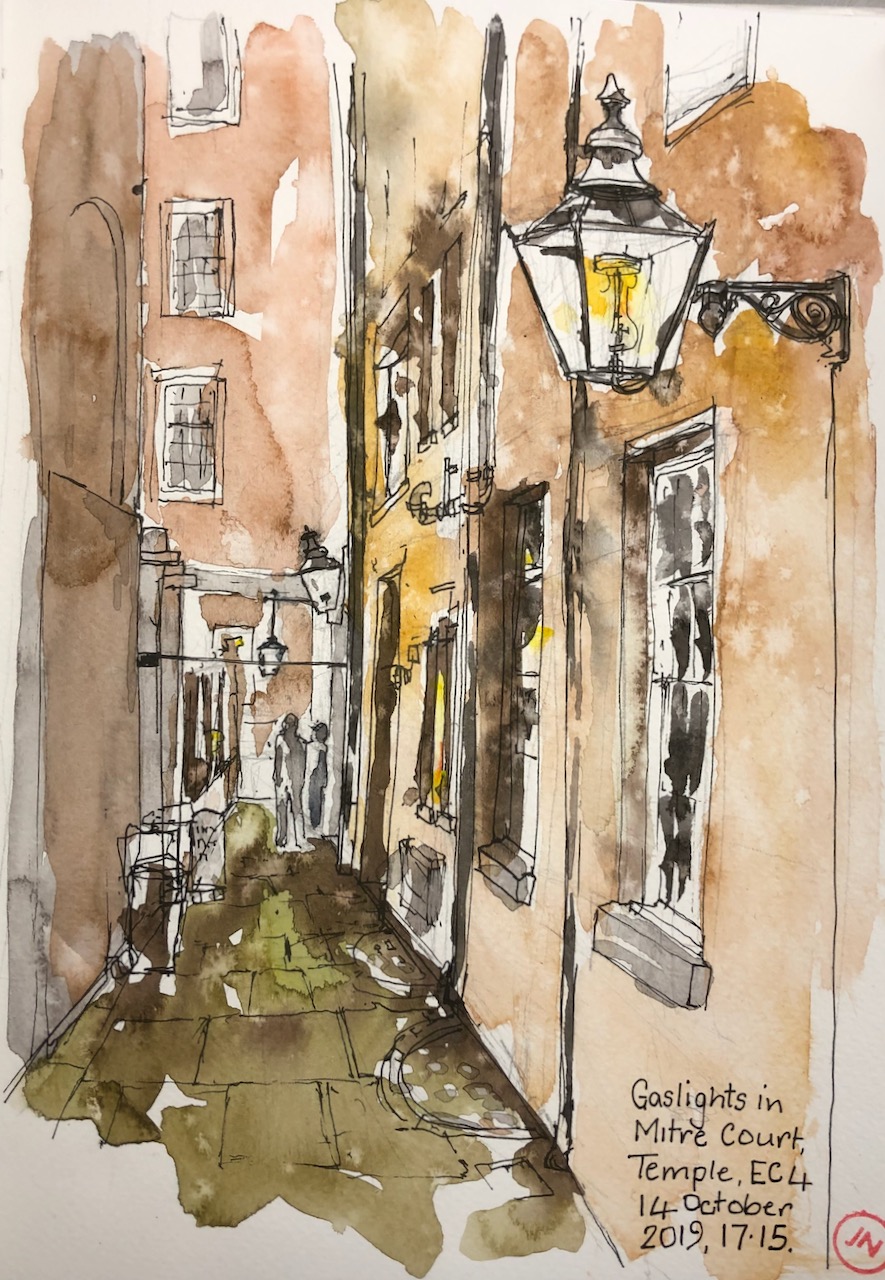
Here is a back alley off Fleet Street, London EC4.
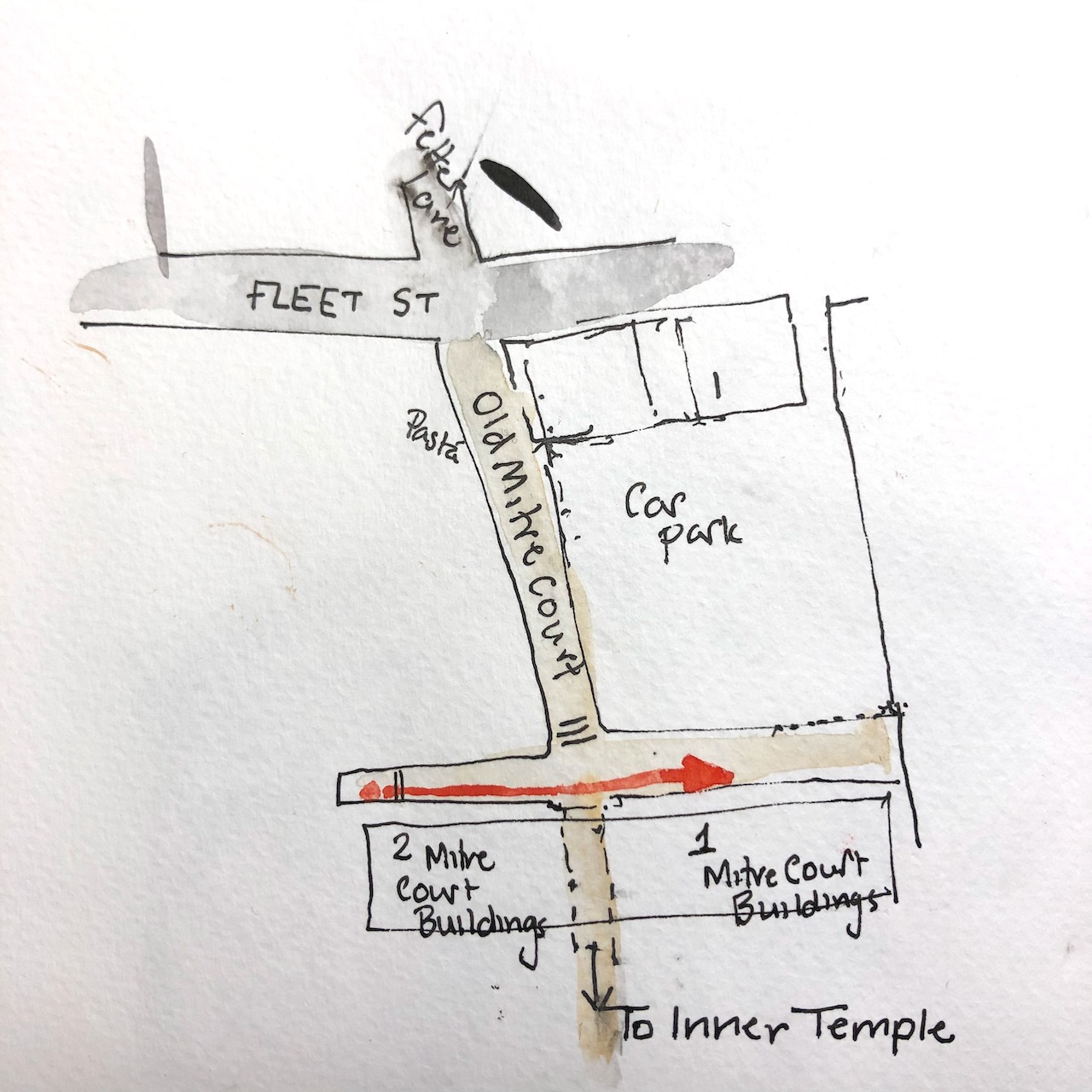
It is Old Mitre Court. The buildings on the right are 1 & 2 Mitre Court Buildings. They are listed Grade 2. Here’s what Historic England says in the listing:
Early/mid C19. 4 storeys plus basement. Plain classical, south elevation of Portland stone with channelled ground storey and cornice below top floor. Arched passage through centre. Plain, rear elevation of yellow brick with railings and gates.
It’s the “rear elevation of yellow brick” that you see in the picture. There are three gas lamps, at least one of which works. The other two look very rickety.
The buildings, 1 & 2 Mitre Court Buildings, are legal practices, housing Barristers and their associates. A list of the barristers is by the doors. The notice on the pavement says “Inner Temple Treasury Office, Open 10am – 4pm”. This is the office underneath the furthest gas light, the one with the right-angled support above it.
The paving slabs at the bottom of the picture were in fact green, as I have drawn them. It was damp, and there was a coating of moss-type algae on the paving slabs. A saying of my late father was, “The plants will win in the end”. When I see such a green coating on stone, in the middle of the City, I am reminded of his words, and I think he is right.
Eventually I had to stop drawing as the rain came down. The drawing got a bit wet.
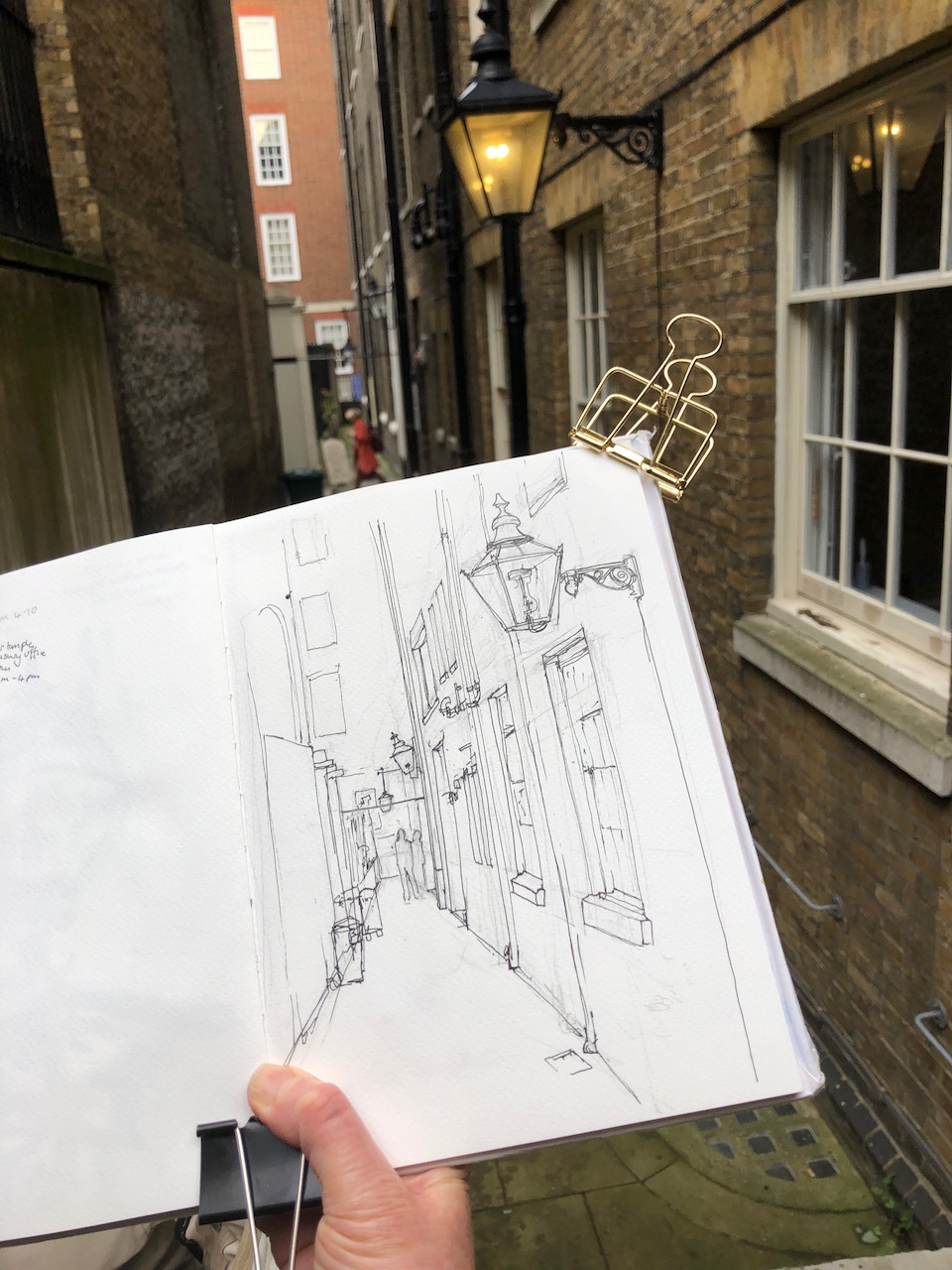
Here is work in progress and a map:
Drawing took 1hour 15 mins. Colours used mostly Perinone orange, and Prussian blue, with a bit of burnt umber. Indian yellow for the gas lights. All Daniel Smith colours. Pen is Lamy Safari EF nib, with De Atramentis document (waterproof) black ink.
Later note: Article in Private Eye, Autumn 2021 (Westminster council is removing the Gas Lights)
I went out to look for more gas lights in the City. There was rain, and the back alleys were wet. I couldn’t find any more gaslights.
At the South East extreme of my peregrination I looked up and saw St Peter upon Cornhill. It is wedged in between other buildings.
St Peter upon Cornhill
The church in among other buildings. The devils are circled in red.
The adjacent building is labelled “54 & 55” Cornhill, in lovely art-deco writing. There is a branch of “EAT” on the ground floor. High up, there are three strange devils (ringed in red on the annotated picture above). The two larger and higher ones are definitely female devils, with big breasts and strong muscles. The smaller devil is yelling from his position above a window.
Map showing the buildings as seen in the drawing. Arrow shows the line of sight.
map with North at the top. Arrow shows the line of sight of the drawing.
I drew this picture from the shelter of White Lion Court, which is on the North side of Cornhill. This is one of those City of London back-alleys. It doesn’t go anywhere, just to the door of what looks like an insurance company, and off to the side is a doorway with ecclesiastical carving above. It looks like the entrance to a monastery. But that can’t be right. The modern iron gate is adorned with modern litter.
White Lion Court EC3
Litter on the gate of White Lion Court
As I was drawing a man came round from the nearby branch of Sainsbury’s to eat his sandwich and smoke.
Then later another man came by and asked me if I had seen the fire brigade. I said no, because I hadn’t. He said the fire alarm in one of the offices had gone off. He said he’d be wandering about for a bit, while he contacted the key holder. I could hear him calmly making phone calls. He was still there when I finished my drawing and packed up. I waved goodbye to him, and he nodded and half waved back, constrained in his movements as he was holding his phone to his ear and consulting a notebook.
It is astonishing how many tourist groups go down Cornhill. If I have done nothing else today, I have at least inspired a few tourists and other passers-by to look upwards to the onion spire of St Peter upon Cornhill. People pause, see that I am drawing, wonder what I can possibly be drawing in that dingy back-alley, and then look in the direction I’m looking and see the spire.
The tourist groups pause in the shelter of nearby Sun Court. I guess they are being told anecdotes about why there are she-devils on 54 and 55 Cornhill. I looked online. I can only find anecdotes, no facts. The building is by Runtz, 1853.
There has been a church at St Peter upon Cornhill since the 2nd Century AD, according to a tablet whose inscription was recorded and copied on various printed media, and now on Wikipedia. The tablet doesn’t exist any more as it was destroyed in the fire of London. The current building is by Christopher Wren, and was constructed between 1677 and 1684. There is also an entrance on Gracechurch St, which I must go and have a look at.
Here is work in progress.
Pencil
Pen
Pen
Watercolour
Finished drawing, on the pavement.
The drawing took 1½ hours.
Click a button below to share this post online, email it, or print it:
The Hallfield Estate is a modernist estate in Bayswater, W2 6EH. It’s a short walk south from Royal Oak Station on the Hammersmith and City Line.
It was constructed in the 1950s, to a design of Berthhold Lubetkin. The construction was supervised by Lindsey Drake and Denys Lasdun. Now it’s Grade 2 listed. Here’s what the listing says:
Reasons for Designation
The fourteen blocks and laundry at Hallfield Estate are listed at Grade II for the following principal reasons:
Architectural interest: a sophisticated and distinctive aesthetic approach to social housing, whereby the facades are treated like works of abstract art;
Planning: the estate fulfilled its brief to provide mass housing and open space in a crowded urban borough, in a plan inspired by Le Corbusier’s ‘Radiant City’
Authorship: designed by Berthold Lubetkin and Tecton, and constructed under the supervision of Lindsay Drake and Denys Lasdun, the estate is the work of some of the C20’s most significant architects;
Historic interest: a seminal post-war housing estate that was widely exhibited and published, and provoked divergent contemporary responses which illuminate post-war architectural theory.
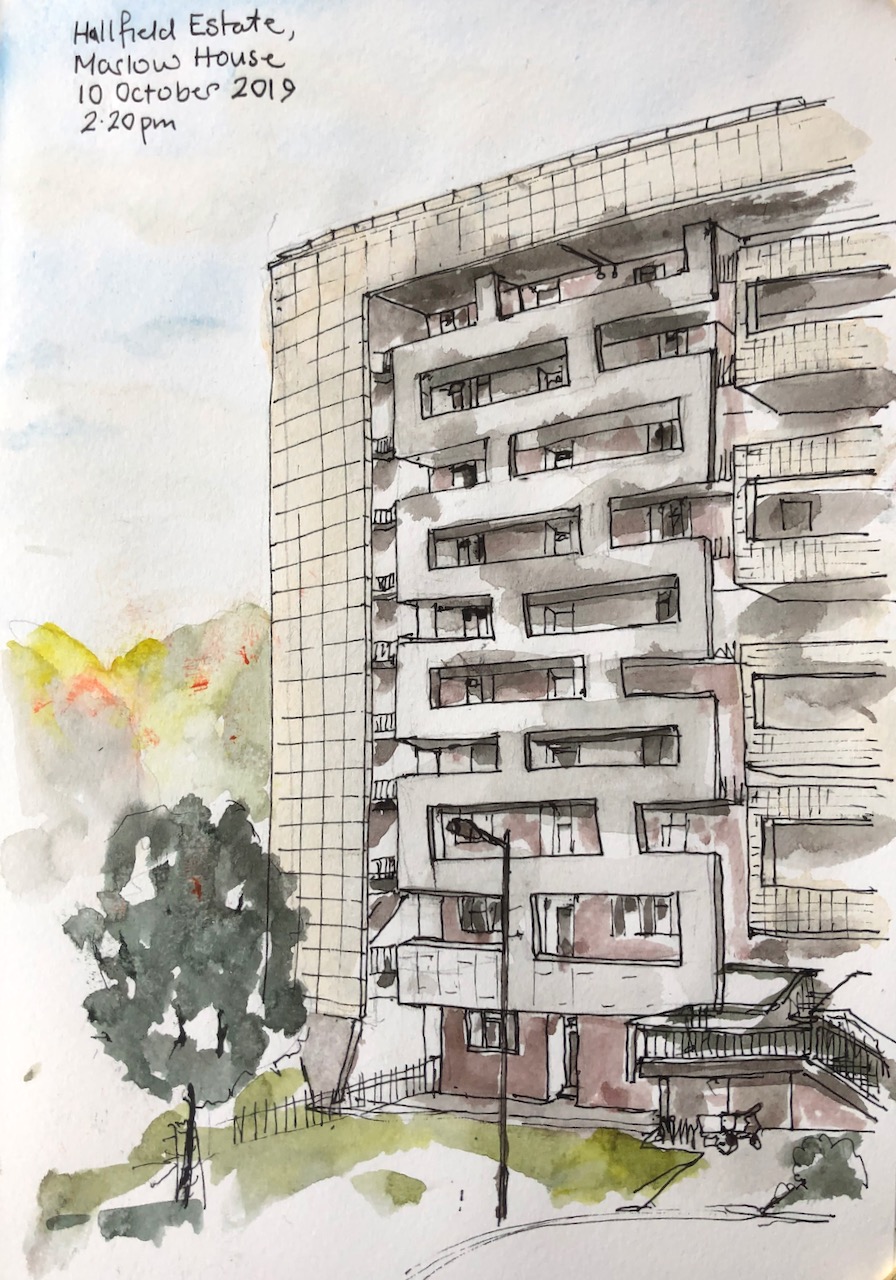
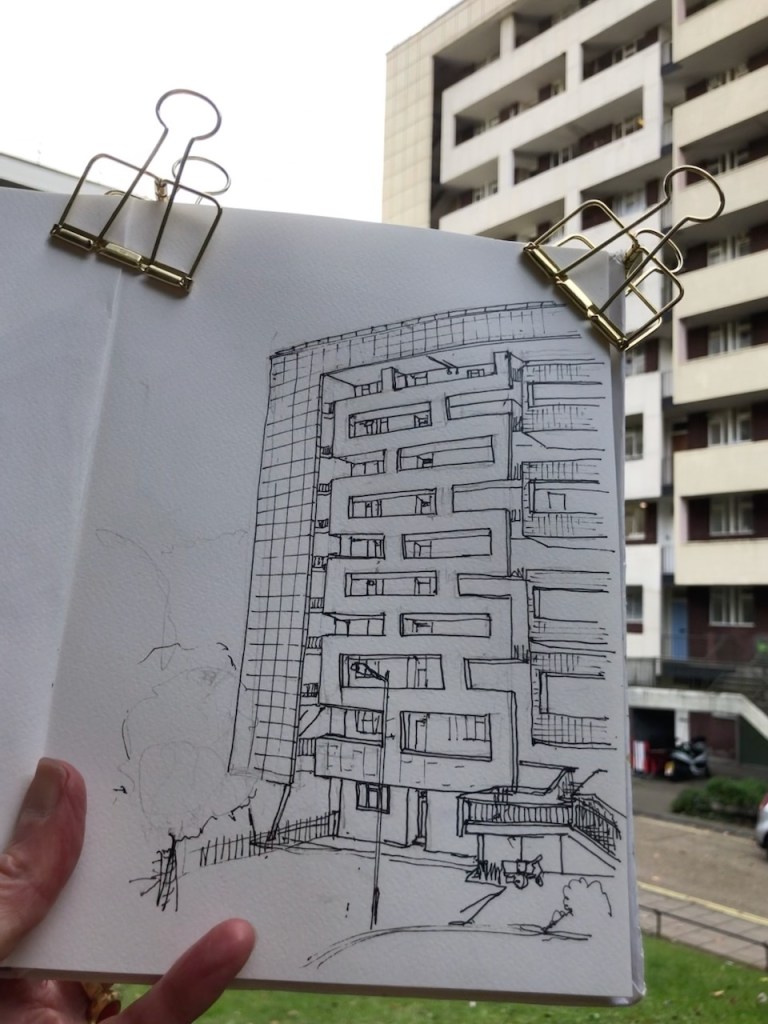
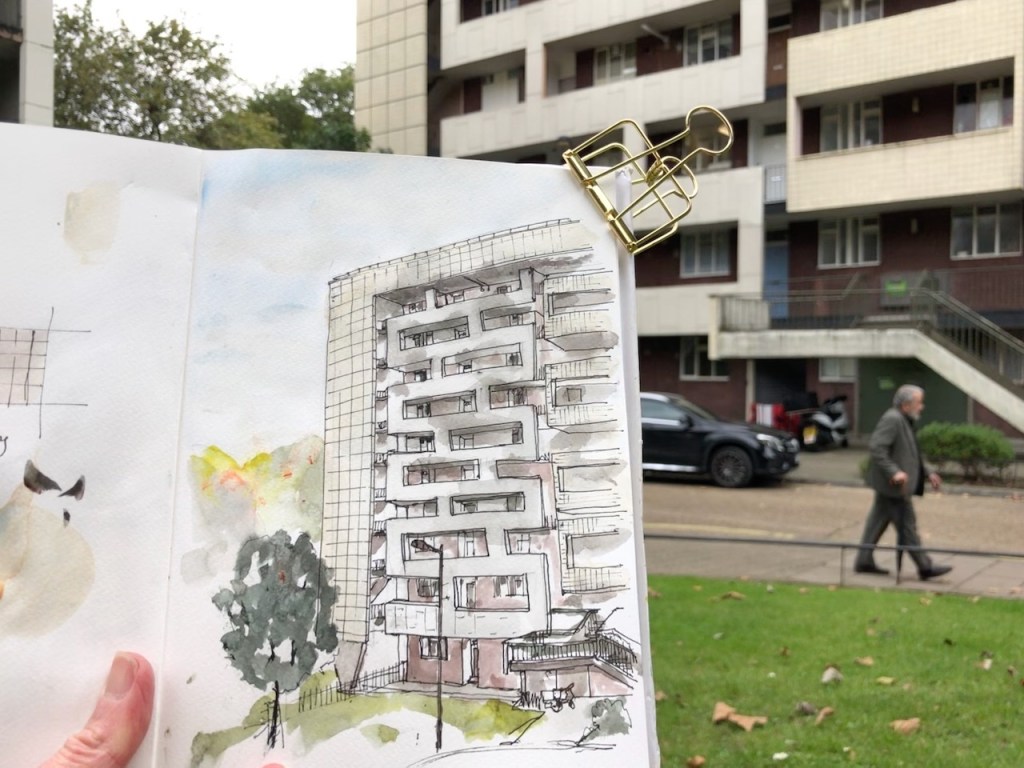
Here is a sketch of Marlow House. I drew it standing on a strange hummock, a small hill, inside the estate near the Battle Bridge Road.
Marlowe house sketched on location 19th October 2019 in sketchbook 5
“The estate presents a convincing riposte to criticism that postwar council housing is grey, drab and utilitarian. At Hallfield, the exteriors of each block are treated like works of abstract art – some are patterned with a chequerboard of blue and red brickwork; others have a zigzagging screen of white concrete panels. The estate now exists amongst an elite group of 16 listed post warhousing estates estate in London – estates that are successful as places to live and are cared for by their residents.” Hannah Parham, the English Heritage Designation Advisor (2011).
Shown in my picture is the “zigzagging screen of white concrete panels”.
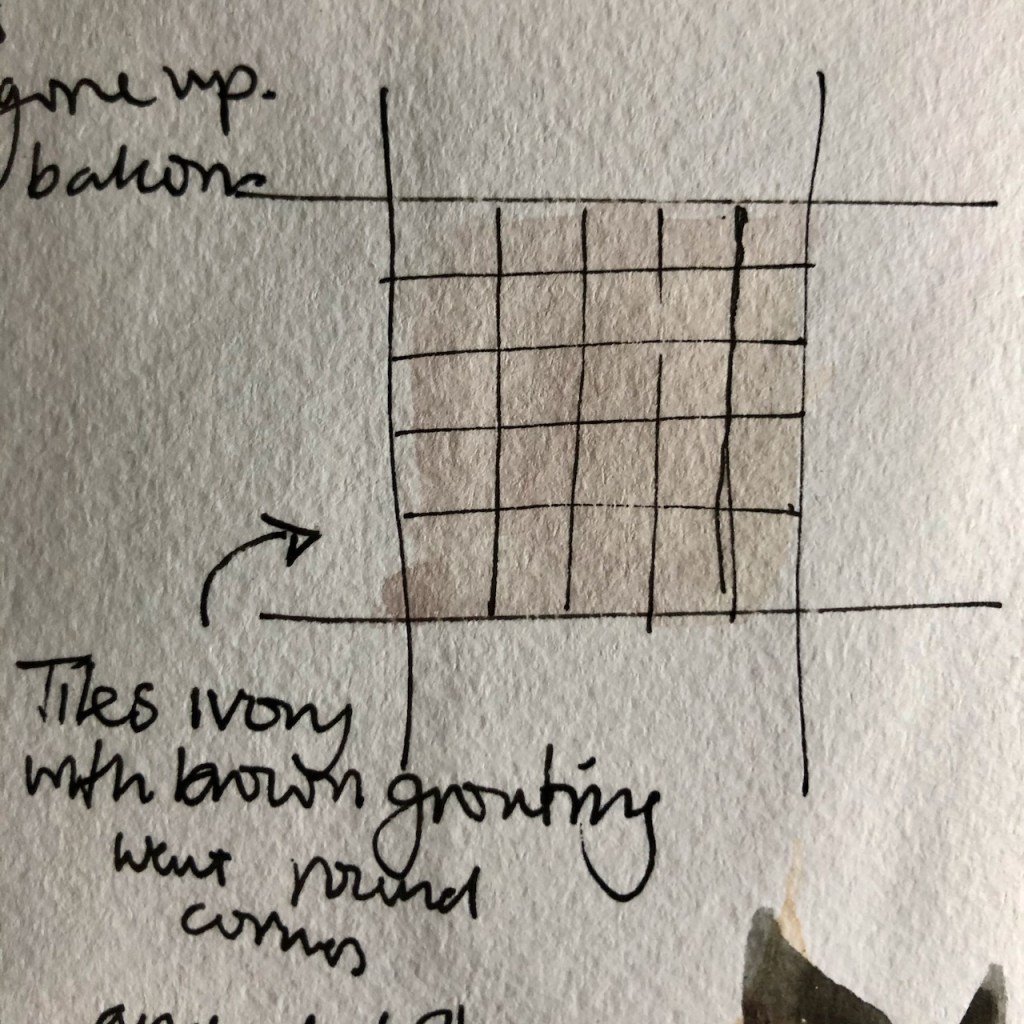
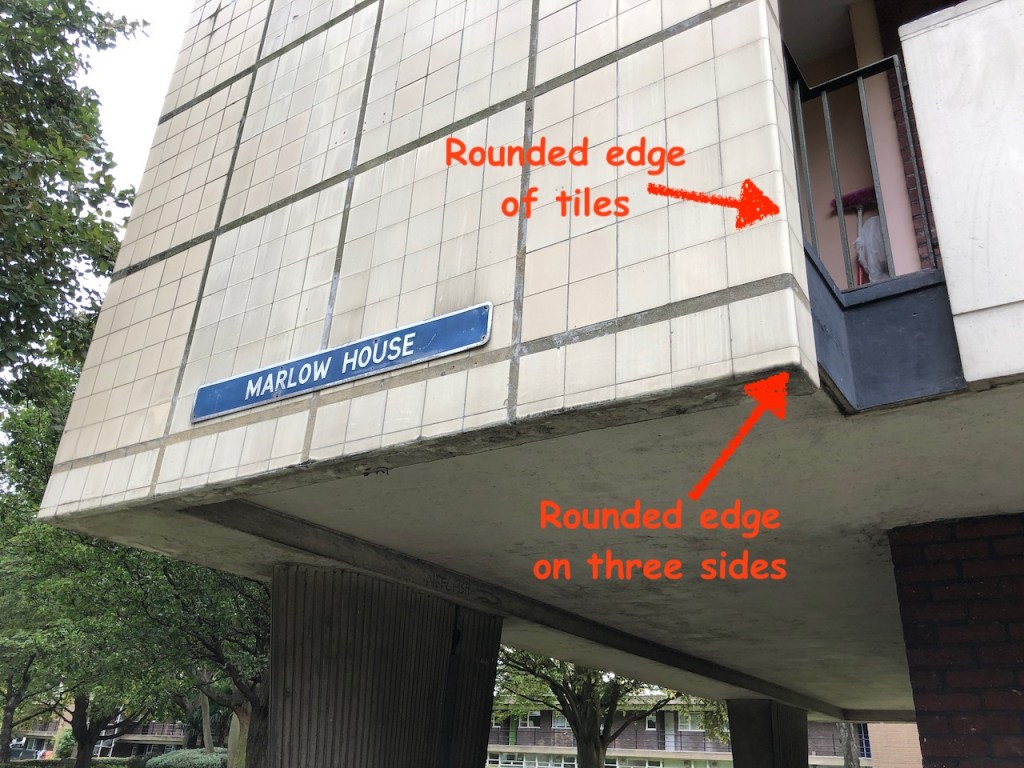
The gardens were beautiful, and well maintained. The buildings themselves are showing signs of wear. Tiles are chipped and cracked at the edges, and staircases look covered in soot from a previous era. But it’s still a stately collection of buildings. The white tiling is a work of art. On Marlowe House, the frame of the building is covered in ivory tiles, in squares of 25 tiles arranged in 5×5 grids, which are themselves arranged in a grid. So the effect is that of graph paper. I was impressed that these tiles are carefully made, and the edge ones are shaped, with rounded edges.
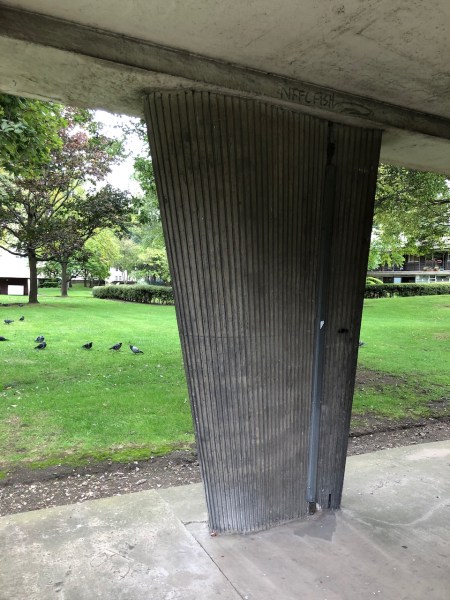
I also enjoyed the pillar, in the lower left of my drawing. It is fluted.
Fluted pillar. The lighting conductor rather mars the effect.
The stairwells are completely open. I could have gone up, but I didn’t. The postman did, however. While I was drawing I saw him doing his rounds, his black woollen hat moving along the balconies, passing behind the facade and down the stairs.
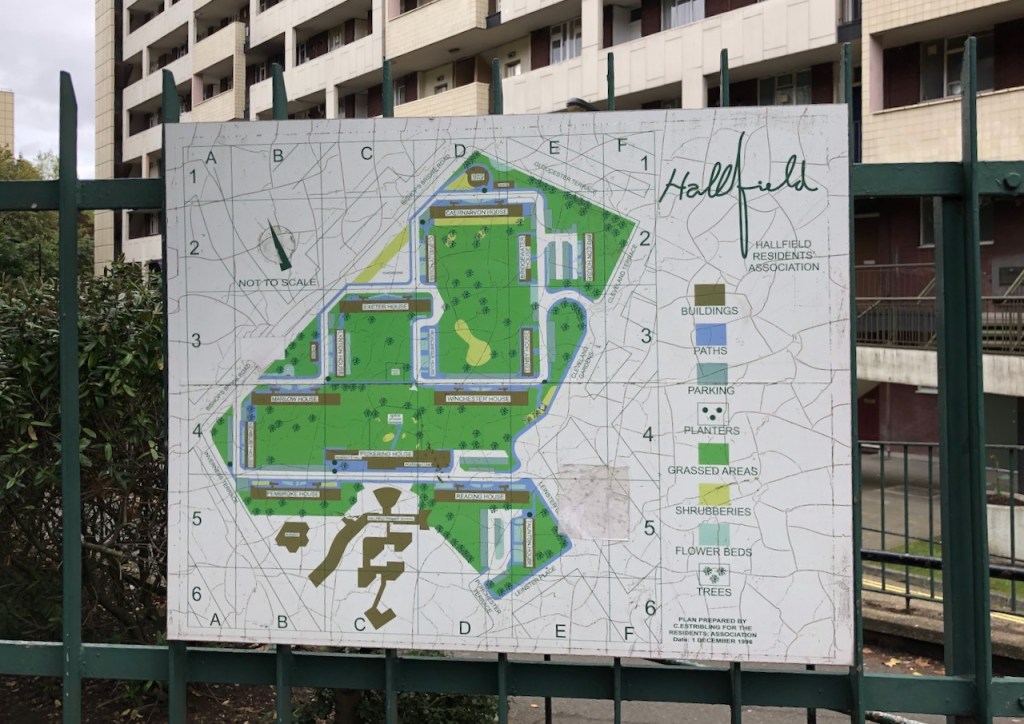
Here is a map and work in progress. Click to expand the picture.
Drawing took 1½ hours, drawn and coloured on location.
Click a button below to share this post online, email it, or print it:
The winter evening settles down With smell of steaks in passageways. Six o’clock. The burnt-out ends of smoky days. And now a gusty shower wraps The grimy scraps Of withered leaves about your feet And newspapers from vacant lots; The showers beat On broken blinds and chimney-pots, And at the corner of the street A lonely cab-horse steams and stamps. And then the lighting of the lamps.
T.S. Eliot – Preludes
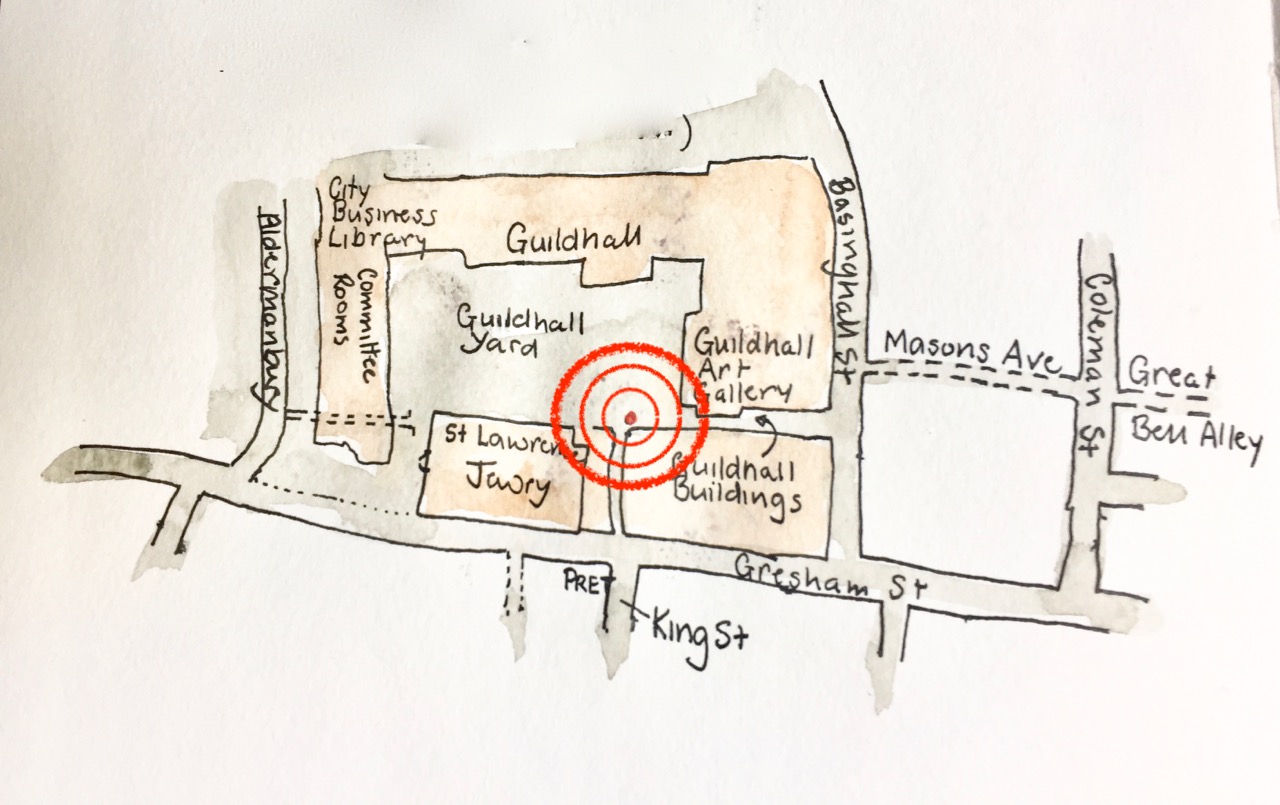
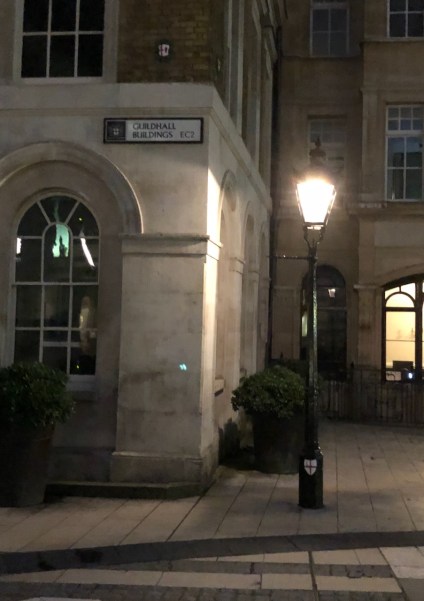
There are still quite a few gas lights in London. I aim to draw as many as possible before they are taken out of service. It’s quite remarkable that there are so many in operation. This one is in Guildhall Yard, in the City of London. St Lawrence Jewry is in the background.
Gaslight, and St Lawrence Jewry, from Guildhall Buildings
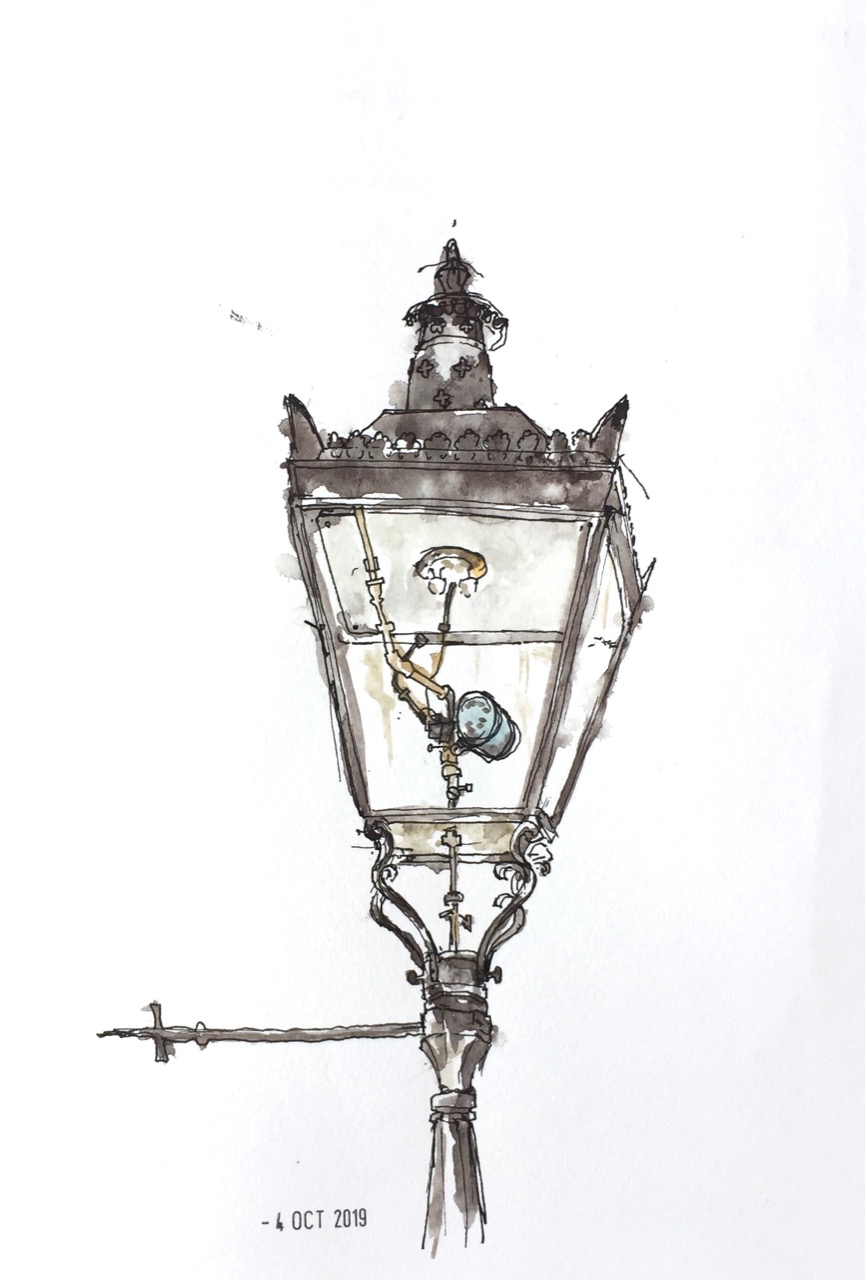
Here is the gas light close up, drawn from Guildhall Yard, looking south.
Written on the little blue canister are the words:
“…the Solar Dial which automatically adjusted lighting times at dusk and dawn throughout the year. It was the start of nearly eighty years of Horstmann’s manufacturing involvement in the street lighting controls market.”
However before this innovation, the gas might have been lit by a person, because there is the arm for the ladder, as shown in my drawing. Perhaps that arm was always there, though, even after automation, in case someone needed to inspect the light. The North face of the light, the one shown in my picture, includes hinges on the left, and evidently could be opened.
I do not know if this light still functions. I shall take a diversion that way in the night, and let you know.*
I have drawn another local gas light, which does still function, off King Edward Street.
Gaslights on Queen Isabella Way
Location of Queen Isabella Way
All pictures drawn and coloured on location. Pen and wash.
*Update: It works!
06:45 15th October 2019, Guildhall Buildings
Click a button below to share this post online, email it, or print it:
There’s a lot of restoration work going on at Canterbury Cathedral at the moment. The ceiling of the main nave was covered up, and one of the towers was wrapped in scaffolding. Also, it being Sunday, a part of the nave was occupied, reasonably enough, with a service. There was much to see, notably the quiet and dimly lit crypt, where there are huge strong pillars, marvellous mathematical curves and stone carvings which delighted the medievalist amongst us.
Stairs back up to the nave
Pointing out the medieval carving
A view towards an altar in the crypt
A tomb in the crypt
A row of pillars
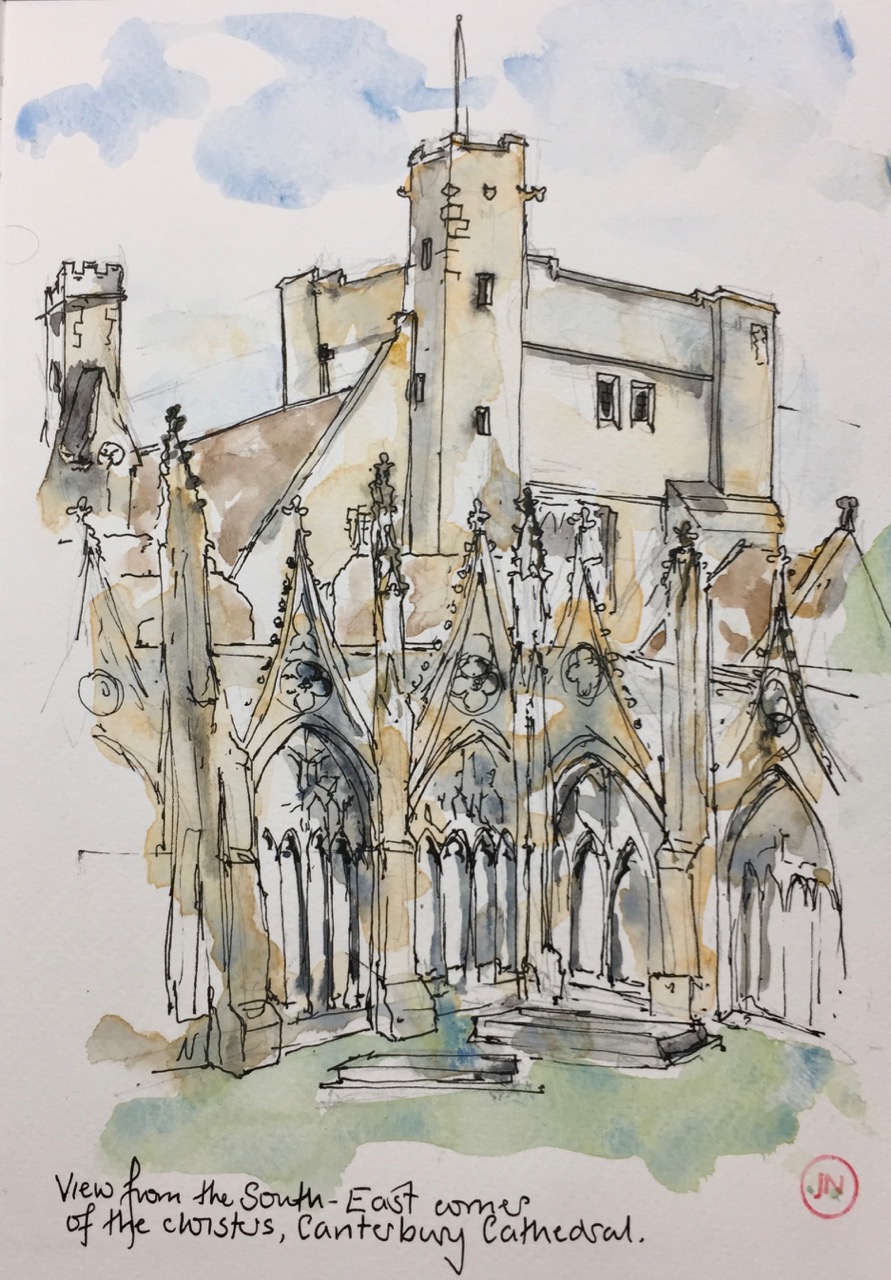
I drew a picture from the cloisters.
It was perhaps unwise to start drawing those ogee* arches with their crocketing**, but I accepted the challenge. The building in the background is The Old Palace, which is the main residence of the Archbishop of Canterbury. It was built between 1193 and 1228, and has been modified and restored since, most recently in 2006.
I drew this picture sitting on the stone surrounds of the cloisters.
Here are some maps to show where I was drawing.
Here is work in progress. The drawing took an hour, pen and ink and watercolour on location.
*ogee arches are arches with those fine points
**crocketing is the series of knobs which are often seen on spires and arches of gothic style buildings
Click a button below to share this post online, email it, or print it:
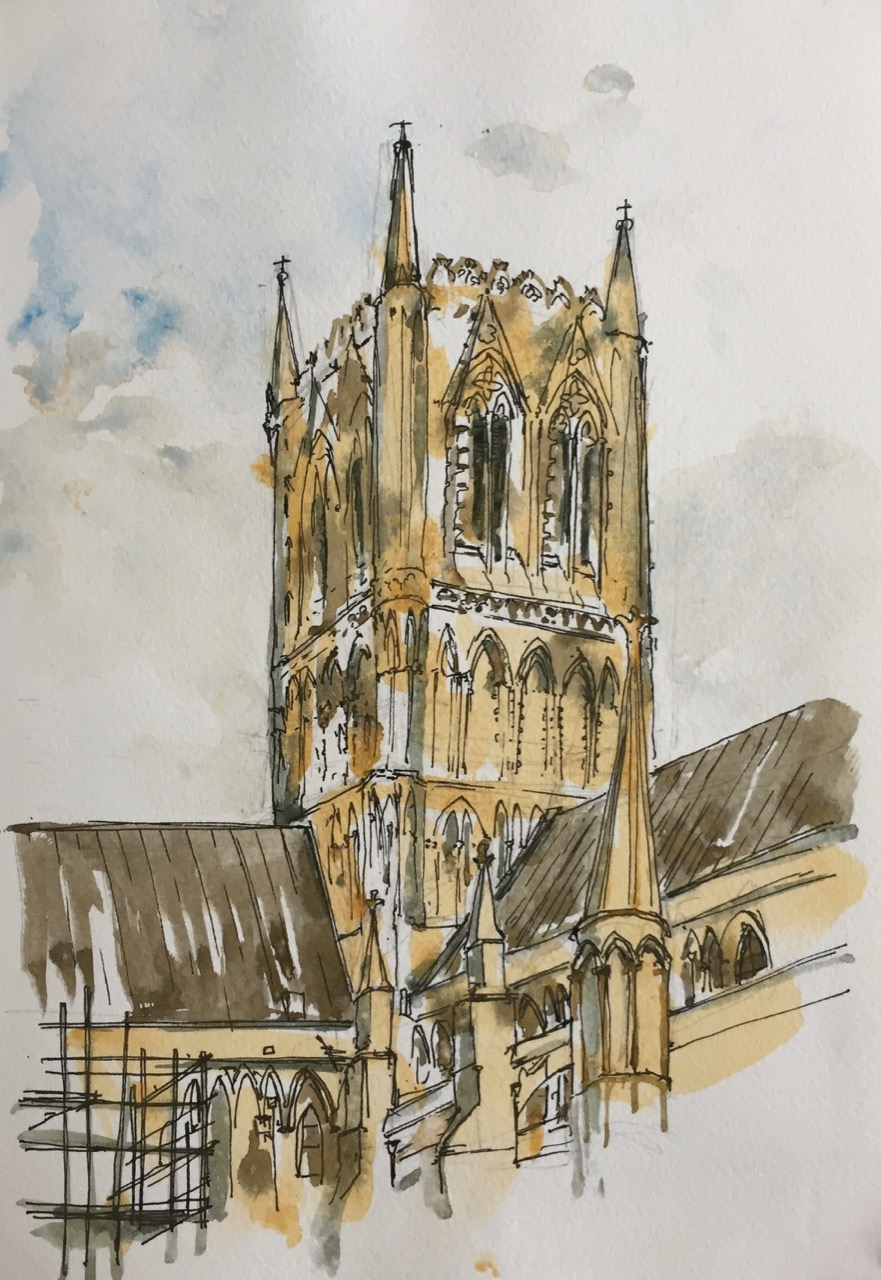
Here is a sketch of Lincoln Cathedral tower, drawn from the cloisters.
Lincoln Cathedral was originally built in 1072, as part of William the Conqueror’s programme of cathedral-building in England after his 1066 invasion.
It was partly destroyed in an earthquake in 1185. It might be more accurate to say that parts of the cathedral fell down at the time of the earthquake. The cathedral had construction faults, and the earthquake may well have triggered a collapse that was in any case imminent. The earthquake was something like 4 or 5 on the Richter scale. It’s interesting to note that such (natural) earthquakes are quite common in the UK and seem to happen every two years or so.
Then it was rebuilt in the current ornate style in around 1200.
We went on a tour. Here are some of my very quick sketches as our guide, Paul, took us around the cathedral.
Tour notes
Tour notes
Tour notes
Tour notes
Tour notes
Visitors to the cathedral
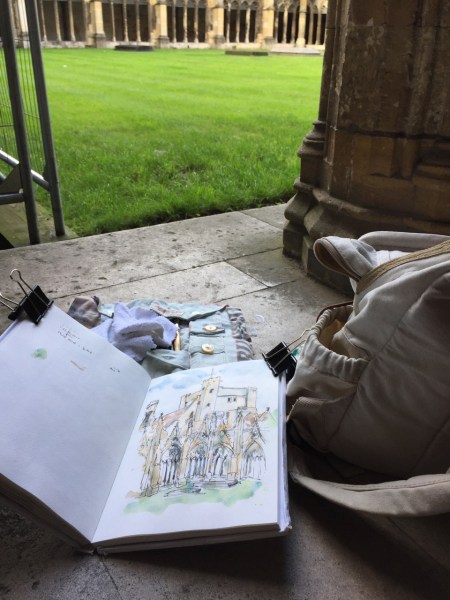
After the tour I went to the cloisters and finished my picture of the tower. Here is work in progress.
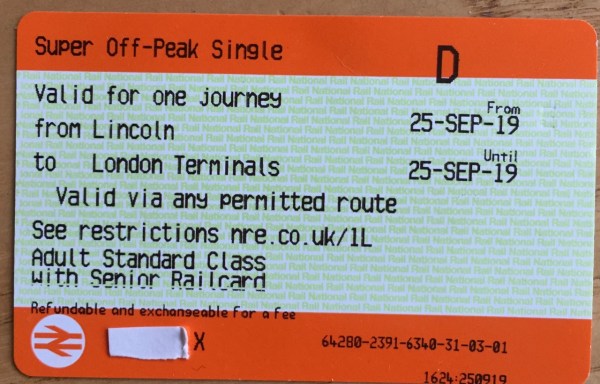
We went to Lincoln by train. It was pouring with rain but we still enjoyed the cathedral. We shall go back when we can see the sun pouring through the stained glass windows.
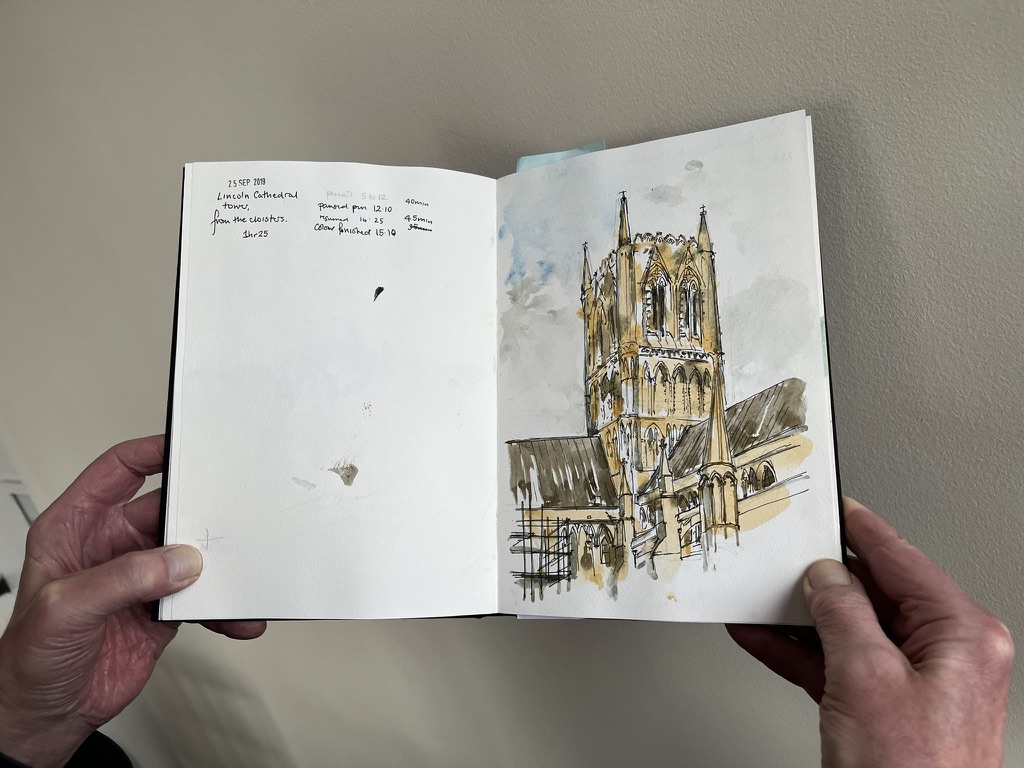
Finished sketch in Sketchbook 5
Click a button below to share this post online, email it, or print it:
This little landscape book arrived. It arrived with a suggestion that it be used for poems or haiku, with illustrations.
Japanese lanscape book
The book is made by hand
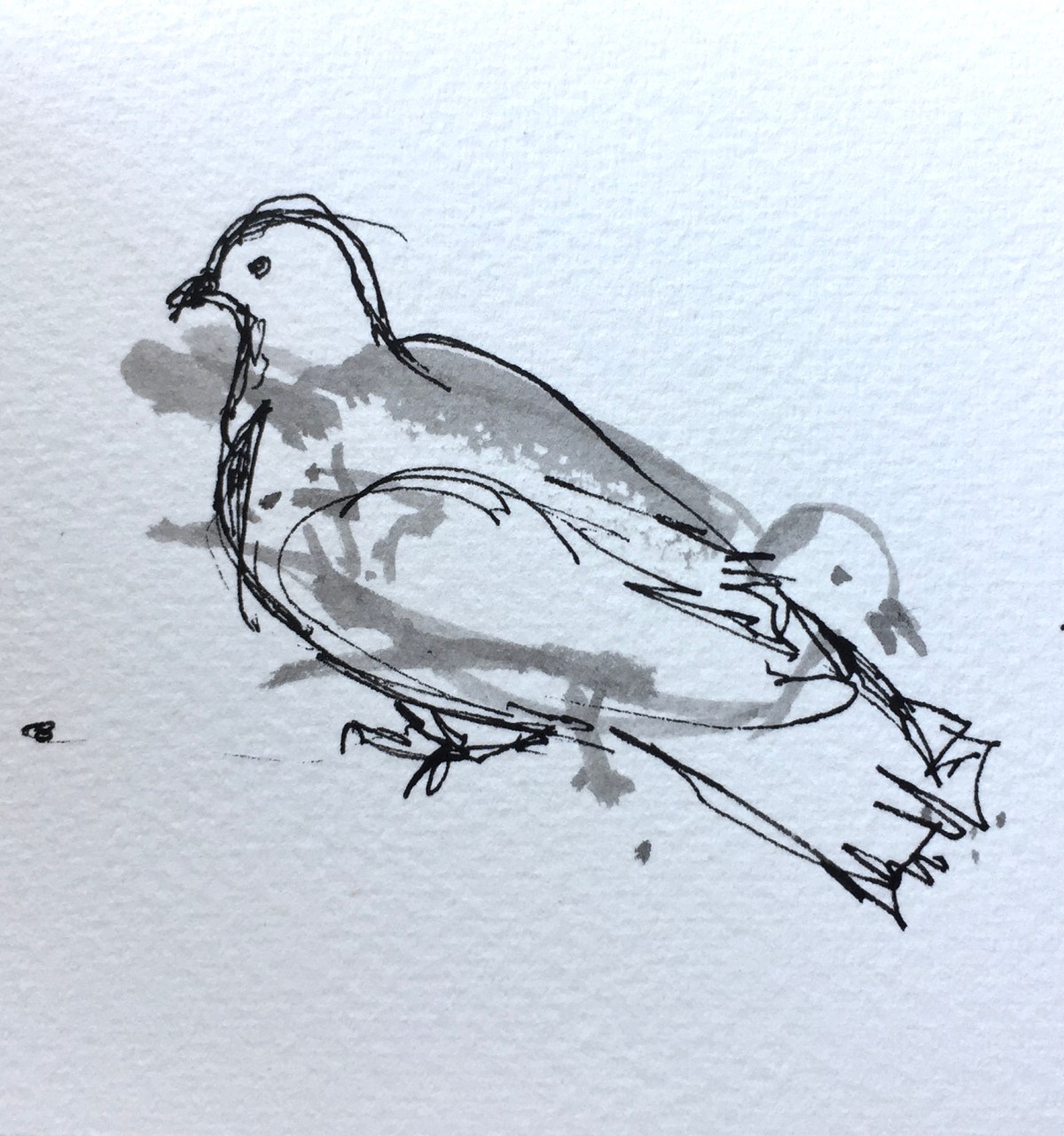
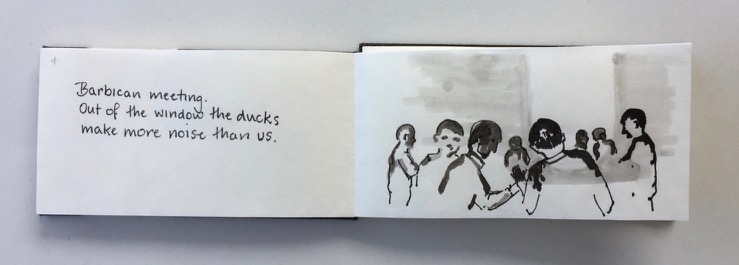
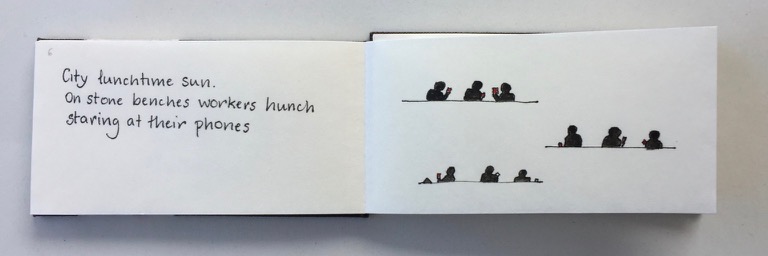
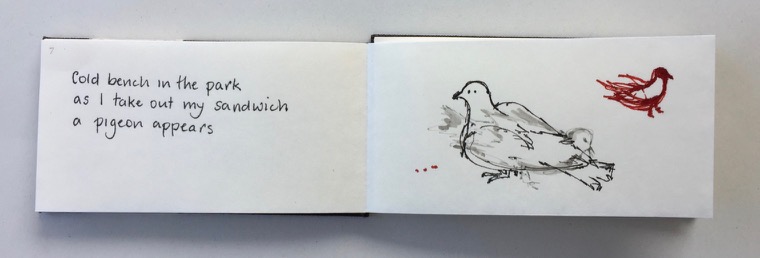
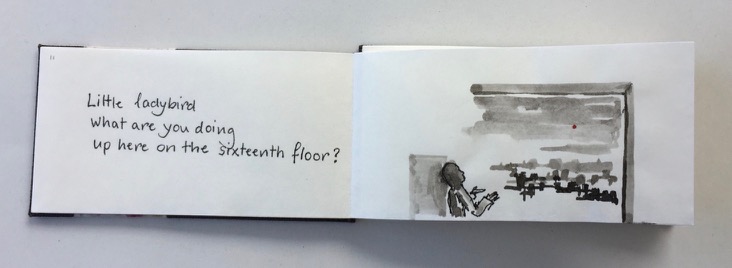
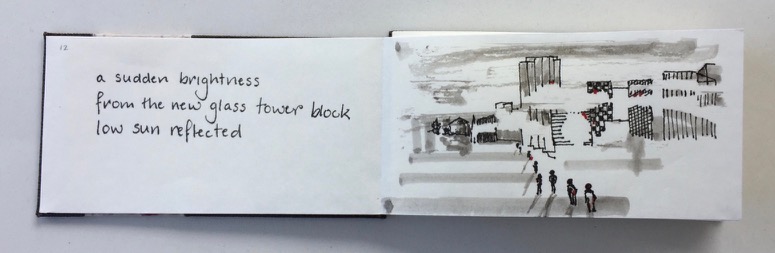
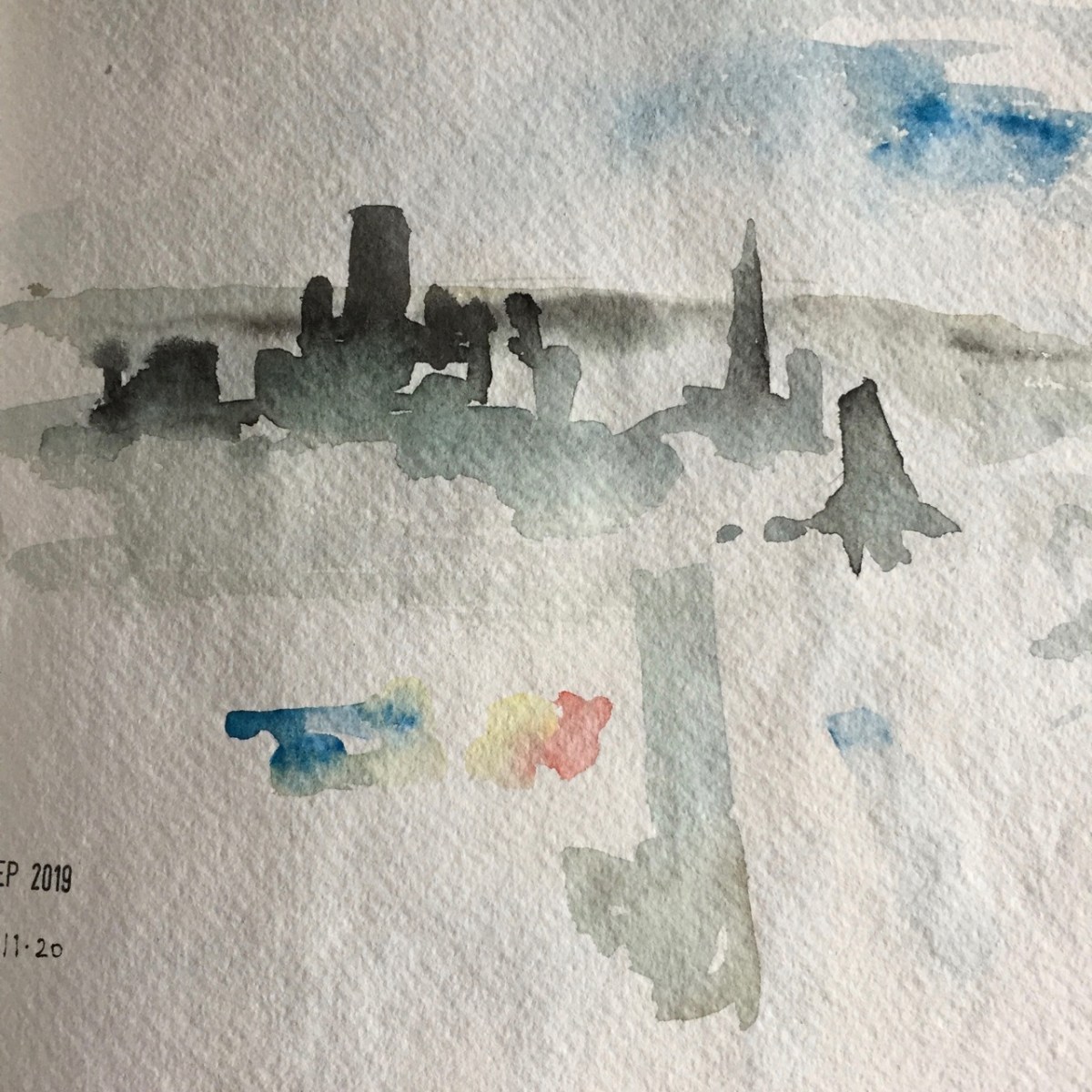
The book is a gift from my Japanese friend and mentor, whose work can be seen on Instagram here. It is bound by hand, and contains very thin, fine paper, in a concertina, a zig-zag. In an attempt to honour the generous gift and the inspiration, I made some urban haiku, about September in London. Here they are.
My idea was to observe the following constraints. As I have said elsewhere on this blog, I am someone who finds constraints useful. Here’s the form I tried to follow:
5-7-5 syllables
some, may be oblique, reference to the season
in the present tense
nature is in there
Click a button below to share this post online, email it, or print it:






































 Jane Sketching