Sunday stroll in the City

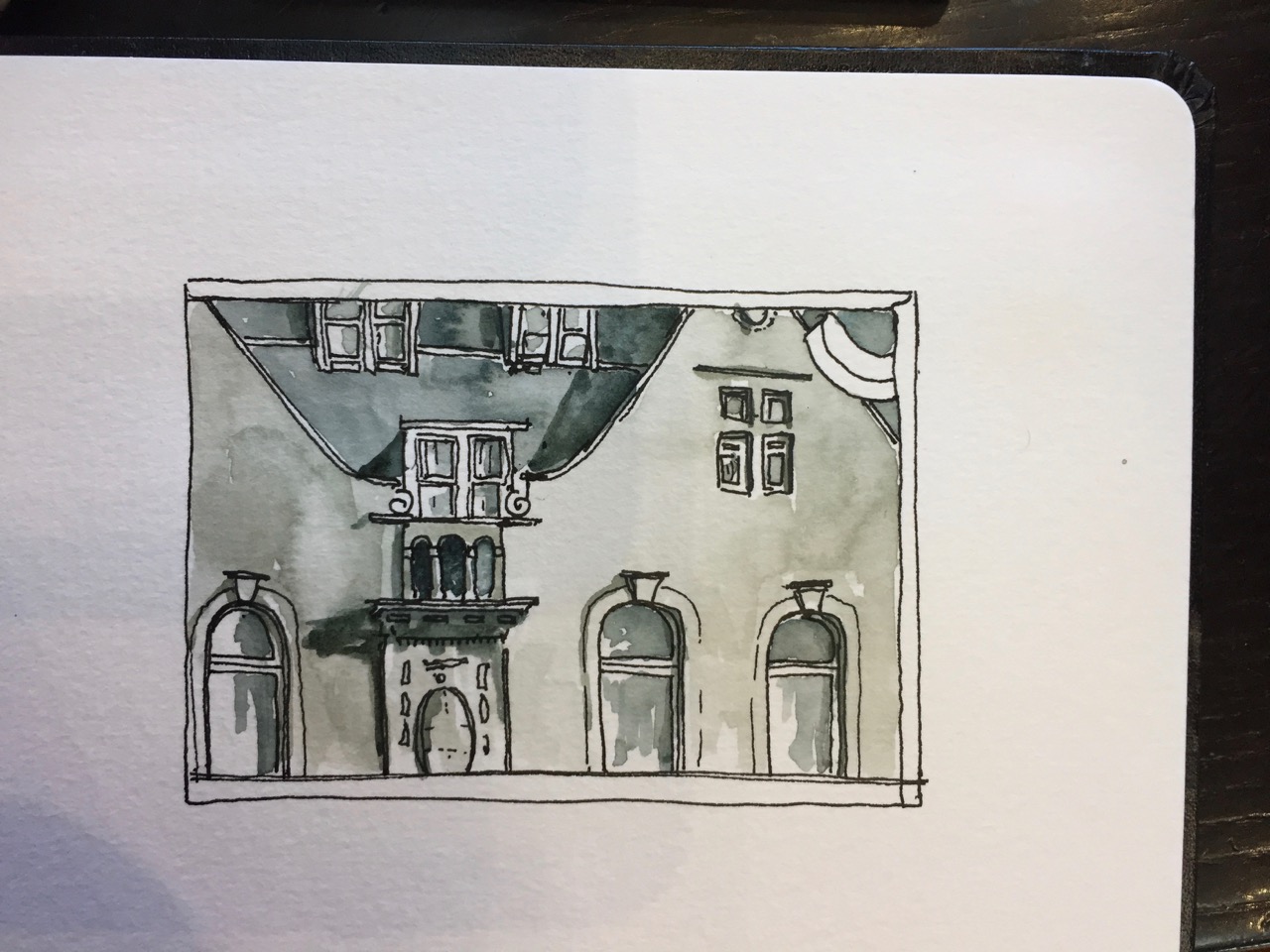
From Fenchurch St Station there is a stunning architectural view. I sketched it, standing outside the station. This was not a great place to stand. I put the colour on later, sitting down in the wooden seats nearby. A woman with a bike came by and told me someone had let down both her tyres. Why would they do that, she asked me. Why indeed. She went off, pushing her bike on its flat tyres. Her dog followed on its lead, disgruntled,  catching the mood of its mistress, deprived of a ride in the special dog-basket on the back of the bike.

IMG_3518
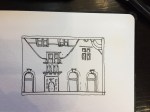
From Fenchurch St Station, looking West, along London Road

Shown in the picture on the left is “Minster Court” a pinkish coloured Neo-gothic building built in 1991. It contains, amongst other things, the “London Underwriting Centre” and “Proud Cabaret City”, and a branch of “Balls Brothers”, a pub.
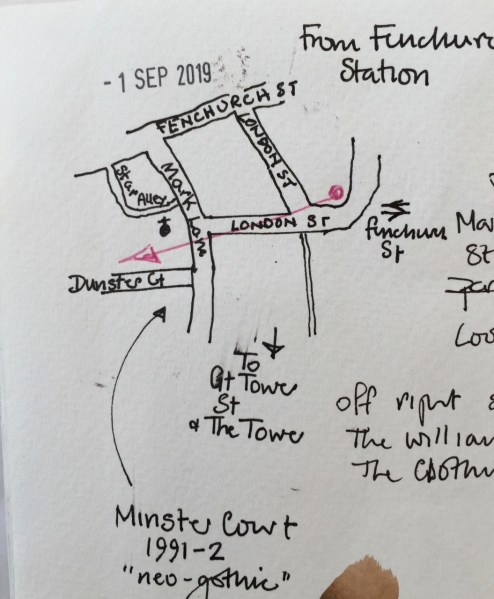
IMG_3520
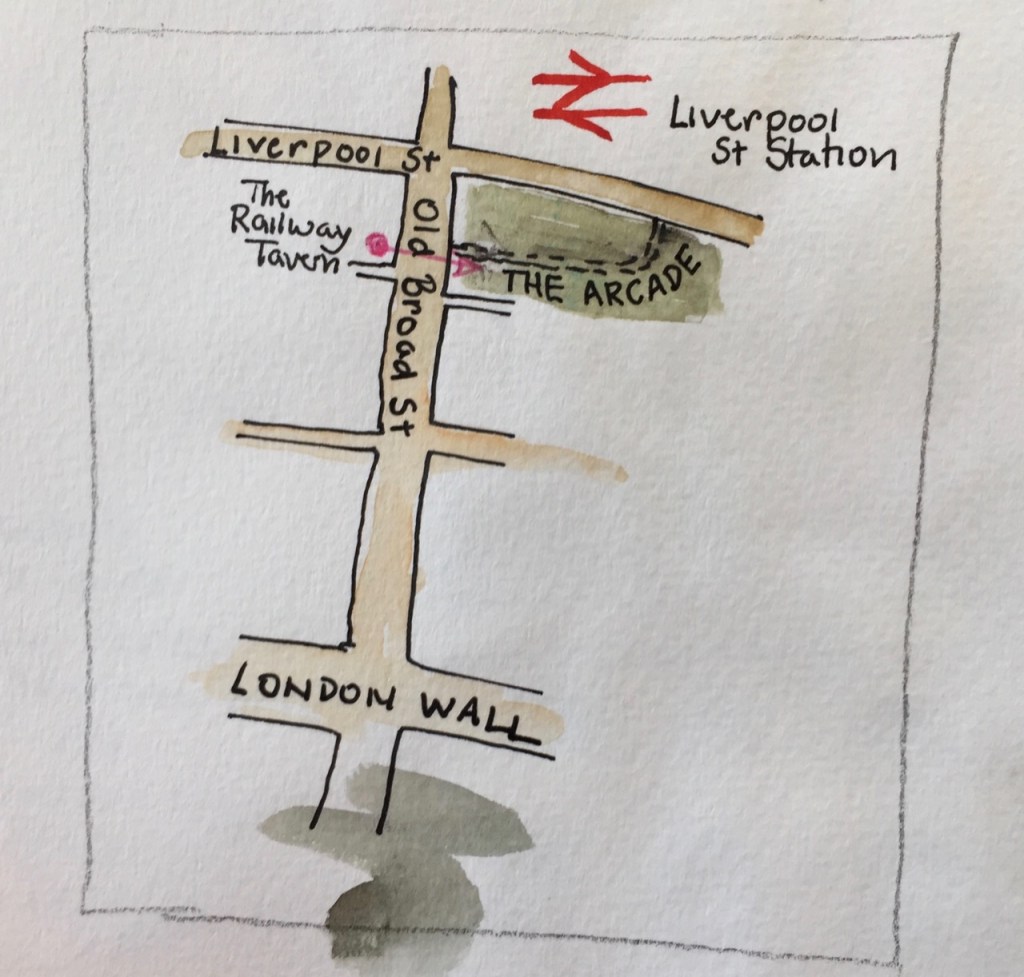
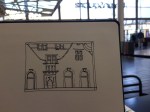
Sketch map, showing the direction of the view from Fenchurch St Station.

The glass building is “Plantation Place” built 2004, by Arup Group. Accenture is in there.

Behind I hope you recognise the “Walkie Talkie” skyscraper. In front and centre is the Clothworkers Guild. The little building at the bottom is St Olave’s Church Hall. St Olave’s Church itself is a lovely tower, which I would have seen if I’d moved slightly to the left. It’s behind the ponderous dark building on the right. I’ll go back and sketch it another time. This is the church where Samuel Pepys worshipped.

I walked towards the river and sketched in St Katharine’s Dock.

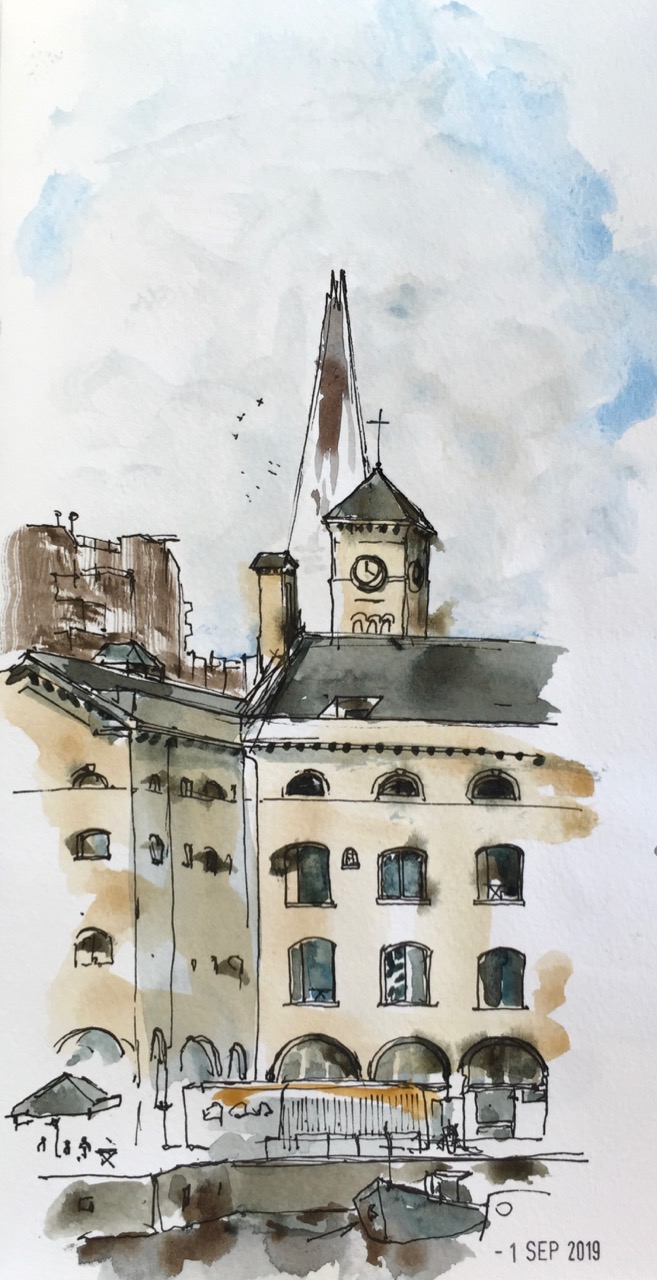
This is the view looking West, from the East side of the dock.
IMG_3517
St Katharine’s Docks, looking West (IMG3517)

In the background on the left is “Guoman Hotels The Tower”, which is right next to the Tower of London. This hotel was built in 1973, one of the first buildings of the dockland re-furbishment. The Shard is in the background, centre.

The main building in the picture, former warehouses, is now called “The Ivory Building”. It appears to be residential. There were lots of bells to push, but I didn’t. I envy the person who has that turret. The clock was showing the correct time.

On the lower left is a restaurant with a sun umbrella. Its name was so tangled up in the fancy script of its logo that I couldn’t read it, something like “docole”.

Off the picture to the right a large rectangular stone was embedded at eye height. People rushed past, to the cafés and restaurants. The writing on the stone said:

“The foundation stone of Commodity Quay World Trade Centre London, laid on St Katharine’s Day 1985”

St Katharine’s Day is 25th November, in case you were wondering. Also spelt with a C.

Here is my favourite picture of the walk, done on the way back.

IMG_3516
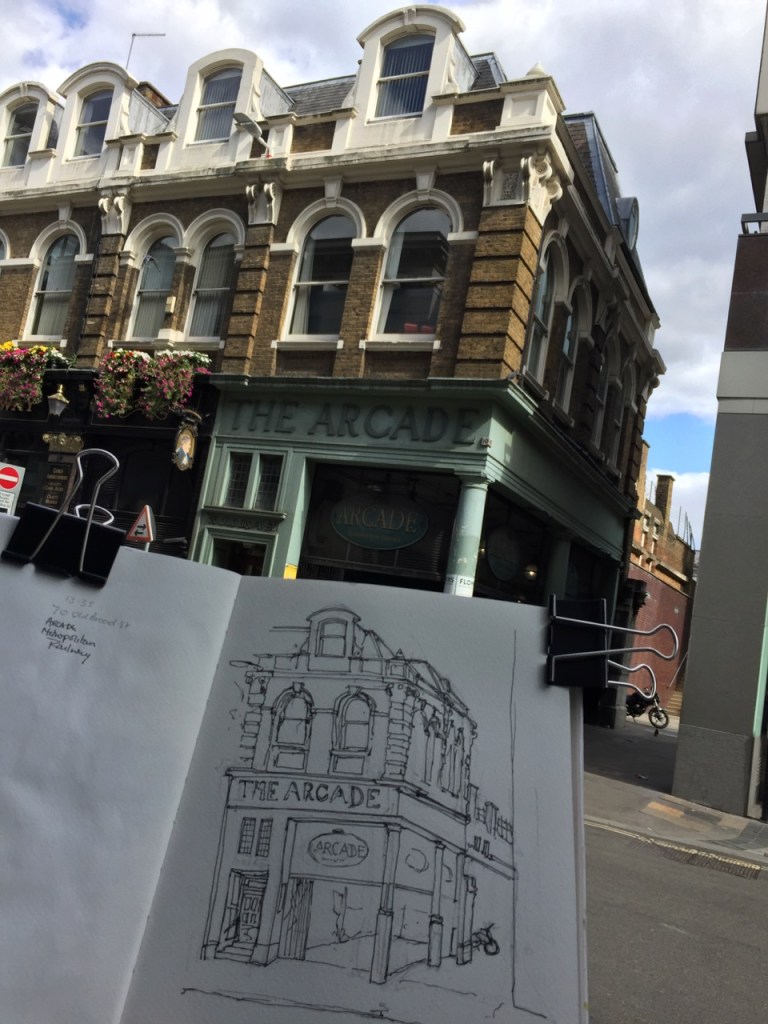
The Arcade, Liverpool Street

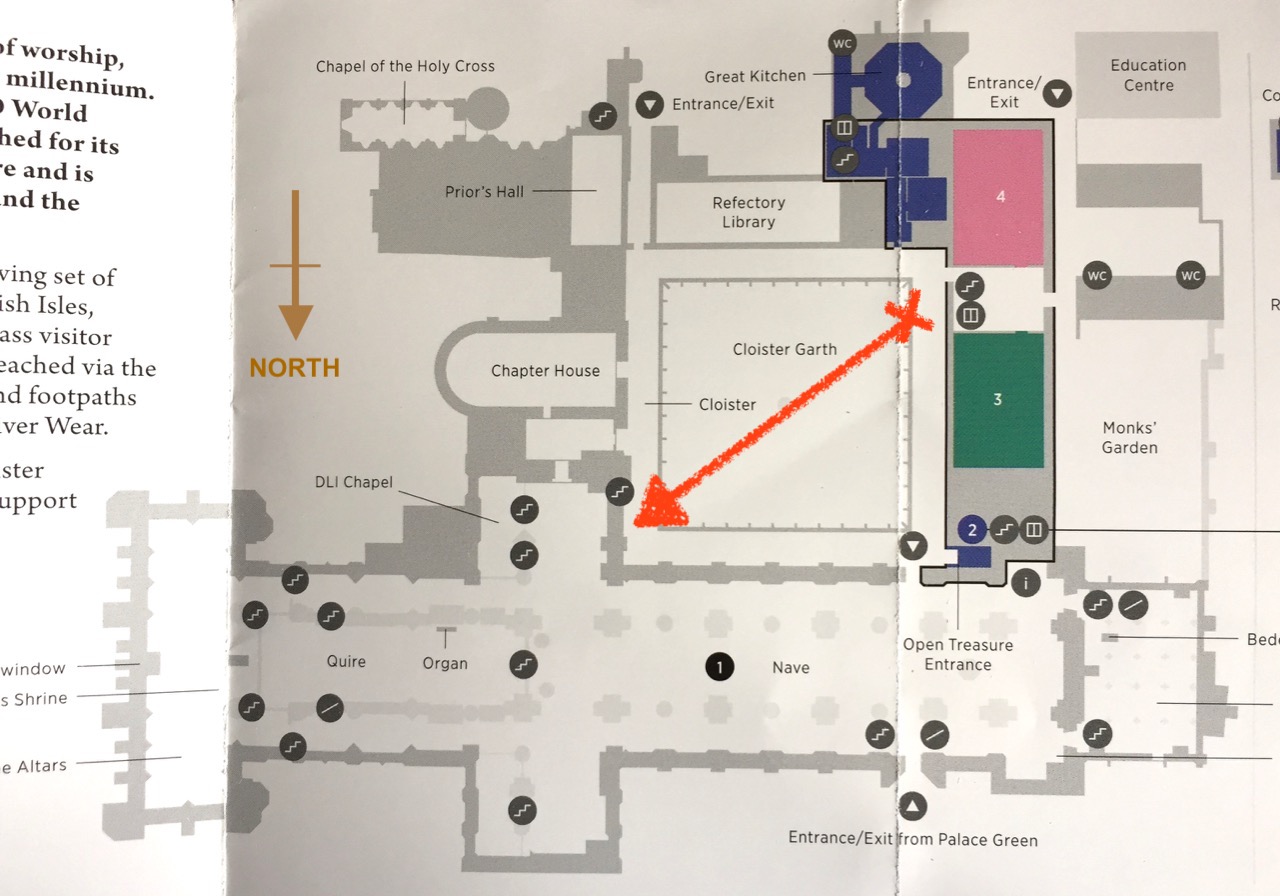
This is an astonishing construction, left over from an earlier epoch, and now surrounded by new-build and glass and steel office buildings. It is a corridor of shops, like the famous passages in Paris. But actually, not like them. Since it was Sunday, the Arcade was not trading. It was looking rather dilapidated. As I sketched, I saw tourists make their way in there uncertainly, in a characteristic pose of staring at the mobile phone and glancing about. Evidently Google was telling them that Liverpool Street Station could be accessed was down there. It cannot, not on a Sunday. As they entered the Arcade, they looked about. Then they really looked about, rather than comparing the world to the mobile phone map.  They suddenly saw the broken glass, dusty shop fronts and cardboard, and the feet and legs of someone lying on the ground. They abruptly turned around and came out again into the sunlight, staring accusingly at the phone.

The script which says “The Arcade” is beautiful.

IMG_3513

I particularly like the curved foot of the R, as though the letter is about to dance.

Here is work in progress, and a map:
Homelessness is a problem in London, even right in the centre of the financial district.
Passing through Aberdeen

I went through Aberdeen on the way out to Shetland, and on the way back.

On the way out I drew St Machar’s Cathedral then proceeded south to find the excellent coffee shop Kilau Coffee recommended by the church guardian, who knew her coffee shops. By then I was in the University. It was still raining. So I sketched Kings College Chapel, from a convenient cloister.

IMG_3458
Kings College Chapel, Aberdeen, from the cloister. 9th August 2019 15:21

Then I walked back to the ferry terminal, still in the rain. Here’s a sketch of a building on the main square.

IMG_3493
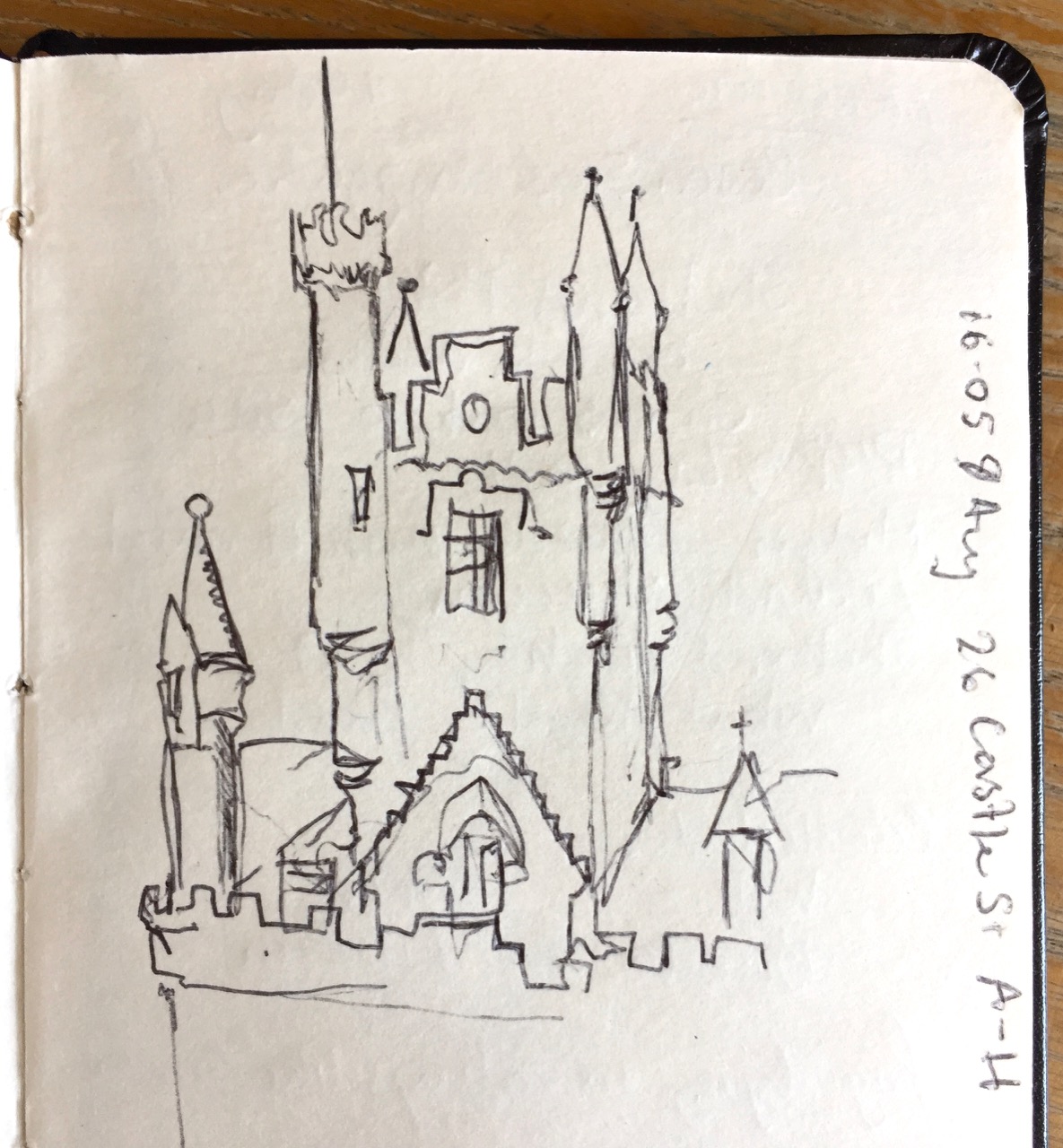
Aberdeen Market Square, 26 Castle St, 9th August 2019

I was taken by the multiple levels of bartizan, which are the towers fastened to the side of the building. These are also called courbelled tourelles. I was sketching from the doorway of a charity shop, in biro, which was the only medium that worked in the sluicing dampness. I tried to find out what this magnificent building was. It seemed only to have a number: “26 Castle Street A-H”, so I guess it is residential.

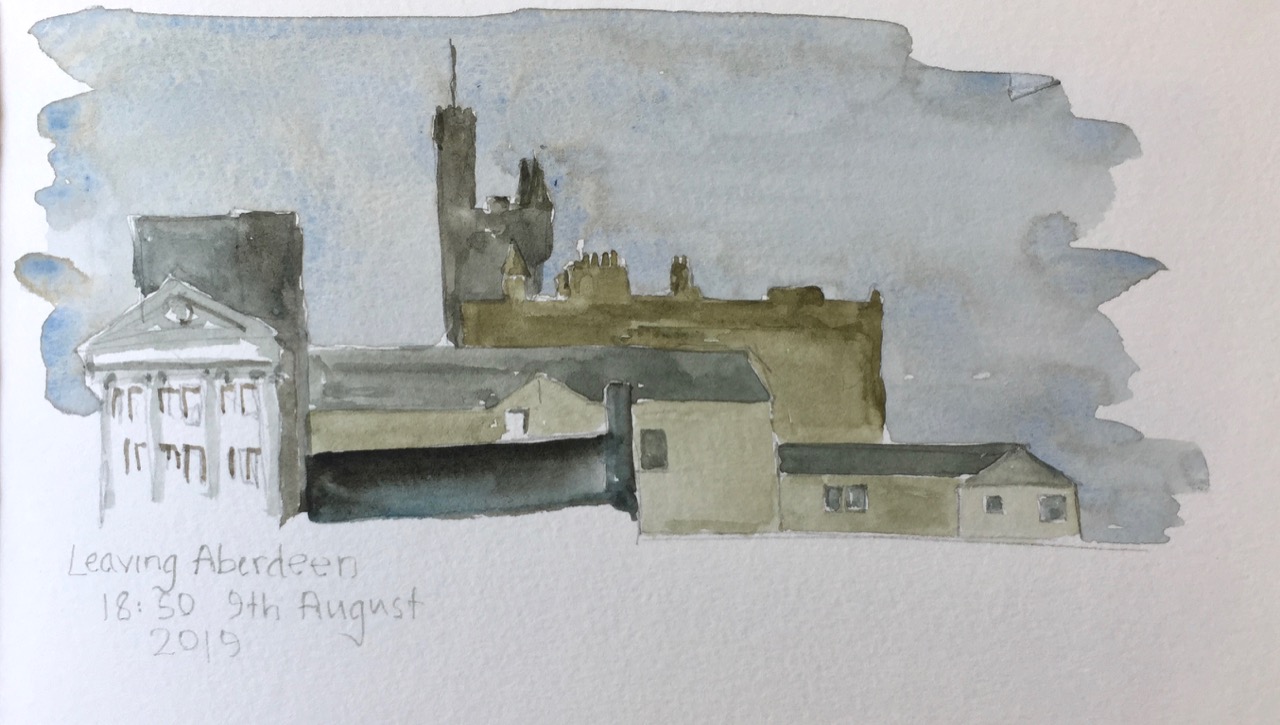
From the window of my cabin on the ferry I saw the same building from a distance.

IMG_3459

On the way back, two weeks later, I took a walk round what I termed the “Starbucks side of town”. This is the part south of the railway station. There is indeed a Starbucks, on Union Street. The houses are grand here, and in orderly terraces. Here’s a glimpse of an end house, a quick sketch as I was on my way to the bus station.

More posts about these visits to Aberdeen:

St Machar’s Cathedral, Aberdeen

Station Hotel, Aberdeen


St Machar’s Cathedral, Aberdeen

St Machar’s is in Old Aberdeen, North of the University.

IMG_3457

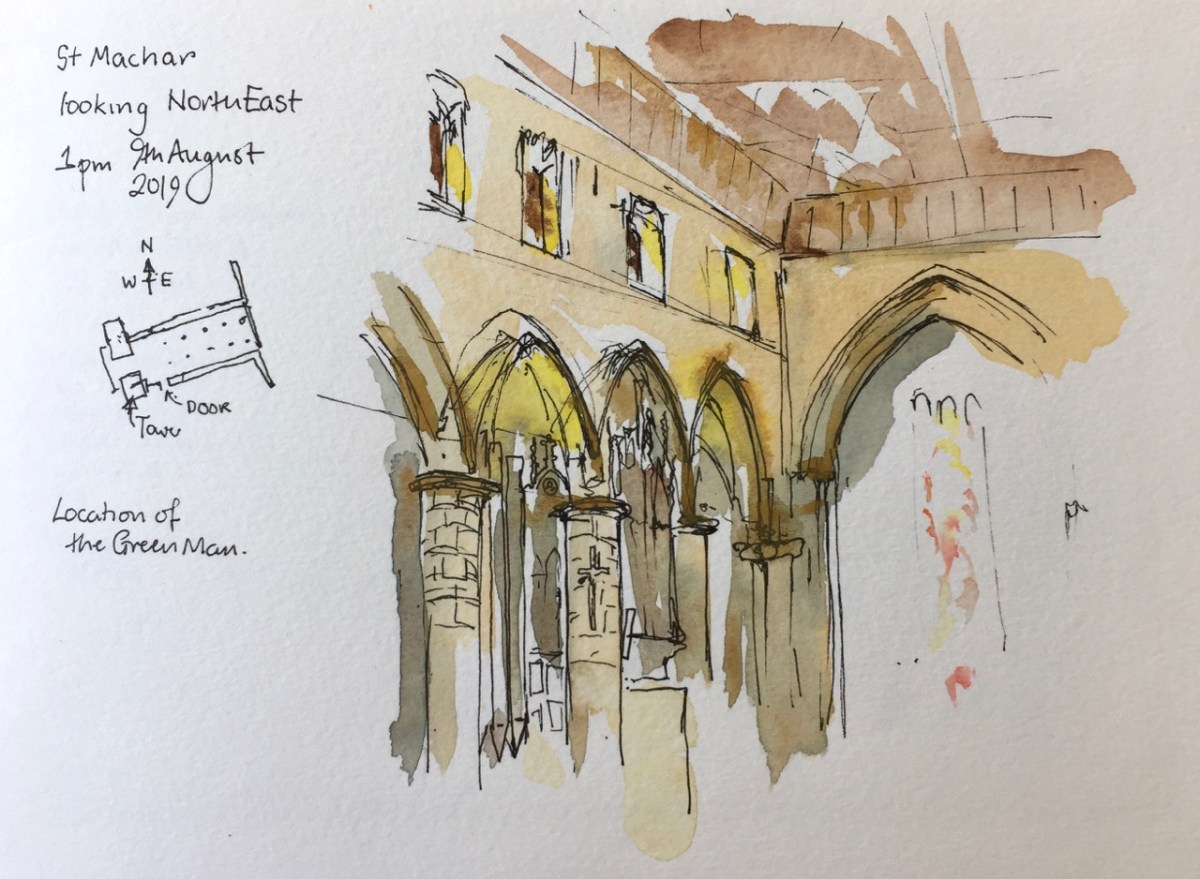
I went to look for a medieval carving, a “Green Man”. According to my instructions it was in the “North East Crossing” on the “west side”. I had a good look around. This is a very plain church, solid granite columns, no carving. I could see no “North East Crossing”. The church is rectangular, not cross-shaped like most churches. The enthusiastic guardians welcomed me, and told me about the church. It is very ancient, and many different peoples have worshipped there, including the Celts, whose 7th century stone cross stands at the west end.

After I had listened and chatted, I showed them my instructions: “North East Crossing, west side”. Ah, they said, but there is no longer any “North East Crossing”, it’s been demolished, for centuries, since the Reformation.

I felt a shiver as though someone was telling me a ghost story. My instructions came from a printed book, much later than the Reformation, clearly. But the guardian was still talking. “You can see the ruins,” she was telling me, “Outside”.

Outside it was raining, a heavy wet Aberdeen rain. I stomped about in wet grass, between gravestones. I was looking up, which made me more wet. And there he was, the Green Man, staring down. I risked taking my iPhone out of my pocket for an instant, to get a photo.

I couldn’t draw outside, so I went back inside. The picture I drew shows the position of the Green Man, but the inside wall. He is on the outside.

9th August 2019, St Machar’s Cathedral, Aberdeen, now Church of Scotland, formerly Celtic, Roman Catholic, Episcopal.

Station Hotel, Aberdeen

The ferry from Shetland arrives in to Aberdeen at 7am. The air feels cool and chemical, like water from a cold tap. I carry my luggage on my back, and it’s heavy.

No, they won’t take my bag at the ferry Left Luggage. Only if I’m travelling on the evening ferry will they take in my luggage.  I am not travelling on the evening ferry. I have just arrived on the morning ferry. And I am going to the airport. But that is later. For now I have a heavy bag, and the whole of Aberdeen to explore.

Let’s try the train station.

It is Sunday.  Aberdeen is closed. The Union Square shopping centre is closed. So the route to the station is three sides of a rectangle, a circumnavigation of the Union Square, Jury’s Hotel and the Bus Station. Outside the Jury’s Hotel, a cluster of men with beer cans  part to let me through. My grim determination is reflected in their faces. Or perhaps it’s something else I’m seeing: their effort to stay vertical.

I spot the “Left Luggage” symbol at the Train station. The door has a dim window which frames a seated man. “I see the Left Luggage operative,” says my optimistic brain. The straps of my luggage are now making permanent furrows in the muscles of my shoulders. The door is locked. I rattle it. “It opens at nine,” comes a voice. It’s the seated man, who is behind me, reflected in the dirty glass. He is sitting on the sunlit steps, waiting.

From the table at “Patisserie Valerie” I can see that he is still there. He hasn’t moved at all. Those steps must be cold, granite. He must be fed up. But he didn’t seem fed up when I spoke to him. Perhaps he is sitting there for some other reason. Perhaps he does not require the services of the Aberdeen Station Left Luggage.

I do, though. I order breakfast at Patisserie Valerie. The glass and steel of the modern shopping centre cuts the view into bits. I can’t draw it all, so I draw a segment.

IMG_3419
A bit of the Station Hotel, Aberdeen, from the Union Square Shopping Centre, Patisserie Valerie.

That odd curl in the top right is the “e” of “Union Square” written on the outside in modern 3D lettering.

Here is work in progress.

Exactly one hour to draw, including eating breakfast. Patisserie Valerie opens at eight. The Aberdeen Station Left Luggage opened at nine.

When I went there, the seated man had gone.

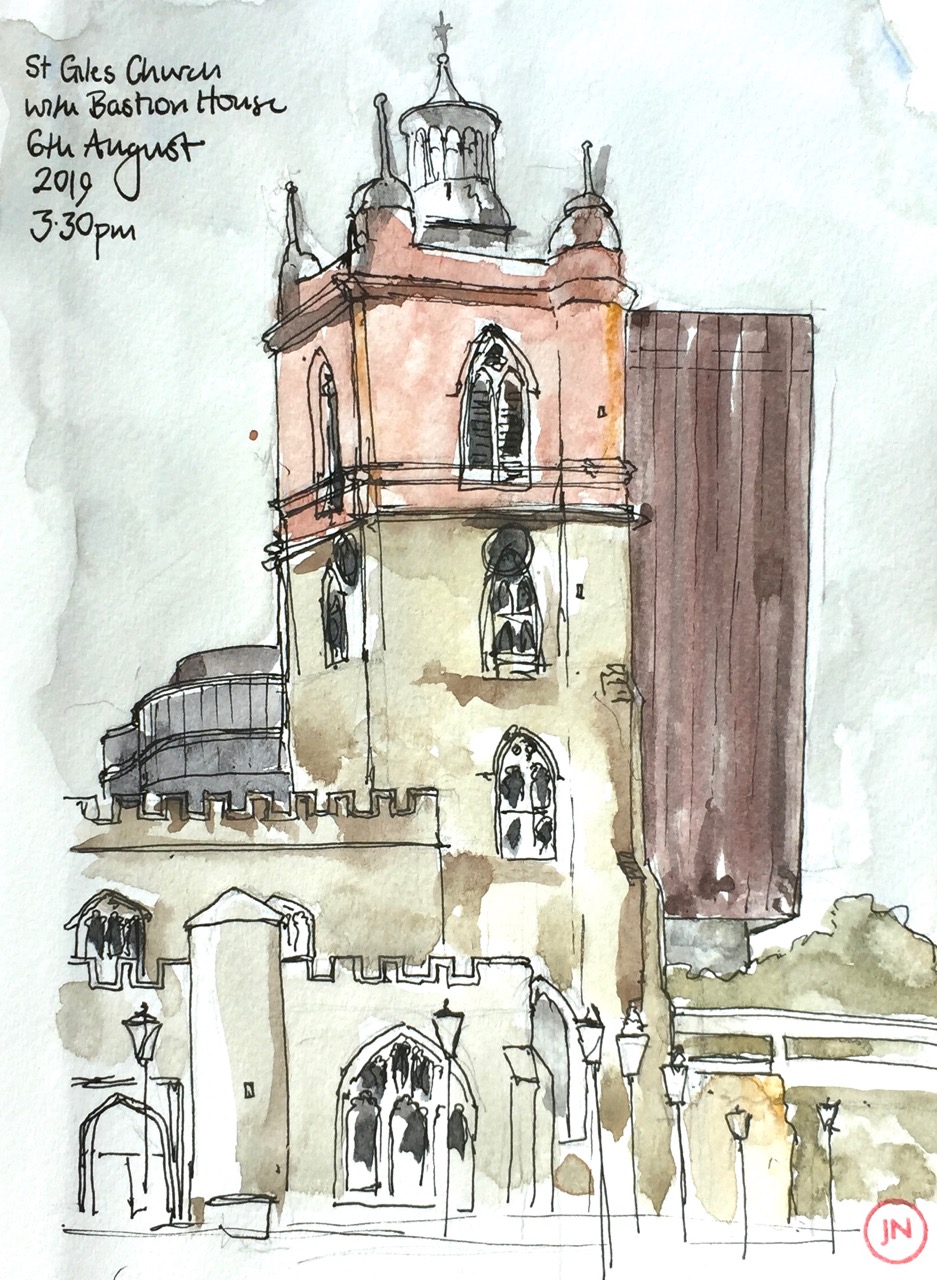
A quick sketch of St Giles Church

Here is St Giles Church from the Lakeside Terrace of the Barbican. While I drew this, three men were shovelling mud from the bottom of the lake. The mud is black and viscous and the men were remarkably cheerful in their task. They would have made good subjects for a drawing too. But for now, here’s the church:

IMG_3106

The church features in some of my “Tower” sketches:

St Giles’ and Cromwell Tower

St Giles’ Church and Shakespeare Tower
 
From Lauderdale Place: Eastern Cluster

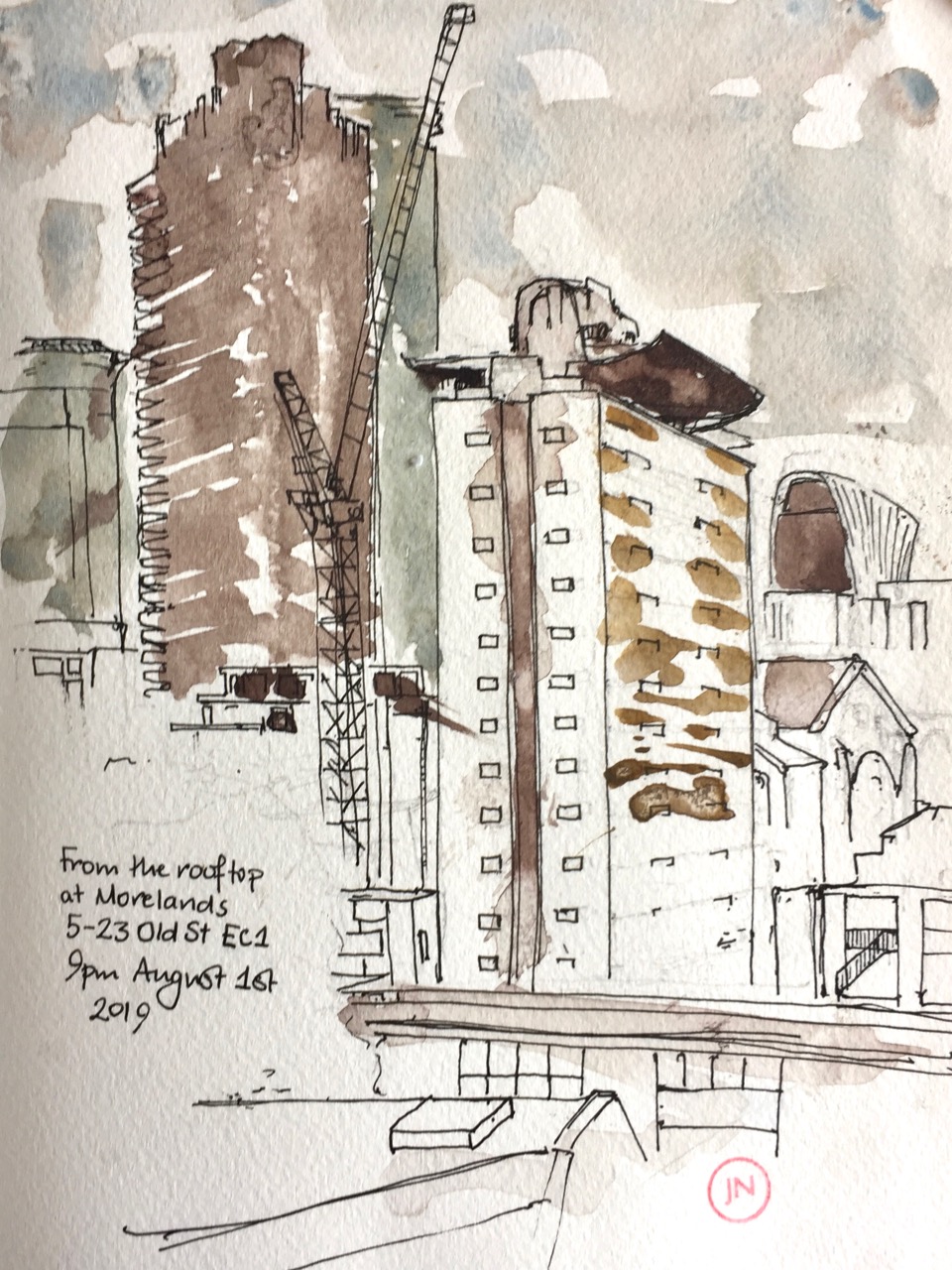
From the Rooftop at Morelands

This was an event organised by RIBA* and Phil Dean a.k.a “Shoreditch Sketcher”.  Morelands is a modern office block on Old St.

I looked south, and drew Cromwell Tower and Great Arthur House. This sketch took about 45 minutes, as darkness fell.

IMG_3073

The “brise soleil” on top of Great Arthur House must be one of the most difficult things to draw. That, and the dome of St Pauls. Because it’s curved, and the curve needs to be right.

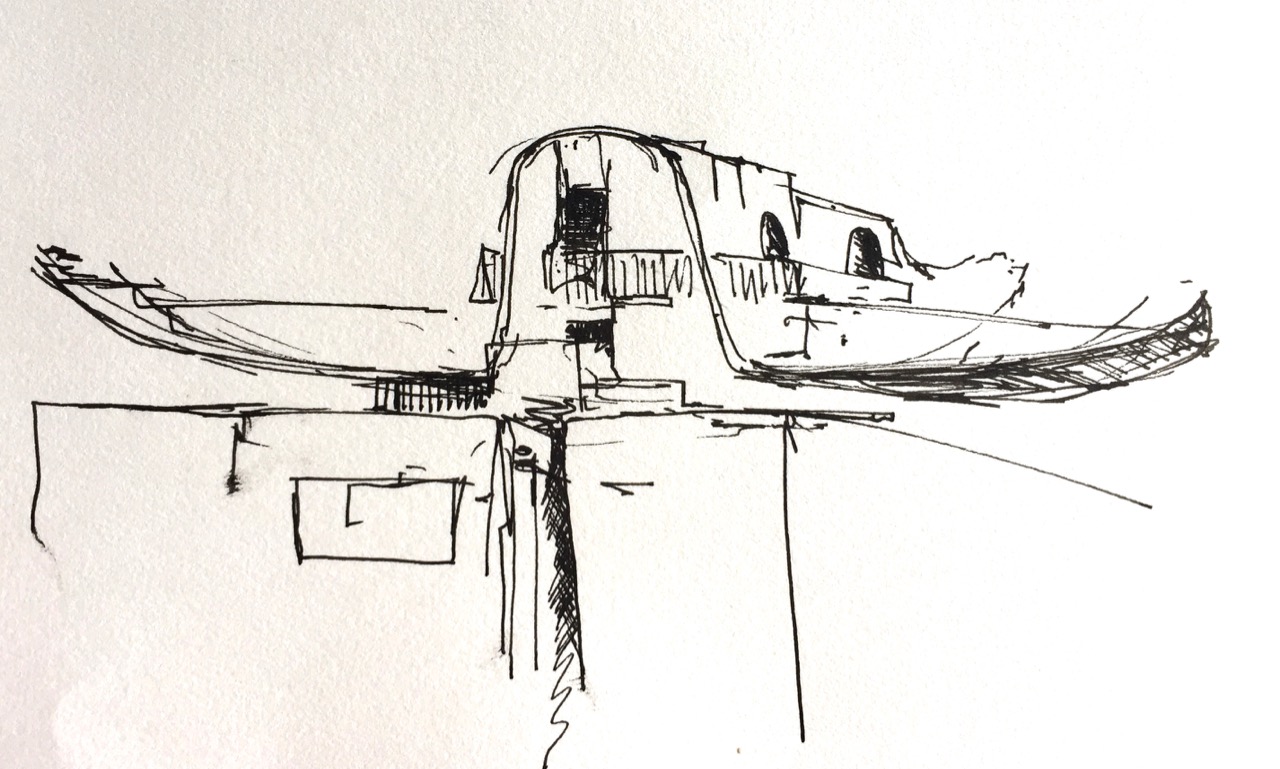
Earlier, I did a sketch of the “brise soleil” on its own. I had not noticed before that there is a sort of balcony.

IMG_3074

I’ve sketched Great Arthur House before:

Great Arthur House from the Barbican Podium

Welsh Church and Great Arthur House

Eglwys Jewin from Fortune Park

Update: Later, the Shoreditch Sketcher posted on Instagram. I think that might be me in the middle…..

*Royal Institute of British Architects

More views of Mountjoy House

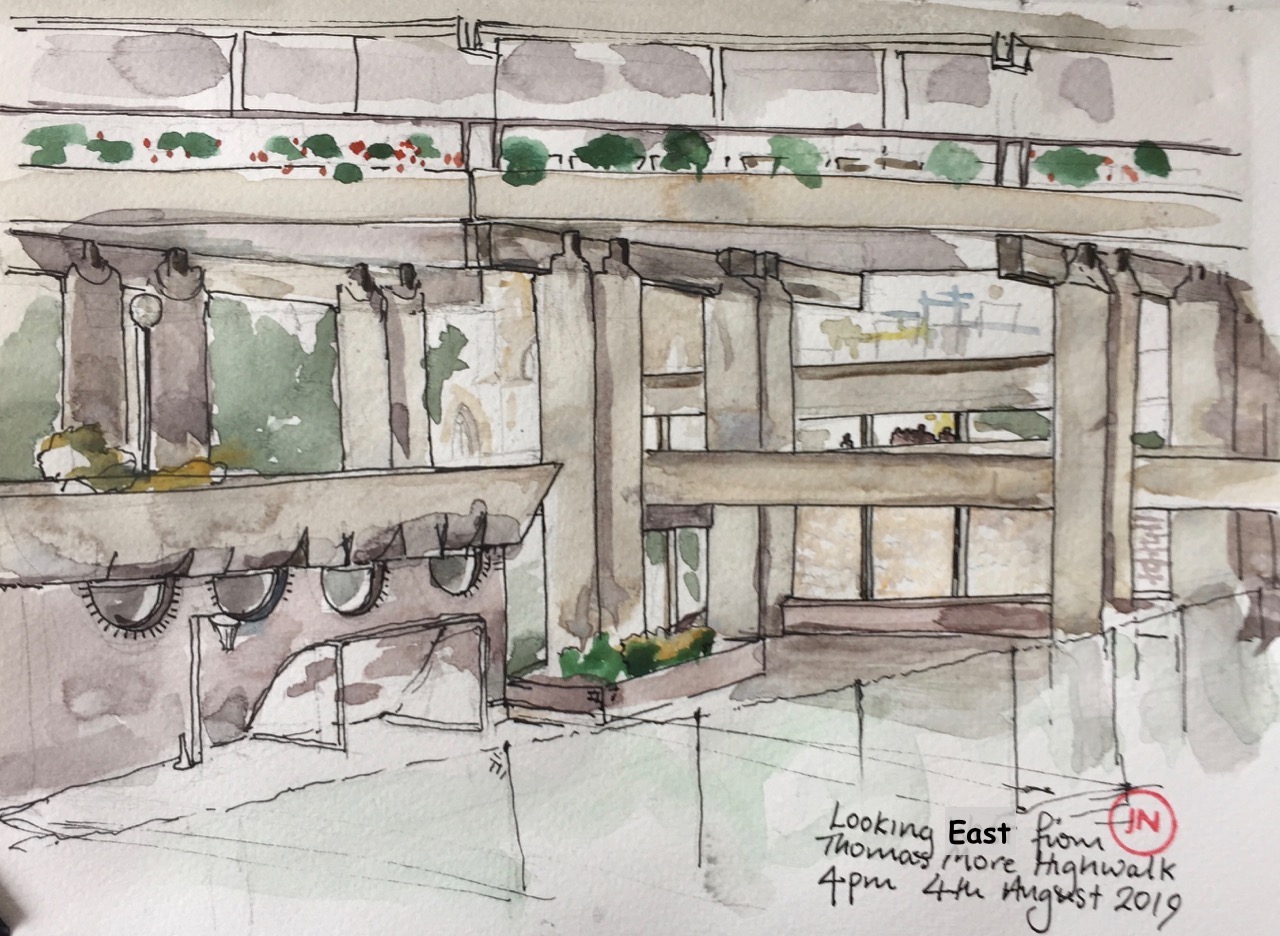
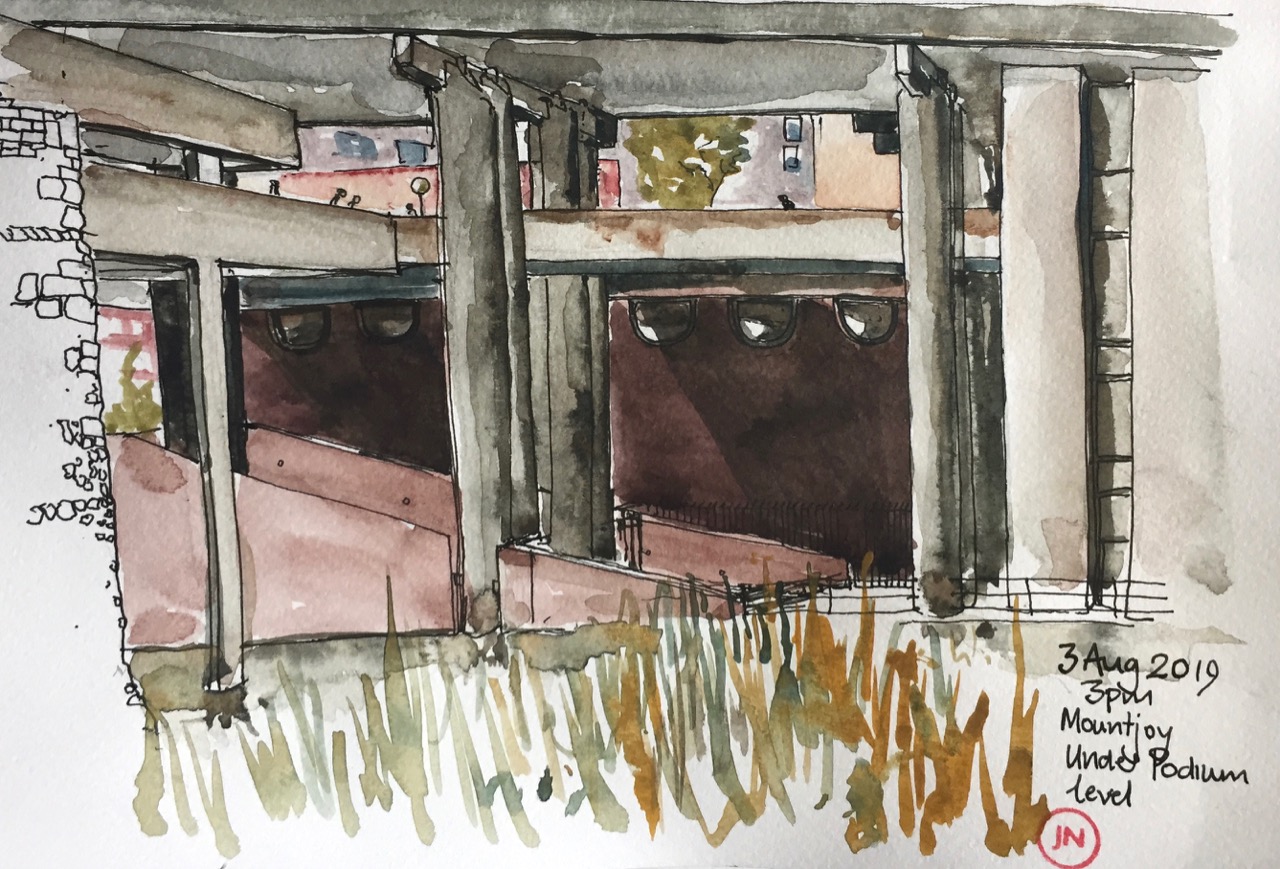
Today I found another view of the view under Mountjoy. This is from the high walk that goes north from the Museum of London, looking East.IMG_3087

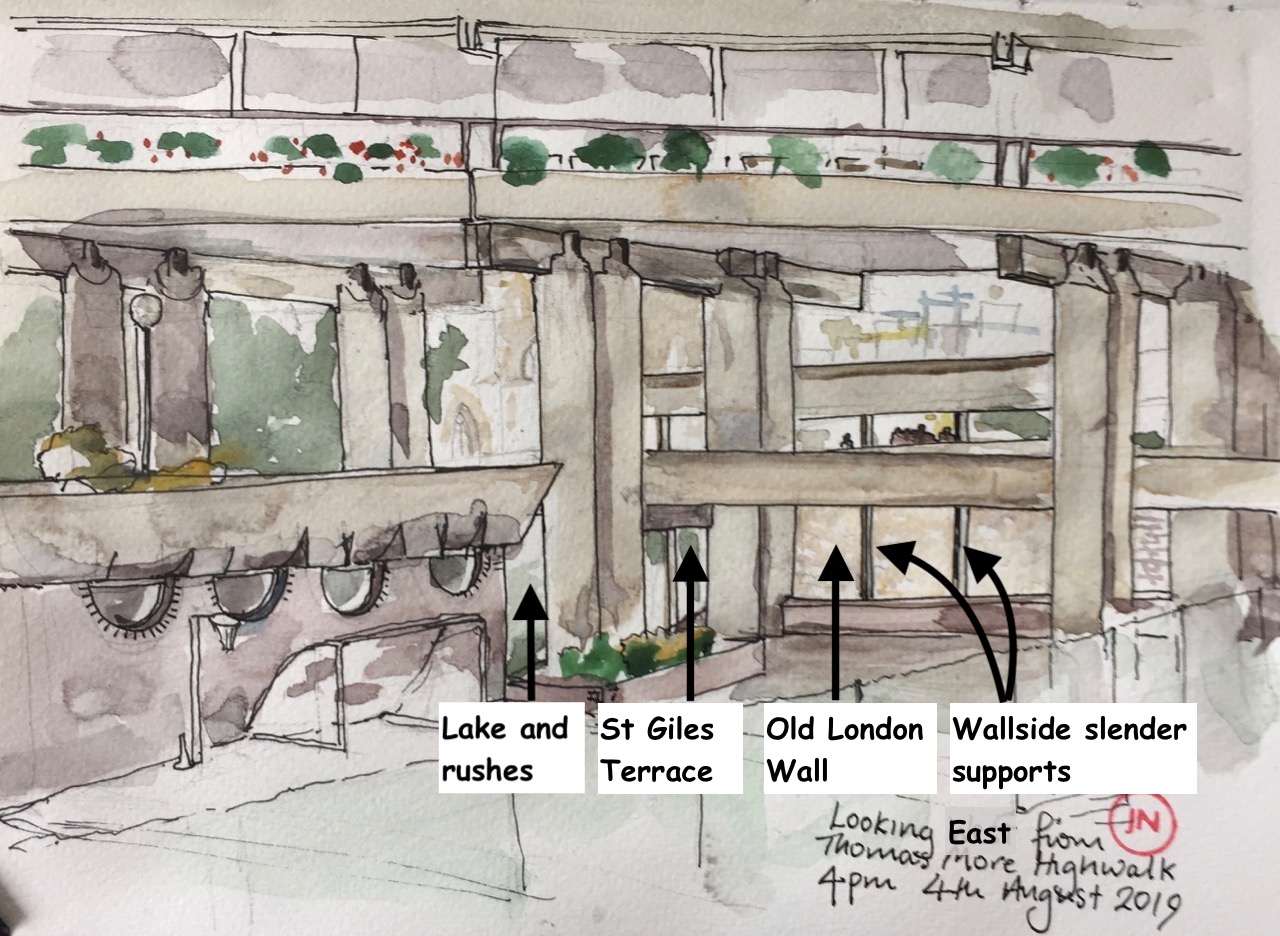
Under the Mountjoy Highwalk there are a number of “framed” pictures. The old London Wall fortification is visible. The sun reflected from the lake and threw patterns onto the old stone. I couldn’t get all that in the picture so you have to take my word for it.

A group of tourists stopped on the “Wallside” highwalk. You can see them in the centre right of the picture.

IMG_3087 copy

These “windows” will all be obliterated by the proposed City of London School for Girls expansion.

Effect of CLSG extension (view from West)

This view is from the place where the north bound highwalk turns abruptly left (click map to expand it).

This picture took about an hour. I tried hard not to overdo it.

At the top of the picture are the flats of Mountjoy House, with their impressive window boxes.


Under Mountjoy House, Barbican

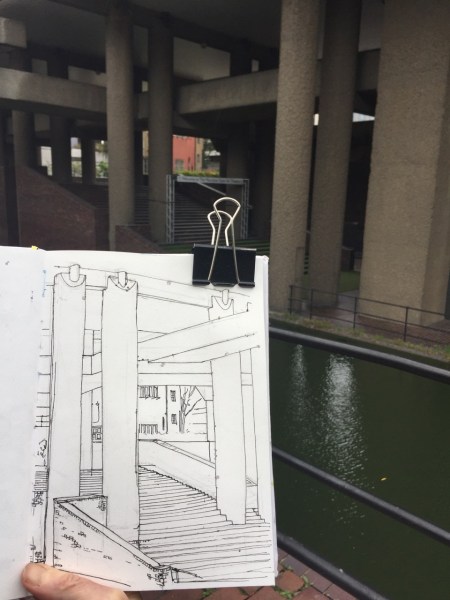
This is the view that will be lost if the City of London School for Girls expansion proposal goes ahead.

UPDATE (2020): the proposal has been shelved, and alternatives are sought. But we must remain vigilant. The article below was written in August 2019, when the threatened development looked as though it would go ahead. Widespread protest ensued.

IMG_3054
The view that will be lost if the CLSG expansion goes ahead. See “SOSBarbican.com”

I spent time today paying attention to this view, because that is what I need to do, to draw it. The pillars are reflected in the water. The enormous flight of steps is like that in a fairy story, so wide and grand. There’s a massive three-dimensional sculpture of concrete, of light and dark.  Flat spaces and lines don’t quite join up but are nonetheless connected, like rhythmic music. Framed by the 20th century brutalist columns you see an older more ornamented building, and trees. You can even see right through to the other side of Aldersgate.  This is a magnificent view.

The current proposal to extend the Girls’ School will eradicate this view, which is Grade II* listed.  The proposal is being resisted by Barbican residents. See the website “SOSBarbican”. Please consider signing our petition.

The interesting blotchy effect on the pillars is rain falling on the picture. I started this picture at 09:30. Then it started to rain. The fine rain speckled my picture. Bigger drops diluted the paint in the palette and made the paints shift about. Then it started pouring down with menace. I scrabbled my things together and dashed into St Giles’ Church which was behind me. Inside the church, people moved purposefully about, and all was calm. And it was dry. I took a deep breath and kept my drawing horizontal. There was a table next to the door. A woman looked at me over the table.  I felt the need to explain. “I’m sheltering from the rain,” I told her.

Her response was calm and logical, “Would you like a cup of coffee?”

“I would,” I said. Her companion at the table offered me a biscuit. Grateful to the Royal Society of Organists for their hospitality, I sat on a wooden bench and let my drawing dry off. Experimental short tunes from the organ floated quizzically in the air.

Then I went out again. I wanted to finish my picture.  I stood in the porch of the church and looked at the rain. “Every decision is a moral decision.” I believe that. Should I pack up the drawing and go home? I could use the time before the Planning Meeting to do the supermarket shop, deal with the plumbing problem, and process the sourdough.

Or should I continue the drawing?

What principles are at stake here? I finish drawings that I start. I don’t mind the rain. My ink and watercolour does mind the rain, though. So I’ll draw the picture under an umbrella.

IMG_3049This was surprisingly effective. I managed to get all the ink drawn before 10:45, when I packed up again, to go to the Planning Meeting. During this time I was approached by a flustered gentleman in a smart suit, who wanted to “get across the lake”. He was hopelessly disoriented, pointing South-West, when he should have been heading North-East. I re-directed him and he dashed off towards the Barbican Hall.

The Planning Committee Meeting at 11am was the City of London Planning and Transportation Committee. This was their July meeting. In their September meeting, if things go according to the plan put forward by the School, this same Committee is due to approve a plan for a building which will totally block out the view I have drawn. The proposed new structure would cover the steps, build round the pillars, and put in an industrial kitchen. Residents in Mountjoy House, directly above my picture, are understandably dismayed. The Barbican Association, representing Barbican residents, is leading a campaign to prevent to save the view, and stop the expansion. Here is their postcard/flyer.

On the way back from the planning meeting, I went back to the view, and put the colour.

Spending time looking at this view, these pillars, these shapes, I realise how magnificent it is, and how talented the architects were. This view is worth fighting for.

Here is the effect that the extension will have, based on an architect’s drawing in the Architects Journal, 28 May 2019.

Drawing done in 3 attempts: 15 mins, 10mins, half an hour. In Jackson watercolour sketchbook, using watercolour box 3.

Here’s another sketch done from a different angle on a different day:

IMG_3082

I also did a drawing from the other side, see this post:

More views of Mountjoy House

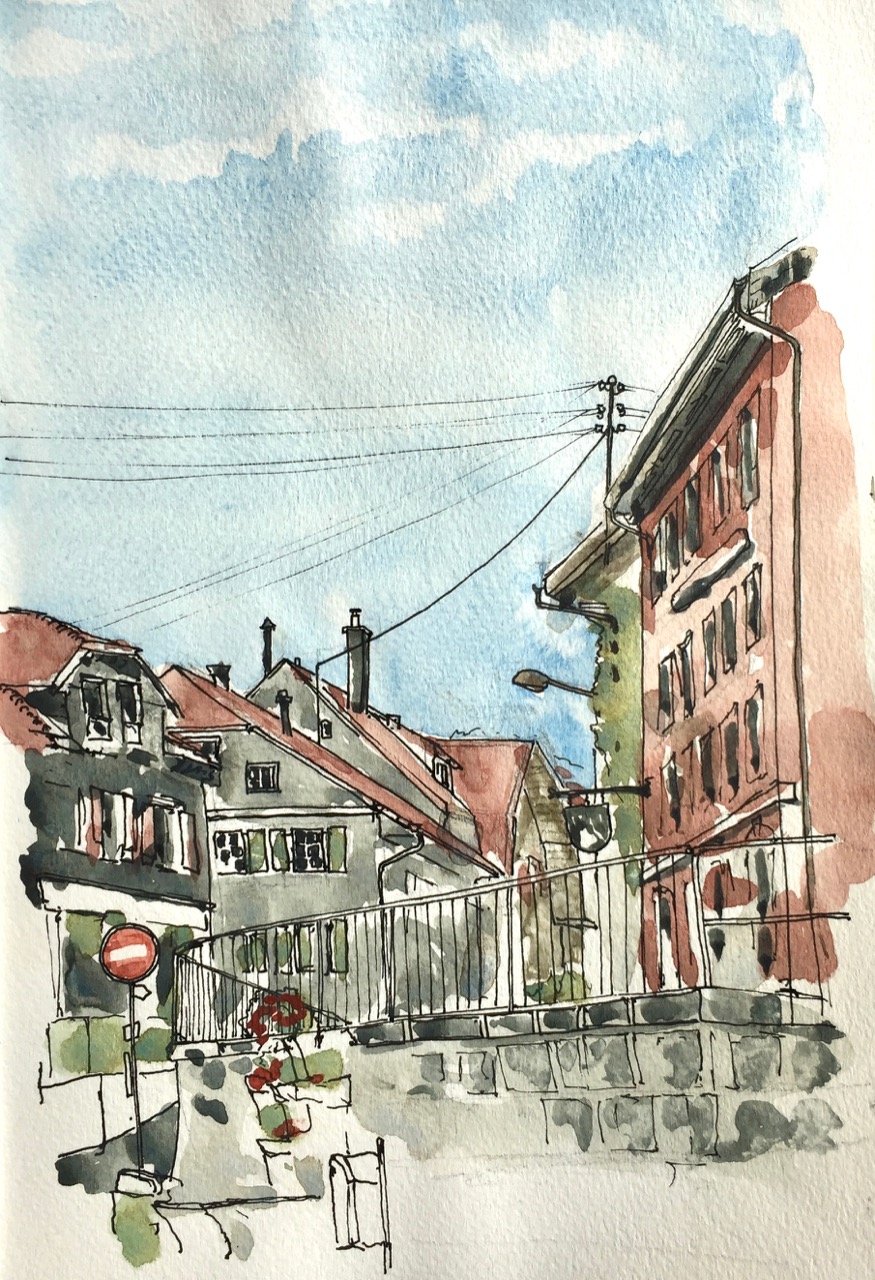
Sketching in Sainte-Croix, Vaud, July 2019

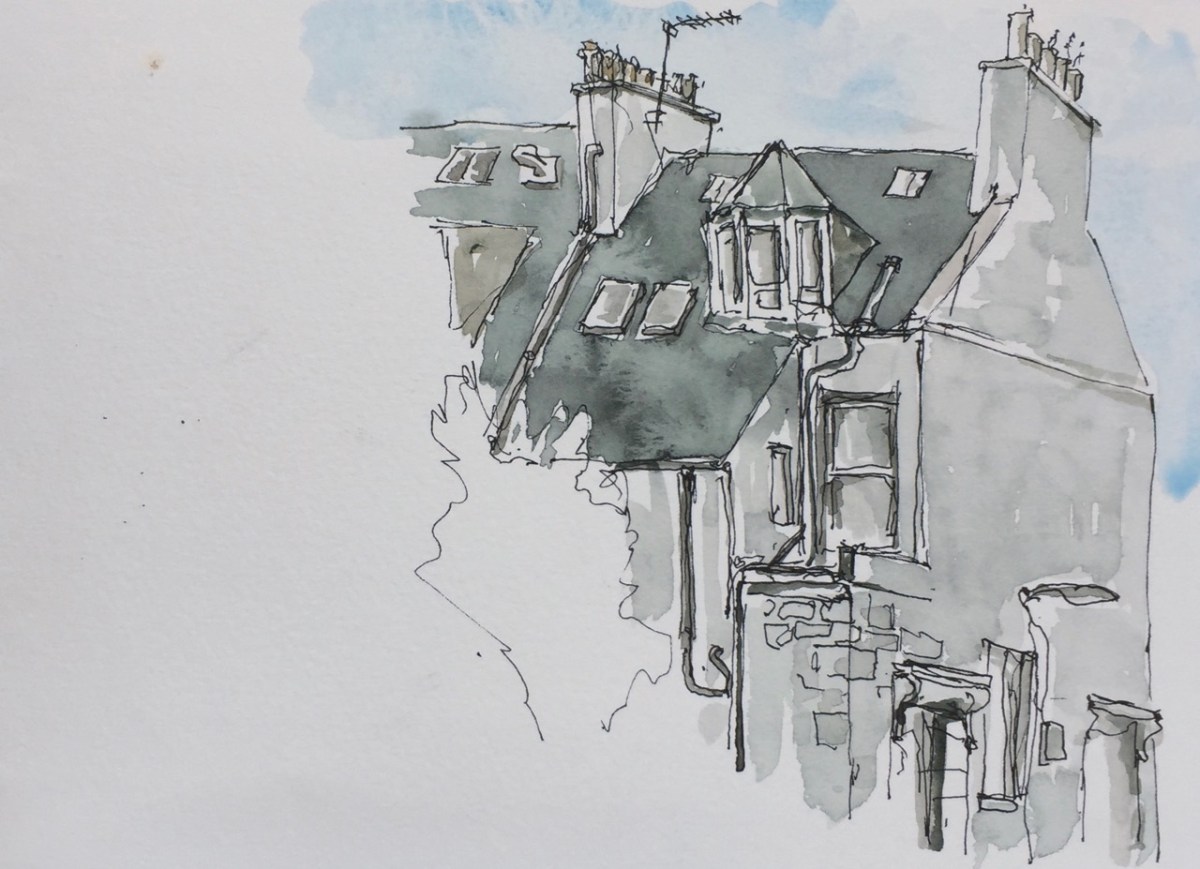
I had been travelling since 5am. So I just rested. I looked out of the hotel window. I saw chimney pots.

IMG_2886

With the wind and snow in Switzerland, it’s worth a lot of effort on the part of the chimney pot designer to get it right. Clearly, though, much experimentation is required. Every one in this drawing is different.

Switzerland is the only place I know where copper is a construction material. The rest of us use it to make small domestic items, or jewellery. But here, the whole of the chimney pot stack with the cylindrical top, in the middle of the picture, is made of copper. Also copper is the guttering which runs across the middle foreground, and some of the down pipes.

Later, in a pause, I made another drawing, this time from the terrace of the Hôtel de France. This time I was tuned in to chimney pots. See the marvellous construction on the skyline! It is even furnished with a set of steps, so the chimney pot repairer is provided for. Or perhaps the chimney sweep.

IMG_2885

Another day I searched for chimney pots again, since this was becoming a theme. Here is the view from the same place, looking a slightly different direction.

IMG_2887

Here is the picture under construction.

The item in the middle of the base of the picture is a letter box. I posted a few postcards:

Pen and ink sketches are a good way to fill in the time waiting while travelling:

And I did some sketching at the breakfast table.

IMG_2957
Breakfast room, Hôtel de France, 11th July 2019

Durham Cathedral

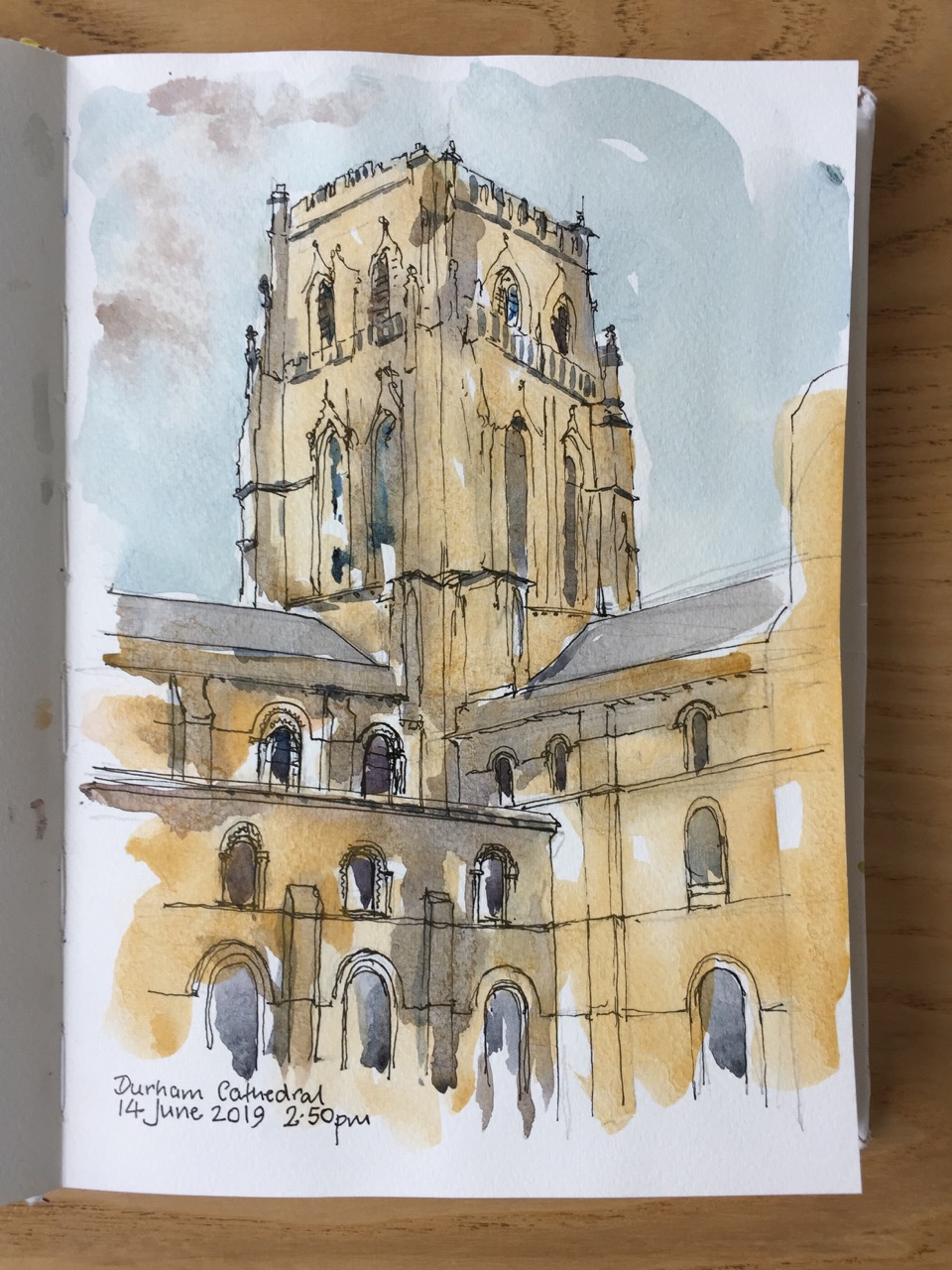
Here is Durham Cathedral, drawn from the shelter of the cloisters.

IMG_2593

It was raining, on and off, in between periods of bright sunshine. This took about 1½ hours, in the Jackson’s watercolour sketchbook.

Durham Cathedral was built in 1093AD, and is a shrine to St Cuthbert. The extraordinary stonework is all original. Even more impressive is the roof.  There is a stone roof which is up there and has been up there for nearly 1000 years. The engineering! The artistry! The courage! The organisation!

The place is active. Evensong is sung. Flowers are arranged. The shrine is venerated. Around the simple tomb of St Cuthbert, people sit, in awe, at the age of the place, at the stillness, at the soaring architecture, at the thought of the simple monk whose remains lie here.

I too sat on the polished wood seat. Flowers stems were scattered on the floor, a pick-a-stick of blossoming stalks, in the process of being placed into the vase, one by one, by a careful woman. The snapped flower stems smelt of woodland. Or perhaps that was the furniture polish.  A loudspeaker announced….something, the sound echoing and incomprehensible. And because it’s Durham, suddenly I was in conversation with the woman arranging the flowers. The modern stained glass window, just visible from the shrine, is in memory of a student. It looks towards the university, which is to the North. Even though it’s North facing, the glass gleams.

Here is work in progress on the outdoor picture:

Here’s where I was:

IMG_2603

The indoor pictures are in my new “Traveler’s Company” watercolour sketchbook.

The Durham University website has an article on the window dedicated to Sara Pilkington.