26 rue des Rasses, Sainte-Croix, Vaud

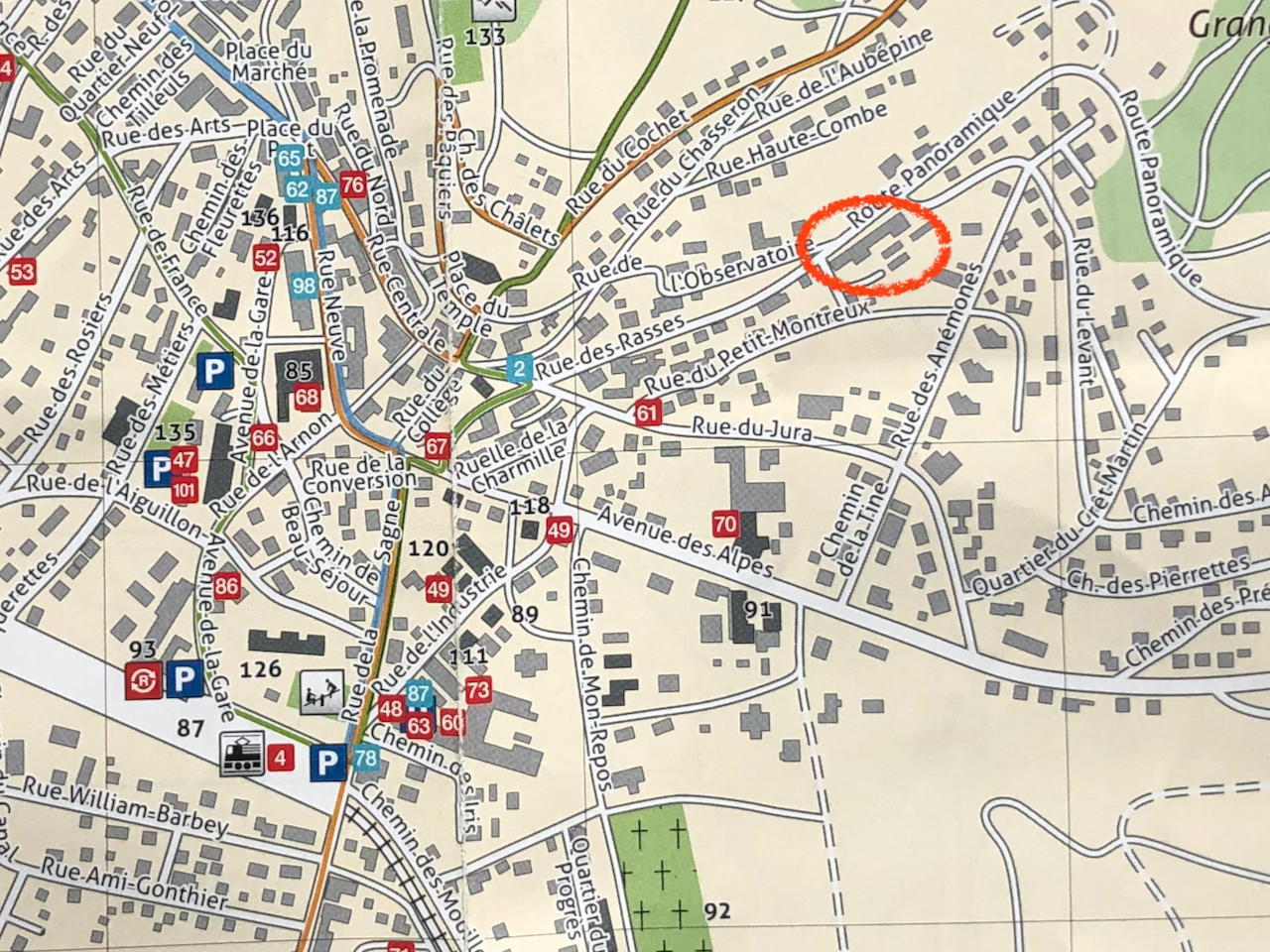
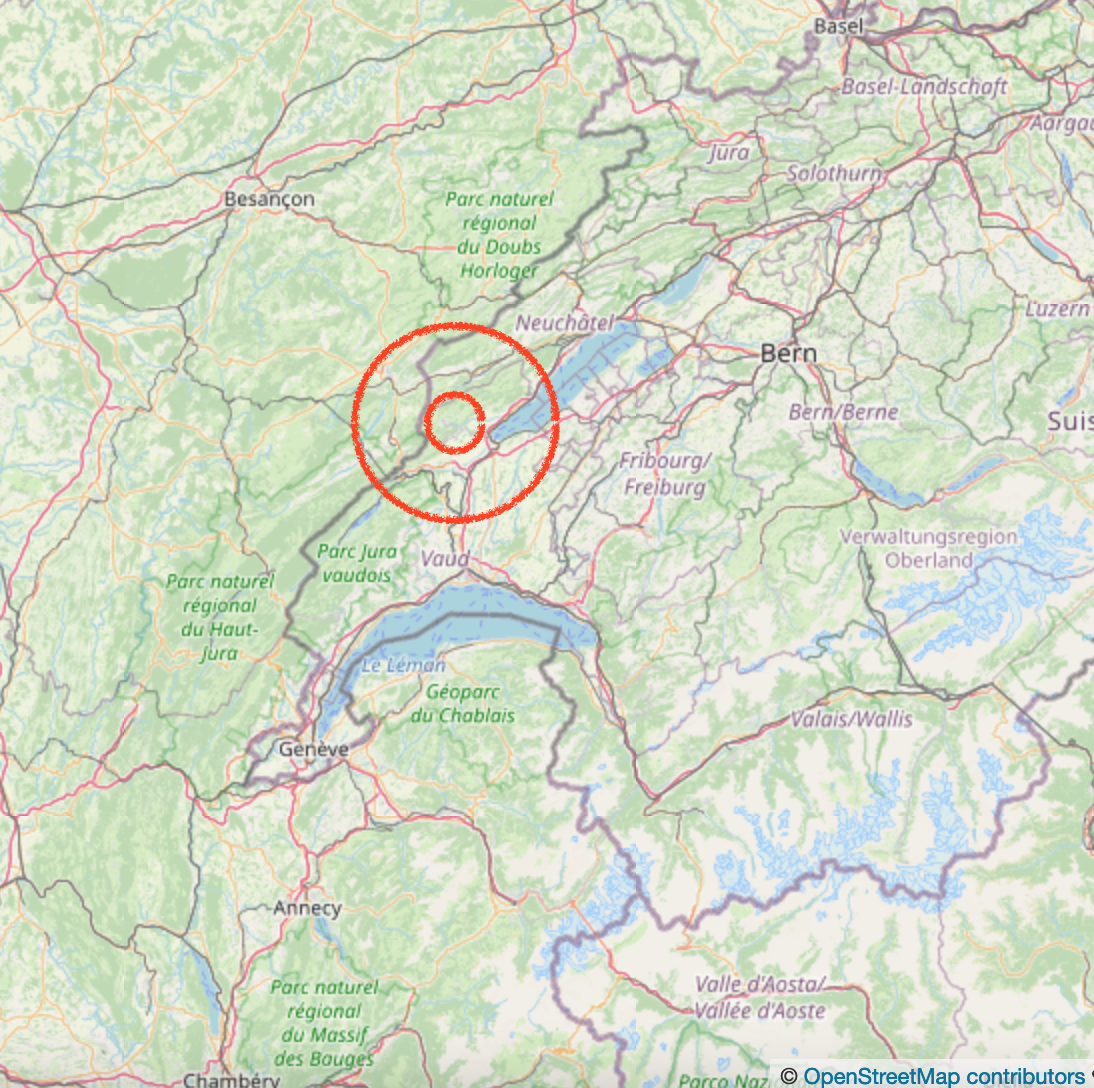
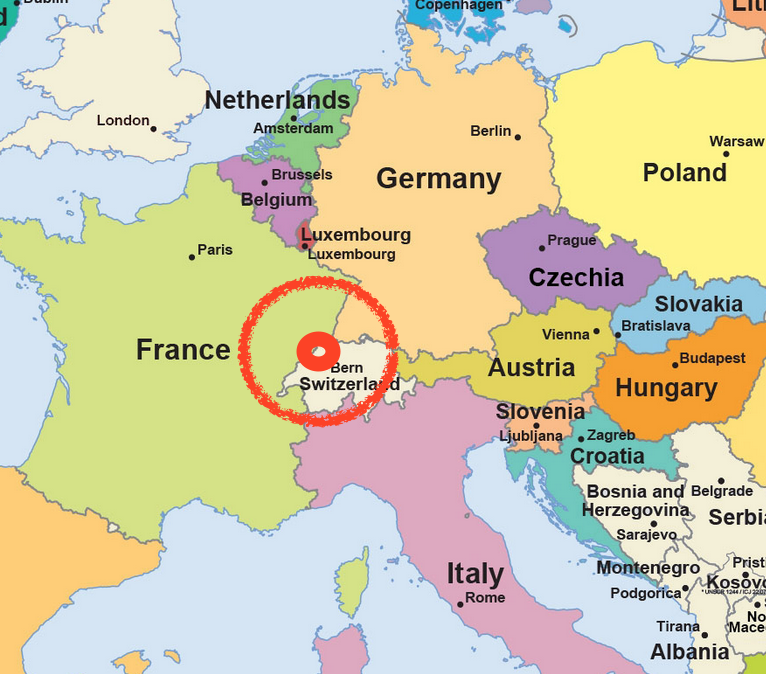
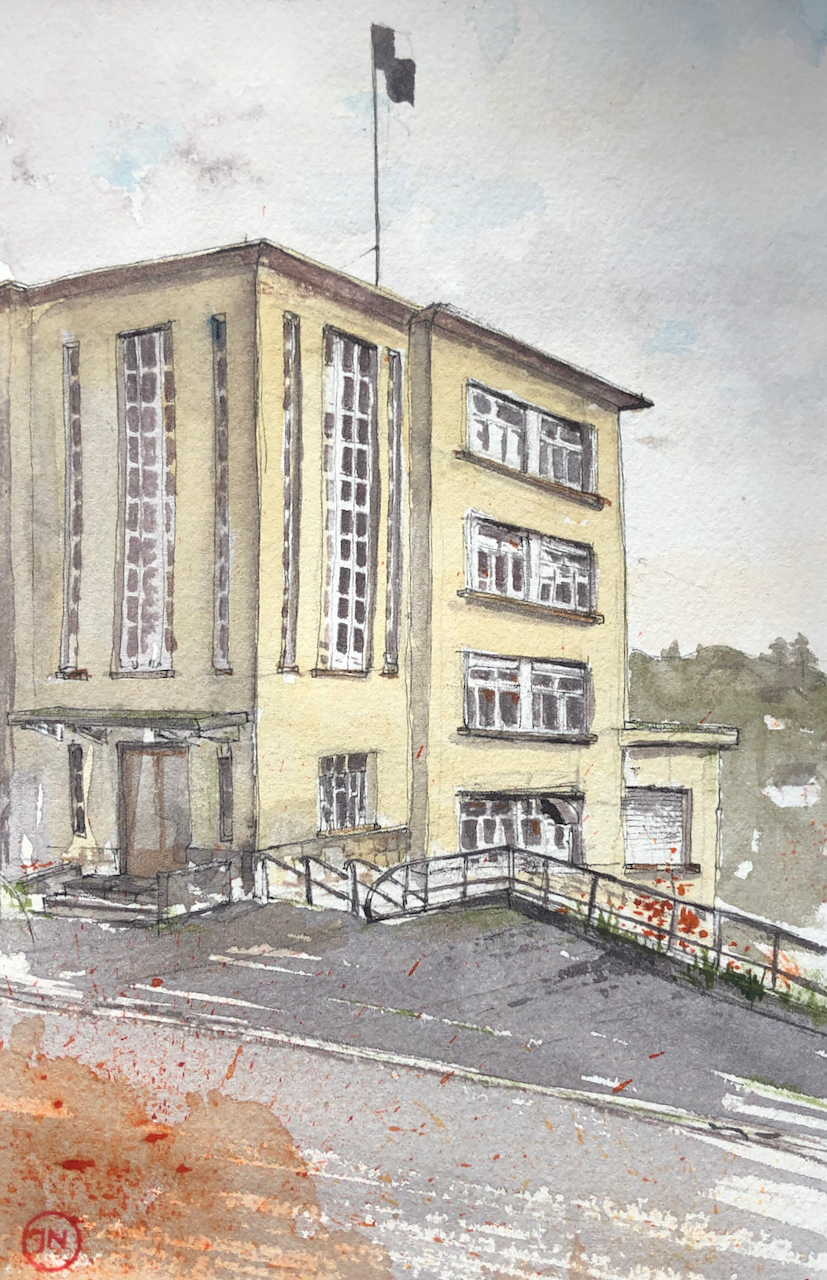
This building is on the Rue des Rasses, in Sainte-Croix, Vaud, Switzerland. For maps, see end of this article.
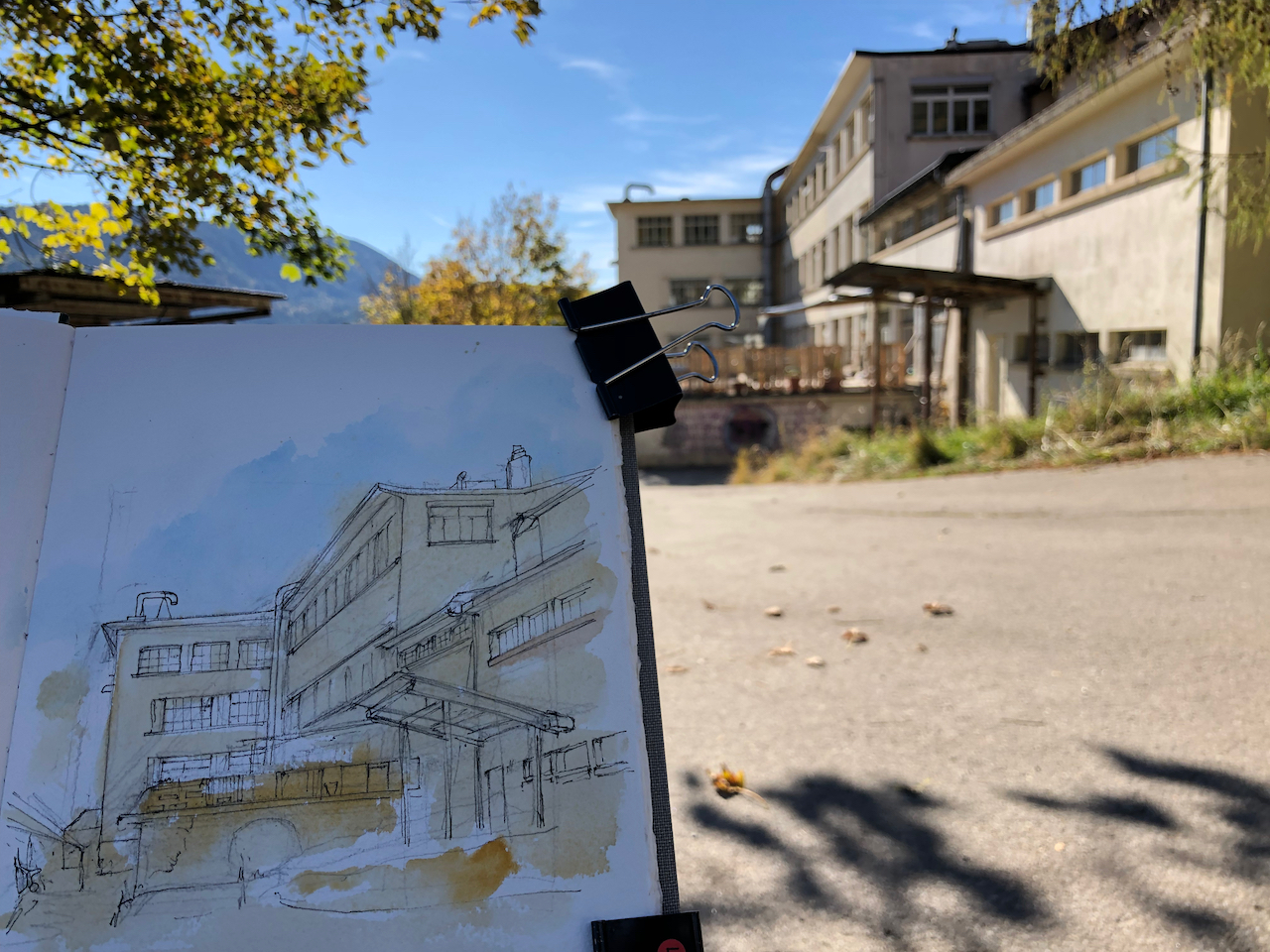
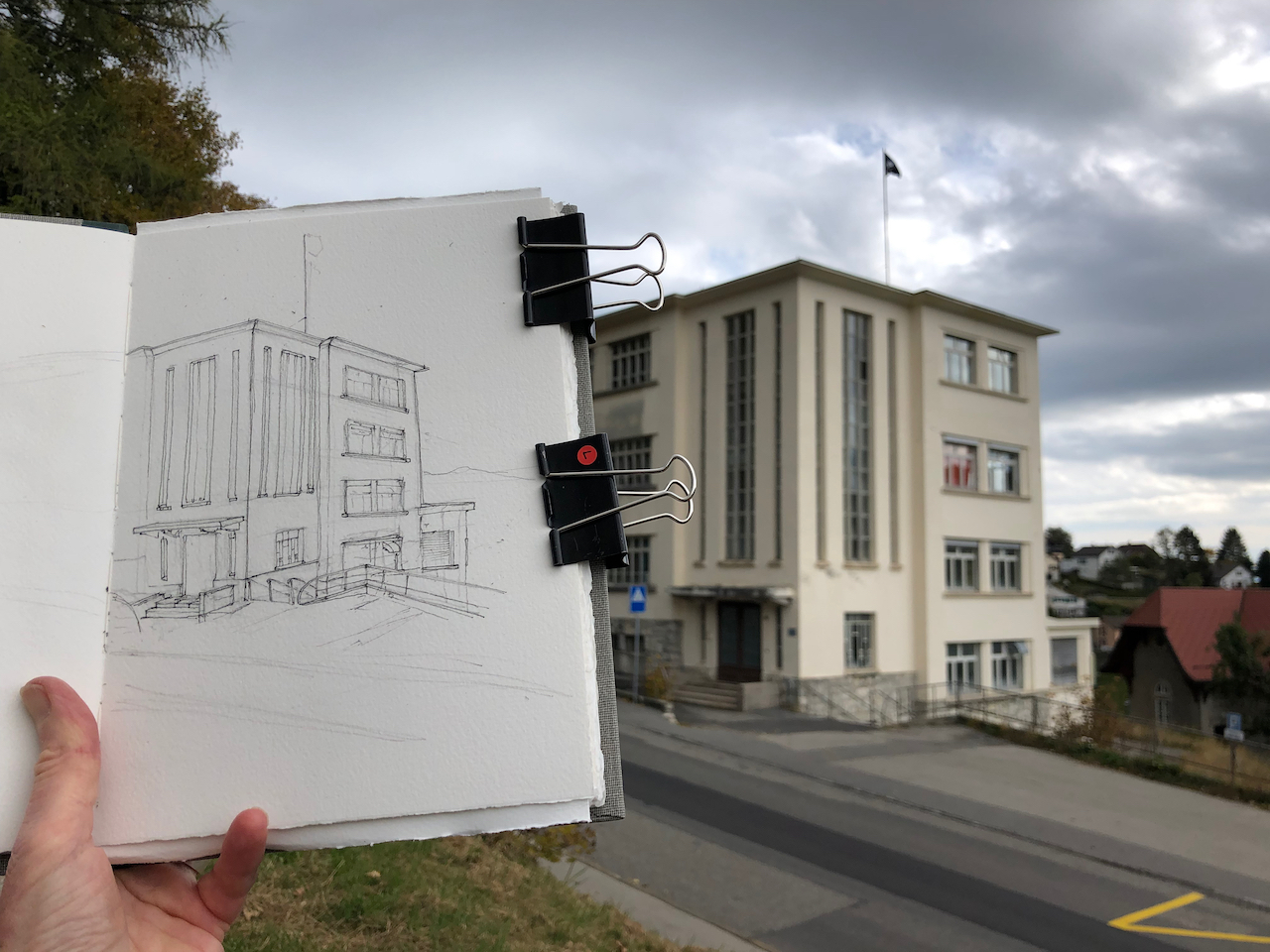
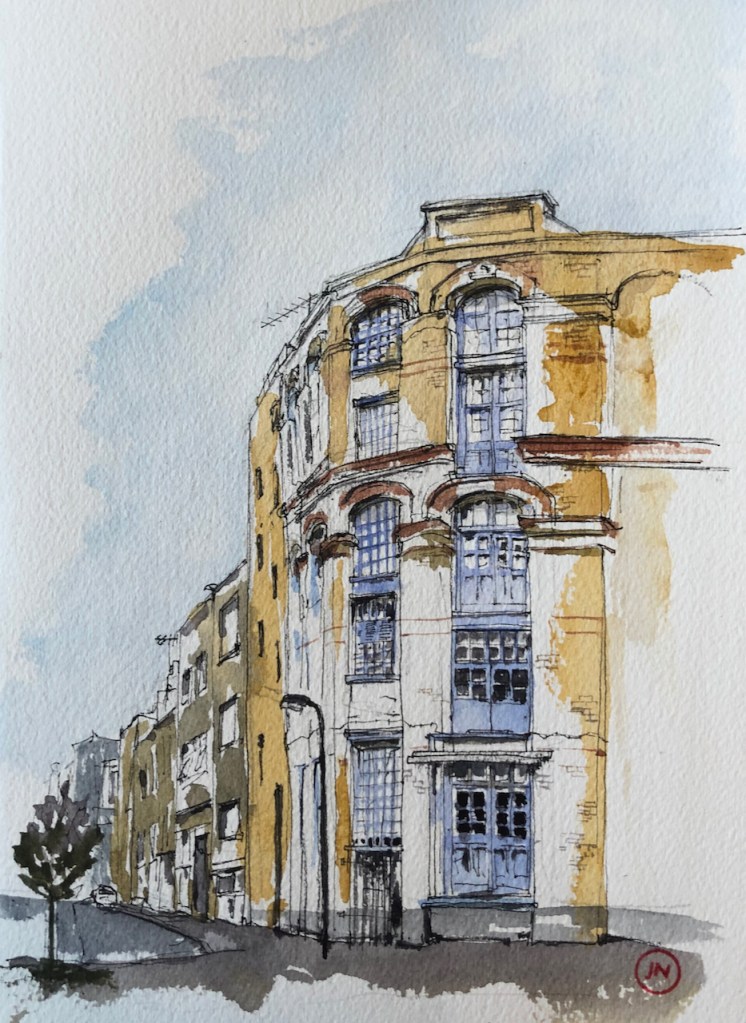
26 rue des Rasses, Sainte Croix, Vaud. Front entrance. 20 October 2021 in Sketchbook 11

There is much that is interesting about this building: there is the building itself, a 1930s marvel, there are the original occupiers, and there are the current occupiers.

The building was constructed in 1929-1930 as a factory for Reuge, the music-box makers. Reuge had already been operating for some 55 years by that time, starting with a pocket-watch shop in 1865. The factory operated for 85 years, until 2015, then they moved production to another site. Here is a picture of the factory fully operational, from a Reuge publication dated 2007 1

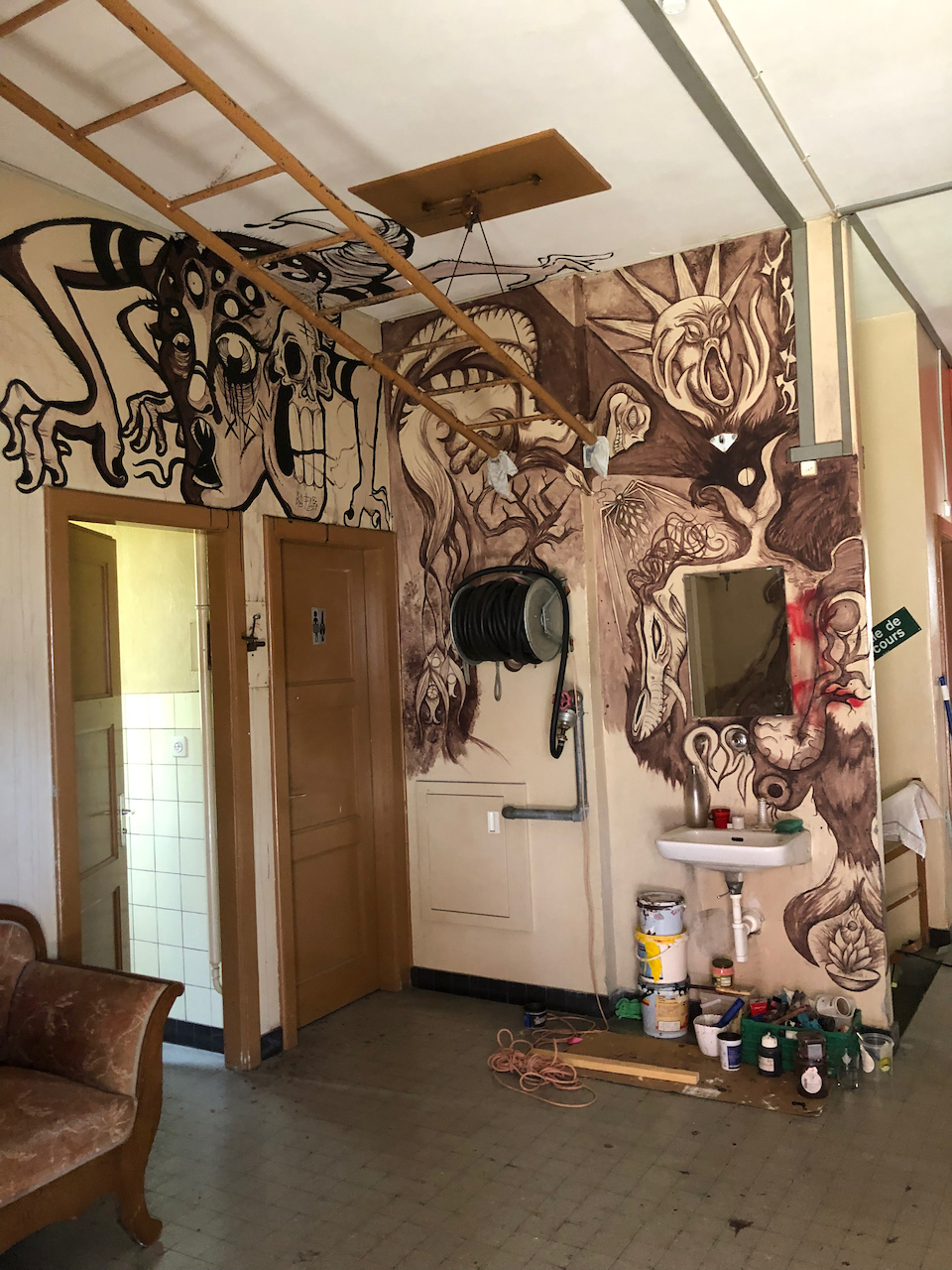
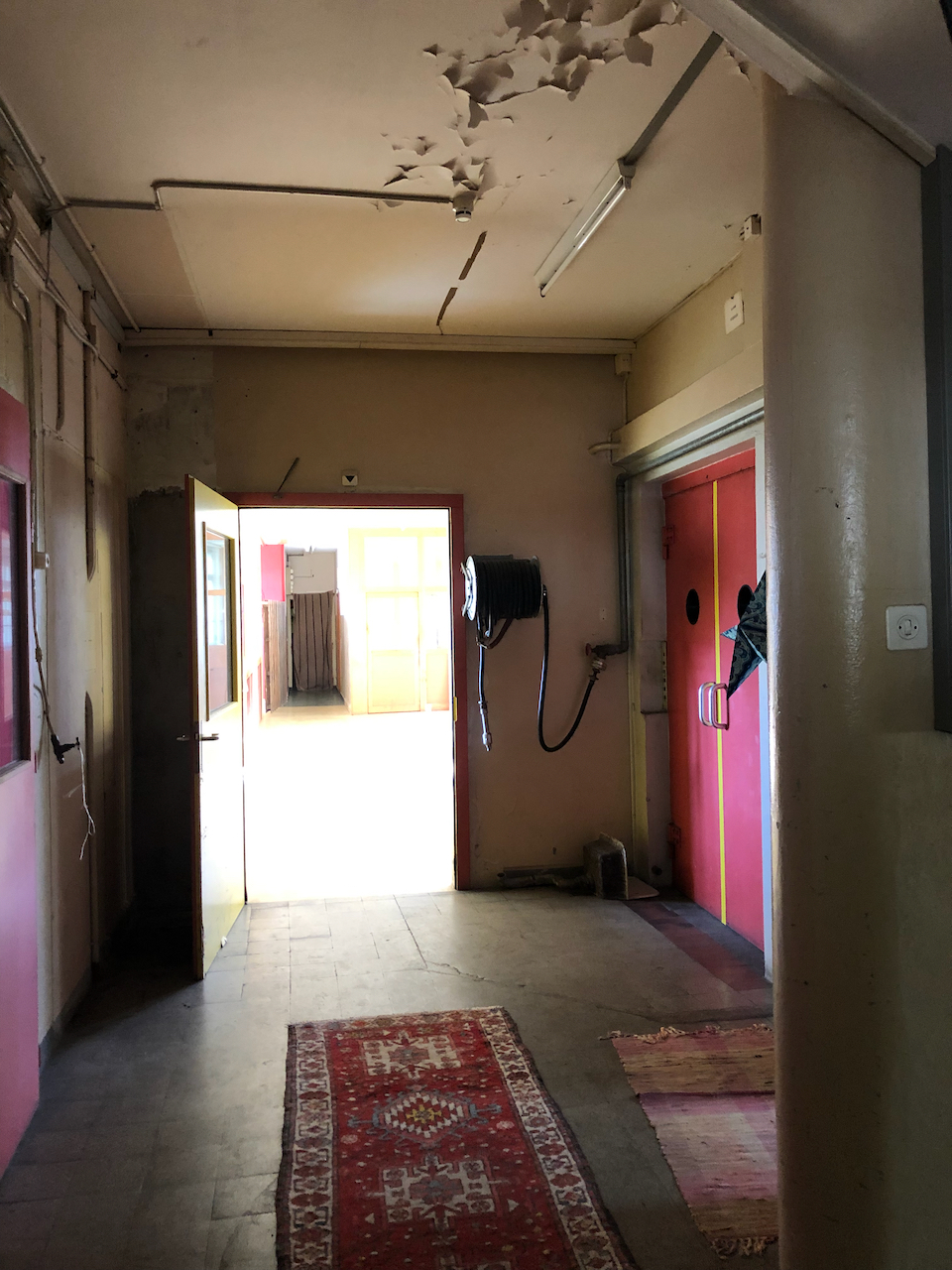
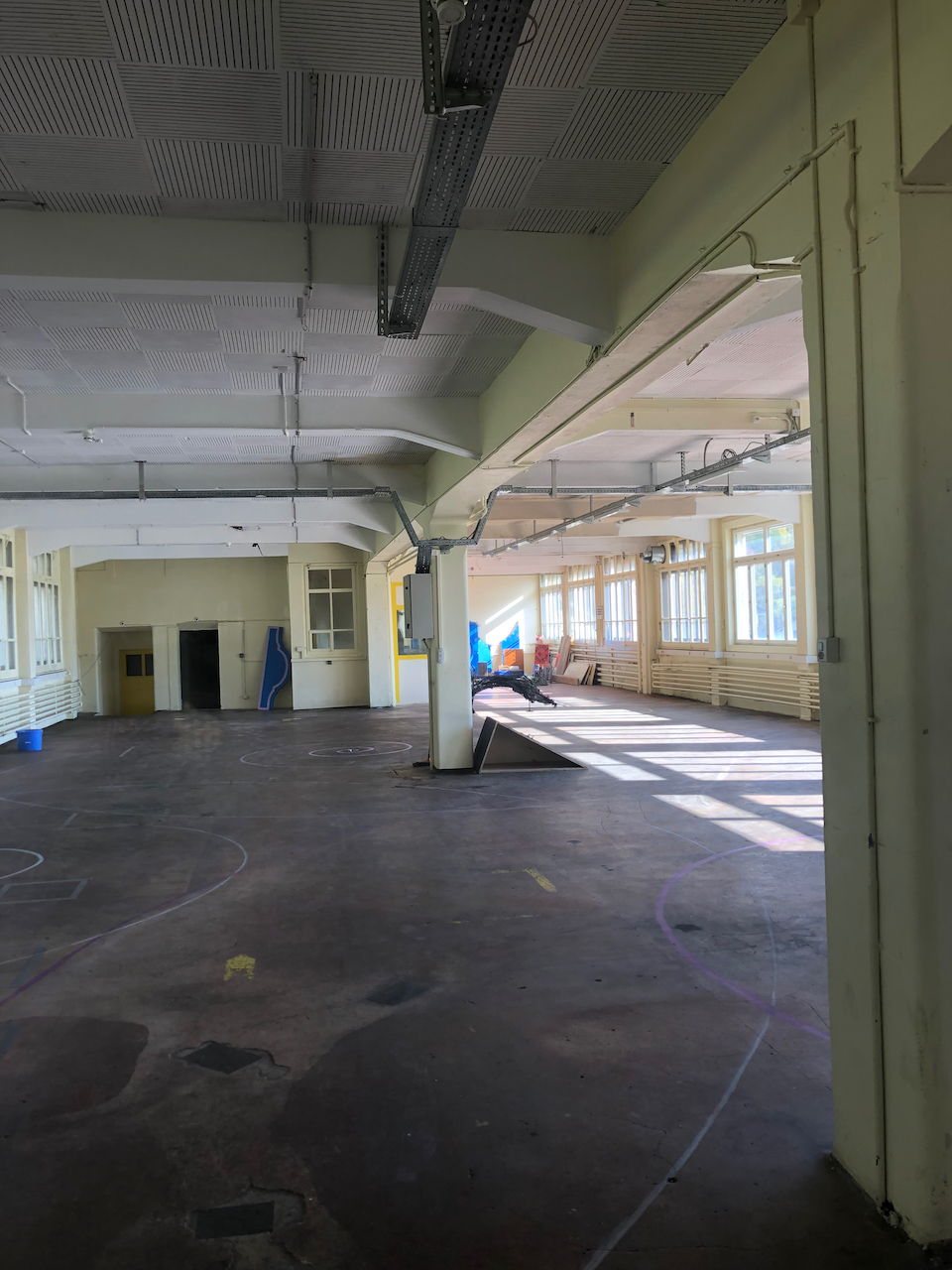
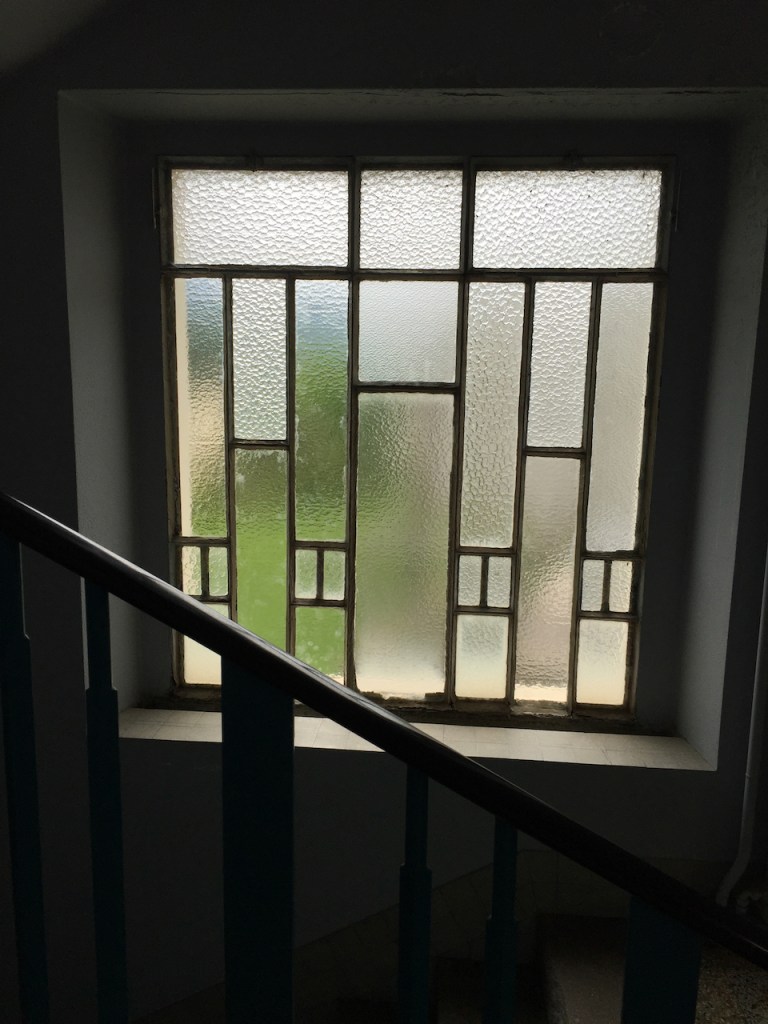
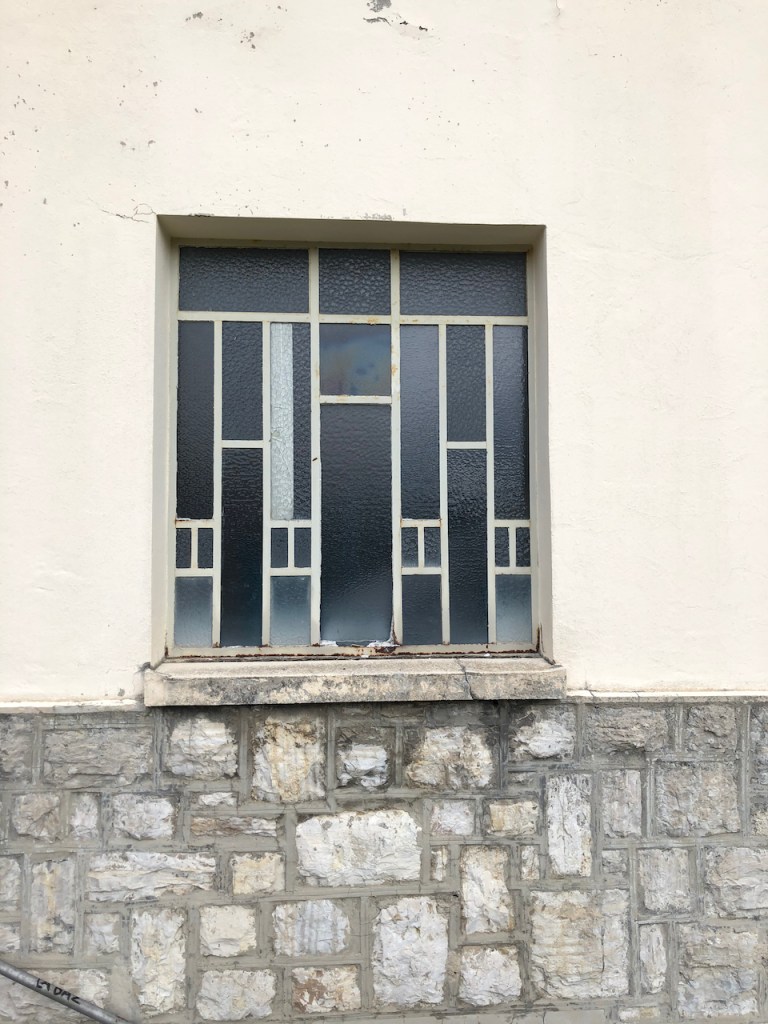
In June 2016, Reuge still owned the building, even though they’d moved their production out. They still used the wood-panelled showroom to demonstrate their music boxes. Here are some pictures from when I visited the empty building at that time:

Since around November 20193 the building has been occupied by a group called “le Baz”. They are a self-governing collective, who have created a “ZàB” in the former Reuge building. “ZàB”, their website2 explains, stands for “Zone libre à Bâtir”:

C’est une zone autogérée d’expérimentation, d’émancipation, de solidarité et de lutte, et pas un espace de consommation passive. Elle est ouverte à toutes et tous à toute heure décente. Et ce pour souffler, partager, apprendre ou transmettre de manière spontanée. Toute personne présente devrait pouvoir répondre à vos questionnements concernant le fonctionnement. Tout comme vous, elles ne sont ni responsables, ni programmateurices, ni animateurices, mais ni plus ni moins que les acteurices d’une création collective.

It is a self-organised space for experiment, emancipation, solidarity and struggle, and not a place for passive consumption. It is open to everybody, at any reasonable time. It’s where you can breath, share, learn or communicate at will. All the people here should be able to answer your questions about how it works. Just like you, they are not the managers, nor the schedulers, nor the facilitators, but no more and no less than the participants in a collaborative creation.

[My translation]

I took them at their word, and showed up at an “heure décent”, which as it happened was about midday. As I hesitated in front of the door, a young man asked if he could help me. I said yes, would it be possible to go in? He said yes of course, had I not read the notice on the door? I said I had. But he was already about his business, rushing ahead of me, and had left the door open. So I went in.
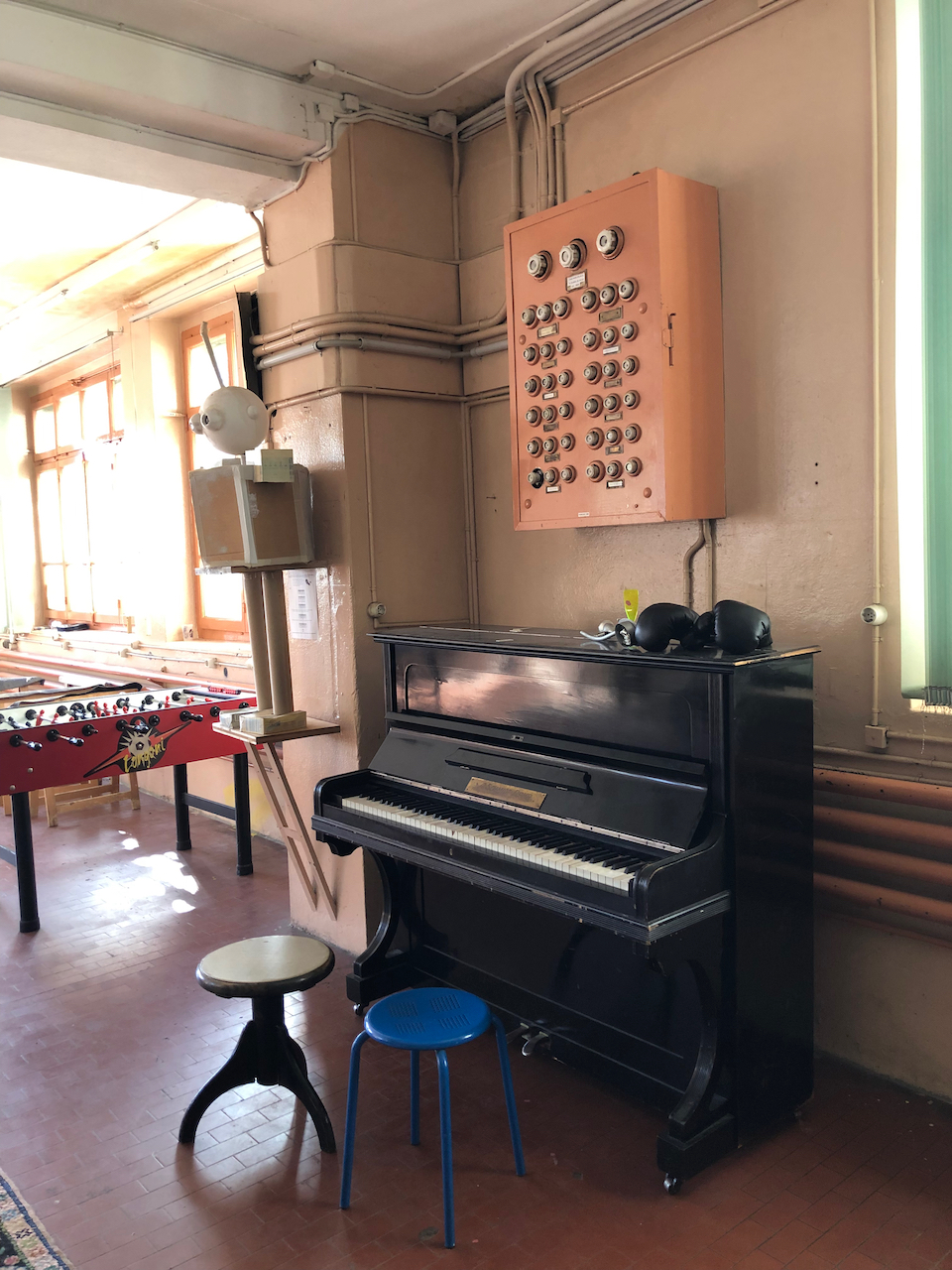
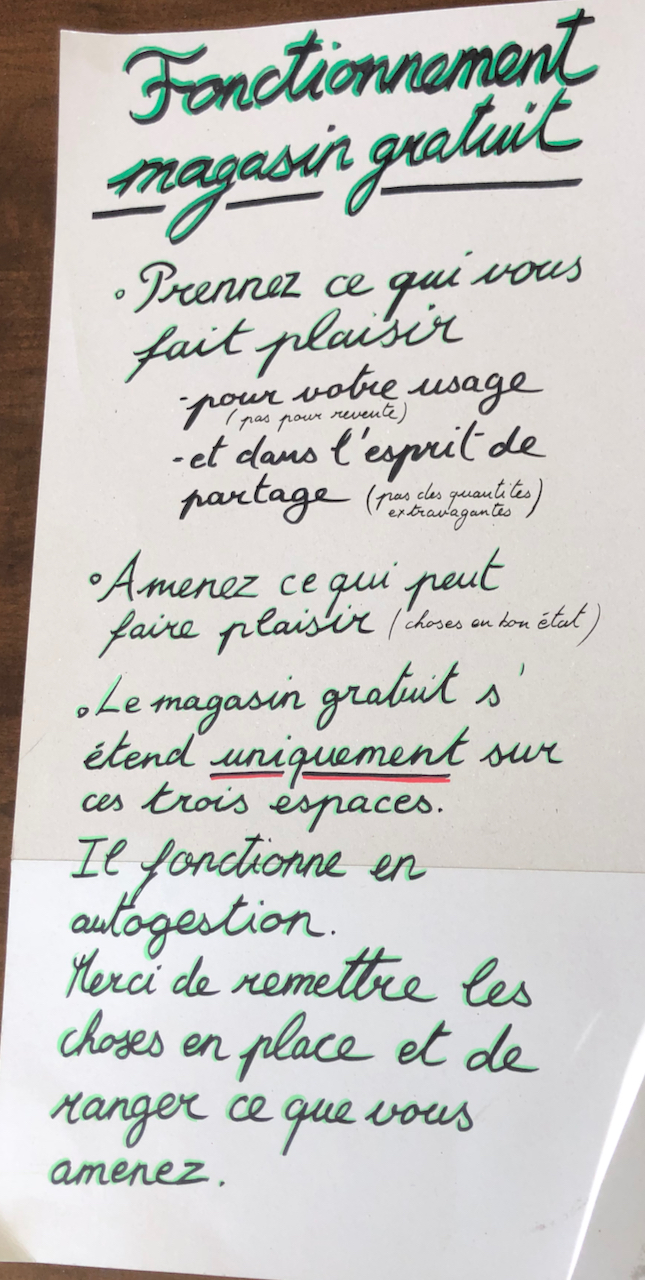
I walked around the empty spaces. It was all clean and organised. Someone had recently been working on the wall murals: there was a smell of paint. There are huge areas of blank wall and vast empty rooms. There is a “magasin gratuit” where you are invited to take what you need or bring goods to donate. A handwritten notice explains how it works.

I didn’t meet anybody.

On the way out, I did meet someone. This was a young woman, who smiled and asked if I was visiting: “Vous faites le tour?” I said yes I was. She recognised me, because she’d seen me drawing, three days previously. We chatted for a bit. She explained some of the history. The town had been opposed to their use of the site. Some people thought we were squatters, she said: “ils pensent qu’on fait le squatte”. But no, she said, we are not squatters. In principle, “no-one sleeps here the night”. And they have the permission of the owner. Well, they had the permission of the owner. But things have changed…. so the situation now is, well, “un peu ambigue”, a bit ambiguous.

She smiled. She liked it there. She said that it was surprising how little one needed, just “les un ou deux trucs” a few things needed for existence.

“And friends,” I suggested.

“Yes,” she agreed, “and friends.” She told me her name and asked me mine. “Come back,” she said, “any time. Boir un café.” And she set off down the slope, towards a young man waiting patiently below, by the collection of wooden outhouses.

Here is the picture I had been drawing when I first met the woman.
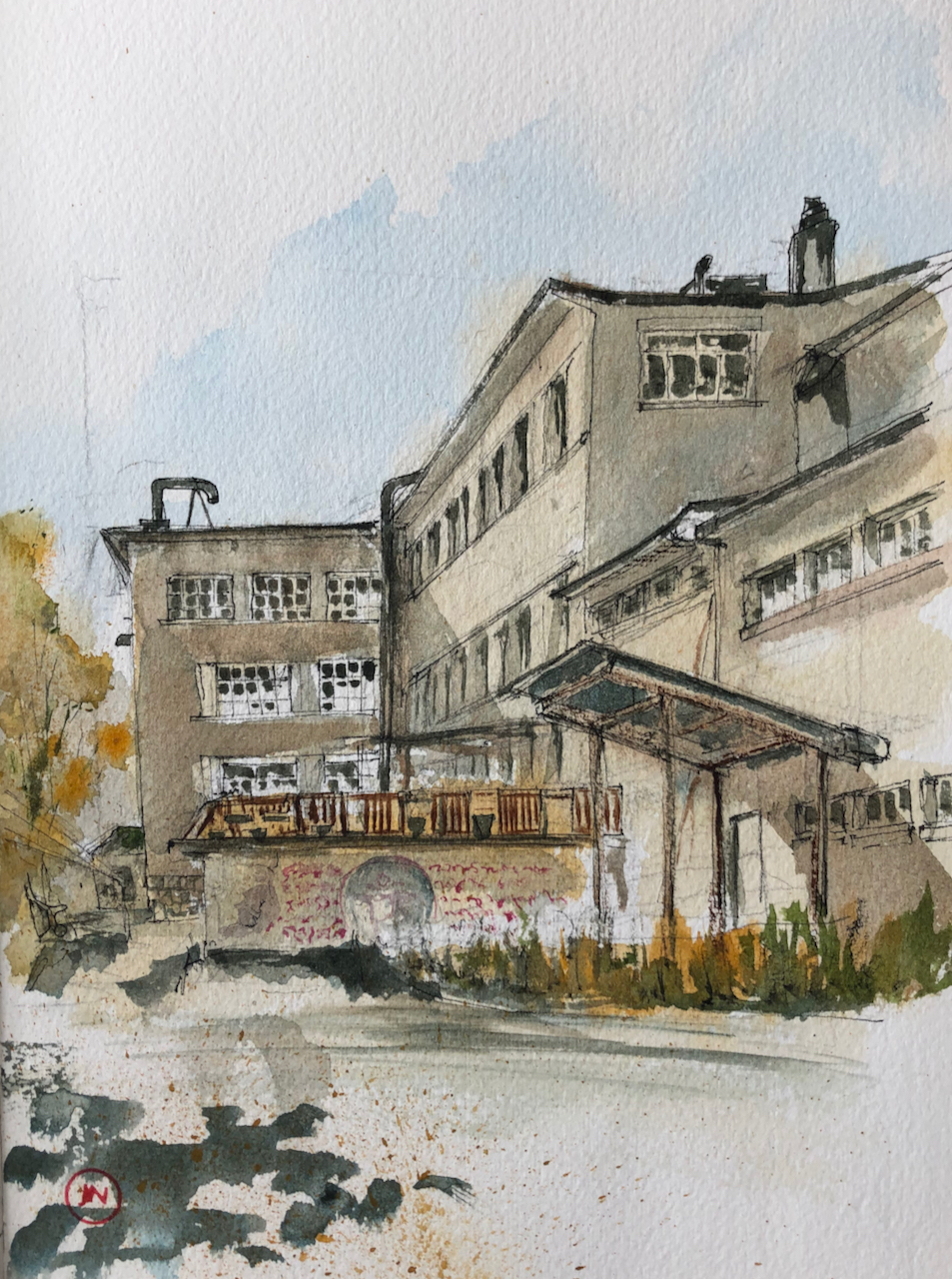
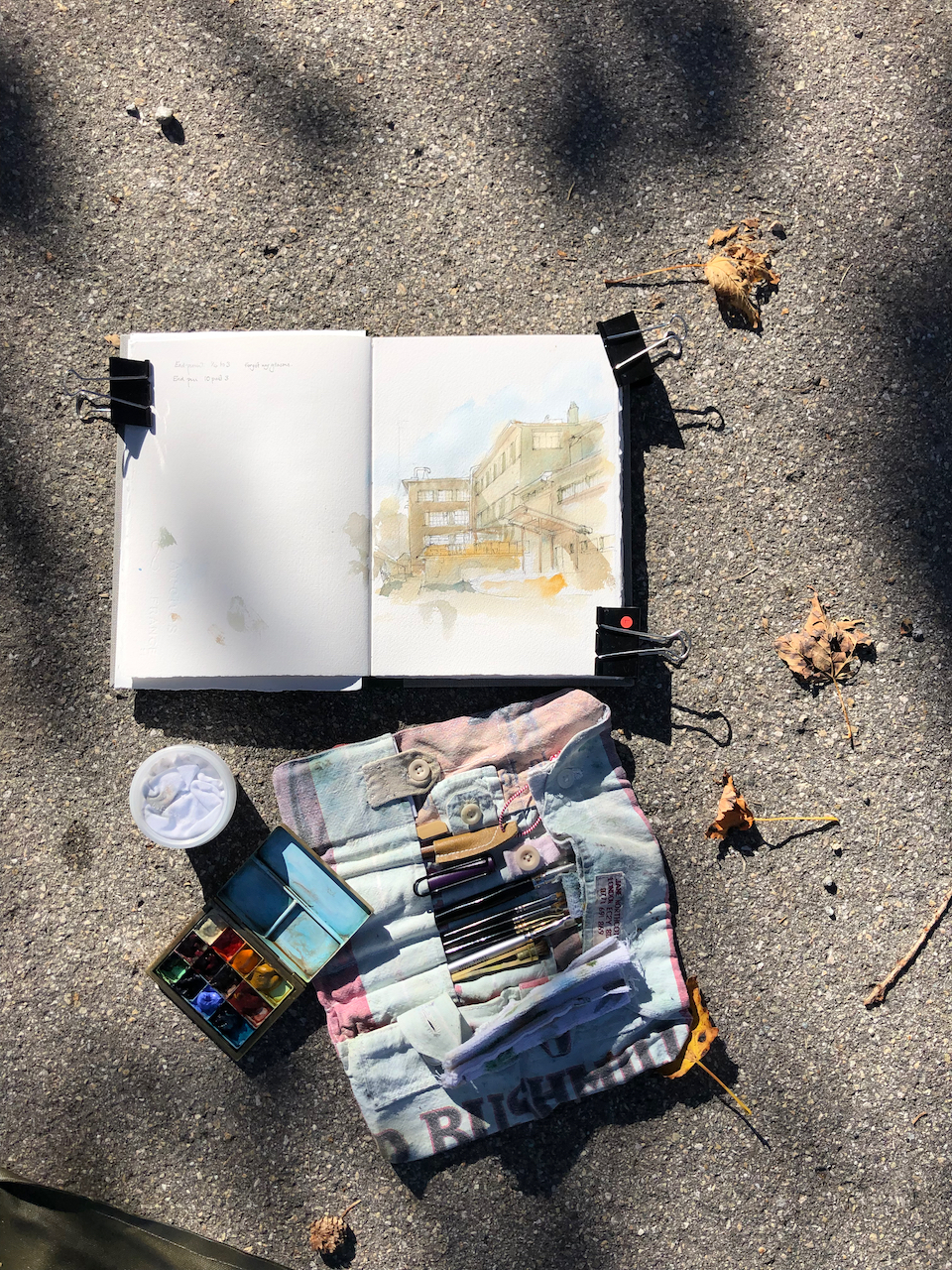
26 rue des Rasses, rear entrance (view from the South). 17th October 2021, 4pm. In Sketchbook 11

In this view you can see evidence of the current occupiers. They have built a fence, made of wooden pallets, on top of a concrete platform which is part of the original building. On the concrete wall are inscriptions in a flowing calligraphic script I did not recognise, and a large symbol in a roundel.

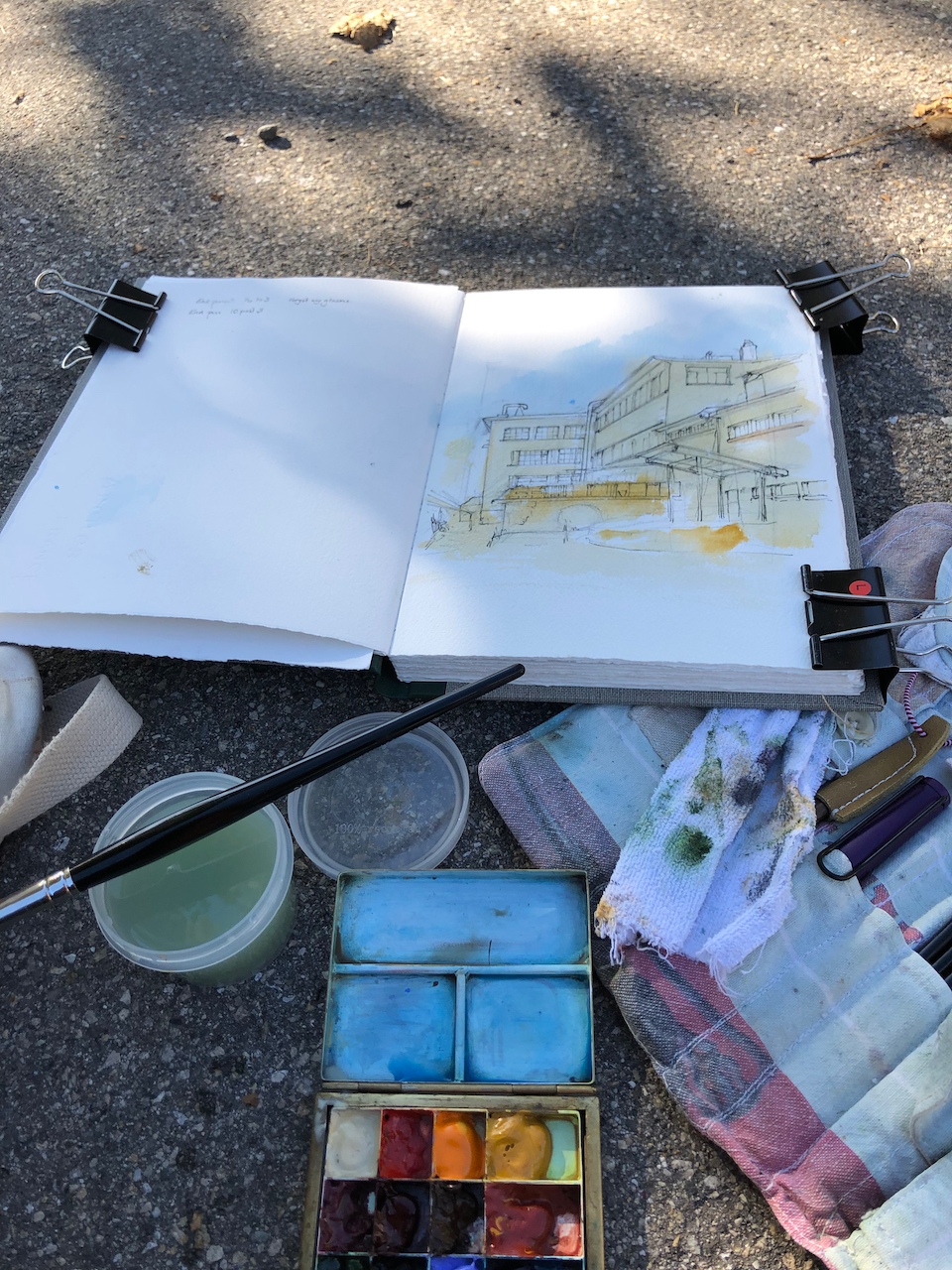
Here are some external views and work in progress on the drawings:
Here are maps:

References:

  1. Reuge, the Art of Mechanical Music, Secrets of the Reuge Manufacture, published by Reuge in 2007. Picture of the factory in the snow is from the frontispiece.
  2. Website describing Le Baz, and the Zone libre à Bâtir: https://pantographe.info/ downloaded 22 Oct 2021
  3. The local newspaper <<24 heures>> carries articles about how the current occupiers took over the buildings and disputes between the current occupiers and local residents. See for example the article by Frédéric Ravussin, 22.11.2019, 06h51. These newspapers are available on the marvellous digital resource: Scriptorium from the University of Lausanne.
Sketching in York

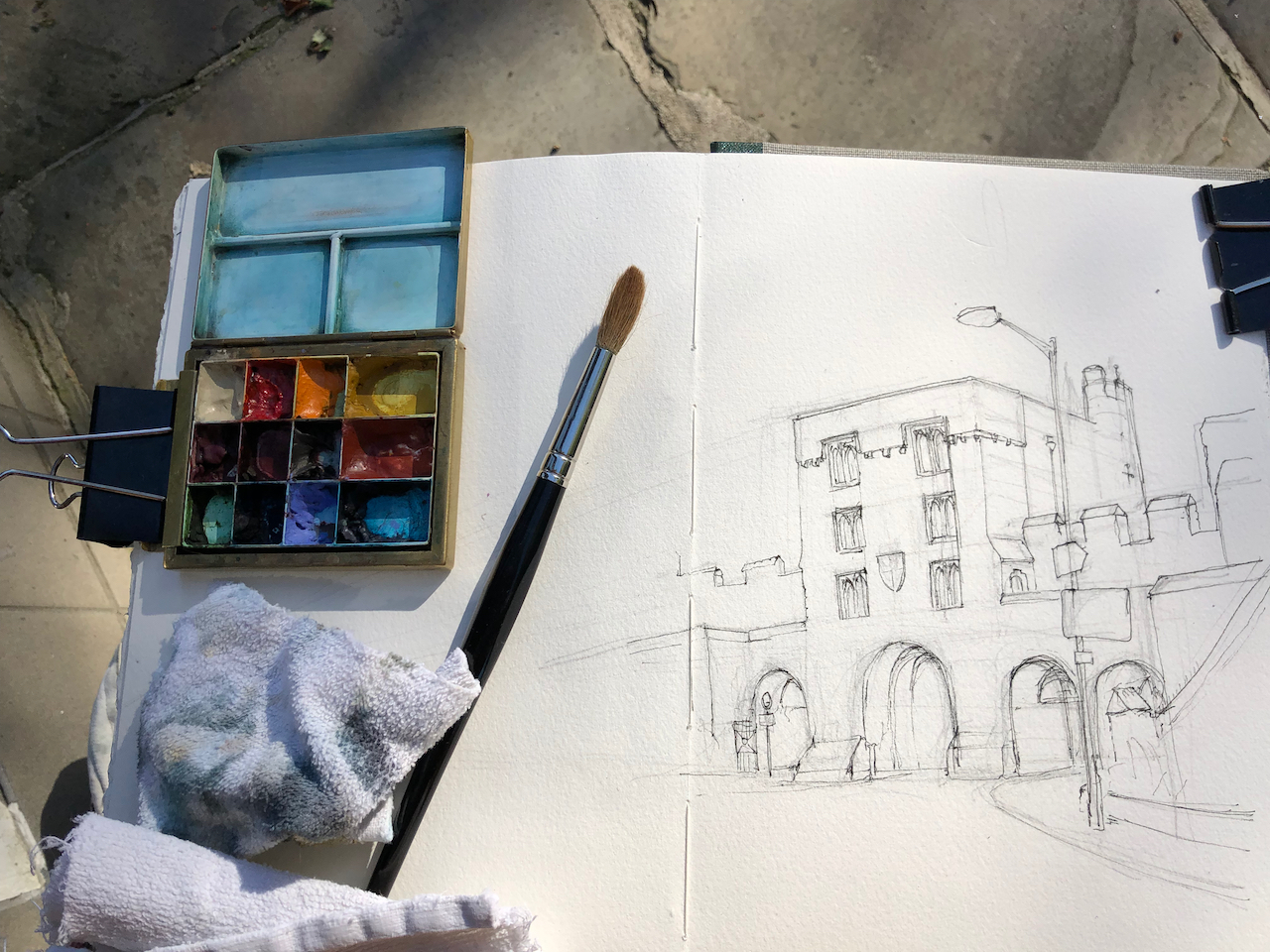
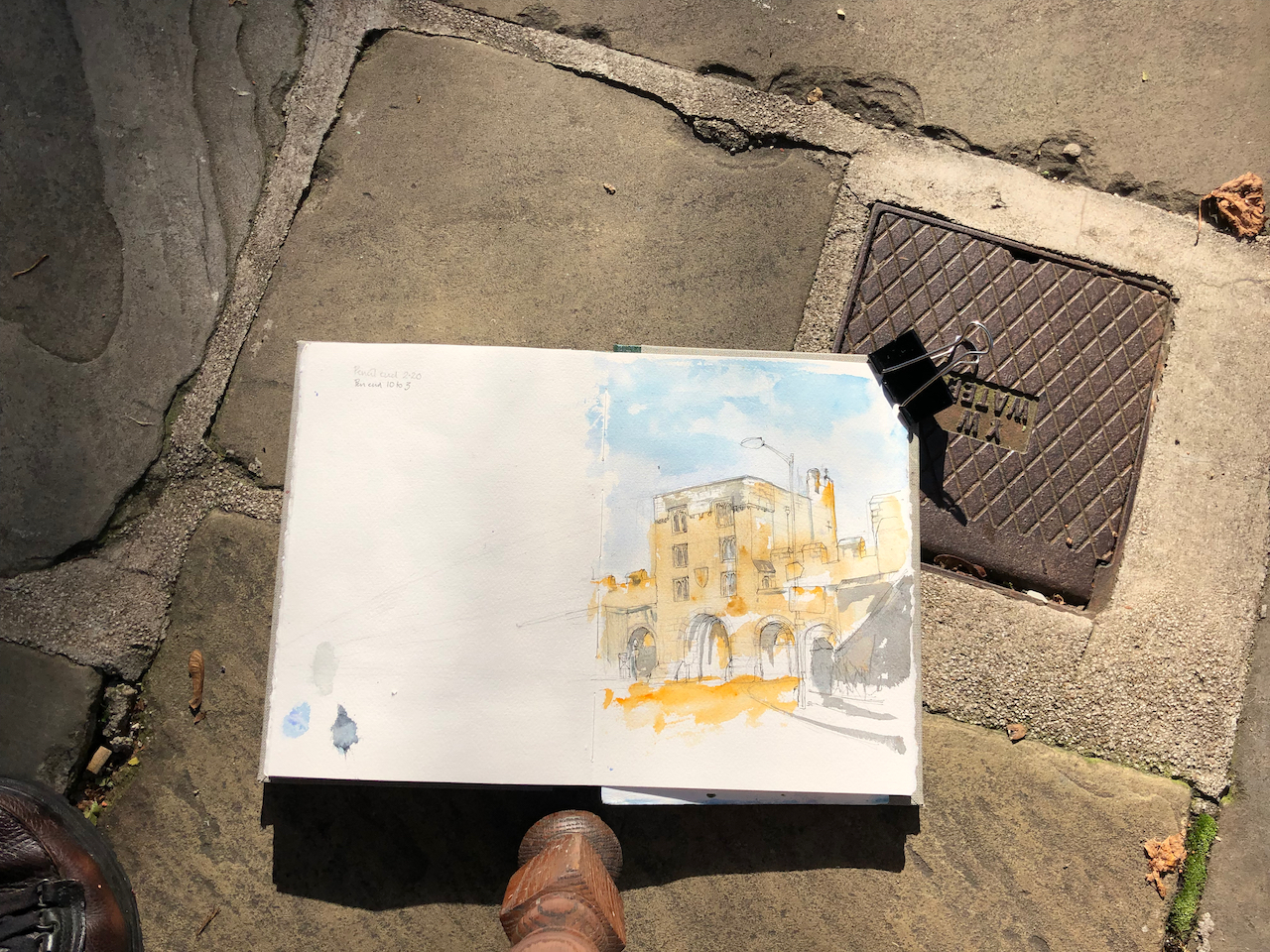
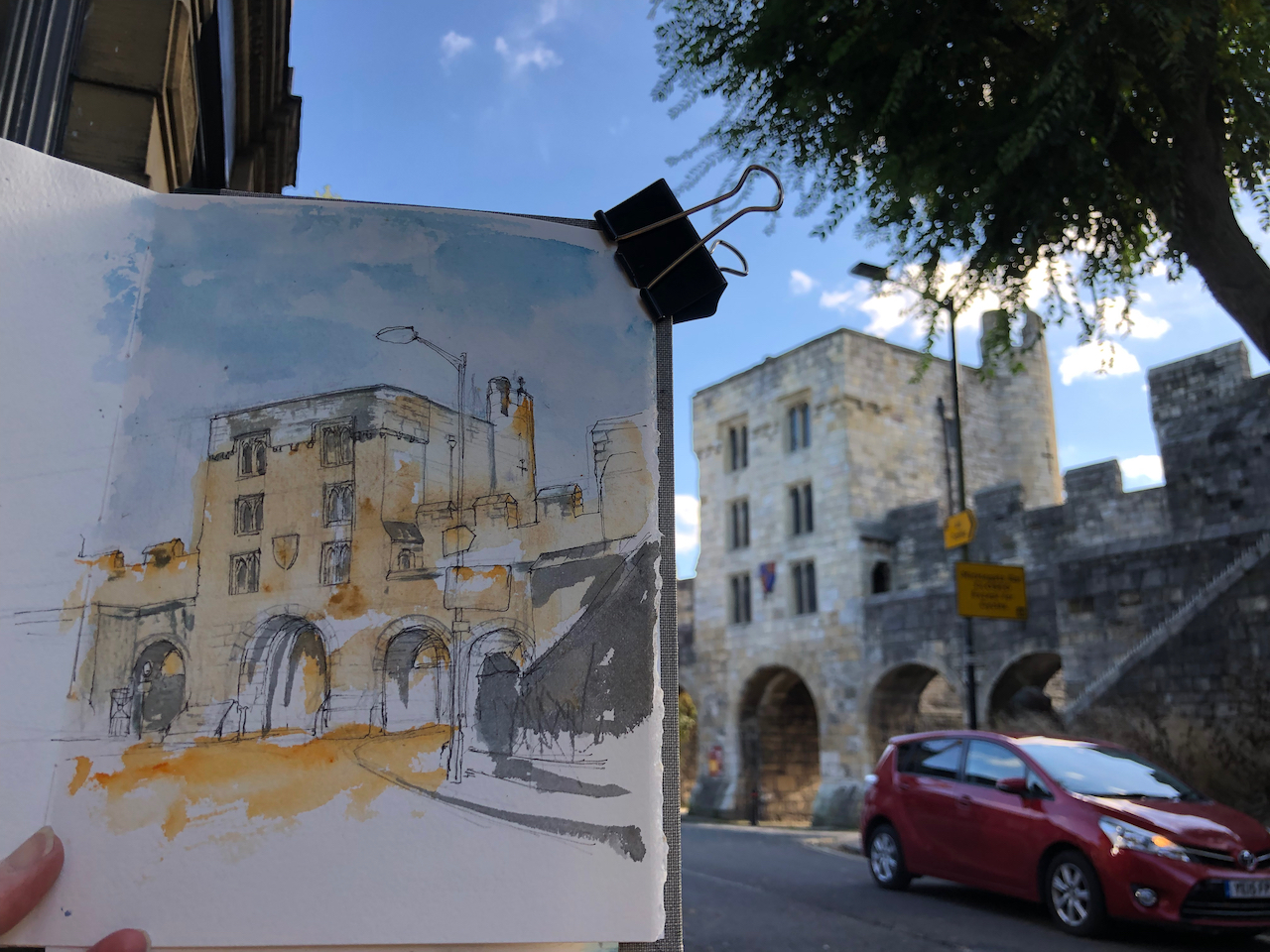
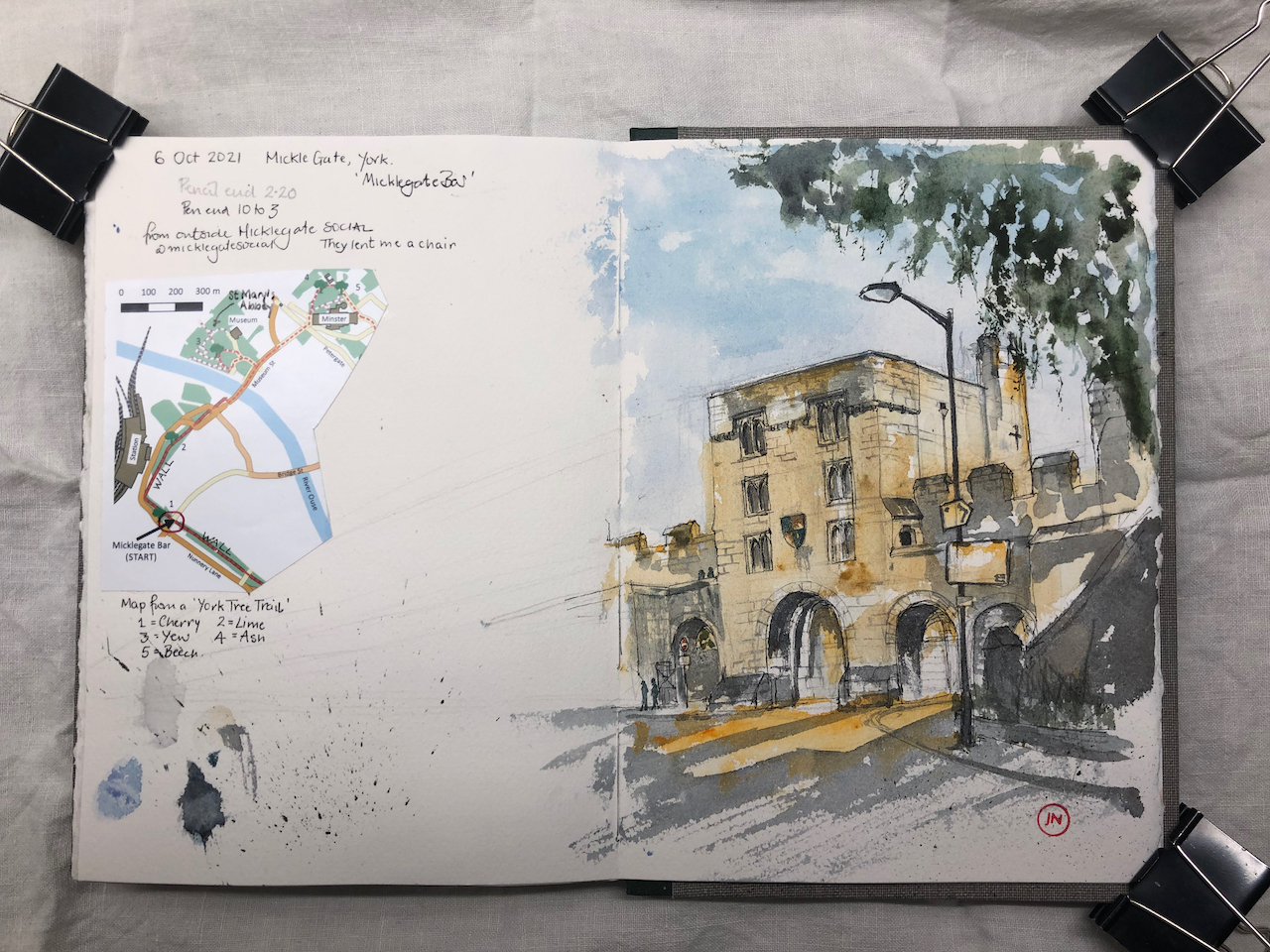
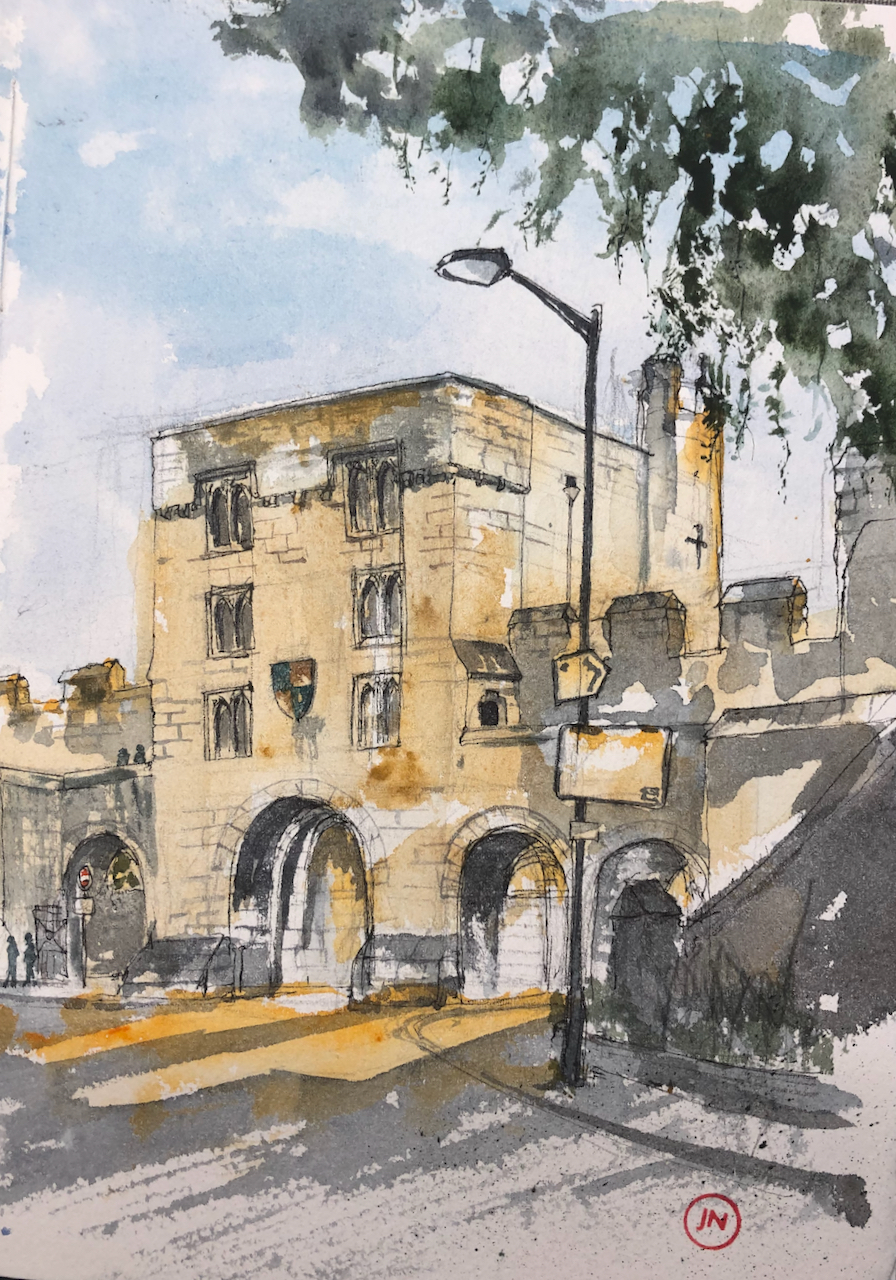
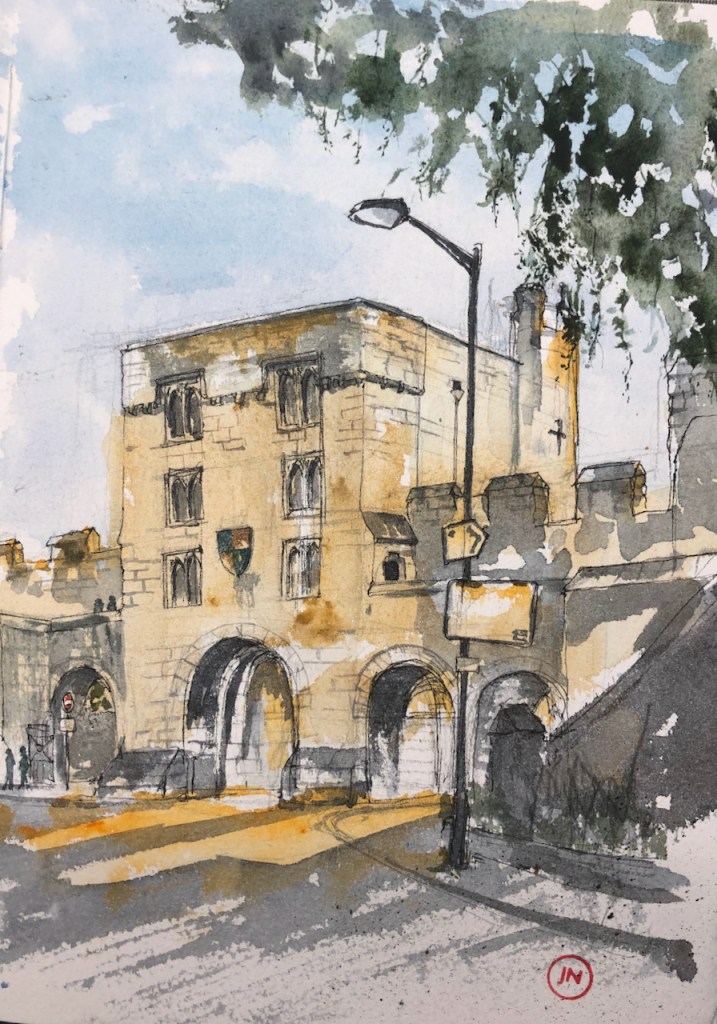
Here is the “Micklegate Bar”, which is one of the great gates through the old City wall into the centre of York.

Micklegate Bar, York, 7th October 2021, 3pm. 7″x10″ in Sketchbook 10

I sketched this outside a bar called “Micklegate Social”. The staff were inside, cleaning and setting up. They very kindly lent me a chair!

The city wall goes off to left and right. I put a two people in, to give you an idea of the scale. They are high up, level with the lowest windows.

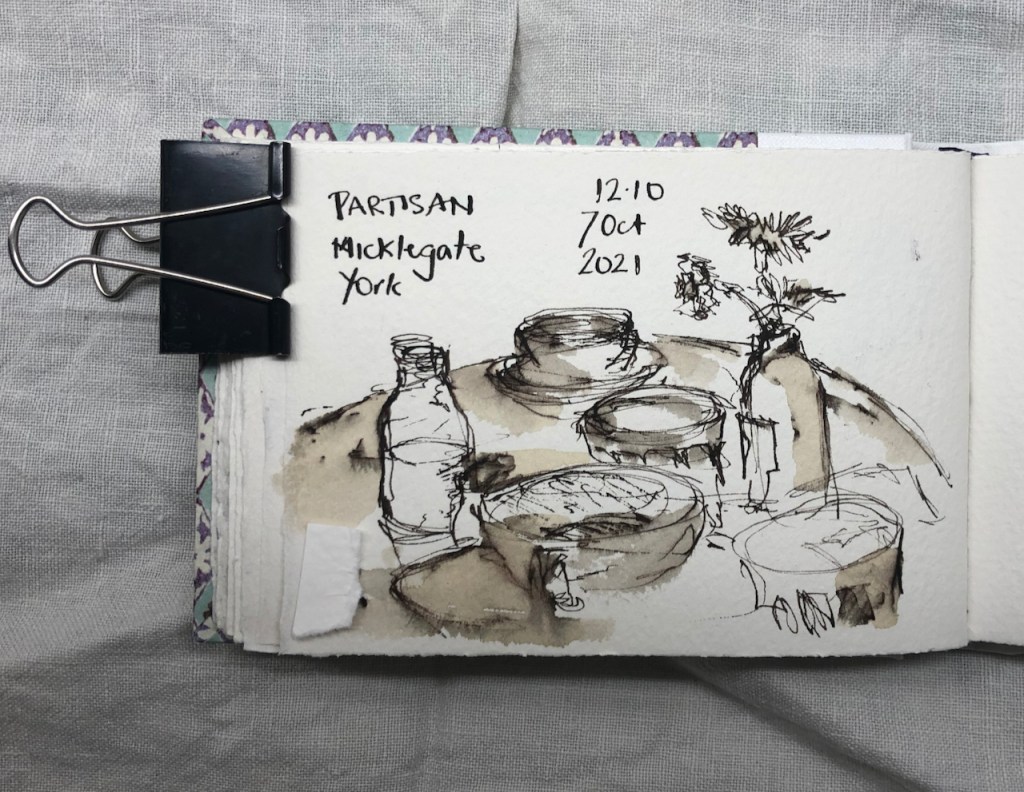
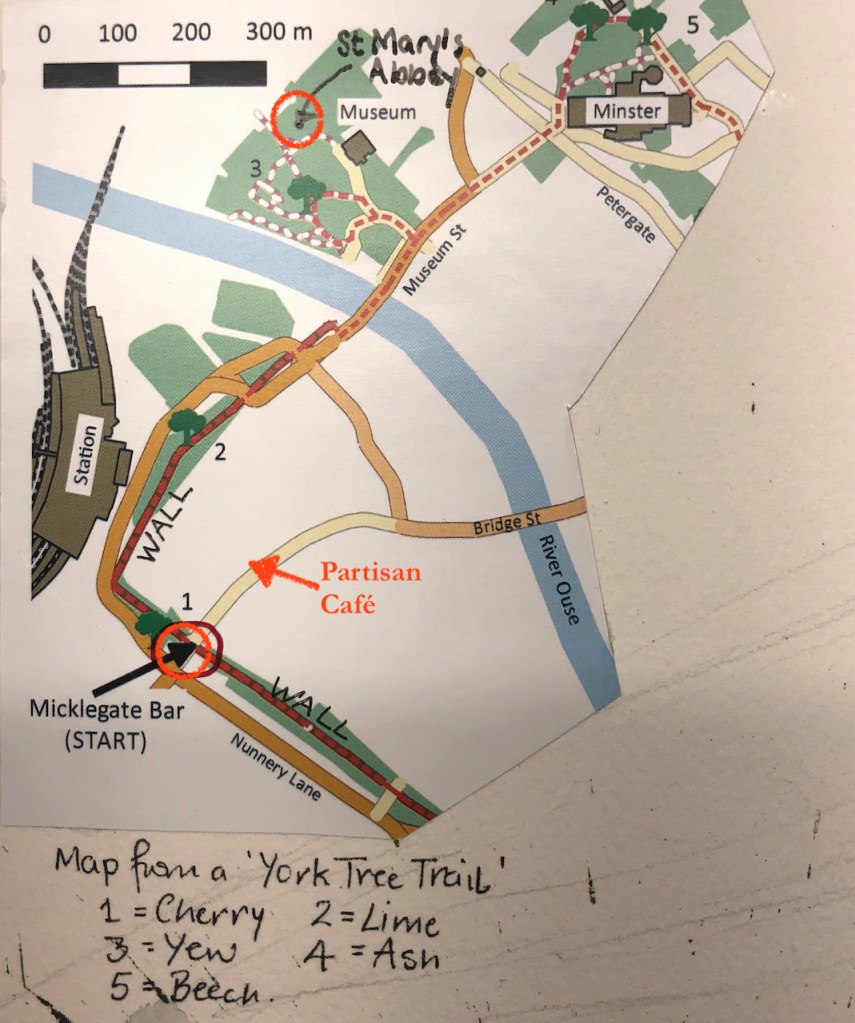
“Micklegate” is the name of a street which heads North from the gate. Later on I had breakfast at “Partisan”, a café just up from Micklegate Bar. Recommended!

Quick sketch at “Partisan”, Micklegate, York, ink and coffee. 6″ x 4″ in a small sketchbook made by Heather Dewick.

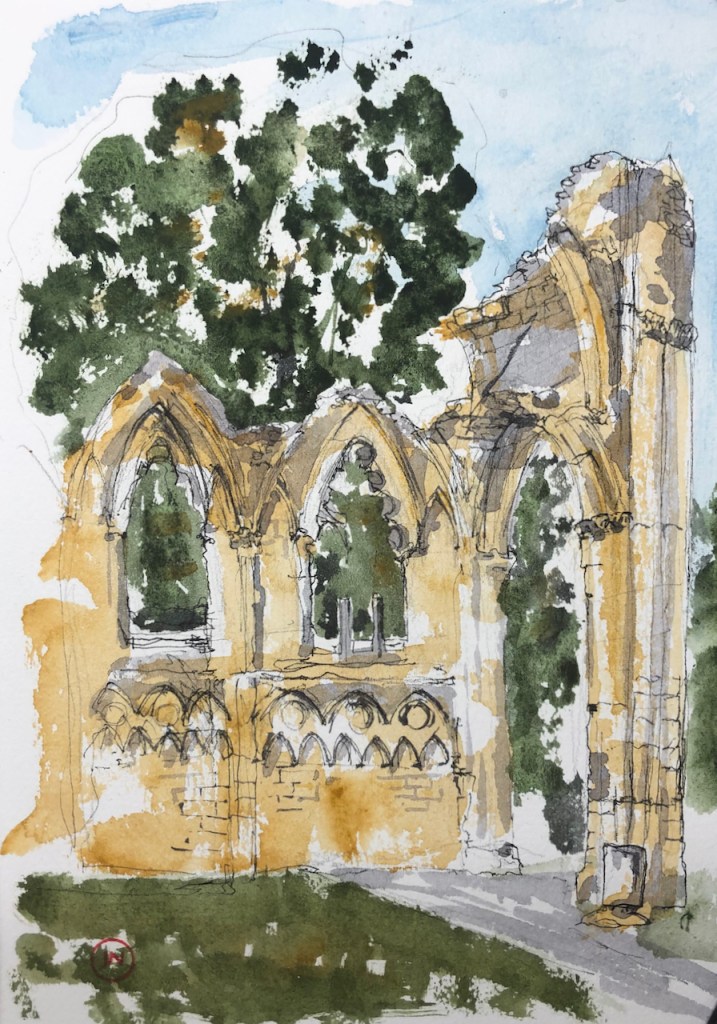
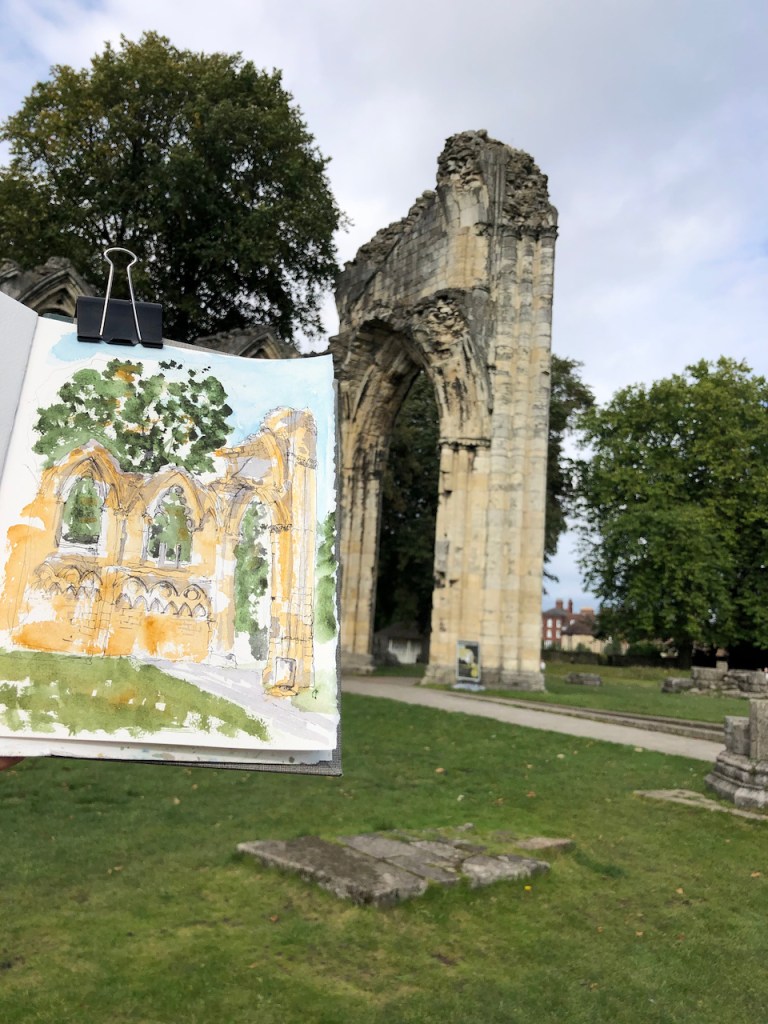
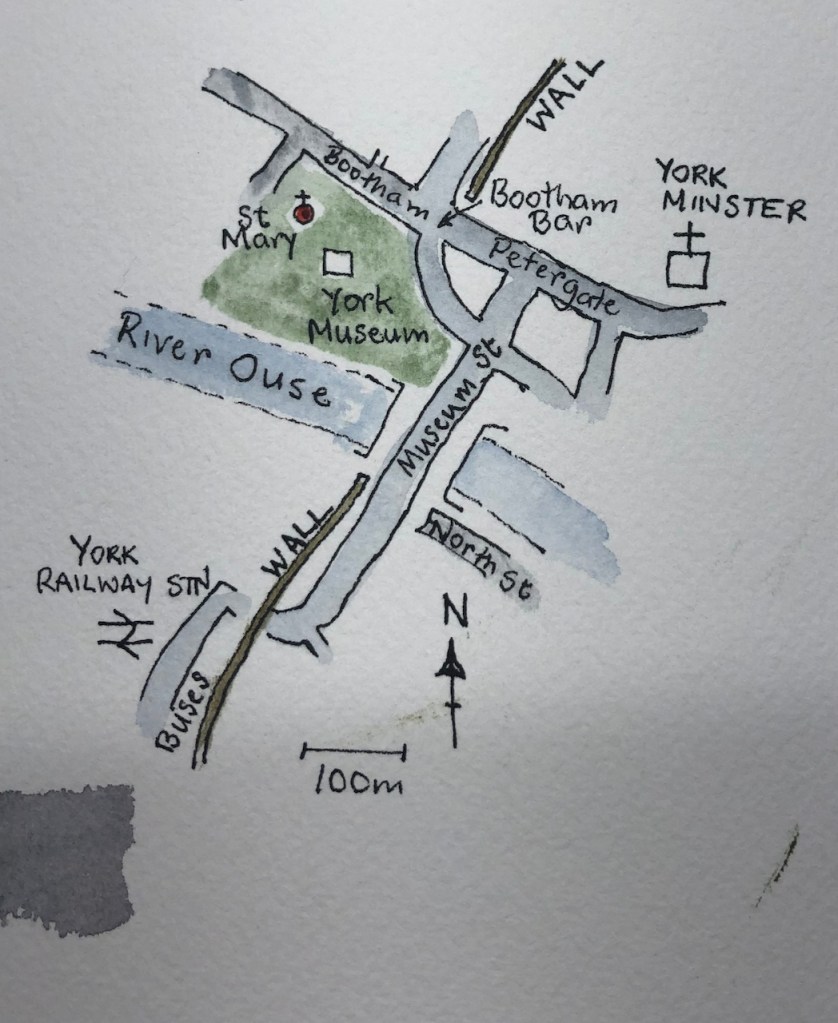
Outside the wall, to the North West, is the park surrounding the York Museum. I made a picture of the ruins of St Mary’s Abbey.

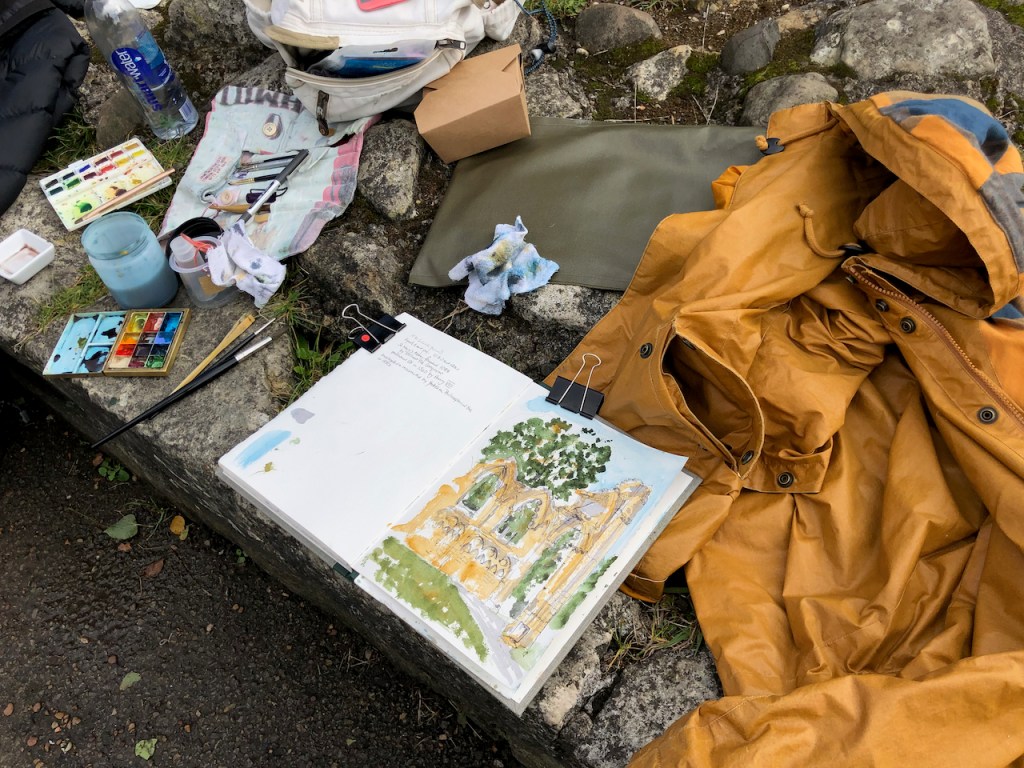
St Mary’s Abbey, York. 7th October 2021 2pm. 1hr 10mins, 10″ x 7″ in Sketchbook 10

The original church on the site was founded in 1055. In 1089, William Rufus, third son of William the Conqueror, laid the foundation stone for the Norman Church dedicated to the Virgin Mary. It was an abbey for the Benedictine monastery on this site. 450 years later the monastery was closed, in 1539, under Henry VIII.

The current ruins are 750 years old. They date from a rebuilding in 1271.

123 Cheapside, EC2

In “A London Inheritance” I read a fascinating article about this corner of Cheapside and Wood Street, near St Paul’s Cathedral. When I passed the corner last week I noticed that the shop had closed down. Fearing that this closure would presage demolition of this interesting building, and replacement with a 39-story office block, I rushed to draw the corner shop while I could. It was raining. But I could find a bit of shelter under the glass canopy of M&S in One New Change opposite.

123 Cheapside, from across the road. 2nd October 2021, 10″ x 7″ in Sketchbook 10

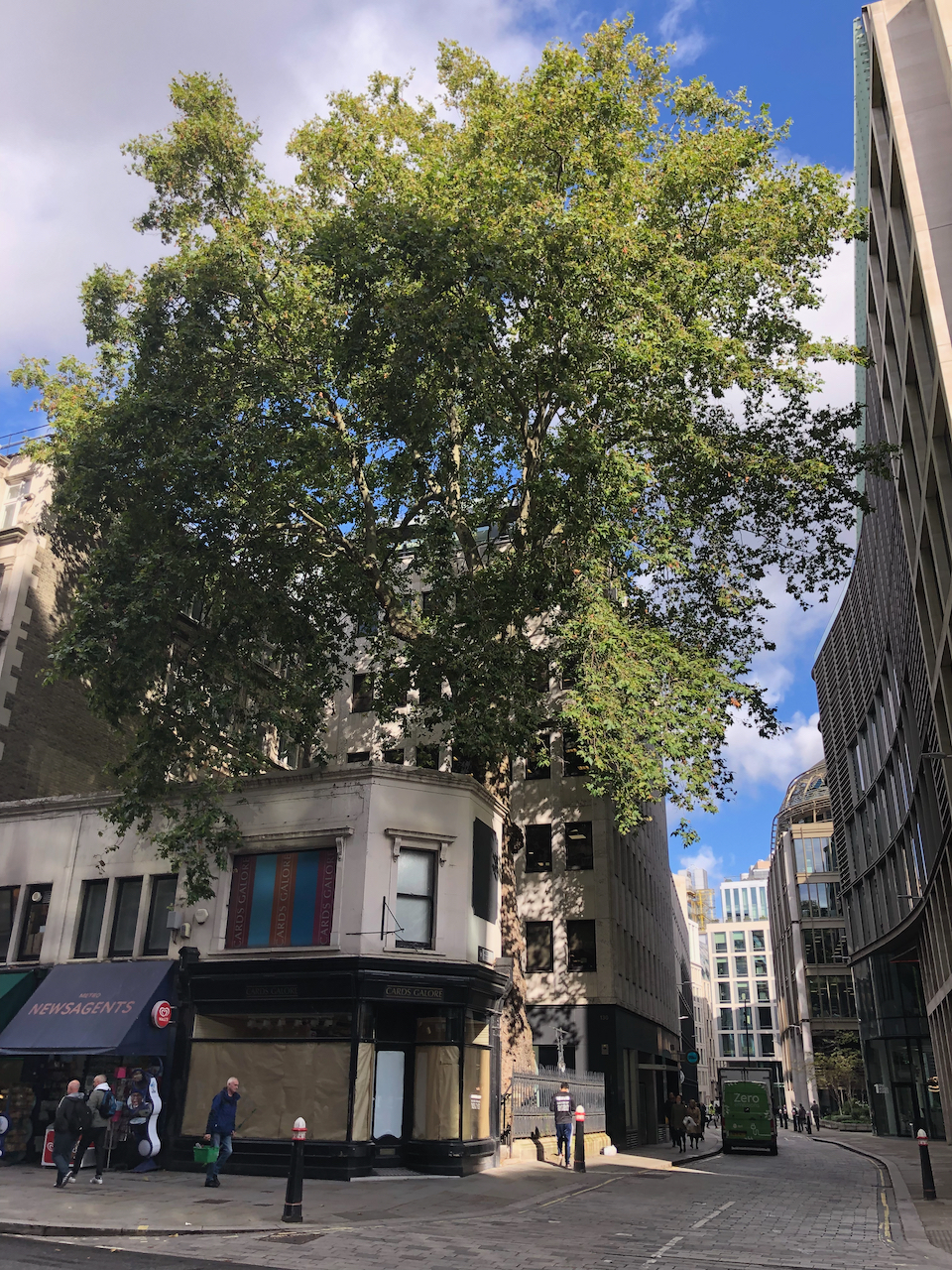
This is a very ancient row of shops. The shop on the corner was, from before 1908 and until at least 1986, L.R. Wooderson Shirtmakers. In recent years it has been “Cards Galore”, but is now closed and the windows are obscured with brown paper.

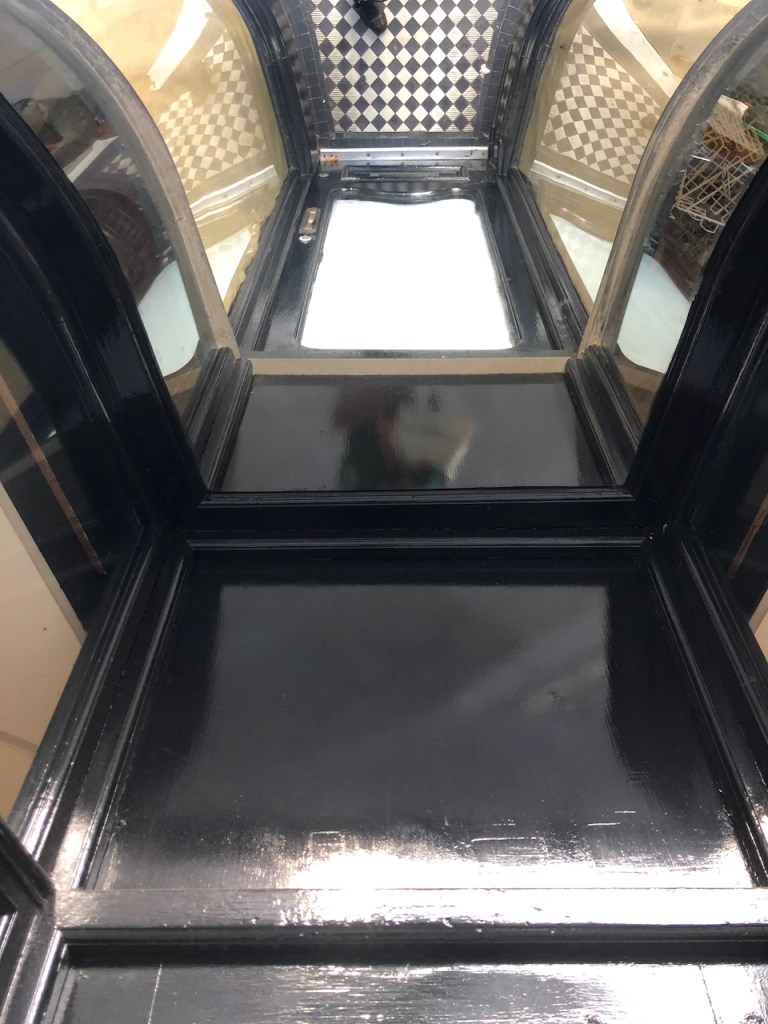
The corner shop is a wonderful little building. I especially admire the curved glass of the two windows either side of the door, which seem to invite you in. Curved glass windows are rare, especially at street level, so these deserve recognition and admiration. Even more amazing is the mirror on the ceiling! If you step between the curved glass windows and look up, you see that this entrance space is reflected in a mirror. Perhaps this was a device so that if needed, you could see your newly purchased shirt or hat from above?

L.R. Wooderson is shown in a London Metropolitan Archives photo from 1908 (below).
The author of “A London Inheritance” photographed it 78 years later, in 1986. In his 1986 photo, the notice on the side of the shop says “Est 1884”. He has further information about L.R. Wooderson and the Wooderson family on his blog entry, and there’s yet more information in the comments on his article.

Here’s the photo from 1908:

123 and 124 Cheapside, 1908
LCC Photograph Library image © London Metropolitan Archives (City of London)
Record number 38726 Catalogue number: SC_PHL_01_006_79_7728
Accession number: 0577c . Used with permission.

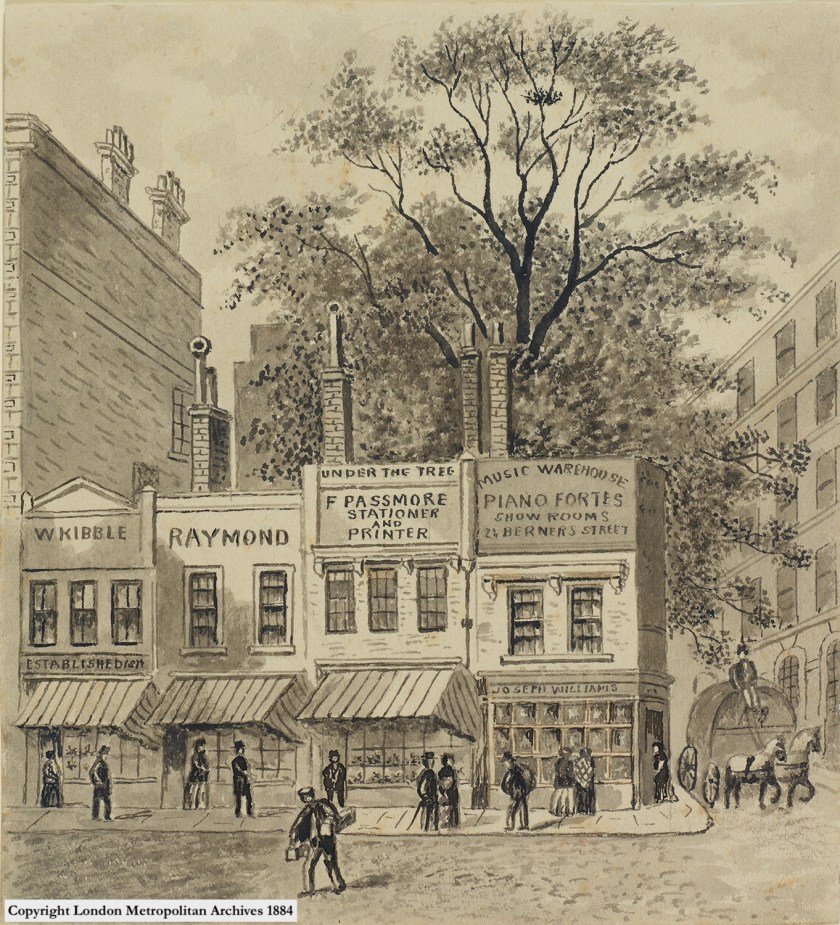
Here’s the same row of shops circa 1870, showing a predecessor of L.R. Wooderson.: Joseph Williams, seller of “pianofortes”, with a warehouse in Berners Street in the West End.

View of shops and figures on Cheapside, also shows the corner of Wood Street, c1870
by WH Prior image © London Metropolitan Archives (City of London)
Record Number: 1884 Catalogue number:q2824343. Used with permission.

You see that “F. Passmore Stationer and Printer”, describes itself as “under the tree” – see the notice high up on a hoarding. This huge plane tree is famous, and at that time clearly famous enough to help in locating the shop. The commentary on the 1908 photo (above) in the London Picture Archive says:

124 Cheapside, City of London, by Wood Street. Front and side elevations of a two-storey shop, L & R Wooderson hosiers. In view is a street lamp. Towering above the premises is a Plane tree. The tree sits in the churchyard of St Peter Cheap. It’s thought the tree could date from the 1760s and is currently protected so can’t be cut down. The church of St Peter Cheap perished in the 1666 Great Fire and missed out on being rebuilt by Sir Christopher Wren.

There is much more about the tree in an article on the “London Walking Tours Website” on this link.

I was interested to note how the tree size changes. In the 1870 drawing it is already huge. 40 years later, in the 1908 photo, it seems smaller, and more compact. I wonder if it was pollarded? Today it is again enormous. Here are the photos above again, with a modern picture to compare.

It remains famous. It is no. 1 in the “Top Ten Trees” of the City of London according to the “Friends of City Gardens”.

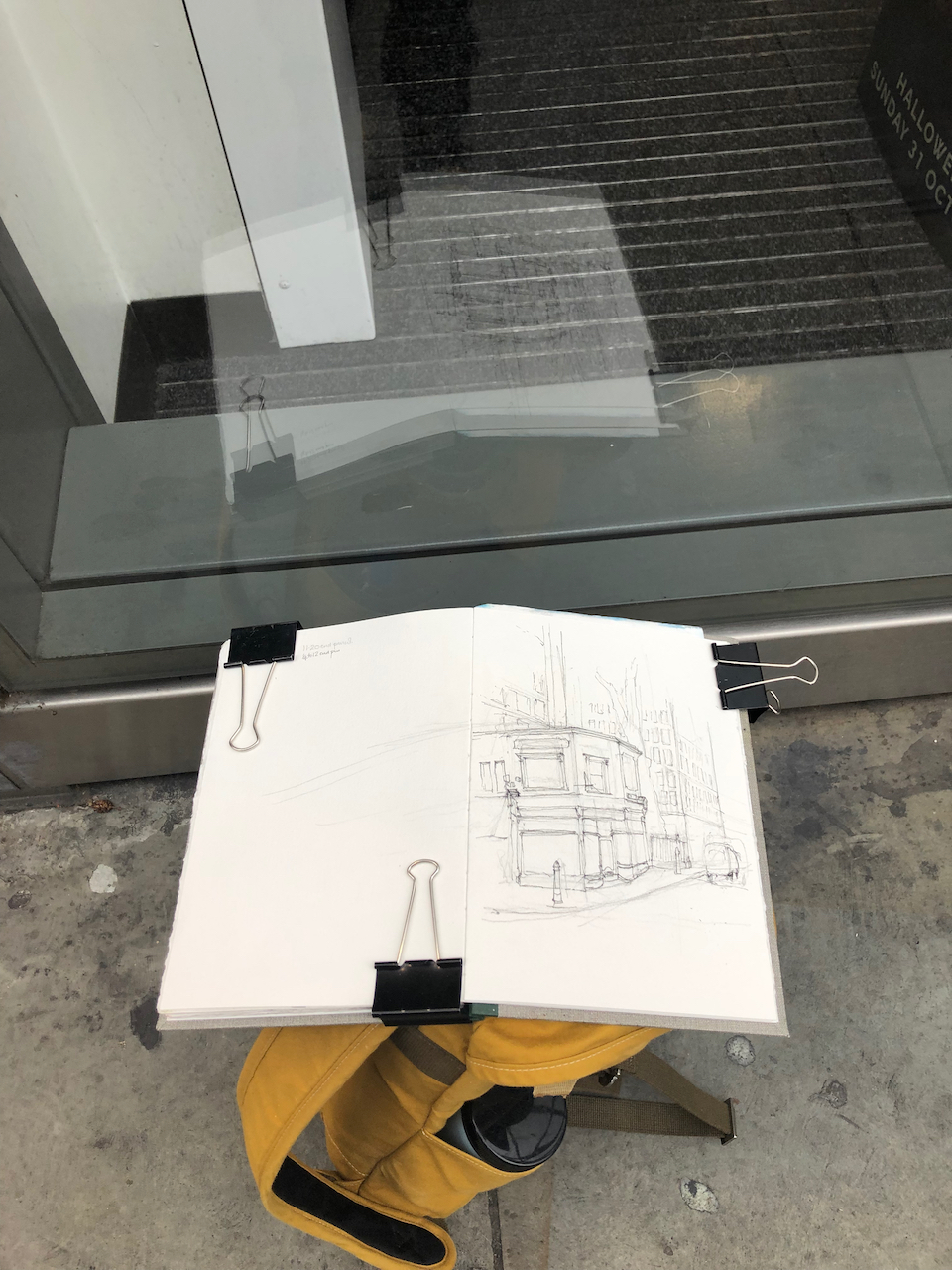
I completed the pen and ink of my drawing outside M&S, and then retreated from the rain and added the colour at my desk.

The colours are:

  • Perylene Maroon and Prussian Blue for the greys, with a bit of Transparent Brown Oxide in the the road,
  • Buff Titanium for the white of the shop with some Mars Yellow,
  • Green Apatite Genuine and Green Gold for the tree, and
  • a tiny bit of Transparent Pyrrol Orange for the City of London bollard tops and refections.

The Palm Tree, E3

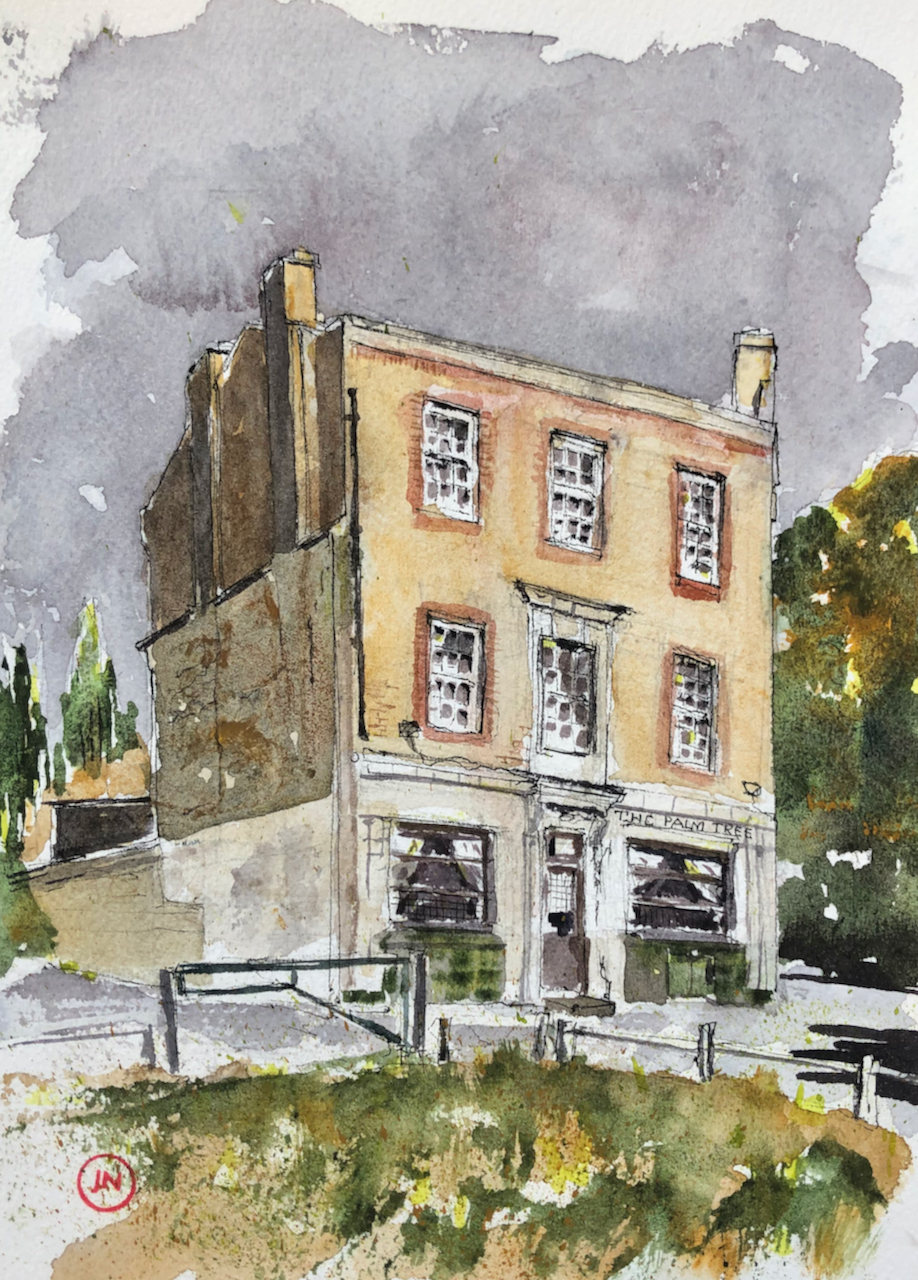
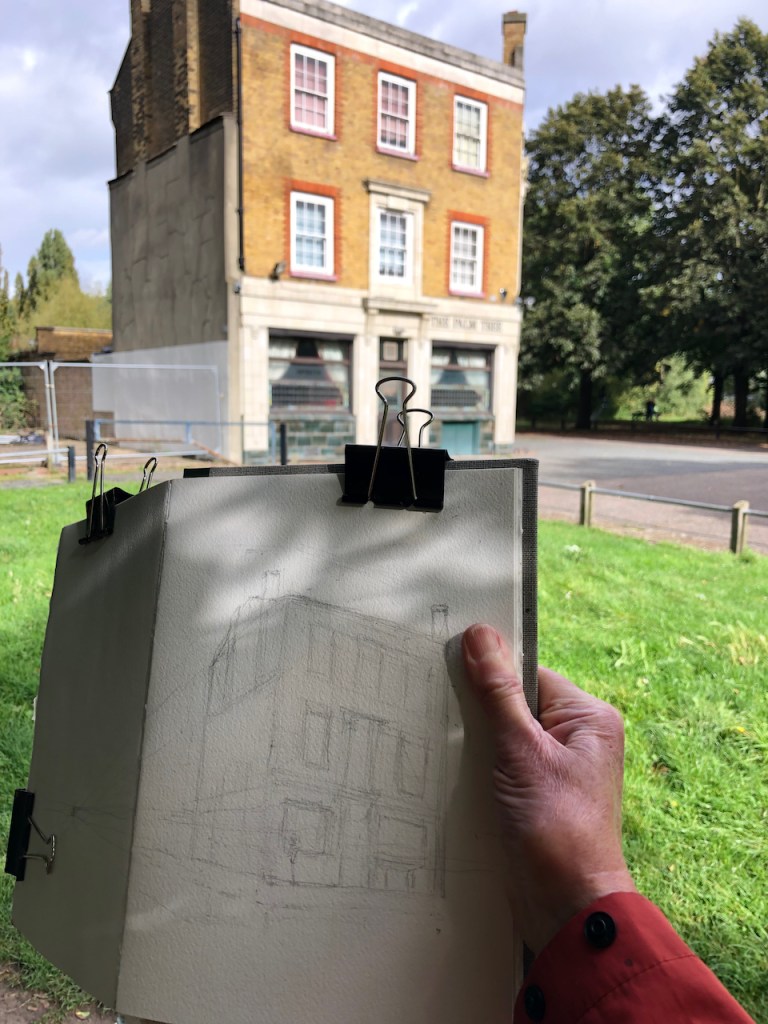
Here is “The Palm Tree” pub, seen from the south.

“The Palm Tree” 127 Grove Road, Mile End, London E3, 28th September 2021, 10″ x 7″ in Sketchbook 10

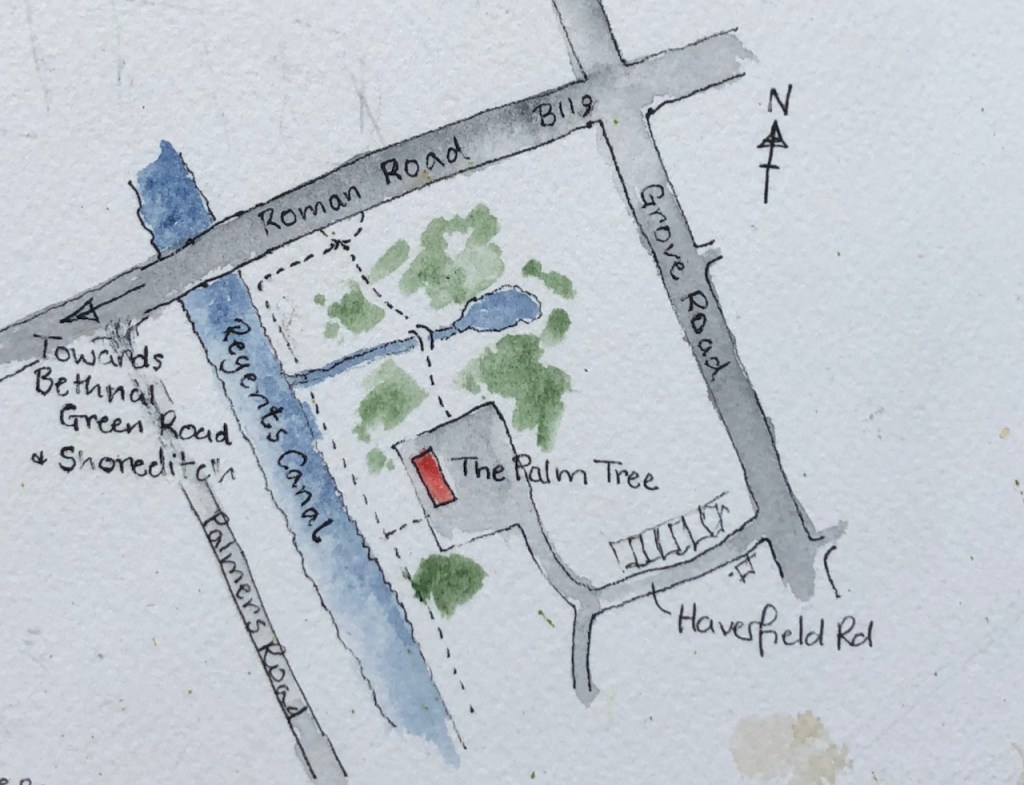
I have often puzzled about this pub. I pass it as I’m cycling or running on the Regent’s Canal towpath. It stands alone, in a field of green, strangely isolated. Has it always been like that?

The Palm Tree stands isolated by the Regents Canal.

The answer to that question is no. It was not always isolated. It used to be surrounded by houses.

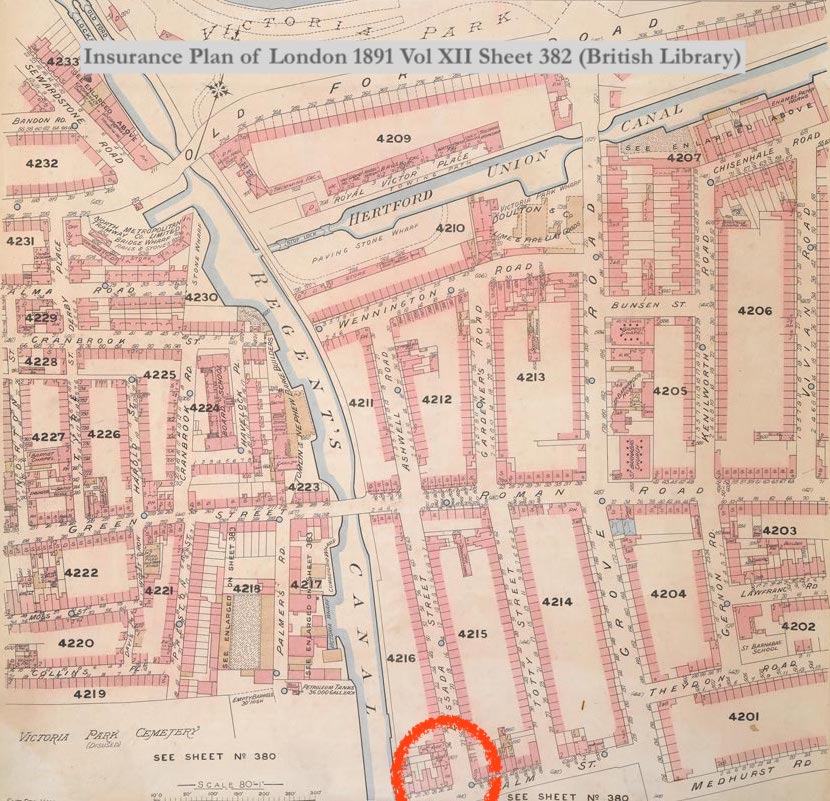
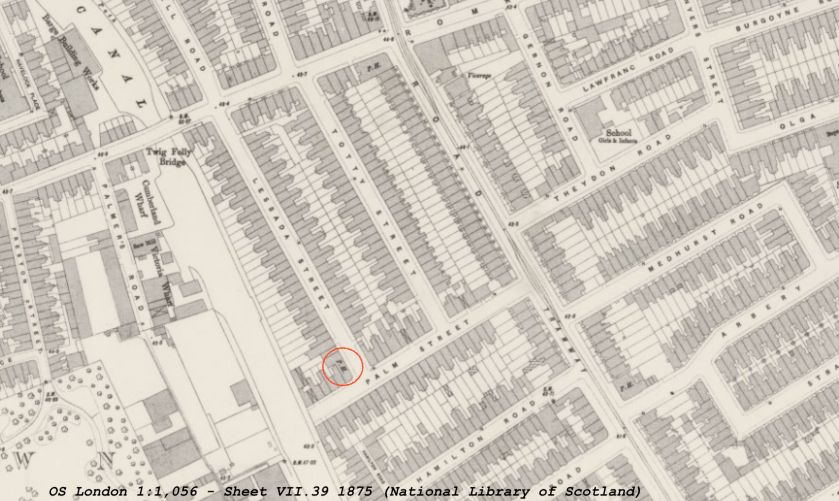
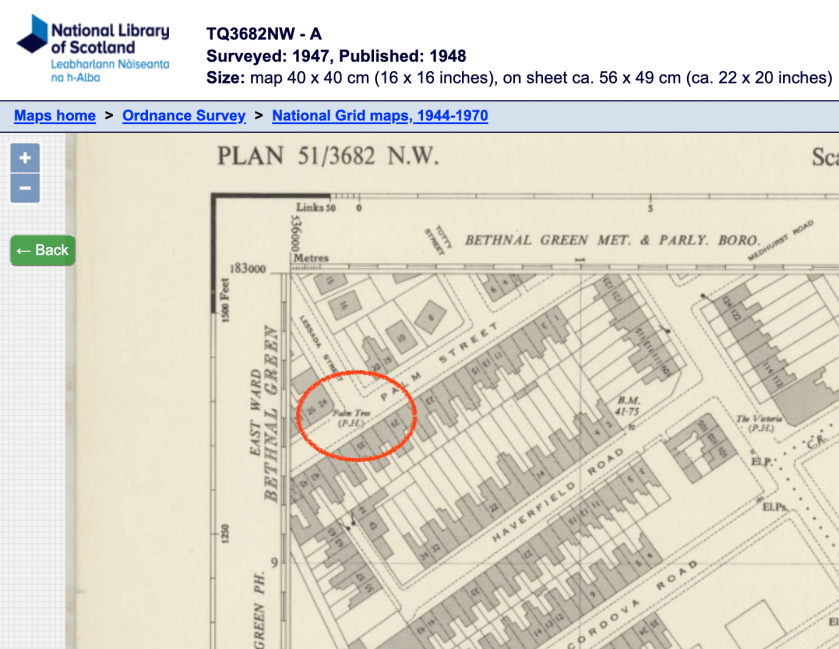
Its Historic England entry (1427142) tells me that when this pub was built, in 1935, it was surrounded by terraces of houses, Palm Street, Lessada Street and Totty Street, which have since vanished. The entry says: “the pub is the final remnant of a once built-up, industrial part of London, destroyed in the Blitz and in subsequent clearances”

Usually, an elderly resident will gesture to dense terraced housing and inform you that “this used to be all fields”. But in this area of Mile End, the reverse is true: this open green area used to be all houses!

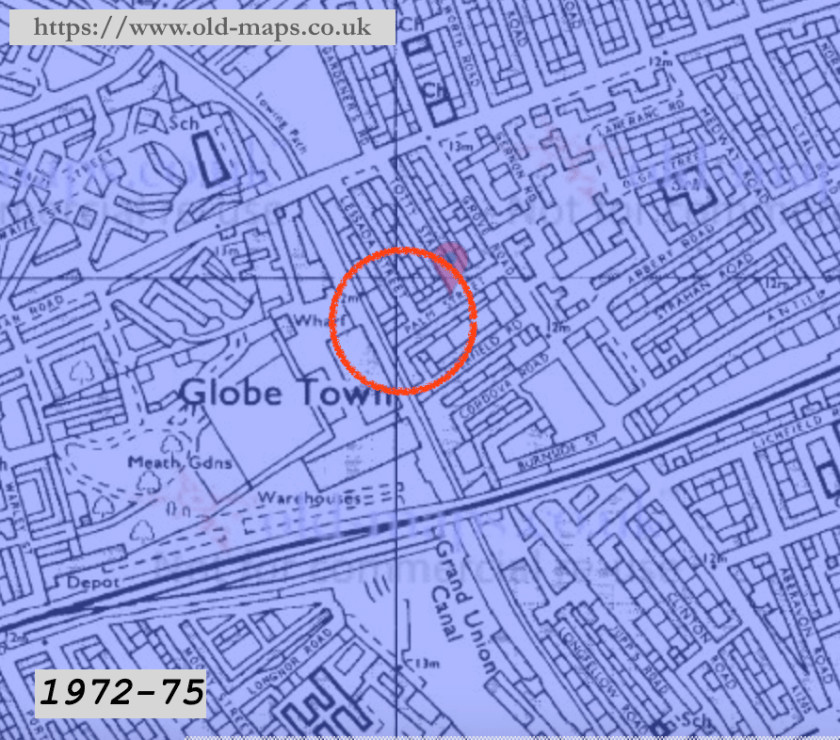
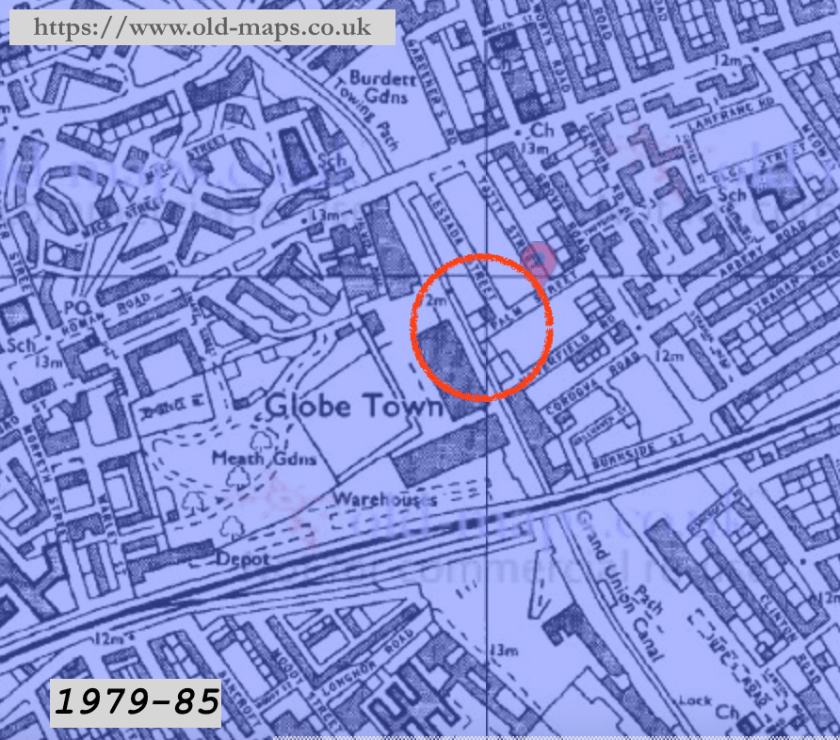
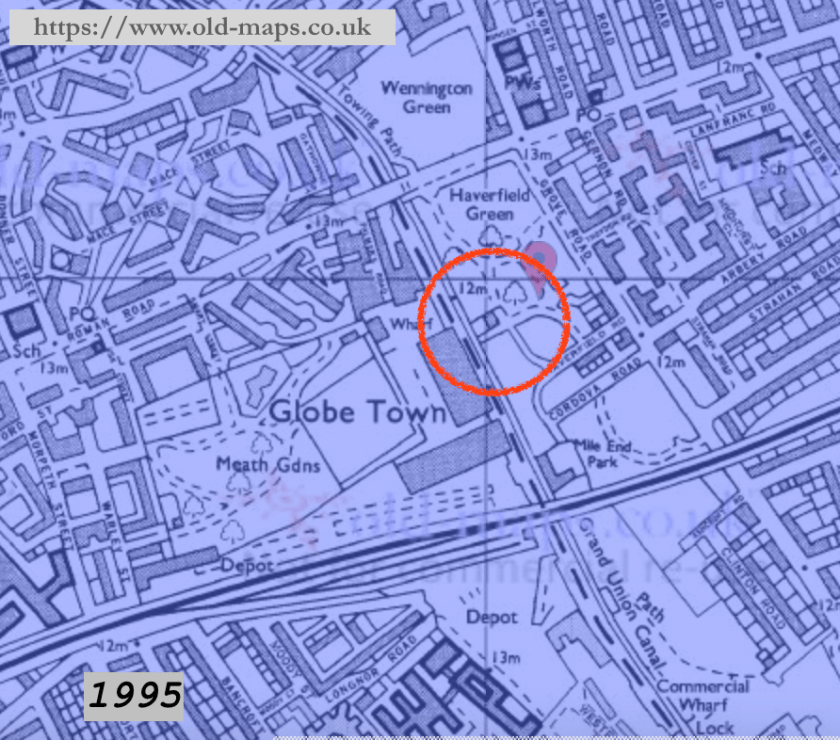
Here are a selection of maps. You see the dense housing and close-packed streets in the late 19th century, damaged by bombs in 1944, and then replaced by pre-fabricated housing in the 1970s. The post-war prefabricated housing was demolished in 1977. In the 1979-85 OS Map, the streets are still there, but the housing has gone. By 1995 it was “all fields”, and the Palm Tree pub stands alone, as it does today.
The reason the pub has an entry in the Historic England listings is that it is Grade II listed. Amongst the many architectural delights described in the listing is the saloon bar:

The saloon bar, accessed from the furthest door along the north-east elevation, appears to remain almost entirely unchanged since construction. The higher class of the bar is apparent in the fielded dado panelling on the walls and on the curved bar counter; otherwise the internal decoration is similar to the other bars, retaining its bar back, chequered counter edge tiling and chimneypiece[……]A dartboard cabinet, possibly from the original pub, was reinstalled in the late C20. Unlike the public bar, which originally had only gentlemen’s toilets, the saloon was served by male and female toilets (set either side of the fireplace); both of these remain largely unaltered, with original doors and door furniture, tilework and, in the gents’, a Royal Doulton urinal.” [Historic England Listing number 1427142]

Reason enough to visit the pub when it is open!

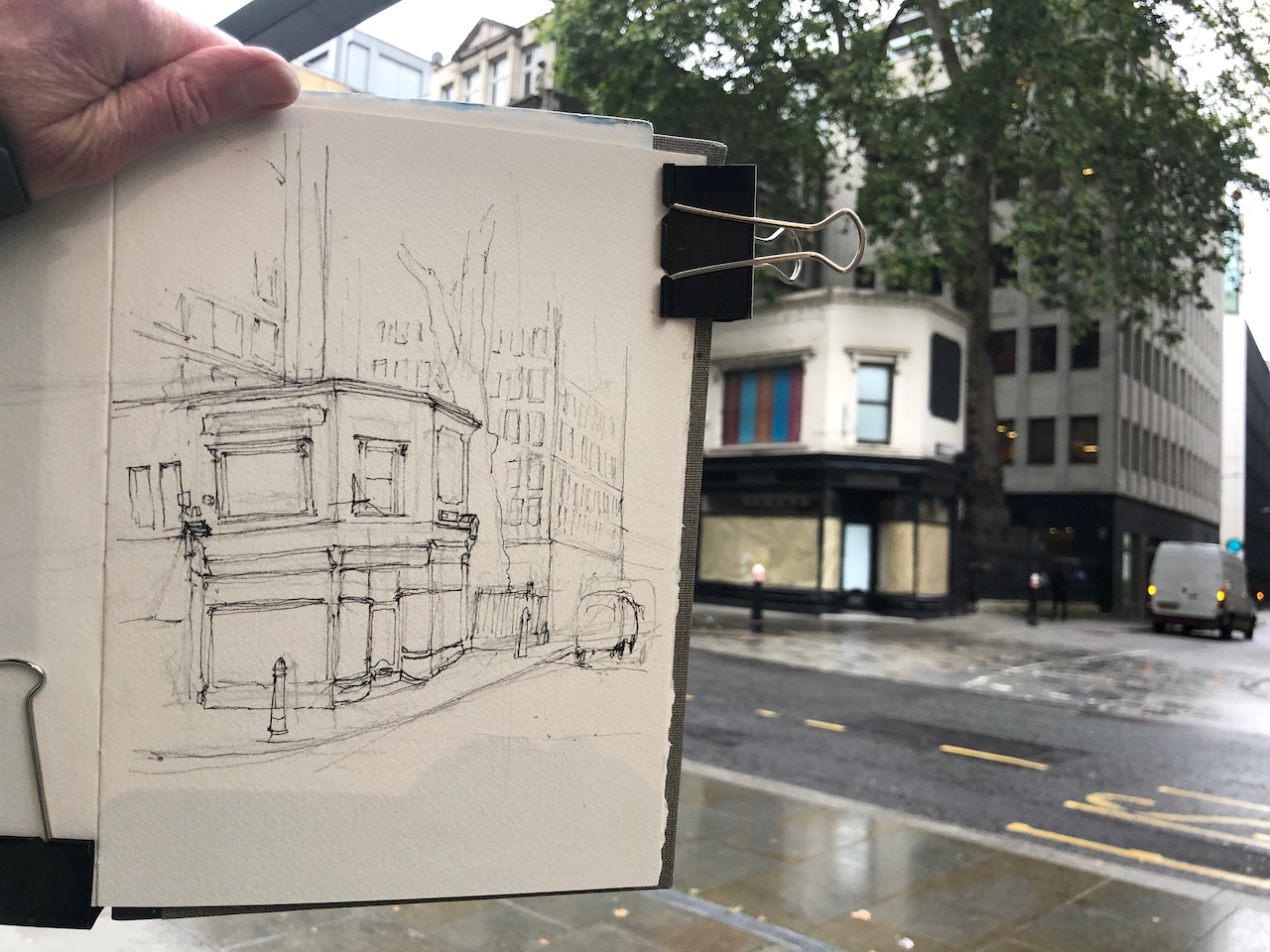
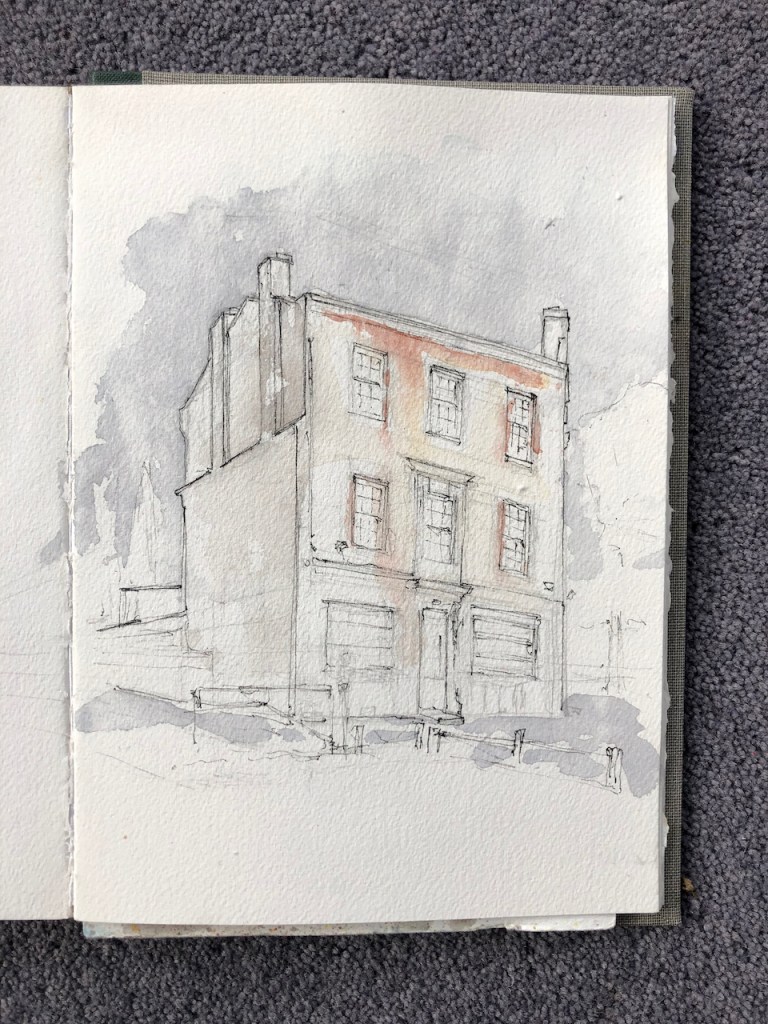
Part way through this sketch it started raining, then the rain became heavy.
I finished the sketch at my desk.

The main colours are: Mars Yellow for the brickwork and plants, Fired Gold Ochre for the reddish brickwork, Perylene Maroon and Prussian Blue, plus some Mars Yellow, to make the greys, and Green Apatite Genuine for the darker greens of the trees, with highlights of Green Gold. There’s a bit of Buff Titanium for the whitish tiled part on the ground floor. All colours are Daniel Smith watercolours.

Thanks to the staff and curators at London Picture Archive, I can add this marvellous photograph of The Palm Tree in 1971:

Palm Tree Public House 1971, LCC Photograph Library, image © London Metropolitan Archives (City of London), record no. 344336, catalogue number: SC_PHL_02_0976_71_35_340A_14A, used with permission, under licence.
Note the street sign: “Lessada Street” on the right which has vanished, and the brick block at the back on the left which has completely gone, as has the wonderful lamp-post.
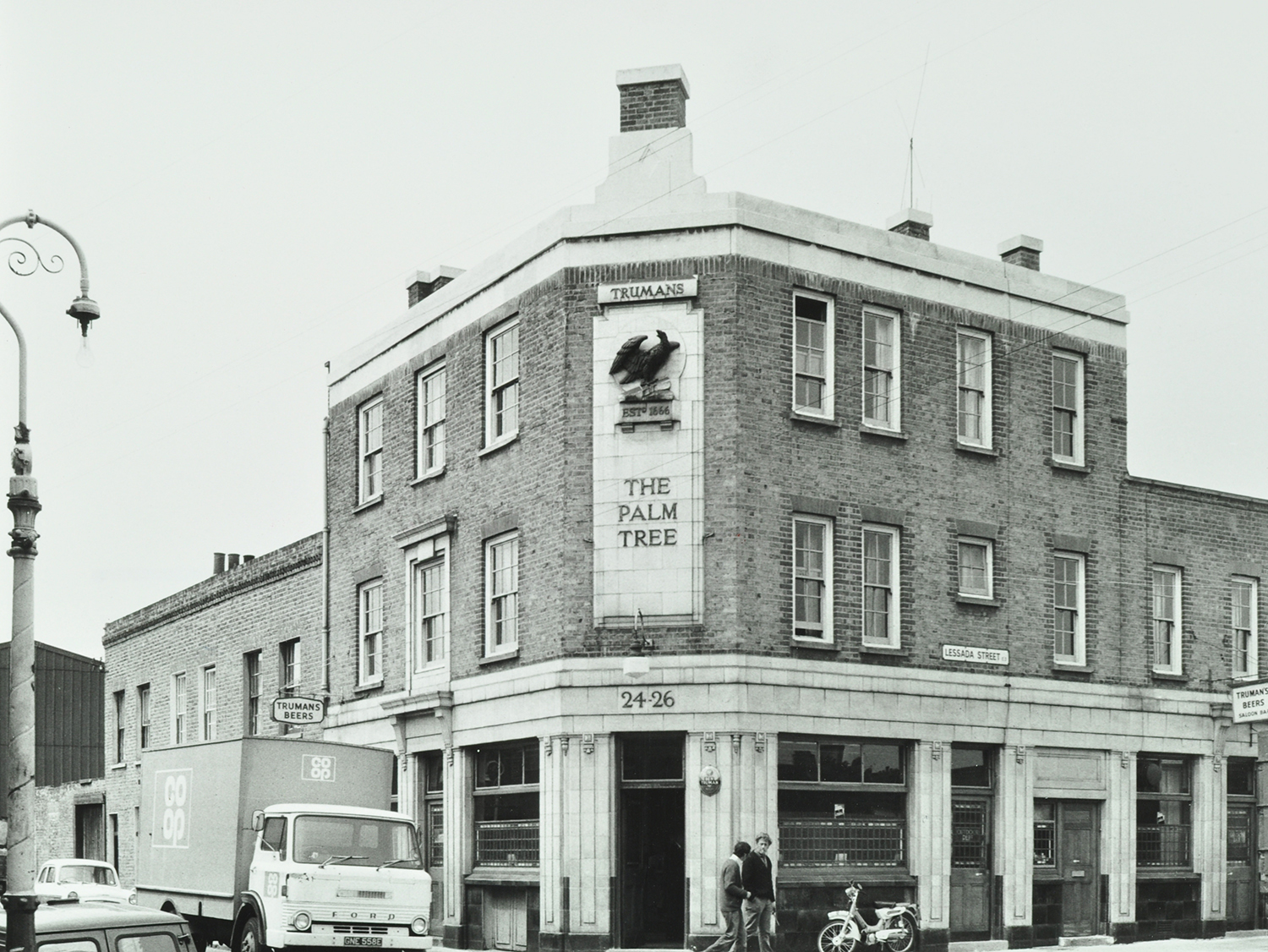
Apart from that, it’s not very different. All around it has changed.

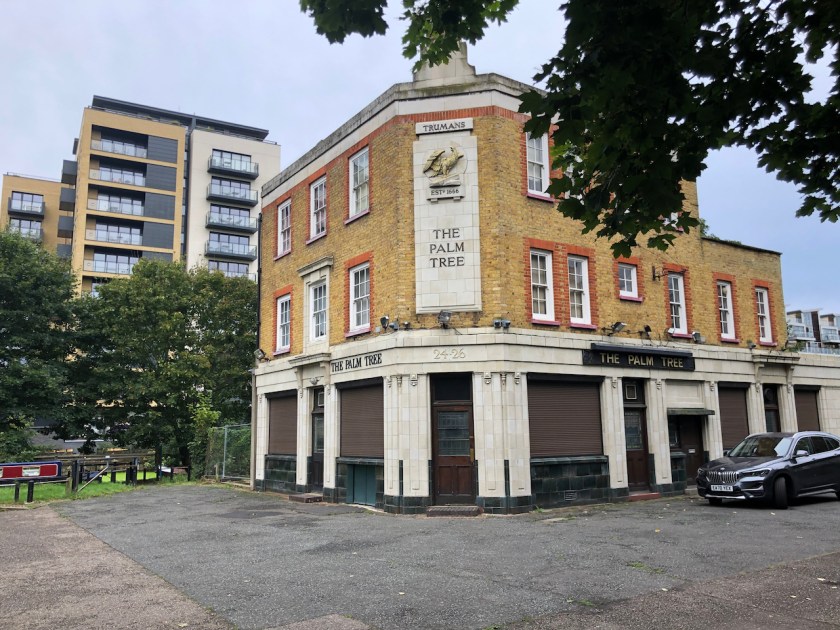
“The Palm Tree” from the North, 2nd Oct 2021

Mud Dock, Bristol

After a swim in Cleveden at high tide, I walked along the docks at Bristol.

I remember when “Watershed” was a kind of hippy place, half-derelict, half-dwelling, with a shop selling joss sticks, and a long smock-style dress in a wood-block print, that I should have bought. Or may be I did buy it. Or may be I agonised over the price, and waited, and thought, and now Watershed is a totally different place, with a cinema, and several bars, and they’ve mended the pavement outside, and parked yachts outside, and built a bridge.

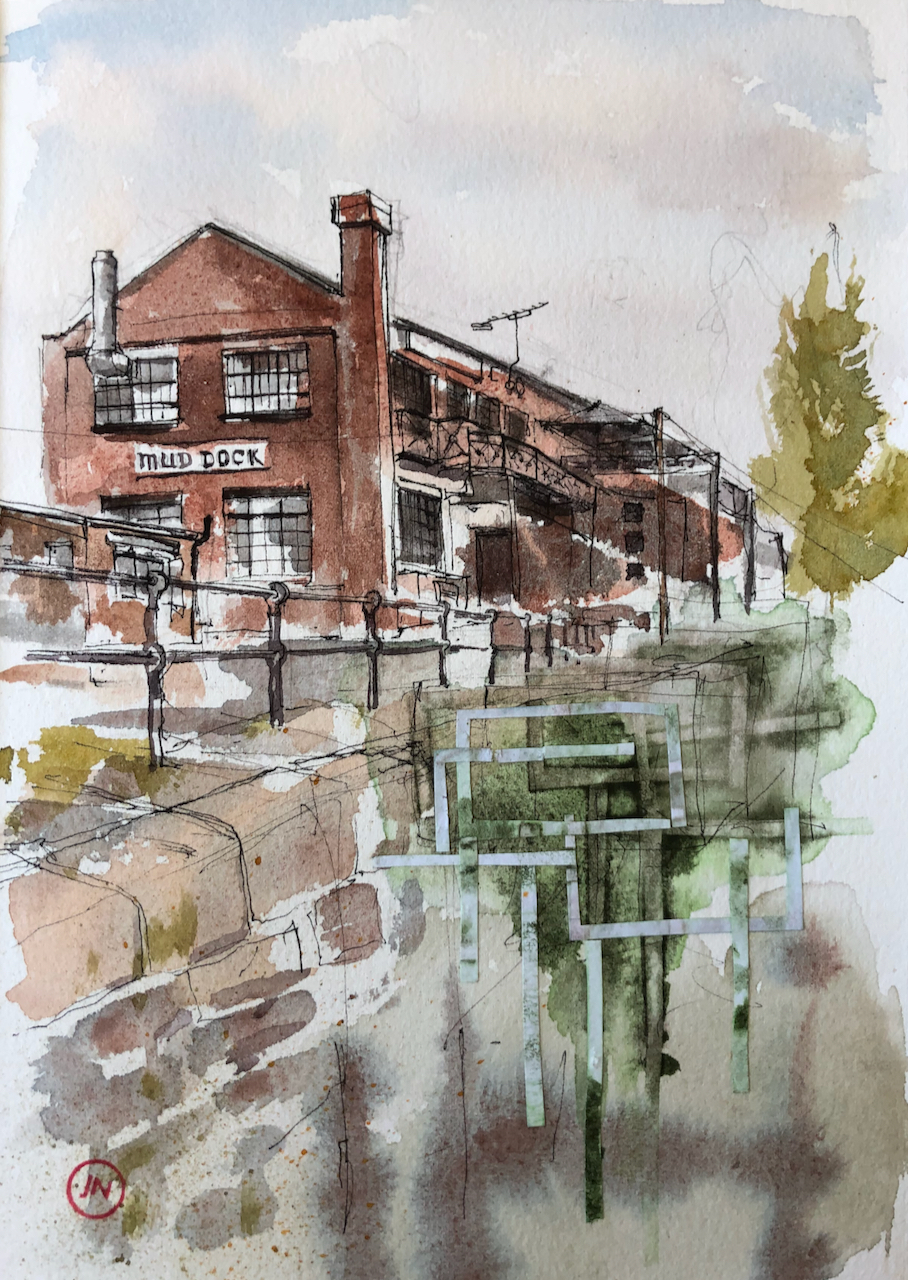
The bridge leads past the art gallery called “Arnolfini” to the restaurant and bike shop called “Mud Dock”. I sat on a cast iron mooring post, and drew a picture.

Mud Dock, Bristol 22nd September 2021, 10″ x 8″ in Sketchbook 10

I did the pen and ink on location and added the colour back home at my desk.

This picture includes some collage: the slivers of paper on the bottom right are stuck on with rice glue. Underneath them, you see the “shadows” which I made by placing slivers of paper on the wet watercolour and waiting for them to dry.

The lift at Viking Bay, Broadstairs, Kent

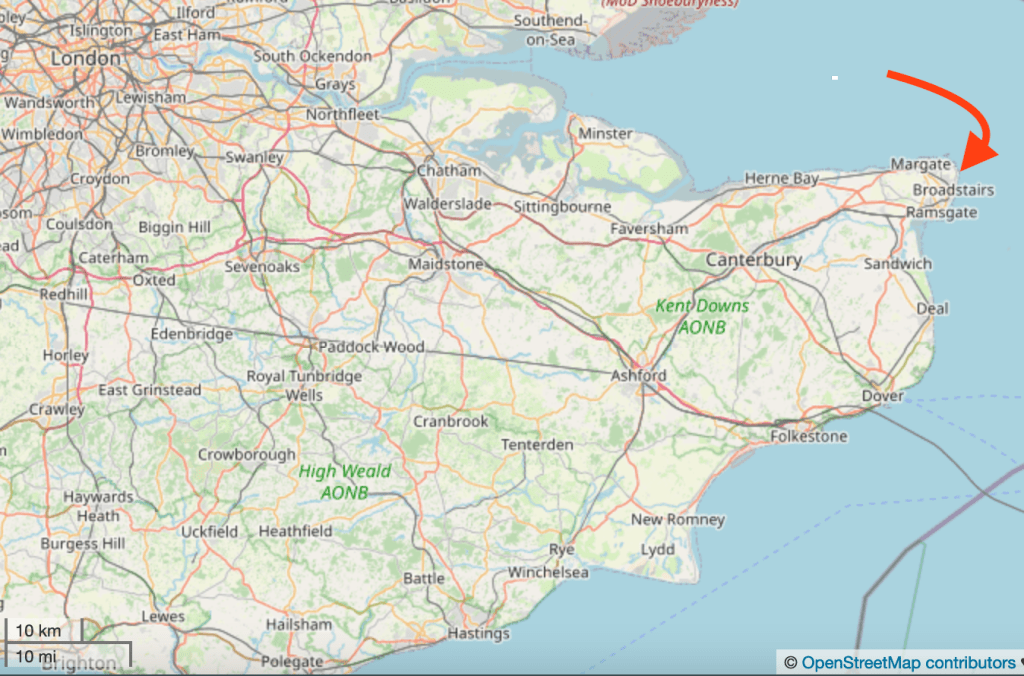
Broadstairs is at the far end of Kent.

Location of Broadstairs, Kent. Map from openstreetmap

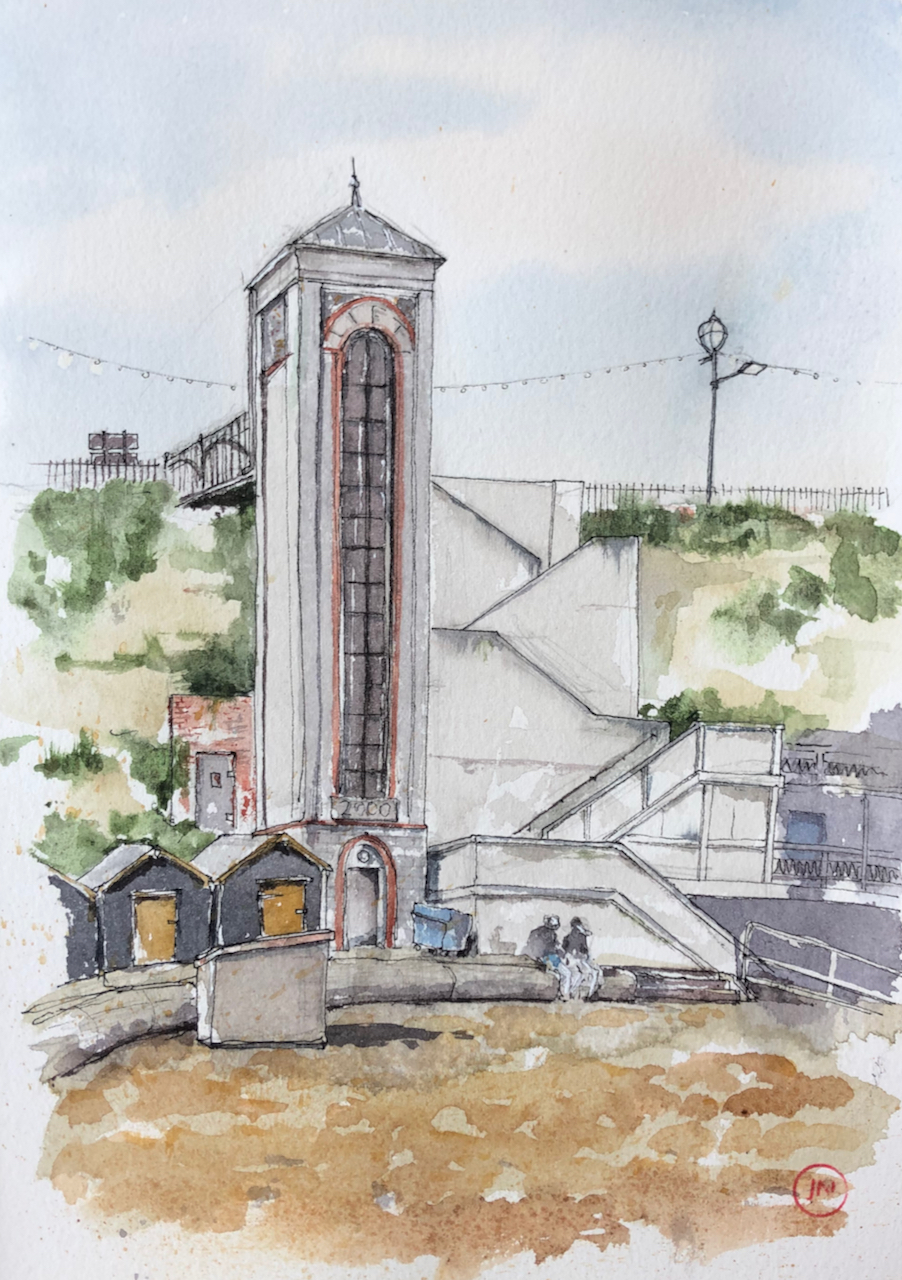
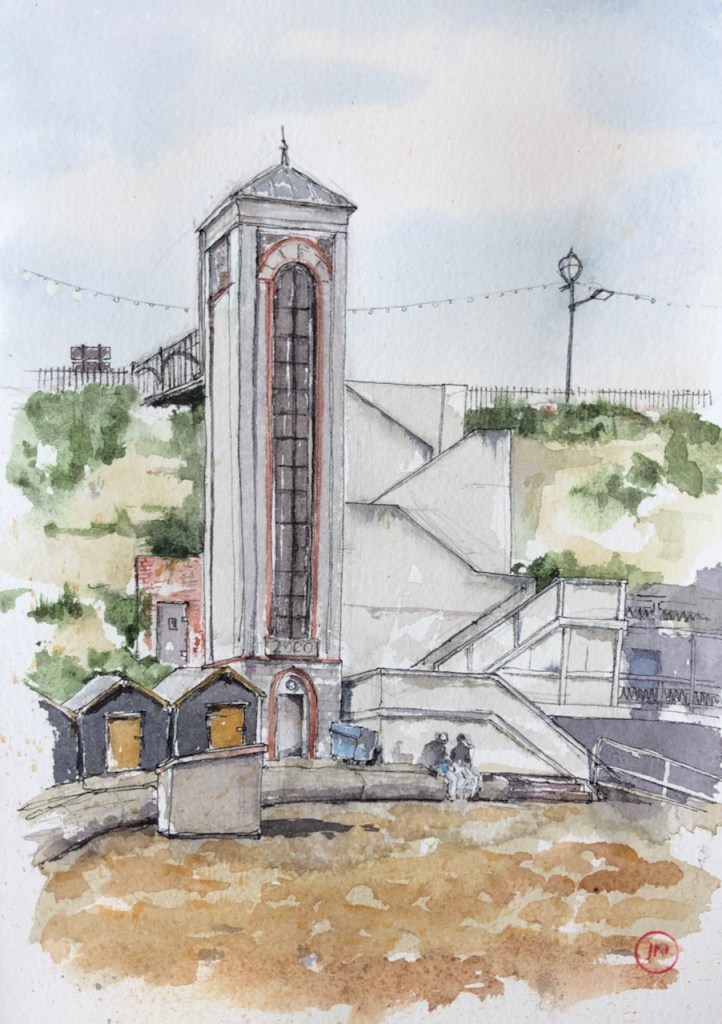
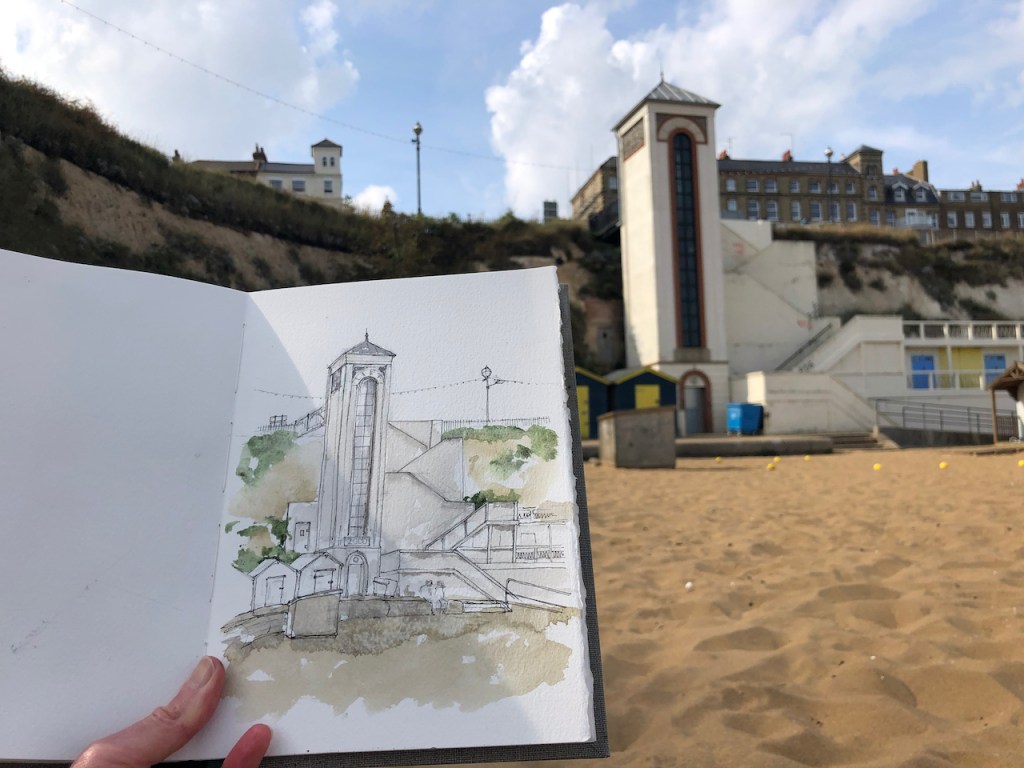
It is a Victorian seaside resort, with a sandy beach, and parks and a bandstand. The beach is below chalk cliffs, and those earnest Victorians provided their citizens with a fine lift to bring people between the sandy beach and the cliff top attractions. I was delighted, and surprised, to find this lift in full working order. While I made the drawing, the lift was used by a continuous stream of people.

The lift at Viking Bay, 17th September 2021, 8″ x 10″ in Sketchbook 10

The whole time I was drawing, music floated down from above, a series of 1950s and 1960s classics, including Elvis’ rendering of “You were always on my mind”. This seemed somehow very poignant as I sat there in the sun on the sand.

When I finished the drawing, I used those sculptural stairs on the right of the lift to climb up to the top. A young family were waiting at the bottom. One of their number, a lad of about 8, came rolling along the boardwalk in his bright green wheelchair. He expertly negotiated the narrow door to the lift and shot inside. I reached the top as they all emerged, and the lad zoomed off along the smooth tarmac into the labyrinth of parks and bandstands at the higher level.

Access Thanet has protested against the closures of the Viking Bay lift since 2019 (Image Access Thanet)

The citizens of Broadstairs have fought hard to keep their lift open. The lift was declared “permanently closed” earlier this year (2021), and only re-opened after a sustained campaign by local people, notably “Access Thanet” (pictured)

It reopened in July 2021, according to an article in the “Isle of Thanet News”

Margate Wastewater pumping Station

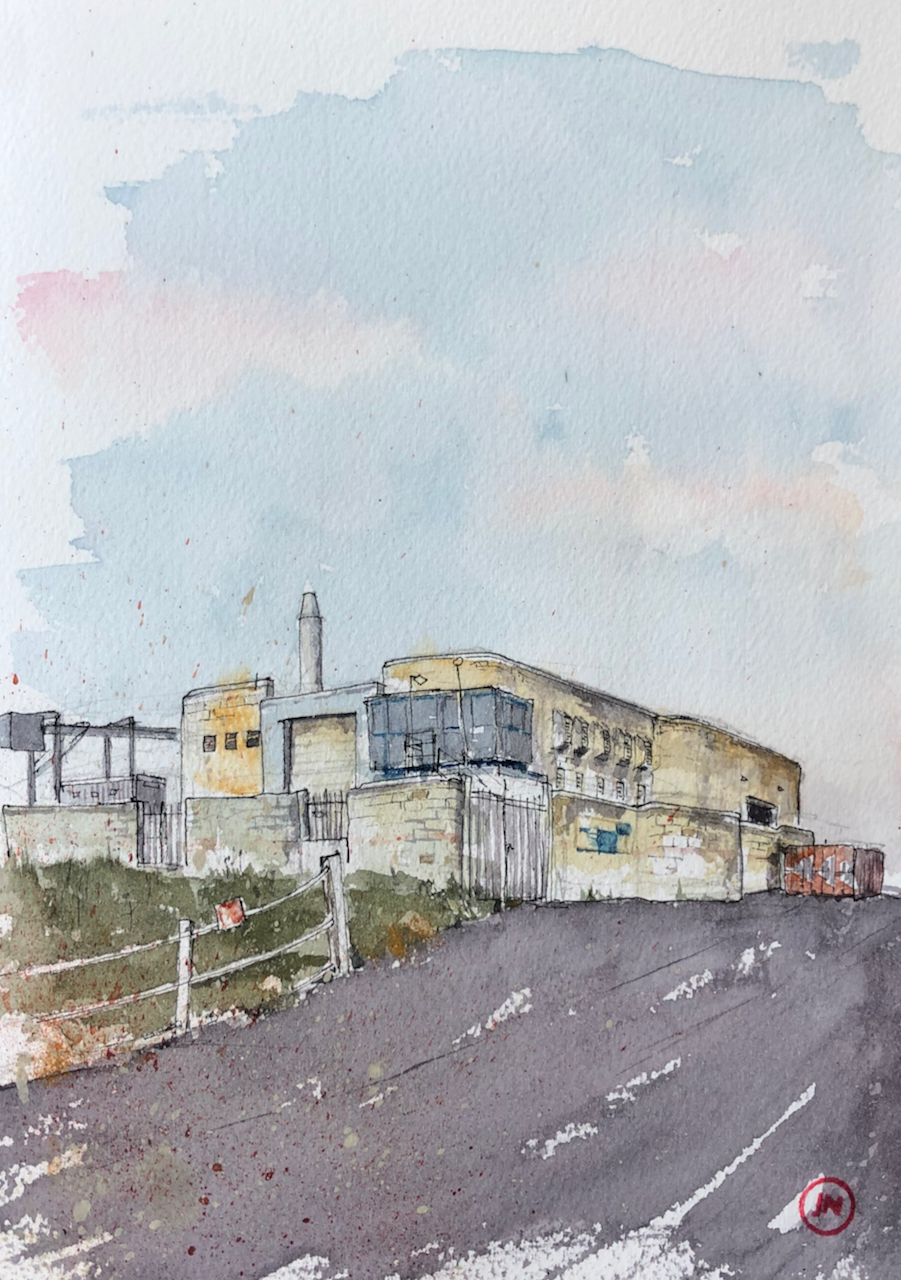
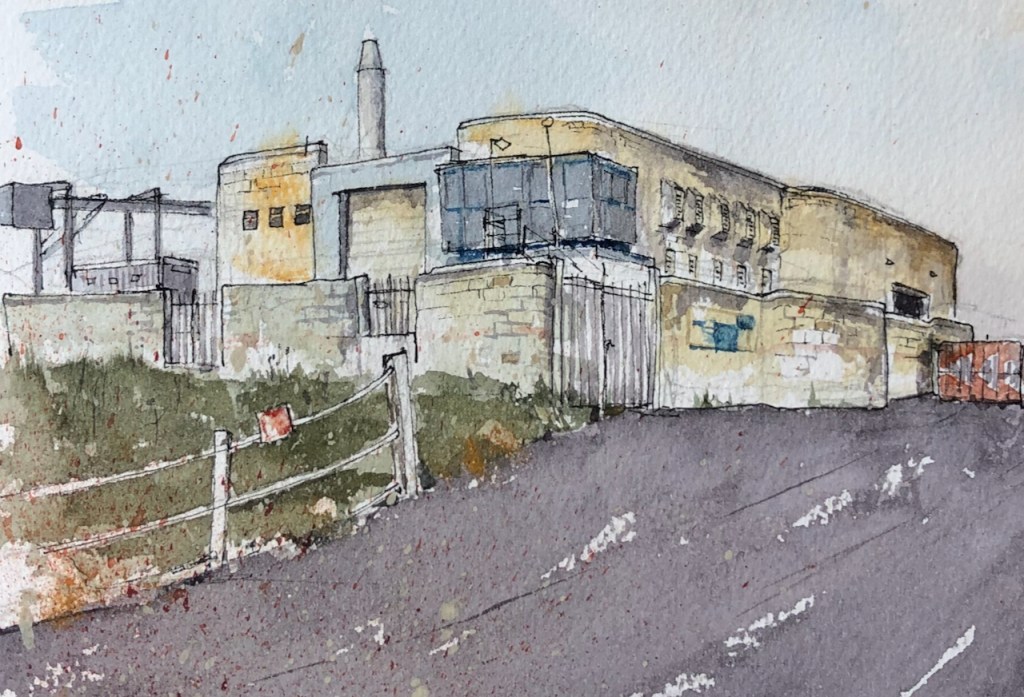
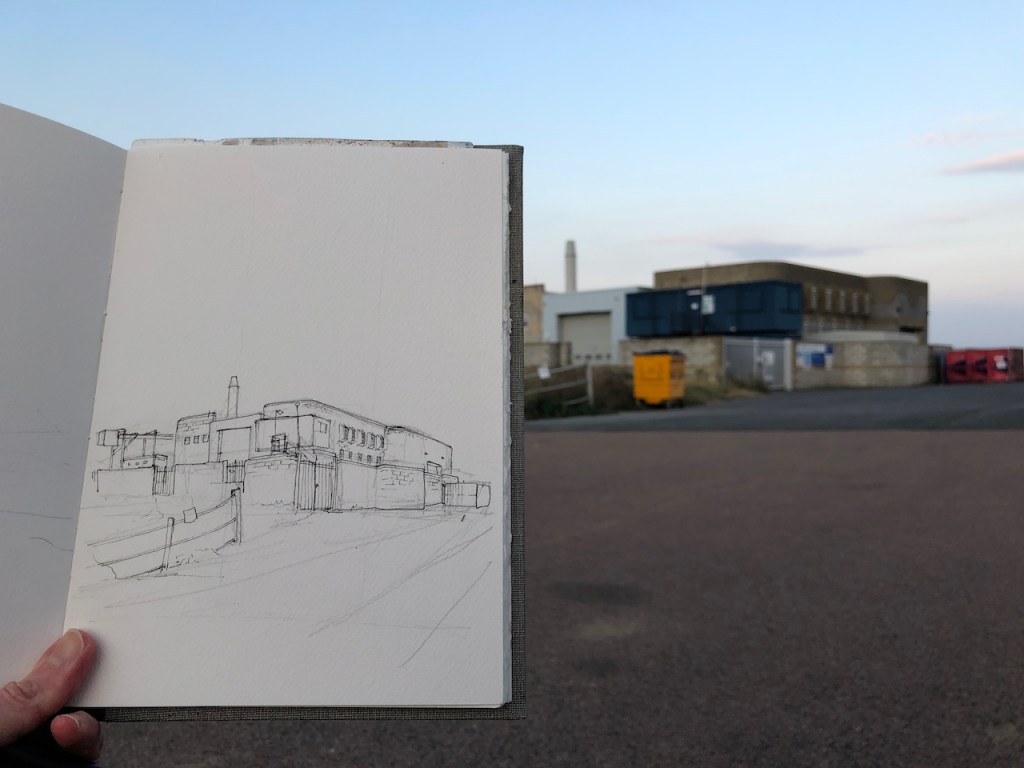
I walked from Margate Railway station to Botany Bay. Out on a headland, I encountered this extraordinary building. Later, I went back to draw it.

Margate Waste Water Pumping Station 16th September 2021 18:30, 7″ x 10″ in Sketchbook 10

You can see – I hope – that my viewpoint was low. I was sitting on the ground by the side of the road. The road is frequented by dog-walkers. I learned something from this low viewpoint: civilised dogs are not used to people sitting on the ground. Many of the dogs were loose, and came rushing up to me, barking in admonition, or alarm, or delight. The owner hurried after, calling in vain after their hound. The dog sat next to me, barking in alarm, or pride, depending on the breed. Either “Danger! Danger! There’s someone sitting on the ground!!” or, if an ancestral hunting dog, “Look, revered owner, what I have cleverly found here on the ground. You must have shot it. It’s my job, I think, to bring it to you?” The owners argued in vain against these inbuilt instincts, and eventually had to drag the dog away from its enemy, or its prey, depending on outlook and breeding.

I went on drawing. A man came by, without a dog. He looked at me, and looked at the building, and looked at my picture. Then he gave a kind of shrug which said “OK, right, I get it, you are drawing the sewage station.”

I replied to this implied comment by saying that it was an interesting building, or rather, I found it interesting. His response was, “1960s Soviet Brutalism without the politics” and I said yes, that put it well.

He said, without breaking his step, “I am good with words”. He said it as a matter of established fact, not a brag, not a hope, nothing sheepish or apologetic, just a description. I silently wondered if I should have recognised him: was this a well-known playwright, a poet, a newspaper columnist? He stopped for a moment. “But just with words,” he continued, with a gesture towards my painting equipment, “Not with a paintbrush.” He paused, to make sure I’d heard. Once his words had reached me across the still air of the road between us, he declared, “I’ll leave you to it!” and he strode off, leaving me puzzling. I think I’d just heard a compliment, but I wasn’t quite sure.

When I walked along this road in the daytime, I saw that there were a large number (about 8) of contractors’ vans and lorries parked outside the pumping station. The blue/grey rectangle in front of the pumping station is some kind of portakabin or works area.

I found out later that this pumping station had failed during the summer (2021), and let sewage into the sea, rendering local beaches useable. Southern Water issued an apology which said, amongst other things:

“Wastewater releases at times of heavy rainfall happen across the UK to protect properties from flooding. The release that happened overnight on 16 June was caused by a combination of heavy rainfall and lightning strike during the storms which caused a short power failure and affected systems on site at our Margate Water Pumping Station. Back-up generators are in place. As part of our preparations for the predicted thunderstorms and heavy rainfall we also had a team standing by in the area. These additional precautionary measures meant we were able to immediately begin work restoring the site to full operation. Unfortunately, we had to make this emergency release to protect local homes and businesses from internal flooding.”

A big notice on the pumping station said: “Margate and Broadstairs Resilience Phase 2, upgrade and improvements”. It seems as though improvements are much needed. I can start to understand how local people might have been a bit surprised that I was drawing this pumping station, cause of a recent local disaster.

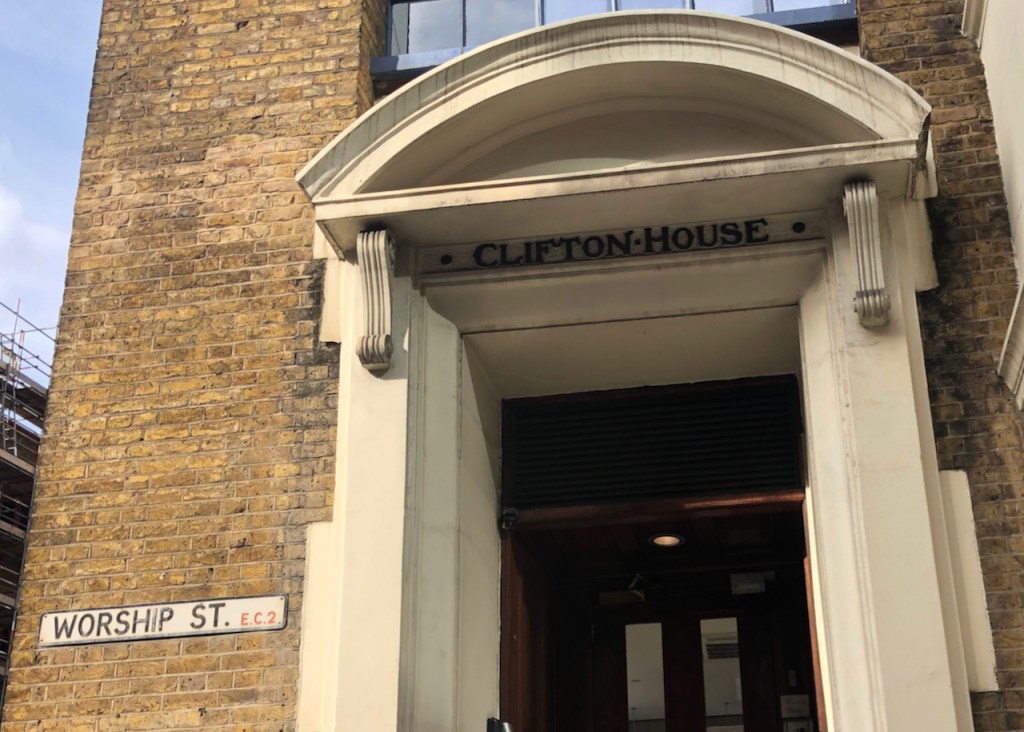
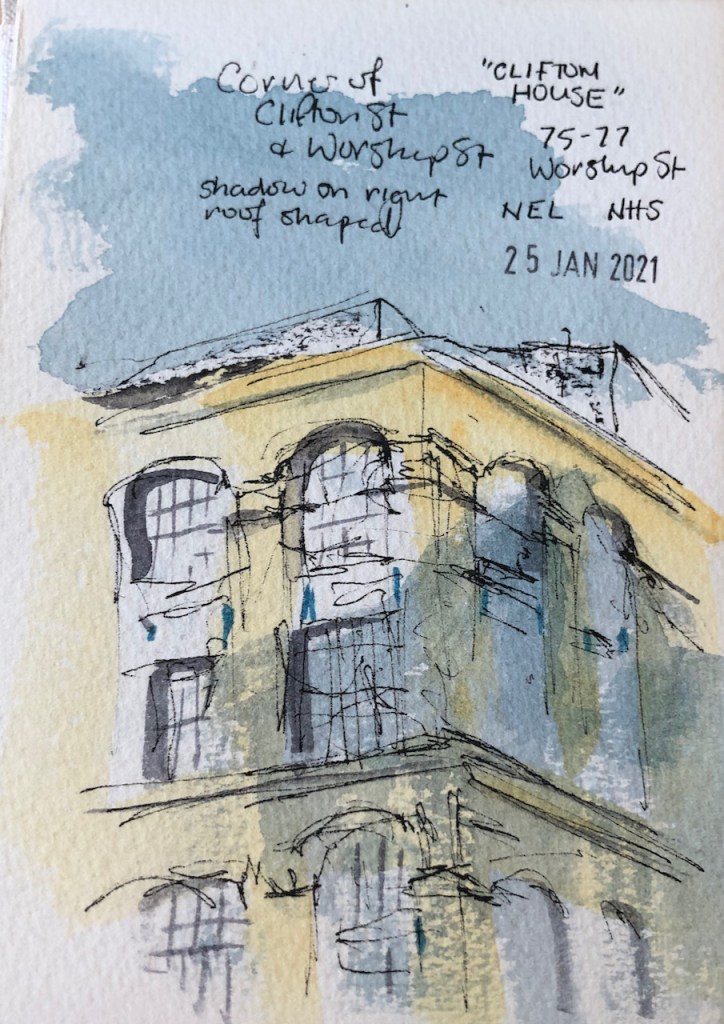
Clifton House 75-77 Worship Street EC2

This is the building on the corner of Worship Street and Clifton Street, on the northern edge of the City of London.

Clifton House, 75-77 Worship Street, EC2, 13 September 2021, 7″ x 10″ in Sketchbook 10
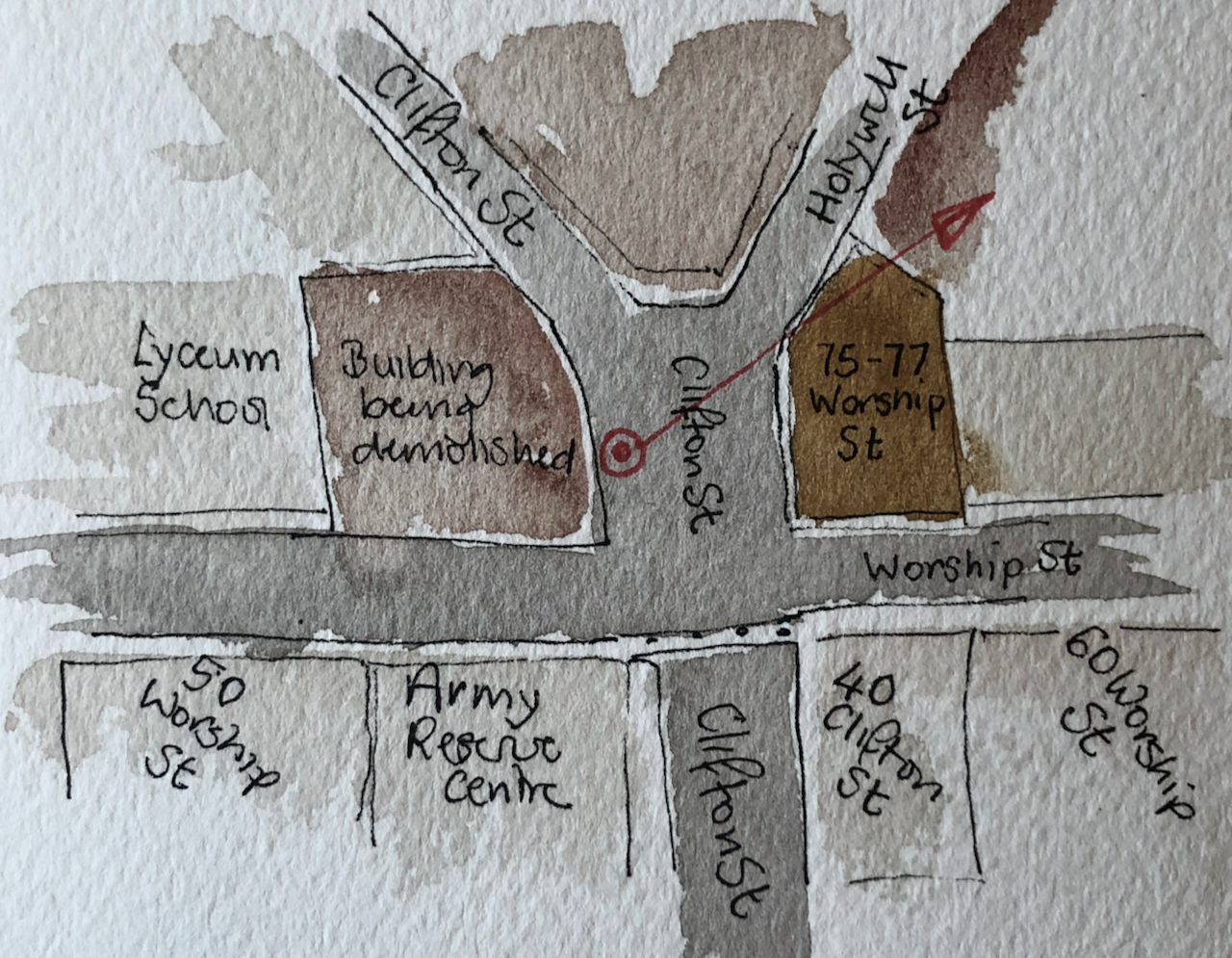
Location of the drawing

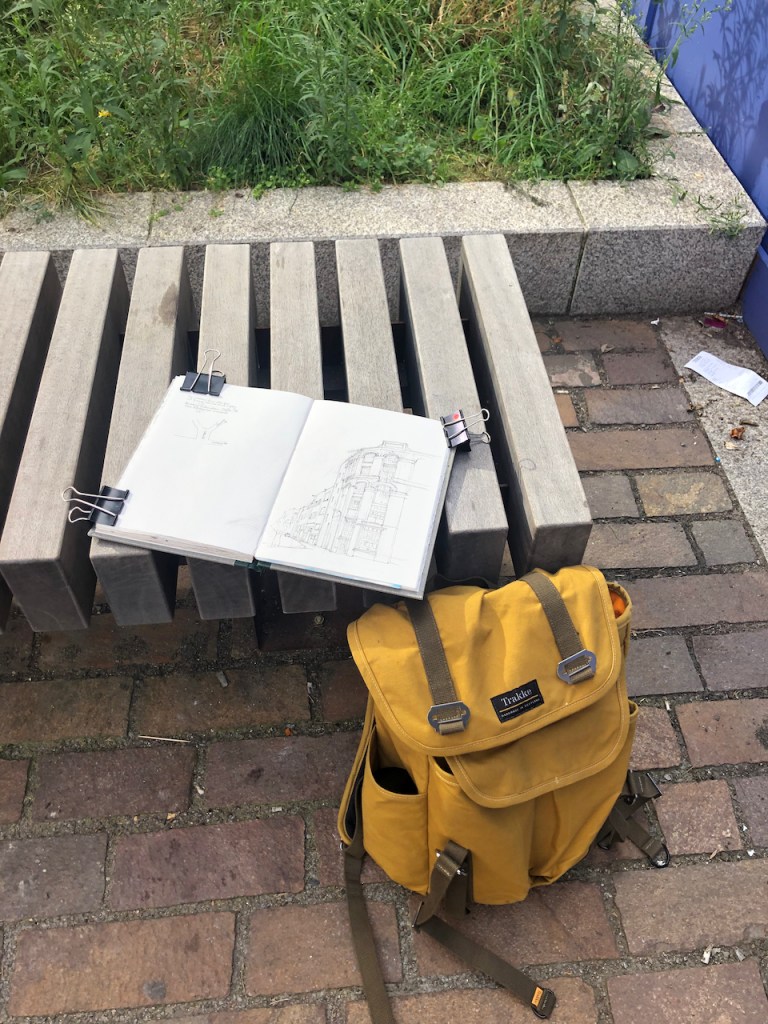
Holywell Street is to the left of the drawing. I sketched this from a bench in the little pedestrian square that now exists where Clifton Street meets Worship Street.

What is this building? Well, now it is inhabited by an organisation called “NEL NHS” according to the notice on the door. From what I can discover online, NEL stands for “North East London” and the organisation is an in-house consulting organisation for the NHS (the UK National Health Service). They are a “Commissioning Support Unit (CSU)” which means they supply services to, for example, GP practices, and area administrators of parts of the NHS. Computing projects and change programmes amongst the service offerings listed on their website. NEL is quite a big organisation. LinkedIn records it as having 967 employees of whom 457 work in London.

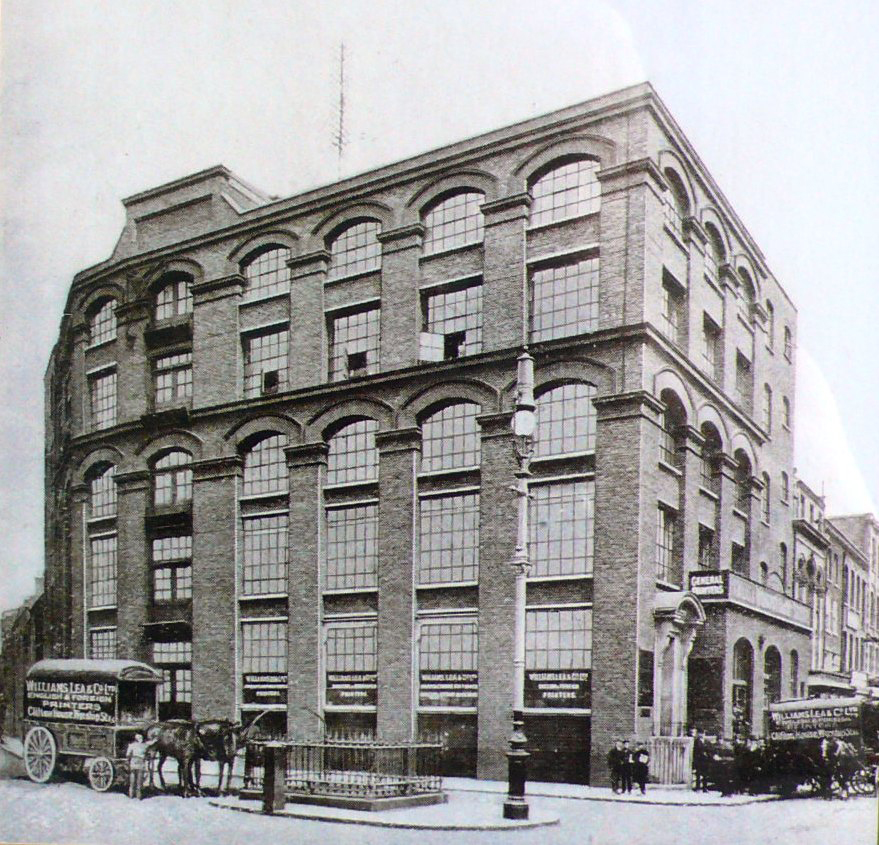
Clifton House circa 1920, from the website of the Tony and Sheelagh Williams Charitable Foundation.

That’s who’s there now. But the building has a history. It was built in 1900, for the printers Williams Lea. Williams Lea printed stamps, newspapers, and foreign language material. In the 1939-45 conflict, they printed UK government propaganda in German, which was dropped into Germany. They also printed the first copy of the Radio Times, in 1923, probably in this very building. Williams Lea has itself undergone various transformations, and is now called Perivan. The Perivan website has a history section which helpfully provided me with this information. (Note 1)

In 1978 Tony Williams took over the family business of Williams Lea. Under his leadership the business flourished. He took the decision

“to establish Williams Lea as a Financial Printer serving the City community with its specialist printing needs. This move coincided with the privatisations of many state-owned industries and utilities and in 1990 Williams Lea was awarded the printing for the privatisation of the electricity industry, one of the largest and most complex jobs of its type.” [https://www.tandswilliams.org/]

It did well. He sold the business in 2006, and with the money established a charitable foundation which exists today.

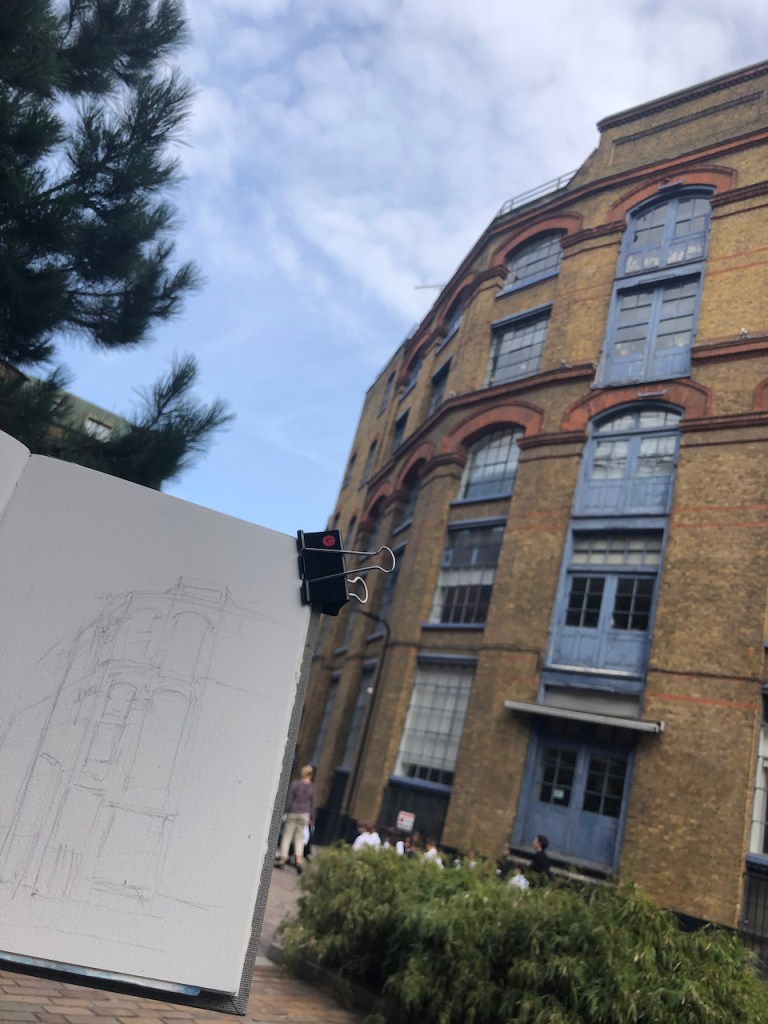
My drawing took 90 mins on location, with colour added later at my desk.

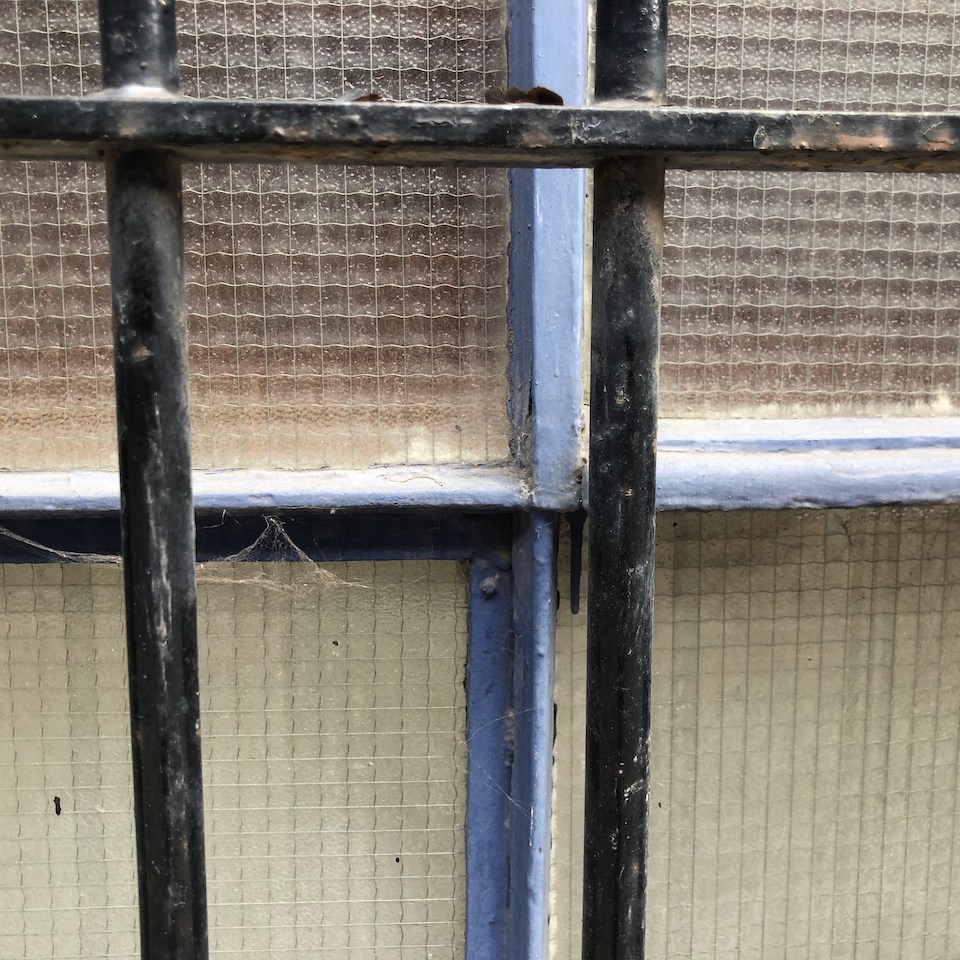
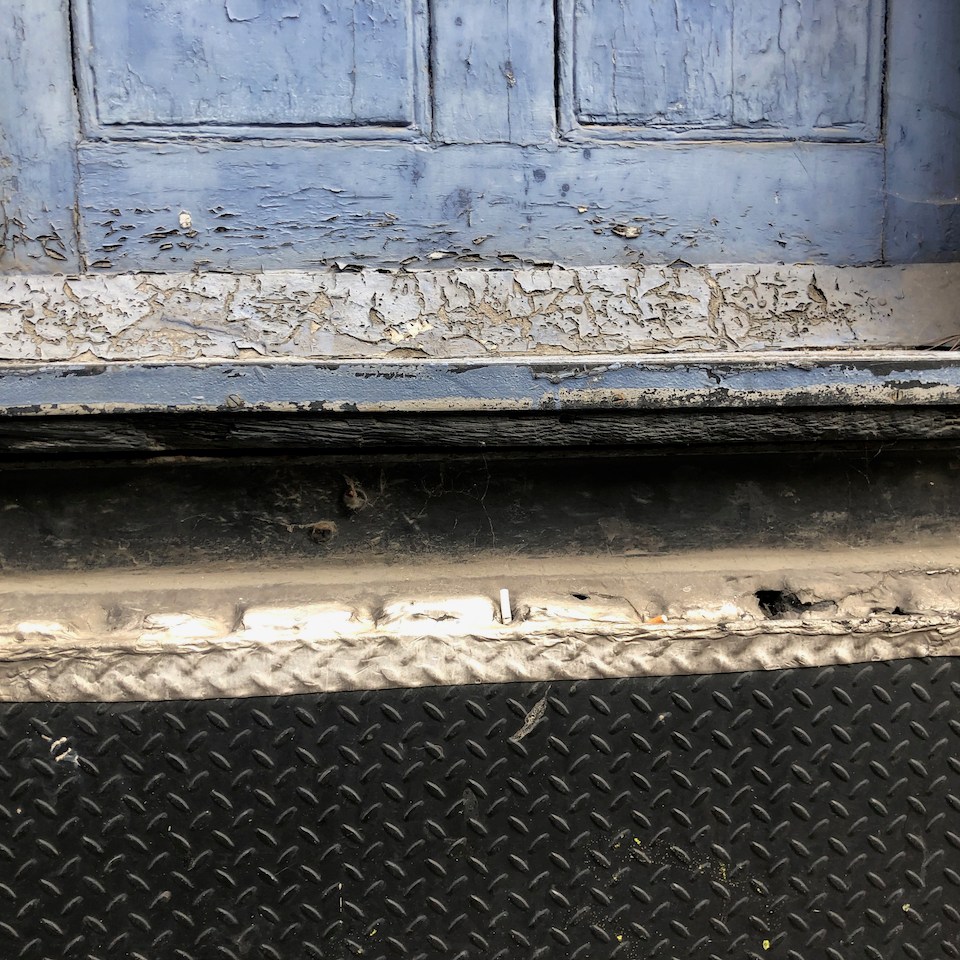
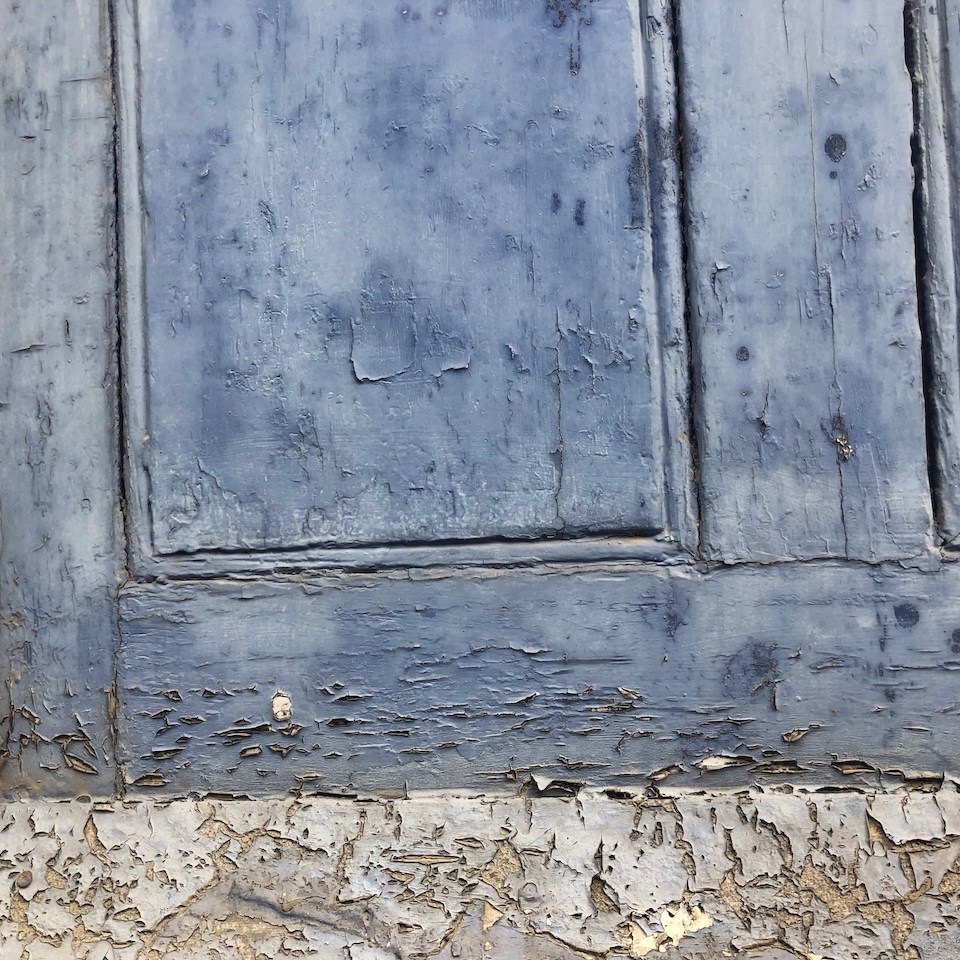
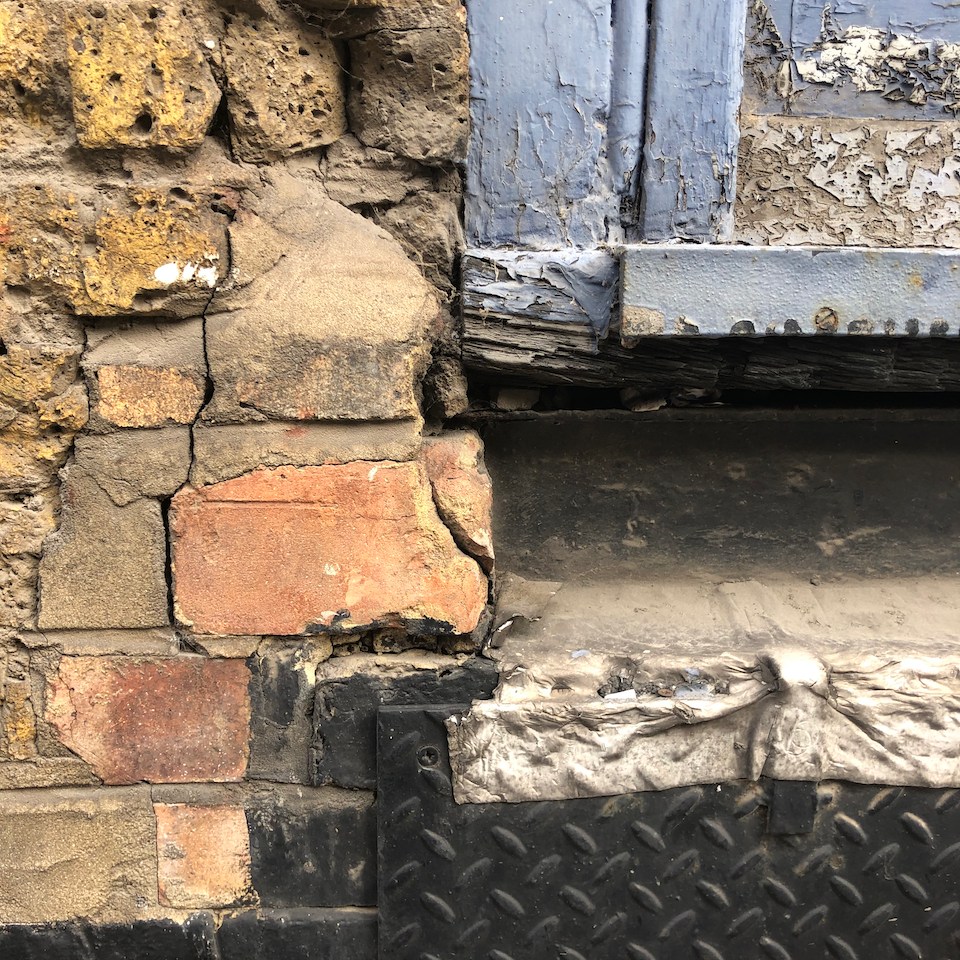
I spent a long time looking at this building. There are the large windows, which are also doors, so that large items can be lifted out from the different floors. Some of the windows have louvres for extraction fans.

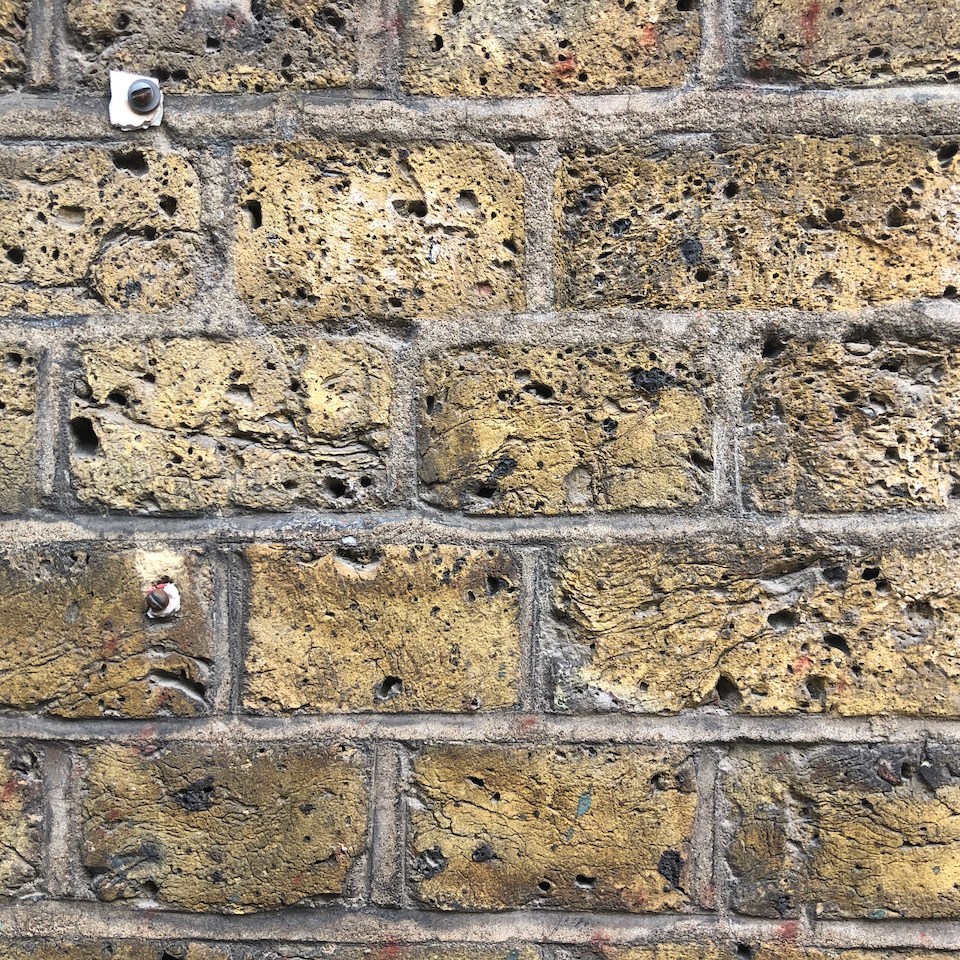
There are many textures in the brickwork. Some cobwebs have been there a while.

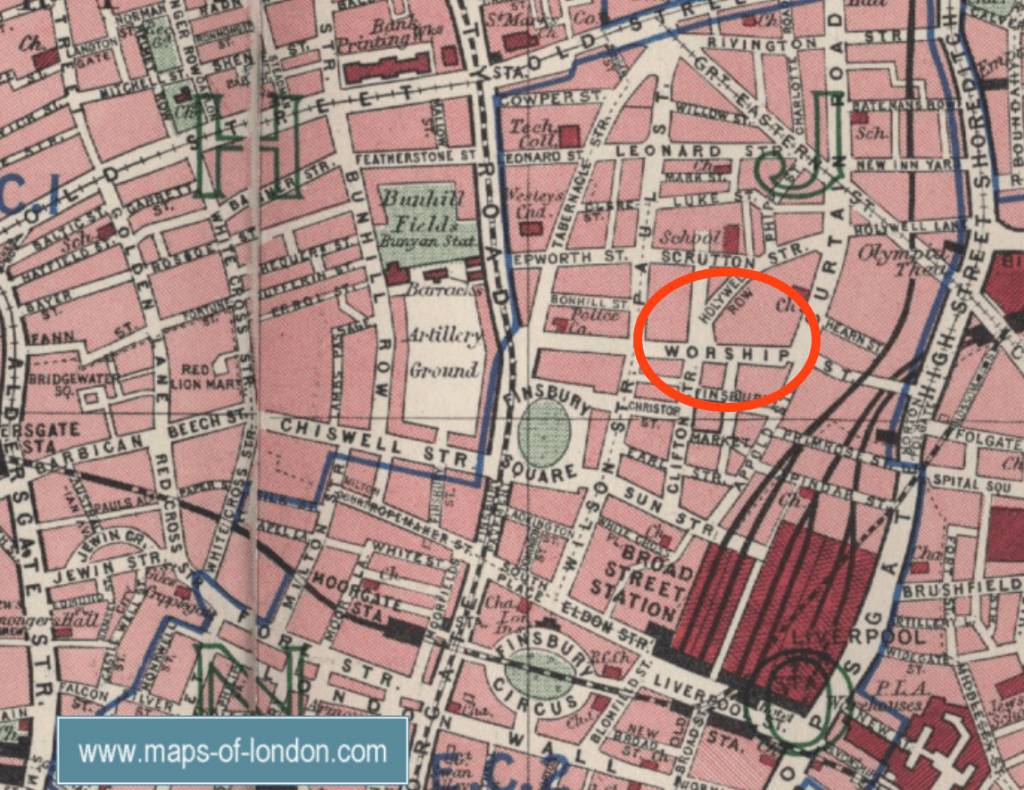
Here is a 1945 map showing the location:

Map from “www.maps-of-london.com”

I sketched this location as a “microsketch” earlier this year:

Note 1: History of the building: references.

Pevsner LONDON 4: NORTH, page 525 refers to “Clifton House, at the corner of Clifton Street and Worship Street, another printers, (WIlliams Lea & Co) built 1900, five storeys, with handsome red brick arched windows.”

Perivan website: https://www.perivan.com/about-us/our-history/ Perivan say:

A Mr J E Lea became a partner of the business in 1864, and it was promptly renamed to Wertheimer Lea & Co. When John Wertheimer passed away in 1883, Mr J H Williams purchased his share (great grandfather of Philip Williams, who works within Perivan today). Over the years, J H Williams acquired the rest of the company and in 1899, Wertheimer Lea built a new factory in Worship Street, London, to consolidate 5 production sites. Now central London, at the time the new factory was built, it was possible to see fields from the top floor. The biggest USP was that all the machines were powered by electricity. The business was renamed in 1914 to Williams Lea to reflect the existing founders. A fun fact – Williams Lea printed the first edition of the Radio Times in 1923!……Throughout the wartime years, Williams Lea survived the blitz where many other printers did not. With its specialism in foreign language printing, this was understandably in very high demand at this point in history, and Williams Lea was heavily involved in the printing of propaganda materials in German which bombers distributed by throwing them out of aeroplanes over Germany – containing messages encouraging the enemy to give up. Williams Lee also printed newspapers for governments in exile in London, including Poland and Norway, and stamps for the Post Office.”

On a specialist postage stamp collectors site http://www.bermudastamps.co.uk/info/stamp-printers/ there is a reference to Williams Lea printing stamps:

“Williams Lea & Co
Contractor to De La Rue after their premises were bombed on 29th December 1940. William Lea & Co printed the Bermuda high value stamps during 1941.

Other historical information came from the website of the Tony and Sheelagh Williams Charitable Foundation.

Orkney sketches

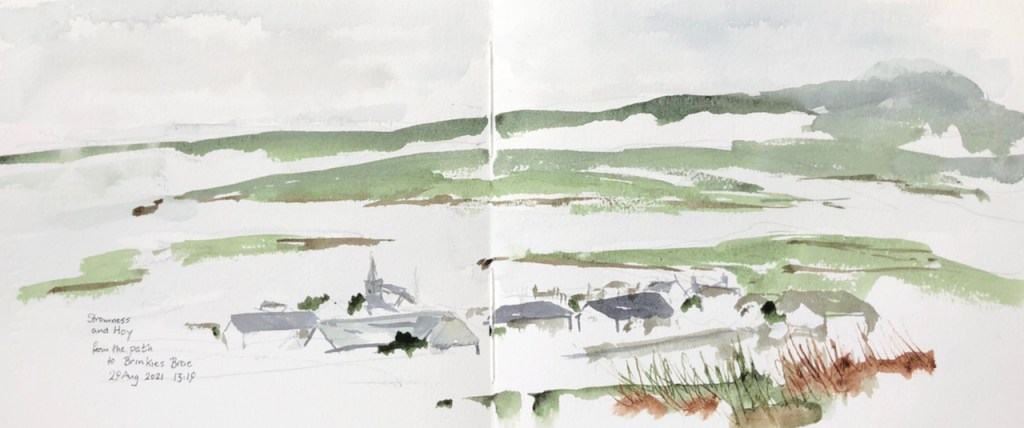
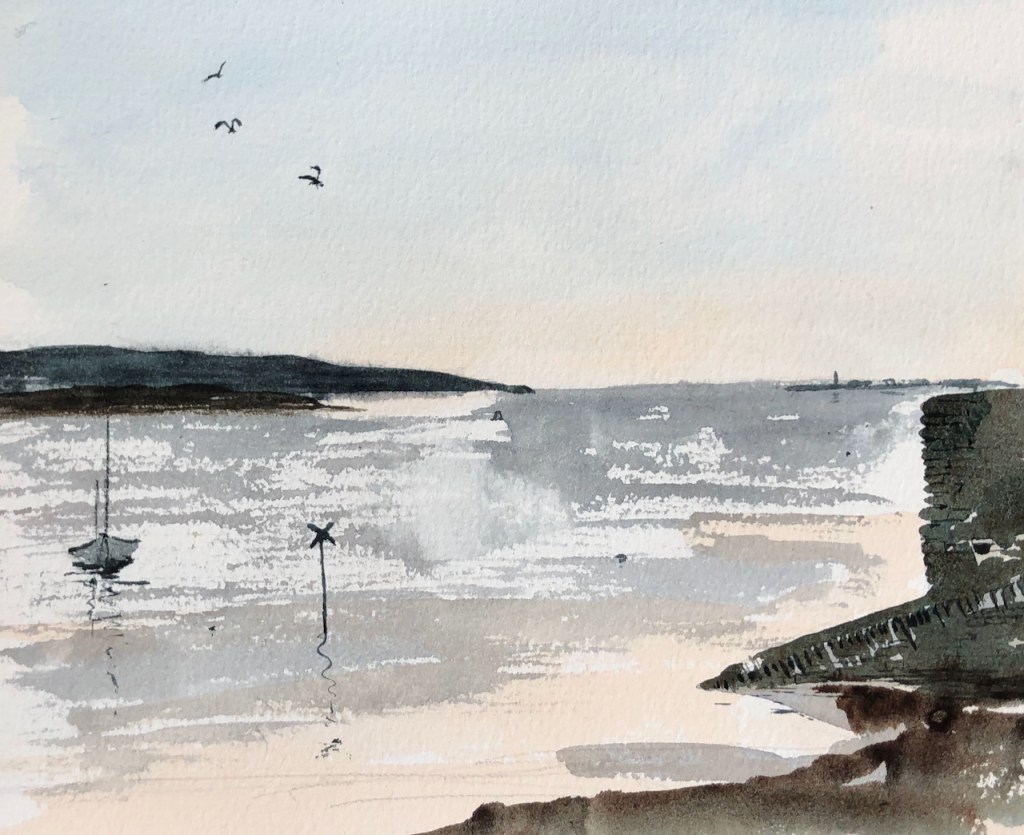
Here are some sketches of Orkney, made during a visit earlier this month.

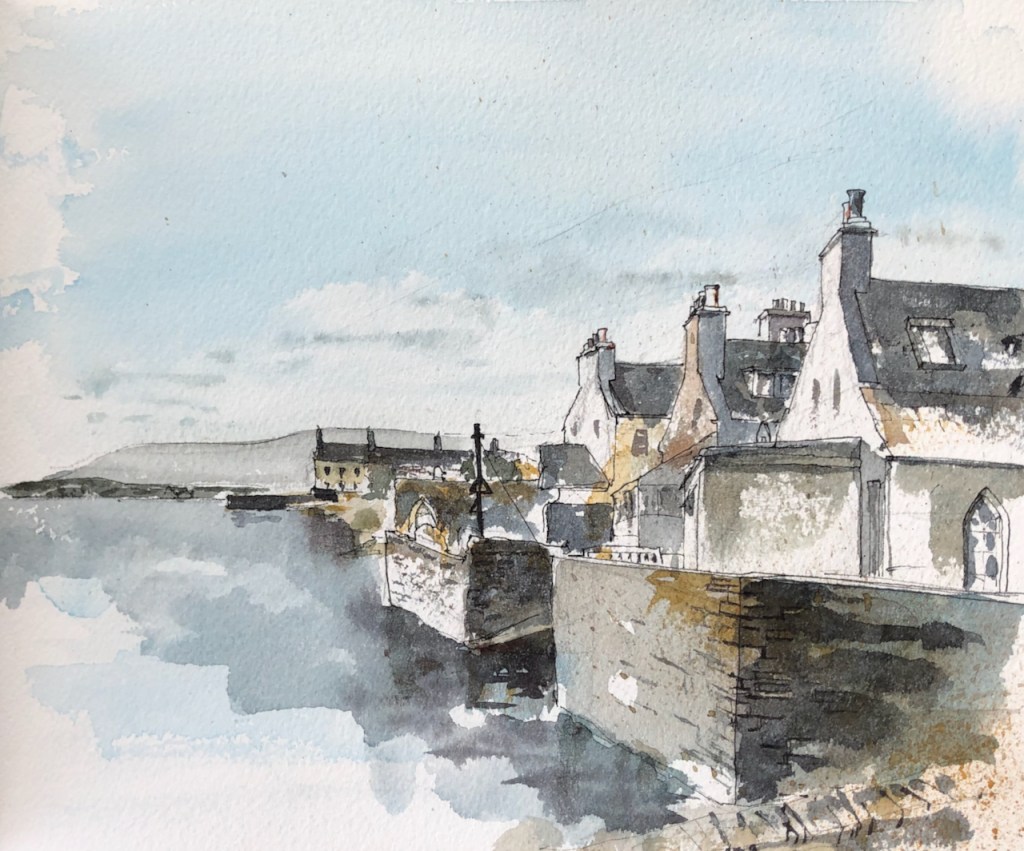
This is Stromness:

The seascapes and light were magnificent.

St Magnus Cathedral in Kirkwall is awe-inspiring.

These drawings are in two sketchbooks:

  • PrintUrchin Sketchbook 3, with Arches Aquarelle paper, 10″ x 8″ (landscape)
  • A long thin sketchbook with Khadi Paper, 12″ x 5″ (landscape)

Sketching on the journey to Orkney

We travelled to Orkney by train via Edinburgh and Aberdeen.

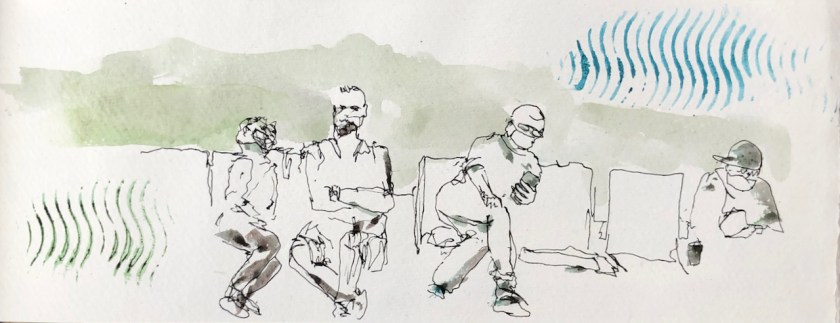
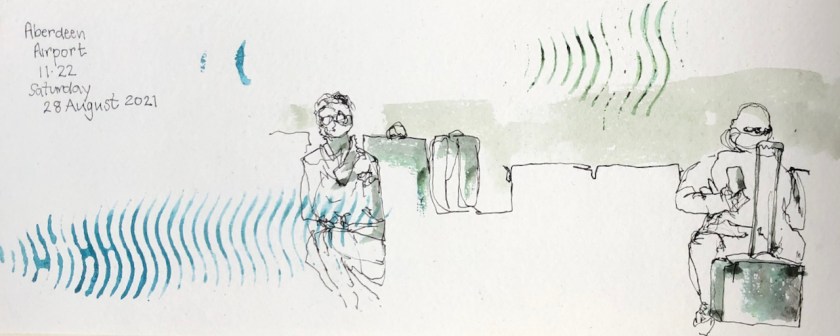
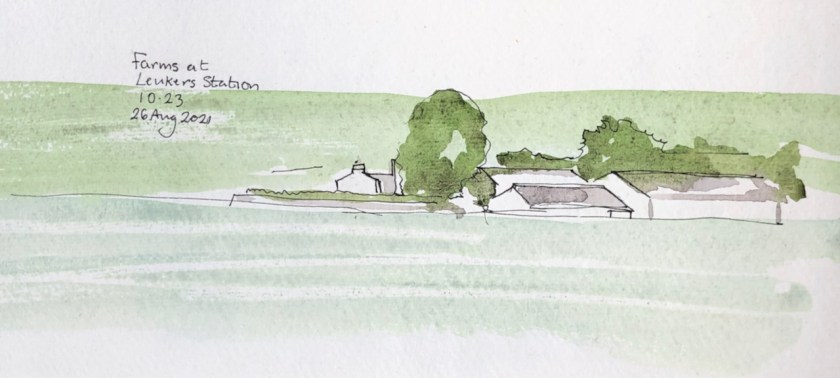
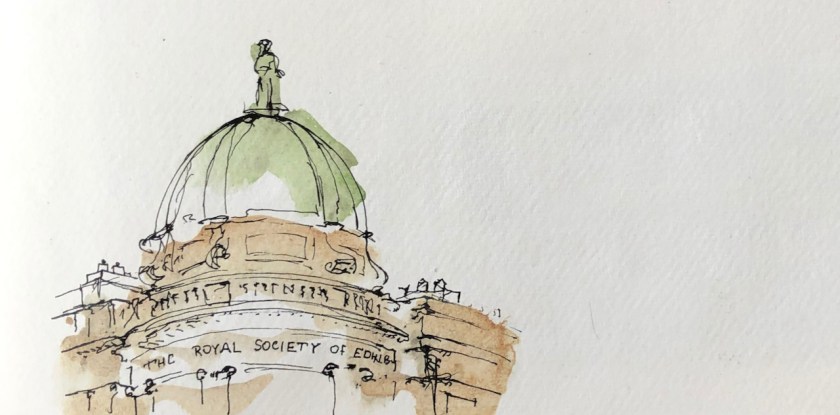
I carried a long thin sketchbook and made drawings along the way.

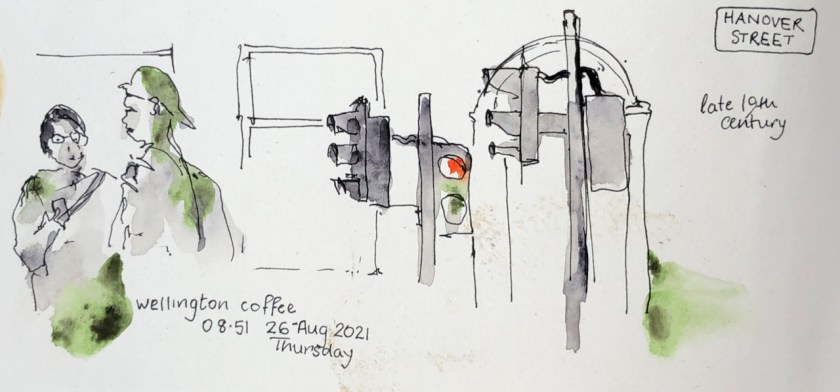
Here is my very long sketchbook, 12″ x 5″ made by Khadi Paper, and bought at Atlantis in Hackney, London.