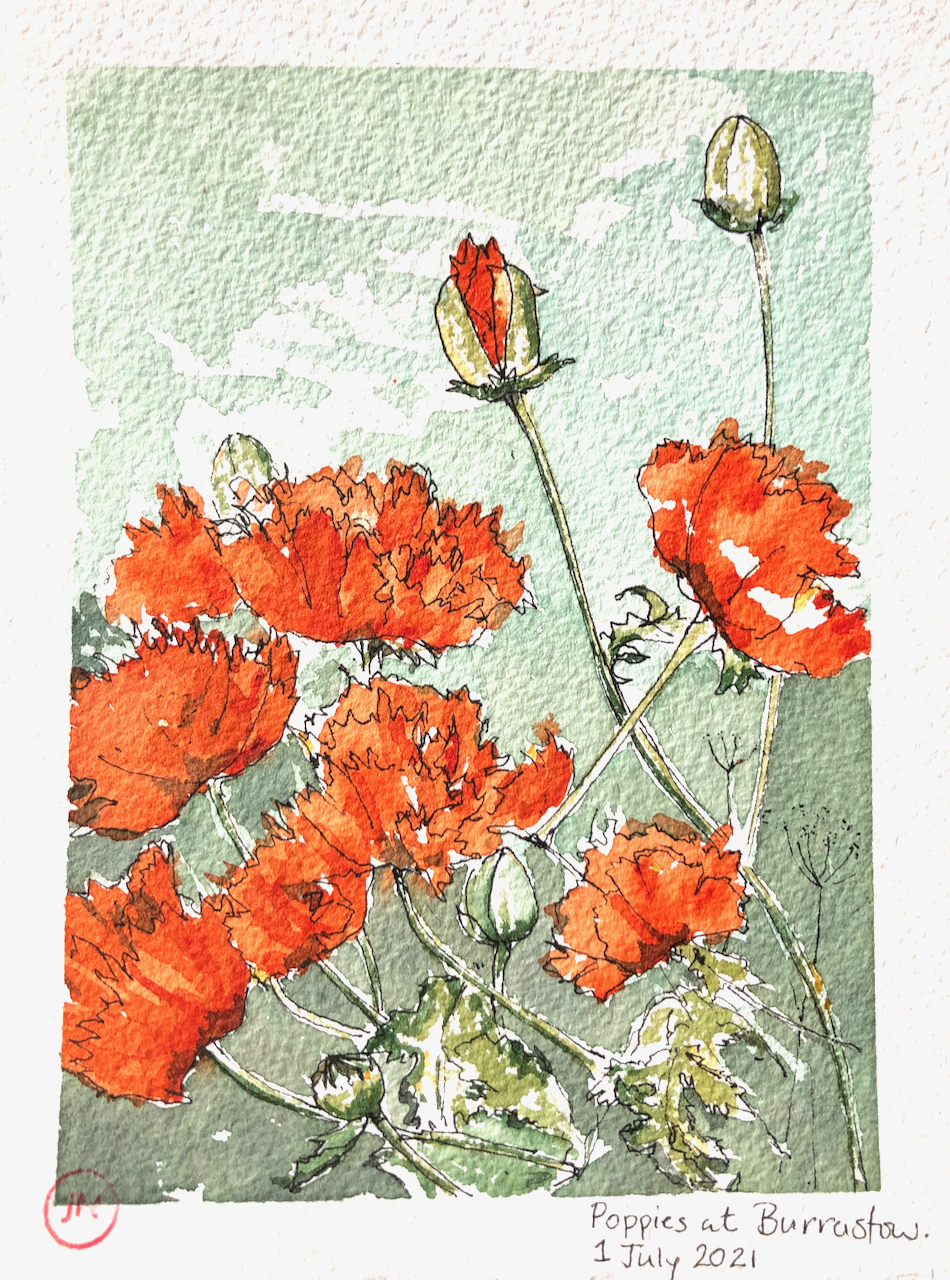
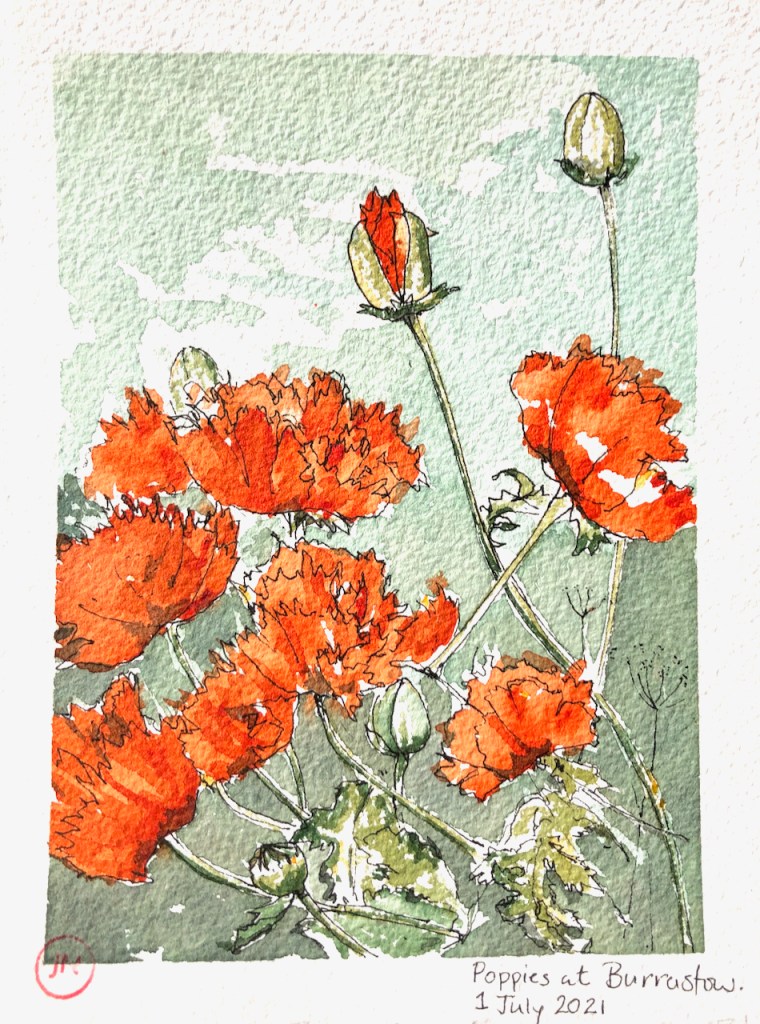
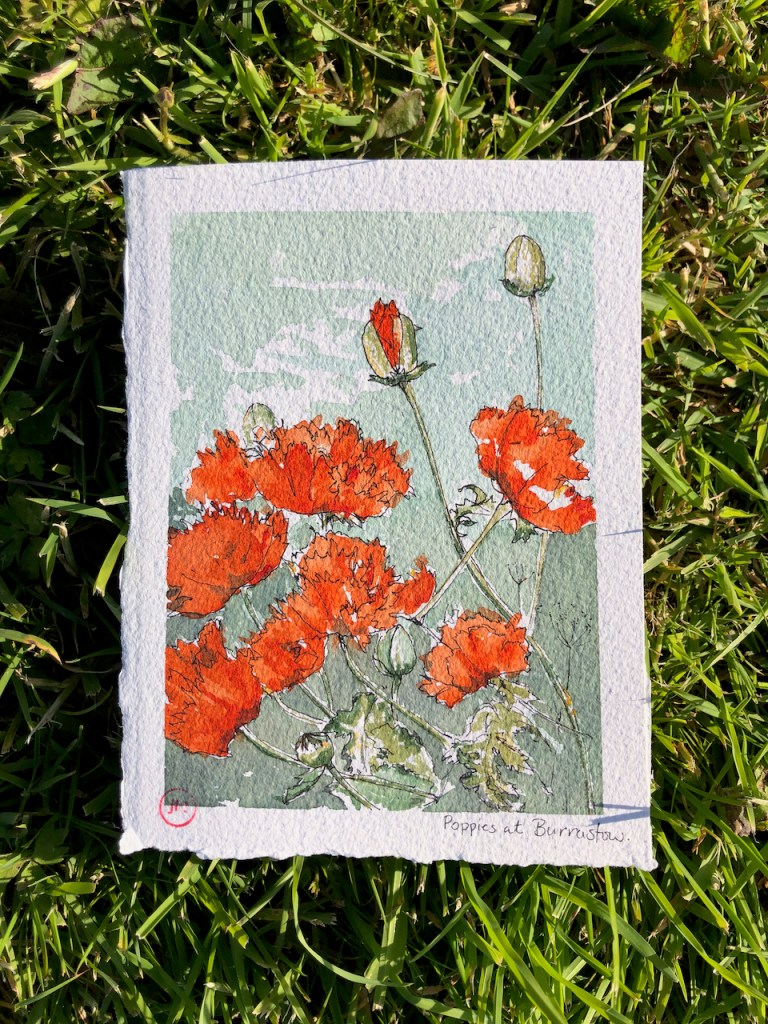
Poppies, Burrastow. 1 July 2021 on watercolour paper
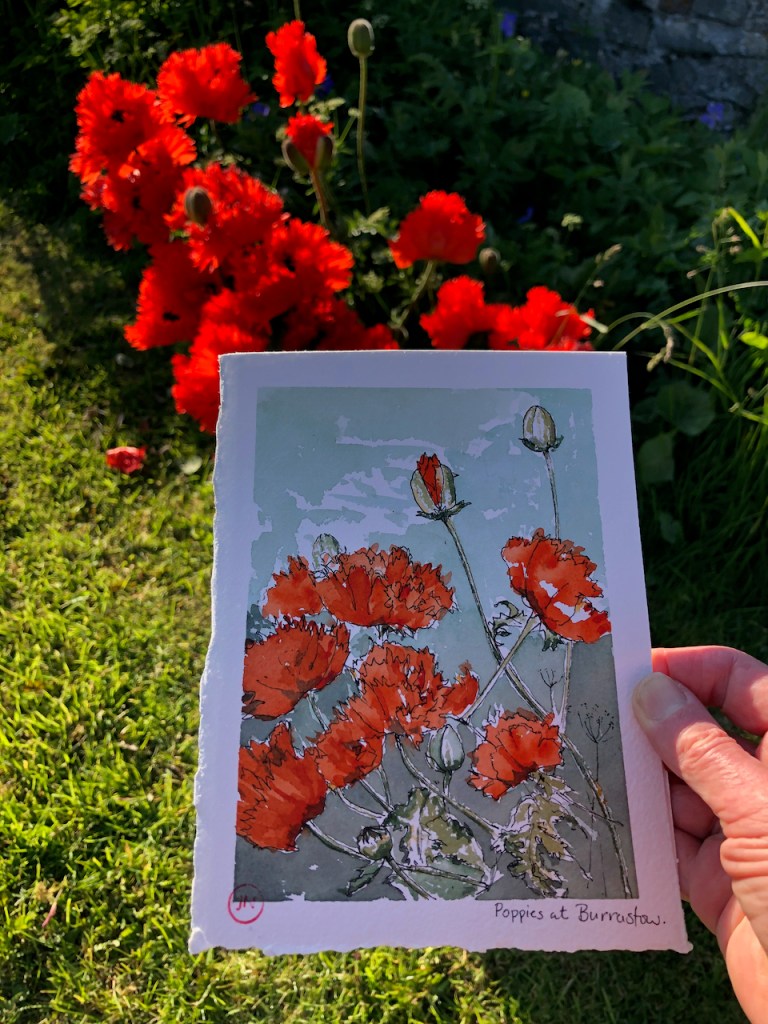
These poppies were so stunning that I had to try to draw them. There and then. They are also ephemeral.
In a few days the petals had dropped making splashes of scarlet on the grass.
I drew this on special paper: handmade watercolour paper from the Vintage Paper Company. It is very heavily sized and takes the colour well. It’s also stiff, and easy to use out-doors.
The red is Transparent Pyrrol Orange waercolour from Daniel Smith.
Click a button below to share this post online, email it, or print it:
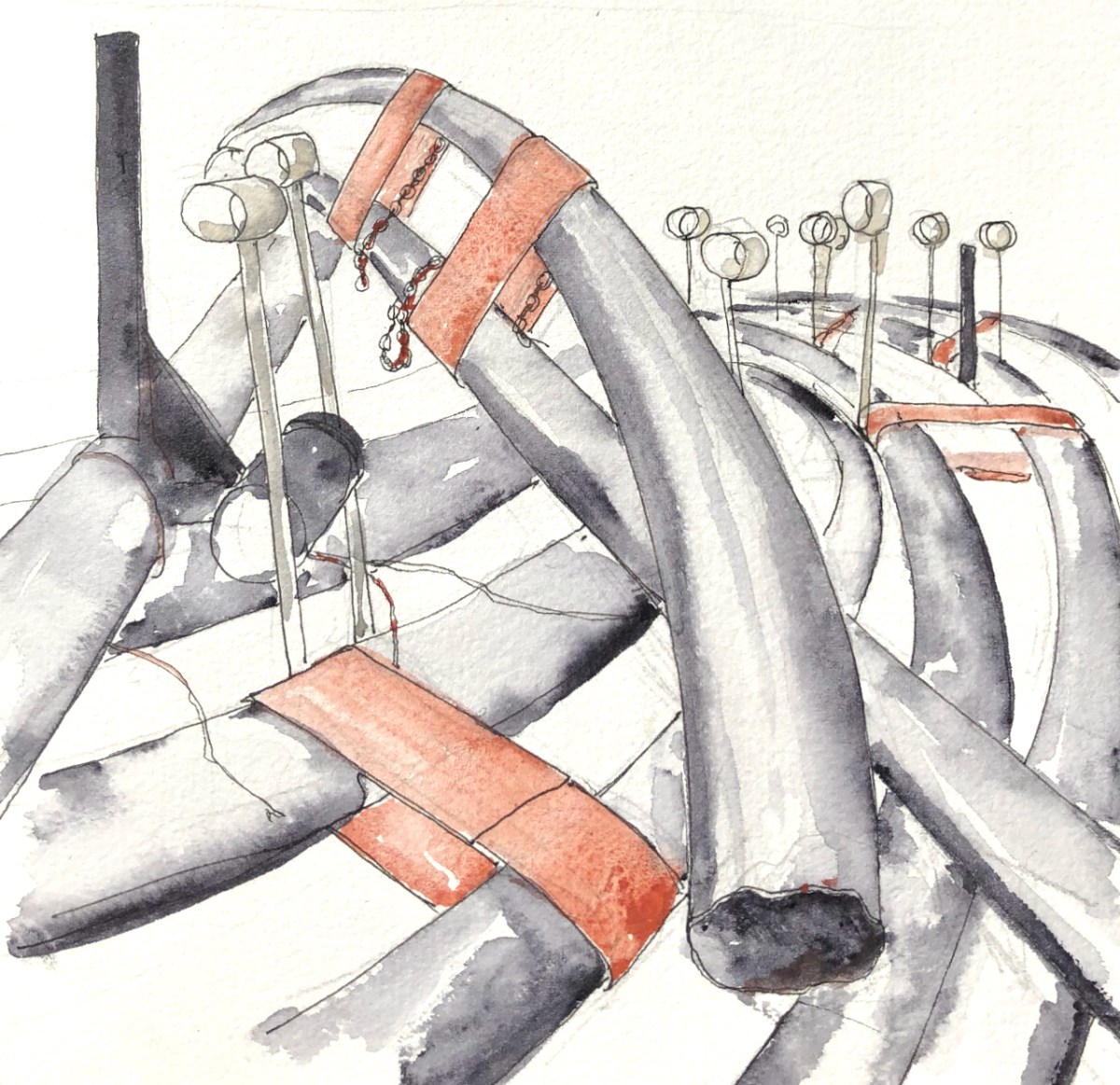
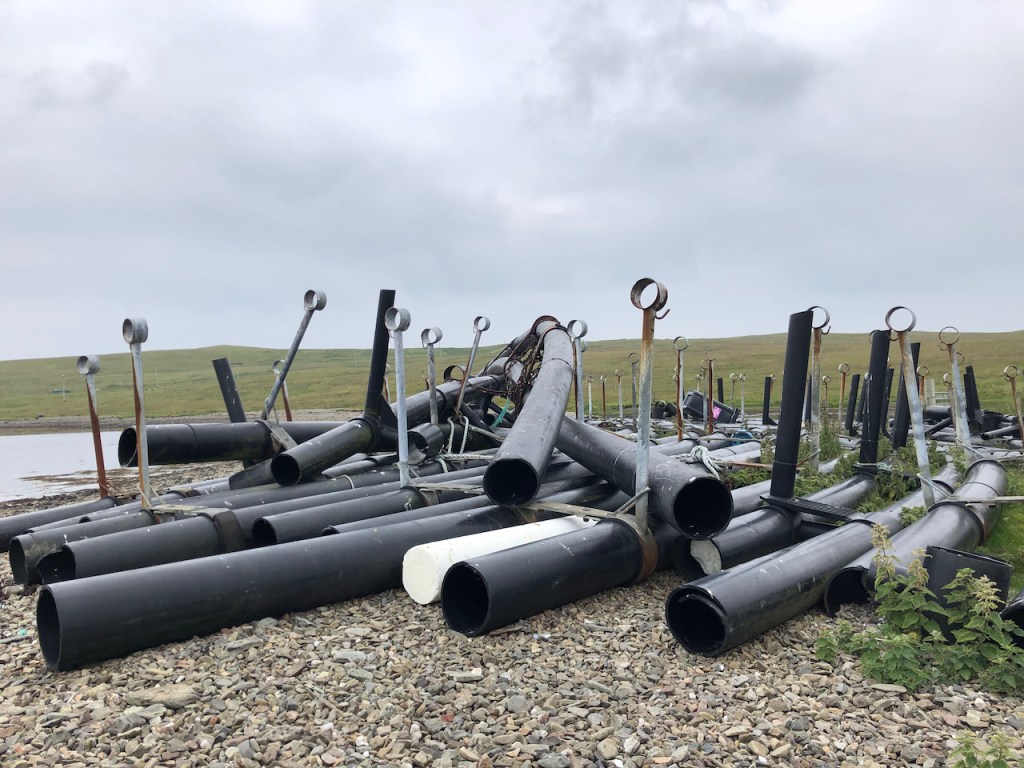
These black tubes seem to be indestructible. People find all sorts of uses for them: fence posts, cattle grids, boat slipways. I imagine they would make rather fine musical instruments. I have never heard of anyone using them for this.
But their primary use is to create the salmon cages that float out on the shallow seas in the area.
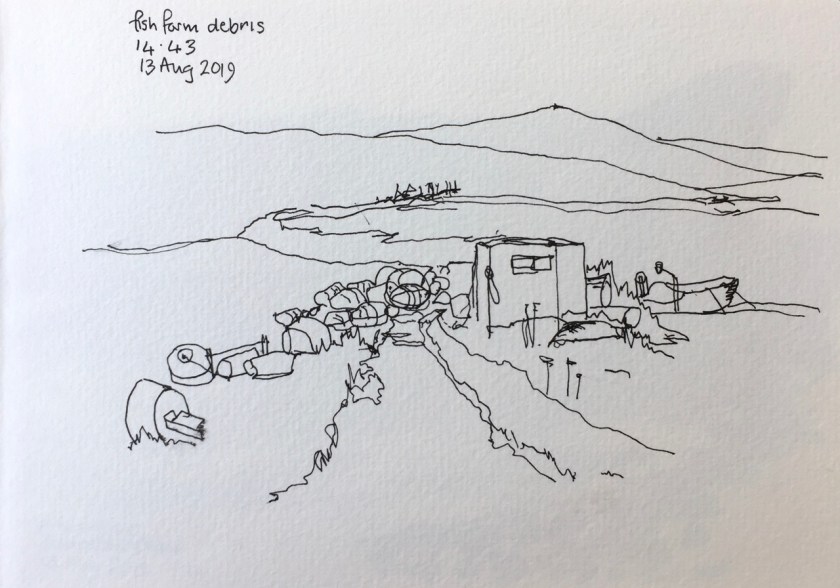
I saw these tubes on a walk from the Historic Site. I’ve drawn in this location before. In this sketch, you see the black tubes as the small scratchy lines in the centre distance.
Fish farm debris, 13th August 2019
Click a button below to share this post online, email it, or print it:
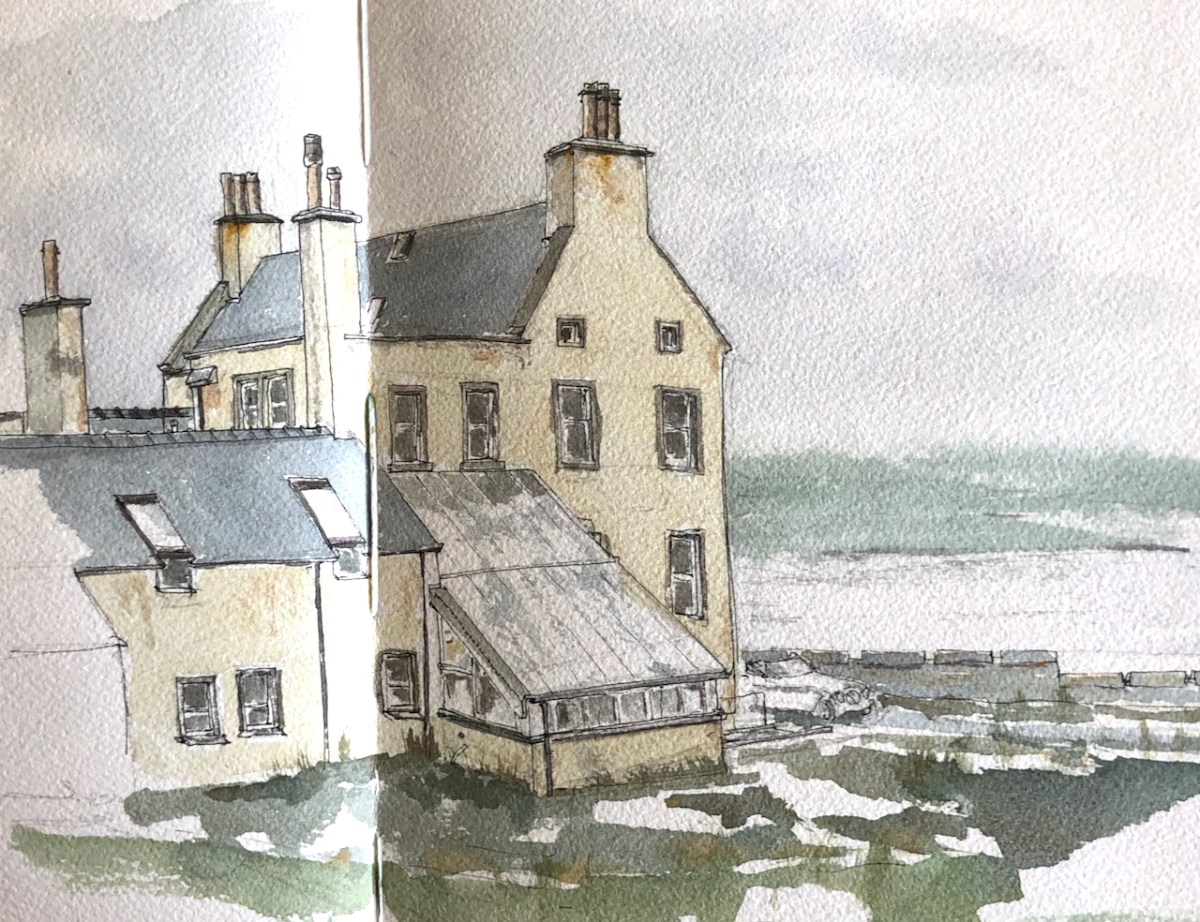
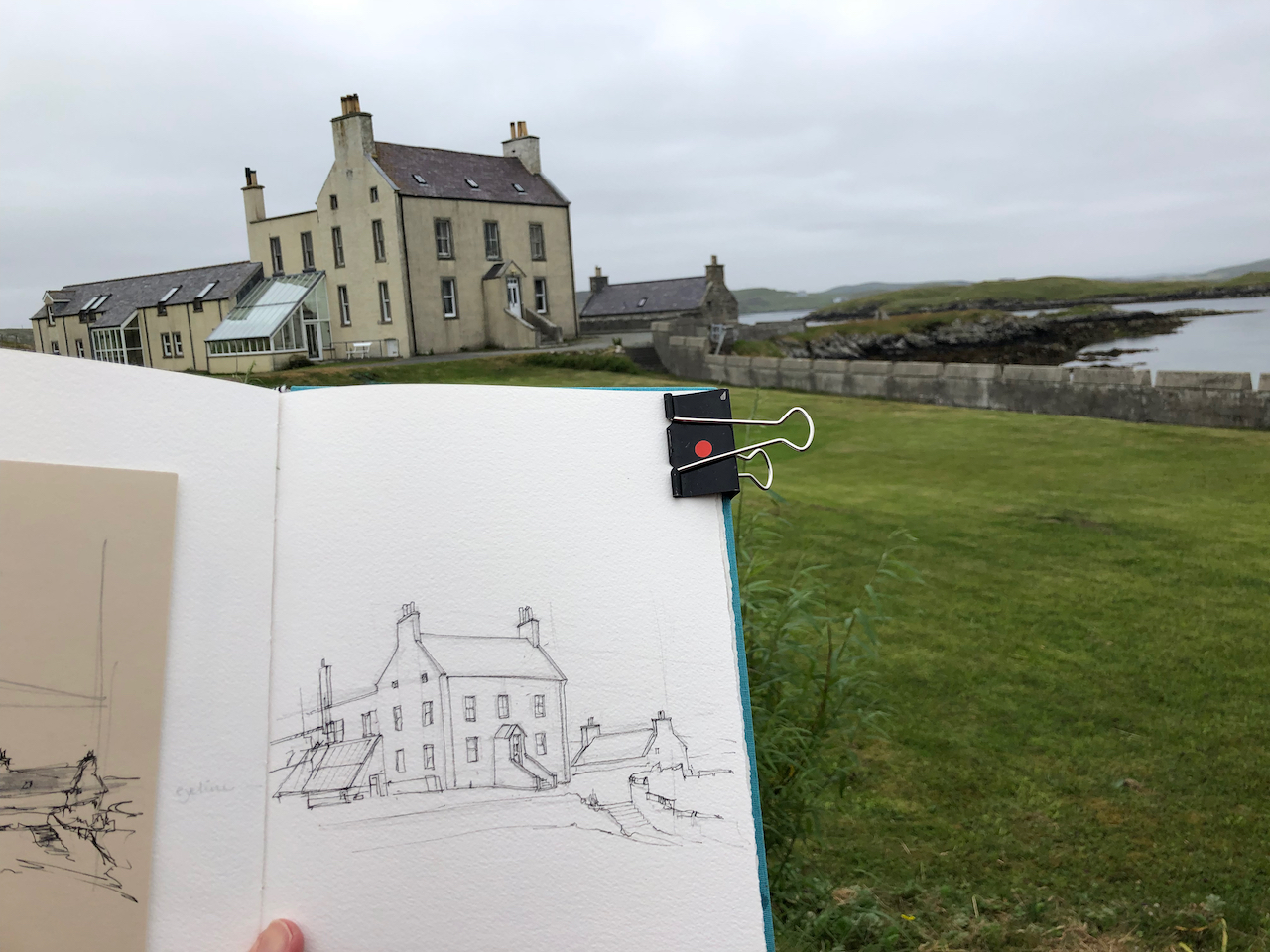
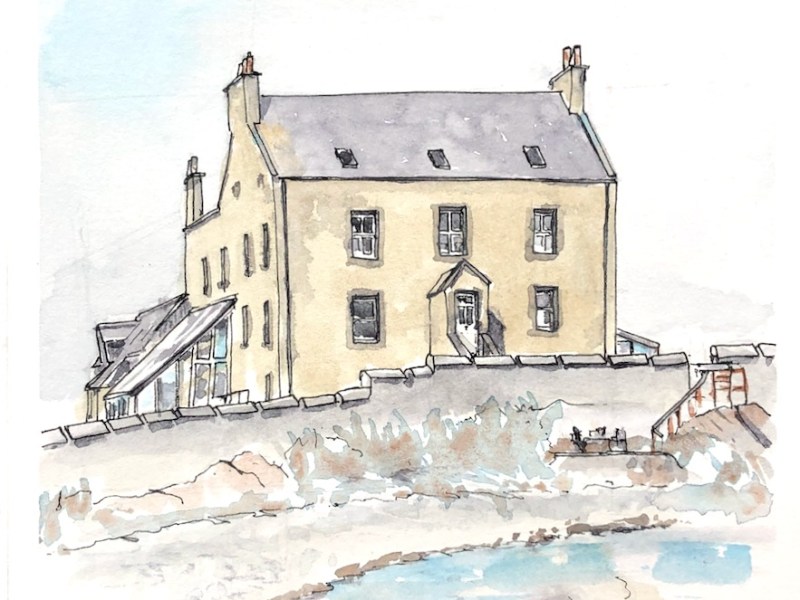
Here is Burrastow House near Walls on the West side of Shetland. It was built in 1759.
Burrastow House, from the garden. 20 July 2021. 10″ x 8 “
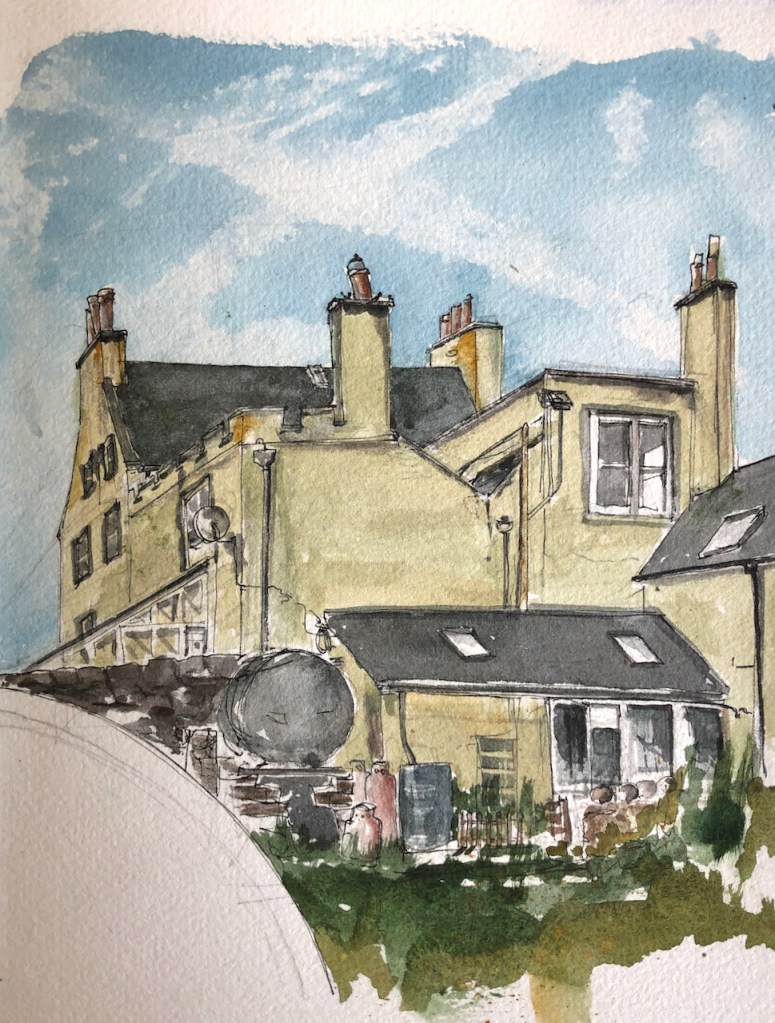
One of the delights of the house is that it has been adapted over the years. Here is a view from the vegetable garden. You see the different roof levels.
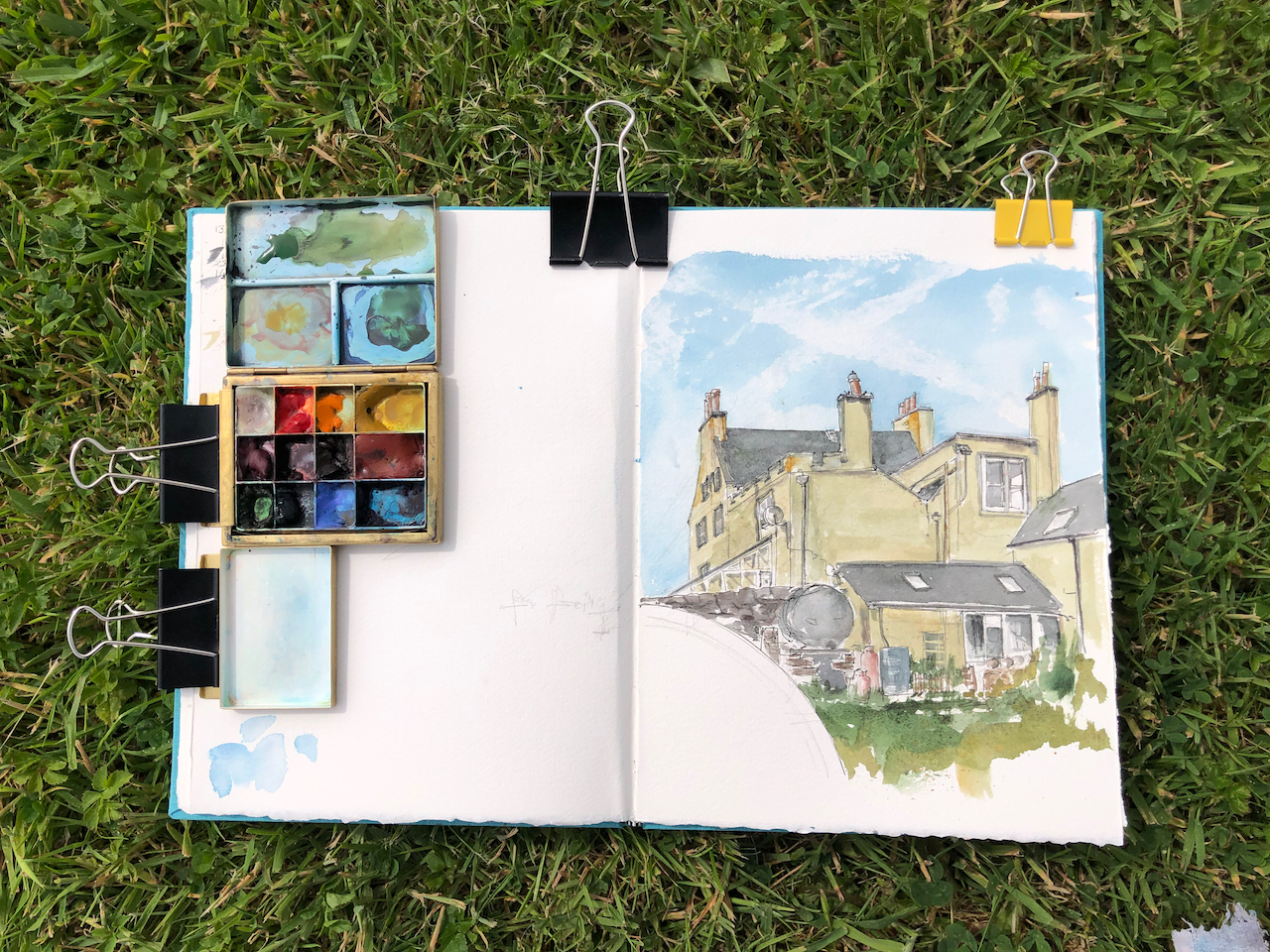
Burrastow House from the vegetable garden. 13th July 2021. 10″ x 8″
The white curved area on the left is a segment of the polytunnel. The grey circular item is the oil tank. Above that, the small circle is the satellite dish. I like the way you can see right through two windows, in the room on the top right of the picture.
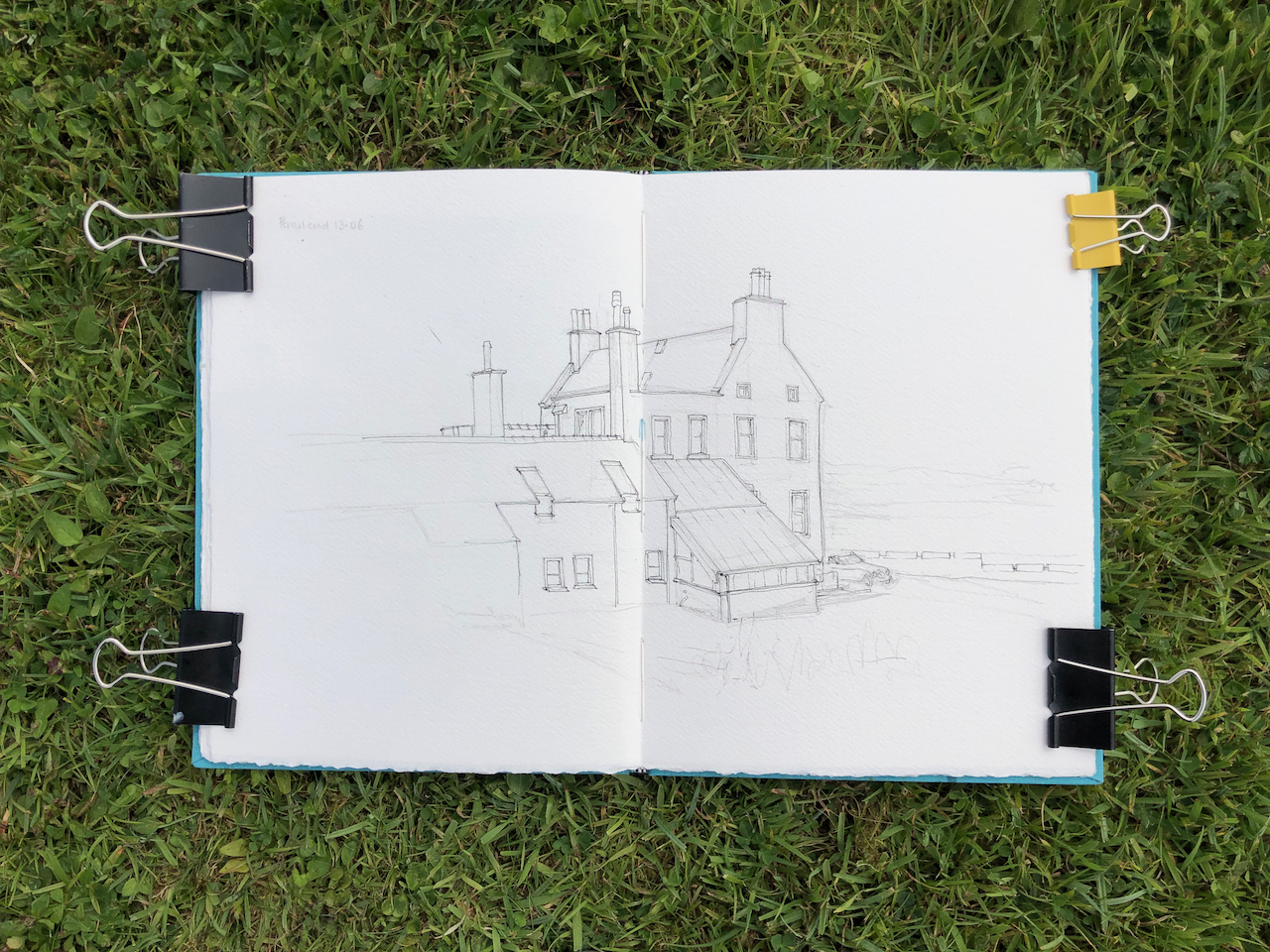
Here is a view from the garden near the driveway.
Burrastow House, from the garden near the entrance. July 14th 2021
While I was drawing this, a Jaguar E-type throbbed up the drive. I put it in the picture. This was a misty day. I had to pause the work on the picture as the mist turned to rain, and then I resumed as the rain turned to mist again.
You see the front conservatory in the centre and the extension to the left. The extension dates from 1995, according to a small notice in the conservatory.
“On the remote west side of Shetland you can find spectacular scenery, peace and the ideal refuge for the escapist. The guest house welcomes you with peat fires, a cosy library and all the marvellous food you could want after…
Click a button below to share this post online, email it, or print it:
The rocks on the Shetland west side cleave at a very specific angle.
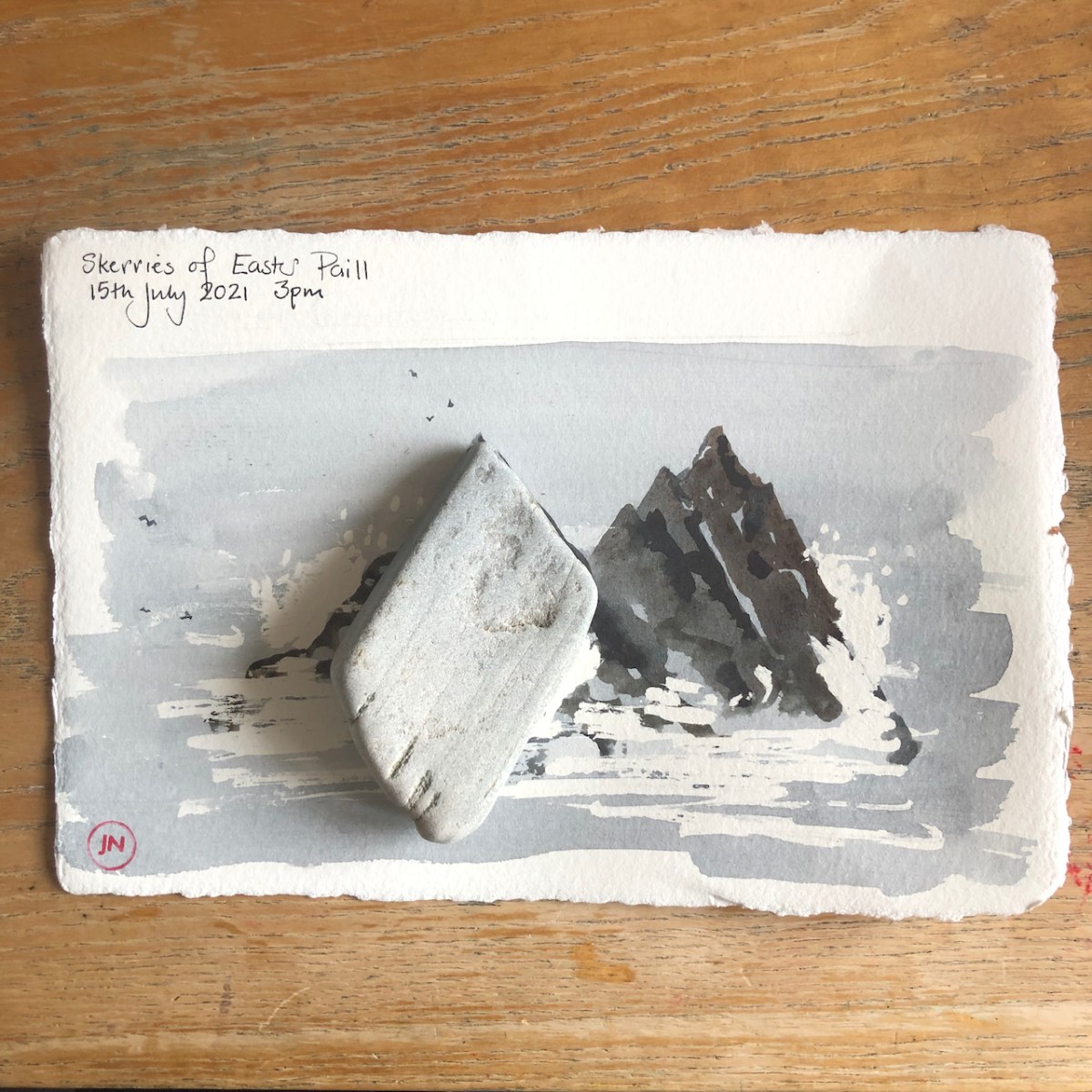
Skerries of Easter Paill, 15th July 2021 on Amatruda paper.
I picked up a pebble on the beach. Many of the pebbles show this pointed regular shape. It gave me great pleasure to find that the angle matched my drawing. It is approximately 70 degrees.
The rocks are at an angle of 70 degrees
The angle is visible even in the large cliffs.
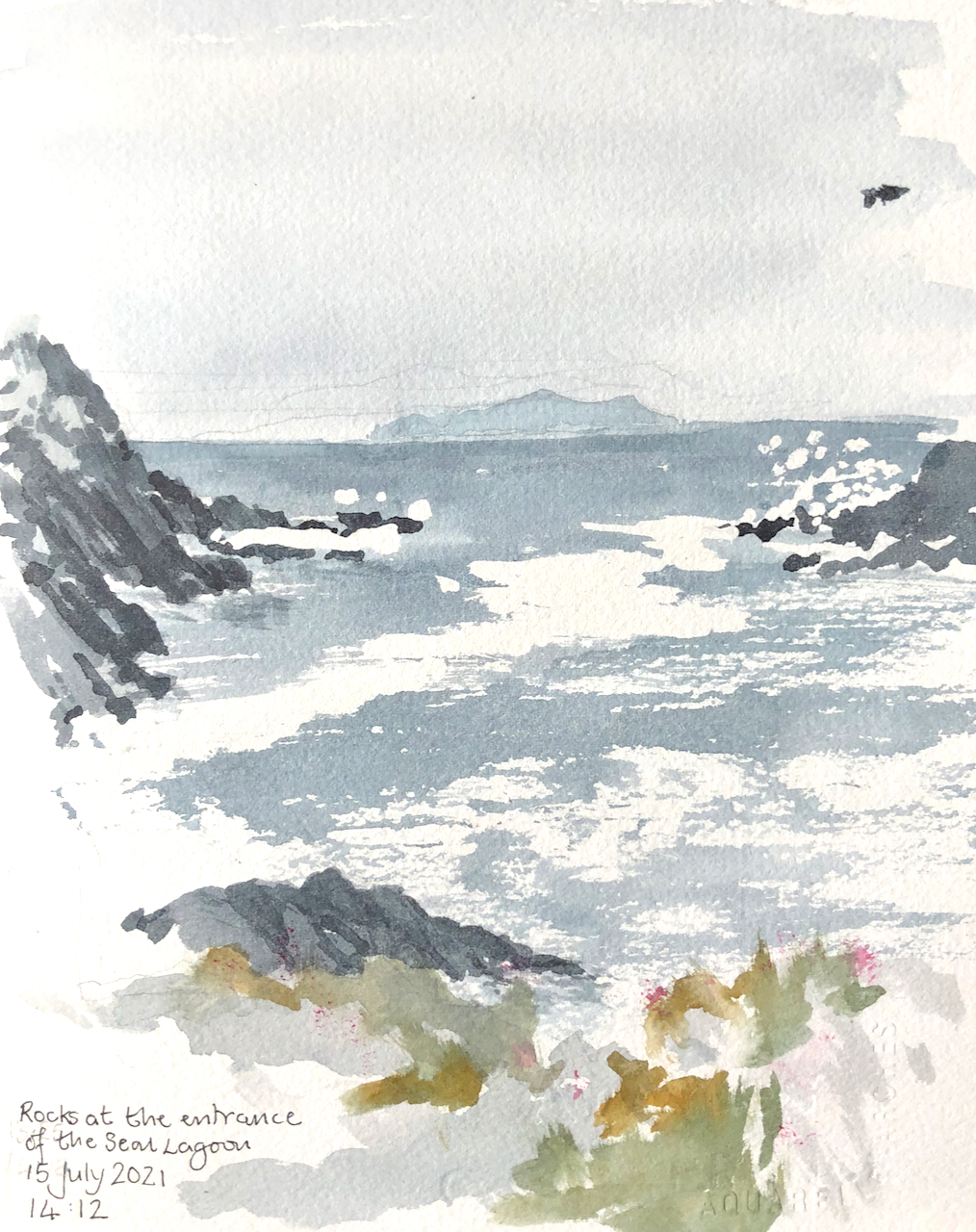
Rocks at the entrance to the Seal Lagoon, 15th July 2021
Here is this sketch in progress:
Sketching at the entrance to the Seal Lagoon, on Arches Aquarelle 300gsm CP, in PrintUrchin Sketchbook 1
The strange object in the top right of the drawing is not a drone, a cormorant, a flying fish or a small airship. It is a mistake. When I closed the sketchbook to continue my walk, some wet paint transferred itself from the left hand page to the right.
Click a button below to share this post online, email it, or print it:
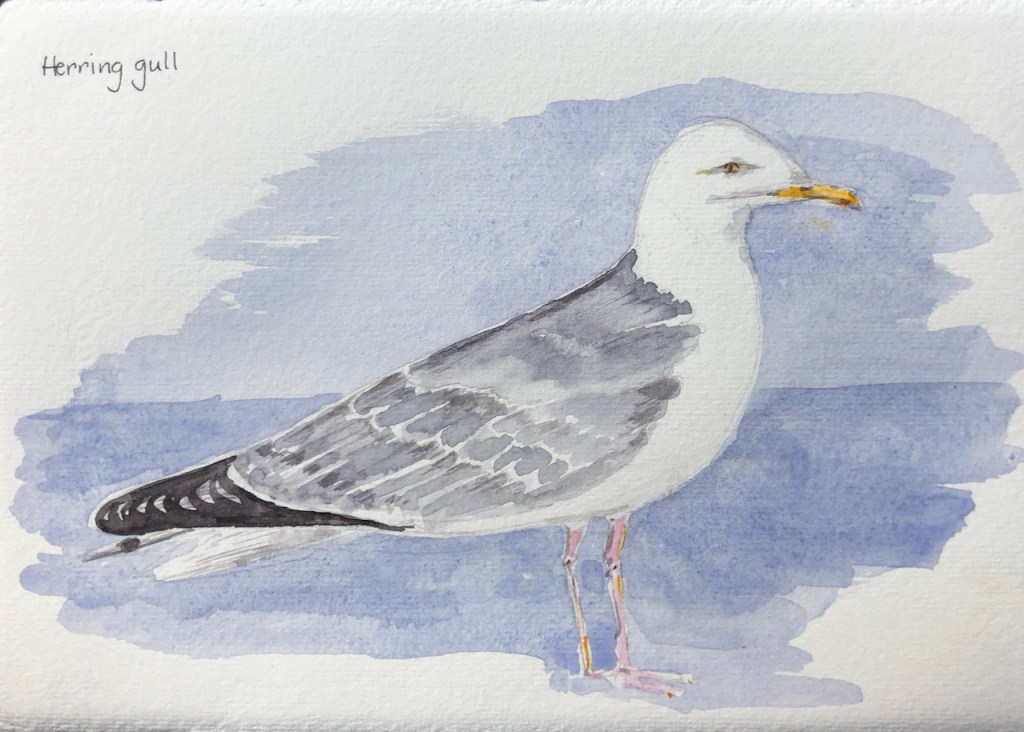
Here is a herring gull. These are numerous and float on the sea as well as fly in the air. They also stand on cars and on chimneys. This one stands on a wall, waiting for someone to come out of the kitchen, ideally with a slice of bread.
Herring gull
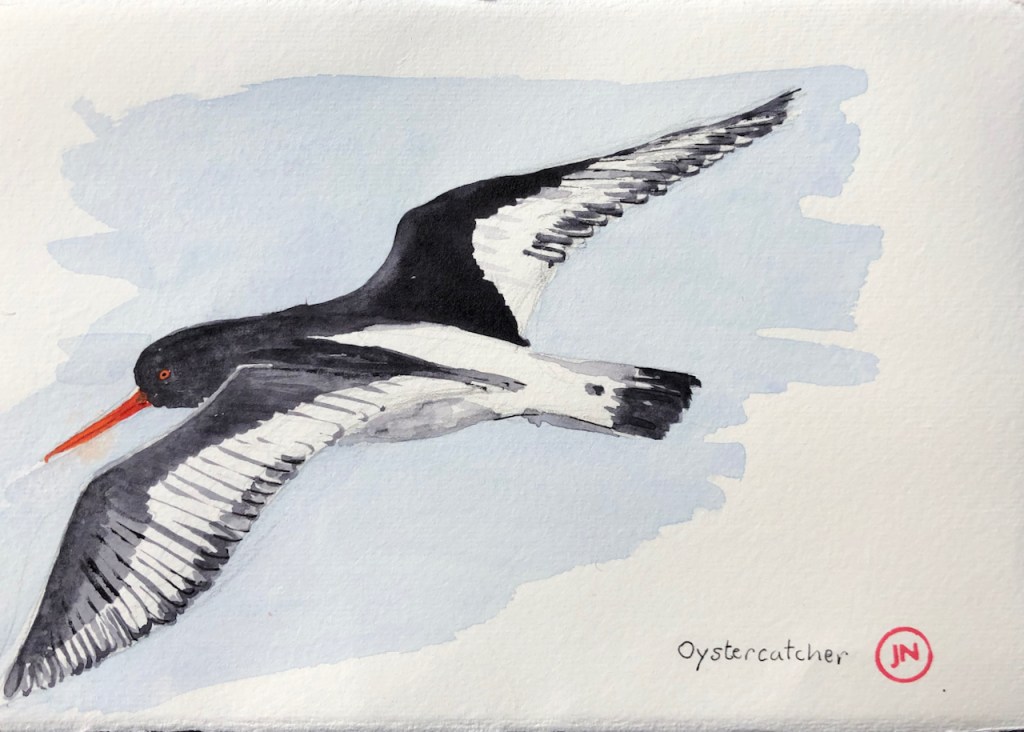
Then there are the oystercatchers. They fly but don’t swim. They poke around in the seaweed, and, amazingly, also use those long beaks on the lawn, to dig up worms.
Oystercatcher
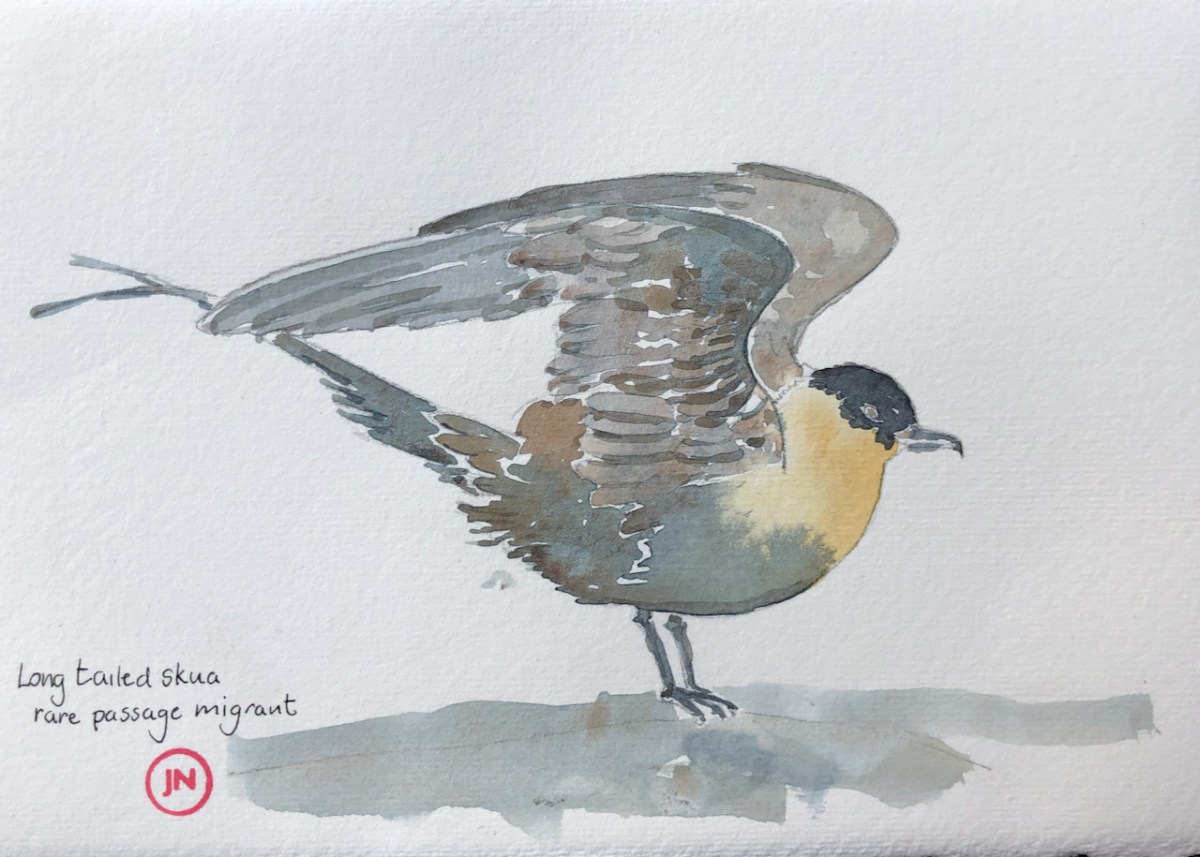
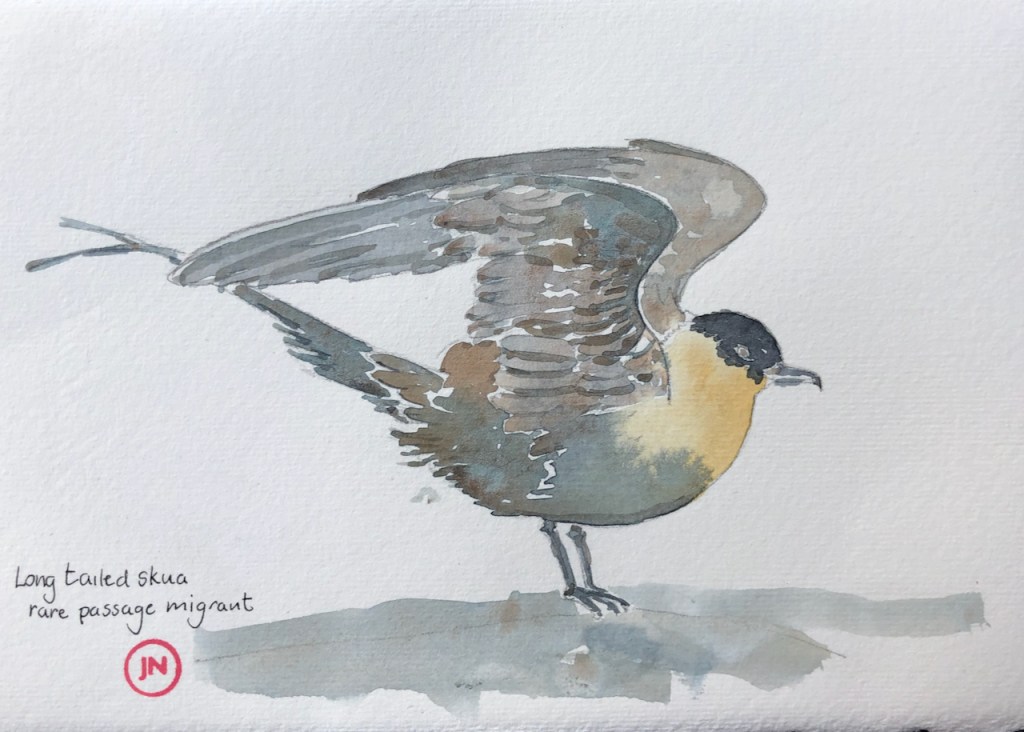
I started drawing the birds when I saw a wonderful picture in The Shetland Times. It showed a “Long tailed Skua”, described as a “rare passage migrant”. Here is my version, inspired by the photo in The Shetland Times by Jim Nicholson.
Long tailed Skua, rare passage migrant
All drawn in watercolour on Amatruda paper, size A5, using Daniel Smith watercolours.
Click a button below to share this post online, email it, or print it:
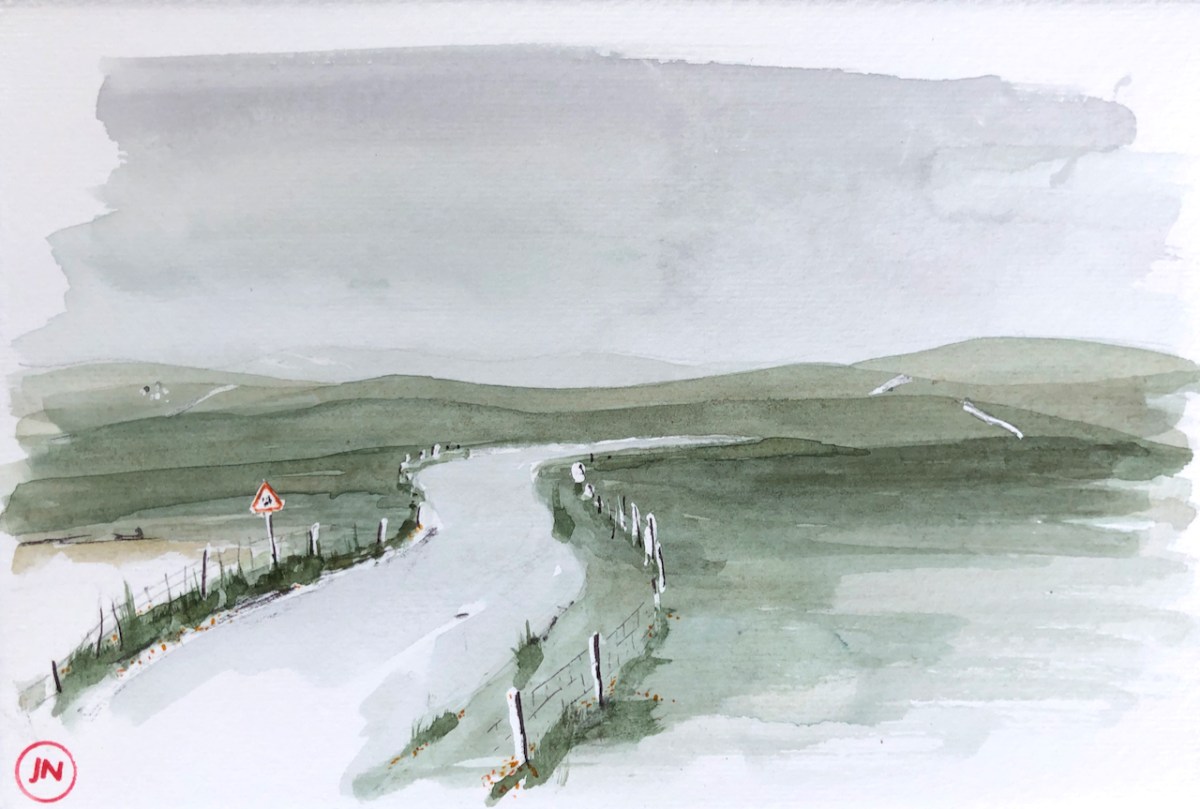
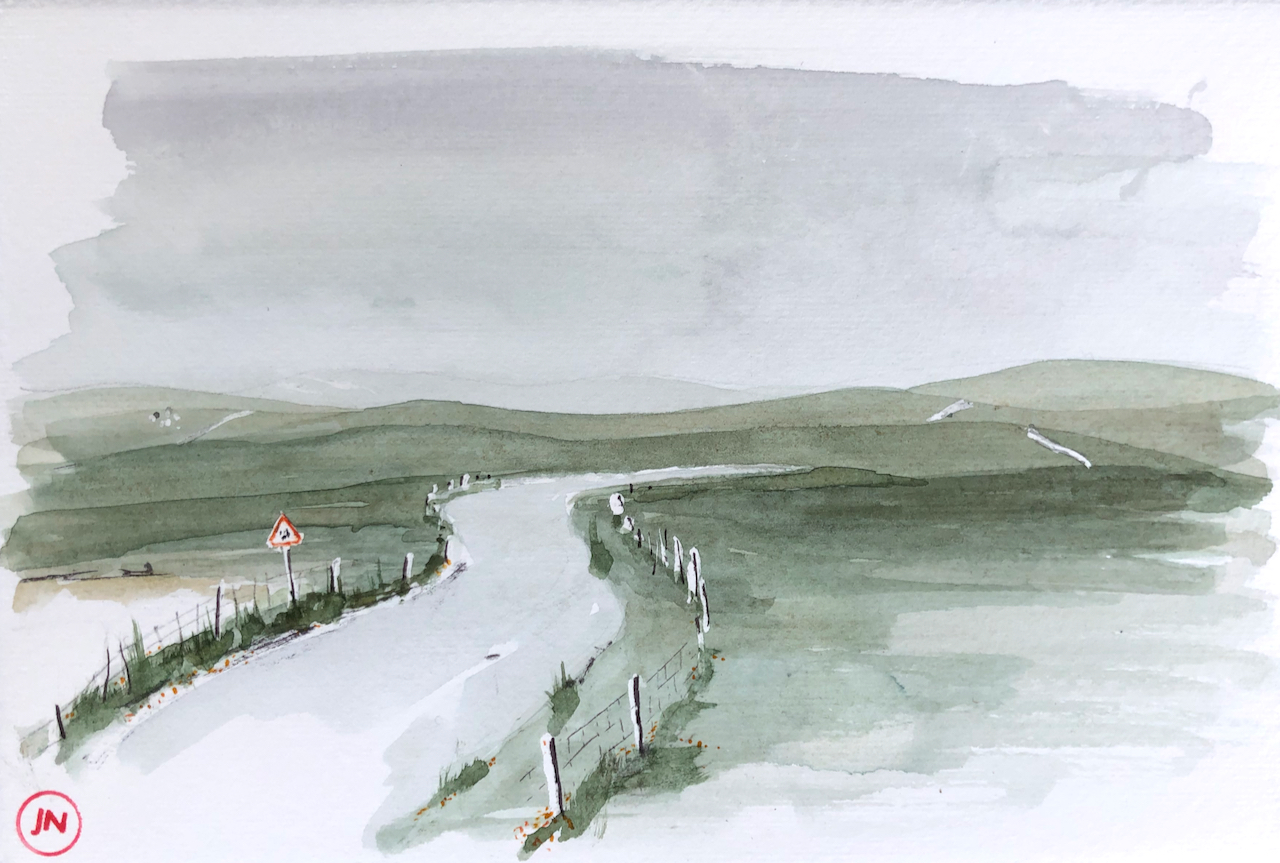
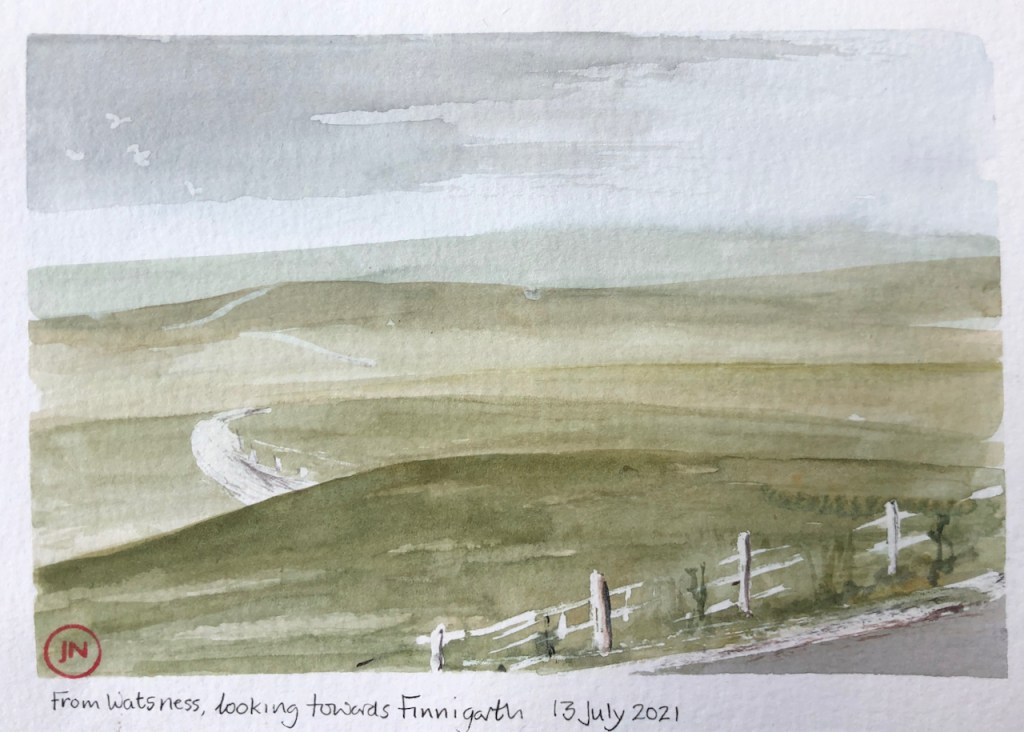
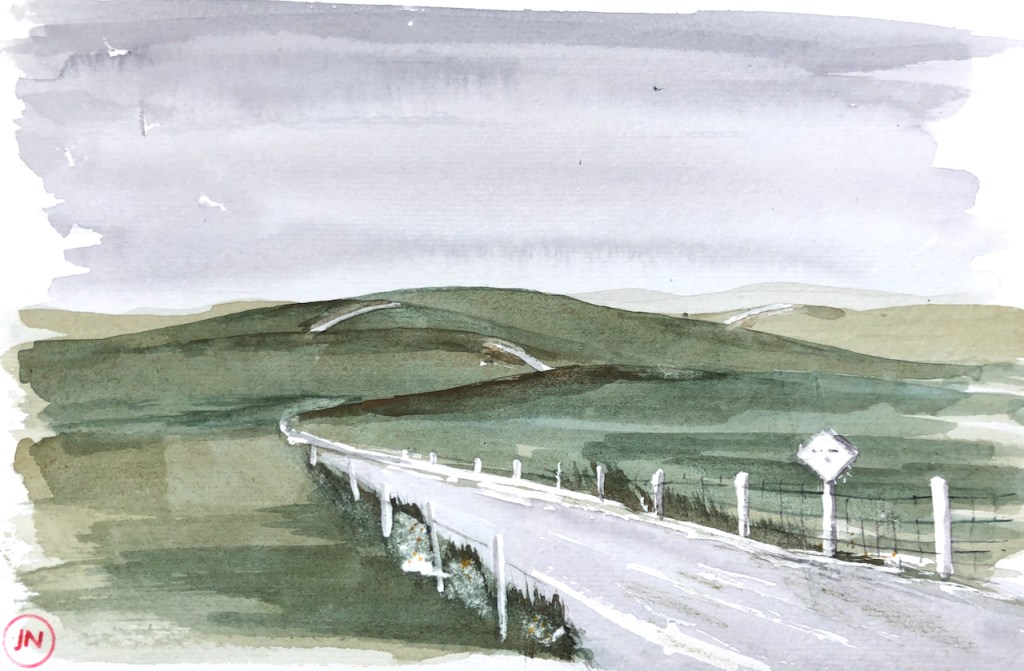
Shetland roads sweep across the landscape. I enjoy the calligraphic sweep of their curves and the simplicity of the lines they make.
“Cattle Grid” July 2021
“Passing place”
Shetland Roads, July 2021
These pictures are sketched on A5 sheets of F Amatruda Amalfi paper from The Vintage Paper Company in Orkney. These are lovely soft sheets with 4 deckle edge. They take the watercolour well.
Amatruda paper, 4 deckle edges
Watercolours are Daniel Smith. Some of the white lines are achieved using a rubber resist, called “frisket”, panted on before the watercolour, and rubbed off afterwards.
Click a button below to share this post online, email it, or print it:
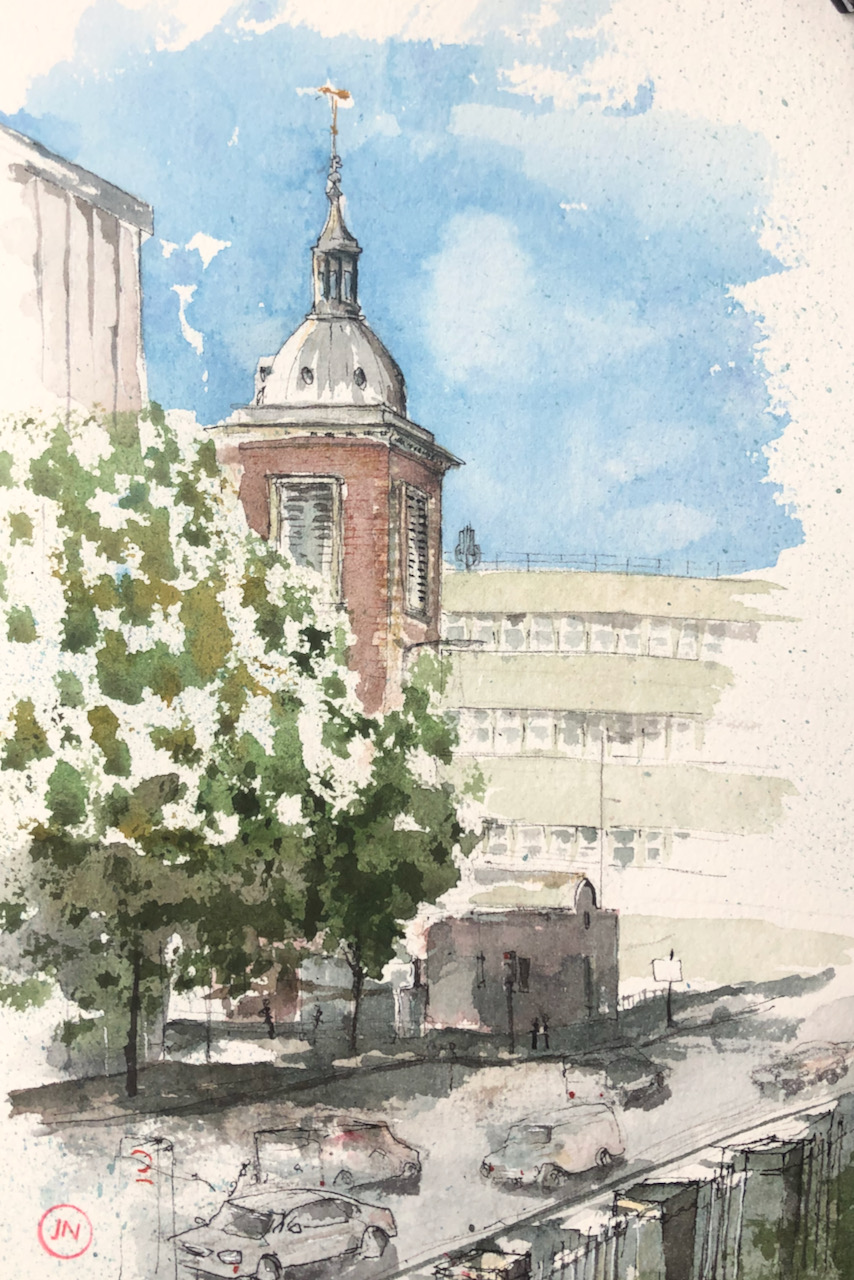
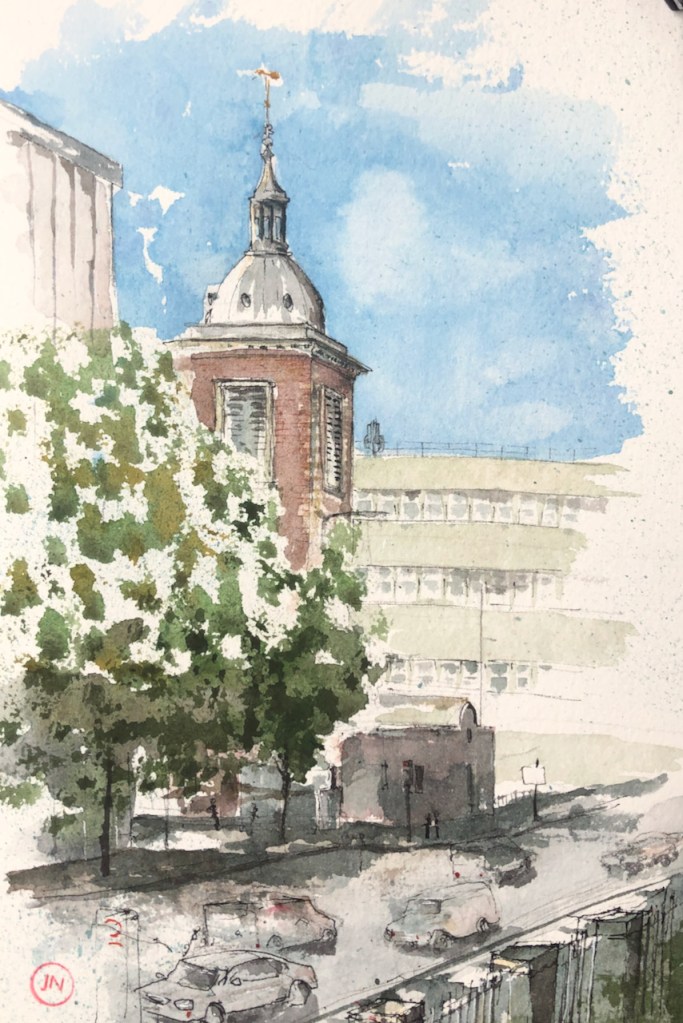
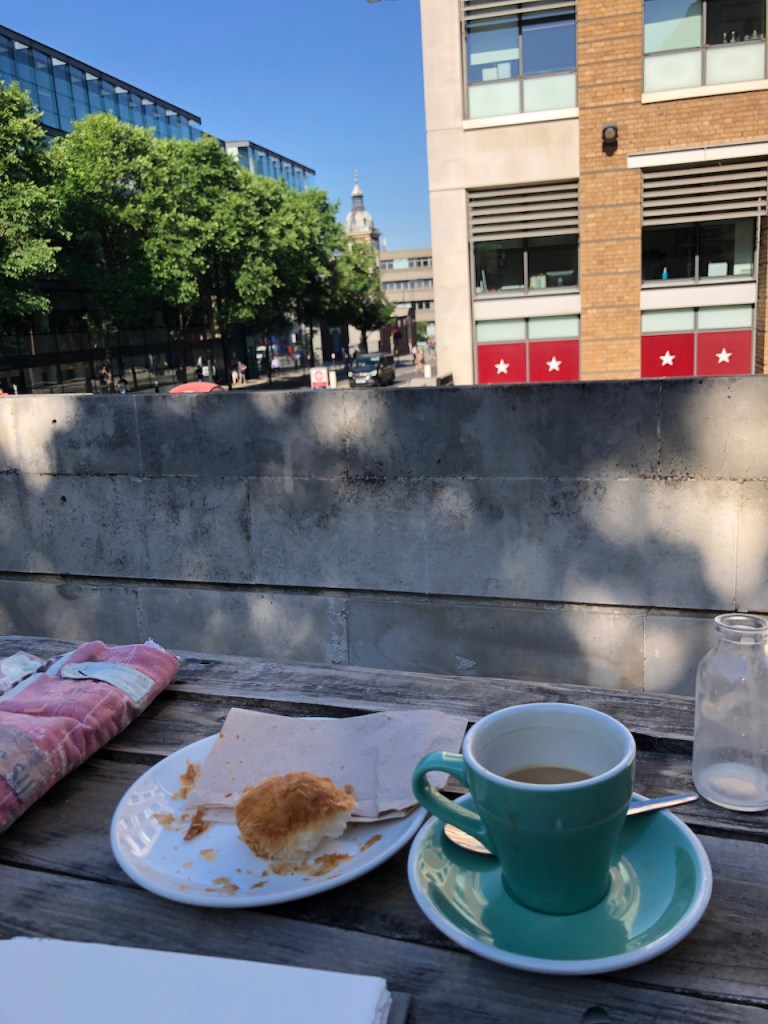
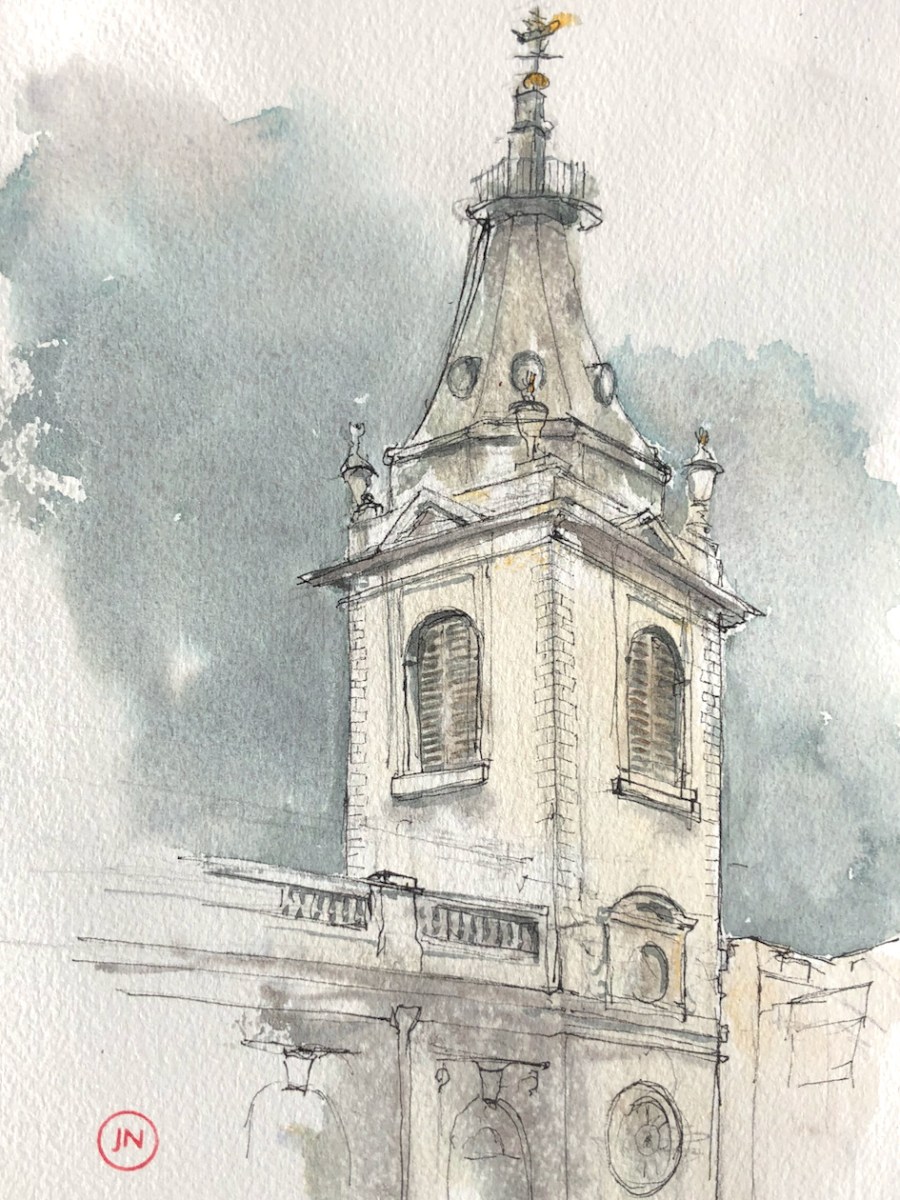
On a lovely sunny morning I walked to the Wren café for breakfast. The Wren is in Saint Nicholas Cole Abbey church on Queen Victoria Street. There is a terrace high above Queen Victoria Street. It commands an excellent view of St Paul’s Cathedral, but I chose to look along the busy road and sketch the Guild Church of St Benets.
Guild Church of Saint Benets, from St Nicholas Cole Abbey, Queen Victoria Street EC4. 16th June 2021, 08:30 – 10:45am, 10″ x 7″ in sketchbook 10.
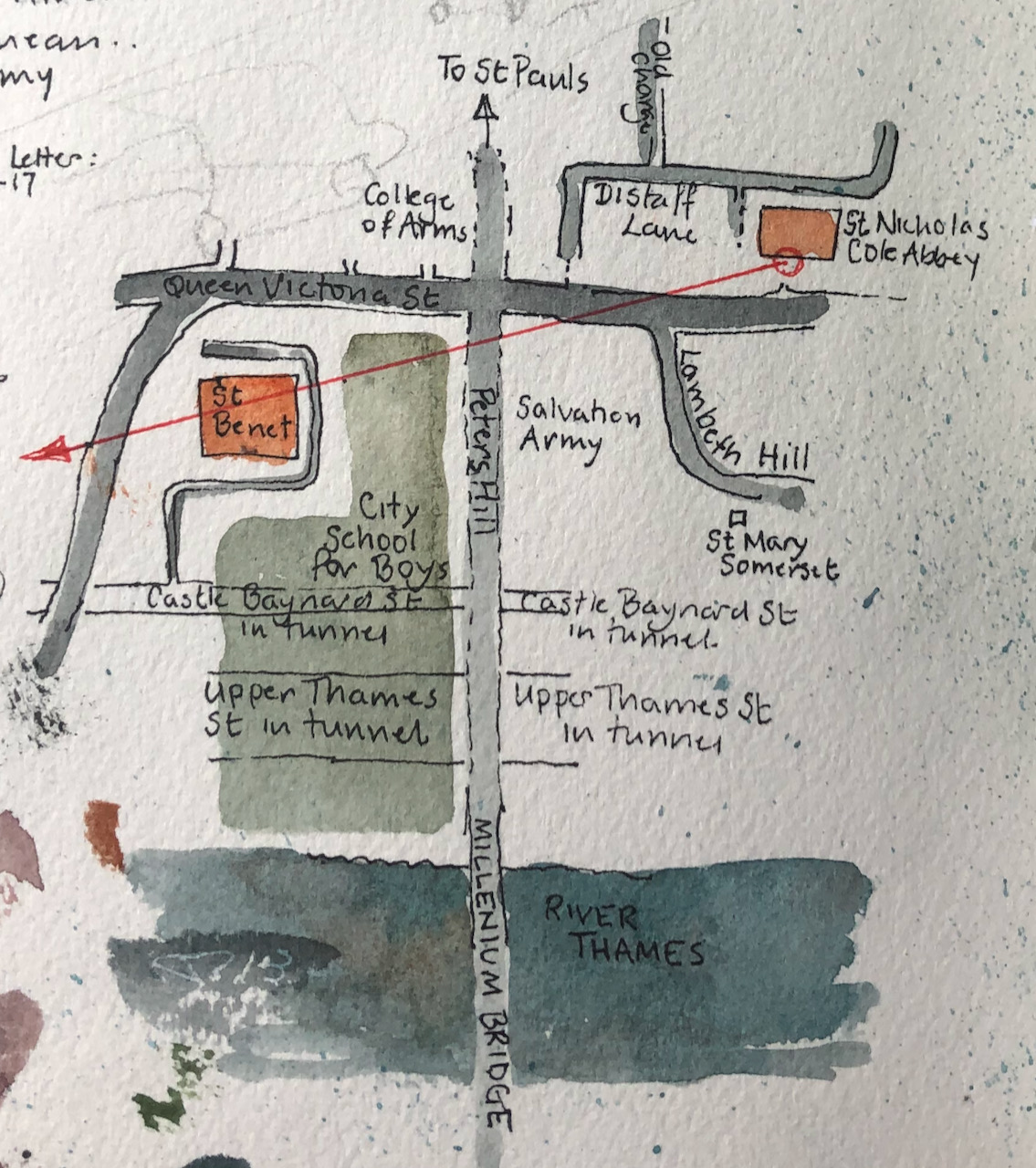
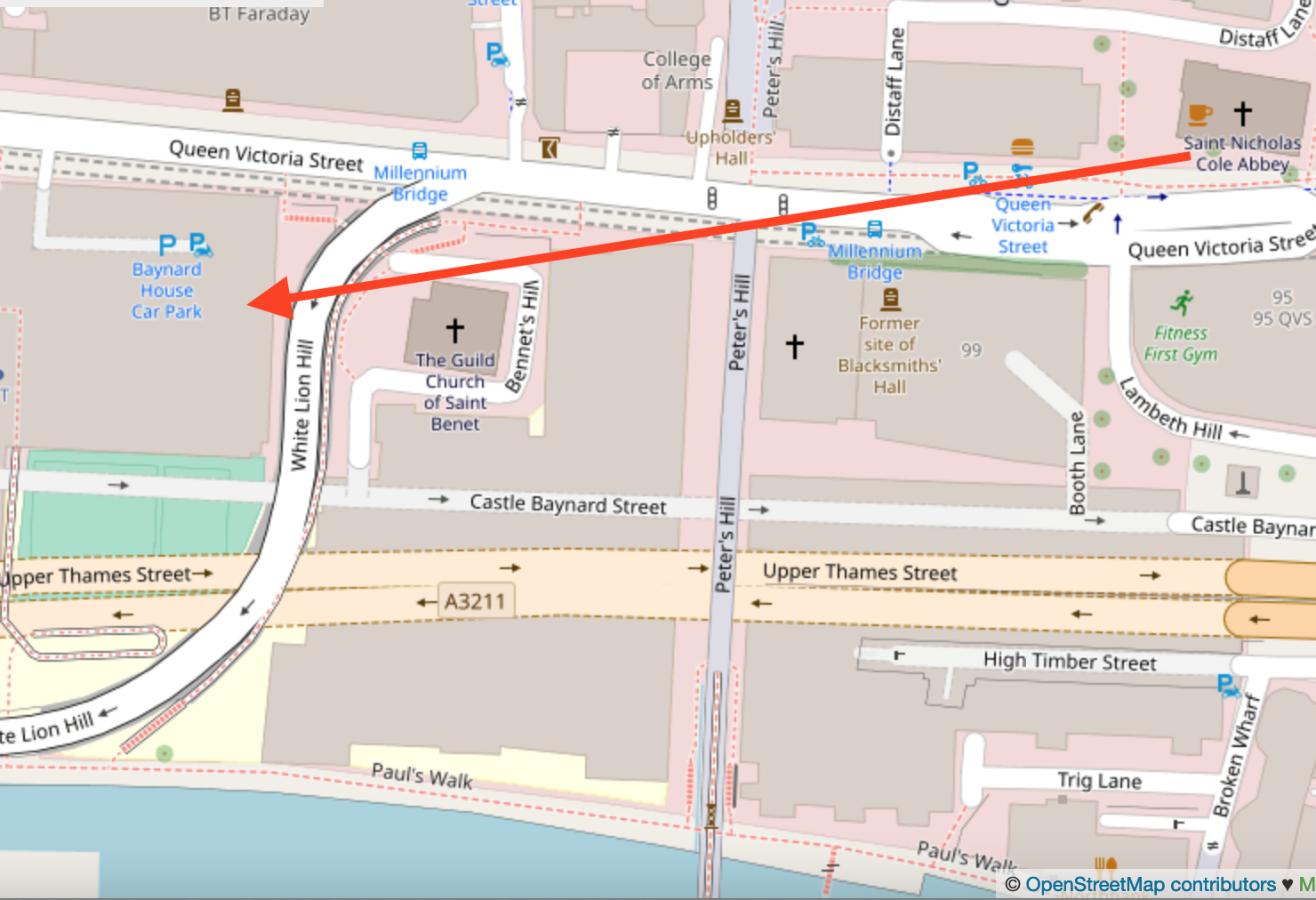
The building in the background is Baynards House, a BT building. In front of the church is the City of London School for Boys. Here are maps:
The Guild Church of St Benets is an active church with services in Welsh. It is a Wren Church, listed Grade I. The listing on the Historic England site says that this is “one of the least altered of Wren’s churches”, since it was not damaged in the 1939-45 war.
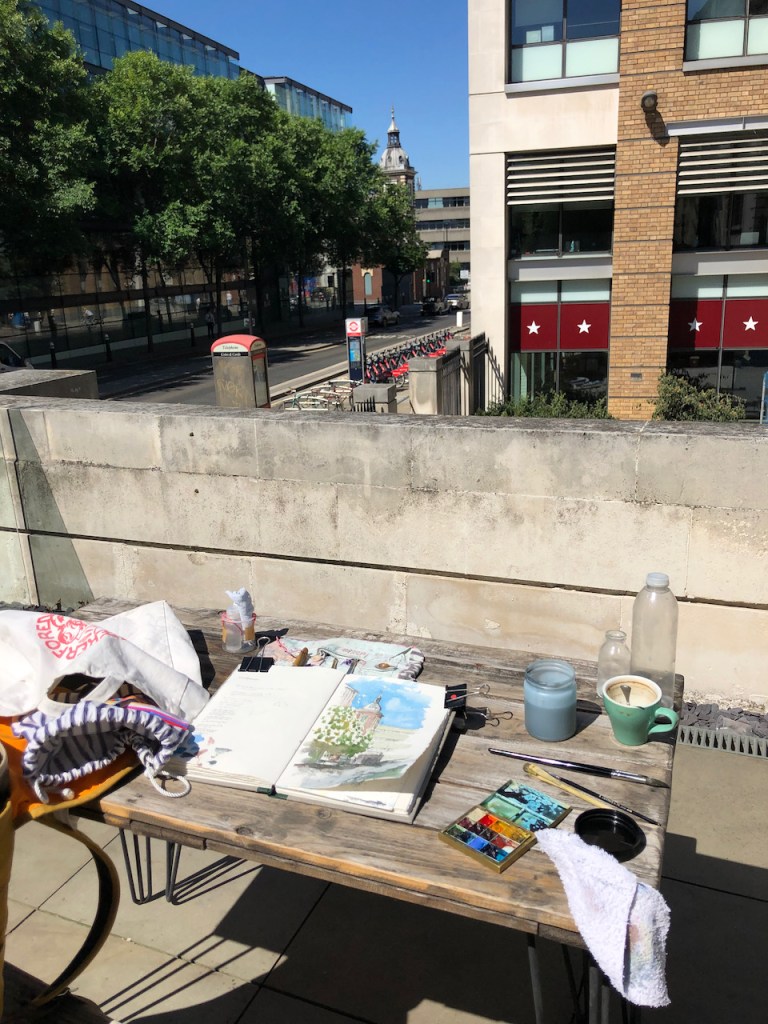
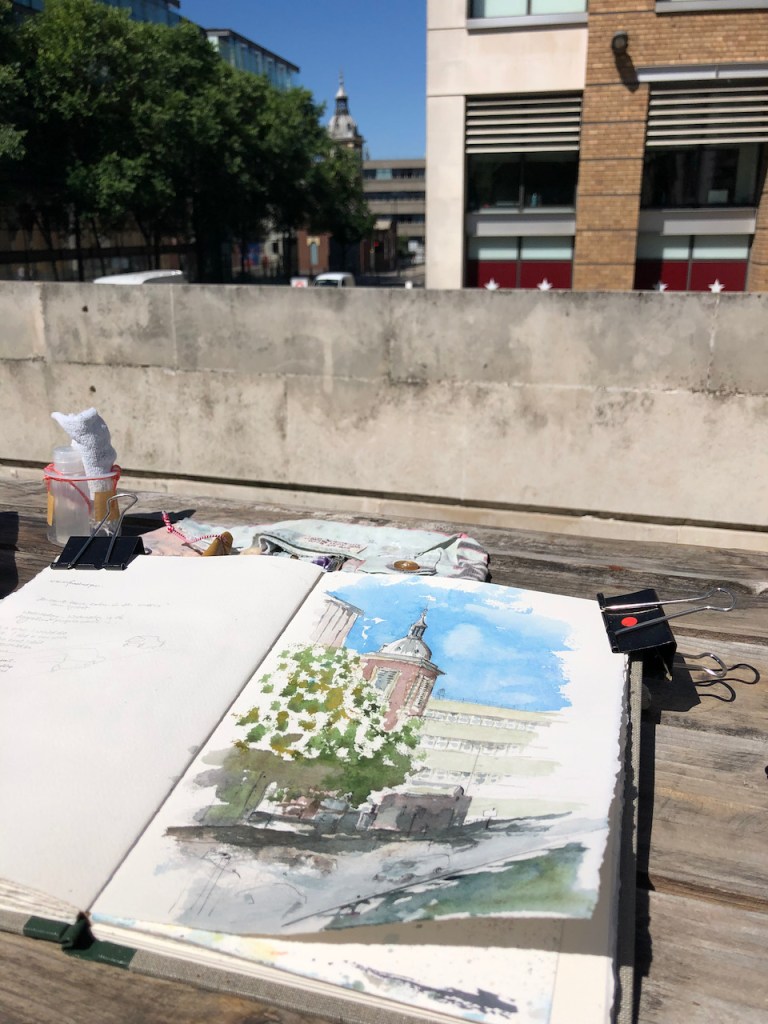
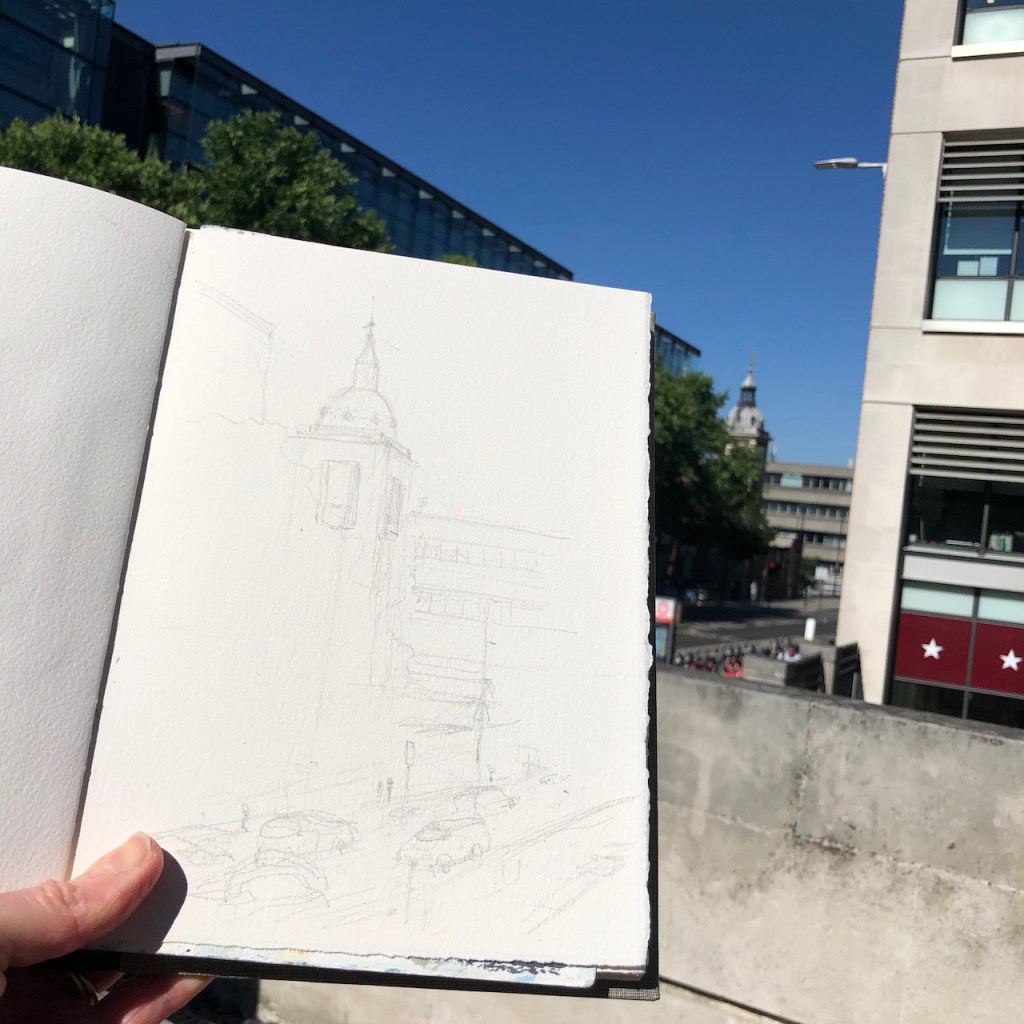
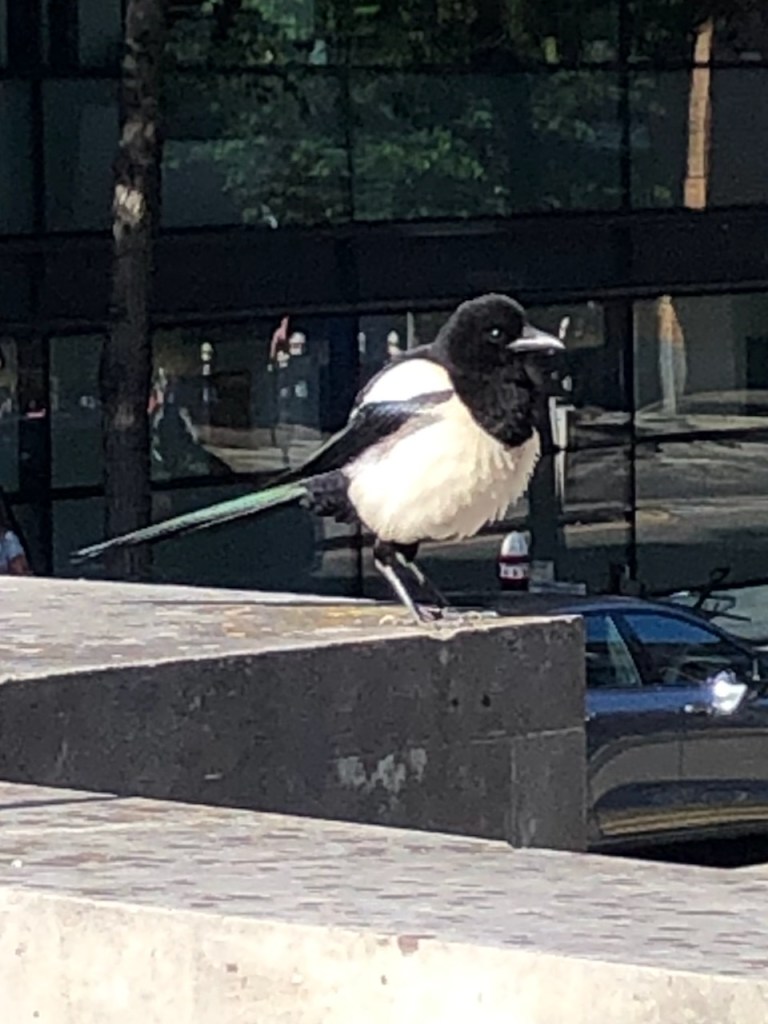
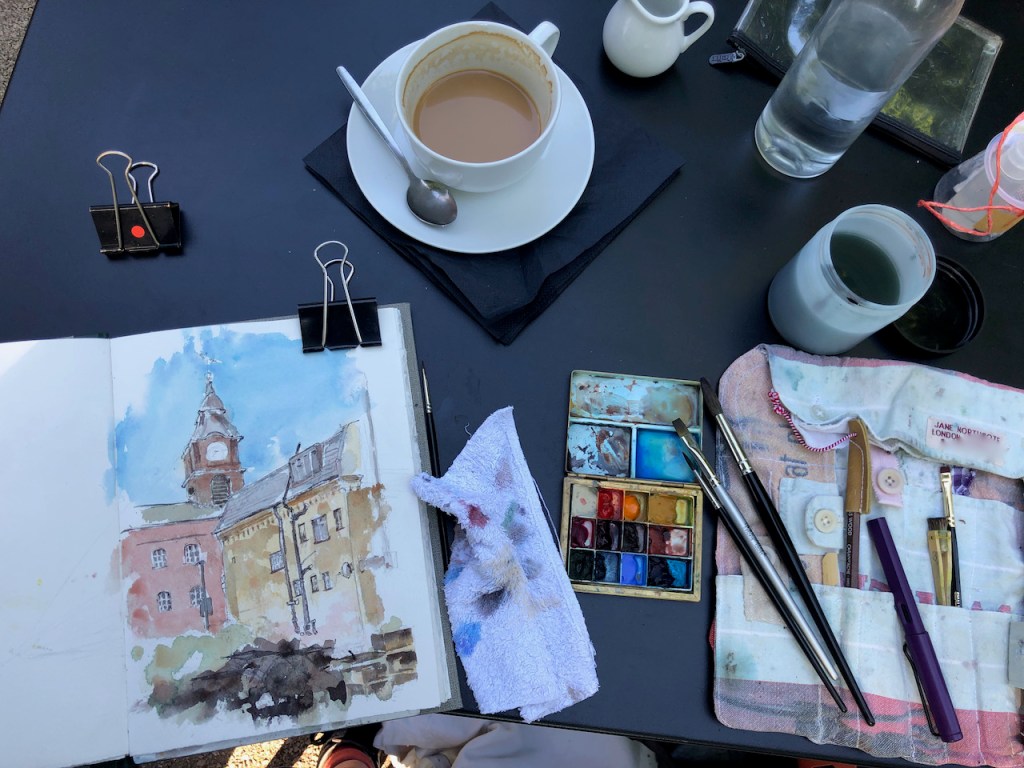
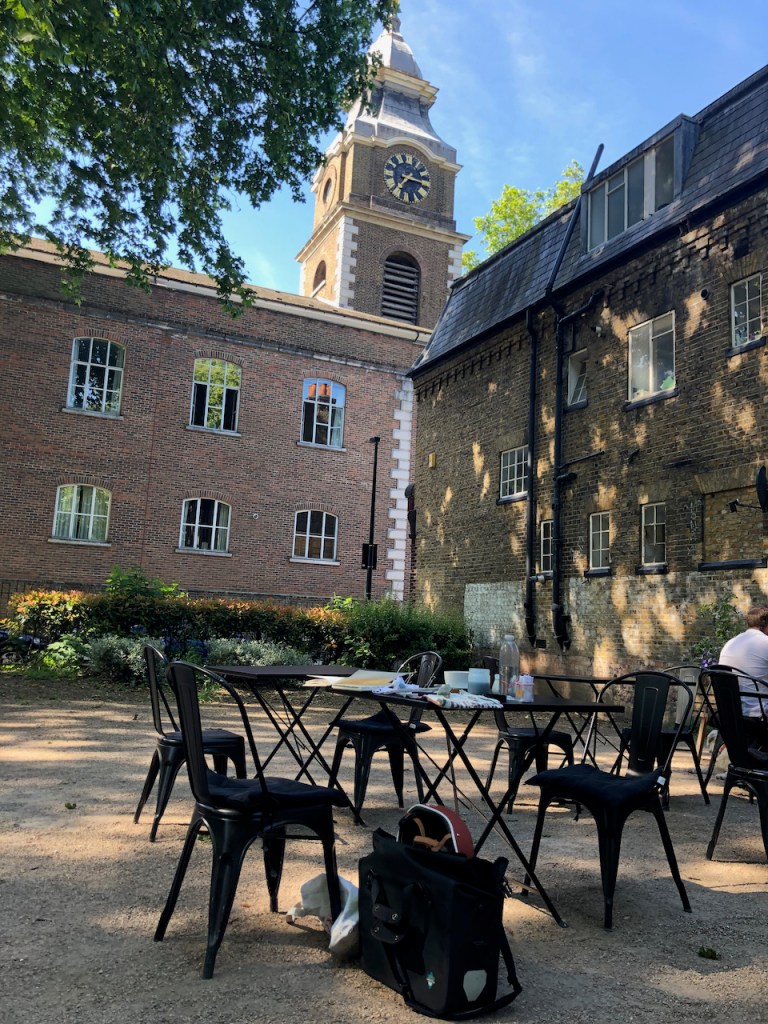
Here are a few photos of work in progress on the drawing, and a portrait of a magpie who came to look at my croissant:
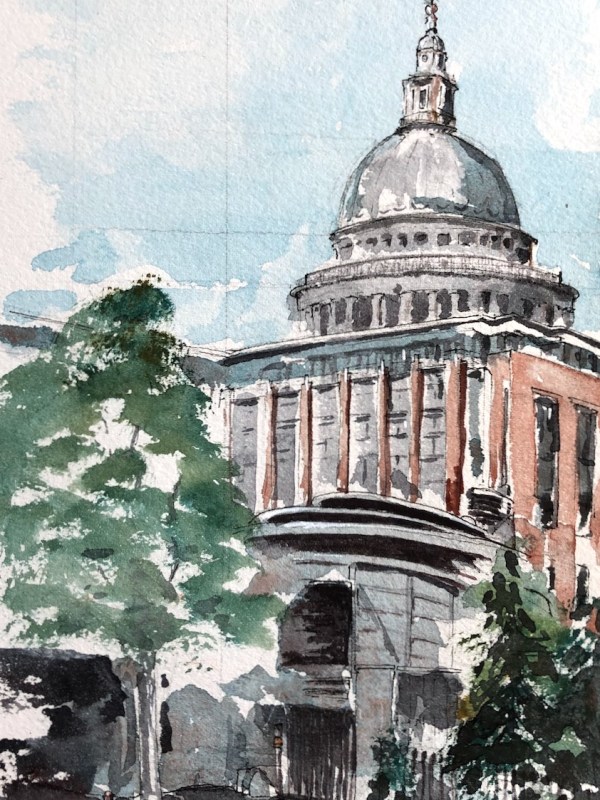
I’ve sketched the view of St Paul’s from the same location:
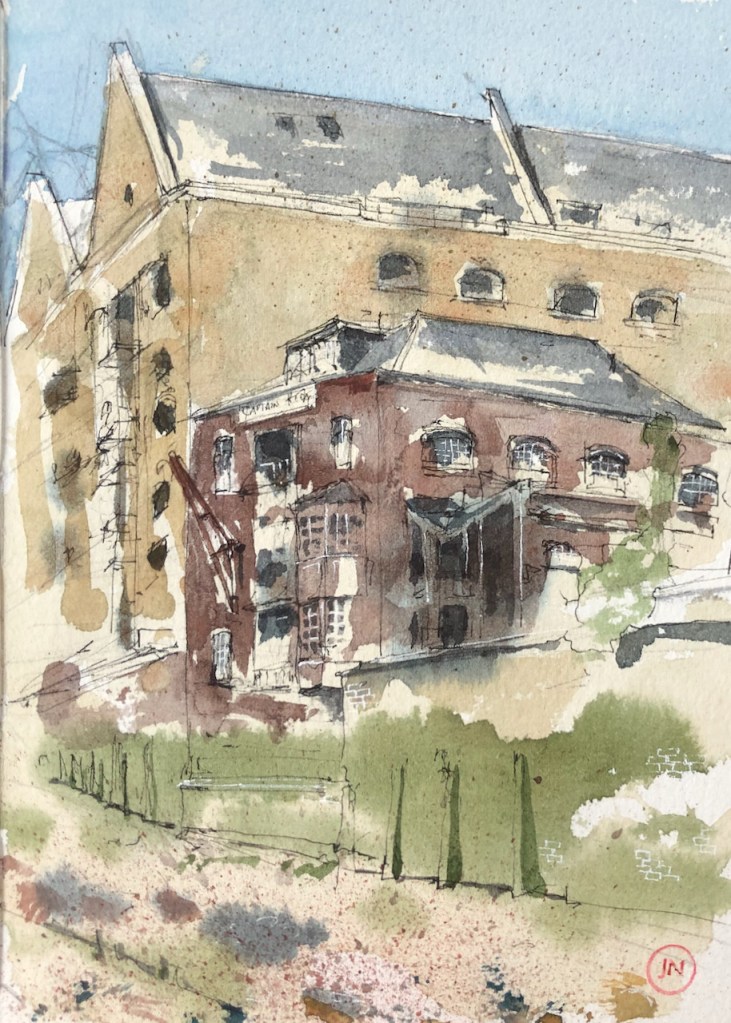
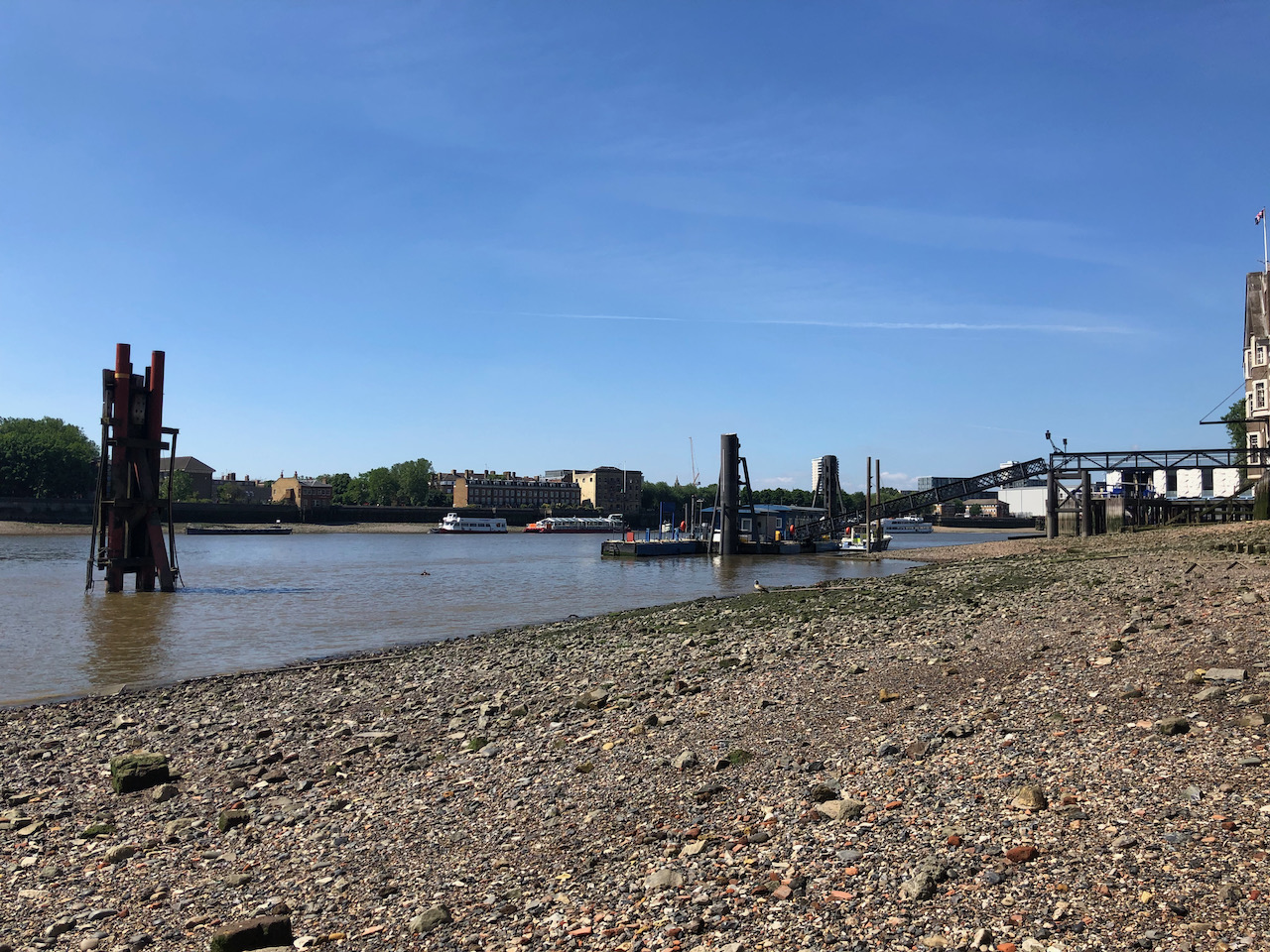
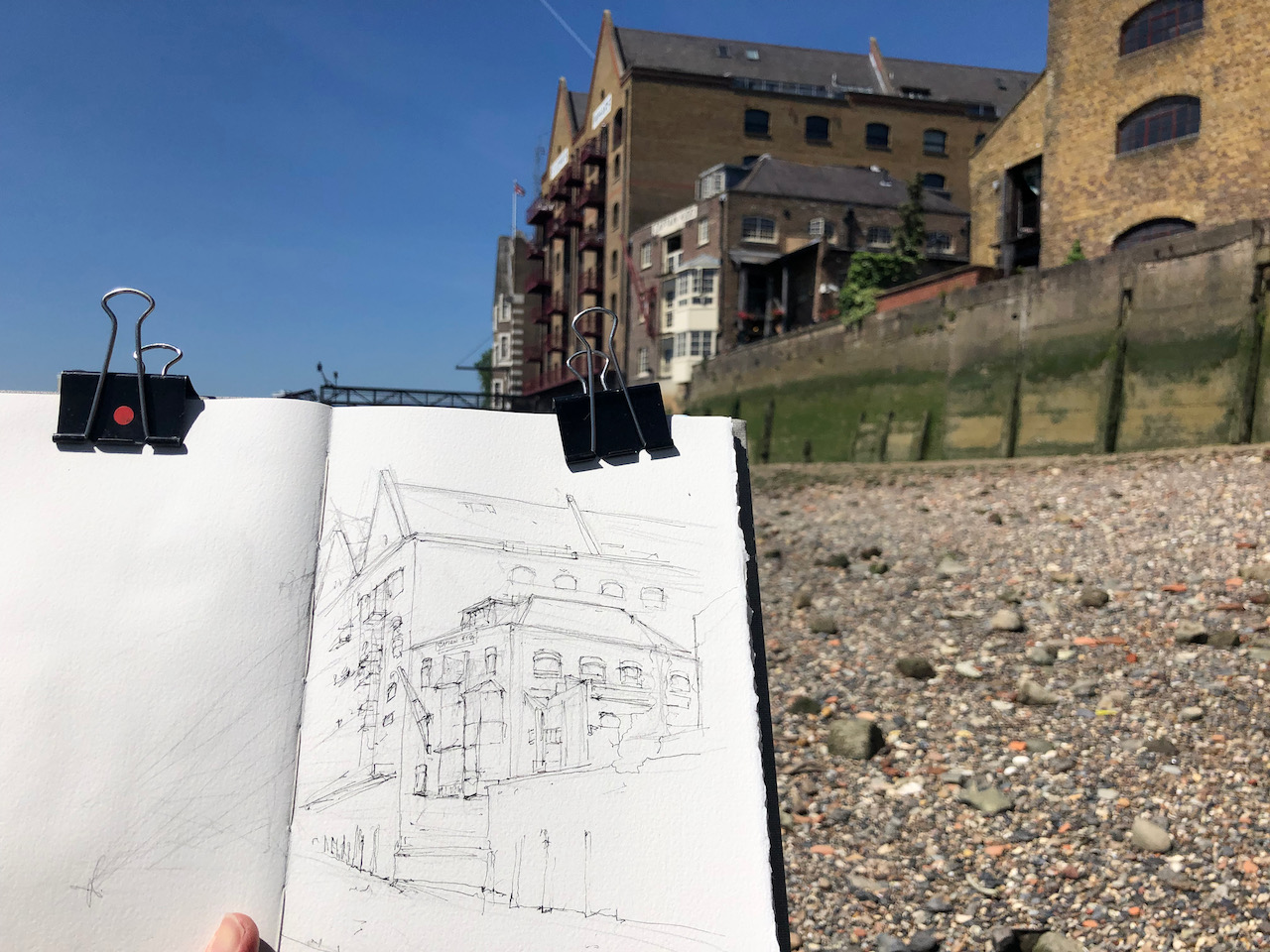
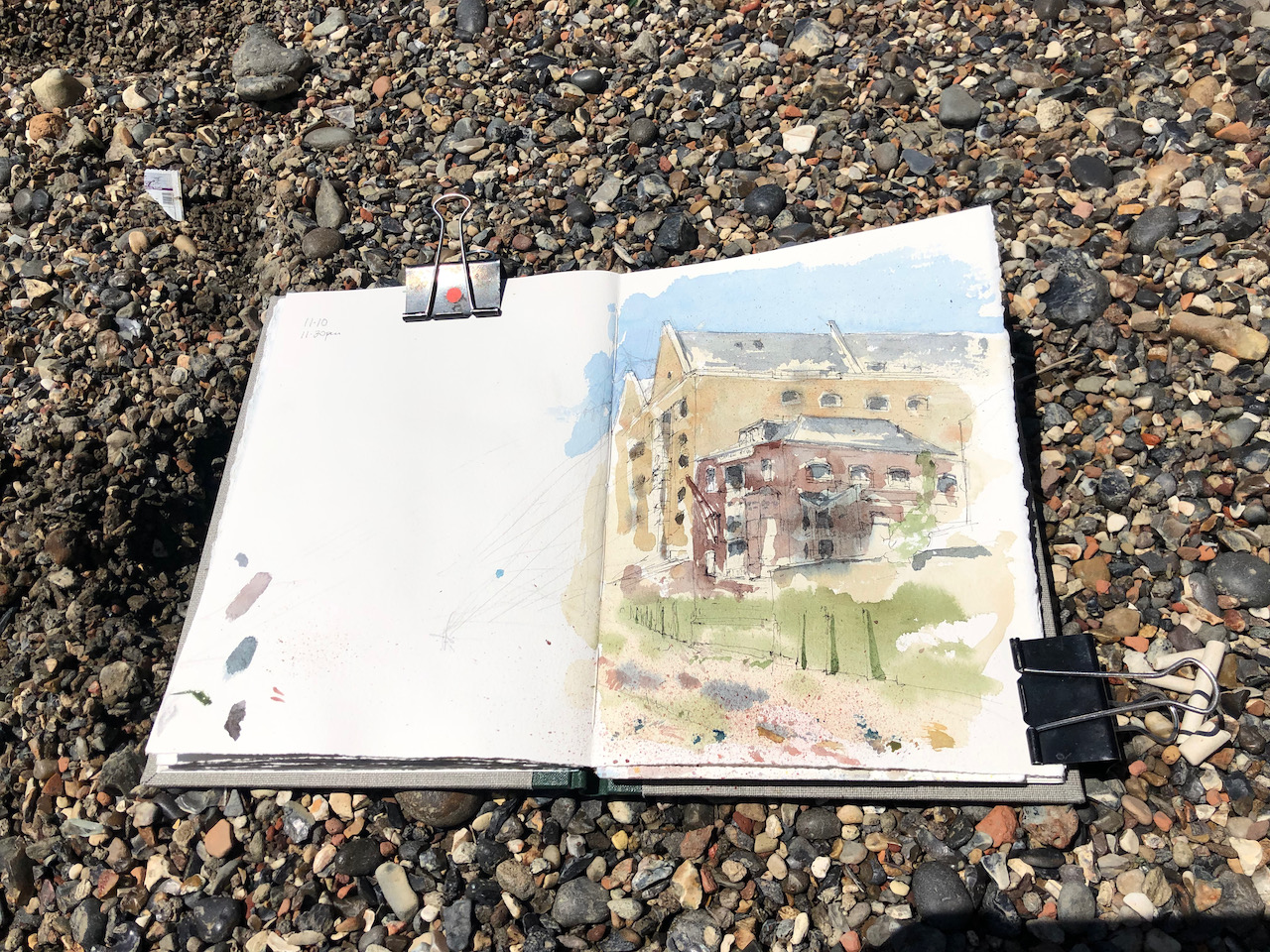
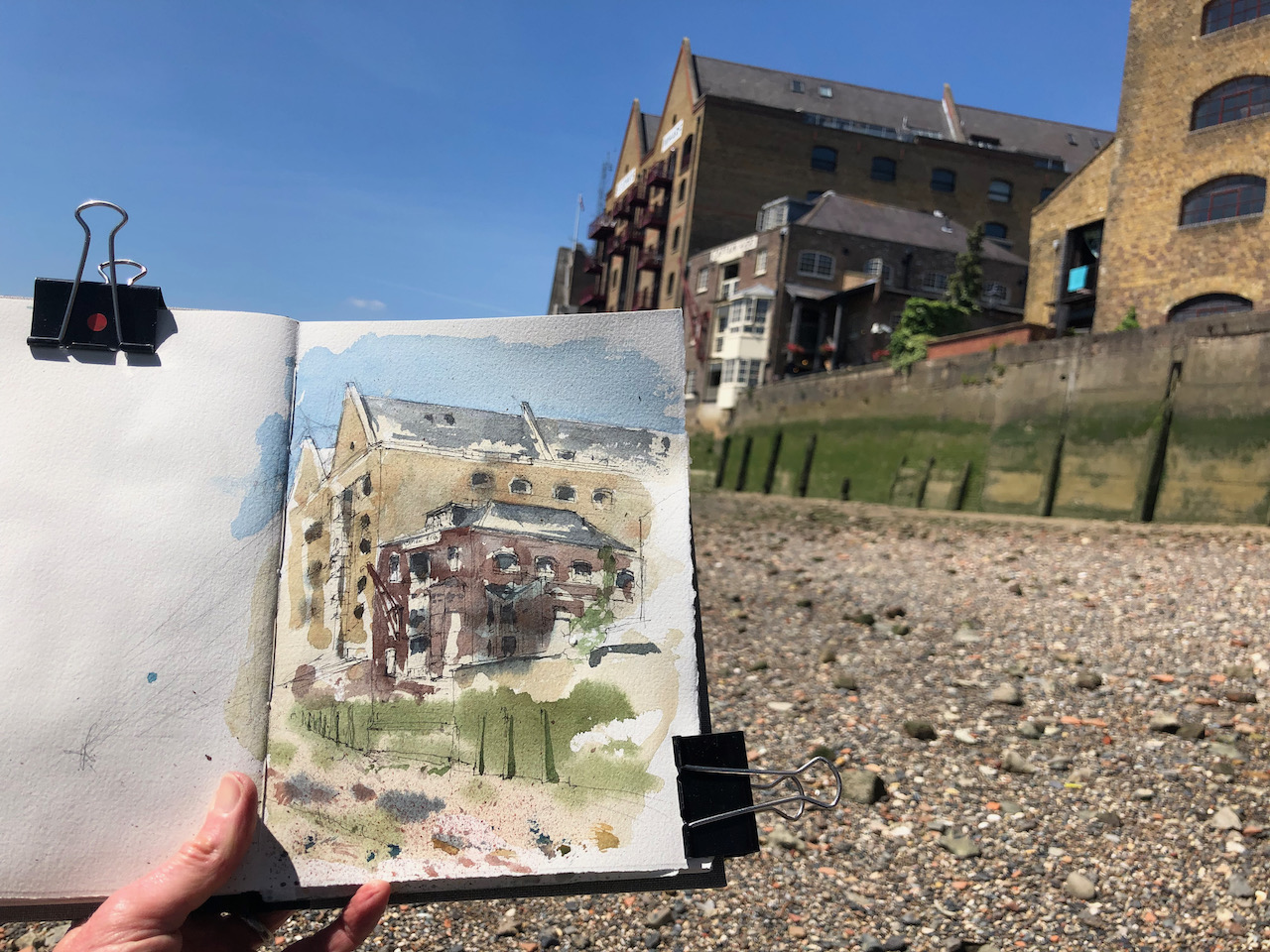
After breakfast at the Turk’s Head ( see this post ) I went down to the river. The tide was out. I sat on the Thames foreshore and sketched The Captain Kidd.
The Captain Kidd, Wapping E1. 12.10pm 14 June 2021. 7″ x10″ in Sketchbook 10
The Captain Kidd is the building at the front. It’s a pub and restaurant. The larger building behind is “St John’s Wharf”, a warehouse now converted into flats.
The “Captain Kidd” is named after a “seventeenth century pirate William Kidd who was executed [in 1701] at the nearby Execution Dock” according to various websites e.g. The Londonist.
However there is no “nearby Execution Dock”. The carefully researched article on “London Inheritance” concludes that “King Henry’s Stairs” were formerly “Execution Dock” (see note 2). The name was changed in the early 19th century to be better in line with the burgeoning use of the area for trade. The London Inheritance author cannot discover a specific “King Henry” connection. He includes a list of some of the people who were executed here, for crimes at sea including piracy, fighting on board ship, murdering shipmates, and treason.
I note with interest that, these days, the headquarters of the Marine Police are just a few hundred yards upstream. This is a very ancient establishment, which started with a one-year trial in 1798 (note 1).
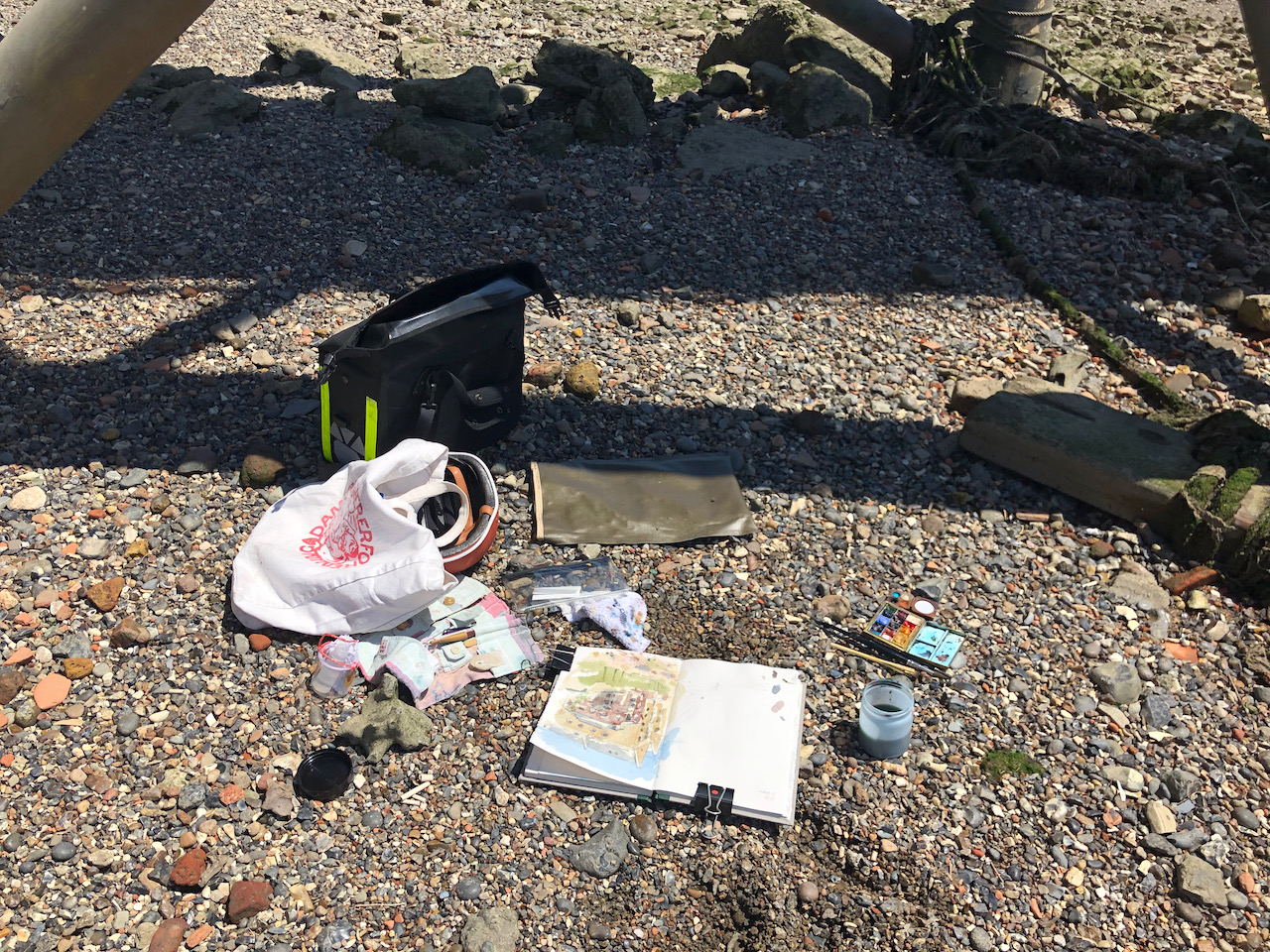
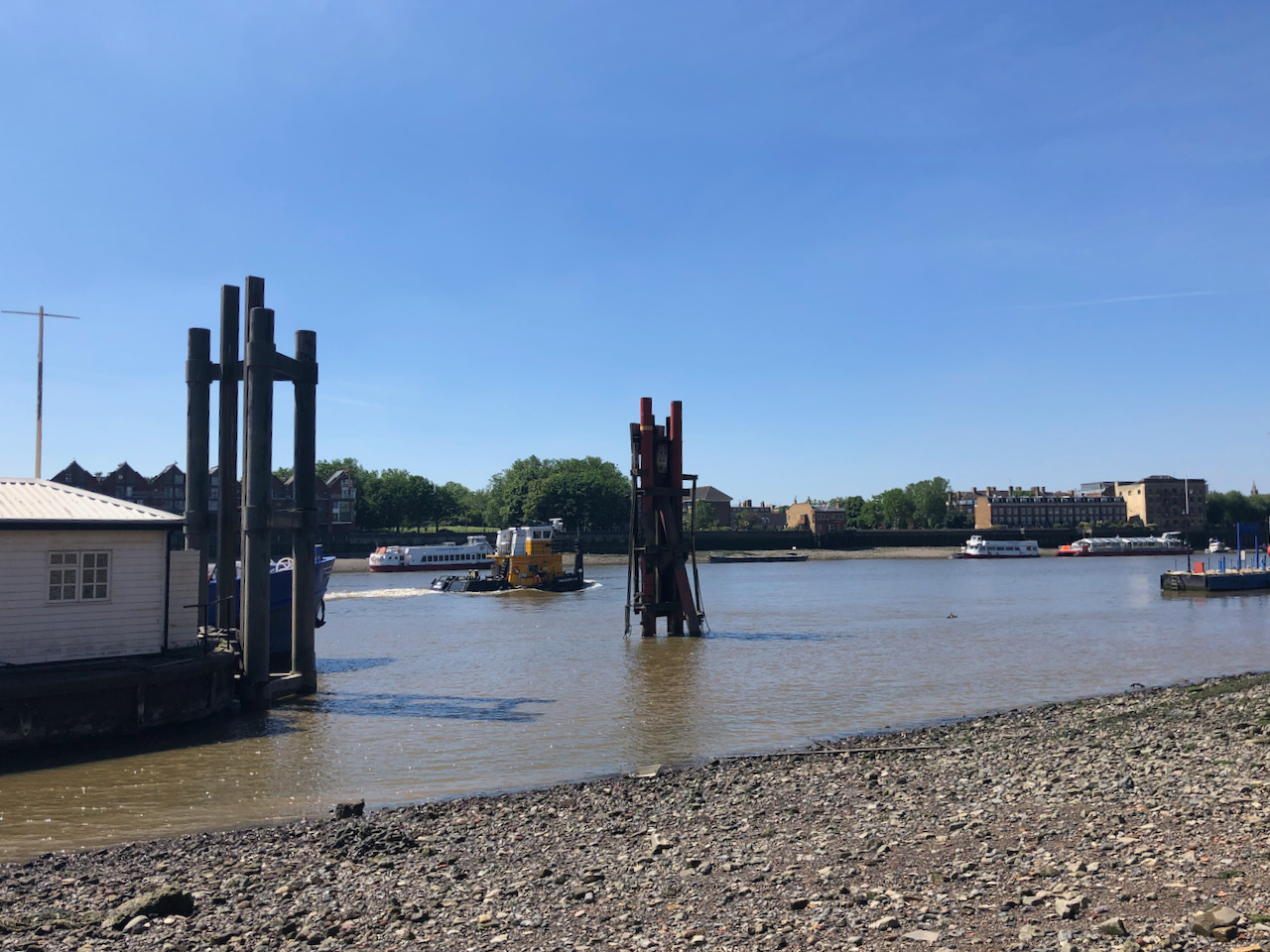
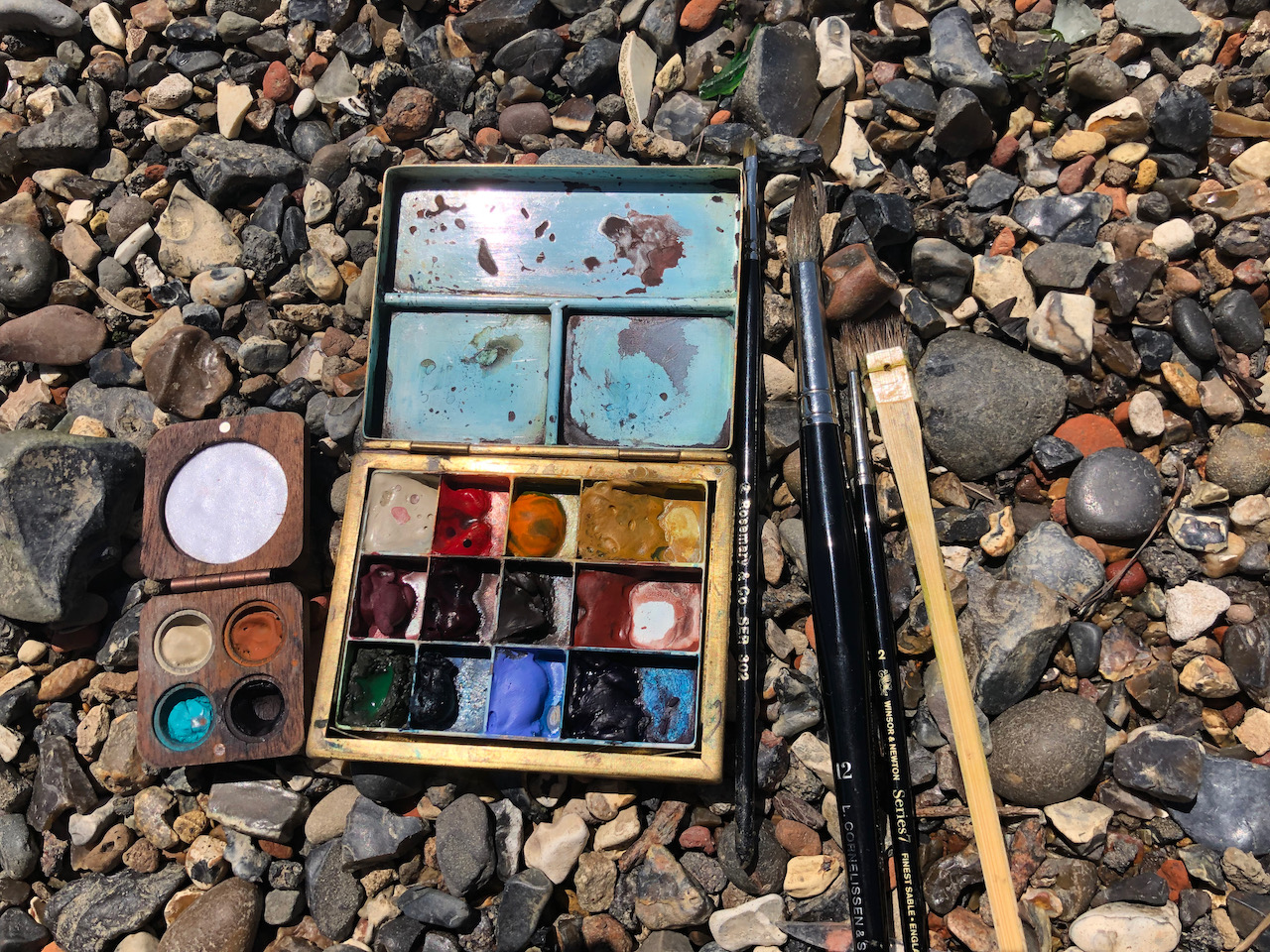
Here is work in progress on the drawing. See the wonderfully clean Thames foreshore.
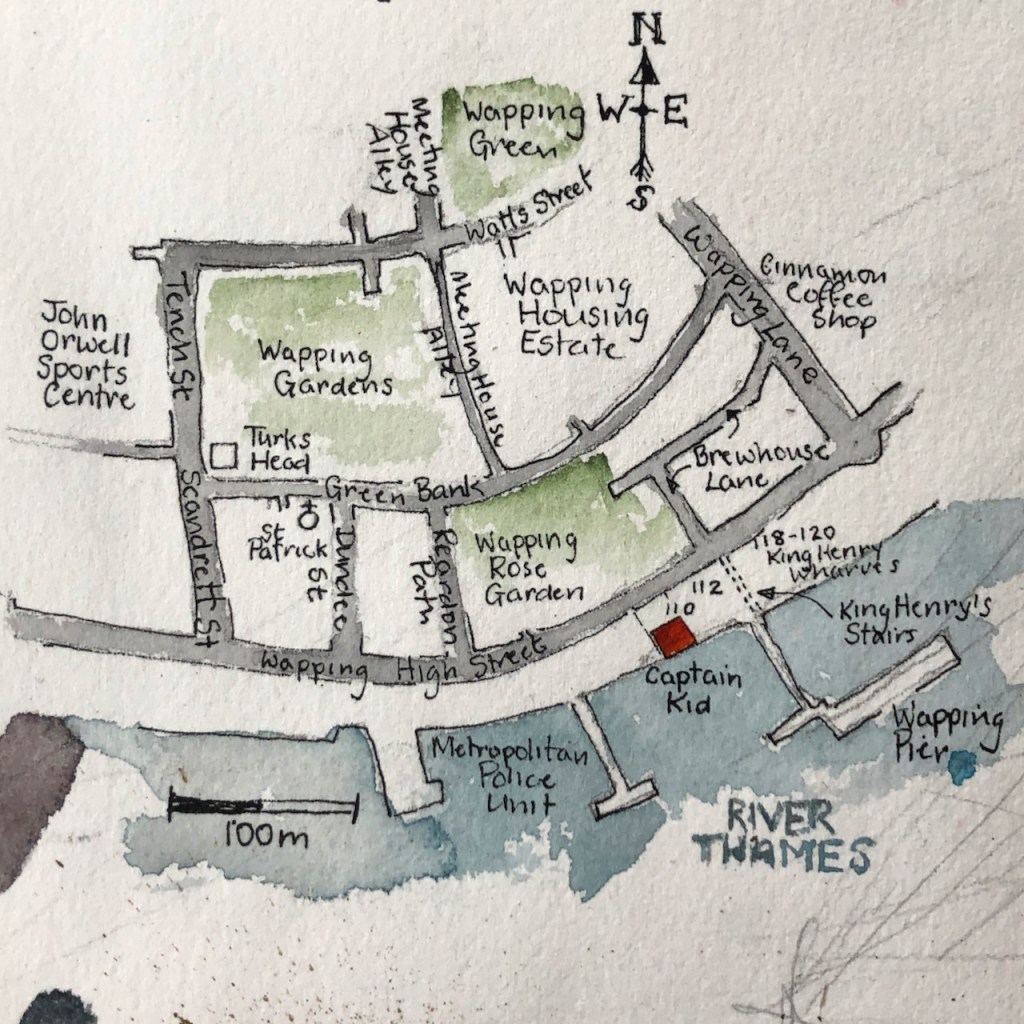
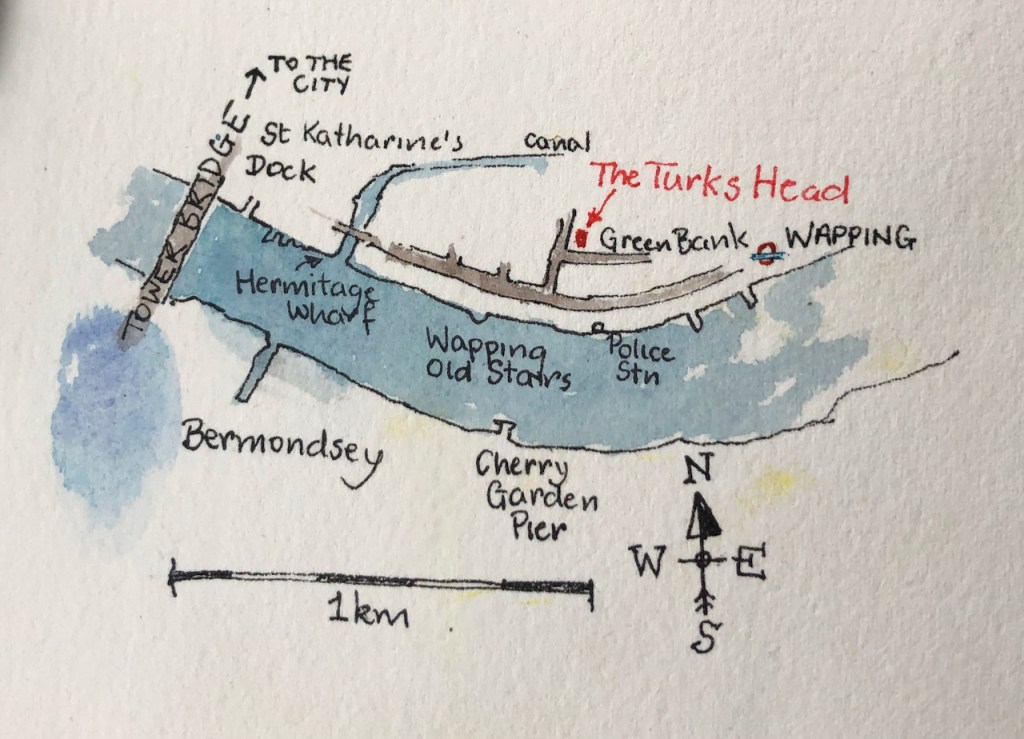
I drew my picture in the shade under Wapping pier. Here is a map:
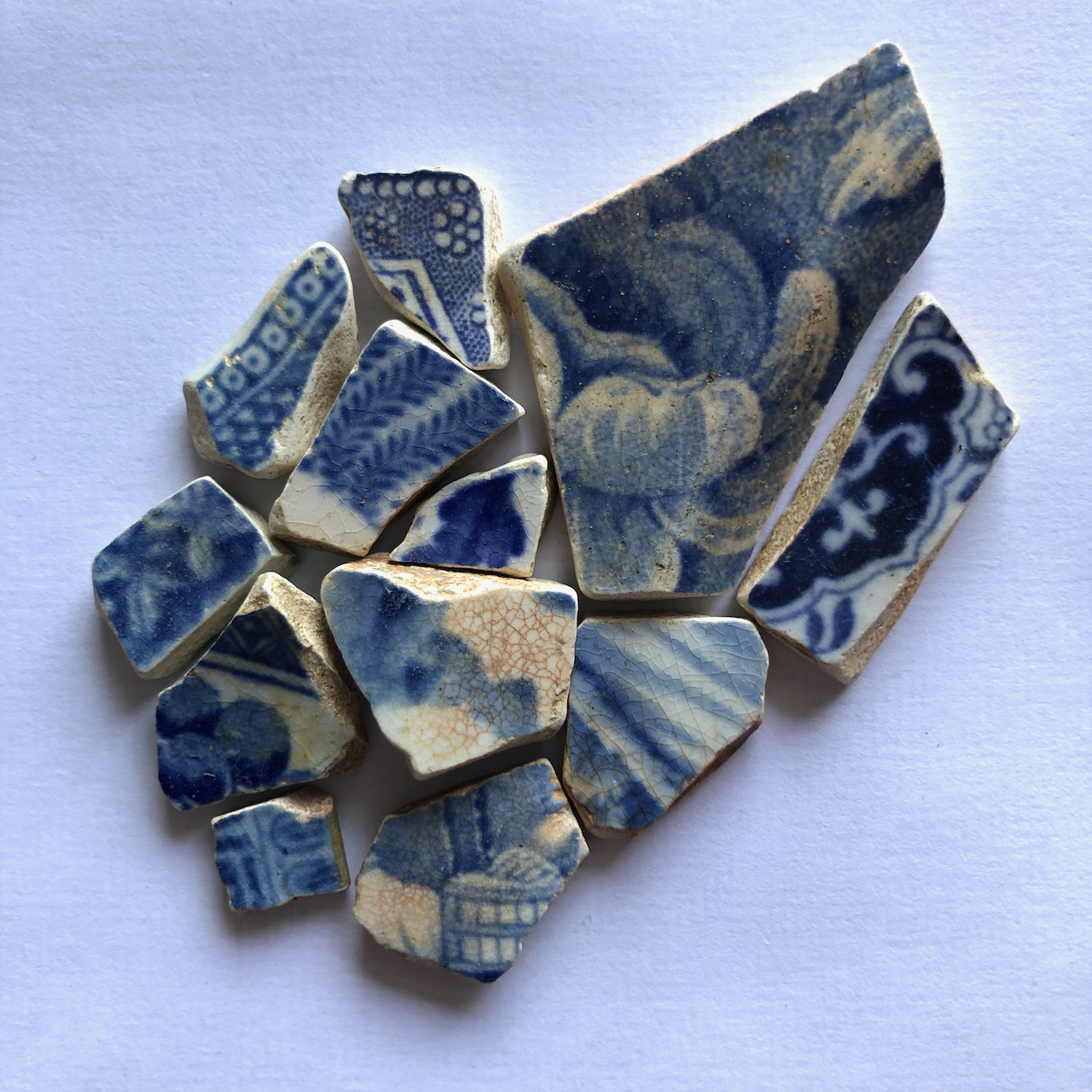
Walking back to the ladder, I collected a handful of porcelain pieces, blue and white. It was as though, years ago, someone threw a china bowl onto the foreshore, and the pieces somehow stayed in the same vicinity, through many tides. Or perhaps it is several bowls.
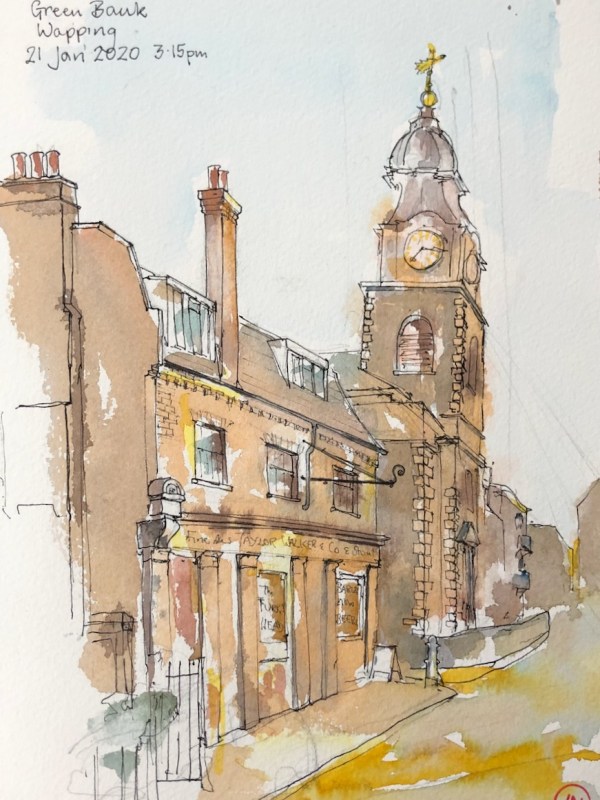
Here is the marvellous Turks Head Café, Wapping, rescued from demolition by local residents in the 1980s. Inside, I found warmth, quiet tables, and the gentle murmur of conversations: people actually talking to each other. I felt welcome here. The food was marvellous. Next time I’m going to have the Blueberry Tart. I only noticed it after I’d already had the substantial Chicken and Avocado Sandwich.…
Click a button below to share this post online, email it, or print it:
Le Pain Quotidien at Monument was open on Sunday. I found a table in the shade and sketched.
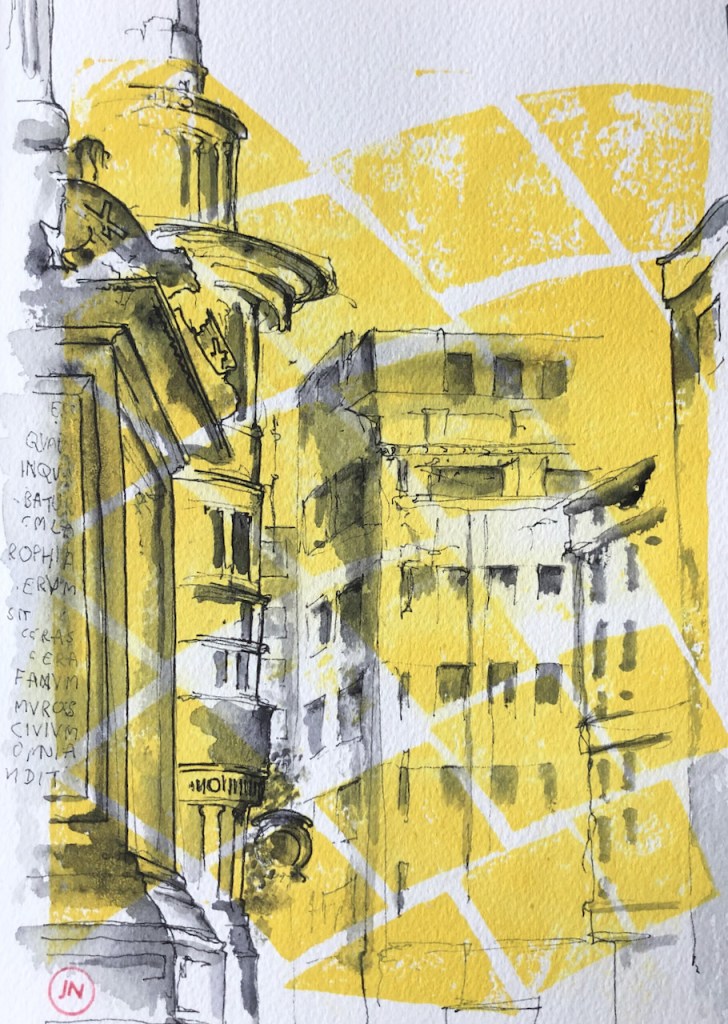
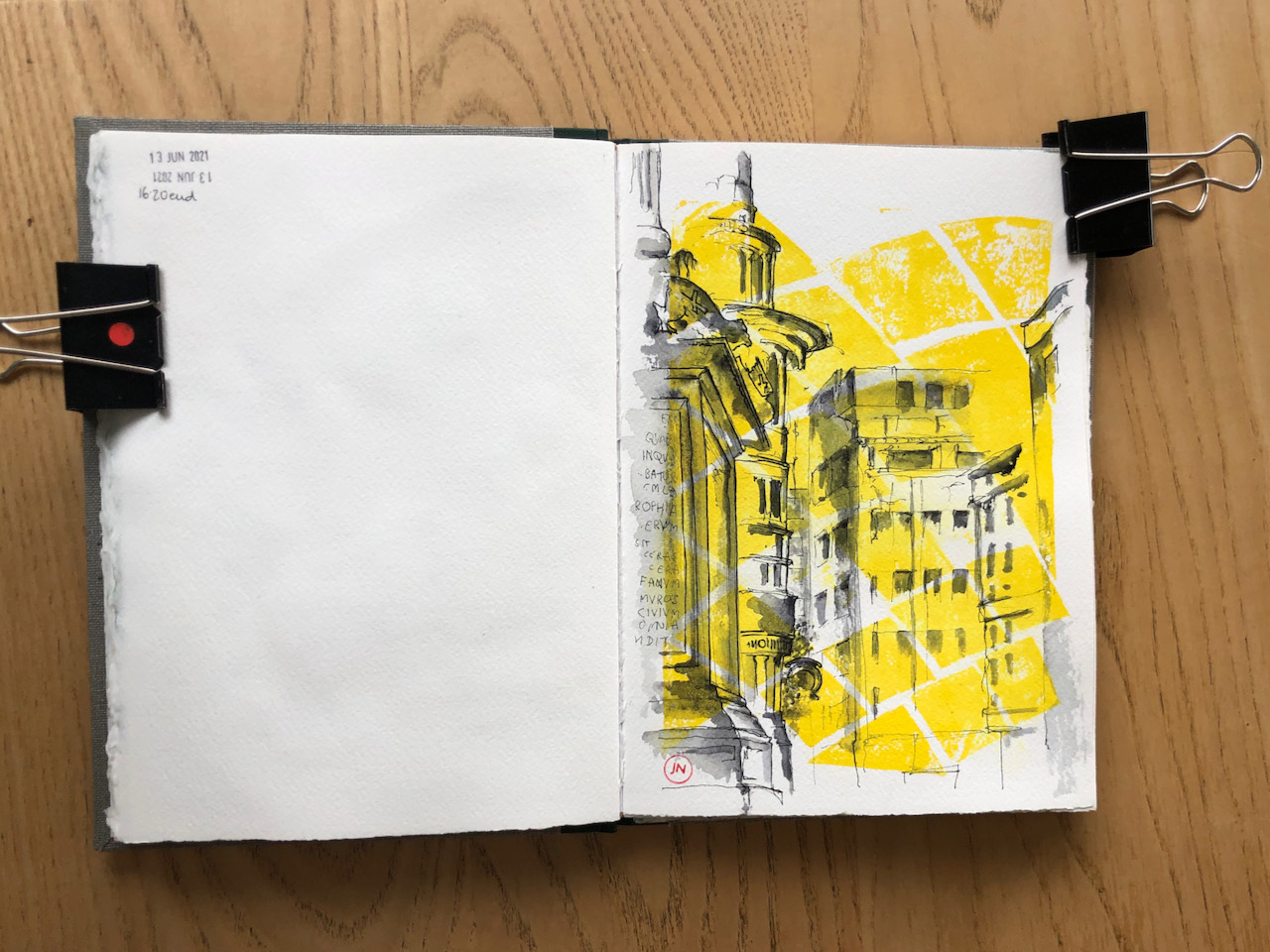
Back at home I added tone and an experimental print background. What do you think?
Drawing with experimental print overlay
Printing plate from cut cardboard
Drawing: waterproof ink and watercolour Neutral Tint.
Print: Plate made from cut cardboard. Printed using Schmincke relief ink: “Aqua Linodruck #19210 permanent yellow”. Printed directly into the sketchbook.
Click a button below to share this post online, email it, or print it:







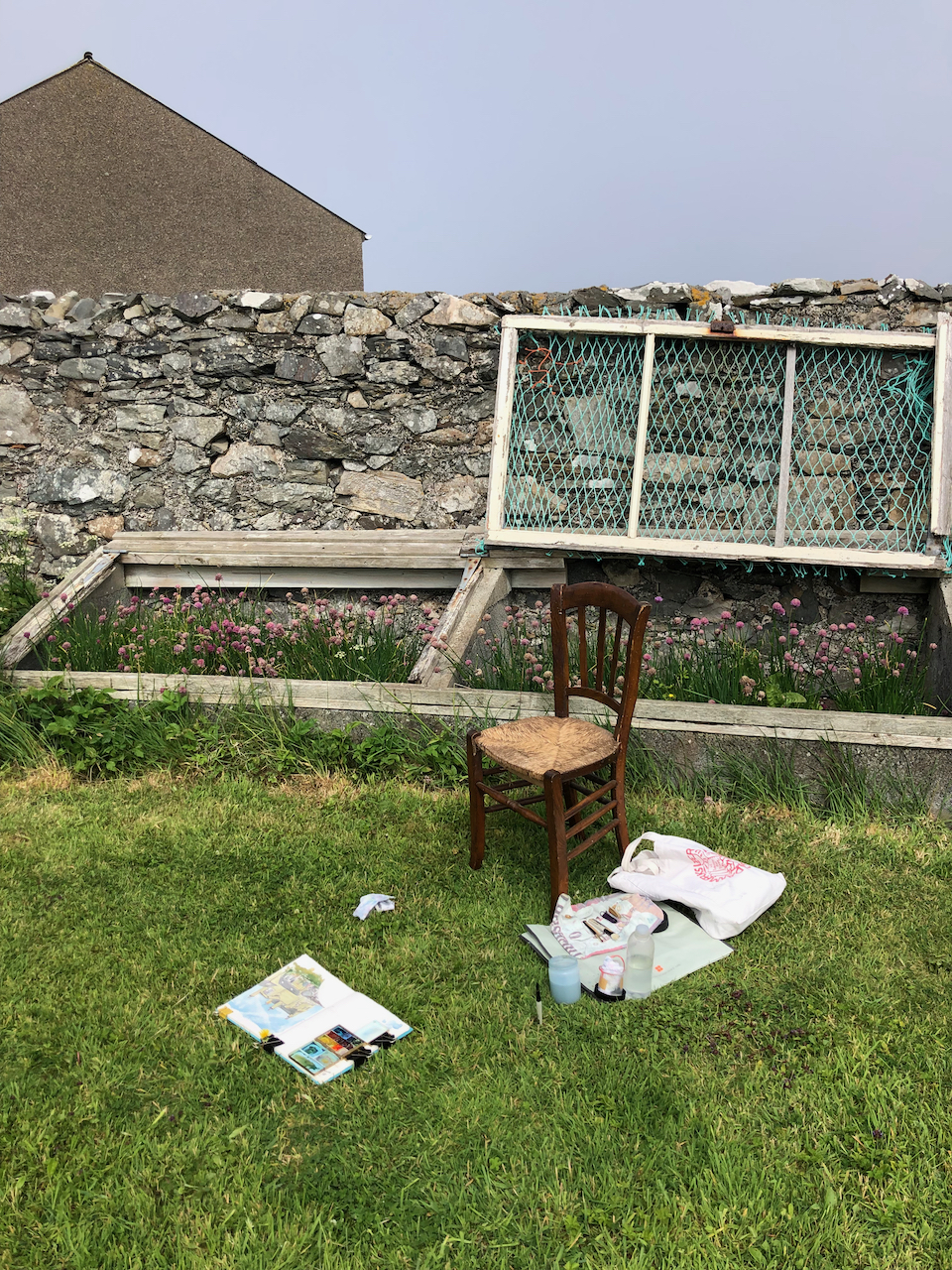




















 Jane Sketching