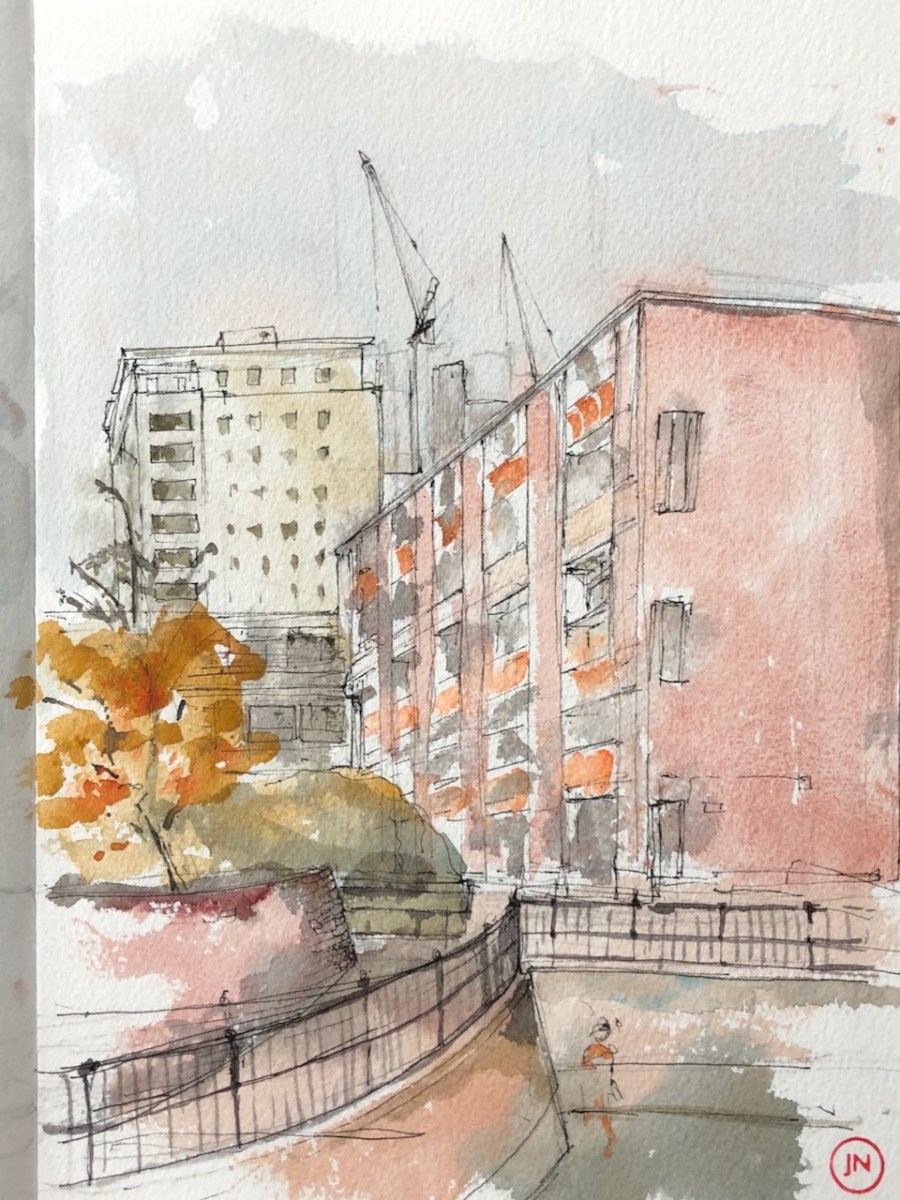
Yesterday I drew Basterfield House, sitting on some steps in the shadow of Great Arthur House.
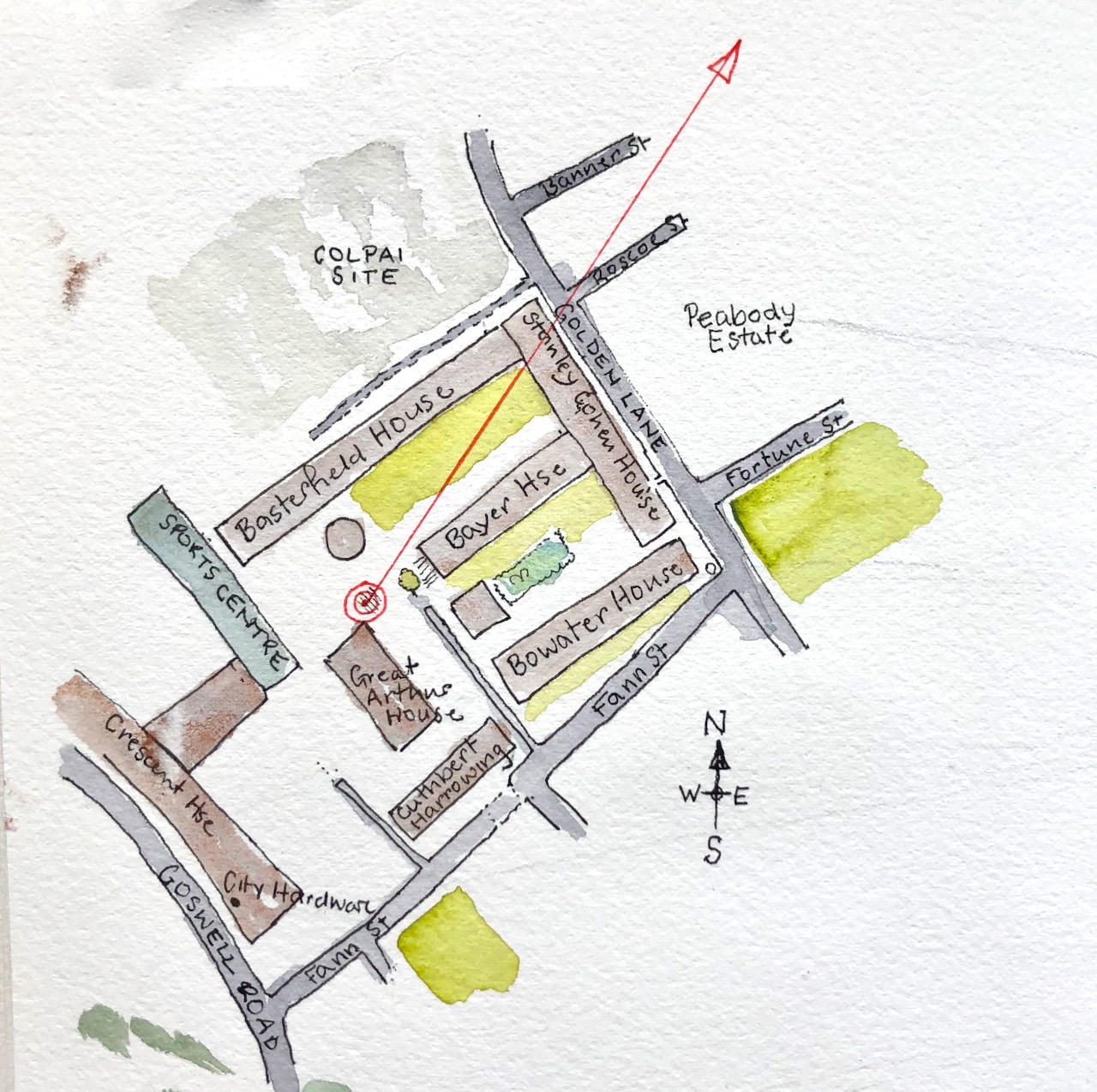
Basterfield House is at the North of the Golden Lane Estate. Here is a map. Great Arthur House was over my right shoulder, and cast its huge shadow in the afternoon sun.
Sketch map showing the view shown in the drawing.
Behind the tree, the low-rise block is Stanley Cohen House. In the background of the drawing is the Atlas Building, just to the left of the tree. On the right of the tree is the architect’s practice at 88 Golden Lane.
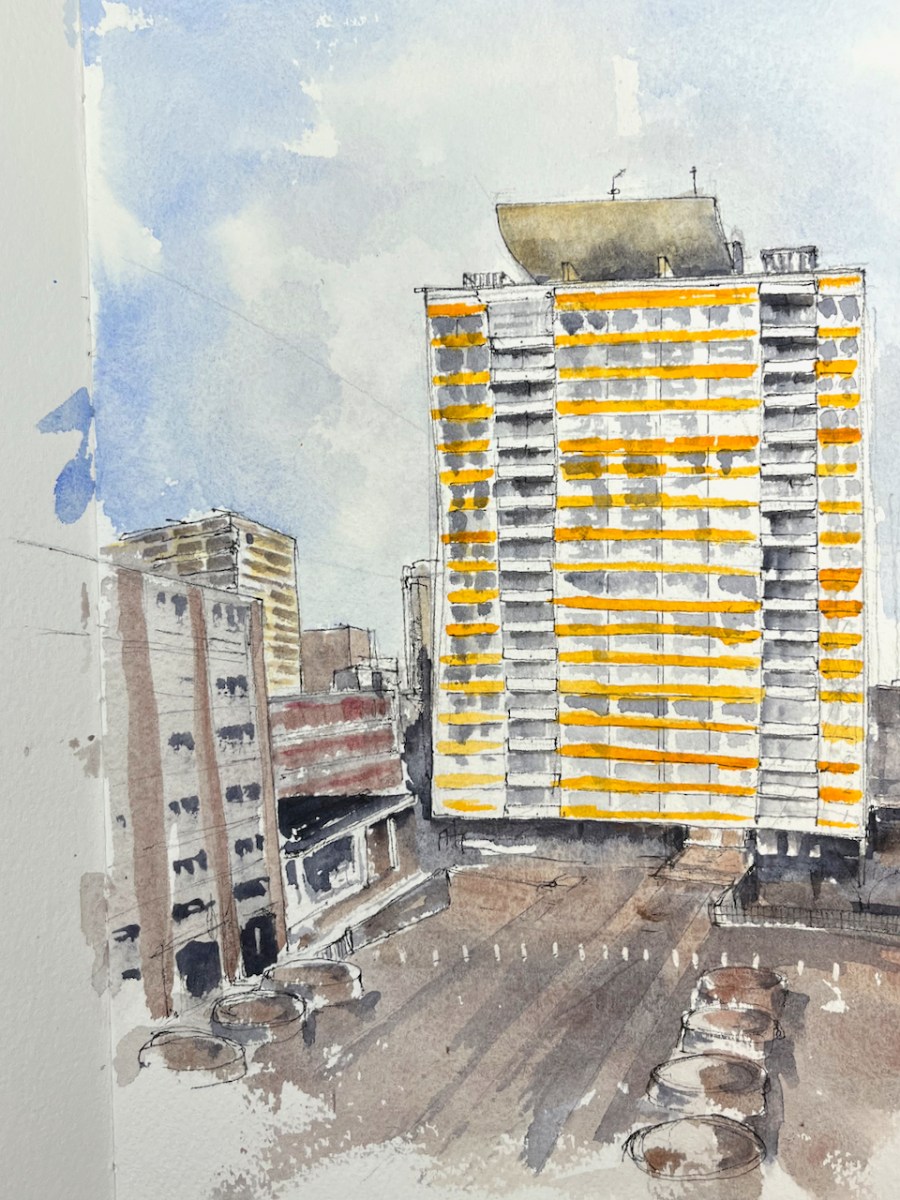
On the right is Godfrey House, Bath Street, Islington, part of the St Luke’s Estate managed by the London Borough of Islington. It’s former “council housing” built in 1965. Today many of the flats are privately owned, as is evident from the number listed for sale. On the left is the Atlas Building, on City…
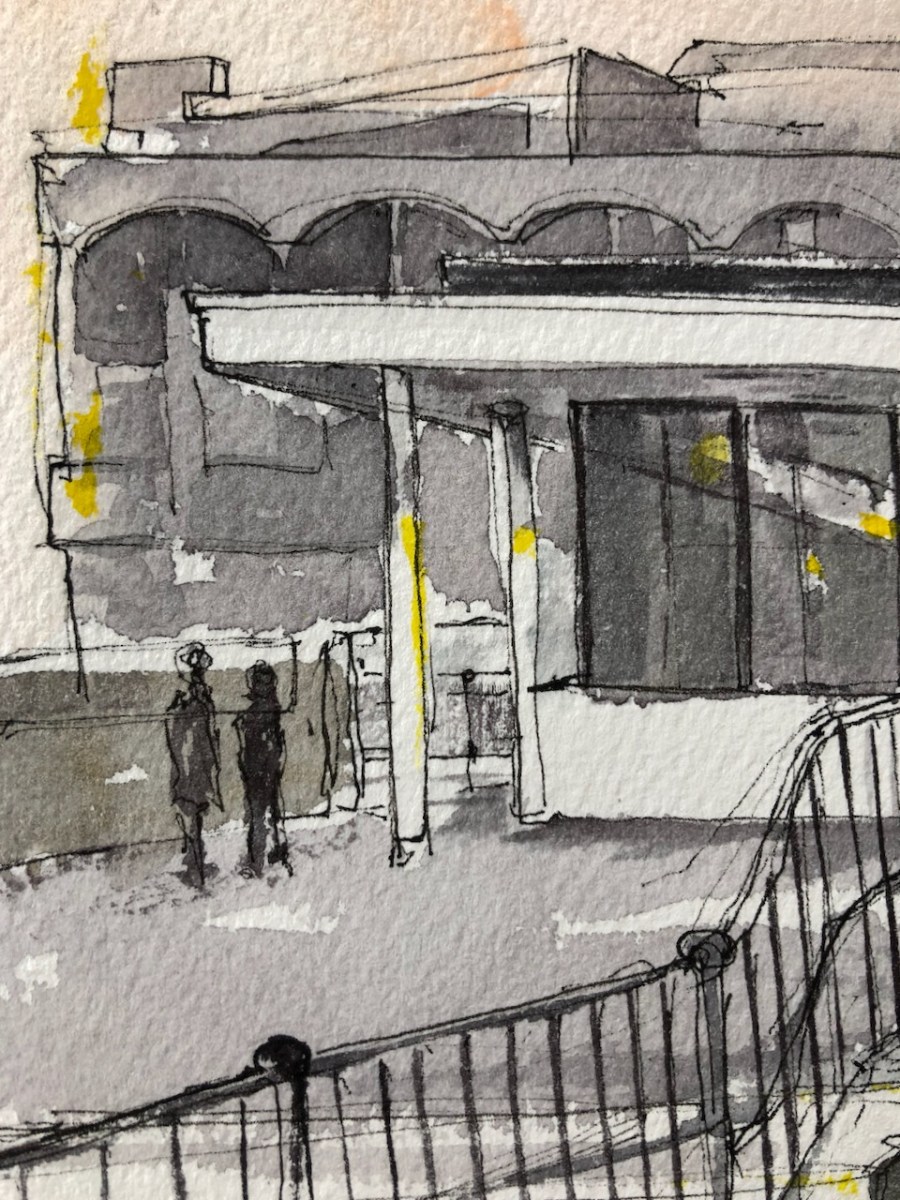
Today was a glorious sunny day. I walked out into the sun and everywhere was worthy of a sketch. Here is 88 Golden Lane, a strange thin building. It is an architects’ practice: Blair Architecture. I sketched this standing on the side of the road in the sun, then retreated to sit on my case…
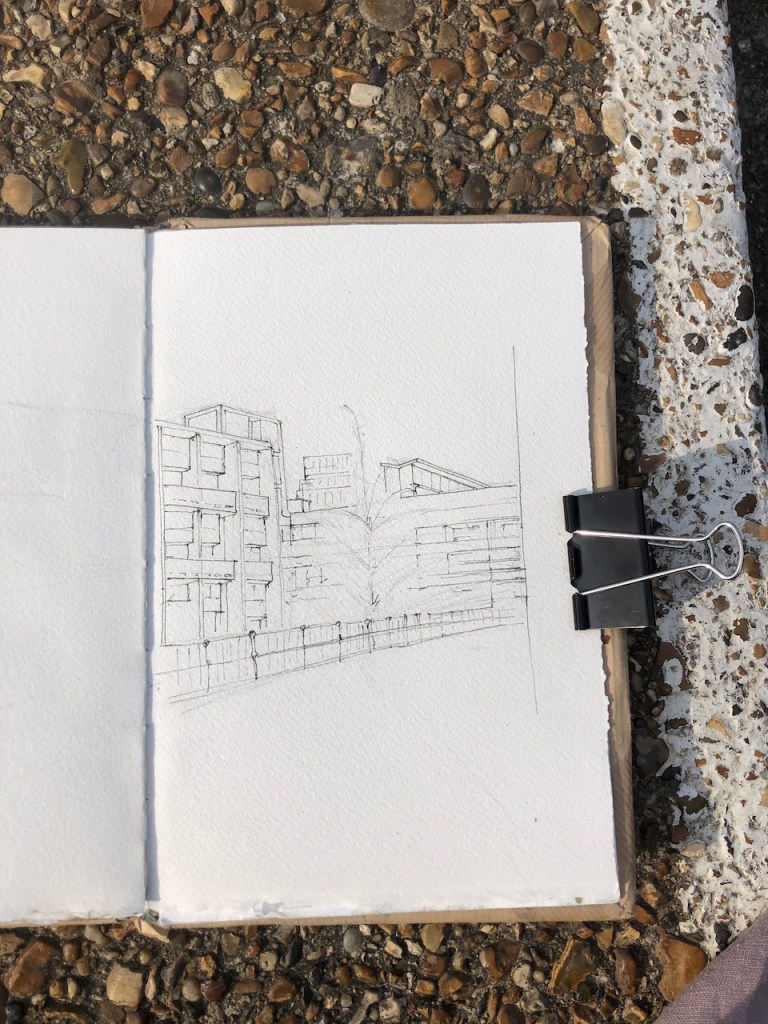
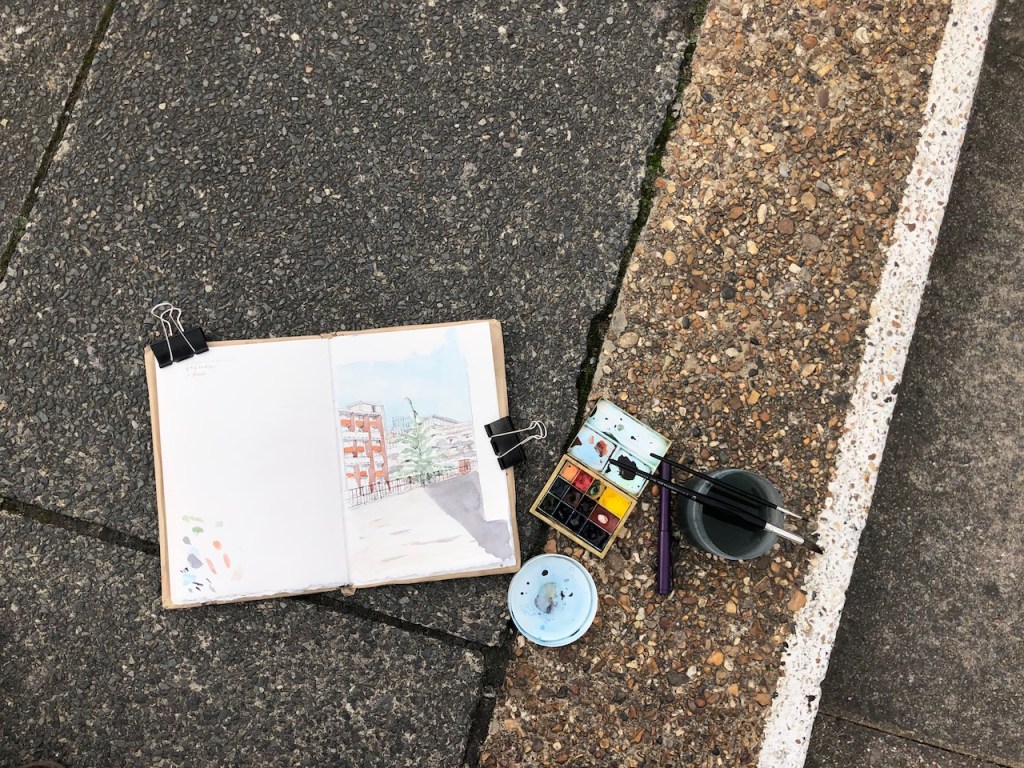
This drawing is 25cm by 16cm, 10 inches by 6½ inches on Arches 300gsm watercolour paper. It took 1½ hours. I did a preliminary sketch first, shown in the work-in-progress photos below. The colours are Fired Gold Ochre, Phthalo Turquoise, Transparent Pyrrol Orange, and Mars Yellow, watercolours over De Atramentis document black ink.
Preliminary Sketch with Winsor and Newton watercolour sticks.
Preliminary sketch, and work in Progress.
I have drawn the Golden Lane Estate before. Here is a selection of drawings in this area:
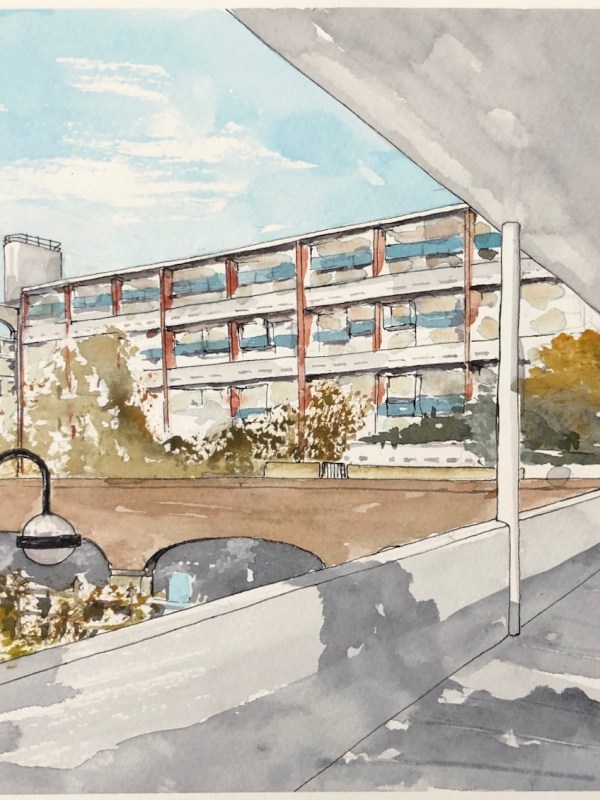
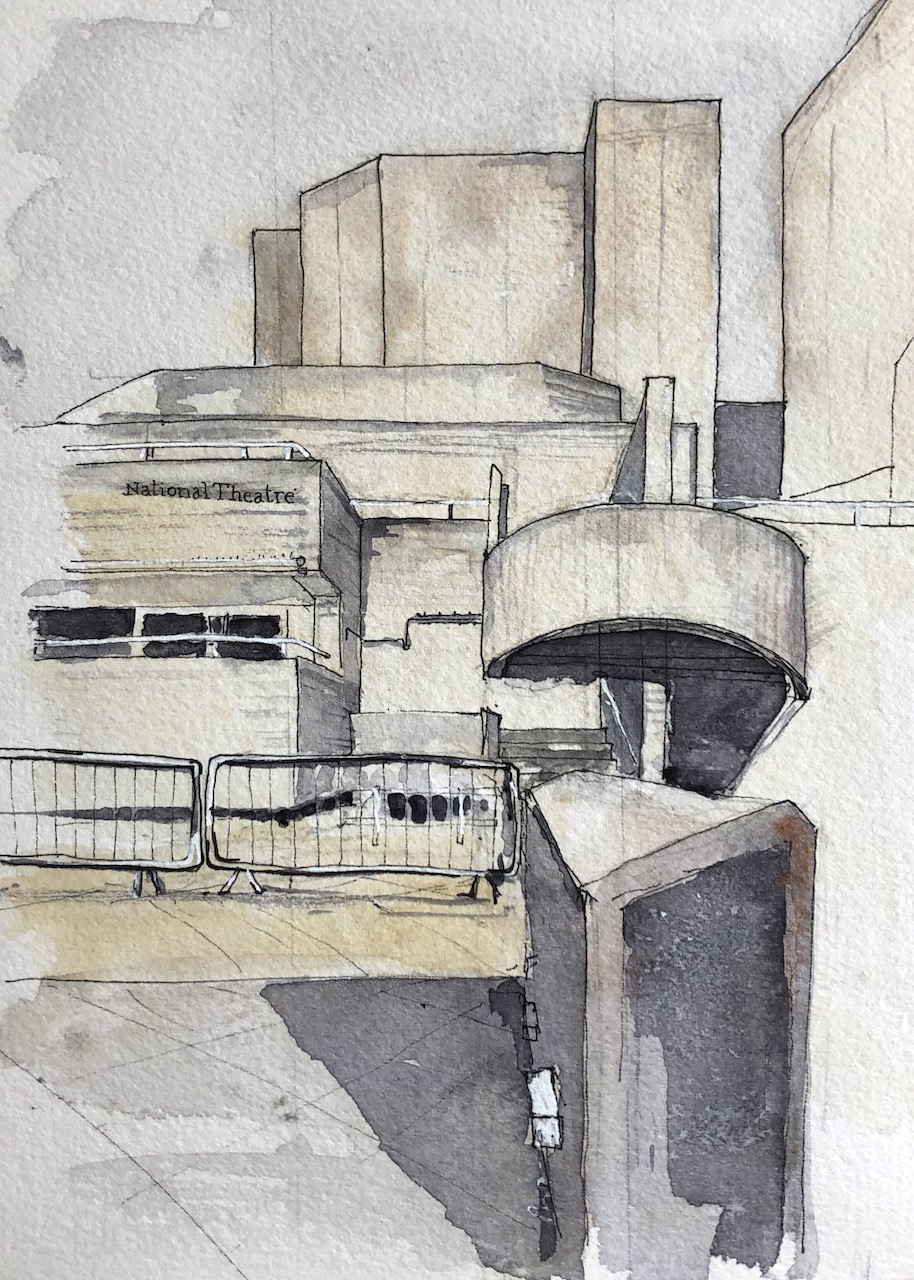
The National Theatre is on the South Bank of the Thames. Here is a view, looking East from Waterloo Bridge.
National Theatre, 9th September 2020, 3:20pm
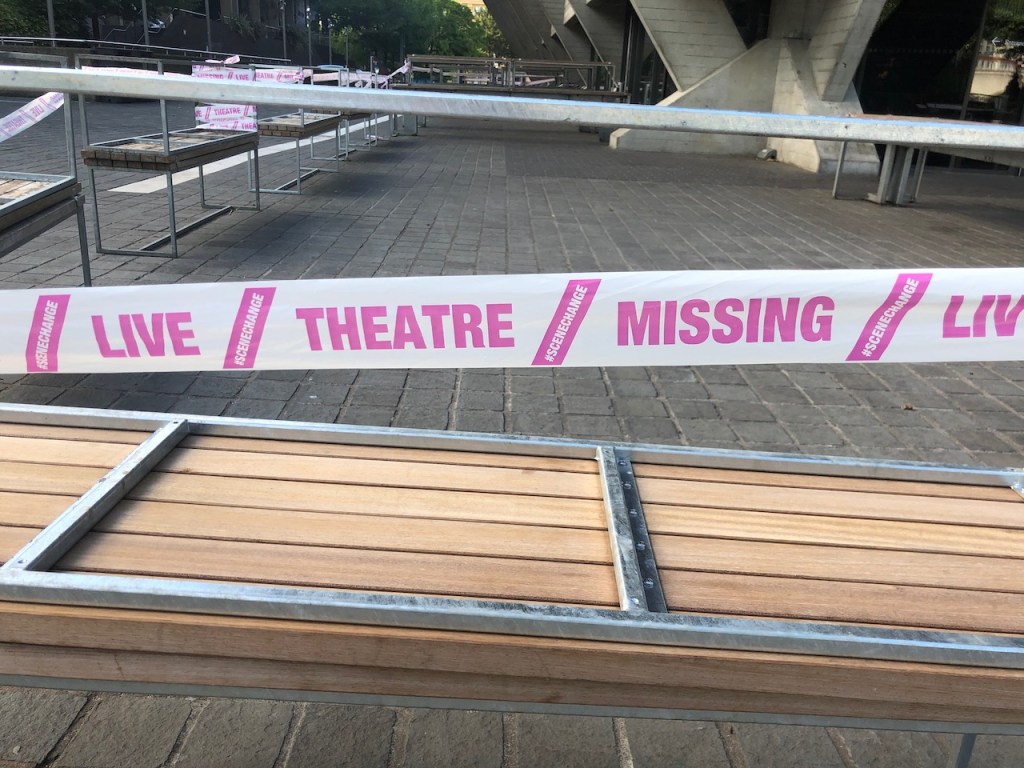
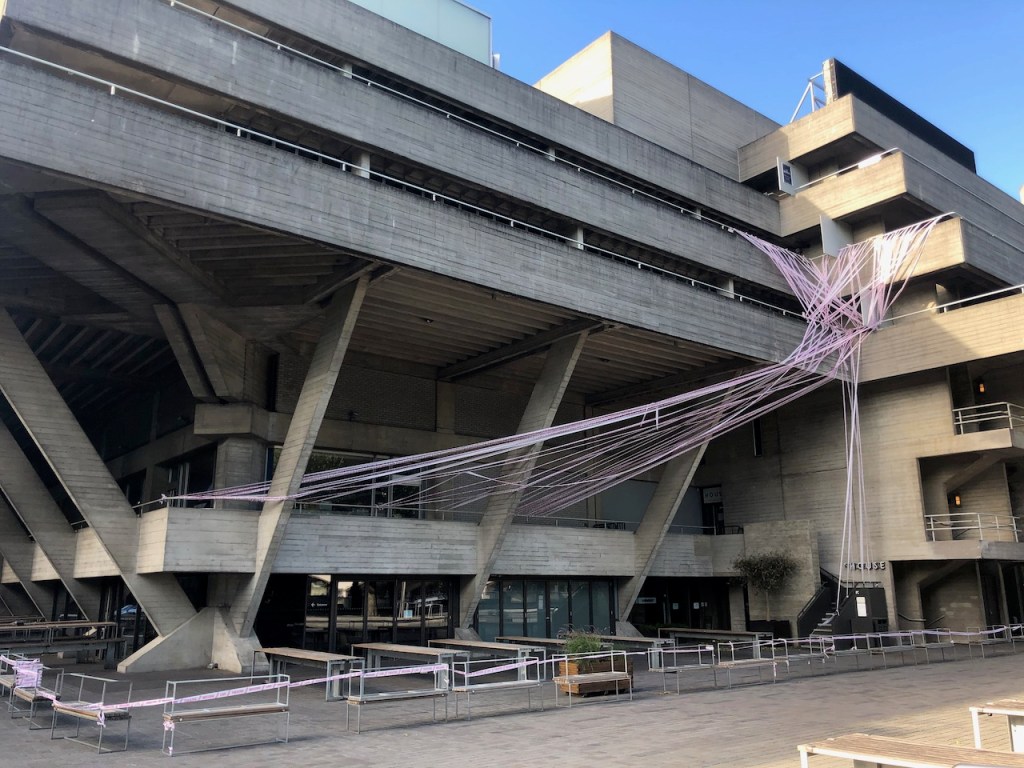
As you see, there are gates across the walkway. The Theatre is closed, and the walkways are closed.
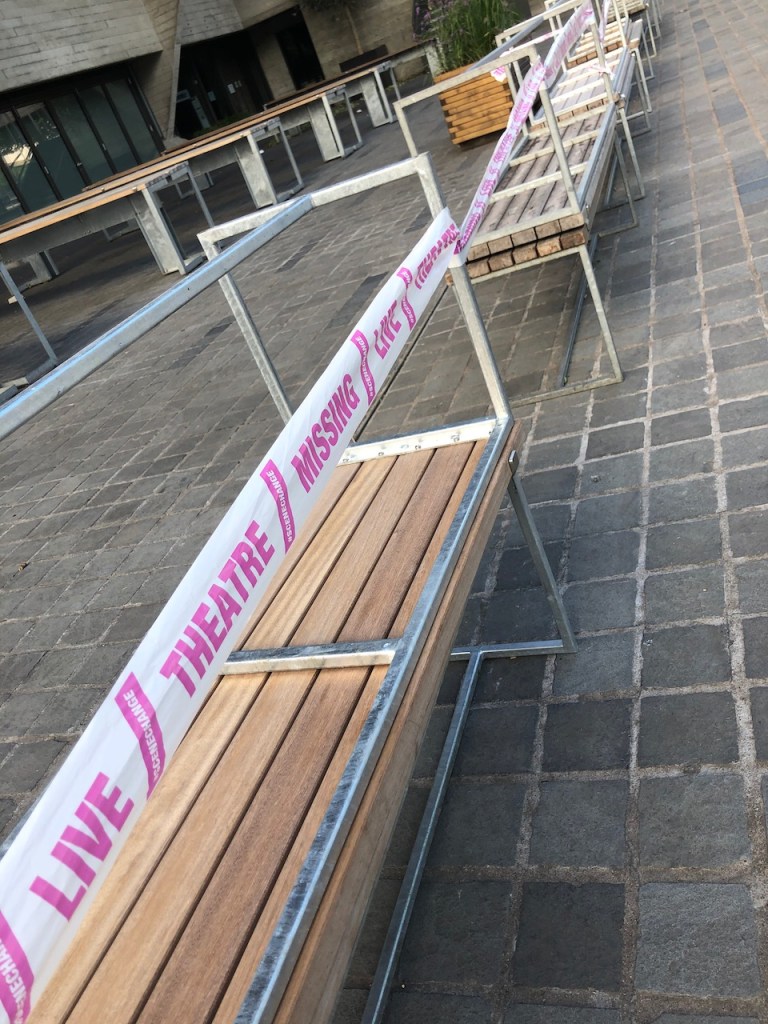
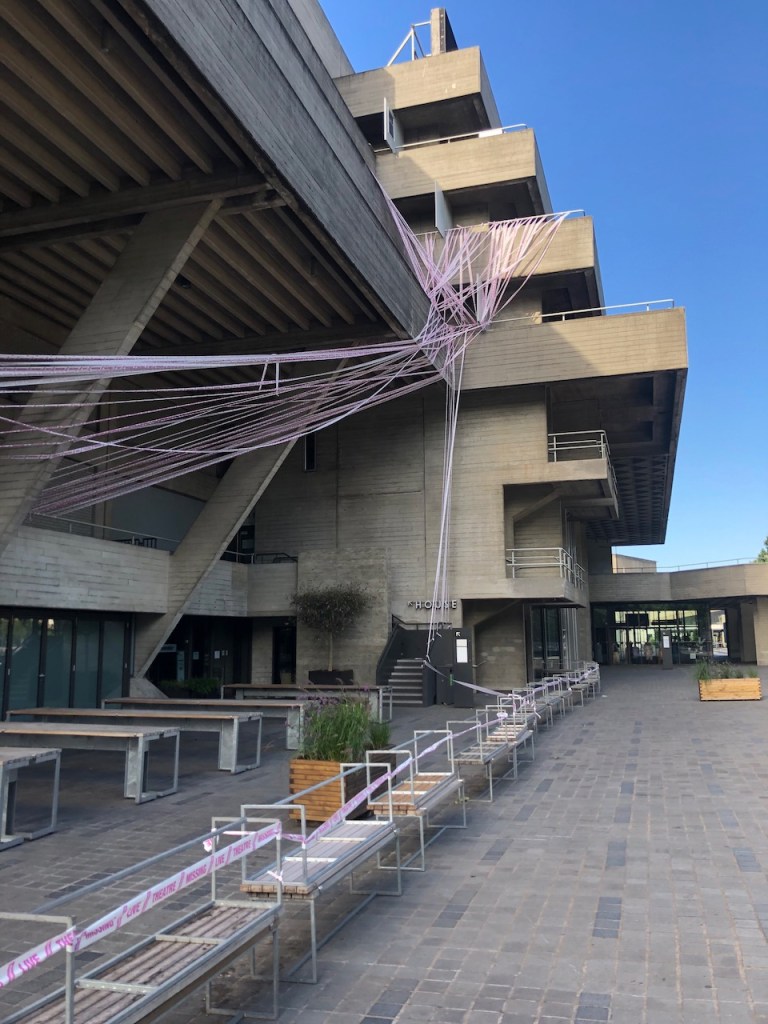
“Missing Live Theatre” – tape across the National Theatre 7th July 2020. This tape appeared across other theatres in London too. It was a protest that live theatre venues were not receiving government support to cope with their shut down in the COVID pandemic.
My drawing shows the empty theatre, and the empty walkways. The theatre restaurant, which is on the left of the drawing, is also closed and empty.
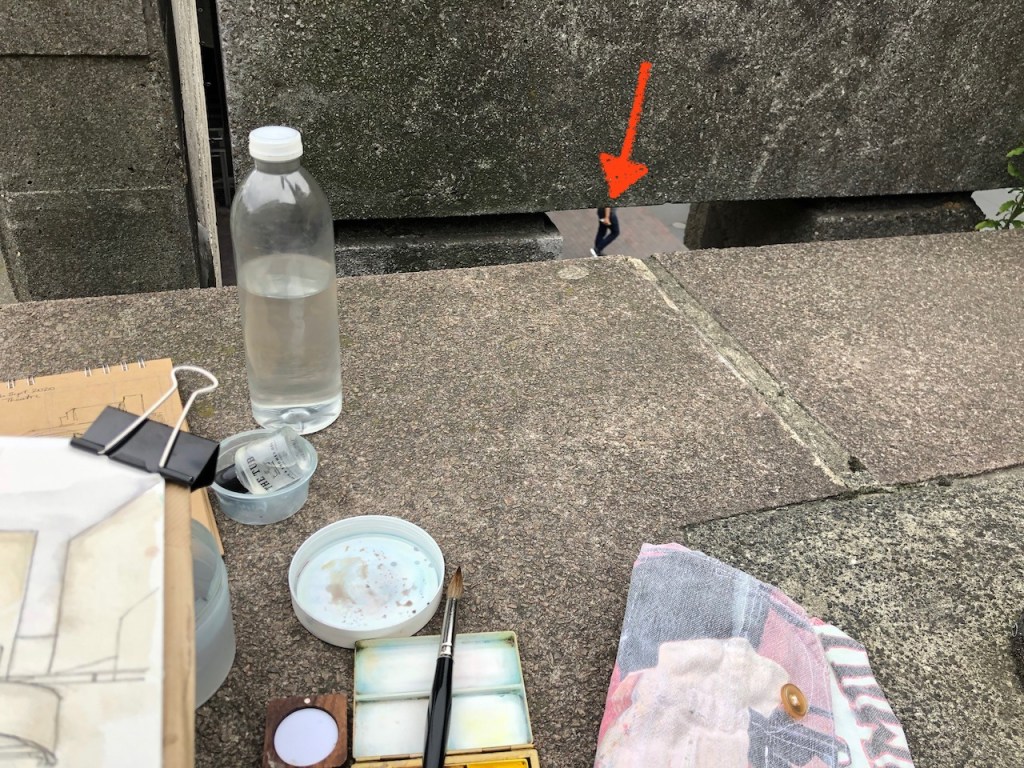
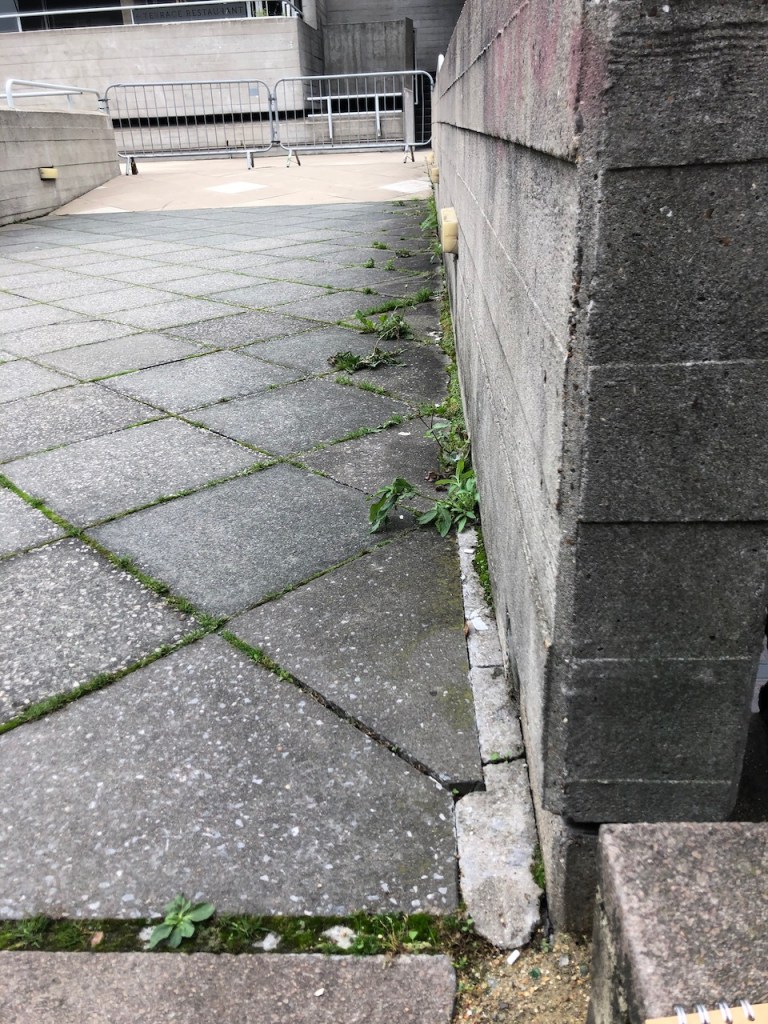
The walkways, in true 1960s style, are at “podium” level, above the traffic. Below me as a drew, people walked and cycled, and traffic passed on the nearby road, Upper Ground. Grass and buddleia grow in the cracks. Life continues, but at a different level.
Life in the cracks.
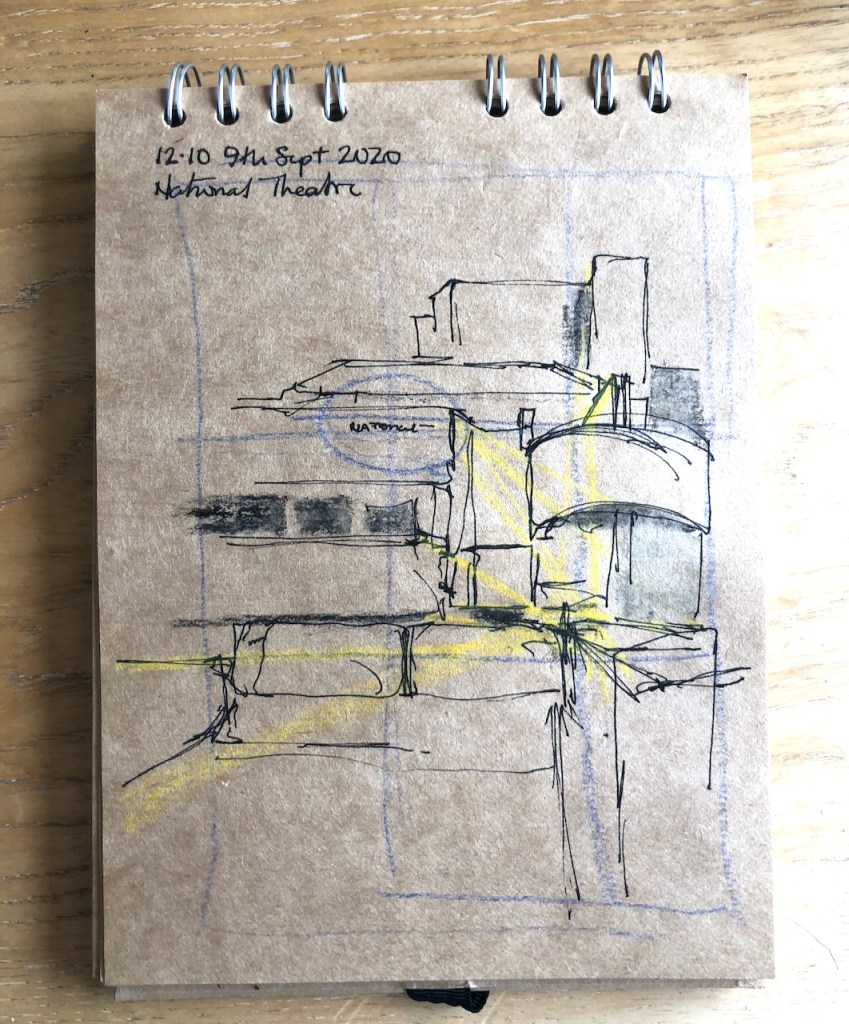
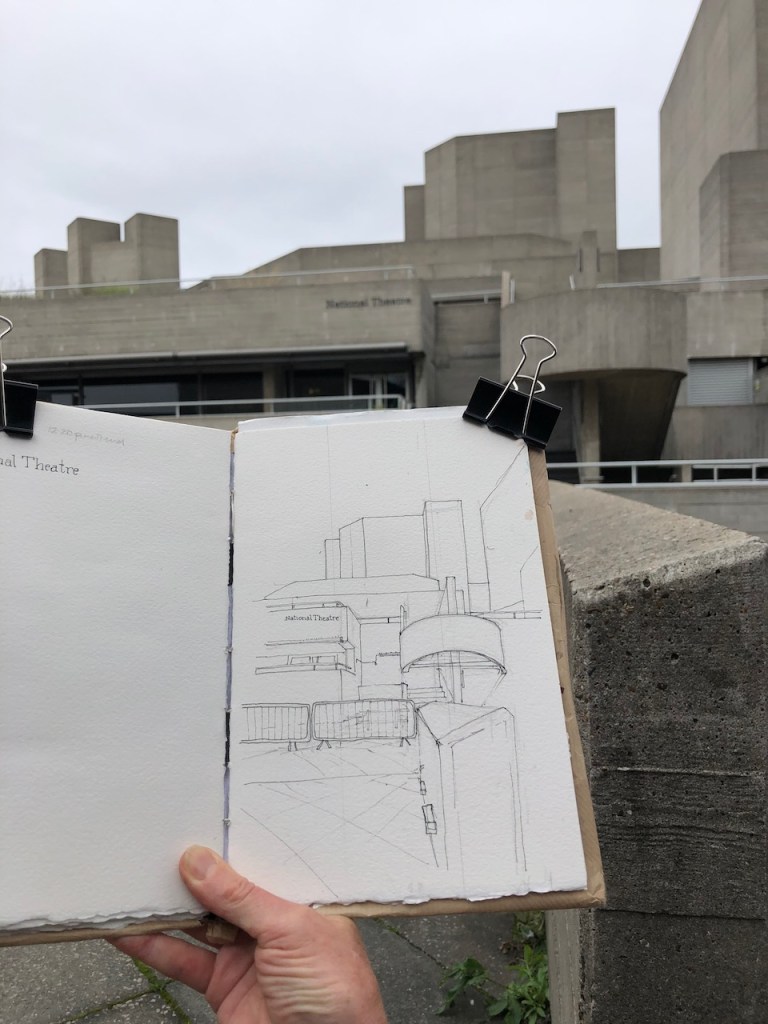
This drawing is 25cm by 16cm, 10 inches by 6½ inches on Arches 300gsm watercolour paper. It took 1½ hours. I did a preliminary sketch first, shown in the work-in-progress photos below. The colours are Buff Titanium, Neutral Tint, and Lunar Earth, all Daniel Smith watercolours, over De Atramentis document black ink.
Preliminary sketch. Yellow lines show the perspective lines.
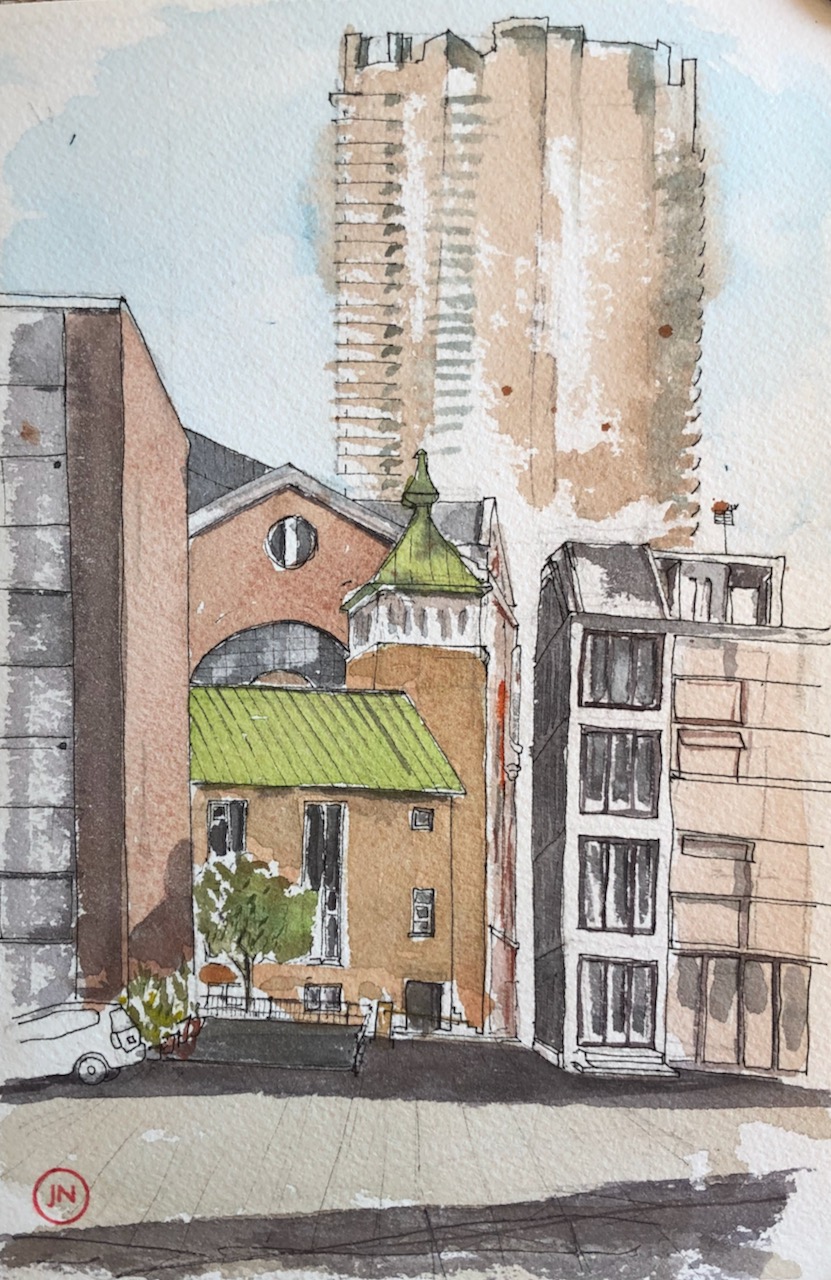
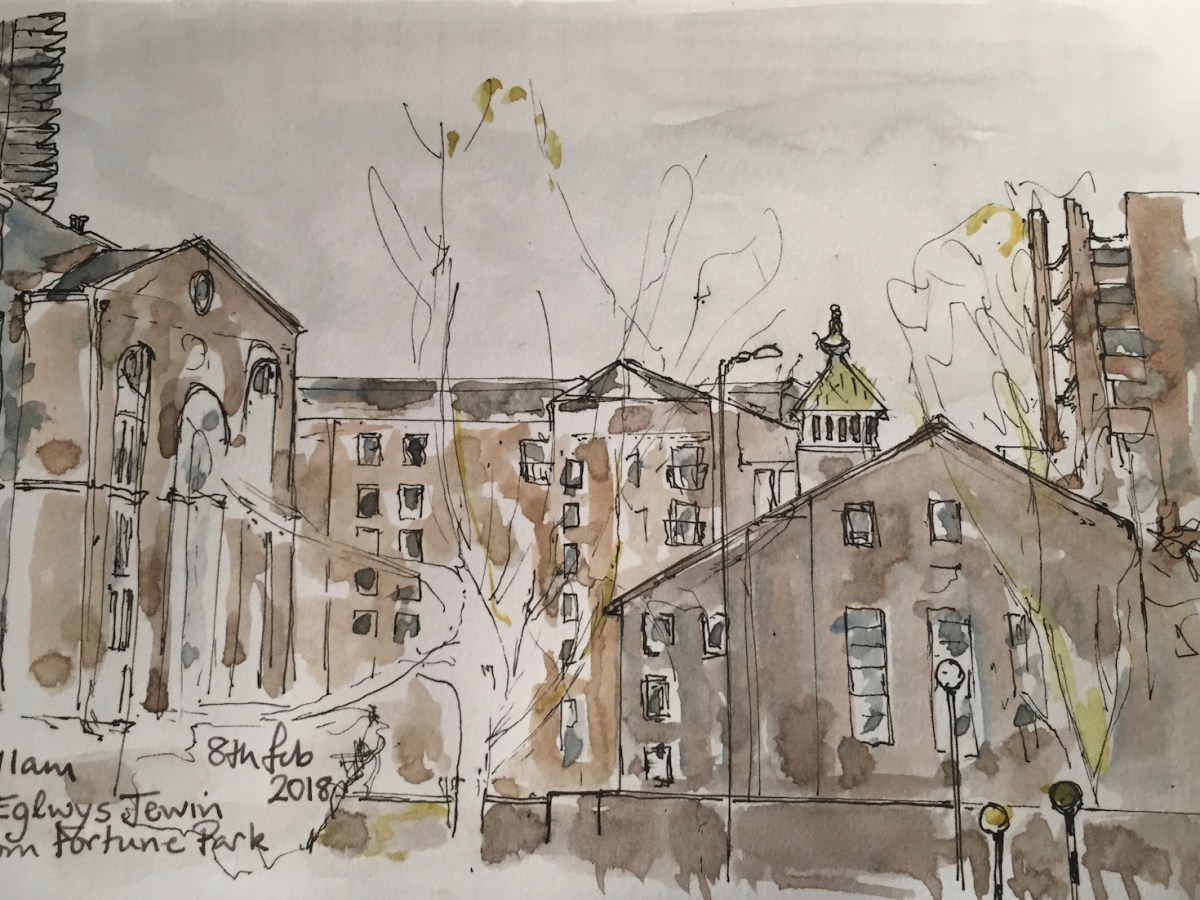
On a glorious sunny Sunday, the sun lit up the roof of the Welsh Church.
Eglwys Jewin, the Welsh Church, from Golden Lane Estate.
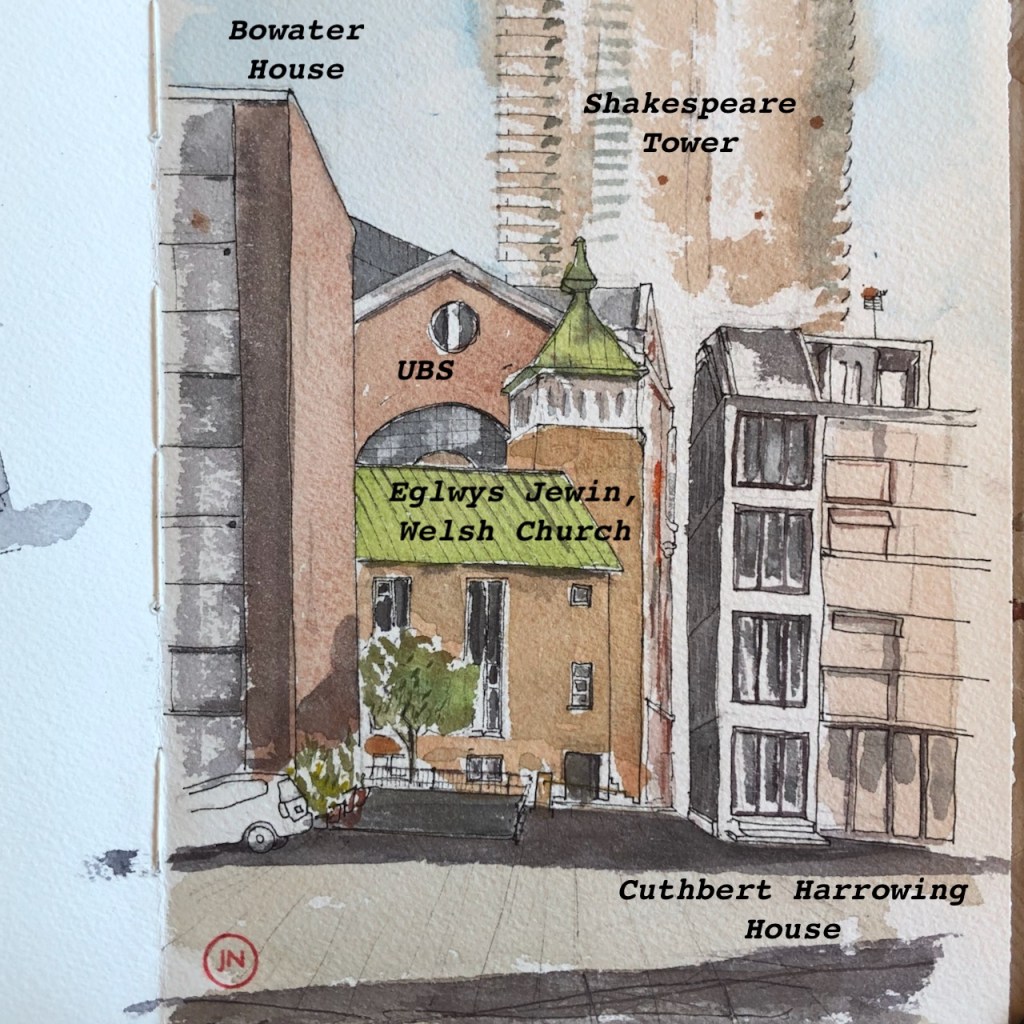
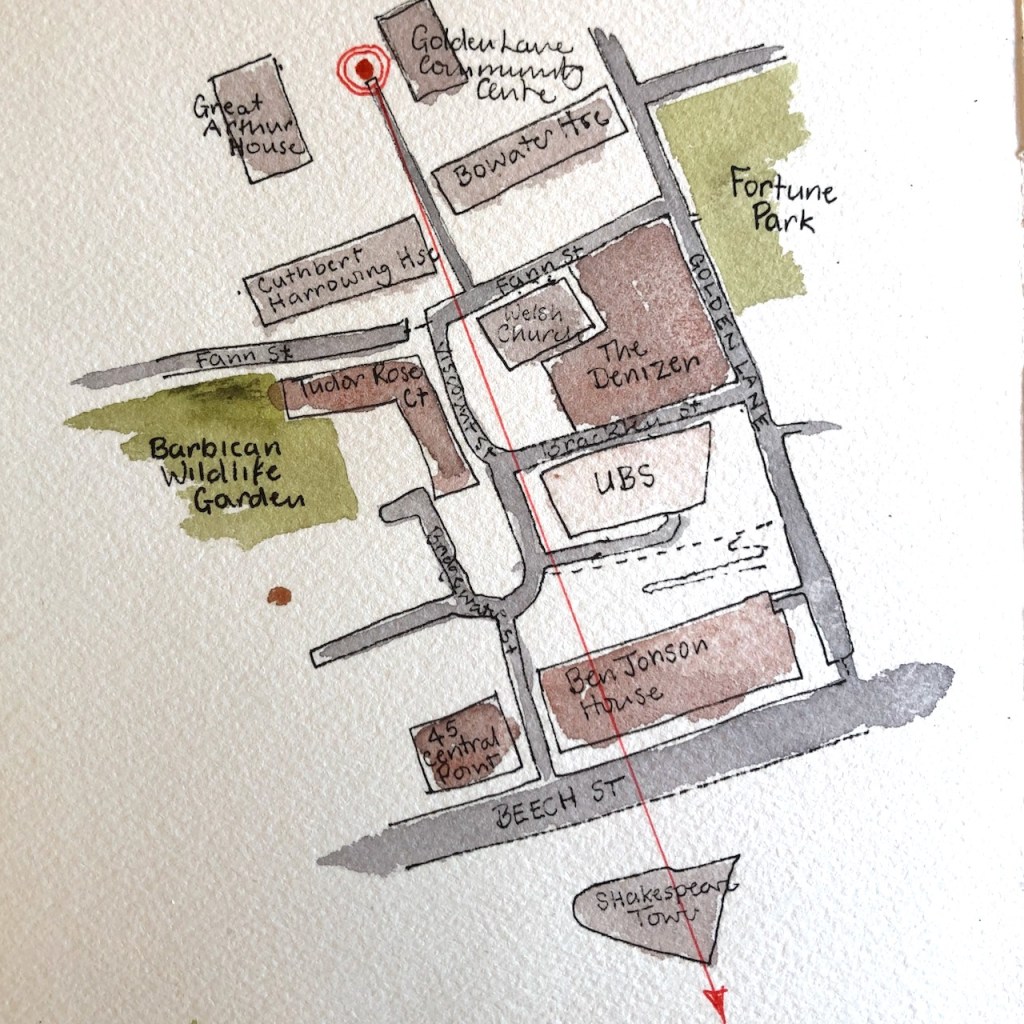
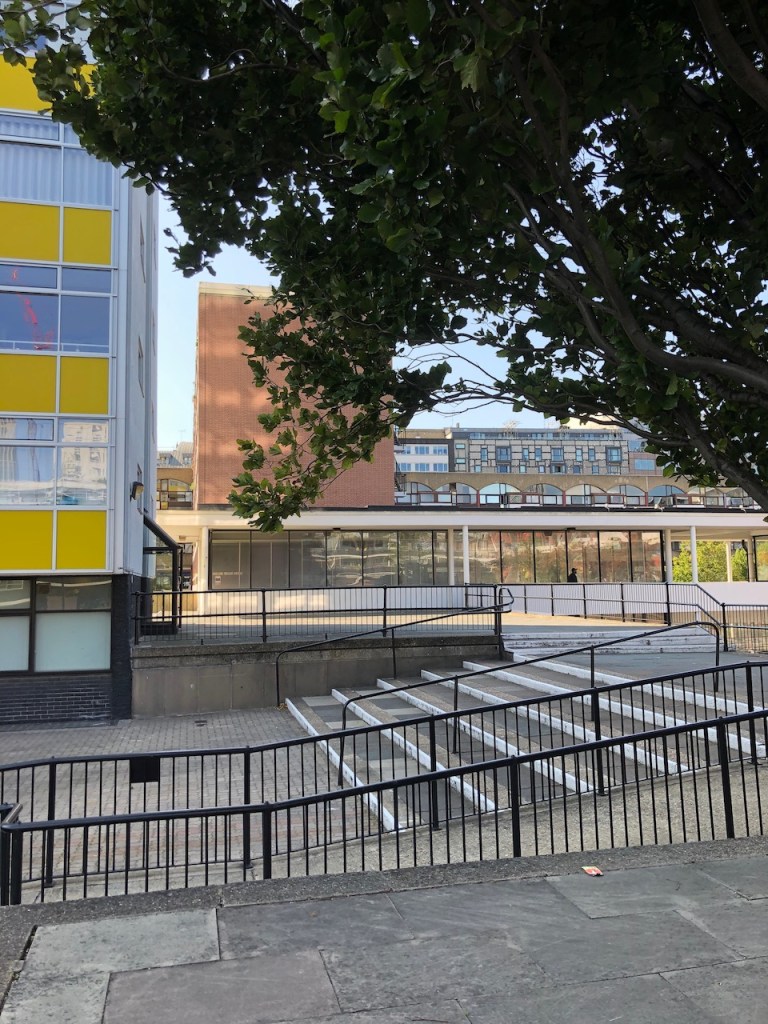
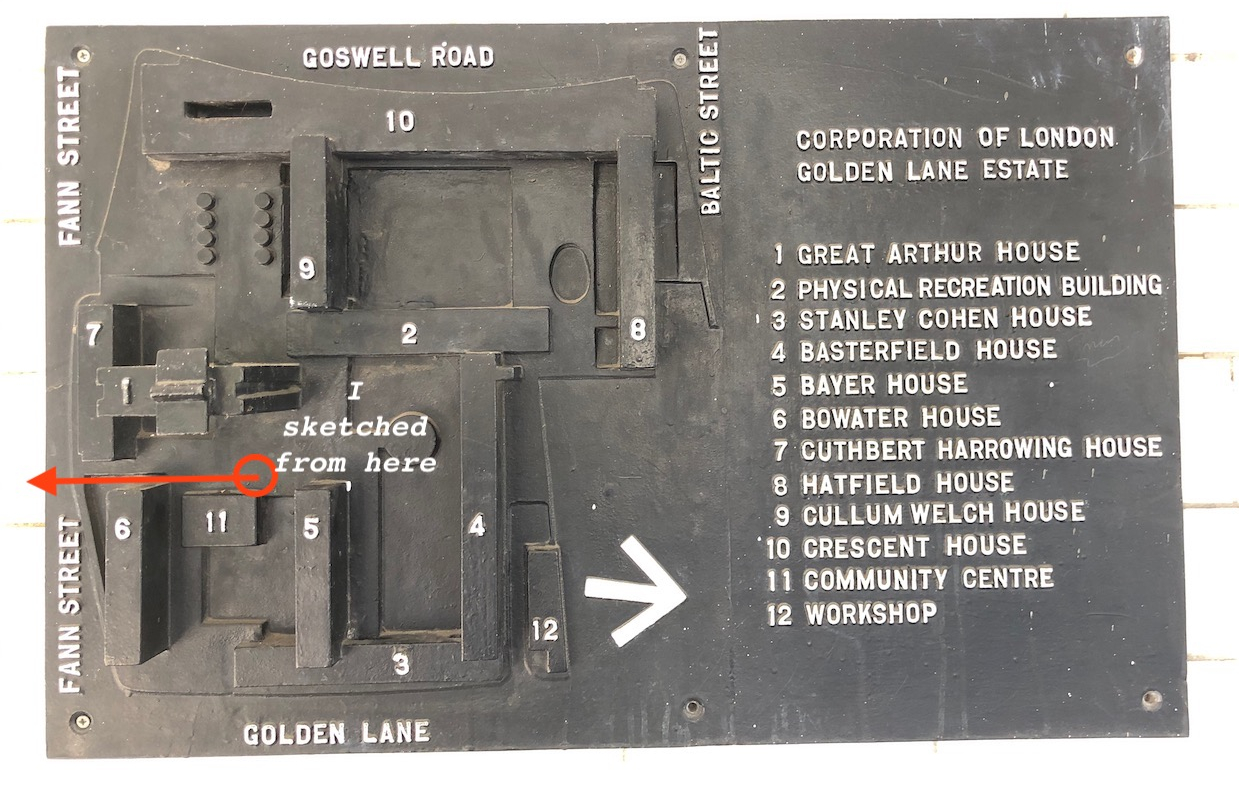
This is the view from the Golden Lane Estate. Here is a map, and an annotated image to show which building is which. The arrow on the map shows the direction I was looking.
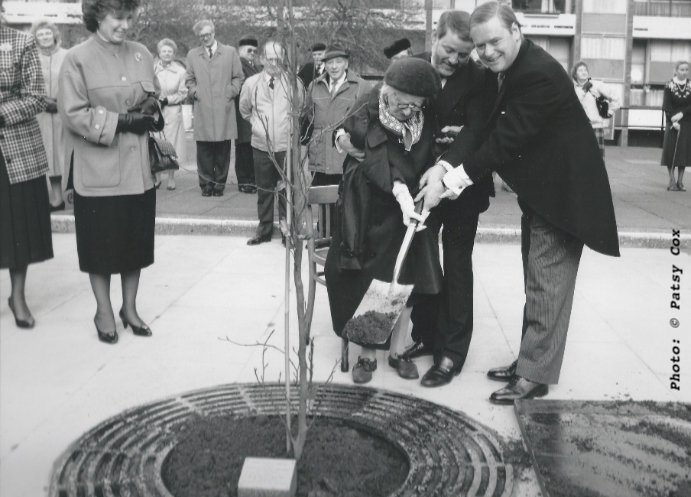
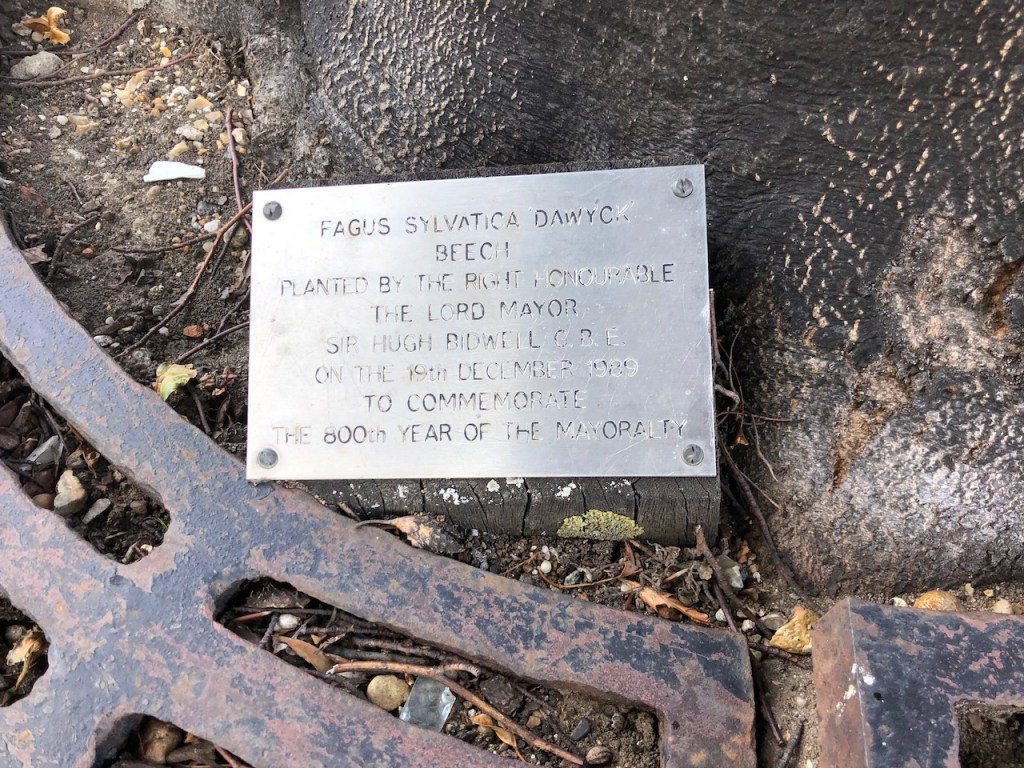
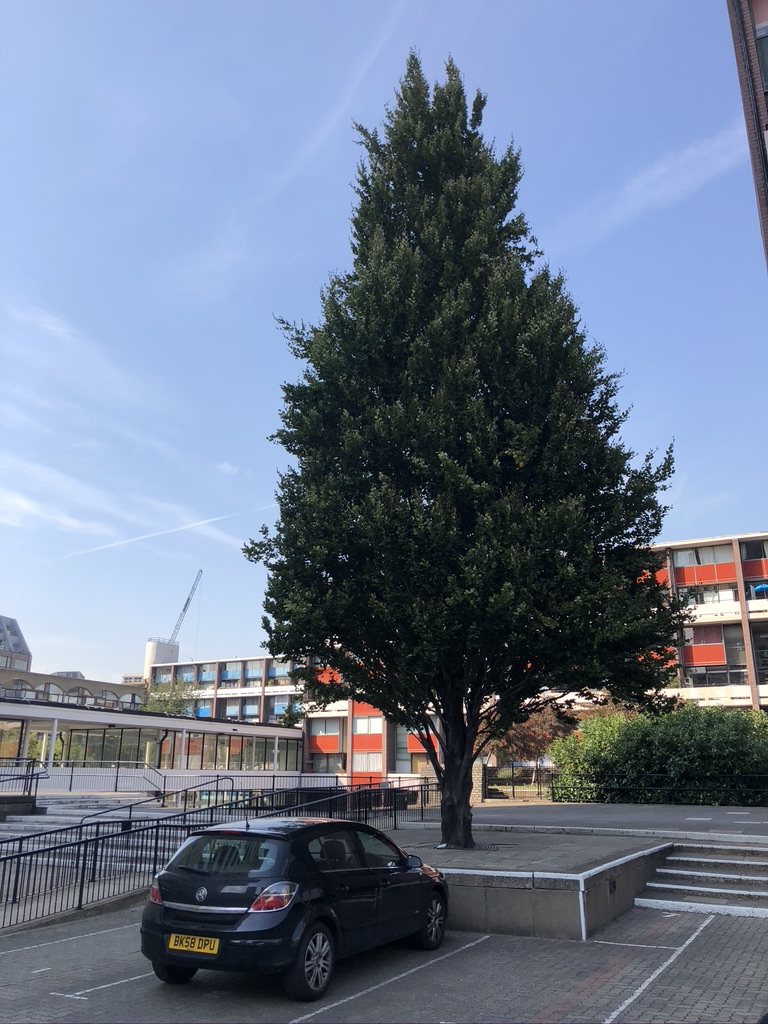
I was sitting next to a beech tree, Fagus Sylvatica Dawyck. A small notice at the base of the tree informed me that it has been planted on the 9th December 1989, to commemorate 800 years of the Lord Mayoralty. By co-incidence, this is the same anniversary that was commemorated by the bollard in my previous post. Here is a picture of the planting ceremony, kindly provided by Billy Mann from his Golden Lane Archive.
Fagus Sylvatica Dawyck, Beech Tree on the Golden Lane Estate, being planted. Photo courtesy of Patsy Cox and used with permission. The photographer was standing almost exactly where I sat to draw my picture.
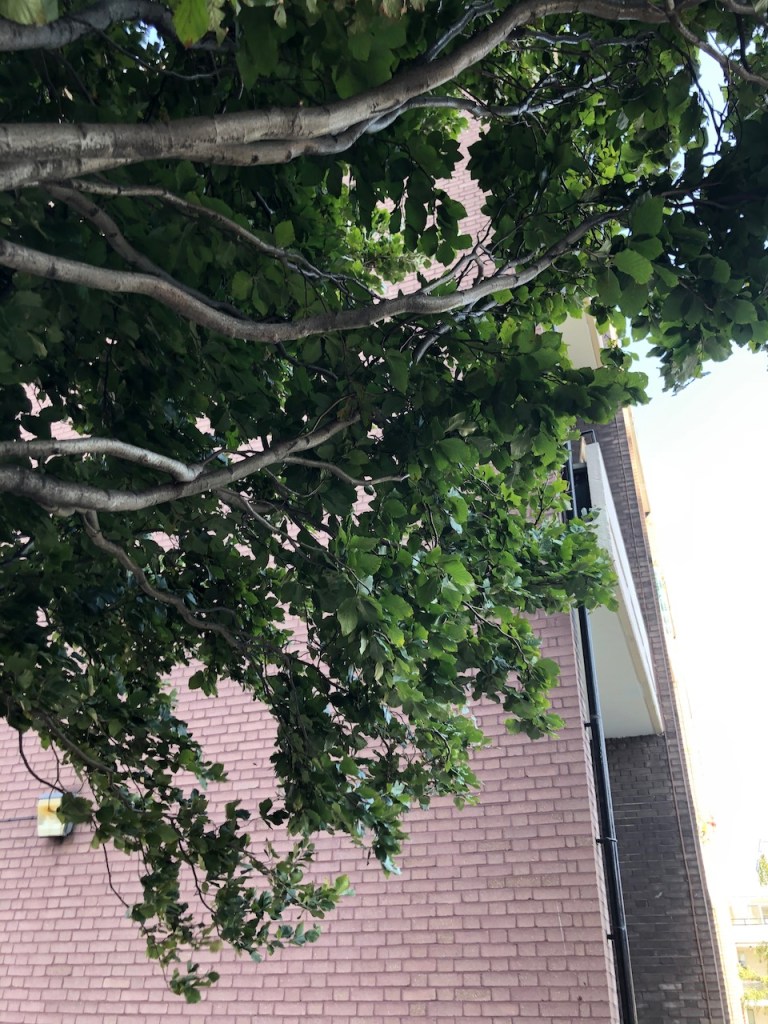
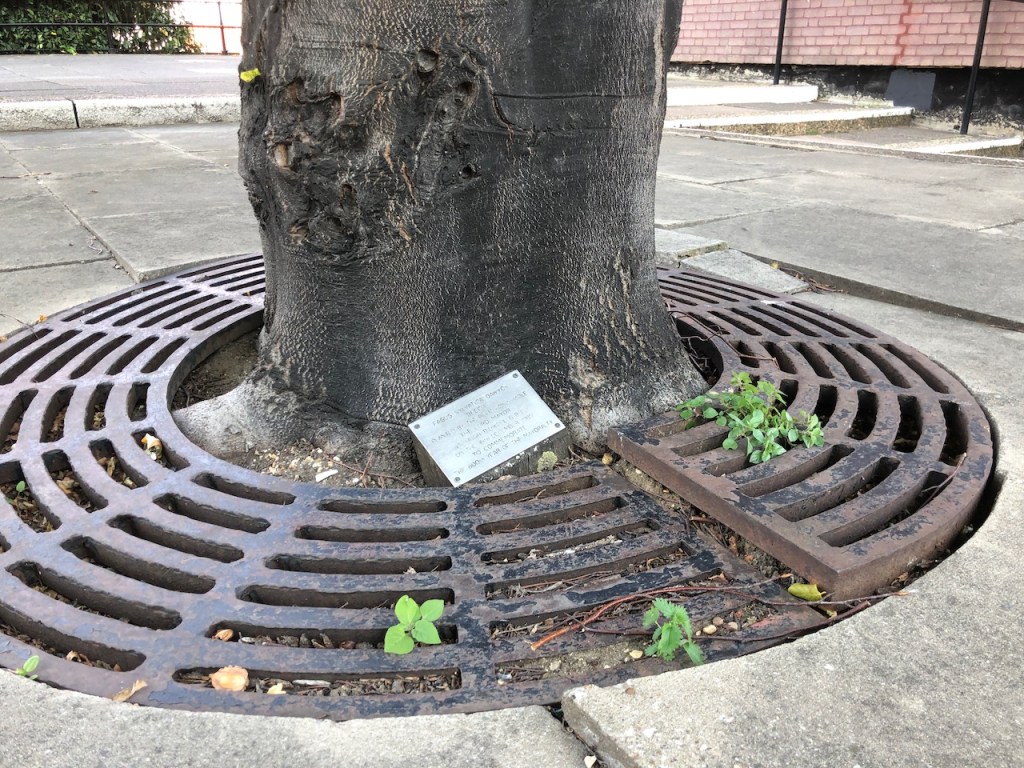
The tree has grown strongly in the last 30 years. It surges out of its metal hoops, and pushes the notice aside.
Fagus Sylvatica Dawyk, planted in 1989
The Golden Lane Estate is a busy place. Many people passed by on the nearby paths. The tree and I were on a raised area, above parked cars. Some people were on foot, one was in a wheelchair, and there were several groups of cyclists. One person had a dog. This was a small dog, the same size as my sketchbook. I can say that with certainty, because, while the person was occupied on their mobile phone, the dog dashed onto my dais and plonked itself foursquare on my sketchbook. What to do?
I must have shouted out, because the person looked up briefly from their phone. I glared at the person, and shooed the dog away. The person uttered a perfunctory ‘sorry’ and continued their conversation. “No, no, it’s alright,” they said into the phone, “it’s just that Tabatha…”. They didn’t ask me if it was alright. I looked down at my drawing. It was alright.
I have drawn this church before. It was built in the 1960s. More information about this interesting building is on my previous posts:
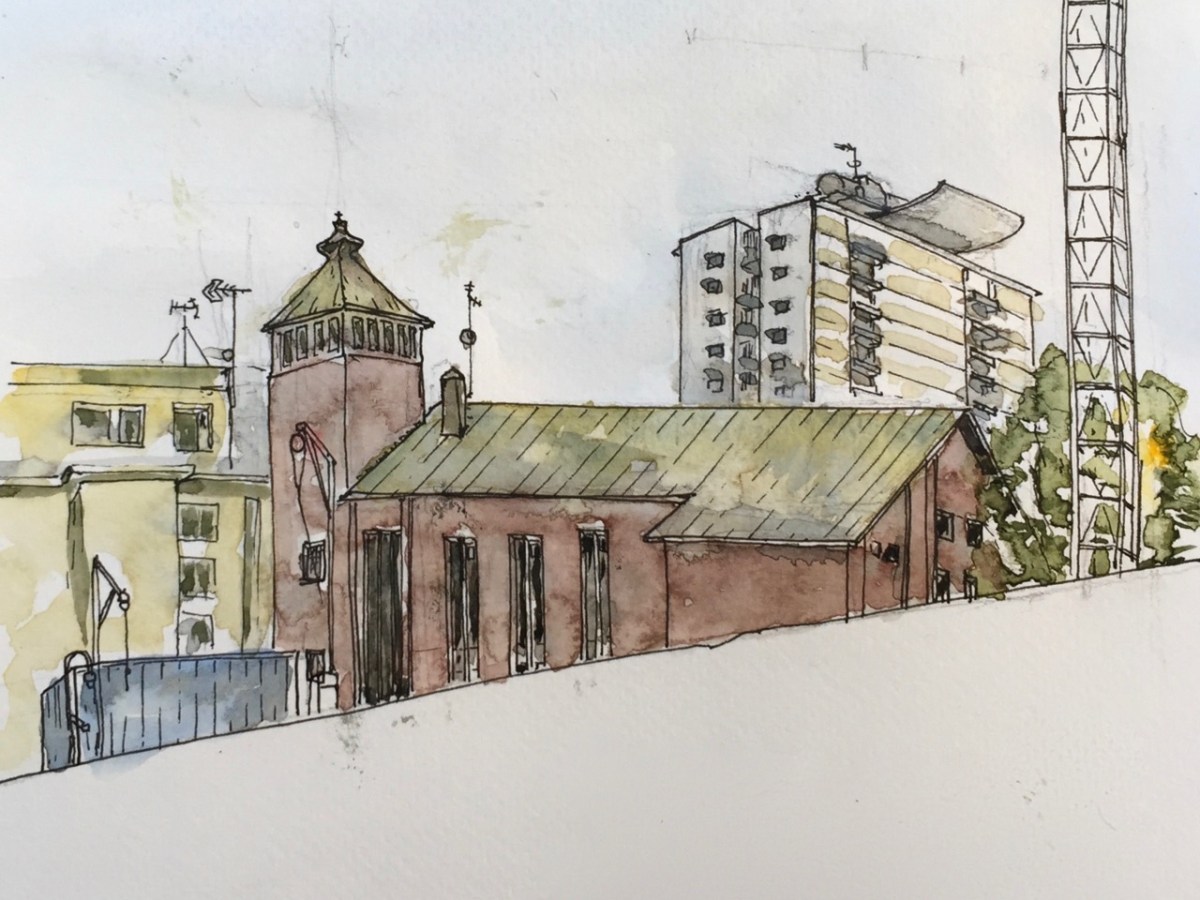
The building which was Bernard Morgan House has now been pulled down. This is sad. It had a calm 1960s look, and ceramic tiles on the side. I looked across the gap and could see the Welsh Church: Eglwys Jewin. The church is the building with the green roofed turret and the long windows. It…
Here is the Welsh Jewin Church seen from Brackley Street. This is one of those ephemeral views: a huge new building is about to go up behind the hoarding, and this view will be completely obscured. The church is Eglwys Jewin, the Welsh Church. I have drawn it before, from Fortune Park. Here’s the link…
This drawing took two hours. It is 25cm by 16cm, 10 inches by 6½ inches on Arches 300gsm watercolour paper. The main colours are Fired Gold Ochre, Mars Yellow, Phthalo Turquoise, and Perylene Maroon, with some Prussian Blue for the shadows.
This is the wonderful three dimensional map of the Golden Lane Estate, which is on the South end of Stanley Cohen House on Golden Lane. It has West at the top because that’s the direction you are facing when you are looking at the map.
Click a button below to share this post online, email it, or print it:
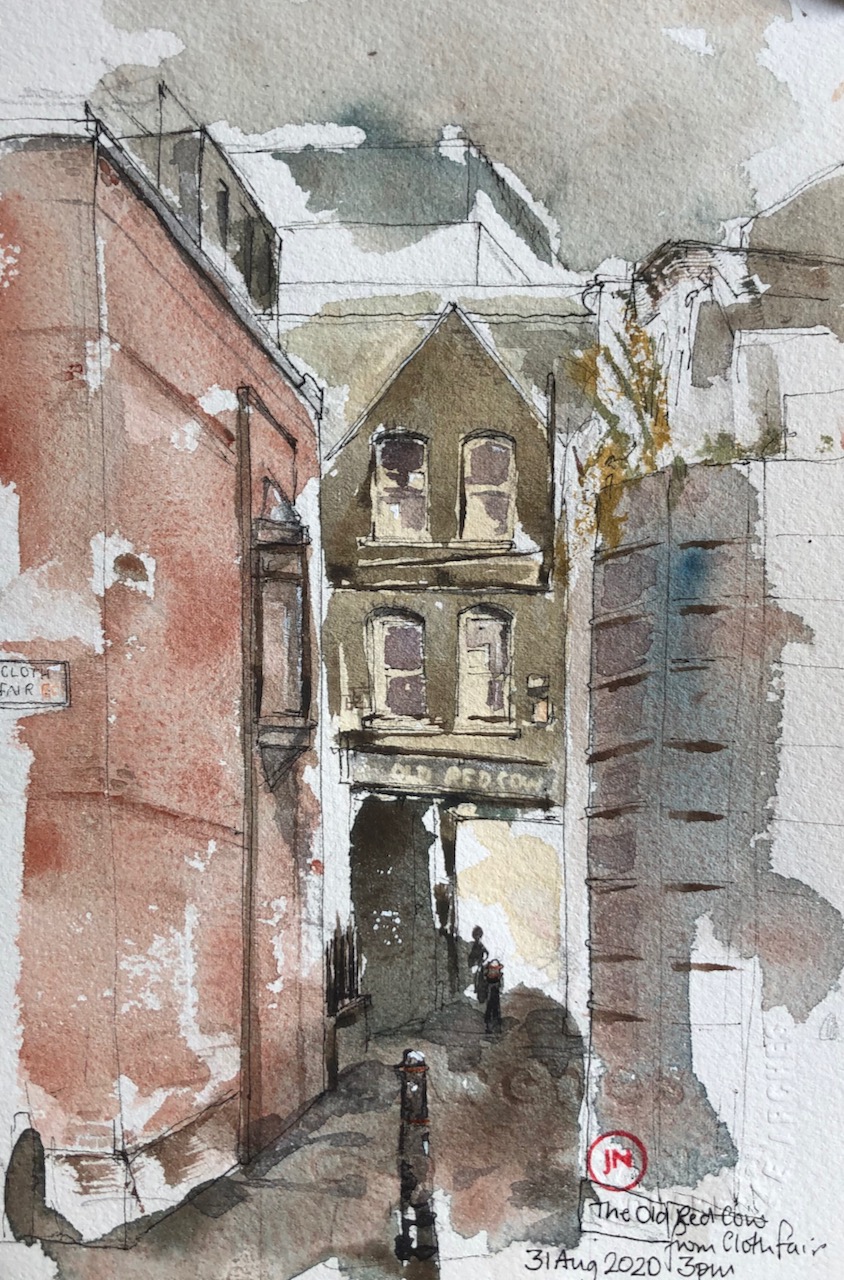
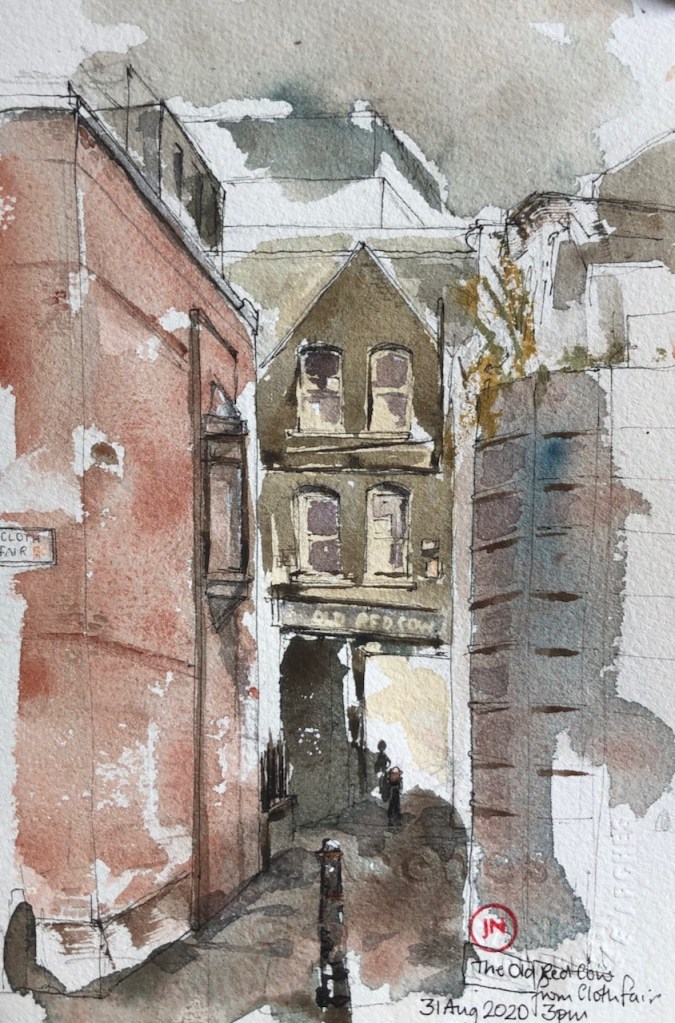
Here is a view of the pub “The Old Red Cow”, seen from Cloth Fair.
The Old Red Cow from Cloth Fair
I drew the picture from outside “The Hand and Shears”
The front of the pub is on Long Lane. When CrossRail opens, it will be very well placed to serve the people flooding out of the new “Farringdon East” station. At the moment, however, it’s closed due to the COVID pandemic.
In Cloth Fair in this area there is a particularly varied collection of bollards. One celebrates 800 years of the Lord Mayor: 1189-1989.
Here are some photos of work in progress and a picture of the bollard.
One hour and 20 minutes, drawn and coloured outside the “Hand and Shears”.
Click a button below to share this post online, email it, or print it:
Cloth Fair is a small street near Smithfield, EC1.
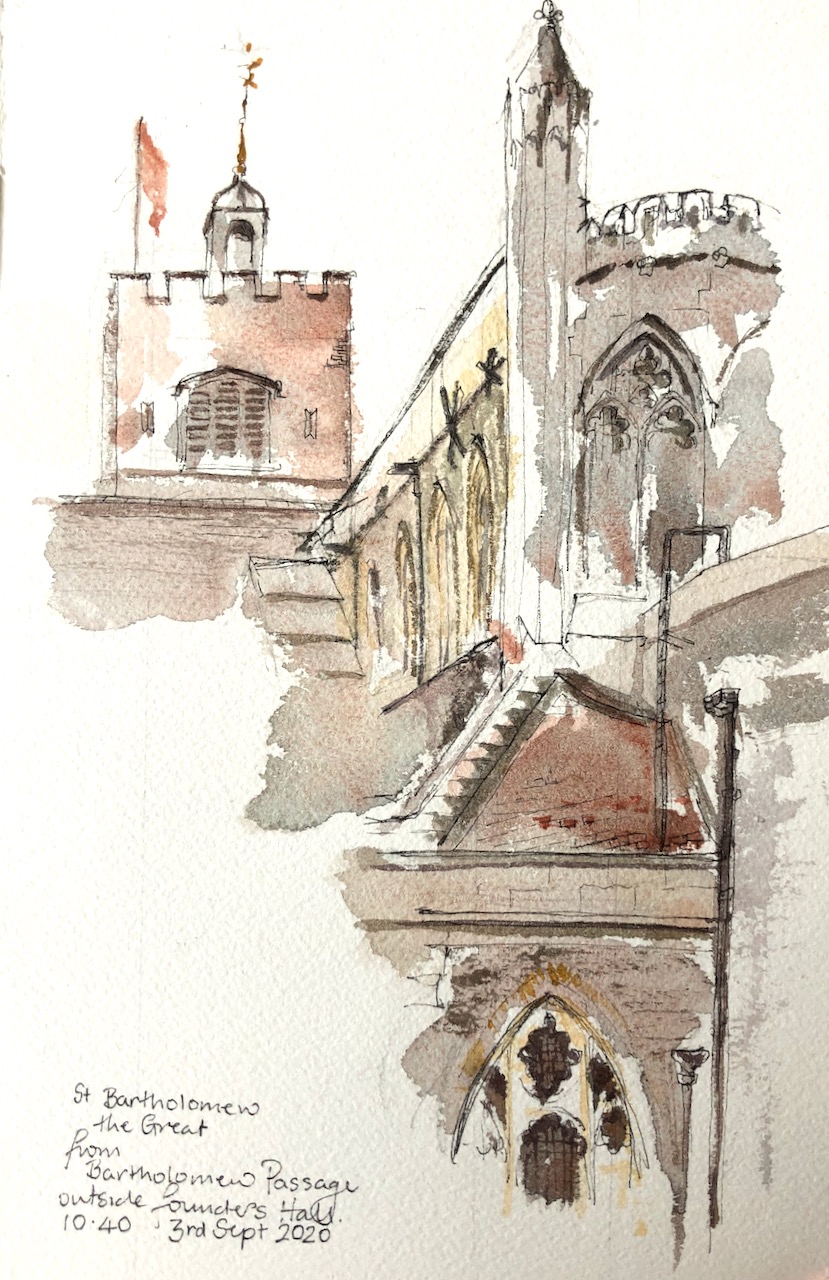
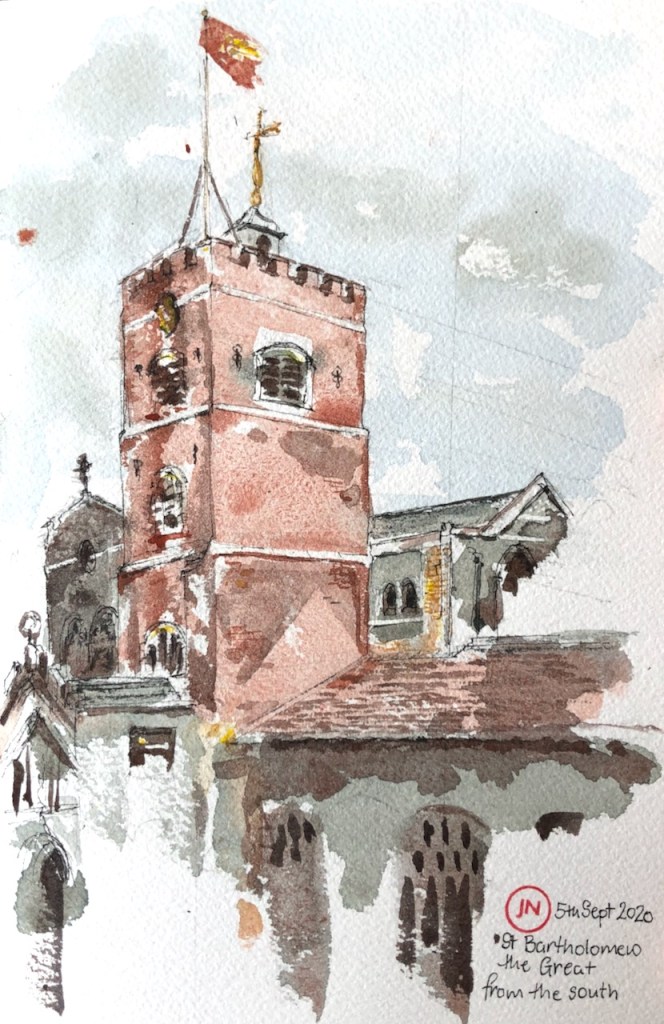
Just South of Cloth Fair is the ancient church of St Bartholomew the Great. I sketched this church from Bartholomew Passage, shown on the map above. Later in the week, I sketched it from the South West side.
St Bartholomew the Great is an ancient church, founded 1123, along with the nearby hospital of St Bartholomew, now called Barts Health NHS Trust.
There is a labyrinth of alleys in this area. As I was sketching in Bartholomew Alley, a woman reached the North end of the Alley, staring at her phone. She rotated through 36o degrees, still looking at the phone. Anxious and frustrated, she rushed along Bartholomew Alley, passed me and stopped. Her plight was so desperate that she was going to abandon the instructions of the phone, and ask a stranger for directions. She asked me if this was the right way for the hospital. I said that it was, but it was complicated that way. “If you are in a hurry,” I said, “you’d best go back the way you came…”. She was in a hurry. She uttered an expletive, and set off in the direction I’d indicated.
Then she remembered her manners and paused, turned to face me, and said “Thank you for the information”.
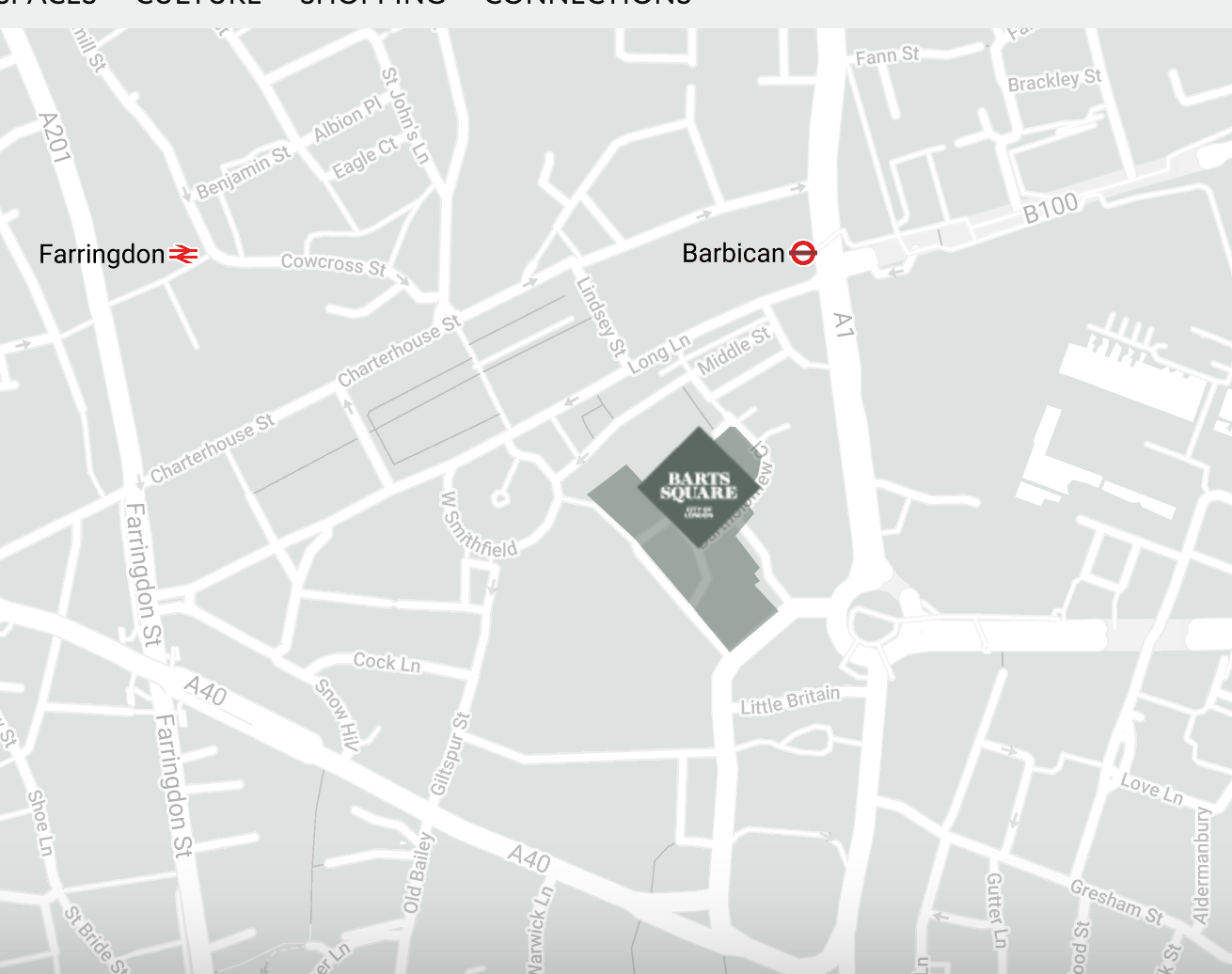
Here are some maps of the new “Barts Square” development, showing the location of the second sketch.
Sketch map: Barts Square development and sketching location
Barts Square development, location.
I have sketched often in this area, which is changing rapidly. I am still learning my way around. Here are some of my sketches round here.
Today I went to try out “Halfcup”, a new coffee place which has opened on Bartholomew Close. It’s part of the new “Barts Square” development. These are new buildings in an area that was previously St Bartholomew’s Hospital. Some of the external features of the original hospital buildings have kept, as you see in the…
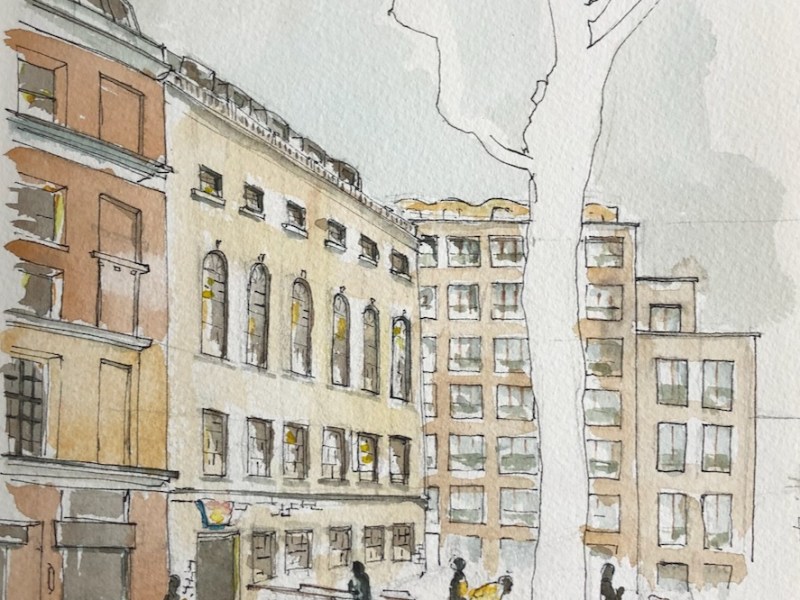
Continuing my exploration of Barts Square, EC1, today I drew Butchers’ Hall. Butchers’ Hall is the building with the arched windows, in the centre left of the picture. It is the headquarters of The Worshipful Company of Butchers. This livery company is very old, the Arms were granted in 1540 and the charter by James…
Here is a post-card sized sketch of people listening to the concert. It felt as though the stones were listening too. Pen and ink in small Seawhite journal, about 20 mins.
Click a button below to share this post online, email it, or print it:
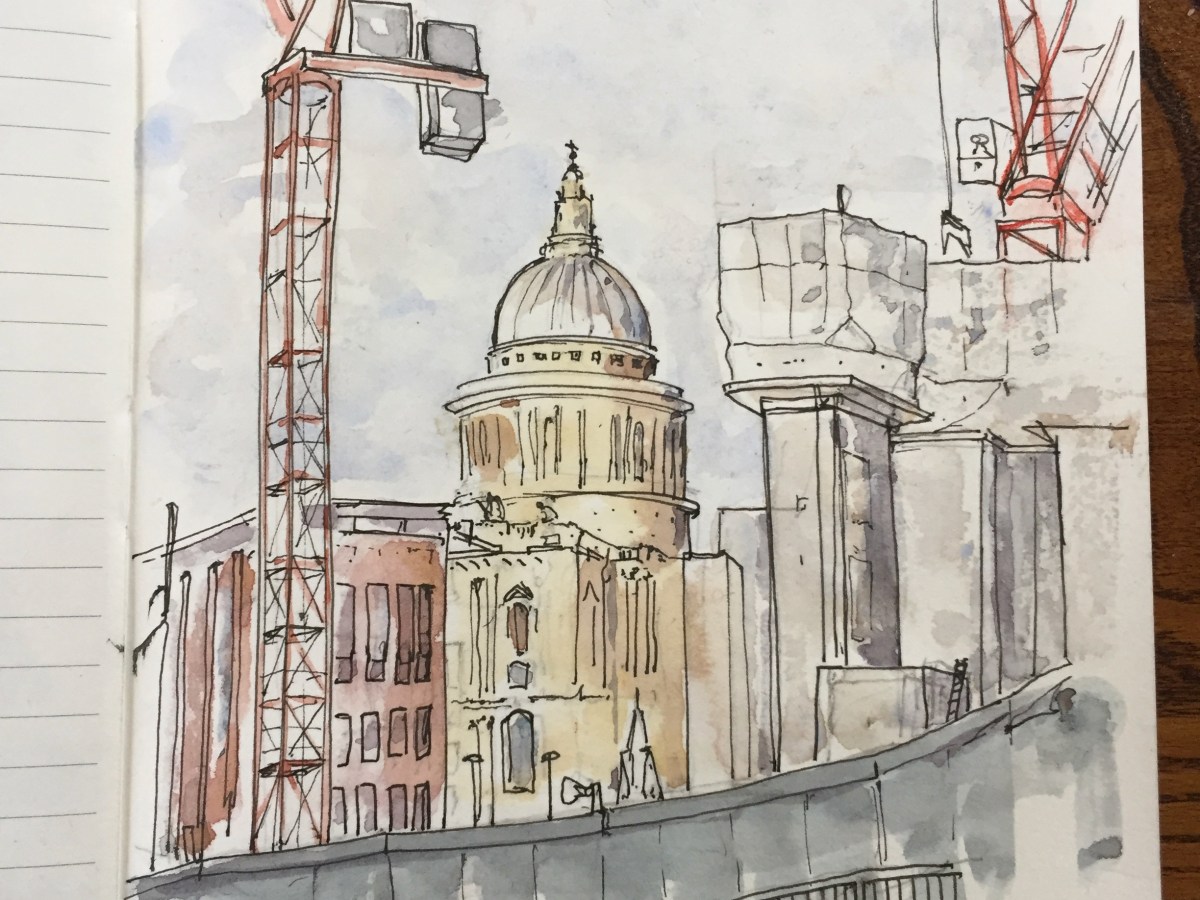
Wren Coffee has re-opened! This is a marvellous coffee shop in the Church of St Nicholas Cole Abbey, on Queen Victoria St.
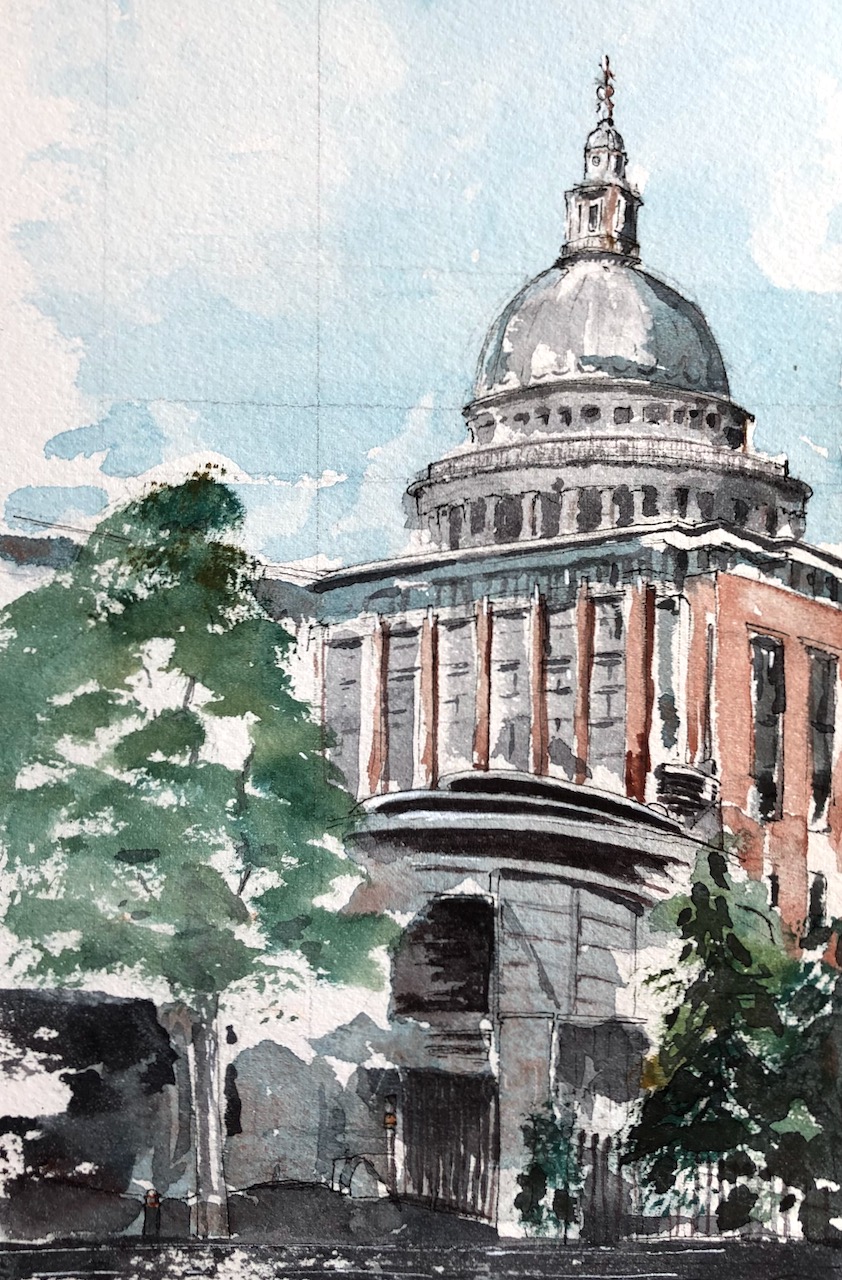
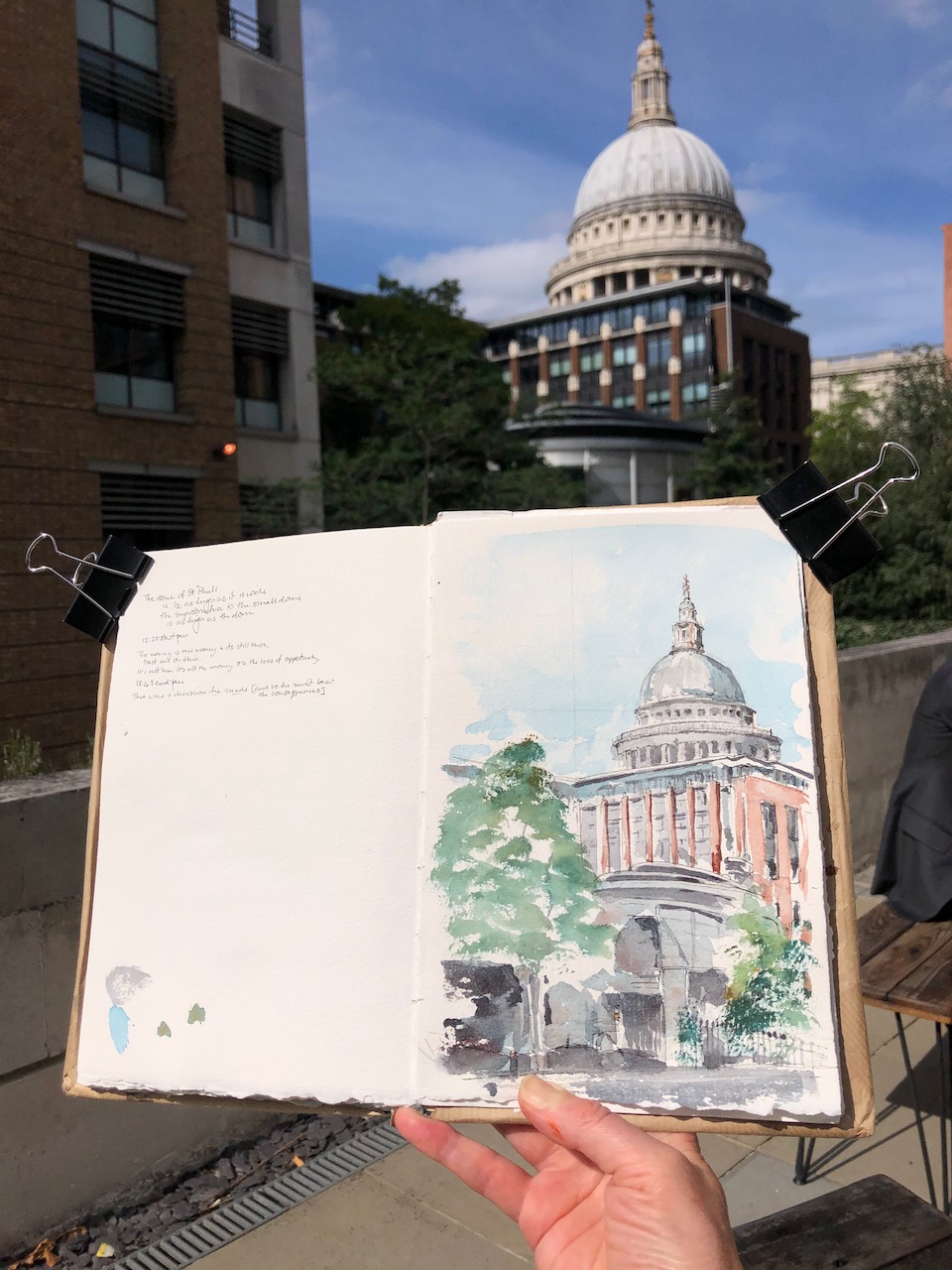
I went there and sat on the raised terrace, sketching the view Northwards towards St Paul’s Cathedral.
St Paul’s, from Wren Coffee
The grey building in the foreground is a nightclub. It has dark windows, and a barred loading bay.
Raised voices from the table behind me grabbed my attention as I sketched. High drama was in progress. One of them defended himself in a loud voice, “The money is real money, and it’s still there. Trust me on this!”.
When someone declares “Trust me on this!” all sorts of red and amber alert lights come on in my head. Was the money still there? Did I trust him on this? I thought not. The other two men were not convinced either.
I kept my gaze firmly forwards, towards the view I was sketching. I did not observe the participants in this conversation, I did not join the debate. I cannot even be sure there were three men rather than two. Certainly at least three points of view were expressed. It was hard to follow the conversation, especially for someone trying to concentrate on tone differences, perspective lines and the symmetry of domes. And not all of the conversation was conducted in the strident tones of the accused party.
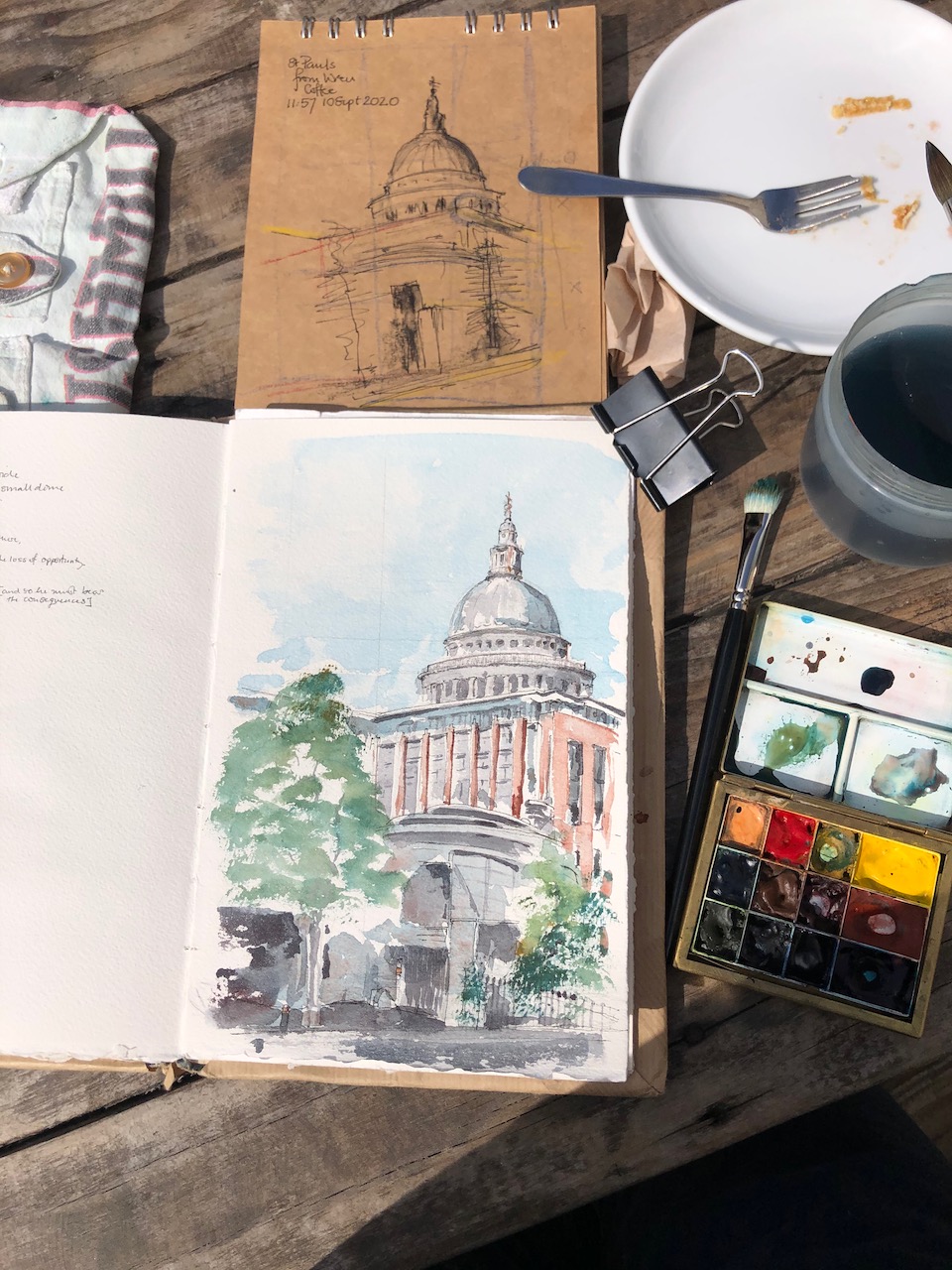
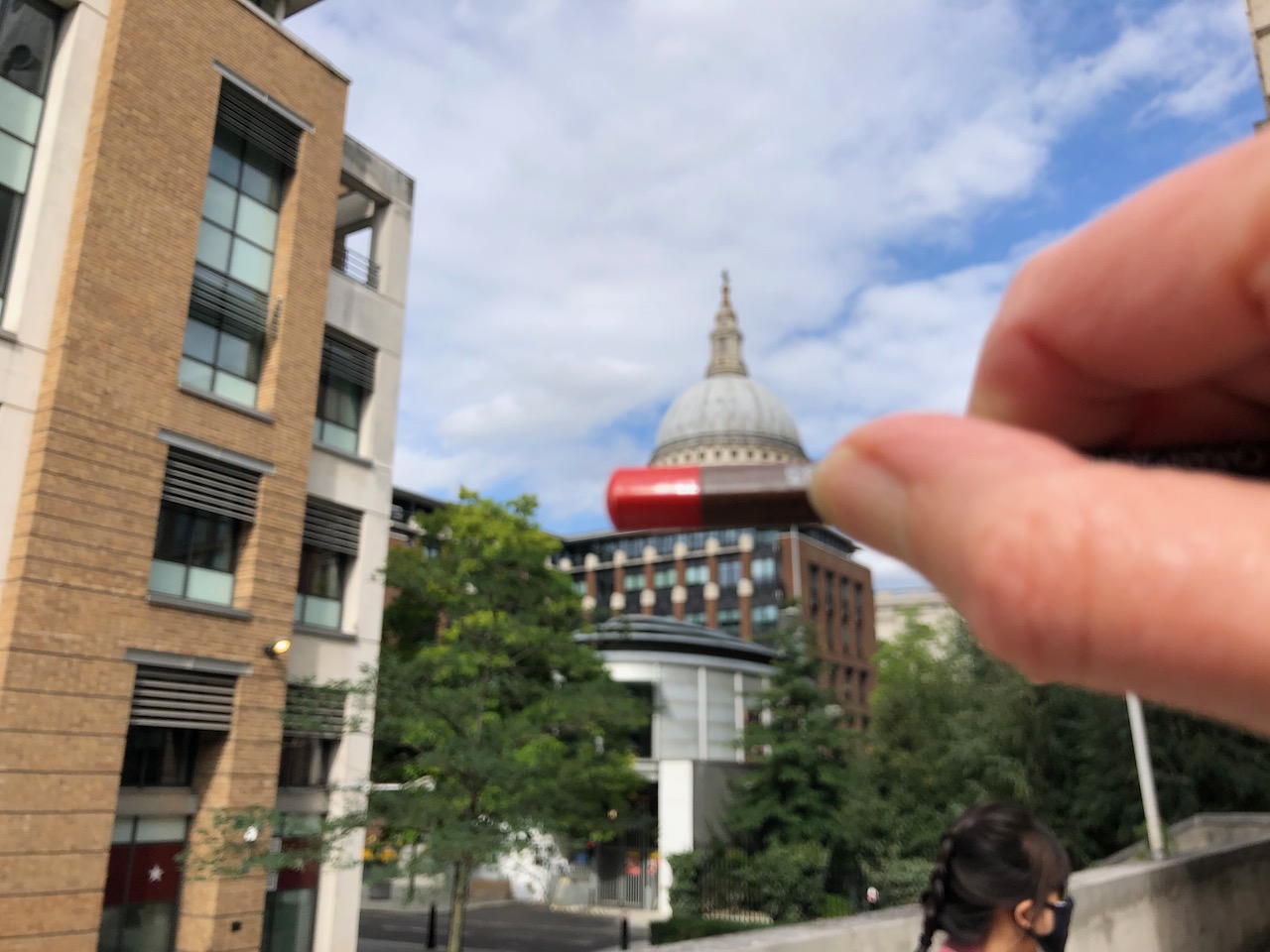
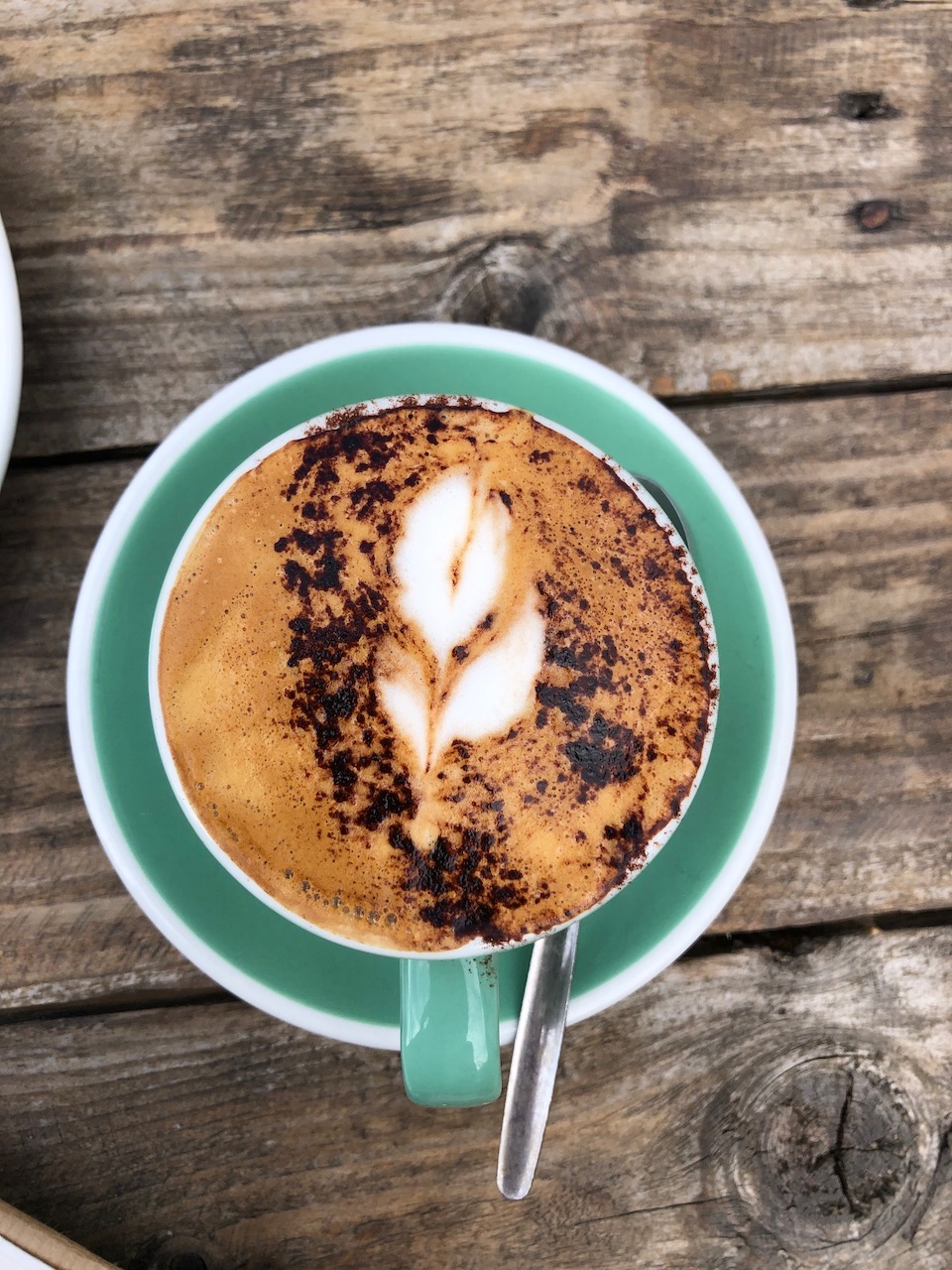
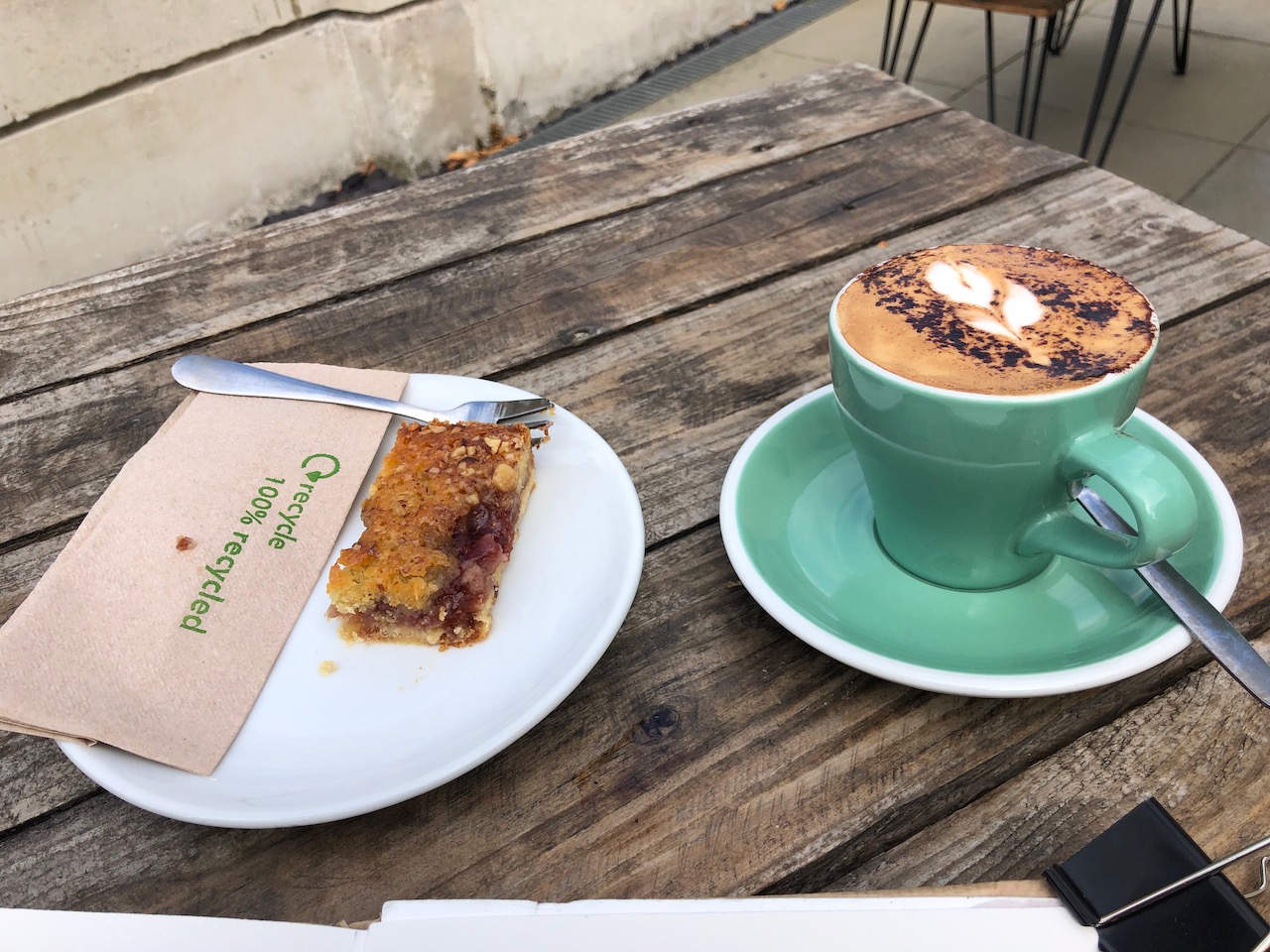
Here are some photos of work-in-progress on the sketch, and a picture of the beautifully crafted capaccino made by the server at Wren Coffee.
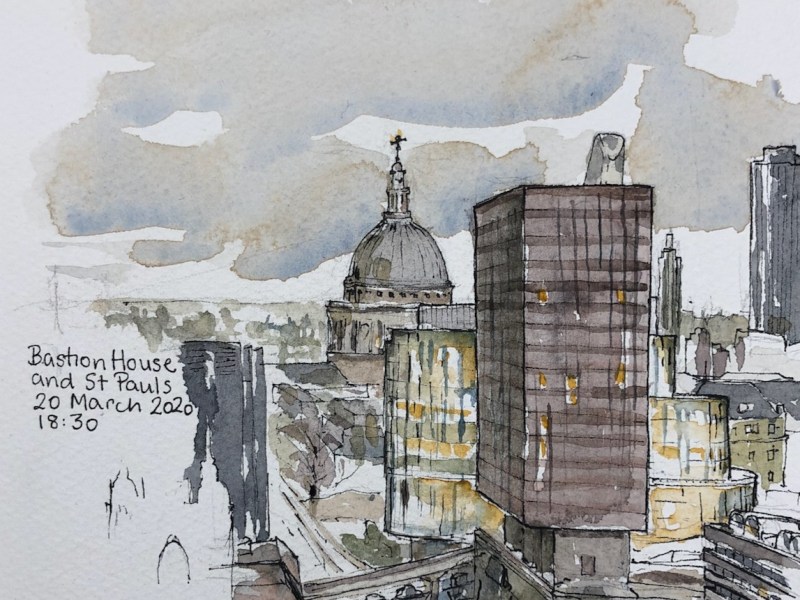
I am sketching the views out of the window. Just visible over the top of Bastion House is the top of “OneBlackfriars”. In the foreground: Mountjoy House, Barbican, on the right. Along the bottom is the Barbican Highwalk which joins Mountjoy House and Wallside. I have drawn Bastion House before: This drawing took rather a…
I was keen to draw this view of St Paul’s before it vanished behind the new building on 2-4 Cannon Street. “PLP’s scheme, for global property firm Pembroke Real Estate, will replace a 1959 modernist office building by Theo Birks called Scandinavian House. The north facade, facing the cathedral, is the most orthogonally formal, with red…
Click a button below to share this post online, email it, or print it:
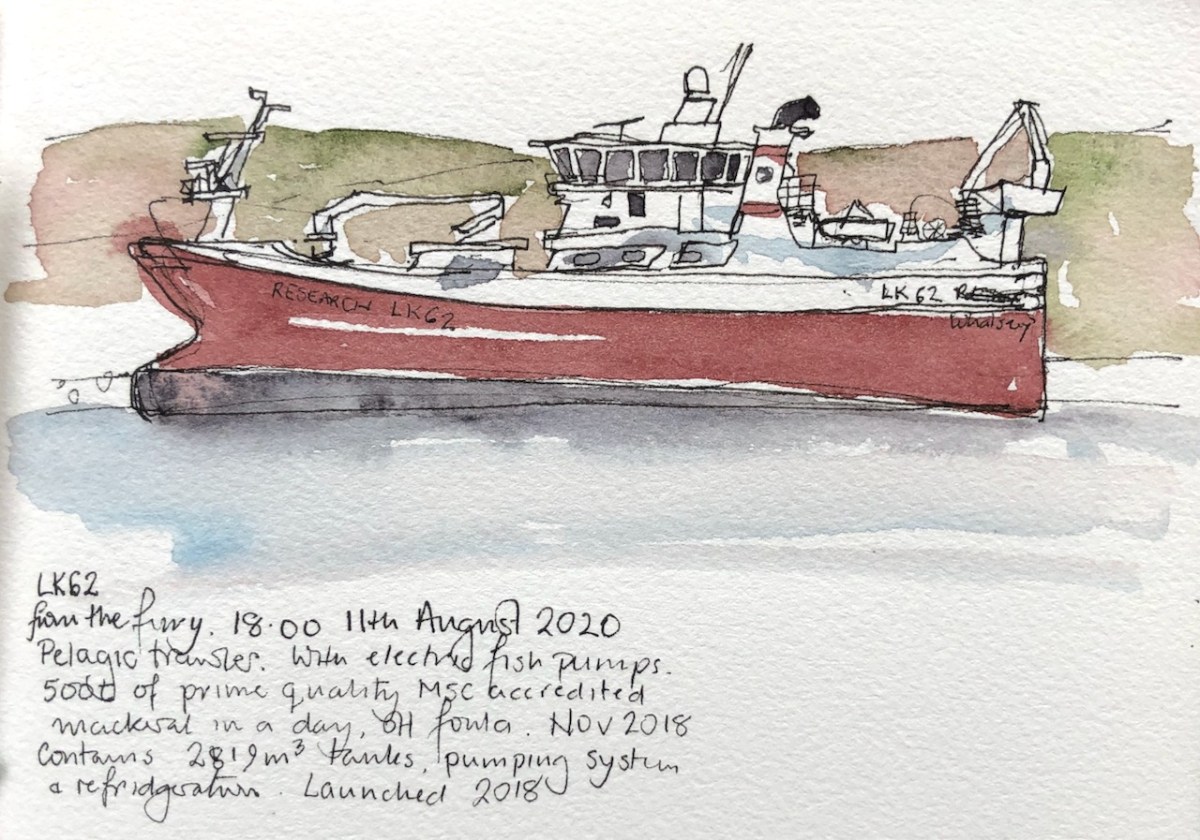
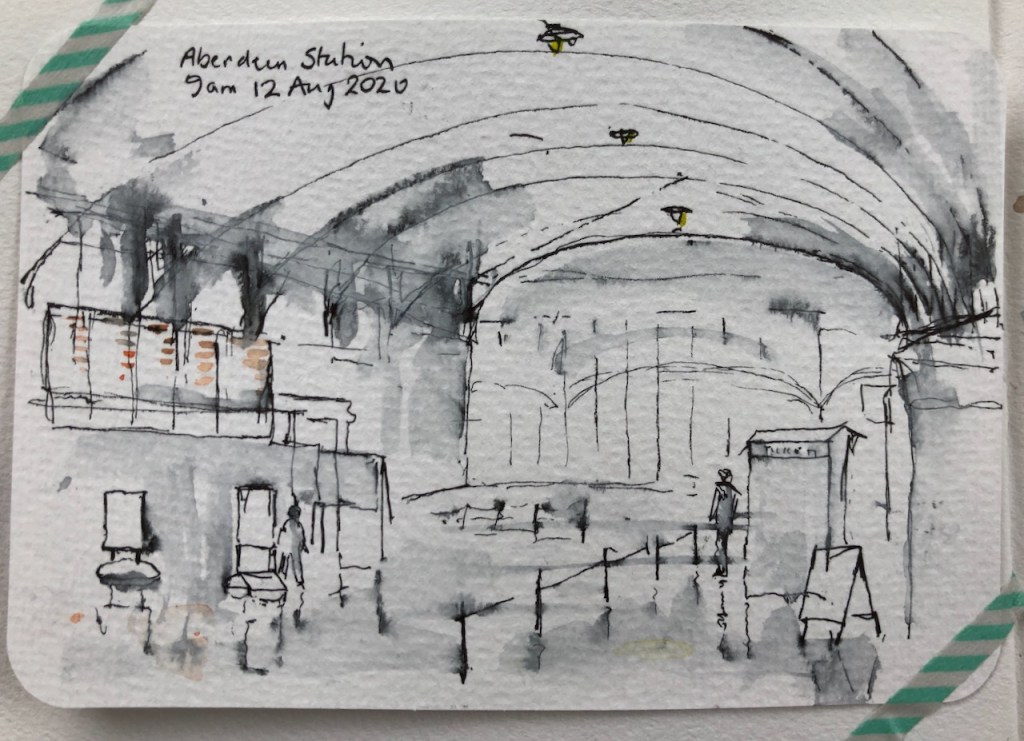
Aboard a quite different vessel, the Northlink Ferry, I arrived in Aberdeen the next morning. Aberdeen was in lockdown, and I planned to spend as little time there as possible, just two hours, before my train left for the South. My idea was to sit in the sun outside the ferry terminal, eating my packed breakfast, before a gentle stroll to the railway station. Ha! I arrived in Aberdeen in the middle of a rainstorm. Roads had become rivers. On the periphery of my vision, a drain cover had lifted, and the water rose from it in a translucent pillar. I struggled towards the station through floods and wind.
…the floor was covered in a thin layer of water….
Aberdeen station was a huge glass tent, with the rain battering, and lightning visible, dimly, through the roof covering. It also resembled all the tents I have ever known in that the floor was covered in a thin layer of water. I sat down damply on a damp metal bench. All the trains were cancelled. Fortunately, I had some banana cake. I drew a picture. Then I found a helpful official and a bus.
The bus was going to Edinburgh. I drew a picture on the bus. After having been in Shetland for three weeks, I noticed that there were huge trees, everywhere. The sun came out.
On the bus: wind turbines, fields, barns, and TREES.
Click a button below to share this post online, email it, or print it:
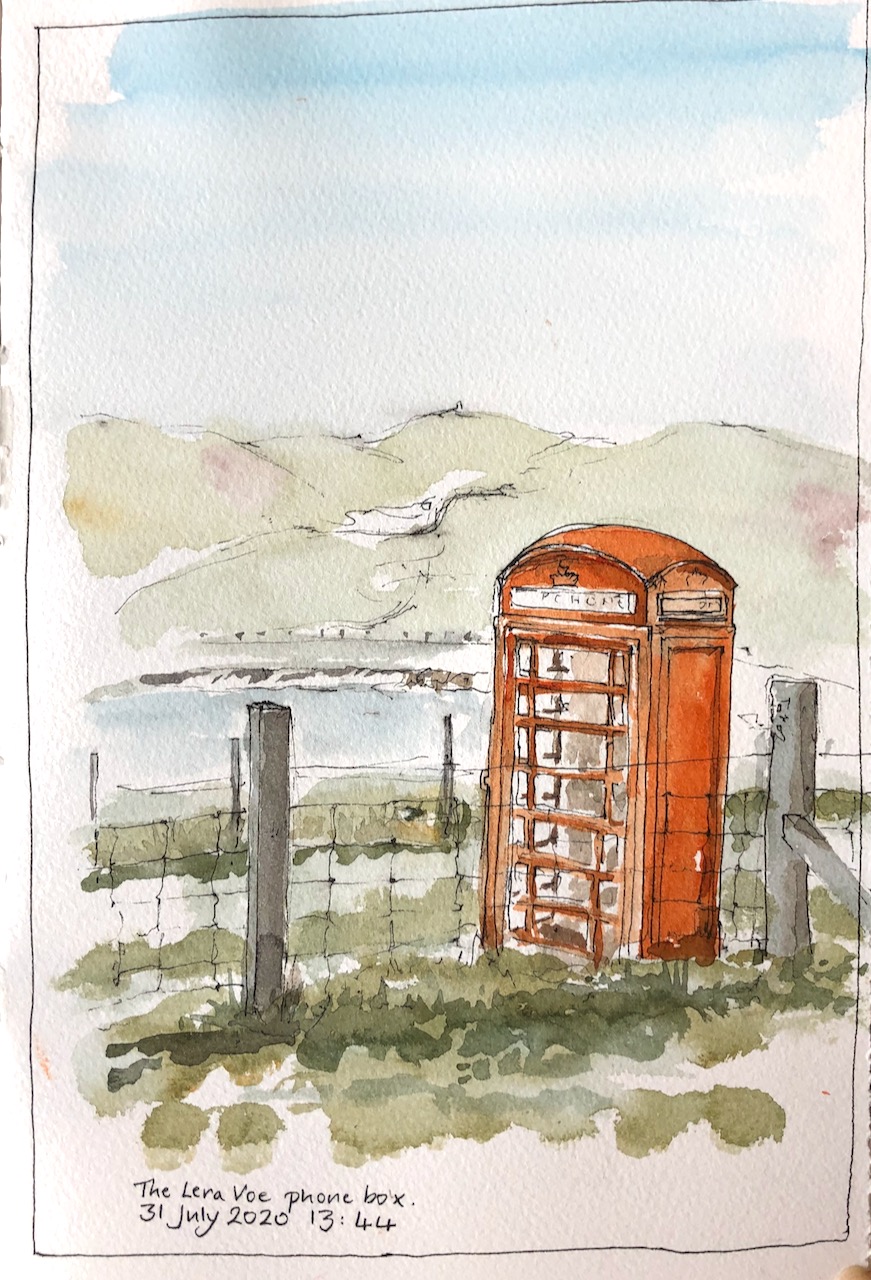
This is the Lera Voe phone box, which is on the road between Burrastow and Walls.
The Lera Voe phone box
The phone box is a landmark. This year it was renovated, and fitted out as a sanctuary and small room. There is no phone in there any more, unless you bring your mobile phone with you.
Henry Anderton did the renovation. His project was partly financed by a reward he obtained for having found a message in a bottle on one of his beach-cleaning outings. You can read about it in this article from the BBC, published in February 2020.
The article says of Mr Anderton: “He has bought the phonebox, near Walls, for £1 and been supplied with the regulation red paint from BT. He said: “We’ve now launched a crowd funding operation to help out the renovations – we’ve got to find a door first.”“
Evidently he found a door, because when I visited in July the phone box was complete, bright red and in great shape. There are shelves and a seat inside.
I wanted to draw the phone box with Lera Voe in the background. This is the view from the field behind the phone box. You can see the voe, and the hills beyond. The road is just behind the phone box in my drawing. “Voe” is a Shetland word meaning “sea inlet”.
Here is work in progress on the drawing.
Here is the article from the BBC mentioned above, as a PDF file.
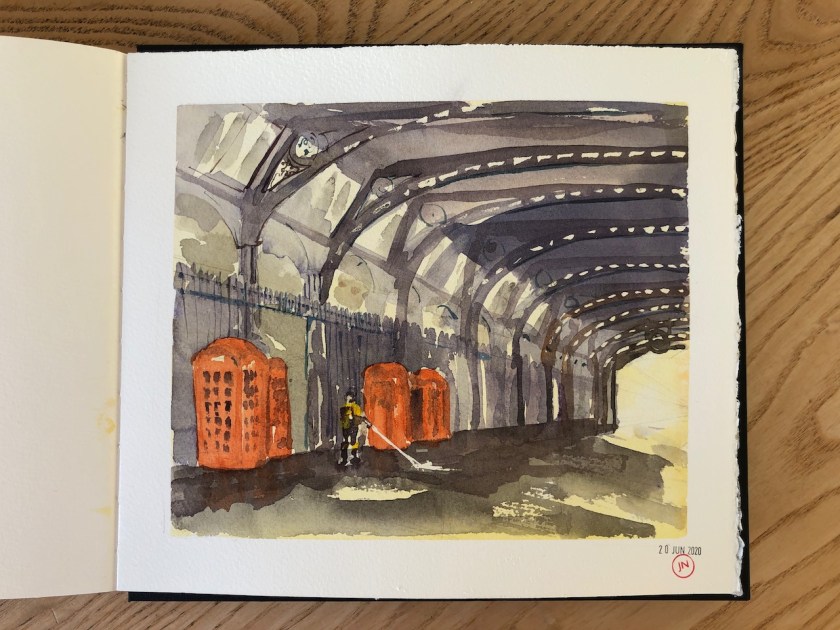
Here is a group of phone boxes in Smithfield, London:
Phone boxes in Smithfield, EC1, London. See this blog post.
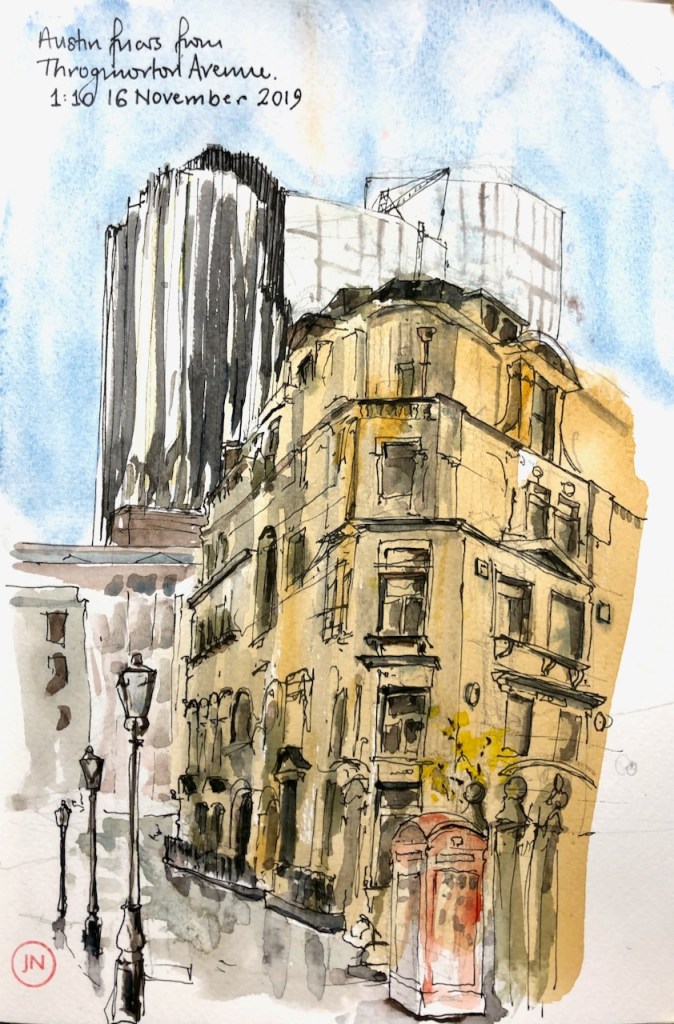
Here is one in Austin Friars, EC2, London: see this blog post.
These phone boxes , which were called Telephone Kiosks, were designed by Giles Gilbert-Scott in the 1920s and 30s. Giles Gilbert-Scott was a prolific architect, who also designed Cambridge University Library, the North Wing of the Guildhall in the City of London, and Bankside Power Station which is now Tate Modern.
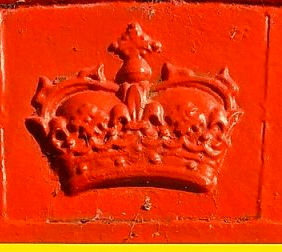
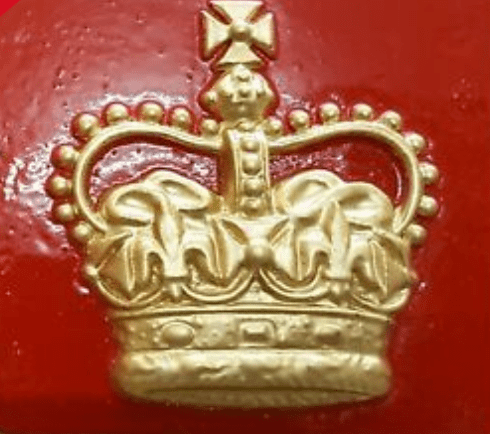
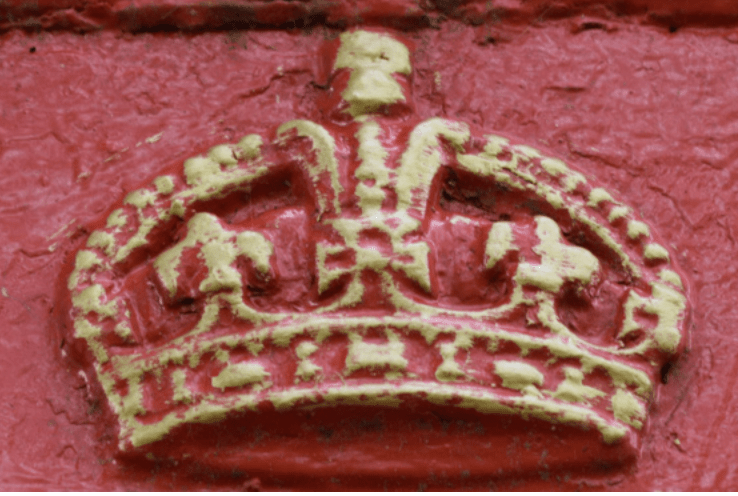
The phone box at Lera Voe is a “K6” phone box, designed by Gilbert-Scott for the jubilee of George V in 1935, following his successful design of the K2 phone box in 1924. The K6 is distinguished from the K2 by the embossed crown, and the fact that it has 8 rows of windows, rather than the 6 rows of the K2.
It would be possible to date the phone box had I been more careful in drawing the crown. The crown is painted red on the Lera Voe phone box, as it was on the original phones boxes. Only in the 1990s did BT start painting the crowns gold.
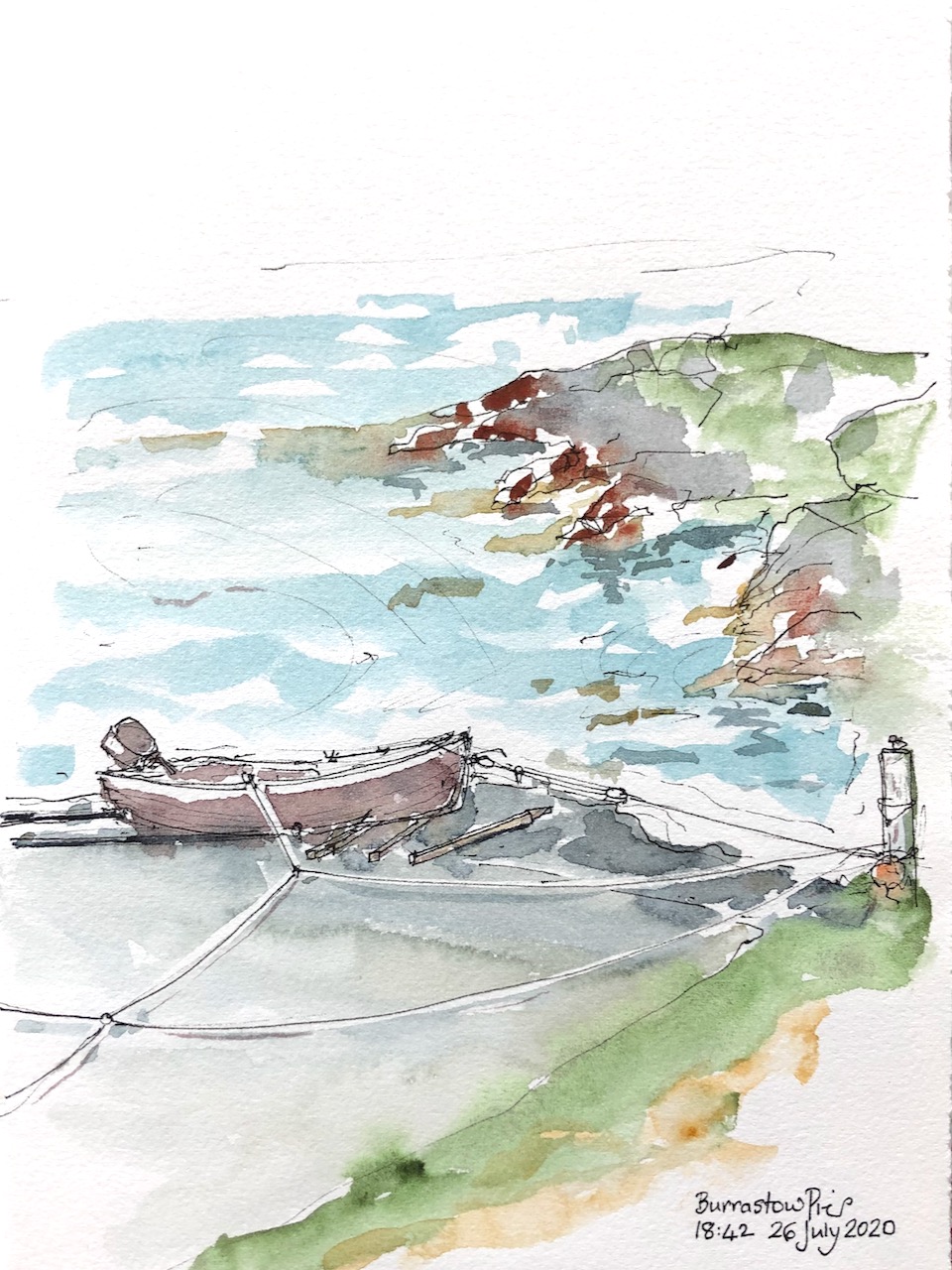
This is the North Atlantic, latitude 60 degrees N. The temperature of the water is 11 degrees C. Very refreshing! There is a lot of sun between the rain.
Here is another sketch of the pier, this time watercolour only, no pen. It is evening.
Burrastow Pier, evening.
Latitudes: Burrastow is 60 degrees North. The Arctic Circle is 66 degrees North. London is 51 degrees North. The Equator is zero degrees, and the North Pole is 90 degrees.
Click a button below to share this post online, email it, or print it:
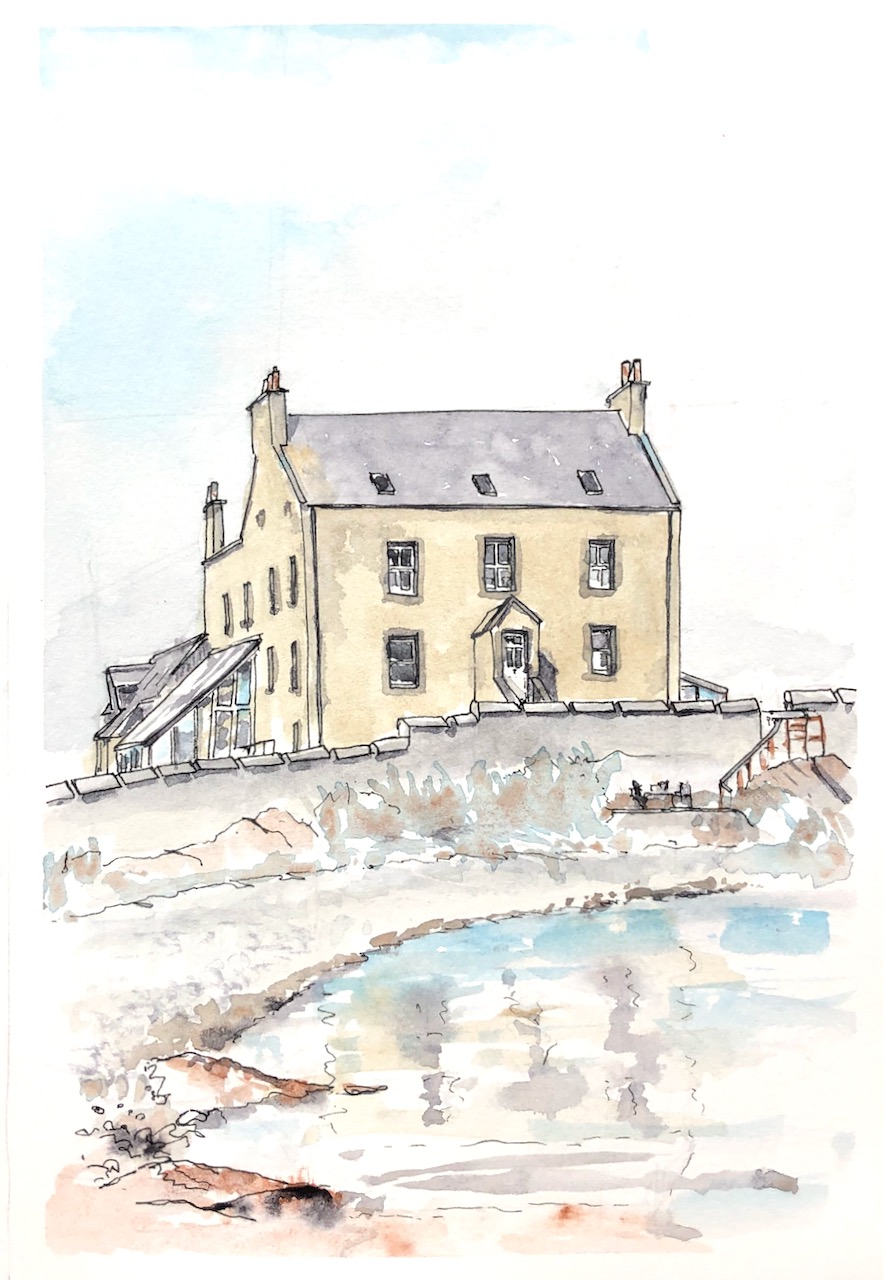
“On the remote west side of Shetland you can find spectacular scenery, peace and the ideal refuge for the escapist. The guest house welcomes you with peat fires, a cosy library and all the marvellous food you could want after a day of exploring….” This is Burrastow House , near Walls.
Burrastow House from the front garden
The house is right next to the sea. Here’s a view across the bay.
Burrastow House from the beach
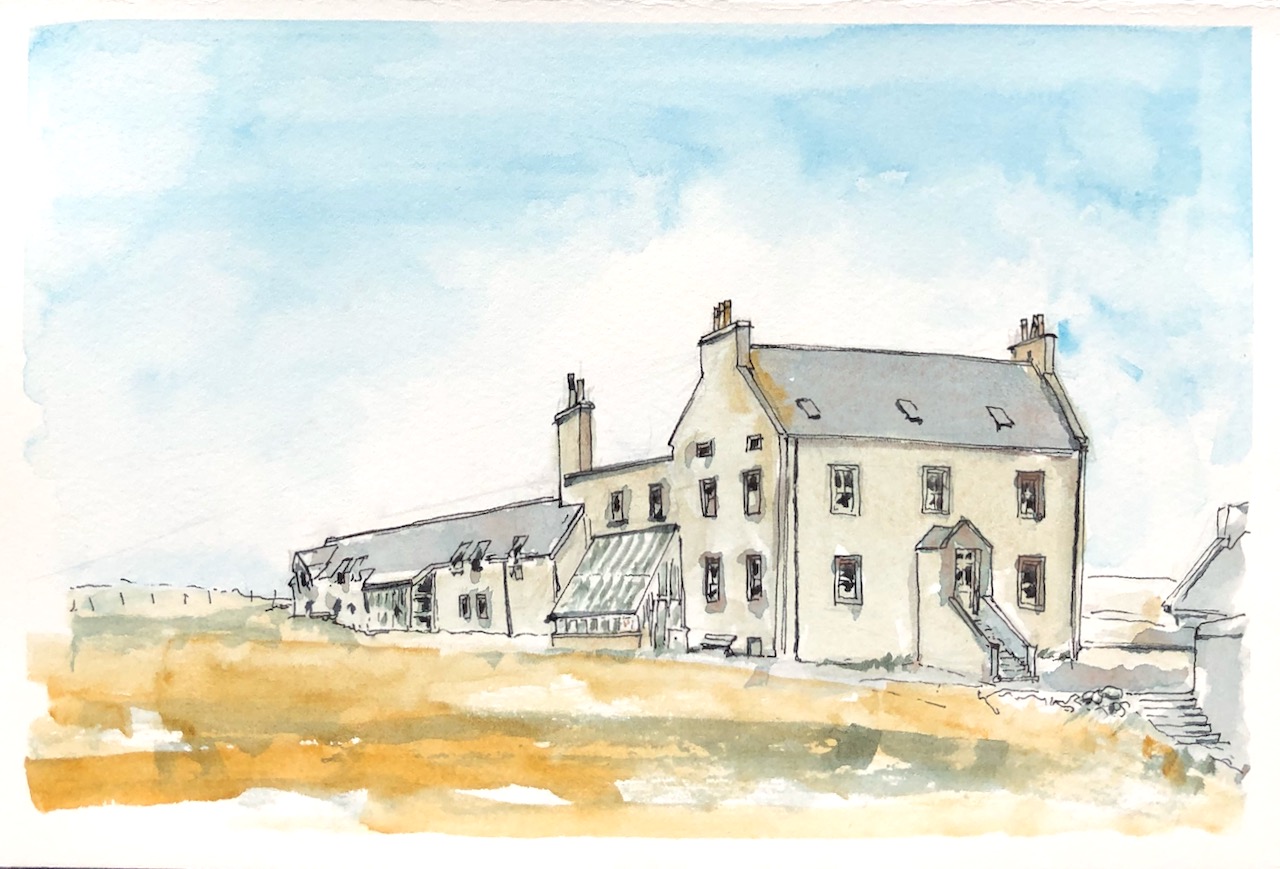
Around the back is a vegetable garden and polytunnel with herbs in. Here’s the view from the back. See all the chimneys!
Burrastow House from the vegetable garden
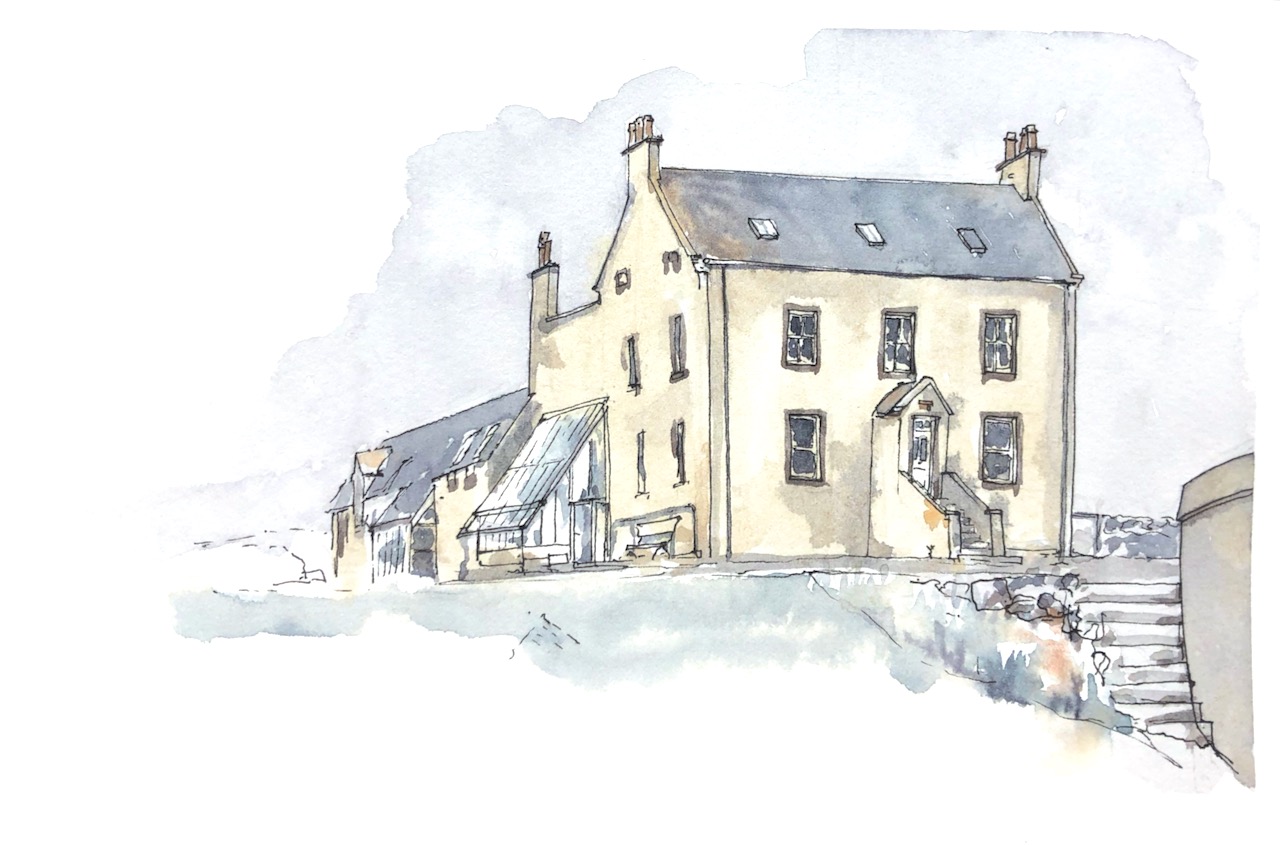
And here’s another view from the front garden.
Burrastow House from the garden, near the wall.
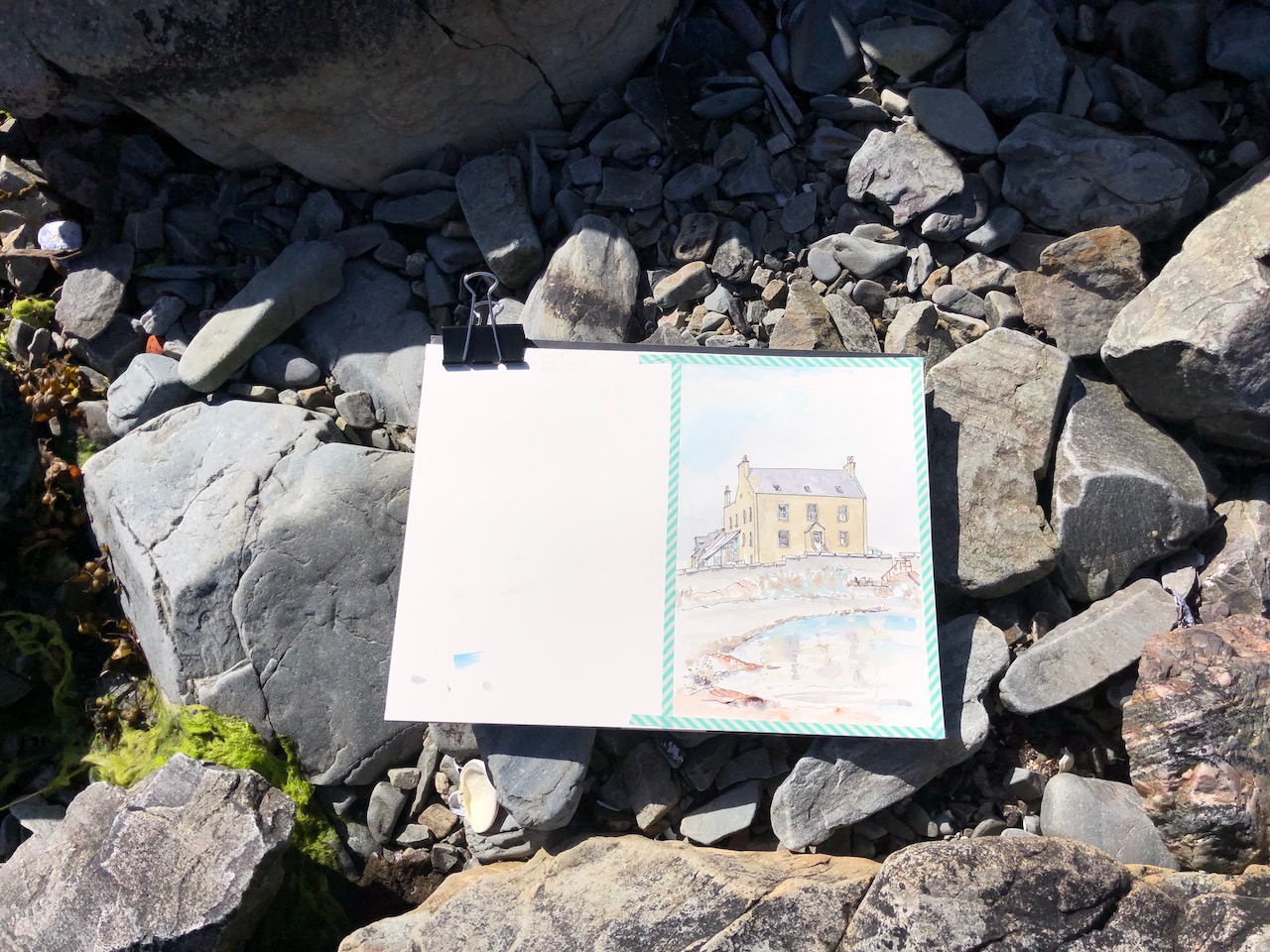
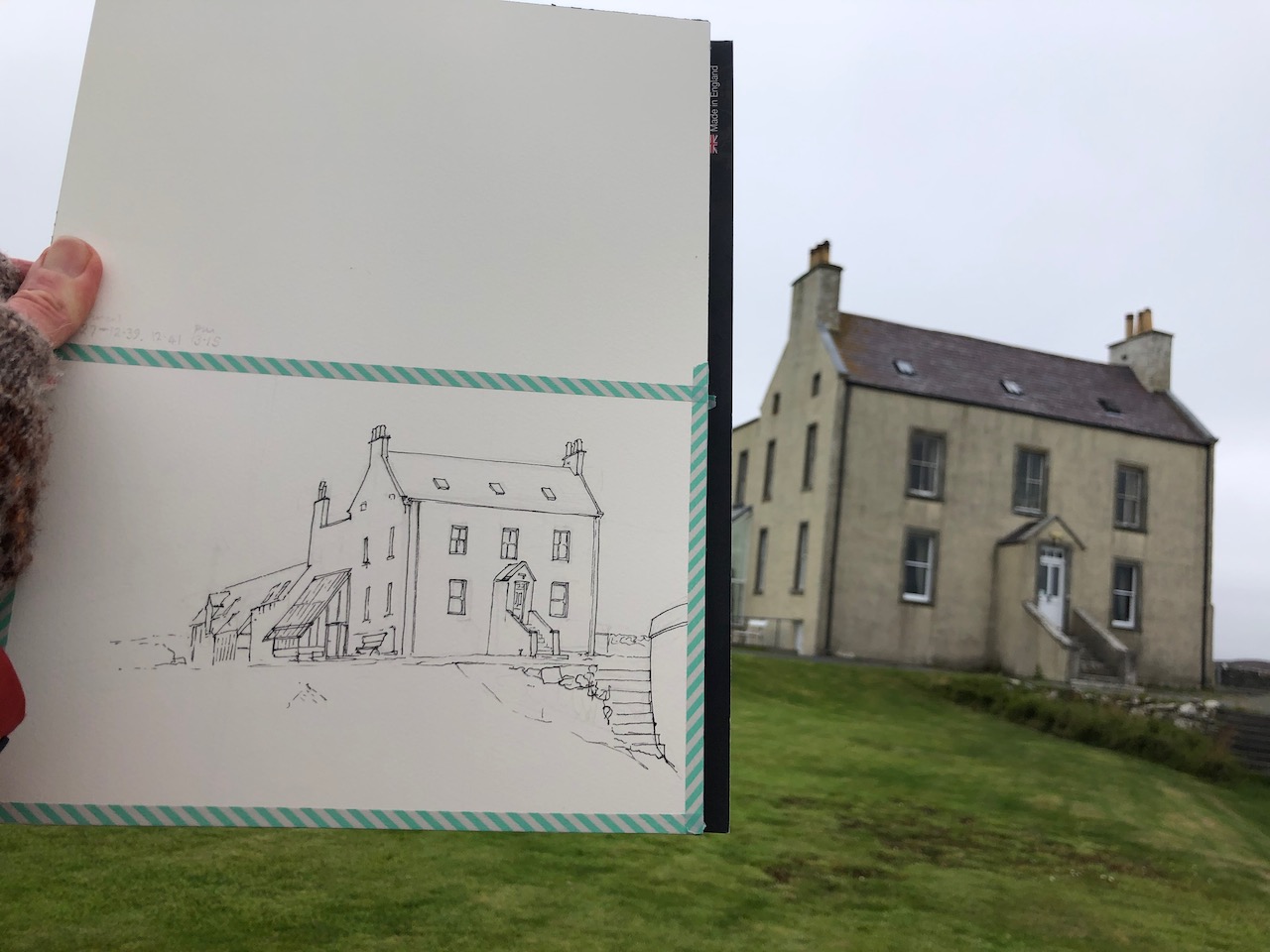
Here is work in progress on these pictures.
All pictures drawn and coloured on location, using a paper block by Saunders Waterford “St Cuthberts Mill” 300gsm Hot Press and Daniel Smith Watercolours over De Atramentis waterproof ink.
Thank you to my hosts, Pierre and Han.
Click a button below to share this post online, email it, or print it:



































 Jane Sketching