70 St Mary Axe, and Finsbury Circus

I have wanted to draw this building for a long time. It has the most wonderful shape.
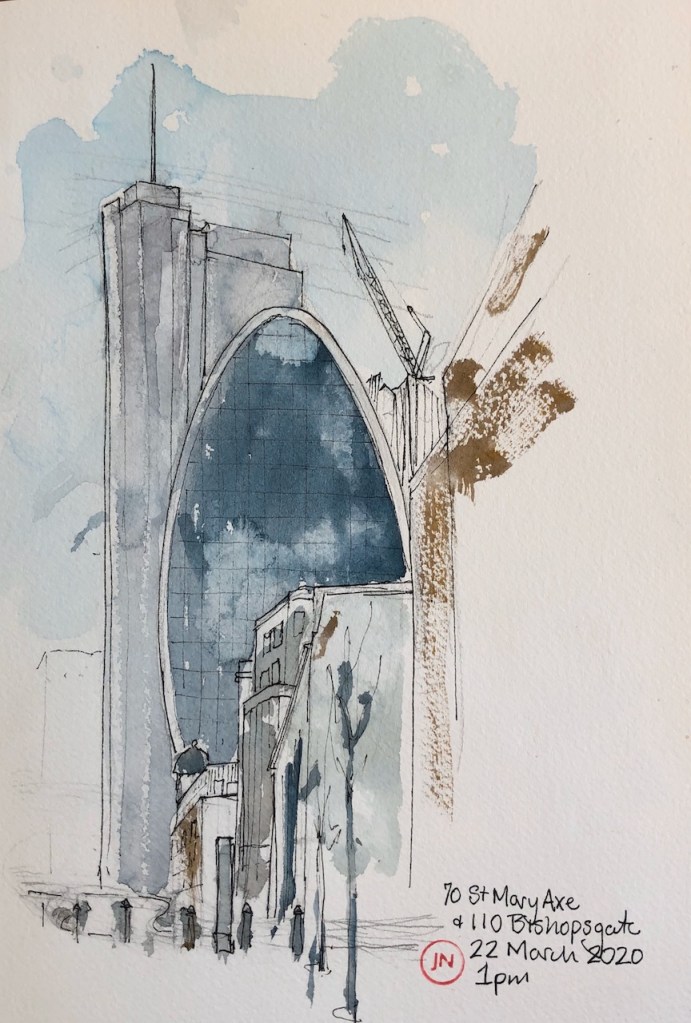
70 St Mary Axe, from the park by St Botolphs, 110 Bishopsgate is the tall building in the background.

It seemed like today was a good day: empty streets and sun. I found a view, and stood sketching with the sun on my back.

Three things happened.

  • A group of skateboarders chose the particular wide pavement on which I was standing to practise their sport.
  • People started to accumulate in the park nearby, with beer cans and music.
  • The sun moved, and I was in shade.

The skateboarders were skilful, and avoided me, but were a worry and distraction. The groups of people were definitely contravening current regulations on social distancing and made me uneasy. And then I was getting cold.

So I packed up my sketch, and moved on. The result is a rather dashed sketch, but somehow captures the mood, and is not unpleasing. What do you think?

There are more curves in this view than I normally encounter in an urban sketch. As well as the marvellous building, you can see the wiggle of the road called Bevis Marks, at the bottom of the sketch. That sinuous line is usually totally lost in the buses and parked cars. But it was visible today.

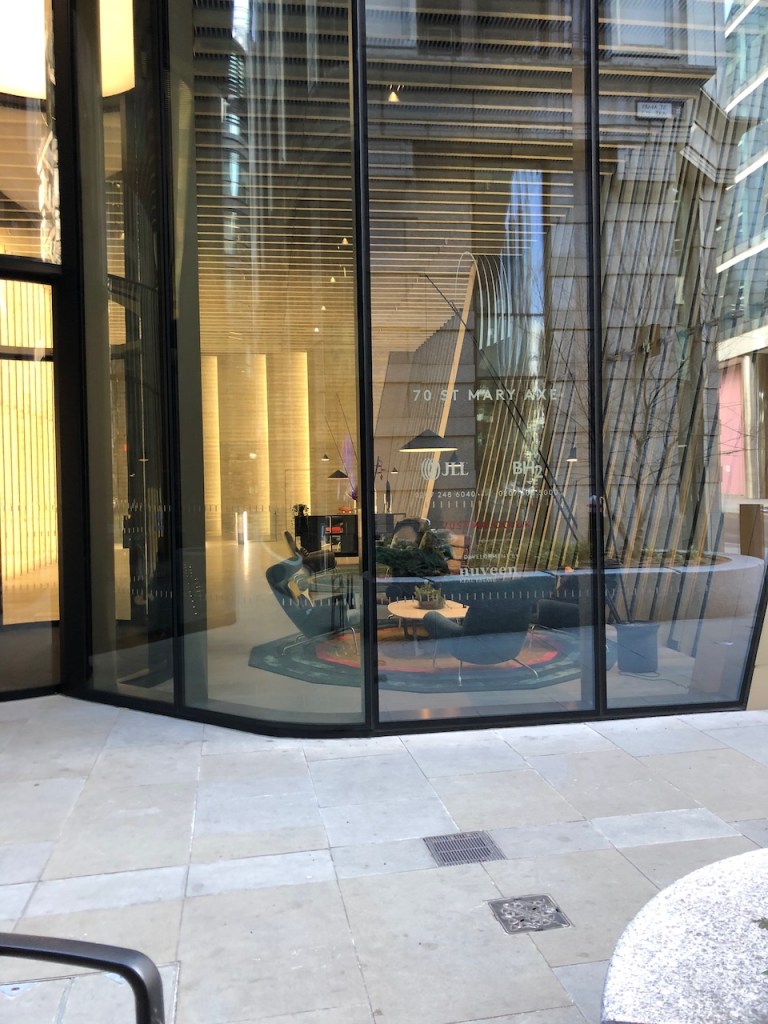
70 St Marys Axe is by Foggo Architects. It was finished last year. The interior design is also a sight to behold. I peered in through the glass.

I walked back through the deserted city and came to Finsbury Circus. Here was the most wonderful tranquil air and a feeling of light. I realised this was because a huge and tall Crossrail construction, which has been at the centre of Finsbury Circus for months, has now gone. The sky has reappeared. I could look back and see the buildings of the city though a fine mesh of branches and spring leaves. It was beautiful. I sat on the steps of 1 Finsbury Circus and drew it.

Phthalo turquoise (W&N), Burnt Umber (DS) and Perylene Maroon (DS), with some Mars Yellow (DS)

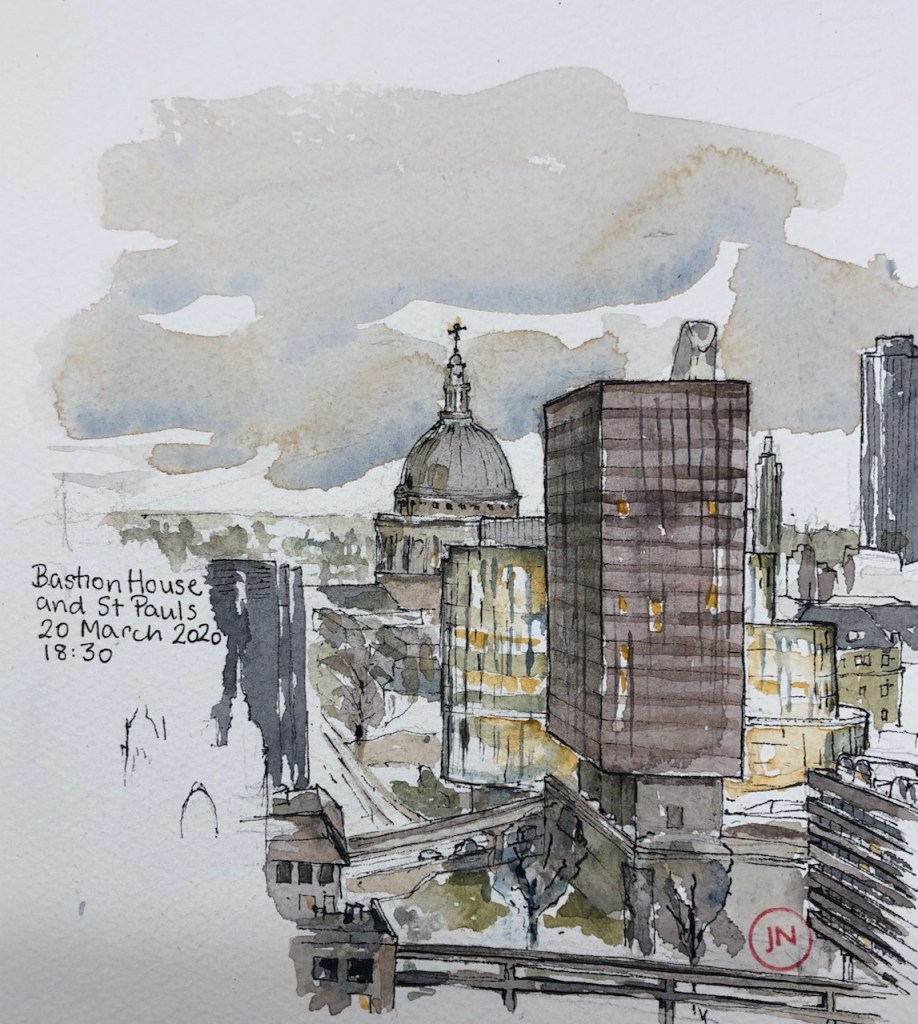
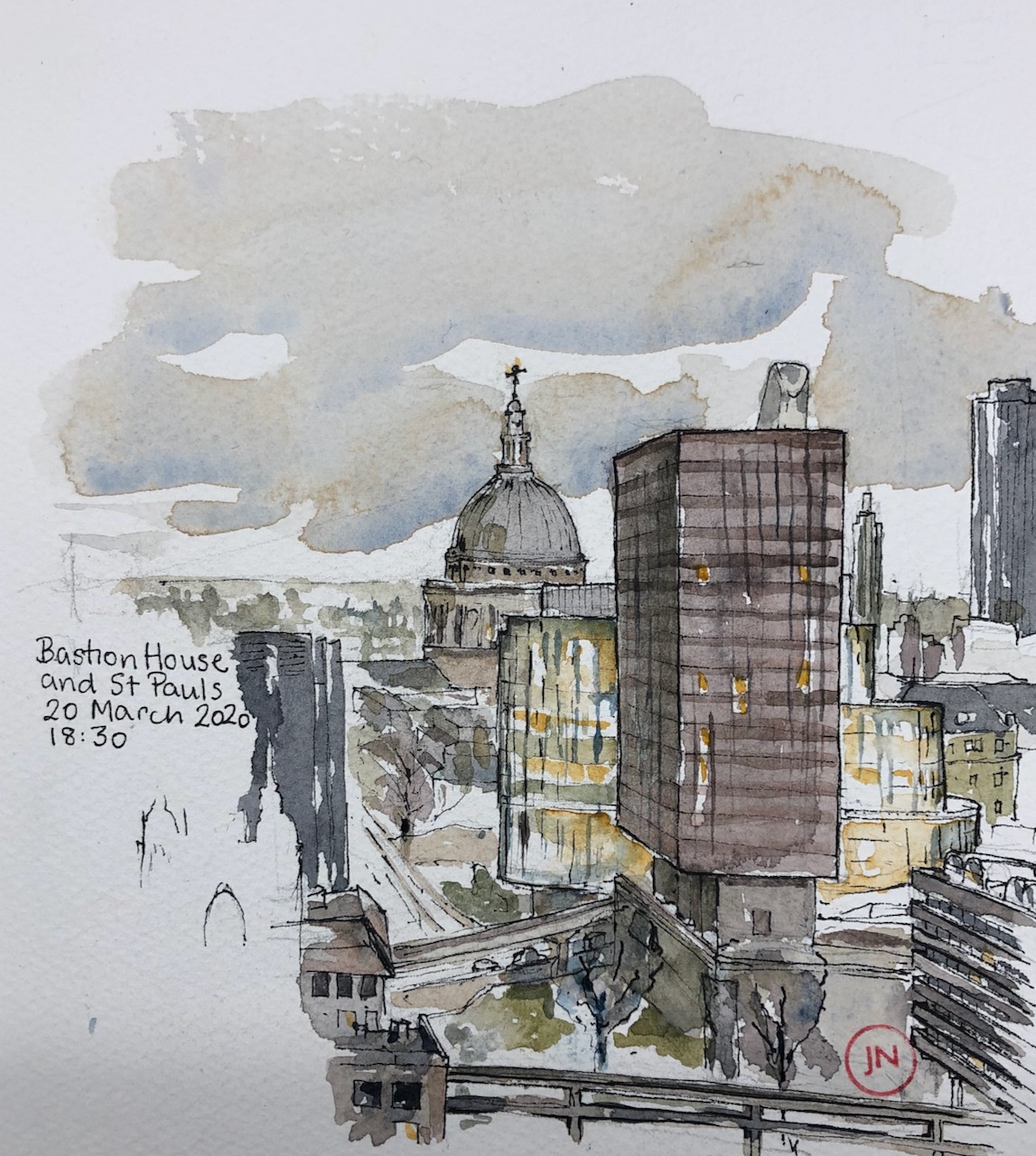
St Pauls and Bastion House

I am sketching the views out of the window.

Left to right: St Pauls, an office block on London Wall, Bastion House, tower in Vauxhall, South Bank Tower.

Just visible over the top of Bastion House is the top of “OneBlackfriars”. In the foreground: Mountjoy House, Barbican, on the right. Along the bottom is the Barbican Highwalk which joins Mountjoy House and Wallside.

I have drawn Bastion House before:

Bastion House, London Wall, from Andrewes House

I hastened to draw the magnificent Bastion House, on London Wall. It is due for demolition. In the foreground you see the balcony and privacy screen of the flat in Andrewes, whose leaseholder had kindly hosted me. The line of red brick, and what looks like chimneys, in the foreground are the rooftops of a…

Bastion House from Podium Level

Bastion House aka 140 London Wall is a huge modernist monolith, reminiscent of the monolith in “2001 – A Space Odyssey”. I couldn’t find a site to draw the monolith part today, so here is a view at Podium Level, looking West towards the Museum of London. You see the dark undercroft, walkways and a…

St Giles and Bastion House

Today Urban Sketchers London held a “sketch crawl” in the Barbican. So I joined them. An astonishing number and diversity of people assembled inside the entrance of the Barbican Centre at the appointed time of 11am. I counted about 35 and then another dozen or so joined. All shapes and sizes of people, tall, short,…

This drawing took rather a long time as I stopped a couple of times. As a result, by the time I finished, the lights were coming on in the office buildings, and the sky was dark.

Click here to see my drawing of St Paul’s last year

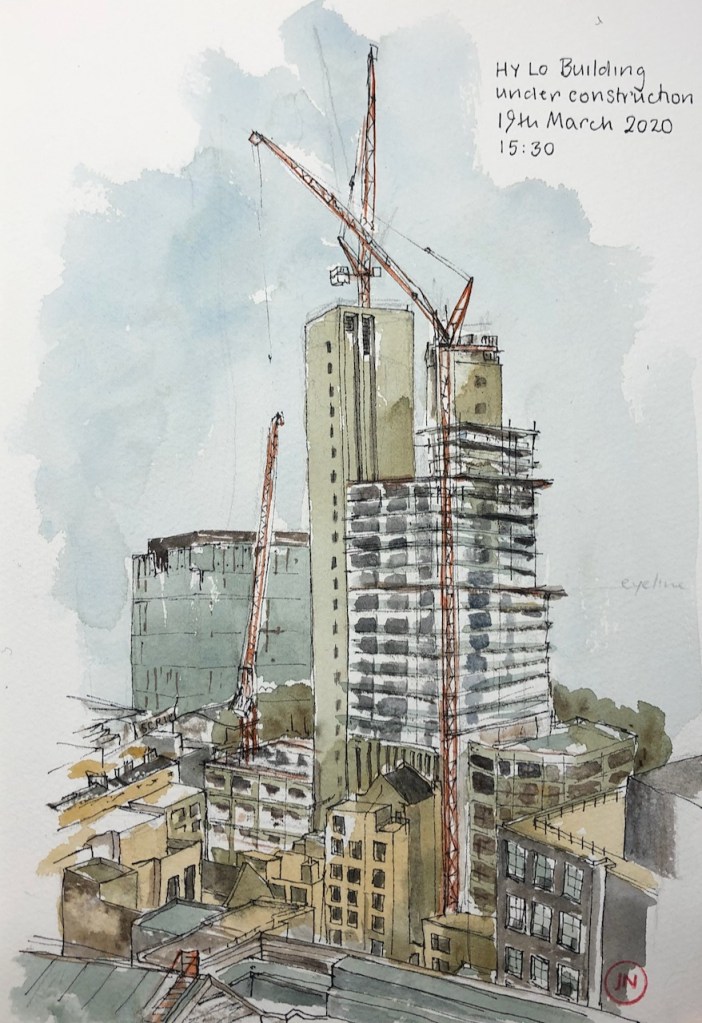
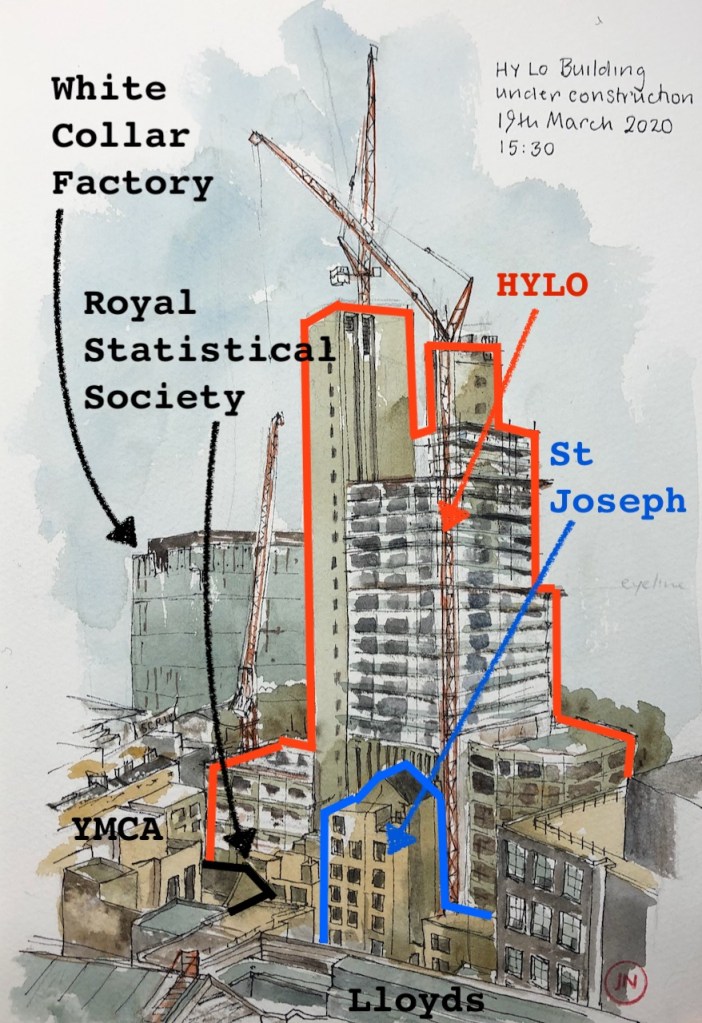
HYLO Building under construction

Here is the “HYLO” Building on Bunhill Row.

HYLO, on the site of the Finsbury Tower.

It will be “premium office and retail space over 29 floors”. The developer is “CIT”:

Steve Riddell, Managing Director Developments, CIT, says [on the CIT website]: “As the line between corporate and creative becomes more integrated, our aim is to provide a workplace solution that offers flexible spaces that embrace collaboration and connectivity at the same time. We are excited for HYLO to become the defining destination in the Old Street district.”

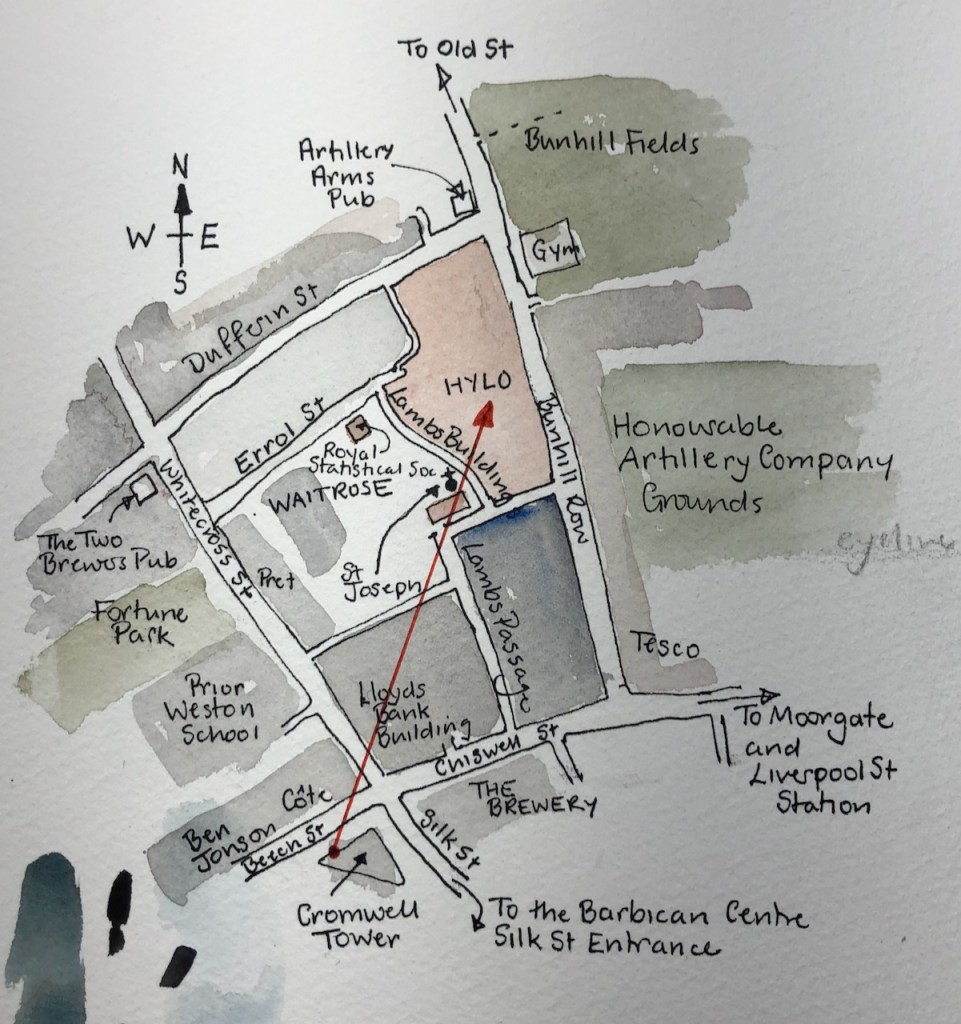
The drawing also shows buildings associated with St Joseph’s Catholic Church, these are in front of HYLO, and dwarfed by it. The cube behind HYLO on the left is “White Collar Factory” and mixed-use office space on Old Street Roundabout. Offices on Lambs Passage are on the right. In the front, at the bottom of the drawing, are the extensive air conditioning ducts and roof apparatus on a building of Lloyds Bank. On the lower left is a YMCA, being rebuilt as accommodation for young homeless people. Here’s a map and an annotated drawing.
HYLO is on the site of the former Finsbury Tower. Here is what it looked like before:

Finsbury Tower 3rd August 2016
Finsbury Tower on Bunhill Row above Peabody Estate buildings. Finsbury Tower was a 1960s office building now undergoing extensive renovation. According to the planning application, the renovation will add 12 storeys to the existing 16, doubling the building’s height. 

Here are some other drawings in this area:

Lamb’s Buildings EC1

St Joseph’s Bunhill Row on right. From the church notice board: “A small chapel in the basement of a former school 1901”. Contains windows from St Mary Moorfields 1820. Remodelled 1993 by Anthony Delarue “in a vaguely Florentine Renaissance manner”. The crib is there until Feb 2nd, and the church is open Fridays 12noon to…

YMCA site, Errol St EC1

This site is a few minutes walk from where I live. There will be a “new home for young homeless Londoners”. “146 beds, 10 000 lives, 60 years”, says the text on the hoarding. There will be 146 en-suite rooms, an “affordable gym for the whole community” and a “social enterprise unit”. You can see…

South Bank, London

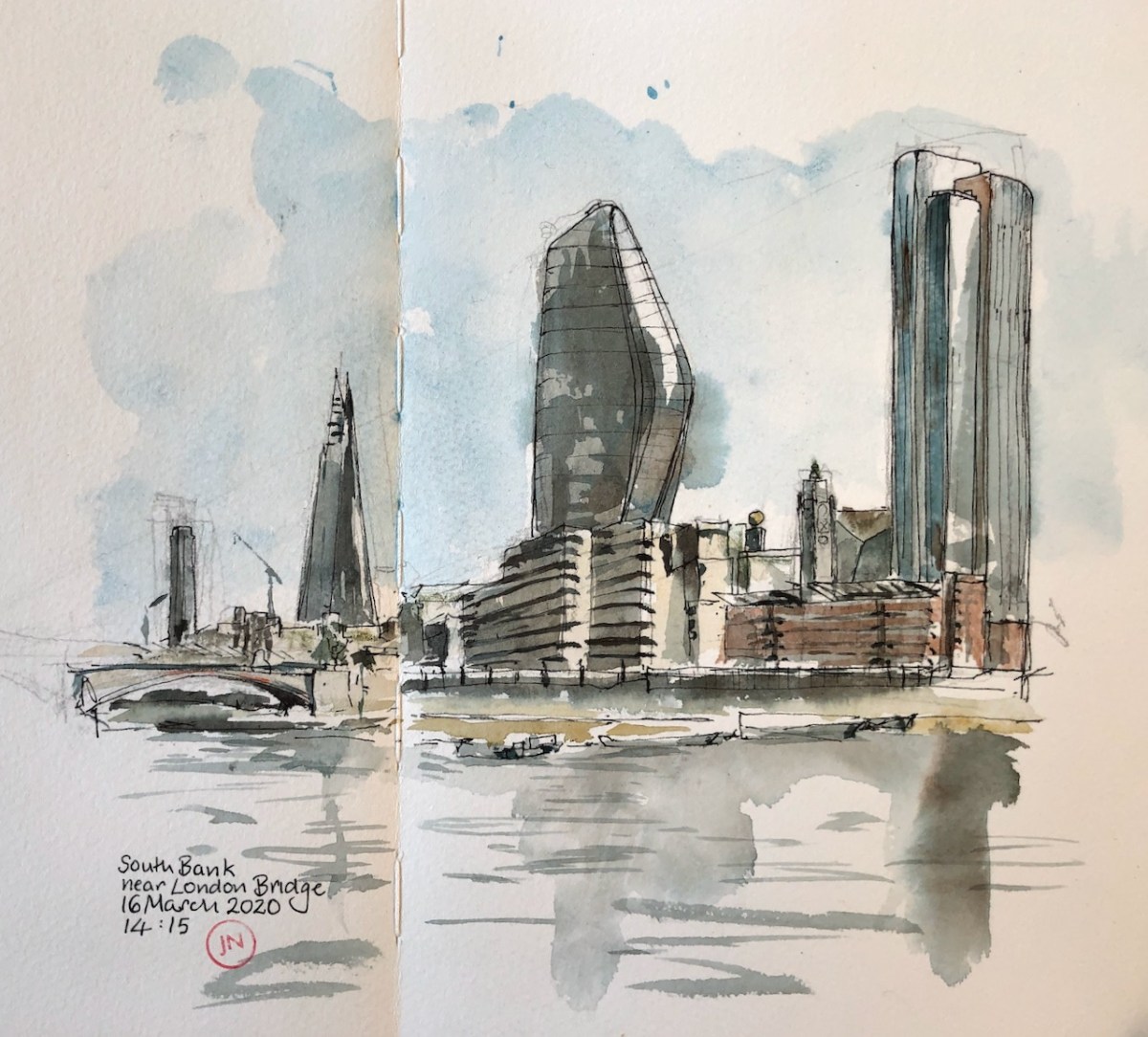
Here’s the South Bank seen from the Victoria Embankment on the North Bank.

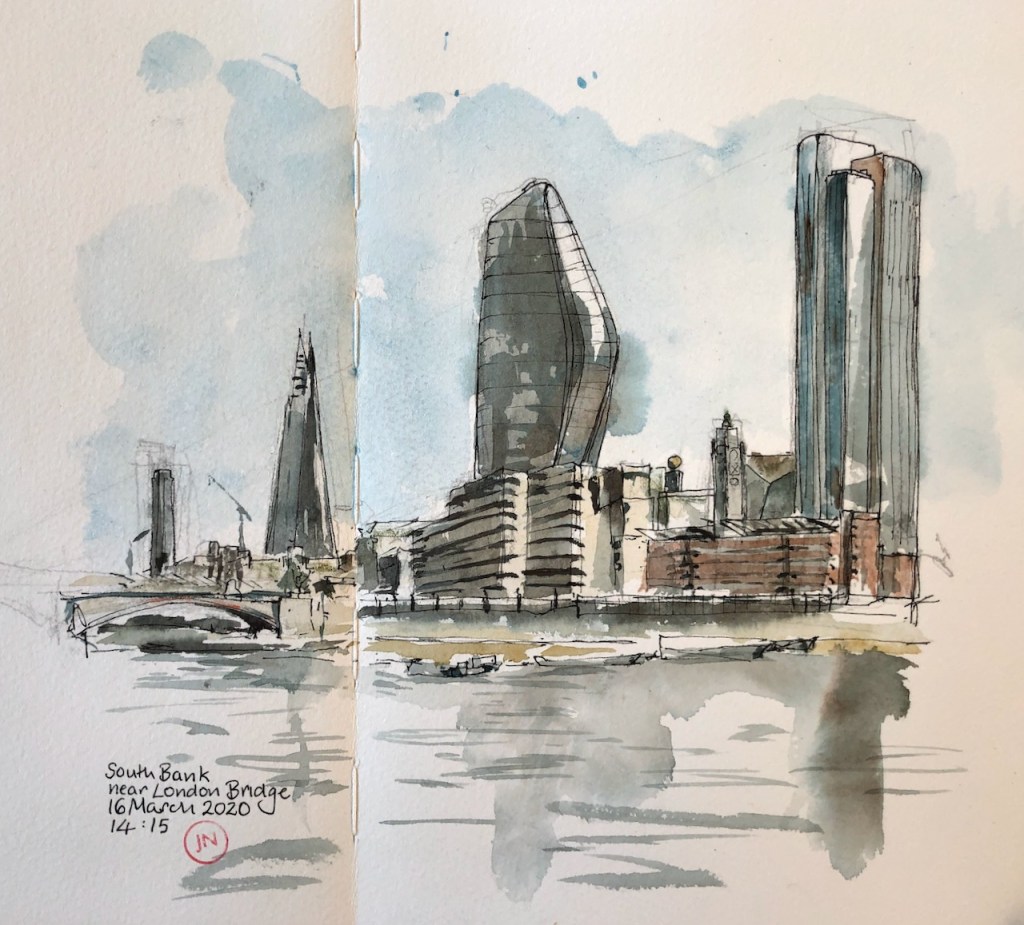
South Bank near Blackfriars Bridge – Tate Modern, The Shard, One Blackfriars, South Bank Tower

Here you see the modern blocks, with the older wharves in front. The low red building towards the right is Oxo Tower Wharf, formerly a factory making OXO cubes, now a place with workshops for jewellers, a restaurant and various cafés. The building was designed for the Liebig Extract of Meat Company by Albert Moore in the 1920s. It was derelict in the 1970s. In the 1980s the Coin Street Community Builders saved it from demolition and with great determination gradually renovated it in stages over the next twenty years.

The tall tower on the right is the South Bank Tower, a residential block. Its height was increased recently, adding about a third on top. You can see the “seam” on the building, and I have shown it in the drawing on the right of the tower. One Blackfrairs is the asymmetrical tower in the middle, mostly residential, and completed last year.

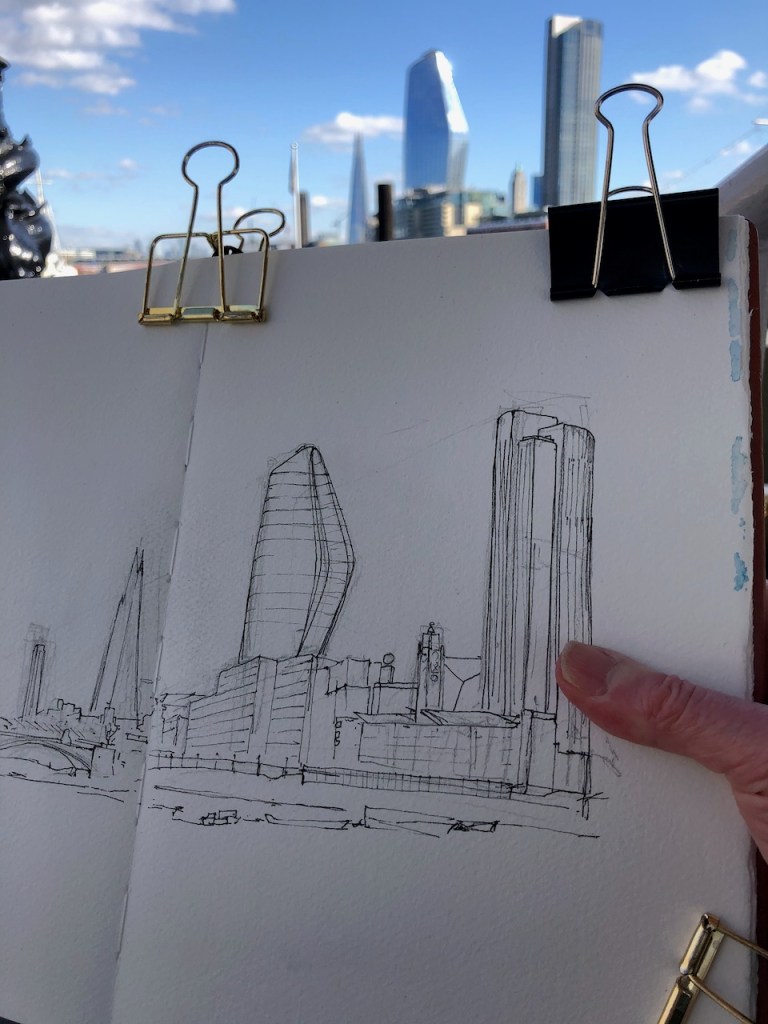
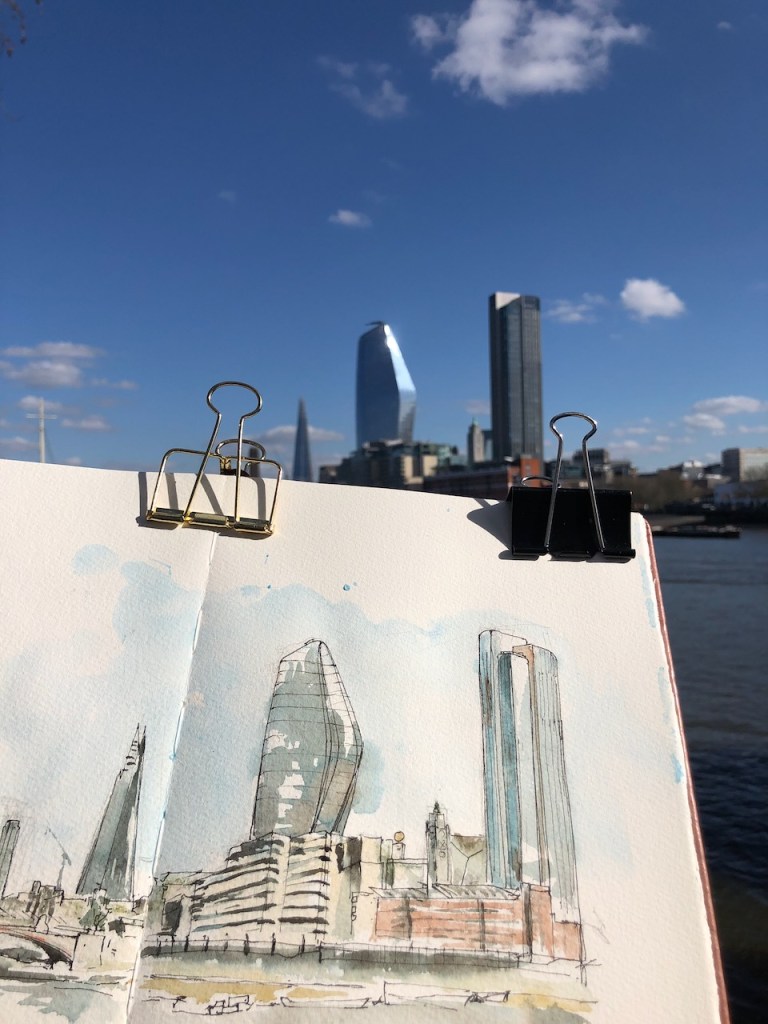
Here is work in progress.

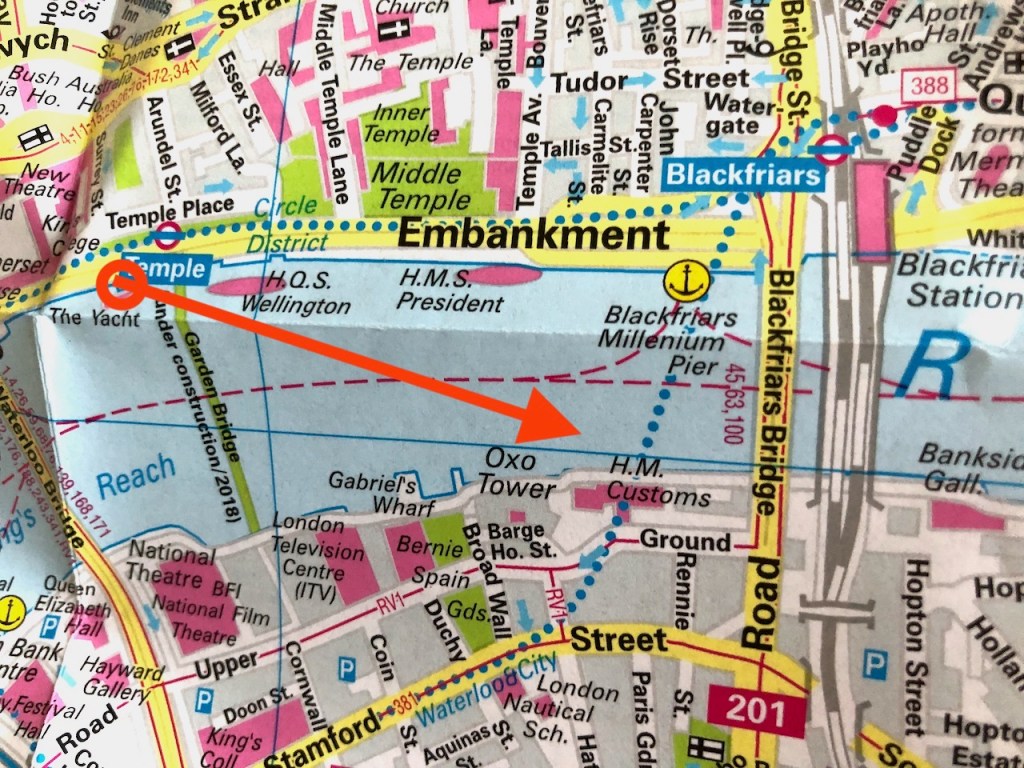
Here’s a map.

Street map. The arrow shows the sightline of the drawing.

There is a building to the South West of Blackfriars Bridge, labelled “HM Customs” on the map. This is next to Oxo Tower Wharf, on the river front in the centre of the drawing.

HM Customs and Excise were there from 1987, when the building was called “New Kings Beam House”. In an early part of my career they were a client of mine. This was the 1980s. I remember stepping over mud in my nice business shoes, and picking my way between derelict buildings with my briefcase, feeling rather conspicuous. After this hazardous journey, I was always glad to see the uniformed commissionaire at the door of New Kings Beam House. He was, of course, in full Customs uniform, with a white shirt and gold buttons. The entrance was from Upper Ground then. The meetings were in bright offices overlooking the river, fully carpeted and quite unlike the offices of any other of my government clients. HM Customs and Excise merged with the Inland Revenue in 2005 to form “Her Majesty’s Revenue and Customs” (HMRC). They must have moved out of the building around then. It was refurbished in 2011, and is now called “Sea Containers House”, with a hotel and the offices of media and marketing companies.

This drawing took about an hour drawn leaning on a stone pillar on the Victoria Embankment. Phthalo Blue (W&N), Burnt Umber (DS) and a bit of Mars Yellow (DS) and Perinone Orange (DS).

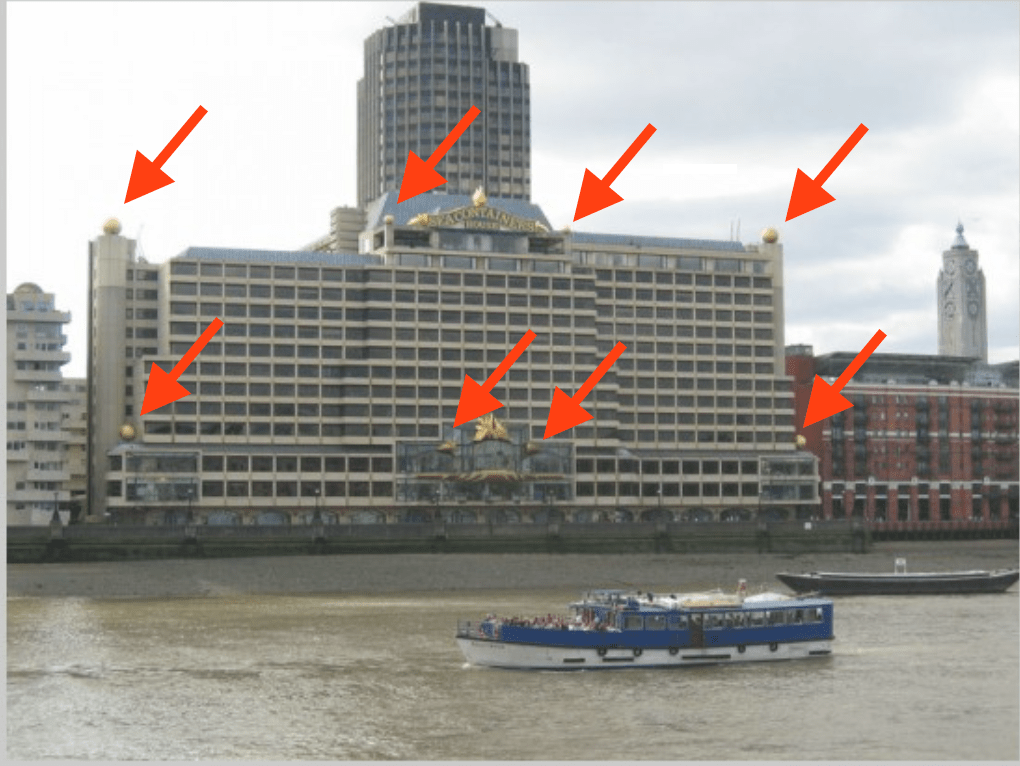
I put more information about Sea Containers House in this post: From Oxo Tower Wharf. In the 1980s there were the gold spheres on top of the pillars facing the river. These have since vanished from the riverside façade.

Sea Containers House about 2010, showing the golden spheres. Note also the height of the Tower behind, which is now much higher, and is called South Bank Tower.

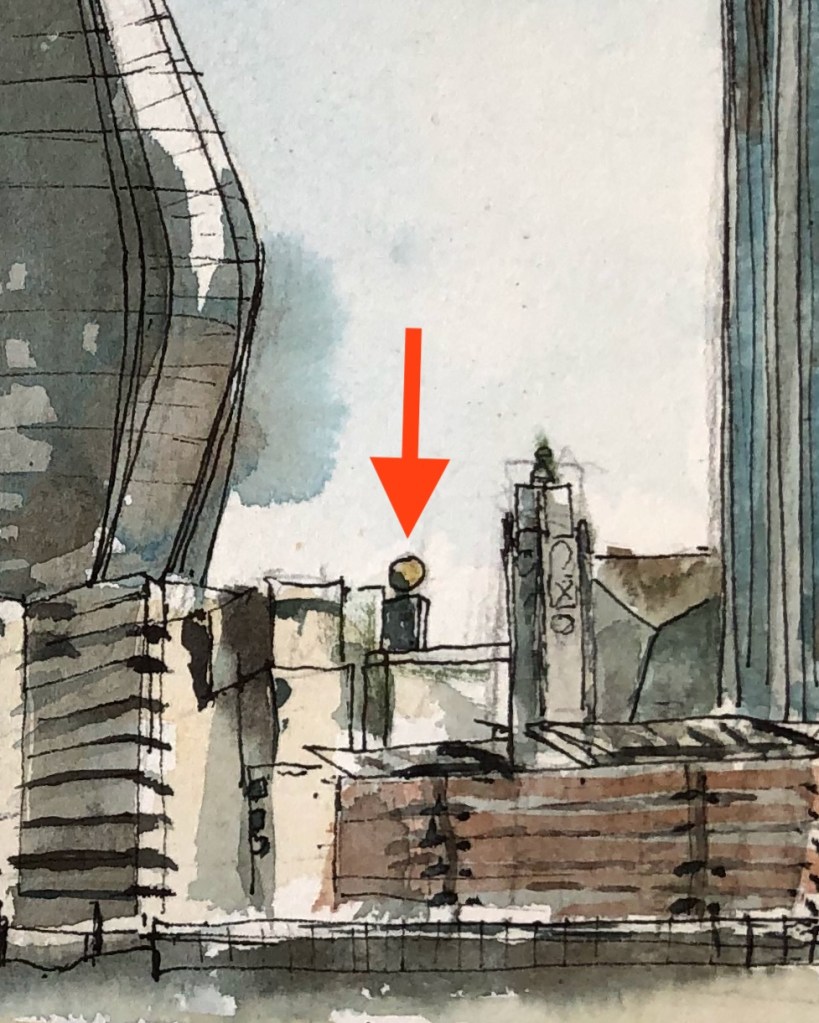
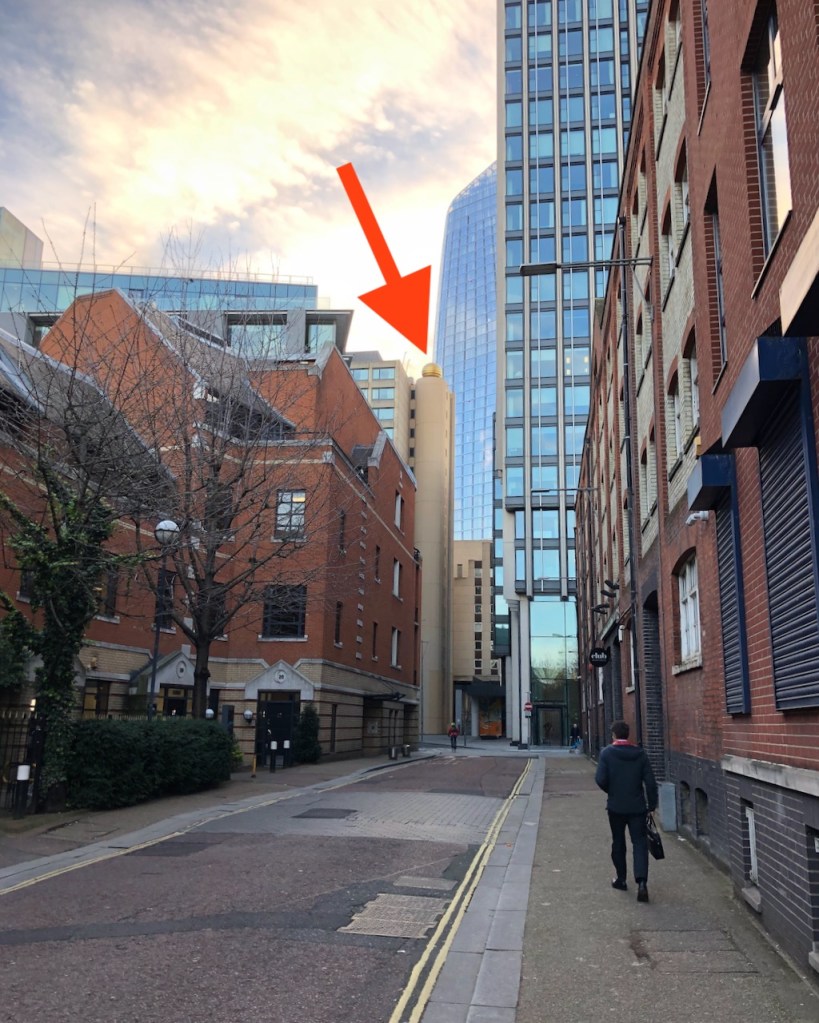
When I was sketching, I thought I could see one of them, hidden at the back. You can see it in the drawing, between the Oxo tower and South Bank Tower. Intrigued, I went looking for it later, and found a view of it from Upper Ground. It’s very odd that they kept that one, and discarded all the others.

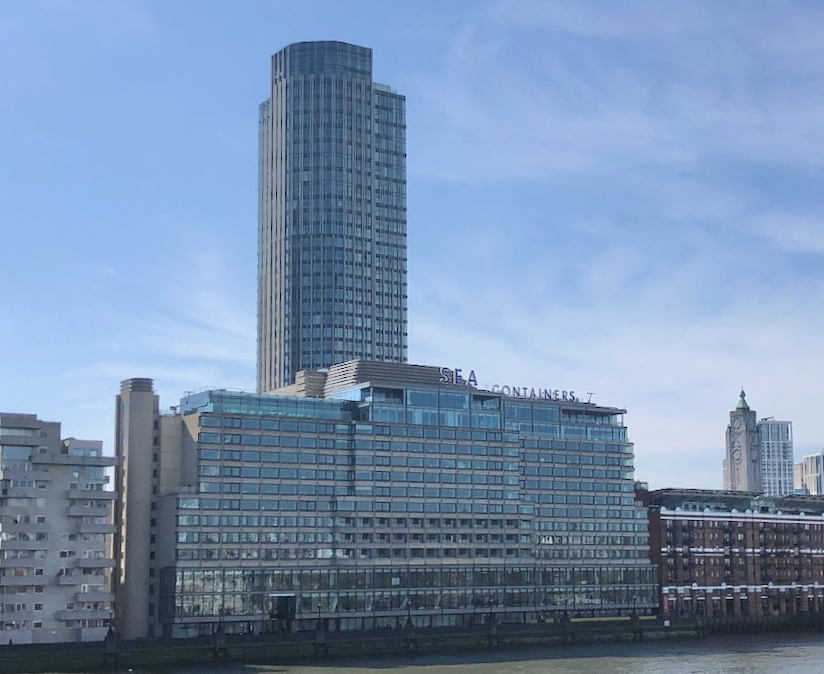
Here is what Sea Containers House looks like now, from the North side of Blackfriars Bridge, March 2020. No golden spheres on this side. And see the increased height of the South Bank Tower behind.

Gloucester Cathedral

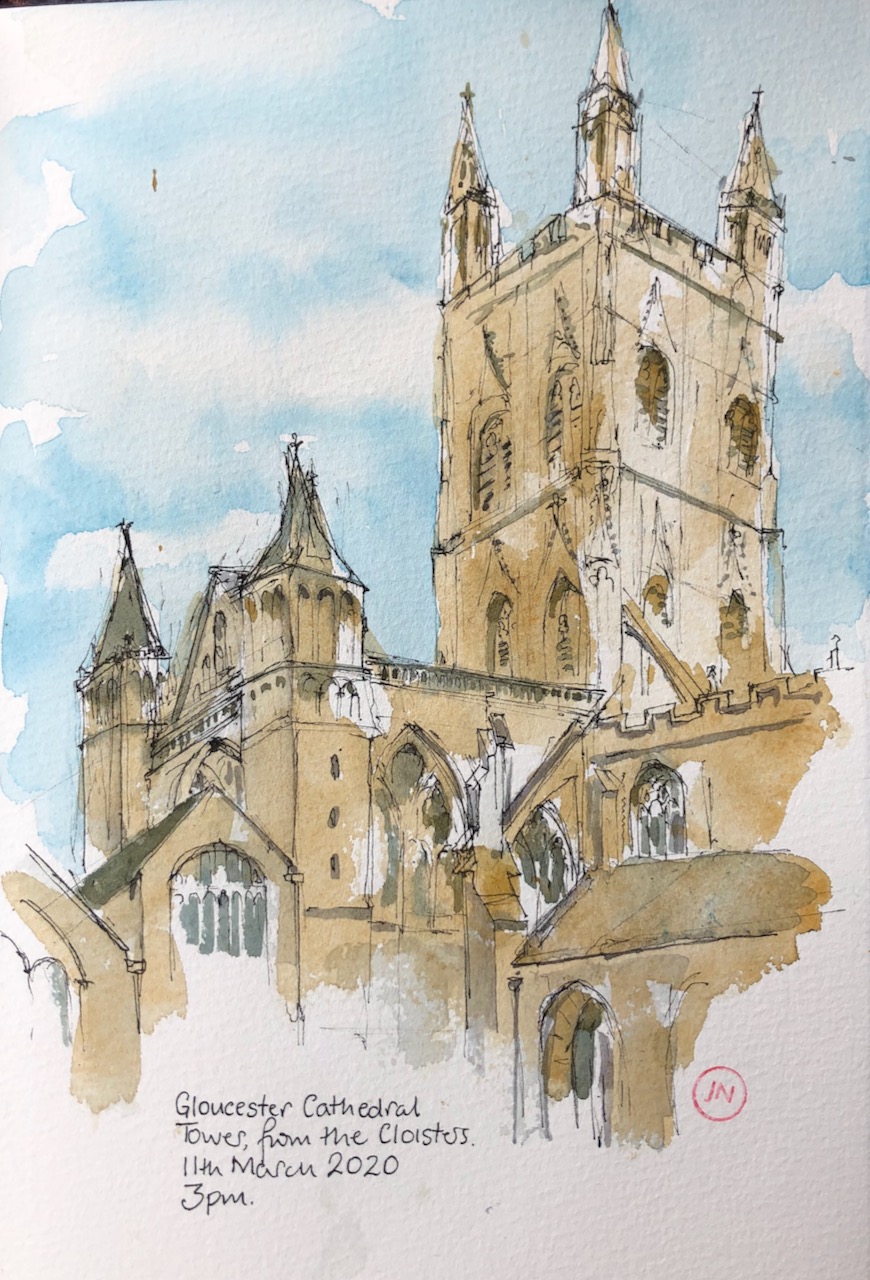
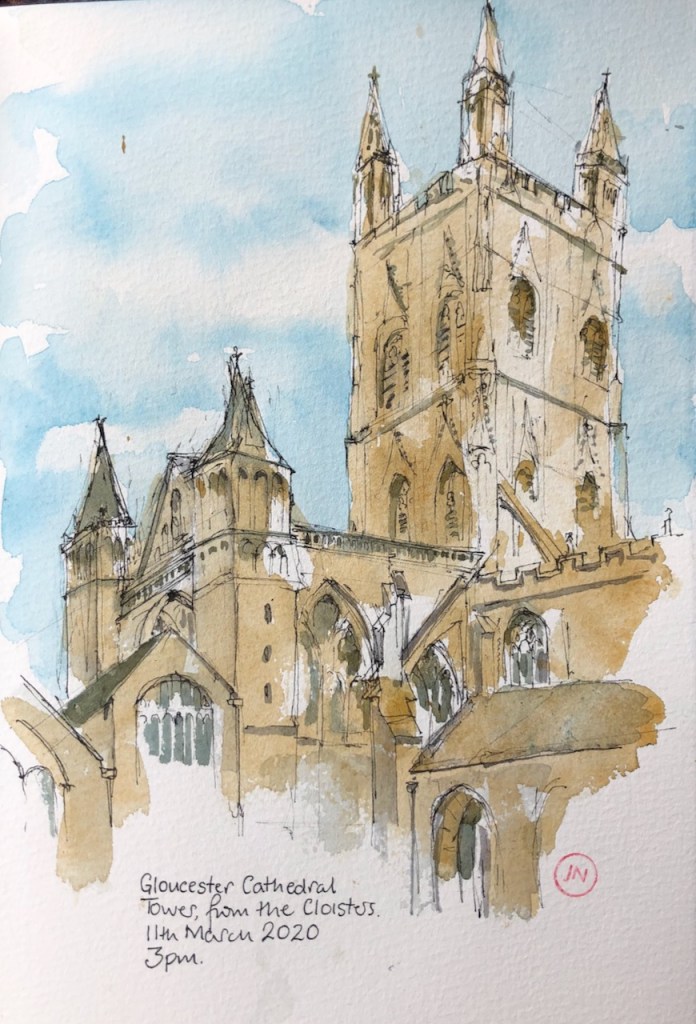
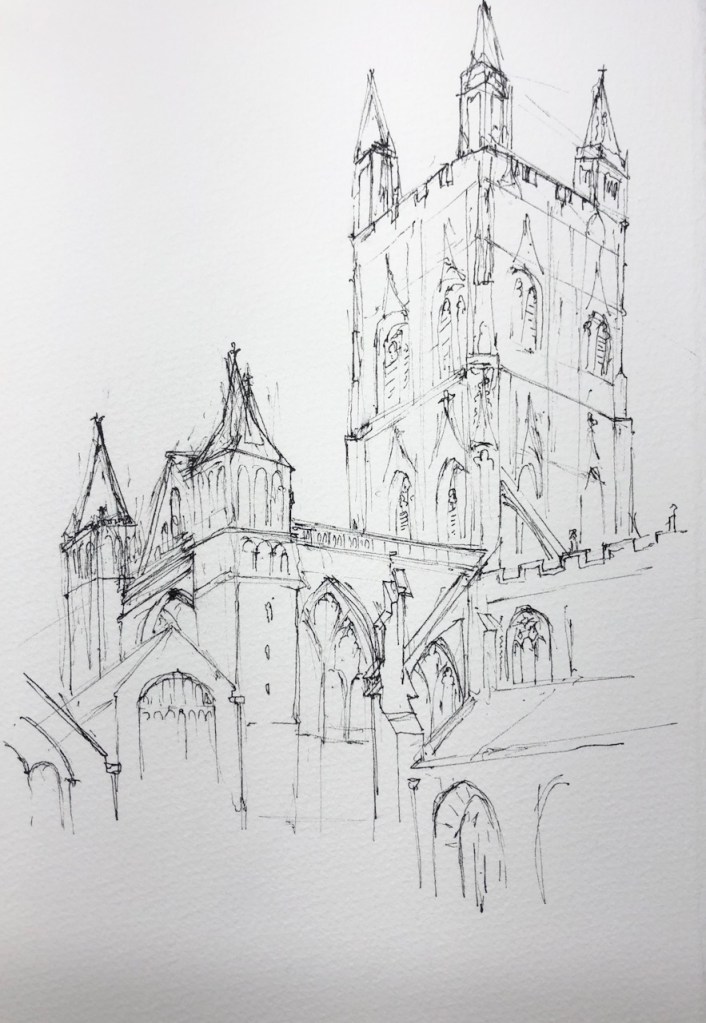
This is Gloucester Cathedral Tower from the cloisters.

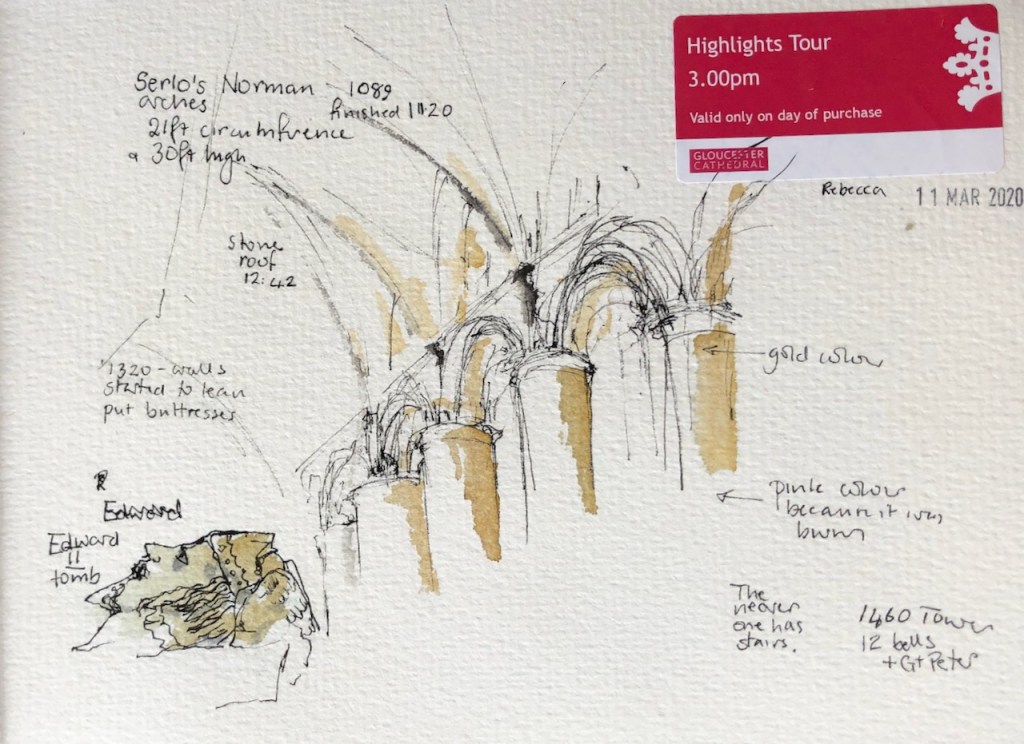
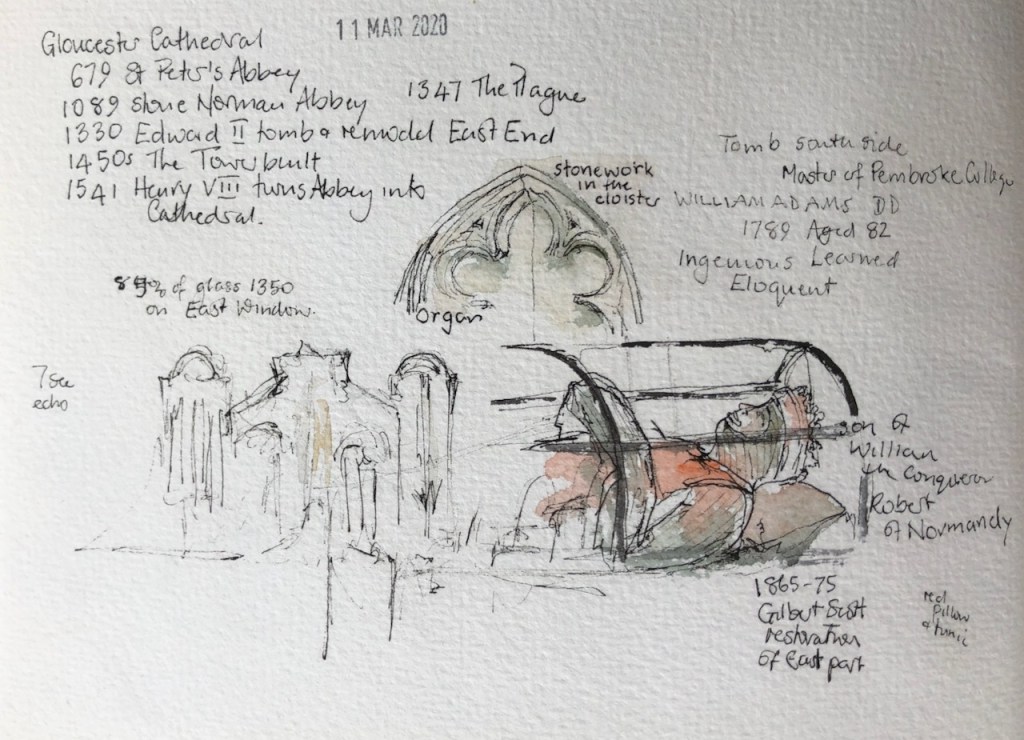
It’s an amazing place. Inside there are huge Norman pillars from 1089. They seem so solid and magnificent that you’d think no-one would ever want to change them. But someone did. At the East End, there are a few pairs of pillars in a totally different style: the “perpendicular” style, which means they are fluted, like vertical clusters of pipes. This remodelling project was started in around 1330, but didn’t get far. Our guide, Rebecca, offered several explanations for why this project was stopped. There was a war with France, the start of the “Hundred Years War”. France invaded Dover and Folkestone in 1339 . And on the north border, English armies were attempting to stop Scotland from going independent. So there was a lot going on, and remodelling a cathedral might have gone down the list of economic priorities. Then, to cap it all, there was the Plague in 1347-51 which must have depleted the workforce and caused economic disruption. So best leave the Norman pillars as they are.

Here are some sketches as we toured the cathedral. Thank you to Rebecca, who was a brilliant guide: patient with our questions and interruptions, and extremely knowledgeable.

It’s 1hr45mins from Paddington to Gloucester. Here are some drawings done on the train.

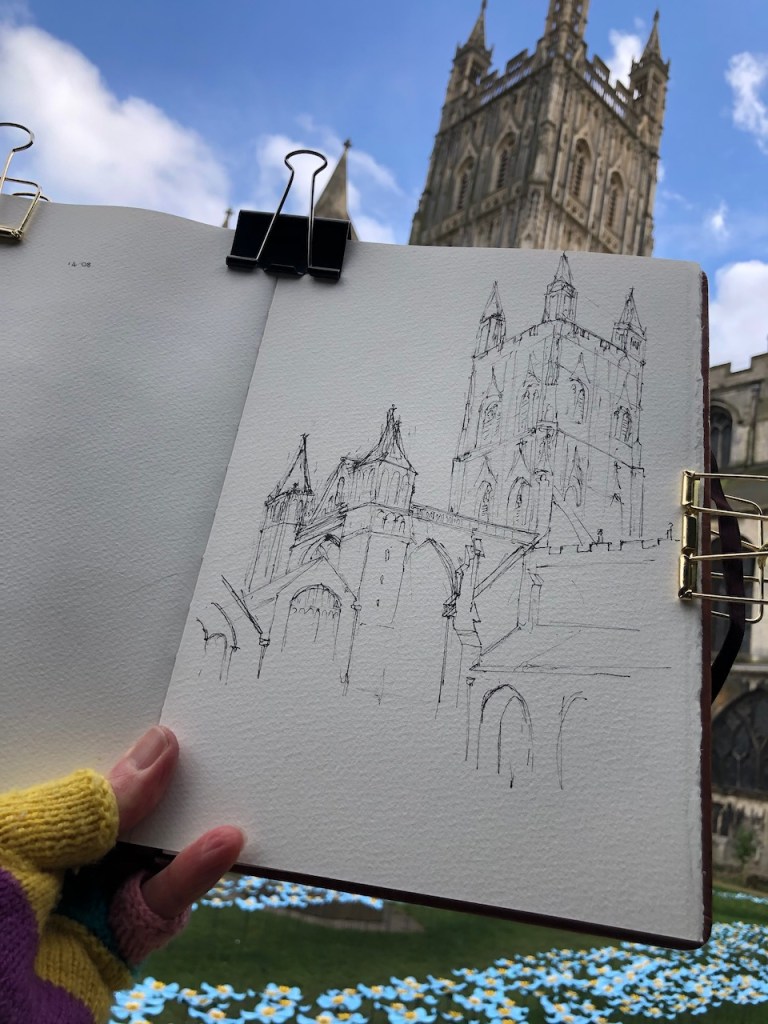
The drawing of the Tower was a quick pen and ink sketch, coloured later. The pen and ink took about 45 minutes. The colours are: Phthalo Turquoise (W&N), Mars Yellow (DS) and Perinone Orange (DS). Here is work in progress, including some of the drawing on the train.

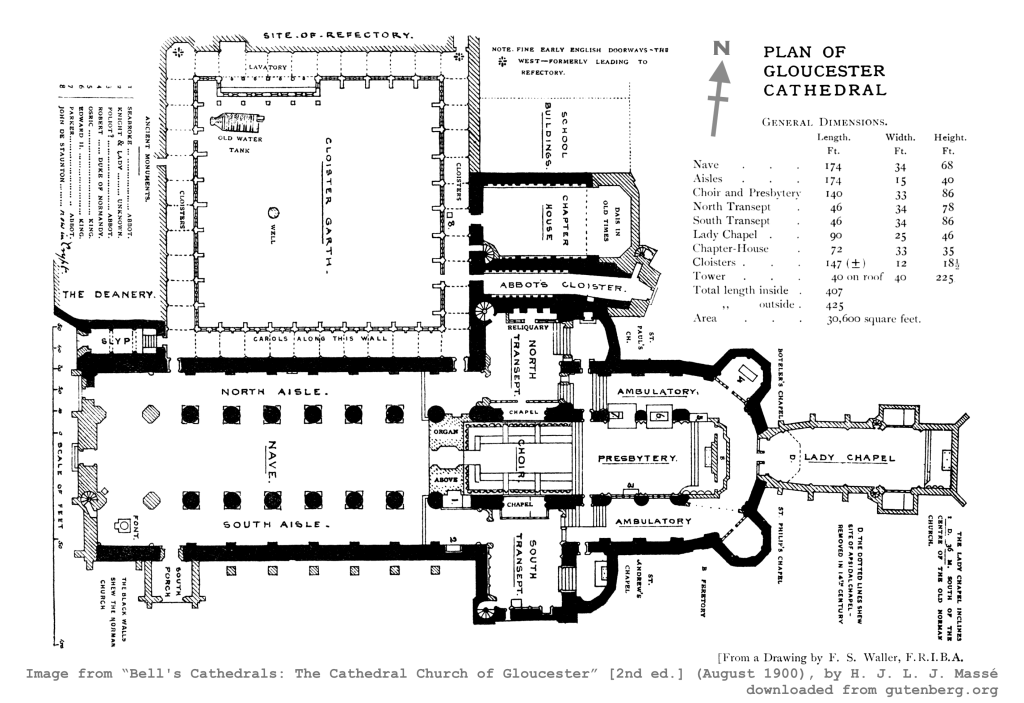
Map of Gloucester Cathedral (1900):

Footnote: Concerning things that were going on in the 1330s: the Butchers Guild was granted the right to regulate the meat trade in London in 1331. See this post for a picture of the Butchers Hall:

Barts Square, Butchers’ Hall

Continuing my exploration of Barts Square, EC1, today I drew Butchers’ Hall. Butchers’ Hall is the building with the arched windows, in the centre left of the picture. It is the headquarters of The Worshipful Company of Butchers. This livery company is very old, the Arms were granted in 1540 and the charter by James…

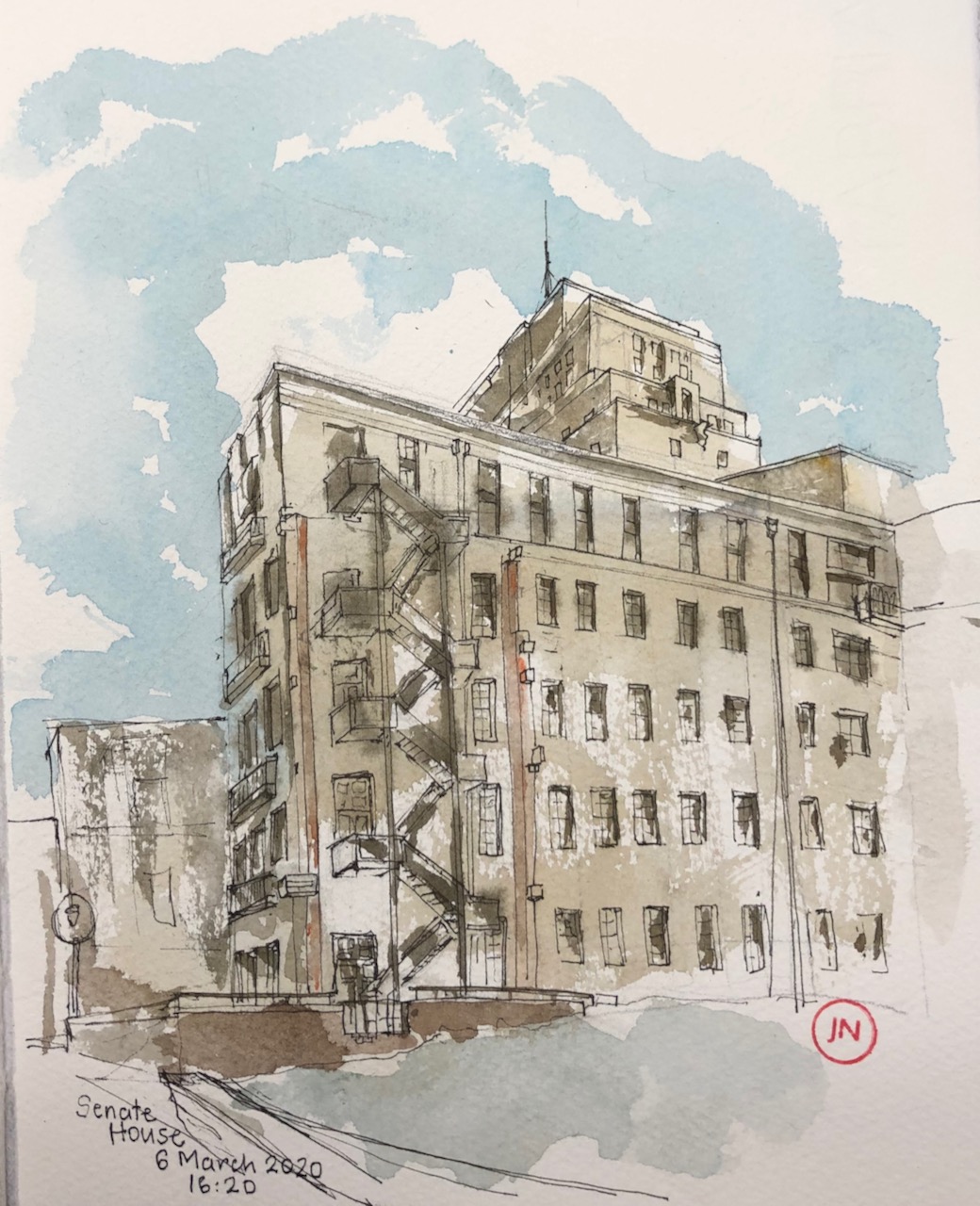
Senate House, unfinished courtyard

The original plan, by the architect Charles Holden in 1931, proposed University of London buildings which extended all the way up Malet Street, with 17 courtyards and two huge towers. This plan was revised a number of times, becoming less magnificent with each revision. We are left with just three of the original 17 courtyards, and just one of the towers. What I find interesting is that evidently one of these downward revisions of the magnificence must have occurred rather suddenly, while building was in progress. Here are maps:

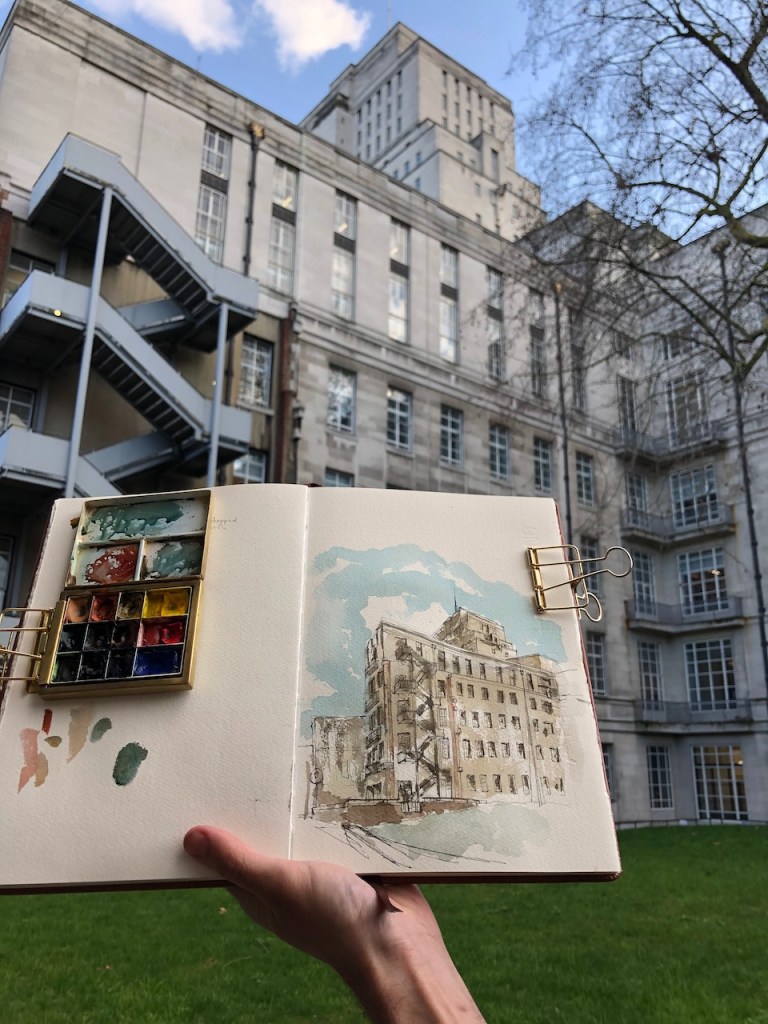
An unfinished fourth courtyard is evident in the fabric of the building, shown in the drawing below. Strange parts of walls just out like ragged lego bricks from the clean white facades. I imagine the construction workers being suddenly told “Stop! We’ve changed our minds about that next courtyard.” And the workers climbed down the ladders and downed their tools, there and then. Eventually grass covered what would have been the courtyard.

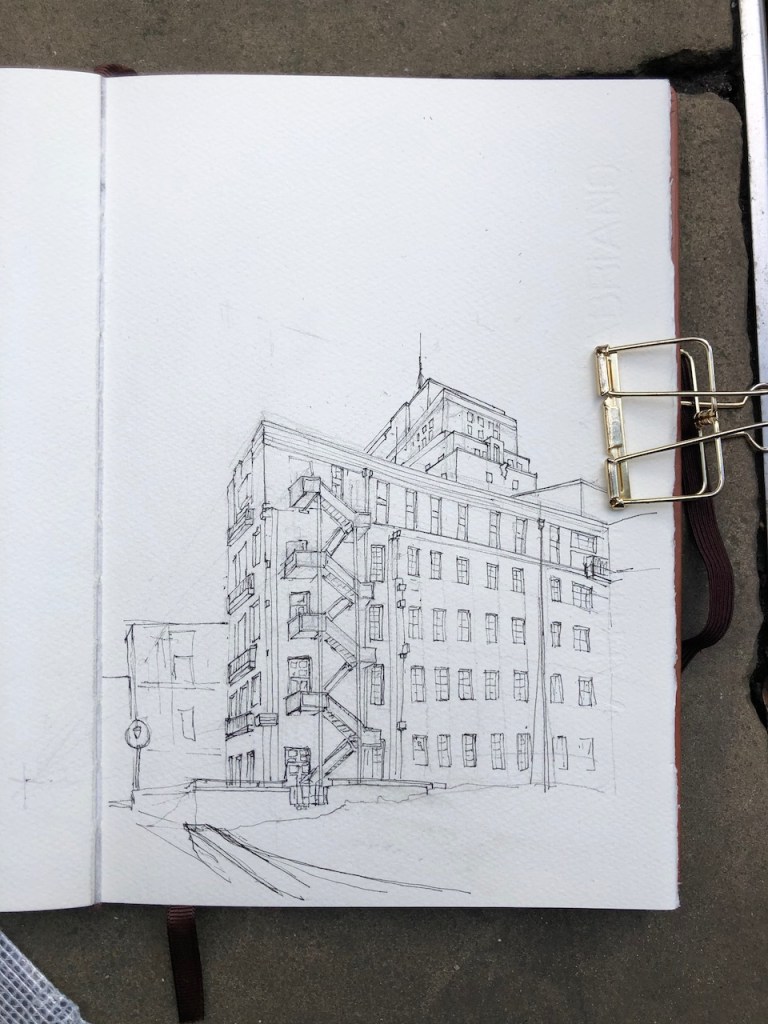
The wonderful Senate House library tower is top right. Centre of the picture, either side of the fire escape, are strange unfinished walls, in brick. The grass, dull green in the picture, front centre, is where the courtyard would have been.

I learned about Charles Holden from a walking tour on 5th October 2019, led by Chris Rogers. The title of the walk was “Best Laid Plans….Uncompleted London 1925-1995”. Chris Rogers is a writer and speaker on architecture, film, and on architecture in film. His website is here: http://www.chrismrogers.net. It was Chris Rogers who led us to the place where I made this drawing. He drew my attention to the startling unfinished walls in this otherwise polished building. My thanks to him and to the Twentieth Century Society for organising the walk.

Holden’s plan for the site was abandoned in 1937. The main tower is 210 feet high “at that time [1937] the tallest building in the capital after St Paul’s” comments Chris Rogers. He also points out that the upper floors of the tower were for the book stacks of the library “the London Building Act forbidding permanent occupation of any part of a building over 100 feet in height for fire safety reasons.” The laws were first initiated after the Great Fire of London, and subsequently modified, with sections being repealed, modified and replaced with Building Regulations.

If you want to, you can walk right underneath the tower, West-East from Malet St to Russell Square. Although it looks private, it is a public route. No-one stopped me as I wandered through with my backpack, looking for this vista to draw. It’s worth going through, as you catch a glimpse of the interior.

As I was drawing the picture, two construction workers stopped and admired the picture. Given their trade, I thought they might be interested in the reason why I was drawing here and the story of the unfinished courtyard. They knew it already. Yes, they said, there was going to be two towers. We agreed it was still a magnificent building. “But inside, ” they told me, “it’s all been ripped out.” I was interested. “Yes,” they continued, “all the sinks and taps, all taken out.” With a hand gesture, they conveyed the former beauty of the Art Deco bathroom fittings, marble floors, decorated tiles. “It’s like an airport terminal in there now,” they said, with resignation and sadness. I knew exactly what they meant.

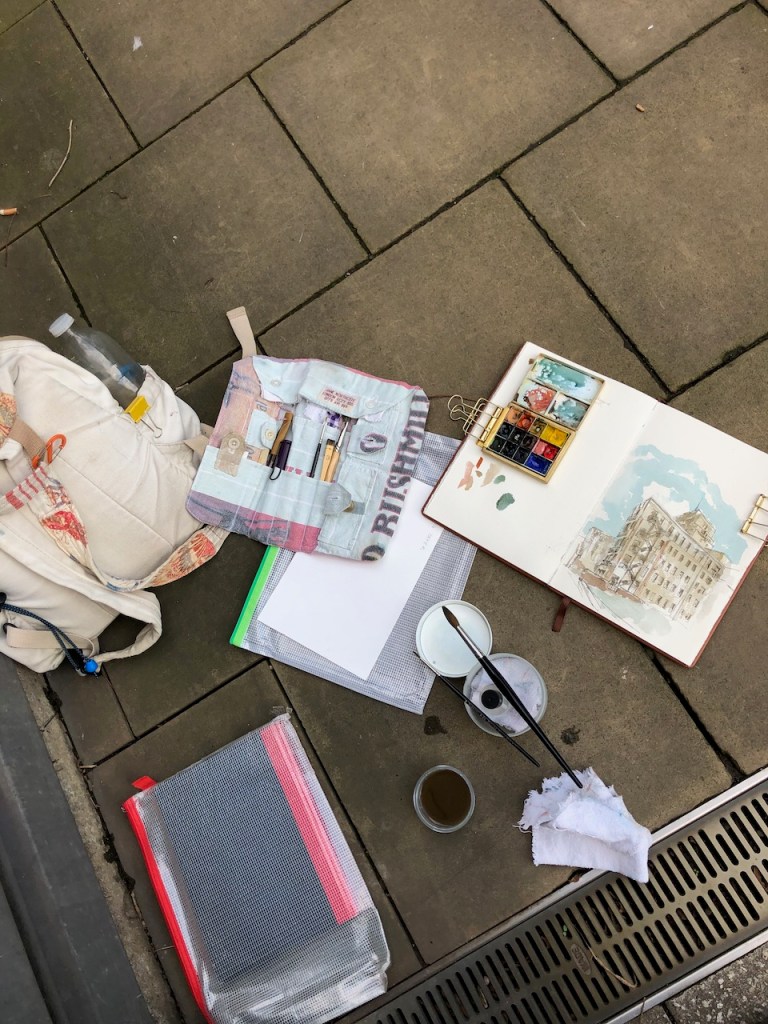
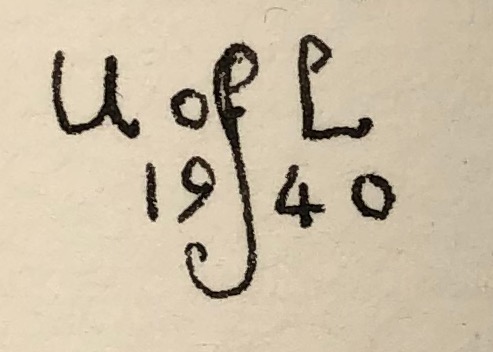
The drawing took 2 hours. Here are some photos of work in progress, and the lettering from the top of the drainpipe.

Barts Square, Butchers’ Hall

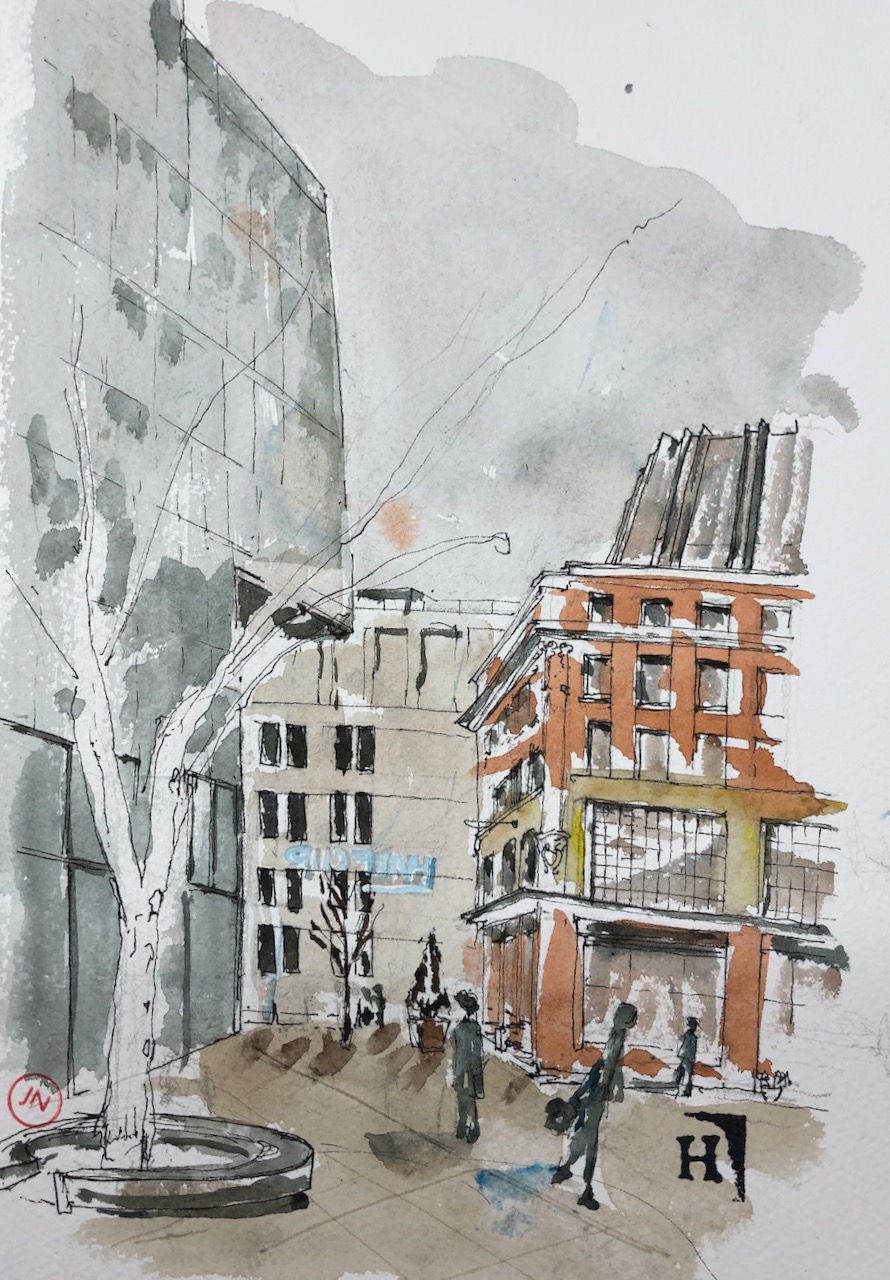
Continuing my exploration of Barts Square, EC1, today I drew Butchers’ Hall.

Butchers’ Hall, 87 Bartholomew Close, EC1
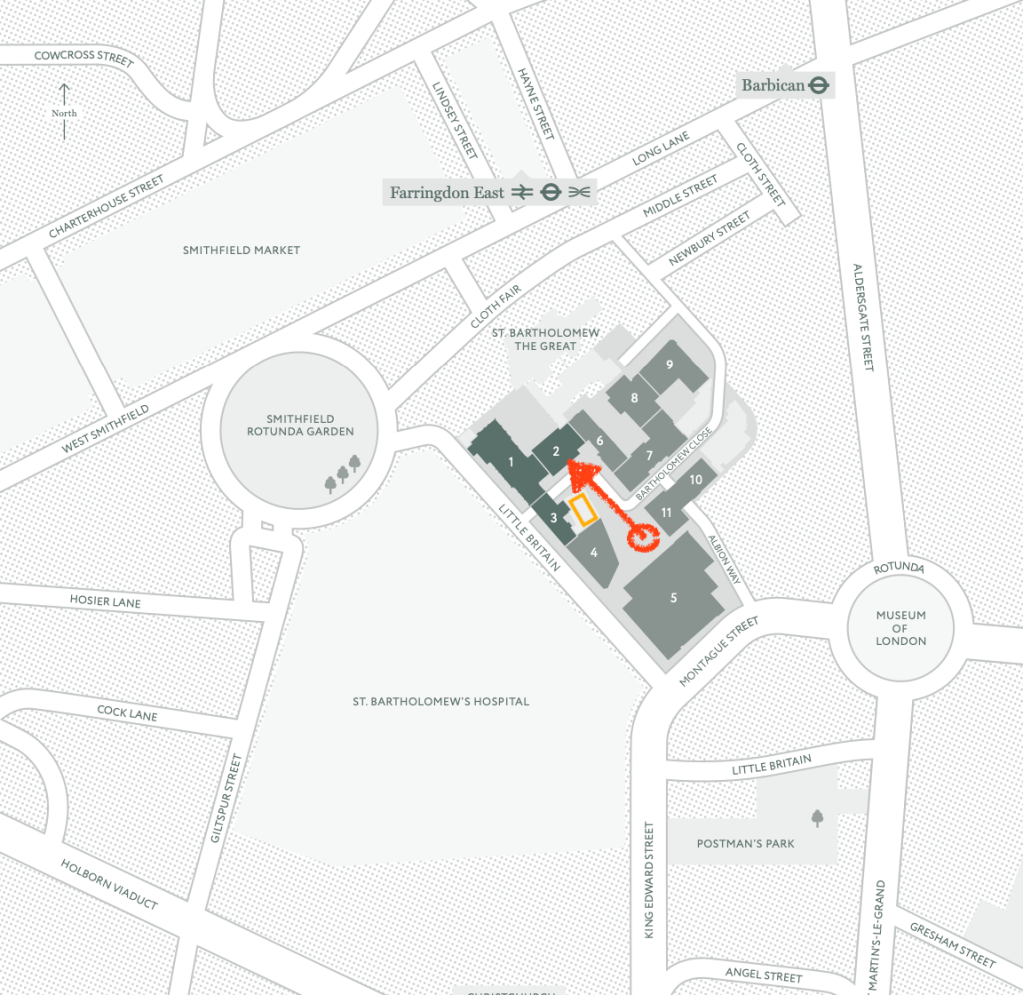
Map showing sightline of drawing.
Butchers’ Hall outlined in yellow.
1. The Levett Building, 2. Percival House
3. Fenwick House, 4. 90 Bartholomew Close
5. One Bartholomew, 6. Hogarth House,
7. Dominion House, 8. Abernathy House
9. The Askew Building, 10 The Underwood Building
11. Vicary House.

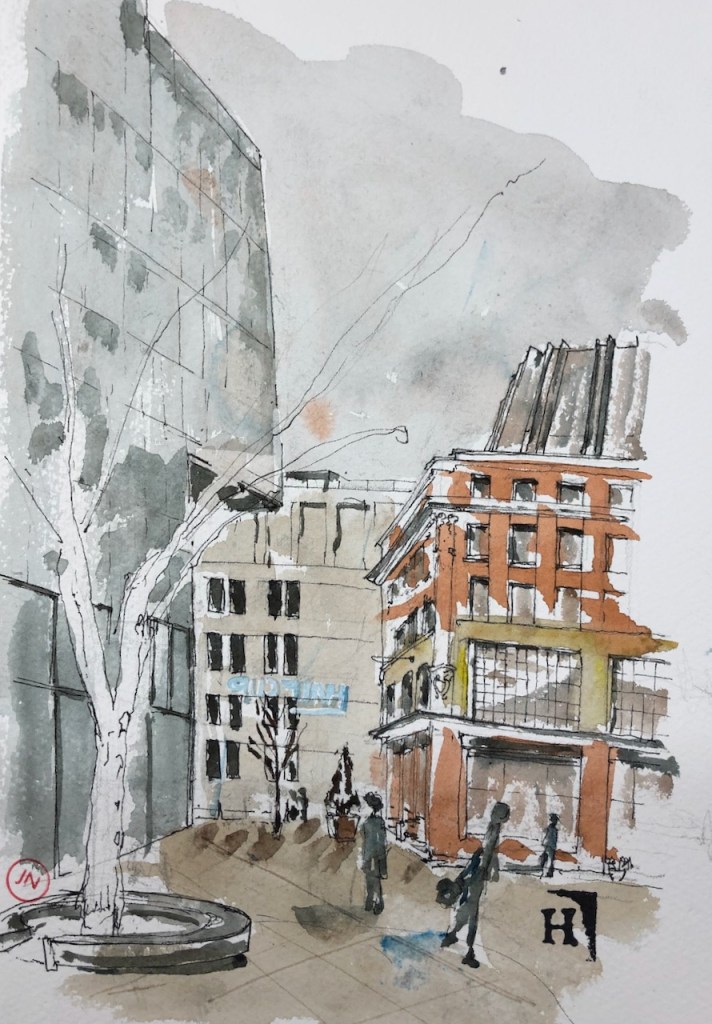
Butchers’ Hall is the building with the arched windows, in the centre left of the picture. It is the headquarters of The Worshipful Company of Butchers. This livery company is very old, the Arms were granted in 1540 and the charter by James I in 1605. The current hall is surprisingly new: built in 1960, and refurbished in 2015-2019. The mansard roof, just visible in grey at the top of the hall, was completed in 1996.

On the left the red brick building is 90 Bartholomew Close, which is offices. In the background is Percival House, residential flats built as part of the Barts Square development. Behind the tree is a building site. People are still working on other residential blocks in this development.

All was going well until
the delivery van arrived…

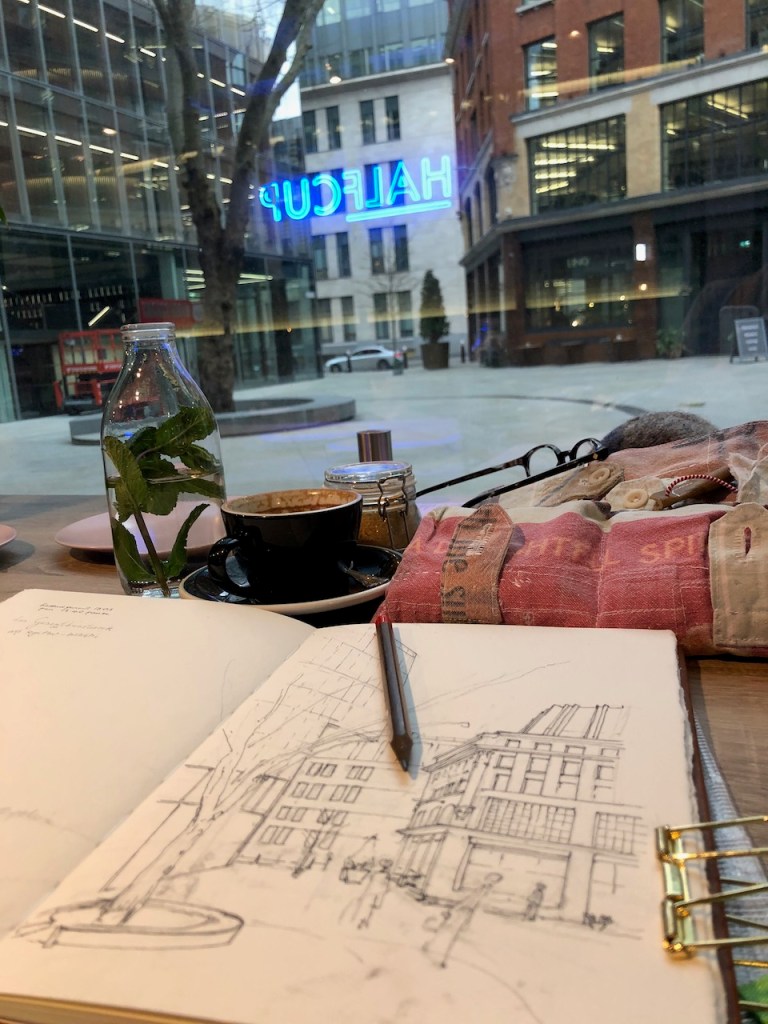
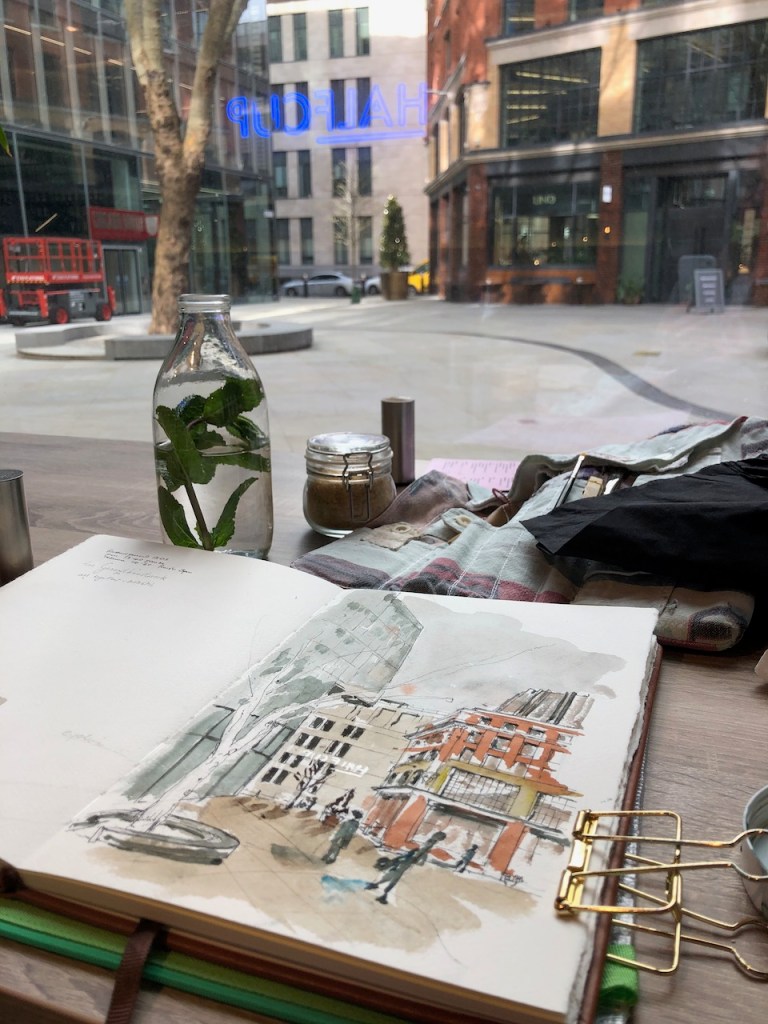
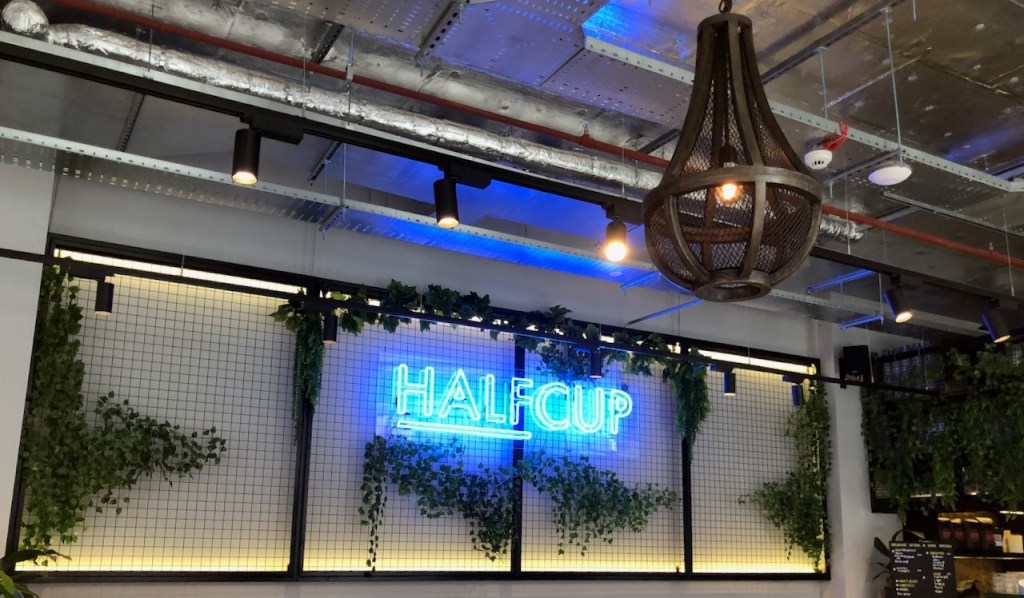
I drew this picture from beside a tree in the middle of the square, as you see from the map above. It was extraordinarily cold. There was slight rain, or more likely sleet. So after the pen-and-ink stage, I beat a retreat to the warmth of the café “Halfcup” to do the colouring indoors. They kindly found me a table with a view in approximately the right direction. All was going well until the delivery van arrived.

I peered round the edges of the van and surprised other guests in the restaurant by pacing erratically to get a better view. Then the van driver completed their deliveries and drove off. I worked quickly in case another van appeared.

Here is work in progress and a bigger map. Thank you to the staff of Halfcup who made me very welcome and brought hot tea to thaw out my hands.

Drawing took about 2 hours. Main colours used: Phthalo Turquoise (W&N), Mars Yellow (DS), Burnt Umber (DS), Perinone Orange (DS), Naples Yellow Red (R). The sky is the Phthalo Turquoise and Burnt Umber, very dilute. Blue and brown make grey.

I sketched in Barts Square yesterday as well:

Barts Square, West side

Today I went to try out “Halfcup”, a new coffee place which has opened on Bartholomew Close. It’s part of the new “Barts Square” development. These are new buildings in an area that was previously St Bartholomew’s Hospital. Some of the external features of the original hospital buildings have kept, as you see in the…

Barts Square, West side

Today I went to try out “Halfcup”, a new coffee place which has opened on Bartholomew Close. It’s part of the new “Barts Square” development. These are new buildings in an area that was previously St Bartholomew’s Hospital. Some of the external features of the original hospital buildings have kept, as you see in the centre and right of the drawing.

Looking west across Bartholomew Square, through the window from Halfcup

The building at the back, with the tall windows, is the existing Bartholomew’s Hospital, new building. The building on the right has a restaurant, “Lino”, on the ground floor, and offices above.

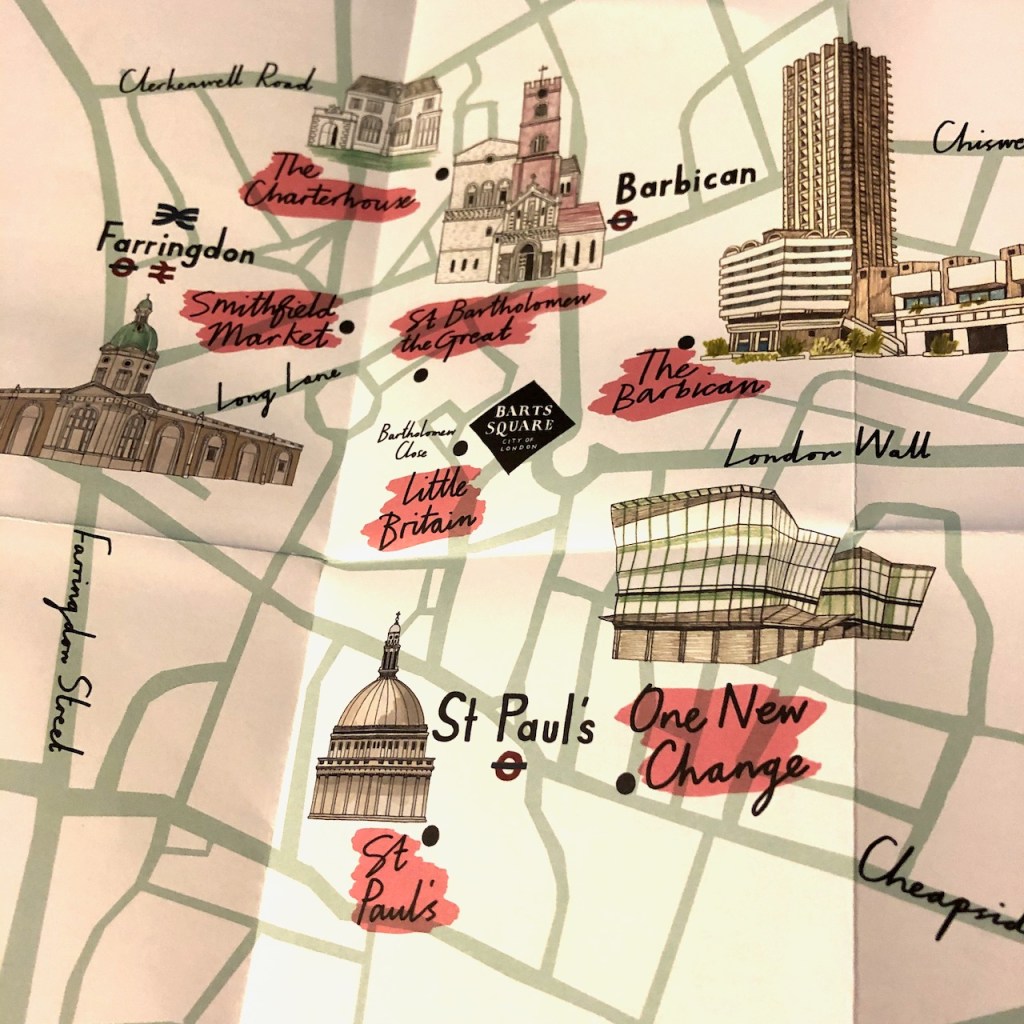
Here are some pictures of the drawing in progress, and a photo of a map provided by the Barts Square development.

The drawing took 1hour50mins. The main colours are: Phthalo turquoise(W&N), Burnt Umber (DS), with Perinone Orange (DS) and Mars Yellow (DS) for the “Lino” brick building.

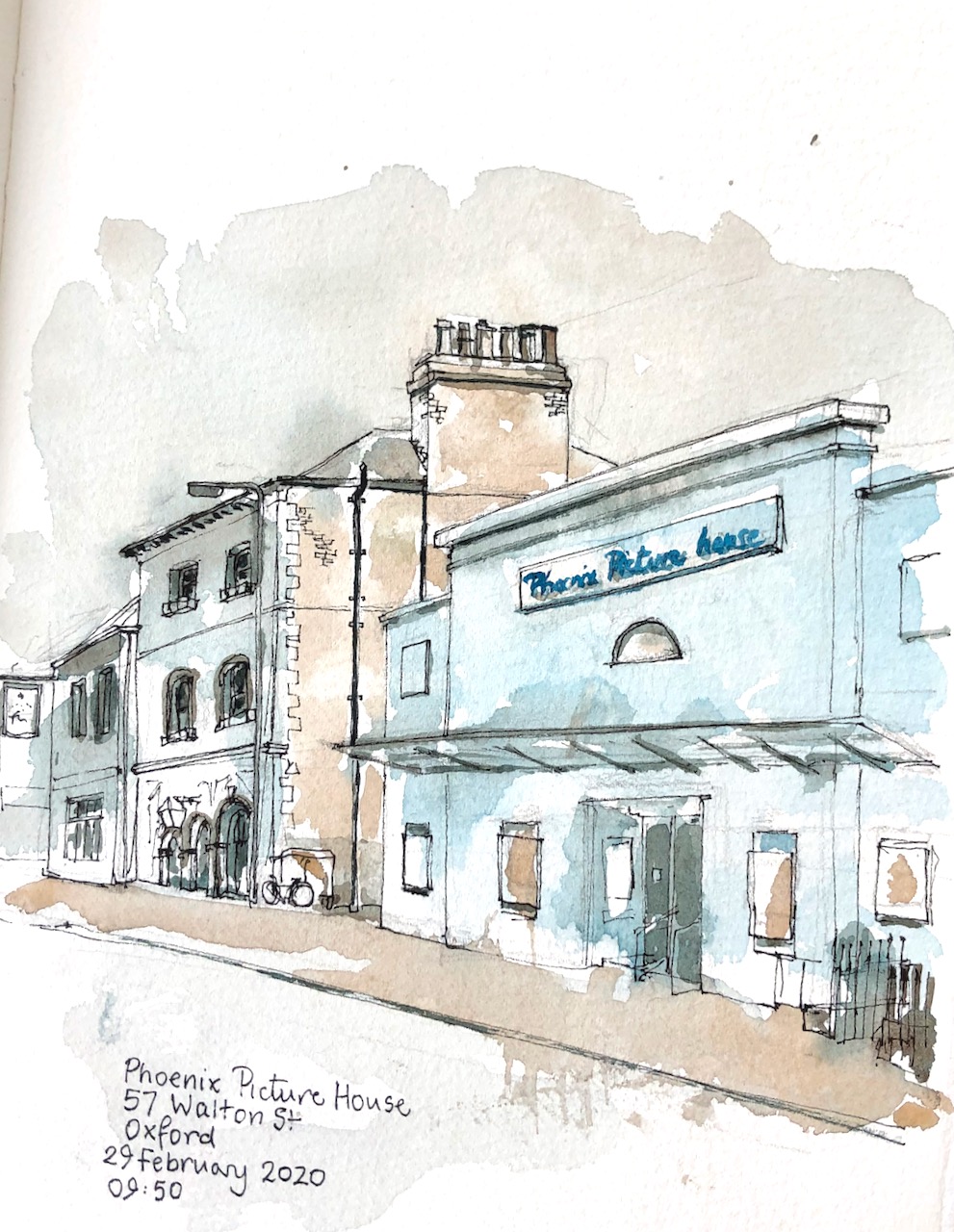
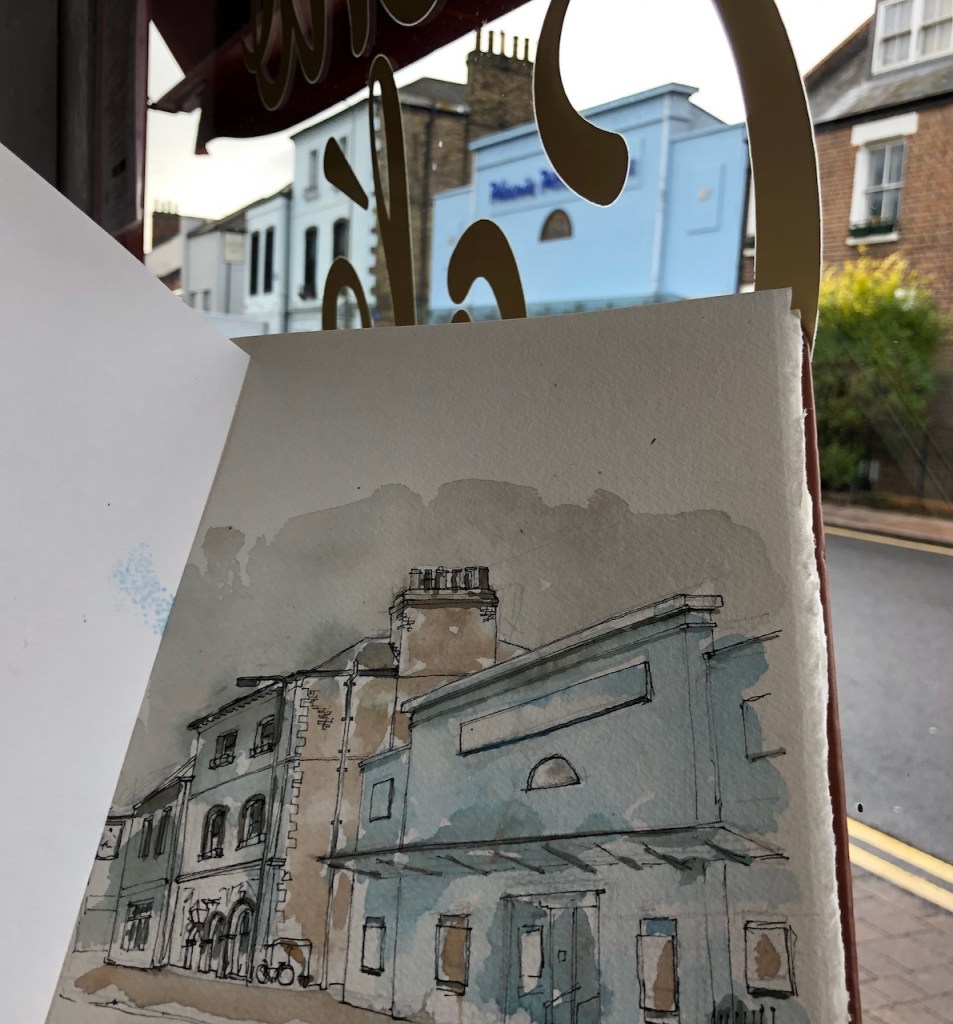
Phoenix Picture House, Oxford

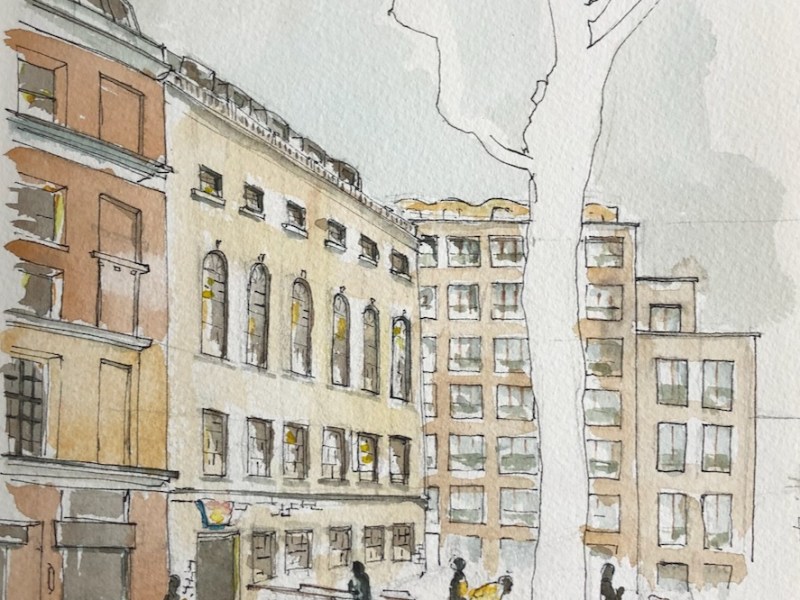
Here is a view looking south down Walton Street, from The Jericho Café, Oxford.

Phoenix Picture house, from The Jericho Café

It was raining outside. People peered in through the windows. One person actually came inside the café to look at my picture. Or maybe it was to escape temporarily from the rain. They looked at the picture, in any case, and made cheerful and encouraging comments. Then they went out in the rain again.

The Phoenix Picture house is a cinema. On the left is The Jericho Tavern, a pub and music venue.

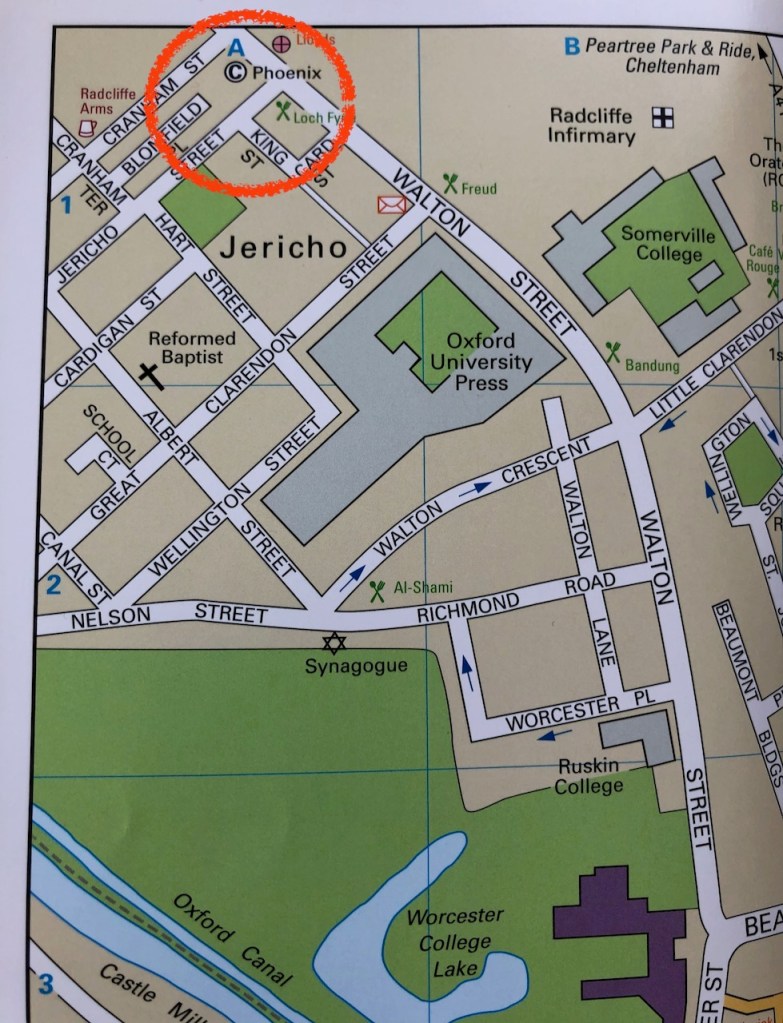
Here is work in progress on the picture, and a map. As you see, Jericho is on the fringes of the map. The Jericho Cafe is at the junction of Observatory Street (off the top of the map) and Walton Street. This map is out of date. The place labelled “Radcliffe Infirmery” (top left) has now been redeveloped as the Radcliffe Observatory Quarter. On this site are the Mathematical Institute (opened in 2013) and the Blavatnik School of Government (opened in 2015). You can walk through the site to the Woodstock Road, past the Radcliffe Observatory which has the signs of the zodiac carved around it, including a realistic large-size crab.

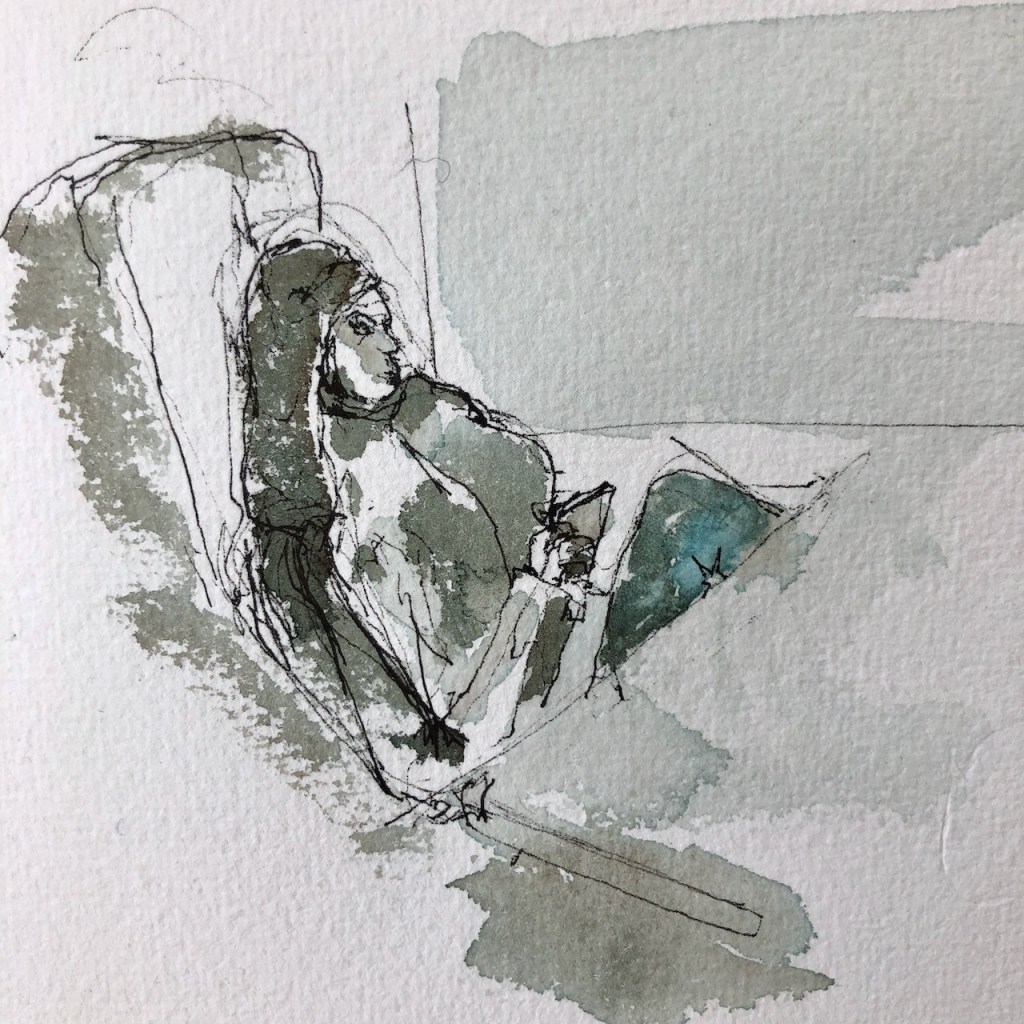
I was also practising drawing people.

Basel, February 2020

In the streets of Basel, you can hear your own footsteps.

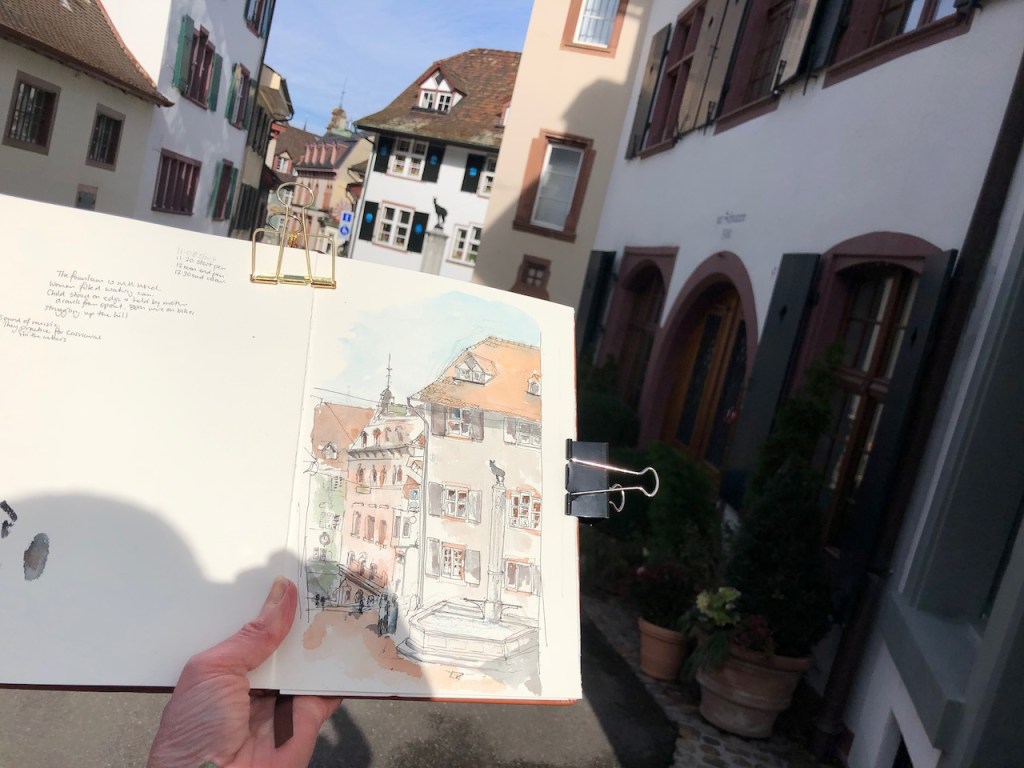
There are fountains.

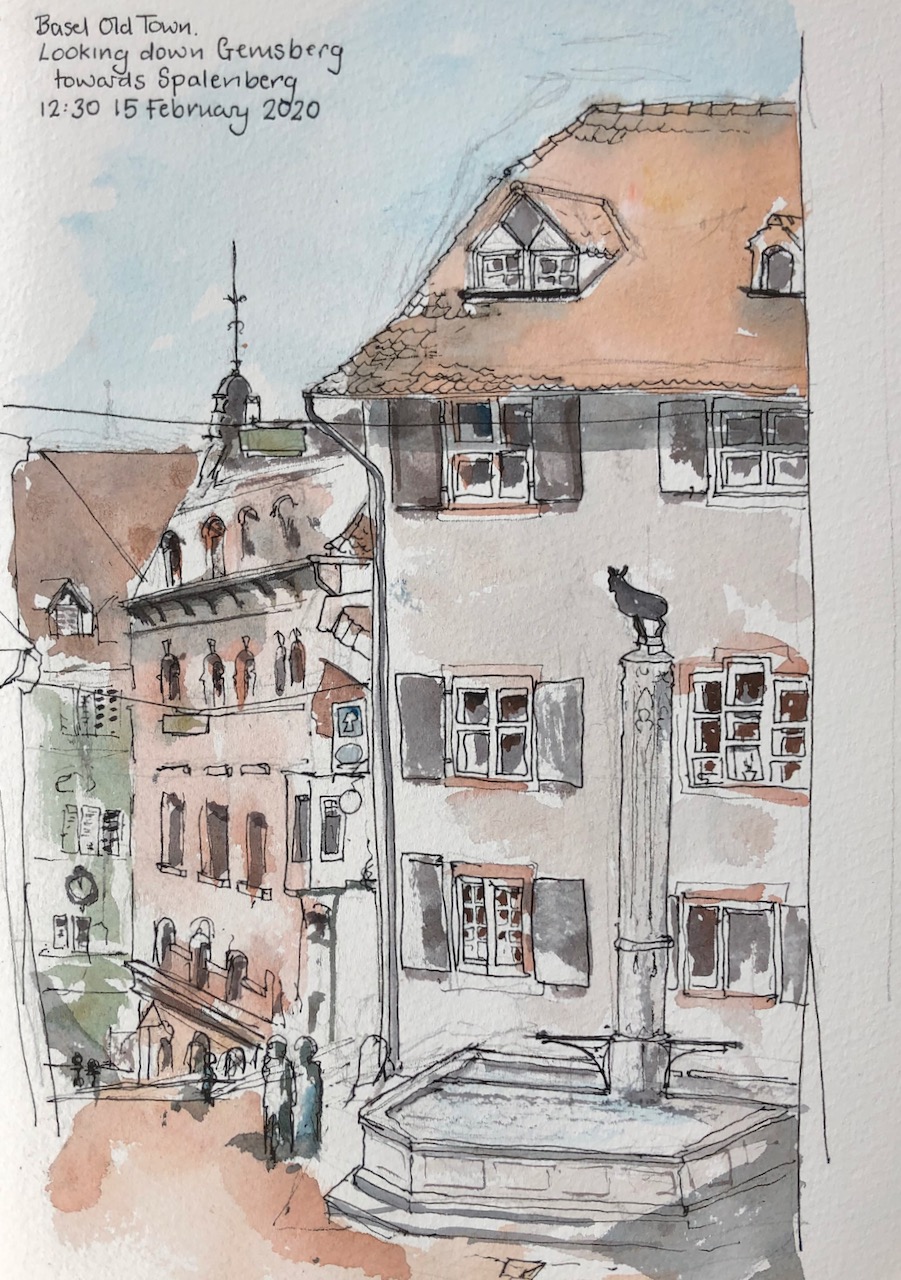
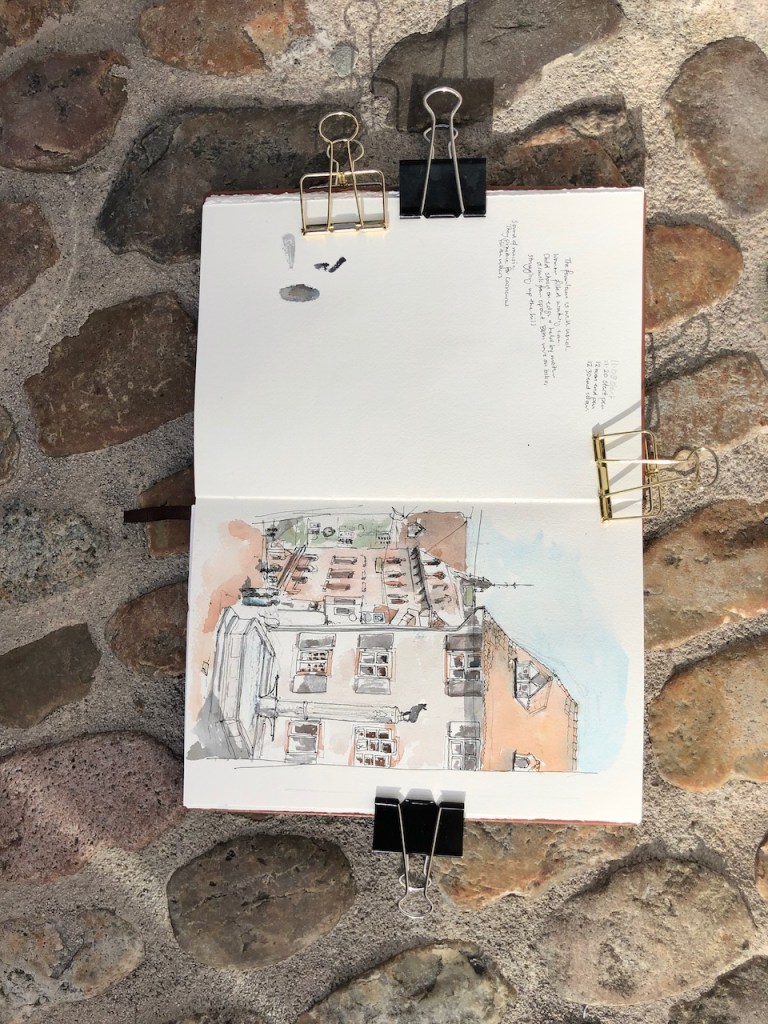
Gemsberg, Basel Old Town, 7″ x 10 ” on Fabriano Artistico paper, [sketchbook 6]

In the hour and half that it took me to draw this picture, people made use of the fountain. Someone came out of one of the adjacent houses and filled a watering can. A woman helped a child to stand on the white marble edge and then to walk cautiously on the iron bars across the water. The child dipped her hands in the flowing water and drank. She played with the water that came from the spouts. Then the woman and the child returned to their bicycles, and continued their ascent of the hill. Elderly people, climbing the hill, paused here to rest. A runner lent over the water and sluiced his face, before pacing on up the slope towards me.

This part of town is very old. Basel has the fine custom of telling you a little about each street, on the street sign. The one for Gemsberg says:

“Zum Gemsberg, 1661 erstmals erwähnter Hausname”

So this street was named after a house which stood here in 1661. [German speakers reading this: please correct me if I got that wrong!]

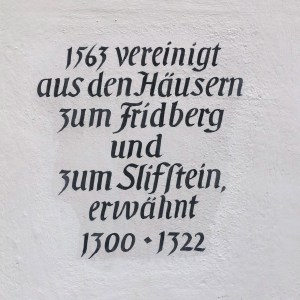
The house on the right has an inscription in magnificent script. My German-speaking consultant enables me to state with some confidence that this reads as “In 1563 [this house was created] by joining together two houses: “To the Fridberg” and “To the Slifstein”, both mentioned in 1300-1322″

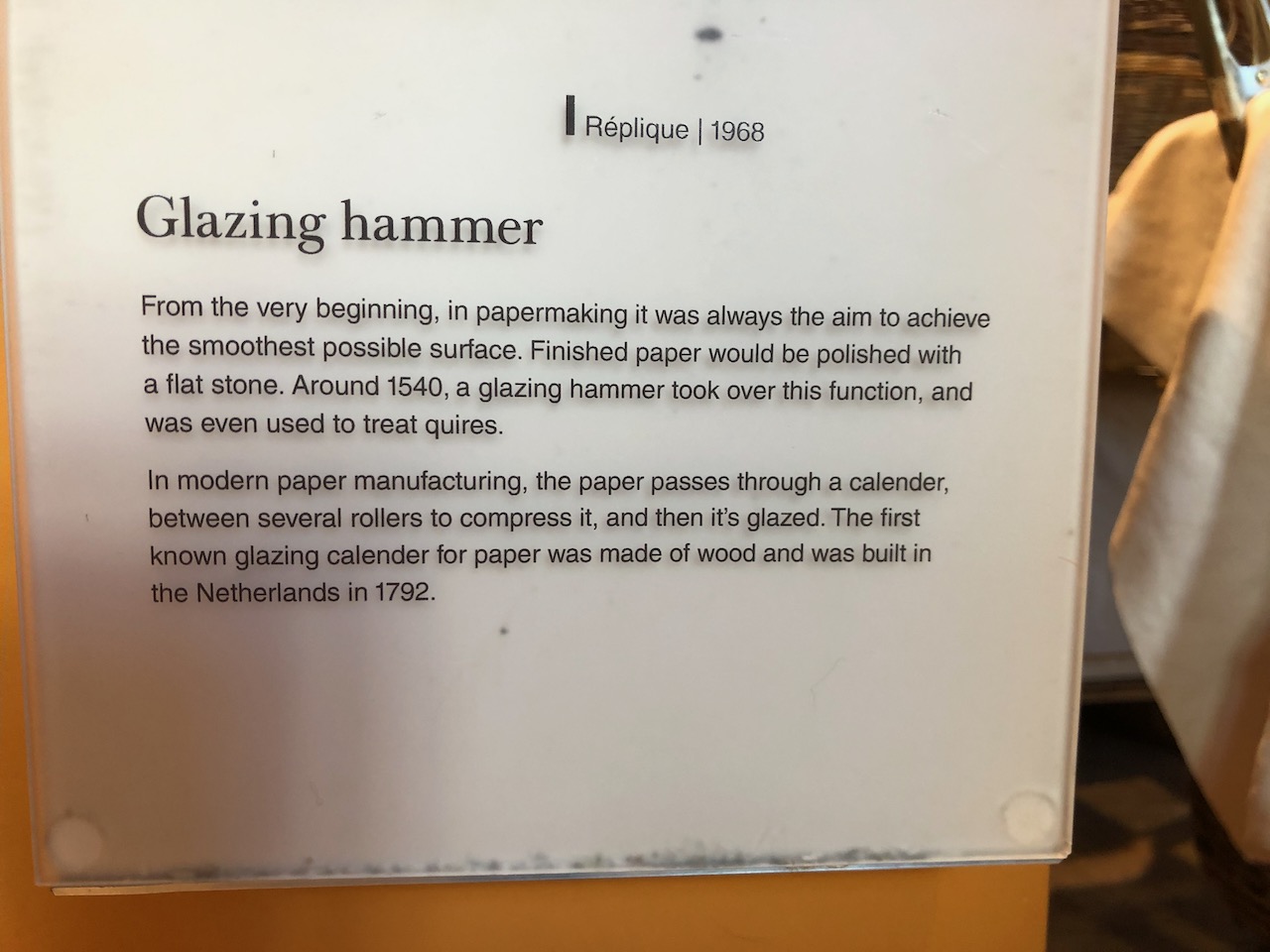
“Fridberg” might mean “Tranquil mountain” and “Slifstein” might mean polishing stone, or polished stone. Perhaps these were people’s names. I learned at the Basel Paper Mill that in those times smooth stones were used to polish paper, so may be Herr or Frau Slifstein was a paper polisher. But that’s just surmise.

Caption beneath a reproduction of a glazing hammer, Basel Paper Mill.

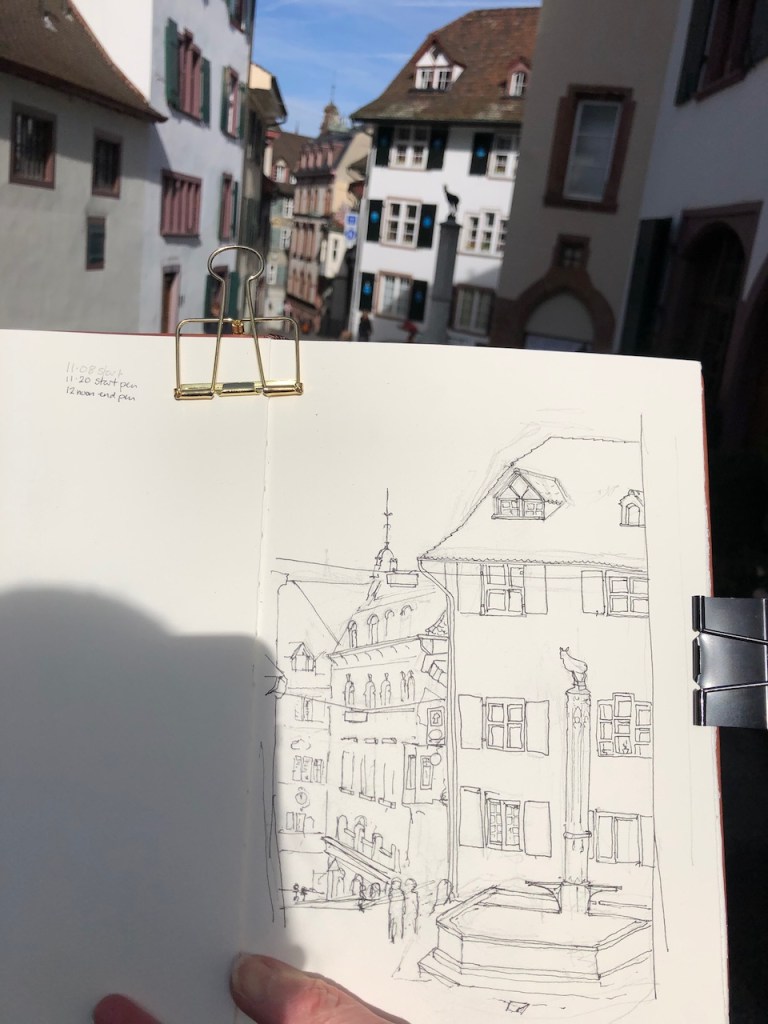
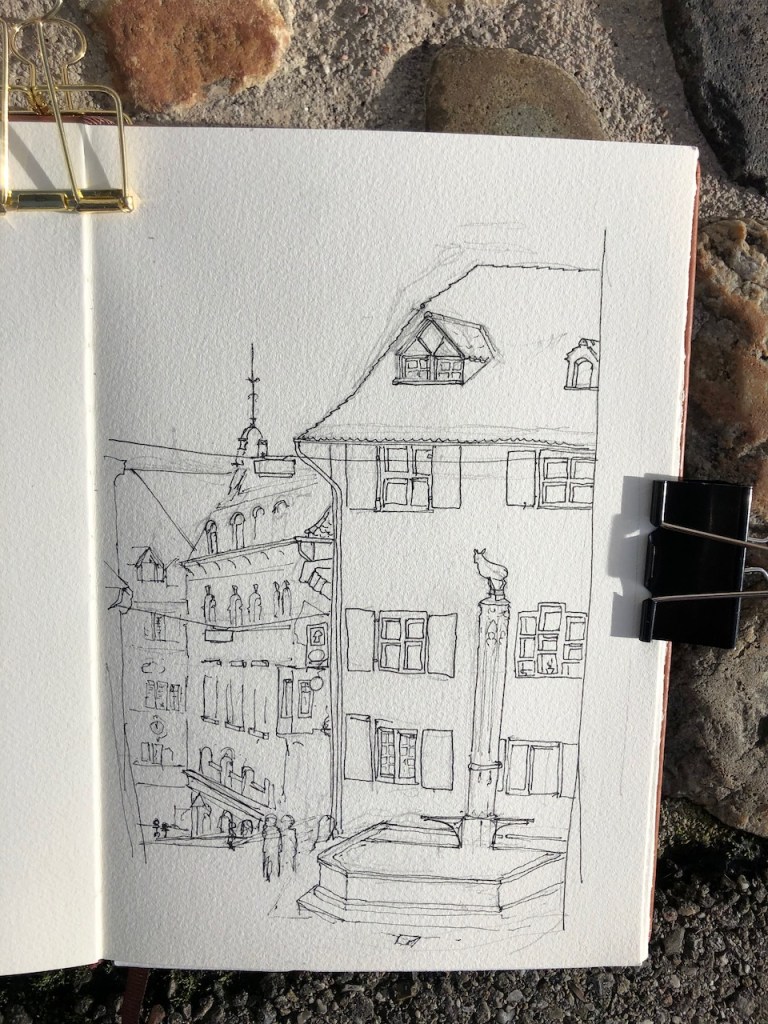
Here’s work in progress on the drawing.

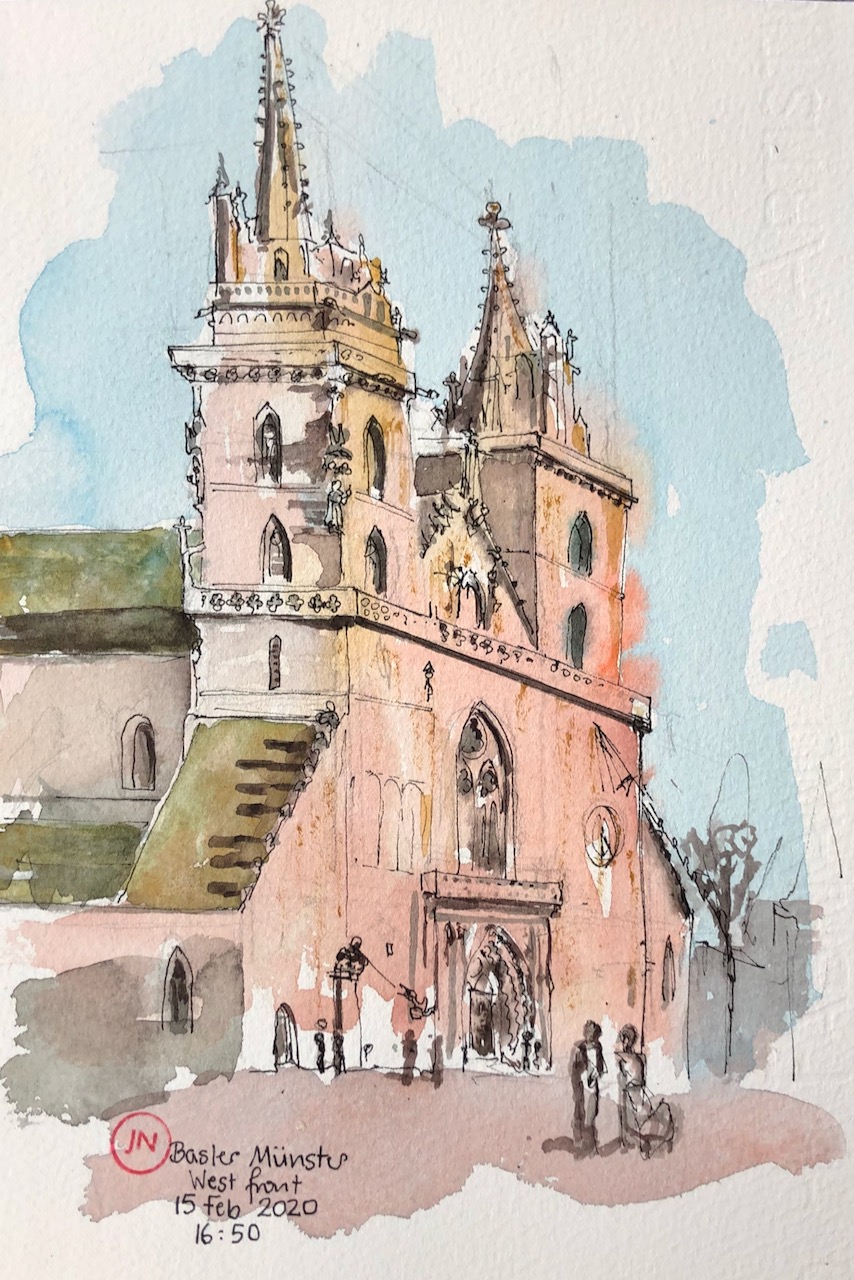
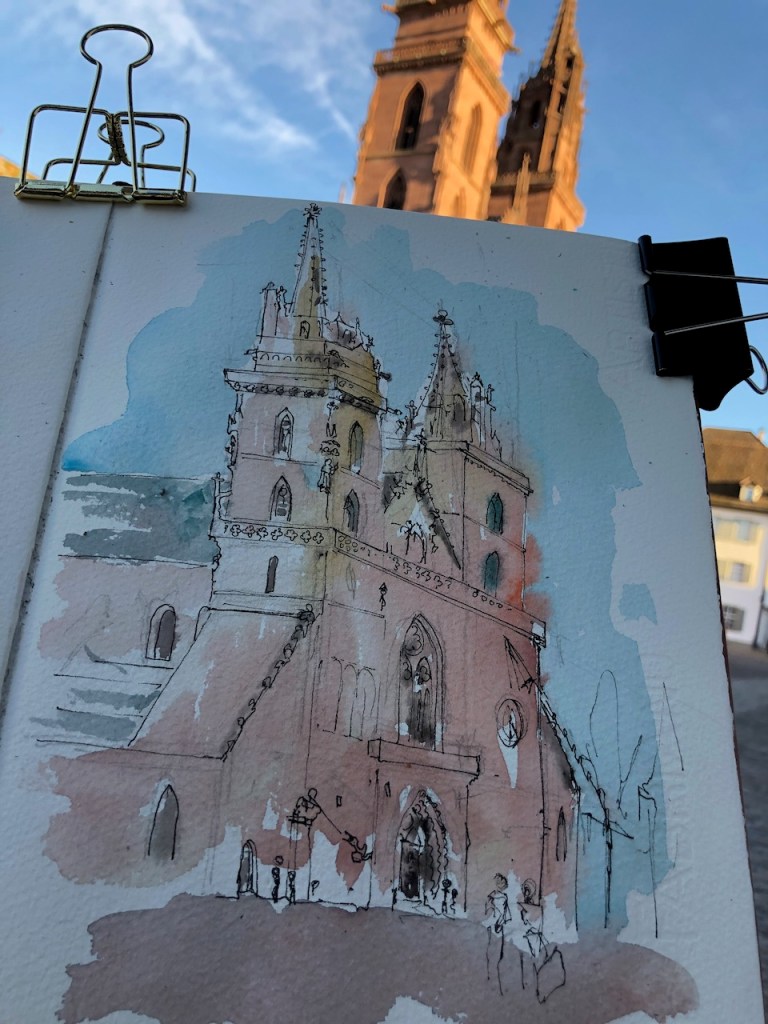
Later I tackled a tough assignment: Basel Cathedral, “Basler Münster”.

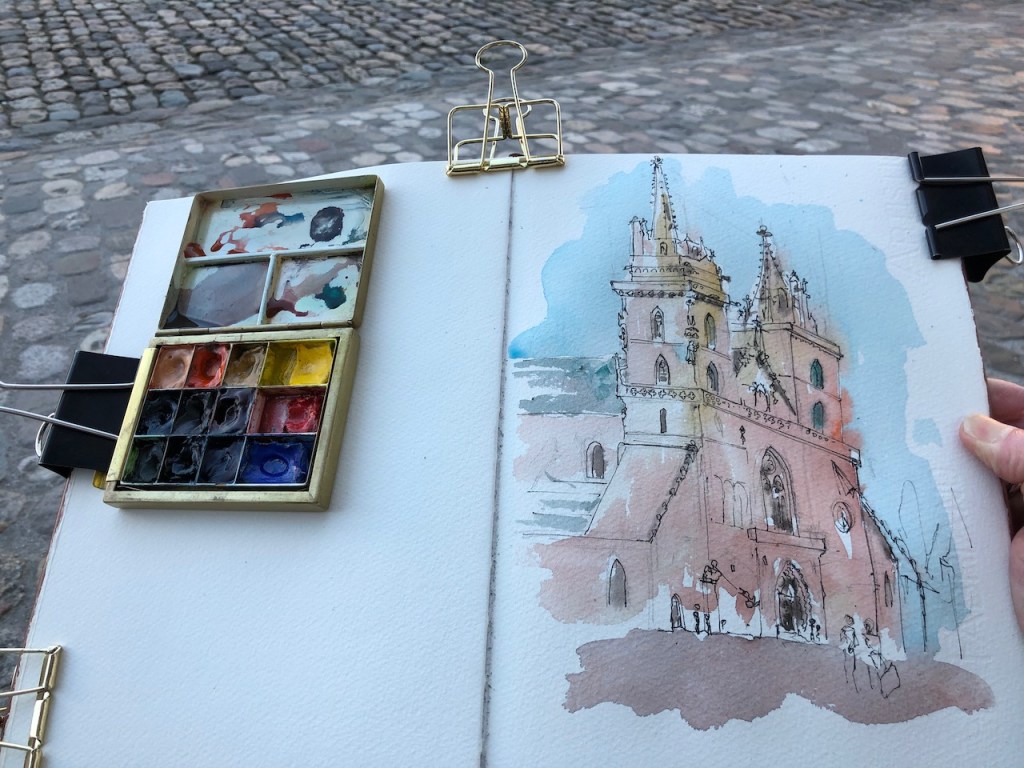
Basler Münster, West Front, 7″ x 10 ” on Fabriano Artistico paper, [sketchbook 6]

This is a magnificent medieval construction, the present building dates from about 1500. It is a real challenge for the Urban Sketcher. Each edge is decorated. Each corner hosts a saint, or often two. Every planar surface has decoration, low relief, a statue. Not content with simply a sundial, they added also a clock. And on top of all this, the two towers are by no means identical. They each support a forest of spires, some octagonal. The main spire on the right seems to have curving edges, unless that was a cunning optical illusion. Even the roof is decorated with a pleasing coloured diamond pattern in tiles. I did my best, but those medieval stonemasons got the better of me.

To the left of the door is St George and the Dragon, a very realistic statue which I had to put in. St George’s horse prances on a firm plinth. St George himself wields a real metal lance, copper or some copper-containing alloy, since it is green. The dragon, some distance away, is made to balance on a precarious shelf, endangered by the thrust of the lance. It’s a dynamic and three dimensional scene.

Here is work in progress on the drawing.

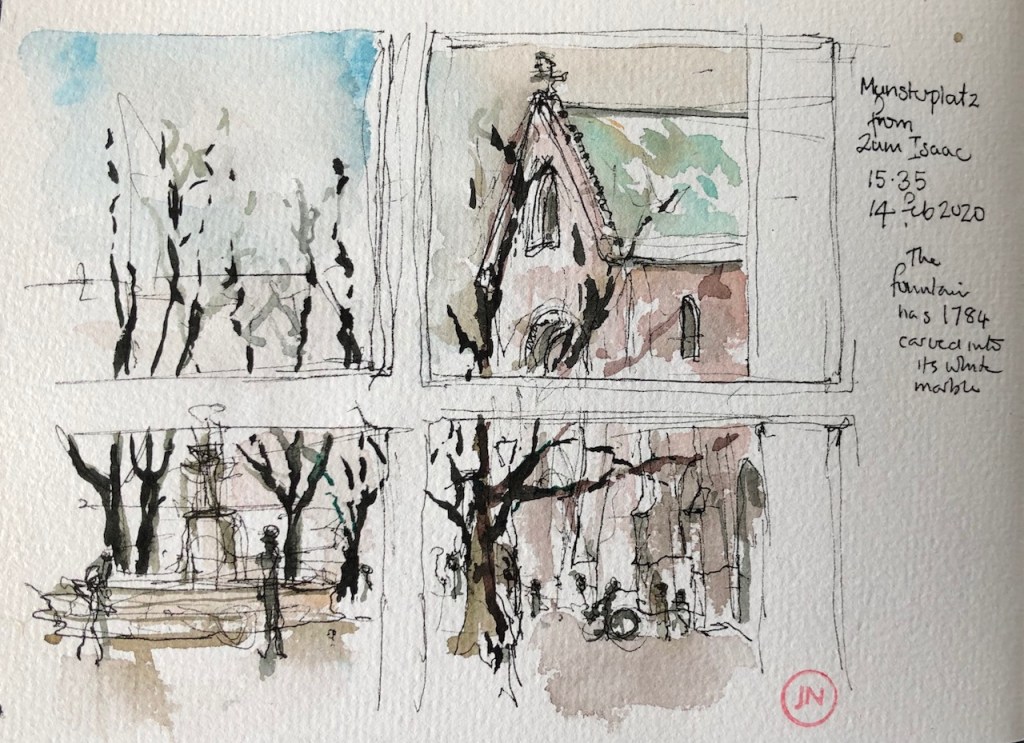
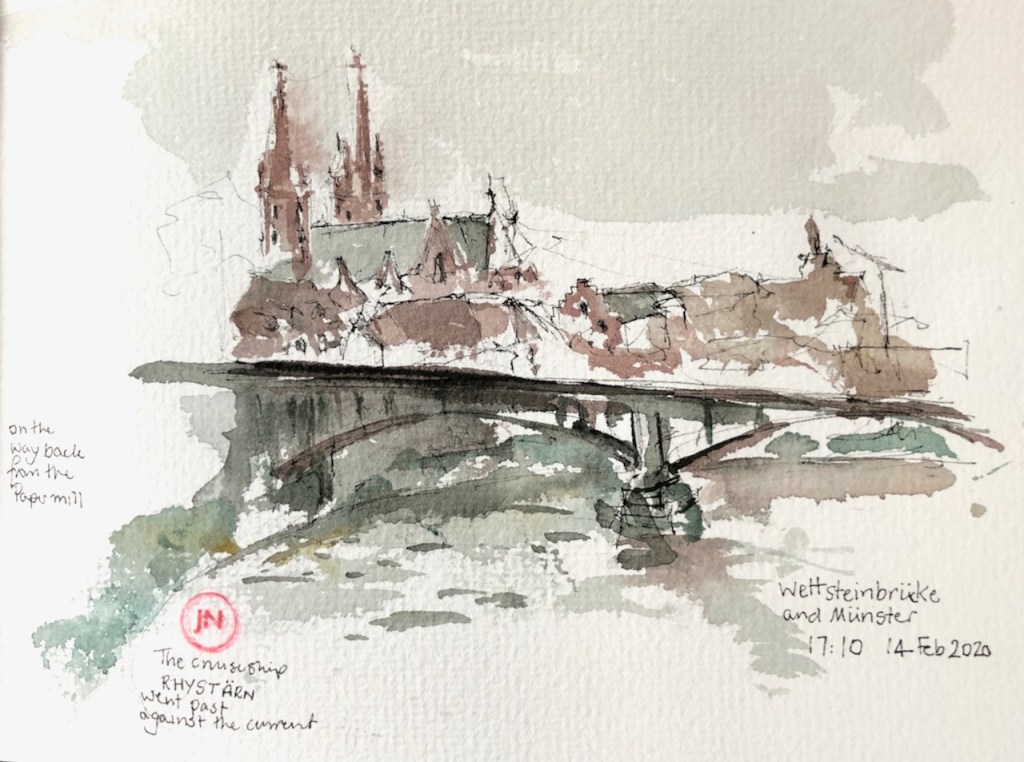
I made more sketches around the city:

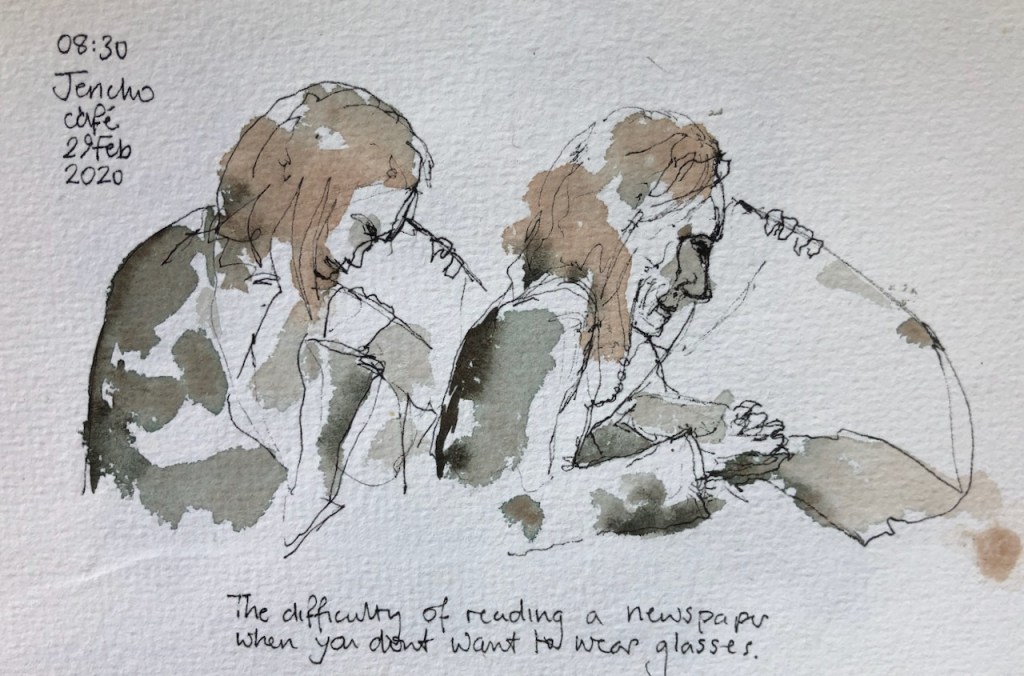
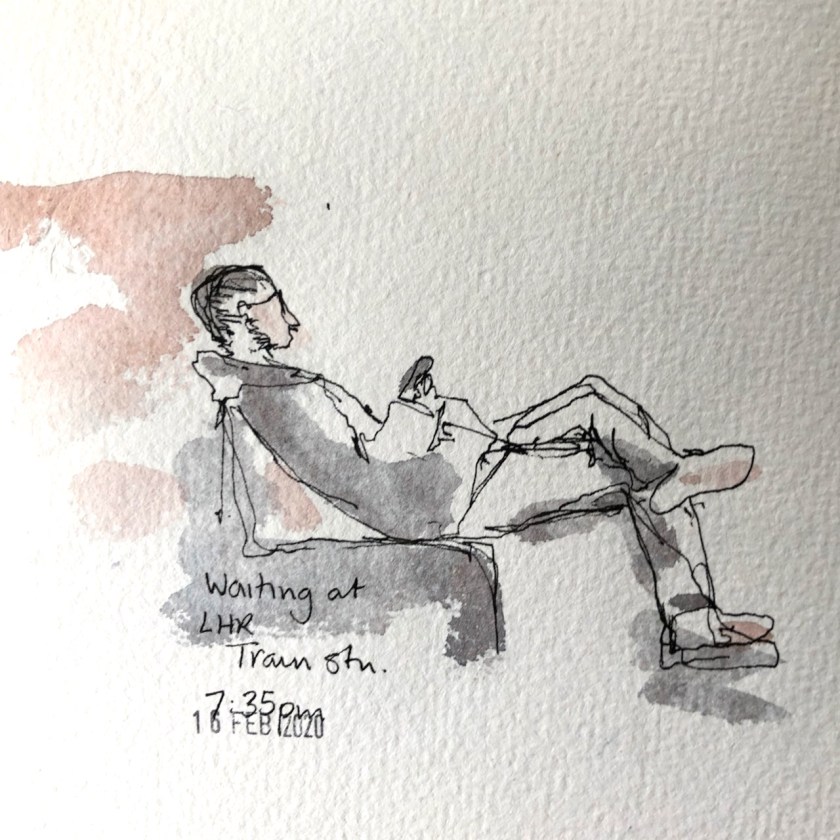
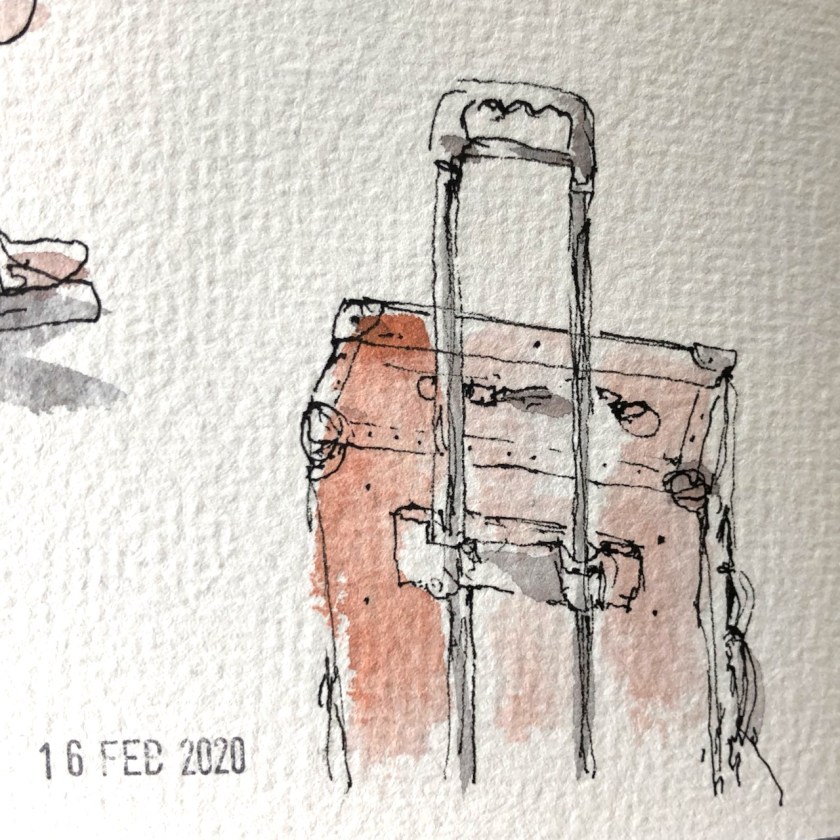
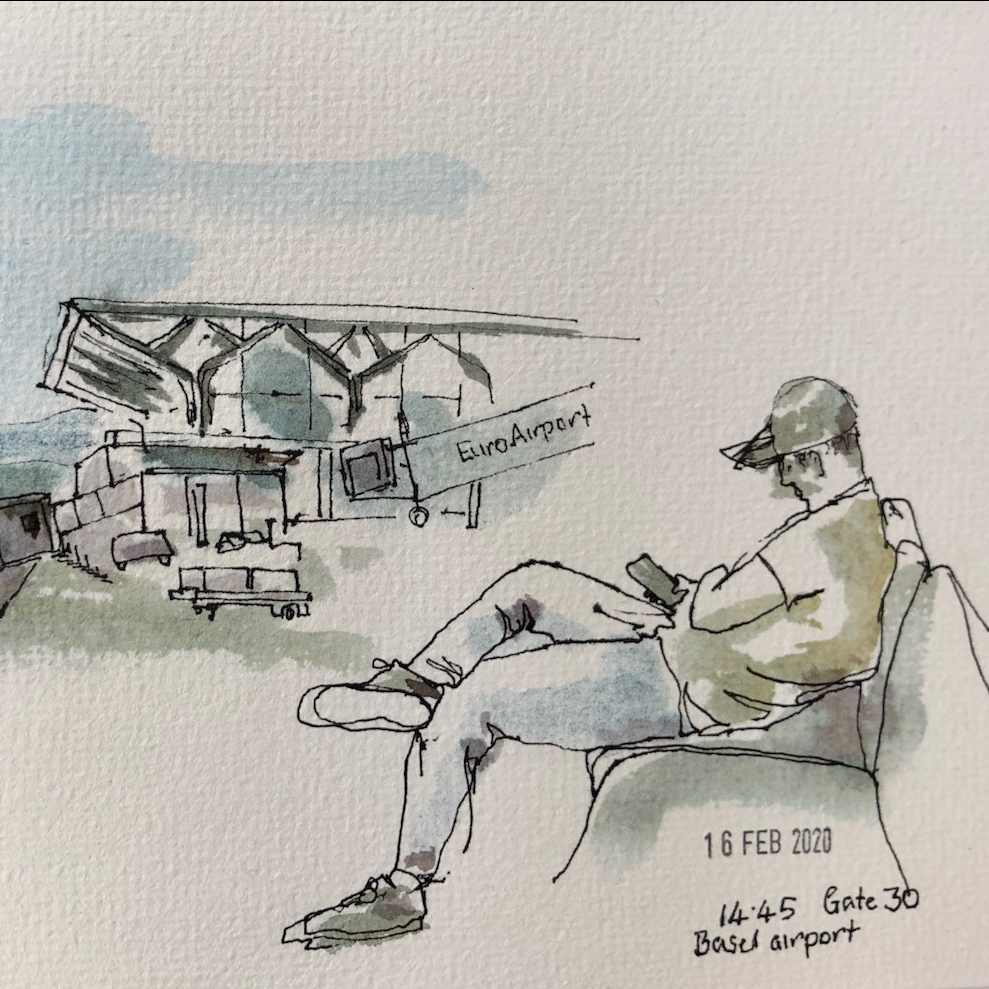
On the long journey home, I sketched the people, and my luggage.