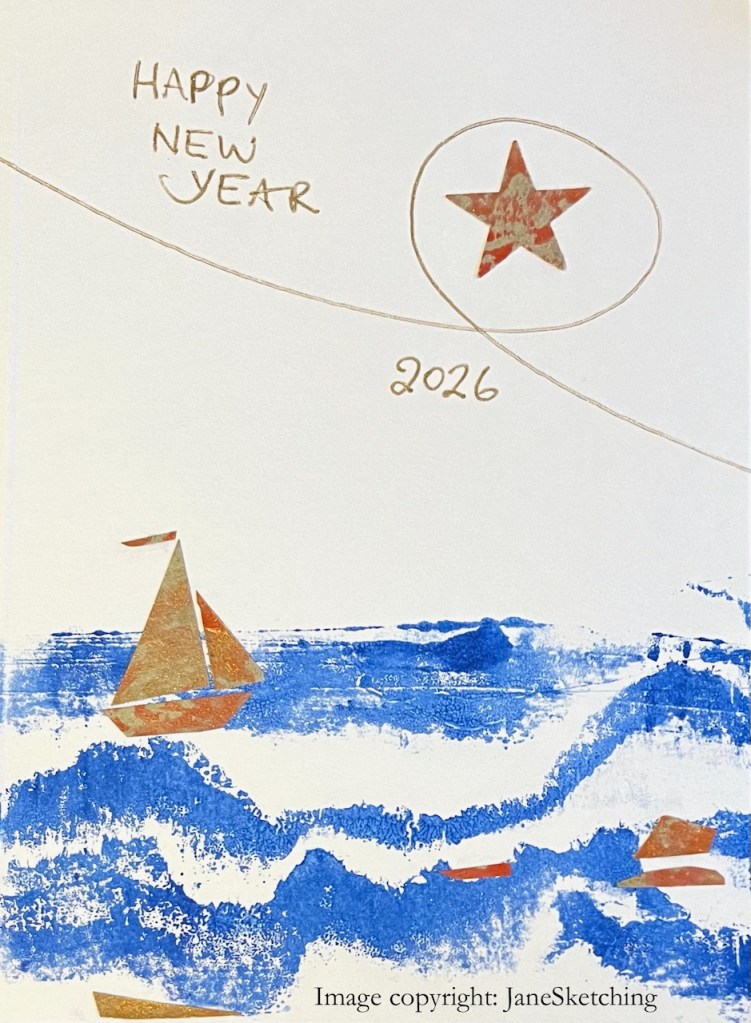
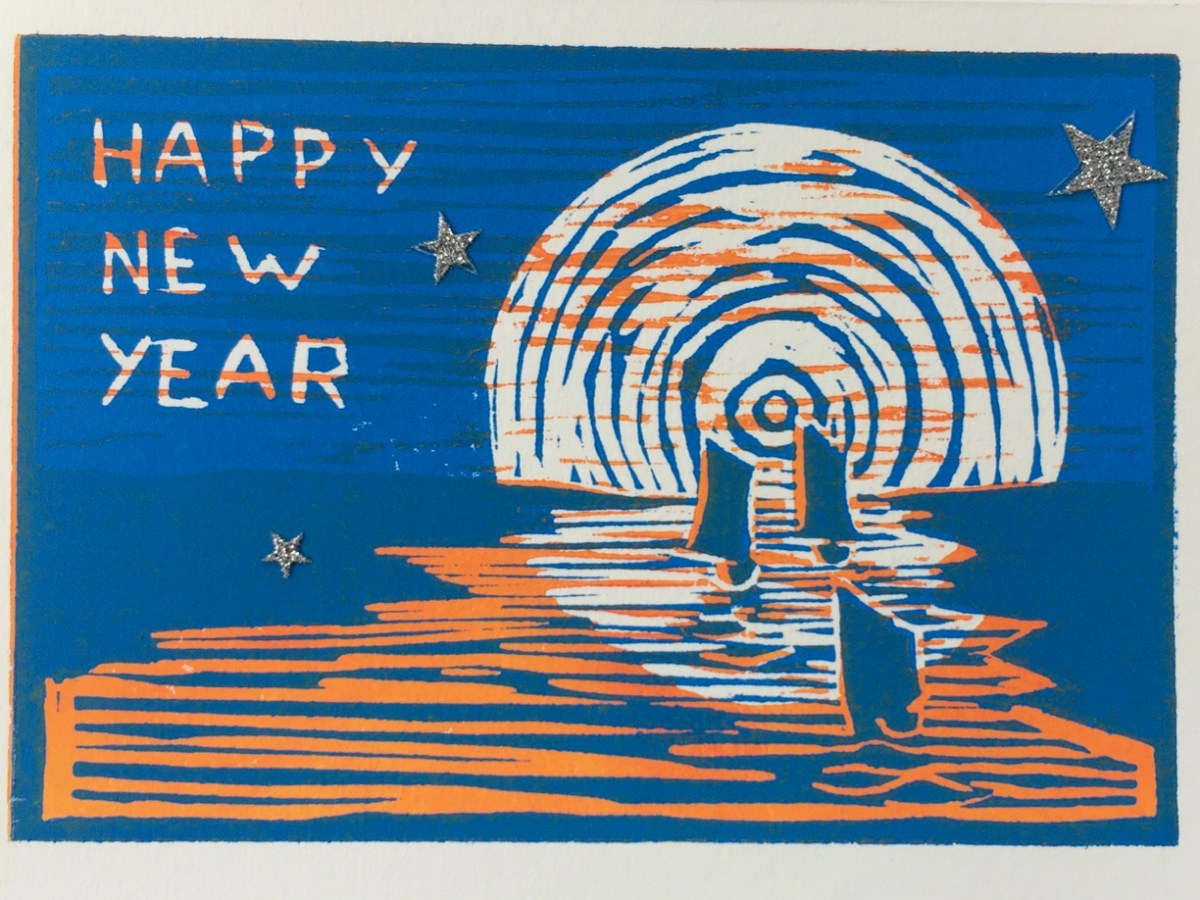
And for those interested in technique: the blue background of this card is made by printing. The printing “plate” was torn cardboard, stuck onto cardboard. Here’s an example. Each “plate” made about a dozen cards, before it became too deteriorated to work properly.
The boat and the star are cut from wrapping paper.
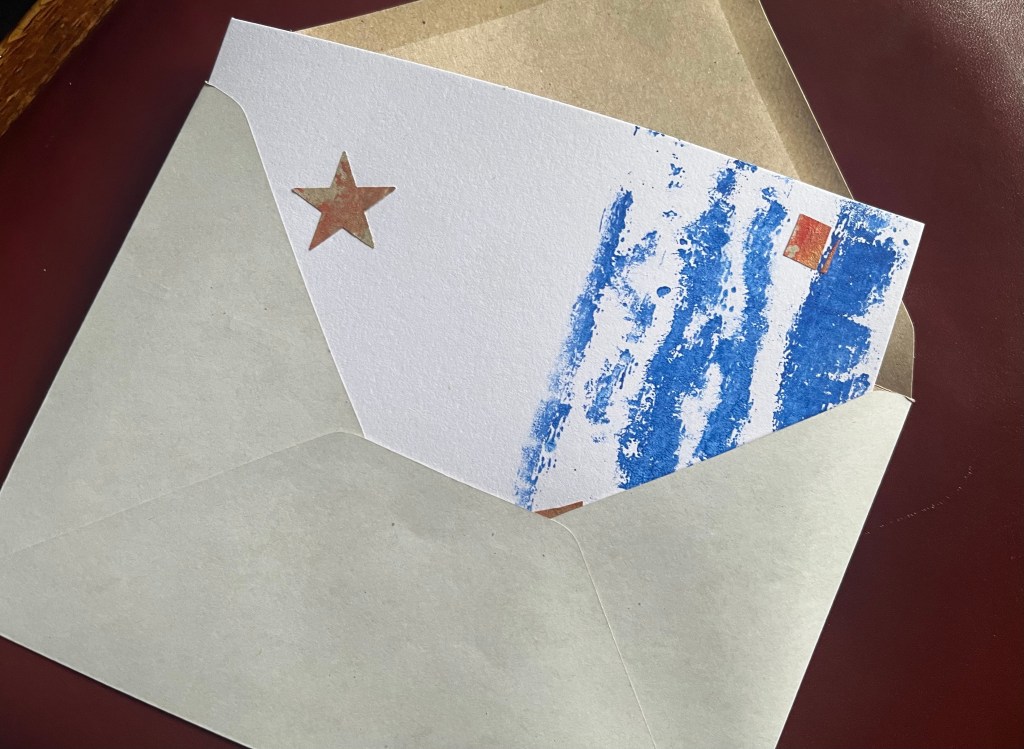
This is a card, sent by post to people, snail mail, in an envelope with a postage stamp. Why? Because it seems to me that material connection matters. I make real objects in the real world, and spend real time making material things. Even if only out of paper and cardboard. Even in 2026……
Click a button below to share this post online, email it, or print it:
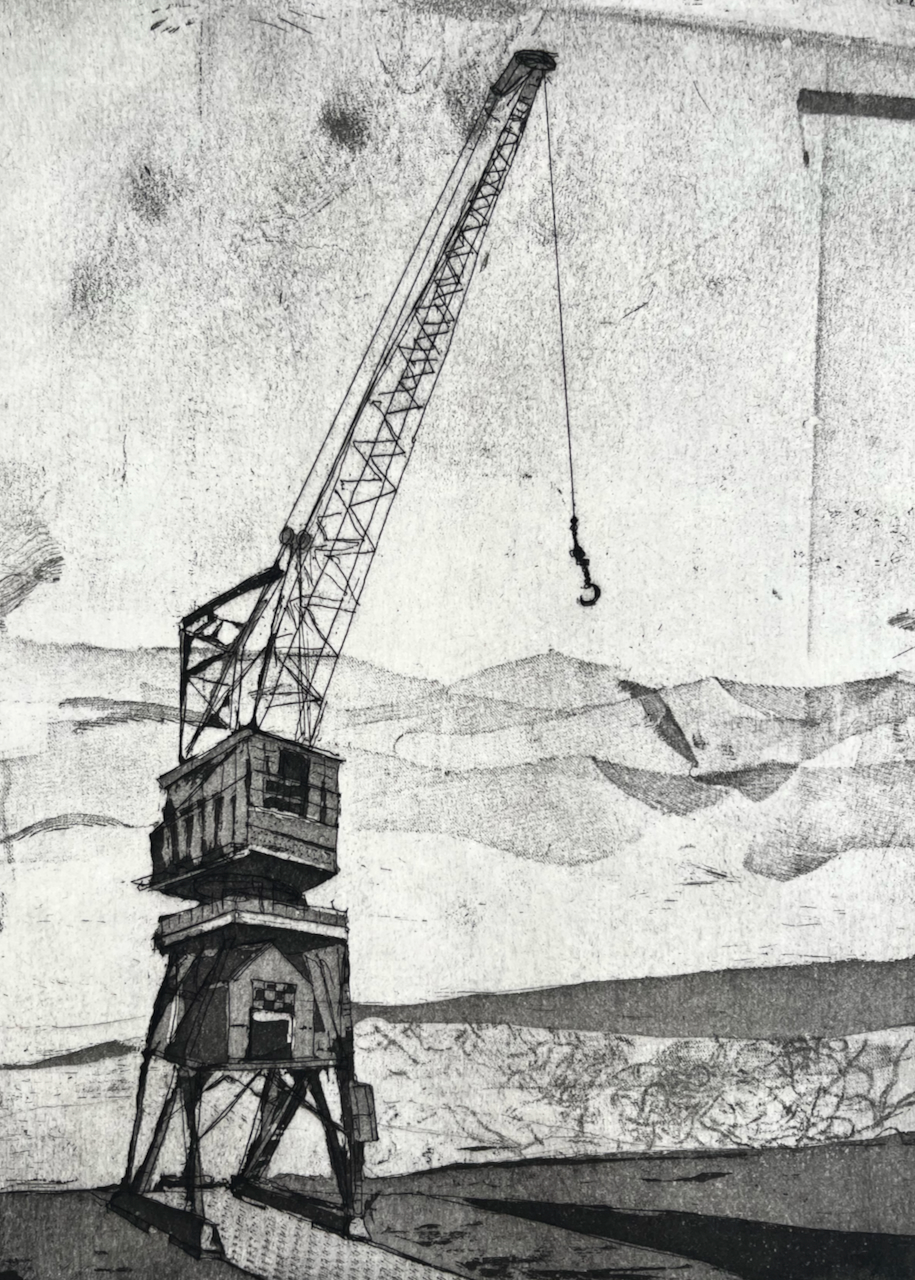
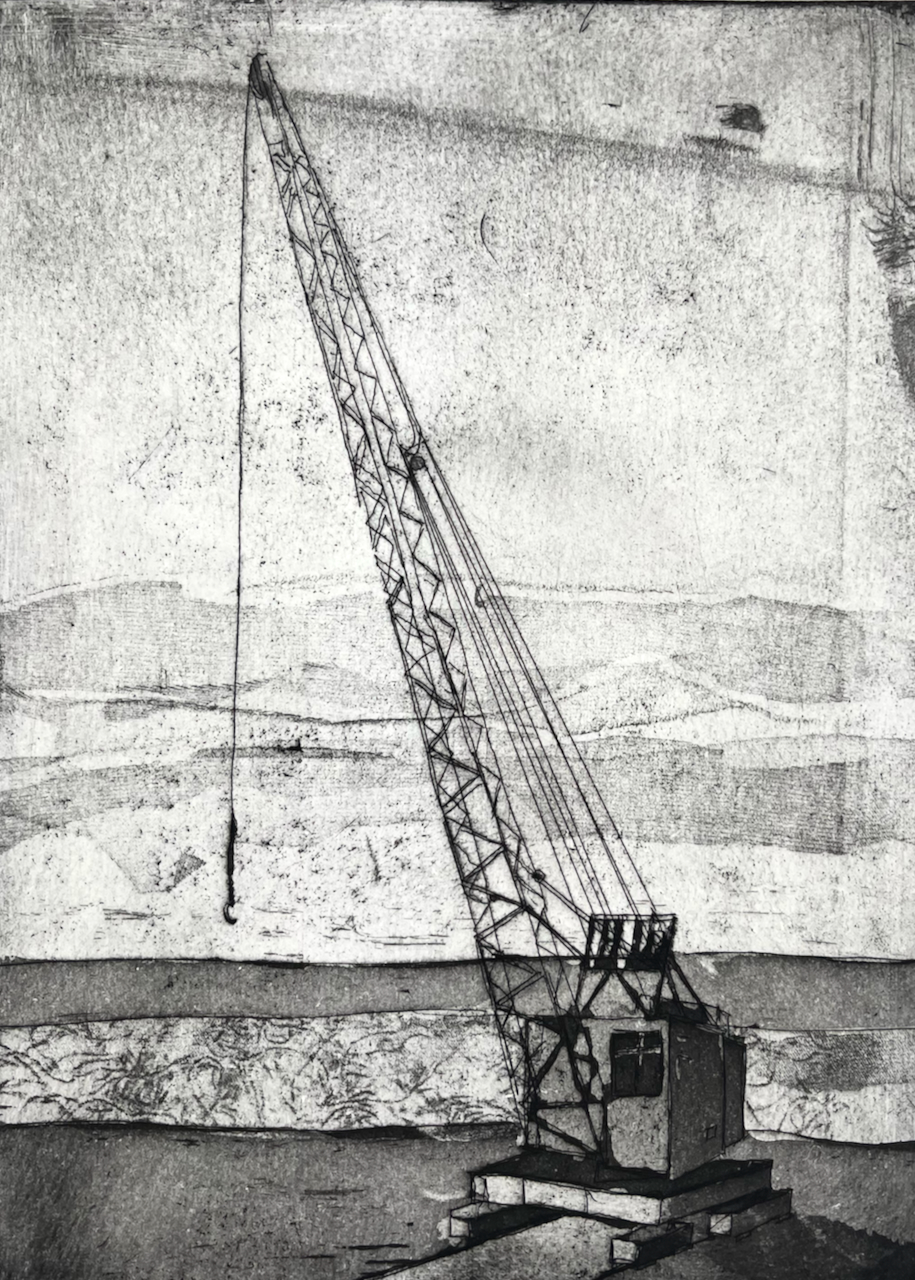
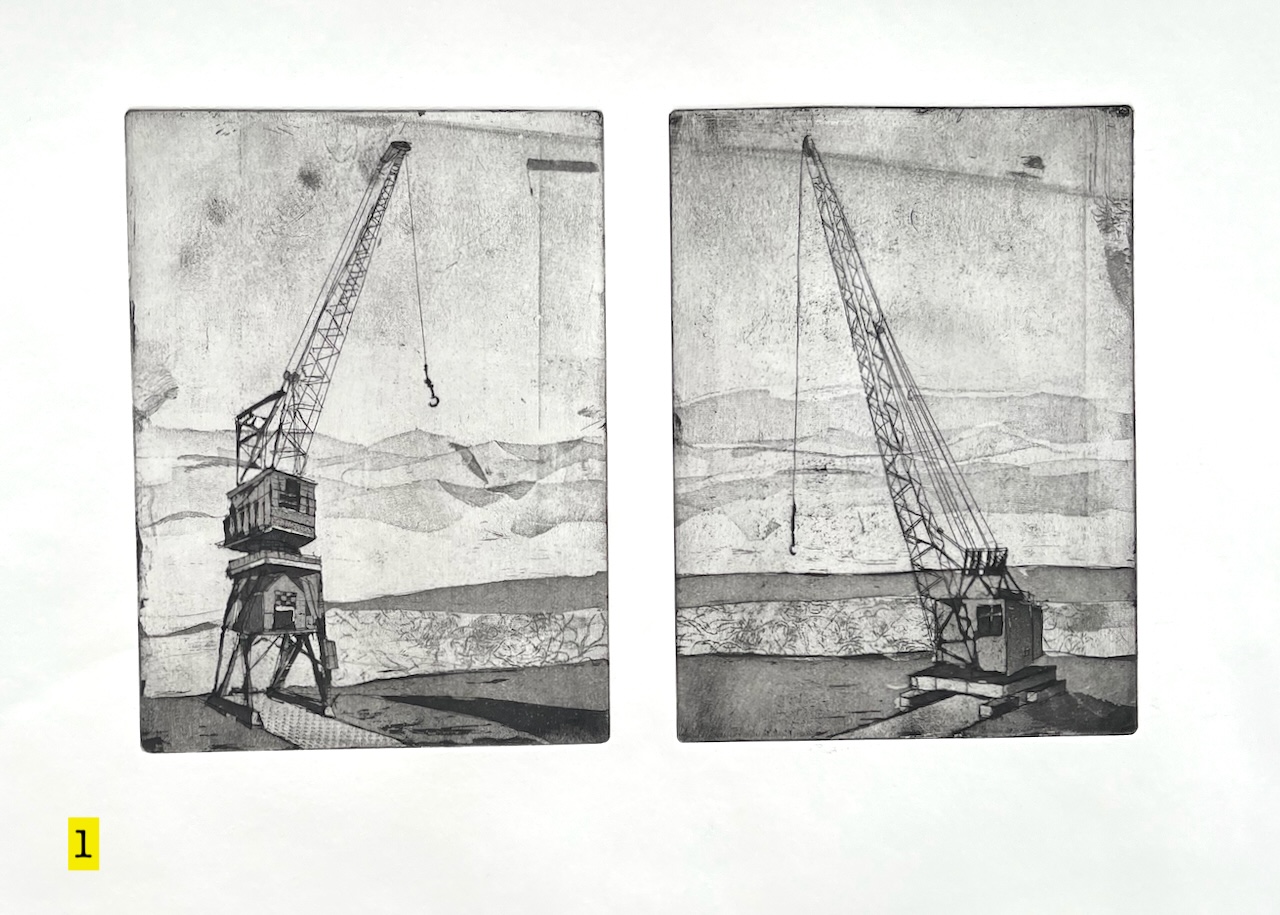
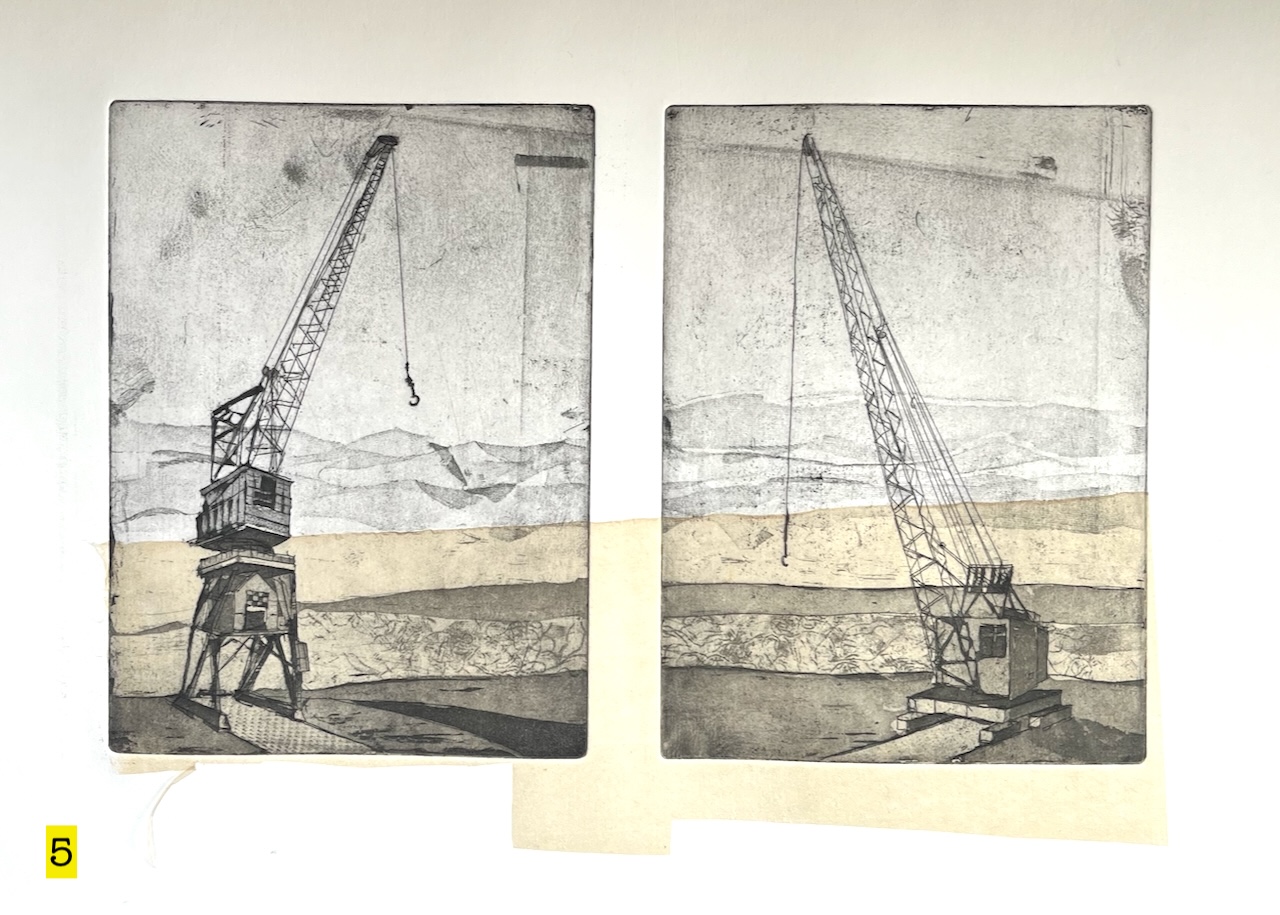
They stand by the river, ready for work. They are old cranes. It’s a long time since they lifted loads. But they hold themselves ready, should the call come. While they wait, they talk to each other.
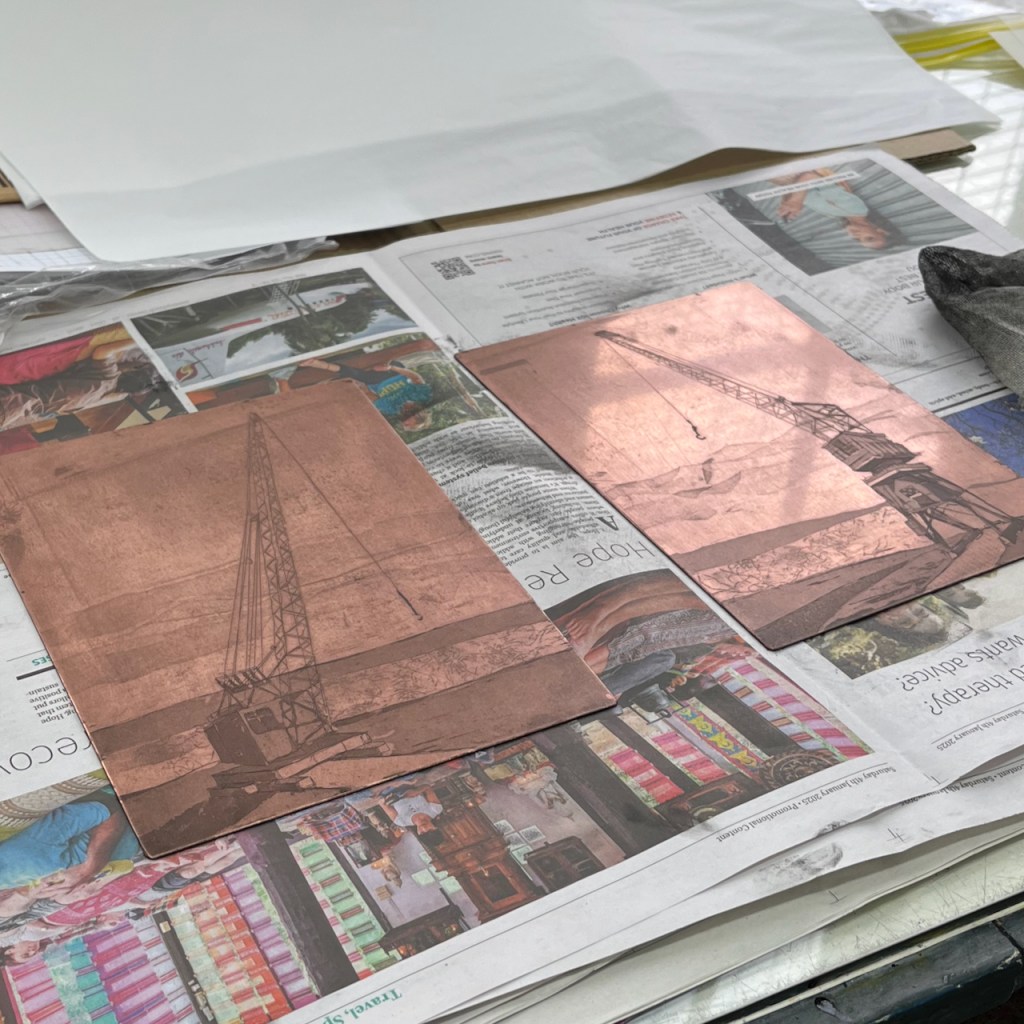
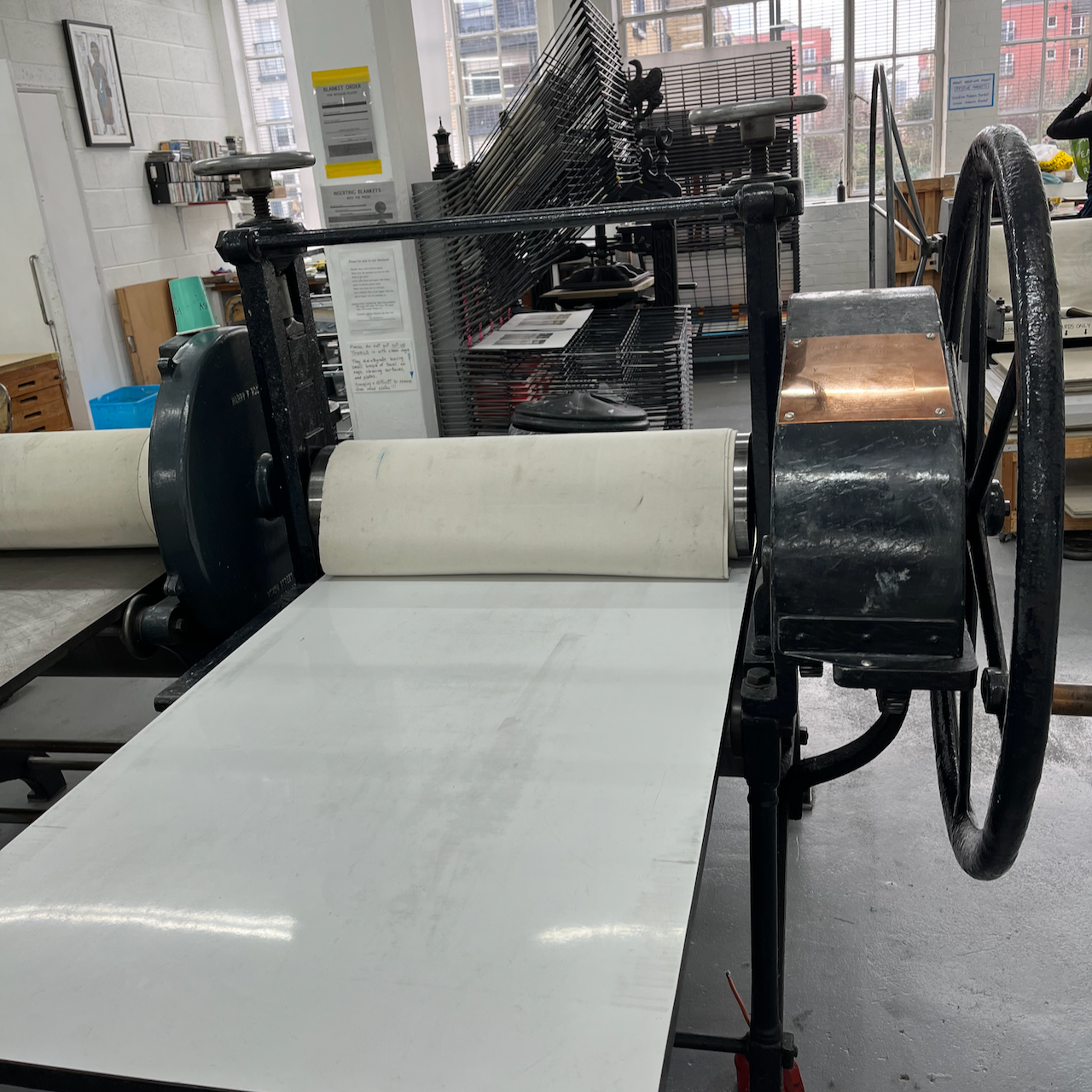
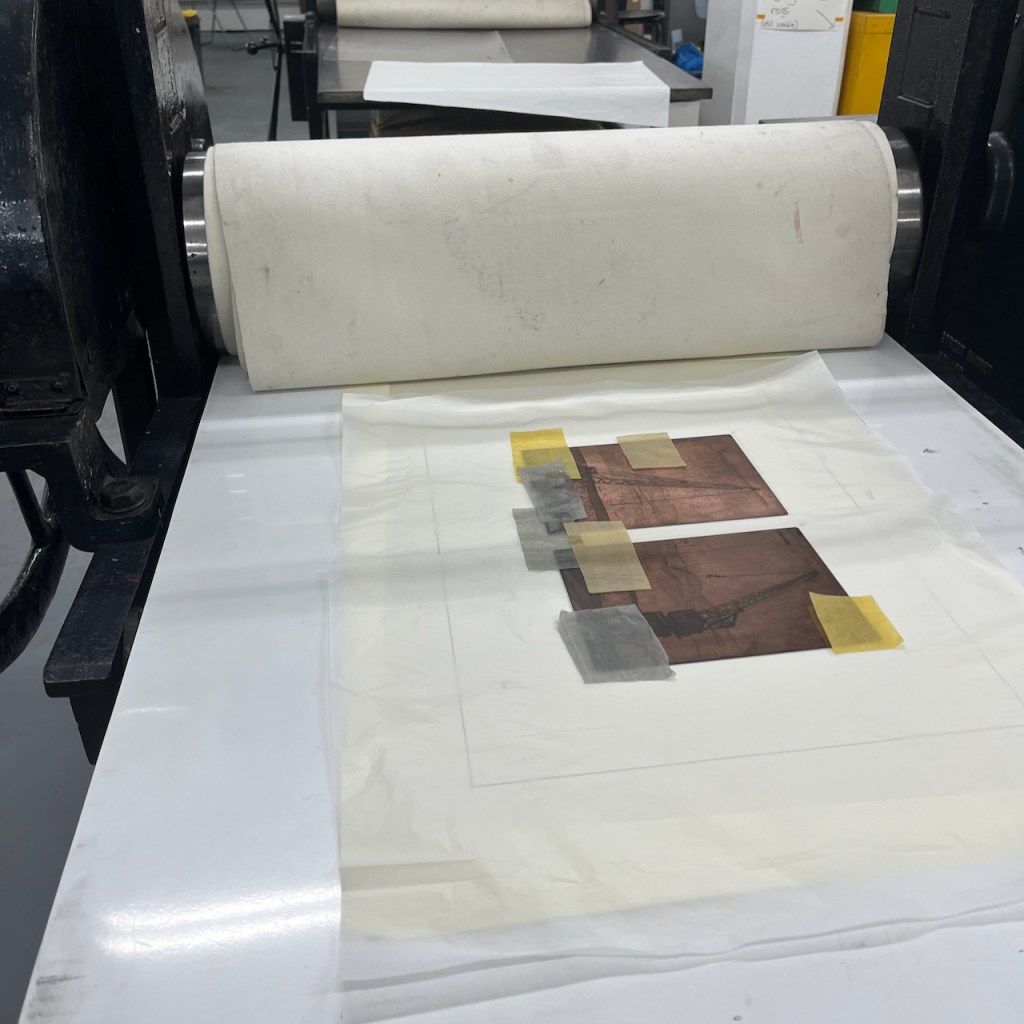
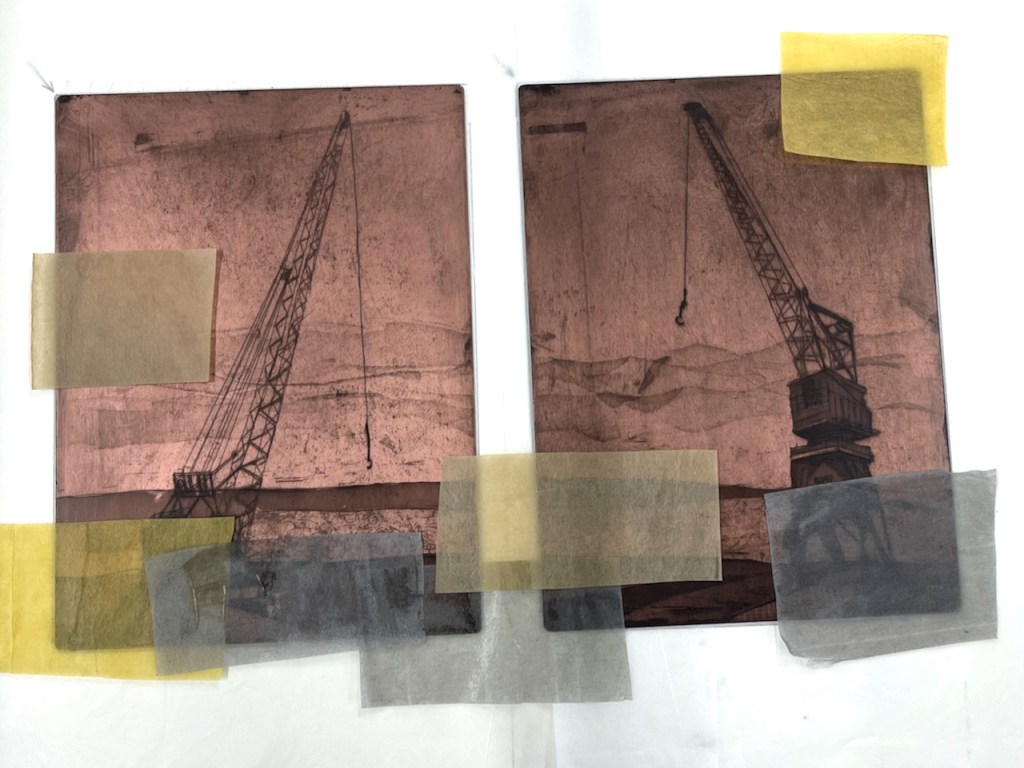
So I put them on the same sheet, they go together through the etching press.
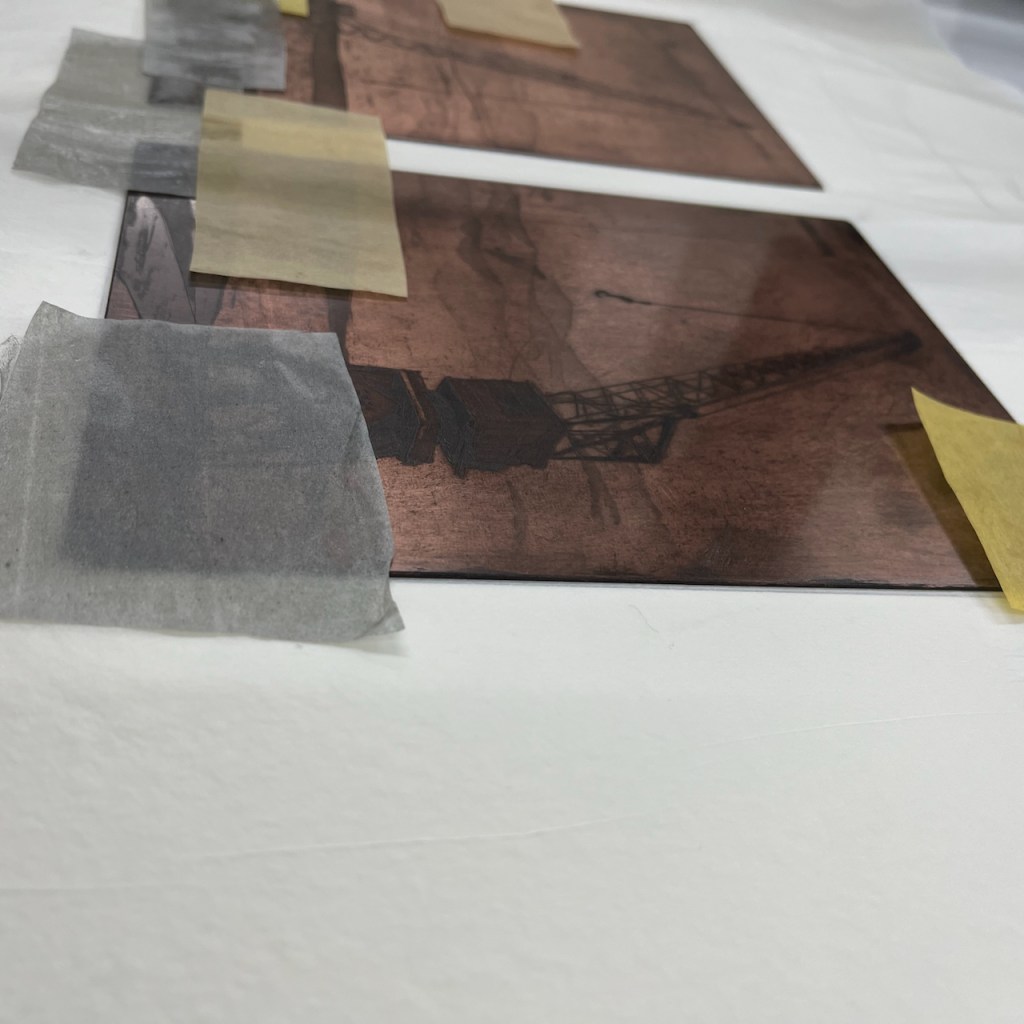
Copper platesPrinting pressPlates on the press (print #2)print #5 drying
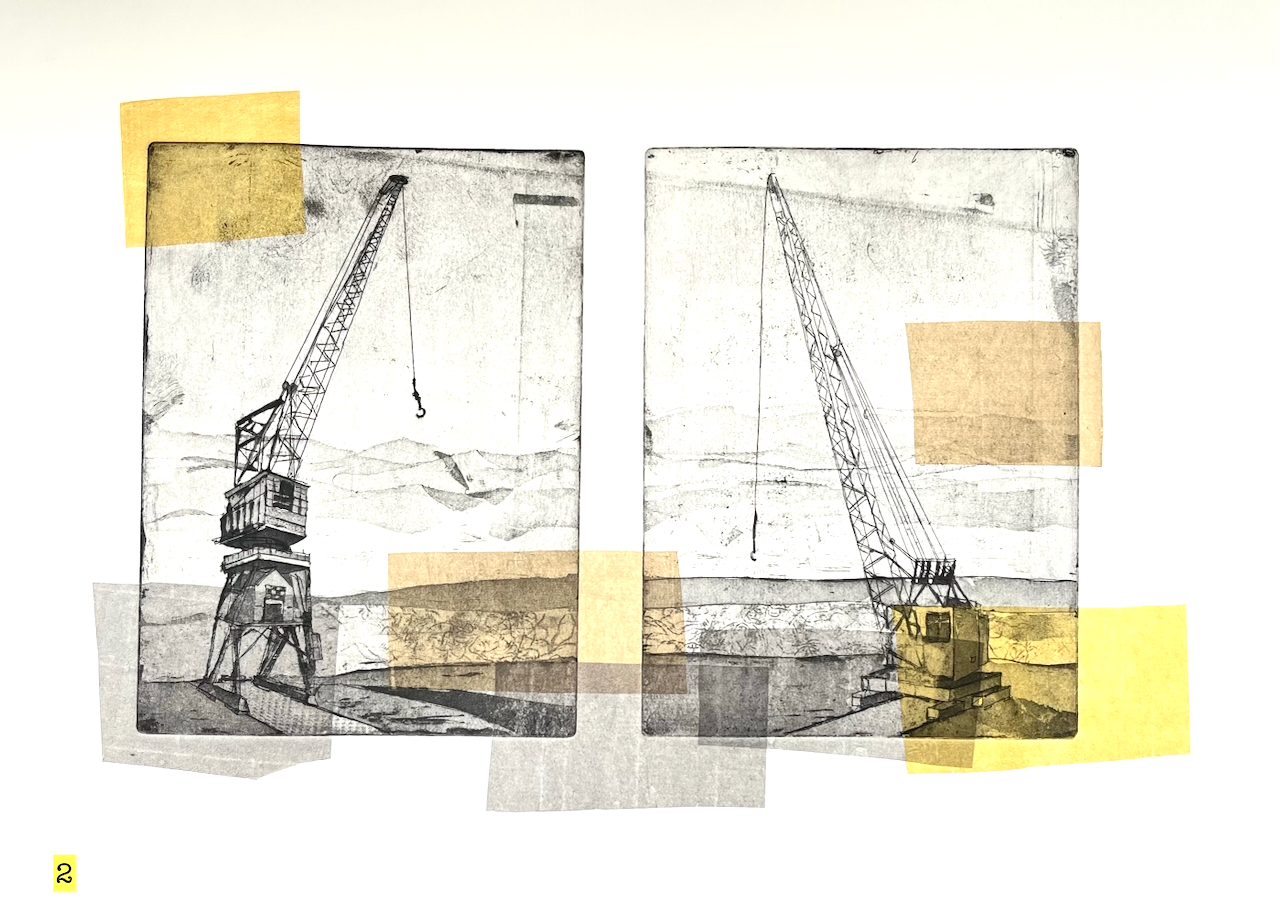
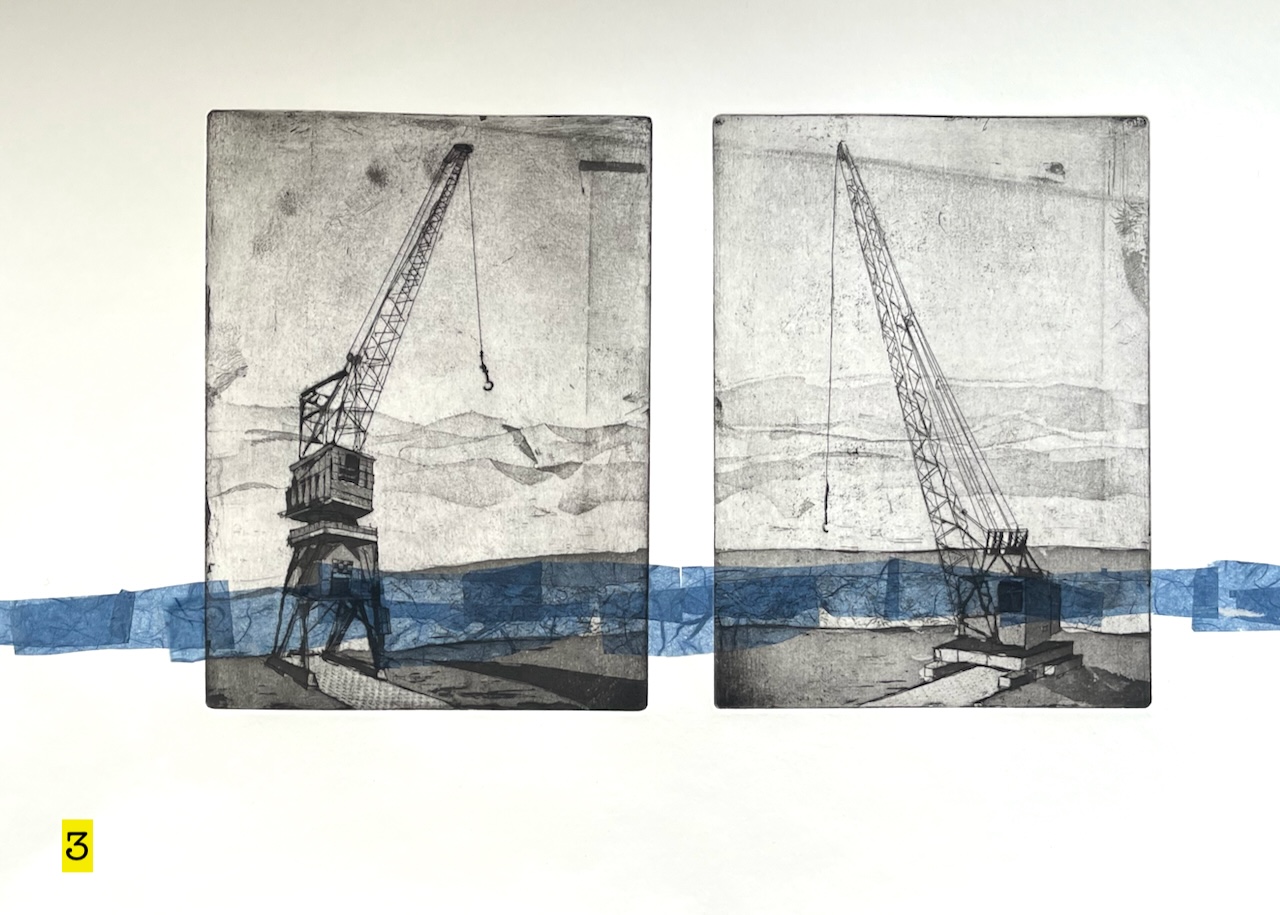
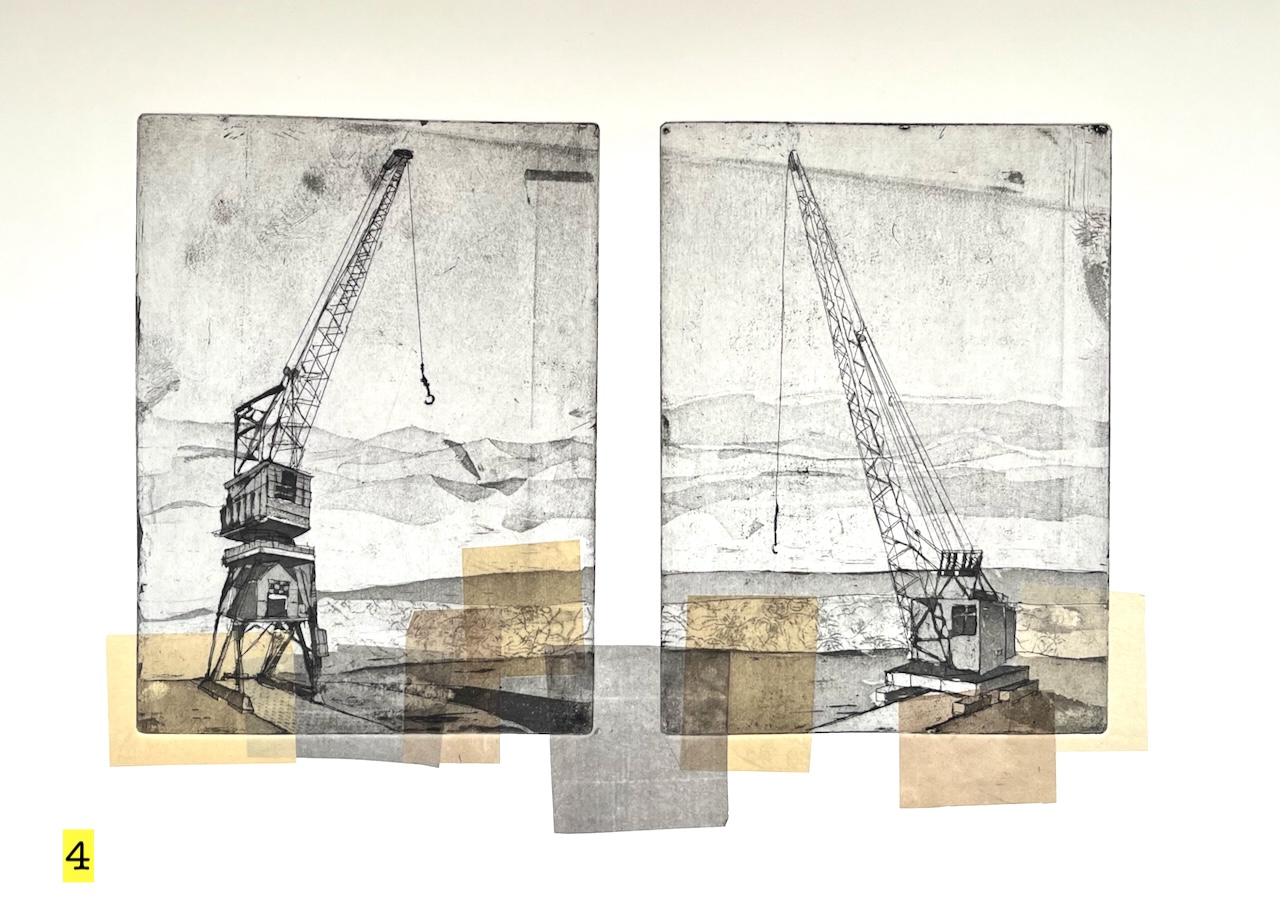
I made five prints of these cranes. The colour is added using the “chine colle” technique.
“Chine collé” means putting paper on top of the plate before it goes into the press. I have written about it on this page.
Here is the paper on top of the plate. It has glue on the top surface. The paper is very lightweight Japanese paper. It’s quite hard to get it to stay in position.
Here is a video of this plate after it’s been through the press:
Printing “Two Cranes”: thanks to friends at East London Printmakers for helping me with the video
I etched the plates and made these prints at East London Printmakers, Stepney. The techniques for making the plates are hard ground, soft ground, aquatint and dry point. The ink is Intaglio Printmakers Shop Mix Bone Black.
The cranes are at The Historic Dockyard, Chatham, Kent ME4 4TE
Let me know if you’d like a “Two Cranes” print? The sheet is about A2 size.
Click a button below to share this post online, email it, or print it:
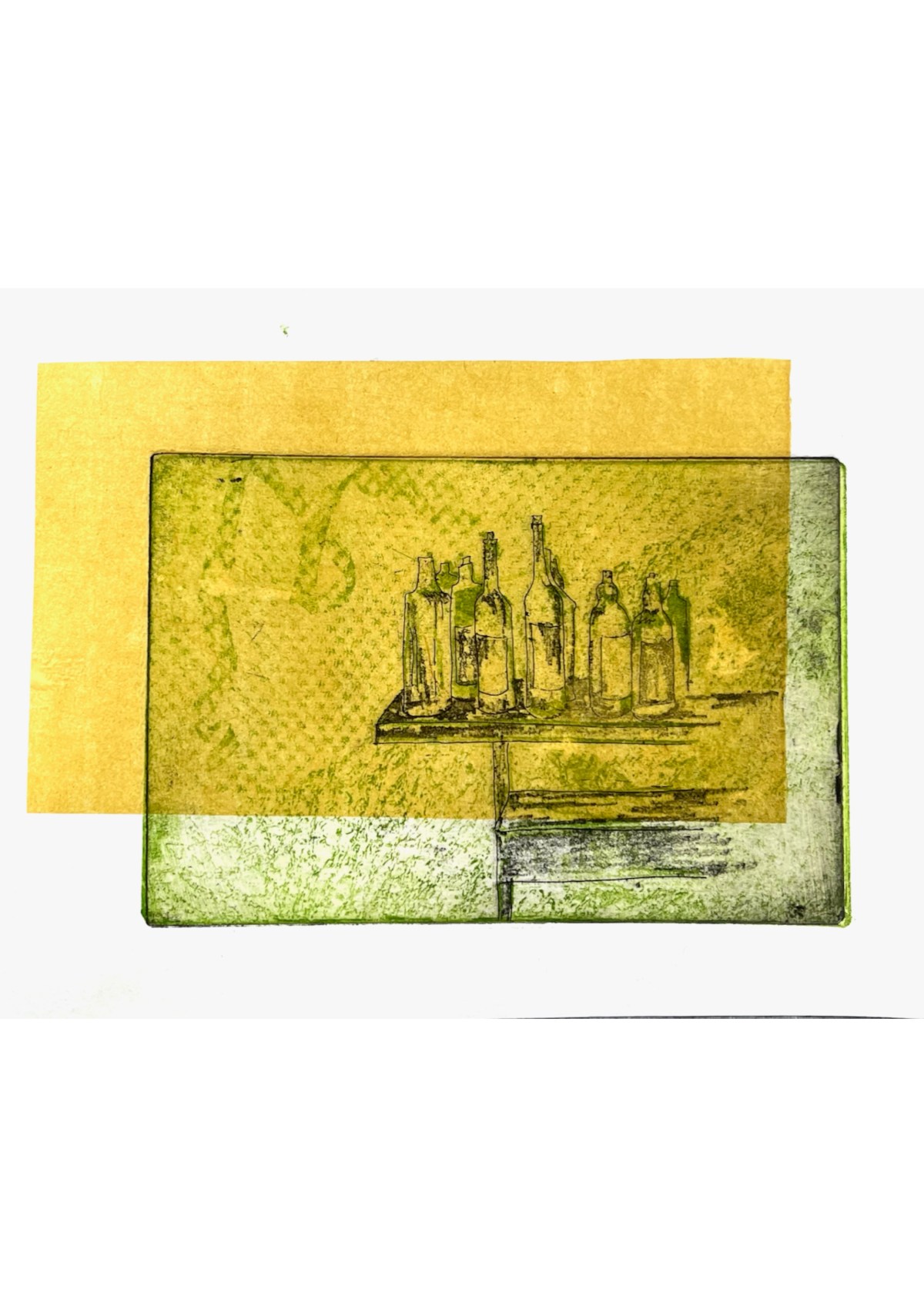
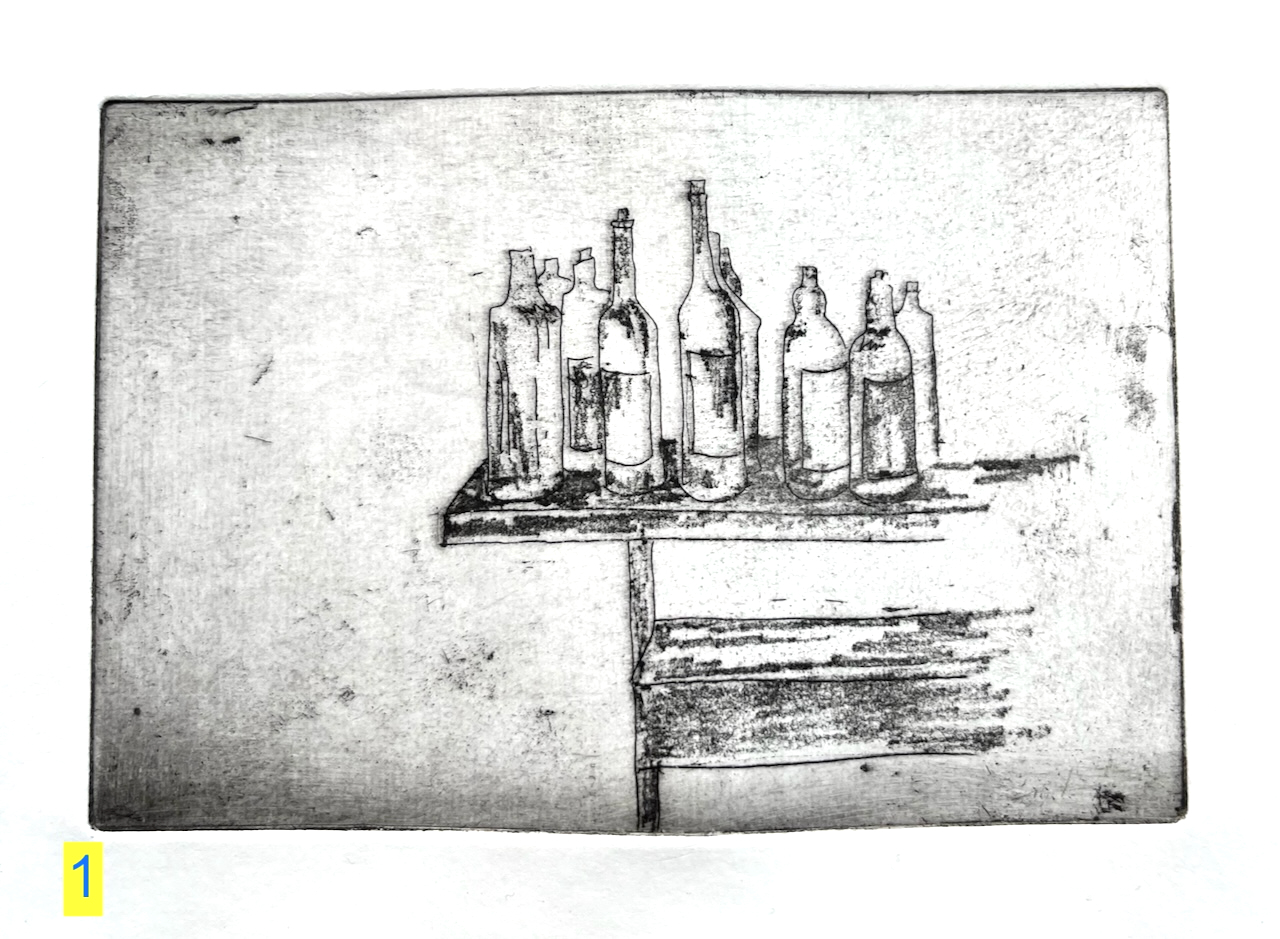
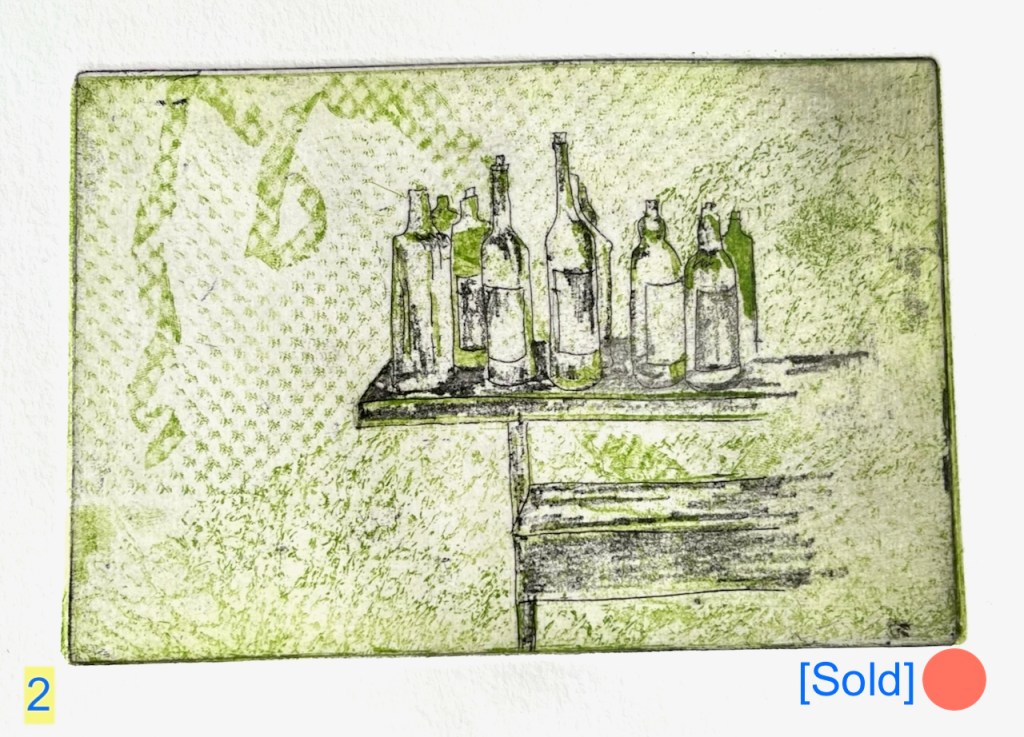
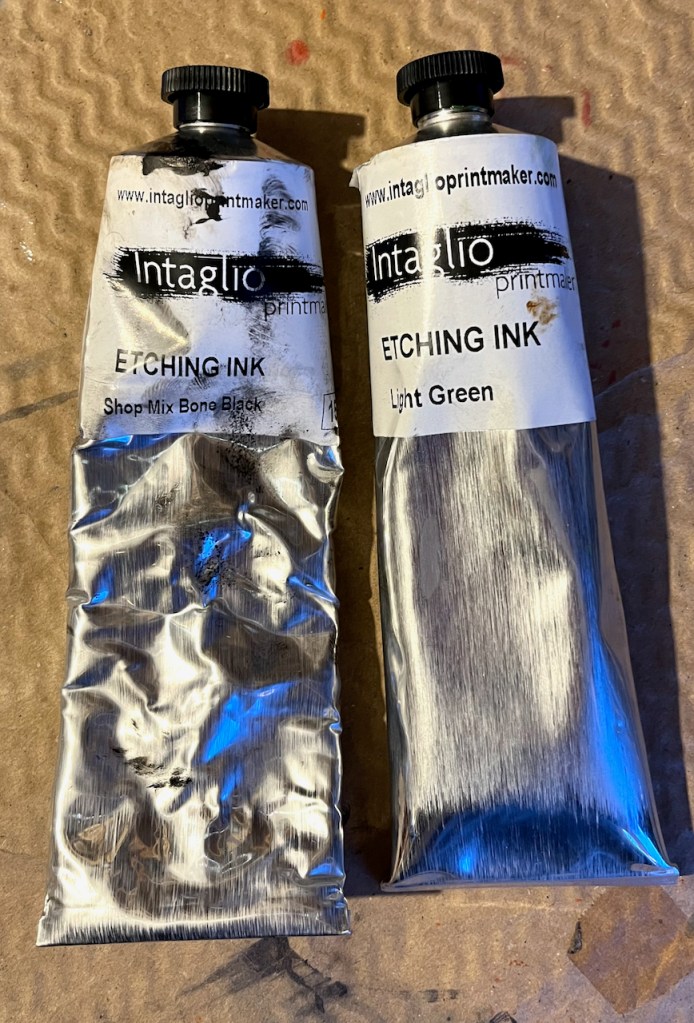
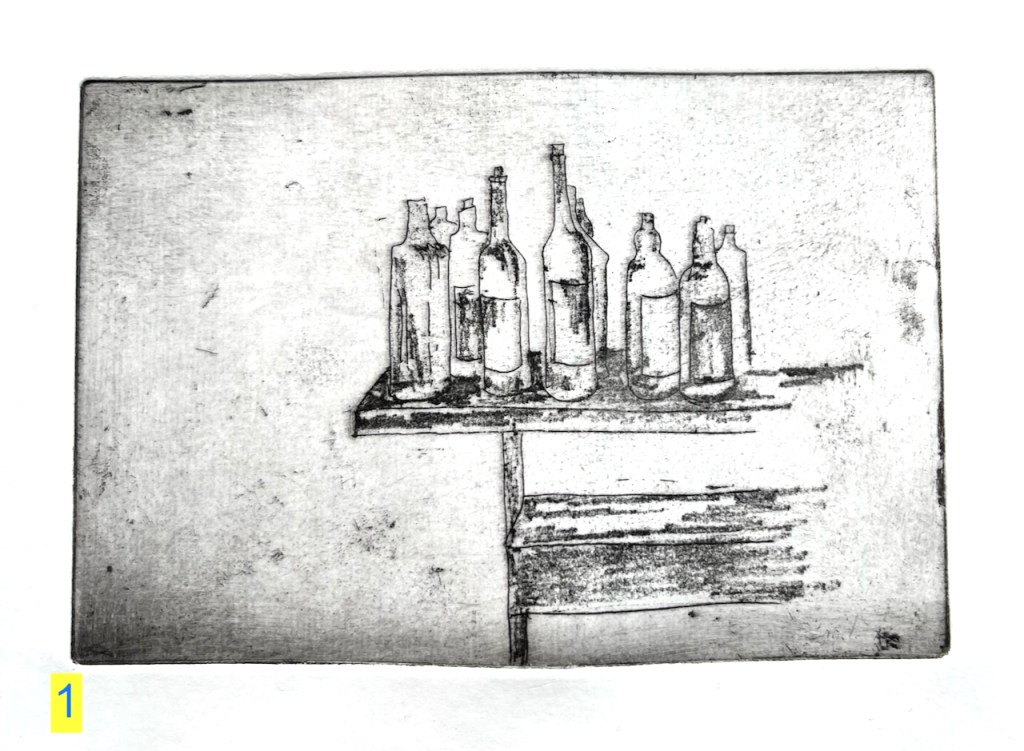
The ink is Intaglio Printmaker etching ink: Bone Black Shop Mix, and Light Green. Print 3 is made from two etched copper plates: first I printed the background pattern using green ink, then I printed the bottles and table, using black ink on another plate.
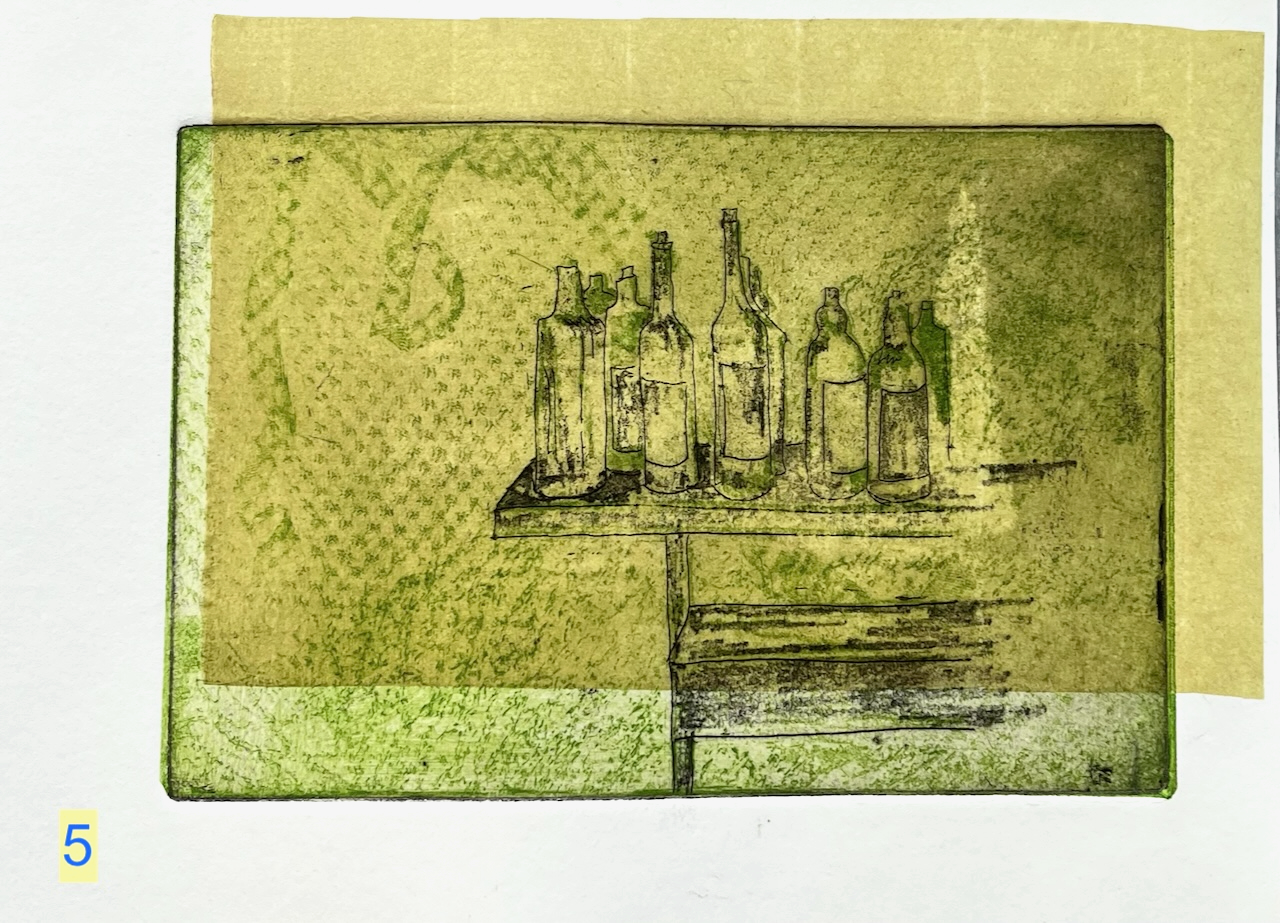
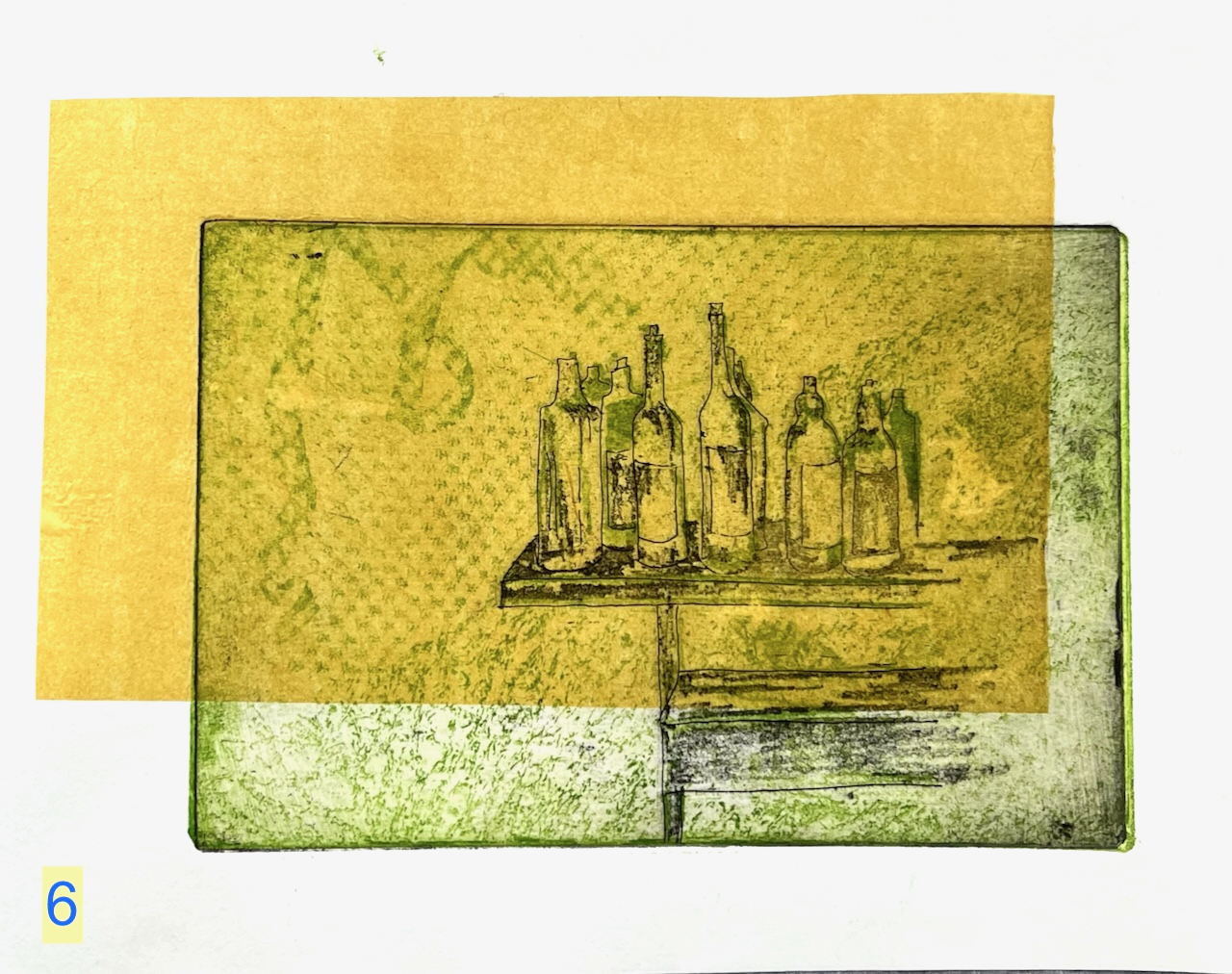
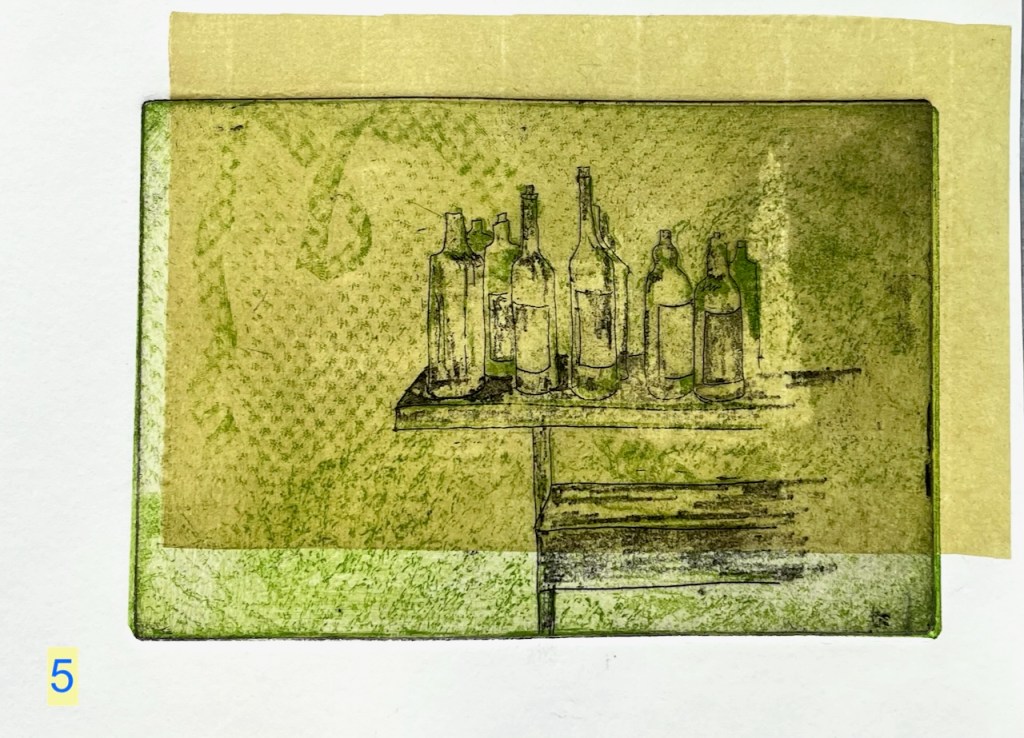
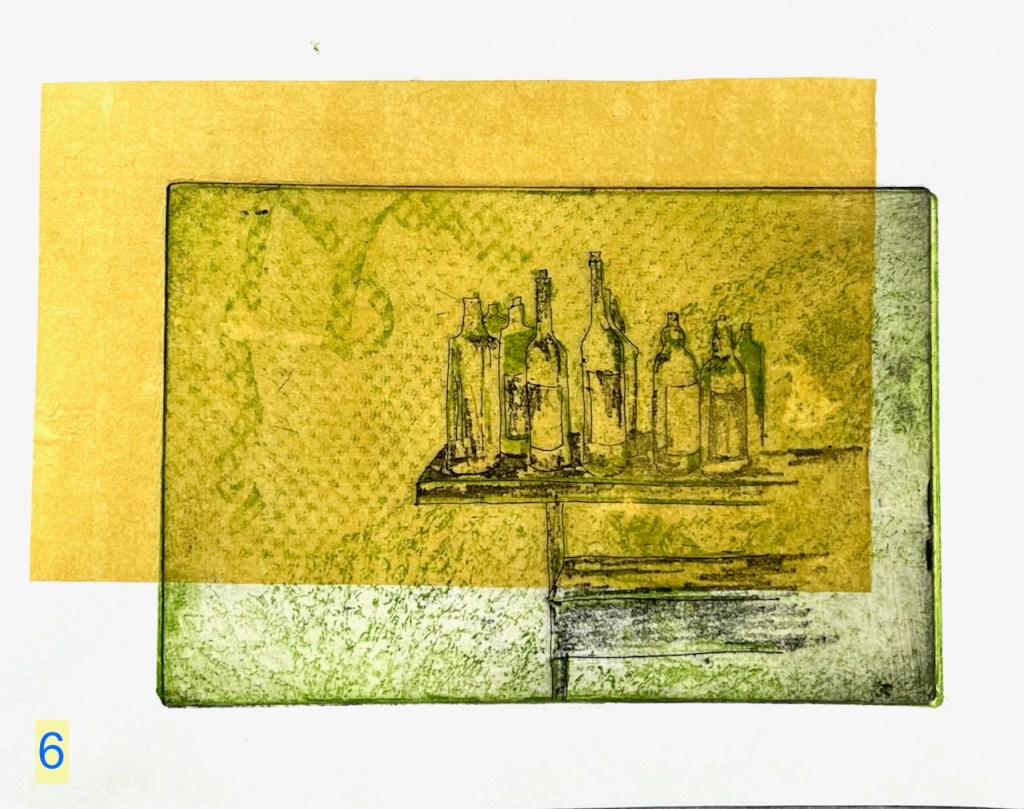
Then I made some more prints adding chine collé. Here are prints 5 and 6.
Chine collé is thin paper. I put it on the plate before the print roller goes over. The heavy rollers squeeze the coloured paper onto the picture, giving the yellow rectangles on the images of prints 5 and 6. The yellow rectangles give a sense of depth – maybe you are looking at these bottles through a window. Or maybe there is a window above casting a sunlit patch.
Prints 5 and 6 are made using two plates and chine collé. The process is lengthy and fraught with potential error:
put the glue on the yellow chine collé paper. Let it dry.
ink the green plate, the background
ink the black plate, the foreground. (don’t get them the wrong way round)
put the green plate on the press, inked side up (not inked side down)
put the white paper on top of it (don’t get ink smudges on the white paper)
roll the press across the plate, and keep the end of the paper under the roller so it doesn’t move while you….
…remove the green plate, and replace it with the black plate (get it oriented exactly where the green plate was, and the right way up, and the right way round)
put the glued chine collé paper on the black plate, glue side up (it is very lightweight and drifts about when someone walks past)
let the white print paper fall on top (as it falls it wants to dislodge the layers underneath)
roll the print press
remove the finished print ( examine – did it work?)
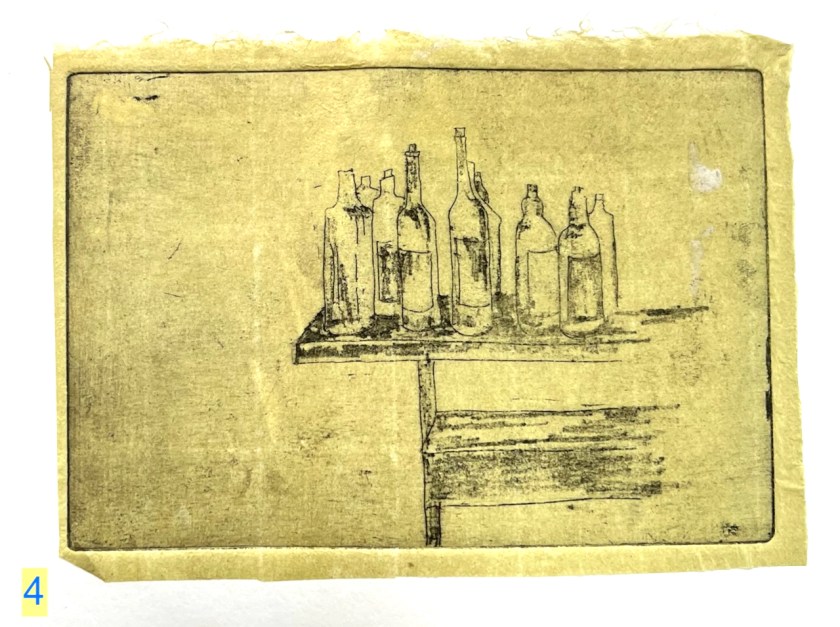
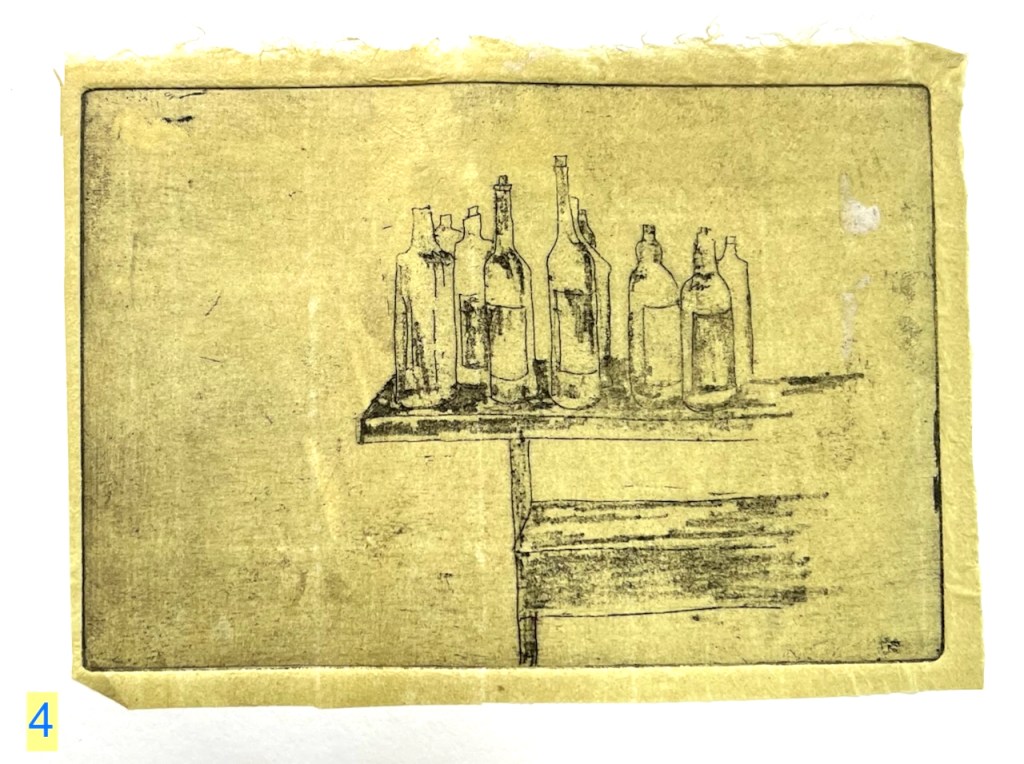
It is also possible to use the chine collé to provide a background for the whole image. Here is print 4. This is made using chine collé and one plate.
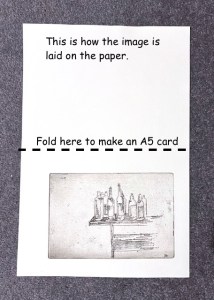
All these prints are made using heavyweight Fabriano Unica printing paper. It can be folded in half to make an A5 card to send to the absinthe enthusiast or wine drinker in your life. Or you can cut it down and frame it to make a small picture for your kitchen. The image itself is about postcard size: 10cm x 15cm. Let me know if you would like one? £25 + postage.
Here is a gallery of all six prints from this second series. These are all handmade prints from the etching press – not digital prints. I’ve numbered the prints in this post for easy reference. The numbers do not appear on the print you will receive. I can sign them if you like or not if you prefer them blank.
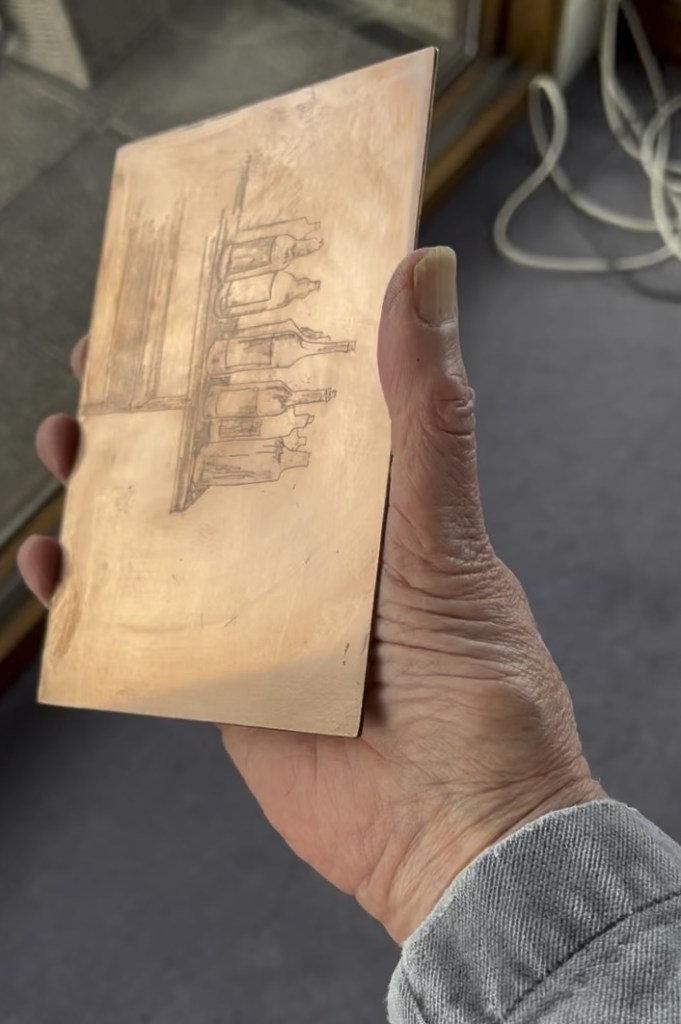
Here’s the copper plate I used for the black foreground:
Click a button below to share this post online, email it, or print it:
Thank you for reading my posts and looking at my pictures. I appreciate your encouragement and comments.
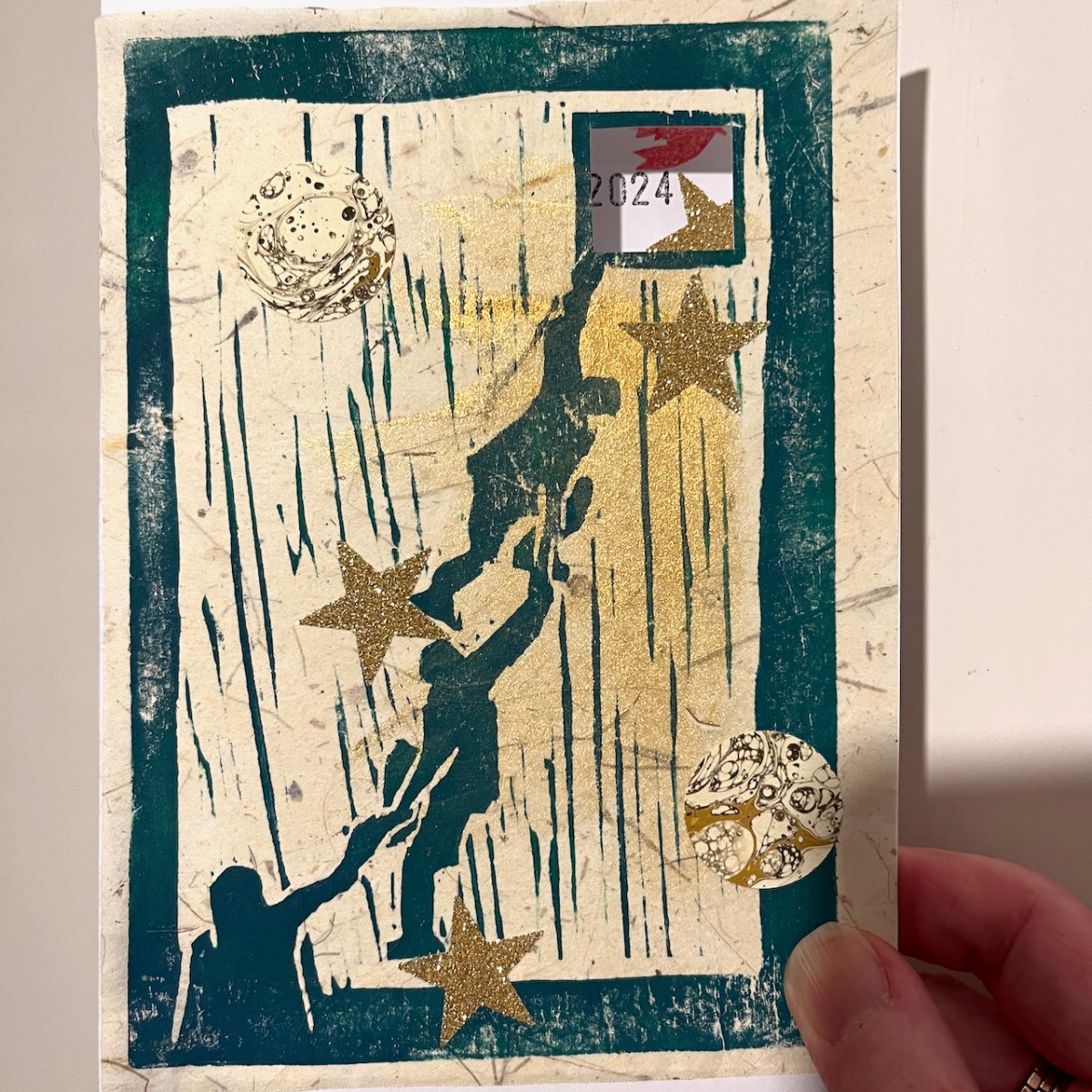
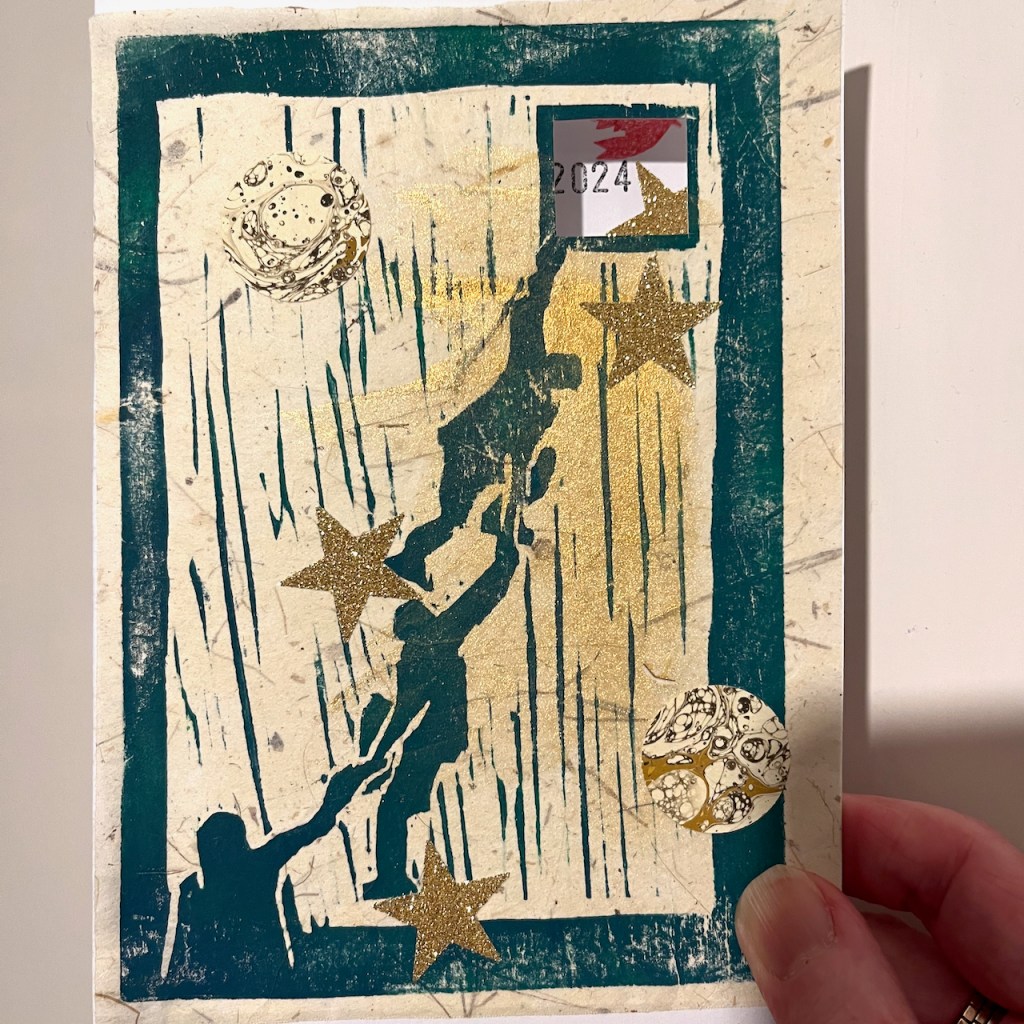
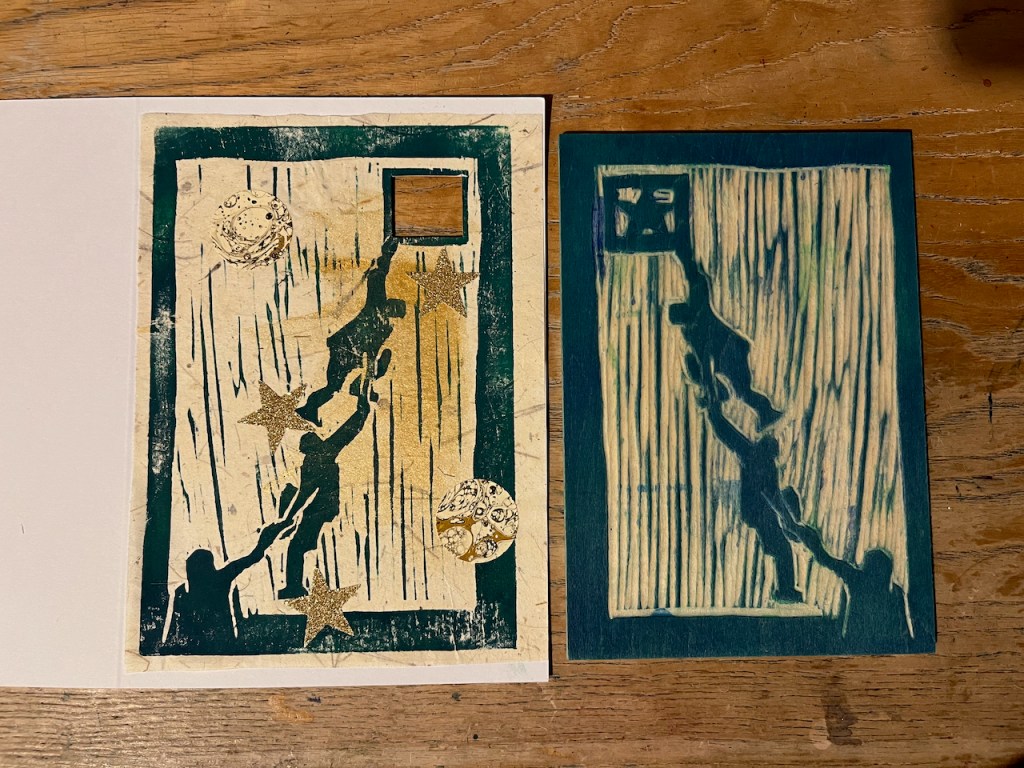
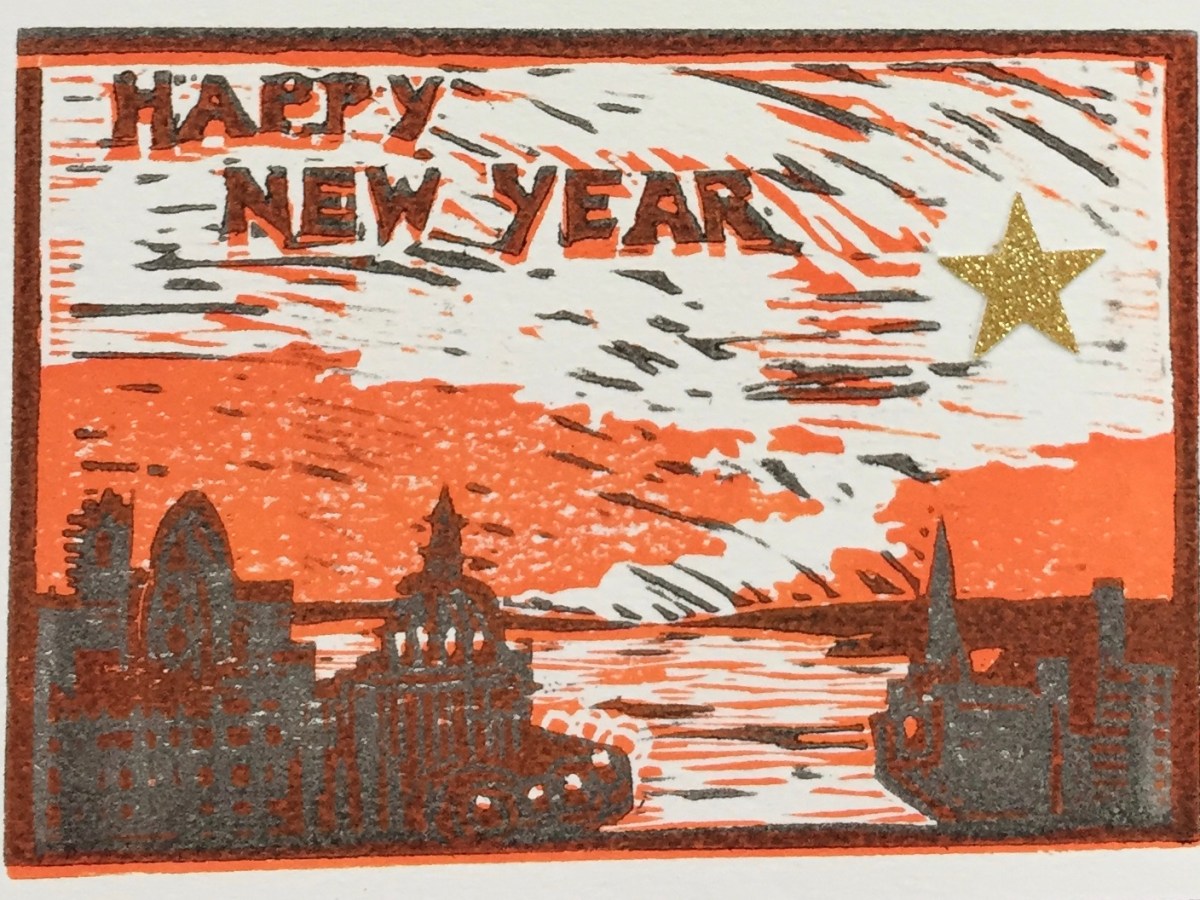
Here is my New Year Card for 2024.
New Year 2024: “Ascent” woodcut and collage – 5″ x 7″
I intended the image to be one of hope: of collaboration and of working together towards a higher goal.
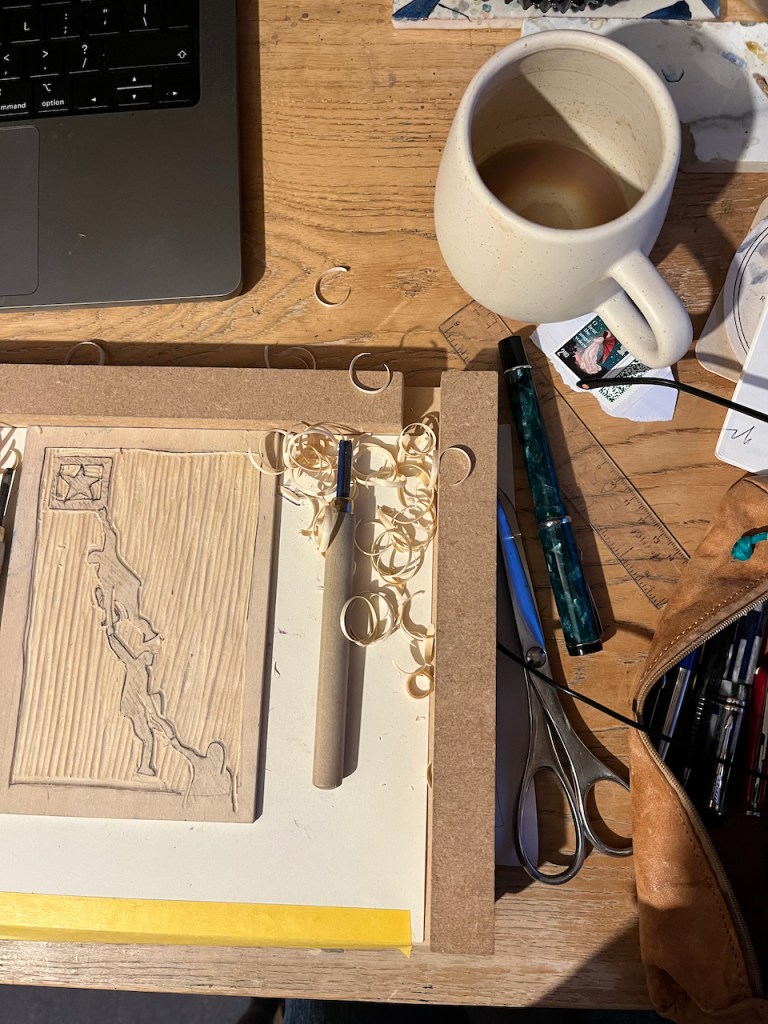
The main image is a woodcut on plywood. Here is work in progress:
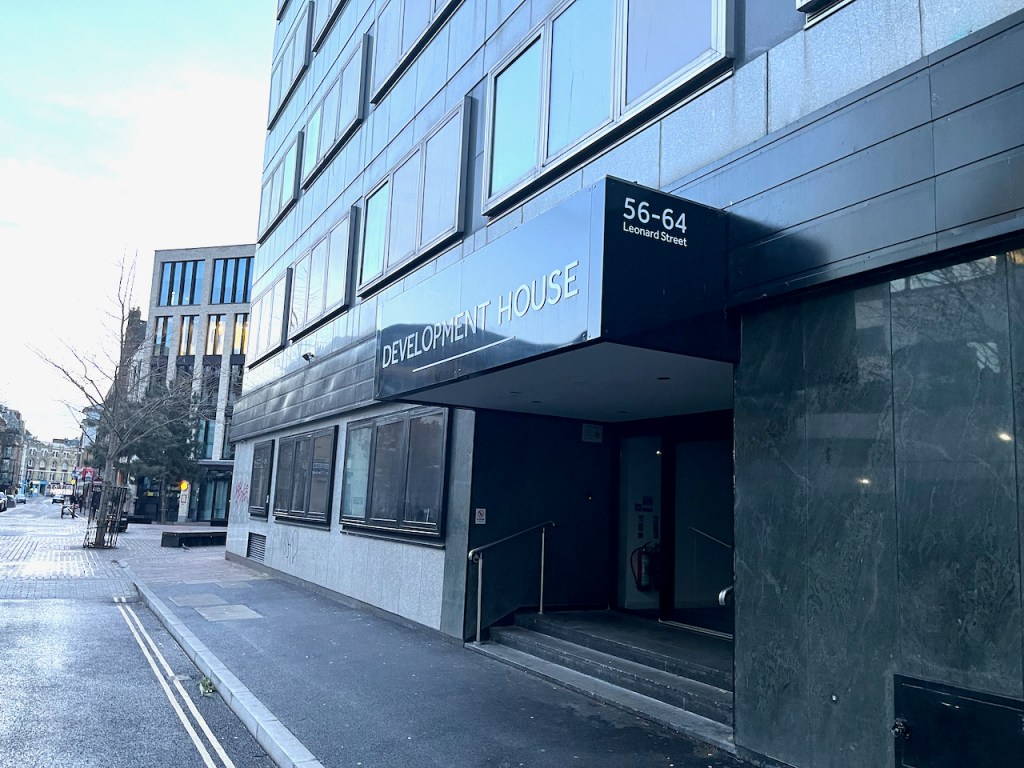
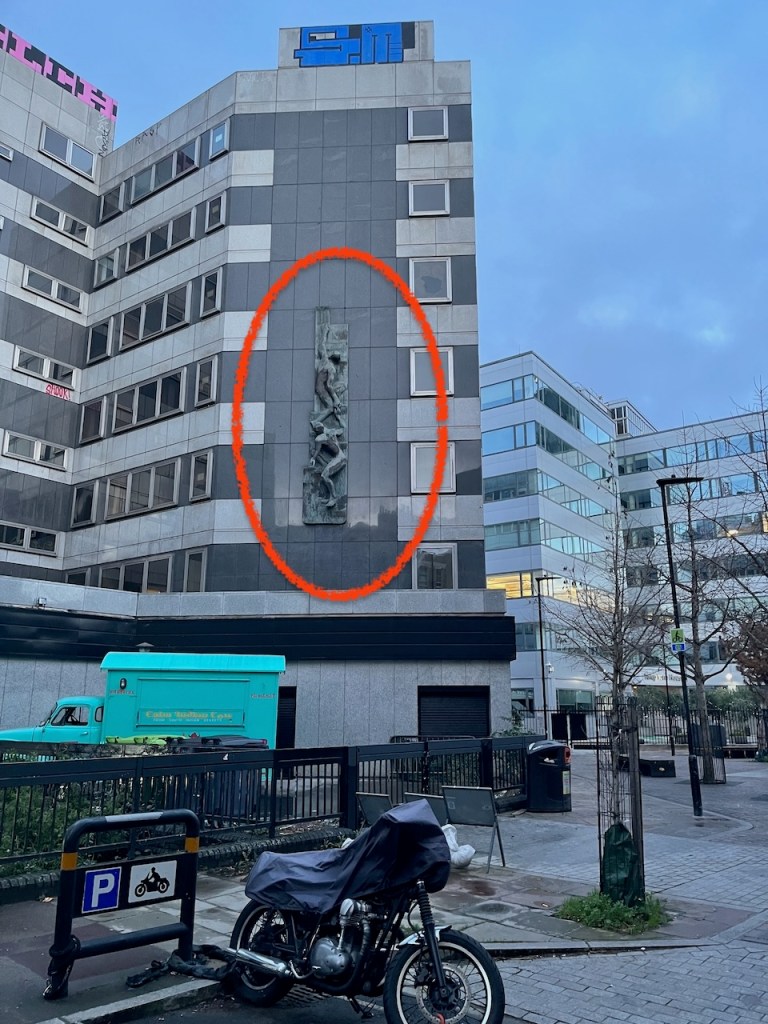
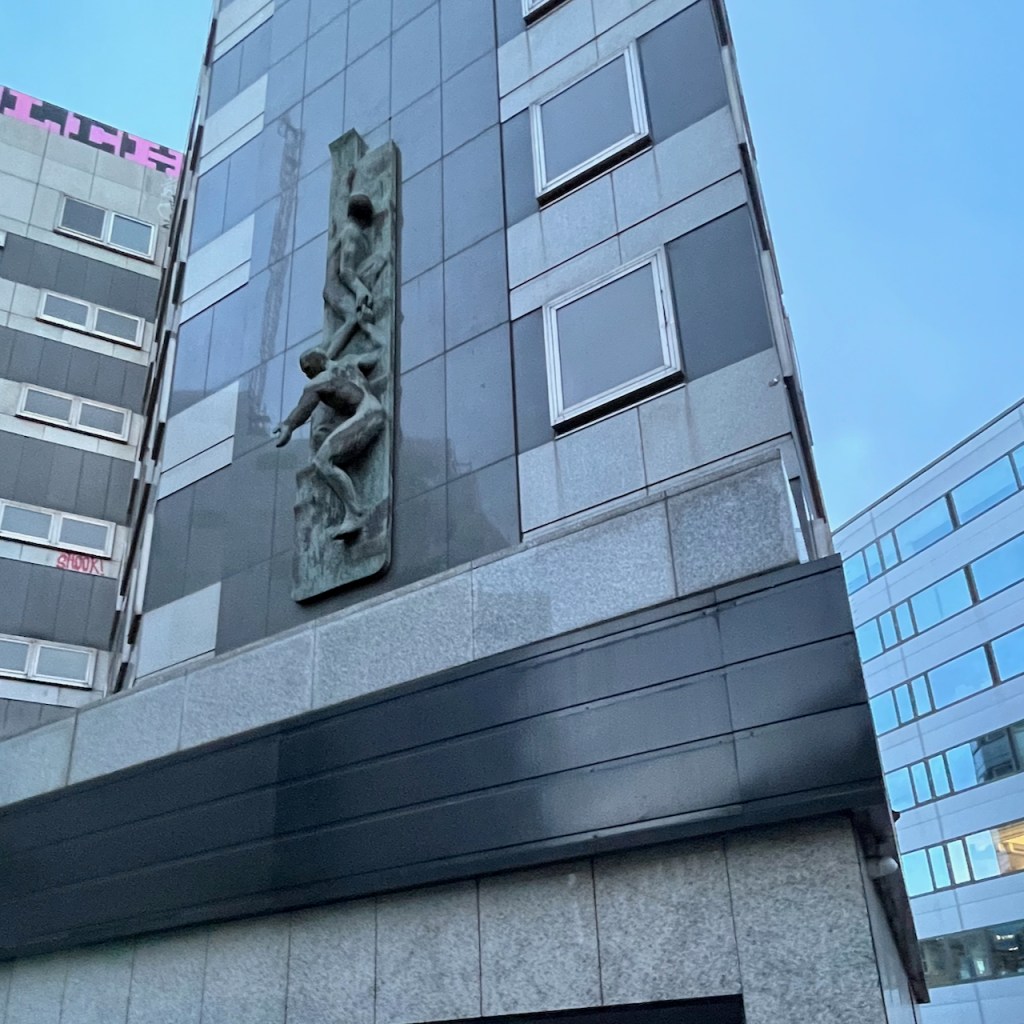
The woodcut image is inspired by a sculpture on the wall of a building in Hoxton. The building is called “Development House” 56-64 Leonard Street. I can’t find any attribution for the sculpture and would be interested to know who the artist is, if anyone can tell me.
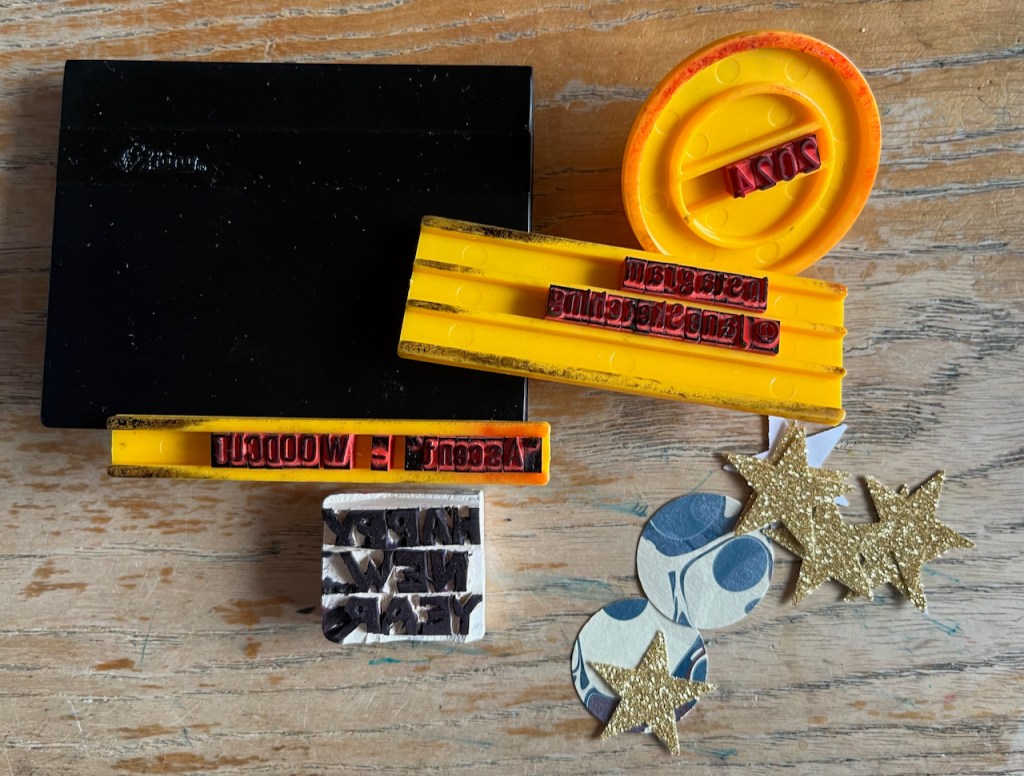
Technical information: The woodcut is on plywood, bought from “Great Art”on the Kingsland Road, not far from this sculpture. The ink is Schminke relief ink, applied with a roller. I printed the image by hand at my desk, using a roller and pressing the paper down with the convex side of a spoon. The paper is lightweight Thai Mulberry (45gsm) in various shades: sea grey, peppermint and natural, bought online from the “Perfect Paper Company”. The round “planets” are offcuts of marbled paper from the Wyvern Press. I cut the stars out of old sparkly wrapping paper, using a star cutter. The “Happy New Year” text is cut from a pencil eraser. Other text is from an old-fashioned printing outfit.
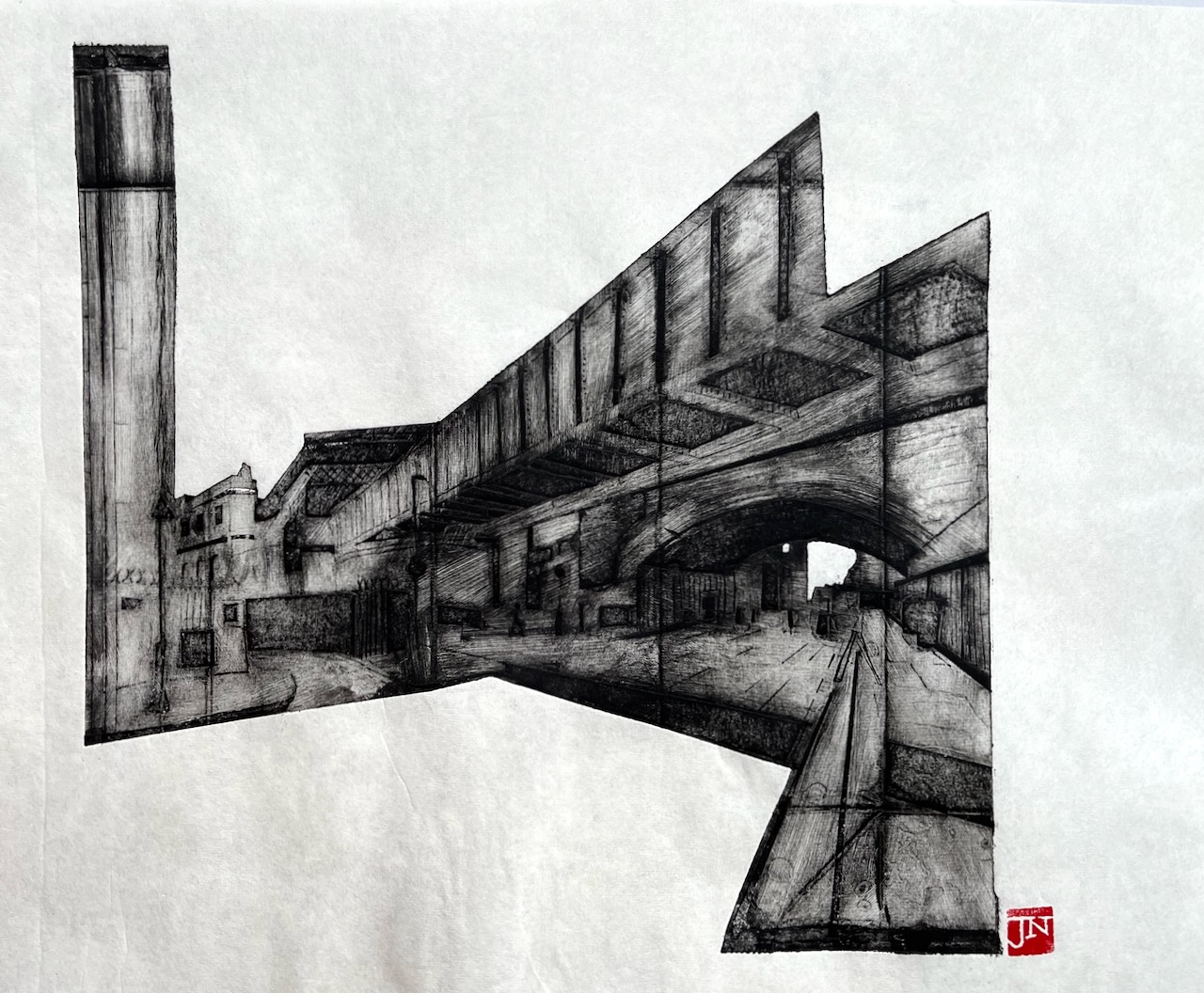
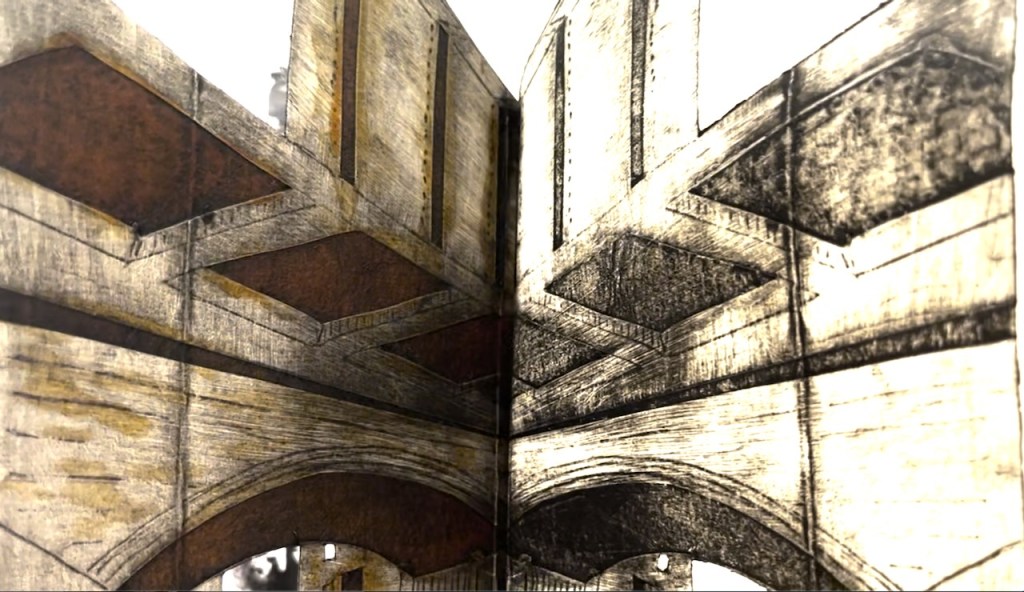
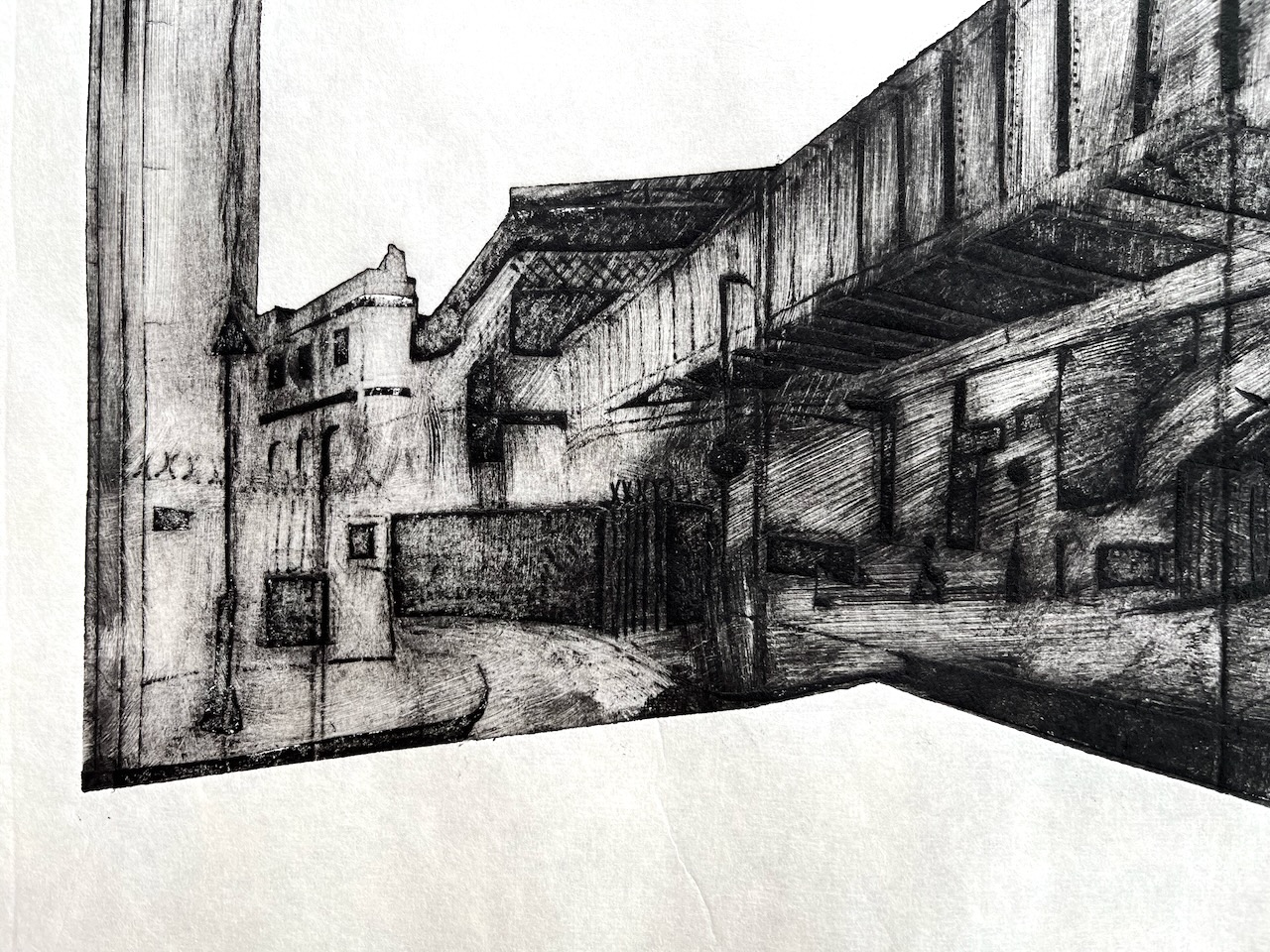
Here is another packaging print. This one shows Bridge ELR-XTD Structure 20 on Cornwall Road (N) between Charing Cross and Waterloo East, South East London. The road that leads off to the left is Sandell Street SE1. The road under the bridge is Cornwall Road.
The print is made using the intaglio process. The plate is a milk carton.
Railway bridge on Cornwall Road, SE1, Packaging print made on 3rd September 2022, about A3 size
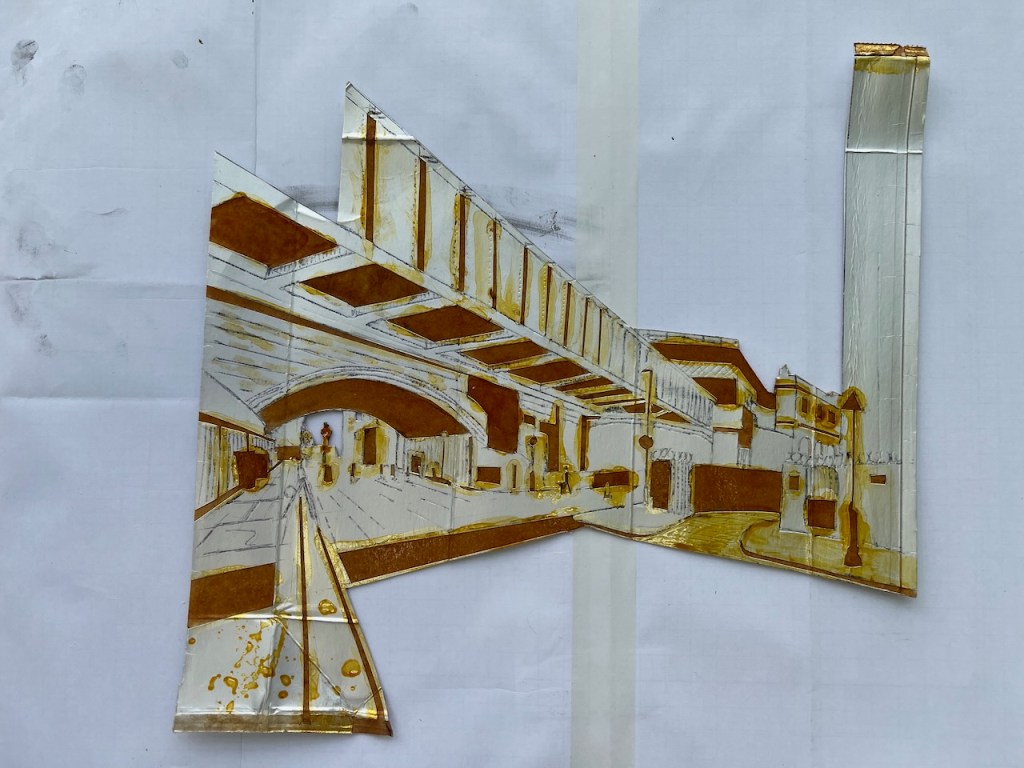
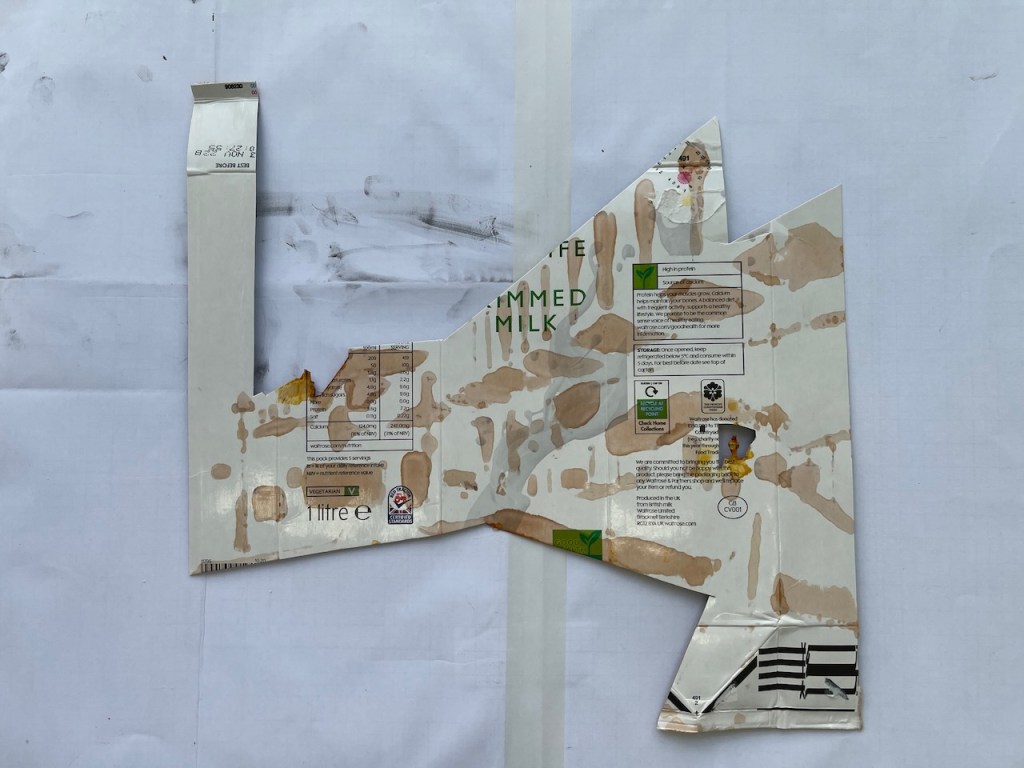
Here is the plate, front and back:
Plate: print sidePlate: back
The plate is made by peeling away the metallic substance inside the milk carton, then painting it with shellac to make it stronger. I describe the process in this post.
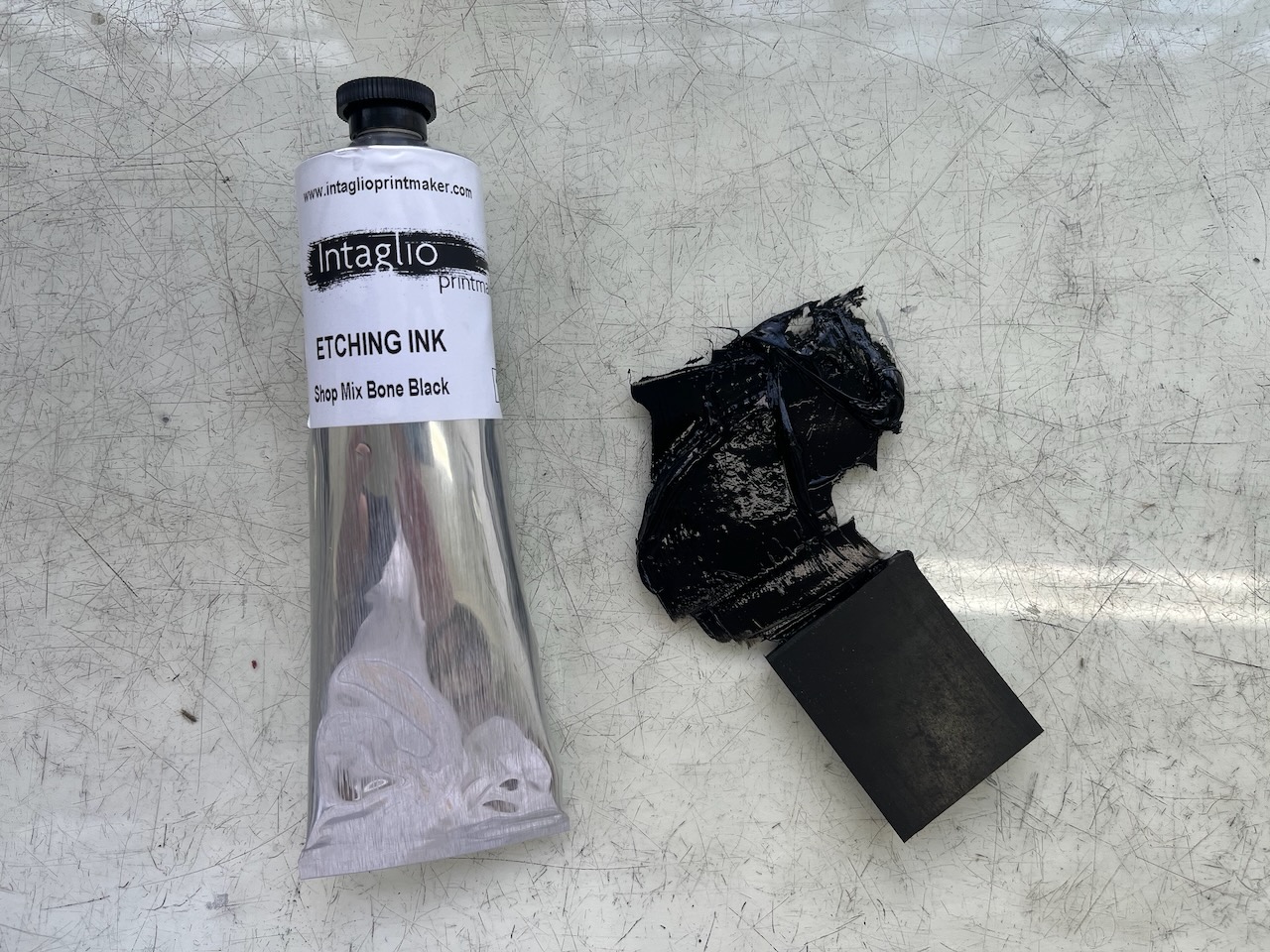
I used traditional etching ink, “Shop mix – Bone Black” from Intaglio Printmaker, whose shop, as it happens, is not far from this railway bridge.
Here’s a video of the print being peeled away:
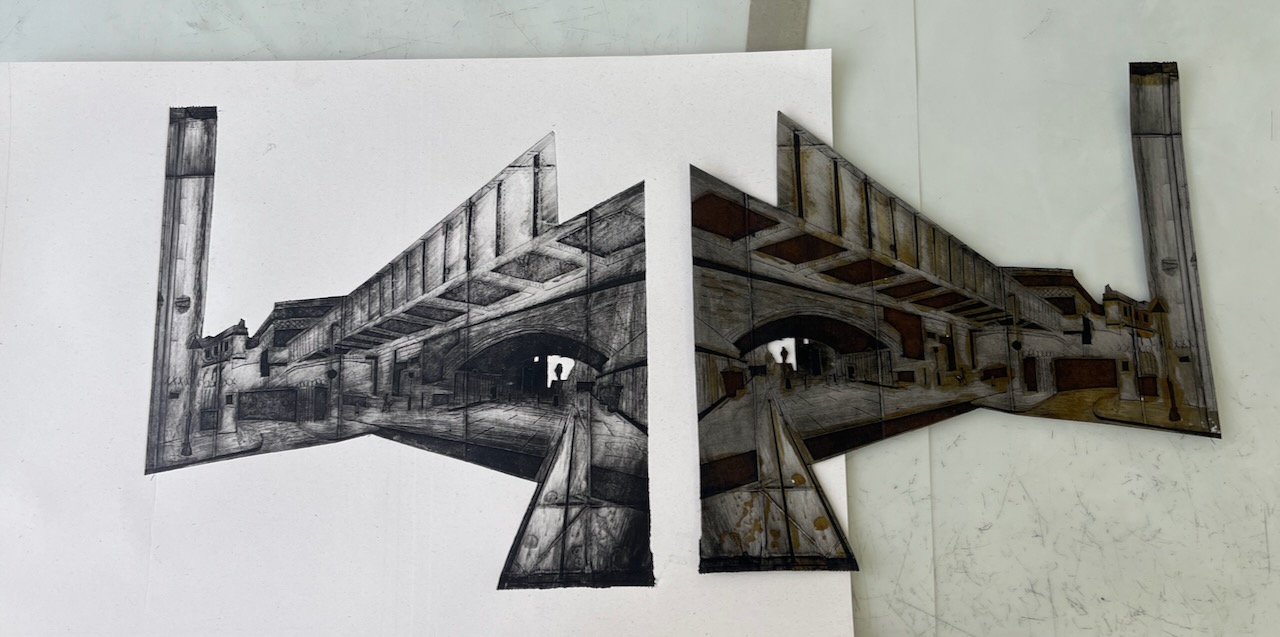
Here is the print and the plate:
Plate (left) and print (right)
Print (left) and plate (right)
The plate made 8 prints.
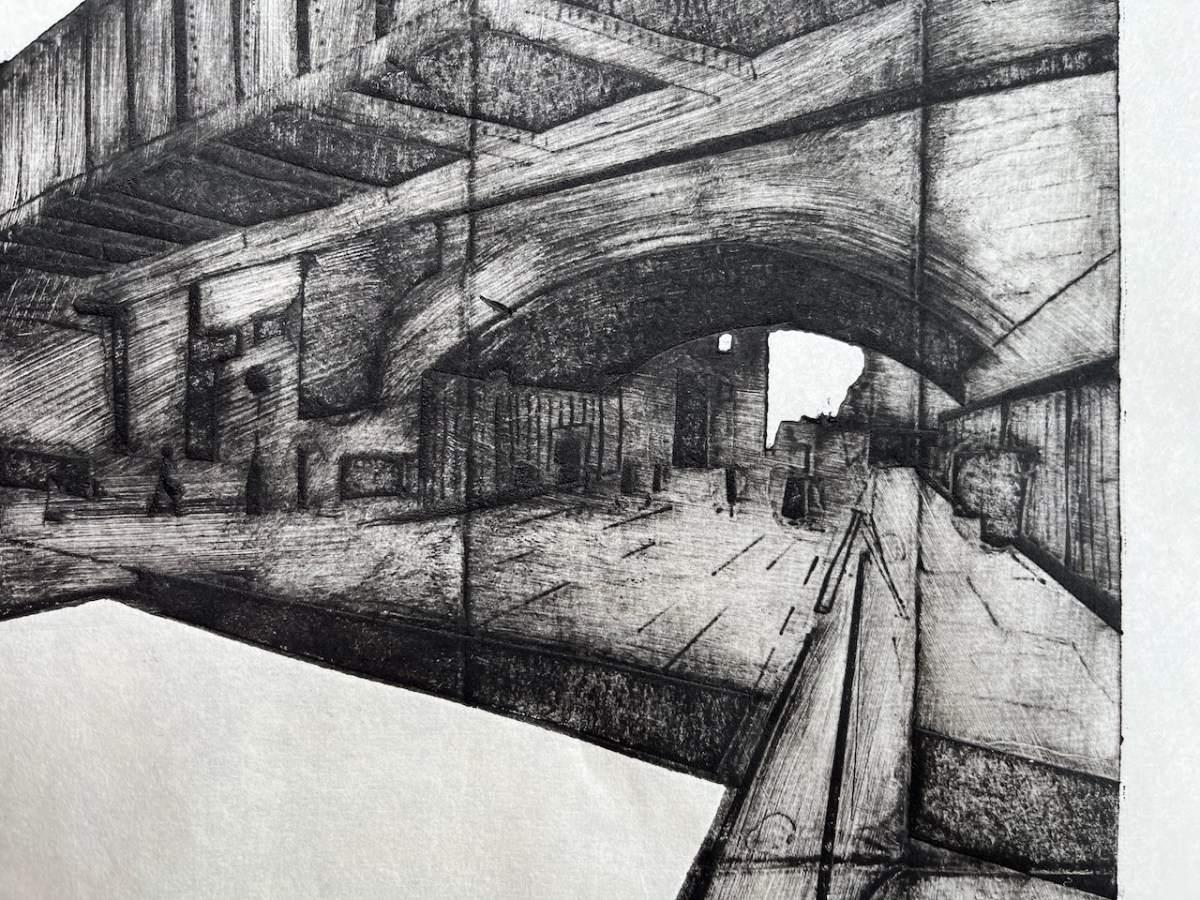
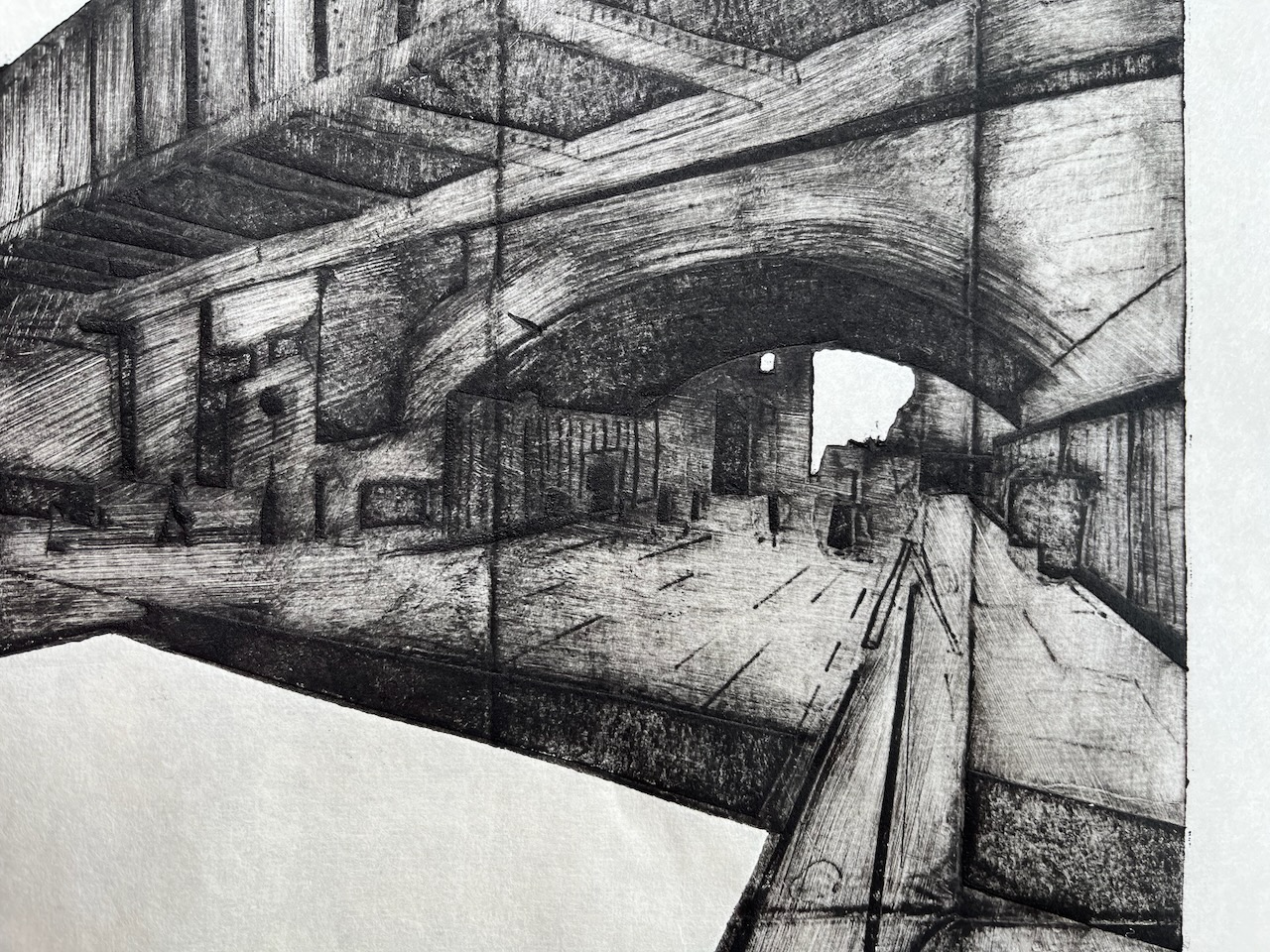
Here is detail of the print:
For more of my prints made with packaging material, click on this link:
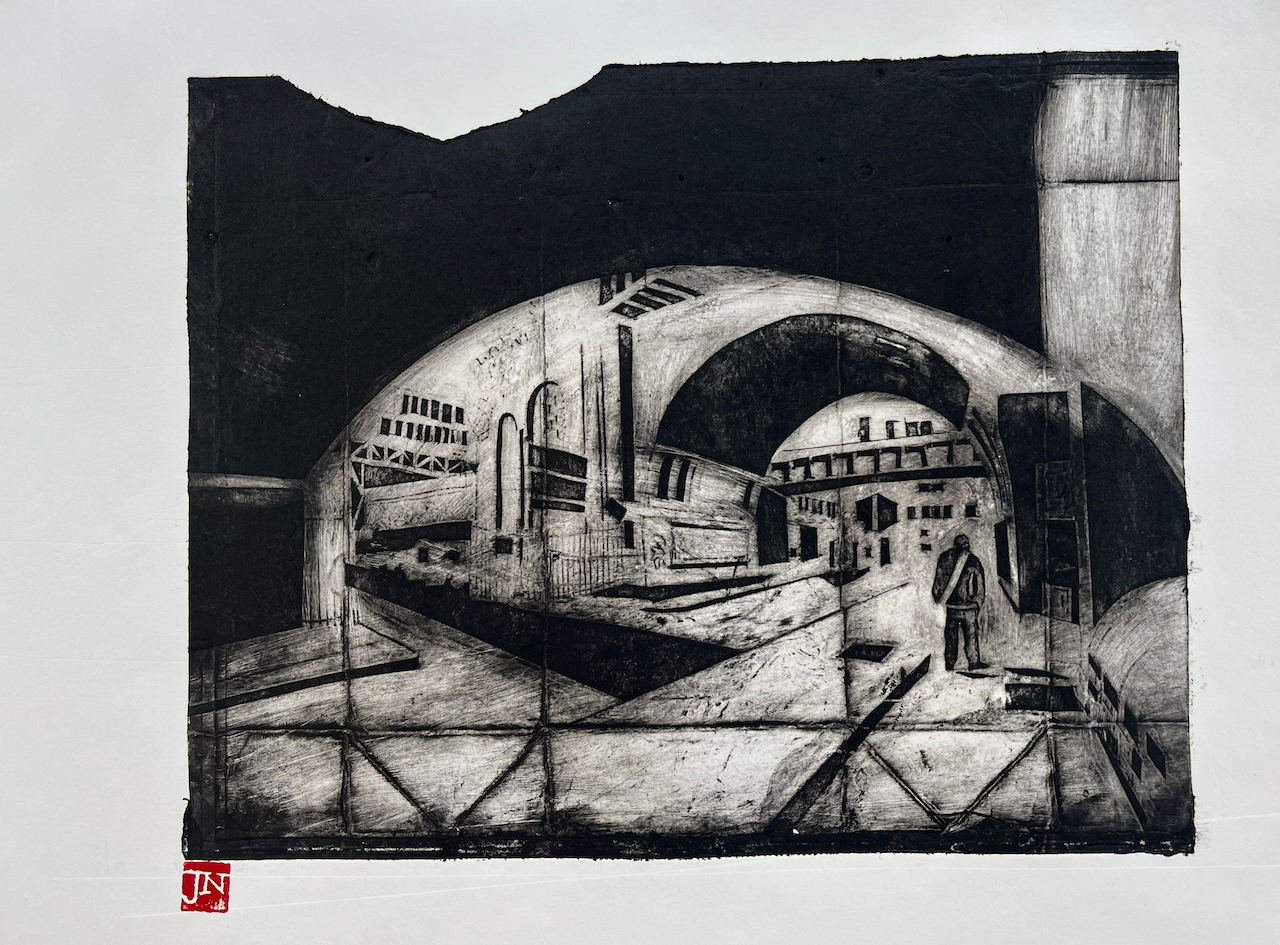
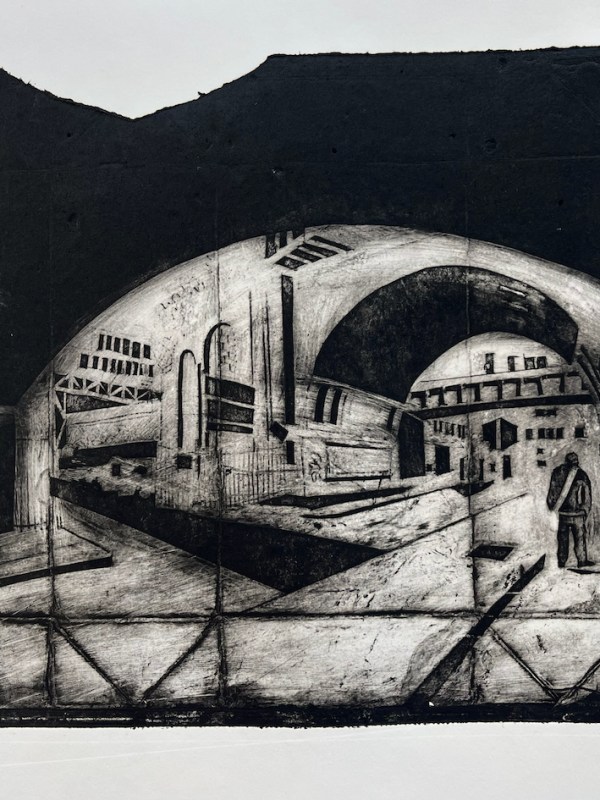
Huge brick arches carry the railway lines into Waterloo Station. Here is a view looking North up Great Suffolk Street.
Great Suffolk Street railway arch, monoprint #3 of 6. Printed image size 12″ x 9″. On Fabriano Unica paper, 20″ x14″
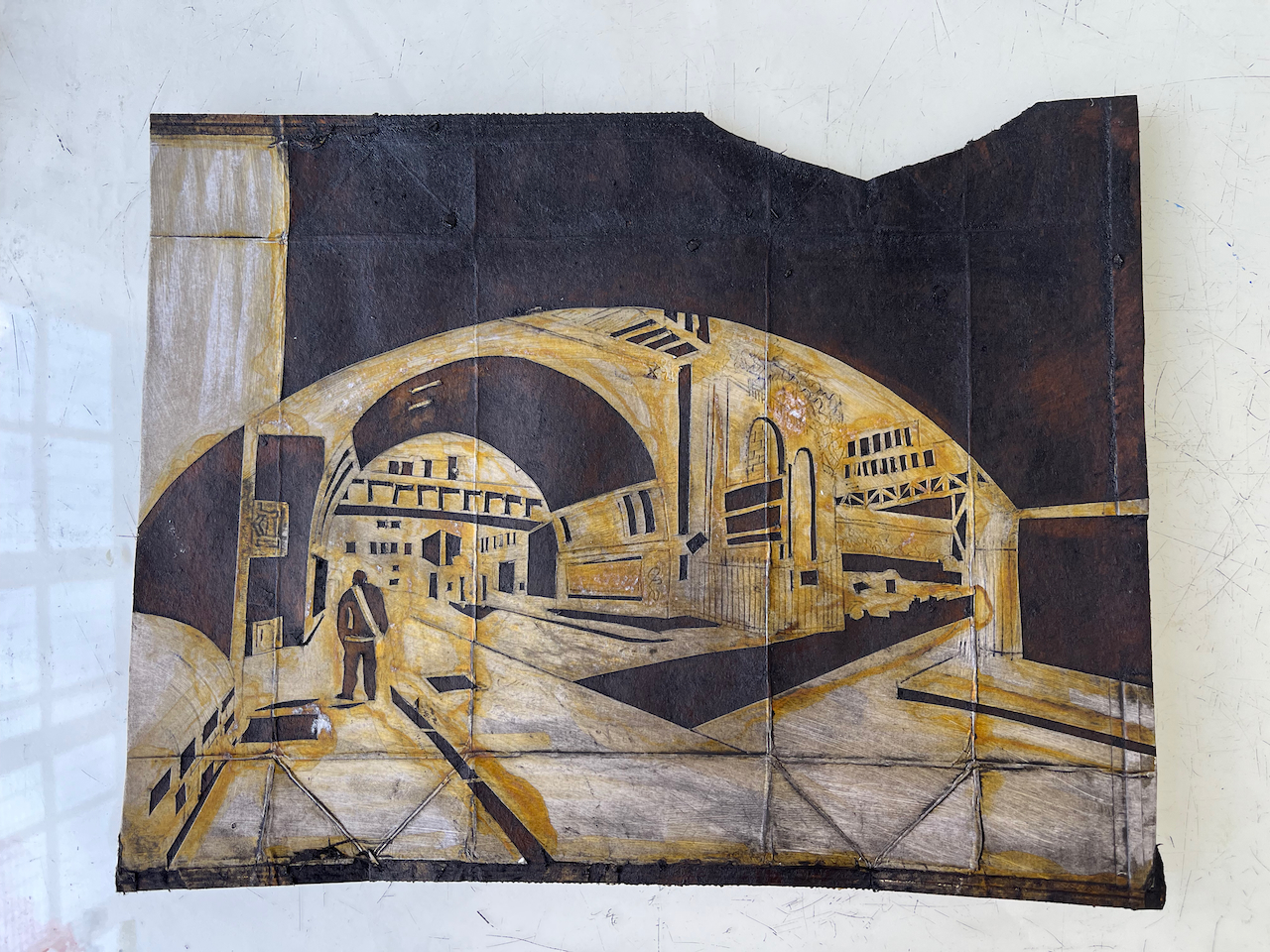
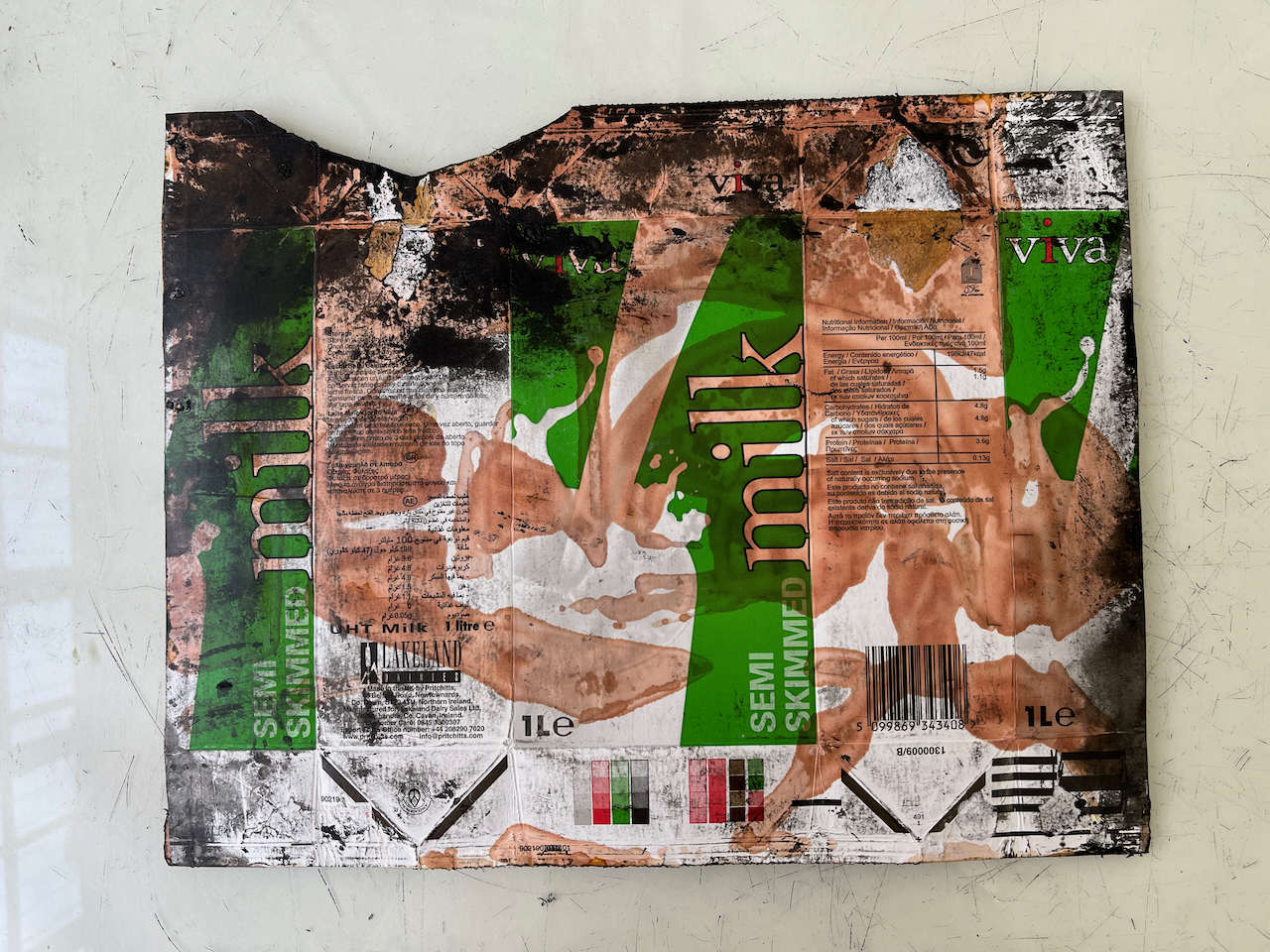
This is a packaging monoprint. It is an intaglio print from a “plate” made from a milk carton. Here is the plate:
Inked plate (front)Inked plate (back)
I’ve described the process in this blog post: Print plates made of packaging. The basic method is to use the shiny metallic surface inside the carton. I cut out the shapes I want and peel back the shiny surface to reveal a rougher surface which takes the ink. The yellow colour you see on the plate is shellac, a varnish that I paint on to make the plate last a little longer.
The plates are quite fragile, and can only make a limited number of prints. Here is number 6:
Great Suffolk Street railway arch, monoprint #6 of 6. Printed image size 12″ x 9″. On Agawami Washi Kitakata Japanese paper, 20″ x1 4″
I made all the prints on the Henderson press at East London Printmakers, Stepney. I used Chabonnel F66 traditional oil-based etching ink.
Click a button below to share this post online, email it, or print it:
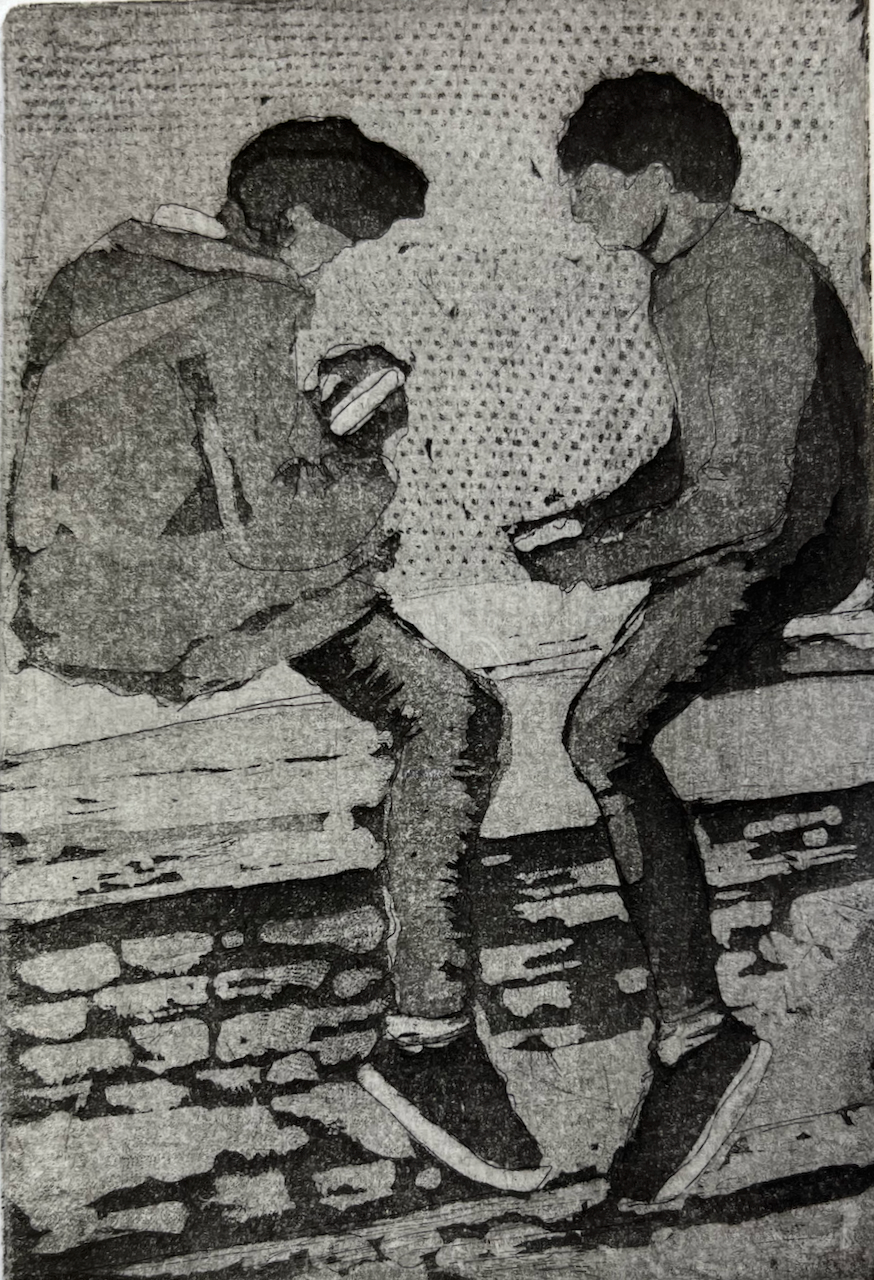
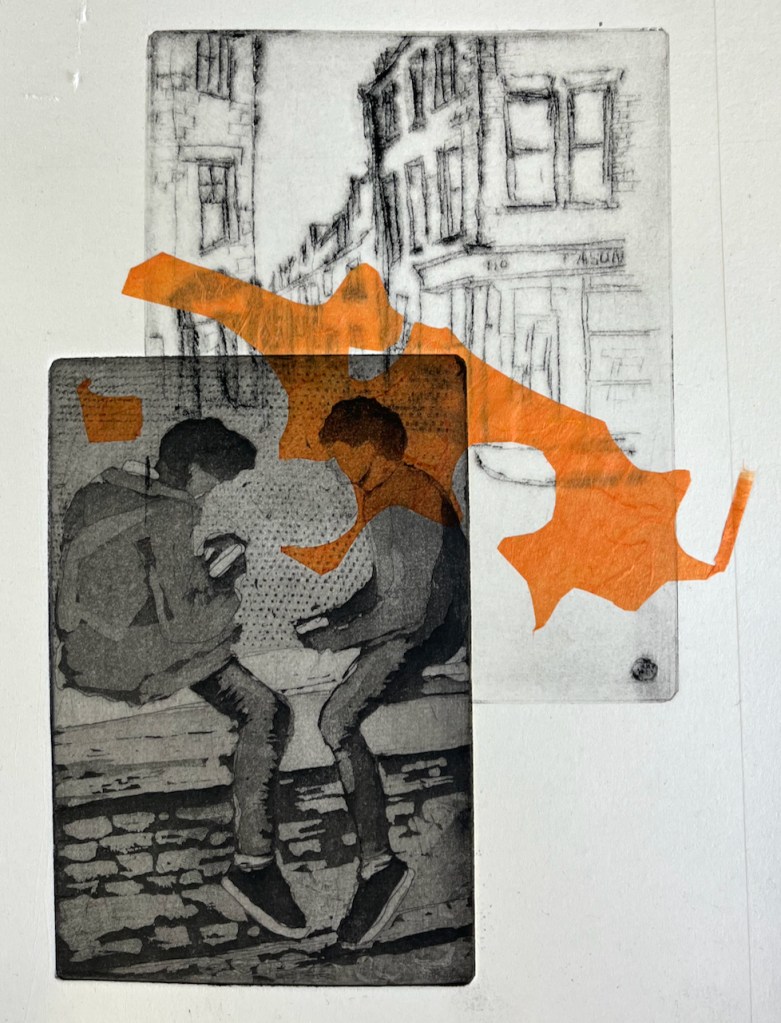
Here’s a print I made at East London Printmakers last week.
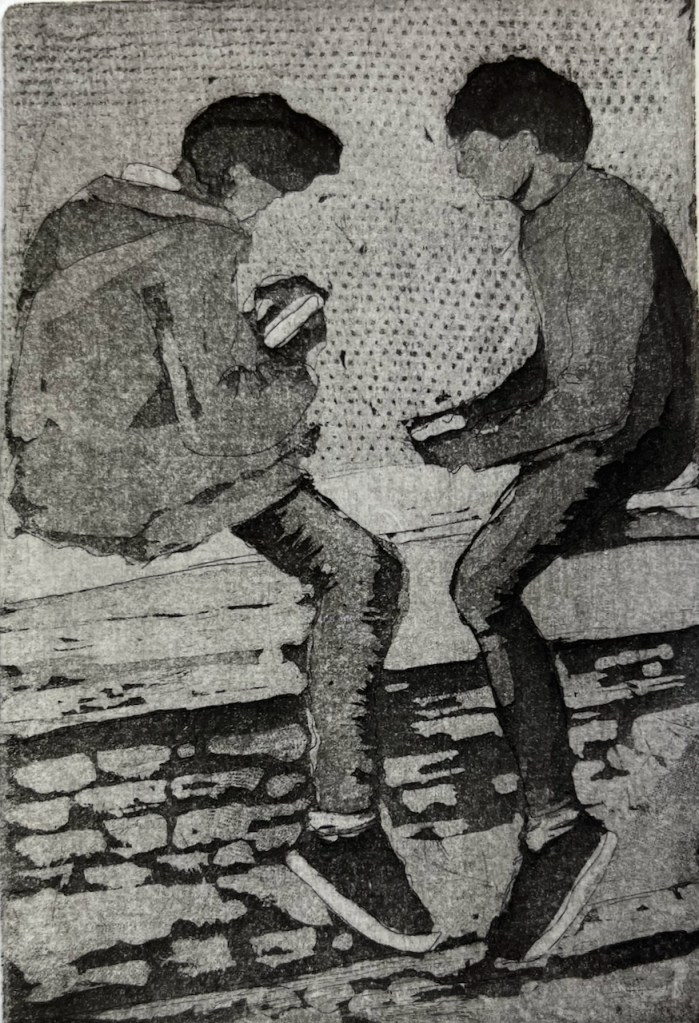
Two boys, etching, image size about 5inches by 3inches
I wanted to show how concentrated these people were, immersed in what they were doing, sitting on the wall.
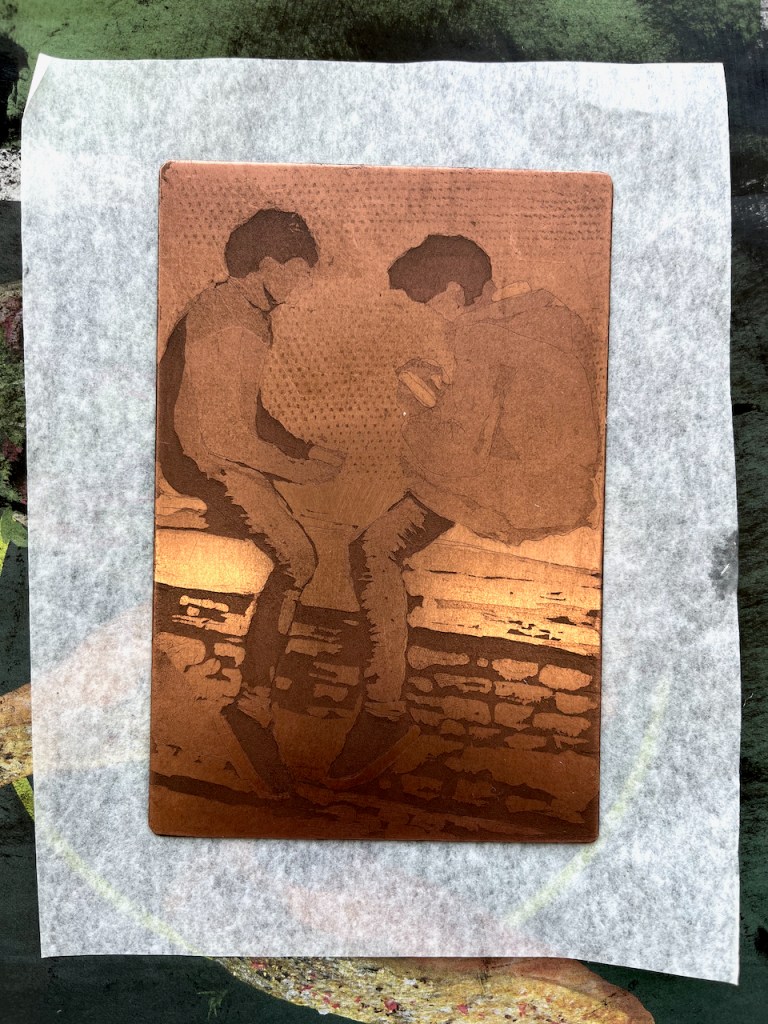
It is printed on Fabriano Unica paper, using Charbonnel F66 traditional etching ink. Here is the copper plate:
The plate is made with hard ground lines, soft ground patterns, and three aquatint sessions.
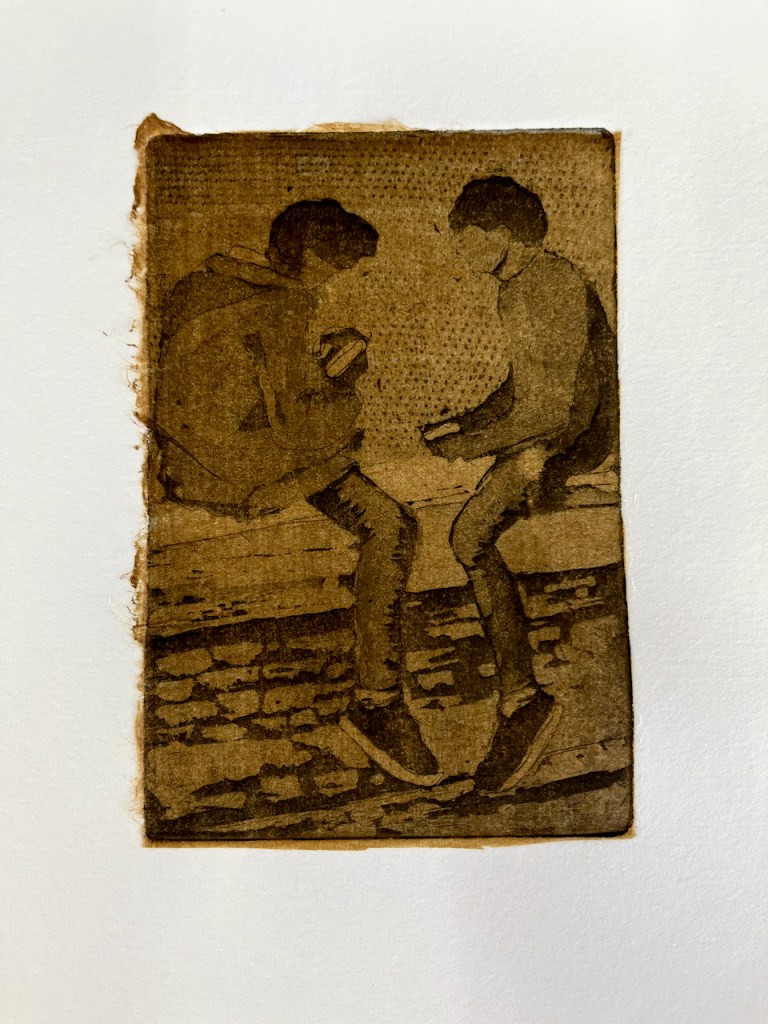
I made some variations of this print. Here is one, using chine-collé.
Two boys, warm brown chine-collé
Sometimes in the printing process, magic happens. As I was packing for this print session, searching for paper, tissues, gloves, and other printing essentials, I encountered a thick envelope labelled “Old Prints”. I pulled out one of those, a street scene, with a vague idea of overprinting it. It is a drypoint I made years ago. The vague idea turned into a plan, and then a print. Here it is. I was really pleased with how it came out. The chine-collé is also a leftover from another project.
Two boys and street, combined image size about A5. Etching, drypoint and chine-collé.
Click a button below to share this post online, email it, or print it:
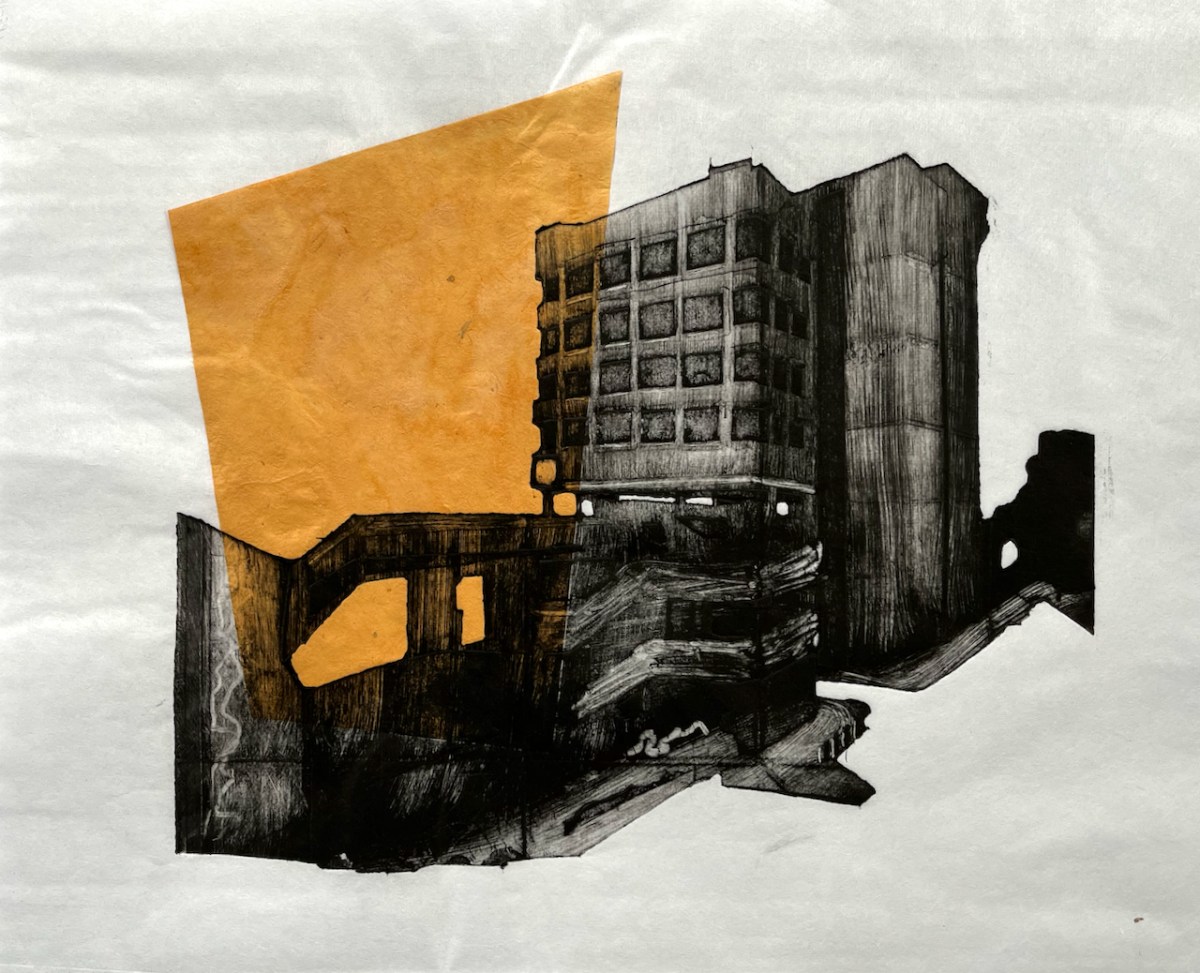
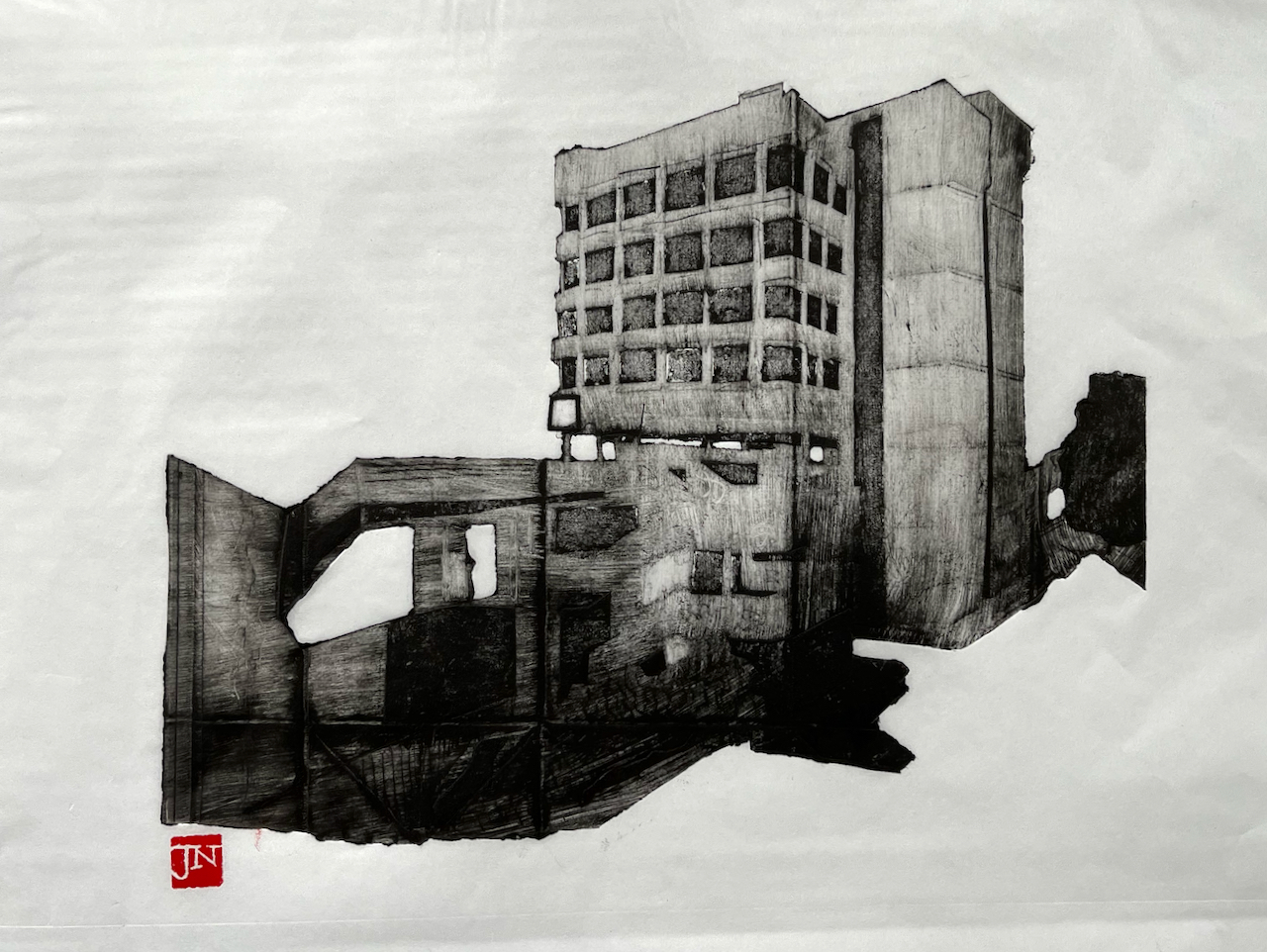
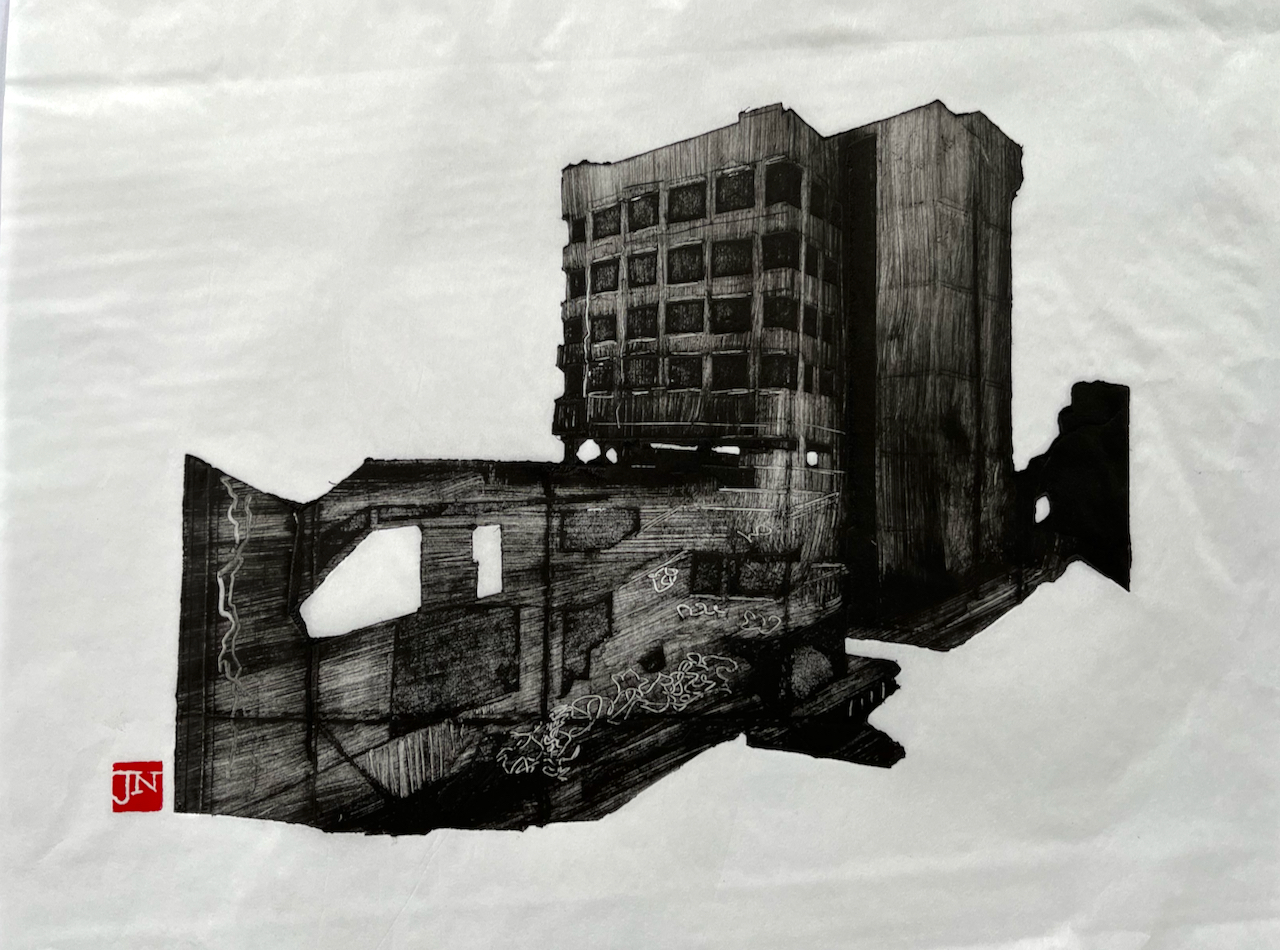
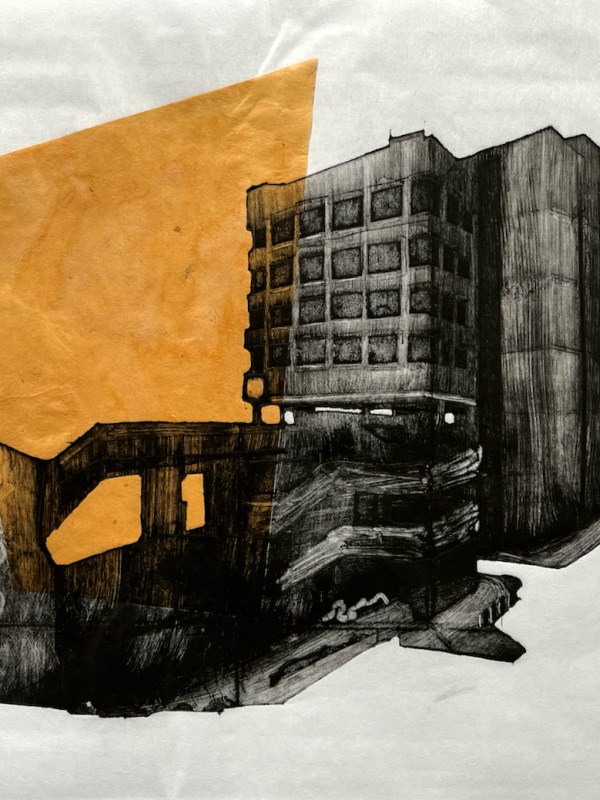
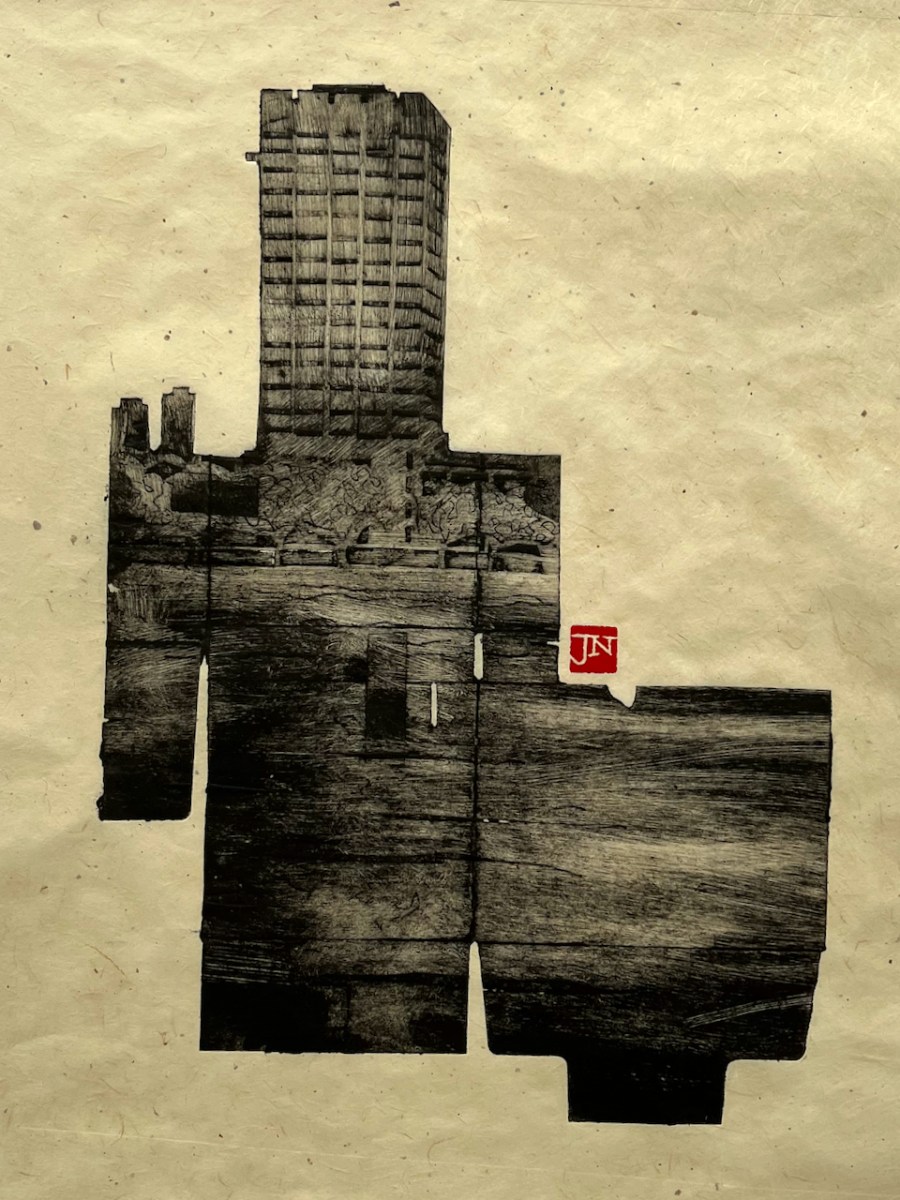
Colechurch House on the South Bank is a brutalist office block. It makes a good subject for a packaging print. Since it is a a 1960s block, I added a 1960s type shape in chine collé.
Colechurch House – monoprint and chine collé, paper size,15″ x 12″ Shoji Baku Japanese Paper
The chine collé paper is Khadi Lokta Coloured saffron washi paper from Atlantis Art (ref: KPNI SA). The background paper for this print is Shoji Baku paper from Shepherds Bookbinders (ref: LRG 1859). The ink is Charbonnel traditional etching ink. I printed this on the Henderson Press at East London Printmakers. Here is a video of the “print reveal” (17seconds, silent):
Thanks to Evonne at East London Printmakers for filming me!
Here are the other 4 prints from this plate. They are all on a different, but similar paper: Tosa Washi from Shepherds, (ref: J632180)
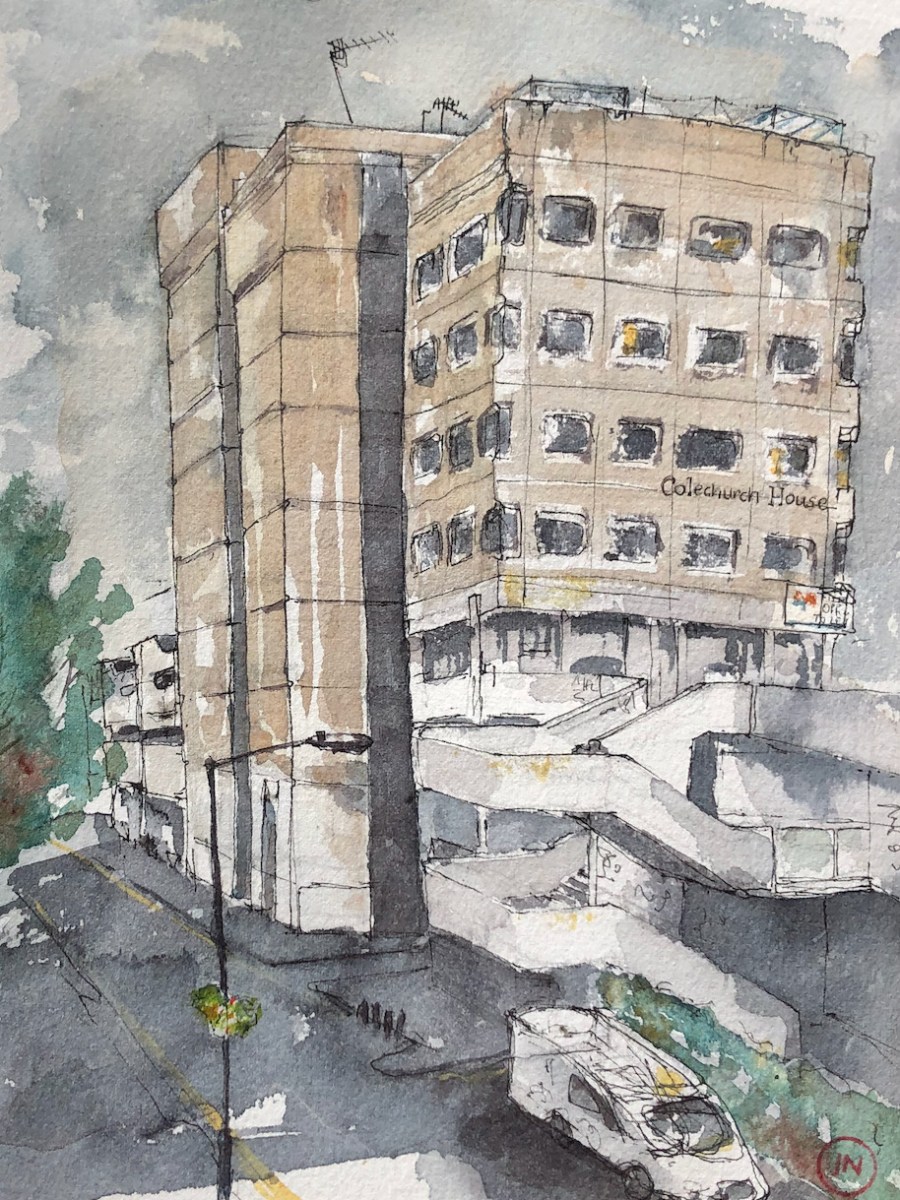
The print was based on a sketch of Colechurch House last year. See this post:
Aficionados of 20th Century brutalist architecture need to hasten to appreciate Colechurch House. It is due for demolition and redevelopment. This month’s post in the marvellous “London Inheritance” site informed me about the planning application, so I rushed over there to draw a picture before the building became swathed in plastic. I drew this picture looking over the railings from London Bridge. This position commanded an excellent view of Colechurch House, but…
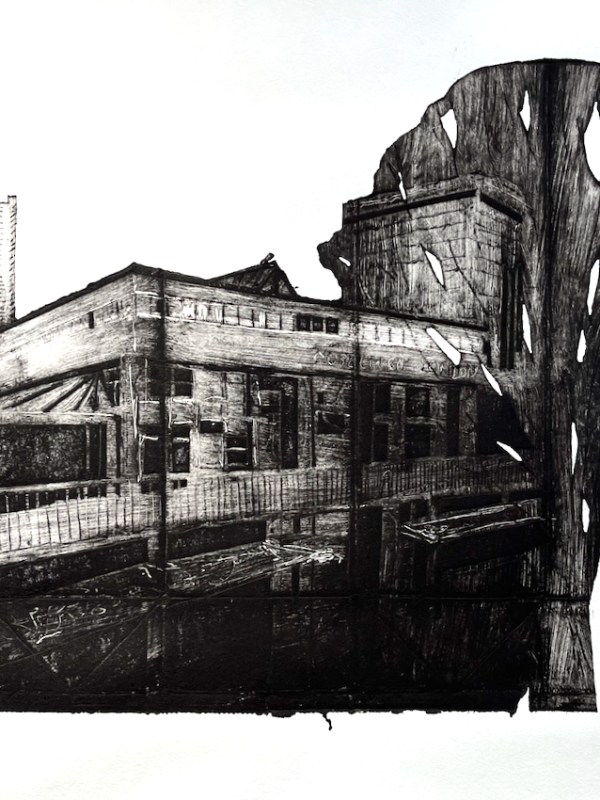
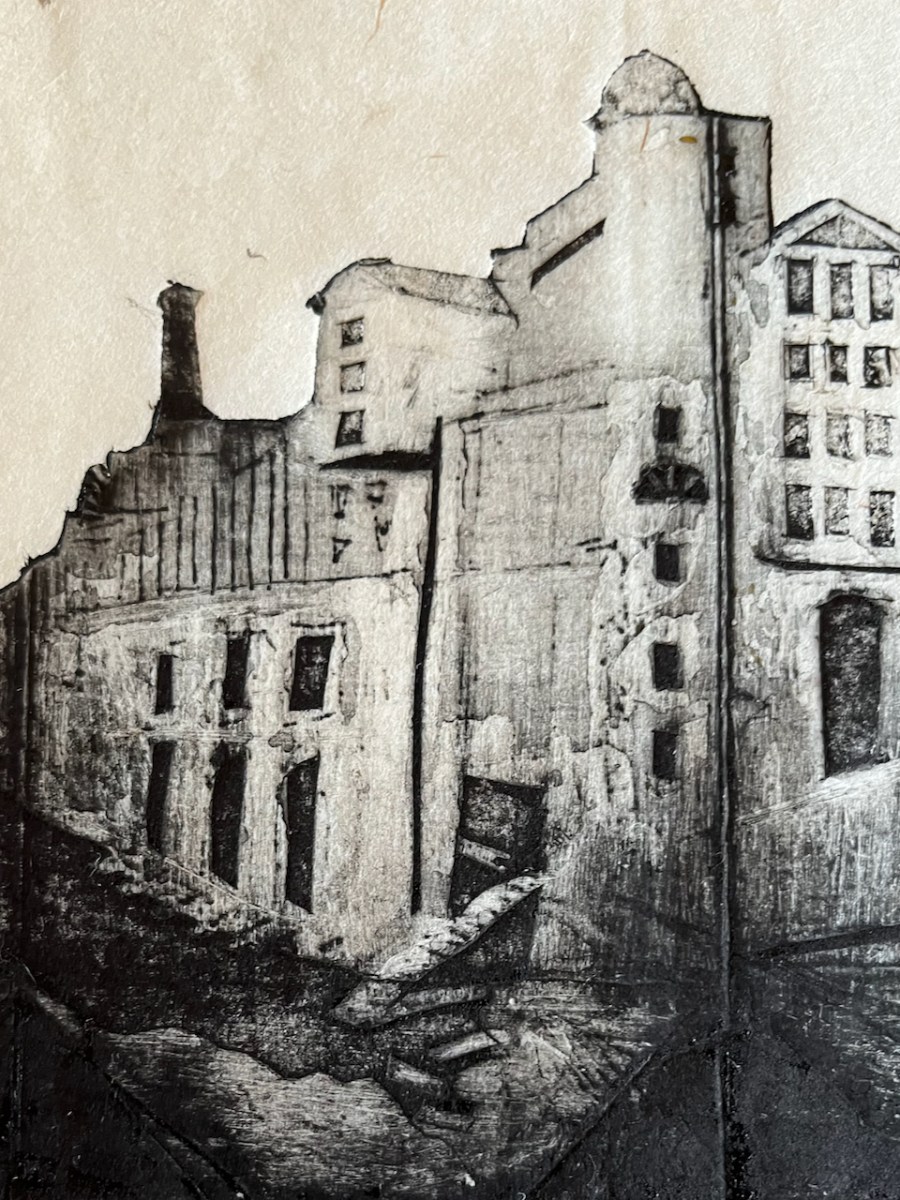
Here are more examples of the technique using a plate made from packaging material. I have written about the process here.
Here is another packaging print. This one shows Bridge ELR-XTD Structure 20 on Cornwall Road (N) between Charing Cross and Waterloo East, South East London. The road that leads off to the left is Sandell…
Huge brick arches carry the railway lines into Waterloo Station. Here is a view looking North up Great Suffolk Street. This is a packaging monoprint. It is an intaglio print from a “plate” made from…
Colechurch House on the South Bank is a brutalist office block. It makes a good subject for a packaging print. Since it is a a 1960s block, I added a 1960s type shape in chine…
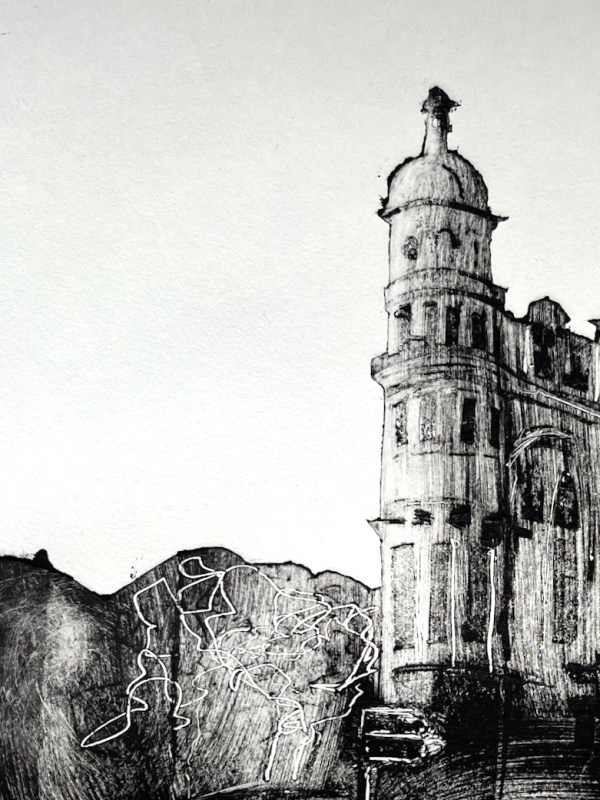
The Boston Arms is in Tufnell Park, London, 178 Junction Road N19. I love the way this building presides over the junction. This is one of five prints I made with this plate made from…
Here is an image of The Museum of London, in the south west corner of the Barbican: The “plate” is made from a UHT milk carton. Here is the back of the used plate: Here…
Here’s another “packaging” monoprint. This was made using an empty box of tissues. This is a tower block on the South bank of the river Thames, seen from the North bank. That’s the river in…
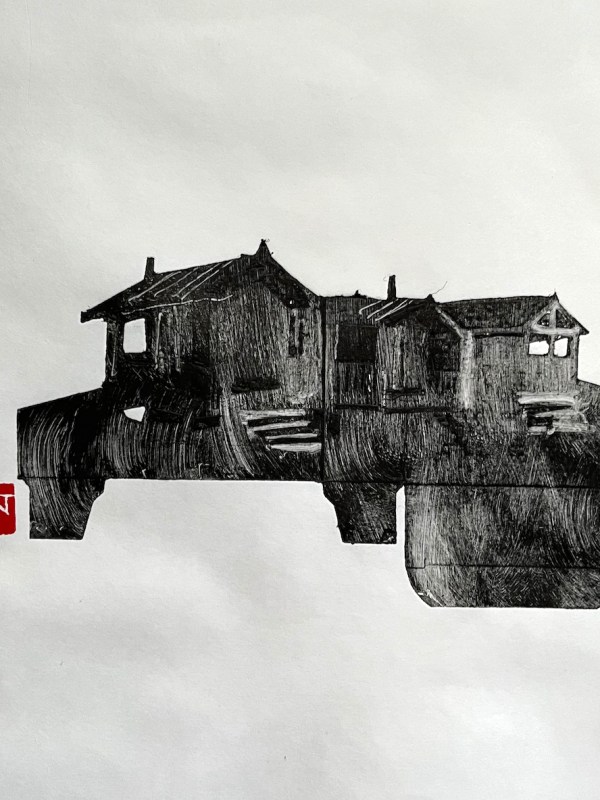
Here is a “packaging” monoprint I made of the huts in Walberswick. The print is made using a discarded carton from a box of aspirin. It looks like this: The brown colour is shellac, a…
I am trying an experimental monoprint technique. The idea is to use packaging material to make intaglio “plates” which are then printed using an etching press. This is the first one. I printed it yesterday…
Click a button below to share this post online, email it, or print it:
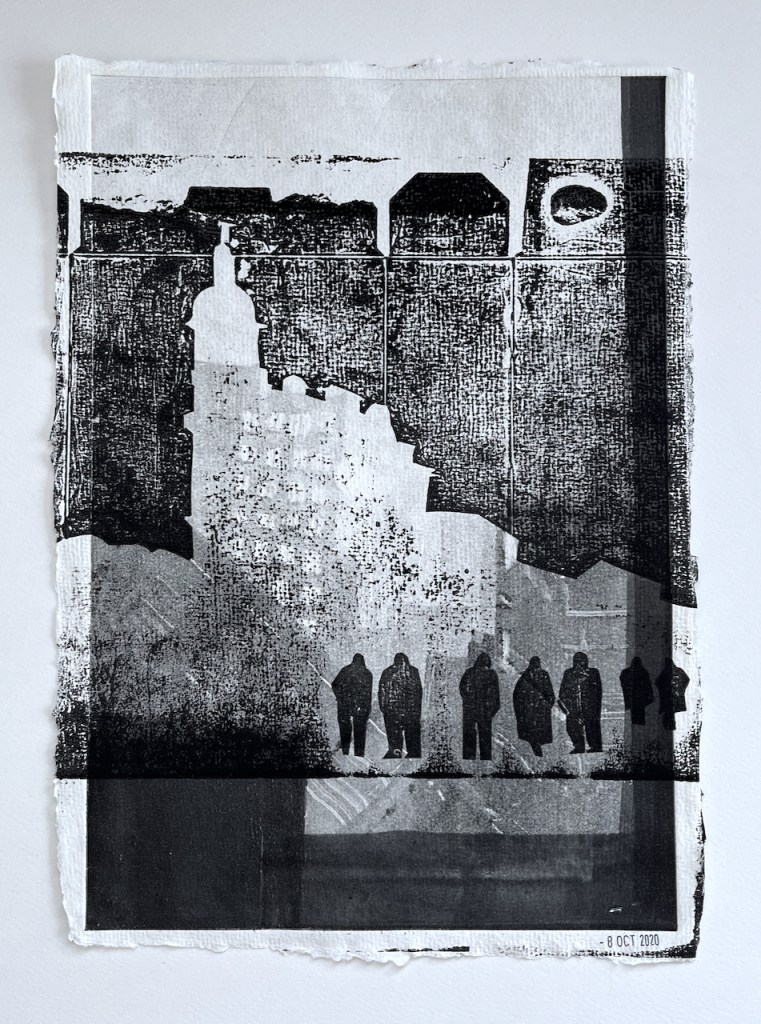
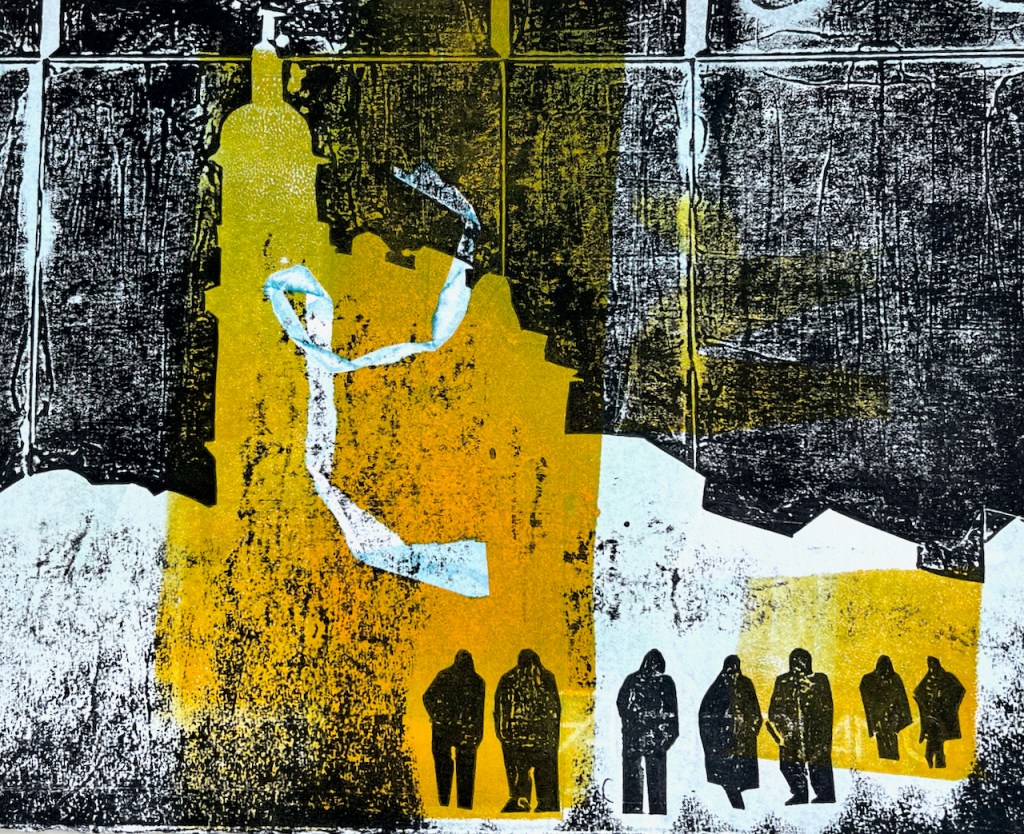
After I had cut out the packaging print plate of the Boston Arms, I was left with the “negative”: the top part of the plate. As it was on its way to the bin, I realised that I could use this to make another picture. So I retrieved it, and made this plate:
Relief plate*: top half is made of a biscuit packet. The bottom half of the biscuit packet was used to make the packaging print – see this post
I added a few people. This is a pub, so these are some people on their way to the pub.
I used this cardboard plate to make some prints. I painted it with shellac, to make it stronger.
Here are the prints, made on the Albion press at East London Printmakers. The prints are”collographs”: relief* prints.
I made the prints on top of some experimental monoprints made last year.
*A “relief” plate is one in which the ink is rolled onto the raised part of the plate. The raised parts print dark. A potato print, a lino print, woodcut or an ordinary rubber stamp is a relief print. This is by contrast to an “intaglio” print, in which the ink is wiped into the indentations and into engraved lines on the plate. The raised parts print light, and the lower parts print dark. My etchings and packaging prints are intaglio prints.
Click a button below to share this post online, email it, or print it:















 Jane Sketching