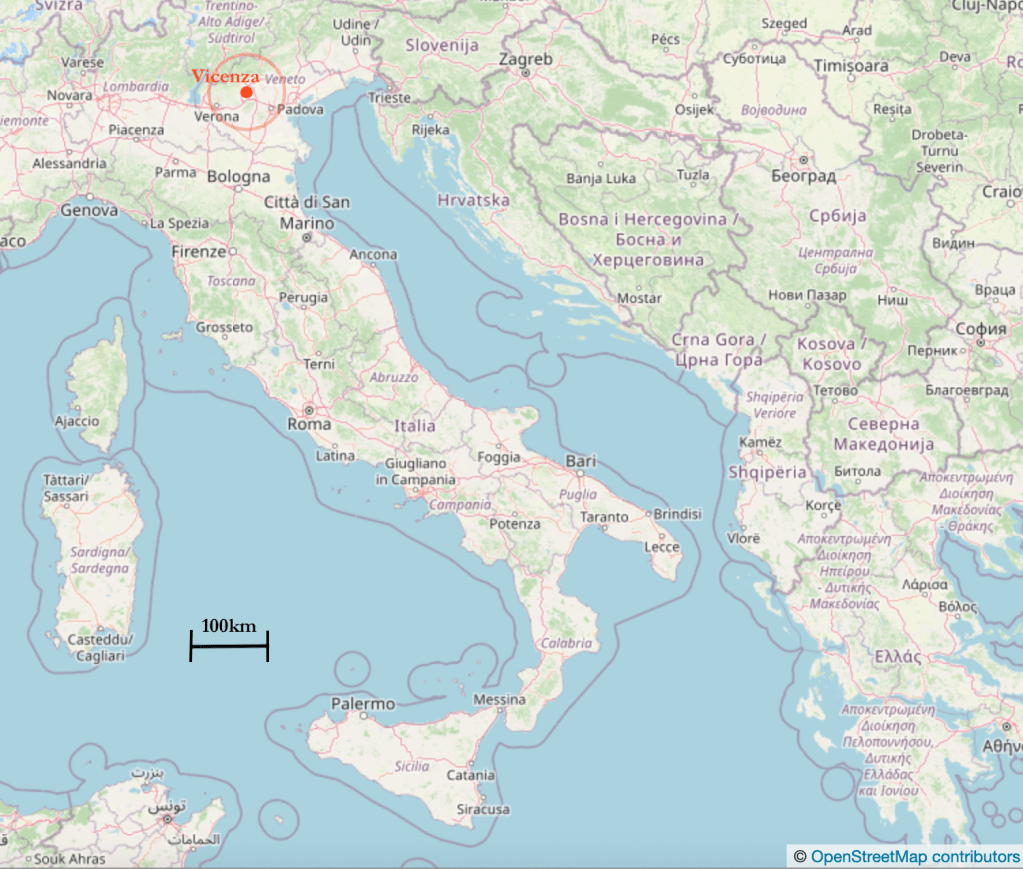
Vicenza is in the Veneto region of Northern Italy, between Verona and Padua.
Location of Vicenza, in Northern Italy. Map (c) OpenStreetMap contributors
Here are the beautiful Colli Berici, the Berici hills.
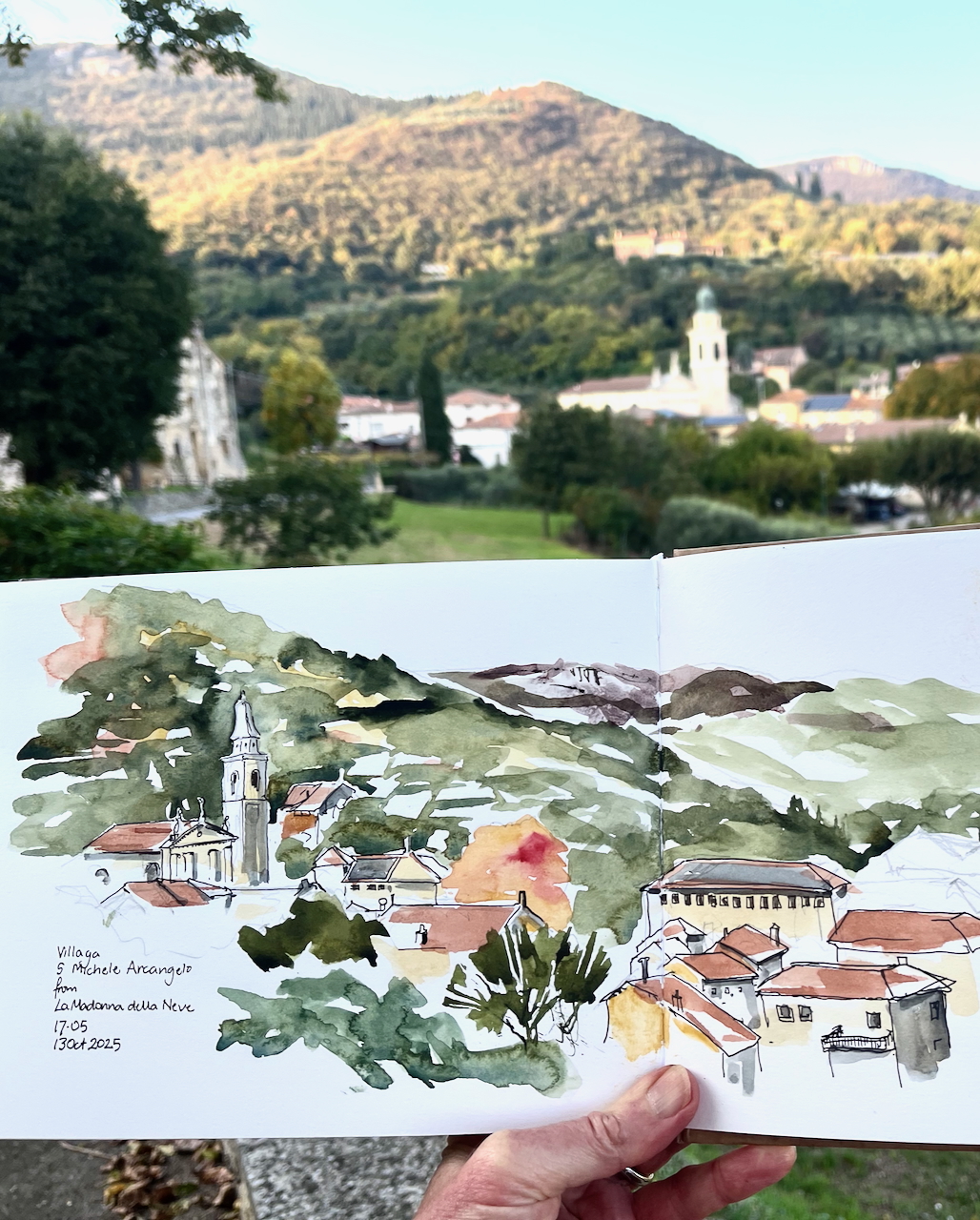
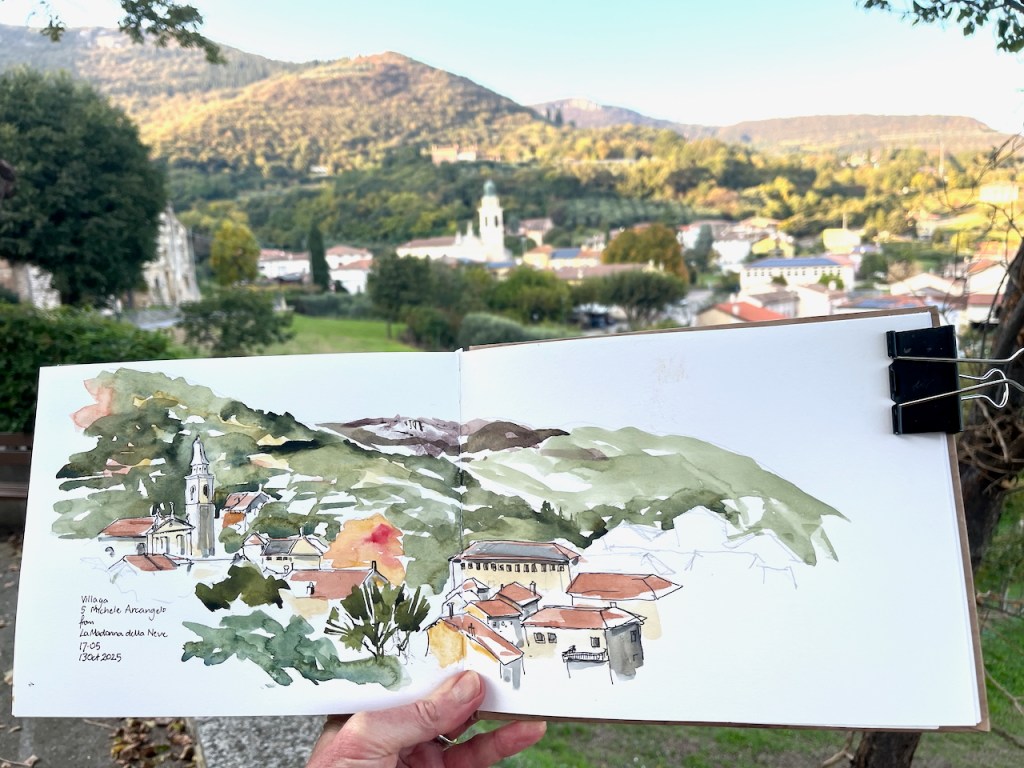
The church of St Michael Archangel, in the village of Villaga, Vicenza
The villages lie at the base of the Colli Berici, where the hills descend into the Venice plain.
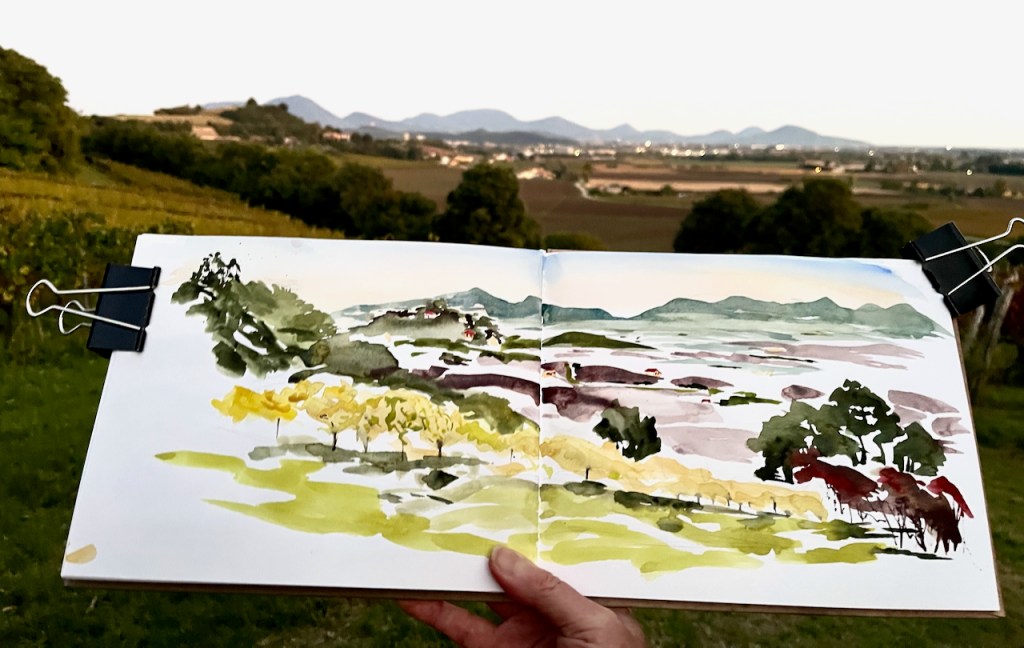
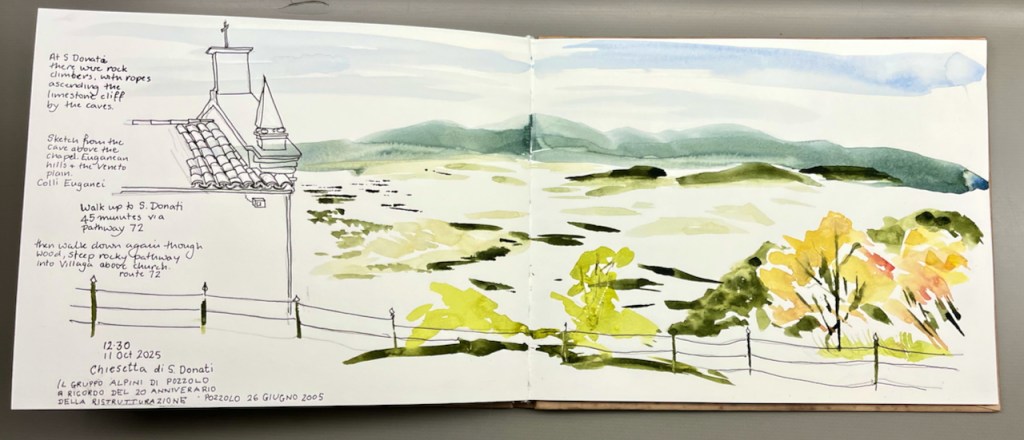
This is the view across that plain, looking towards Padua. You see the Euganian hills, sudden rocks in the flat land.
In the foreground are the vines.
Here’s a sketch of the view from the cave of Saint Donati. The chapel of Saint Donati is on the left.
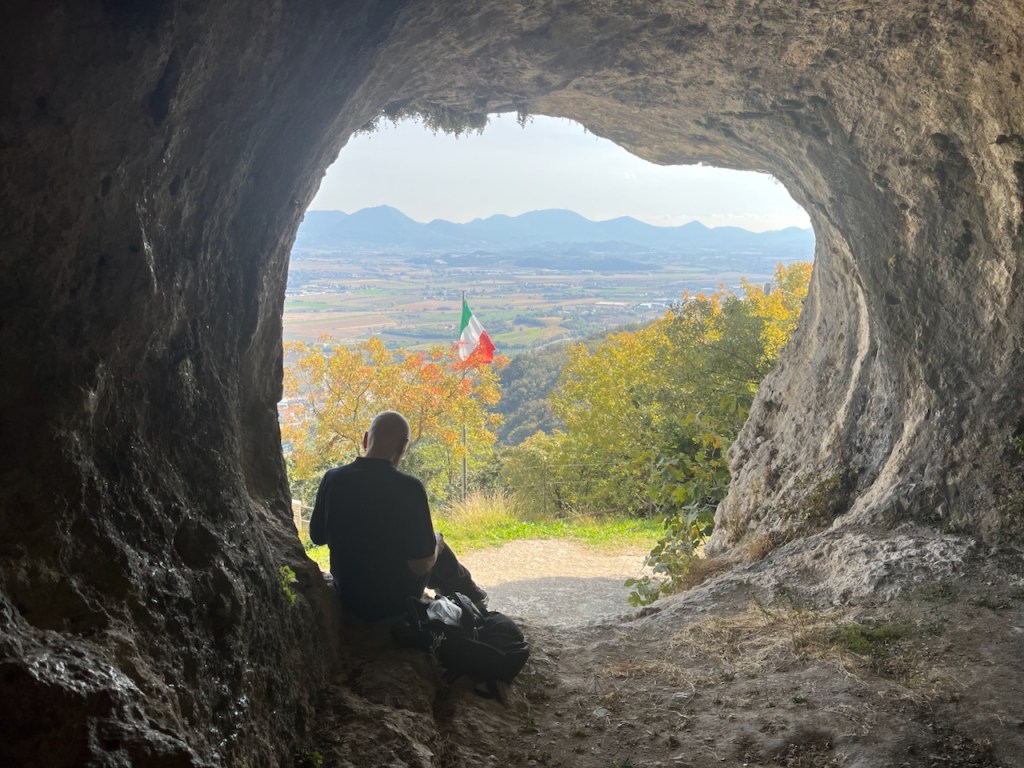
It was a lovely hike, through woods. Autumn was a good time to visit.
Cave of Saint Donati, above Villaga, Vicenza (iphone photo), Euganian hills on the horizon.
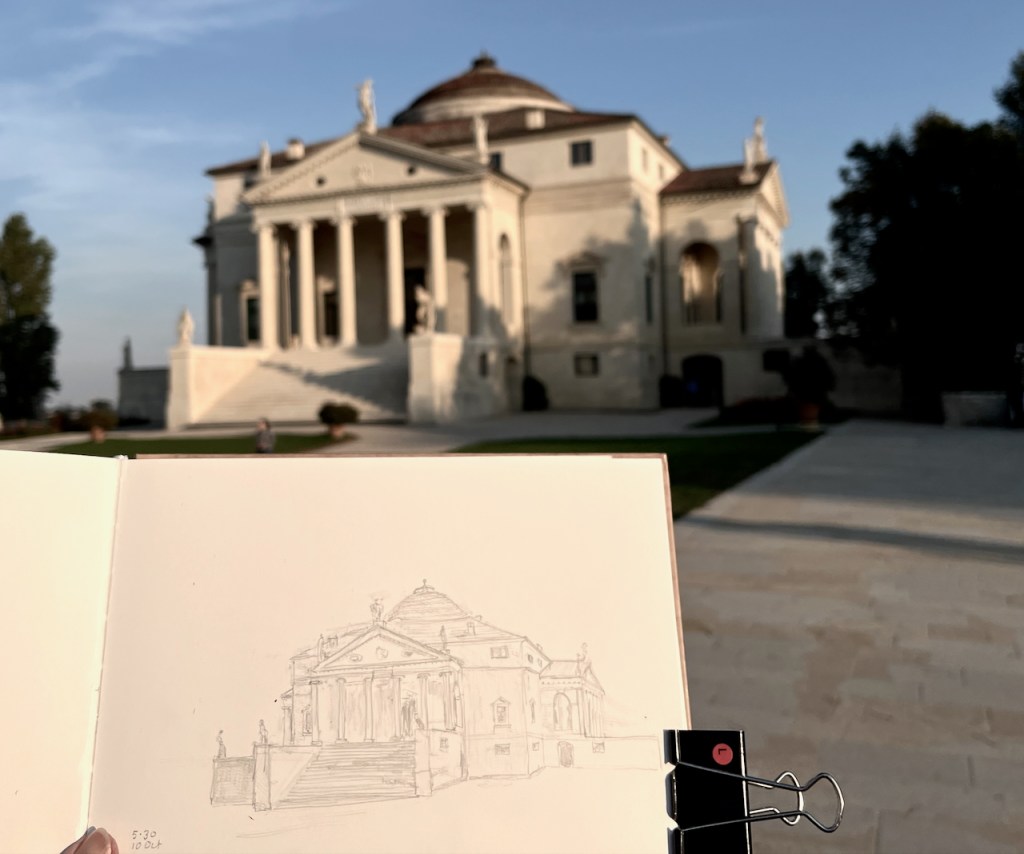
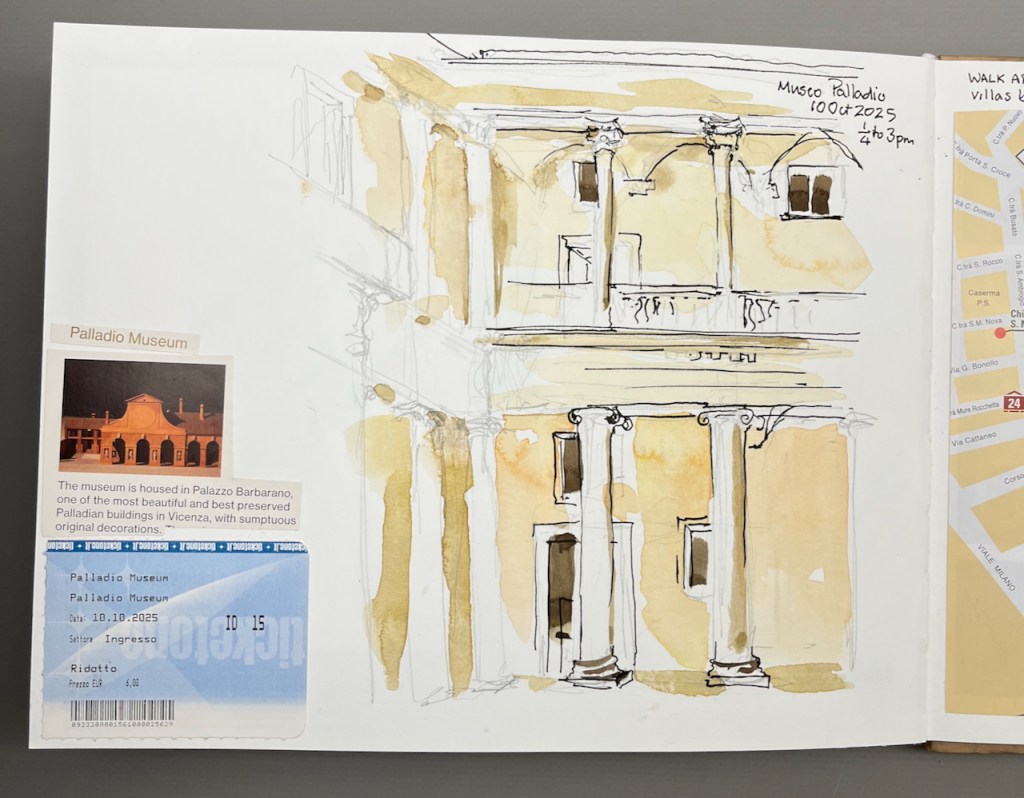
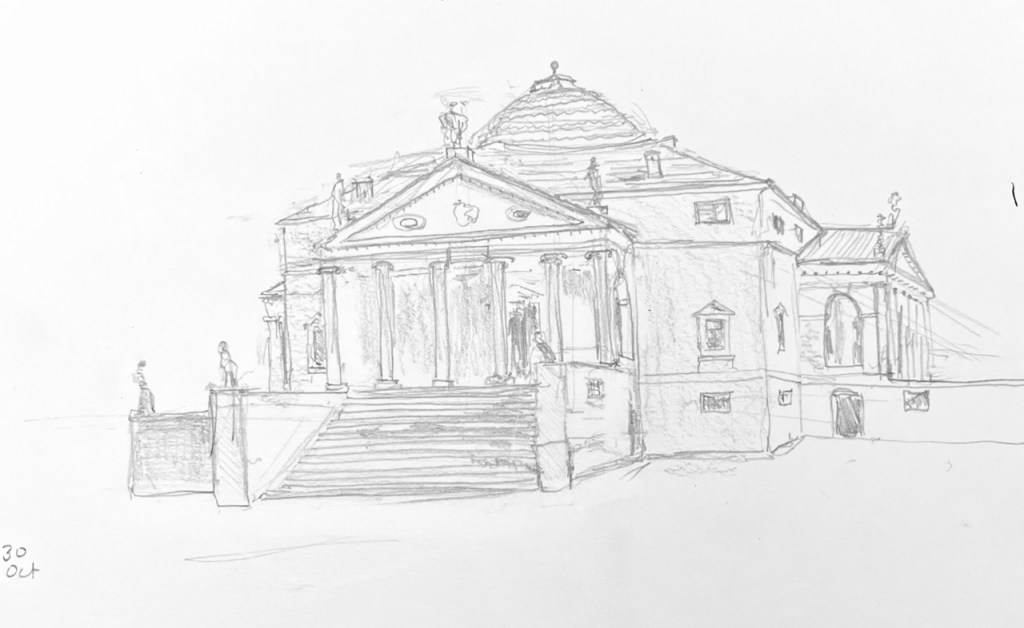
The town of Vicenza has a medieval centre, with buildings designed by Andrea Palladio (1508 – 1580).
La Villa Rotunda, designed by Andrea Palladio, built 1567-1590
We drove to Vicenza along the magnificently named “La Strada del Vino dei Colli Berici”, the Road of the Vines of the Berici Hills. Italian is a marvellous language. Even the road names sound like poetry.
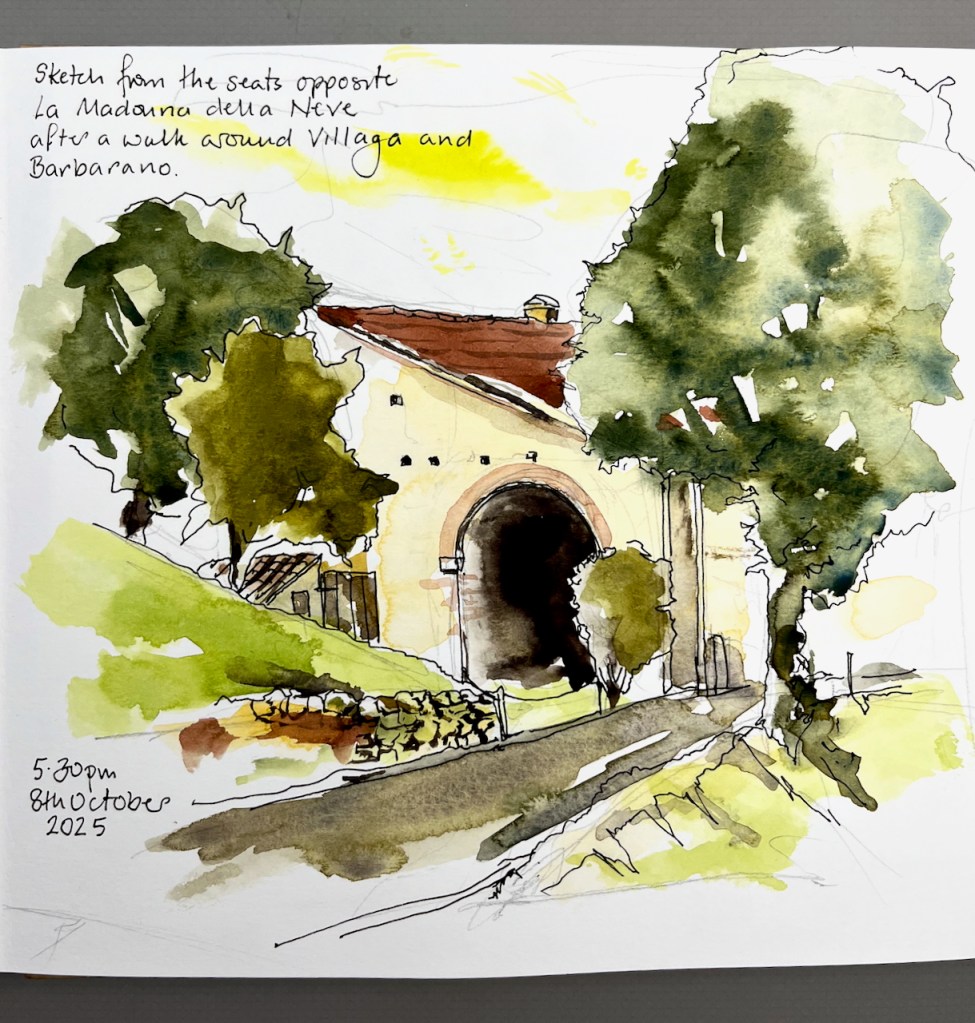
Here’s a barn. The design, with this asymmetrical arch, was a characteristic pattern in the area.
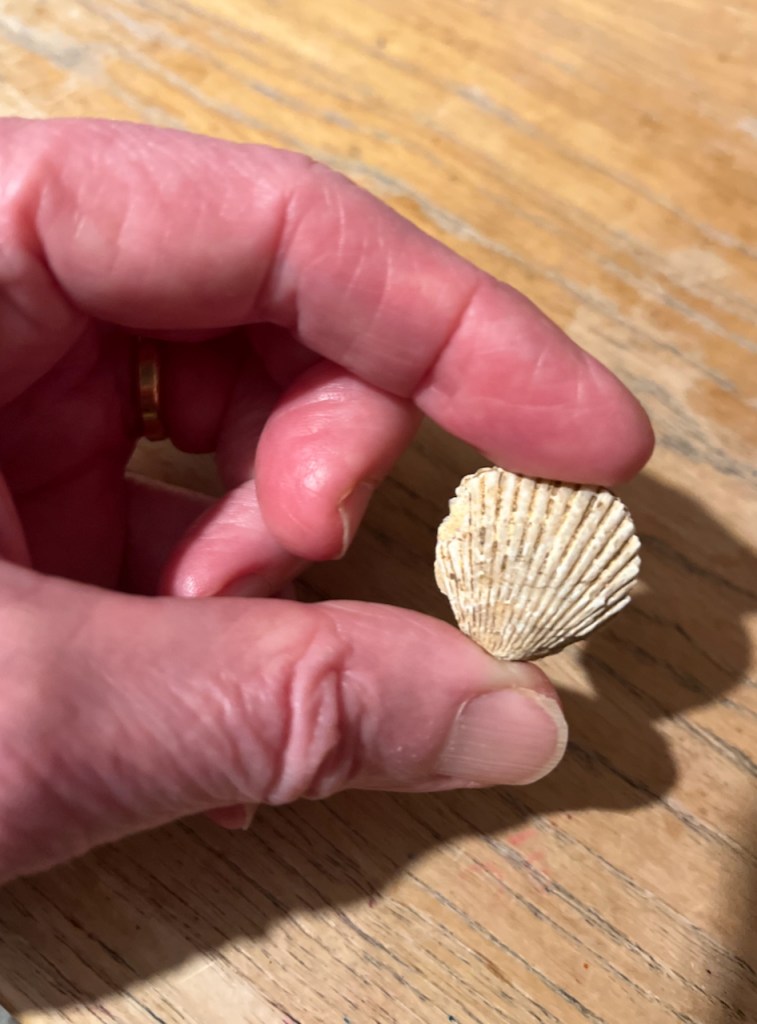
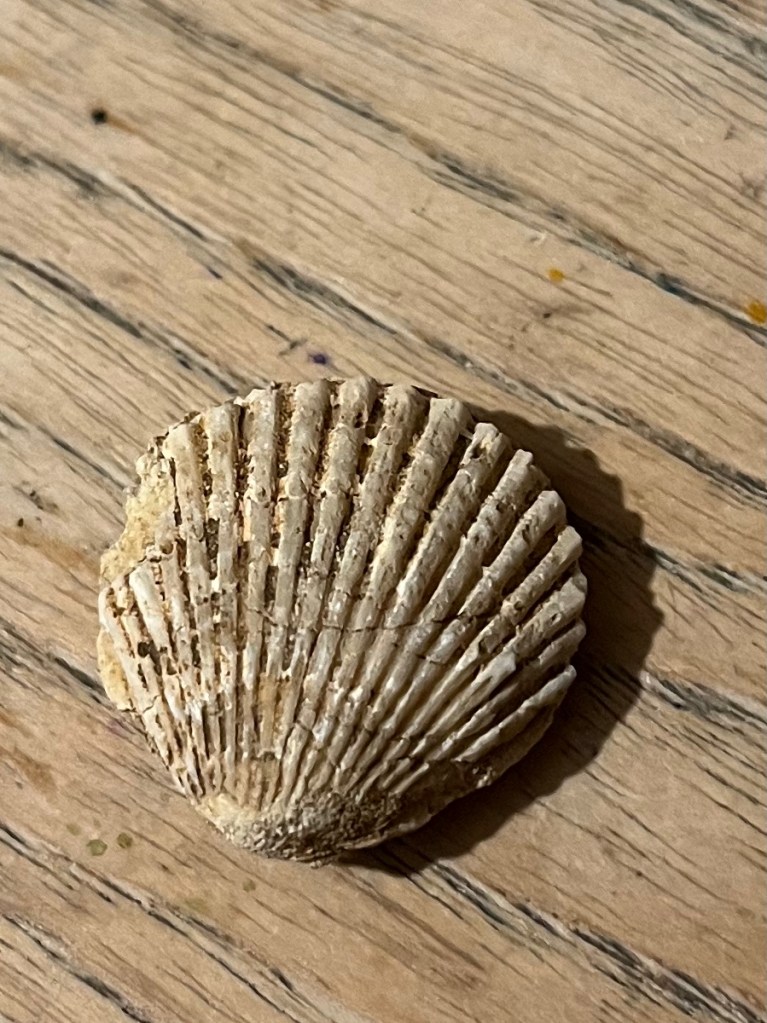
The whole area was a revelation, from the great to the small. As we walked in the hills, the ground crumbled below by boots and I saw a sea shell. We were at maybe 300 metres above sea level. It wasn’t a sea shell, it was a fossil of a sea shell. These hills were below the sea, once.
Click a button below to share this post online, email it, or print it:
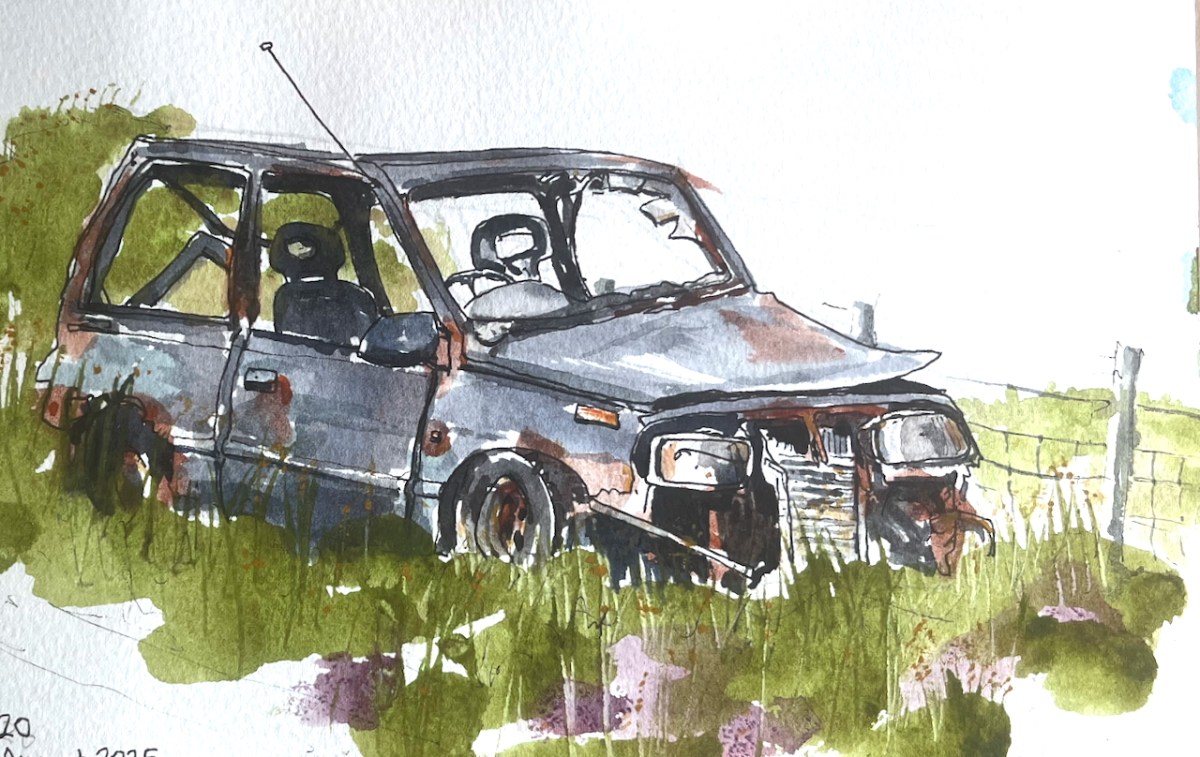
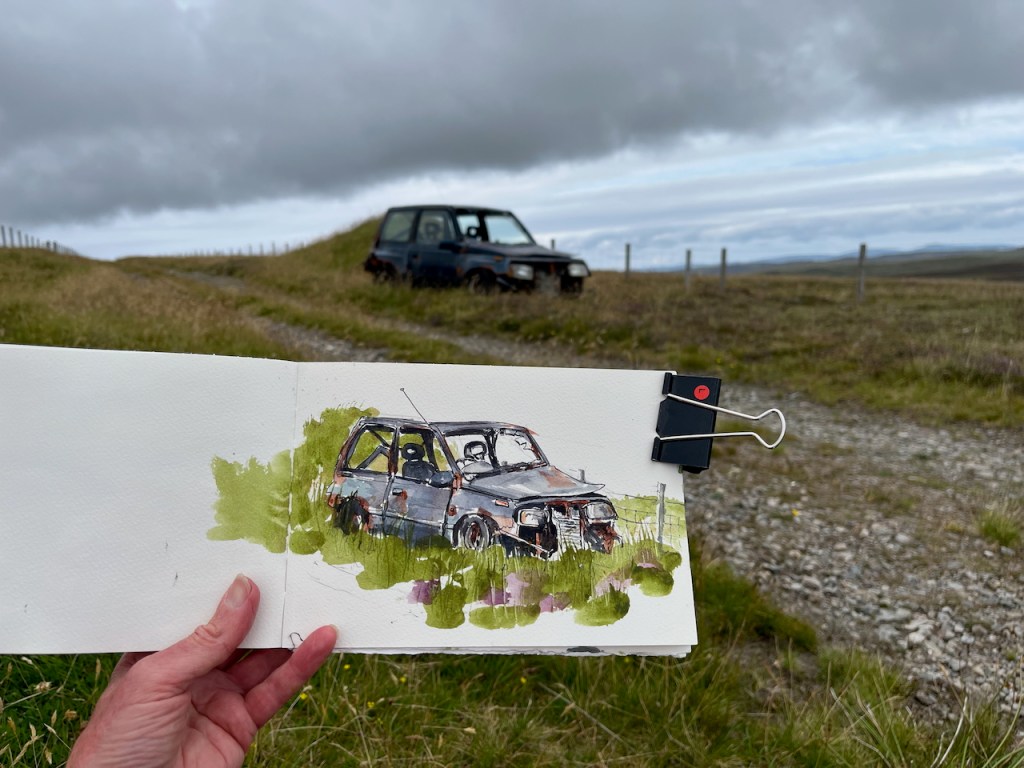
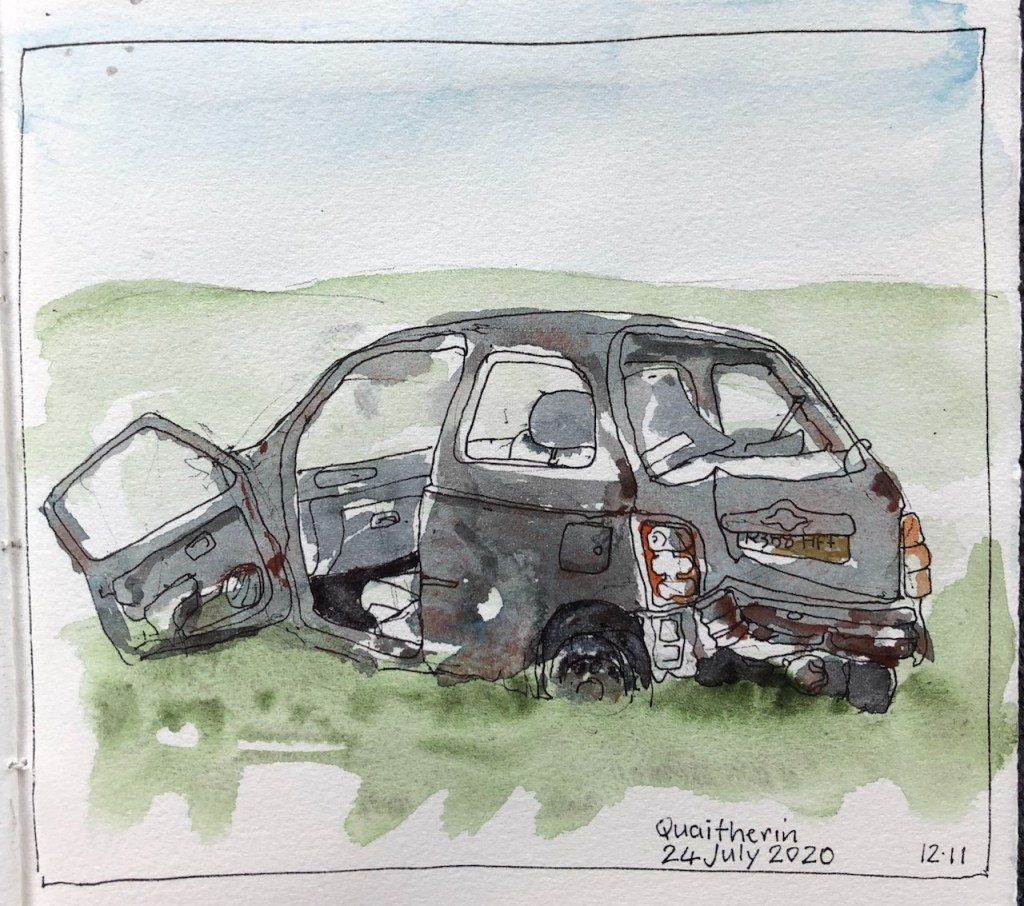
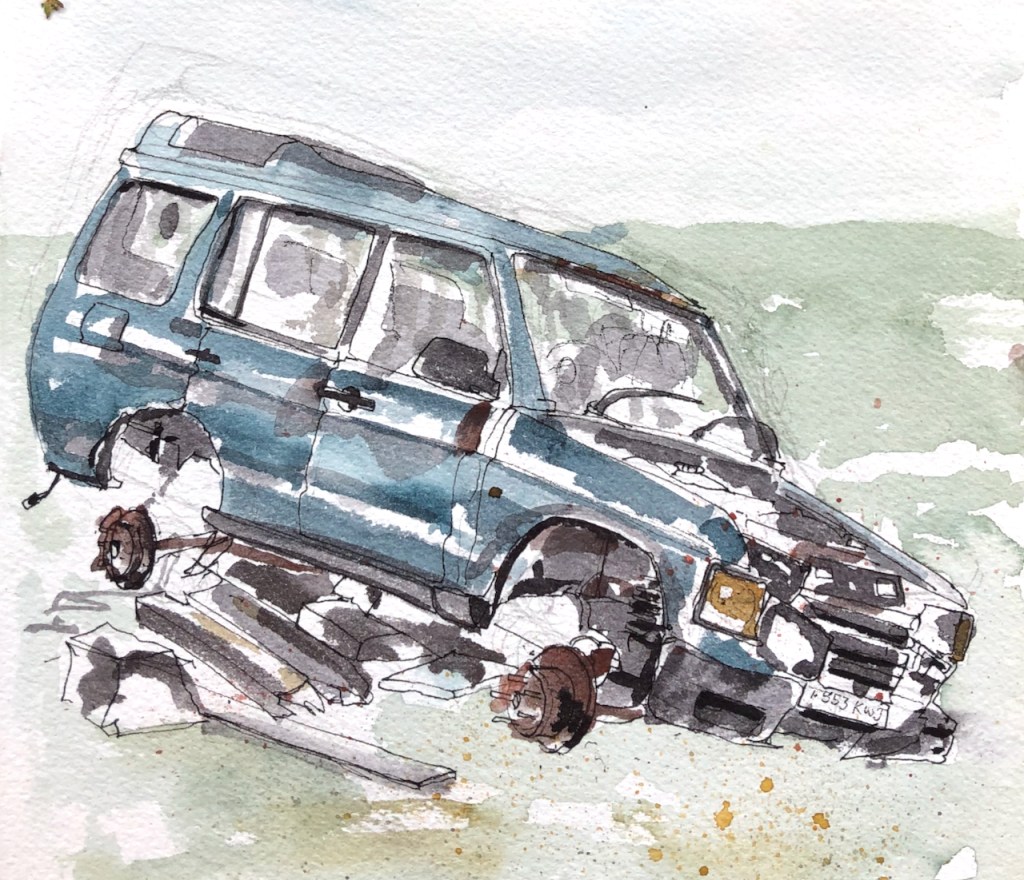
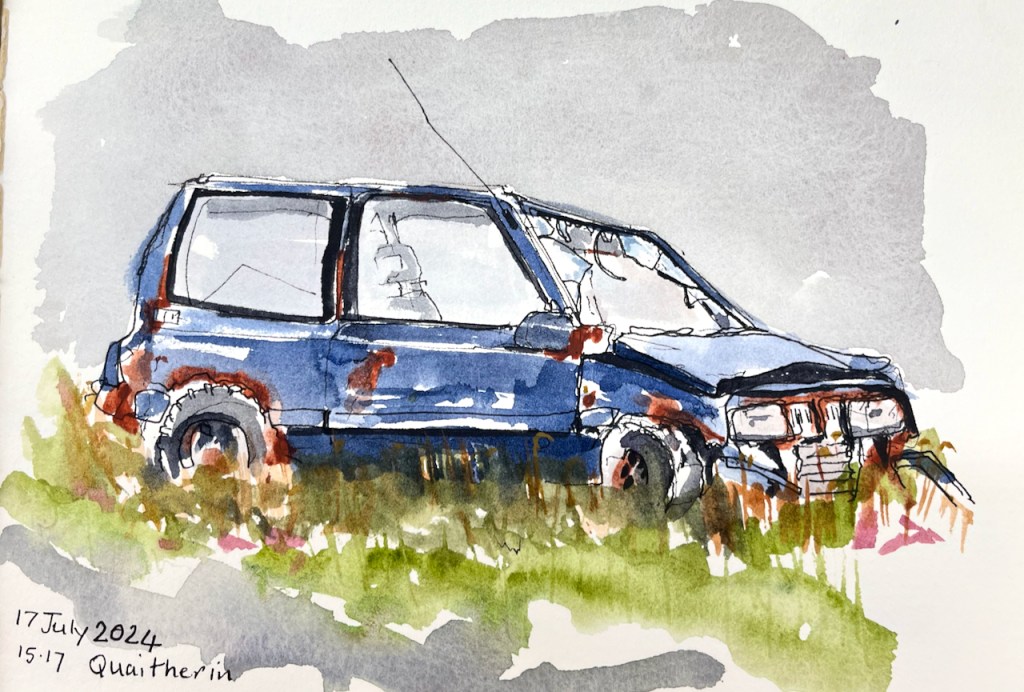
There’s a walk up to the Verda Stane. From up there you can see for miles, a vast undulating landscape. On the walk back down there’s a track. On the track I found an abandoned car, Escudo.
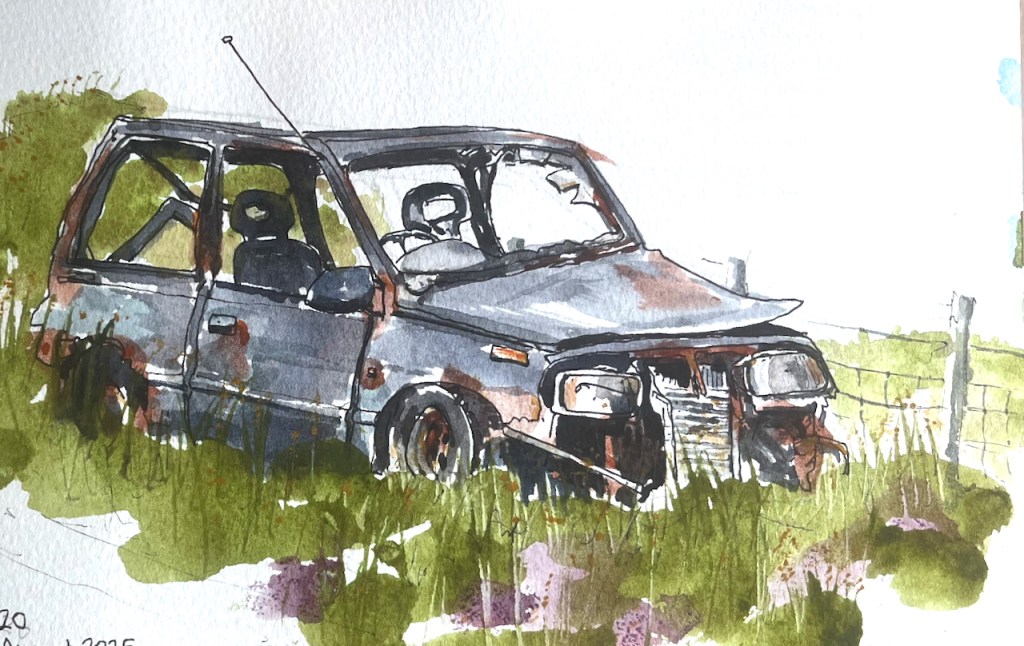
It has become a bit more decrepit. There is more rust. The radiator has fallen off. But it is still there, complete with number plate. This time I saw its name: “Escudo”, on the back door.
Rain was coming.
I managed to complete the sketch, glad to be there. And then I walked back to the road, and along the road, in the fine rain.
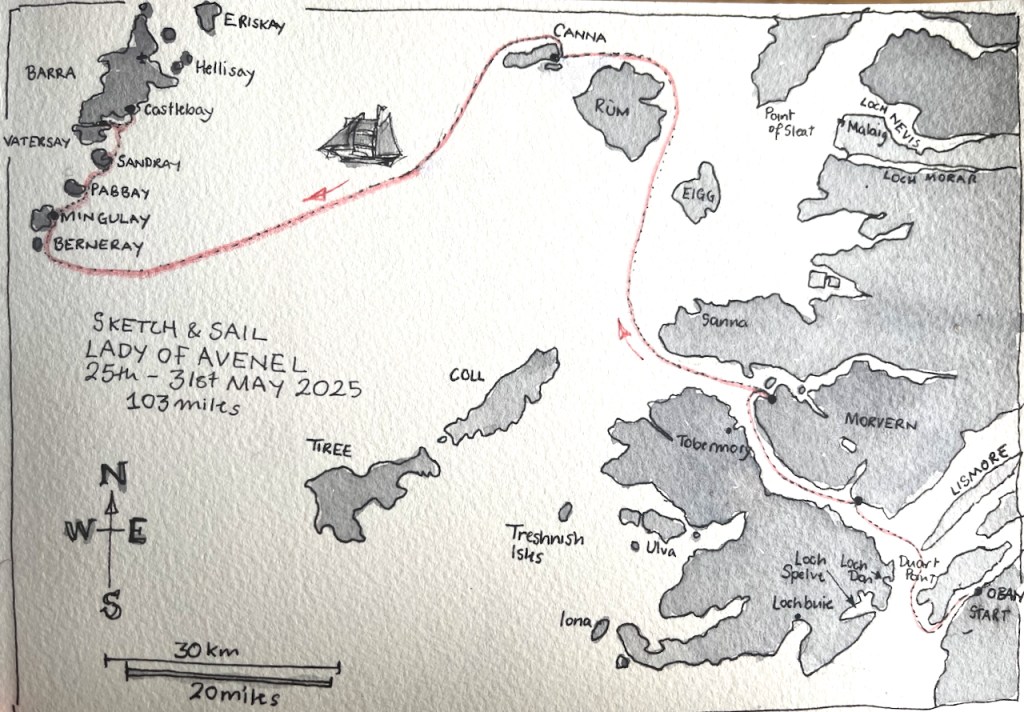
I’m thrilled to be one of the tutors on the Lady of Avenel “Sketch and Sail” adventure. I have just returned from the May 2025 voyage in the Scottish western isles.
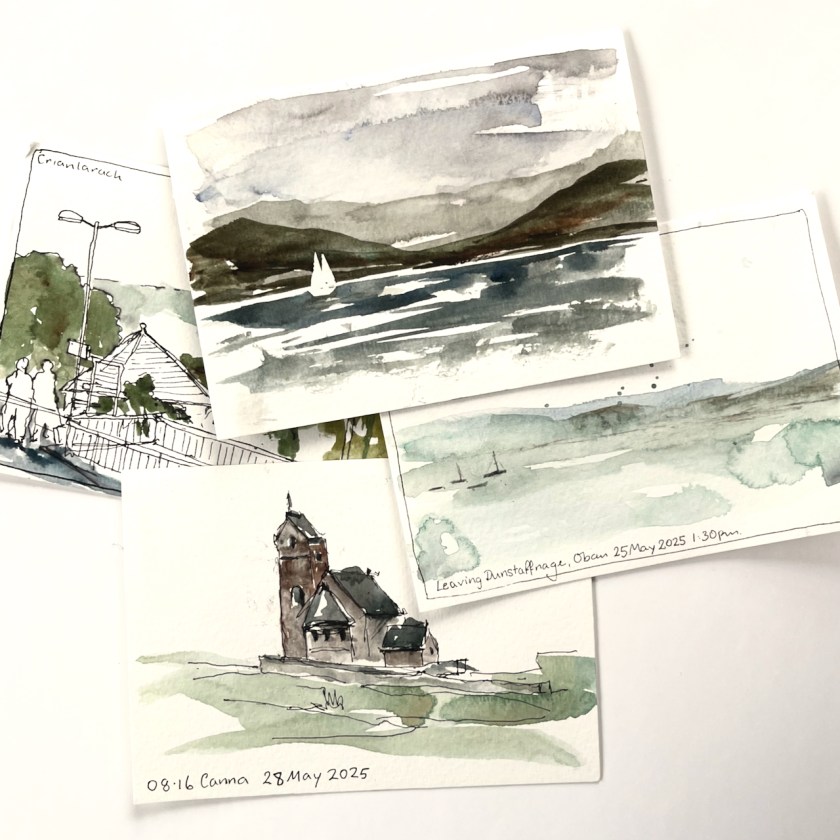
Postcards from Sketch and Sail May 2025
We travelled over 100 miles, much of it under sail. Fellow artist Alice Angus and I delivered sketching workshops to a companionable group of participants, and everyone made lots of sketches. Some people also steered the boat, managed the sails, swam on the sandy beaches, and a few brave participants went up the mast.
If you would like to join us on a future trip, there is another date in August – and two more voyages are planned for 2026. See this link for more information or contact me.
Here are a few of the many photographs from the May 2025 trip:
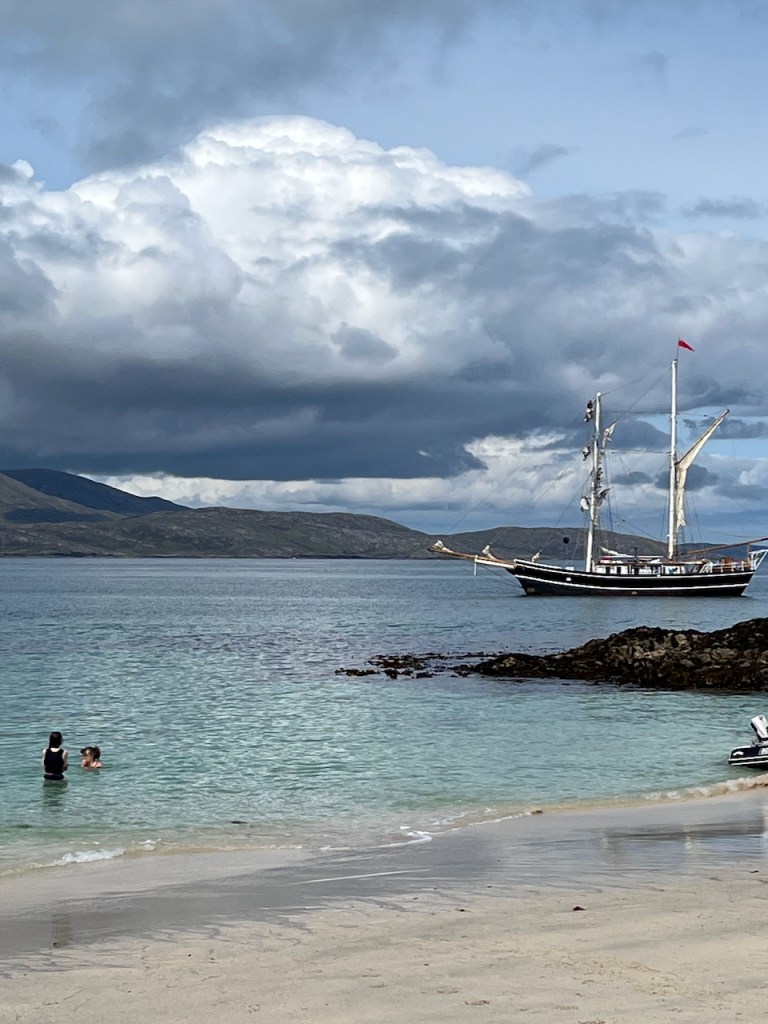
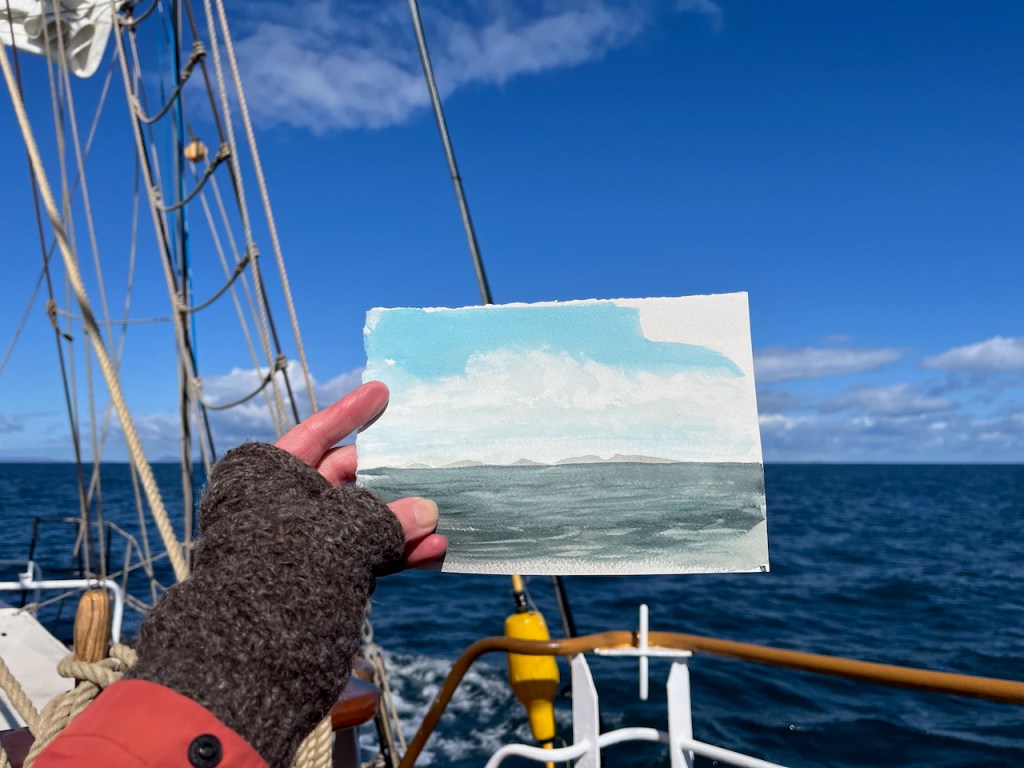
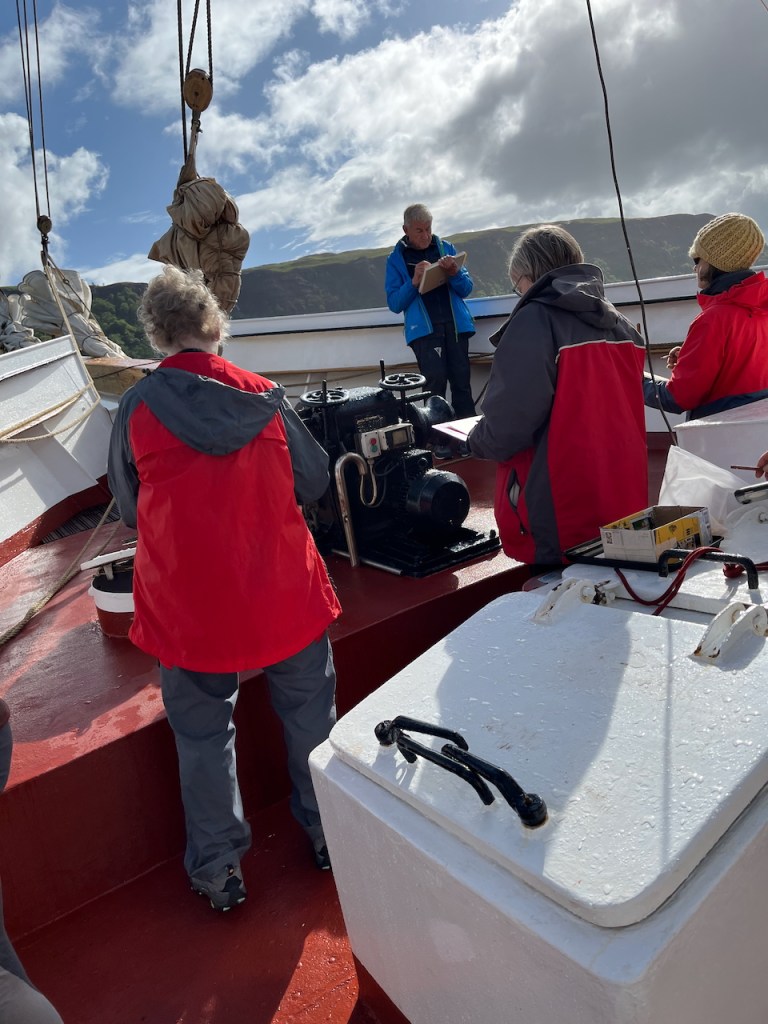
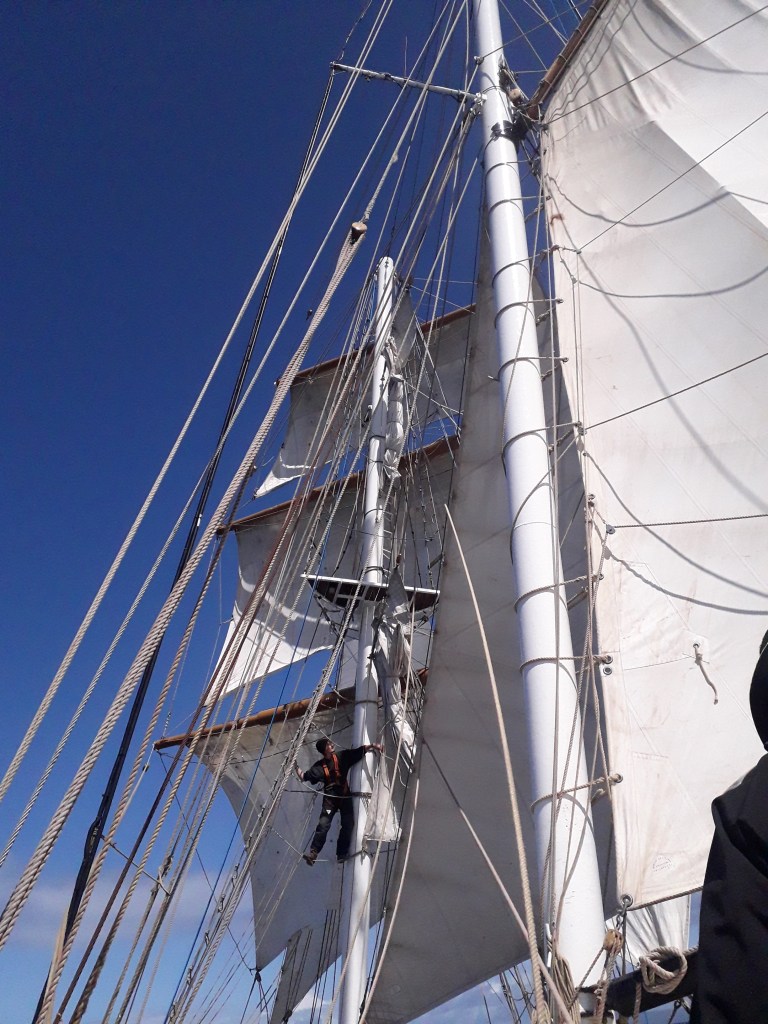
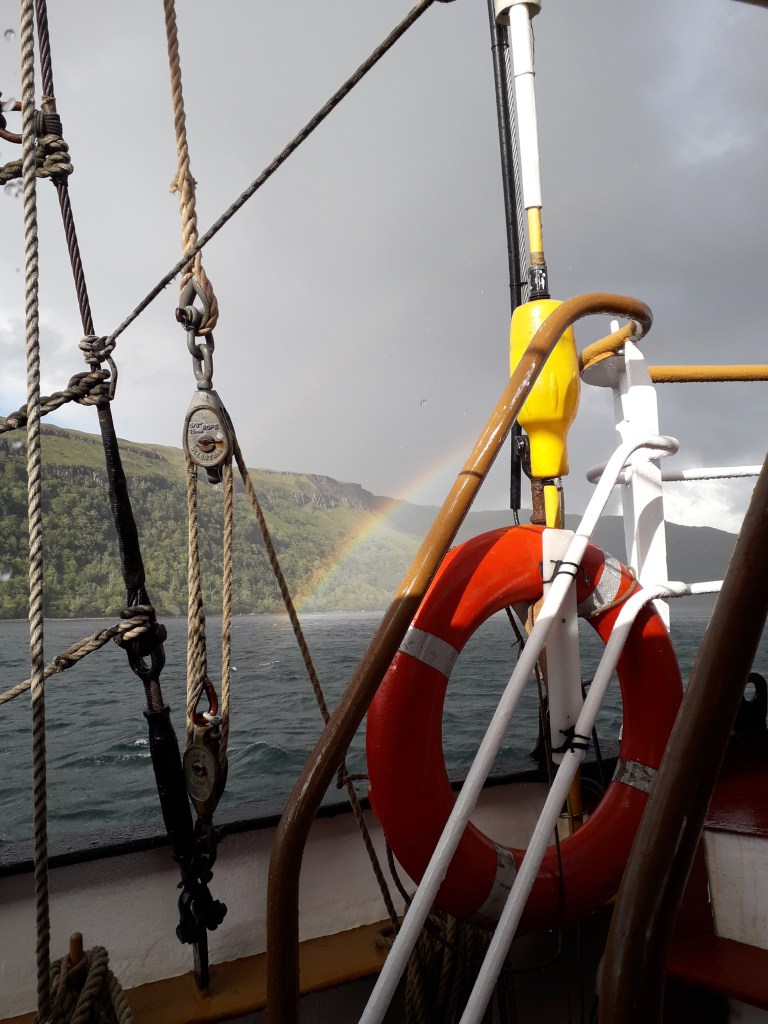
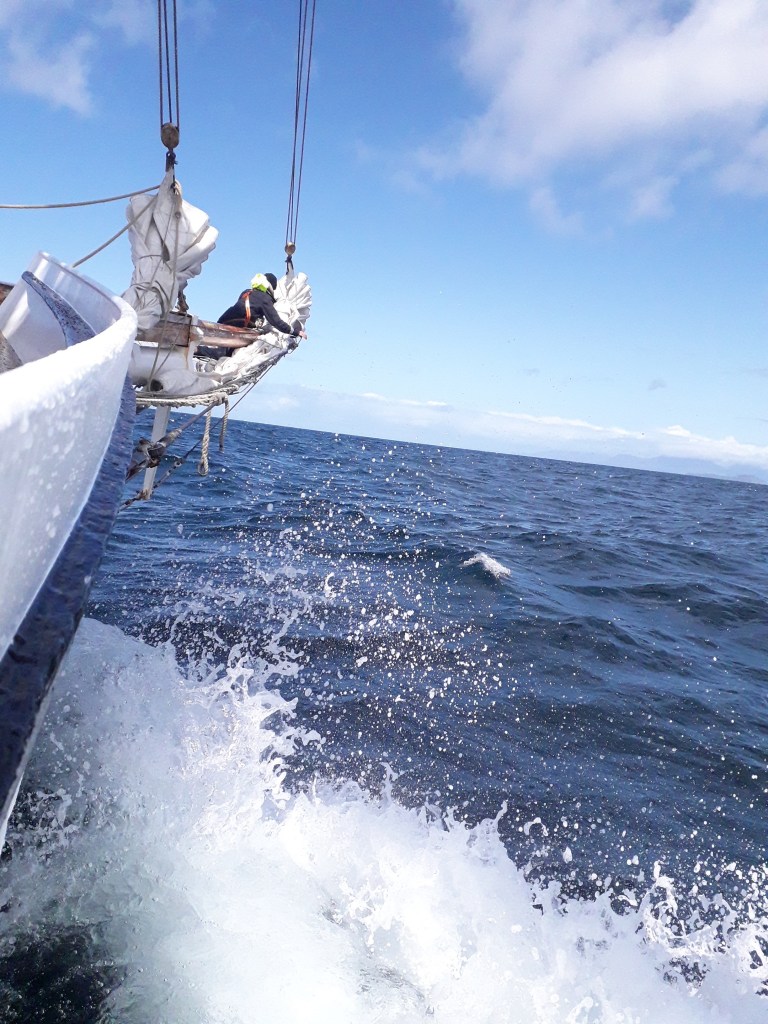
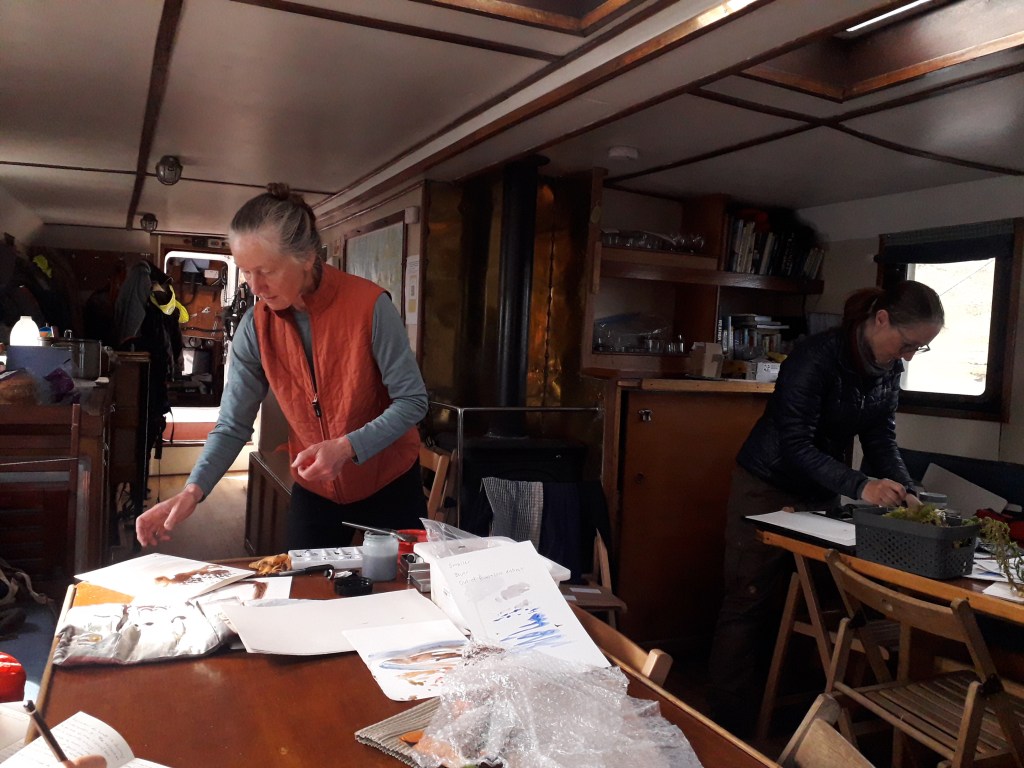
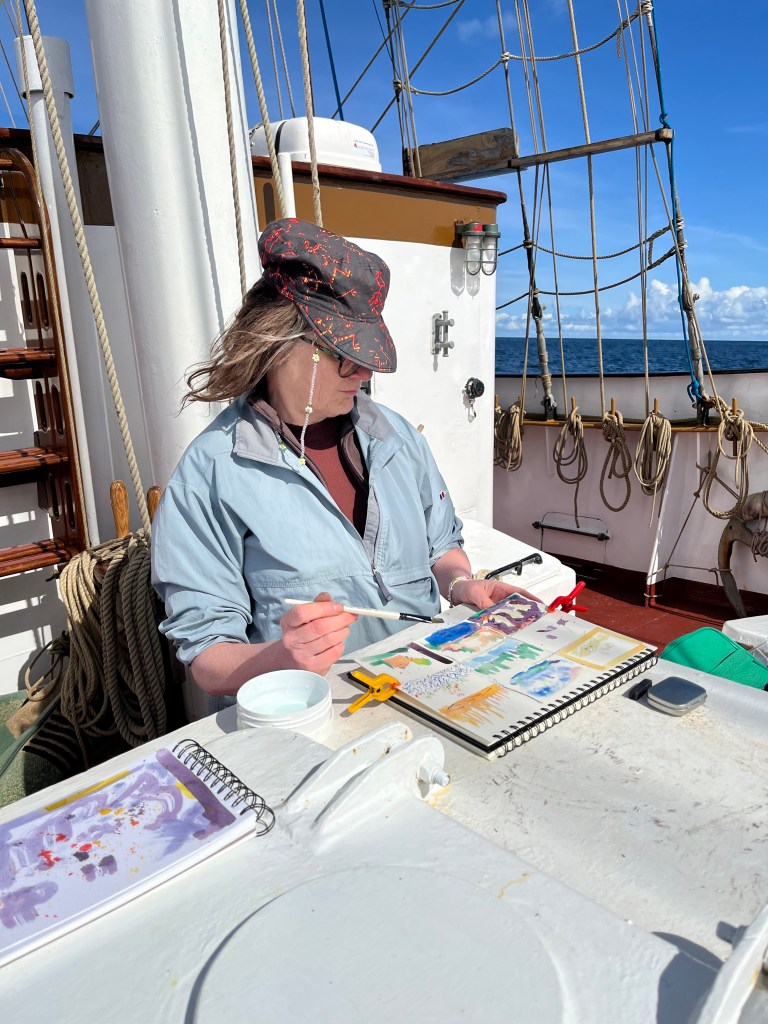
Swimming at SandrayA postcard of distant islandsArt workshop on the foredeckThe sails and a crew memberRainbow near CannaCrew member furling the sailJane and Alice preparing for an art workshop in the saloonNathalie sketching on the foredeckShore partyaction shots: Lady of Avenel May 2025 (photo credits: janesketching and Natalie)
Here are some of my sketches from the trip.
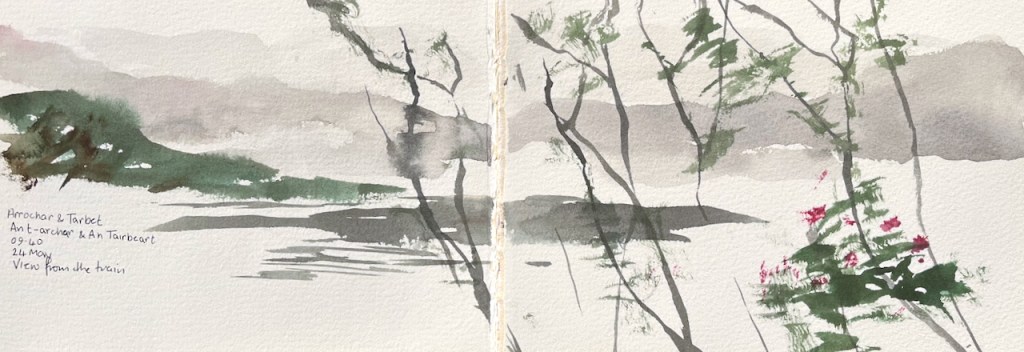
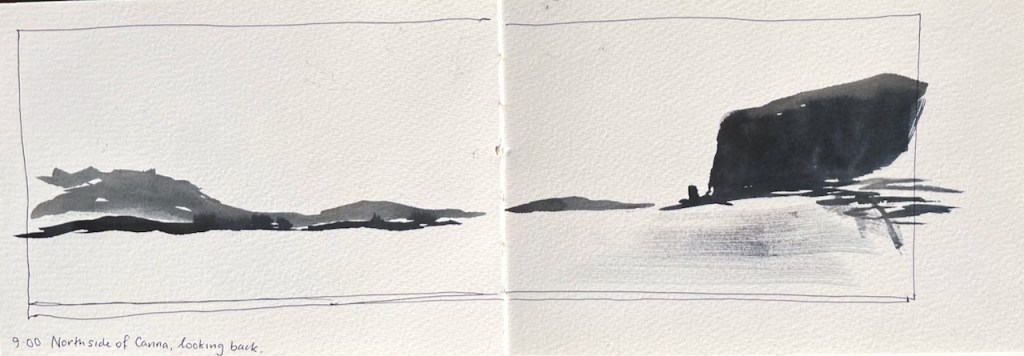
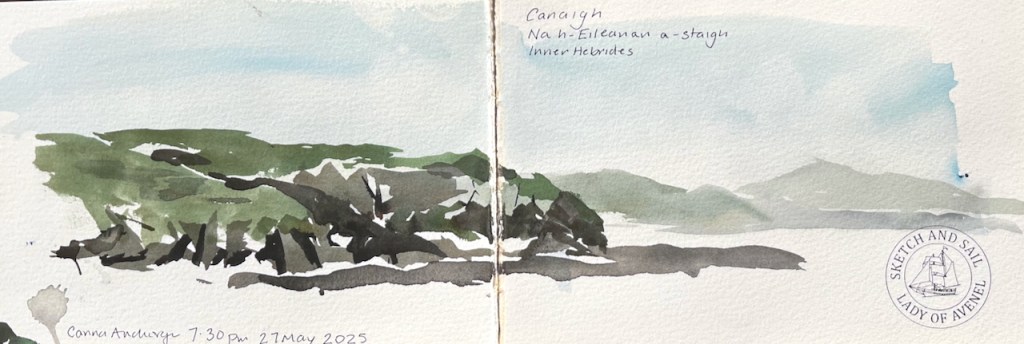
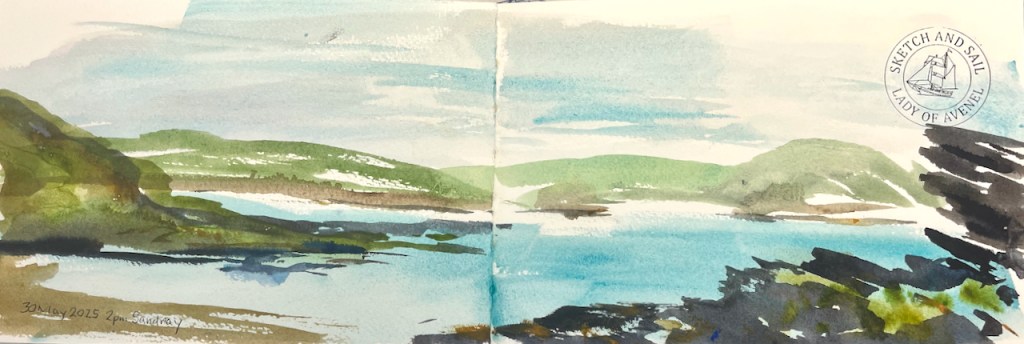
I took an A5 sketchbook from JP Purcell, and sometimes sketched the landscape view across two pages:
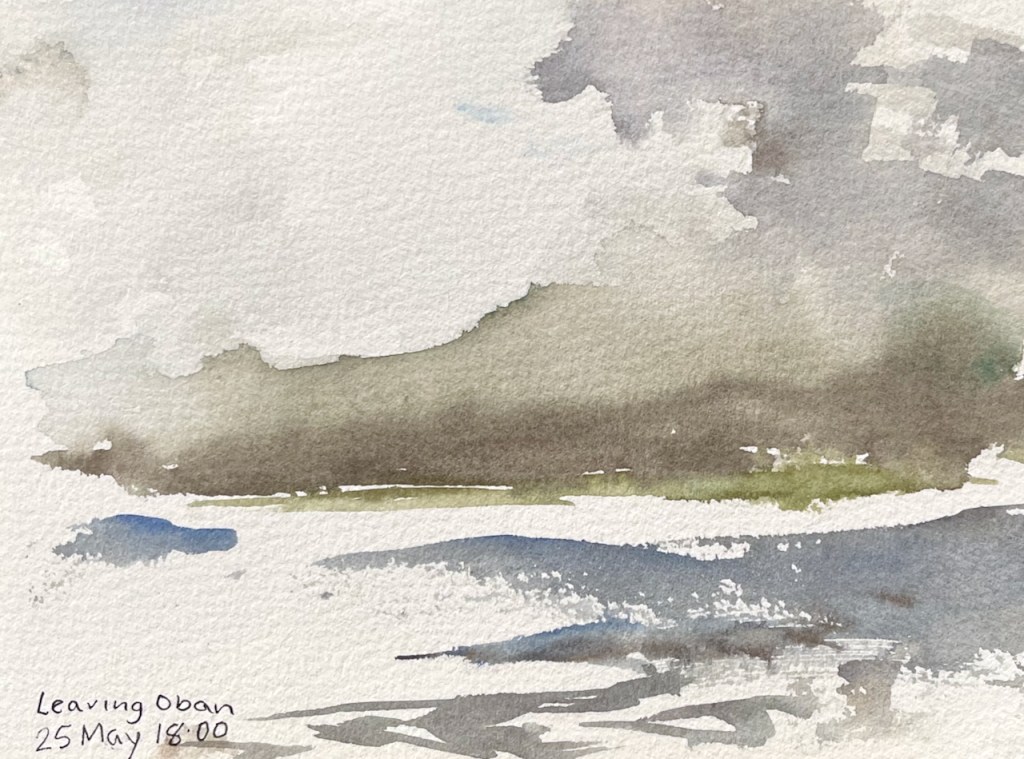
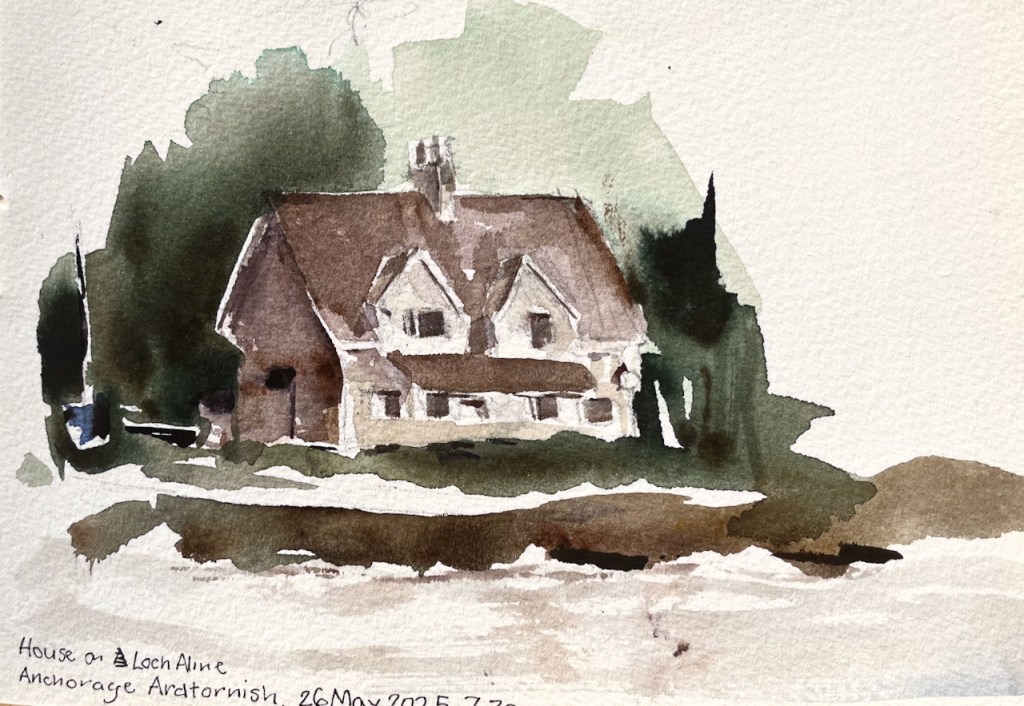
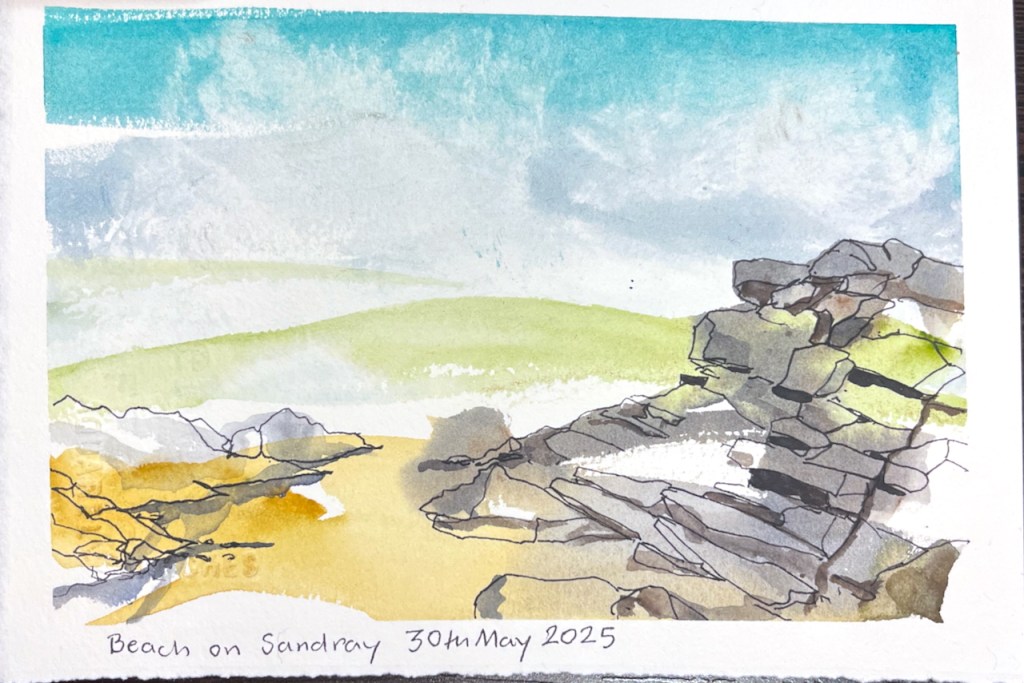
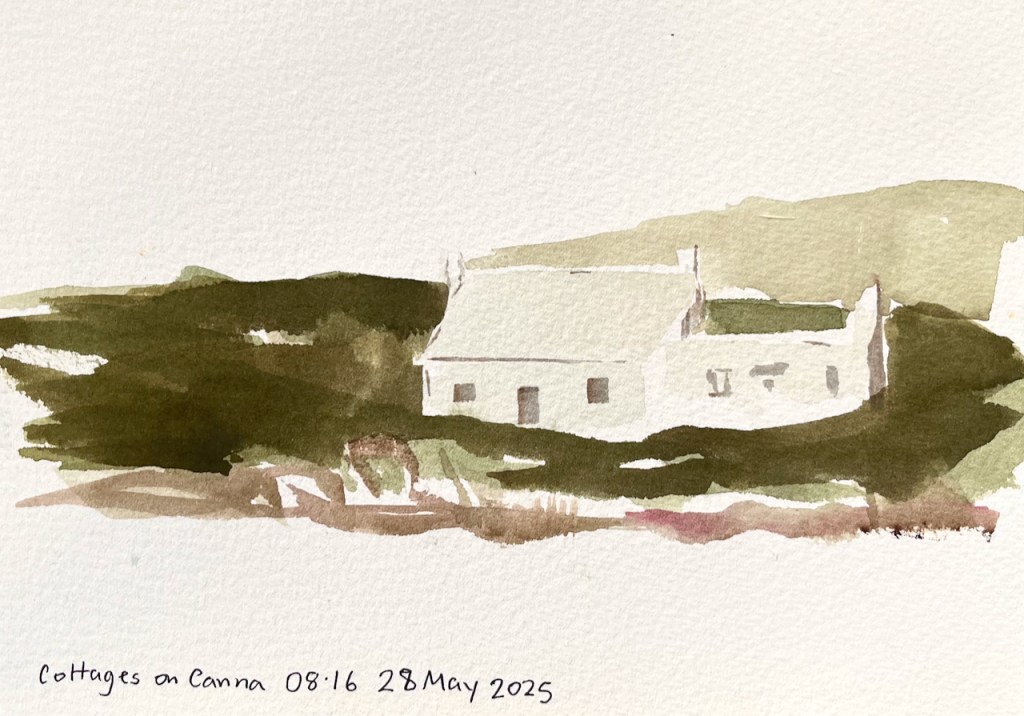
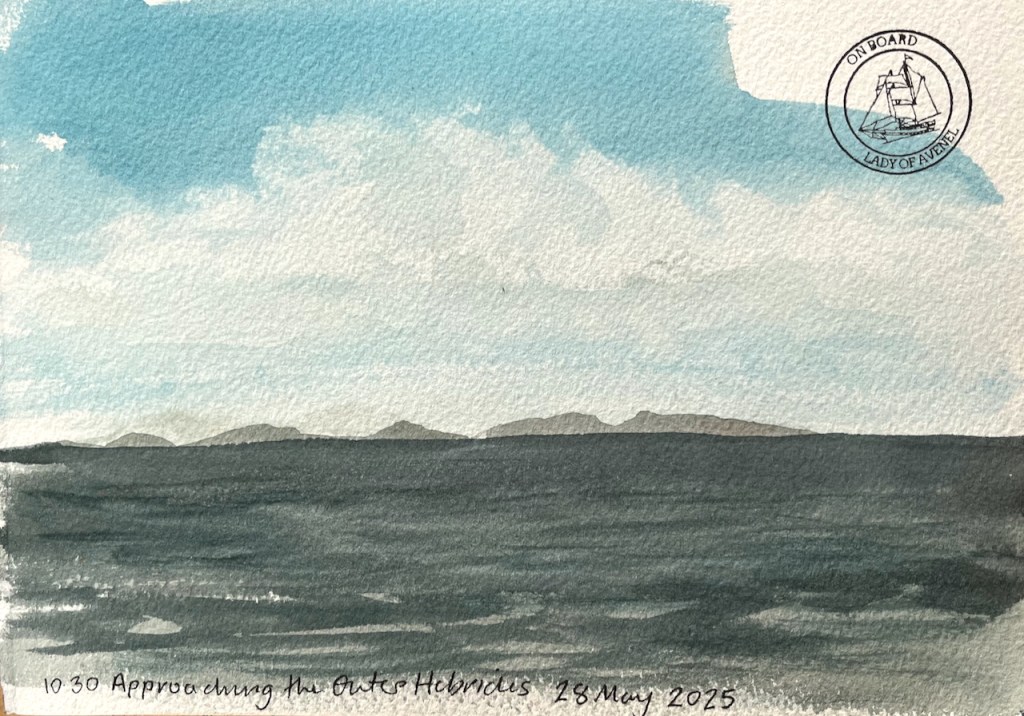
A quick sketch from the train northThe impressive cliffs and stacks of CannaA quiet anchorage at CannaFrom the sandy beach on Sandray
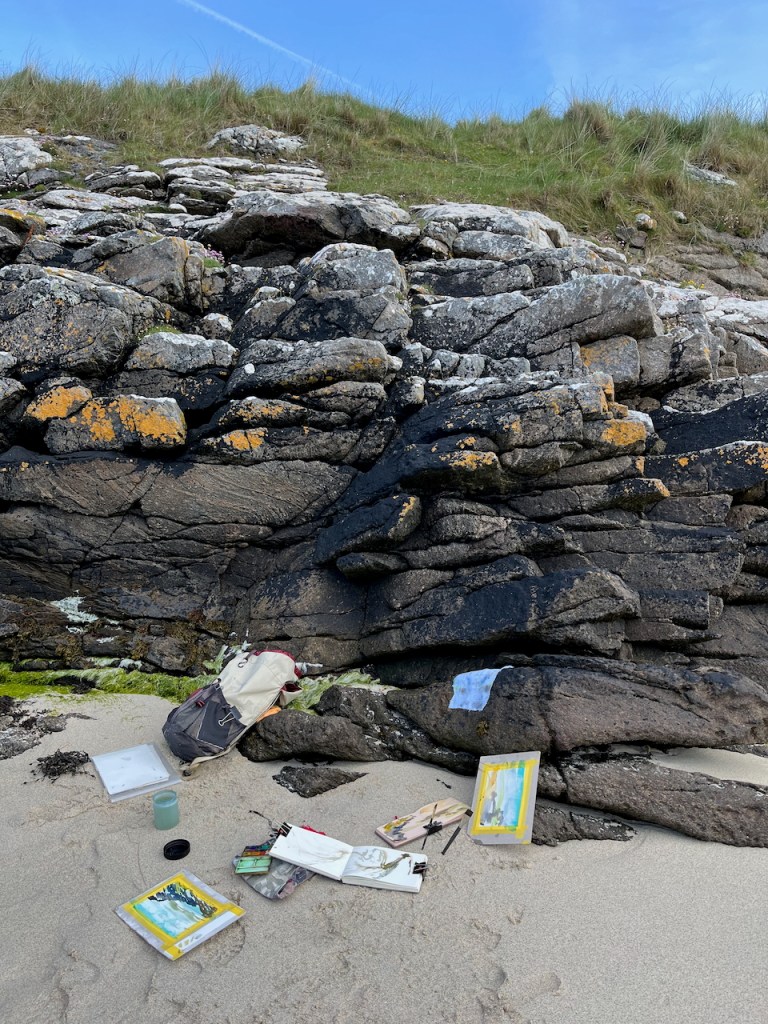
The beach at Sandray was a great sketching location. Here is a photo of my sketching spot.
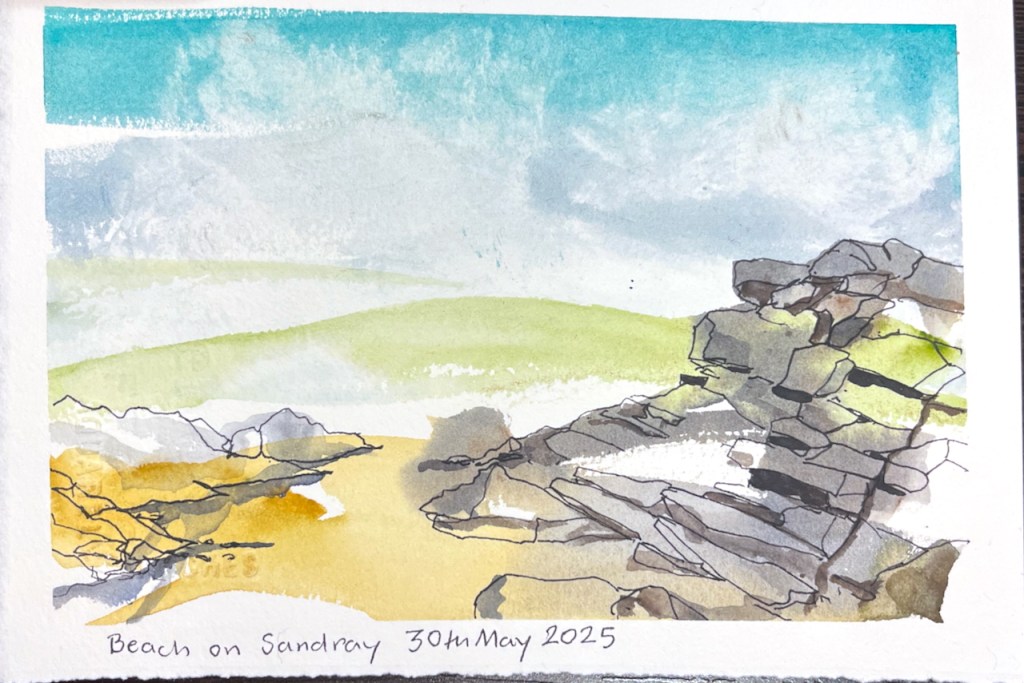
Here is one of the drawings I made here:
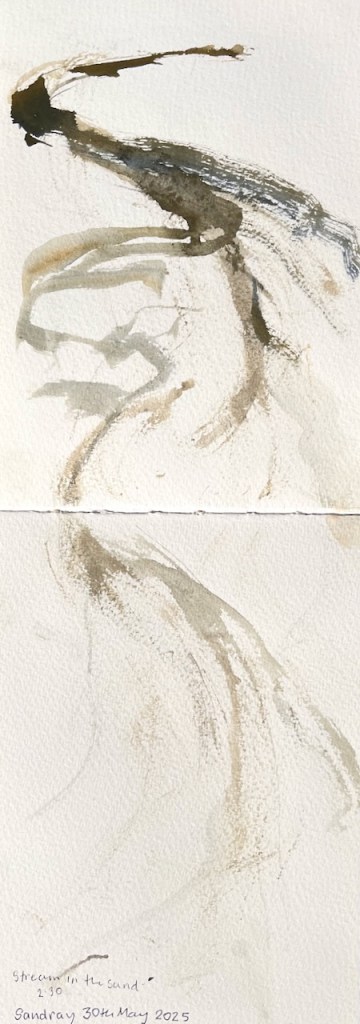
There was a stream running down the beach.
The stream on the beach, sketch made using seaweed and sea water.
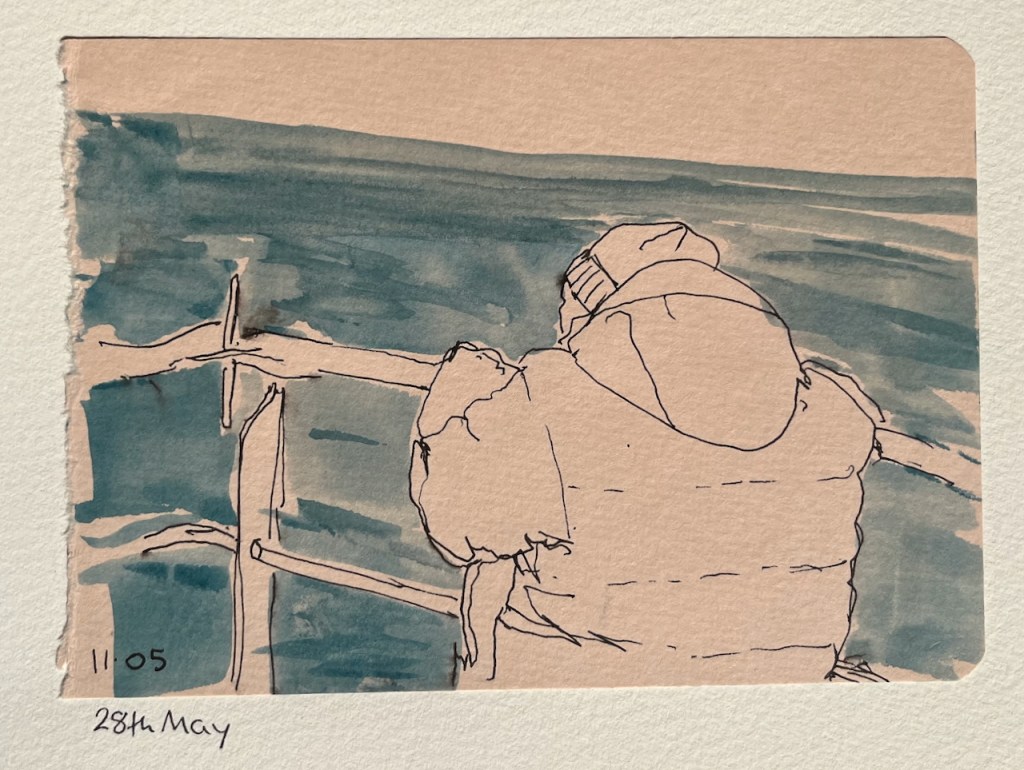
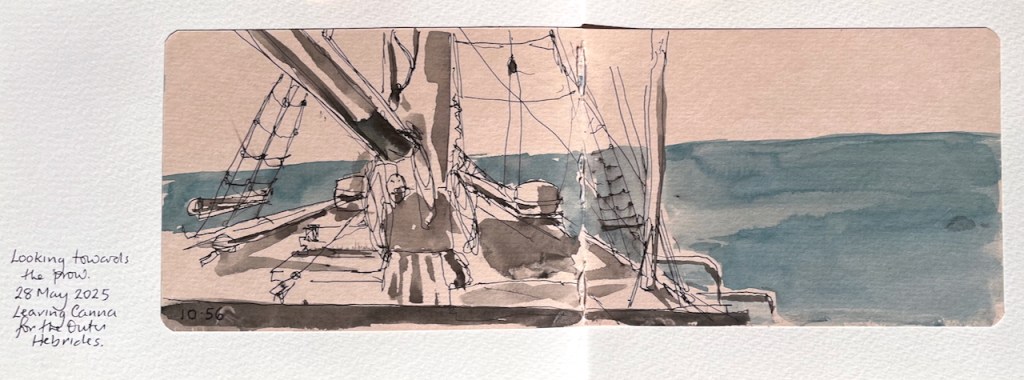
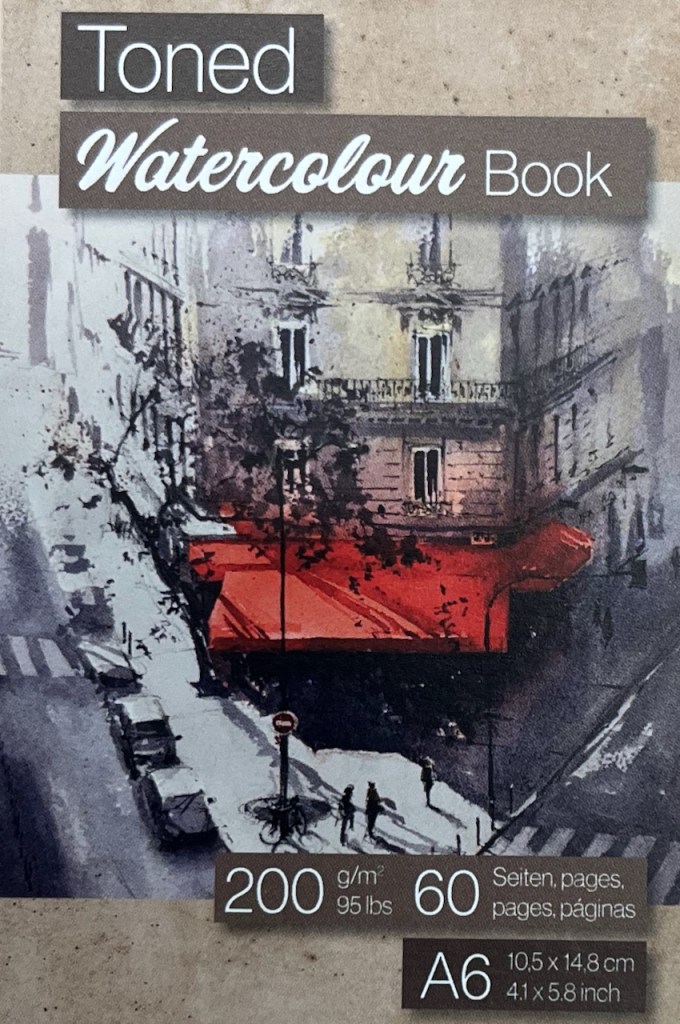
The other sketchbook I took was a small A6 toned watercolour book made by Hahnemühle.
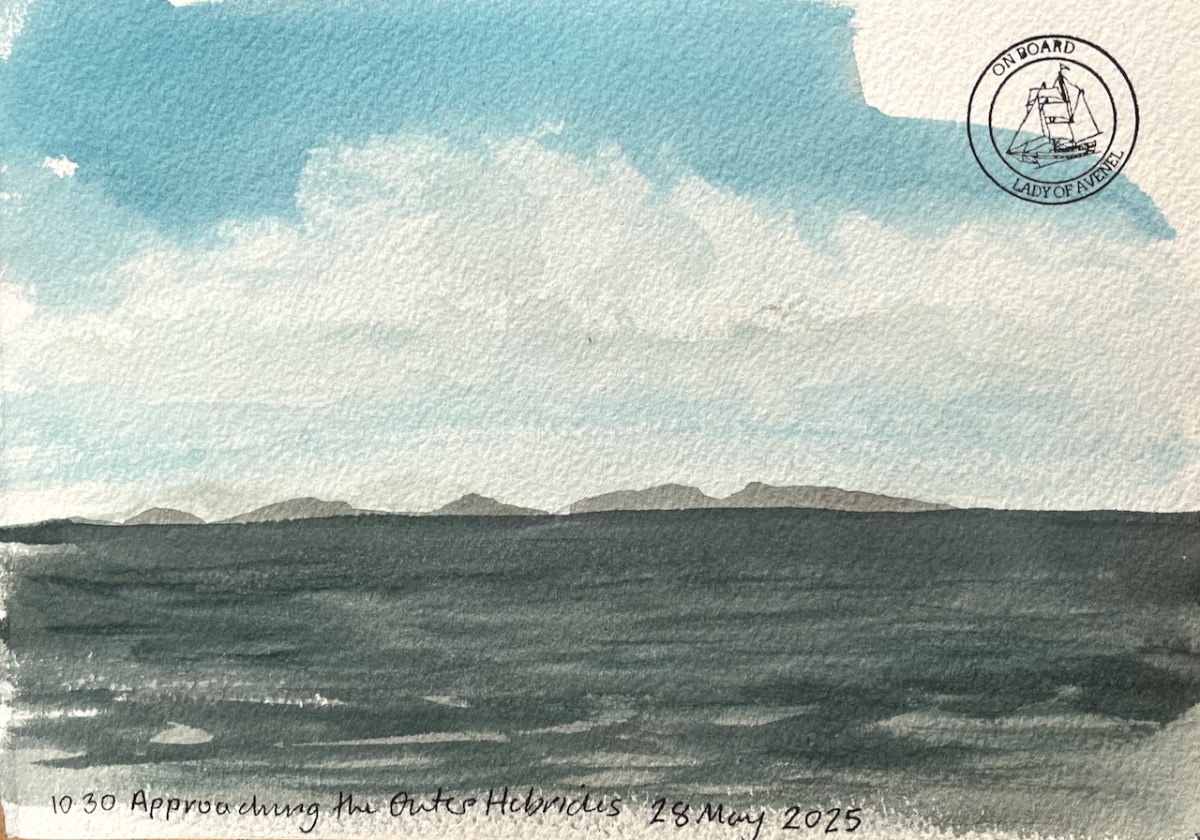
The toned sketchbookTony looking at the Outer HebridesA sketch of the ship, looking towards the prow.
On the way back to London I had a few hours walking and sketching in Glasgow – I’ll put those sketches in another post.
Meanwhile, here is a sketchbook flick-through so you can see the whole week in seven seconds of silent video. [videos might not play properly on mobiles or emails – please try the web-based version]
Sketchbook flick-through.
Materials:
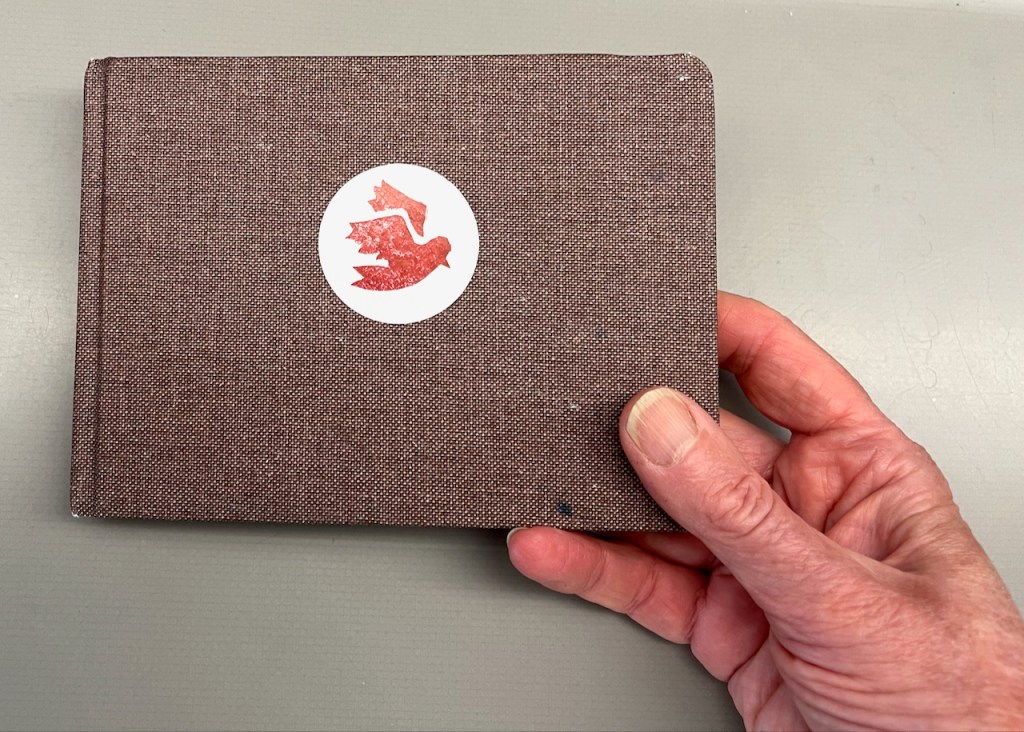
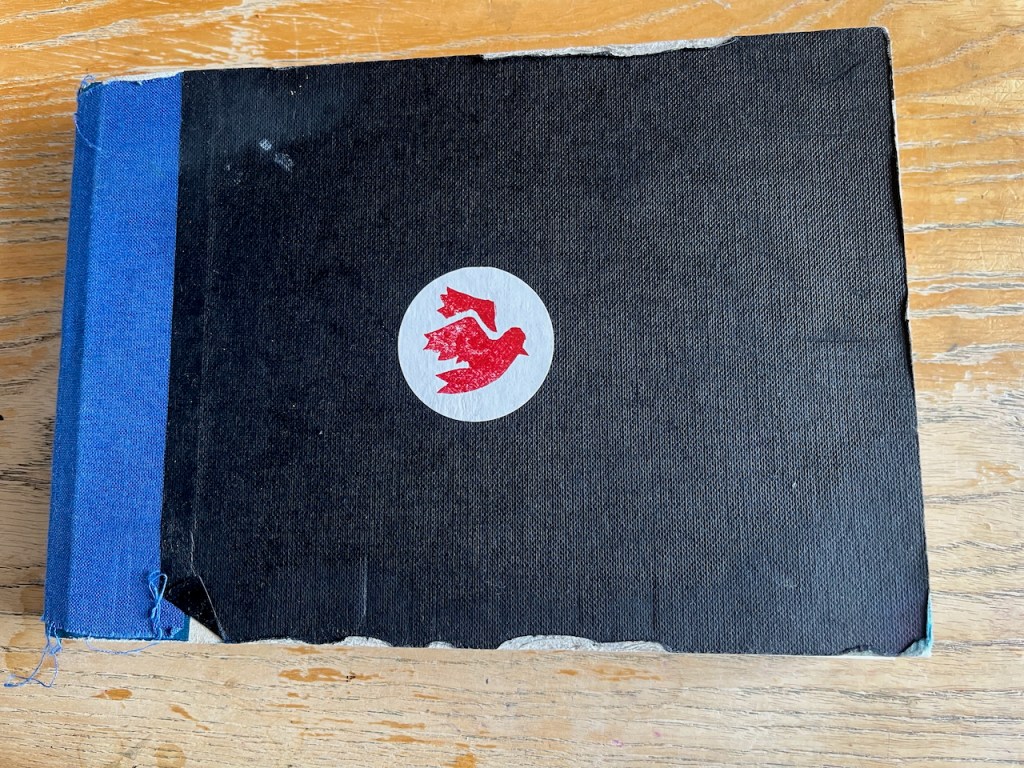
My main sketchbook was 300gsm watercolour paper, A5, from JP Purcell in Southwark, London. The bird sticker on the front is my design, printed by Vistaprint.
A well-used sketchbook: A5 watercolour paper, from JP Purcell.
I also used a small toned sketchbook from Hahnemühle.
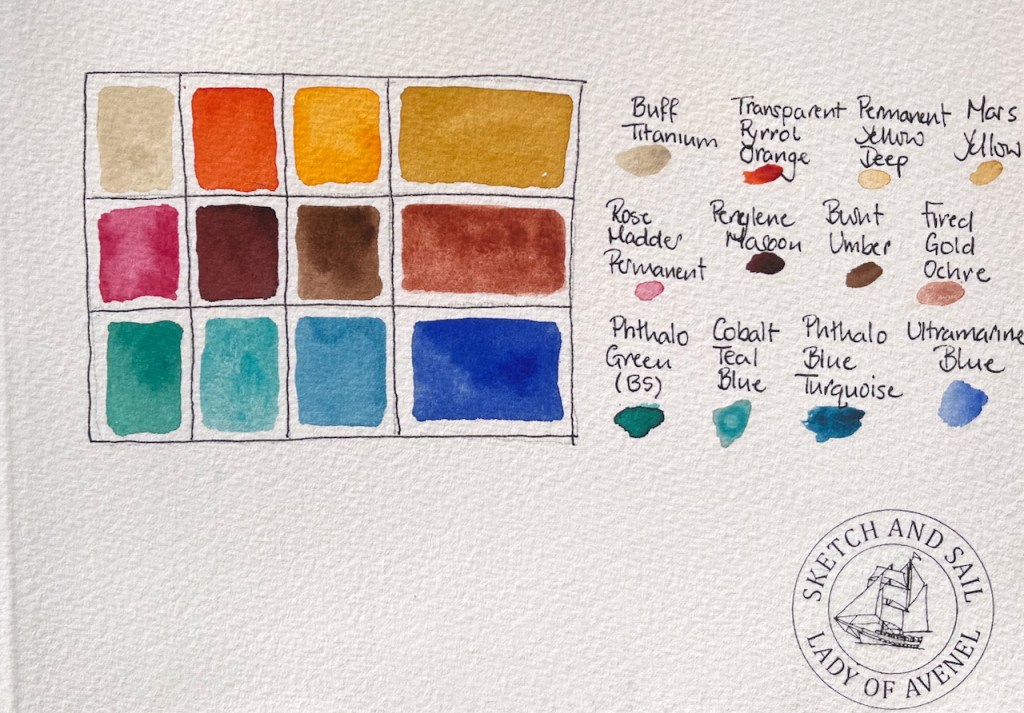
Here is my colour palette, all traditional watercolours:
Colours used this week: all Daniel Smith except the Ultramarine Blue which is Schmincke Horadam
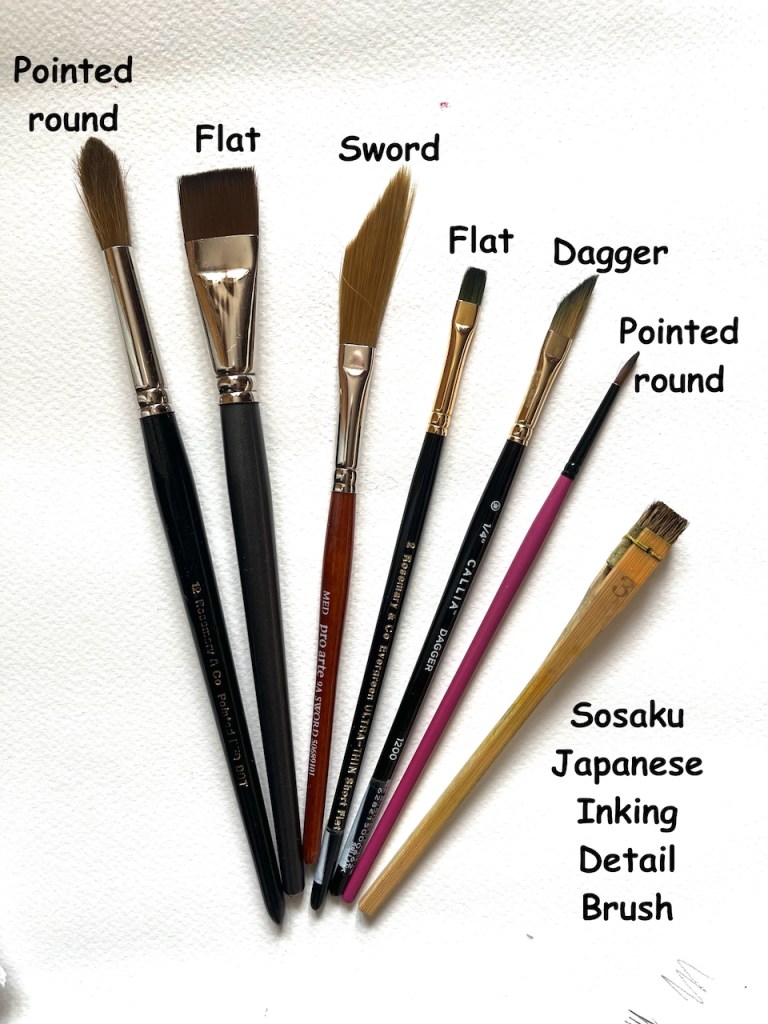
Here are the brushes I use. Mostly I used the large flat brush, which is from Rosemary Brushes. It is about an inch across.
Any other questions? If you’re interested in the Sketch and Sail adventure in August, or next year, do get in touch.
Click a button below to share this post online, email it, or print it:
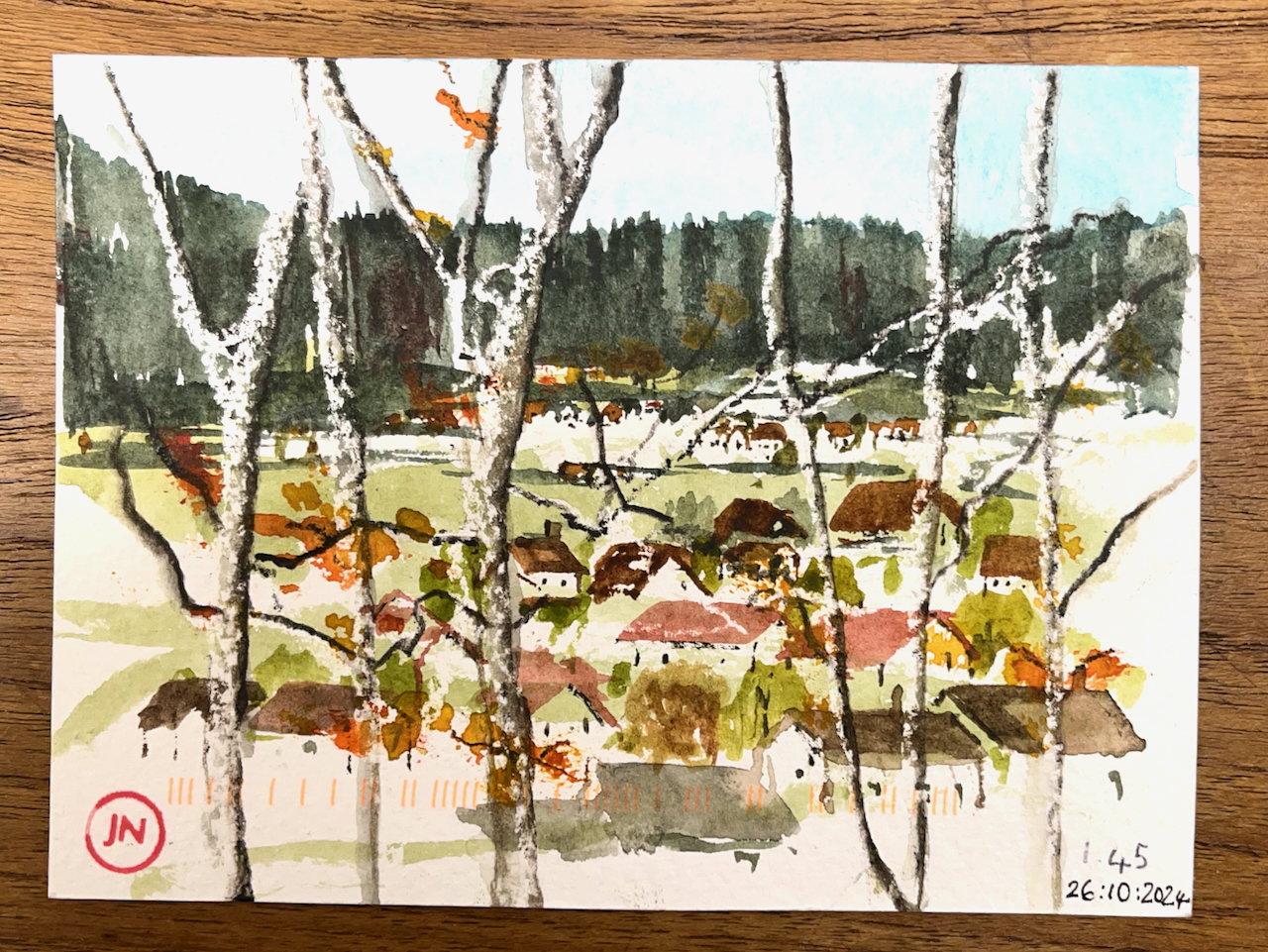
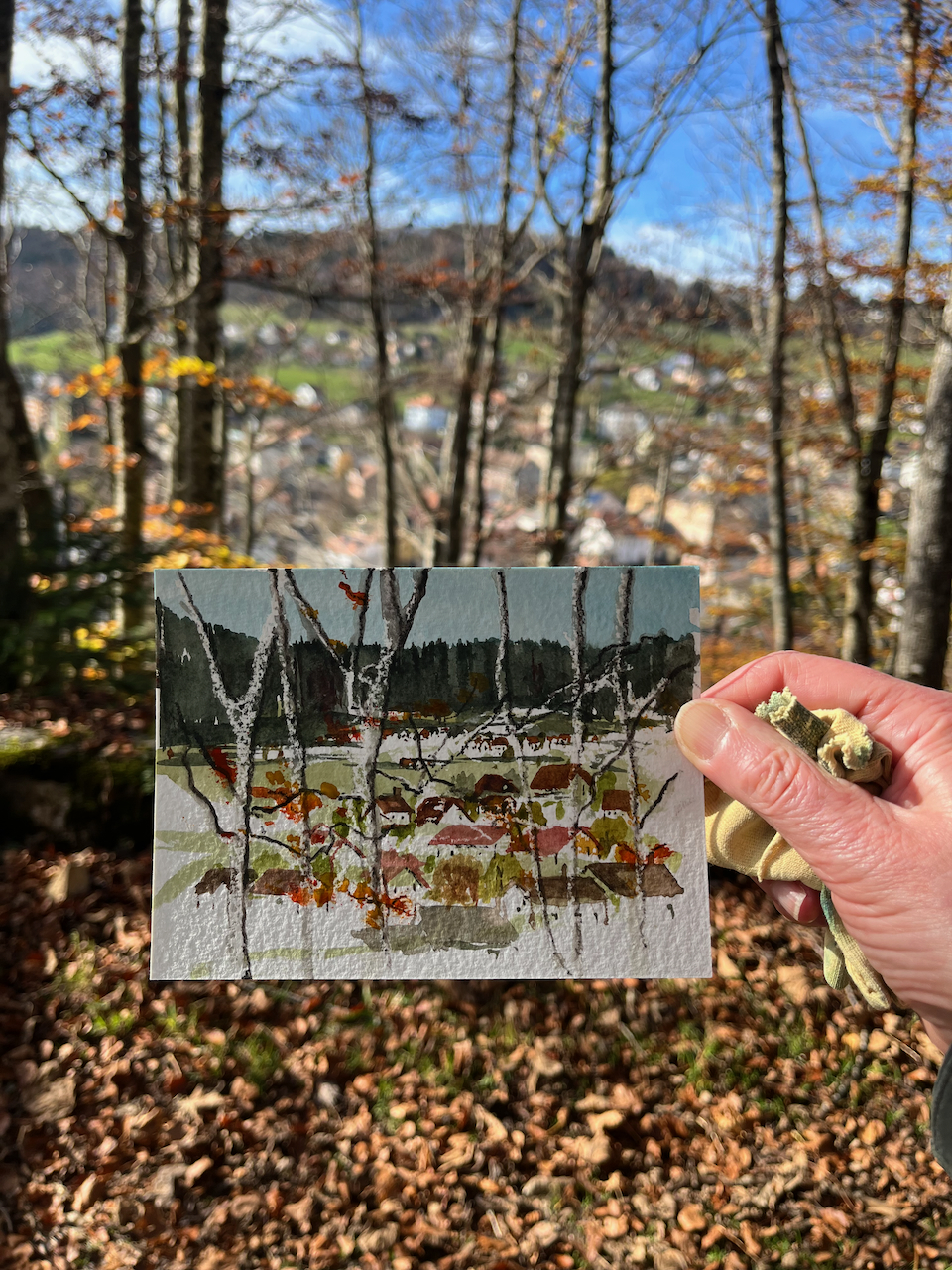
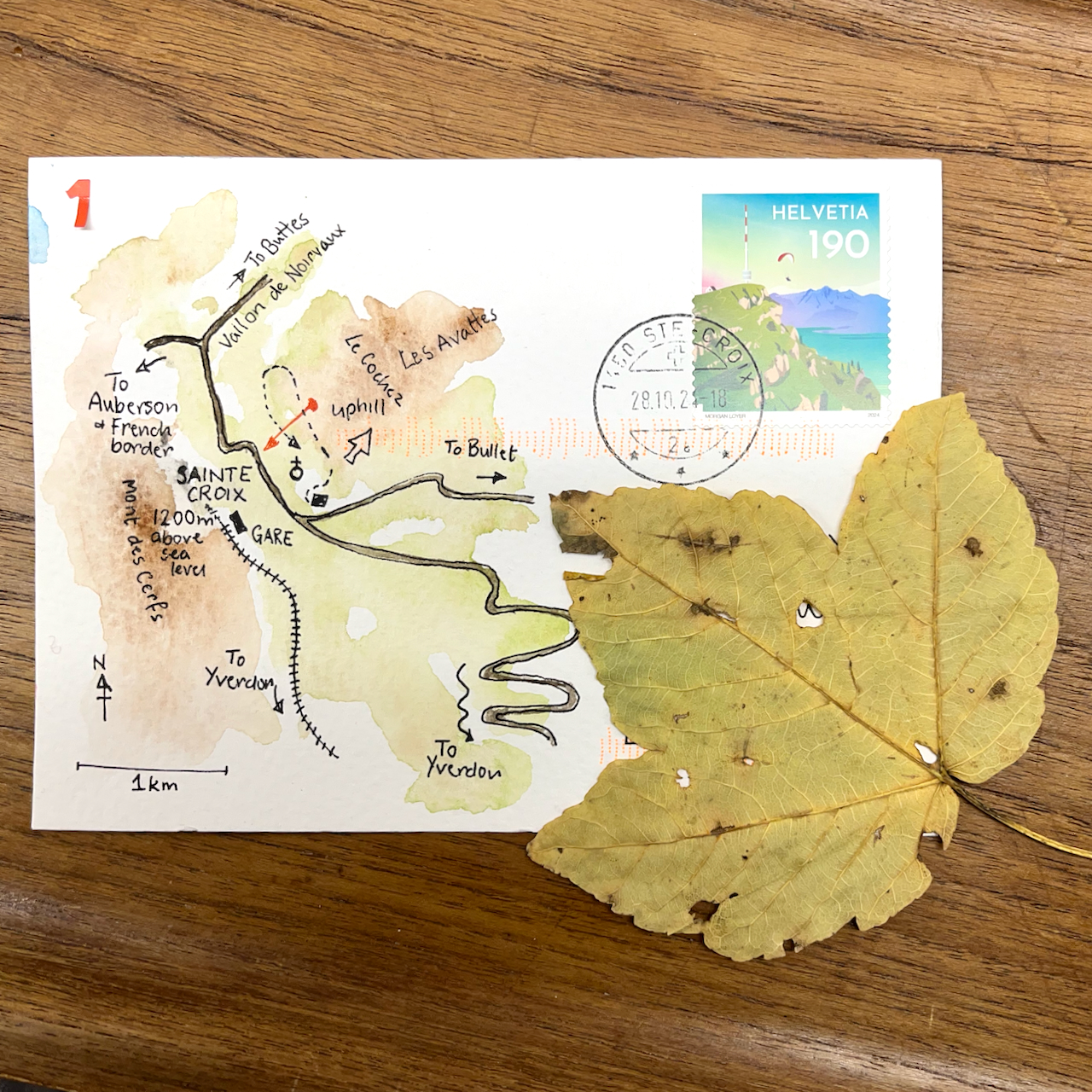
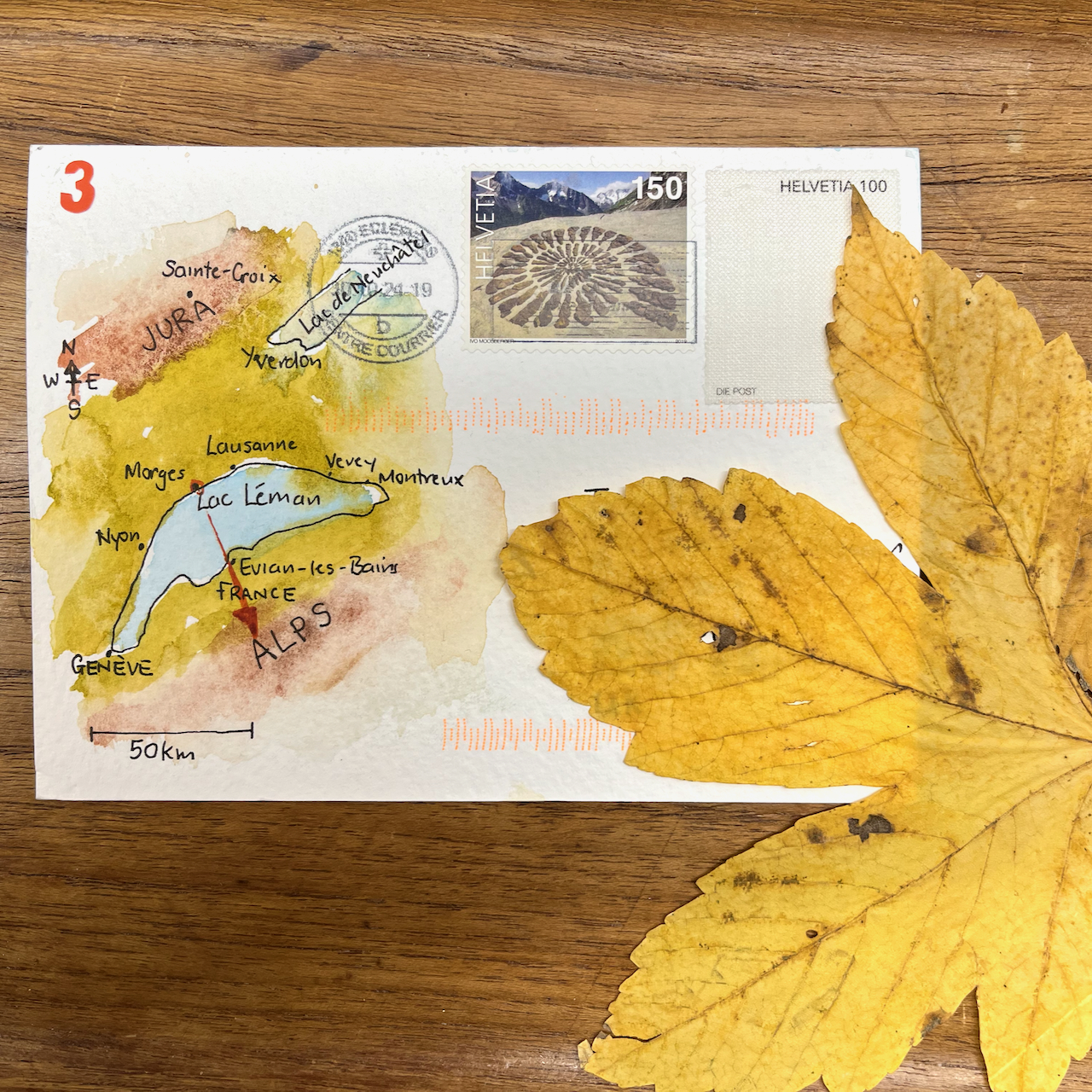
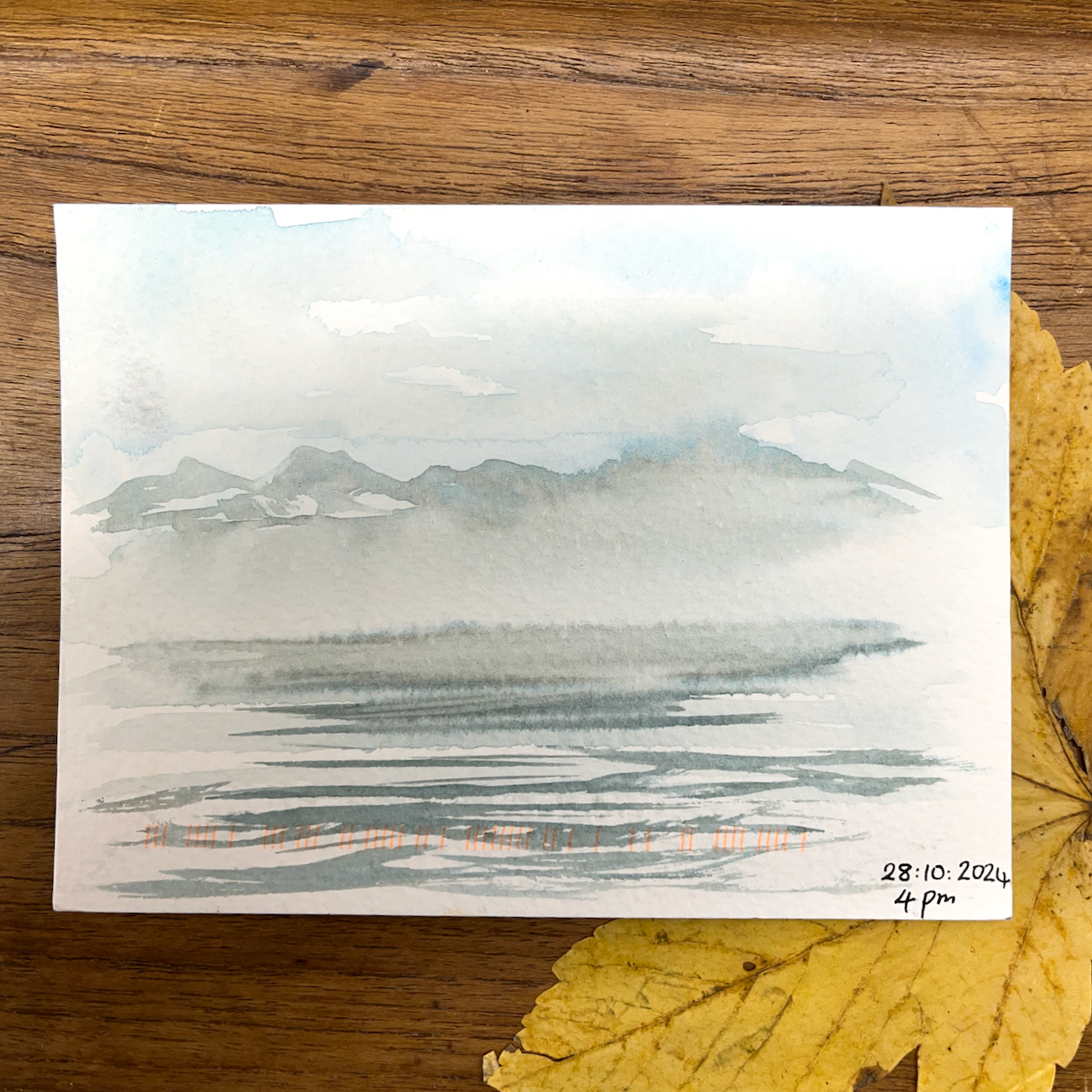
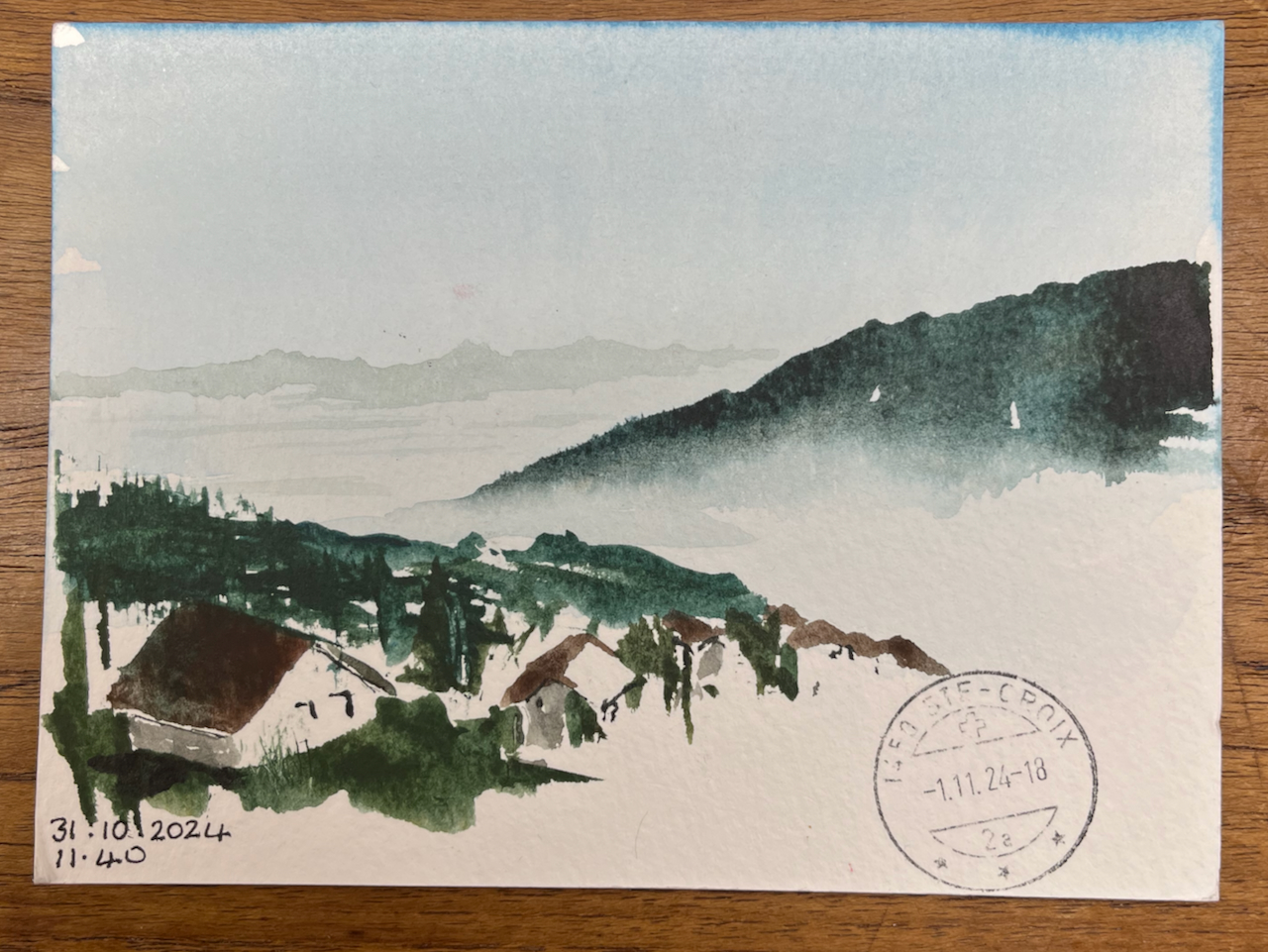
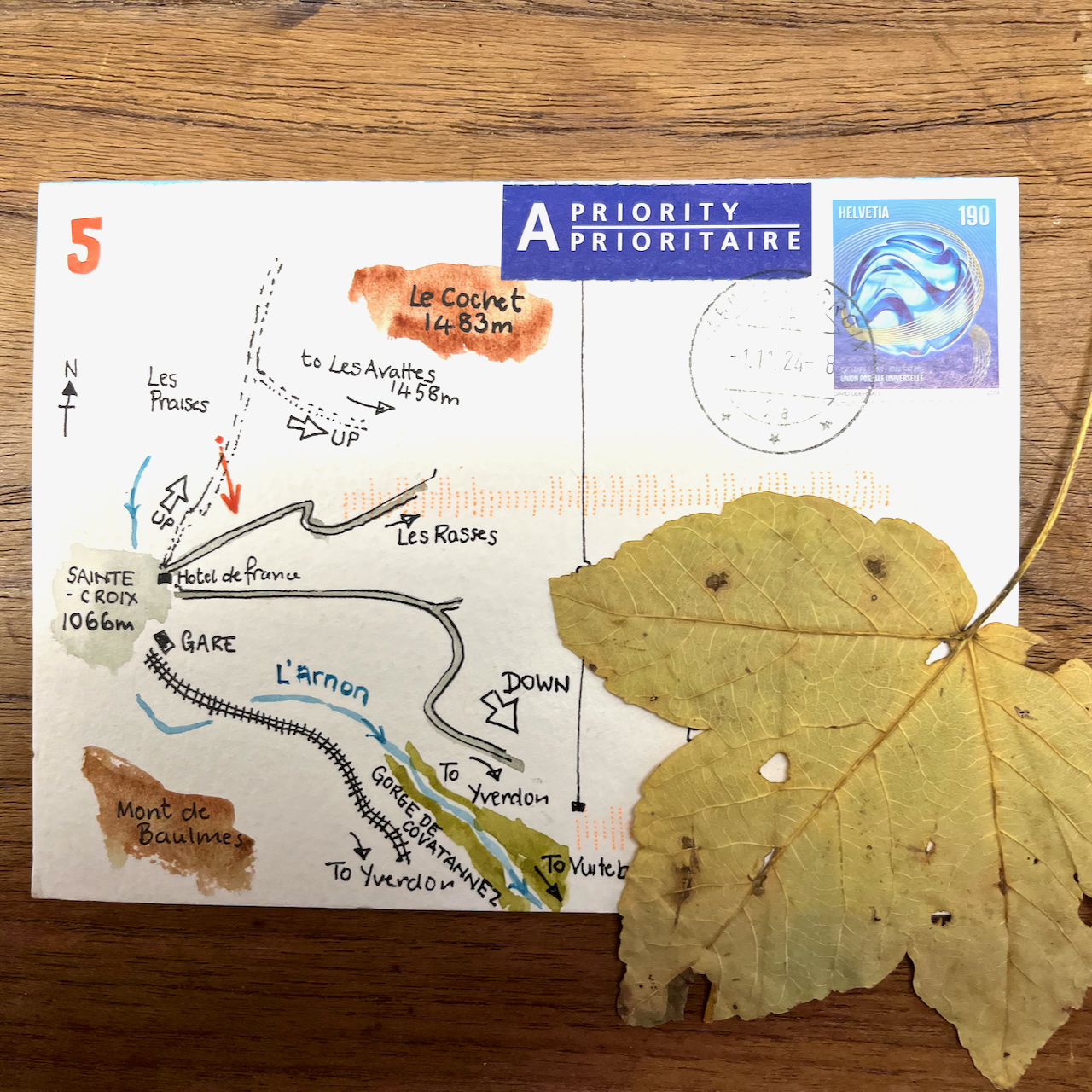
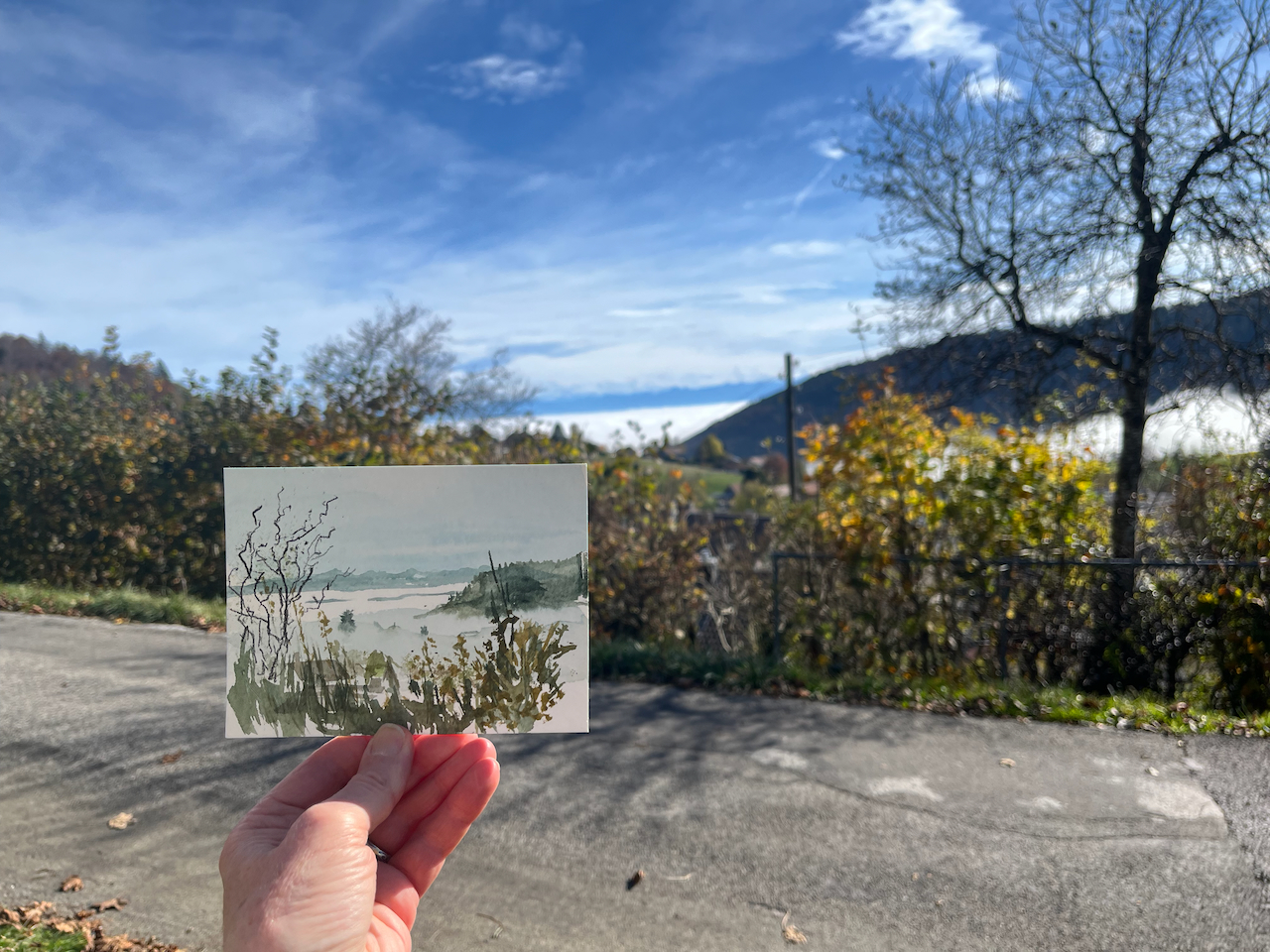
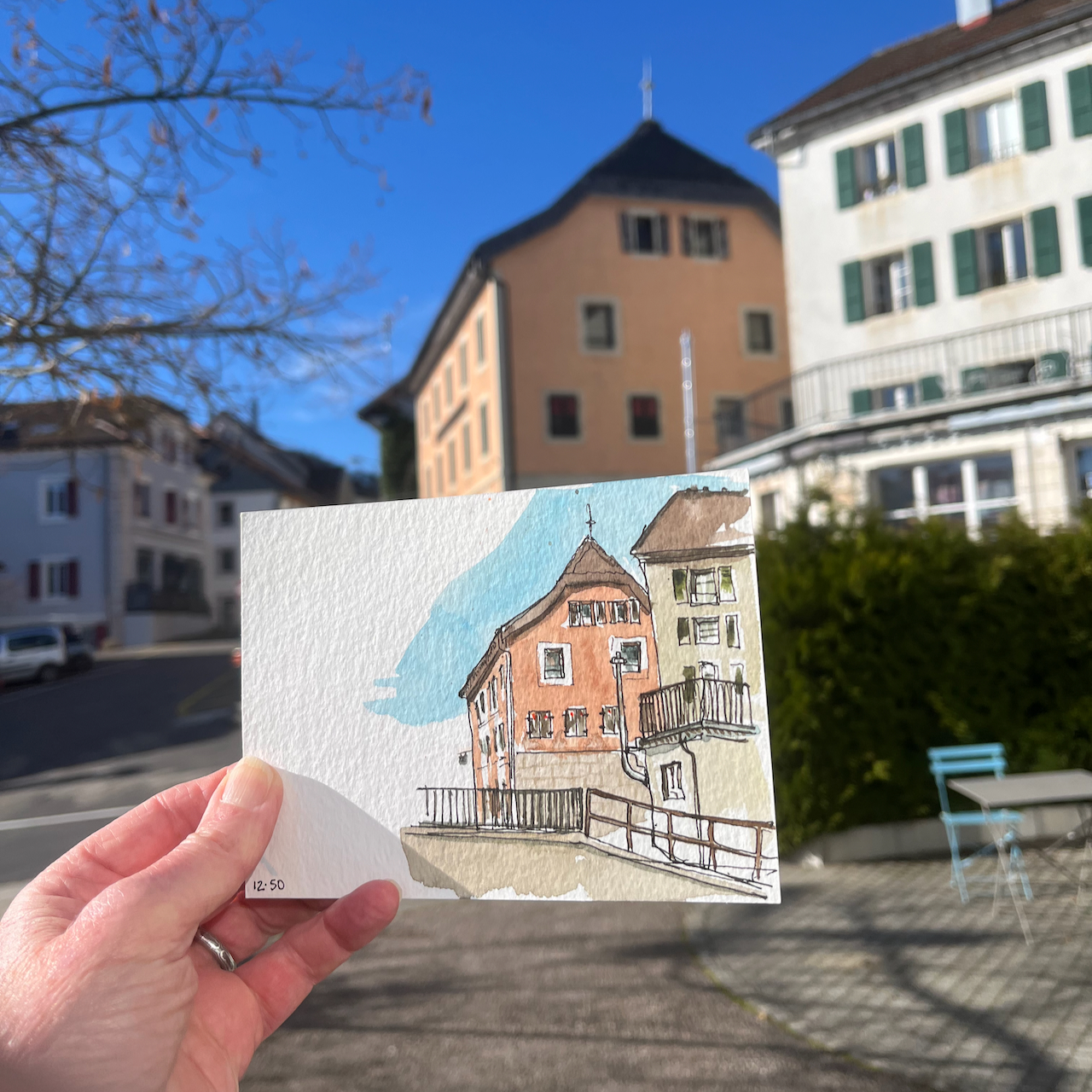
Here are postcards from Switzerland, sketched quickly on 4″ x 6″ watercolour postcards.
A walk above the villageLooking across Lake Geneva from MorgesFrom Les Praises, looking across to the Alps The Alps above the fogSketching in Sainte-Croix, Vaud (1000m)
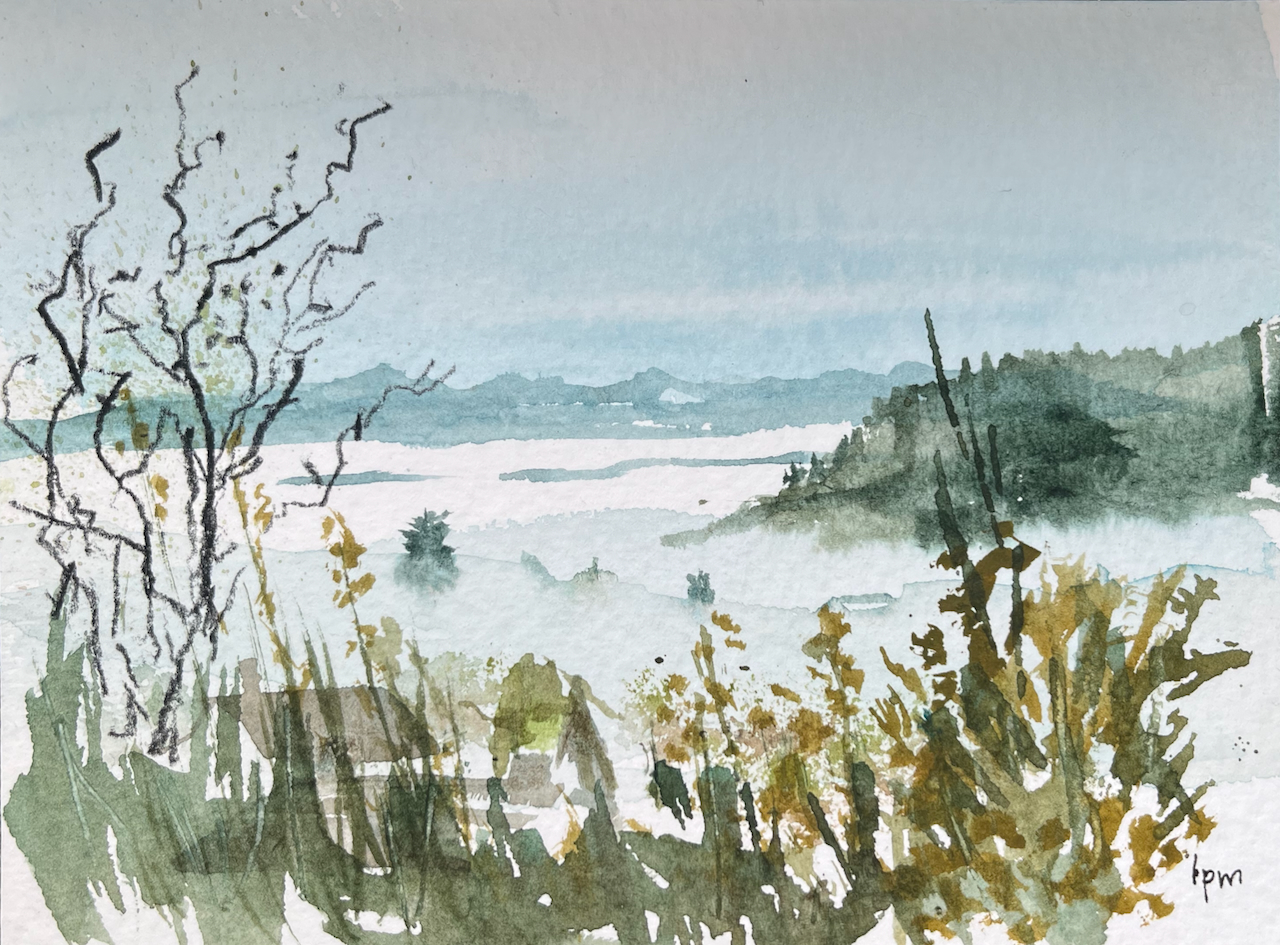
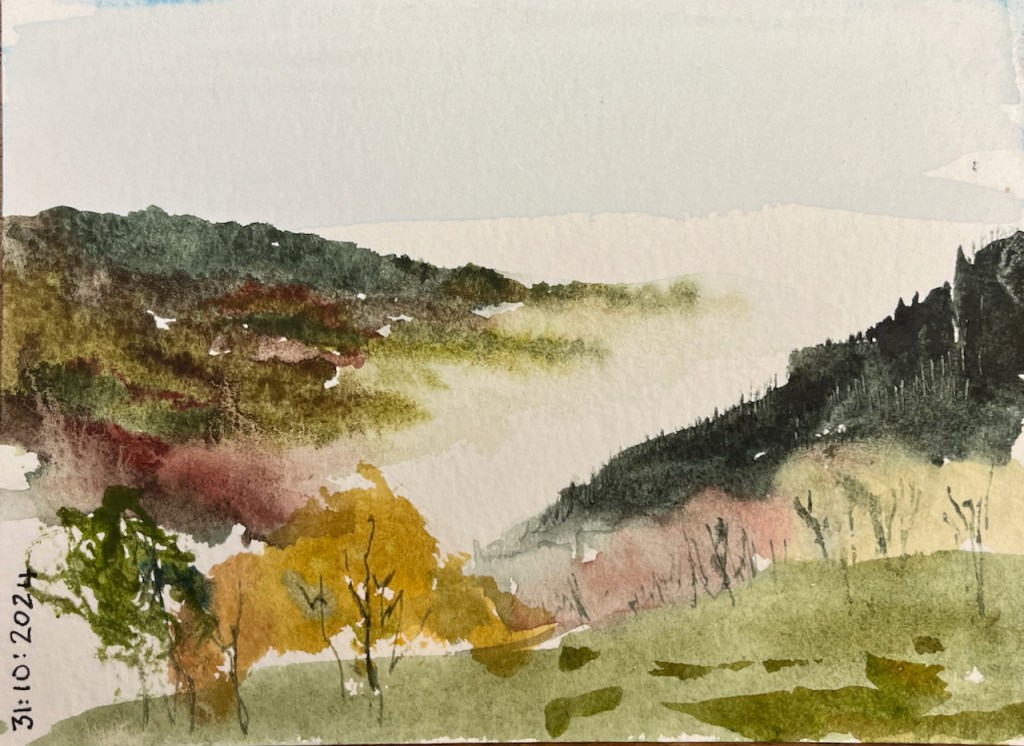
It was foggy in the valley, and clear at 1000m.
One day, starting early, my hosts dropped me in the village of Vuiteboeuf, which is at the lower end of the Gorges de Covatannaz. I walked up, through the fog. It took about an hour and a half. I’d intended to sketch and I had my watercolours with me. But the fog made it surprisingly cold, and I didn’t want to stop or I would freeze. I was warm so long as I kept walking. So I made very quick sketches using Derwent “inktense” watercolour pencils. Here are my sketches in video format.
Here is the view over the Gorge, from the fields at the top.
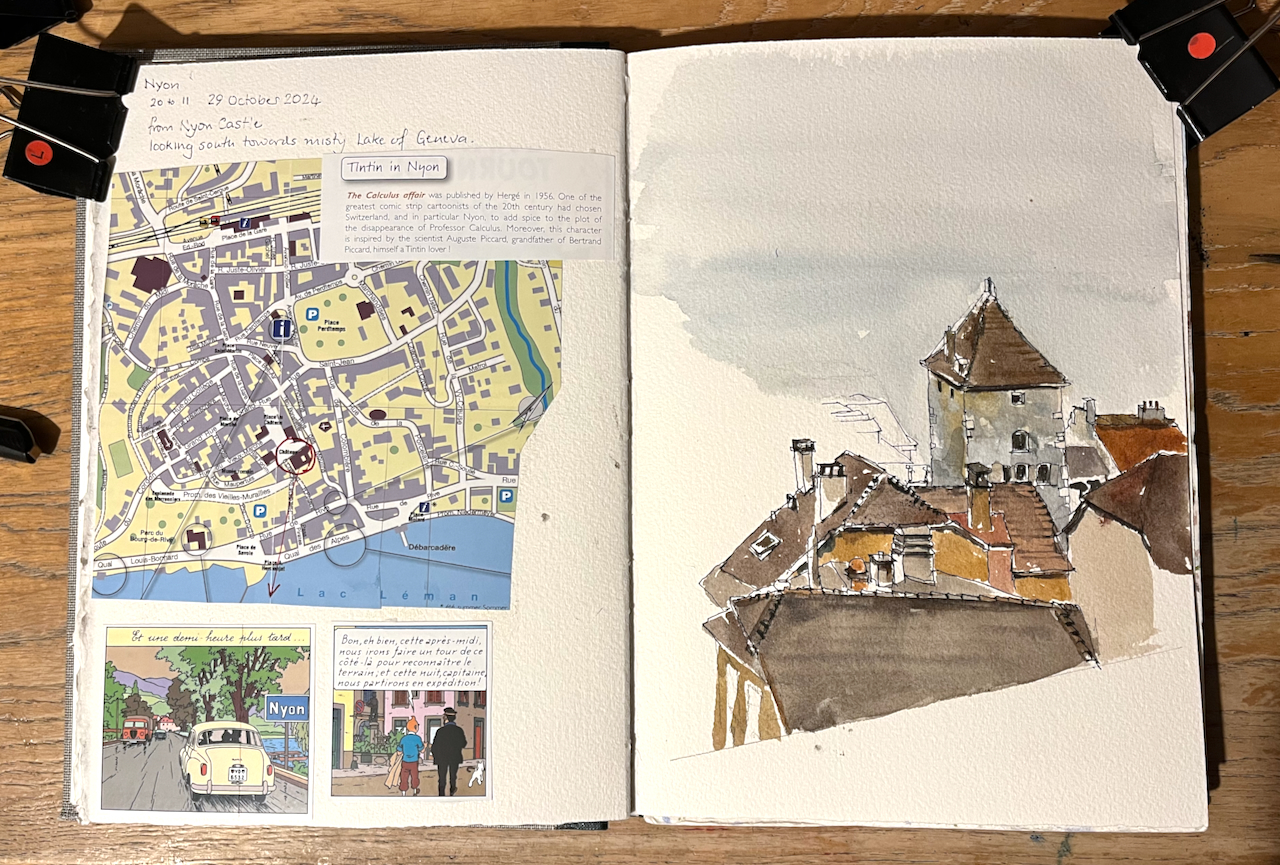
My visit took me to Nyon, on the shores of Lake Geneva. I made a quick sketch from the walls of the castle. Did you know that the Tintin story, “The Calculus Affair” was set in Nyon? The tourist office made much of this connection.
Sketchbook 15, Nyon page spread.
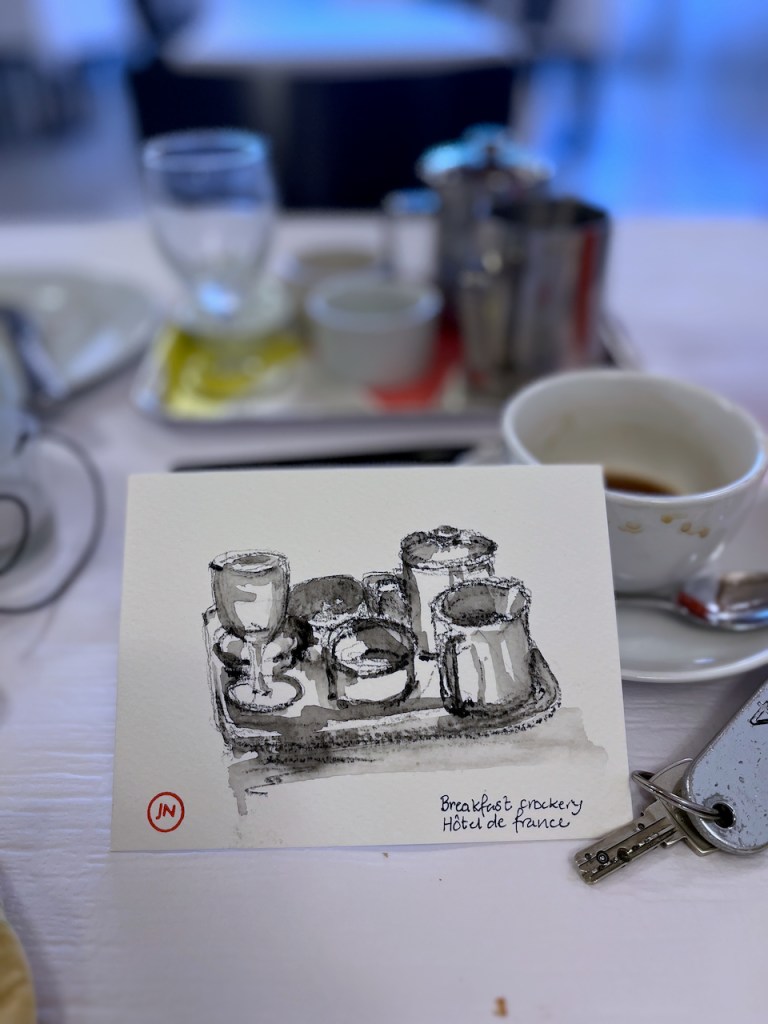
Switzerland is beautiful in the Autumn. Thanks to my hosts at the Hotel de France, Vaud, for their hospitality.
Click a button below to share this post online, email it, or print it:
It was foggy, cold and wet outside. I made pigments.
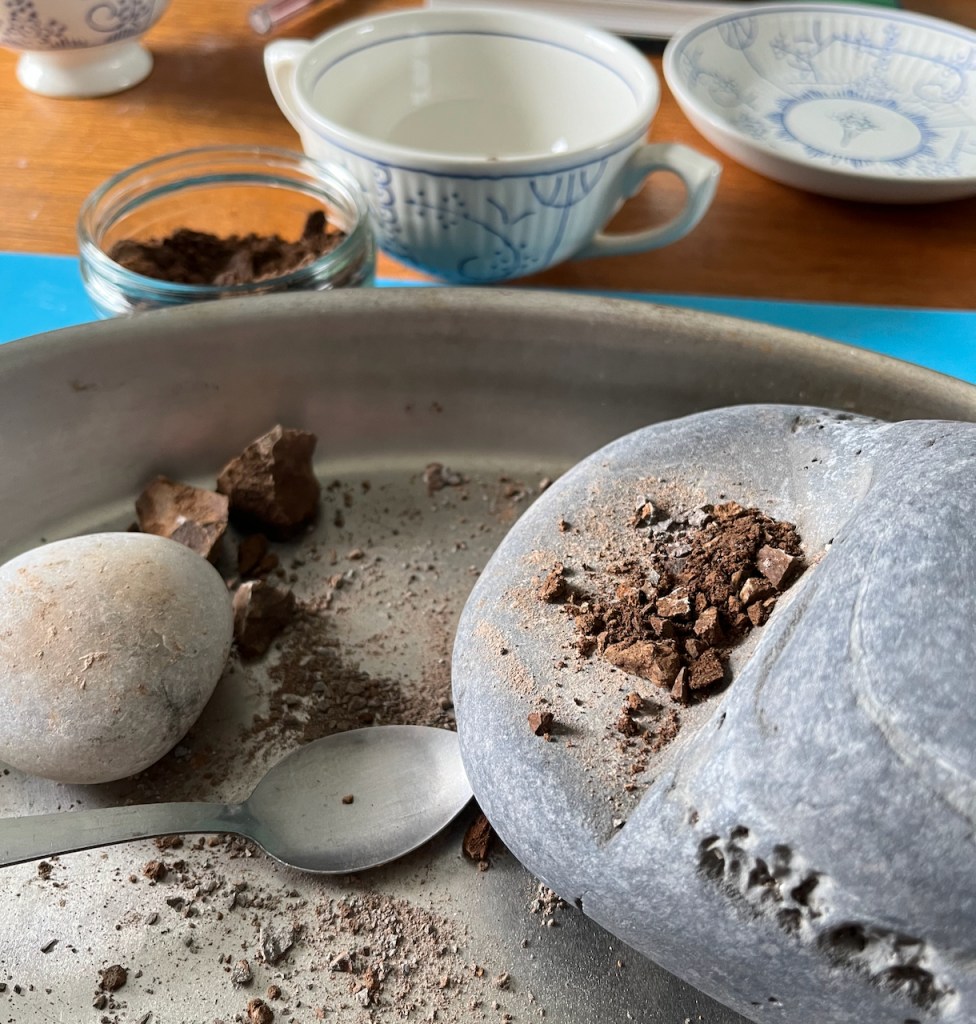
I collected earth from round about. I know from previous attempts that it works best if you have fine earth. So I went up the road in the rain and scooped up the fine silt running off a track. I dried it indoors, and then crushed it to what I hoped was a fine powder.
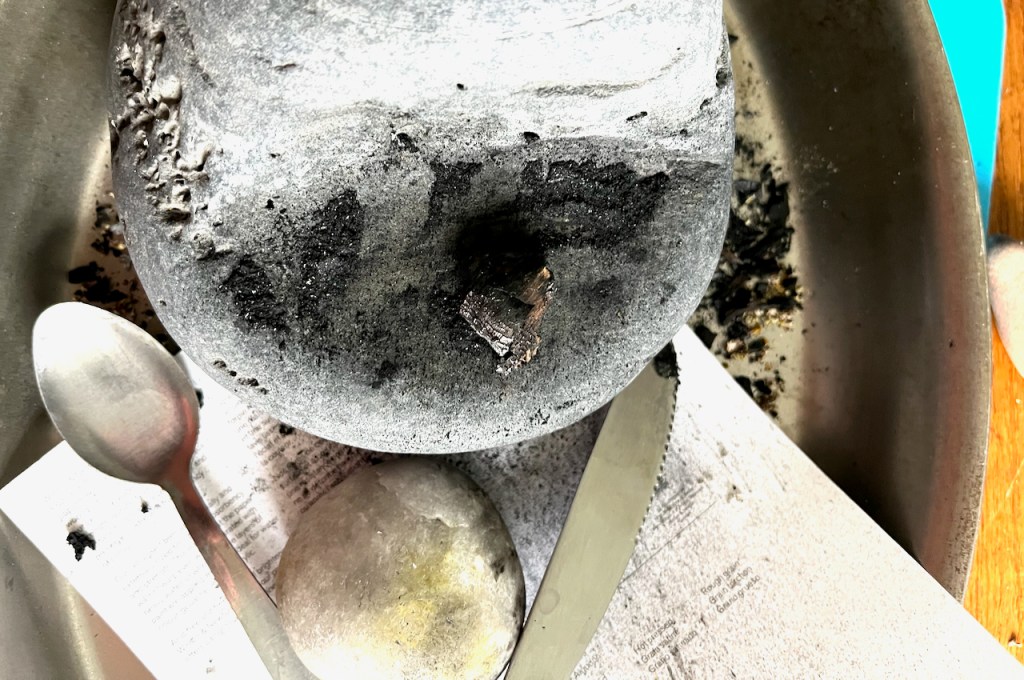
As you see I had an excellent beach stone for this purpose.
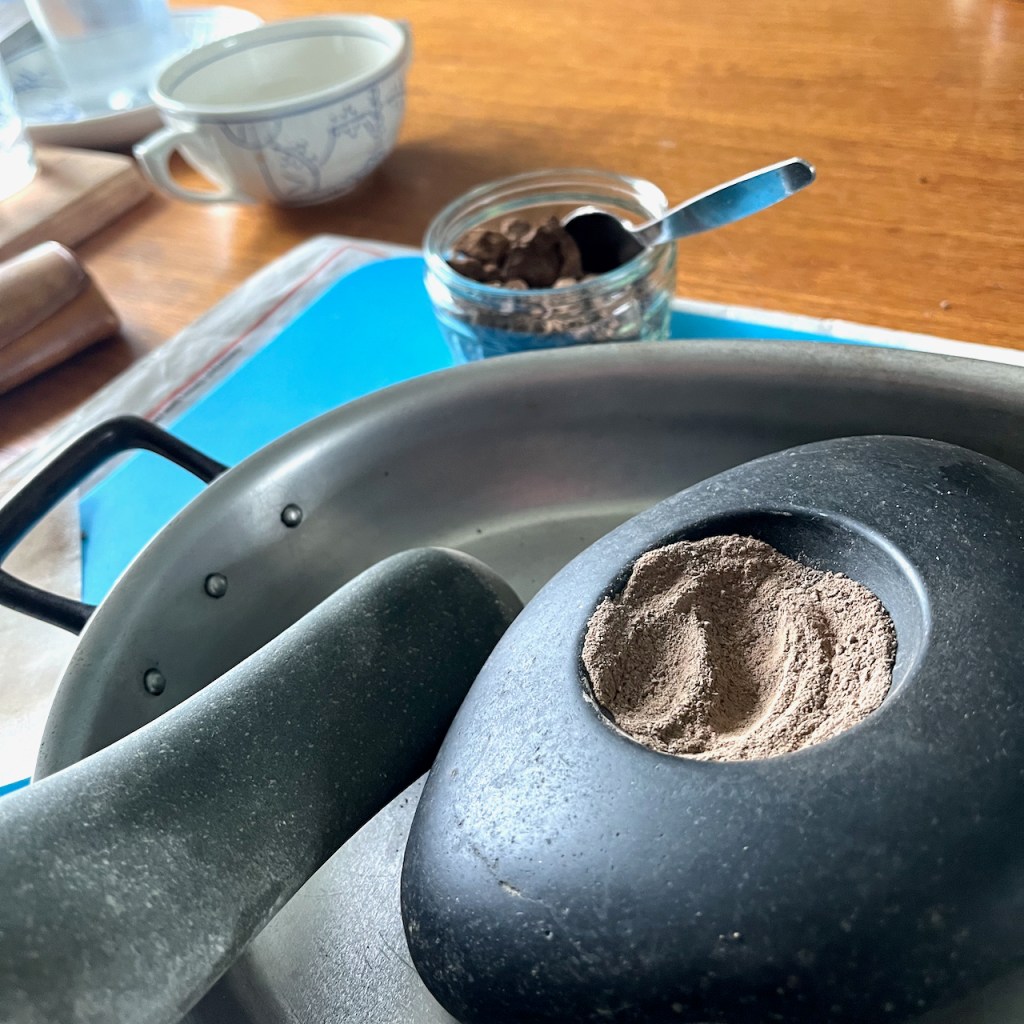
Then to grind it finer I had a pestle and mortar. This is a beautiful home-made item.
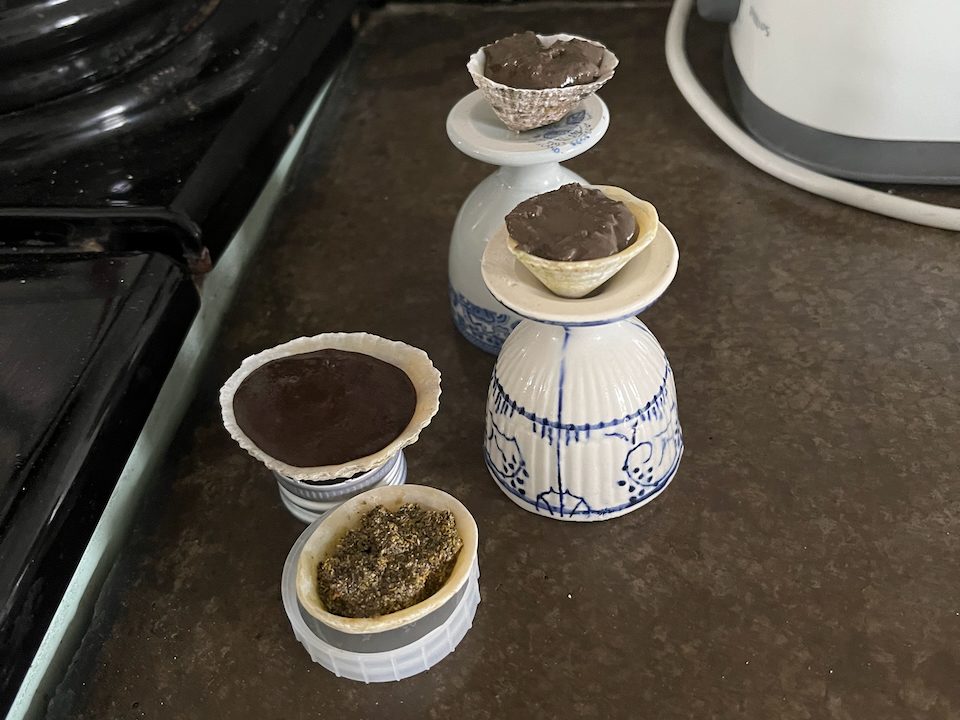
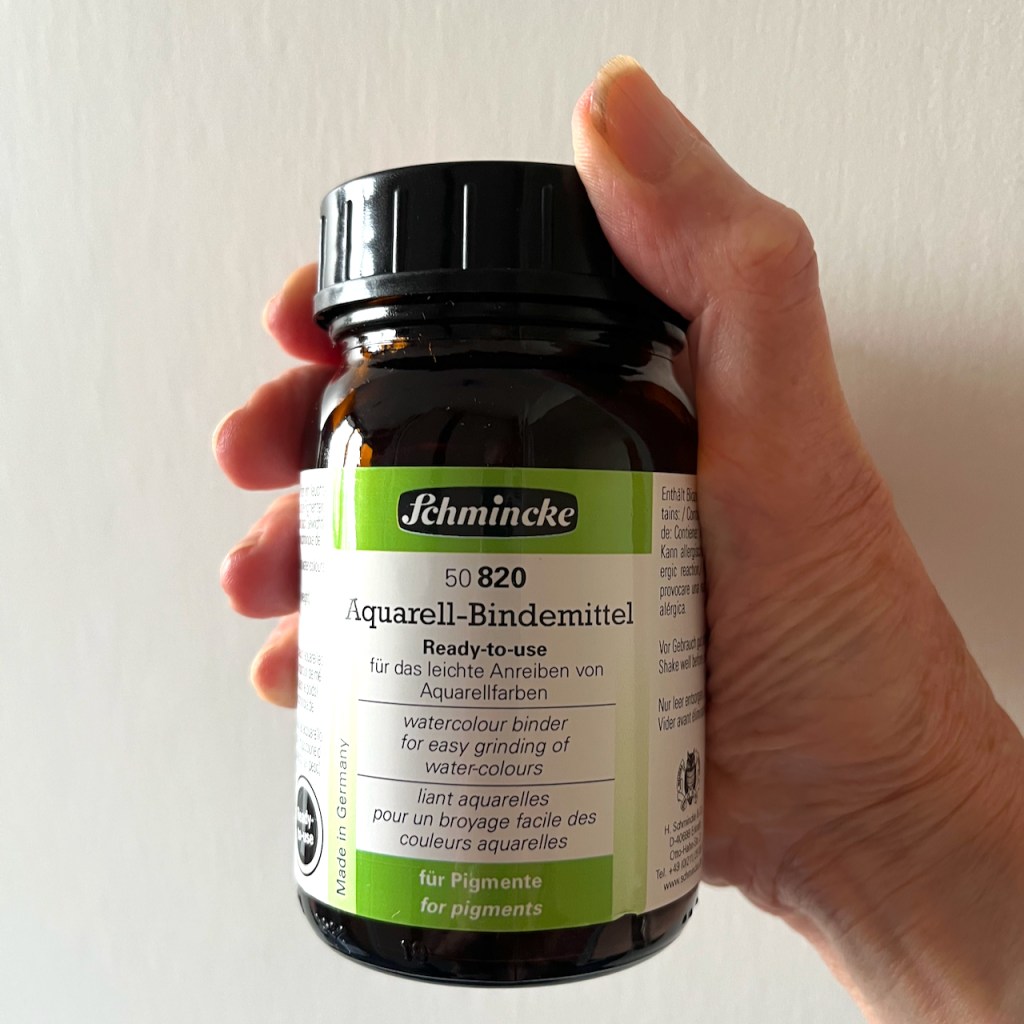
Now I have earth pigment. To make watercolour I add Schmincke Watercolour Binder in the ration of 2 parts binder to 1 part pigment. Mix and put in a limpet shell. It’s ready to use immediately as a paste, or it dries and can be rewetted like normal pan watercolours. Here are the paints drying:
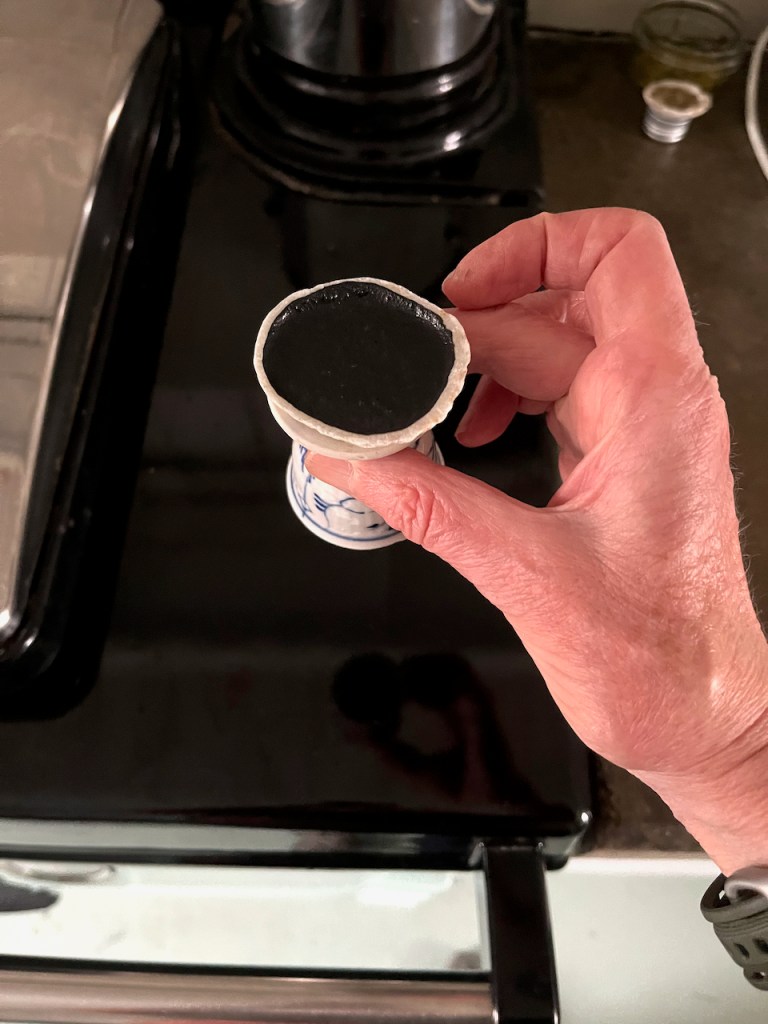
Pigment mixes in limpet shells, drying on eggs cups (to keep them level).
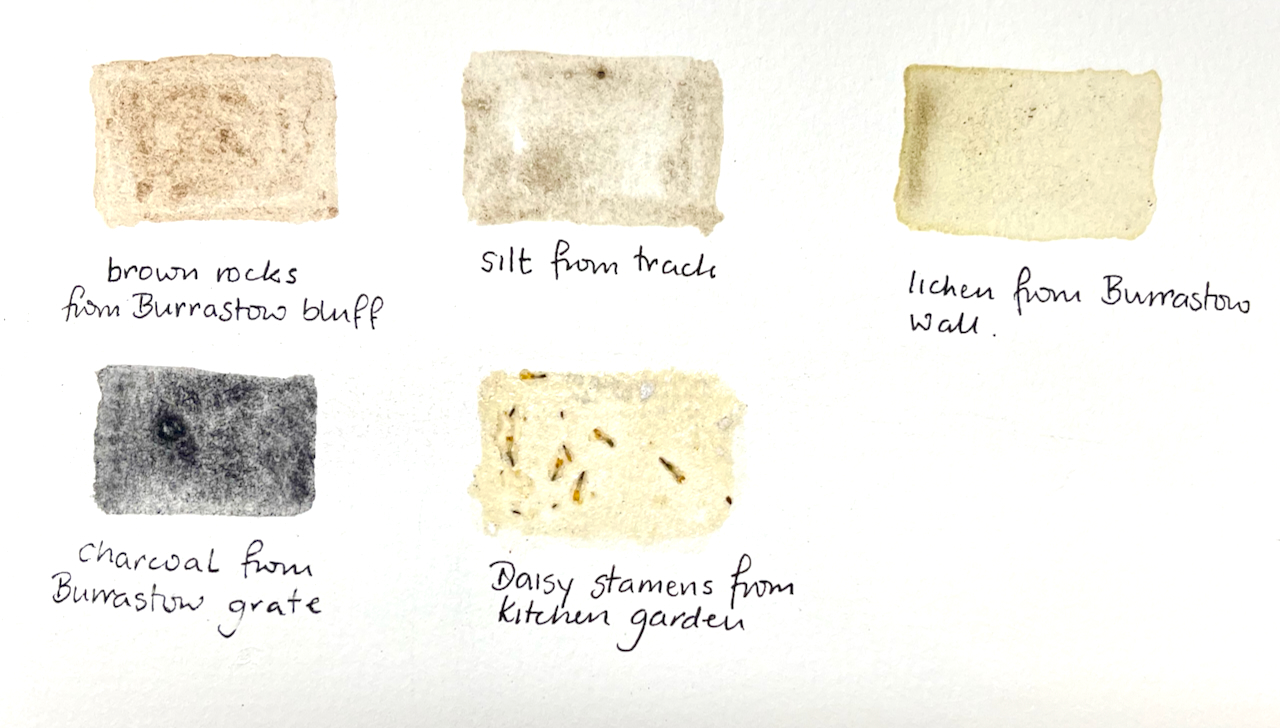
Above you see paints made of earth from different places. At the front is a paint made from yellow lichen. The lichen was bright yellow on the stone wall. I couldn’t find a way to separate out the bright yellow surface from the grey underneath, so the pigment is a grey/yellow mix.
Here is a selection of pigment experiments, to show how they look when painted:
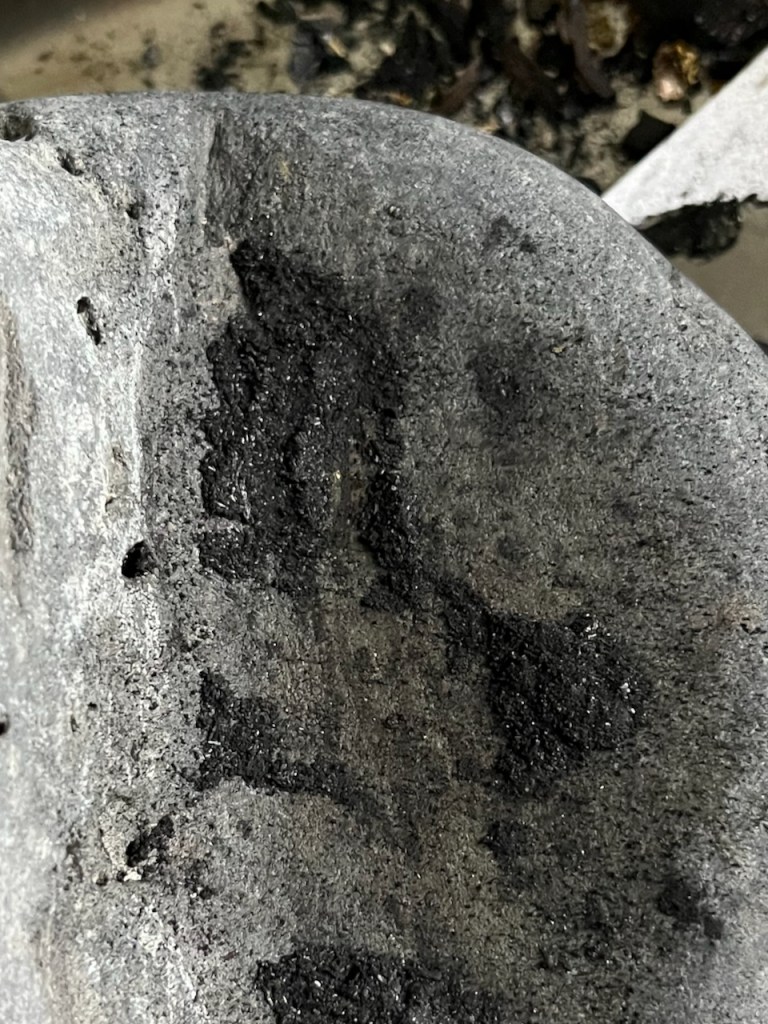
Making the charcoal pigment was not so effective as I thought it would be. I found a small chunk of black charcoal from the grate and proceeded to crush it. This produced skittering fragments and airborne dust which settled everywhere. It did not produce a fine powder in my pestle and mortar. It produced hard, flaky, bits. As you see above, the paint it produced was granular and not very black.
Trying to grind the charcoalGround charcoal: bitsCharcoal paint
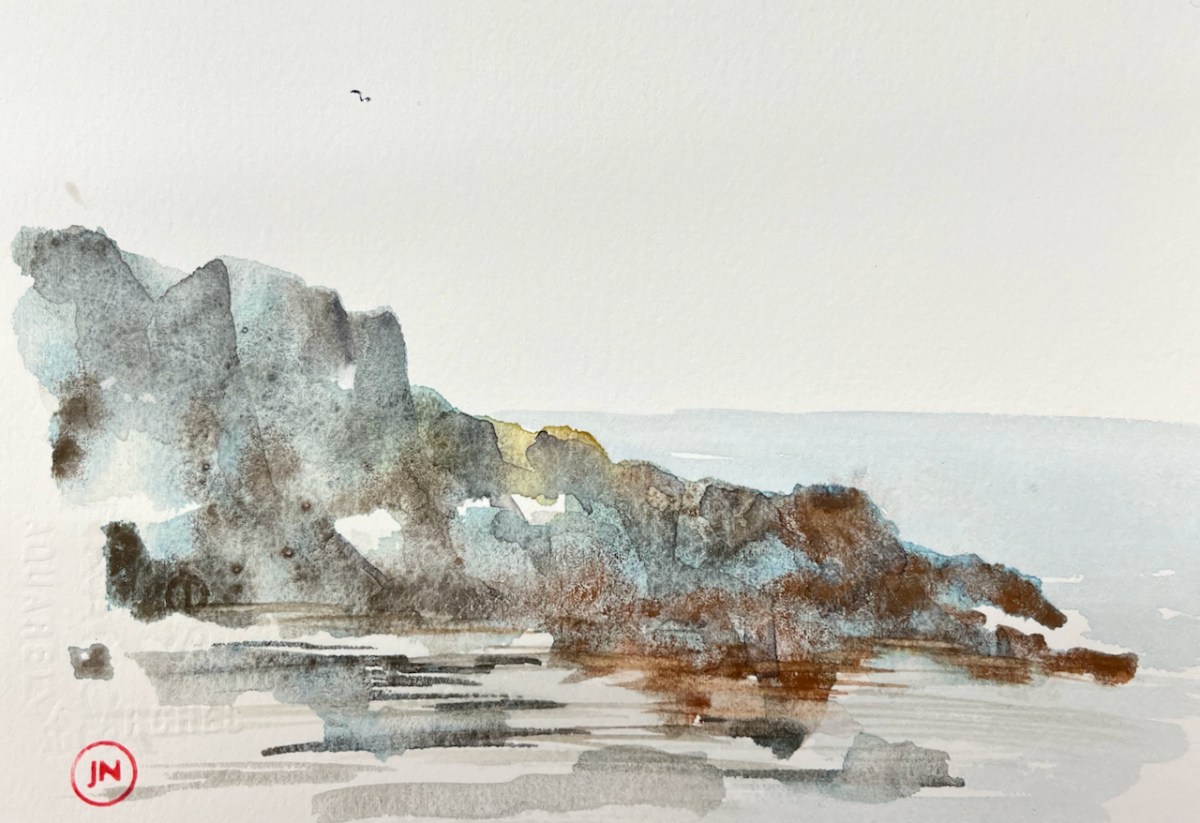
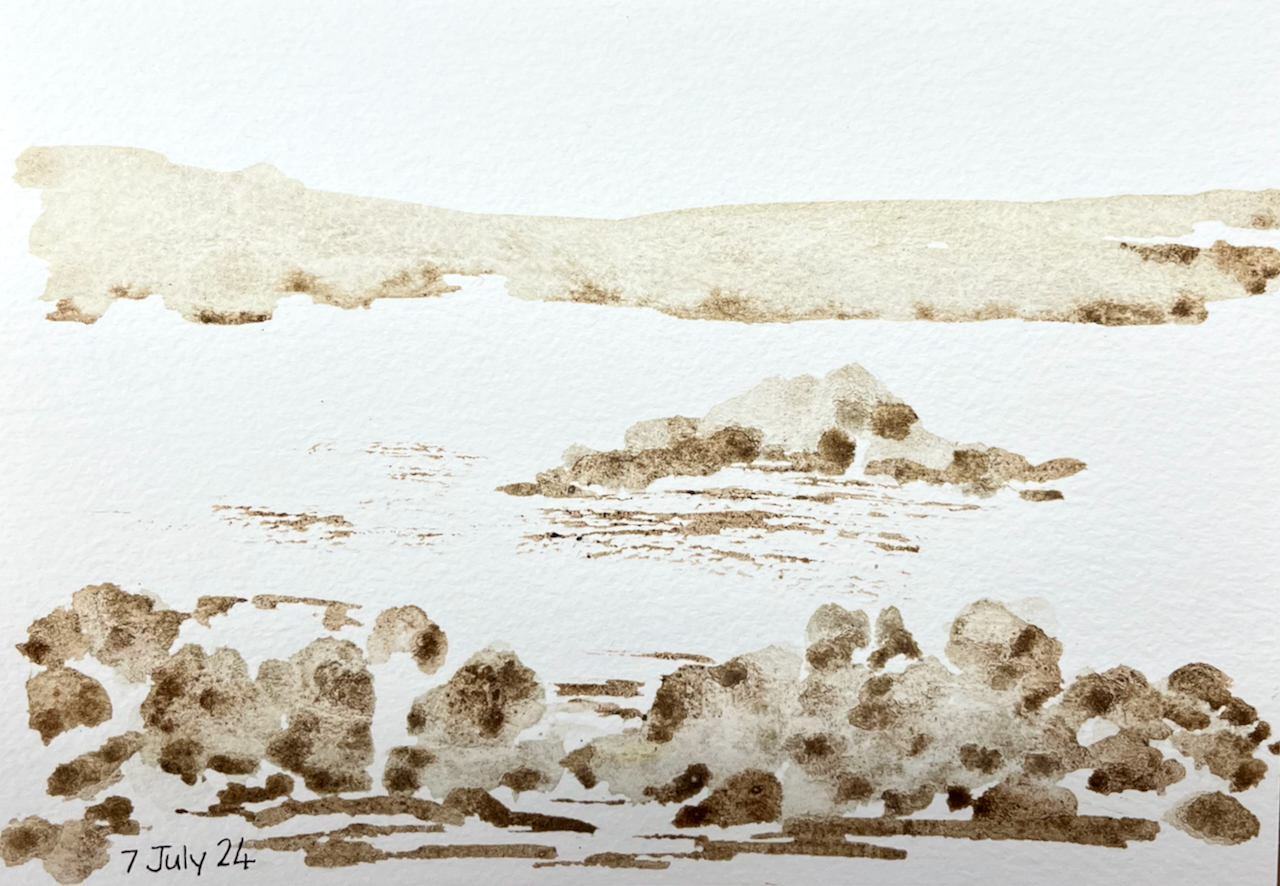
Here is a picture painted entirely with home-made pigments:
Coastal scene: painted with home-made pigments.
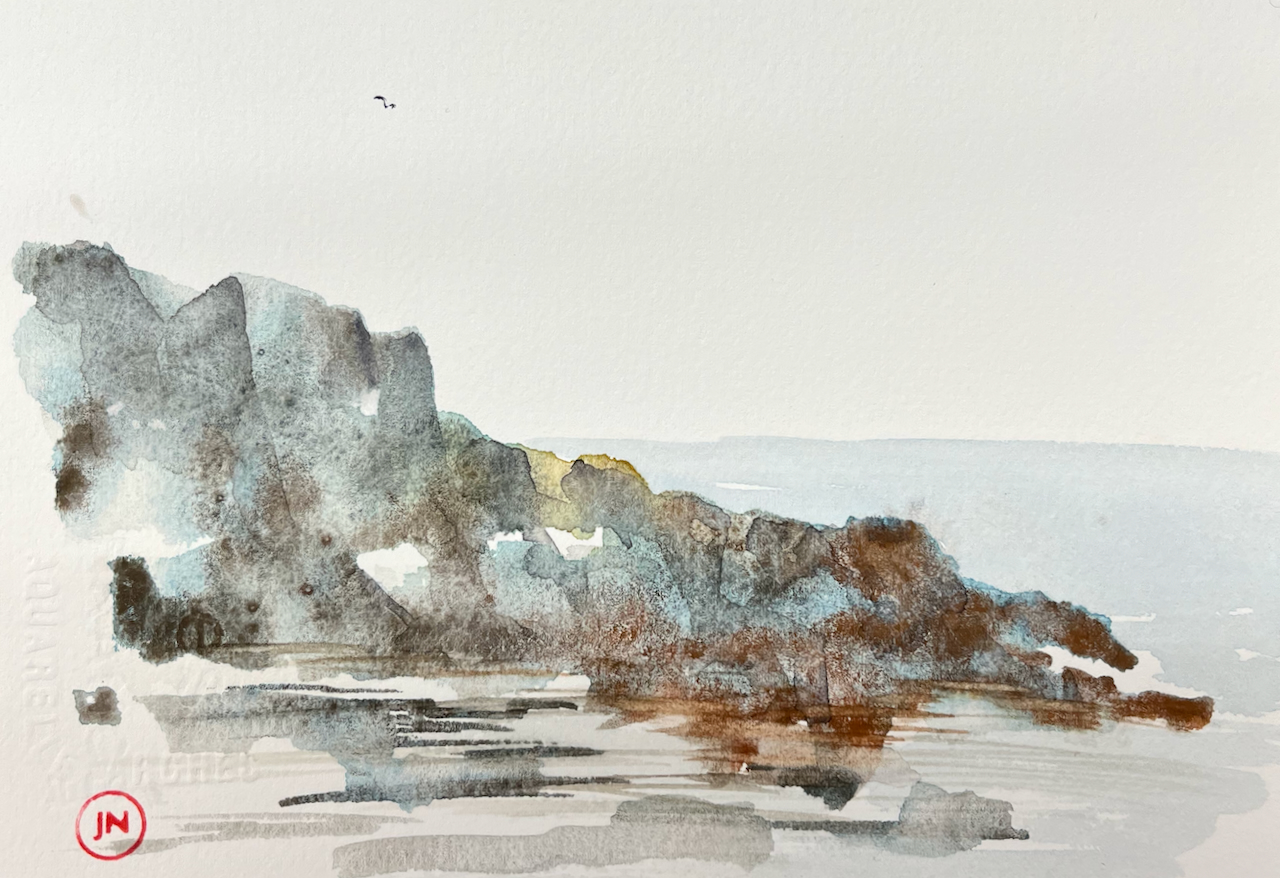
Here is a picture painted with home-made pigments and shop-bought watercolours:
“Promontory”. Painted with home-made watercolours with shop-bought watercolour (blue).
This is the binder I used:
Click a button below to share this post online, email it, or print it:
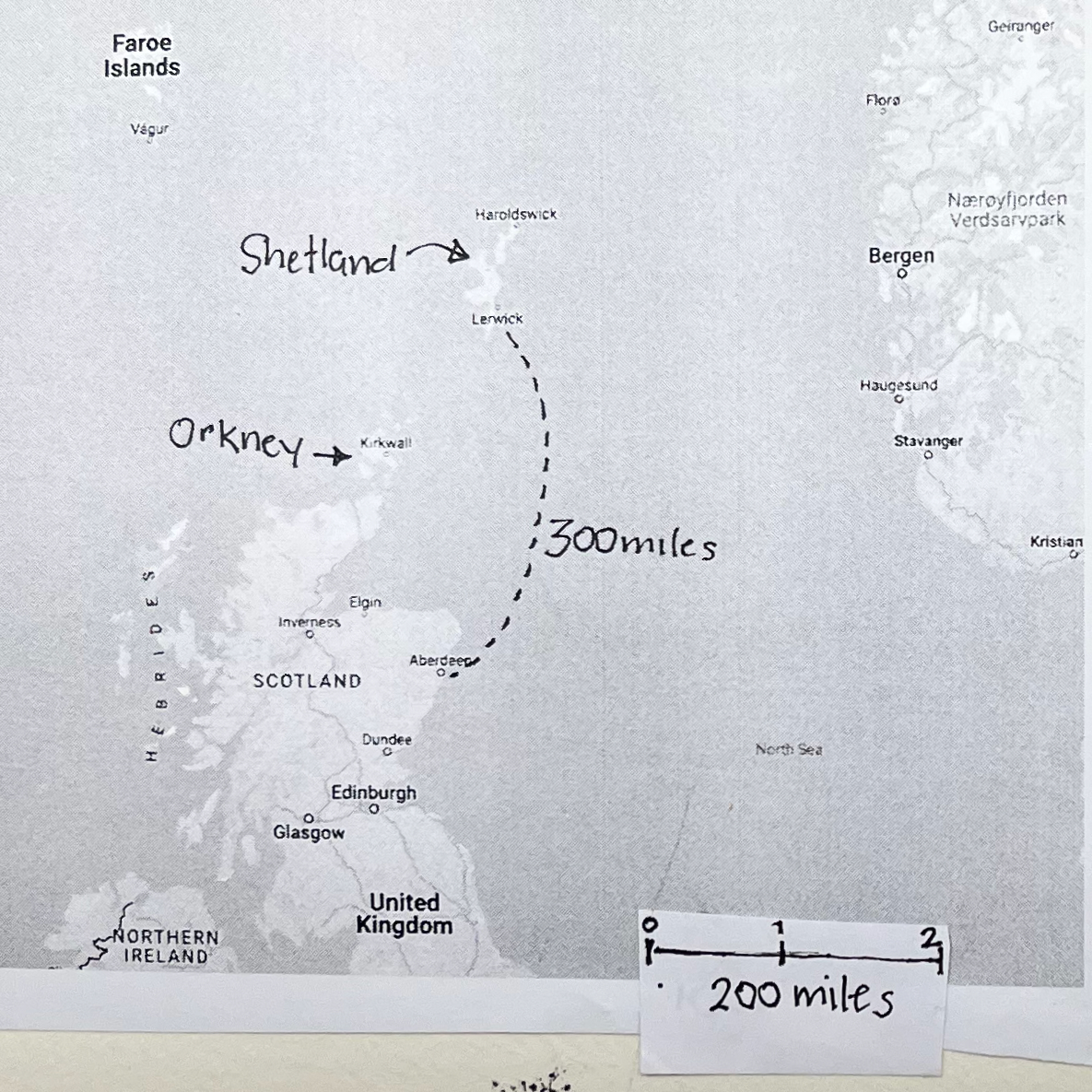
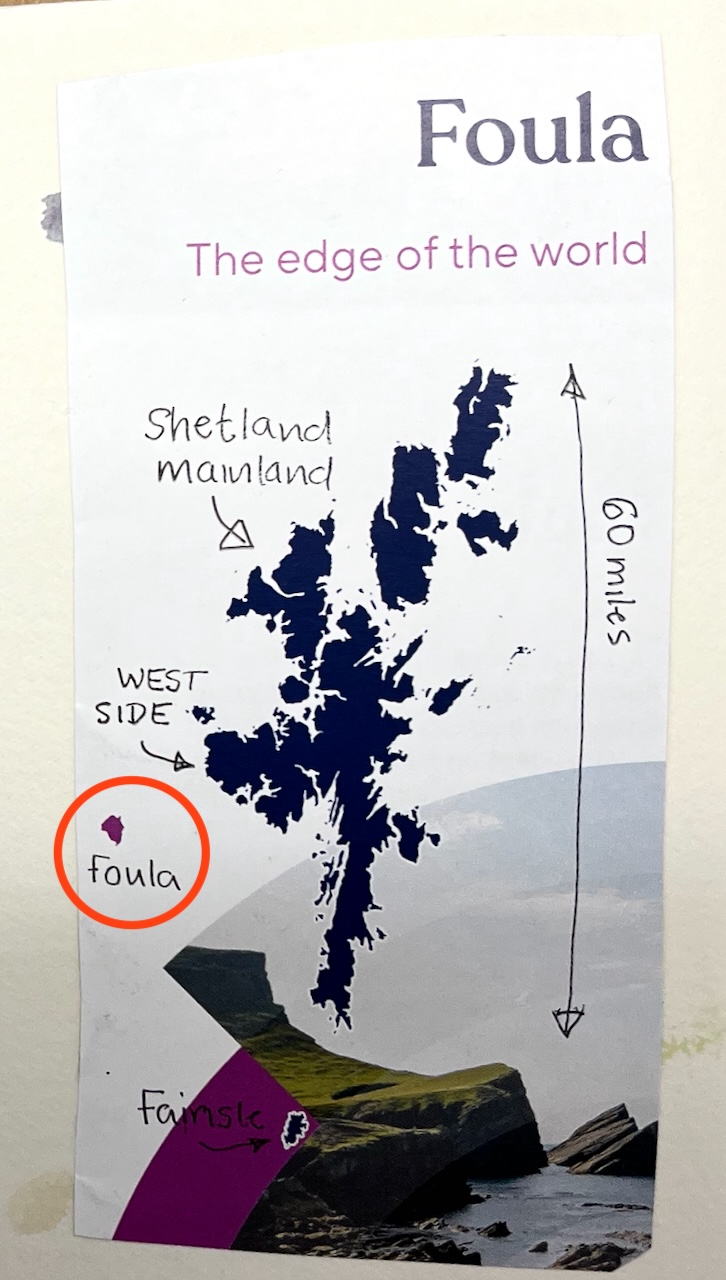
Foula is a small island 20 miles off the west coast of mainland Shetland. Shetland is a group of islands about 200 miles north of Scotland.
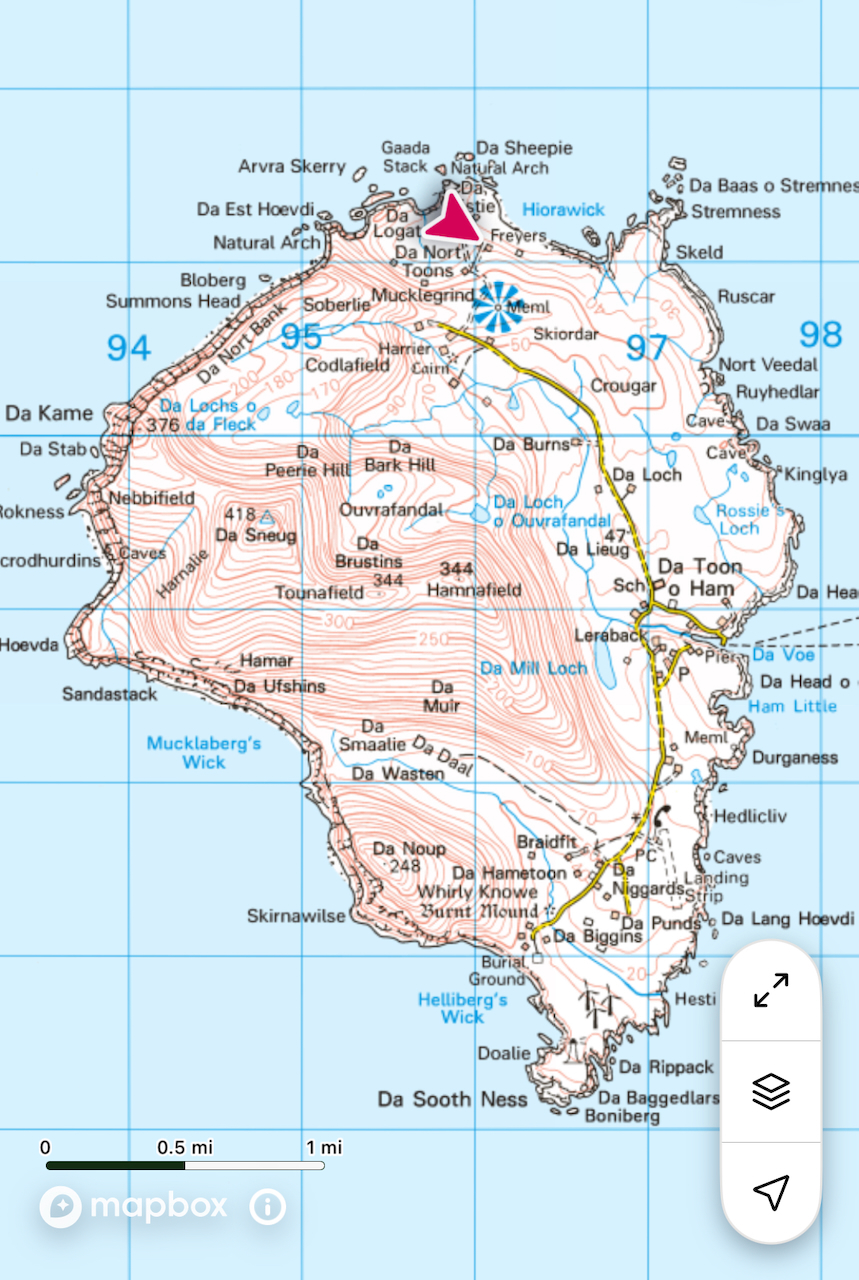
300 miles from Aberdeen to ShetlandFoula is 20 miles off the West coast of ShetlandFoula: an island 3 miles by 2 miles. Arrow shows where I stayed.
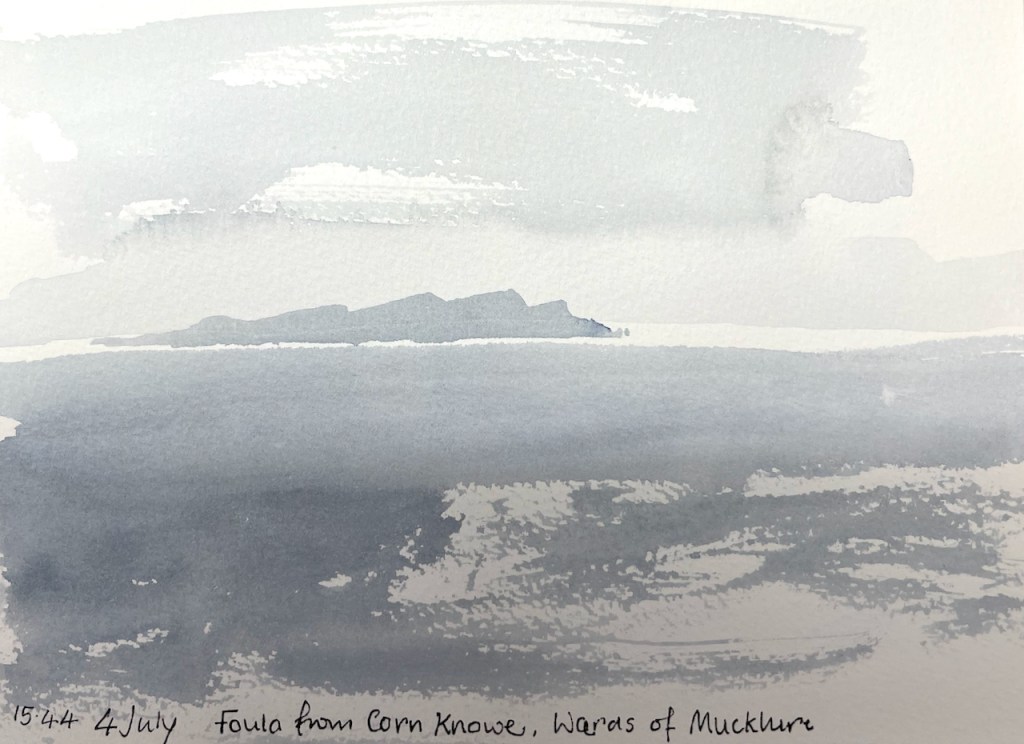
I had seen Foula, from a distance, on previous visits to Shetland. It floats on the horizon, mysterious.
Foula, seen from Mainland Shetland
So I had to visit. What is it like there?
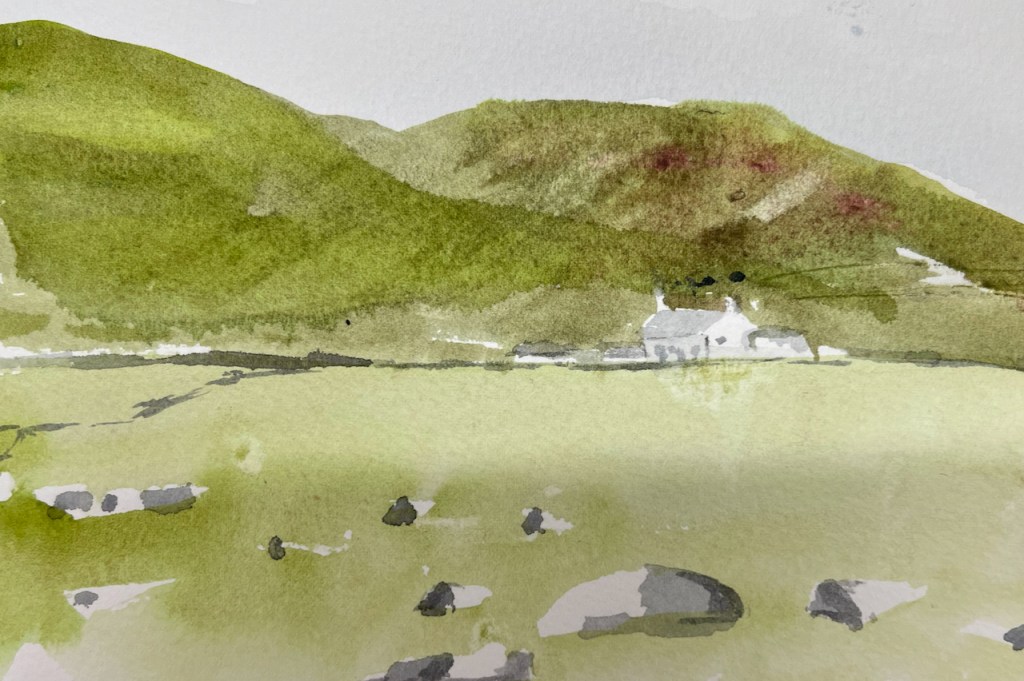
Here is a Foula scene:
Foula: sketched at Da Punds, between the Wind Turbines and the Airstrip.
I sketched this sitting on one of the stones, on a bit of flat and marshy land towards the south of the island. The road is in front of me, at the foot of those hills.
I had to sketch this in a bit of a rush, because, as I rapidly discovered, this particular area is the province of the Skua. There are Great Skua and Artic Skua: large birds, who do not like sketchers sitting on stones in their neighbourhood. They make their irritation known by aggressive fly-pasts. I could hear the wind in their feathers: it sounded like a chain saw. So I quickly took the hint and made for the road. Locals later told me I should “carry a stick above my head”, to distract the skua. That’s all very well, but finding a stick on Foula is about as likely as finding a branch of Pret. There are no trees atall on this part of the island, so no handy lengths of wood.
Other inhabitants of Foula were more welcoming, including the friendly people. The sheep are unafraid, and came towards me as I walked. The horses too seemed pleased to see me. I met the person who is one of the breeders of these horses on the island. “Pat them, talk to them, but don’t feed them!” she instructed me. Feeding them in the wrong order disrupts their established hierarchy and causes fights, she explained. “And,” she added, with emphasis, “make sure you close the gate!!”. There followed stories of visitors leaving gates open, and the subsequent escapades of the stallion, who visited mares he was not supposed to visit….
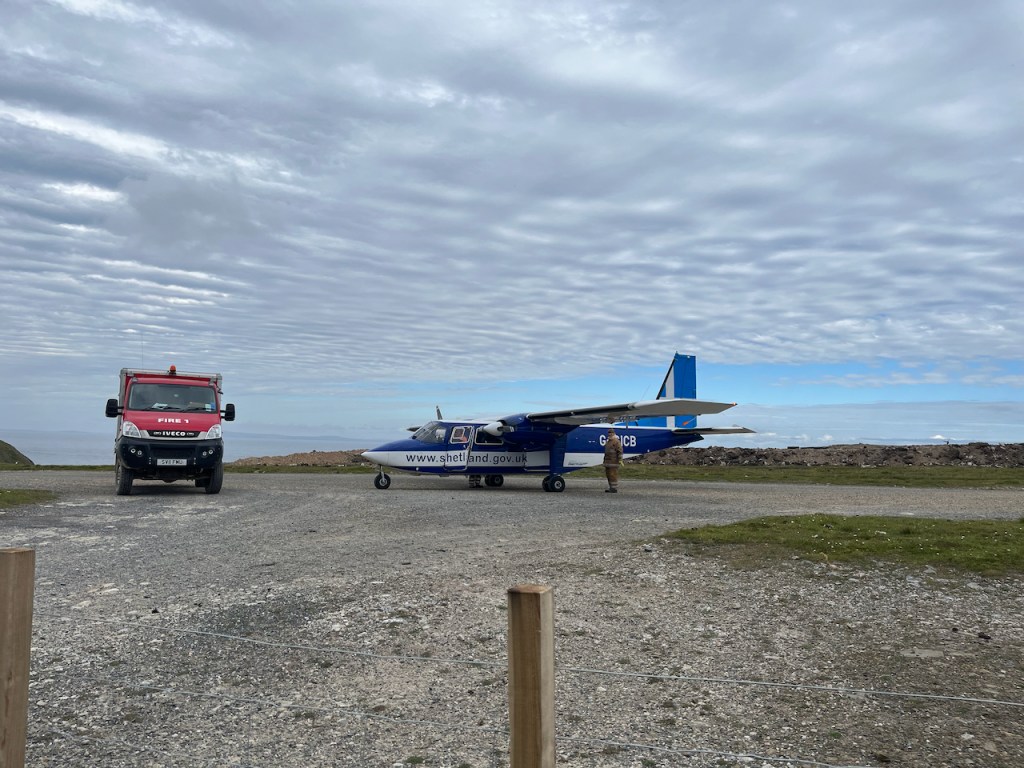
Foula is an industrious place, I discovered. As well as horse breeding, and sheep breeding, there is spinning to produce special Foula Wool, peat cutting, and a lot of horticulture. Also there is a school, a lighthouse, a ferry and an airstrip. The air strip needs a fire crew, as well as pilots. The school has a teacher. There are wind turbines and a very effective 5G mobile signal mast, with big dishes directed at mainland Shetland. This is a lot of activity for a place of only 35 inhabitants, especially as six of those inhabitants are primary school children.
The plane and the fire truck on the airstrip at Foula
Horticulture takes place in polytunnels and inside abandoned cars. As on mainland Shetland, vegetables and flowers will grow, so long as you can shelter them from the wind. I was given local raspberries from a polytunnel at the school.
It was rather foggy when I visited, so I opted for lowland routes and did not climb the formidable mountains shown in the picture above. Had I done so, I would have seen the famous 1000ft sea cliff. But I was wary. I did not want to stumble across the famous cliff in the fog.
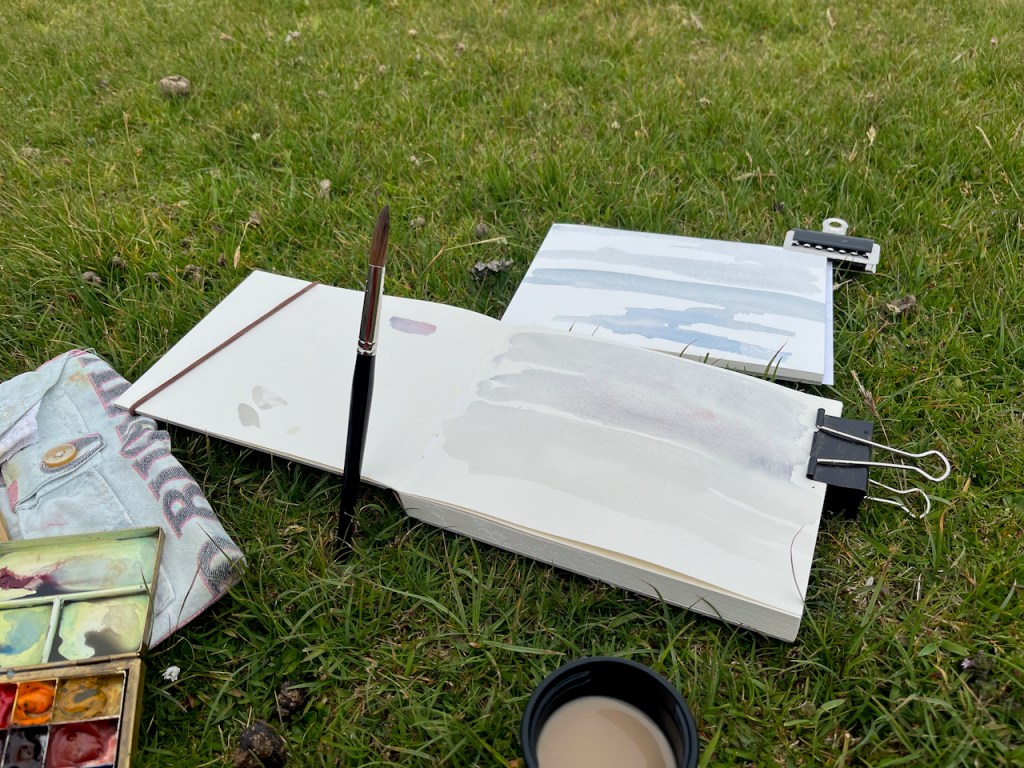
Sketching in the fog
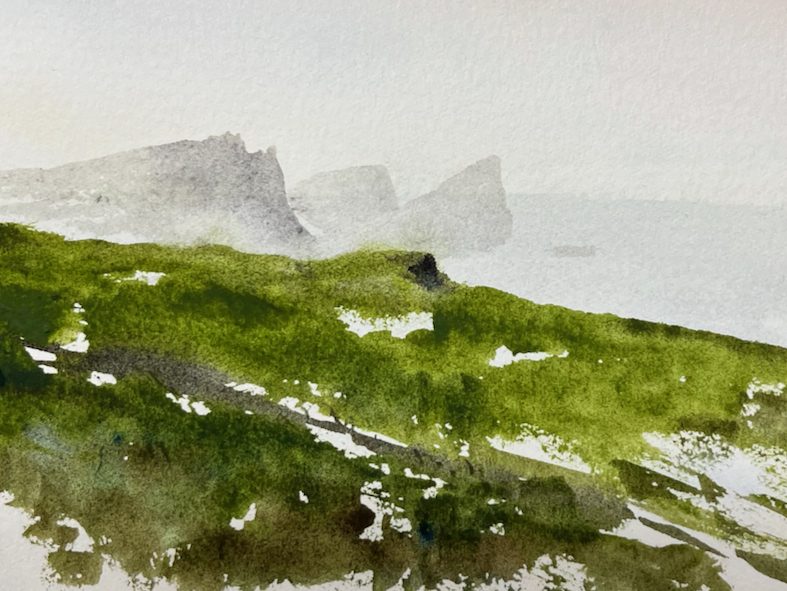
I was staying at “Ristie self-catering”, in the North of the island. Here is the scenery round there.
The edge of the world.
Foula on the horizon
Click a button below to share this post online, email it, or print it:
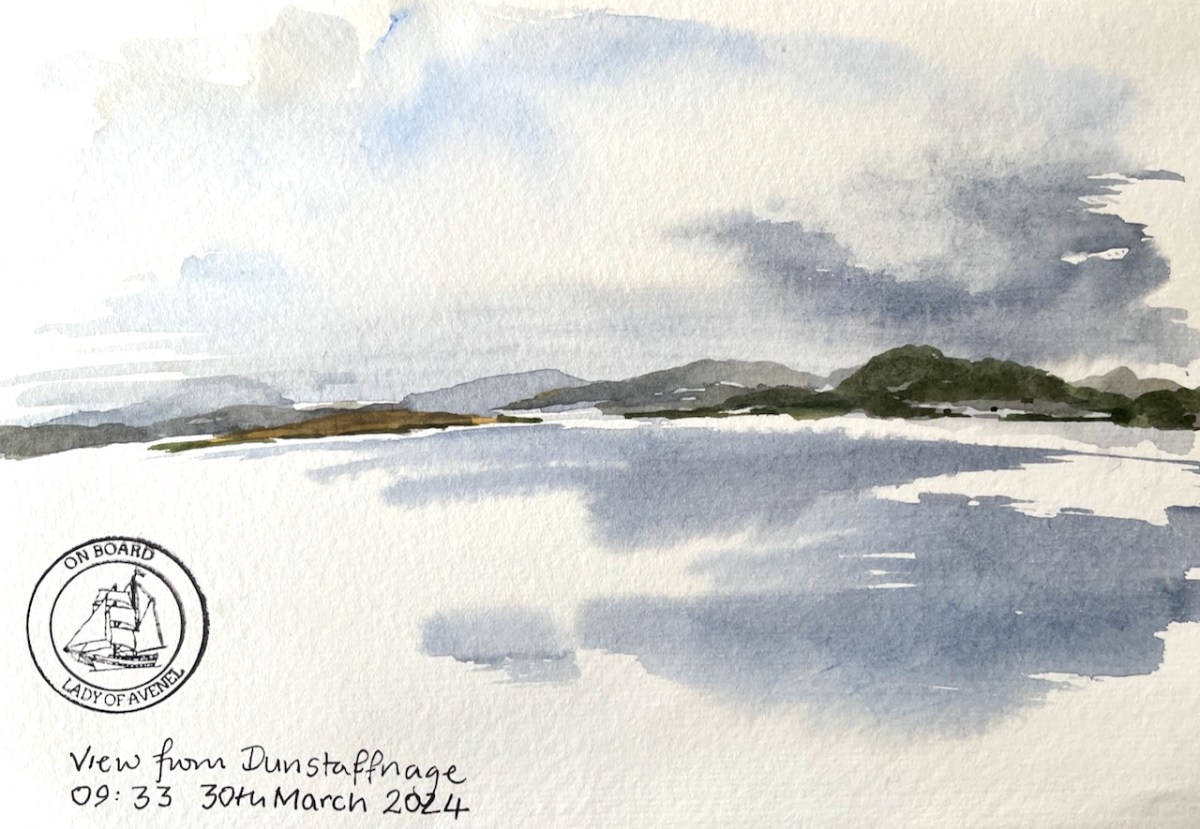
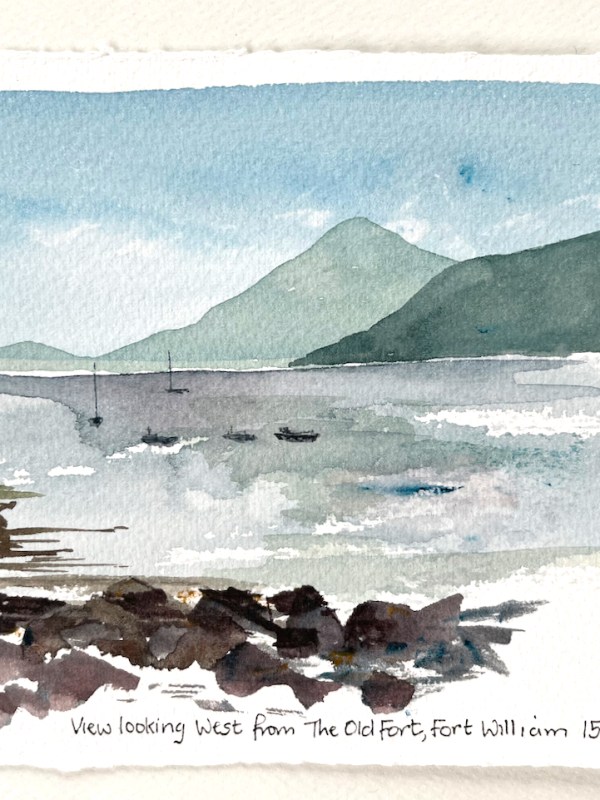
Here’s a view from the ship”Lady of Avenel”. She which was at the Dunstaffnage Marina, Oban, at the time. This is a quick sketch done on thin “Amatruda” watercolour paper, sent as a postcard. It is the view looking north, towards Fort William. See the rain clouds coming!
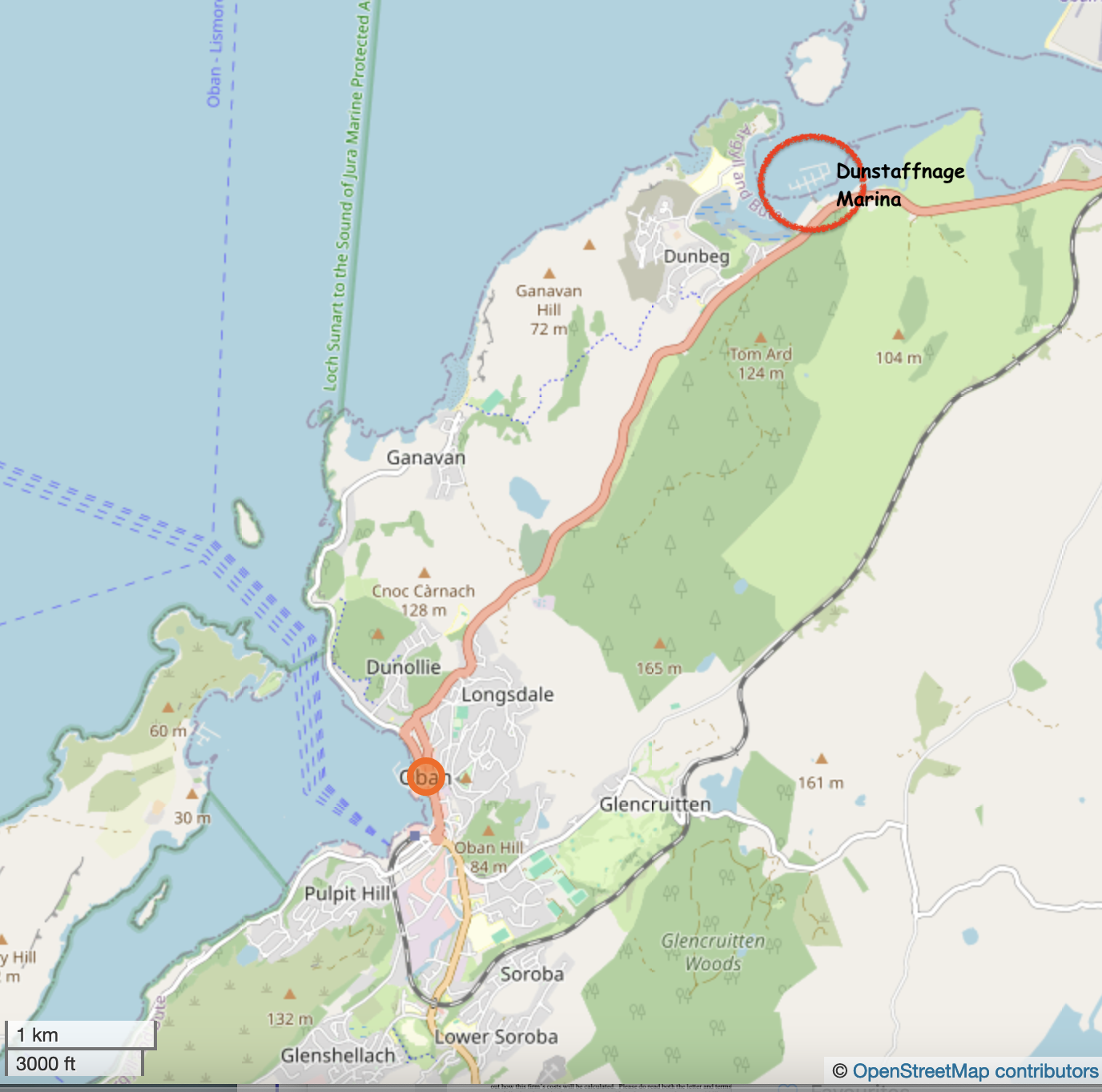
Oban is on the West Coast of ScotlanLady of Avenel was at Dunstaffnage Marina
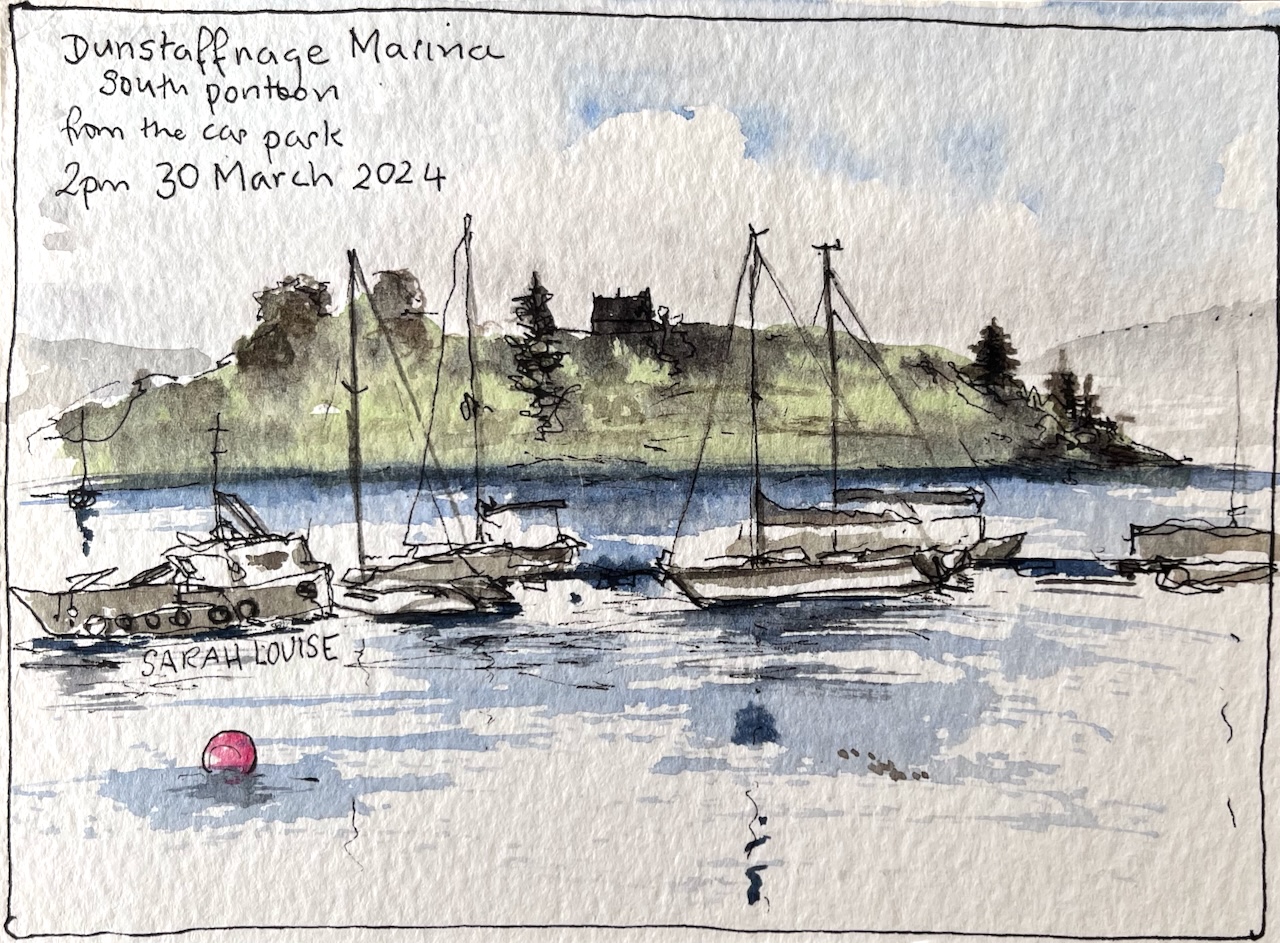
Here’s a quick sketch of the marina.
Quick sketch on a 6″ x 4″ postcard
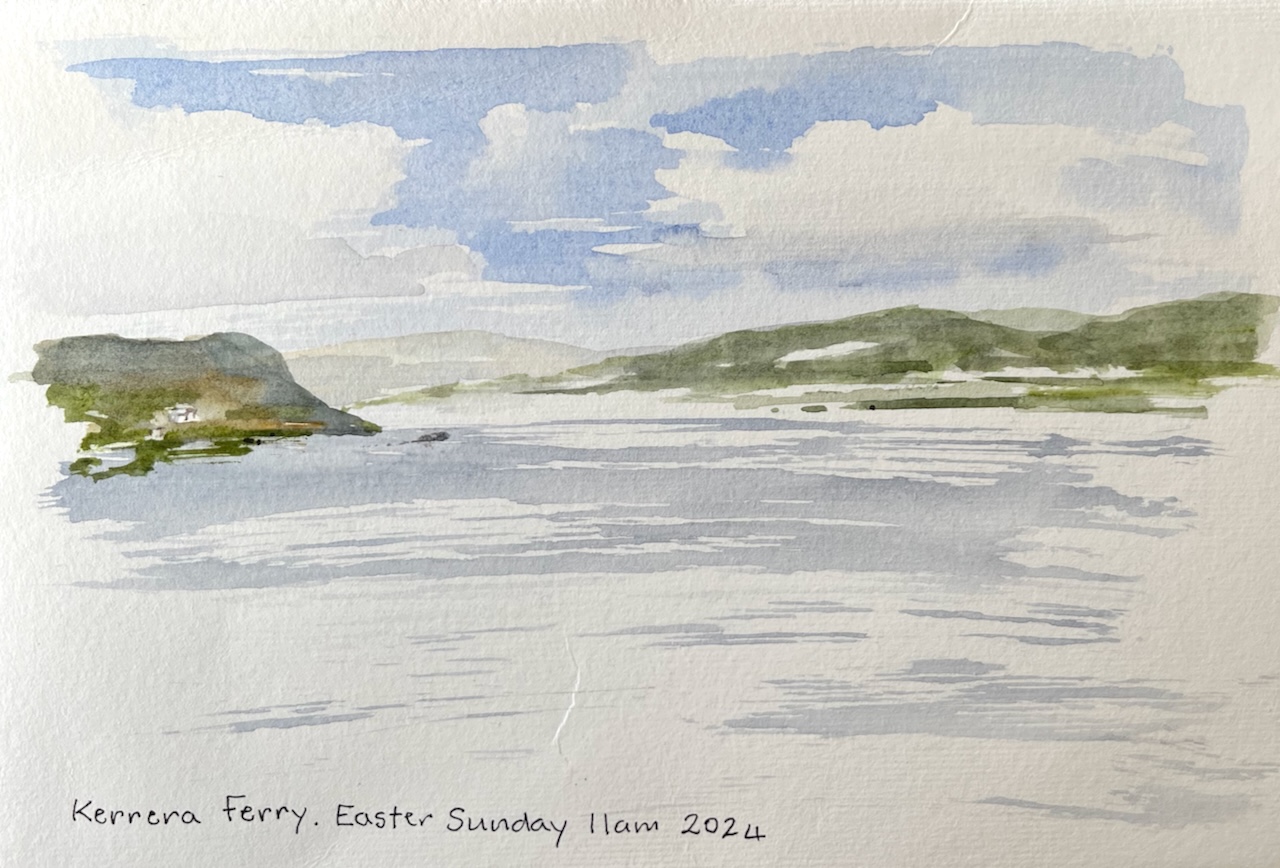
Later I visited the lovely island of Kerrera.
A5 Amatruda watercolour paper.
These landscapes are so inspiring! I’ll be leading a “Sketch and Sail” adventure on the Lady of Avenel in October 2024, together with Alice Angus. We’ll start and finish in Oban. Would you like to join us? Have a look at this page and get in touch!
Click a button below to share this post online, email it, or print it:
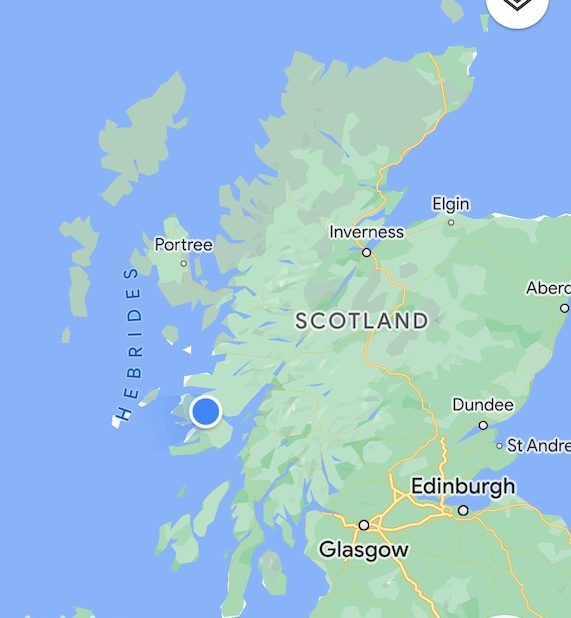
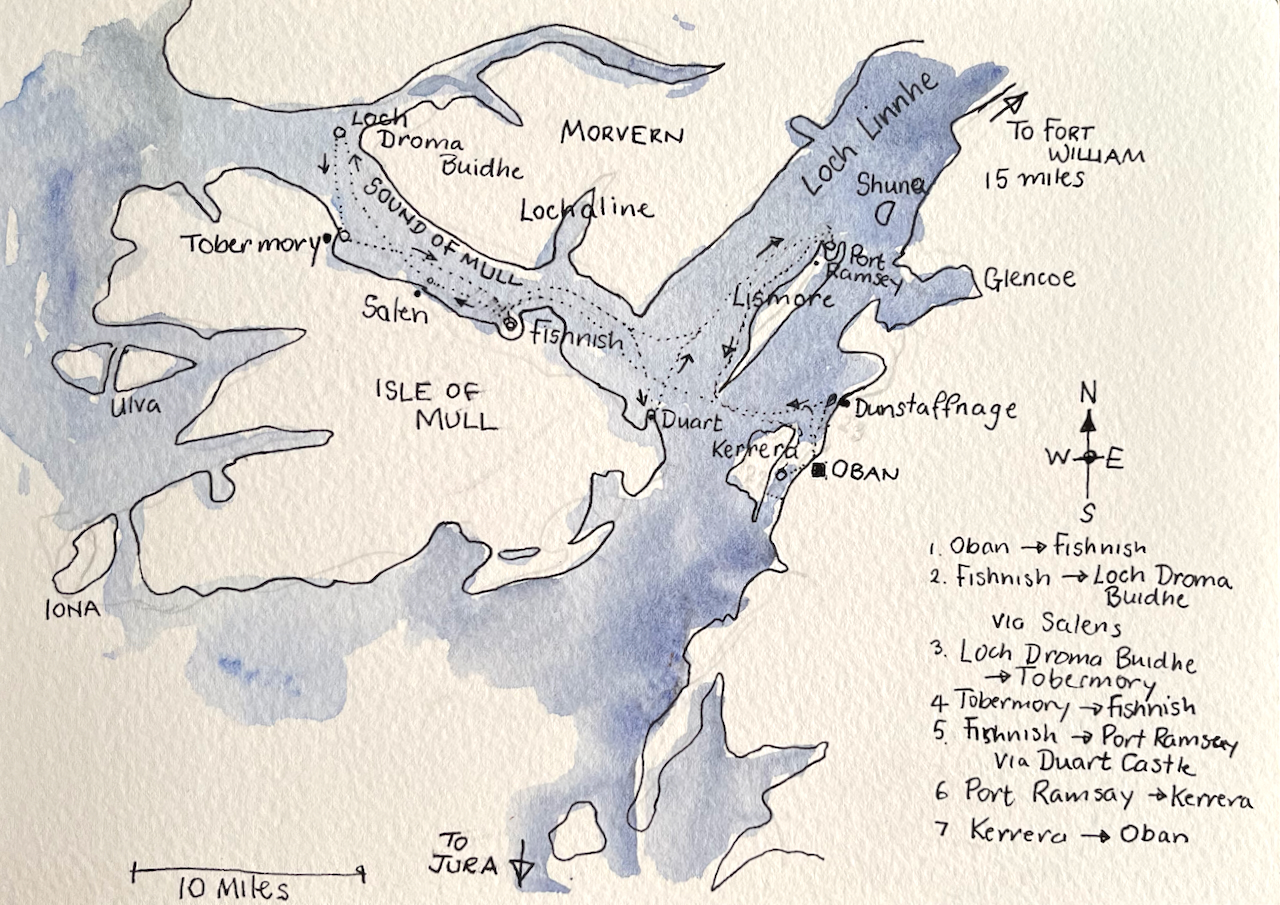
I’m just back from a “Sketch and Sail” adventure on the Lady of Avenel, a square rigged brigantine. I was one of the art tutors, together with Claudia Myatt. We spent a week sailing around the Inner Hebrides with a group of other sketchers: sketching the boat, the sea and the landscapes. The drawings which follow are ones I made. Participants’ drawings, with permission and attribution, will appear on the Lady of Avenel website.
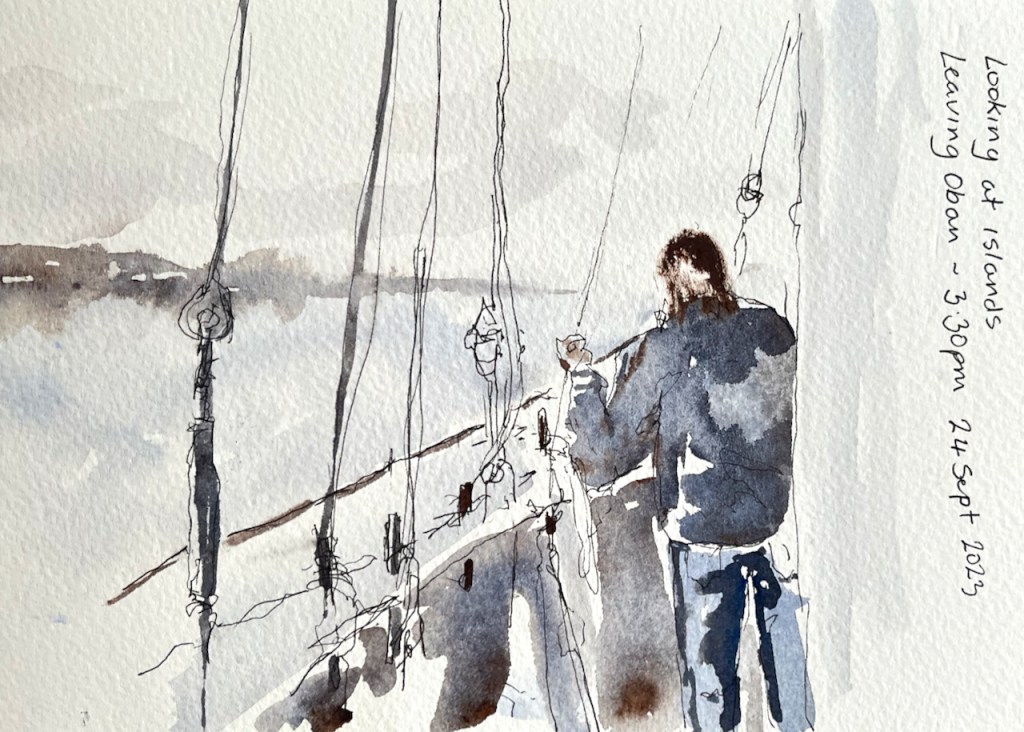
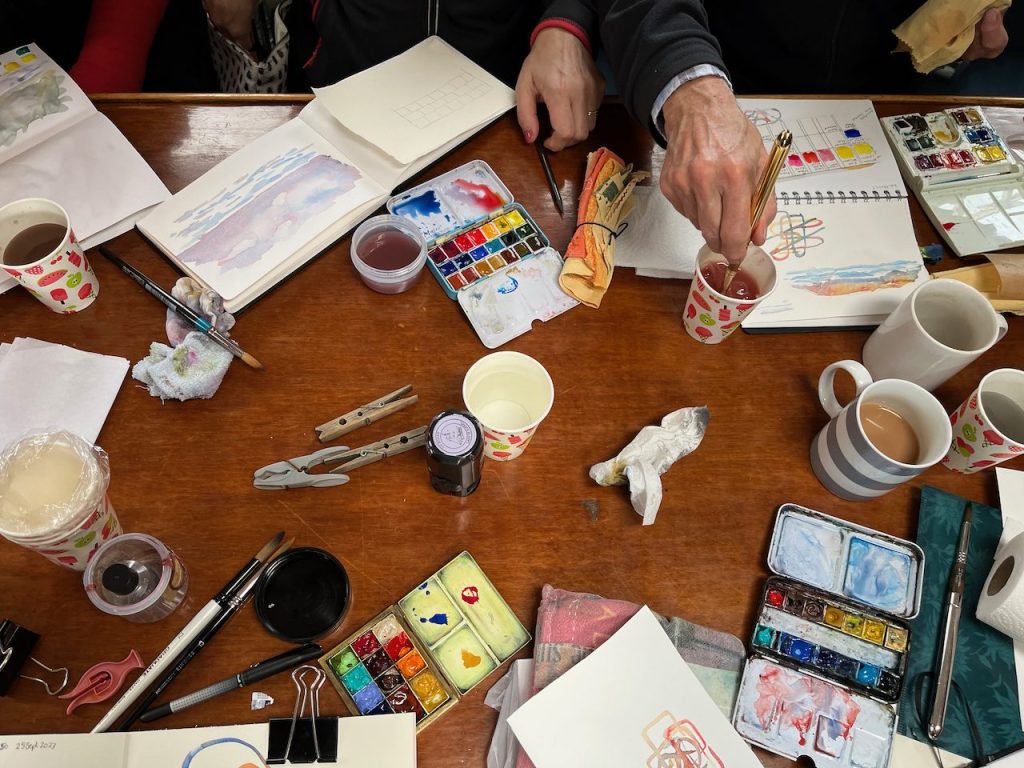
Lady of Avenel Saloon “Welcome to Sketch and Sail”Looking at islandsLandscape on MullA sketch near LismoreWorkshop participants in action on the table inside the Lady of Avenel
This was September in Scotland. There was wind and rain. Two storms passed over: “Nigel” and “Agnes”. But somehow, in between it all, we all did a lot of sketching. Our Skipper, Stefan Fritz, was skilled at finding sheltered anchorages. Claudia and I worked with him to plan the days so there was always something interesting to sketch.
There were days when we went ashore. Here are the boats at Salen on the Isle of Mull. Two hulks of fishing boats are in their final resting place on the beach. They lean on each other. Their grand forms are still majestic, and their paint has now flaked to reveal multi-coloured undercoats and timbers.
Boats at Salen. 25th September 2023, A5 postcard.
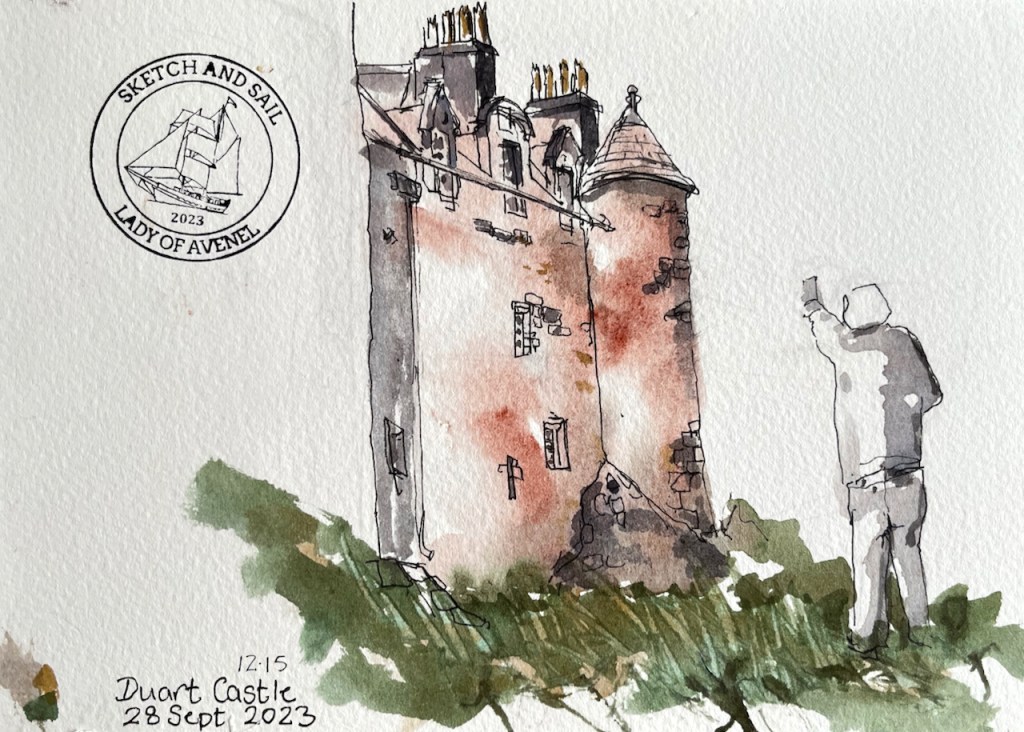
We visited Castle Duart. Some people went inside, others sat outside on the grass and had a go at sketching the castle’s complicated shape.
Castle Duart (and tourist), 28th September 2023
Those chimneys had multiple points, like crowns. One of the participants did a careful study of them. In the grounds of the castle there were porcini mushrooms. These were confidently identified by one of our number, a horticulture expert. We left the mushrooms exactly where they were. We didn’t touch them or eat them. But we did draw them. My drawing does not give the scale: they were about 3 inches across.
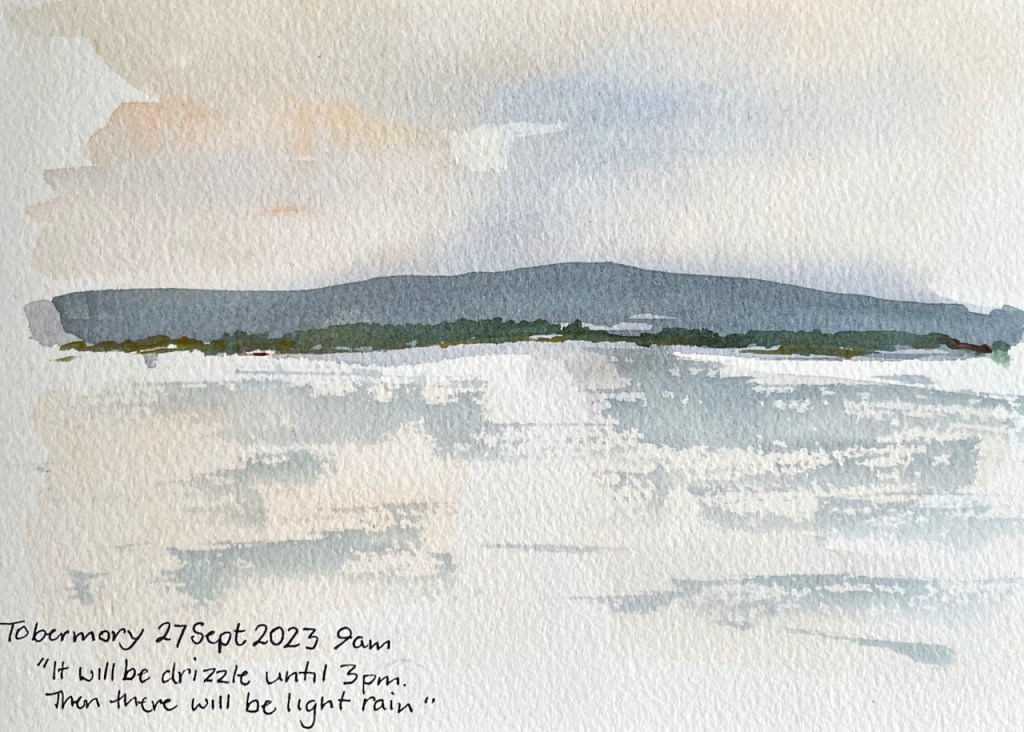
We sketched the land from the sea.
From Fishnish, near isle of MullNear Tobermory, Isle of MullLeaving LismoreIsle of Kerrera, East side
There were inspiring atmospheric effects. Here is a glimpse of the sun near the isle of Lismore.
On the way to Port Ramsay, Isle of Lismore. 28th September 2023
That neat round sun is made using a drop of melted candlewax from a nightlight which a member of the crew, Nessie, found for me. Nessie, a.k.a Carol Anderson, is an astonishing fiddle player. She played tunes for us on some evenings. We were all impressed by her skill. She maintained several melodies at once, all on just one fiddle. Other people played the harp and the recorder, and we sang sea shanties: half-remembered but rendered with gusto, and accompanied by assorted musical instruments and improvised percussion.
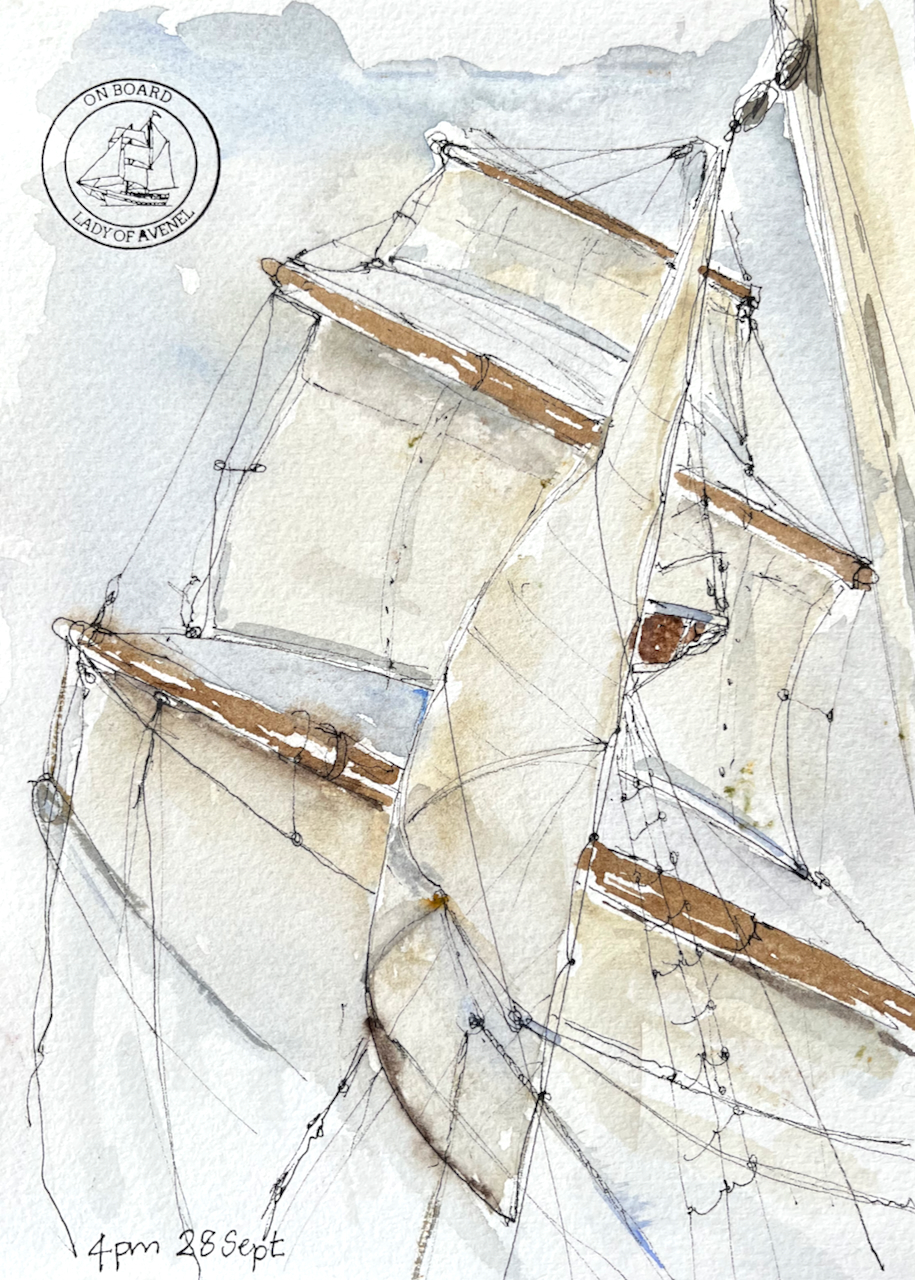
Nessie was our cook for this expedition. We also had a mate, the mate’s mate, and a ship hand, to help the skipper manage the boat. They were out there even in the pouring rain, getting us to the next safe harbour, piloting us past landmarks and between islands, and managing the engine and sails. Thanks to this crew, we had a productive and inspiring voyage: always something to see or do. The sails are beautiful, although quite hard to sketch.
Sketching on the move.
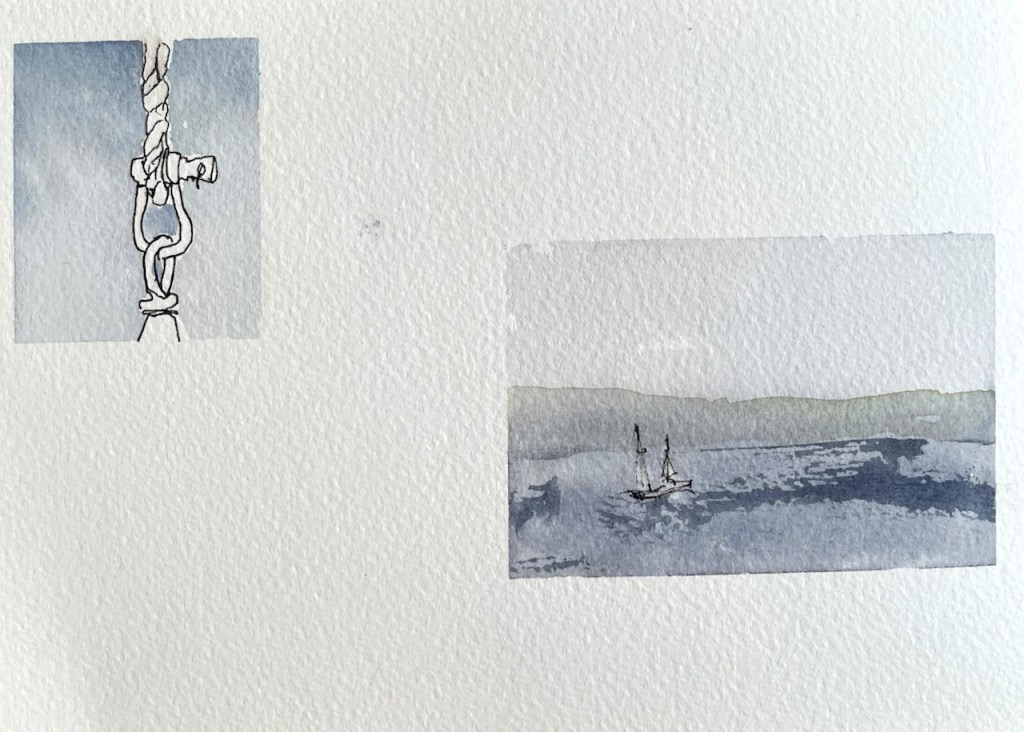
Some people took time off sketching to enjoy working the boat: hauling on ropes or taking the wheel. A brave few elected to climb the rigging. One person even did a sketch from up there.
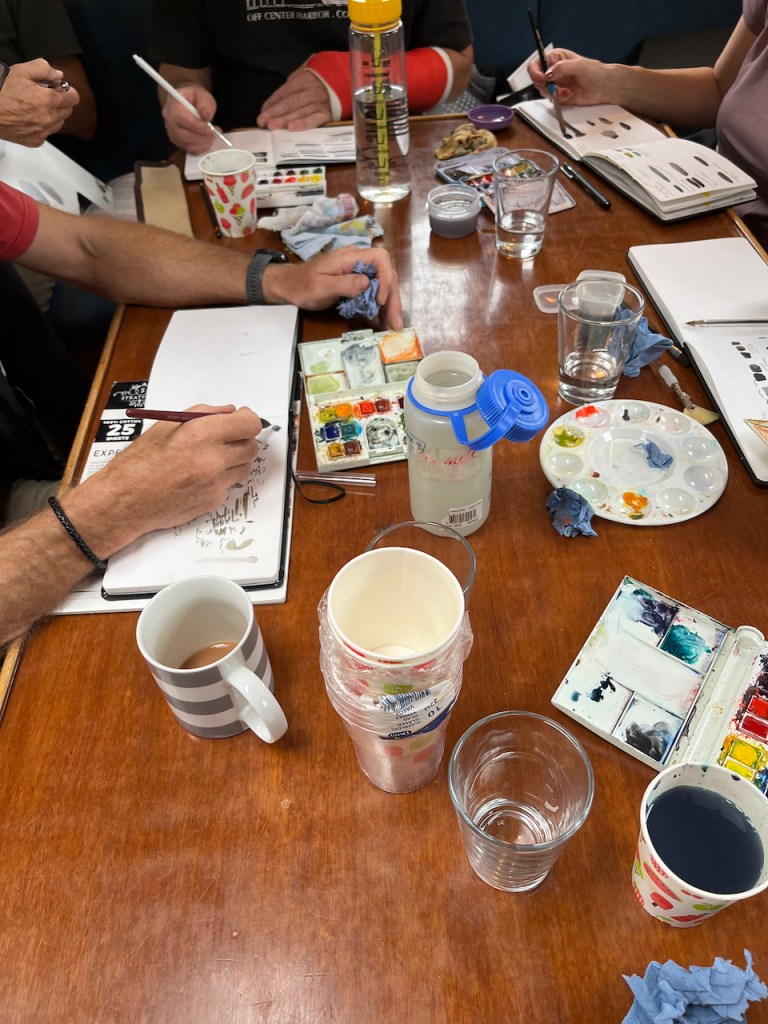
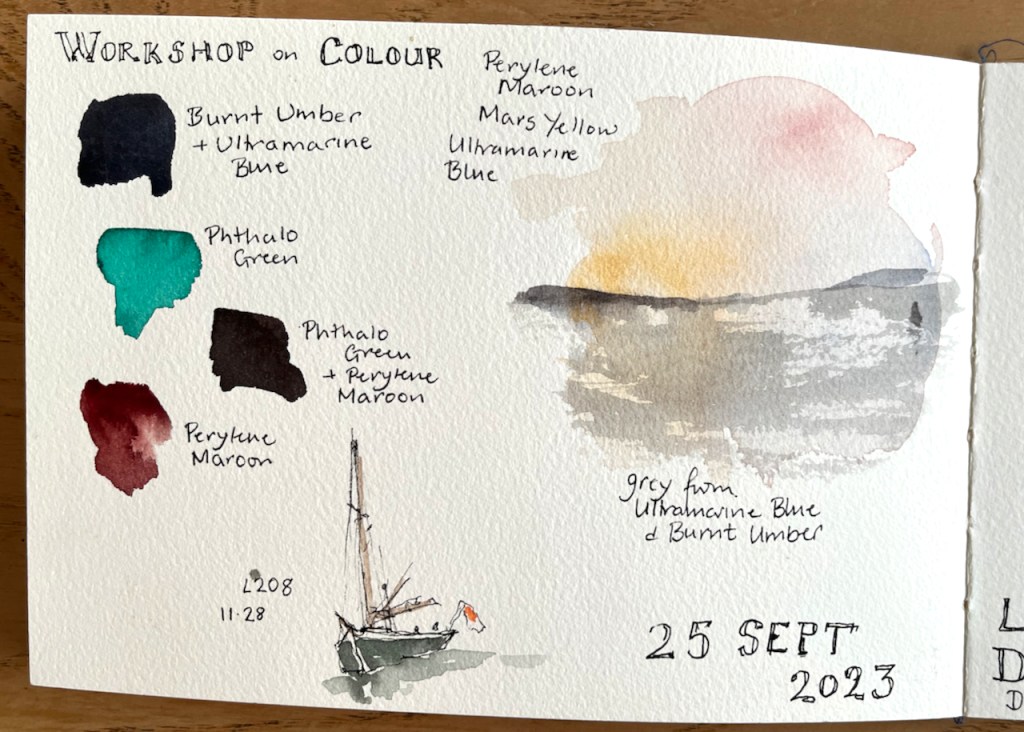
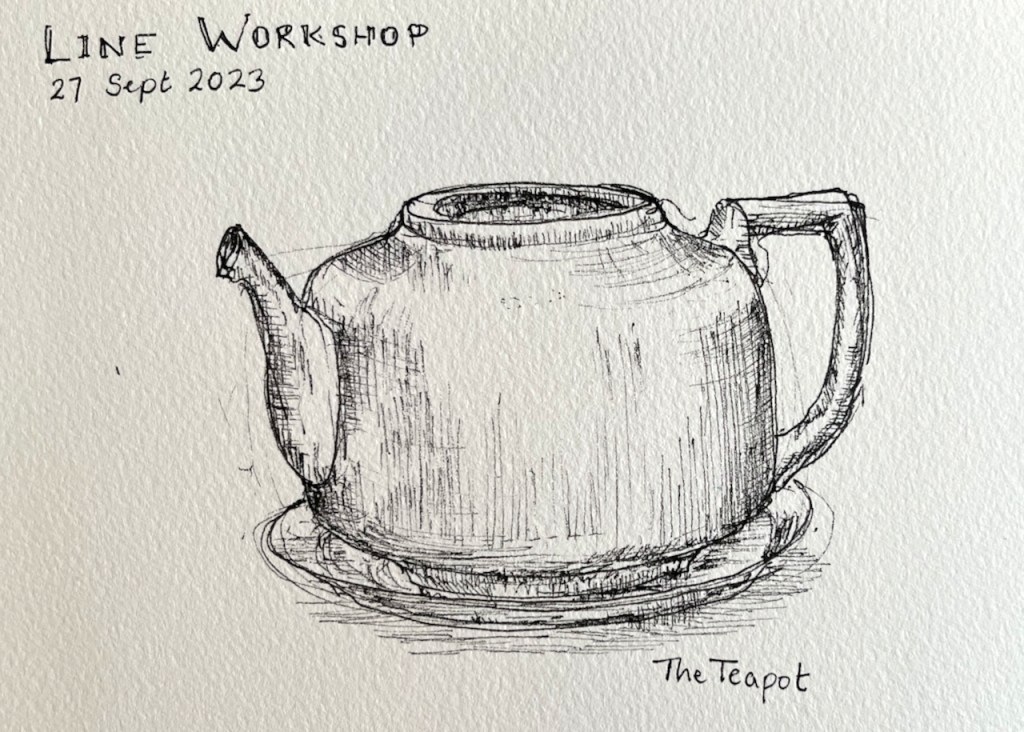
In the intervals between other activities, and when it rained, Claudia and I ran various workshops, so that people could learn new techniques, share skills, or get started: depending on skill level.
Making black and greyLine workshop: the teapotColour mixingColour mixing
The expedition was great fun, and highly productive. Sketchbooks were filled, postcards painted and sent, maps examined and weather apps compared.
We intend to run it again in 2024 and 2025. If you’re tempted to come, you can register your interest now by contacting me, or Claudia Myatt, or the Lady of Avenel direct. You don’t need any experience of sketching or sailing!
Here’s a page-turn of my sketchbook (about a minute, silent video). The sketchbook is from JP Purcell, A5, watercolour paper 300gsm. I use Daniel Smith watercolours: you can see the colour palette at the beginning of the video. (The video plays on tablets and desktops. It does not play on email or on mobile phones. Try looking at this post via the web on this link)
The Lady of Avenel is an 102ft square rigged brigantine. She was on the East coast of Scotland, and needed to be on the West Coast. So a group of us assembled to take her through the Caledonian Canal, from the North Sea to the Atlantic. This whole journey was about 190km or 120miles. I…
I took my sketching things on a swimming expedition to the Outer Hebrides with Swimtrek. We were on the wonderful Lady of Avenel 102ft square rigged brigantine. We started in Oban. It was raining when I drew this picture, as you can see from the way the pen has drifted a bit, round the chimneys.…
The Lady of Avenel is an 102ft square rigged brigantine, currently based near Oban, on the west coast of Scotland. Every year the Lady of Avenel needs a refit to prepare her for her working season. This year I went up there to join the working party for the refit. I travelled by overnight train…
Here is Lady of Avenel, 102ft Brigantine. This was the third of three sketches. Here are the first two. I have drawn Lady of Avenel previously: Outer Hebrides 2017 See also these pages for pictures of and from Lady of Avenel: Outer Hebrides 2017 Outer Hebrides 2016 Sketch notes from maritime Holland
Here is the Lady of Avenel in aquatint. Here is the hard ground, before the aquatint went on: To help with the aquatint, I made a small test plate. It seemed a pity to leave it blank, so I put some sea life: Lady of Avenel is an 102ft brigantine square rigger. I sailed on…
Click a button below to share this post online, email it, or print it:
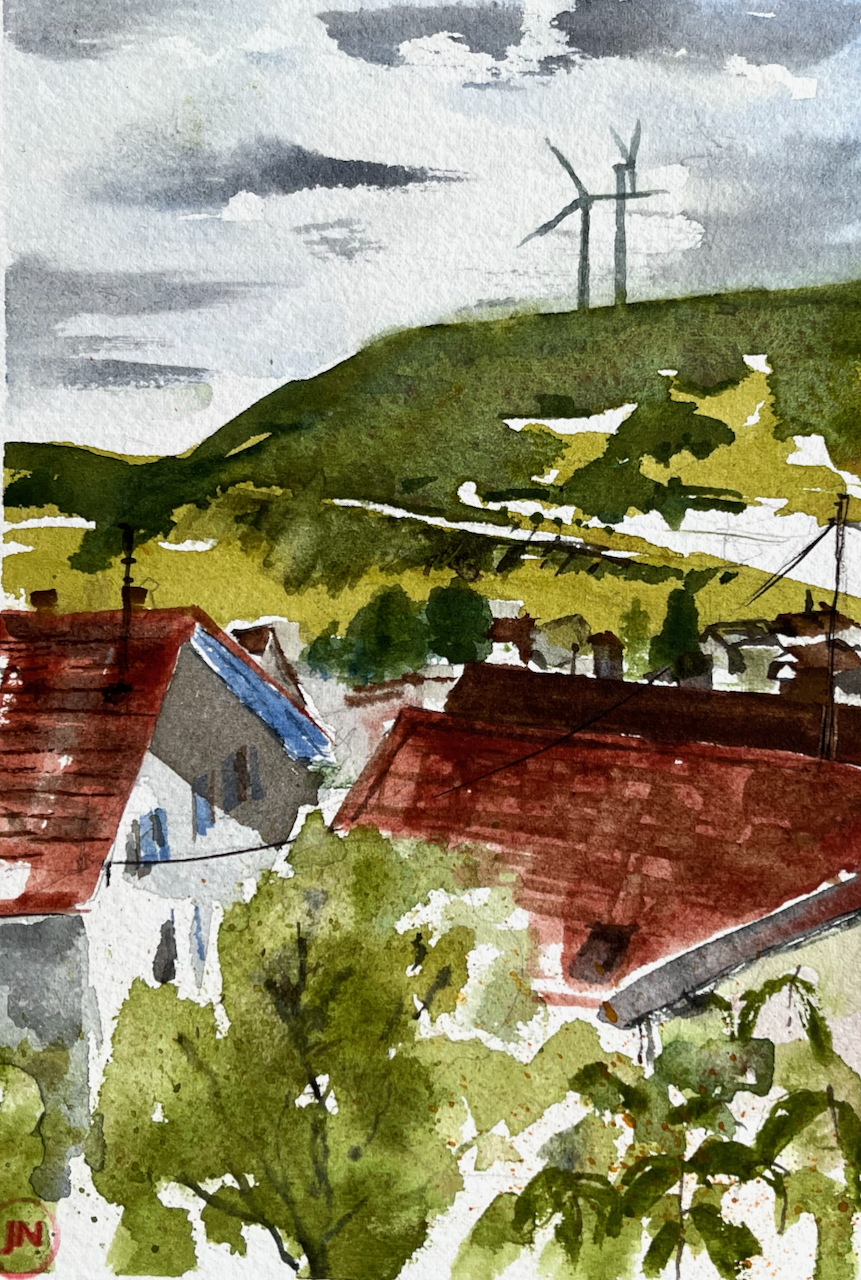
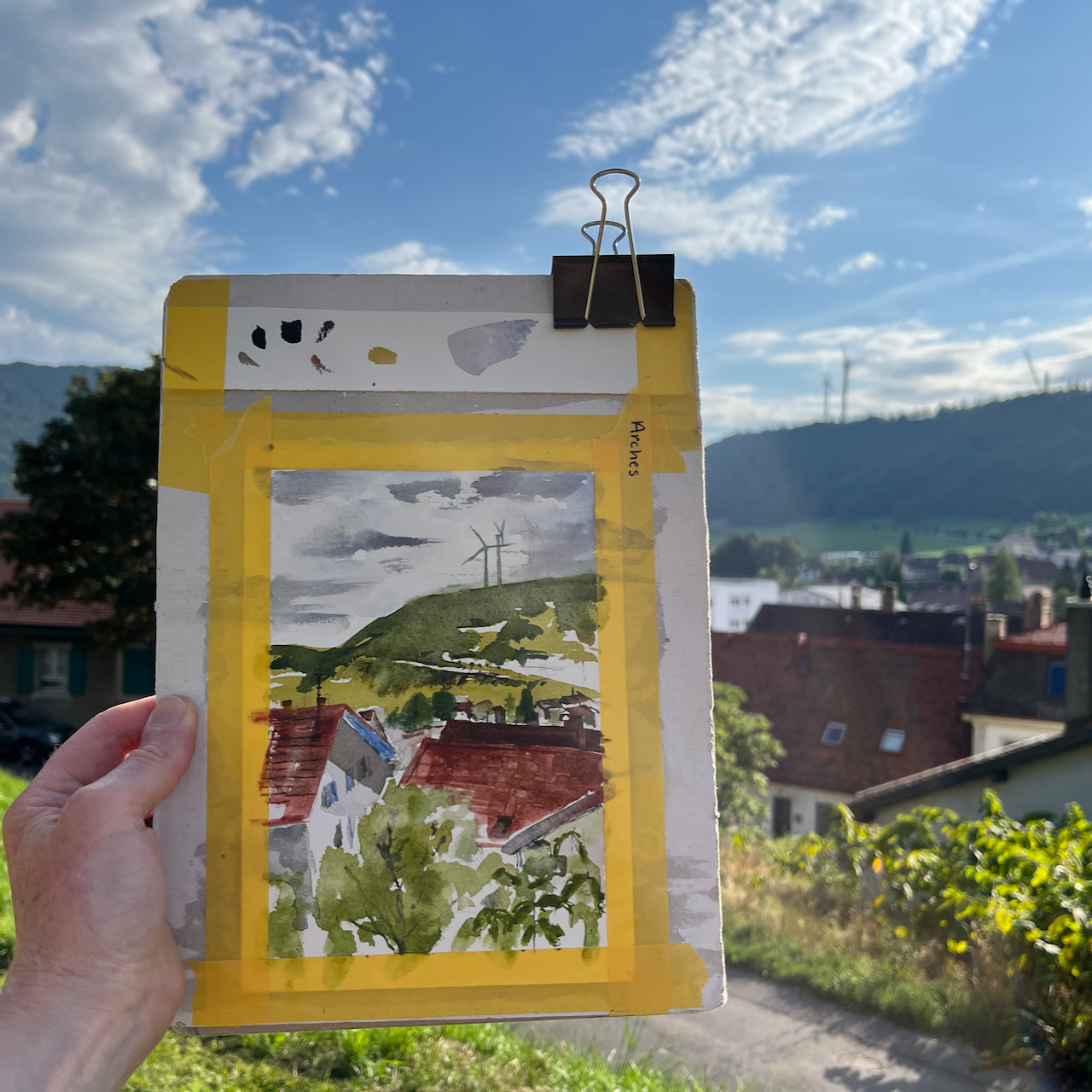
In the Swiss hotel there was much talk about the wind turbines. They are being constructed on a nearby hill. I could see them from a bench by the church.
Wind turbines above Sainte-Croix, Vaud 6:30pm, 16th August 2023. A5 Arches 300gsm NOT
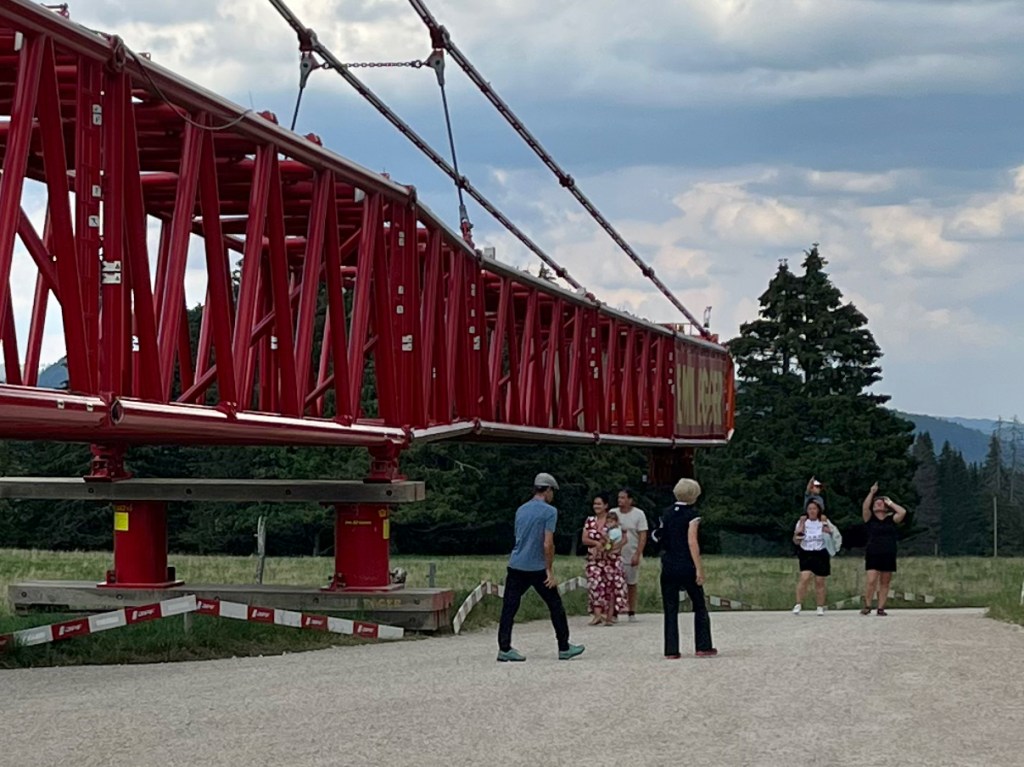
People said, you should go up there and see them, you can get very close. So on Sunday afternoon, we visited the construction site. There are information placards and a visitor car-park. Plenty of local people were up there viewing the machinery. The general atmosphere was one of curiosity and admiration.
It was a Sunday afternoon family outing: Let’s go and see the wind turbine construction site…
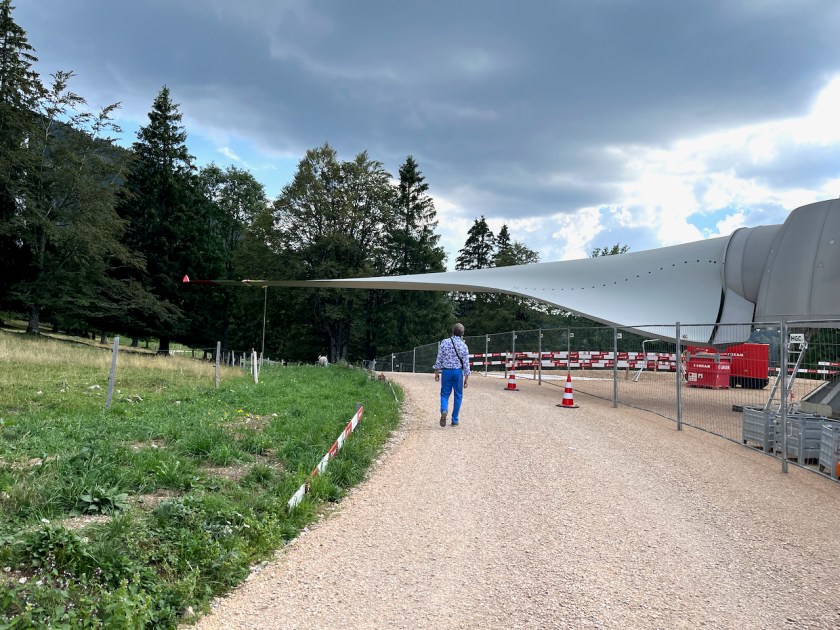
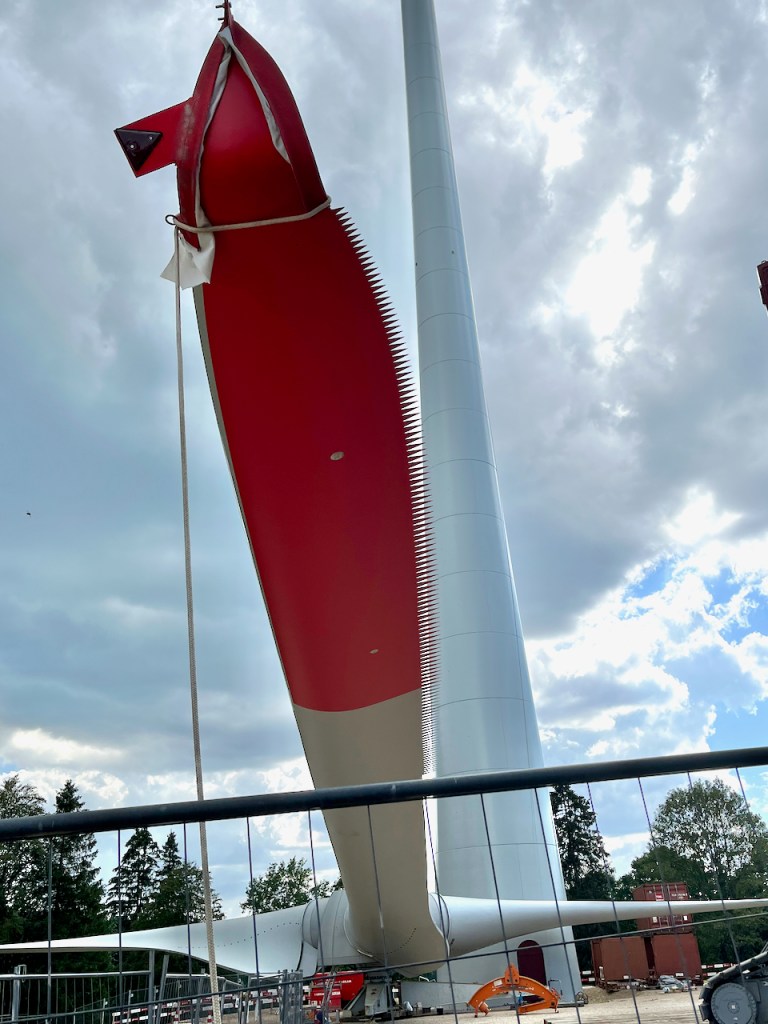
The blades are huge. 43 m.
The enormous blades, ready to raise.The blades have serrated trailing edges
As a British person, I was surprised at the openness. As it was the weekend, the site had no workers. The fascinating machinery was separated from us by some notional fences. It was supervised only by a few CCTV cameras on a stand. Perhaps there were also hidden ones. As you see from the photos, we could get close, and walk freely around the crane. My Swiss companion was surprised at my surprise.
It was also remarkable how positive the feeling was amongst the sightseers. A local person said that in the past they had been opposed to the turbines, but now that construction was started, they could see how clean and organised it was. “It’s better than a nuclear power station!” they observed. There’s no immediate benefit for the local people: they do not get a reduction on their bills. “But it’s better for everyone.” I was told.
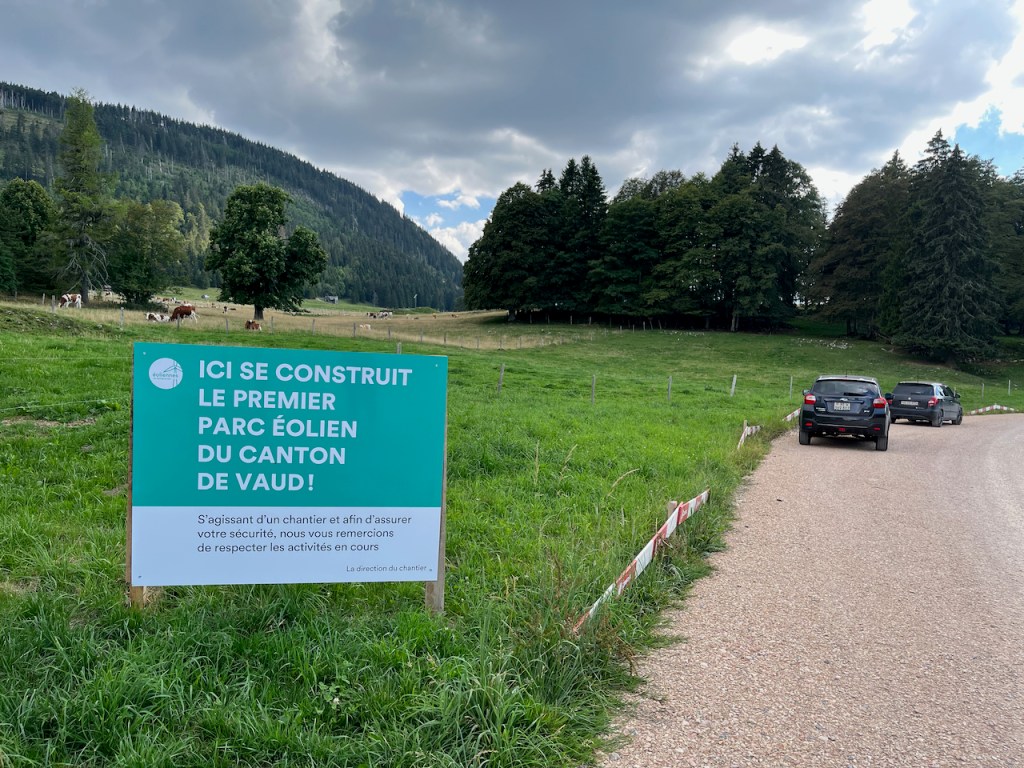
“Here we are building the first Wind Turbine park in the Canton of Vaud”. Note the line of cars to the right: local people have come to visit the construction site.
The next day, Monday, my host came rushing up to me as I returned from a walk. “Quick, look! They are raising…”. We found a vantage point. There, on the distant hill, the blades were being raised up the mast by the crane. They moved very slowly, but definitely, “like the hands of a watch” said my host. For that Swiss person, this engineering feat had become a source of local pride.
Click a button below to share this post online, email it, or print it:
Fair Isle is a small island some 28 miles south of Shetland, between Orkney and Shetland. It is 3 miles long and 1 mile wide.
Map (c) Open Street Map contributorsFair Isle: 3 miles long and 1 mile wide Map (c) Open Street Map contributors
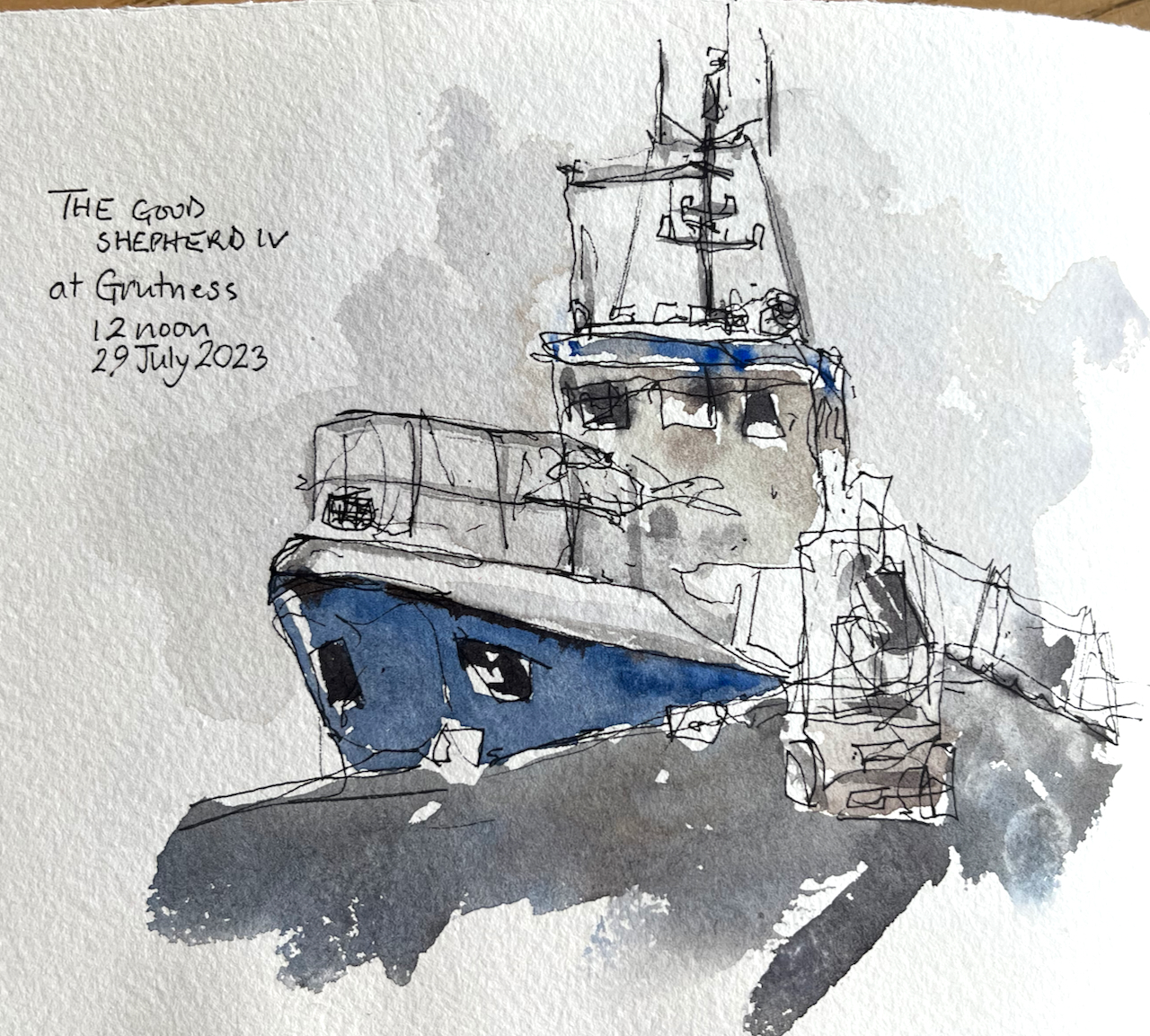
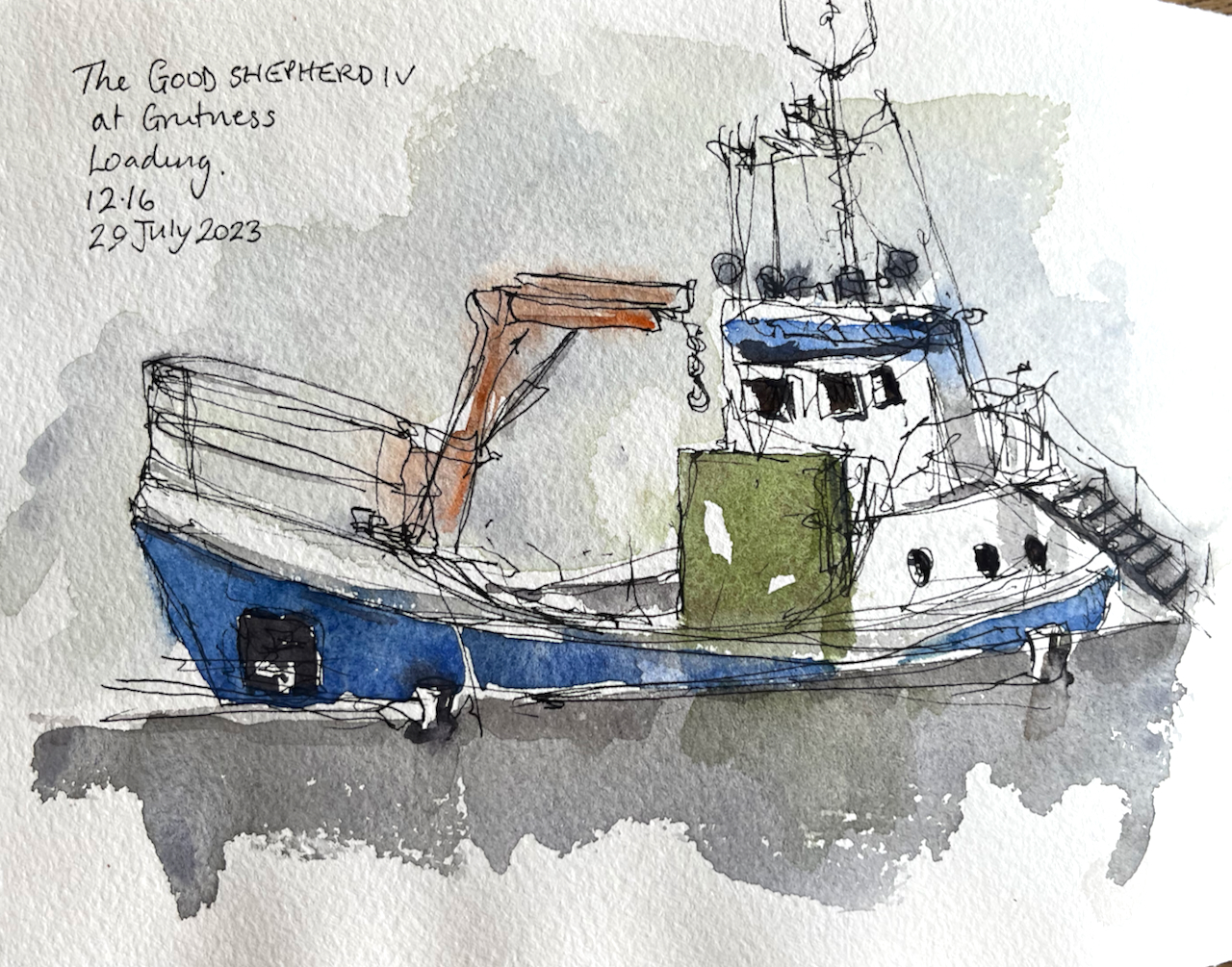
I travelled there by the boat “Good Shepherd IV”.
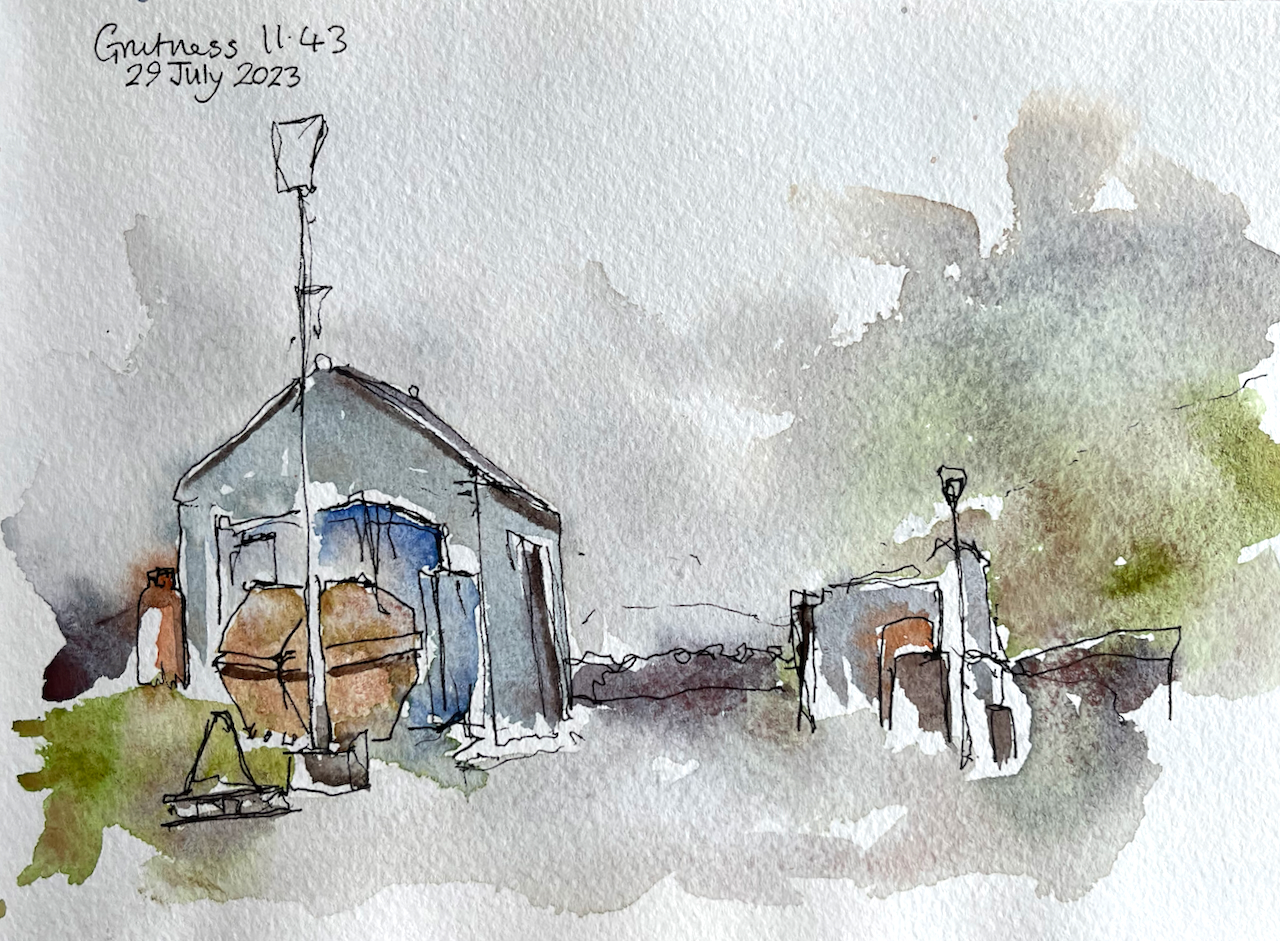
The ferry leaves from the pier at Grutness which is close to Sumburgh airport at the southern tip of Shetland mainland.
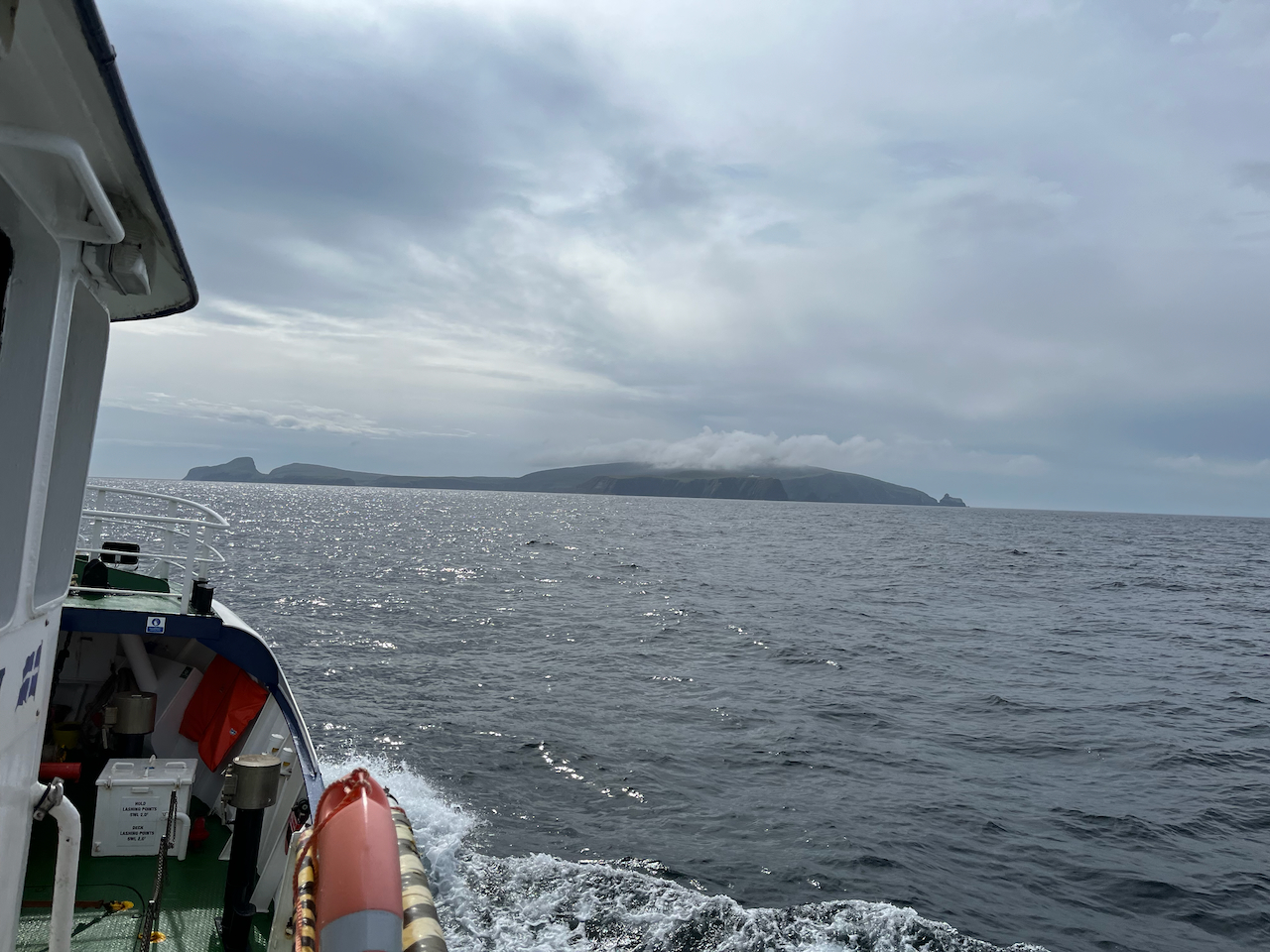
I wait at Grutness, in the fogThe Good Shepherd arrives at the Grutness PierThe Good Shepherd unloads at the pier.Fair Isle emerges from the clouds
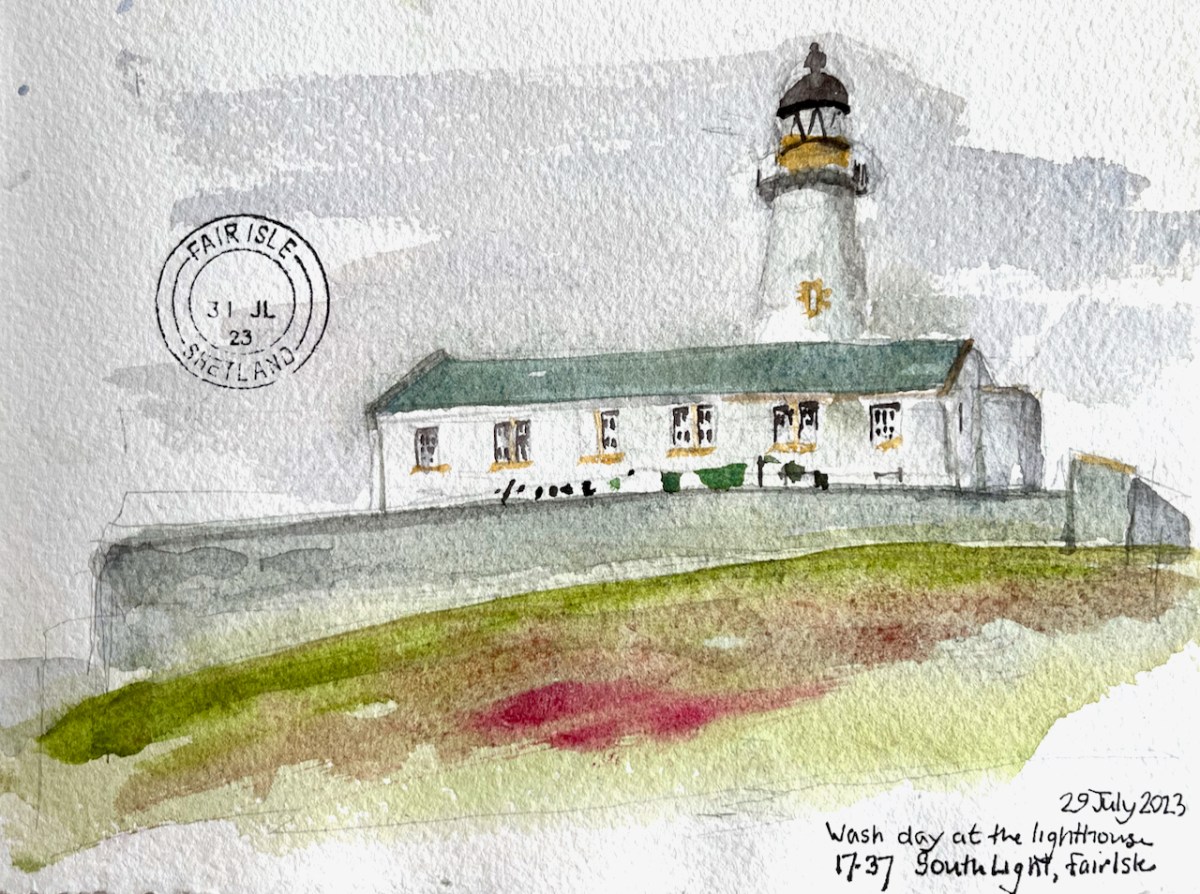
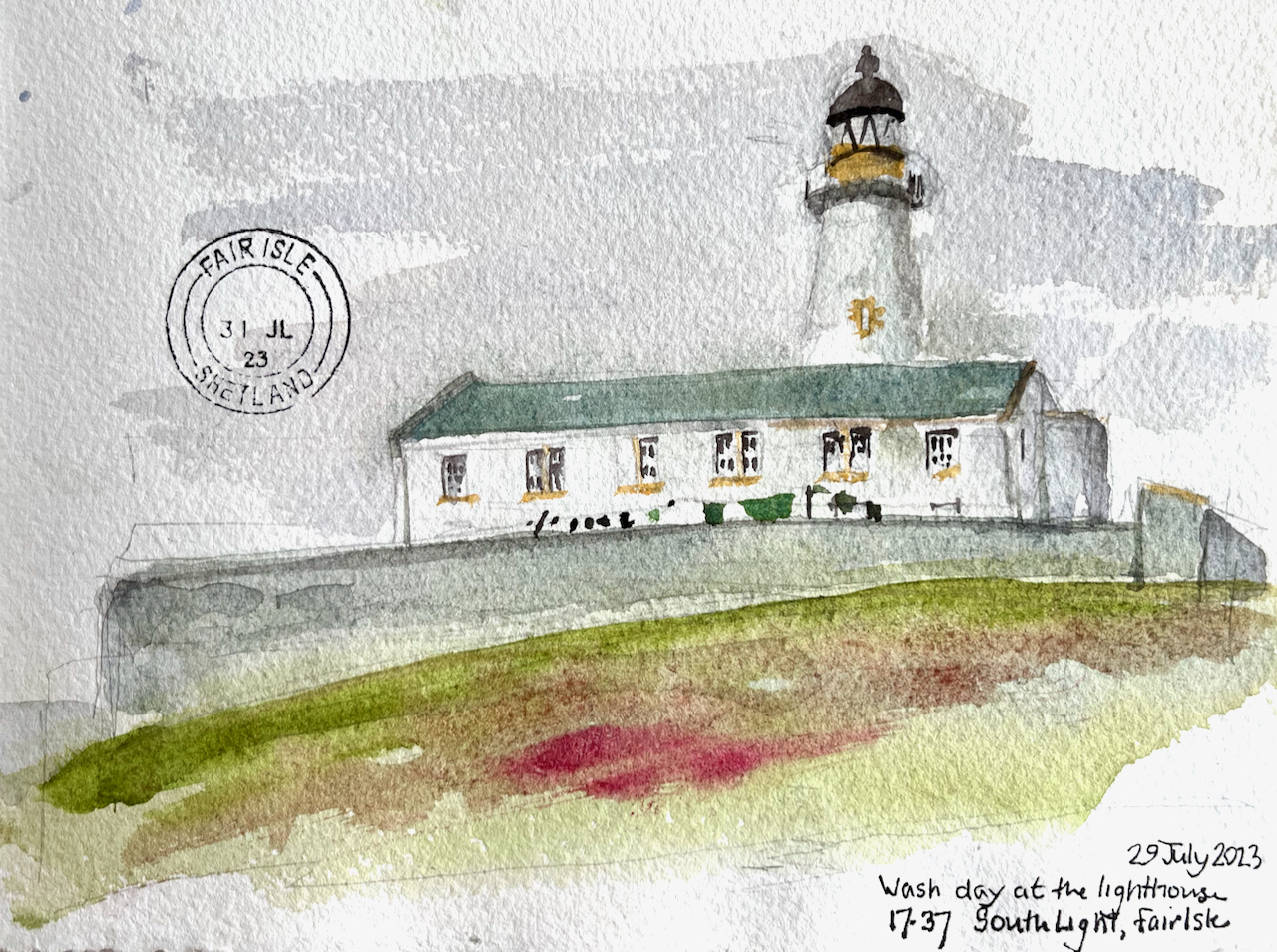
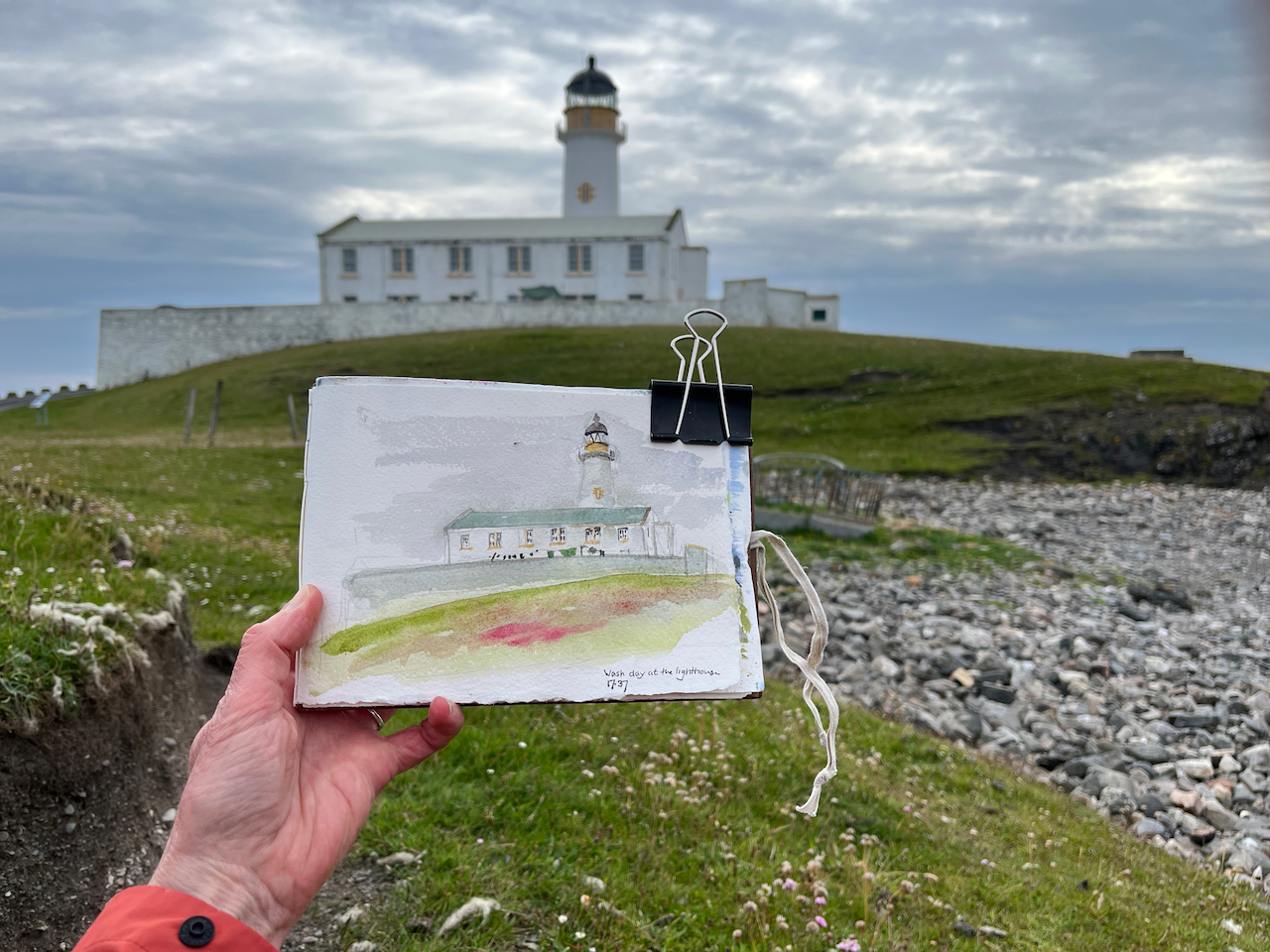
Fair Isle has two lighthouses: the North Lighthouse and the South Lighthouse. I sketched the South Lighthouse:
The postmaster at the Fair Isle Post Office kindly put their special postmark on my sketch for me.
Both lighthouses were designed by David A Stevenson and built in 1892. Both are still functional, now automated. The South Lighthouse light is “Fl (4) W 30 seconds” : a group of 4 flashes of white light every 30 seconds. The North Lighthouse flashes white twice every 30 seconds.
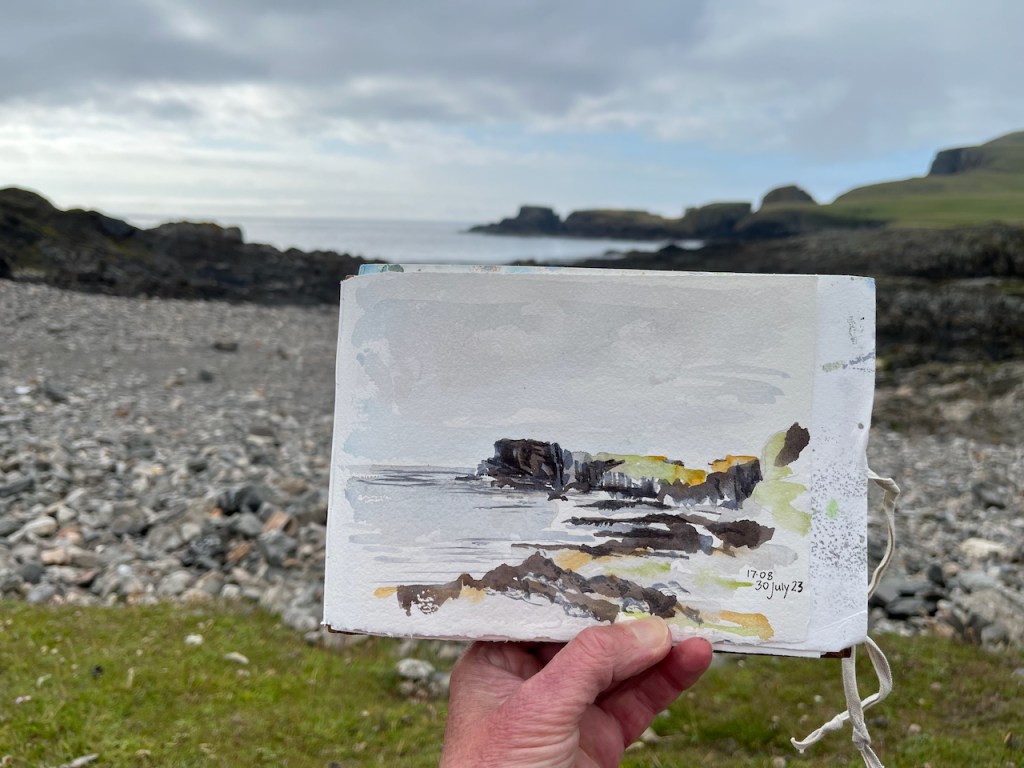
Here is a view of the cliffs called Mathers Head. It’s the view from the same spot where sketched the South Lighthouse, but looking out towards the west.
I was staying at “The Auld Haa” which is just a few hundred yards from the lighthouse. When I returned from drawing this scene, Tommy, who runs the guest house, called out, “Come and choose a fish!”. There was me and two other women staying at the guest house at that point. Bemused, we all made our way round the side of the house to find a cheerful fisherman standing by his car trailer on the small road. The trailer was laden with fish. The fish were in buckets. There were cod about two feet long, and mackerel, and a whole bucket of lobsters. The fisherman was Stephen, who I recognised as one of the ferry crew.
With suggestions and promptings from his three guests, Tommy made his selections. I was keen on the mackerel. Others opted for white fish. Tommy carried the bucket back to the house.
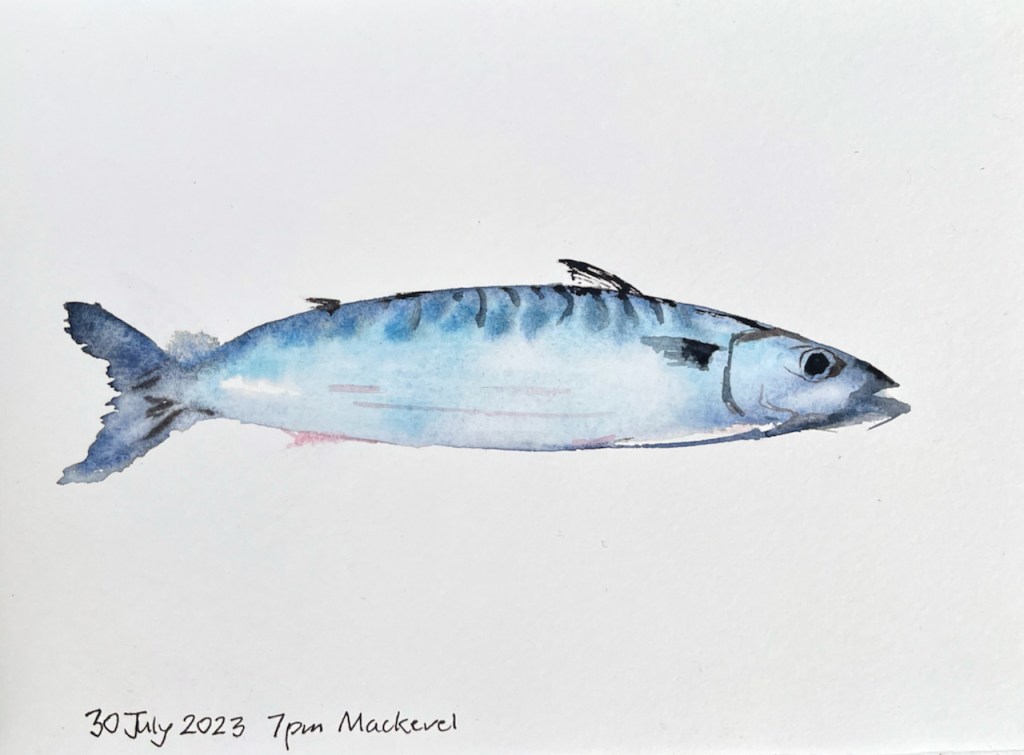
After this excitement I was resting on the bench outside the house when Tommy called out to me, “Would you like to do a painting of the mackerel?”.
Yes, I would like to do a painting of the mackerel, even though I was tired, even though it was evening, even though I’d already done a long walk, a dip in a rockpool, and several paintings of headlands. How often do you get invited to paint a mackerel? Seize the moment. Tommy brought out the mackerel on a plate, and I settled down to drew, while the hens scraped around on the grass, and small birds scuttled in the hedge.
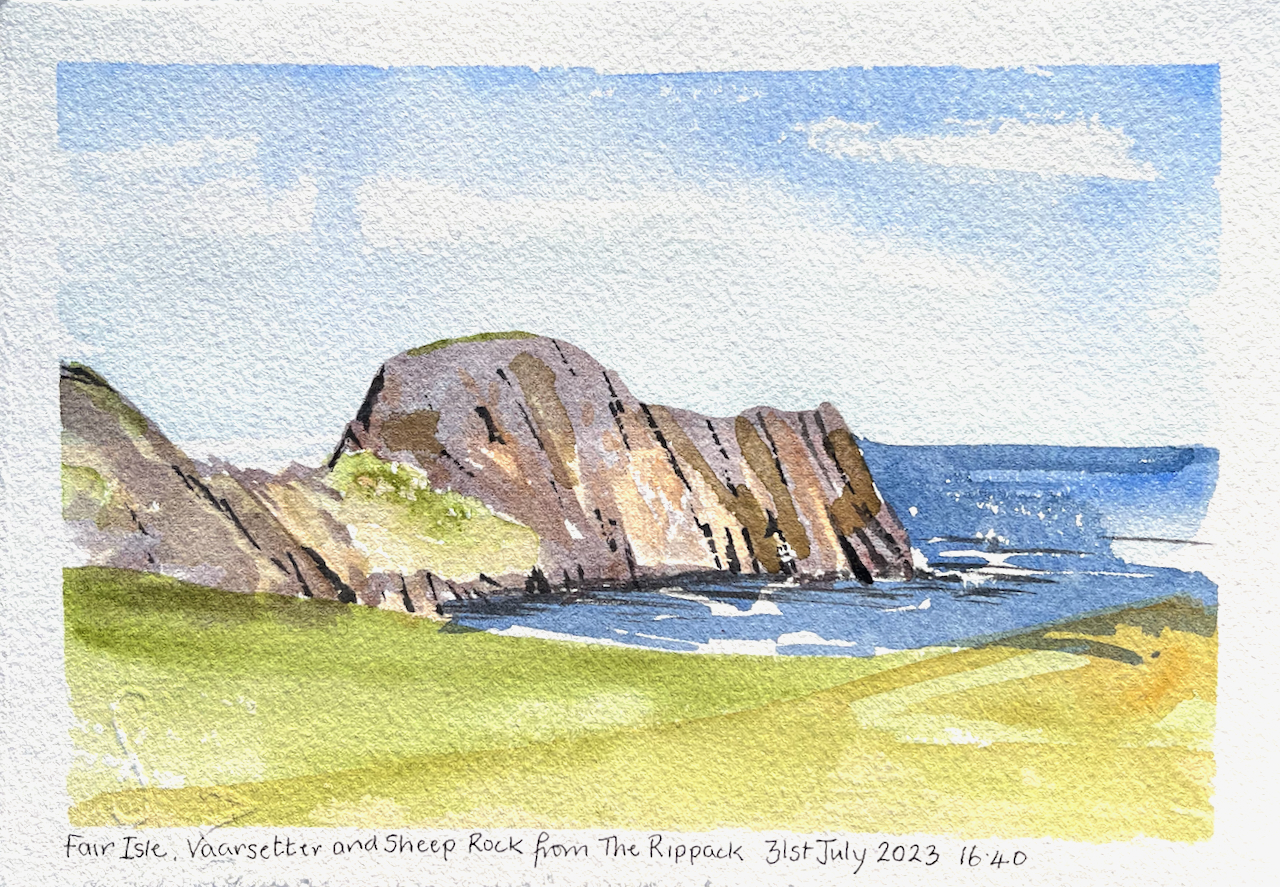
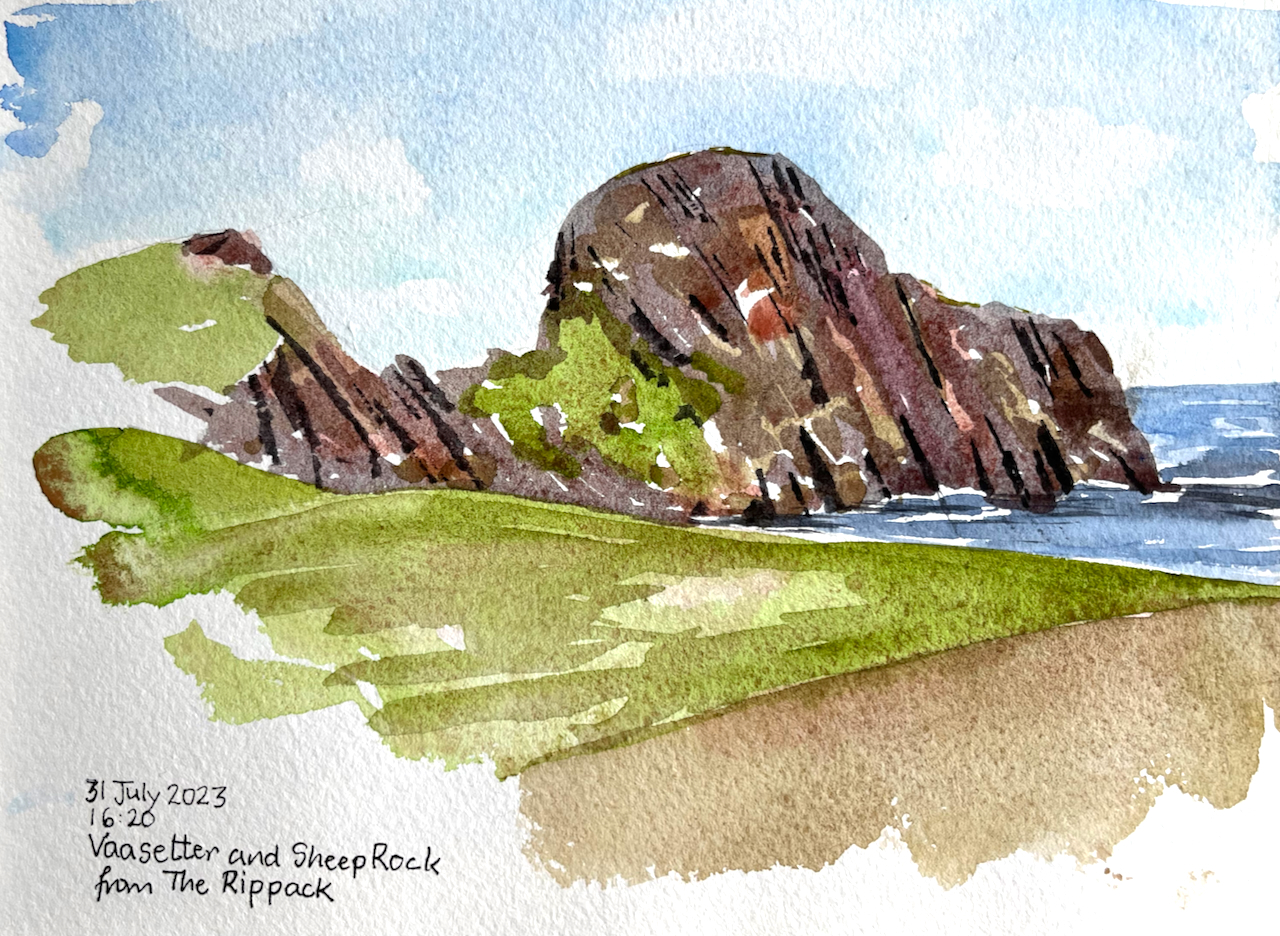
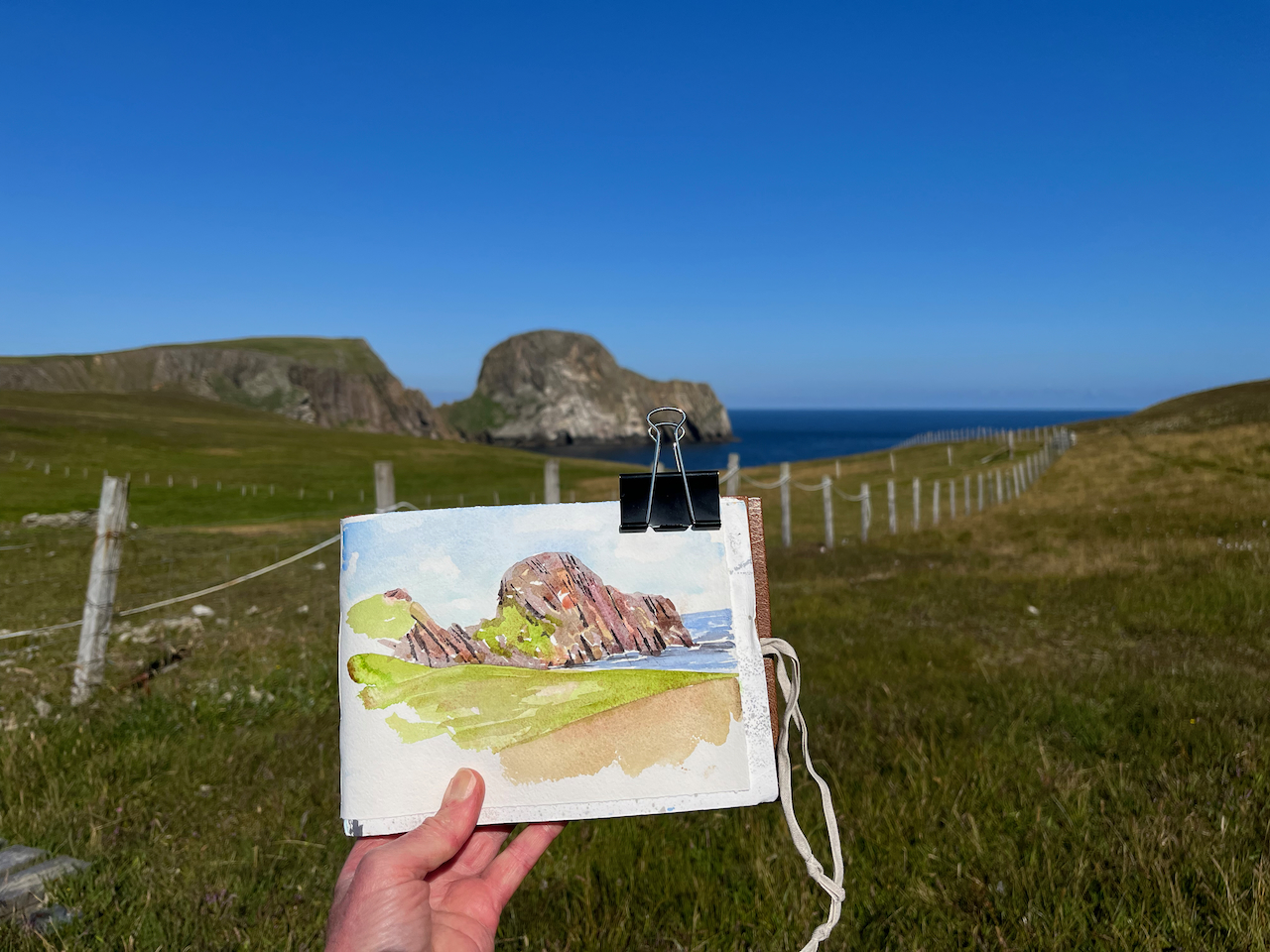
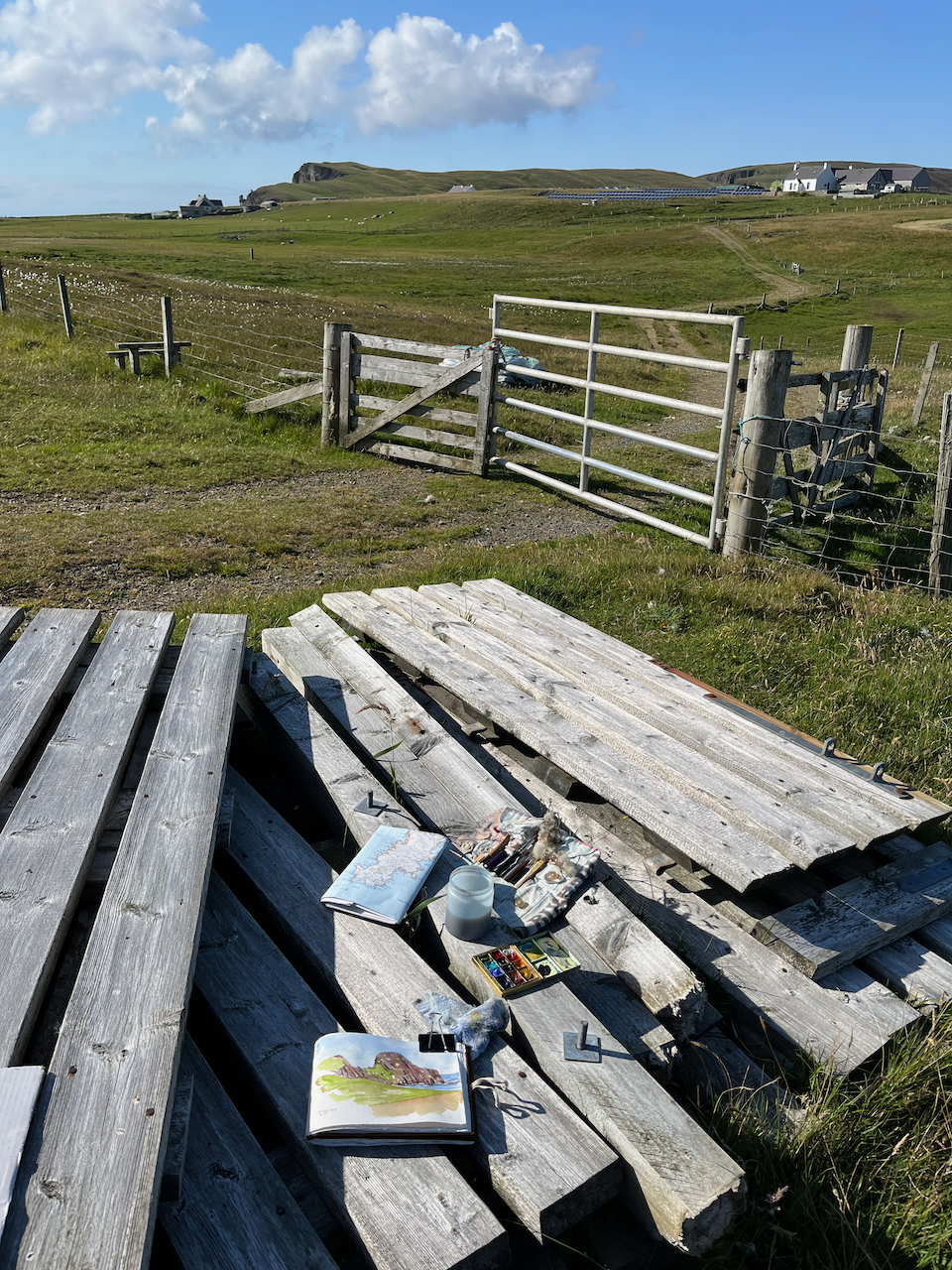
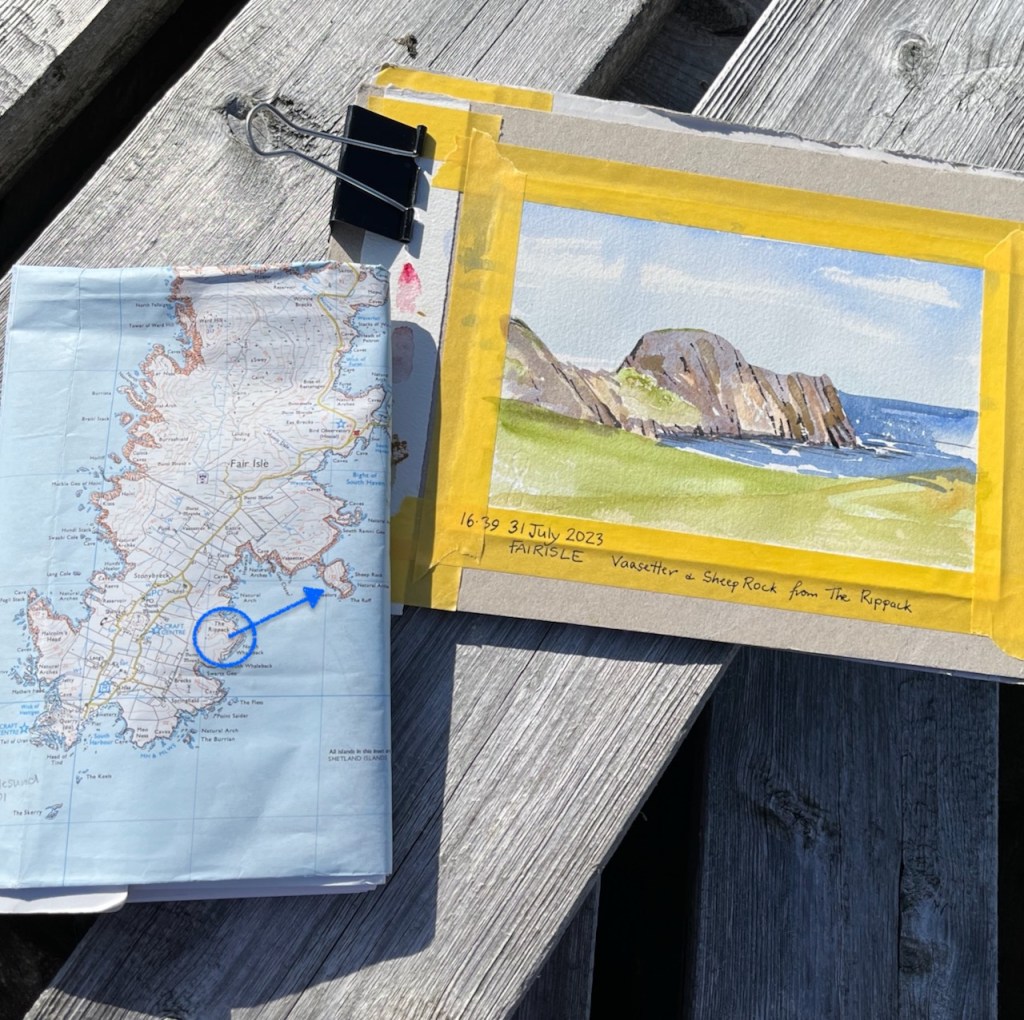
On another day I sketched the huge headland called “Sheep Rock”.
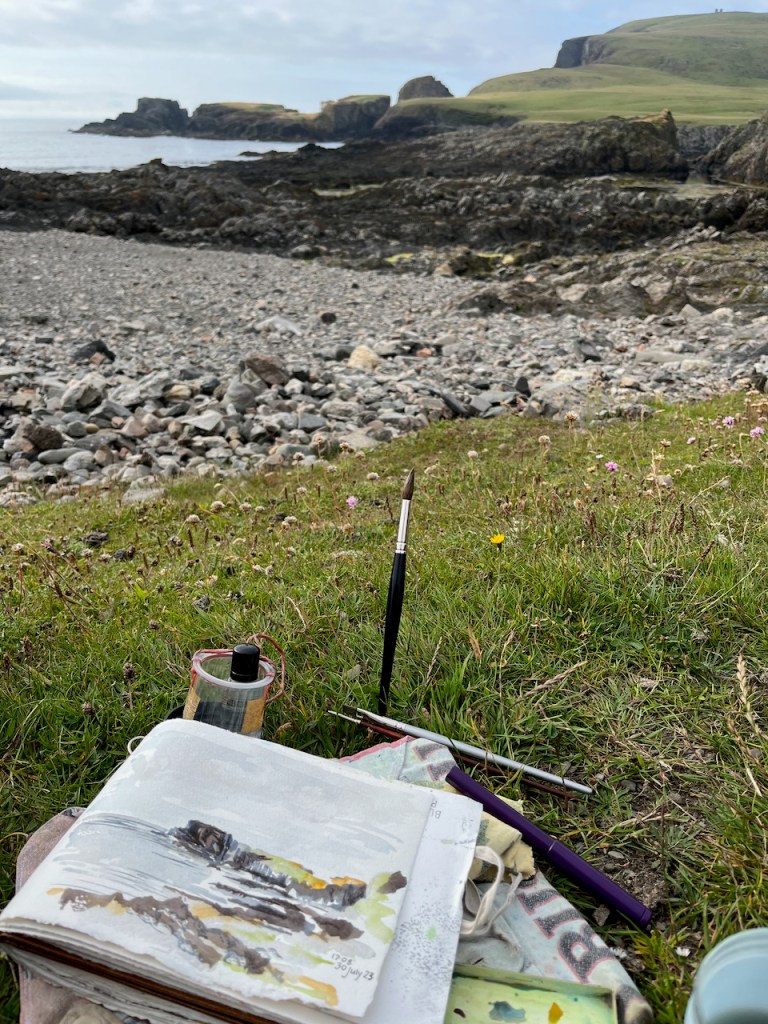
Postcard drawing of the Sheep Rock.Drawing in the sketchbook.Sketching location. This wasn’t such a great place to sketch: my paintbrush rolled down in amongst those planks and I retrieved it only with difficulty.Blue arrow shows the sightline of the sketch. Circle shows where I was standing. I sketched a postcard and also did same view in my sketchbook: working on two drawings at once.
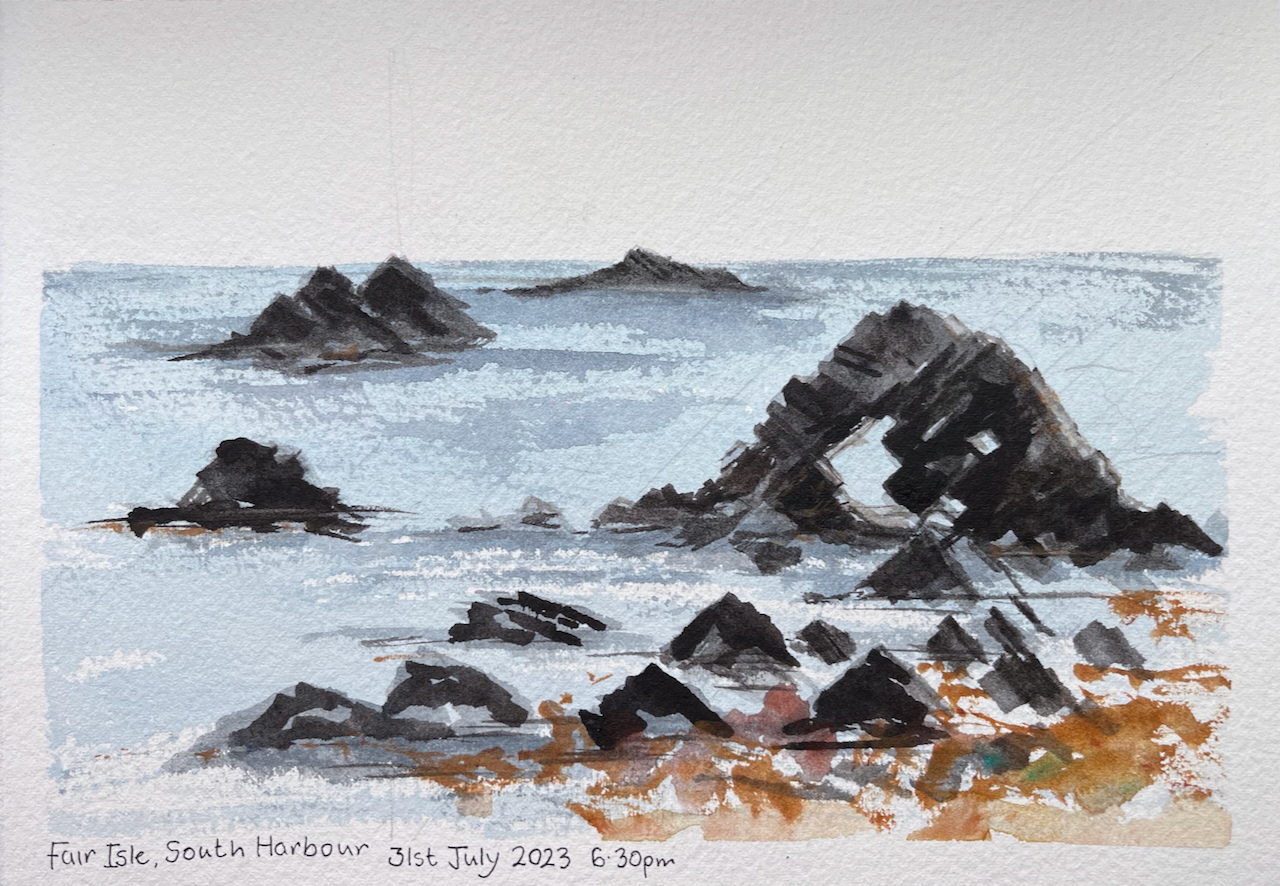
Here is the spectacular rock arch on South Beach, which is near the Auld Haa.
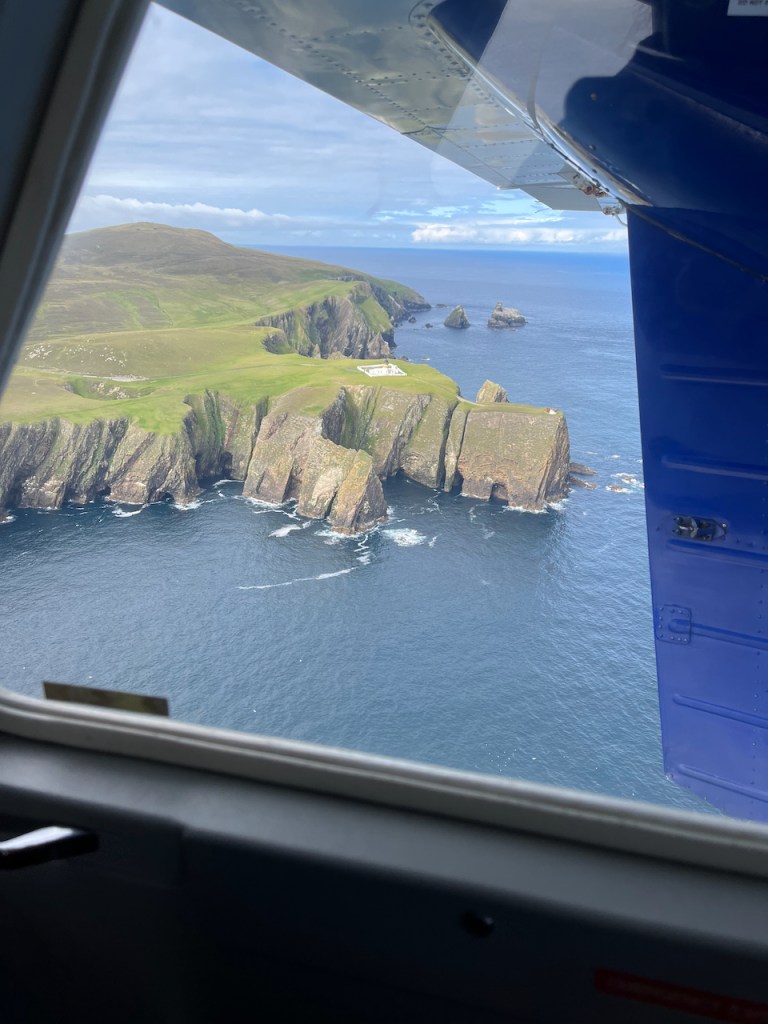
I was only on Fair Isle for three days. It’s an extraordinary place. Here was my final view of the island as I left on the tiny plane. The small square is the North Lighthouse, high up on its cliff.
View from the window of the plane: North Lighthouse.
Click a button below to share this post online, email it, or print it:
























 Jane Sketching