St Magnus the Martyr

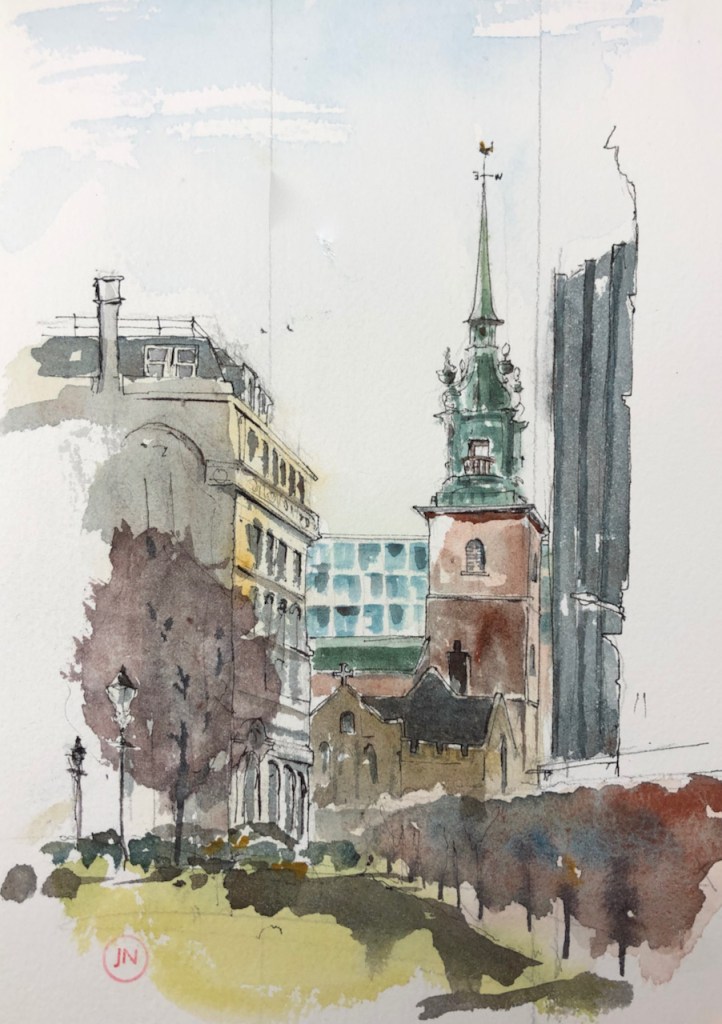
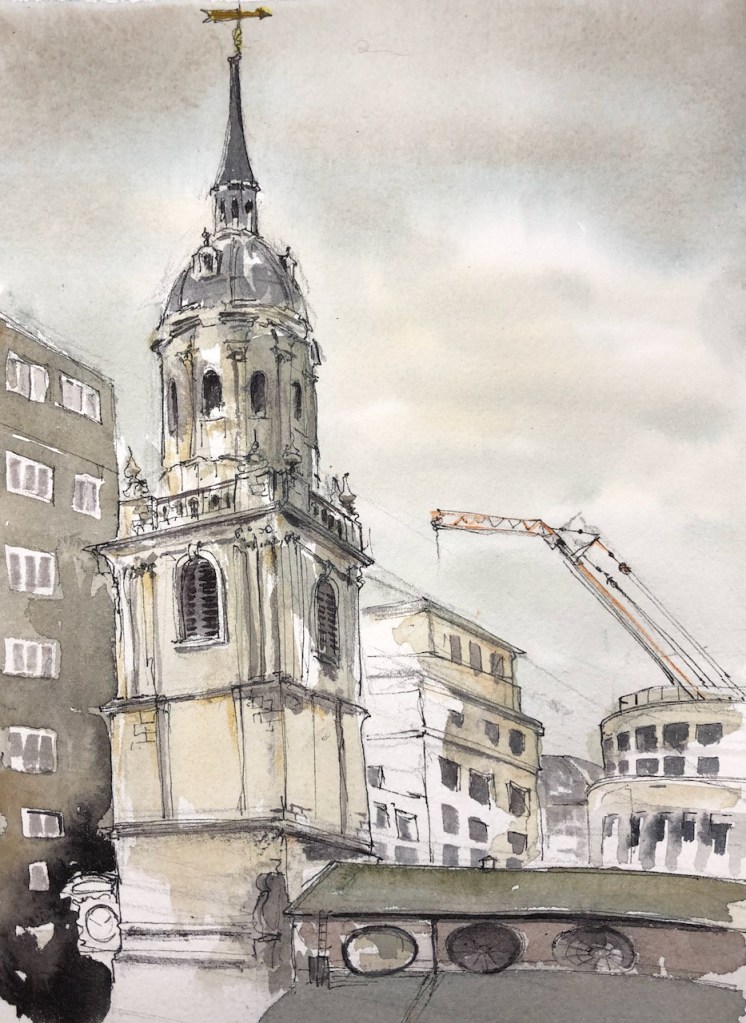
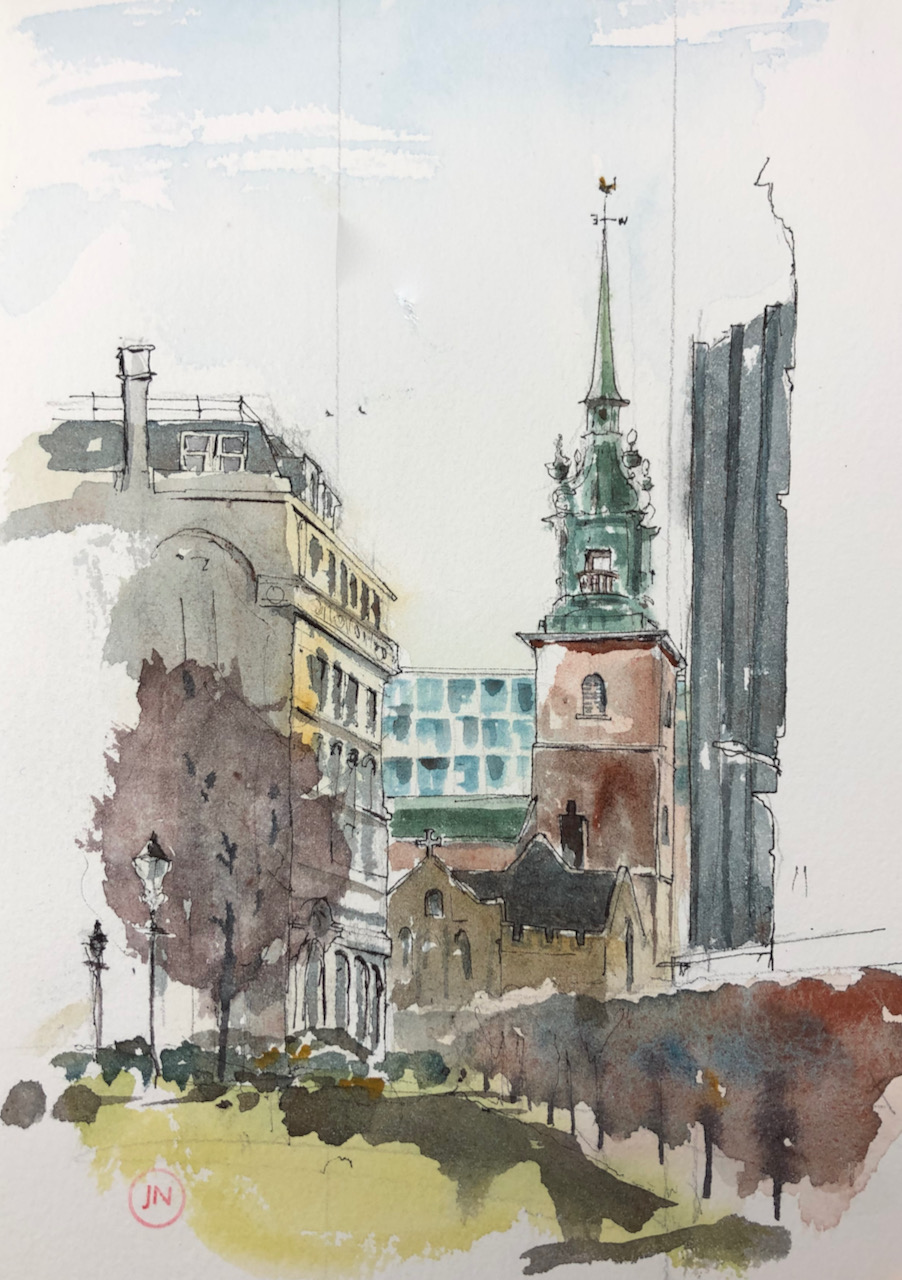
Here is a view of St Magnus the Martyr, a Wren church next to London Bridge.

St Magnus the Martyr, 7″ x 10″, in sketchbook 9

St Magnus Martyr has a foundation that goes back before the first stone bridge across the Thames, which was built in 1209.

The church of St Magnus Martyr escaped the fire of London Bridge in 1633. However it was one of the first churches to be destroyed in the Great Fire of London in 1666. It is only a few hundred yards from Pudding Lane, where the fire started. The present church was built 1671-76 to the designs of Christopher Wren. The steeple which I have drawn was added in 1703-6.

At this time, the road going to London Bridge was just to the left (west) of the Church. The clock which you see in my picture, bottom left, hung over the road. I have all this information from the extensive history set out on the St Magnus Martyr website, which includes this marvellous story about the clock:

It was presented to the church in 1709 by Sir Charles Duncombe (Alderman for the Ward of Bridge Within and, in 1708/09, Lord Mayor of London). Tradition says “that it was erected in consequence of a vow made by the donor, who, in the earlier part of his life, had once to wait a considerable time in a cart upon London Bridge, without being able to learn the hour, when he made a promise, that if he ever became successful in the world, he would give to that Church a public clock … that all passengers might see the time of day.” The maker was Langley Bradley, a clockmaker in Fenchurch Street, who had worked for Wren on many other projects, including the clock for the new St Paul’s Cathedral.

The current London Bridge was built 1825-1831. It is a little upstream (west) of the old London Bridge, so the approach road no longer goes past St Magnus Martyr.

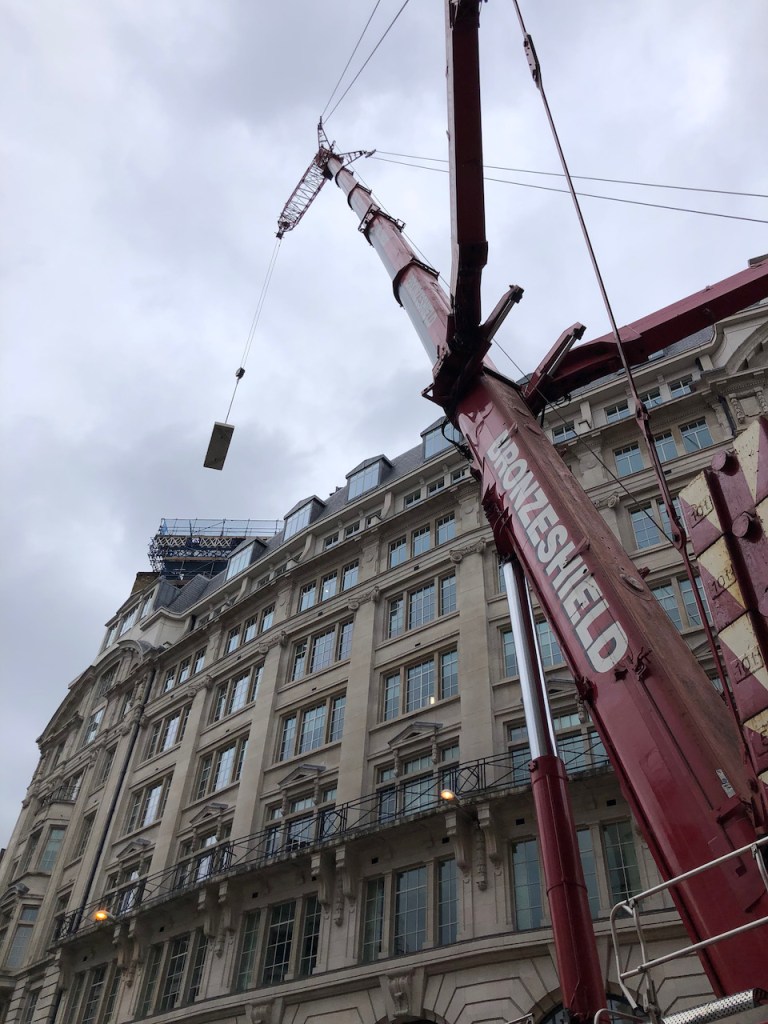
The crane in my picture is at the junction of Gracechurch St and Eastcheap, next to Monument Station. It occupies the whole width of Gracechurch Street. It appears to be lifting concrete blocks onto the top of the building that was, for a short while, House of Fraser.

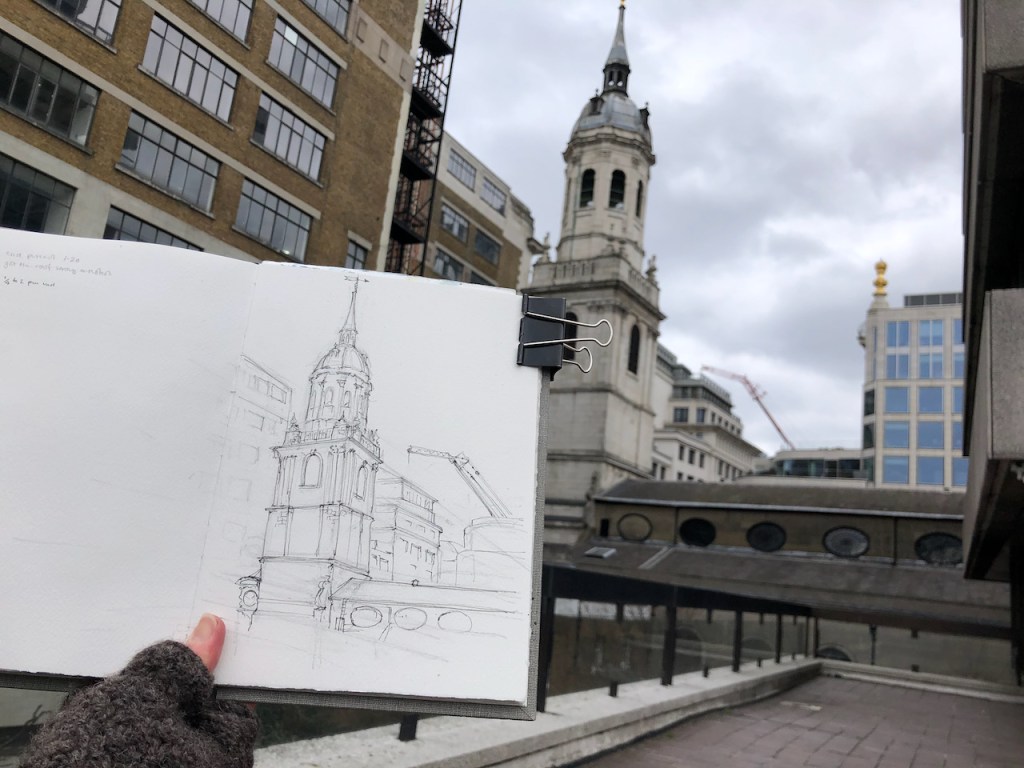
I drew this from a deserted platform, high up near the river Thames.

Inked on location, coloured back home. The outside air temperature was 4 degrees C.

St Albans, Wood Street, EC2

Here is the tower of the former church, St Albans. It stands firmly in the middle of Wood Street, in the City of London.

35 Wood Street. Tower of the former St Albans. 8″ x 10″

This is no longer a church. It’s listed as residential: some lucky person lives in there!

  • Foundation:medieval
  • Rebuilt 1634
  • Burnt down in the Fire of London 1666
  • Then rebuilt to a design by Christopher Wren 1685
  • Restored to designs by George Gilbert Scott 1858-9
  • Pinnacles replaced 1879
  • Then destroyed in the Blitz 1940
  • Listed Grade II* 1950

Here’s a link with more information about this building, including pictures of what it used ot look like.

St Alban, Wood Street: an old library book and a lonely church tower

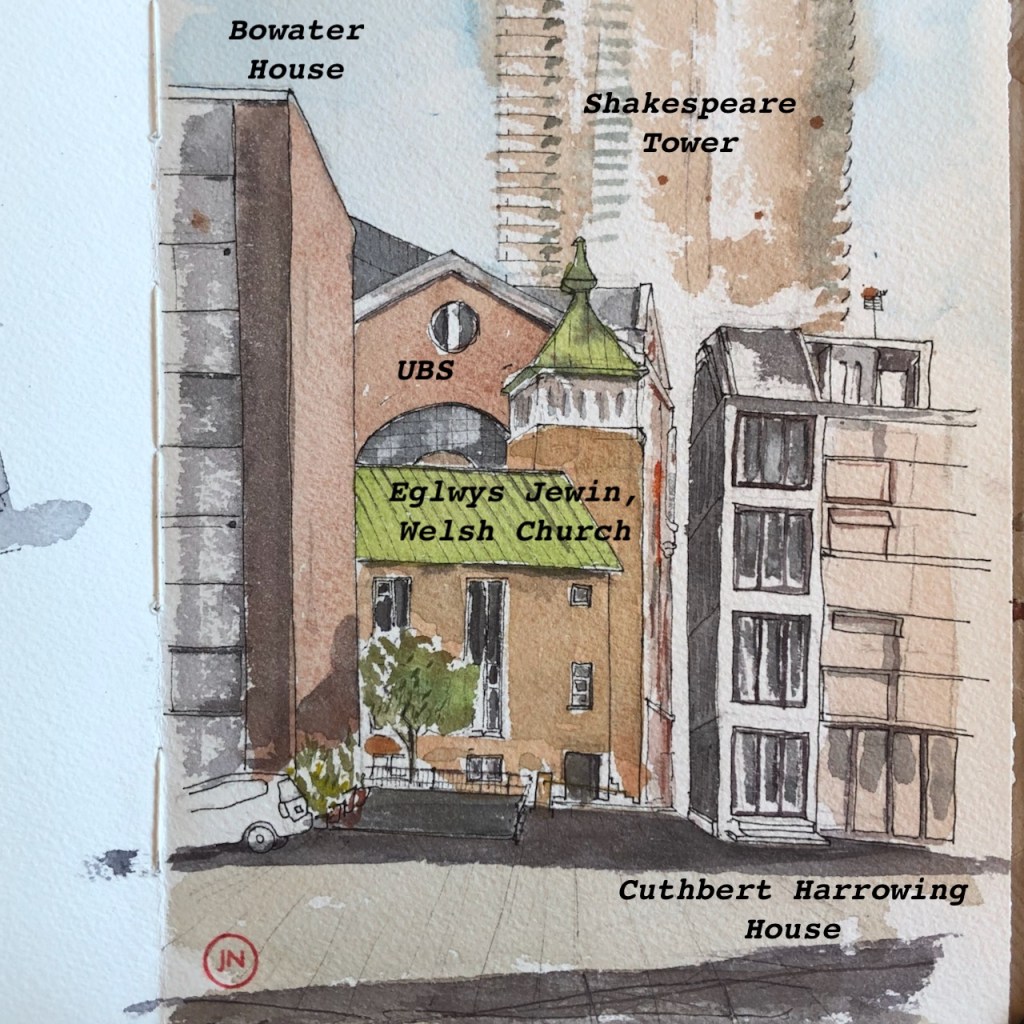
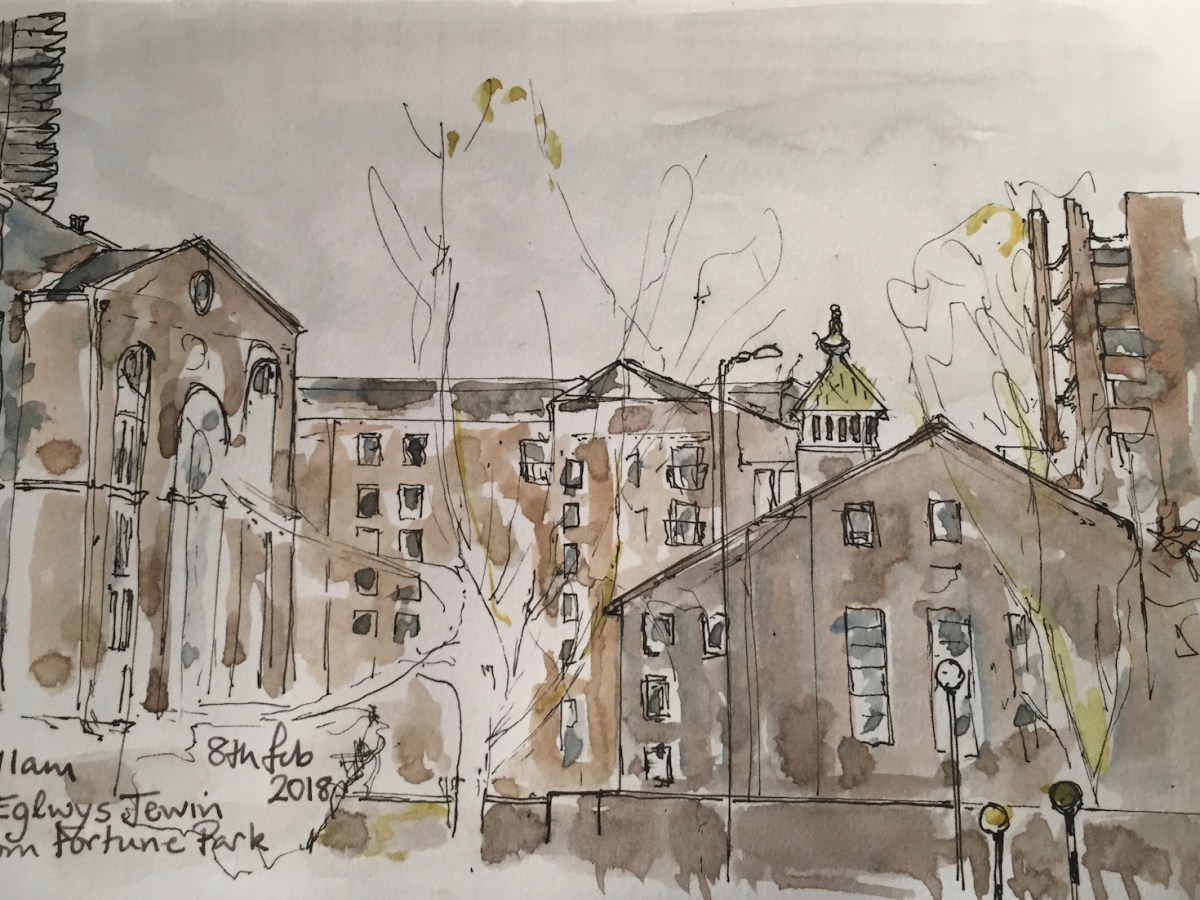
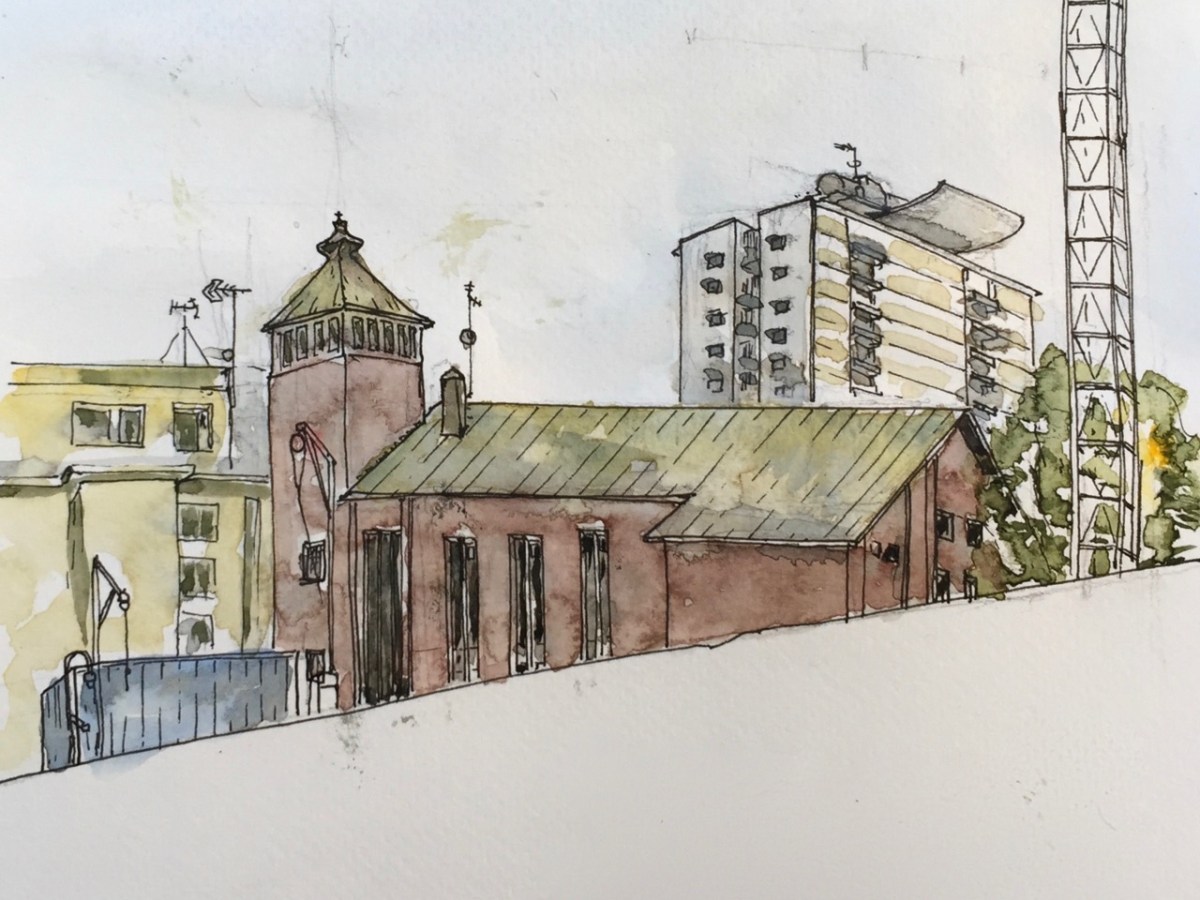
Eglwys Jewin, the Welsh Church, from Golden Lane Estate

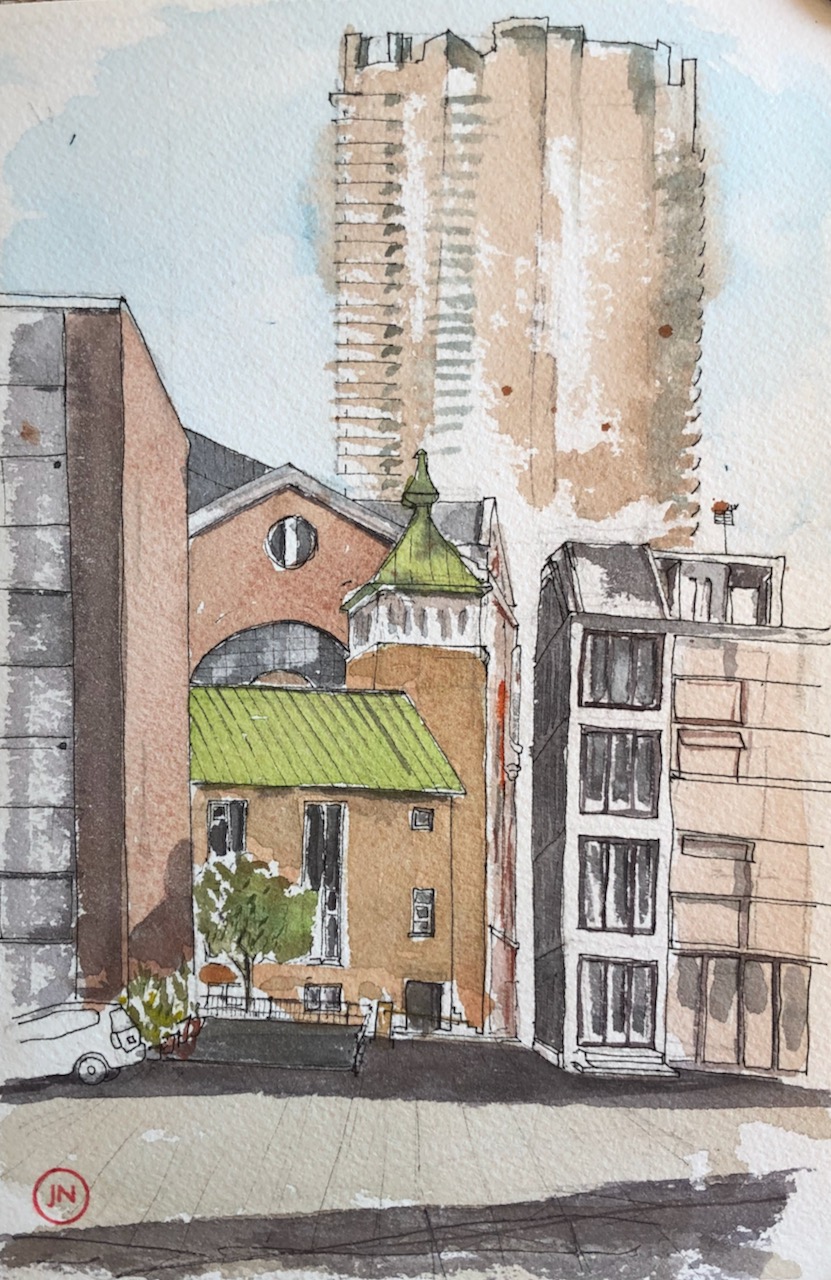
On a glorious sunny Sunday, the sun lit up the roof of the Welsh Church.

Eglwys Jewin, the Welsh Church, from Golden Lane Estate.

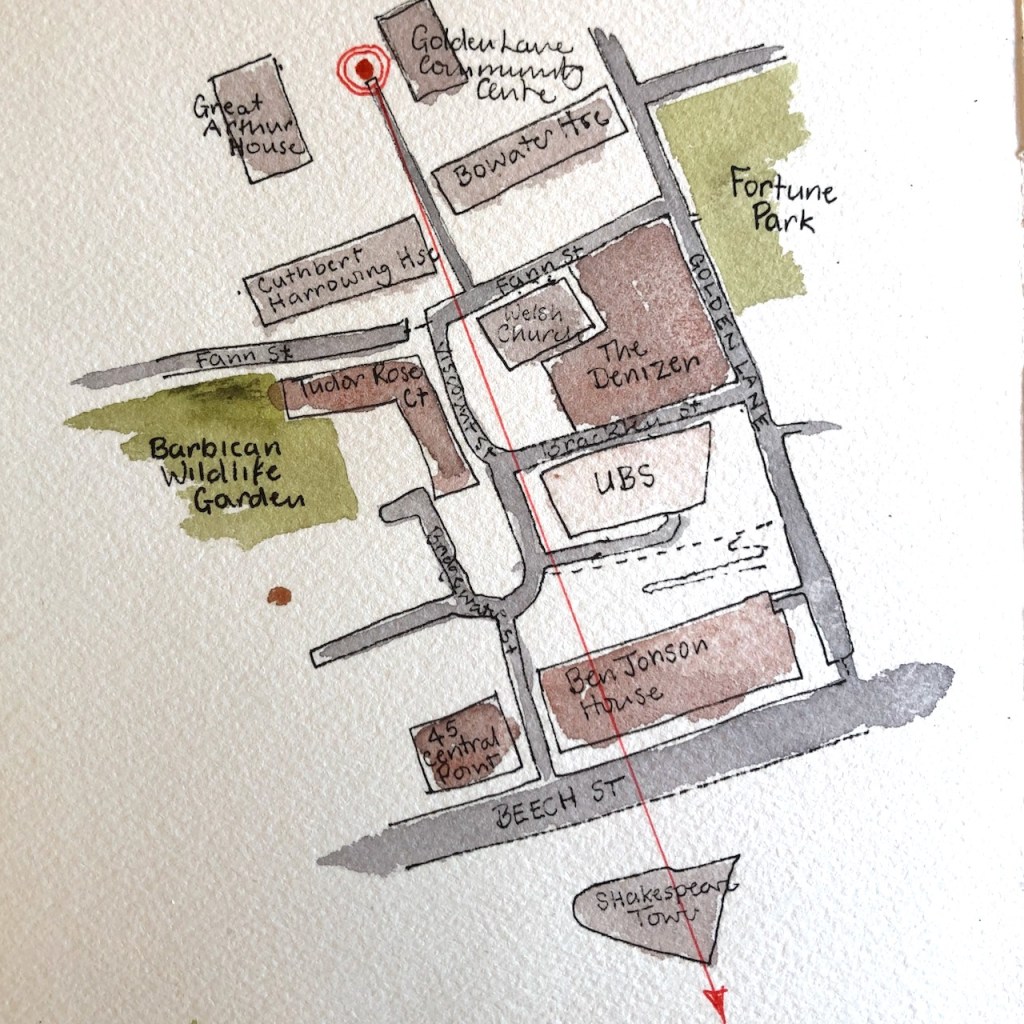
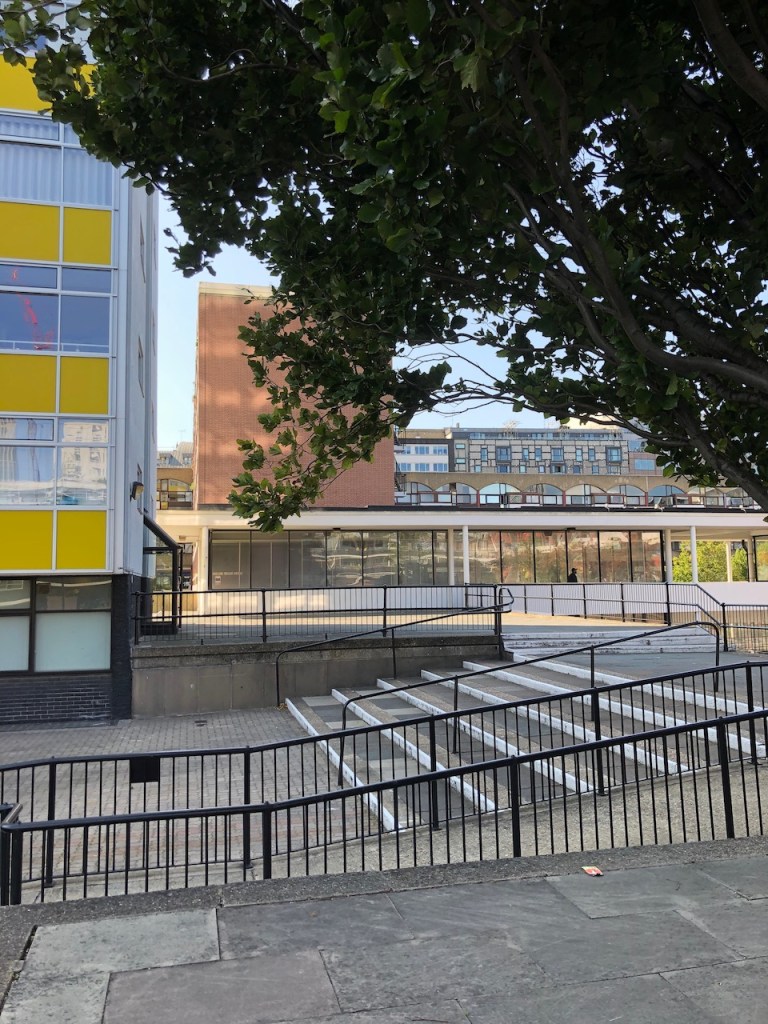
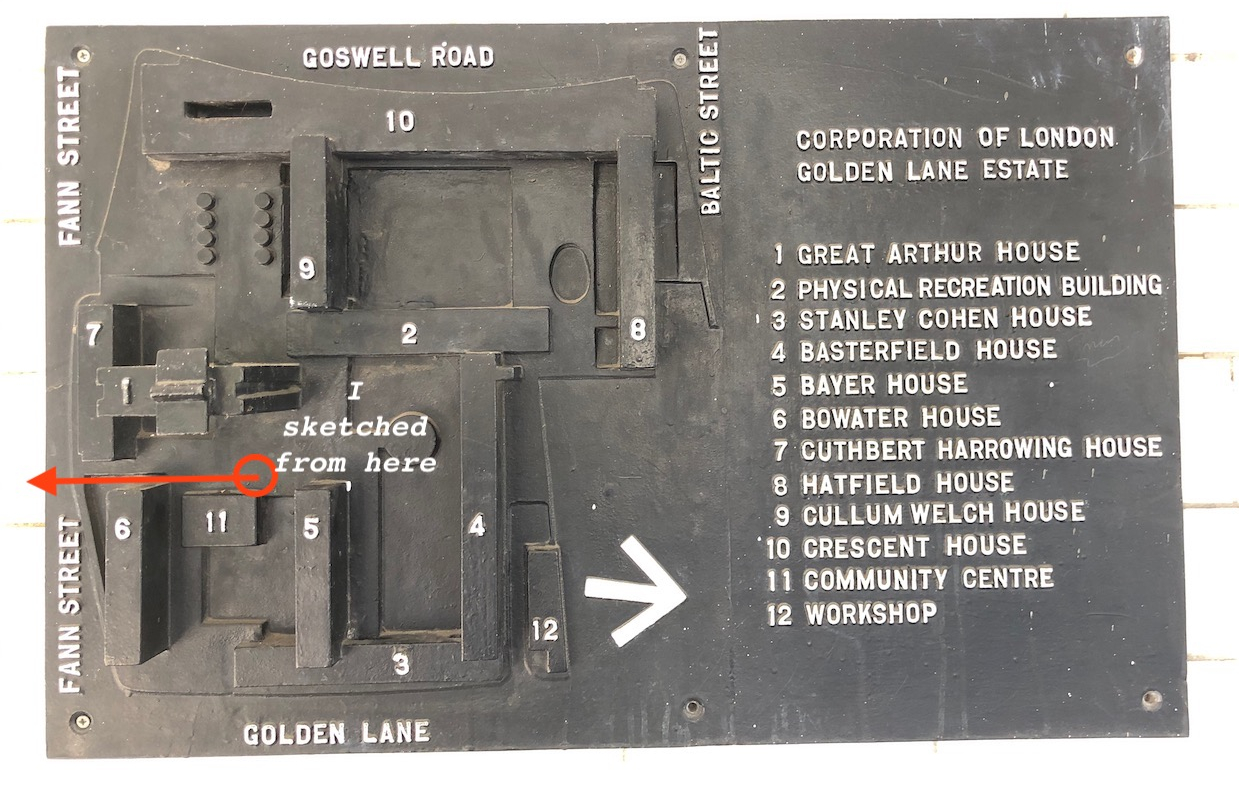
This is the view from the Golden Lane Estate. Here is a map, and an annotated image to show which building is which. The arrow on the map shows the direction I was looking.

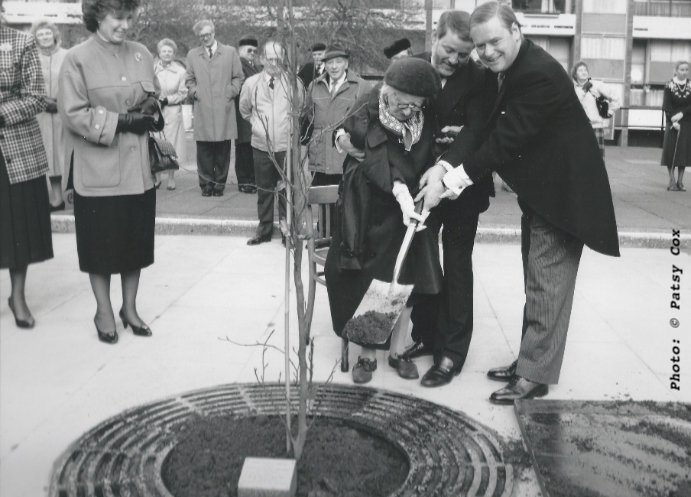
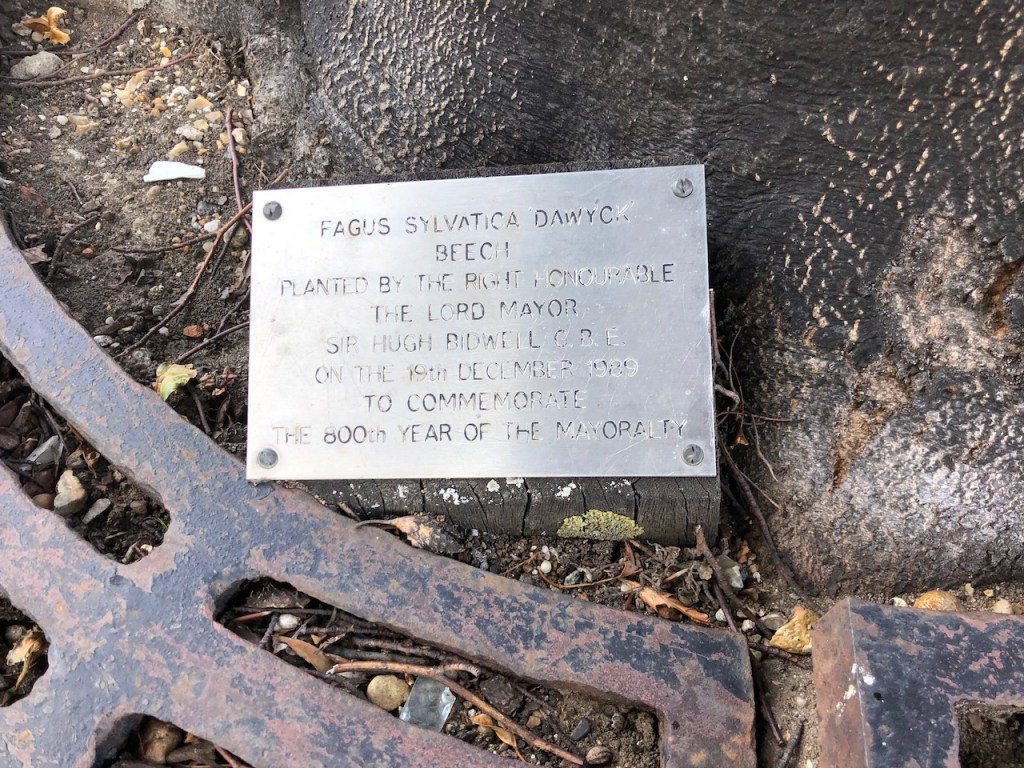
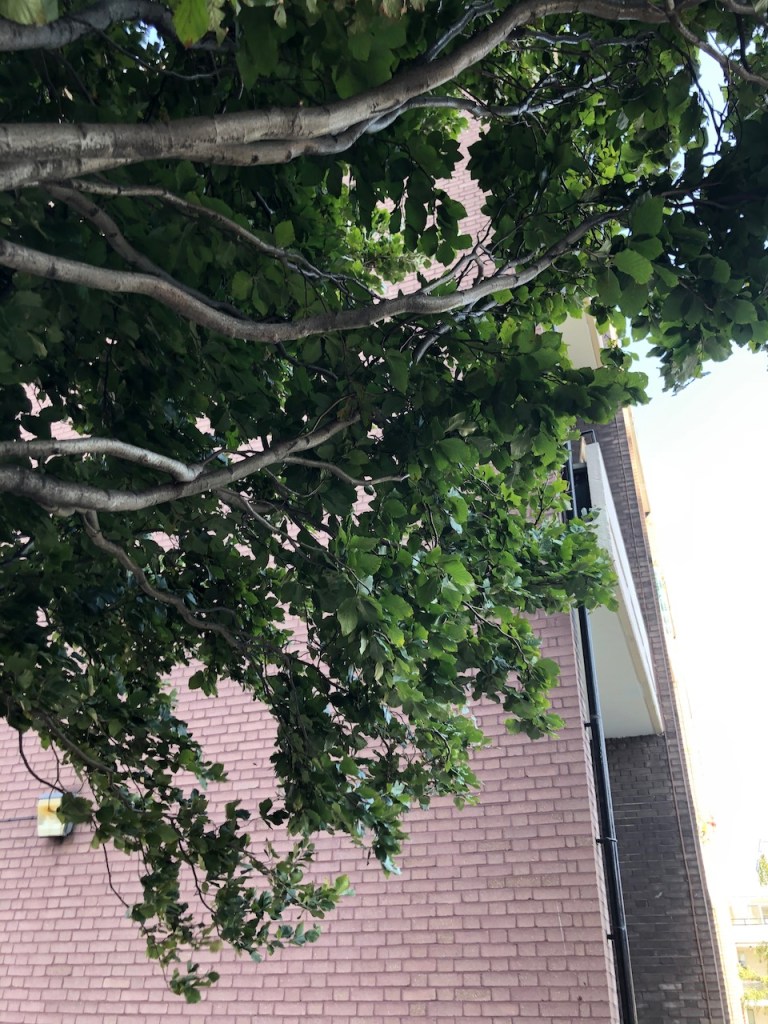
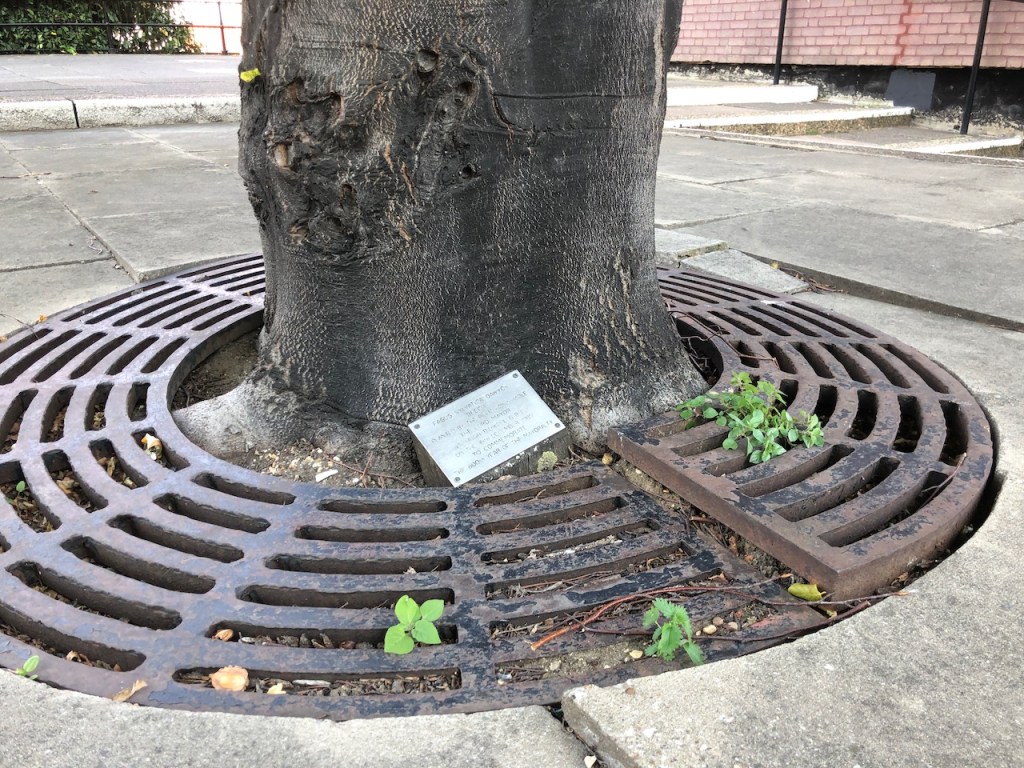
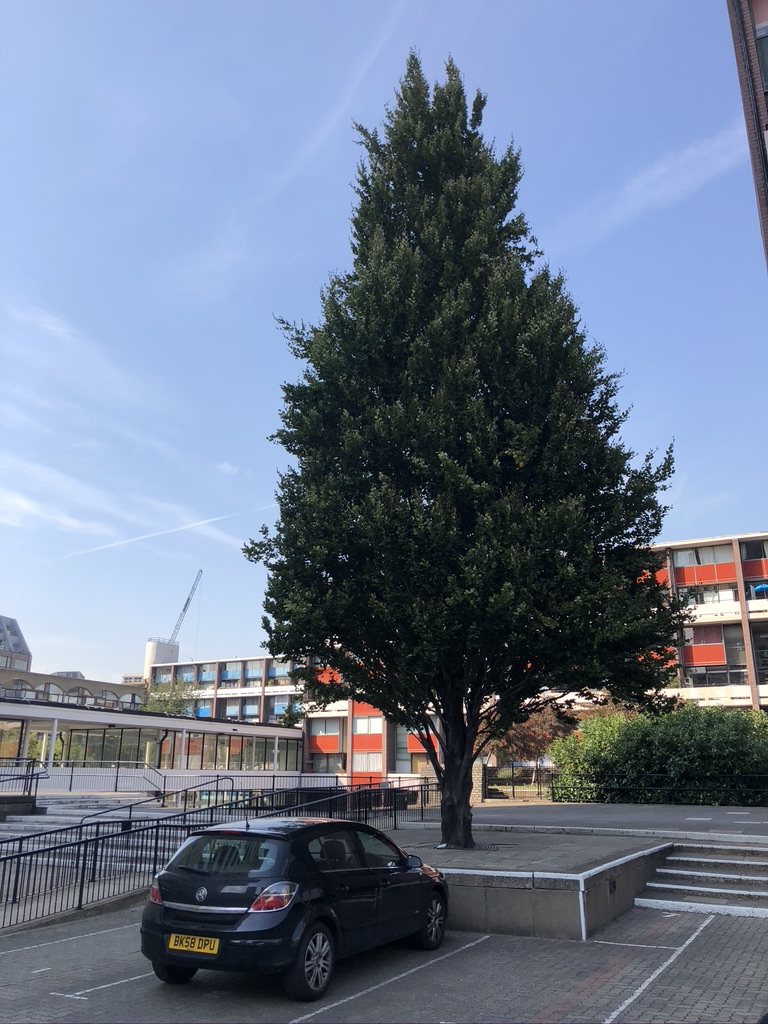
I was sitting next to a beech tree, Fagus Sylvatica Dawyck. A small notice at the base of the tree informed me that it has been planted on the 9th December 1989, to commemorate 800 years of the Lord Mayoralty. By co-incidence, this is the same anniversary that was commemorated by the bollard in my previous post. Here is a picture of the planting ceremony, kindly provided by Billy Mann from his Golden Lane Archive.

Fagus Sylvatica Dawyck, Beech Tree on the Golden Lane Estate, being planted.
Photo courtesy of Patsy Cox and used with permission. The photographer was standing almost exactly where I sat to draw my picture.

The tree has grown strongly in the last 30 years. It surges out of its metal hoops, and pushes the notice aside.

The Golden Lane Estate is a busy place. Many people passed by on the nearby paths. The tree and I were on a raised area, above parked cars. Some people were on foot, one was in a wheelchair, and there were several groups of cyclists. One person had a dog. This was a small dog, the same size as my sketchbook. I can say that with certainty, because, while the person was occupied on their mobile phone, the dog dashed onto my dais and plonked itself foursquare on my sketchbook. What to do?

I must have shouted out, because the person looked up briefly from their phone. I glared at the person, and shooed the dog away. The person uttered a perfunctory ‘sorry’ and continued their conversation. “No, no, it’s alright,” they said into the phone, “it’s just that Tabatha…”. They didn’t ask me if it was alright. I looked down at my drawing. It was alright.

I have drawn this church before. It was built in the 1960s. More information about this interesting building is on my previous posts:

Eglwys Jewin from Fortune Park

The building which was Bernard Morgan House has now been pulled down. This is sad. It had a calm 1960s look, and ceramic tiles on the side. I looked across the gap and could see the Welsh Church: Eglwys Jewin. The church is the building with the green roofed turret and the long windows. It…

Welsh Church and Great Arthur House

Here is the Welsh Jewin Church seen from Brackley Street. This is one of those ephemeral views: a huge new building is about to go up behind the hoarding, and this view will be completely obscured. The church is Eglwys Jewin, the Welsh Church. I have drawn it before, from Fortune Park. Here’s the link…

This drawing took two hours. It is 25cm by 16cm, 10 inches by 6½ inches on Arches 300gsm watercolour paper. The main colours are Fired Gold Ochre, Mars Yellow, Phthalo Turquoise, and Perylene Maroon, with some Prussian Blue for the shadows.

This is the wonderful three dimensional map of the Golden Lane Estate, which is on the South end of Stanley Cohen House on Golden Lane. It has West at the top because that’s the direction you are facing when you are looking at the map.


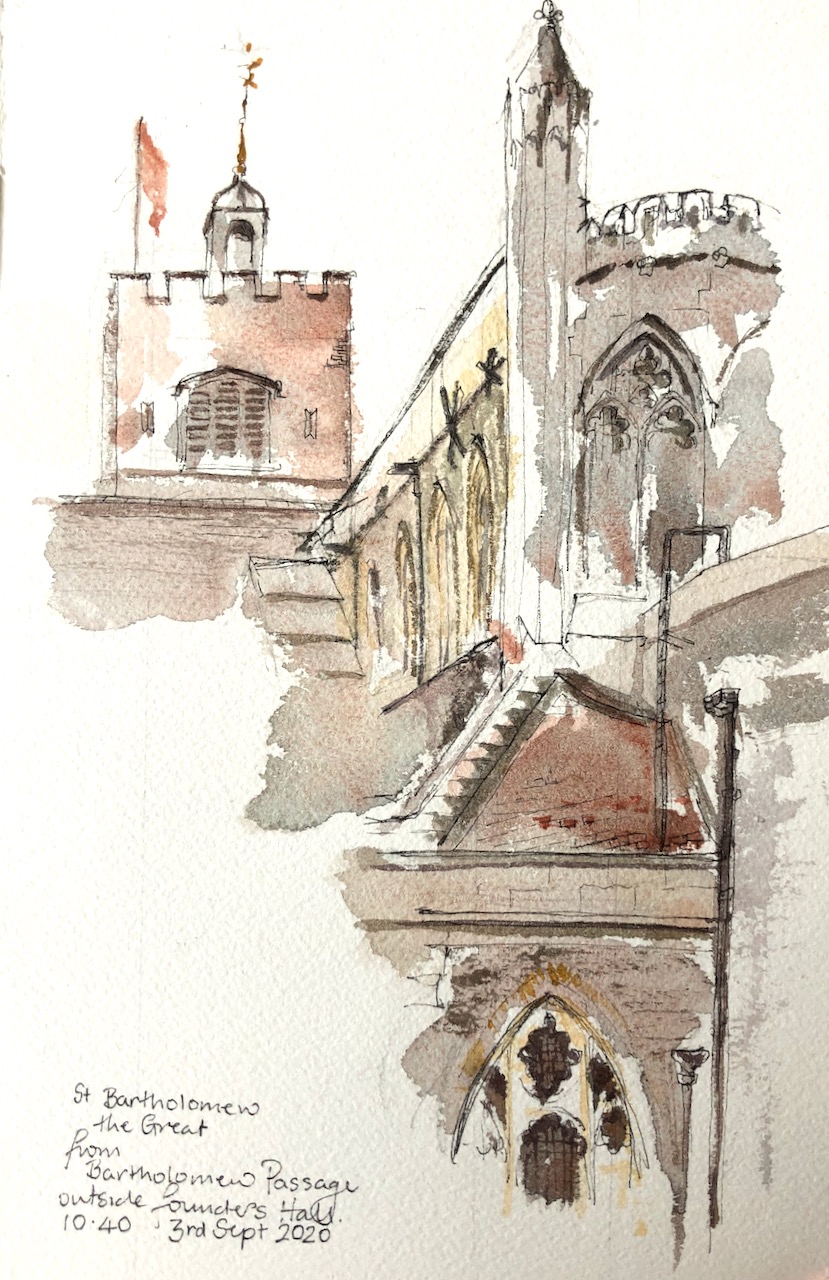
St Bartholomew the Great: Cloth Fair

Cloth Fair is a small street near Smithfield, EC1.

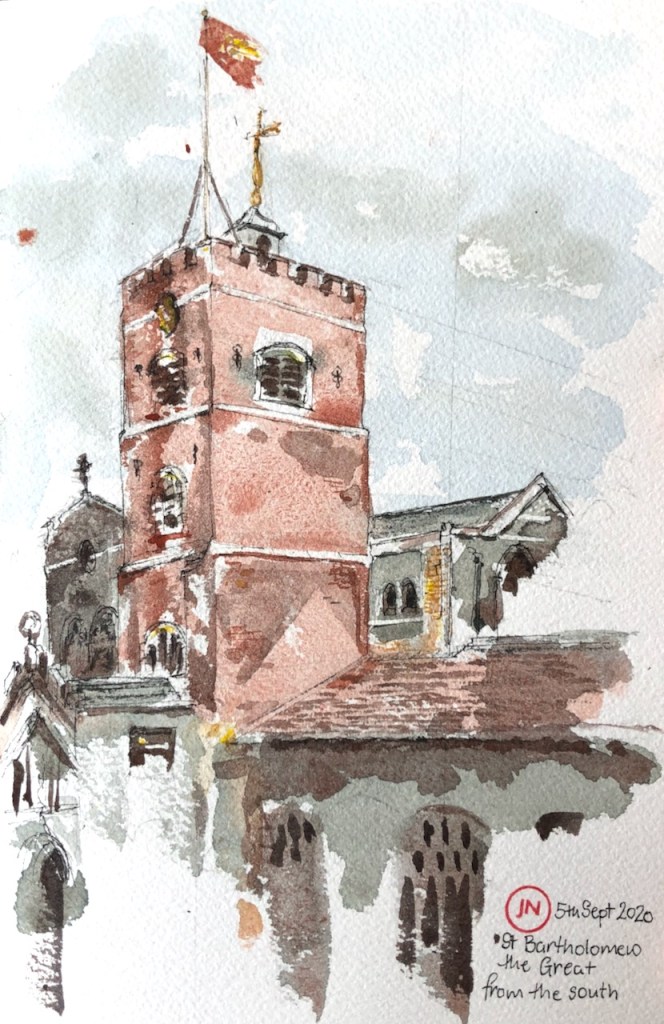
Just South of Cloth Fair is the ancient church of St Bartholomew the Great. I sketched this church from Bartholomew Passage, shown on the map above. Later in the week, I sketched it from the South West side.

St Bartholomew the Great is an ancient church, founded 1123, along with the nearby hospital of St Bartholomew, now called Barts Health NHS Trust.

There is a labyrinth of alleys in this area. As I was sketching in Bartholomew Alley, a woman reached the North end of the Alley, staring at her phone. She rotated through 36o degrees, still looking at the phone. Anxious and frustrated, she rushed along Bartholomew Alley, passed me and stopped. Her plight was so desperate that she was going to abandon the instructions of the phone, and ask a stranger for directions. She asked me if this was the right way for the hospital. I said that it was, but it was complicated that way. “If you are in a hurry,” I said, “you’d best go back the way you came…”. She was in a hurry. She uttered an expletive, and set off in the direction I’d indicated.

Then she remembered her manners and paused, turned to face me, and said “Thank you for the information”.

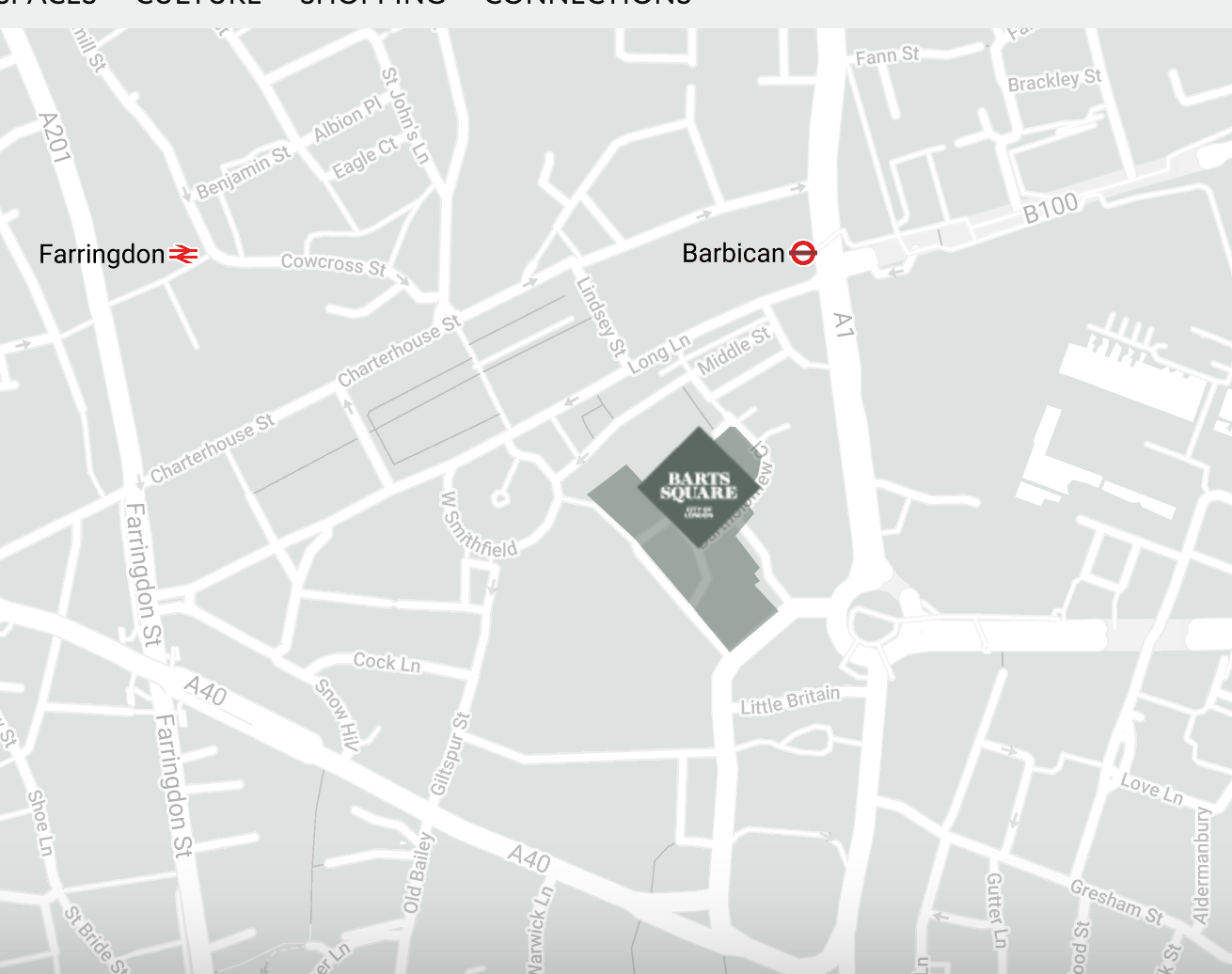
Here are some maps of the new “Barts Square” development, showing the location of the second sketch.

I have sketched often in this area, which is changing rapidly. I am still learning my way around. Here are some of my sketches round here.

Barts Square, West side

Today I went to try out “Halfcup”, a new coffee place which has opened on Bartholomew Close. It’s part of the new “Barts Square” development. These are new buildings in an area that was previously St Bartholomew’s Hospital. Some of the external features of the original hospital buildings have kept, as you see in the…

Barts Square, Butchers’ Hall

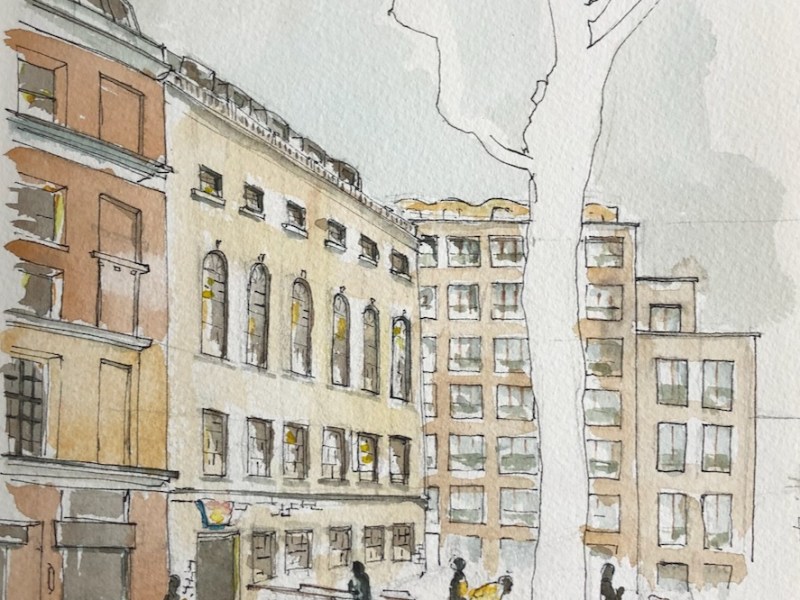
Continuing my exploration of Barts Square, EC1, today I drew Butchers’ Hall. Butchers’ Hall is the building with the arched windows, in the centre left of the picture. It is the headquarters of The Worshipful Company of Butchers. This livery company is very old, the Arms were granted in 1540 and the charter by James…

A concert at St Bartholomew the Great

Here is a post-card sized sketch of people listening to the concert. It felt as though the stones were listening too. Pen and ink in small Seawhite journal, about 20 mins.

St Vedast-alias-Foster, EC2

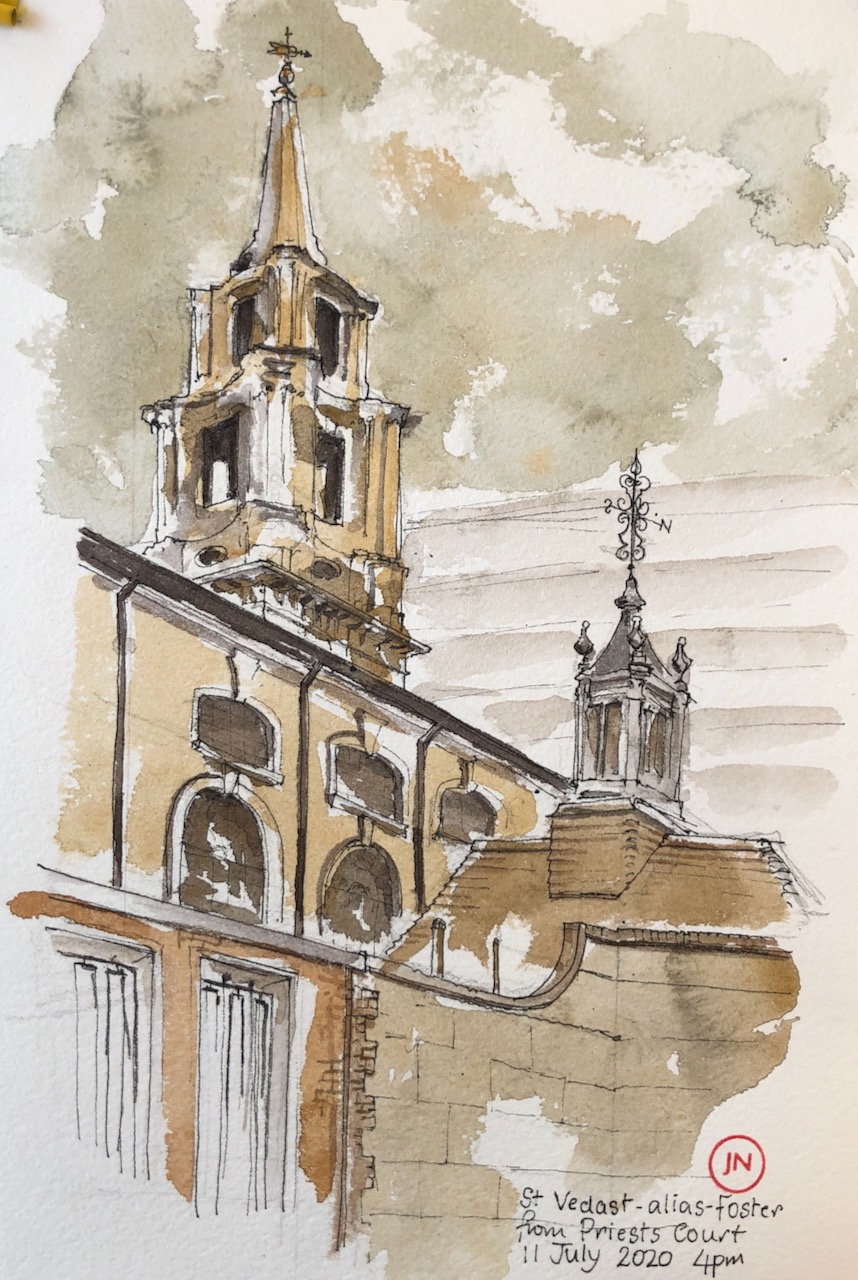
Here is the Anglican Church of St Vedast-alias-Foster, in the City of London, viewed from Priest’s Court.

St Vedast-alias-Foster
Memorial stone to Petro, Major Wladimir Vassilievitch Petropavlovsky

Before I drew this, I paused a while in the Fountain Court, a tranquil courtyard next to the church. In the shadow, there is a monument to “Petro”, Major Wladimir Vassilievitch Petropavlovsky. His friends awarded him the epitaph “This was a Man”. I had a look online to see if I could find out more about this person.

He was a member of the Special Expeditionary Force in the 1939-45 war in Europe. This was an organisation formed for espionage in Nazi occupied areas. I can find the record quoted, but the “National Archives” link is not working at present. There is little online that I can find.

Downloaded from http://www.academia.edu, from a list compiled by Eliah Meyer.

However he did write a book, under the name, “W Petro”. I have it on order, so I shall find out more about this interesting character.

The drawing took an hour and 45 minutes. Here are some photos of work in progress.

Fountain Court, I found out afterwards, is named not after a fountain, for there is none, but after a pub that used to be in the area.

All Hallows on the Wall

London Wall is the old Roman Wall around the City of London. It is also the name of a road. In normal times London Wall is a very busy road, an arterial route in the City, full of buses and cars and bikes, with people thronging the pavements looking at mobile phones. Now it is empty, and you can see the scenery. Here is a view All-Hallows-on-the-Wall, sketched from the opposite pavement, outside Deutsche Bank. The church occupies a narrow site, between the present-day road and the old London Wall.

The “Friends of City Churches” site says: “The previous church on this site escaped destruction in the Great Fire but was rebuilt by George Dance the Younger in 1765/67. He was just 24 years old, but achieved an exquisite small interior of neo-classical simplicity regarded by Betjeman as one of the most successful of the London interiors.”

The Church is only open at certain times, and in the pandemic not atall. It has been the headquarters of various groups seeking to help people. Currently it is the headquarters of “XLP” and has their banners outside. Here is an extract from the XLP website:

“XLP is about creating positive futures for young people growing up on inner-city estates, struggling daily with issues such as family breakdown, unemployment and educational failure, and living in areas that experience high levels of anti-social behaviour and gang violence. Every year XLP helps thousands of young people recognise their full potential. We believe positive, long-term relationships can restore a young person’s trust in people, nurture the belief that things can change and encourage them to set positive goals and work hard to achieve​ them”

Here is work in progress on the sketch. See how empty the road is.

You can see the old London Wall under the big tree. Here is a picture from over there near the church.

Old London Wall is on the left. The modern street called “London Wall” is on the right. All Hallows main entrance is in the centre, below the tree. I did my sketch from the pavement on the other side of the road, on the right. The pale-coloured offices there are Deutsche Bank.

Sketch took about an hour, drawn and coloured on location.

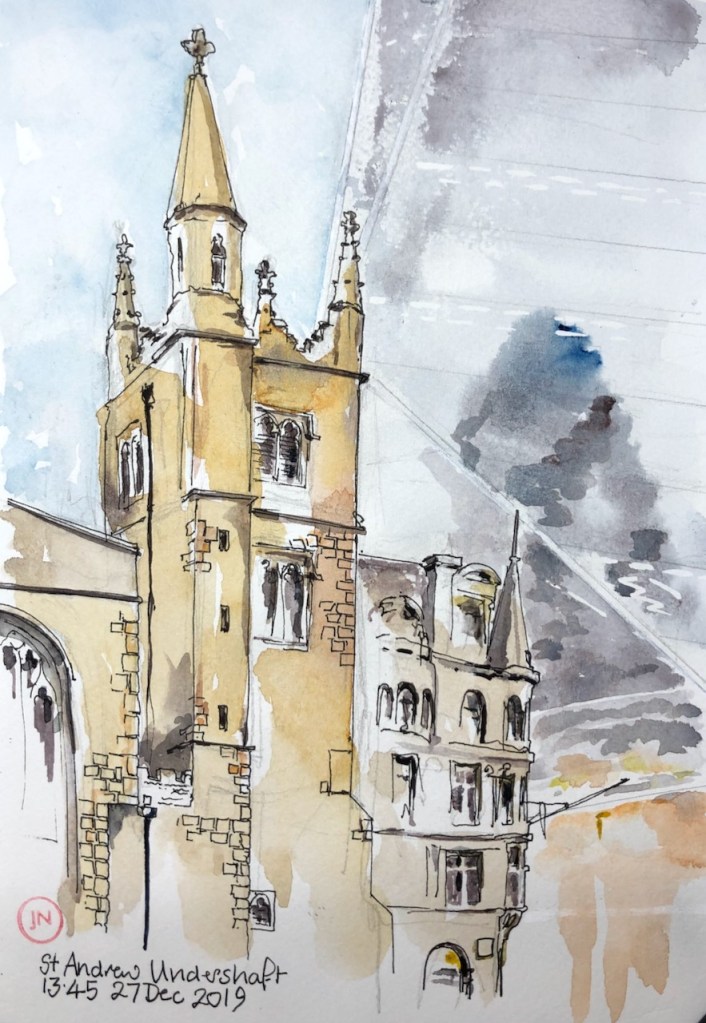
St Andrew Undershaft

Here is St Andrew Undershaft, constructed in 1532. It survived both the Great Fire of London, and the Blitz. Next to it is a branch of Lloyds Bank. Behind, with its huge reflective walls, is the Scalpel Building, 52 Lime Street EC3, finished this year. Reflected in the walls of the Scalpel is 30 St Mary Axe, The Gherkin, finished in 2003.

On the West side of the Square, diminished by the monumental canopy of the Leadenhall Building, is a Victorian statue entitled “NAVIGATION”. Navigation is a big strong man, inadequately clad for Northern seas, but he doesn’t mind. In his right hand he grasps the ship’s wheel. In his left arm, he cradles a ship. Next to him, incongrouously, is a multi-coloured wooden column. At first I thought it was some kind of antenna. Then perhaps it might be a 21st century version of a Barber’s Pole, no longer red and white only, but now yellow too. But there is no Barbers Shop. I was just about to conclude it must be “Art”, when I saw the explanatory notice, low down and in shadow. It is a Maypole.

“Until the 16th Century, a famous maypole used to be put up on feast days at the corner of St Mary Axe. Its shaft overtopped the original church, which got its name St Andrew Undershaft as a result. When not in use, the shaft was stored in an alley near here, which became known as Shafts Court”.

“NAVIGATION” and the Maypole.

About 45 minutes on location, finished at home. It was very cold. Colours used: Mars Yellow, Perinine Orange, Prussian Blue, Perylene Maroon. The sky is dilute Prussian Blue.

Here is work in progress and my location:

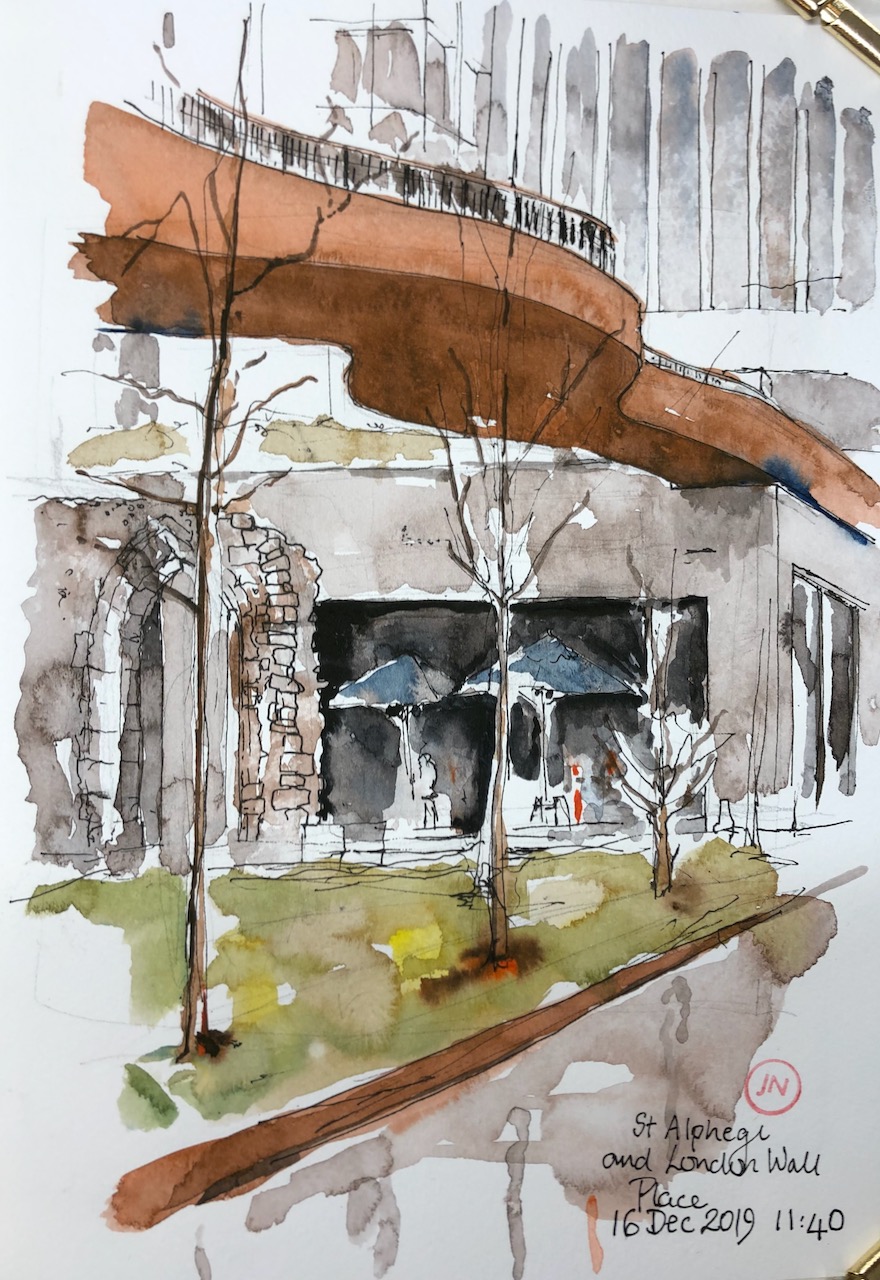
St Alphege, from outside Barbie Green

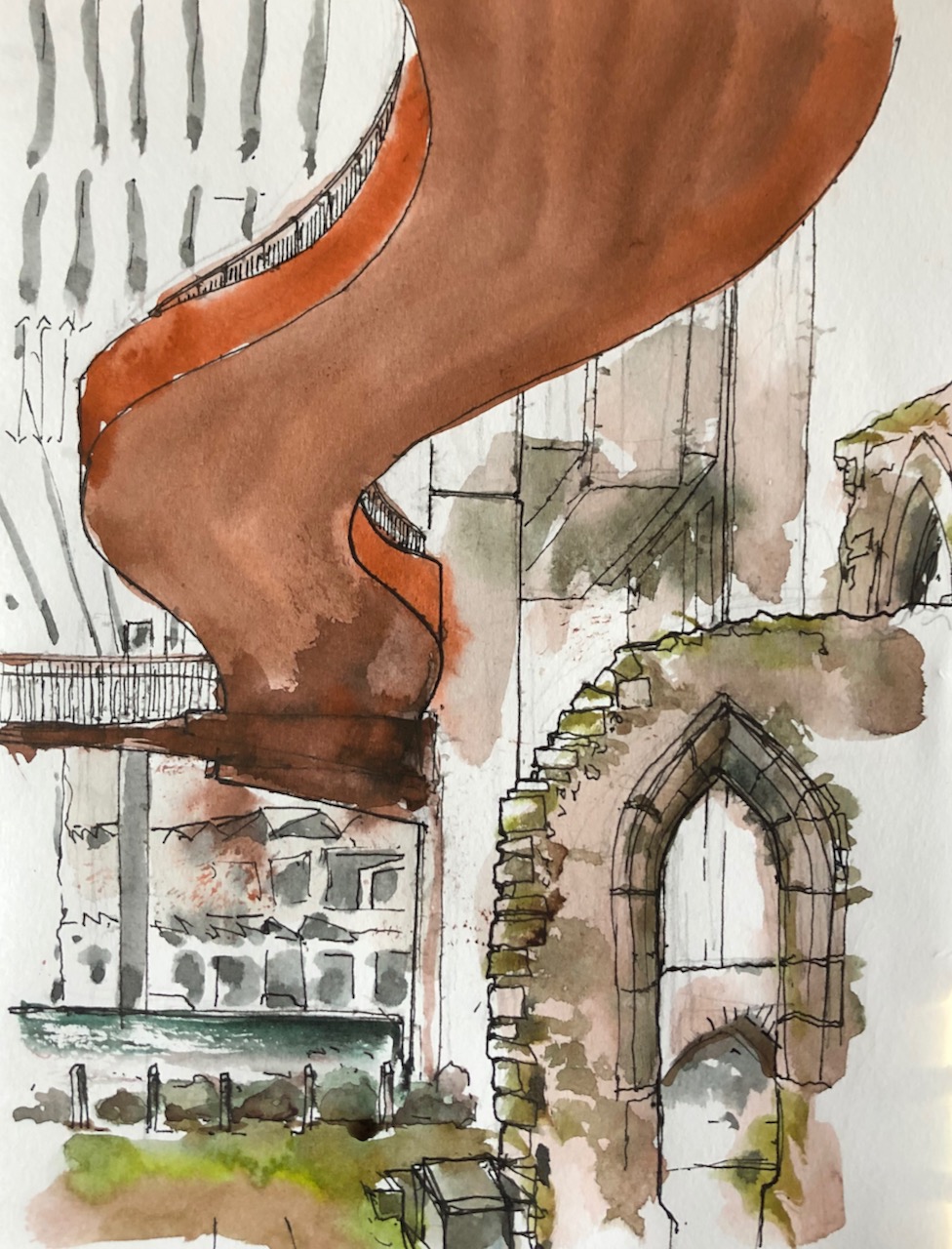
Here’s another drawing on London Wall place. This is a view of the highwalk from underneath. I was standing by the new café, Barbie Green, sheltering from the rain.

IMG_0535

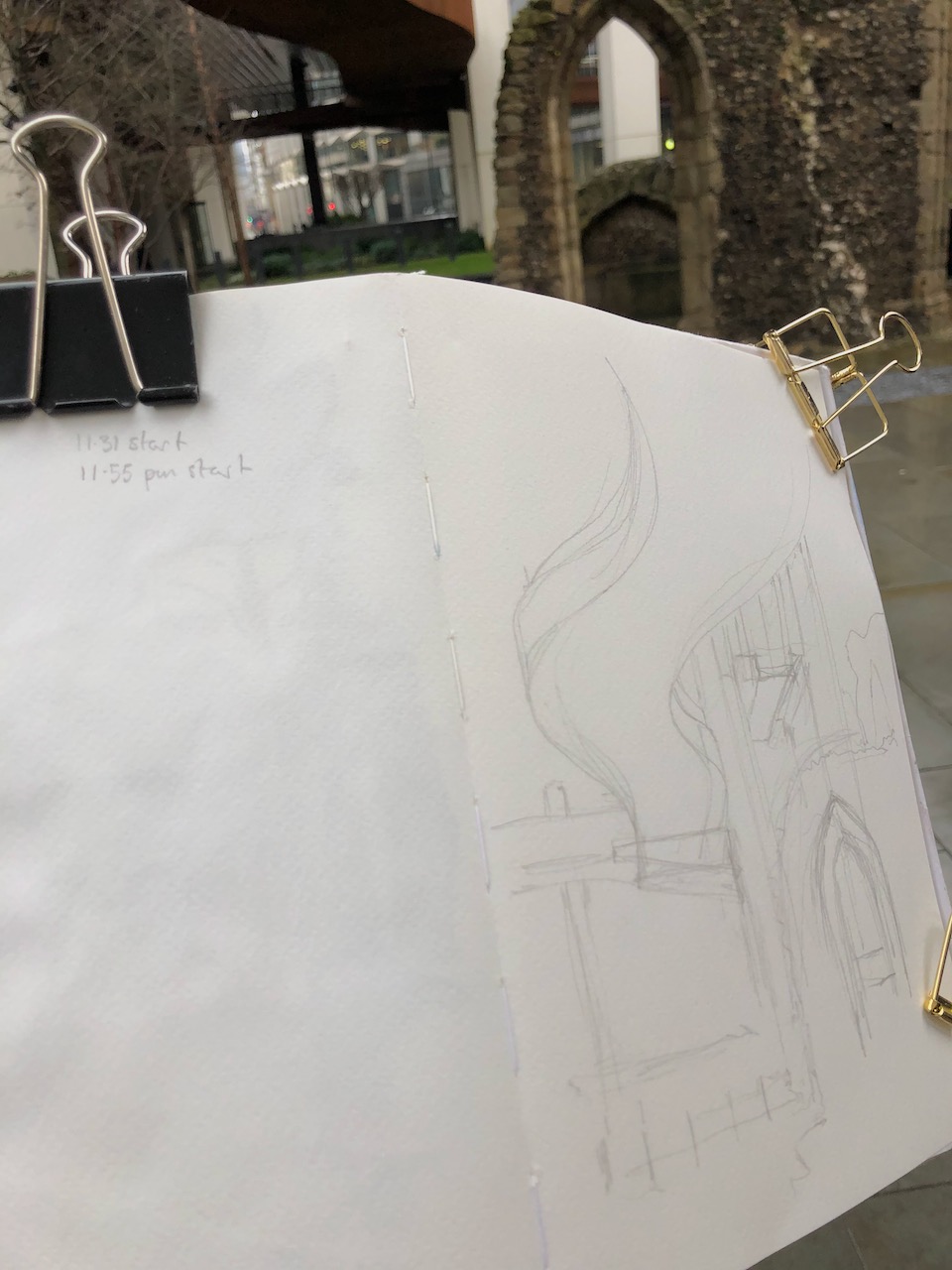
The shelter was not very good, and there was a lot of wind, so raindrops arrived on the picture. I went to go in the café to finish the colouring, but no, there were “no tables”.

So I finished the drawing outdoors, sitting on a damp bench.

I very much enjoy this highwalk. It curves in all dimensions. The side walls undulate, the walkway becomes wider and narrower, and it tilts up and down. It’s made of some iron-like metal, so it has rusted and is now a deep brown. The shape of it respectfully frames the ruins of the old church.

I appreciated all this while observing, through the picture windows of the cafe, three empty tables, which remained empty for the whole time.

1hr10, drawn and coloured on location.

More drawing expeditions in this area:

St Alphege, Barbie Green and London Wall Place

On the way back from the Post Office, I paused to draw the view under the new Highwalk of London Wall Place. There is a new café called “Barbie Green”.

IMG_0514

I drew this by the water pond and the plants. sheltered by the highwalk. Other people were there too, mostly smokers. Except that people don’t smoke anymore, but wander around leaving trails of mist with strange synthetic smells, nearly but not quite vanilla.

Screen Shot 2019-12-17 at 17.05.28
Location of London Wall Place shown in yellow. View of drawing in red.

I have sketched in this area before. Here’s a similar view, drawn last year in the summer, just after the highwalk was constructed:

IMG_4173
St Alphege

The drawing above is from this post:
St Alphege, London Wall

St Bartholomew the Less – etchings (2)

Here is an etching for the City Music Foundation.IMG_0305

Here are photos of work in progress and some more prints:

See this post for earlier sessions on this project: St Bartholomew the Less – etchings(1)