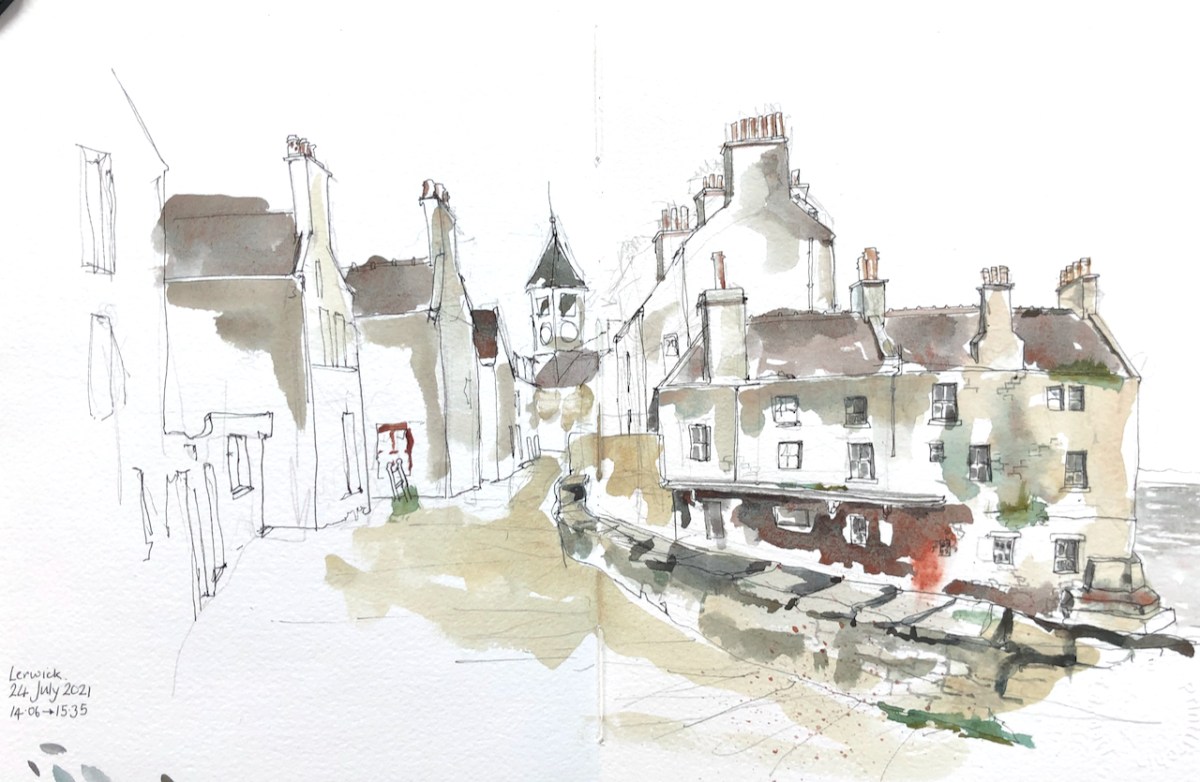
Here is a view of houses in Lerwick known as “lodberries”. They are built into the sea. Lerwick is one of the few capital cities in the world that has a beach. The other I know is Sydney Australia. The beach in Lerwick is somewhat smaller than Bondi beach, and is over the wall to the right of my picture.
I drew this picture sitting on a bench next to the aptly named “Water Lane”. I was just thinking how peaceful it was, how few people, and how unlike London, when a car came and parked directly in my line of sight, blocking my view of the part I had yet to draw. A small family emerged out of the car. Children ran around with buckets and spades, a woman corralled them down the steps and onto the beach. A man got out of the driver’s seat and saw me. He smiled. It was a sunny day. I smiled a mixed smile. Suddenly he saw that I was drawing. “Oh!” he said, “Shall I move the car?” I said yes, that would be very kind. Without any hesitation he jumped back into the driver’s seat, fired up the engine and parked in a space up the road. He waved to me as he walked to join his family down on the beach. I waved back.
Commercial Street, Lerwick. Lodberries. July 24th 2021, in Sketchbook P1 double spread: 14″ x 10″ approx. 1½ hours on location
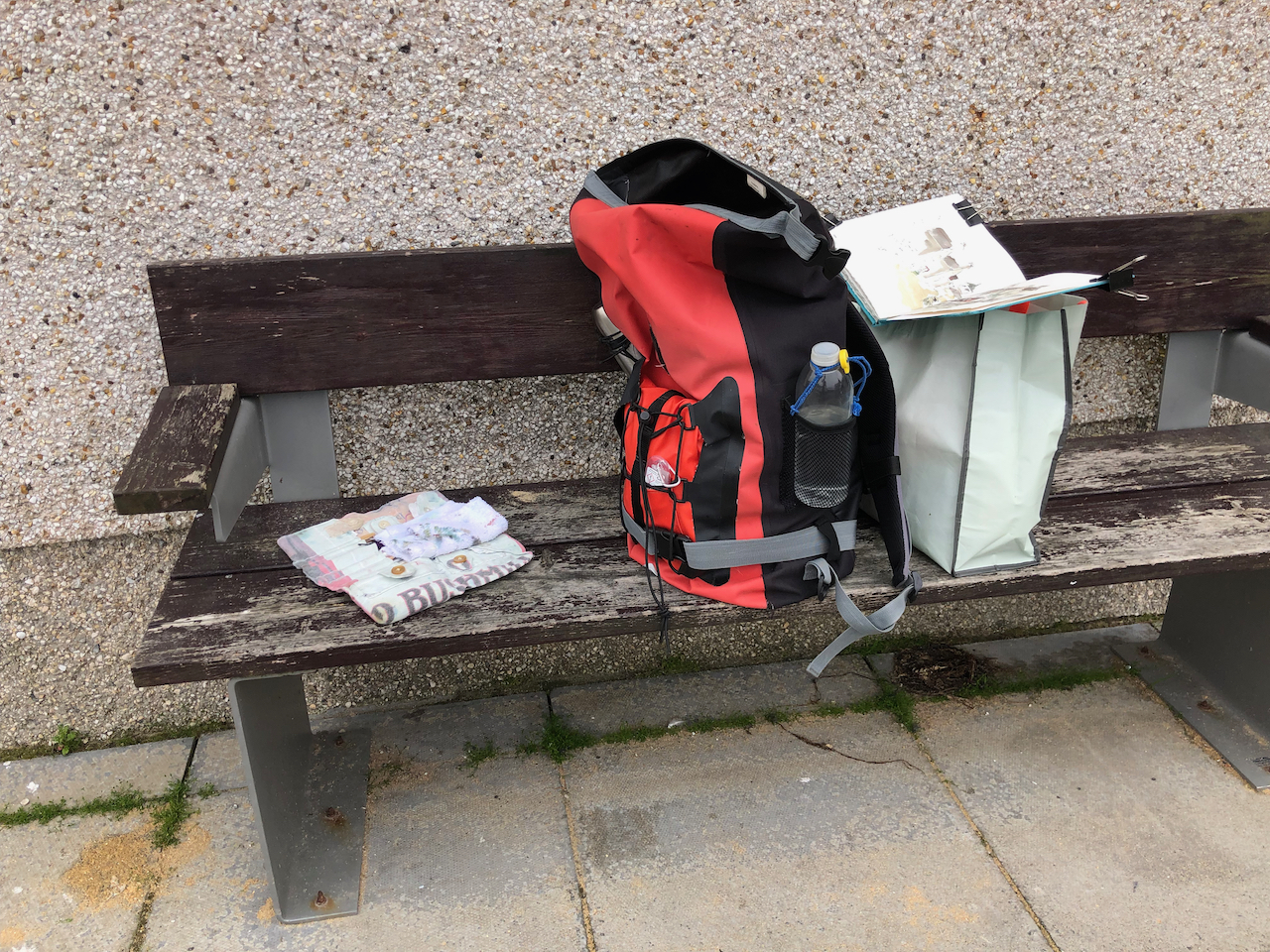
Here is work in progress:
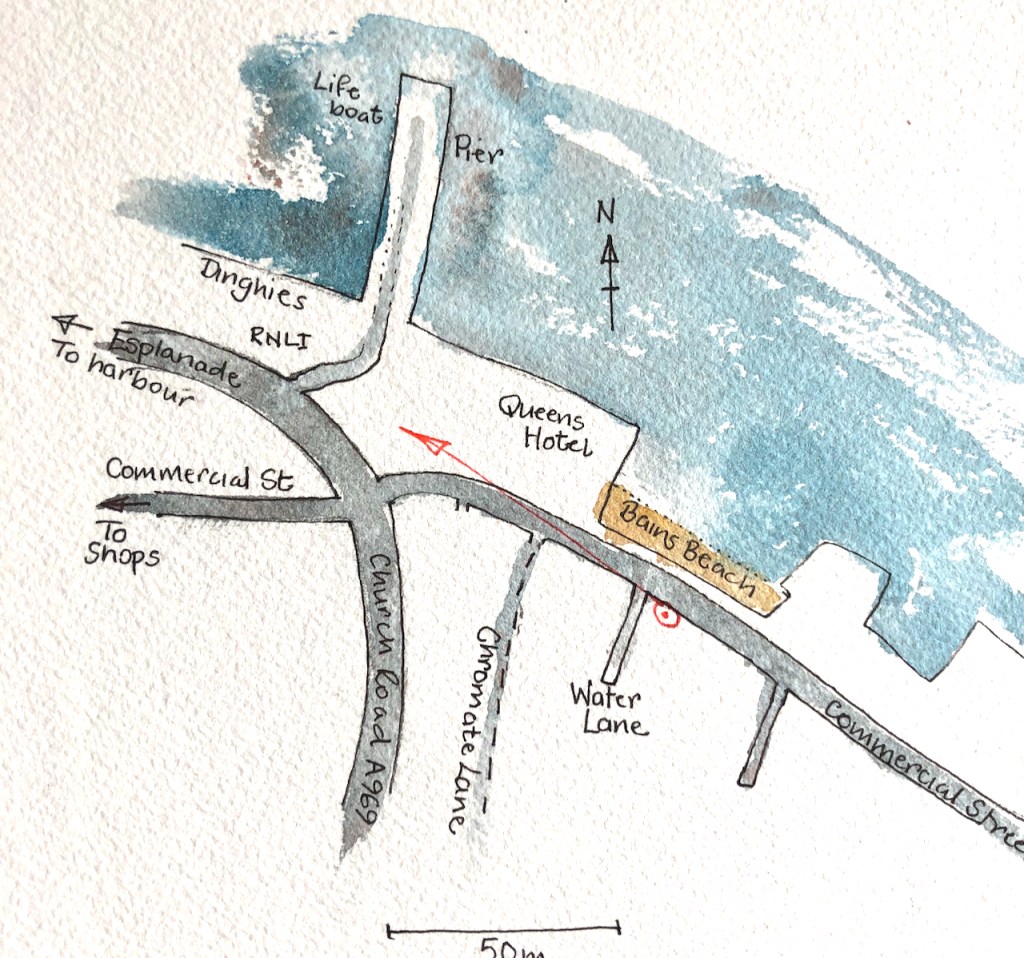
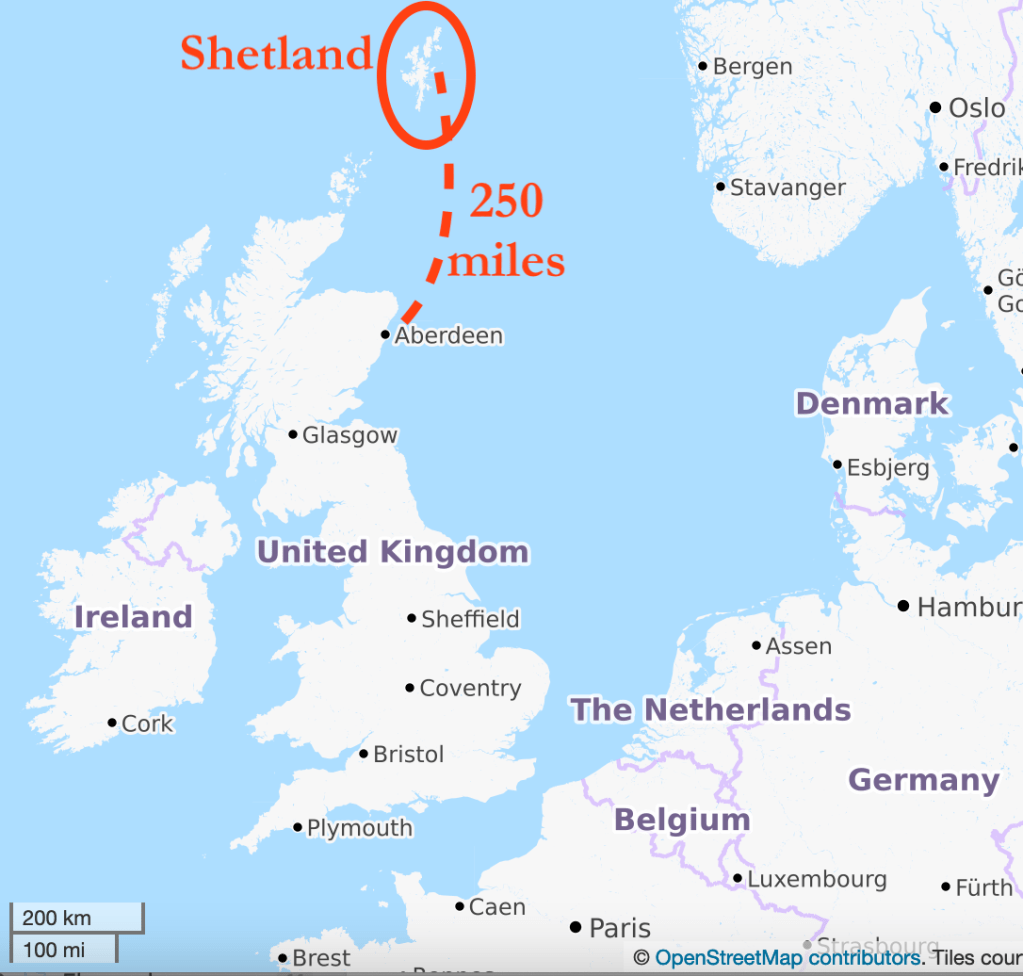
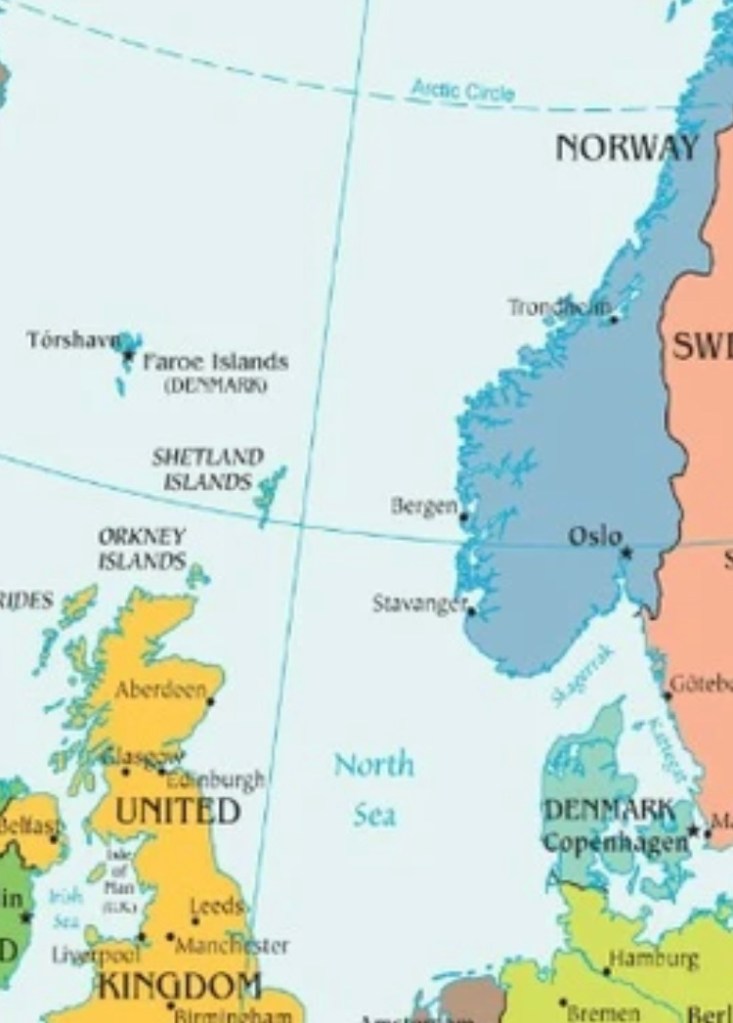
Here are some maps to show the location. I have also included maps showing where Shetland is, since people have asked. It is about 100 miles off the north coast of Scotland. From Aberdeen it is some 250 miles (400km) and takes 13 hours by ferry. Shetland is at a more Northerly latitude than Oslo and Stavanger, nearer Bergen than Aberdeen and nearer Copenhagen (590 miles) than London (600 miles).
Here is a view of the North Sea approaching Aberdeen. See the wind turbines.
Click a button below to share this post online, email it, or print it:
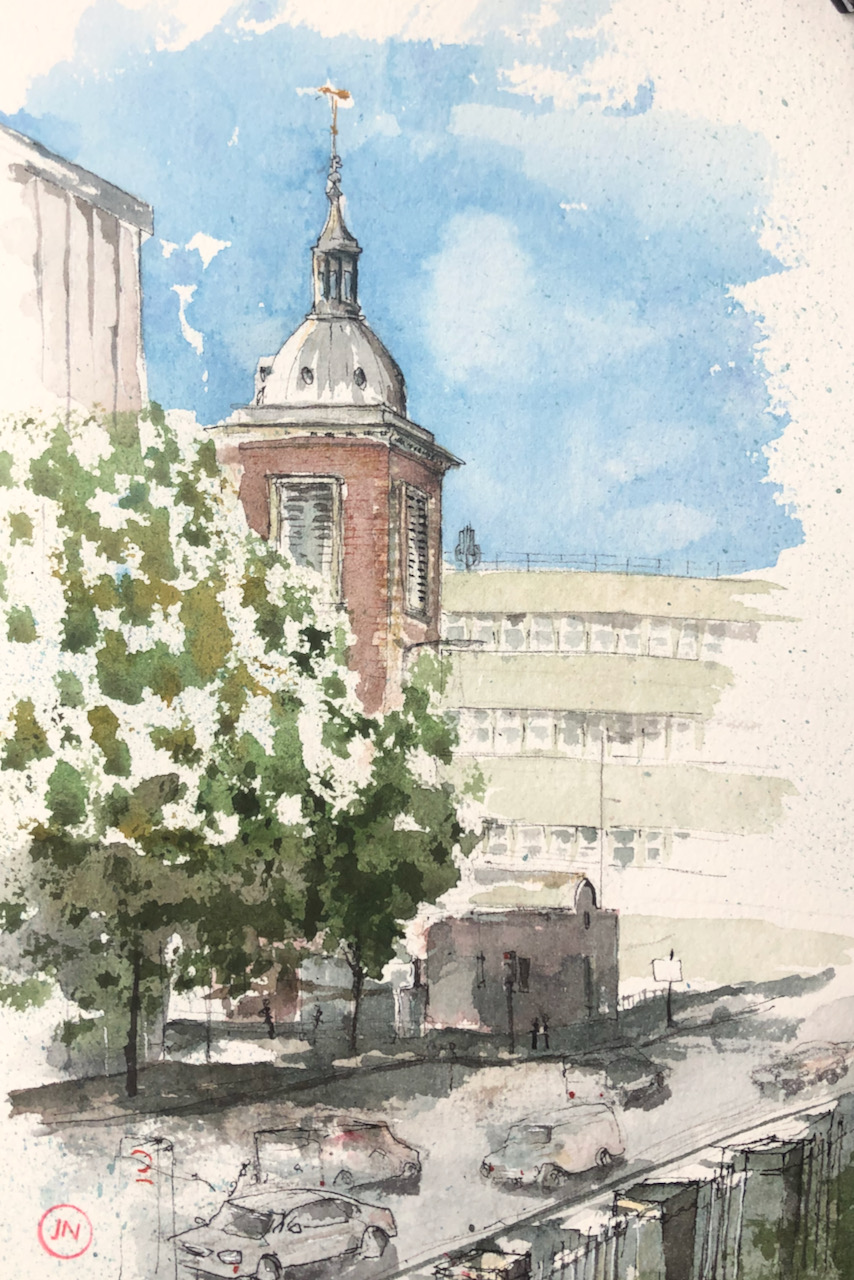
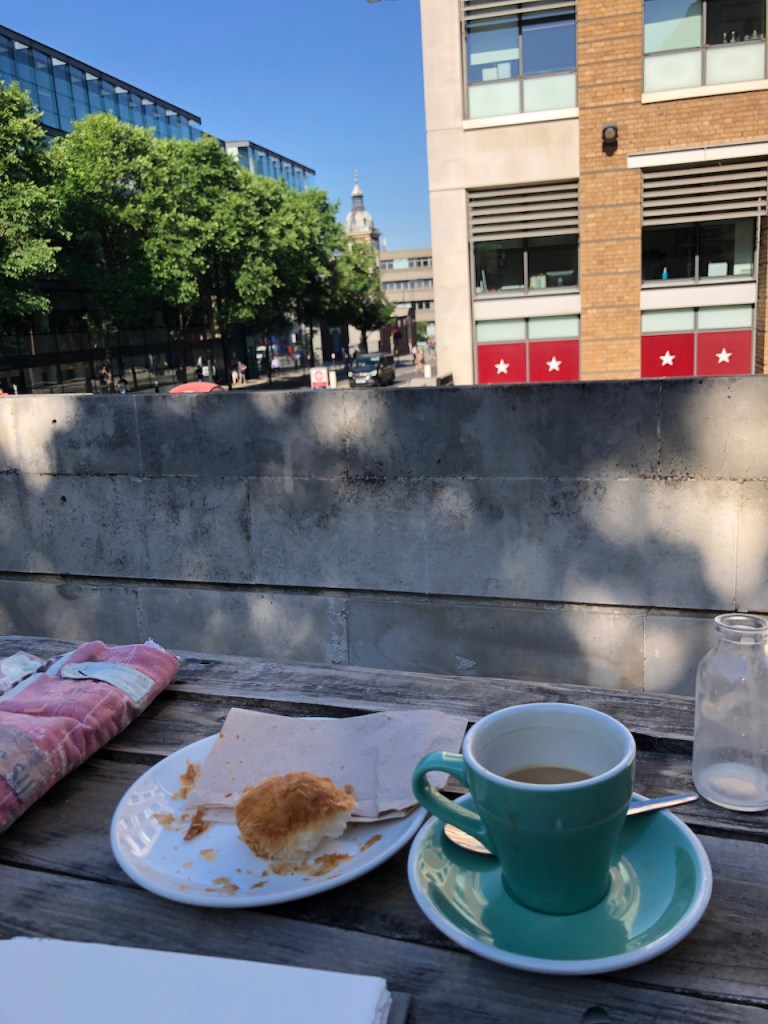
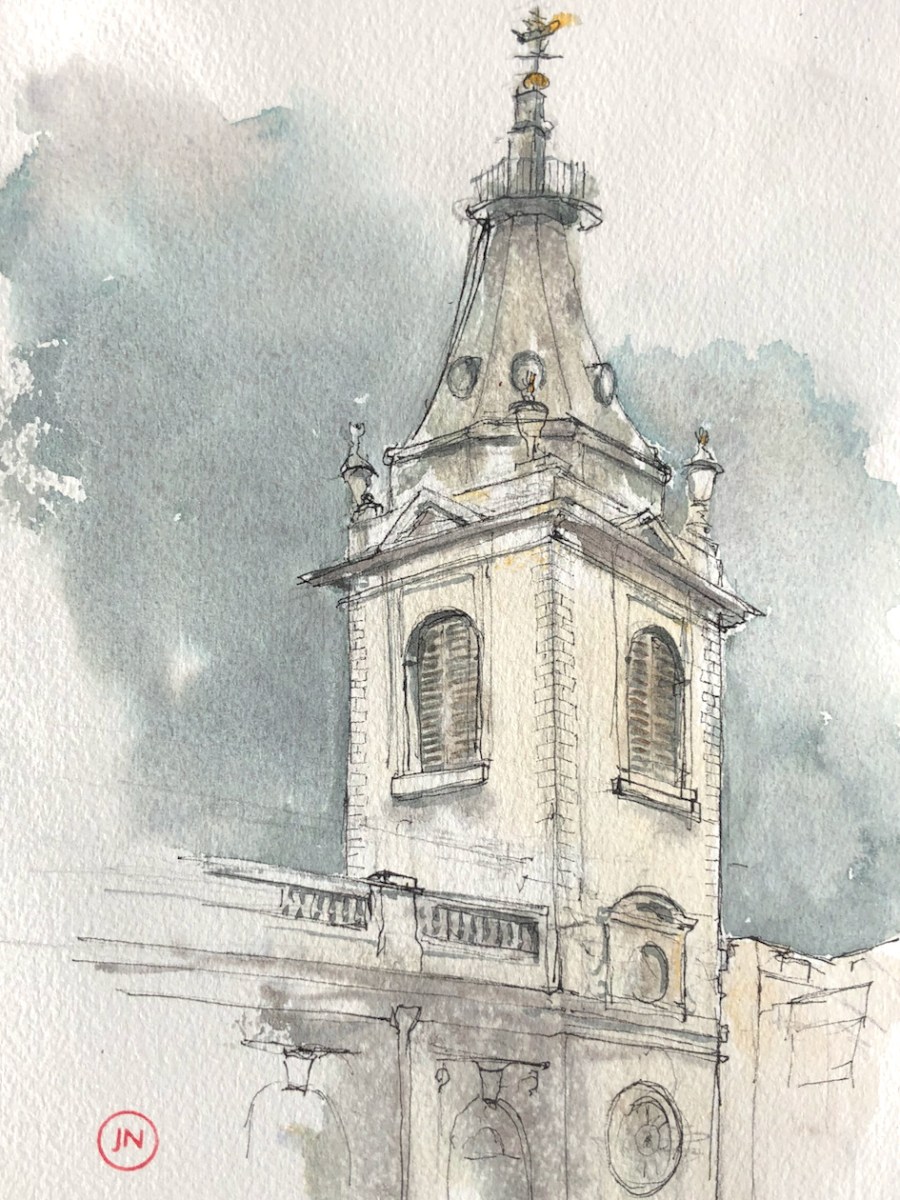
On a lovely sunny morning I walked to the Wren café for breakfast. The Wren is in Saint Nicholas Cole Abbey church on Queen Victoria Street. There is a terrace high above Queen Victoria Street. It commands an excellent view of St Paul’s Cathedral, but I chose to look along the busy road and sketch the Guild Church of St Benets.
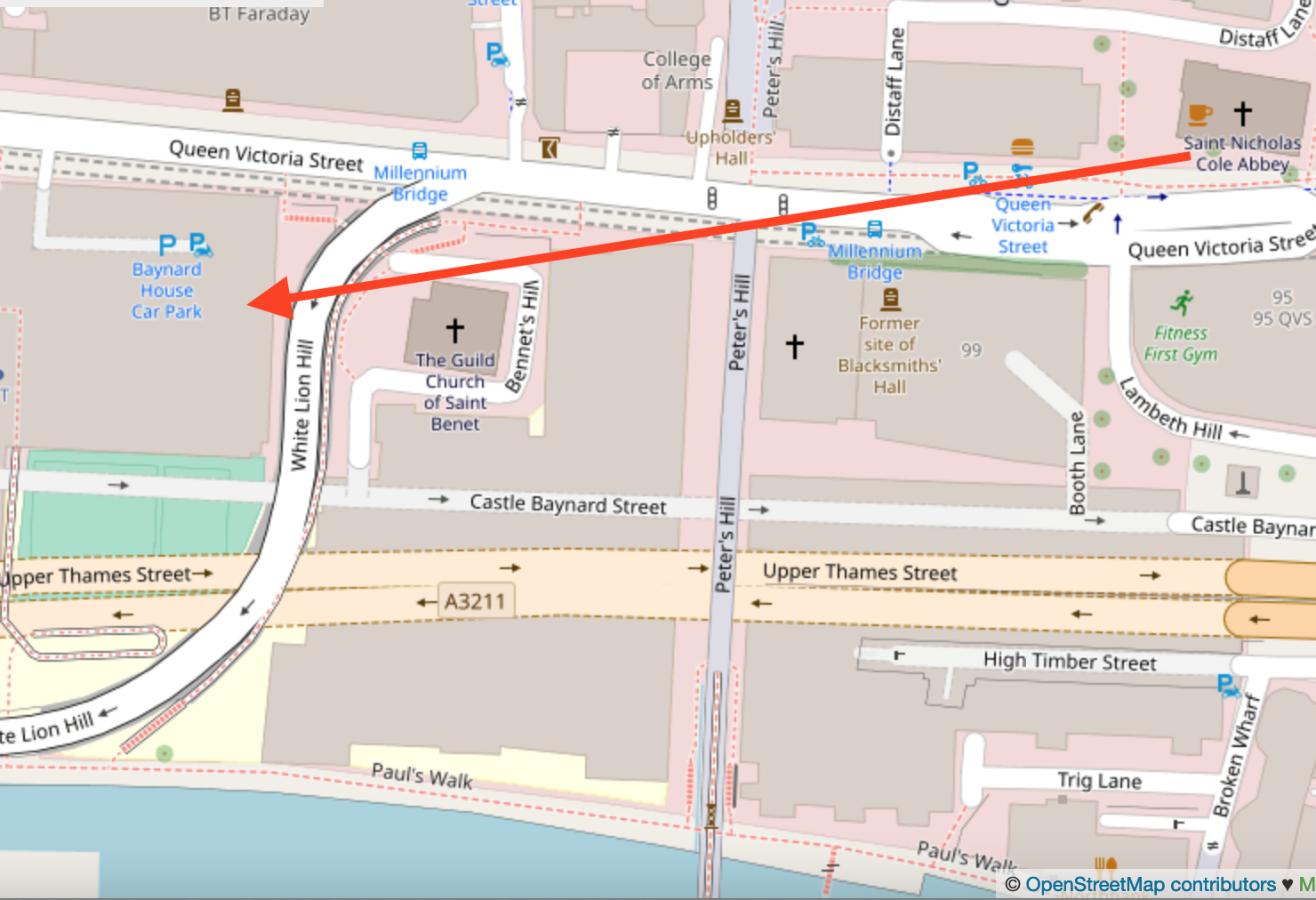
Guild Church of Saint Benets, from St Nicholas Cole Abbey, Queen Victoria Street EC4. 16th June 2021, 08:30 – 10:45am, 10″ x 7″ in sketchbook 10.
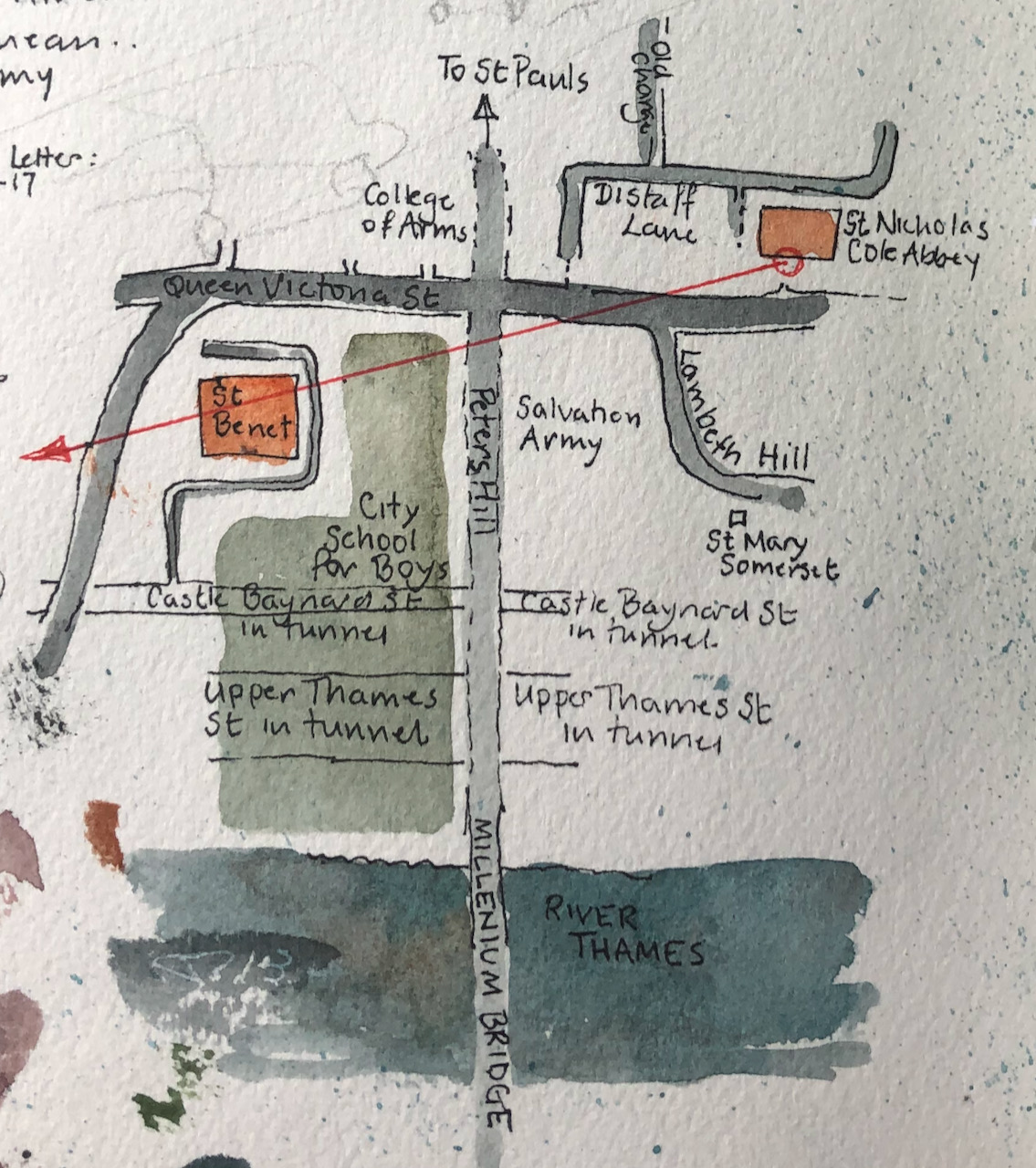
The building in the background is Baynards House, a BT building. In front of the church is the City of London School for Boys. Here are maps:
The Guild Church of St Benets is an active church with services in Welsh. It is a Wren Church, listed Grade I. The listing on the Historic England site says that this is “one of the least altered of Wren’s churches”, since it was not damaged in the 1939-45 war.
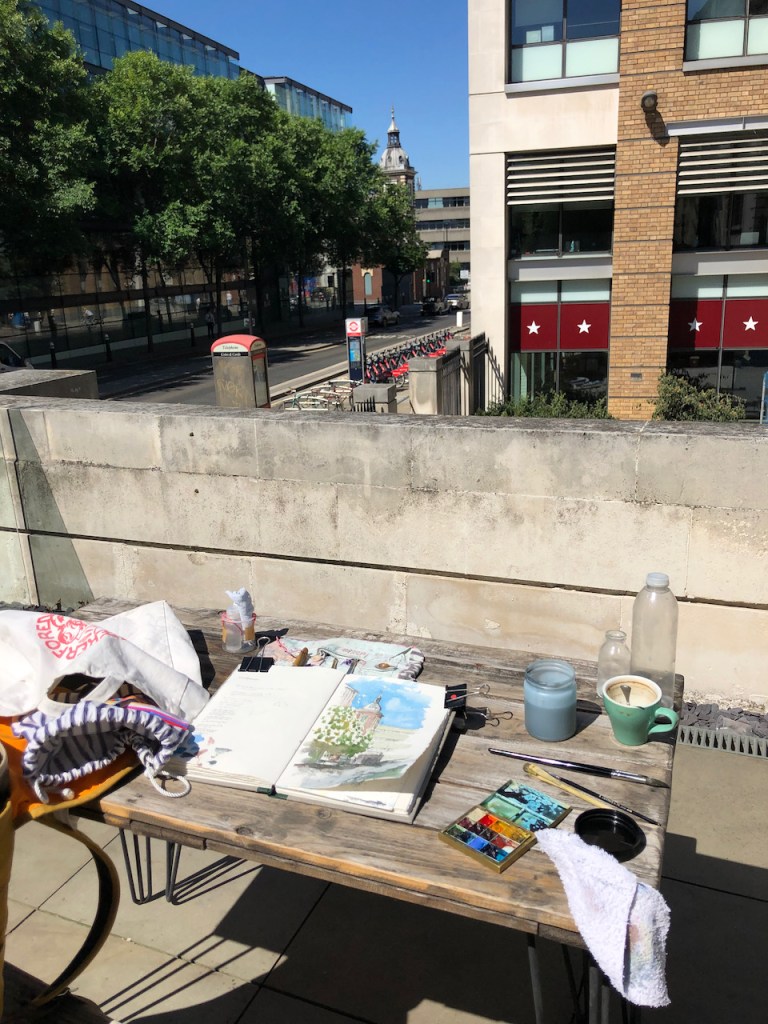
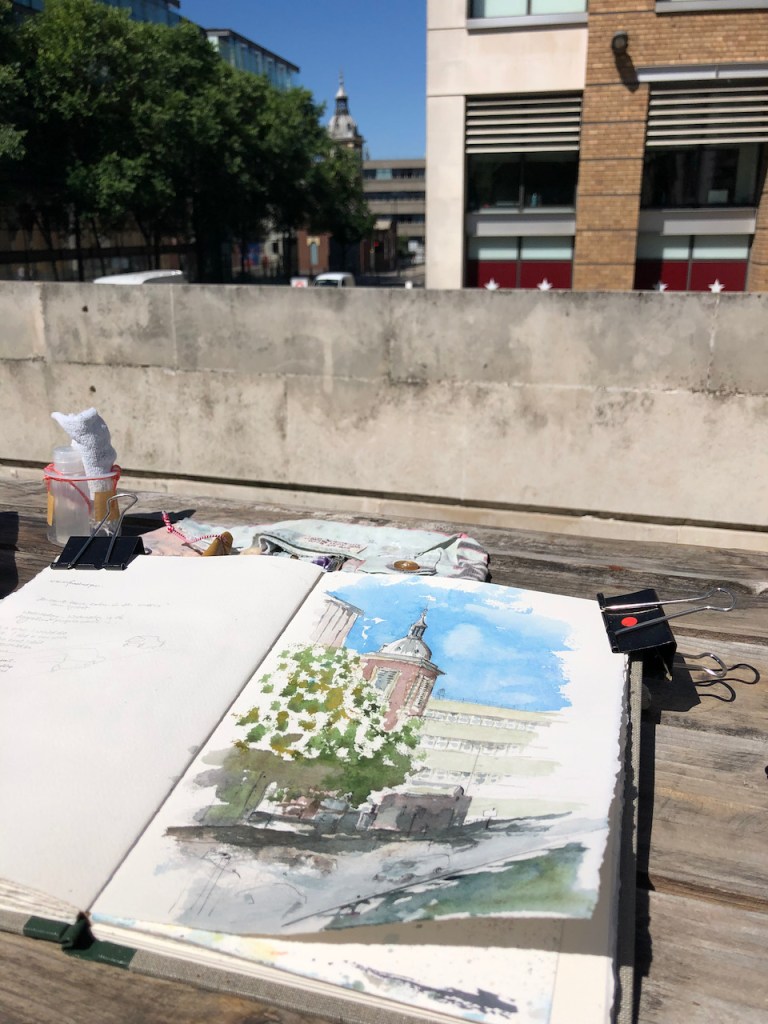
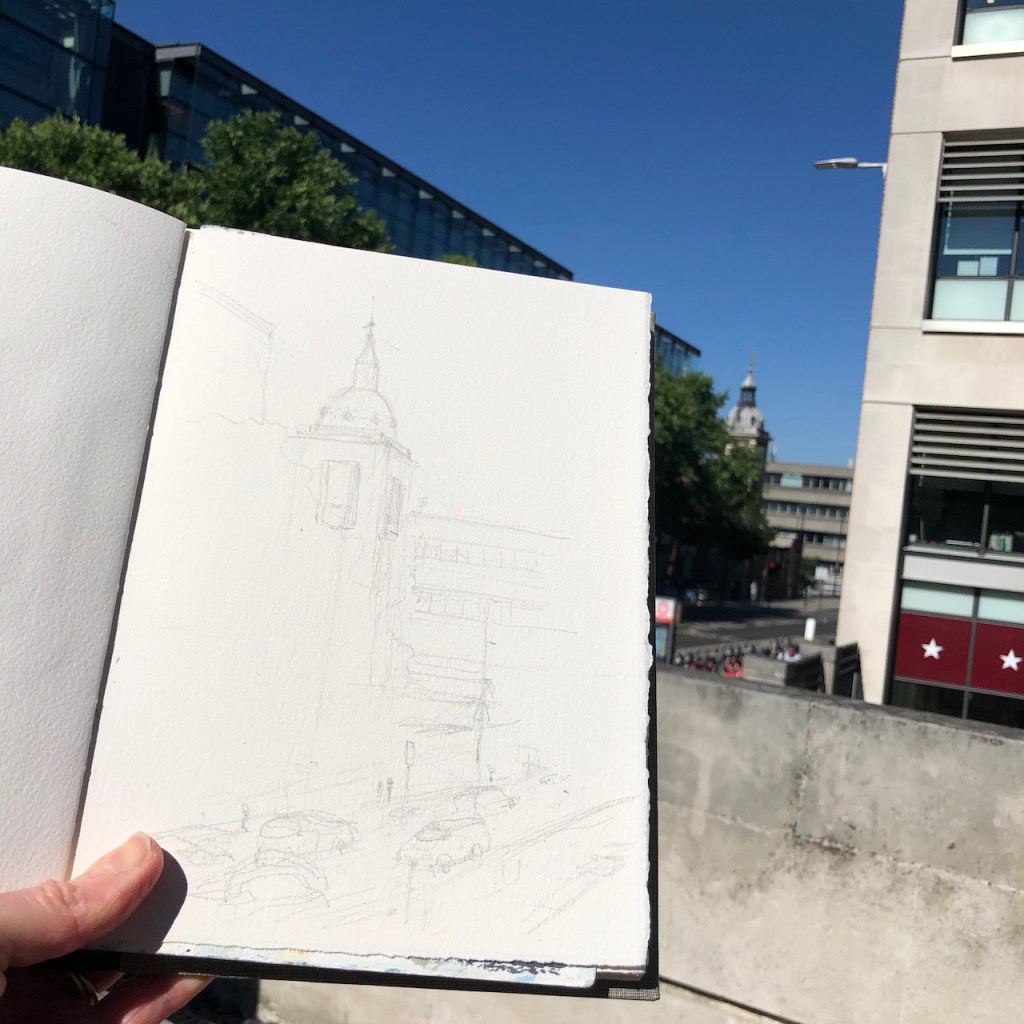
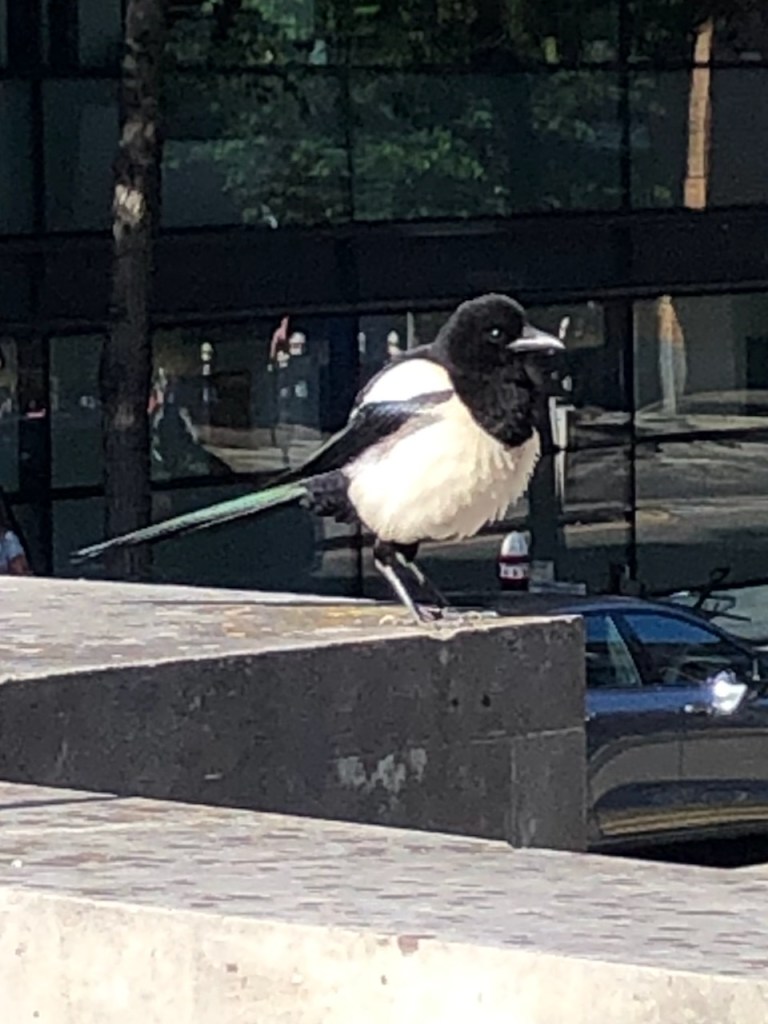
Here are a few photos of work in progress on the drawing, and a portrait of a magpie who came to look at my croissant:
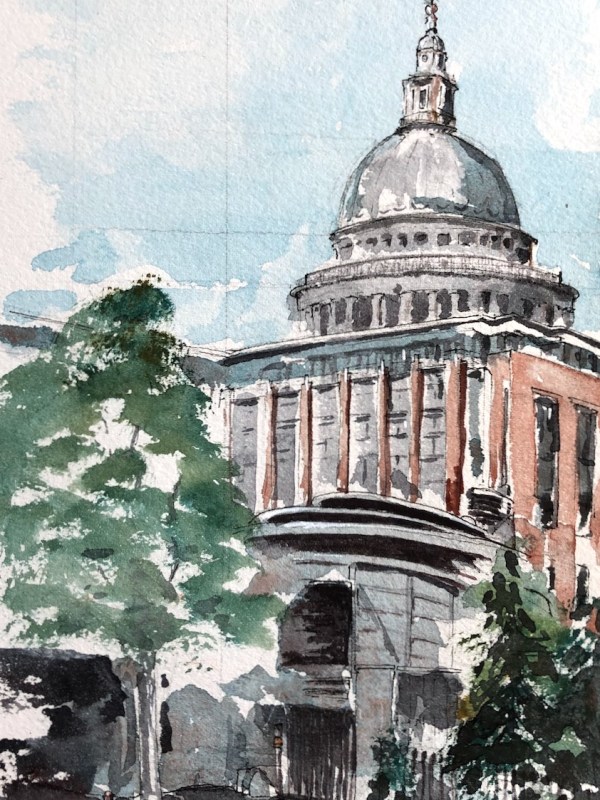
I’ve sketched the view of St Paul’s from the same location:
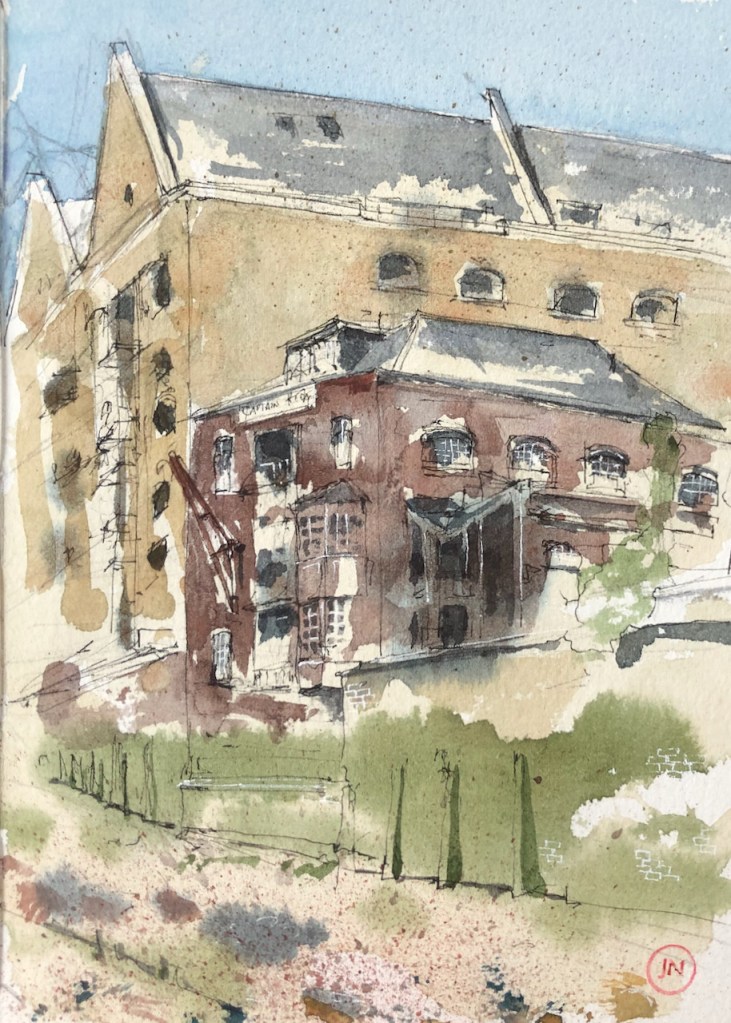
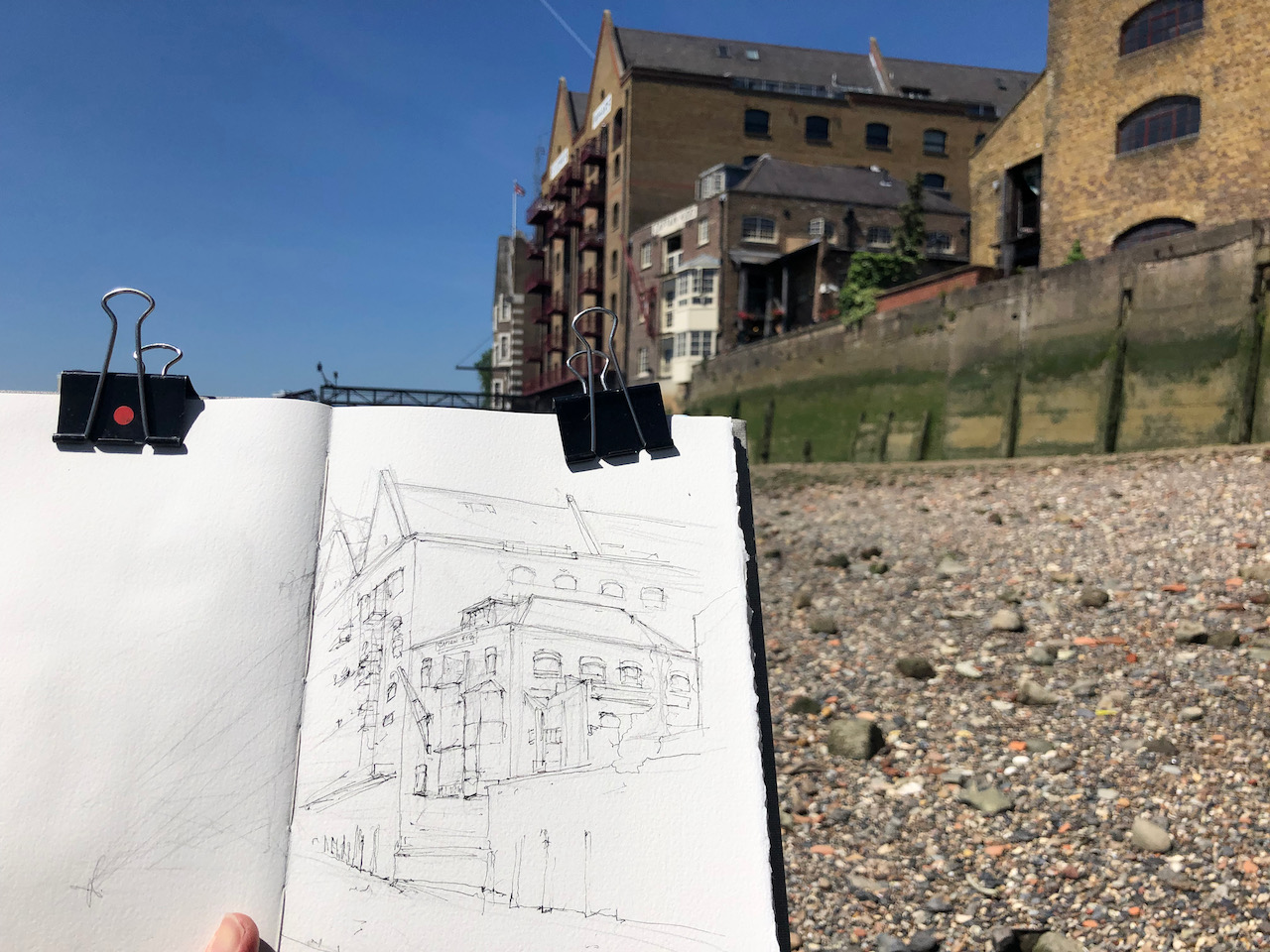
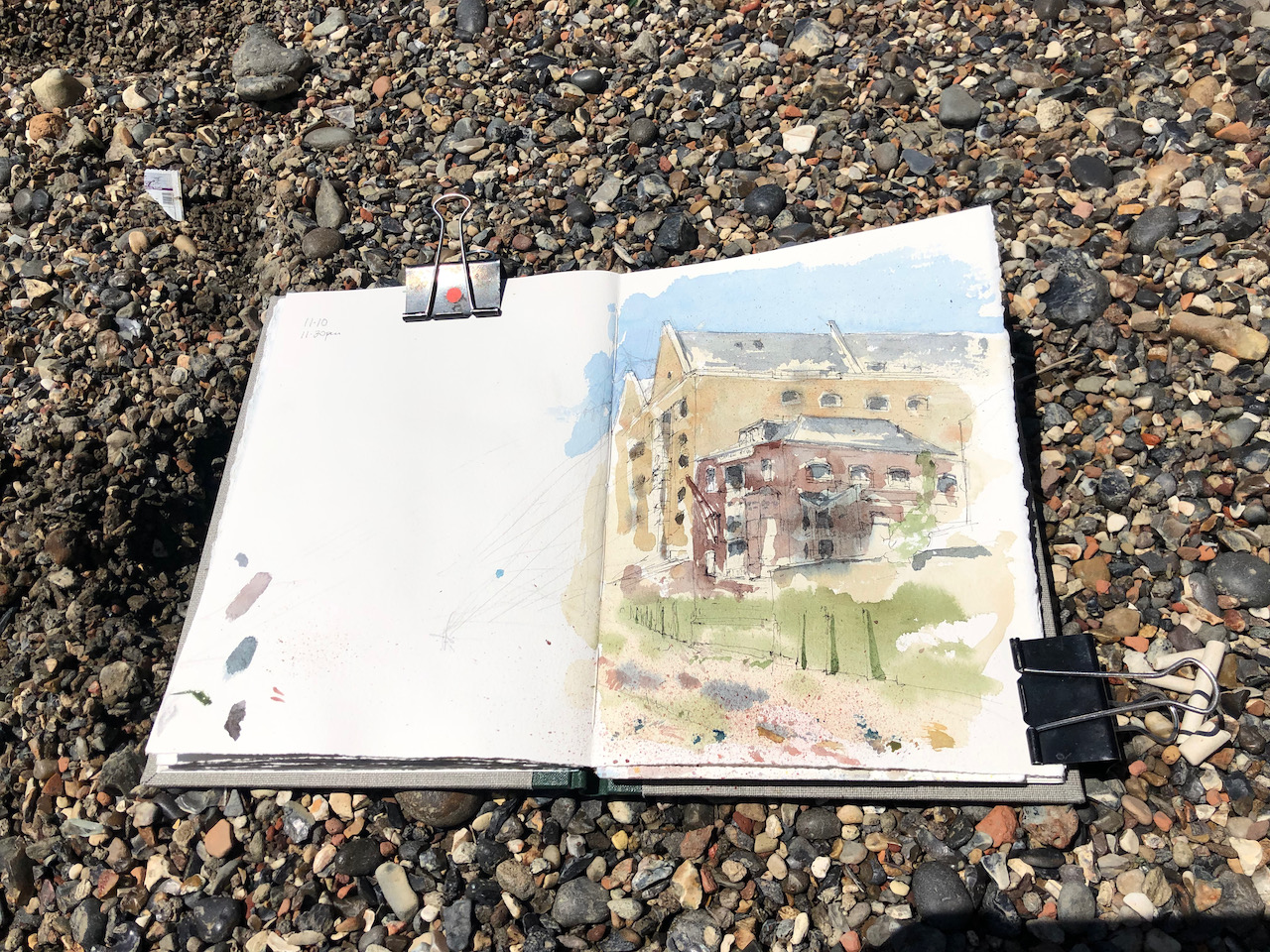
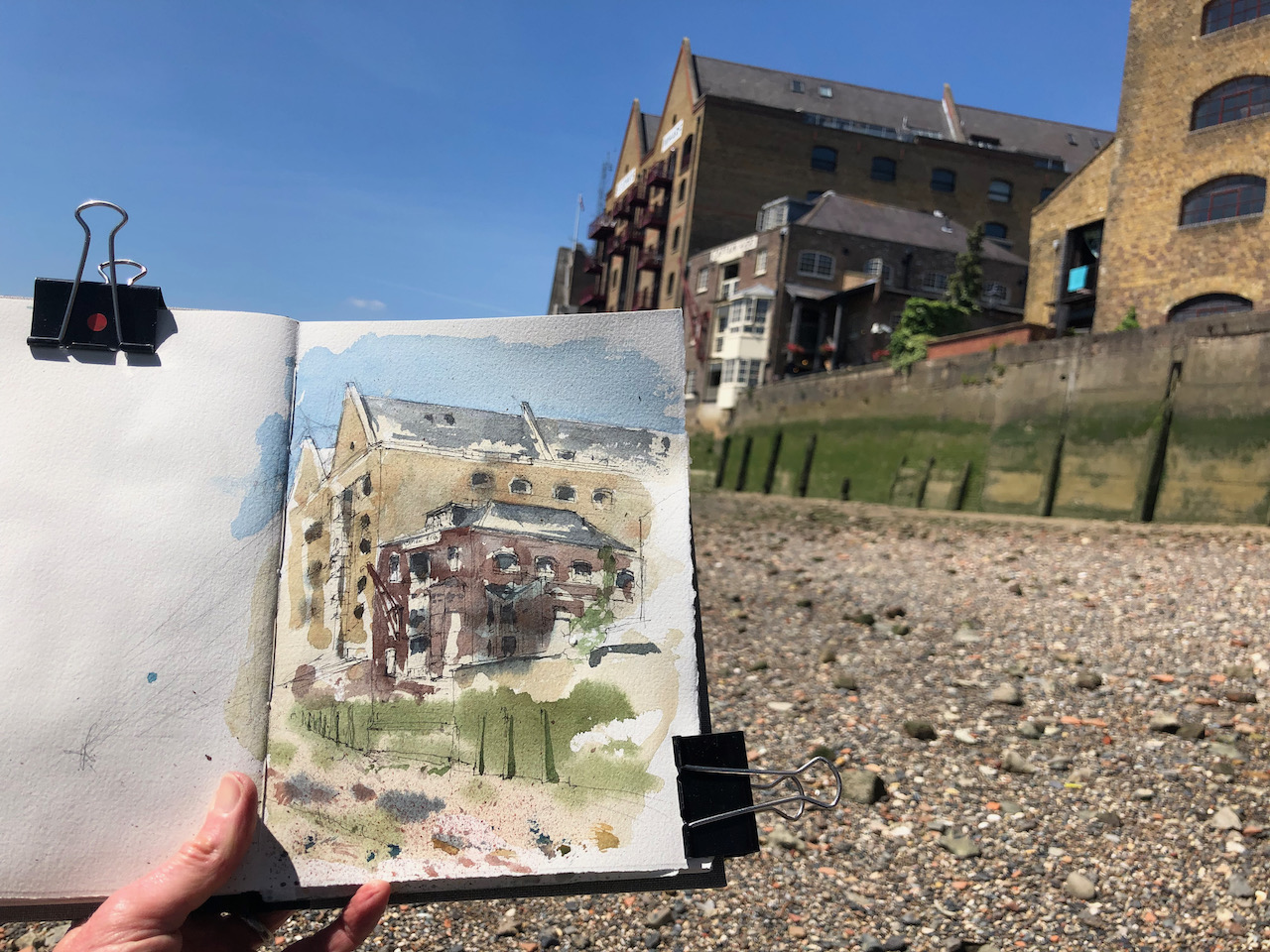
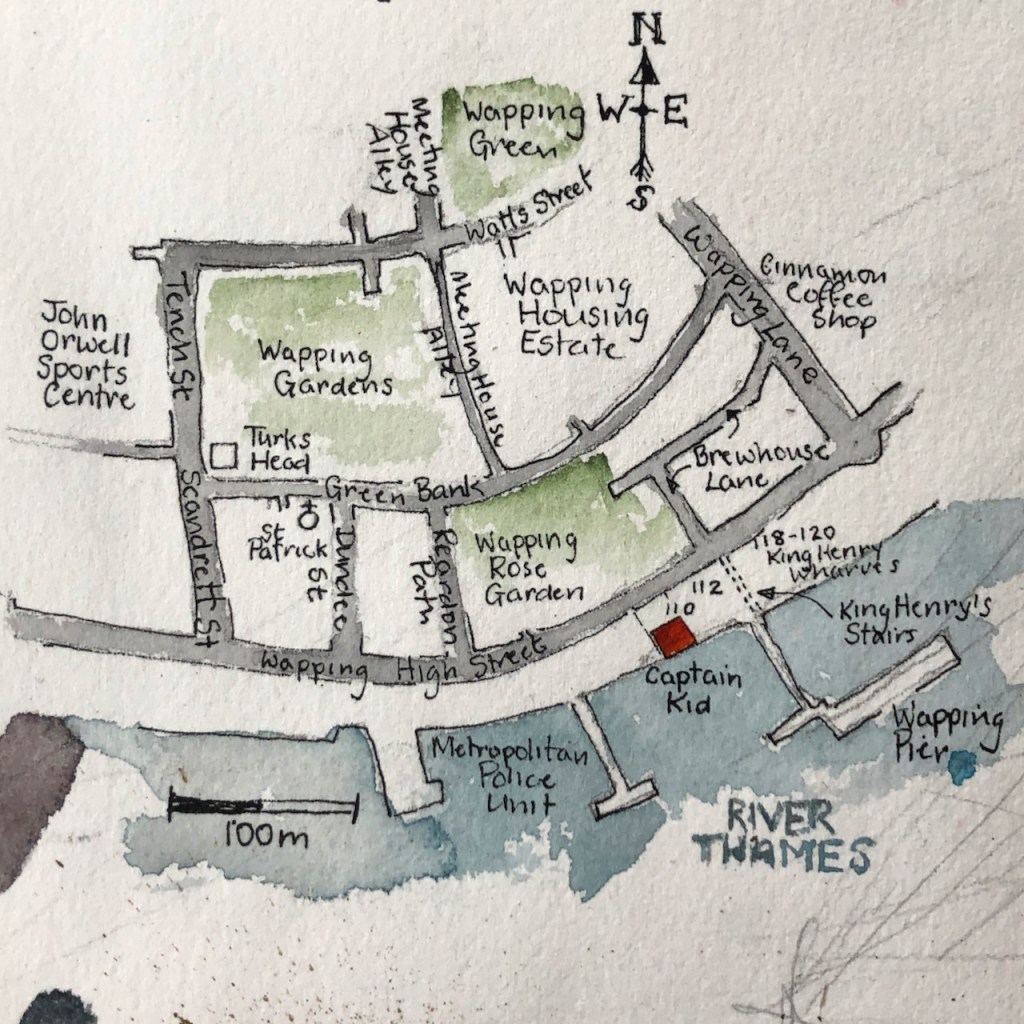
After breakfast at the Turk’s Head ( see this post ) I went down to the river. The tide was out. I sat on the Thames foreshore and sketched The Captain Kidd.
The Captain Kidd, Wapping E1. 12.10pm 14 June 2021. 7″ x10″ in Sketchbook 10
The Captain Kidd is the building at the front. It’s a pub and restaurant. The larger building behind is “St John’s Wharf”, a warehouse now converted into flats.
The “Captain Kidd” is named after a “seventeenth century pirate William Kidd who was executed [in 1701] at the nearby Execution Dock” according to various websites e.g. The Londonist.
However there is no “nearby Execution Dock”. The carefully researched article on “London Inheritance” concludes that “King Henry’s Stairs” were formerly “Execution Dock” (see note 2). The name was changed in the early 19th century to be better in line with the burgeoning use of the area for trade. The London Inheritance author cannot discover a specific “King Henry” connection. He includes a list of some of the people who were executed here, for crimes at sea including piracy, fighting on board ship, murdering shipmates, and treason.
I note with interest that, these days, the headquarters of the Marine Police are just a few hundred yards upstream. This is a very ancient establishment, which started with a one-year trial in 1798 (note 1).
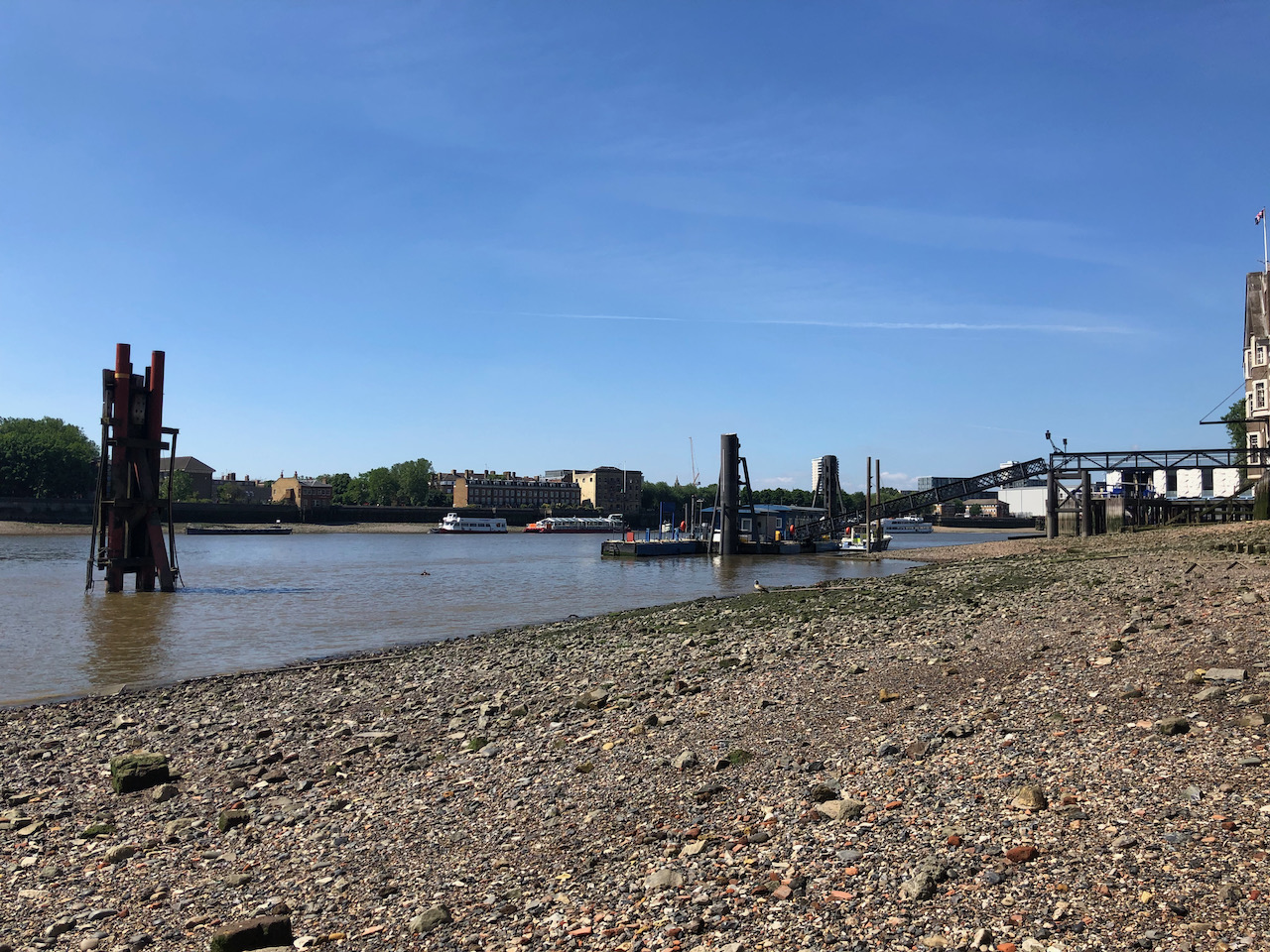
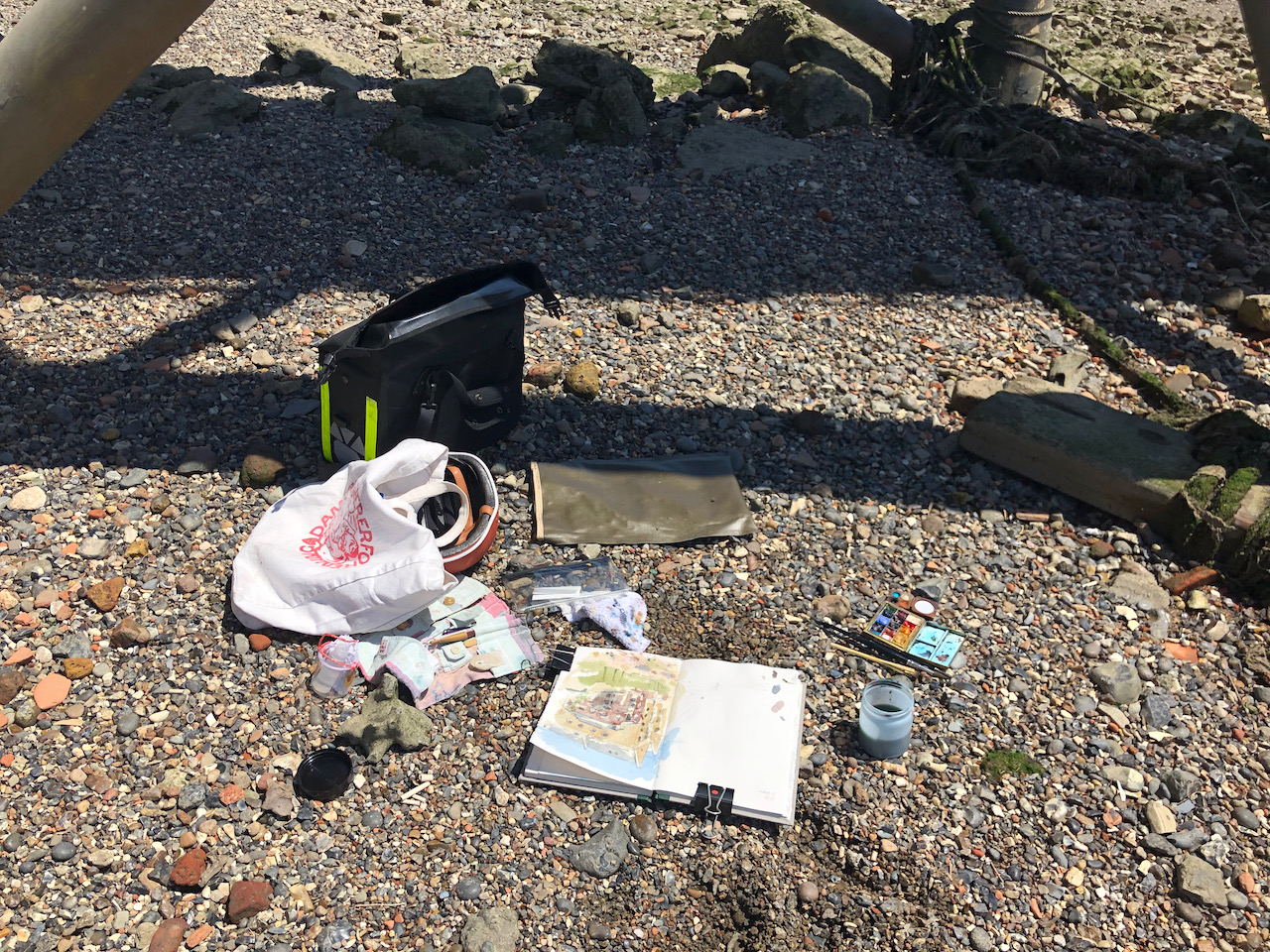
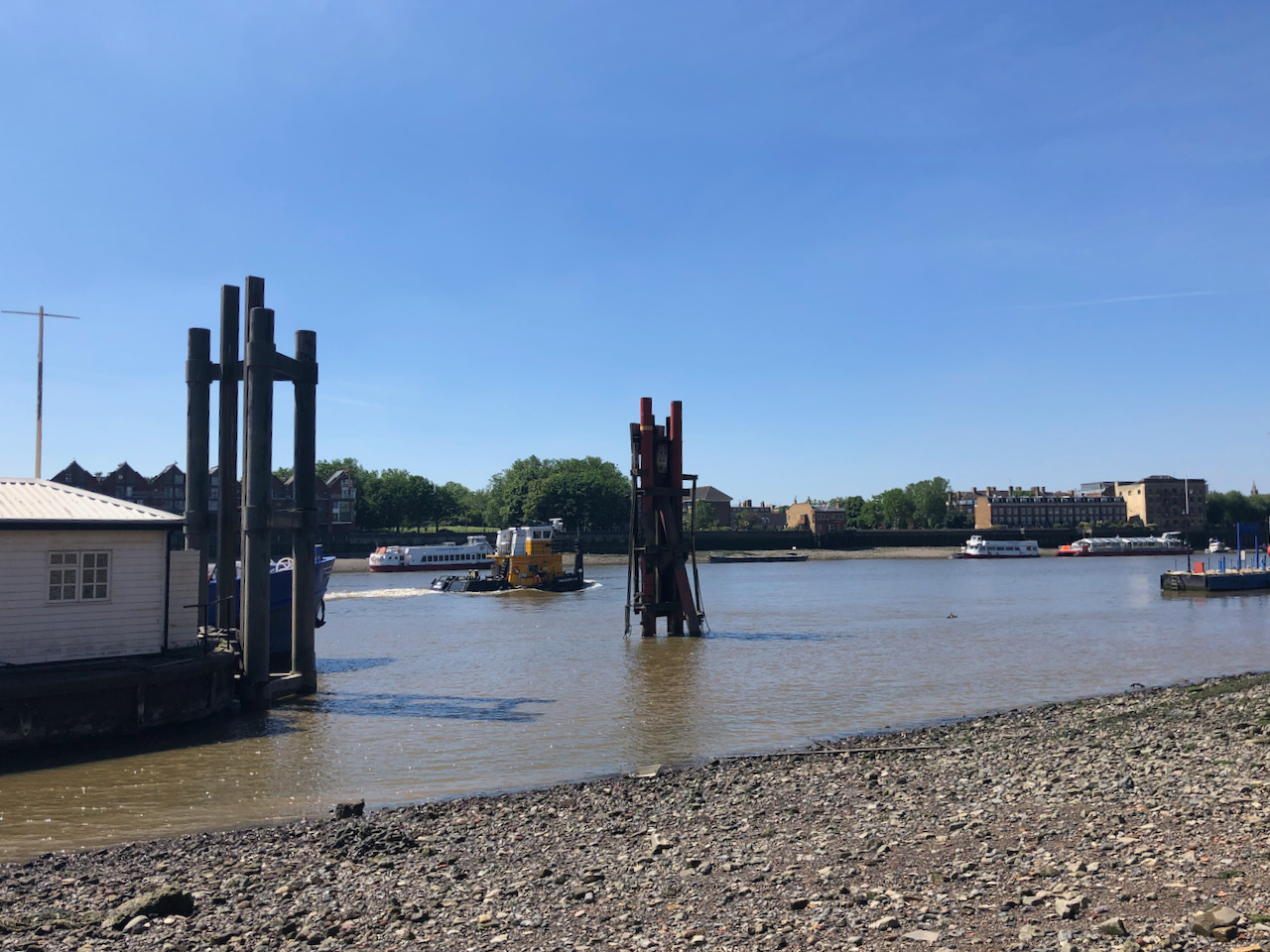
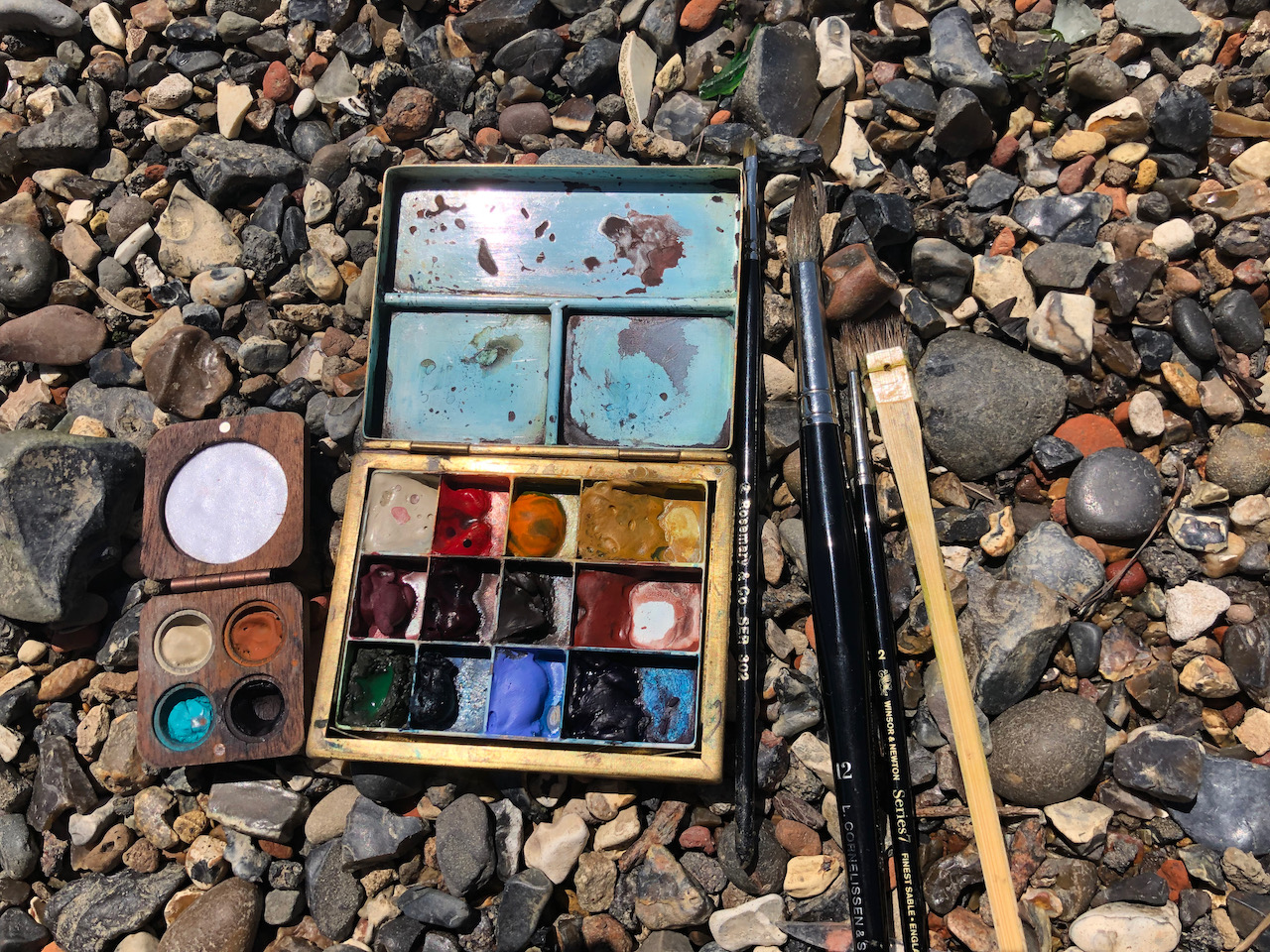
Here is work in progress on the drawing. See the wonderfully clean Thames foreshore.
I drew my picture in the shade under Wapping pier. Here is a map:
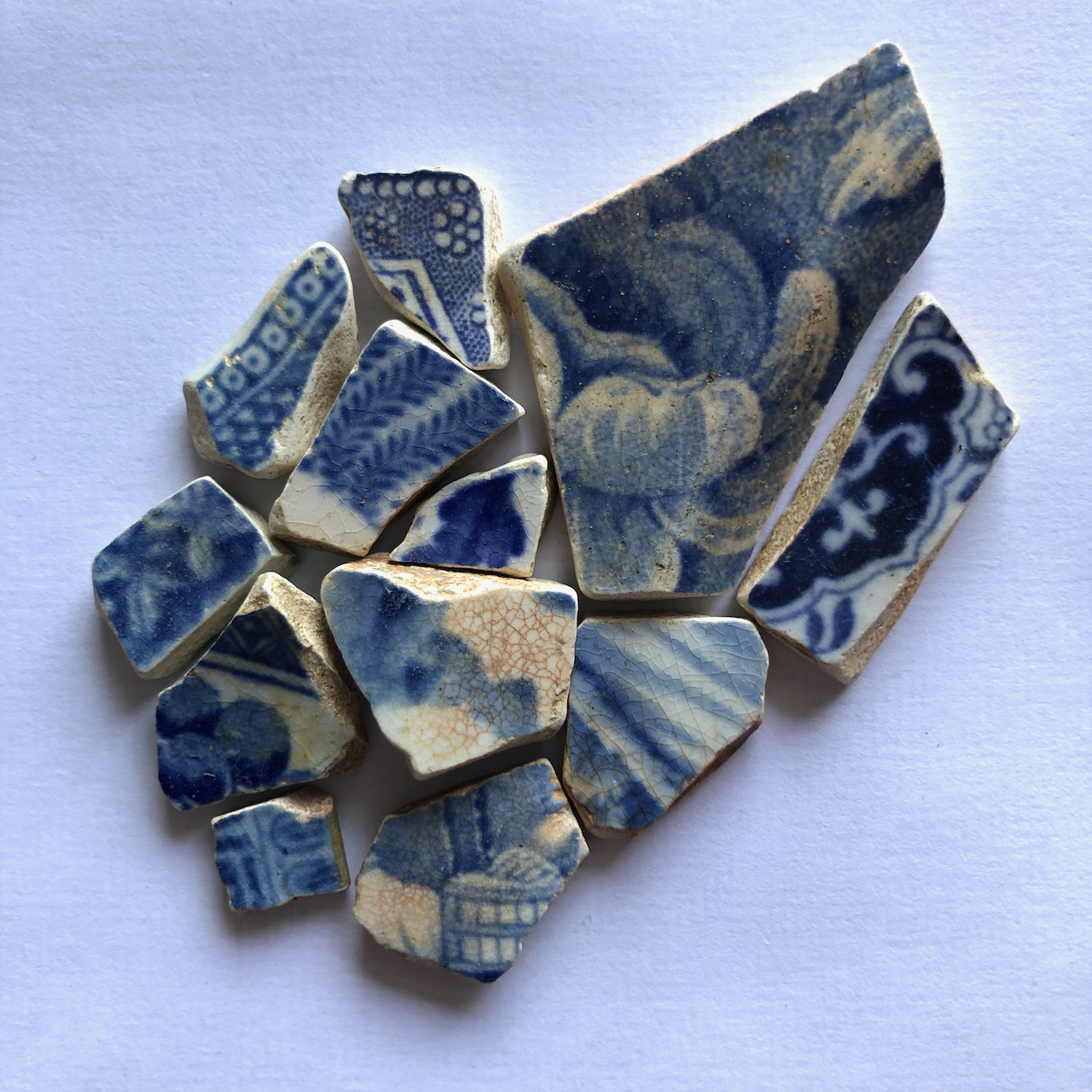
Walking back to the ladder, I collected a handful of porcelain pieces, blue and white. It was as though, years ago, someone threw a china bowl onto the foreshore, and the pieces somehow stayed in the same vicinity, through many tides. Or perhaps it is several bowls.
Here is the marvellous Turks Head Café, Wapping, rescued from demolition by local residents in the 1980s. Inside, I found warmth, quiet tables, and the gentle murmur of conversations: people actually talking to each other. I felt welcome here. The food was marvellous. Next time I’m going to have the Blueberry Tart. I only noticed it after I’d already had the substantial Chicken and Avocado Sandwich.…
Click a button below to share this post online, email it, or print it:
Le Pain Quotidien at Monument was open on Sunday. I found a table in the shade and sketched.
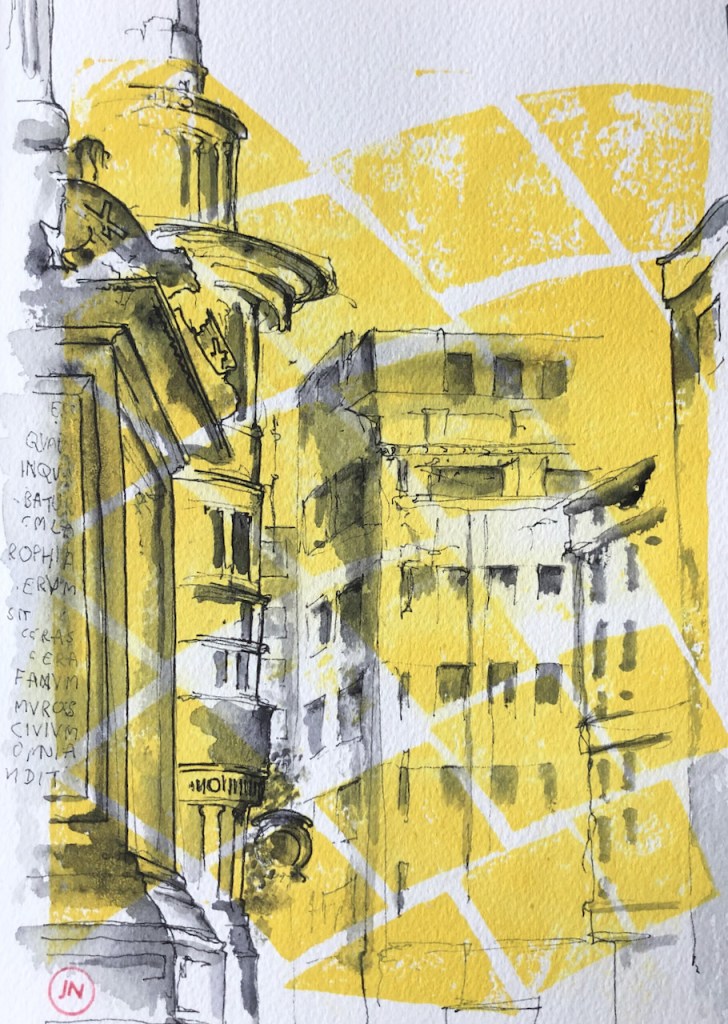
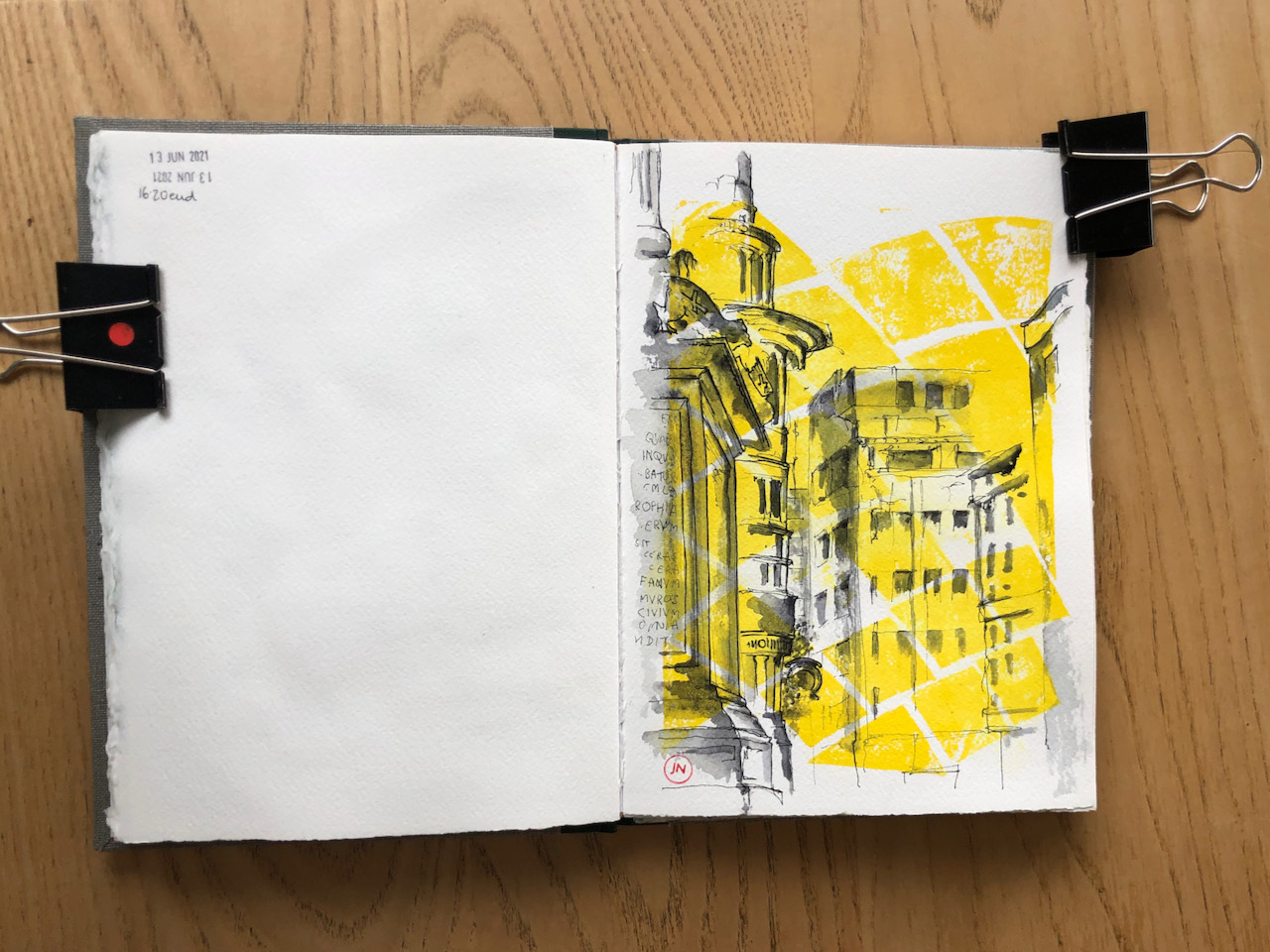
Back at home I added tone and an experimental print background. What do you think?
Drawing with experimental print overlay
Printing plate from cut cardboard
Drawing: waterproof ink and watercolour Neutral Tint.
Print: Plate made from cut cardboard. Printed using Schmincke relief ink: “Aqua Linodruck #19210 permanent yellow”. Printed directly into the sketchbook.
Click a button below to share this post online, email it, or print it:
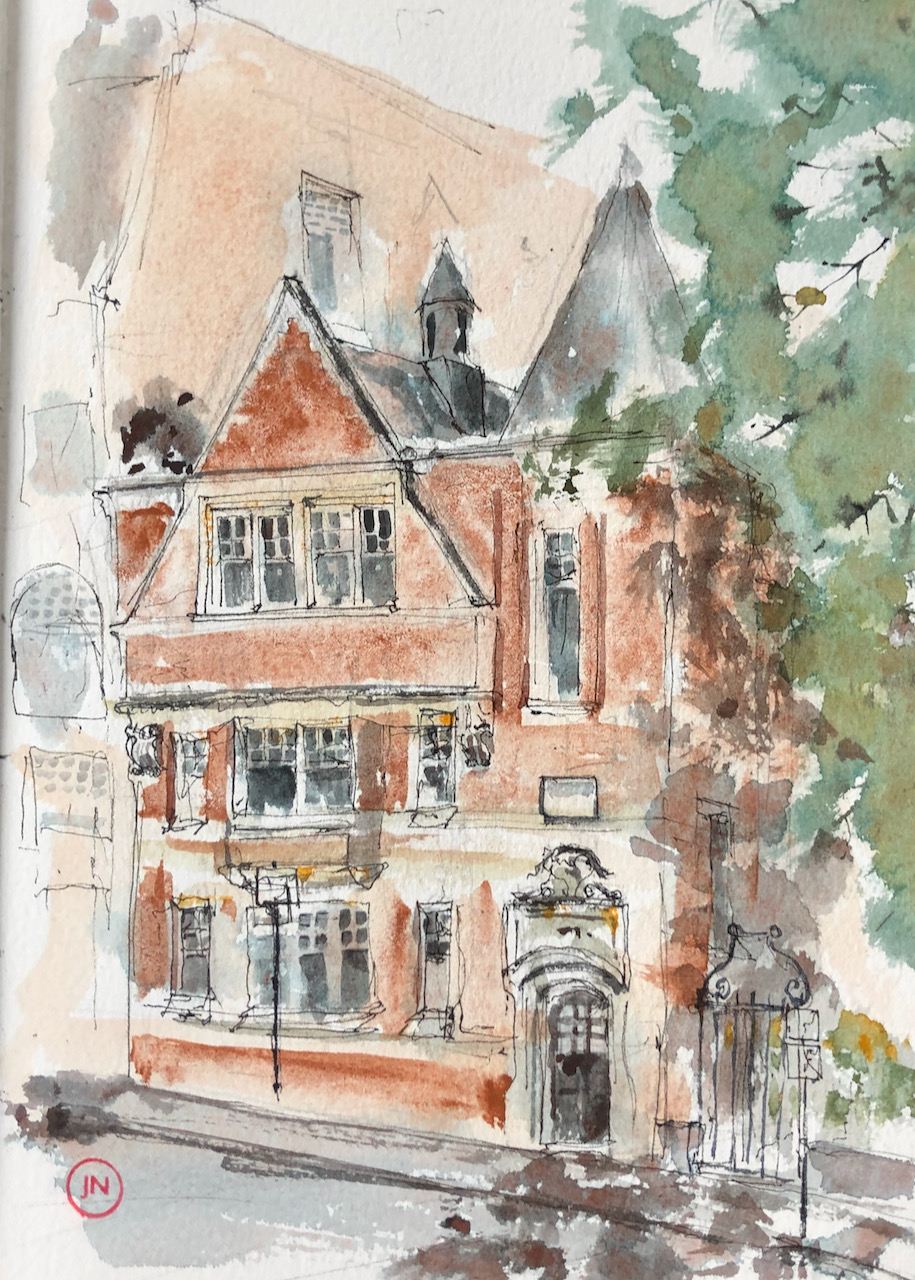
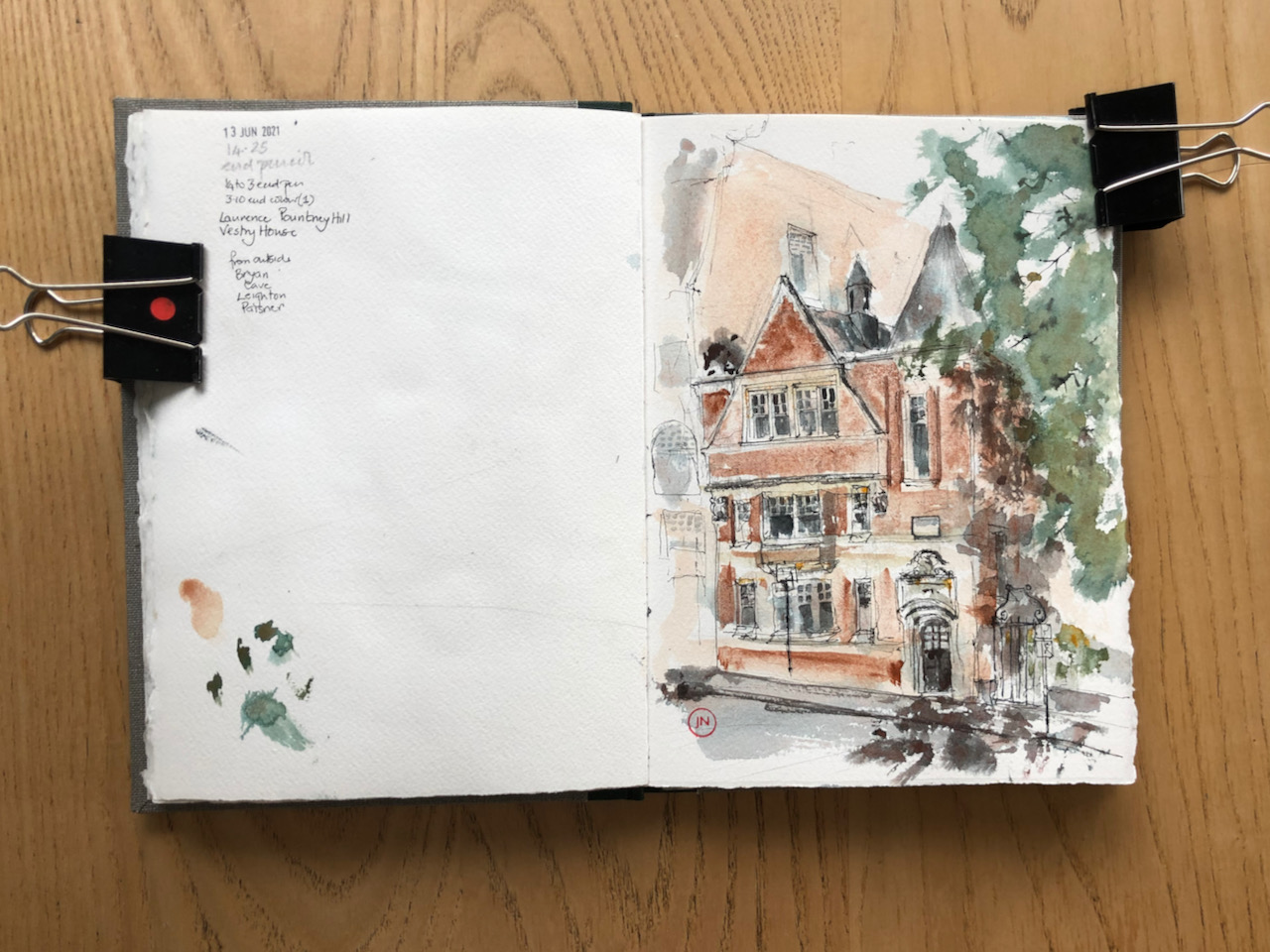
I walked in the back lanes between Cannon Street and Monument. Here is Vestry House on Laurence Pountney Hill EC4.
Vestry House EC4, sketched 13 June 2021, 15:10, 10″ x 7″ in Sketchbook 10
It is Grade II listed, listed in 1977. The listing says:
Late C19, red brick and stone. Stone doorcase with elaborate overdoor and pediment bearing the initials SP over panel of foliage inscribed Vestry House. 1st floor oriel window with big triangular gable over, projecting on scrolled consoles; 2nd floor windows in gable. Octagonal corner stair turret with pointed roof.
There is a blue tile further East along Laurence Pountney Hill. It reads:
Site of Laurence Pountney Church and Corpus Christi College.
Destroyed in the Great Fire 1666
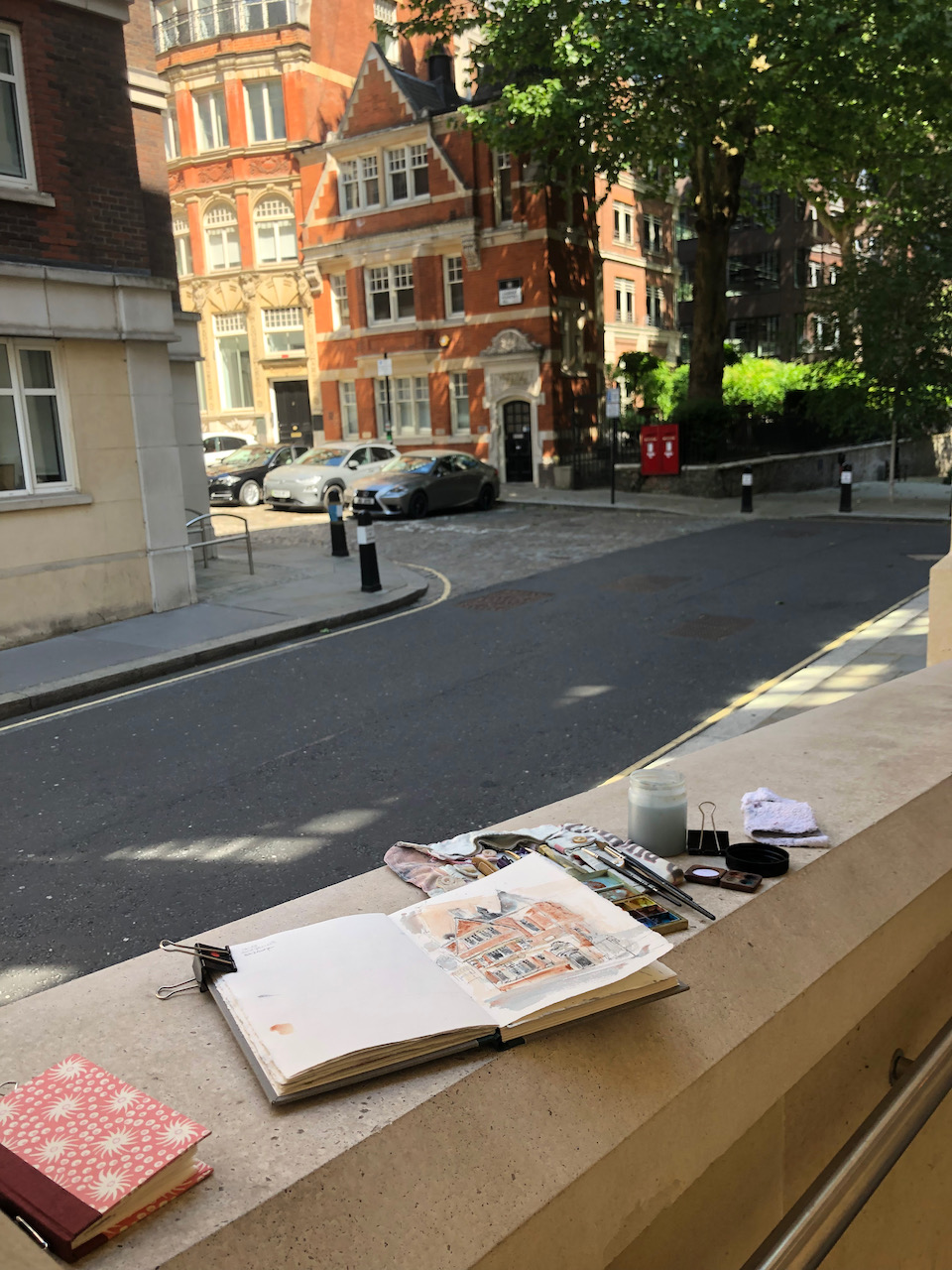
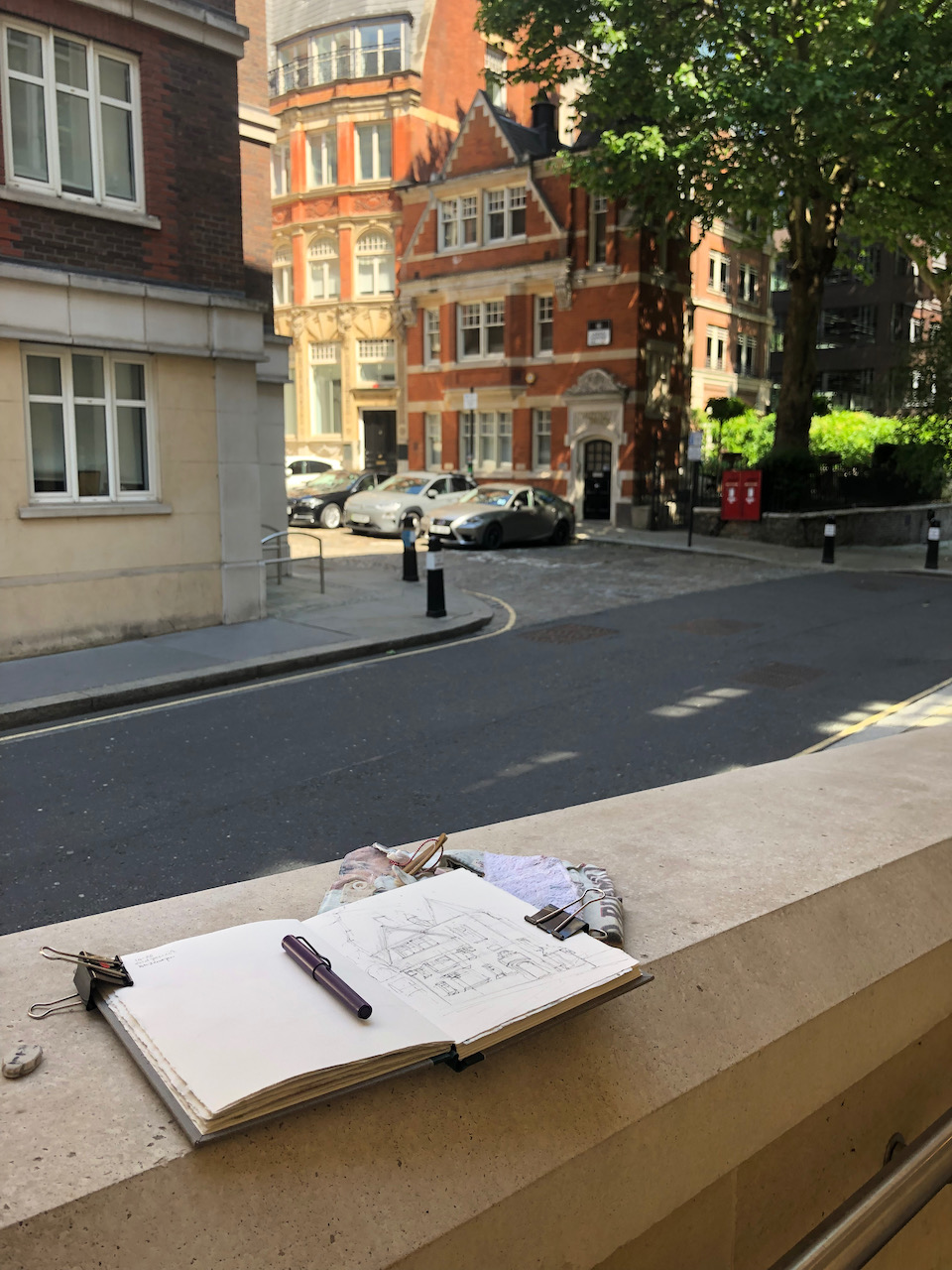
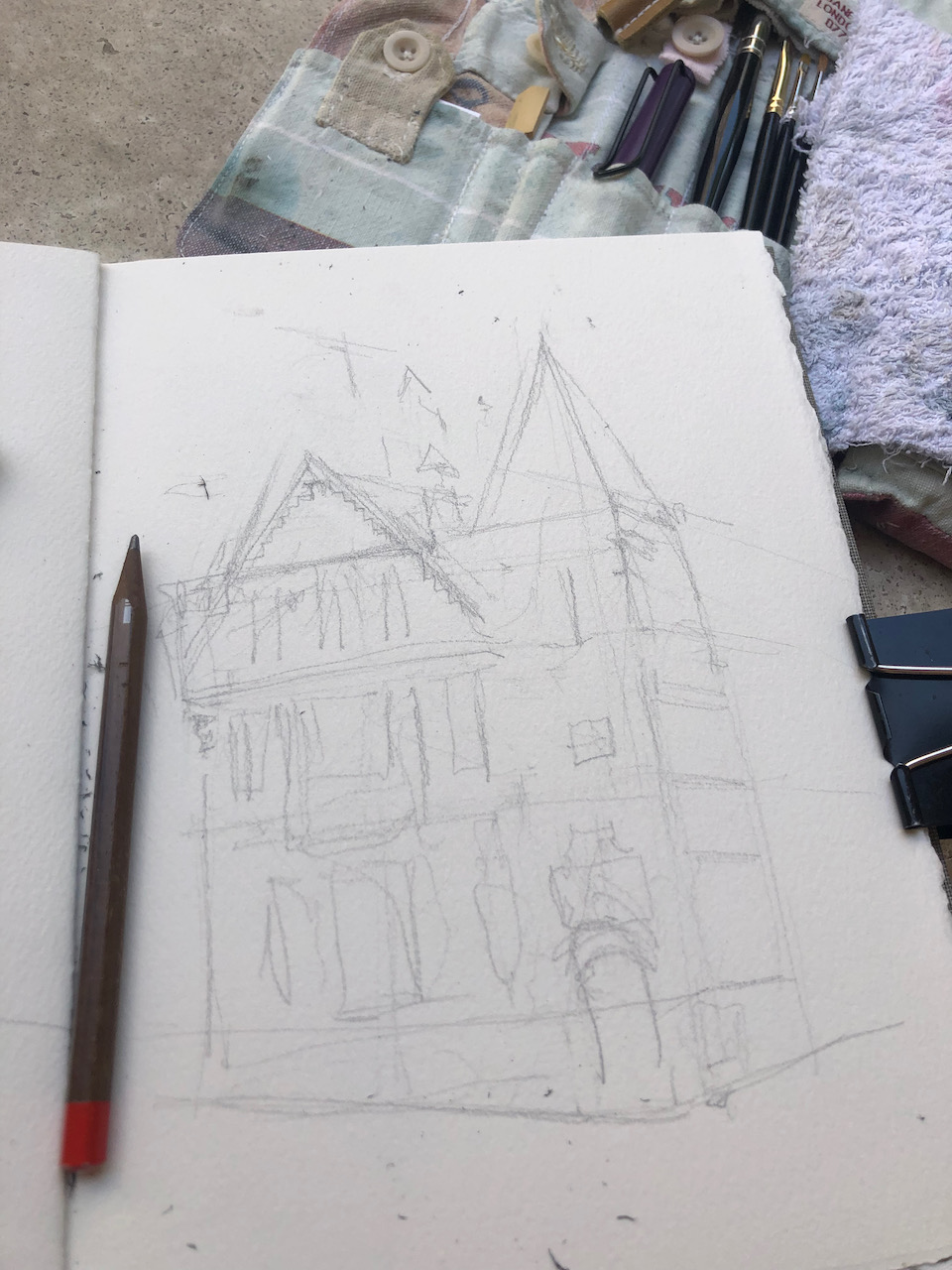
I sketched from a raised walkway on a modern office block opposite. Here are some work-in-progress photos.
I stood in front of the offices of
Bryan
Cove
Leighton
Pilsner
Their logo cleverly captures all these initials.
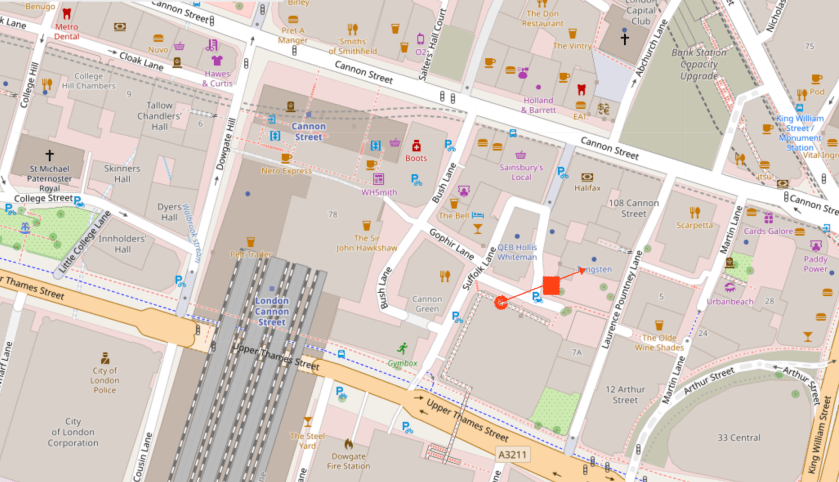
Here is a map showing the location of Laurence Pountney Hill. The red square is Vestry House, the arrow shows the sightline of the drawing.
Map (c) Open Street Map Contributors
The colours are Lunar Earth, Mars Yellow, Perylene Maroon. The grey is Perylene Maroon and Phthalo Blue Turquoise. The green is the same blue with Mars Yellow.
Click a button below to share this post online, email it, or print it:
…its varnish was peeling but it was heavy and strong….
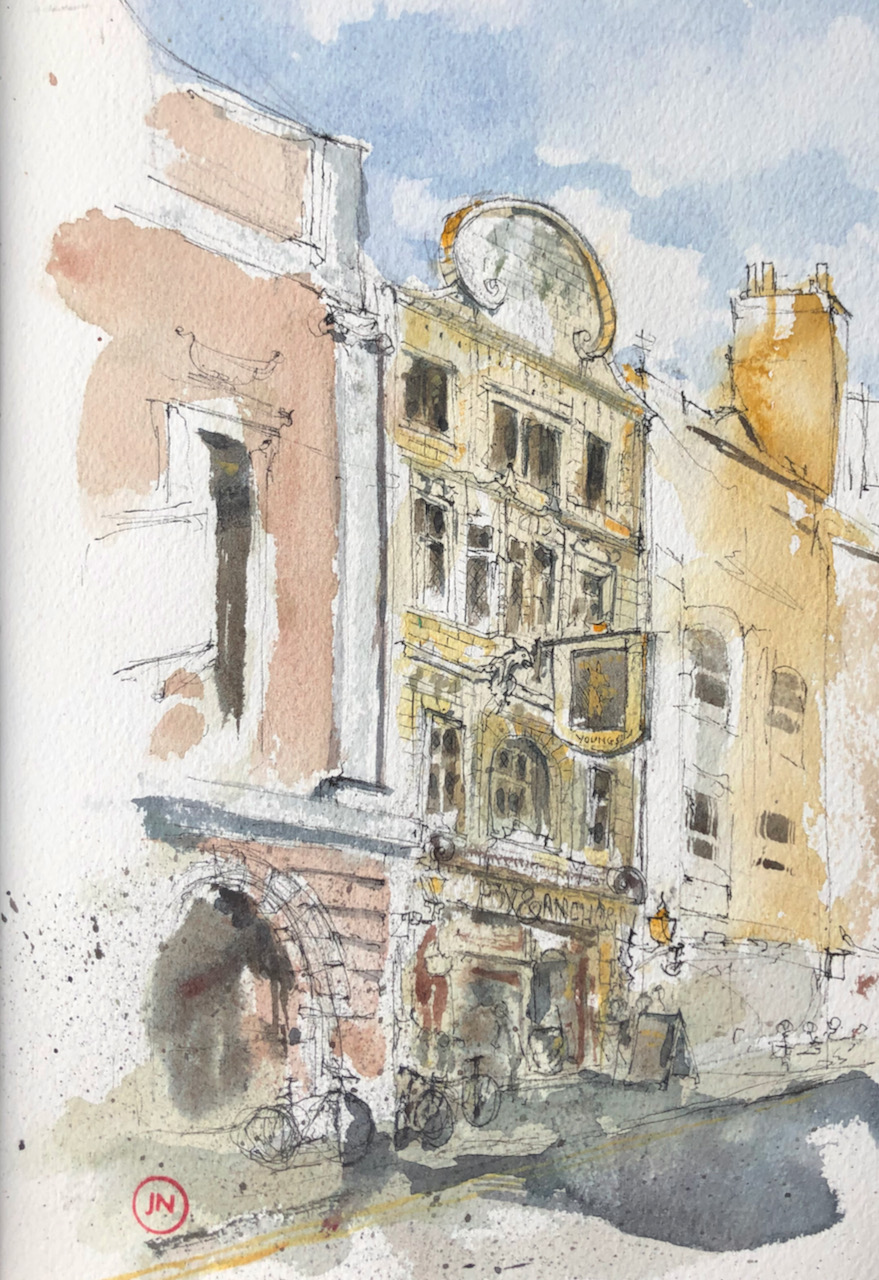
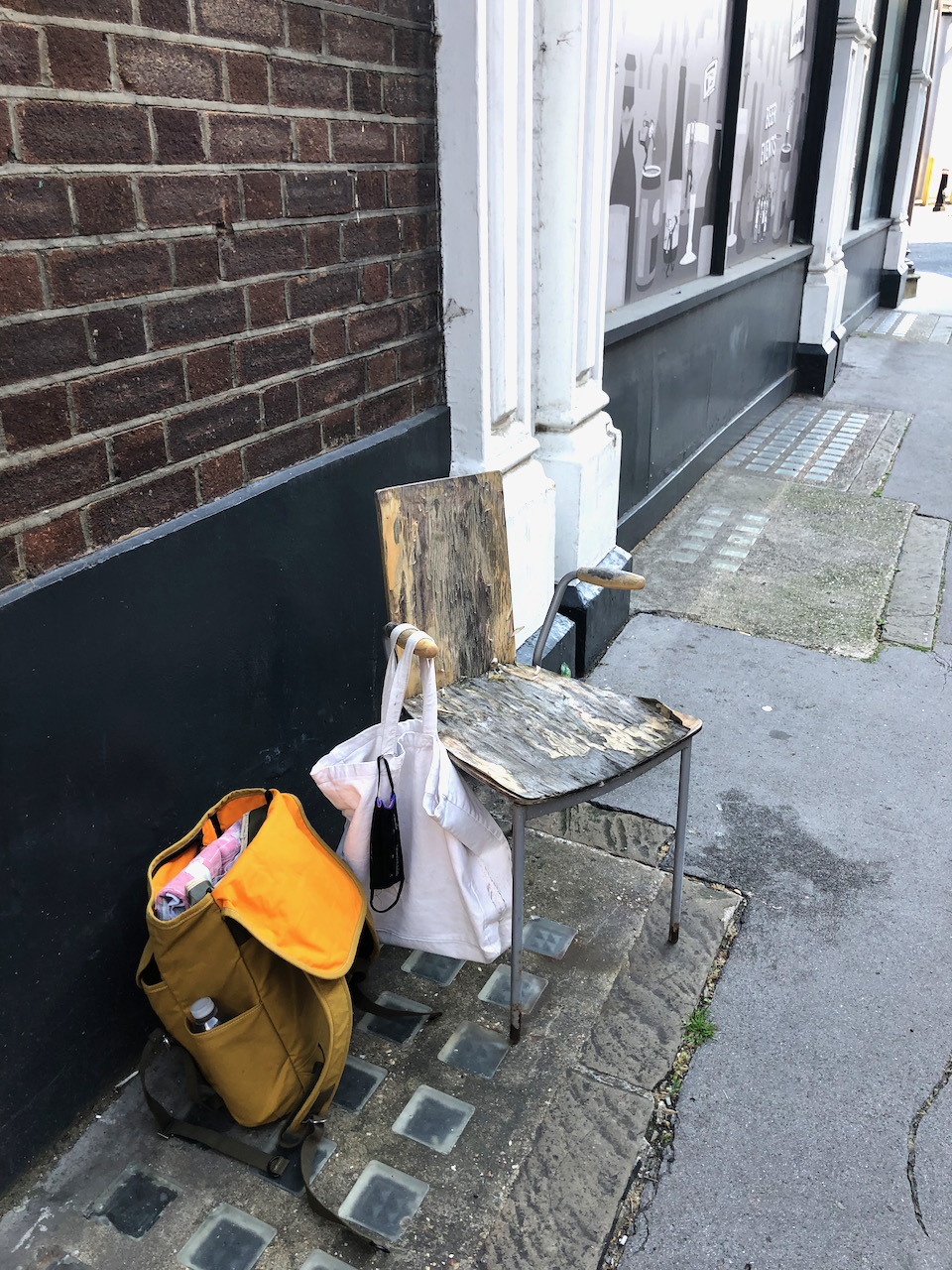
I set off on a warm afternoon intending to sketch a pub in Clerkenwell Green. On the way there, I walked along the north side of Smithfield. Down a side street I spotted a lone chair, placed as if waiting for me. It commanded an excellent view of the Fox and Anchor. I tried out the chair. Its varnish was peeling, but it was heavy and strong.
So I settled myself down and drew the Fox and Anchor. This is a very decorative pub. Pevsner* says it has a “joyful front of Doulton’s coloured tiles”. That’s Royal Doulton, the pottery company. I recommend the startling Royal Doulton building in Vauxhall, on the corner of Black Prince Road and Lambeth High Street. This is even more elaborate than the Fox and Anchor pub, since it was a living advertisement for the wares of the firm.
The Fox and Anchor dates from 1898. This date is on the tiles in that magnificent halo on the top, together with a picture of the Fox. The date is written in such flamboyant Art Nouveau script that it’s difficult to read. The whole of the front is tiled with ceramic tiles, in wonderful shapes, including tiles which go around the window frames. There is a dragon either side of the pub sign.
Fox and Anchor pub and hotel, EC1. Sketched 5th June 2021, 17:30 in Sketchbook 10. 8″ x 10″
This is a Young’s pub, open now. The Fox is shown on the pub sign, but not the Anchor. It has a special Smithfield licence, which means that it can offer beer for breakfast. This special licence is historically for serving the night shift meat workers at Smithfield. Someone of my acquaintance recounts stories of financial services workers in the City celebrating the end of projects with the Full English at the Fox, complete with pints of beer.
It is also a hotel. “Boutique” rooms are offered on its website. It must be a great place to stay!
I drew this picture between 4 and 5:30pm on a Saturday. The area was already becoming lively. A crowd spilled out of the “Be At One” cocktail bar.
Outside the Fox and Anchor people sat at tables quietly taking in the evening. And observing the person sketching, sat on a chair on the pavement opposite. As I noticed with my drawing earlier in the week, Londoners are losing their fear and are starting again with the social interactions. Several people came to say hello as I was working on the picture. Someone had seen me looking repeatedly up at the building and down at the picture. They had been discussing with their companion why I didn’t use a photograph. So they came and asked me, which was nice of them, and provoked an interesting discussion. Part of the answer is because “I like sitting here looking at the building,” and another part of the answer, which I struggled to express, is that I get a very different picture if I work from a photograph.
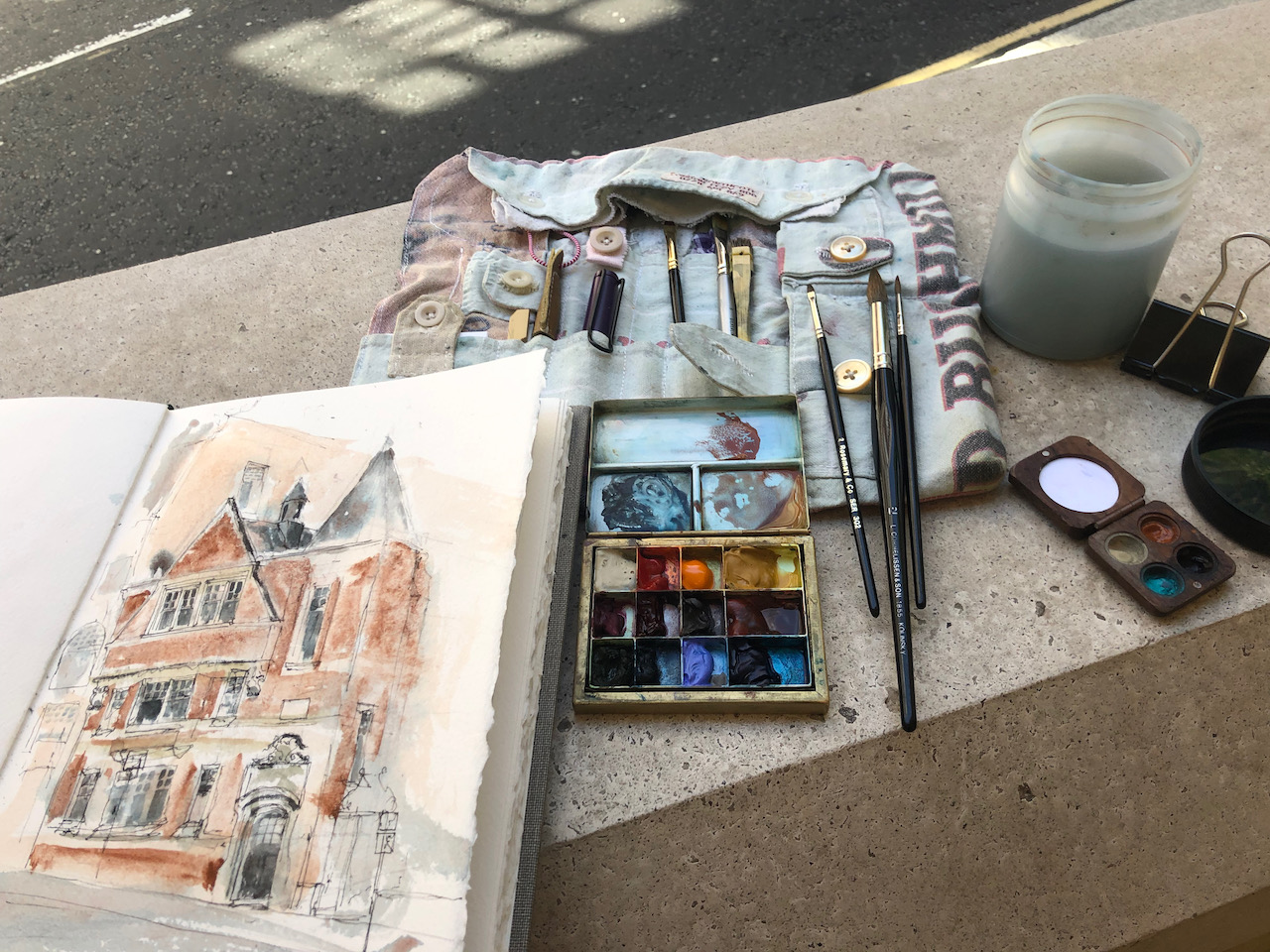
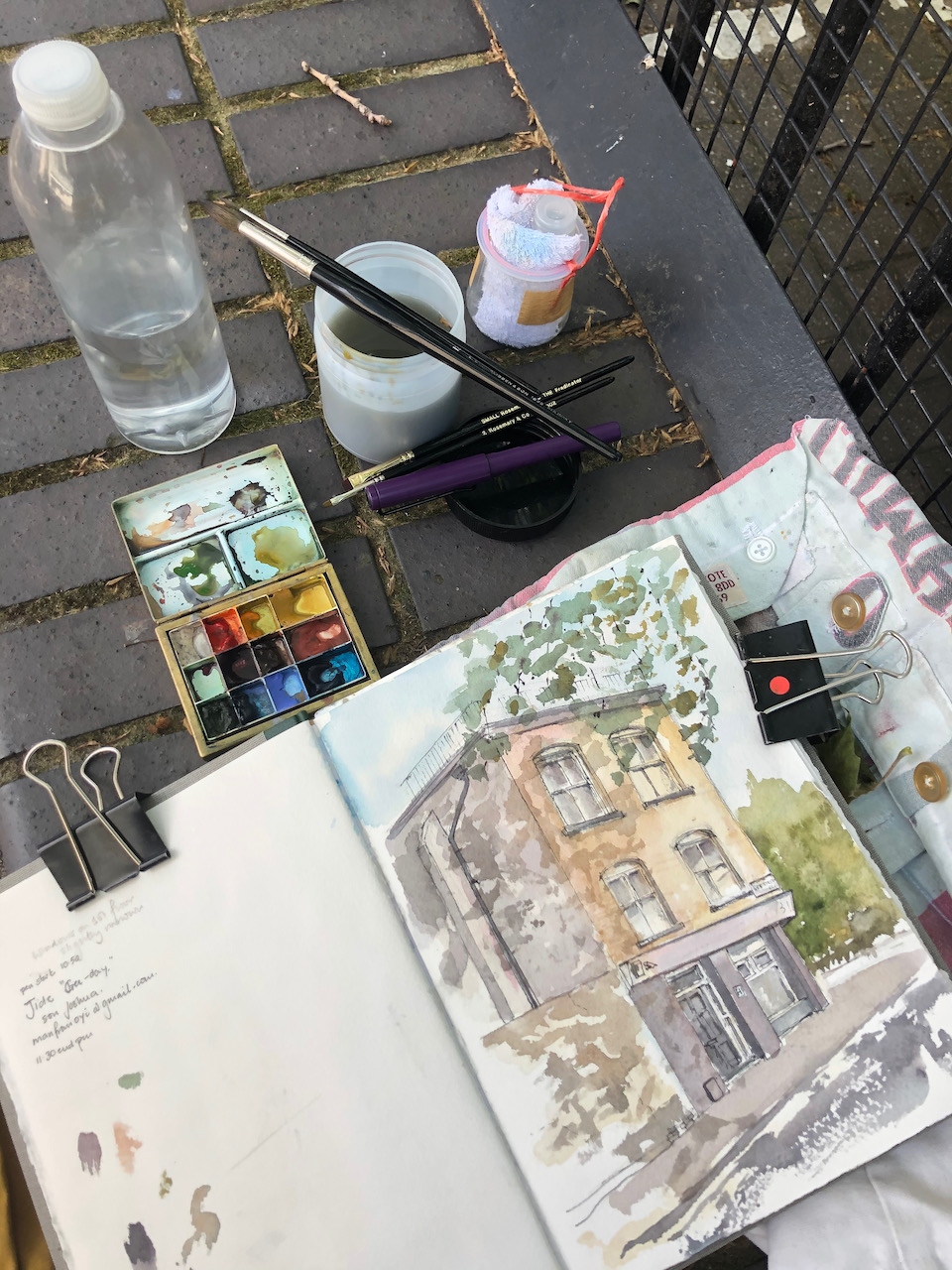
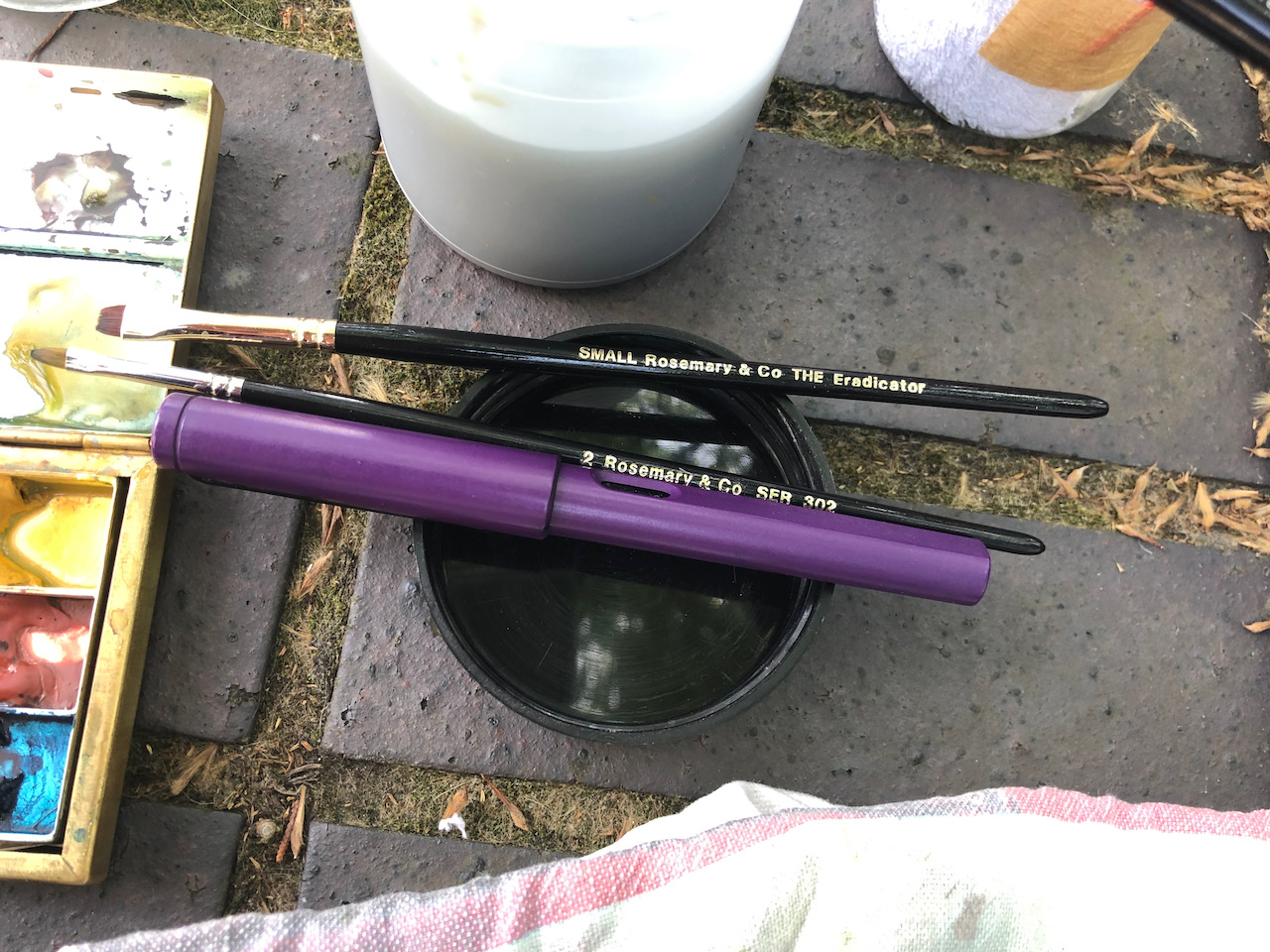
Another person came and asked technical questions. They use watercolours for life drawing, and wanted to know the name of the brown colour I use, which is Fired Gold Ochre. They also admired my paintbox.
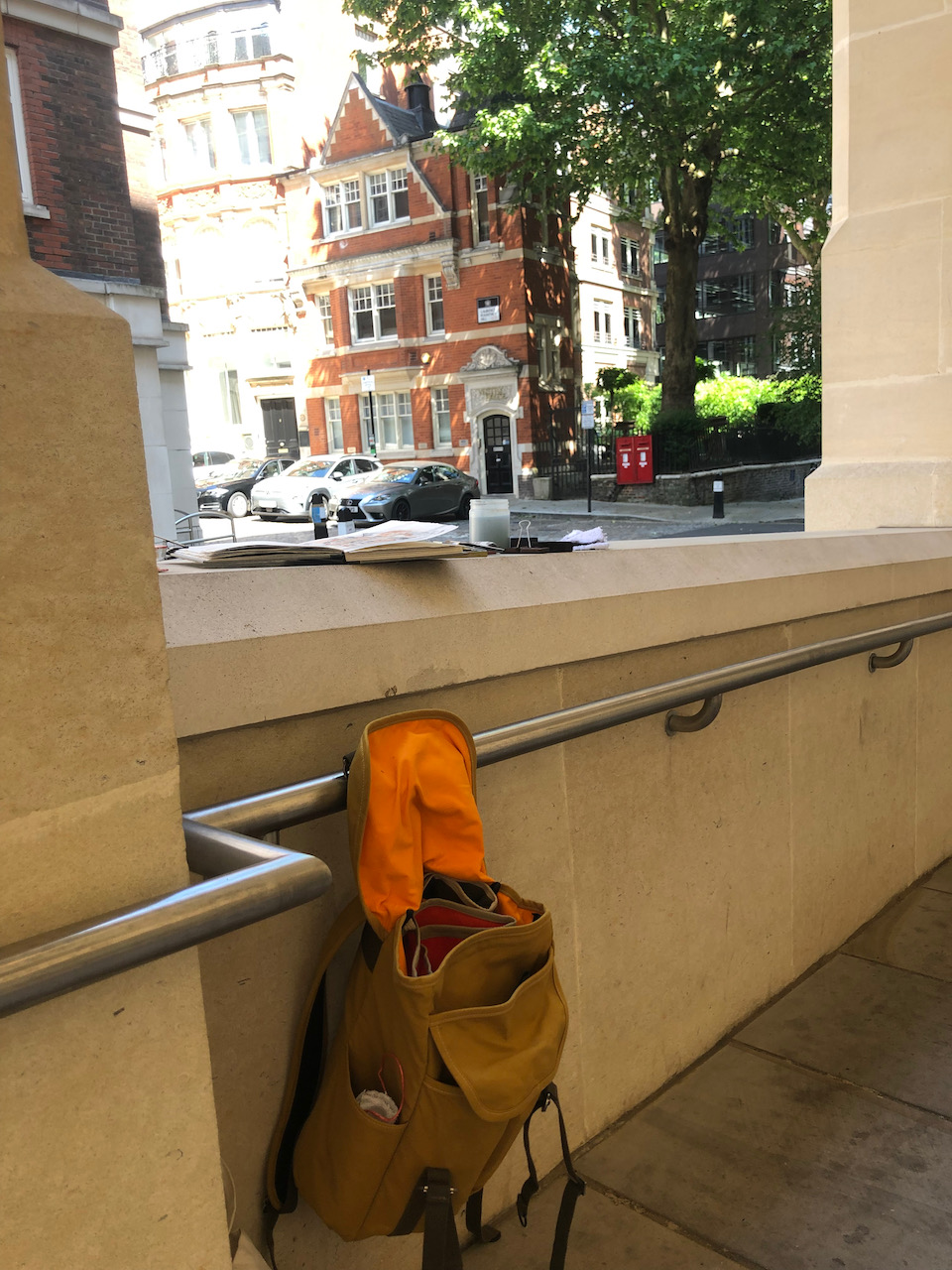
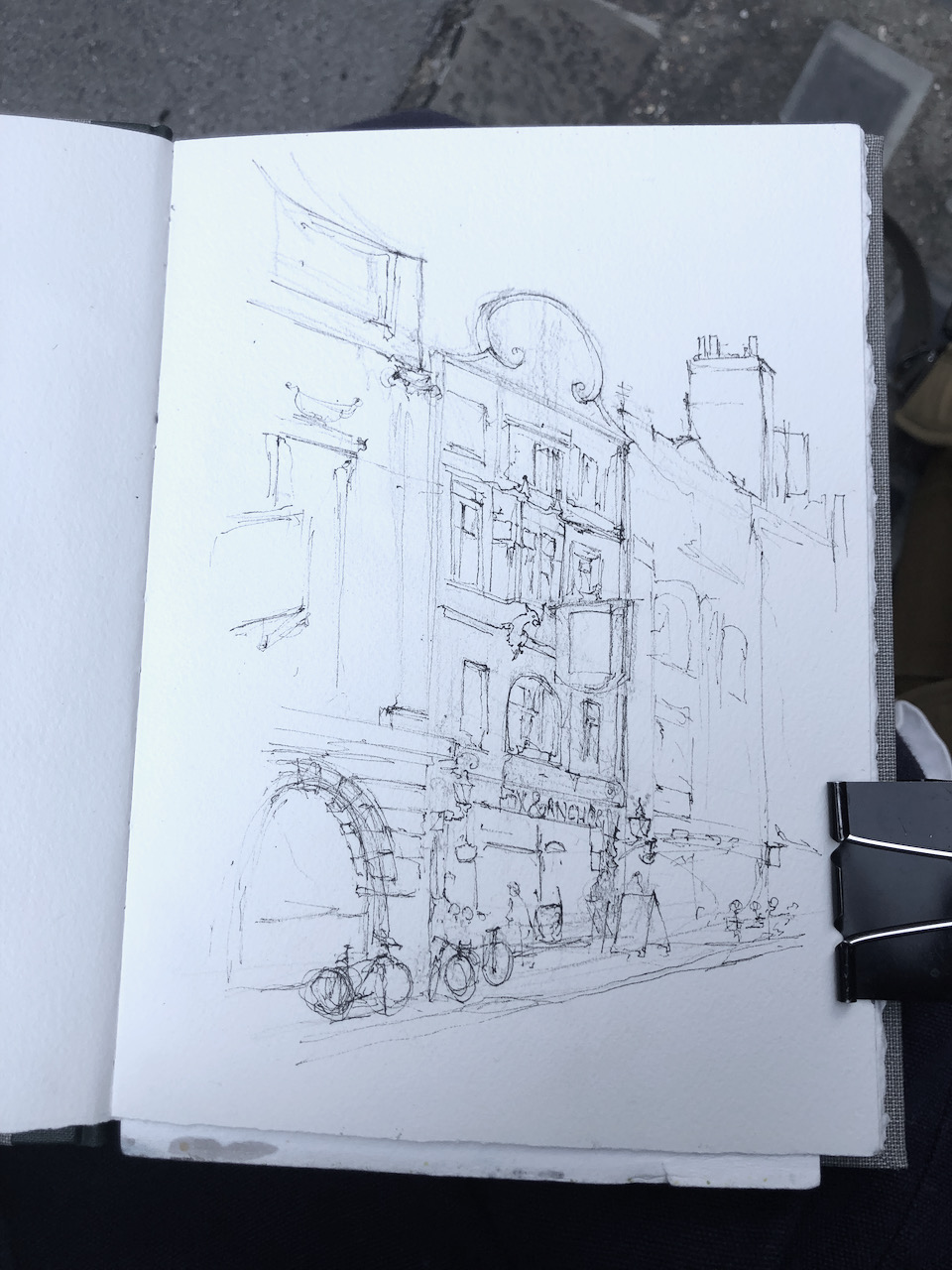
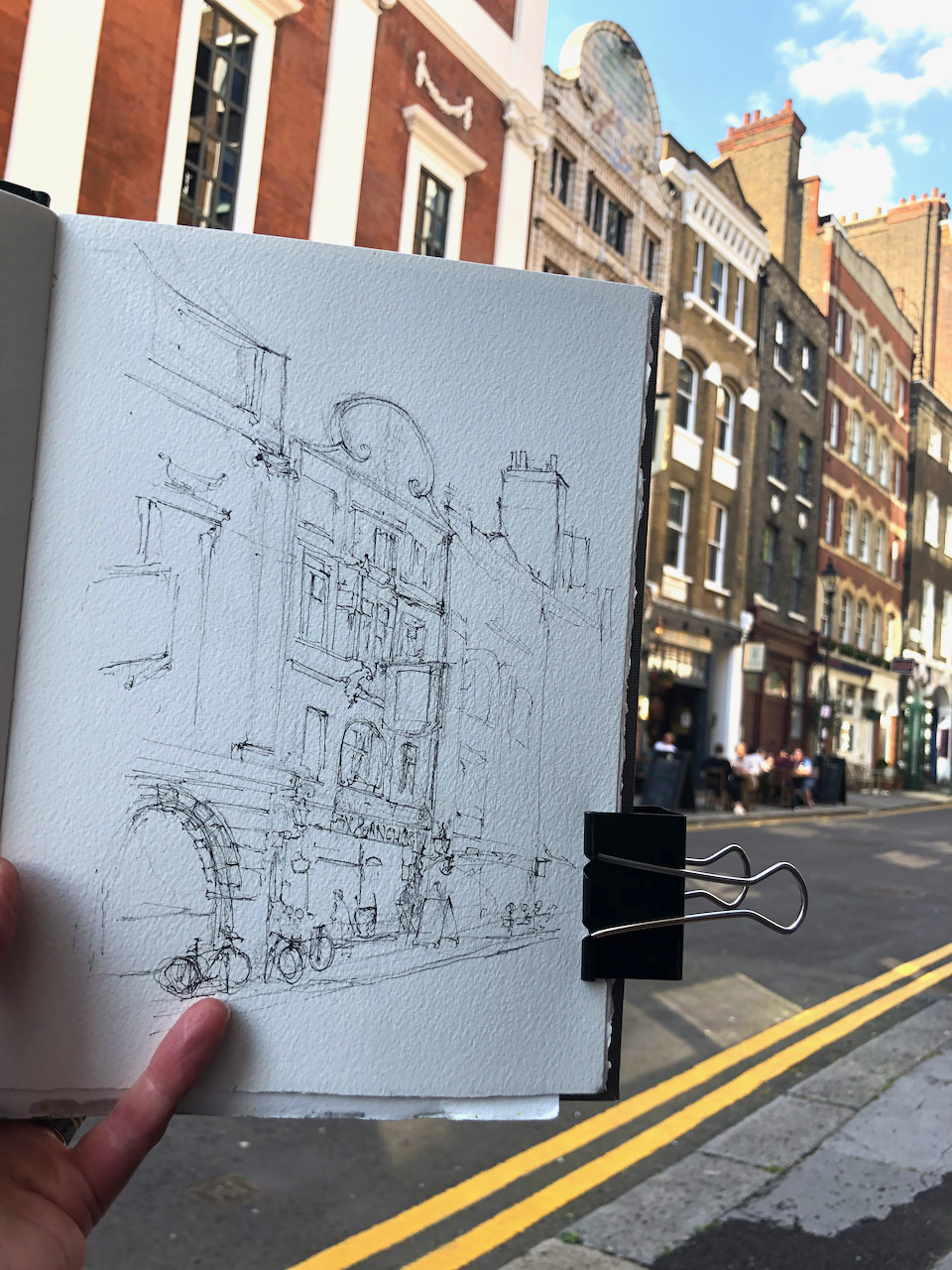
Here are pictures of work in progress and my drawing location:
Here is a map showing the line of sight of the drawing. The nearby street is called “Fox and Knot Street” which is intriguing.
The picture took an hour and a half, all on location. The colours are: Fired Gold Ochre, Phthalo Blue Turquoise, Buff Titanium, Mars Yellow, Permanent Yellow Deep. and some Perylene Maroon to make the grey colours. The yellow lines on the road are Naples Yellow.
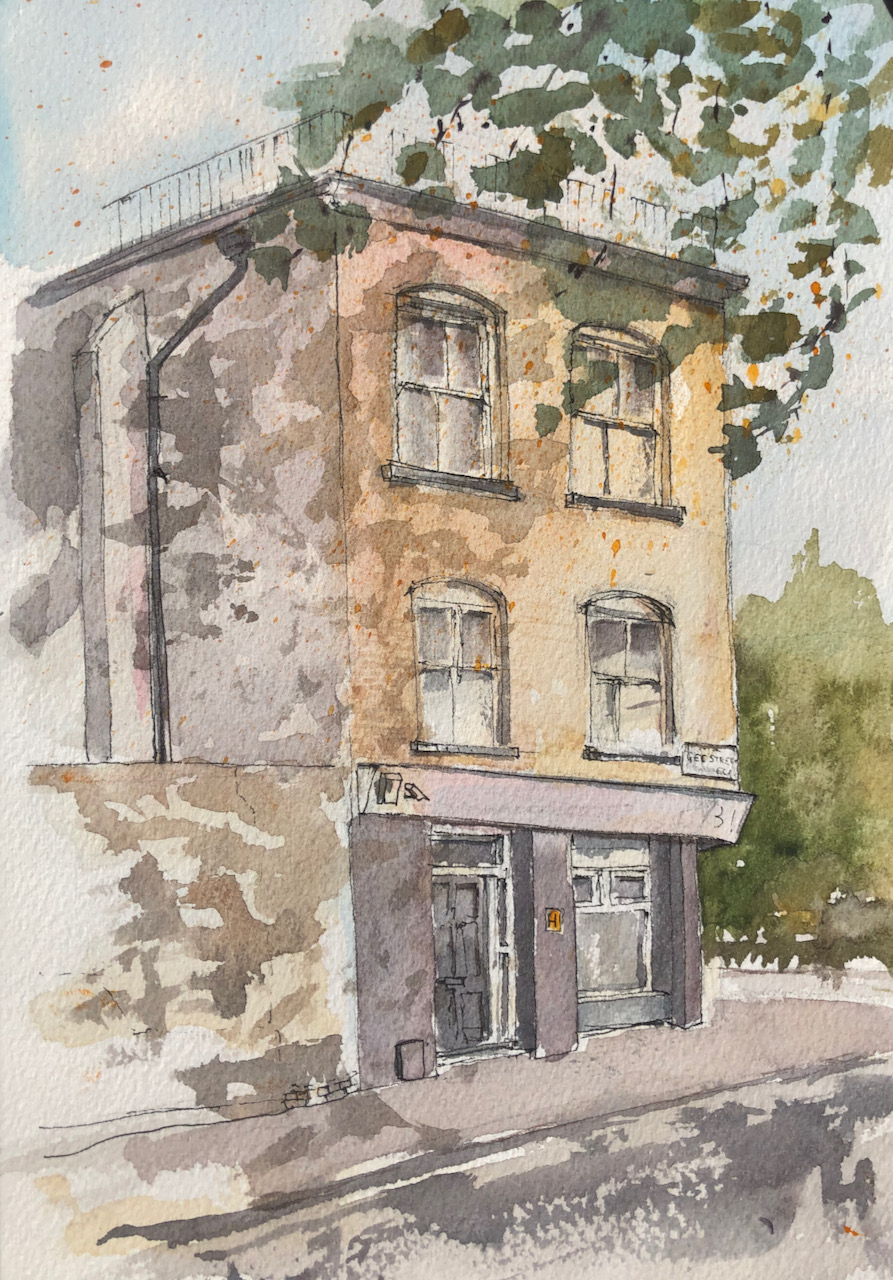
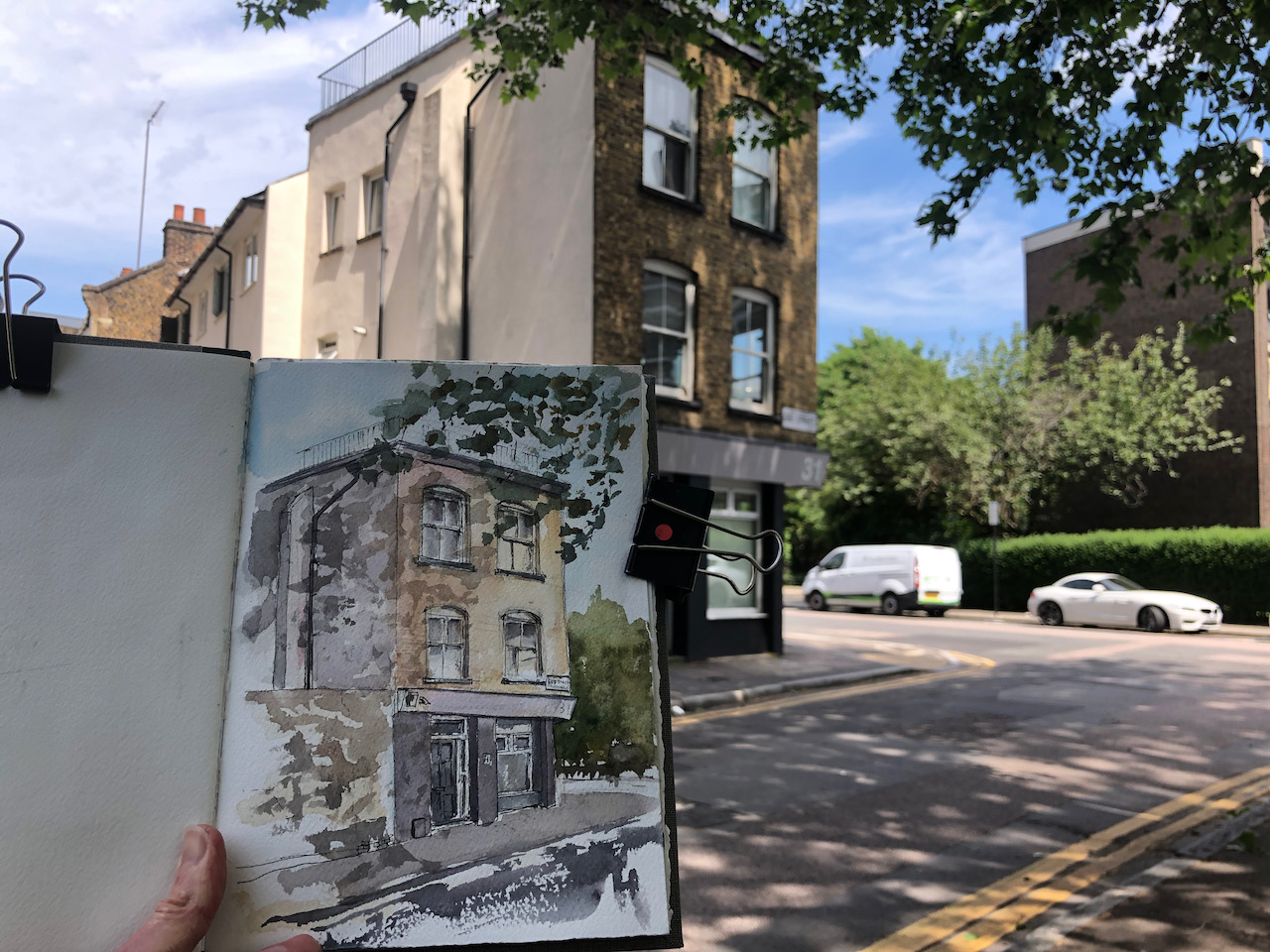
This house is on the corner of Central Street and Gee St, London EC1.
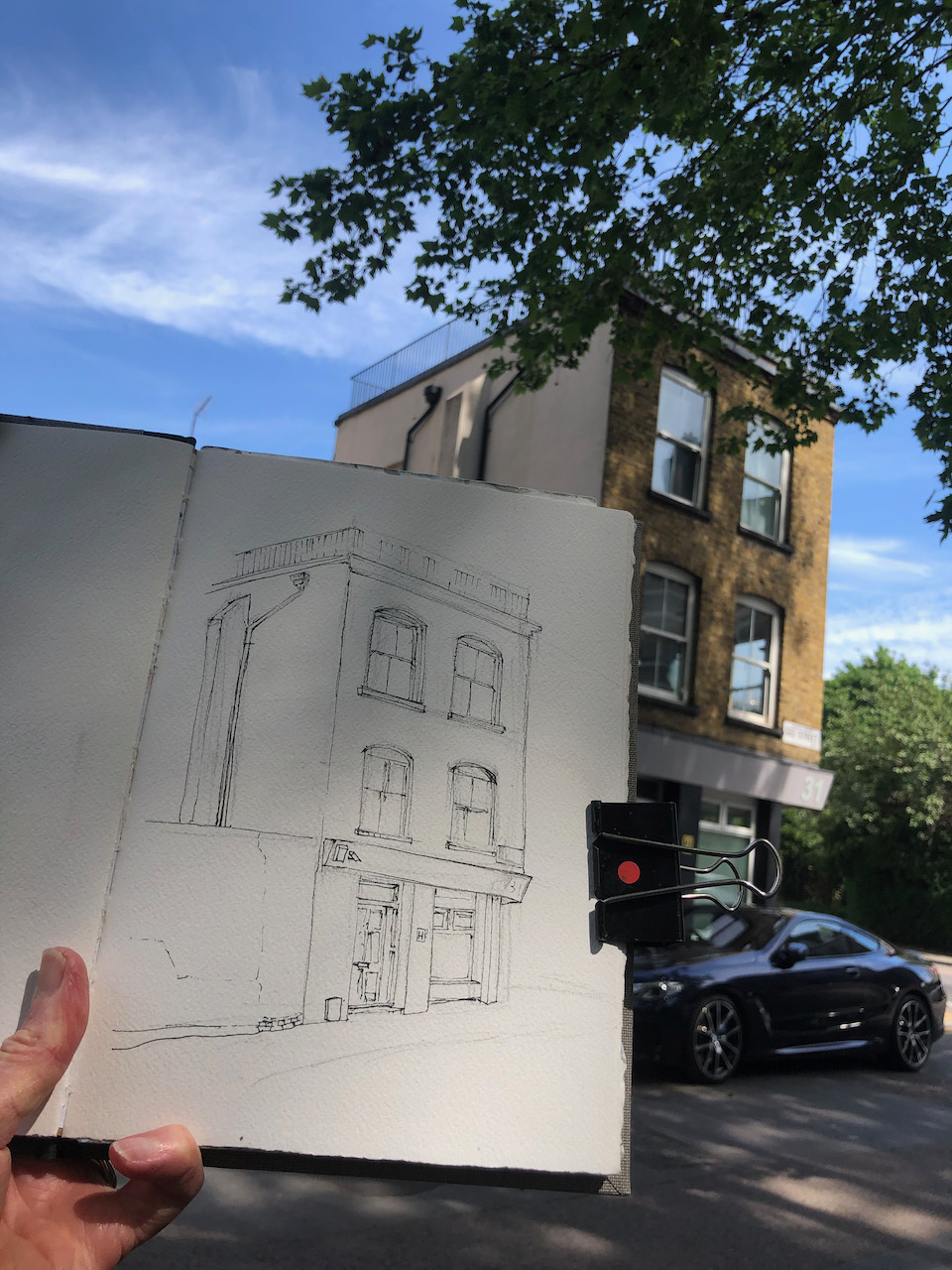
31 Central Street, EC1. Sketched 2nd June 2021 on location, 7″ x 10″ in Sketchbook 10
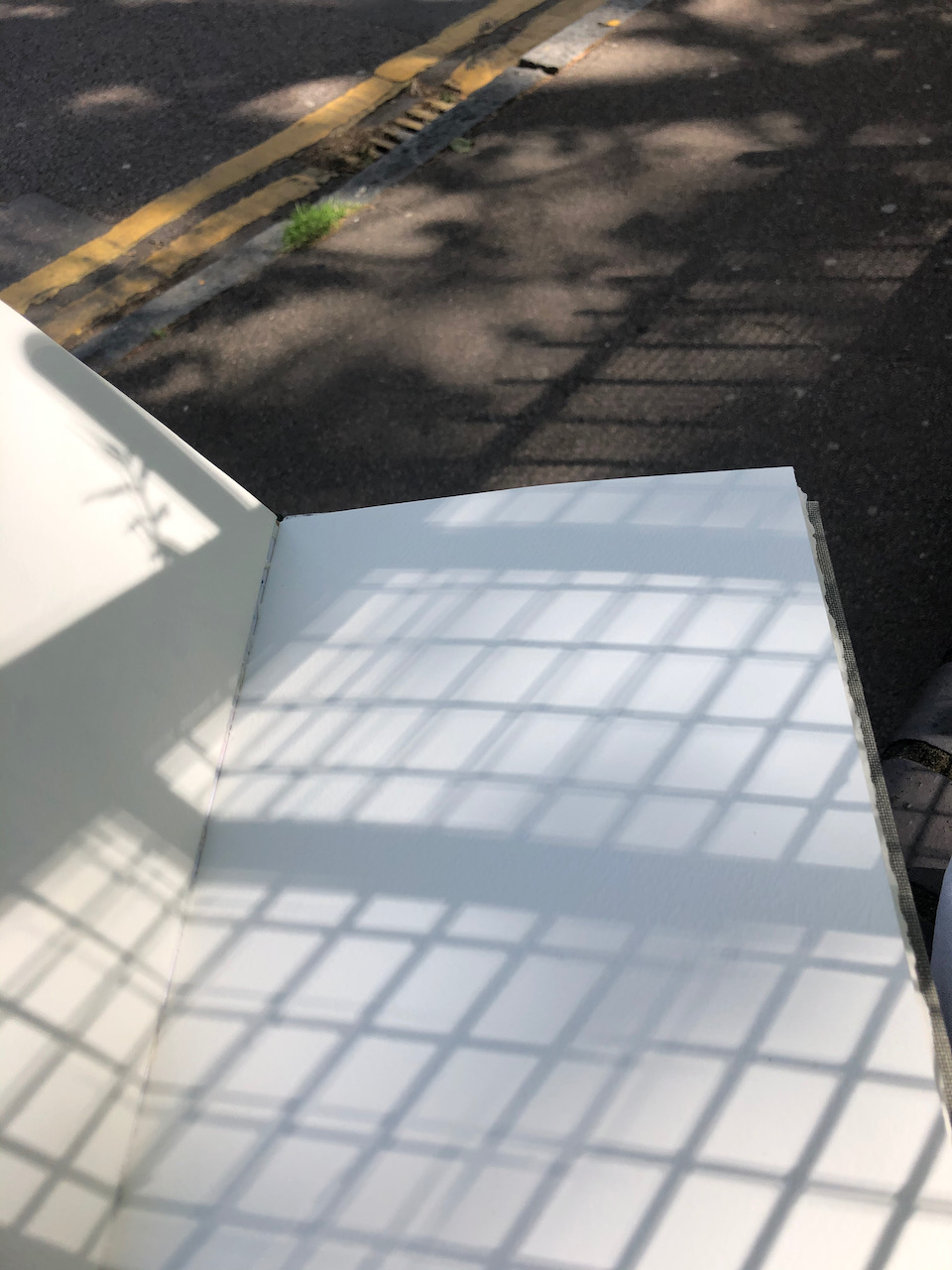
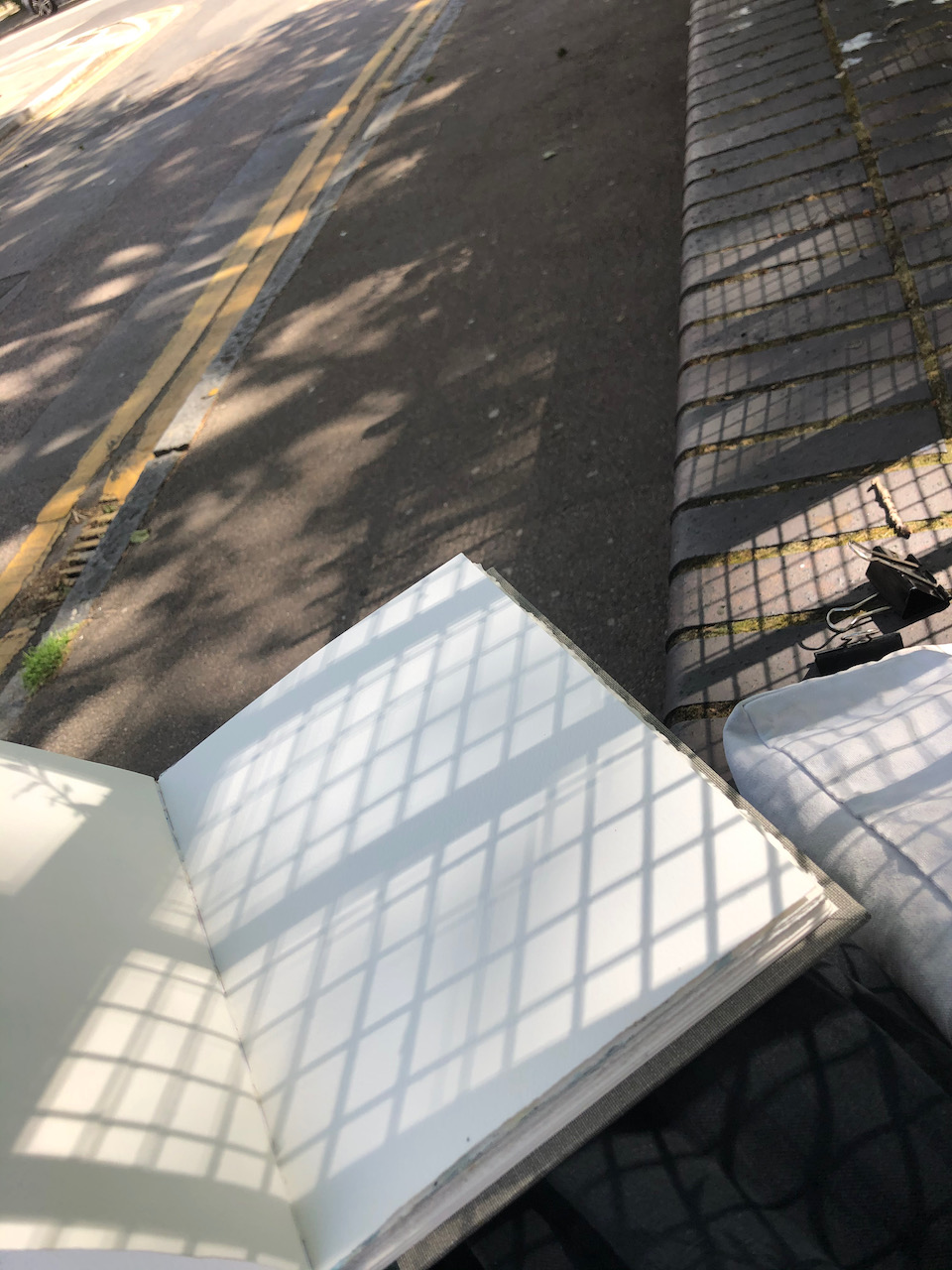
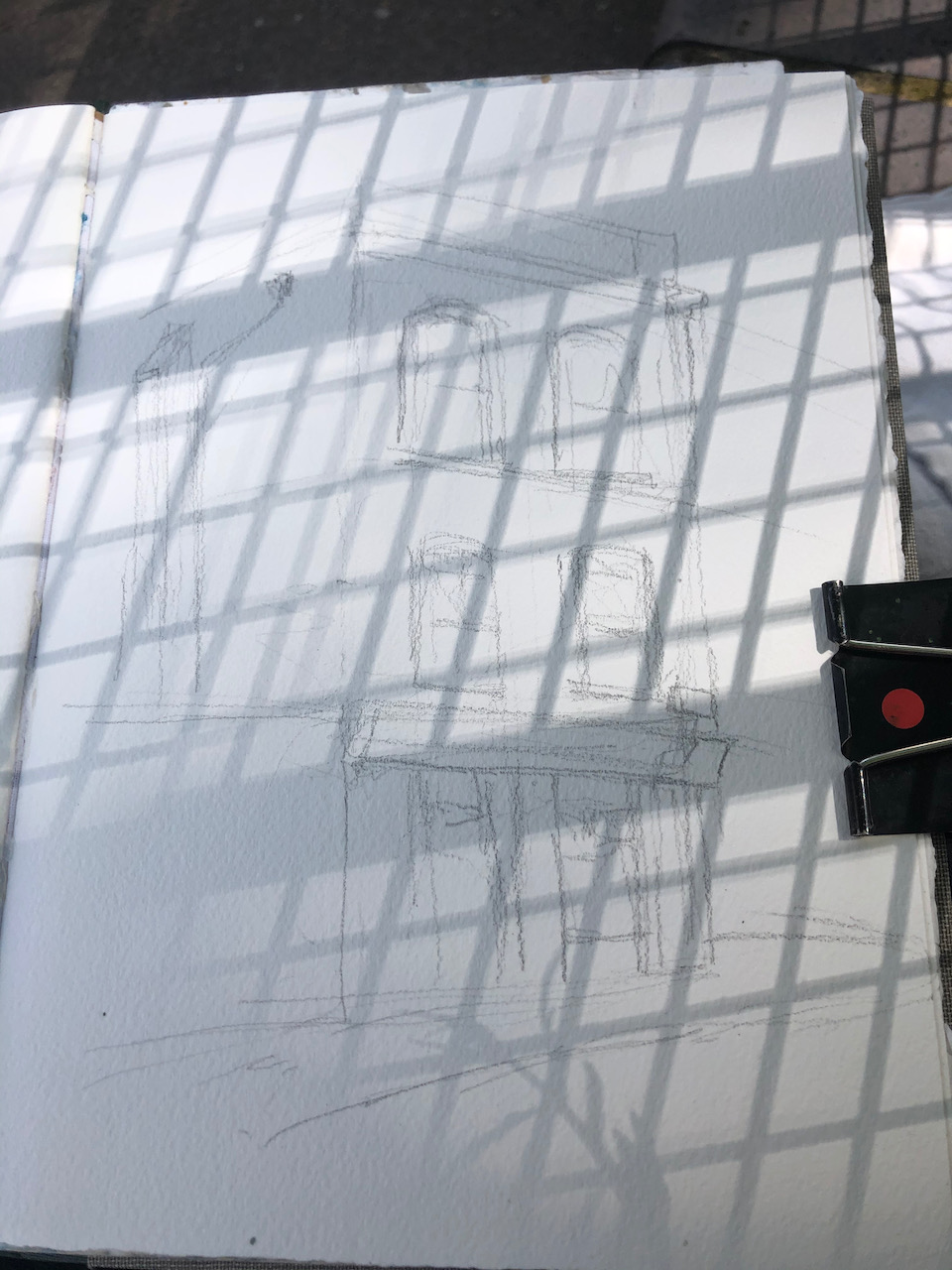
It was a lovely sunny day. I enjoyed the shadows on the house. When I sat down on the wall and got myself organised to sketch I found I had some startling shadows on my page.
See the drawing among the shadows.
…some startling shadows on my page….
While I was drawing, two people came up and chatted to me at different times. A man came, whose young son is a gifted cartoonist and illustrator. We talked about different styles of drawing, and how his son might develop his talent. Later a woman stopped to talk. She used to be an artist herself. She was interested to know why I was drawing that particular house. These people both preserved a respectful distance, but still chatted and appreciated the drawing. I am happy that people are talking again.
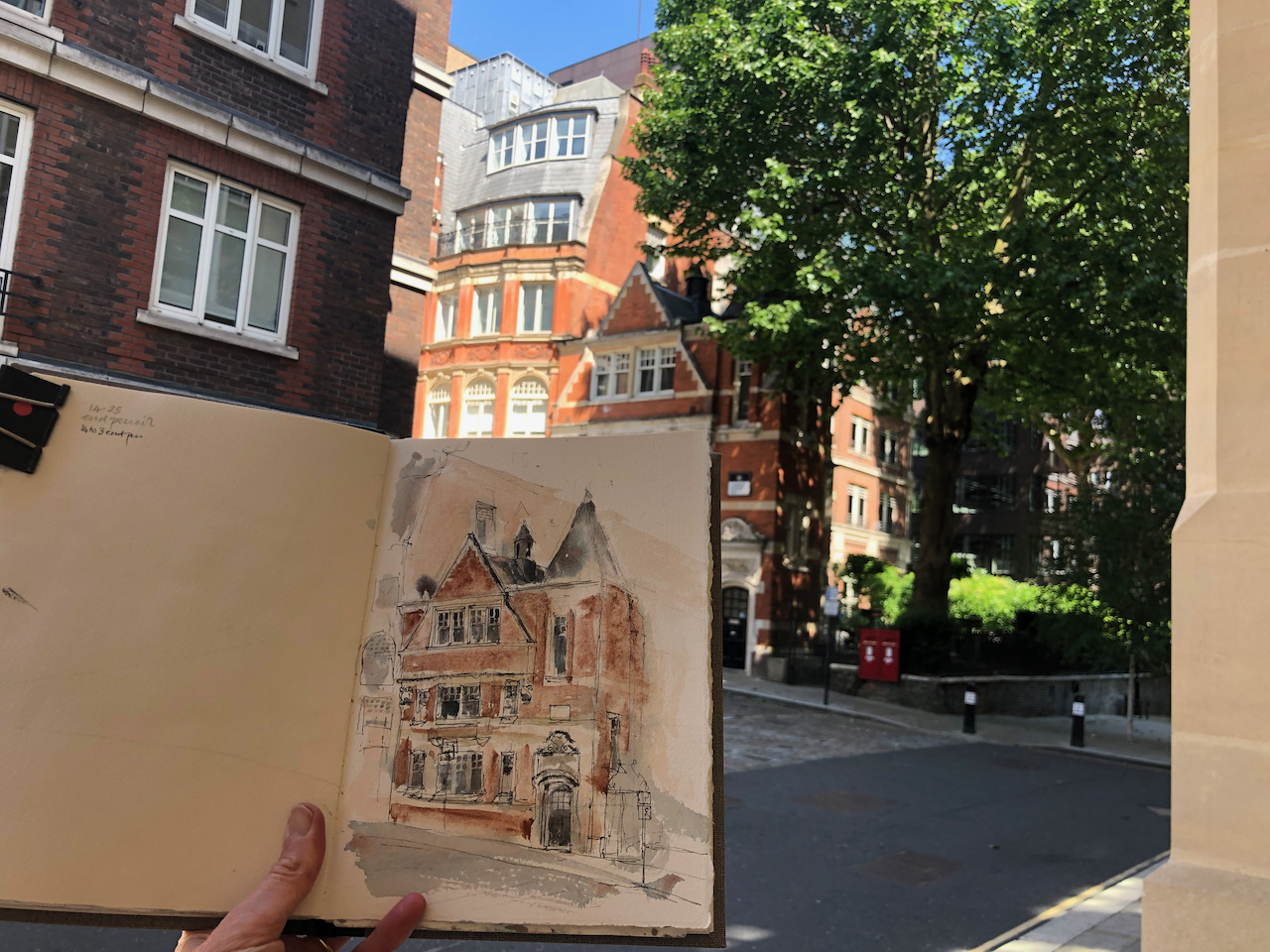
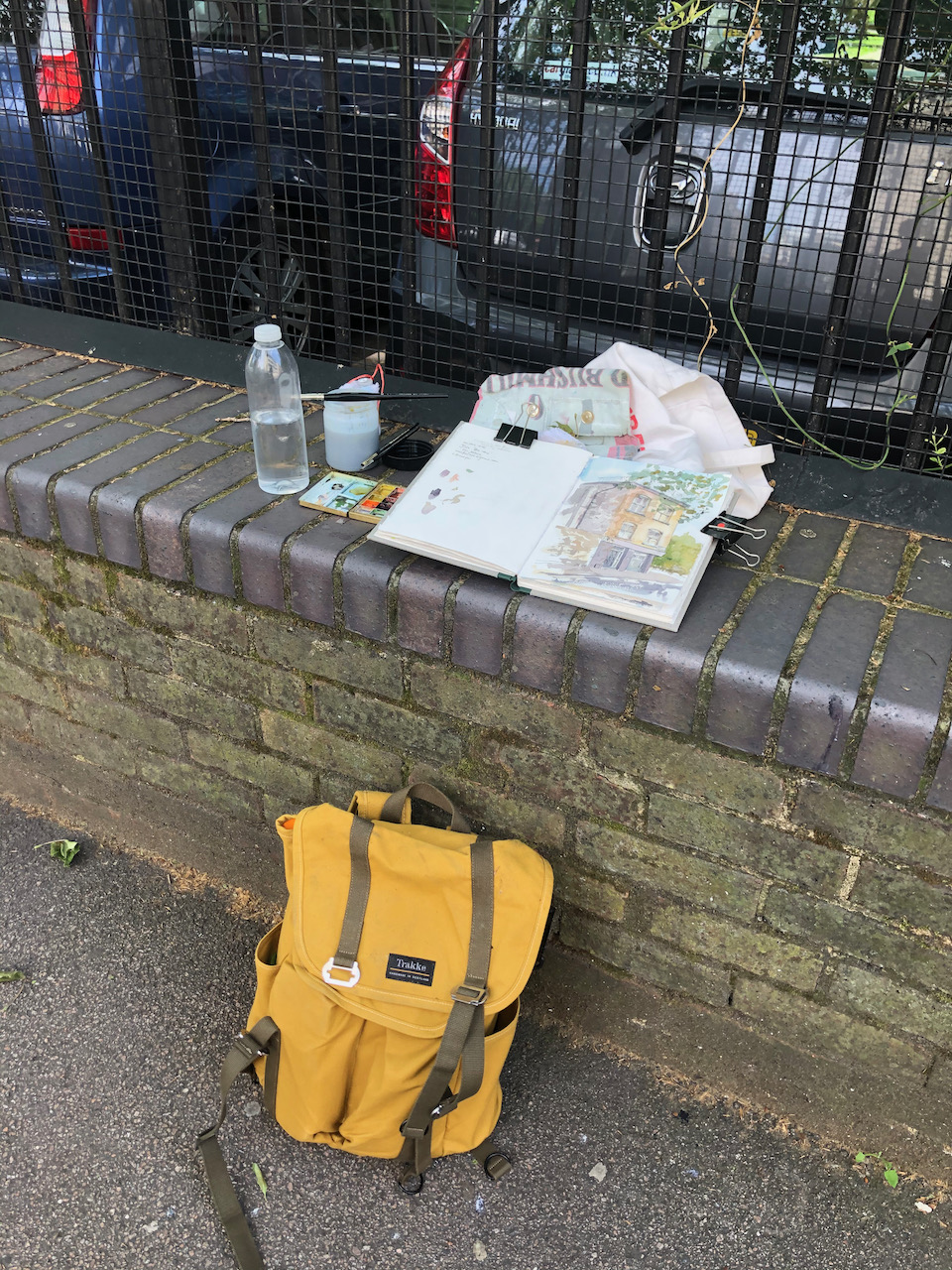
Here are some snapshots of work in progress and the location where I was drawing:
This drawing took about 2 hours, sketched and coloured on location.
The colours are: Mars Yellow, Phthalo Blue Turquoise, Perylene Maroon, Pink Rhodenite Genuine, Transparent Brown Oxide. The trees have some Green Apatite Genuine and Permanent Yellow Deep. There’s a Permanent Yellow Deep splatter across the leaves.
Here’s a sketchmap of the location:
Click a button below to share this post online, email it, or print it:
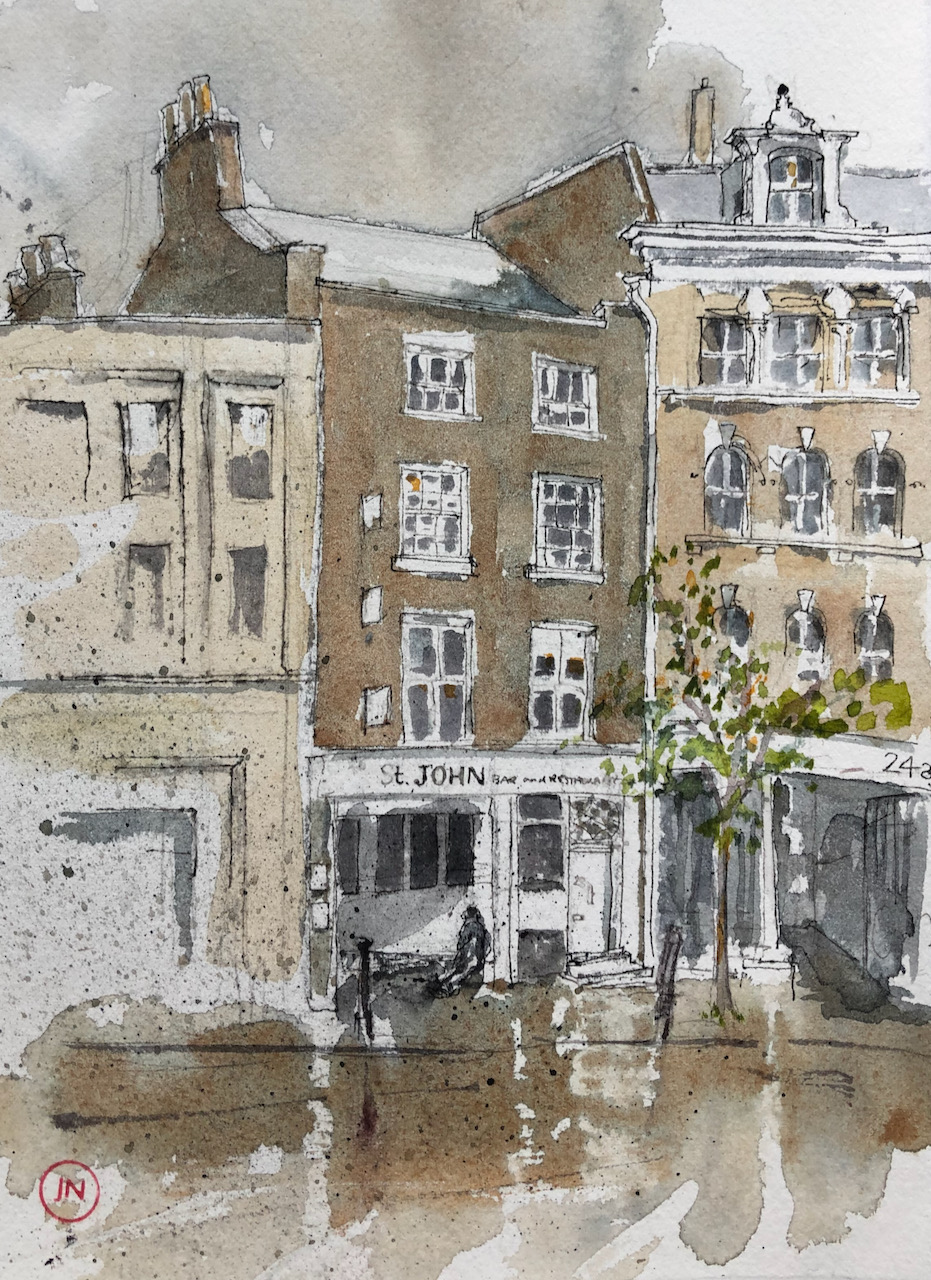
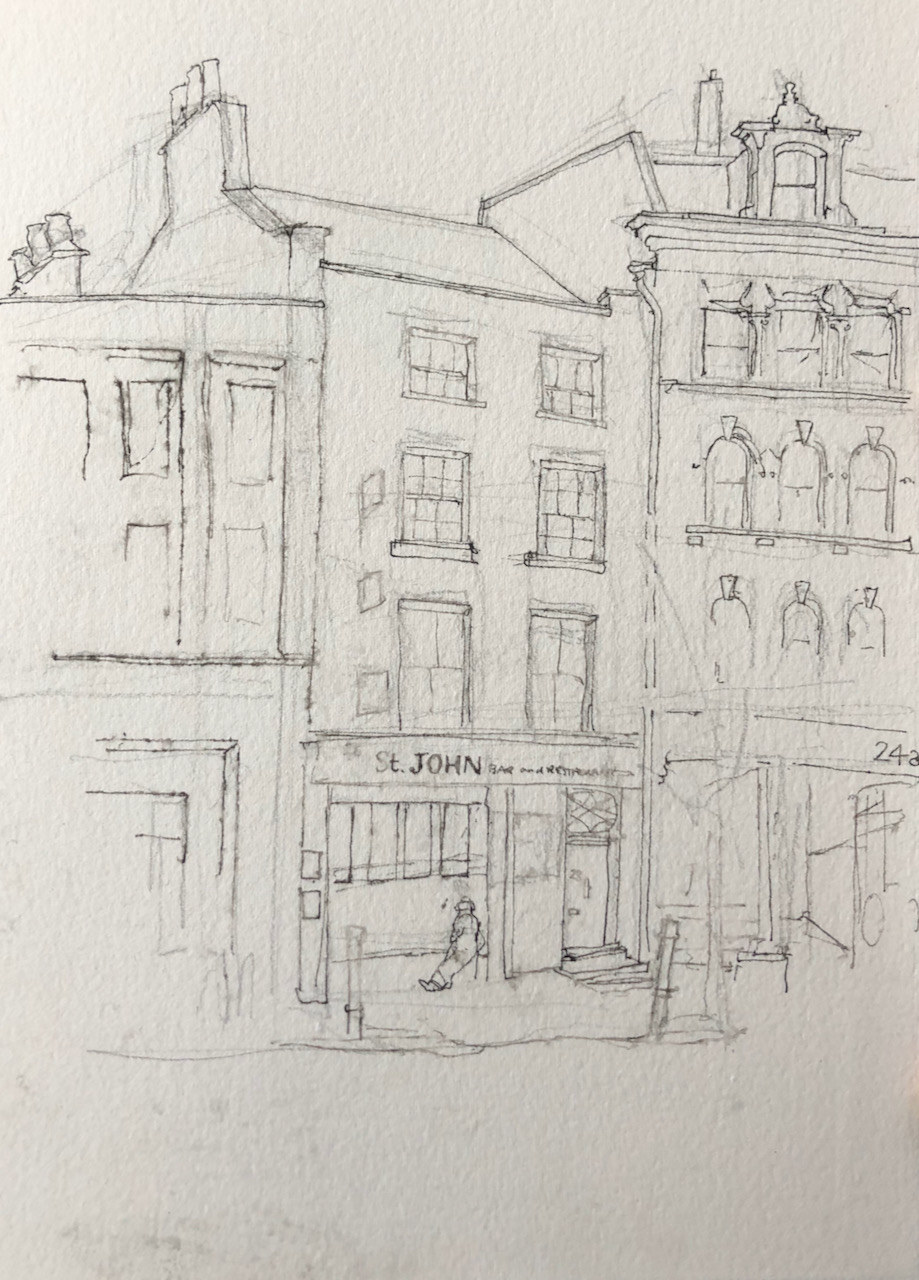
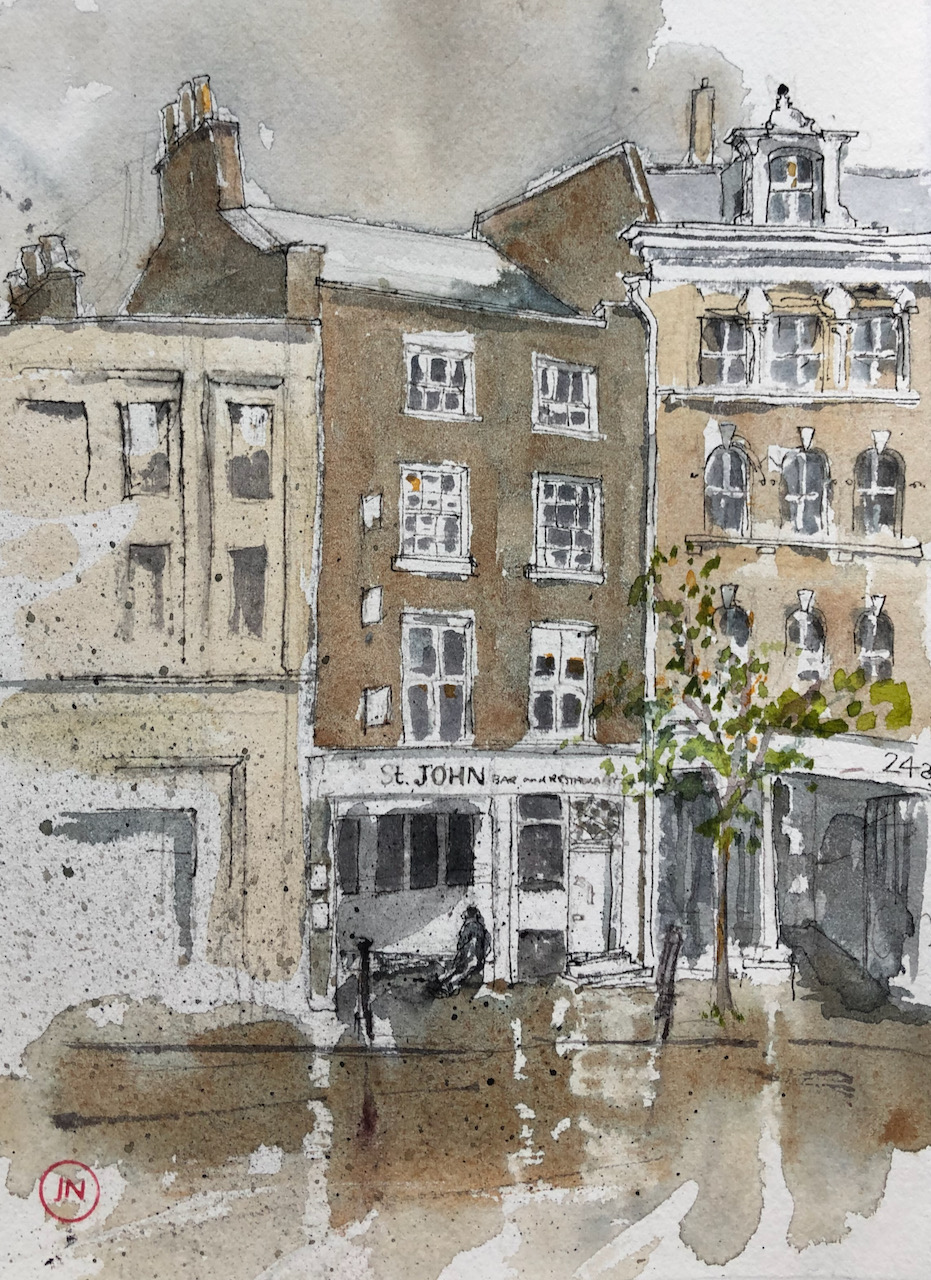
St John Bar and Restaurant EC1, 20 May 2021, 5pm. 8″ x 10″ in Sketchbook 10.
A photo on location in the rain.
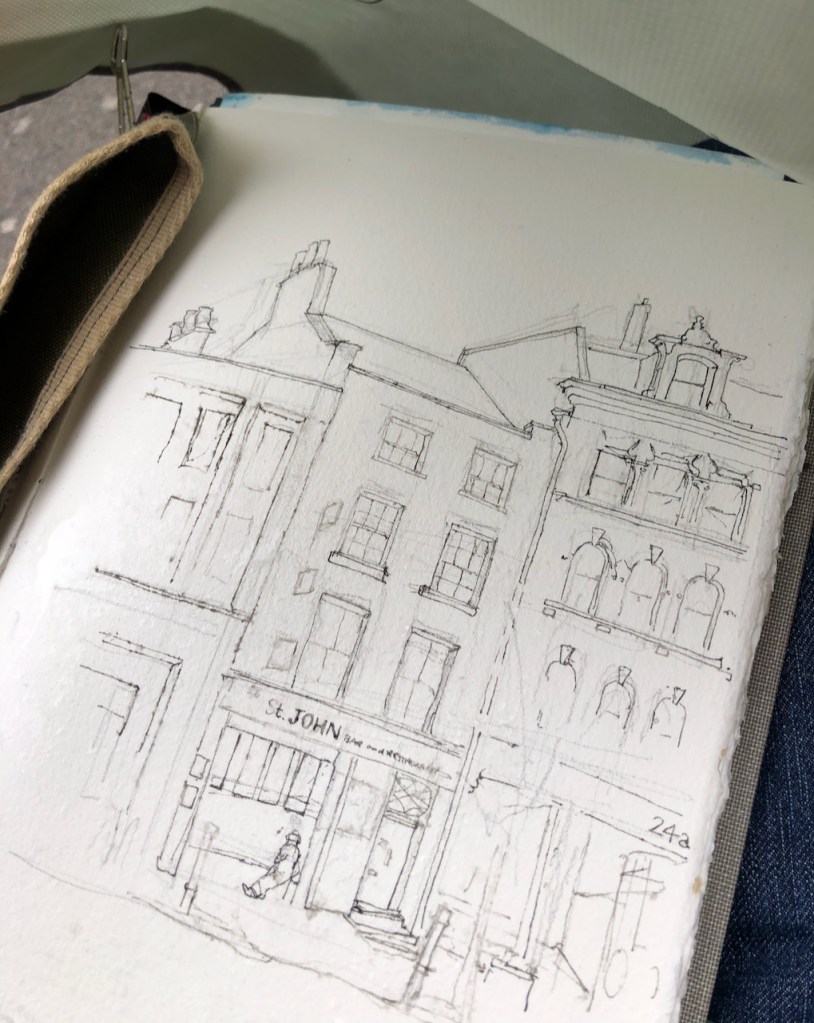
Yesterday I went out for a walk with my sketchbook. I sat on the edge of a low stone wall and started drawing St John Bar and Restaurant. Then the fine rain came. It was blustery and I thought it would blow over. It did not blow over. It became a maritime wind-blown spray. I protected my drawing as best I could with a screen made from a bag I was carrying. It didn’t protect it very well.
The ink I use is waterproof ink. This means that once dry, it does not run if water is added. The key phrase here is “once dry”. In the fine rain the ink didn’t have a chance to get dry. It was diluted as I put it on the paper, so my lines became a rather subtle grey, and somewhat blotchy.
…lines became a rather subtle grey, and somewhat blotchy…
…like drawing on blotting paper…
The paper I use is Arches Aquarelle. It is what is called “heavily sized”, which means it has substances added to make it partly water resistant. This is so that watercolours stay on the surface. This sizing has the useful consequence that rainwater beads on the surface, at least initially. This is not advertised in the description of the paper, but is useful for those of us who try to paint outdoors in the UK. After a while, however, it yielded. The rain penetrated. The paper became soft and absorbent, and the lines from my pen became blotchy, like drawing on blotting paper: possible, but you get some unwanted effects. It also became rather hard to see what I was doing. My glasses were wet with raindrops and are not equipped with windscreen wipers. So at that point I stood up and packed up. Rainwater fell off me in rivulets, dangerously close to the place where the sketchbook sheltered under the rucksack. This sketchbook contains earlier drawings done in watercolour. I had visions of the previous drawings becoming blotchy abstracts.
At home I laid everything out carefully on the floor to dry out. The paper admirably remained flat. The previous drawings were not damaged.
I dried out. Everything dried out. Then I added the colour.
This picture took 45 minutes on location, colour took another 45 mins at my desk. The colours are Phthalo Blue Turquoise, Perylene Maroon, Buff Titanium, Transparent Brown Oxide, Mars Yellow. For the tree leaves: Green Gold and Permanent Yellow Deep.
Click a button below to share this post online, email it, or print it:
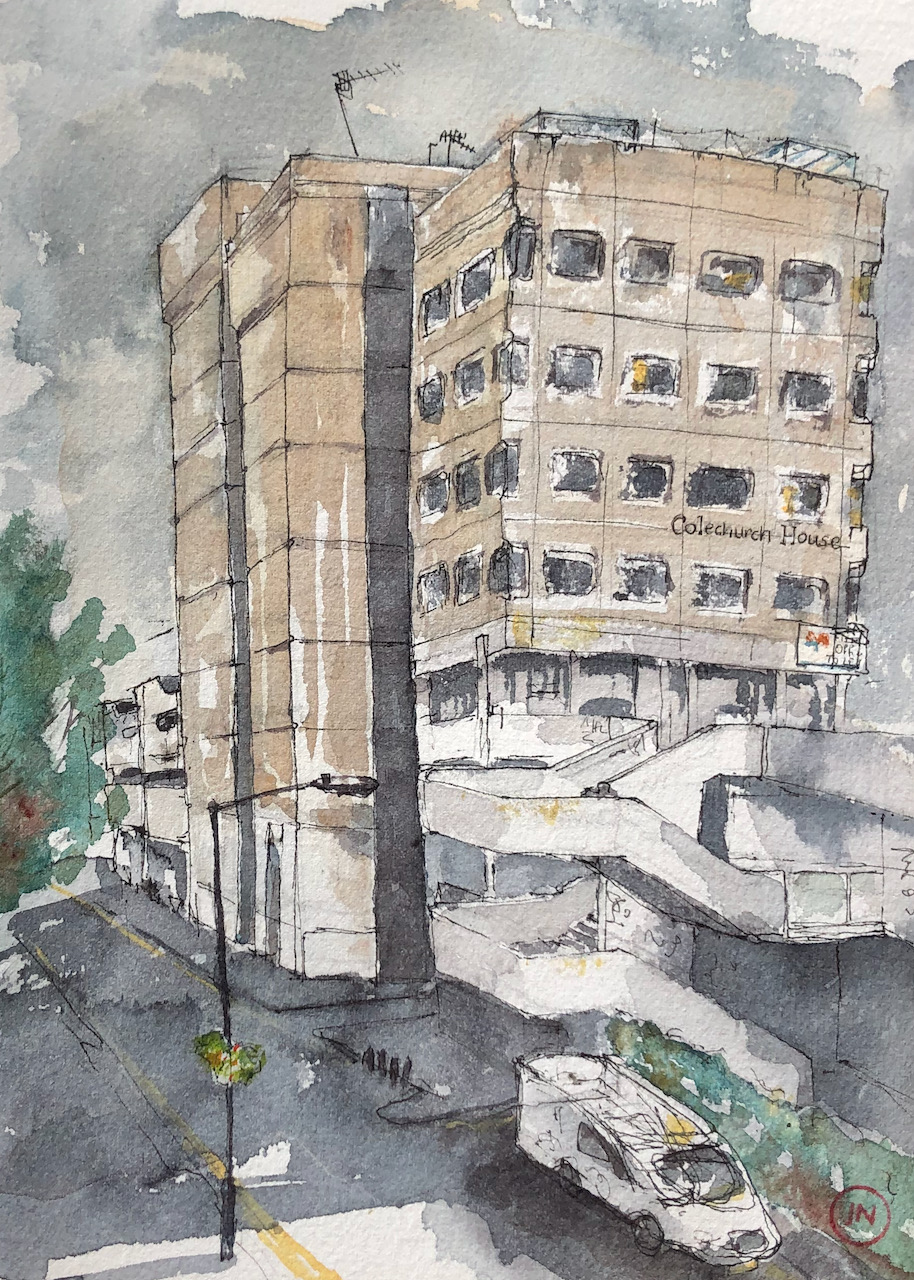
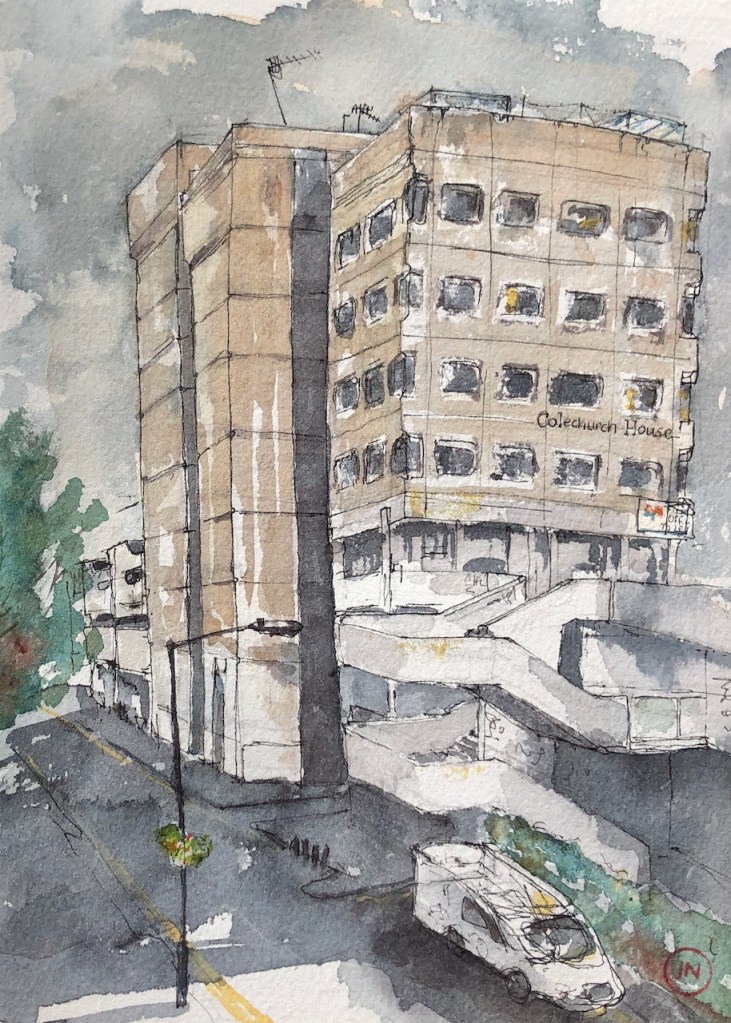
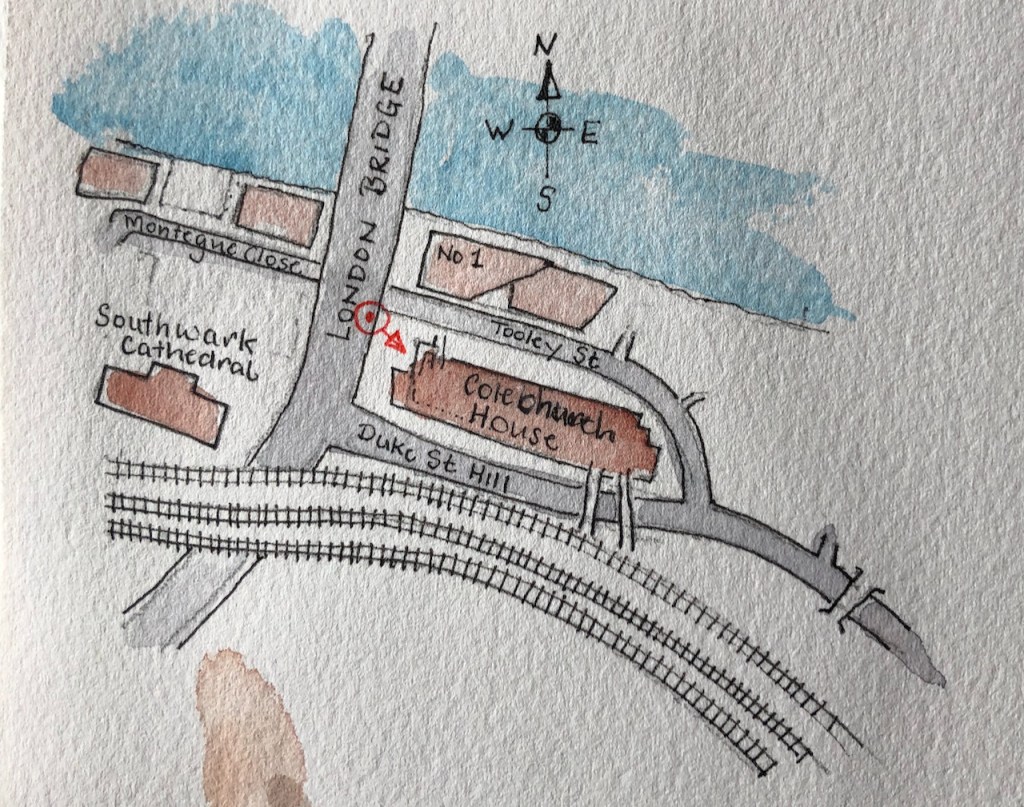
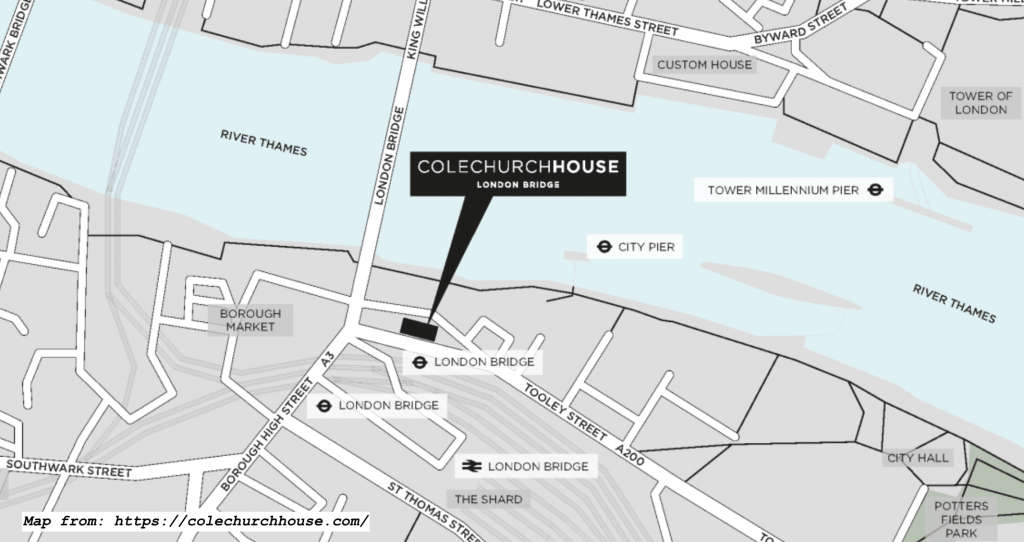
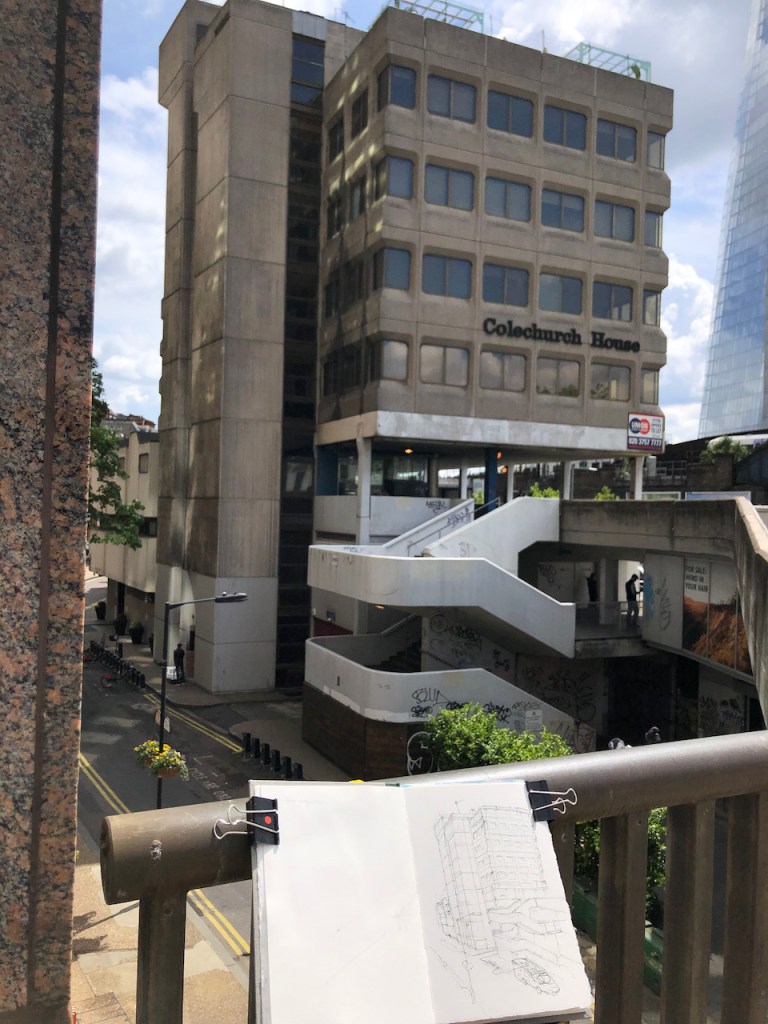
Aficionados of 20th Century brutalist architecture need to hasten to appreciate Colechurch House. It is due for demolition and redevelopment. This month’s post in the marvellous “London Inheritance” site informed me about the planning application, so I rushed over there to draw a picture before the building became swathed in plastic.
Colechurch House SE1, 18th May 2021, 12:30pm. 7″ x 10″ in Sketchbook 10
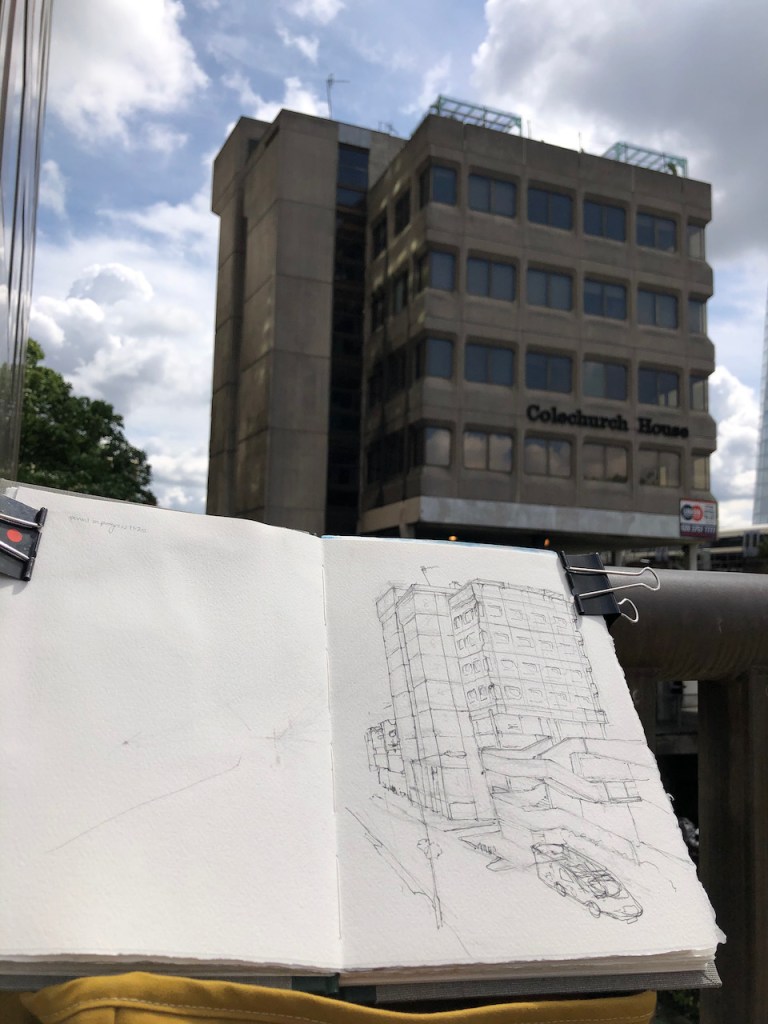
I drew this picture looking over the railings from London Bridge. This position commanded an excellent view of Colechurch House, but it meant I had my back to the passers-by on the pavement, which made me nervous. I strapped my rucksack to the railing and worked quickly. My drawing makes the building look a little precarious, perhaps that reflects my own nervousness standing in the wind on London Bridge, or perhaps it reflects the nervousness of the building as it awaits imminent demolition.
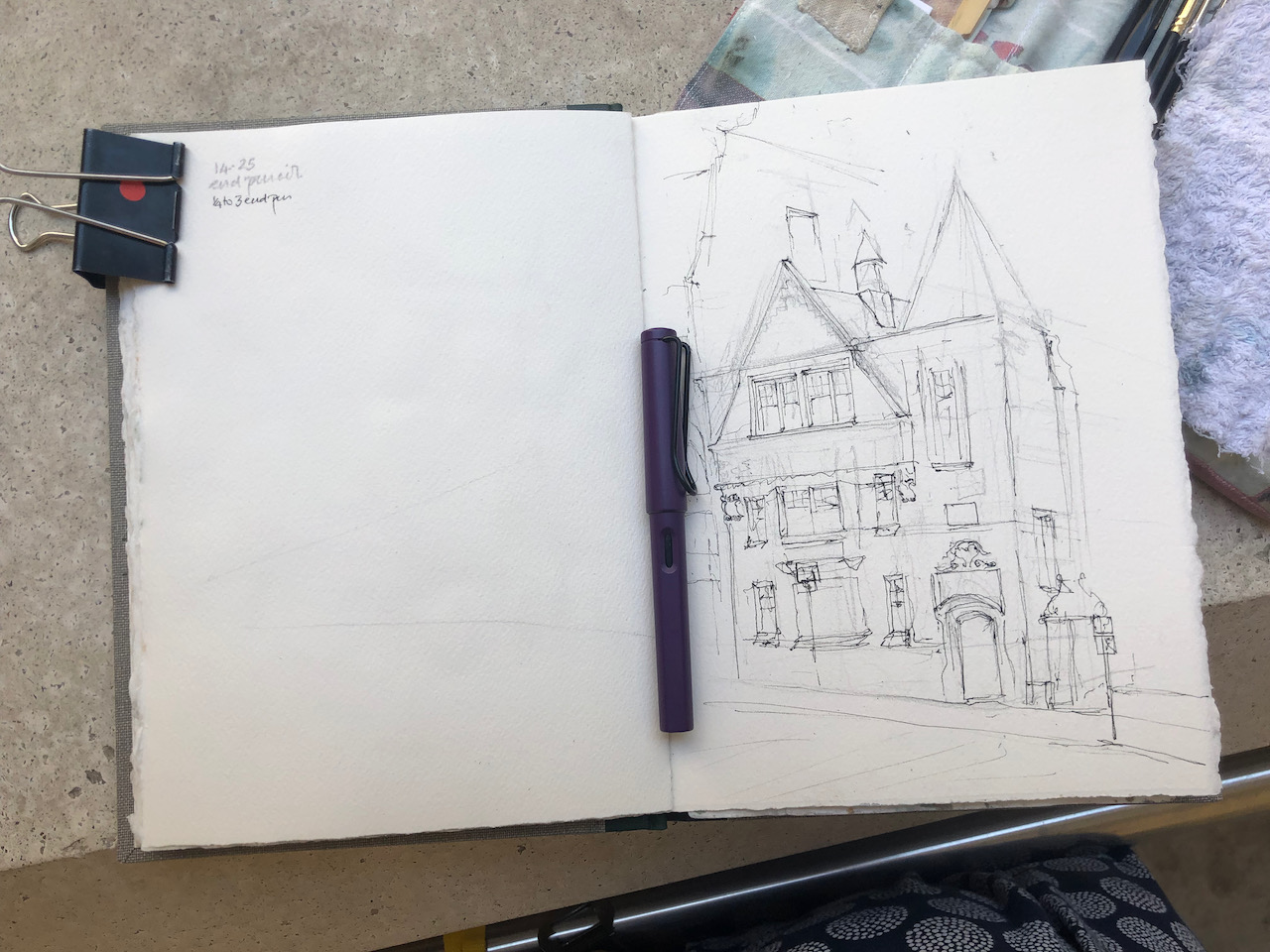
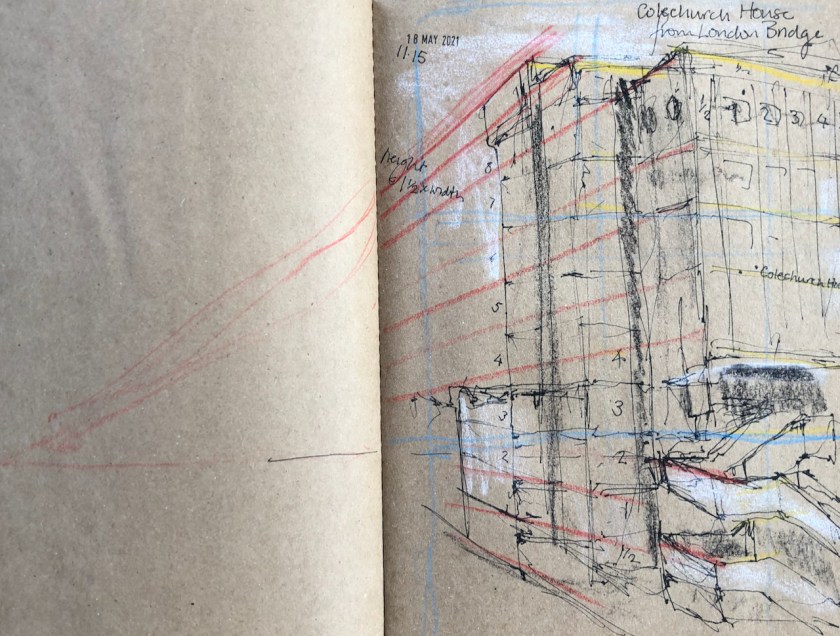
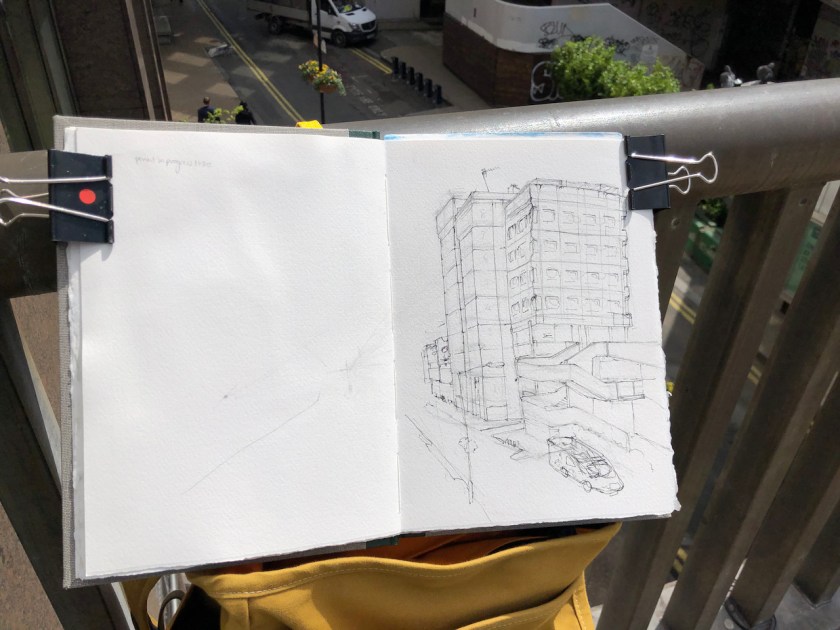
Here is work in progress. I completed the pen-and-ink on location and the colour at my desk.
Preliminary sketch
Colechurch House was completed in the late 1960s* to the designs of E G Chandler. Pre-pandemic, the area under the building at podium level contained a tidal flow of commuters walking between London Bridge Station and the City of London. The City of London Corporation entity known as “Bridge House Estates” owns the freehold. The site is in the London Borough of Southwark (called “LBS” in the press release below). The planning application is GLA reference 2020/6867/S1 and has been approved. Here’s the plan, according to the summary in the planning application:
“Redevelopment of the site to include demolition of Colechurch House, pedestrian footbridge and walkway and erection of an elevated 22-storey building (+ 4-storey basement) above a public park and providing office floorspace, retail floorspace, restaurant/café floorspace, leisure floorspace (all Use Class E), theatre and a bar (Sui Generis), delivered alongside public realm improvements, roof gardens, cycle parking, servicing, refuse, plant areas and other associated works incidental to the development.”
Here’s a press release from the City of London last year, announcing the development.
*Completion date “late 1960s” according to https://colechurchhouse.com/site, the website of the new development. It also says “It is named after Peter of Colechurch who designed the first stone bridge across the Thames here.”
Click a button below to share this post online, email it, or print it:






























 Jane Sketching