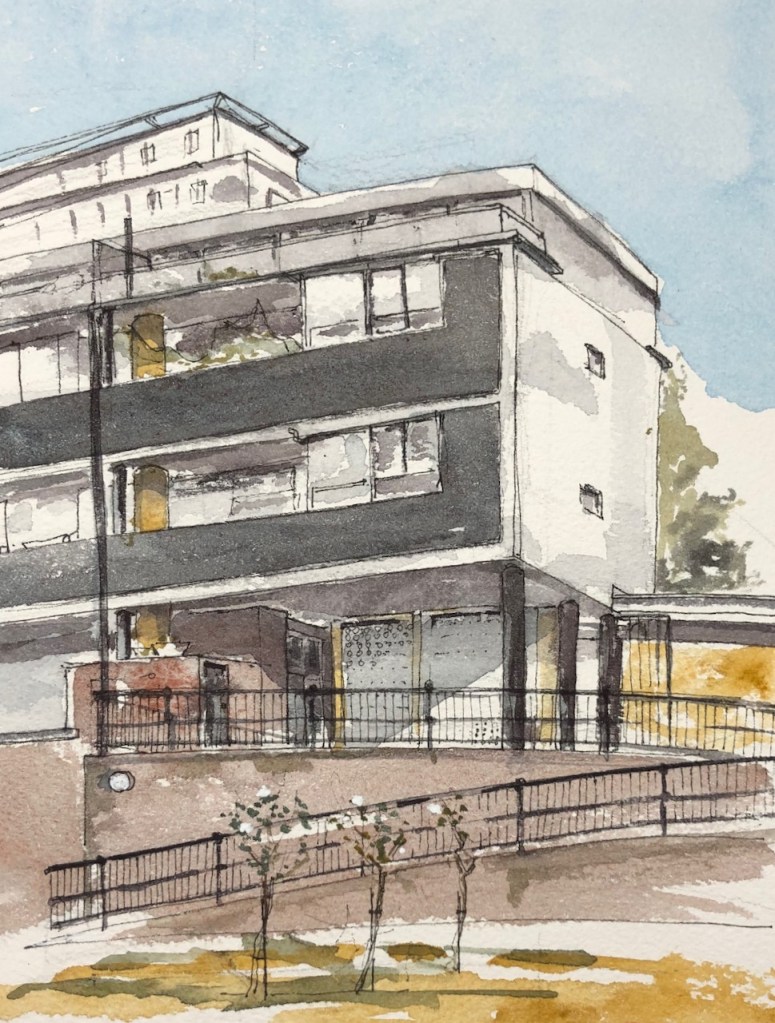
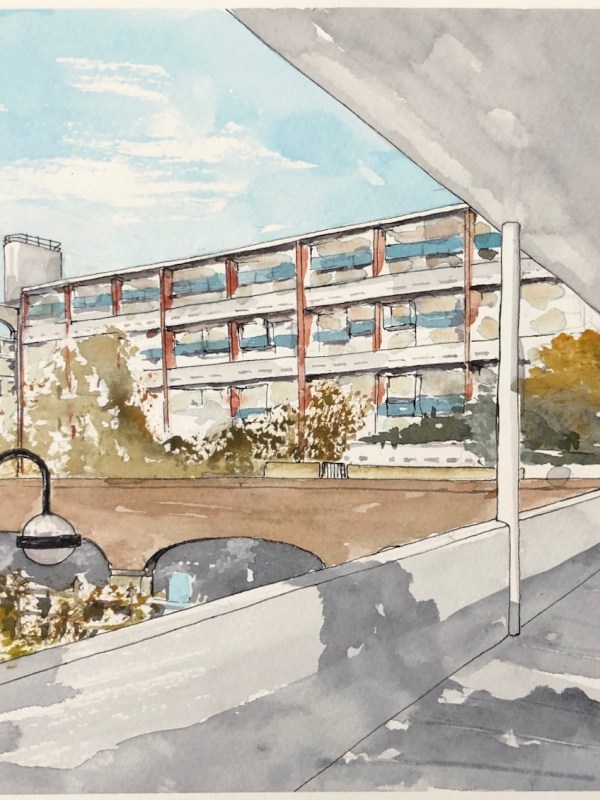
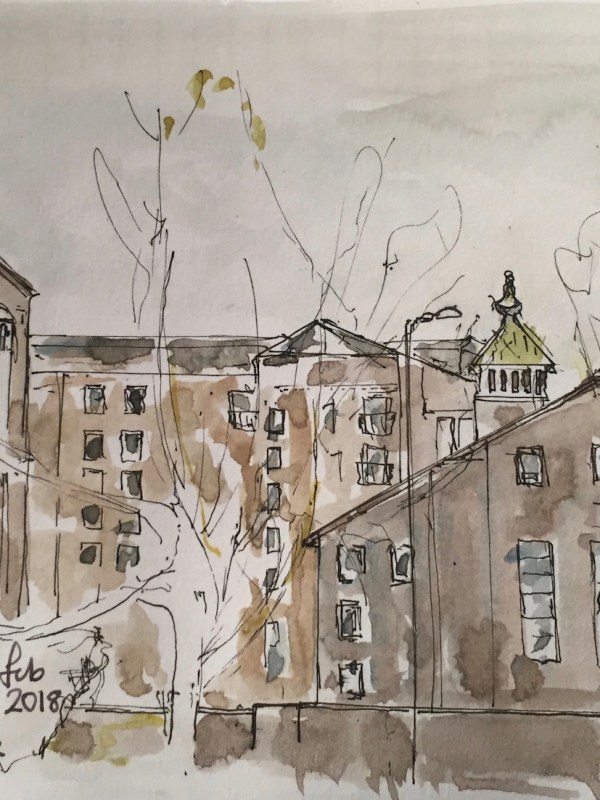
Stanley Cohen House, on the East side of the Golden Lane Estate. Peabody House in the background.
I enjoyed the bold statement of the vertical yellow rubbish chute, visible above the balconies.
There were many plants on people’s balconies. I didn’t draw them all. Many people had window boxes, with geraniums and trailing leaves. On the upper floor, a length of camouflage netting hung across the balcony. You can just see it towards the middle of the picture. Then there were the three rose bushes, sketched in the foreground. All the while, the fountain played. There were lilies in the pond.
Stanley Cohen was chairman of the City of London public health committee in 1954. His name appears on the almost-indecipherable Foundation stone on Bowater House, near where I did this drawing.
The almost-indecipherable Foundation Stone. The part that says “George Wimpey” however, has been carefully highlighted! Here’s what the stone says: The Corporation of London This Foundation Stone was laid by the Rt. Hon. The Lord Mayor of London Sir Noel Vansittart Bowater BT MC on the Twenty First Day of July 1954 Stanley Edward Cohen Esq Chairman of the Public Health Committee Thomas Cuthbert Harrowing Esq Late Chairman Architects Chamberlain Powell and Bon Substructure Contractors Griggs & Son Ltd Superstructure Contractors George Wimpey & Co Ltd
Here is work in progress and a map.
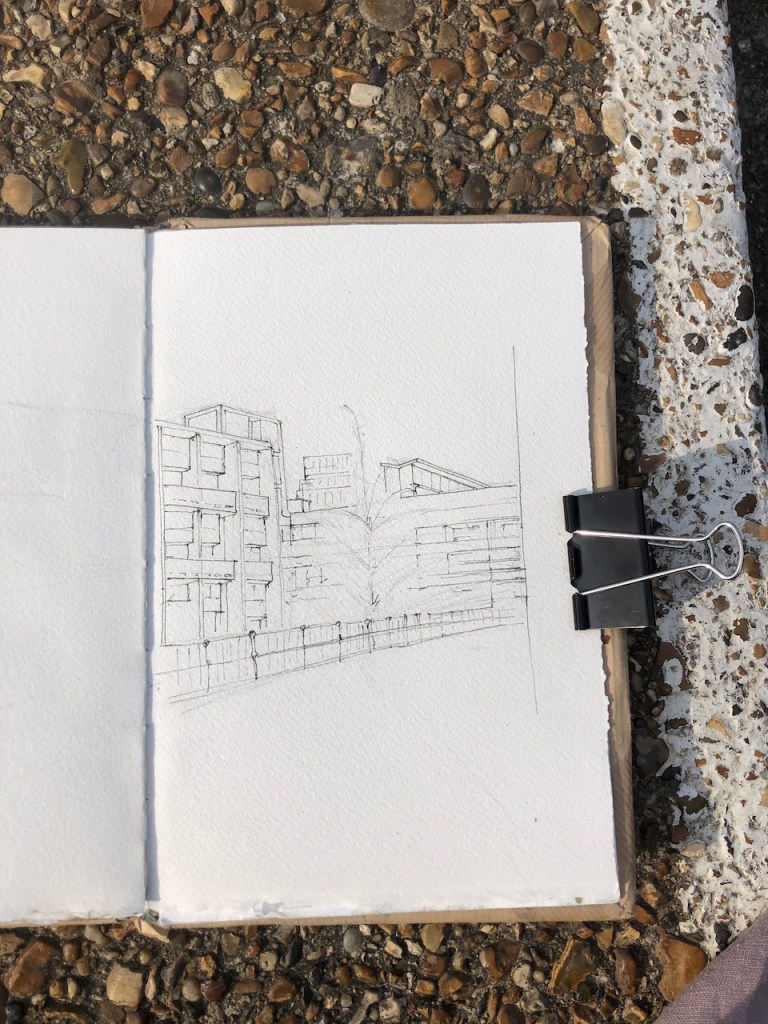
This drawing is 25cm by 16cm, 10 inches by 6½ inches on Arches 300gsm watercolour paper. It took 1½ hours. After a preliminary sketch, shown in the gallery above, I started work on this drawing at 14:30 and finished at 16:00. The colours are Fired Red Ochre, Mars Yellow, Perylene Maroon, and Phthalo Turquoise, over De Atramentis document black ink.
Here is a collection of my drawings of the Golden Lane Estate:
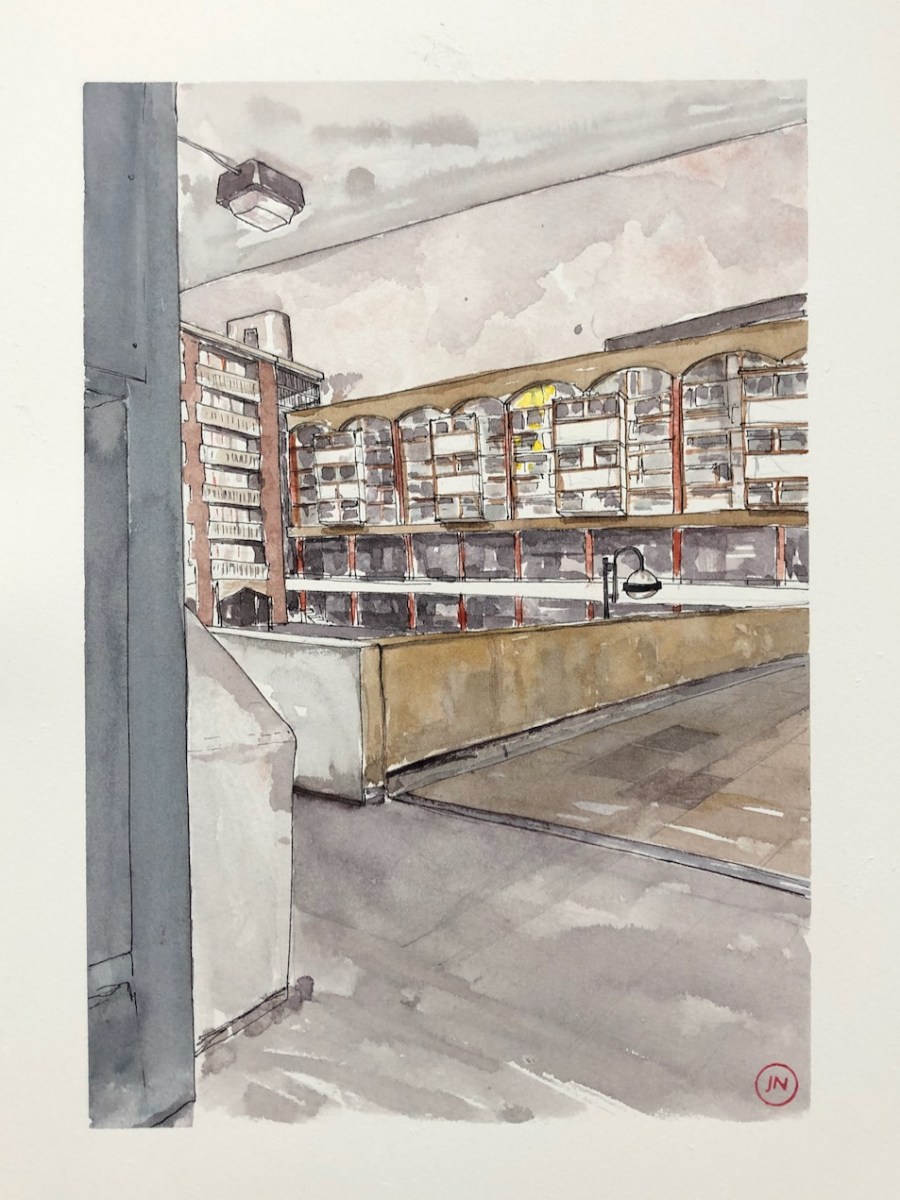
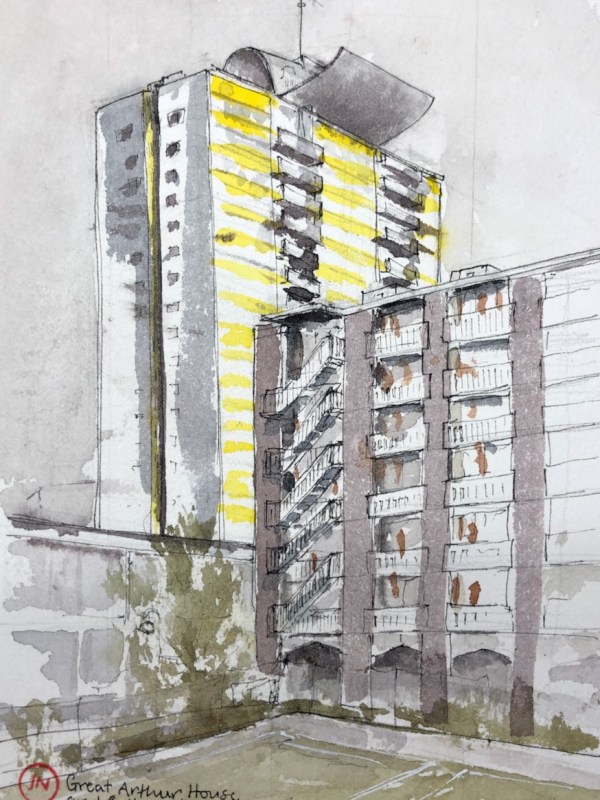
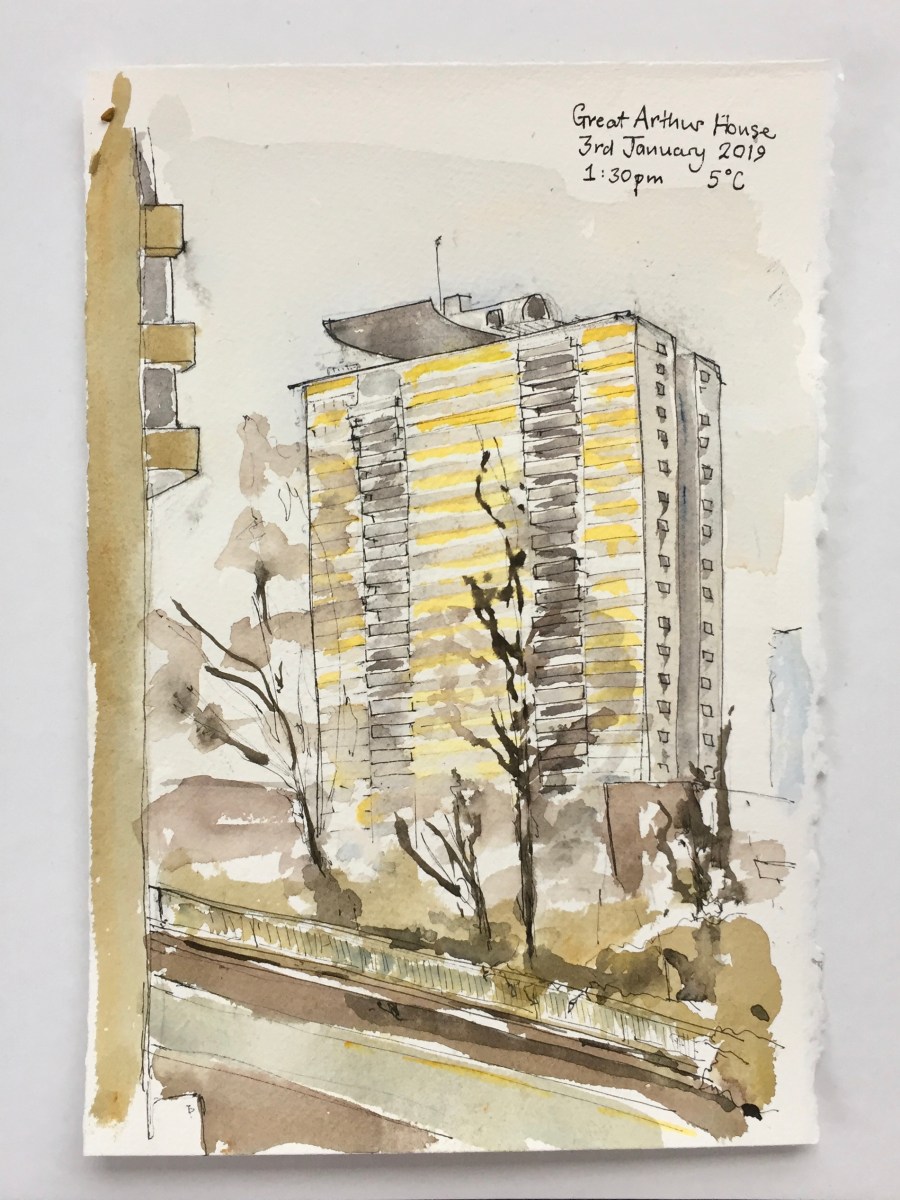
Yesterday I drew Basterfield House, sitting on some steps in the shadow of Great Arthur House.
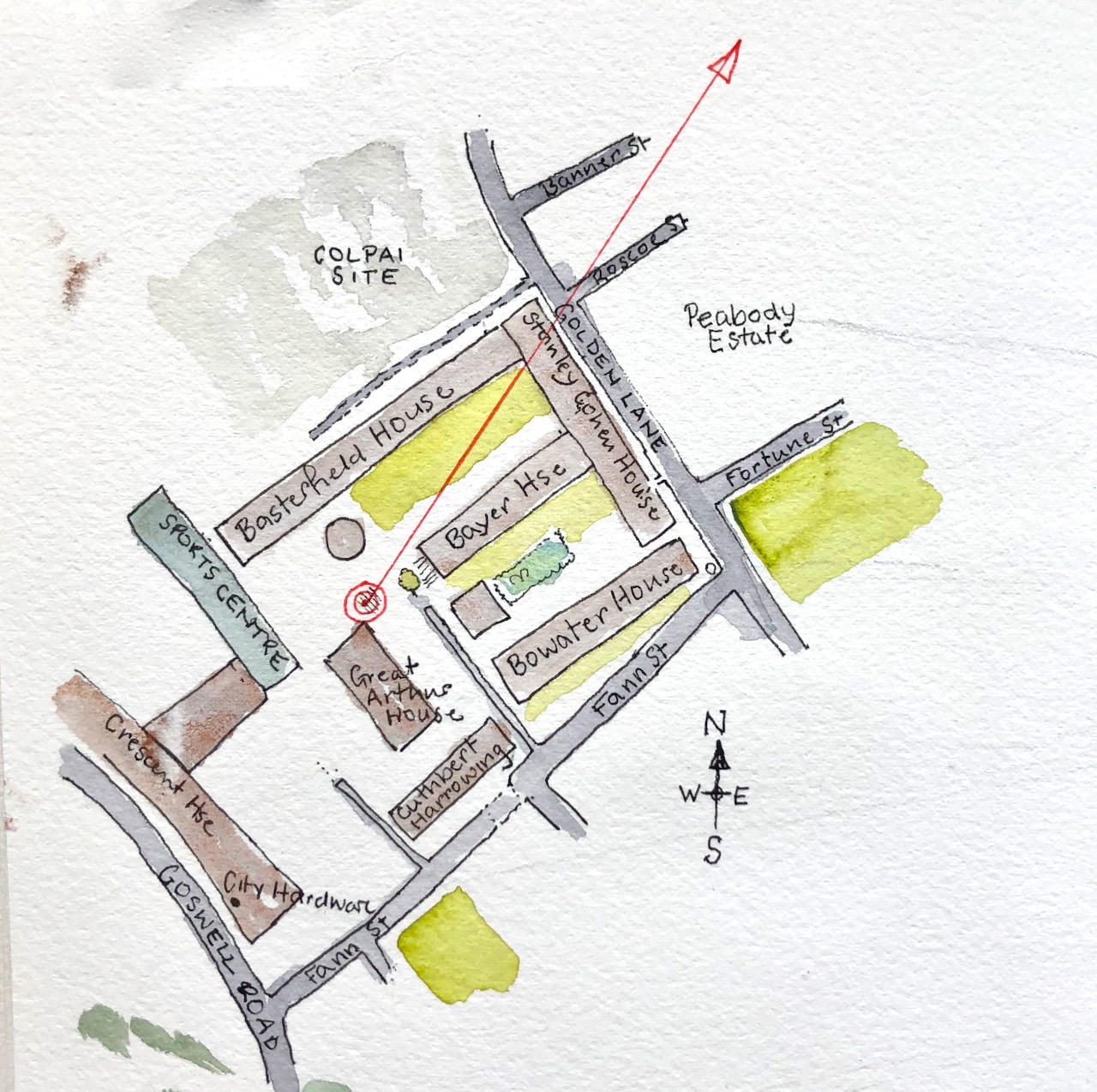
Basterfield House is at the North of the Golden Lane Estate. Here is a map. Great Arthur House was over my right shoulder, and cast its huge shadow in the afternoon sun.
Sketch map showing the view shown in the drawing.
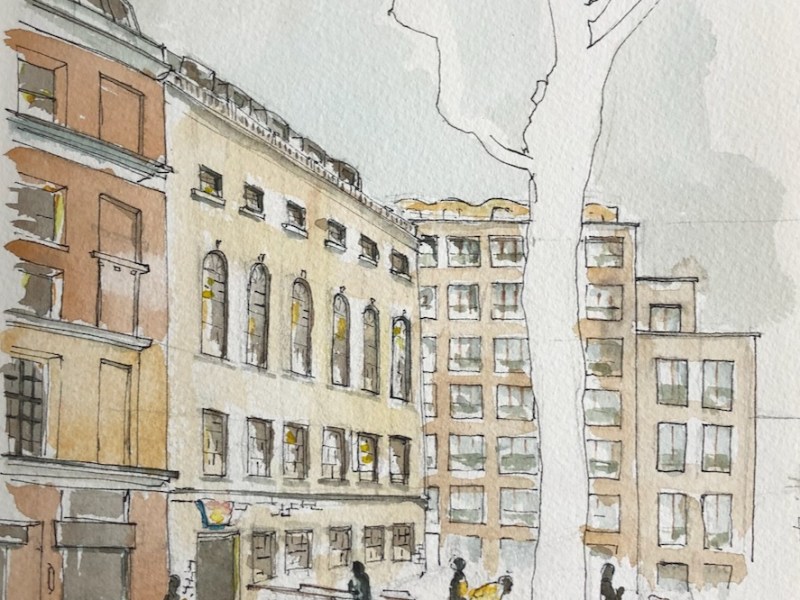
Behind the tree, the low-rise block is Stanley Cohen House. In the background of the drawing is the Atlas Building, just to the left of the tree. On the right of the tree is the architect’s practice at 88 Golden Lane.
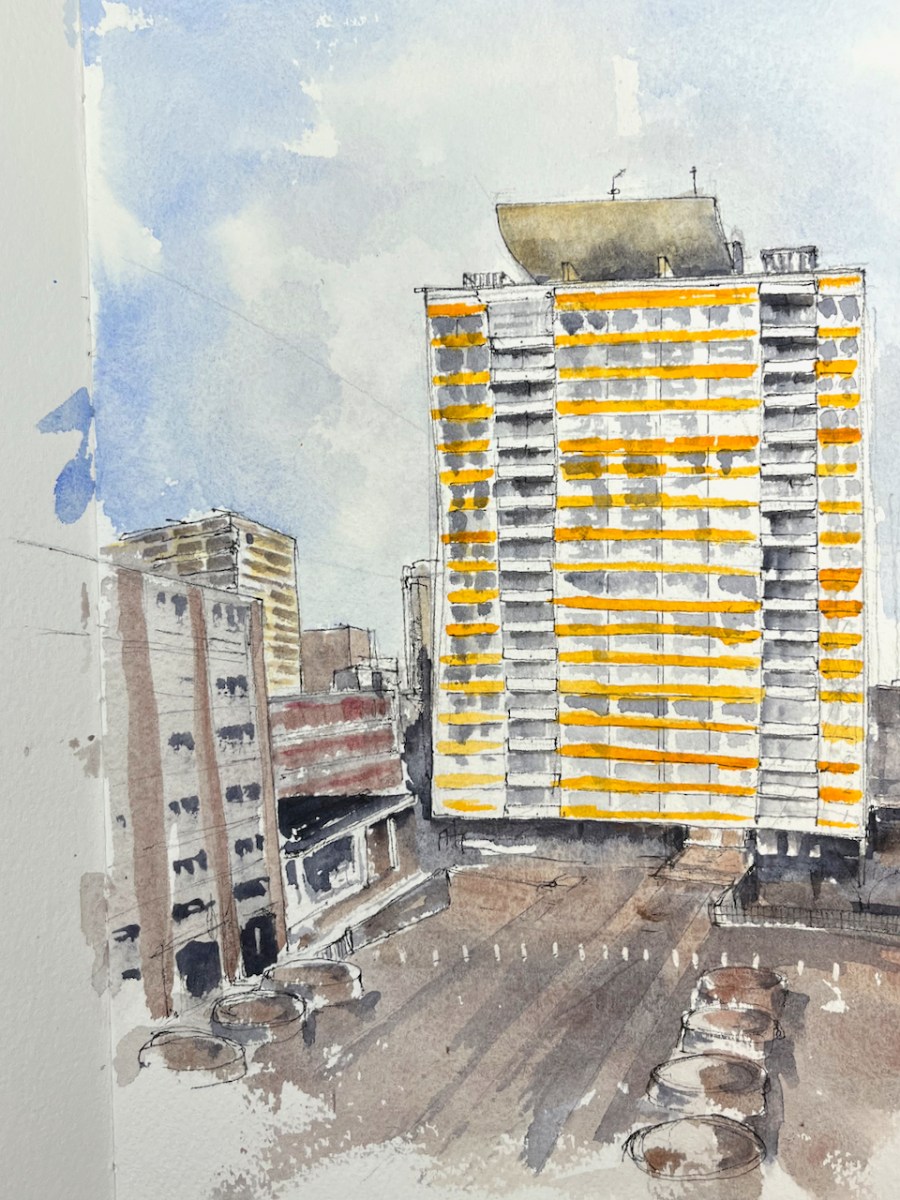
On the right is Godfrey House, Bath Street, Islington, part of the St Luke’s Estate managed by the London Borough of Islington. It’s former “council housing” built in 1965. Today many of the flats are privately owned, as is evident from the number listed for sale. On the left is the Atlas Building, on City…
Today was a glorious sunny day. I walked out into the sun and everywhere was worthy of a sketch. Here is 88 Golden Lane, a strange thin building. It is an architects’ practice: Blair Architecture. I sketched this standing on the side of the road in the sun, then retreated to sit on my case…
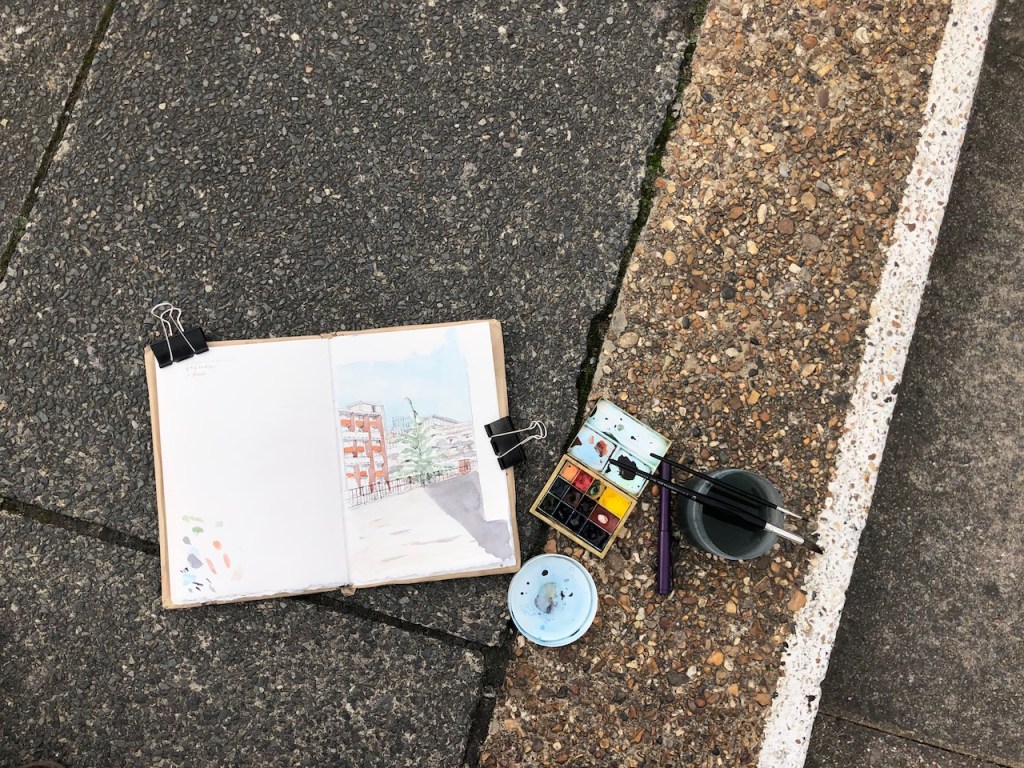
This drawing is 25cm by 16cm, 10 inches by 6½ inches on Arches 300gsm watercolour paper. It took 1½ hours. I did a preliminary sketch first, shown in the work-in-progress photos below. The colours are Fired Gold Ochre, Phthalo Turquoise, Transparent Pyrrol Orange, and Mars Yellow, watercolours over De Atramentis document black ink.
Preliminary Sketch with Winsor and Newton watercolour sticks.
Preliminary sketch, and work in Progress.
I have drawn the Golden Lane Estate before. Here is a selection of drawings in this area:
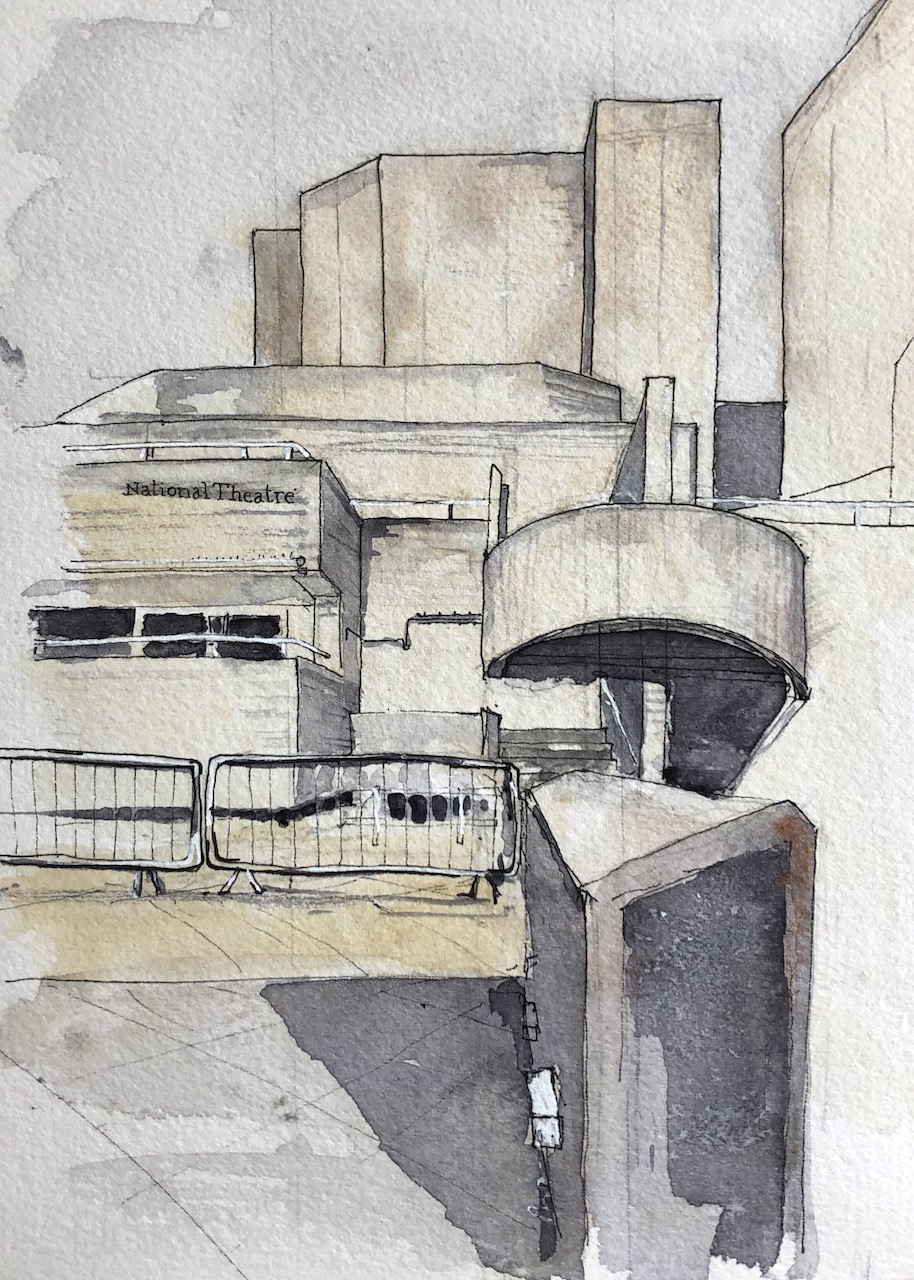
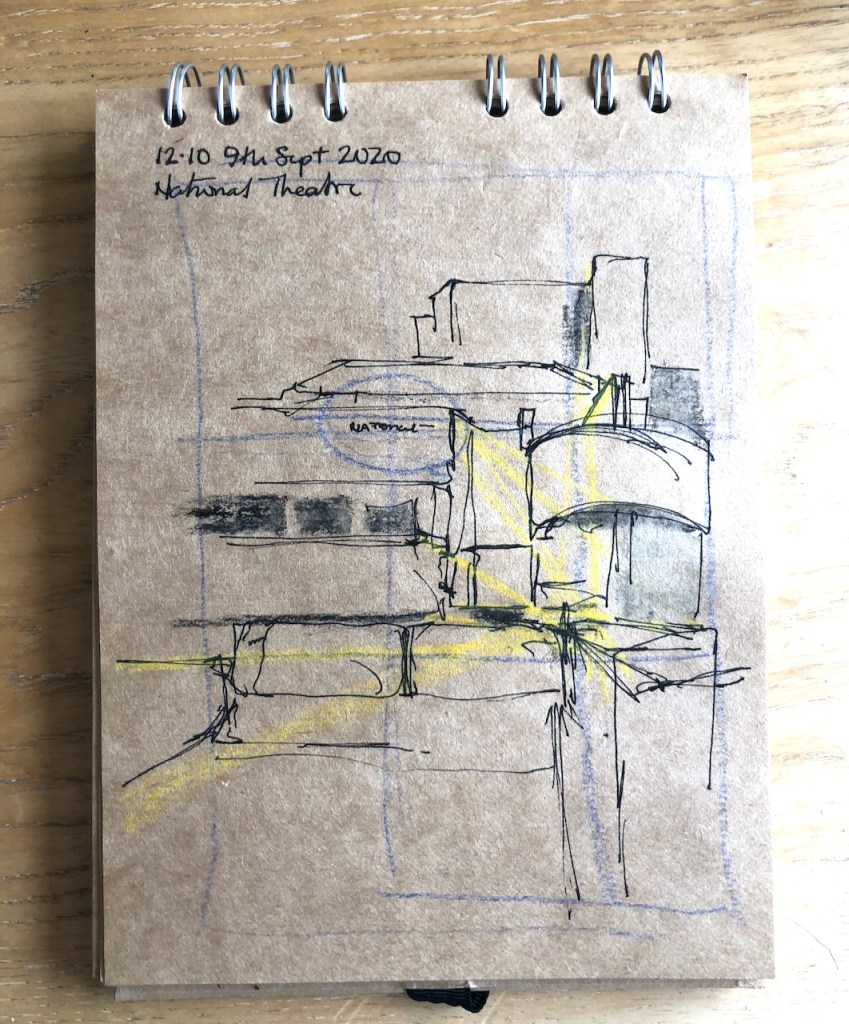
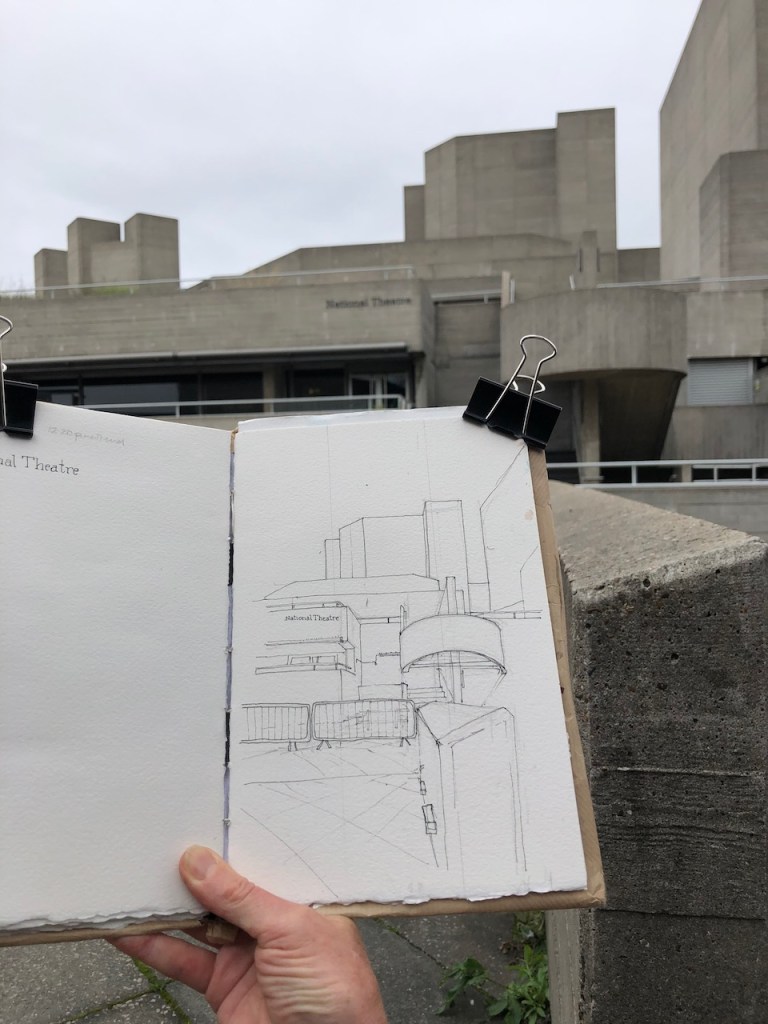
The National Theatre is on the South Bank of the Thames. Here is a view, looking East from Waterloo Bridge.
National Theatre, 9th September 2020, 3:20pm
As you see, there are gates across the walkway. The Theatre is closed, and the walkways are closed.
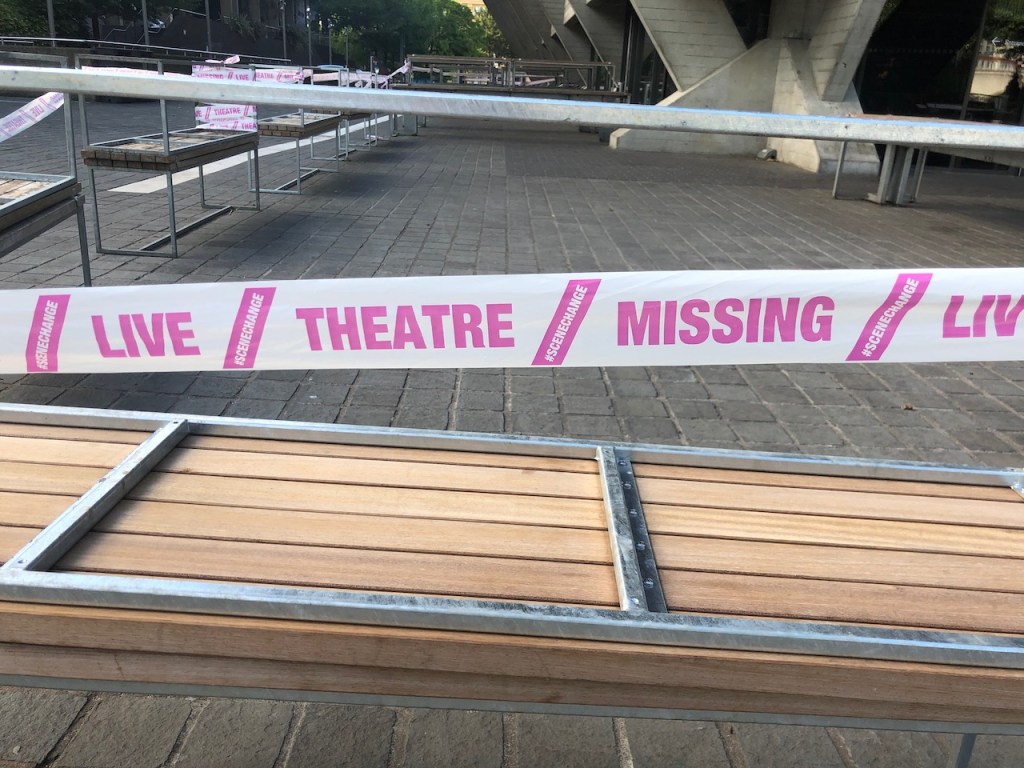
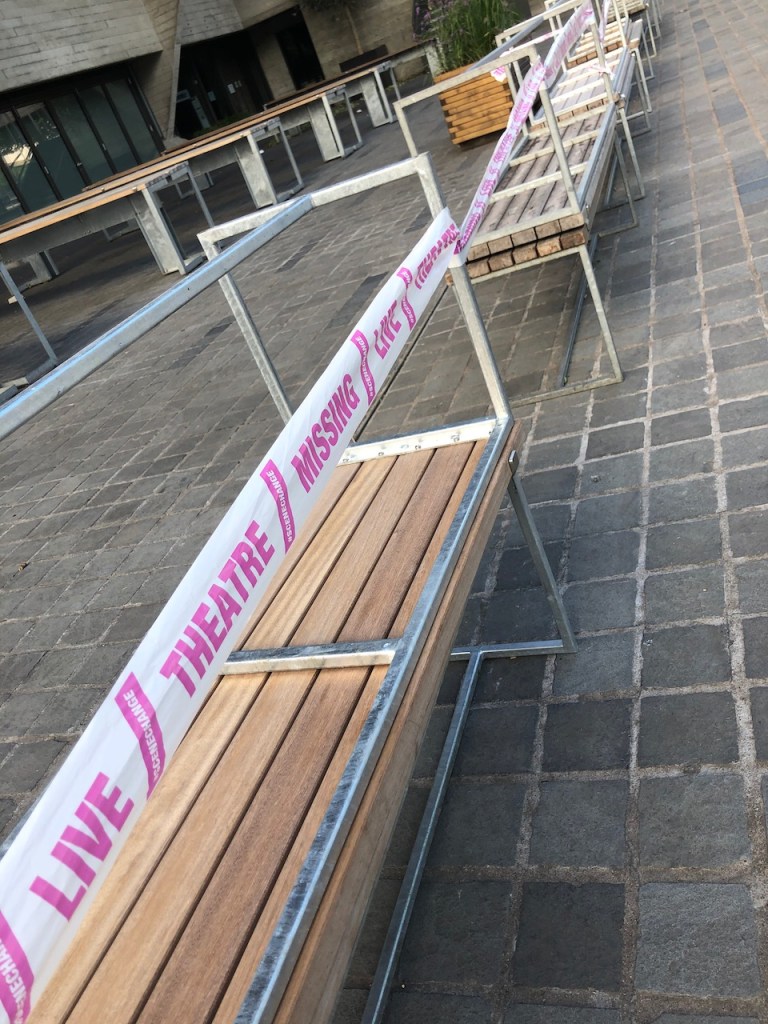
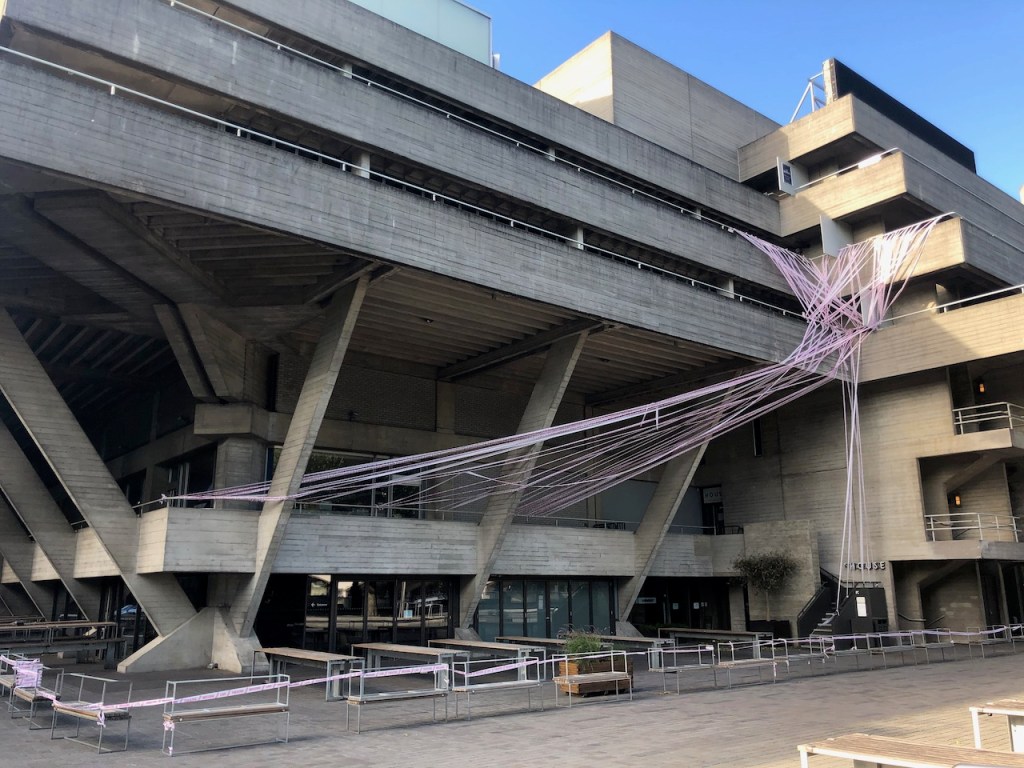
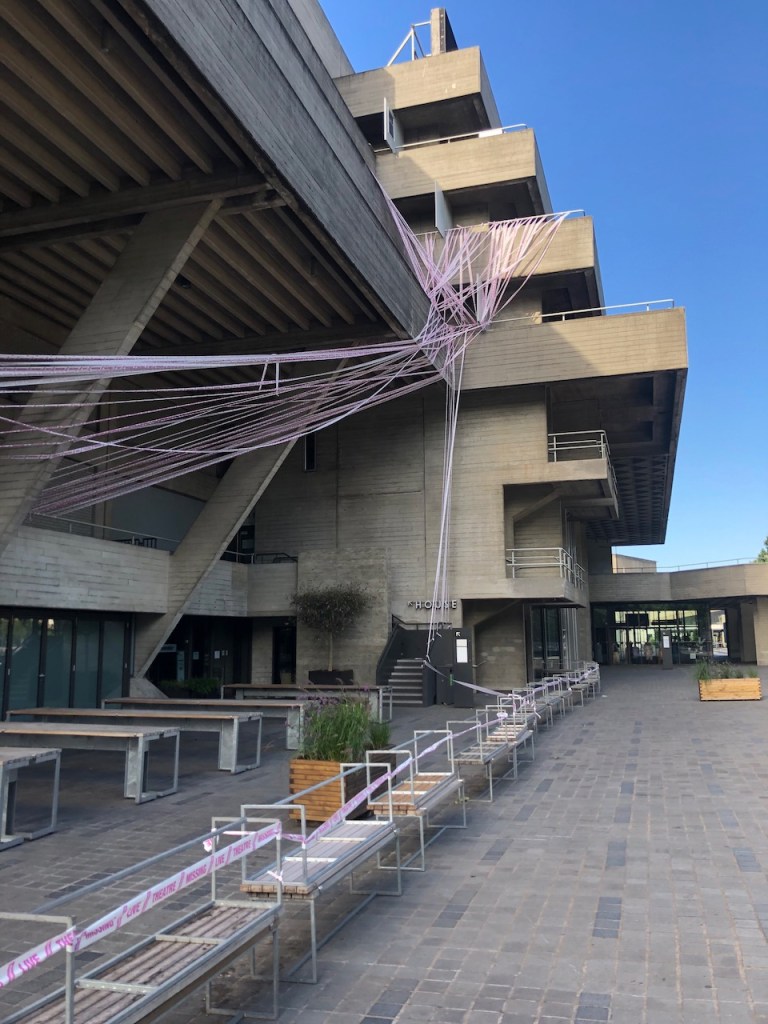
“Missing Live Theatre” – tape across the National Theatre 7th July 2020. This tape appeared across other theatres in London too. It was a protest that live theatre venues were not receiving government support to cope with their shut down in the COVID pandemic.
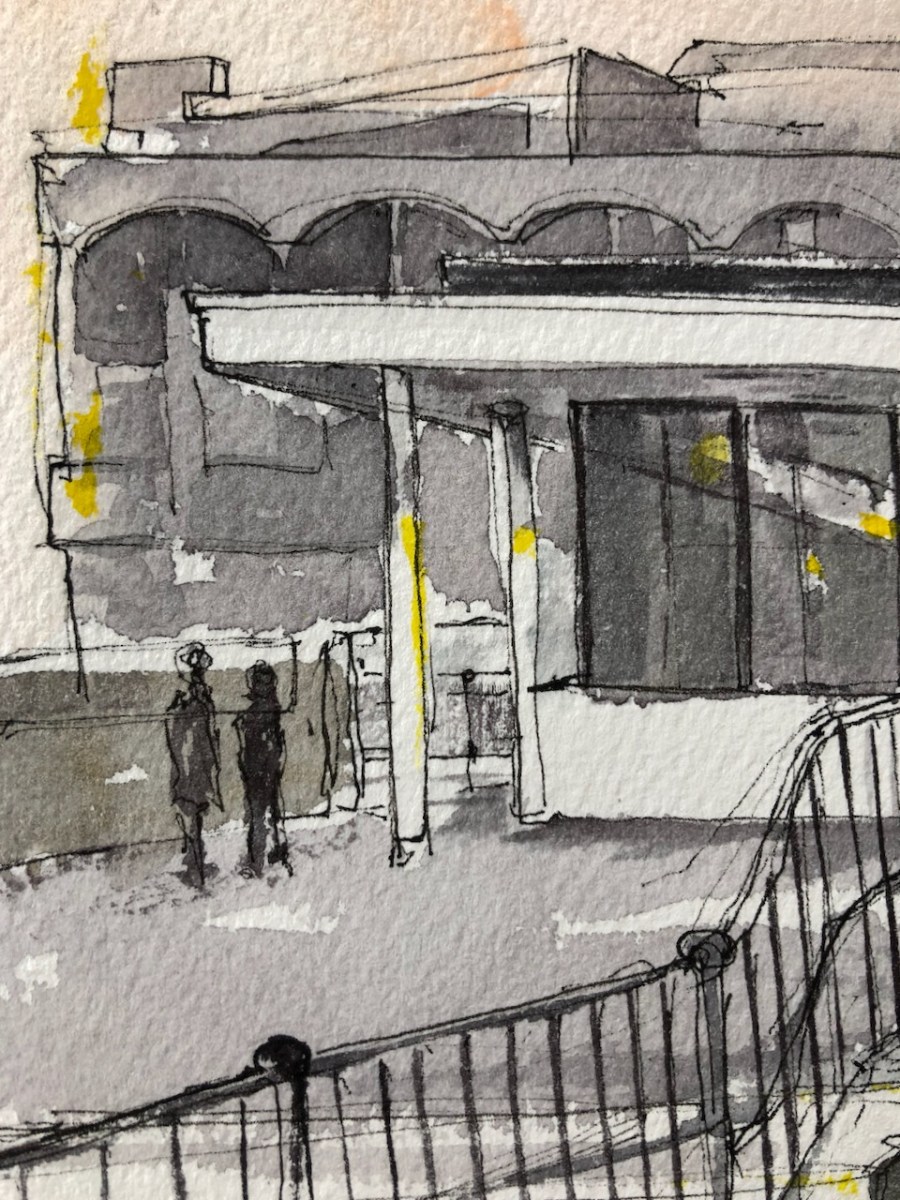
My drawing shows the empty theatre, and the empty walkways. The theatre restaurant, which is on the left of the drawing, is also closed and empty.
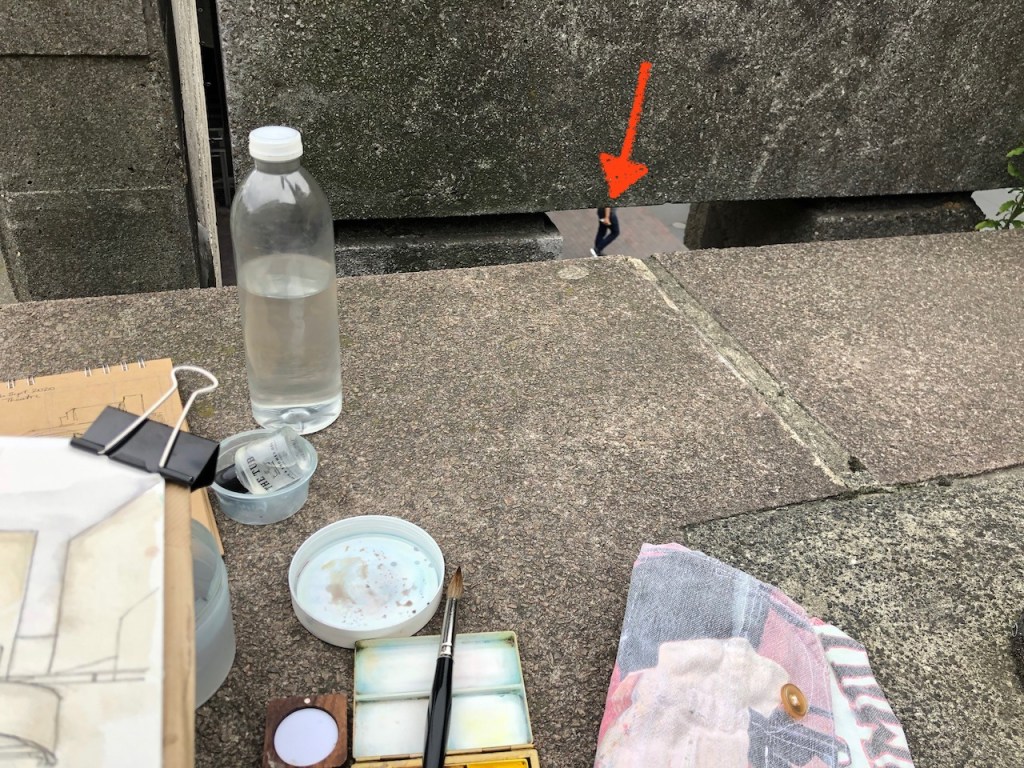
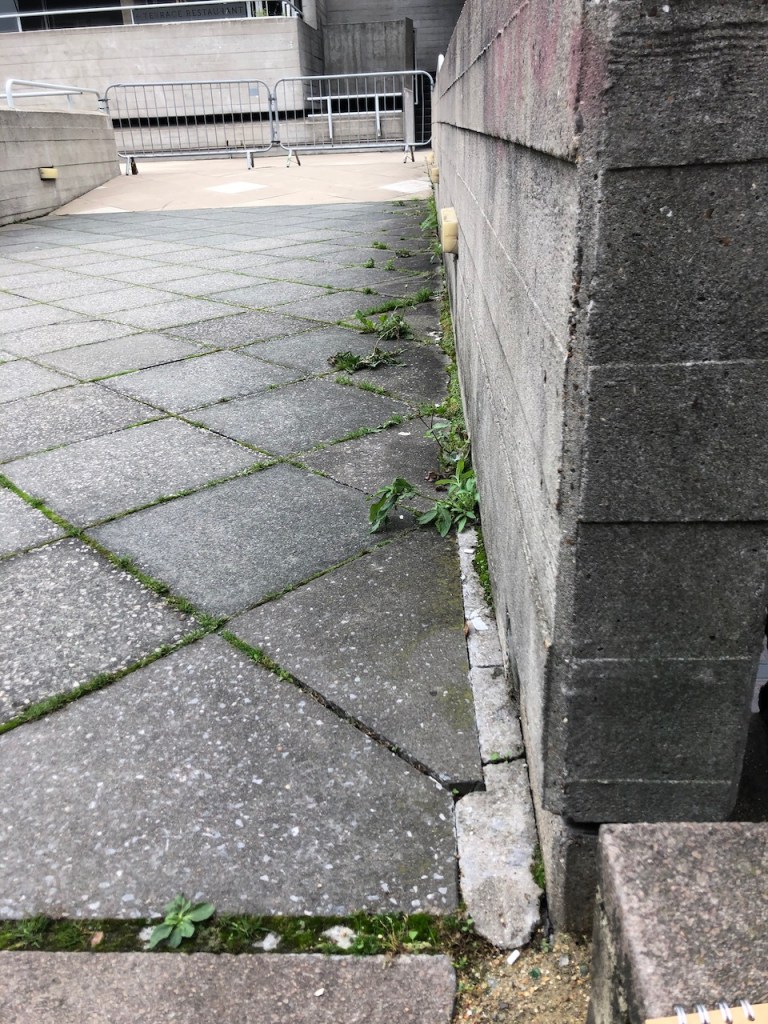
The walkways, in true 1960s style, are at “podium” level, above the traffic. Below me as a drew, people walked and cycled, and traffic passed on the nearby road, Upper Ground. Grass and buddleia grow in the cracks. Life continues, but at a different level.
Life in the cracks.
This drawing is 25cm by 16cm, 10 inches by 6½ inches on Arches 300gsm watercolour paper. It took 1½ hours. I did a preliminary sketch first, shown in the work-in-progress photos below. The colours are Buff Titanium, Neutral Tint, and Lunar Earth, all Daniel Smith watercolours, over De Atramentis document black ink.
Preliminary sketch. Yellow lines show the perspective lines.
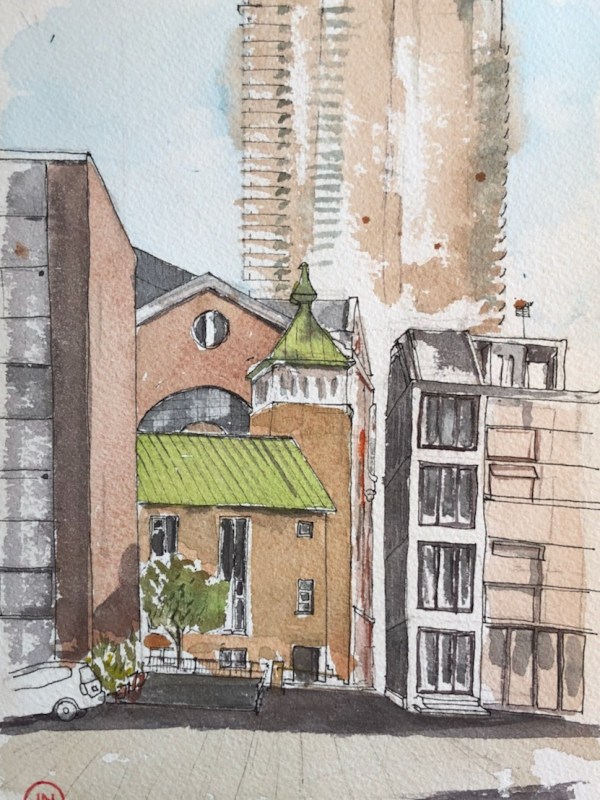
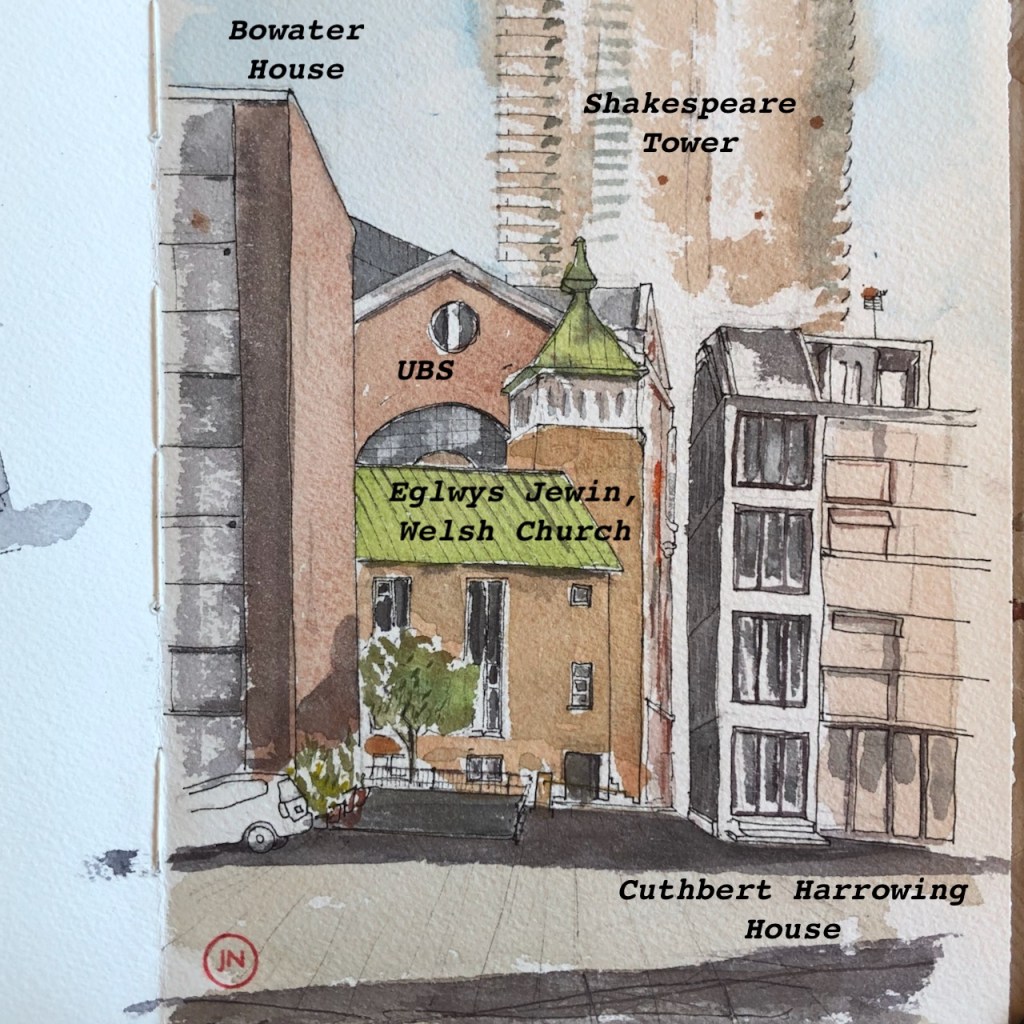
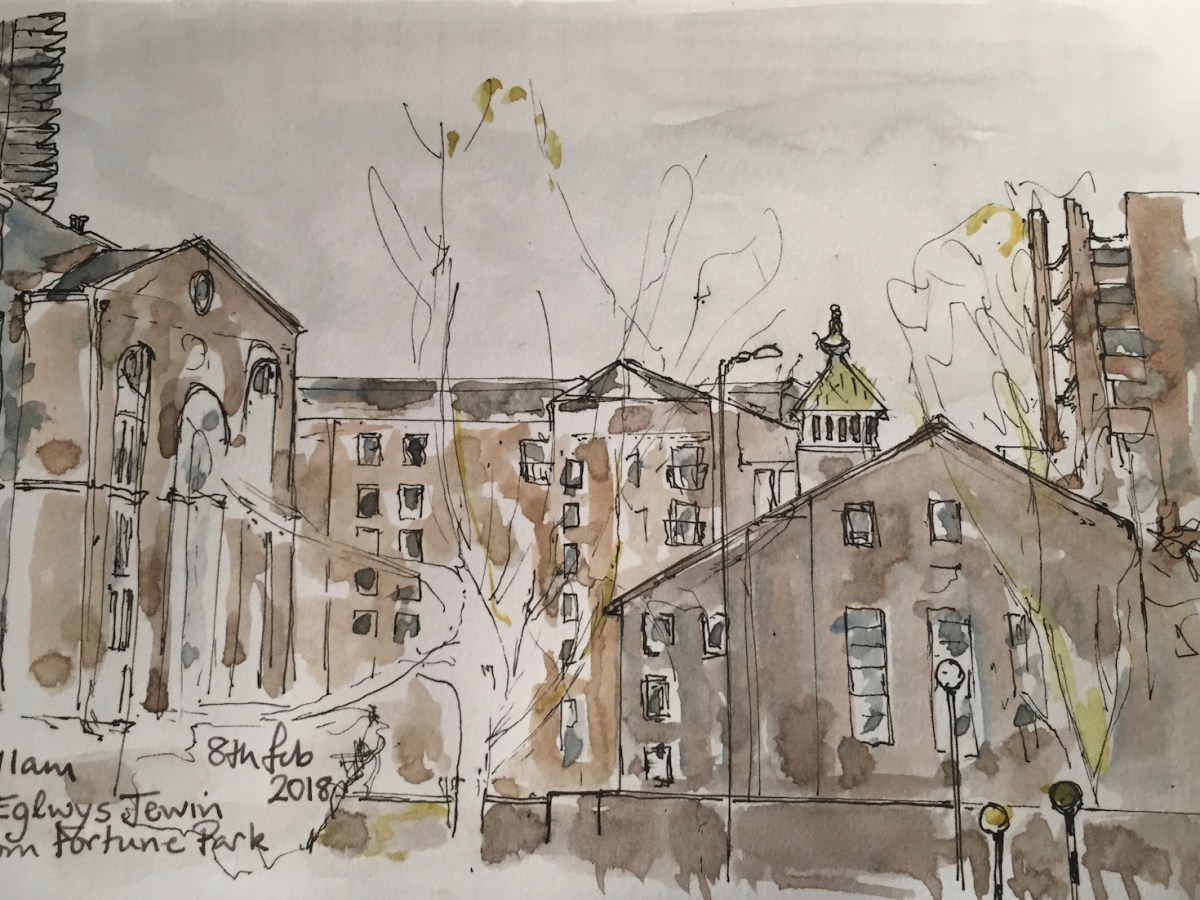
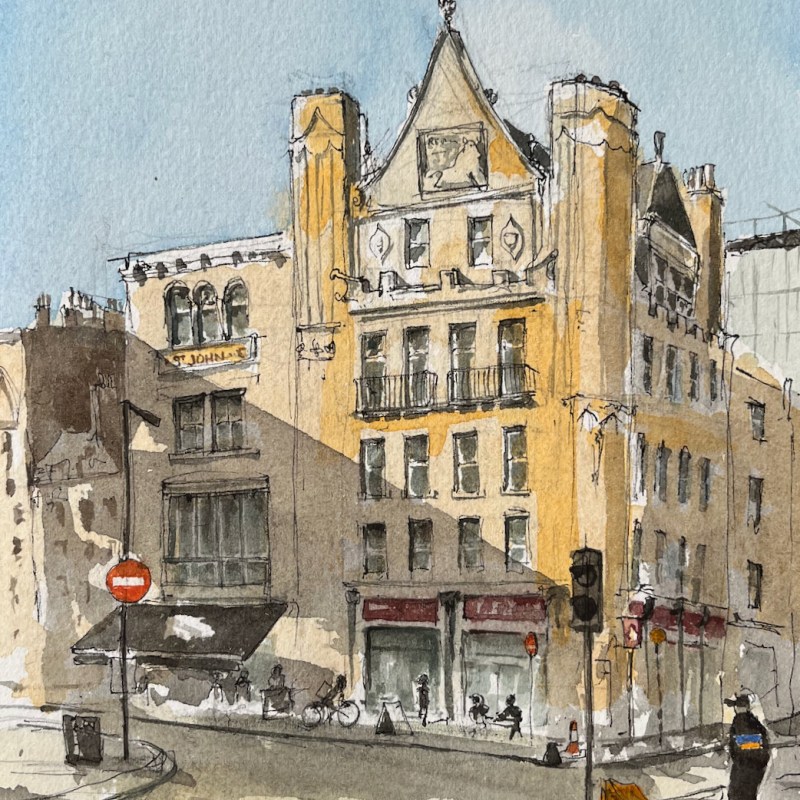
On a glorious sunny Sunday, the sun lit up the roof of the Welsh Church.
Eglwys Jewin, the Welsh Church, from Golden Lane Estate.
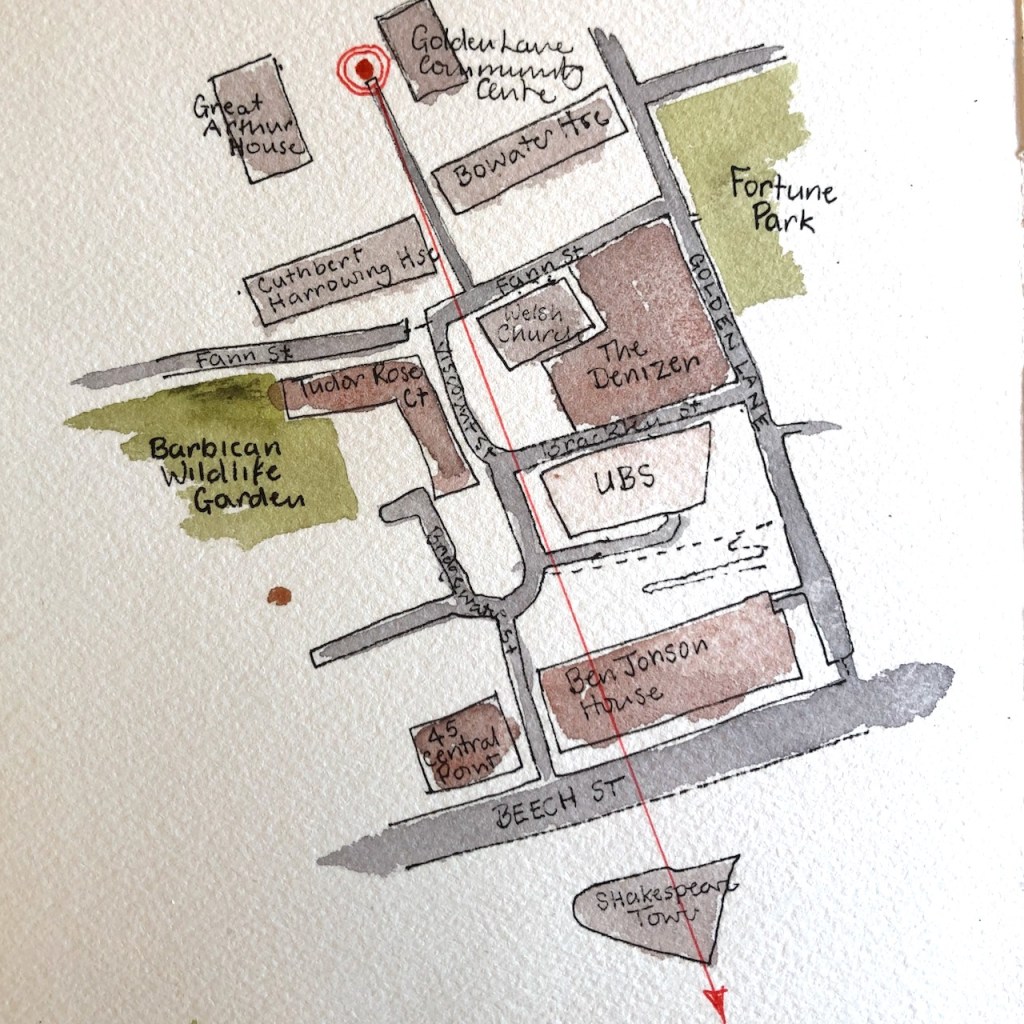
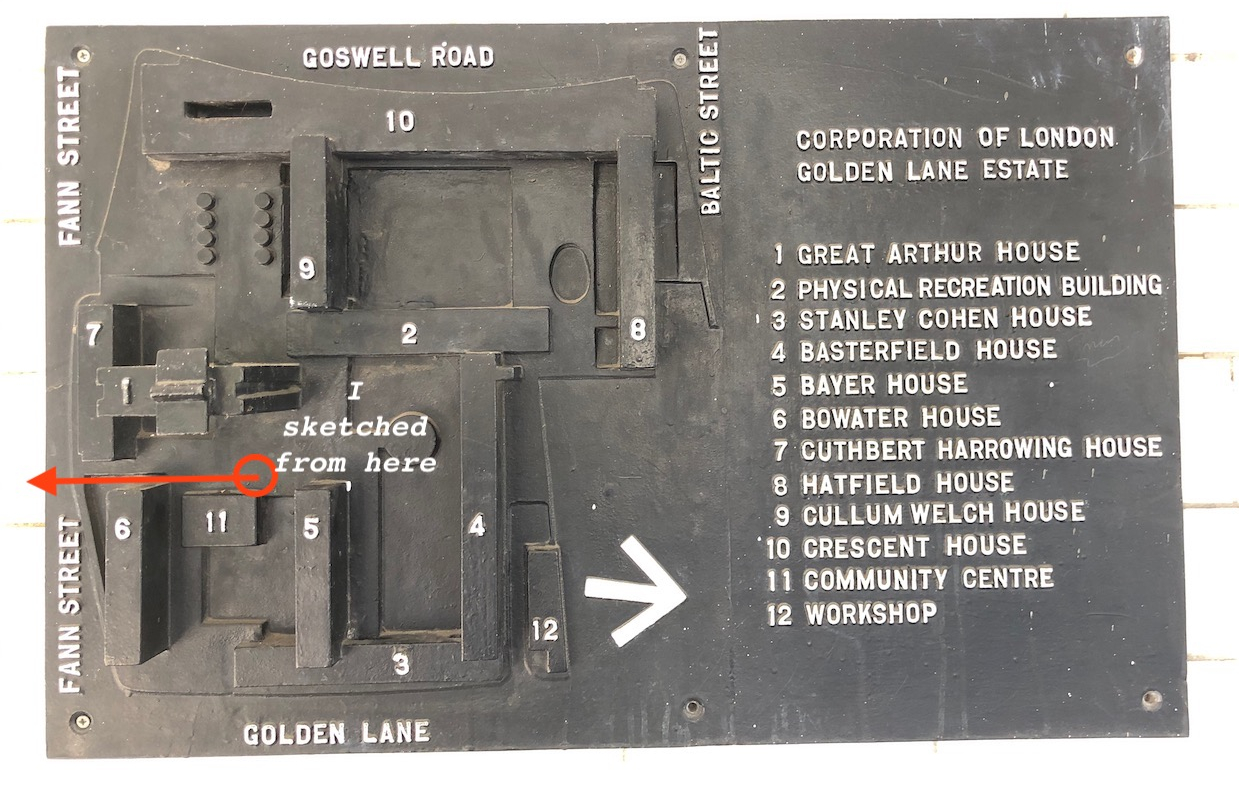
This is the view from the Golden Lane Estate. Here is a map, and an annotated image to show which building is which. The arrow on the map shows the direction I was looking.
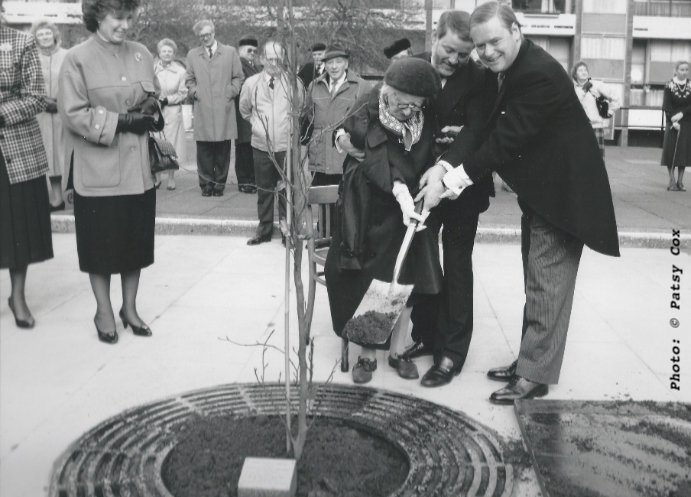
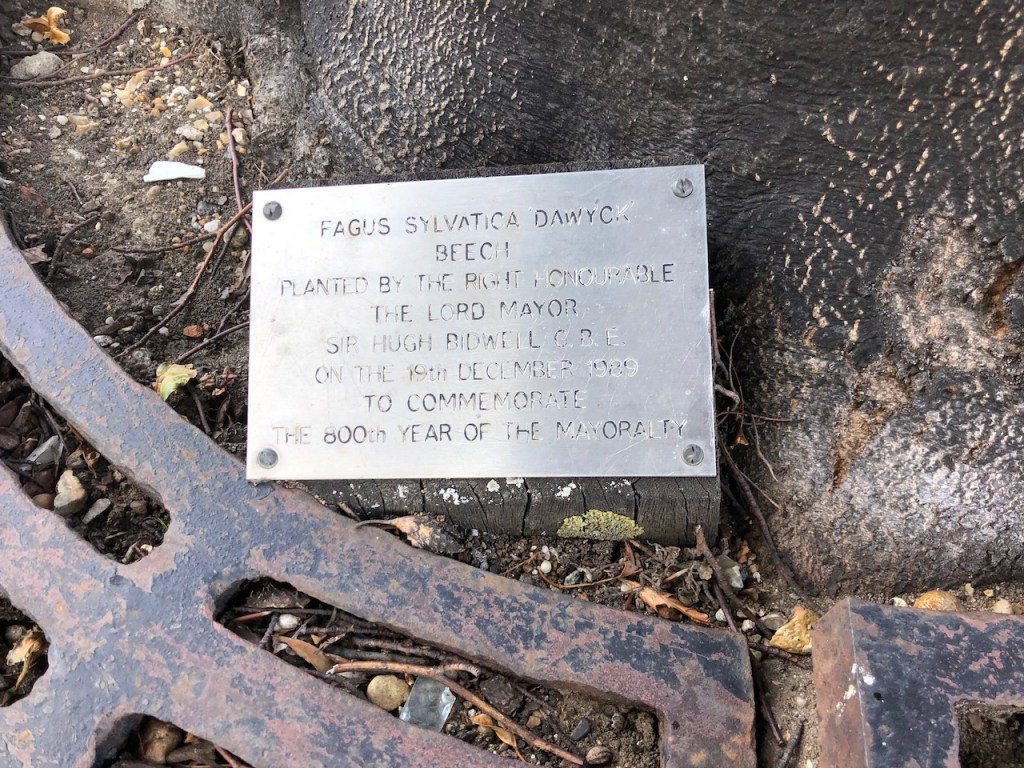
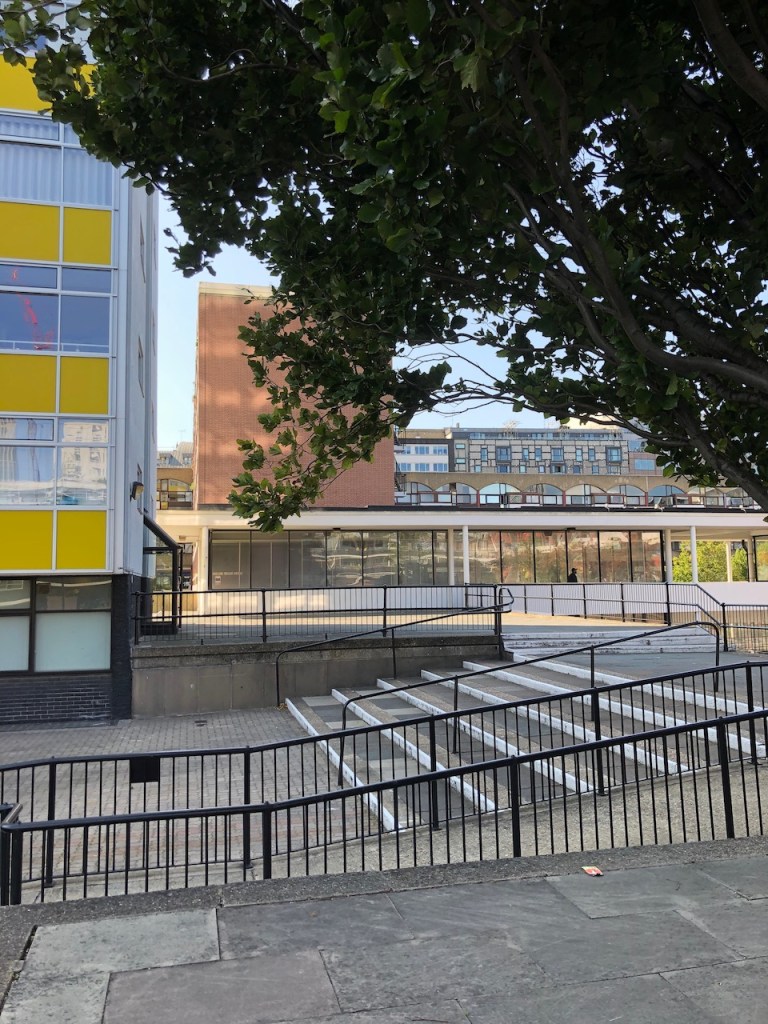
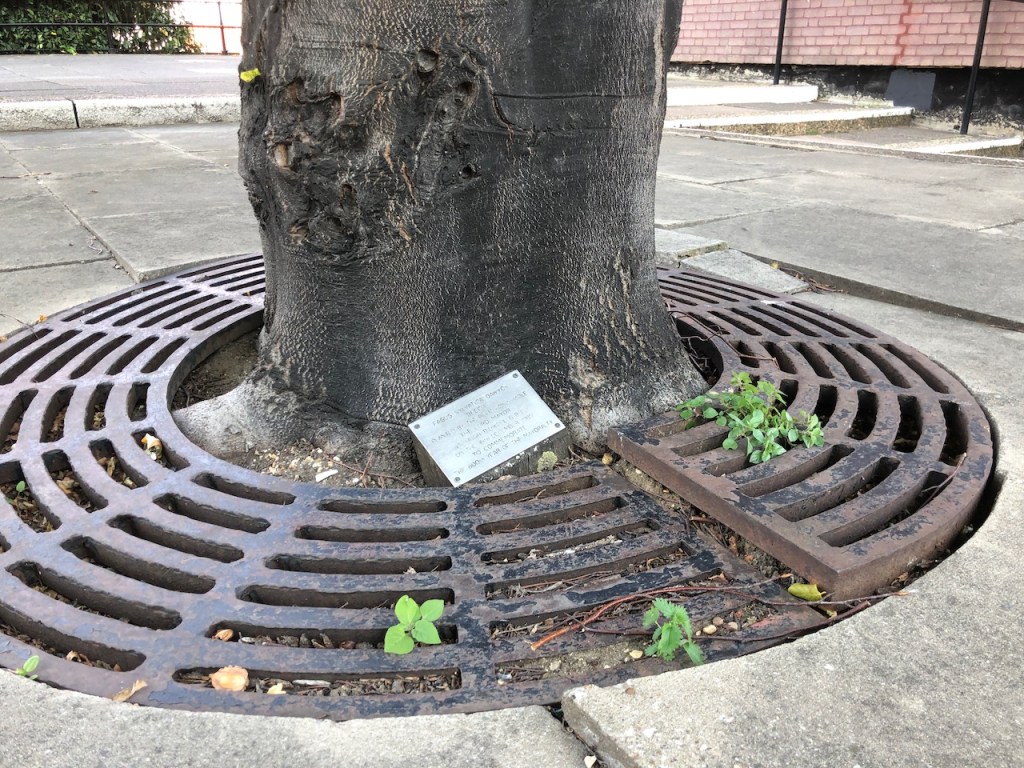
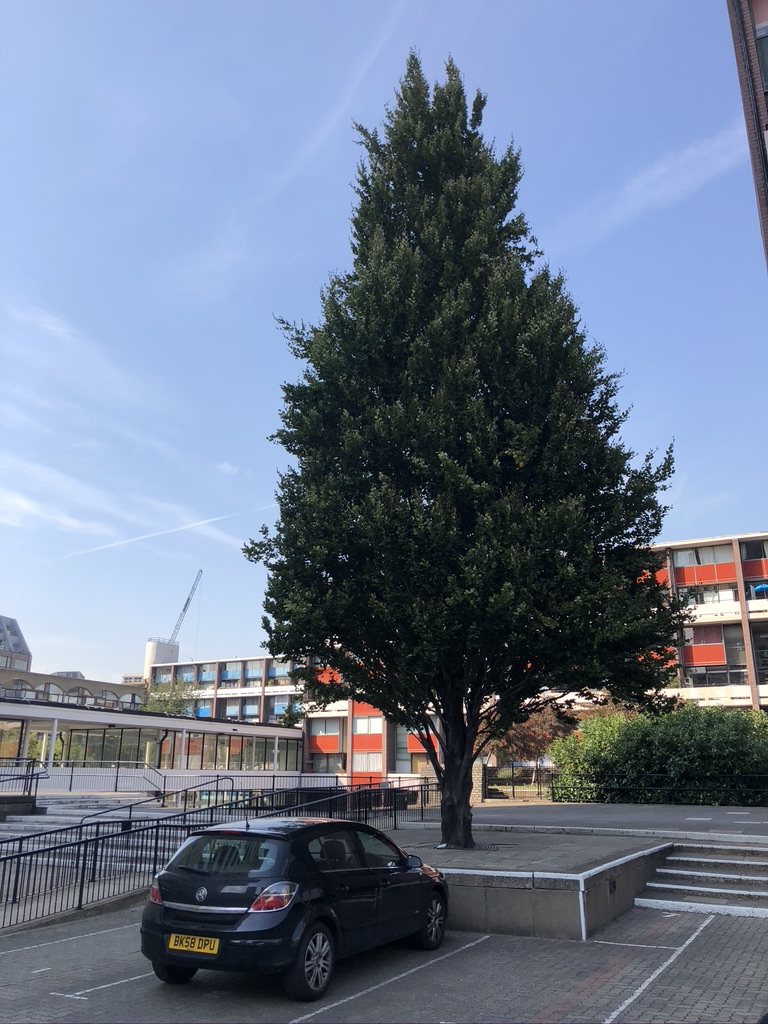
I was sitting next to a beech tree, Fagus Sylvatica Dawyck. A small notice at the base of the tree informed me that it has been planted on the 9th December 1989, to commemorate 800 years of the Lord Mayoralty. By co-incidence, this is the same anniversary that was commemorated by the bollard in my previous post. Here is a picture of the planting ceremony, kindly provided by Billy Mann from his Golden Lane Archive.
Fagus Sylvatica Dawyck, Beech Tree on the Golden Lane Estate, being planted. Photo courtesy of Patsy Cox and used with permission. The photographer was standing almost exactly where I sat to draw my picture.
The tree has grown strongly in the last 30 years. It surges out of its metal hoops, and pushes the notice aside.
Fagus Sylvatica Dawyk, planted in 1989
The Golden Lane Estate is a busy place. Many people passed by on the nearby paths. The tree and I were on a raised area, above parked cars. Some people were on foot, one was in a wheelchair, and there were several groups of cyclists. One person had a dog. This was a small dog, the same size as my sketchbook. I can say that with certainty, because, while the person was occupied on their mobile phone, the dog dashed onto my dais and plonked itself foursquare on my sketchbook. What to do?
I must have shouted out, because the person looked up briefly from their phone. I glared at the person, and shooed the dog away. The person uttered a perfunctory ‘sorry’ and continued their conversation. “No, no, it’s alright,” they said into the phone, “it’s just that Tabatha…”. They didn’t ask me if it was alright. I looked down at my drawing. It was alright.
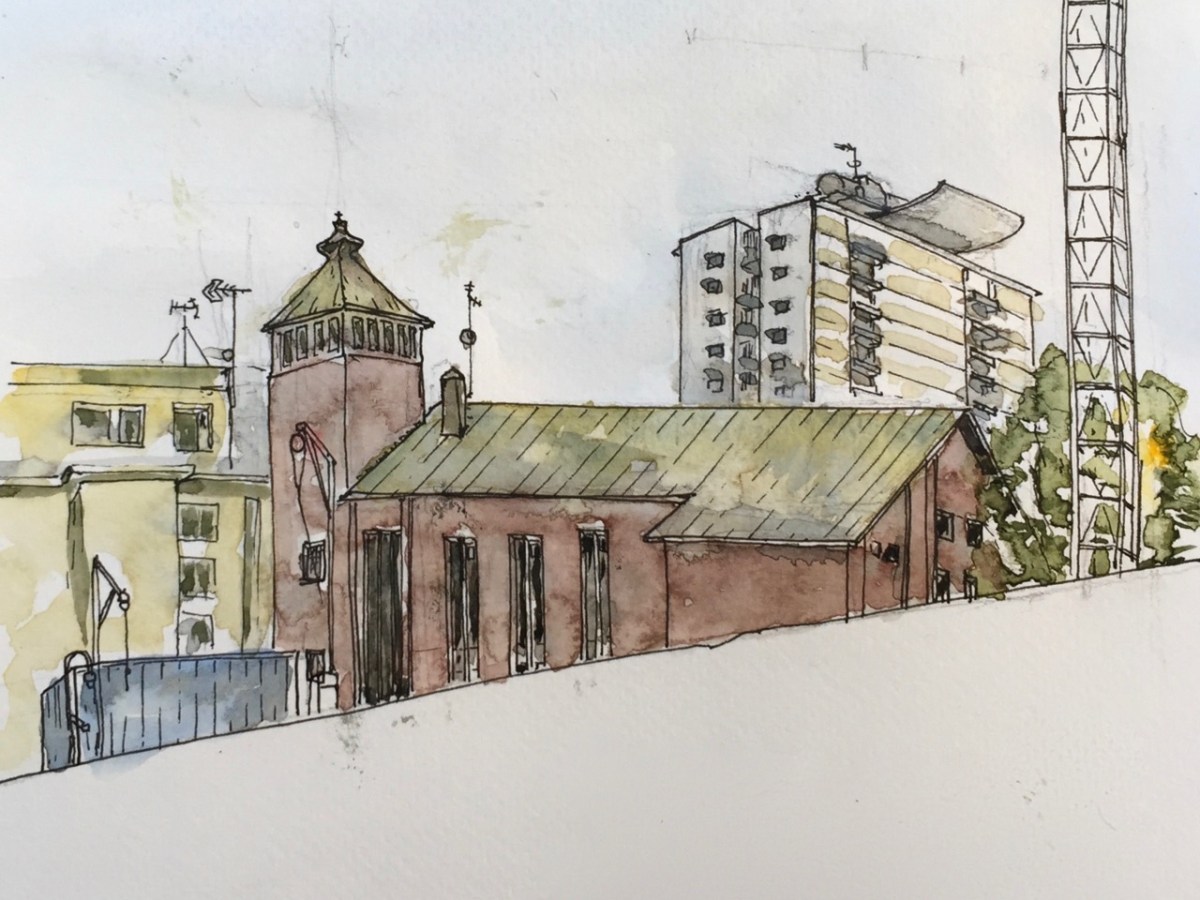
I have drawn this church before. It was built in the 1960s. More information about this interesting building is on my previous posts:
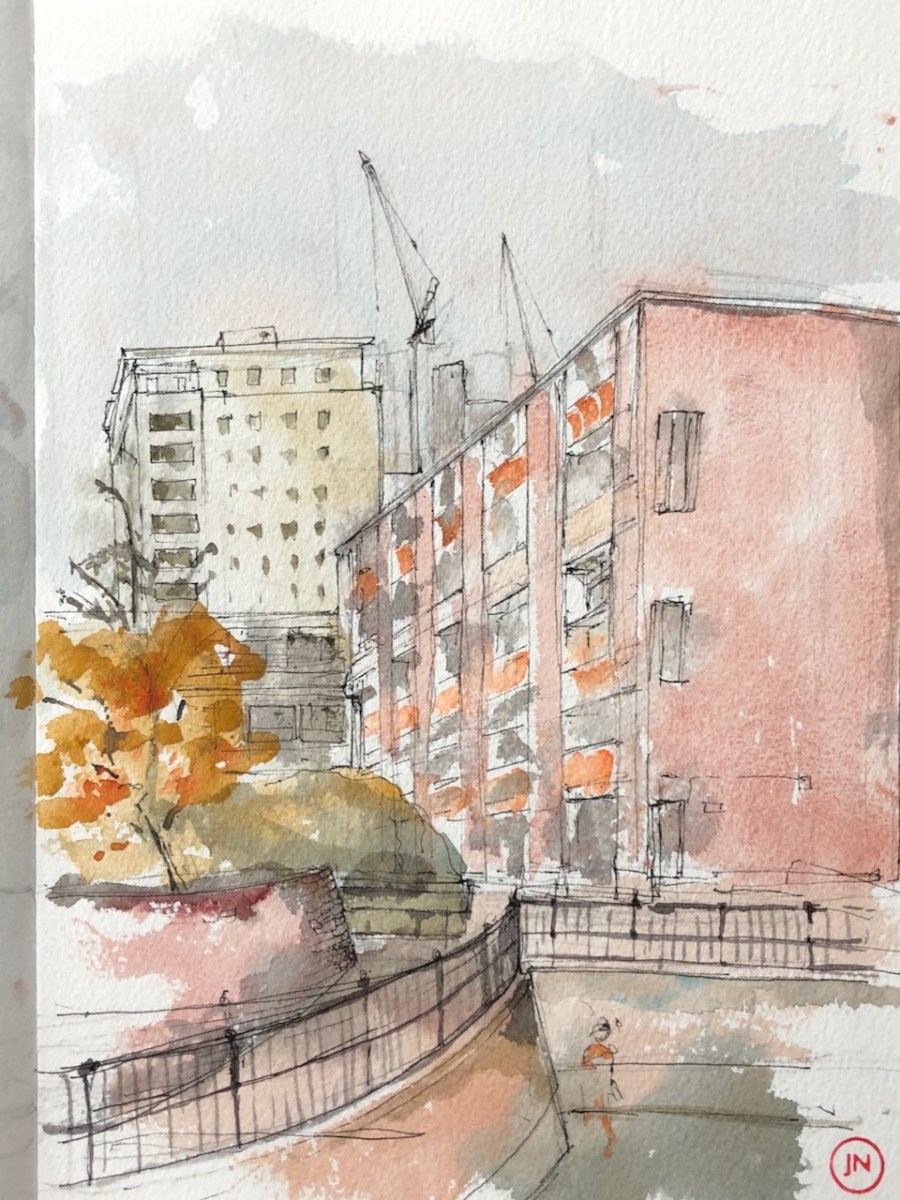
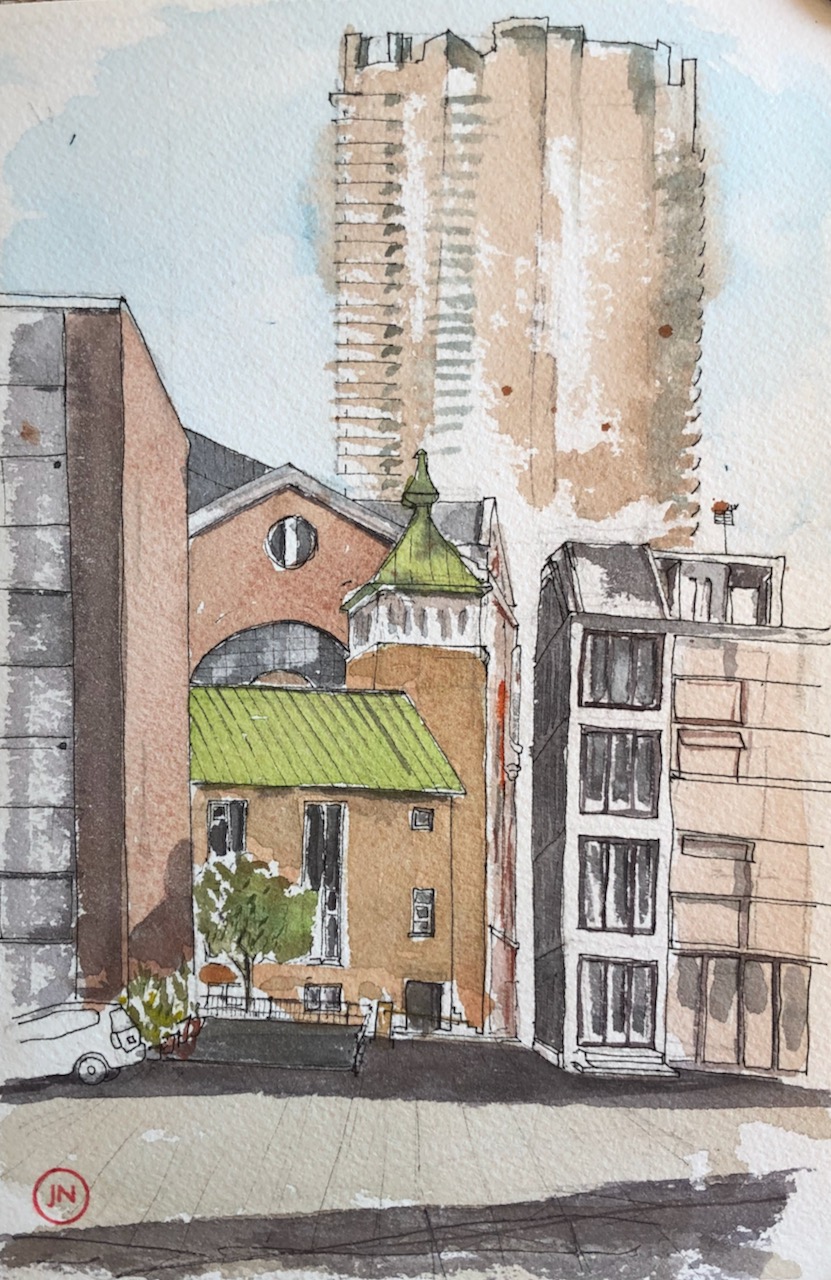
The building which was Bernard Morgan House has now been pulled down. This is sad. It had a calm 1960s look, and ceramic tiles on the side. I looked across the gap and could see the Welsh Church: Eglwys Jewin. The church is the building with the green roofed turret and the long windows. It…
Here is the Welsh Jewin Church seen from Brackley Street. This is one of those ephemeral views: a huge new building is about to go up behind the hoarding, and this view will be completely obscured. The church is Eglwys Jewin, the Welsh Church. I have drawn it before, from Fortune Park. Here’s the link…
This drawing took two hours. It is 25cm by 16cm, 10 inches by 6½ inches on Arches 300gsm watercolour paper. The main colours are Fired Gold Ochre, Mars Yellow, Phthalo Turquoise, and Perylene Maroon, with some Prussian Blue for the shadows.
This is the wonderful three dimensional map of the Golden Lane Estate, which is on the South end of Stanley Cohen House on Golden Lane. It has West at the top because that’s the direction you are facing when you are looking at the map.
Click a button below to share this post online, email it, or print it:
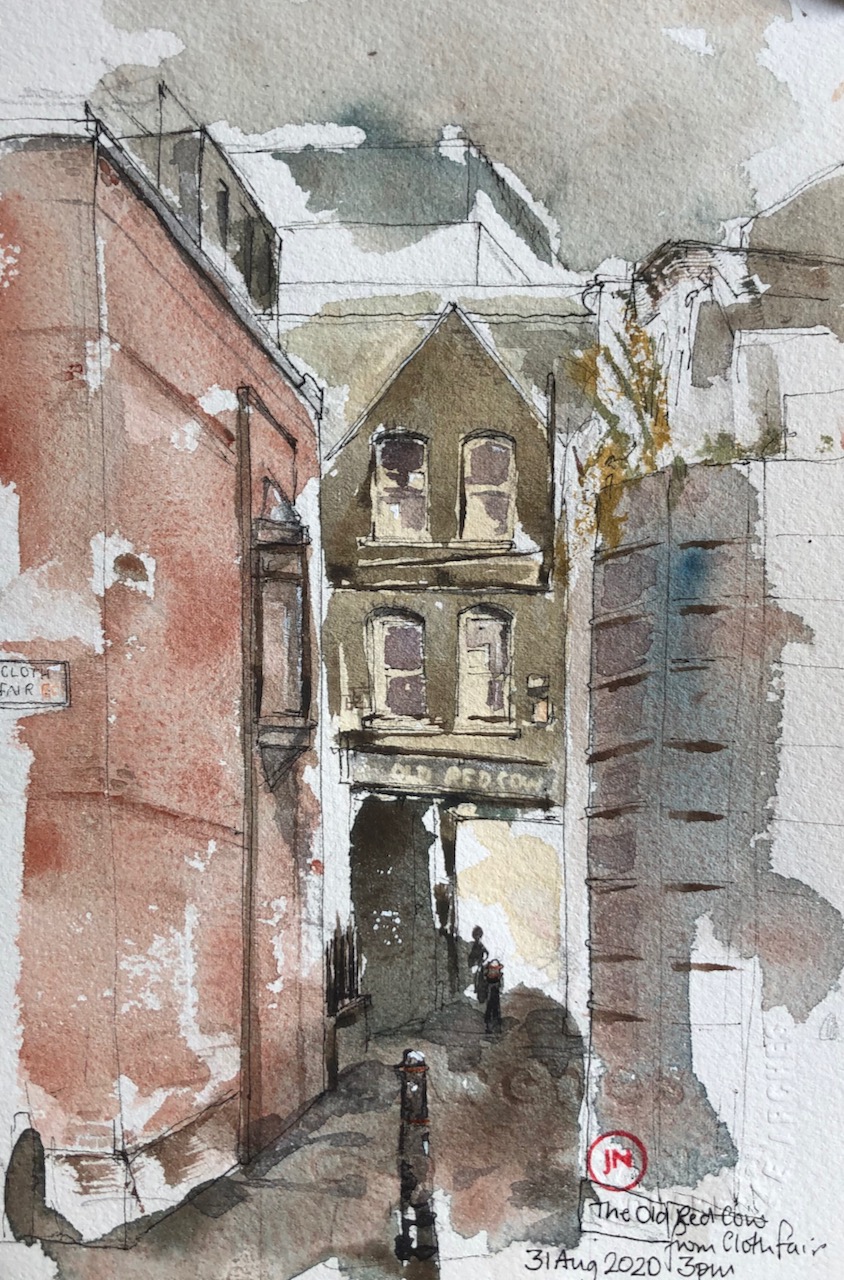
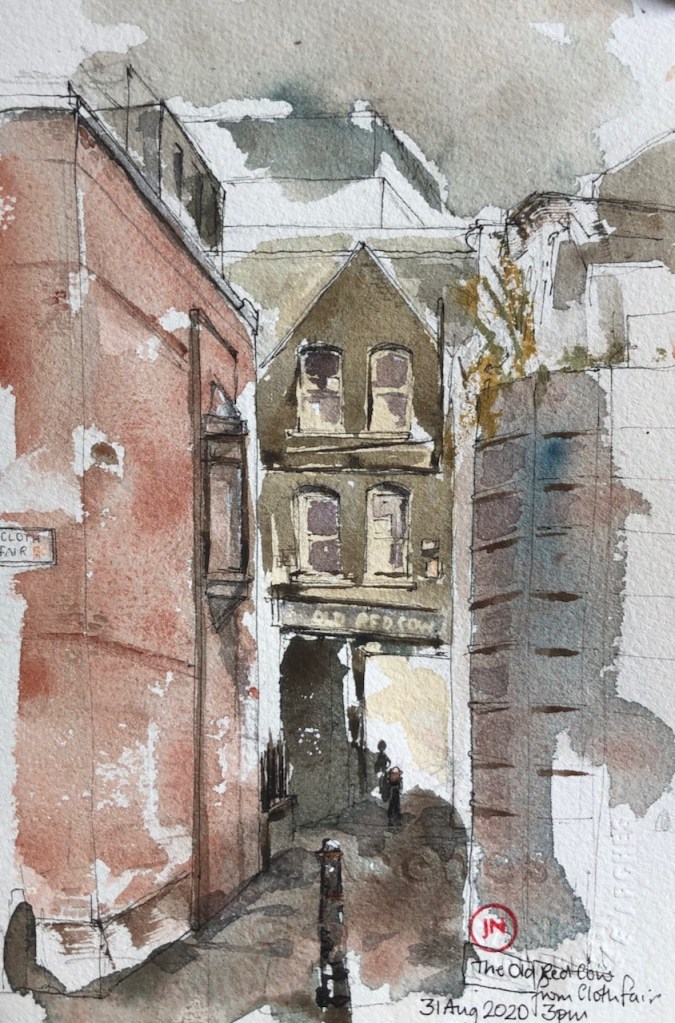
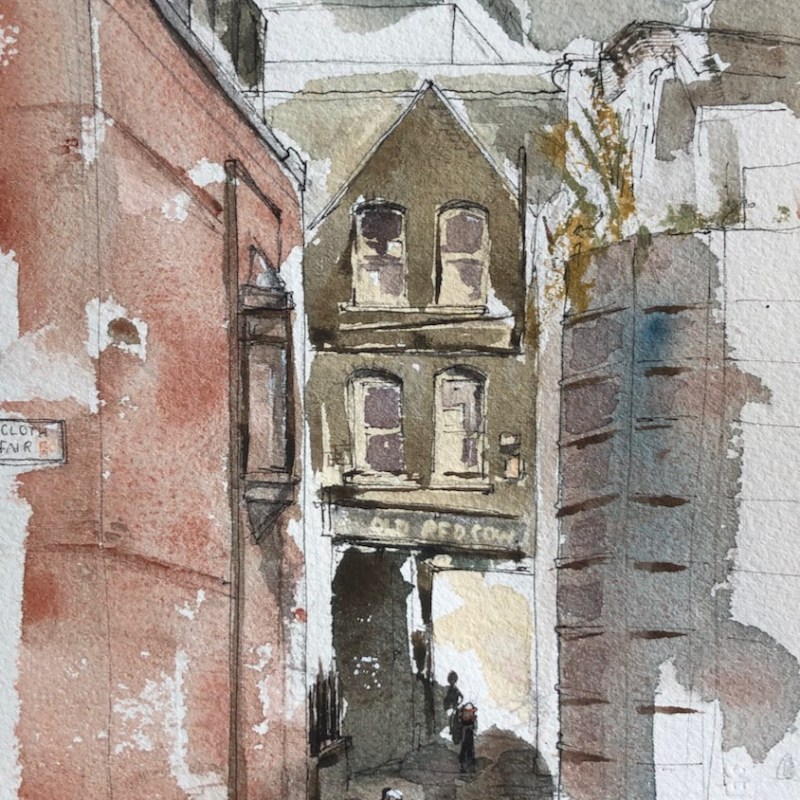
Here is a view of the pub “The Old Red Cow”, seen from Cloth Fair.
The Old Red Cow from Cloth Fair
I drew the picture from outside “The Hand and Shears”
The front of the pub is on Long Lane. When CrossRail opens, it will be very well placed to serve the people flooding out of the new “Farringdon East” station. At the moment, however, it’s closed due to the COVID pandemic.
In Cloth Fair in this area there is a particularly varied collection of bollards. One celebrates 800 years of the Lord Mayor: 1189-1989.
Here are some photos of work in progress and a picture of the bollard.
One hour and 20 minutes, drawn and coloured outside the “Hand and Shears”.
Click a button below to share this post online, email it, or print it:
Cloth Fair is a small street near Smithfield, EC1.
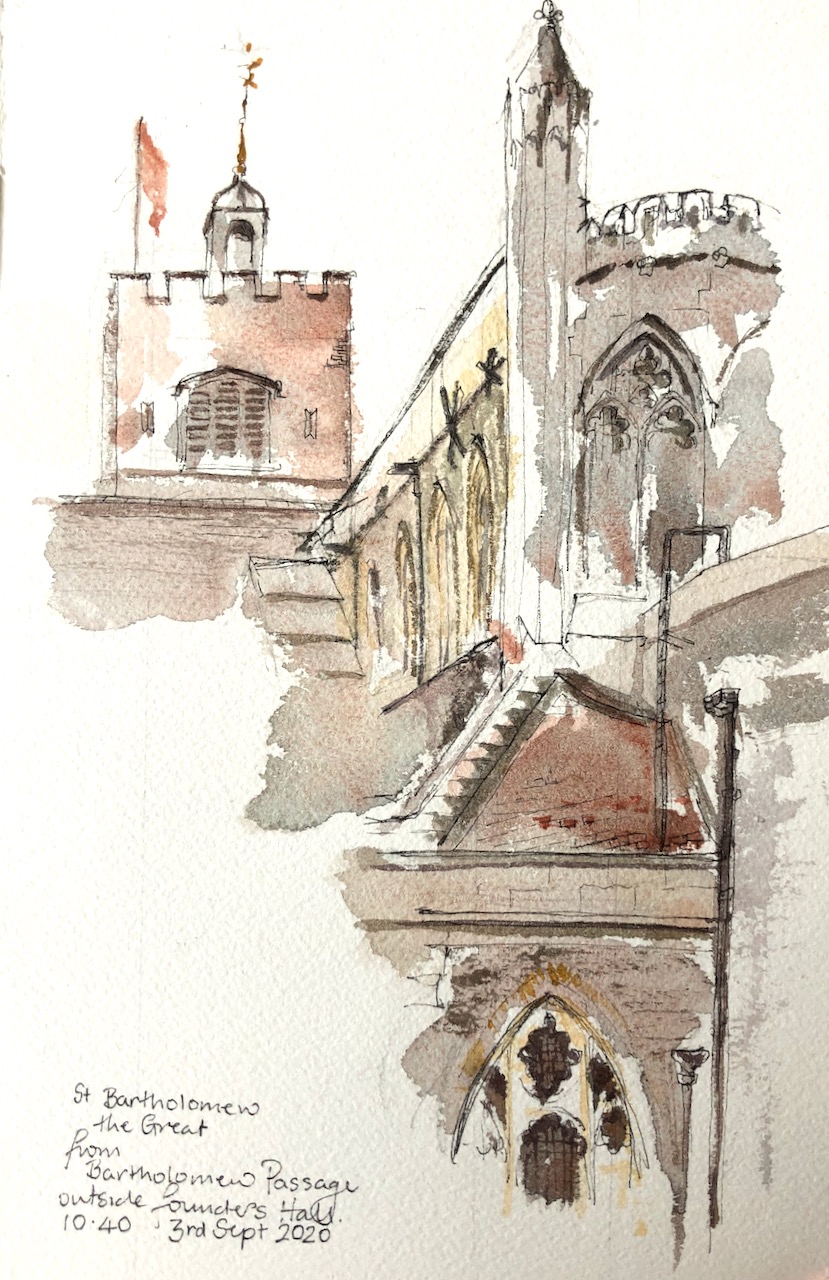
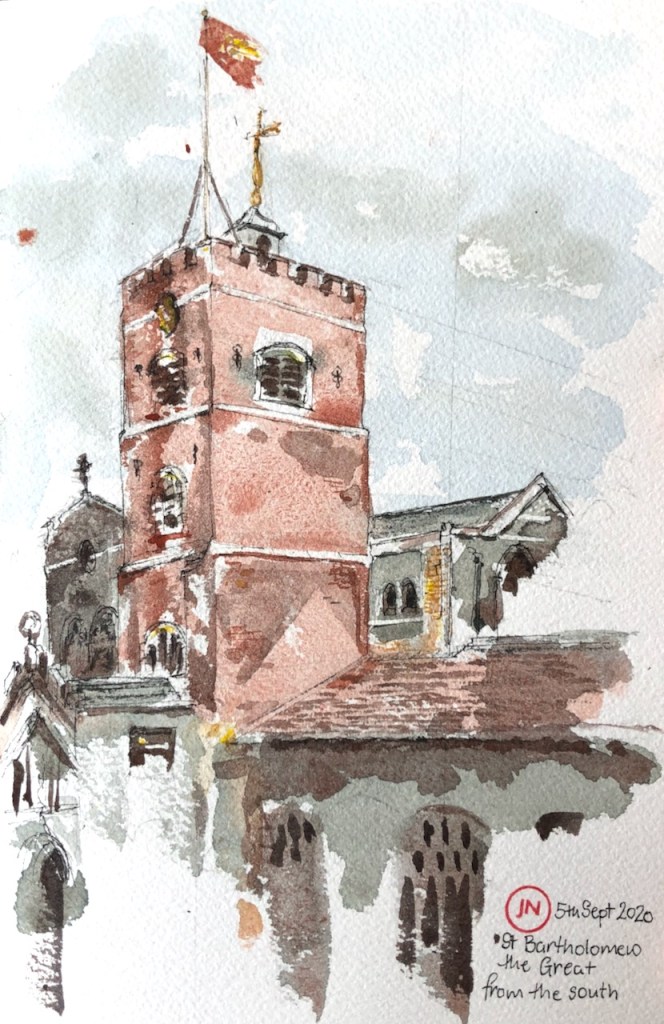
Just South of Cloth Fair is the ancient church of St Bartholomew the Great. I sketched this church from Bartholomew Passage, shown on the map above. Later in the week, I sketched it from the South West side.
St Bartholomew the Great is an ancient church, founded 1123, along with the nearby hospital of St Bartholomew, now called Barts Health NHS Trust.
There is a labyrinth of alleys in this area. As I was sketching in Bartholomew Alley, a woman reached the North end of the Alley, staring at her phone. She rotated through 36o degrees, still looking at the phone. Anxious and frustrated, she rushed along Bartholomew Alley, passed me and stopped. Her plight was so desperate that she was going to abandon the instructions of the phone, and ask a stranger for directions. She asked me if this was the right way for the hospital. I said that it was, but it was complicated that way. “If you are in a hurry,” I said, “you’d best go back the way you came…”. She was in a hurry. She uttered an expletive, and set off in the direction I’d indicated.
Then she remembered her manners and paused, turned to face me, and said “Thank you for the information”.
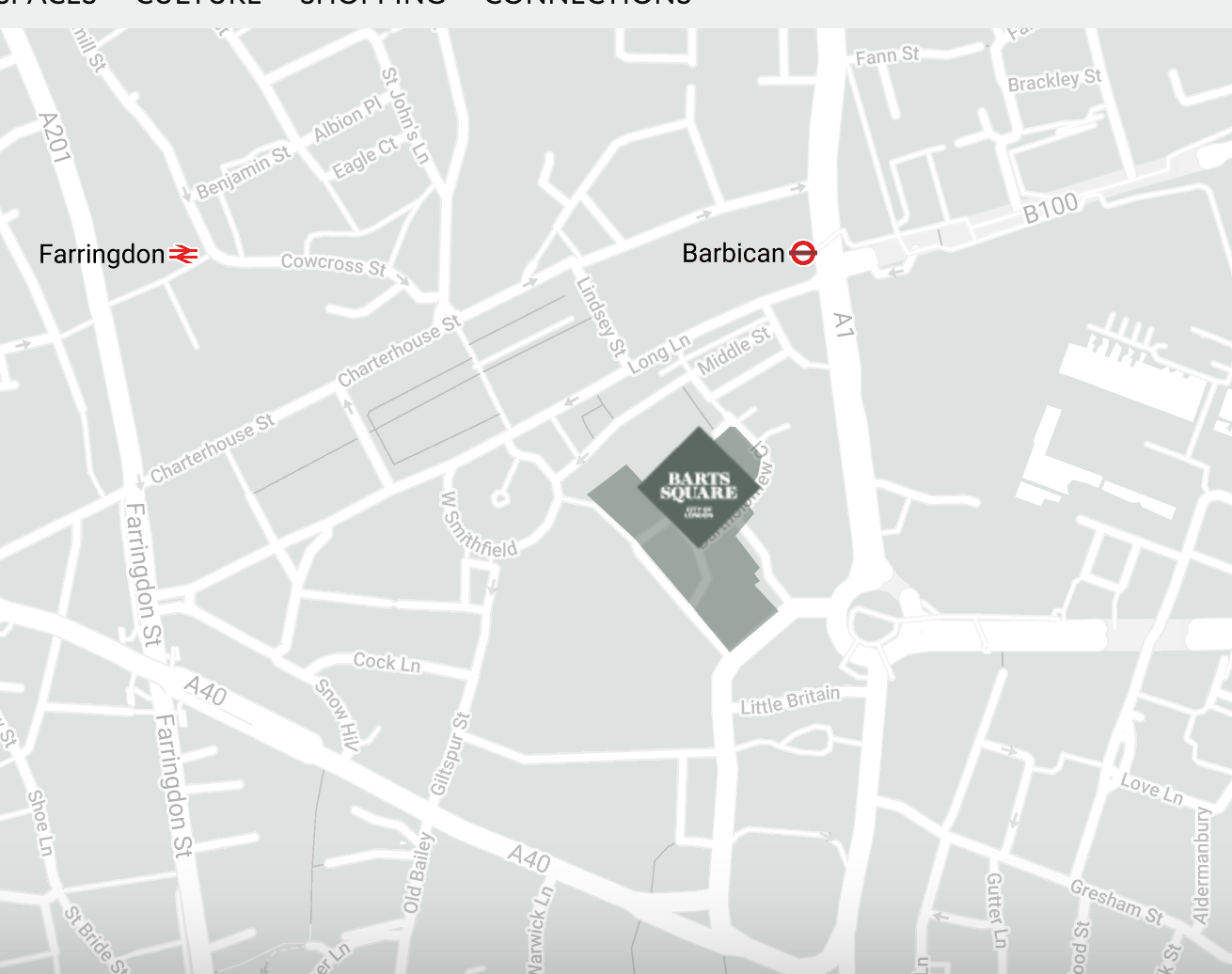
Here are some maps of the new “Barts Square” development, showing the location of the second sketch.
Sketch map: Barts Square development and sketching location
Barts Square development, location.
I have sketched often in this area, which is changing rapidly. I am still learning my way around. Here are some of my sketches round here.
Today I went to try out “Halfcup”, a new coffee place which has opened on Bartholomew Close. It’s part of the new “Barts Square” development. These are new buildings in an area that was previously St Bartholomew’s Hospital. Some of the external features of the original hospital buildings have kept, as you see in the…
Continuing my exploration of Barts Square, EC1, today I drew Butchers’ Hall. Butchers’ Hall is the building with the arched windows, in the centre left of the picture. It is the headquarters of The Worshipful Company of Butchers. This livery company is very old, the Arms were granted in 1540 and the charter by James…
Here is a post-card sized sketch of people listening to the concert. It felt as though the stones were listening too. Pen and ink in small Seawhite journal, about 20 mins.
Click a button below to share this post online, email it, or print it:
Wren Coffee has re-opened! This is a marvellous coffee shop in the Church of St Nicholas Cole Abbey, on Queen Victoria St.
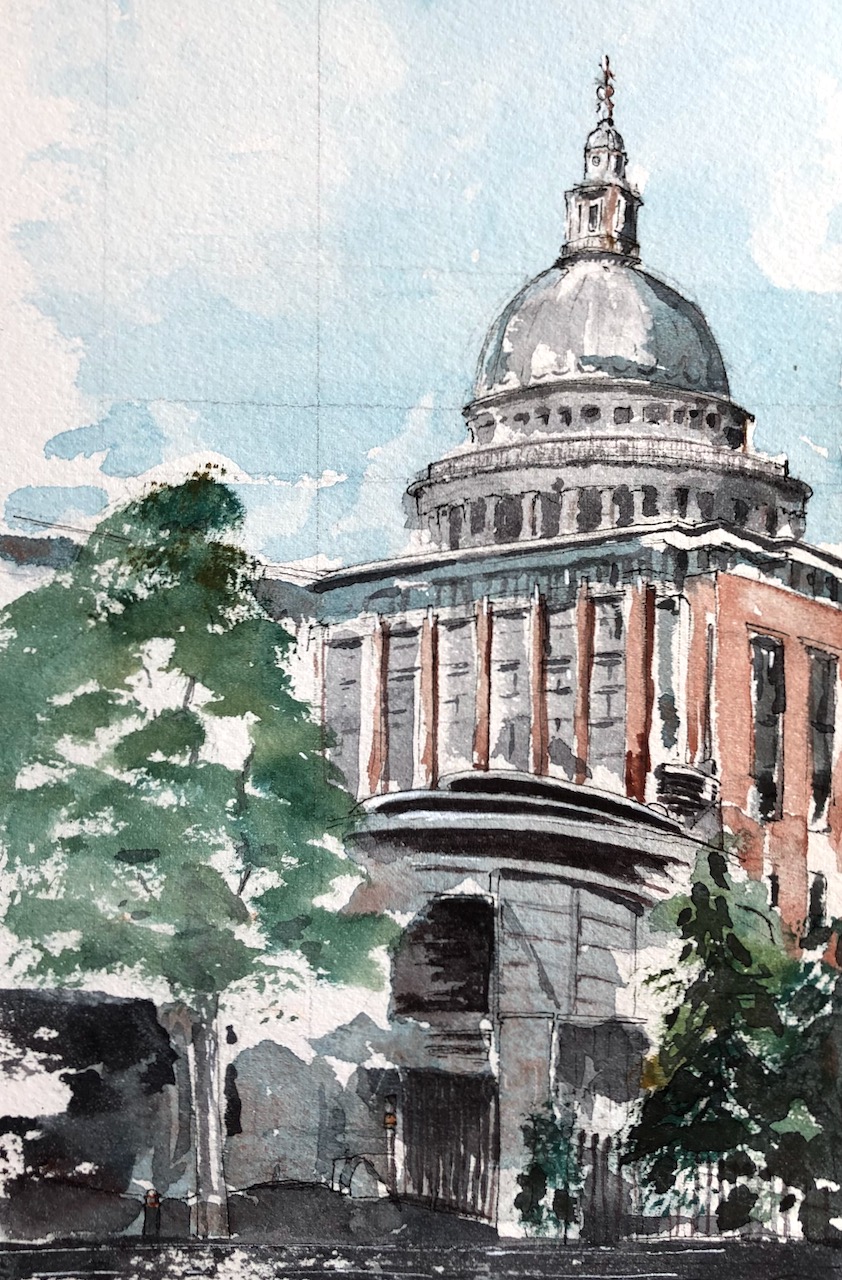
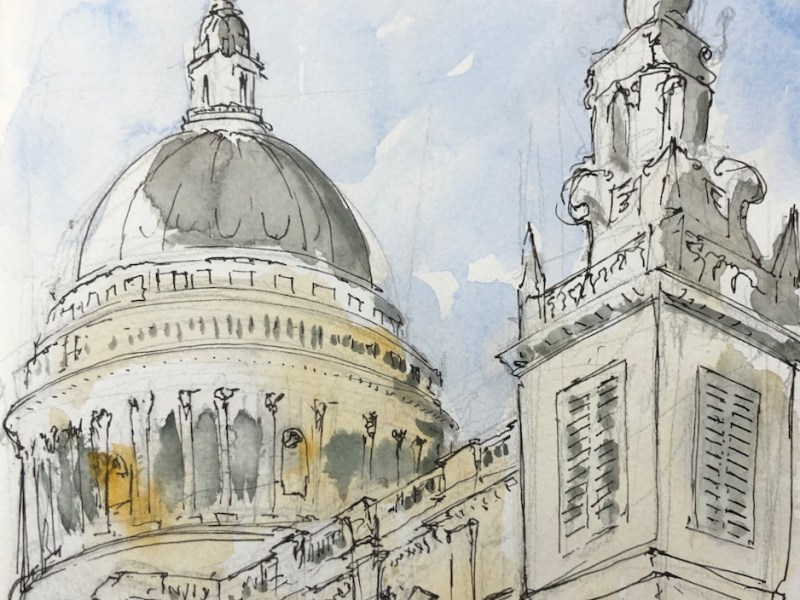
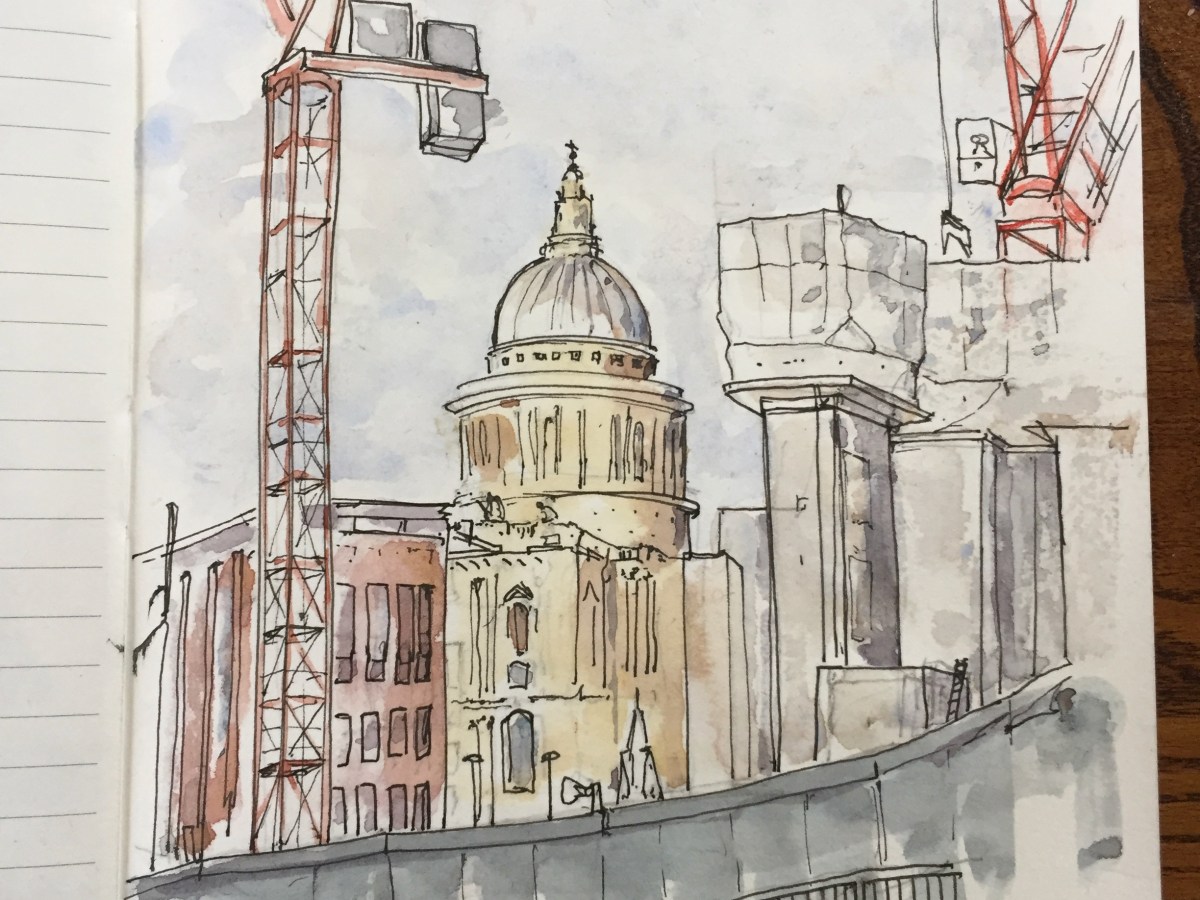
I went there and sat on the raised terrace, sketching the view Northwards towards St Paul’s Cathedral.
St Paul’s, from Wren Coffee
The grey building in the foreground is a nightclub. It has dark windows, and a barred loading bay.
Raised voices from the table behind me grabbed my attention as I sketched. High drama was in progress. One of them defended himself in a loud voice, “The money is real money, and it’s still there. Trust me on this!”.
When someone declares “Trust me on this!” all sorts of red and amber alert lights come on in my head. Was the money still there? Did I trust him on this? I thought not. The other two men were not convinced either.
I kept my gaze firmly forwards, towards the view I was sketching. I did not observe the participants in this conversation, I did not join the debate. I cannot even be sure there were three men rather than two. Certainly at least three points of view were expressed. It was hard to follow the conversation, especially for someone trying to concentrate on tone differences, perspective lines and the symmetry of domes. And not all of the conversation was conducted in the strident tones of the accused party.
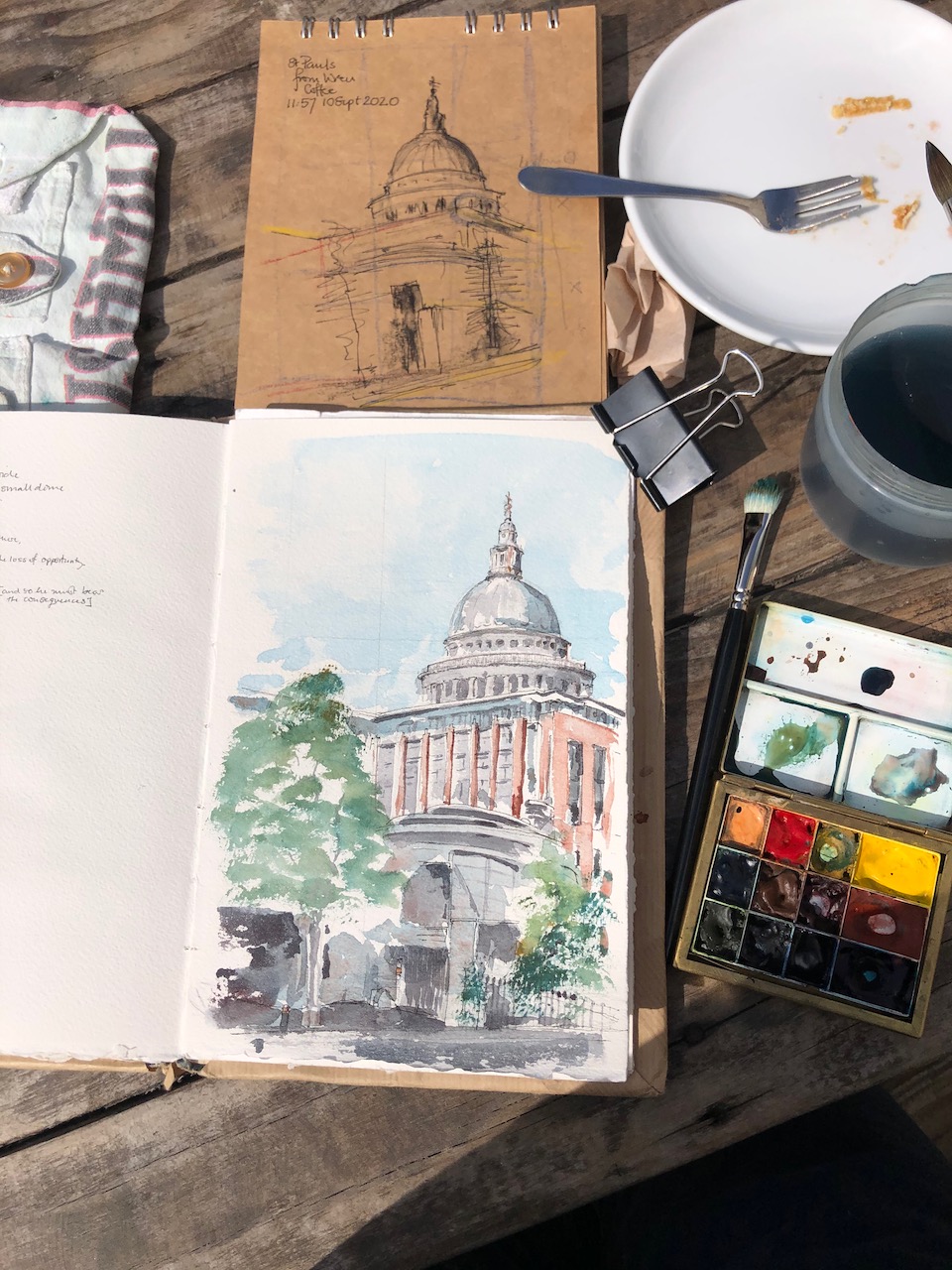
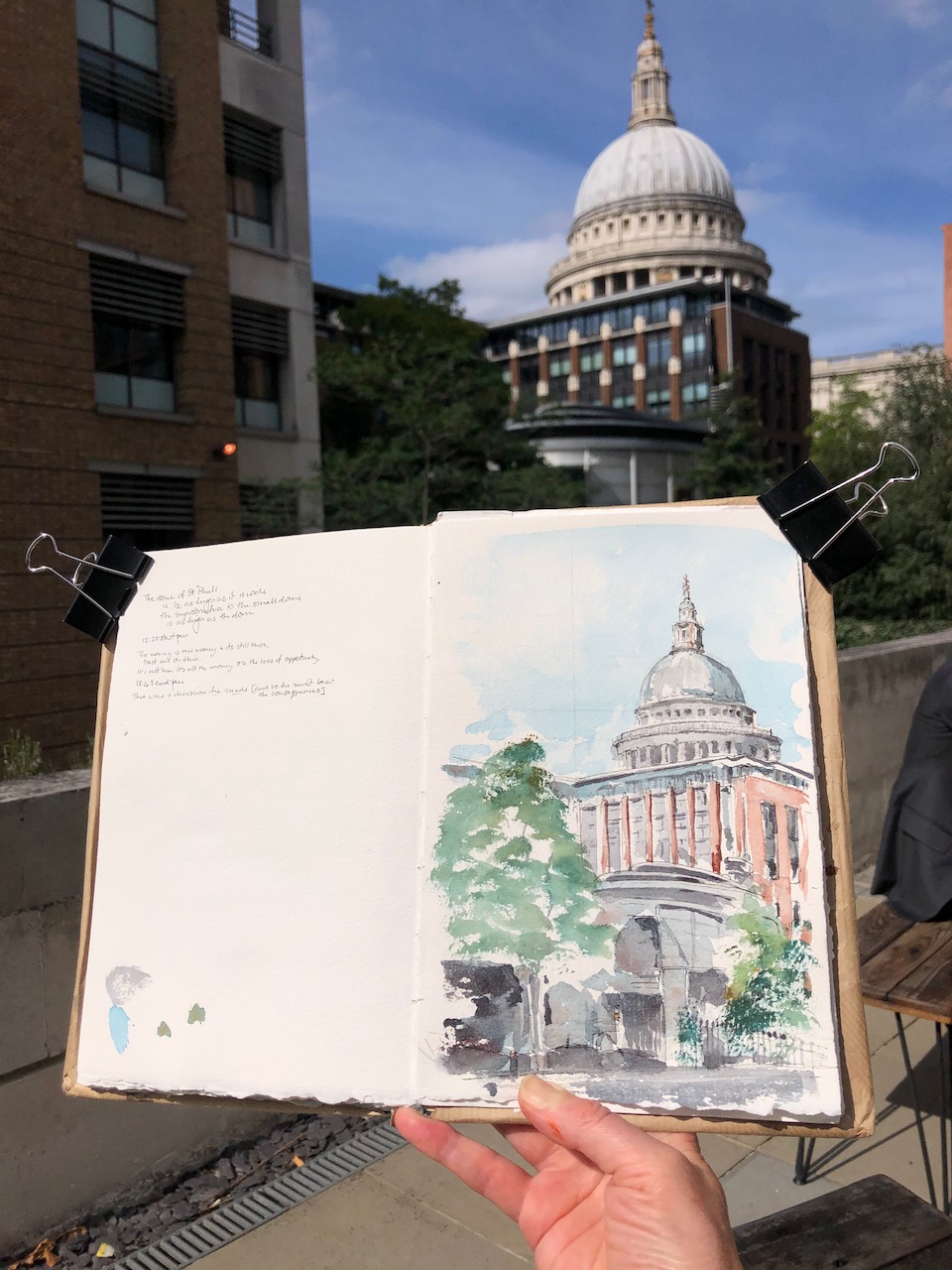
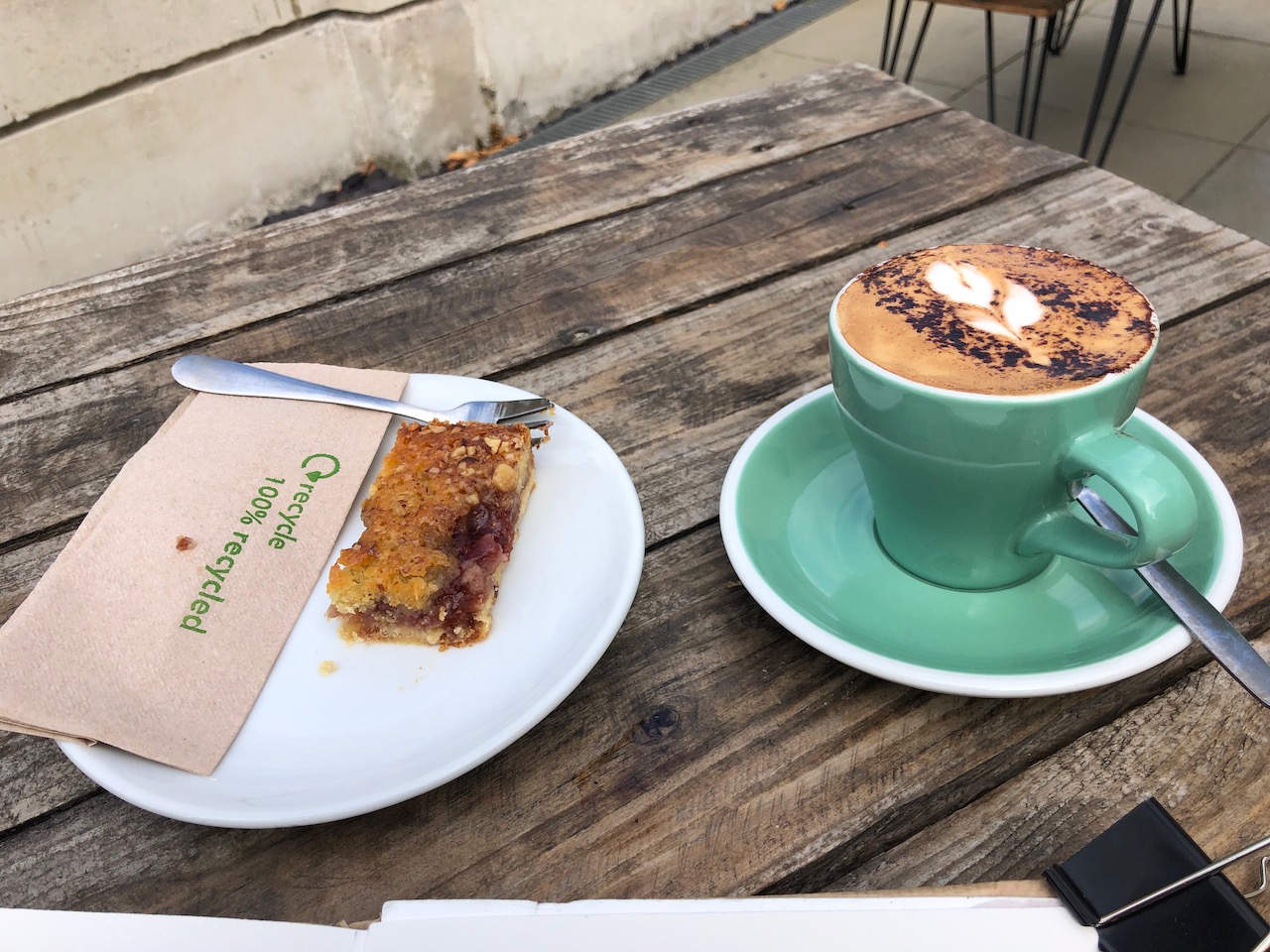
Here are some photos of work-in-progress on the sketch, and a picture of the beautifully crafted capaccino made by the server at Wren Coffee.
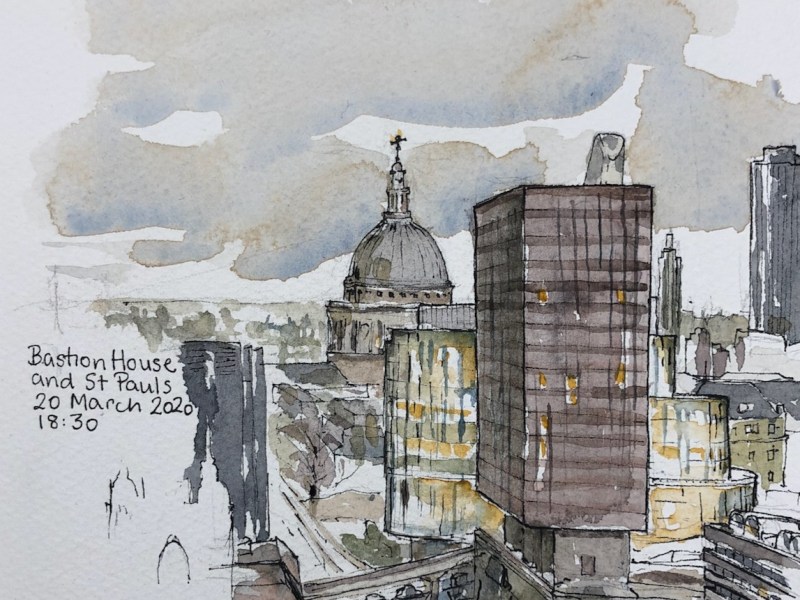
I am sketching the views out of the window. Just visible over the top of Bastion House is the top of “OneBlackfriars”. In the foreground: Mountjoy House, Barbican, on the right. Along the bottom is the Barbican Highwalk which joins Mountjoy House and Wallside. I have drawn Bastion House before: This drawing took rather a…
I was keen to draw this view of St Paul’s before it vanished behind the new building on 2-4 Cannon Street. “PLP’s scheme, for global property firm Pembroke Real Estate, will replace a 1959 modernist office building by Theo Birks called Scandinavian House. The north facade, facing the cathedral, is the most orthogonally formal, with red…
Click a button below to share this post online, email it, or print it:
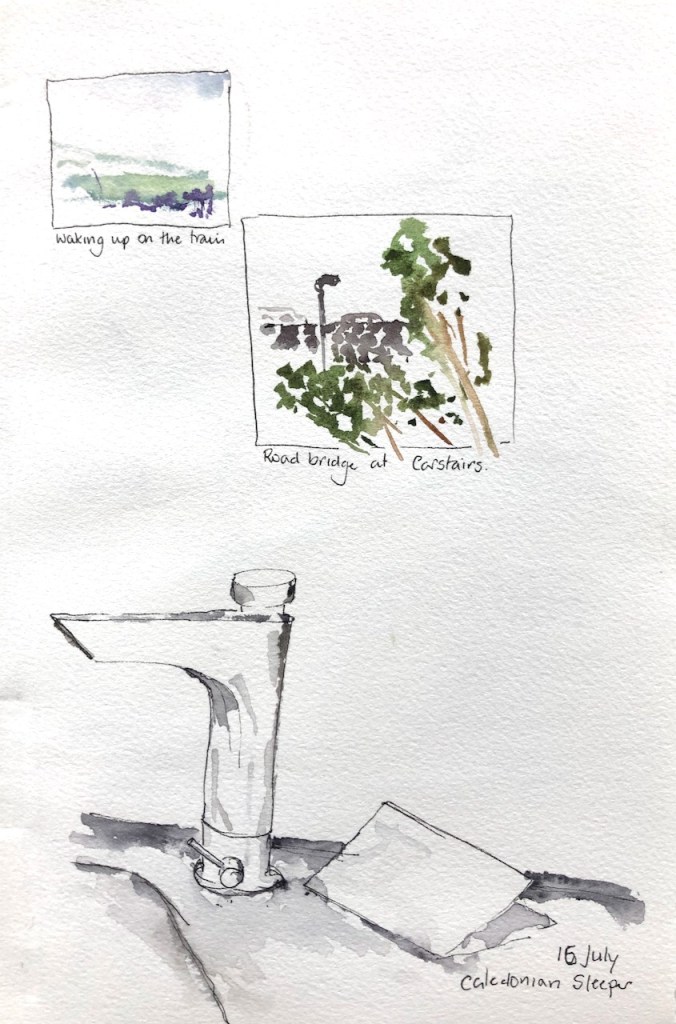
The Caledonian Sleeper took me North. It’s the most marvellous way to travel – and fulfils the requirement to be socially isolated. I had one of the new cabins, or “rooms” as they call them. It even had a built-in toilet and shower. So I woke up refreshed, approaching Edinburgh.
The modern tap on the sink in my travelling room on the Caledonian Sleeper.
Because of COVID-related timetable alterations, the train didn’t go all the way to Aberdeen, as it normally should. I changed at Edinburgh onto a normal train.
Sketching on the train.
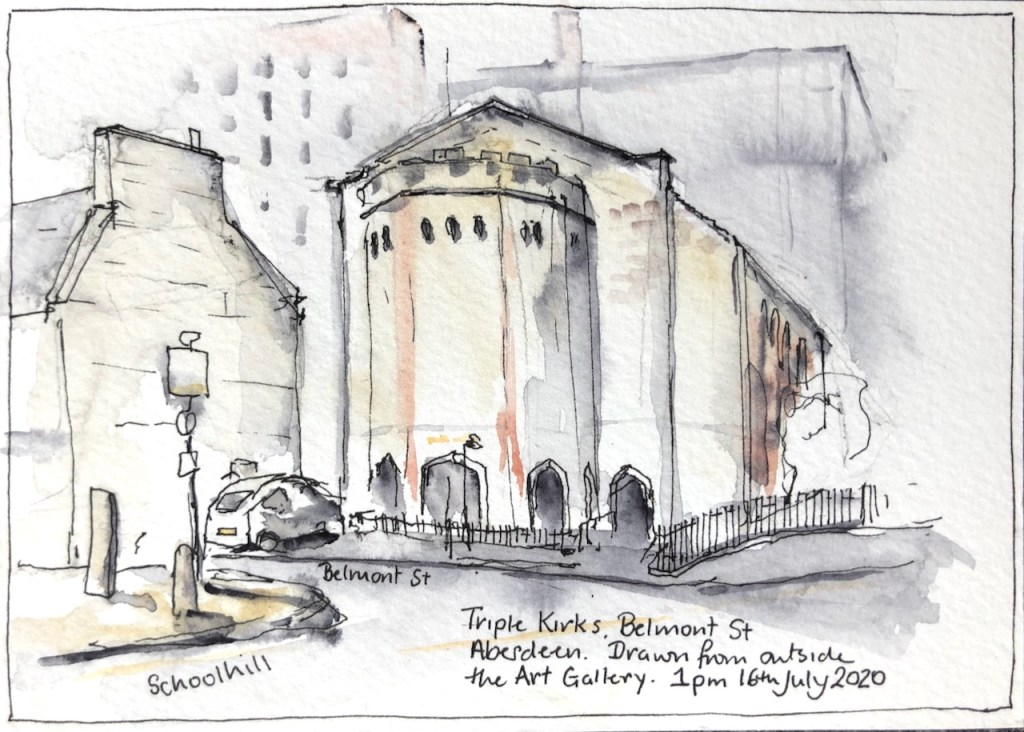
Aberdeen was eerily empty. I drew a picture near the Art Gallery.
This church had been converted into a restaurant.
Then eventually I found somewhere open in Belmont St. I sat outside. The waitress cleaned every table and every chair after customers left. She even sprayed the laminated menu with disinfectant before replacing it on the pile. On a paper form at counter I filled in my contact information for contact tracing. Next to the form was the biro to use. I used it without thinking. I guess everyone had used it. I did remember to wash my hands afterwards though.
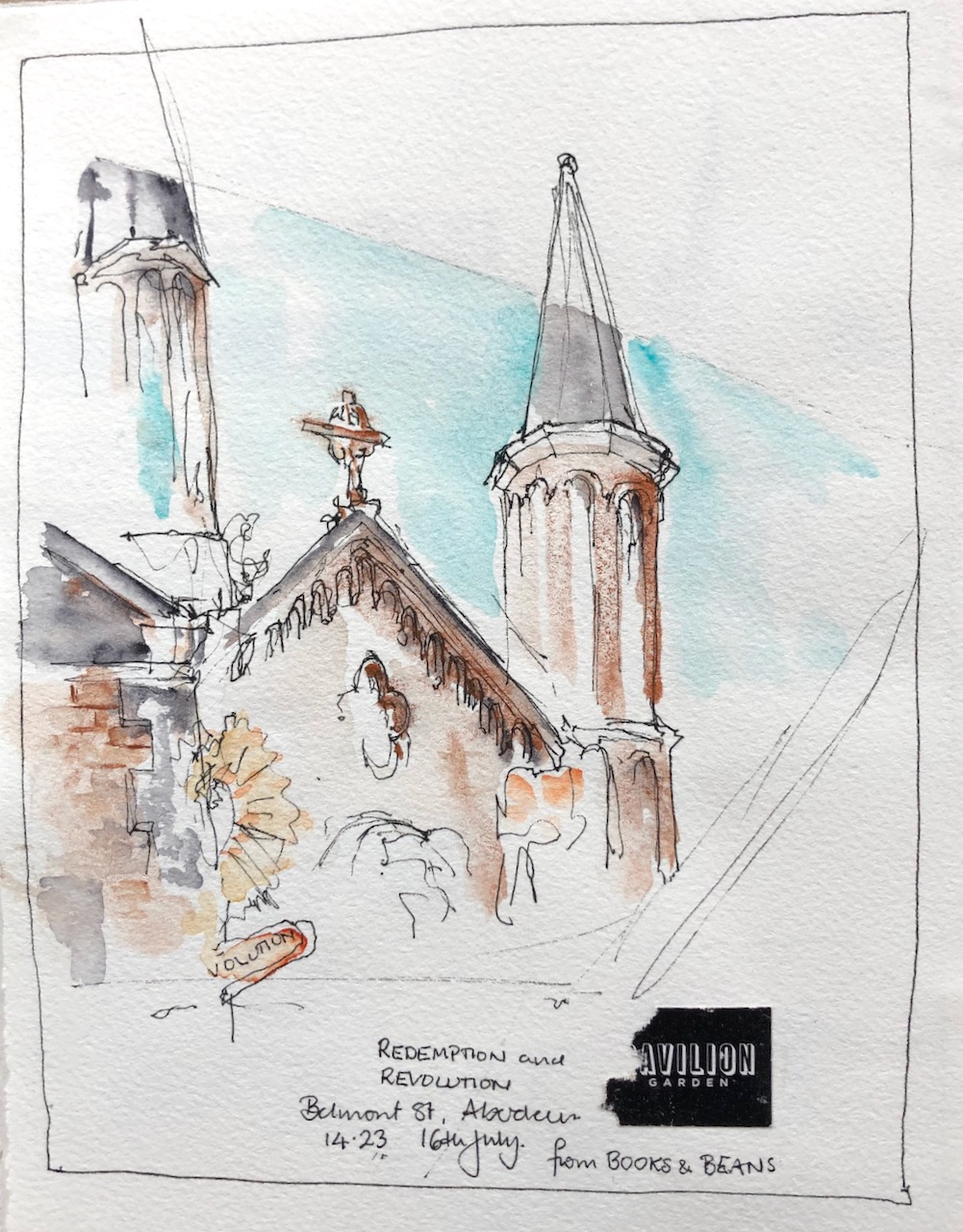
While waiting for my food I drew the establishments on the other side of the street, visible through the awning.
Belmont St, Aberdeen.
Both were bars. One was a converted church and was called “Redemption”. The other was a house, called “Revolution”.
The restaurant I was in was called “Books and Beans”. I could see no books, and beans didn’t seem to feature on the menu. I had an excellent huge sandwich.
Maybe we need a campaign for meaningful restaurant names.
Click a button below to share this post online, email it, or print it:
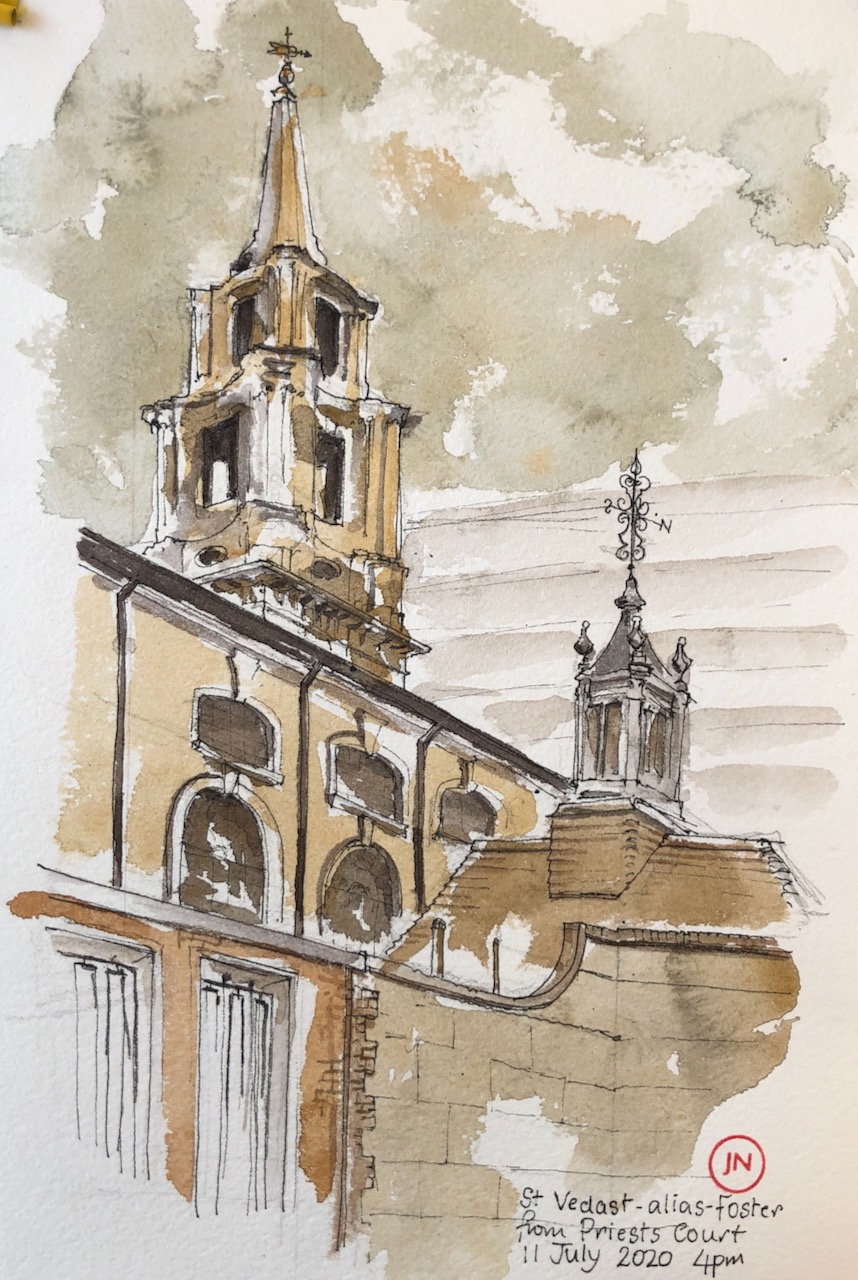
Here is the Anglican Church of St Vedast-alias-Foster, in the City of London, viewed from Priest’s Court.
St Vedast-alias-Foster
Before I drew this, I paused a while in the Fountain Court, a tranquil courtyard next to the church. In the shadow, there is a monument to “Petro”, Major Wladimir Vassilievitch Petropavlovsky. His friends awarded him the epitaph “This was a Man”. I had a look online to see if I could find out more about this person.
He was a member of the Special Expeditionary Force in the 1939-45 war in Europe. This was an organisation formed for espionage in Nazi occupied areas. I can find the record quoted, but the “National Archives” link is not working at present. There is little online that I can find.
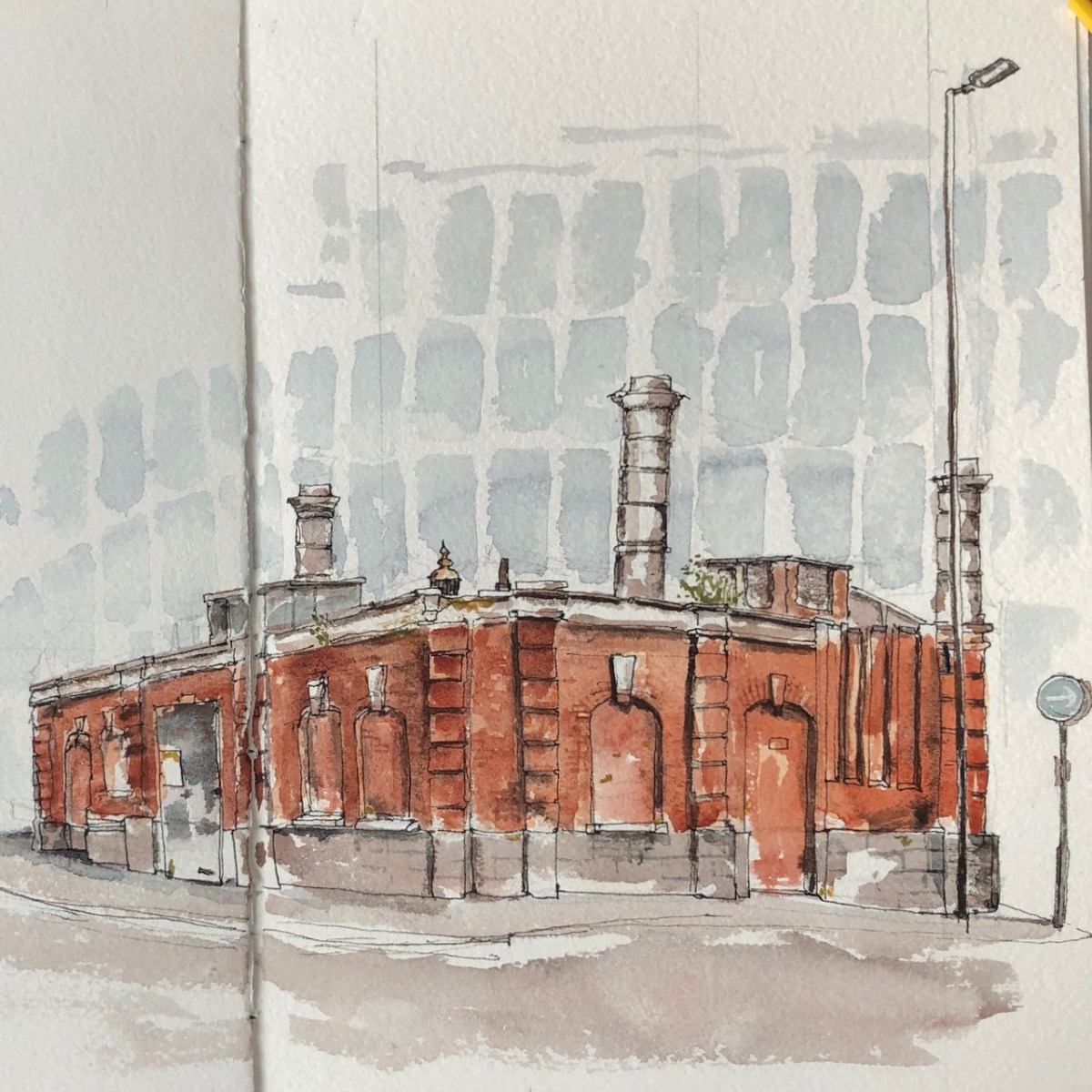
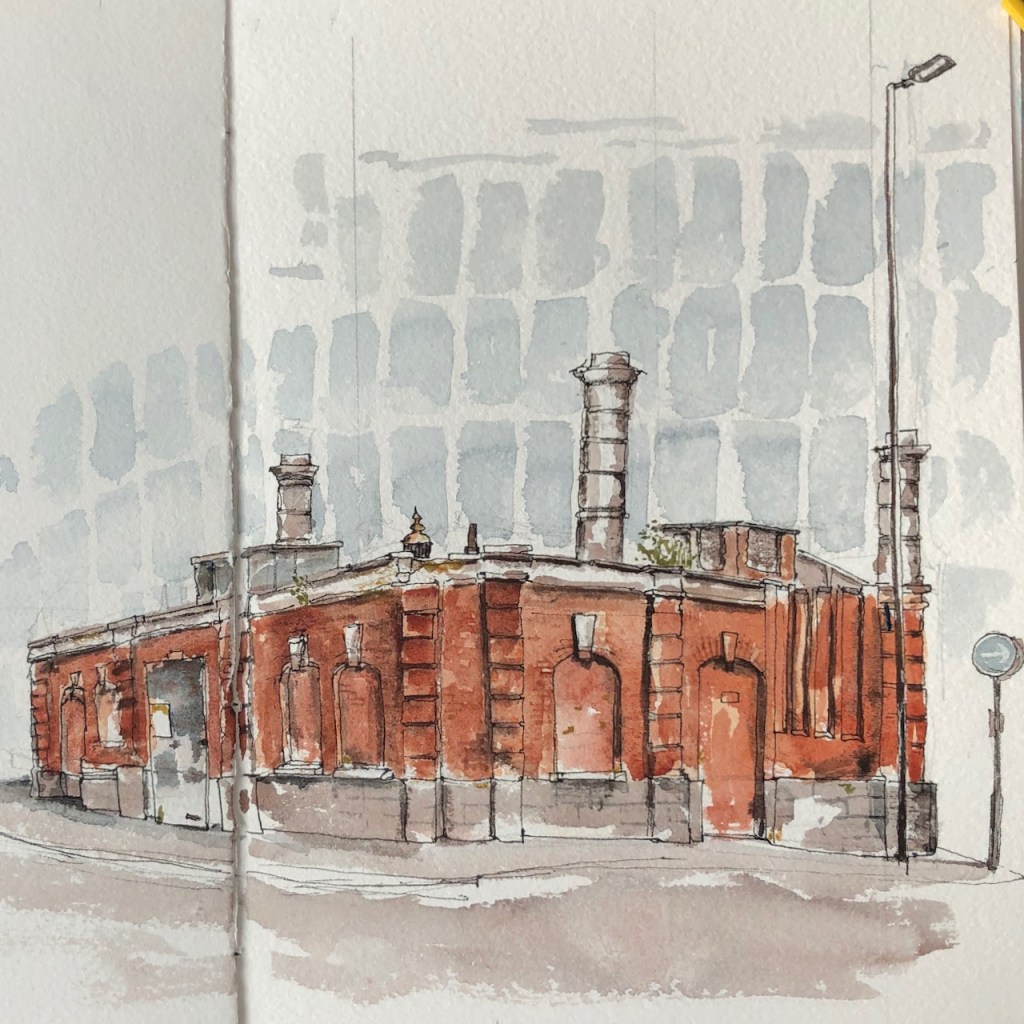
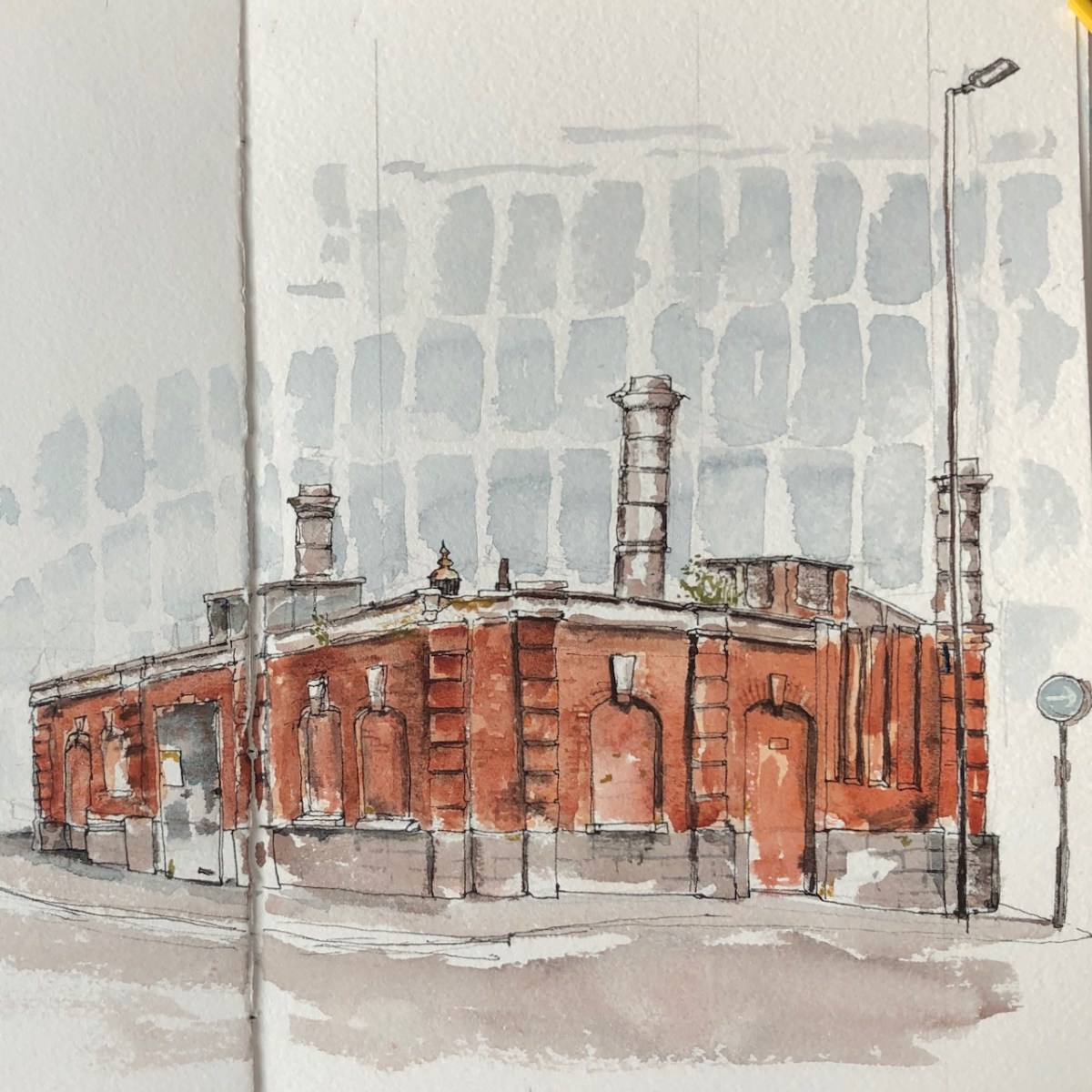
Here is the Triangular Building, West Smithfield, from the North West.
Triangular Building, North West corner.
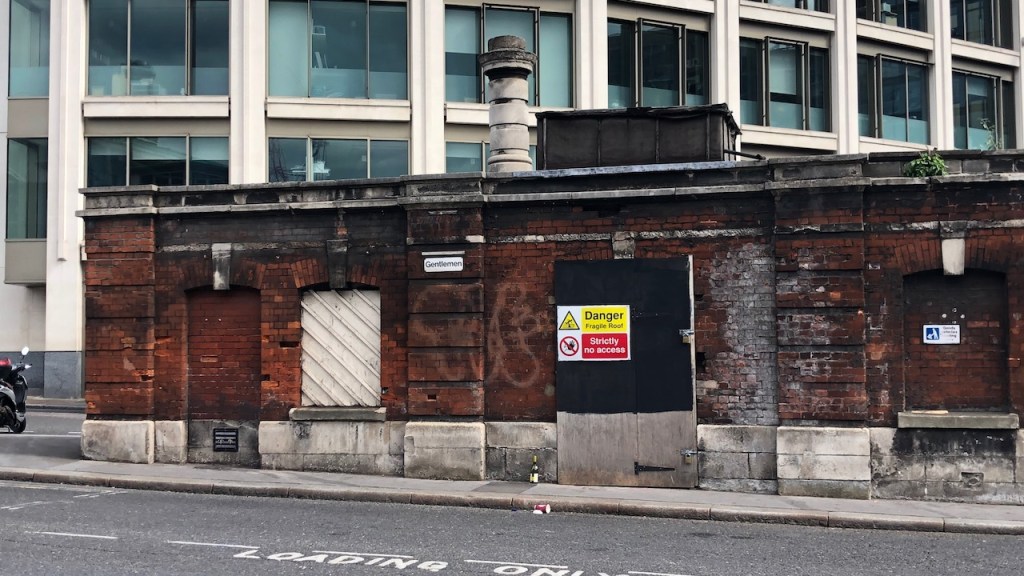
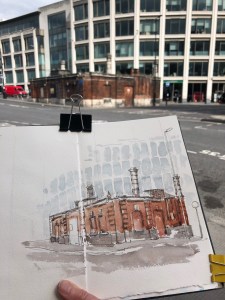
From this view, you can see all 3 chimneys. You can also see a rather exotic metal top on what must be another vent, right in the middle, between chimneys 1 and 2. Beyond the black door, on the left, is a neat sign saying “Gentlemen”.
North face of the Triangular building. The sign in the middle, to the left of the chimney, says “Gentlemen”.
Here is work in progress on the drawing:
I have drawn the Triangular Building before. See these articles for other views, maps and more information:
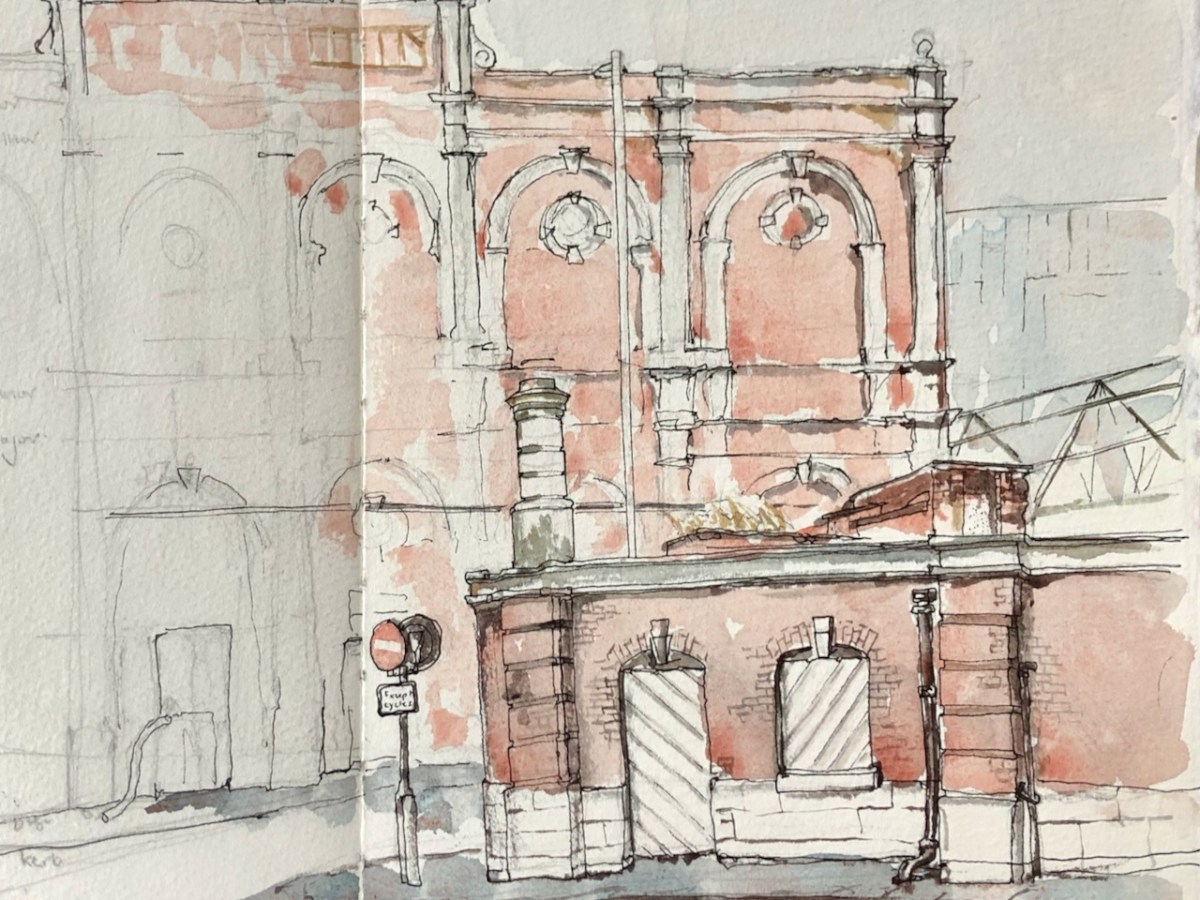
Here is another view of The Triangular Building, drawn previously. On this view you can see the magnificent cold storage block, behind. The cold storage block is called “The Red House”. It is now dilapidated, but still magnificent. A discordant rail, carrying cables, goes horizontally across the front, function taking severe precedent over aesthetics. There’s…
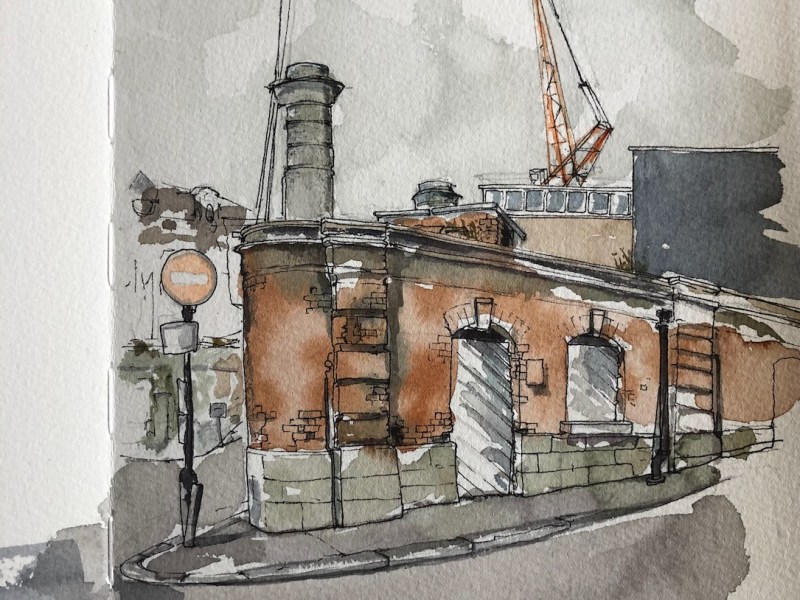
Here is “The Triangular Building” in West Smithfield. I have sketched it from the South. This is its South West corner. The question is: what is it? It has three vertical columns above, which look like chimney stacks, but might be vents of some sort. One is shown on the left of the drawing and…
Here is a complete list of my drawings of Smithfield:


































 Jane Sketching