Today I found another view of the view under Mountjoy. This is from the high walk that goes north from the Museum of London, looking East.
Under the Mountjoy Highwalk there are a number of “framed” pictures. The old London Wall fortification is visible. The sun reflected from the lake and threw patterns onto the old stone. I couldn’t get all that in the picture so you have to take my word for it.
A group of tourists stopped on the “Wallside” highwalk. You can see them in the centre right of the picture.
These “windows” will all be obliterated by the proposed City of London School for Girls expansion.
This view is from the place where the north bound highwalk turns abruptly left (click map to expand it).
This picture took about an hour. I tried hard not to overdo it.
At the top of the picture are the flats of Mountjoy House, with their impressive window boxes.
Click a button below to share this post online, email it, or print it:
This is the view that will be lost if the City of London School for Girls expansion proposal goes ahead.
UPDATE (2020): the proposal has been shelved, and alternatives are sought. But we must remain vigilant. The article below was written in August 2019, when the threatened development looked as though it would go ahead. Widespread protest ensued.
The view that will be lost if the CLSG expansion goes ahead. See “SOSBarbican.com”
I spent time today paying attention to this view, because that is what I need to do, to draw it. The pillars are reflected in the water. The enormous flight of steps is like that in a fairy story, so wide and grand. There’s a massive three-dimensional sculpture of concrete, of light and dark. Flat spaces and lines don’t quite join up but are nonetheless connected, like rhythmic music. Framed by the 20th century brutalist columns you see an older more ornamented building, and trees. You can even see right through to the other side of Aldersgate. This is a magnificent view.
The interesting blotchy effect on the pillars is rain falling on the picture. I started this picture at 09:30. Then it started to rain. The fine rain speckled my picture. Bigger drops diluted the paint in the palette and made the paints shift about. Then it started pouring down with menace. I scrabbled my things together and dashed into St Giles’ Church which was behind me. Inside the church, people moved purposefully about, and all was calm. And it was dry. I took a deep breath and kept my drawing horizontal. There was a table next to the door. A woman looked at me over the table. I felt the need to explain. “I’m sheltering from the rain,” I told her.
Her response was calm and logical, “Would you like a cup of coffee?”
“I would,” I said. Her companion at the table offered me a biscuit. Grateful to the Royal Society of Organists for their hospitality, I sat on a wooden bench and let my drawing dry off. Experimental short tunes from the organ floated quizzically in the air.
Then I went out again. I wanted to finish my picture. I stood in the porch of the church and looked at the rain. “Every decision is a moral decision.” I believe that. Should I pack up the drawing and go home? I could use the time before the Planning Meeting to do the supermarket shop, deal with the plumbing problem, and process the sourdough.
Or should I continue the drawing?
What principles are at stake here? I finish drawings that I start. I don’t mind the rain. My ink and watercolour does mind the rain, though. So I’ll draw the picture under an umbrella.
This was surprisingly effective. I managed to get all the ink drawn before 10:45, when I packed up again, to go to the Planning Meeting. During this time I was approached by a flustered gentleman in a smart suit, who wanted to “get across the lake”. He was hopelessly disoriented, pointing South-West, when he should have been heading North-East. I re-directed him and he dashed off towards the Barbican Hall.
The Planning Committee Meeting at 11am was the City of London Planning and Transportation Committee. This was their July meeting. In their September meeting, if things go according to the plan put forward by the School, this same Committee is due to approve a plan for a building which will totally block out the view I have drawn. The proposed new structure would cover the steps, build round the pillars, and put in an industrial kitchen. Residents in Mountjoy House, directly above my picture, are understandably dismayed. The Barbican Association, representing Barbican residents, is leading a campaign to prevent to save the view, and stop the expansion. Here is their postcard/flyer.
On the way back from the planning meeting, I went back to the view, and put the colour.
Spending time looking at this view, these pillars, these shapes, I realise how magnificent it is, and how talented the architects were. This view is worth fighting for.
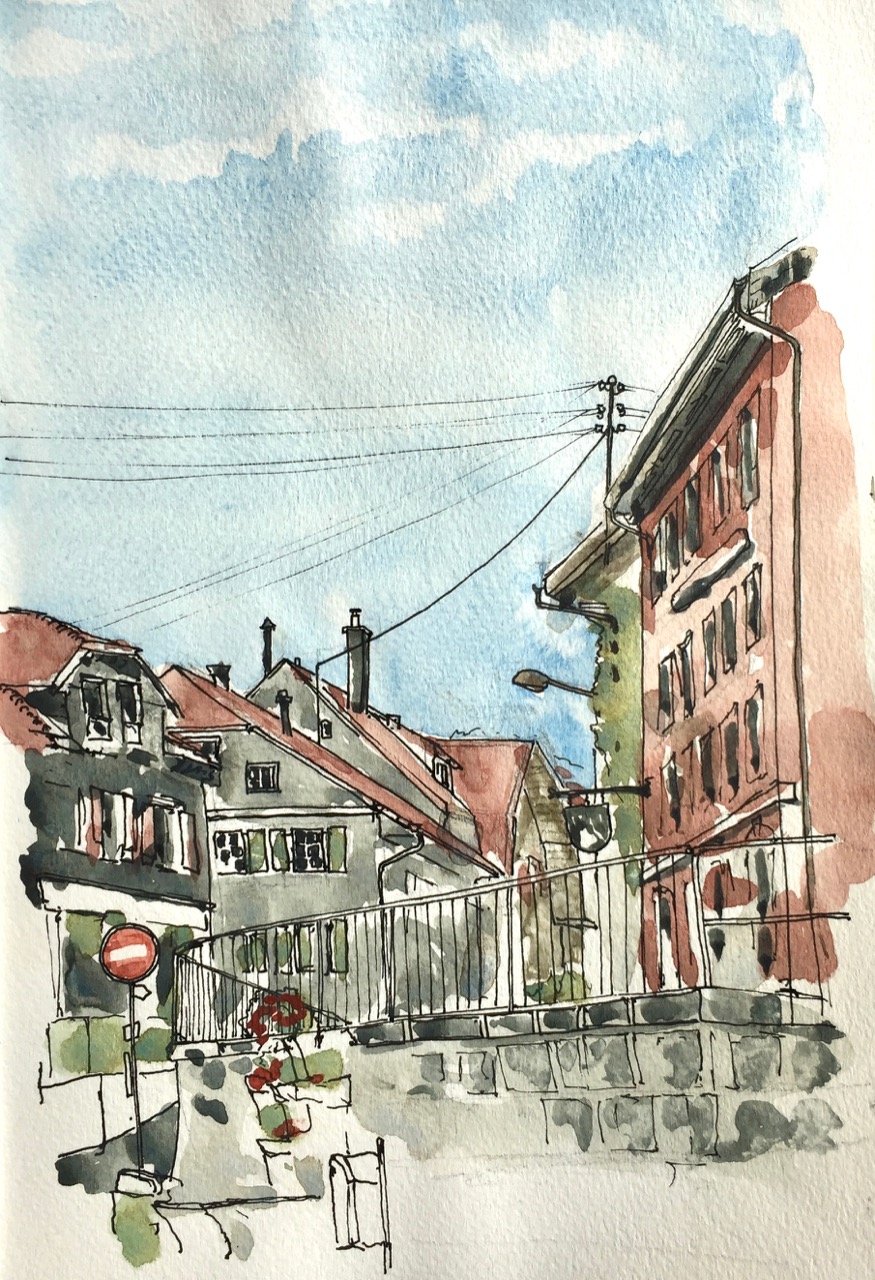
I had been travelling since 5am. So I just rested. I looked out of the hotel window. I saw chimney pots.
With the wind and snow in Switzerland, it’s worth a lot of effort on the part of the chimney pot designer to get it right. Clearly, though, much experimentation is required. Every one in this drawing is different.
Switzerland is the only place I know where copper is a construction material. The rest of us use it to make small domestic items, or jewellery. But here, the whole of the chimney pot stack with the cylindrical top, in the middle of the picture, is made of copper. Also copper is the guttering which runs across the middle foreground, and some of the down pipes.
Later, in a pause, I made another drawing, this time from the terrace of the Hôtel de France. This time I was tuned in to chimney pots. See the marvellous construction on the skyline! It is even furnished with a set of steps, so the chimney pot repairer is provided for. Or perhaps the chimney sweep.
Another day I searched for chimney pots again, since this was becoming a theme. Here is the view from the same place, looking a slightly different direction.
Here is the picture under construction.
The item in the middle of the base of the picture is a letter box. I posted a few postcards:
Pen and ink sketches are a good way to fill in the time waiting while travelling:
And I did some sketching at the breakfast table.
Breakfast room, Hôtel de France, 11th July 2019
Click a button below to share this post online, email it, or print it:
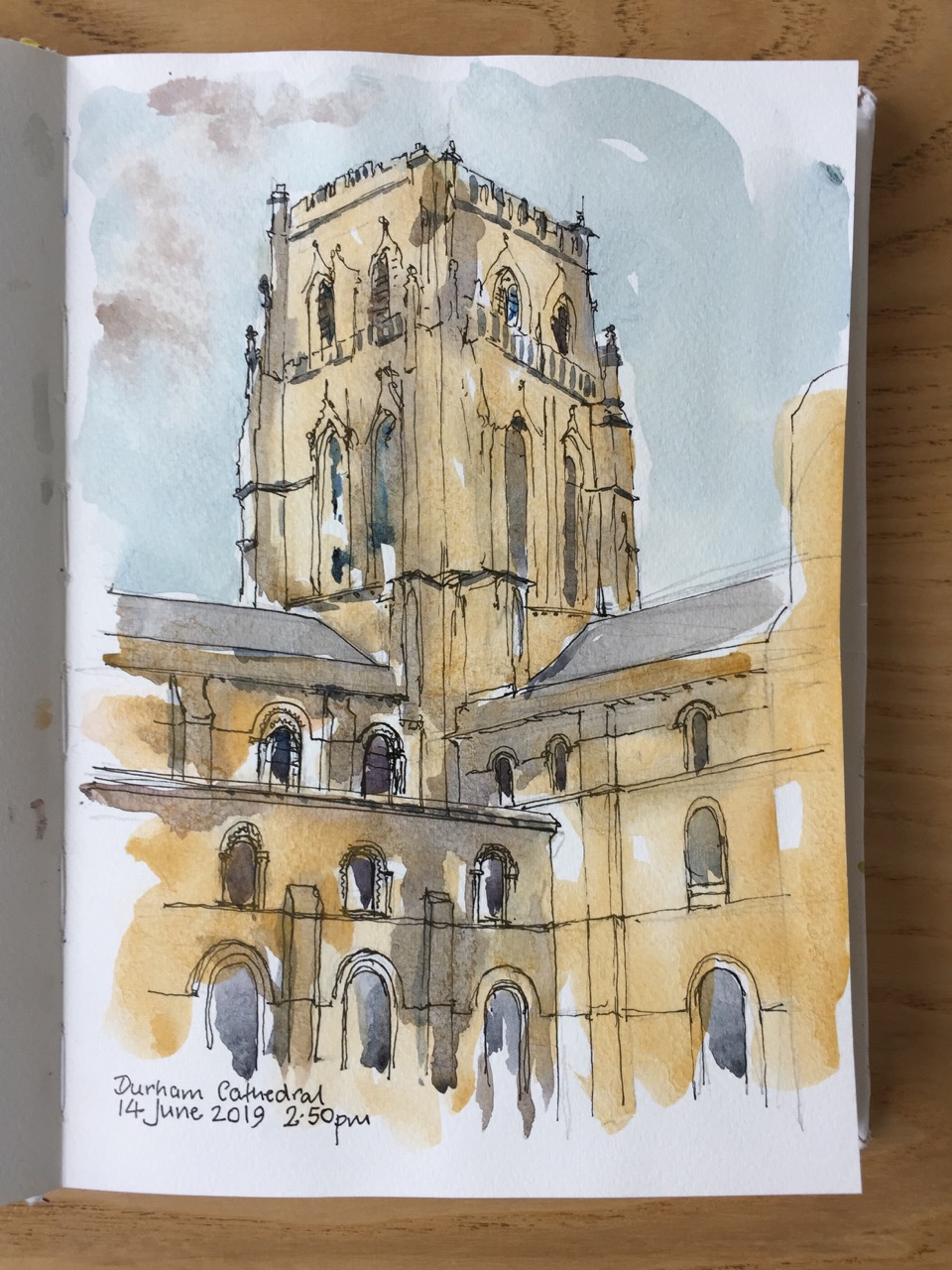
Durham Cathedral was built in 1093AD, and is a shrine to St Cuthbert. The extraordinary stonework is all original. Even more impressive is the roof. There is a stone roof which is up there and has been up there for nearly 1000 years. The engineering! The artistry! The courage! The organisation!
Looking upwards, while the choir sang
Stone pillars nearly 1000 years old.
The place is active. Evensong is sung. Flowers are arranged. The shrine is venerated. Around the simple tomb of St Cuthbert, people sit, in awe, at the age of the place, at the stillness, at the soaring architecture, at the thought of the simple monk whose remains lie here.
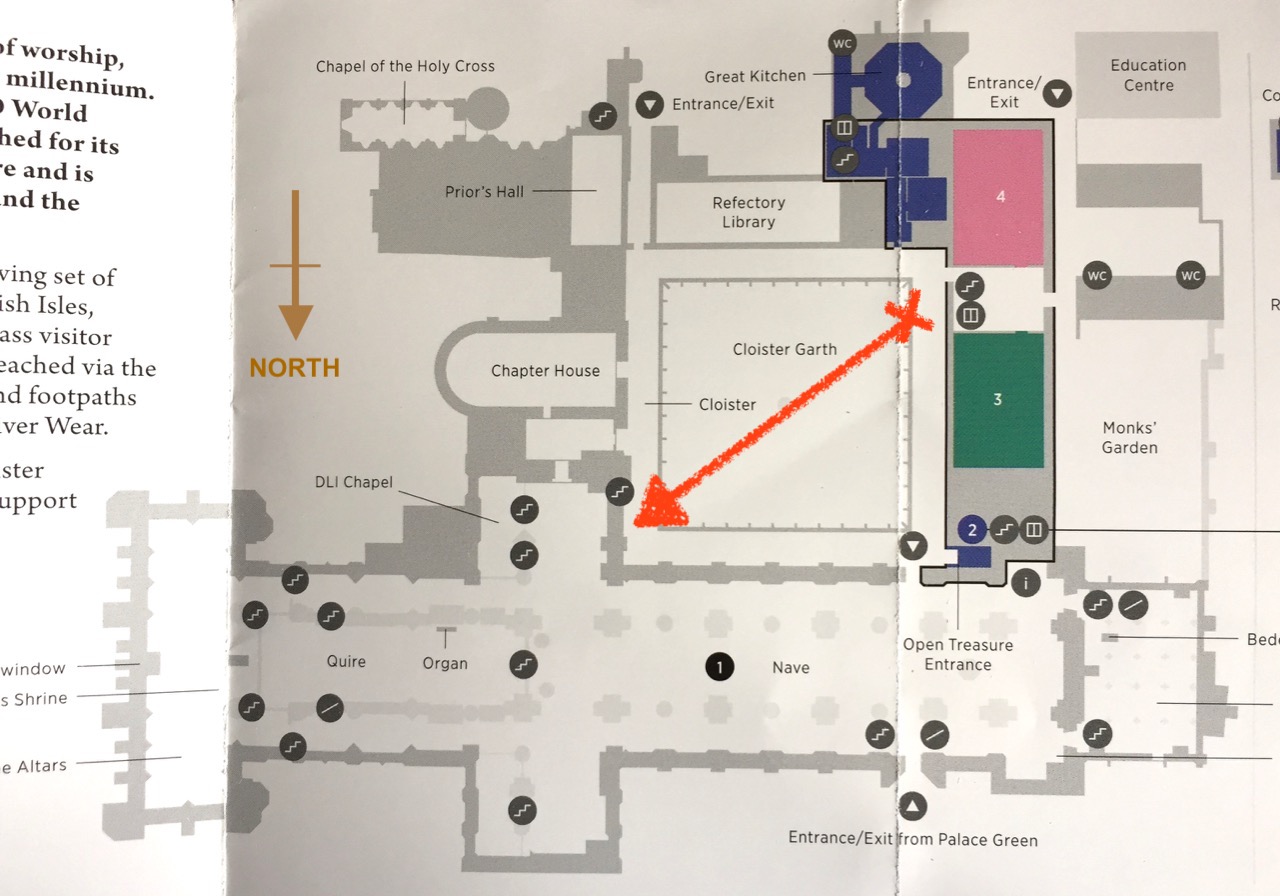
I too sat on the polished wood seat. Flowers stems were scattered on the floor, a pick-a-stick of blossoming stalks, in the process of being placed into the vase, one by one, by a careful woman. The snapped flower stems smelt of woodland. Or perhaps that was the furniture polish. A loudspeaker announced….something, the sound echoing and incomprehensible. And because it’s Durham, suddenly I was in conversation with the woman arranging the flowers. The modern stained glass window, just visible from the shrine, is in memory of a student. It looks towards the university, which is to the North. Even though it’s North facing, the glass gleams.
Here in the view from the windows of “Lovetts” in Newlyn. They served me avocado on toast, and a good strong coffee in a pottery cup. This place opposite is labelled “Barclay and Son”, the name cut in stone in 1916. Now it is labelled “The Strand” in less durable lettering painted above the door. It sells a compendium of miscellaneous objects, furniture, crockery, badges, old ship bouys. Also outside are some flower pots. The coffee shop proprietor walked across the road to buy one for a small plant. She just left the coffee shop door open, me drawing at the window, while she did so. This is Cornwall.
The next day I was to swim 10 kilometres. So I was pacing myself, and not embarking on epic walks. The next drawing I did was from the small courtyard at the back of the hotel in Penzance.
Here you see the roofs of the hotel and adjacent houses. The walls are hung with slates, like scales. The style of covering is called “shingles”, as in “a slate shingled wall”. You see one in the top left corner of the picture.
The two highest chimneys are splendid examples of the chimney-pot maker’s art. The one on the right has two downward pointing holes, and must have been hard to form in terracotta. Maybe I am the first person for decades to appreciate these chimneys and admire the workmanship.
The swim was an event organised by Tom and Jo of “Sea Swim Cornwall“. Forty assorted people swam in 4 different bays, around an island, and up and down a river, “The Gannel”. It was well organised, friendly and fun. And totally exhausting.
So the next day I strolled around Penzance and drew pictures. Here’s a view from St Mary’s Churchyard in Penzance.
Above the arch the stone tablet reads:
HUNC LAPIDEM POSVIT PHILLIPPVS HEDGELAND IN ARTIBUS MAGISTER PREBENDABIVS EXONIENSIS ECCLESIAE PAROCHIALIS SANTAE MARIAE VICARIVS PRIMUS
I work this out as: “This stone was placed here by Phillip Hedgeland, Master of Arts, a cleric (Prebend) of Exeter, who was the first vicar of this Church, St Mary’s.” If anyone’s Latin can offer a better translation, please let me know. On the side of the arch facing the sea was the date: 1883.
The picture, though, is really about the lamp-post. This looks like the one in the Narnia Stories. It is numbered 164AZ with a tag round its middle. After I drew it, I went to check it was a real cast-iron lamp-post and not a fibreglass replica. It was indeed a reassuring cold cast iron, and the maker had put their name in capitals in two places: HOLMAN & SONS PENZANCE”.
By the door of the church I encountered a beautifully engraved tombstone, with Art Nouveau flourishes. It told a sad story though:
In memory of HENRY M FUDGE,
son of the late HENTRY FUDGE MASTER MARINER
who departed this life Oct 2nd 1822 aged 2 years and 5 months
also S S.F. EDDY daughter of Richard Sally Eddy of this town who died 23 June 1835 aged 1 month.
I drew this picture entirely in three colours: Prussian blue, Alizarin Red, and Indian yellow, from Watercolour box 1.
My stroll. X marks St Mary’s Church.
The sad story.
Click a button below to share this post online, email it, or print it:
Here is the view from high up in the marvellous Skip Garden at Kings Cross. Coal Drops Yard roofs are in the background, behind the crane.
I did this picture with just three colours: cobalt blue, yellow ochre, and alizarin crimson. The yellow ochre and cobalt blue refused to make green. They made grey.
Here is the picture under construction.
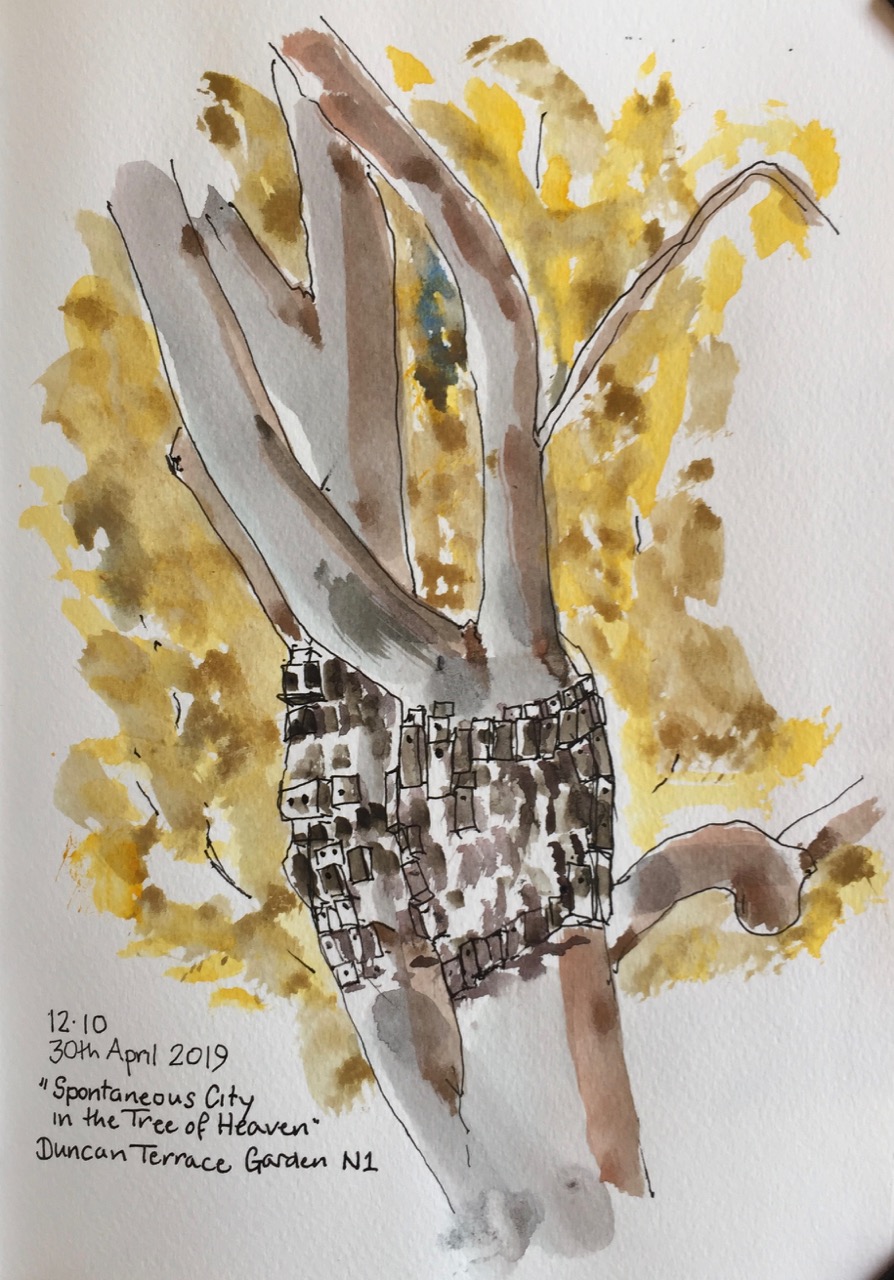
On the way to Kings Cross I passed through Duncan Terrace Gardens, in Islington, where there is an extraordinary “bird hotel” in one of the gigantic trees. It was made by “London Field Works” and consists of 300 specially made bird boxes, all different sizes, fitted round the tree.
A nearby notice assured me: “The method of installation has been designed in close consultation with the Forestry Commission and the borough’s ecology dept to enable the tree to continue to grow and expand.”
Click a button below to share this post online, email it, or print it:
This huge redbrick building in Leman Street stands proudly amongst the 21st century steel and glass. Inscribed round its windows and above its door in letters a foot high are the words “Co-operative Wholesale Society Limited”. The words are spelled out in full, and written in stone. Oh, those confident and visionary Victorians!
The Co-operative Wholesale Society’s London Branch headquarters were built to designs by J. F. Goodey of 1885. At the formal opening on 2 November 1887, the CWS announced that it should ‘be their aim to make this beautiful building a common home for all the various movements having for their object the interest and advancement of the working people. They had with them their friend, the Rev. S. A. Barnett, and they hoped to work hand in hand with him and the residents of Toynbee Hall, in giving a message of hope to the people of the neighbourhood’
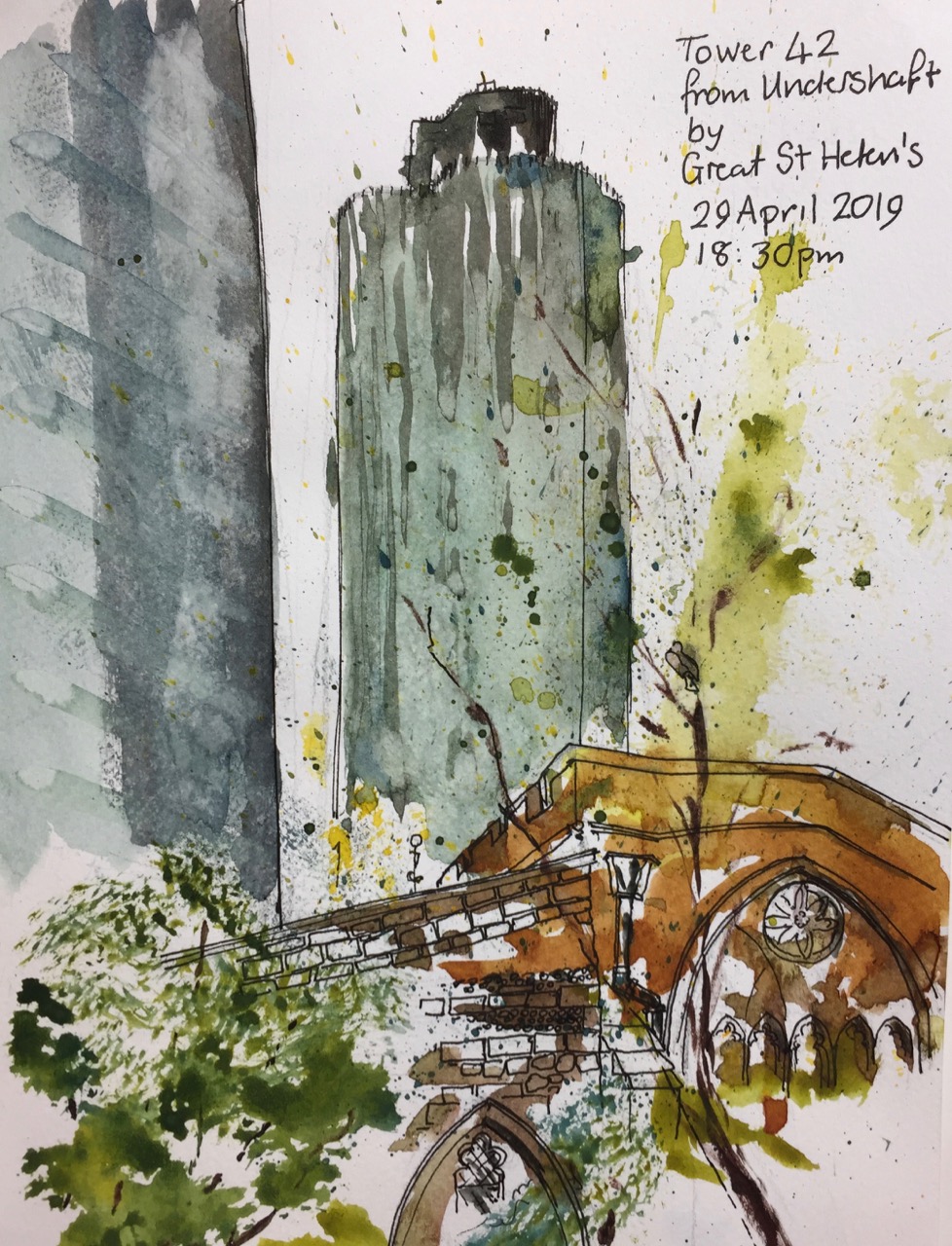
This is looking West from “Undershaft”, which is the small road going west from the Gherkin. Appropriately enough, perhaps, it now disappears down into an underground car-park.
Tower 42 (formerly the “NatWest Tower”) is in the back centre, and the new tower “TwentyTwo”, 62 storeys, at 22 Bishopsgate, is on the left.
In the foreground is Great St Helen’s Church. The roof really was at this wonky angle. The East window has plain glass. All the medieval stained glass was shattered in an IRA bombs in 1992 and 1993.
Click a button below to share this post online, email it, or print it:
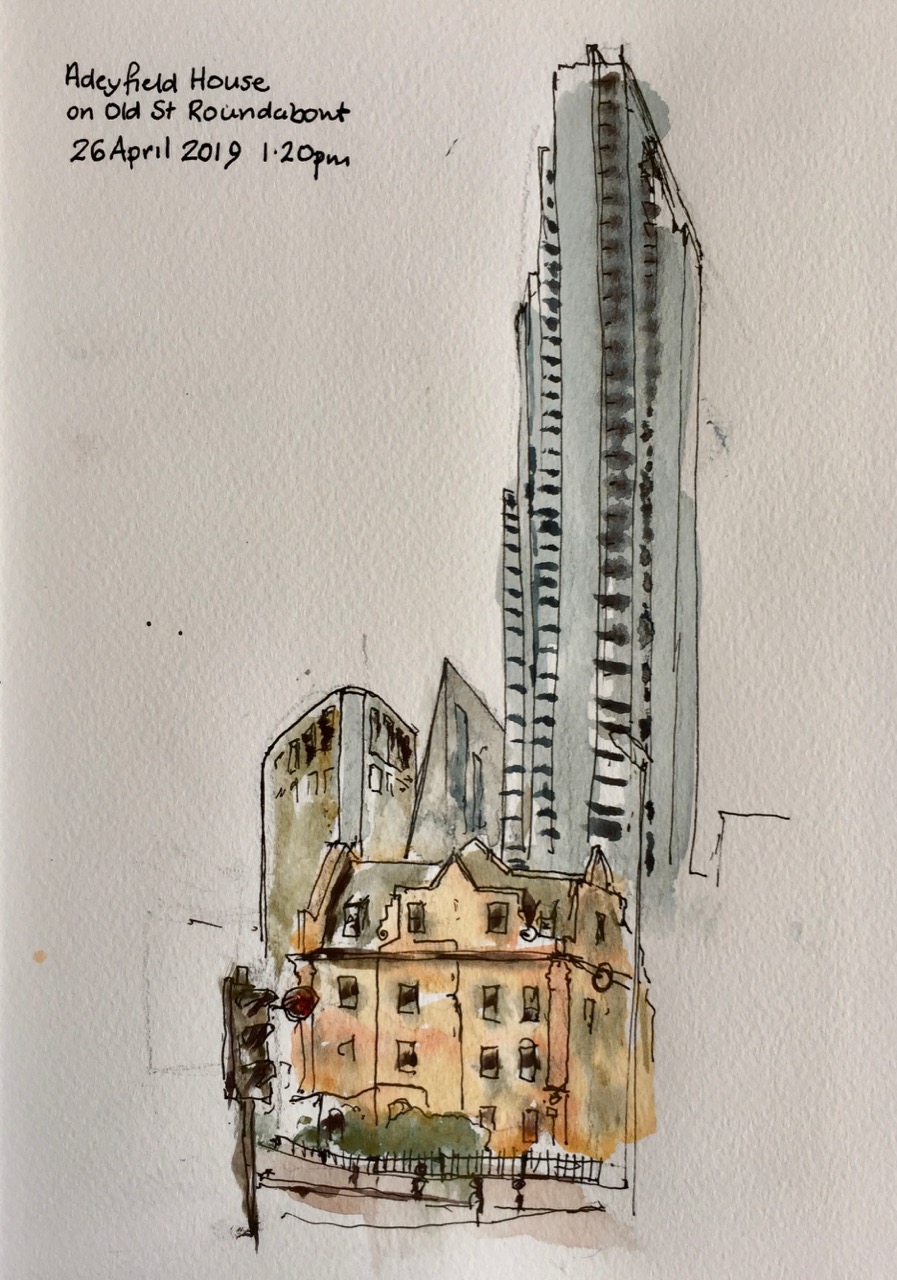
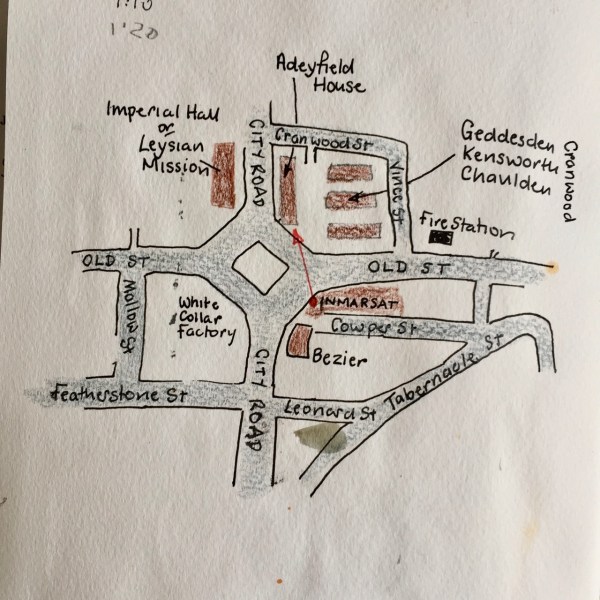
I saw this redbrick building on the Old Street Roundabout.
Above it are the huge developments on City Road. From left to right they are Eagle Point, M by Montcalm, and the Atlas Building.
Adeyfield House is residential, part of the Sutton Estate, managed by Islington Council.
The Old Street roundabout was sometimes called “silicon roundabout” because of the high-tech start-ups in the surrounding area. I haven’t heard that term used for a while though. There are certainly many incubator-type office blocks. One is called “White Collar Factory” and was near to where I was standing outside Inmarsat. Inmarsat is a satellite data company.
Old Street roundabout is about to be re-configured to make it more agreeable for pedestrians and cyclists. At the moment it is noisy, polluted, dangerous to cyclists and difficult to navigate on foot.
Huge numbers of pedestrians passed by me on the pavement, talking of investments, employment opportunities, stock options, and where to go for lunch.
Click a button below to share this post online, email it, or print it:
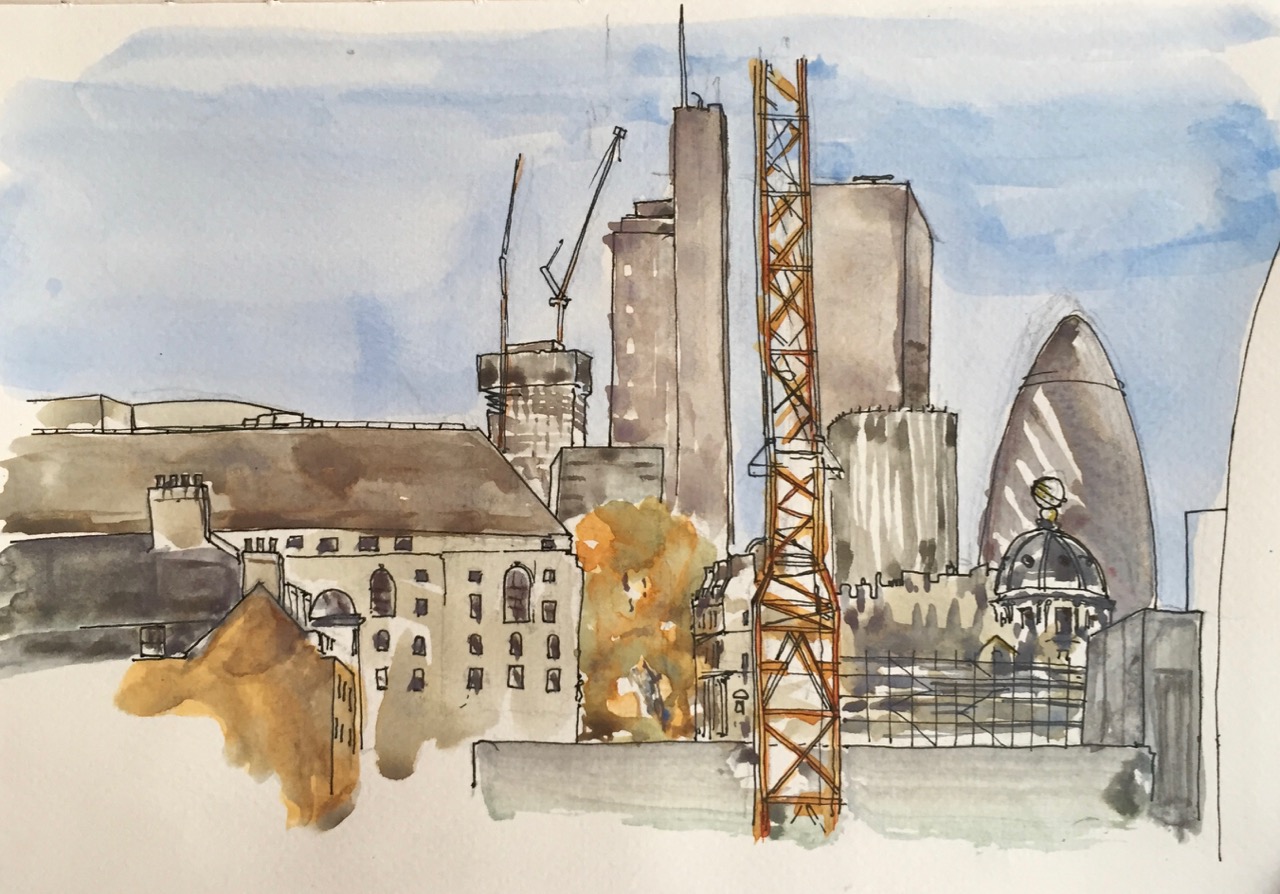
From the Barbican Podium underneath Willoughby House you can look East across the Crossrail site. Soon this view will be obliterated by the tall building on top of the Moorgate Crossrail station. But just now, this is what you can see:
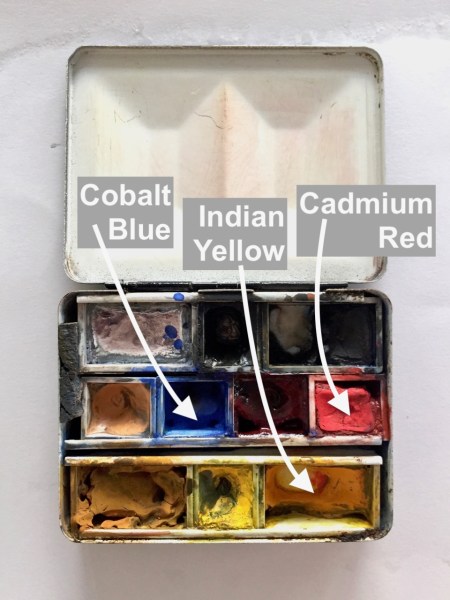
I drew this picture with just three colours:
Cadmium Red (Rembrandt)
Cobalt Blue (Jacksons)
Indian Yellow (Jacksons)
This was following the advice of Teoh Yi Chie of Parkablogs, in one of his Youtube posts, called “How I choose which colours to use”. He advises limiting the number of colours, and choosing just one red, one yellow and one blue for a picture. As you see, it is possible to create a wide range of colours from just three, including all the greys you see in the picture.
I was particularly pleased with the sheen on The Gherkin, which happened as the colours granulated and dried out.
The Towers in the picture are part of the emerging “Eastern Cluster”. This is a region of skyscrapers in the City of London. More will be added, according to the Eastern Cluster Strategy (try this link: City of London Eastern Cluster Strategy).
Here are the ones I could identify:
Here are photos of the picture being drawn:
About 1½ hours, drawn and coloured standing on the podium, leaning the sketchbook on the concrete of the podium. Warm breeze. Sun. I needed the sunhat.
Click a button below to share this post online, email it, or print it:



 This was surprisingly effective. I managed to get all the ink drawn before 10:45, when I packed up again, to go to the Planning Meeting. During this time I was approached by a flustered gentleman in a smart suit, who wanted to “get across the lake”. He was hopelessly disoriented, pointing South-West, when he should have been heading North-East. I re-directed him and he dashed off towards the Barbican Hall.






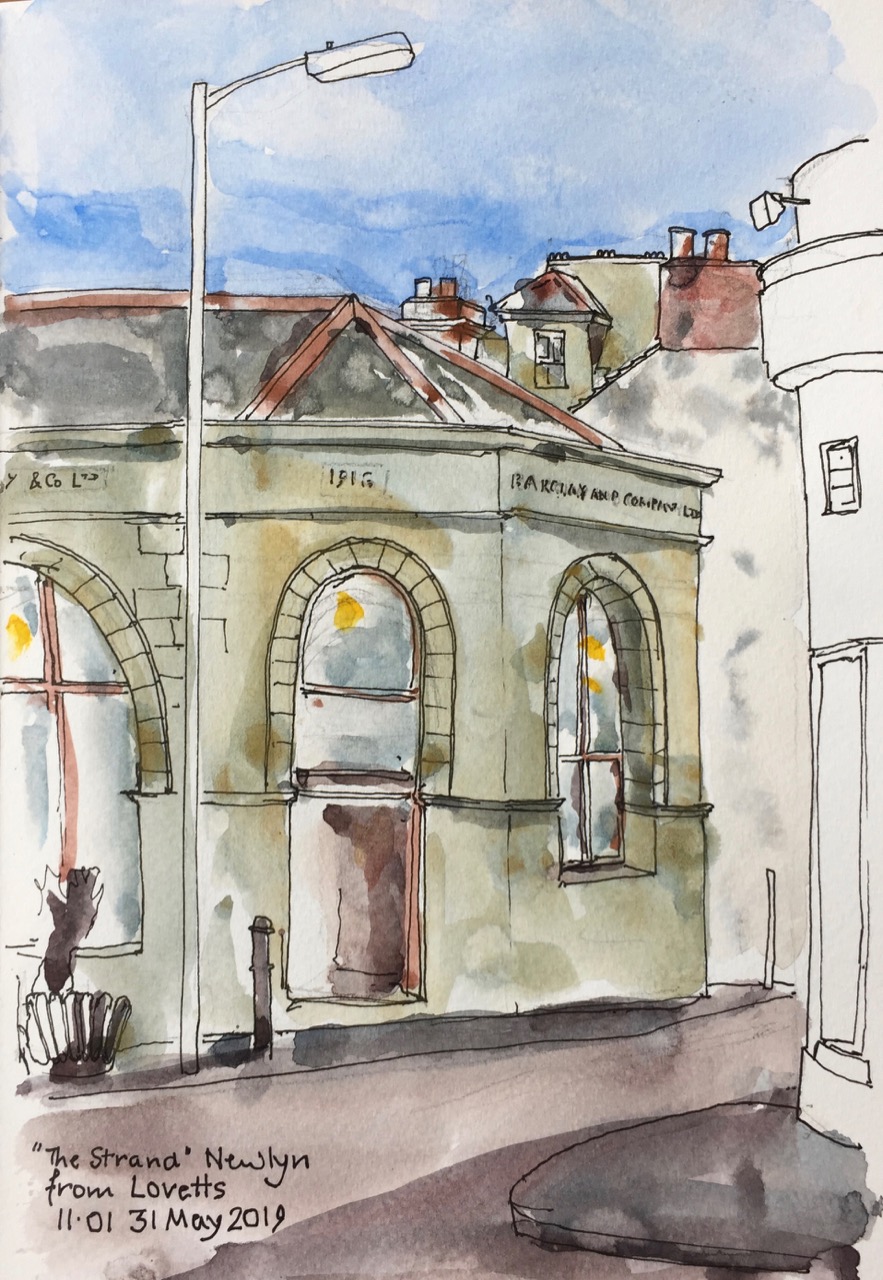
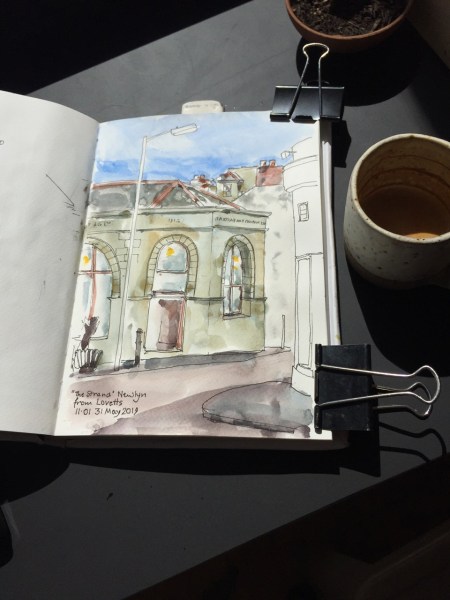 toast, and a good strong coffee in a pottery cup. This place opposite is labelled “Barclay and Son”, the name cut in stone in 1916. Now it is labelled “The Strand” in less durable lettering painted above the door. It sells a compendium of miscellaneous objects, furniture, crockery, badges, old ship bouys. Also outside are some flower pots. The coffee shop proprietor walked across the road to buy one for a small plant. She just left the coffee shop door open, me drawing at the window, while she did so. This is Cornwall.





 Cadmium Red (Rembrandt)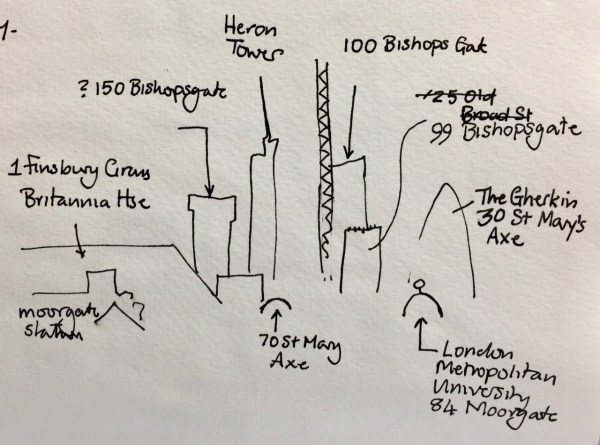


 Jane Sketching