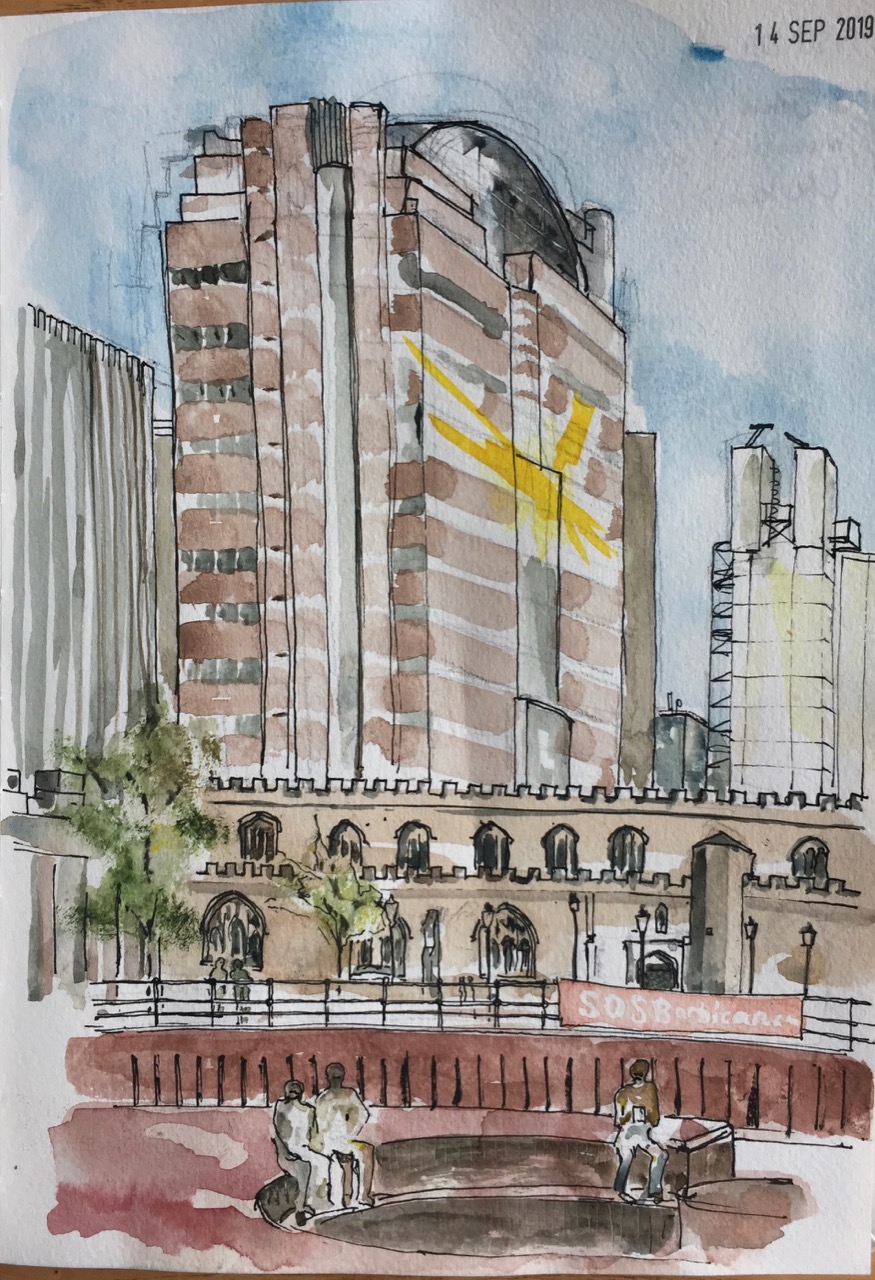
This is a drawing on one of those hot days last week.
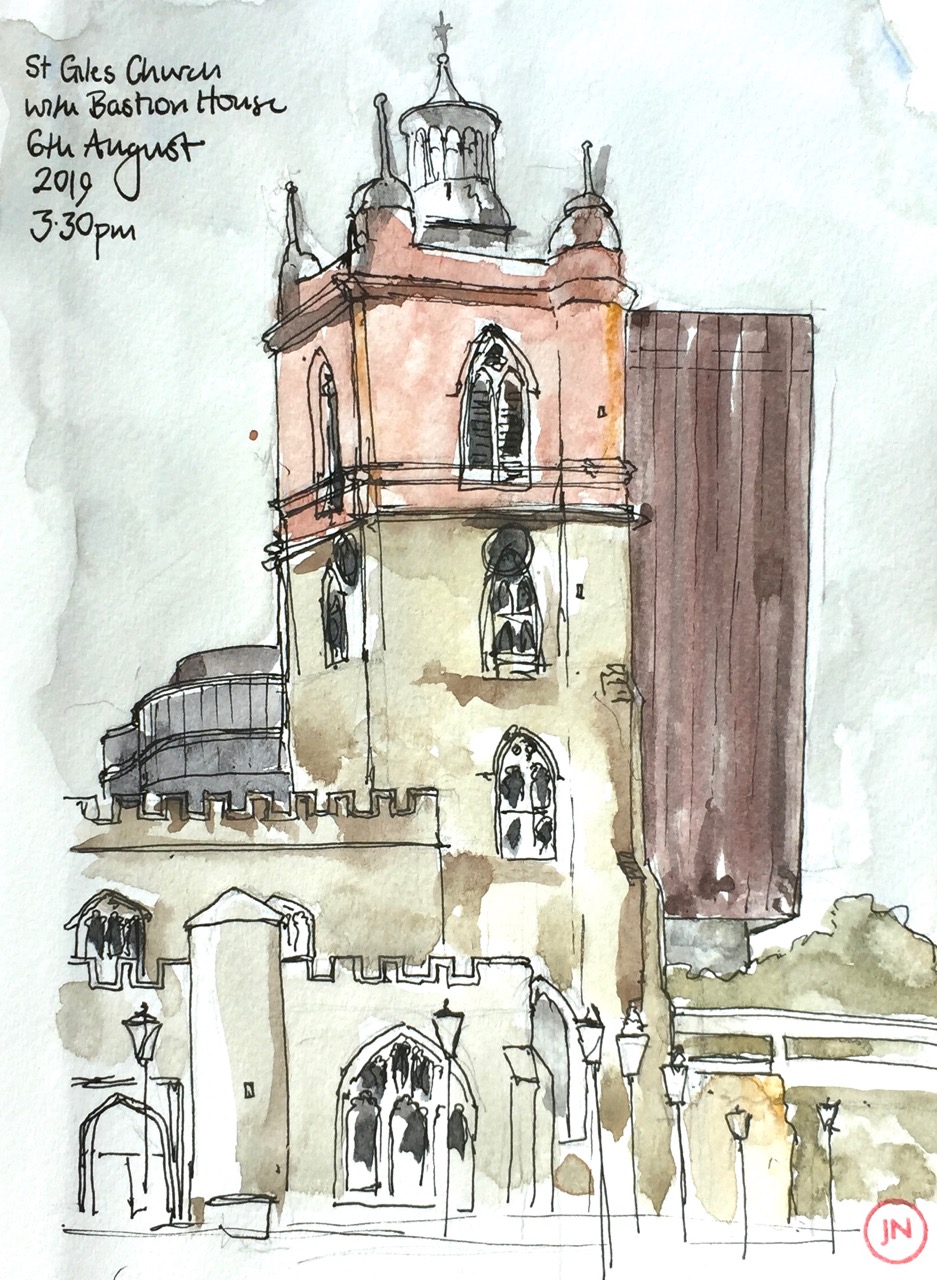
I sat at one of the tables on the Barbican Lakeside Terrace and drew what I saw. The massive building is 125 London Wall, a multi-occupancy monolith. Behind, to the right is 88 Wood Street, designed by Richard Rogers (“Rogers Stirk Harbour + Partners”). It’s a bit like the Lloyds Building, with transparent walls and lifts you can see going up and down. On the left is the new building at One London Wall Place.
In front of all that is the side of St Giles’ church, with its castellations. There was a celebration going on: Barbican@50.
The banner you can see fastened to the railings says “SOSBarbican.com”. It is placed by objectors to the proposed extension of the Girls School.
1 hour 20.
Click a button below to share this post online, email it, or print it:
Here is the Guildhall School of Music and Drama, seen from across the Barbican Lake. I drew this sitting on a ventilator grille in an alcove of the residential flats in Andrewes House.
The Tower in the distance is Cromwell Tower. The sloping glass roof is the Barbican Conservatory. Gilbert House is the residential block on the left. In the foreground is the magical sunken garden, a planted area whose walkways are below the level of the lake.
As I drew, I was watched with interest by mallard ducks. One settled at my feet, in a proprietorial way.
I had not noticed before that the Guildhall School is built as a series of blocks, rather like a container park. The top row and the bottom row don’t quite match. The second row has a series of upright concrete beams, which I’ve shown, between the blocks.
I saw that the windows are angled. The inhabitants of one block must be able to see, in a sideways sort of way, into the next block. I’ve never been inside the School, so I don’t know how this works out in practice. But after all, this is a school of performing arts, so it’s rather good if you can see your fellow students through a window: every window a stage.
However the angling of the windows meant that from outside I couldn’t see inside. I have to wait until the performers are ready to present their pieces on a public stage. Still, from time to time I heard a flight of notes on a saxophone. Perhaps they had opened the window of one of the practice rooms.
About 2 hours, including a chat to a fellow resident who stopped by.
Predominantly just two colours: Perinone Orange and Prussian Blue, with a tiny bit of Mars Yellow in the rushes.
Click a button below to share this post online, email it, or print it:
Here is St Mary Abchurch, a view from Cannon Street, London EC4. There was a church here from about 1198. It was destroyed by the Great Fire in 1666. The current church was built to the design of Christopher Wren in 1681-86. It is the headquarters of the “Friends of City Churches” who make the City Churches accessible.
This is one of those ephemeral views. There is a huge building site in front of the church, and so when the building is done, this view will disappear.
The notices on the hoardings say:
“DANGER! No climbing. Fall behind”
“Dragados SA (UK) Considerate Contractor Scheme, 30th Anniversary Winner 2018”
“No Pedestrian Access or Egress Apart From Plant Movements or in an Emergency”
I enjoyed the use of “Egress”, and puzzled over the phrase “Fall behind”. It must mean “There is a big drop behind this notice”, but it sounds like “We are delayed, and falling behind schedule.” There is also a huge Health and Safety notice, mandating in detail the protective clothing you must wear, including, rather ominously:
“Flame retardant clothing must be worn near buried services”
What’s this building? Well, according to the notice:
” We’re transforming Bank Station to improve your journey. Completion 2022. Search TFL Bank”
I searched “TfL Bank” as instructed, and found a vast amount of information. TfL (Transport for London) is making Bank Station bigger – a “capacity upgrade” as they term it. The building site I’ve spent this afternoon looking at is described thus:
“The Cannon Street worksite consists of the area bounded by King William Street, Nicholas Lane, Cannon Street and Abchurch Lane. The proposed new station entrance and infrastructure such as new escalators will be constructed on this site, which is currently occupied by six buildings. Demolition will be required to allow the worksite to be established before the start of any ground treatment, piling or work on the station entrance. The façade of 20 Abchurch Lane will be retained and will partially screen Abchurch Yard from the works. The worksite is over the proposed new Northern line platform tunnel. The site provides access to the work below ground through the new station entrance box and escalator barrel. During the works there will be site office and welfare facilities within 20 Abchurch Lane. The proposed worksite provides a minimum of space for storage of some materials and equipment for construction operations. It will also be used to store excavated material, before it is transported off site.”
They provide wonderful maps. Here’s an extract:
From “Bank Station Capacity Upgrade – fact sheet 2”
It’s somewhat reassuring to know they have such detailed maps, as the area round St Mary Abchurch looks medieval. I walked through there, down “Sherbourne Lane” and back home though the alleyways of the City.
Here’s my map, and some work-in-progress photos.
My map
Pencil
Pen
About to add the colour
Pen, close up
Watercolour in progress
Just finished it
Drawing on location
About two hours, drawn from the steps of 108 Cannon Street.
Click a button below to share this post online, email it, or print it:
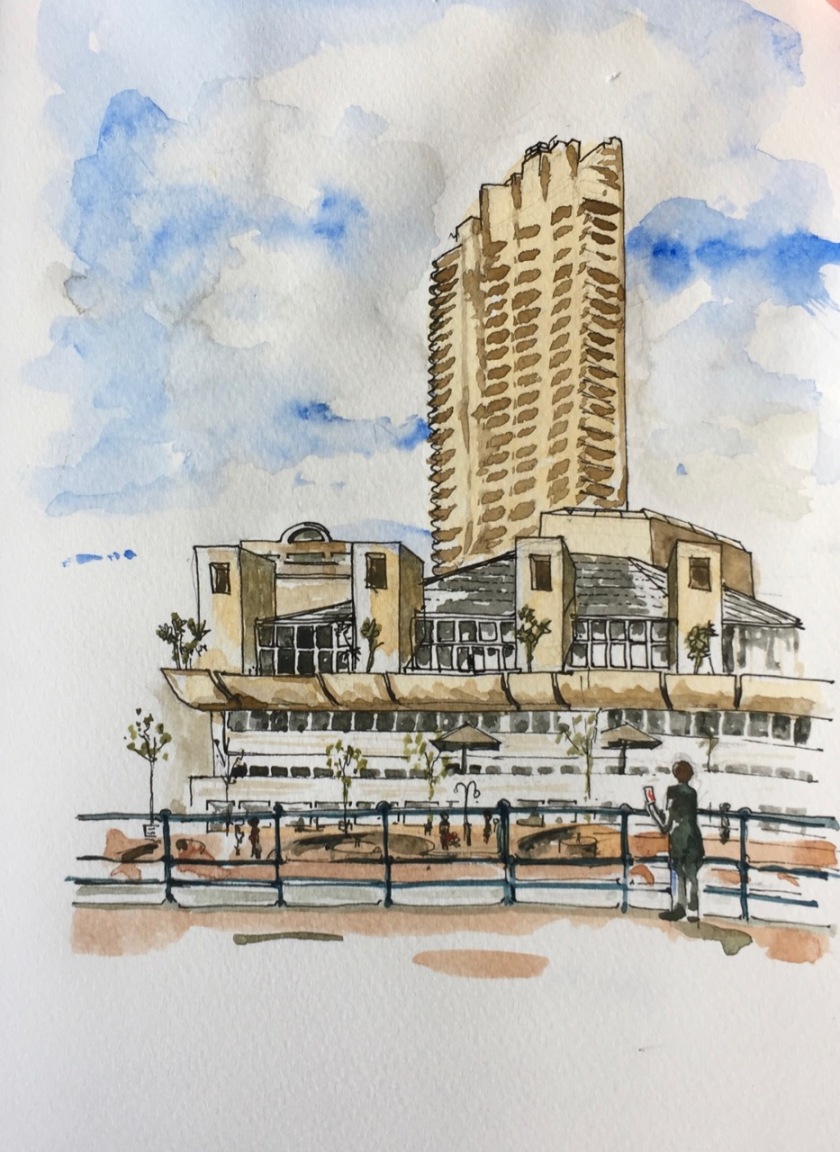
Here is a picture of someone looking across the Barbican Lake. Their mobile phone is telling them that the Barbican Arts Centre, the Lakeside Restaurant, the Art Gallery and the Cinemas are all over there in the sunlight. Such delights! But how do I get there? In between here and there is some murky water, and a big drop down.
What they need to do is to turn their back on where they want to go, walk, go up an obscure staircase that looks private, and then proceed across Gilbert Bridge which is high up to their right and invisible from where they are standing. I would have told them all this, but they obviously worked it all out for themselves before I could put my paintbrush down and descend from the tiled stone monument where I was sitting. Perhaps the mobile phone app is, by now, educated on the Barbican geography.
The tower in the picture is Cromwell Tower, and the glass building is part of the Barbican Conservatory.
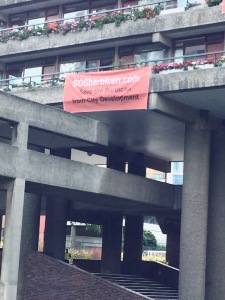
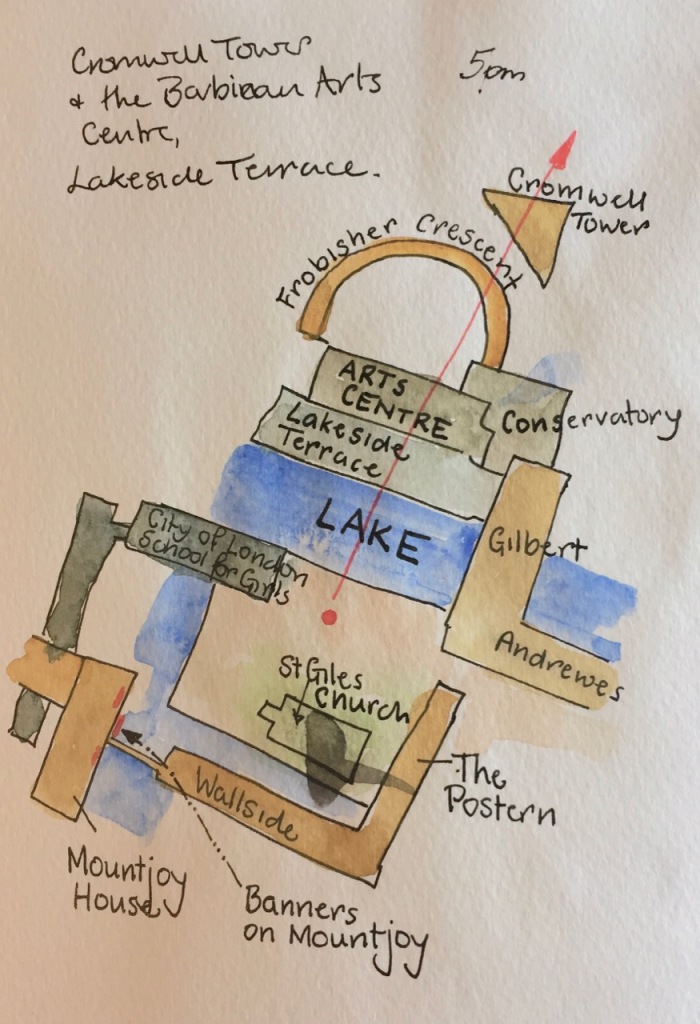
“SOSBarbican.com” banner on Mountjoy House
Today there are banners outside some of the flats in Mountjoy House in the Barbican. They are there to draw attention to the proposal by the City of London School for Girls to build an extension, including kitchens, right underneath these flats. I have drawn pictures to illustrate the proposal, and to show why many of us object. See this link: Under Mountjoy House, Barbican
Information about the campaign is here: Objection to CLSG expansion. If you appreciate the Barbican architecture, please consider signing the petition.
Here is a map:
Map showing the direction of the view in the picture, and the location of the banners.
Click a button below to share this post online, email it, or print it:
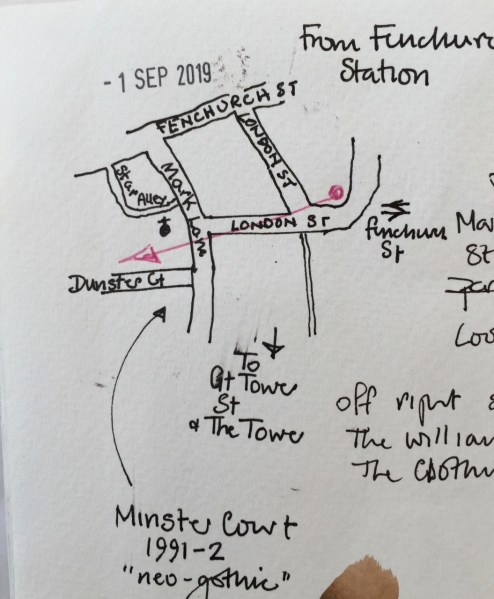
From Fenchurch St Station there is a stunning architectural view. I sketched it, standing outside the station. This was not a great place to stand. I put the colour on later, sitting down in the wooden seats nearby. A woman with a bike came by and told me someone had let down both her tyres. Why would they do that, she asked me. Why indeed. She went off, pushing her bike on its flat tyres. Her dog followed on its lead, disgruntled, catching the mood of its mistress, deprived of a ride in the special dog-basket on the back of the bike.
From Fenchurch St Station, looking West, along London Road
Shown in the picture on the left is “Minster Court” a pinkish coloured Neo-gothic building built in 1991. It contains, amongst other things, the “London Underwriting Centre” and “Proud Cabaret City”, and a branch of “Balls Brothers”, a pub.
Sketch map, showing the direction of the view from Fenchurch St Station.
The glass building is “Plantation Place” built 2004, by Arup Group. Accenture is in there.
Behind I hope you recognise the “Walkie Talkie” skyscraper. In front and centre is the Clothworkers Guild. The little building at the bottom is St Olave’s Church Hall. St Olave’s Church itself is a lovely tower, which I would have seen if I’d moved slightly to the left. It’s behind the ponderous dark building on the right. I’ll go back and sketch it another time. This is the church where Samuel Pepys worshipped.
I walked towards the river and sketched in St Katharine’s Dock.
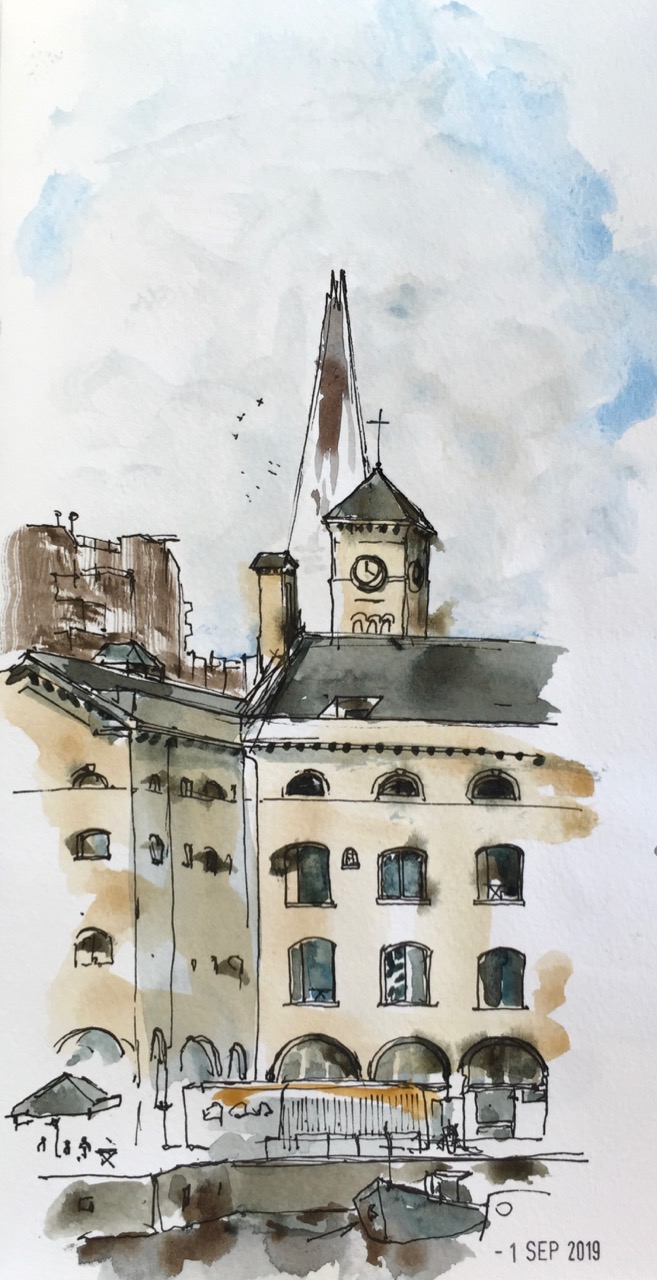
This is the view looking West, from the East side of the dock.
St Katharine’s Docks, looking West (IMG3517)
In the background on the left is “Guoman Hotels The Tower”, which is right next to the Tower of London. This hotel was built in 1973, one of the first buildings of the dockland re-furbishment. The Shard is in the background, centre.
The main building in the picture, former warehouses, is now called “The Ivory Building”. It appears to be residential. There were lots of bells to push, but I didn’t. I envy the person who has that turret. The clock was showing the correct time.
On the lower left is a restaurant with a sun umbrella. Its name was so tangled up in the fancy script of its logo that I couldn’t read it, something like “docole”.
Off the picture to the right a large rectangular stone was embedded at eye height. People rushed past, to the cafés and restaurants. The writing on the stone said:
“The foundation stone of Commodity Quay World Trade Centre London, laid on St Katharine’s Day 1985”
St Katharine’s Day is 25th November, in case you were wondering. Also spelt with a C.
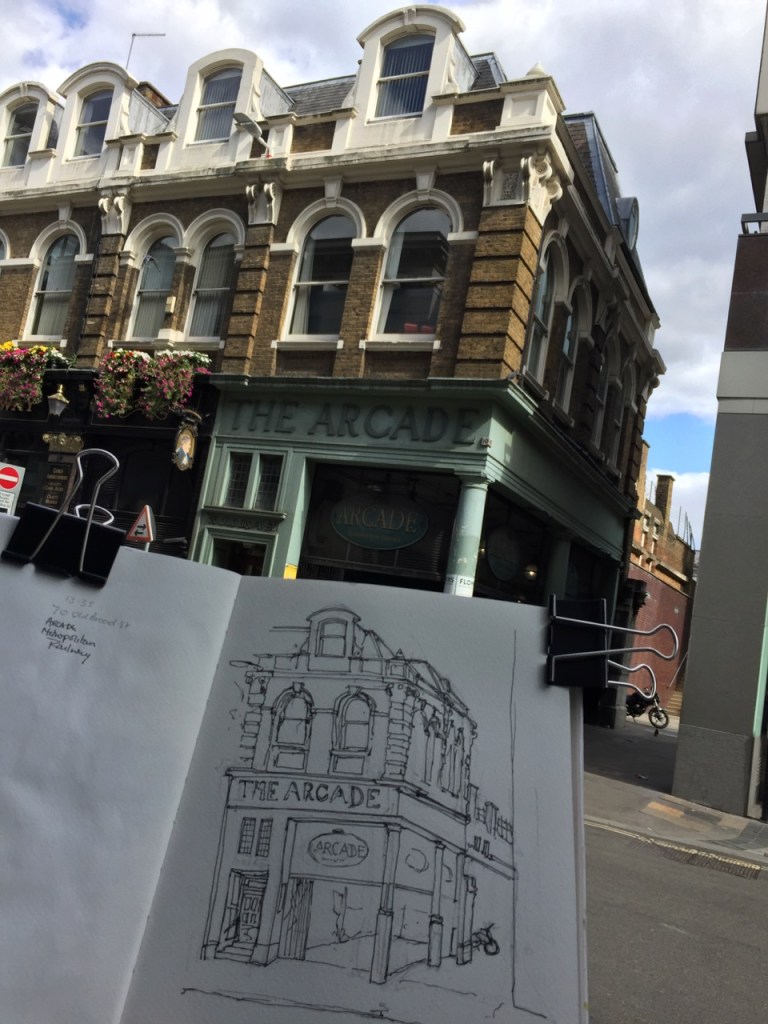
Here is my favourite picture of the walk, done on the way back.
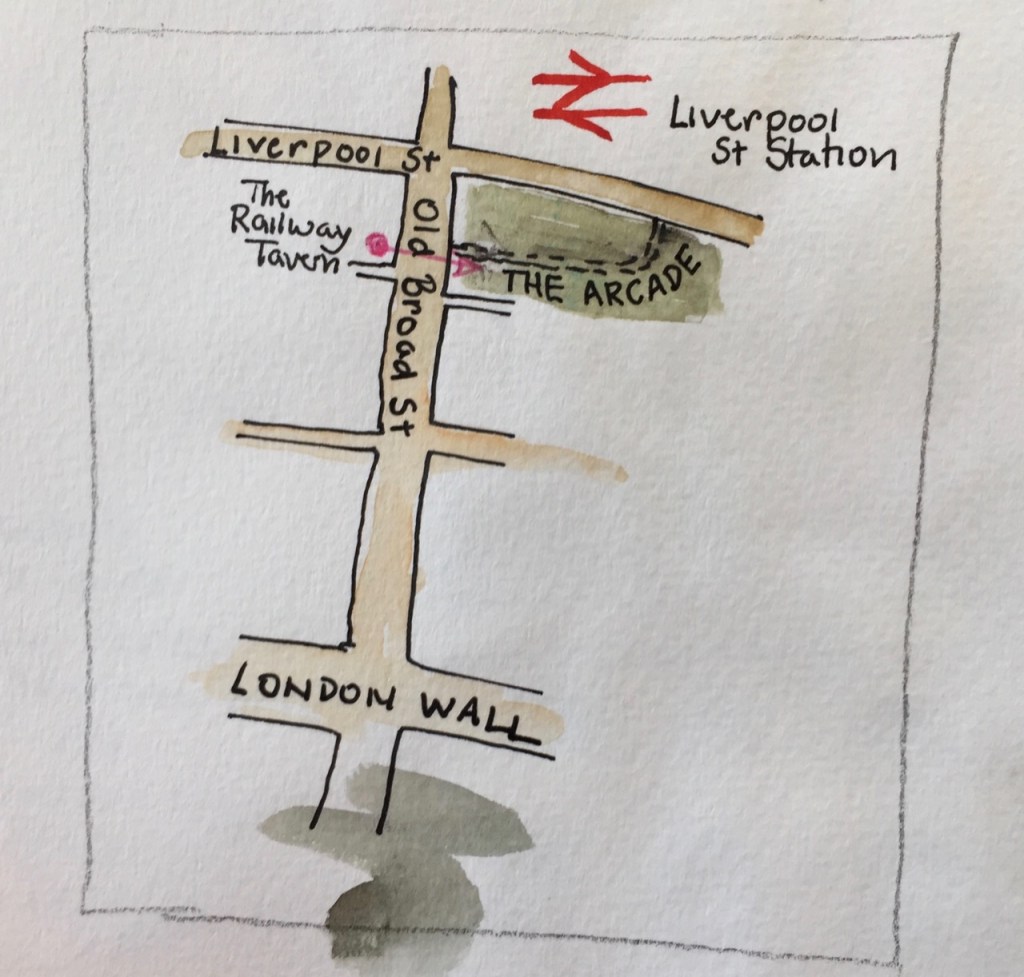
The Arcade, Liverpool Street
This is an astonishing construction, left over from an earlier epoch, and now surrounded by new-build and glass and steel office buildings. It is a corridor of shops, like the famous passages in Paris. But actually, not like them. Since it was Sunday, the Arcade was not trading. It was looking rather dilapidated. As I sketched, I saw tourists make their way in there uncertainly, in a characteristic pose of staring at the mobile phone and glancing about. Evidently Google was telling them that Liverpool Street Station could be accessed was down there. It cannot, not on a Sunday. As they entered the Arcade, they looked about. Then they really looked about, rather than comparing the world to the mobile phone map. They suddenly saw the broken glass, dusty shop fronts and cardboard, and the feet and legs of someone lying on the ground. They abruptly turned around and came out again into the sunlight, staring accusingly at the phone.
The script which says “The Arcade” is beautiful.
I particularly like the curved foot of the R, as though the letter is about to dance.
Here is work in progress, and a map:
“The Arcade” work in progressMap showing The Arcade
Homelessness is a problem in London, even right in the centre of the financial district.
Click a button below to share this post online, email it, or print it:
Here is St Giles Church from the Lakeside Terrace of the Barbican. While I drew this, three men were shovelling mud from the bottom of the lake. The mud is black and viscous and the men were remarkably cheerful in their task. They would have made good subjects for a drawing too. But for now, here’s the church:
The church features in some of my “Tower” sketches:
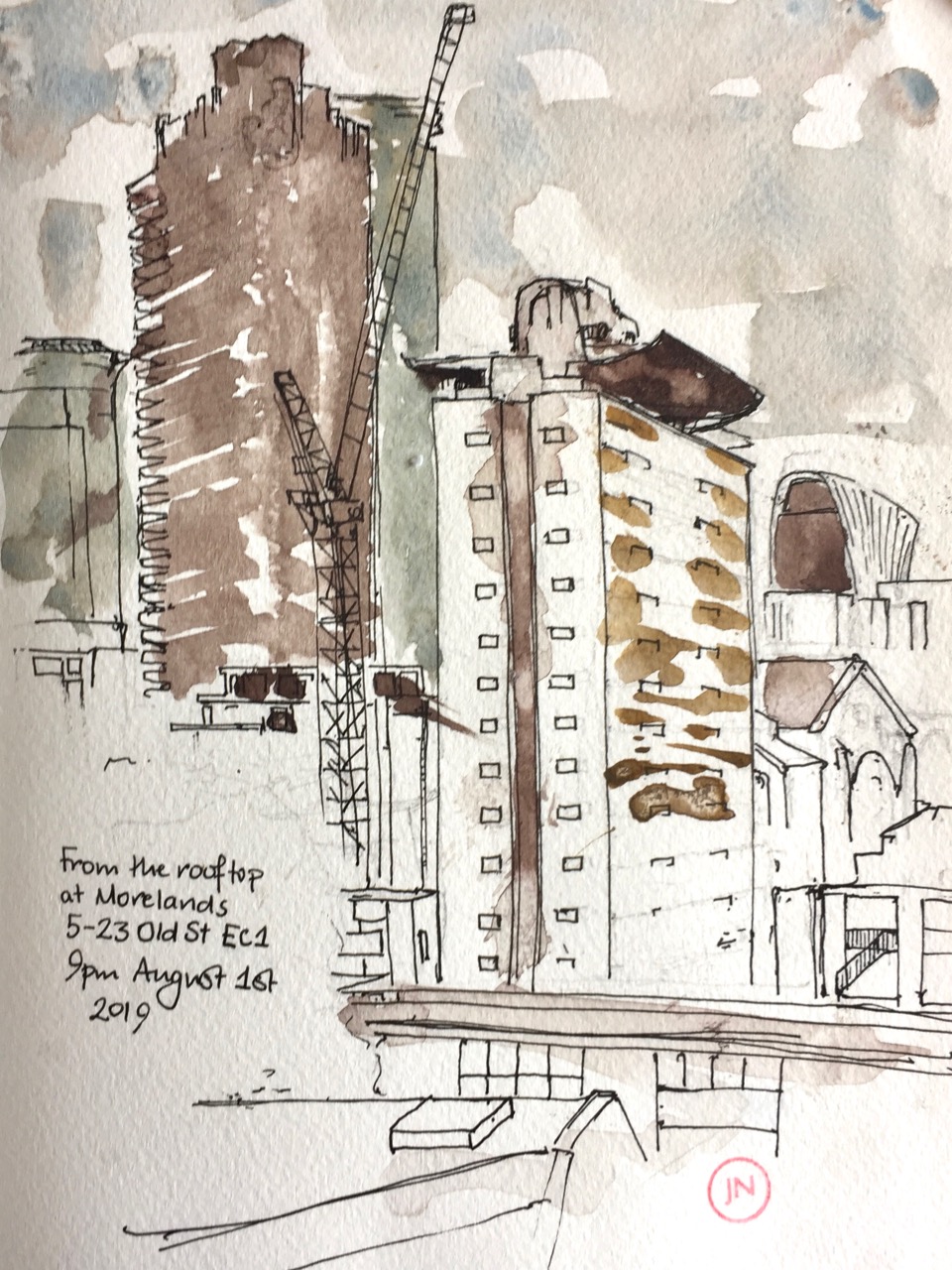
This was an event organised by RIBA* and Phil Dean a.k.a “Shoreditch Sketcher”. Morelands is a modern office block on Old St.
I looked south, and drew Cromwell Tower and Great Arthur House. This sketch took about 45 minutes, as darkness fell.
The “brise soleil” on top of Great Arthur House must be one of the most difficult things to draw. That, and the dome of St Pauls. Because it’s curved, and the curve needs to be right.
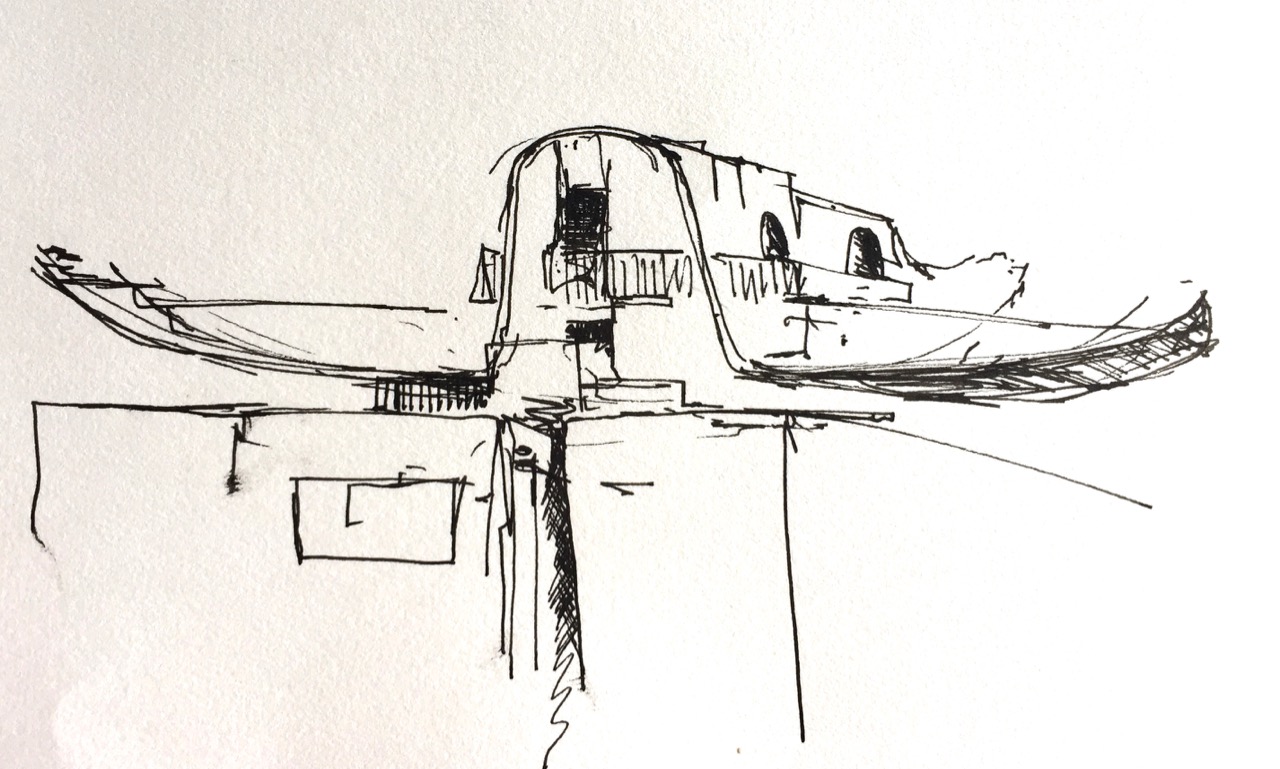
Earlier, I did a sketch of the “brise soleil” on its own. I had not noticed before that there is a sort of balcony.
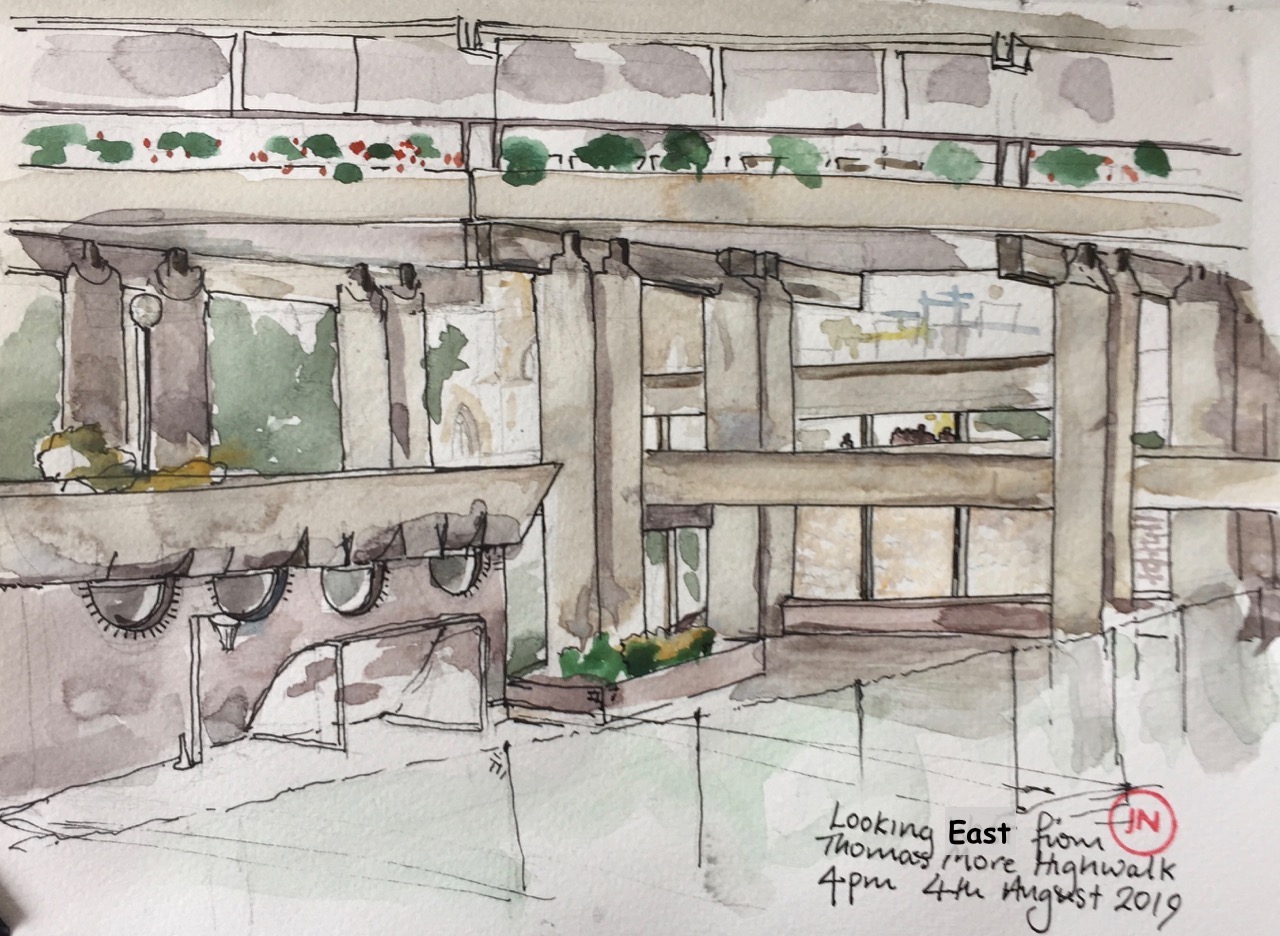
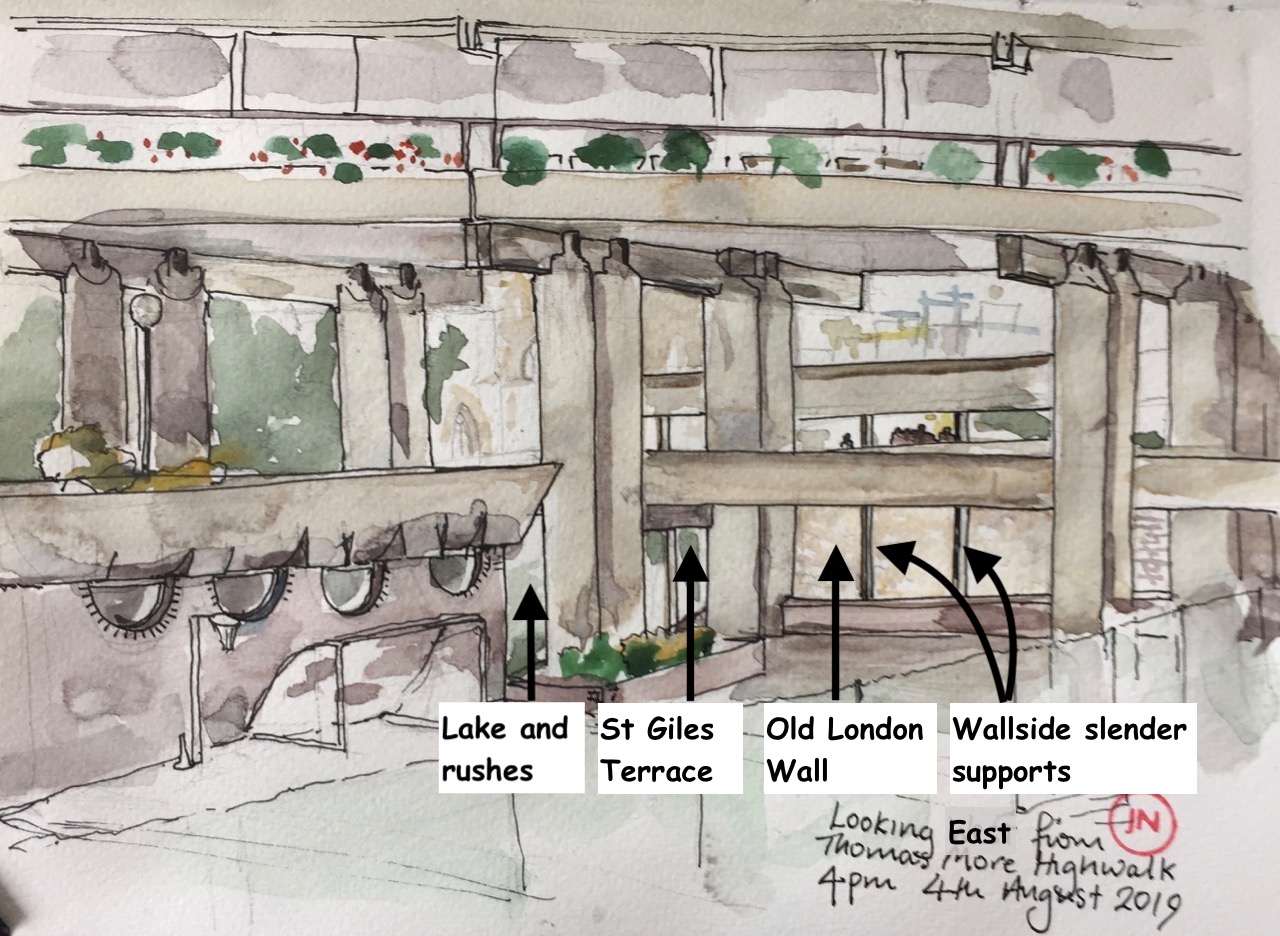
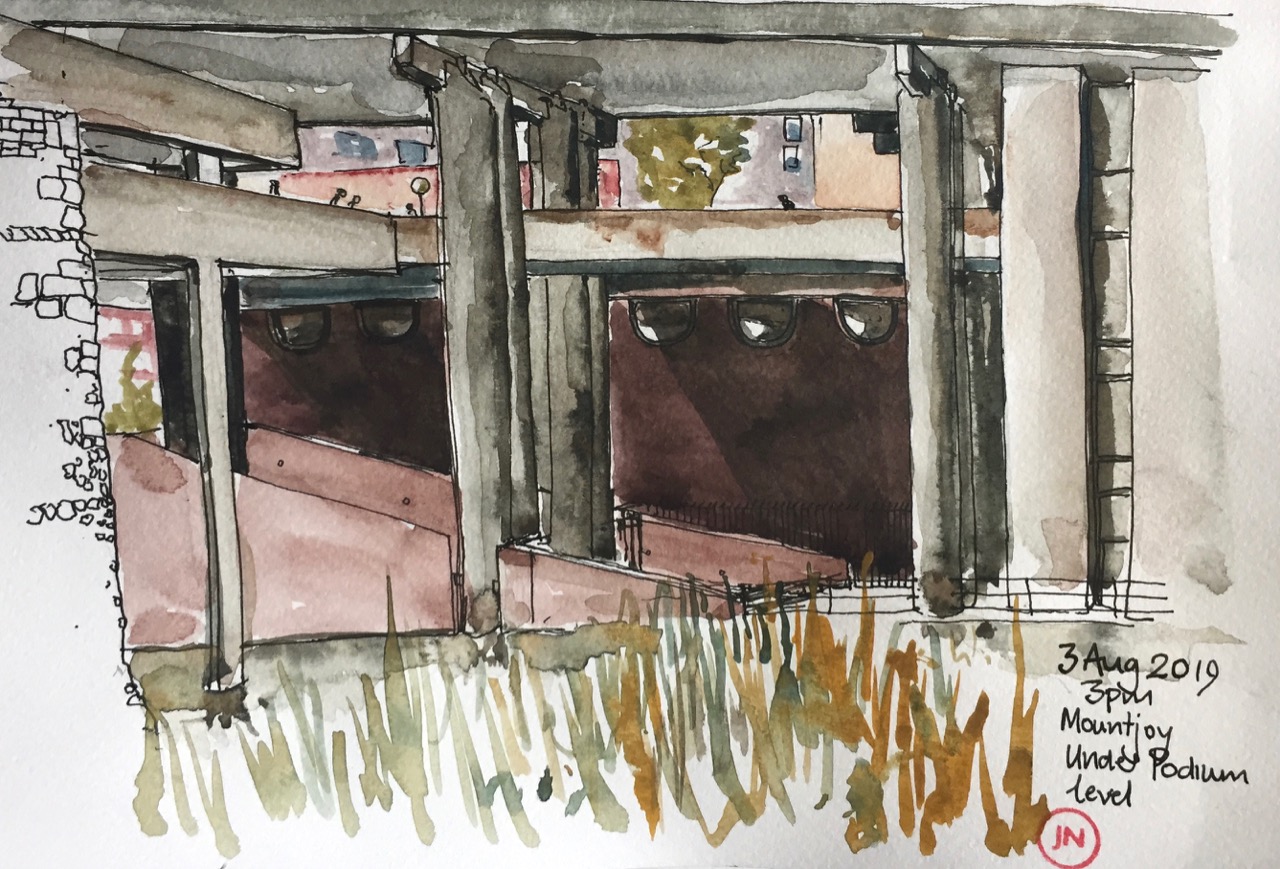
Today I found another view of the view under Mountjoy. This is from the high walk that goes north from the Museum of London, looking East.
Under the Mountjoy Highwalk there are a number of “framed” pictures. The old London Wall fortification is visible. The sun reflected from the lake and threw patterns onto the old stone. I couldn’t get all that in the picture so you have to take my word for it.
A group of tourists stopped on the “Wallside” highwalk. You can see them in the centre right of the picture.
These “windows” will all be obliterated by the proposed City of London School for Girls expansion.
This view is from the place where the north bound highwalk turns abruptly left (click map to expand it).
This picture took about an hour. I tried hard not to overdo it.
At the top of the picture are the flats of Mountjoy House, with their impressive window boxes.
Click a button below to share this post online, email it, or print it:
This is the view that will be lost if the City of London School for Girls expansion proposal goes ahead.
UPDATE (2020): the proposal has been shelved, and alternatives are sought. But we must remain vigilant. The article below was written in August 2019, when the threatened development looked as though it would go ahead. Widespread protest ensued.
The view that will be lost if the CLSG expansion goes ahead. See “SOSBarbican.com”
I spent time today paying attention to this view, because that is what I need to do, to draw it. The pillars are reflected in the water. The enormous flight of steps is like that in a fairy story, so wide and grand. There’s a massive three-dimensional sculpture of concrete, of light and dark. Flat spaces and lines don’t quite join up but are nonetheless connected, like rhythmic music. Framed by the 20th century brutalist columns you see an older more ornamented building, and trees. You can even see right through to the other side of Aldersgate. This is a magnificent view.
The interesting blotchy effect on the pillars is rain falling on the picture. I started this picture at 09:30. Then it started to rain. The fine rain speckled my picture. Bigger drops diluted the paint in the palette and made the paints shift about. Then it started pouring down with menace. I scrabbled my things together and dashed into St Giles’ Church which was behind me. Inside the church, people moved purposefully about, and all was calm. And it was dry. I took a deep breath and kept my drawing horizontal. There was a table next to the door. A woman looked at me over the table. I felt the need to explain. “I’m sheltering from the rain,” I told her.
Her response was calm and logical, “Would you like a cup of coffee?”
“I would,” I said. Her companion at the table offered me a biscuit. Grateful to the Royal Society of Organists for their hospitality, I sat on a wooden bench and let my drawing dry off. Experimental short tunes from the organ floated quizzically in the air.
Then I went out again. I wanted to finish my picture. I stood in the porch of the church and looked at the rain. “Every decision is a moral decision.” I believe that. Should I pack up the drawing and go home? I could use the time before the Planning Meeting to do the supermarket shop, deal with the plumbing problem, and process the sourdough.
Or should I continue the drawing?
What principles are at stake here? I finish drawings that I start. I don’t mind the rain. My ink and watercolour does mind the rain, though. So I’ll draw the picture under an umbrella.
This was surprisingly effective. I managed to get all the ink drawn before 10:45, when I packed up again, to go to the Planning Meeting. During this time I was approached by a flustered gentleman in a smart suit, who wanted to “get across the lake”. He was hopelessly disoriented, pointing South-West, when he should have been heading North-East. I re-directed him and he dashed off towards the Barbican Hall.
The Planning Committee Meeting at 11am was the City of London Planning and Transportation Committee. This was their July meeting. In their September meeting, if things go according to the plan put forward by the School, this same Committee is due to approve a plan for a building which will totally block out the view I have drawn. The proposed new structure would cover the steps, build round the pillars, and put in an industrial kitchen. Residents in Mountjoy House, directly above my picture, are understandably dismayed. The Barbican Association, representing Barbican residents, is leading a campaign to prevent to save the view, and stop the expansion. Here is their postcard/flyer.
On the way back from the planning meeting, I went back to the view, and put the colour.
Spending time looking at this view, these pillars, these shapes, I realise how magnificent it is, and how talented the architects were. This view is worth fighting for.
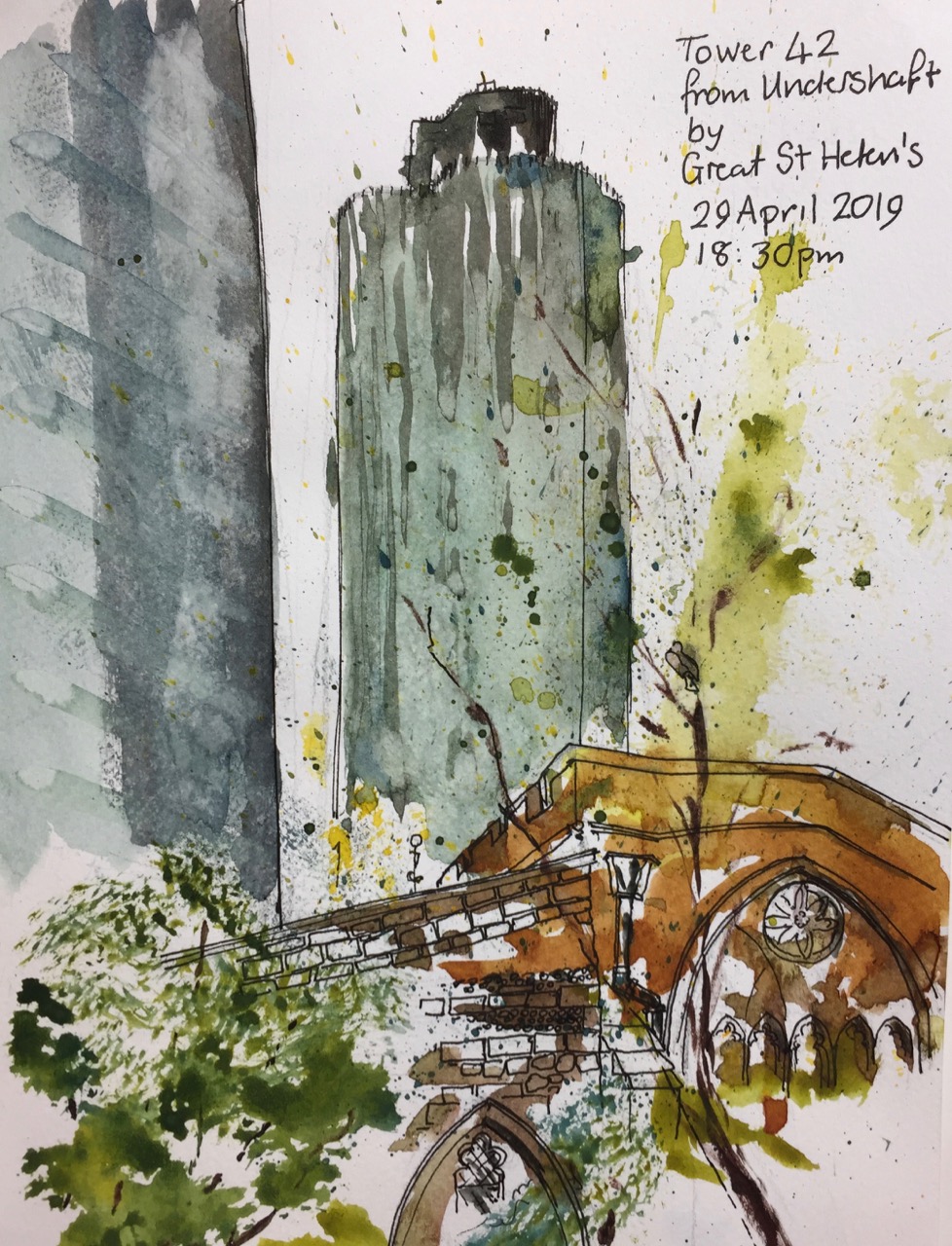
This is looking West from “Undershaft”, which is the small road going west from the Gherkin. Appropriately enough, perhaps, it now disappears down into an underground car-park.
Tower 42 (formerly the “NatWest Tower”) is in the back centre, and the new tower “TwentyTwo”, 62 storeys, at 22 Bishopsgate, is on the left.
In the foreground is Great St Helen’s Church. The roof really was at this wonky angle. The East window has plain glass. All the medieval stained glass was shattered in an IRA bombs in 1992 and 1993.
Click a button below to share this post online, email it, or print it:



 As I drew, I was watched with interest by mallard ducks. One settled at my feet, in a proprietorial way.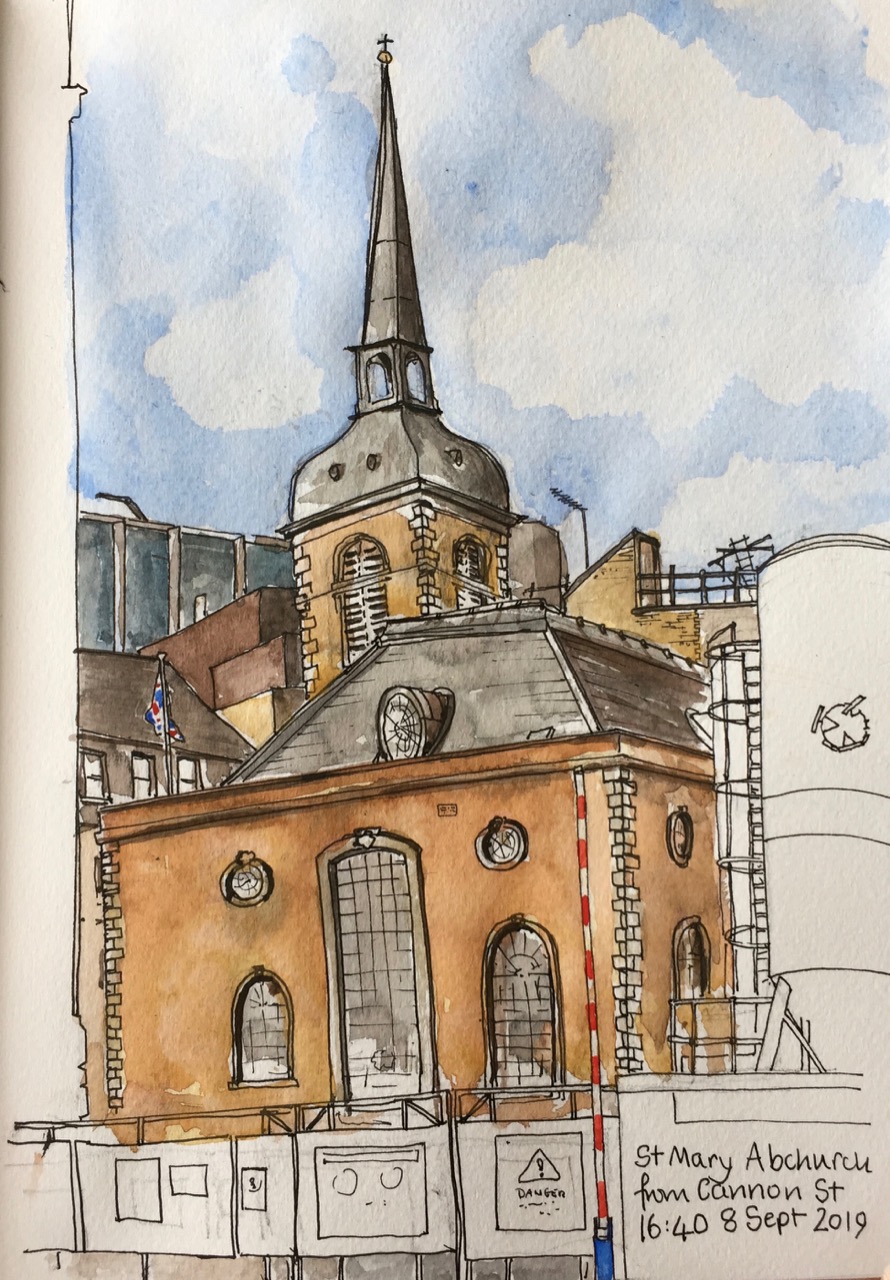












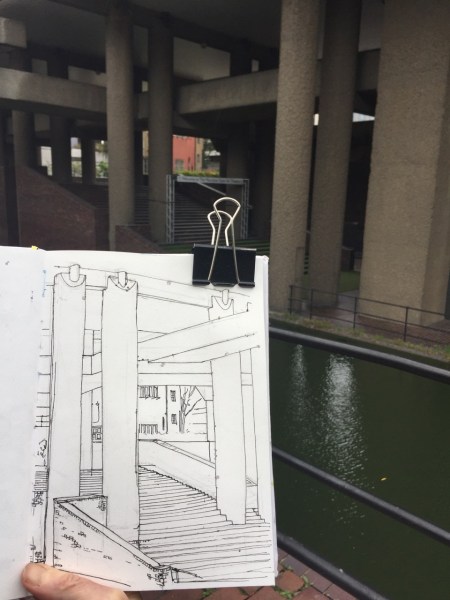 This was surprisingly effective. I managed to get all the ink drawn before 10:45, when I packed up again, to go to the Planning Meeting. During this time I was approached by a flustered gentleman in a smart suit, who wanted to “get across the lake”. He was hopelessly disoriented, pointing South-West, when he should have been heading North-East. I re-directed him and he dashed off towards the Barbican Hall.



 Jane Sketching