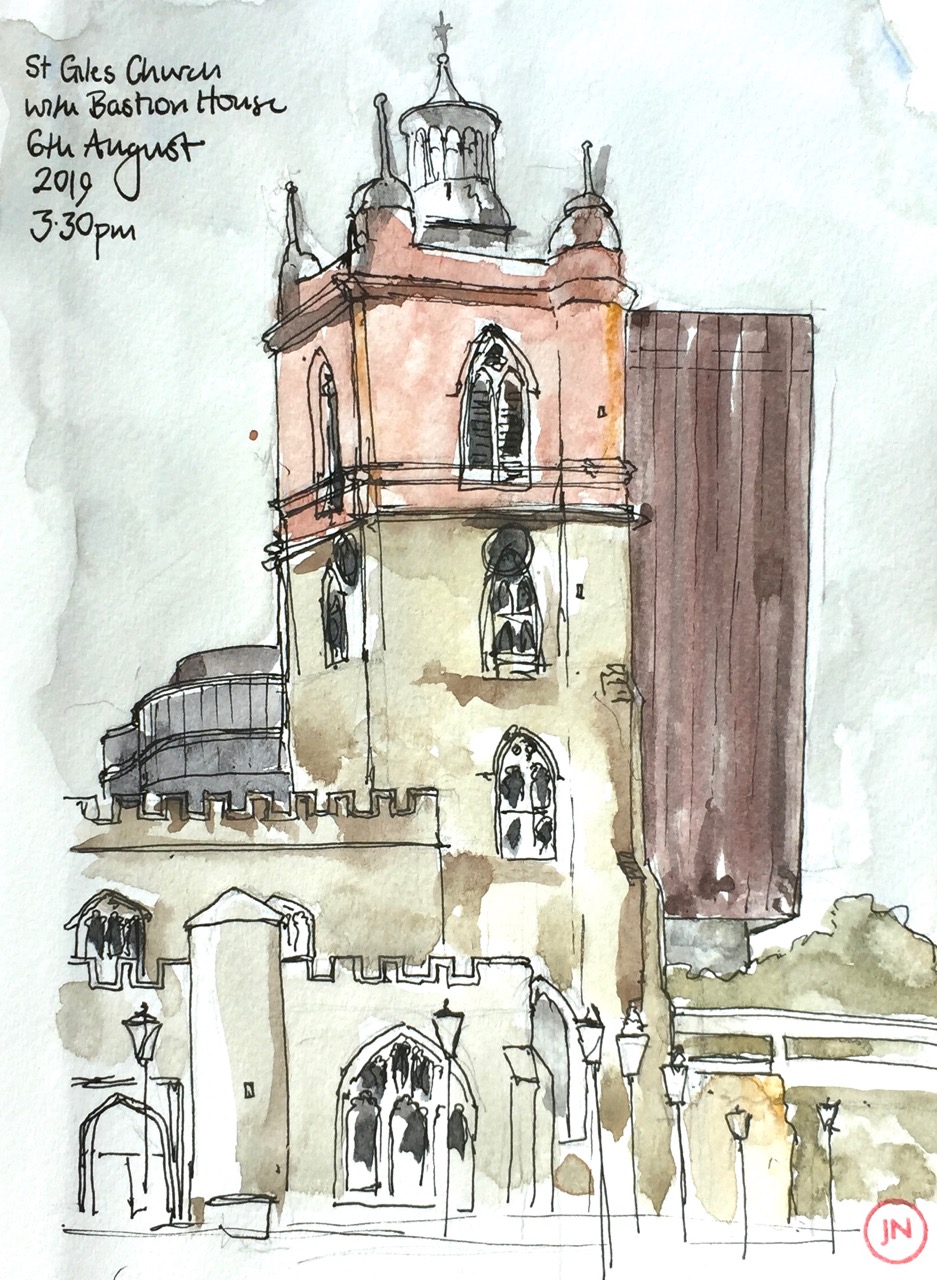
Here is St Giles Church from the Lakeside Terrace of the Barbican. While I drew this, three men were shovelling mud from the bottom of the lake. The mud is black and viscous and the men were remarkably cheerful in their task. They would have made good subjects for a drawing too. But for now, here’s the church:
The church features in some of my “Tower” sketches:
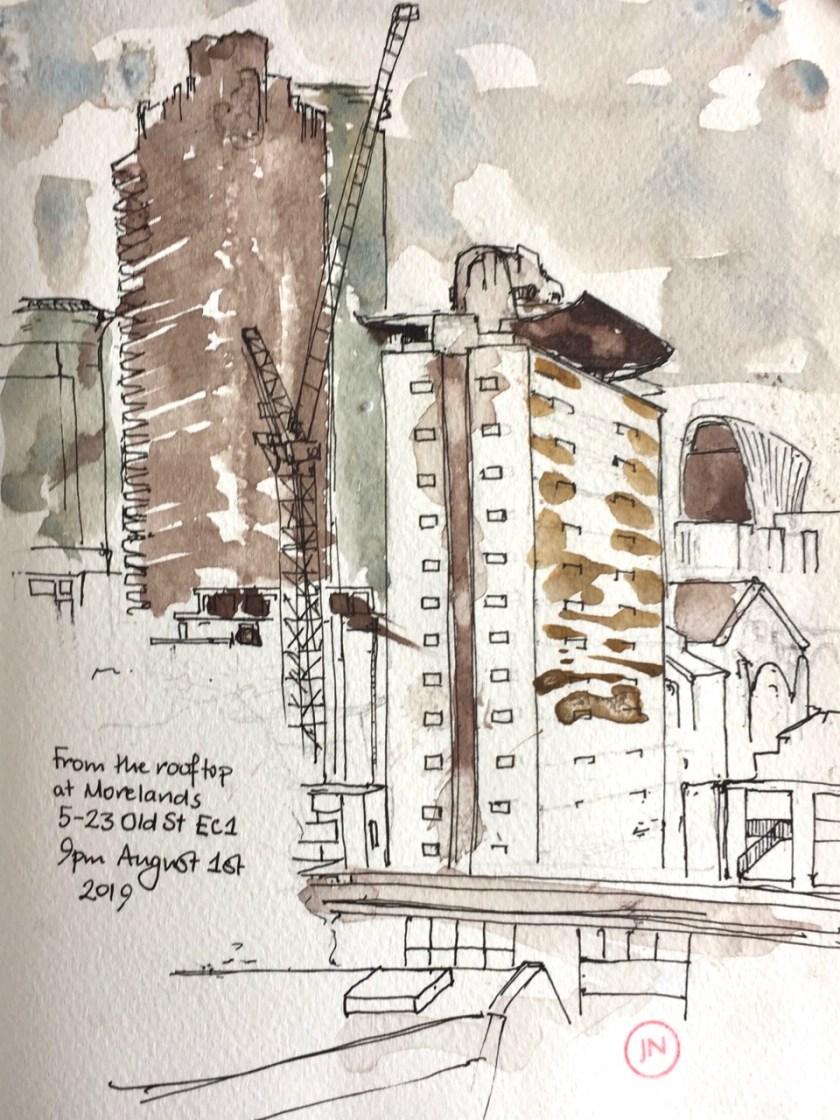
This was an event organised by RIBA* and Phil Dean a.k.a “Shoreditch Sketcher”. Morelands is a modern office block on Old St.
I looked south, and drew Cromwell Tower and Great Arthur House. This sketch took about 45 minutes, as darkness fell.
The “brise soleil” on top of Great Arthur House must be one of the most difficult things to draw. That, and the dome of St Pauls. Because it’s curved, and the curve needs to be right.
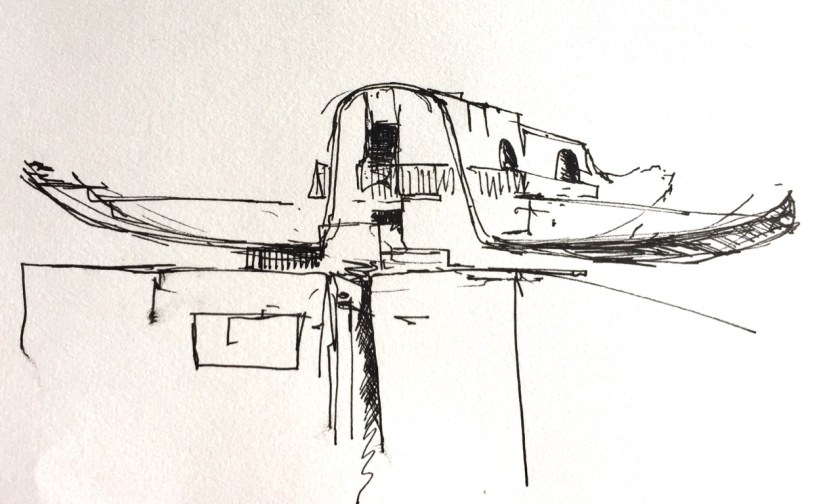
Earlier, I did a sketch of the “brise soleil” on its own. I had not noticed before that there is a sort of balcony.
Today I found another view of the view under Mountjoy. This is from the high walk that goes north from the Museum of London, looking East.
Under the Mountjoy Highwalk there are a number of “framed” pictures. The old London Wall fortification is visible. The sun reflected from the lake and threw patterns onto the old stone. I couldn’t get all that in the picture so you have to take my word for it.
A group of tourists stopped on the “Wallside” highwalk. You can see them in the centre right of the picture.
These “windows” will all be obliterated by the proposed City of London School for Girls expansion.
This view is from the place where the north bound highwalk turns abruptly left (click map to expand it).
This picture took about an hour. I tried hard not to overdo it.
At the top of the picture are the flats of Mountjoy House, with their impressive window boxes.
Click a button below to share this post online, email it, or print it:
This is the view that will be lost if the City of London School for Girls expansion proposal goes ahead.
UPDATE (2020): the proposal has been shelved, and alternatives are sought. But we must remain vigilant. The article below was written in August 2019, when the threatened development looked as though it would go ahead. Widespread protest ensued.
The view that will be lost if the CLSG expansion goes ahead. See “SOSBarbican.com”
I spent time today paying attention to this view, because that is what I need to do, to draw it. The pillars are reflected in the water. The enormous flight of steps is like that in a fairy story, so wide and grand. There’s a massive three-dimensional sculpture of concrete, of light and dark. Flat spaces and lines don’t quite join up but are nonetheless connected, like rhythmic music. Framed by the 20th century brutalist columns you see an older more ornamented building, and trees. You can even see right through to the other side of Aldersgate. This is a magnificent view.
The interesting blotchy effect on the pillars is rain falling on the picture. I started this picture at 09:30. Then it started to rain. The fine rain speckled my picture. Bigger drops diluted the paint in the palette and made the paints shift about. Then it started pouring down with menace. I scrabbled my things together and dashed into St Giles’ Church which was behind me. Inside the church, people moved purposefully about, and all was calm. And it was dry. I took a deep breath and kept my drawing horizontal. There was a table next to the door. A woman looked at me over the table. I felt the need to explain. “I’m sheltering from the rain,” I told her.
Her response was calm and logical, “Would you like a cup of coffee?”
“I would,” I said. Her companion at the table offered me a biscuit. Grateful to the Royal Society of Organists for their hospitality, I sat on a wooden bench and let my drawing dry off. Experimental short tunes from the organ floated quizzically in the air.
Then I went out again. I wanted to finish my picture. I stood in the porch of the church and looked at the rain. “Every decision is a moral decision.” I believe that. Should I pack up the drawing and go home? I could use the time before the Planning Meeting to do the supermarket shop, deal with the plumbing problem, and process the sourdough.
Or should I continue the drawing?
What principles are at stake here? I finish drawings that I start. I don’t mind the rain. My ink and watercolour does mind the rain, though. So I’ll draw the picture under an umbrella.
This was surprisingly effective. I managed to get all the ink drawn before 10:45, when I packed up again, to go to the Planning Meeting. During this time I was approached by a flustered gentleman in a smart suit, who wanted to “get across the lake”. He was hopelessly disoriented, pointing South-West, when he should have been heading North-East. I re-directed him and he dashed off towards the Barbican Hall.
The Planning Committee Meeting at 11am was the City of London Planning and Transportation Committee. This was their July meeting. In their September meeting, if things go according to the plan put forward by the School, this same Committee is due to approve a plan for a building which will totally block out the view I have drawn. The proposed new structure would cover the steps, build round the pillars, and put in an industrial kitchen. Residents in Mountjoy House, directly above my picture, are understandably dismayed. The Barbican Association, representing Barbican residents, is leading a campaign to prevent to save the view, and stop the expansion. Here is their postcard/flyer.
On the way back from the planning meeting, I went back to the view, and put the colour.
Spending time looking at this view, these pillars, these shapes, I realise how magnificent it is, and how talented the architects were. This view is worth fighting for.
Here is the view from high up in the marvellous Skip Garden at Kings Cross. Coal Drops Yard roofs are in the background, behind the crane.
I did this picture with just three colours: cobalt blue, yellow ochre, and alizarin crimson. The yellow ochre and cobalt blue refused to make green. They made grey.
Here is the picture under construction.
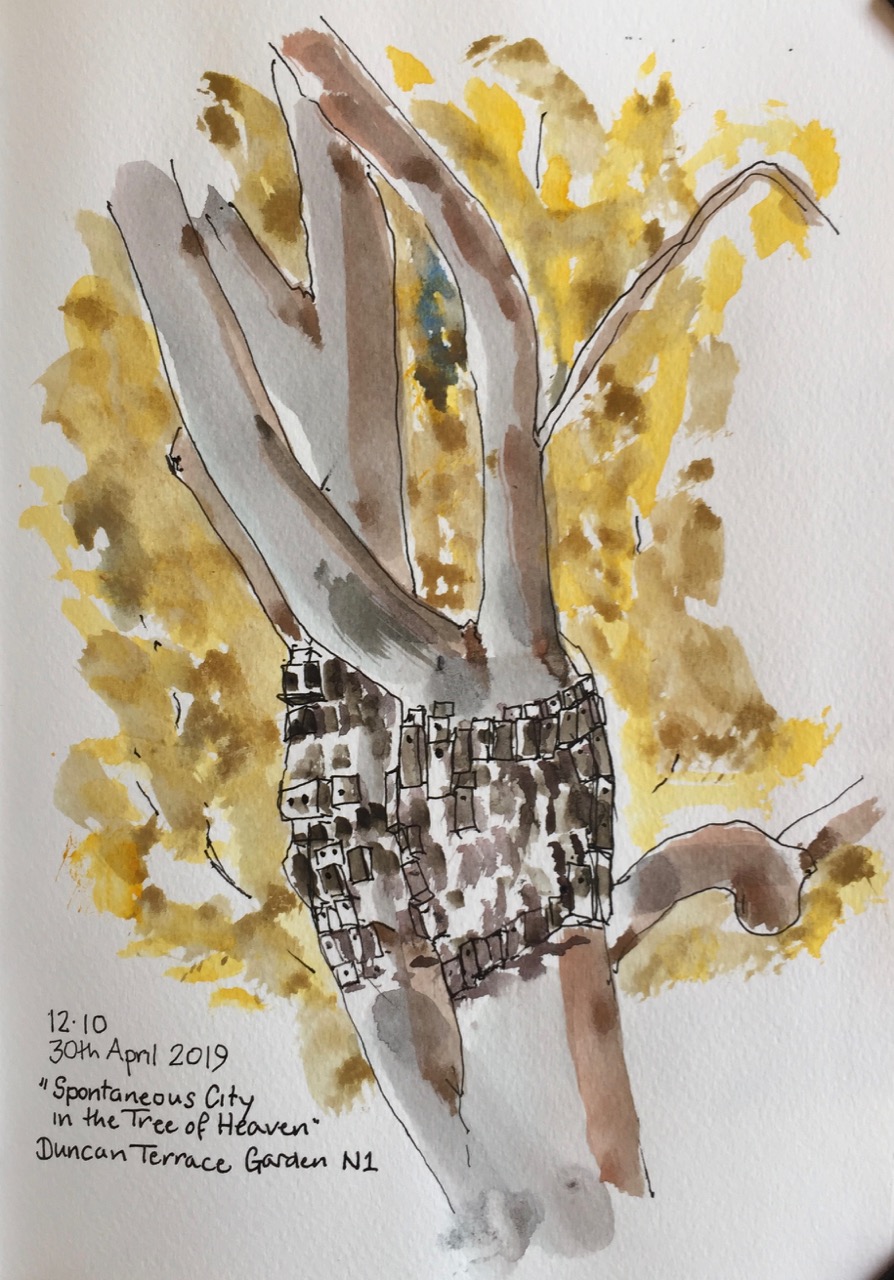
On the way to Kings Cross I passed through Duncan Terrace Gardens, in Islington, where there is an extraordinary “bird hotel” in one of the gigantic trees. It was made by “London Field Works” and consists of 300 specially made bird boxes, all different sizes, fitted round the tree.
A nearby notice assured me: “The method of installation has been designed in close consultation with the Forestry Commission and the borough’s ecology dept to enable the tree to continue to grow and expand.”
Click a button below to share this post online, email it, or print it:
This huge redbrick building in Leman Street stands proudly amongst the 21st century steel and glass. Inscribed round its windows and above its door in letters a foot high are the words “Co-operative Wholesale Society Limited”. The words are spelled out in full, and written in stone. Oh, those confident and visionary Victorians!
The Co-operative Wholesale Society’s London Branch headquarters were built to designs by J. F. Goodey of 1885. At the formal opening on 2 November 1887, the CWS announced that it should ‘be their aim to make this beautiful building a common home for all the various movements having for their object the interest and advancement of the working people. They had with them their friend, the Rev. S. A. Barnett, and they hoped to work hand in hand with him and the residents of Toynbee Hall, in giving a message of hope to the people of the neighbourhood’
I saw this redbrick building on the Old Street Roundabout.
Above it are the huge developments on City Road. From left to right they are Eagle Point, M by Montcalm, and the Atlas Building.
Adeyfield House is residential, part of the Sutton Estate, managed by Islington Council.
The Old Street roundabout was sometimes called “silicon roundabout” because of the high-tech start-ups in the surrounding area. I haven’t heard that term used for a while though. There are certainly many incubator-type office blocks. One is called “White Collar Factory” and was near to where I was standing outside Inmarsat. Inmarsat is a satellite data company.
Old Street roundabout is about to be re-configured to make it more agreeable for pedestrians and cyclists. At the moment it is noisy, polluted, dangerous to cyclists and difficult to navigate on foot.
Huge numbers of pedestrians passed by me on the pavement, talking of investments, employment opportunities, stock options, and where to go for lunch.
Click a button below to share this post online, email it, or print it:
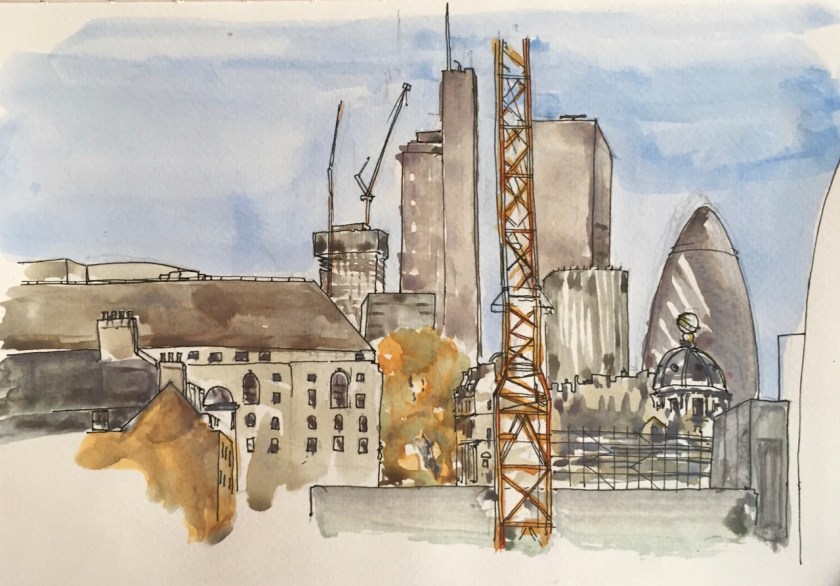
From the Barbican Podium underneath Willoughby House you can look East across the Crossrail site. Soon this view will be obliterated by the tall building on top of the Moorgate Crossrail station. But just now, this is what you can see:
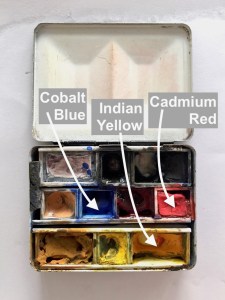
I drew this picture with just three colours:
Cadmium Red (Rembrandt)
Cobalt Blue (Jacksons)
Indian Yellow (Jacksons)
This was following the advice of Teoh Yi Chie of Parkablogs, in one of his Youtube posts, called “How I choose which colours to use”. He advises limiting the number of colours, and choosing just one red, one yellow and one blue for a picture. As you see, it is possible to create a wide range of colours from just three, including all the greys you see in the picture.
I was particularly pleased with the sheen on The Gherkin, which happened as the colours granulated and dried out.
The Towers in the picture are part of the emerging “Eastern Cluster”. This is a region of skyscrapers in the City of London. More will be added, according to the Eastern Cluster Strategy (try this link: City of London Eastern Cluster Strategy).
Here are the ones I could identify:
Here are photos of the picture being drawn:
About 1½ hours, drawn and coloured standing on the podium, leaning the sketchbook on the concrete of the podium. Warm breeze. Sun. I needed the sunhat.
Click a button below to share this post online, email it, or print it:
This is the “Boundary Estate”, Britain’s first council estate, opened in 1900. It was built to the design of Owen Fleming and his team. Fleming was a member of the Housing of the Working Classes branch of the LCC’s* Architecture department. He was 26 years old.
The aim of Boundary Estate project was to replace slums, in an area of disease, want, squalor and crime known as “Old Nicol”. The slums were pulled down, and replaced by dwellings that were more healthy, and more pleasant to live in. The area was also provided with schools, a laundry, shops and clubrooms. The problem was, of course, that these dwellings were more expensive than the previous slums. The former inhabitants of the area couldn’t afford the rent, and had to go elsewhere. Better-off workers in stable employment moved in.
Here’s what one part of it looks like now.
Shiplake House, Arnold Circus, in Sketchbook 4, 10″ x 7″
This is Shiplake House, on Arnold Circus. It didn’t look in very good repair. The paint was flaking. As you see, the outside was festooned with wires, some going no-where. The windows were dirty, though none were actually broken. This disrepair was surprising, as these are sturdy buildings, close to trendy Shoreditch High St, Brick Lane, and the City.
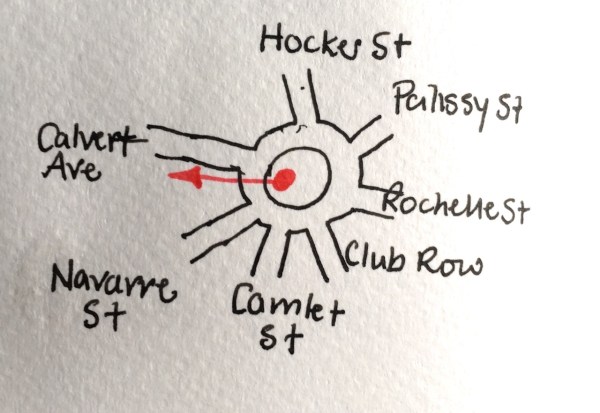
Arnold Circus, showing my direction of view for the picture of Shiplake House.
Shoreditch High St is visible from the little hill which is Arnold Circus, where I sat to draw the picture. There are seven roads which meet at Arnold Circus. Is this a record?
I read about the Boundary Estate in “Municipal Dreams, the rise and fall of council housing” by John Boughton. This is a fascinating book, answering my questions about why governments over the decades have, and have not, built council houses. Why did they do it, and why did they stop doing it? His website Metropolitan Dreams is also a great read and recommended.
Here is the drawing before the colour went on, showing Shiplake House in the background.
*LCC= London County Council, disbanded in 1965, and replaced by the GLC = Greater London Council which covered a larger area. The GLC was itself abolished in 1986, and its powers went to the London Boroughs. It was abolished largely because its leader, Ken Livingstone, was a high-spending Labour politician whose policies were opposed to those of Prime Minister Margaret Thatcher. Then when the GLA= Greater London Authority was established in 2000 the first Mayor elected was Ken Livingstone. He began his victory speech with the words: “As I was saying before I was so rudely interrupted 14 years ago …”
Click a button below to share this post online, email it, or print it:
Here is the view from Graham St Garden, Finsbury, on the way to Kings Cross.
I sat on a bench dedicated to the memory of someone called Rick Clarke. It was a new bench, in a lovely position. May Rick Clarke rest in peace. I am grateful to those who knew him for putting the bench there.
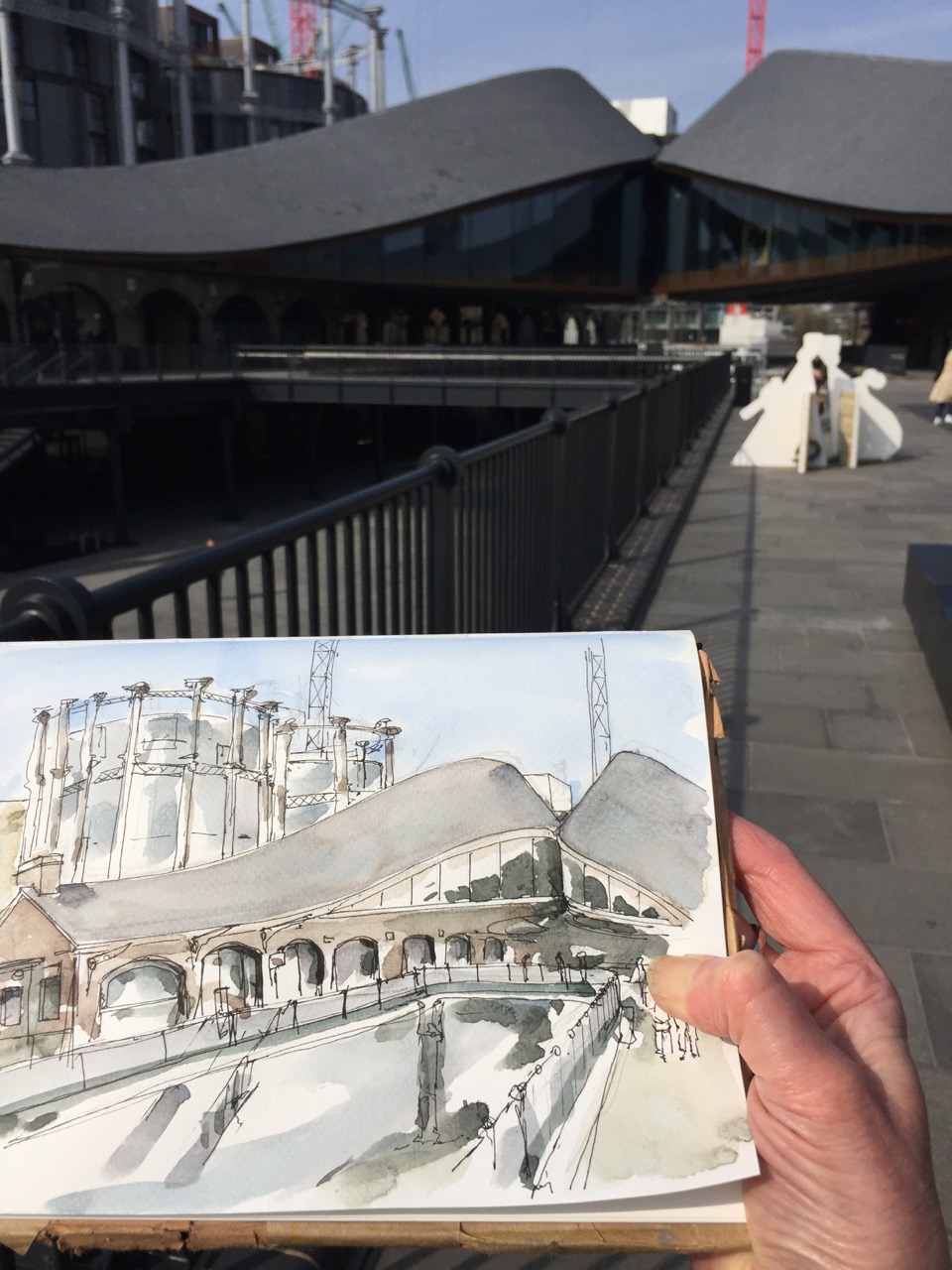
Graham St is the extension of Central St northwards, and I was on my way north to Kings Cross to meet someone at the Skip Garden. But the Skip Garden was closed on Mondays, and my friend was waiting outside. We adjourned to the marvellous new development “Coal Drops Yard”. This is a 21st century adaptation of old coal sheds. The old sheds are turned into two levels of shops and restaurants, but in the modern way, old brickwork and chunks of Victorian cast iron are retained. Most spectacular is the roof.
The architects were Heatherwick Studio. On the right of the drawing people were experimenting with strange rotating chairs, also designed by Heatherwick Studio, and other people were watching them.
Here is work in progress on the drawings.
Click a button below to share this post online, email it, or print it:





 This was surprisingly effective. I managed to get all the ink drawn before 10:45, when I packed up again, to go to the Planning Meeting. During this time I was approached by a flustered gentleman in a smart suit, who wanted to “get across the lake”. He was hopelessly disoriented, pointing South-West, when he should have been heading North-East. I re-directed him and he dashed off towards the Barbican Hall.




 Cadmium Red (Rembrandt)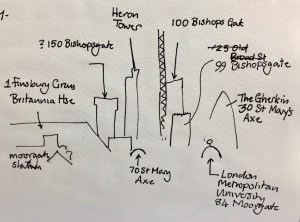




 Jane Sketching