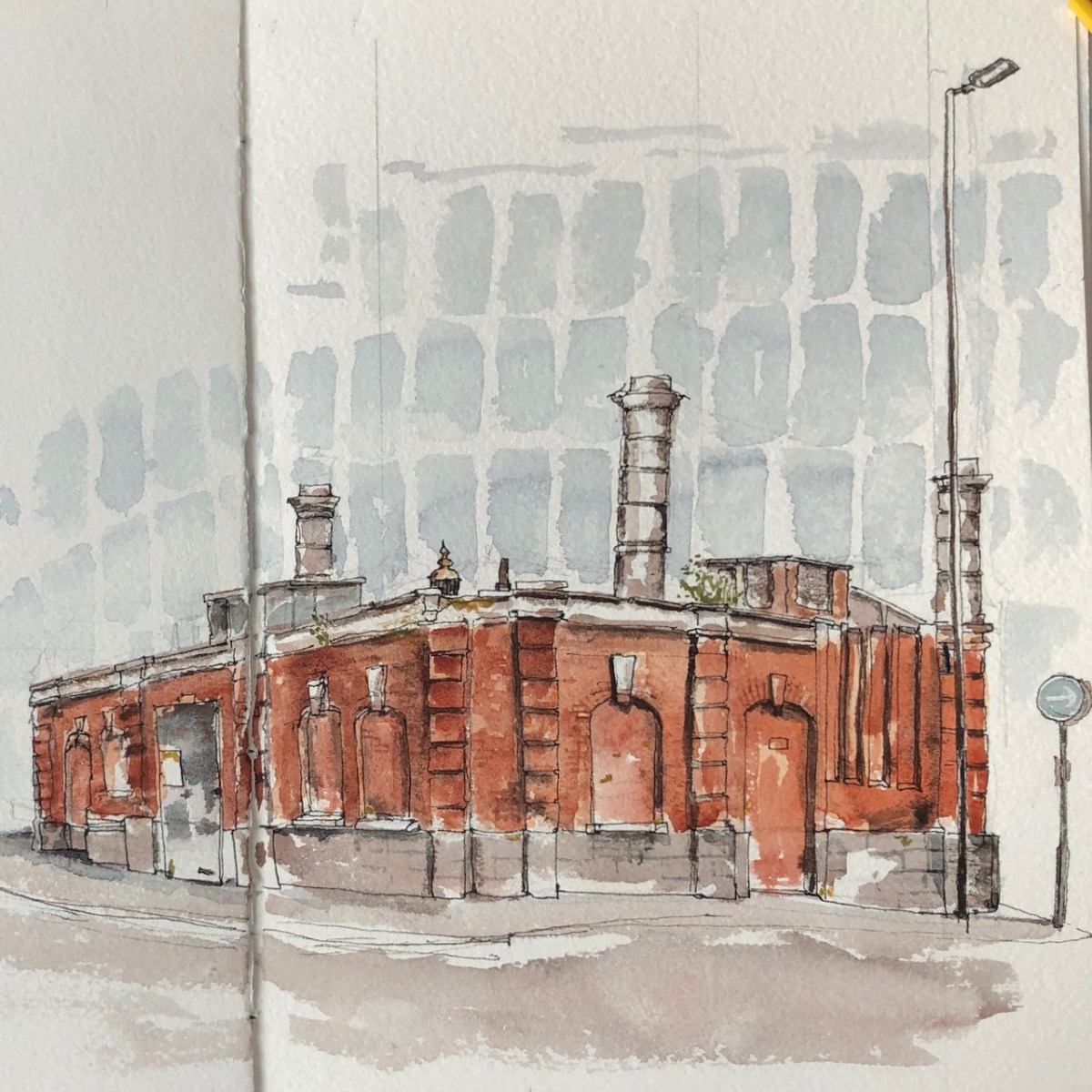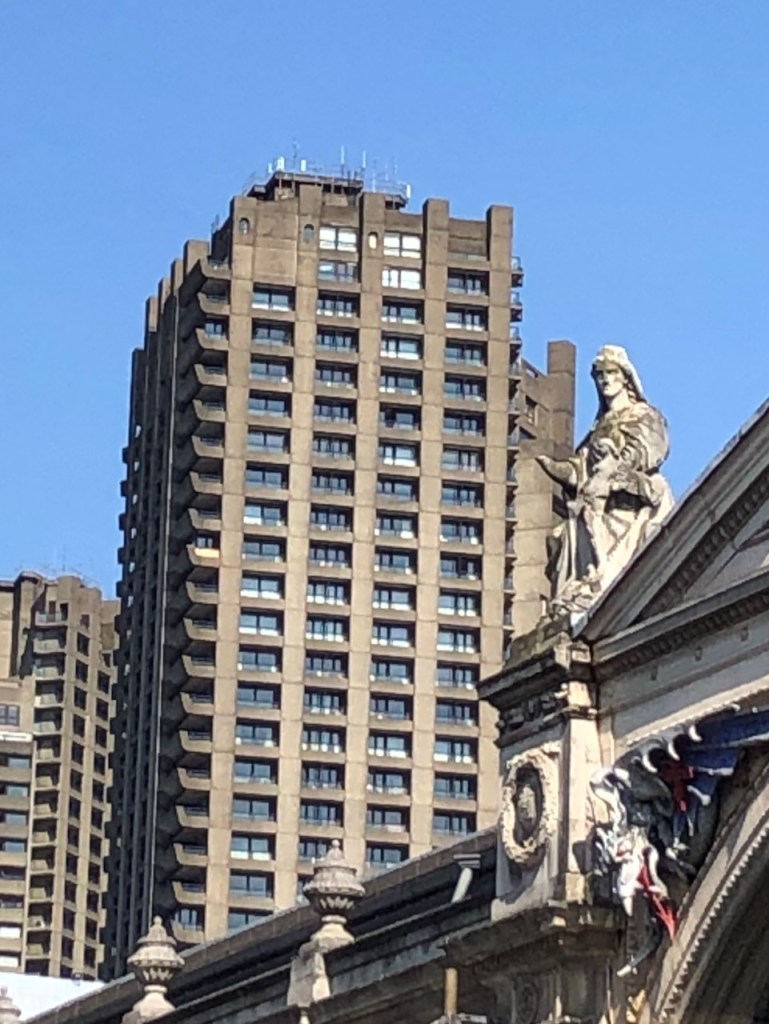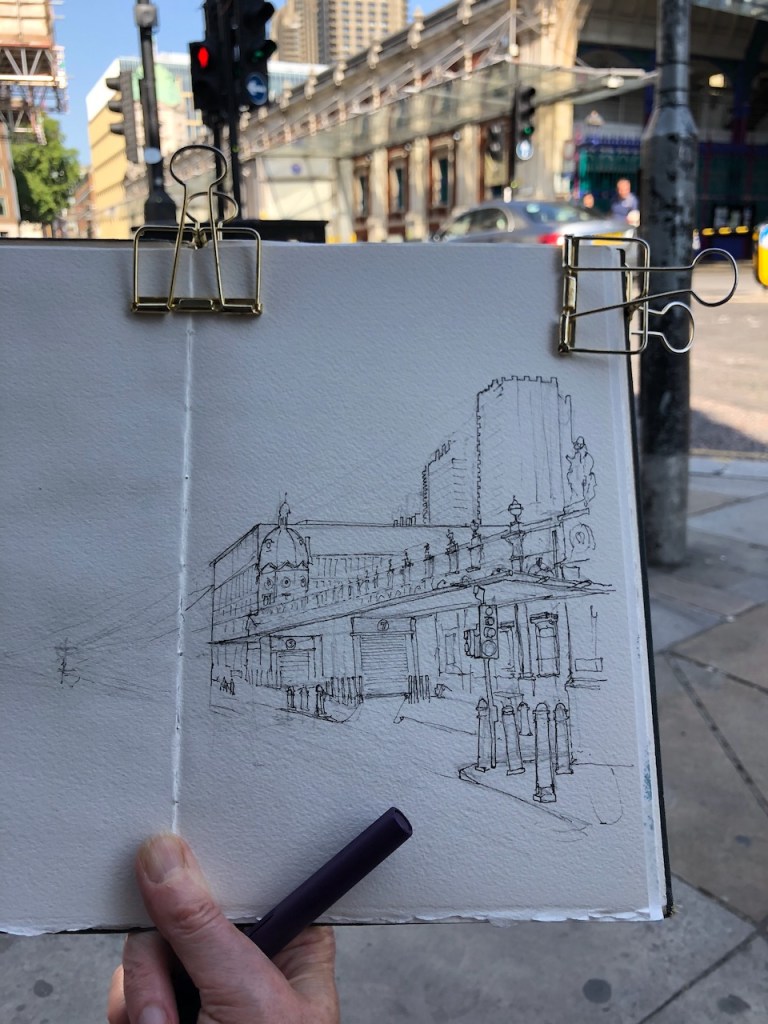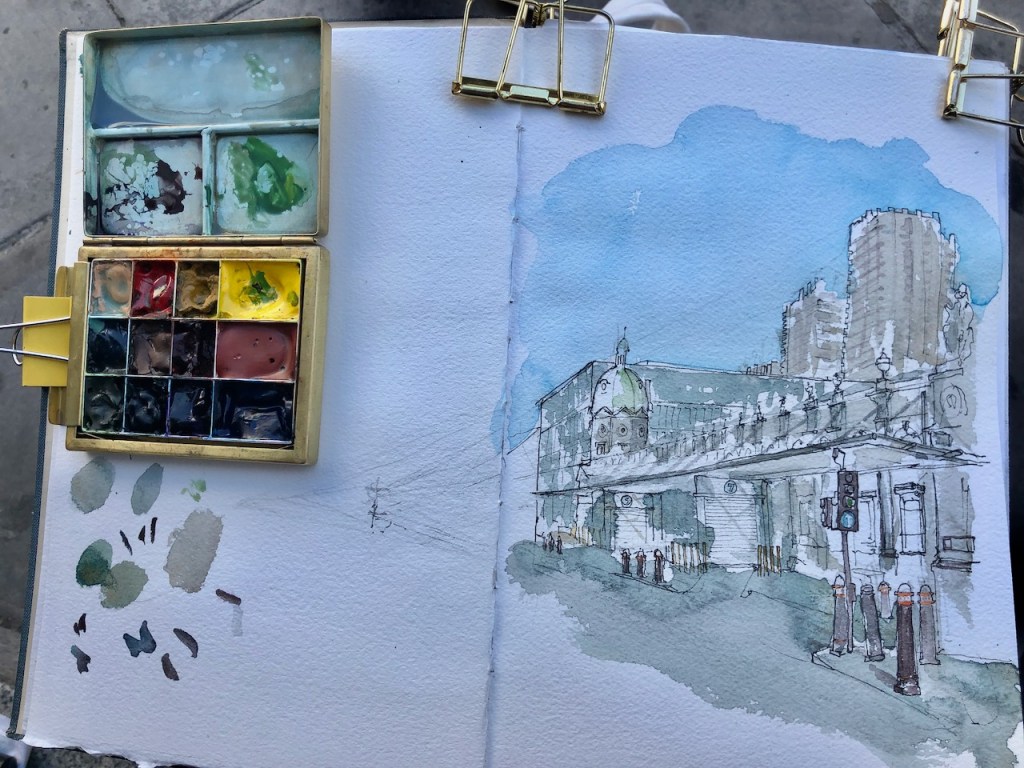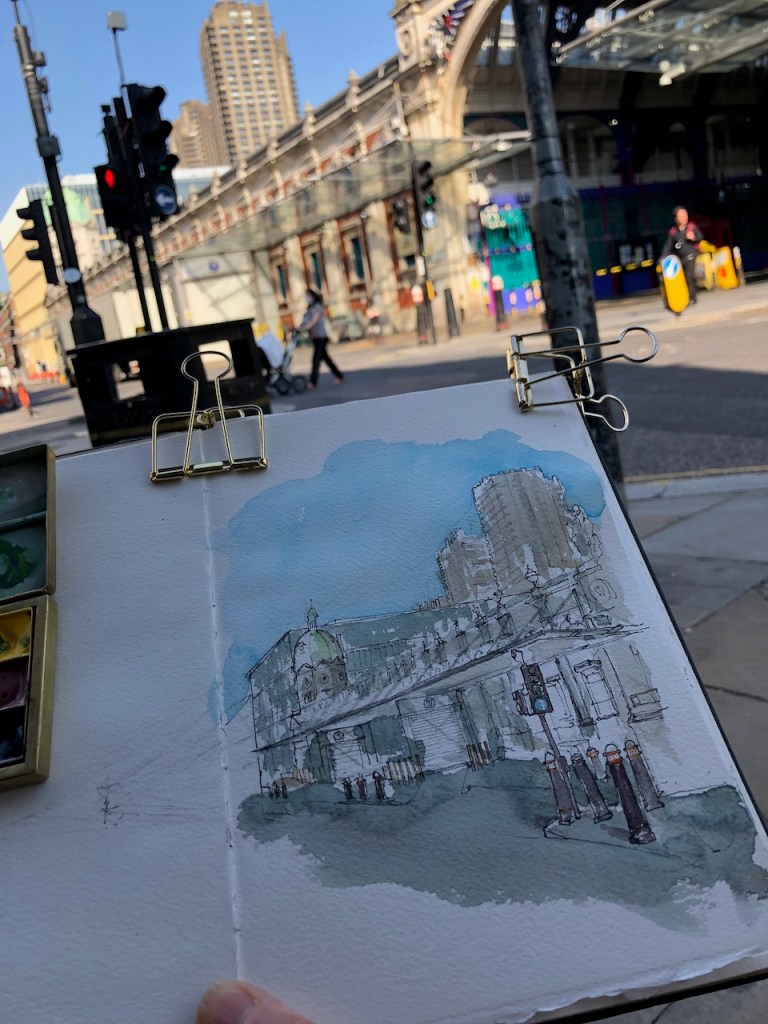
38 Charterhouse Street, London EC1

My idea that day was to sketch some interesting corner pubs in Bloomsbury.

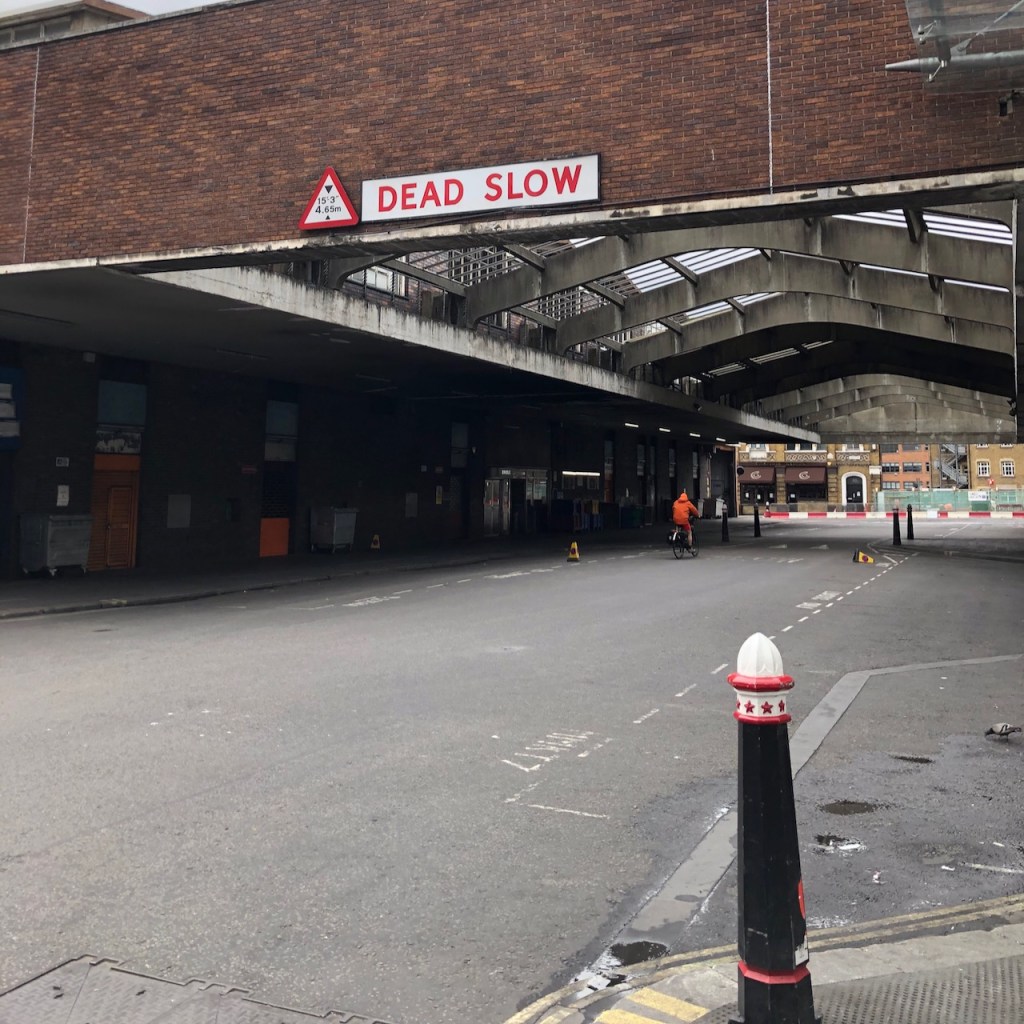
By the time I had emerged from my flat and was on the street, the bright autumn day had turned stormy. After a few paces, the rain started falling. Everyone dashed for cover. I sheltered in a doorway, together with another woman, two strangers in a refuge, grinning and rolling our eyes. “Well, it is September”. At a pause in the deluge, we both emerged and went our separate ways. I went doggedly towards the West, but no, the rain returned, seemingly even more torrential. I dashed from doorway to doorway, like a fugitive in a spy novel, finding cover where I could. Then I spotted the generous overhang of Smithfield Market and rushed underneath, the rain spattering on the glass above. There was no sign of the deluge ceasing, so I considered, as you do in these strange interim conditions: to go on? to go back? Or to stay where you are?

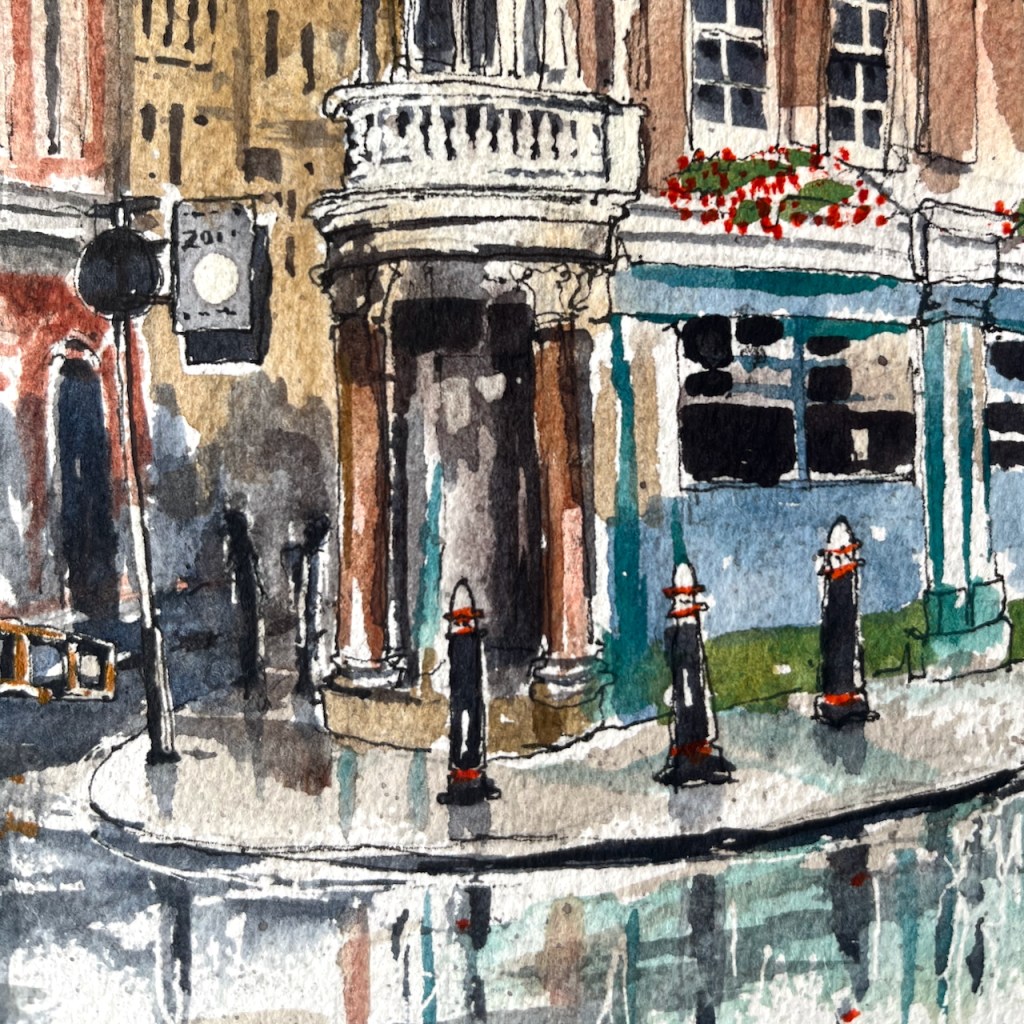
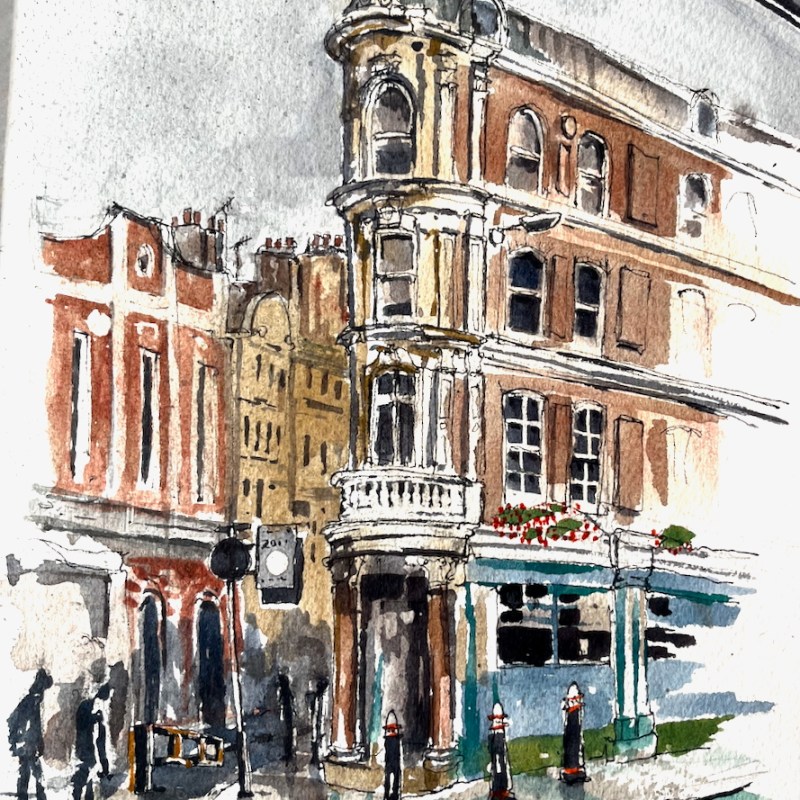
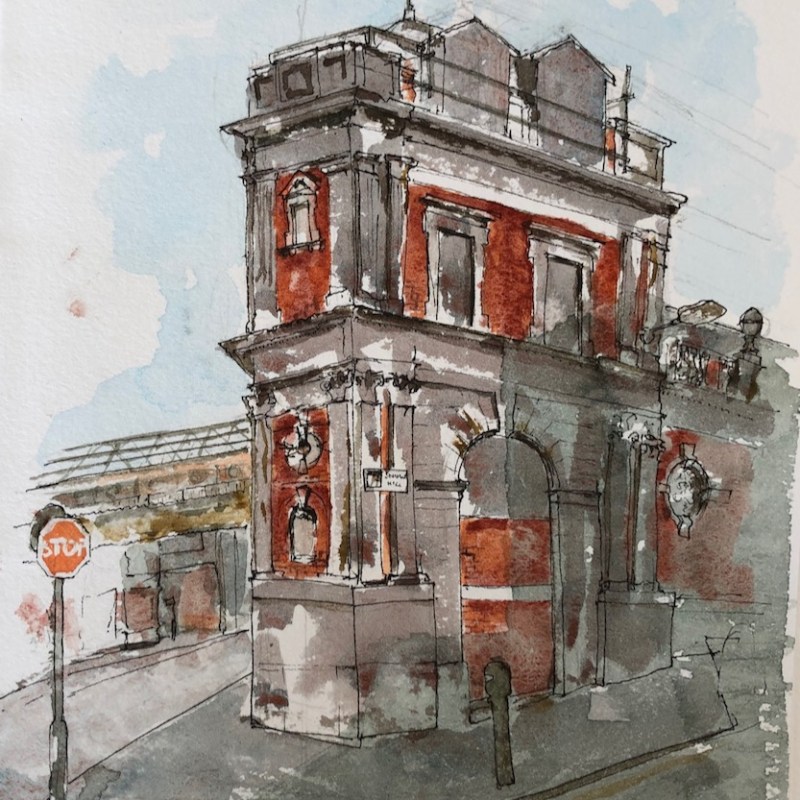
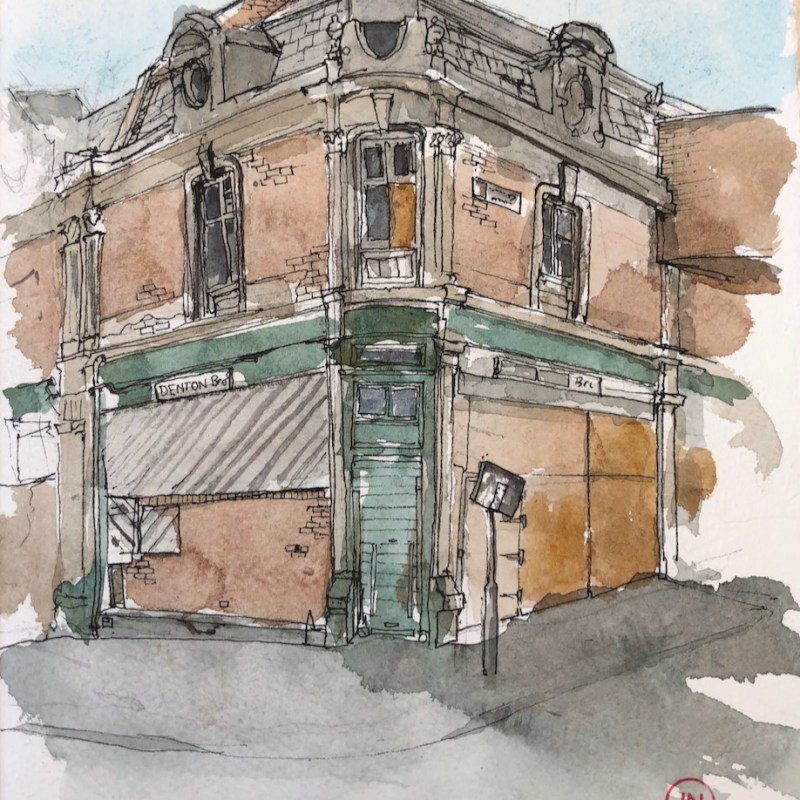
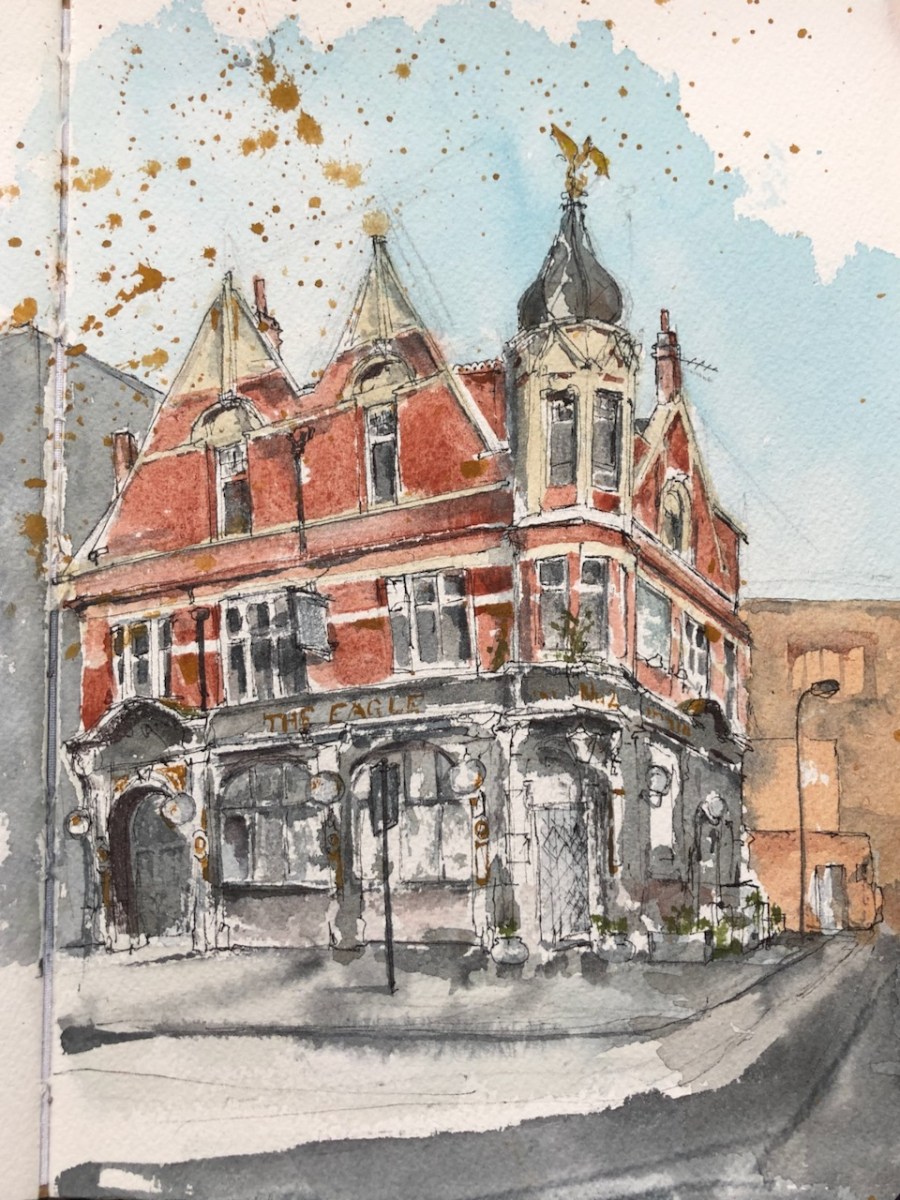
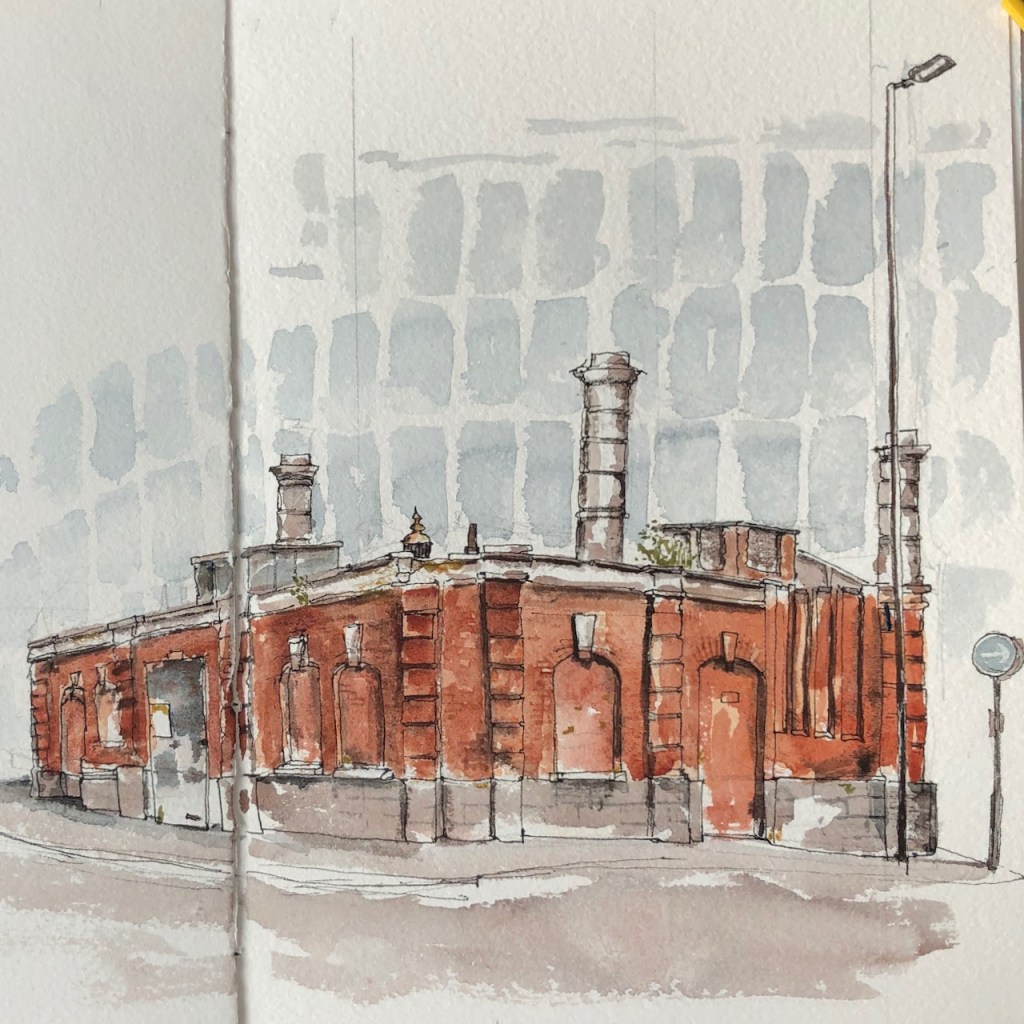
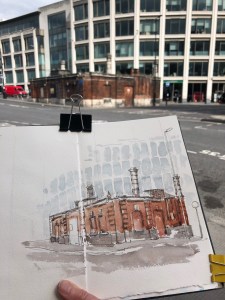
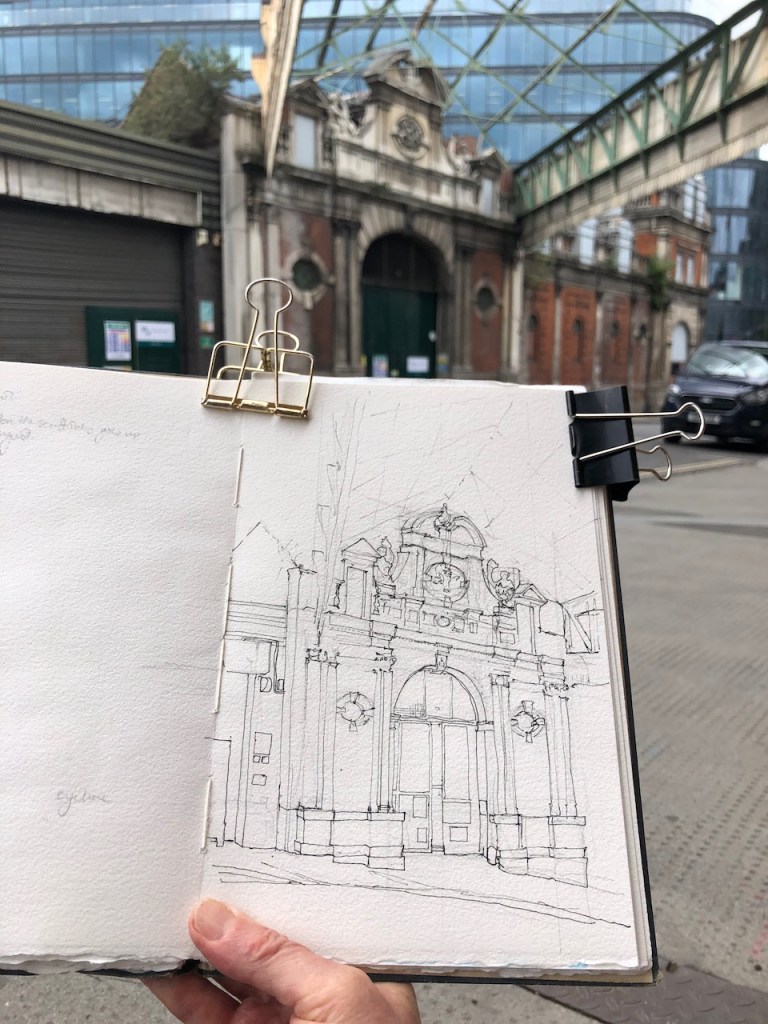
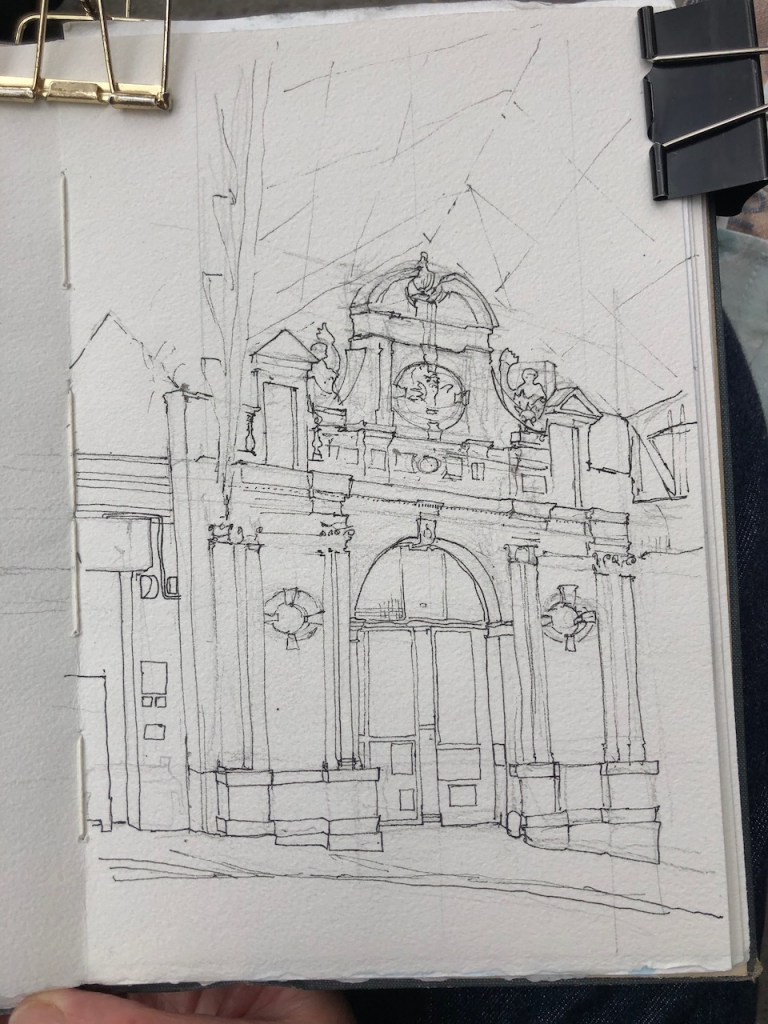
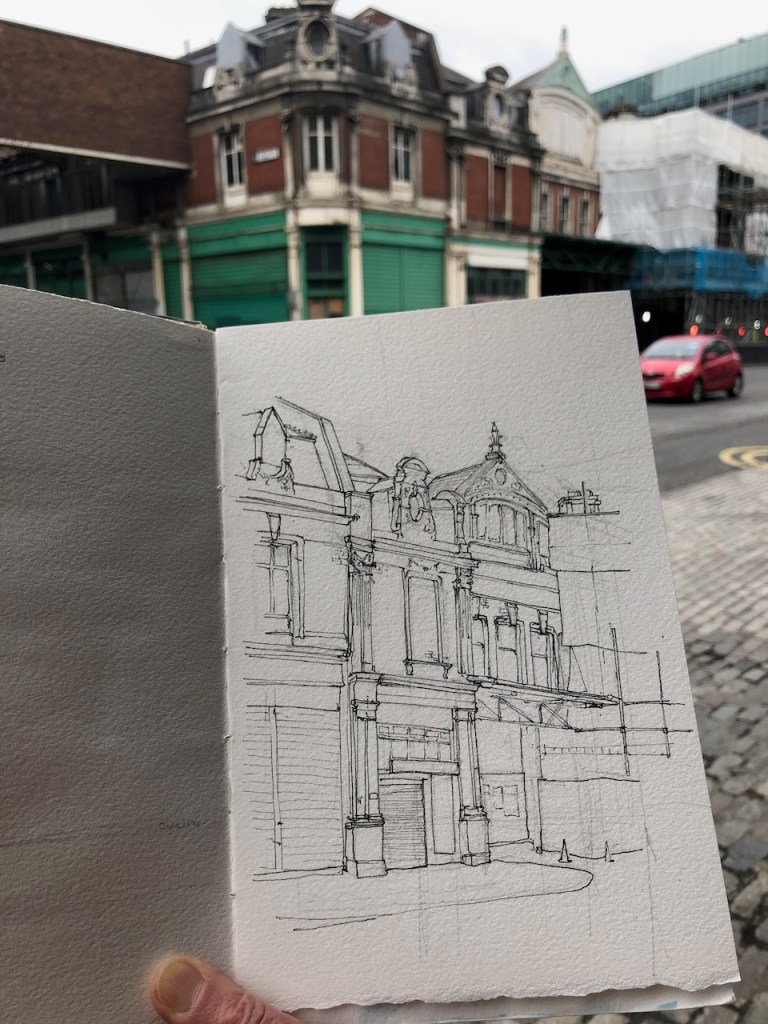
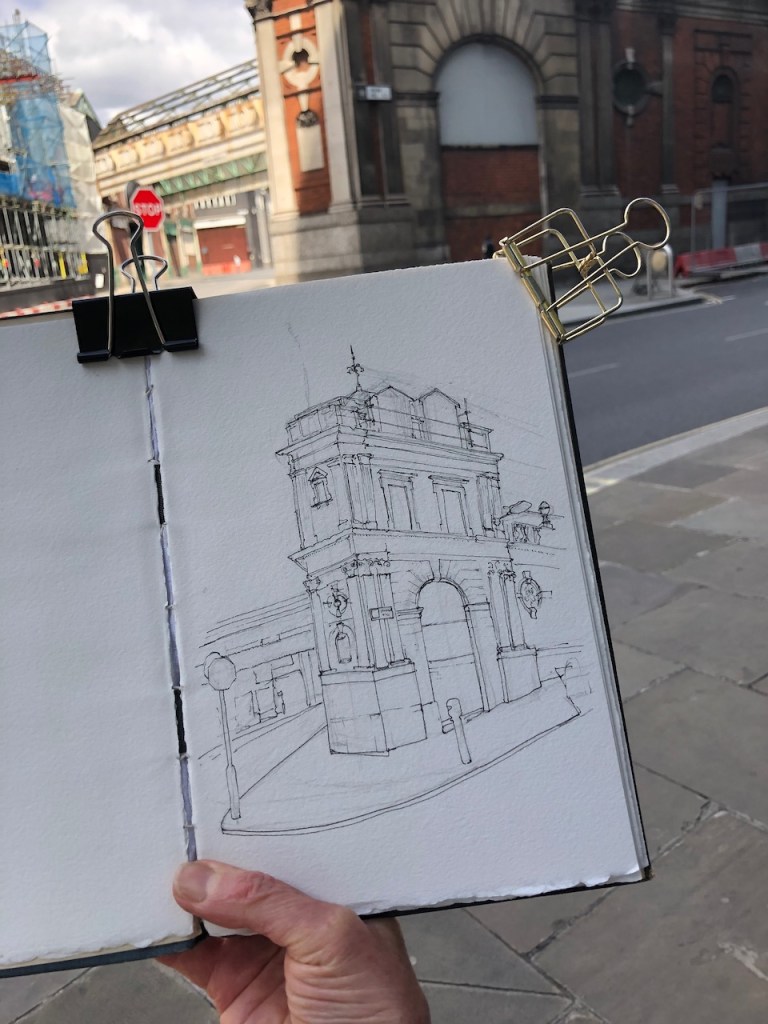
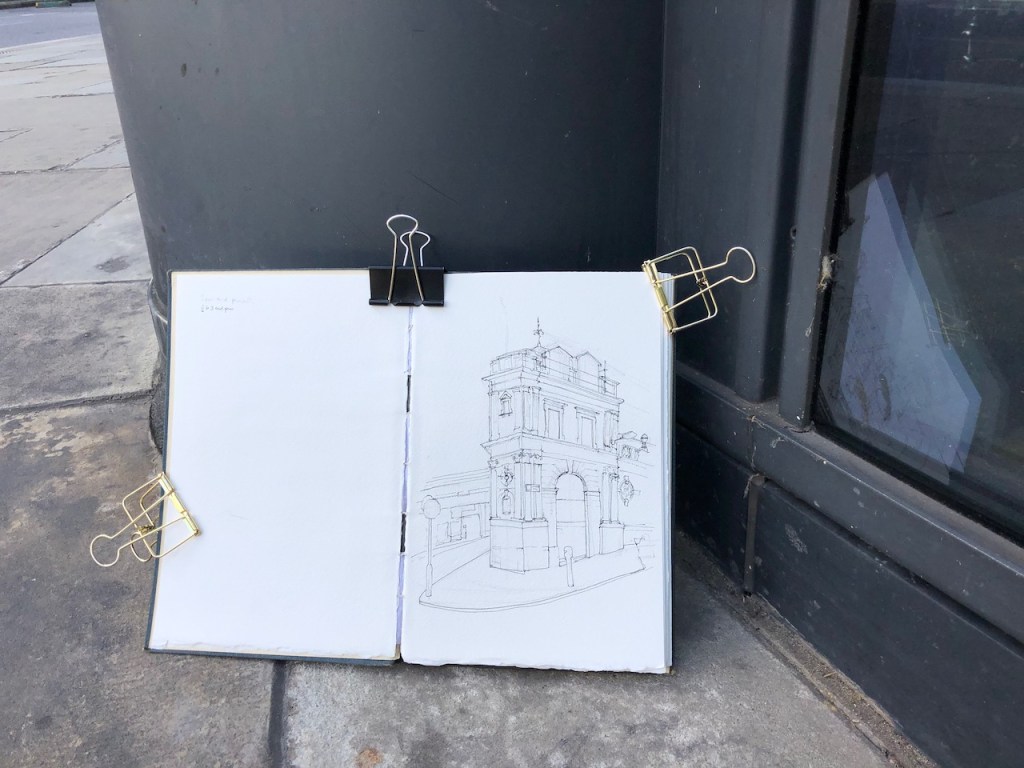
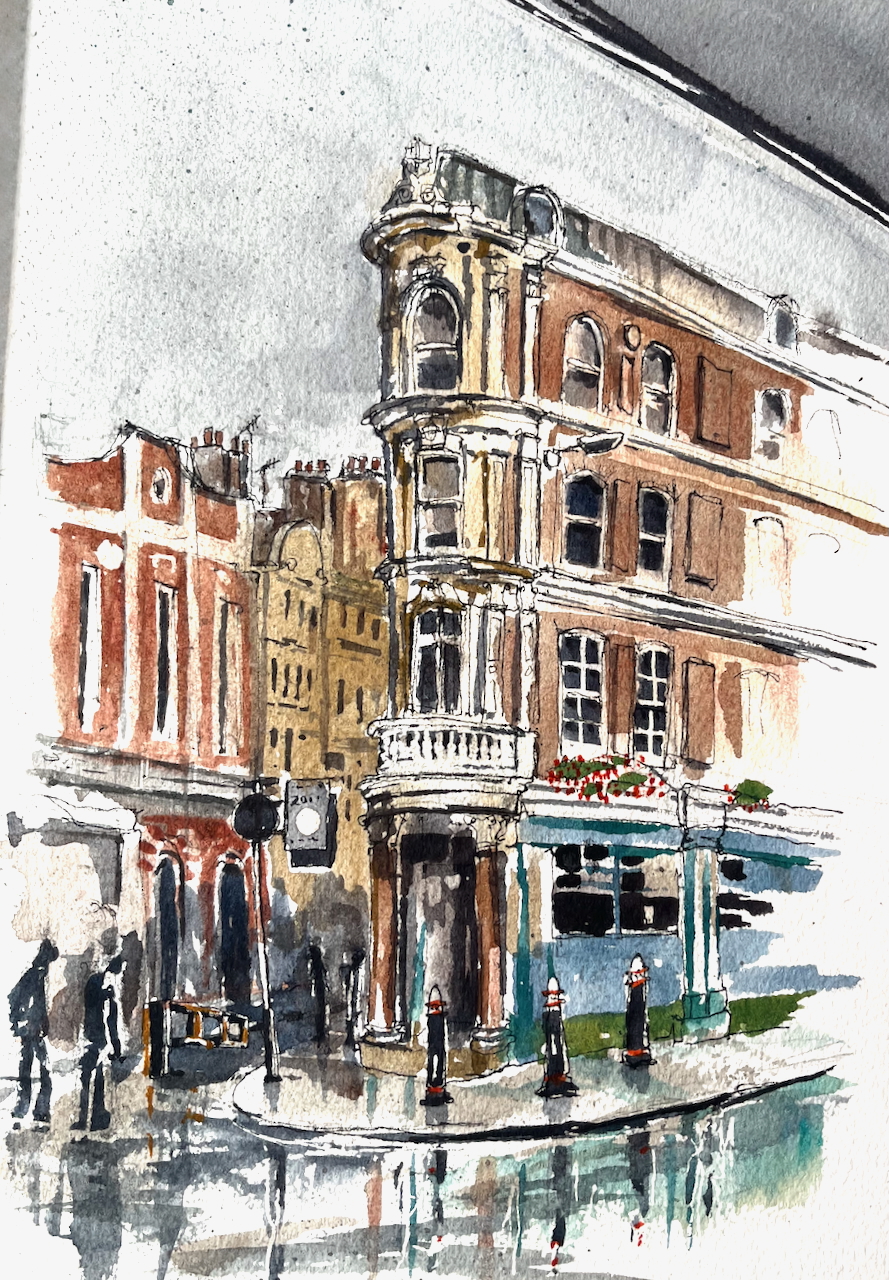
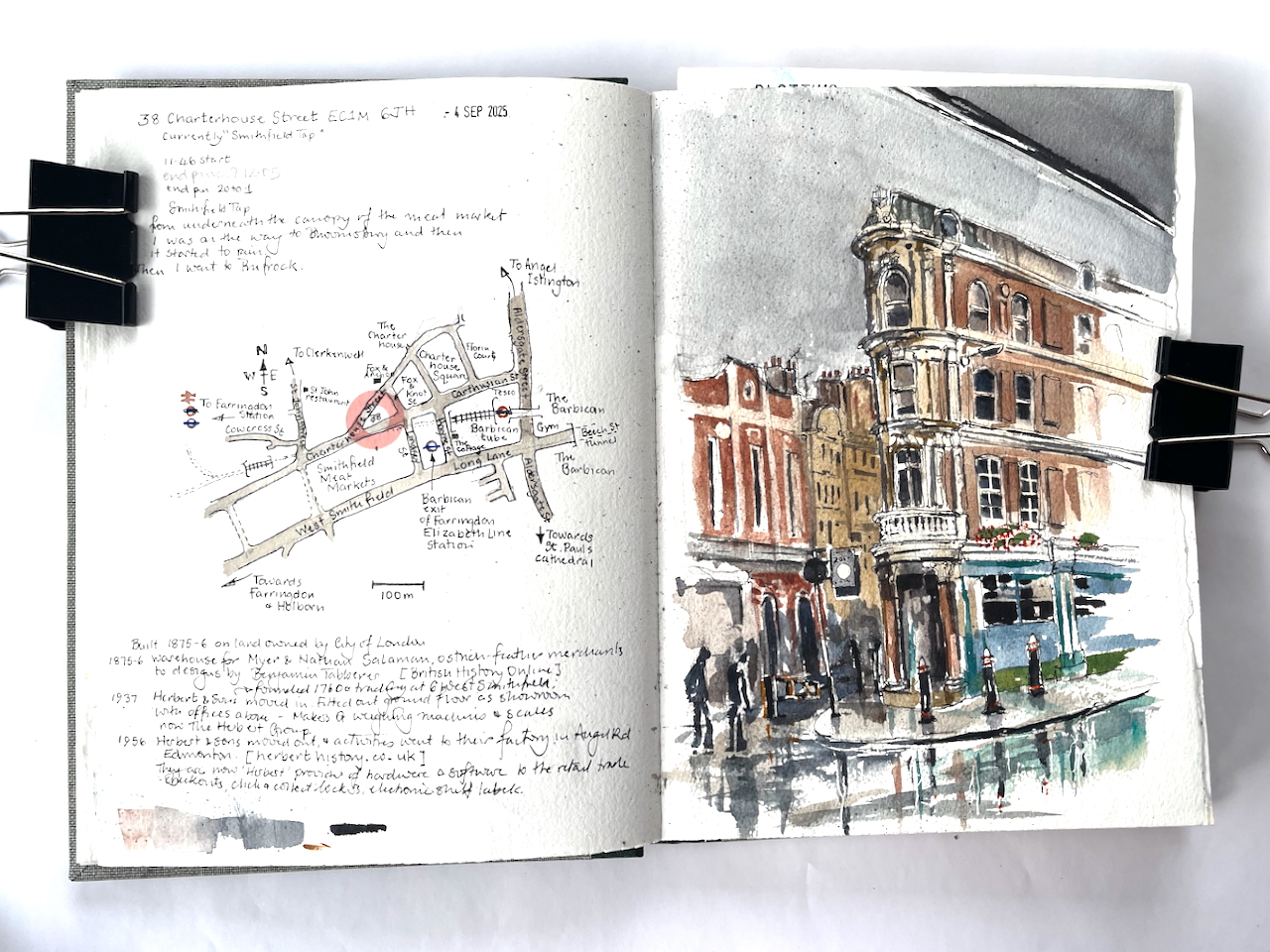
Why not do the drawing right here? Over the other side of the road is a building occupying an acute angle between roads. It wasn’t in my plan, but by this time I had abandoned my plan. So here is 38 Charterhouse Street, sketched from the shelter of the Smithfield Meat Market canopy.
38 Charterhouse Street, EC1M 6JH sketched 4th September 2025 in Sketchbook 16

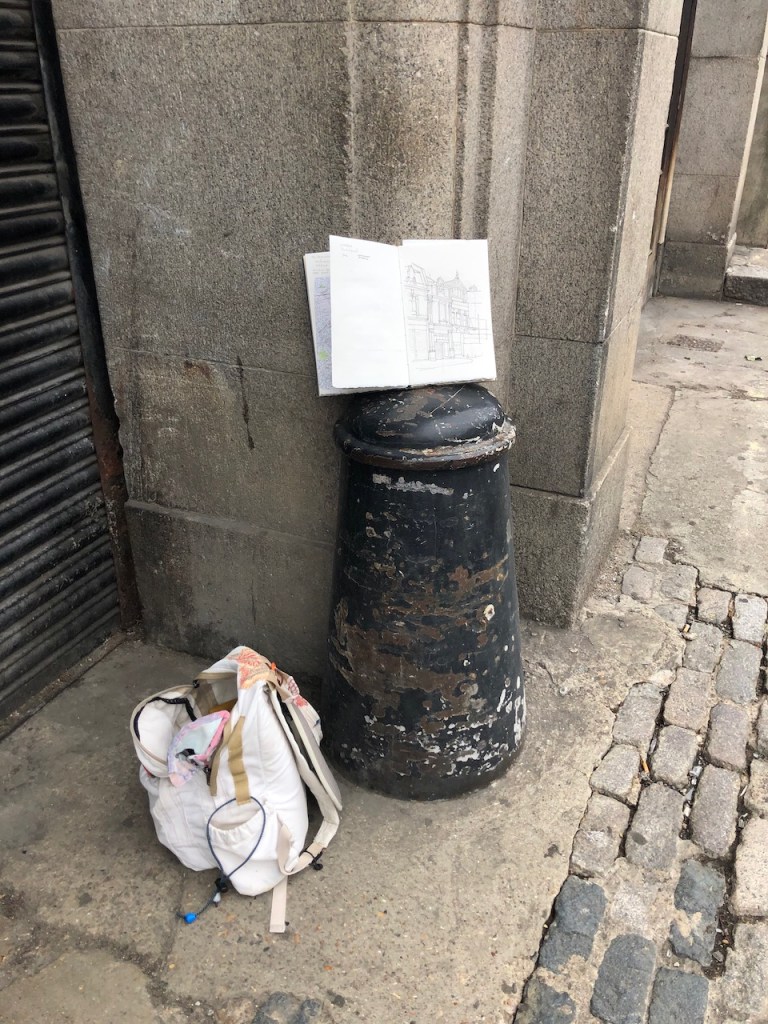
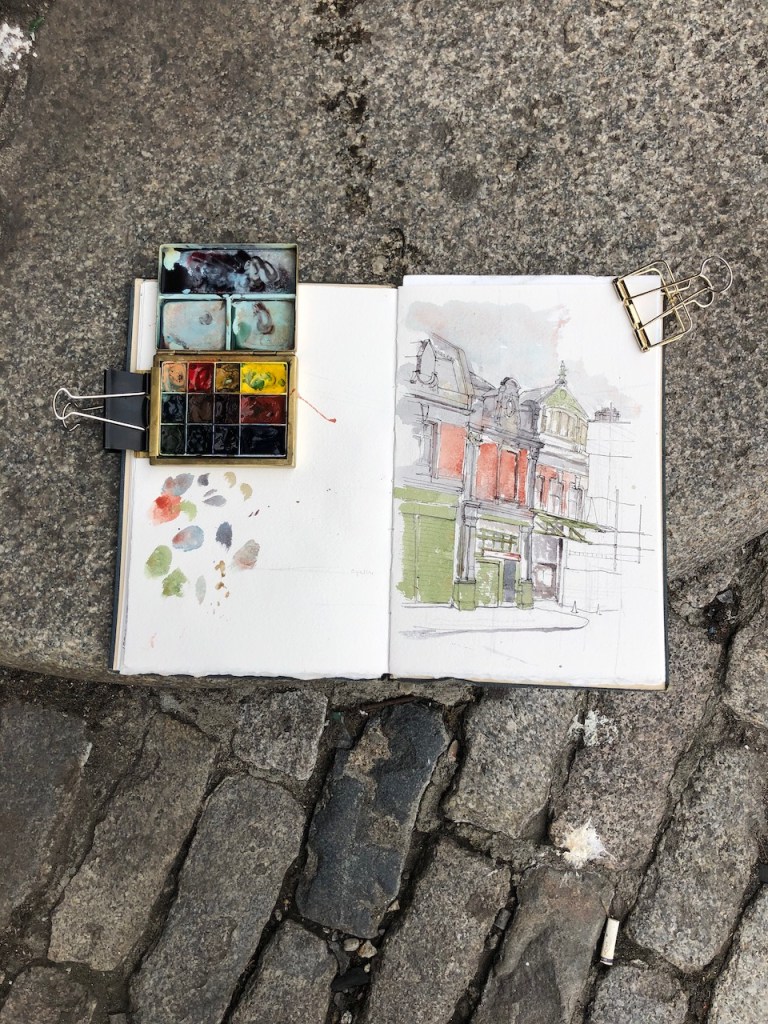
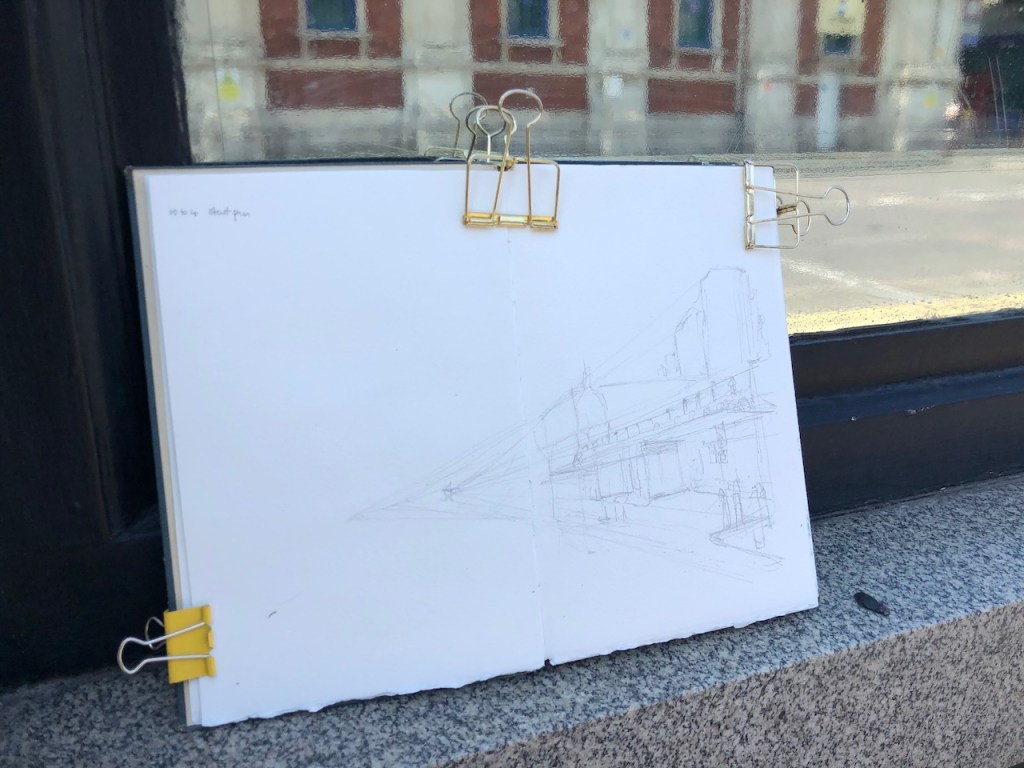
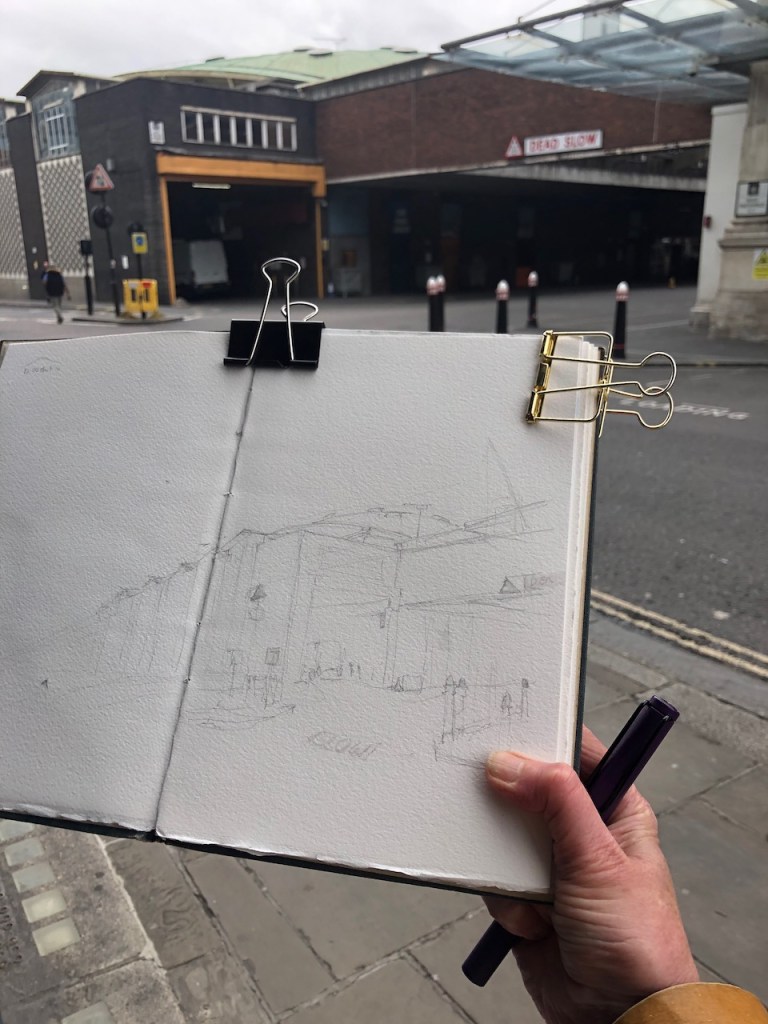
I sketched it in pen on location. Part way through the process, a group of workers started to clean the area behind me, using high-pressure water hoses. A fine mist appeared in the air, adding to the general dampness. I finished the drawing later that evening, in my warm dry room.
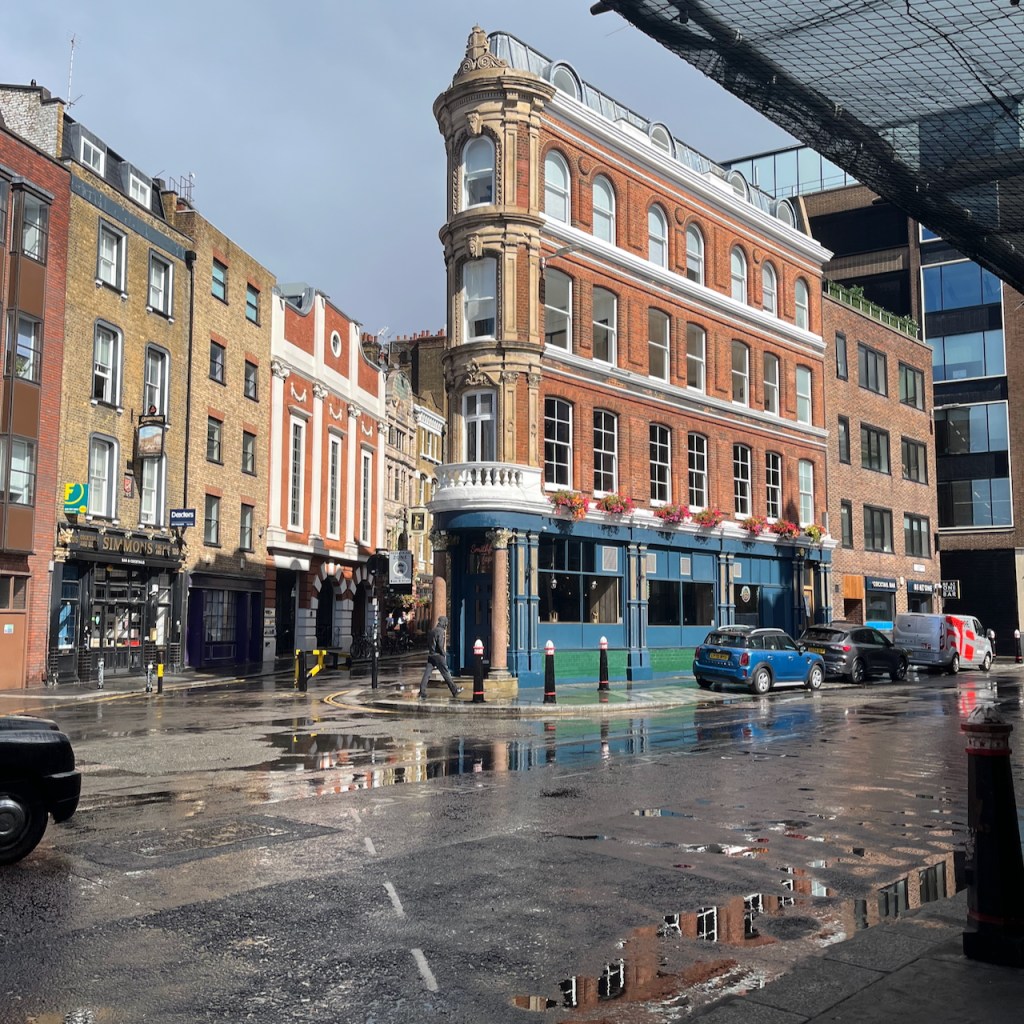
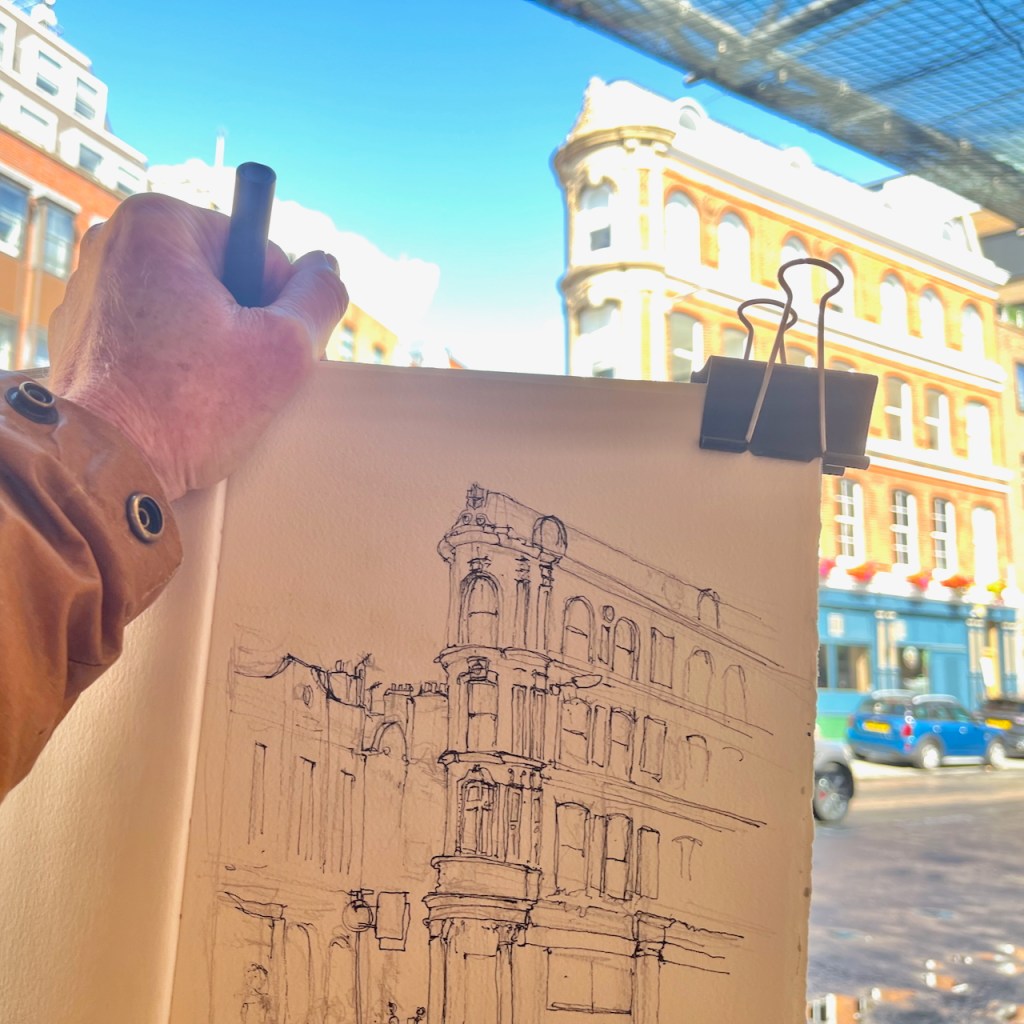
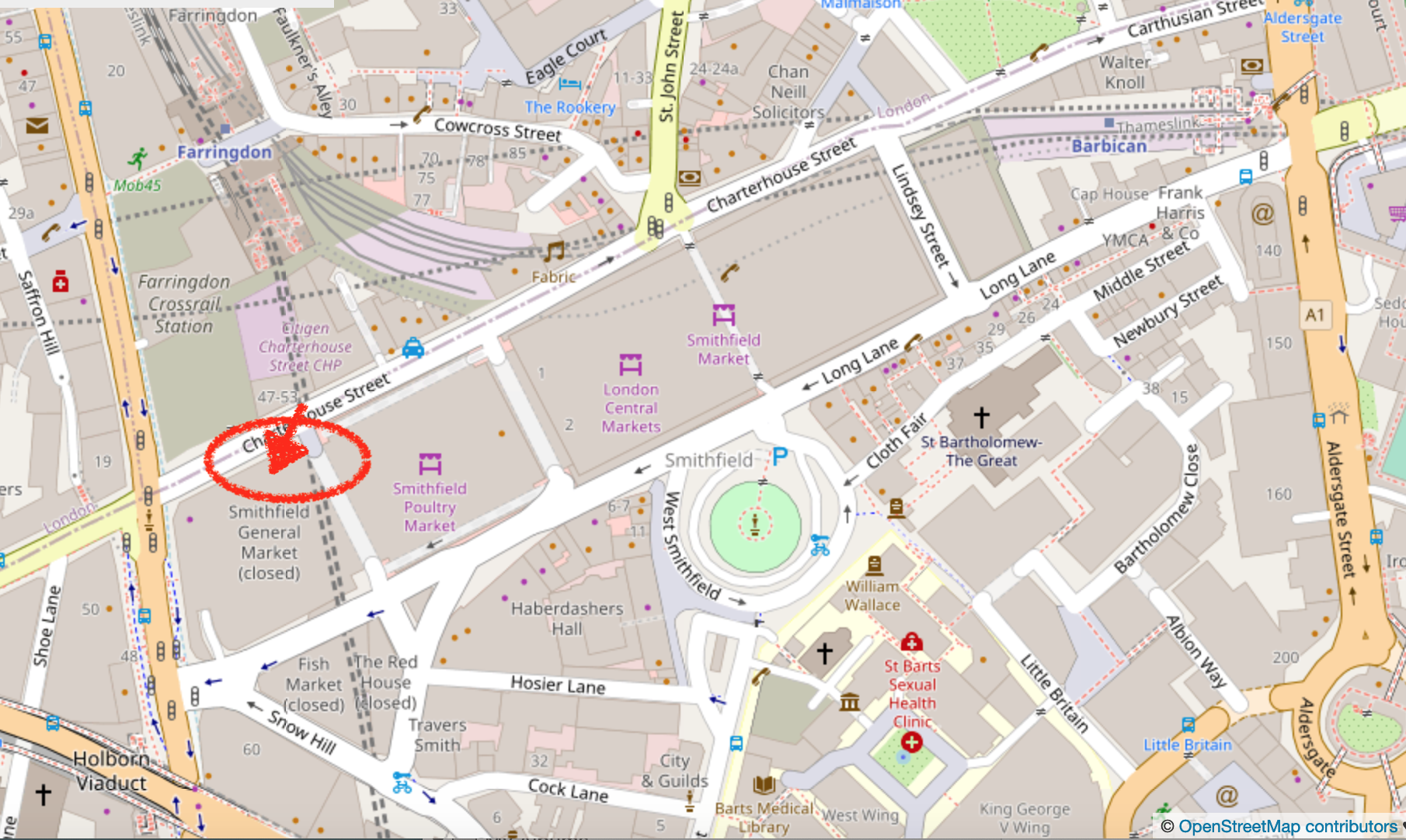
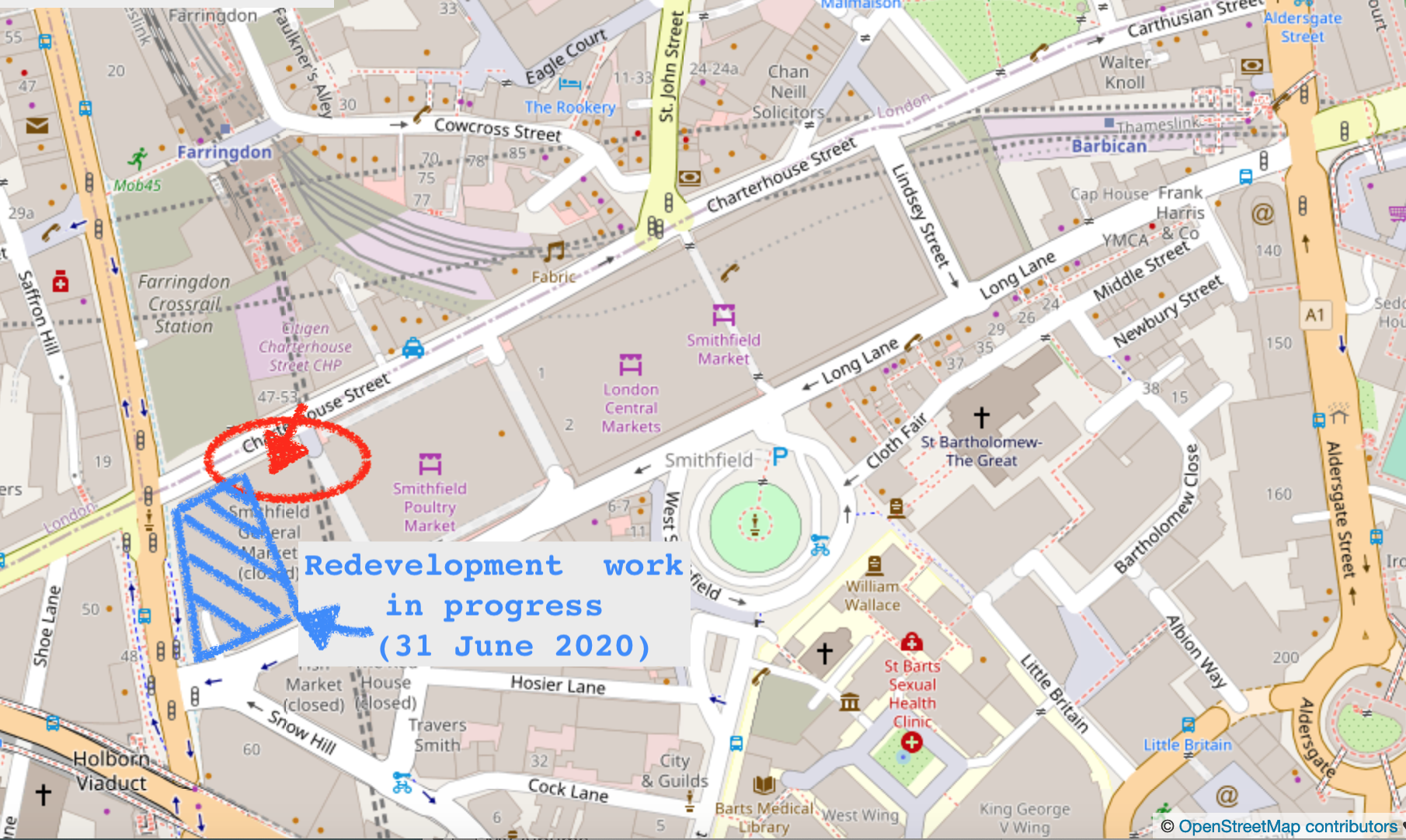
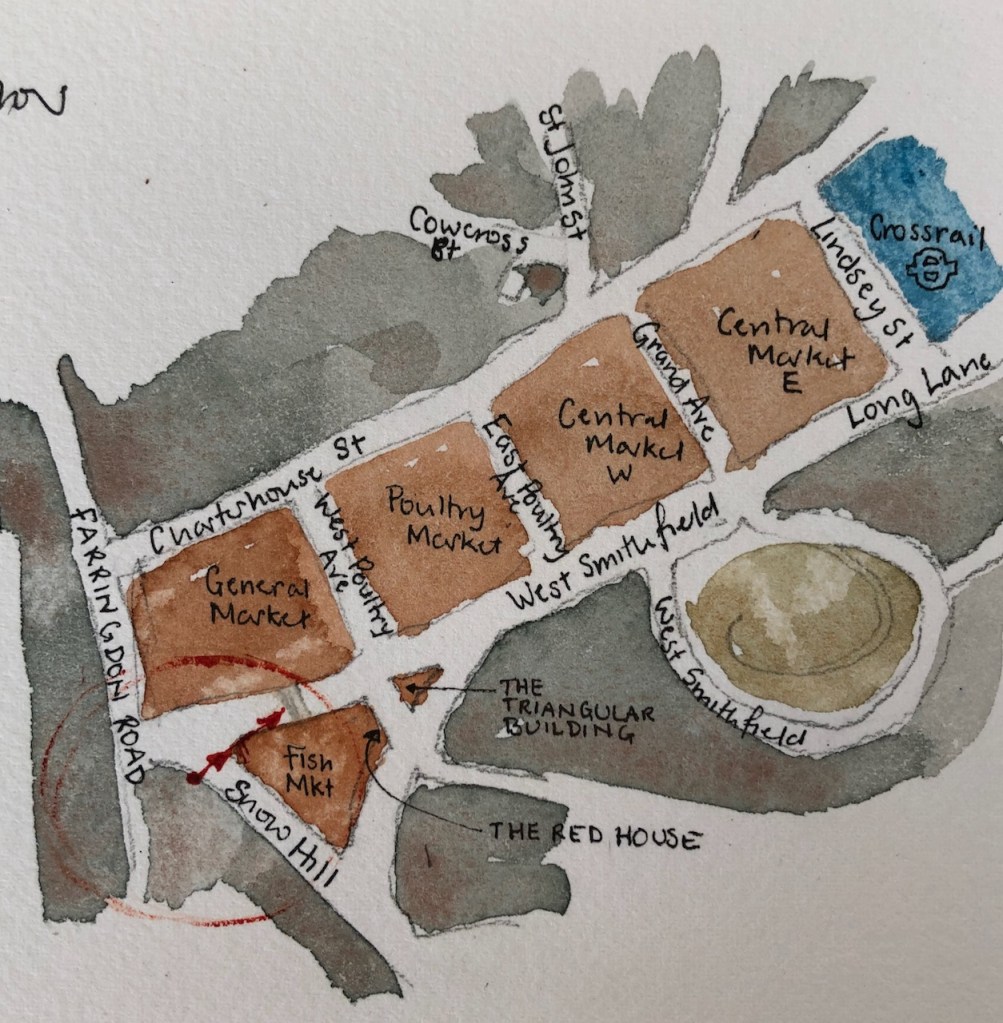
Here is a map.
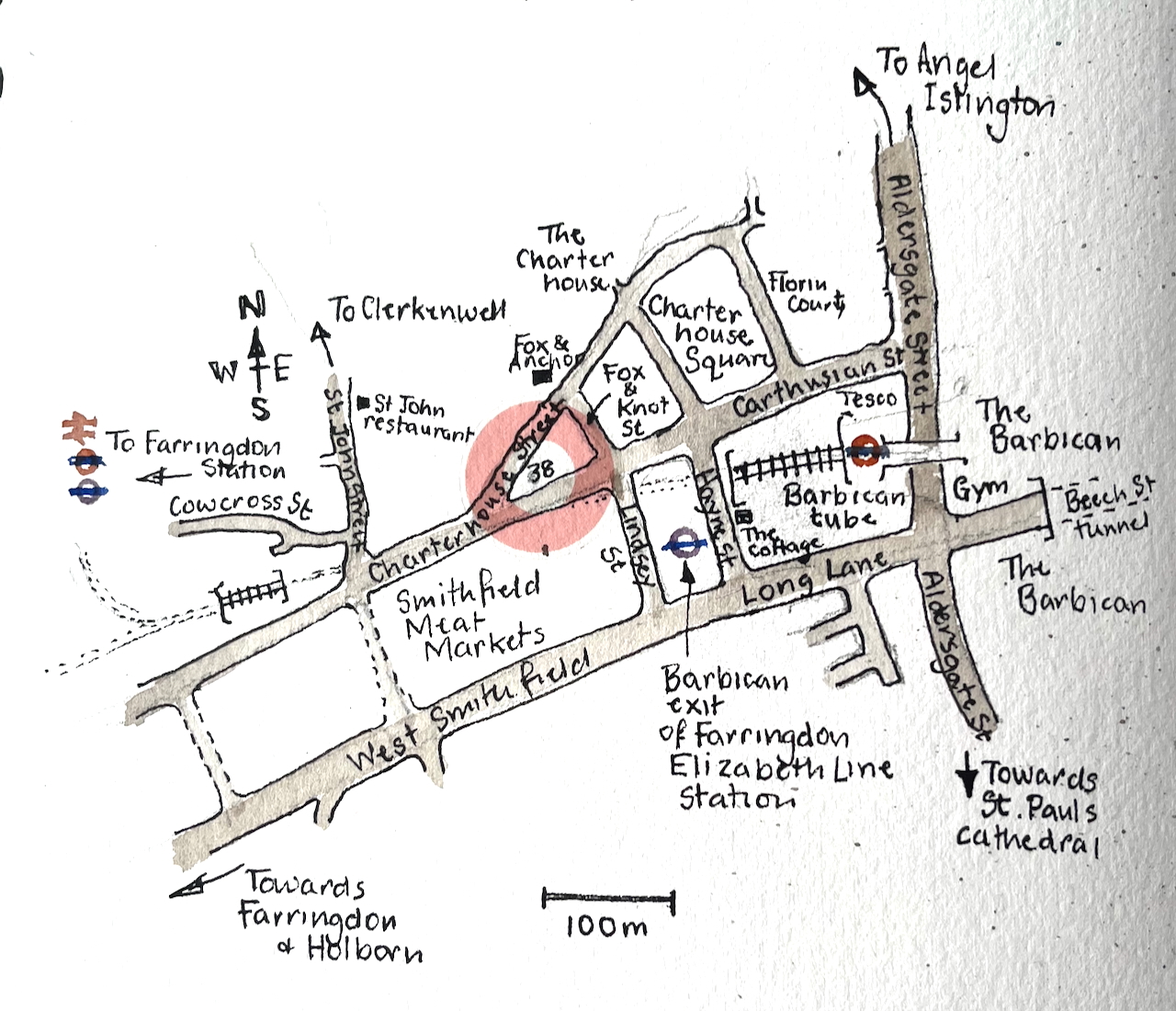
As you see, number 38 stands on a little triangle of land, bounded by Charterhouse Street, Carthusian Street and the tiny alley called Fox and Knot Street.

British History Online offers some history for this triangular plot. In the 1860s the City of London redeveloped the Smithfield Meat Market. At the time it had been mostly an open-air market. The City turned it into the covered market it is today. The surrounding lanes and buildings were also affected, both by the redevelopment and the increased trade.

In 1869–70, with the new market building complete, it was resolved to take the new road along the north side of the market further east into the square itself, carried out in 1873–4. The road was called Charterhouse Street, apparently at the suggestion of the Charterhouse,
Whereas in 1860 Charterhouse Lane enjoyed a mix of businesses, in 1876 half of the sixteen surviving houses were occupied by meat and poultry traders. The same trades dominated the new buildings put up, though there were also coffee rooms to rival the two remaining pubs and a large bank at the corner with St John Street. By the time of the Second World War most of the buildings west of the Fox and Anchor at No. 115 were purpose-built cold stores. Only with the decline of Smithfield Market did the grip of the meat trades loosen. Today restaurants and bars have largely supplanted them.

British History online

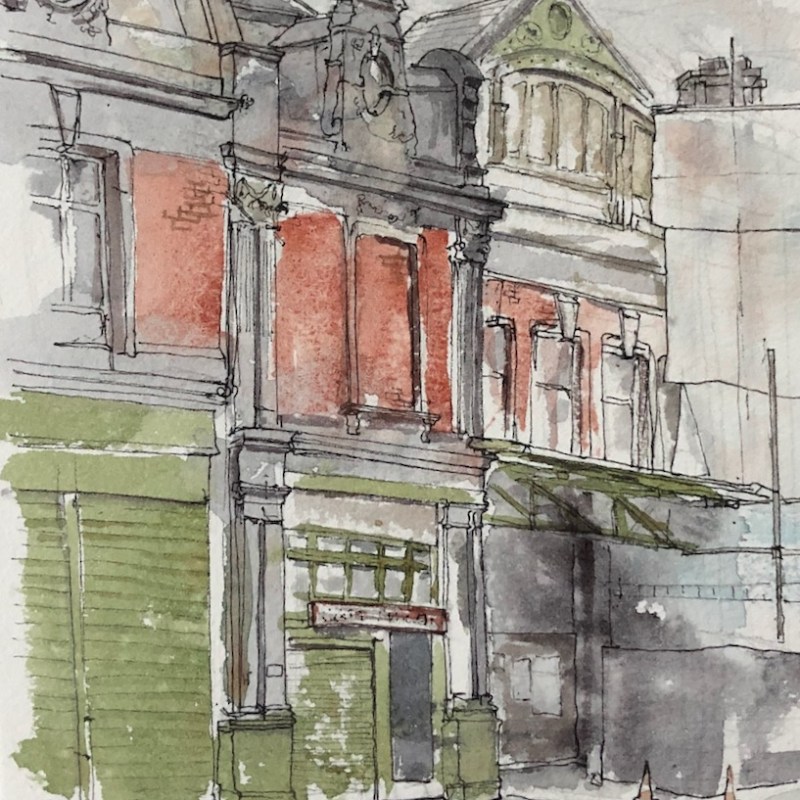
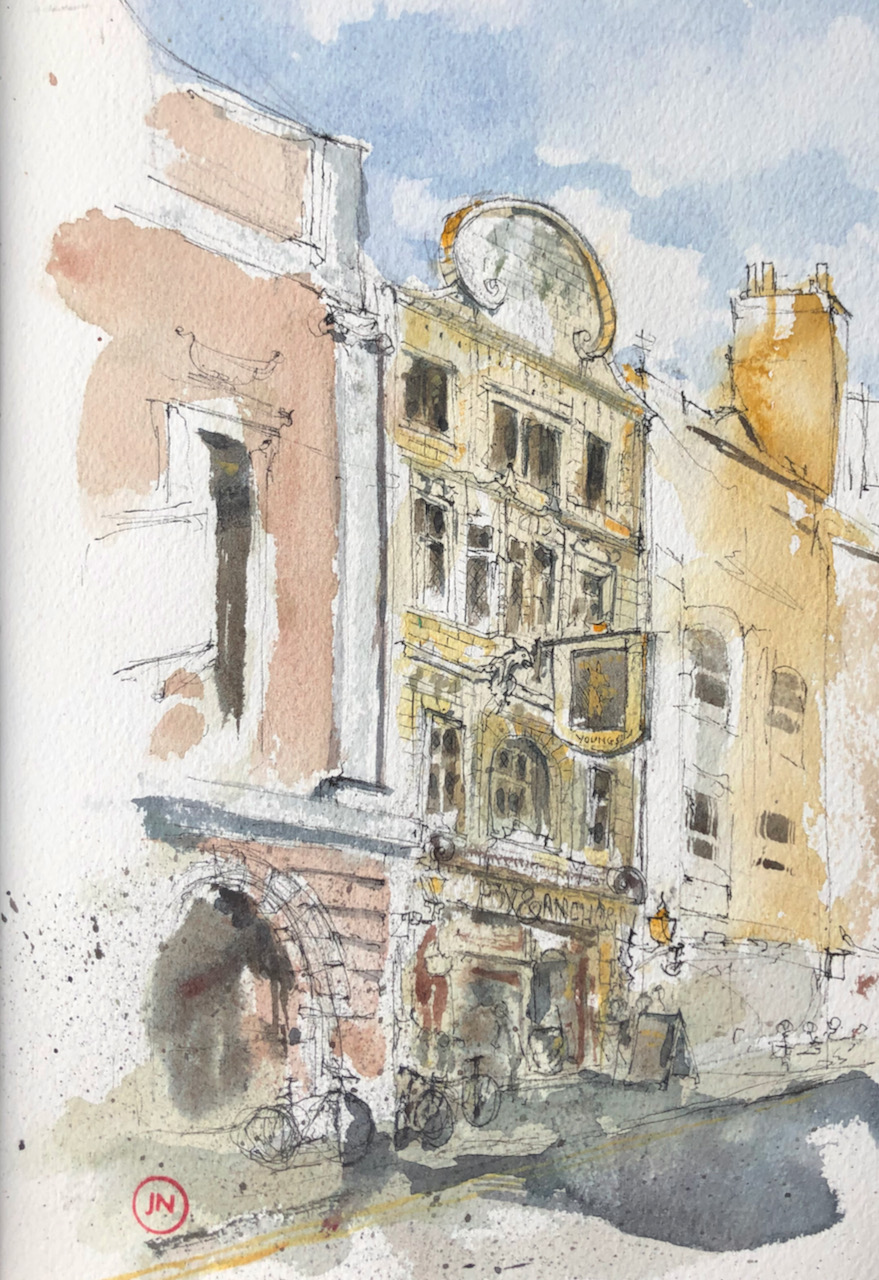
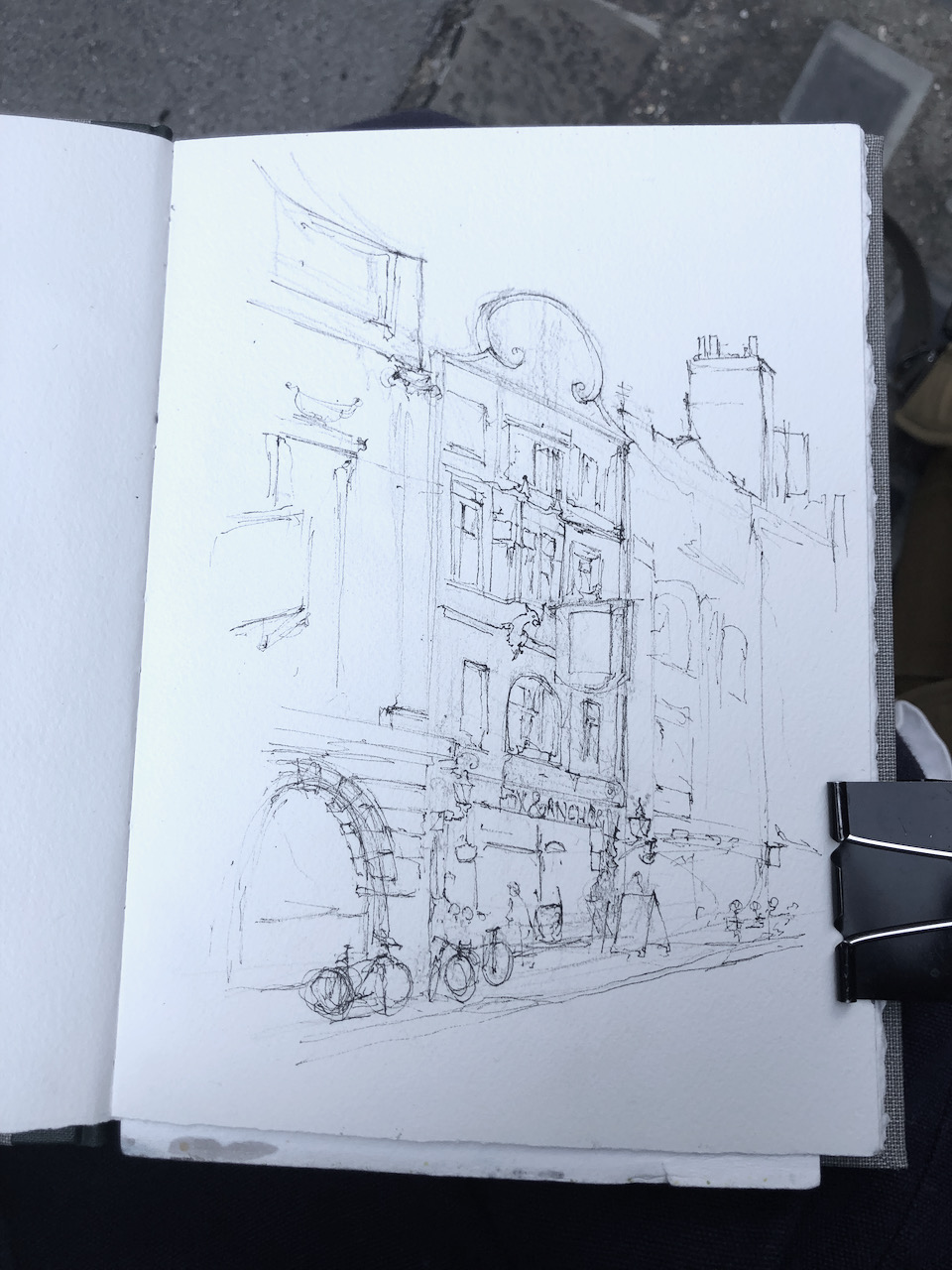
The Fox and Anchor pub and the former cold stores are on the left of my drawing. I’ve drawn the marvellous frontage of the Fox and Anchor here.

British History Online describes the block on the corner, number 38:
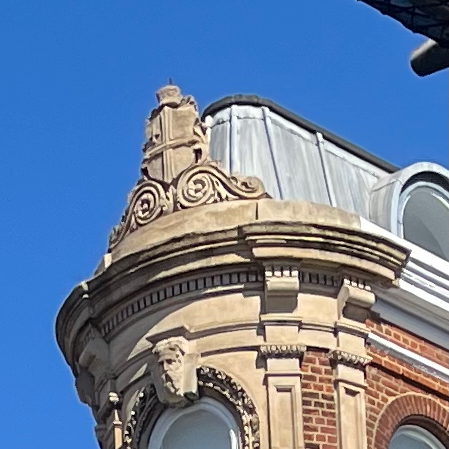
The remnant of ground at the angle between the old and new roads was laid out for a small block of buildings and allotted the numbers 38–42 (even) Charterhouse Street, behind which a tiny street, Fox and Knot Street, was cut through in 1871. The name was taken from Fox and Knot Yard, a court obliterated by the new market.

The small triangular block west of Fox and Knot Street […] just within the City boundary, belongs to the land acquired by the Corporation of London in the 1860s for the Smithfield Market development. Set out for building in 1871–2, it remained empty until 1875–6. At the apex a warehouse (No. 38), was then built for Myer and Nathan Salaman, ostrich-feather merchants, to designs by Benjamin Tabberer. […] It is four storeys high, of red brick with regular fenestration; all the ornamentation is concentrated on the narrow corner. For many years there were coffee-rooms here.

So, in 1875 it was an ostrich-feather warehouse, which must have been a great place to visit. The next mention of the building is on the website of Herbert, a present-day supplier of technology to retail businesses. They have a section of their website devoted to their long history. In the early twentieth century they were supplying weighing machines and balances from their offices in West Smithfield and a factory in Edmonton.
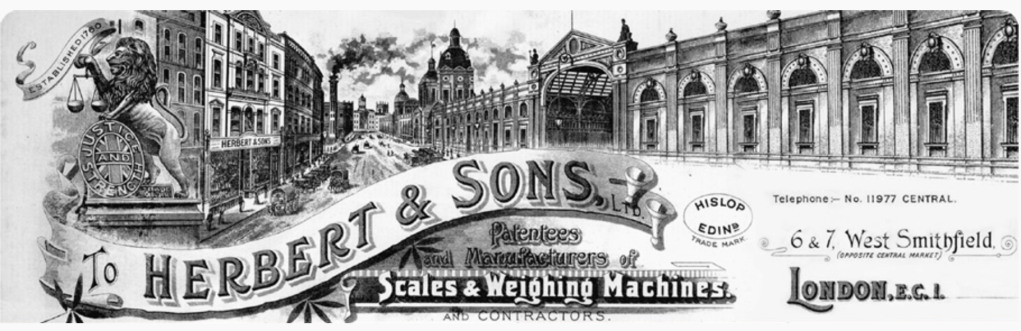
Advertisement from the Herbert History site, showing Smithfield Market.

In 1937 they moved into 38 Charterhouse Street which became a showroom.
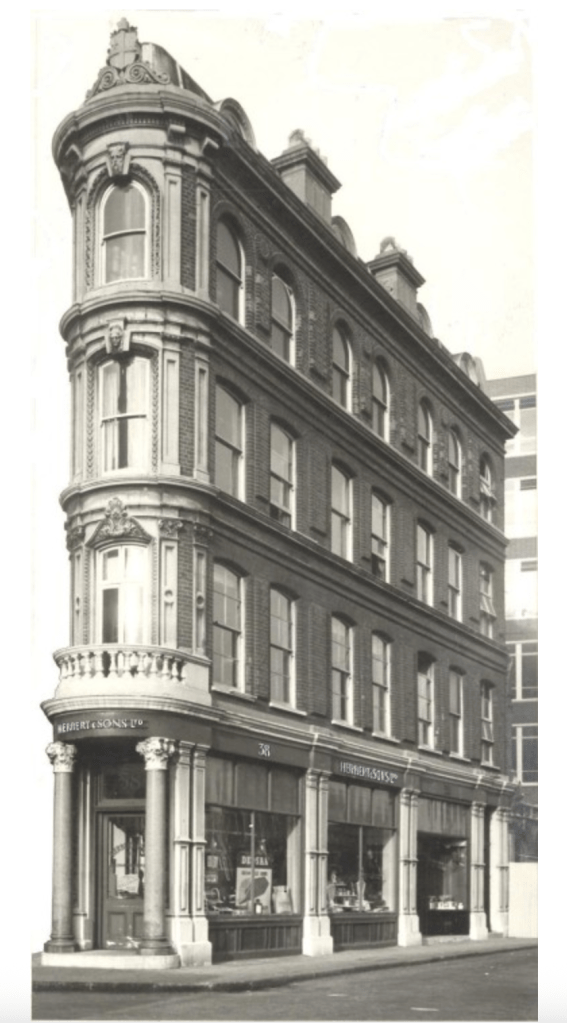
The Herbert and Son showroom, circa 1940s.

Herbert and Son moved out in 1956 and consolidated their operations into their Edmonton site. Since then, the building has been a coffee house, and, more recently, various bars. It is now the “Smithfield Tap”.

I wonder what will happen to it next?
Sketchbook 16

References

British History Online reference: https://www.british-history.ac.uk/survey-london/vol46/pp265-279
Charterhouse Square area: Charterhouse Street and other streets’, in Survey of London: Volume 46, South and East Clerkenwell, ed. Philip Temple (London, 2008), British History Online https://www.british-history.ac.uk/survey-london/vol46/pp265-279 [accessed 6 September 2025].

Herbert history reference: http://www.herberthistory.co.uk/cgi-bin/sitewise.pl?act=det&pt=&p=279&id=herbhis
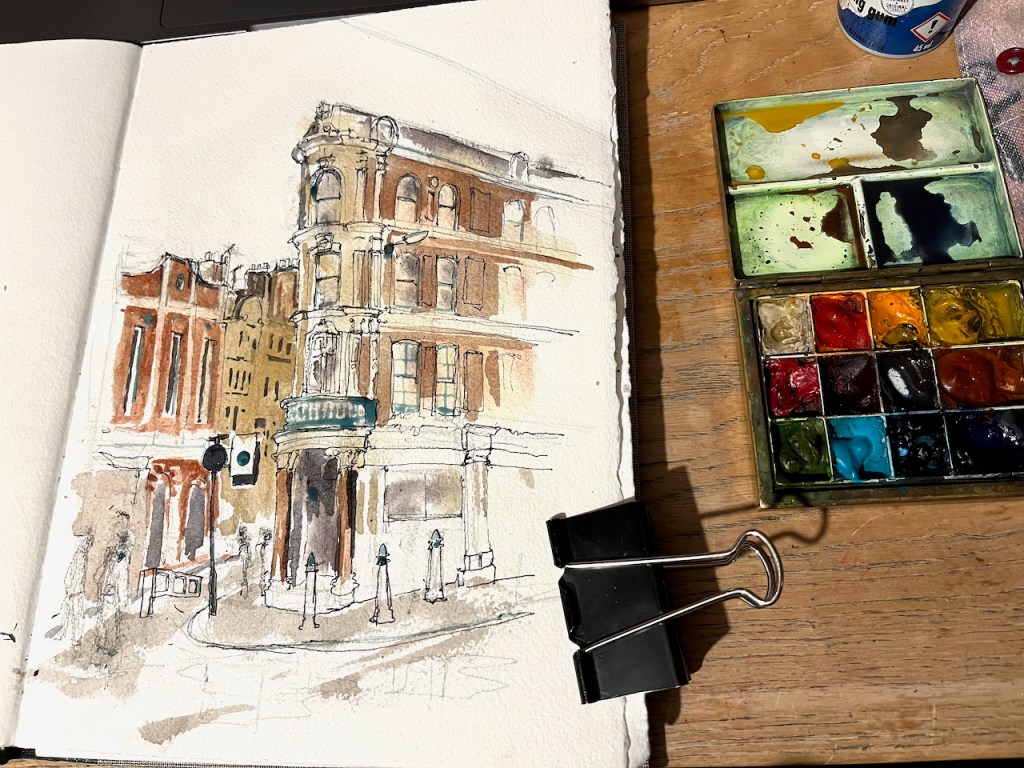
Putting on the colour at my desk.

Colours, all Daniel Smith unless otherwise stated:

  • Fired Gold Ochre (bricks)
  • Ultramarine Blue Finest (Schmincke Horadam) + Burnt Umber = grey/black
  • Phthalo Blue Turquoise (reflections, water)
  • Mars Yellow (bricks)
  • Serpentine Genuine (Green tiles)
  • Buff Titanium (cream-coloured stonework)
  • Transparent Pyrrol Orange (highlights of red on the bollards)
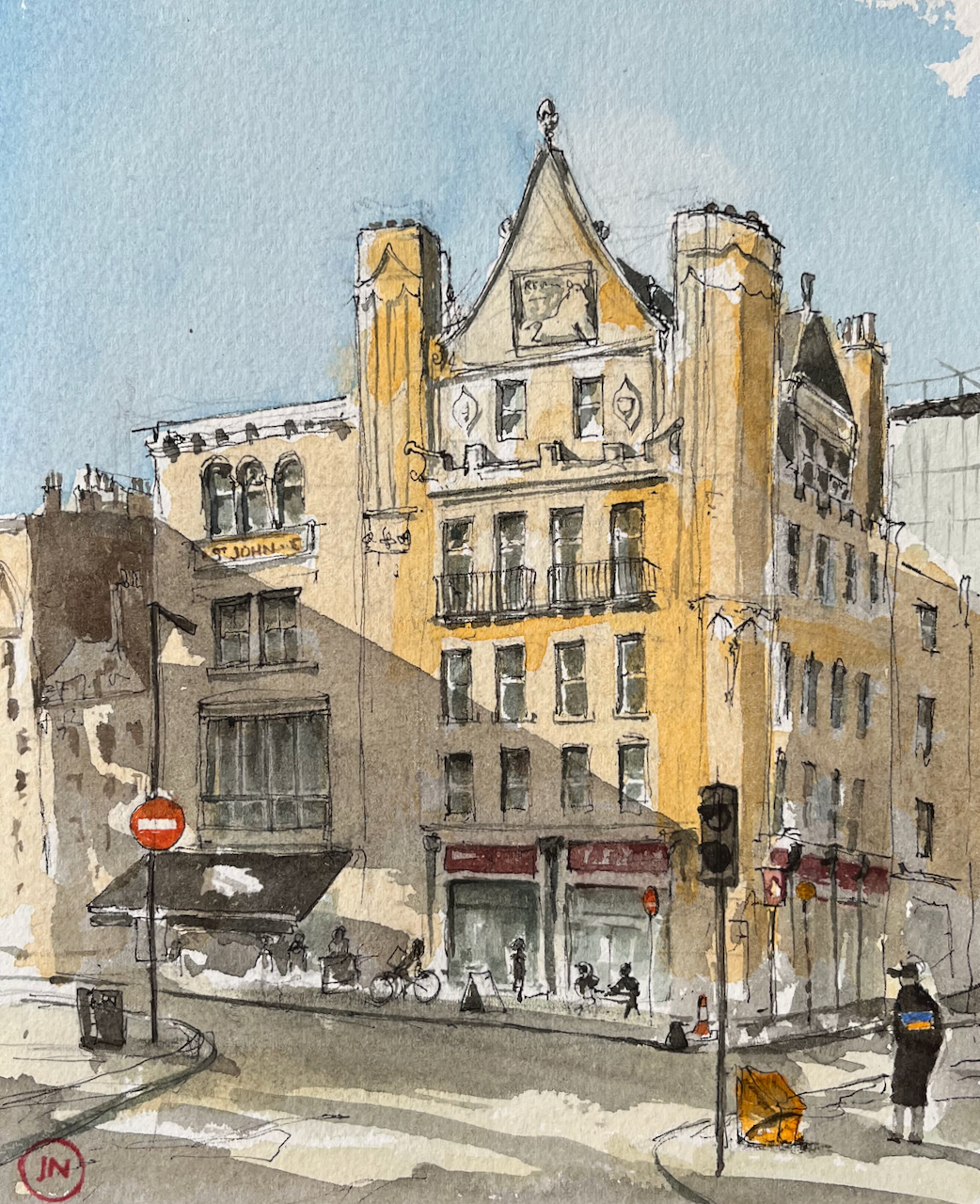
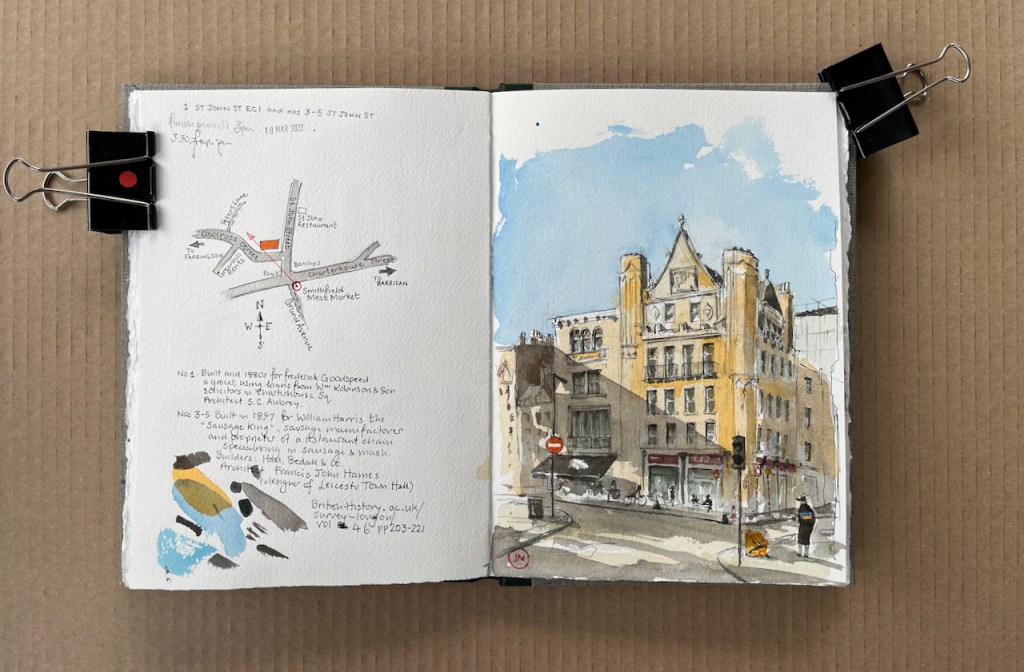
3-5 St John Street – William Harris

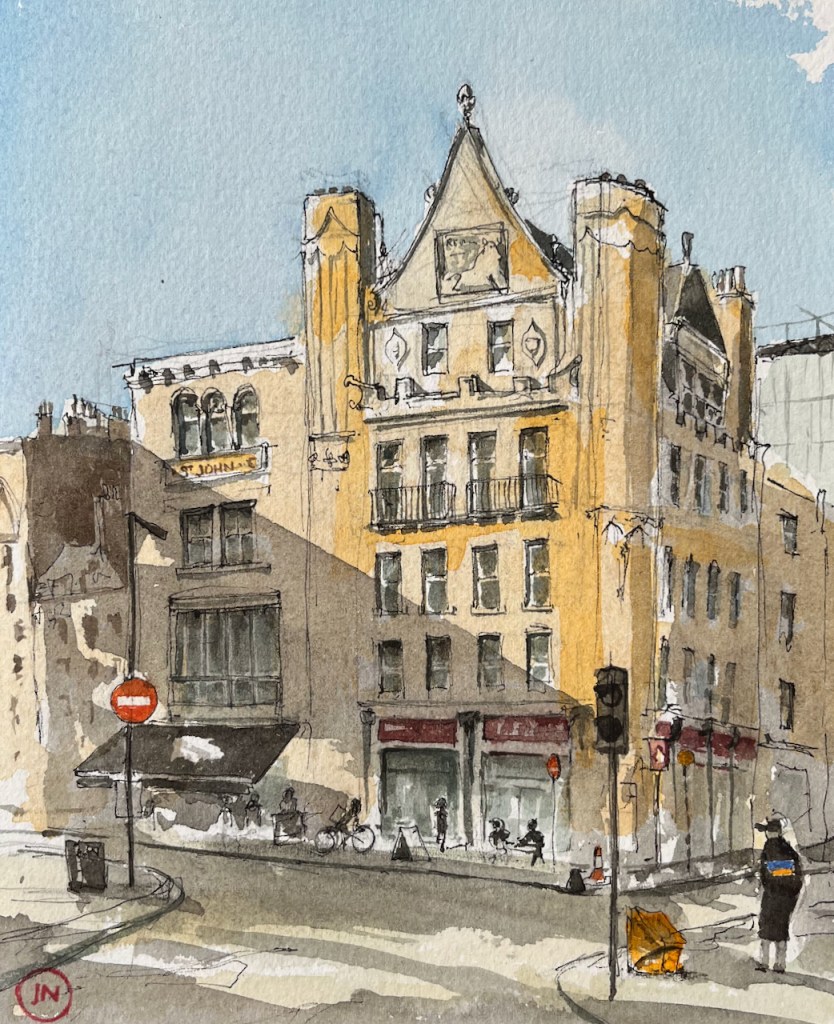
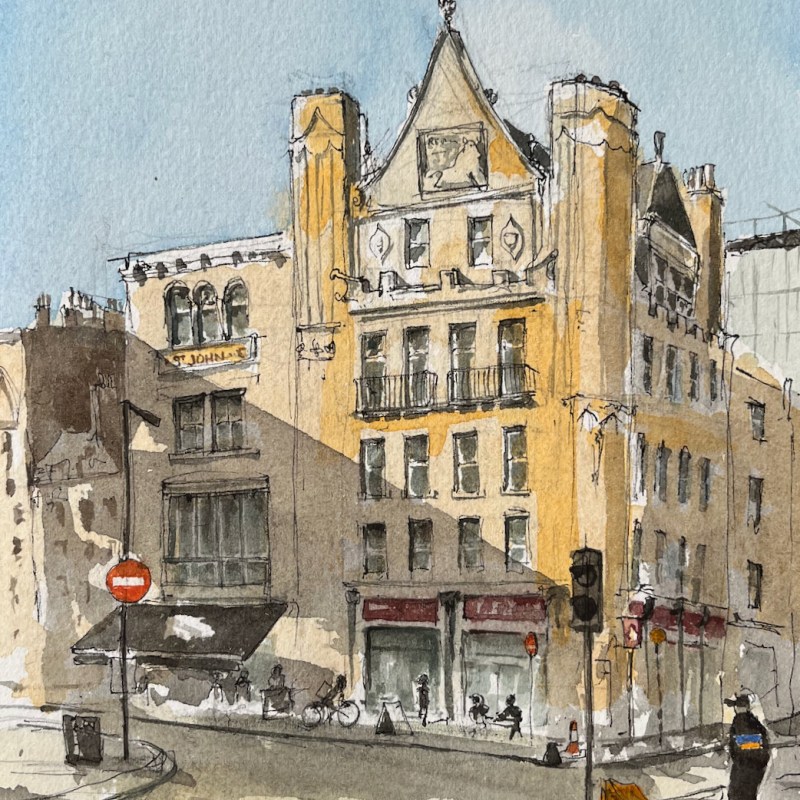
These glorious buildings are at the south end of St John’s Street. This is the view looking north from the Smithfield Meat Market, Central Avenue.

3-5 St John St EC1, 18th March 2022 3:30pm, in Sketchbook 11

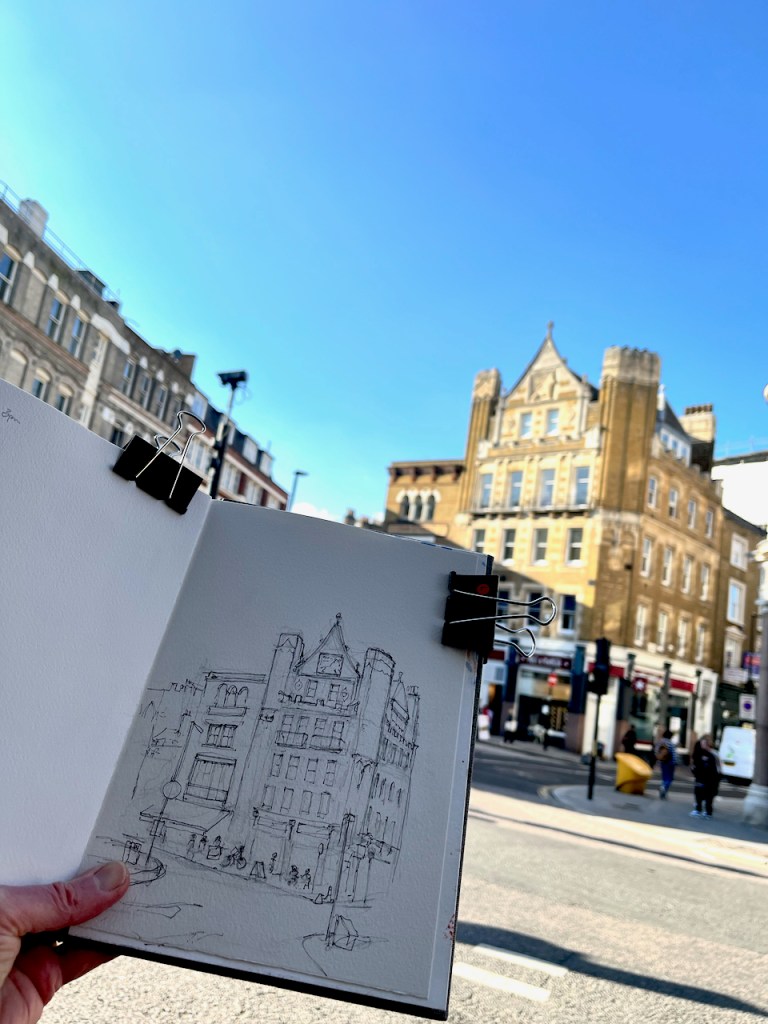
It’s a busy corner. I tried to show some the street life: couriers cycling, people sitting at the café, and people, like me, standing and looking. A little further up St John Street, on the right, is construction work.

There was a blue sky as I drew. But do not be deceived: it was cold, as you see from the person on the right, hunched under their coat.

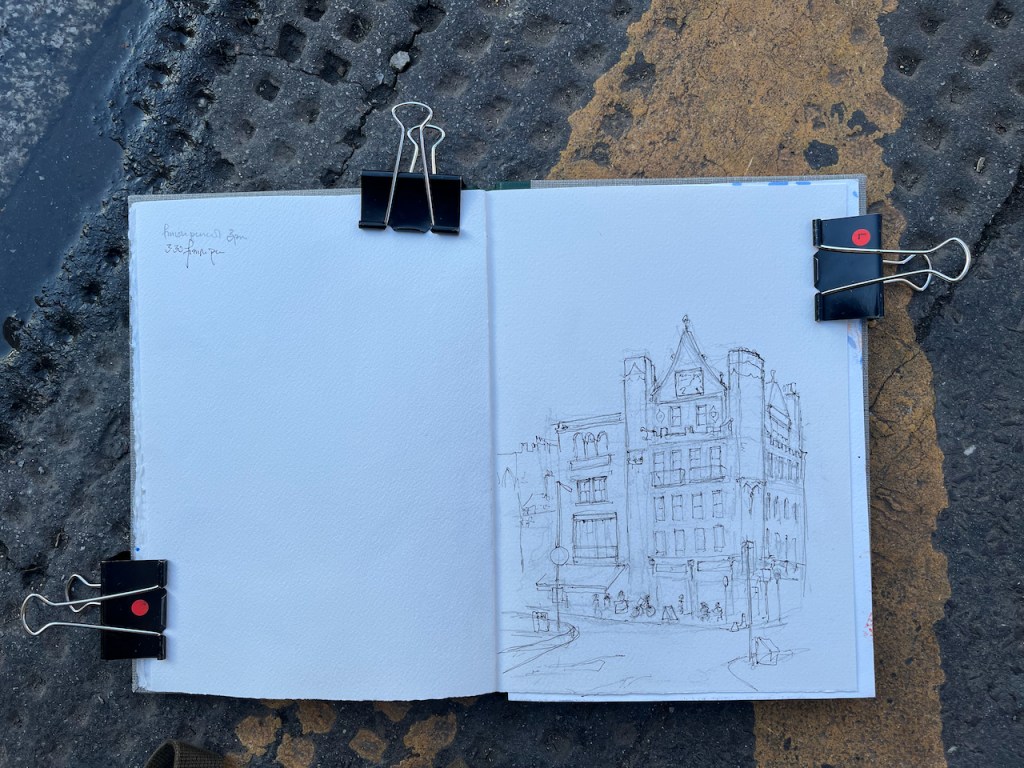
Here is a work-in-progress photo and a map:

This is an ornate buildings: lots of fluting and complicated brickwork. Who thought all that was a good idea? Who could afford it? Number 1, on the left, slightly more restrained, was built for a Frederick Goodspeed, a grocer, in the mid 1880s. The architect was S.C. Aubrey. (reference 1 below)
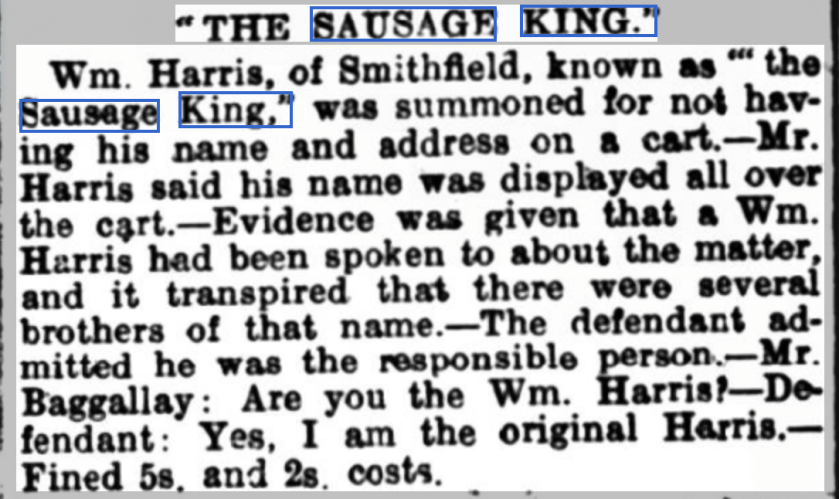
Numbers 3-5, the building on the corner, has chimneys with all kinds of complicated brickwork, and a highly decorative frontage onto Smithfield. It was built in 1897 for William Harris, the “Sausage King”. He was a sausage manufacturer, and proprietor of a chain of restaurants specialising in sausage and mash. Mr Harris was evidently quite a character. He named all his three sons William, and all his four daughters Elizabeth (reference 2 below). This may have had practical problems, but it meant he and his sons could have fun with the Magistrates:

Woolwich Gazette – Friday 10 November 1905 from “https://www.britishnewspaperarchive.co.uk”

The “Sausage King” was somewhat eccentric, but this was to a large extent due to his love of “personal advertising,” which was his motto for business success. At all times of the day he wore a sort of evening dress, with an opera hat, and a blazing diamond in his white shirt, even when buying in the market, and he used not a scrap of writing or wrapping paper that did not bear his photograph. His trade mark, which he registered about forty years ago, depicts him winning the “Pork Sausage Derby” on a fat porker. His principal catch-phrase was “Harris’s sausages are the best,” and it spread the fame of his sausages all over the world. He also composed a lot of poetic advertisements, which caused much amusement.

This snippet from “London Standard, via the Montreal Gazette, 3 May 1912” reporting his death (reference 2).

He died in April 1912, leaving a considerable fortune. His death was reported far and wide, including papers in many parts of England and Ireland.

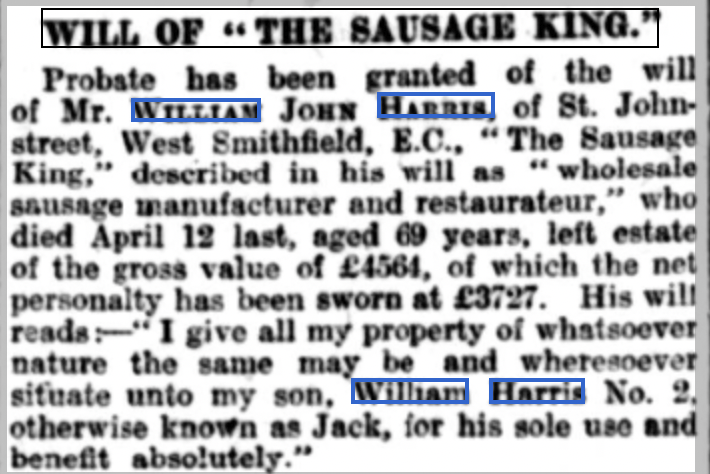
London Evening Standard – Thursday 06 June 1912 from “https://www.britishnewspaperarchive.co.uk”.

Note the reference to “William Harris No. 2”, that is, his second son, to whom he left all his property. I wonder what all the other sons thought – and the four daughters?

I am glad that the flamboyant house of this extraordinary man still stands. The architect was Francis John Hames, who also designed Leicester Town Hall. So you see what kind of league Mr Harris was in.

Reference 1: Thanks to British History Online who alerted me to The Sausage King: ‘St John Street: Introduction; west side’, in Survey of London: Volume 46, South and East Clerkenwell, ed. Philip Temple (London, 2008), pp. 203-221. British History Online http://www.british-history.ac.uk/survey-london/vol46/pp203-221 [accessed 8 April 2022].

Reference 2: The piece from the Montreal Gazette is online at https://charlespearce.org/people/william-harris.html

I have drawn extensively in this area, both in St John St and around the meat market.

Here are my drawings of and around Smithfield meat market:

The Fox and Anchor EC1

…its varnish was peeling but it was heavy and strong….

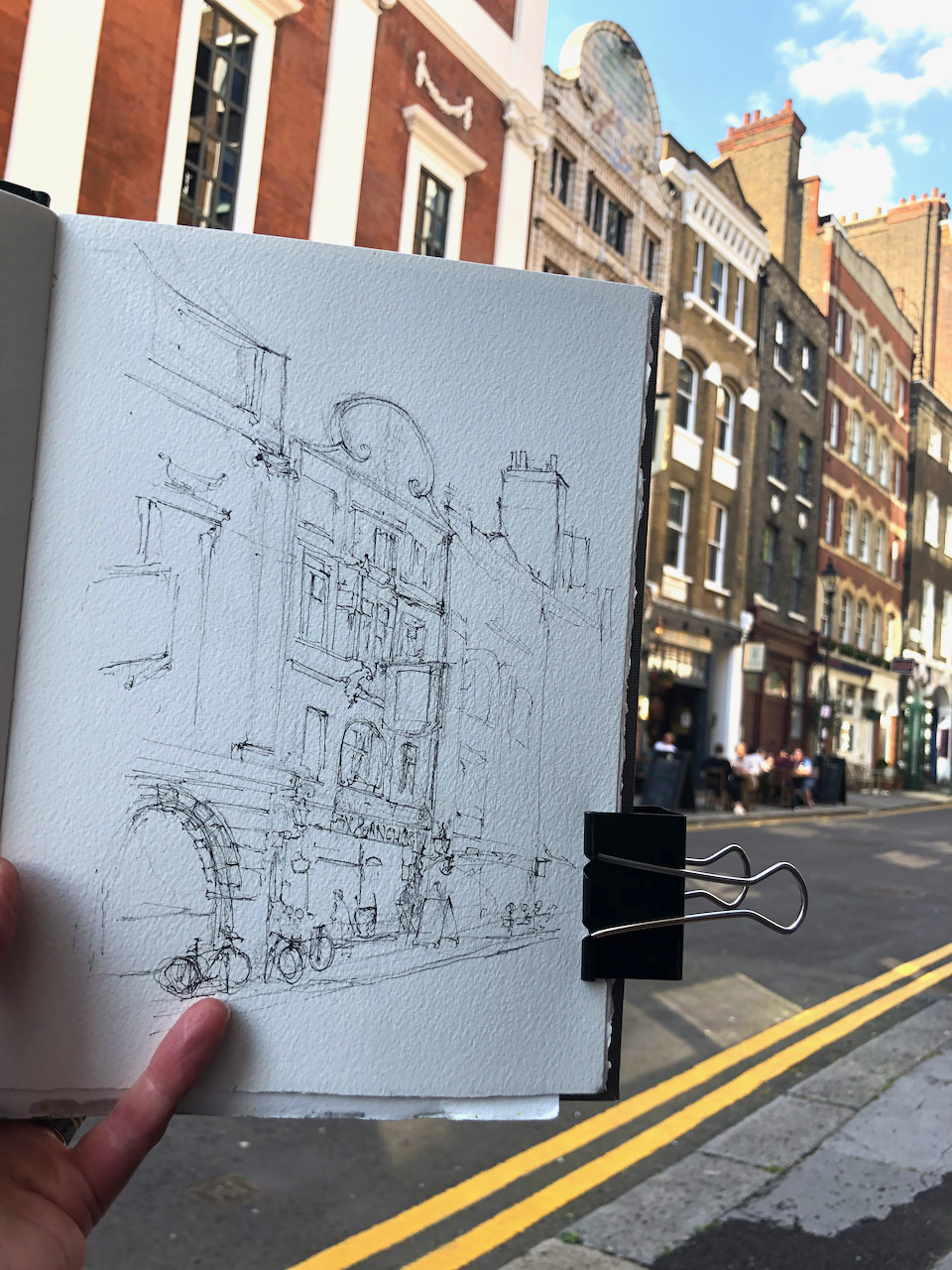
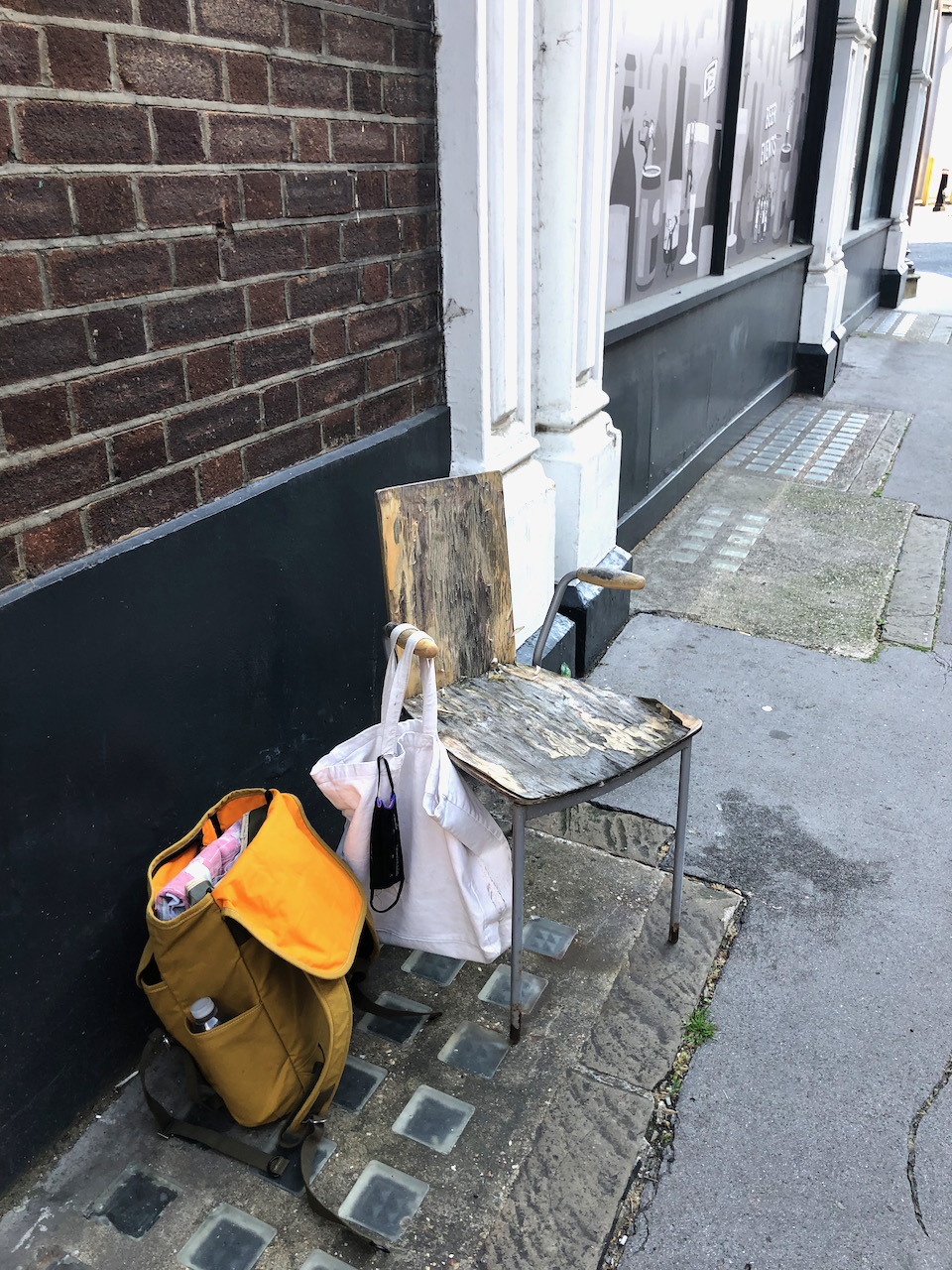
I set off on a warm afternoon intending to sketch a pub in Clerkenwell Green. On the way there, I walked along the north side of Smithfield. Down a side street I spotted a lone chair, placed as if waiting for me. It commanded an excellent view of the Fox and Anchor. I tried out the chair. Its varnish was peeling, but it was heavy and strong.

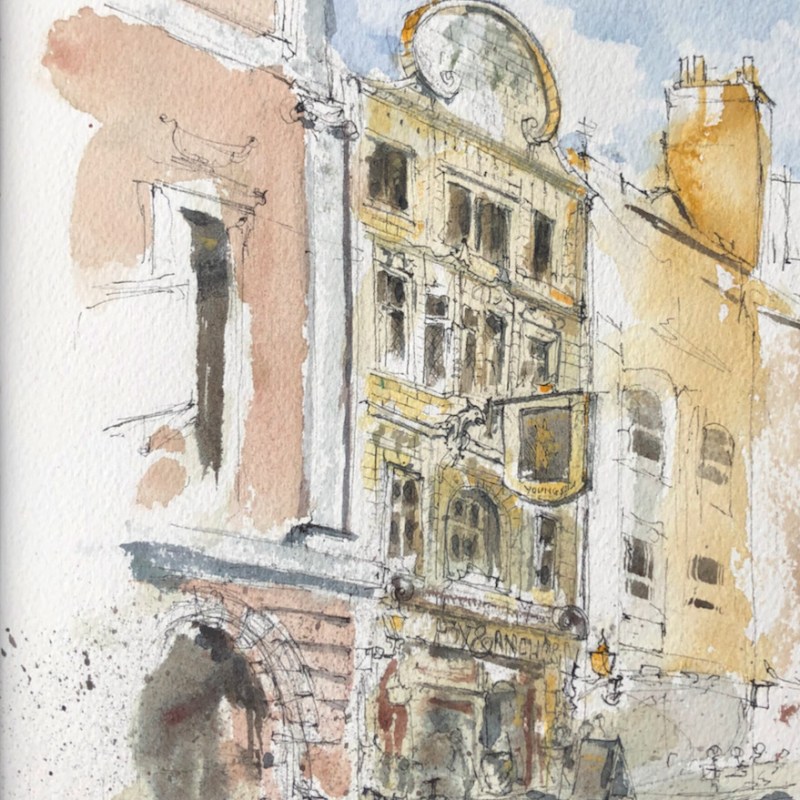
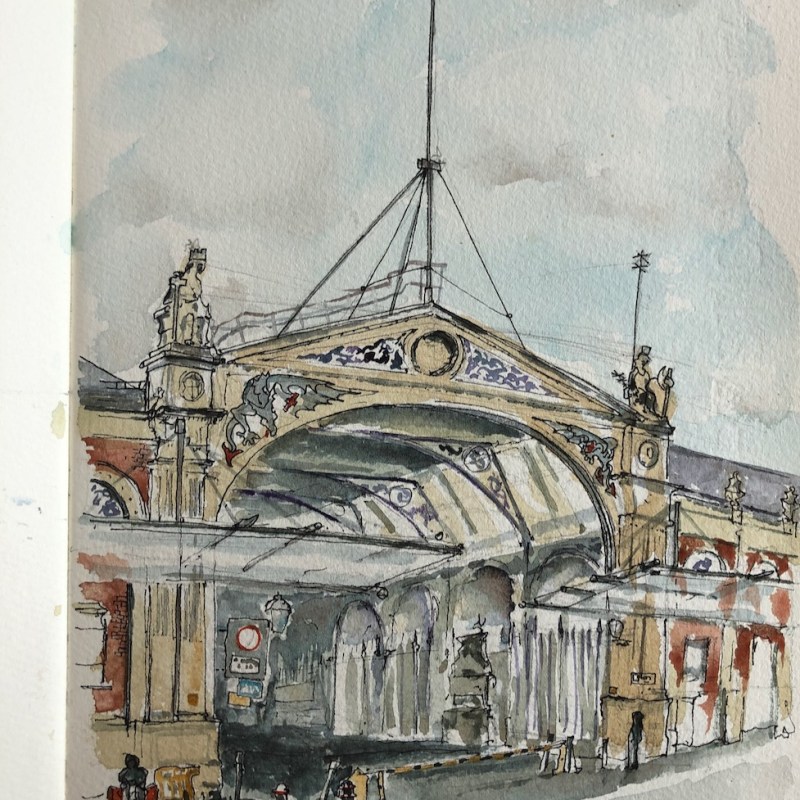
So I settled myself down and drew the Fox and Anchor. This is a very decorative pub. Pevsner* says it has a “joyful front of Doulton’s coloured tiles”. That’s Royal Doulton, the pottery company. I recommend the startling Royal Doulton building in Vauxhall, on the corner of Black Prince Road and Lambeth High Street. This is even more elaborate than the Fox and Anchor pub, since it was a living advertisement for the wares of the firm.

The Fox and Anchor dates from 1898. This date is on the tiles in that magnificent halo on the top, together with a picture of the Fox. The date is written in such flamboyant Art Nouveau script that it’s difficult to read. The whole of the front is tiled with ceramic tiles, in wonderful shapes, including tiles which go around the window frames. There is a dragon either side of the pub sign.

Fox and Anchor pub and hotel, EC1. Sketched 5th June 2021, 17:30 in Sketchbook 10. 8″ x 10″

This is a Young’s pub, open now. The Fox is shown on the pub sign, but not the Anchor. It has a special Smithfield licence, which means that it can offer beer for breakfast. This special licence is historically for serving the night shift meat workers at Smithfield. Someone of my acquaintance recounts stories of financial services workers in the City celebrating the end of projects with the Full English at the Fox, complete with pints of beer.

It is also a hotel. “Boutique” rooms are offered on its website. It must be a great place to stay!

I drew this picture between 4 and 5:30pm on a Saturday. The area was already becoming lively. A crowd spilled out of the “Be At One” cocktail bar.

Outside the Fox and Anchor people sat at tables quietly taking in the evening. And observing the person sketching, sat on a chair on the pavement opposite. As I noticed with my drawing earlier in the week, Londoners are losing their fear and are starting again with the social interactions. Several people came to say hello as I was working on the picture. Someone had seen me looking repeatedly up at the building and down at the picture. They had been discussing with their companion why I didn’t use a photograph. So they came and asked me, which was nice of them, and provoked an interesting discussion. Part of the answer is because “I like sitting here looking at the building,” and another part of the answer, which I struggled to express, is that I get a very different picture if I work from a photograph.

Another person came and asked technical questions. They use watercolours for life drawing, and wanted to know the name of the brown colour I use, which is Fired Gold Ochre. They also admired my paintbox.

Here are pictures of work in progress and my drawing location:

Here is a map showing the line of sight of the drawing. The nearby street is called “Fox and Knot Street” which is intriguing.

The picture took an hour and a half, all on location. The colours are: Fired Gold Ochre, Phthalo Blue Turquoise, Buff Titanium, Mars Yellow, Permanent Yellow Deep. and some Perylene Maroon to make the grey colours. The yellow lines on the road are Naples Yellow.

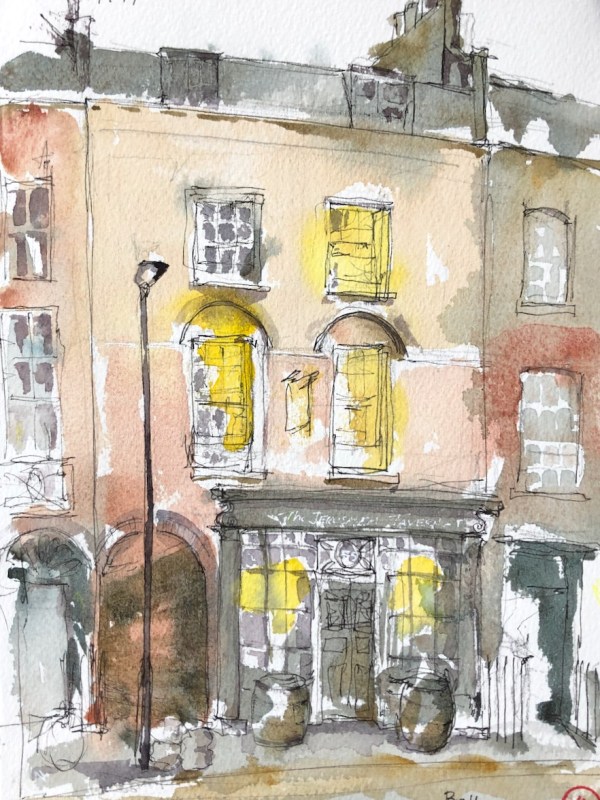
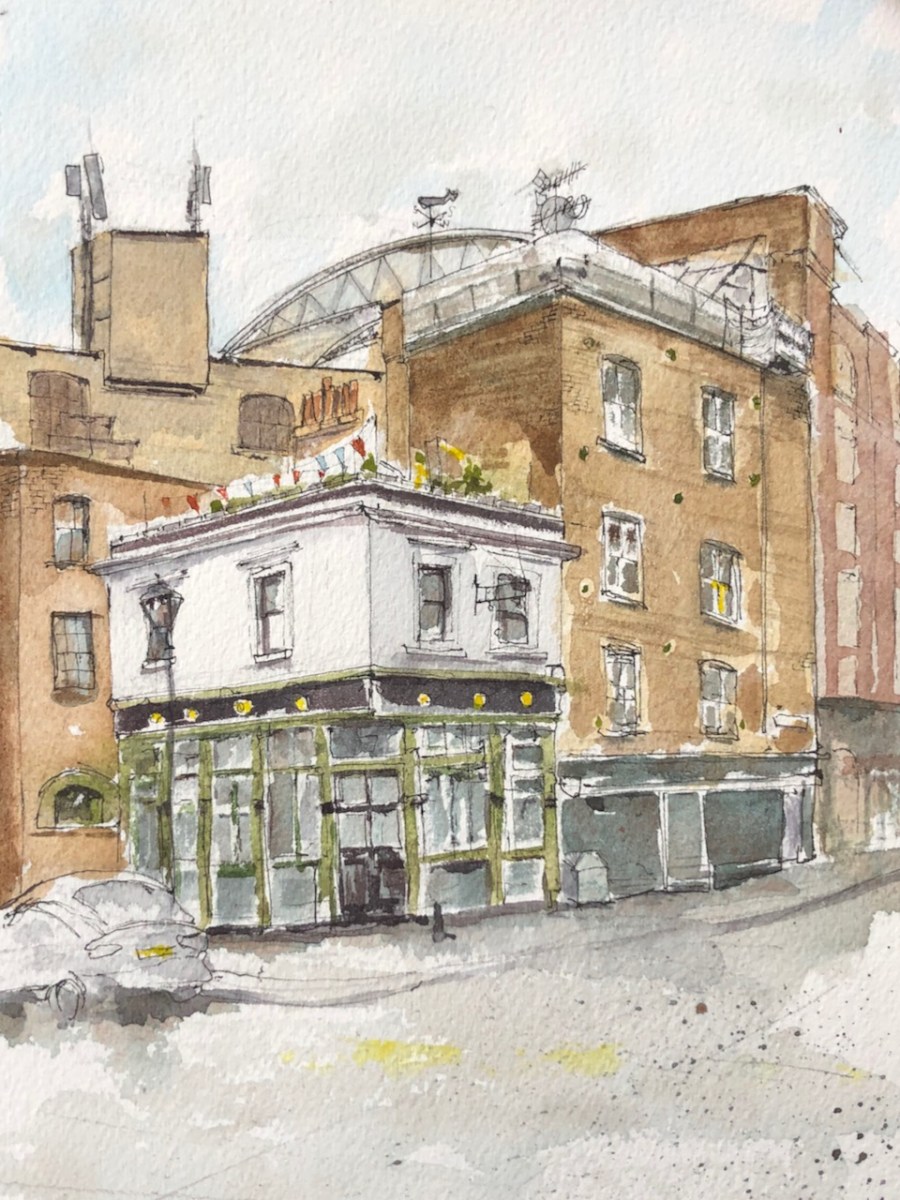
I have sketched other pubs in the area:

*p454, “The Buildings of England, London 1: The City of London, by Simon Bradley and Nikolaus Pevsner. 1999 edition.

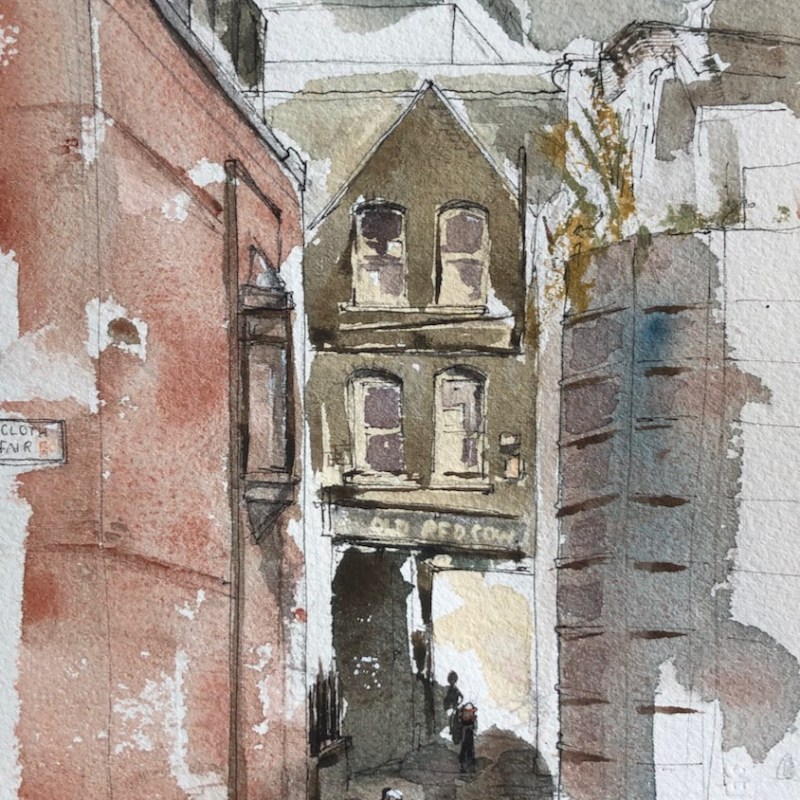
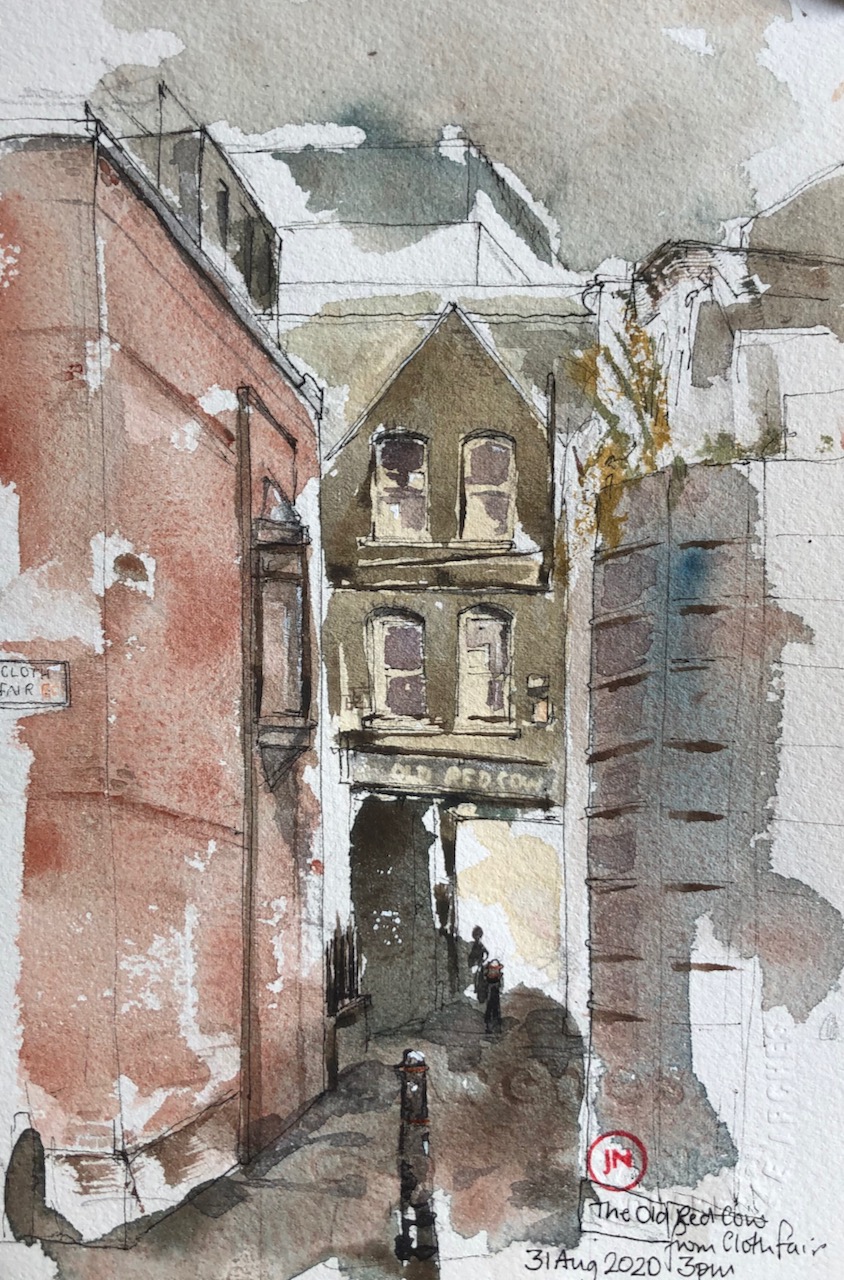
The Old Red Cow, from Cloth Fair

Here is a view of the pub “The Old Red Cow”, seen from Cloth Fair.

The Old Red Cow from Cloth Fair
I drew the picture from outside “The Hand and Shears”

The front of the pub is on Long Lane. When CrossRail opens, it will be very well placed to serve the people flooding out of the new “Farringdon East” station. At the moment, however, it’s closed due to the COVID pandemic.

In Cloth Fair in this area there is a particularly varied collection of bollards. One celebrates 800 years of the Lord Mayor: 1189-1989.

Here are some photos of work in progress and a picture of the bollard.

One hour and 20 minutes, drawn and coloured outside the “Hand and Shears”.

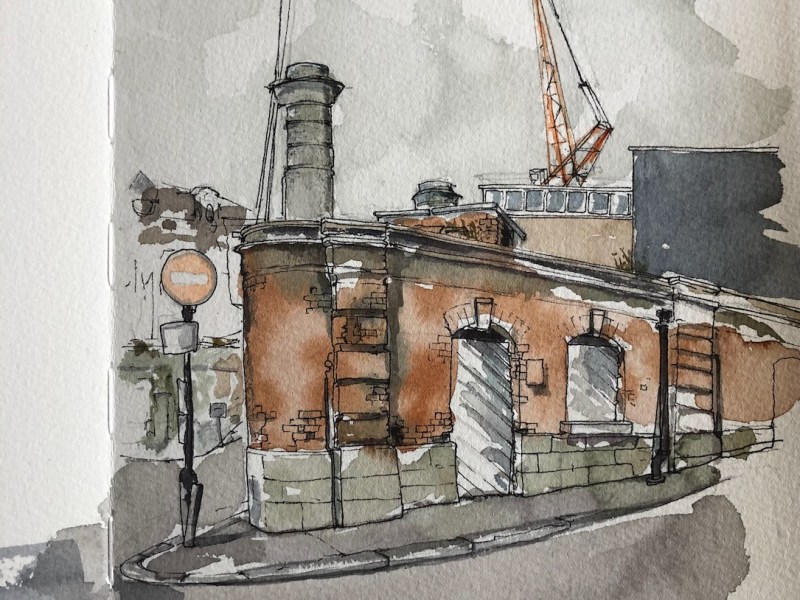
Triangular Building, North West corner

Here is the Triangular Building, West Smithfield, from the North West.

Triangular Building, North West corner.

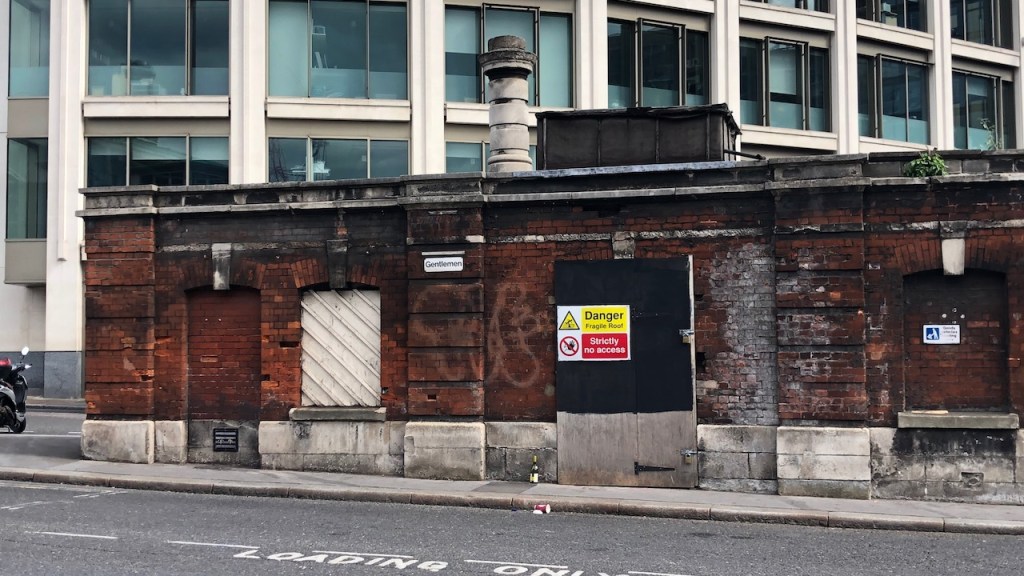
From this view, you can see all 3 chimneys. You can also see a rather exotic metal top on what must be another vent, right in the middle, between chimneys 1 and 2. Beyond the black door, on the left, is a neat sign saying “Gentlemen”.

North face of the Triangular building. The sign in the middle, to the left of the chimney, says “Gentlemen”.

Here is work in progress on the drawing:

I have drawn the Triangular Building before. See these articles for other views, maps and more information:

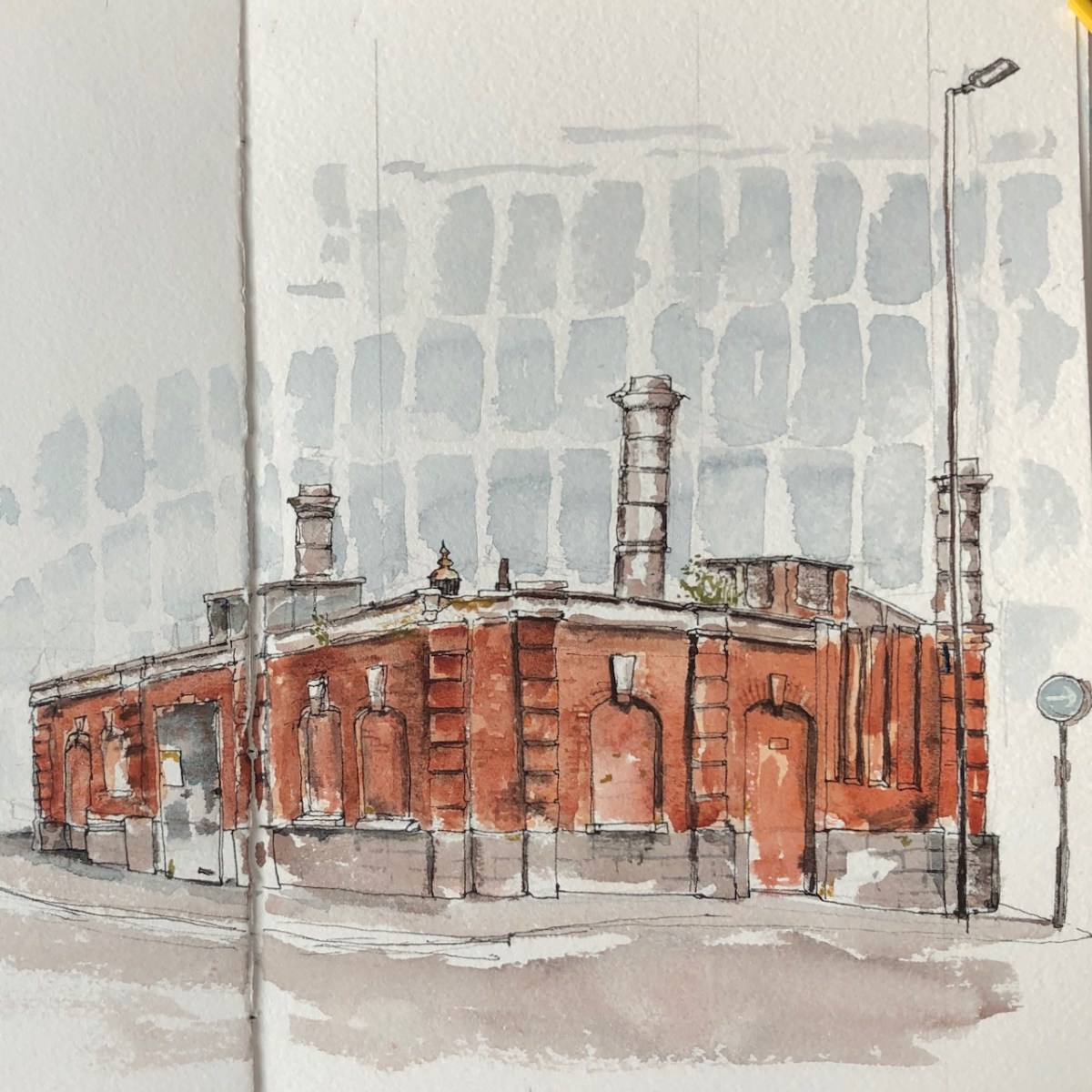
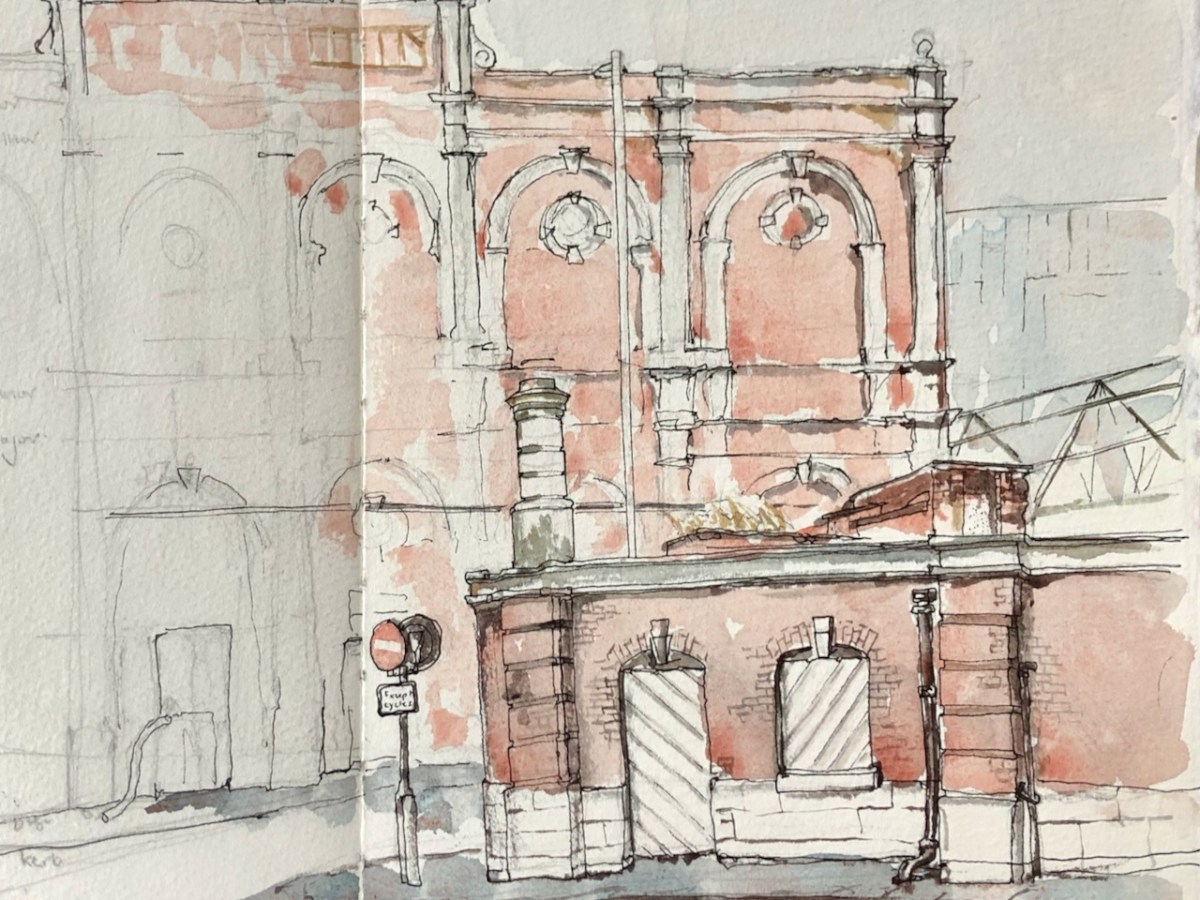
The Red House and The Triangular Building, Smithfield EC1

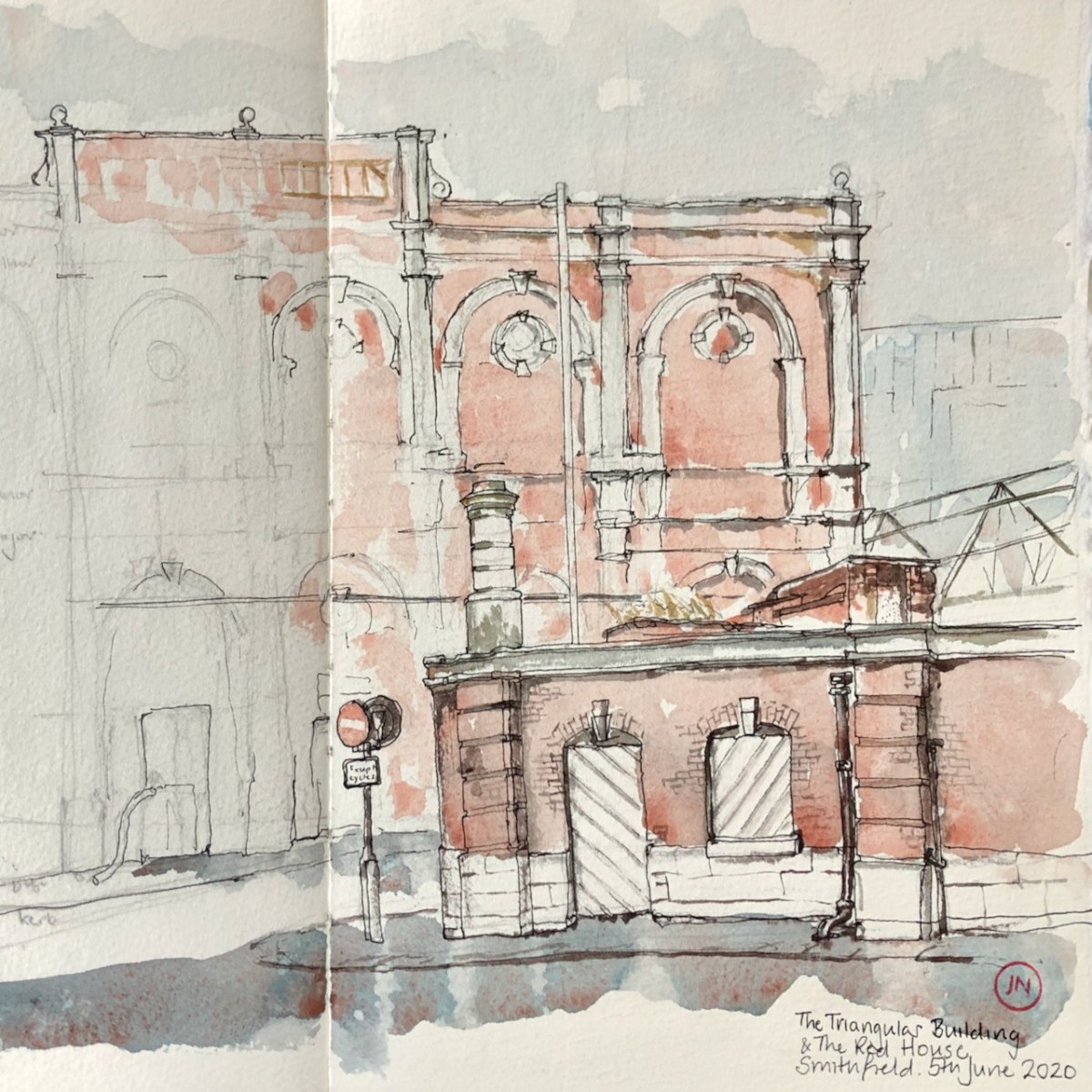
Here is another view of The Triangular Building, drawn previously. On this view you can see the magnificent cold storage block, behind. The cold storage block is called “The Red House”. It is now dilapidated, but still magnificent. A discordant rail, carrying cables, goes horizontally across the front, function taking severe precedent over aesthetics. There’s…

The Triangular Building, Smithfield EC1

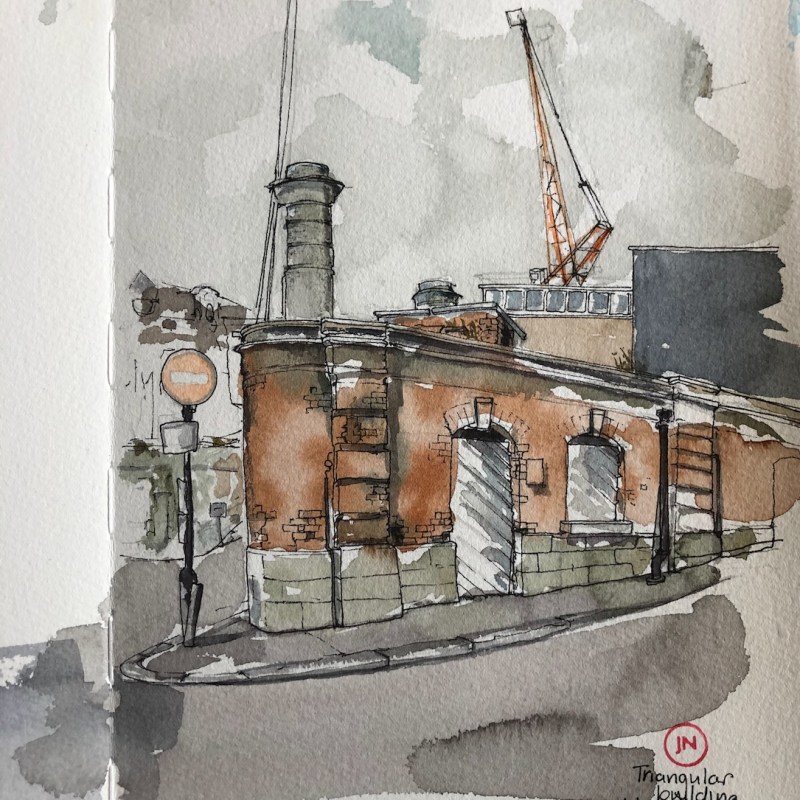
Here is “The Triangular Building” in West Smithfield. I have sketched it from the South. This is its South West corner. The question is: what is it? It has three vertical columns above, which look like chimney stacks, but might be vents of some sort. One is shown on the left of the drawing and…

Here is a complete list of my drawings of Smithfield:

Entrance to the Fish Market

Today I drew the magnificent gate which is the entrance to the Fish Market, Smithfield.

Fish Market, West Smithfield EC1

This gate is adorned with two boys riding huge fish. The fish are equipped with bridles and the boys look as though they are having enormous fun. In the drawing, you can just about make them out at the top of the gate, either side of the central pediment.

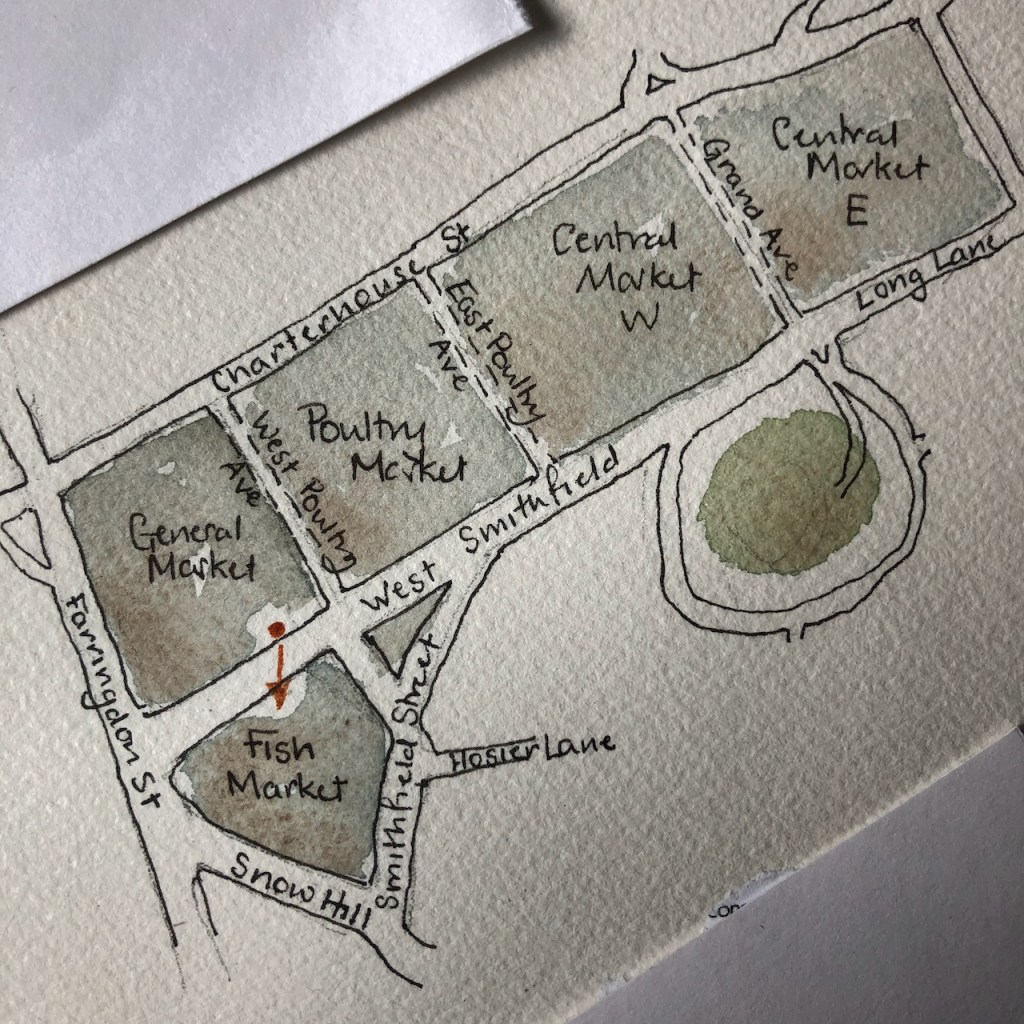
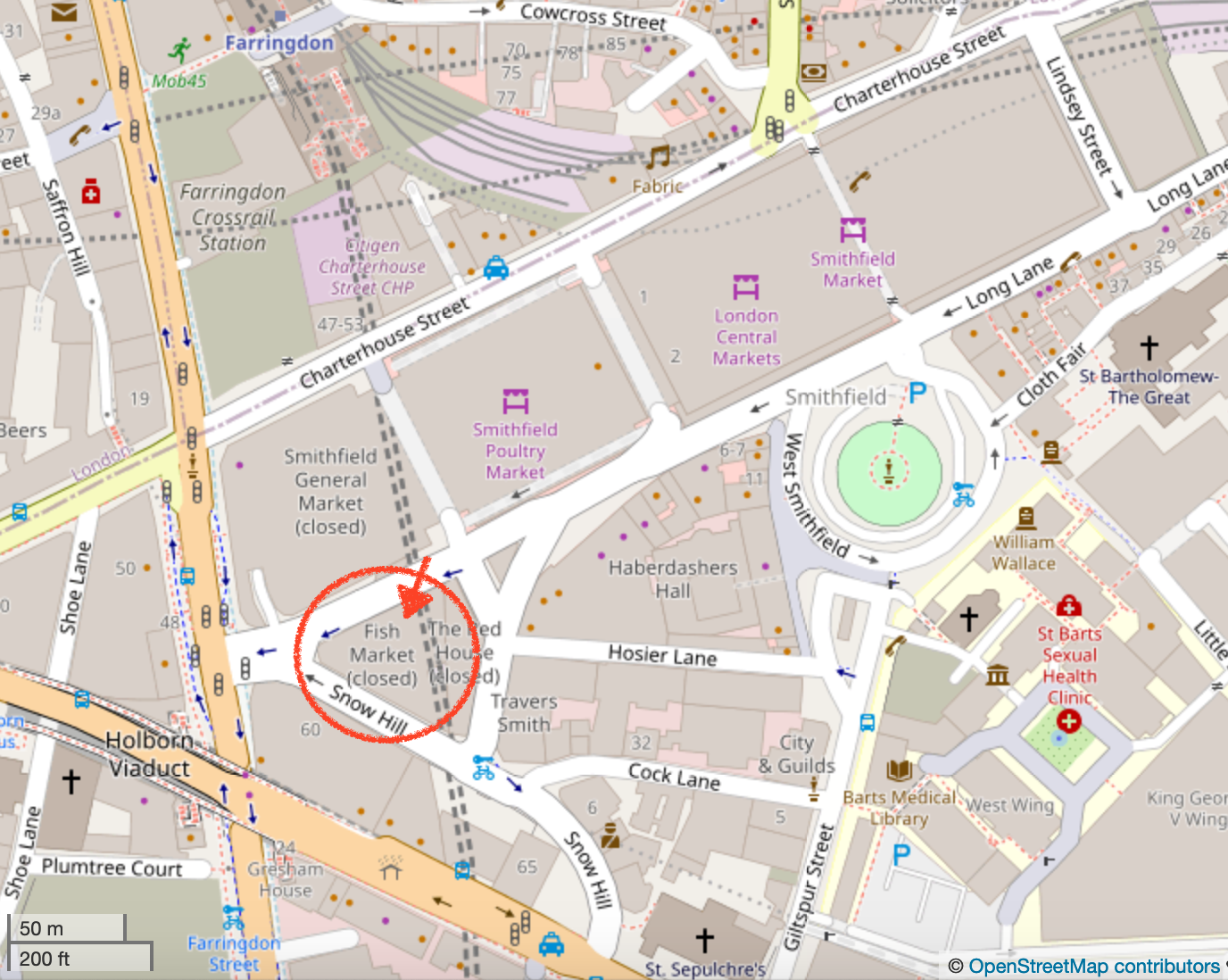
Here is the location of the drawing:

Here is work in progress on the drawing:

Here is a collection of my drawings of Smithfield:

“Catering Meats Smithfield”

Here is a section of West Smithfield, at the North West corner.

West Smithfield, North side

Work is in progress to redevelop these buildings. You can see the scaffolding on the right. This is the General Market.

I was standing outside the “Citigen CHP”. This is the unlikely location of a power station.

“The large scale community energy system is made up of a central power station and district heating network.  Natural gas fuelled by the CHP plant is located near Smithfield Market and supplies heat and cooling to ten of the City’s properties by an underground pipe network spanning over two miles.” says the website of Edina, a supplier of specialist equipment to such schemes.

It is also above the railway lines. Trains rumbled, and the pavement vibrated. A concrete mixing lorry arrived and skilfully backed into the space vacated by the previous concrete mixing lorry, who, equally skilfully, moved out of the space and departed, while workers in bright red and yellow clothes moved the barriers, in synchronism with the movement of the lorries.

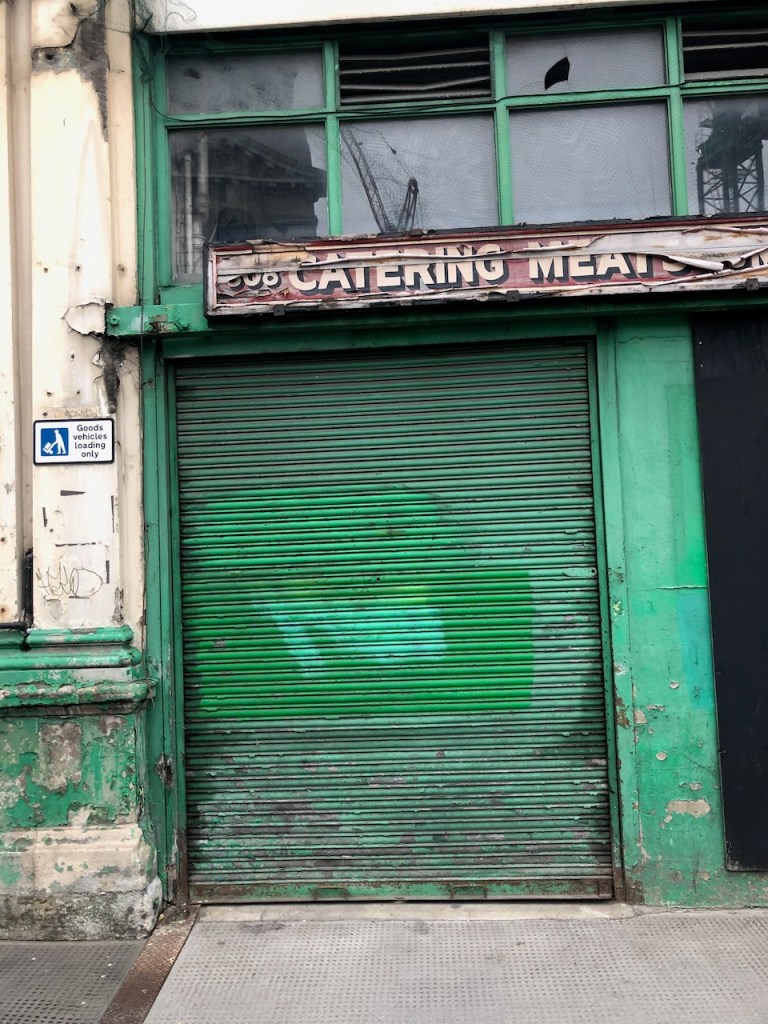
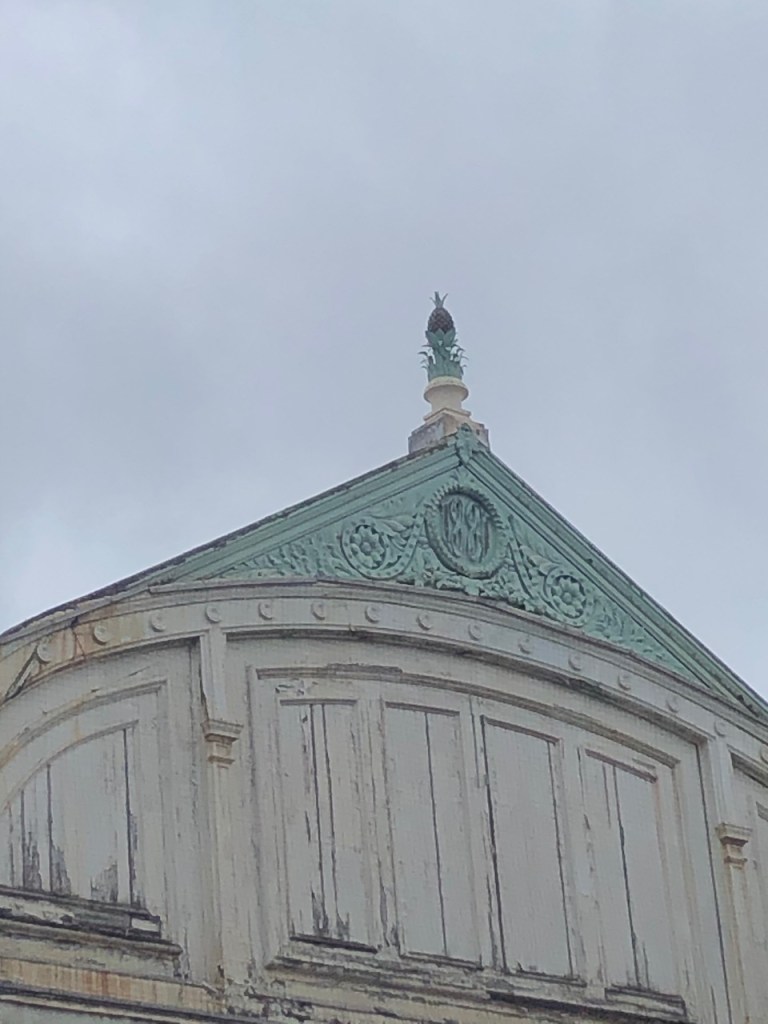
The building in the centre of my drawing is “Catering Meats Smithfield”. The sign is still legible. On the right is a building that looks a bit more like a music hall than a commercial market. It has wood panels and a marvellous pineapple on the roof. The roundel on the gable says “1881”.

Whilst I was sitting on the kerbstone, putting on the colour, a man jogged past, right to left, wearing running kit. He stopped and came back. He said “It makes me happy to see you painting”. He said it very simply, a statement. The emphasis was on the word “happy”. It makes me happy to see you painting. Happy, as opposed to any other emotion.

I said, “Thank you”. Then he ran on, and I continued painting the colours. It made me happy that by being there I’d somehow given something to someone else. It made me happy that he’d said it, that he’d bothered, that he’d paused in his run and came back to utter his simple sentence. But expressing all that was complicated. So I just said, “Thank you”.

Here is work in progress:

This drawing took just over two hours. 30 min pencil, about an hour pen, and another 30+ min for the colour.

Here is a list of my drawings of Smithfield so far, click the writing to see more information:

Smithfield, North side

Today, approval was given for the redevelopment of the Smithfield site to turn it into the new Museum of London. Whereas some of the architecture will remain on view, the activities of the meat market will cease. So I went out in recent days to try to show some of the activity in the meat market.

Here is the clean-up, in the afternoon.

Grand Avenue, Smithfield. A worker hoses down the floor.

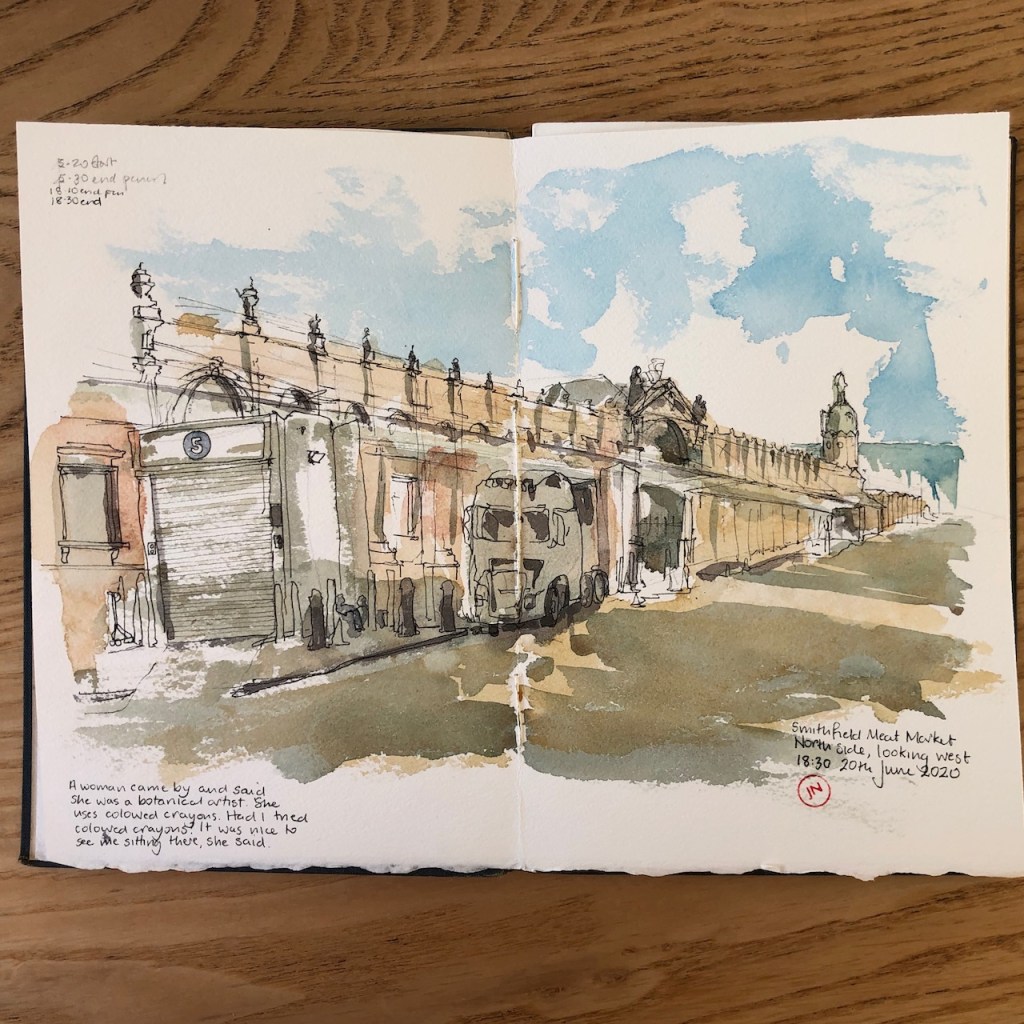
Here is a lorry parked on the North side, ready to deliver meat in the morning. Note the huge meat-loading bays. This one is labelled 5. These loading bays will not be there when it is redeveloped, so I was keen to draw them now.

Meat loading bay 5 and delivery lorry, Smithfield. I forgot my glasses, which is one reason why it is a bit sketchy.

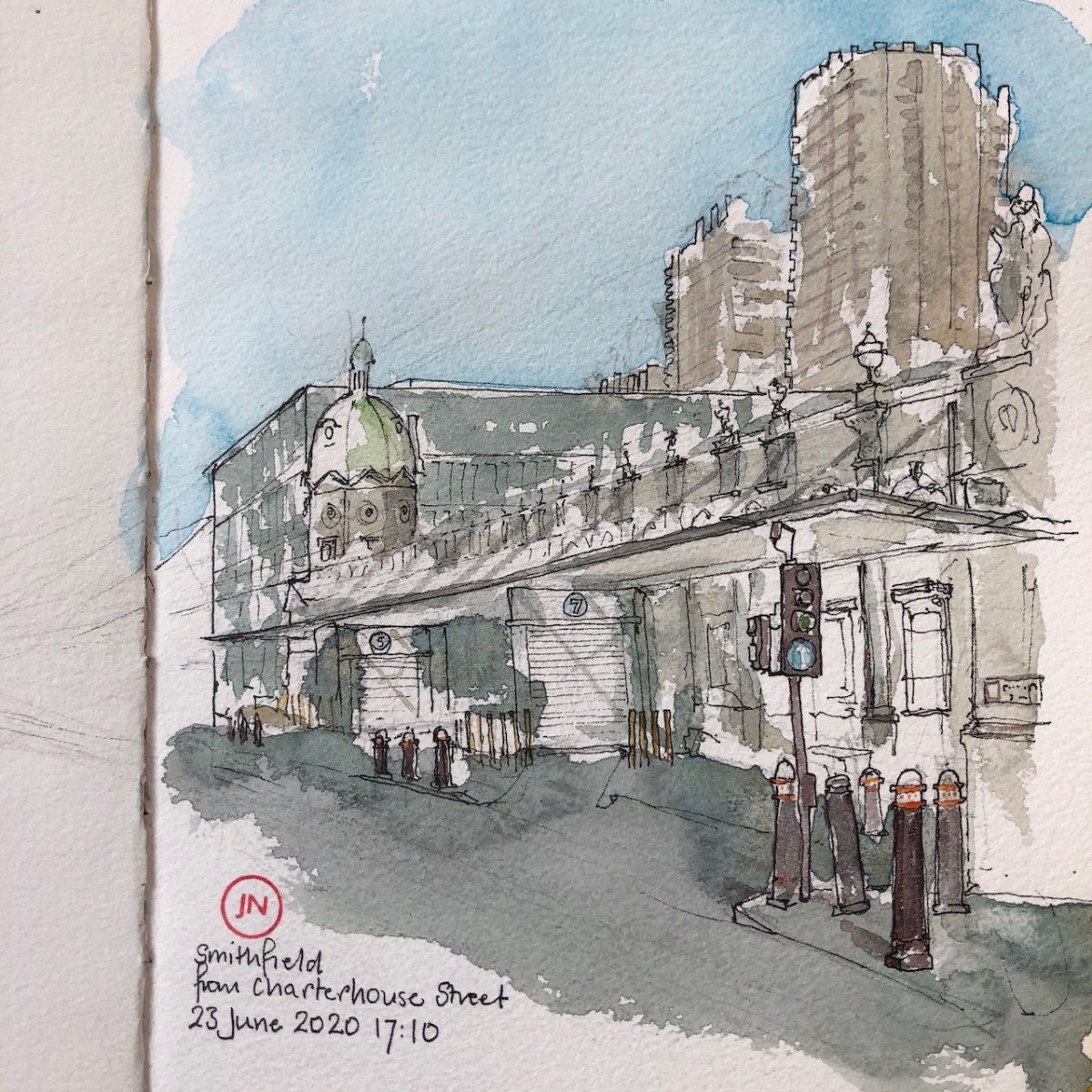
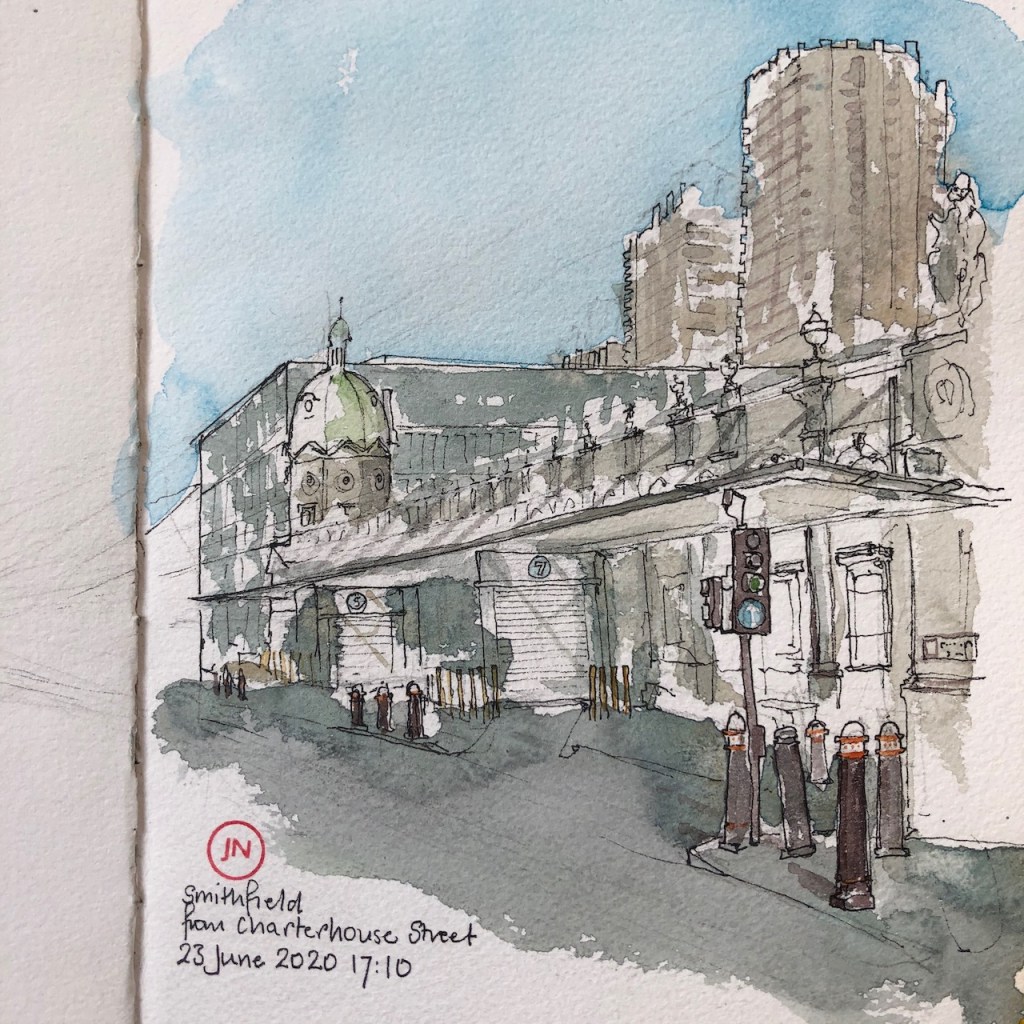
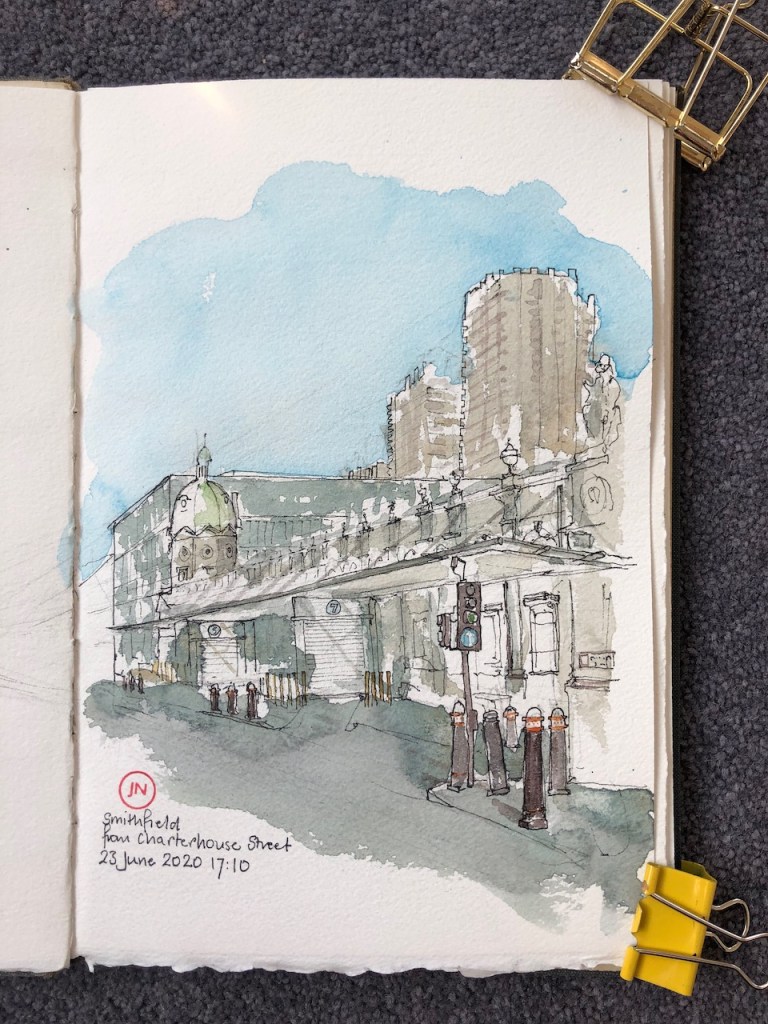
Here is a general view from Charterhouse St, looking East. In this drawing, you can see three eras: the meat market 1880s, the Barbican towers, 1970s, and the new Crossrail station, which is nearly finished, 2020s.

Smithfield, Barbican towers, Crossrail station.

You can see loading bay 5 in the distance, and loading bay 7 nearer.

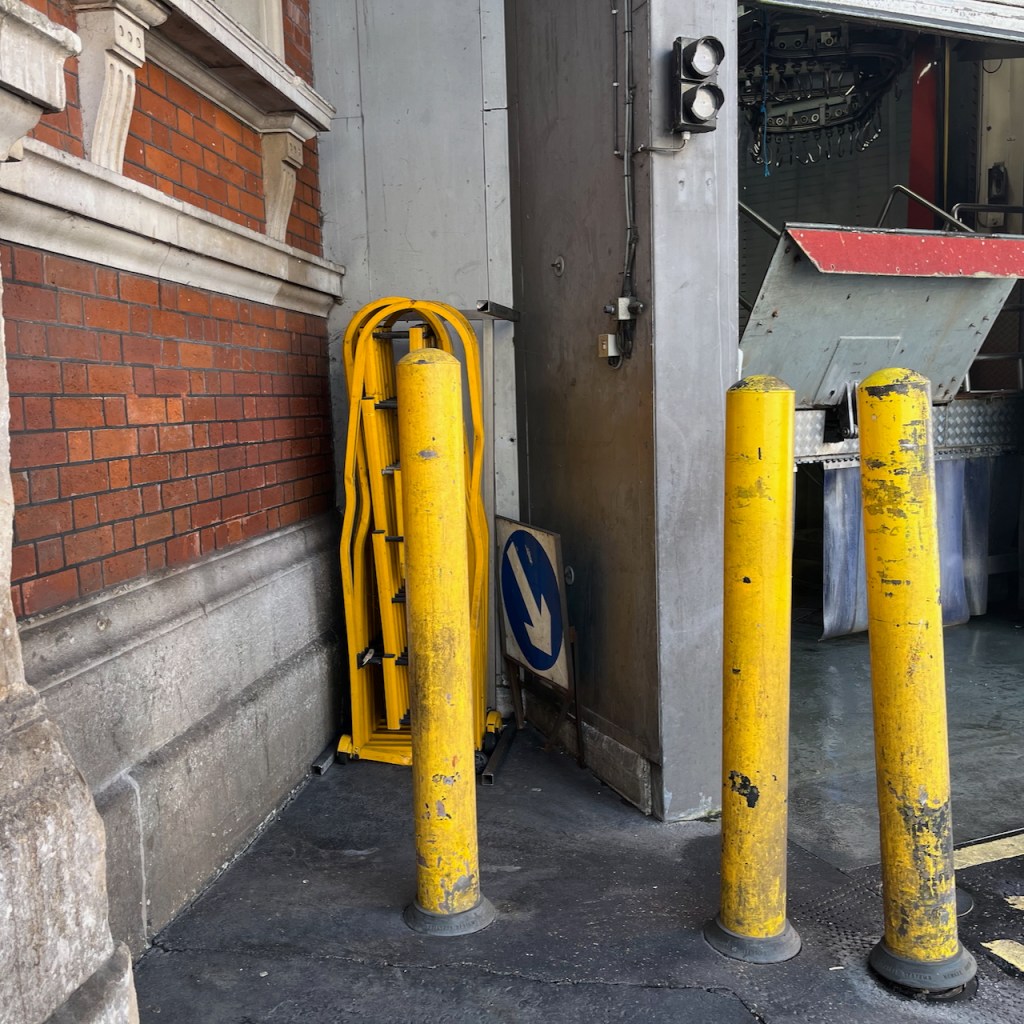
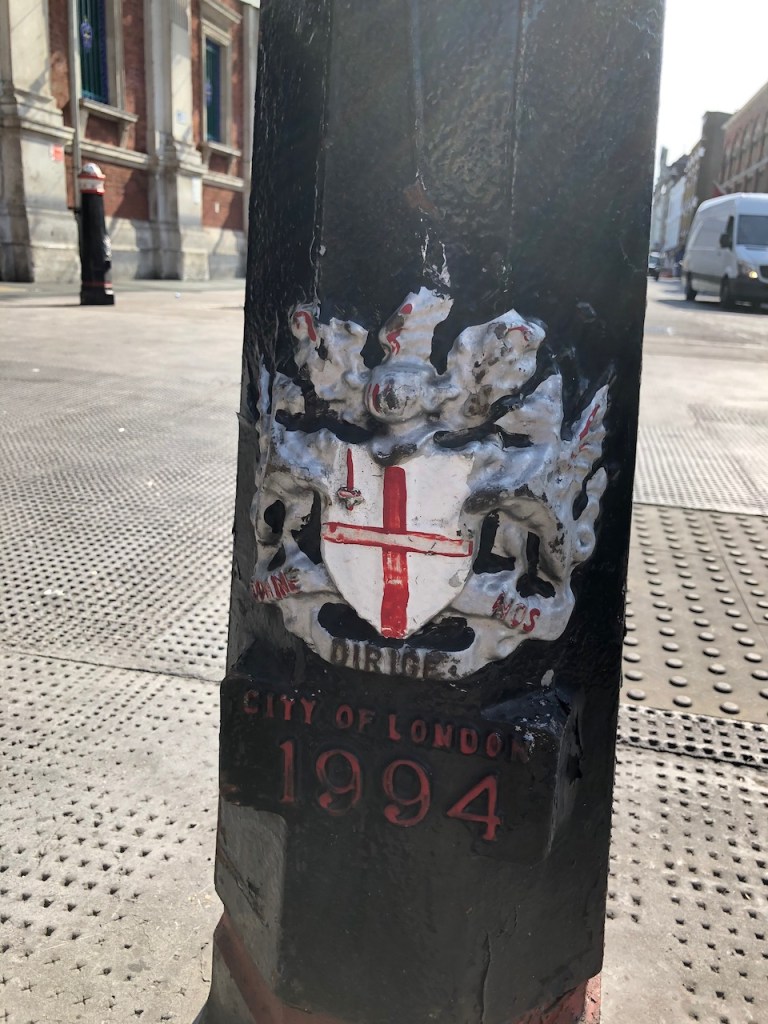
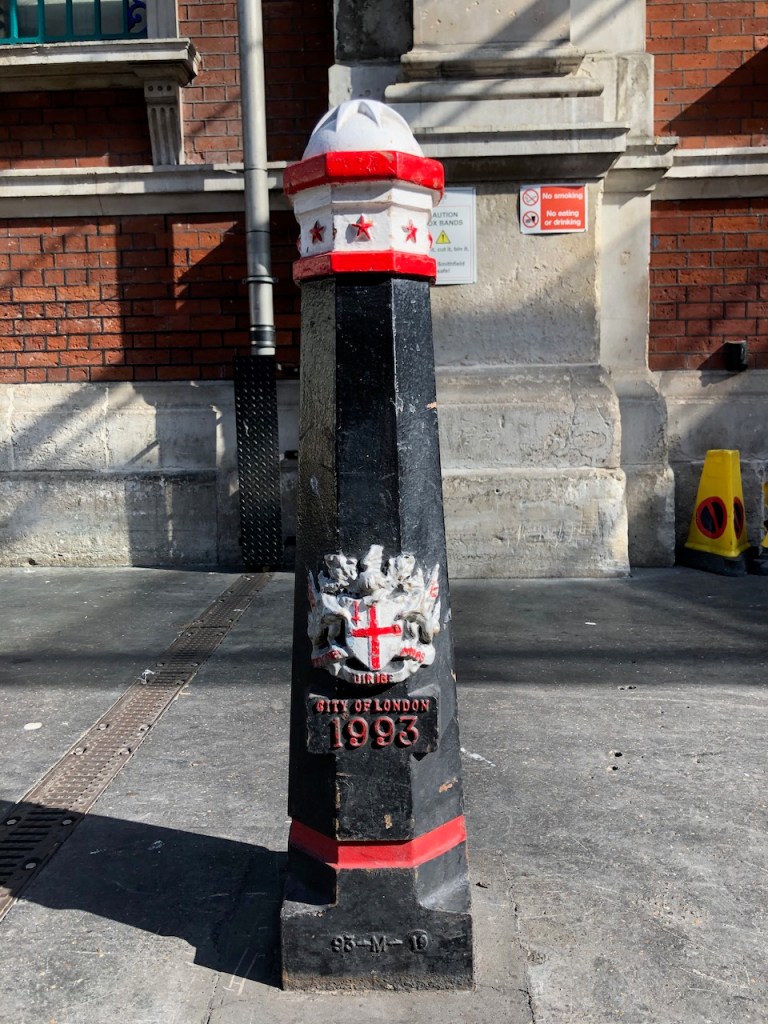
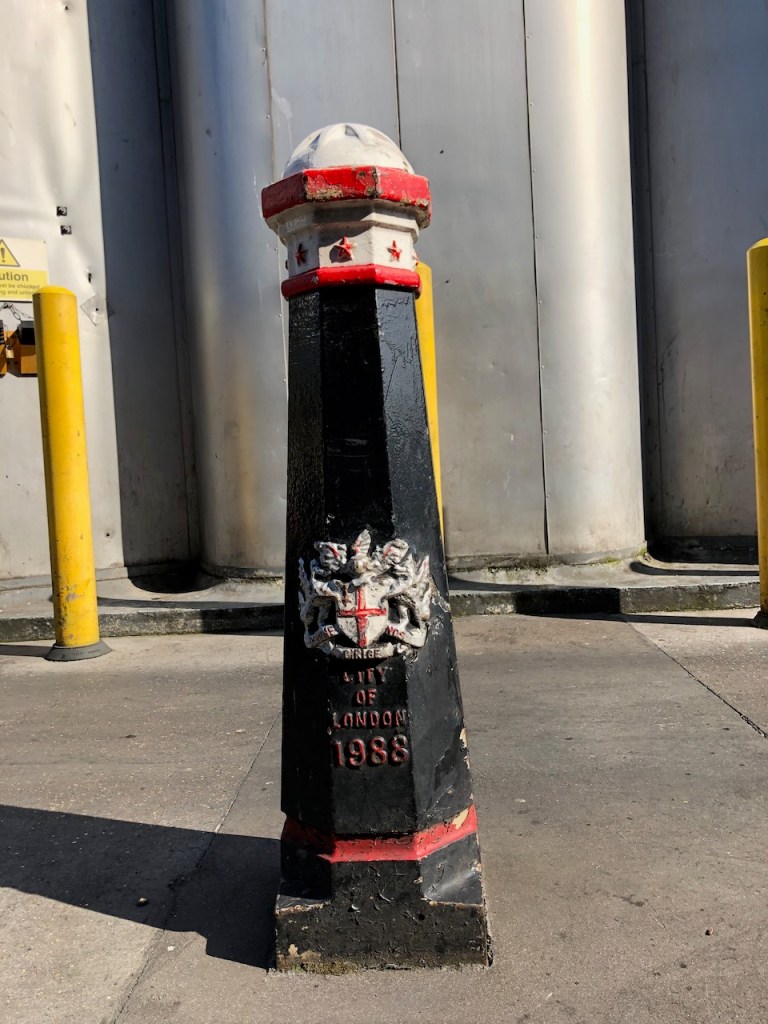
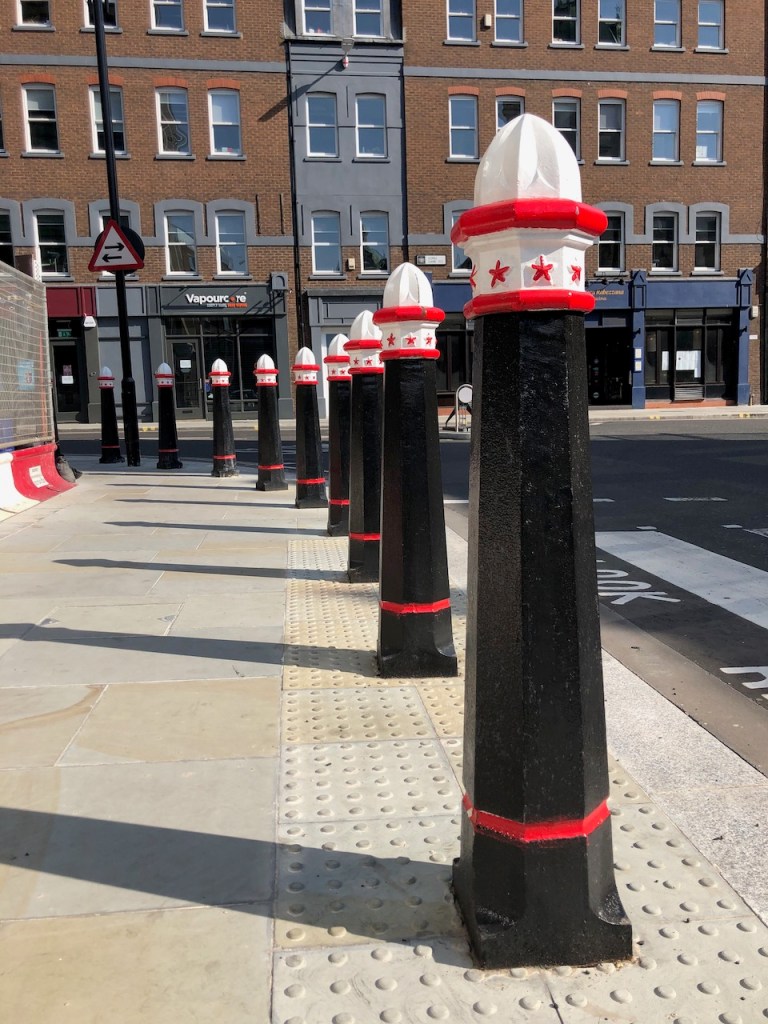
There is a huge collection of bollards in this area, whose job is to keep the heavy goods vehicles from crushing people on the pavement. Many of them have dates on. The one immediately to the right of the traffic lights is not a bollard, but an imposter. It is a thin metal case and encloses some water-control device. It is labelled “Thames Water”. The real bollards are sturdy cast iron. Many of them have clearly been wounded in action, but they stand firm, doing their job. I hope they are retained when the site is redeveloped.

Here is work in progress on the drawing.

A street sweeper came by at the pen stage. He gave his approval. He said he didn’t paint himself, but he liked to look at paintings and drawings.

Here is a list of my drawings in this area:

Poultry Market, Smithfield EC1

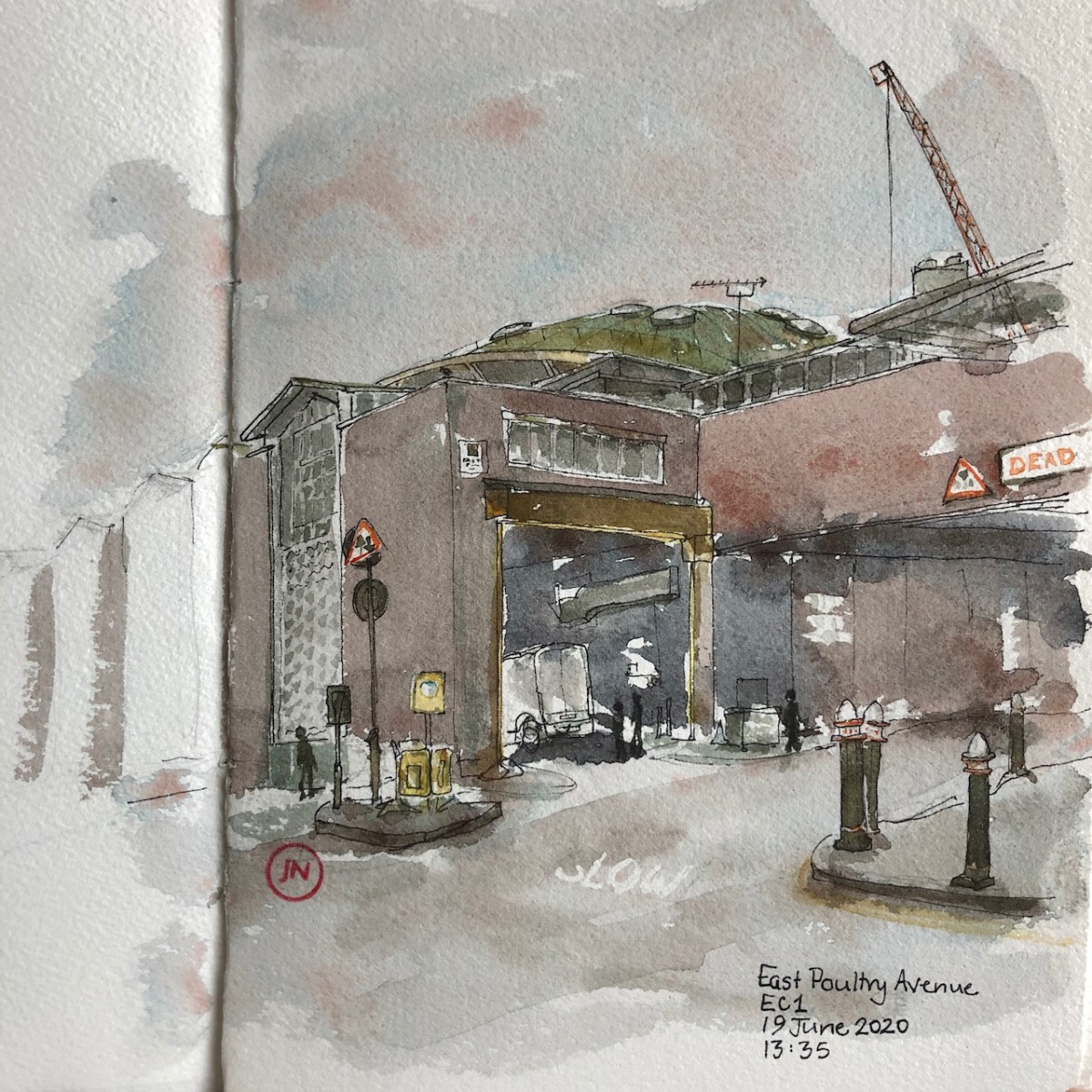
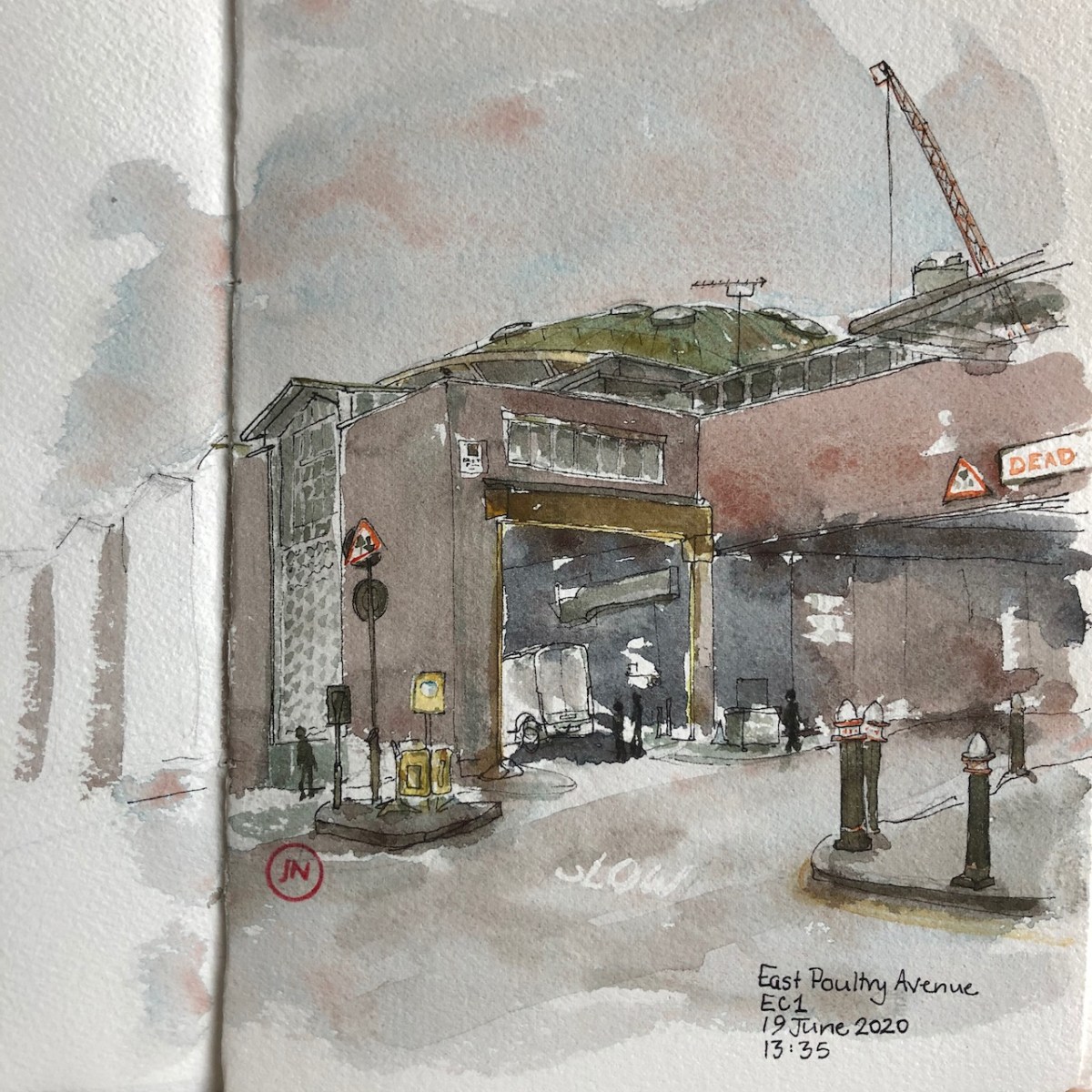
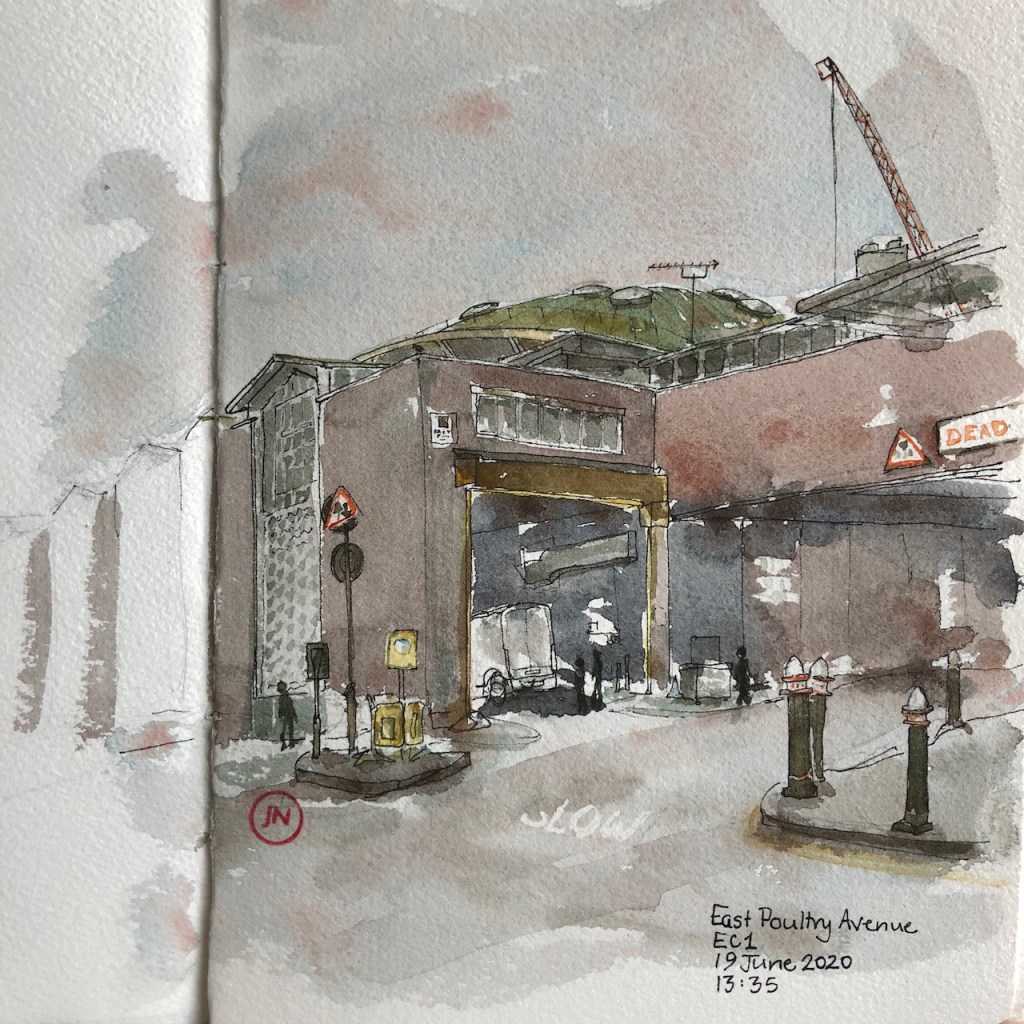
This is a view of the Poultry Market, sketched today from the South side. You see East Poultry Avenue going off to the right.

East Poultry Avenue, Smithfield EC1

This is a working Meat Market. It was completed in 1963 to replace the original 1880s market which had been destroyed by fire in 1958. The “A London Inheritance” site has a moving description of the fire in their article about Smithfield.

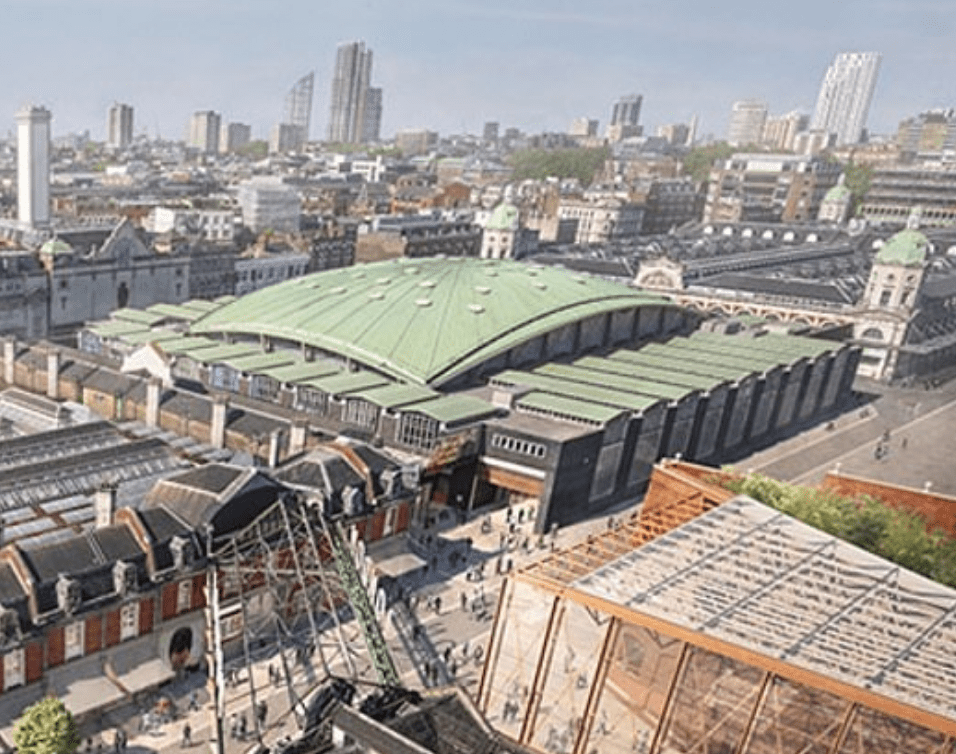
The 1960s dome of the Poultry Market, image (c) City of London. My drawing was done from the centre right edge of the photo, looking left.

There is an amazing dome across this part of the market. I tried to find a place where I could see it. It just shows at the top of the buildings in my drawing. It spans the whole of the market area, and is supported only at its edges. Here is a picture taken from articles about redevelopment of the site.

The 1963 design is by TP Bennett and Son.

This whole structure will be refurbished to make the new Museum of London.

The drawing took about and hour and a half. The colours are Phthalo Turquoise, Fired Red Ochre, and Perylene Maroon, with some Mars Yellow for the dome, and Pyrrol Orange for the traffic signs.

The Foundation Stone of the 1960s part of Smithfield. This stone is inside the loading bay on the North side. You can see the hexagonal glazing reflected in the stone, on the right.

Here are other drawings I have done in the area:

The Fish Market West Smithfield EC1

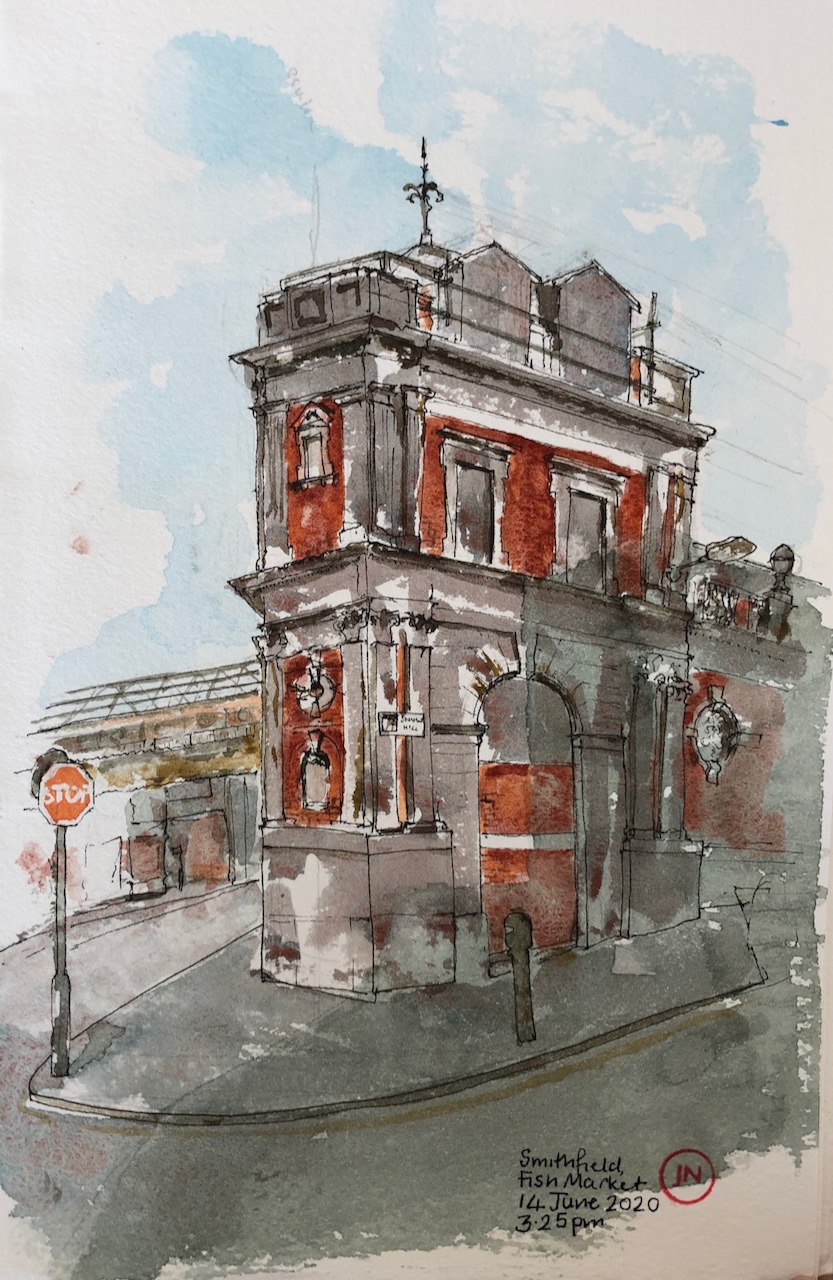
This building is at the Westernmost side of Smithfield Market. It is a corner of the former Fish Market, built in 1886.

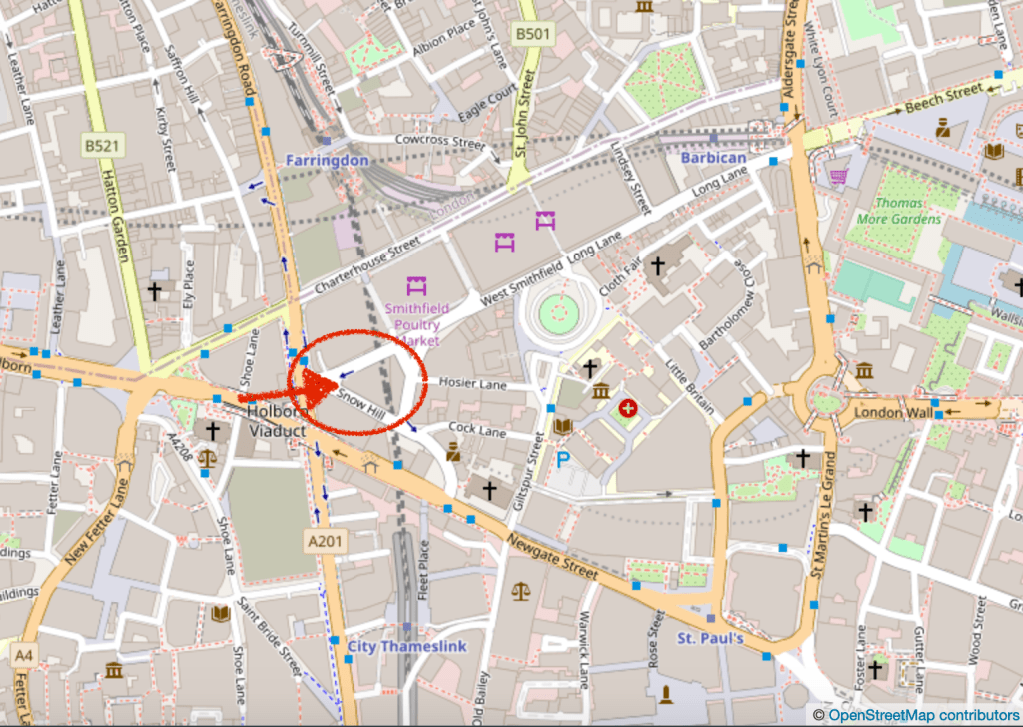
The former Fish Market, Smithfield, at the corner of Snow Hill and West Smithfield.

I thought I’d picked a good place to stand and draw. But no. When I was about 10 minutes in, I realised that there was a more-or-less constant stream of cars queuing for the traffic lights. They queued for several minutes then they went off. There was much to observe about this. A surprising number of cars were playing loud music with their windows open, assuming, I guess, that everyone would enjoy their choice of music. And I thought modern cars switched their engines off when stationery? But evidently I am mistaken about this. No-one switched their engines off. Except one person.

A motorbike came up to the red light, a black Kawasaki. The rider was all in black, with a black helmet. The black helmet inclined slightly. I took it as a greeting. Then a gloved hand switched off the engine. I smiled at the helmet and nodded my thank you. Then the lights changed, the engine ignited, and the bike moved off. If that was you, thank you.

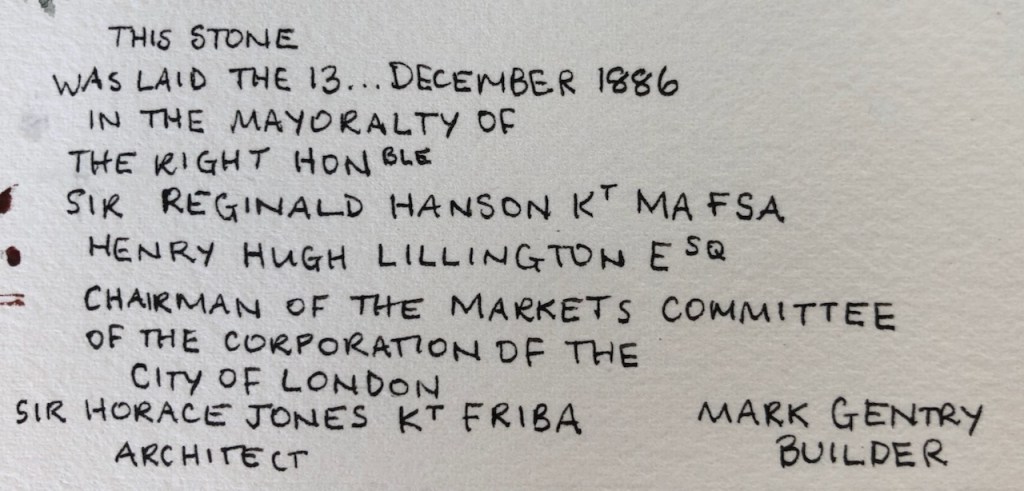
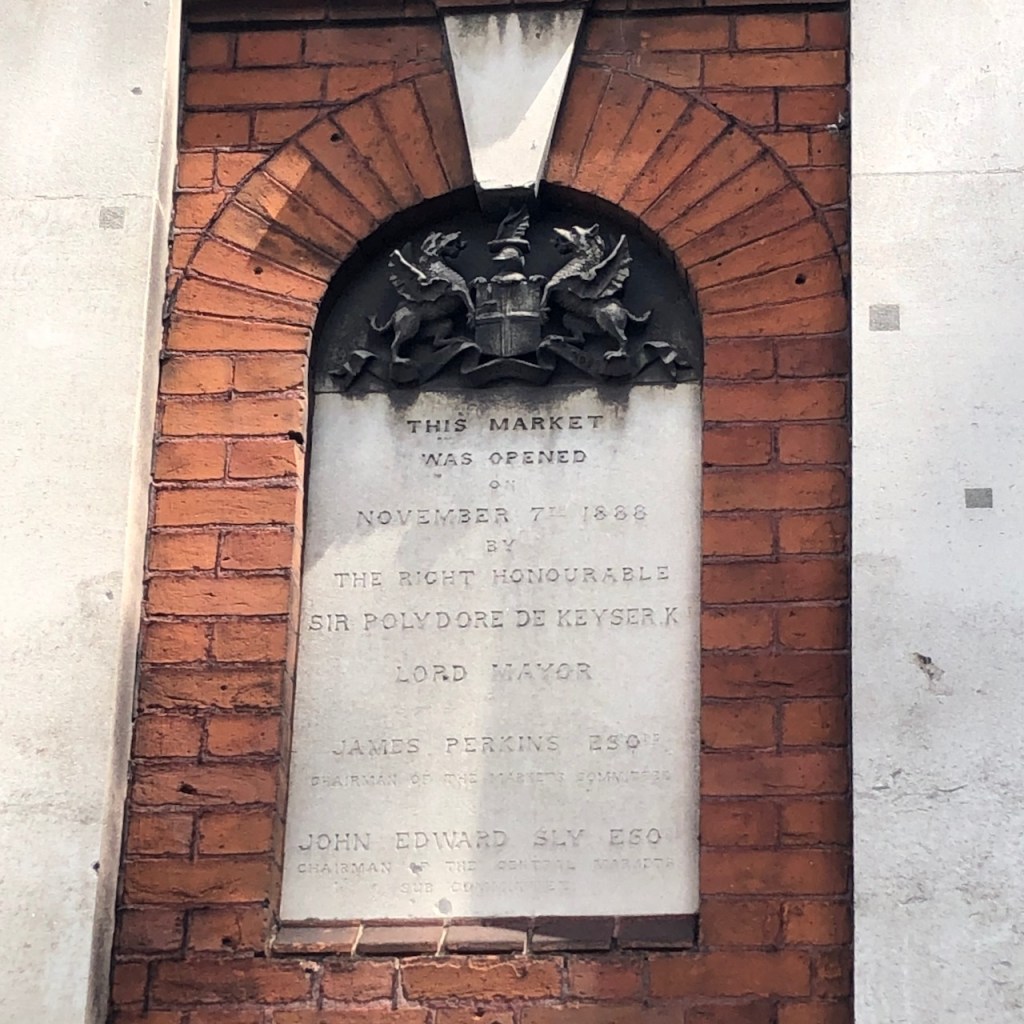
Here is a plaque that is on the side of the building I drew. It is heavy marble, somewhat damaged, and the inscription is hard to read. I transcribed it as best I could.

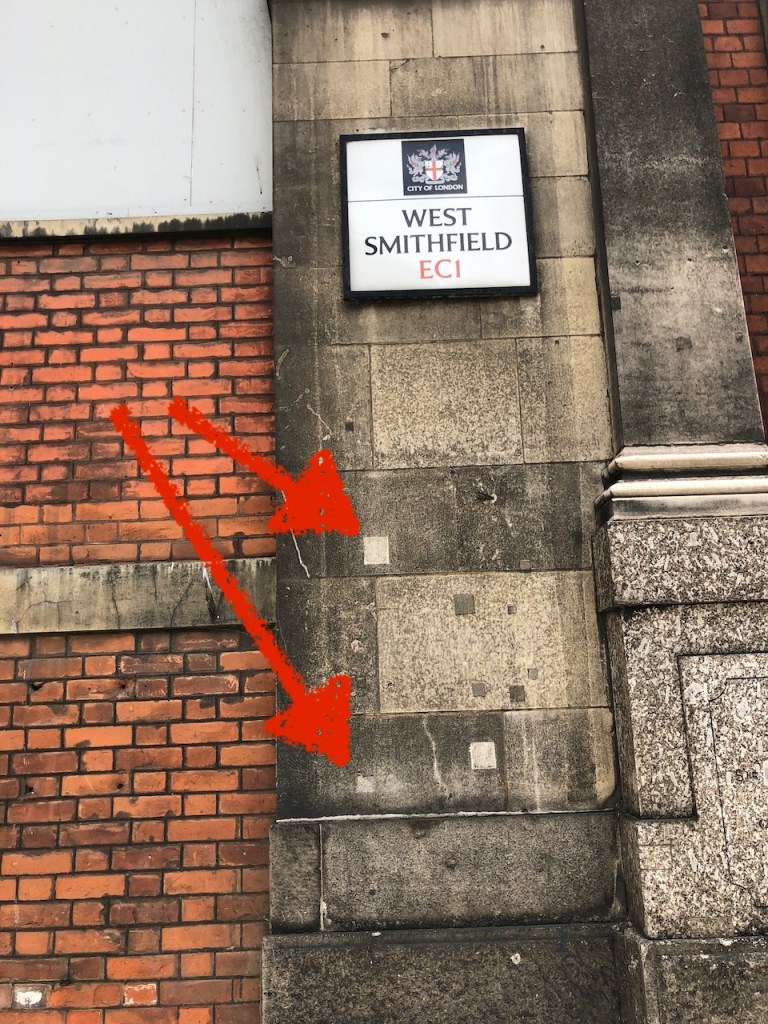
As you see, the marble plaque has been damaged and repaired. An adjacent part of the building likewise has been repaired in the same way, with little square and rectangular sections. Much erosion and damage has occurred elsewhere the building and not been repaired. So what is this? Could it be very early damage? If I were to guess, I’d say it was bullets, or shrapnel, damage. What happened?

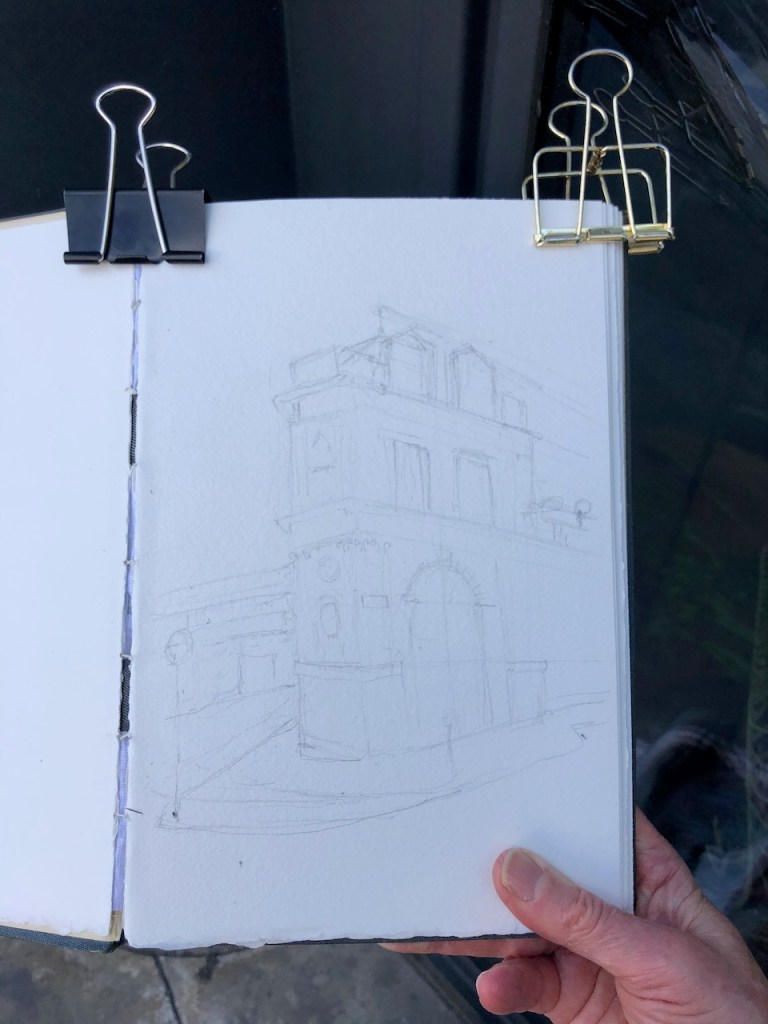
Here is work in progress on the drawing.

The drawing took 2 hours: 30 mins pencil underdrawing, 45min pen, 45min colour. The colours are: Fired Red Ochre (DS), Phthalo Turquoise (W&N), Transparent Pyrrol Orange (DS), and a tiny bit of Mars Yellow (DS).

The plaque shown in the drawing: “This Market was opened on November 7th 1888 by the Right Honourable Sir Polydore de Keyser K Lord Mayor, James Perkins Esq Chairman of the Markets Committee, John Edward Sly Esq Chairman of the Central Markets Sub Committee.”

Here is a collection of all the drawings I have done of Smithfield: