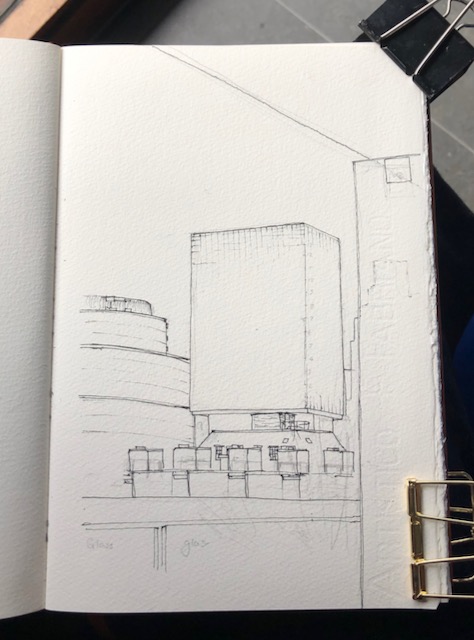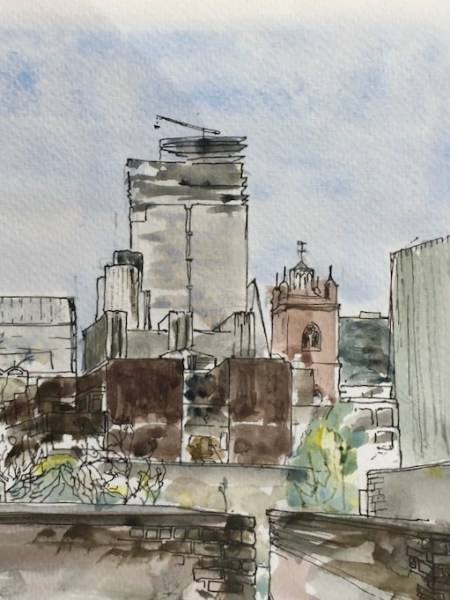
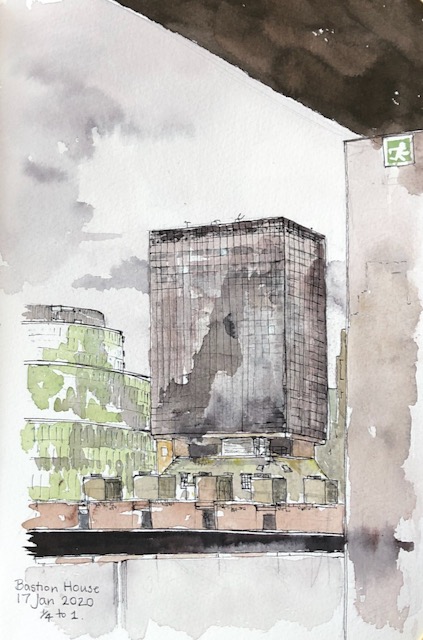
Bastion House, London Wall, from Andrewes House

I hastened to draw the magnificent Bastion House, on London Wall. It is due for demolition.
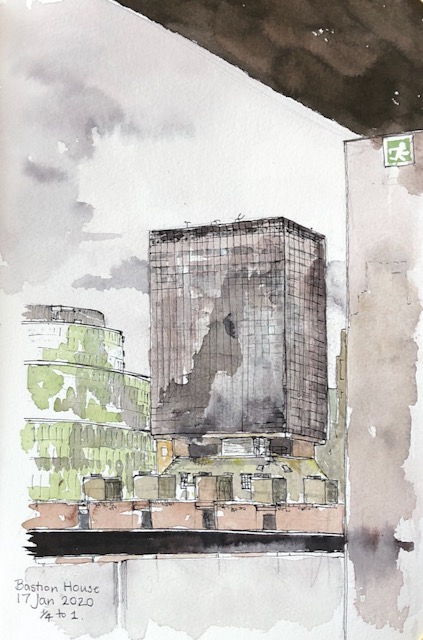
In the foreground you see the balcony and privacy screen of the flat in Andrewes, whose leaseholder had kindly hosted me.

The line of red brick, and what looks like chimneys, in the foreground are the rooftops of a part of the Barbican, “The Postern”. Behind them is the Barber-Surgeons’ Hall on Monkwell Square, where I have been to give blood. The curved green building on the left is on the other side of London Wall. It is “One London Wall” near the Museum of London Rotunda: multi-use office space.

Bastion House is the huge monolith in the centre of the drawing. It reminds me of the monolith in the 1968 film “2001 – A Space Odyssey”, and indeed it dates from that period. It was proposed in 1955, and started in 1972, completed in 1976. The architect was Philip Powell of Powell and Moya. This practice also designed the Skylon for the 1951 South Bank Festival of Britain, and Churchill Gardens in Pimlico.

Here is drawing work in progress.
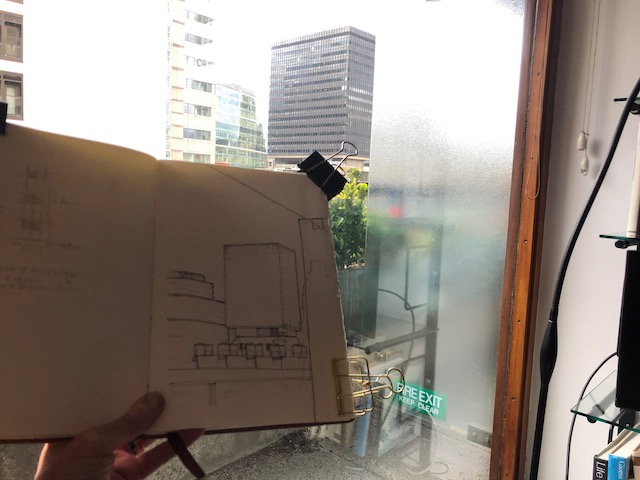
This drawing took me about 2 hours. This is my first drawing in a new sketchbook: the “Perfect Sketchbook” from Etchr. This will be Urban Sketching sketchbook number 6.

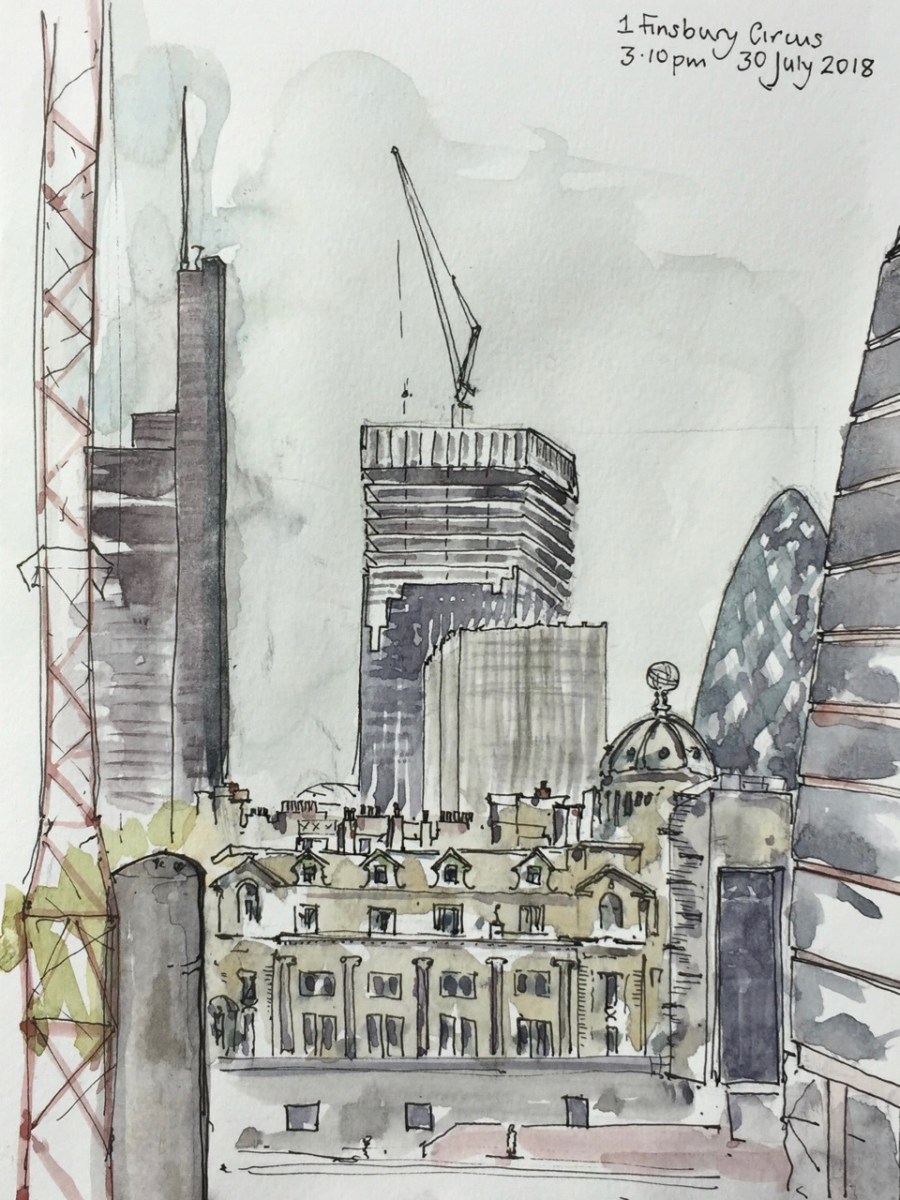
I have sketched Bastion House before:

Bastion House from Podium Level

Bastion House aka 140 London Wall is a huge modernist monolith, reminiscent of the monolith in “2001 – A Space Odyssey”. I couldn’t find a site to draw the monolith part today, so here is a view at Podium Level, looking West towards the Museum of London. You see the dark undercroft, walkways and a…

St Giles and Bastion House

Today Urban Sketchers London held a “sketch crawl” in the Barbican. So I joined them. An astonishing number and diversity of people assembled inside the entrance of the Barbican Centre at the appointed time of 11am. I counted about 35 and then another dozen or so joined. All shapes and sizes of people, tall, short,…

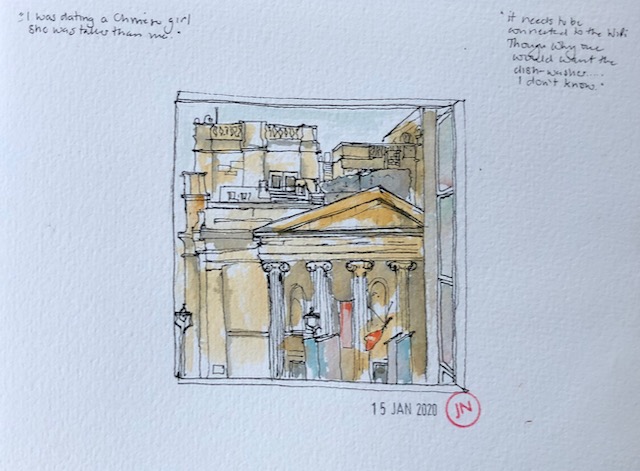
Canada House from the National Gallery

Here’s a quick sketch of Canada House on Trafalgar Square, seen though the modern windows of the National Gallery Sainsbury wing.

While I sketched, I overheard fragments of conversations: “I was dating a Chinese girl, and she was taller than me…..”, and someone on a mobile phone: “It needs to be connected to the WiFi…yes…though why one would want the dishwasher… I don’t know!”

About 30mins pen and ink on location, colour added later.

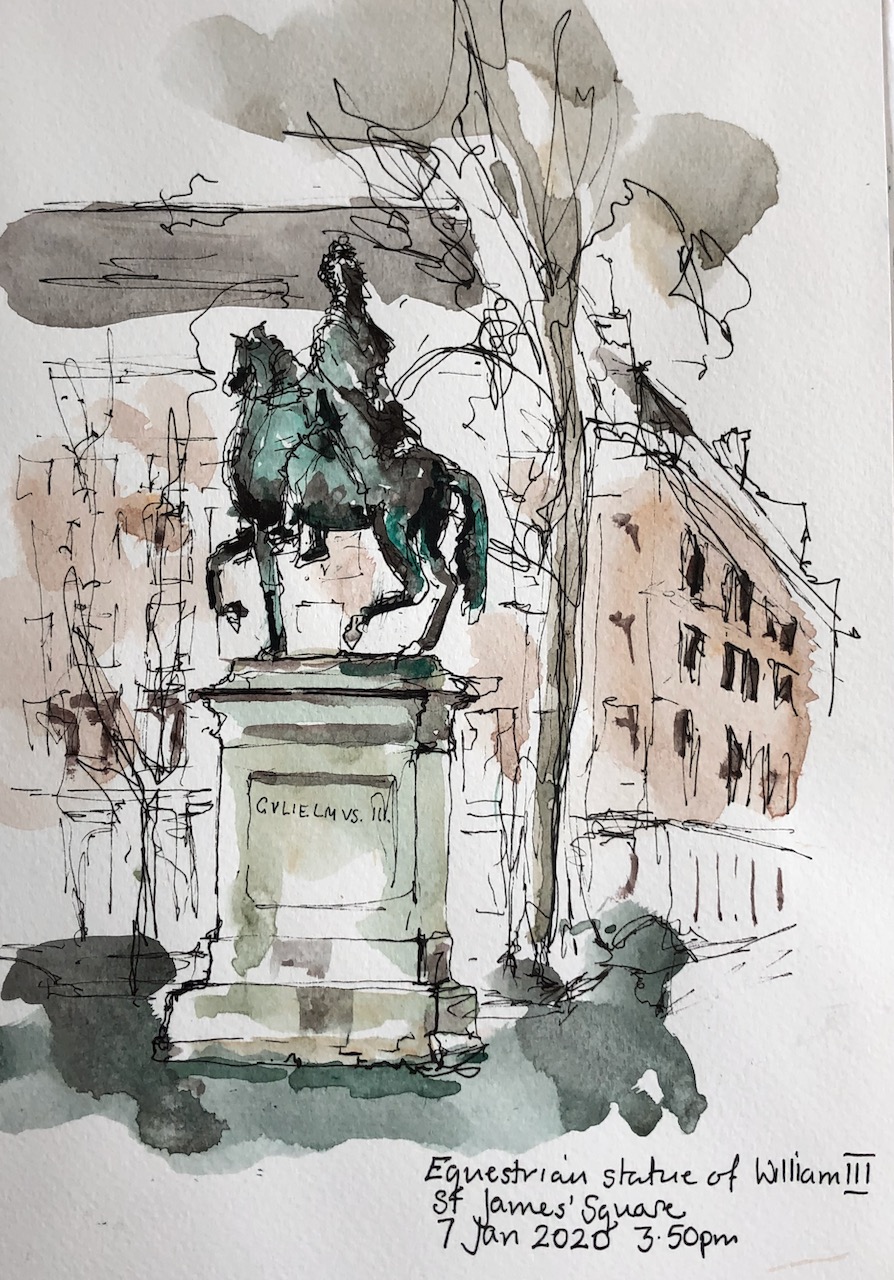
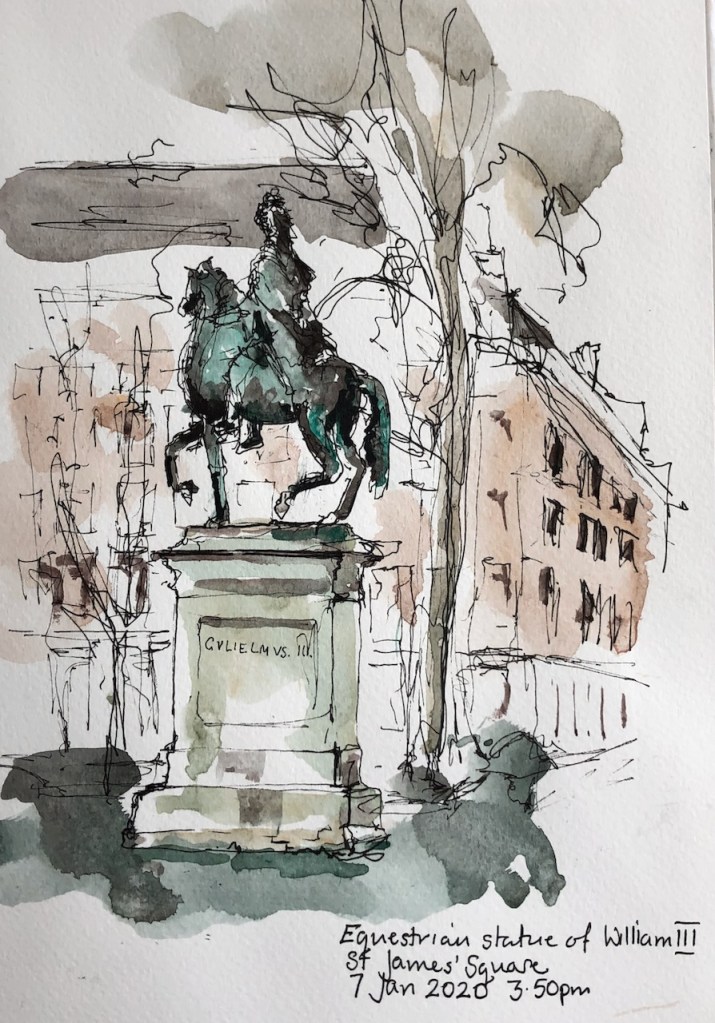
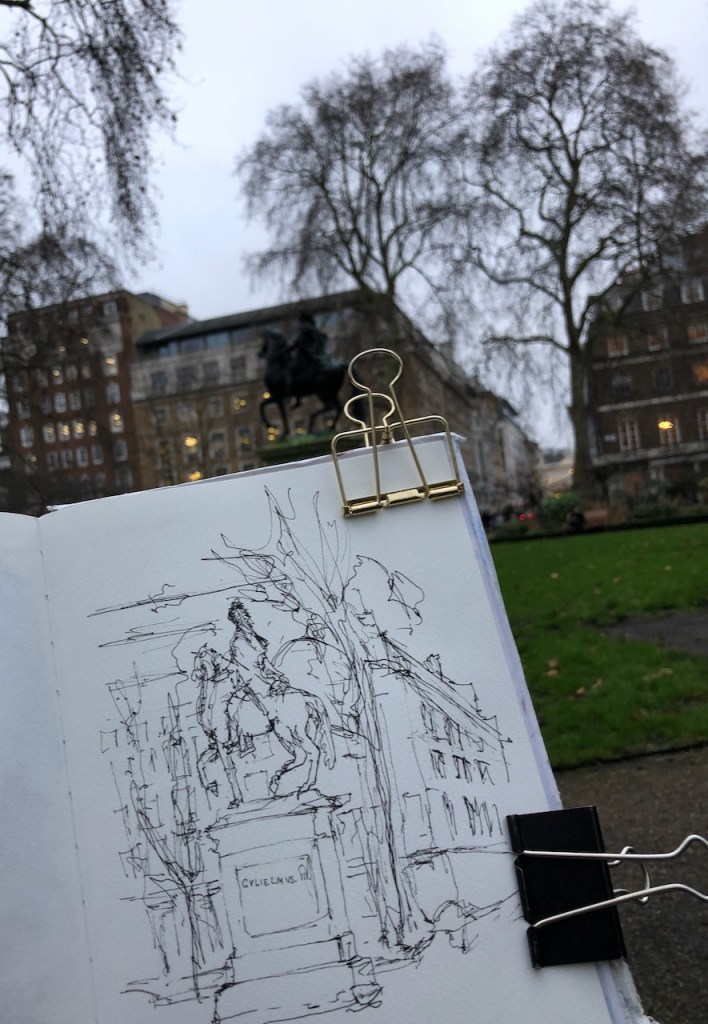
Equestrian Statue of William III

This statue is in the centre of St James’ Square, SW1, London.

William III is William of Orange. He was King of England, Scotland and Ireland from 1688 to 1702. The statue was originally proposed in 1687. It was completed in 1807, which is the date on the plinth. There were a number of delays. The first commissioned sculptor, John Bacon Senior, died. The sculpture was eventually created by his son John Bacon junior.

As you see, the statue has green highlights. This is how it was. It is bronze, which is an alloy of copper and tin: tin 12% roughly. The green is verdigris: a mixture of copper compounds. Wikipedia is lyrical on the subject:

“Verdigris is a variable chemical mixture of compounds, complexes and water. The primary components are copper salts of acetate, carbonate, chloride, formate, hydroxide, and sulphate…..All the components are in an ever-changing and complex reaction equilibrium that is dependent on the ambient environment.”

Wikipedia entry for verdigris

This makes it sound like a 21st century environmental art project.

Written on the plinth is: GVLIELMUS. III. And on the other side:

I.BACON.IVNR. SCVLPTR.1807

The sketch took about half an hour. Colours are mostly Phthalo Green, Prussian Blue, and Perinone orange. In Jackson Watercolour sketchbook.

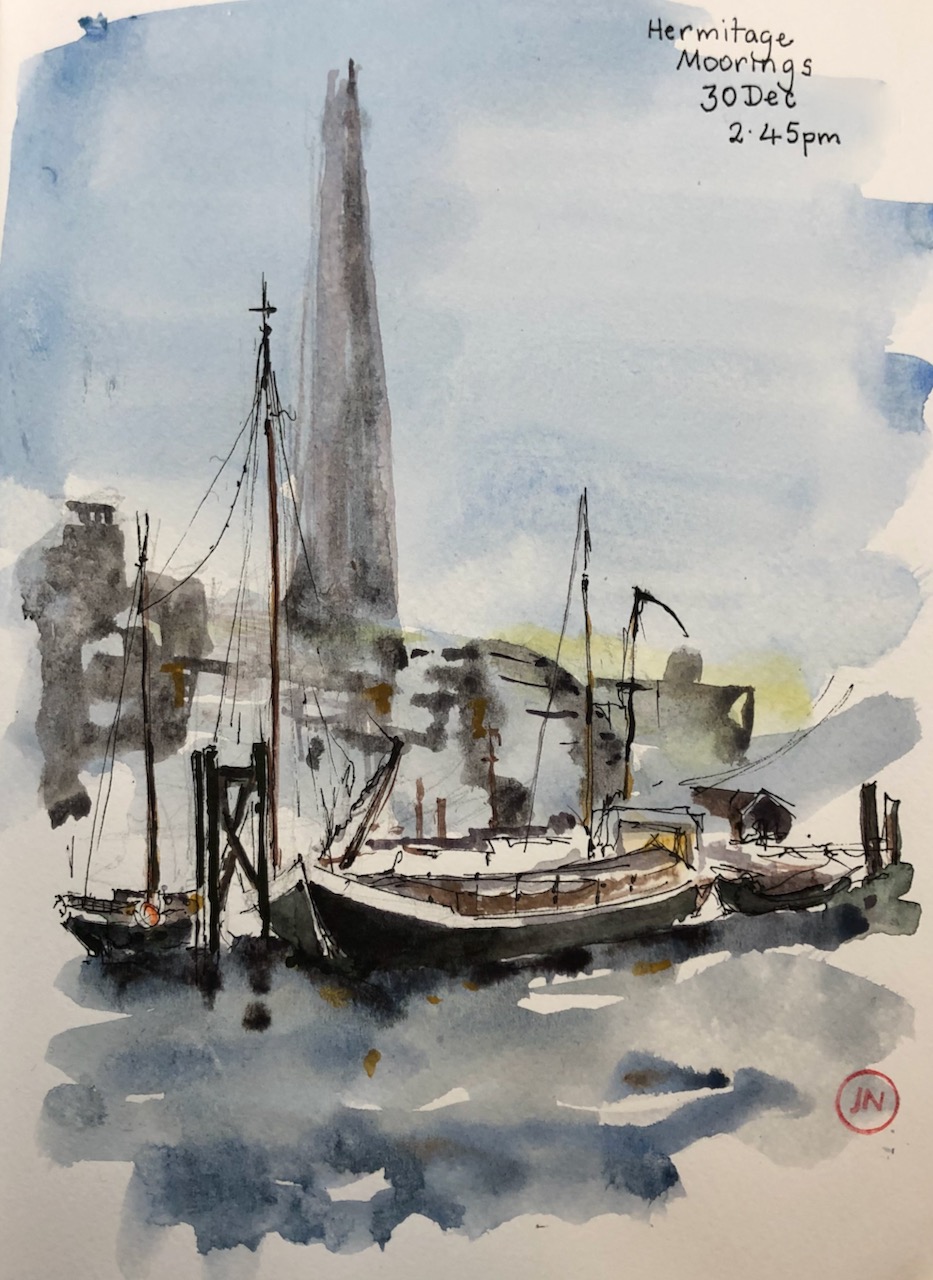
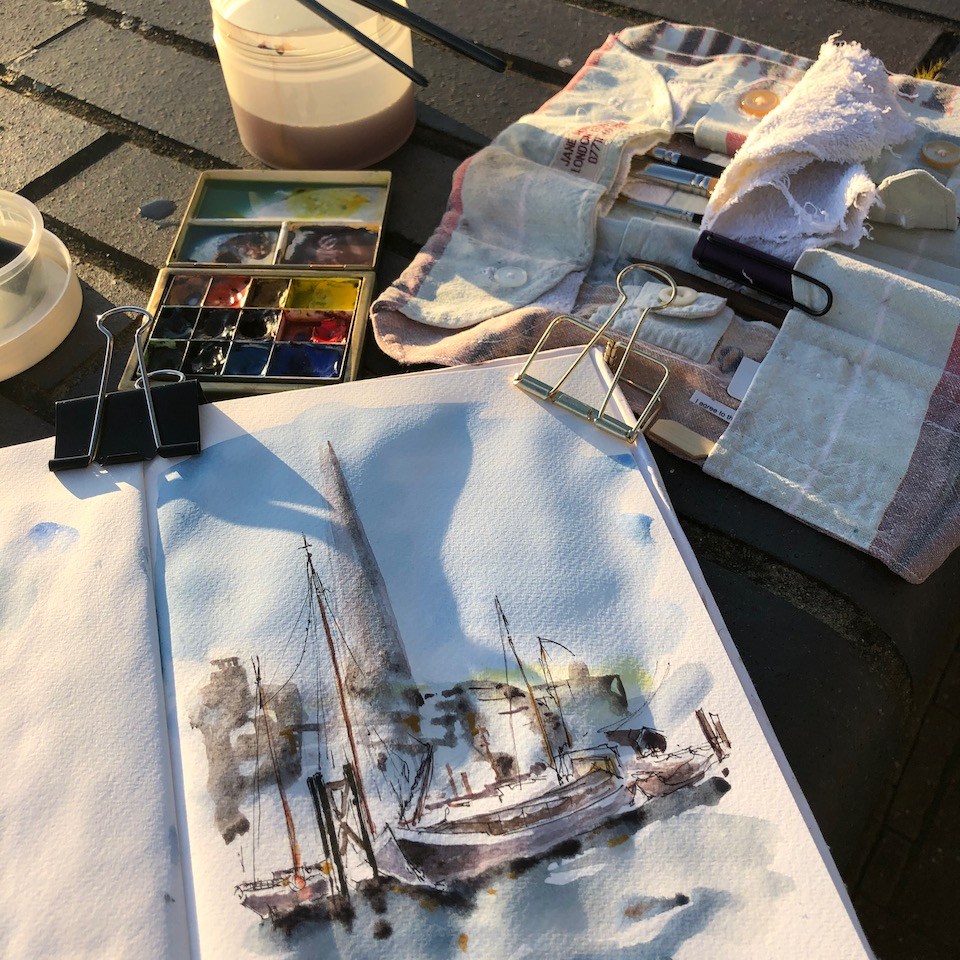
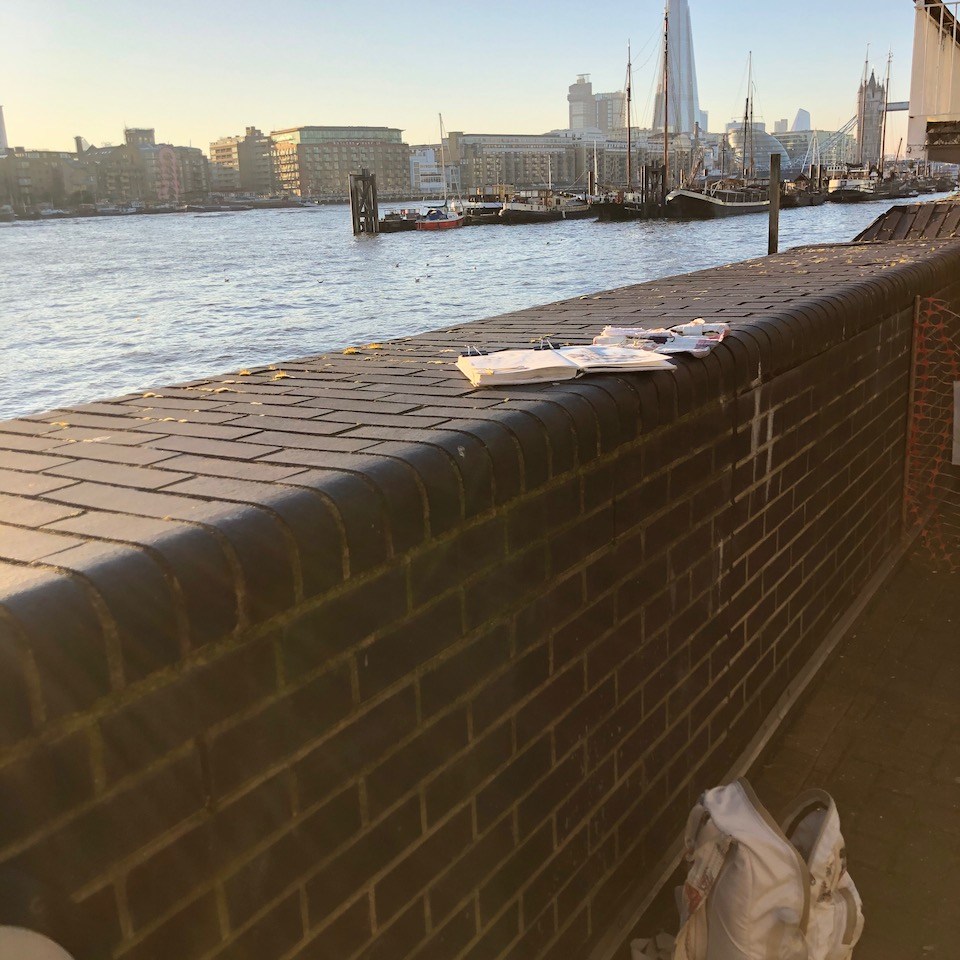
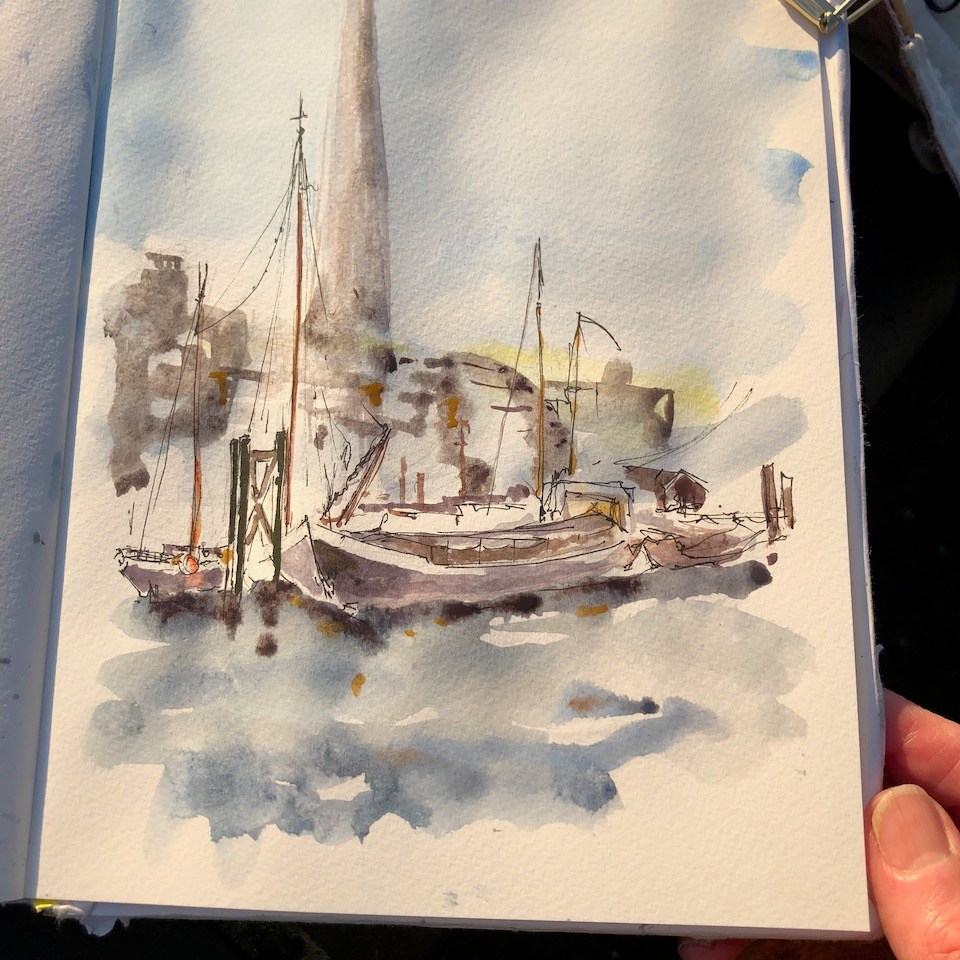
Hermitage Moorings and The Shard

Walking east, downriver, the crowds left behind, suddenly there is space and silence.

Hermitage Moorings, with the boat “Twee Artsen”

This drawing is a view across the river from the North bank. Tower Bridge is just off to the right. Opposite you see The Shard, and the waterfront buildings of Hays Galleria. The curved building in the background houses the Greater London Authority (GLA).

In the foreground is the boat which is called “Twee Artsen”. As far as I can work out, that is Dutch for “Two Doctors”, as in medical practitioners. It seems a strange name for a boat, so perhaps I got that wrong. Can anyone advise me?

This was a lovely place to draw.

The drawing took about half an hour. The sky is cobalt blue, knocked back a bit with Naples Yellow Red. There’s some Mars Yellow and Perinone Orange for the masts of the boats. The Thames is Cobalt blue with Burnt Umber. The boat black is made from Phthalo Green (BS) and Perylene Maroon. There’s some Hansa Yellow Mid in there too, for the lower sky. Quite a lot of colours in this one. The Naples Yellow Red is a Rembrandt colour, all the rest are Daniel Smith.

Where Hermitage Moorings is.

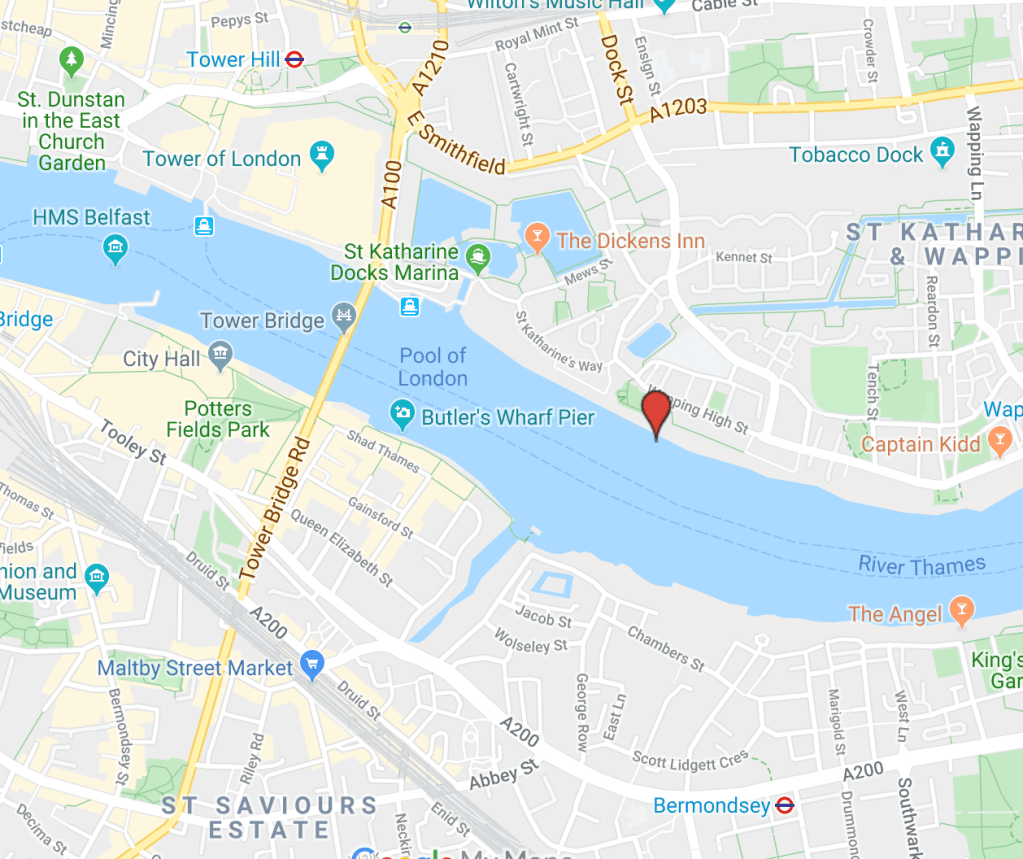
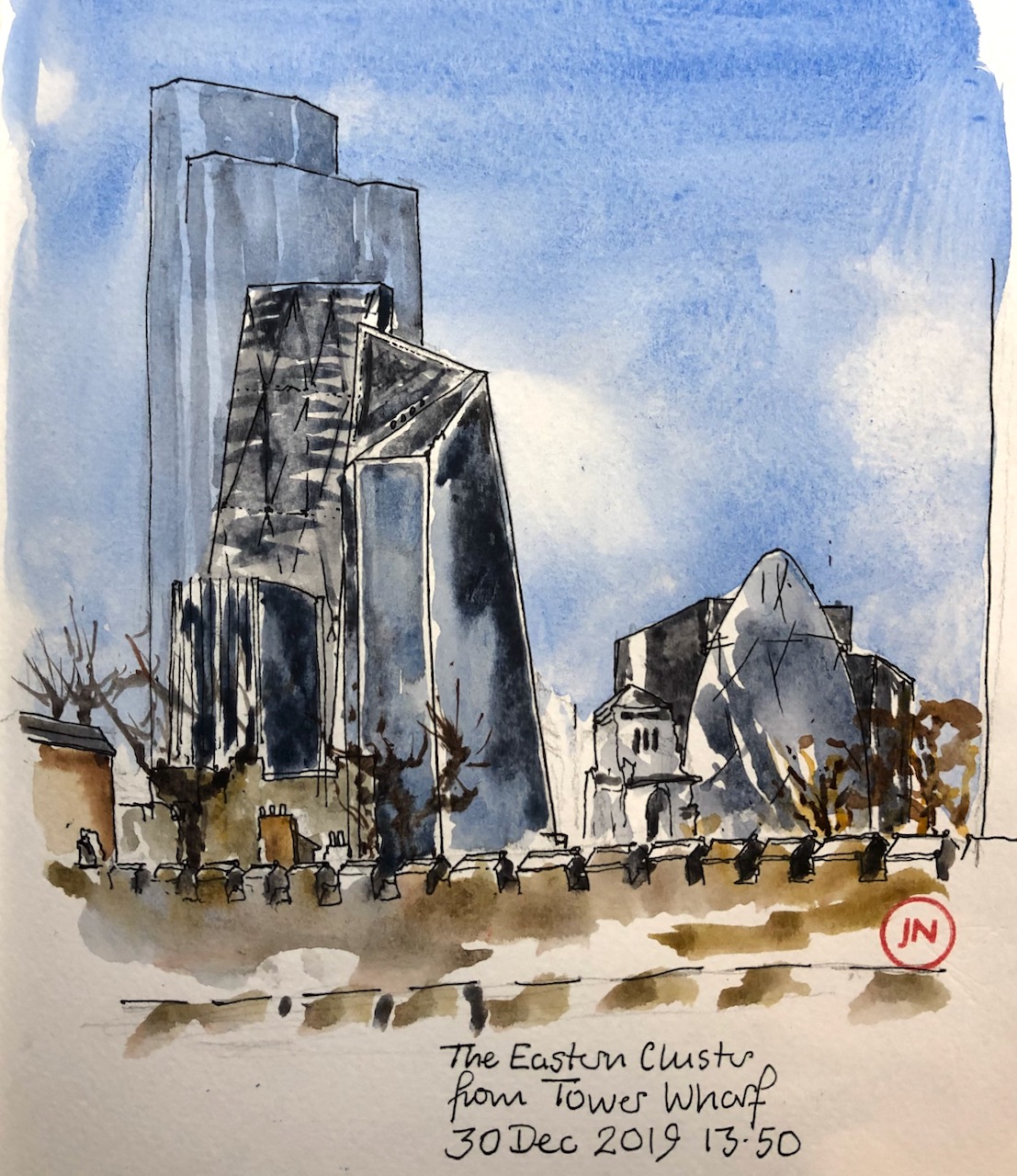
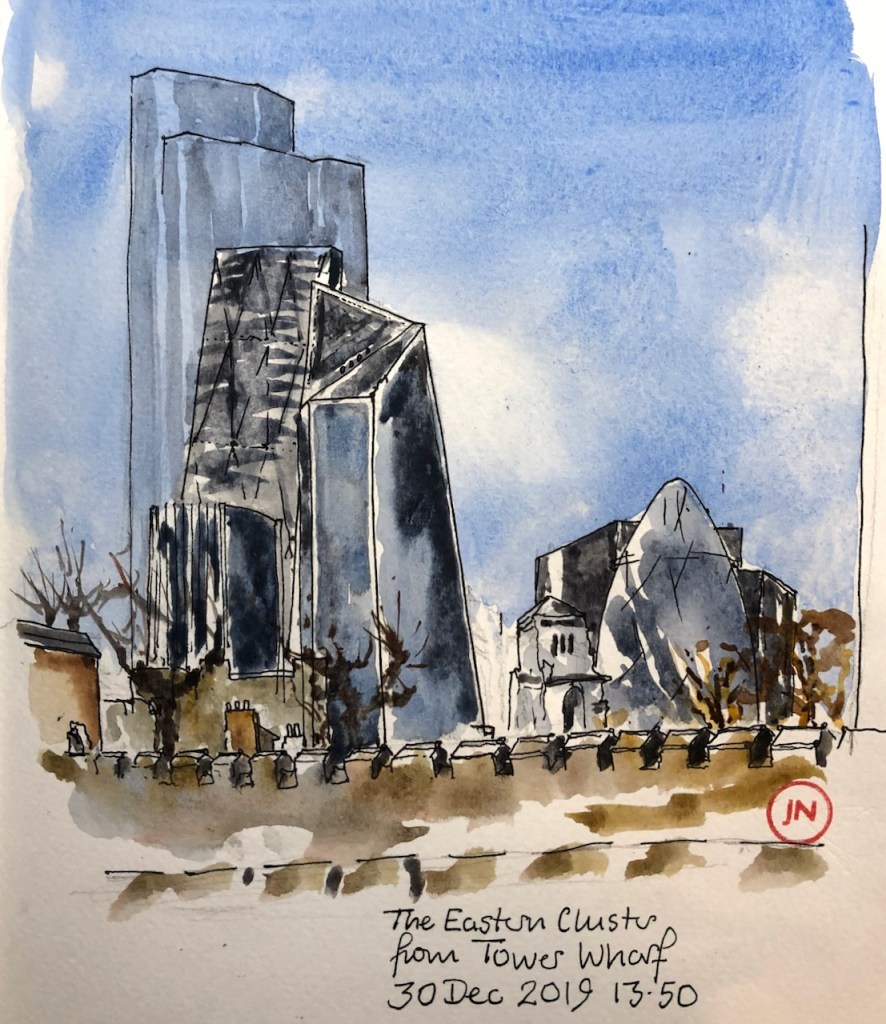
The Eastern Cluster from Tower Wharf

I went down to the river to find the sun. It was there, flooding the North side of the Thames, and so were an extraordinary number of tourists.

But who can blame them? The city was looking clear cut and perfect, there was a slight haze in the distance, a blue sky, and a low golden sun. I stopped by The Tower, and admired Tower Bridge, as everyone else was doing. Then I looked the other way, and saw the towers of the City.

From left to right: 22Bishopsgate (the tallest), the Cheesegrater, the Scalpel, the Gherkin.

I enjoyed the fact that you can see the pollarded trees and the chimneys of the buildings of the Tower of London, in front of the skyscrapers. The lower, pointed building, just to the left of the Gherkin, is the former headquarters of the Admiralty. Samuel Pepys (1633 – 1703), who wrote the diaries, worked there. This building is now an upmarket hotel.

The castellations in the foreground are part of the Tower of London.

The colours used are Cobalt Blue, Burnt Umber, and Mars Yellow, all Daniel Smith watercolours.

This drawing took about an hour, drawn and coloured on location.

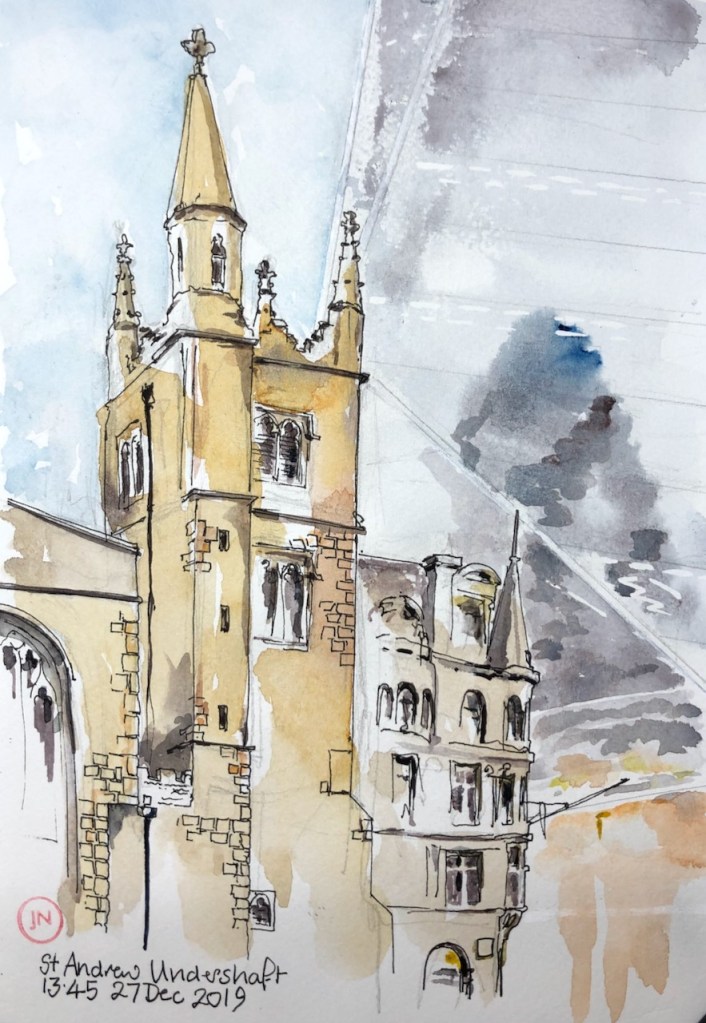
St Andrew Undershaft

Here is St Andrew Undershaft, constructed in 1532. It survived both the Great Fire of London, and the Blitz. Next to it is a branch of Lloyds Bank. Behind, with its huge reflective walls, is the Scalpel Building, 52 Lime Street EC3, finished this year. Reflected in the walls of the Scalpel is 30 St Mary Axe, The Gherkin, finished in 2003.

On the West side of the Square, diminished by the monumental canopy of the Leadenhall Building, is a Victorian statue entitled “NAVIGATION”. Navigation is a big strong man, inadequately clad for Northern seas, but he doesn’t mind. In his right hand he grasps the ship’s wheel. In his left arm, he cradles a ship. Next to him, incongrouously, is a multi-coloured wooden column. At first I thought it was some kind of antenna. Then perhaps it might be a 21st century version of a Barber’s Pole, no longer red and white only, but now yellow too. But there is no Barbers Shop. I was just about to conclude it must be “Art”, when I saw the explanatory notice, low down and in shadow. It is a Maypole.

“Until the 16th Century, a famous maypole used to be put up on feast days at the corner of St Mary Axe. Its shaft overtopped the original church, which got its name St Andrew Undershaft as a result. When not in use, the shaft was stored in an alley near here, which became known as Shafts Court”.

“NAVIGATION” and the Maypole.

About 45 minutes on location, finished at home. It was very cold. Colours used: Mars Yellow, Perinine Orange, Prussian Blue, Perylene Maroon. The sky is dilute Prussian Blue.

Here is work in progress and my location:

Scalpel from Bank

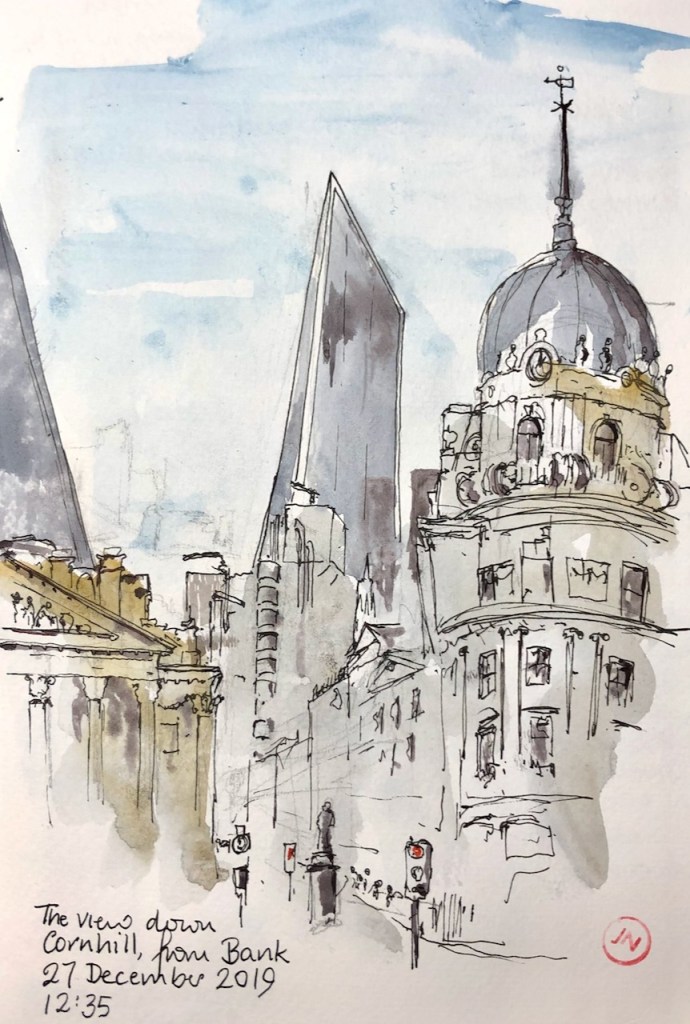
Here is the Scalpel Building, seen from Bank Junction.

The statue in the centre of the bottom of the picture is neither a statesman, nor a warrior, nor a monarch. It celebrates an engineer: J.H. Greathead, “inventor of the travelling shield that made possible the cutting of the tunnels of London’s deep level tube system”. There is a picture of his invention on the plinth.

The “travelling shield” depicted on the plinth of Greathead’s statue in Cornhill.

Greathead’s idea was to make the shield cylindrical, rather than rectangular as it had been previously. He also invented ways to spray concrete and grouting on the walls, and also to pressurise the tunnel, so as to make the workers a bit safer from cave-ins. His later shields were equipped with cutting jaws or teeth, to excavate the earth ahead.

“Most tunnelling shields are still loosely based on Greathead’s Shields design” says Wikipedia, including the “Tunnel Boring Machines” which are used, for example, for Crossrail.

The statue was created in 1994, and stands, appropriately enough, on a ventilation shaft for the Waterloo and City Line.

J.H. Greathead on his plinth/ventilation shaft.

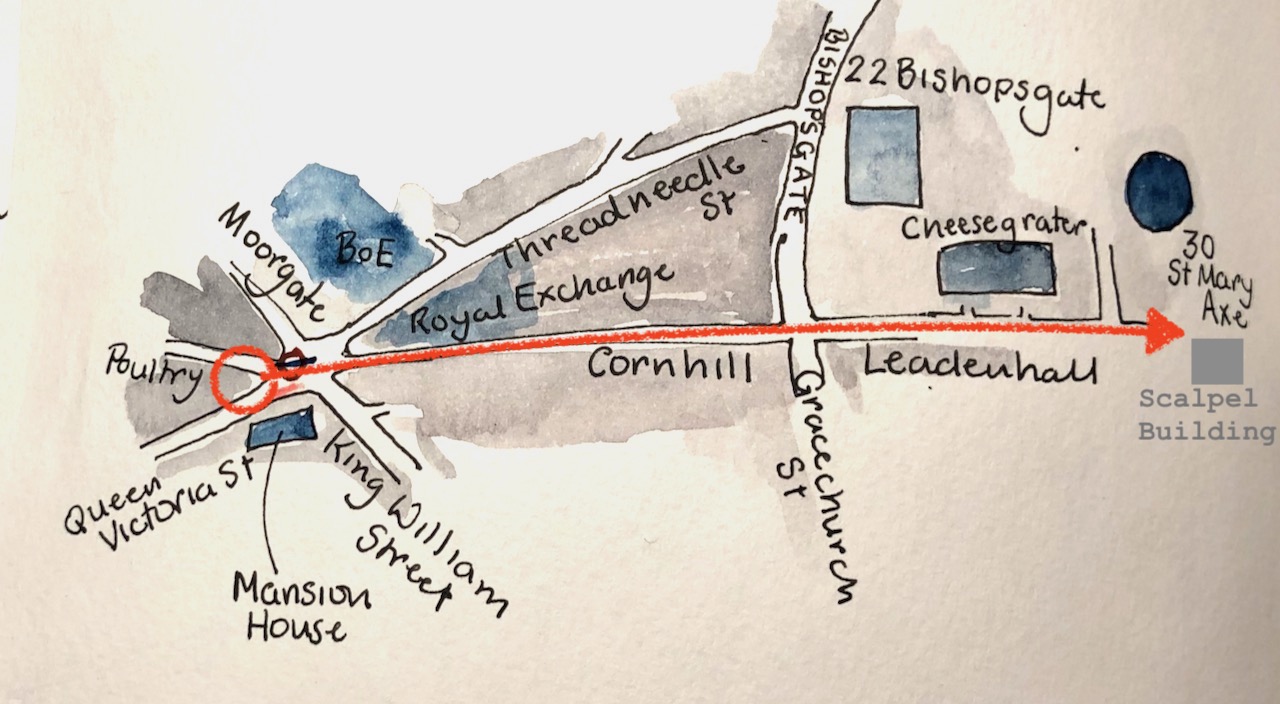
I drew this picture standing at One Poultry. Here are maps:

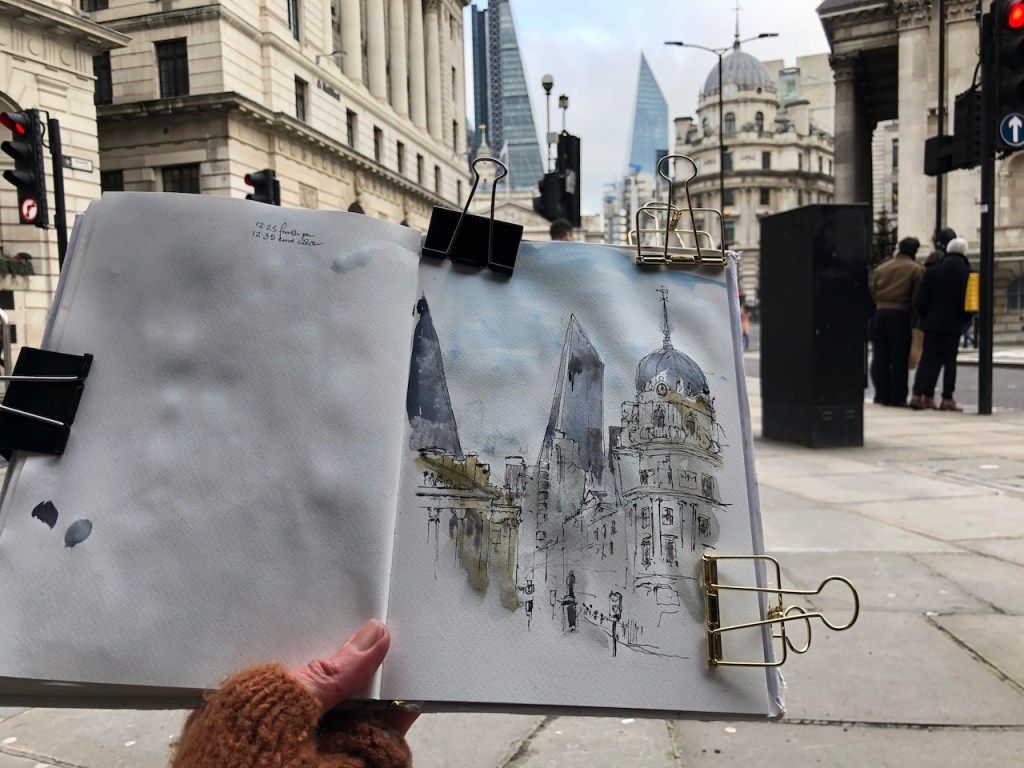
Here is work in progress:

Work in progress, the scene from One Poultry.

About 45 minutes. The sky is Prussian Blue, very dilute. The other colours used are Mars Yellow, and Perylene Maroon, all Daniel Smith watercolours. The grey is Perylene Maroon and Prussian Blue. The traffic lights are Pyrrol Red.

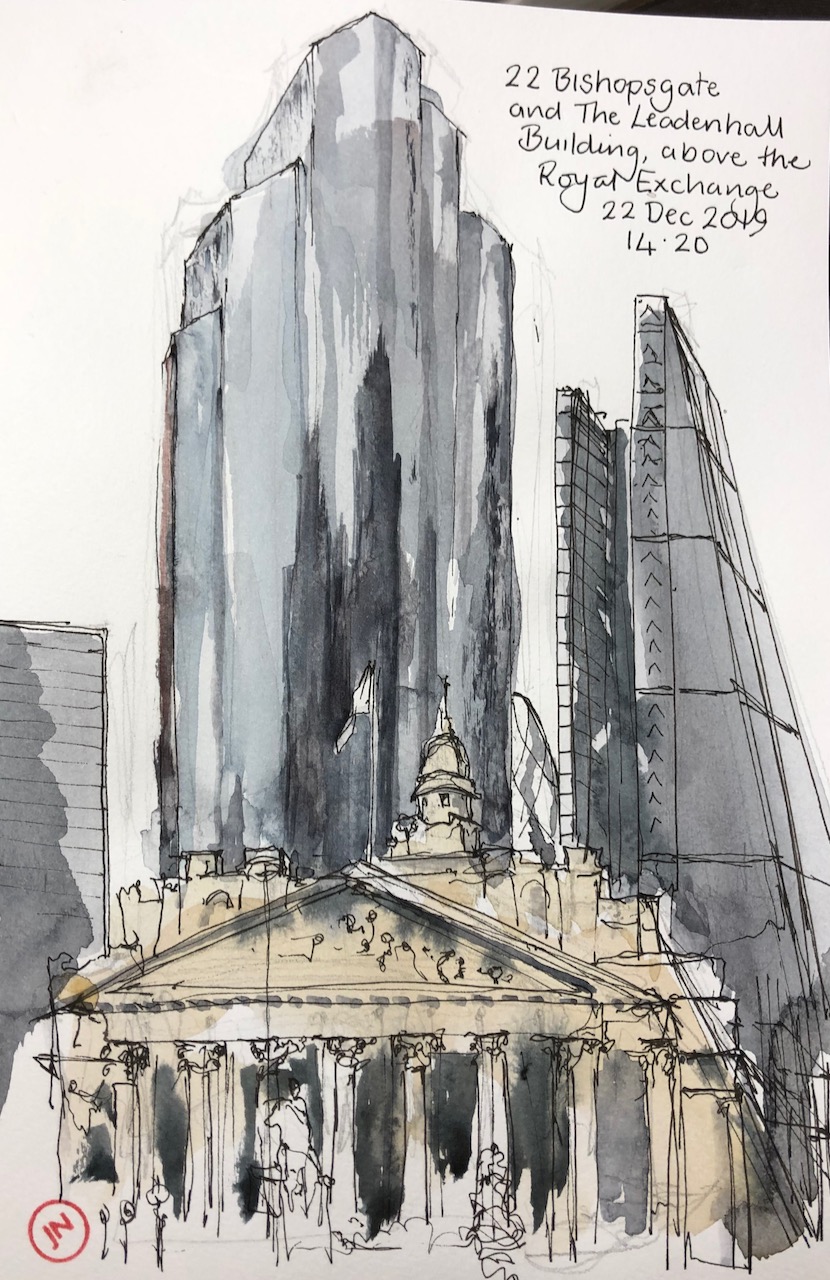
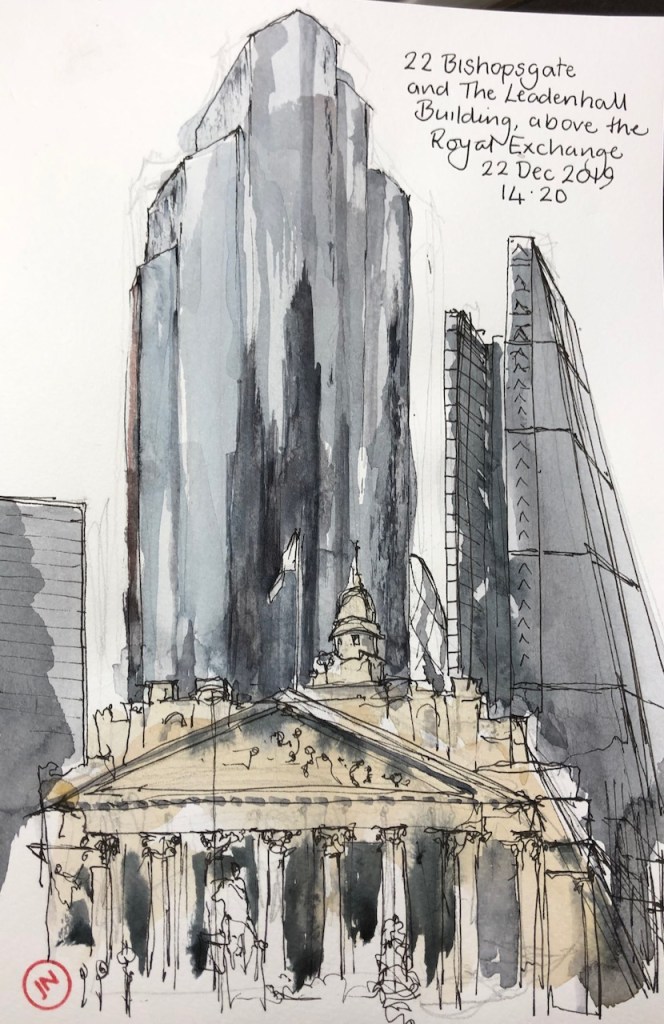
TwentyTwo Bishopsgate above the Royal Exchange

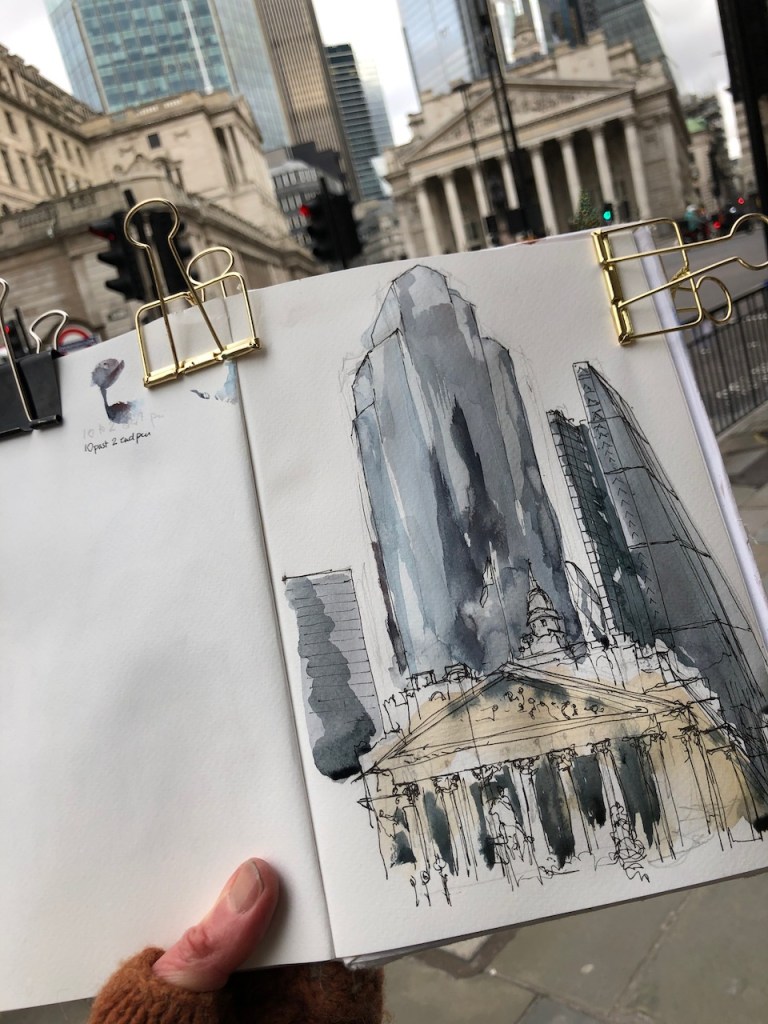
The huge new construction which is “TwentyTwo Bishopsgate” towers above the Royal Exchange. Since it was Sunday, it was possible to appreciate the vista without being trampled underfoot by financiers or overcome with traffic fumes. I took advantage of these benign conditions to do a quick sketch.

TwentyTwo Bishopsgate, and the Leadenhall Building, above the Royal Exchange.

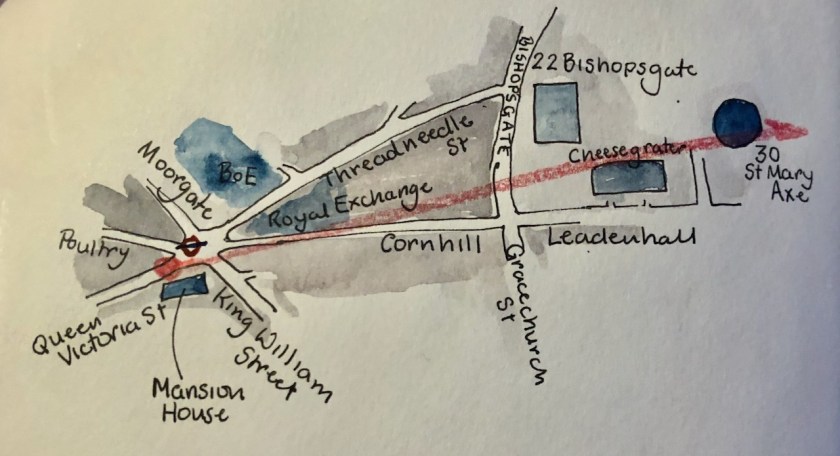
This was a very quick sketch, about half an hour. I was not trampled underfoot. I was standing on the pavement, in a sort of an alcove, just outside Mansion House. There was still quite a bit of hustle and bustle. That’s Mansion House the building, not Mansion House the Underground station, in case you were confused. Here’s a map, the red line shows the direction I was looking.

Map showing where I was: Bank Station, outside the Mansion House.

In the drawing you can just see, rather scribbly in the foreground, the statue of the Duke of Wellington on Horseback, and to the right of him, a Christmas Tree. The Gherkin, 30 St Mary’s Axe, is just visible between the buildings.

I’ve drawn TwentyTwo Bishopsgate a few times, as it is conspicuous on the City skyline now.

This drawing is in just three colours: Mars Yellow, Prussian Blue, and Perylene Maroon.

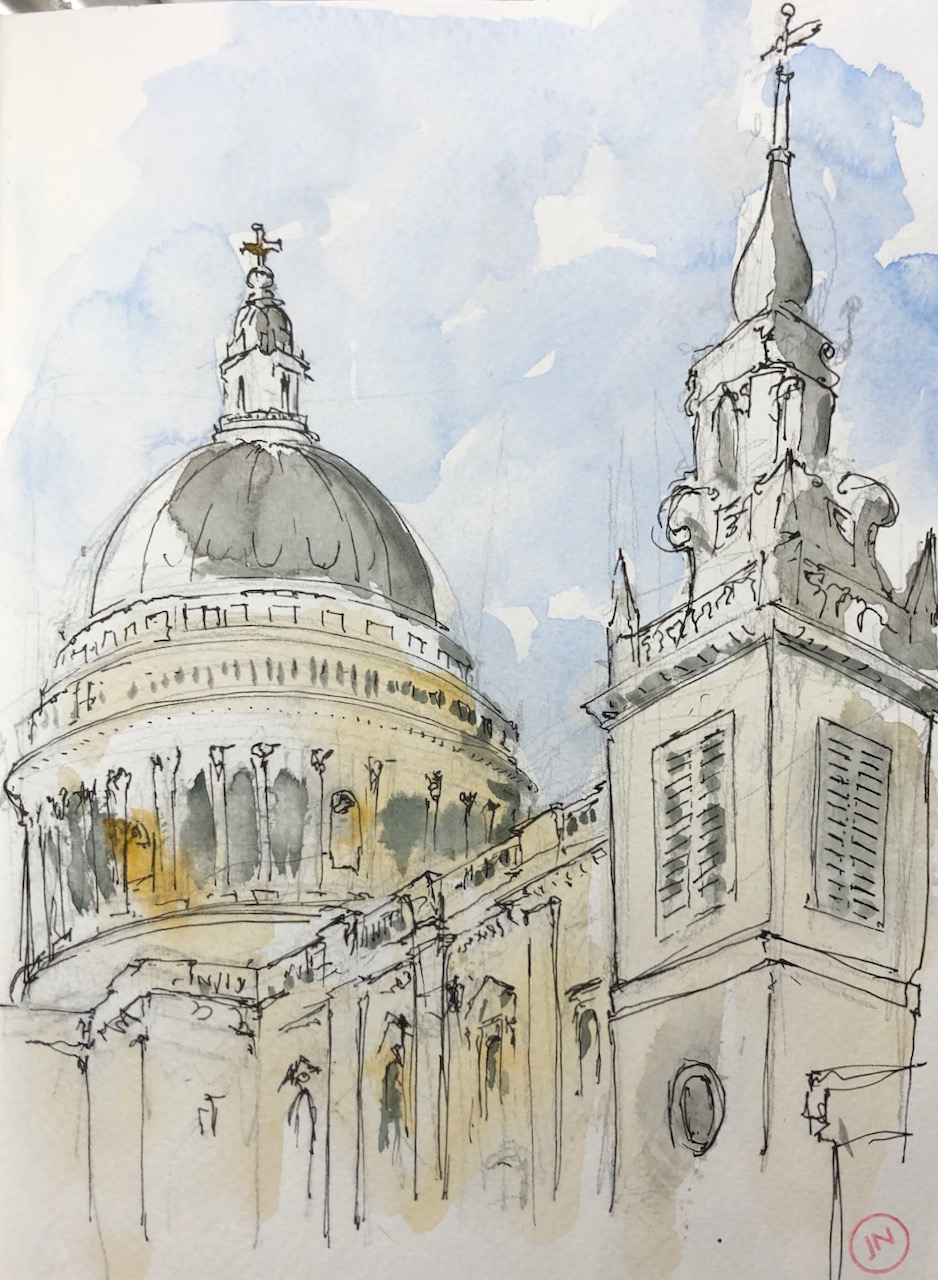
St Paul’s Cathedral from the East

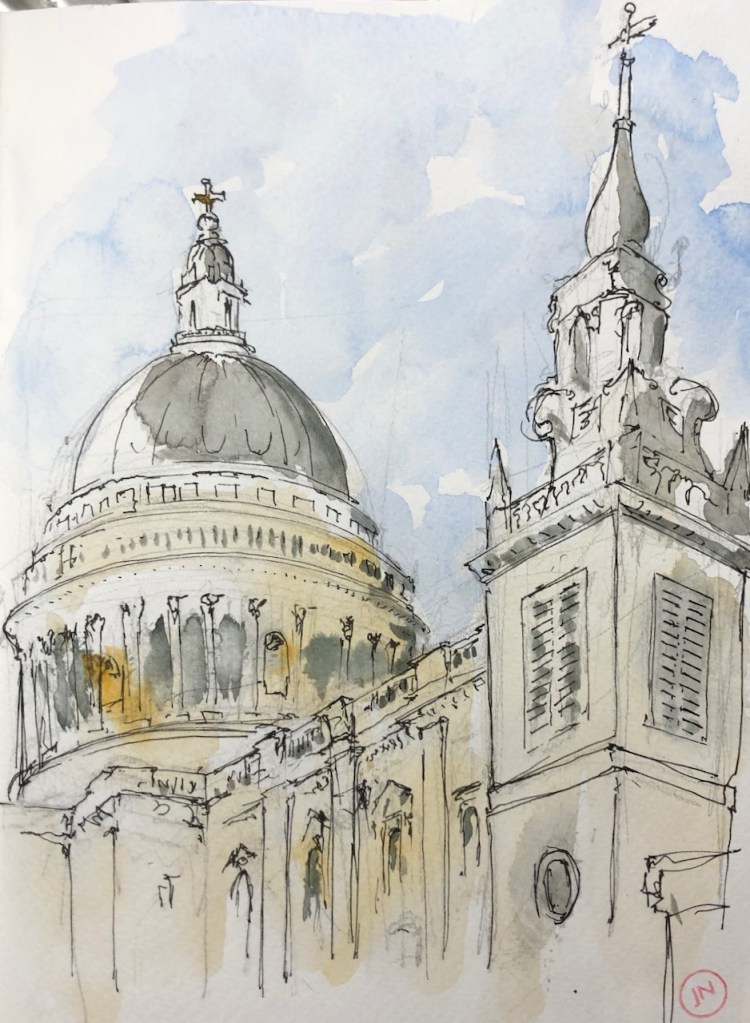
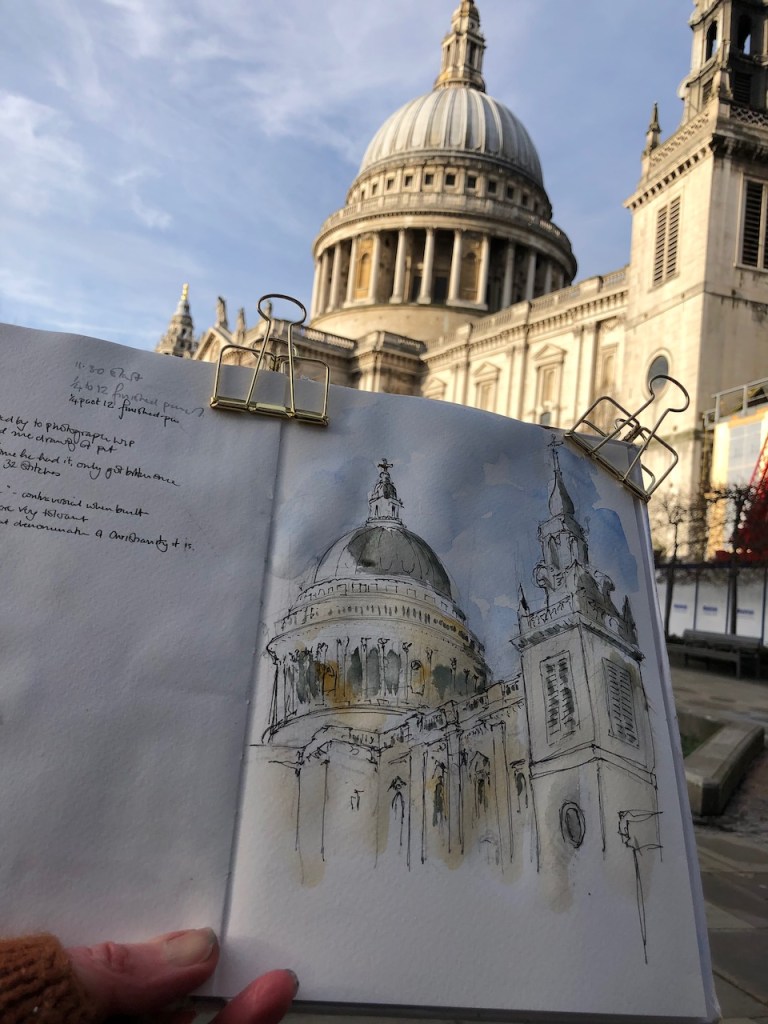
St Paul’s Cathedral and the restored tower of St Augustine Watling Street.

St Paul’s Cathedral and the tower of St Augustine Watling Street

To the East of St Paul’s is another church tower, on the right of my drawing. It is what remains of a medieval church, St Augustine Watling Street. Reconstructed after the 1666 Fire of London, St Augustine was then destroyed again by bombing in 1941. The Tower was reconstructed in 1954, and made part of St Paul’s Choir School which occupies this area. The Choir School was completed in 1967, in good modernist style, but is rarely noticed, even though it is right next to St Paul’s Cathedral. The school is currently being extended, which is amazing since it occupies such a constricted site. There is scaffolding off to the right of the drawing.

I drew this sitting on a bench in “Festival Gardens” which is the lawn south of St Paul’s. It turns out that this is right on a tourist route, and groups of people passed by. A woman approached and respectfully asked if she could look at the drawing. She was interested in my picture, and said her daughter painted also. Then her companion approached and showed me a detailed picture of an alligator on his mobile phone. He said this picture was drawn by their daughter. The alligator was his pet. In the six years he had it, it had only bitten him once. But that time he needed 32 stitches.

I was just finishing the pen when a young man stopped and looked. He smiled, and went away. Then he came back and, like the woman, showed me his mobile phone. This time there was a message on it. In neat and polite English, the message told me that he was a visitor from Korea. He thought my drawing was very good and would I mind if he took a picture of it?

I said that would be fine, and held up the book so he could photograph it. Then I had a thought. I dug out one of my cards and pointed to the @janenorthcote written in clear letters at the bottom. “Instagram” I said, hoping that brand names would communicate between cultures. He nodded and smiled, and went back to join his group. Sure enough, when I’d finished the sketch, a ping on my phone announced that an Instagram message had arrived. @si_hyeonv had posted his photos, and written to say thank you.

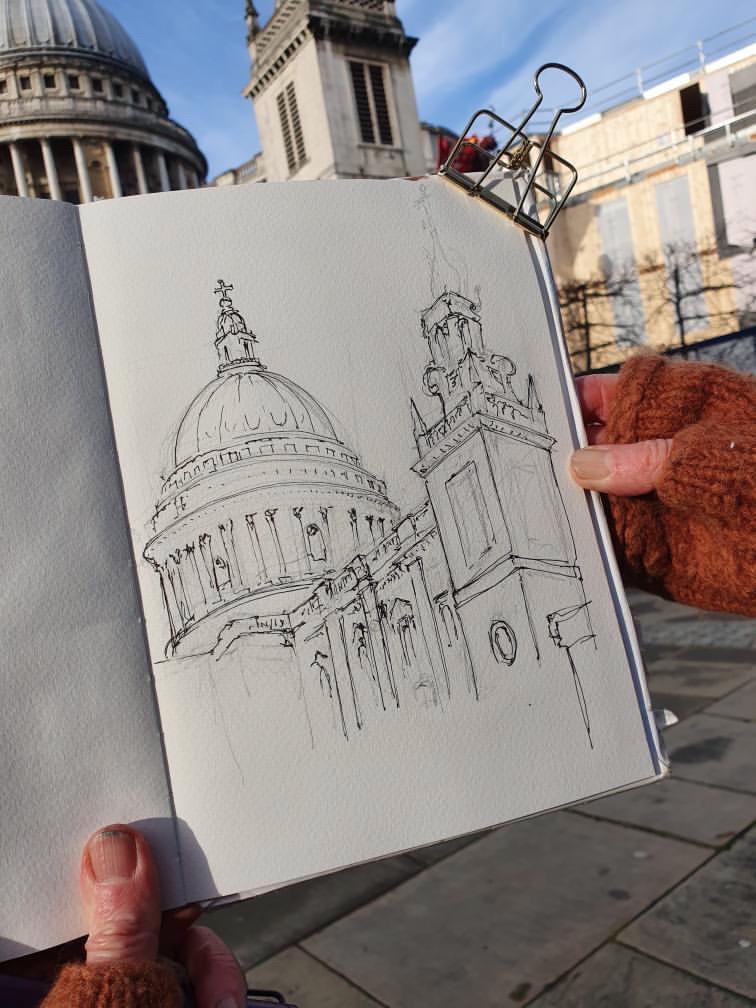
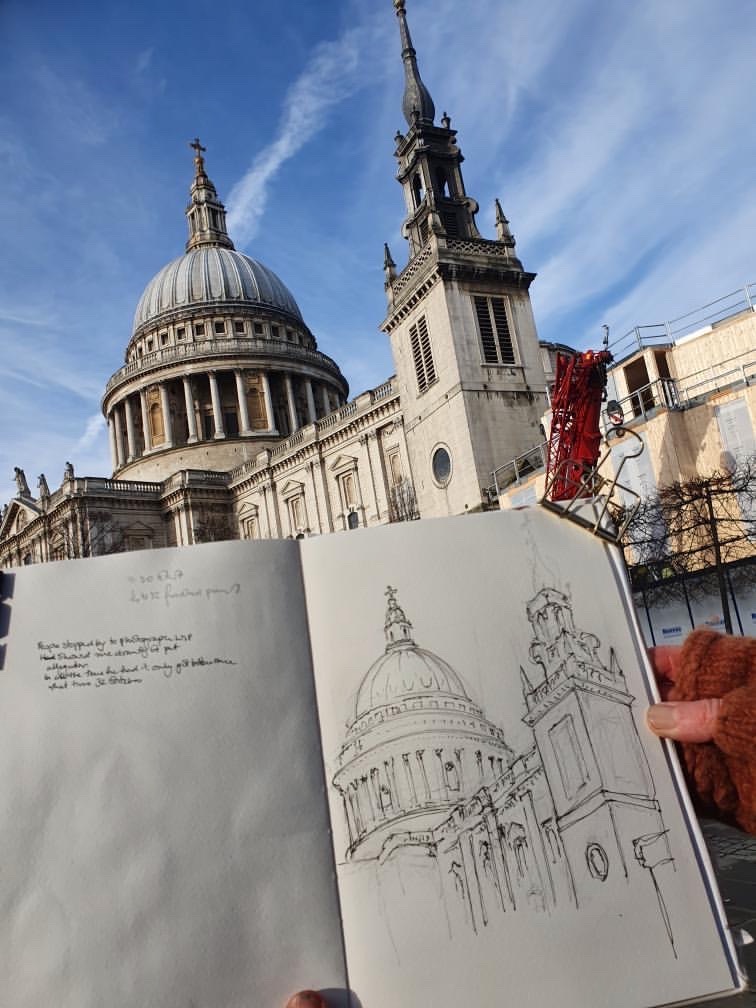
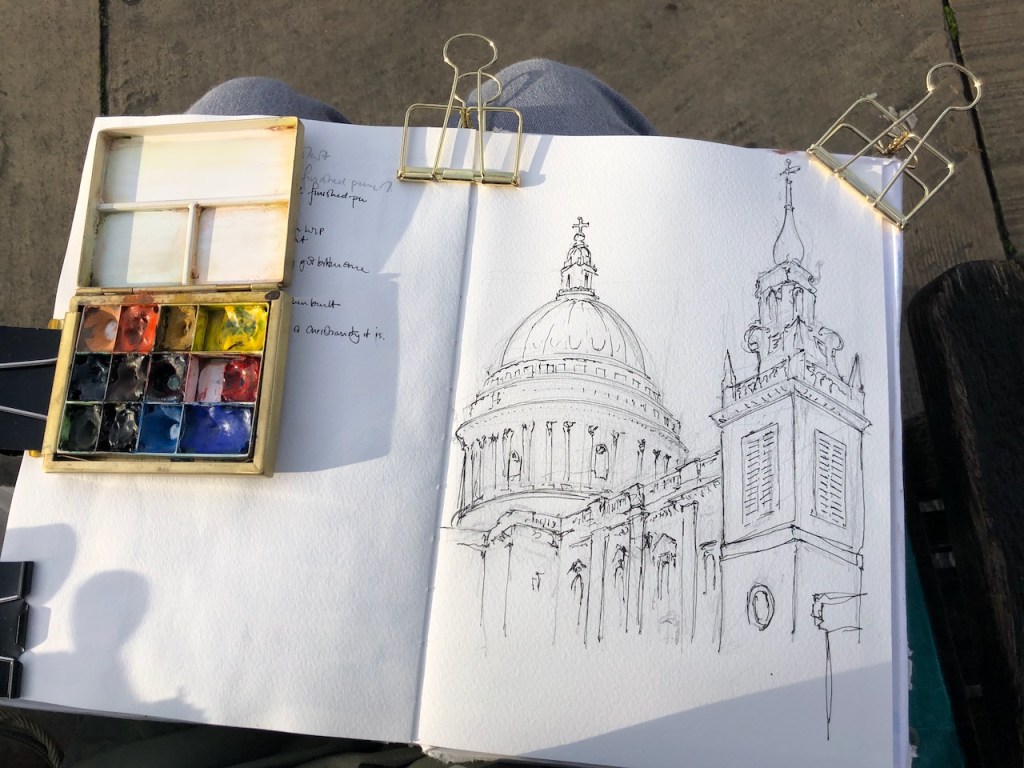
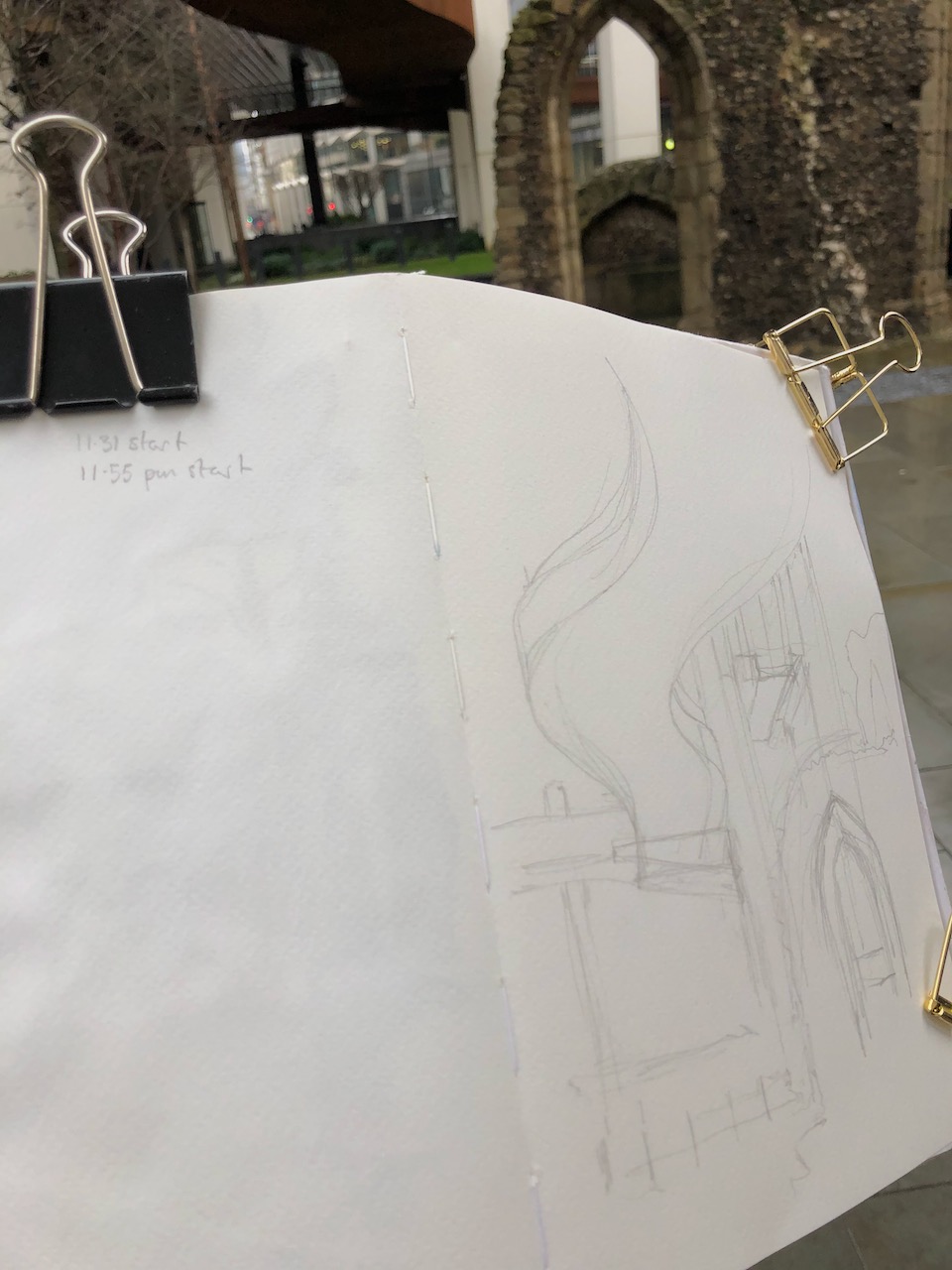
Here are other photos of work-in-progress, taken by me.

Drawing took one hour, including colour. Three colours used: Mars Yellow, and the grey is Phthalo Green (BS) and Perylene Maroon, all Daniel Smith watercolours.

St Alphege, from outside Barbie Green

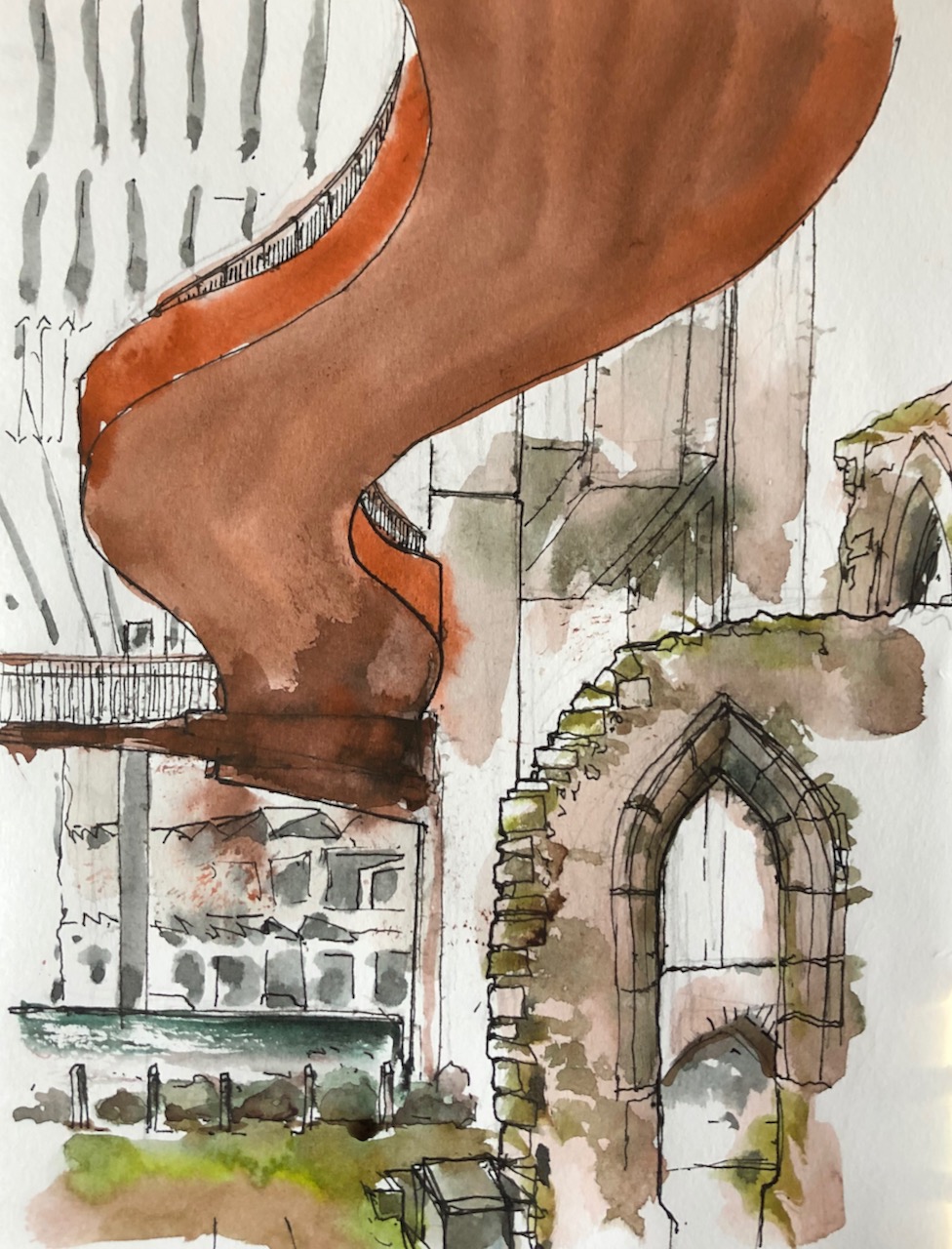
Here’s another drawing on London Wall place. This is a view of the highwalk from underneath. I was standing by the new café, Barbie Green, sheltering from the rain.

IMG_0535

The shelter was not very good, and there was a lot of wind, so raindrops arrived on the picture. I went to go in the café to finish the colouring, but no, there were “no tables”.

So I finished the drawing outdoors, sitting on a damp bench.

I very much enjoy this highwalk. It curves in all dimensions. The side walls undulate, the walkway becomes wider and narrower, and it tilts up and down. It’s made of some iron-like metal, so it has rusted and is now a deep brown. The shape of it respectfully frames the ruins of the old church.

I appreciated all this while observing, through the picture windows of the cafe, three empty tables, which remained empty for the whole time.

1hr10, drawn and coloured on location.

More drawing expeditions in this area: