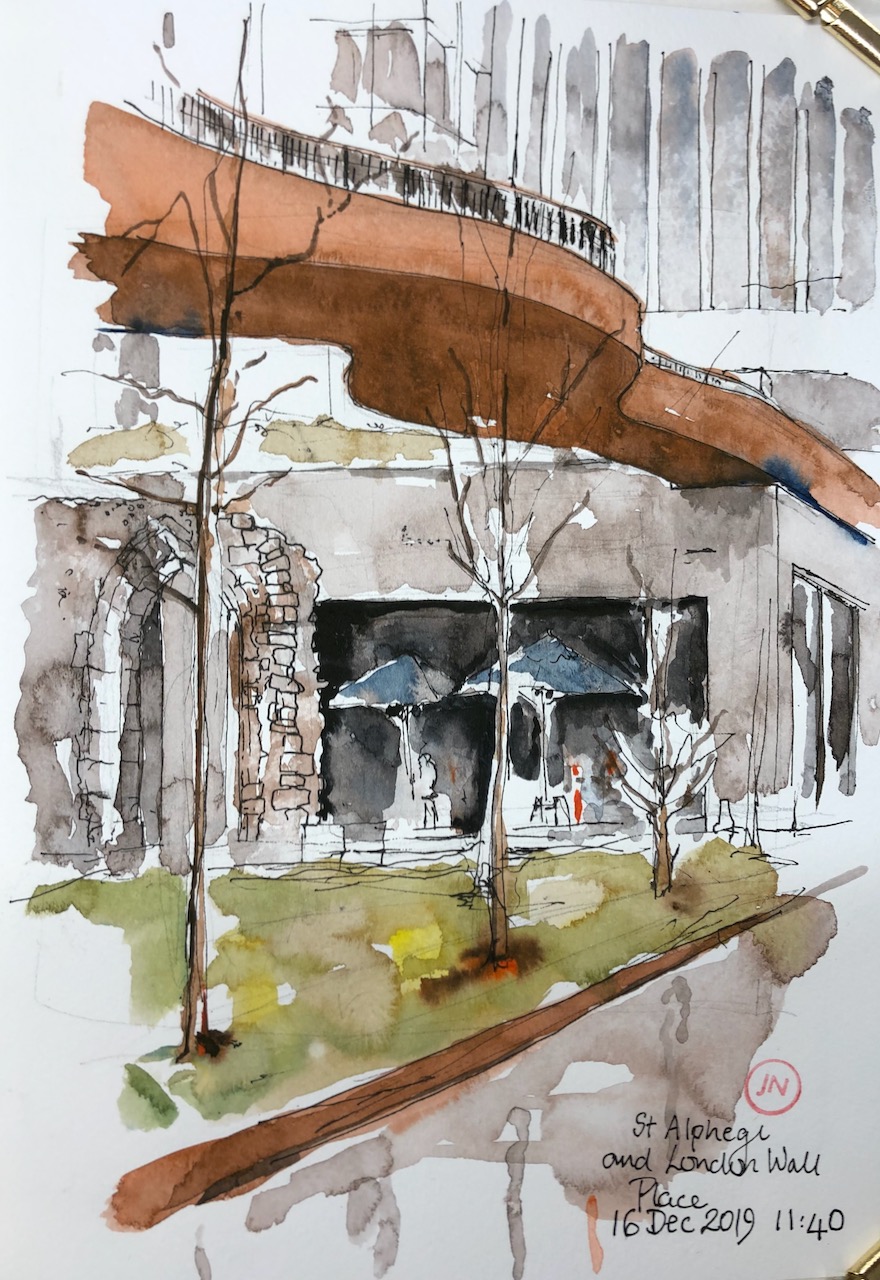
On the way back from the Post Office, I paused to draw the view under the new Highwalk of London Wall Place. There is a new café called “Barbie Green”.
I drew this by the water pond and the plants. sheltered by the highwalk. Other people were there too, mostly smokers. Except that people don’t smoke anymore, but wander around leaving trails of mist with strange synthetic smells, nearly but not quite vanilla.
Location of London Wall Place shown in yellow. View of drawing in red.
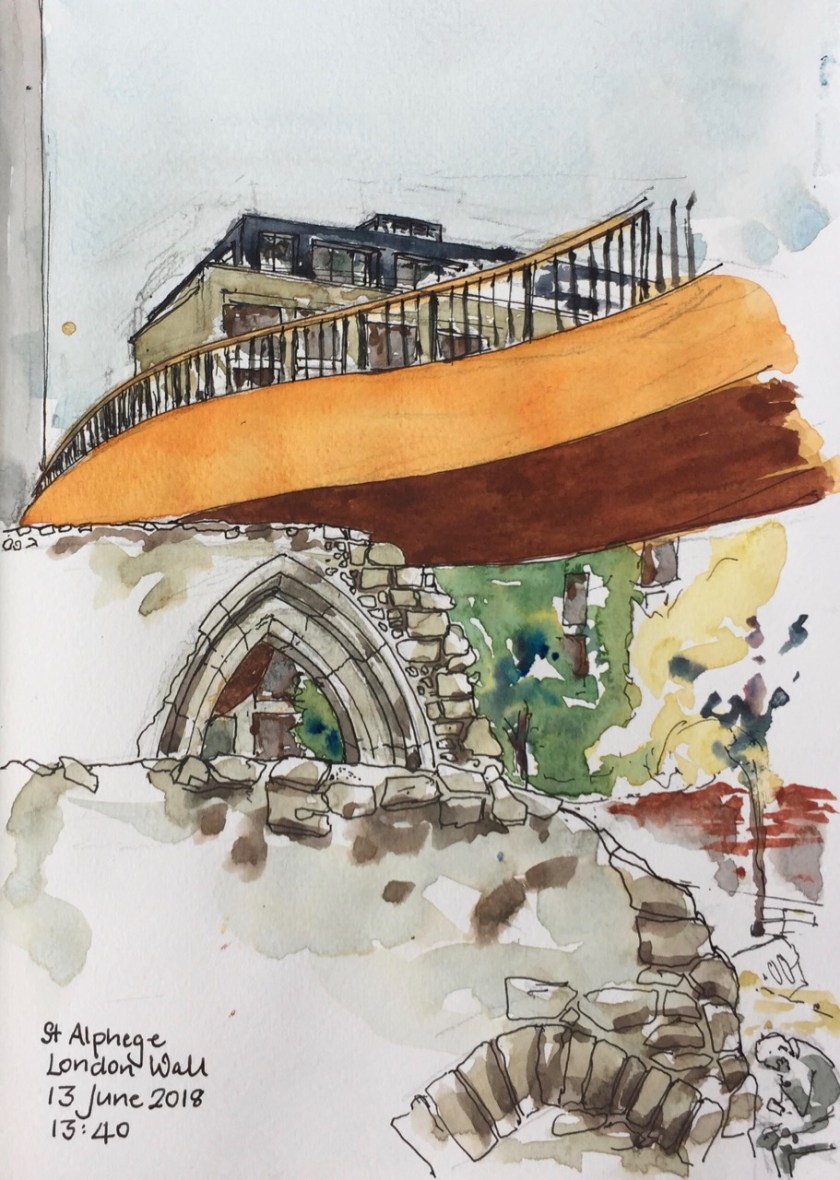
I have sketched in this area before. Here’s a similar view, drawn last year in the summer, just after the highwalk was constructed:
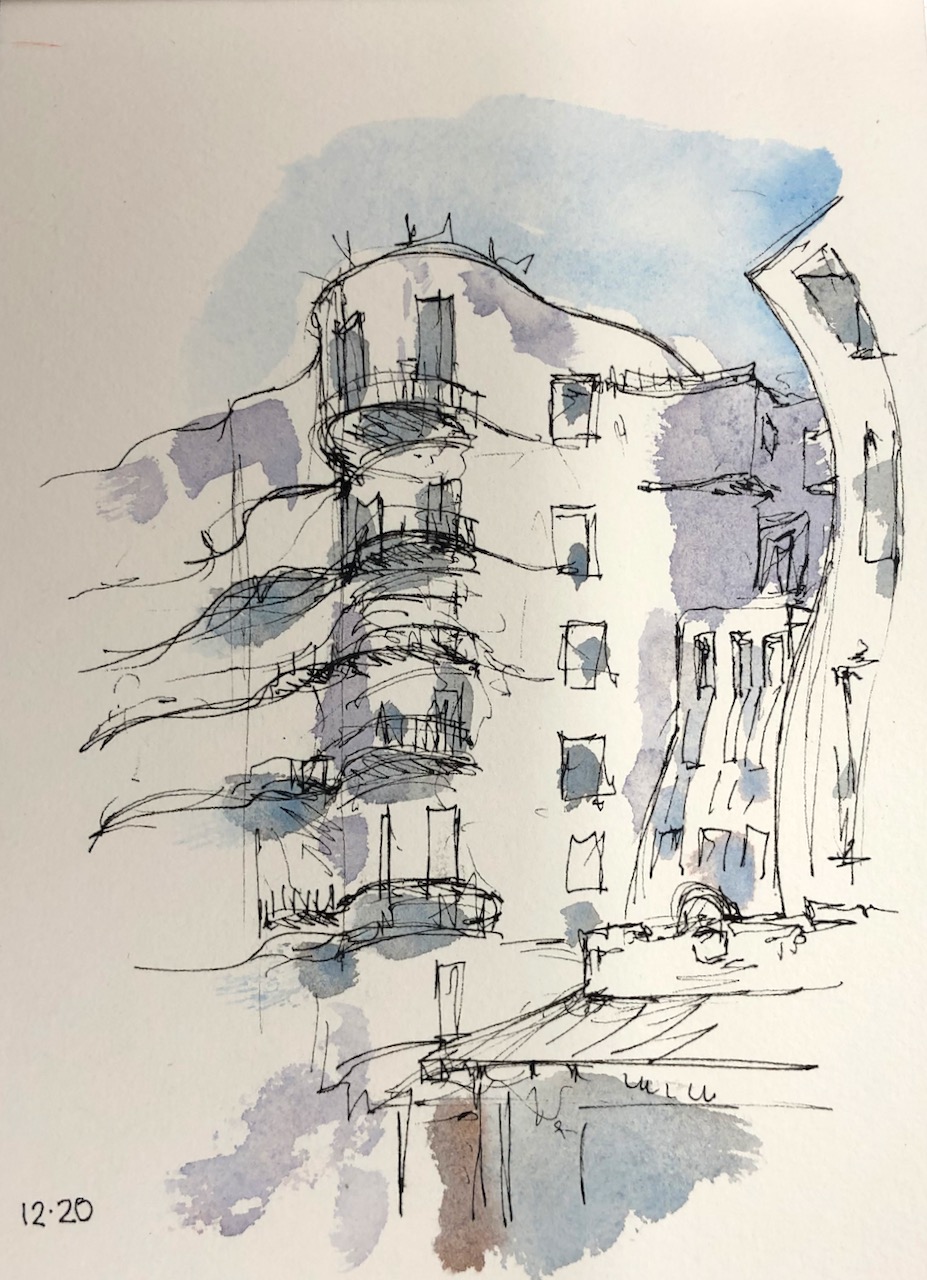
On a shopping expedition in Islington, I made a diversion through the new development: “Islington Square”, opposite St Mary’s Church. It’s not a square, more of a passage, a covered road, very high. Lots of huge empty windows wait like empty stages for the retail theatre to begin. At the end is an open-air space, also not a square, more of a rectangle. Here is a grand kitchen equipment shop, where you can buy a saucepan in copper, or other high-grade metal such as stainless steel. Then looking back towards the passage, I made a sketch:
This was a very quick sketch, about 20 minutes (that’s quick, for me). Drawn and coloured sitting on one of the benches near the kitchen shop.
As I was finishing a man emerged from the passage and announced “We have our first artist!”. He meant me. Other men followed. I asked him if he lived here, as I was interested in the flats I had been drawing. He said no, he was the Manager of the Development. I said I appreciated the fine wooden bench, which was placed in a good position for drawing. He looked at my drawing and said I should come back in different seasons – and put on a show! Good idea.
He was a busy person and walked off. One of the other men came up and very kindly offered to fetch me a cup of tea or coffee. I was just packing up though, and so declined. It was nice of him.
“Islington Square, just an eight-minute walk to Angel Underground Station, offers 263 new homes and 108 serviced apartments at a maximum height of just eight floors, fusing Edwardian grandeur and contemporary style. The build will be complemented by 170,000 square feet of retail, dining and leisure amenities including a luxury Odeon cinema and a premium Third Space gym.” (Olivier Heath, writing in “House Beautiful” April 11th 2019)
The new development is around and about the former postal sorting office, which has been empty for some time. The dates I could see in the brickwork said “1905”. The new buildings are curved, as you see in my sketch, and one group is covered in purple tiles. I thought it looked good. At least they haven’t just imitated the Victorian architecture, but courageously added something decidedly 21st Century.
Click a button below to share this post online, email it, or print it:
There was sun. It’s a low, Northern Hemisphere, sun. I know that in the City amongst the high-rise buildings, I will not see the sun at ground level. So the thing to do is to go up. I went to Alexandra Palace, 330ft above sea level. There’s a direct train from Moorgate.
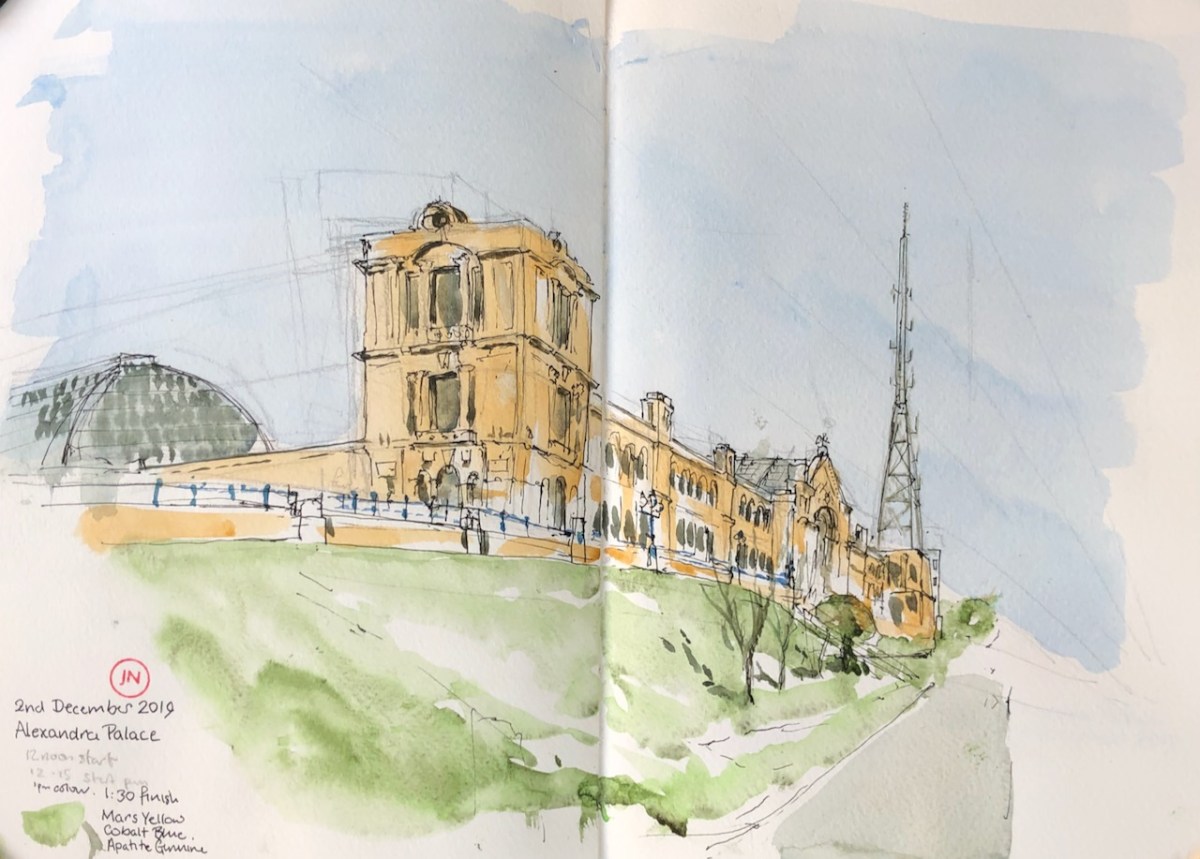
Here’s Alexandra Palace from the South West.
Alexandra Palace, from the South-West
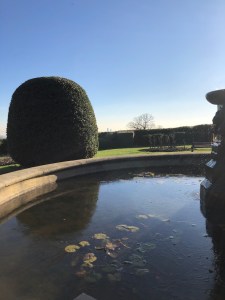
It was sunny, but extremely cold. There was ice on the pond by the fountains. So after this drawing I walked down the road I’d just painted, in search of warmth and coffee.
Ice on the pond by the fountain
The café called “The Phoenix” was closed 2nd to 5th Dec. The café of the Skating Rink was closed because the skating rink was closed. So at the far end, beyond the aerial, I turned left around the building and found the Theatre. Against all expectation, the doors were open. Indoors was a vast, warm, space. I walked around on the huge floor and found a coffee van which looked like the ones you see at funfairs, or airports. It was empty. The whole place was empty, and weirdly quiet. At a wooden table a knot of teenagers were working silently on what looked like, and may well have been, homework, assisted by laptops, phones and fizzy drinks.
I found someone at a desk. They found someone associated with the van. She rushed up, cheerful and apologetic. She was apologetic that she had kept me waiting. The second apology was that the coffee machine “was not working”. Oh well, tea is nice too.
Back outdoors and further round, the sun lit up the glass domes.
Alexandra Palace, from the North-East
I walked round as far as I could. The place is simply enormous, and all built of bricks. This is the place if you are planning your pop concert. Pink Floyd were here (1967). My neighbour remembers the first Campaign for Real Ale event here (1976)*. He still has the half-pint mug he was given.
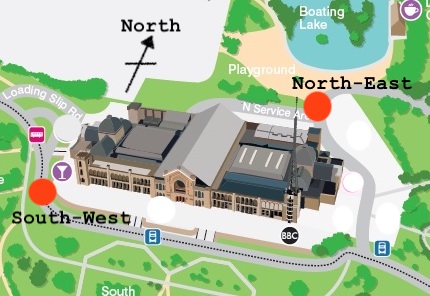
Here are the locations where I did the drawings:
Here are some photos of work in progress:
The original building was destroyed by fire shortly after it was built, and then, amazingly, rebuilt. Here is a photo of a photo that was displayed in the Theatre. It shows the original building, around 1900. The tower that is prominent in my first sketch originally had a squat spire. This photo is from roughly the North East, as my second sketch. The entrance to the Theatre is on the left, and you can see the glass dome.
You can also see a train, going along the back wall of the Palace, on the lower right hand side of the picture. Evidently there was a train service right up to the door. On my walk around, I saw the former station house, now a community centre.
Here is a map of Alexandra Palace and Park now. The station is now at the bottom of the hill.
On Wednesday I went for a peregrination around Hackney, north and east of Brick Lane.
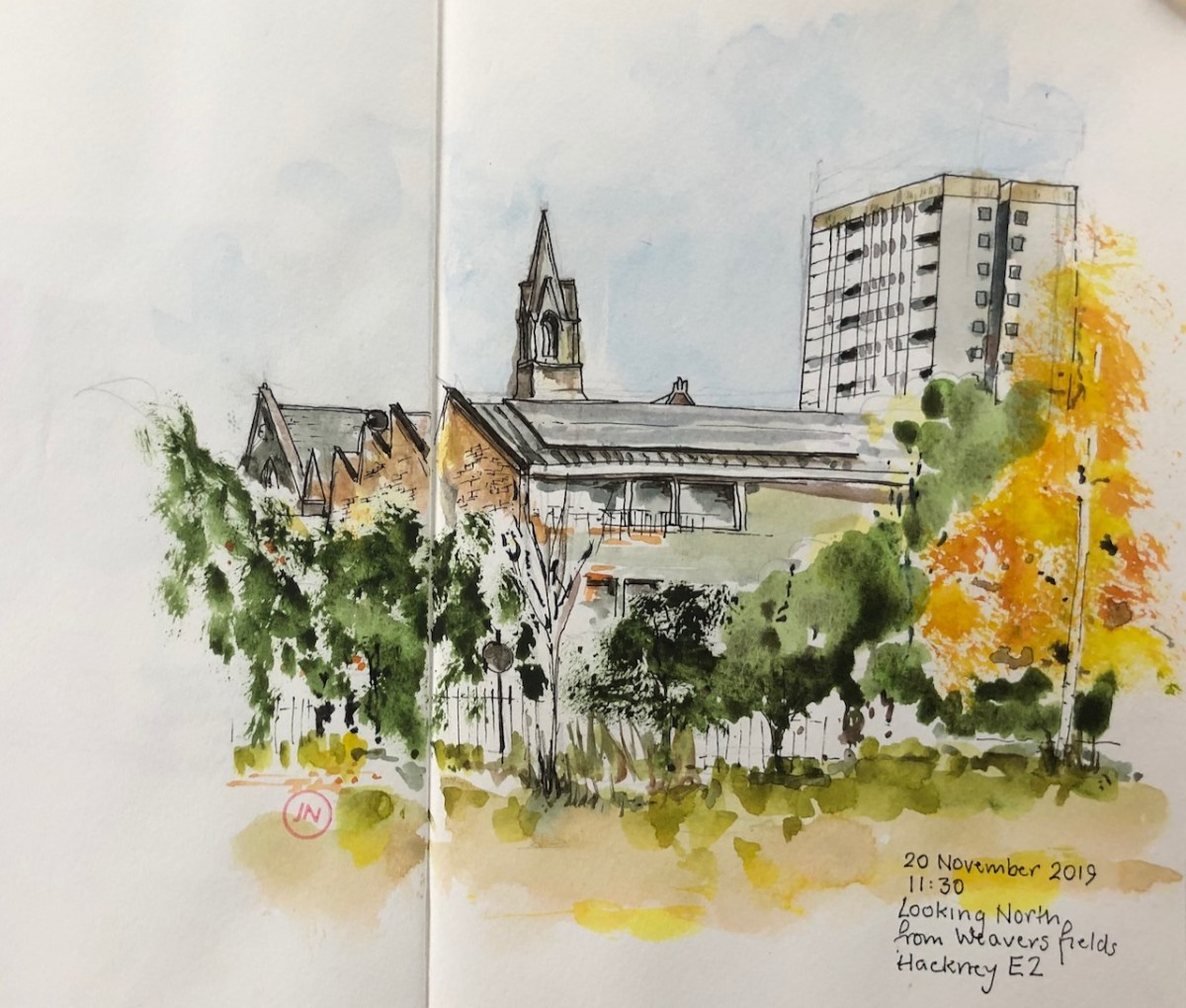
I drew this sitting on a bench on Weavers’ Fields. The tower block is Charles Dickens House. The church which you can just see is on the junction of Pollard Row and the Bethnal Green Road. It is a deconsecrated church, and looks as though it’s been converted to residential flats. The building with the roof, straight ahead, is on Derbyshire Road E2. It’s clearly been industrial in its time, now it looks vaguely high-tech. Note the long solar panel on the roof.
It was incredibly cold, about 5 degrees C. But very bright sun, so the solar panel must have been working.
I walked on back to the city. In amongst the office blocks it was warmer. I tucked myself into the angle of a building and drew this:
This is 101 Worship Street, in the beautiful row of workshops designed by Philip Webb. If I were to make the untold millions necessary, I would buy up this row and look after it. I have had my eye on it for a while, ready to campaign if it were threatened. At the far end, sketchily shown behind the cars, is a sort of font or water fountain, with a sharp angled roof. The houses are not in good repair, and evidently listed or they’d have been pulled down by now. They are surrounded by the huge developments of Hoxton and the City of London, as you see behind. This is the “fin tech” area. But these houses survive, against the odds, tribute to the utopian dreams of a previous era.
Click a button below to share this post online, email it, or print it:
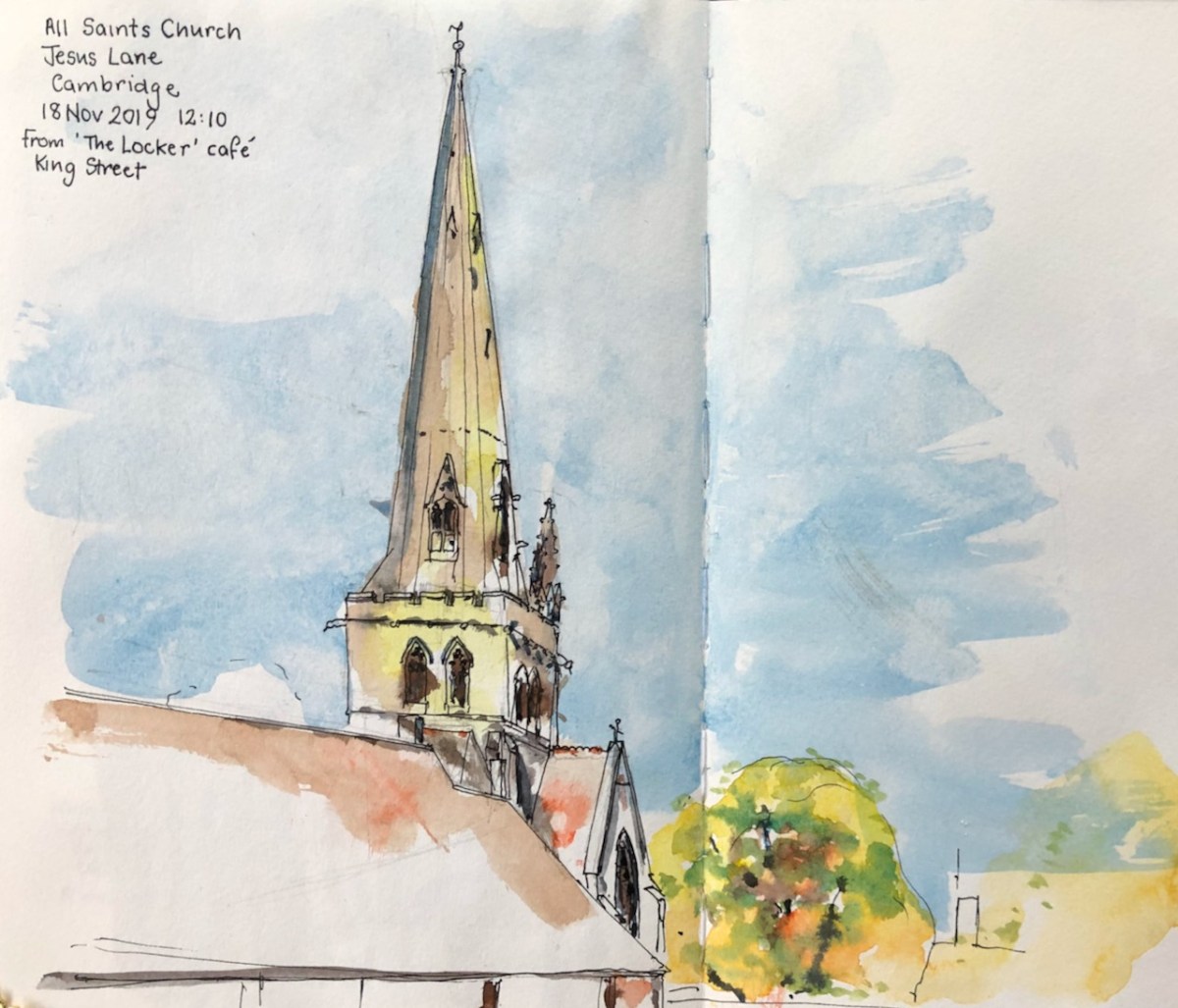
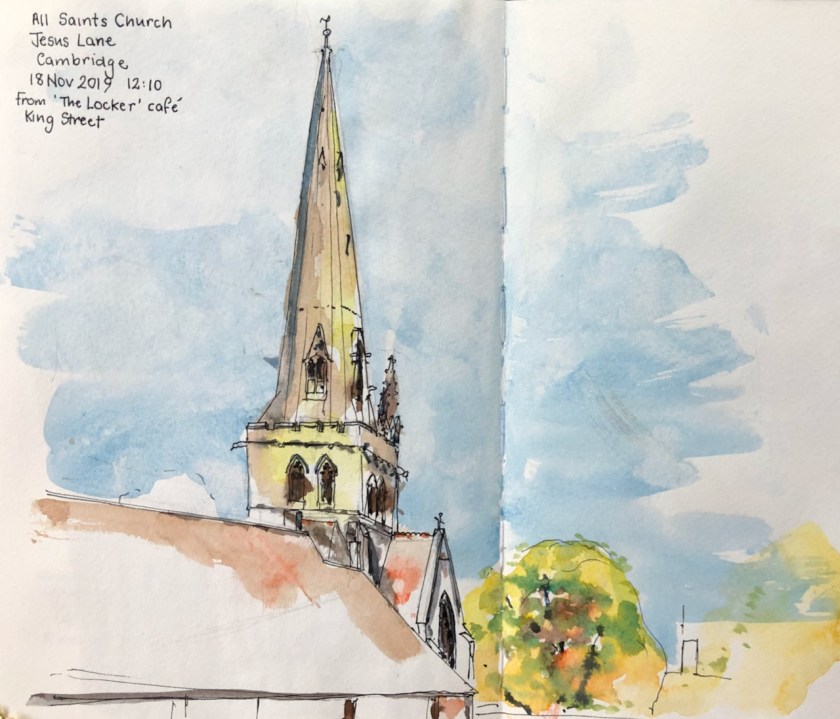
Here’s the view from a café in King Street, Cambridge.
All Saints Church Jesus Lane. Drawn in Jackson’s Watercolour Sketchbook.
This café used to be called “Clowns”. There were two Italian sisters downstairs. Now it is called “The Locker”, and the staff are different. Much to my relief, they have not messed it up. It is still a tranquil place. The coffee is excellent. There is no intrusive background music. People read books upstairs. I drew this picture looking out of the upstairs window. Behind me, on a low sofa, a man was reading two books alternately and monitoring his laptop screen. Both books were by Jorge Luis Borges.
At an adjacent table three women were making design decisions for the website of a charitable organisation. This sub-page, that on the main menu, shall we include video? They discussed titles, and the placing of punctuation marks. I was concentrating on my drawing and only heard the odd word. Then one of the women described a conversation she’d had on a previous job, for a college. A fragment drifted over to me. She had quite a loud voice. “I told them it was “Porters’ Lodge”, and not “Porter’s” apostrophe “s”, because there was more than one porter. But they told me I was American and didn’t know anything. “
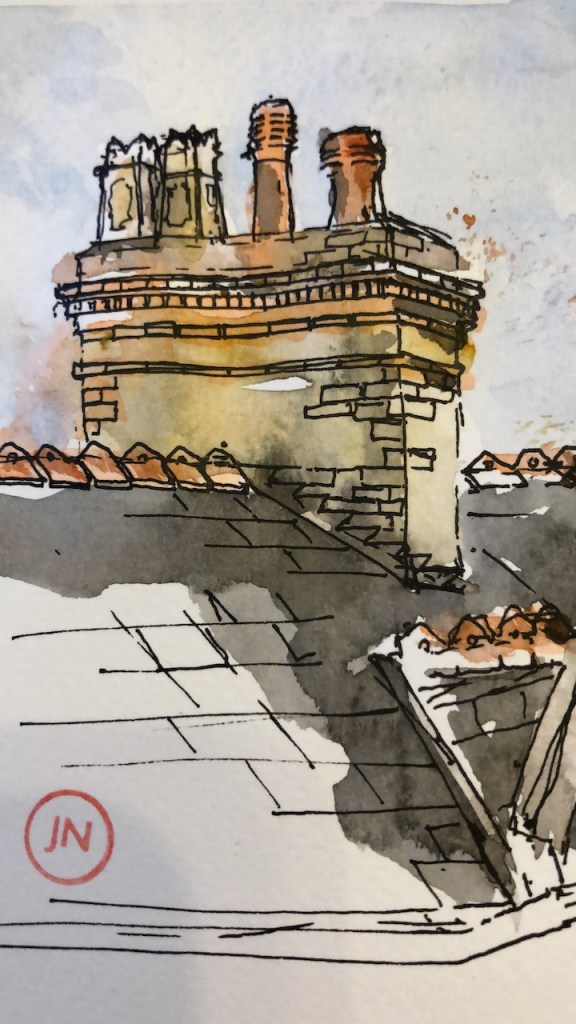
Here is a drawing of a chimney on the houses on Mill Road, drawn from a café called “Tom’s Cakes”
Chimney in Mill Road. Drawn in Jackson’s Watercolour Sketchbook.
On the bench by the window, a man was completing the cross word, or engaged in some other puzzle that required his total concentration. This made him a good subject for a quick sketch.
Quick sketch in Vintage Paper Company Katazome Sketchbook, on vintage watercolour paper.
Click a button below to share this post online, email it, or print it:
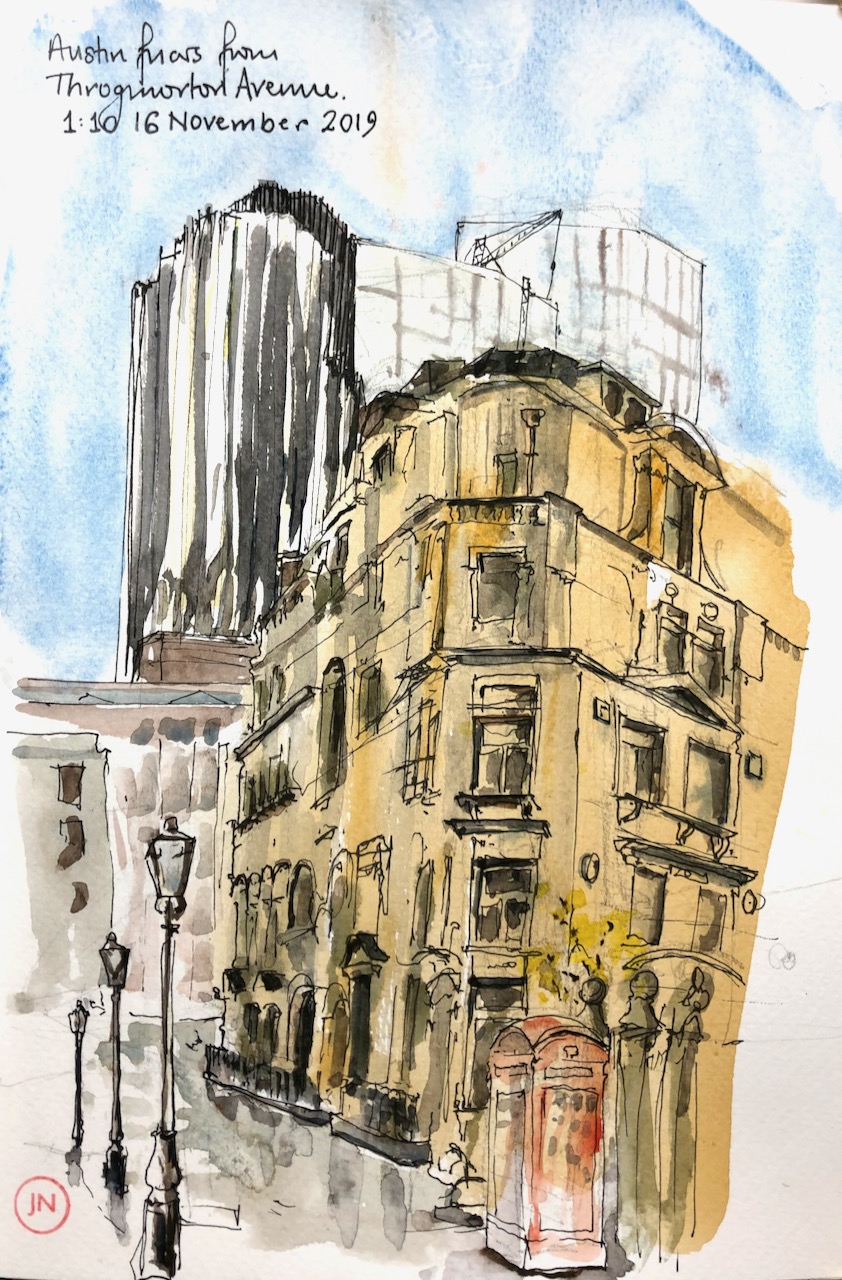
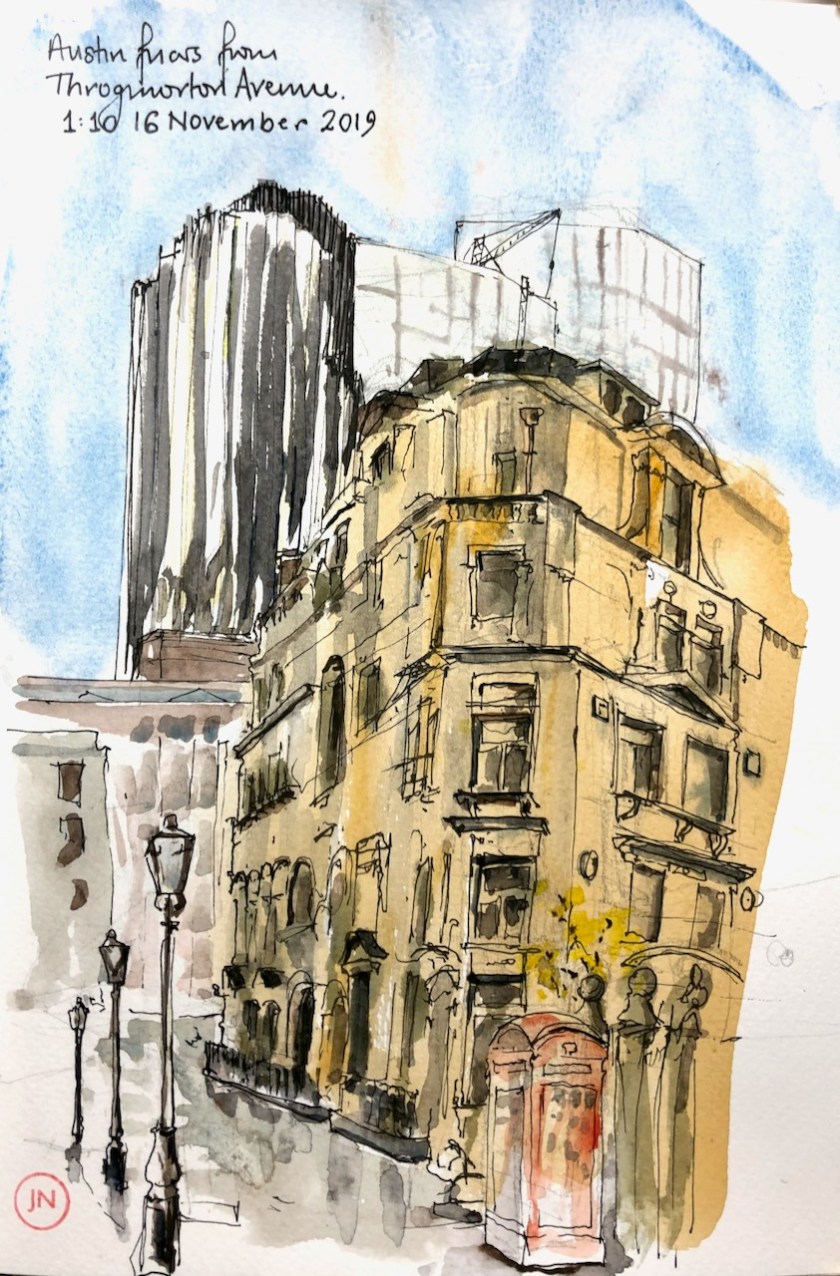
The City is quiet on a Saturday. Here is a view along one of the City lanes, Austin Friars. I drew it from the back (east side) of Drapers Gardens, which is a new office block on Copthall Avenue.
I struggled with the sky. This is “cerulean blue chromium”. It granulated, didn’t go on flat. I think I had the paper too wet – I wetted it before I put the paint on, which was probably a bad idea. The actual sky was a clear and uniform blue, extraordinary in England in November. Don’t be deceived though, it was very cold where I was standing. You can see my hand shaking – look at the phone box.
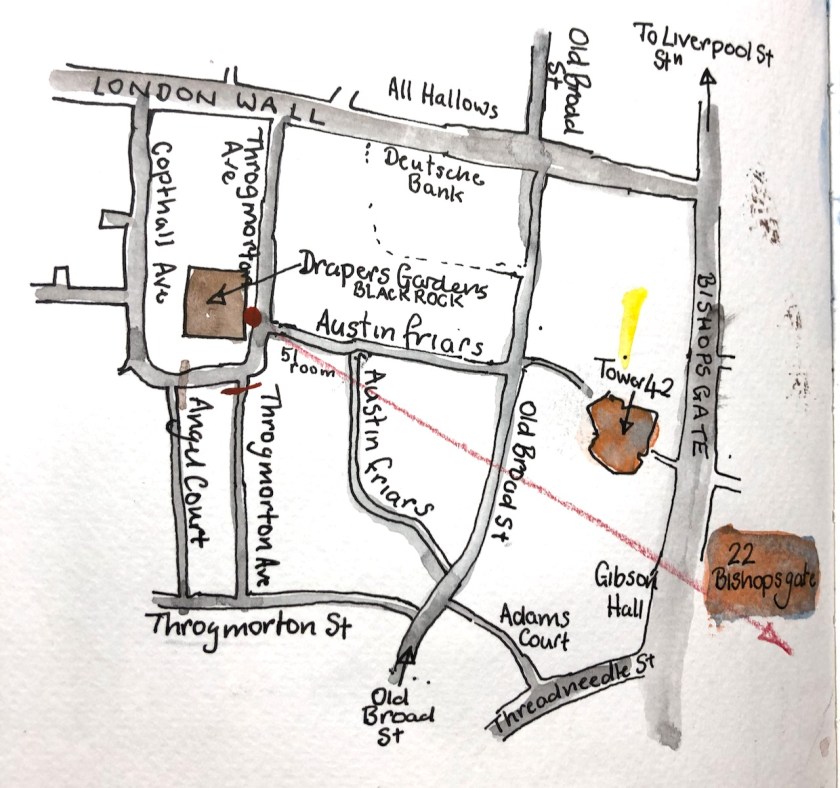
In the distance you see the Natwest Tower on the left, now called “Tower42”. To the right and high up is the new building “TwentyTwo Bishopsgate”. The NatWest Tower was the highest in London in its day (1980). TwentyTwo will be the highest in the City to date.
Austin Friars, the road, bisects a site formerly occupied by an Augustinian Friary, hence the name. The monastery is long gone, except that the church survives, rebuilt after the Blitz. It is the “Dutch Church” in London, just out of the picture along Austin Friars.
Map showing the sightline in the drawing
I sat on the ground to put the watercolour on. A man came up and asked me if I would like a hot drink, coffee or tea? He called me Ma’am. He told me he worked nearby, in the office block behind me. Very shortly he returned with tea in a takeaway cup, including a lid. Seeing that I was still sitting on the pavement, he offered to fetch me some cardboard to sit on. This was a really nice man. I was about to stand up again though, so I thanked him for the tea and he went back indoors.
He revived my faith in human nature. I was very glad of the tea, and of the warm feeling that even here amongst city skyscrapers, there are human humans.
The drawing took about 1hour30min, drawn and coloured on location. Daniel Smith watercolours, mostly Mars Yellow, Perinone Orange and Prussian Blue, with Cerulean Blue Chromium sky, and a bit of Pyrrol Red for the phone box.
Click a button below to share this post online, email it, or print it:
What is the purpose of a museum? The previous evening, I’d been to a lecture by Tim Reeve, Deputy Director of the V&A. He had described, with great conviction, a new building they plan for East London, in “Here East” on the former Olympic Park. It will open up the V&A storage and logistics centre to public view. People will be able to work there, and be inspired by the objects. The idea is to generate “creative career opportunities in East London”. I could see how the proposed building, its architecture and the way it will be used are oriented firmly towards that clear aim. Well done V&A.
So, sitting in the Ashmolean Museum of Art and Archeology in Oxford, I wondered what was the purpose of this museum. I was in the Randolph Sculpture Gallery, which contains a collection of Greek and Roman marble statues, collected in the 17th century.
The main use of the gallery, at that point in the day, was for people to sit on the upholstered seats, and chat, and use their mobile phones. In my sketch, I drew the three benches I could see, each of which is occupied by someone staring at their mobile phone. In the background, a monumental head of Apollo looks on.
This part of the gallery seemed to be serving as a public living room, which is perhaps as fine a purpose for a museum as any.
On the lower level there is a large Egyptian statue on a tall plinth.
An elderly gentleman chose this place to read his paper. Through the plinth, I could just see a woman chatting to someone via her screen.
There are many ways to enjoy a museum.
I walked about sketching things.
Here is an object from one of my favourite parts of the museum. It is a Yue ware pot, about a thousand years old. It’s small, only about 5 inches tall, and a gleaming green colour. It’s lovely to draw these things, as it in only by looking for a long time that I gradually become aware of the marks of the fingers of the maker, and of the slight irregularities in the shape.
Click a button below to share this post online, email it, or print it:
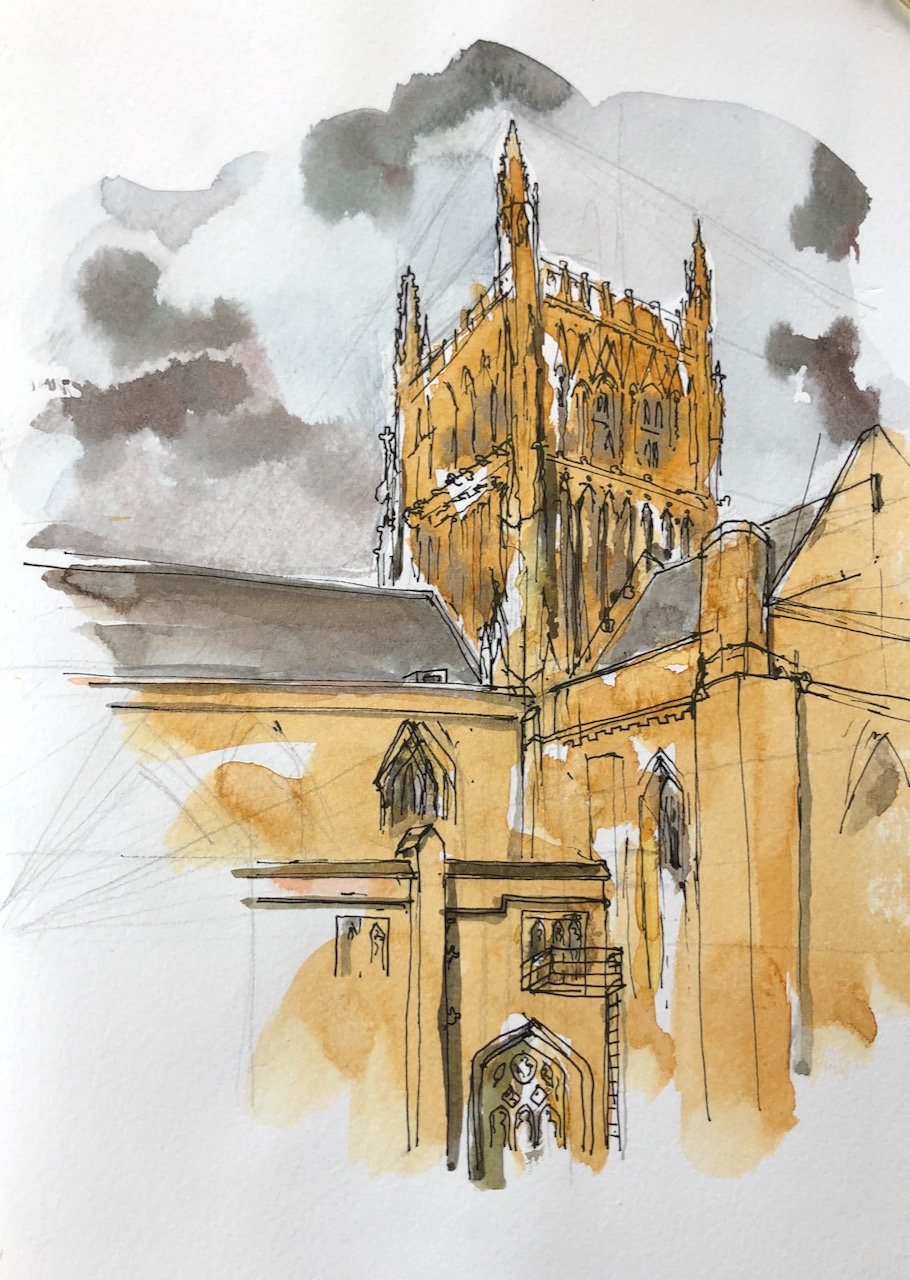
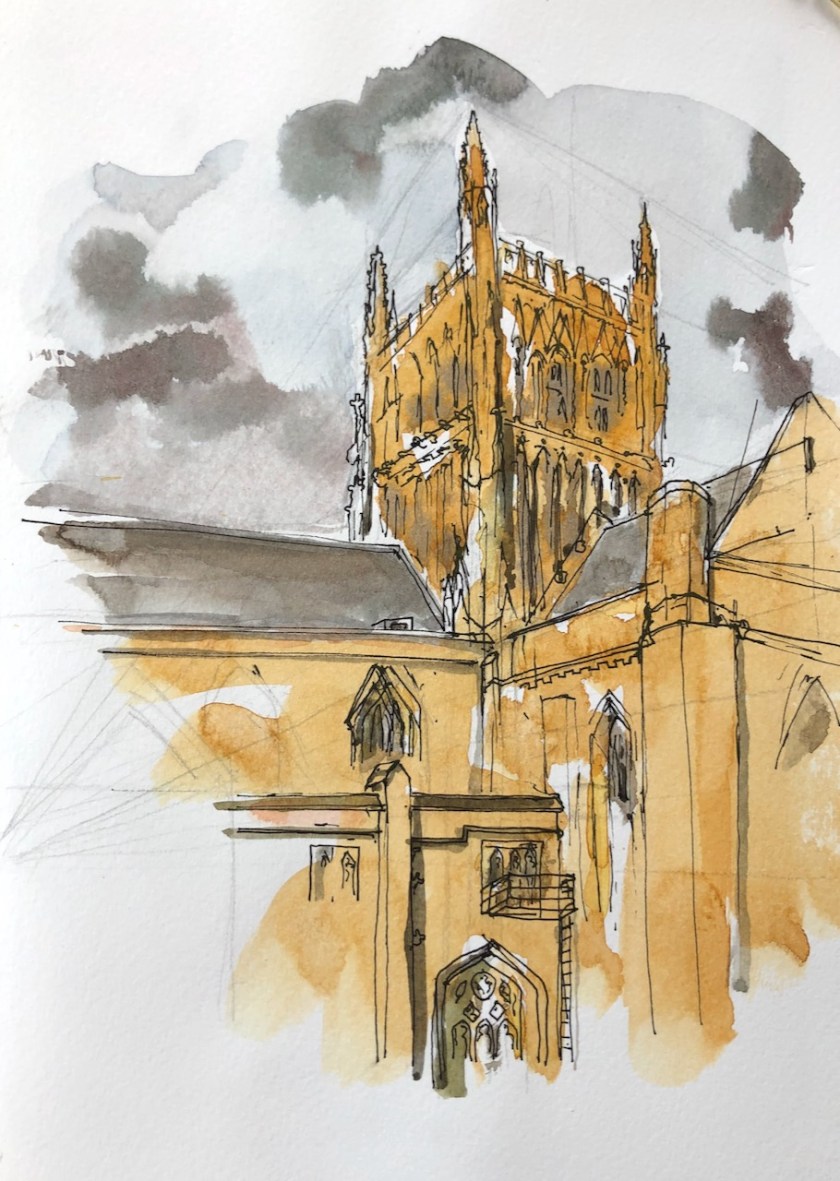
I sketched this view from the cloisters, which were glazed and enclosed. I did, however, find a chair, and a convenient inverted dustbin on which to place my tools.
Work in progress: Worcester
View from the cloisters, through the glazing.
In the cloister.
Work in progress: Worcester
The other Cathedral we visited this trip was Hereford:
Here I had an unrestricted view from the Chapter House garden, which was very peaceful and lovely.
We also visited a small church, Kilpeck, which is very ancient:
In this church there were viking carvings.
If you are in the area I recommend also Tewkesbury Abbey, which though not a cathedral is an inspiring and welcoming place. I had a terrible cold, and lacked the energy to make anything except a small indoor picture.
I must mention the excellent deli in Tewksbury High Street, Miss Muffet. We just had a sandwich, but suddenly I remembered what sandwiches are supposed to taste like. And for all its quality control and high-class ingredients, Pret in London cannot hope to match the Tewksbury offer: fresh home-made bread, pastrami just cut, and cracking piccalilli. Here’s the view from the window. Good food takes time.
Click a button below to share this post online, email it, or print it:
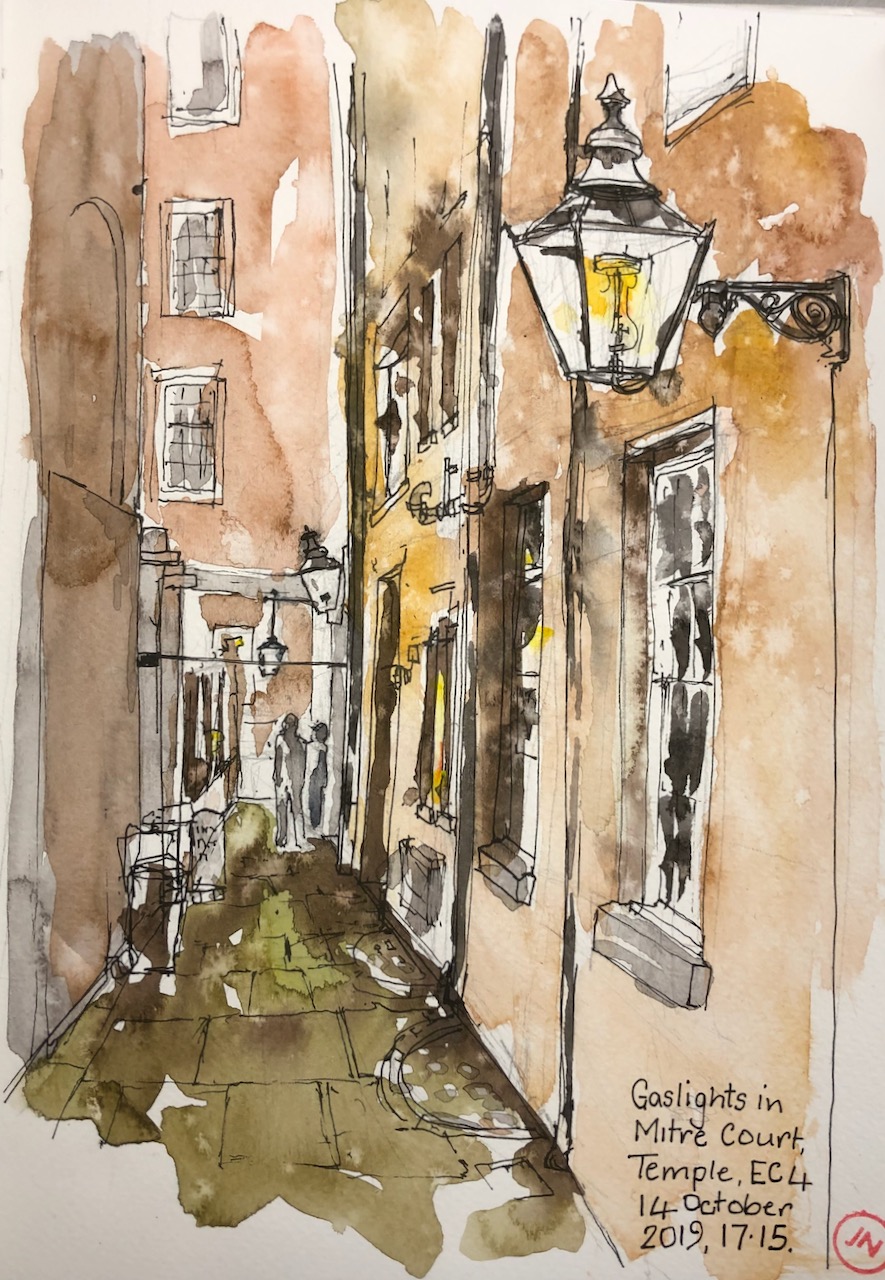
Here is a back alley off Fleet Street, London EC4.
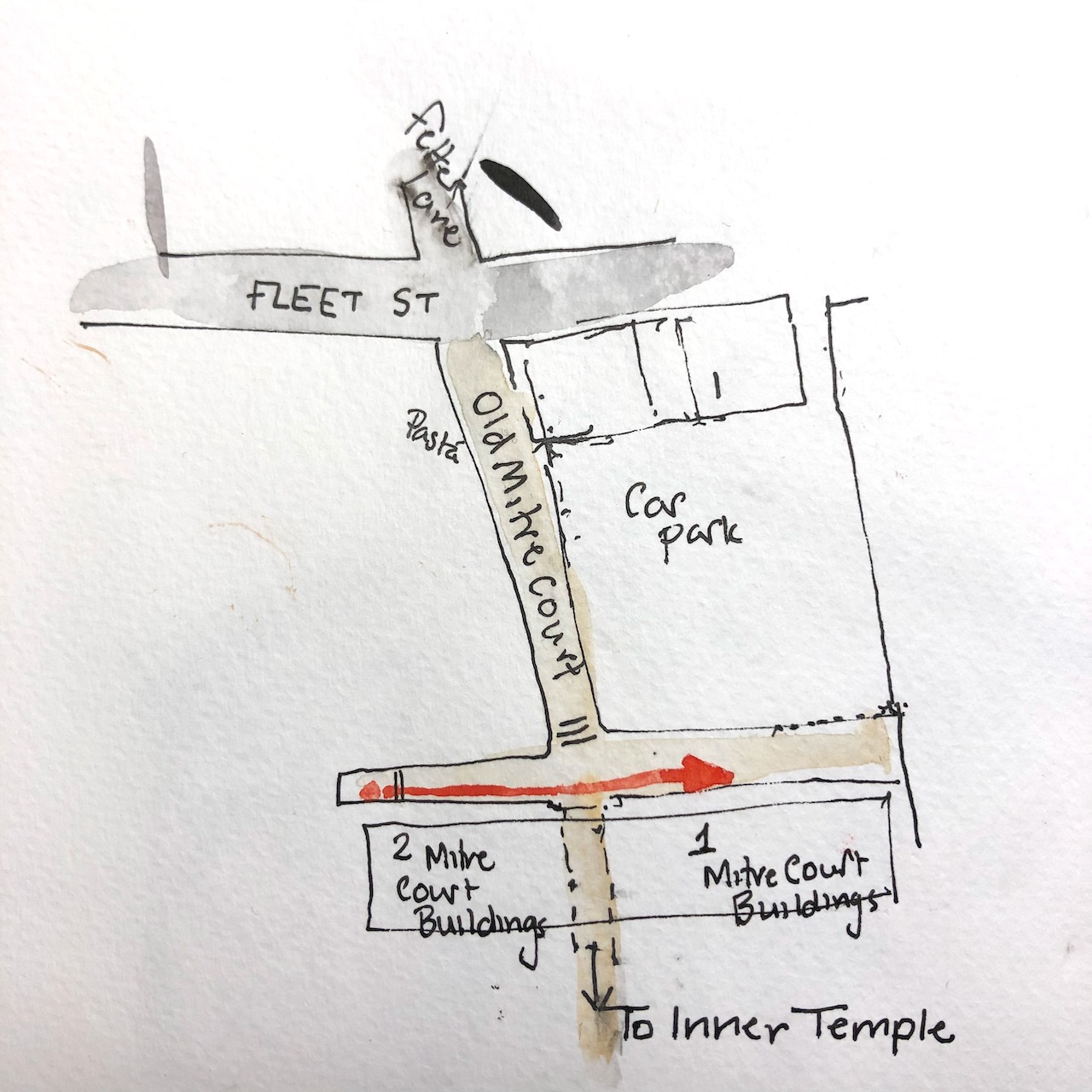
It is Old Mitre Court. The buildings on the right are 1 & 2 Mitre Court Buildings. They are listed Grade 2. Here’s what Historic England says in the listing:
Early/mid C19. 4 storeys plus basement. Plain classical, south elevation of Portland stone with channelled ground storey and cornice below top floor. Arched passage through centre. Plain, rear elevation of yellow brick with railings and gates.
It’s the “rear elevation of yellow brick” that you see in the picture. There are three gas lamps, at least one of which works. The other two look very rickety.
The buildings, 1 & 2 Mitre Court Buildings, are legal practices, housing Barristers and their associates. A list of the barristers is by the doors. The notice on the pavement says “Inner Temple Treasury Office, Open 10am – 4pm”. This is the office underneath the furthest gas light, the one with the right-angled support above it.
The paving slabs at the bottom of the picture were in fact green, as I have drawn them. It was damp, and there was a coating of moss-type algae on the paving slabs. A saying of my late father was, “The plants will win in the end”. When I see such a green coating on stone, in the middle of the City, I am reminded of his words, and I think he is right.
Eventually I had to stop drawing as the rain came down. The drawing got a bit wet.
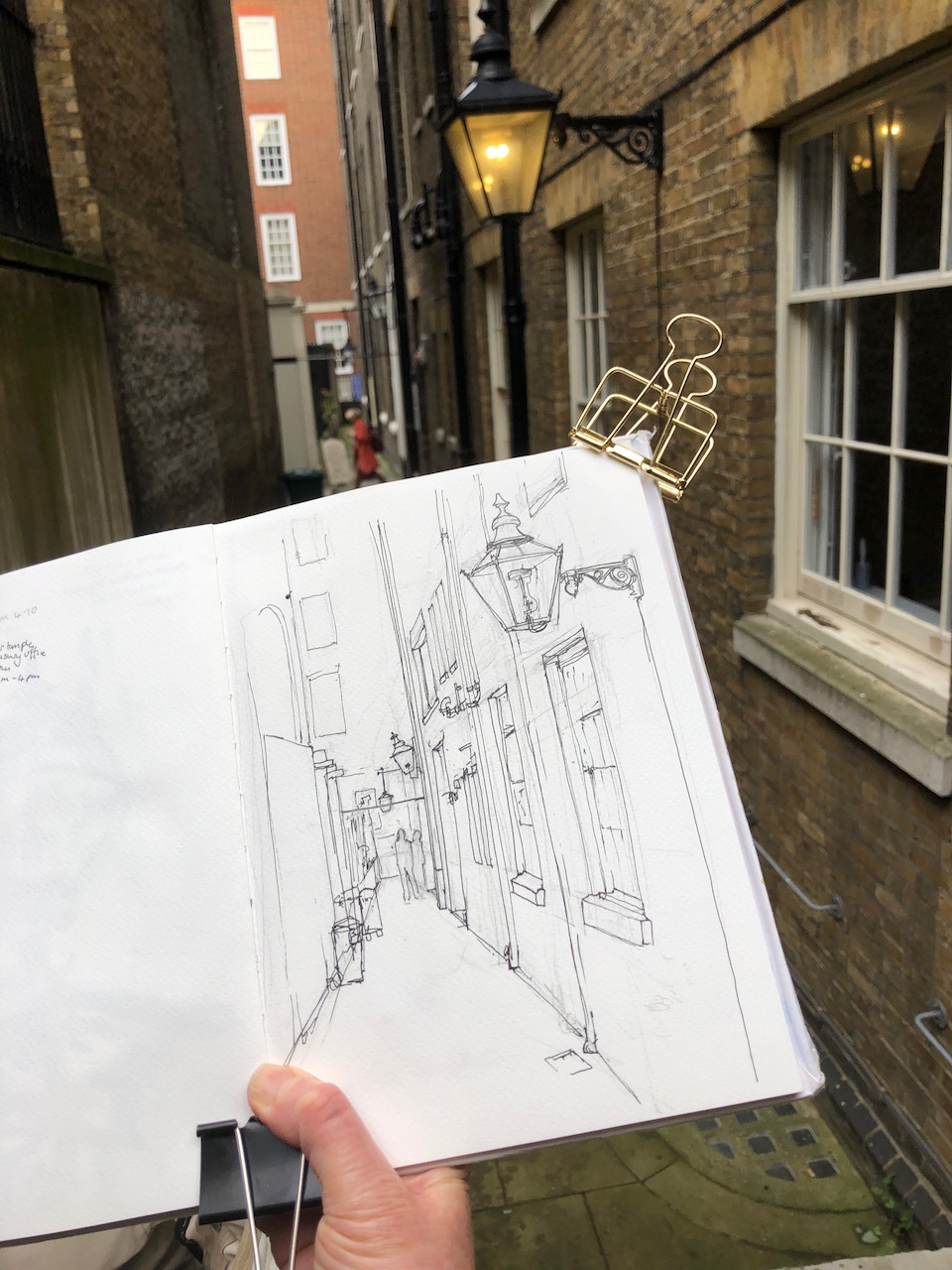
Here is work in progress and a map:
Drawing took 1hour 15 mins. Colours used mostly Perinone orange, and Prussian blue, with a bit of burnt umber. Indian yellow for the gas lights. All Daniel Smith colours. Pen is Lamy Safari EF nib, with De Atramentis document (waterproof) black ink.
Later note: Article in Private Eye, Autumn 2021 (Westminster council is removing the Gas Lights)
I went out to look for more gas lights in the City. There was rain, and the back alleys were wet. I couldn’t find any more gaslights.
At the South East extreme of my peregrination I looked up and saw St Peter upon Cornhill. It is wedged in between other buildings.
St Peter upon Cornhill
The church in among other buildings. The devils are circled in red.
The adjacent building is labelled “54 & 55” Cornhill, in lovely art-deco writing. There is a branch of “EAT” on the ground floor. High up, there are three strange devils (ringed in red on the annotated picture above). The two larger and higher ones are definitely female devils, with big breasts and strong muscles. The smaller devil is yelling from his position above a window.
Map showing the buildings as seen in the drawing. Arrow shows the line of sight.
map with North at the top. Arrow shows the line of sight of the drawing.
I drew this picture from the shelter of White Lion Court, which is on the North side of Cornhill. This is one of those City of London back-alleys. It doesn’t go anywhere, just to the door of what looks like an insurance company, and off to the side is a doorway with ecclesiastical carving above. It looks like the entrance to a monastery. But that can’t be right. The modern iron gate is adorned with modern litter.
White Lion Court EC3
Litter on the gate of White Lion Court
As I was drawing a man came round from the nearby branch of Sainsbury’s to eat his sandwich and smoke.
Then later another man came by and asked me if I had seen the fire brigade. I said no, because I hadn’t. He said the fire alarm in one of the offices had gone off. He said he’d be wandering about for a bit, while he contacted the key holder. I could hear him calmly making phone calls. He was still there when I finished my drawing and packed up. I waved goodbye to him, and he nodded and half waved back, constrained in his movements as he was holding his phone to his ear and consulting a notebook.
It is astonishing how many tourist groups go down Cornhill. If I have done nothing else today, I have at least inspired a few tourists and other passers-by to look upwards to the onion spire of St Peter upon Cornhill. People pause, see that I am drawing, wonder what I can possibly be drawing in that dingy back-alley, and then look in the direction I’m looking and see the spire.
The tourist groups pause in the shelter of nearby Sun Court. I guess they are being told anecdotes about why there are she-devils on 54 and 55 Cornhill. I looked online. I can only find anecdotes, no facts. The building is by Runtz, 1853.
There has been a church at St Peter upon Cornhill since the 2nd Century AD, according to a tablet whose inscription was recorded and copied on various printed media, and now on Wikipedia. The tablet doesn’t exist any more as it was destroyed in the fire of London. The current building is by Christopher Wren, and was constructed between 1677 and 1684. There is also an entrance on Gracechurch St, which I must go and have a look at.
Here is work in progress.
Pencil
Pen
Pen
Watercolour
Finished drawing, on the pavement.
The drawing took 1½ hours.
Click a button below to share this post online, email it, or print it:





















 Jane Sketching