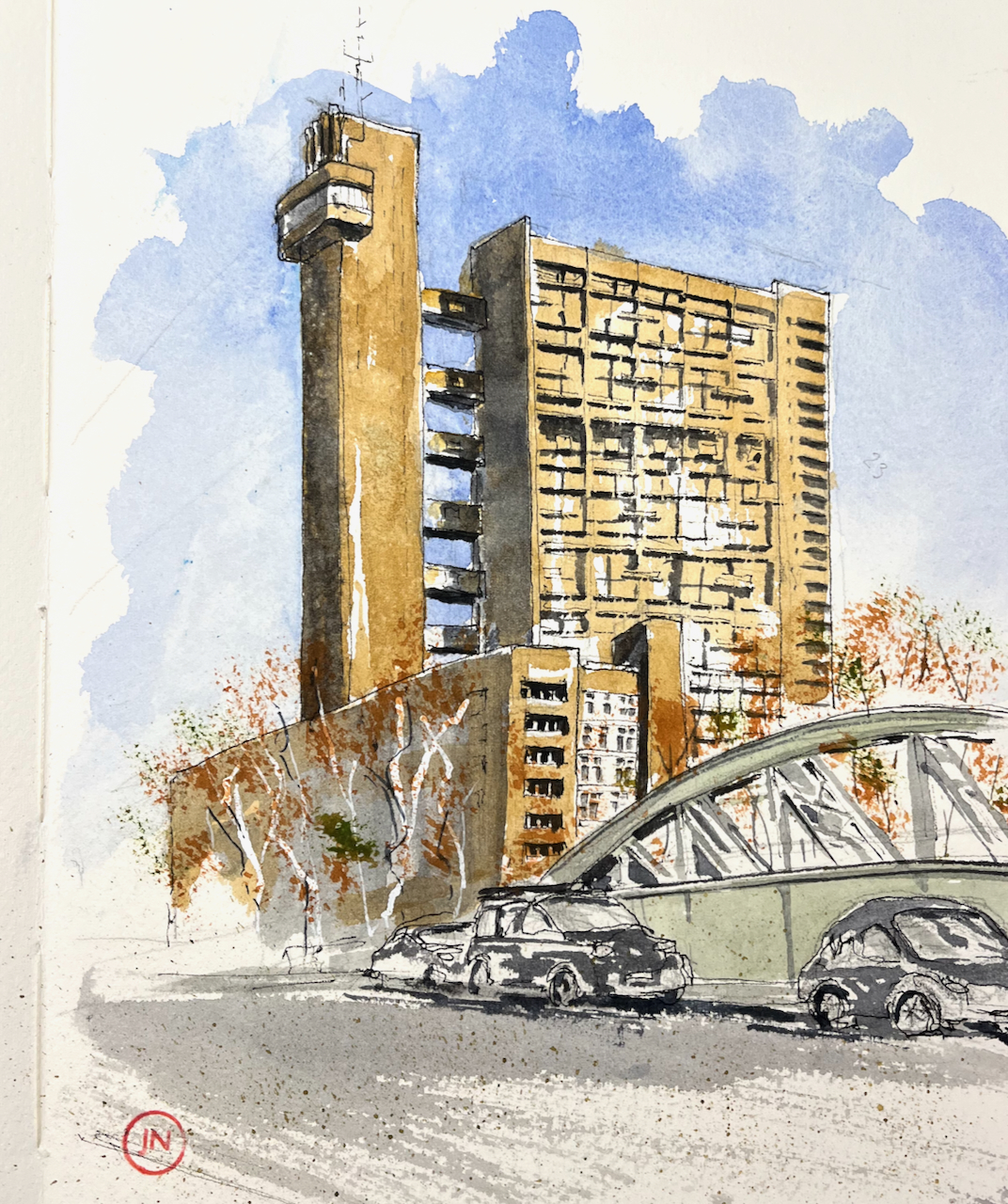
Here is the magnificent Trellick Tower in West London.
Trellick Tower from the Golbourne Road, London W10. Sketched 28 November 2023 in Sketchbook 13
This tower is 271 flats, 31 stories, completed in 1972 to the design of Ernő Goldfinger (note 1). It is in the Royal Borough of Kensington and Chelsea, near the Grand Union Canal and the A40 trunk road out of London. It is Grade II* listed (note 2)
After sketching, I was really cold. I found warmth and excellent food in the Sicilian Café “Panella” shown on the map above, recommended!
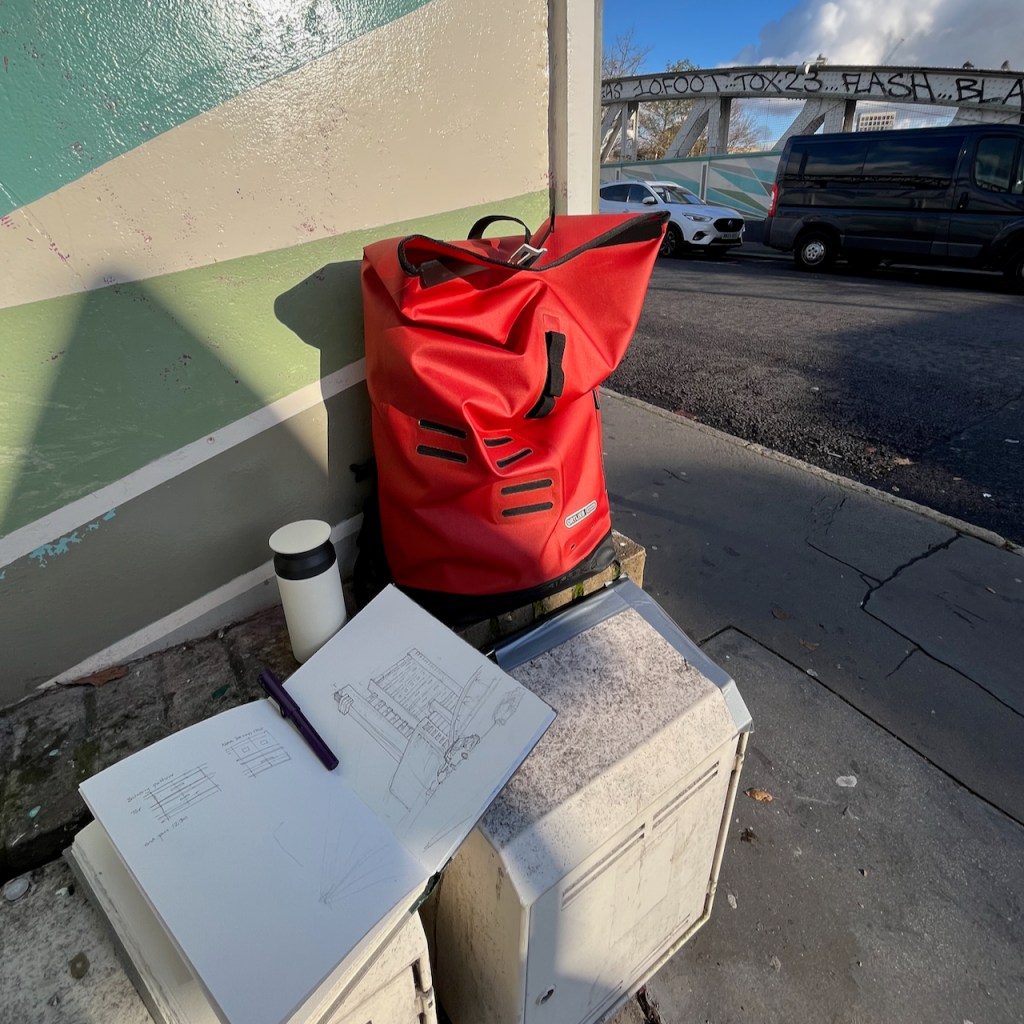
Panella – Golborne RoadSketching locationA bright and cold daythe base of the Trellick TowerSketchbook spread: Trellick Tower
I have previously sketched the Balfron Tower in East London, also designed by Ernő Goldfinger.
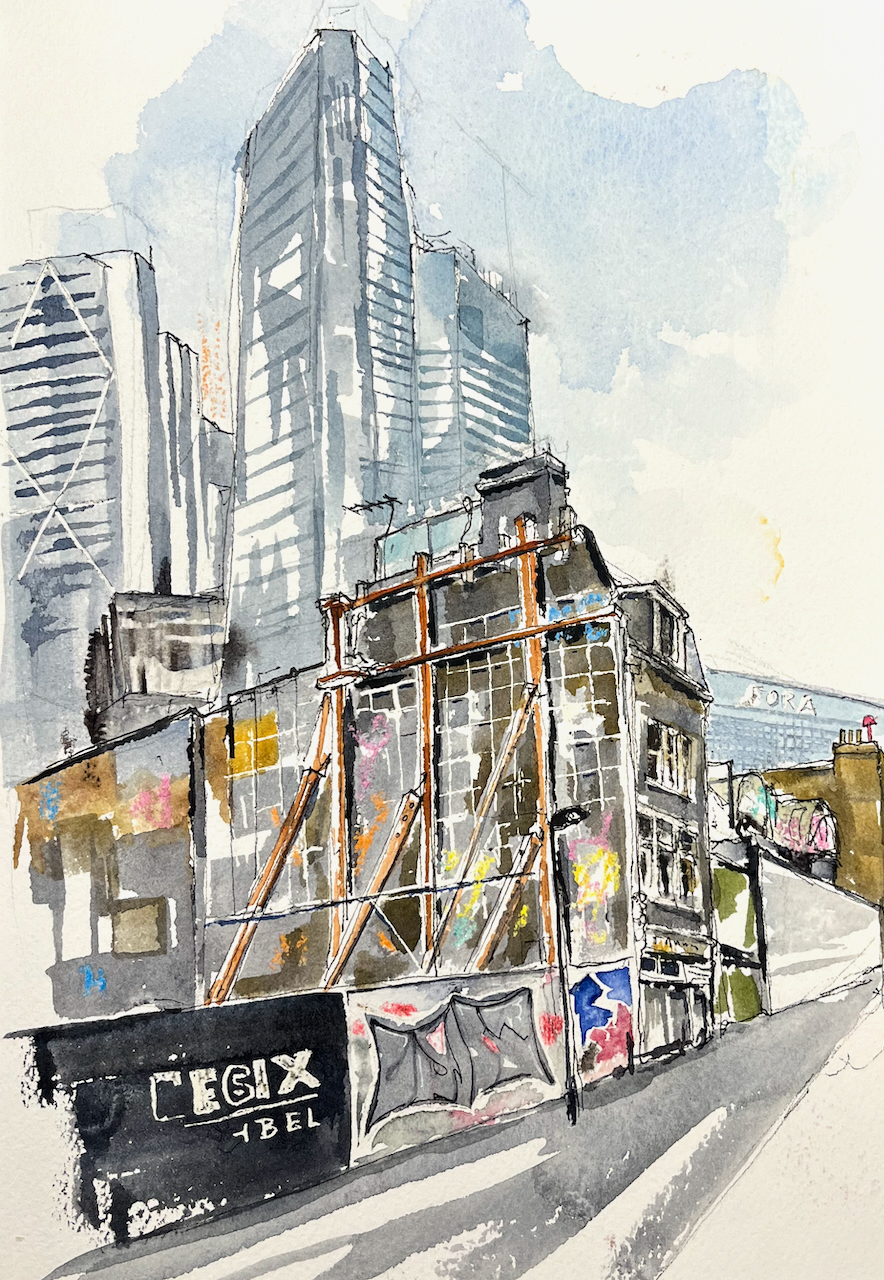
55 Holywell Lane, London EC2A 3PQ, sketched 17 November 2023 in Sketchbook 13
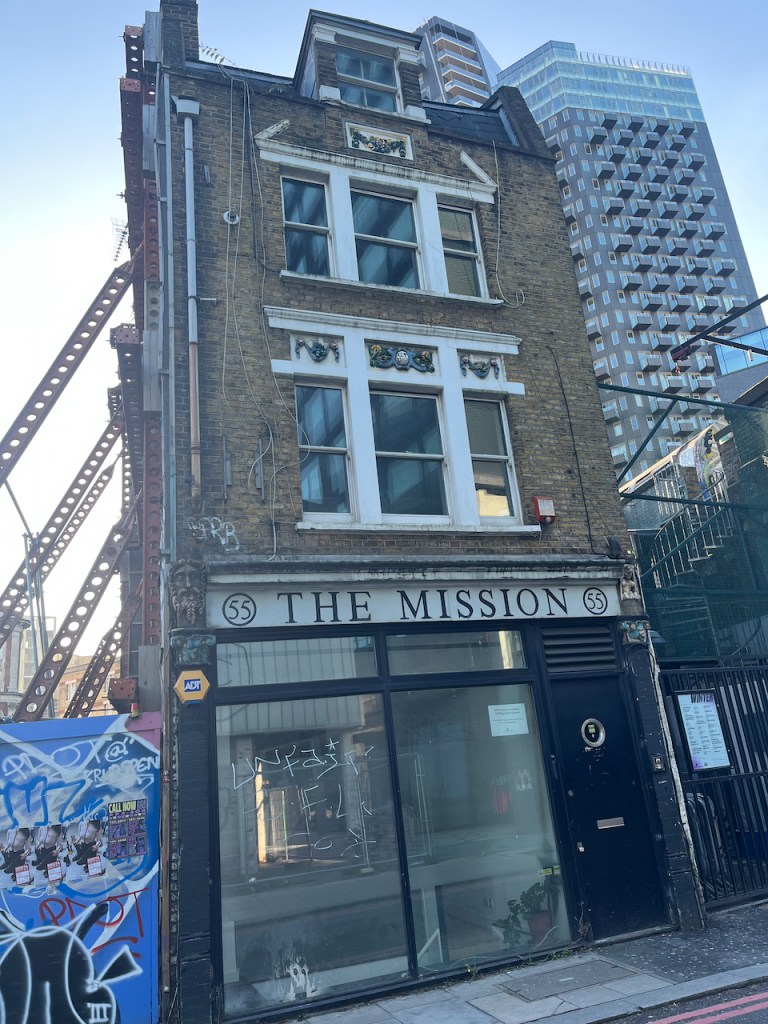
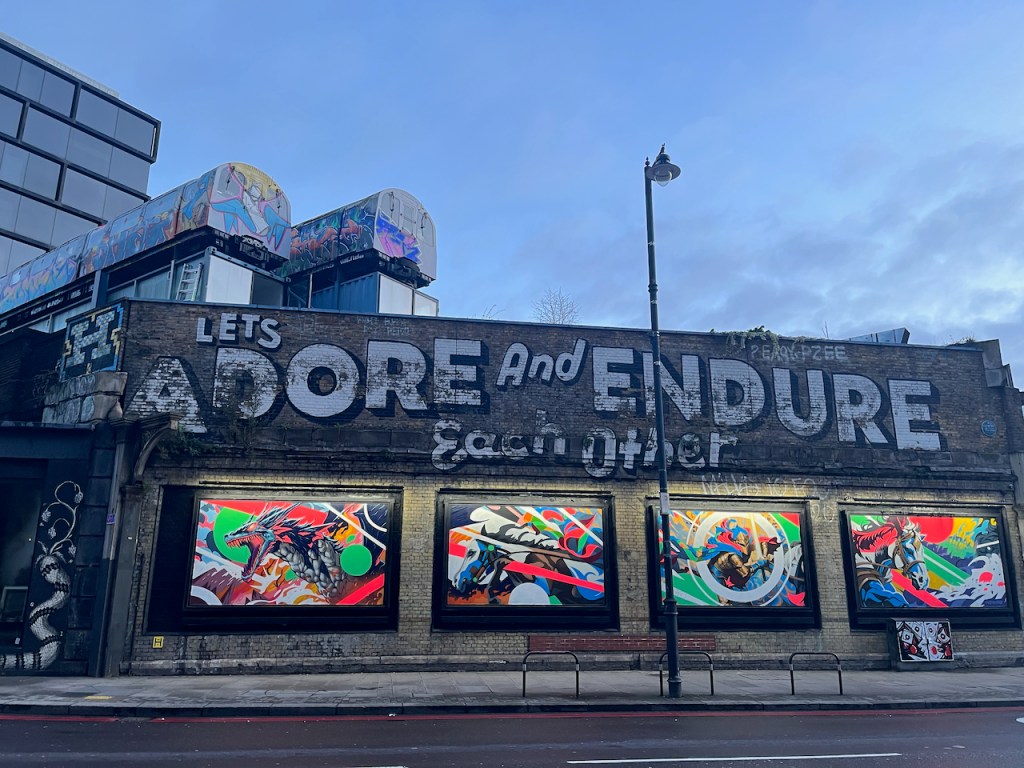
This apparently dilapidated building stands on the edge of a building site in Shoreditch. The flaking shopfront announces “The Mission”. It looks dusty and closed up.
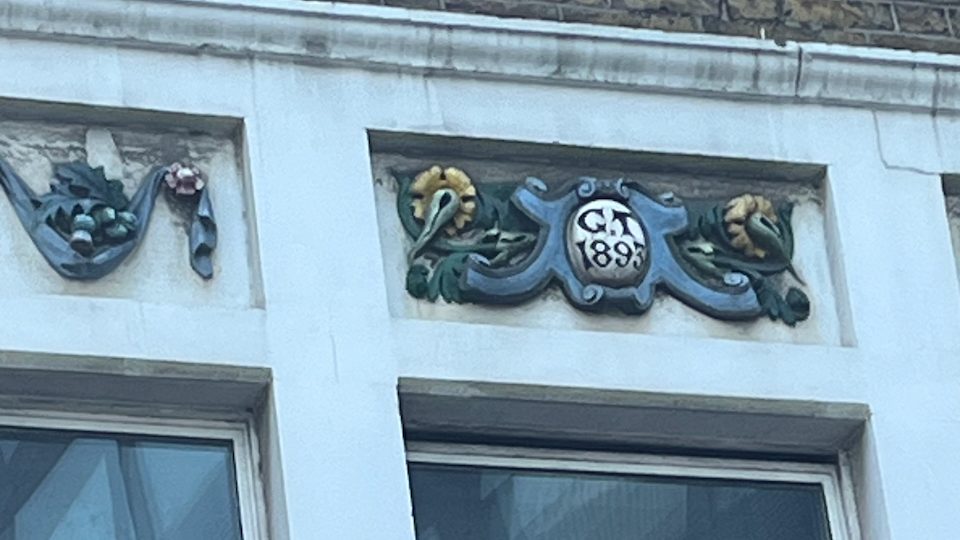
This is 55 Holywell Lane. The Victorian decorations on the front of the building say “G.T. 1893”.
Despite appearances, the building is in active use. It is part of “Village Underground” – “part creative community, part arts venue”. “home to cutting edge culture, clubbing and live music” founded in 2006. In the centre right of the drawing you can see the underground train carriages, hoisted on top of the venue. Their website says
“It’s a strange little haven of calm in the carriages, above the chaos of Shoreditch, enclosed by skyscrapers on each side, where we grow fruit and veg in our little rooftop garden, get excited about new bands and parties, plot and plan how to improve the venue, decide which shows to book, and try to get more people to come to our shows. “
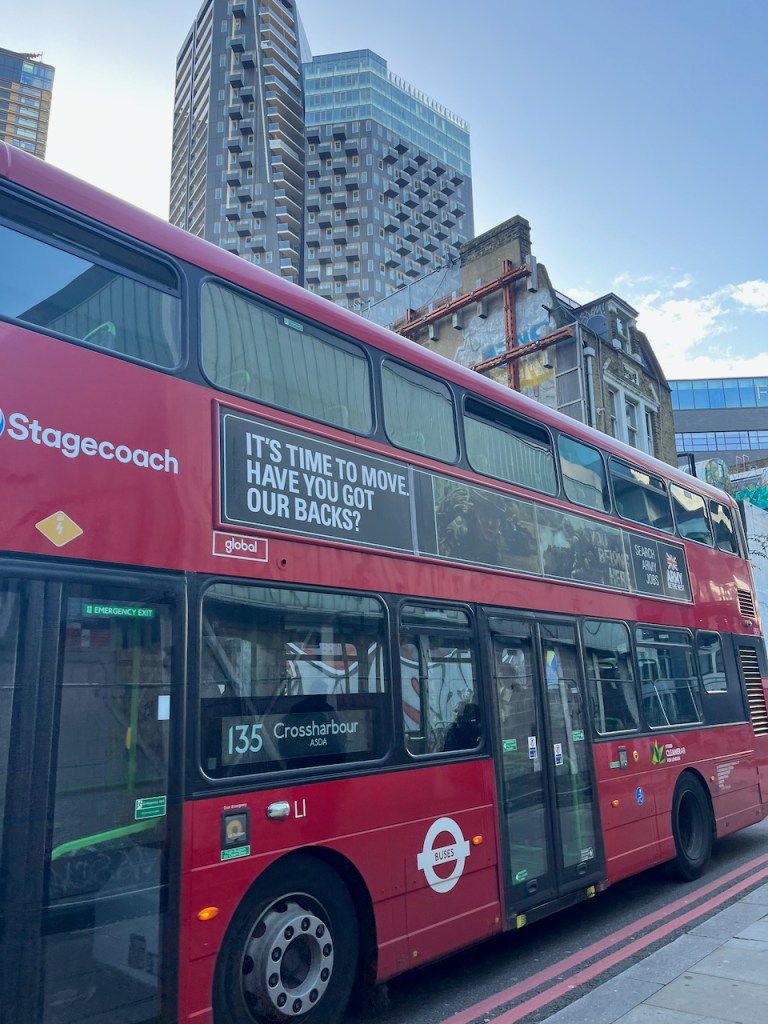
This is an area of London undergoing transition. In the background of my drawing you can see the huge residential and office towers next to Liverpool Street Station: “The Stage” and “Principal Place”. I sketched the picture standing under the elevated overground railway line, next to a building site. On the white wall shown to the right of my drawing, people were making a large mural, an advertisement for a whisky brand. The number 135 double-decker buses came past at what seemed like extraordinary frequency.
Cars and buses queued in this small street waiting to cross Shoreditch High St. It was a narrow pavement, and not a great place to sketch. But two people came and looked at the drawing: it’s a great skyline, they observed, looking at the view. And it is.
Here is the view of the site from Great Eastern Street early in the morning. The underground train carriages are visible top left.
Click a button below to share this post online, email it, or print it:
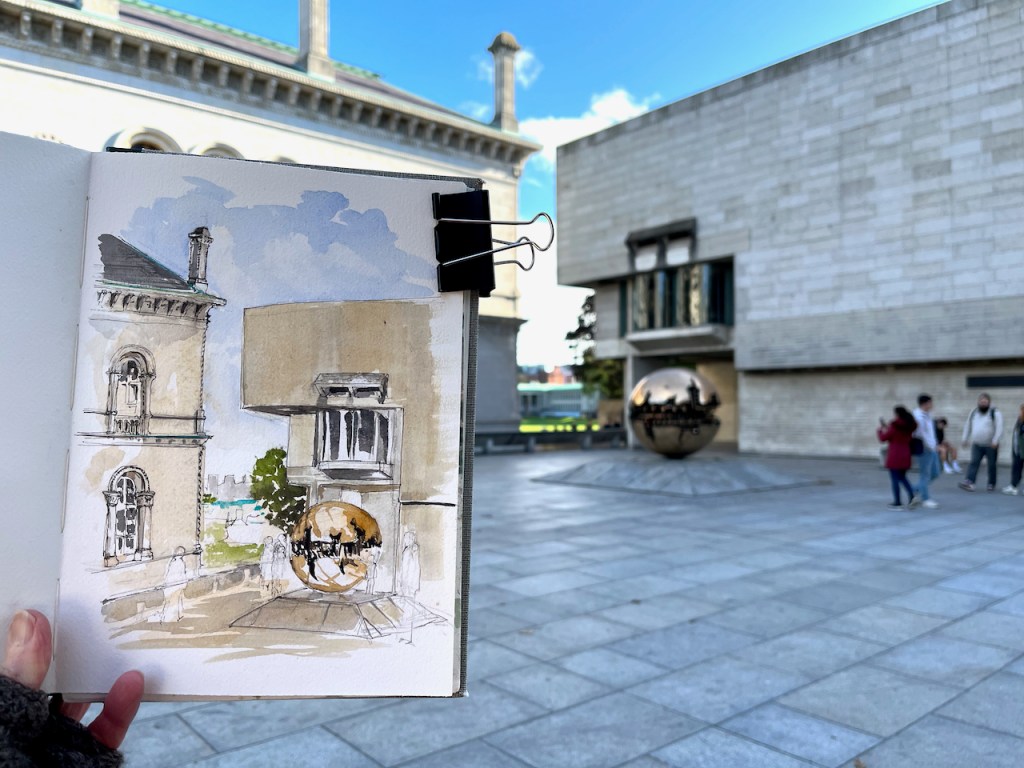
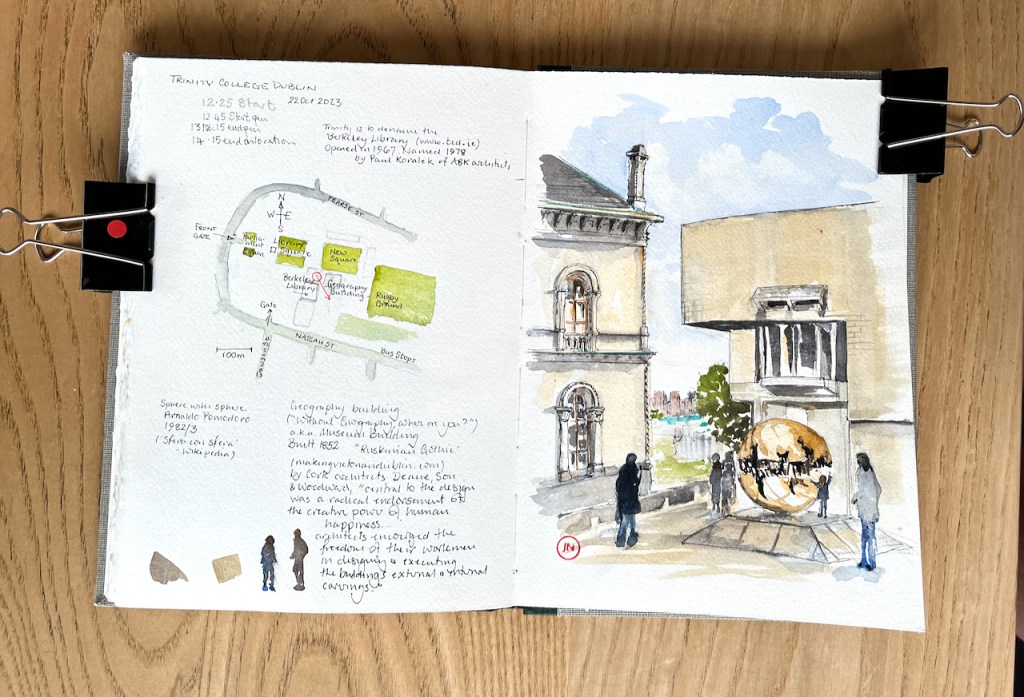
I was intrigued by this juxtaposition of two very different buildings, each radical in its own way. The top corners are just a few feet from each other.
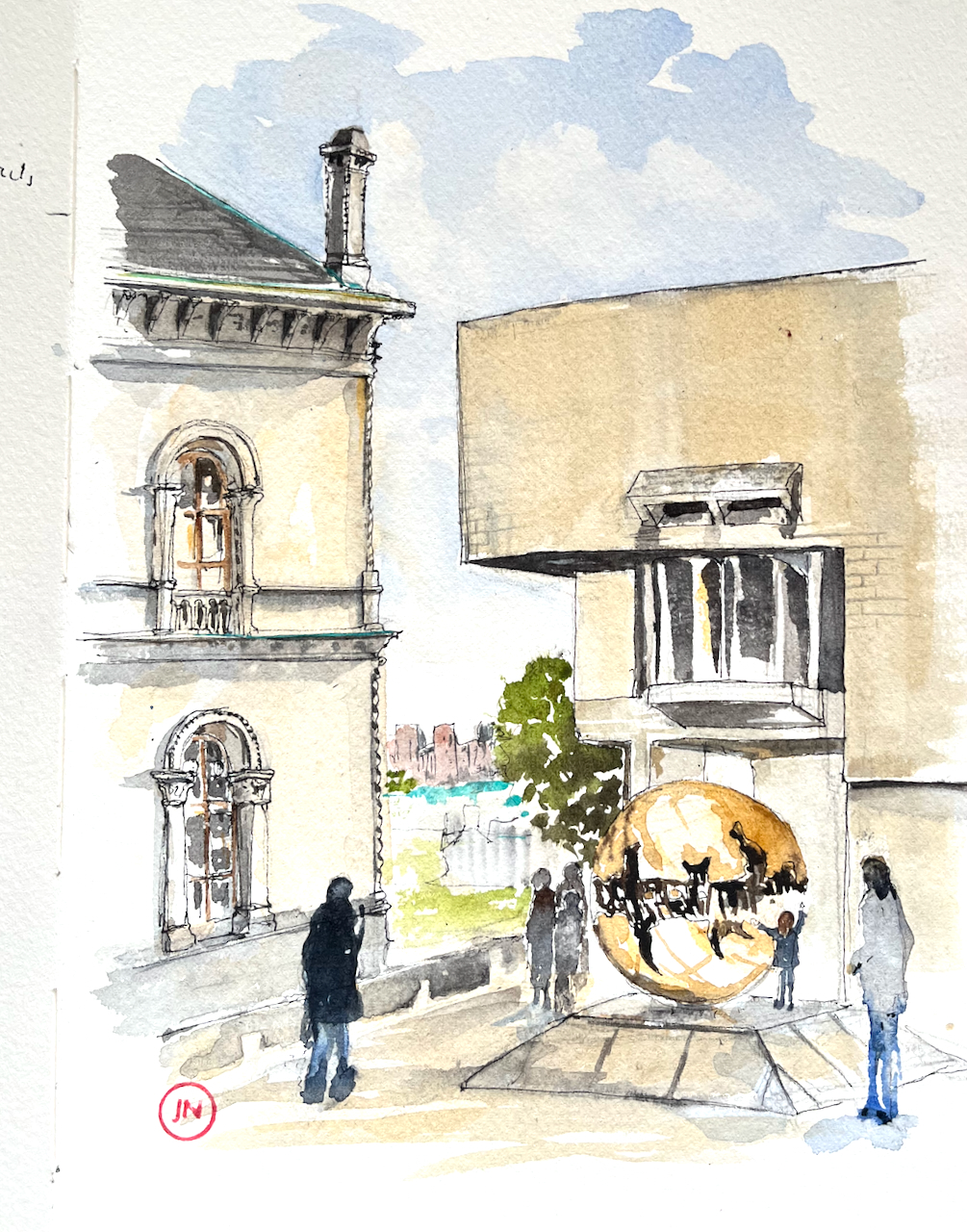
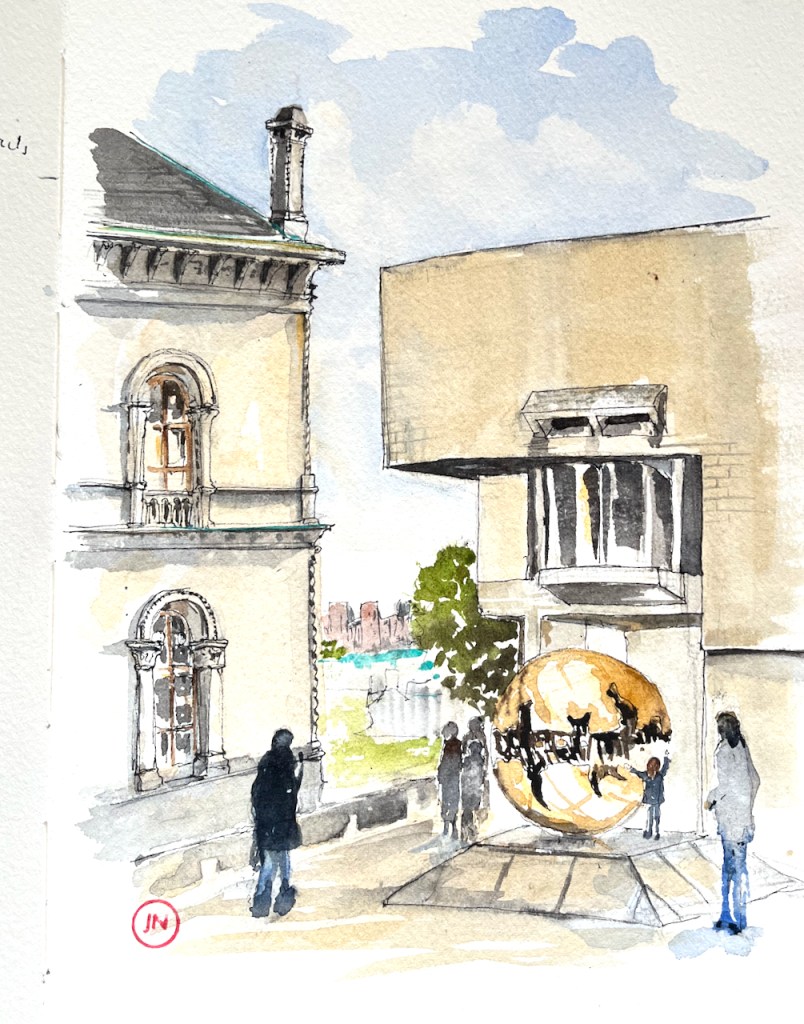
A corner of Trinity College Dublin: Museum Building on the left, Library on the right with “Sphere with Sphere” in front. October 22nd 2023, in Sketchbook 13
The building on the left is called the Museum Building. It houses the Geography department, amongst others. I know this because there was a notice visible in one of its windows asking:
“Without Geography, where are you?”
This building was finished in 1852. According to the website “makingvictoriandublin.com” the style is called “Ruskinian Gothic”. The design is by Cork architects Deane, Son and Woodward, influenced by the philosophies of the English writer, artist and art critic John Ruskin, says the Making Victorian Dublin site.
Central to the design was a radical endorsement of the creative power of human happiness…the architects encouraged the freedom of their workmen [sic] in designing and executing the building’s external and internal carvings.
The external and internal carvings are very complex combinations of leaves and flowers. A notice inside the building tells us that all the building’s carvings are by brothers John and James O’Shea of O’Shea and Whelan and that they gathered wild flowers and animals (amazingly) to use as models.
Even as the Museum Building was being built the Dublin press recognised it as the first experiment in British and Ireland of Ruskin’s radical views – a clear demonstration of the ‘the desireableness of employing the minds of the workmen’.
This experiment’, wrote the reviewer in the Dublin Express, ‘proves the general correctness of [Ruskin’s] views, and, moreover, has resulted far better than even the most sanguine advocates of this system had allowed themselves to expect.’
The whole building is influenced by Venetian designs observed by John Ruskin.
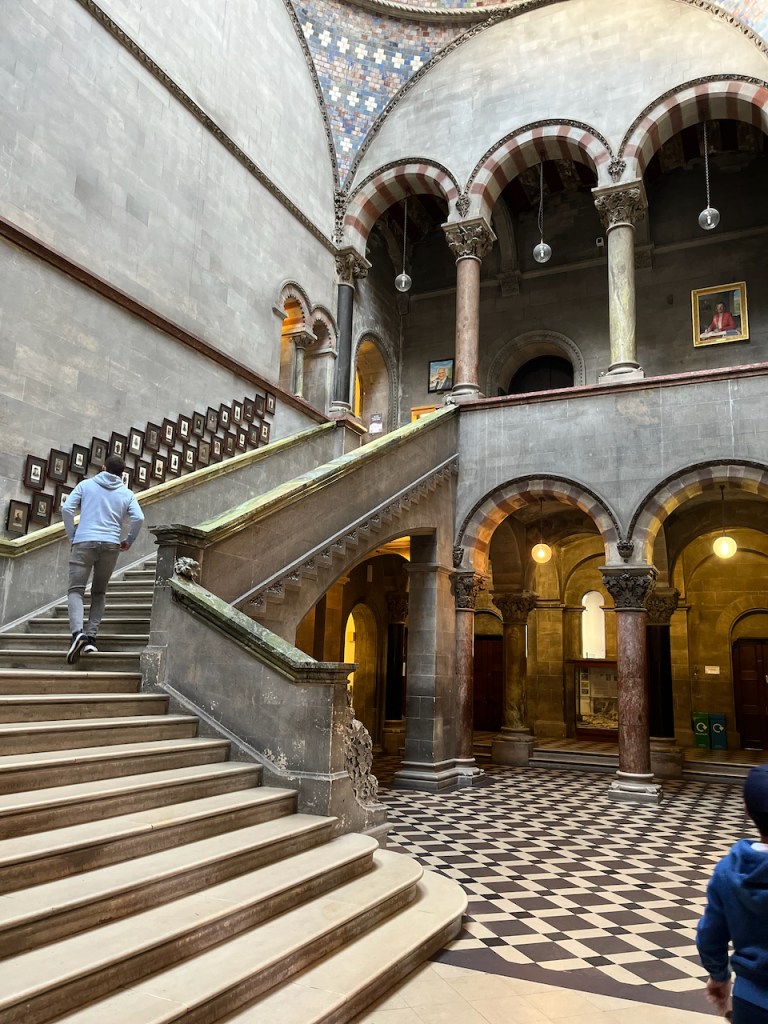
The inside of the building is spectacular. As well as the soaring architecture and the fascinating patterns and arches, there are also two skeletons of elks, some dinosaur footprints, and a model of a floating crane boat. You could spend hours there sketching.
Museum Building, Trinity College Dublin, interior, 22 October 2023.
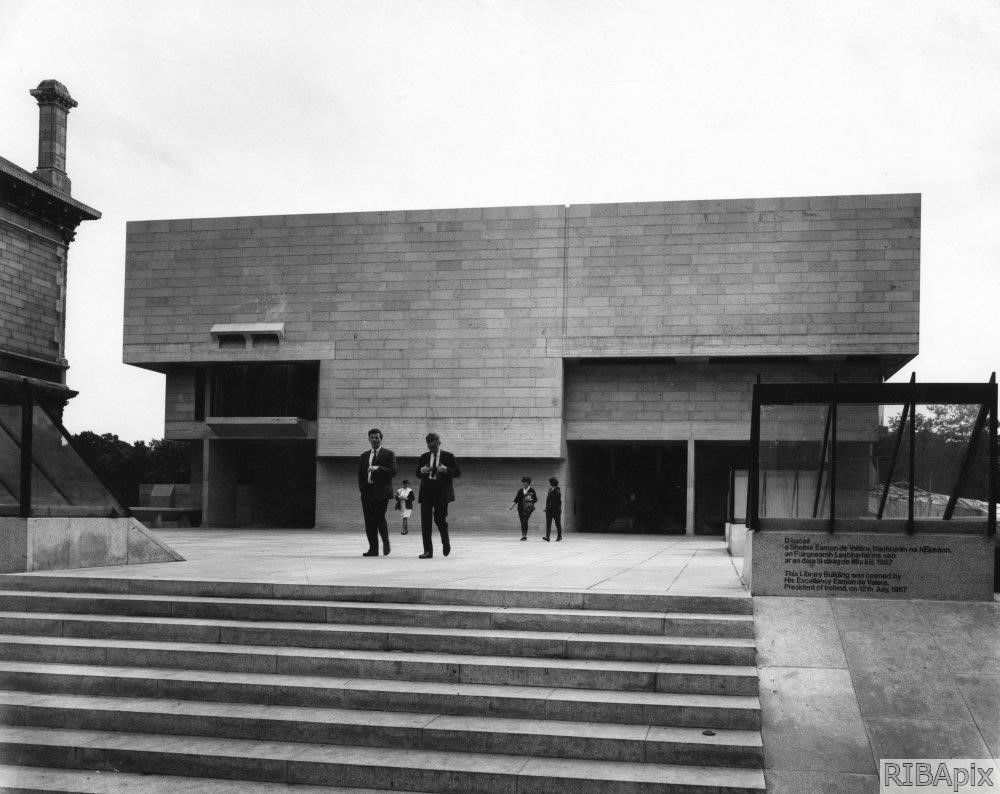
The building on the right of my drawing is a library, opened in 1967. It is in the radical style of that period: the Brutalist style. The building’s clean lines and functional appearance are characteristic of this style. The architect was Paul Koralek of ABK architects.
The library in 1967: Berkeley Library, Trinity College, Dublin: the entrance front and raised forecourt. Photo credit: Architectural Press Archive / RIBA Collections. [RIBA51354] Used with permission.
In 2017 the College ran a celebration of the library after 50 years. Their website includes pictures of the interior and furnishings. https://www.tcd.ie/library/berkeley
Two buildings talking to each other“Sphere with Sphere”
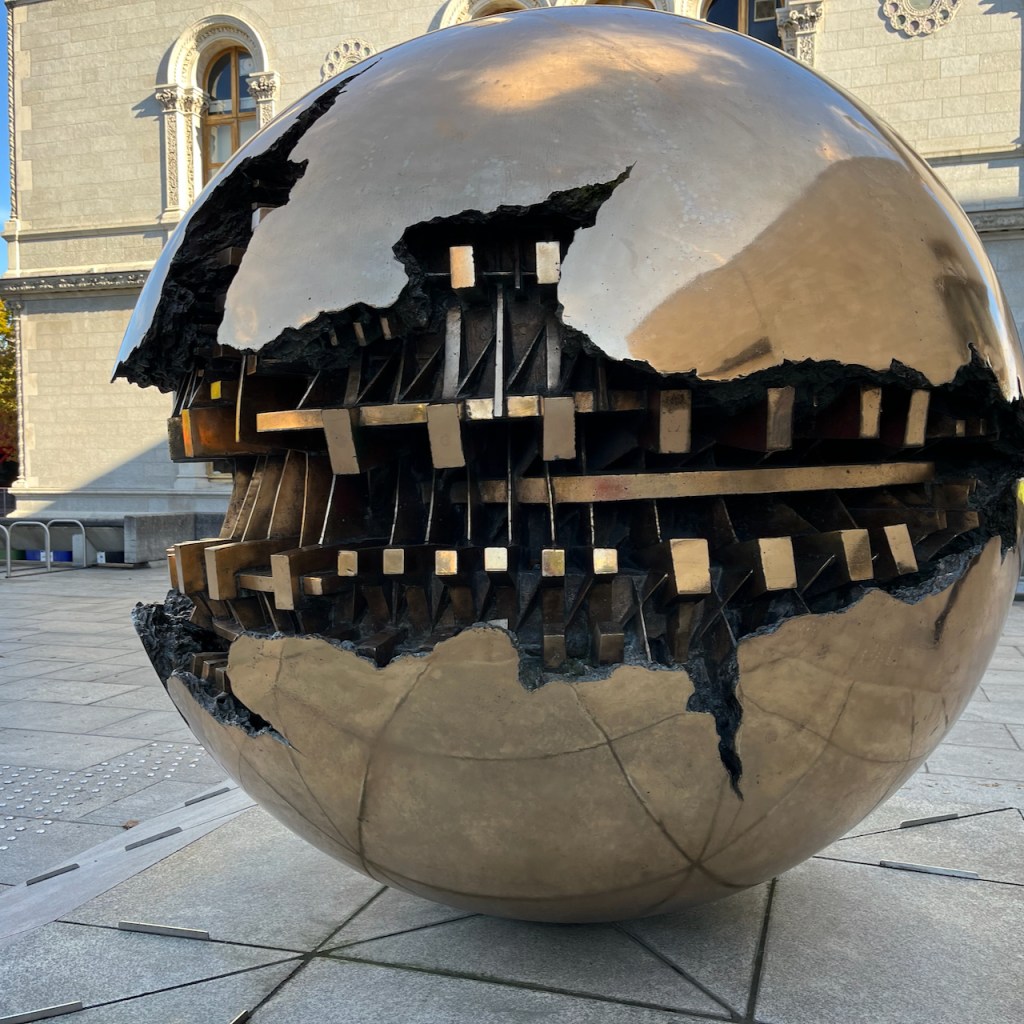
The spherical object in my drawing is a sculpture by Arnaldo Pomodoro called “Sphere with Sphere 1982/3” according to an inscription on the pavement.
I sketched for about an hour and a half. During that time waves of people crossed the square. There were a remarkable number of tourists, some with tour guides, moving in groups.
At one point, a solitary woman approached me and asked to see the picture. She smiled and said something in her own language which sounded like a compliment. So I said thank you, and smiled back. She told me that she didn’t speak English, and held up four fingers, counting, to explain she had only been here for four days. She was from Ukraine, she said. Her hands modelled an aeroplane taking off and landing. A wide uplifted arm gesture took in the autumn sun, the buildings and the people, expressing gladness to be here. She pointed at my drawing, and nodded again, making what was evidently a positive comment and a connection. Then she said goodbye and I said goodbye.
Sketching locationSketchbook 13
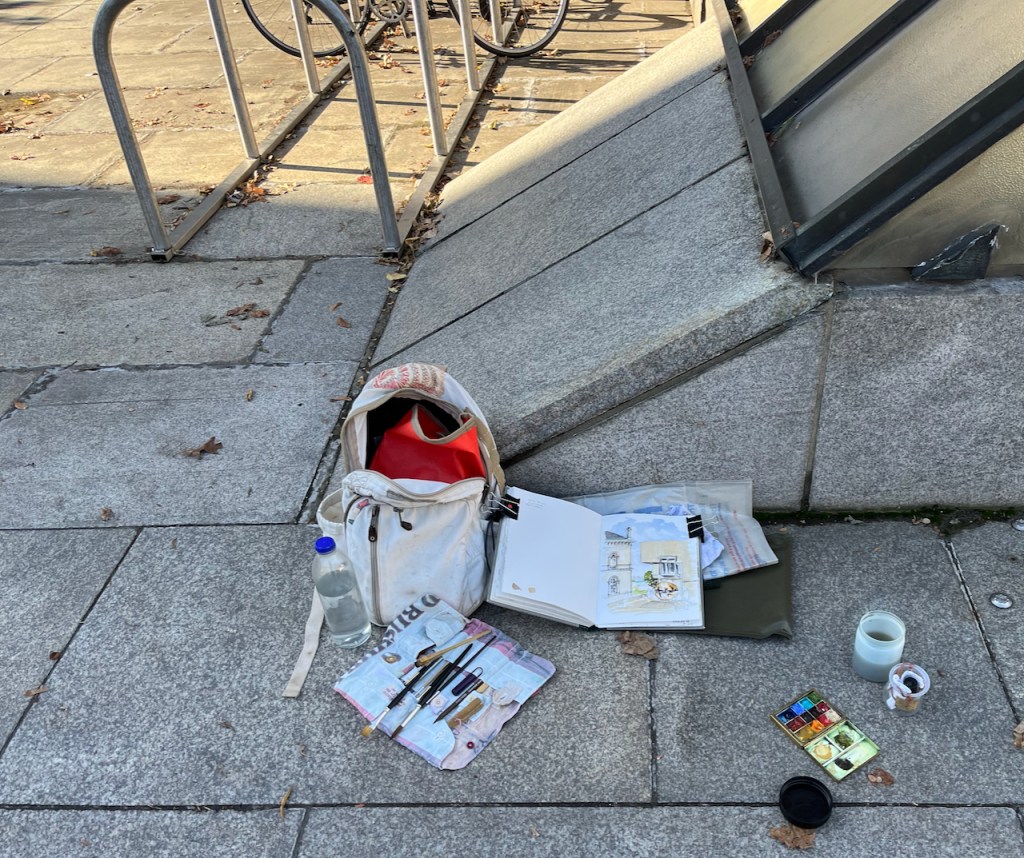
Colours used:
Buff titanium (all brickwork and concrete)
Mars Yellow (brickwork, concrete, sphere
Ultramarine Blue plus Lavender (sky)
Ultramarine Blue plus Burnt Umber (all greys)
Serpentine Genuine (trees)
a small bit of Cobalt Teal Blue and Fired Gold Ochre in the background
All Daniel Smith watercolours except the Ultramarine Blue which is Horadam watercolour.
Click a button below to share this post online, email it, or print it:
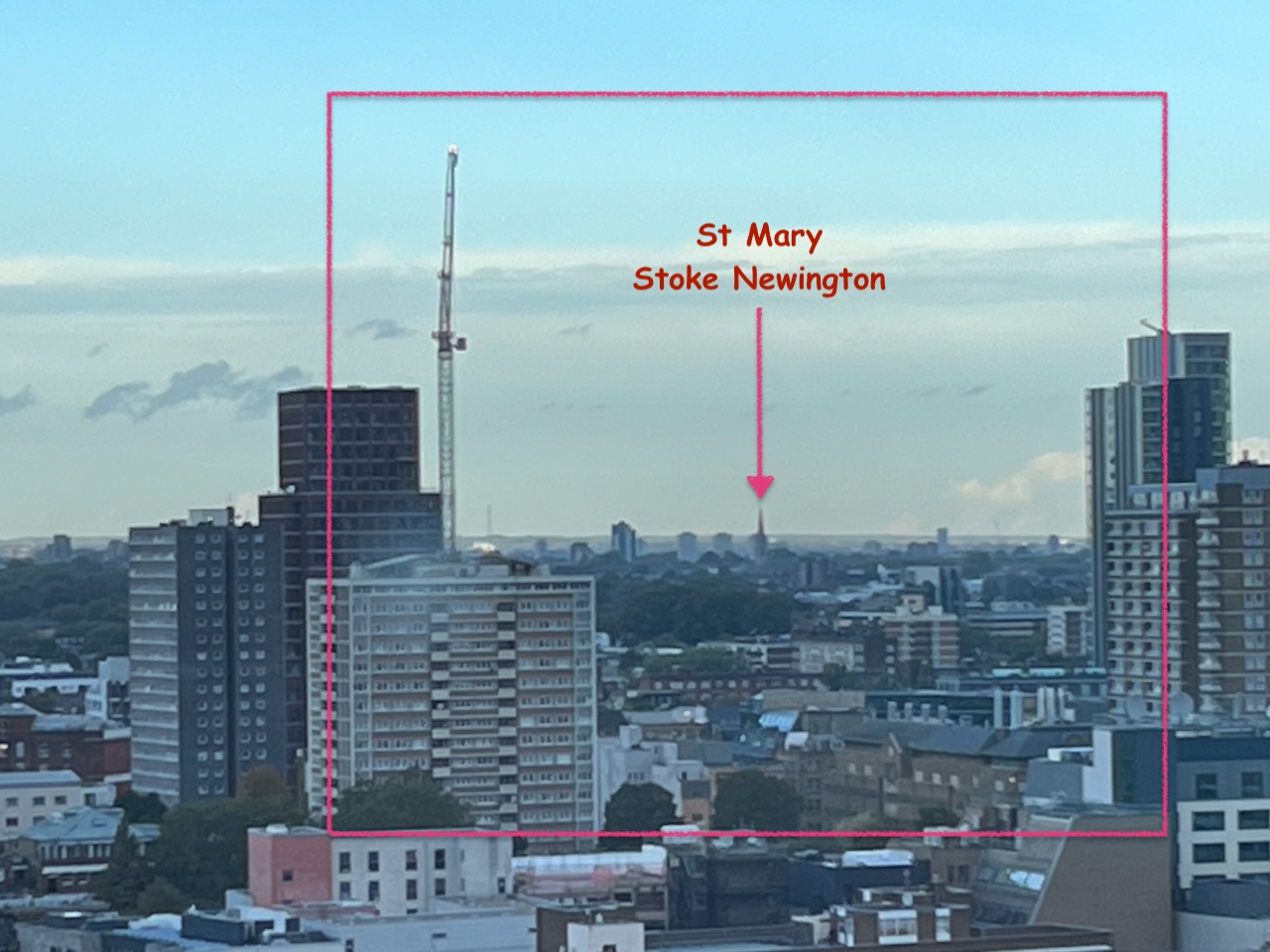
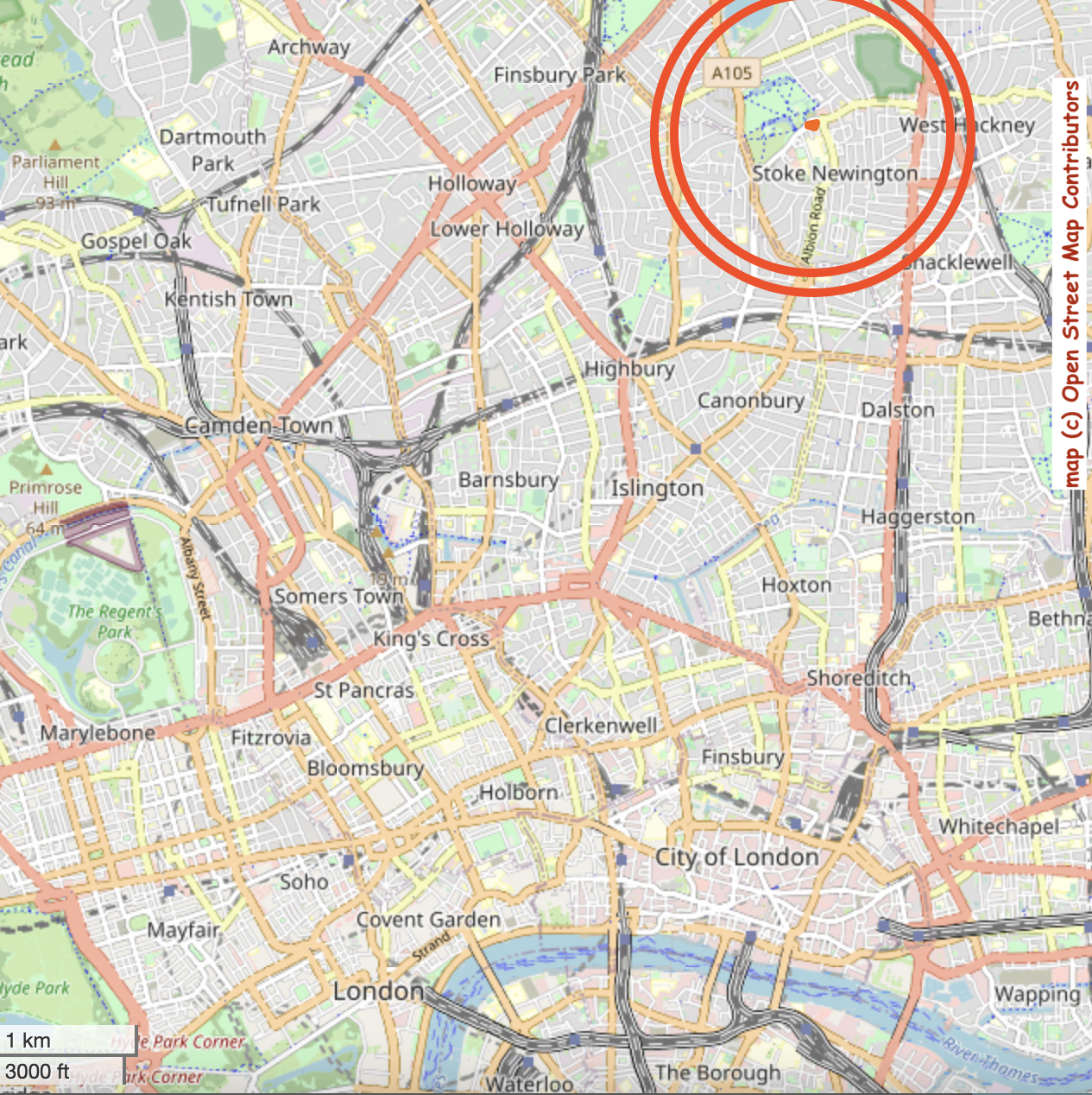
It’s just visible, on the horizon between office blocks. Some work with the binoculars and the map established that it must be St Mary Stoke Newington, some 3 to 4 miles away to the North.
“What is that spire?”
I went up there to make sure, and to have a closer look at this building which was visible at so great a distance.
St Mary Stoke Newington, the “New Church”, London N16. Sketched on October 17th 2023 in sketchbook 13, size: 10″x 8″
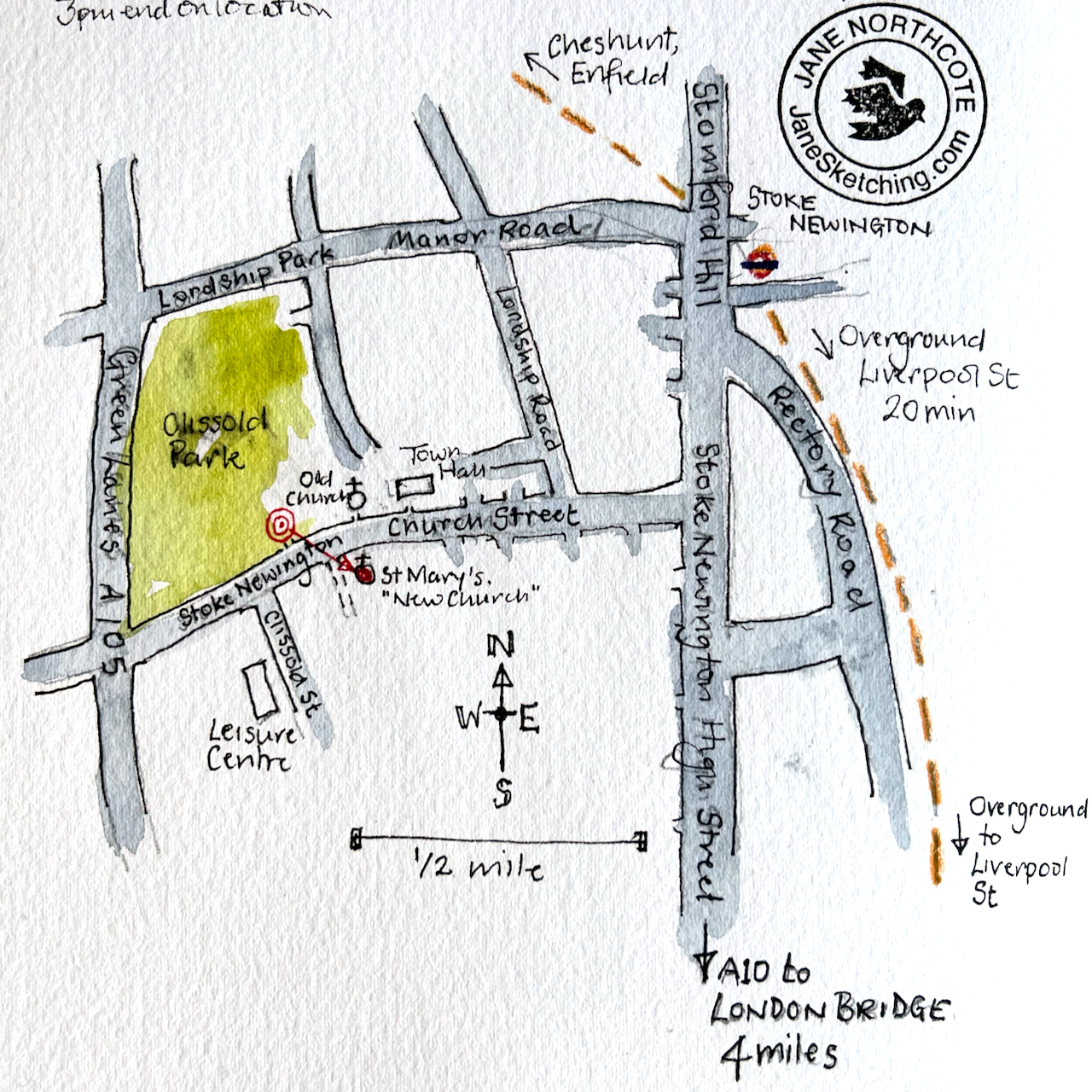
I sketched the church from Clissold Park.
Stoke Newington is another world, even though just 4 miles from the City. My sketching location was a few yards from the gate of the park. A succession of people entered the gate and walked along the path: old and young, solitary and in groups, noisy, meditative and with or without dogs. Each person or group carefully opened the gate, then turned round and closed it again behind them. At one point, a very elderly person approached the gate in a wheelchair. Someone who had just passed through noticed them, returned to the gate, and with a respectful flourish, opened both gates wide, to allow the passage of the wheelchair, and then carefully closed the gates again afterwards. It was all very civilised, and restored my faith in the human race.
If you wish to visit this church bear in mind that the overground lines are rather complicated in this area. The one to get is the one which goes north from Liverpool Street. The one from Shoreditch, although going in broadly the same direction, takes another route entirely and you end up in Dalston, which is also an interesting place, but different. I walked from there to Hackney Downs to find the right railway line, and discovered more as-yet-unexplored areas of London.
Overground routes in the Stoke Newington area.
St Mary Stoke Newington New Church was built in 1854-8, to the design of Sir George Gilbert Scott. His other works include the Midland Hotel at St Pancras, the Albert Memorial, Westminster Abbey, the Martyr’s Memorial in Oxford and St John’s College Chapel Cambridge, to name but four. So the people of Stoke Newington got a rock-star architect in 1854. This was because Stoke Newington had a hugely popular preacher, the Reverend Thomas Jackson, with people coming across London to hear him preach. The cost of the new church was raised by voluntary contributions1 from this large congregation.
The spire was added by Sir George’s son John Oldrid Scott, in 1890.
Stoke Newington New Church seen from Stoke Newington Church StreetThe impressive interior of Stoke Newington New Church.
Across the road is the much smaller “old church” which this “new church” replaced. The old church is still there, looking like a country village church.
Stoke Newington Old Church, 17th October 2023
Now I know what that spire is, on the horizon, I think I should make another visit, to sketch the old church.
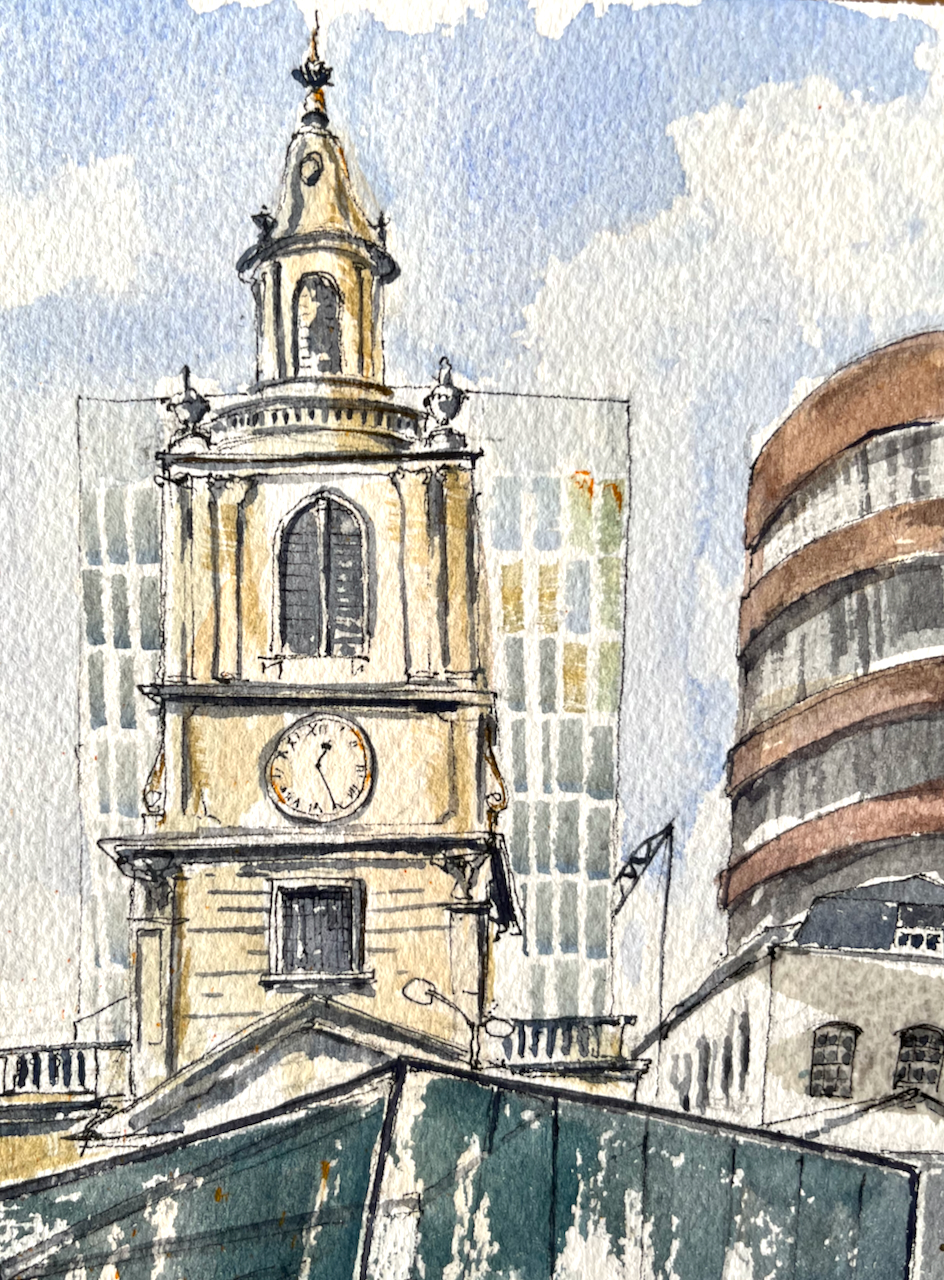
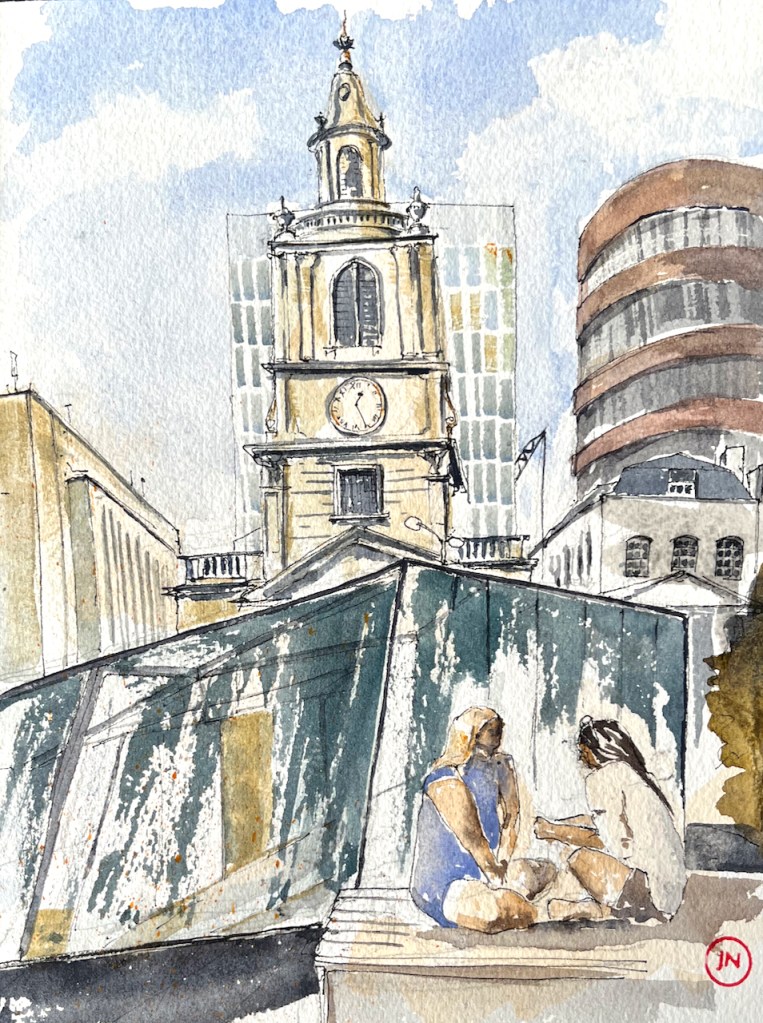
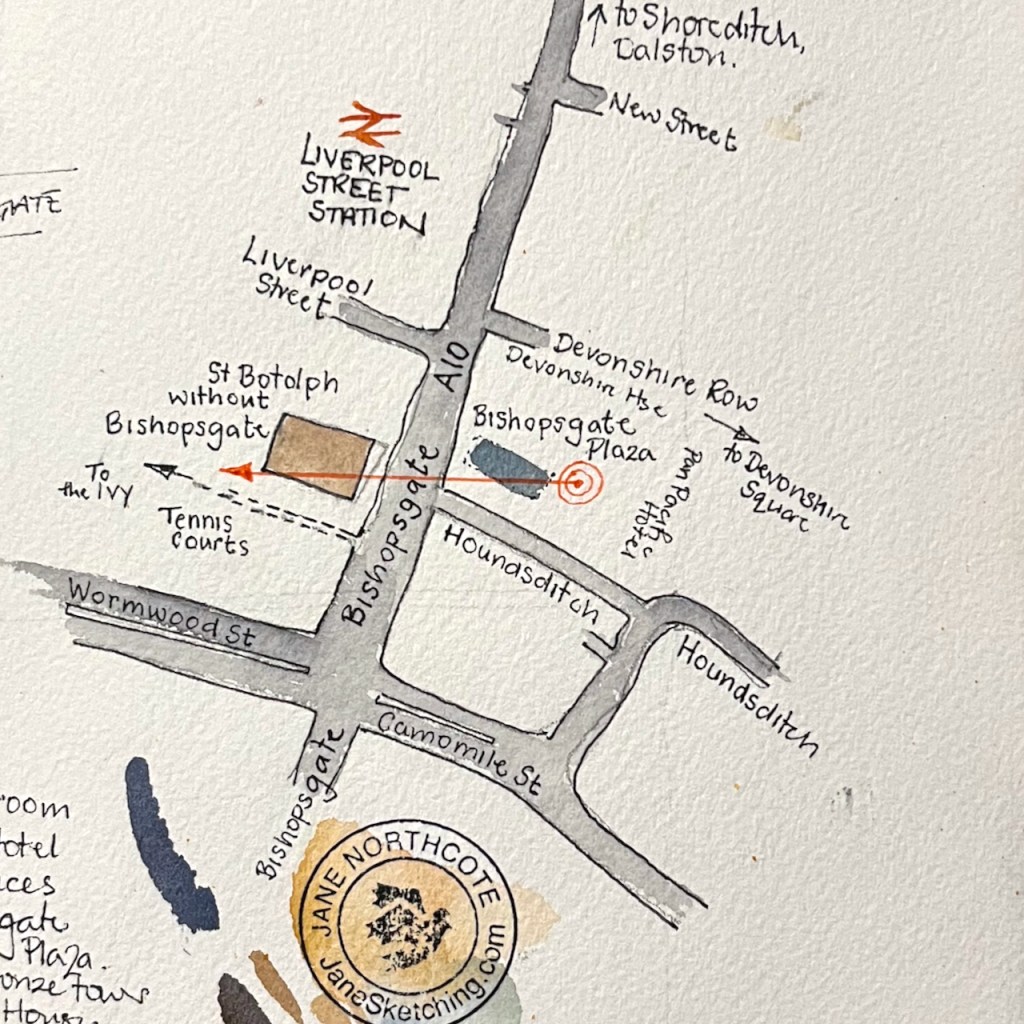
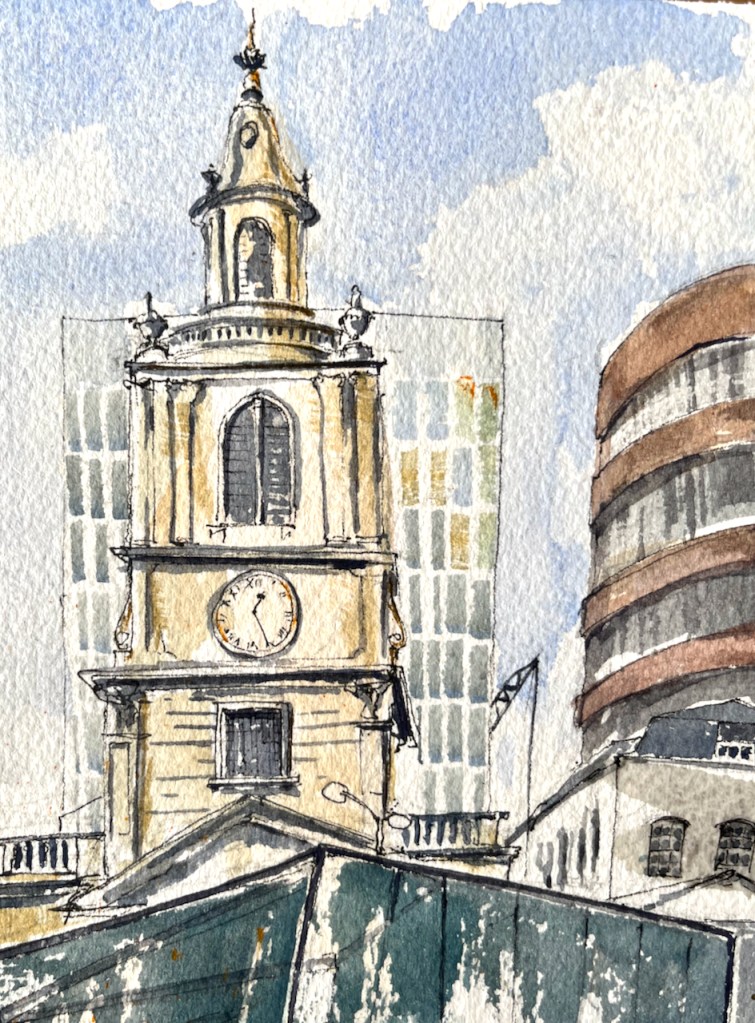
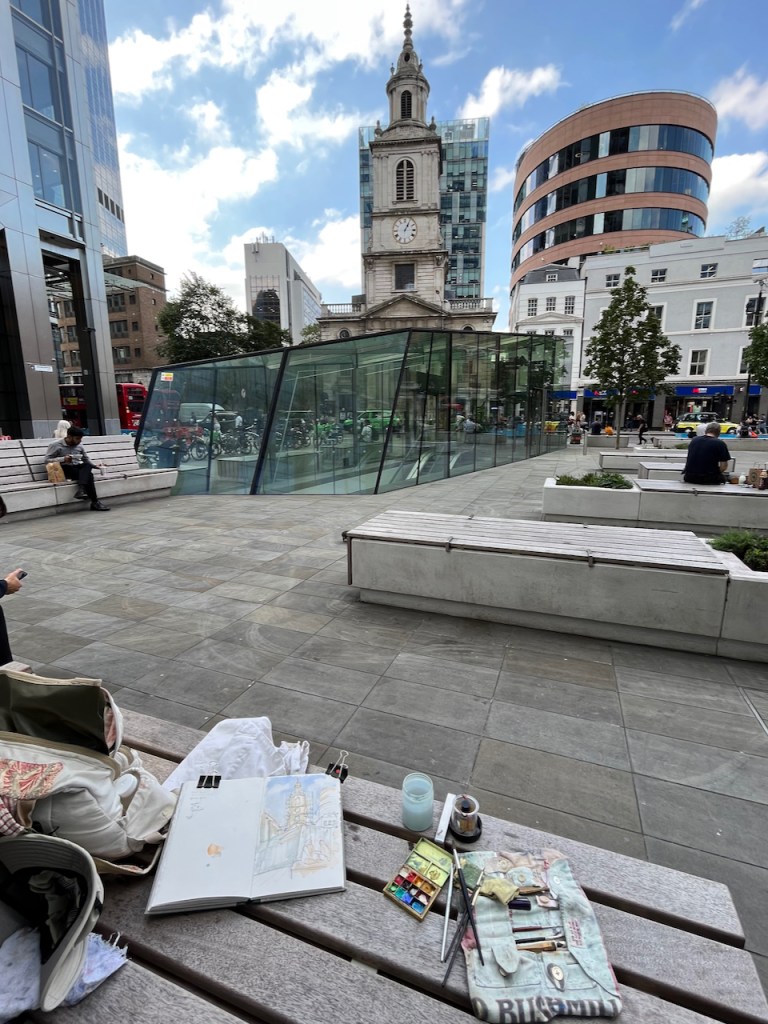
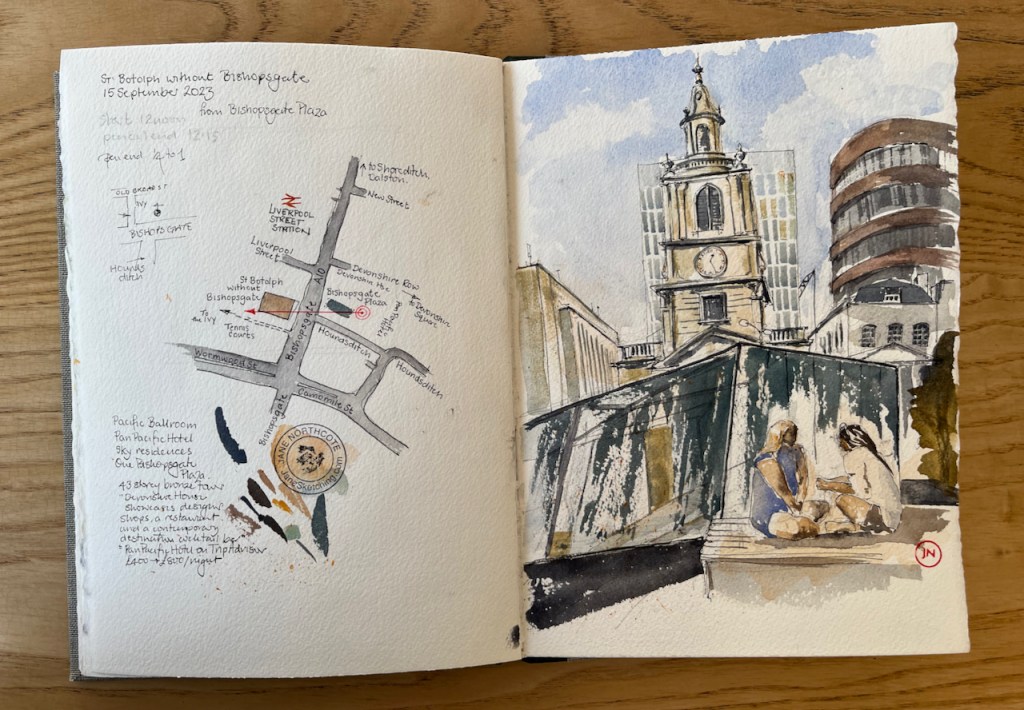
Bishopsgate Plaza is on the East side of Bishopsgate, near Liverpool Street. From the seats there, here is the view of St Botolph-without-Bishopsgate. I sketched amongst the many people enjoying the sun at lunchtime.
St Botolph-without-Bishopsgate, EC2. 15th September 2023, 1pm. 10″x 7″ in sketchbook 13
The current church was constructed in 1729, to the designs of James Gould. There has been a place of Christian worship on this site since Roman times. The parish registers are complete from 1558 according to the church’s website.
Viewed from Bishopsgate Plaza, the church is all but submerged in the surrounding buildings. The large glass structure is the entrance to the “Pacific Ballroom”. This is part of the Pan Pacific Hotel, which was behind me as I sketched.
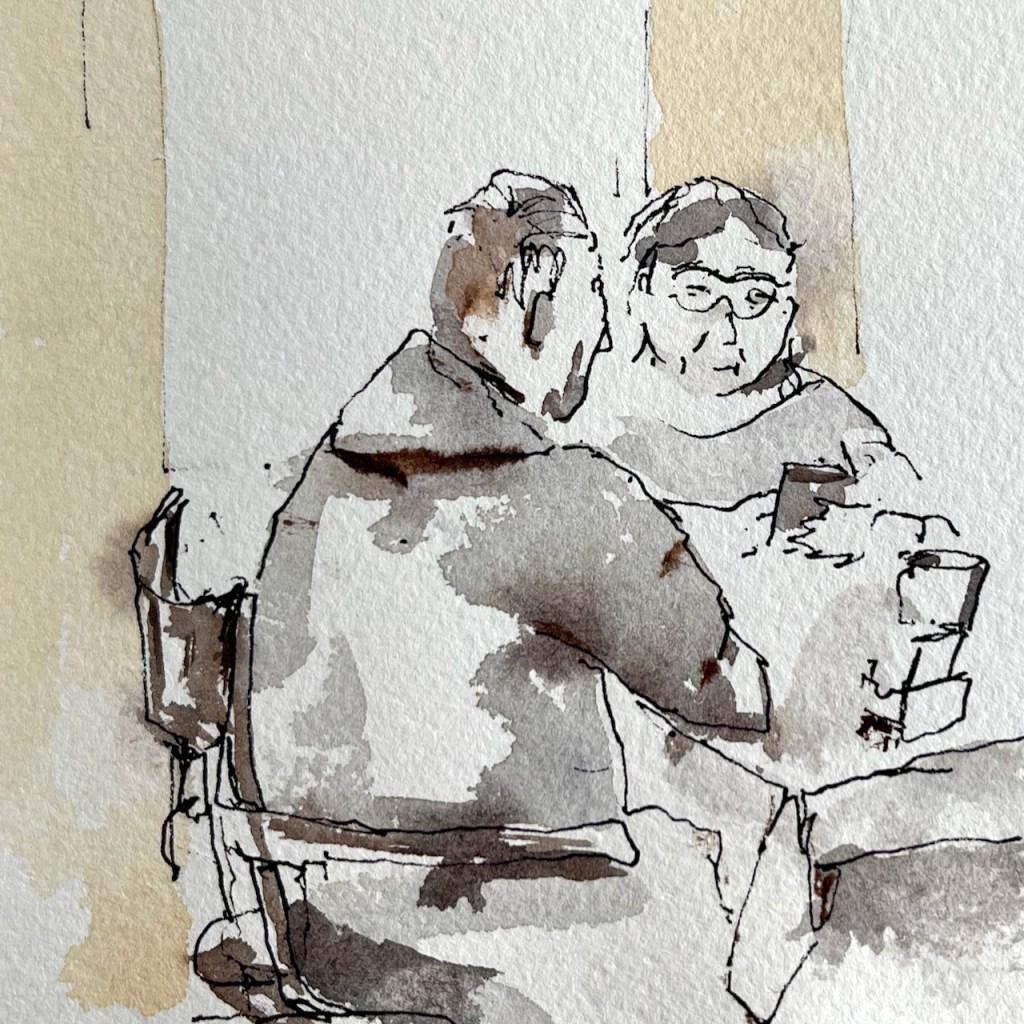
I find it quite hard to draw people, but I wanted to include the discussion between the two women. Their lively conversation contrasted with the stillness of the church, and the enormity of the buildings all around. They created a little private world between themselves.
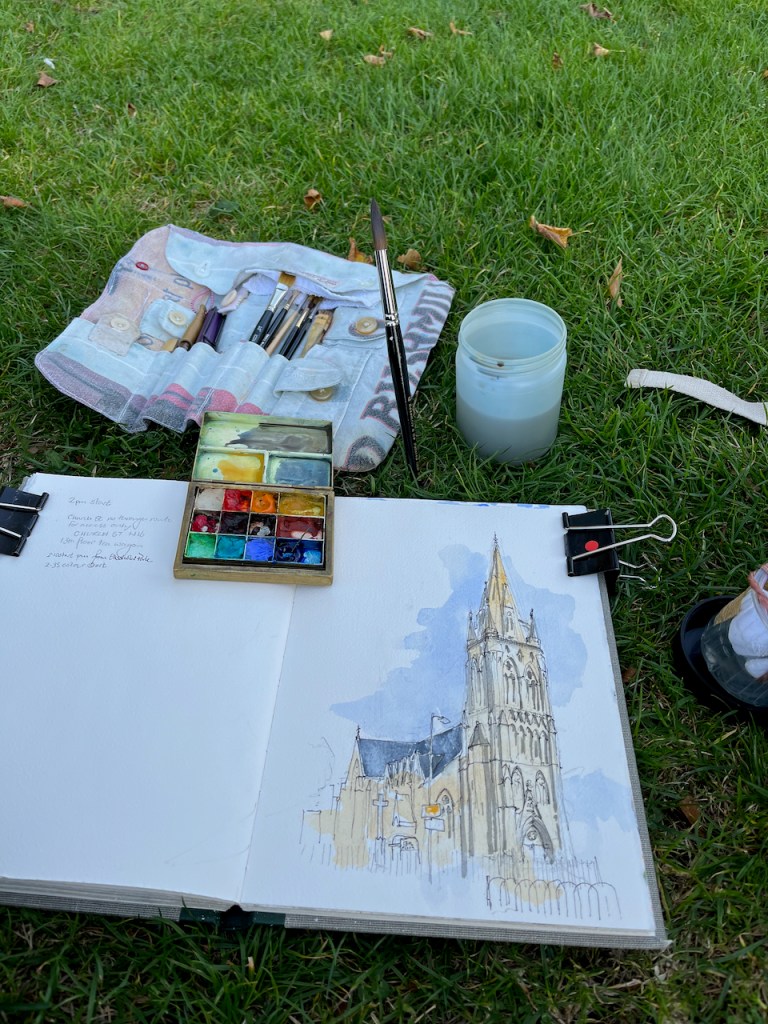
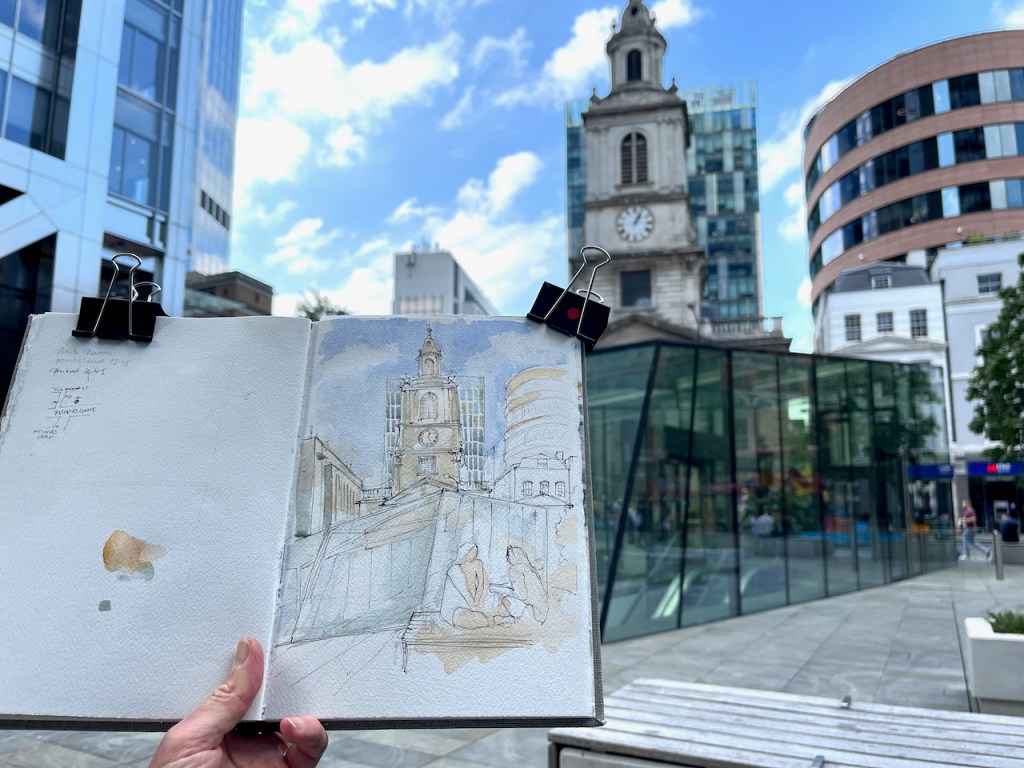
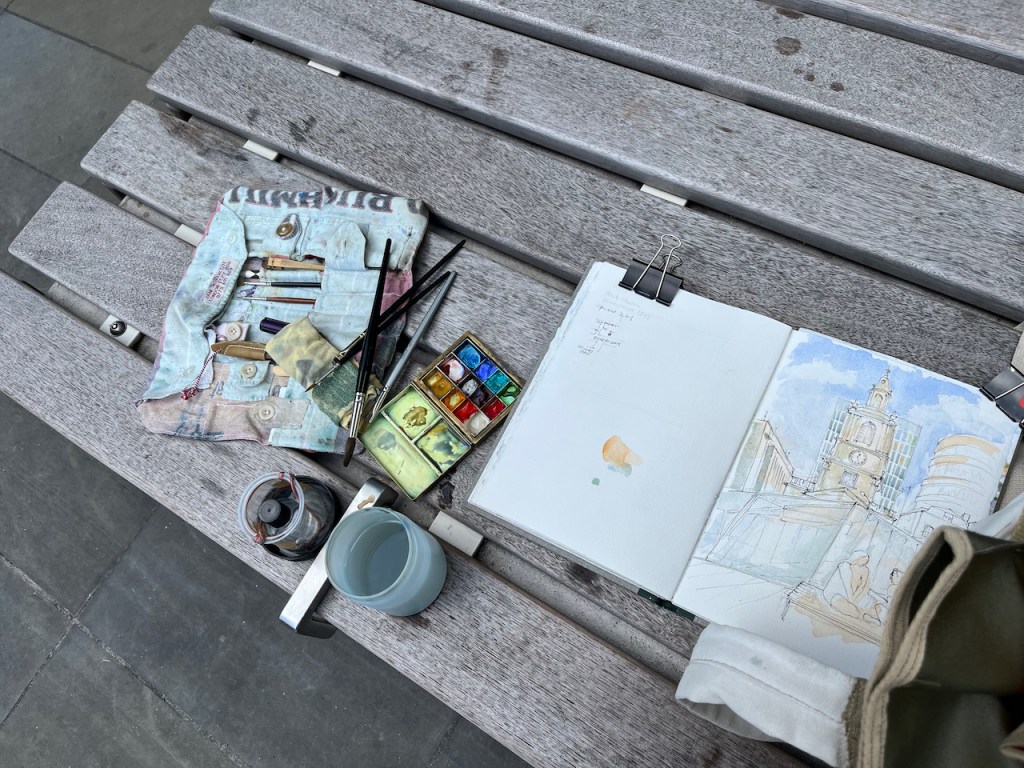
Here is work in progress on the sketch:
Sketchbook 13
Click a button below to share this post online, email it, or print it:
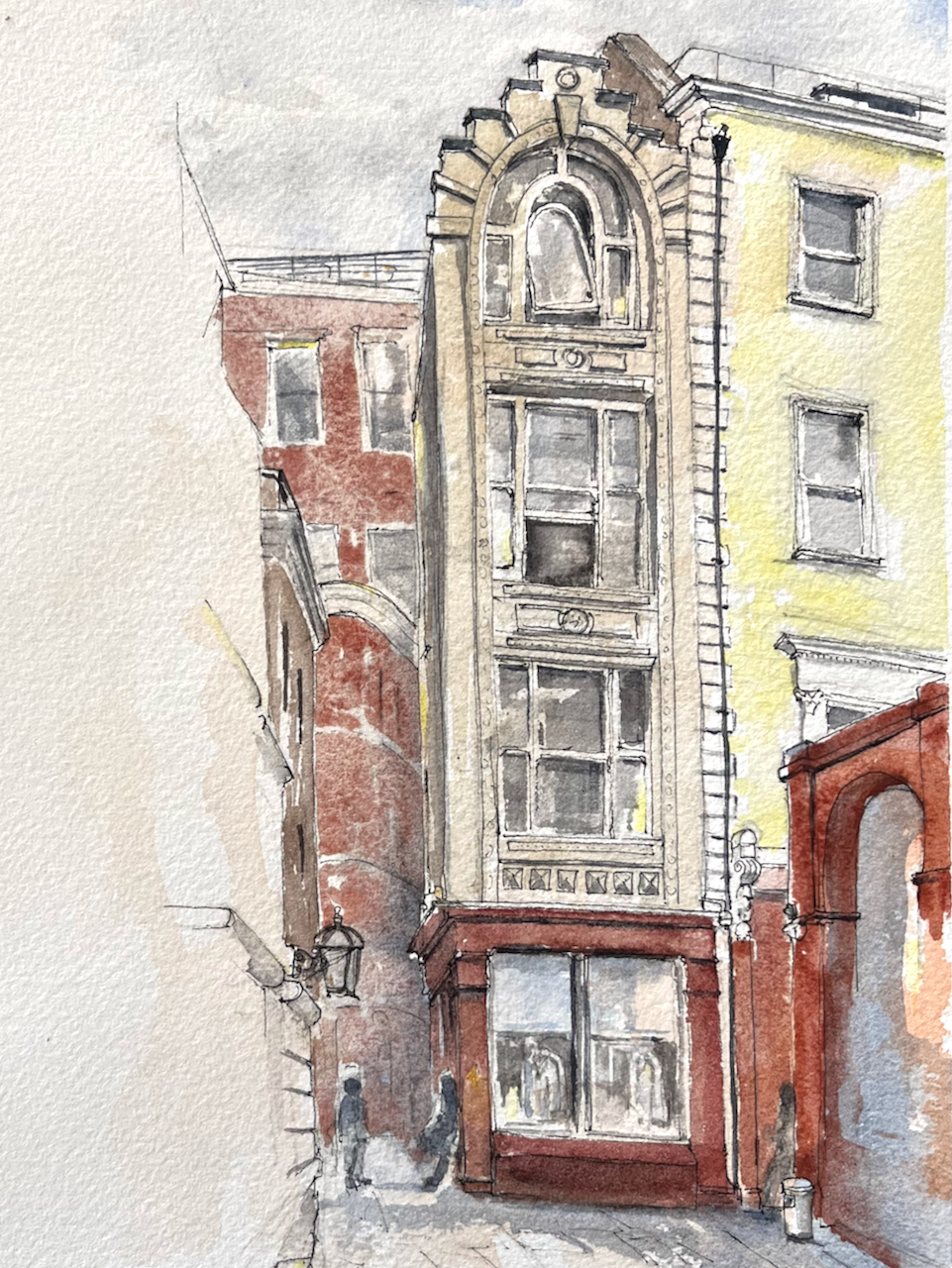
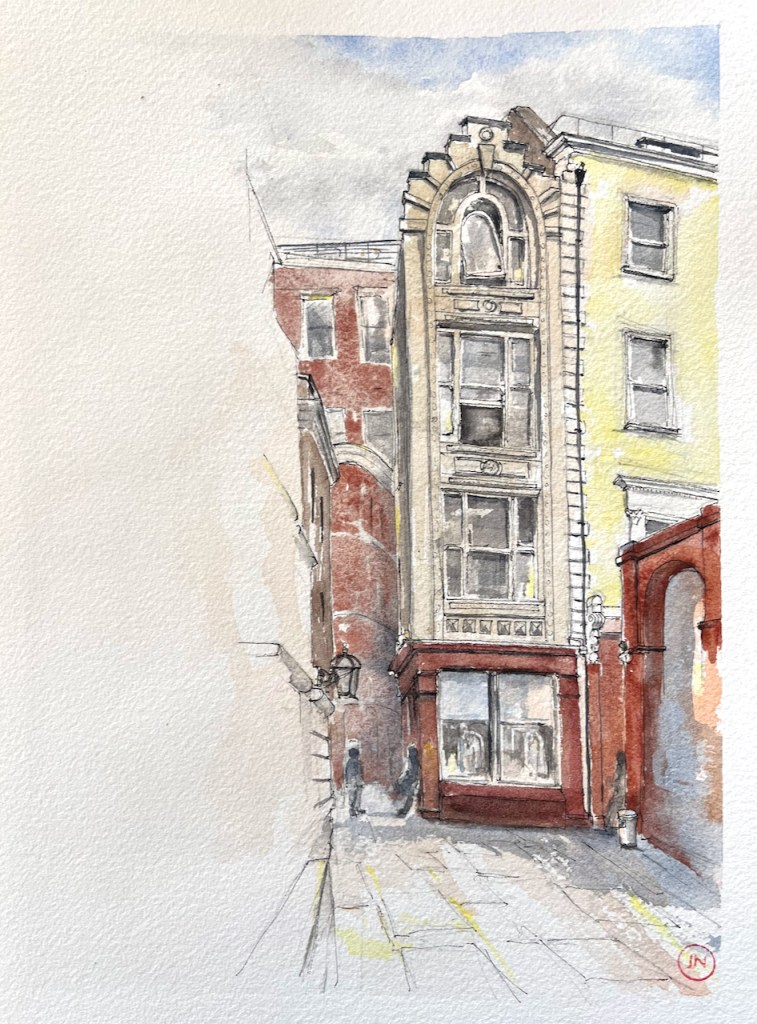
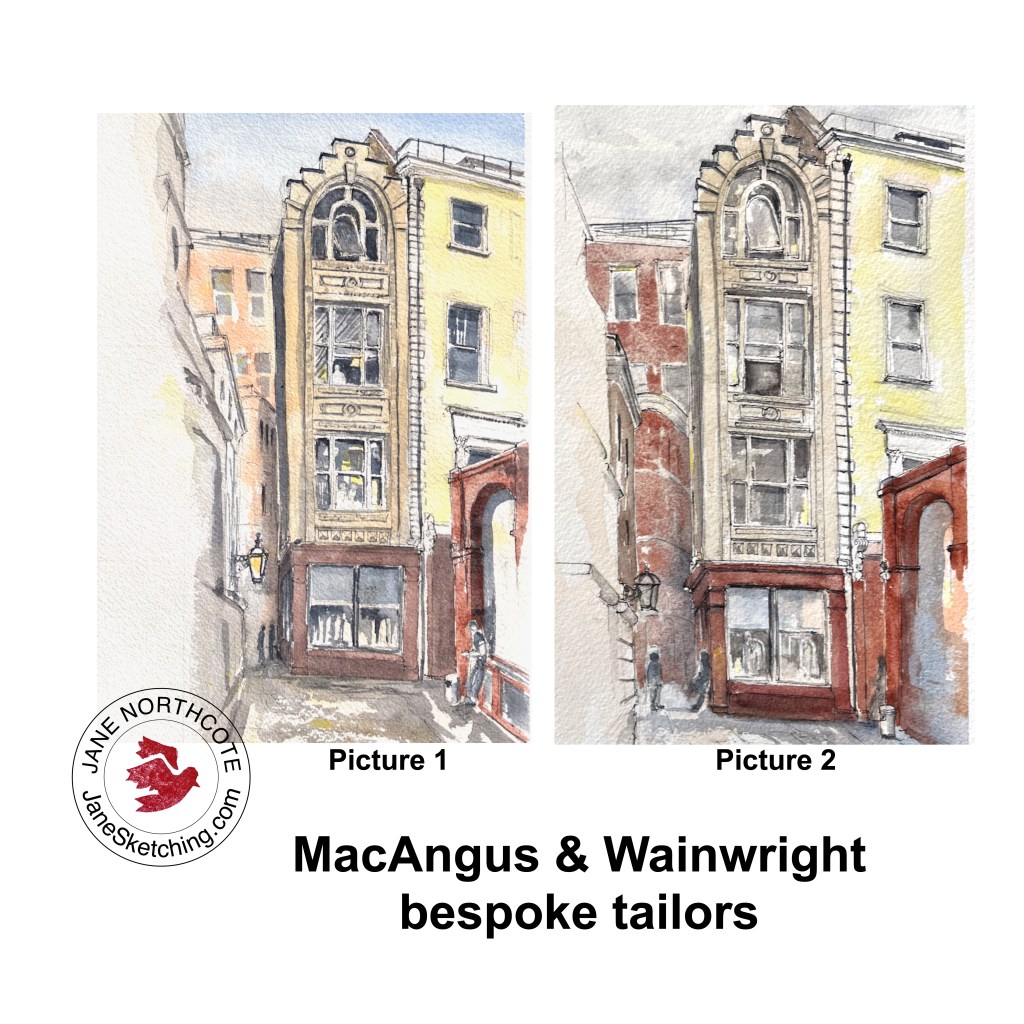
Here is 4 St Michael’s Alley, City of London, EC3, the premises of MacAngus & Wainwright, bespoke tailors. Their business uses all the floors. Above the ground floor showroom are the fitting room, workroom and cutting room.
4 St Michael’s Alley, London EC3, the premises of MacAngus & Wainwright, bespoke tailors.
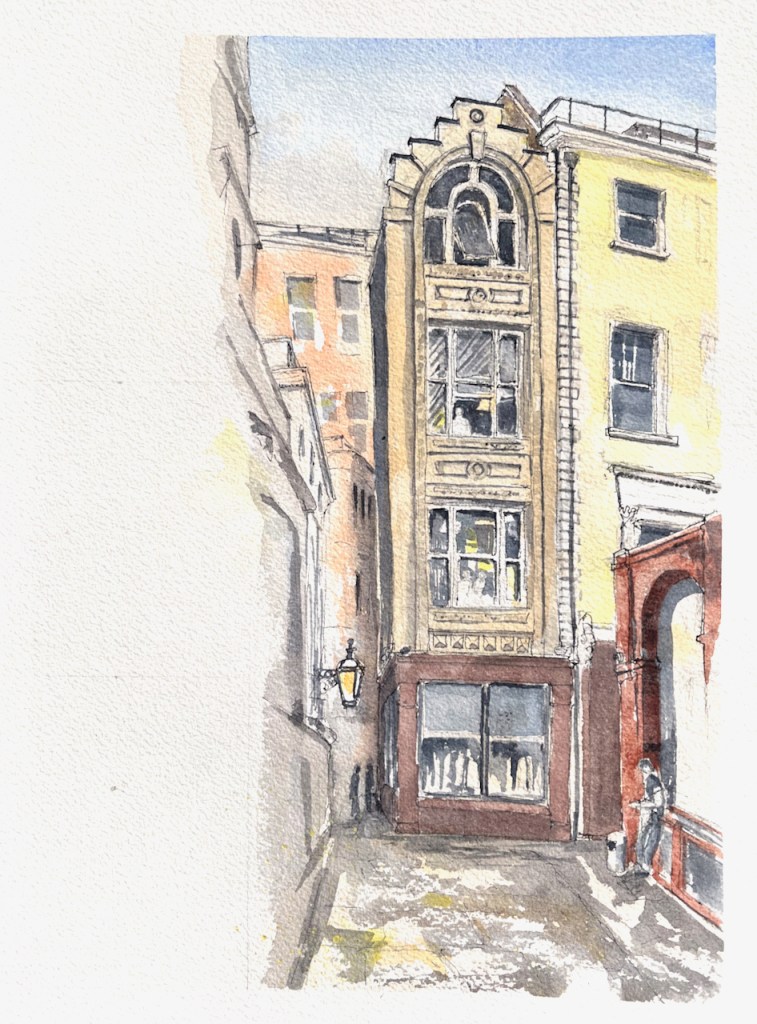
The shop is just off Cornhill, near Bank in the City of London and right next to the Jamaica Wine House which I sketched previously. You can see a bit of the Jamaica Wine House on the right of my sketch. The prominent lamp is outside the “George and Vulture” pub, which is hidden on the left. I made two pictures of this building, on different days and from slightly different angles. Here is the other one:
4 St Michael’s Alley, London EC3, the premises of MacAngus & Wainwright, bespoke tailors.
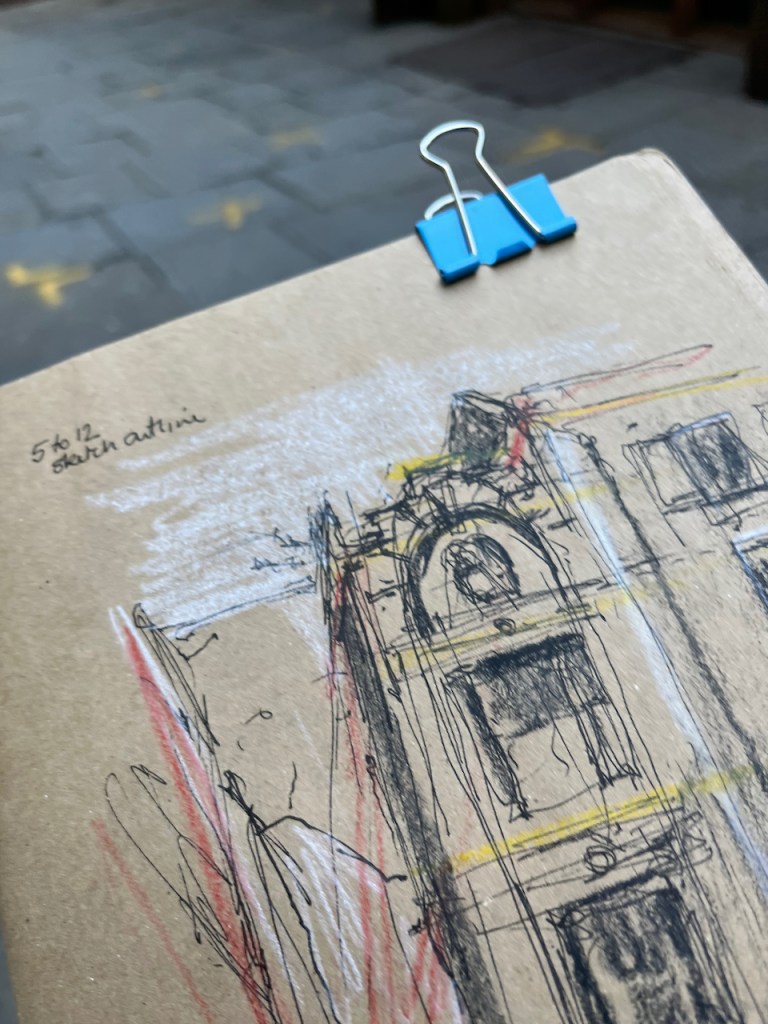
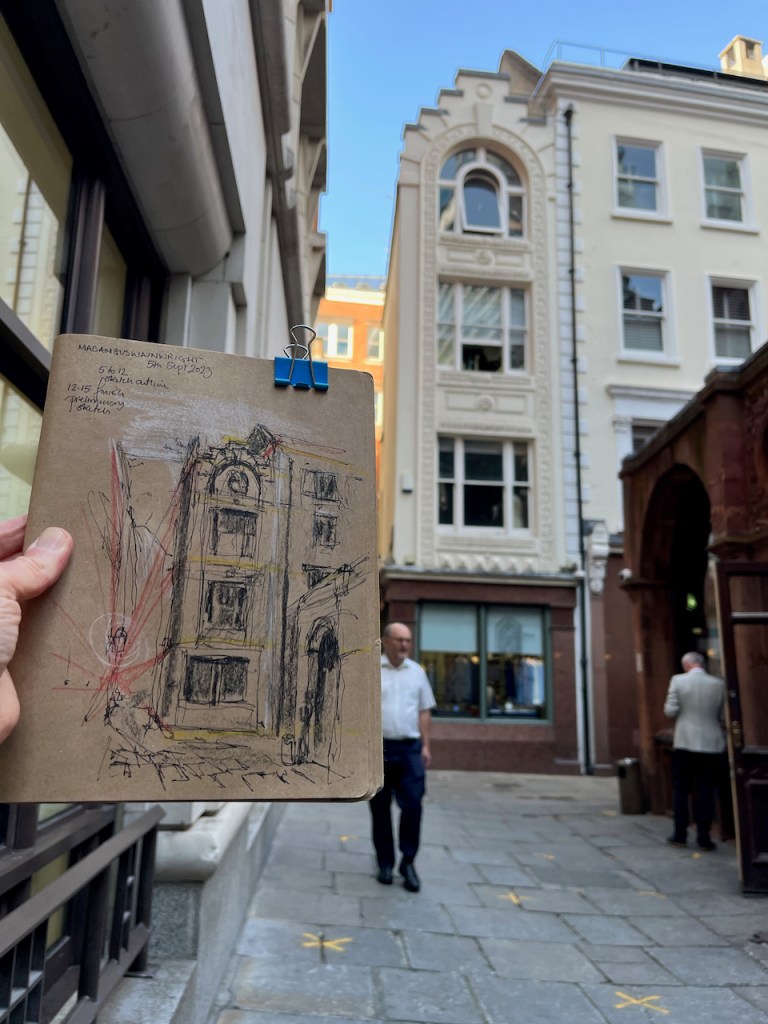
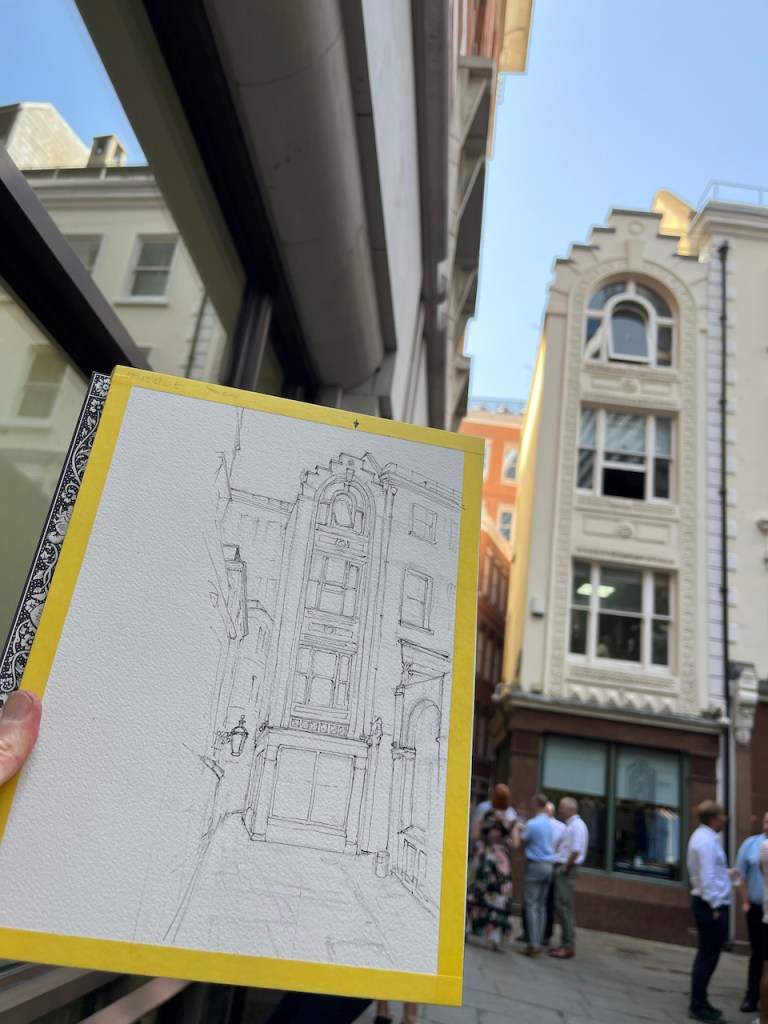
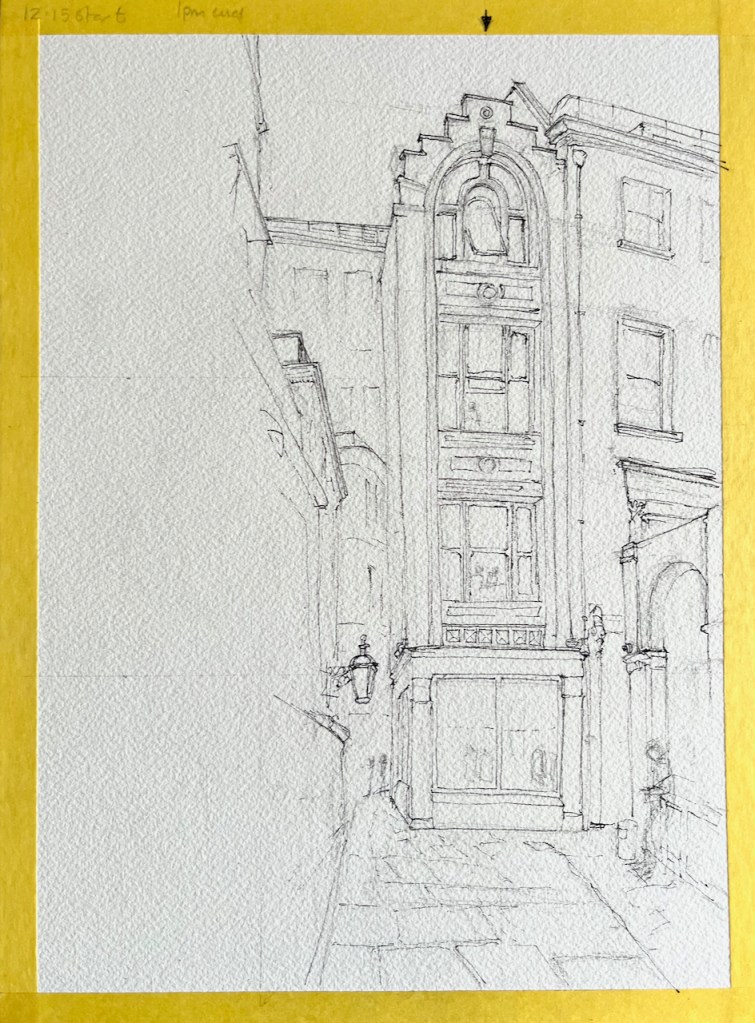
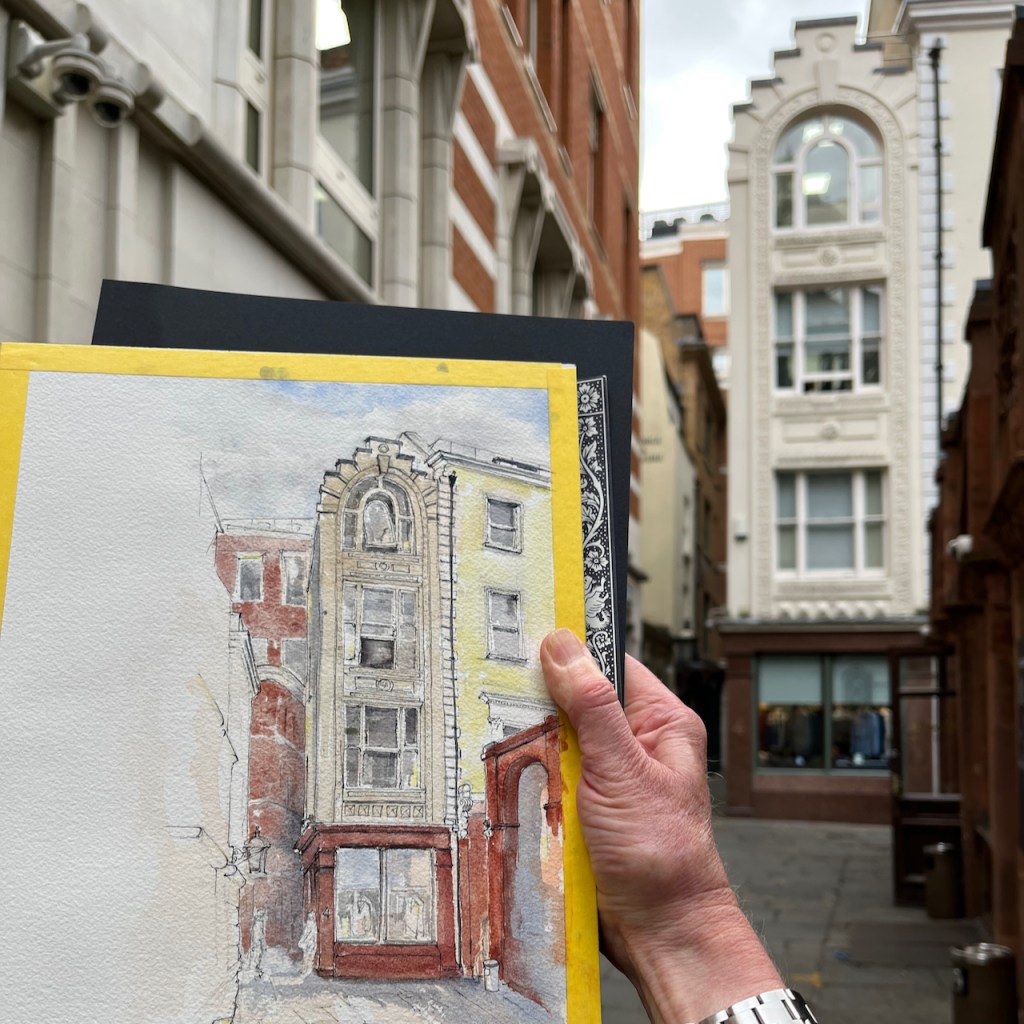
Here is work in progress on the drawings.
preliminary sketchpreliminary sketch
A succession of tour guides took their groups into the alley in the centre of my picture. This is Castle Court. These alleys apparently feature in Charles Dickens stories. Since J.K Rowling was inspired by the novels of Charles Dickens, there’s also a Harry Potter angle. I overheard this in fragments of tour guide talks. I don’t know if it’s true.
I started sketching in the late morning. This was the time for tour guides. Later, starting from about 1pm, the courtyard became populated by drinkers at the Jamaica Wine House. They were polite people, helpfully stepping aside and congregating on the other side of the alley, so they did not block my view.
The drawings are on Arches Aquarelle 12″ x 7″ 300gsm cold-pressed watercolour blocks, using Daniel Smith paints. The colours are:
Blues: Ultramarine Blue, Lavender, Cobalt Teal Blue
Yellows: Mars Yellow. The house on the right at the back is mostly Nickel Titanate Yellow. It was quite a hard colour to match.
Browns: The tailors building is a mix of Buff Titanium with Mars Yellow. The Jamaica Wine House and other buildings are Fired Gold Ochre, with a bit of transparent Pyrrol Orange.
All blacks and greys are a mix of Ultramarine Blue and Burnt Umber.
The pen drawing is De Atramentis Document Black ink in a Lamy Safari Fountain pen, fine nib.
Click a button below to share this post online, email it, or print it:
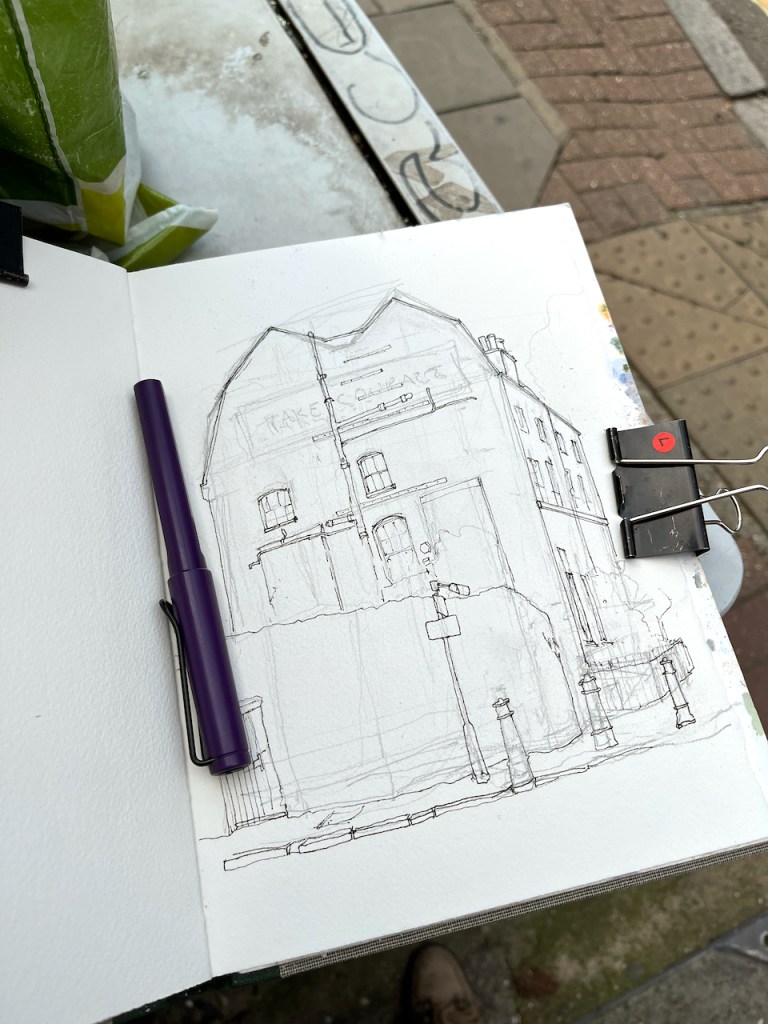
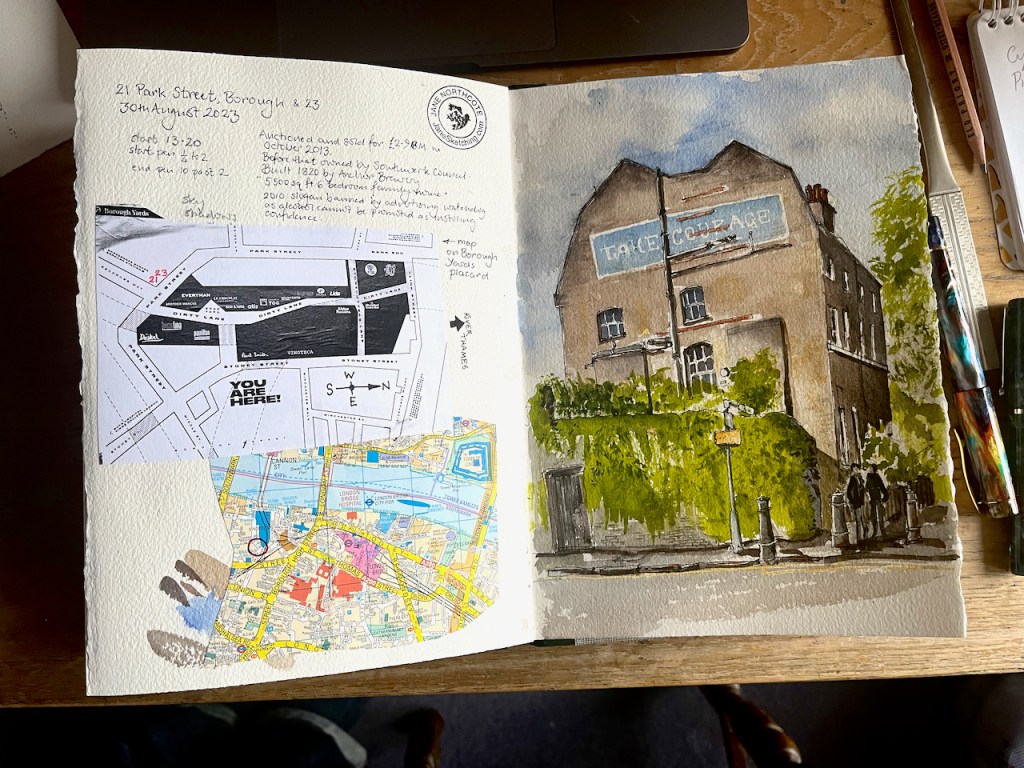
I enjoy the marvellous trigonometry of this roof, and the encouraging slogan on the wall.
21 and 23 Park Street, Borough, Southwark, London SE1. Sketched 30th August 2023, 2pm.
The slogan is for a brewery, Courage. This house was built in 1820 for the managers of the Anchor Brewery, then on this site. The Anchor pub is on the river Thames nearby.
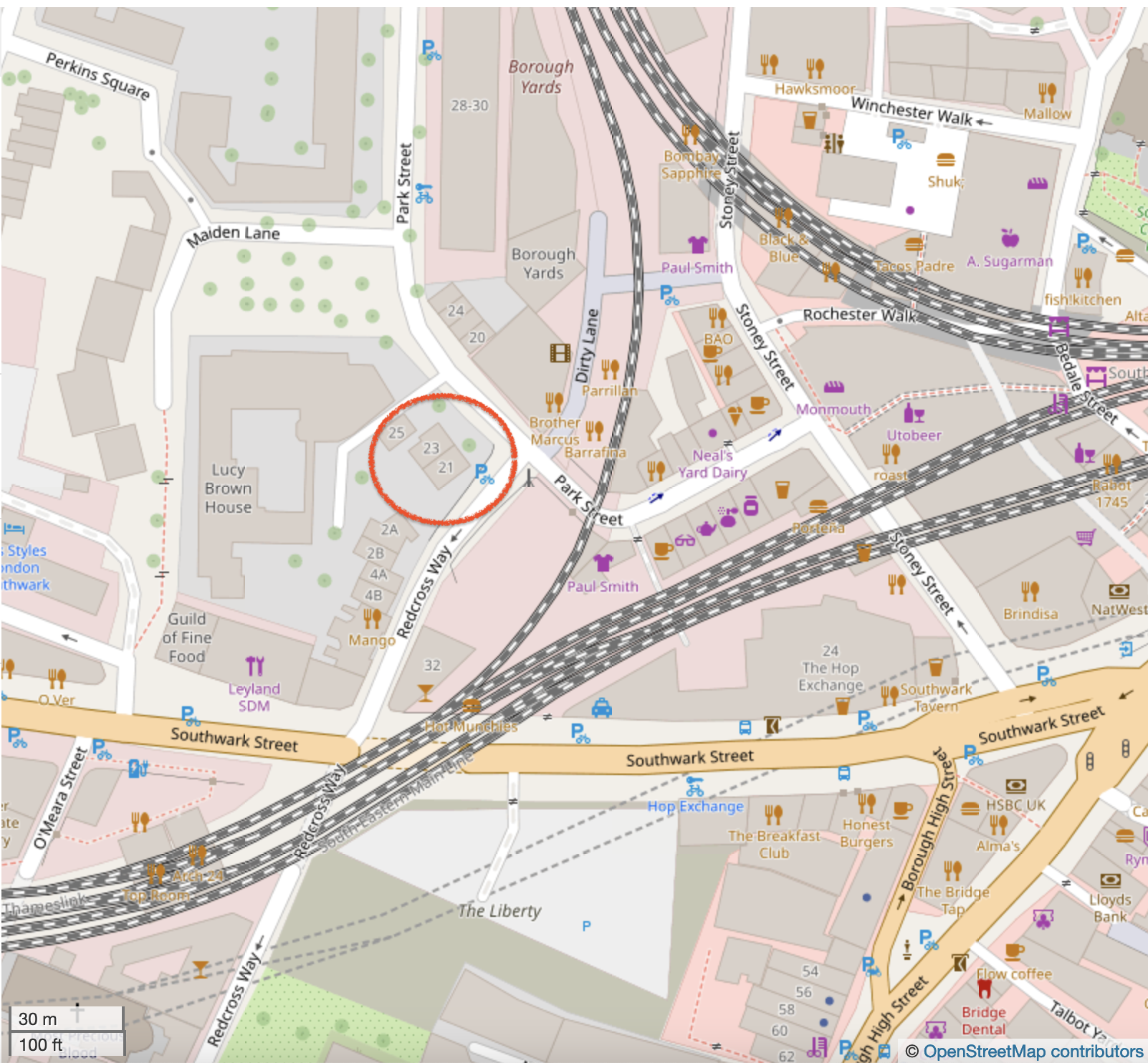
Map from “Borough Yards” poster (rotated to put North at the top)
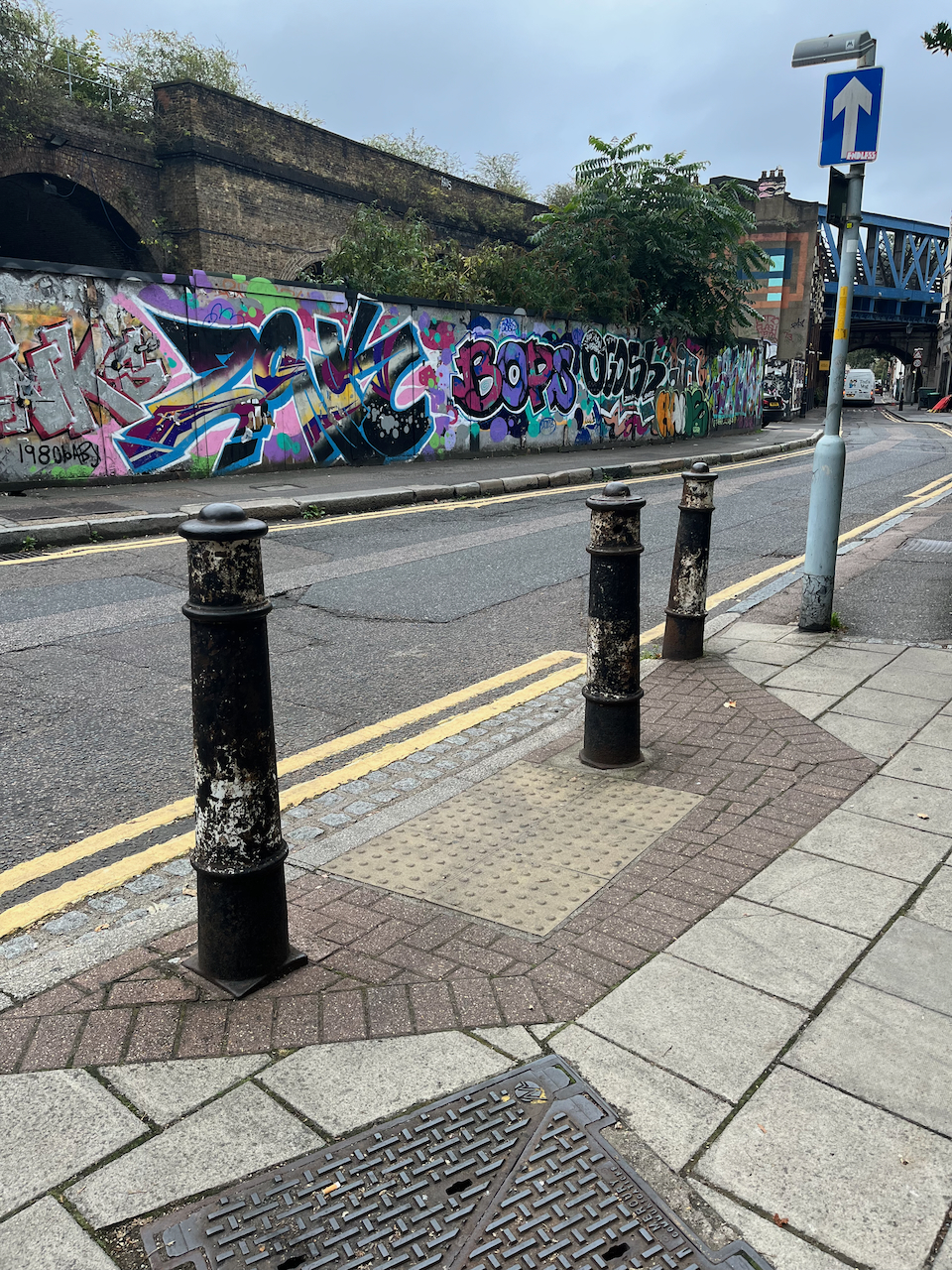
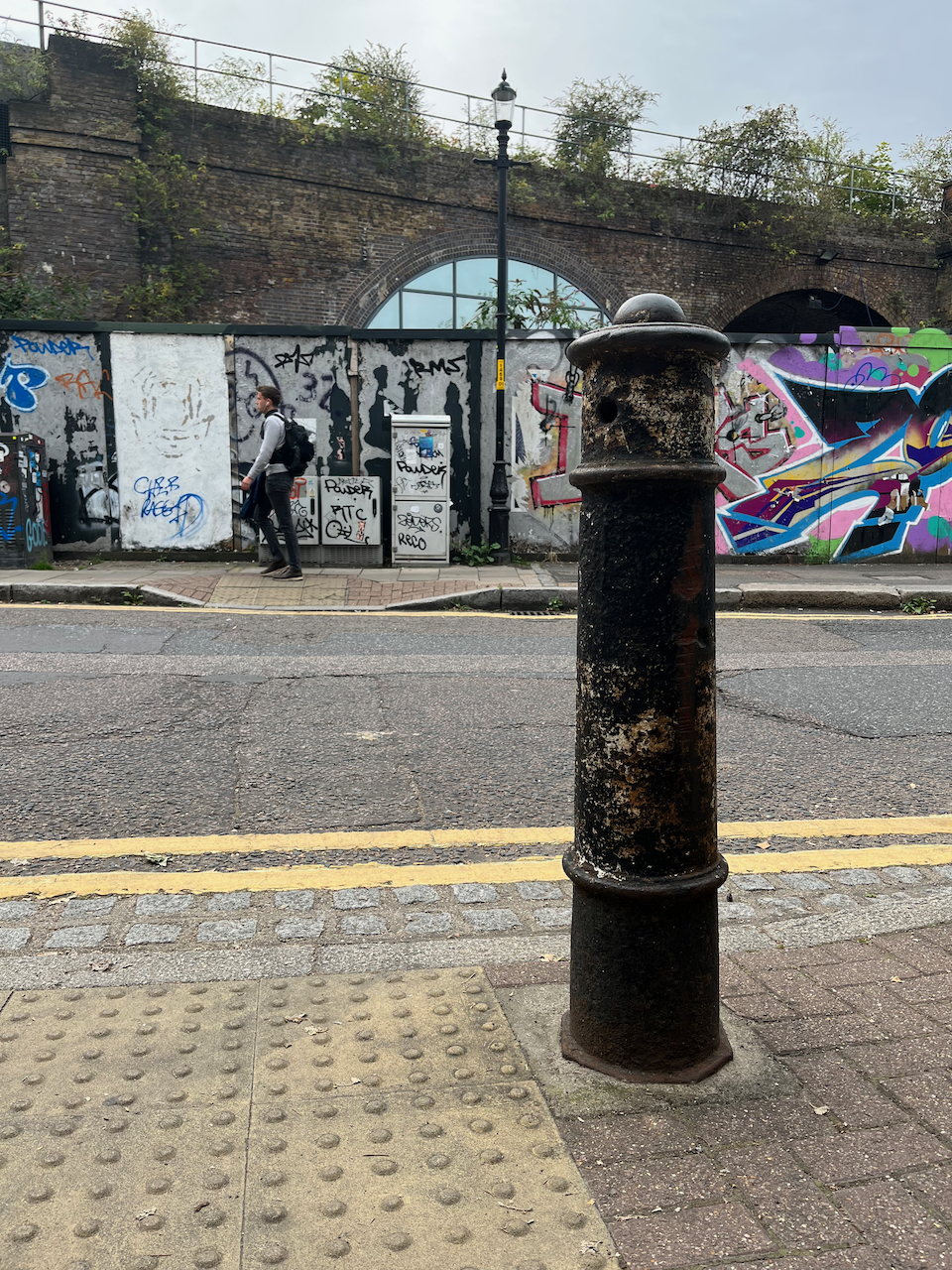
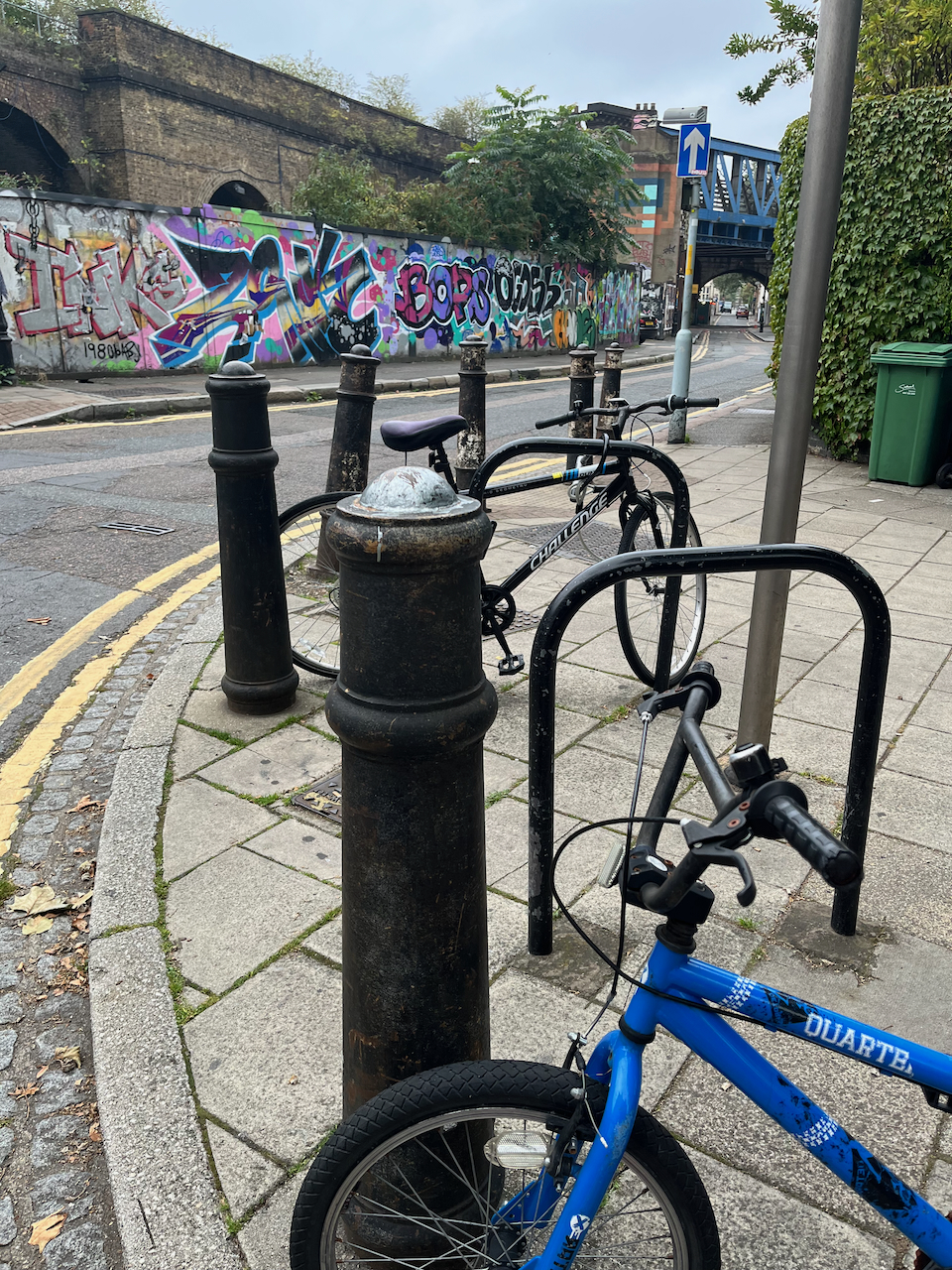
The building, and its cast iron railing, is listed Grade II, number 1385752. When I searched for the list entry in the Historic England register, I found, to my surprise, that the bollards in my picture have their own special listing, number 1385753 “
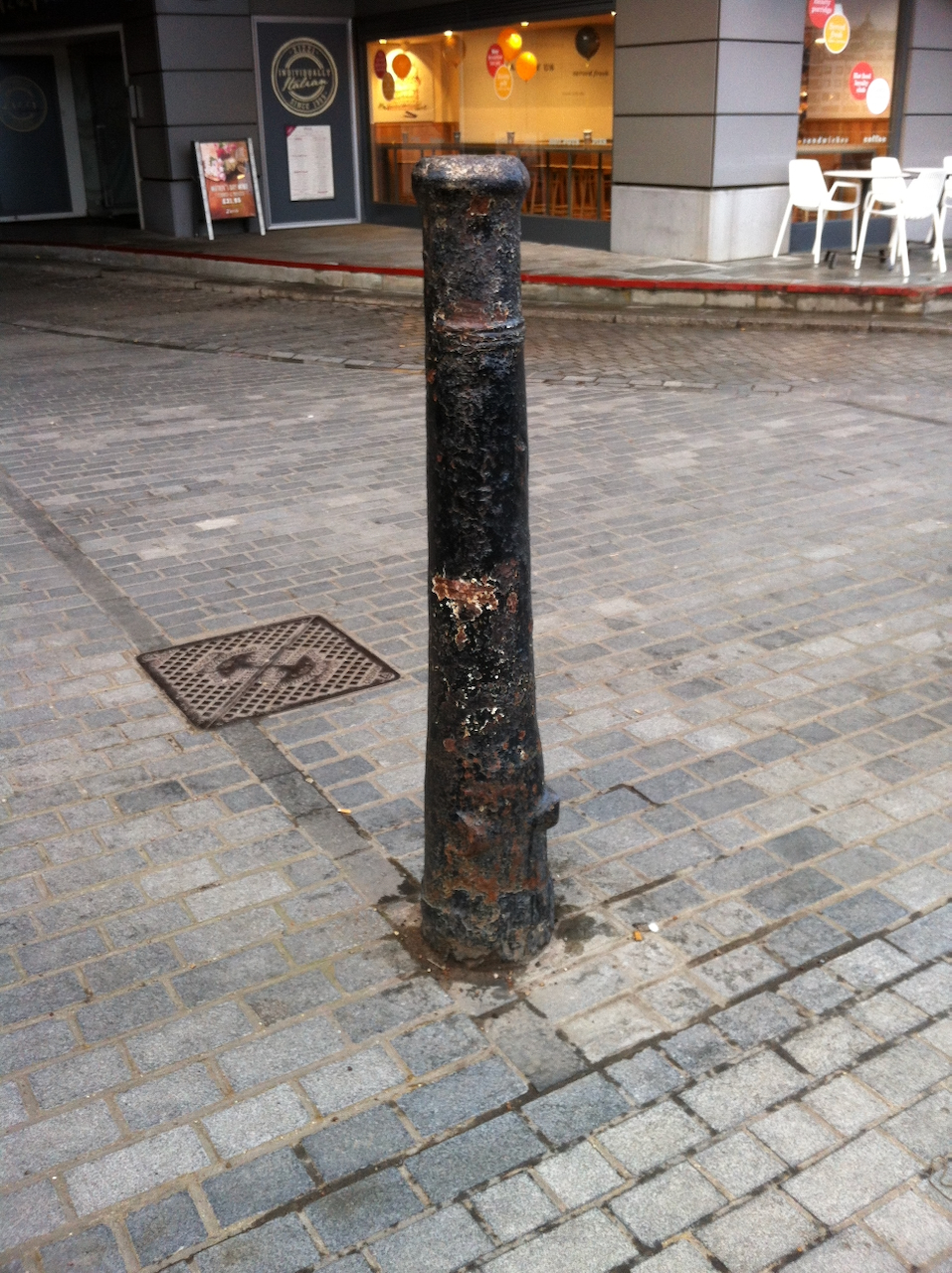
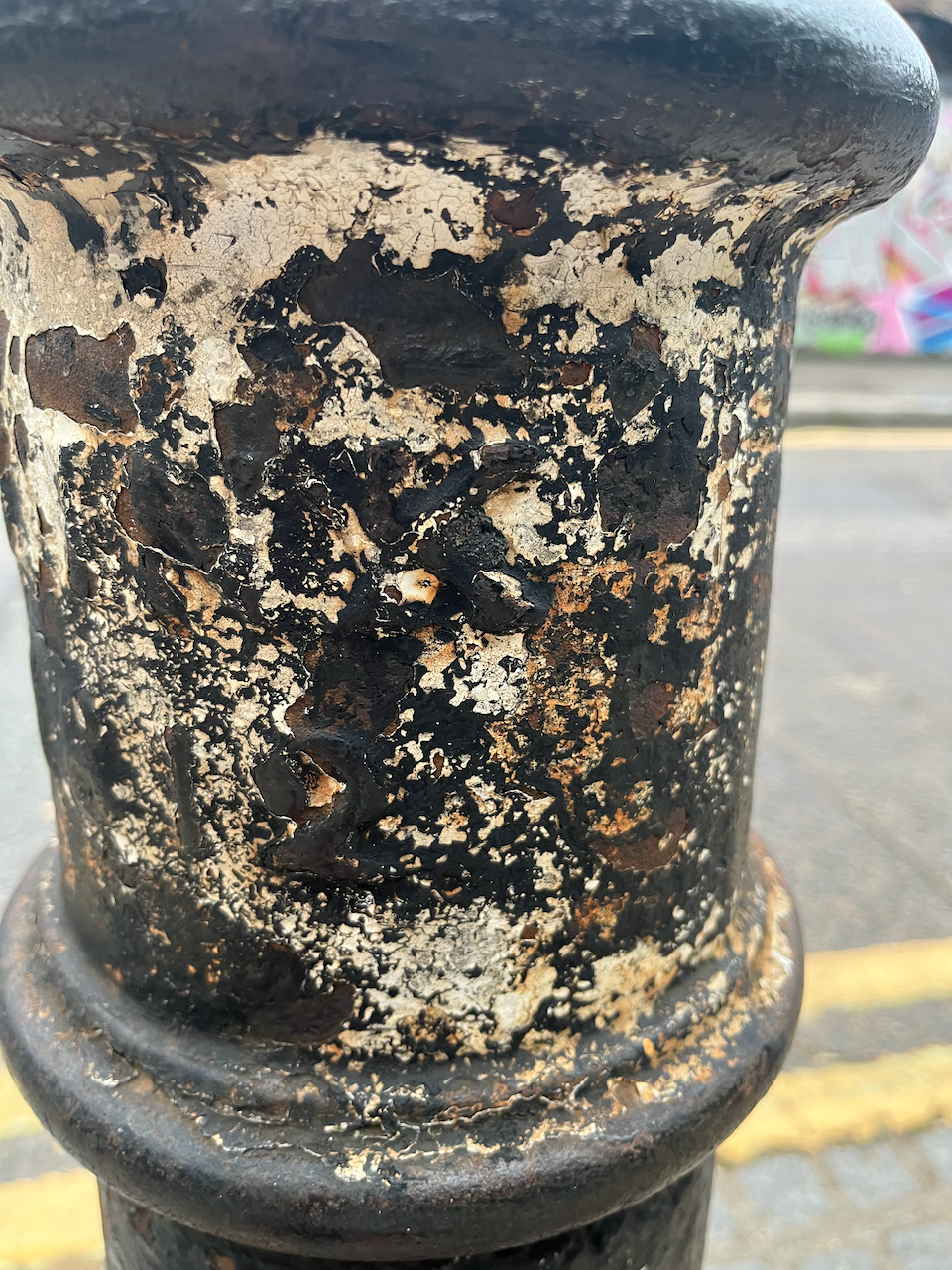
So I had to go back and have a closer look at them. Why were they listed? The list entry does not say. There are some bollards in London which are former cannon. It’s always a delight to discover them. They can be positively identified because you can see the indentation or hole near the base, which is where the gunpowder used to be poured in. Also they sometimes have protrusions about two-thirds down where they used to pivot on their gun-carriage. Sometimes the base is flattened on one side. Here are some examples of cannon (click the image to enlarge and see location):
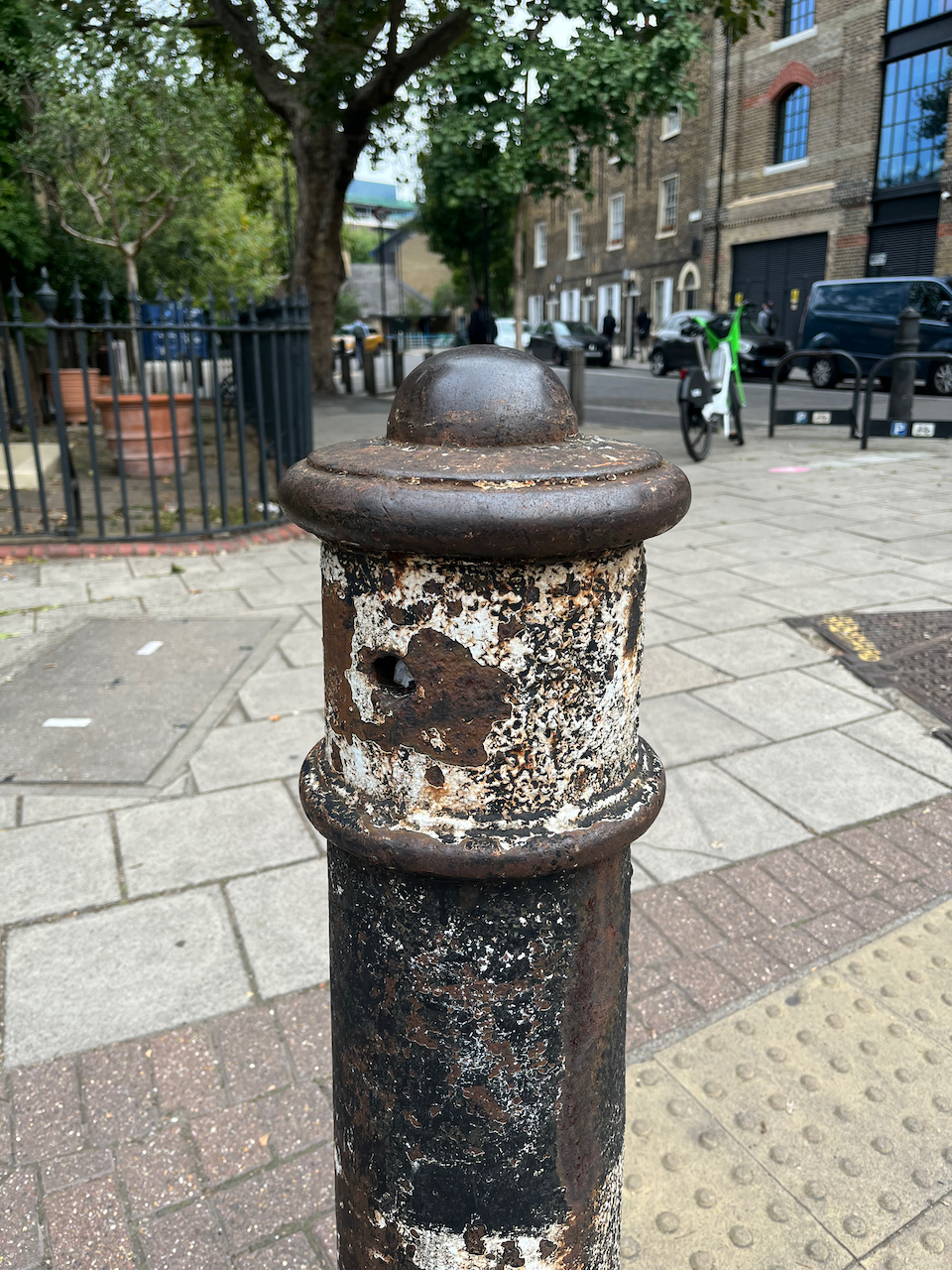
I was unable to find on these 21 Park Street bollards any characteristic which confirmed they might have been cannon. The listing says they are “canon posts” – “canon” spelt like that – not “cannon”. The words “CLINK 1812” were still just about visible on the bollard which is on the right in my drawing. Here are some photos of the posts outside 21 Park Street. Click to enlarge and see captions. Do you think they might be real cannon, or perhaps the word “canon” simply describes a design of post.
“Clink” was the name of the area, from about 1127. It was called the “Liberty of Clink”. The designation “Liberty” implied that it was a civic area under the jurisdiction of the local manor, rather than the King, or the City of London. Famously, certain activities, including theatres, which were forbidden in the City of London were permitted here. The Liberty of Clink was abolished in 1889 and amalgamated into the Southwark in the County of London.
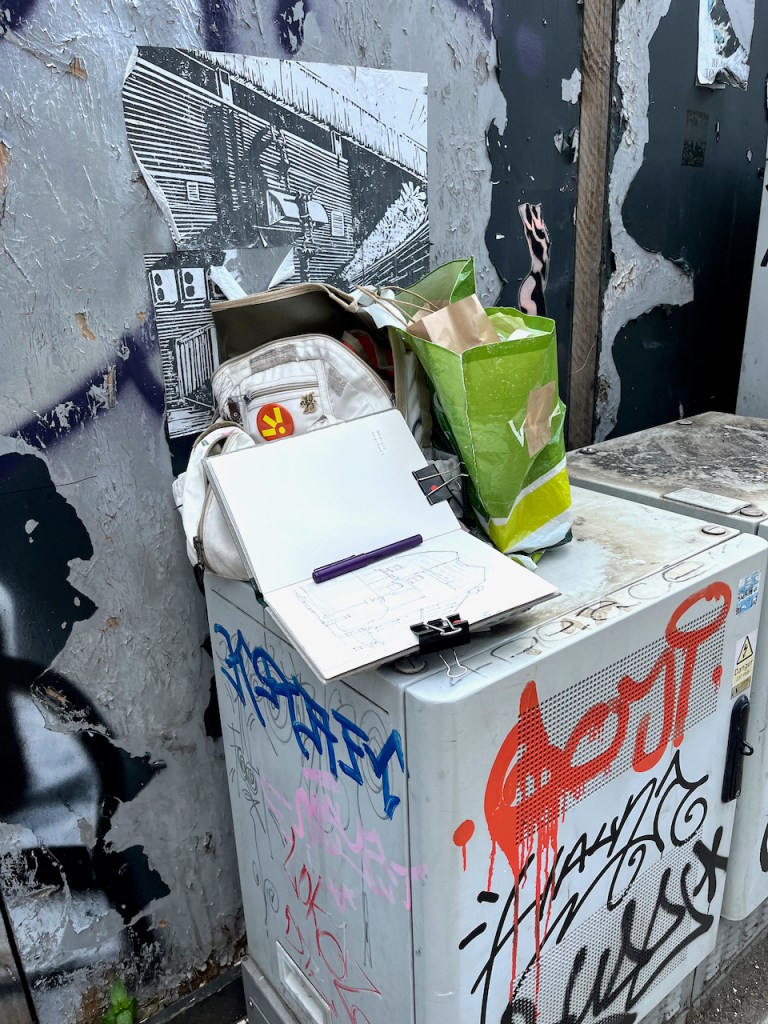
Here are some photos of work in progress on the drawing:
Drawing size 10″ x 8″ on Arches papers 300gsm NOT watercolour paper, in a sketchbook made by Wyvern Bindery.
Watercolours by Daniel Smith:
ultramarine blue
fired gold ochre
green gold
burnt umber
yellow line is naples yellow
All blacks and greys are Ultramarine Blue plus Burnt Umber
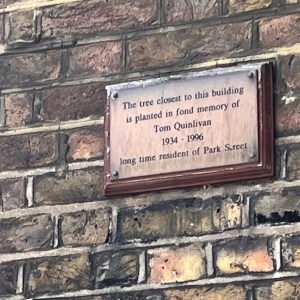
A notice on 21 Park Street reads:
The tree closest to this building
 is planted in fond memory of
Tom Quinlivan 1934-1996
long time resident of Park Street.
Click a button below to share this post online, email it, or print it:
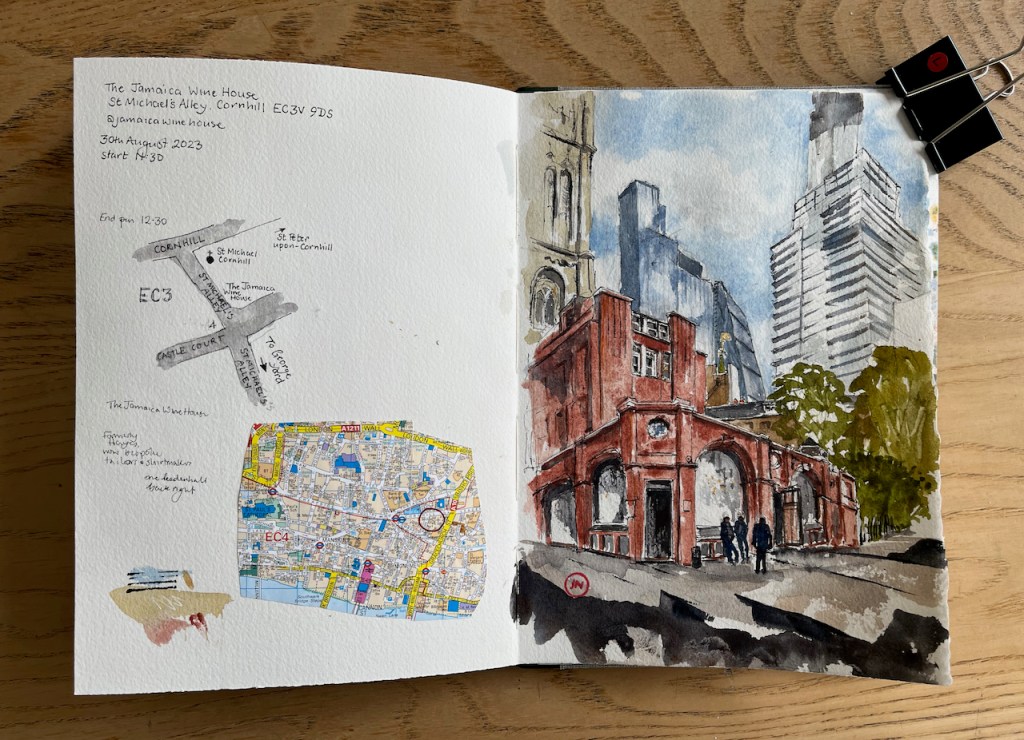
I walked through the City lanes towards London Bridge and passed by the Jamaica Wine House embedded, as it seemed, in a canyon amongst towers.
Jamaica Wine House, 12:30pm 30th August 2023 in Sketchbook 13.
The Cheesegrater and 22 Bishopsgate are the office blocks in the left background and One Leadenhall is under construction on the right.
This is a very old part of the City. Although some buildings have changed, the road layout still retains something of the feeling of Dickensian London. There has been a pub or coffee house on the site of the Jamaica Wine House since 1652. The current building dates from 1868 according to the Historic England List Entry (number 1079156).
Off the picture to the left is MacAngusWainright bespoke tailors and shirtmakers, at number 4 St Michael’s Alley. This shop used to be John Haynes&Co, the jewellers.
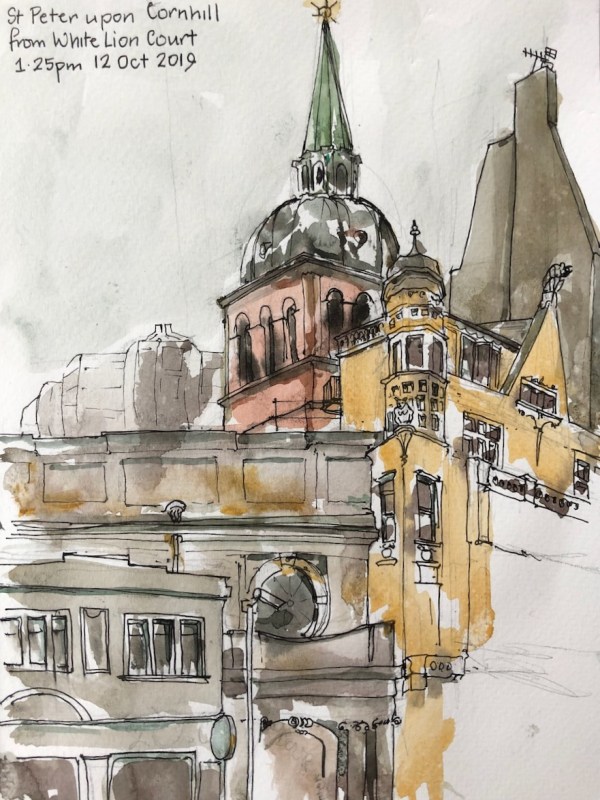
St Michael Cornhill is visible to the left in the background, and you can just see the weathervane on St Peter upon Cornhill in the centre of the picture.
My drawing of St Peter upon Cornhill is in this post:
I went out to look for more gas lights in the City. There was rain, and the back alleys were wet. I couldn’t find any more gaslights. At the South East extreme…
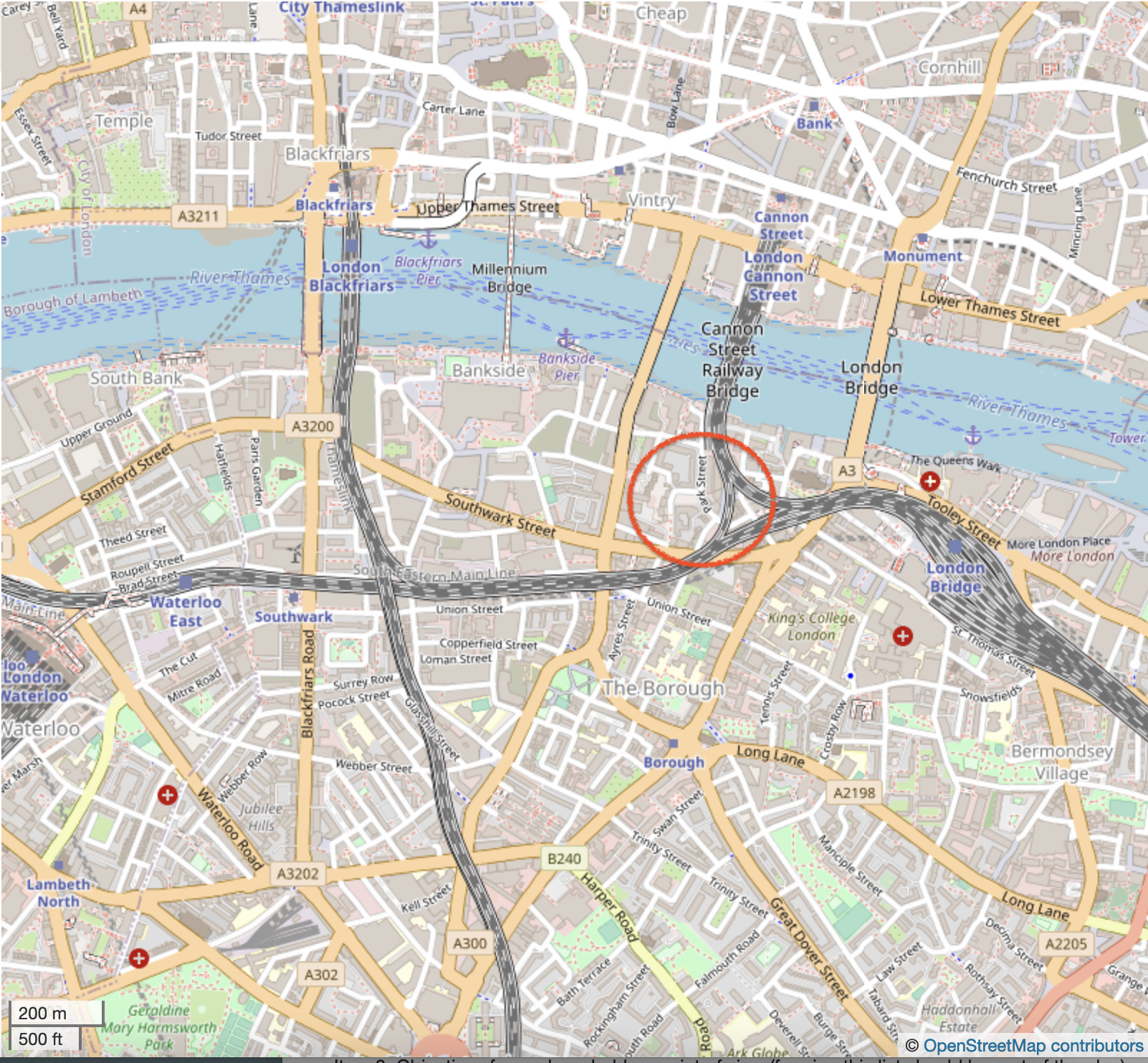
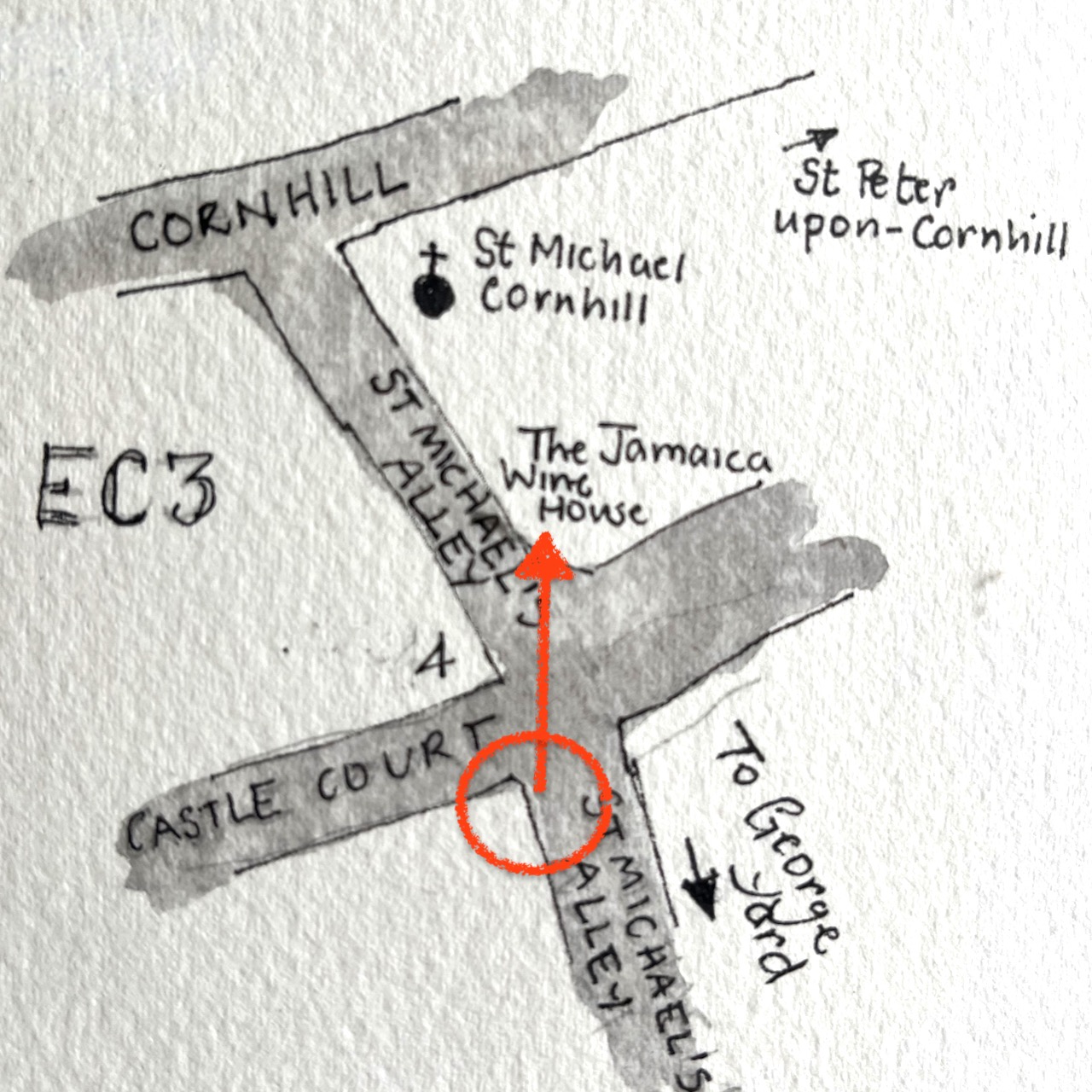
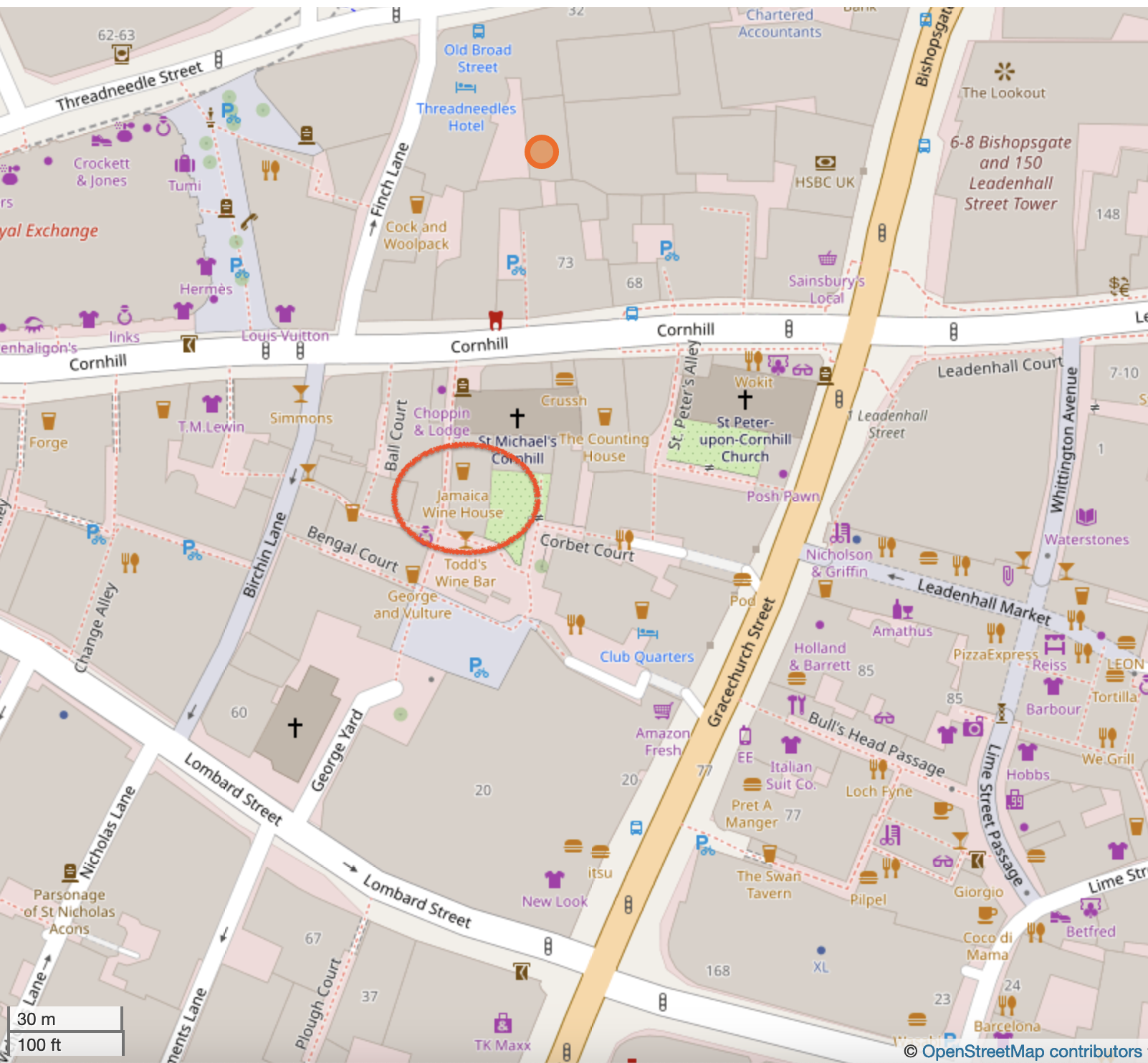
Location of the Jamaica Wine House in the alleys between Lombard Street and Cornhill. (Map (c) OpenStreetMap contributors)
The picture took an hour on location and I finished it at my desk.
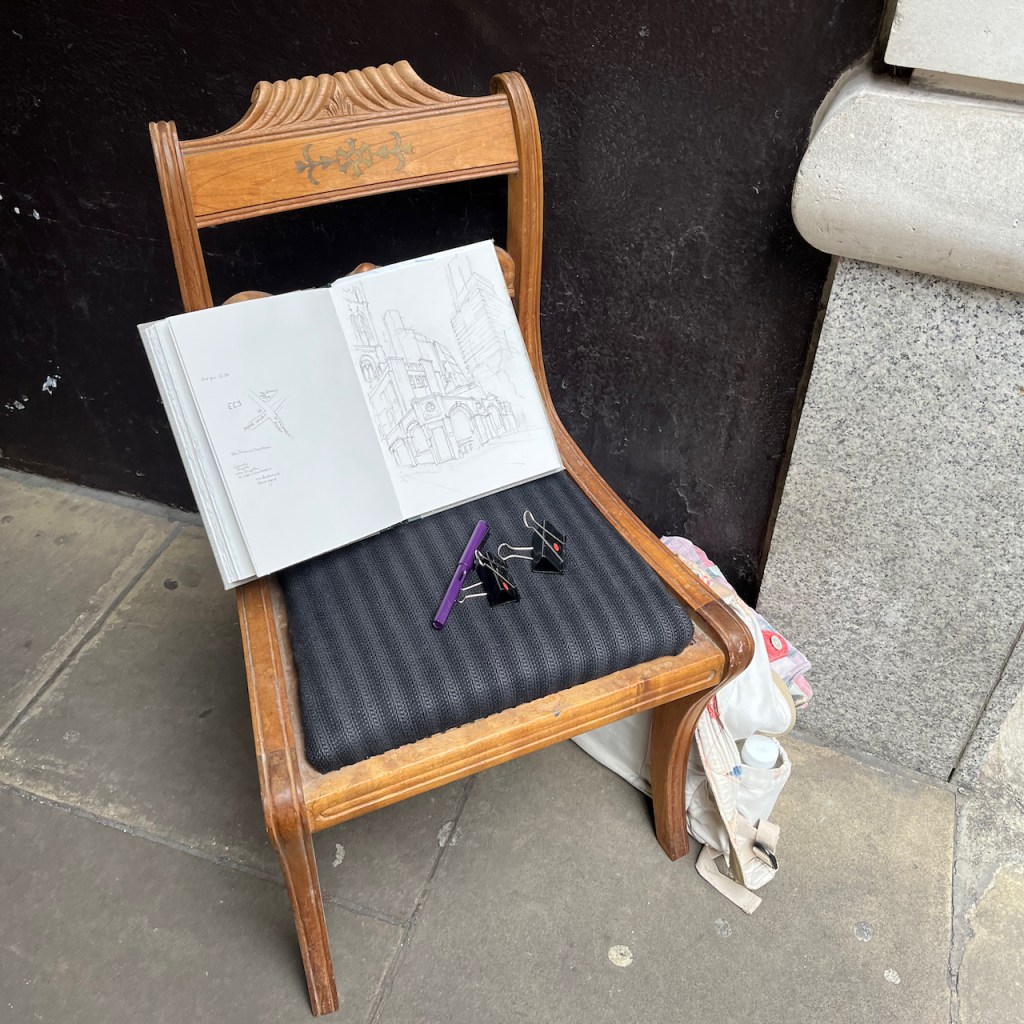
Chair kindly lent by MacAngusWainright
The colours in the picture are:
Fired Gold Ochre – my go-to colour for brick and sandstone
Ultramarine blue, Lavender, and Cerulean Blue for the sky
Burnt Umber in the sky
All greys and blacks are Ultramarine Blue with Burnt Umber
There’s a bit of Iridescent Gold on the weathervane of St Peter upon Cornhill
The trees in St Michael’s garden are Serpentine Genuine with some Permanent Yellow Medium.
St Michael on Cornhill is Buff Titanium with some Burnt Umber and Ultramarine Blue.
Done on Arches 300gsm NOT watercolour paper in a sketchbook by Wyvern Bindery, Hoxton. Thank you to McAngusWainwright, city tailor, for the kind loan of the chair.
Click a button below to share this post online, email it, or print it:
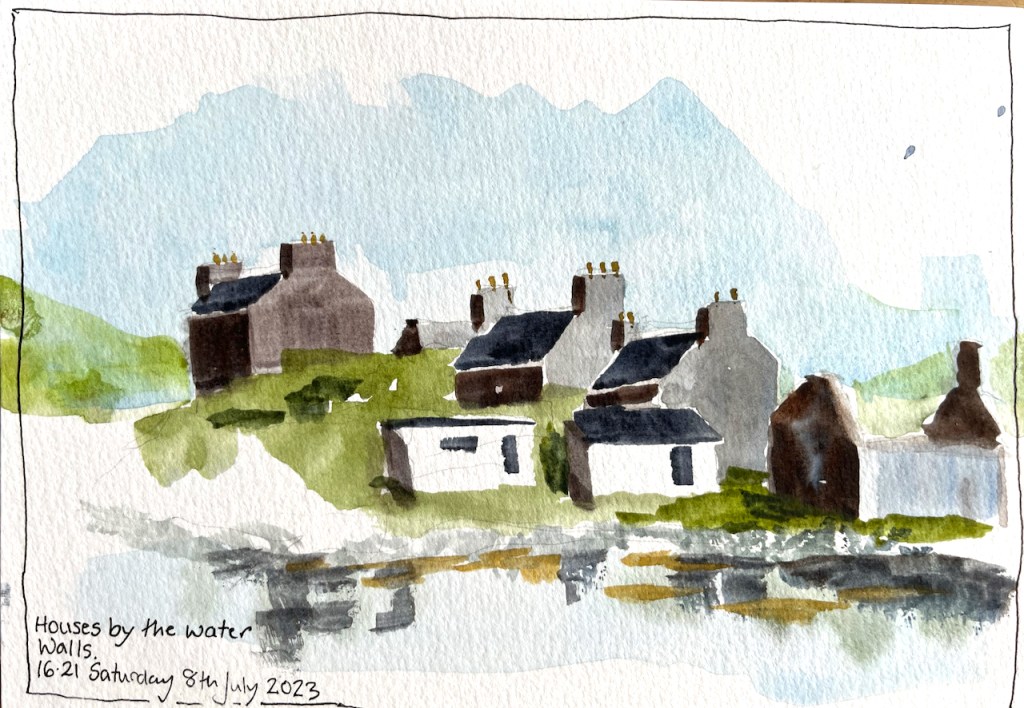
Here is a postcard which I made at the end of a long hot walk. It shows the houses in Walls, on Shetland West Side.
Houses by the water, Walls, Shetland. Postcard sketch A5, 8th July 2023
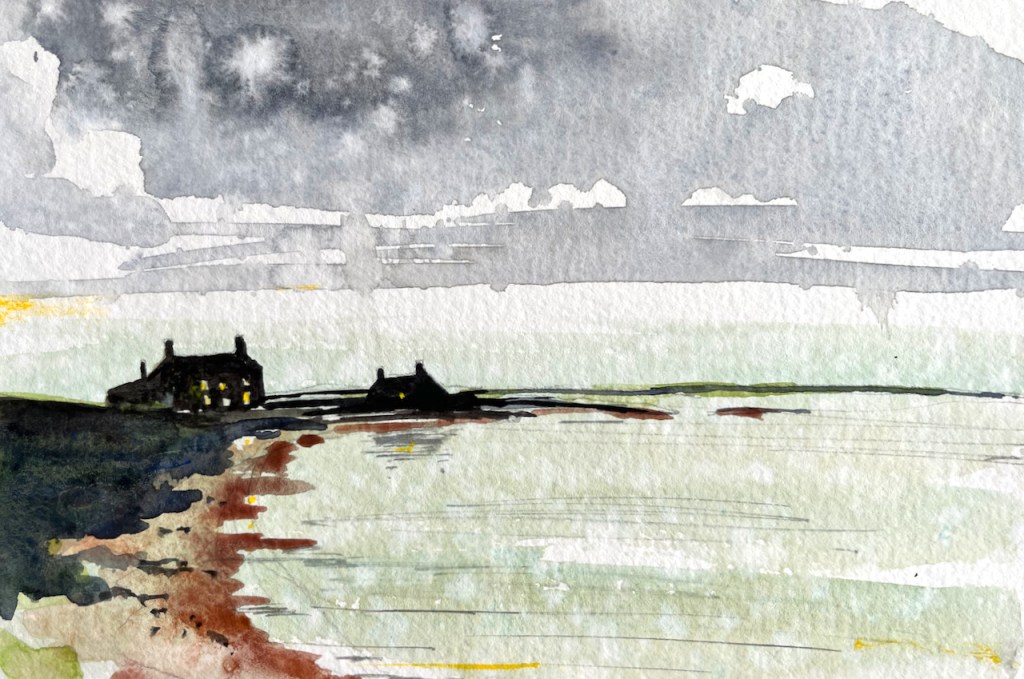
Here is Burrastow House and Burrastow Cottage, an evening view. I sketched this on top of a sky view I’d sketched earlier, but which had been spotted by rain, as you see.
Burrastow House and cottage, evening view. A5 postcard.
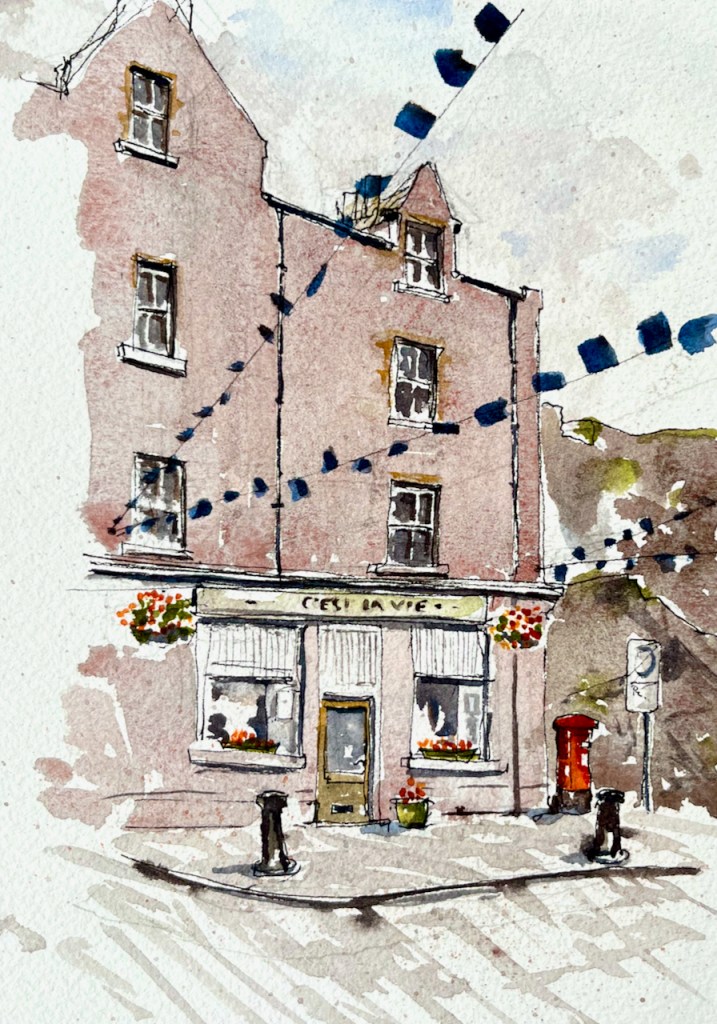
This is a restaurant in Lerwick: “C’est la vie”.
“C’est la vie” French restaurant, Lerwick, postcard sketch A5, August 3rd 2023
The flags are to welcome the “Tall Ships” which came to Lerwick earlier in the week. The restaurant was closed, I was waiting to see if it opened. Then the rain started. Then the restaurant opened and I finished the sketch inside. Then I walked to the Ferry Terminal.
On the ferry, I made quick sketch of people at breakfast.
On board MV Hrossey, approaching Aberdeen. Breakfasters in the lounge. August 4th 2023. Vintage paper company sketchbook, A5
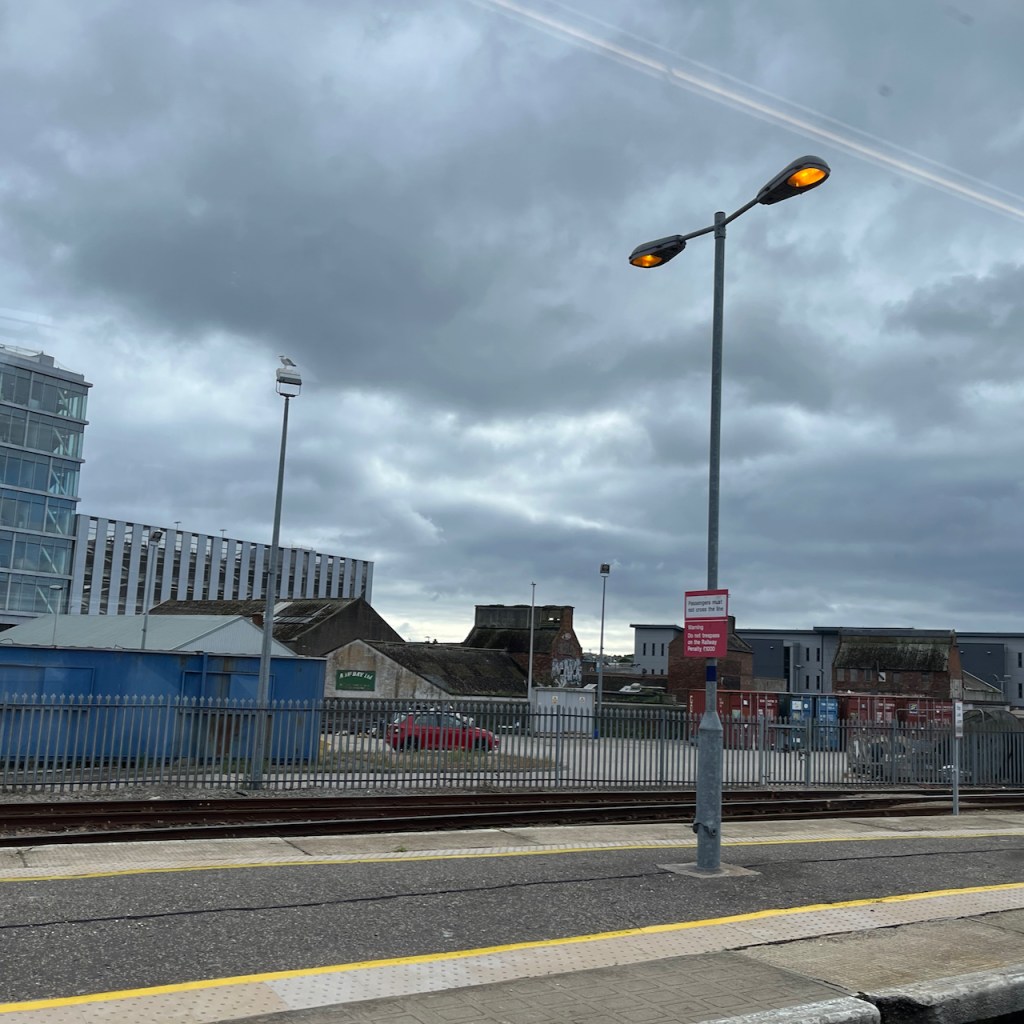
Here is my final sketch of the expedition. On the train at Aberdeen, I looked out of the window.
Sketch: from the train, Aberdeen, Aug 4th 2023Photo: view from the window.
I have a sketchbook full of images. Here’s a quick flip through showing random glimpses of the visit: (19 second silent video)
Click a button below to share this post online, email it, or print it:
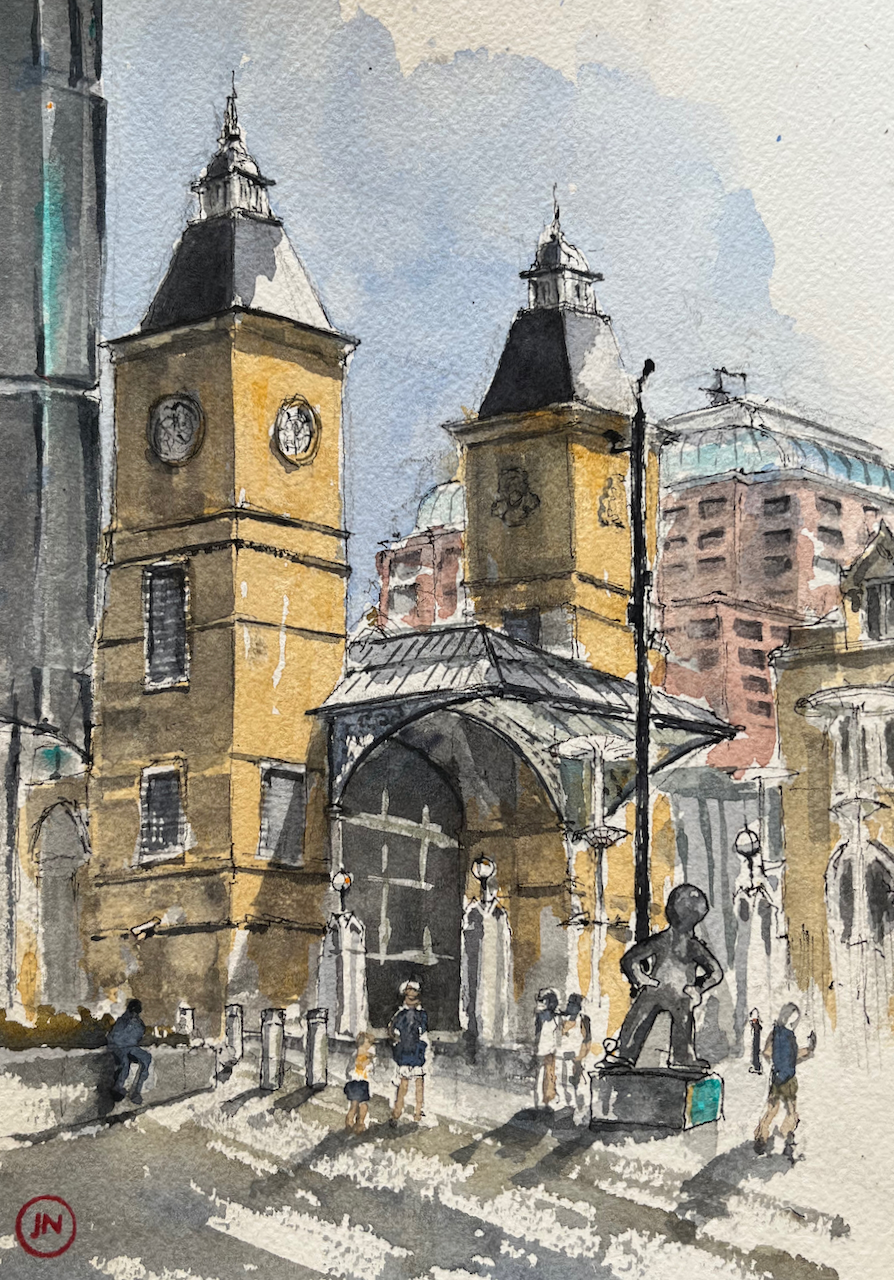
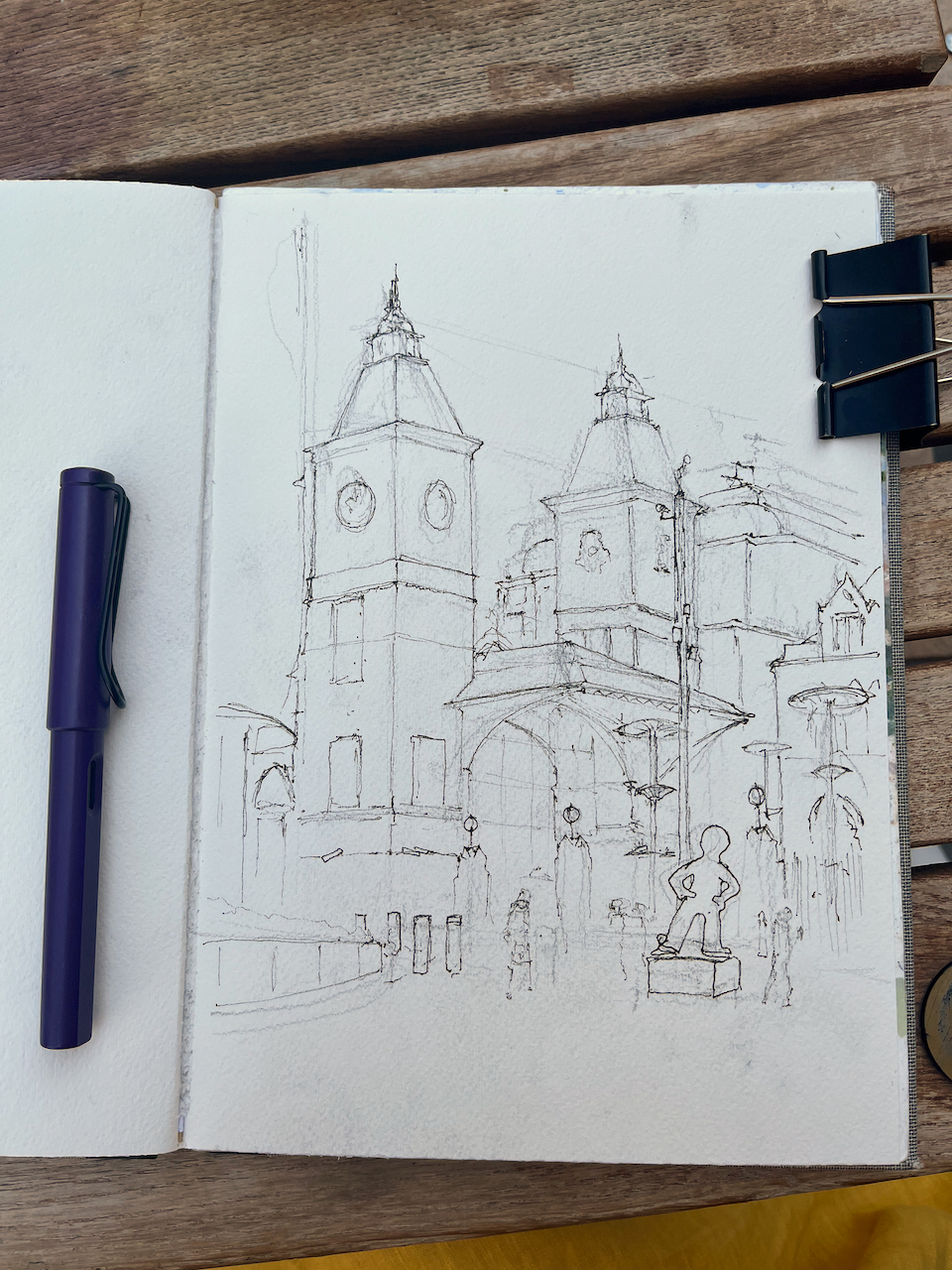
Here is Liverpool Street Station, main entrance, sketched today from outside the “Railway Tavern”.
Liverpool Street Station, 25th June 2023, 1pm. 8″ x 10″ in sketchbook 13.
The humanoid figure on the plinth is Morph, part of a temporary art trail.
The area in front of the main entrance is like an art installation in itself, a collector’s assembly of street furniture: two different types of bollards, long ribbons of fencing, several species of street lamps, and that enormous CCTV stand which is just behind Morph. It’s surprising that people can find their way into the station in amongst the obstacles. I haven’t drawn them all.
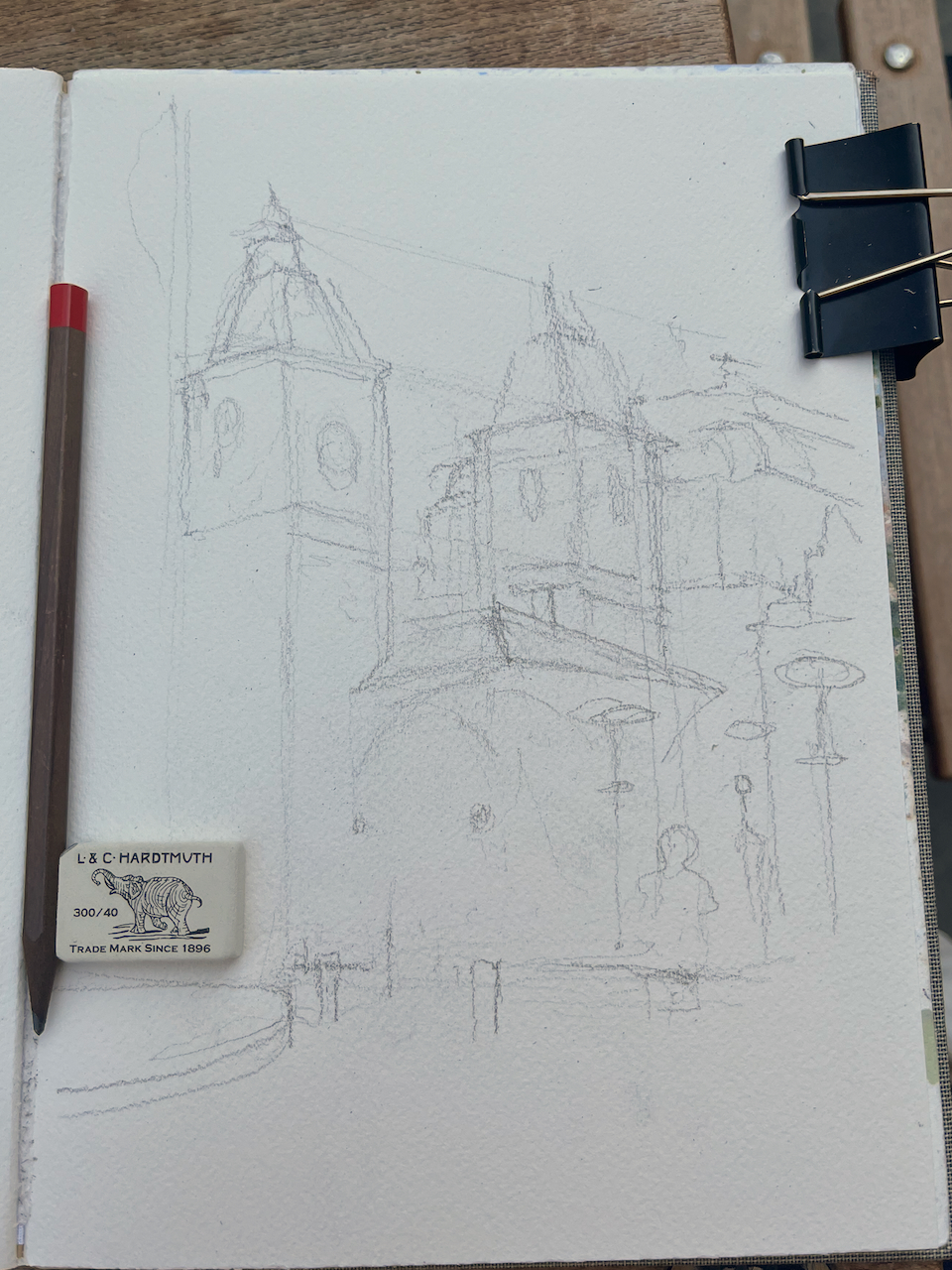
Here’s work in progress on the sketch:
PencilPenThe viewColour
This section of Liverpool Street Station was built in 1875 as the new London terminus of the Great Eastern Railway. The building on the right of my drawing is the edge of the former Great Eastern Hotel (1884), now the Andaz London Liverpool Street. The pink building in the background is an office block on Bishopsgate.
Map: (c) OpenStreetMap ContributorsSketch map
I’ve sketched in this area before. This post contains more information about the history of Liverpool Street:
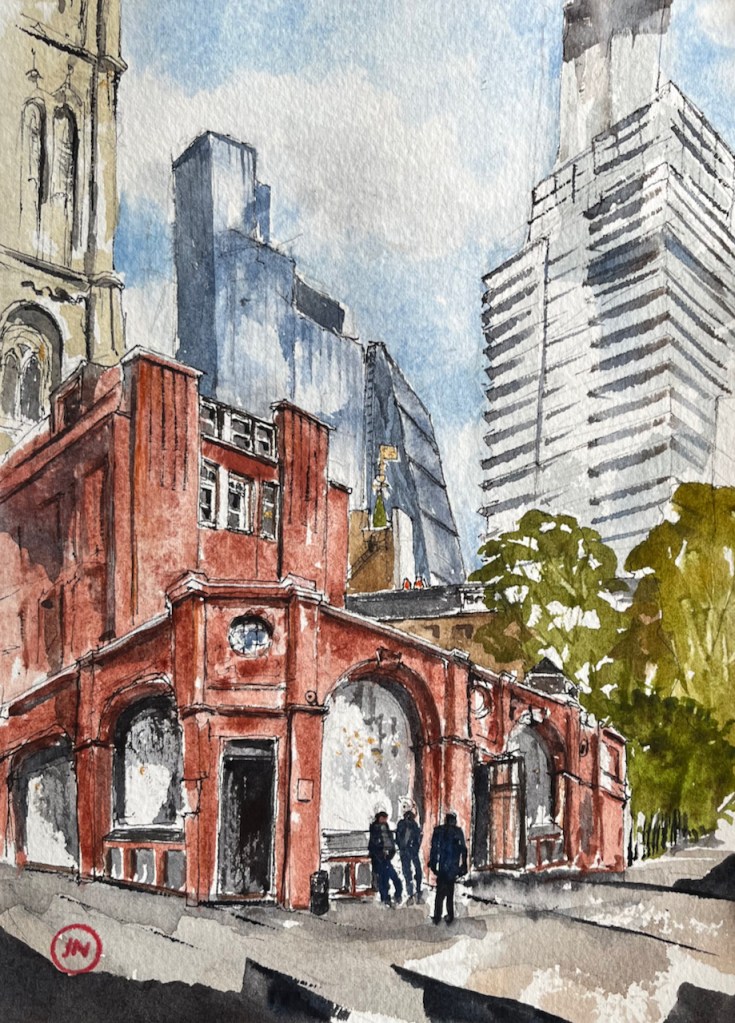
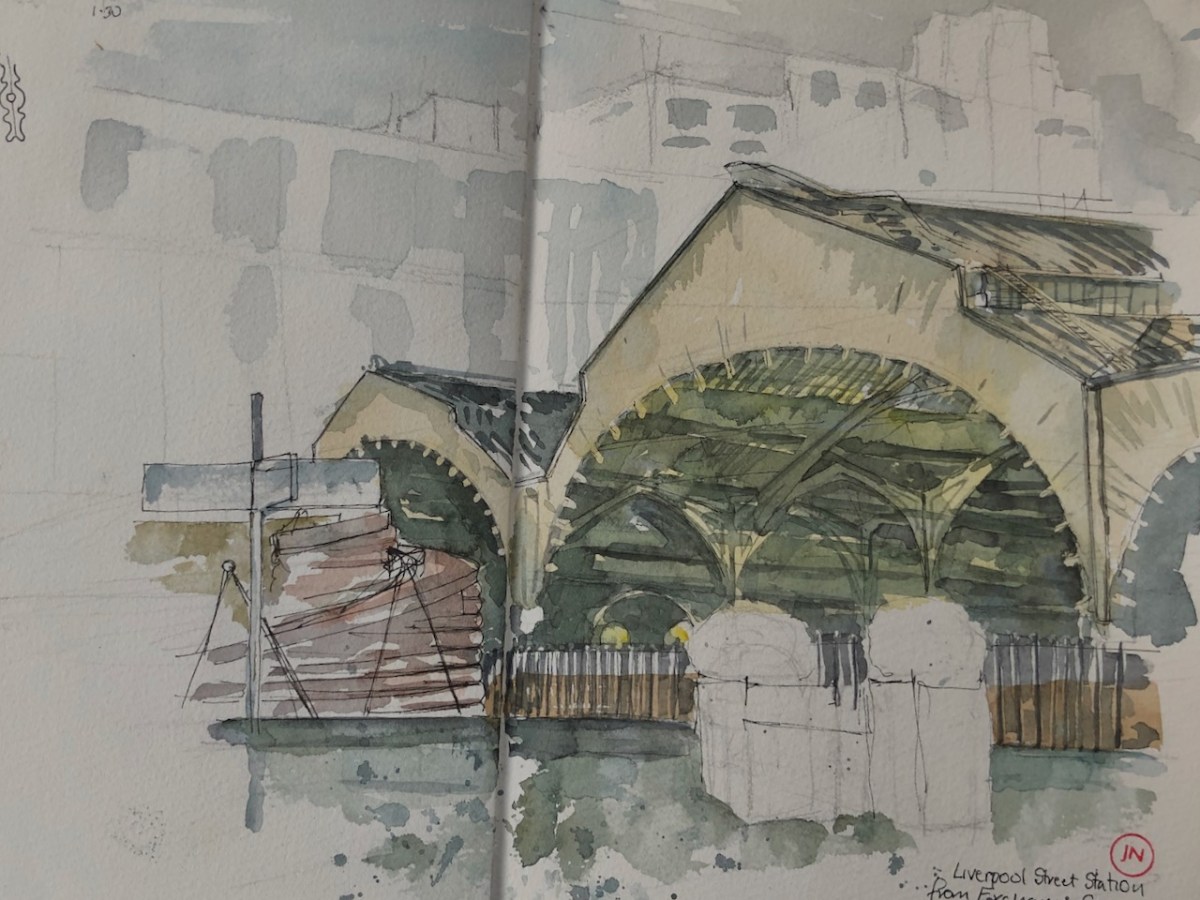
Here are the magnificent 19th Century arches of Liverpool Street Station, seen from Exchange Square. Liverpool Street Station opened in 18751 Now the question is: what curve is that arch? I thought it might be a CYCLOID. A cycloid is the shape made by a dot on the edge of a rolling wheel. I made…






























 Jane Sketching