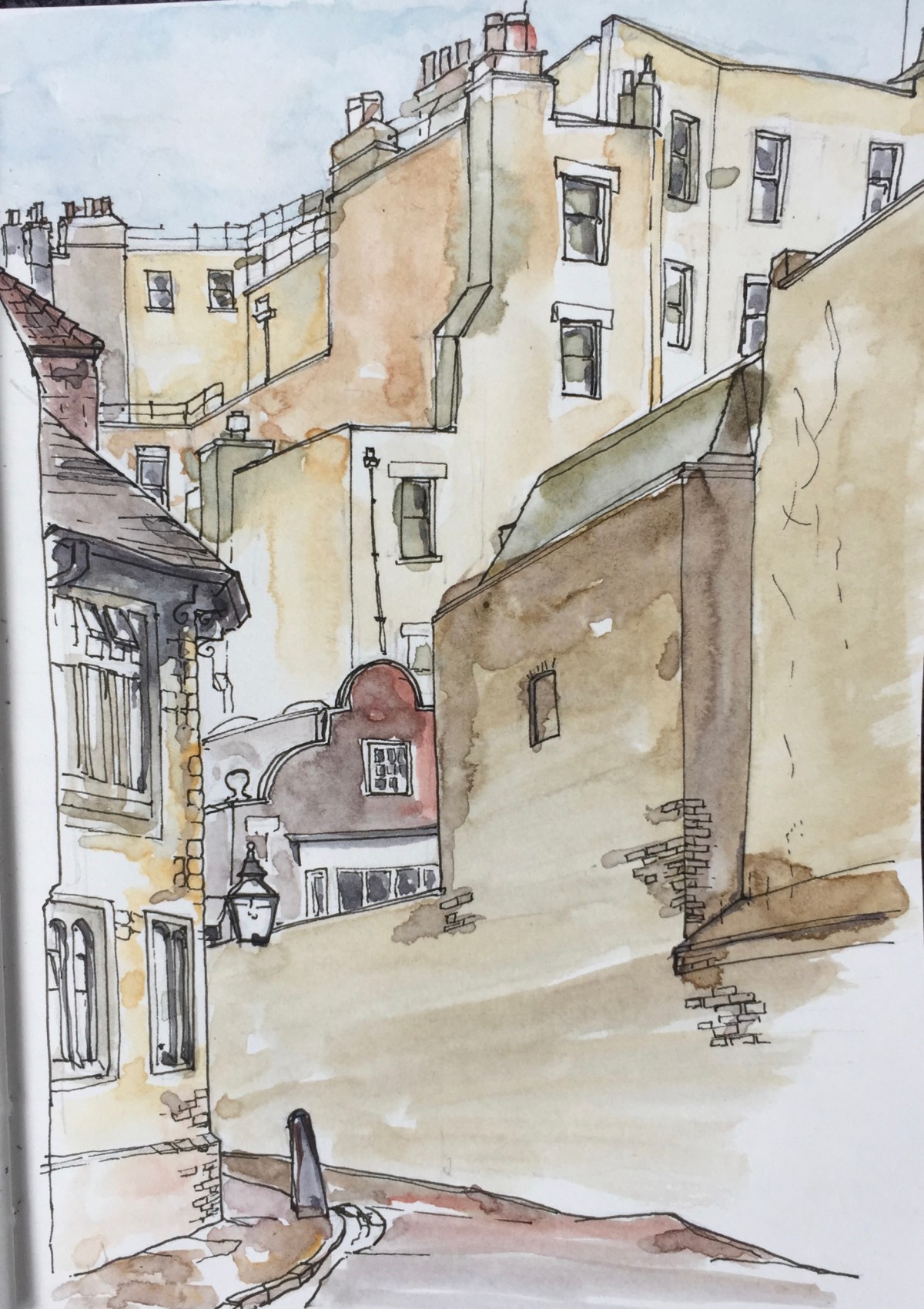
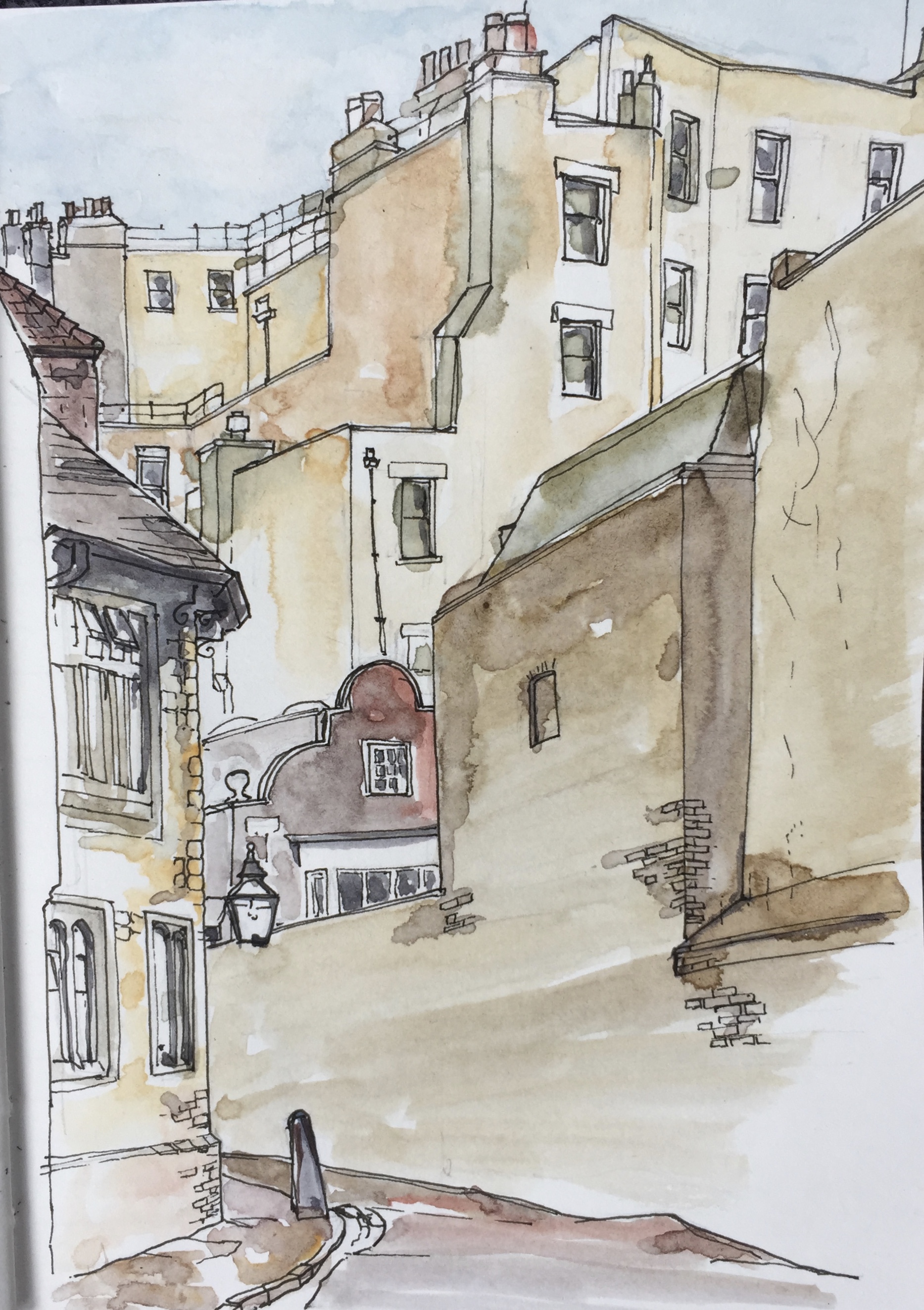
Here is a sketch looking towards the Main Gate of The Charterhouse. The building with the curved gables is now the Pavior’s House, which is occupied by the Pavior’s Livery Company:
The Worshipful Company of Paviors moved into a new home in 2010. The Company has a long lease on a Grade 1 listed property formerly known as ‘The Master’s Cottage’ at Sutton’s Hospital in the Charterhouse. The property has been refurbished and is now known as Paviors’ House. – From the website of the Worshipful Company of Paviors, 14 Sept 2017.
Pavior means one who lays paving stones, and the modern livery company retains links with the paving industry.
This drawing was a lot more difficult than I expected. I was very pleased to get all the high walls in the background onto the one page. I liked the way they tower above the lower buildings. And all the architecture is different periods. The Tudor buildings of Charterhouse are on the left.
The drawing took 2hours45minutes.
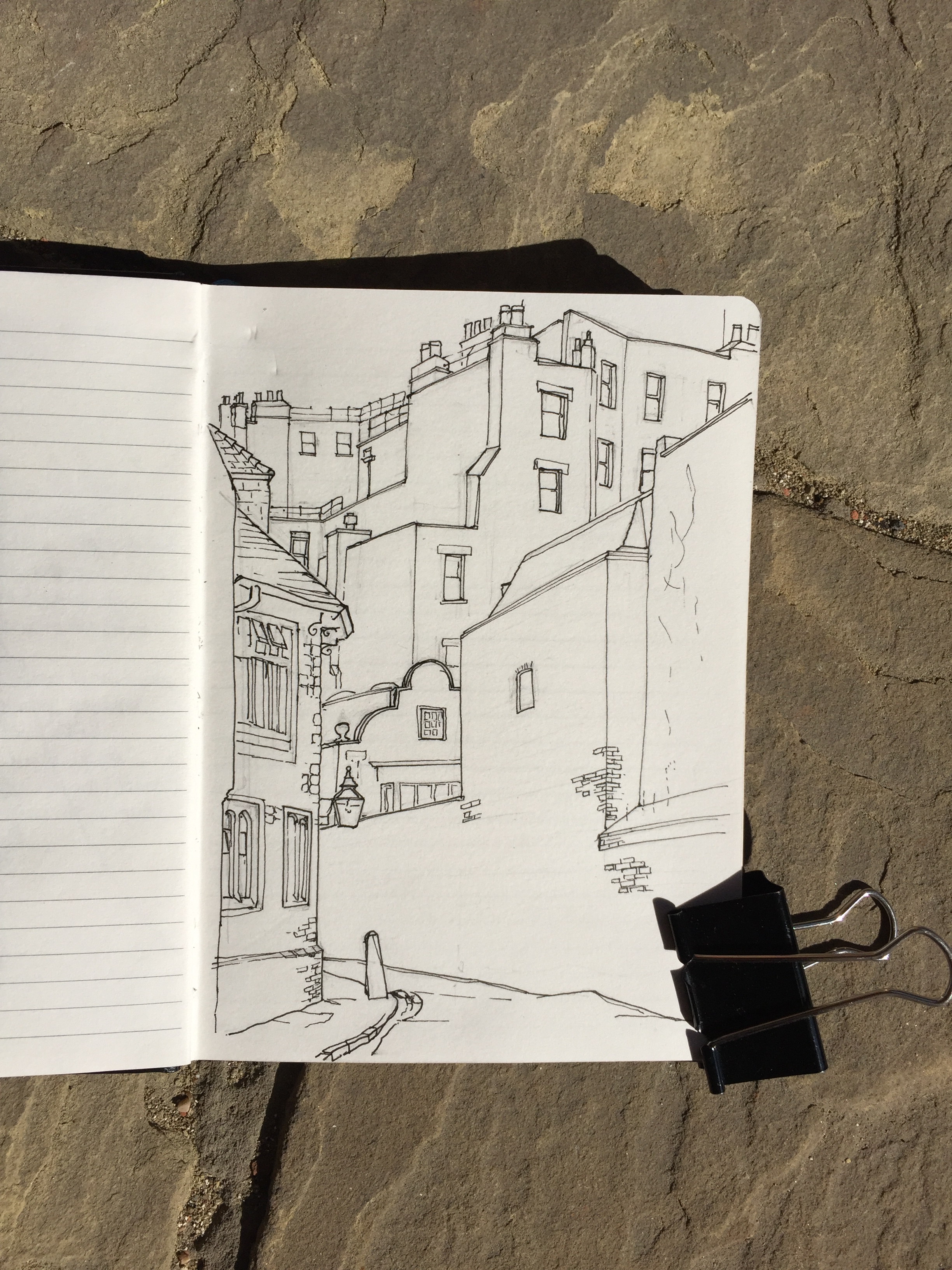
Here is what it looked like before I coloured it:
Charterhouse have now created notecards using my pictures.
Click a button below to share this post online, email it, or print it:
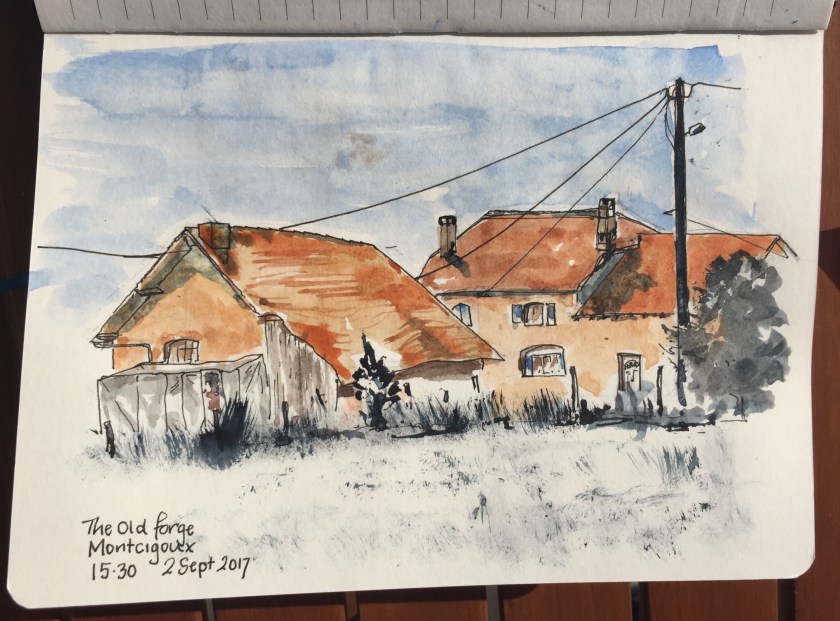
The red tiled roofs are a characteristic of the area. The low roof of the Old Forge is rickety. Mme Sauté cultivates tomatoes in the plastic greenhouse on the left.
Here is Steve’s house. His Audi is parked conspicuously, because he is expecting a visitor, and he told them to look out for the car.
See all the overhead cables. There is a plan to put all these underground: both the electricity and the telephone cables.
On the Sunday I set out to draw a picture of the Old Forge from another angle. An elderly man trundled his walking frame all across the grass to come and talk to me. He described how Steve’s house had previously been the grocer, café and ballroom. There were dances there. The man had a long career. He was the son of the gardener in the château. He had installed electricity in the local town, Limoges. There was a whole narrative about the maquis, which word I couldn’t understand in context. I knew it was a description of the land in the South of France: the dried out grass and low bushes. Then, as he was talking, I remembered it was also the word for a fighting force. He had fought all the way up to La Rochelle. This was Resistance fighters in the Second World War.
I had managed only the pencil outline of my picture.
I finished it on the Monday. By then it was raining.
I have been trying to find good views of Rahere and Kestral Houses, two Towers of Finsbury which I can see from my window.
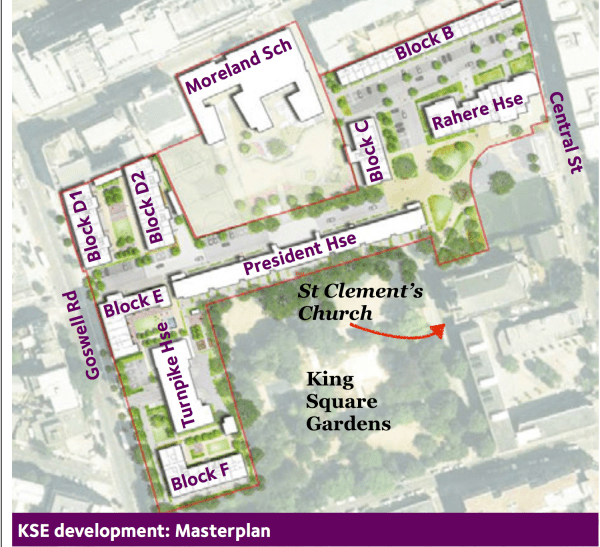
From “King Square Estate Regeneration, Summer 2015 Issue 4” by Islington Council.
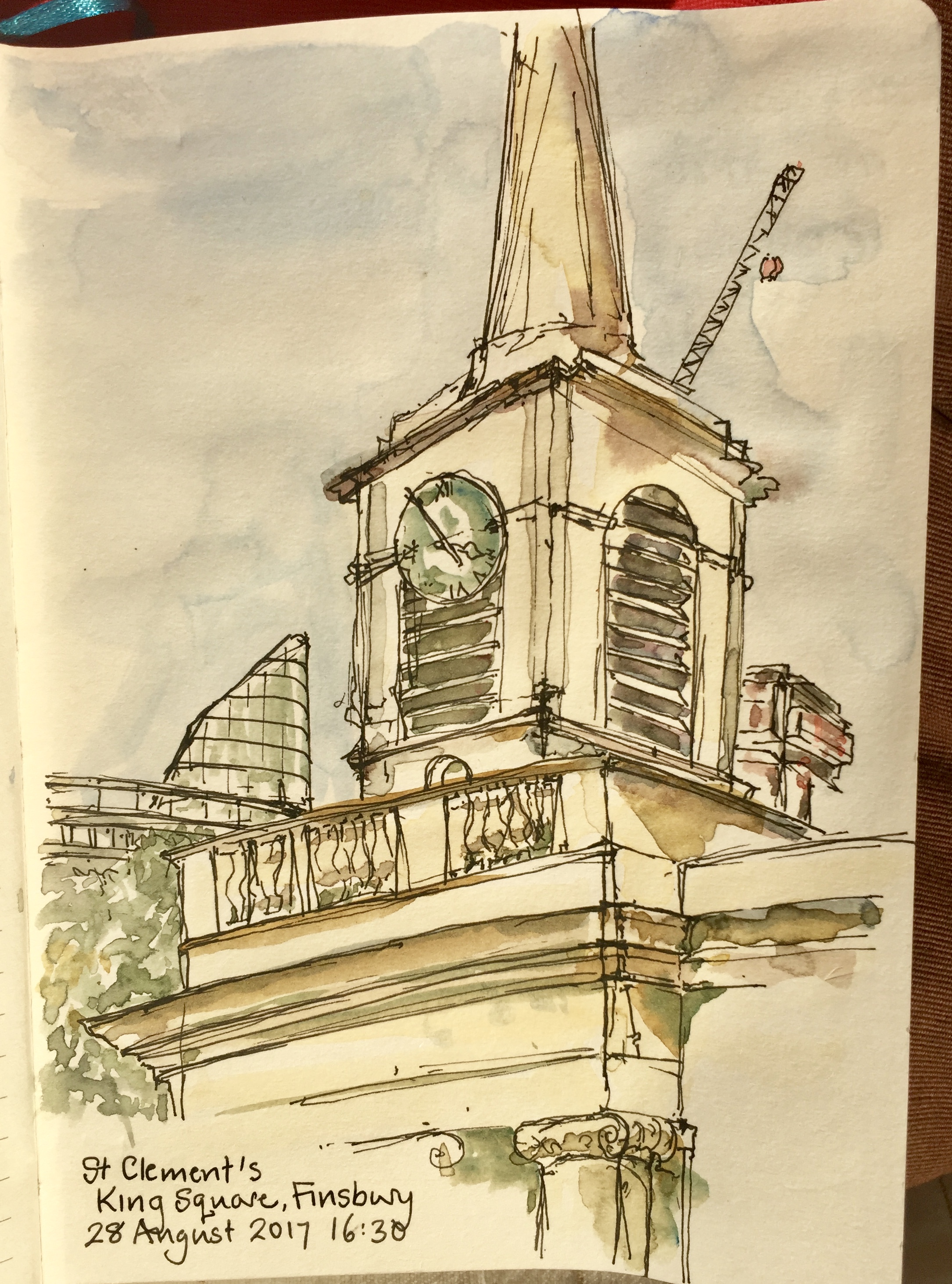
Rahere is in the King Square Estate. This estate was built by Islington Council in 1959-61. The architects were Emberton, Franck and Tardew. Franck had worked for Tecton, the firm who designed the Spa Green Estate. King Square Estate is currently subject of improvements including addition of new dwellings.In between all the blocks is St Clements Church.
Rahere House is just visible to the left. The new tower, Lexicon, is above it on the left. Carerra House, of the 250 City Road development, is under construction, visible to the right of the spire.
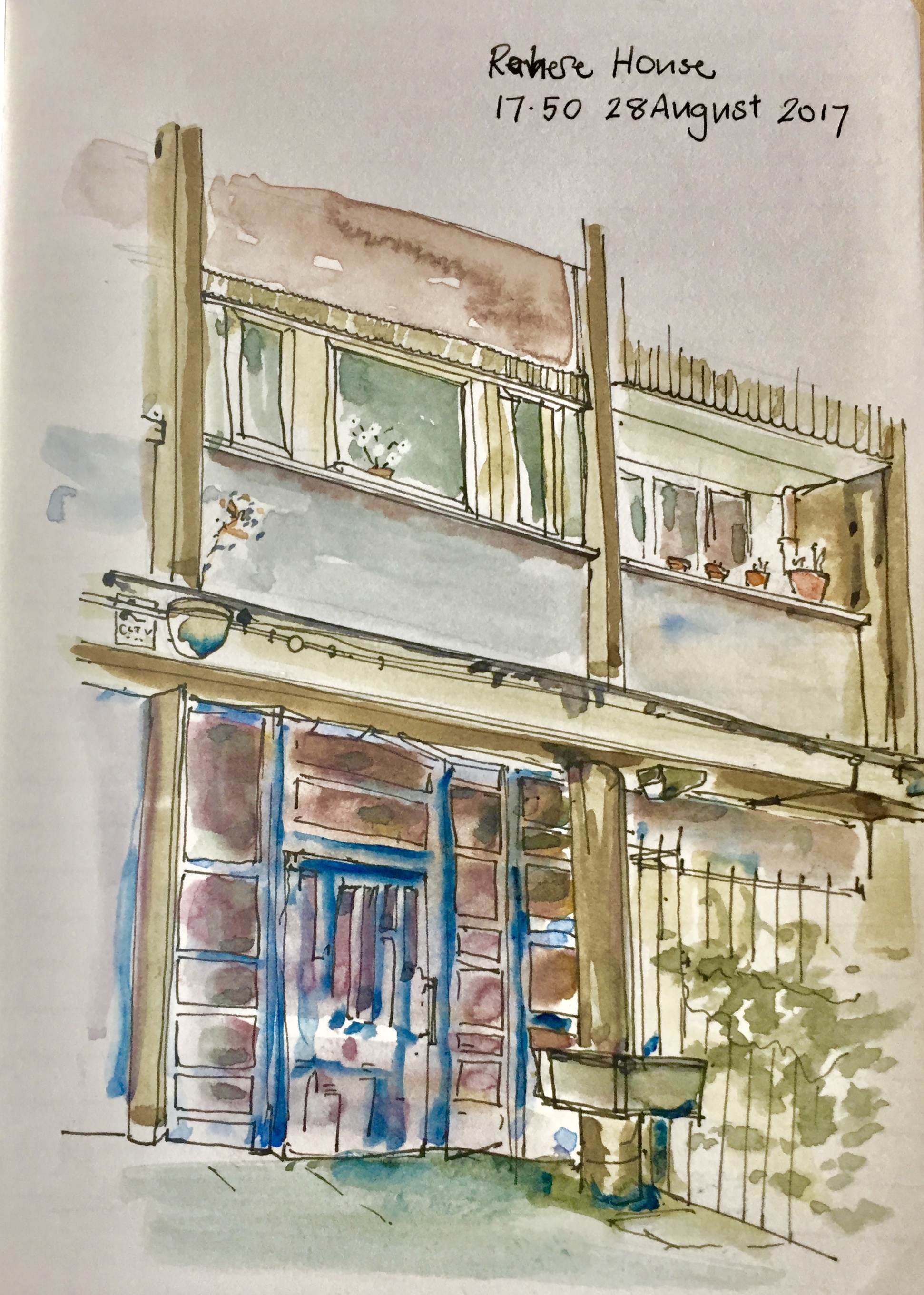
I couldn’t find a distant view of Rahere House, so here is a close-up.
This is one of the back doors. The architects thoughtfully provided lead-lined troughs, at waist height, for flower pots, I assume. One of these is shown in the drawing, to the right of the door. Off the picture to the left, these continue as long boxes, like water-troughs. None of them are used, presumably because the council don’t do flowers and the temptation for vandals is too great.
Instead, residents have their own plants, inside their windows and out on the balcony. See also the feral plant, growing out of the concrete above the door, top left.
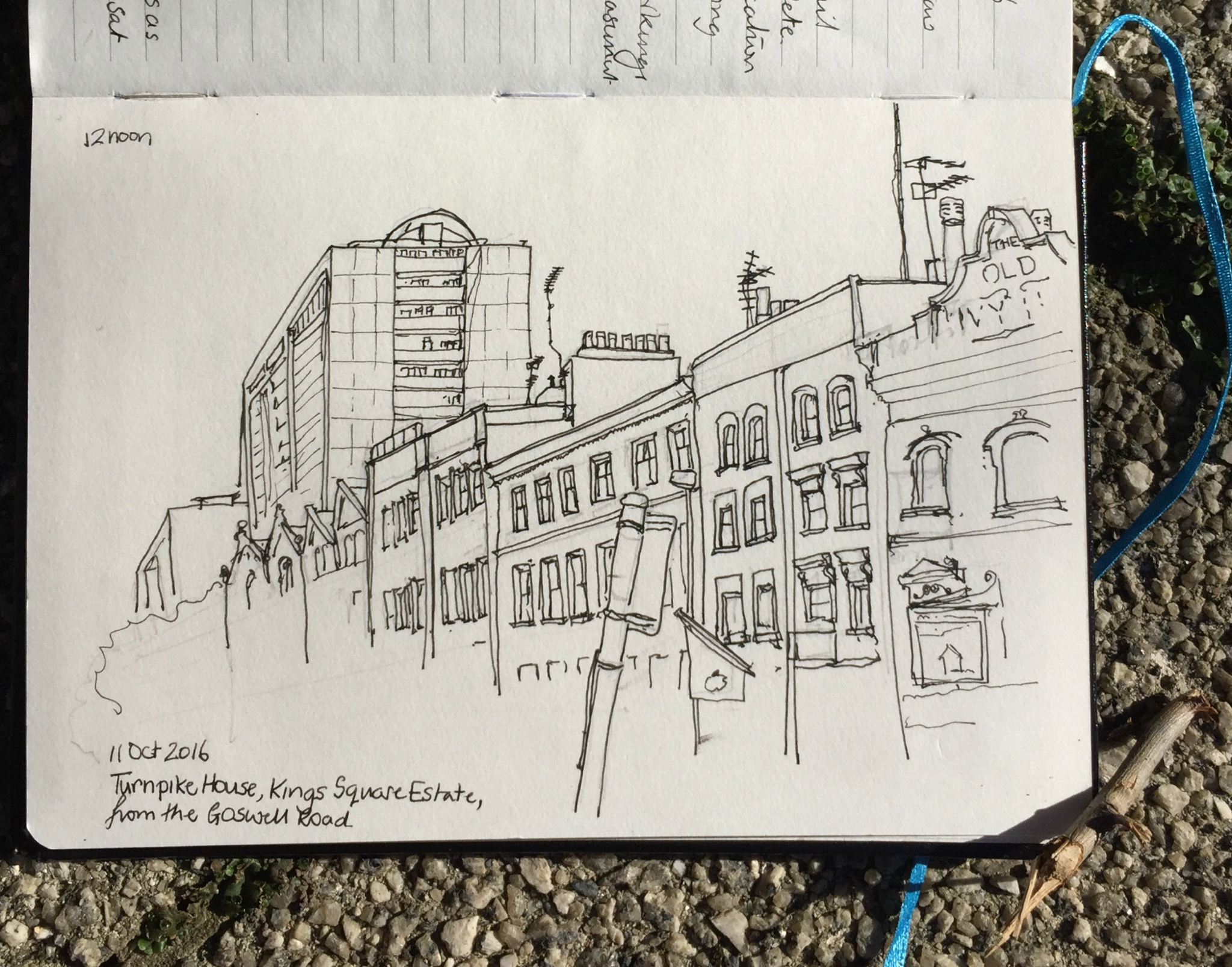
Turnpike House is on the same King Square estate. Turnpike I have drawn before.
Turnpike House, King Square Estate, from the Goswell Road
To the North of Rahere is Kestrel House. This tower is on Moreland Street and City Road. It is currently surrounded by building work associated with the Bunhill Heat and Power. This scheme takes energy from braking Tube trains and uses it to heat local houses and schools.
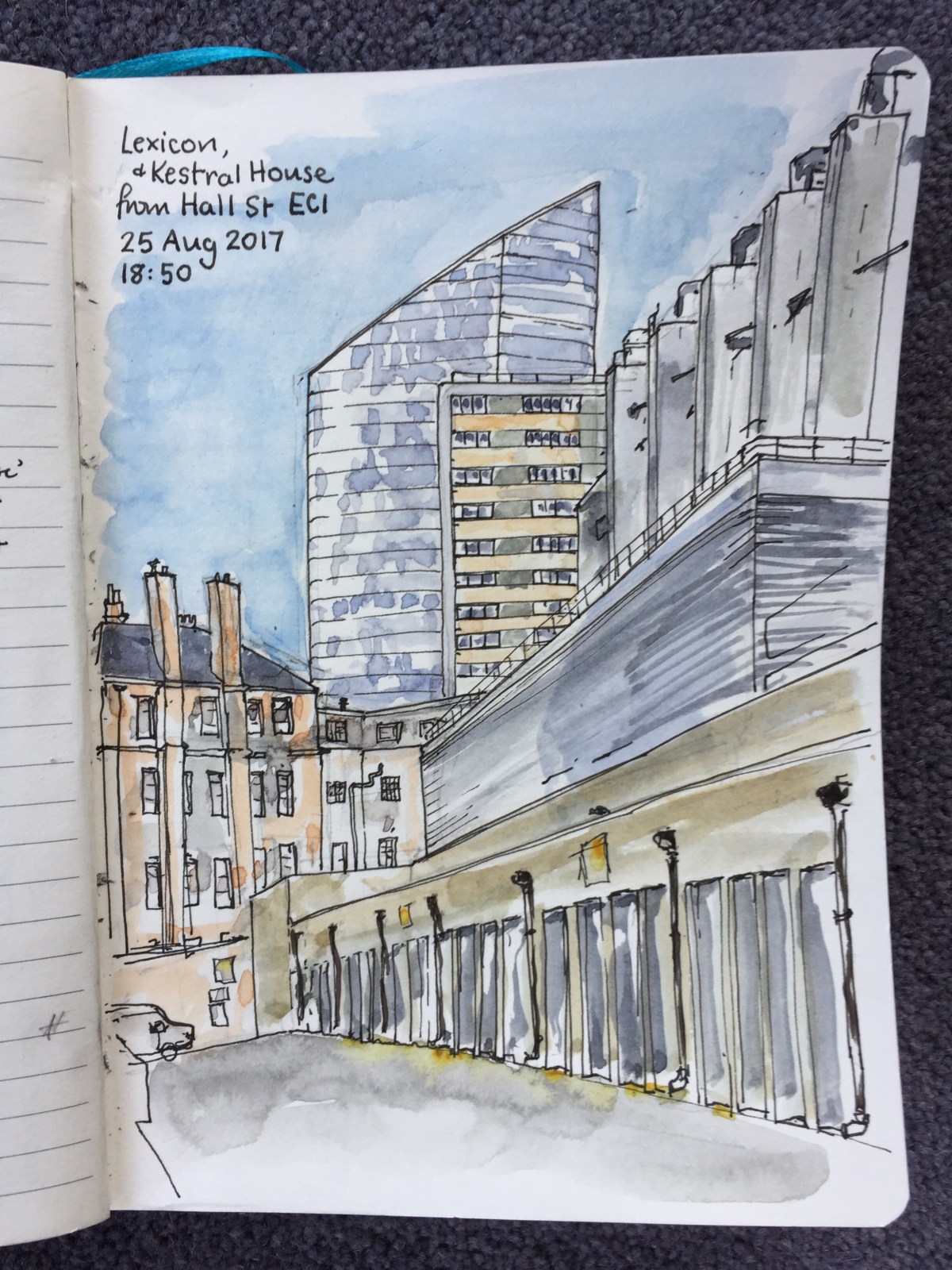
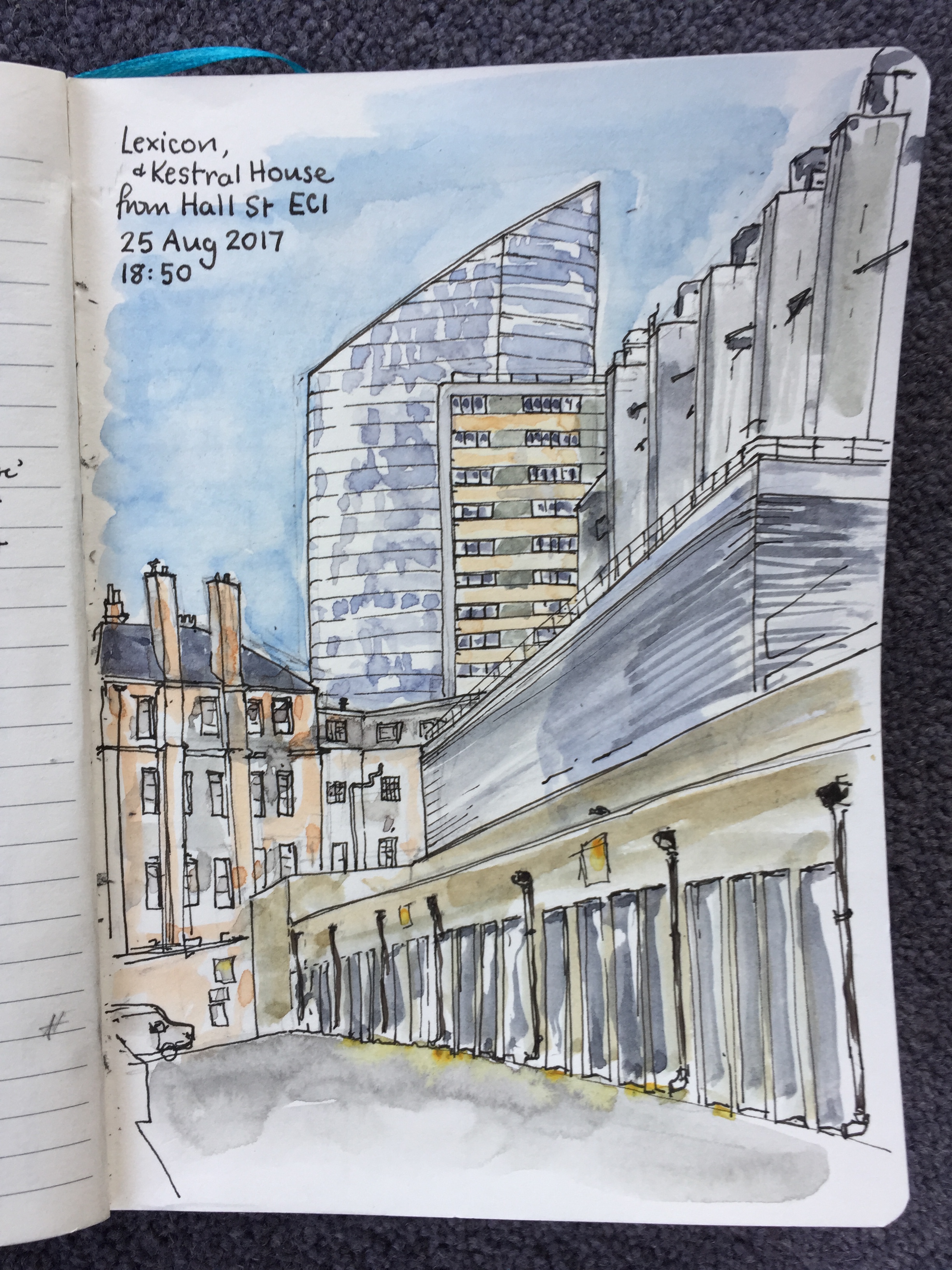
Kestrel House is on the “City Road Estate”. I found a view of of it from Hall Street: it’s the rectangular tower block in the middle. The Lexicon, otherwise known as “Chronicle Tower”, a new development by “Mount Anvil” is the sloping building behind.
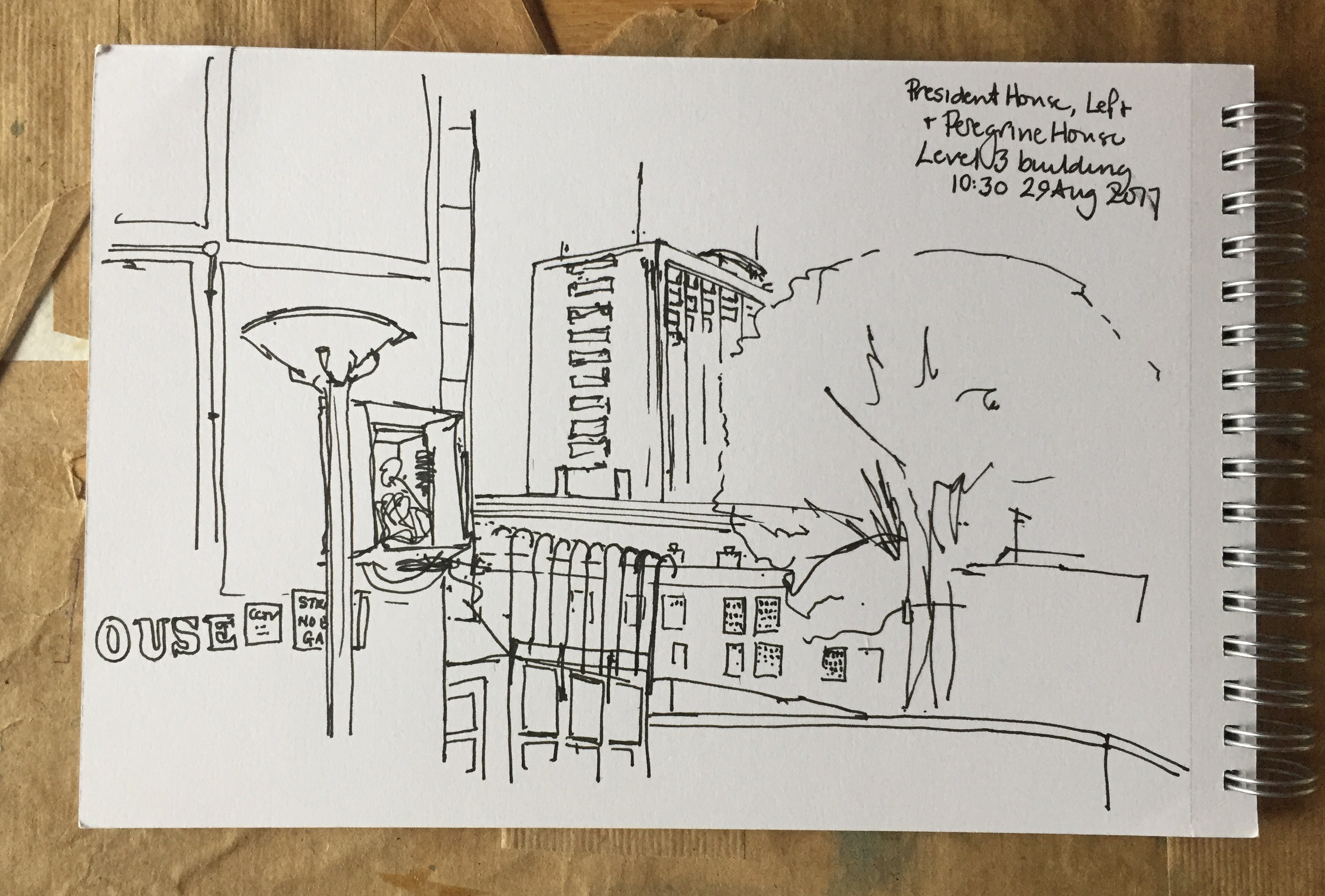
The building which dominates this drawing, on the right, is the premises of “Level(3)”. I walked round the block a couple of times to see what it was. The windows on the street side are high, and there are serious steel shutters over every entrance. Note the huge ventilation shafts. It looks somehow as though it’s ventilating a larger volume than the building, as though it goes down a number of stories below ground. The business of Level(3), according to a web search, is “Connecting and Protecting the Networked World”.
The red-brick building straight ahead was previously “St Marks Hospital Nurses Home”. This is cast into the stone work above a former door on Pickard Street. The door is no longer in use, and fenced off. “Founded 1835, Erected 1853”. The main entrance now is on City Road. It looks disused. Fallen leaves clutter the steps, the grass wafts unmown. But there is a car park, so perhaps there’s another entrance from there that I couldn’t see. It’s “300 City Road”, which appears online as Citidines Serviced apartments.
Behind me when I drew this was Peregrine House, another tower, very high.
Later I went back to try to get views of Peregrine House.
President House, left, Peregrine House, centre.
I forgot to take my drawing book.
I’ll have another go at these towers.
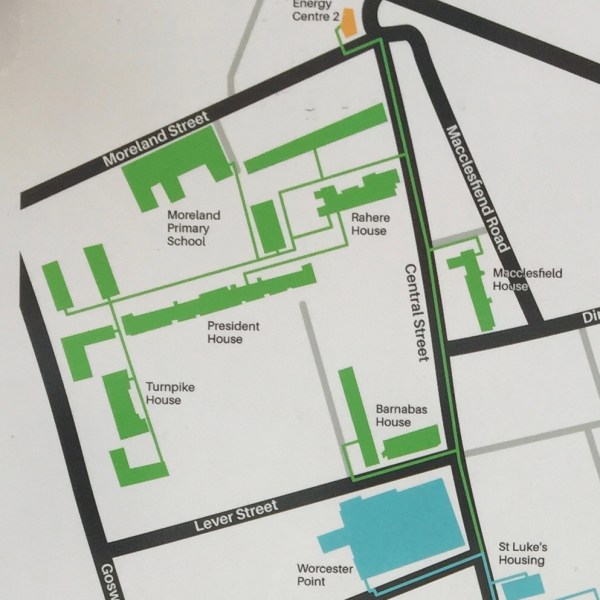
Buildings served by “Bunhill Heat and Power 2” – in green.
Click a button below to share this post online, email it, or print it:
I took my sketching things on a swimming expedition to the Outer Hebrides with Swimtrek. We were on the wonderful Lady of Avenel 102ft square rigged brigantine.
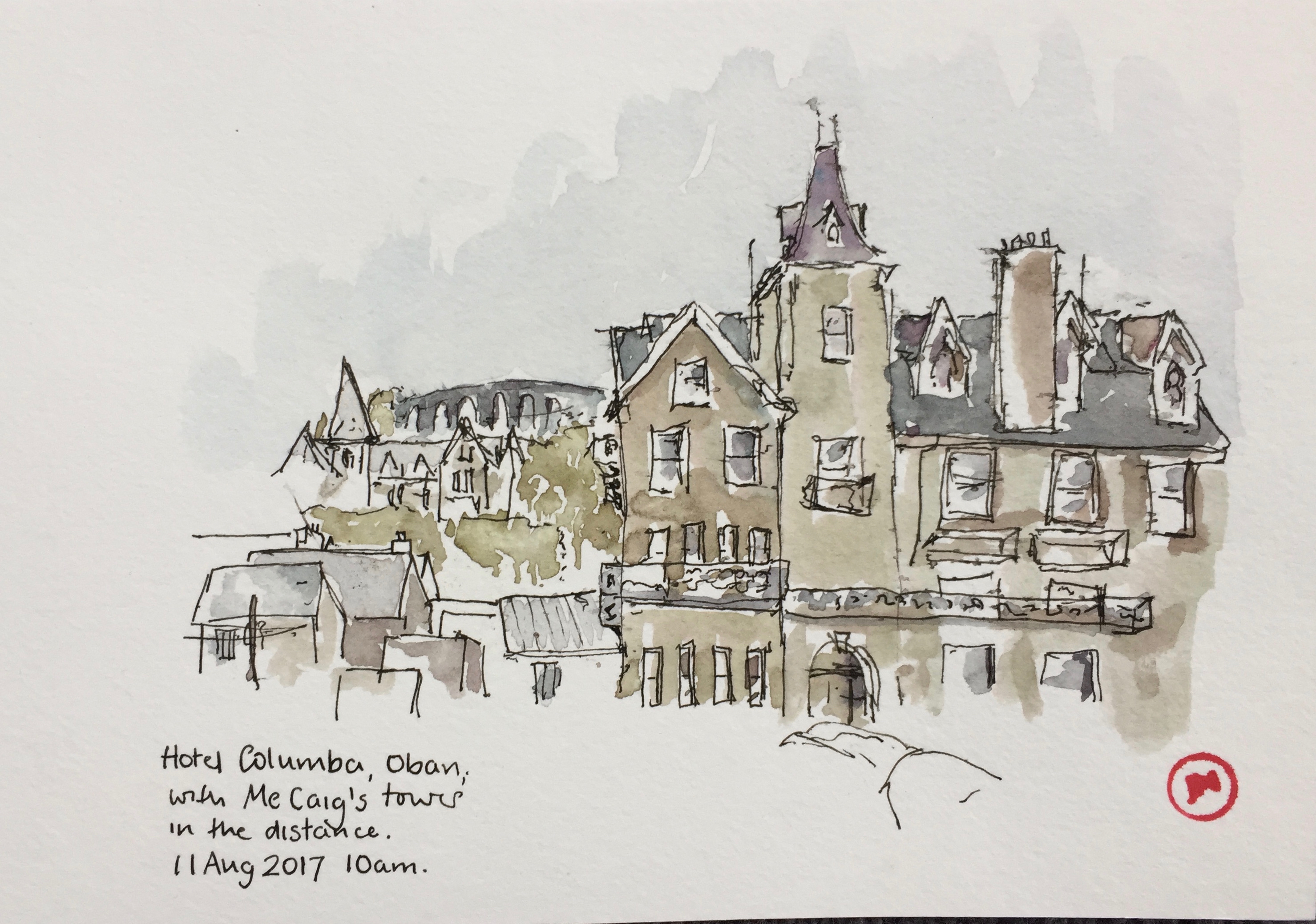
We started in Oban.
It was raining when I drew this picture, as you can see from the way the pen has drifted a bit, round the chimneys. I coloured it inside the café called “Kranks”.
There was a lot of weather.
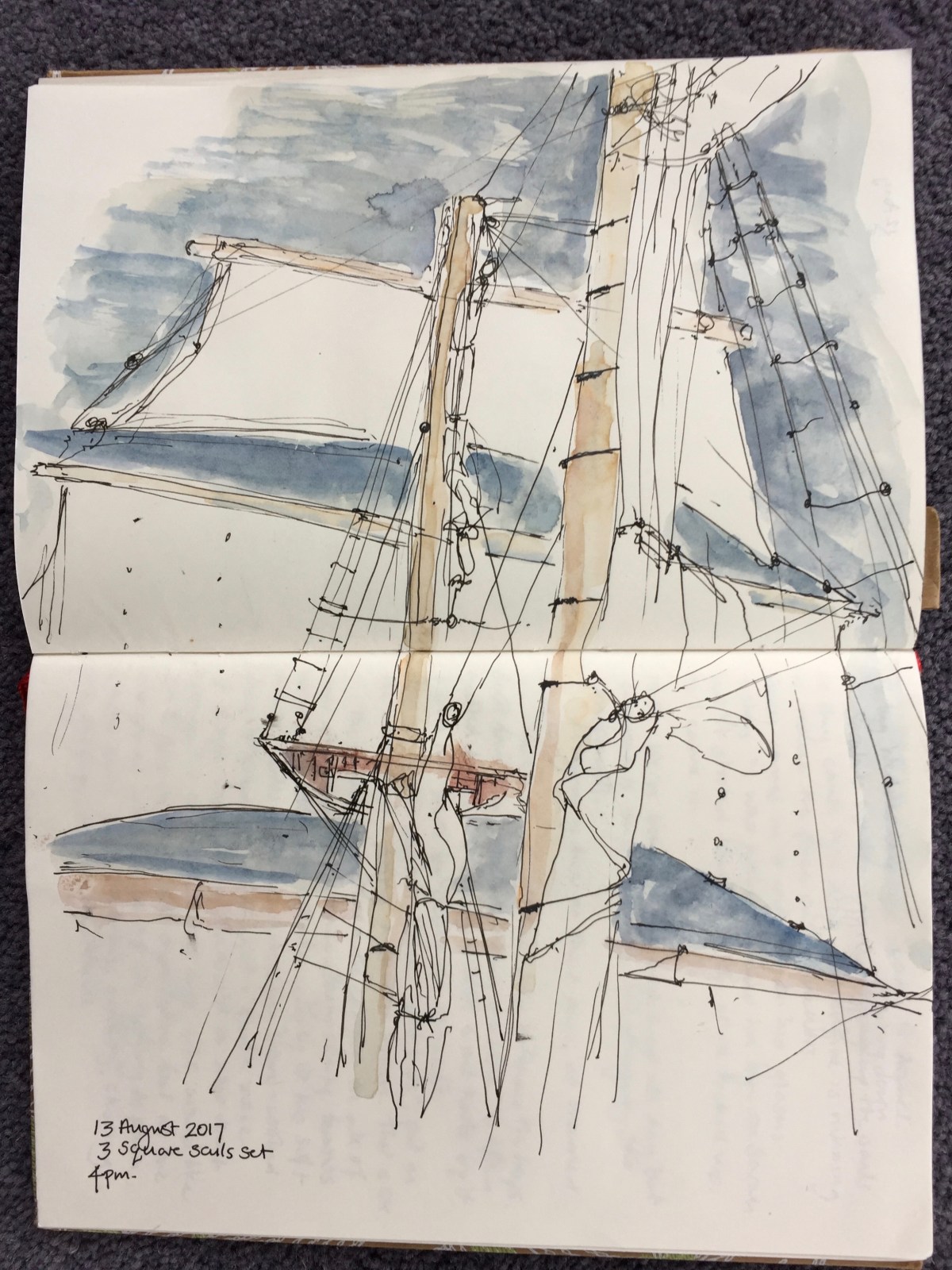
I drew pictures while balancing on the quarterdeck. The picture below was painted with sea water.
Here is a drawing of the beach at Vatersay. We swam to this beach, and surfed in the waves on the other side. The small dots on the beach are cows.
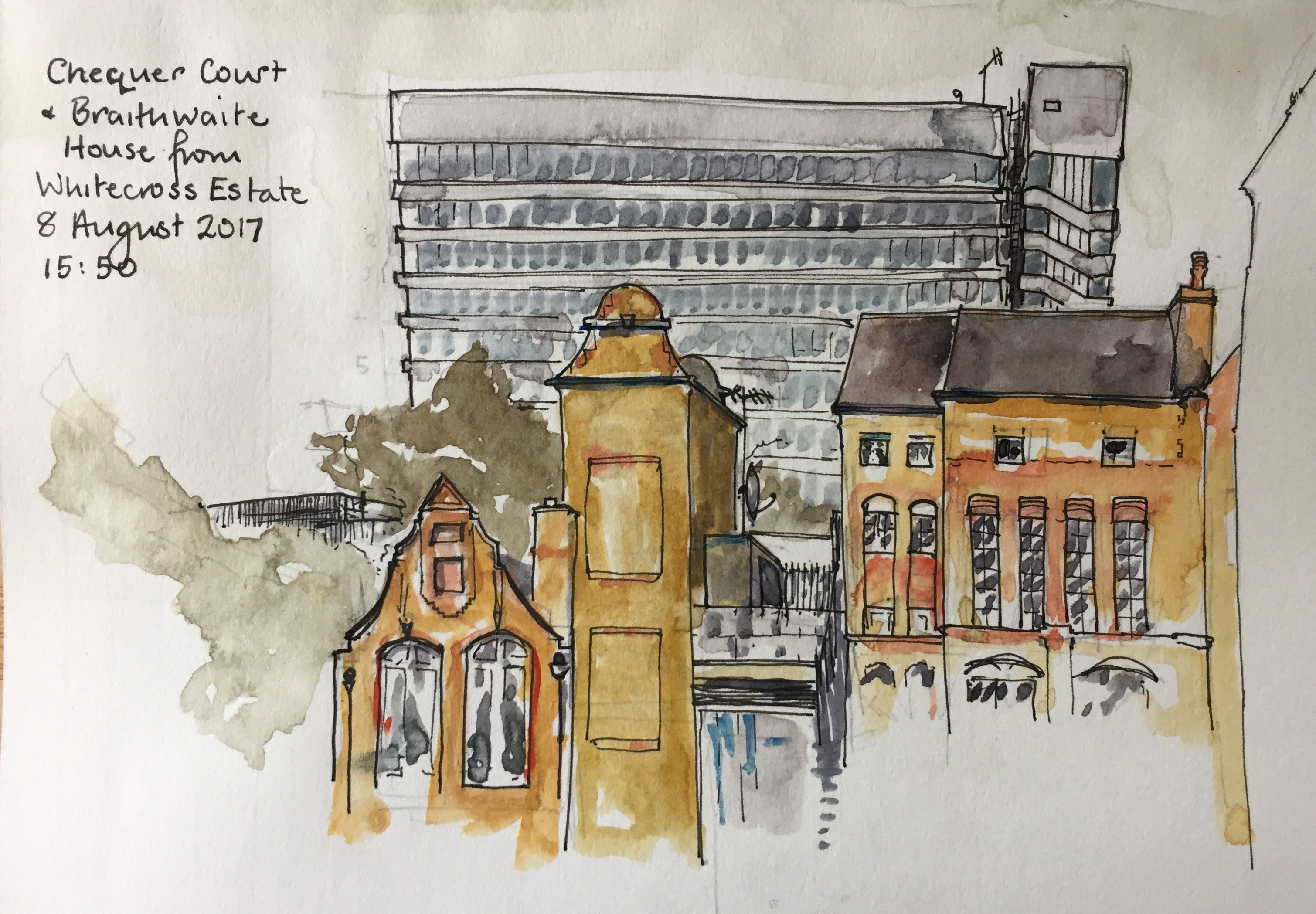
The drawing shows the lovely brick building, now called “Chequer Court”, with Braithwaite House behind.
I drew the picture from Whitecross Estate East, in a quiet courtyard off Chequer Street. A record three people came to talk to me. Arabella was tending her garden flowers in pots and crumbling wooden boxes, on the other side of the courtyard. She came over and told me that the brick building used to be the community centre. She had done oil painting there. Previous to that, it had been a school. She described the marvellous high windows, and large rooms. There was a café.
She said, “Do you like the buildings?”, indicating the Peabody buildings surrounding us. When I said that I did, she said they were “like prisons”. “They are all different inside, of course.” she added. She explained that there were going to be changes, they were going to build another block on top of the low-level office in front of us. “So you should come back,” she said, “This is a historic view.”
She said that underneath the square was all hollowed out, for bomb shelters. Construction work was going on behind us. “They have demolished the pram sheds”. Arabella was irritated that, in doing so, they had strewn rubble over the planted boxes.
Another woman approached me much later. She also remembered the community centre. She did yoga there. “It was only 20 years ago.” She was concerned lest I was the harbinger of “another plan”.
“No,” I said, “Not another plan. Just a drawing.” I showed her the drawing, to reassure her.
As I packed up my things, a third woman came to say hello. She wanted to see the drawing, and said it was very good. Her small white dog tugged at her and slowed her up as we walked. Eventually he stopped her altogether and I walked on.
Later, online, I found the plan to which the second woman referred. There is a plan by Islington dated March 2017 to improve the public areas of the West and East Whitecross Estates.
The brick building was indeed a school. It seems to have been known as Northampton Secondary Technical School, which was in existence in 1924, and certainly up to the early 1960s. Searching online I found references to a “Bunhill Row Chequer Street Council School” whose records, 1928-1933 are in the National Archive, Kew ref ED 21/34646, but no further details. In 1998 “negotiation was completed for the sale of the Bunhill Row site for £22 million” according to “City and Islington College, the First 20 years” by Tom Jupp and Andrew Morris. Now it is luxury flats, and is called Chequer Court.
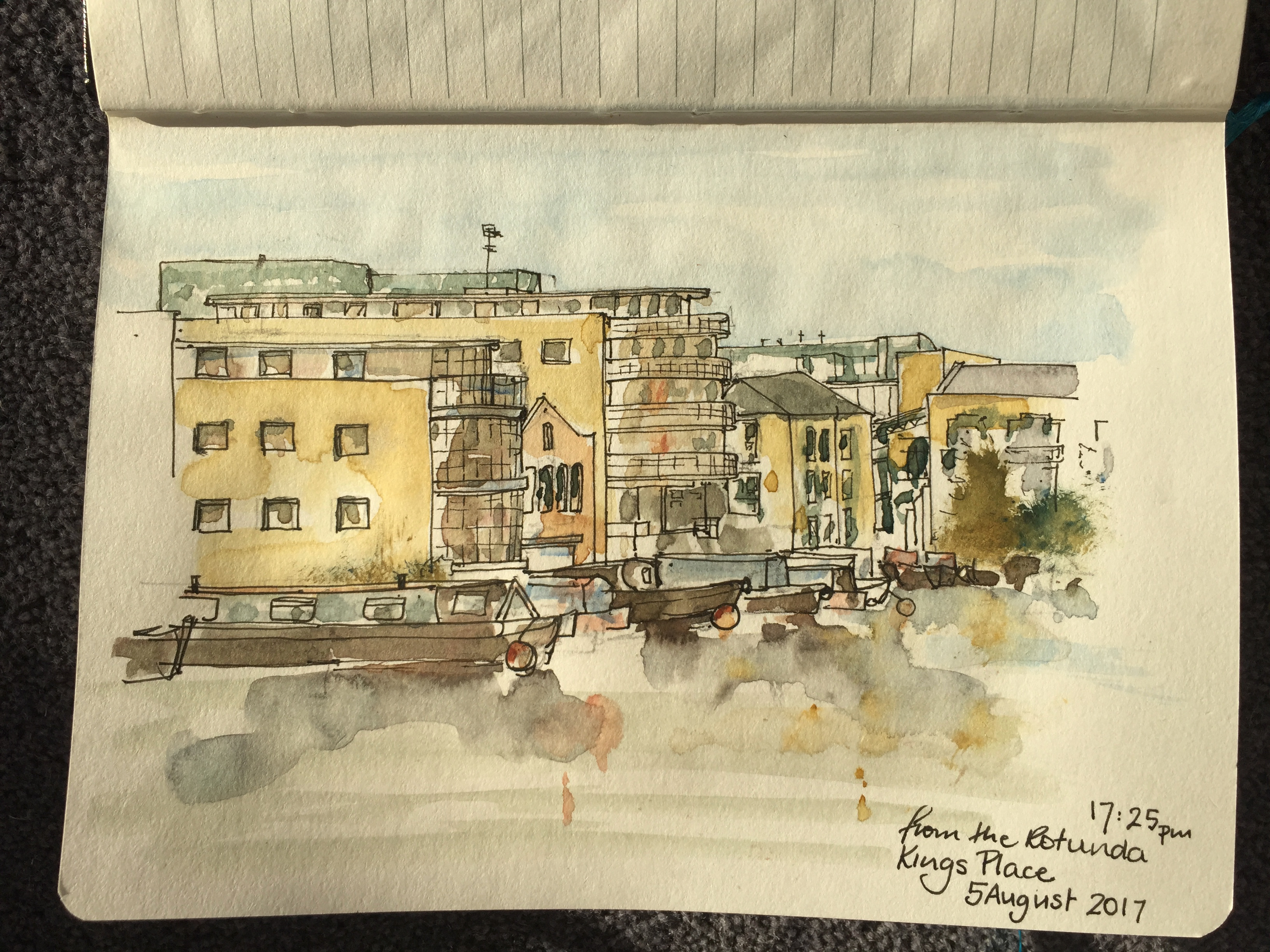
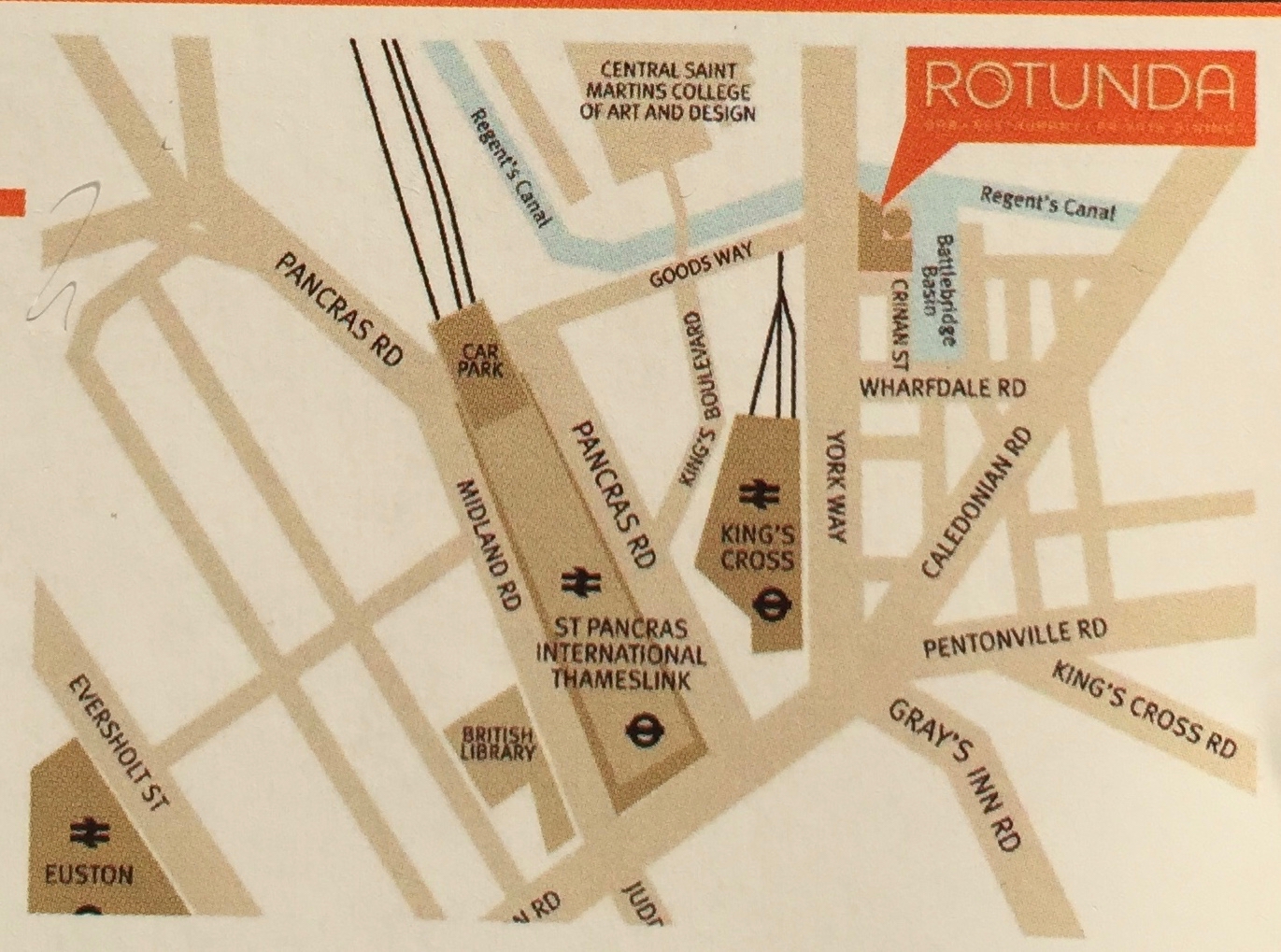
I drew this from the Rotunda restaurant in Kings Place, looking across Battlebridge Basin. The low building in the middle with the pointed roof is the London Canal Museum.
The coffee was excellent, and we were made very welcome by the restaurant manager Mark.
After this, we went for a walk around the new Kings Cross developments on the other side of York Way.
Click a button below to share this post online, email it, or print it:
Here I am on the banks of the River Dee, looking across to Aberdeen.
I had just left the overnight sleeper train from London, and was in Aberdeen waiting for the overnight ferry to take me to Shetland. In the River Dee, I saw dolphins. I walked to the Torry Battery, built 1858-1860. In the picture on the right is the “Aberdeen Harbour Operations Centre”.
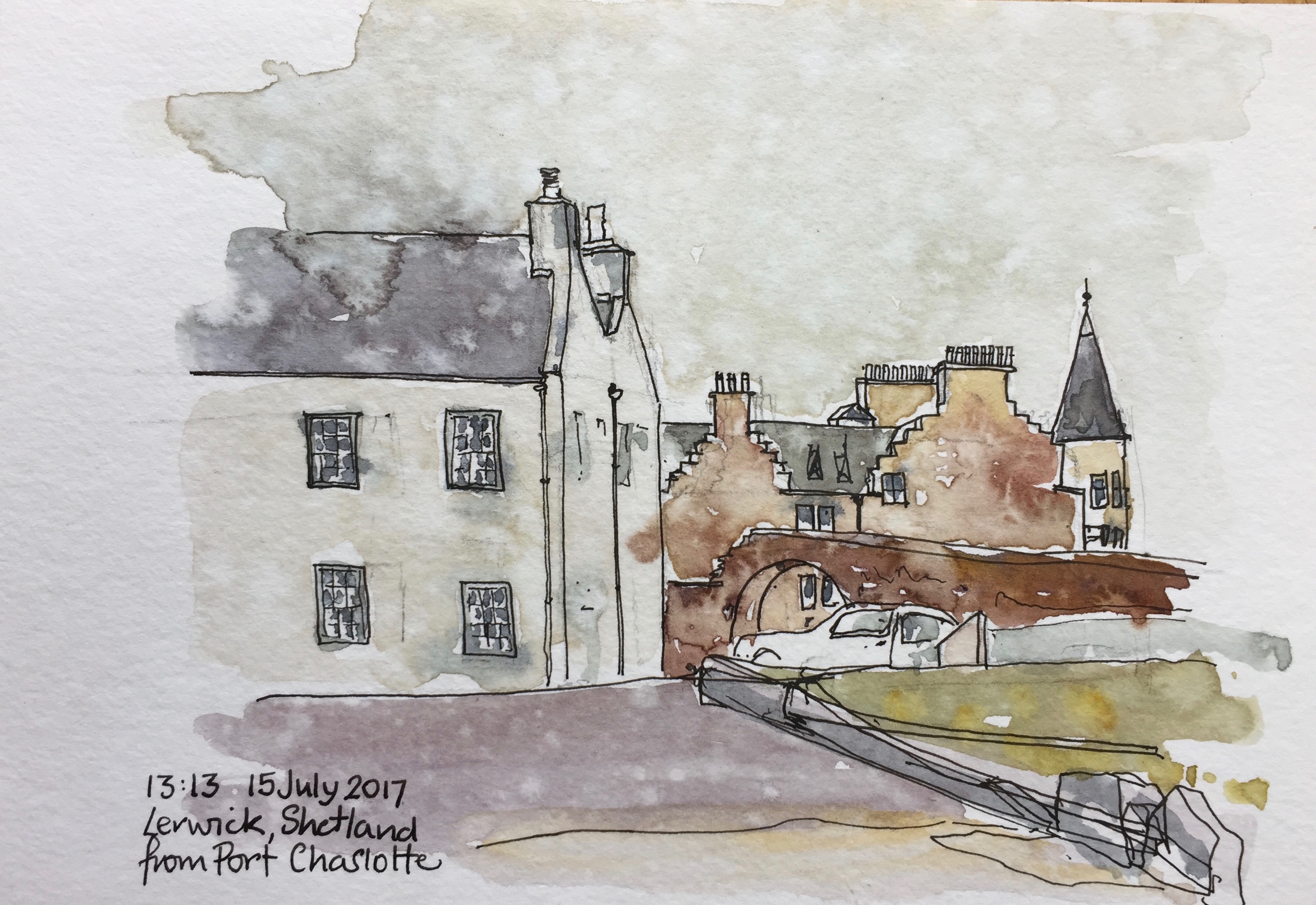
The ferry docked in Lerwick, Shetland mainland. It was raining.
I drew this picture in Fort Charlotte, sheltering from the rain under the thick walls of a gate. The shelter was not perfect, as you see from the water splattering the picture.
Bus number 9 from the Viking Bus Station took me to the West Mainland, where I was staying in Burrastow Cottage. Here is a drawing of Burrastow House. The cottage is the small building, in the background on the left.
I did a lot of walking.
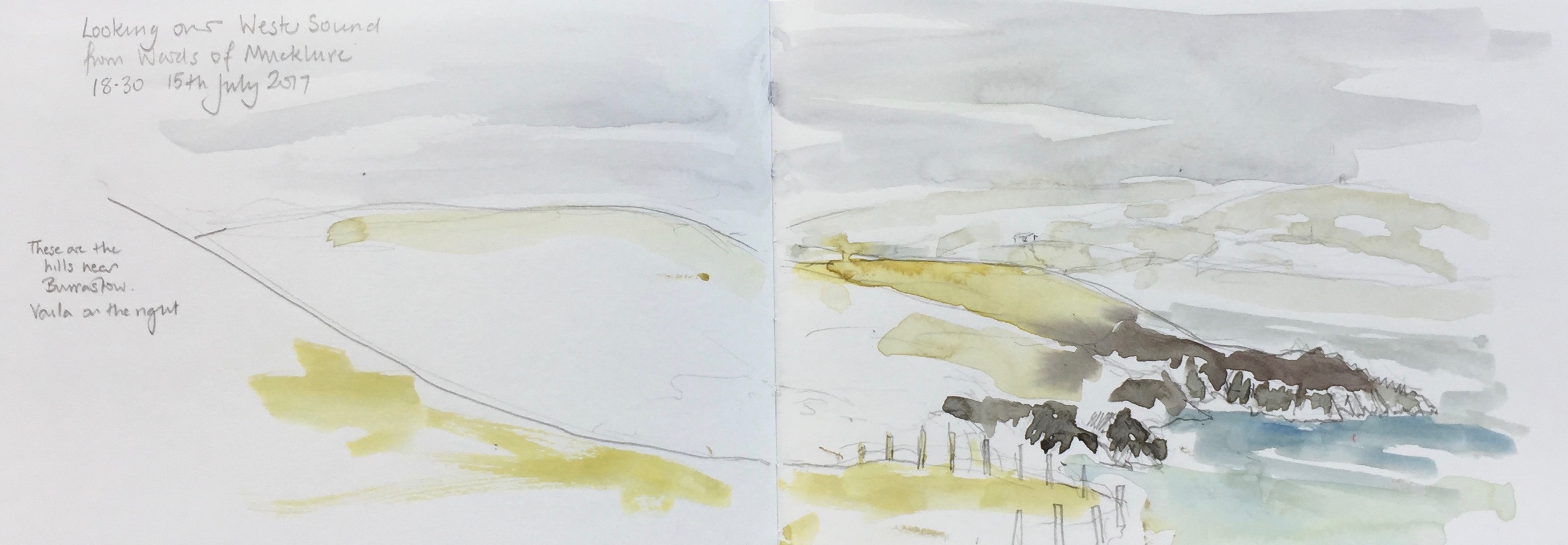
In Lerwick I bought a landscape sketchbook. So I experimented with using both pages. There’s a lot of landscape in Shetland.
Above, I tried to show the bright yellow flowers, very vivid, in the low light.
The picture above shows the bay and the village of Walls.
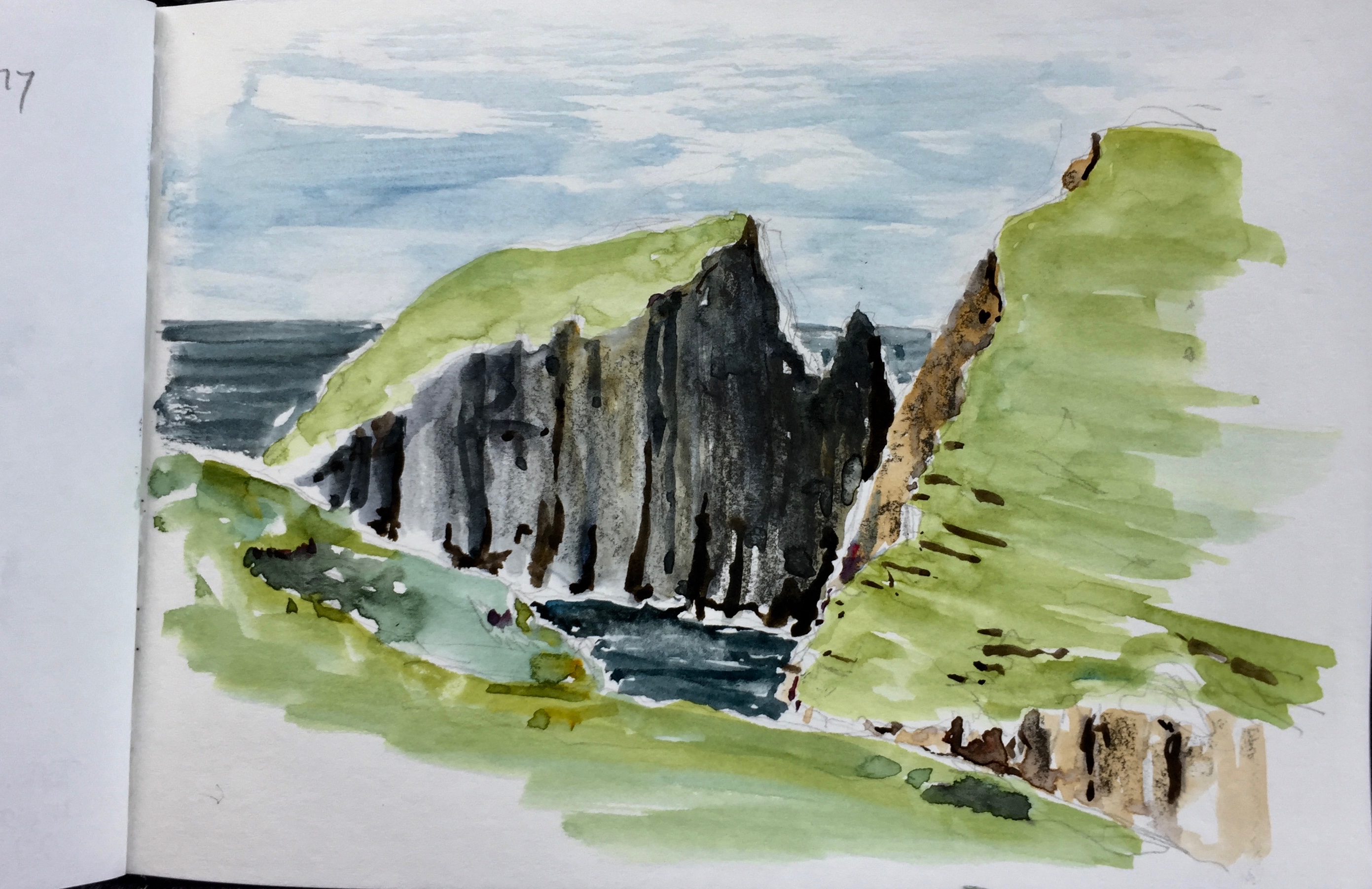
Above is an attempt to draw the huge cliffs near Burrastow. The peninsula is the delightfully named “Wards of Mucklure”.
I drew the sea. Above is the view from the door of the cottage. Out there, one day, I saw an otter.
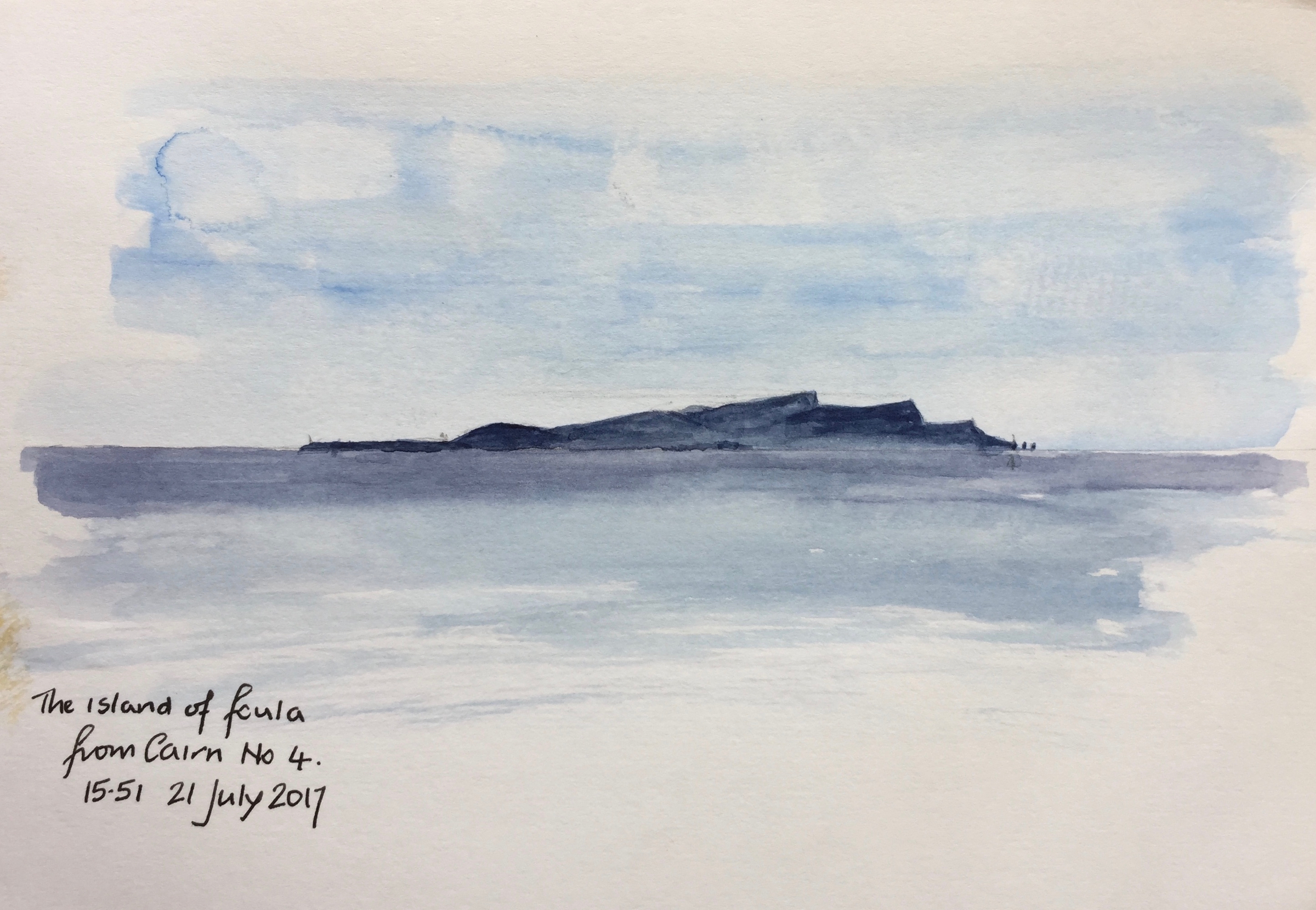
Above is what the island of Foula looks like, viewed from Cairn 4. I numbered the Cairns.
Here is my numbering scheme:
I also drew the plants.
That picture of the drain hole shows iris plants above dark water. The picture on the right shows flowering sorrel, and iris leaves.
This is a picture of “The Ned” near Westerwick. It was much more dramatic than the picture. More dark and more light. Maybe the pencil sketch catches it better:
Here is another sketch of the sea. I tried drawing quickly. Sometimes it seems to work better that way.
And here is a sketch on the way back to London.
Click a button below to share this post online, email it, or print it:
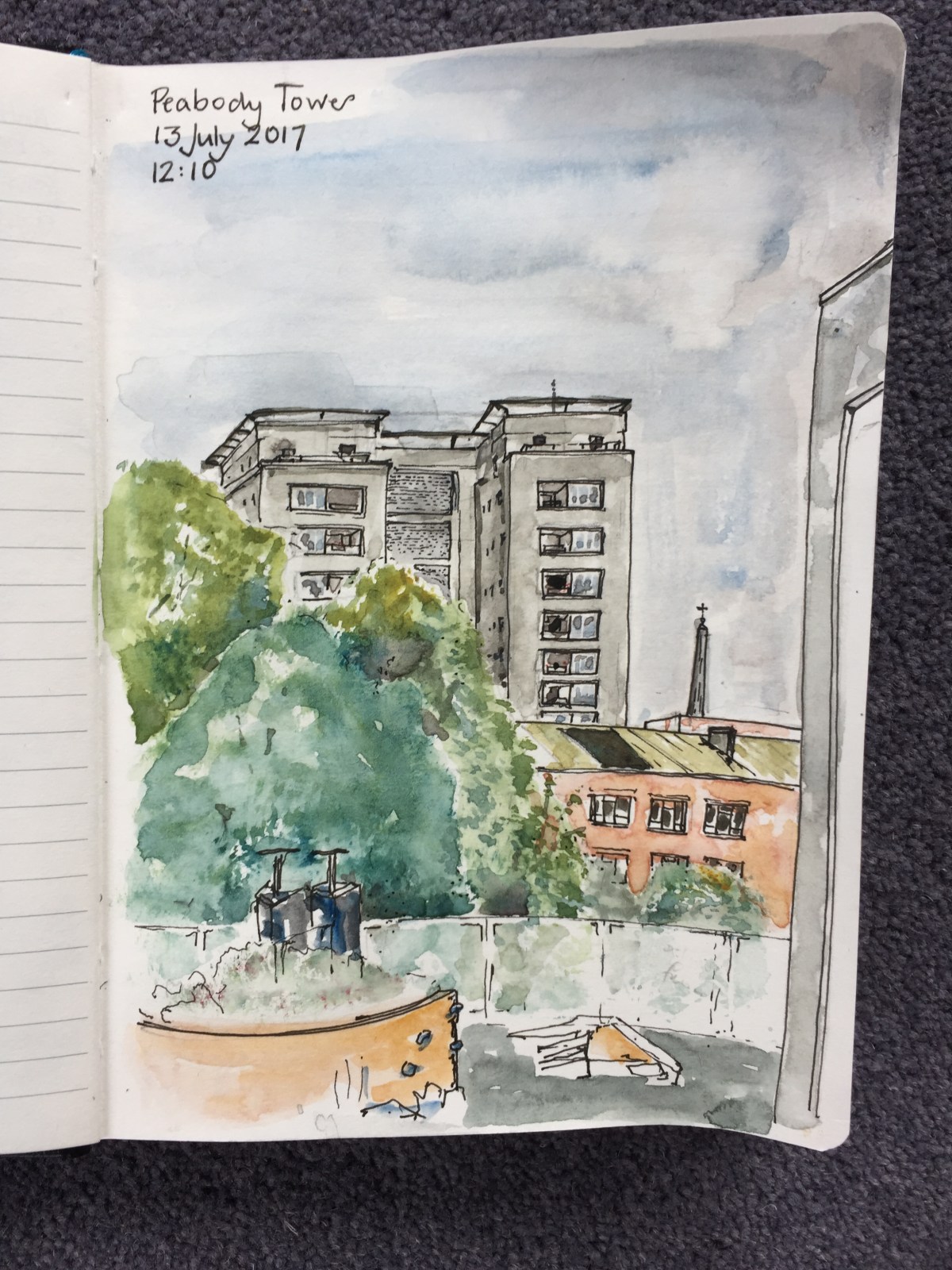
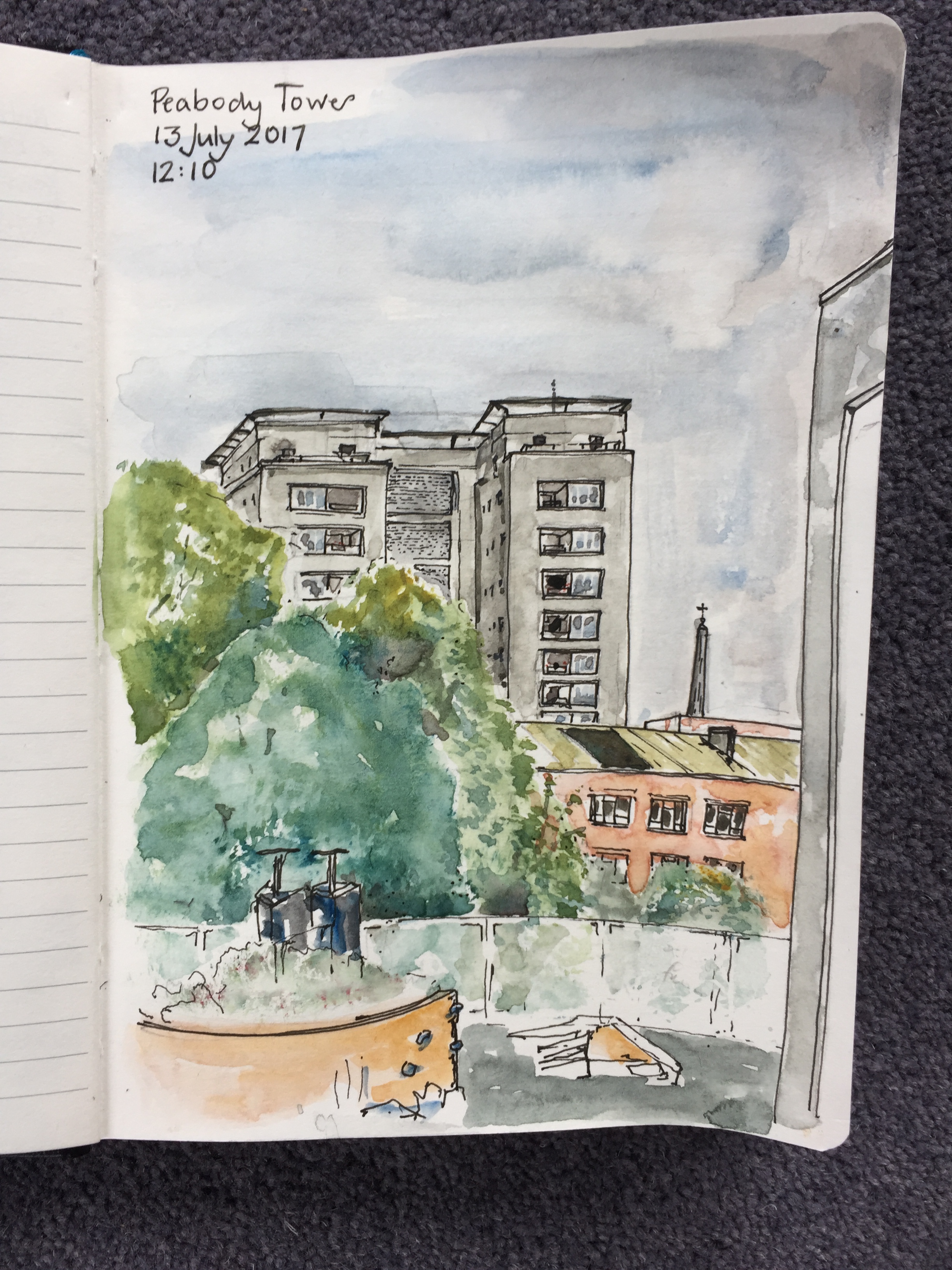
In the foreground is the first-floor playground of the Prior Western Primary School. The building in red brick is Fortune House, built at the same time as Peabody Tower, although it looks very different.
This drawing took 1hr45min. Done from the podium next to Breton House.
Click a button below to share this post online, email it, or print it:
From our flat we can see this core against the skyline.
It is Phase 3 of Hackney Council’s redevelopment of the Colville Estate. Two towers, called “Anthology” 16 and 20 floors “solely for private sale, to help cross subsidise the construction cost of the remaining social rent buildings”.
I drew this from Shoreditch Park. It rained. I walked around a bit. The sun came out. I started again. It rained again. I got back on my bike and went home and finished the colouring on my desk at home.
12:10, 1 hour intermittent on location and half an hour at home. I’m quite pleased with the tree.
Click a button below to share this post online, email it, or print it:



















 Jane Sketching