The new Bridge across Wood Street

img_9676

The London Wall Place newsletter of 5th January 2017 said:

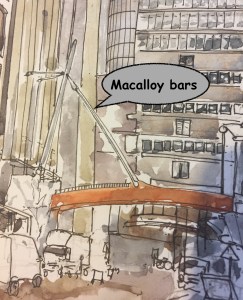
img_9675“We wish to advise that the operation to install the new footbridge across Wood Street was aborted on Wednesday 21st December due to technical issues with the alignment of the Macalloy suspension bars that connect the bridge deck structure to the pylon.

We are in the process of rectifying these issues and have agreed a new road closure with the City of London for the bridge installation, week commencing 6th February with a back up closure the following week.

The install of the stainless steel pylon on the 19th December was a success and this is ready to receive the bridge.”

“Macalloy” is the name of the manufacturer of the steel bars. They are based in Sheffield.

tension-bar
Macalloy 460 Tension bar – image from Macalloy.com

The bridge was successfully installed on the 6th February.

I drew the picture sitting on my suitcase near the vehicle entrance to the St Giles area. A man came to open the nearby garage, which was crammed with builder’s equipment and paint pots. Later, a succession of well dressed middle-aged people came by, as though leaving a large event. They were all of a type, and spoke distantly with each other.

Afterwards, I walked underneath the bridge and looked at the junction between the bridge and the sloping walkway, on the right of the picture. This joint is interesting because the walkway slopes down, so, to join it perfectly, the bridge cannot be horizontal at this point. It looks as though the bridge twists slightly to accommodate this geometry, but it’s difficult to see at the moment. I have drawn the bridge as slightly rainbow-shaped, as that’s what it looked like, but the architect’s pictures in the newsletters show it as flat:

screen-shot-2017-02-22-at-08-28-07

Buildings on Cowper St EC2

img_9616

I liked the contrast between the warm, human-scale buildings in the foreground and the futuristic towers in the background.

At the back, the building with the curved side is “Bézier”, a residential development.

“Bézier Apartments were designed by TP Bennett and developed by the Tudorvale Properties Group in 2008, and completed in 2010”, according to http://www.baseps.co.uk

Its swanky entrance is on City Road, in between an “EAT” and a “pod”. These are both eating places. EAT is all upper-case, and “pod” is all lower-case. A “bézier” is a particular sort of mathementical curve, much used in computer graphics.

The brick building is the “Central Foundation Boys School”, Sixth Form Centre. I could hear the boys on their break for some of the time when I was drawing. It is a state school, as far as I can understand from their website, run by Islington. Founded 1866. Their website has an interesting feature: “Show My Homework”. You can look up your homework assignment by year and subject. No more excuses.

I drew this standing at the side of Tabernacle Street. A shiny black car drew up, with black tinted windows. The window scrolled down, so I could see the driver, who was also black. He asked me if I could direct him to 69 Tabernacle Street. I could not. None of the blocks round here have numbers. But I know the area. “What is it?” I asked.

“69 Tablernacle Street,” he said again.

“No,” I said, “what is at 69 Tabernacle Street?”

He turned round awkwardly, to his passenger, invisible in the back seat. A pause for an inaudible conversation.

“A fancy dress shop,” he informed me. But I still couldn’t direct them.

I can now see that they were looking for: Mad World Fancy Dress, “one of the UK’s largest stockists of Venetian masks”, amongst other things. It was just north of where I was standing, entrance in Singer Street. I wonder if they found it.

St Mary Aldermary, and Albert Buildings EC4

Drawn from outside the Pret on Queen St, about 1hr 30.

img_9605

The building in the centre is “Albert Buildings”, a thin triangular building on the corner of Cannon St and Queen Victoria St. It is incredibly complicated, with many pillars and arches and different window shapes.

Now it is inhabited by a number of small businesses. I saw a dental surgeon, Shoe Care, and “Traditional Pure” lebanese food. It is now managed by “First Base” as “Cannon St Serviced Office and Business Centre” who describe it as a “listed turn of the century building with quirky Victorian features”. They don’t specify which turn of which century, but evidently it’s not the most recent one.

Pevsner says:
“Albert Buildings, the grandest surviving 1870s block, built 1871. By F.J. Ward, whose office was here. Arcaded Gothic, mixed English and Early French, with a remarkable assortment of window heads”
The Buildings of England, London 1 by Simon Bradley and Nicholas Pevsner

St Mary Aldermary is one of my favourite London churches. Inside is the friendly Host Café, and welcoming tables and chairs, and a stunning fan-vaulted ceiling. The church is on Bow Lane, near Watling Street, and the current building was built after the fire, in 1666.

St Paul’s from Old Fish Street Hill EC4

img_9516

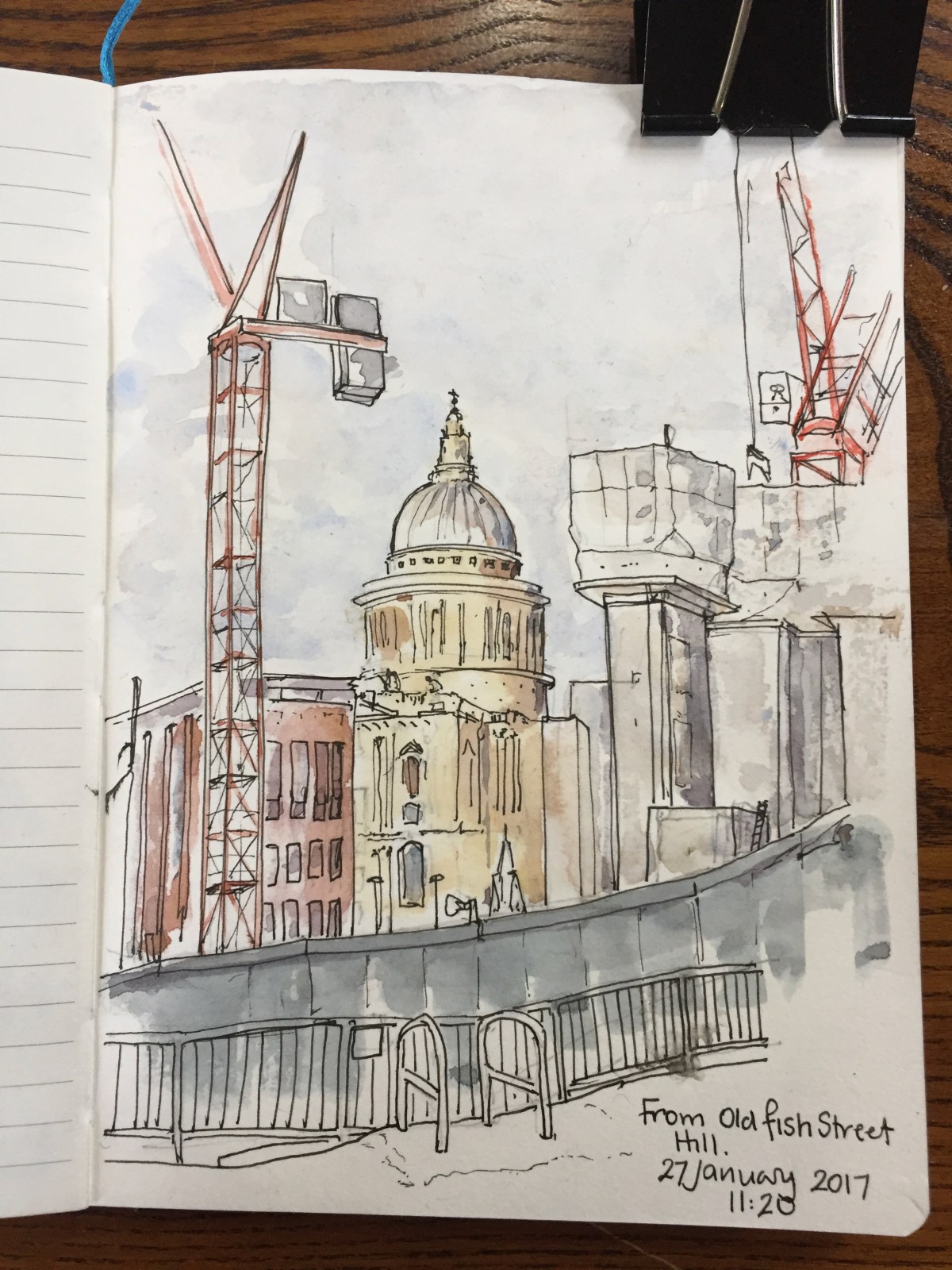
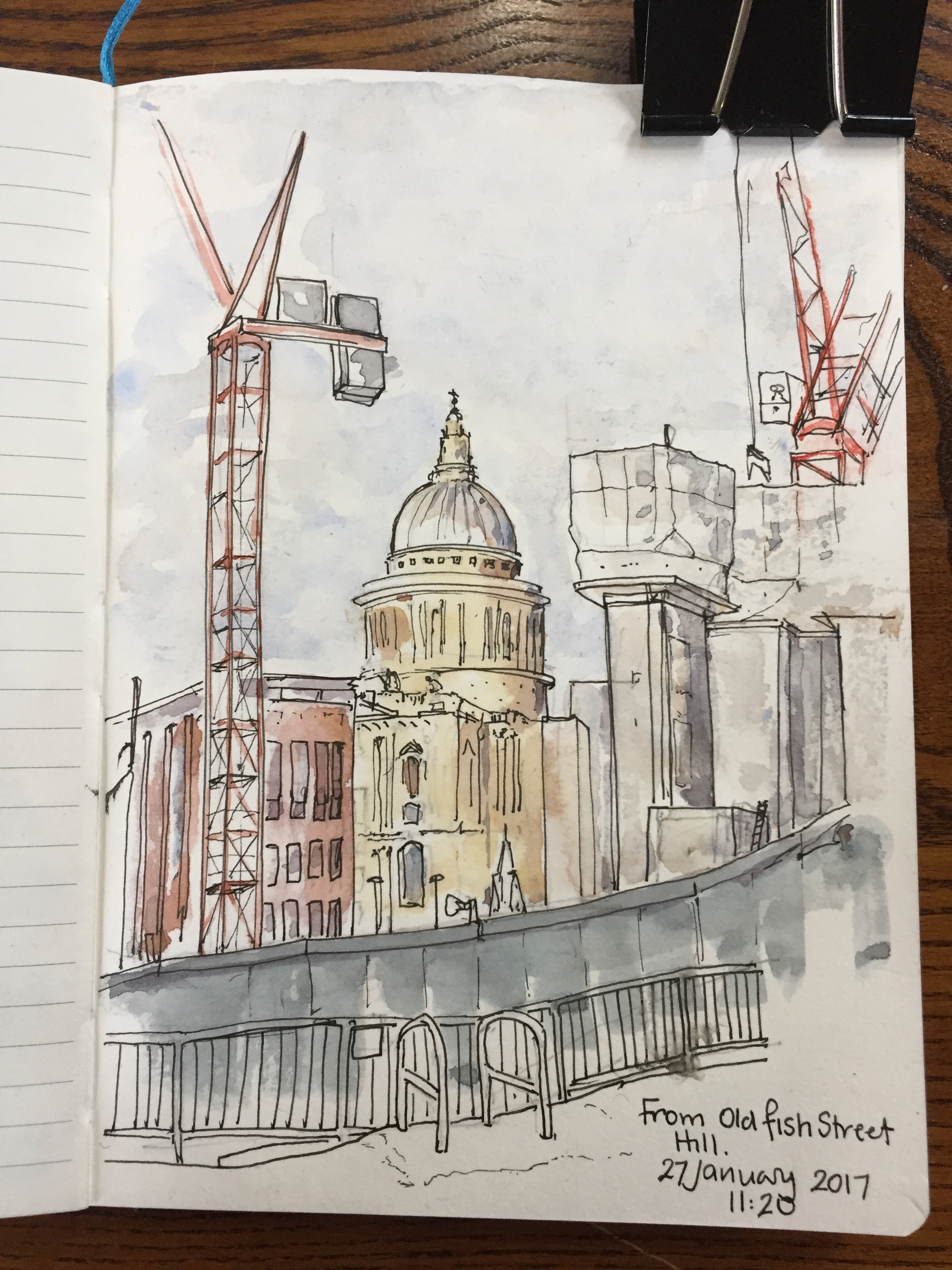
I was keen to draw this view of St Paul’s before it vanished behind the new building on 2-4 Cannon Street.

“PLP’s scheme, for global property firm Pembroke Real Estate, will replace a 1959 modernist office building by Theo Birks called Scandinavian House. The north facade, facing the cathedral, is the most orthogonally formal, with red sandstone cladding and a 3m window grid with anodised aluminium frames.
The south-western elevation tapers to create a public garden which will provide a new home for Michael Ayrton’s sculpture of Icarus.”
From Building Design Online  22 September 2014 | By Elizabeth Hopkirk

While I was drawing this, the traffic marshall of the building site came by, looked up at St Paul’s, and remarked that it was a “fine building”.

img_9519It was extremely cold, about 2degreesC, and I was wrapped up in my Loden coat and furry boots. You’ll notice I invented a new watercolour technique. It’s called “greasy fingers marbling effect”. See the extreme right of the picture. Before I went out, I put a LOT of hand cream on my hands, because this cold weather makes my skin crack. But then after I had been gripping the sketchbook, I found the paint didn’t stick. But it’s quite a good effect, I think.

I managed to complete the pen and ink drawing, and do most of the watercolour before the cold got to me. Then I retreated to the warmth of the Wren café in St Nicholas Cole Abbey Church.

There I met Amy Marsh @harshmissmarsh who posted my work-in-progress on her Instagram. In the café I painted the red cranes.

Coffee and a small and delicious Marmalade Cake, £6. They were just bringing out some delicious-looking lunchtime food. But I had places to go and work to do, so I exerted willpower and moved on.

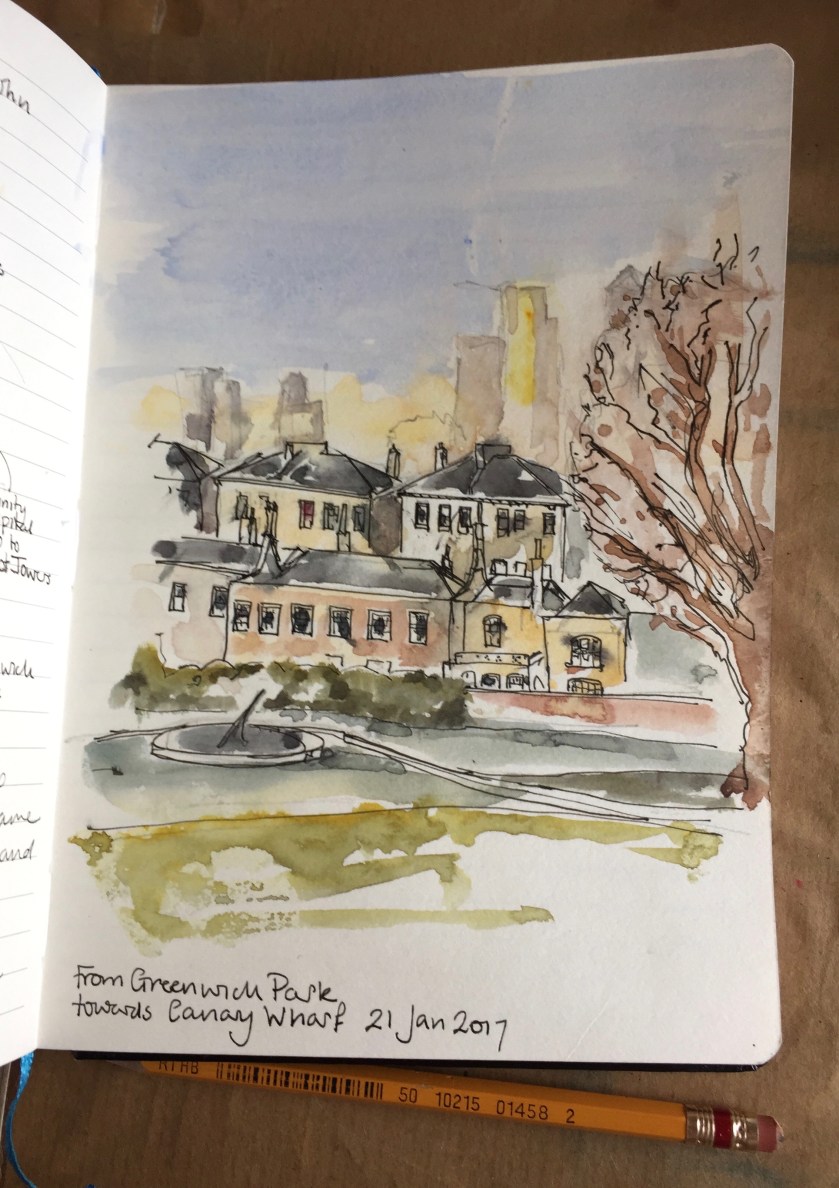
From Greenwich Park

Towards the end of a weekend walk from North Greenwich to the wonderfully named “Maritime Greenwich”, I drew a picture from the park. Very cold. 45 minutes, sketch and colour on location.

img_9496

Dogs and people walked by. In the distance a baby howled, insistent and unceasing, as though crying for all our broken dreams.


Trinity Buoy Wharf

The headlines in the Evening Standard had described the pollution levels in central London at “Red Alert” levels. So I headed East to the clearer air and big skies of the maritime Thames.

Trinity Buoy Wharf is here:

img_9495

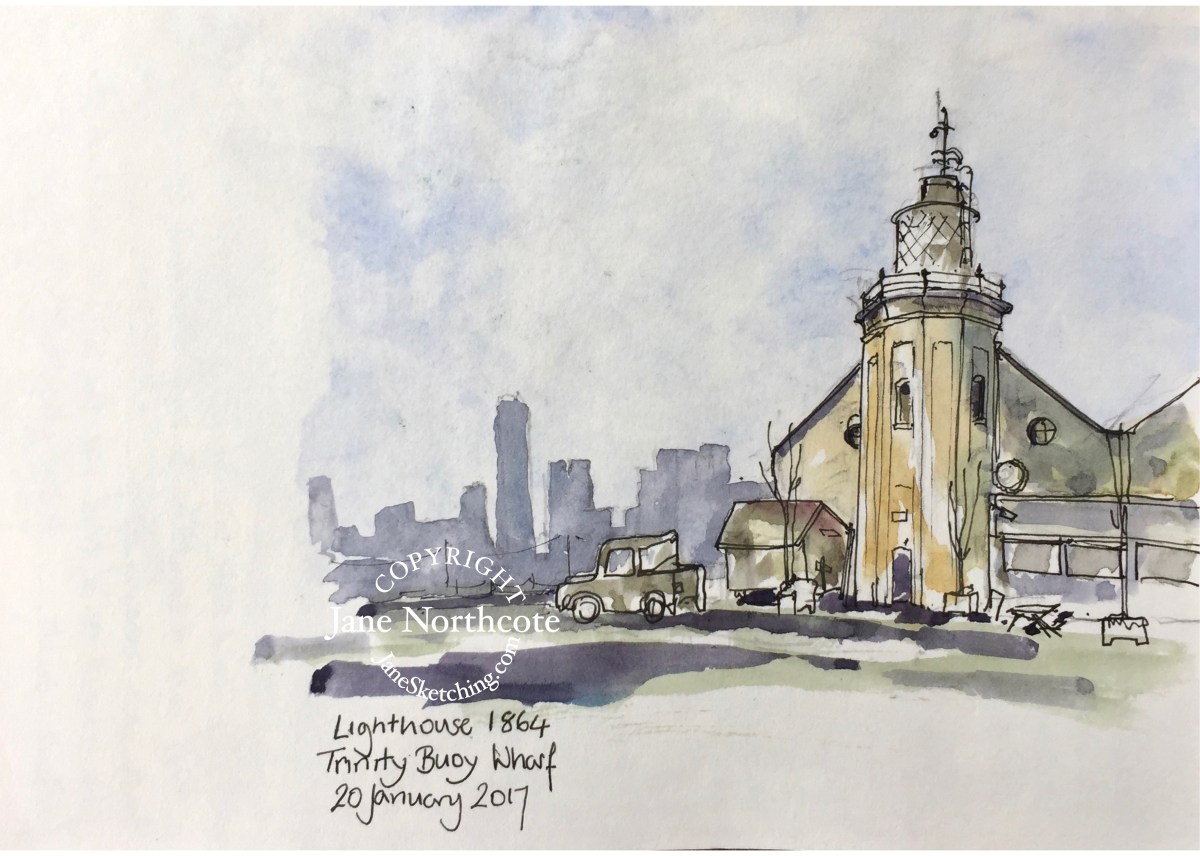
I drew a picture of the lighthouse.

Above me, four stories of shipping containers contain offices. Words floated down.

“That was his first investment. He hasn’t really been improving. … To be fair, he does wear a luminescent hat. If that isn’t a warning sticker I don’t know what is.”

I continued drawing. The shed on the left of the lighthouse contains a small display called “The Faraday Effect”. Inside the shed I learned that

“there used to be two lighthouses here. The original one was built in 1854 and demolished in the late 1920s. This was the building used by Micheal Faraday in his scientific work for Trinity House.  The roof space adjoining the surviving lighthouse, which was built in 1864, housed Faraday’s workshop for examining lenses and other apparatus”

I was glad I’d drawn the roof adjoining the lighthouse. The building below it, on the right of the picture, is “Fat Boys Diner” with a Pepsi sign on top. I’ve not been in there yet.

The Faraday Effect is the phenomenon whereby when polarised light passes through a magnetic field, the polarisation rotates. Faraday also showed that light is affected by magnet force. He discovered electromagnetic induction: that electricity can be made by rotating a coil of wire in a magnetic field. Hence power stations, and much else.

Before I drew the lighthouse, I had a coffee in the marvellous “Bow Creek Café”. From there I drew this picture:

img_9491

There was a lot of light. The things in the foreground were dark, and the boat shone.

The light-bulb shaped object on the left is a construction on top of a number of blue containers labelled “ENO” in the English National Opera logo.

On the left is the lightship, which is red, called “Lightship95 Audio Recording Studio”.

St Magnus the Martyr

img_9468

The Parish and Pilgrimage Church of Saint Magnus the Martyr in the City of London, drawn from a bench on the Riverside walk.

Saint Magnus was Earl of Orkney, died 1118 and canonised in 1135. This is a Wren church, re-built 1668-1676, after the Fire of London. There has been a church hereabouts from at least 1128.

This church has a marvellous porch and clock, in the shadow in the drawing, but accessible from Lower Thames St. A notice in the porch says “This Churchyard formed part of the roadway approach to the old London Bridge, 1176-1831”.

Also in the drawing is the Monument to the Fire of London, another Wren construction, built 1671-77.

Also in the drawing are a number of 20th Century office blocks.

About an hour to draw, by which time it was dark.

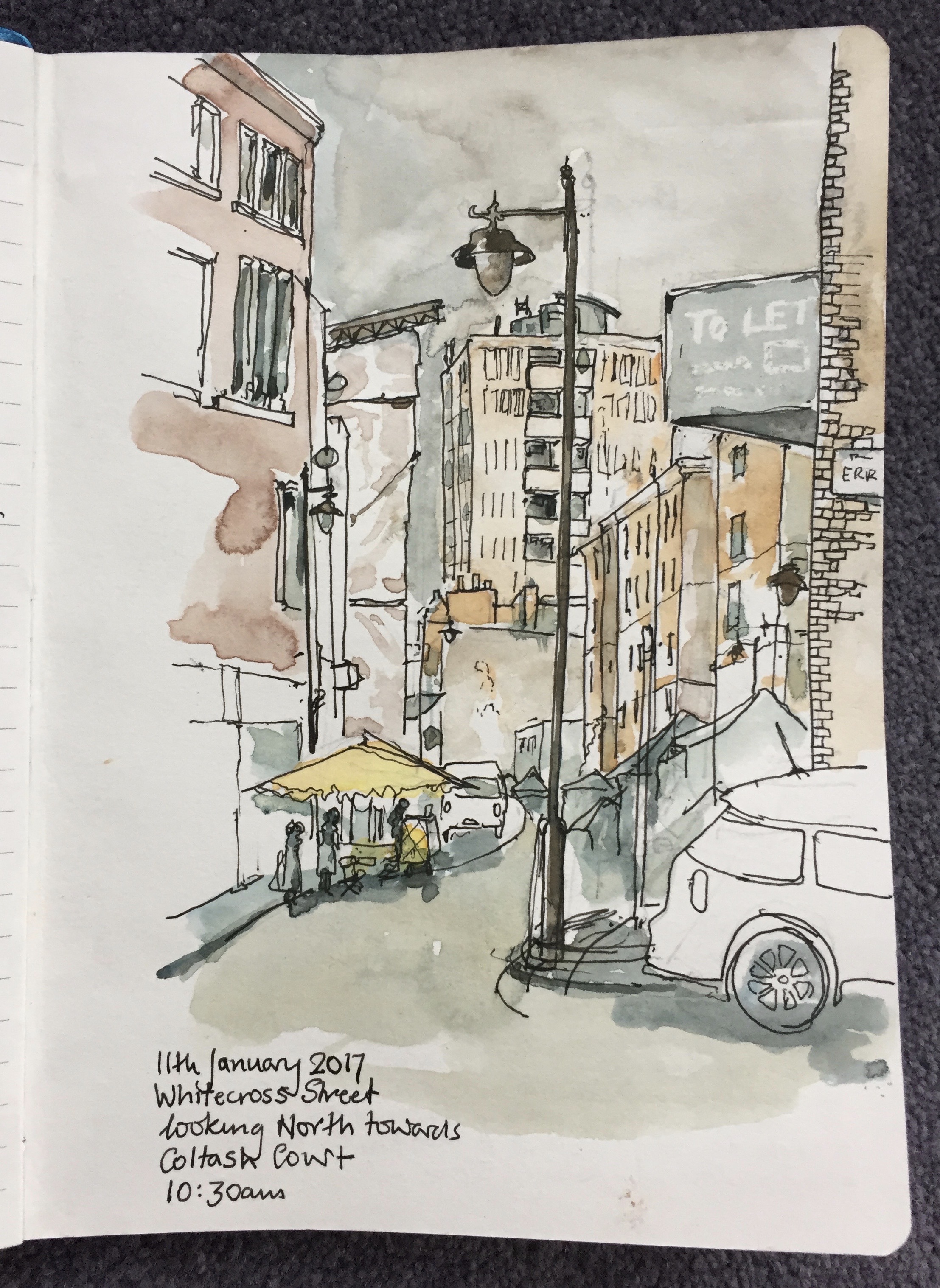
Looking North up Whitecross Street to Coltash Court

img 9462

Coltash Court is the residential tower block in the centre of the picture. It’s 152 Whitecross Street, at the junction of Whitecross Street with Old Street. I can’t see when it was built – looks like 1960s. It’s labelled “Homes for Islington”, with Islington Council branding as well. A one-bedroom flat in there is advertised for £415K, “fully furnished”.

I drew and coloured this standing up at the junction with Errol Street, outside Waitrose. 9:30 to 10:30, so about an hour. I used the convenient tables in the covered section outside Waitrose to put my painting things. But I couldn’t draw from there as I couldn’t see up the street.

From St Luke’s Garden, Pleydell Estate and City Road

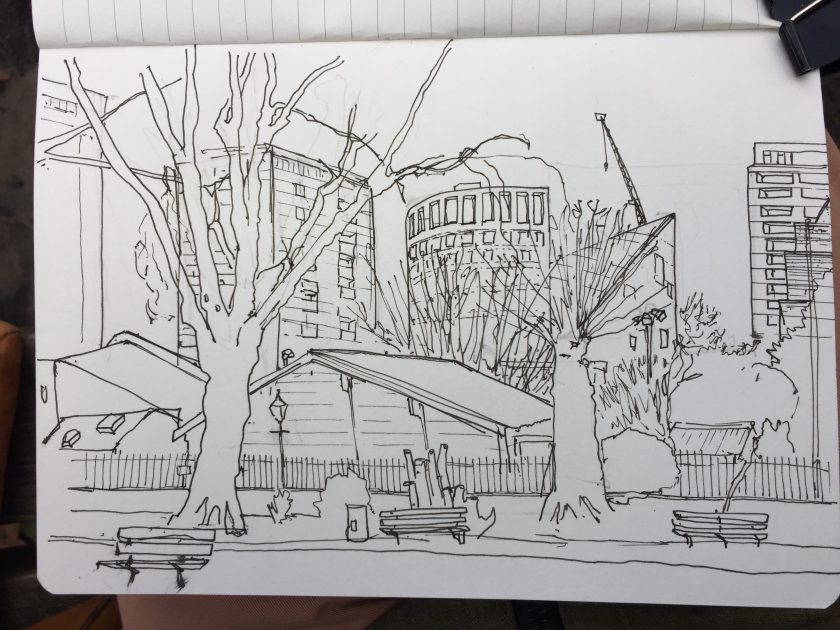
A vista of Islington development, drawn from a bench in St Luke’s Gardens.
In the foreground the building with the pitched roof is Toffee Park Adventure playground.

img 9463

In the background, from left to right:
Grayson House (Left edge of picture) and Galway House, both part of the Pleydell Estate, Islington Council, completed 1959 (according to “Wikimapia” – I don’t know how reliable that is)
Social housing and ex-council flats.

Eagle Point: The Eagle & Eagle Black
http://www.mountanvil.com/our-london-homes/the-eagle/

“Art Deco inspired studio, 1,2 3 & 4 bedroom apartments, and luxury Eagle Black residences, from Mount Anvil and designed by Farrells. Situated on City Road, London EC1, moments from Old Street roundabout in Shoreditch. Live The Eagle lifestyle”

completed November 2015

M by Montcalm
http://squireandpartners.com/architecture/hotels/city-road-estate/

“Squire and Partners’ concept for the M by Montcalm hotel in Shoreditch was delivered in collaboration with Executive Architects 5 Plus, and completed in summer 2015. The site – opposite Moorfields Eye Hospital on City Road – provided inspiration for a striking facade which expresses the idea of the optical and the visual.

Responding to the Moorfields Eye Hospital opposite, and taking inspiration from the 1980′s artworks of Bridget Riley, the facade is expressed as a triple glazed skin enlivened with differing patterns of transparency, opacity and solidity to convey diagonal slopes breaking across an underlying vertical structure.

Manipulation and modulation of light, both internally and externally, give the facade richness and an ever-changing face on this prominent site, as well as assisting solar performance to create a sustainable development. The conjunction of the vertical and the diagonal create a visual effect of depth and movement, and express the activities taking place within the building. At the upper levels the facade openings become larger to express the more social uses and exploit the panoramic views.

At ground and lower ground floors, the building skin ‘lifts’ on the diagonal to reveal the hotel lobby, public bar and restaurant, all clearly visible from the street.”

Completed July 2015

Godfrey House: (right edge of picture) Part of the St Luke’s Estate, also called the “St Luke’s Printing Works redevelopment”, approved 1965 (according to Wikimapia)
Social housing and ex-council flats.

Drawn and coloured on a bench in the garden, about 1hr10min.
On another bench, two men cracked open cans. I heard them call “What’s that dog, mate?”
The shouted response came, “Her mother’s a rottweiler and her father’s a Labrador”. The owner, limping across the park, informed them that the dog was “one step away from a wolf”. This was evidently recommendation. “She’s got rottweiler markings” he said.
Once he’d gone, the interest in dogs continued. They called to a woman, and asked about her dogs. These were “A Labrador and a cocker spaniel”. The Labrador was called Debbie. They called to her, and the dog rushed over, bouncing up at them.

While all this was going on, a woman with oriental features, without a dog, was walking loops of the park, looking directly ahead.

After the drawing I walked to identify the towers, via Radnor Street and Peerless Street, and had a coffee at Westland Coffee next to Eagle Point. This coffee, in a paper cup, cost £2.70. They did bring it to my table though.

Here what the picture looked like before the colour went on:
img_9458

The North Garden, Charterhouse

img 9437

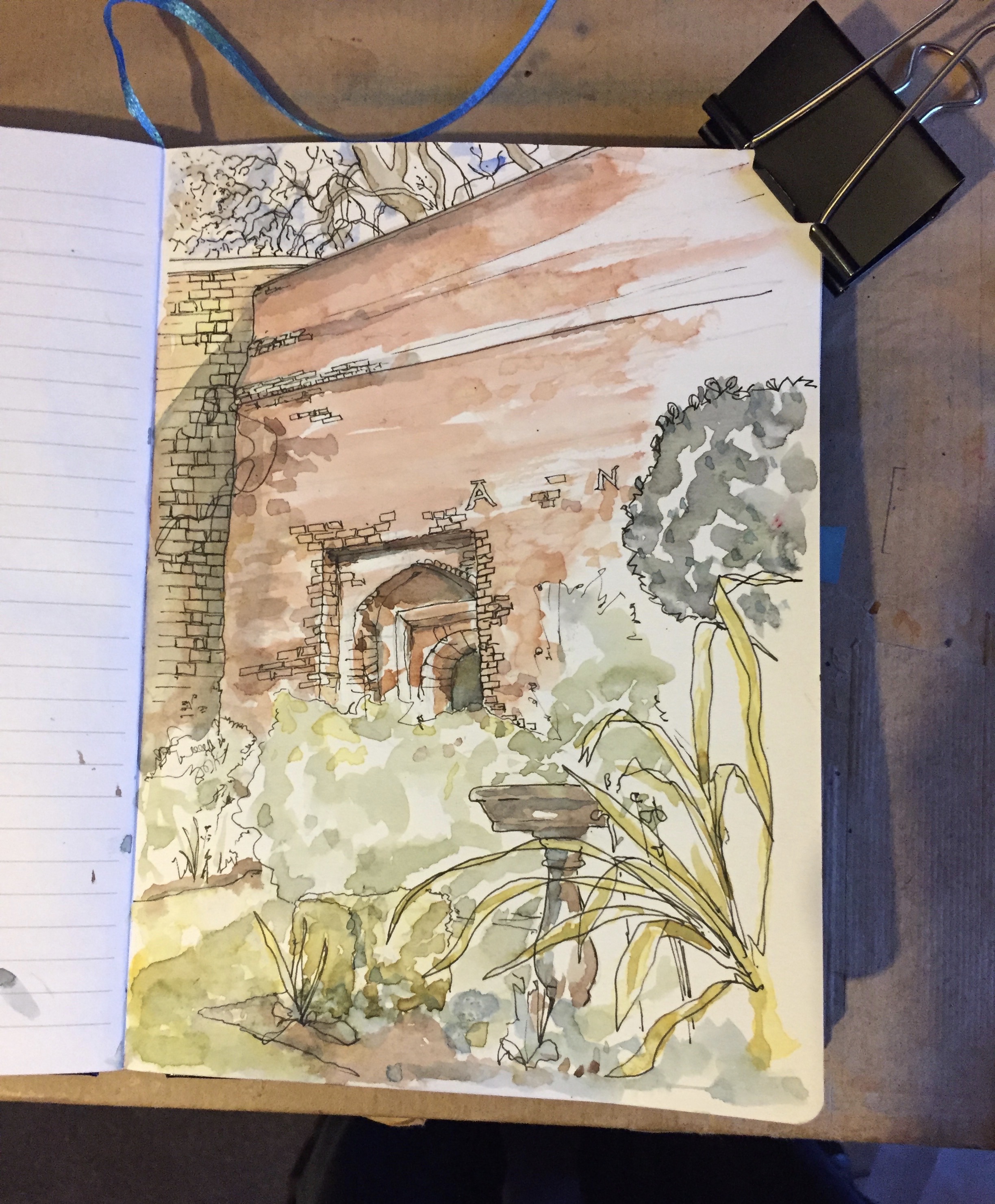
A sketch in the North Garden of The Charterhouse.

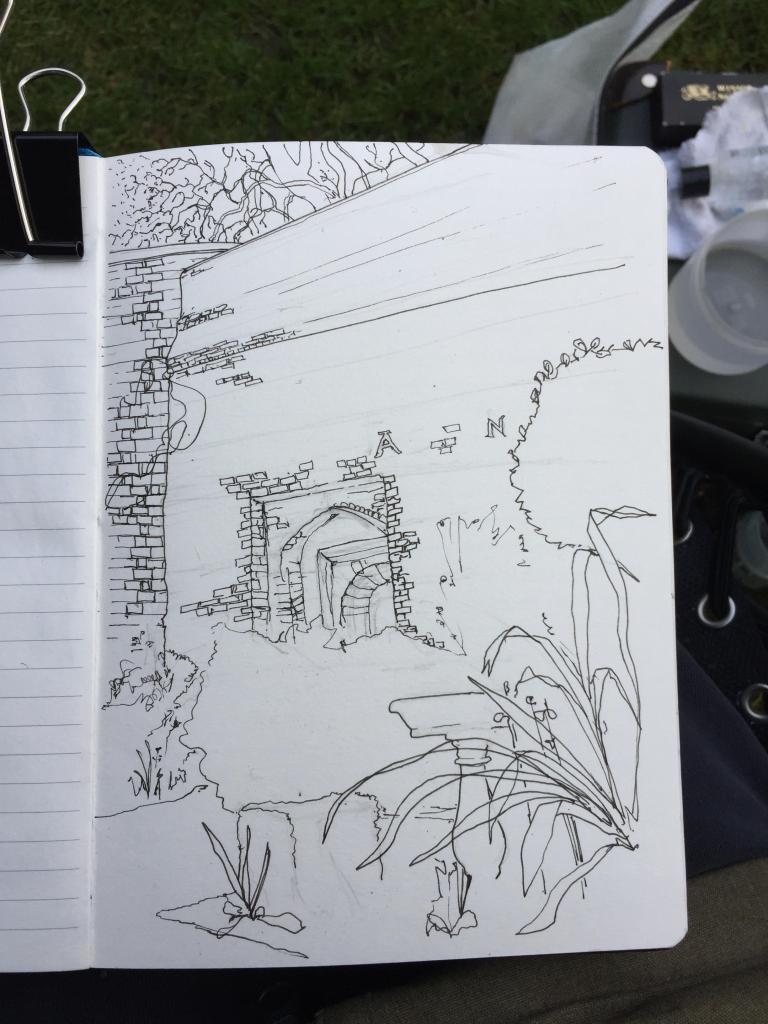
This wall is very old. The letters “A” and “N” in the drawing are iron, embedded in the brickwork. The whole message is spelled out along the 100 feet or so of the wall and reads “ANNO 1571”.

The door is more like a tunnel in the thick brickwork. It has a grass path leading to it and looks functional. Nobody went in or out while I was drawing it.
I loved this part of the garden. It was very quiet, and, for winter, amazingly lush. There was even birdsong.
It was, however, very cold. So I only could do one drawing. My hands and legs were becoming stiff. Behind me, another painting waited to be done: bright orange seedpods of the plant I know as “Chinese Lanterns”, and a very dignified old tree, gnarled but upright.
But I had to get back into the warm.

As I drew this, the gardener passed and re-passed, going down into a basement nearby. He said I wasn’t in their way. “You’re alright,” he said.

About 1hr45, to 11:10am. Drawn and coloured on location.

Here is the pen and ink, before the watercolour went on.

img 9434
img 9434

Thank you to the Preacher of Charterhouse, Rev Robin Isherwood, and the Brothers and workers at Charterhouse for their hospitality.
It’s a marvellous pleasure to visit.