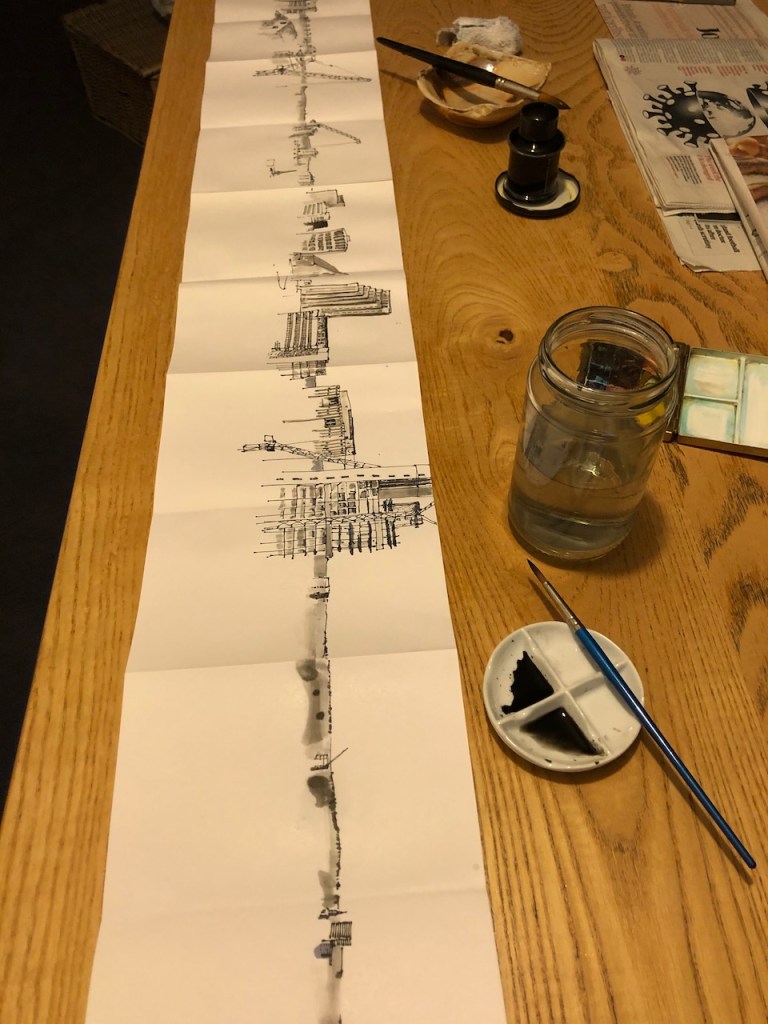
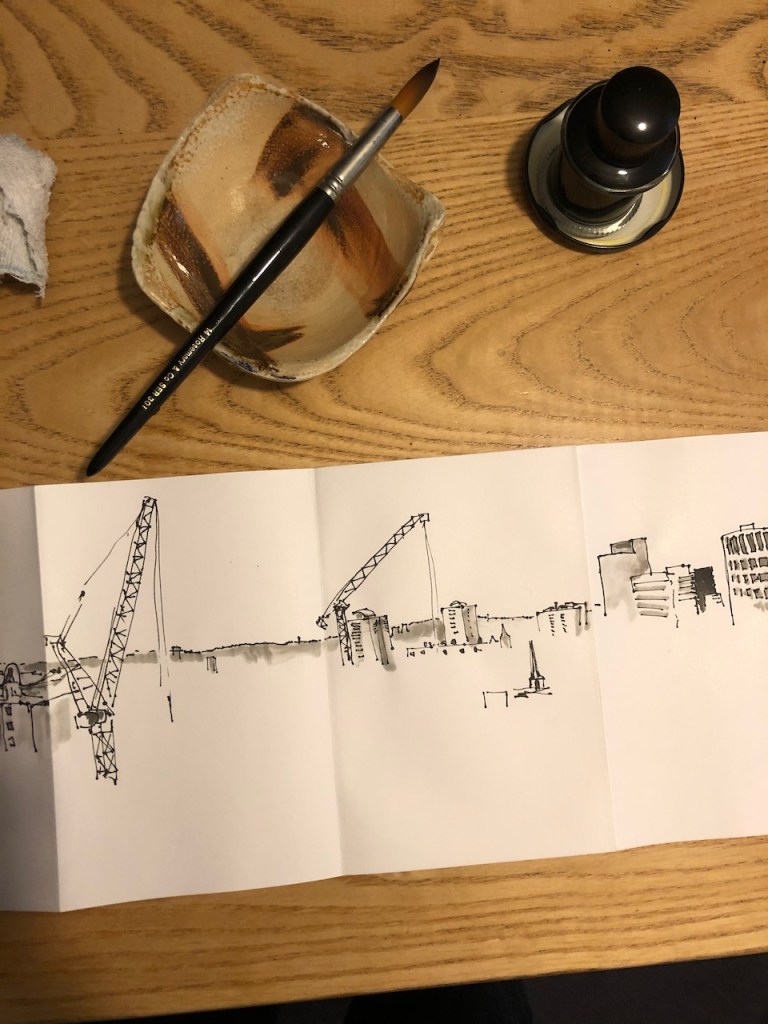
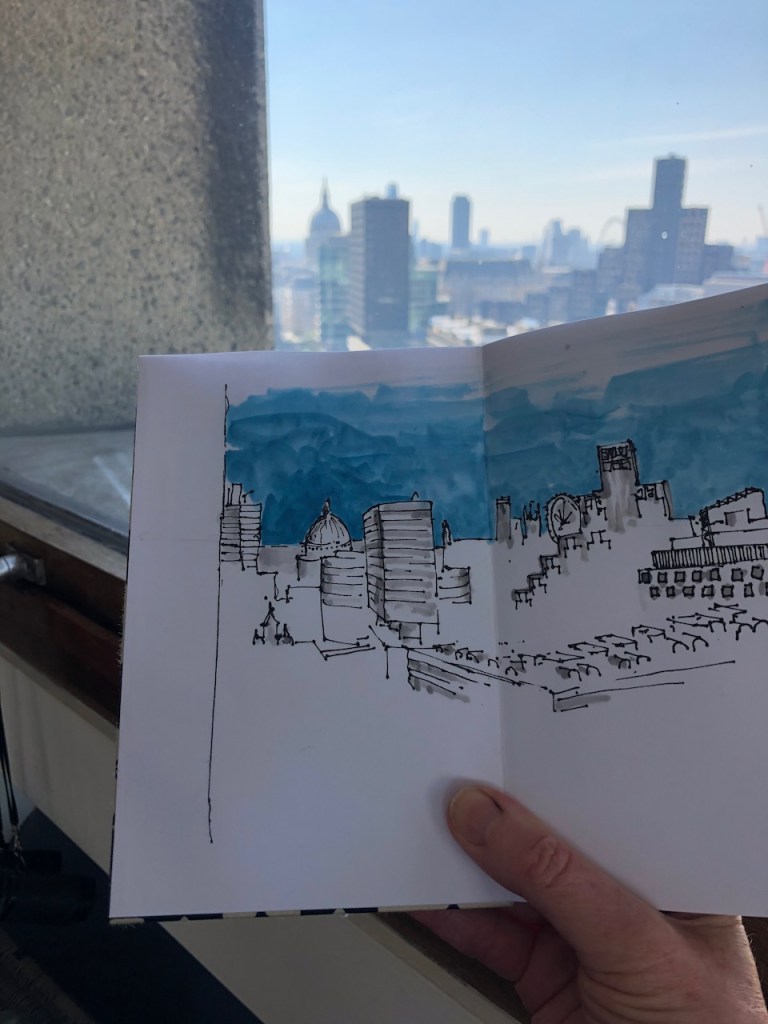
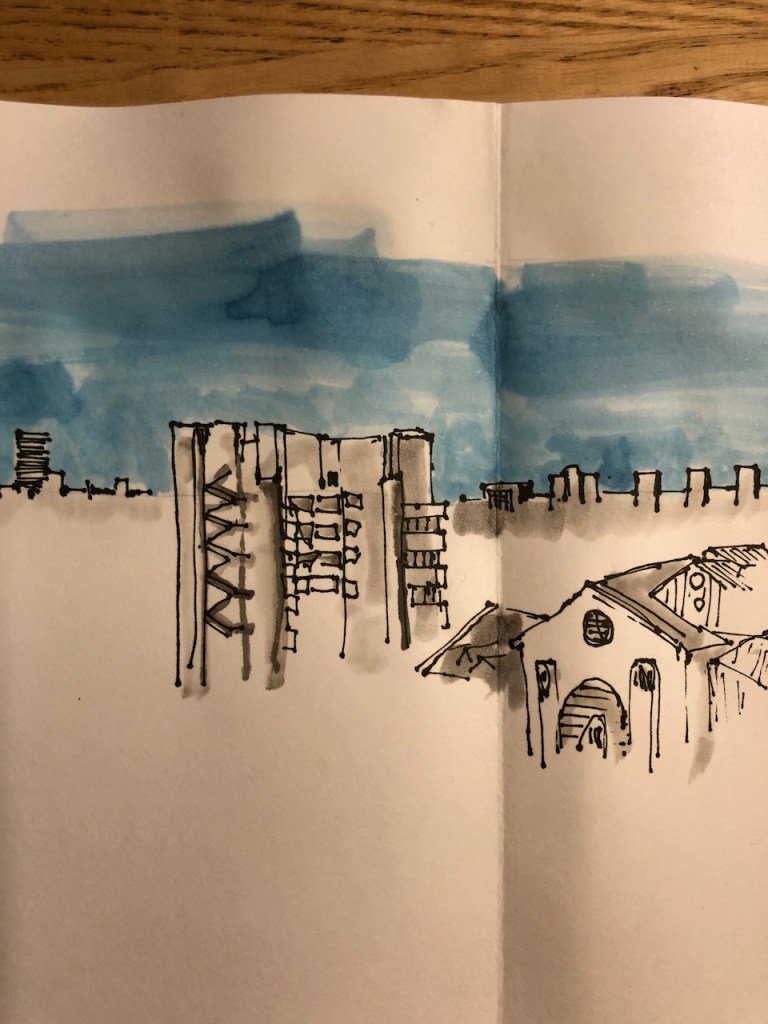
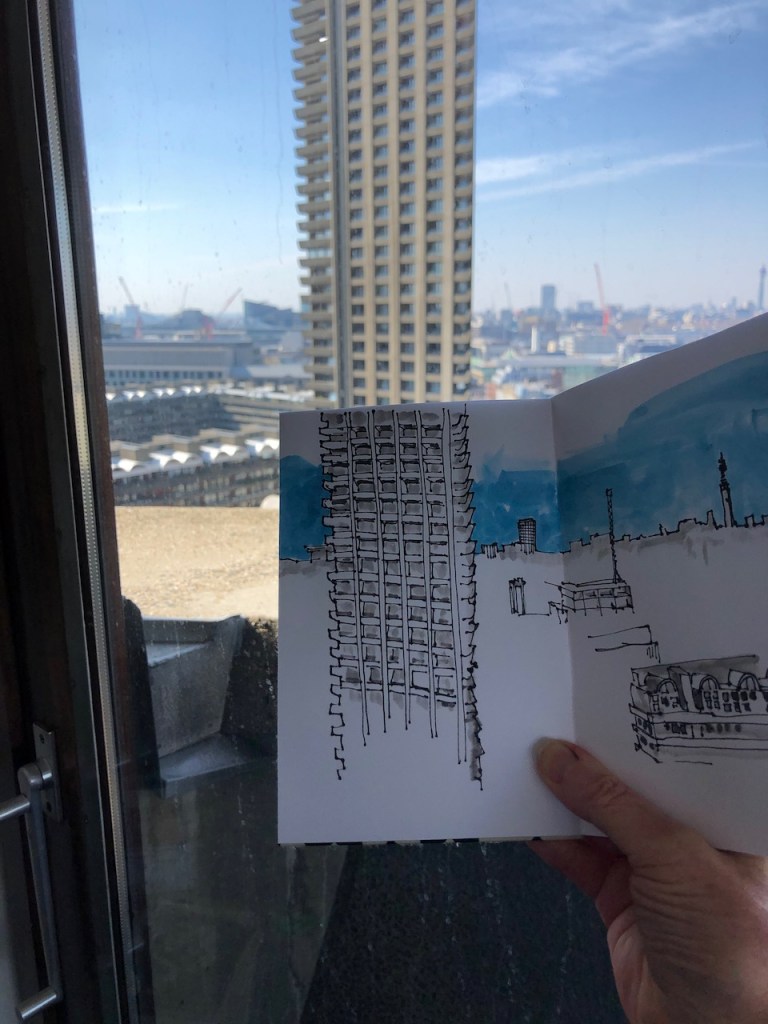
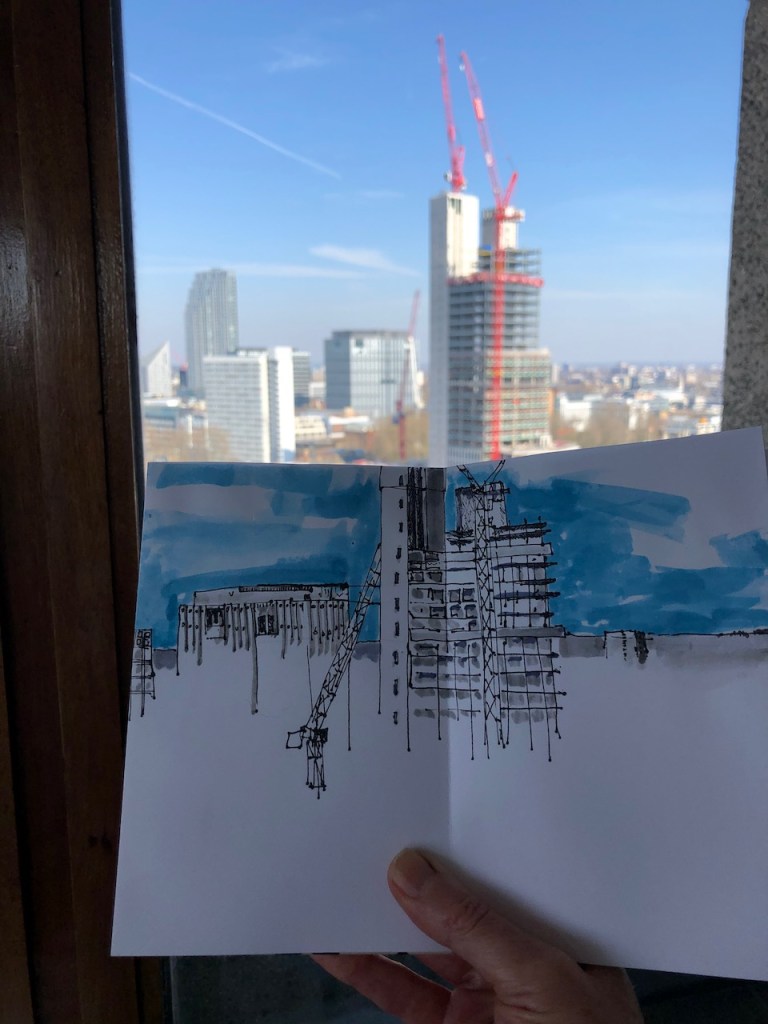
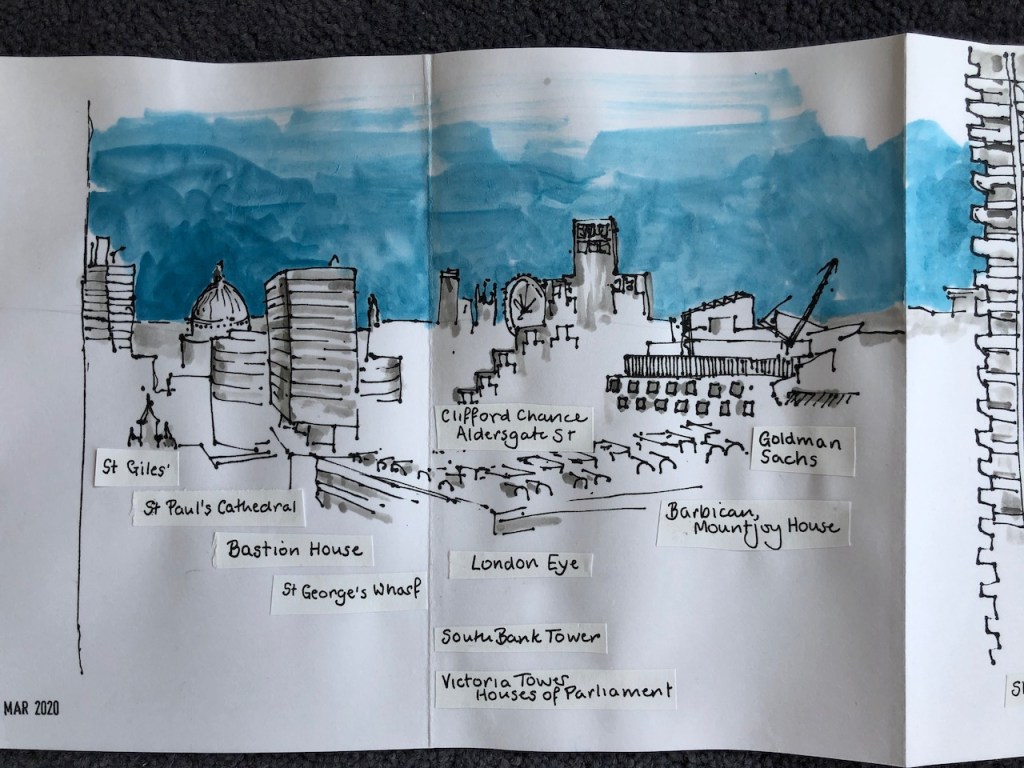
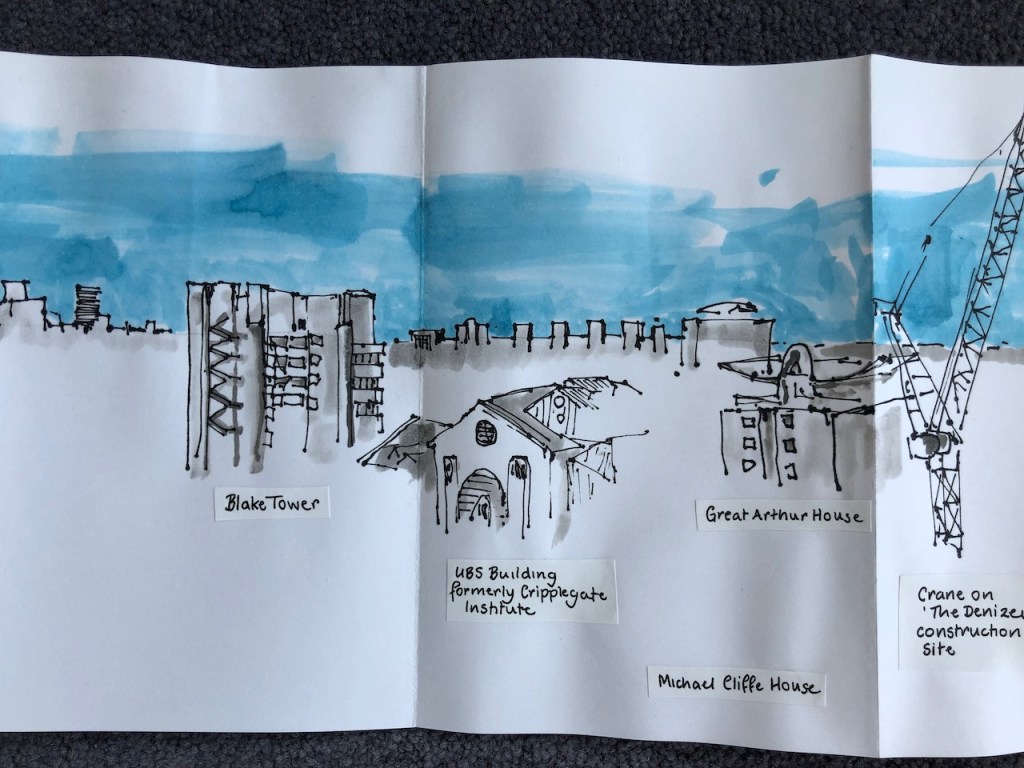
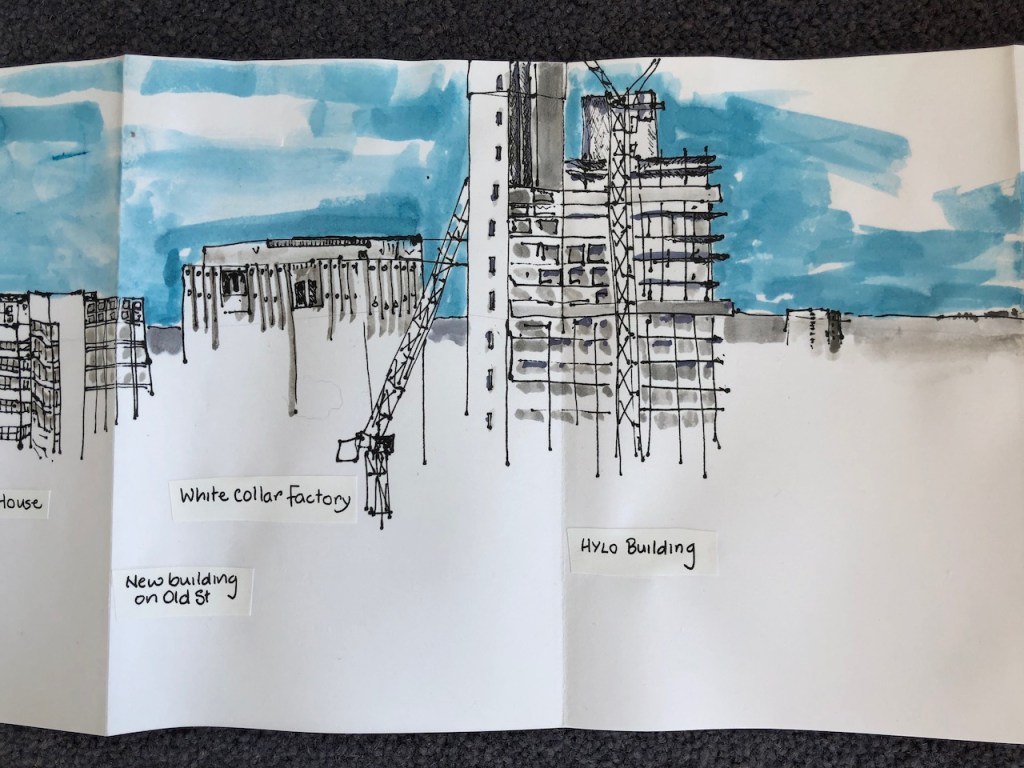
Some time ago, I was given a Japanese sketchbook, which was in the form of a concertina of doubled paper. In the last few days I drew the world outside, as seen from the windows of this flat. It’s about a 270 degree view, mostly over West and North London.
Pen and ink, work in progress. Grey added using diluted ink.
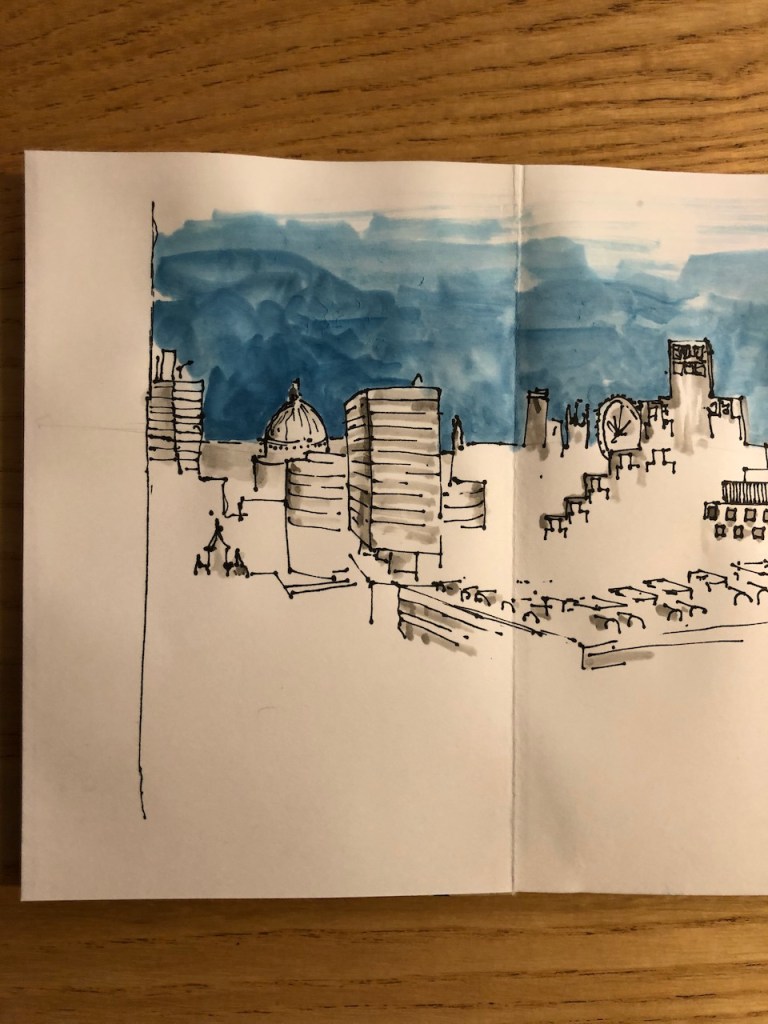
During these days of indoor confinement, the weather outside has been beautiful. Stunning blue skies. So I put that in using Phthalocyanine Turquoise watercolour.
Panorama on the table
St Pauls Cathedral
London Eye, Shakespeare Tower
St Pauls, Bastion House
The HYLO Building
Blake Tower
Post Office Tower
Shakespeare Tower
The Stage, The Principal Tower
Epping on the horizon
The HYLO Building
Blake Tower
Blue skies, phthalocyanine turquoise
Then I made a videos. The first one, with the pointer, has an audio commentary. It’s quite quiet, you may need to turn the sound up. The second one is silent. This is the first time I’ve put videos on this site. Let me know if it works.
I added written captions also, as you see in the second video.
Here are still pictures from the panorama with captions.
Credits
This is the book, made by Haibara Chiyogami, Tokyo, Japan
Click a button below to share this post online, email it, or print it:
In the streets of Basel, you can hear your own footsteps.
There are fountains.
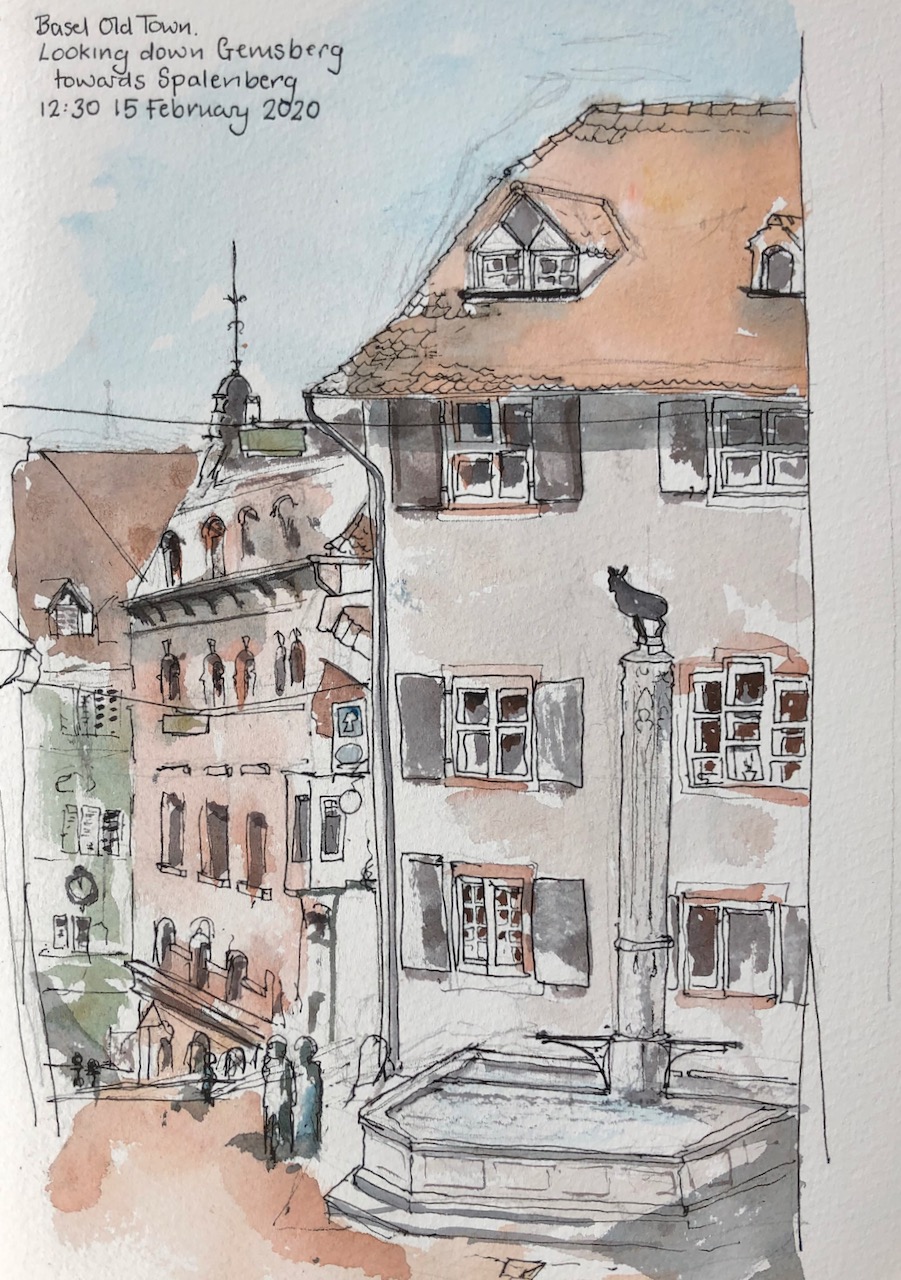
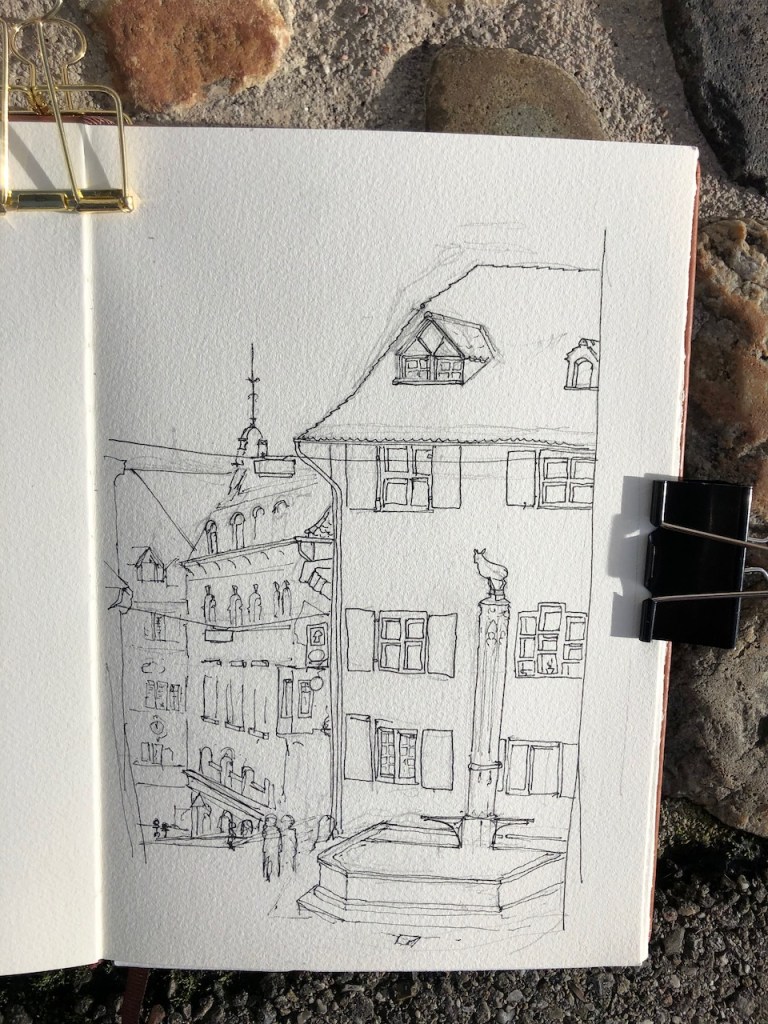
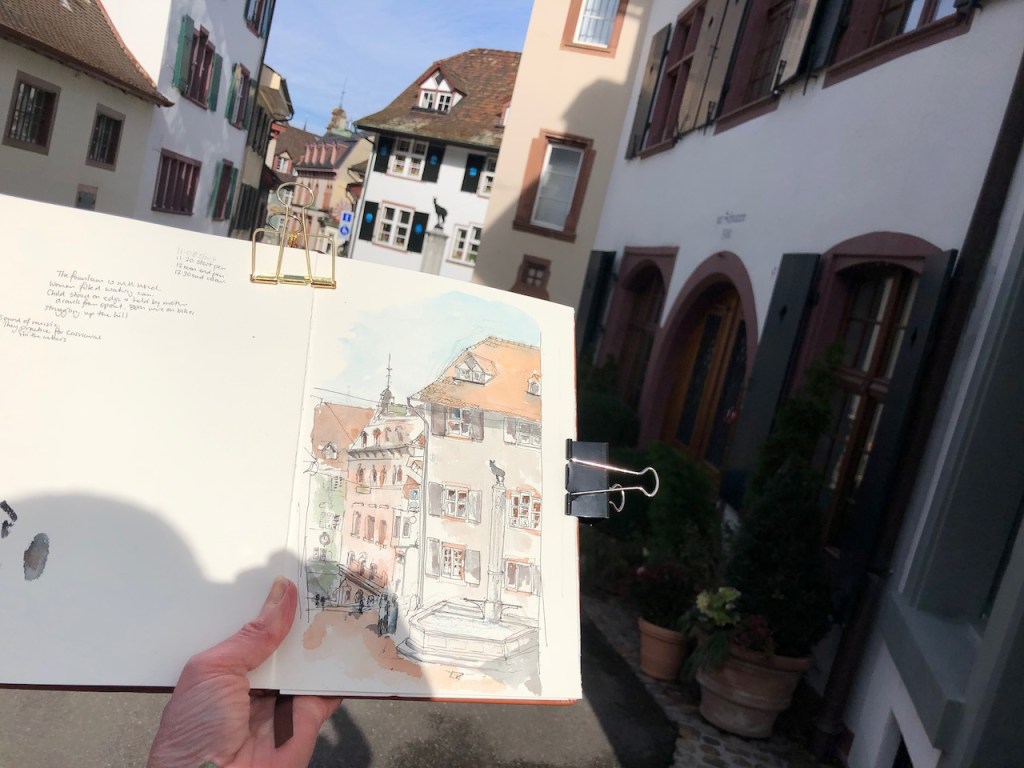
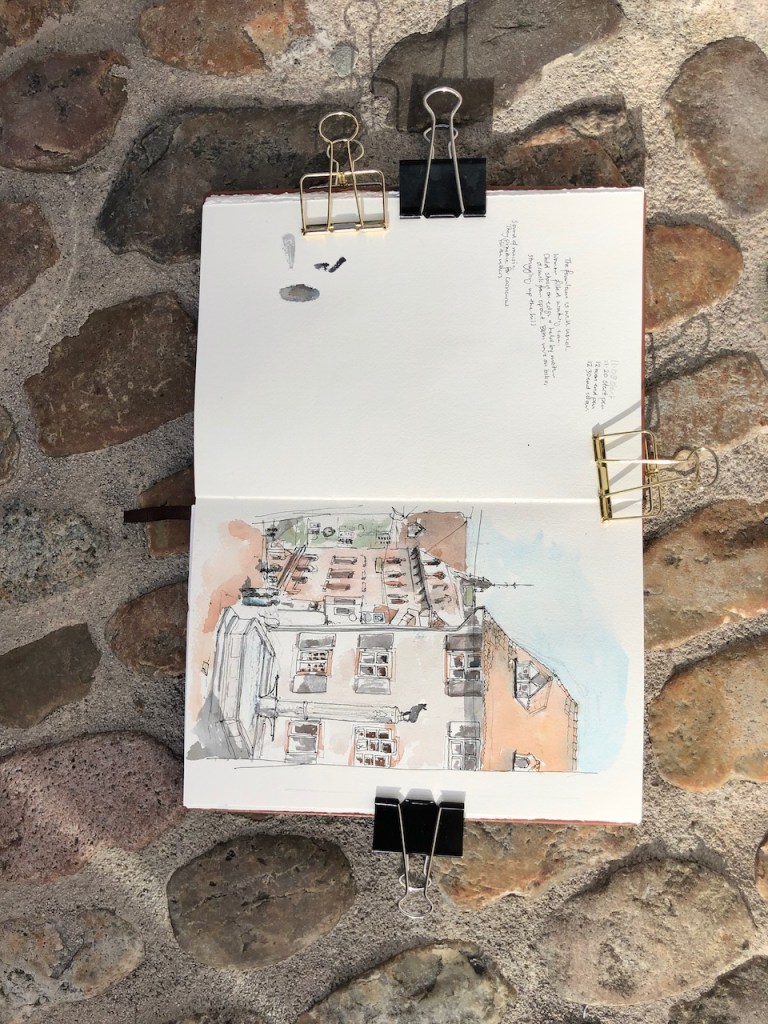
Gemsberg, Basel Old Town, 7″ x 10 ” on Fabriano Artistico paper, [sketchbook 6]
In the hour and half that it took me to draw this picture, people made use of the fountain. Someone came out of one of the adjacent houses and filled a watering can. A woman helped a child to stand on the white marble edge and then to walk cautiously on the iron bars across the water. The child dipped her hands in the flowing water and drank. She played with the water that came from the spouts. Then the woman and the child returned to their bicycles, and continued their ascent of the hill. Elderly people, climbing the hill, paused here to rest. A runner lent over the water and sluiced his face, before pacing on up the slope towards me.
This part of town is very old. Basel has the fine custom of telling you a little about each street, on the street sign. The one for Gemsberg says:
“Zum Gemsberg, 1661 erstmals erwähnter Hausname”
So this street was named after a house which stood here in 1661. [German speakers reading this: please correct me if I got that wrong!]
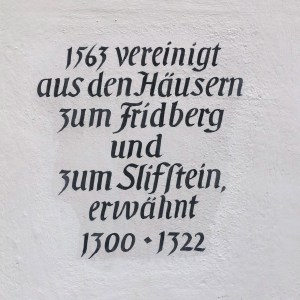
The house on the right has an inscription in magnificent script. My German-speaking consultant enables me to state with some confidence that this reads as “In 1563 [this house was created] by joining together two houses: “To the Fridberg” and “To the Slifstein”, both mentioned in 1300-1322″
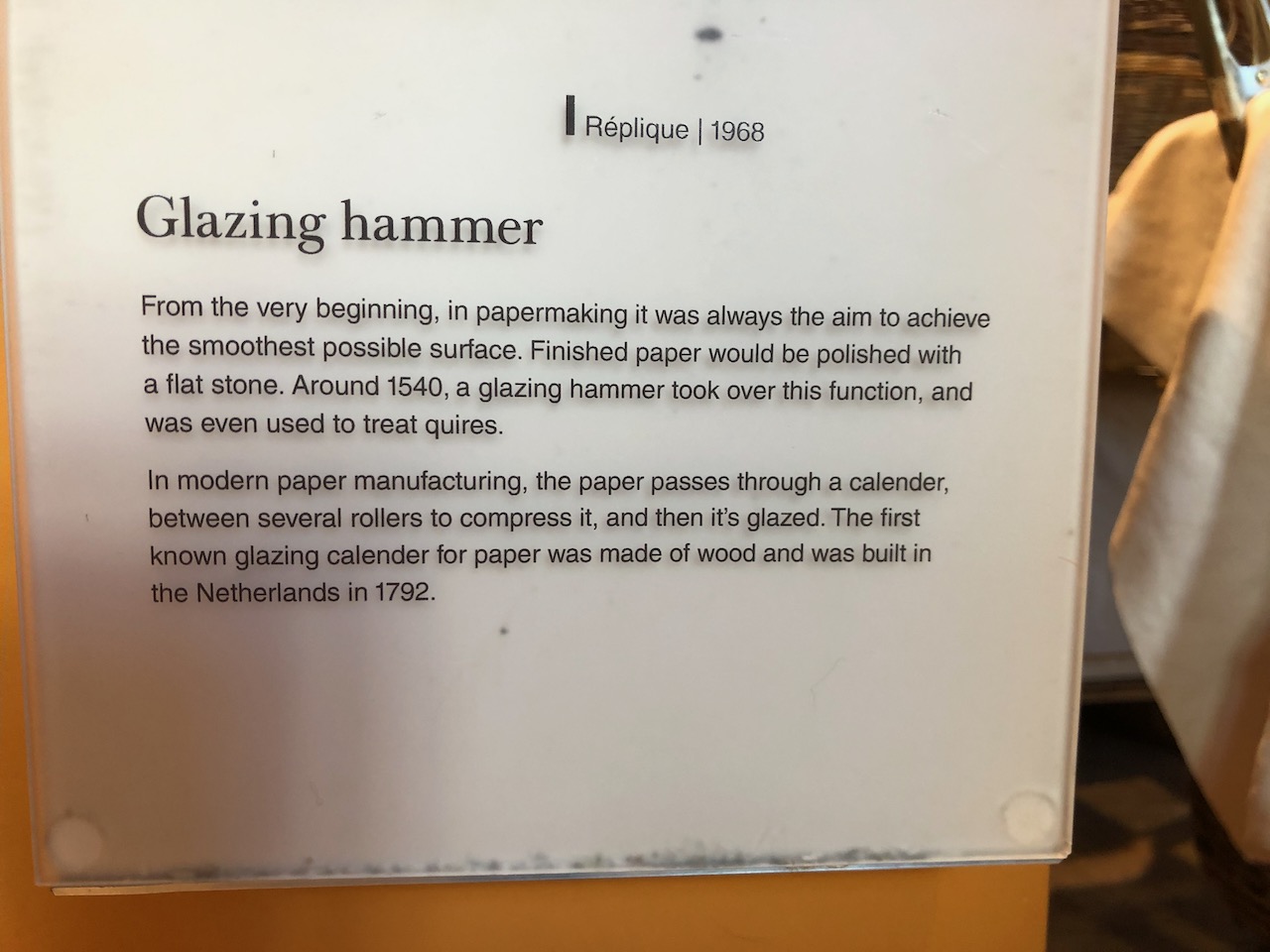
“Fridberg” might mean “Tranquil mountain” and “Slifstein” might mean polishing stone, or polished stone. Perhaps these were people’s names. I learned at the Basel Paper Mill that in those times smooth stones were used to polish paper, so may be Herr or Frau Slifstein was a paper polisher. But that’s just surmise.
Caption beneath a reproduction of a glazing hammer, Basel Paper Mill.
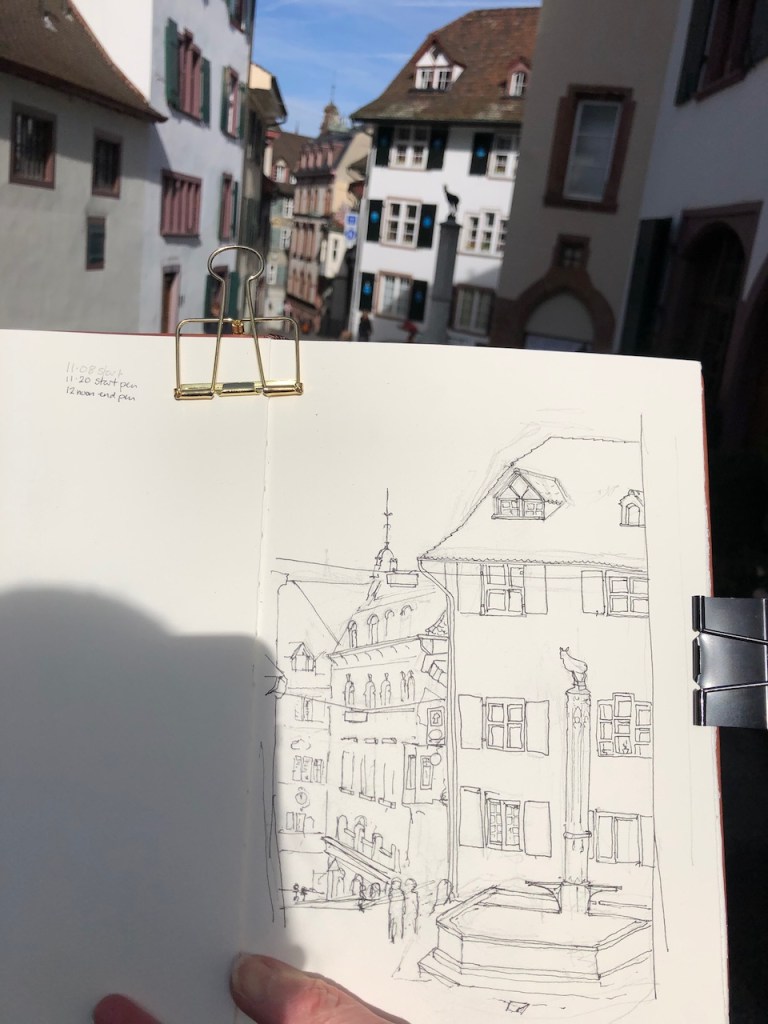
Here’s work in progress on the drawing.
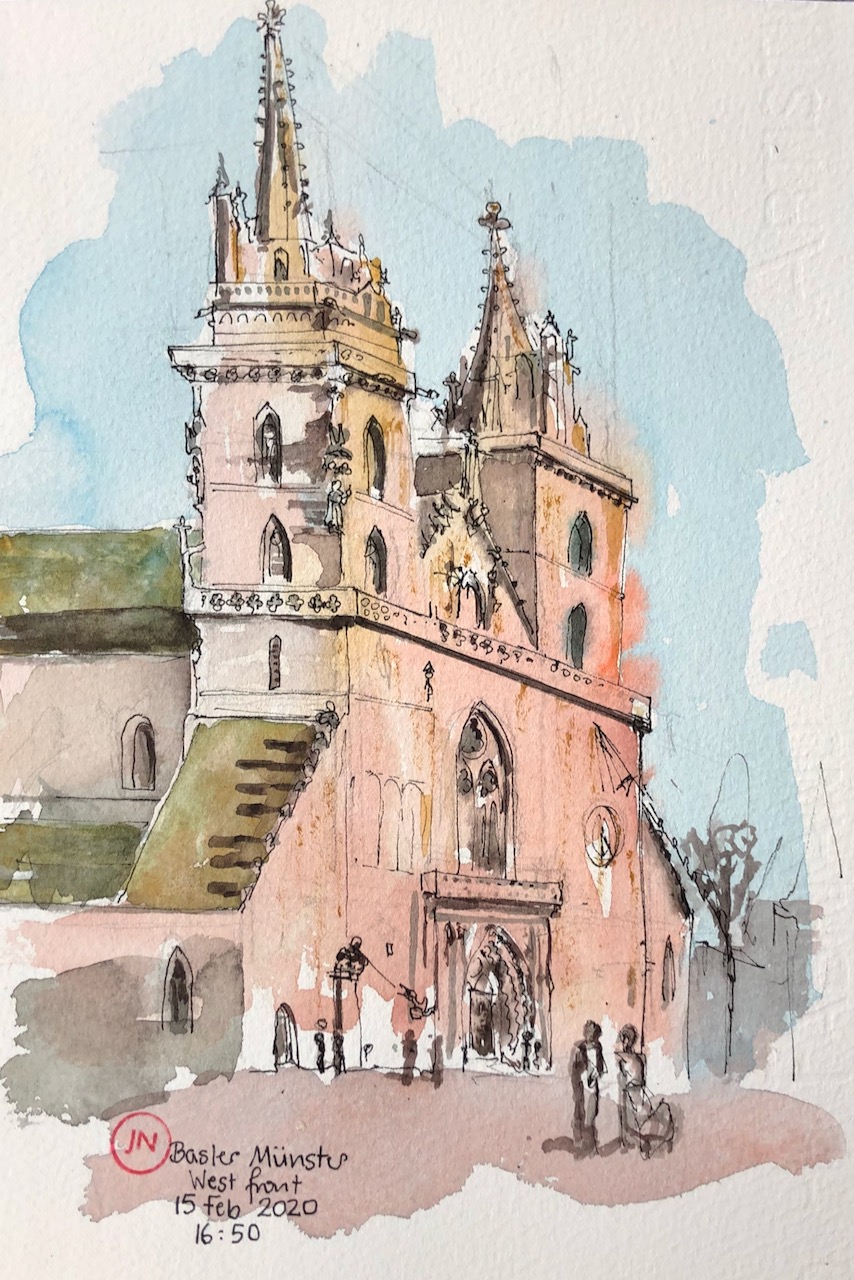
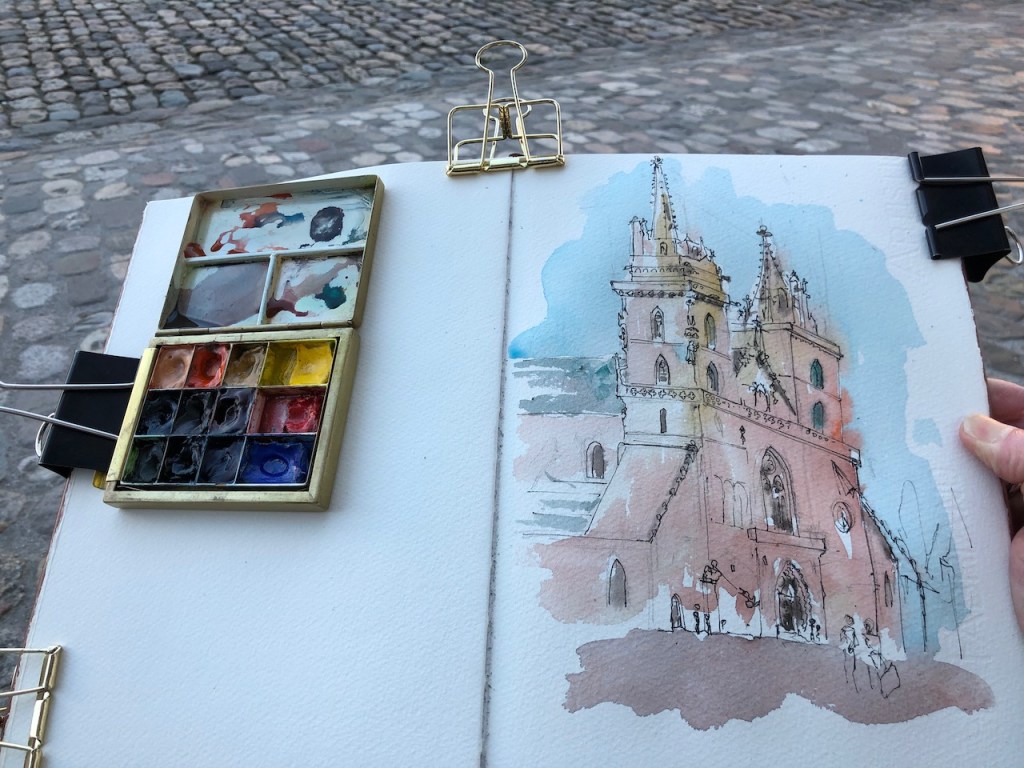
Later I tackled a tough assignment: Basel Cathedral, “Basler Münster”.
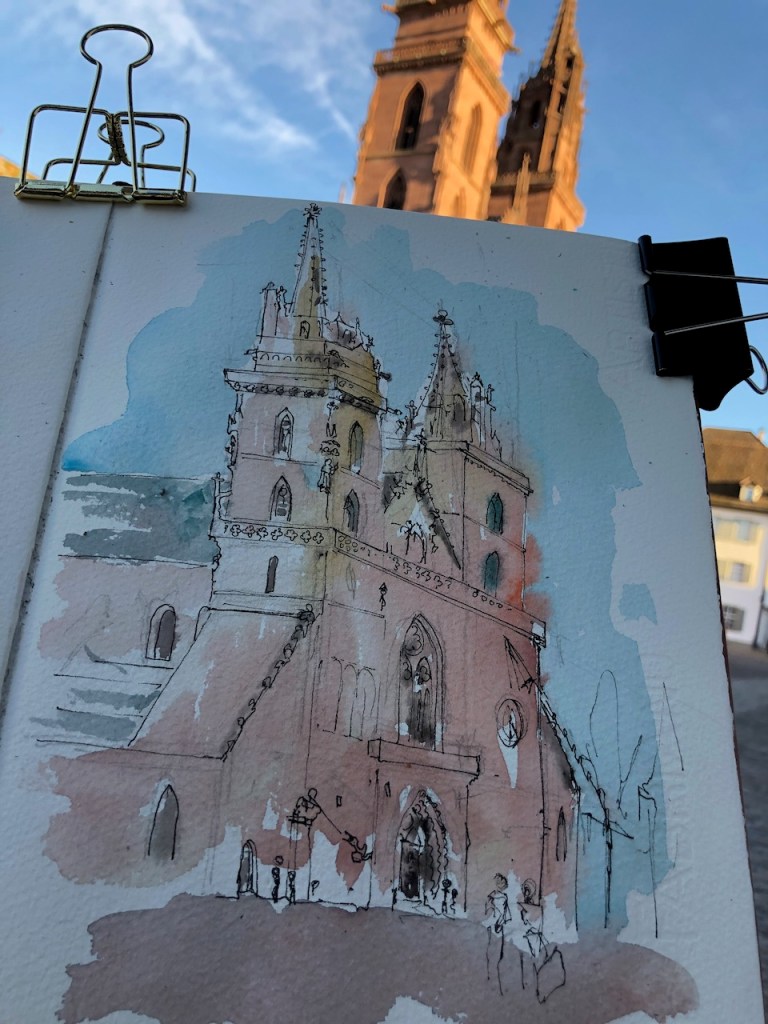
Basler Münster, West Front, 7″ x 10 ” on Fabriano Artistico paper, [sketchbook 6]
This is a magnificent medieval construction, the present building dates from about 1500. It is a real challenge for the Urban Sketcher. Each edge is decorated. Each corner hosts a saint, or often two. Every planar surface has decoration, low relief, a statue. Not content with simply a sundial, they added also a clock. And on top of all this, the two towers are by no means identical. They each support a forest of spires, some octagonal. The main spire on the right seems to have curving edges, unless that was a cunning optical illusion. Even the roof is decorated with a pleasing coloured diamond pattern in tiles. I did my best, but those medieval stonemasons got the better of me.
To the left of the door is St George and the Dragon, a very realistic statue which I had to put in. St George’s horse prances on a firm plinth. St George himself wields a real metal lance, copper or some copper-containing alloy, since it is green. The dragon, some distance away, is made to balance on a precarious shelf, endangered by the thrust of the lance. It’s a dynamic and three dimensional scene.
Here is work in progress on the drawing.
Drawing the West front of Basel Münster.
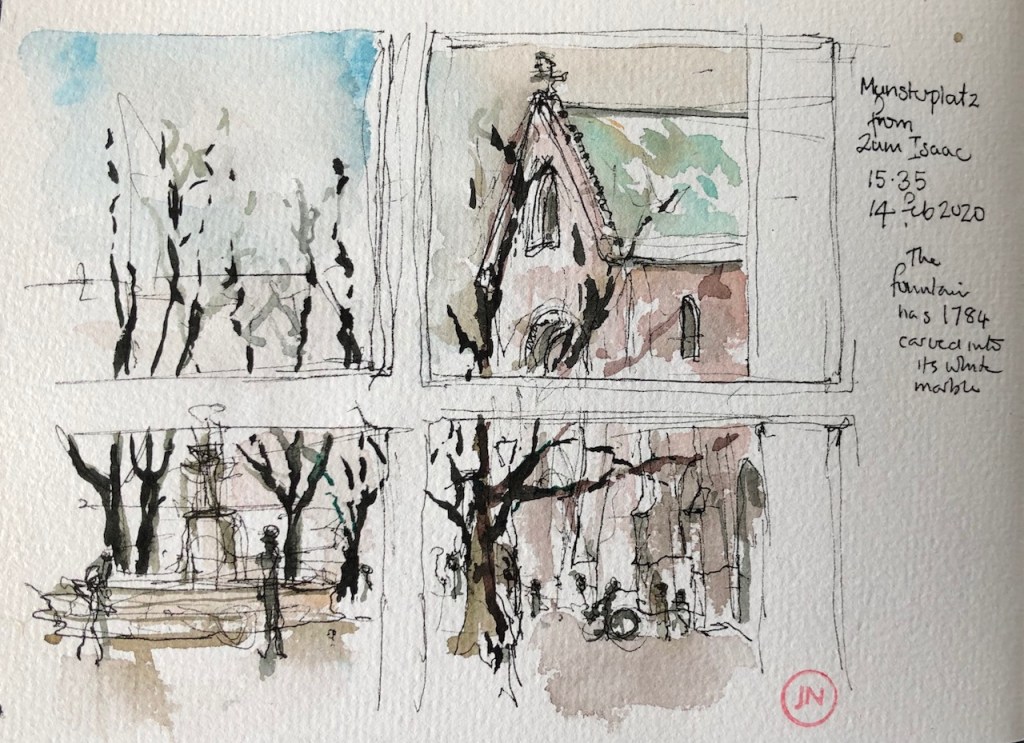
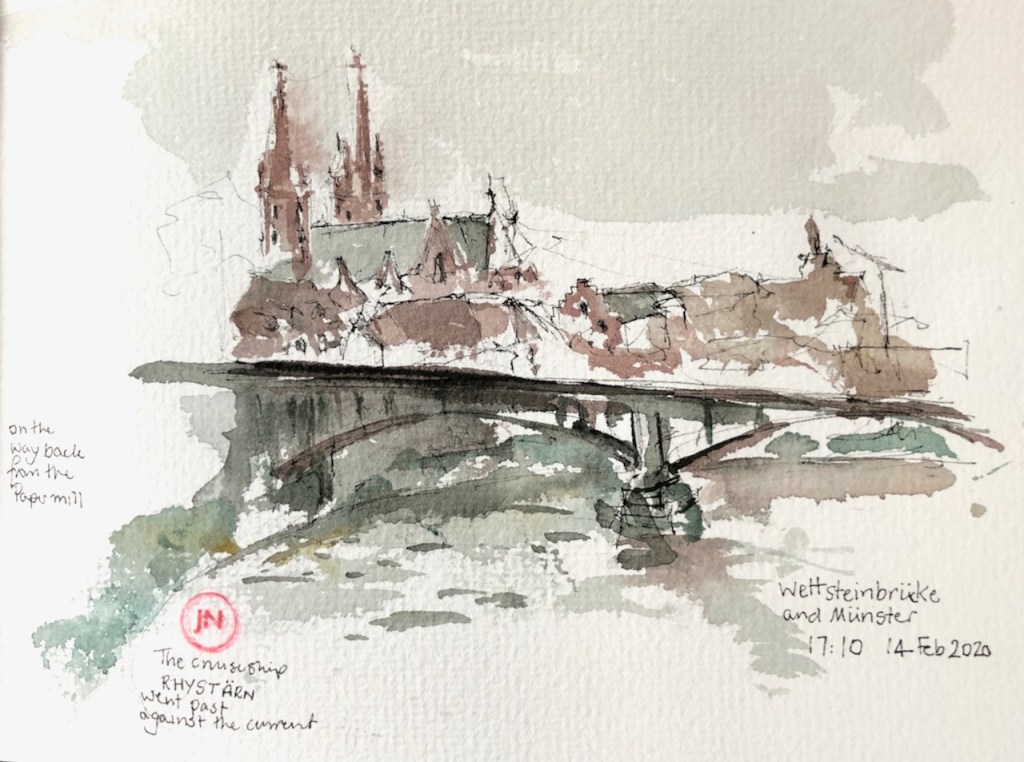
I made more sketches around the city:
Münsterplatz from ‘Zum Isaac’
Basler Münster and the Wettsteinbrücke
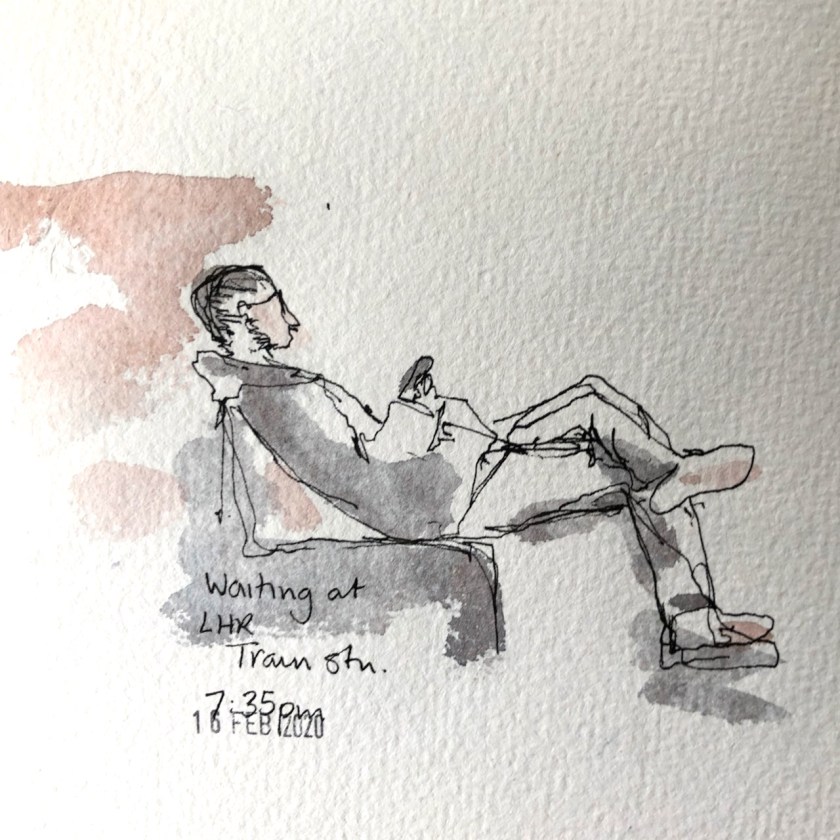
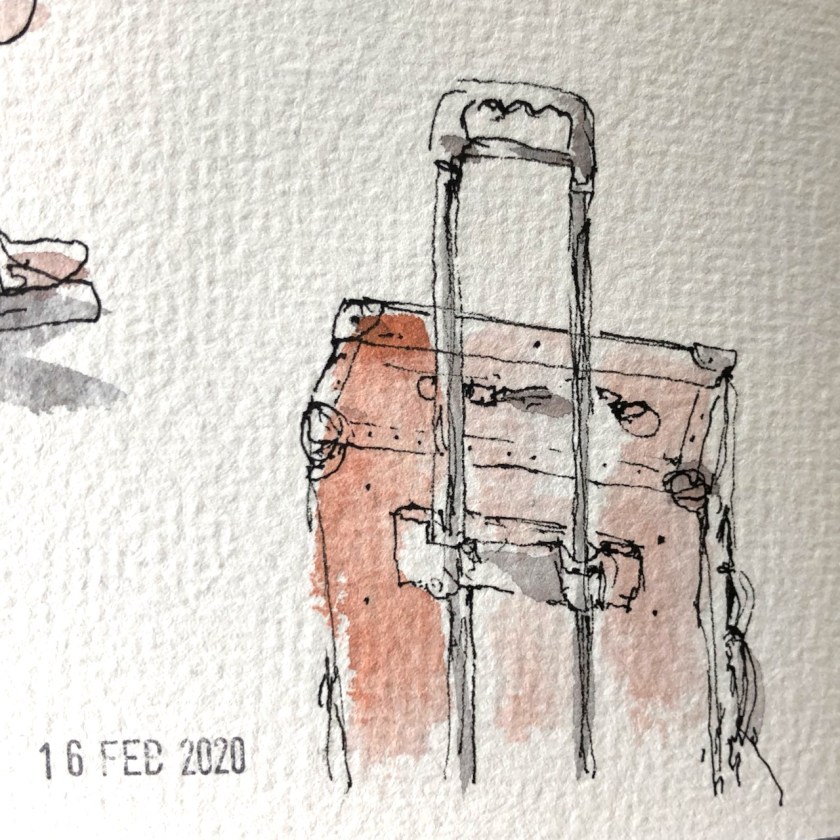
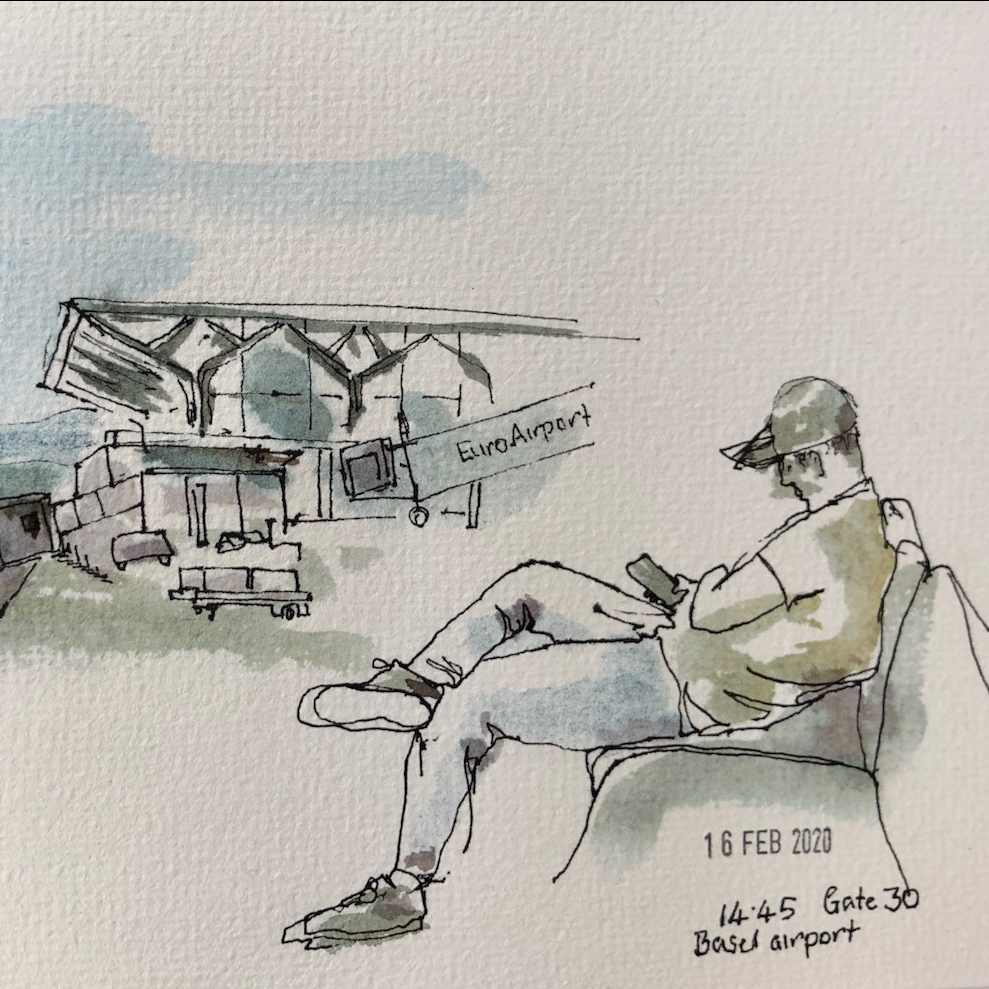
On the long journey home, I sketched the people, and my luggage.
Click a button below to share this post online, email it, or print it:
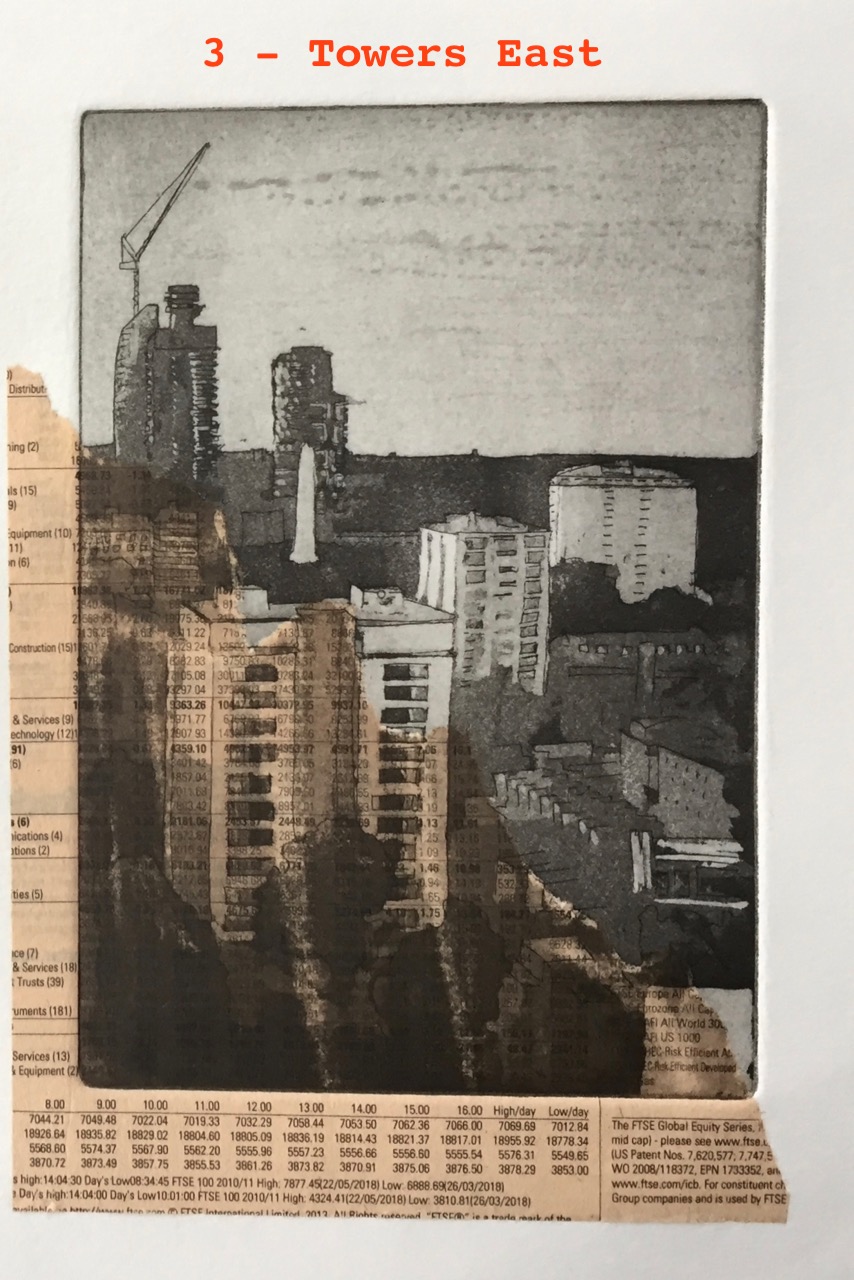
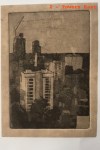
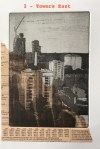
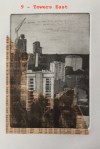
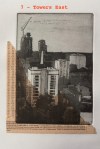
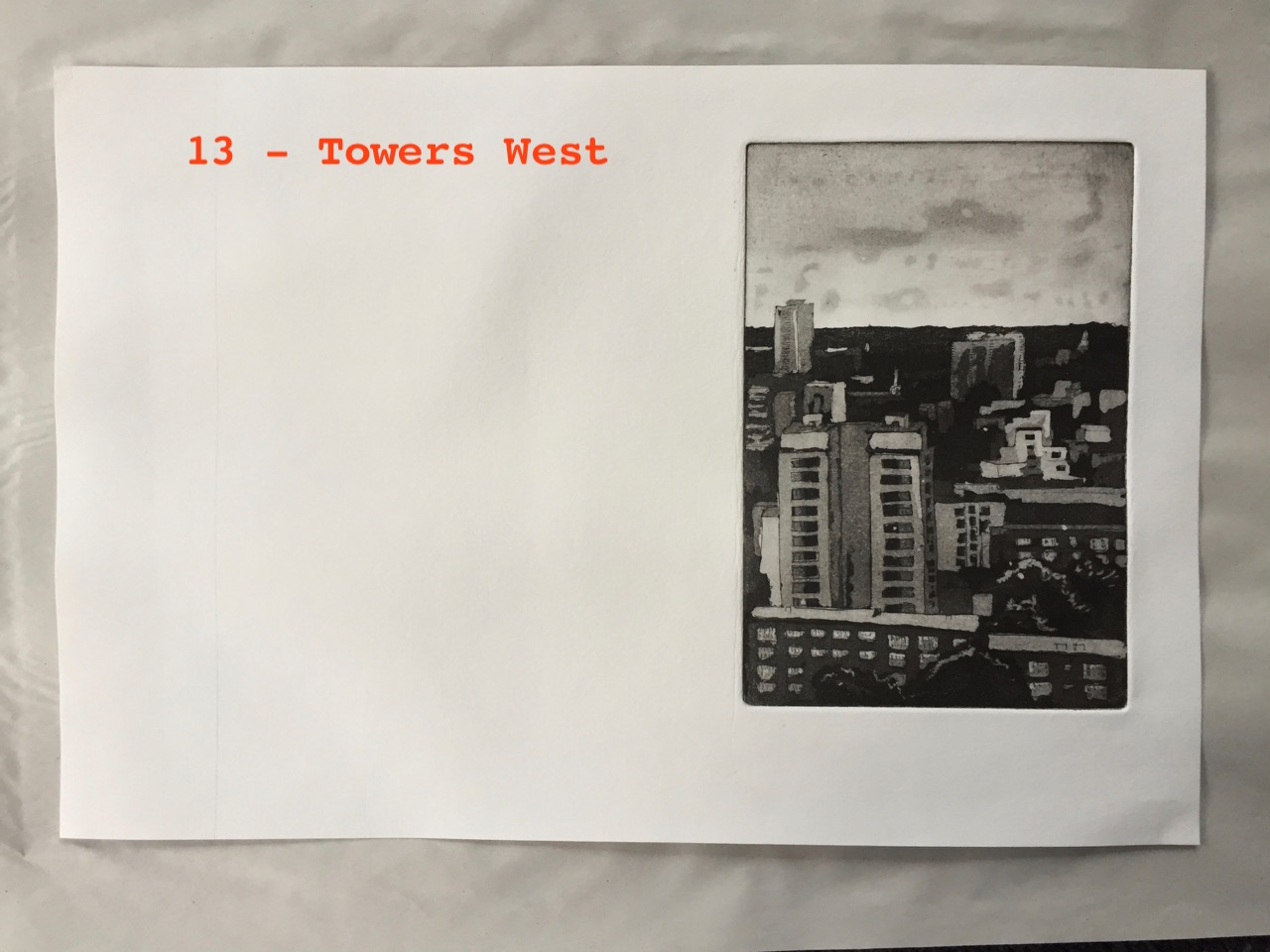
The Towers are St Mary’s Tower and Peabody Tower, just to the North of the Barbican.
I made 14 reasonable prints, and 2 out-takes. I glued the out-takes into my notebook. I make one page per print session, and record what I did, what paper and ink I used, what worked and what didn’t. This is in an attempt to learn and improve my printing technique.
Here are the 14 reasonable prints, numbered 1 to 14. Numbers 1-13 are on card 20cm by 30cm. This card size is intended as a greeting card. When folded it fits neatly into an A5 envelope. Number 14 is on larger paper. All are for sale, £5 each plus postage. Please contact me by email via the contacts page, or leave a comment on this page. The red writing is on the online image here, not on the print.
Click on an image to enlarge it. It may take a little while to load.
These are all part of my “Towers Project” leading to an exhibition in the Barbican Library February 2019.
I work in the print studio at East London Printmakers. Prints are on Fabriano Unica Paper, using Intaglio Printmaker Bone Black ink. They are printed by hand on the Henderson press. Each print takes about half an hour to print.
Click a button below to share this post online, email it, or print it:
They are all for sale! Please let me know if you would like to buy one. All are printed on etching paper “Fabriano Unica”. They are intended to be used as greetings cards. So the print is to the side like this:
They fold in half to make a greeting card which fits in a C5 envelope.
Folded to make A5 card
Folded to make A5 card
Fits in C5 envelope
Fits in C5 envelope
Equally they can be folded in half or cut, and put in a frame size A5.
If you’d like to buy one, please contact me, and say which one you’d like. They are numbered – click the images in the gallery above. £5 each + postage. These are handmade items by me, an amateur printer. Thumb marks, imperfections, ink smudges and other defects reflect the handmade nature of the items and, as they say, “should not be regarded as defects”.
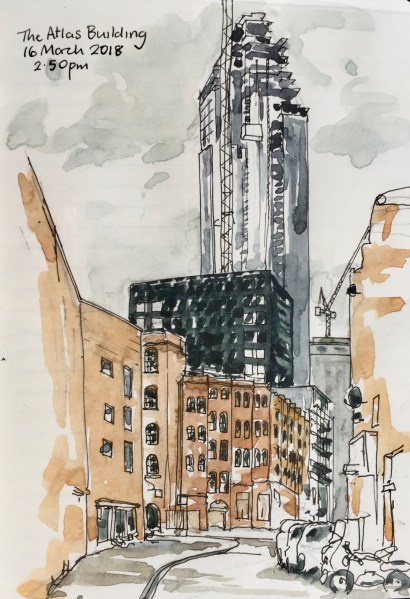
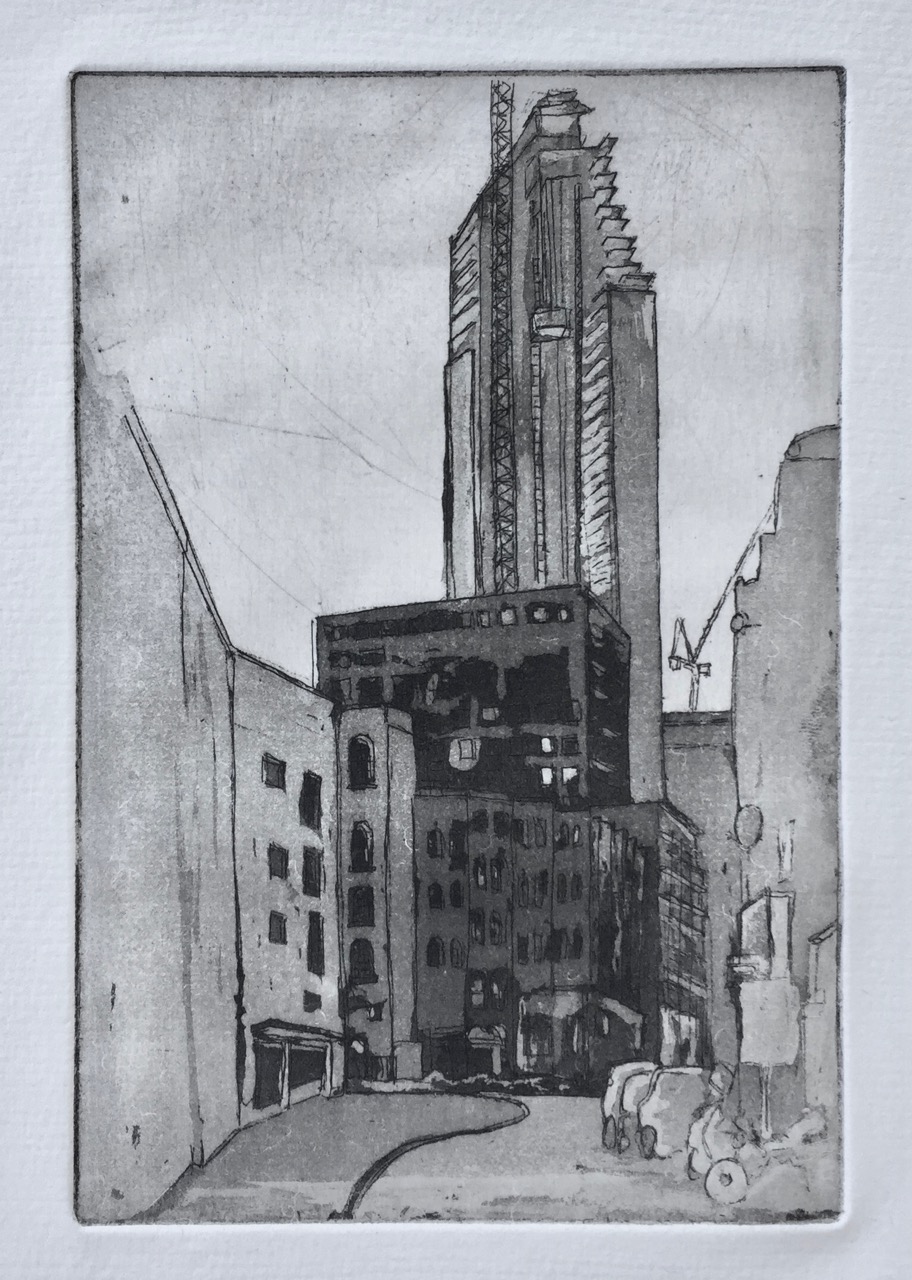
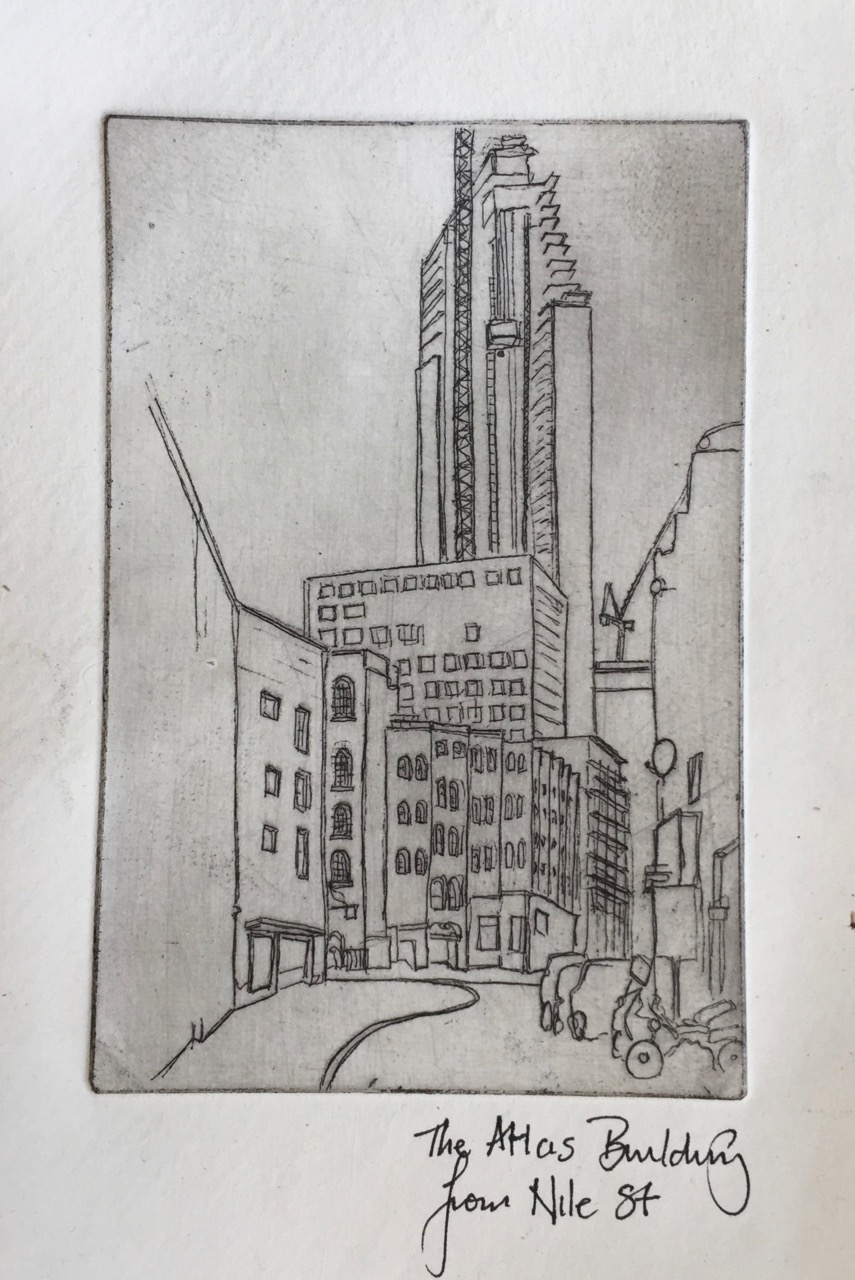
Today I worked on a print of the Atlas Building. This is based on a watercolour I did in March this year in a peregrination around City Road.
Here the hard ground print:
Then aquatint:
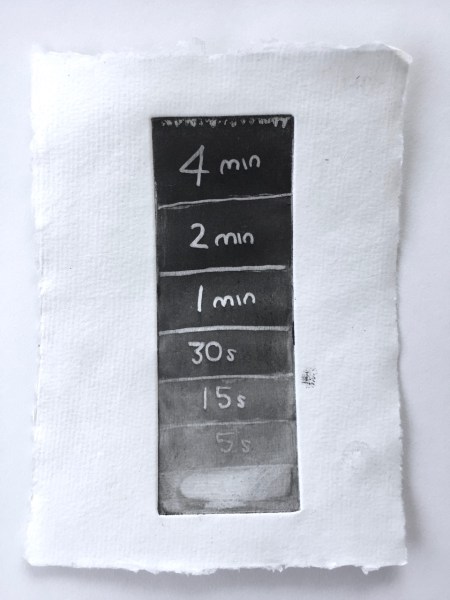
This was an aquatint with 6 tones, which is about the maximum I can achieve. On the 4th and 5th dip it’s difficult to see what I’m doing.
These pictures are postcard-size, with the intention of making cards.
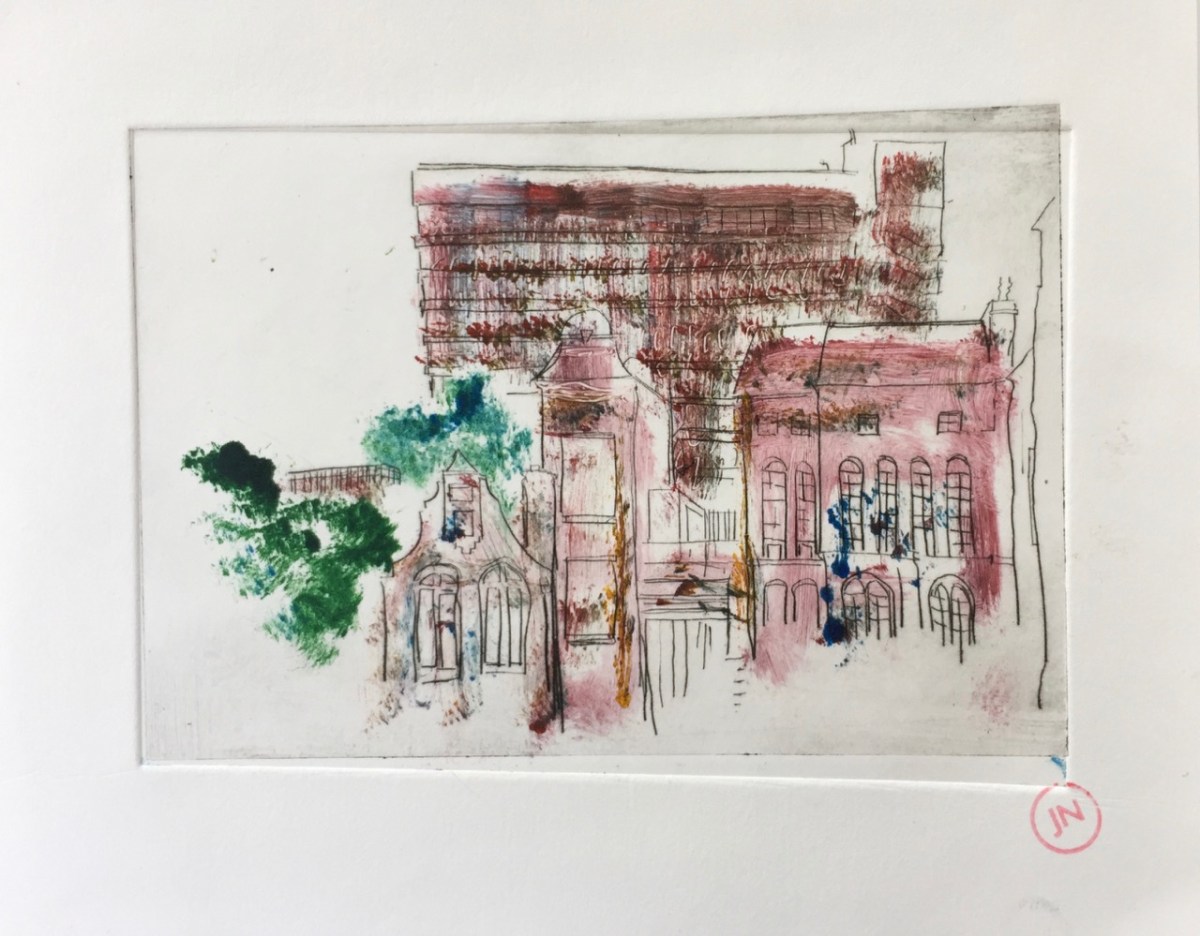
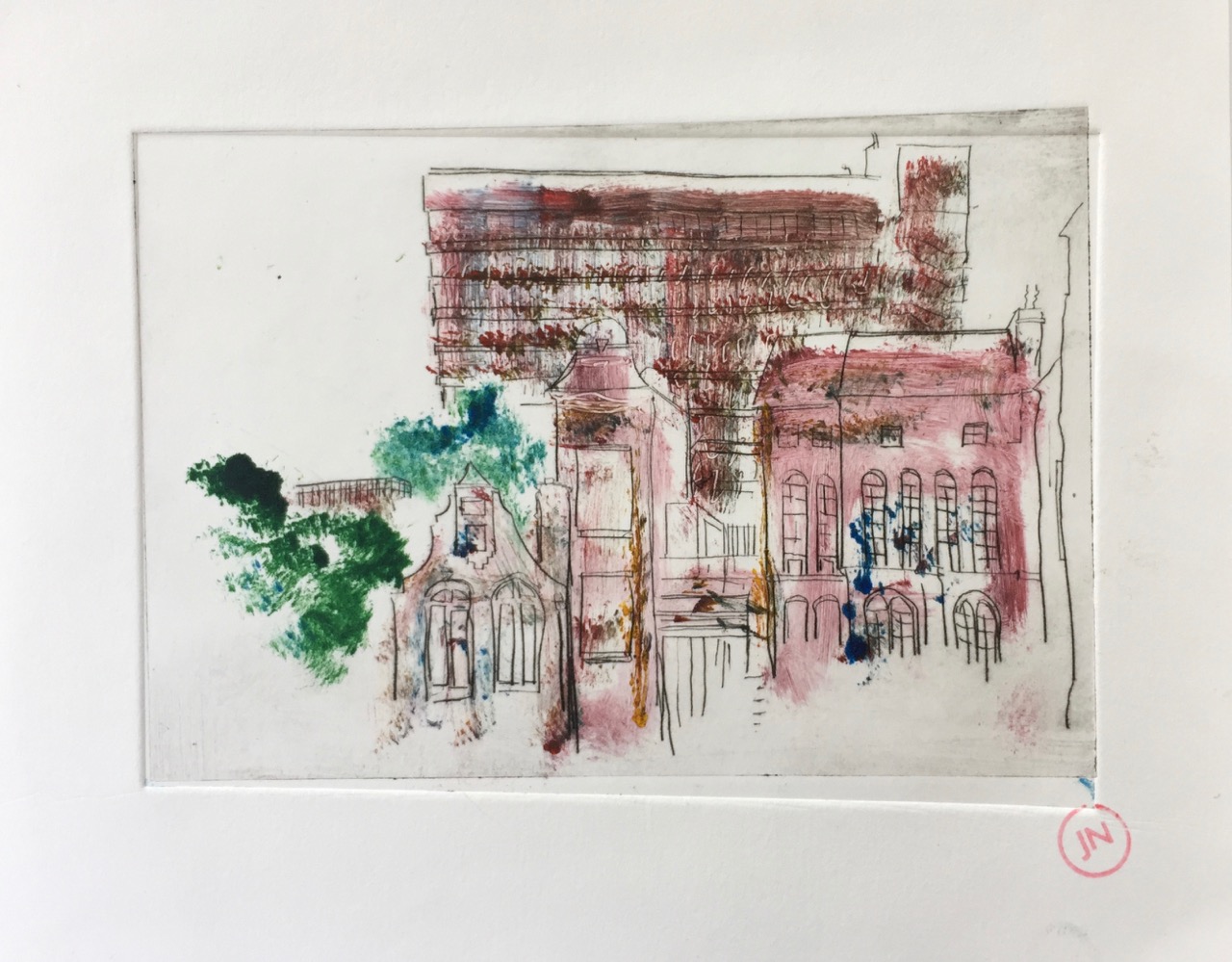
Here’s the test plate print.
I’m in the question about whether the aquatint needs more work. I thought it did when I first saw it, but now I’m not so sure. It isn’t as dark as the photo looks. Comments welcome.
Aquatint and test plate on Khadi handmade paper. Hard ground print on handmade paper from Paperchase. Printing done at East London Printmakers. Ink is Intaglio Printmaker “Shop Mix Bone Black” from a tube. Etching on 10cm x 15cm copper plate using Edinburgh Etch.
Here are the copper plates:
Click a button below to share this post online, email it, or print it:
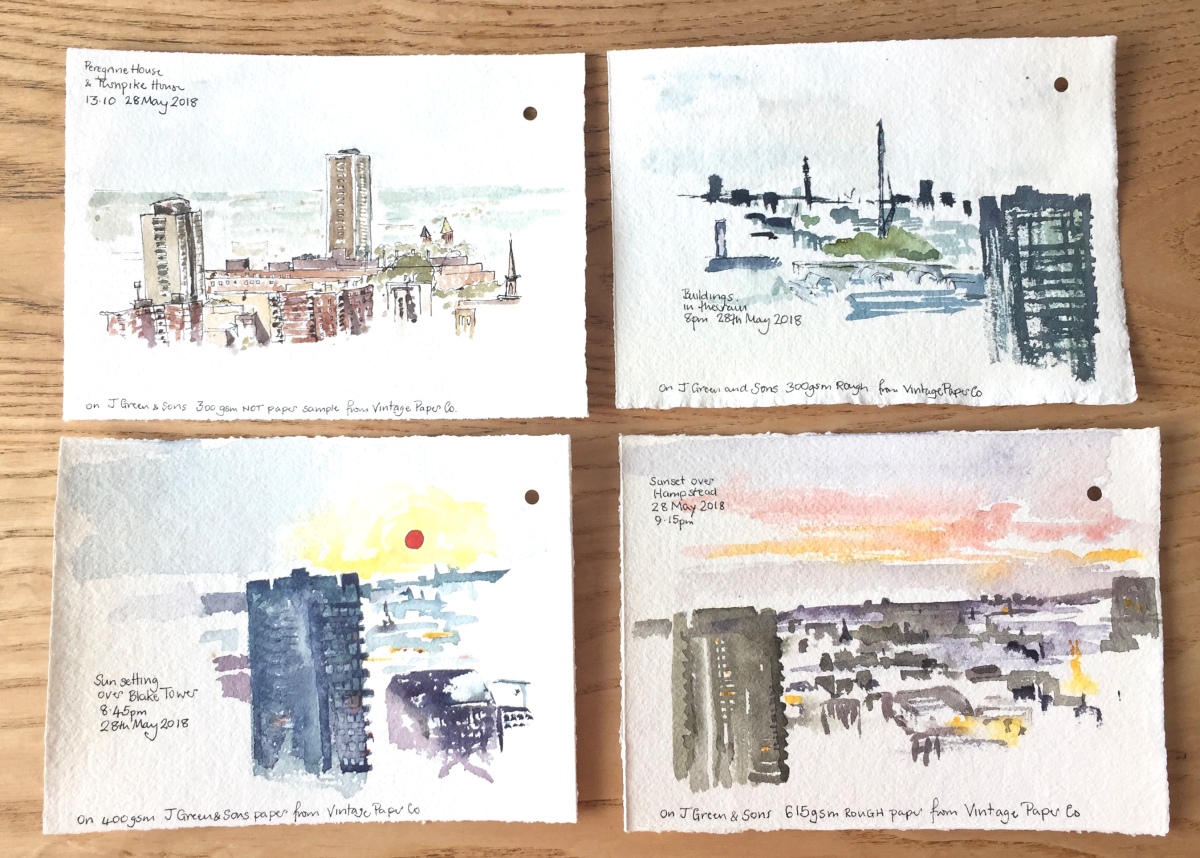
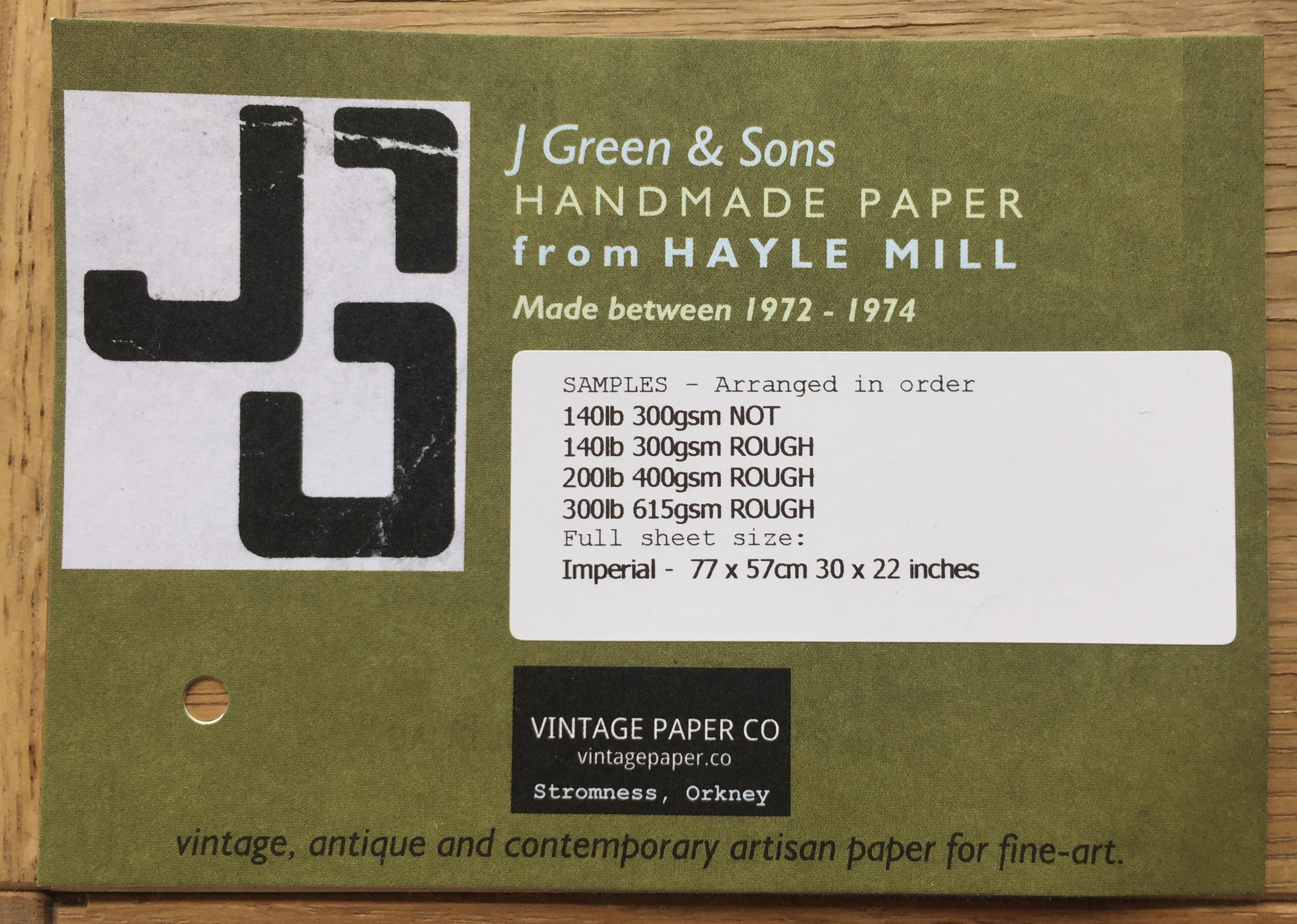
Each sheet is of “J Green & Sons” paper, in different weights. The one in the top left is “NOT” and the other sheets are “Rough”. Each sample sheet is about 8 inches by 6 inches.
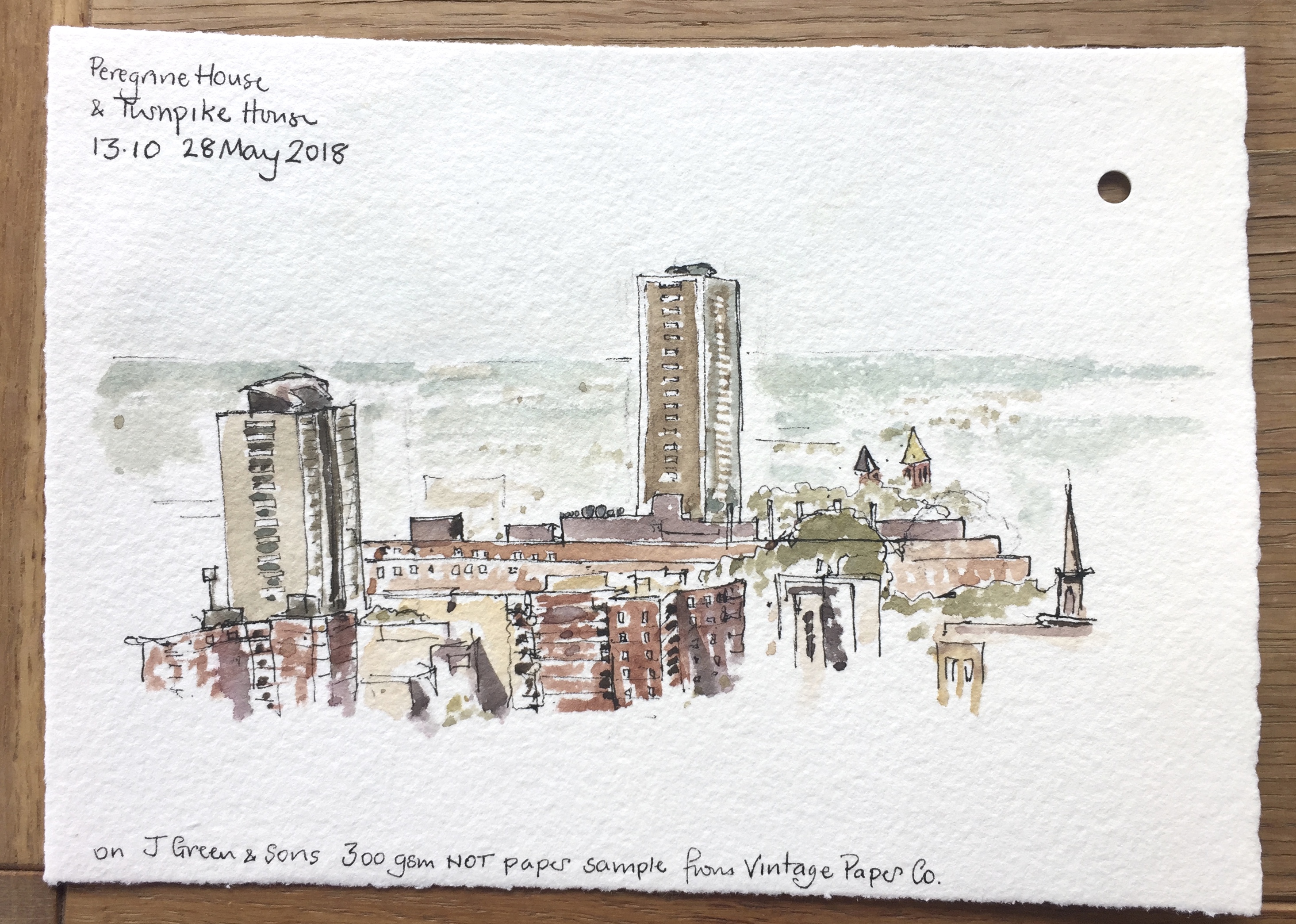
Here is a view towards Peregrine House, to show the satellite dishes on the roof. I also drew Peregrine House last week, see this link: Peregrine House from the King’s Square Estate
The hole in the top left corner is where the sheets were fastened together, with a neat little screw fastener.
Paper fastener – 1cm in diameter
Paper fastener unfastened
This was the only paper in the same pack with a ‘NOT’ (smoother) surface. Here is a close up view of the satellite dishes. On the NOT surface I can use pen easily. Pen and ink doesn’t work so well on the “Rough” surface. Here’s a close-up, showing Peregrine House and the satellite dishes on the building in front of it.
Below is a sketch out of the window in the rain: watercolour only, on the “Rough” surface 300gsm paper. Blake Tower is on the right, Post office Tower on the horizon, Barbican terrace block visible behind Blake Tower.
Forty-five minutes later, the sun was setting. I enjoyed using heavier paper (400gsm) to try to capture the shimmering light on the buildings. Painted directly in watercolour, no pen, no pencil.
Below is the final sketch, done quickly after the sun has set. This is on the heaviest paper, a magnificent 615gsm. It was stable, like card, so it didn’t curl or misbehave, and was not soft or absorbent, but took the watercolour brilliantly. It was very handy for such a quick sketch.
It’s fun to experiment with papers, and surprising what a difference the paper makes. Thankyou to the Vintage Paper Co for the samples.
Click a button below to share this post online, email it, or print it:





















 This was an aquatint with 6 tones, which is about the maximum I can achieve. On the 4th and 5th dip it’s difficult to see what I’m doing.
 Here’s the test plate print.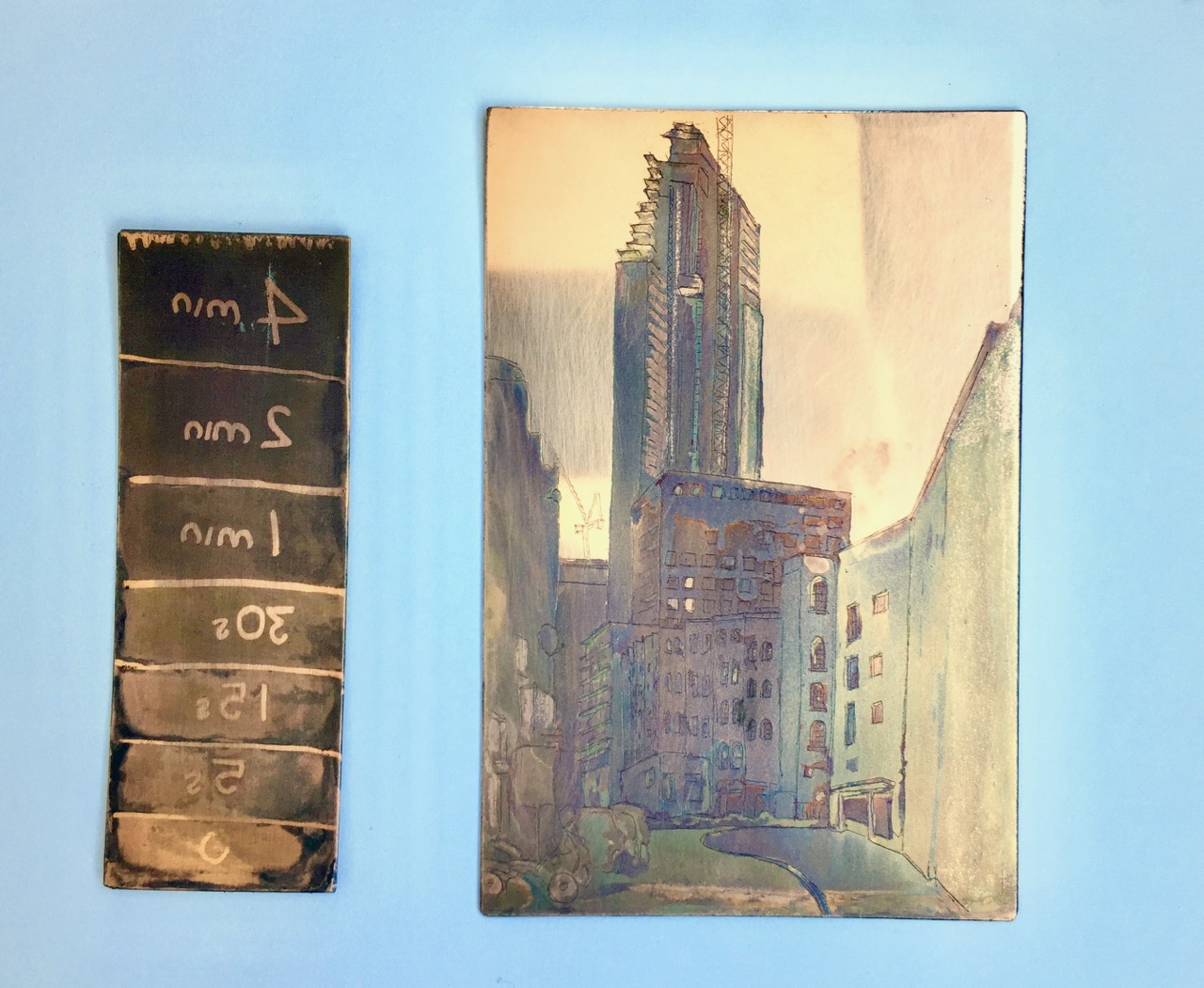





 Jane Sketching