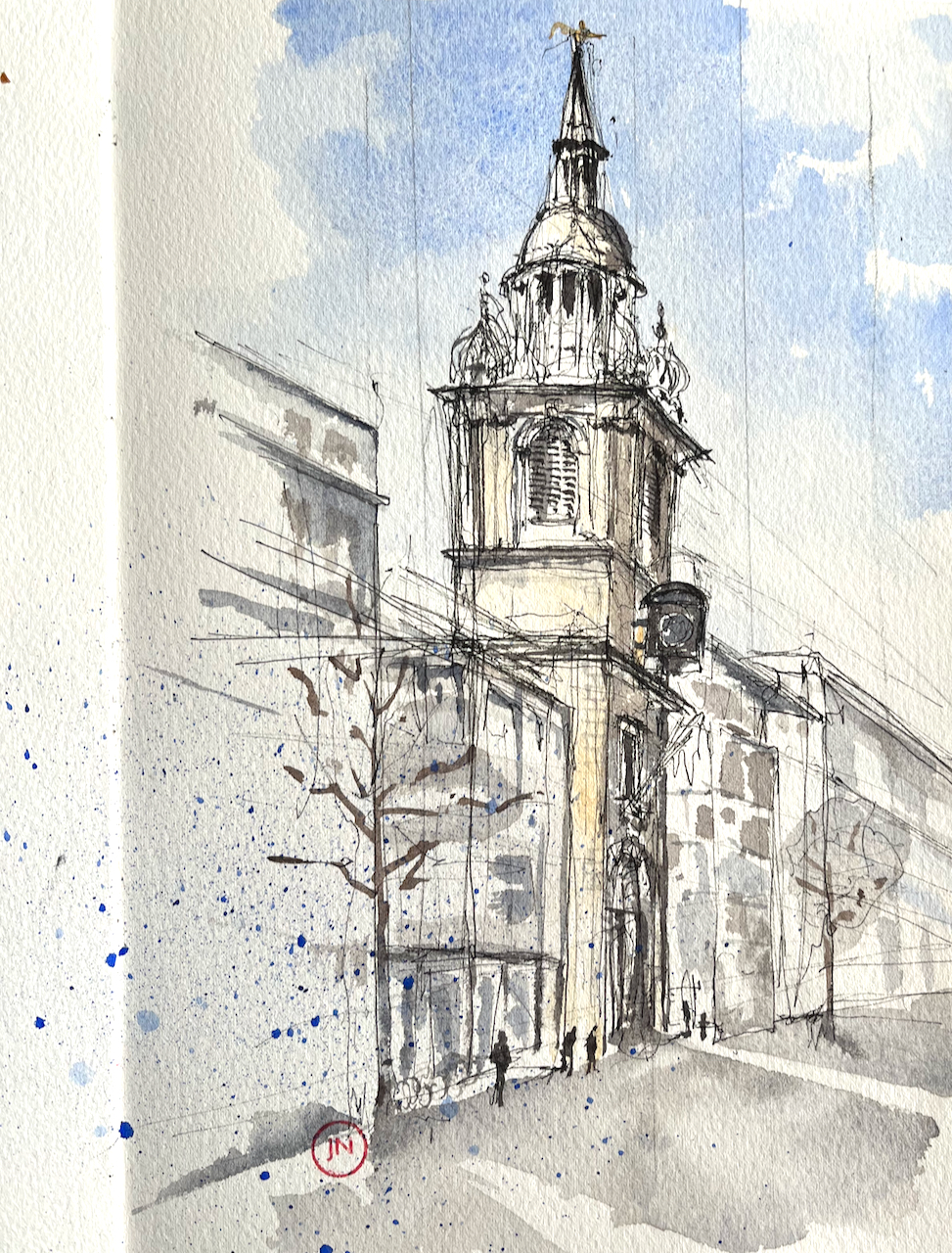
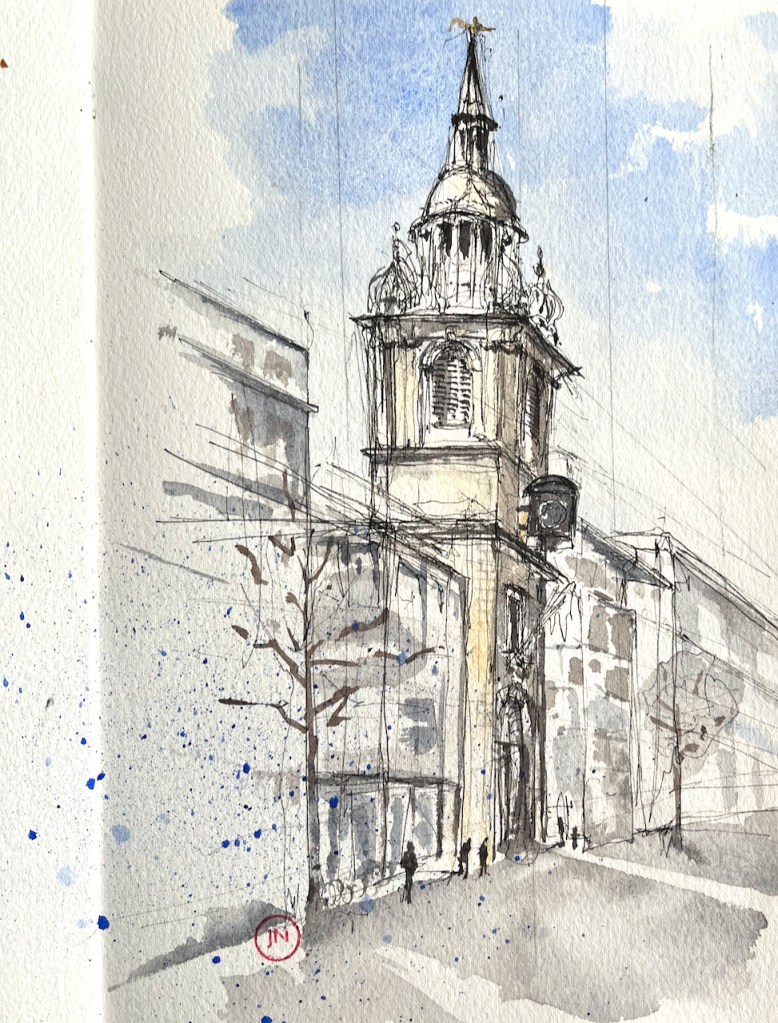
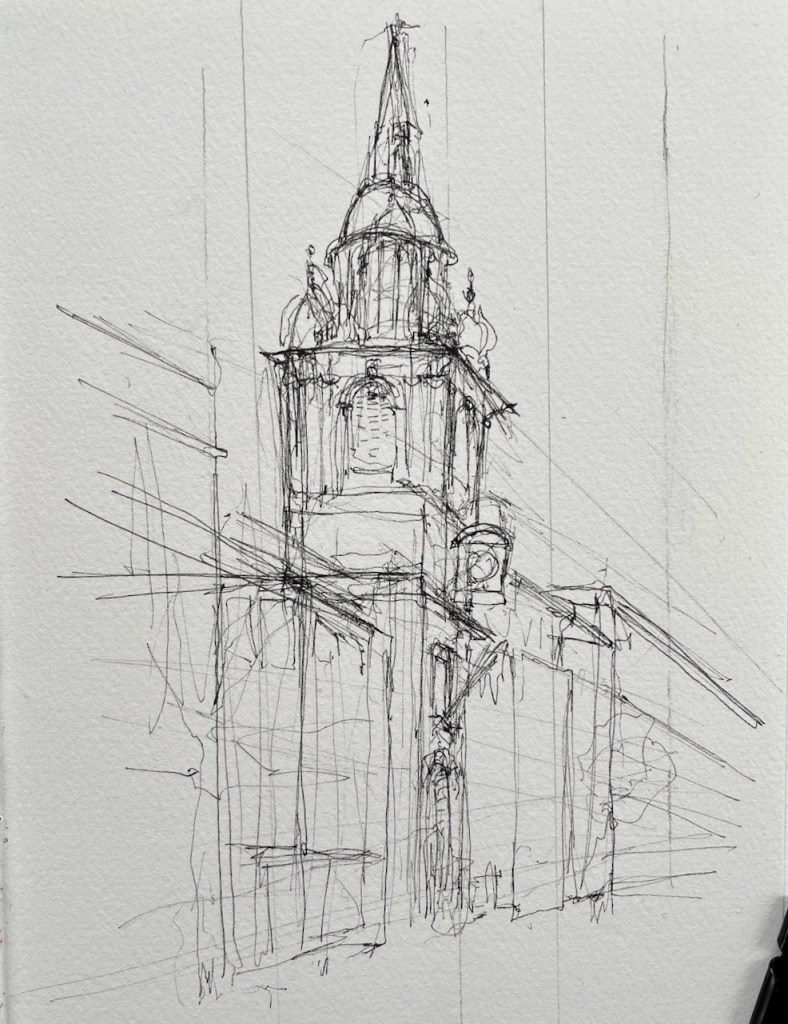
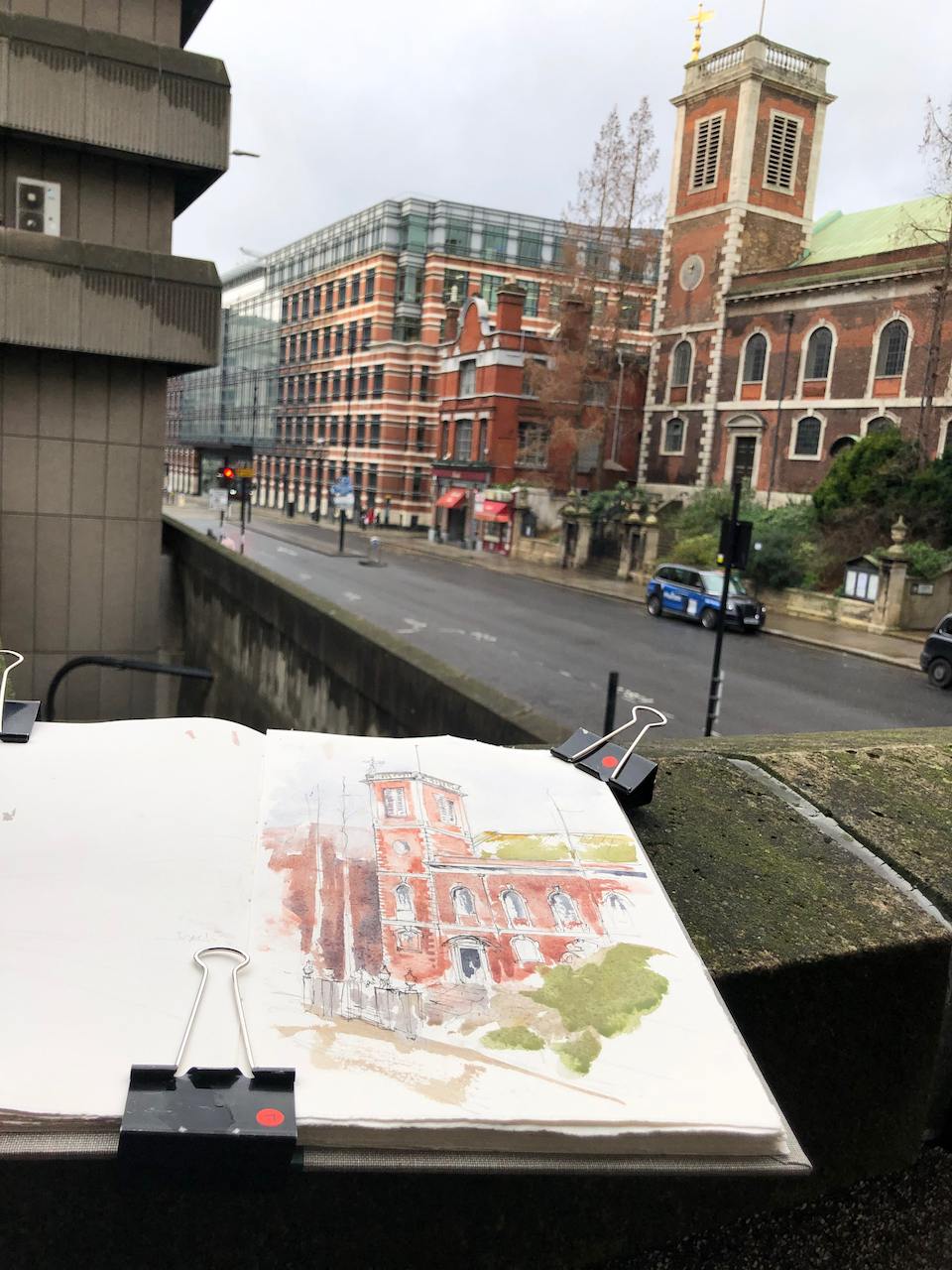
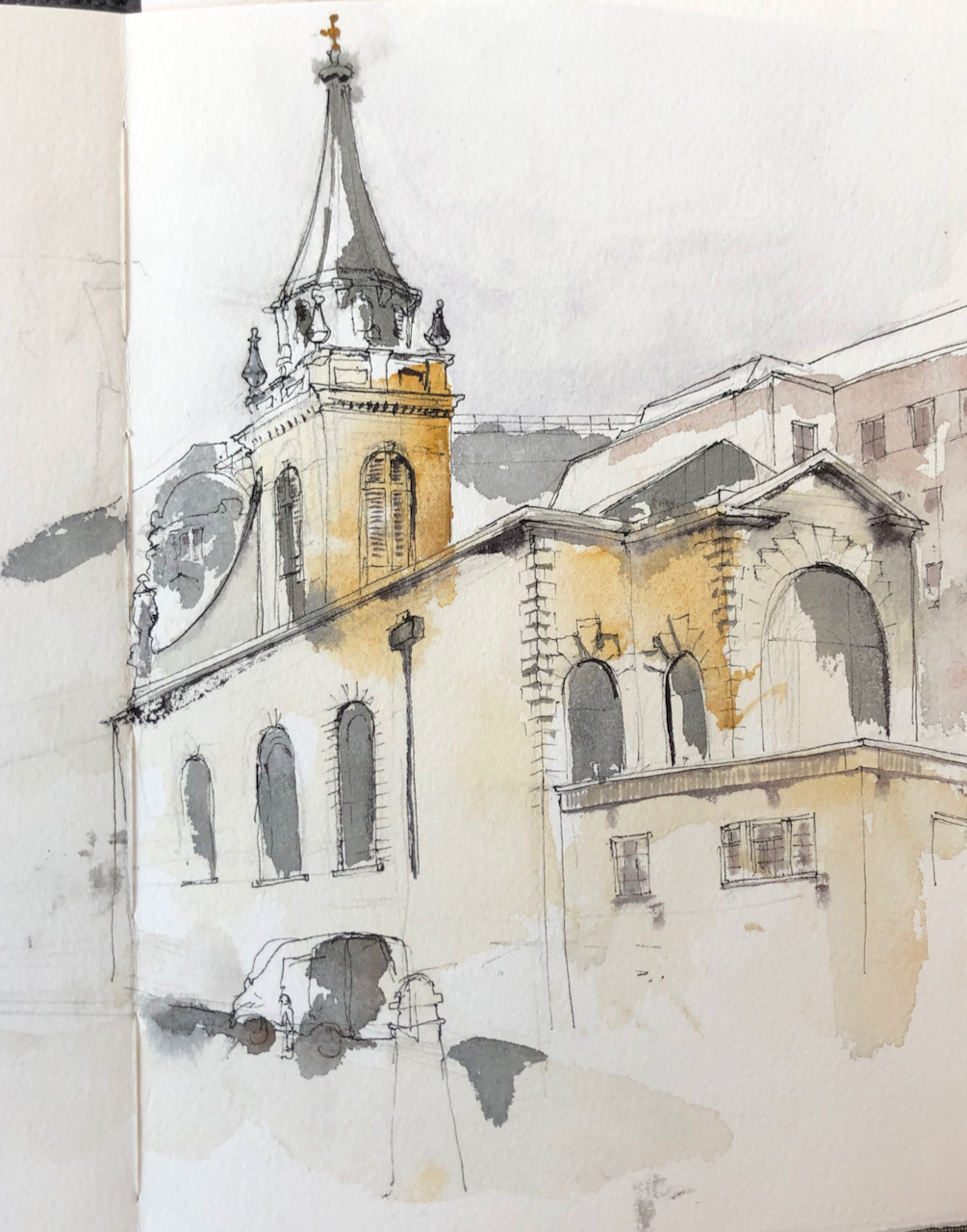
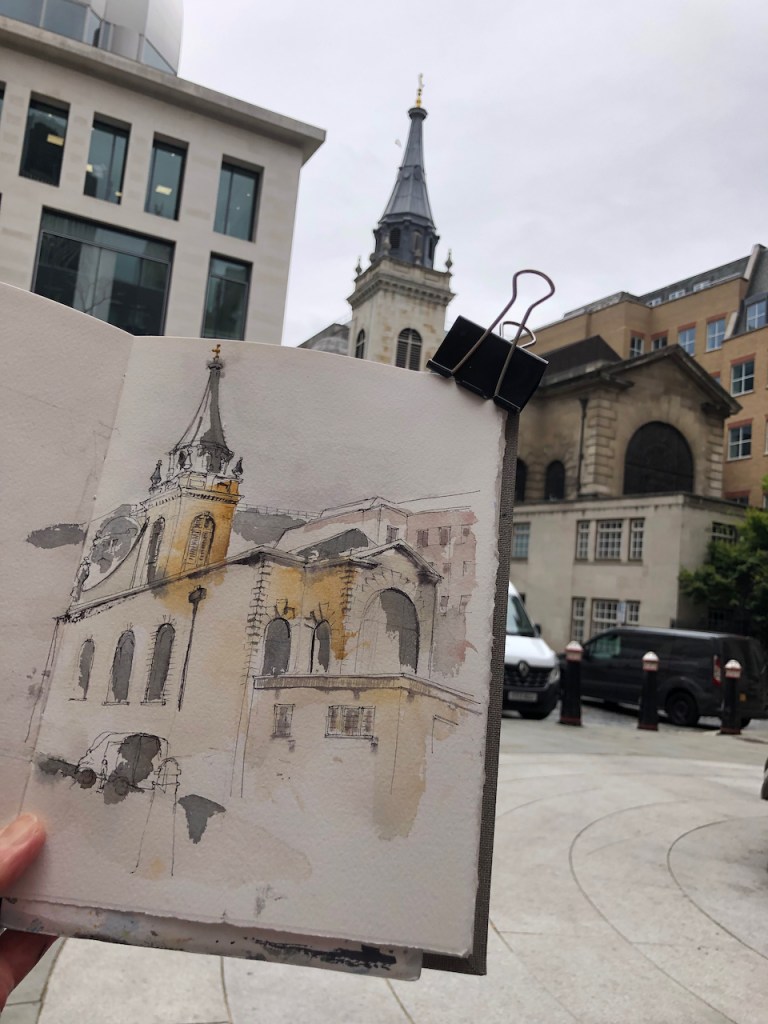
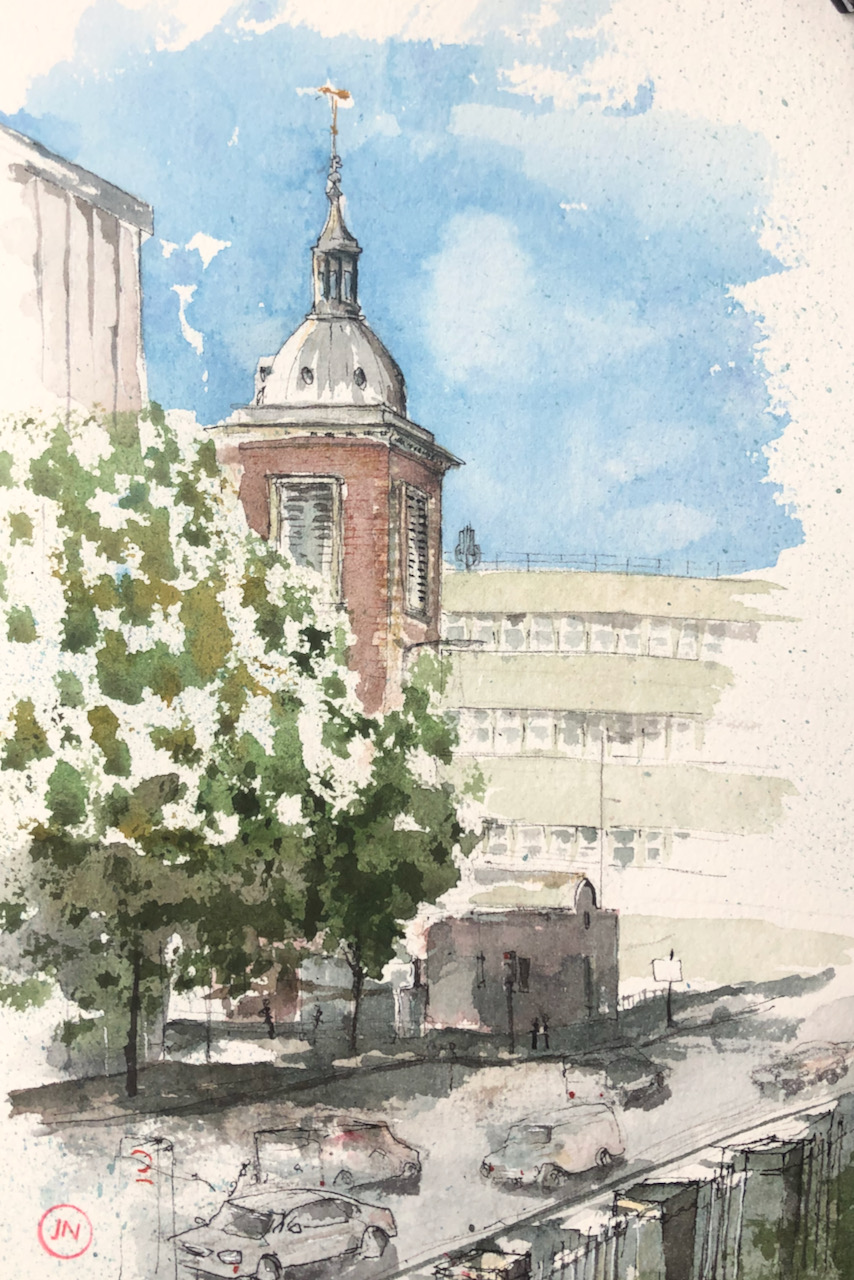
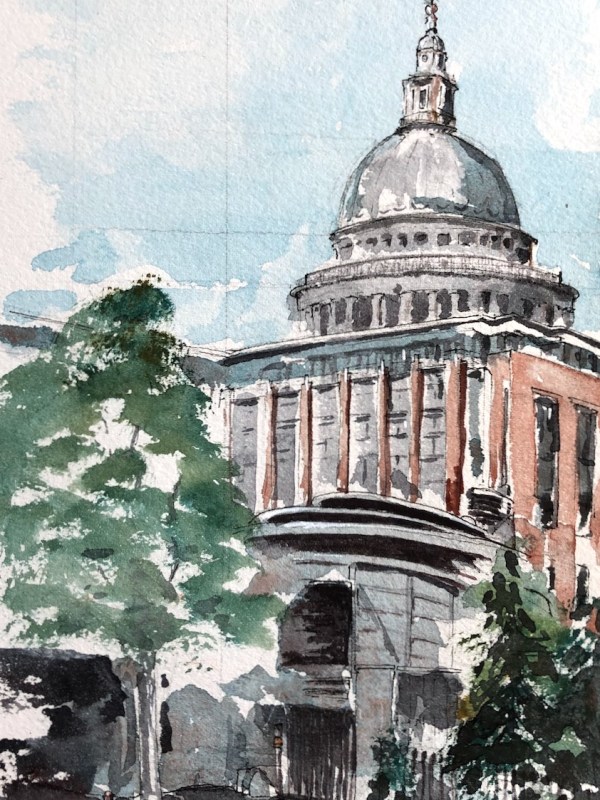
A quick sketch of St Mary Le Bow on Cheapside, London EC2
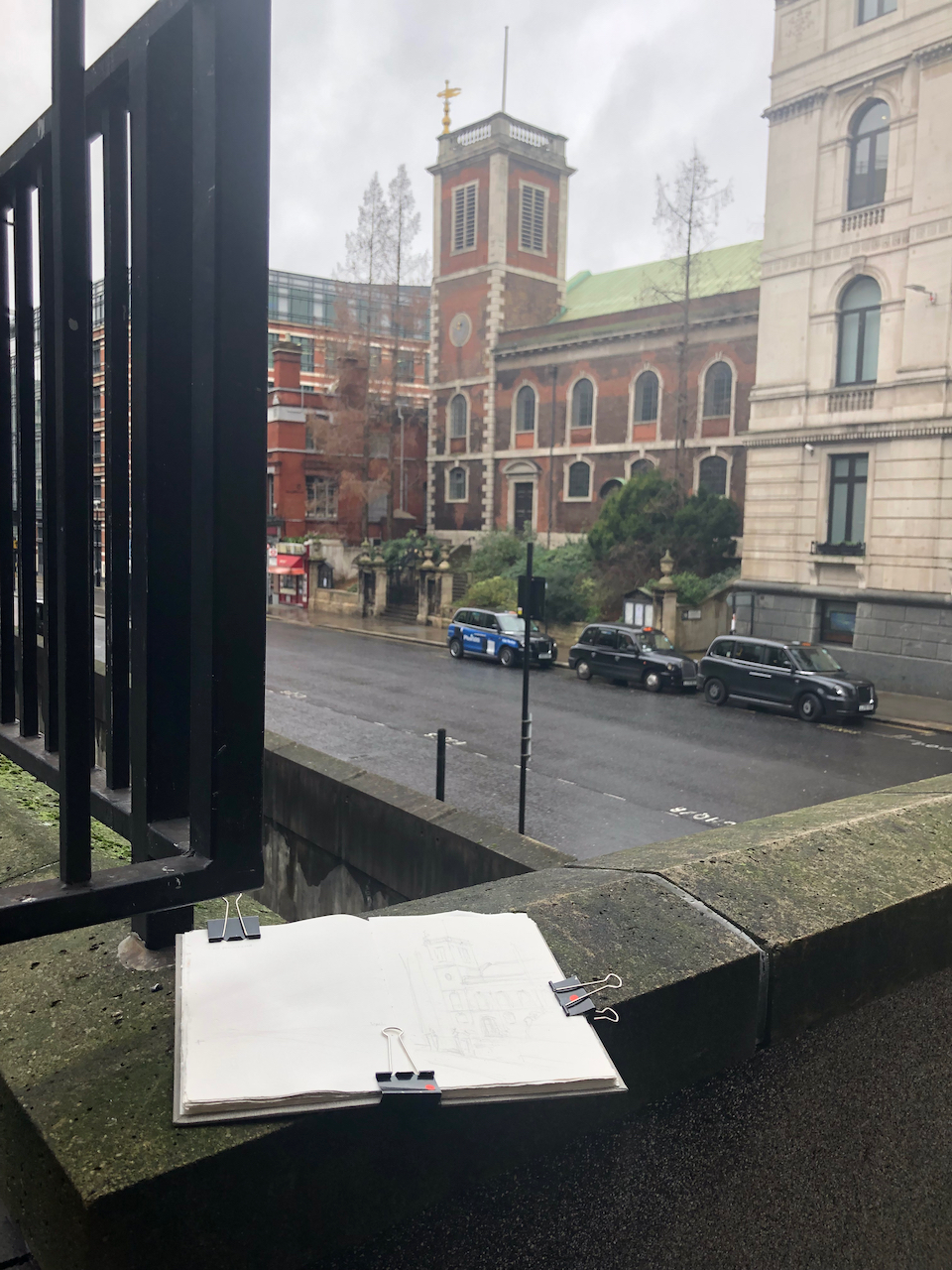
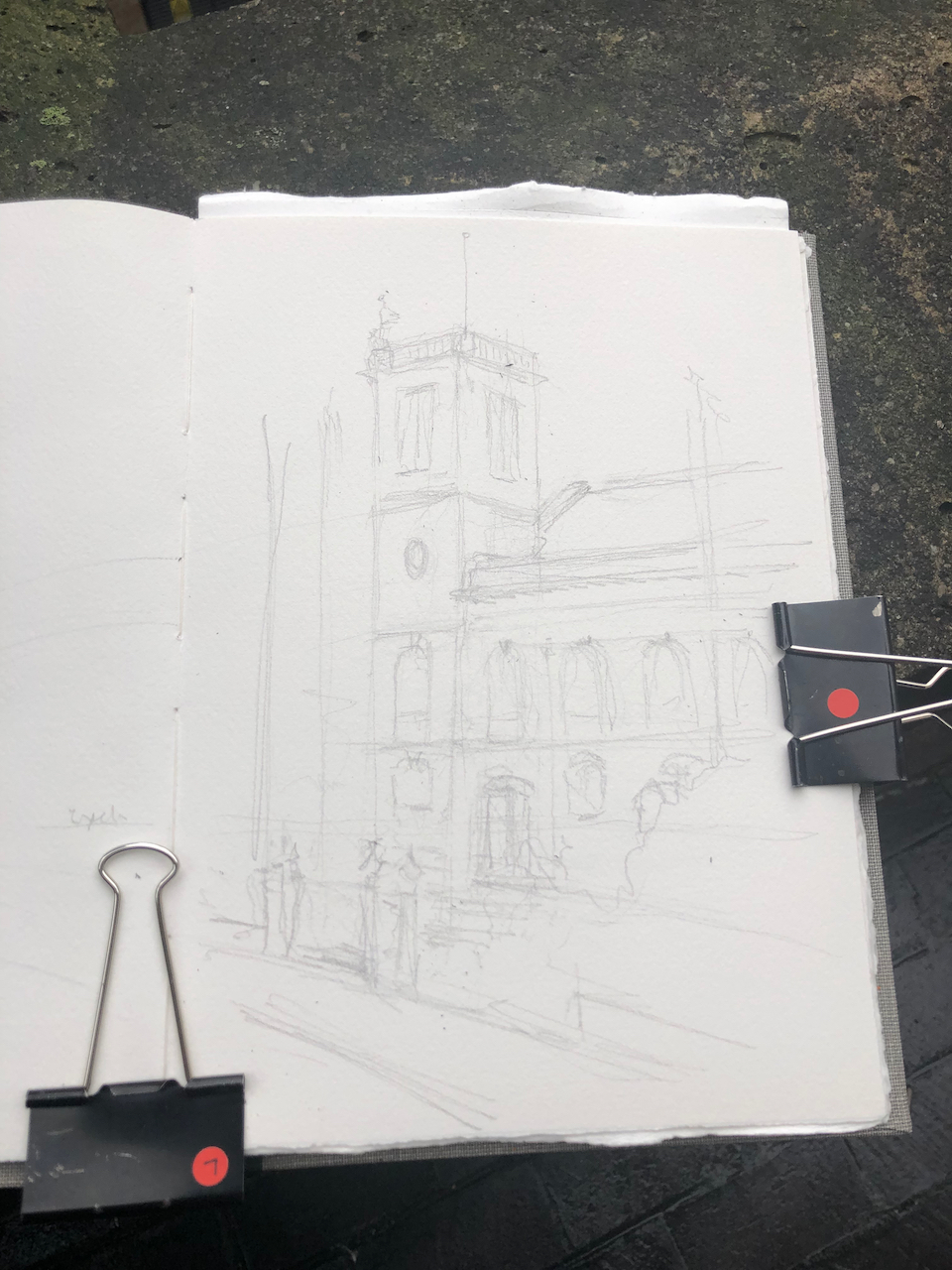
St Mary Le Bow, from Cheapside 23 Feb 2022 10″ x 7″ in Sketchbook 11
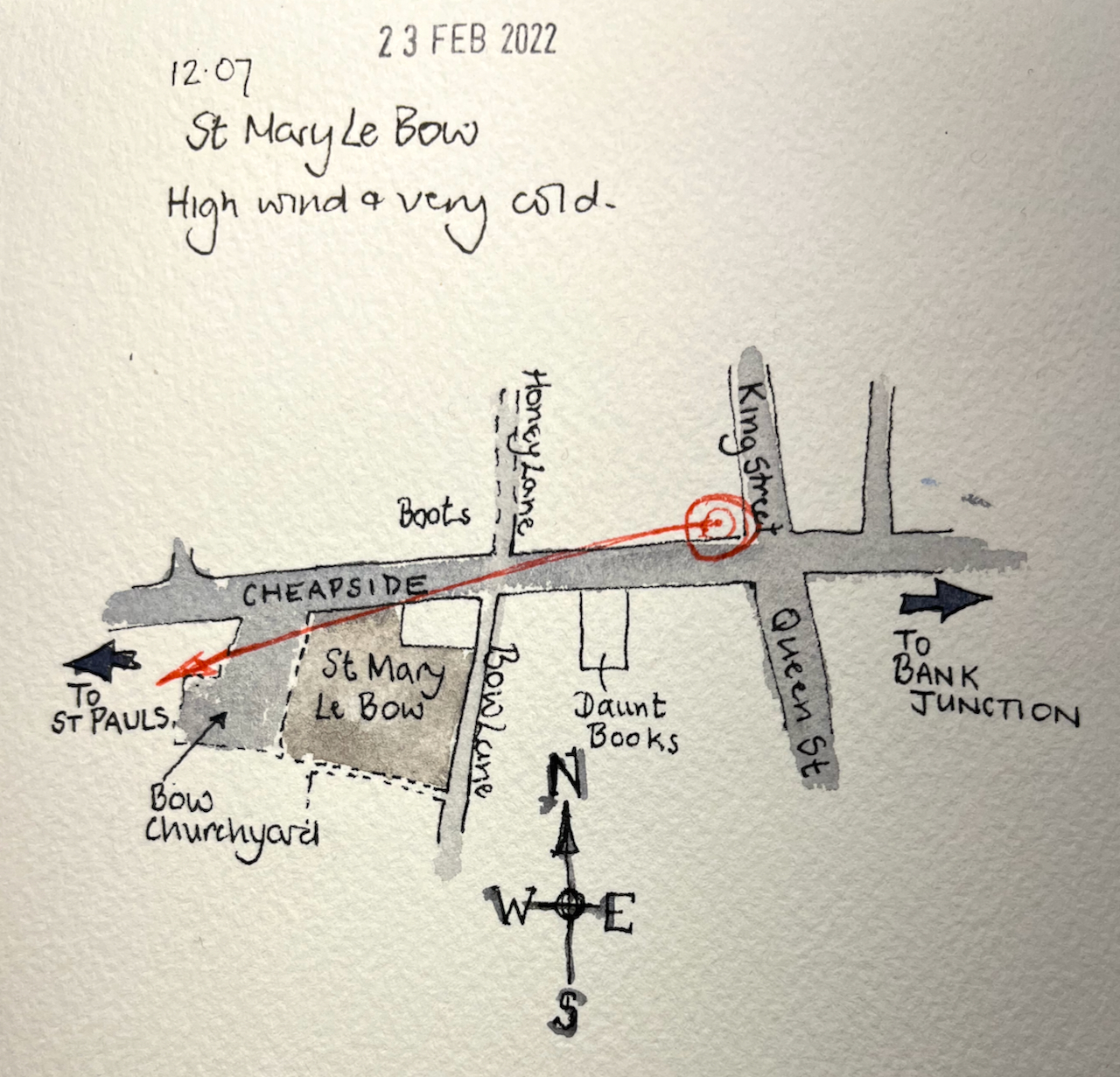
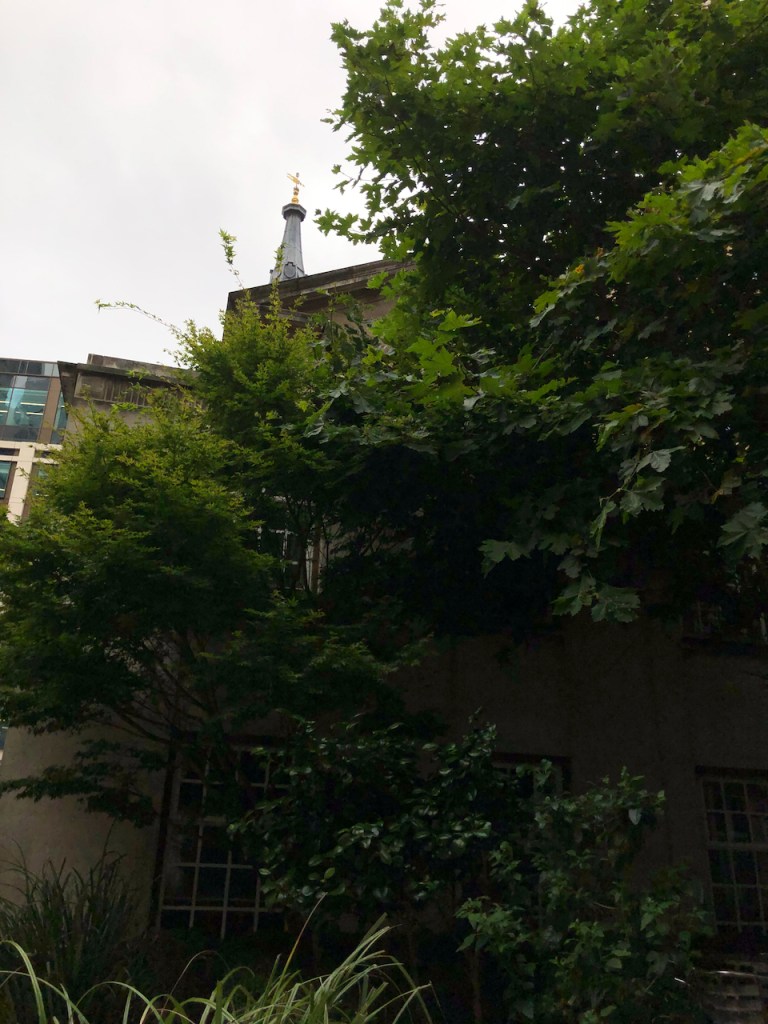
I drew this from the corner of Cheapside and King Street. This seemed like a really good place to stand, since there was a tall junction box next to me, and I could fit myself into a corner of a window. It rapidly became apparent that I chosen the windiest corner in London. My eyes streamed. Everyone coming round the corner took a short cut my side of the junction box, and funnelled past me, their heads down, phones in hand. I felt in the way.
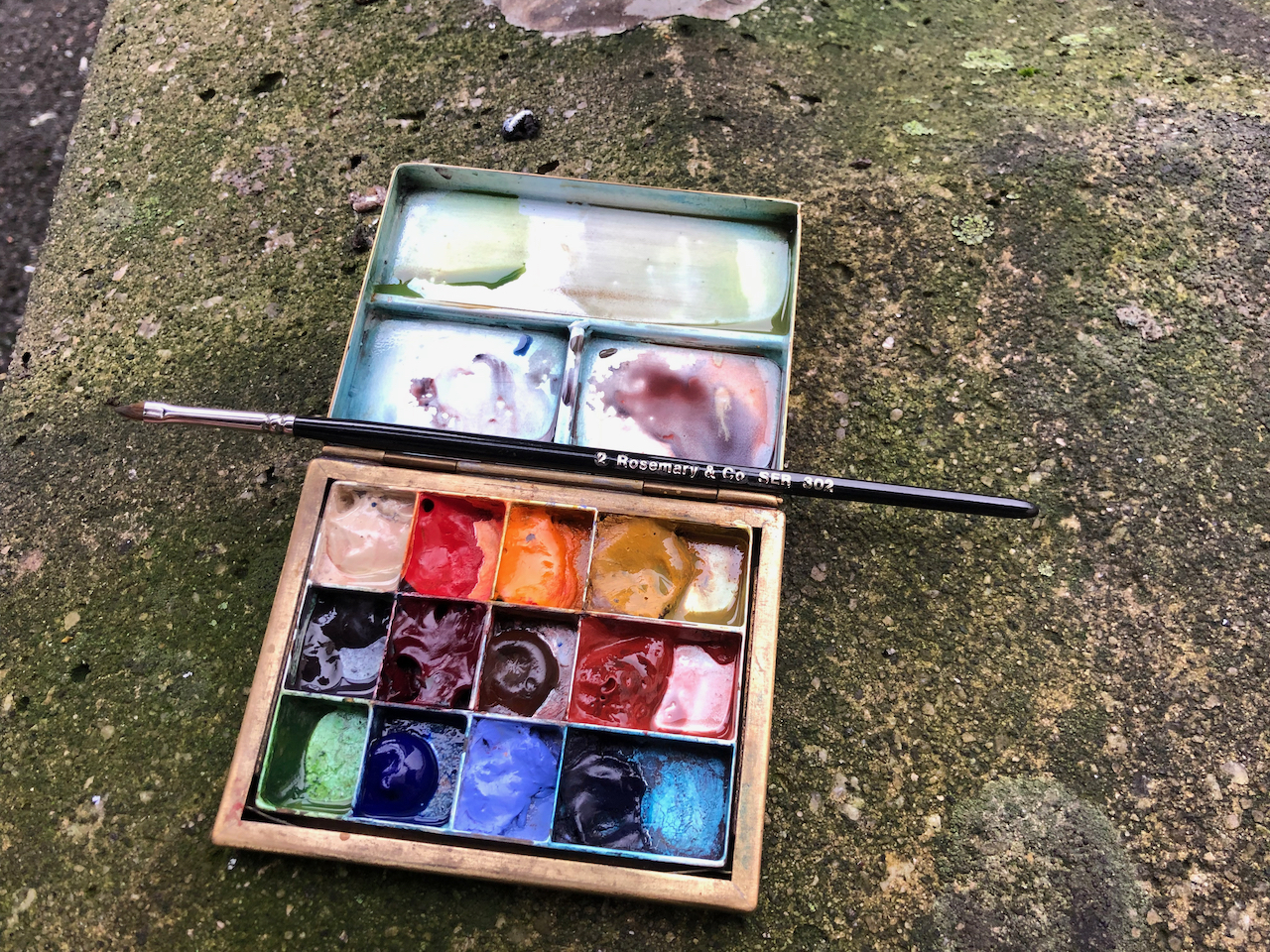
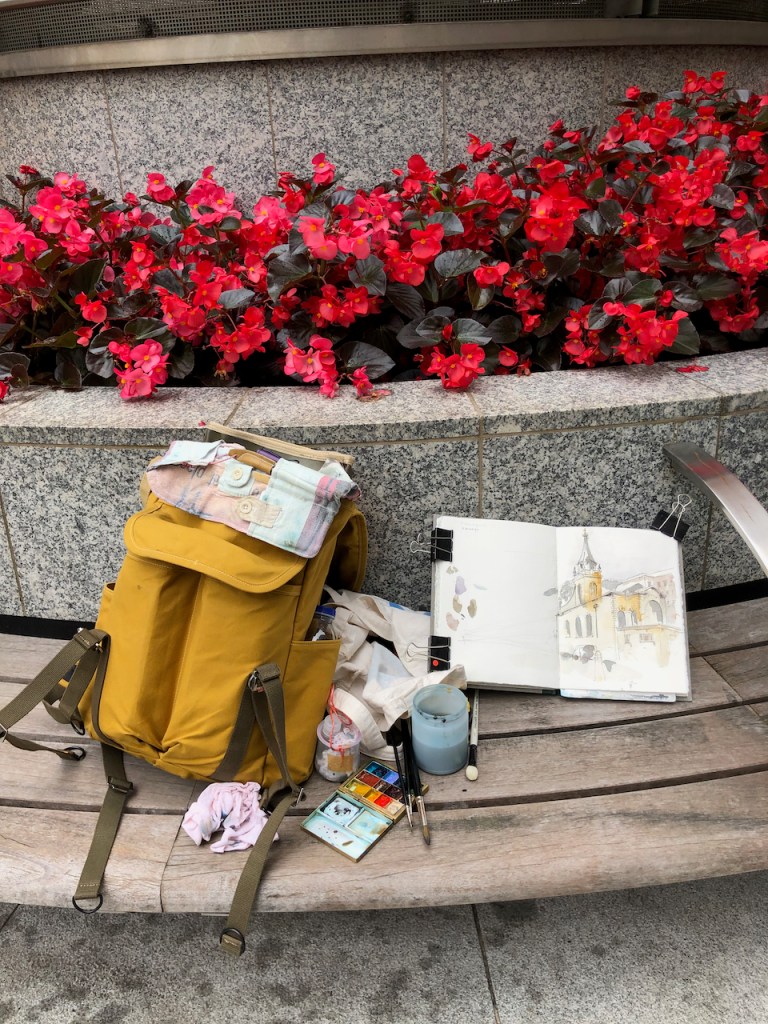
But I persisted. I finished the pen. I did not put the colour on using the convenient top of the junction box, as I had planned, since no paper was going to stay still for a moment in that wind. I retreated, and coloured it at my desk.
Click a button below to share this post online, email it, or print it:
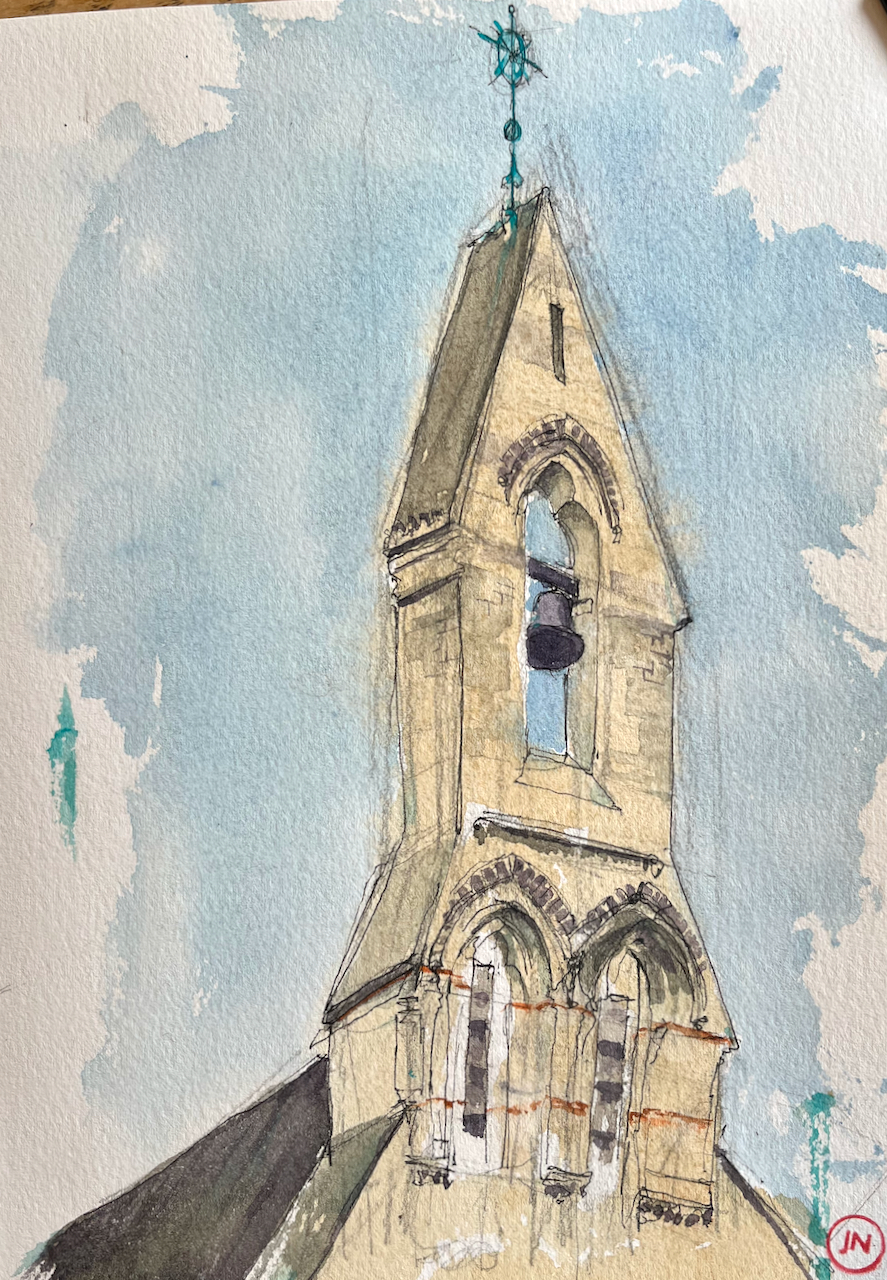
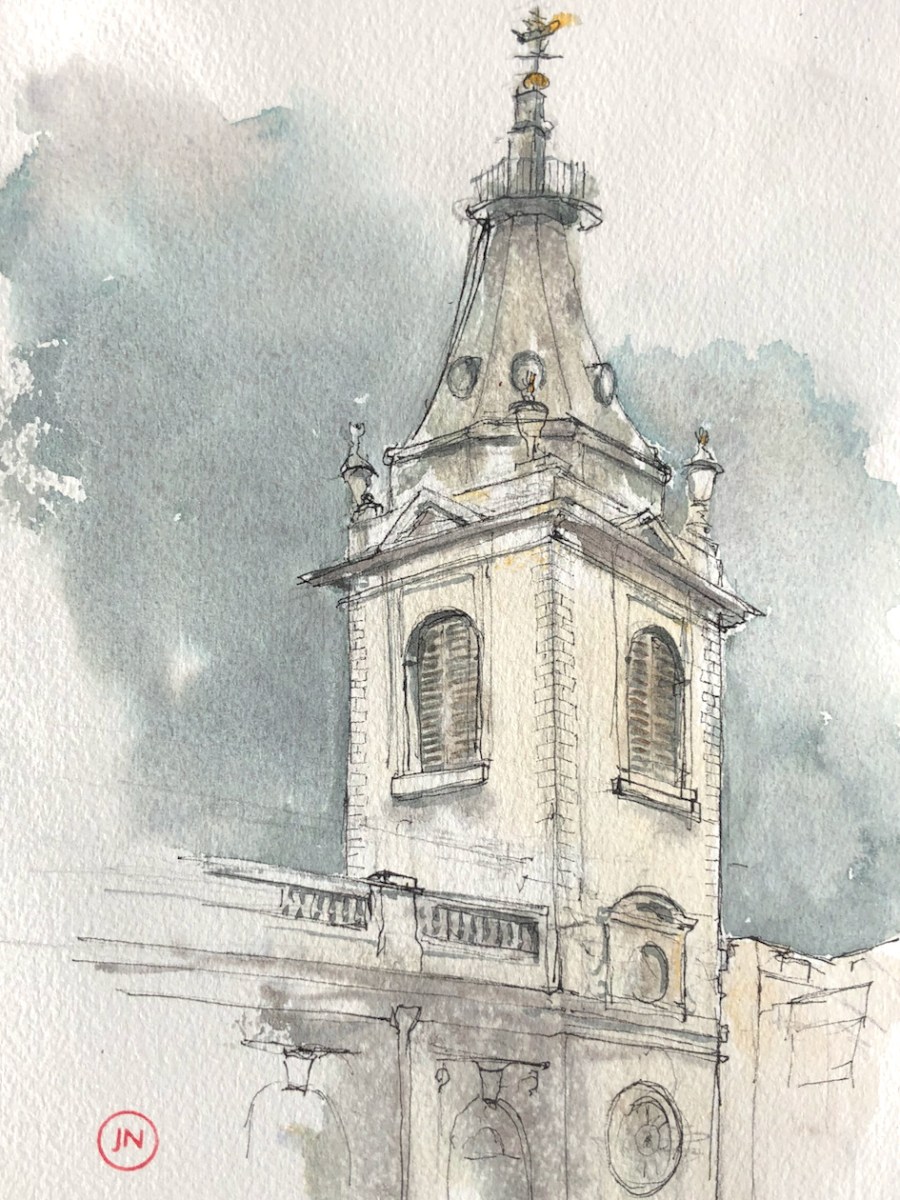
On a cold day, suddenly the sun came out and lit up the stone of St Monica’s Church.
Bell tower of St Monica’s Church, Hoxton Square. 26th January 2022, 13:40 in Sketchbook 11
This church was built in 1866, to the design of E.W. Pugin. It was part of the Augustinian Priory on this side of Hoxton Square.
E.W. Pugin (1834-75) is the son of A.W. Pugin, who collaborated with Charles Barry on the design of the Houses of Parliament. E.W. Pugin designed a large number of churches, 60 English churches are listed in his Wikipedia entry, with another 6 or so in Wales and Scotland and 16 in Ireland.
Click a button below to share this post online, email it, or print it:
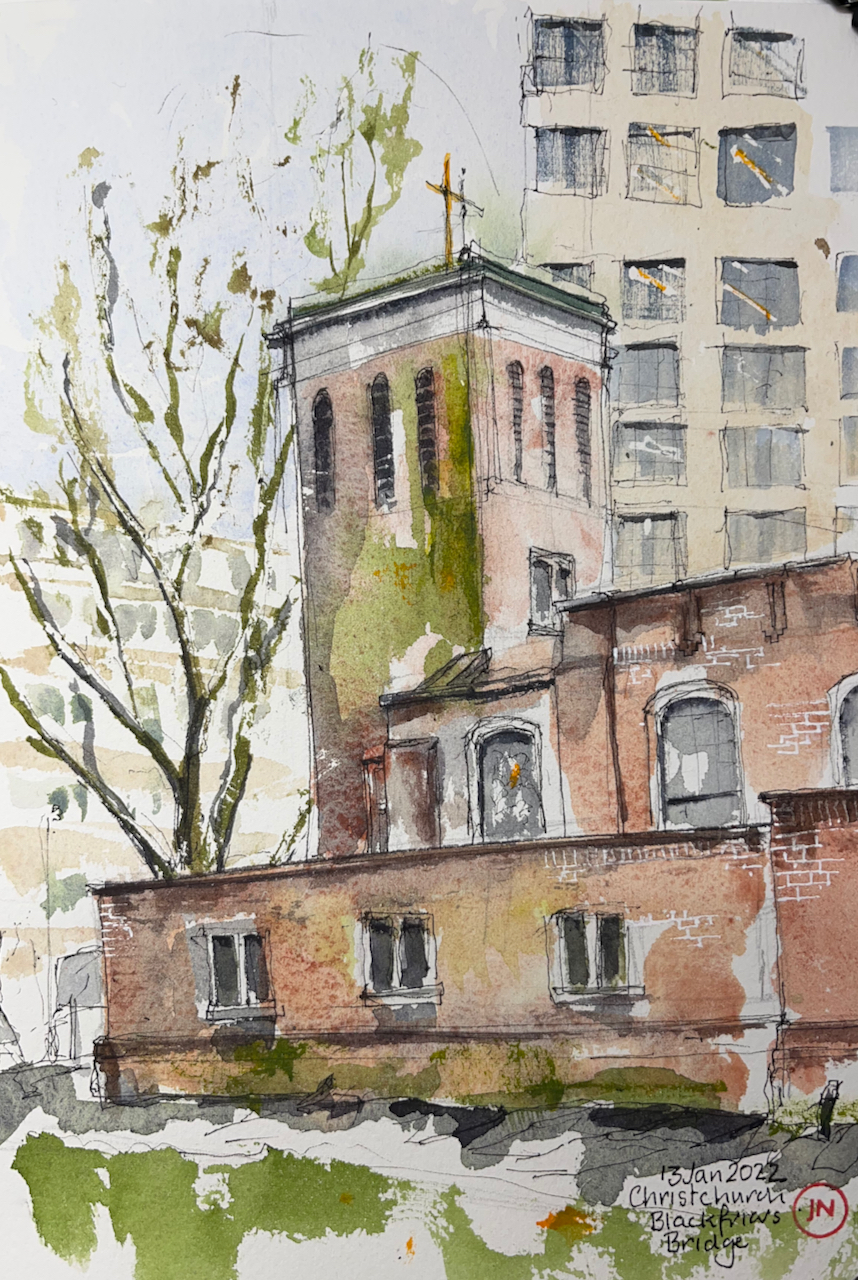
On the South side of Blackfriars Bridge there is a church amongst trees. This is Christchurch Blackfriars Bridge.
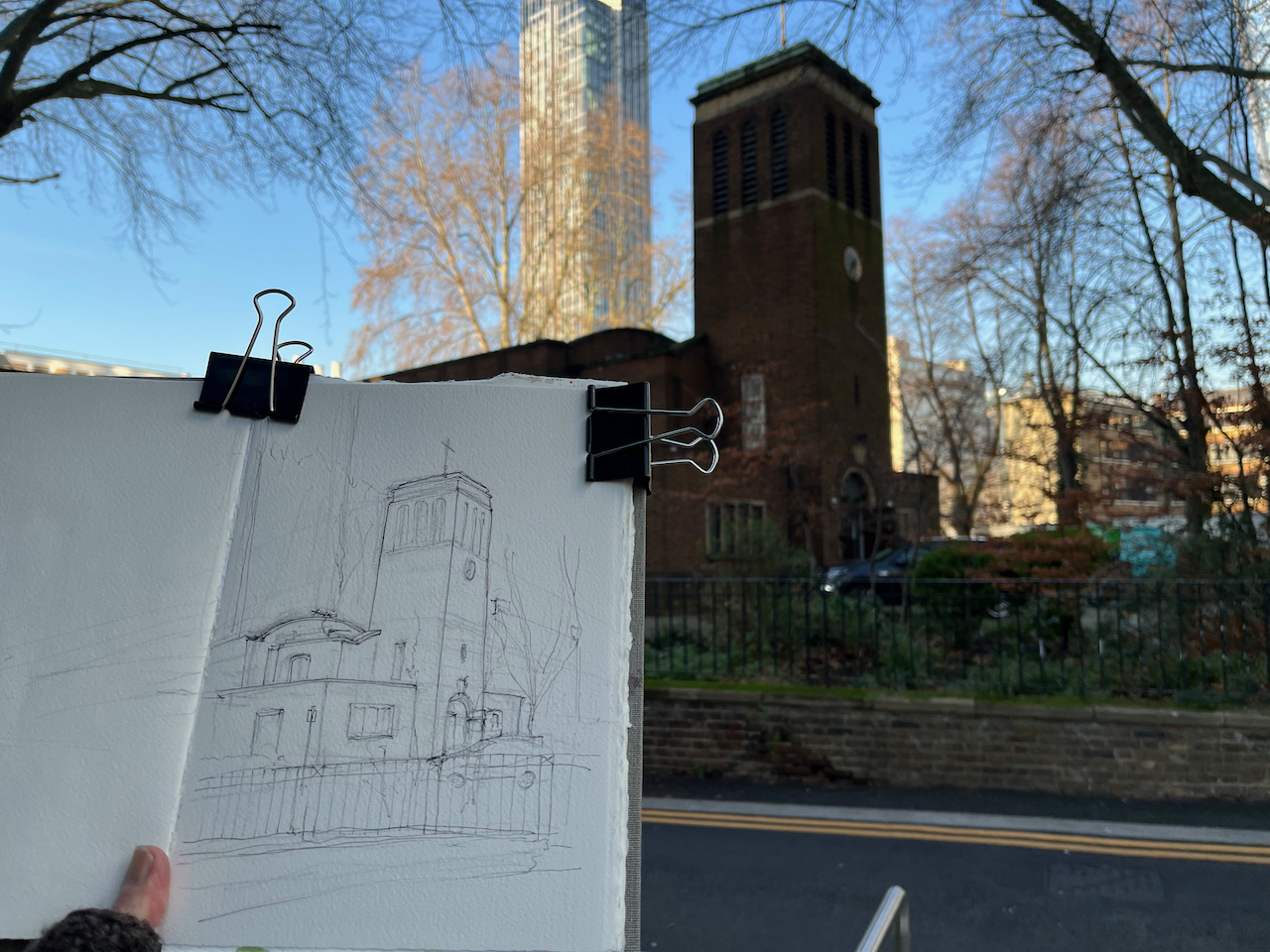
Christchurch Blackfriars Bridge, 14th January 2022, 2pm 10″ x 7″ in Sketchbook 11
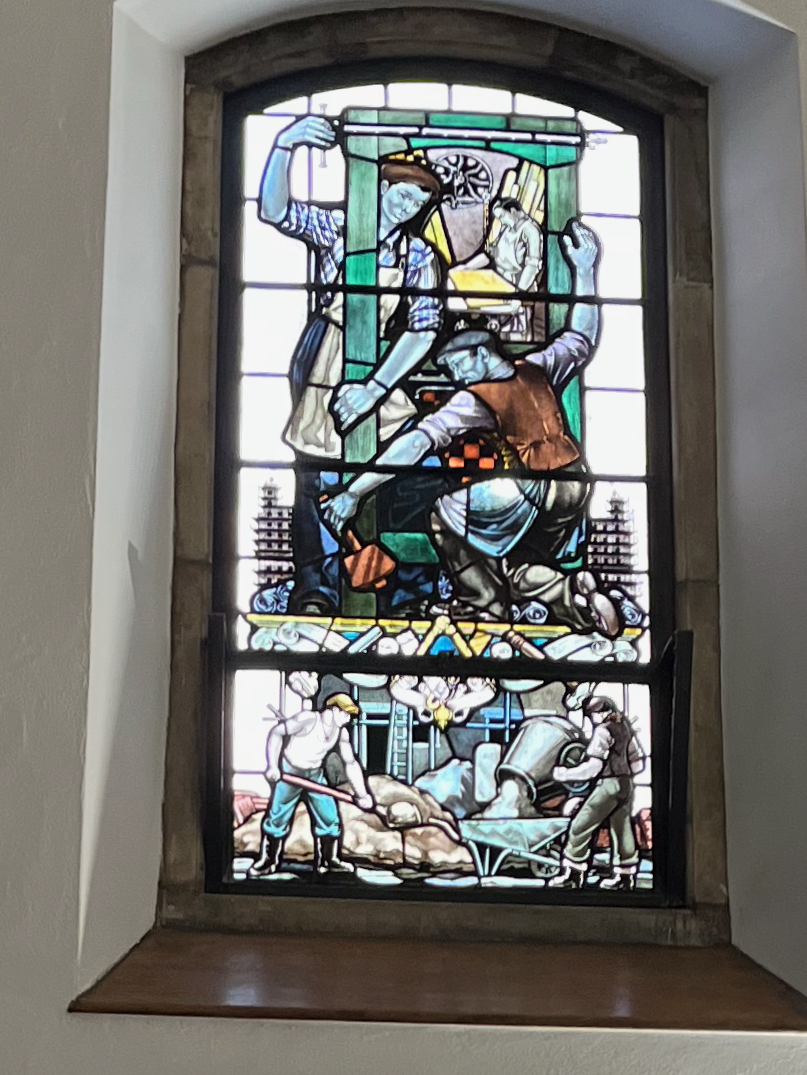
A window showing construction workers
This is the south side of the church, showing its open door. I went in. This is a very welcoming church. I passed three separate notices telling me I was welcome. Inside it is calm, warm and light. There are benches to sit on. There are marvellous stained glass windows. They show not saints and Bible stories, but Londoners. They show builders and printers, river workers, and engineers. There is a power station worker looking at a bank of rotary dial telephones, and a queue of people waiting for a red London bus. All these are beautifully done in stained glass.
This church accepts the idea that people might be “spiritual not religious”. Between 12noon and 2pm: they offer a “lunch time silent space”, and there are other events that include meditation and silence.
A detailed history of the church is in British History Survey of London: ‘Christ Church’, in Survey of London: Volume 22, Bankside (The Parishes of St. Saviour and Christchurch Southwark), ed. Howard Roberts and Walter H Godfrey (London, 1950), pp. 101-107. British History Onlinehttp://www.british-history.ac.uk/survey-london/vol22/pp101-107 [accessed 16 January 2022].
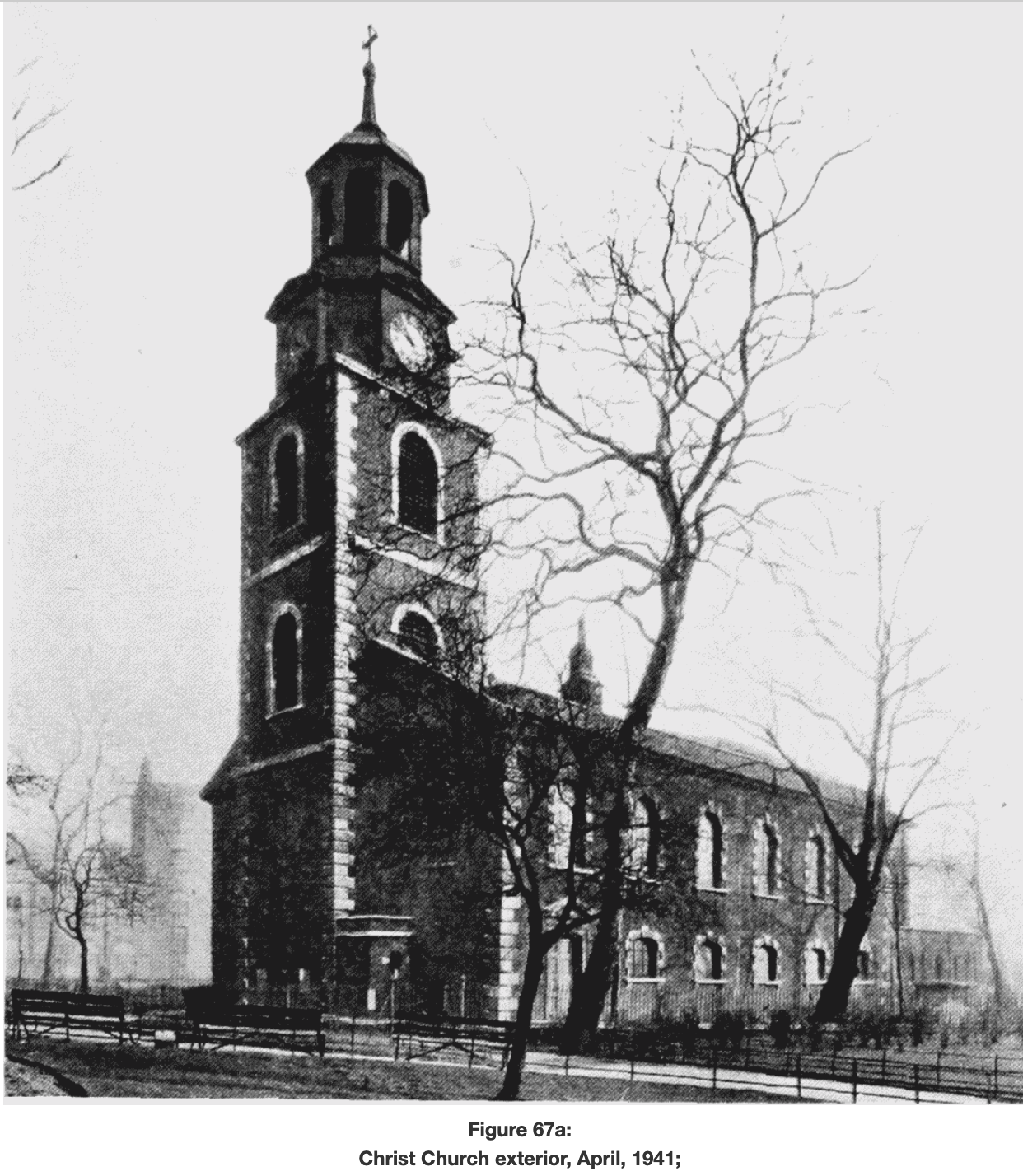
Here is how it looked before 1941.
‘Plate 67: Christ Church. Exterior and watchhouse’, in Survey of London: Volume 22, Bankside (The Parishes of St. Saviour and Christchurch Southwark), ed. Howard Roberts and Walter H Godfrey (London, 1950), p. 67. British History Onlinehttp://www.british-history.ac.uk/survey-london/vol22/plate-67 [accessed 16 January 2022].
It was completely gutted by incendiary bombing in April 1941. The 1950 “Survey of London” cited above describes it as a “shell”. The present church was completed in 1960, according to Pevsner (The Buildings of England, London 2: South, by Nicolaus Pevsner and Bridget Cherry, page 275). The architects were R Paxton Watson & B Costin.
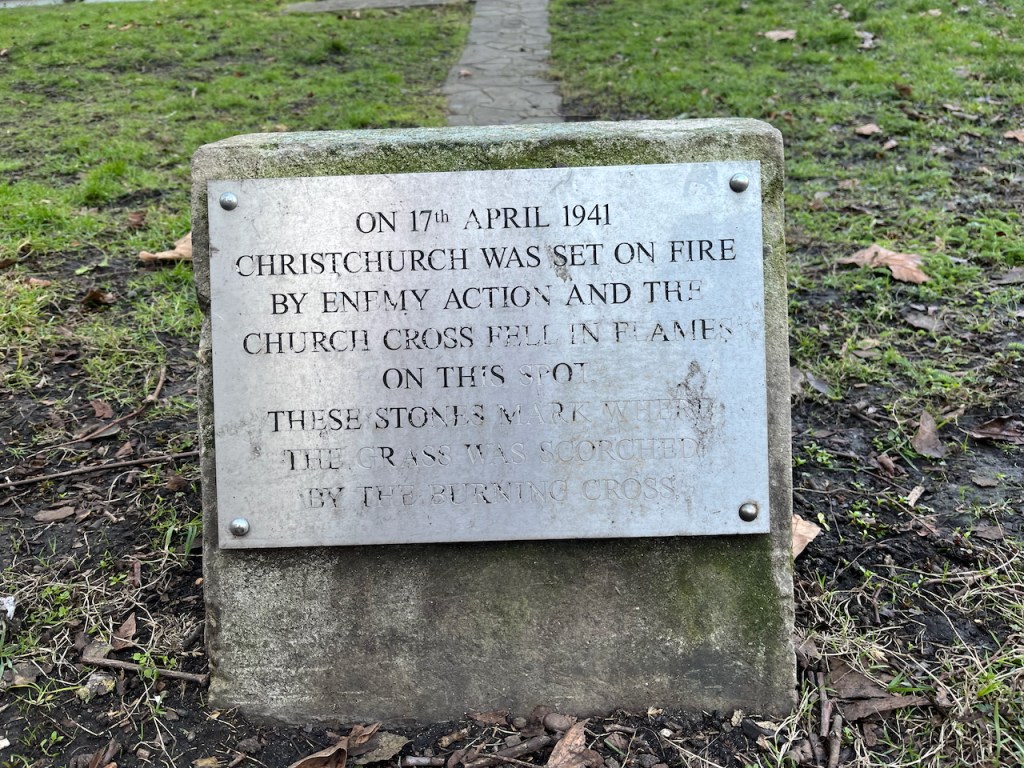
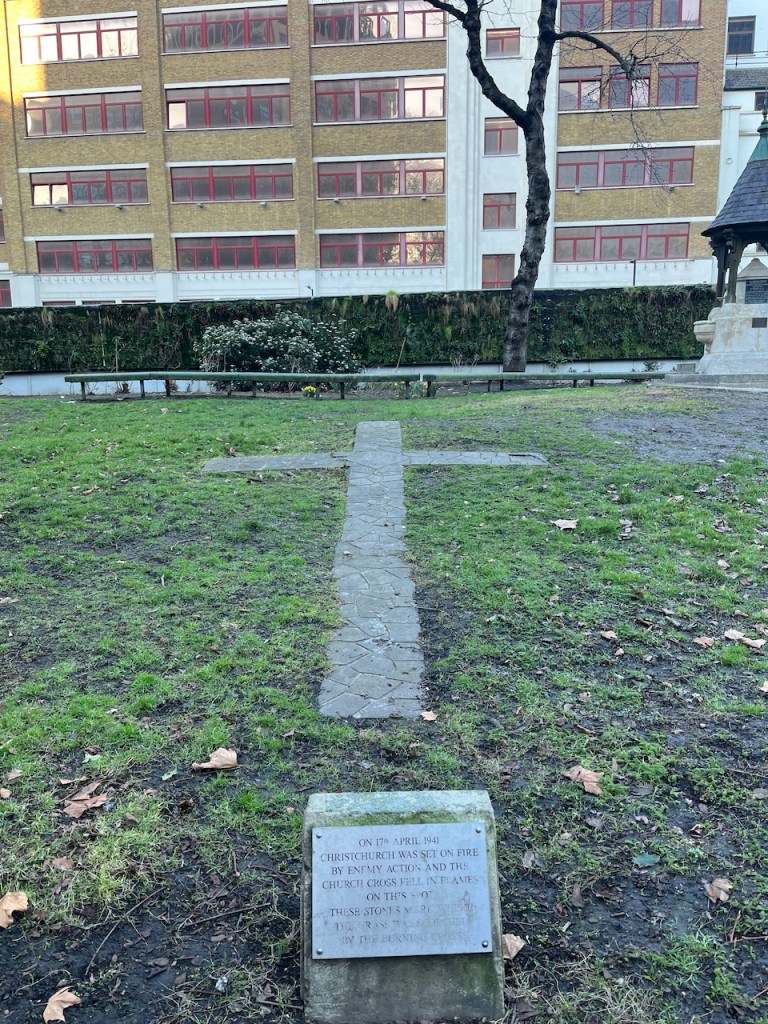
“On 17th April 1941 Christchurch was set on fire by enemy action and the church Cross fell on this spot. These stones mark where the grass was scorched by the burning Cross”A monument on the West side of the church, photographed 6th March 2025. The cross referenced here can be seen in the black and white 1941 photo above.
The church is now surrounded by buildings and trees and is very much alive. Here is the view from the North:
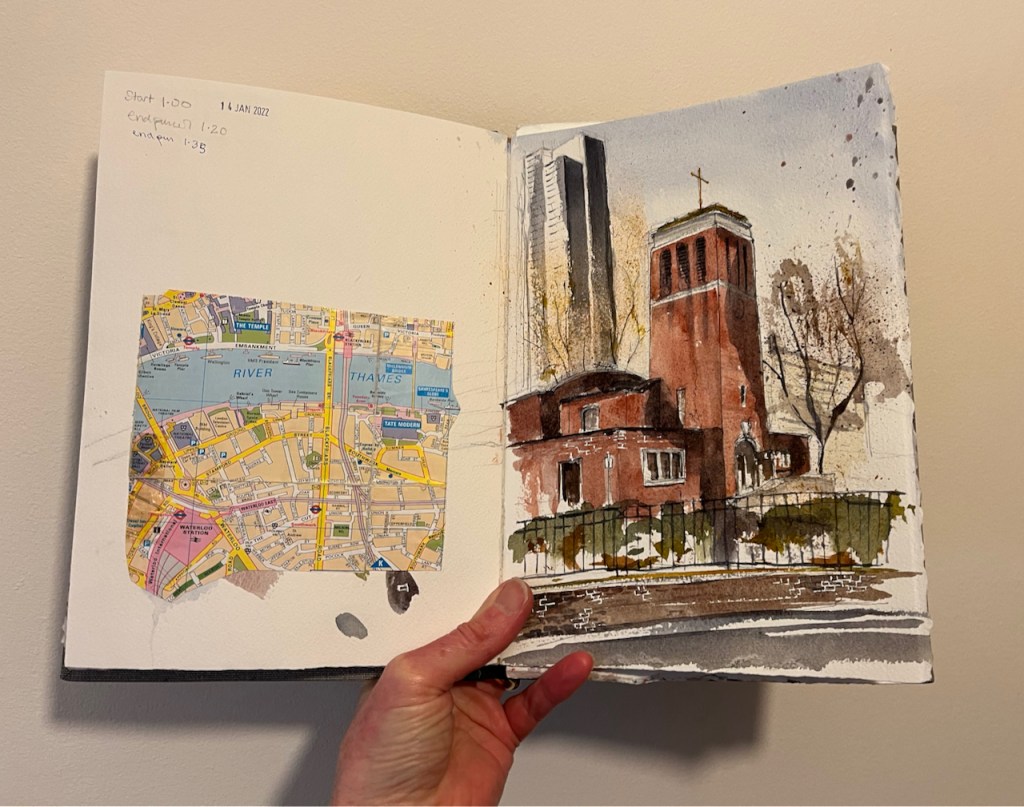
Christchurch Blackfriars Bridge, 13th January 2022, 12:30pm 10″ x 7″ in Sketchbook 11
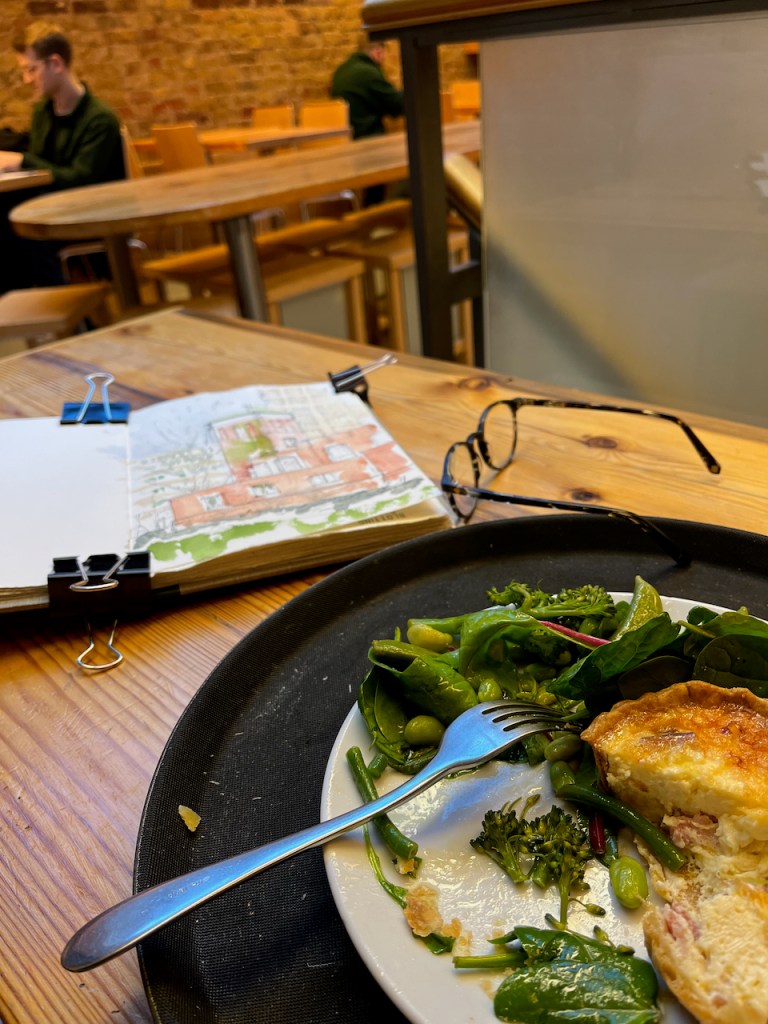
The outside air temperature was 3 degrees C and the paint wasn’t drying. Also I was very cold. I went for lunch in “Greensmiths”in Lower Marsh, and finished the painting there.
“Greensmiths” in Lower Marsh Waterloo.
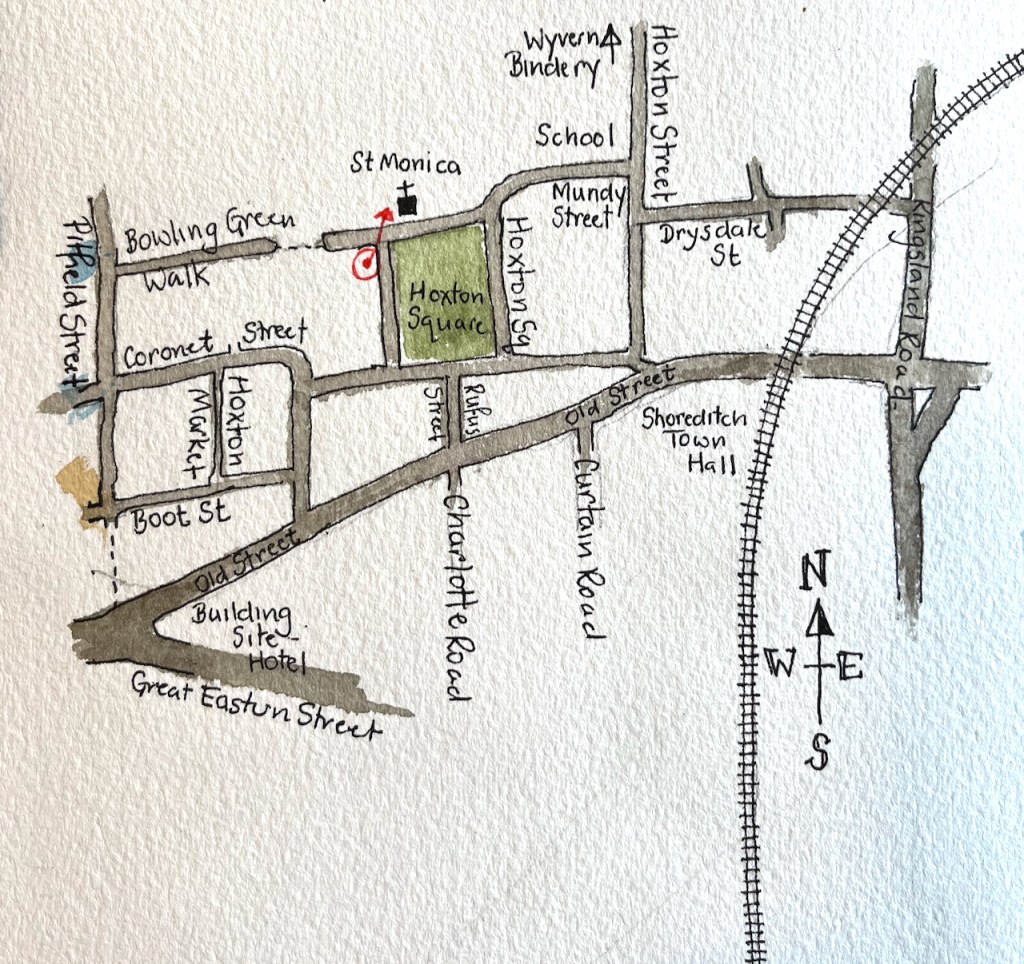
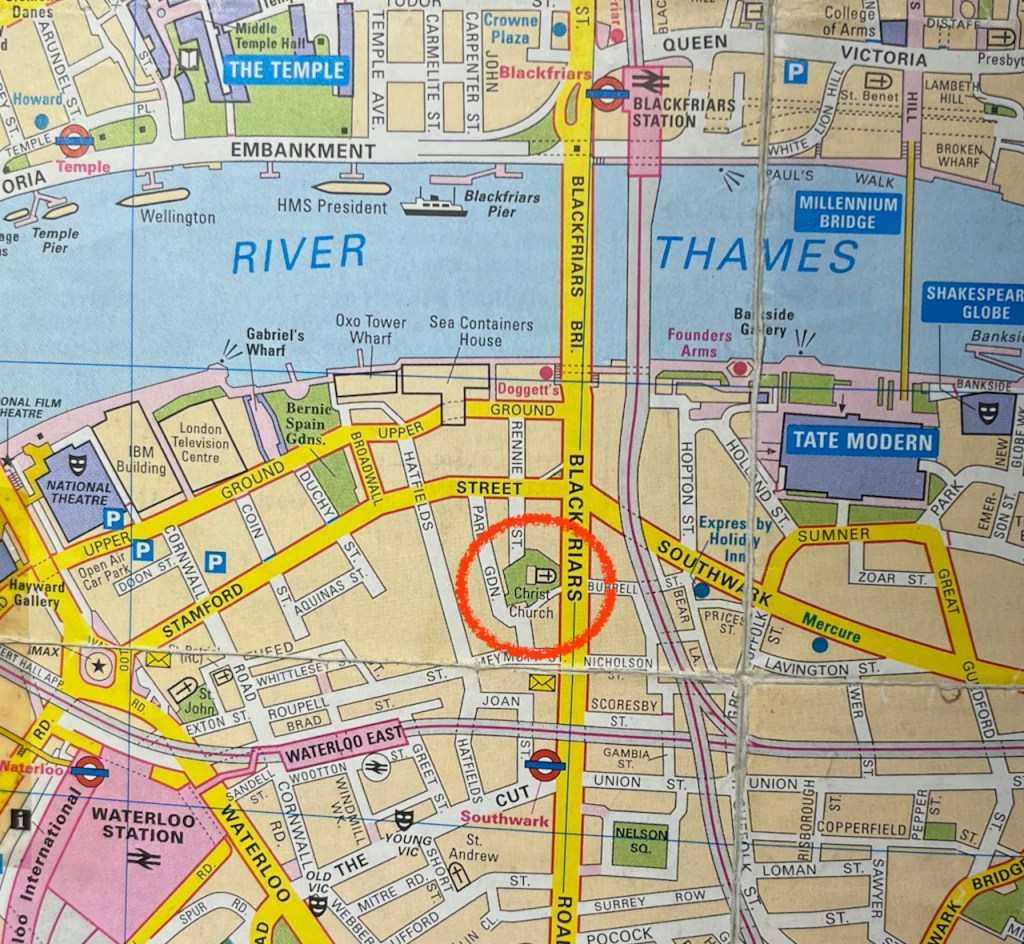
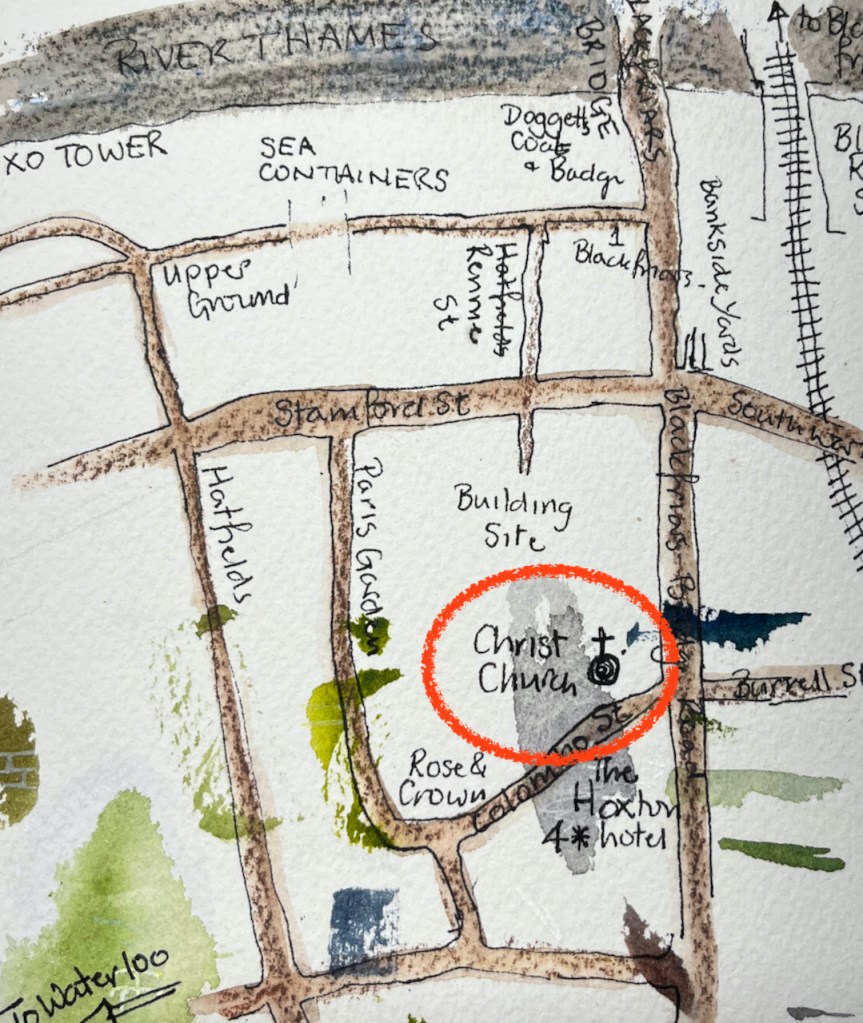
Here is work in progress on the sketches, and some maps to show where this church is.
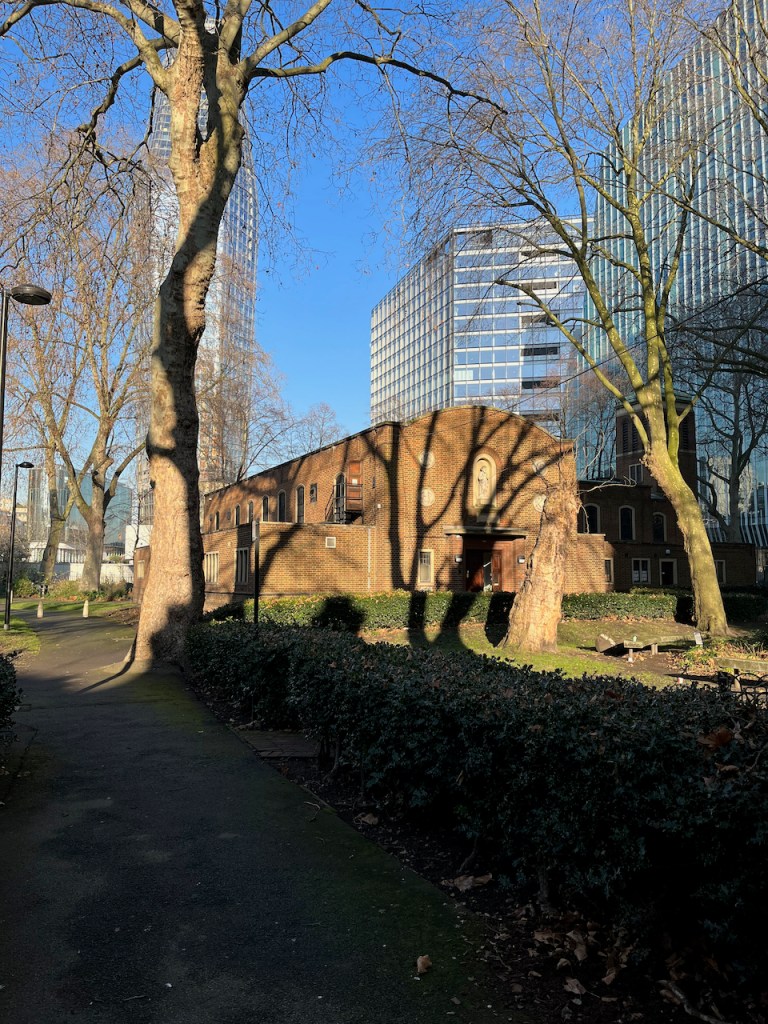
There were some spectacular shadows that day:
Christchurch Blackfriars Bridge, from the South, 14th January 2022 about 2pm.
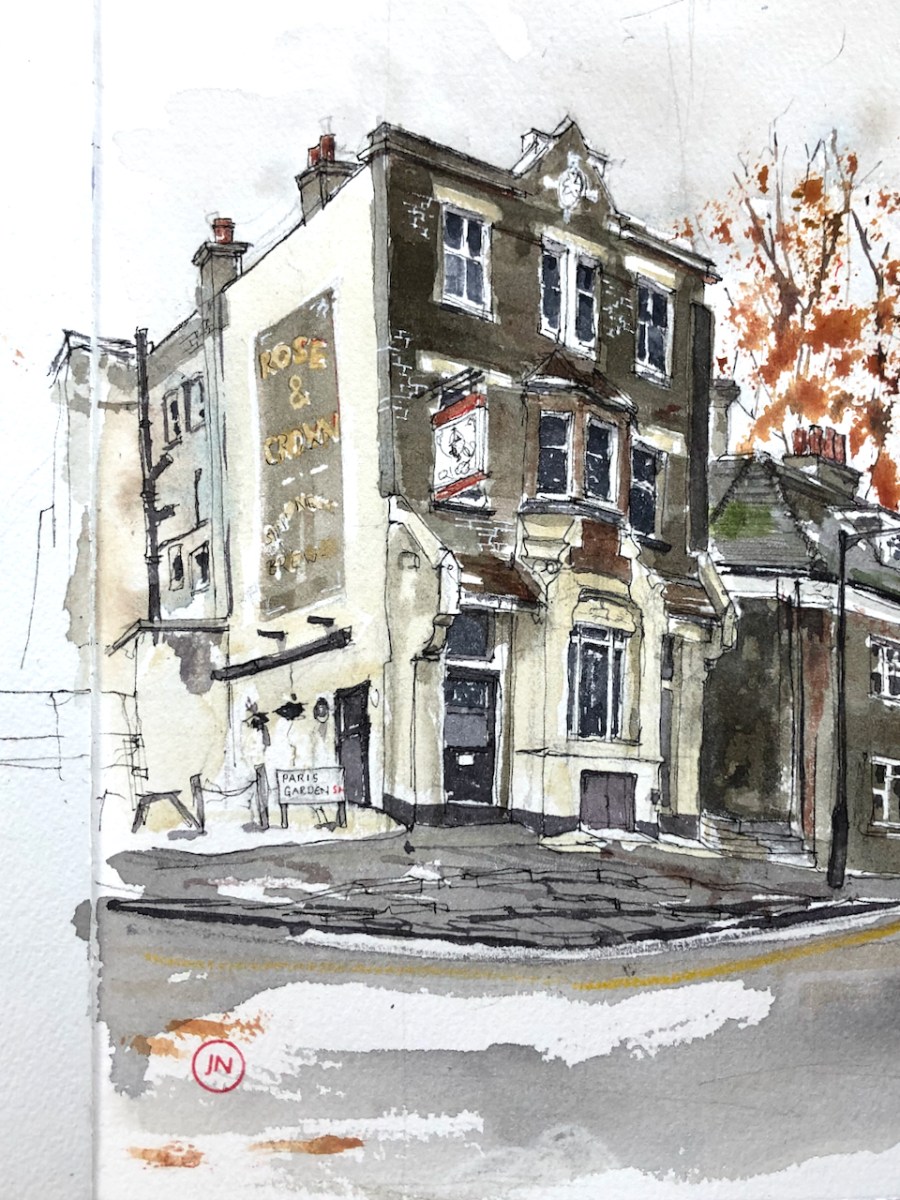
The church community hold some of their events in the adjacent pub, the Rose and Crown:
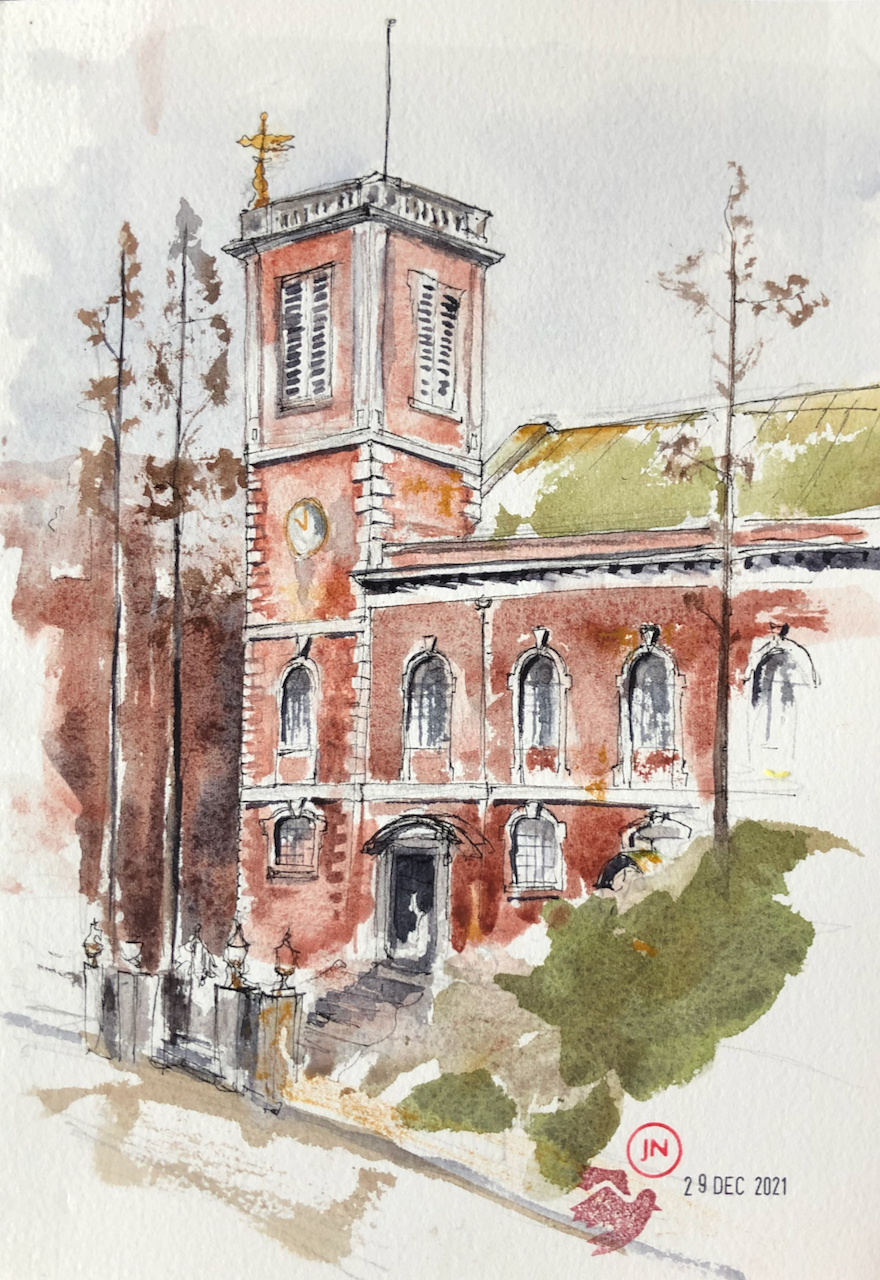
This lovely church is on Queen Victoria Street, a busy thoroughfare in the City of London.
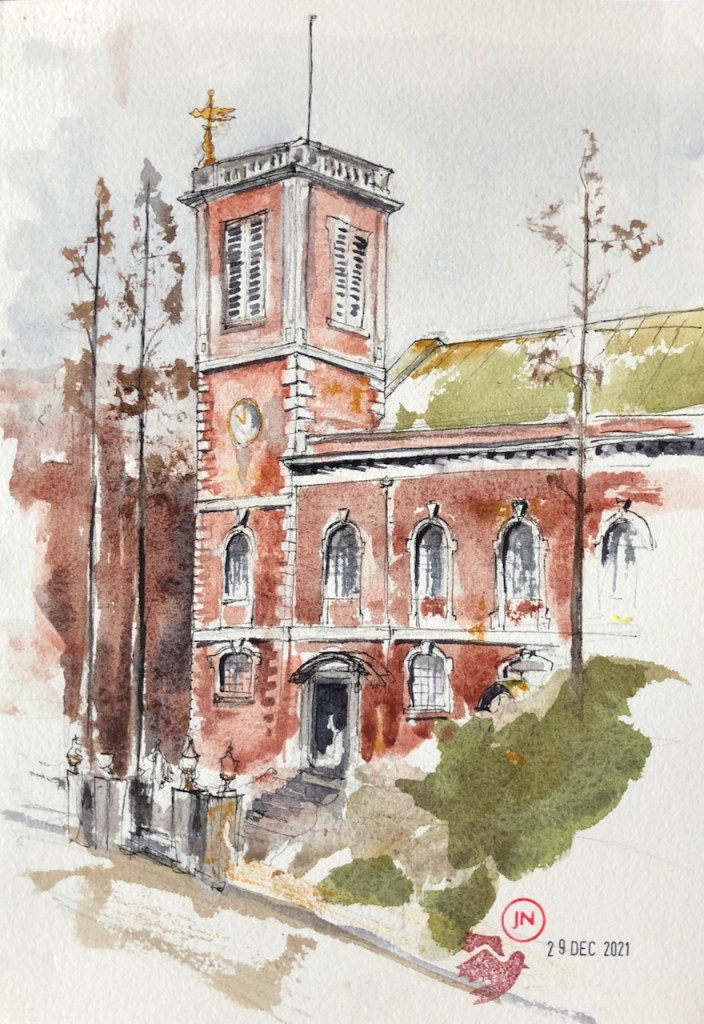
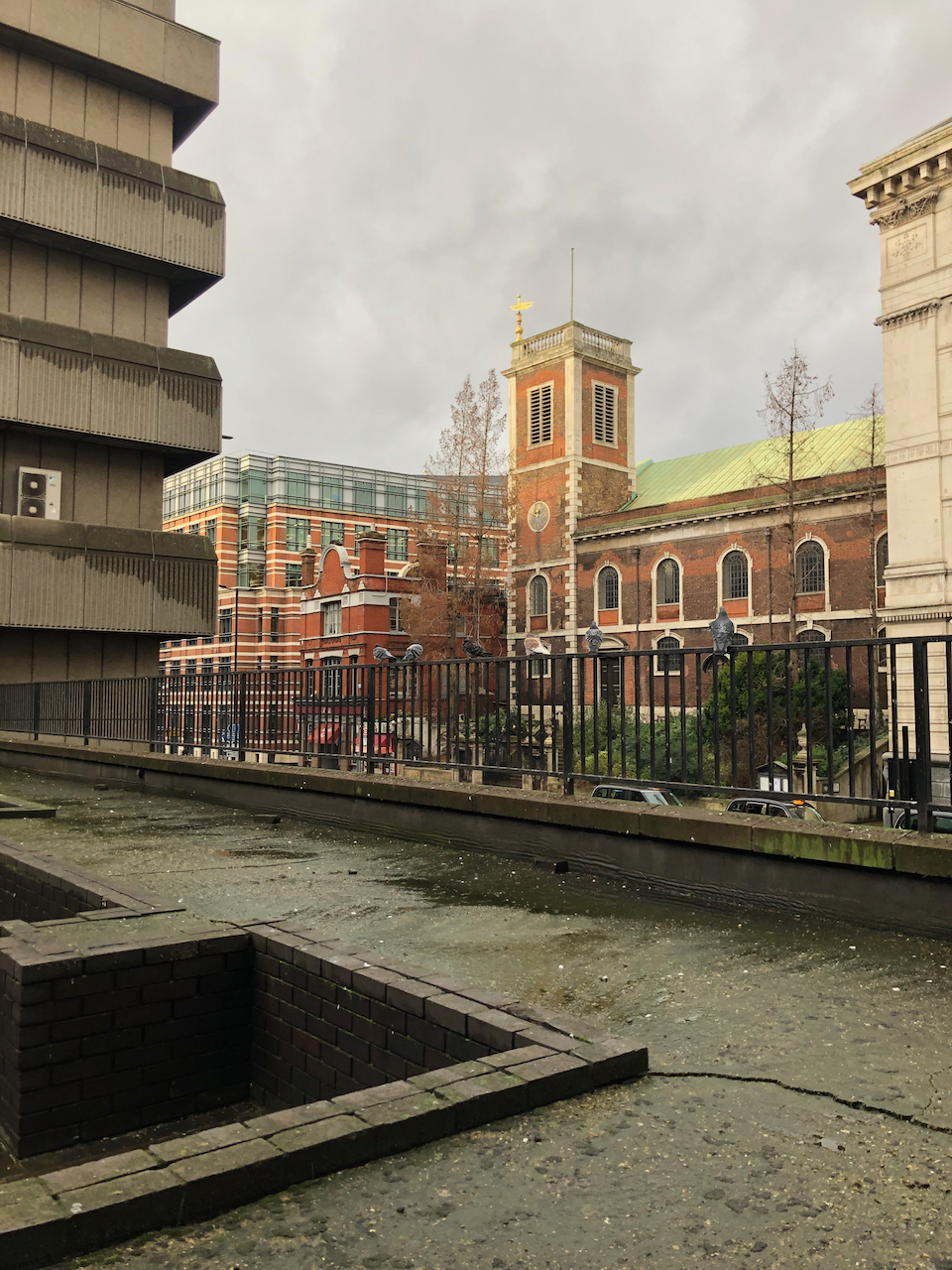
St Andrew by the Wardrobe EC4, 29th December 2021 2pm. 10″ x 7″ in Sketchbook 11
This church was first recorded in 1244, destroyed in the fire of London 1666, rebuilt by Christopher Wren in 1685-93, then destroyed again in the 1939-45 conflict, rebuilt again, and re-hallowed in 1961. It is now closed for refurbishment, and due to reopen in May 2022. When it re-opens it will become the London Headquarters of the Egyptian Coptic Orthodox Church, this use being shared with the Anglican parish activities. I read this news on the church website.
Note the magnificent trees! These trees should feature on any London Tree Tour. I think they are larches but I am not an expert.
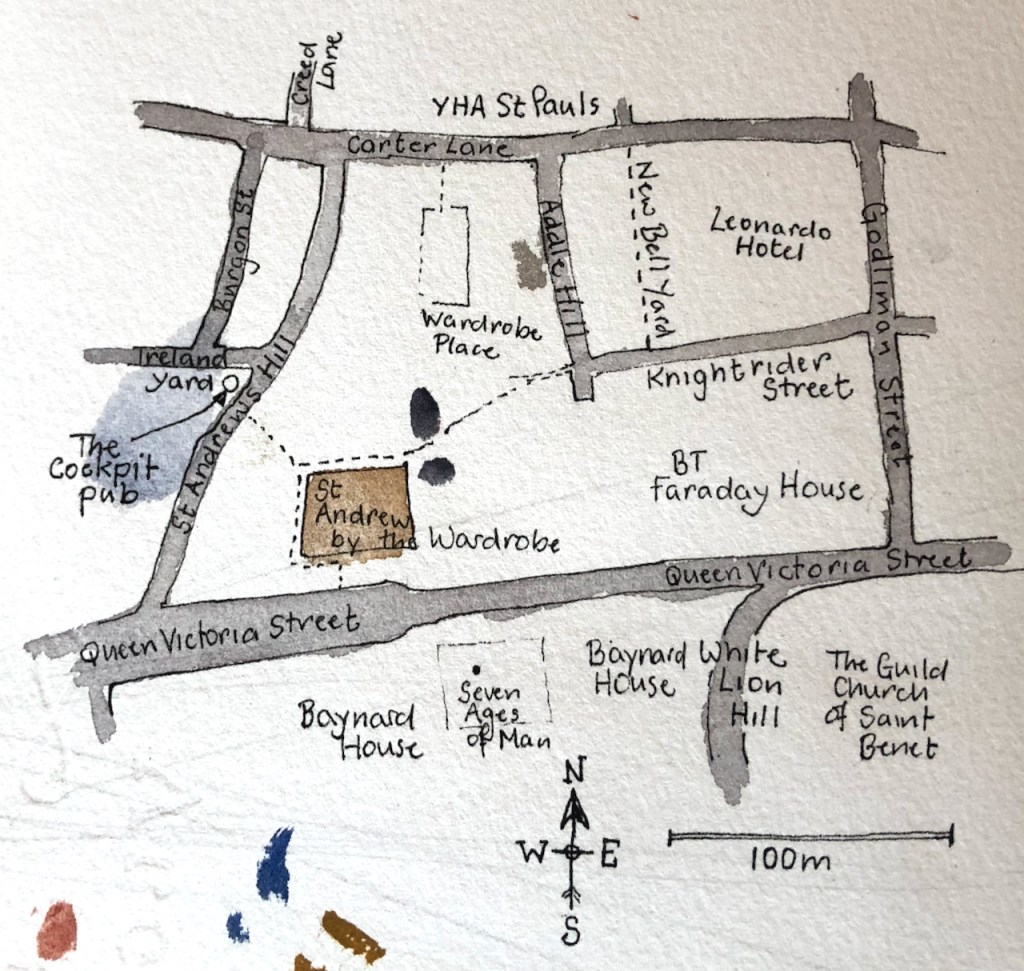
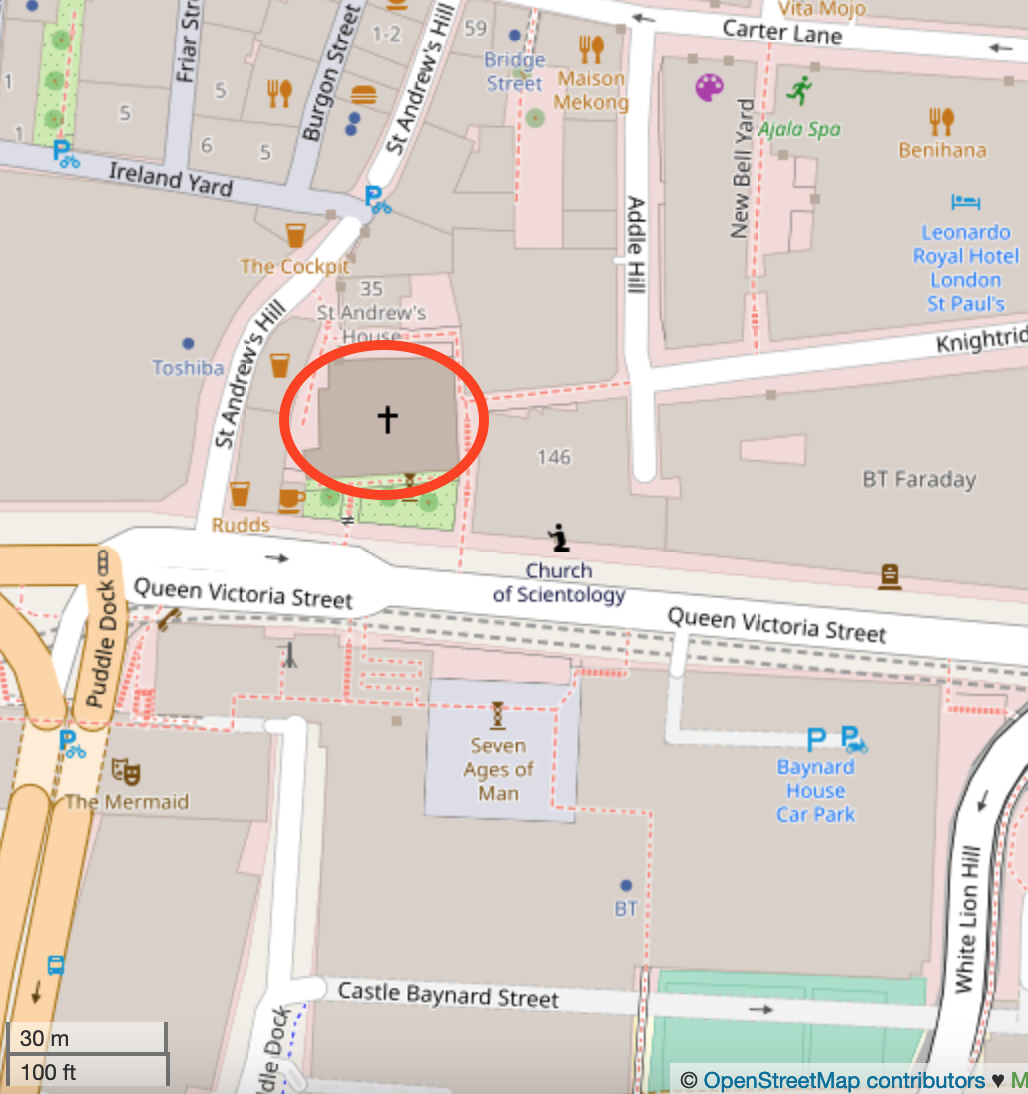
Yesterday, London was quiet. I sketched the church from podium level on Baynard House on the other side of the road. Baynard House is a 1970s office block currently occupied by BT (British Telecommunications, as was). Next to St Andrews on the East is the Church of Scientology. On the West side of St Andrews is a cocktail bar, Rudds.
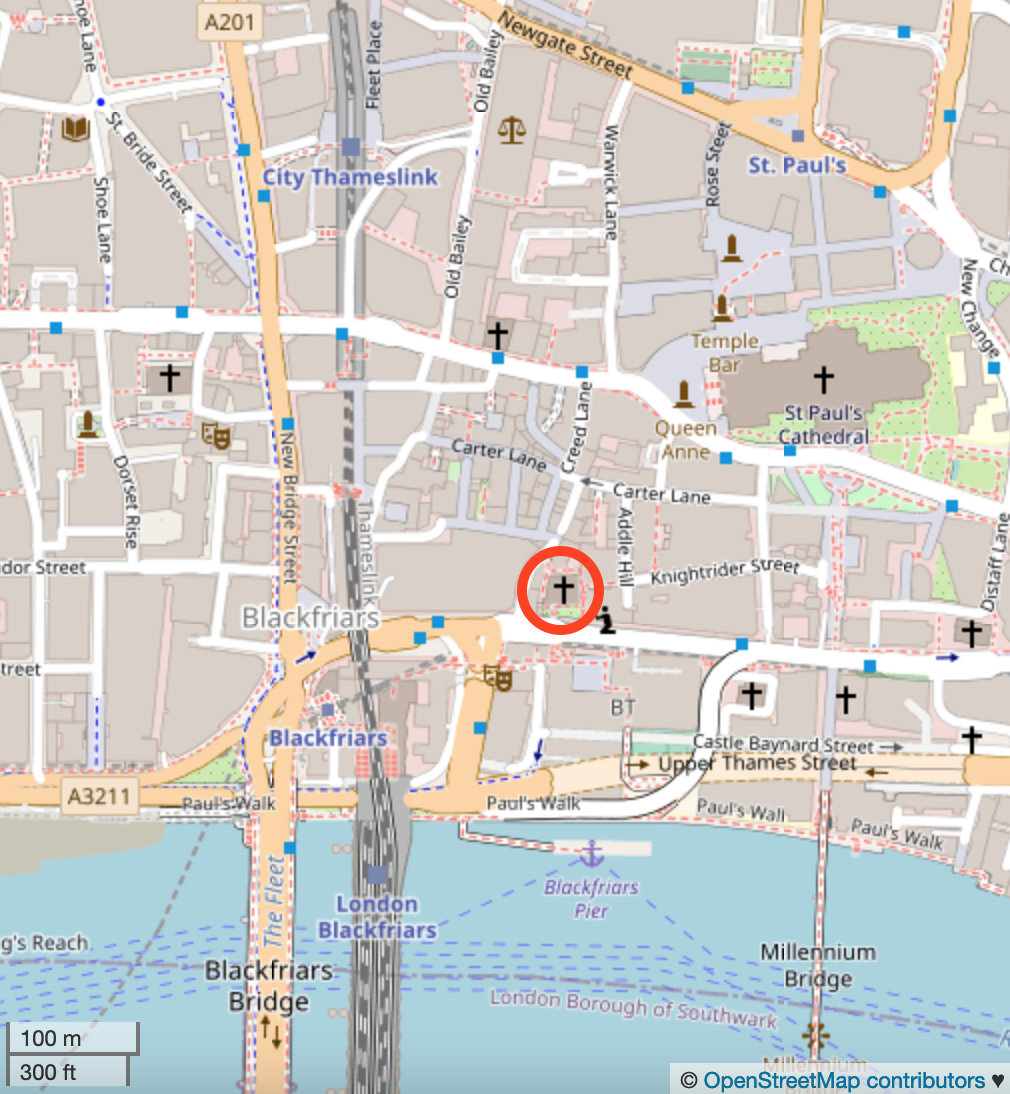
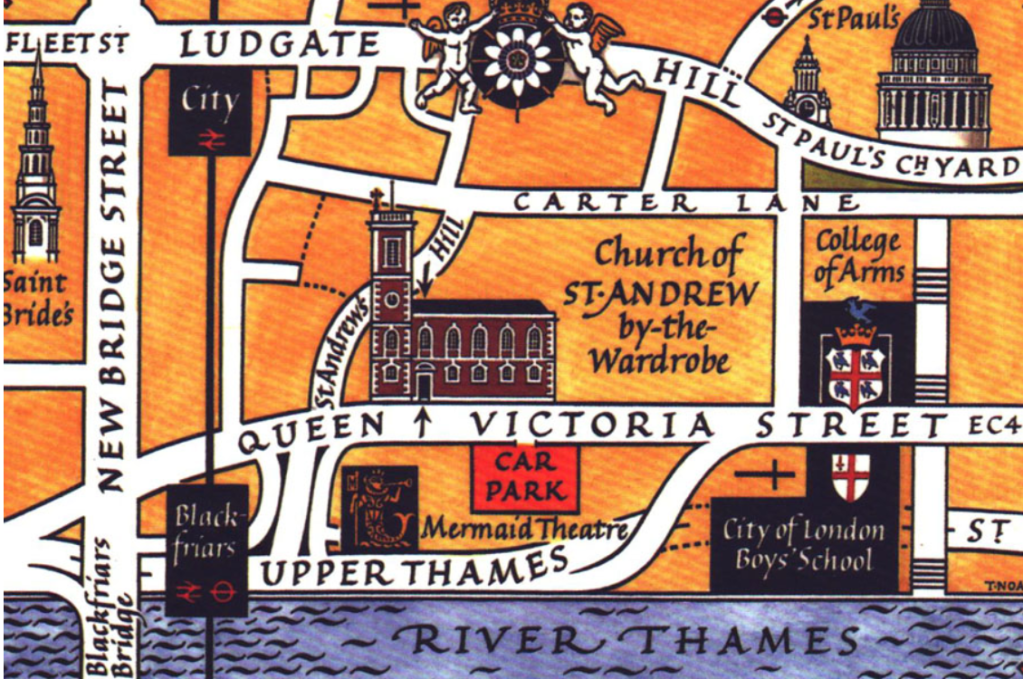
map from the website of Slovenia in London
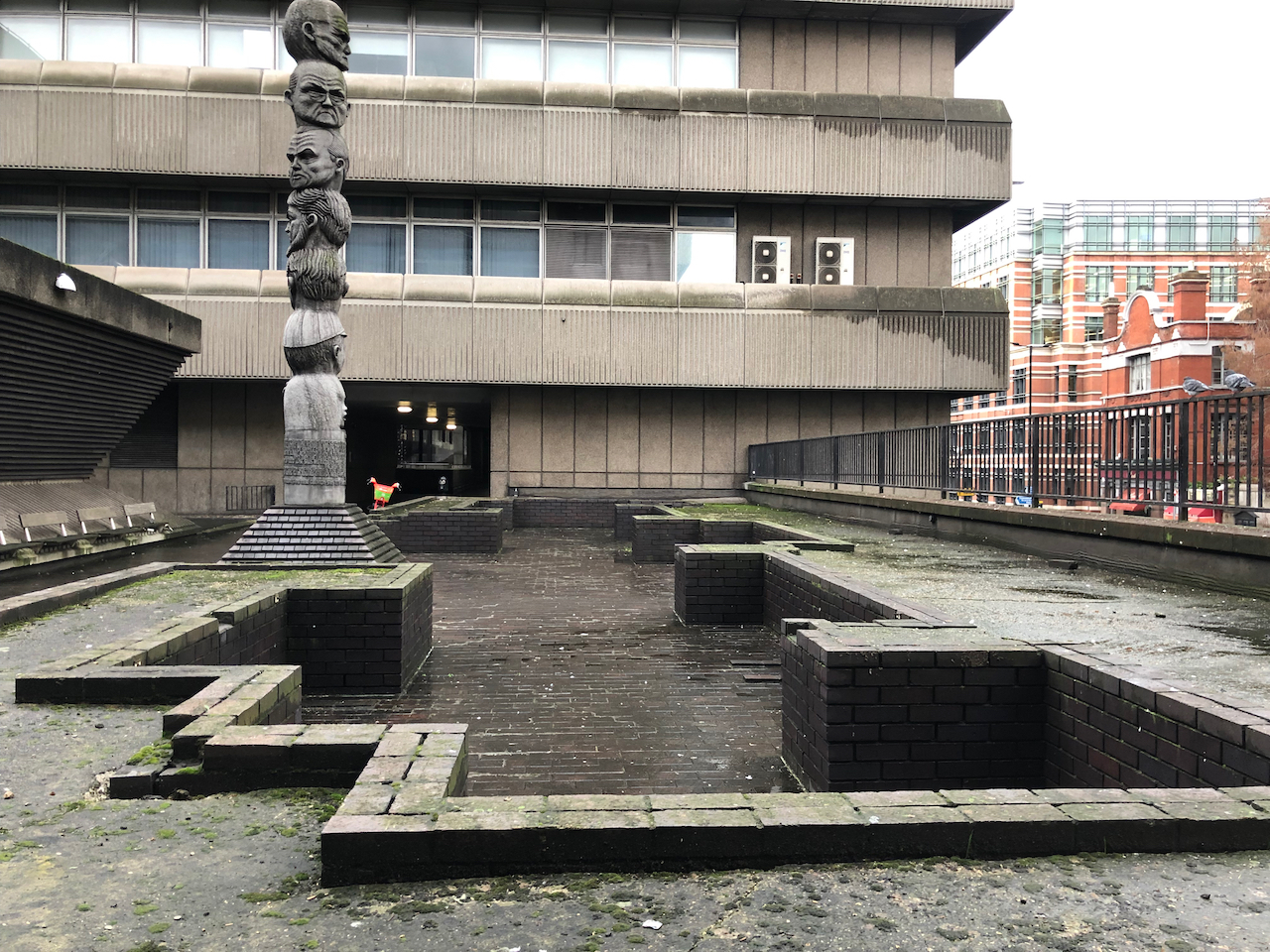
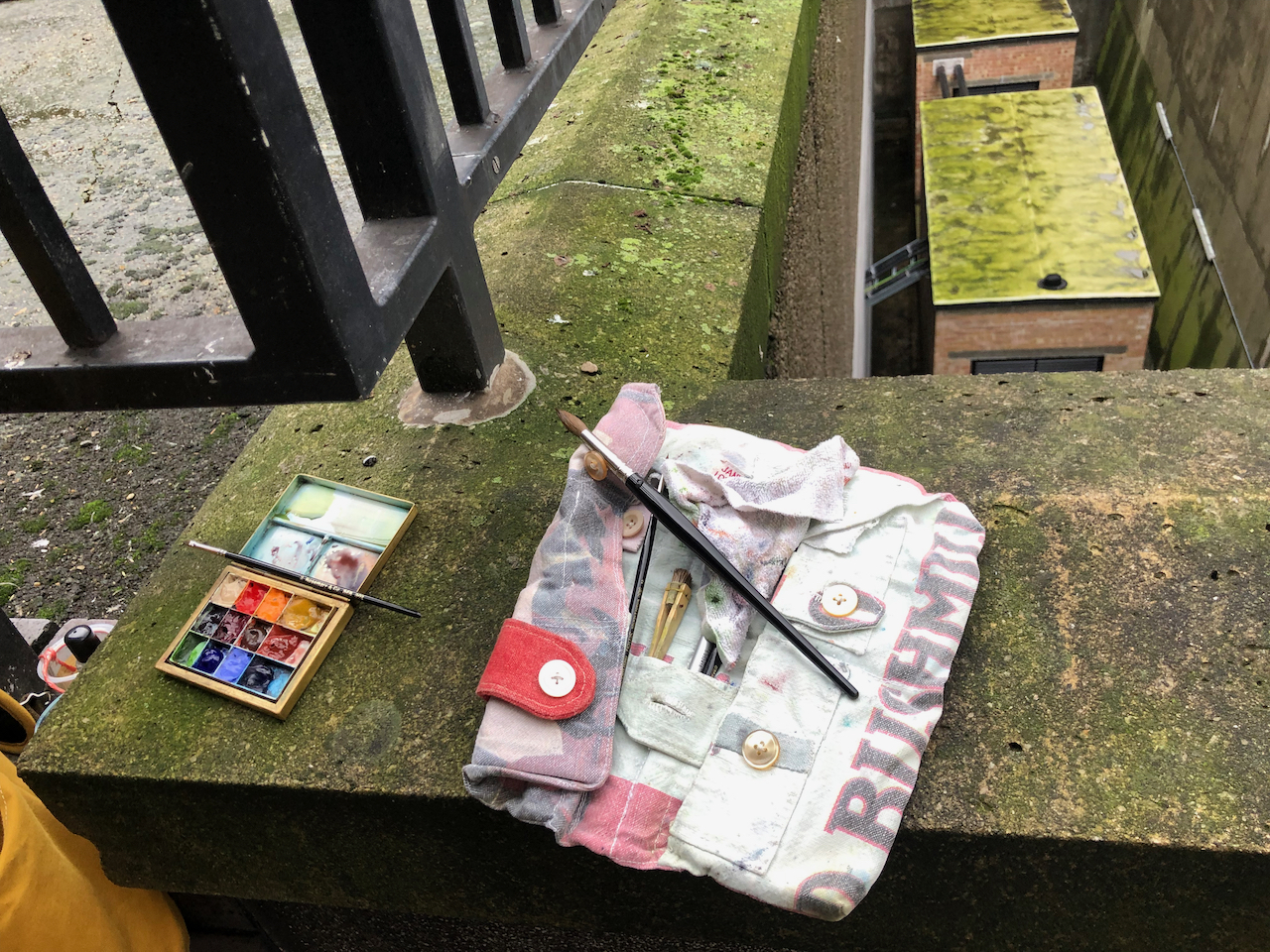
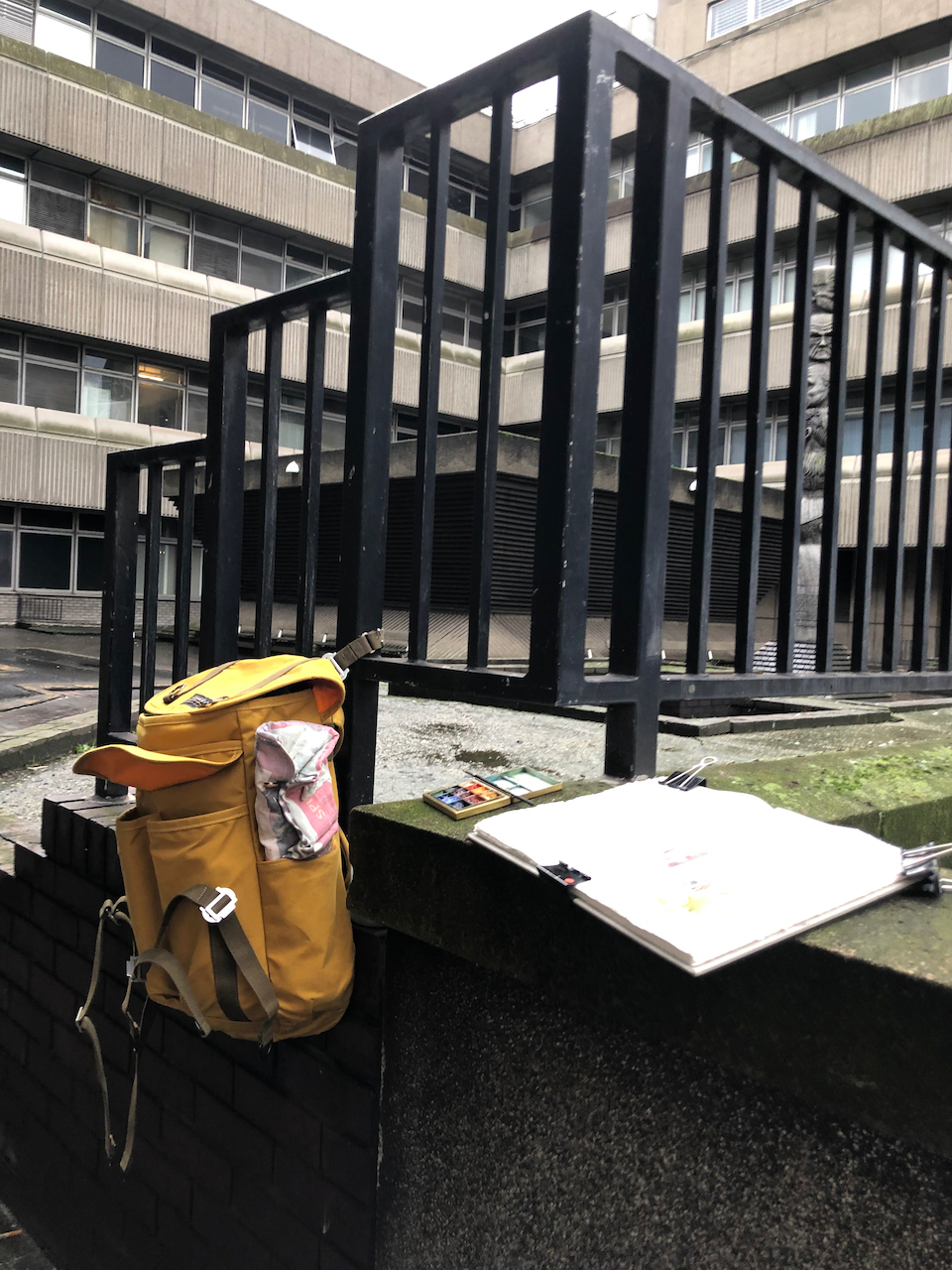
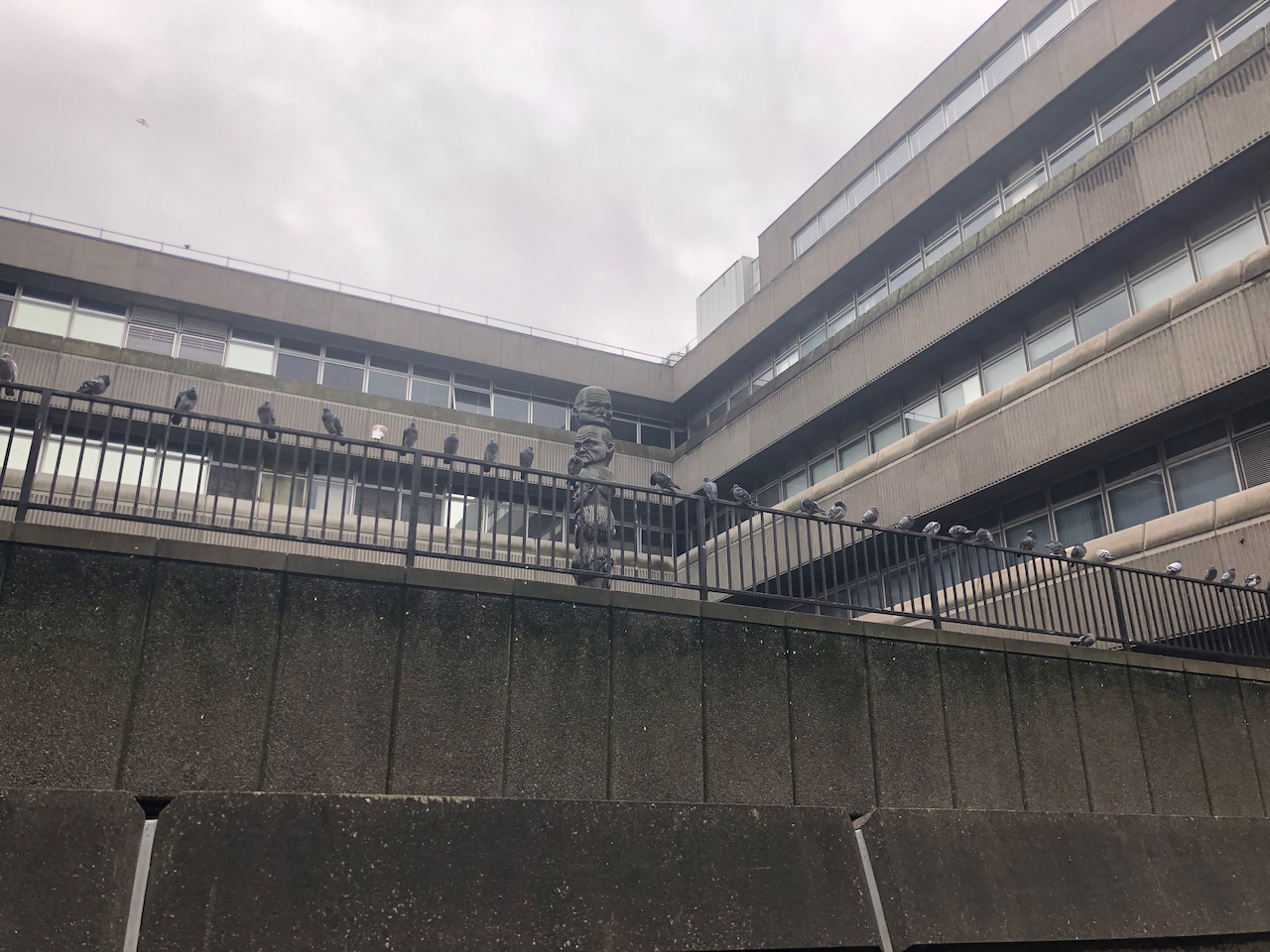
Baynard House, where I was sketching, is a strange and mysterious place. There is a podium-level walkway through the block. There are odd structures, like remnants of a lost civilisation.
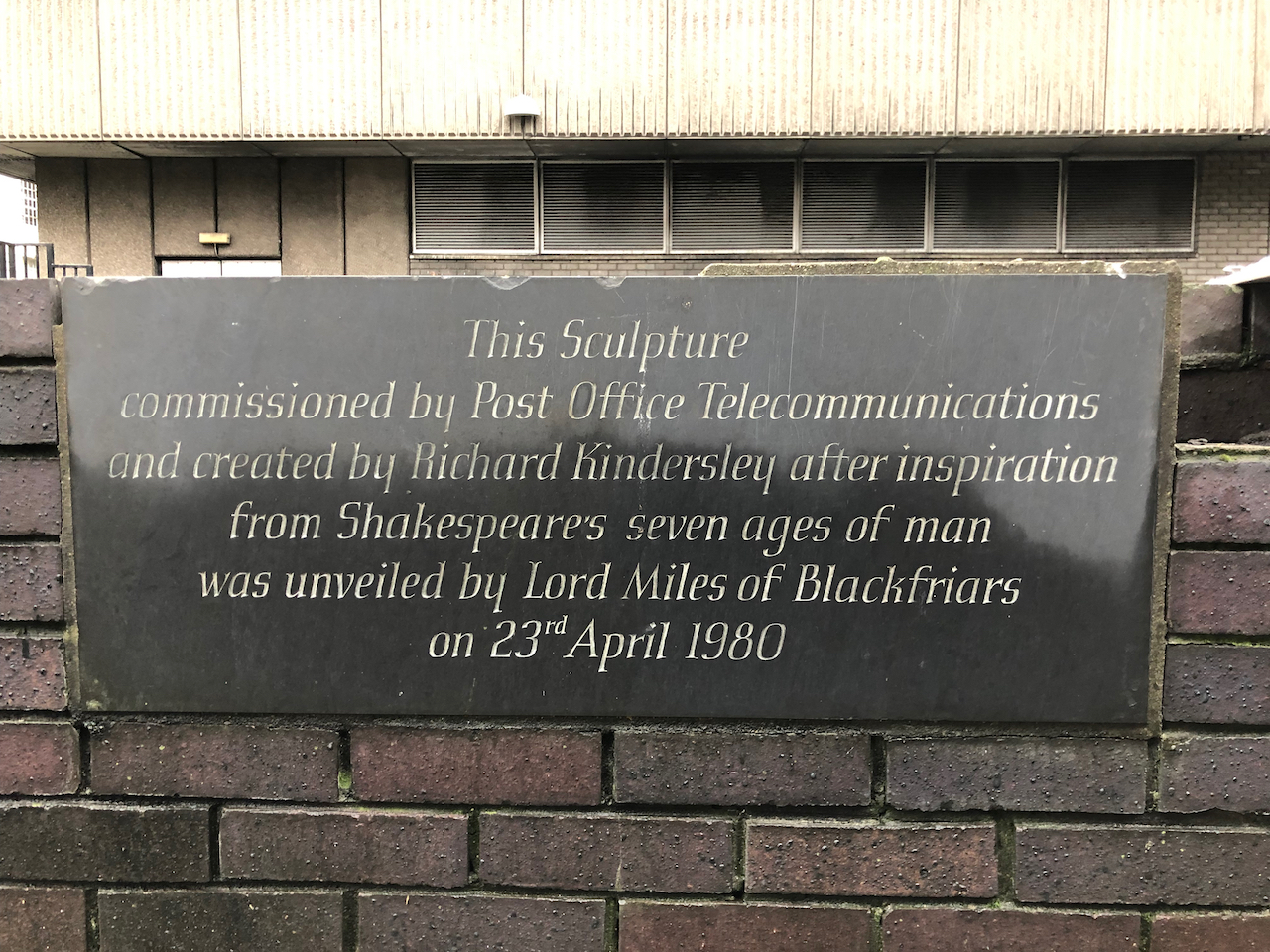
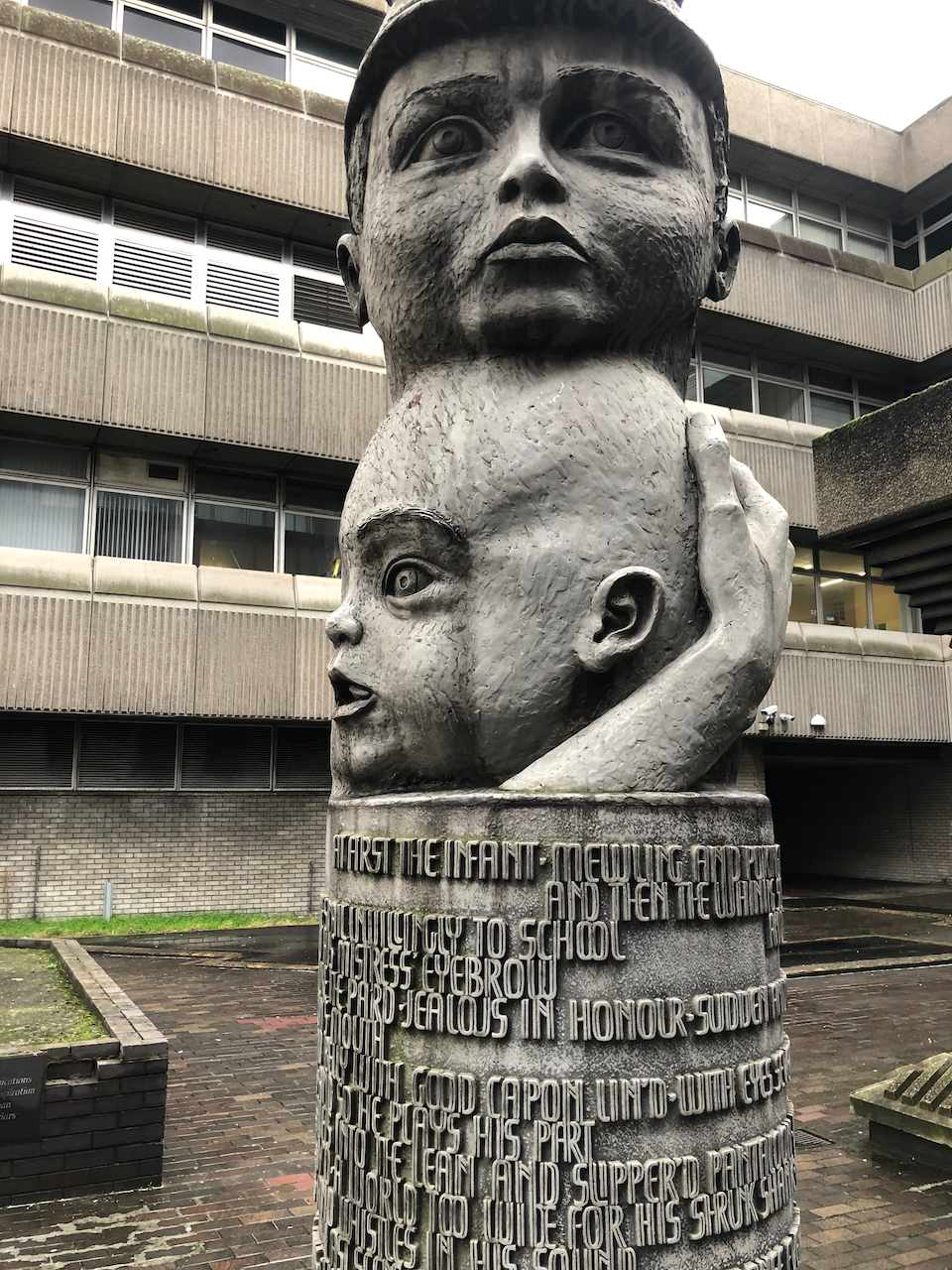
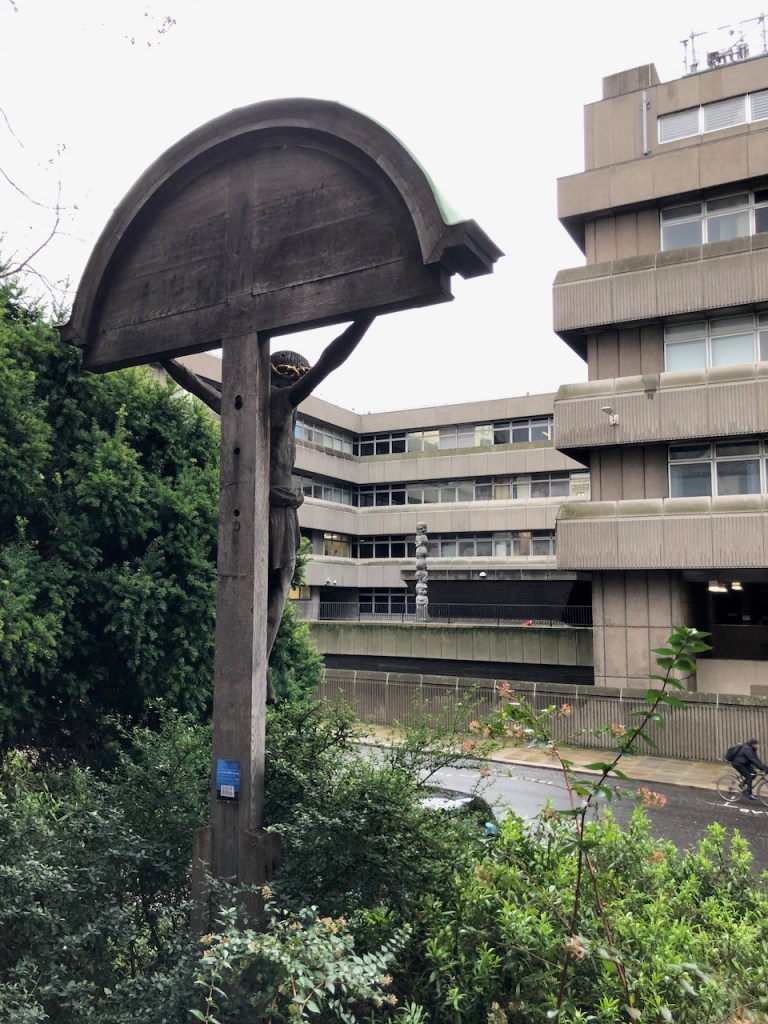
The church has a steeply sloping garden, with a wooden crucifix, just visible in the drawing. This looks across to the “seven ages of man” sculpture on Baynard House.
Looking South from St Andrews towards Baynard House, “Seven Ages of Man” sculpture by David Kindersley is visible in the centre of the picture.
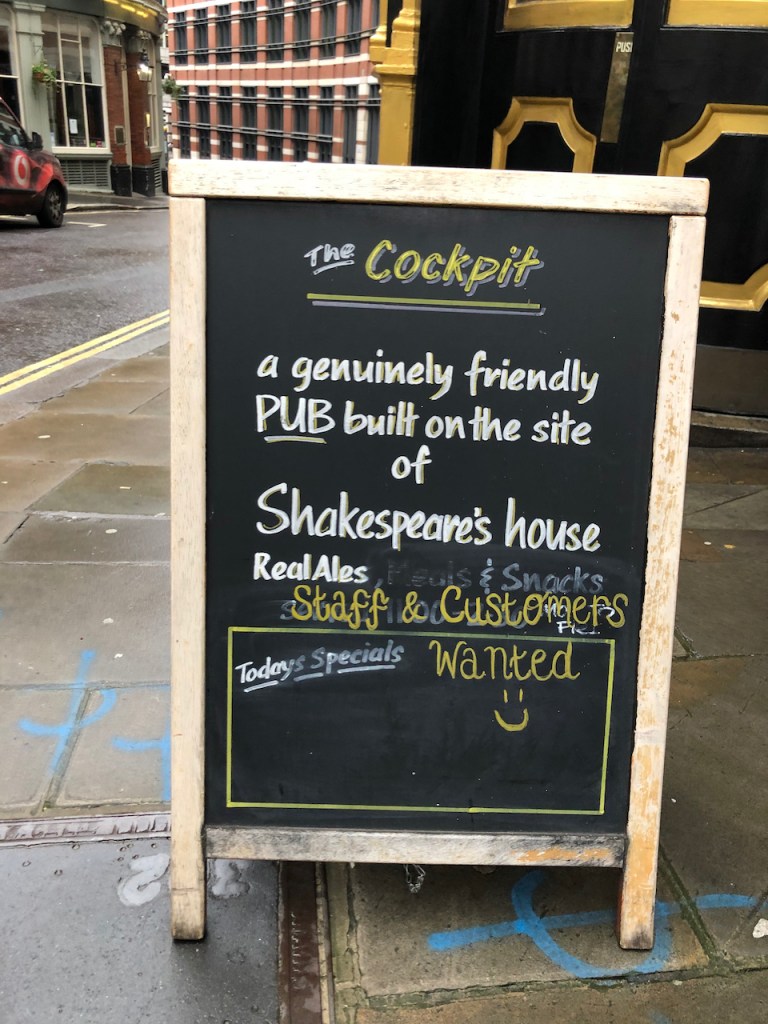
Walking up St Andrew’s Hill, I passed the “Cockpit” pub, on the site of Shakespeare’s house. It had a notice outside: “Staff and CustomersWanted“.
Click a button below to share this post online, email it, or print it:
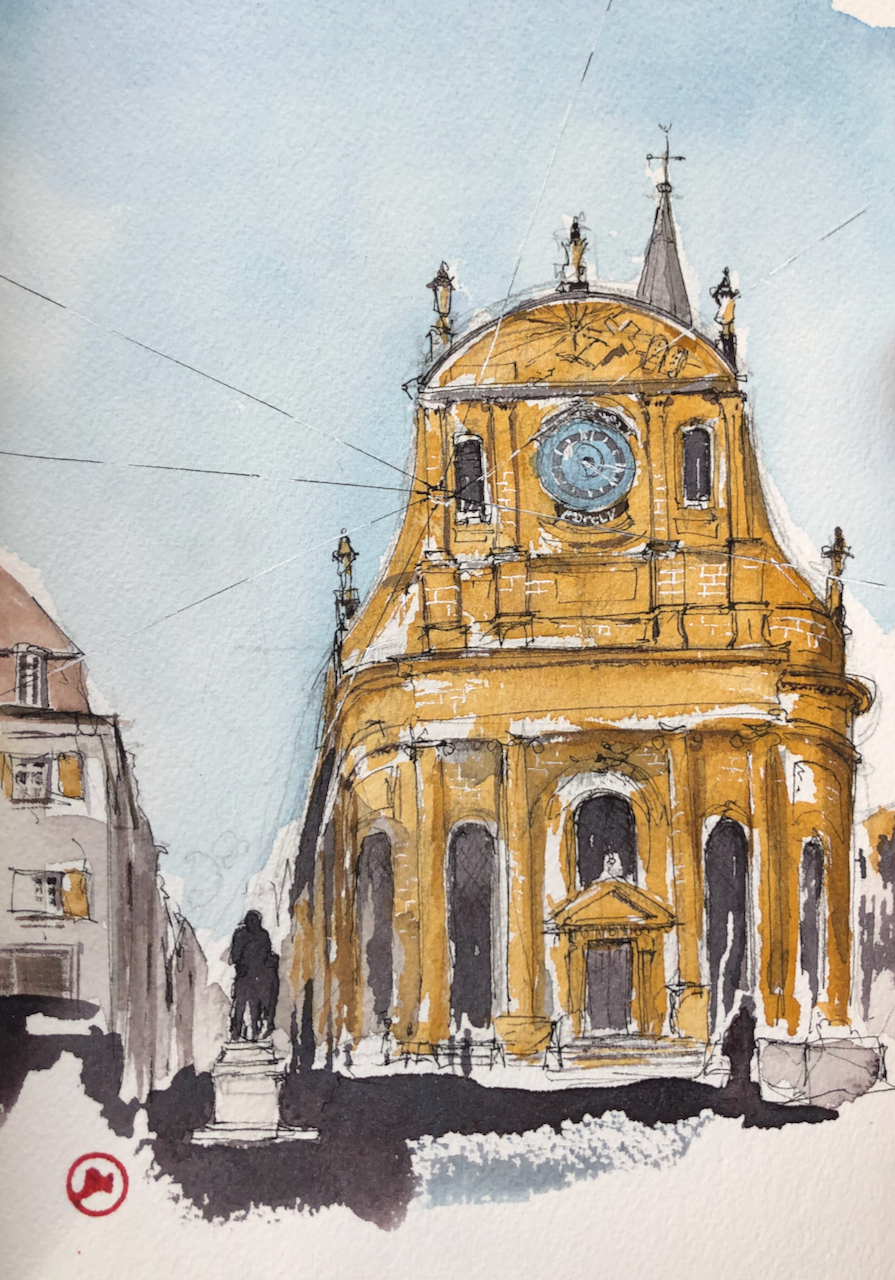
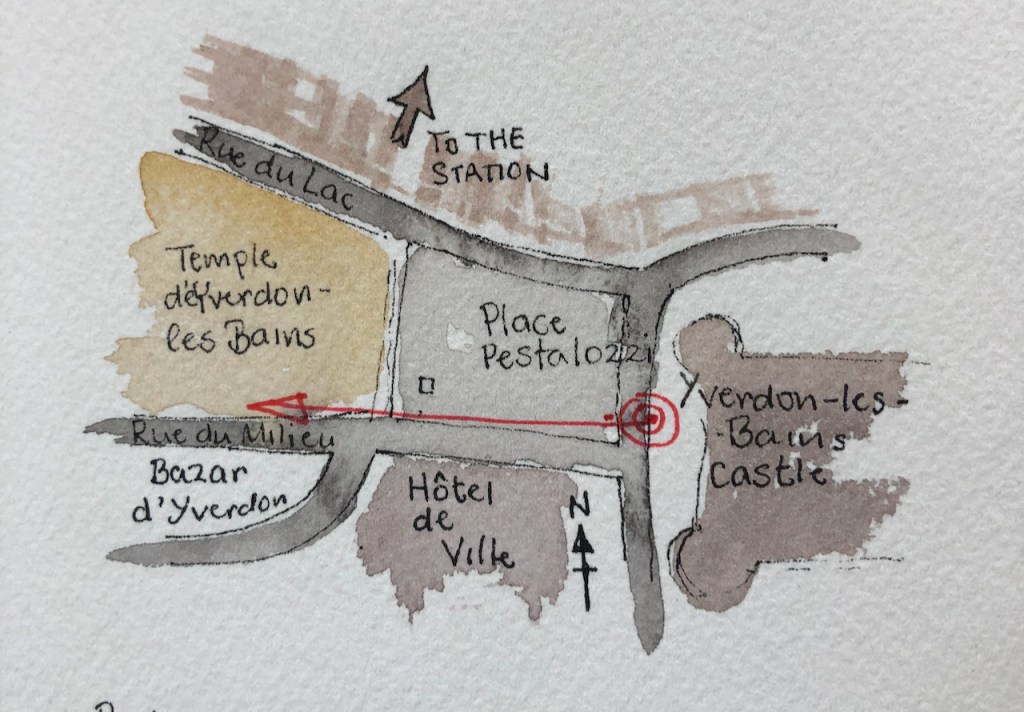
Here is a view from a bench in the main square in Yverdon-les-Bains, Vaud, Switzerland.
Temple d’Yverdon-les-Bains, 27 October 2021, 3.30pm, 10″ x7″ in Sketchbook 11
This is a protestant church, built in 1757. The wonderful yellow stone is from Hauterive in the canton of Neuchâtel.
On the left you see the statue of Johann Heinrich Pestalozzi, for whom this central square in named. He lived 1746-1827. He was an educator, and established the idea that the process of teaching needs to be thought about. He was an early practitioner of the study of teaching: pedagogy. This is why on his statue there are also children.
Pestalozzi’s idea was “Learning by head, hand and heart”. He thought that education was a good idea, in general, for everybody, including the poor. It was good for people as individuals, and good for society in general. Education meant people contributed more, were healthier and happier, and generally better citizens. [My paraphrase of what I’ve read on the website of the JH Pestalozzi Society and elsewhere]. This all sounds very modern. The current ideas of “child-centred learning” for example, can be traced back to Pestalozzi, I read, as well as the concept of state education.
He initiated the Pestalozzi Children’s villages in Switzerland and elsewhere, specifically to help the poor and displaced. This work is still continuing as Pestalozzi World.
So Pestalozzi was a very influential person.
The lines in my drawing are wires suspended across the square for hanging banners and decorations. I like to think they also symbolise the rays of hope that education brings.
Later note:
Above the clock is the Latin inscription: SUPERNA QUAERITE
This roughly translates as “Seek higher things” or “Enquire upon matters of a higher order”.
It occurs in the Letters of Paul to the Colossians, Chapter 3 verse 2, which is rendered in my St James’ Bible as:
If then ye were raised together with Christ, seek the things that are above, where Christ is, seated on the right hand of God. Set your mind on the things that are above, not on the things that are on the earth.
Or if you prefer the Latin, from “Novum Testamentum Domini Nostri Jesu Christi”(“The New Testament. A Latin version prepared by Theodore Beza”[2010], via GoogleBooks):
Itaque si resurrexistis cum Christo superna quaerite ubi Christus est ad dextrum Dei sedens. Superna satagite non terrestria.
Below the clock are the Roman numerals: MDCCLV
1000+500+100+100+50+5 = 1755
Click a button below to share this post online, email it, or print it:
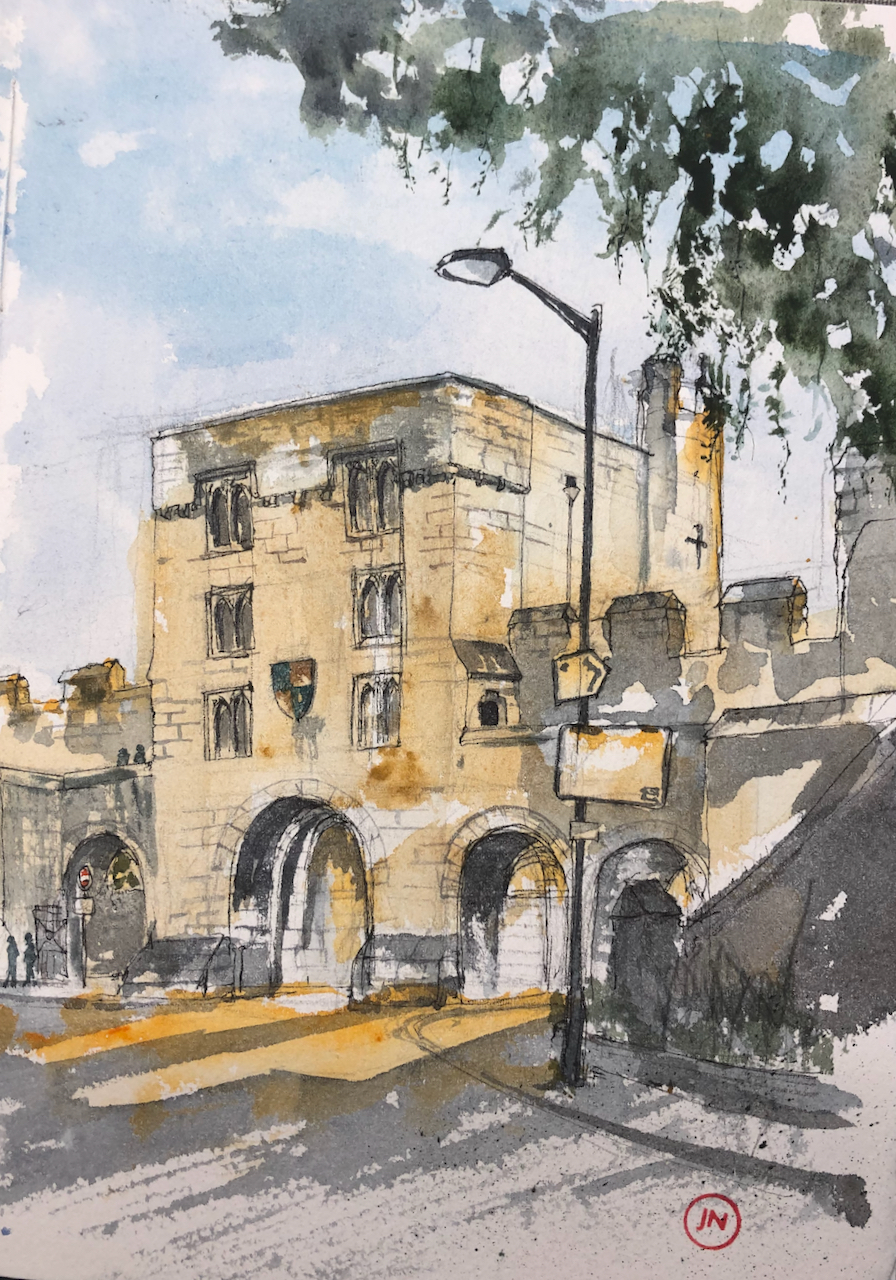
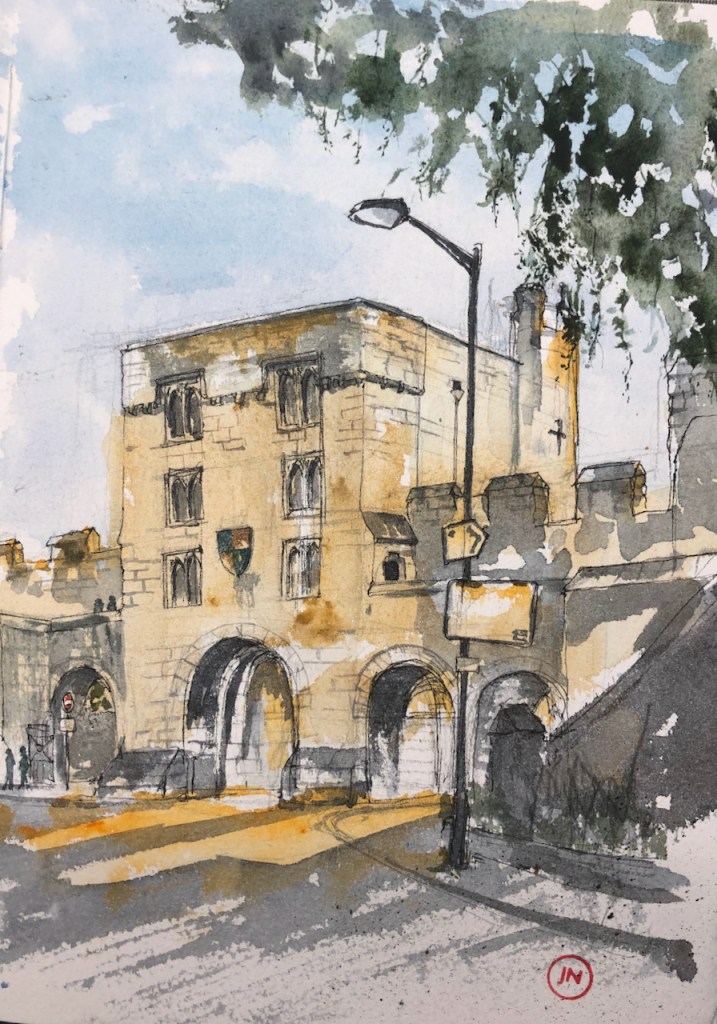
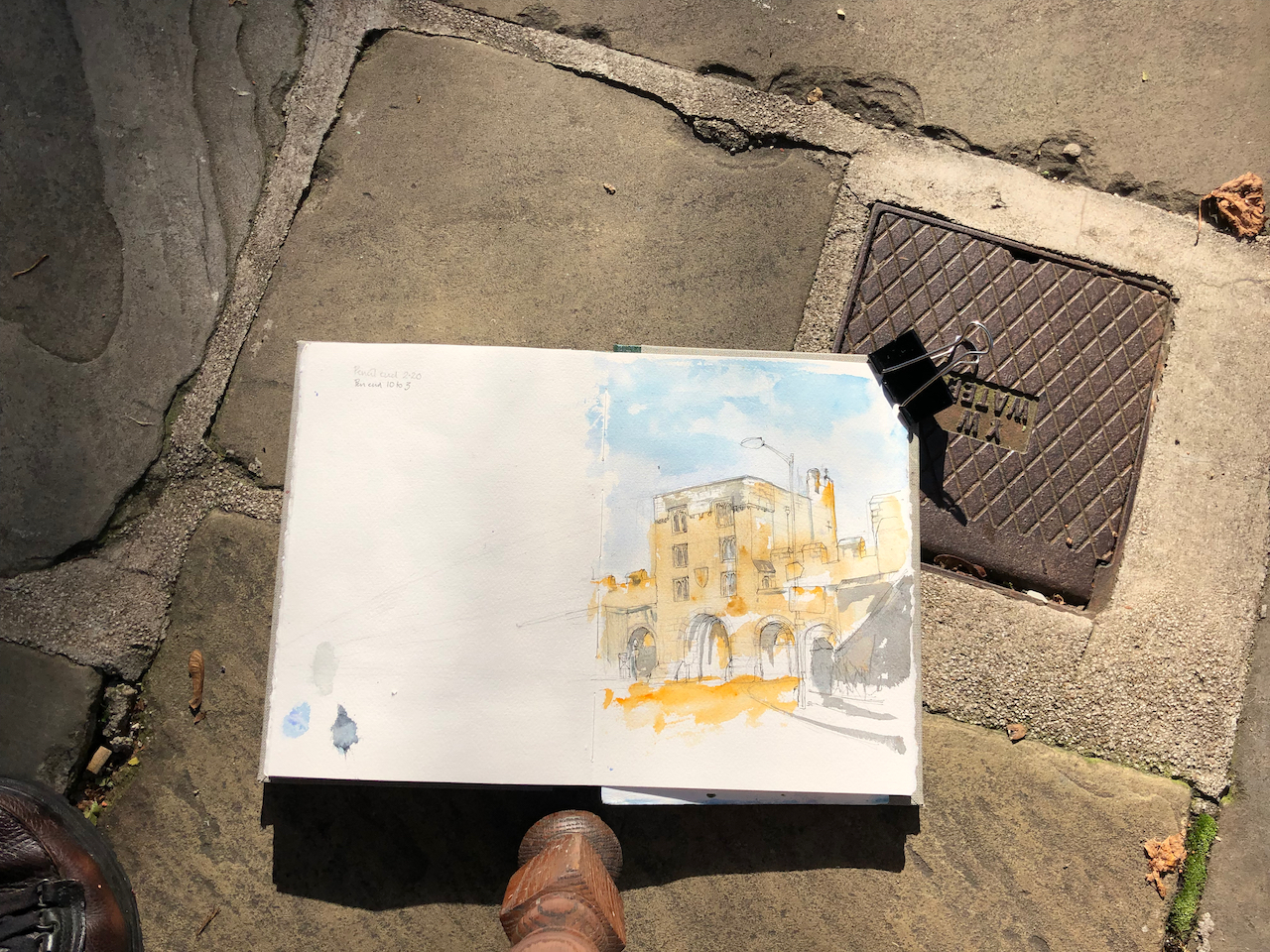
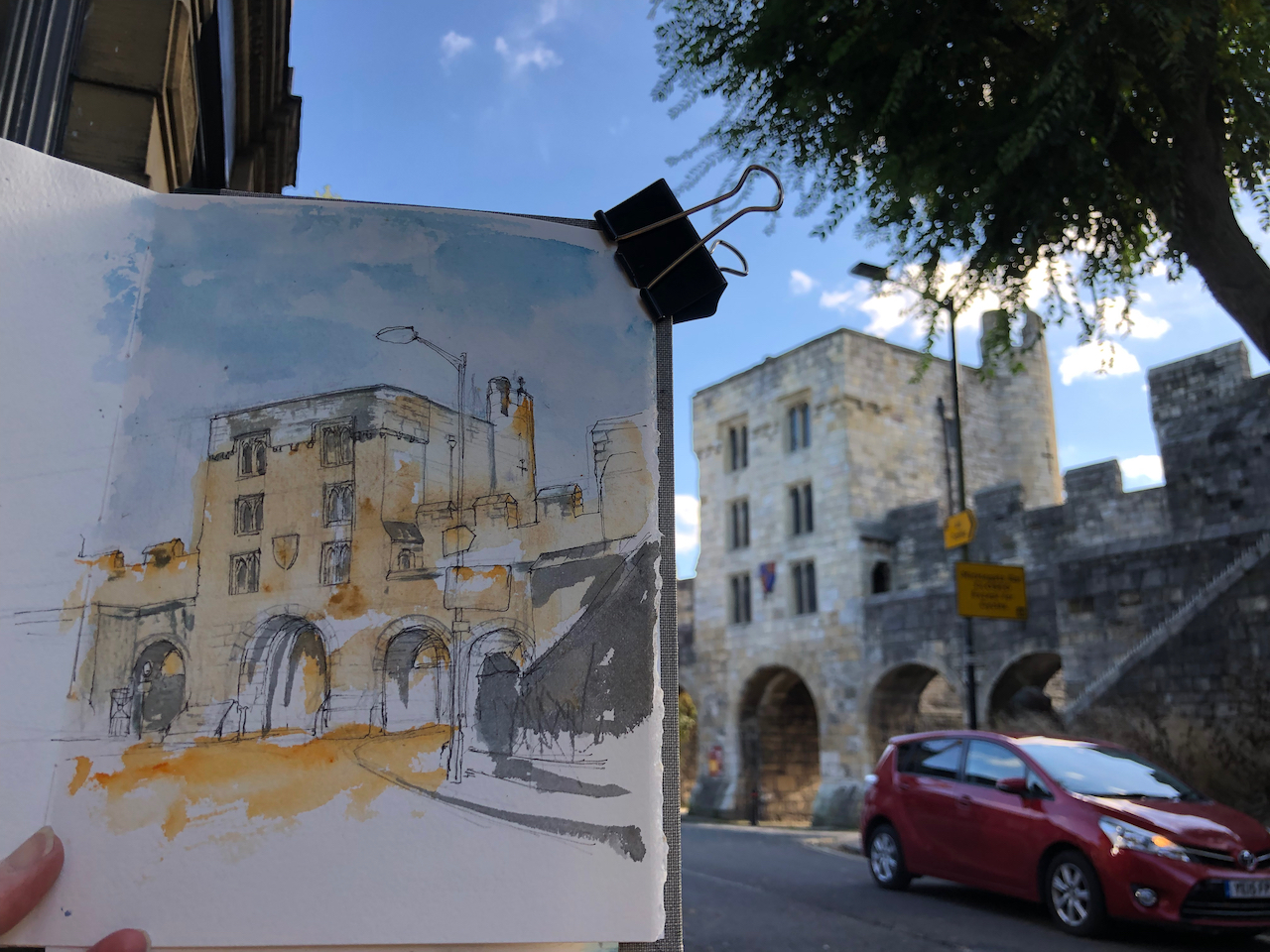
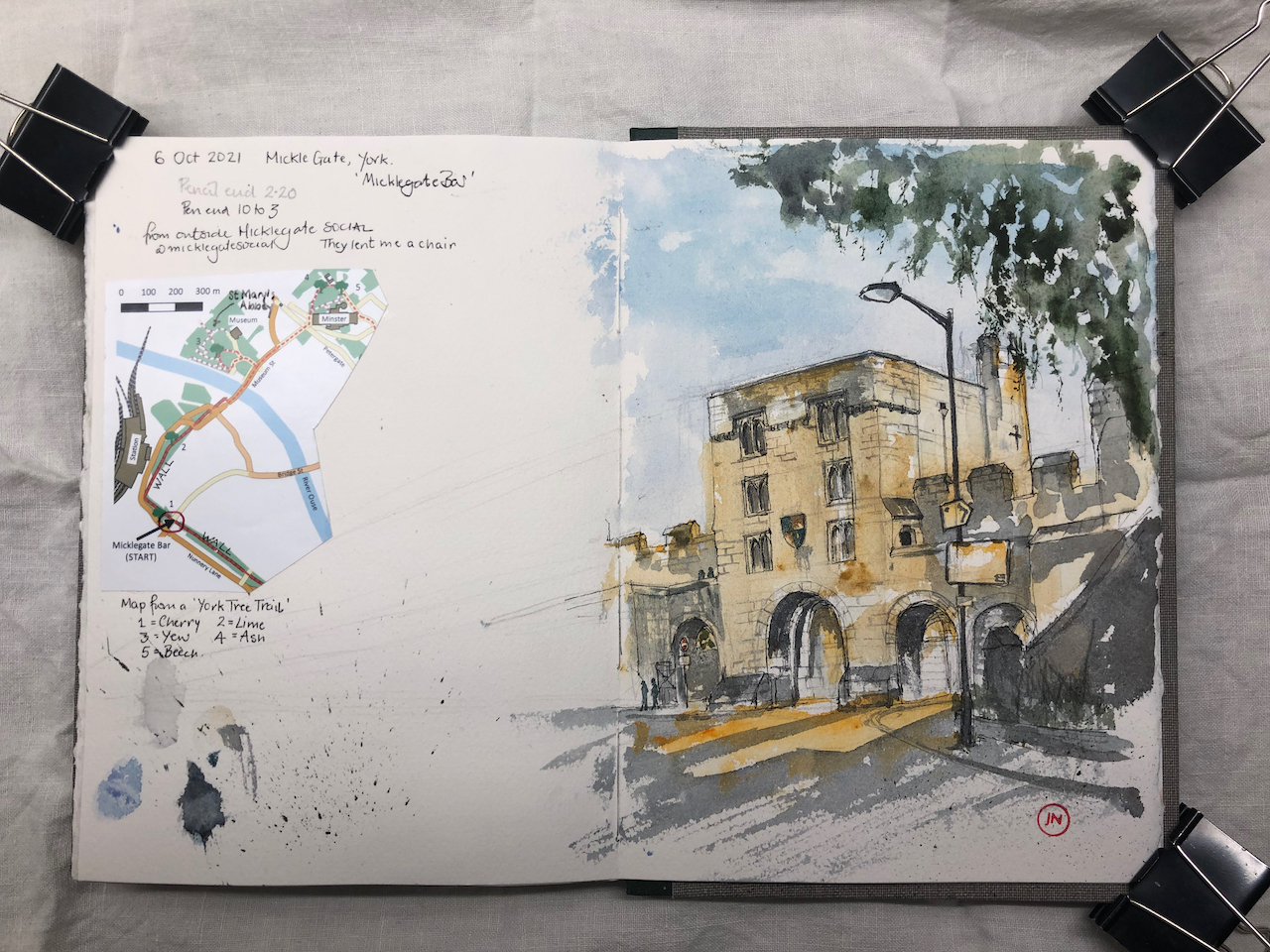
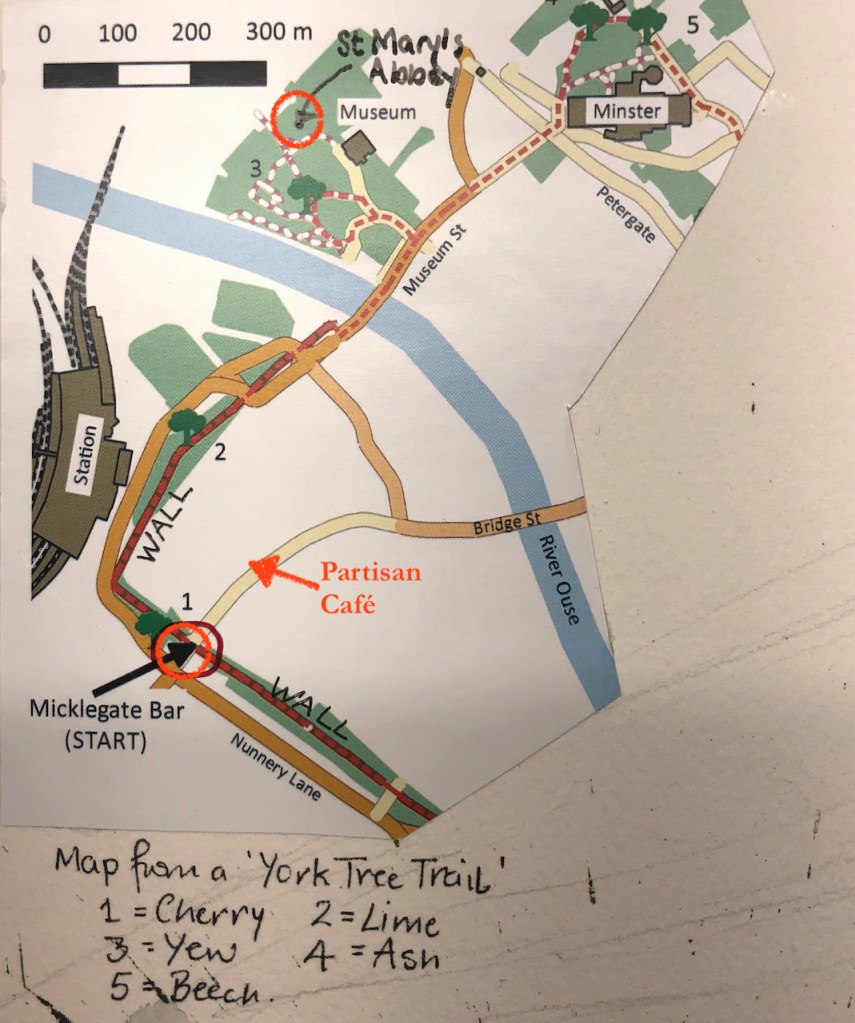
Here is the “Micklegate Bar”, which is one of the great gates through the old City wall into the centre of York.
Micklegate Bar, York, 7th October 2021, 3pm. 7″x10″ in Sketchbook 10
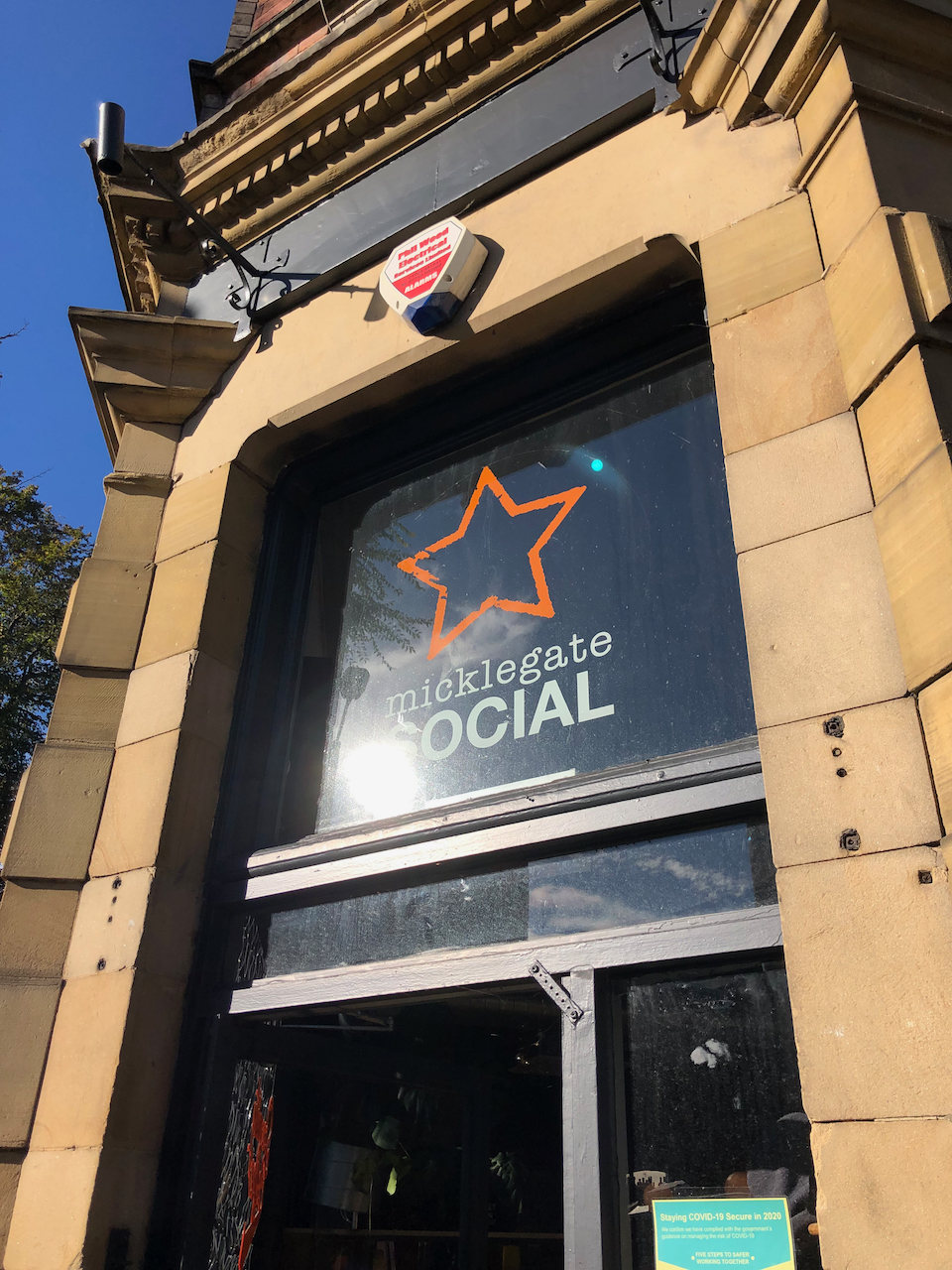
I sketched this outside a bar called “Micklegate Social”. The staff were inside, cleaning and setting up. They very kindly lent me a chair!
The city wall goes off to left and right. I put a two people in, to give you an idea of the scale. They are high up, level with the lowest windows.
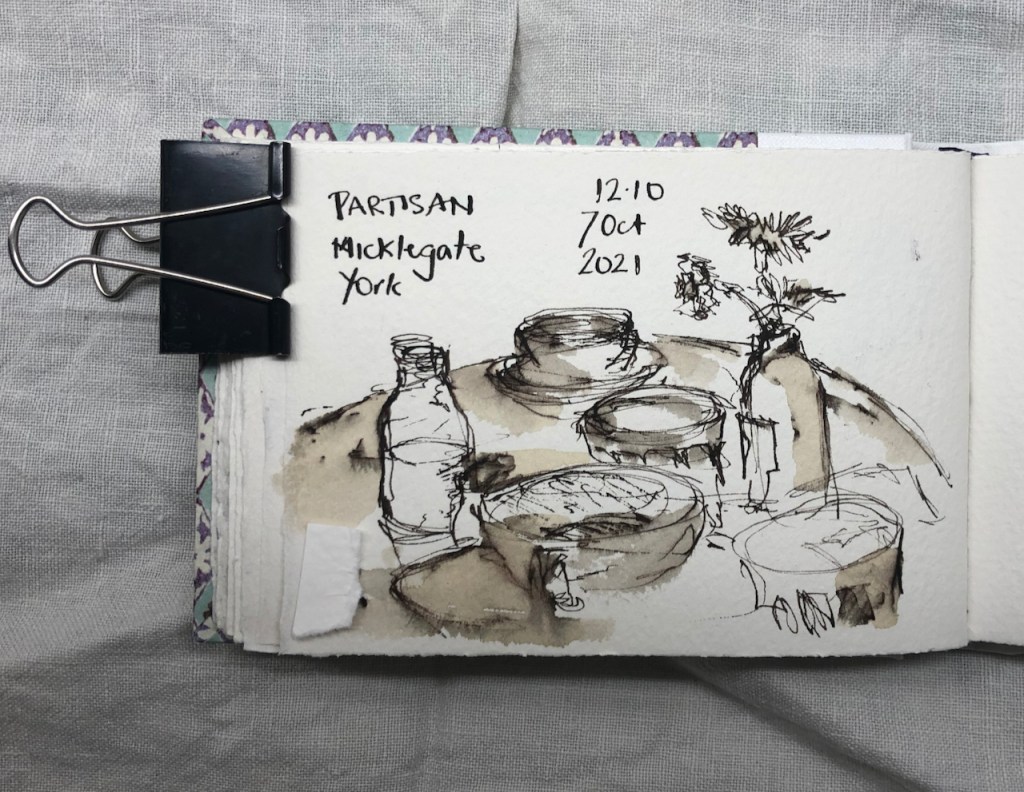
“Micklegate” is the name of a street which heads North from the gate. Later on I had breakfast at “Partisan”, a café just up from Micklegate Bar. Recommended!
Quick sketch at “Partisan”, Micklegate, York, ink and coffee. 6″ x 4″ in a small sketchbook made by Heather Dewick.
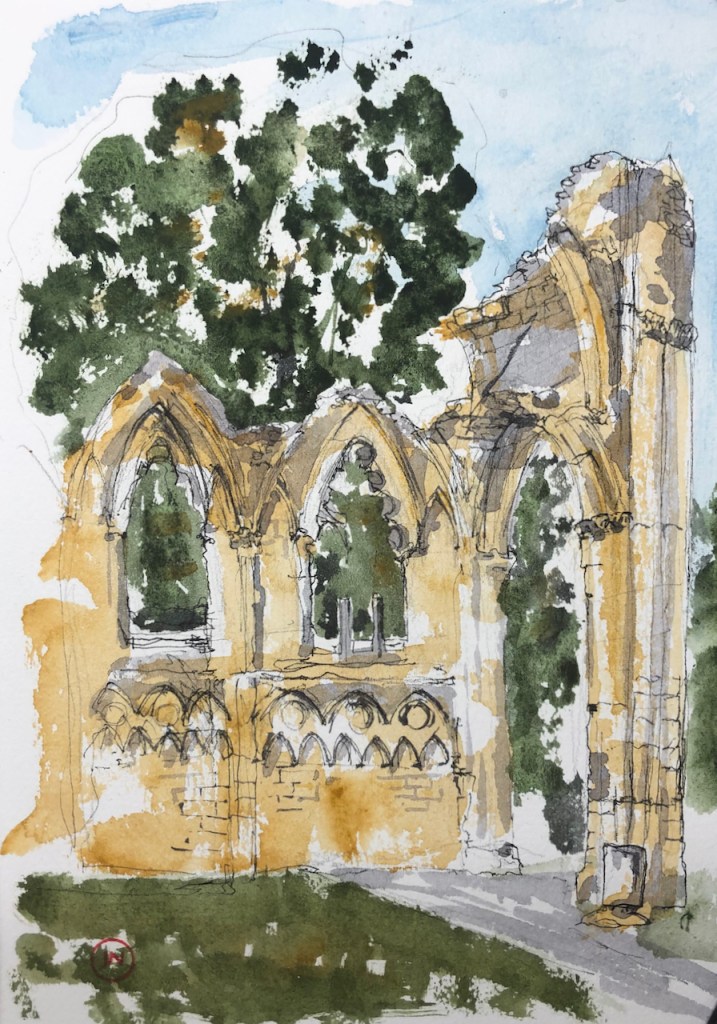
Outside the wall, to the North West, is the park surrounding the York Museum. I made a picture of the ruins of St Mary’s Abbey.
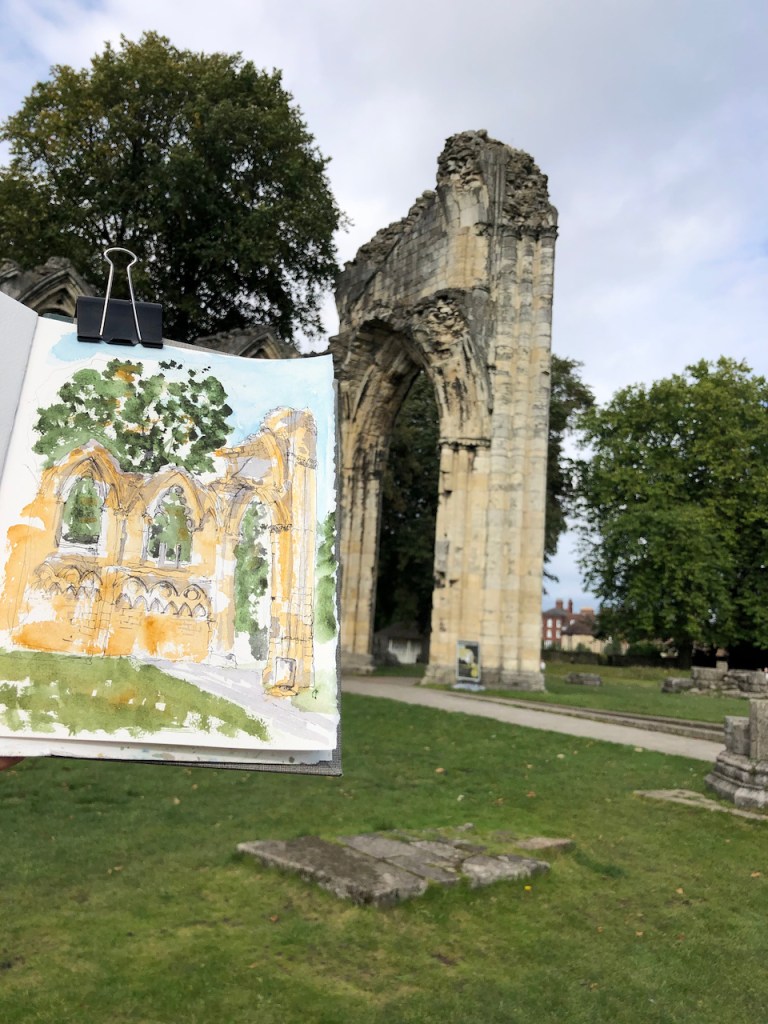
St Mary’s Abbey, York. 7th October 2021 2pm. 1hr 10mins, 10″ x 7″ in Sketchbook 10
The original church on the site was founded in 1055. In 1089, William Rufus, third son of William the Conqueror, laid the foundation stone for the Norman Church dedicated to the Virgin Mary. It was an abbey for the Benedictine monastery on this site. 450 years later the monastery was closed, in 1539, under Henry VIII.
The current ruins are 750 years old. They date from a rebuilding in 1271.
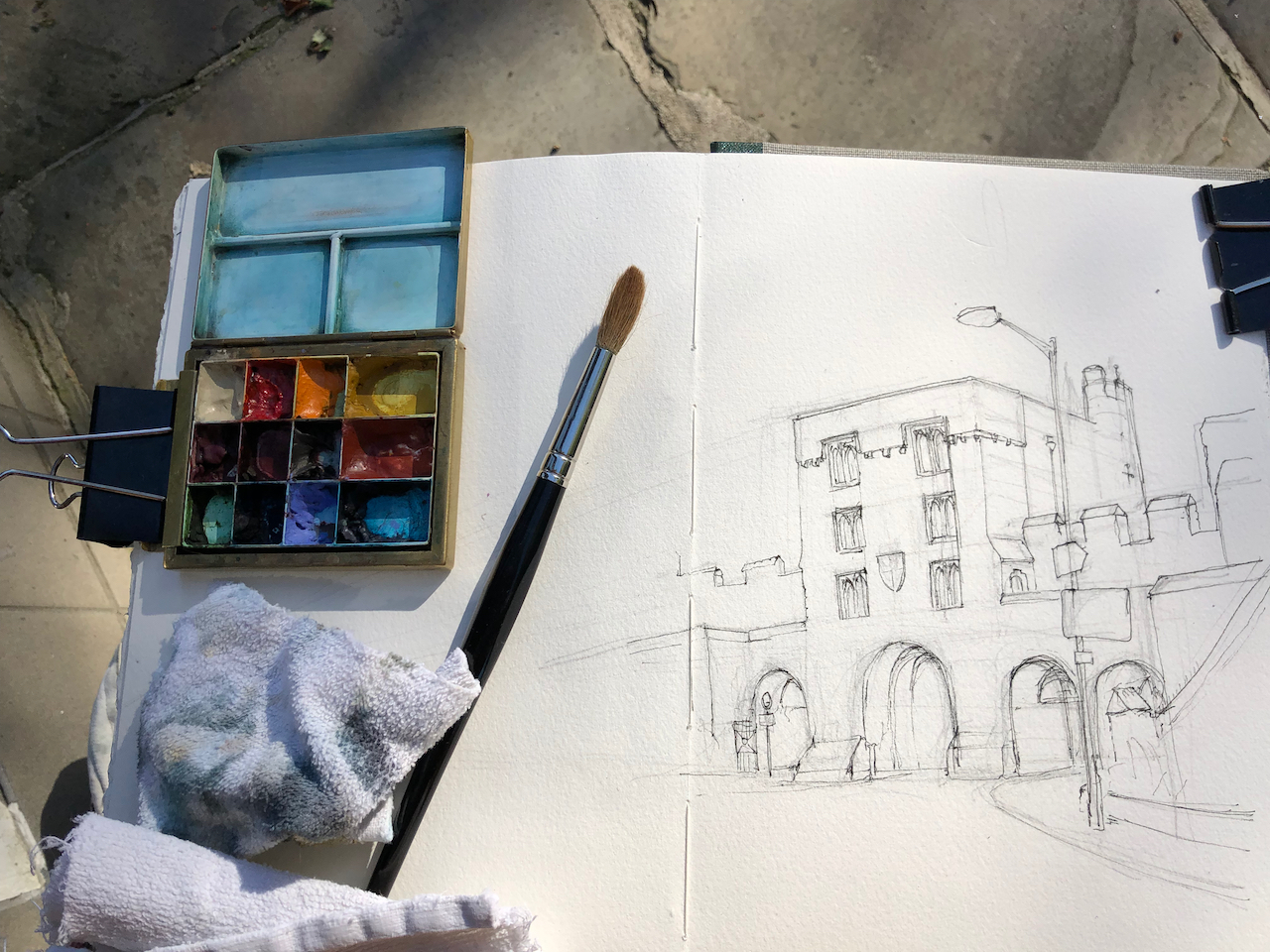
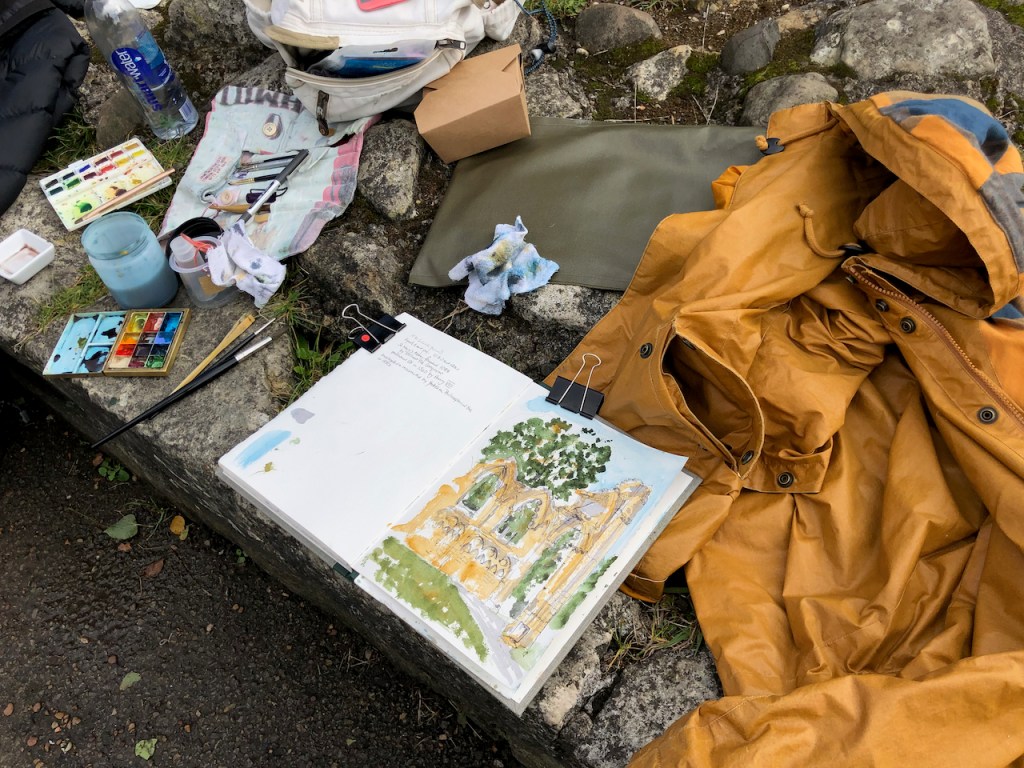
Work in progress on the drawing.
Micklegate Bar, Partisan Café, and St Mary’s abbey
St Mary’s Abbey (top left)
Maps
Click a button below to share this post online, email it, or print it:
Here is a sketch of the church of “St Edmund King and Martyr” which is on Lombard St, City of London.
St Edmund King and Martyr, Lombard Street, from George Yard, EC3. 7″ x 10″ in Sketchbook 10
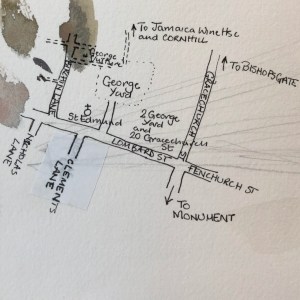
George Yard is at the intersection of a number of city lanes, one of which leads West to “The George and Vulture”, and another leads North to the Jamaica Wine House.
Also in George Yard is a marvellous leafy garden. In the garden, shaded by vegetation, is the tombstone of “Sir Henry Tulse”. Below the tombstone is the inscription telling you about its incumbent:
"Sir Henry Tulse was a benefactor of the Church of St Dionis Backchurch (formerly adjoining)
He was also grocer, Alderman, and Lord Mayor of this City.
In his memory, this tombstone was restored November 1937 by
"The Ancient Society of College Youths" during the 100th year of the society's foundation.
He was also Master of the Society during his Mayoralty in 1684"
St Edmund King and Martyr is an active church. The Church is, according to the notice on Lombard Street, “The Gregory Centre for Church Multiplication”. Church Multiplication has a clear mission statement on their website: “We equip and resource the Church to reach new people, in new places, in new ways with the good news of Jesus Christ.”
The Vestry Hall is the cubical building on the right of my drawing.
Just off the drawing to the left is 2 George Yard and 20 Gracechurch Street, a modern building, where a long list of companies are registered with financial sounding names: “The Close Investment 1988 Fund “A” “, “The Greater Mekong Capital Fund”. This is the City of London, with all its contrasts and juxtapositions.
Here is work in progress on the drawing, and a view of the Church from the leafy garden.
This drawing took about 1 hour and 20 mins. The colours are Mars Yellow, Perylene Maroon, and Phthalo Blue Turquoise.
Click a button below to share this post online, email it, or print it:
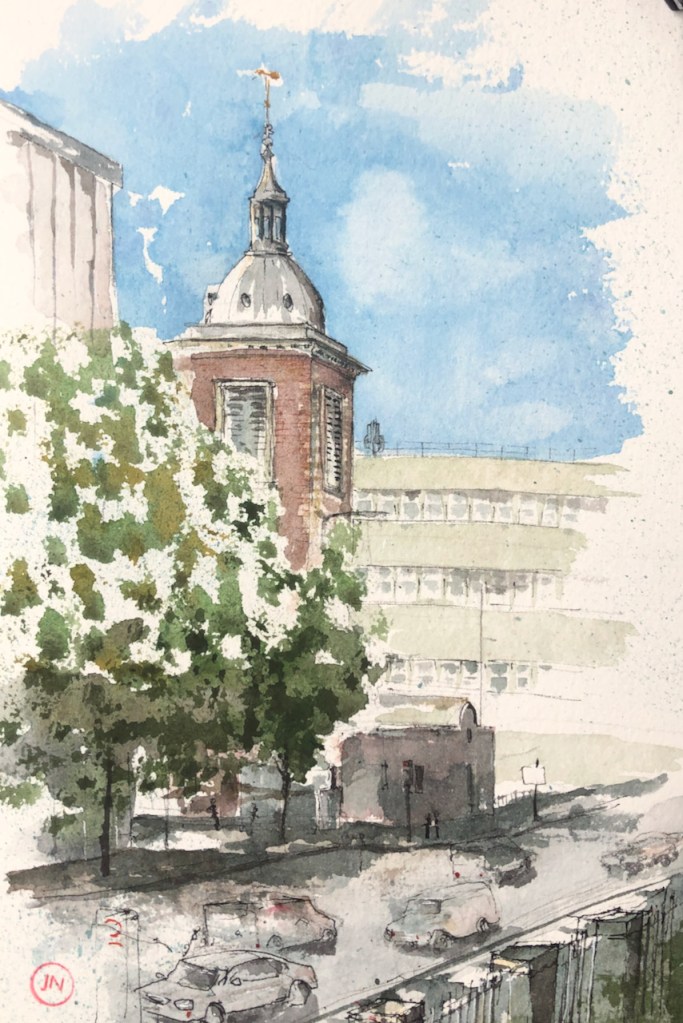
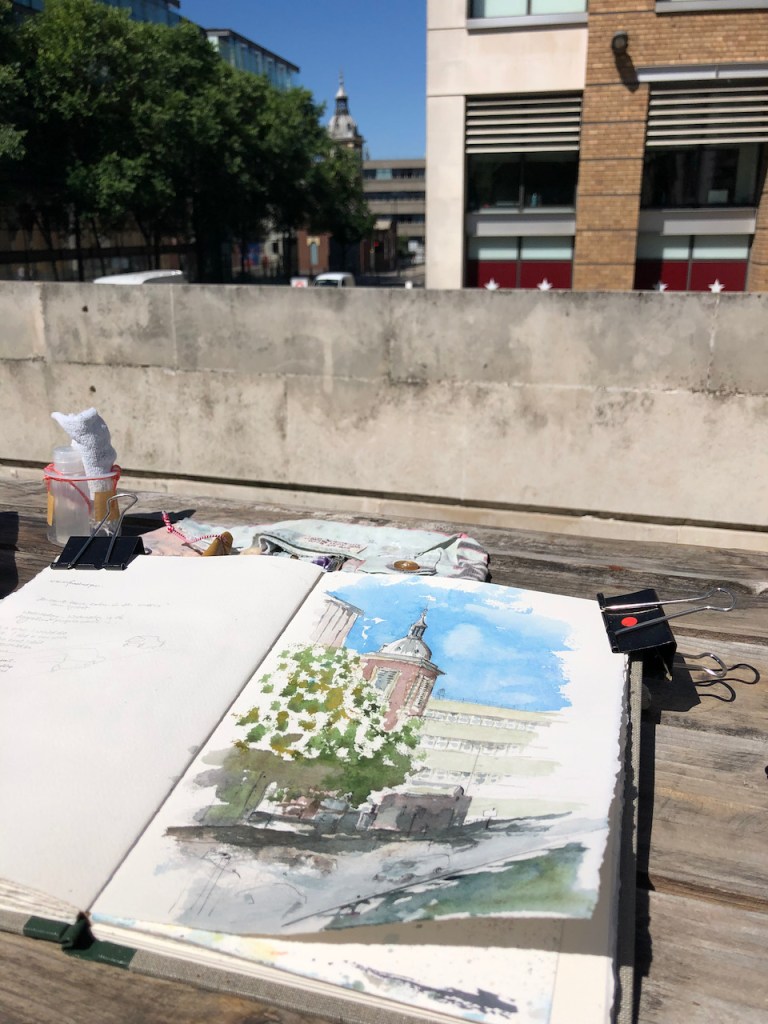
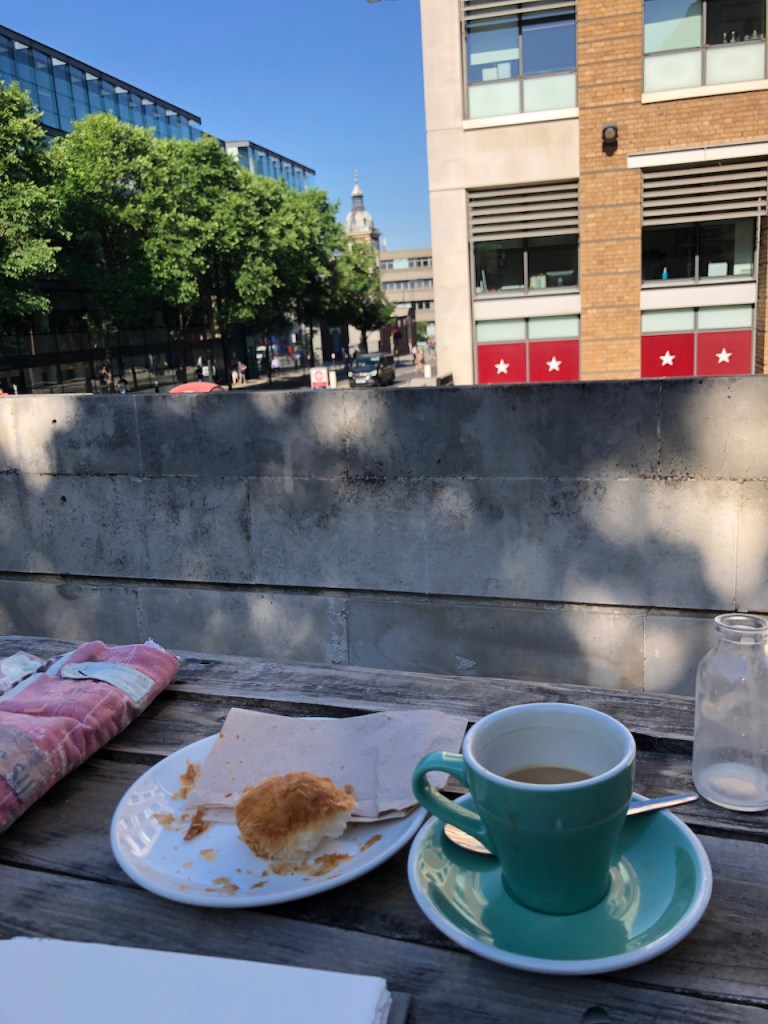
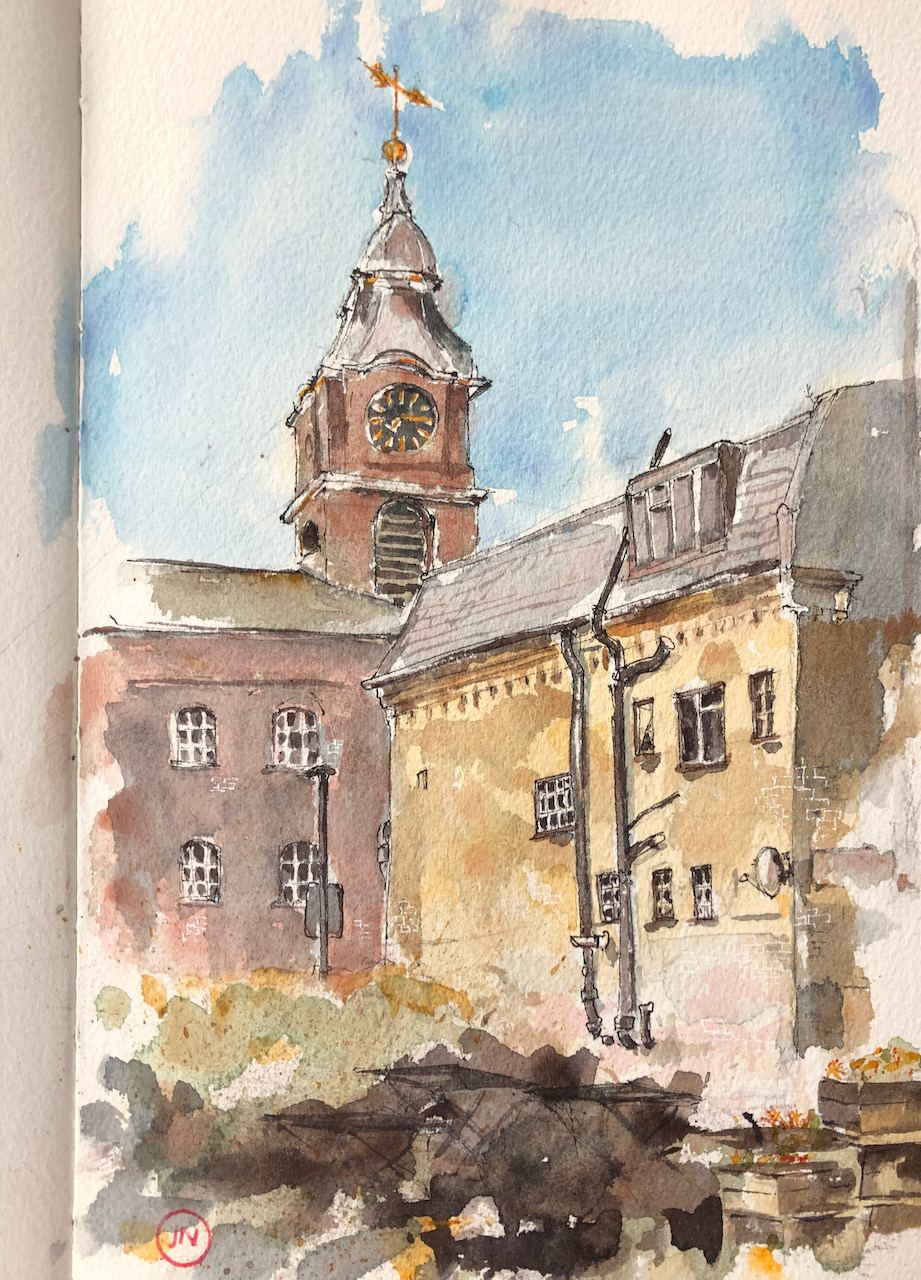
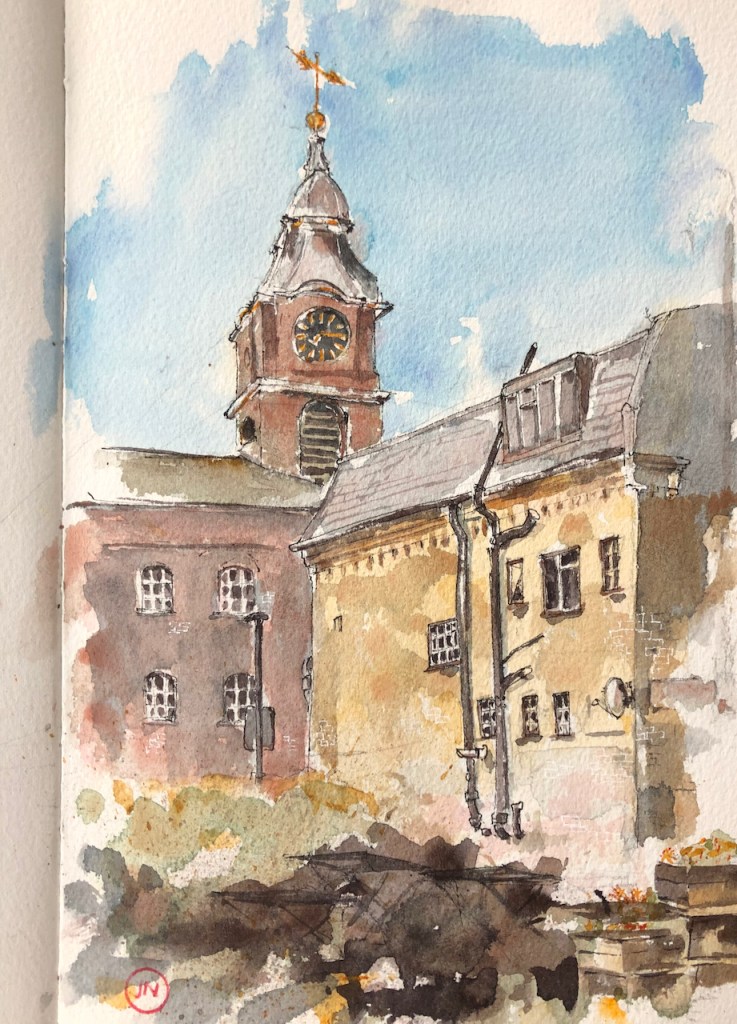
On a lovely sunny morning I walked to the Wren café for breakfast. The Wren is in Saint Nicholas Cole Abbey church on Queen Victoria Street. There is a terrace high above Queen Victoria Street. It commands an excellent view of St Paul’s Cathedral, but I chose to look along the busy road and sketch the Guild Church of St Benets.
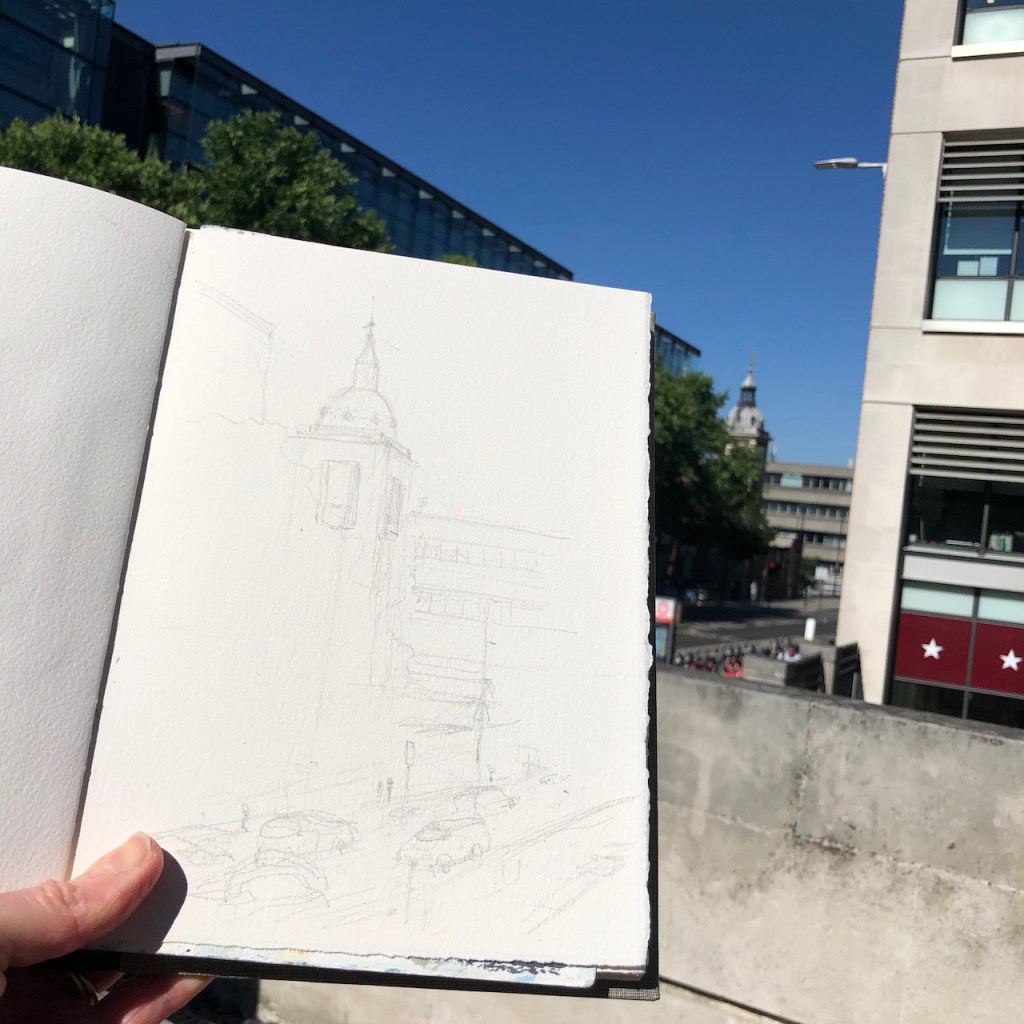
Guild Church of Saint Benets, from St Nicholas Cole Abbey, Queen Victoria Street EC4. 16th June 2021, 08:30 – 10:45am, 10″ x 7″ in sketchbook 10.
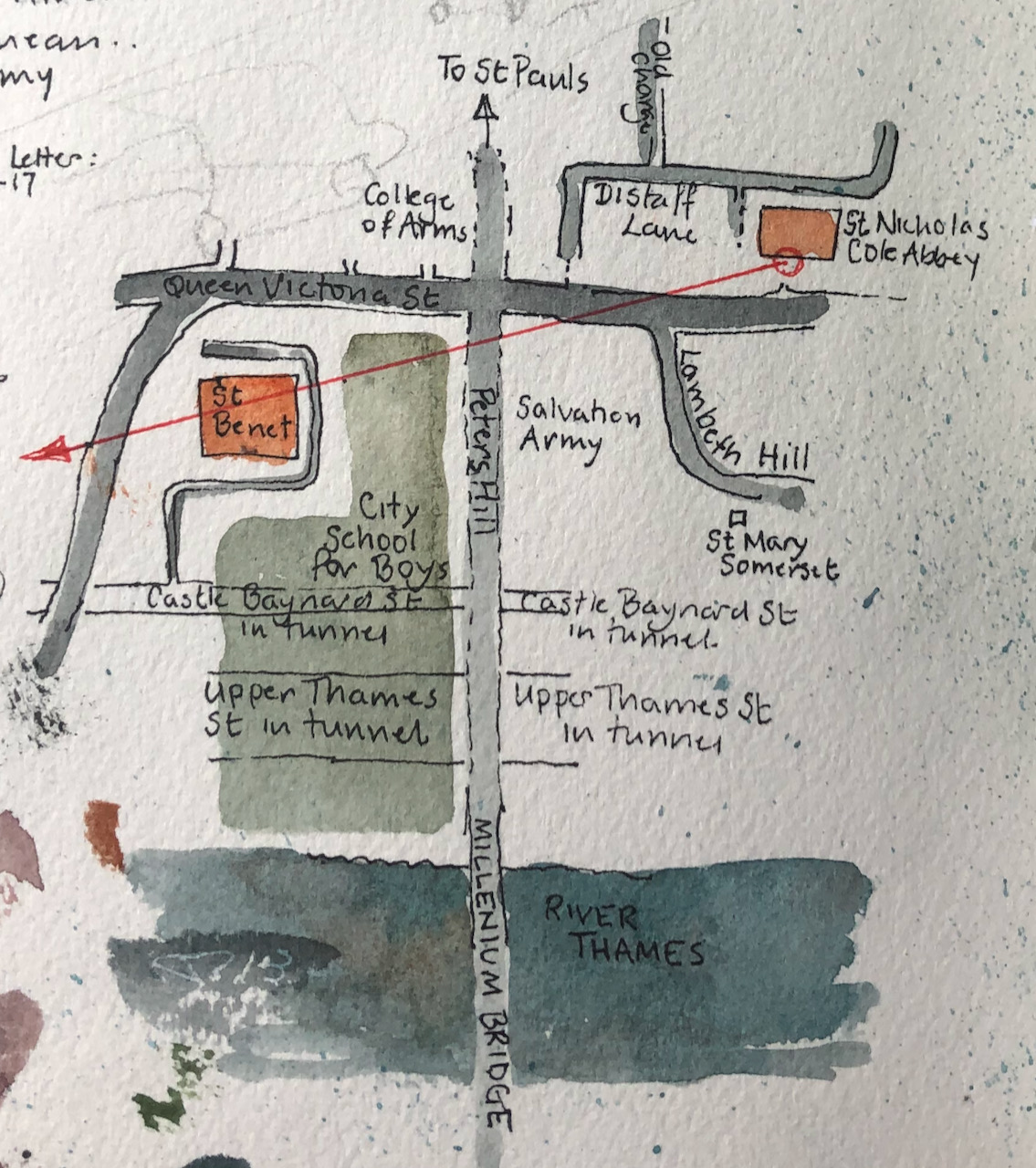
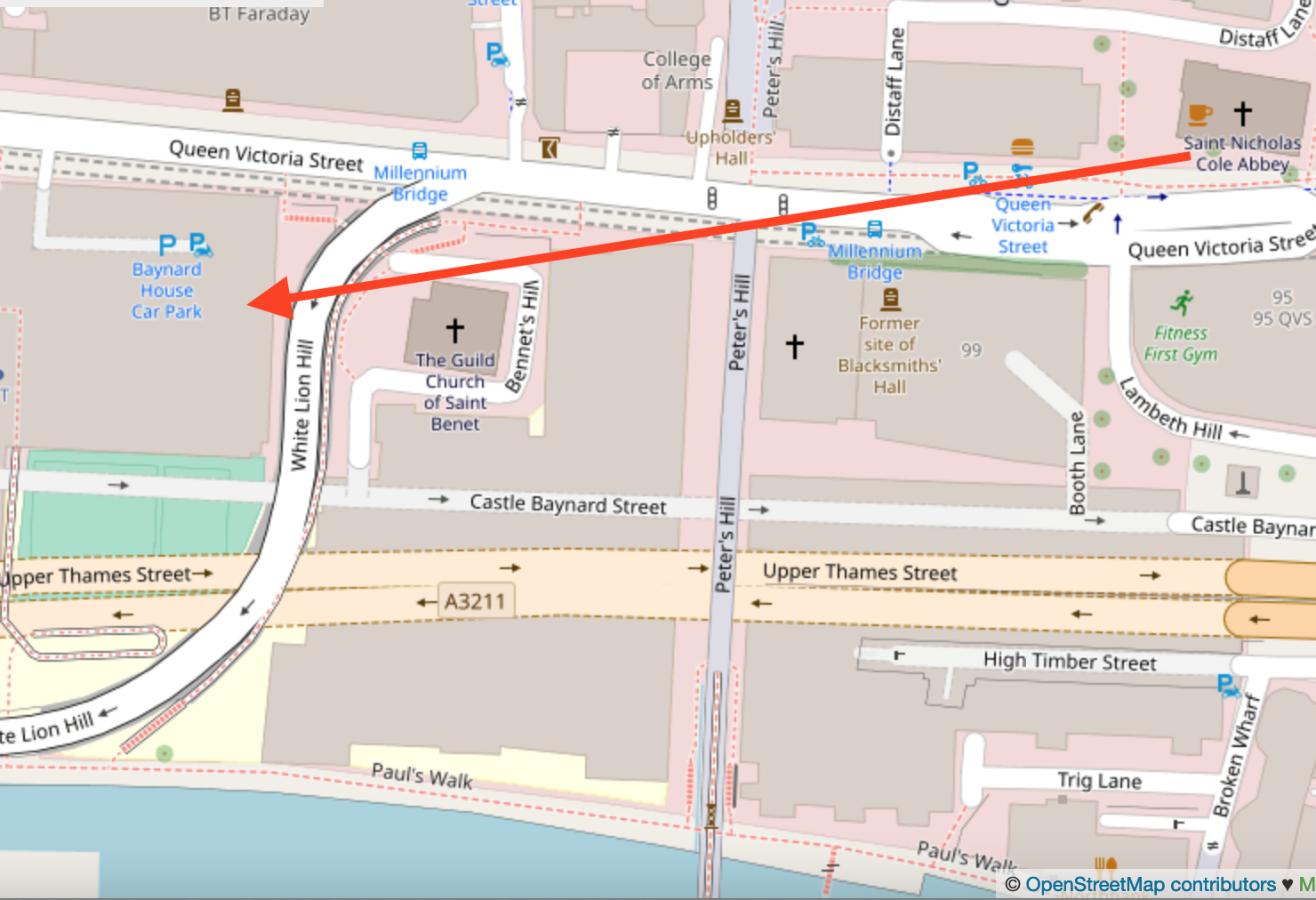
The building in the background is Baynards House, a BT building. In front of the church is the City of London School for Boys. Here are maps:
The Guild Church of St Benets is an active church with services in Welsh. It is a Wren Church, listed Grade I. The listing on the Historic England site says that this is “one of the least altered of Wren’s churches”, since it was not damaged in the 1939-45 war.
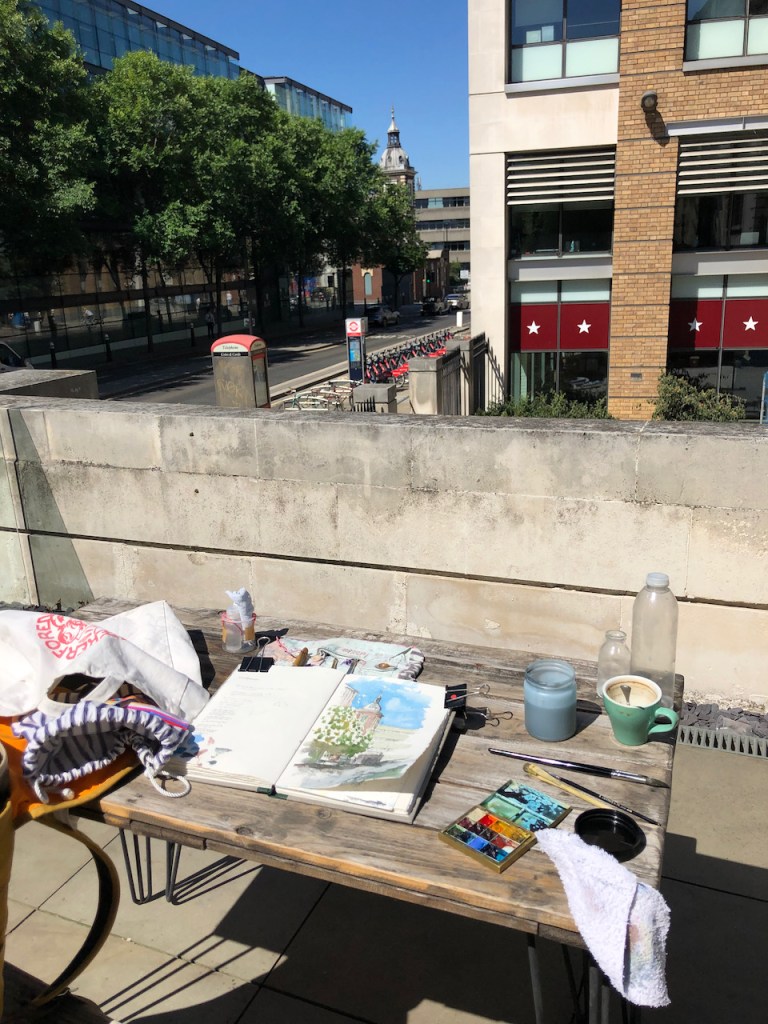
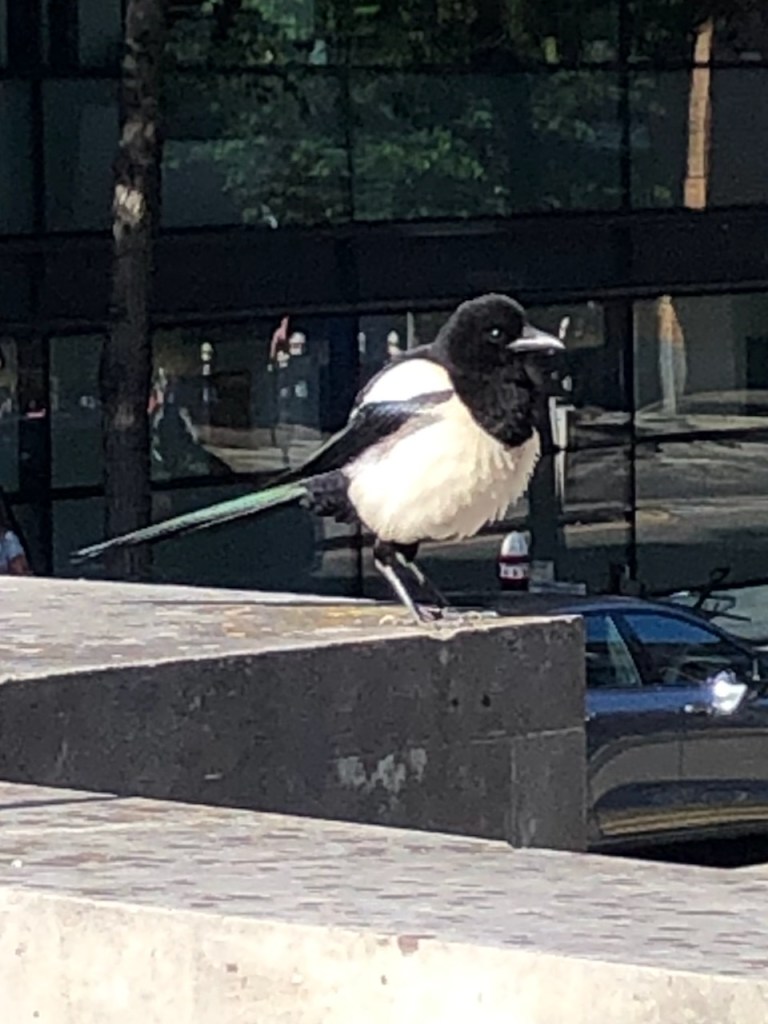
Here are a few photos of work in progress on the drawing, and a portrait of a magpie who came to look at my croissant:
I’ve sketched the view of St Paul’s from the same location:
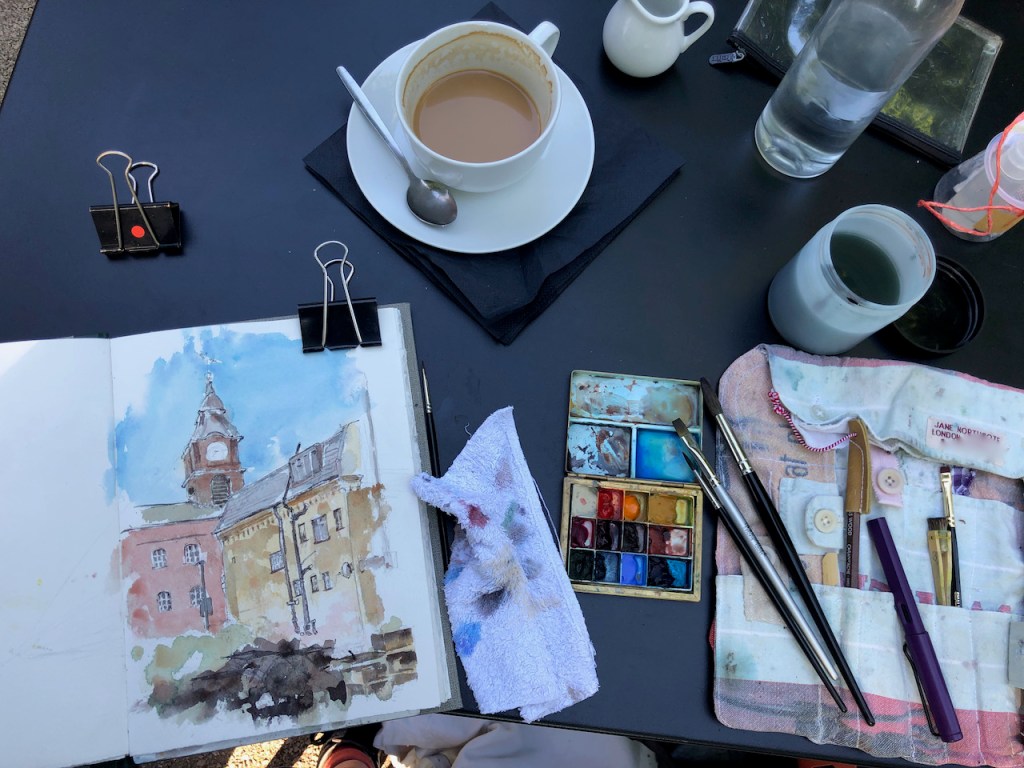
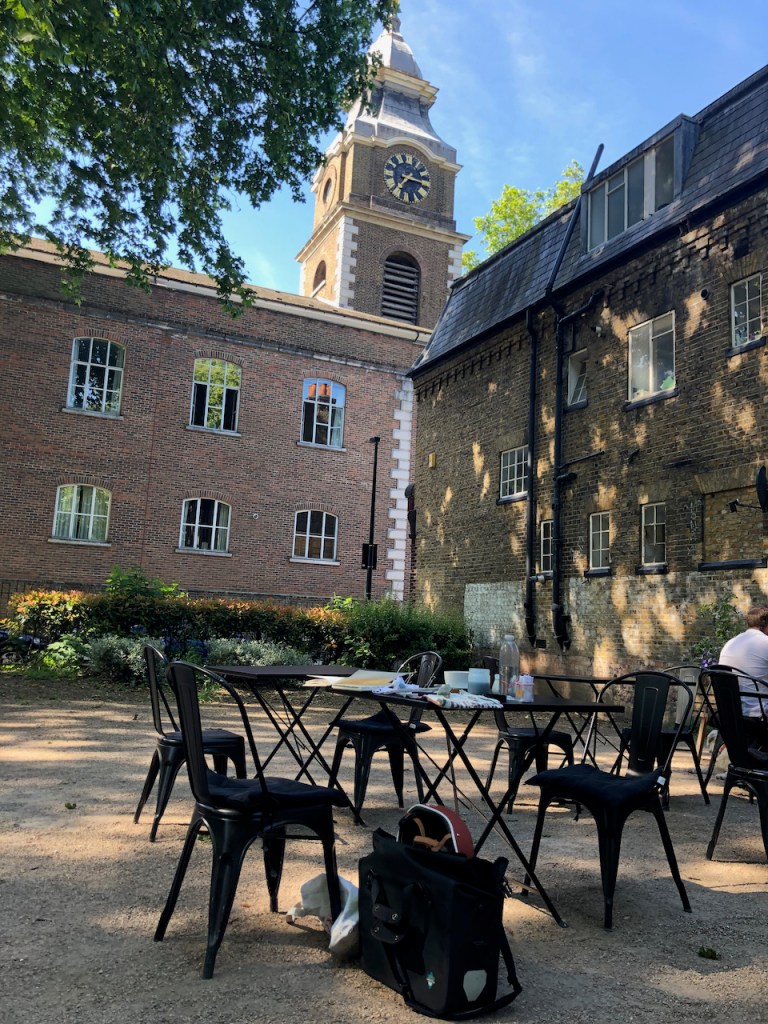
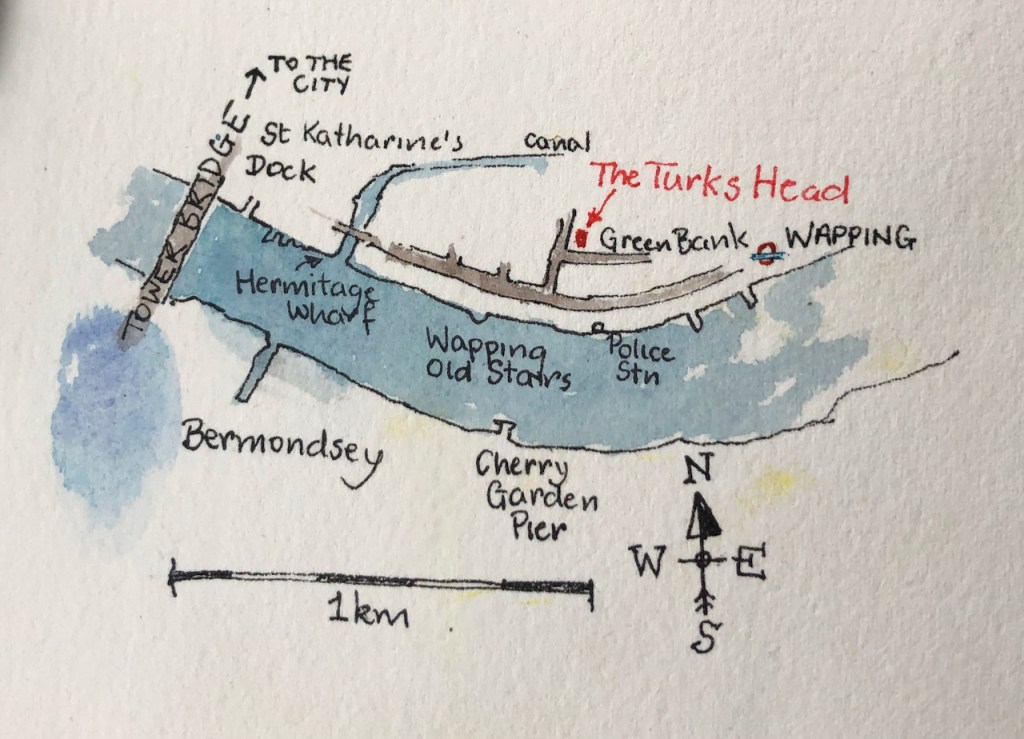
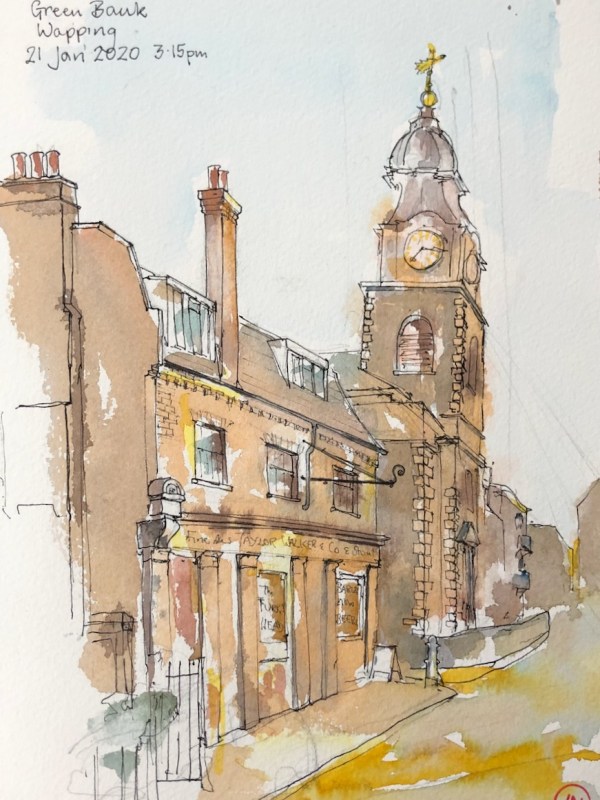
Here is the marvellous Turks Head Café, Wapping, rescued from demolition by local residents in the 1980s. Inside, I found warmth, quiet tables, and the gentle murmur of conversations: people actually talking to each other. I felt welcome here. The food was marvellous. Next time I’m going to have the Blueberry Tart. I only noticed it after I’d already had the substantial Chicken and Avocado Sandwich.…
Click a button below to share this post online, email it, or print it:













 Jane Sketching