St Bartholomew the Less – etchings (2)

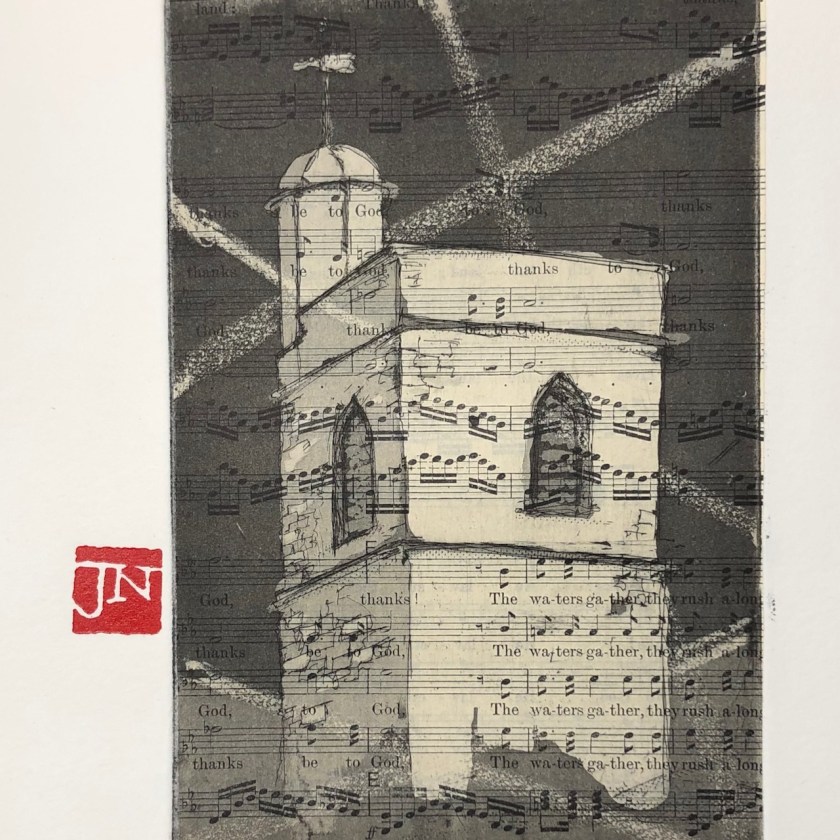
Here is an etching for the City Music Foundation.IMG_0305

Here are photos of work in progress and some more prints:

See this post for earlier sessions on this project: St Bartholomew the Less – etchings(1)


Cathedrals in the Shires: Hereford and Worcester, with Kilpeck and Tewksbury

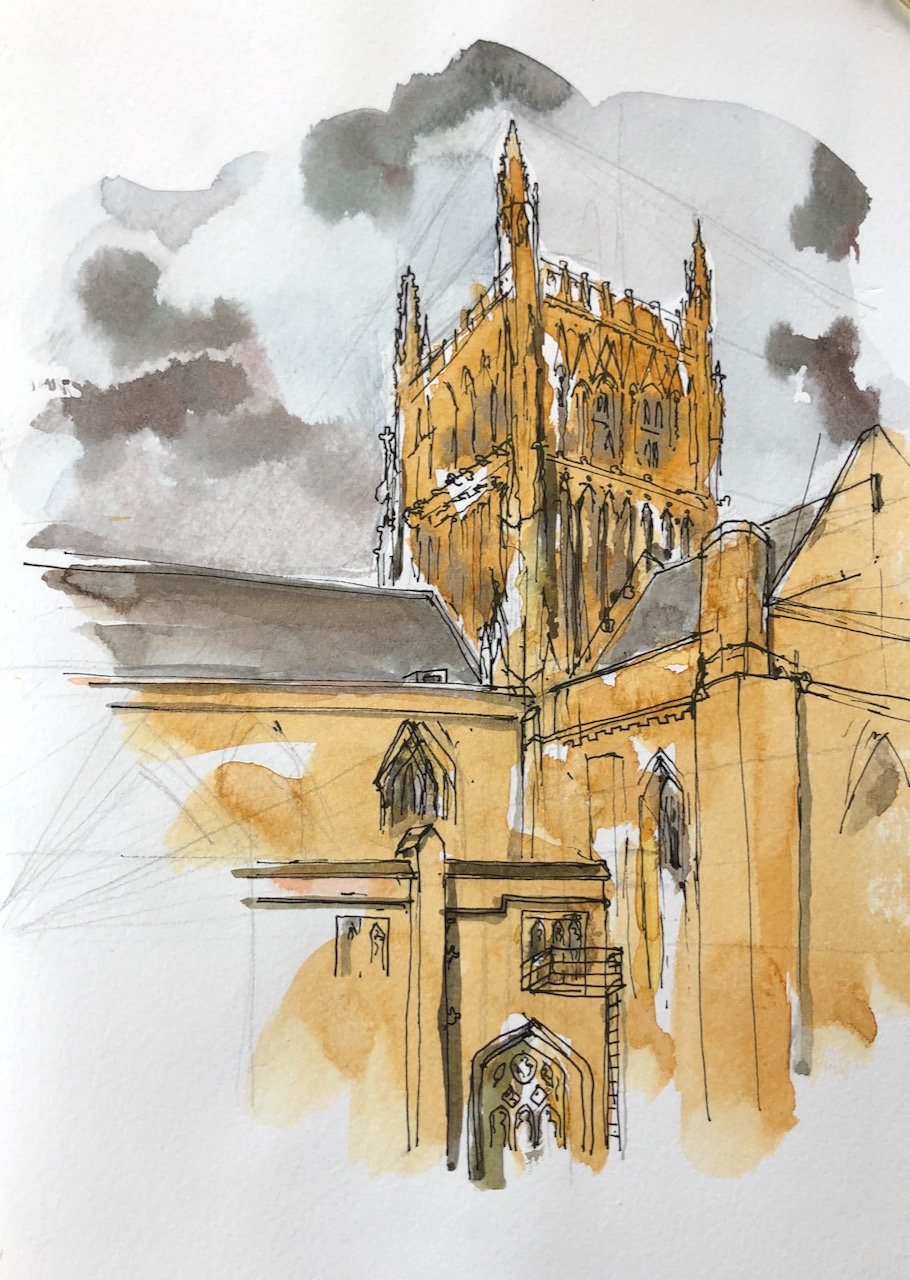
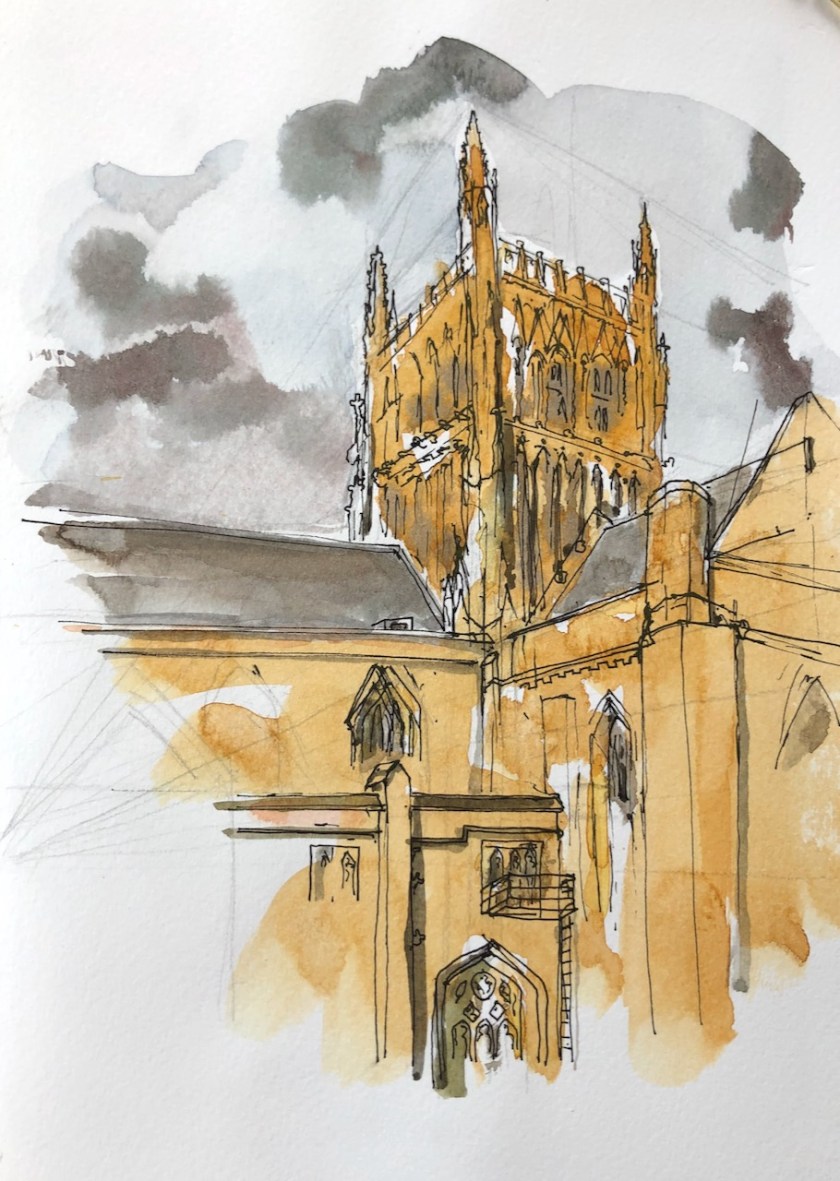
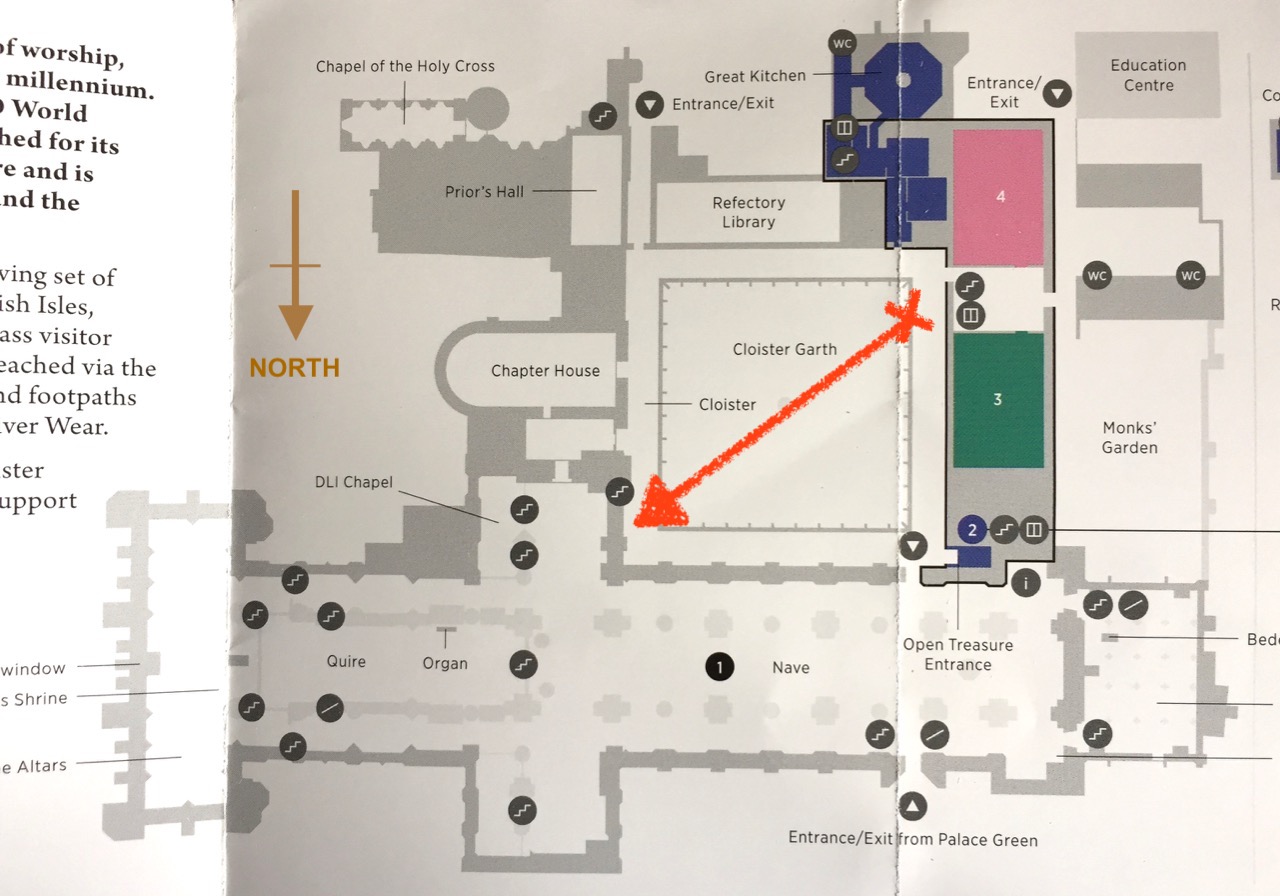
Here is Worcester Cathedral.

IMG_0259

I sketched this view from the cloisters, which were glazed and enclosed. I did, however, find a chair, and a convenient inverted dustbin on which to place my tools.

The other Cathedral we visited this trip was Hereford:

Hereford

Here I had an unrestricted view from the Chapter House garden, which was very peaceful and lovely.

We also visited a small church, Kilpeck, which is very ancient:

In this church there were viking carvings.

If you are in the area I recommend also Tewkesbury Abbey, which though not a cathedral is an inspiring and welcoming place. I had a terrible cold, and lacked the energy to make anything except a small indoor picture.

IMG_0254

I must mention the excellent deli in Tewksbury High Street, Miss Muffet. We just had a sandwich, but suddenly I remembered what sandwiches are supposed to taste like. And for all its quality control and high-class ingredients, Pret in London cannot hope to match the Tewksbury offer: fresh home-made bread, pastrami just cut, and cracking piccalilli. Here’s the view from the window. Good food takes time.

IMG_0253


St Peter upon Cornhill

I went out to look for more gas lights in the City. There was rain, and the back alleys were wet. I couldn’t find any more gaslights.

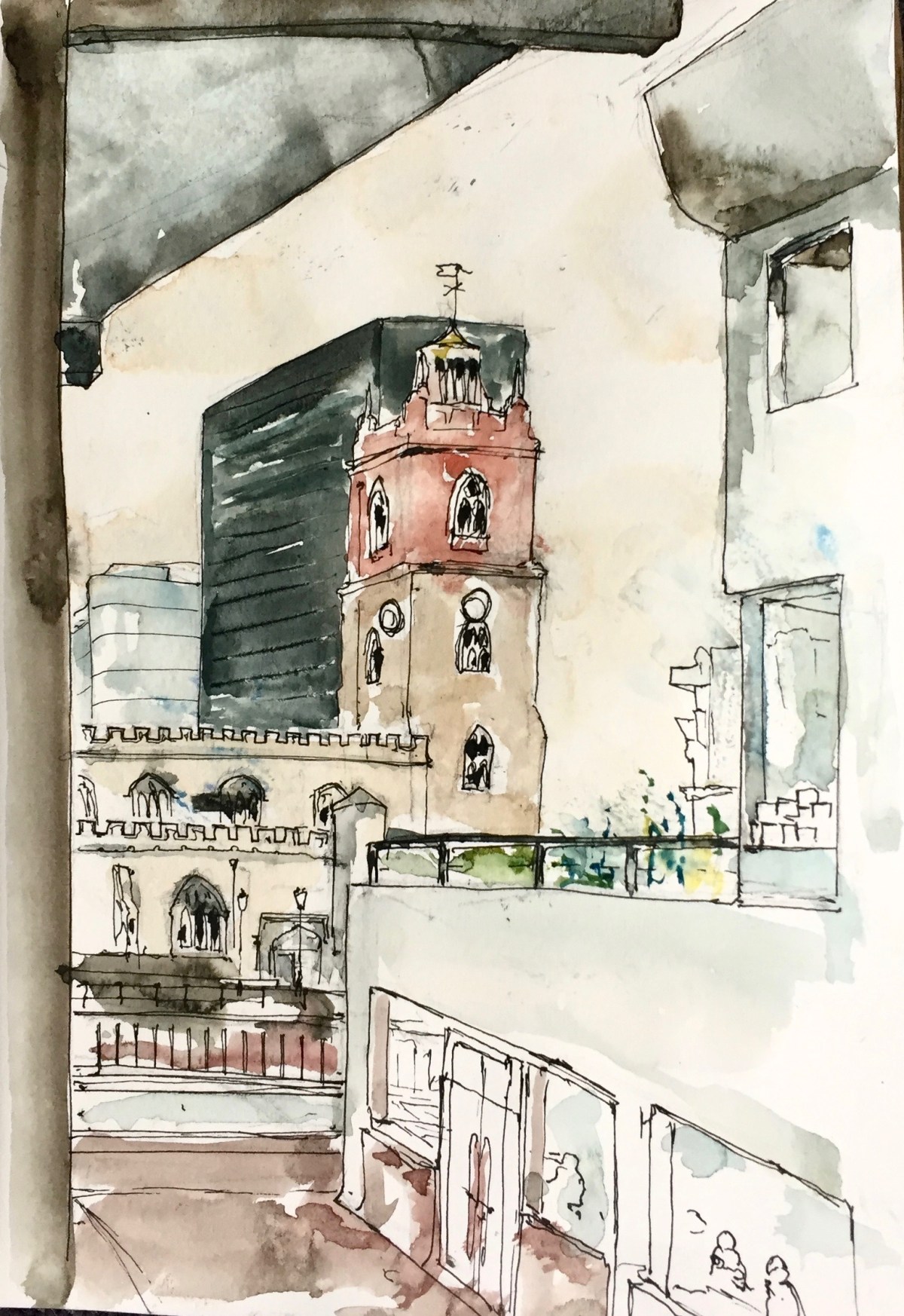
At the South East extreme of my peregrination I looked up and saw St Peter upon Cornhill. It is wedged in between other buildings.

The adjacent building is labelled “54 & 55” Cornhill, in lovely art-deco writing. There is a branch of “EAT” on the ground floor. High up, there are three strange devils (ringed in red on the annotated picture above). The two larger and higher ones are definitely female devils, with big breasts and strong muscles. The smaller devil is yelling from his position above a window.

I drew this picture from the shelter of White Lion Court, which is on the North side of Cornhill. This is one of those City of London back-alleys. It doesn’t go anywhere, just to the door of what looks like an insurance company, and off to the side is a doorway with ecclesiastical carving above. It looks like the entrance to a monastery. But that can’t be right. The modern iron gate is adorned with modern litter.

As I was drawing a man came round from the nearby branch of Sainsbury’s to eat his sandwich and smoke.

Then later another man came by and asked me if I had seen the fire brigade. I said no, because I hadn’t. He said the fire alarm in one of the offices had gone off. He said he’d be wandering about for a bit, while he contacted the key holder. I could hear him calmly making phone calls. He was still there when I finished my drawing and packed up. I waved goodbye to him, and he nodded and half waved back, constrained in his movements as he was holding his phone to his ear and consulting a notebook.

It is astonishing how many tourist groups go down Cornhill. If I have done nothing else today, I have at least inspired a few tourists and other passers-by to look upwards to the onion spire of St Peter upon Cornhill. People pause, see that I am drawing, wonder what I can possibly be drawing in that dingy back-alley, and then look in the direction I’m looking and see the spire.

The tourist groups pause in the shelter of nearby Sun Court. I guess they are being told anecdotes about why there are she-devils on 54 and 55 Cornhill. I looked online. I can only find anecdotes, no facts. The building is by Runtz, 1853.

There has been a church at St Peter upon Cornhill since the 2nd Century AD, according to a tablet whose inscription was recorded and copied on various printed media, and now on Wikipedia. The tablet doesn’t exist any more as it was destroyed in the fire of London. The current building is by Christopher Wren, and was constructed between 1677 and 1684. There is also an entrance on Gracechurch St, which I must go and have a look at.

Here is work in progress.

The drawing took 1½ hours.


Canterbury Cathedral Cloisters

There’s a lot of restoration work going on at Canterbury Cathedral at the moment. The ceiling of the main nave was covered up, and one of the towers was wrapped in scaffolding. Also, it being Sunday, a part of the nave was occupied, reasonably enough, with a service. There was much to see, notably the quiet and dimly lit crypt, where there are huge strong pillars, marvellous mathematical curves and stone carvings which delighted the medievalist amongst us.


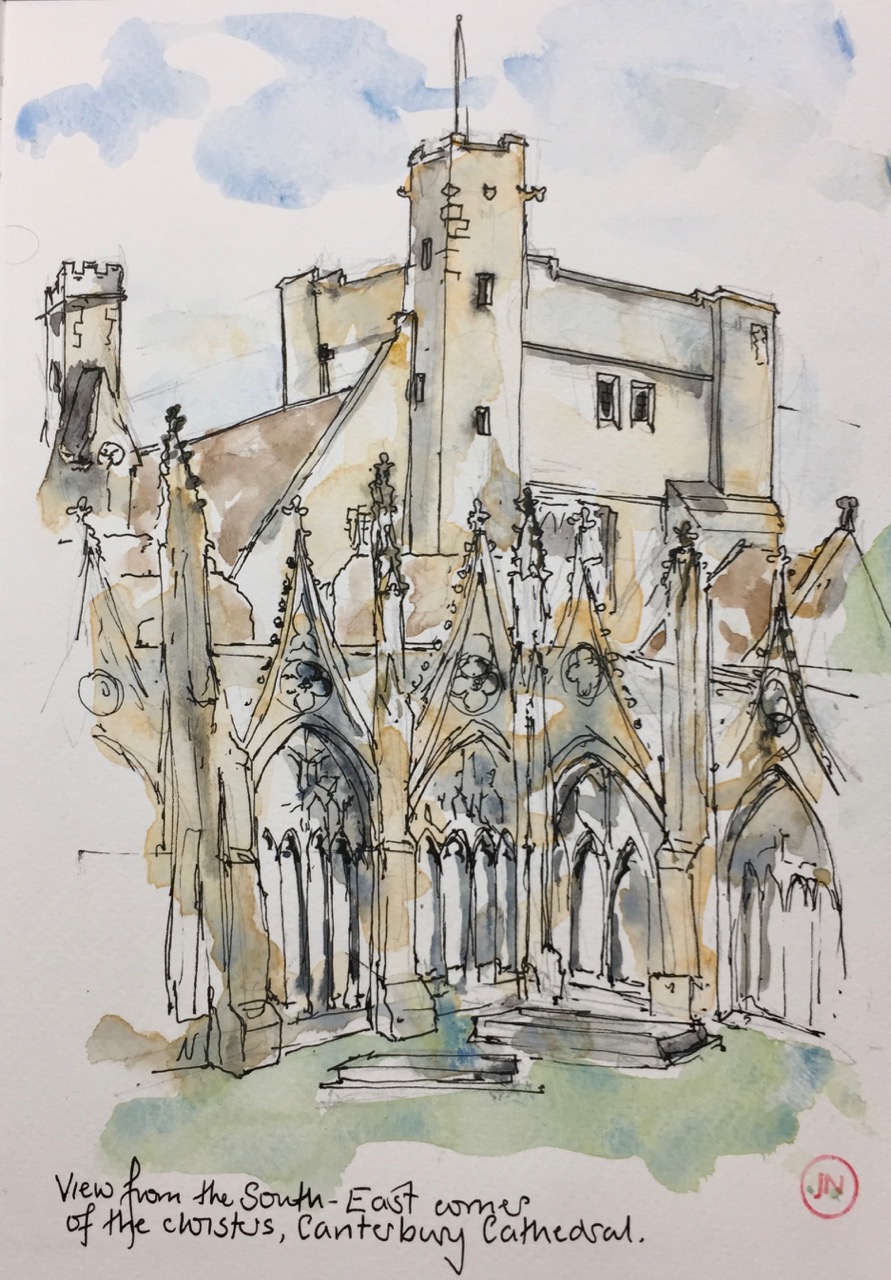
I drew a picture from the cloisters.

IMG_3821

It was perhaps unwise to start drawing those ogee* arches with their crocketing**, but I accepted the challenge. The building in the background is The Old Palace, which is the main residence of the Archbishop of Canterbury. It was built between 1193 and 1228, and has been modified and restored since, most recently in 2006.

I drew this picture sitting on the stone surrounds of the cloisters.

IMG_3815

Here are some maps to show where I was drawing.


Here is work in progress. The drawing took an hour, pen and ink and watercolour on location.


*ogee arches are arches with those fine points

**crocketing is the series of knobs which are often seen on spires and arches of gothic style buildings

Lincoln Cathedral

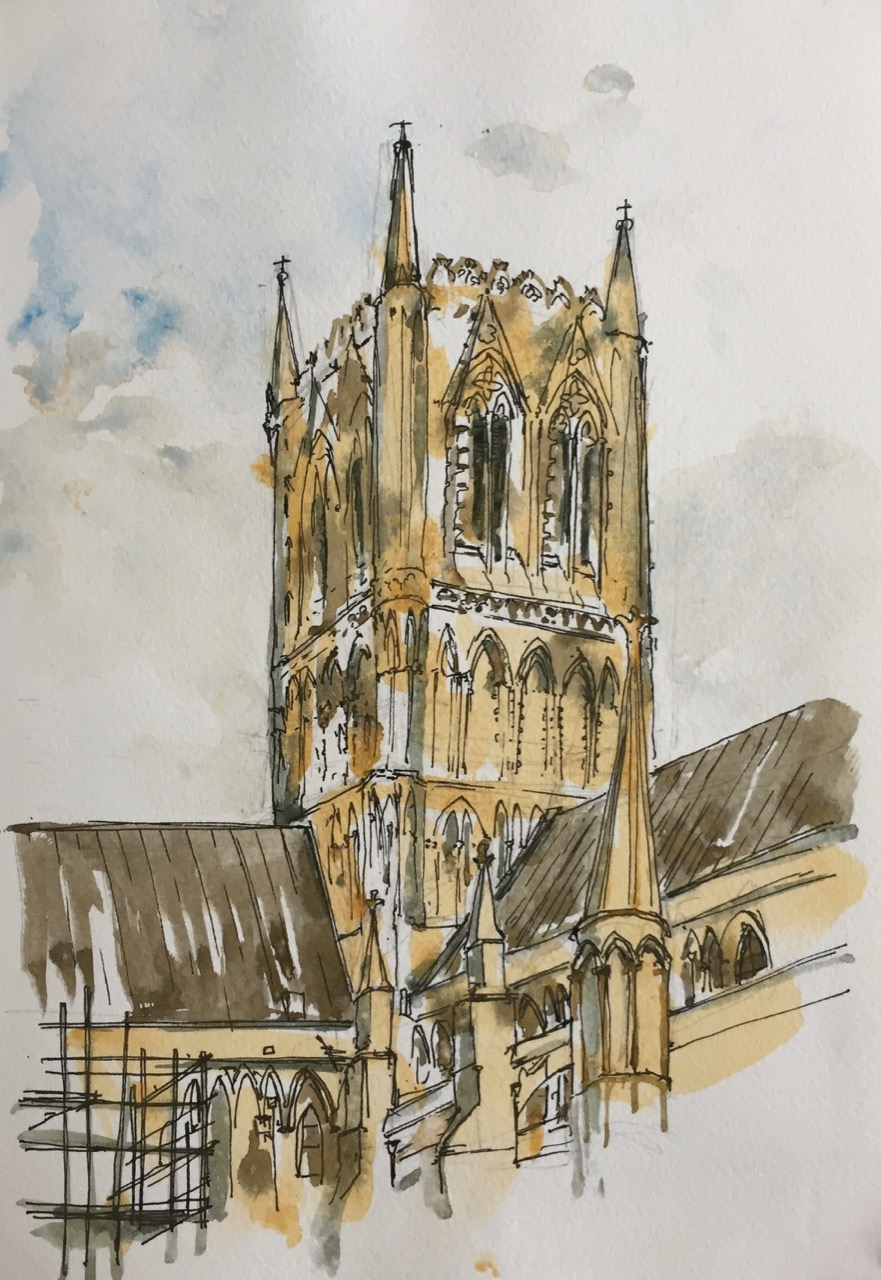
Here is a sketch of Lincoln Cathedral tower, drawn from the cloisters.

IMG_3800

Lincoln Cathedral was originally built in 1072, as part of William the Conqueror’s programme of cathedral-building in England after his 1066 invasion.

It was partly destroyed in an earthquake in 1185. It might be more accurate to say that parts of the cathedral fell down at the time of the earthquake. The cathedral had construction faults, and the earthquake may well have triggered a collapse that was in any case imminent. The earthquake was something like 4 or 5 on the Richter scale. It’s interesting to note that such (natural) earthquakes are quite common in the UK and seem to happen every two years or so.

Then it was rebuilt in the current ornate style in around 1200.

We went on a tour. Here are some of my very quick sketches as our guide, Paul, took us around the cathedral.

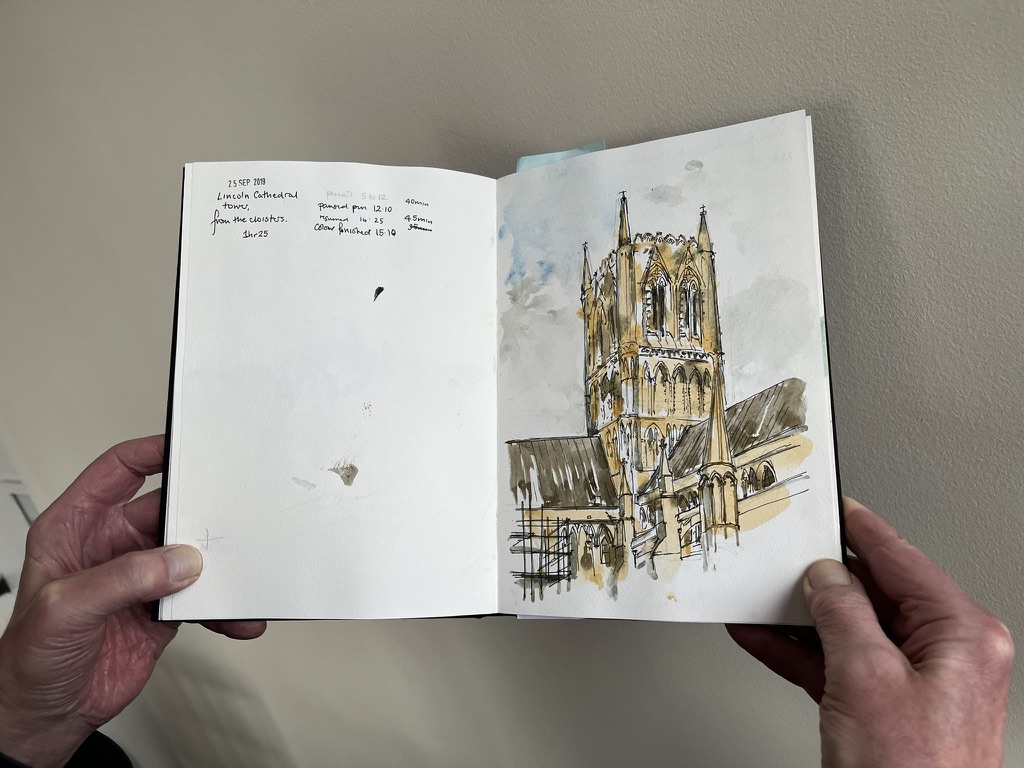
After the tour I went to the cloisters and finished my picture of the tower. Here is work in progress.

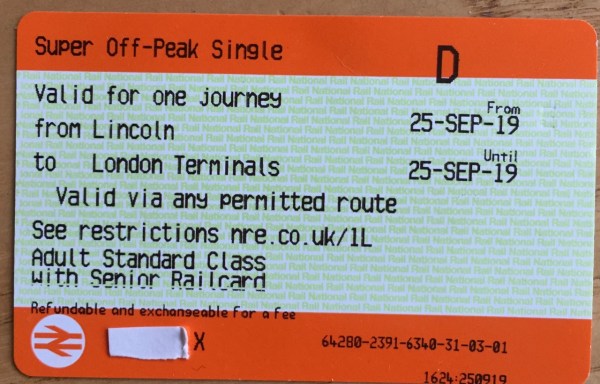
We went to Lincoln by train. It was pouring with rain but we still enjoyed the cathedral. We shall go back when we can see the sun pouring through the stained glass windows.

IMG_3799


Finished sketch in Sketchbook 5

St Mary Abchurch

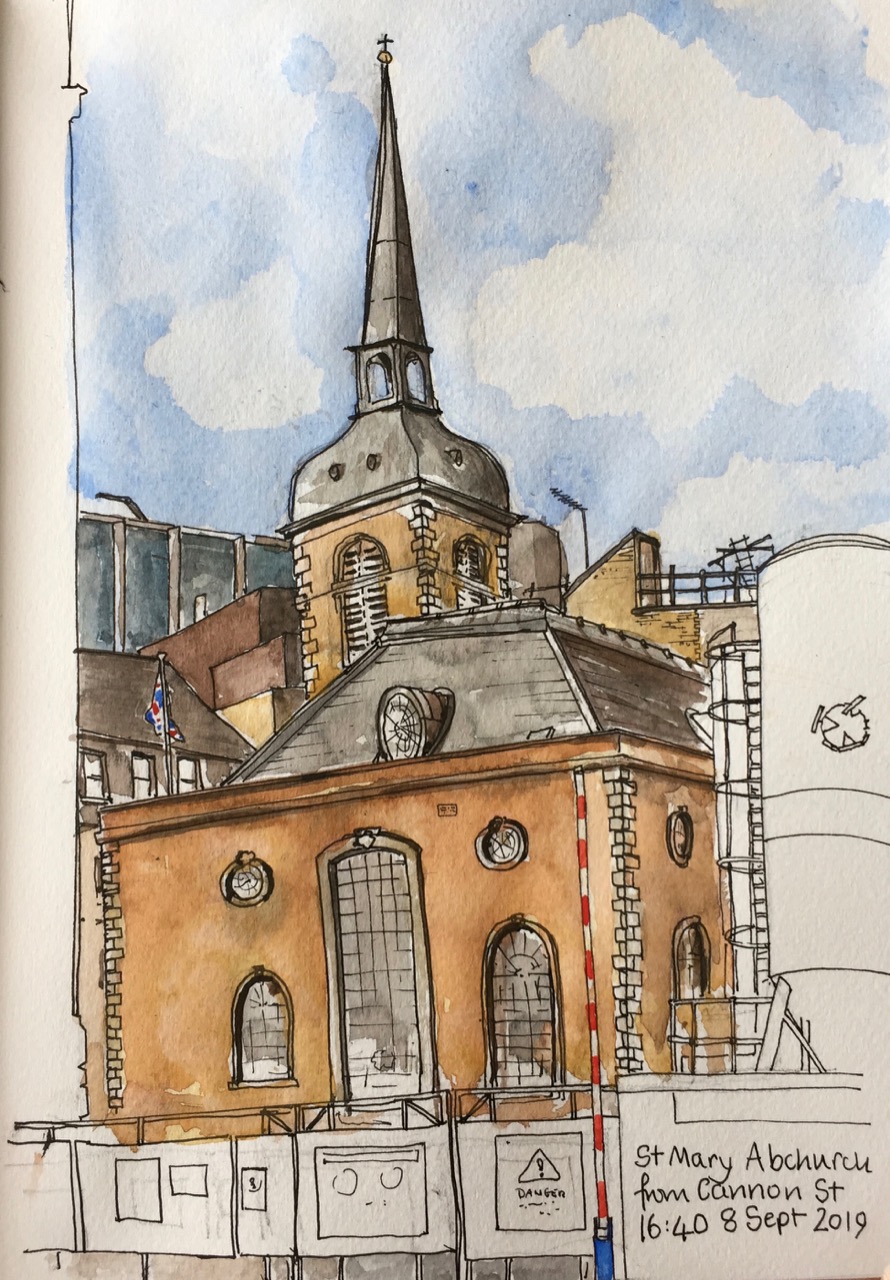
Here is St Mary Abchurch, a view from Cannon Street, London EC4. There was a church here from about 1198. It was destroyed by the Great Fire in 1666. The current church was built to the design of Christopher Wren in 1681-86. It is the headquarters of the “Friends of City Churches” who make the City Churches accessible.

This is one of those ephemeral views. There is a huge building site in front of the church, and so when the building is done, this view will disappear.

IMG_3598

The notices on the hoardings say:

“DANGER! No climbing. Fall behind”

“Dragados SA (UK) Considerate Contractor Scheme, 30th Anniversary Winner 2018”

“No Pedestrian Access or Egress Apart From Plant Movements or in an Emergency”

I enjoyed the use of “Egress”, and puzzled over the phrase “Fall behind”. It must mean “There is a big drop behind this notice”, but it sounds like “We are delayed, and falling behind schedule.”  There is also a huge Health and Safety notice, mandating in detail the protective clothing you must wear, including, rather ominously:

“Flame retardant clothing must be worn near buried services”

What’s this building? Well, according to the notice:

” We’re transforming Bank Station to improve your journey. Completion 2022. Search TFL Bank”

I searched “TfL Bank” as instructed, and found a vast amount of information. TfL (Transport for London) is making Bank Station bigger – a “capacity upgrade” as they term it. The building site I’ve spent this afternoon looking at is described thus:

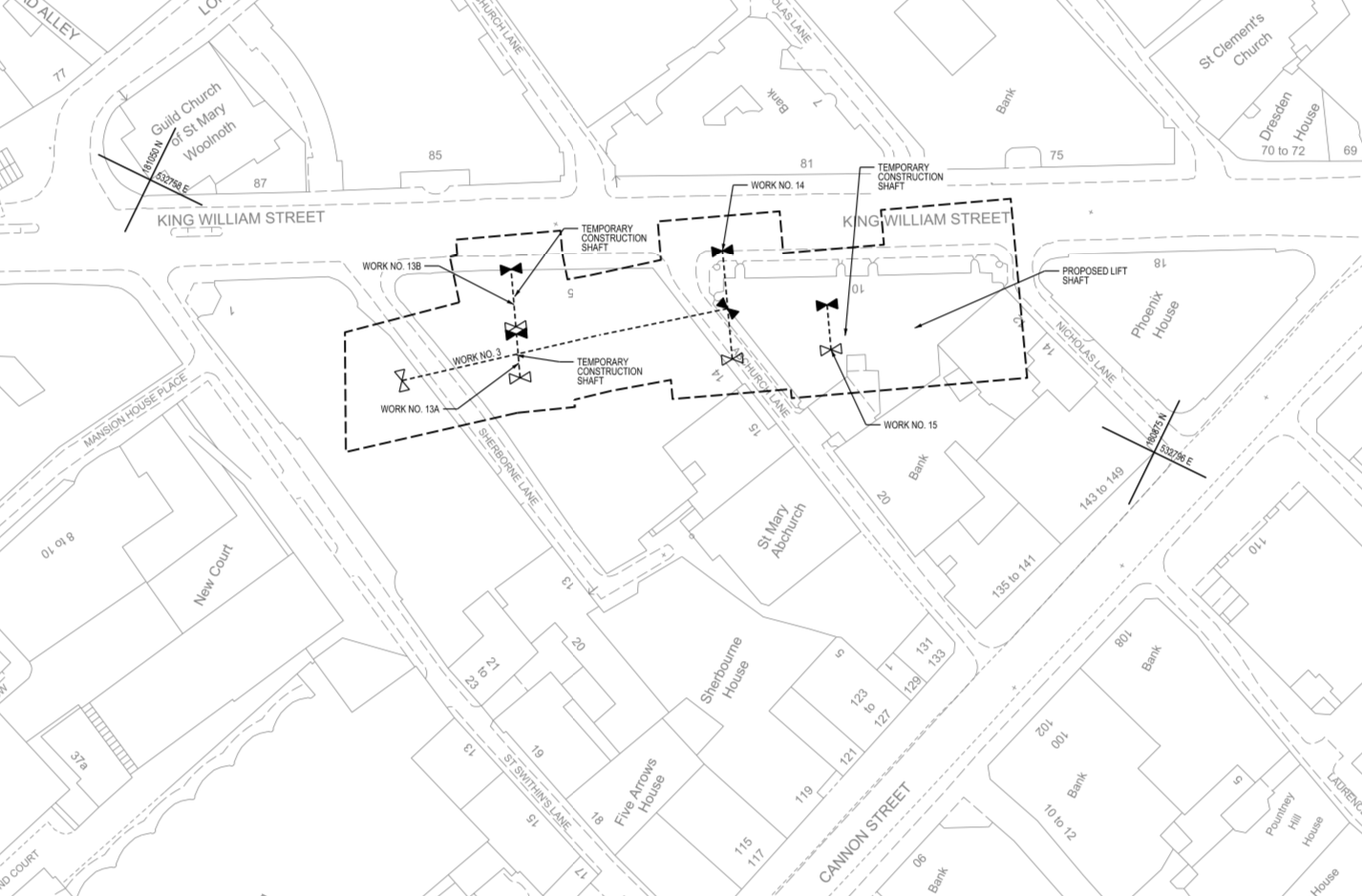
“The Cannon Street worksite consists of the area bounded by King William Street, Nicholas Lane, Cannon Street and Abchurch Lane. The proposed new station entrance and infrastructure such as new escalators will be constructed on this site, which is currently occupied by six buildings. Demolition will be required to allow the worksite to be established before the start of any ground treatment, piling or work on the station entrance. The façade of 20 Abchurch Lane will be retained and will partially screen Abchurch Yard from the works. The worksite is over the proposed new Northern line platform tunnel. The site provides access to the work below ground through the new station entrance box and escalator barrel. During the works there will be site office and welfare facilities within 20 Abchurch Lane. The proposed worksite provides a minimum of space for storage of some materials and equipment for construction operations. It will also be used to store excavated material, before it is transported off site.”

They provide wonderful maps. Here’s an extract:

Screen Shot 2019-09-08 at 19.39.40.png
From “Bank Station Capacity Upgrade – fact sheet 2”

It’s somewhat reassuring to know they have such detailed maps, as the area round St Mary Abchurch looks medieval. I walked through there, down “Sherbourne Lane” and back home though the alleyways of the City.

Here’s my map, and some work-in-progress photos.

About two hours, drawn from the steps of 108 Cannon Street.


St Machar’s Cathedral, Aberdeen

St Machar’s is in Old Aberdeen, North of the University.

IMG_3457

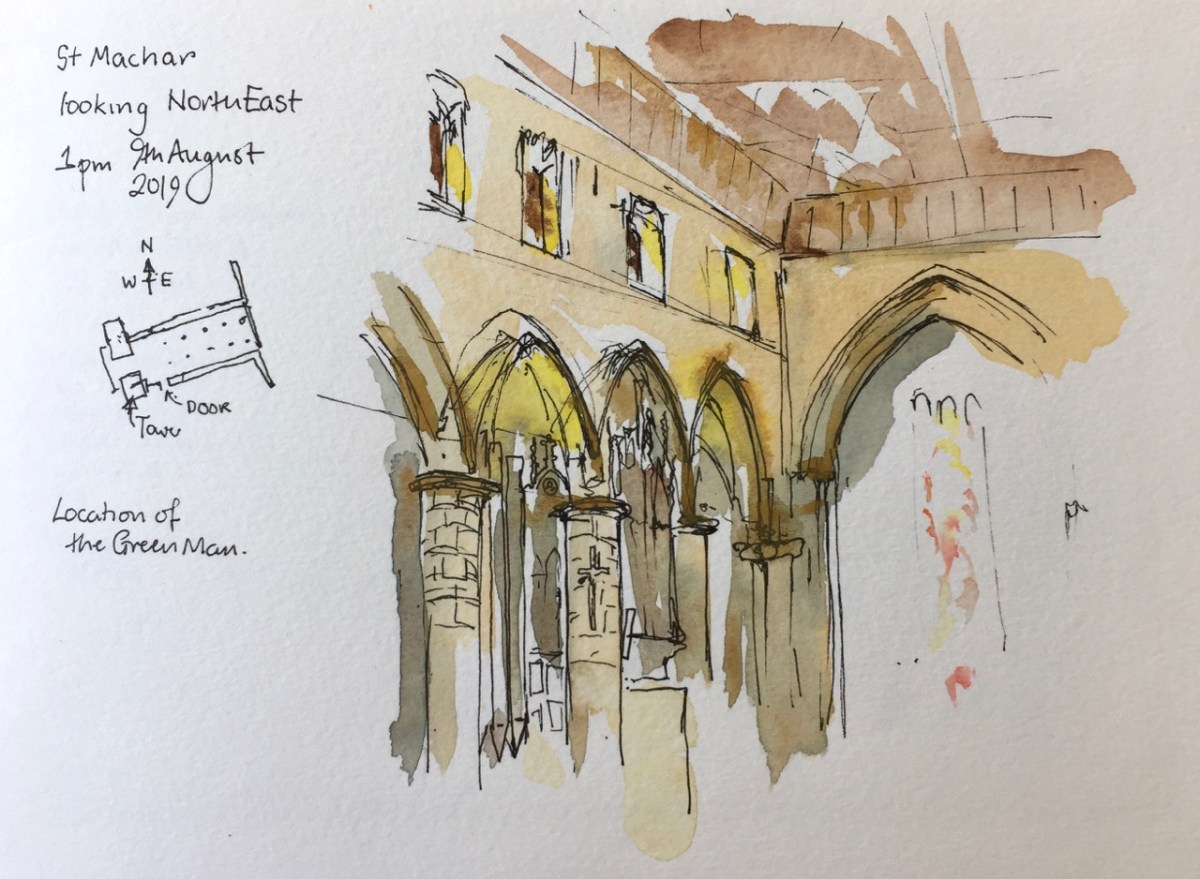
I went to look for a medieval carving, a “Green Man”. According to my instructions it was in the “North East Crossing” on the “west side”. I had a good look around. This is a very plain church, solid granite columns, no carving. I could see no “North East Crossing”. The church is rectangular, not cross-shaped like most churches. The enthusiastic guardians welcomed me, and told me about the church. It is very ancient, and many different peoples have worshipped there, including the Celts, whose 7th century stone cross stands at the west end.

After I had listened and chatted, I showed them my instructions: “North East Crossing, west side”. Ah, they said, but there is no longer any “North East Crossing”, it’s been demolished, for centuries, since the Reformation.

I felt a shiver as though someone was telling me a ghost story. My instructions came from a printed book, much later than the Reformation, clearly. But the guardian was still talking. “You can see the ruins,” she was telling me, “Outside”.

Outside it was raining, a heavy wet Aberdeen rain. I stomped about in wet grass, between gravestones. I was looking up, which made me more wet. And there he was, the Green Man, staring down. I risked taking my iPhone out of my pocket for an instant, to get a photo.

I couldn’t draw outside, so I went back inside. The picture I drew shows the position of the Green Man, but the inside wall. He is on the outside.

9th August 2019, St Machar’s Cathedral, Aberdeen, now Church of Scotland, formerly Celtic, Roman Catholic, Episcopal.

A quick sketch of St Giles Church

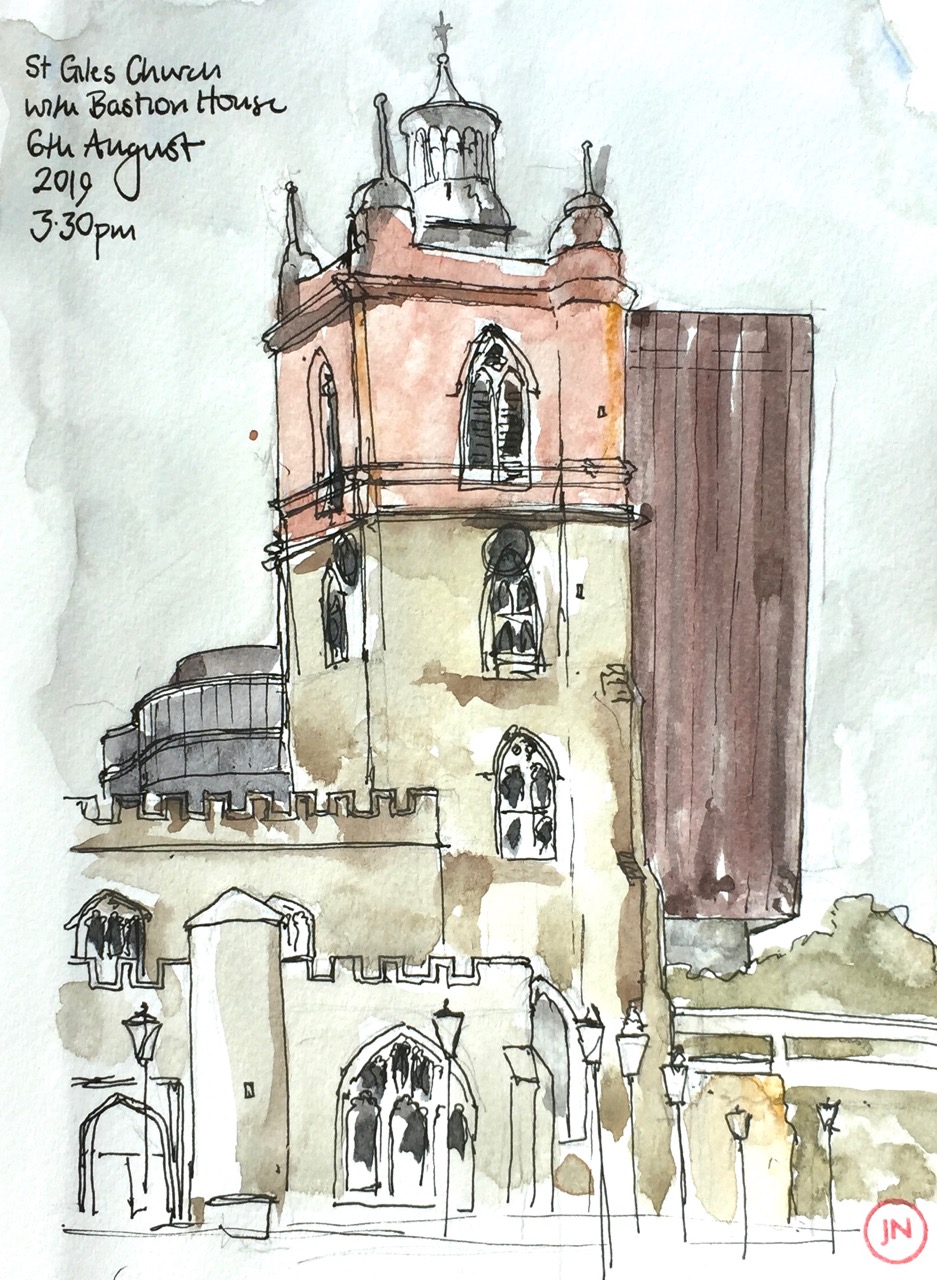
Here is St Giles Church from the Lakeside Terrace of the Barbican. While I drew this, three men were shovelling mud from the bottom of the lake. The mud is black and viscous and the men were remarkably cheerful in their task. They would have made good subjects for a drawing too. But for now, here’s the church:

IMG_3106

The church features in some of my “Tower” sketches:

St Giles’ and Cromwell Tower

St Giles’ Church and Shakespeare Tower
 
From Lauderdale Place: Eastern Cluster

Durham Cathedral

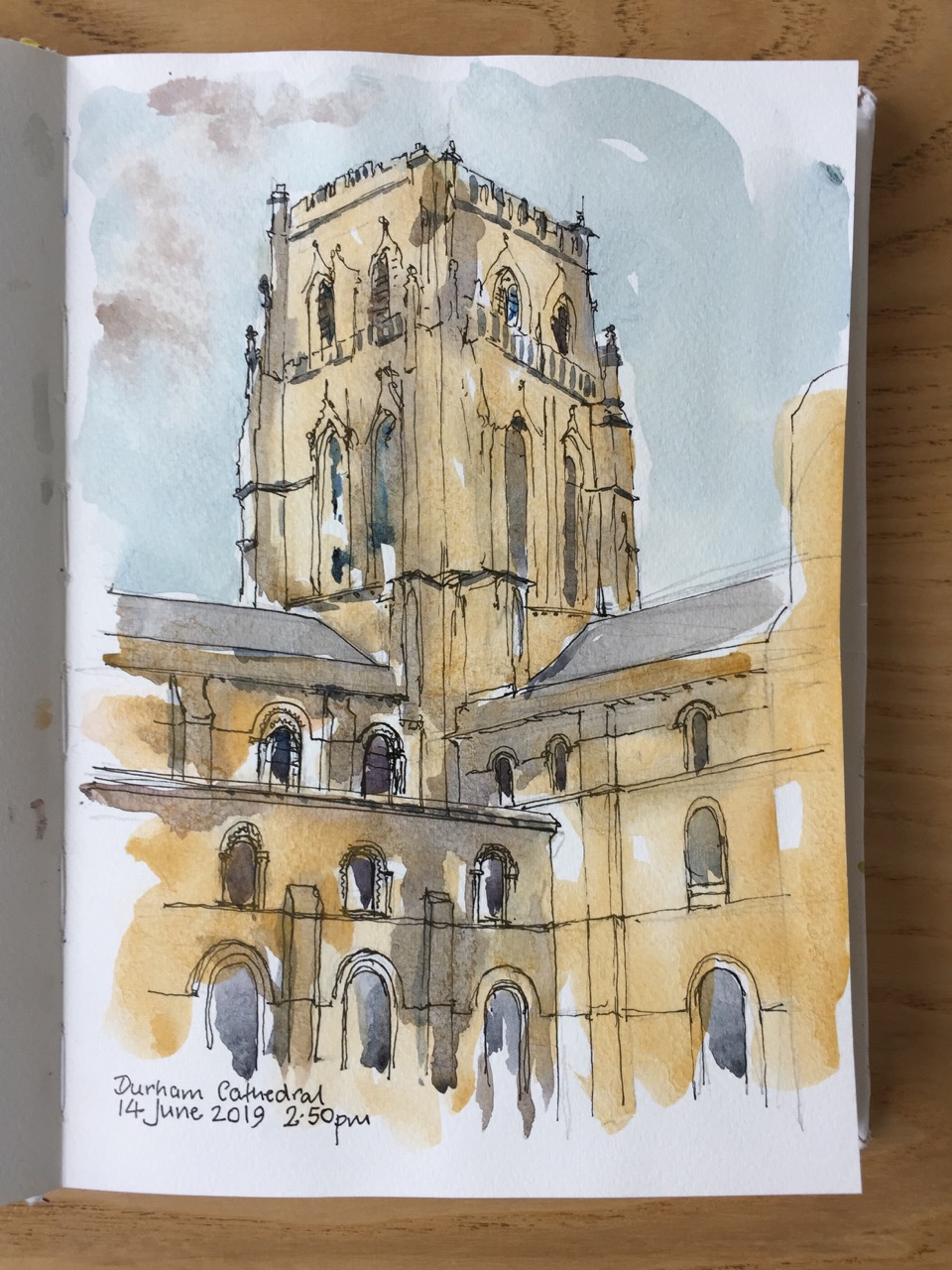
Here is Durham Cathedral, drawn from the shelter of the cloisters.

IMG_2593

It was raining, on and off, in between periods of bright sunshine. This took about 1½ hours, in the Jackson’s watercolour sketchbook.

Durham Cathedral was built in 1093AD, and is a shrine to St Cuthbert. The extraordinary stonework is all original. Even more impressive is the roof.  There is a stone roof which is up there and has been up there for nearly 1000 years. The engineering! The artistry! The courage! The organisation!

The place is active. Evensong is sung. Flowers are arranged. The shrine is venerated. Around the simple tomb of St Cuthbert, people sit, in awe, at the age of the place, at the stillness, at the soaring architecture, at the thought of the simple monk whose remains lie here.

I too sat on the polished wood seat. Flowers stems were scattered on the floor, a pick-a-stick of blossoming stalks, in the process of being placed into the vase, one by one, by a careful woman. The snapped flower stems smelt of woodland. Or perhaps that was the furniture polish.  A loudspeaker announced….something, the sound echoing and incomprehensible. And because it’s Durham, suddenly I was in conversation with the woman arranging the flowers. The modern stained glass window, just visible from the shrine, is in memory of a student. It looks towards the university, which is to the North. Even though it’s North facing, the glass gleams.

Here is work in progress on the outdoor picture:

Here’s where I was:

IMG_2603

The indoor pictures are in my new “Traveler’s Company” watercolour sketchbook.

The Durham University website has an article on the window dedicated to Sara Pilkington.


St Giles and Bastion House

Today Urban Sketchers London held a “sketch crawl” in the Barbican. So I joined them. An astonishing number and diversity of people assembled inside the entrance of the Barbican Centre at the appointed time of 11am. I counted about 35 and then another dozen or so joined. All shapes and sizes of people, tall, short, studious-looking or flamboyant, quiet or talkative, smart or windblown, old or young, all were there. I knew I was at the right place because everyone had a very obvious “drawing bag” or rucksack, and some were sporting a neat red Urban Sketch London badge.

img_1150

A few words and then off we all dispersed. To my surprise I found a good place very quickly. A wall, at ground level, looking over the Lakeside Terrace and St Giles. I liked the way St Giles was surrounded by Bastion House, and framed by the massive concrete of Gilbert Bridge. I also thought I would be sheltered from the wind. I was wrong about that. In fact, the location seemed to be at the bottleneck of a wind-funnel, and at times the wind was painful, as well as being very inconvenient for my drawing materials, which shifted about and jumped down off the wall.

img_1149

Another Urban Sketcher came up and elected to draw the same view. She had an interesting concertina type sketch book, which she said was her “collage sketchbook”. The wind very soon got under that and unravelled the concertina right across the walkway. She got it under control though, and finished her sketch. She was doing a number of sketches in different locations. I did just the one.

I finished it at 12:50. By that time I was thoroughly cold, and glad to go back inside the Barbican Centre. All the levels were by now densely populated with people participating in all sorts of events. The Urban Sketchers, by some alchemy, found each other again and we put up our sketch books for everyone to see.

Everyone’s sketches were of interest. People had done very different things. I suppose that’s obvious, but it was startling how different they were. One person had made very precise and delicate engineering drawings of brackets. Another had a wonderful atmospheric wash of the church. Someone else had done the fountains and their environment, in firm black lines against a shadowy orange background with white water. Others had outline drawings in crayon, or detailed drawings in sepia ink, and someone had done a sketch on their iPad.

One of the organisers made a panoramic film of the drawings so I look forward to seeing them on the Urban Sketch London website.

It was a good experience and I’ll aim to go to another later in the year.