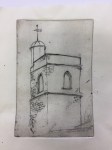
This morning I made an etching based on a sketch of St Bartholomew the Less.
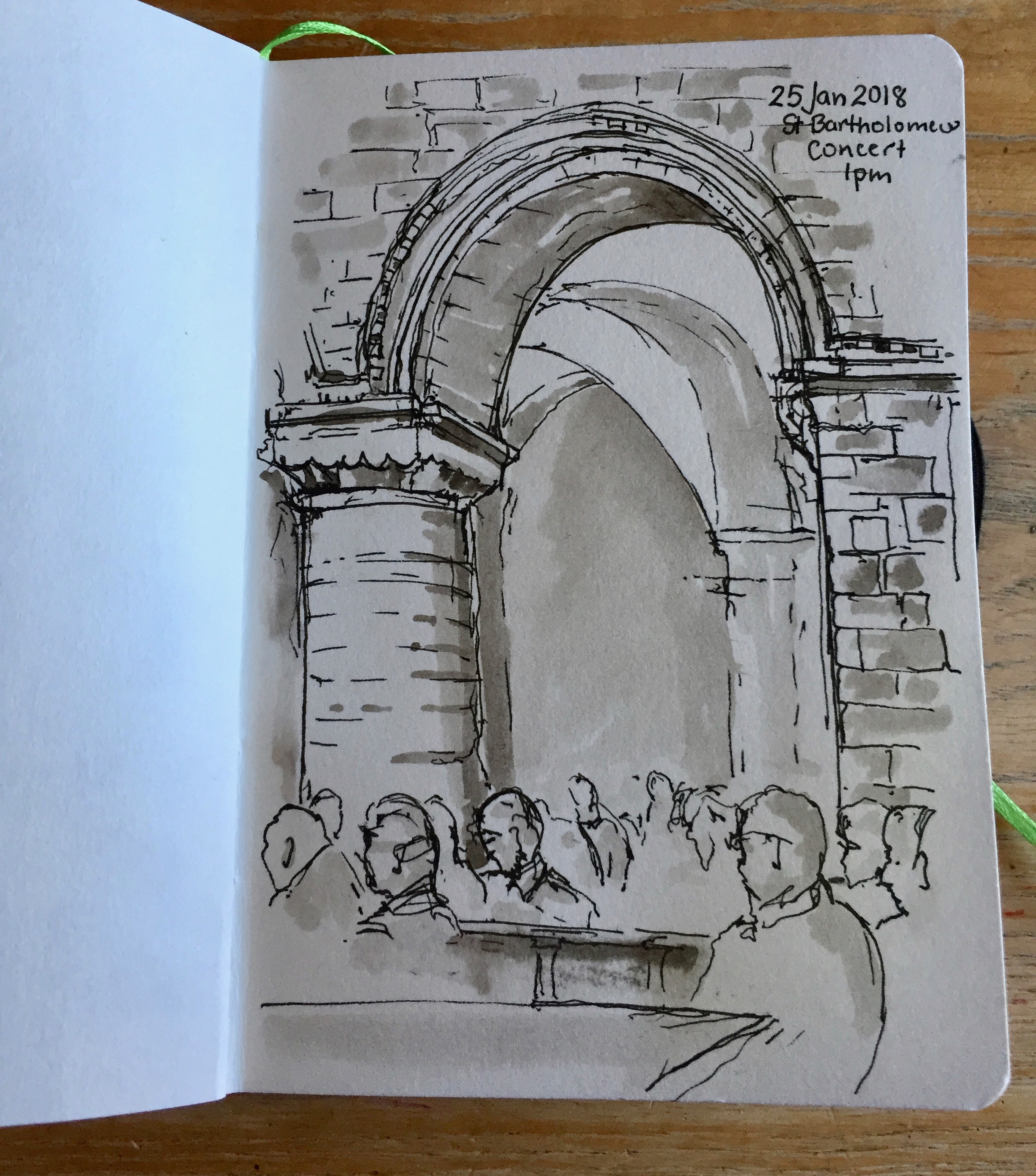
Here’s the original sketch, which was made from the top of Maggie’s Centre in St Bartholomew’s hospital, by kind permission of the staff of the Centre.
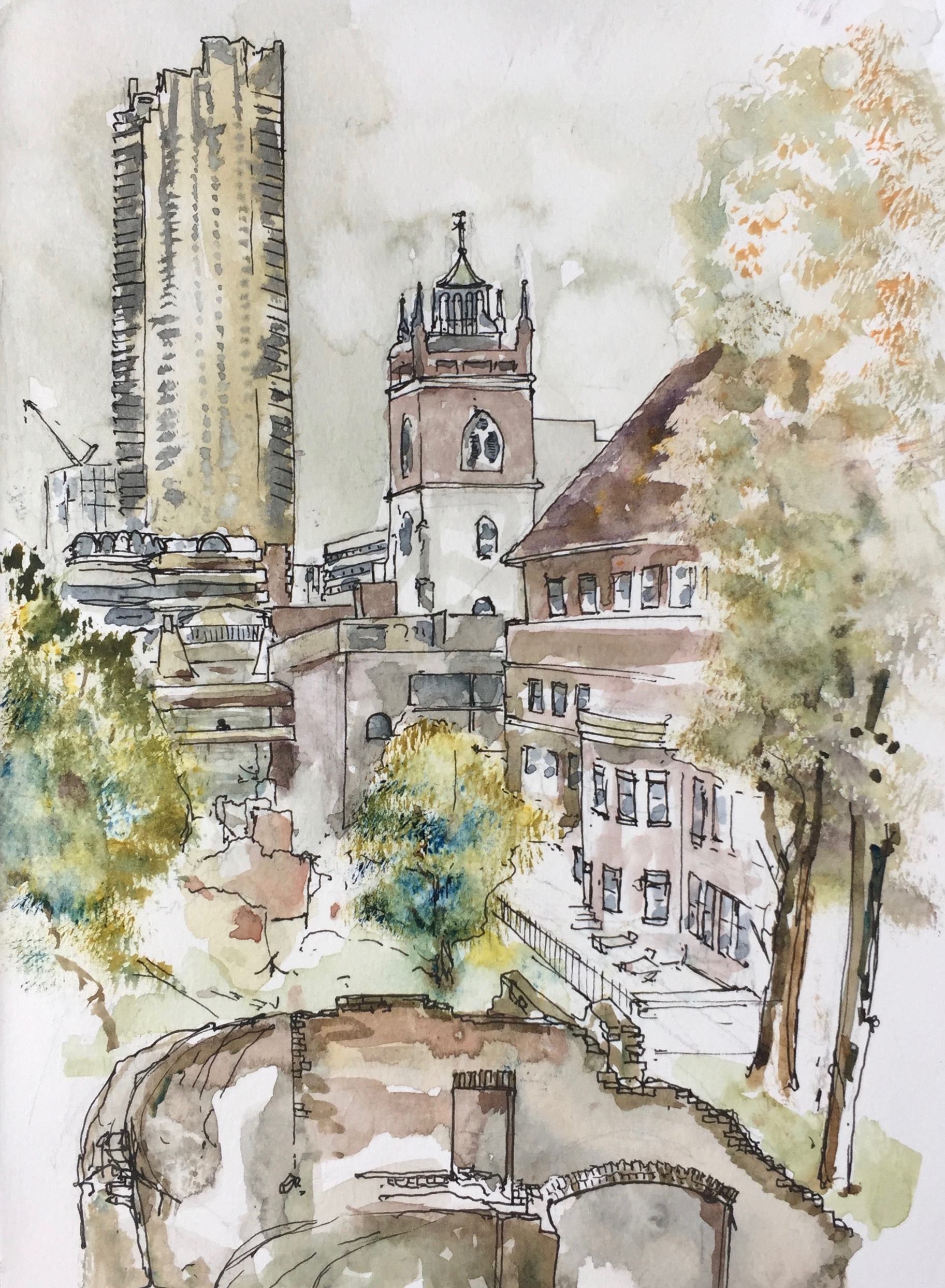
The sketch was to explore the proportions, before making the more detailed watercolour drawings on this post:
I thought the sketch was rather lively and might make a good etching. Here’s the copper plate I made:
And here are some of today’s prints: (click to enlarge)
Etching – lines on hard ground
With aquatint background
With aquatint background
The plate needs a bit more work I think. The background could be darker and perhaps some shading on the tower itself. My idea is that I will print it with perhaps chine-collé. So I want to keep the design simple.
I just had the morning at the print studio today.
The paper is Chinese paper from Great Art. Numbers 11369 (soft), and 11565 (white, with a slight grid). The ink is Intaglio Printmaker Shop Mix Bone Black. The plate is 10cmx15cm copper plate from Great Art, which I prepared with hard ground 28 June 2018. I used the Rochard press at East London Printmakers.
Update:
14 March 2019 – Chine Collé
Click a button below to share this post online, email it, or print it:
St Bartholomew the Less is a Chapel of Ease in St Bartholomew’s Hospital in the City. It’s just to the right of the main entrance from Smithfield. You might not notice the door in the wall. Sometimes they put a board outside. I’ve been in a number of times. It’s a very peaceful, welcoming, place. Somehow, one feels the need to visit a place of prayer before, or after, a hospital visit.
I was invited to draw pictures of the church. The City Music Foundation, a charity, wants to use my pictures in its publicity. They are going to be based in St Bartholomew the Less. So the Managing Director of the Foundation, Clare Taylor, contacted me. She’d seen the pictures I’d done of The Charterhouse.
Here are the first two pictures of St Bartholomew the Less:
It was founded in 1123, by Rahere, a “courtier of Henry I“, according to the leaflet. The tower dates from the 15th century. “The three bells in the tower include one dating from 1380 and another from 1420” says the leaflet. I was interested in Rahere, because there is a Rahere St and a Rahere House which I have drawn.
Since the Foundation is a music foundation, I thought it would be a fun idea to draw the bells. By kind permission of the Parochial Church Council (PCC), whose representative efficiently produced a key, I was able to go up into the belfry. Bells, I found, are not so easy to draw as you might think. Like the human form, they have curves. And unless you get the curves exactly right, they look like a different character. Also, the belfry contained not only very ancient bells, but also 600 years of dust. It was indescribably dirty. But amazing. And very quiet inside, with all the noise going on outside. I wedged myself into the wooden frame, braced my back against a metal rod, and got started.
The platform into which I was wedged was not very big. I manoeuvred very slowly because I didn’t want to knock anything, such as a paintbrush, down into the depths. The best medium seemed to be black ink. Ink is a bit dodgy to manage at the best of times. But keeping it upright on an ancient wooden raft, in the semi-darkness, verged on the farcical. No-one was there to sympathise, except the bells, and they’d seen it all before.
Click a button below to share this post online, email it, or print it:
St Alphege (“Ælfheah”) was a Bishop of Winchester, later Archbishop of Canterbury. He was captured by Viking raiders in 1011 and killed by them the following year after refusing to allow himself to be ransomed. Alphege was canonised as a saint in 1078.
The church was built around then, according to Wikipedia: “The first church was built adjoining the London Wall, with the wall forming its northern side.The churchyard lay to the north of the wall.The earliest mention of this church dates to c. 1108–25, though it is said that it was established before 1068.”
The ruins of the Church have recently been made beautiful, and accessible, by the wonderful new public space around One London Wall Place. Here is is a sketch done from one of the wooden benches close to the church:
You see the marvellous new high walks, which curve in the sky.
Until I started drawing them, I had not realised that the walls of the highwalk vary in height. The highwalk is made of some material which rusts, to give this bright orange colour.
On the right of the picture is the red brick of the old London Wall. The building in the background is Roman House, on Wood Street, a residential block.
The architects of One London Wall are MAKE architects.
About 2 hours, drawn and coloured on location, in Jackson’s watercolour sketchbook.
Click a button below to share this post online, email it, or print it:
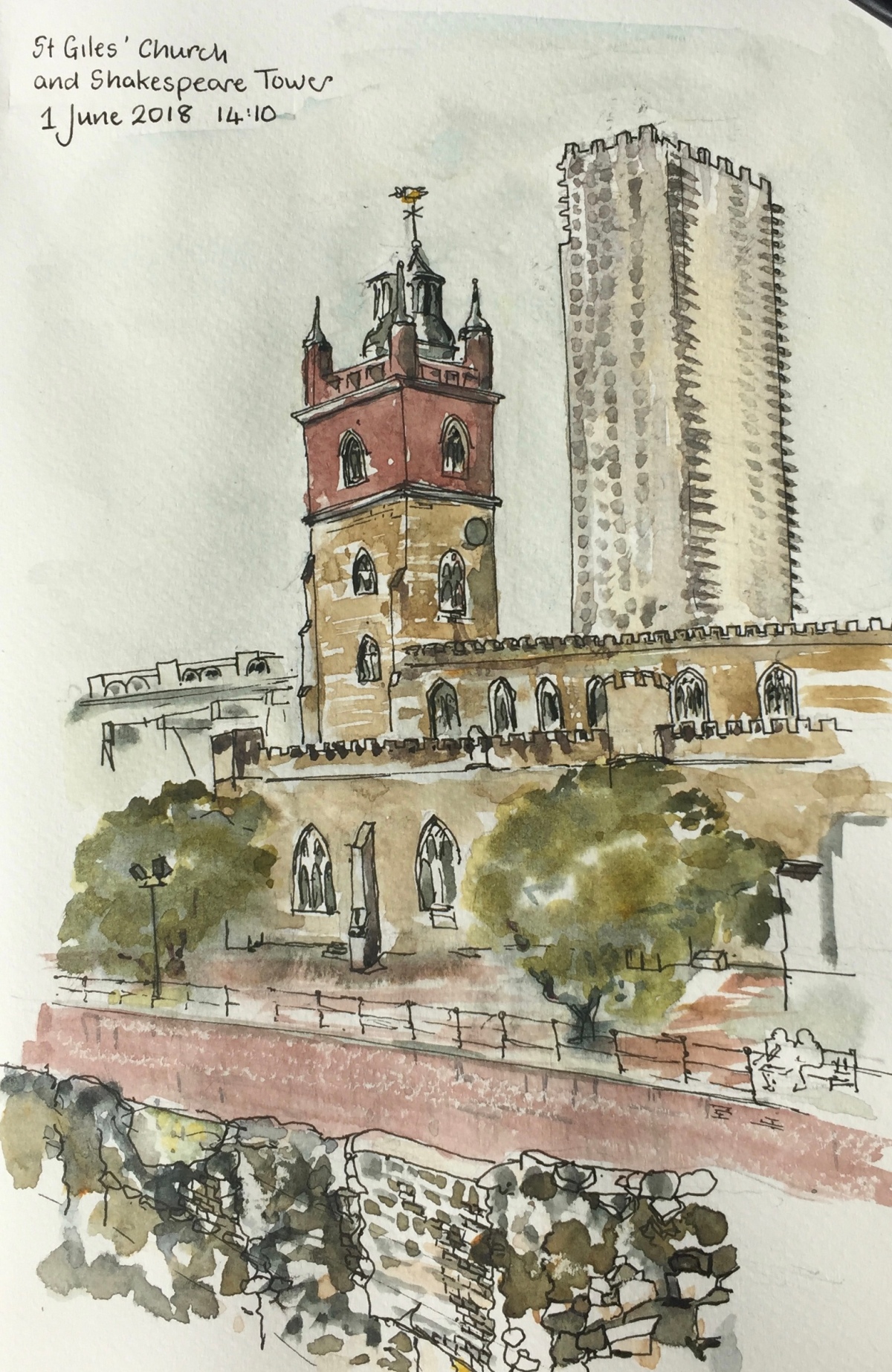
Here is a sketch from a staircase from the Barbican Podium, just outside the Dentists but just inside the old London Wall.
Parts of the Roman London Wall are in the foreground, 2nd century AD.
St Giles’ has Roman foundations and is much rebuilt. The church we see now is the 1966 restoration following designs of architect Godfrey Allen (1891-1986). He used historic plans to make the church as much as possible like the medeival original. It had been burned by incendiary bombs in 1940.
In the background is Shakespeare Tower, Barbican, completed 1976, to the designs of Chamberlain, Powell and Bonn.
St Giles’ Church is “St Giles’-without-Cripplegate”. As you can see from the picture, the Church is outside London Wall. Here is an extract from the St Giles’ website.
The foundations are generally Roman but higher up, the structure dates from various times as it was regularly strengthened and rebuilt…. As the population of the parish increased, the church was enlarged and it was rebuilt in the Perpendicular Gothic style in 1394, during the reign of Richard II. The stone tower was added in 1682. The church was damaged by fire on three occasions – in 1545, 1897 and 1940…The church was designated a Grade I listed building on 4 January 1950 and it was extensively restored in 1966.
…
The bombing of Cripplegate in 1940 was so extensive that barely any buildings remained standing in the entire ward. By 1951, only 48 people were registered as living within the ward. It was this widespread devastation which led to planners envisaging and eventually building the modern Barbican estate and arts centre, starting in 1965.
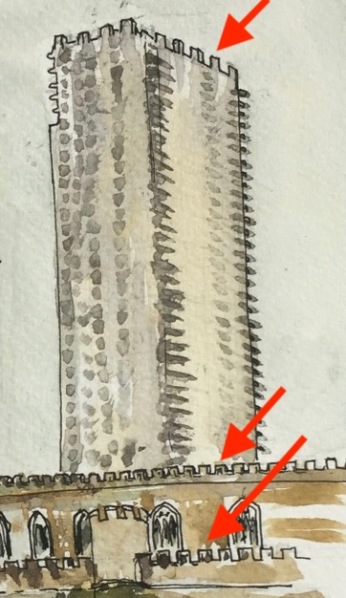
As I was drawing, I saw that the crenellations on St Giles were echoed high up on Shakespeare Tower.
The drawing took two hours, pen and wash, in a Jackson’s Watercolour Sketchbook.
Helen went off to take a conference call, and I drew the Cathedral.
This was a quick sketch, pen and wash, about 40 minutes.
While I drew this, a brass band was practising in the nearby boys’ school. They were playing “Annie Laurie”.
This cathedral is impressively enormous. The Tower is Norman: built 1077 – 1093. The nave is hugely long, but inside it is divided by screens, so you can’t see all the way along, which is what I wanted to do.
Click a button below to share this post online, email it, or print it:
The building which was Bernard Morgan House has now been pulled down. This is sad. It had a calm 1960s look, and ceramic tiles on the side.
I looked across the gap and could see the Welsh Church: Eglwys Jewin.
The church is the building with the green roofed turret and the long windows. It was founded around 1774. According to its website “capeljewin.org” in the 19th century it was “one of the most powerful and influential churches in the Calvanist Methodist tradition”. It was very well attended in the 19th century so they built a new and bigger chapel on Fann St in 1879. This was destroyed in the Blitz in 1940. The building I’ve drawn was built in 1960.
Lauderdale Tower is just visible, to the left of the picture, and Blake Tower is on the right. Ahead, behind the church, is Tudor Rose Court, a City of London building providing sheltered housing to people over 60: 16 leased, and 60 social rented flats.
Bernard Morgan House used to be a City of London building too. It was a police house.
I drew it in 2016:
24 October 2016 – Bernard Morgan House and the Cripplegate institute.
25 August 2016 – From Brackley Street: the Welsh Church and Great Arthur House (Golden Lane Estate) showing the wall of Bernard Morgan House
Who was Bernard Morgan? There is a Bernard Morgan, born in 1924, who was a code breaker in the Second World War. Was it him?*
Sgt (Retd) Bernard Morgan, an RAF D-Day code and cipher veteran, looking at a Type X machine (Manchester Evening News, 12 April 2014)
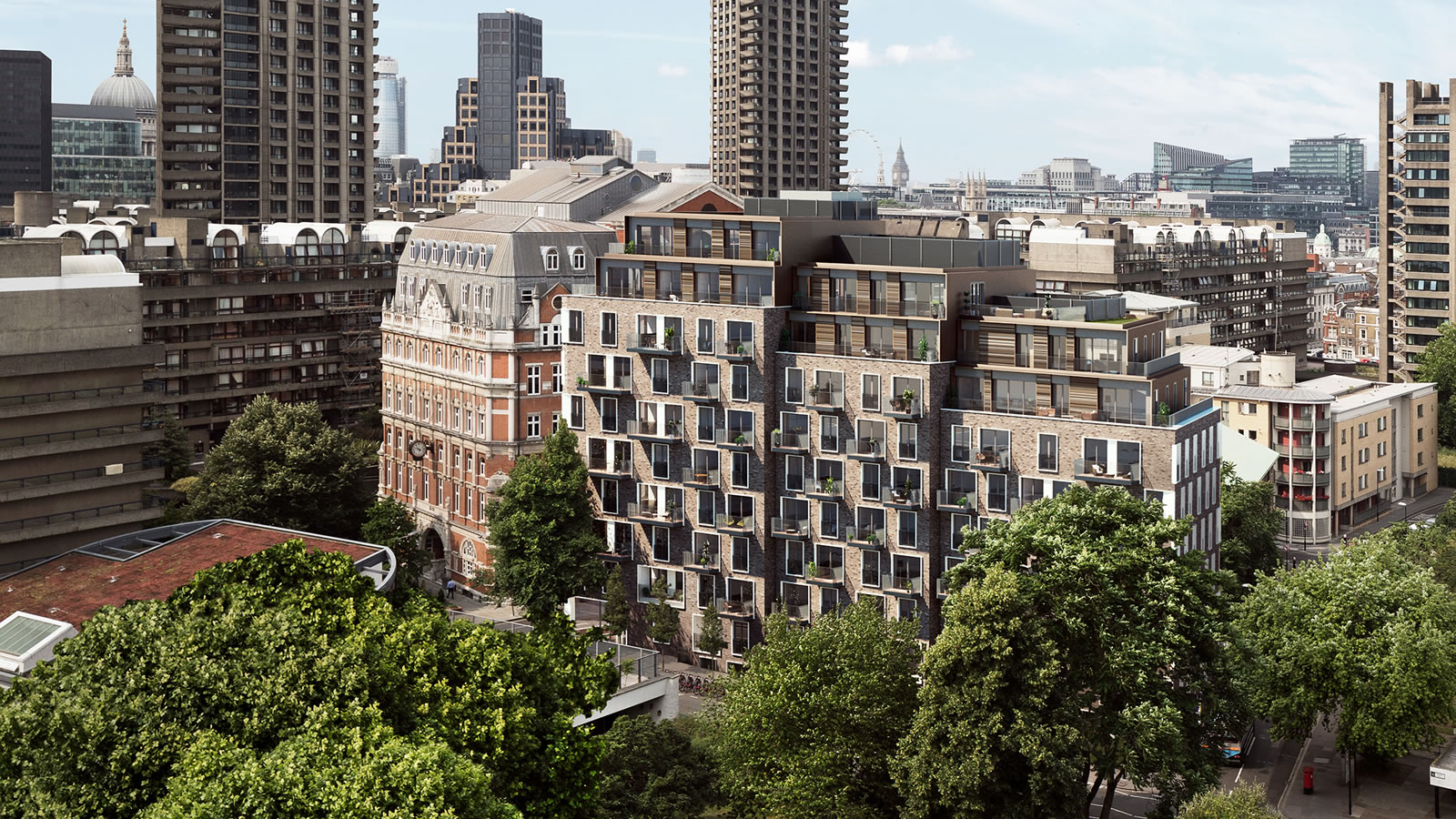
Taylor Wimpey are going to build luxury flats: “The Denizen”. This is how the view I’ve drawn will look after “The Denizen” is built:
“Street view” from the Taylor Wimpey website
Here’s another view of “The Denizen” from the Taylor Wimpey website. See how big it is! Fortune Park is the trees in the foreground. You can see Blake Tower on the right and Lauderdale Tower in the Centre.
The Denizen (centre), from the Taylor Wimpey Website
*Bernard Morgan Update, March 2018: John Tomlinson tells me that Bernard Morgan House was named for a councilman. Buildings and streets in the City of London are only named after people who died at least 20 years previously, and Bernard Morgan the codebreaker was evidently fit and healthy in 2014.
Click a button below to share this post online, email it, or print it:
Drawn from outside the Pret on Queen St, about 1hr 30.
The building in the centre is “Albert Buildings”, a thin triangular building on the corner of Cannon St and Queen Victoria St. It is incredibly complicated, with many pillars and arches and different window shapes.
Now it is inhabited by a number of small businesses. I saw a dental surgeon, Shoe Care, and “Traditional Pure” lebanese food. It is now managed by “First Base” as “Cannon St Serviced Office and Business Centre” who describe it as a “listed turn of the century building with quirky Victorian features”. They don’t specify which turn of which century, but evidently it’s not the most recent one.
Pevsner says:
“Albert Buildings, the grandest surviving 1870s block, built 1871. By F.J. Ward, whose office was here. Arcaded Gothic, mixed English and Early French, with a remarkable assortment of window heads” The Buildings of England, London 1 by Simon Bradley and Nicholas Pevsner
St Mary Aldermary is one of my favourite London churches. Inside is the friendly Host Café, and welcoming tables and chairs, and a stunning fan-vaulted ceiling. The church is on Bow Lane, near Watling Street, and the current building was built after the fire, in 1666.
Click a button below to share this post online, email it, or print it:
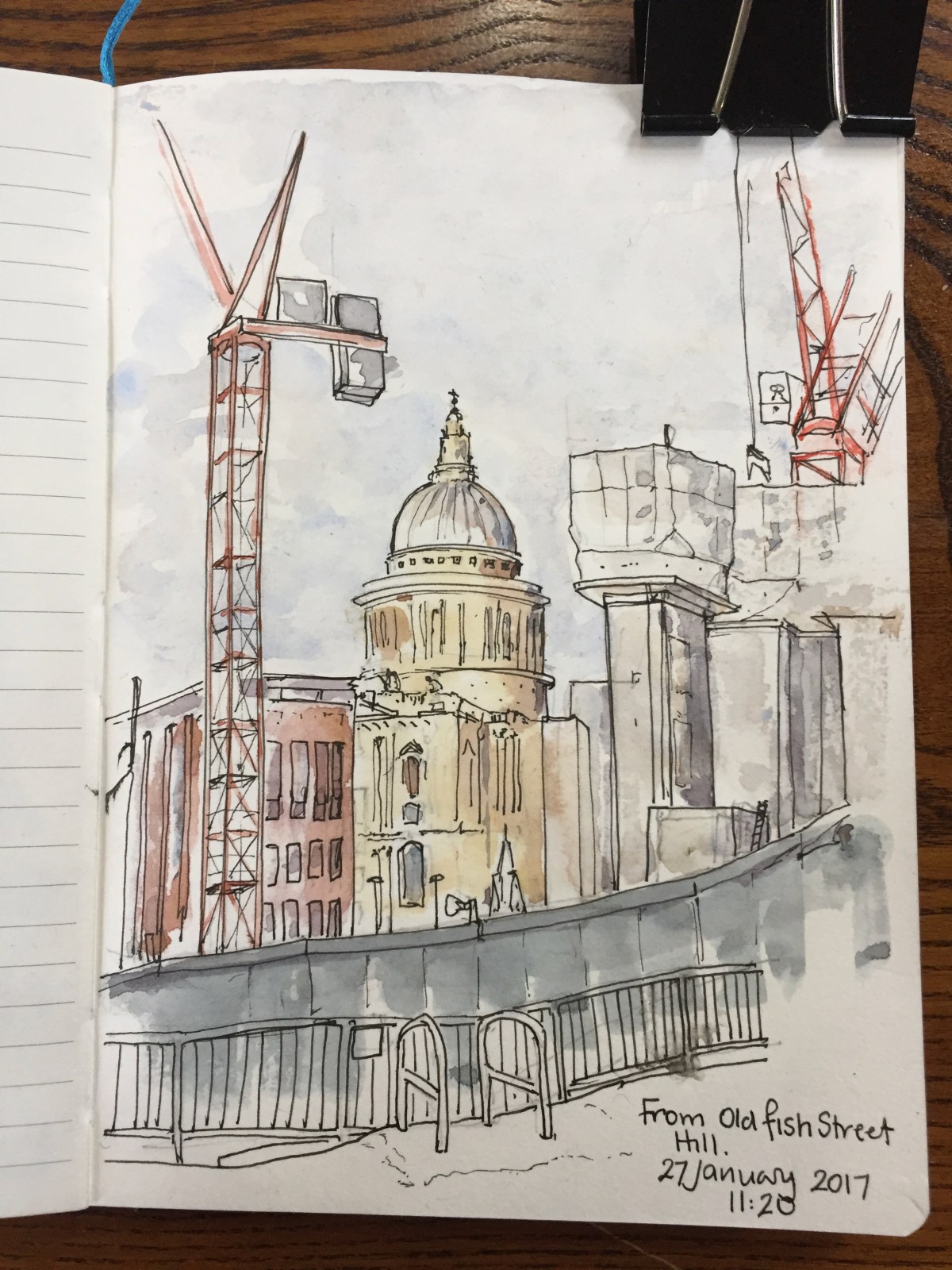
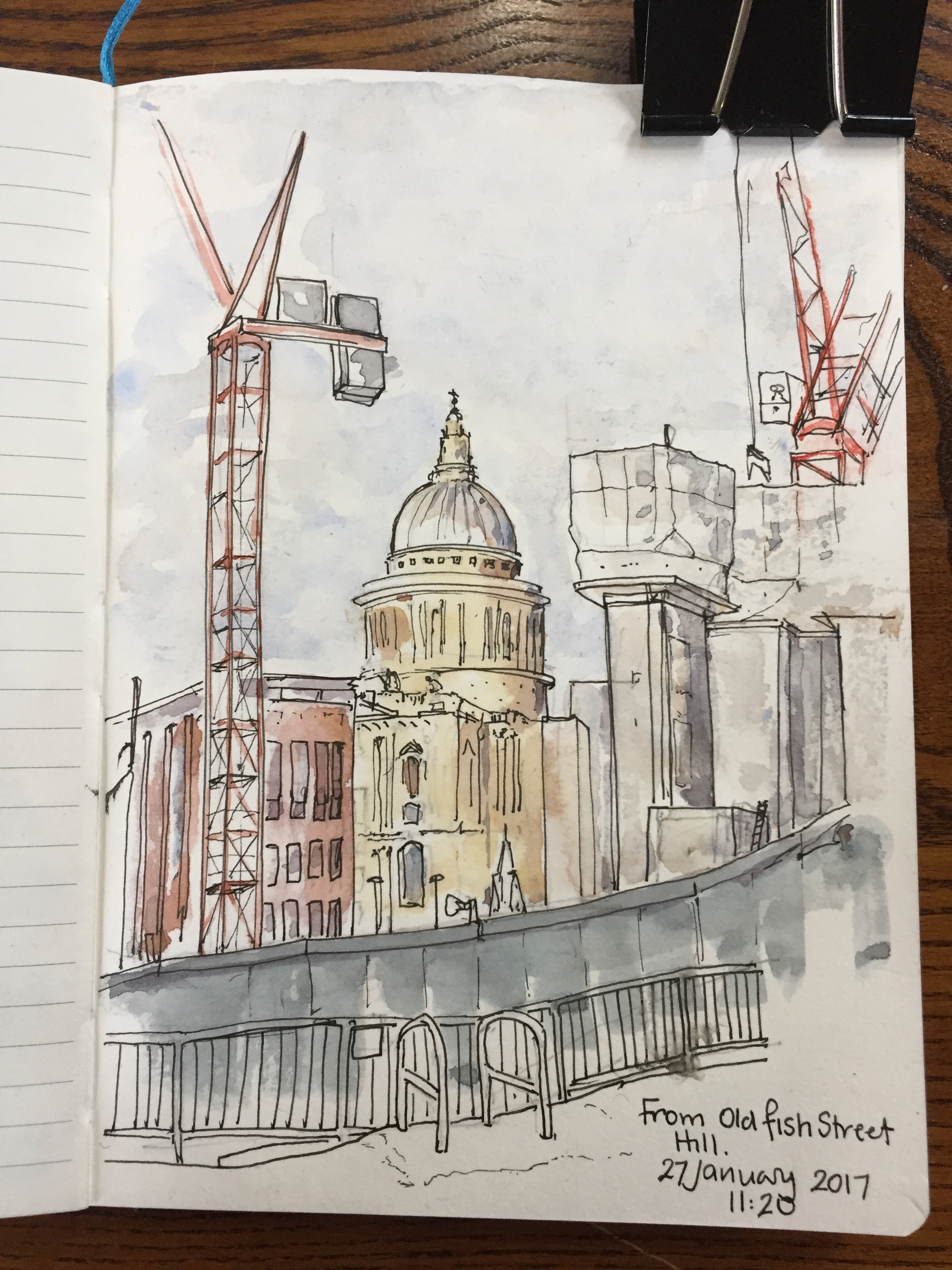
I was keen to draw this view of St Paul’s before it vanished behind the new building on 2-4 Cannon Street.
“PLP’s scheme, for global property firm Pembroke Real Estate, will replace a 1959 modernist office building by Theo Birks called Scandinavian House. The north facade, facing the cathedral, is the most orthogonally formal, with red sandstone cladding and a 3m window grid with anodised aluminium frames.
The south-western elevation tapers to create a public garden which will provide a new home for Michael Ayrton’s sculpture of Icarus.” From Building Design Online 22 September 2014 | By Elizabeth Hopkirk
While I was drawing this, the traffic marshall of the building site came by, looked up at St Paul’s, and remarked that it was a “fine building”.
It was extremely cold, about 2degreesC, and I was wrapped up in my Loden coat and furry boots. You’ll notice I invented a new watercolour technique. It’s called “greasy fingers marbling effect”. See the extreme right of the picture. Before I went out, I put a LOT of hand cream on my hands, because this cold weather makes my skin crack. But then after I had been gripping the sketchbook, I found the paint didn’t stick. But it’s quite a good effect, I think.
I managed to complete the pen and ink drawing, and do most of the watercolour before the cold got to me. Then I retreated to the warmth of the Wren café in St Nicholas Cole Abbey Church.
There I met Amy Marsh @harshmissmarsh who posted my work-in-progress on her Instagram. In the café I painted the red cranes.
Coffee and a small and delicious Marmalade Cake, £6. They were just bringing out some delicious-looking lunchtime food. But I had places to go and work to do, so I exerted willpower and moved on.
Click a button below to share this post online, email it, or print it:











 Jane Sketching