38 Charterhouse Street, London EC1

My idea that day was to sketch some interesting corner pubs in Bloomsbury.

By the time I had emerged from my flat and was on the street, the bright autumn day had turned stormy. After a few paces, the rain started falling. Everyone dashed for cover. I sheltered in a doorway, together with another woman, two strangers in a refuge, grinning and rolling our eyes. “Well, it is September”. At a pause in the deluge, we both emerged and went our separate ways. I went doggedly towards the West, but no, the rain returned, seemingly even more torrential. I dashed from doorway to doorway, like a fugitive in a spy novel, finding cover where I could. Then I spotted the generous overhang of Smithfield Market and rushed underneath, the rain spattering on the glass above. There was no sign of the deluge ceasing, so I considered, as you do in these strange interim conditions: to go on? to go back? Or to stay where you are?

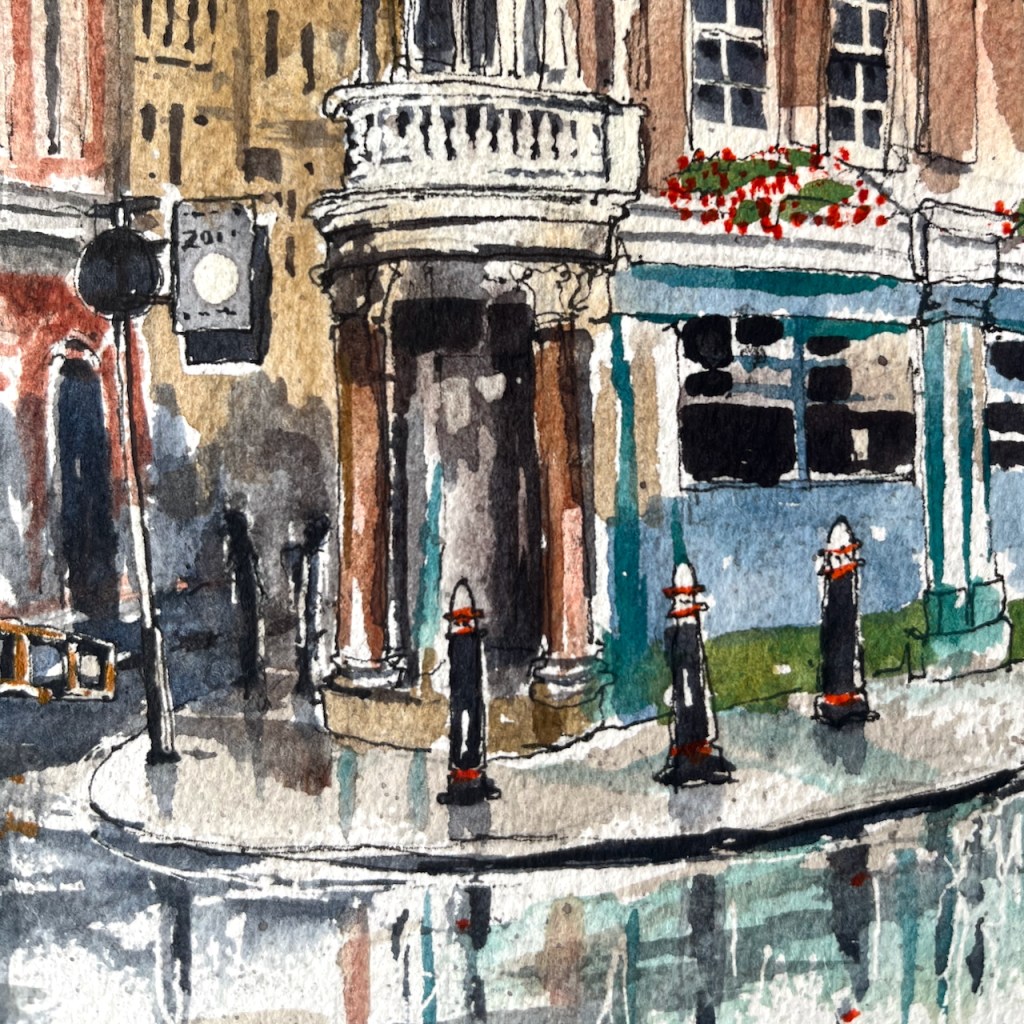
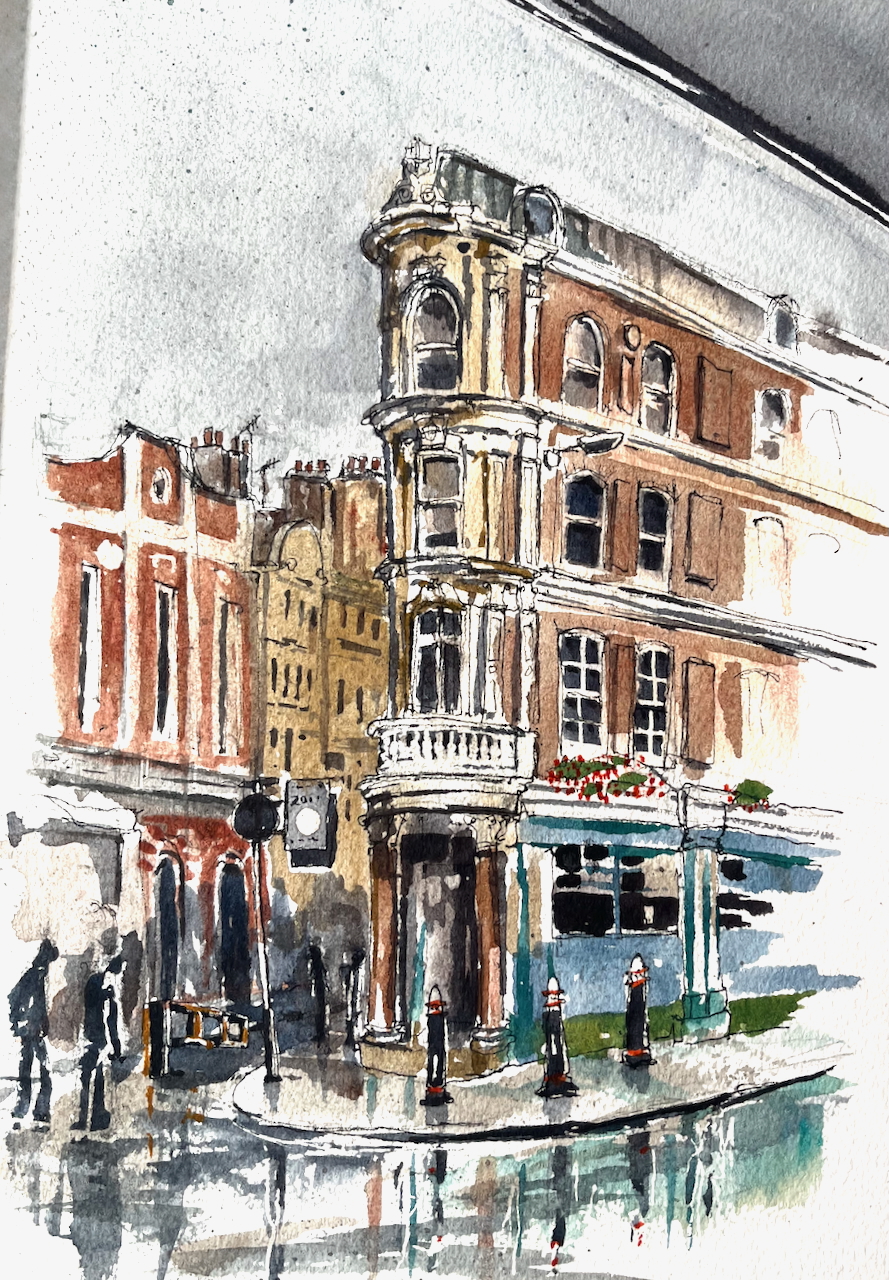
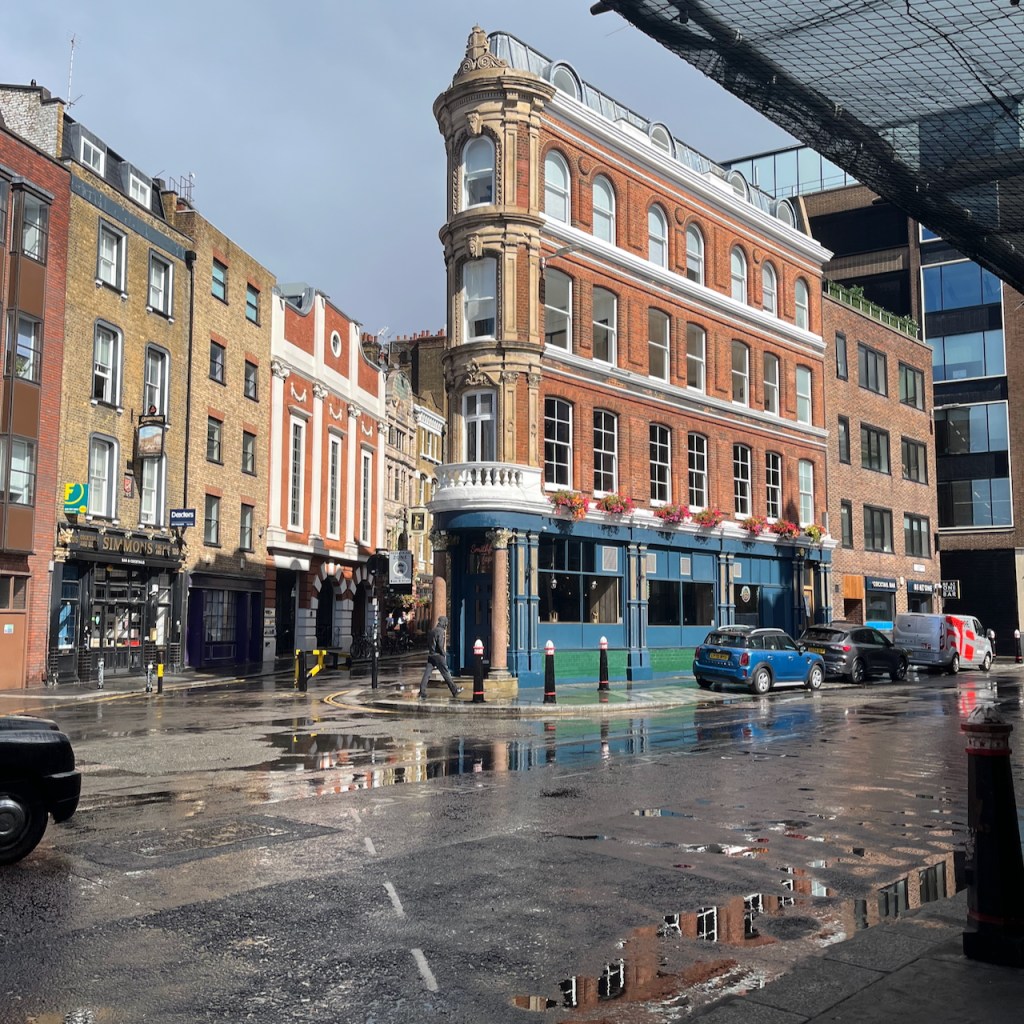
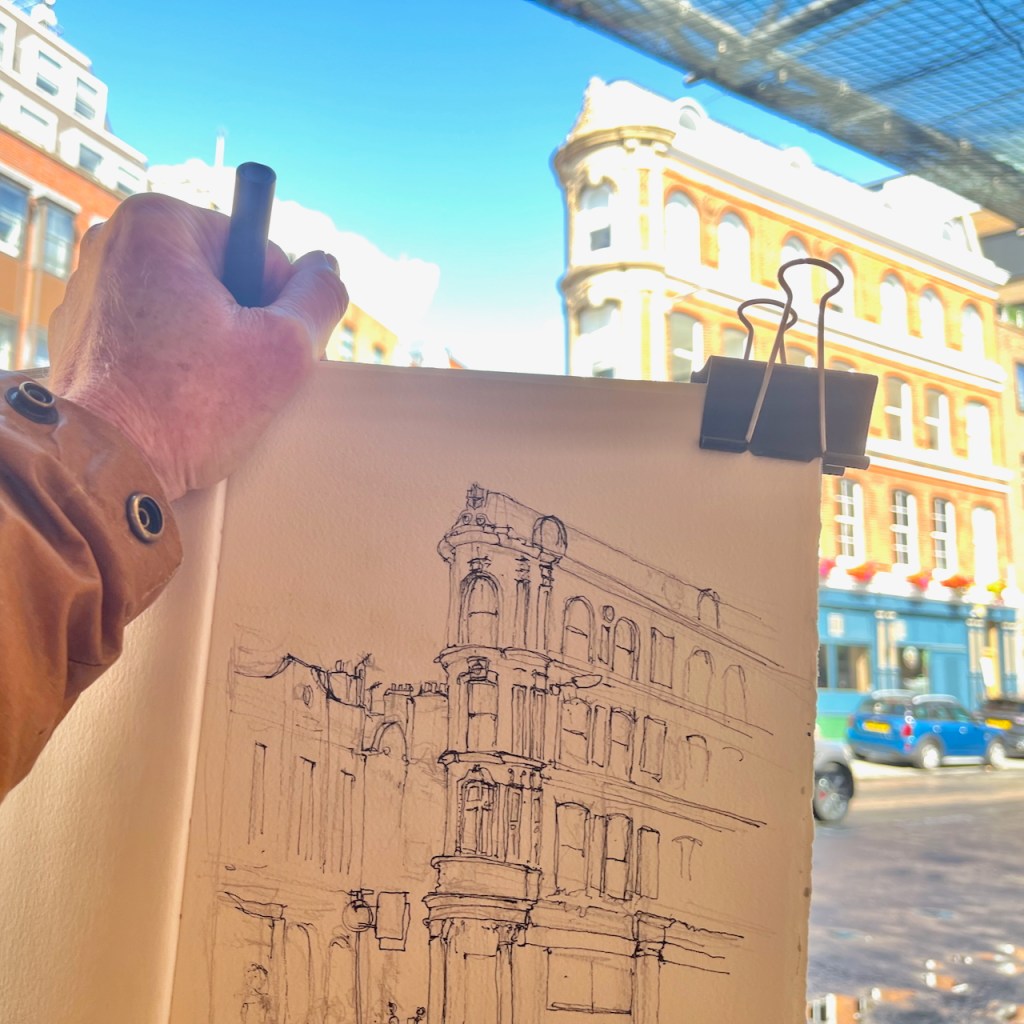
Why not do the drawing right here? Over the other side of the road is a building occupying an acute angle between roads. It wasn’t in my plan, but by this time I had abandoned my plan. So here is 38 Charterhouse Street, sketched from the shelter of the Smithfield Meat Market canopy.
38 Charterhouse Street, EC1M 6JH sketched 4th September 2025 in Sketchbook 16

I sketched it in pen on location. Part way through the process, a group of workers started to clean the area behind me, using high-pressure water hoses. A fine mist appeared in the air, adding to the general dampness. I finished the drawing later that evening, in my warm dry room.
Here is a map.
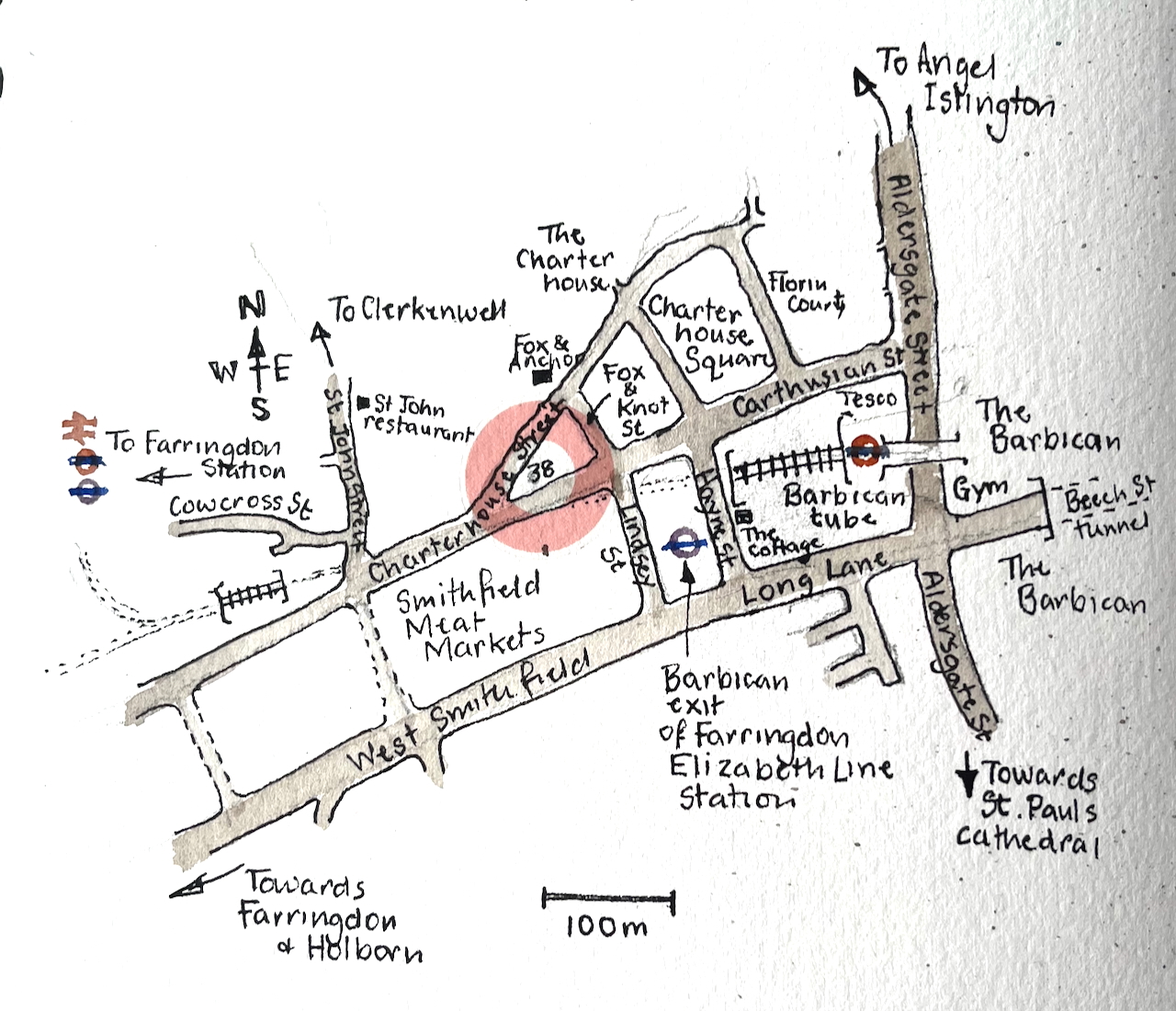
As you see, number 38 stands on a little triangle of land, bounded by Charterhouse Street, Carthusian Street and the tiny alley called Fox and Knot Street.

British History Online offers some history for this triangular plot. In the 1860s the City of London redeveloped the Smithfield Meat Market. At the time it had been mostly an open-air market. The City turned it into the covered market it is today. The surrounding lanes and buildings were also affected, both by the redevelopment and the increased trade.

In 1869–70, with the new market building complete, it was resolved to take the new road along the north side of the market further east into the square itself, carried out in 1873–4. The road was called Charterhouse Street, apparently at the suggestion of the Charterhouse,
Whereas in 1860 Charterhouse Lane enjoyed a mix of businesses, in 1876 half of the sixteen surviving houses were occupied by meat and poultry traders. The same trades dominated the new buildings put up, though there were also coffee rooms to rival the two remaining pubs and a large bank at the corner with St John Street. By the time of the Second World War most of the buildings west of the Fox and Anchor at No. 115 were purpose-built cold stores. Only with the decline of Smithfield Market did the grip of the meat trades loosen. Today restaurants and bars have largely supplanted them.

British History online

The Fox and Anchor pub and the former cold stores are on the left of my drawing. I’ve drawn the marvellous frontage of the Fox and Anchor here.

British History Online describes the block on the corner, number 38:
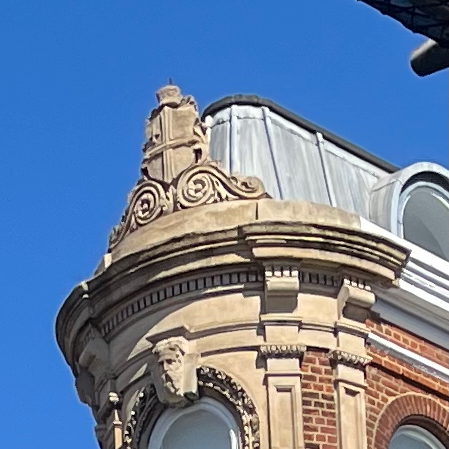
The remnant of ground at the angle between the old and new roads was laid out for a small block of buildings and allotted the numbers 38–42 (even) Charterhouse Street, behind which a tiny street, Fox and Knot Street, was cut through in 1871. The name was taken from Fox and Knot Yard, a court obliterated by the new market.

The small triangular block west of Fox and Knot Street […] just within the City boundary, belongs to the land acquired by the Corporation of London in the 1860s for the Smithfield Market development. Set out for building in 1871–2, it remained empty until 1875–6. At the apex a warehouse (No. 38), was then built for Myer and Nathan Salaman, ostrich-feather merchants, to designs by Benjamin Tabberer. […] It is four storeys high, of red brick with regular fenestration; all the ornamentation is concentrated on the narrow corner. For many years there were coffee-rooms here.

So, in 1875 it was an ostrich-feather warehouse, which must have been a great place to visit. The next mention of the building is on the website of Herbert, a present-day supplier of technology to retail businesses. They have a section of their website devoted to their long history. In the early twentieth century they were supplying weighing machines and balances from their offices in West Smithfield and a factory in Edmonton.
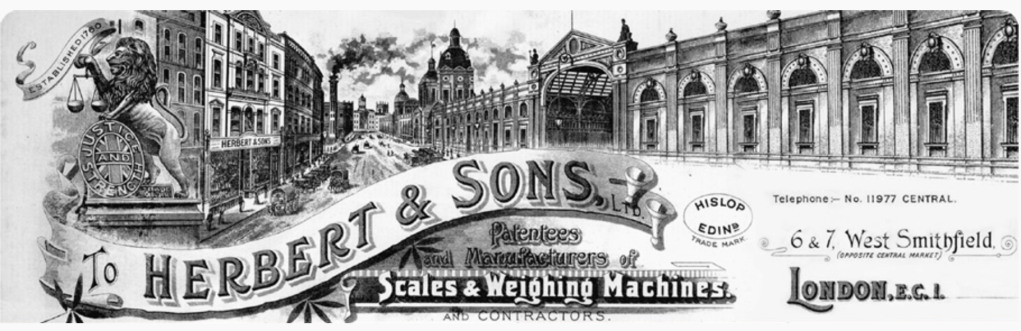
Advertisement from the Herbert History site, showing Smithfield Market.

In 1937 they moved into 38 Charterhouse Street which became a showroom.
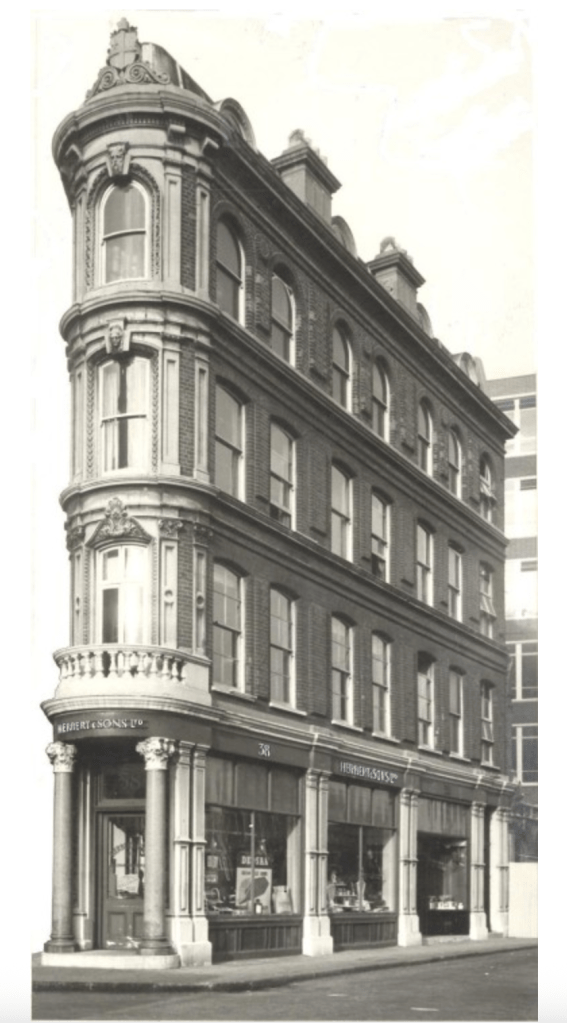
The Herbert and Son showroom, circa 1940s.

Herbert and Son moved out in 1956 and consolidated their operations into their Edmonton site. Since then, the building has been a coffee house, and, more recently, various bars. It is now the “Smithfield Tap”.

I wonder what will happen to it next?
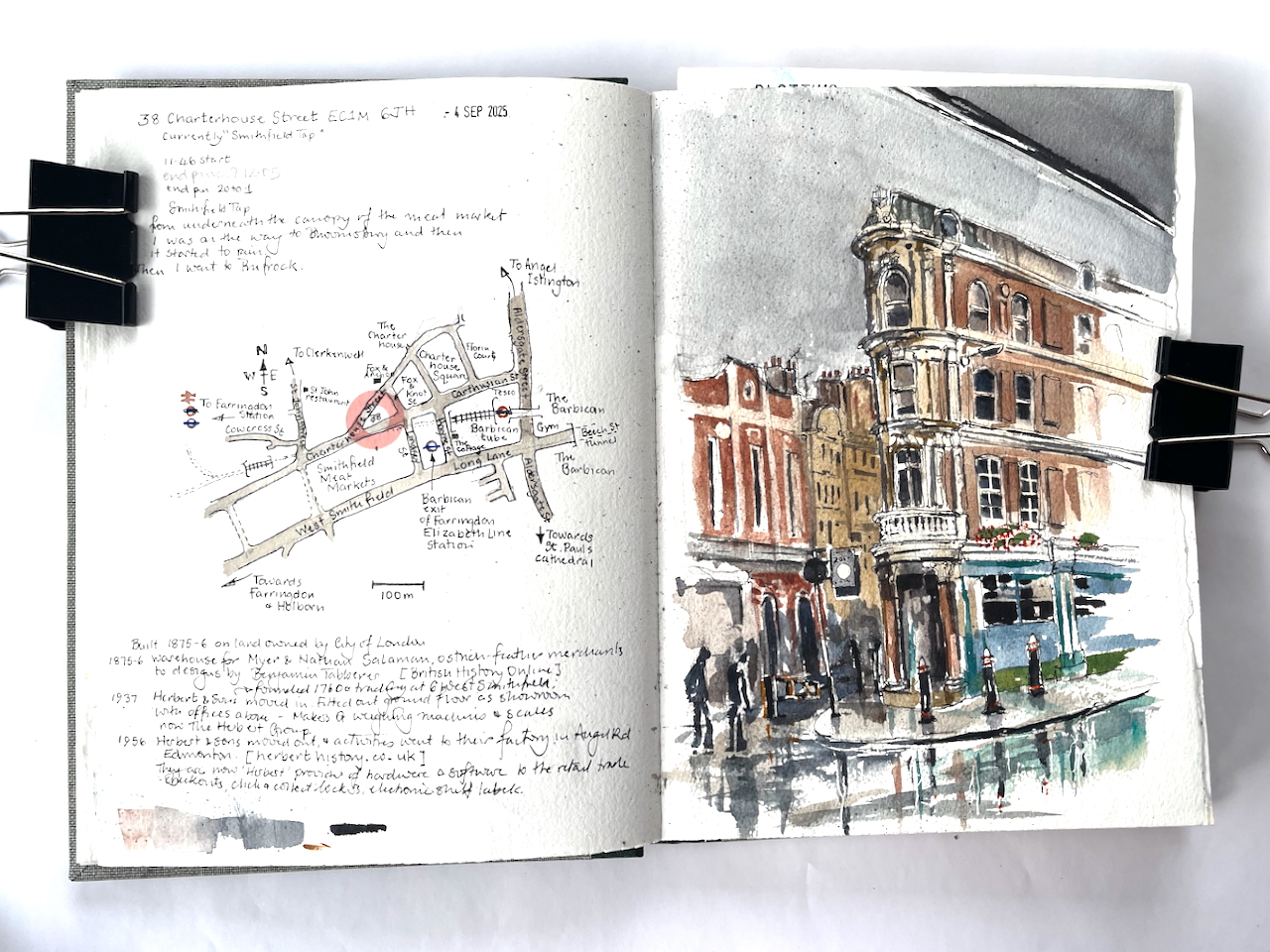
Sketchbook 16

References

British History Online reference: https://www.british-history.ac.uk/survey-london/vol46/pp265-279
Charterhouse Square area: Charterhouse Street and other streets’, in Survey of London: Volume 46, South and East Clerkenwell, ed. Philip Temple (London, 2008), British History Online https://www.british-history.ac.uk/survey-london/vol46/pp265-279 [accessed 6 September 2025].

Herbert history reference: http://www.herberthistory.co.uk/cgi-bin/sitewise.pl?act=det&pt=&p=279&id=herbhis
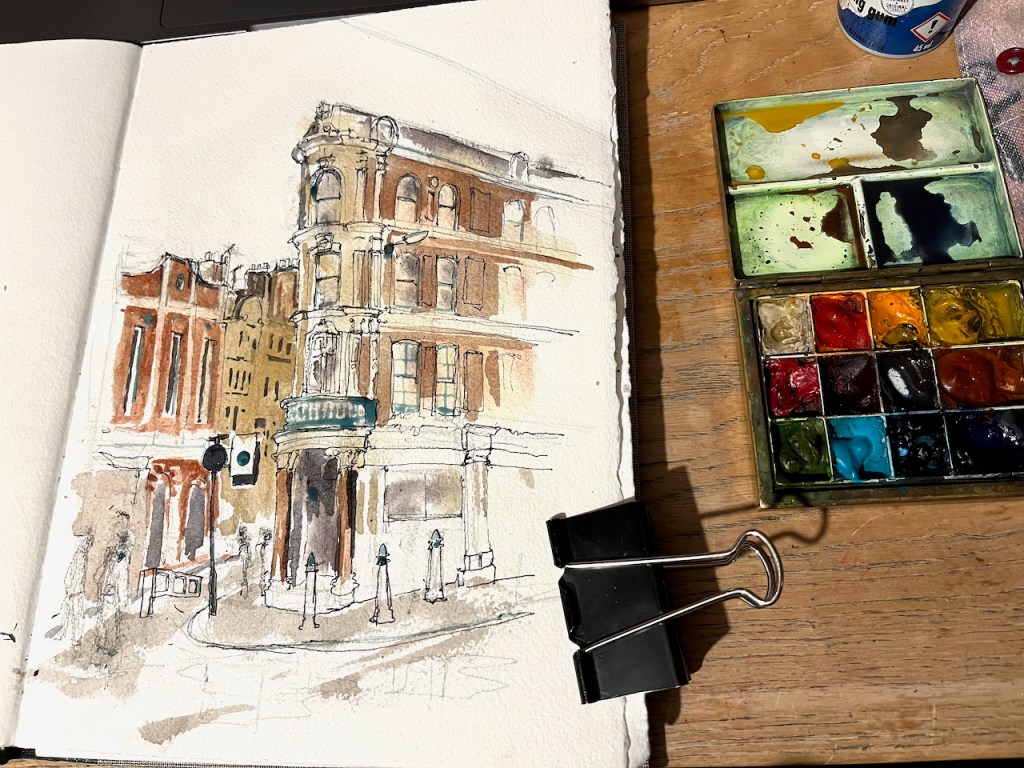
Putting on the colour at my desk.

Colours, all Daniel Smith unless otherwise stated:

  • Fired Gold Ochre (bricks)
  • Ultramarine Blue Finest (Schmincke Horadam) + Burnt Umber = grey/black
  • Phthalo Blue Turquoise (reflections, water)
  • Mars Yellow (bricks)
  • Serpentine Genuine (Green tiles)
  • Buff Titanium (cream-coloured stonework)
  • Transparent Pyrrol Orange (highlights of red on the bollards)
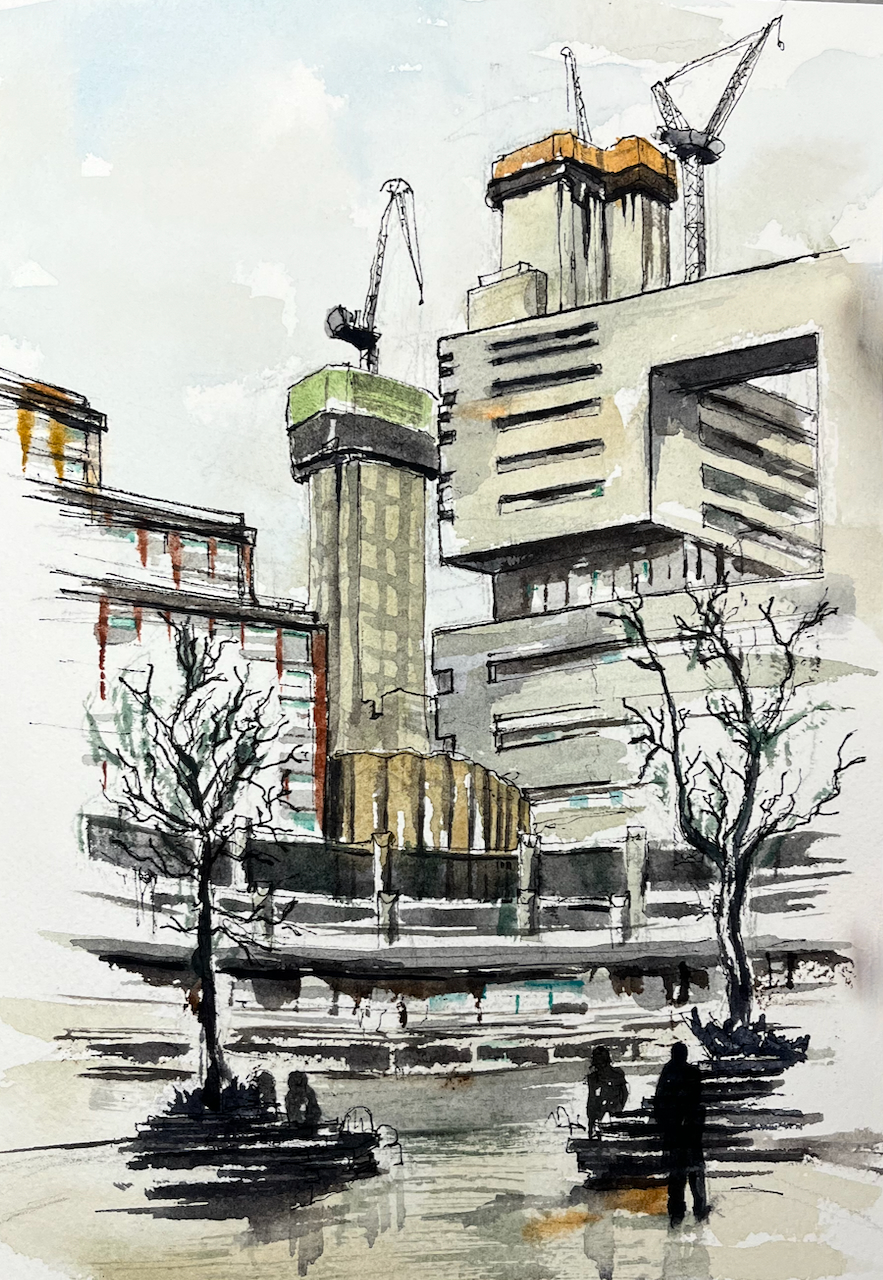
North side of Broadgate Circle, EC2M

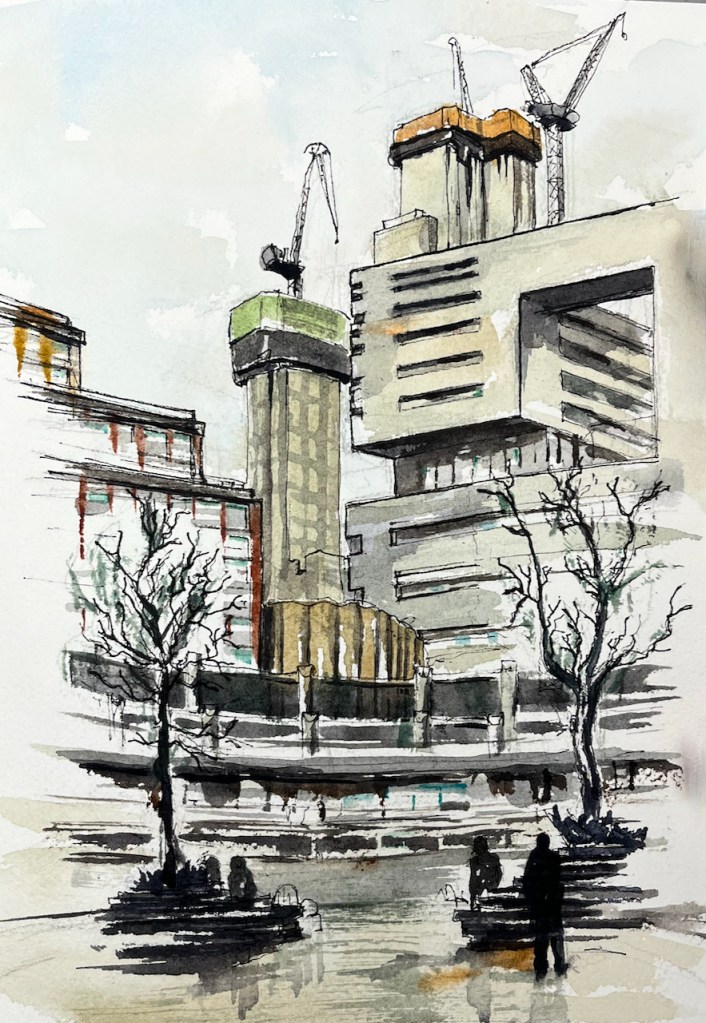
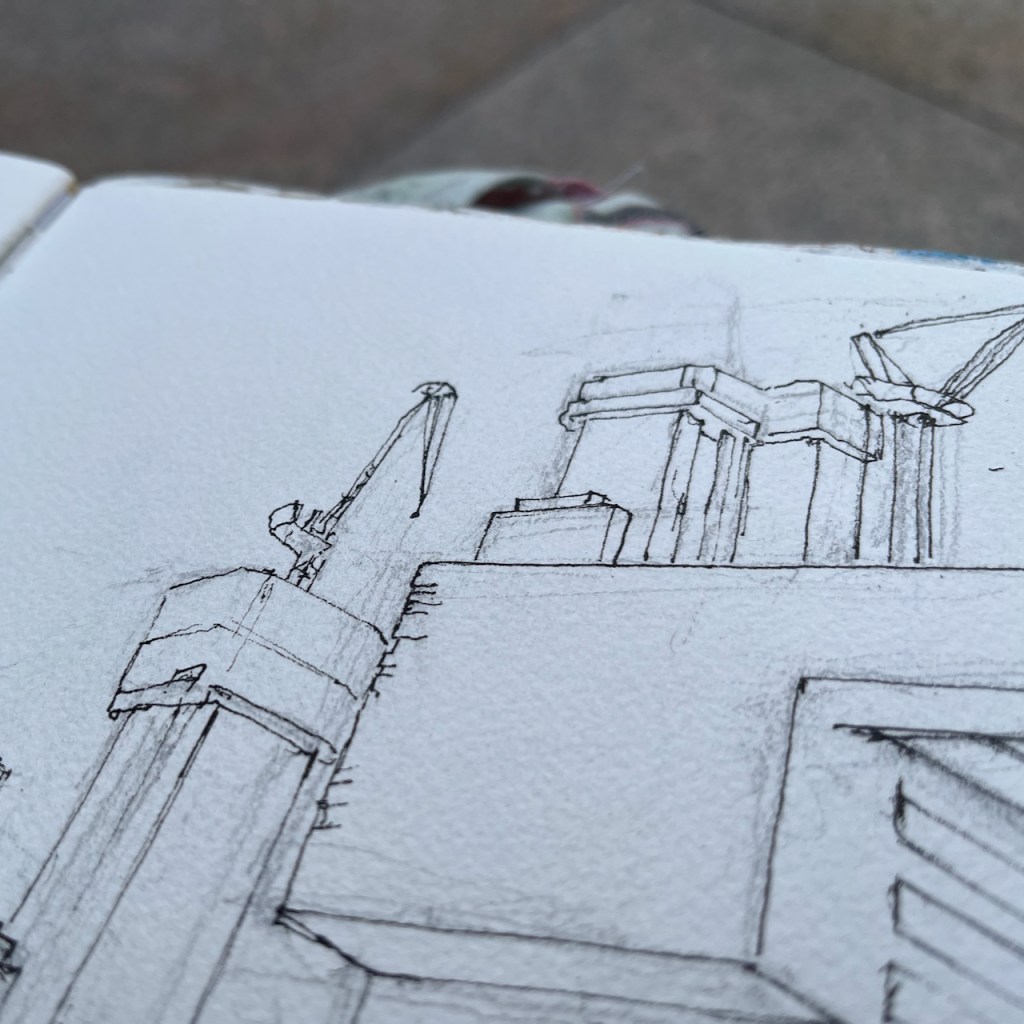
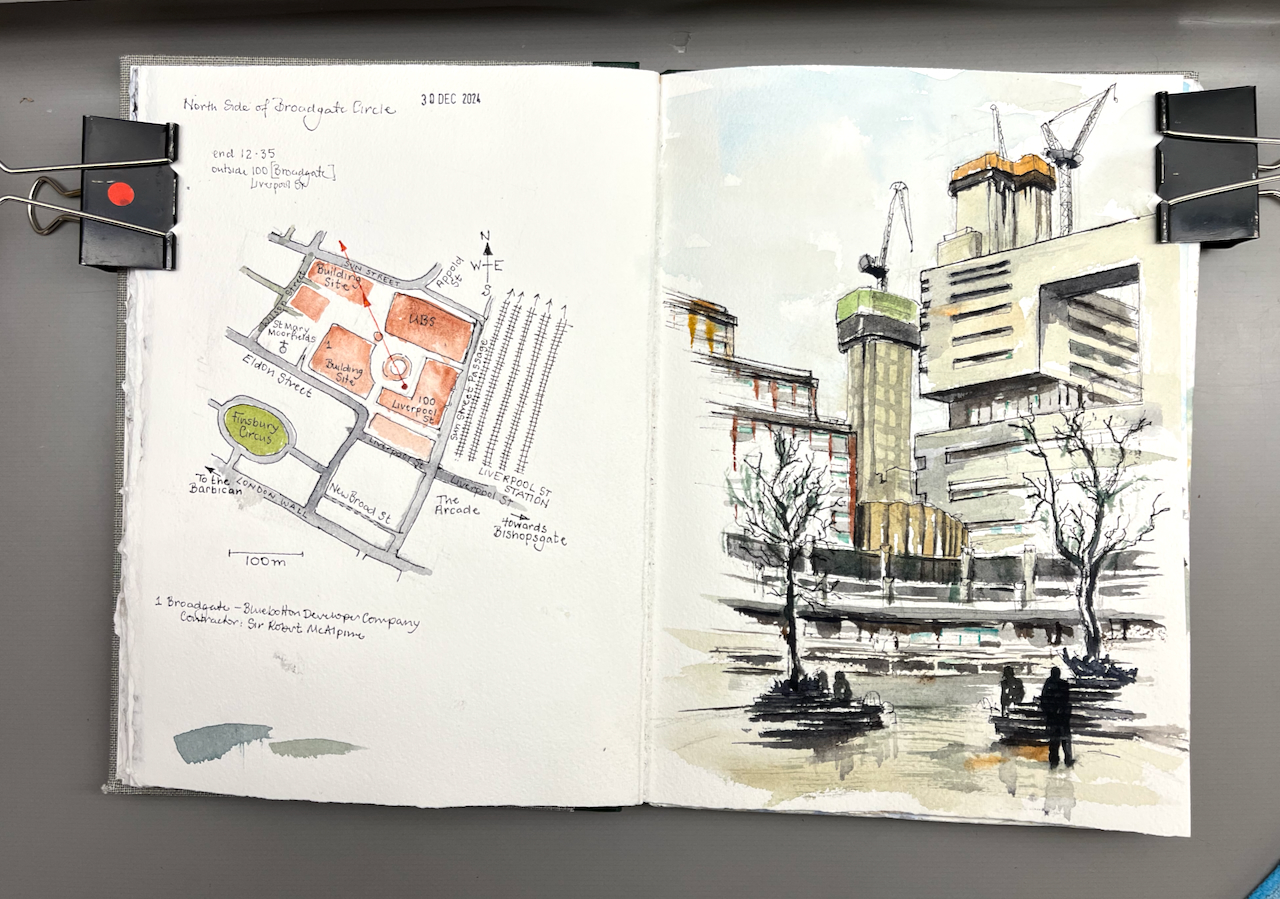
Broadgate Circle is undergoing massive redevelopment. Here is the view looking North.

View of the North side of Broadgate Circus, 2 Finsbury Avenue under construction.
Sketched, 30 December 2024 in sketchbook 15.

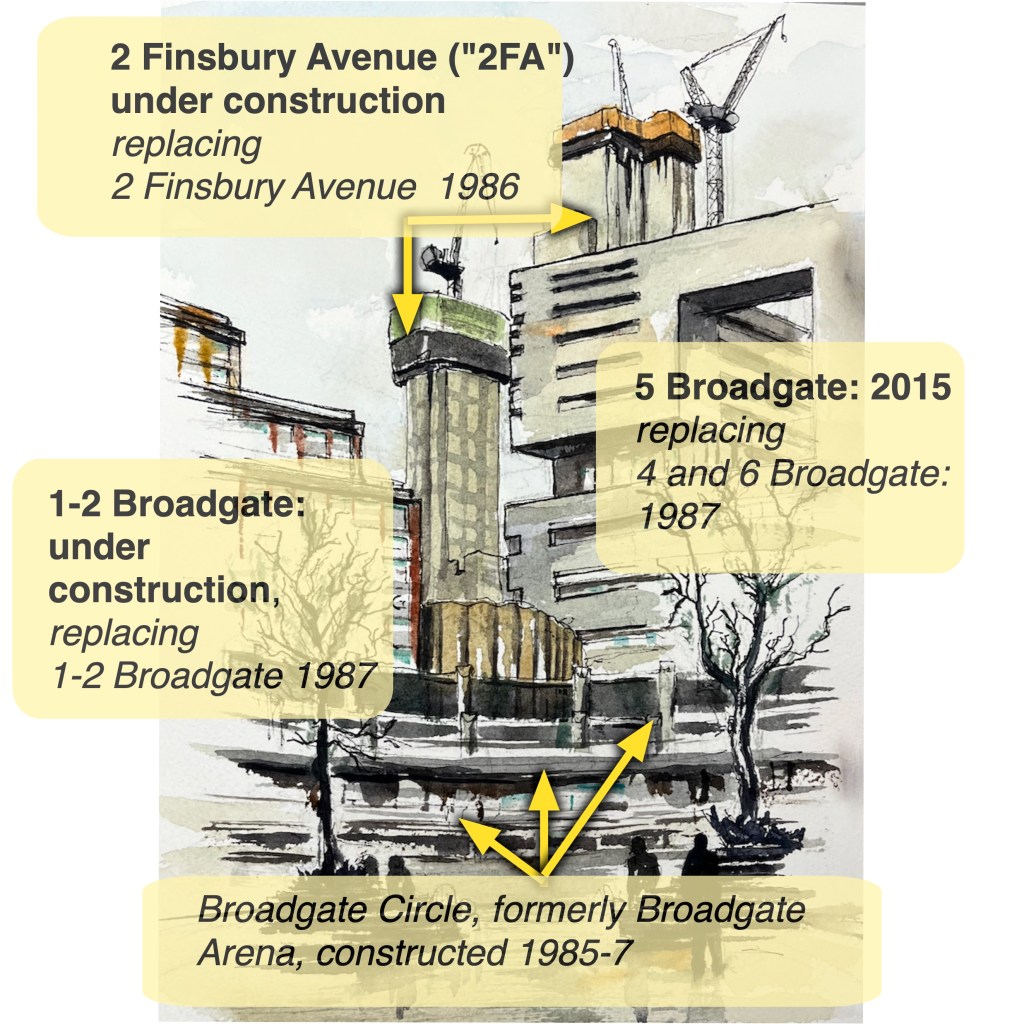
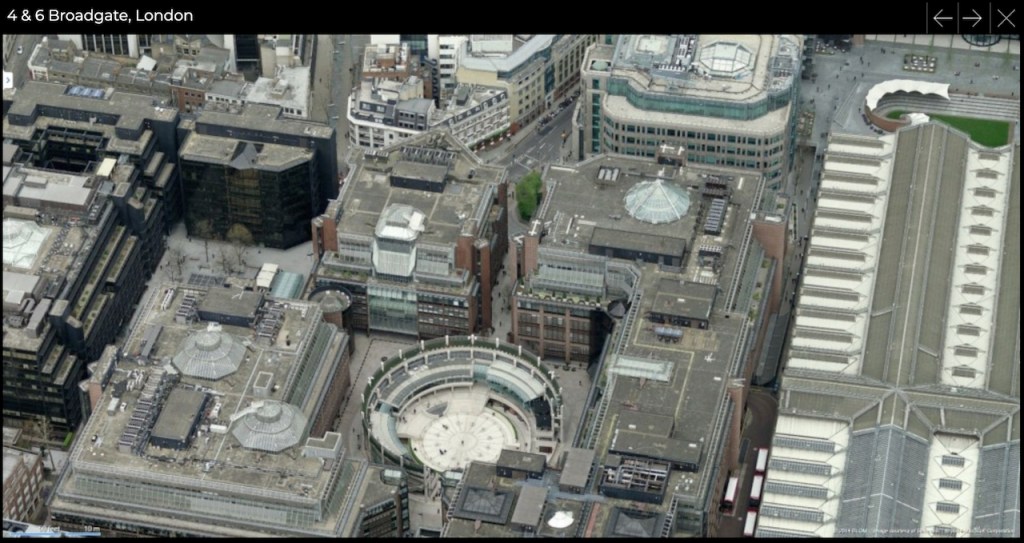
The concrete cores in the background are 2 Finsbury Avenue under construction. The previous building was demolished. On the left is 1-2 Broadgate, replacing previous buildings. The steel-clad building on the right is 5 Broadgate which replaced 4 and 6 Broadgate and sealed up the access road that led between them.

Building replacement: after 40 years, all change.

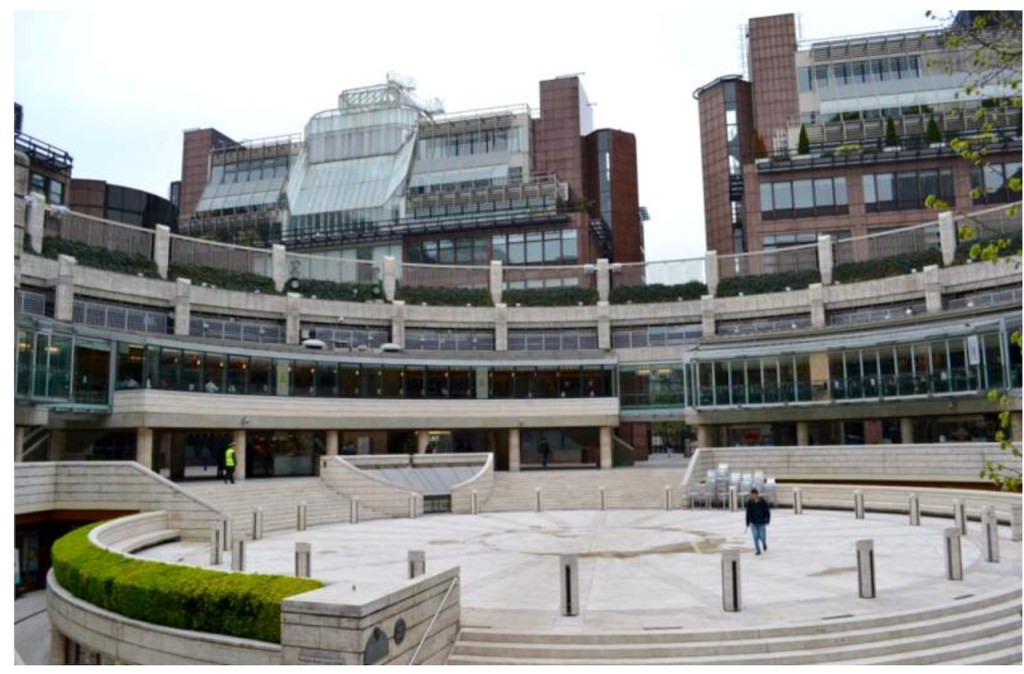
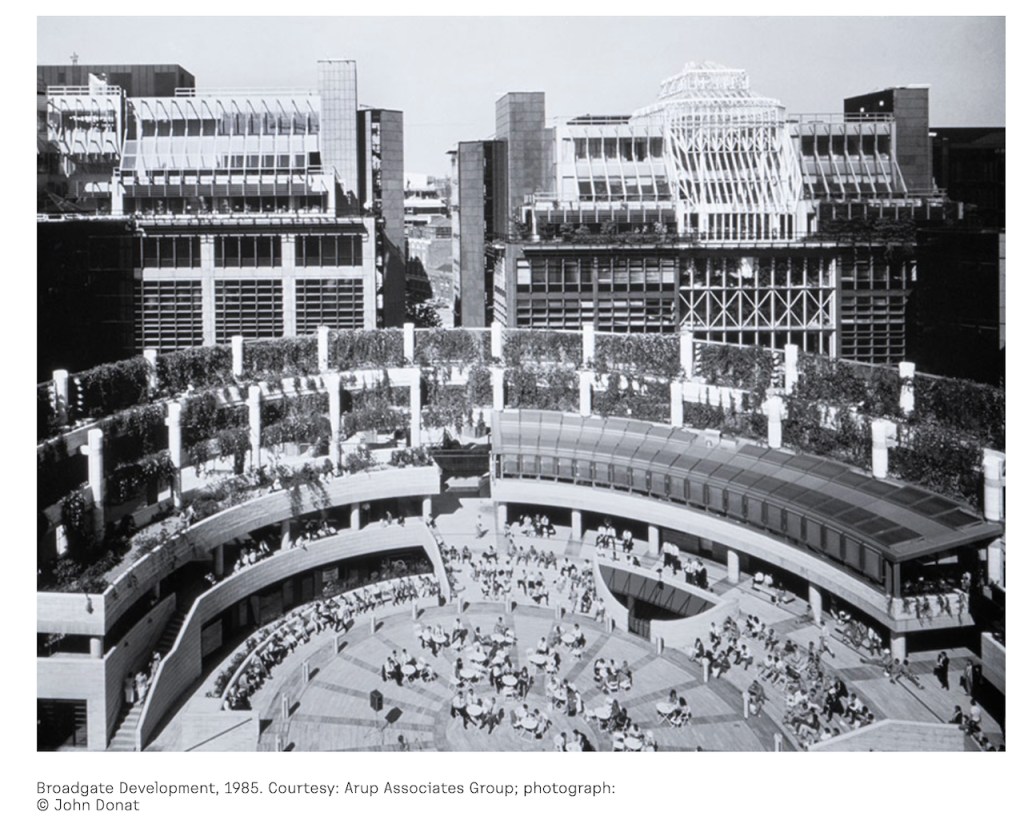
Broadgate Circle was constructed in 1985-7 on the site of the former Broad Street station. Here is what the 1980s buildings looked like:

4 and 6 Broadgate, on the North side of Broadgate Circle, before 2012.
From: https://knowyourlondon.wordpress.com/2015/09/14/broadgate-circle/

5 Broadgate, on the right of my sketch, replaced the two buildings in the photo above. It is occupied by the bank UBS. The building has its own Wikipedia page:

The two lowest storeys contain a 200-seat auditorium, restaurants, a gym, and a dry cleaner. Above those are four trading floors which can fit 3,000 people each, as well as seven storeys of offices above. The superstructure is divided into a grid of 13.5-by-12-metre (44 by 39 ft) sections, arranged around the trading floors. Three of the building’s four utility cores are placed along the site perimeter to increase the amount of space on each trading floor.

Wikipedia – https://en.wikipedia.org/wiki/5_Broadgate

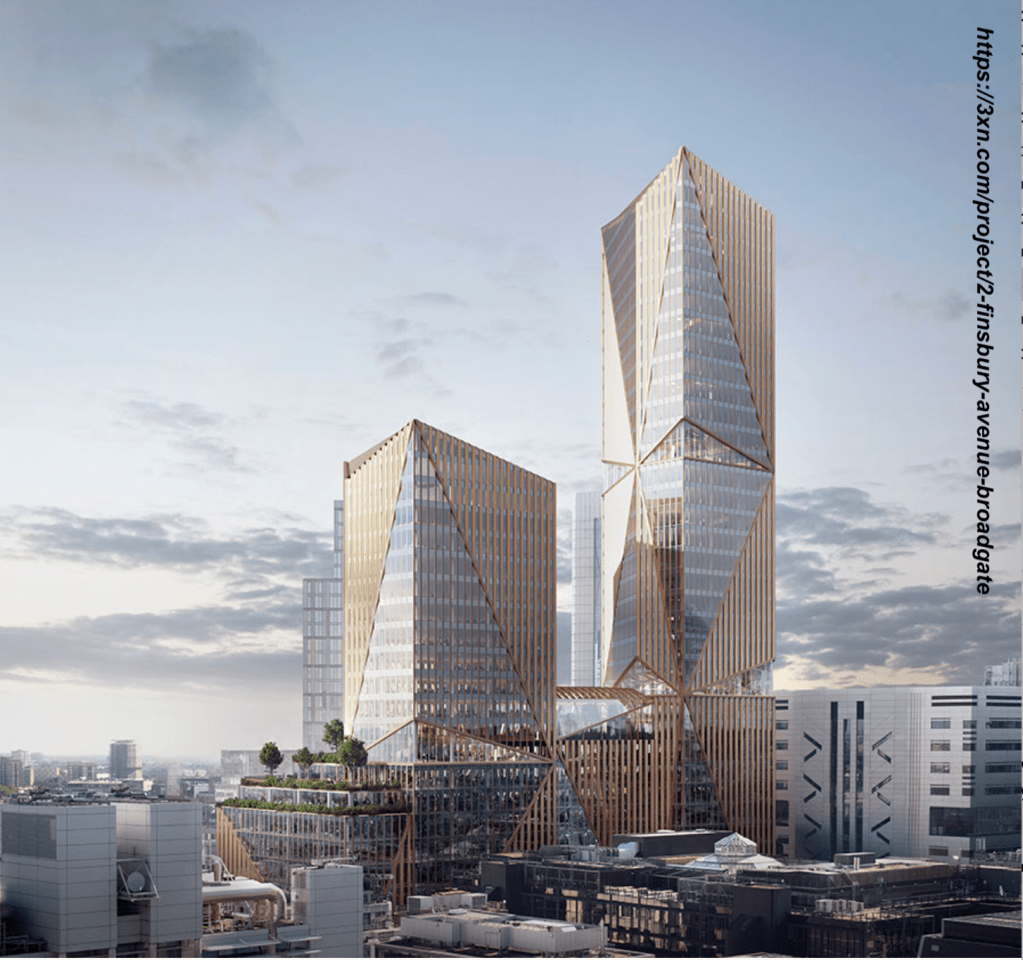
The new 2 Finsbury Avenue “consists of a 12-storey podium with a 21-storey West Tower and 36-storey East Tower.”1 It is due to be completed in 20272 and will look like this:

The new 2 Finsbury Avenue, from the website of the architects 3XN.
For scale: 5 Broadgate Circle is on the right of this picture, with the >< signs on the side.

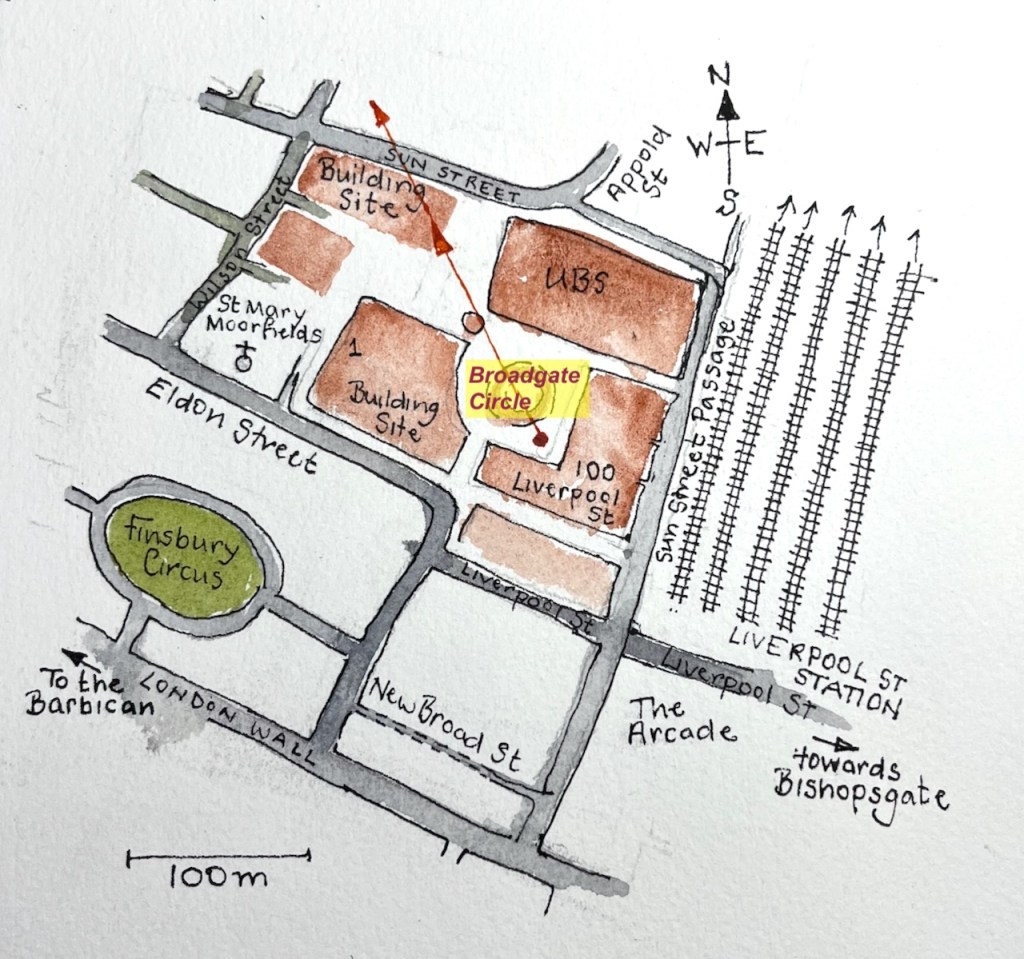
Broadgate Circle is owned as a joint venture between British Land and GIC3. It is adjacent to Liverpool Street Station on the East side of the City of London.

Sketch map showing the location of Broadgate Circle, and my viewing line for the sketch

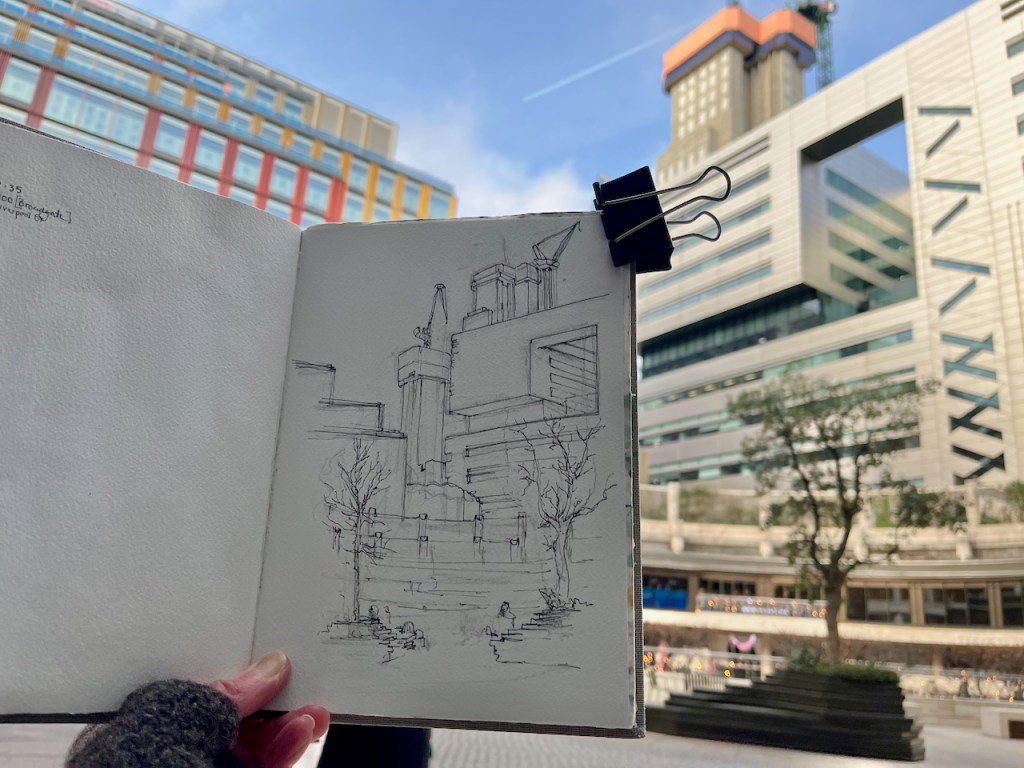
Here are photos while I was sketching:

Here are links to more views of the 1980s buildings:

Sketchbook 15
  1. Pictures and descriptions of the new 2 Finsbury Avenue are from the architects’ website: https://3xn.com/project/2-finsbury-avenue-broadgate ↩︎
  2. 18 April 2024 Press release from British Land and GIC. See the press release on this link, file attached below in case the link has expired. https://www.britishland.com/news/broadgate-secures-landmark-pre-let-at-2-finsbury-avenue/ ↩︎
  3. British Land is a UK property developer and GIC is “a leading global investment firm established in 1981 to secure Singapore’s financial future”. GIC is “the manager of Singapore’s foreign reserves” Quotes are from press release below. ↩︎

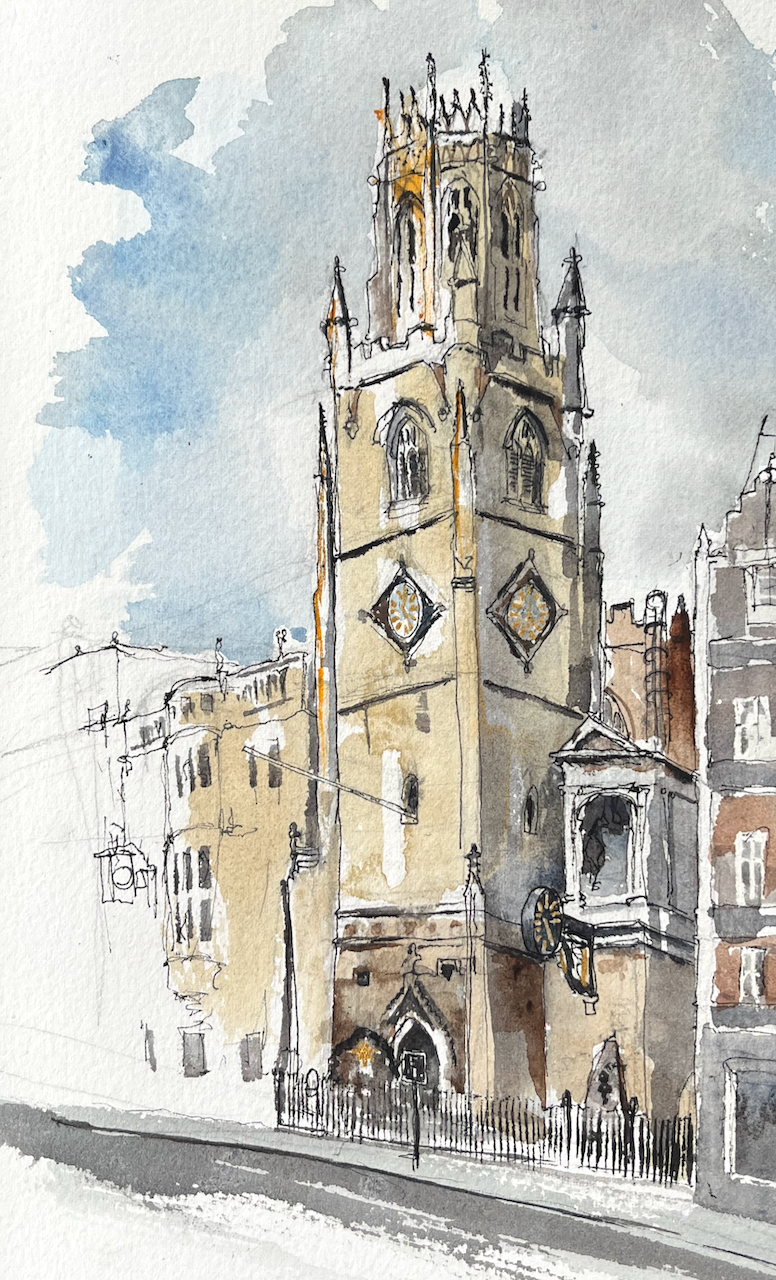
St Dunstan-in-the-West, Fleet Street, EC4

This church stands on Fleet Street, near the Royal Courts of Justice. It is set a little back from the road, so I had not really noticed it. But it is remarkable in many ways.

St Dunstan-in-the-West, 186a Fleet Street, sketched 31 Dec 2023, in Sketchbook 14

For one thing, the architect has used every possible ornate contrivance. It was impossible for this urban sketcher to do justice to the extraordinary details. The crocheted spires! The castellations! The geometry! The lacy top! The stonework above the door!

The geometry is interesting because the tower starts as a squarish-type shape at ground level, and then higher up there is an arrangement of planes which slice off the corners, turning it into an octagon at the top. At the higher part of the tower, the stonework is open so the sky is visible between the fine arches and spires.

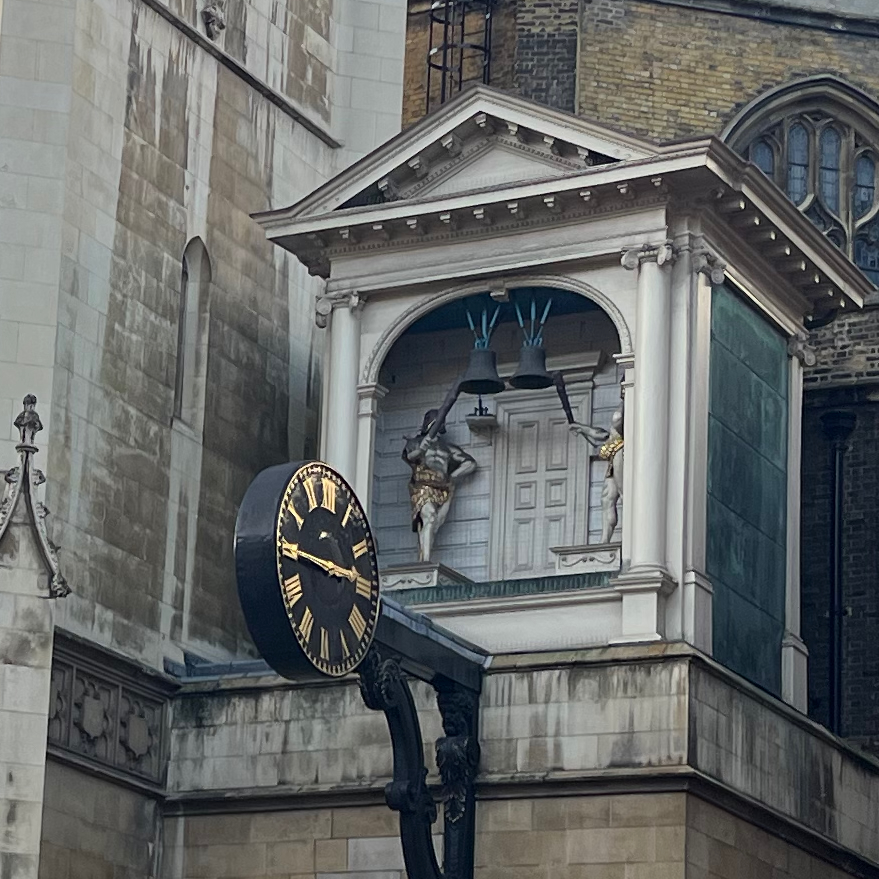
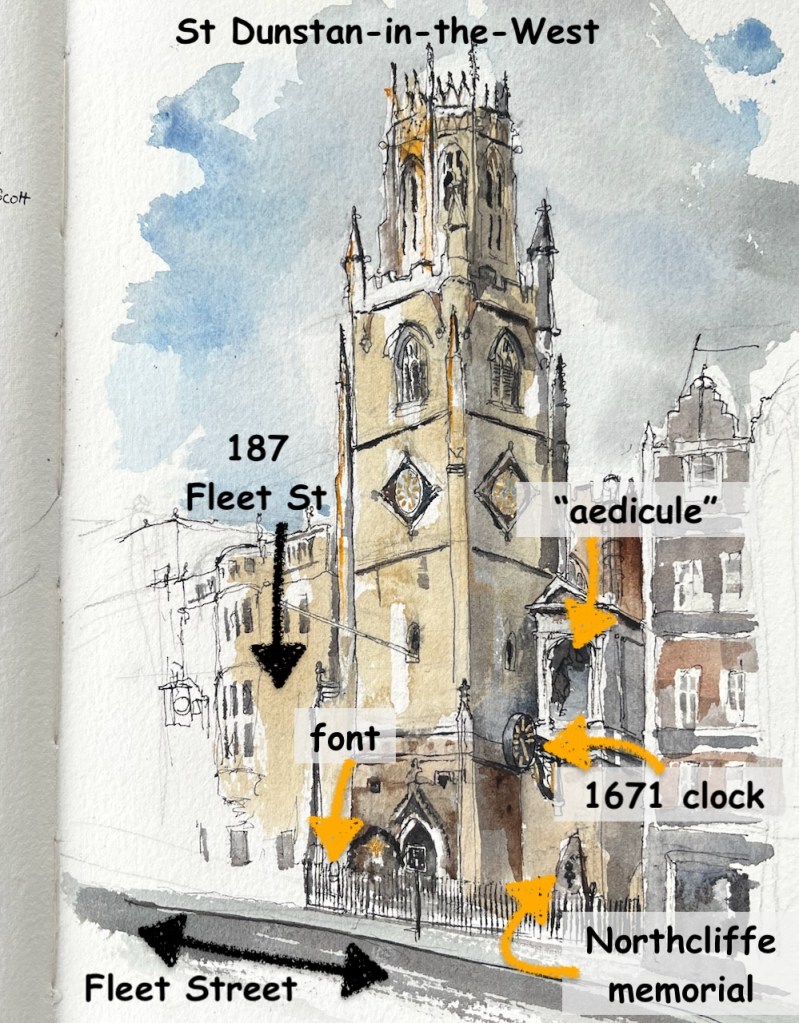
Then there are the clocks. There are two clocks on the tower, both showing the correct time. And there is another clock, also showing the correct time, suspended on a substantial wooden bracket below a little covered stage. Inside the stage are two muscular wooden figures, and two bells. The figures strike the bells every quarter hour. The little stage is described as an “aedicule” in Pevsner, who tells me that the clock was made in 1671.

The clock and the small covered stage (aedicule”), with wooded figures.

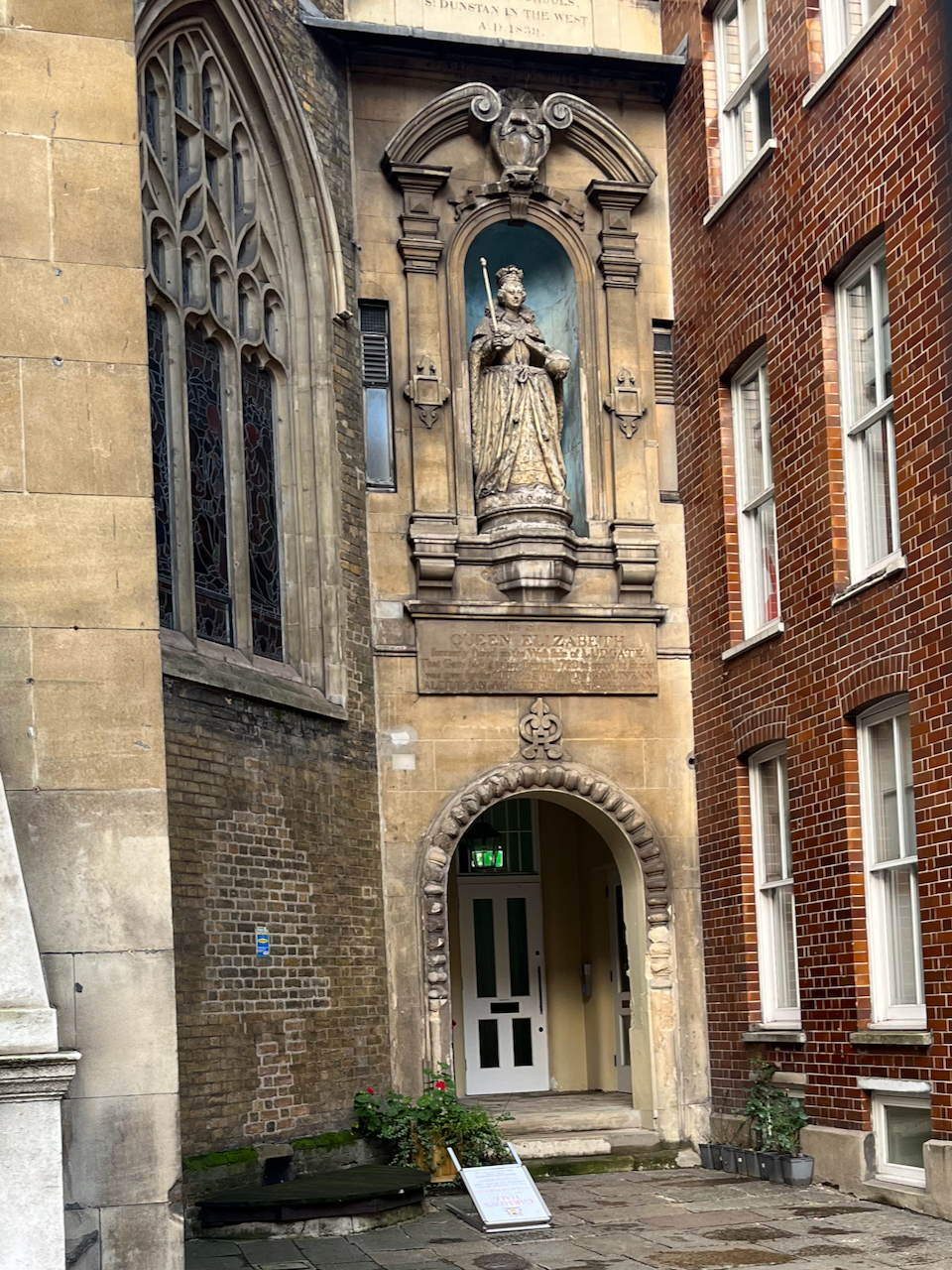
At ground level there is a rather austere monument: the bust of a man, on a plain triangular plinth, labelled simply “Northcliffe MDCCCLXV MCMXXII”. And behind that, above a door, a dusty statue, evidently very old, of Queen Elizabeth the First.

To the left of the church door there is a font set in to the fence. Round the edge, barely legible, it says “The gift of Sir James Duke Bart MP Ald of this ward”.

Next to the church, on its left, is a beautiful building, which is mysteriously empty and boarded up. This is 187 Fleet Street. It also has a clock, but this one did not show the correct time.

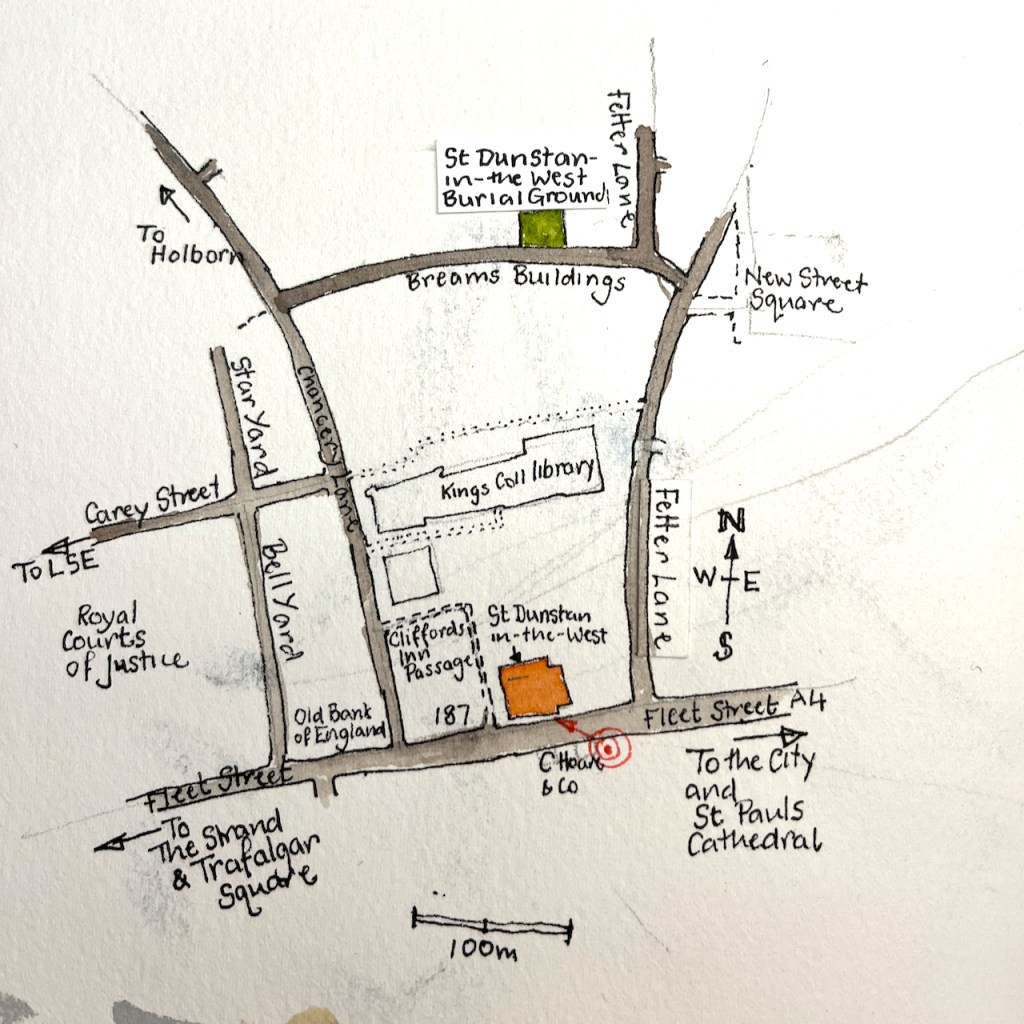
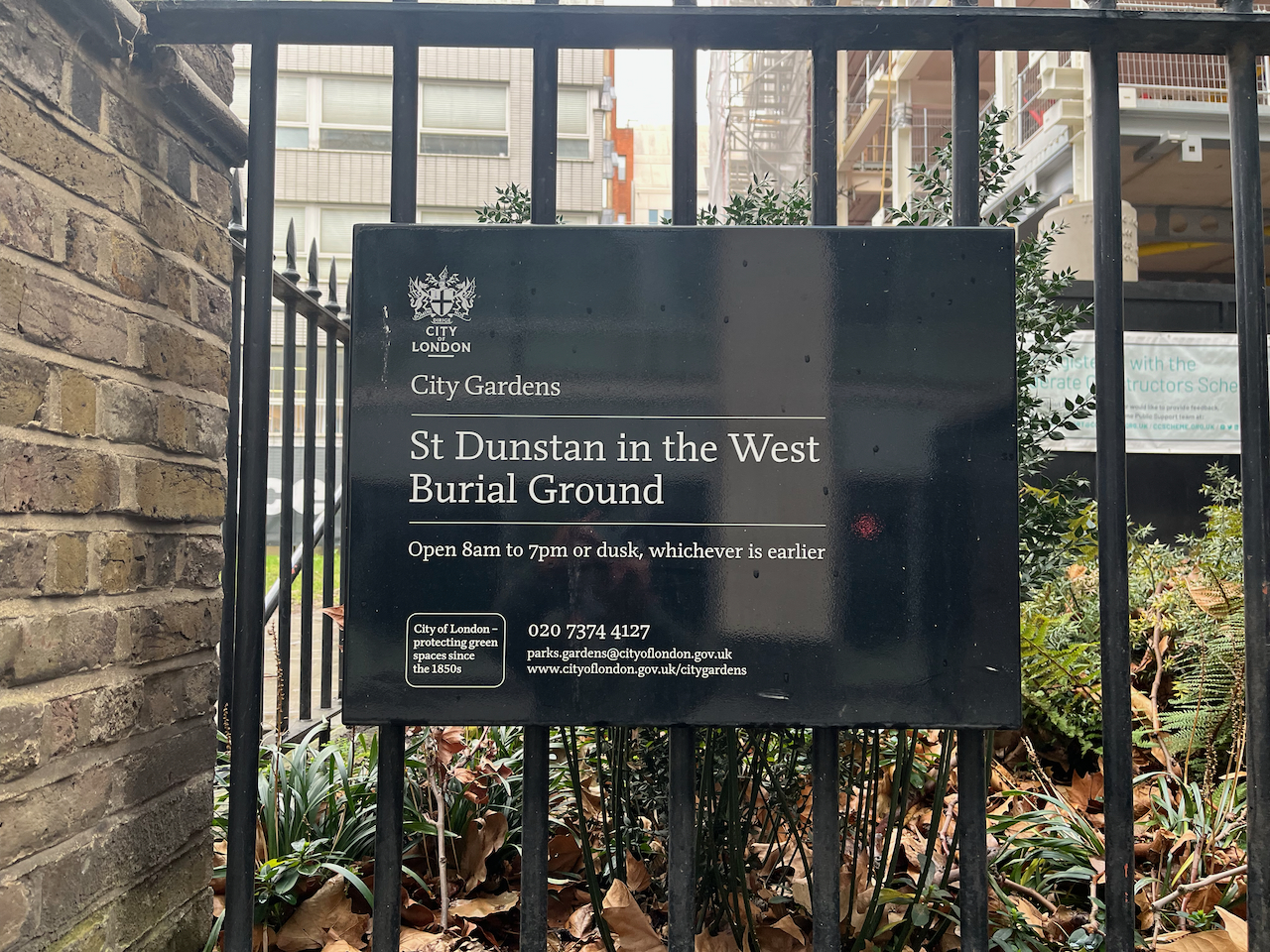
Another mystery: St Dunstan-in-the-West burial ground is some distance away to the north, on Breams Buildings, see map above.

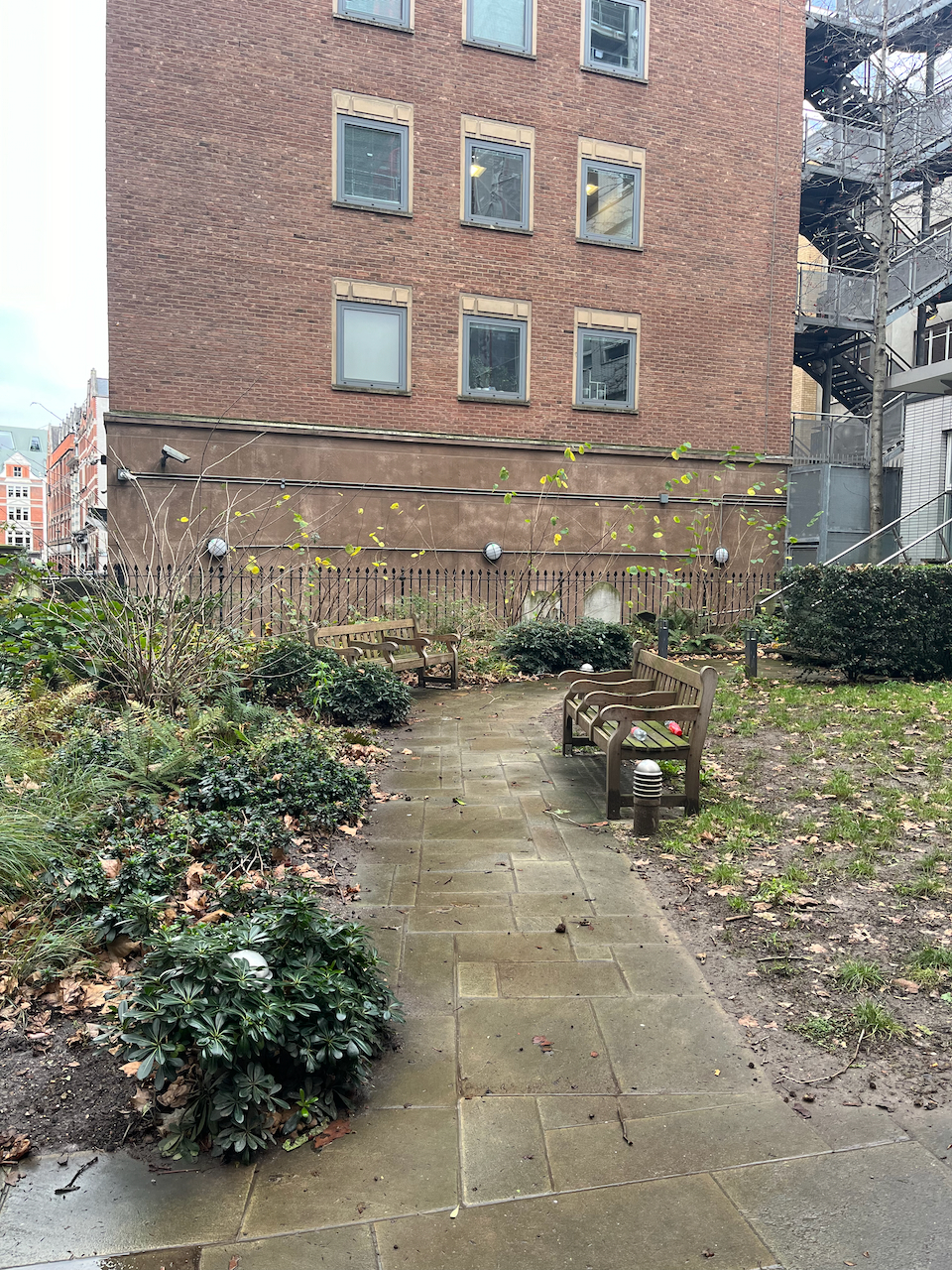
“IanVisits” has an article on the Burial Ground published in 2020. When he visited it was clearly in a better condition than it is now. On my visit, December 2023, the burial ground was litter-strewn and neglected, overshadowed by a building site to the East, and defiled by plastic advertising hoardings flapping on its north fence.

The current St Dunstan-in-the-West church was constructed in 1830-1832 to the designs of John Shaw senior, and completed by his son, also John Shaw. This building replaced a much older one. The church website says:

“It is not known exactly when the original church was built, but it was between 988 and 1070 AD. It is not impossible that St Dunstan himself, or priests who knew him well, decreed that a church was needed here.”

It is an active Anglican church, open during the week, with services on Sundays, according to the notice on the door. The building also hosts the Romanian Orthodox Church.

Northcliffe, it turns out, was quite a character. He was a press baron, founder of the Daily Mail, and promoter of popular journalism. He launched the Daily Mail in 1876. At a time when newspapers were mostly intended to be serious reading, Northcliffe realised the potential of offering “entertainment” and “diversion”:

Hamilton Fyfe, a trusted contributor [to the Daily Mail], recalled that ‘the Chief’ wanted the Daily Mail to ‘touch life at every point … He saw that very few people wanted politics, while a very large number wanted to be entertained, diverted, relieved a little while from the pressure or tedium of their everyday affairs.’

Bingham, Adrian: “‘The Original Press Baron: The Role and Legacy of Lord Northcliffe.” Daily Mail Historical Archive 1896-2004. Cengage Learning, 2013

Northcliffe gradually built up his empire, acquiring the The Times and other newspapers. By 1914 he controlled 40% of the morning newspaper circulation, 45% of the evening and 15% of the Sunday circulation in Britain (Wikipedia). A fascinating article by Jessica Kelly of Cardiff University says that, due to Northcliffe’s influence, “politicians of the age sought his approval and support during this most uncertain and unpredictable of times”. Northcliffe publications advocated war against Germany. Once war was declared, they were a “solidifier of British public opinion behind a total war”. The author of this article makes a striking comparison between Rupert Murdoch today, and Northcliffe in the Edwardian era.

Lutyens designed the obelisk for the Northcliffe Memorial in St Dunstan-in-the-West, and the bust is by Kathleen Scott. (Pevsner)

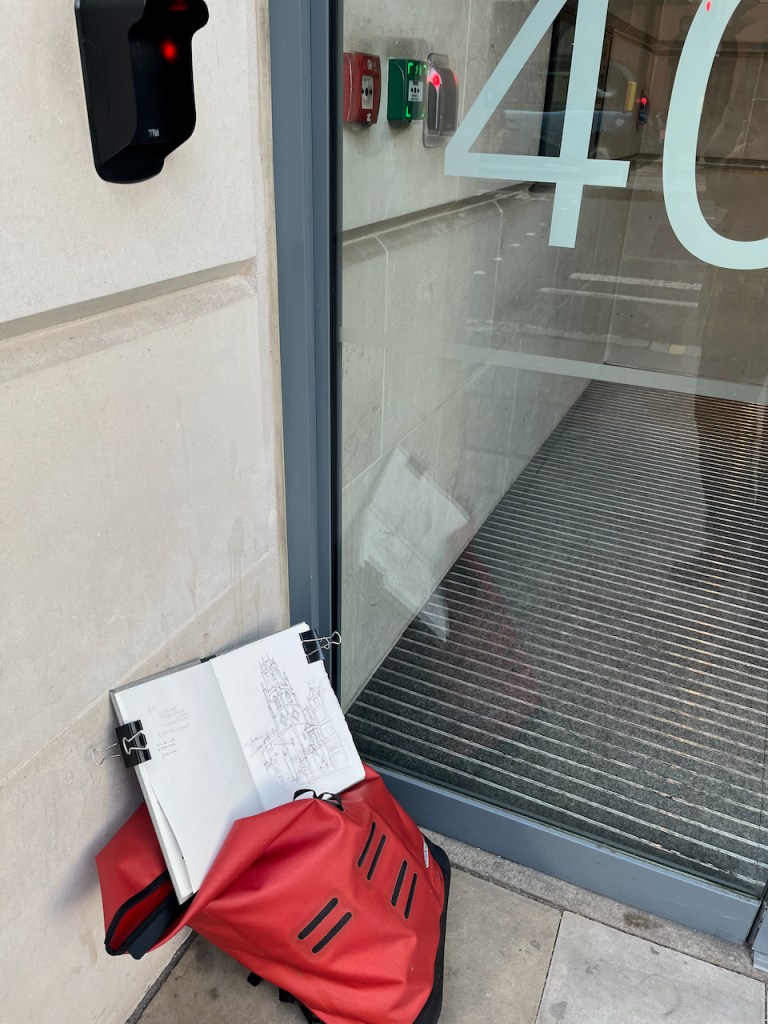
I sketched the church standing on the other side of Fleet Street, near the office of C Hoare and Co, bankers. The church was closed when I visited, but I shall certainly go back and have a look inside during its opening hours.

References

“The Buildings of England, London 1: The City of London, by Simon Bradley and Nikolaus Pevsner (1999 edition)” page 214

“Lord Northcliffe – The Press baron at the heart of World War One”, 8 June 2016 by Jessica Kelly. https://blogs.cardiff.ac.uk/musicresearch/lord-northcliffe-the-press-baron-at-the-heart-of-world-war-one/

Bingham, Adrian: “‘The Original Press Baron: The Role and Legacy of Lord Northcliffe.” Daily Mail Historical Archive 1896-2004. Cengage Learning, 2013 https://www.gale.com/intl/essays/adrian-bingham-original-press-baron-role-legacy-lord-northcliffe

St Botolph-without-Bishopsgate, EC2

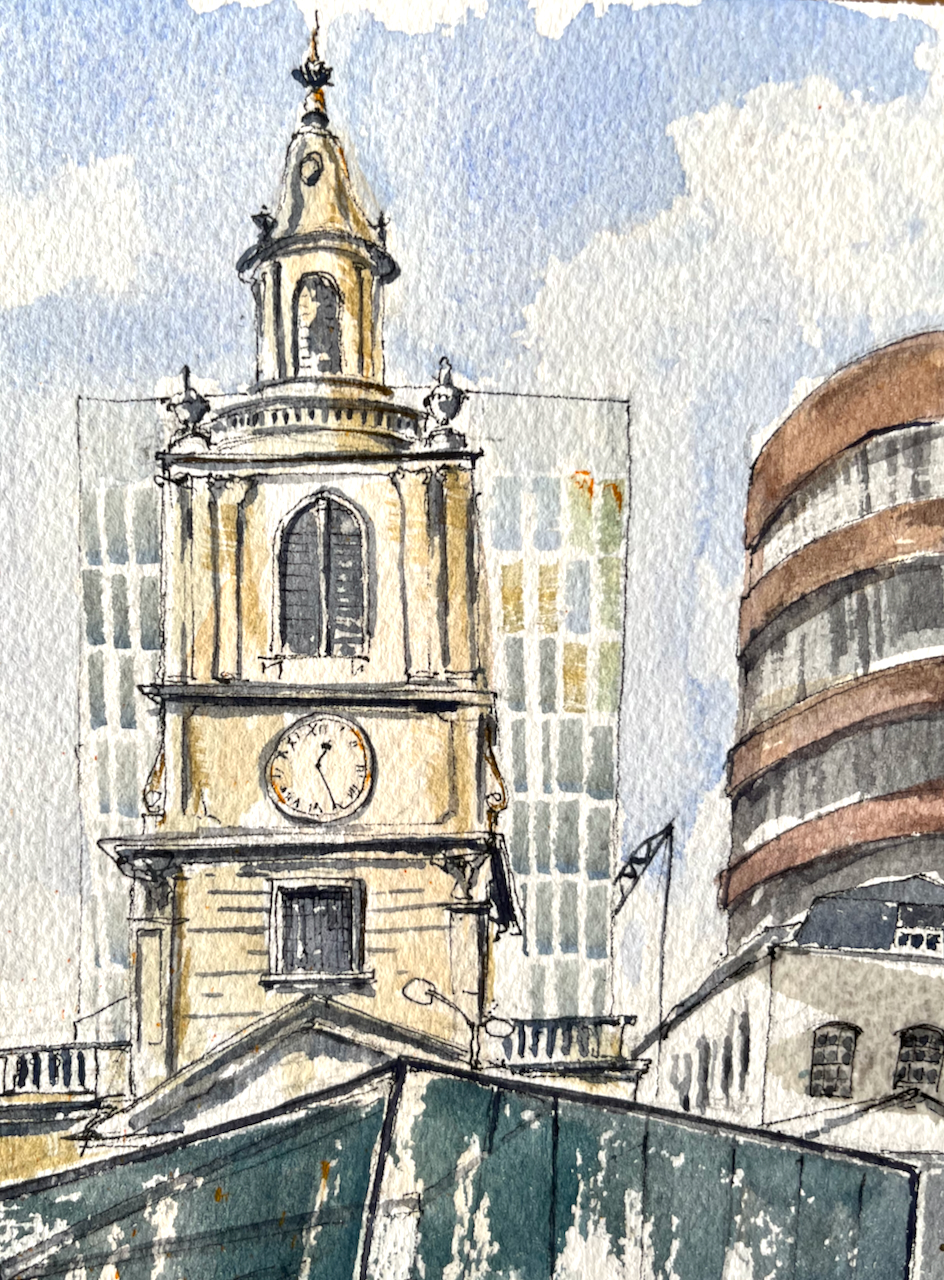
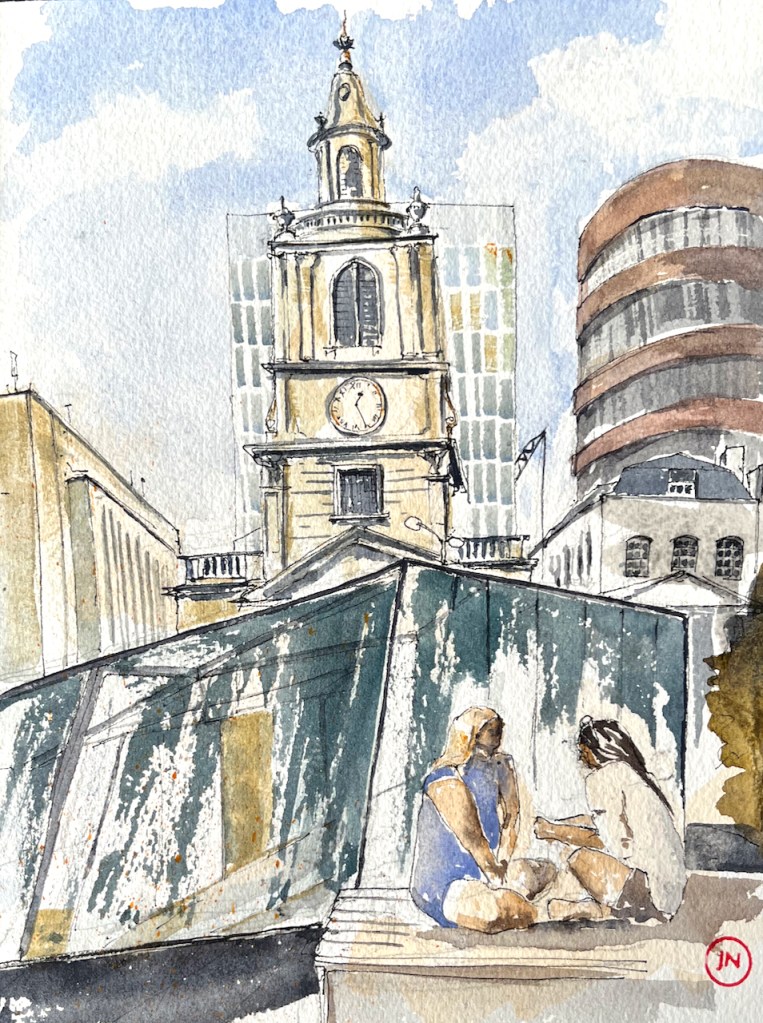
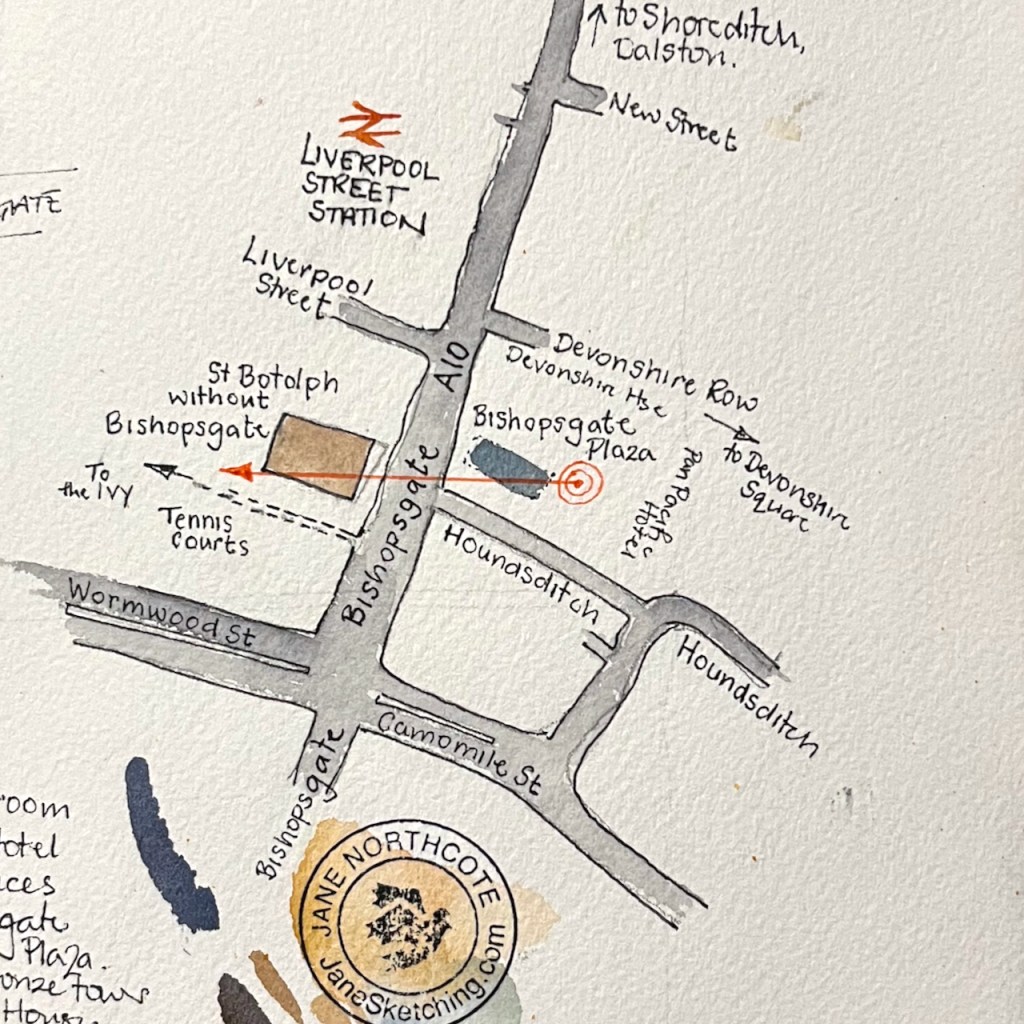
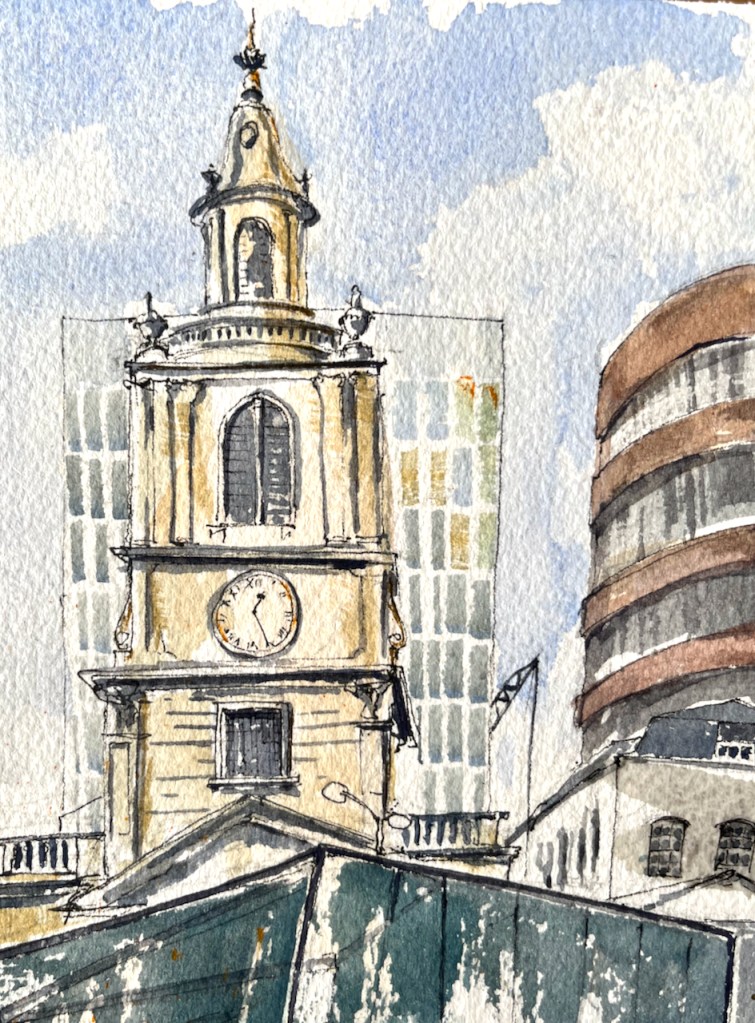
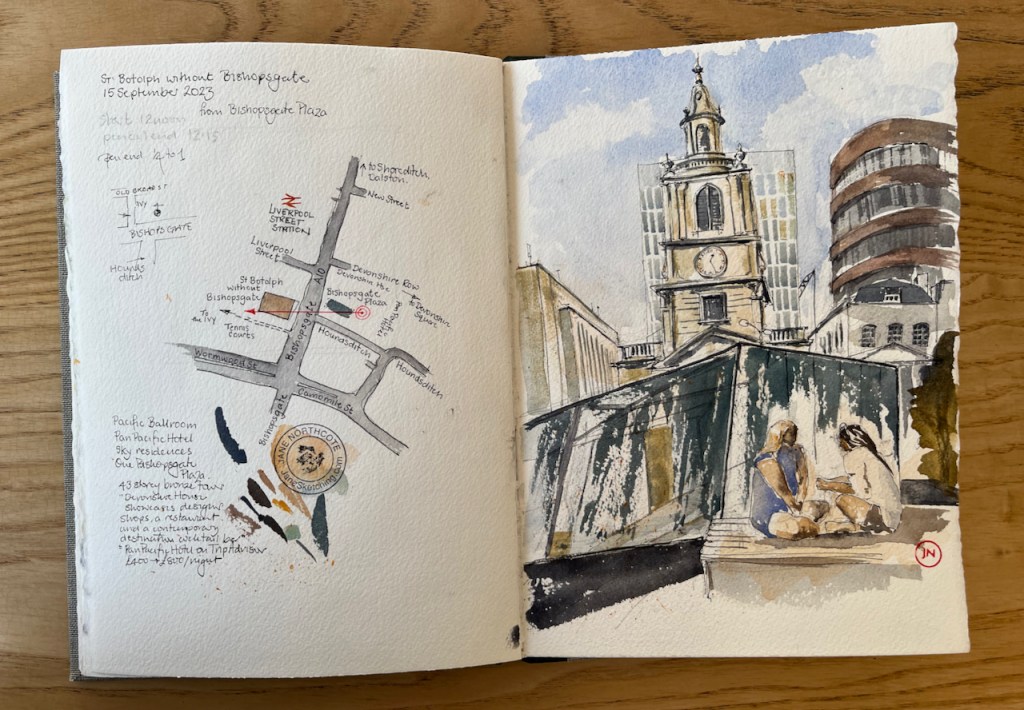
Bishopsgate Plaza is on the East side of Bishopsgate, near Liverpool Street. From the seats there, here is the view of St Botolph-without-Bishopsgate. I sketched amongst the many people enjoying the sun at lunchtime.

St Botolph-without-Bishopsgate, EC2. 15th September 2023, 1pm. 10″x 7″ in sketchbook 13

The current church was constructed in 1729, to the designs of James Gould. There has been a place of Christian worship on this site since Roman times. The parish registers are complete from 1558 according to the church’s website.

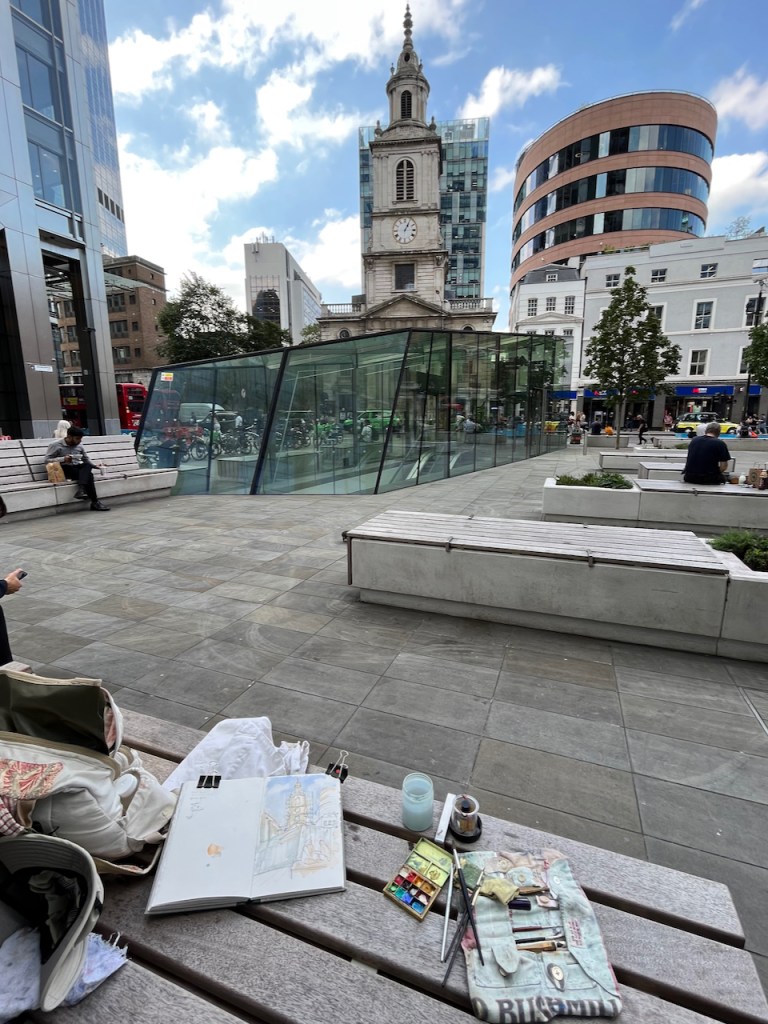
Viewed from Bishopsgate Plaza, the church is all but submerged in the surrounding buildings. The large glass structure is the entrance to the “Pacific Ballroom”. This is part of the Pan Pacific Hotel, which was behind me as I sketched.

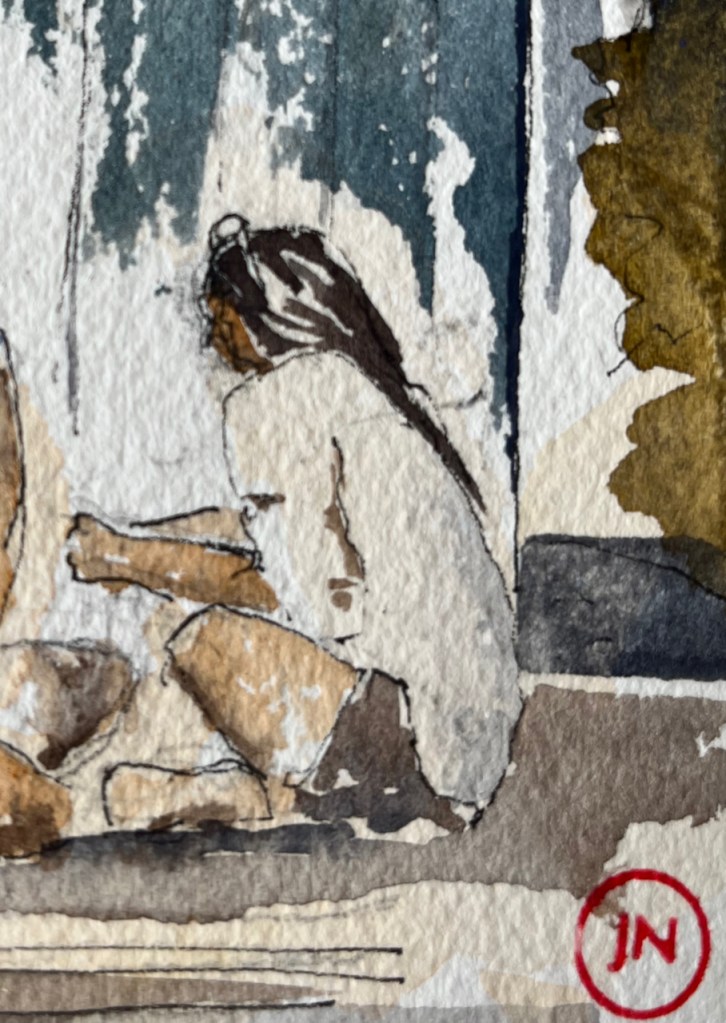
I find it quite hard to draw people, but I wanted to include the discussion between the two women. Their lively conversation contrasted with the stillness of the church, and the enormity of the buildings all around. They created a little private world between themselves.

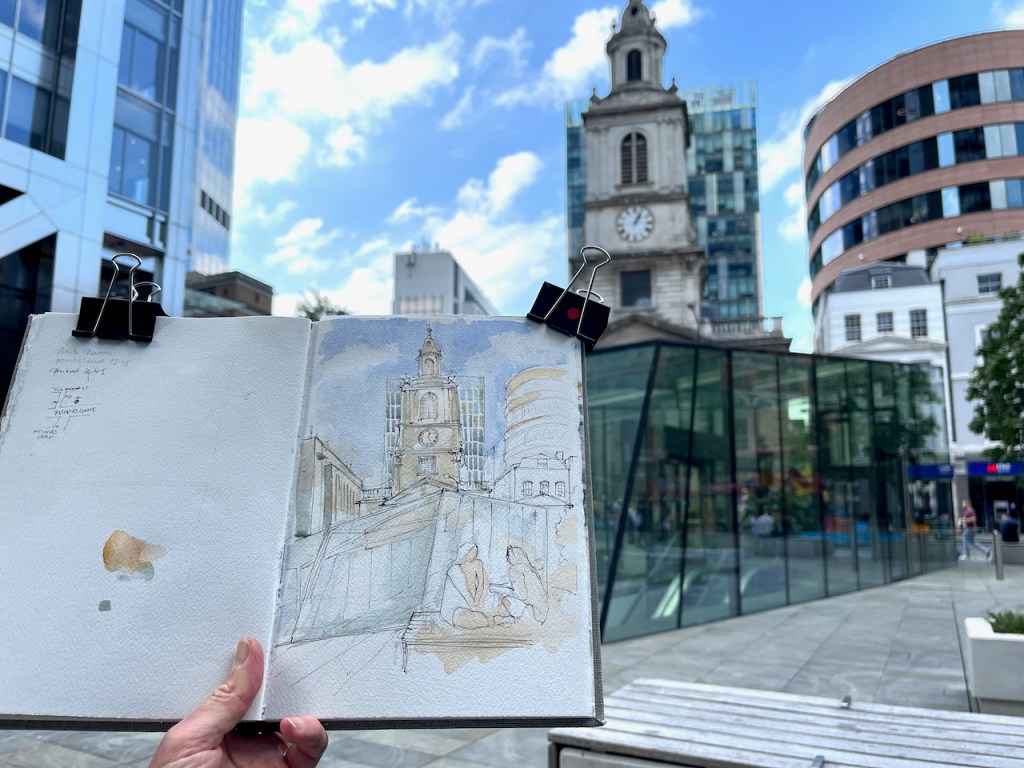
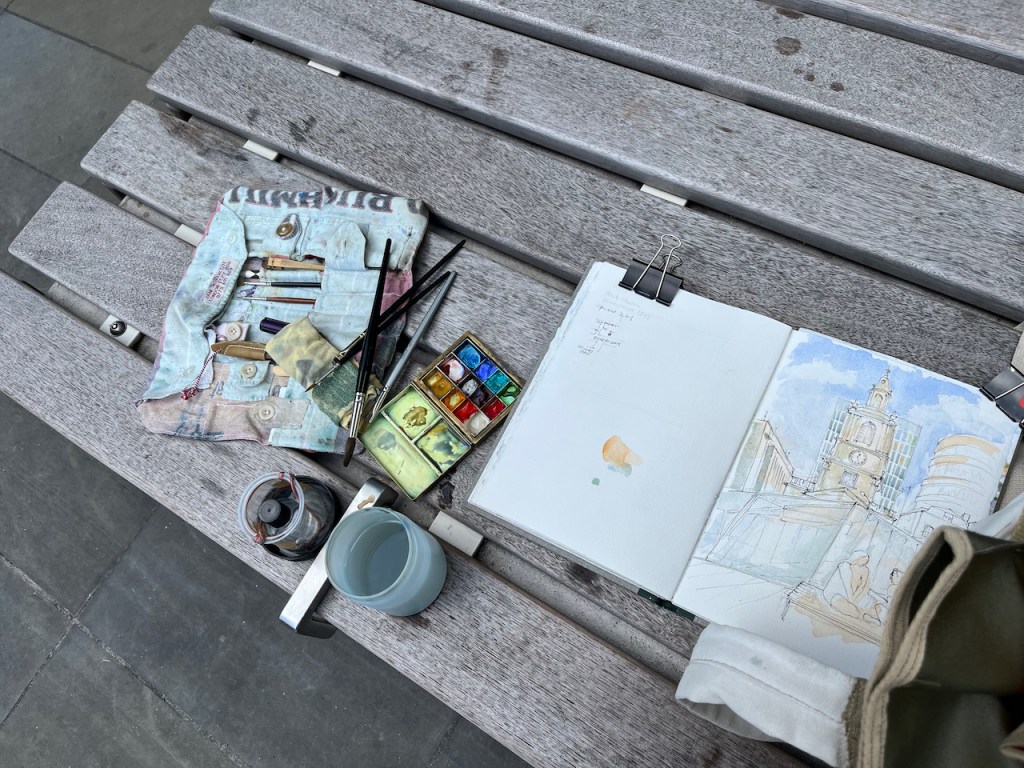
Here is work in progress on the sketch:

4 St Michael’s Alley, MacAngus & Wainwright, EC3

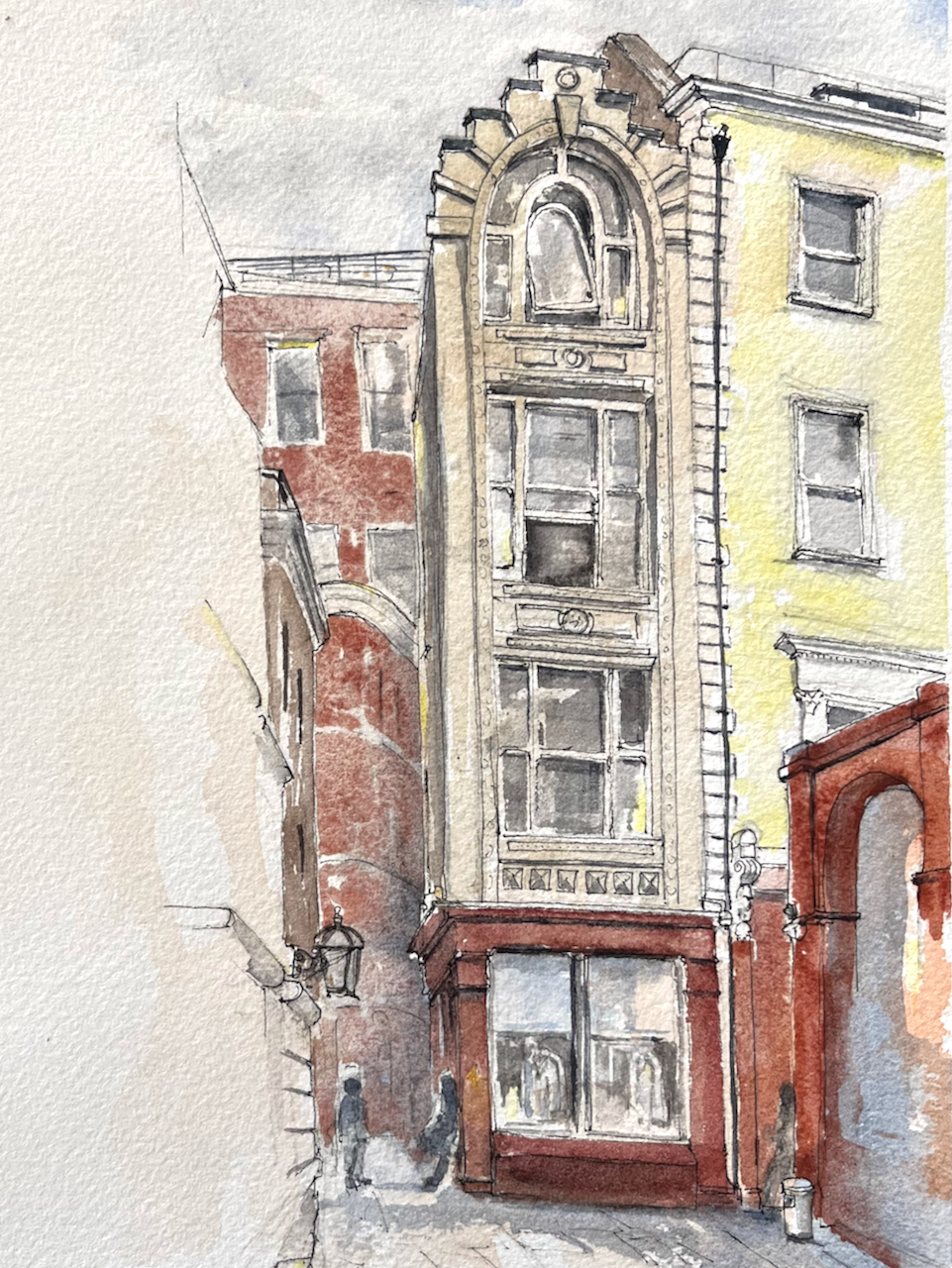
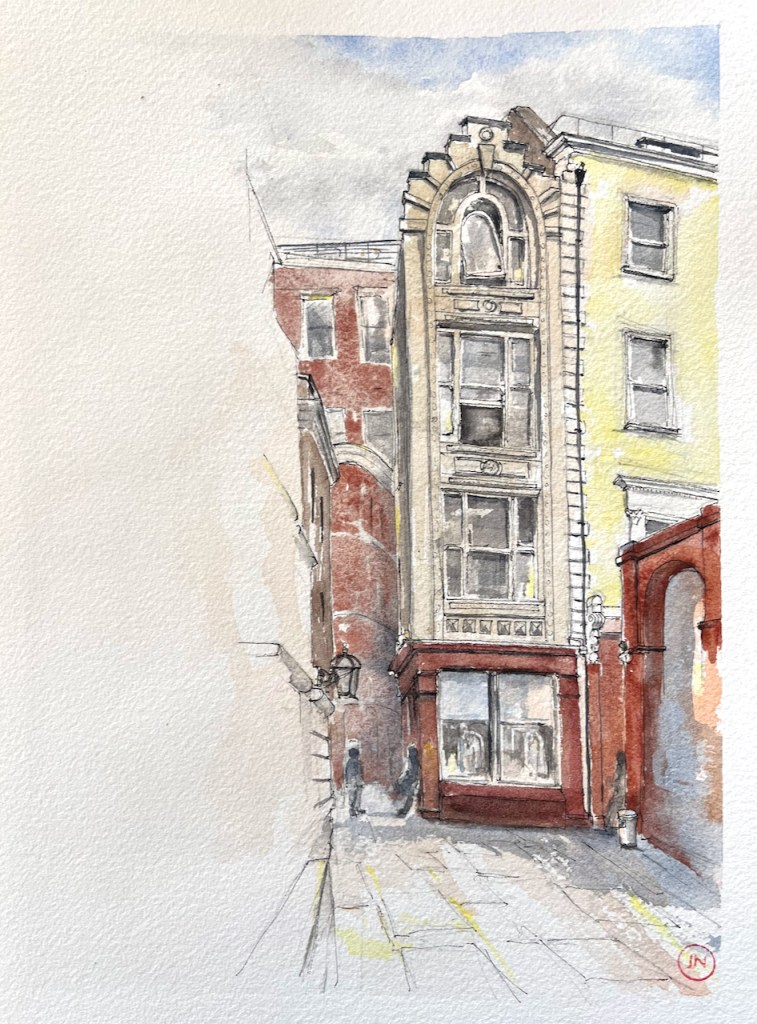
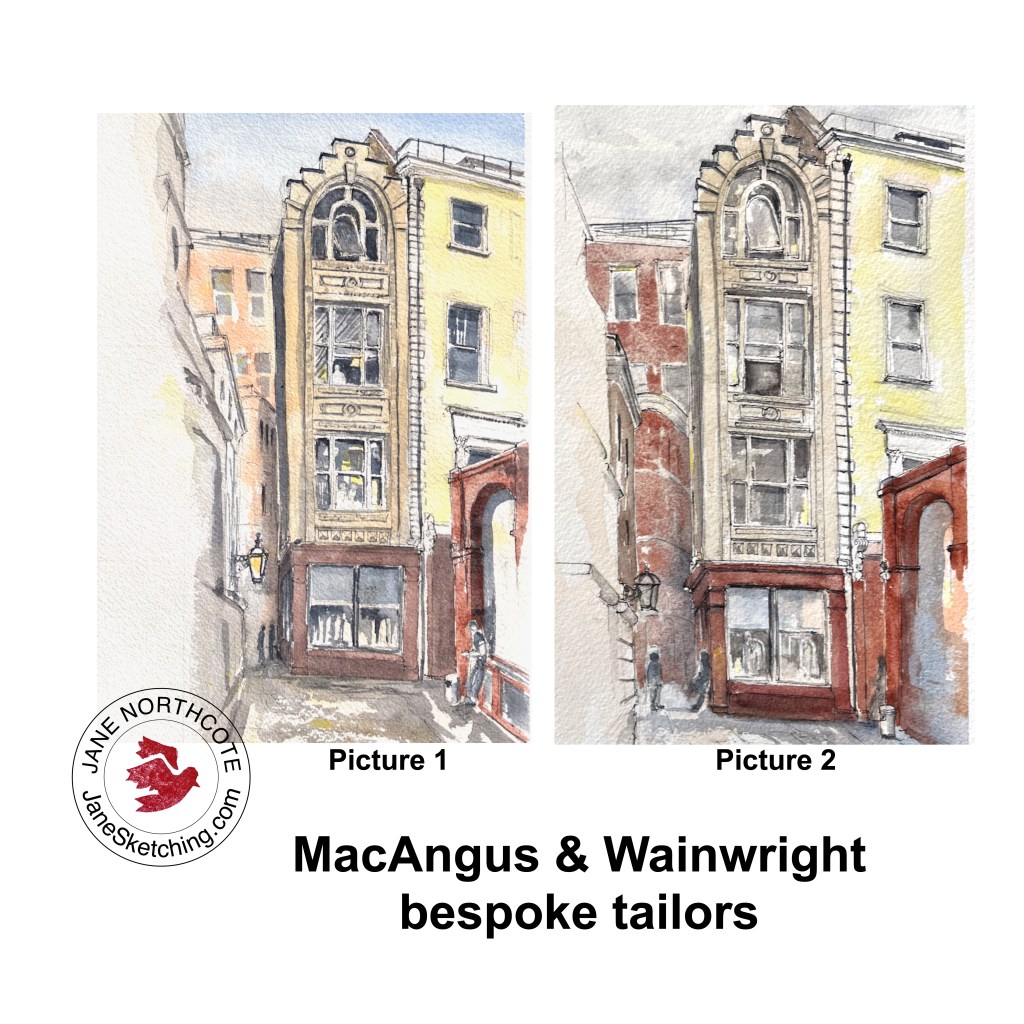
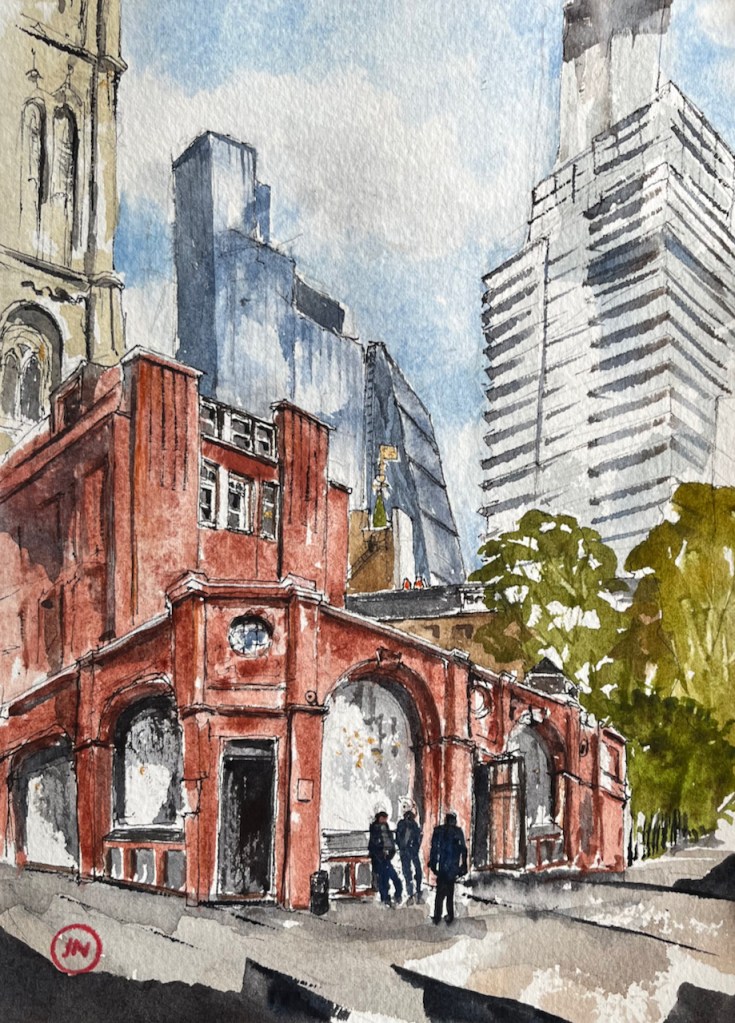
Here is 4 St Michael’s Alley, City of London, EC3, the premises of MacAngus & Wainwright, bespoke tailors. Their business uses all the floors. Above the ground floor showroom are the fitting room, workroom and cutting room.

4 St Michael’s Alley, London EC3, the premises of MacAngus & Wainwright, bespoke tailors.

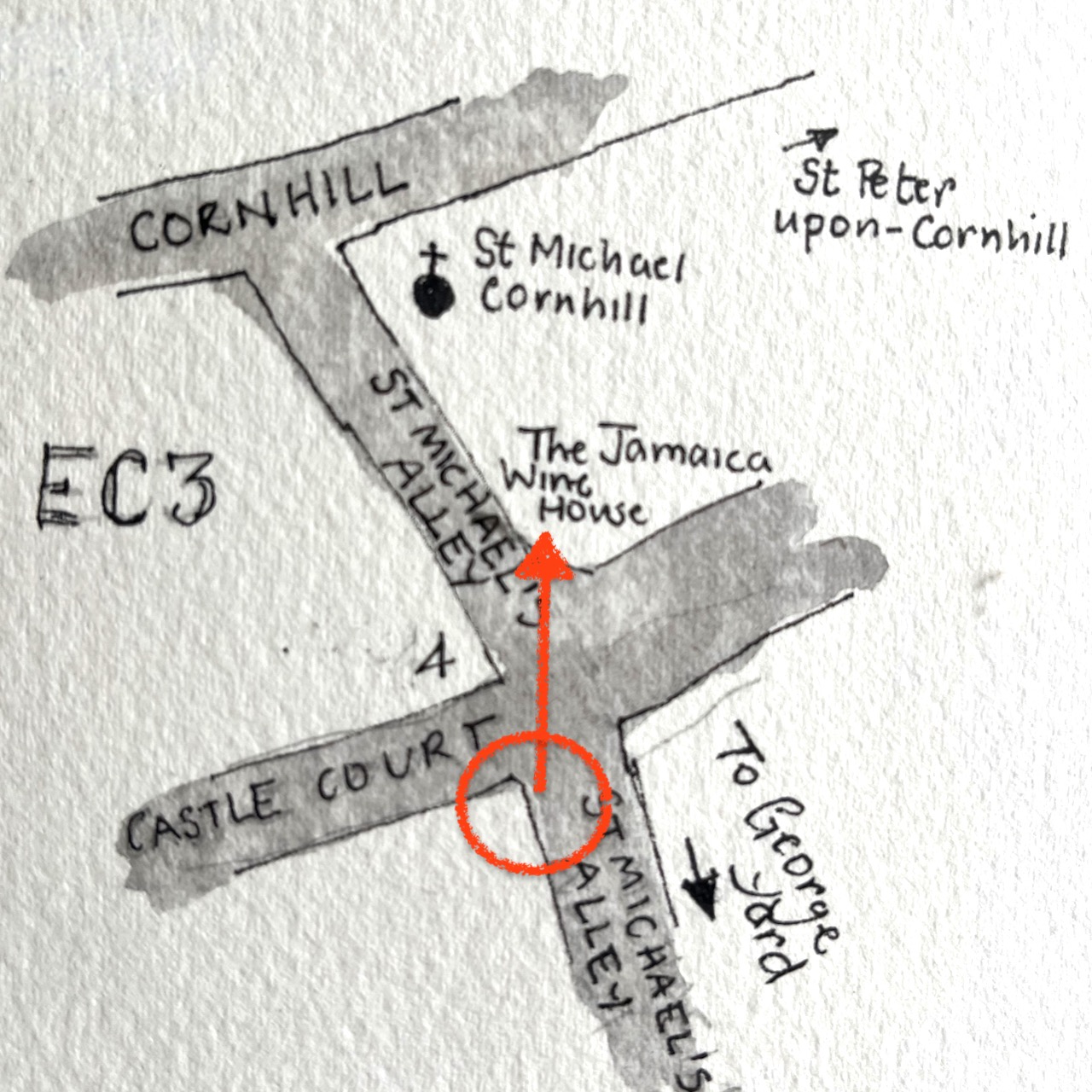
The shop is just off Cornhill, near Bank in the City of London and right next to the Jamaica Wine House which I sketched previously. You can see a bit of the Jamaica Wine House on the right of my sketch. The prominent lamp is outside the “George and Vulture” pub, which is hidden on the left.
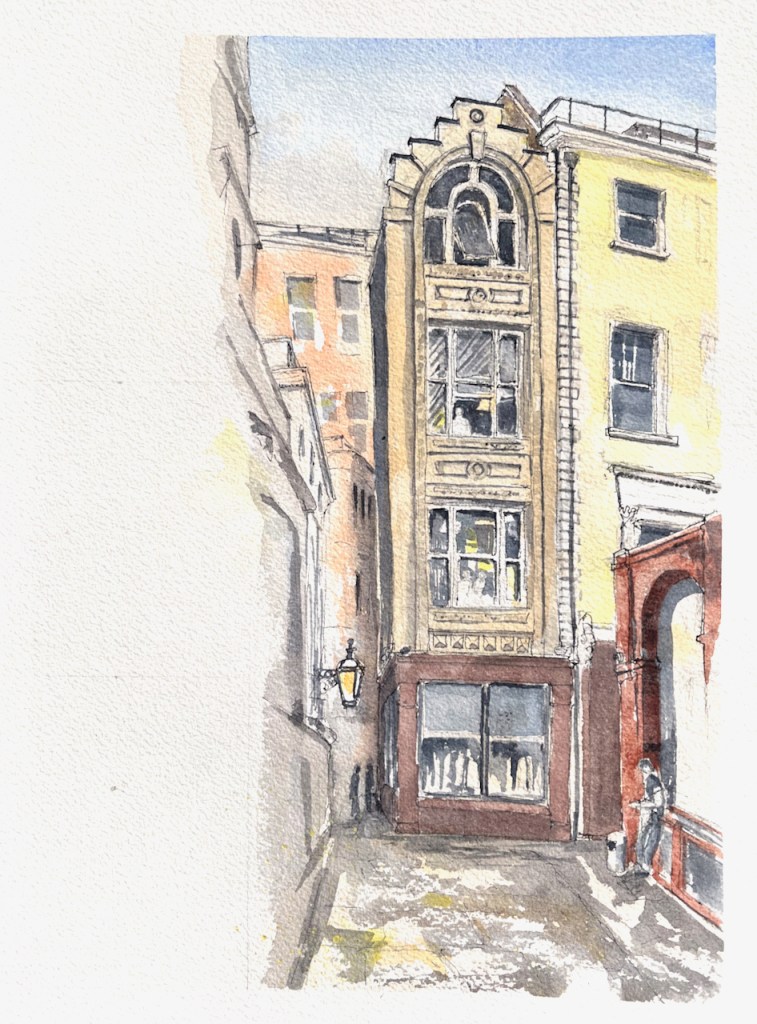
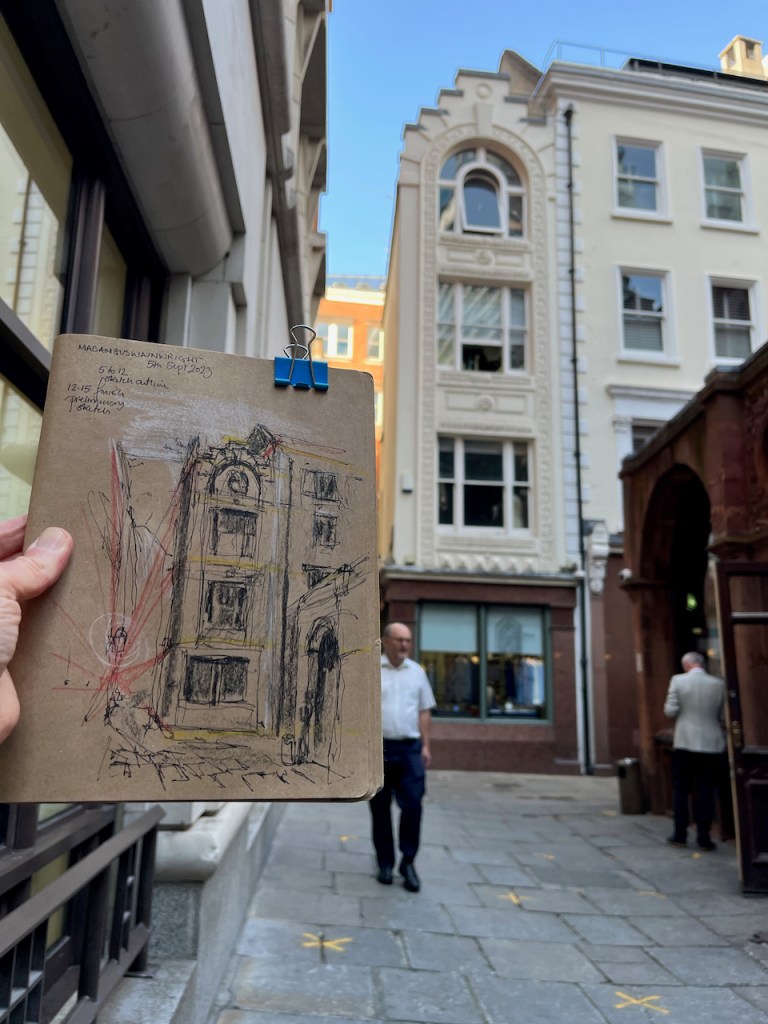
I made two pictures of this building, on different days and from slightly different angles. Here is the other one:

4 St Michael’s Alley, London EC3, the premises of MacAngus & Wainwright, bespoke tailors.

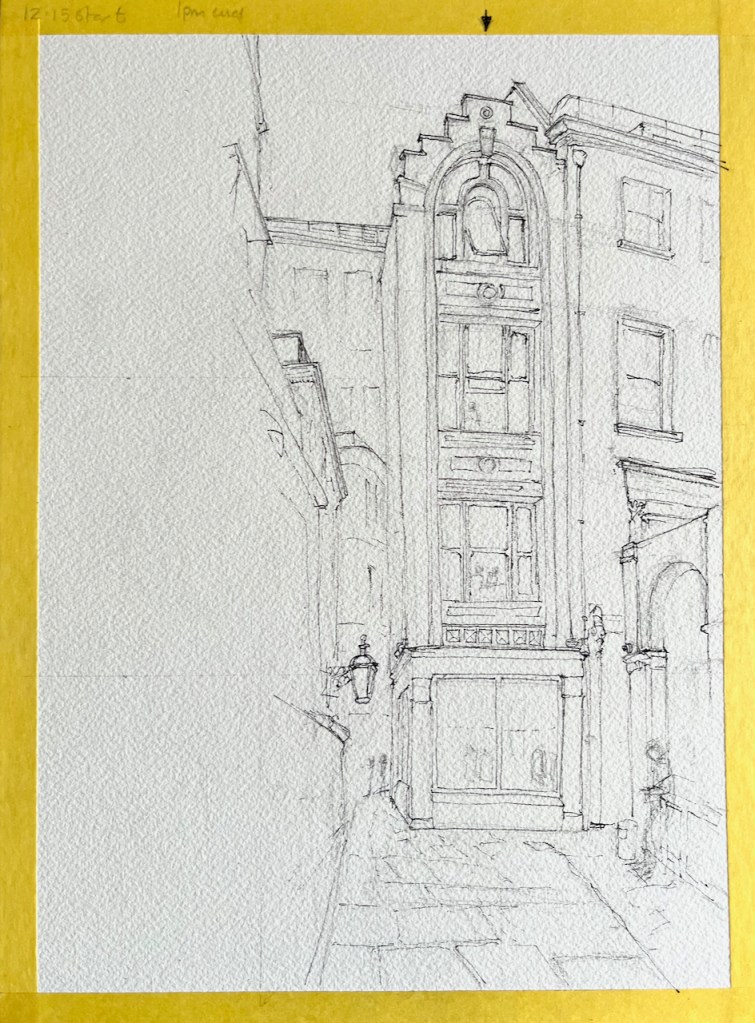
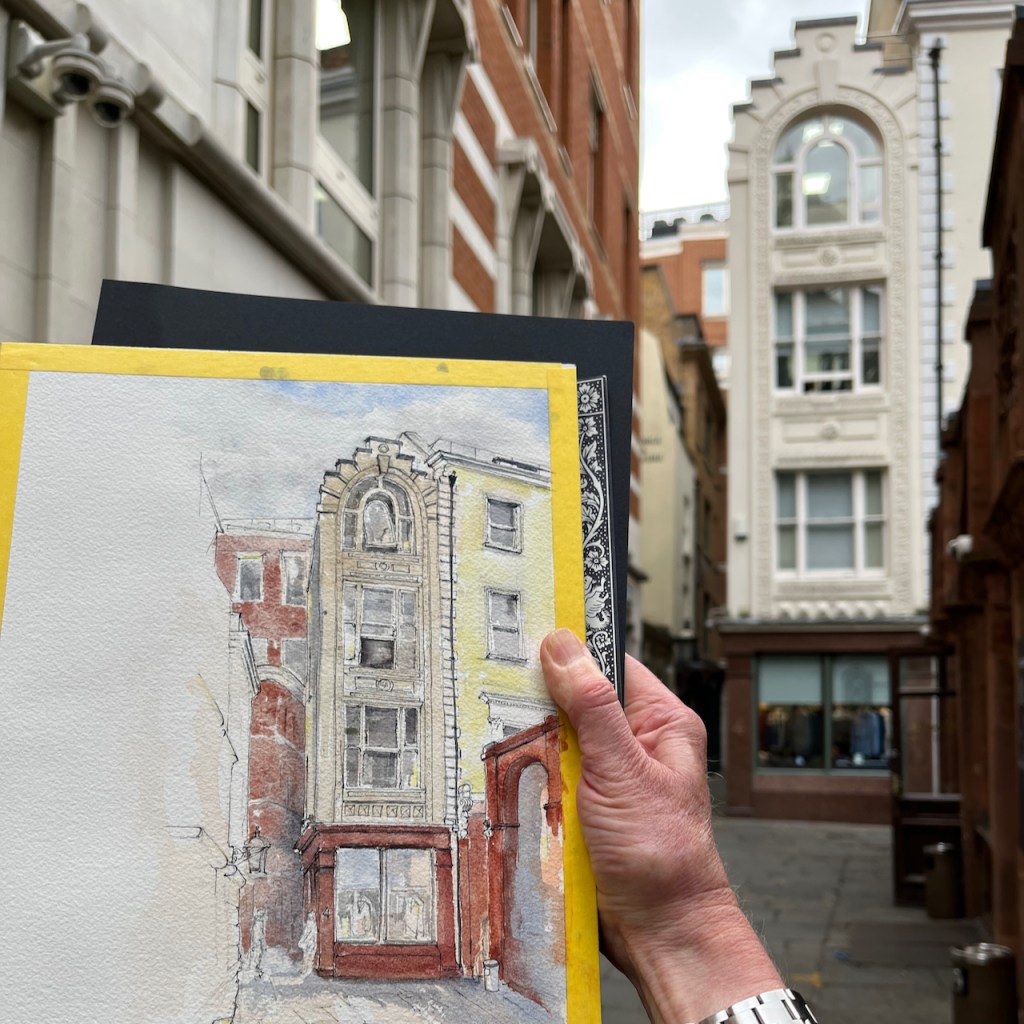
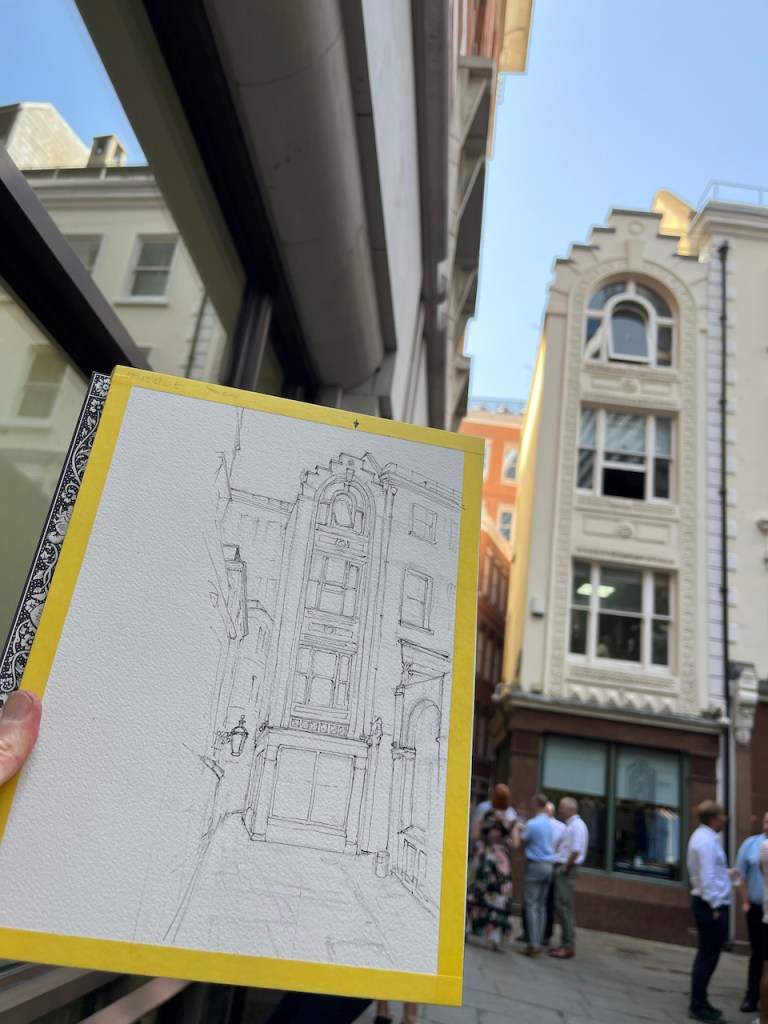
Here is work in progress on the drawings.

A succession of tour guides took their groups into the alley in the centre of my picture. This is Castle Court. These alleys apparently feature in Charles Dickens stories. Since J.K Rowling was inspired by the novels of Charles Dickens, there’s also a Harry Potter angle. I overheard this in fragments of tour guide talks. I don’t know if it’s true.

I started sketching in the late morning. This was the time for tour guides. Later, starting from about 1pm, the courtyard became populated by drinkers at the Jamaica Wine House. They were polite people, helpfully stepping aside and congregating on the other side of the alley, so they did not block my view.

The drawings are on Arches Aquarelle 12″ x 7″ 300gsm cold-pressed watercolour blocks, using Daniel Smith paints. The colours are:

Blues: Ultramarine Blue, Lavender, Cobalt Teal Blue

Yellows: Mars Yellow. The house on the right at the back is mostly Nickel Titanate Yellow. It was quite a hard colour to match.

Browns: The tailors building is a mix of Buff Titanium with Mars Yellow. The Jamaica Wine House and other buildings are Fired Gold Ochre, with a bit of transparent Pyrrol Orange.

All blacks and greys are a mix of Ultramarine Blue and Burnt Umber.

The pen drawing is De Atramentis Document Black ink in a Lamy Safari Fountain pen, fine nib.

The Jamaica Wine House, EC3

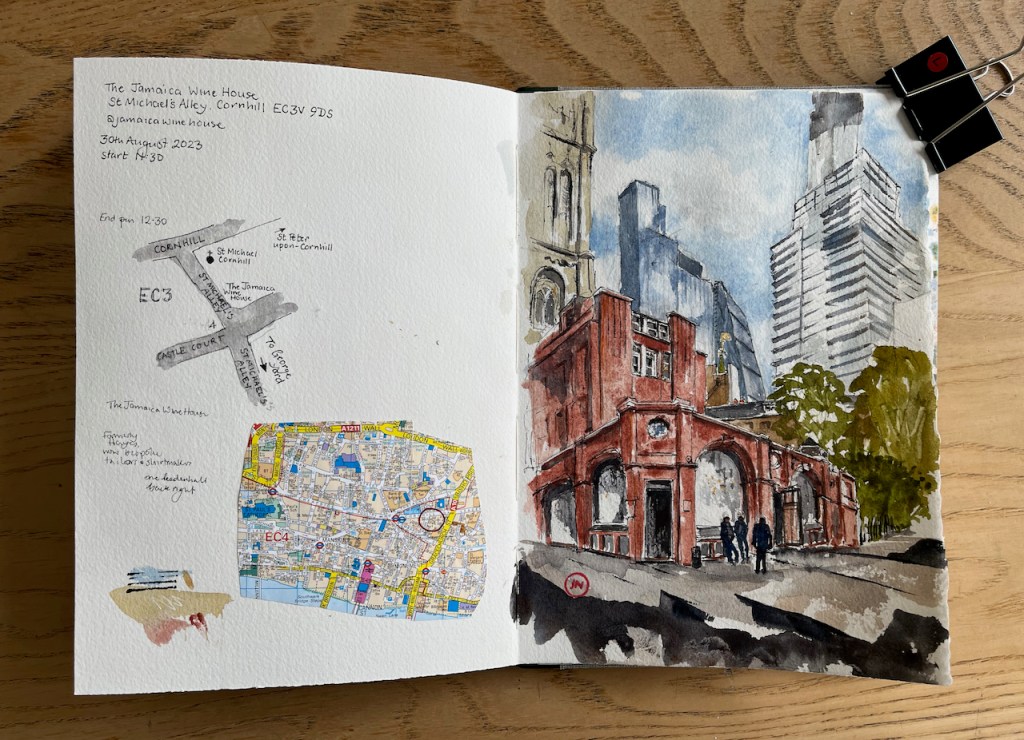
I walked through the City lanes towards London Bridge and passed by the Jamaica Wine House embedded, as it seemed, in a canyon amongst towers.

Jamaica Wine House, 12:30pm 30th August 2023 in Sketchbook 13.

The Cheesegrater and 22 Bishopsgate are the office blocks in the left background and One Leadenhall is under construction on the right.

This is a very old part of the City. Although some buildings have changed, the road layout still retains something of the feeling of Dickensian London. There has been a pub or coffee house on the site of the Jamaica Wine House since 1652. The current building dates from 1868 according to the Historic England List Entry (number 1079156).

Off the picture to the left is MacAngusWainright bespoke tailors and shirtmakers, at number 4 St Michael’s Alley. This shop used to be John Haynes&Co, the jewellers.

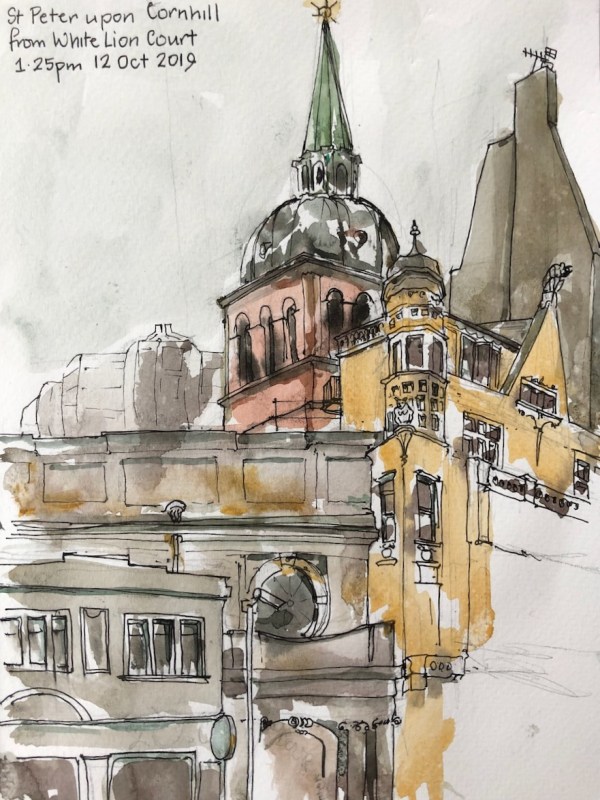
St Michael Cornhill is visible to the left in the background, and you can just see the weathervane on St Peter upon Cornhill in the centre of the picture.

My drawing of St Peter upon Cornhill is in this post:

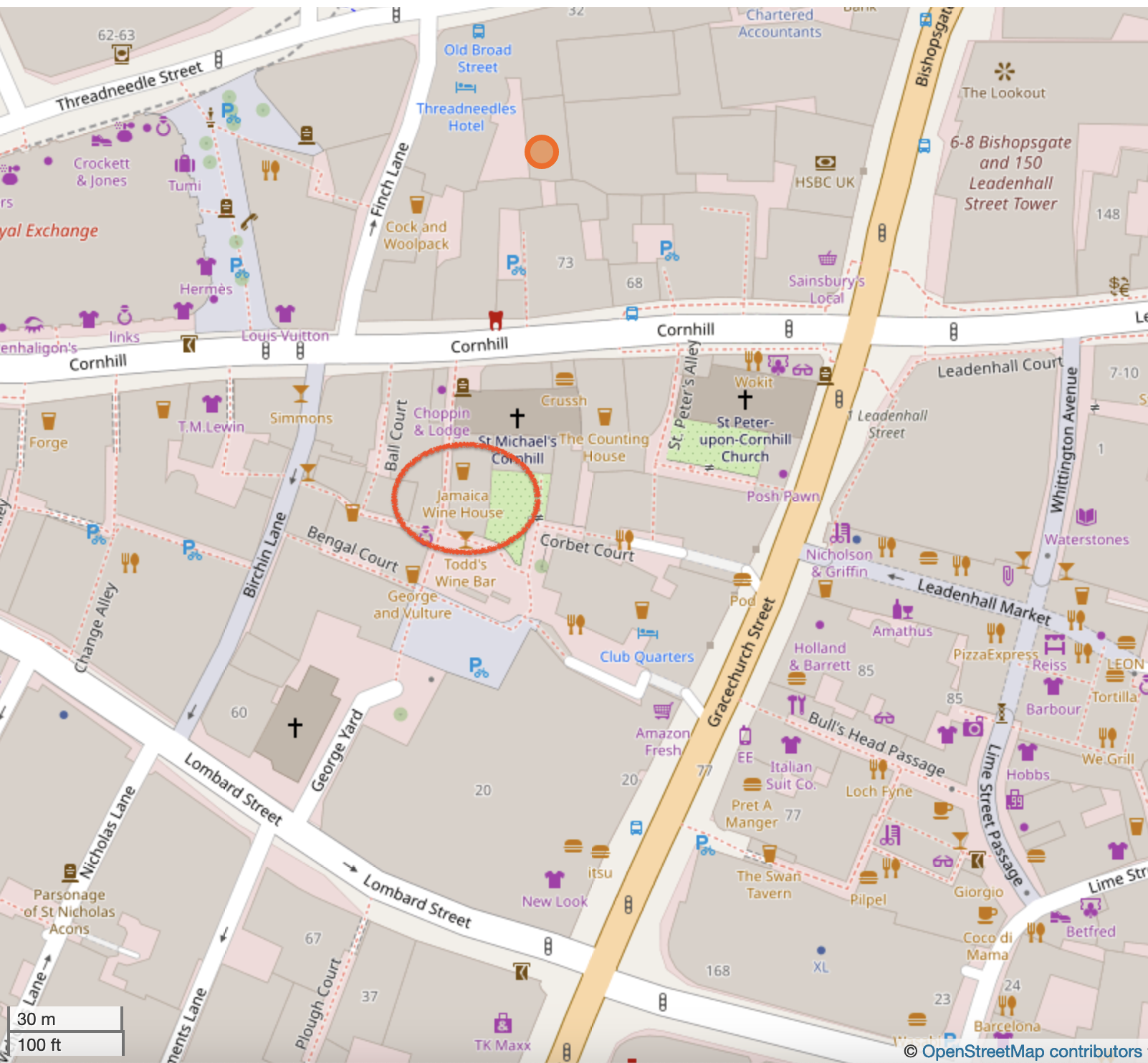
Location of the Jamaica Wine House in the alleys between Lombard Street and Cornhill. (Map (c) OpenStreetMap contributors)
The picture took an hour on location and I finished it at my desk.

The colours in the picture are:

  • Fired Gold Ochre – my go-to colour for brick and sandstone
  • Ultramarine blue, Lavender, and Cerulean Blue for the sky
  • Burnt Umber in the sky
  • All greys and blacks are Ultramarine Blue with Burnt Umber
  • There’s a bit of Iridescent Gold on the weathervane of St Peter upon Cornhill
  • The trees in St Michael’s garden are Serpentine Genuine with some Permanent Yellow Medium.
  • St Michael on Cornhill is Buff Titanium with some Burnt Umber and Ultramarine Blue.

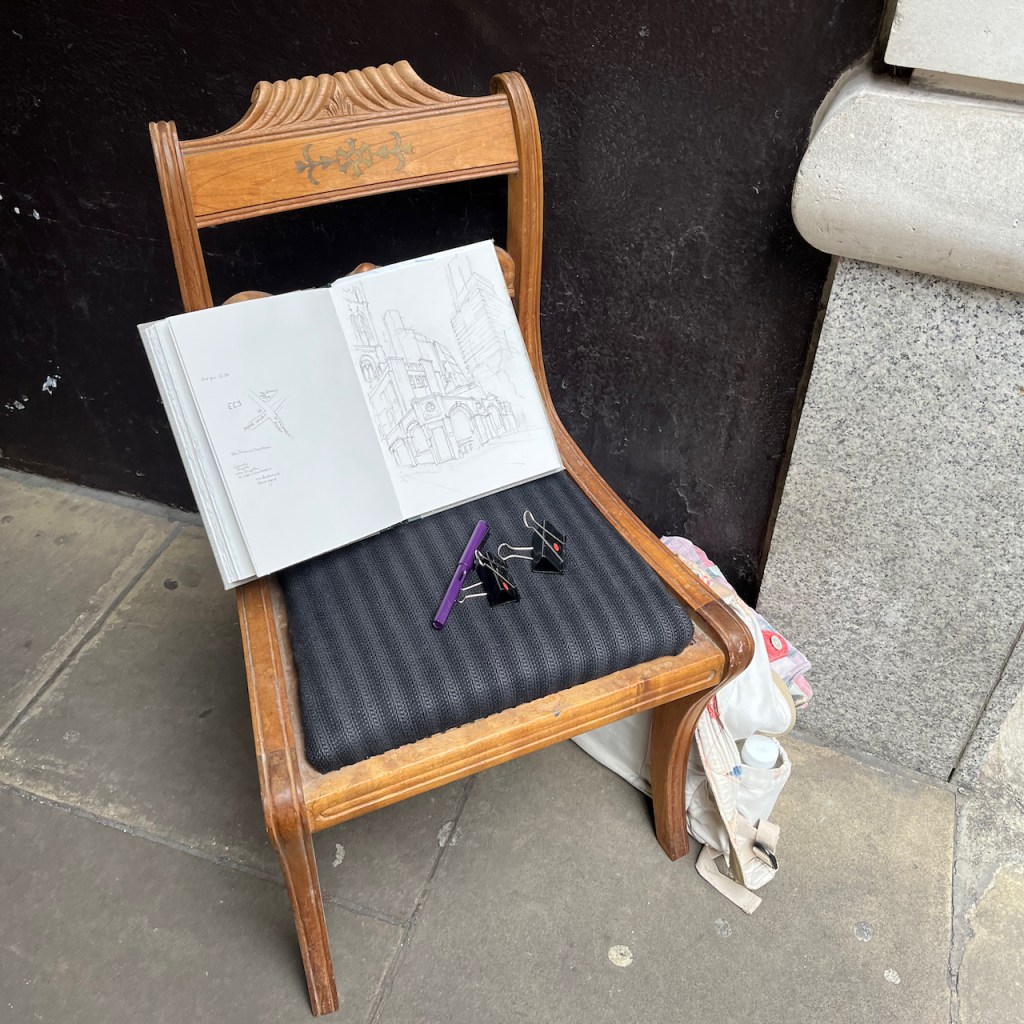
Done on Arches 300gsm NOT watercolour paper in a sketchbook by Wyvern Bindery, Hoxton. Thank you to McAngusWainwright, city tailor, for the kind loan of the chair.

London Liverpool Street, EC2

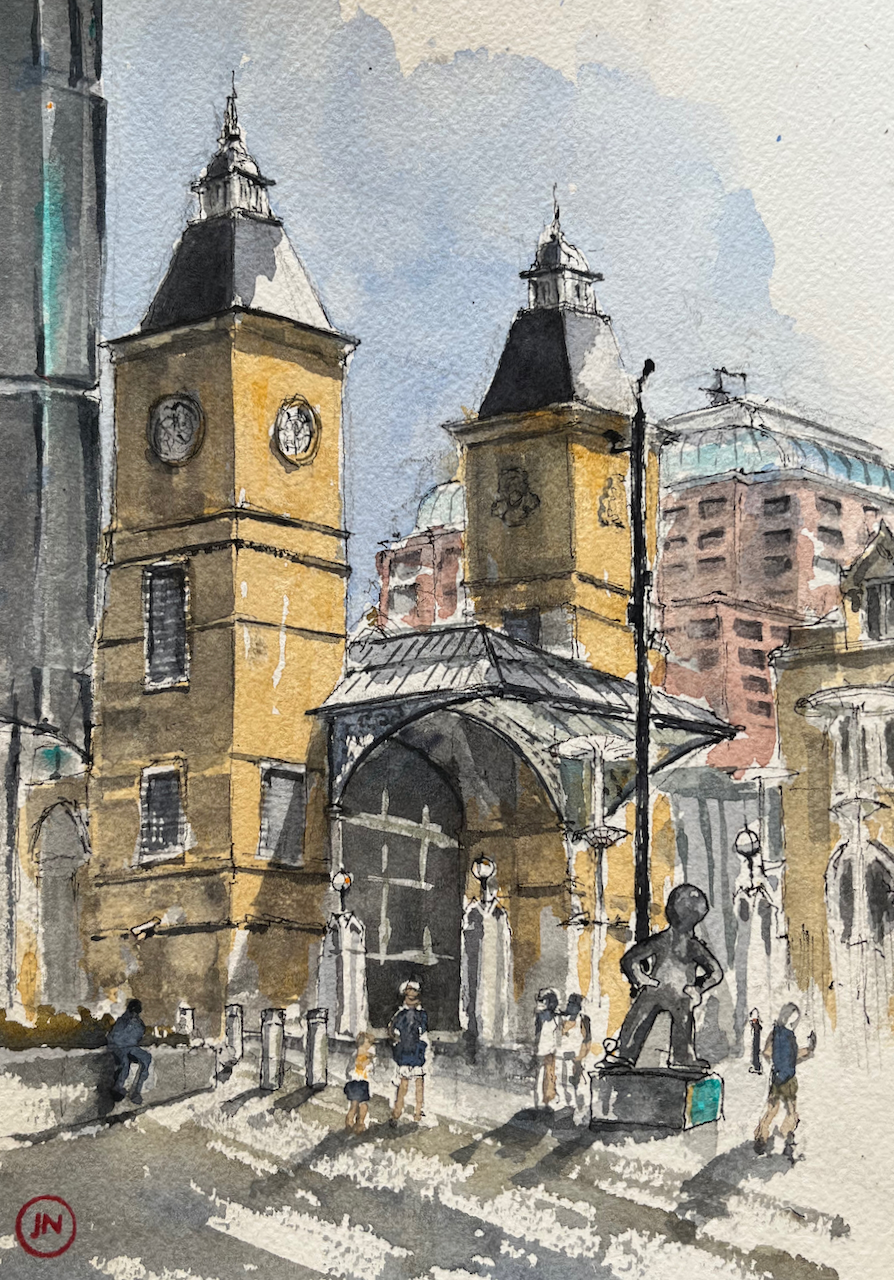
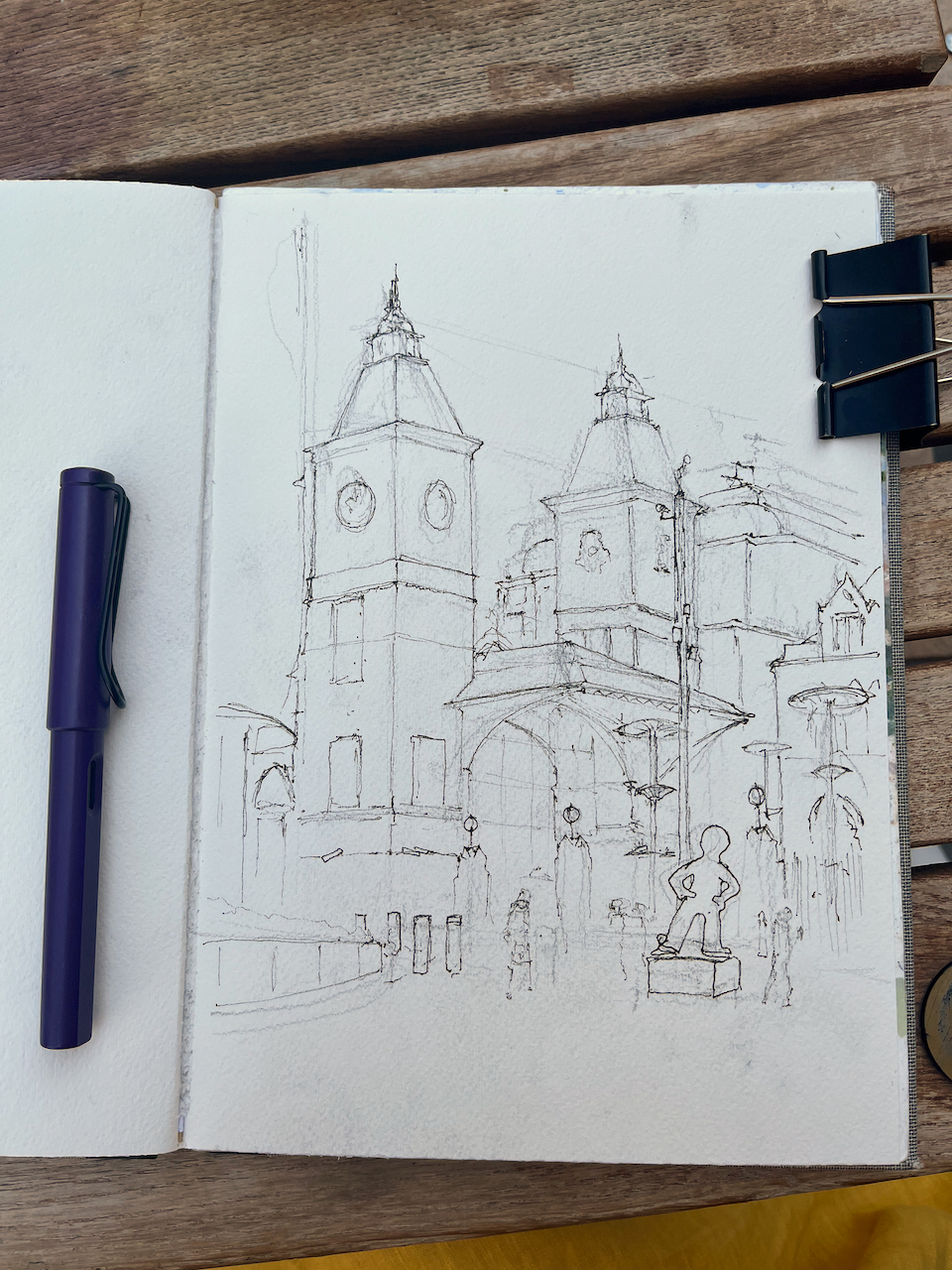
Here is Liverpool Street Station, main entrance, sketched today from outside the “Railway Tavern”.

Liverpool Street Station, 25th June 2023, 1pm. 8″ x 10″ in sketchbook 13.

The humanoid figure on the plinth is Morph, part of a temporary art trail.

The area in front of the main entrance is like an art installation in itself, a collector’s assembly of street furniture: two different types of bollards, long ribbons of fencing, several species of street lamps, and that enormous CCTV stand which is just behind Morph. It’s surprising that people can find their way into the station in amongst the obstacles. I haven’t drawn them all.

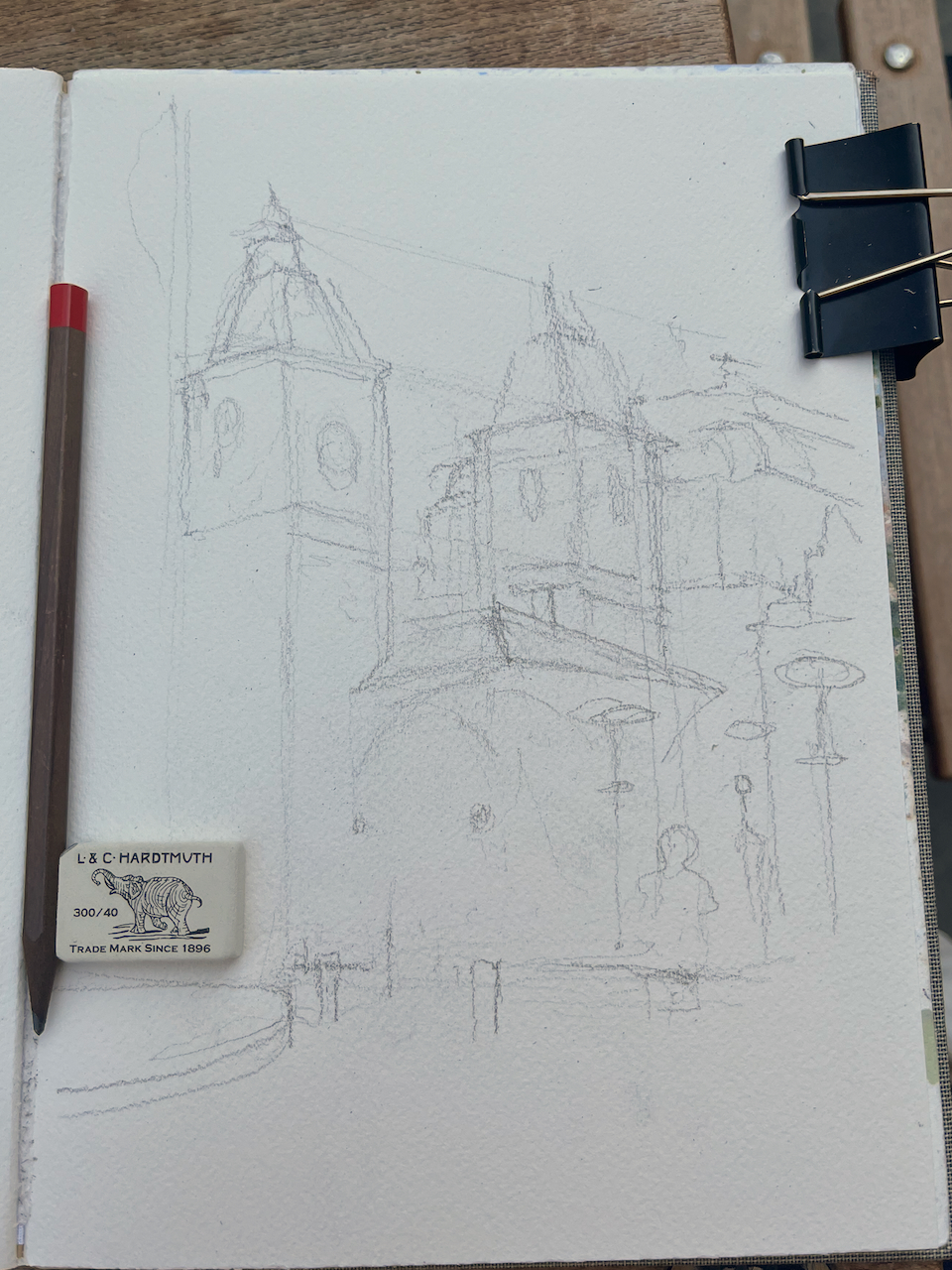
Here’s work in progress on the sketch:

This section of Liverpool Street Station was built in 1875 as the new London terminus of the Great Eastern Railway. The building on the right of my drawing is the edge of the former Great Eastern Hotel (1884), now the Andaz London Liverpool Street. The pink building in the background is an office block on Bishopsgate.

I’ve sketched in this area before. This post contains more information about the history of Liverpool Street:

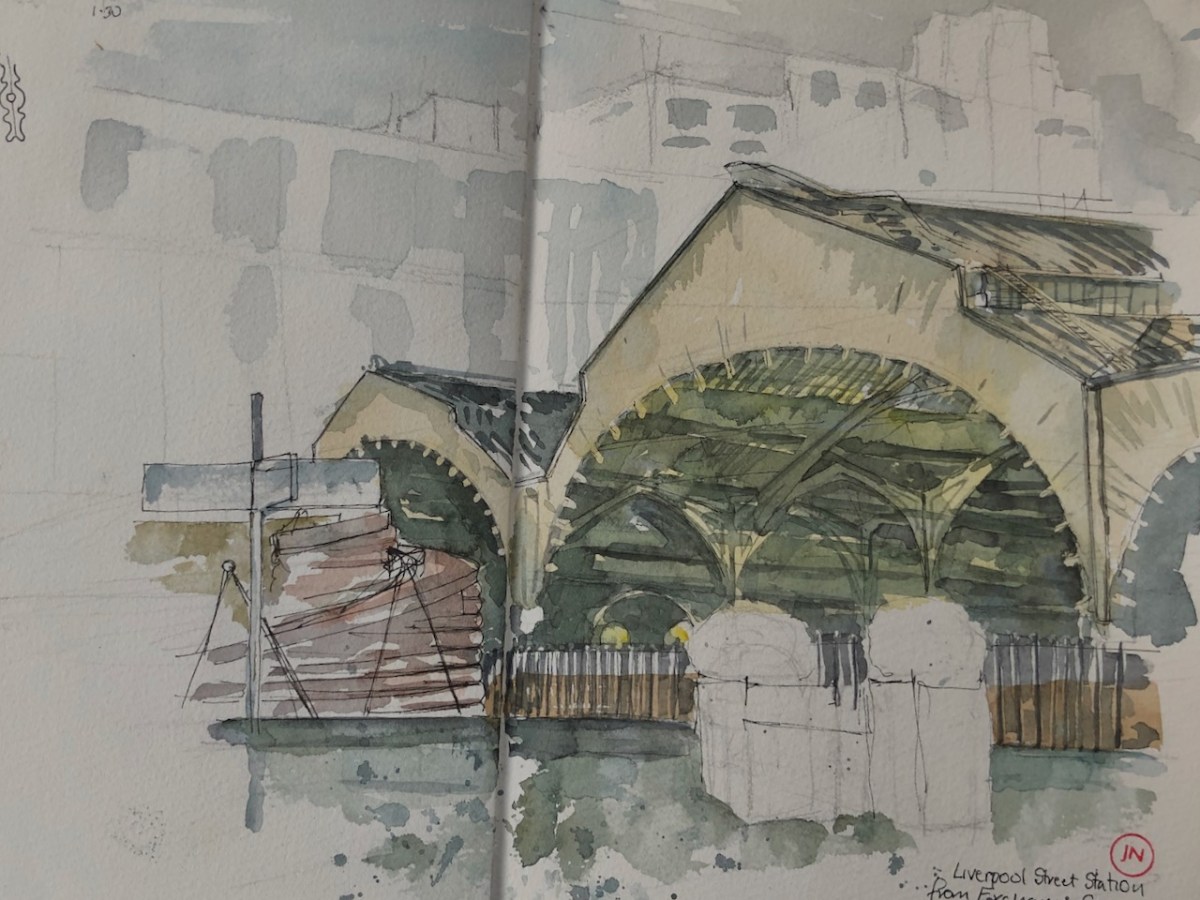
Liverpool Street Station from Exchange Square

Here are the magnificent 19th Century arches of Liverpool Street Station, seen from Exchange Square. Liverpool Street Station opened in 18751 Now the question is: what curve is that arch? I thought it might be a CYCLOID. A cycloid is the shape made by a dot on the edge of a rolling wheel. I made…

Keep reading

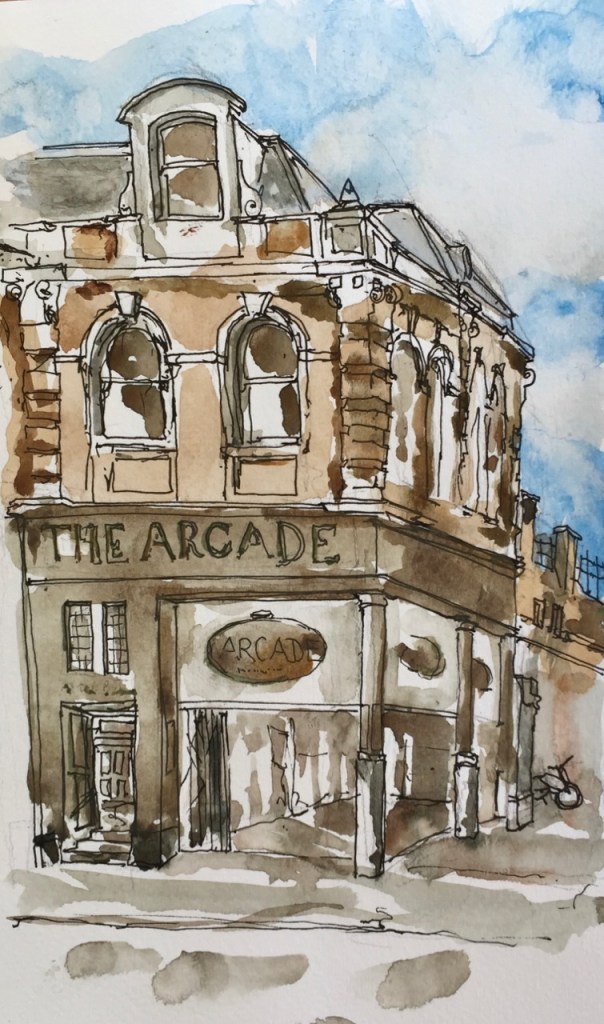
In 2019 I sketched the entrance to “The Arcade” which is shown on my sketch map. See this post for more about this sketch of The Arcade.

London Wall EC2: the hanging bridge

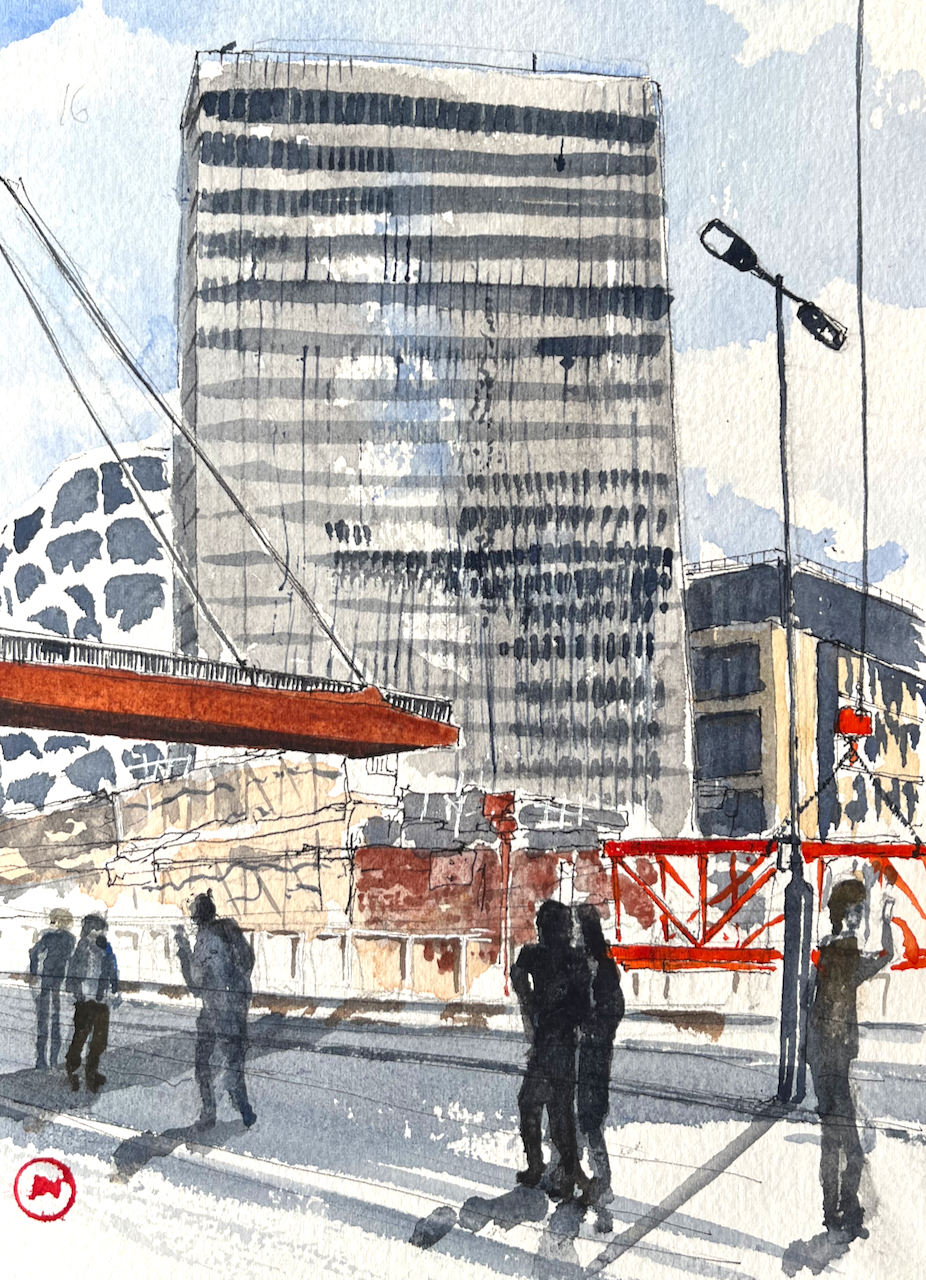
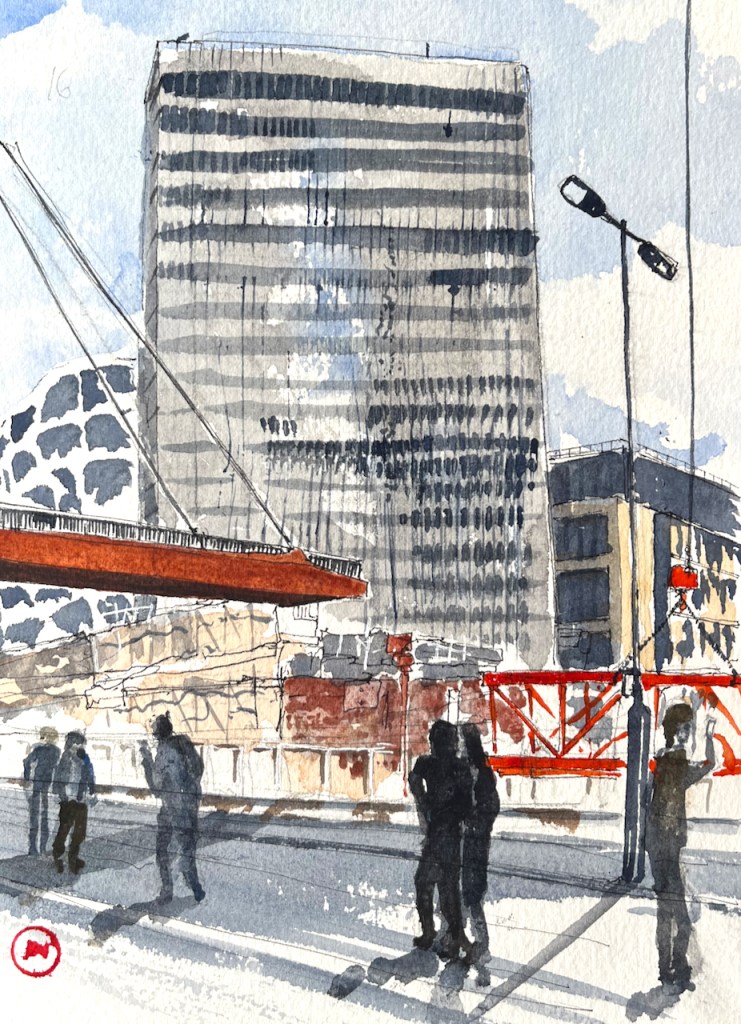
Here is an amazing sight: the hanging bridge over London Wall.

London Wall, hanging bridge. 24 May 2023, about 1pm, 7″ x 10″ in Sketchbook 13

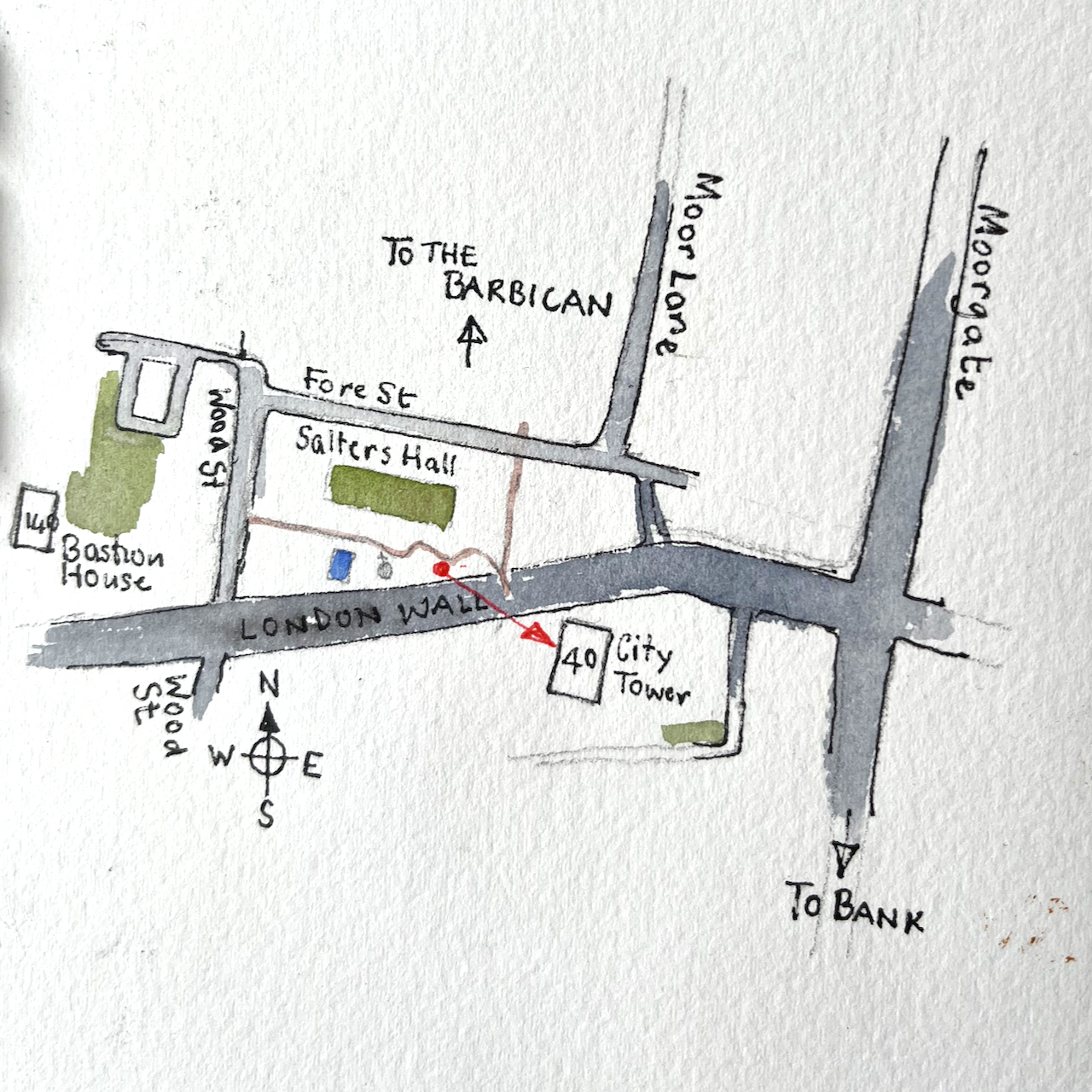
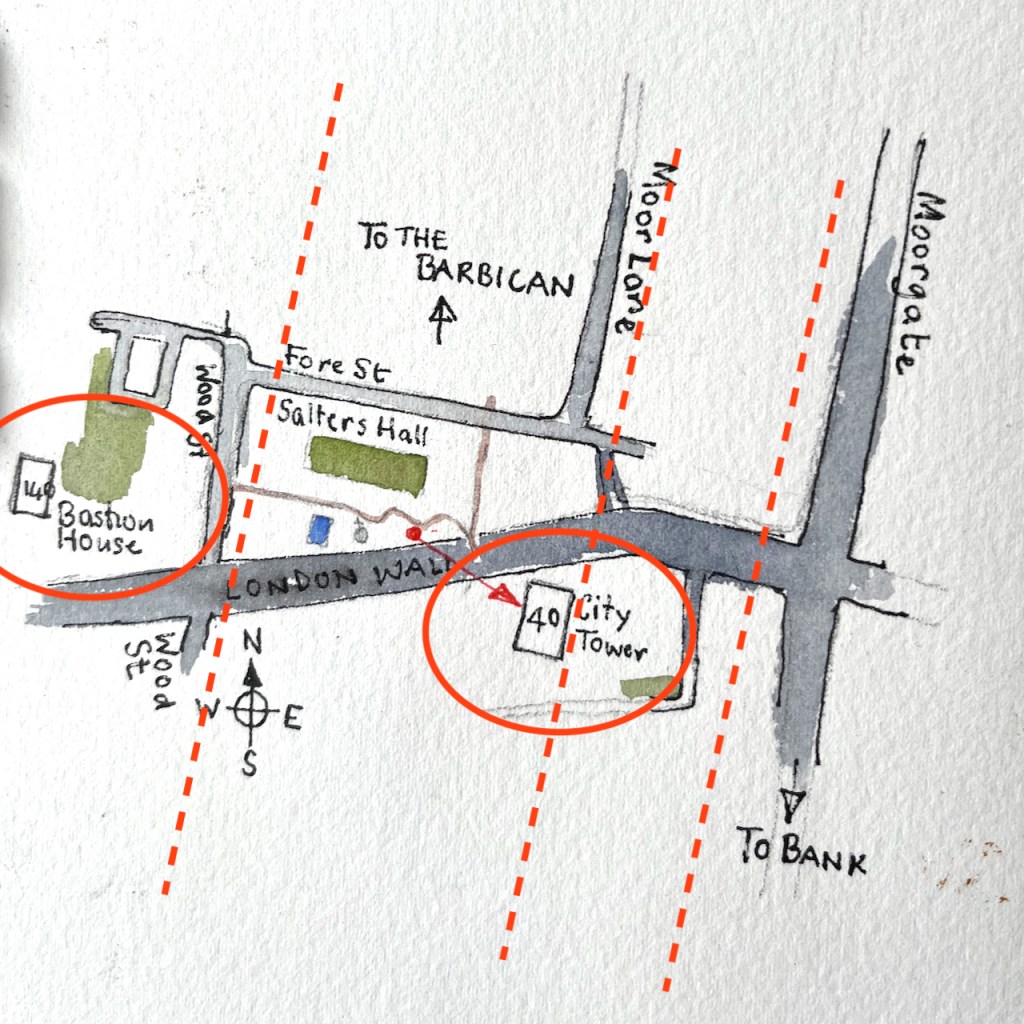
The large building in the centre of the picture is City Tower, 40 London Wall. In front of it is a demolition site where City Place House used to be. The bridge used to connect to City Place House. Now this building has gone, the bridge hangs in space.

In my previous drawing I sketched while listening to the guitar music of Hidè Takemoto. For this drawing, the acoustic accompaniment was mostly percussion. The building site was active. Spasmodic grinding and crashing signalled the removal of concrete. Metallic hammering came from scaffolding under construction.

The big red grid on the right of my picture was hauled upwards and out of sight before I finished drawing it. It was going to be part of a second crane. It arrived on a large lorry which would also have been in the picture if it had stayed still long enough. Immediately it arrived, workers secured chains to the red structure and it was manoeuvred off the lorry. Hardly anyone on the pavement paid any attention to all this thrilling activity across the road. One person, the slim figure to the right of my picture, stopped and took a selfie.

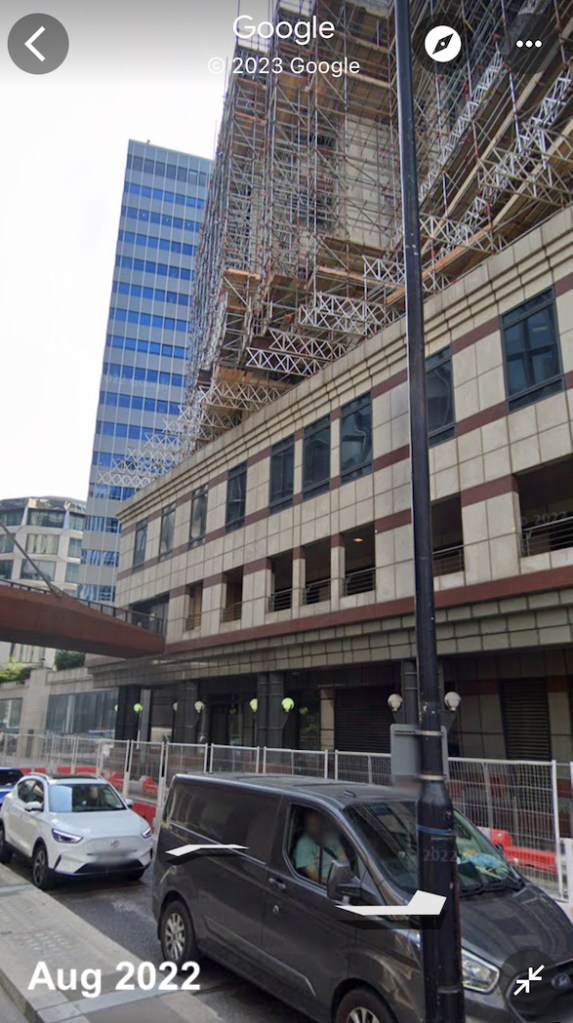
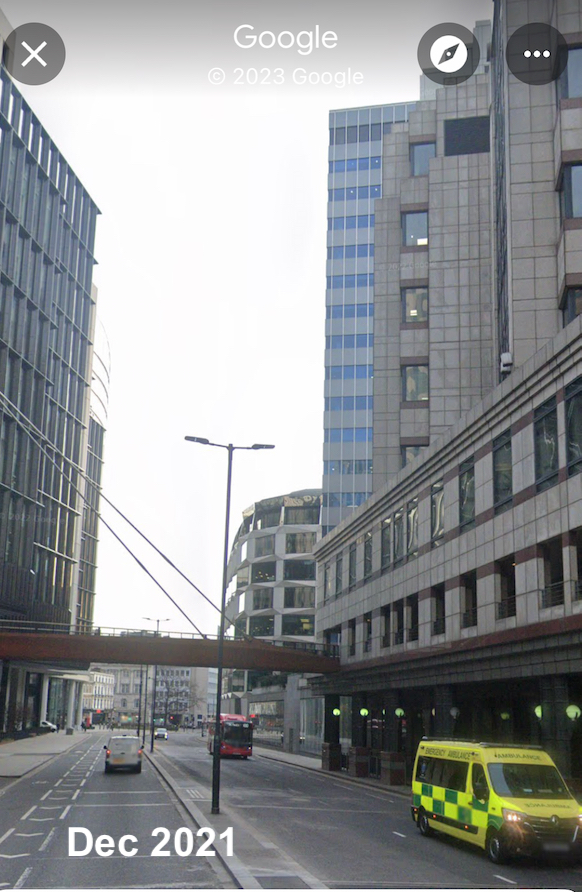
GoogleMaps allows us to travel not only in space but also in time. Here are some screengrabs so you can see the City Place House (on the right) which has now disappeared.
As you see, City Tower used to be obscured by City Place House. It will be obscured again when the next huge building goes up.

The bridge in the pictures above is the “new bridge”. It was installed as part of the London Wall Place development (off the picture to the left). The “old bridge” took a slightly different route. Again, GoogleMaps provides an image. Notice the previous lampposts, with the flying saucer lights.

The “old bridge” across London Wall, July 2008.
City Place House, on the right, is the building which is now being demolished.

I sketched City Place House before it was demolished. This post (click below) gives information about the old building which has been demolished and the new building which is planned.

City Place House

An email from an ever-vigilant neighbour alerted me to the Planning Application for City Place House and the adjacent tower, City Tower. This application is currently under consideration. I hastened to go and have a look at the buildings, before they get swathed in white plastic. City Tower has been there since 1967. It is…

Click here to read this post..

City Tower is not being demolished. This is of interest because its sister building Bastion House, constructed at the same time, is deemed “unsafe” by the City of London, and is scheduled for demolition to make way for the “London Wall West” project. It’s curious that City Tower is evidently not “unsafe” and is standing proud, in use into the future.

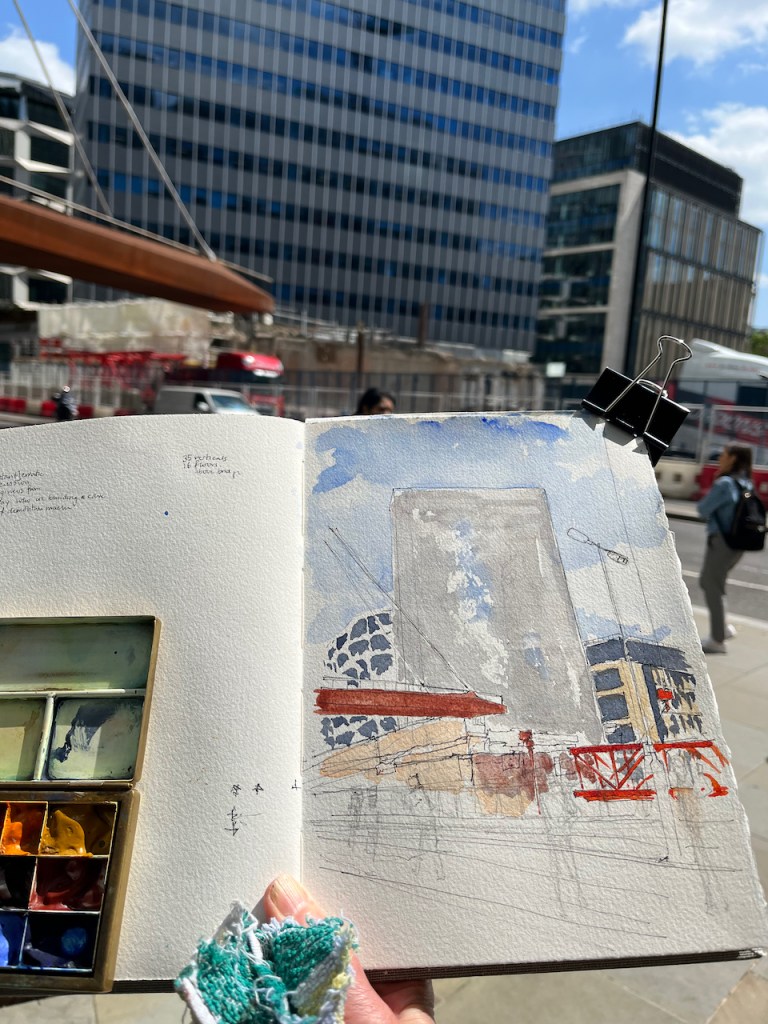
I made a special tool to draw the many windows on City Tower.

City Tower has 35 verticals. I made a special comb from cocktail sticks to scrape the paint into the required number of vertical lines.

The colours are:

  • Ultramarine Blue and Lavender for the sky.
  • All the greys are Ultramarine Blue and Burnt Umber
  • The bridge is Fired Gold Ochre, with some Transparent Pyrrol Orange
  • The red is Transparent Pyrrol Orange
  • Mars Yellow is on the distant building and the scaffolding plastic

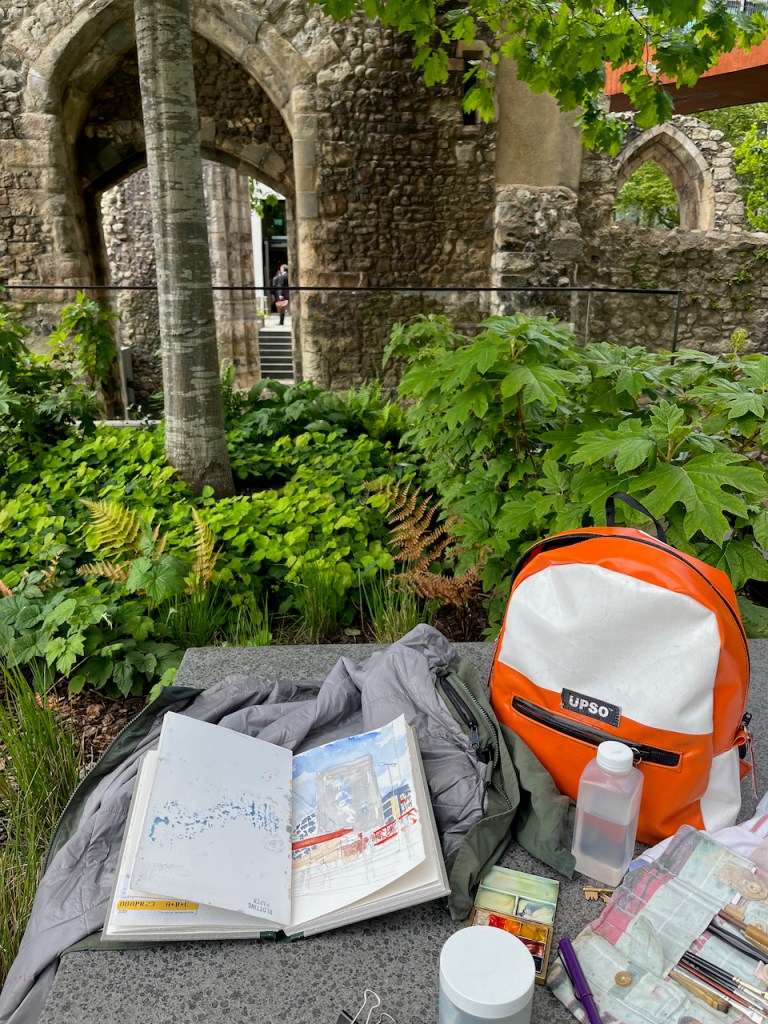
I put down the first wash on site and finished the picture at my desk.

St Giles from Wallside, Barbican EC2

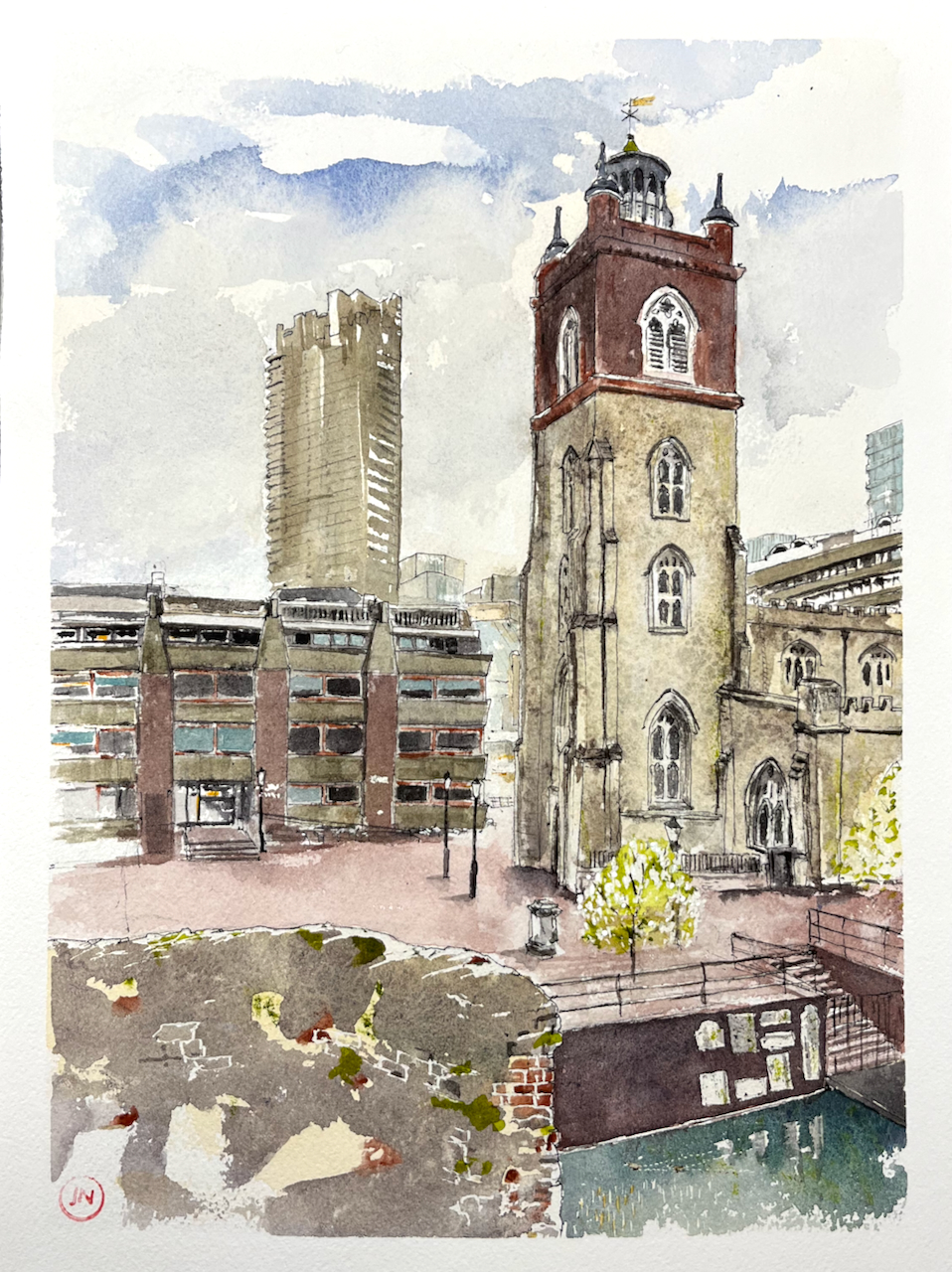
Here is St Giles’ Church, Cripplegate, seen from the public walkway at Wallside. The church is surrounded by the Barbican Estate. Cromwell Tower is in the background. The City of London School for Girls is the lower building, centre and left. Through the gap between the church and the school, you can just glimpse the Barbican Centre.

The magnolia was in bloom!

St Giles from Wallside, Barbican, 1 April 2023 12″ x 9″ [Commission]

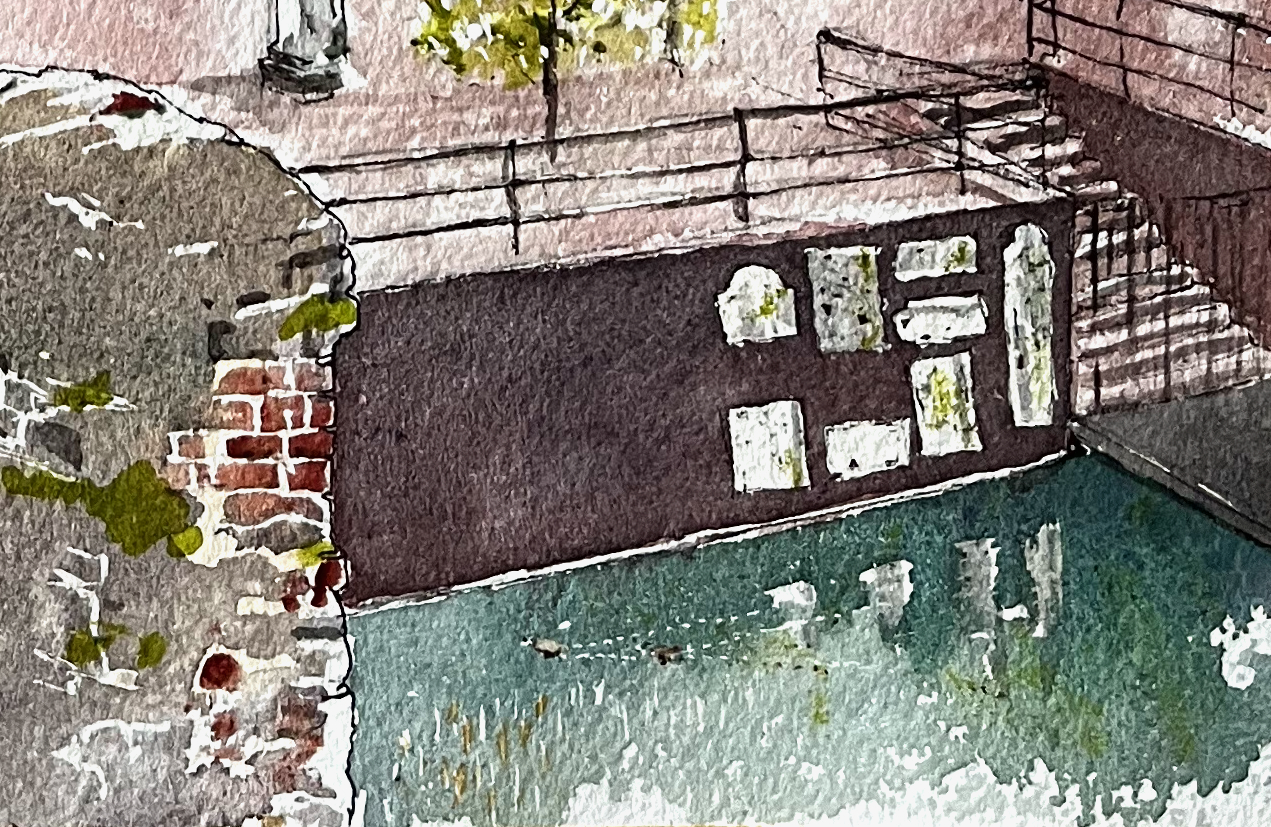
I painted this as a commission, for some clients who wanted this particular view. A special request for this commission was that I showed two ducks. These are small, but they are there!

Ducks on the lake.

The white shapes on the lakeside wall are gravestones.

Old London Wall is on the left: part stone, part brick. This is the old Roman wall round the City of London.

Thank you to my clients for this commission and for their permission to post the picture here online. It was a real pleasure to do.

The colours I used are:

For the sky: a pale yellow wash of permanent yellow deep, followed by a grey made from ultramarine blue and burnt umber, with some ultramarine blue for the blue bits.

For the church: the stone is a pale yellow wash of permanent yellow deep, then a dilute buff titanium wash. I put salt on it to get some texture. Then the dark areas are a grey made from ultramarine blue and burnt umber.

The top part of the church, St Giles Terrace and all the reddish/purple brickwork is a combination of perylene maroon, burnt umber, fired gold ochre, and a bit of ultramarine blue for the dark areas.

The lake, which really is that green colour, is ultramarine blue, plus some serpentine genuine which makes it granulate.

All concrete is the same mix of burnt umber and ultramarine blue with some mars yellow.

Old London wall is the pale yellow wash of permanent yellow deep, with a second wash of lunar blue with burnt umber. Lunar blue is highly granulating, which gives a wonderful stone effect. The bricks are fired gold ochre.

All green plants are green gold, and there’s also some green gold on the stonework of the church, to show the lichen.

The weathervane is Liquitex gold ink, applied with a fine brush.

The line drawing is done with a Lamy Safari fountain pen, using De Atramentis Black ink, which is waterproof.

The white parts of the picture, for example the lines between the bricks on Old London Wall, (and the ducks) are done using a resist. This is a rubbery substance, applied before putting on any paint. The resist I use is called Pebeo Drawing Gum. I put it on using a dip pen to get the fine lines. After the paint is dry, I rub it off, and the parts where it was show up white. There are also a few tiny dots of white gouache paint on the magnolia tree.

The paper is Arches Aquarelle 300gsm 12″ x 9″ in a block.

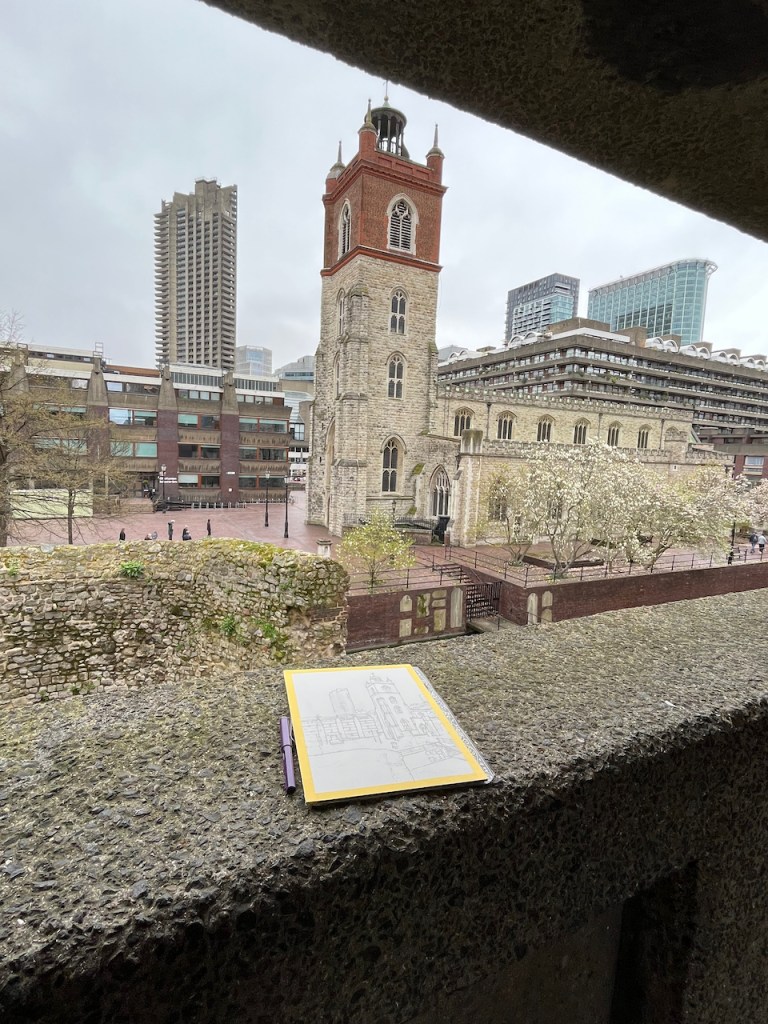
Work in progress. Arches Aquarelle block, Lamy Safari pen. The yellow is masking tape, which I put round to make the picture easier to handle and to give a crisp edge to the work. The people on St Giles Terrace were practising Tai Chi. It was very relaxing to watch them. See the green lichen on the concrete. And the magnolia.

The Temple Church, Temple, London EC4

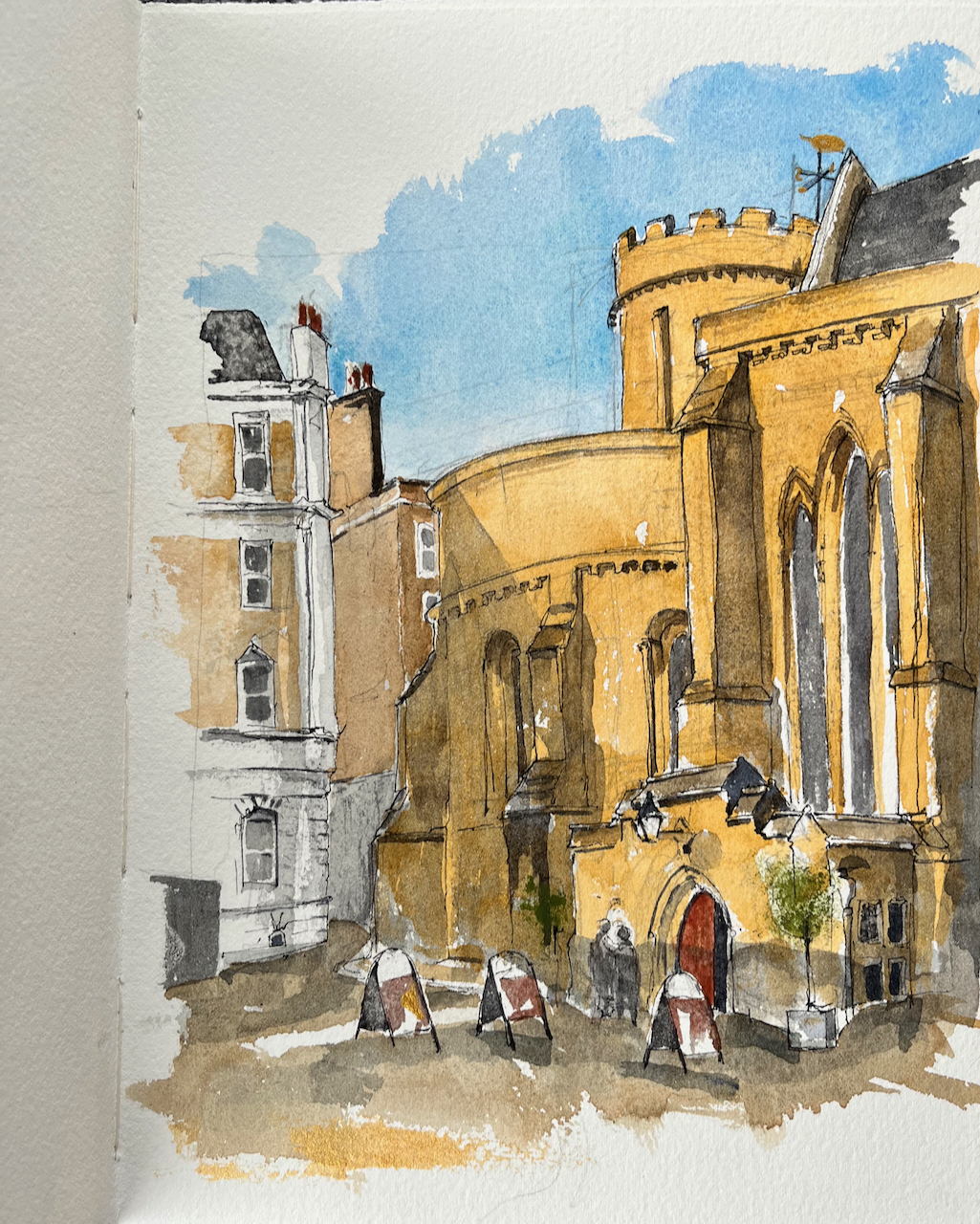
The Inns of Court are an ancient area of London, around Fleet Street, close to the Royal Courts of Justice. It’s an area of narrow lanes and quiet courtyards. Lawyers’ practices are there.

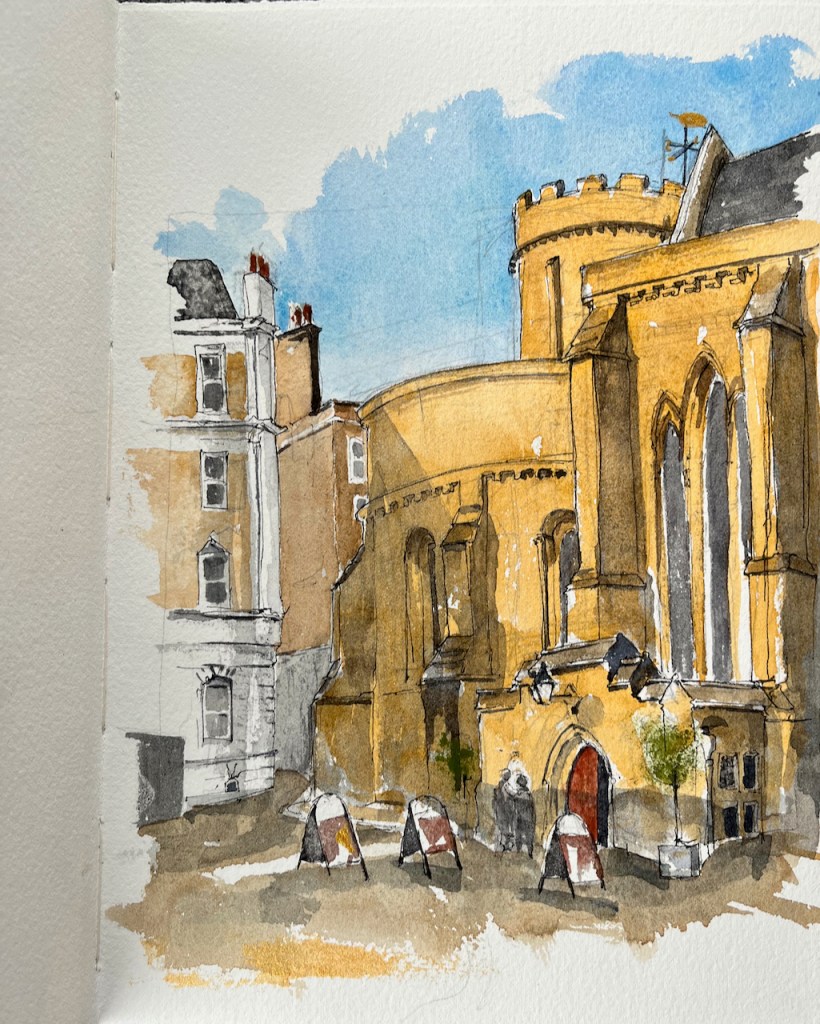
In amongst the buildings is this church, which opened on 10 February 1185.

Temple Church, 14th February 2023, in sketchbook 13

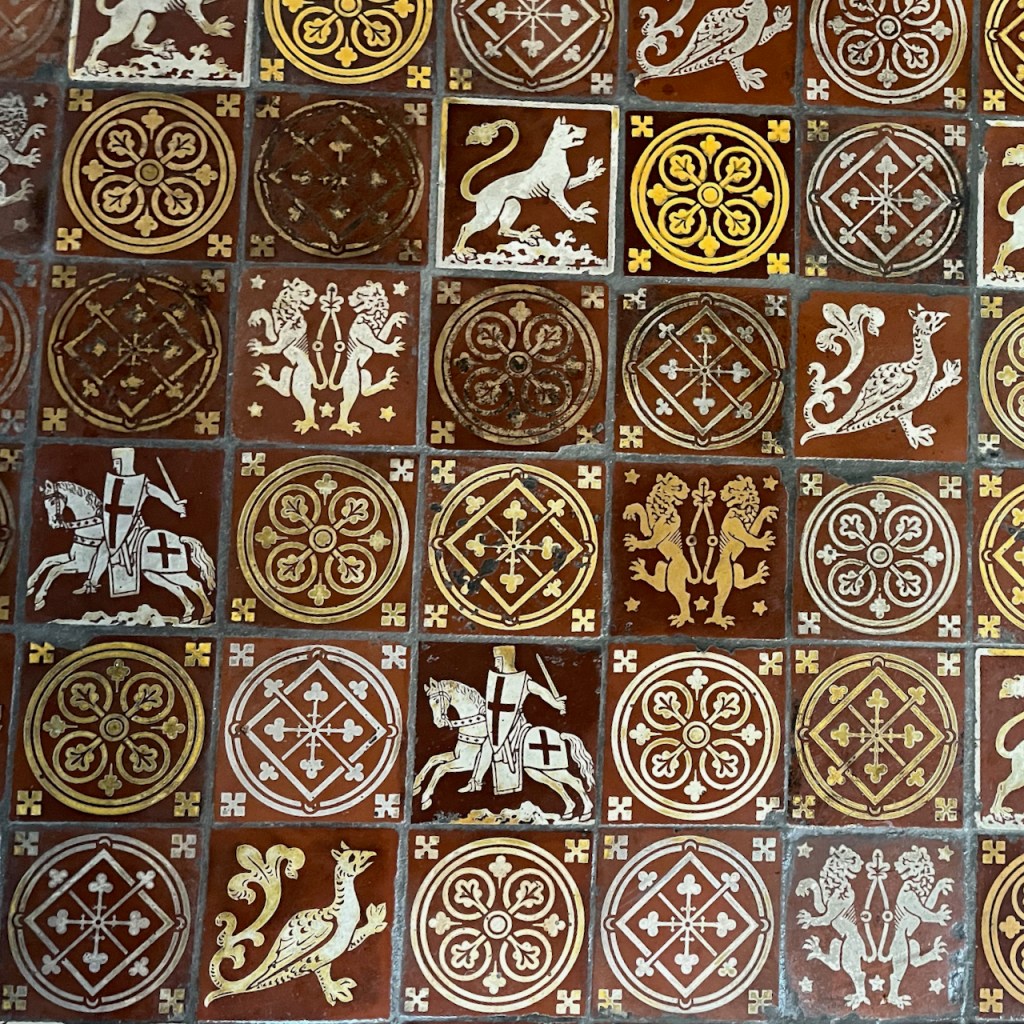
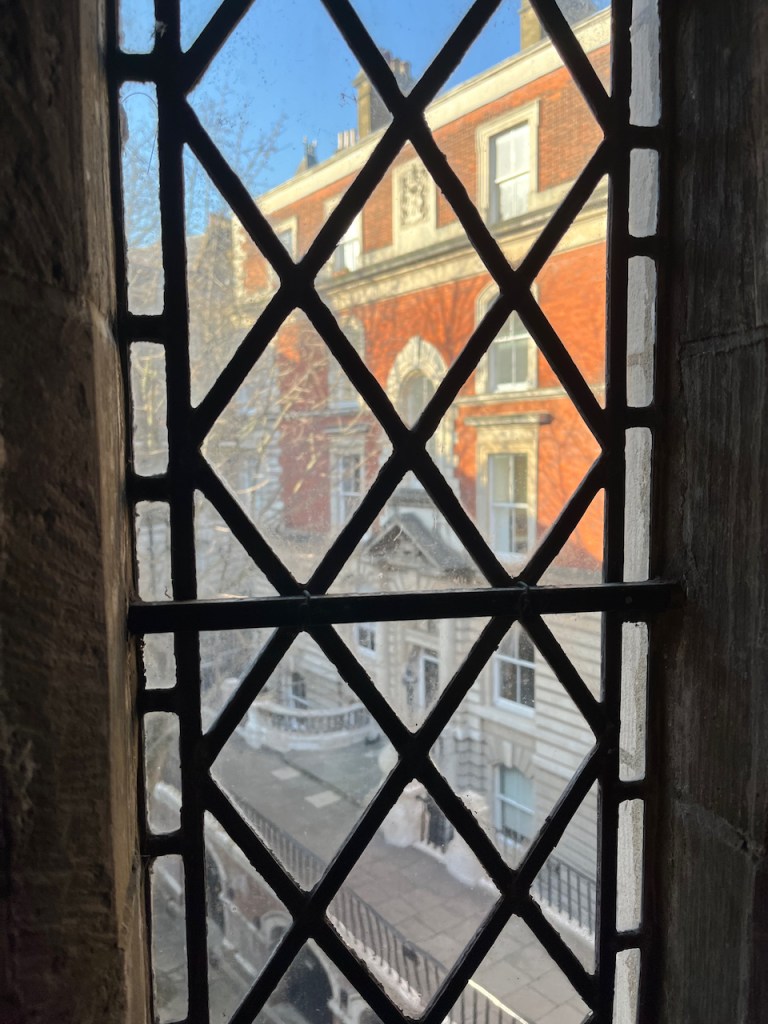
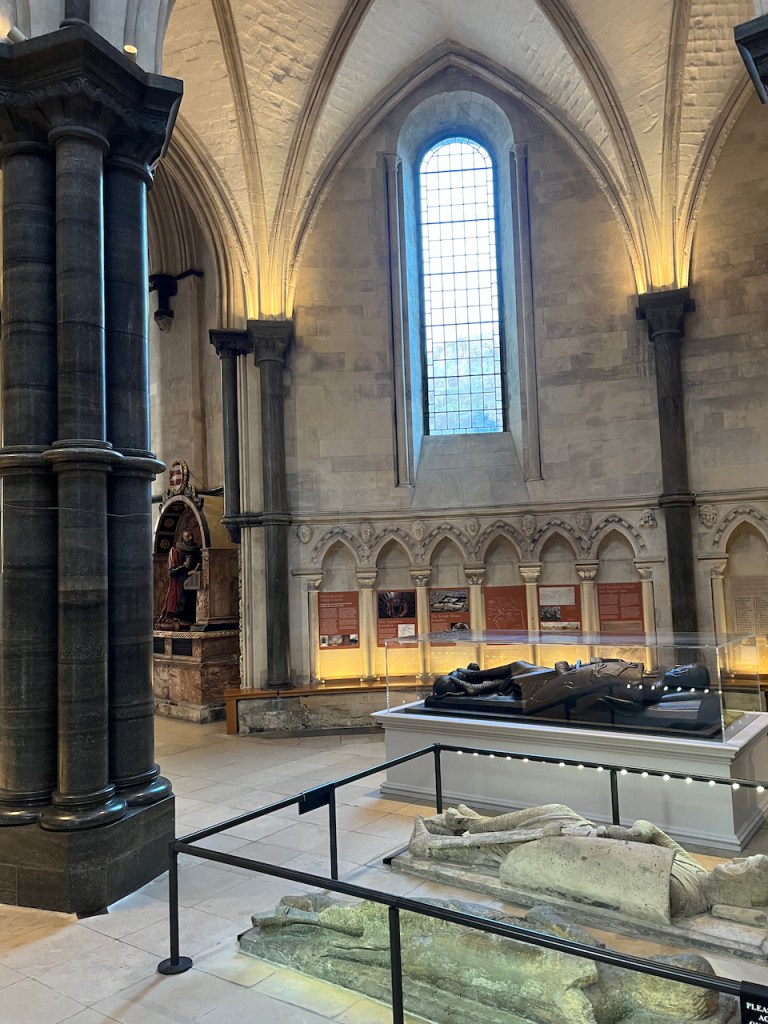
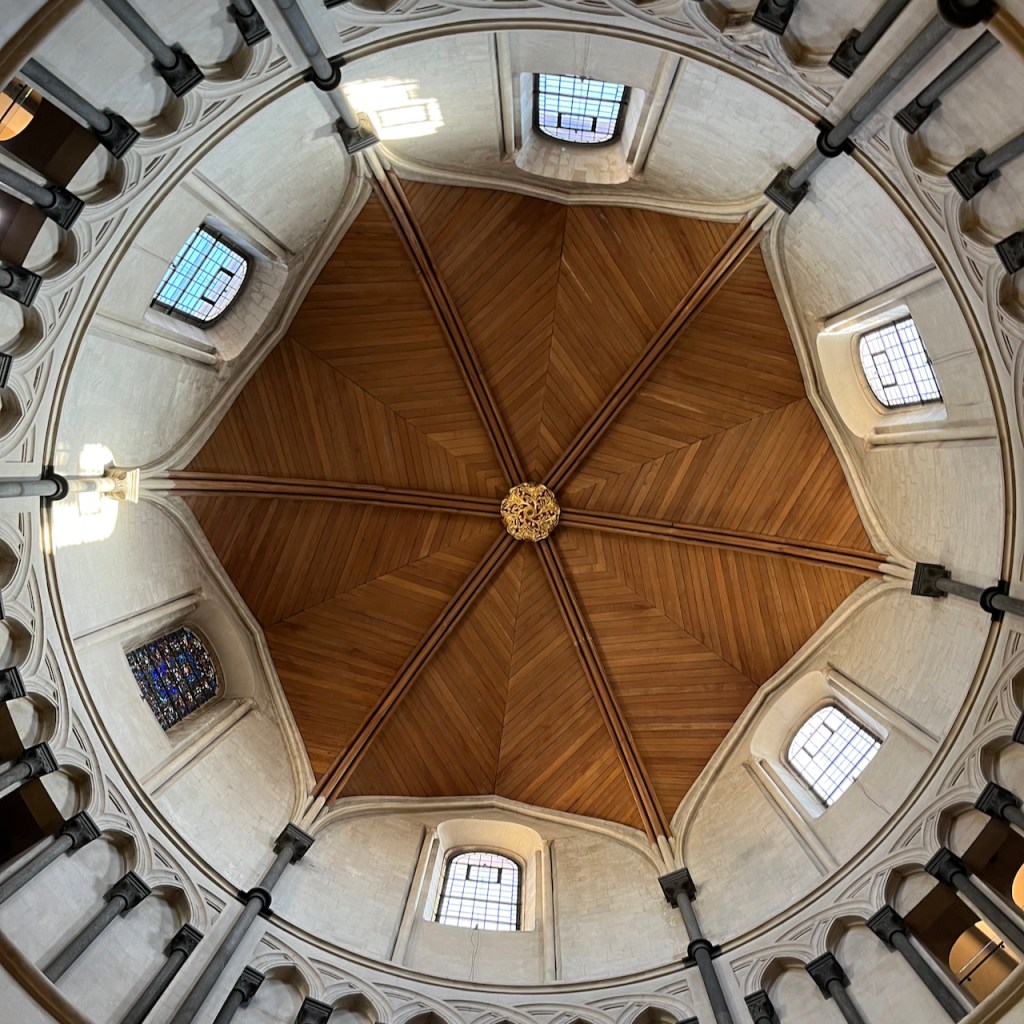
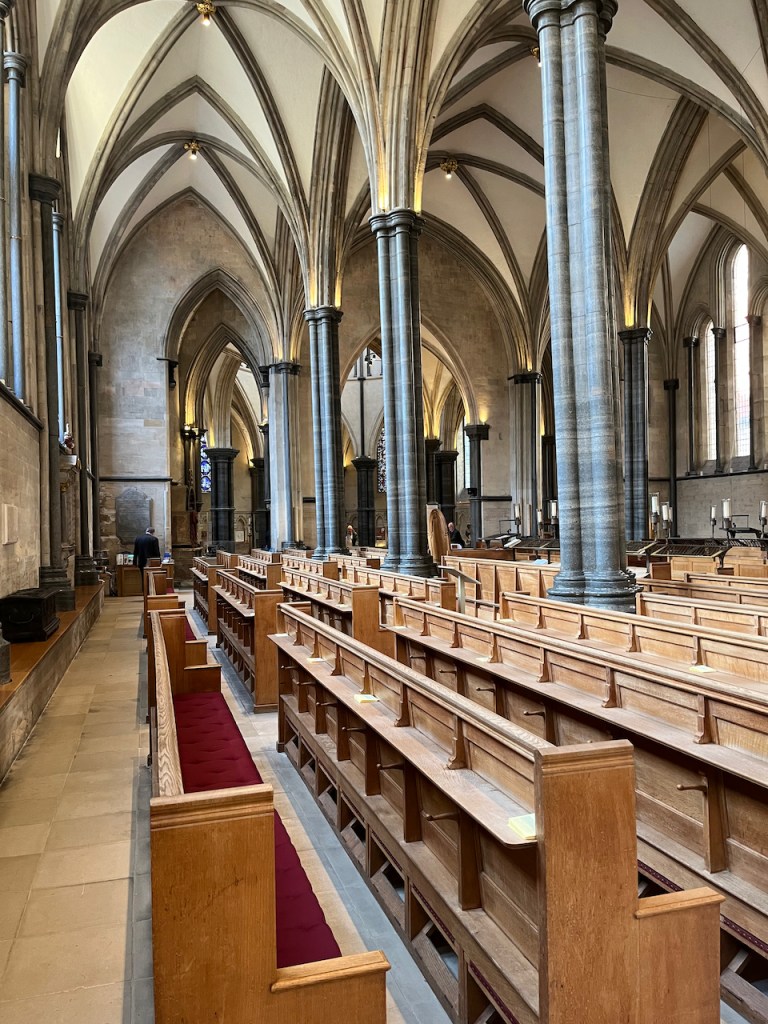
The church is open to visitors. I went in. It’s a splendid space, very calm, beautifully vaulted. You can even go up a narrow winding staircase inside the round structure I have drawn. Here are some photos of the inside.

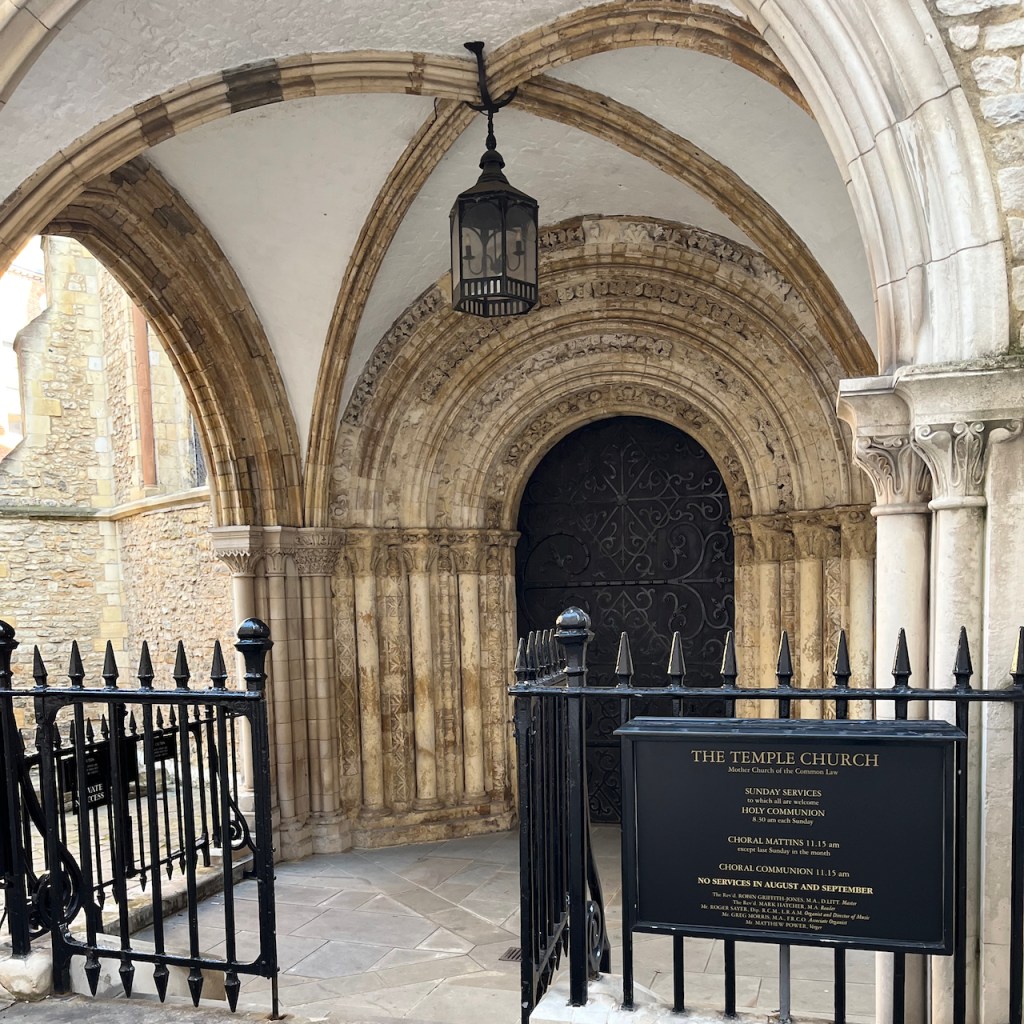
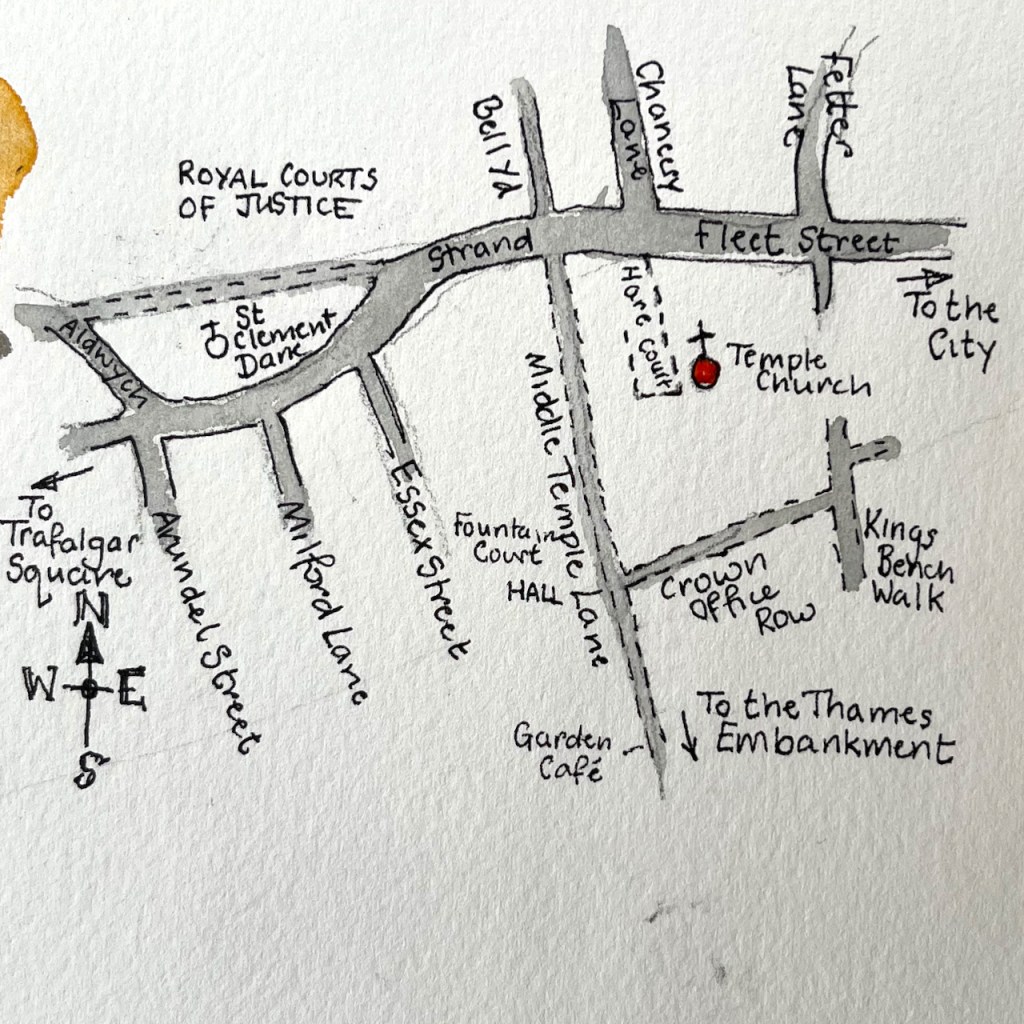
Here’s a map and a photo of the Norman arch on the outside

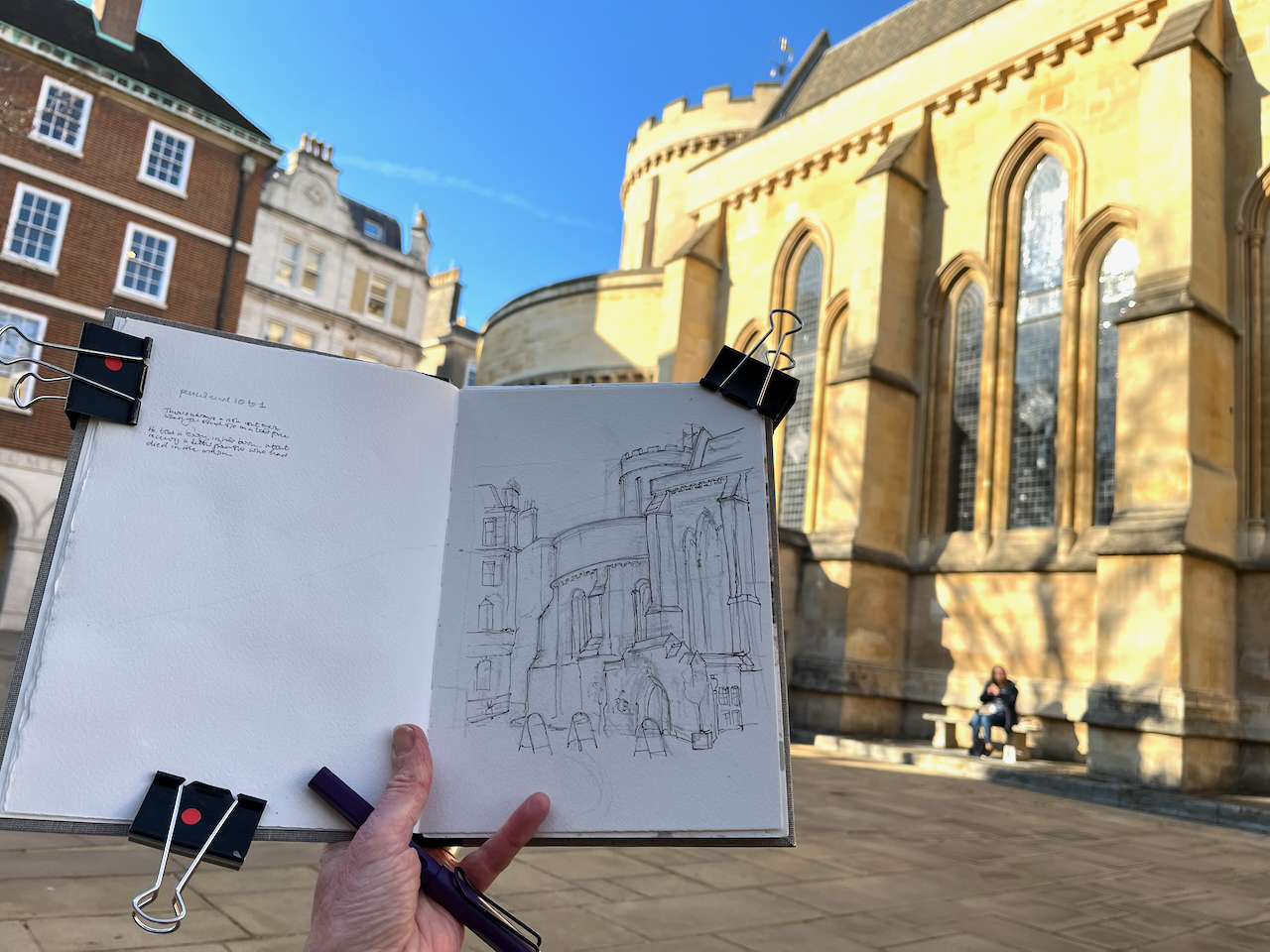
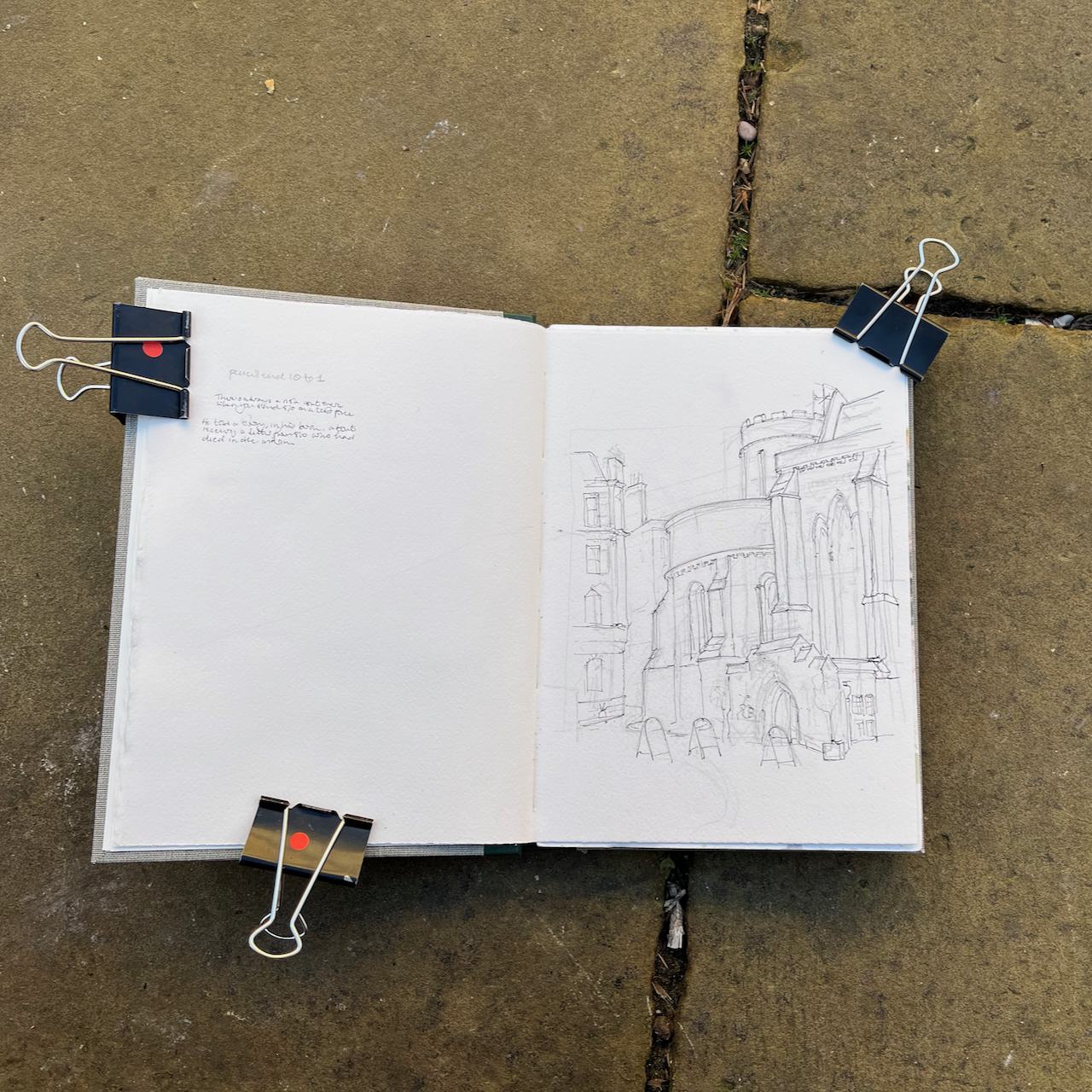
Here are some work-in-progress photos.