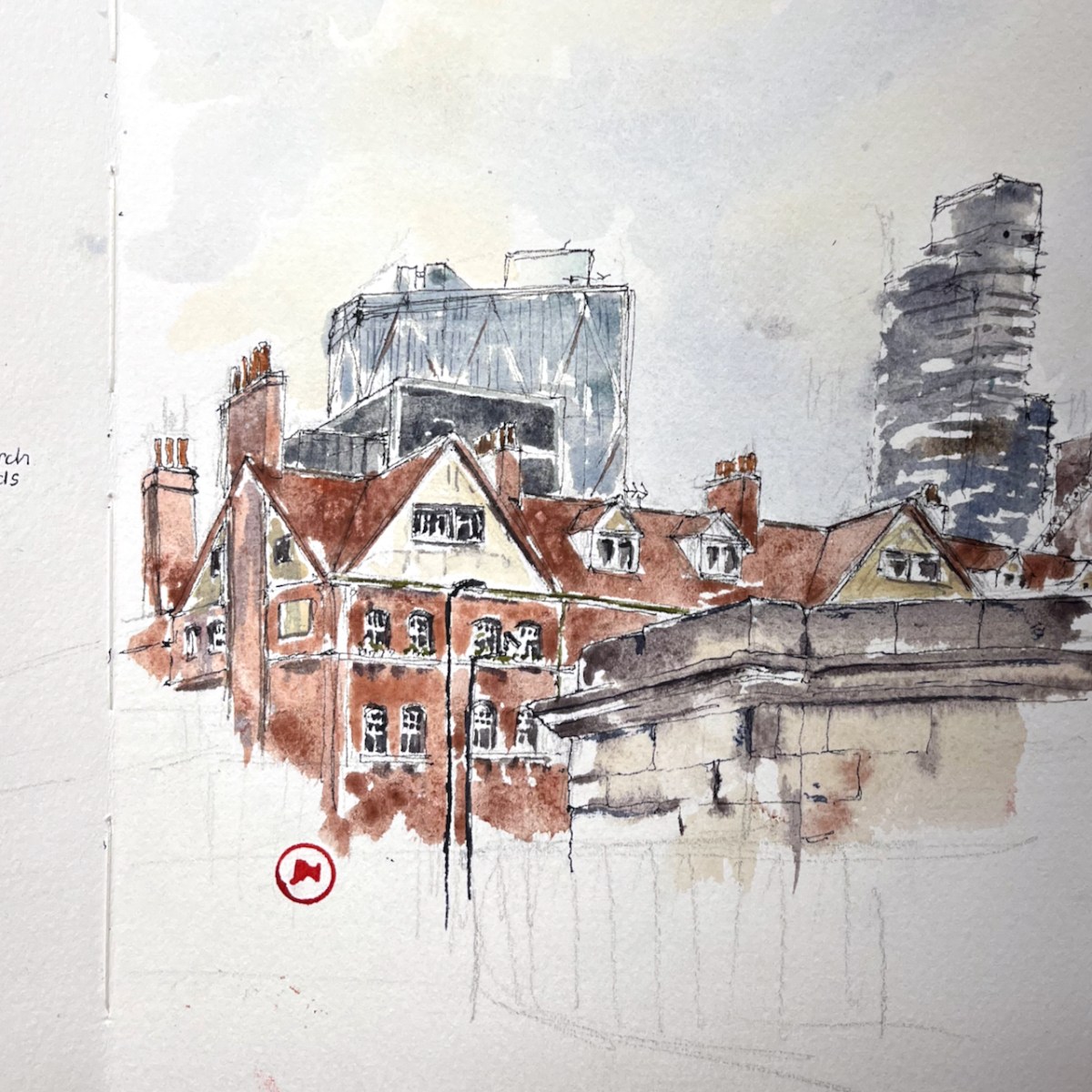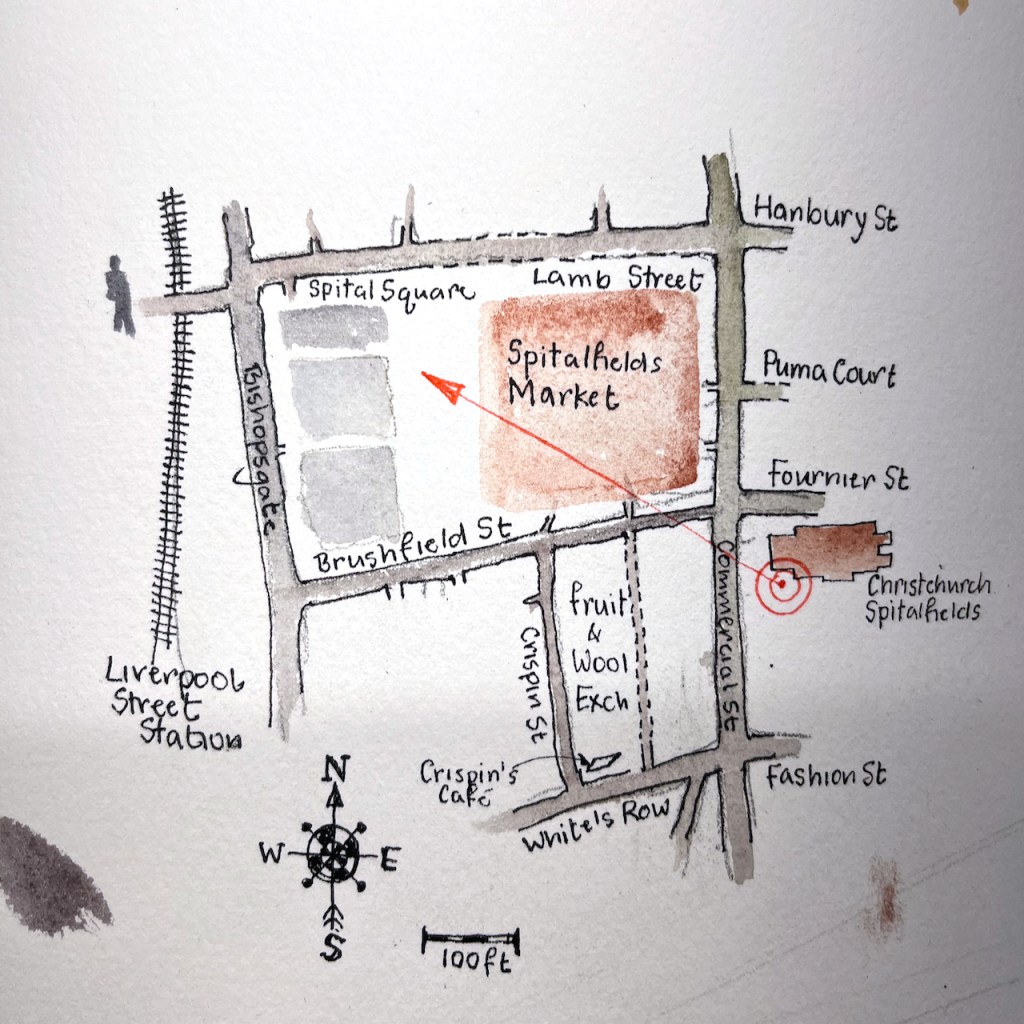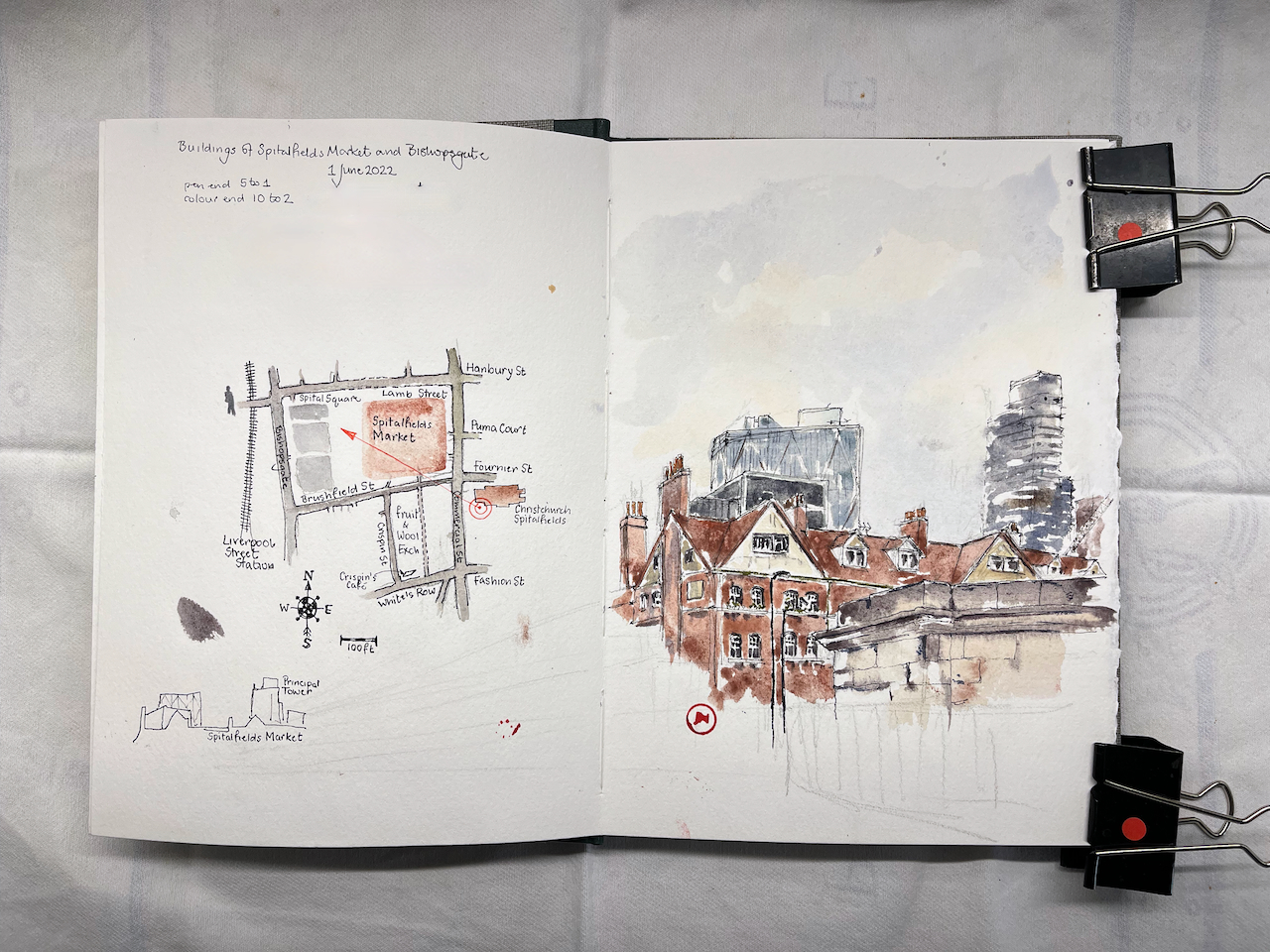
I joined a sketching friend for a stroll around Spitalfields. We had coffee at the Cafe in the Crypt of Christchurch Spitalfields, and then sat at the tables outside and sketched the view.
Here is my sketch:
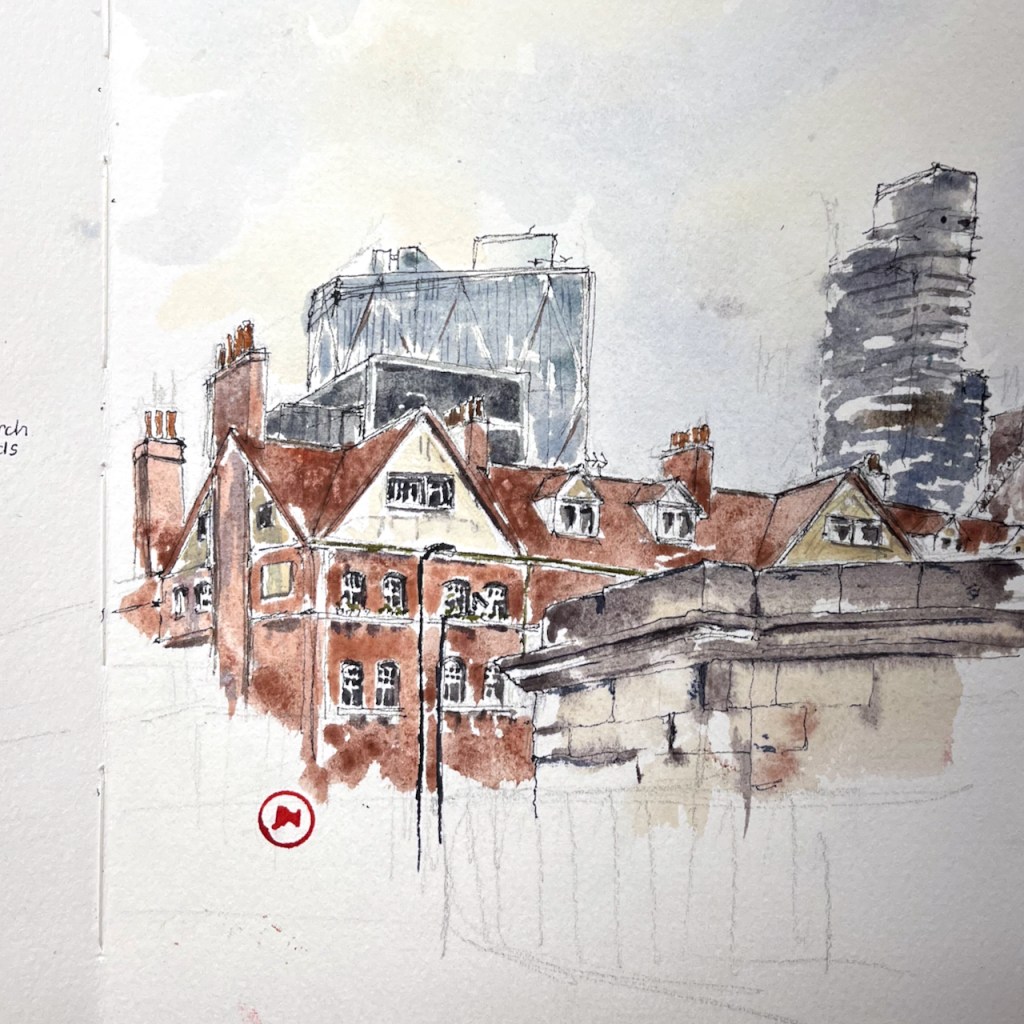
Spitalfields Market E1 from ChristChurch, 7″ square in Sketchbook 12. 1st June 2022
Behind the red-bricked buildings of the Market, you can see the office and residential tower blocks along Bishopsgate. “Principal Tower” in the one to the right.
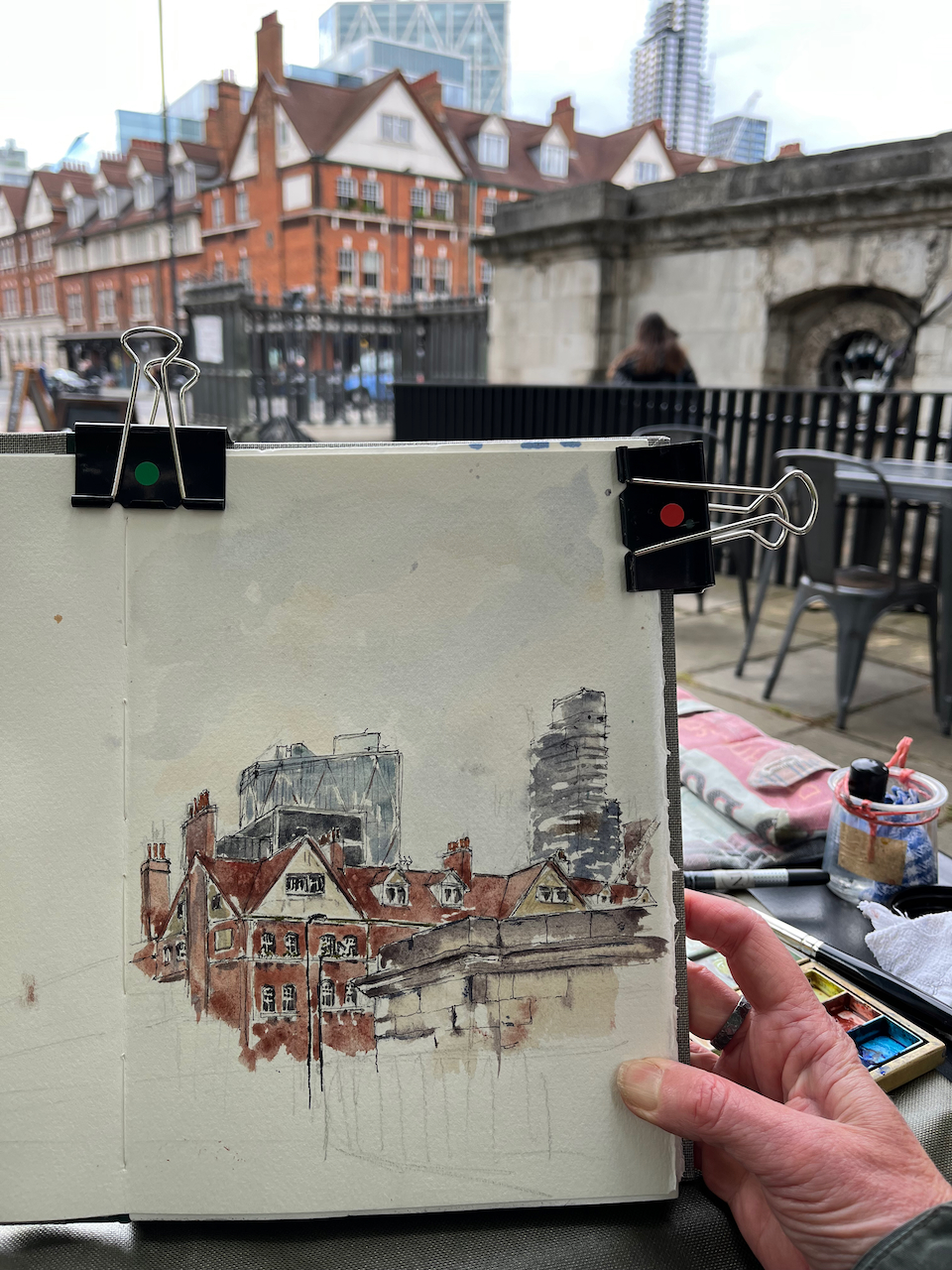
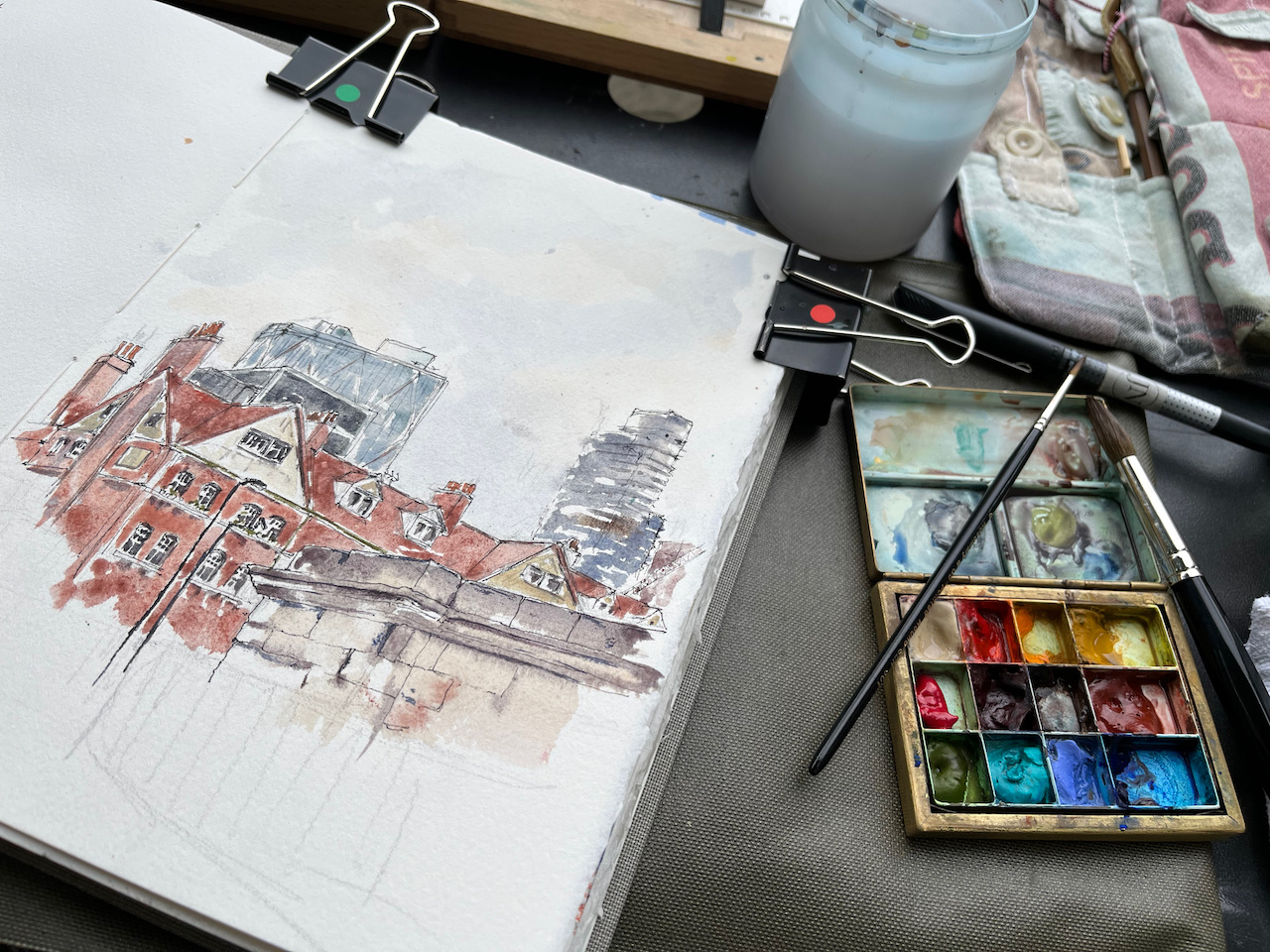
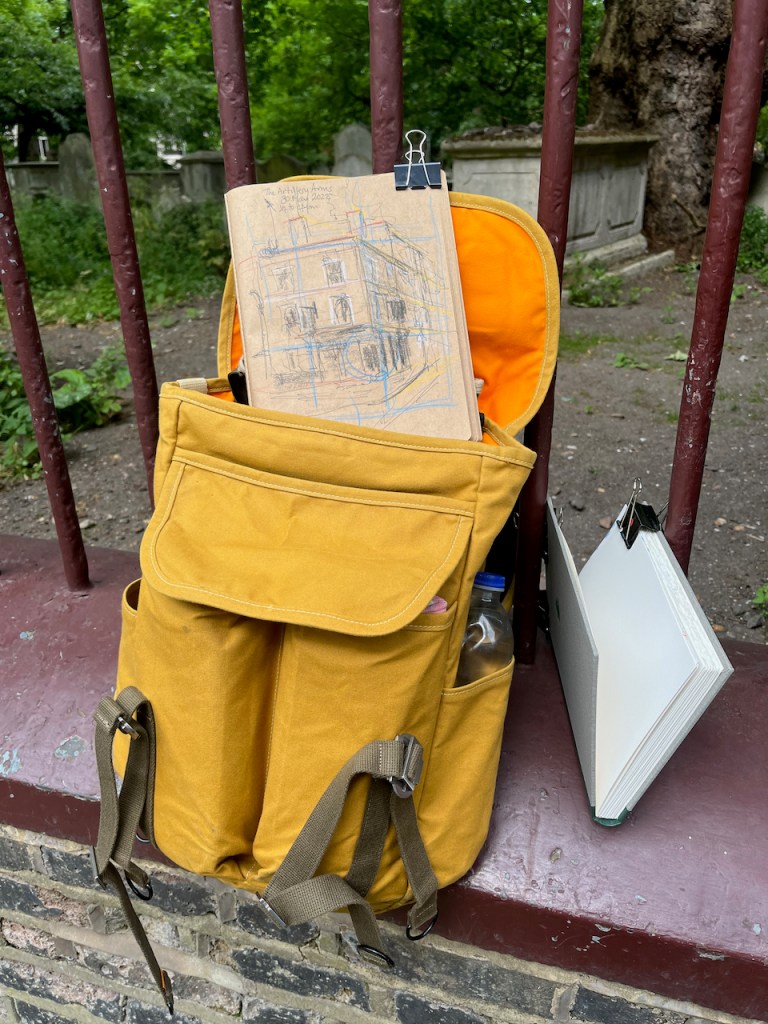
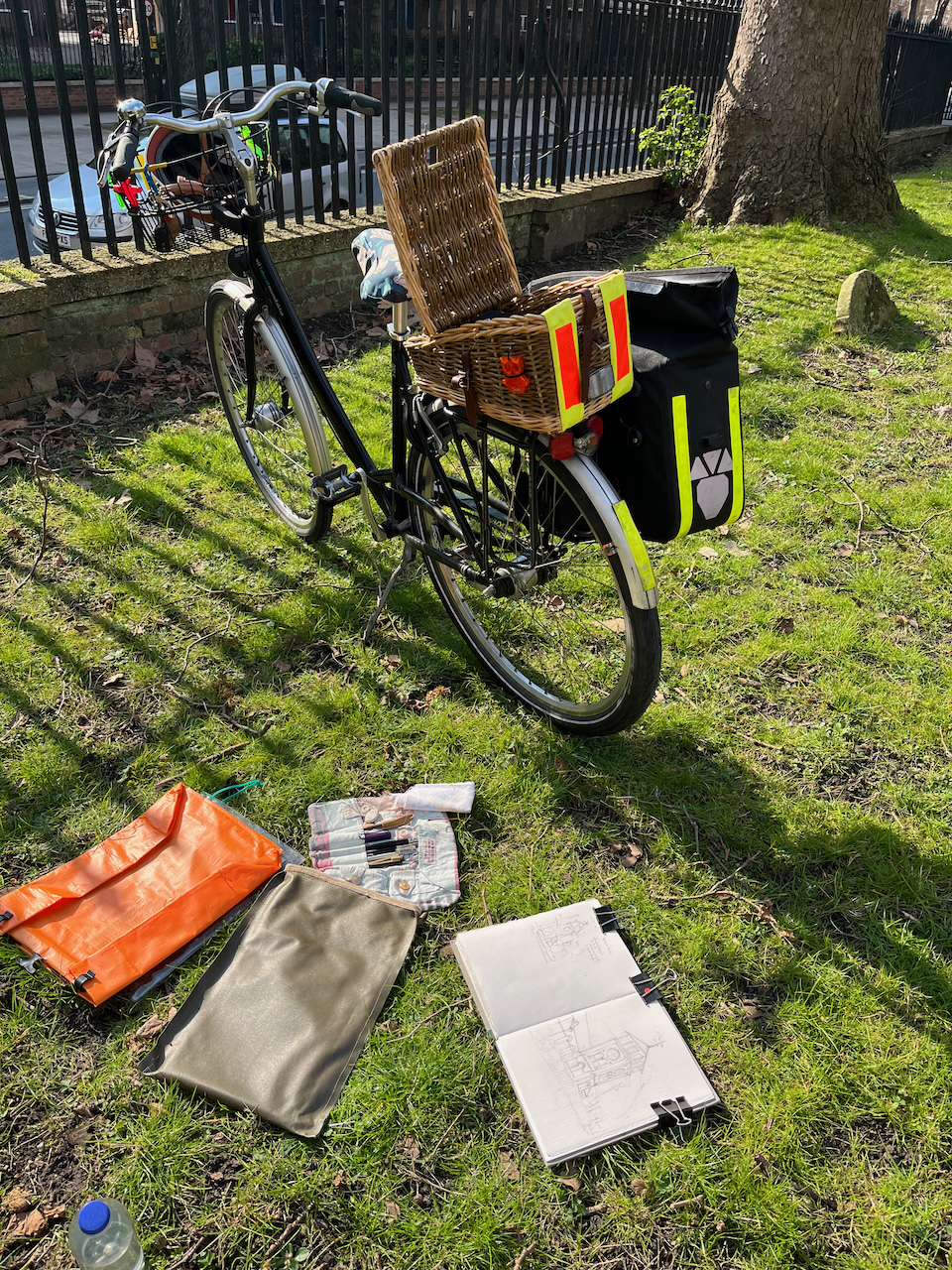
Here are some on-location photos and a picture of the sketchbook.
Thankyou to the talented artist LA for your company and inspiration on this expedition. It’s fun to sketch together!
Click a button below to share this post online, email it, or print it:
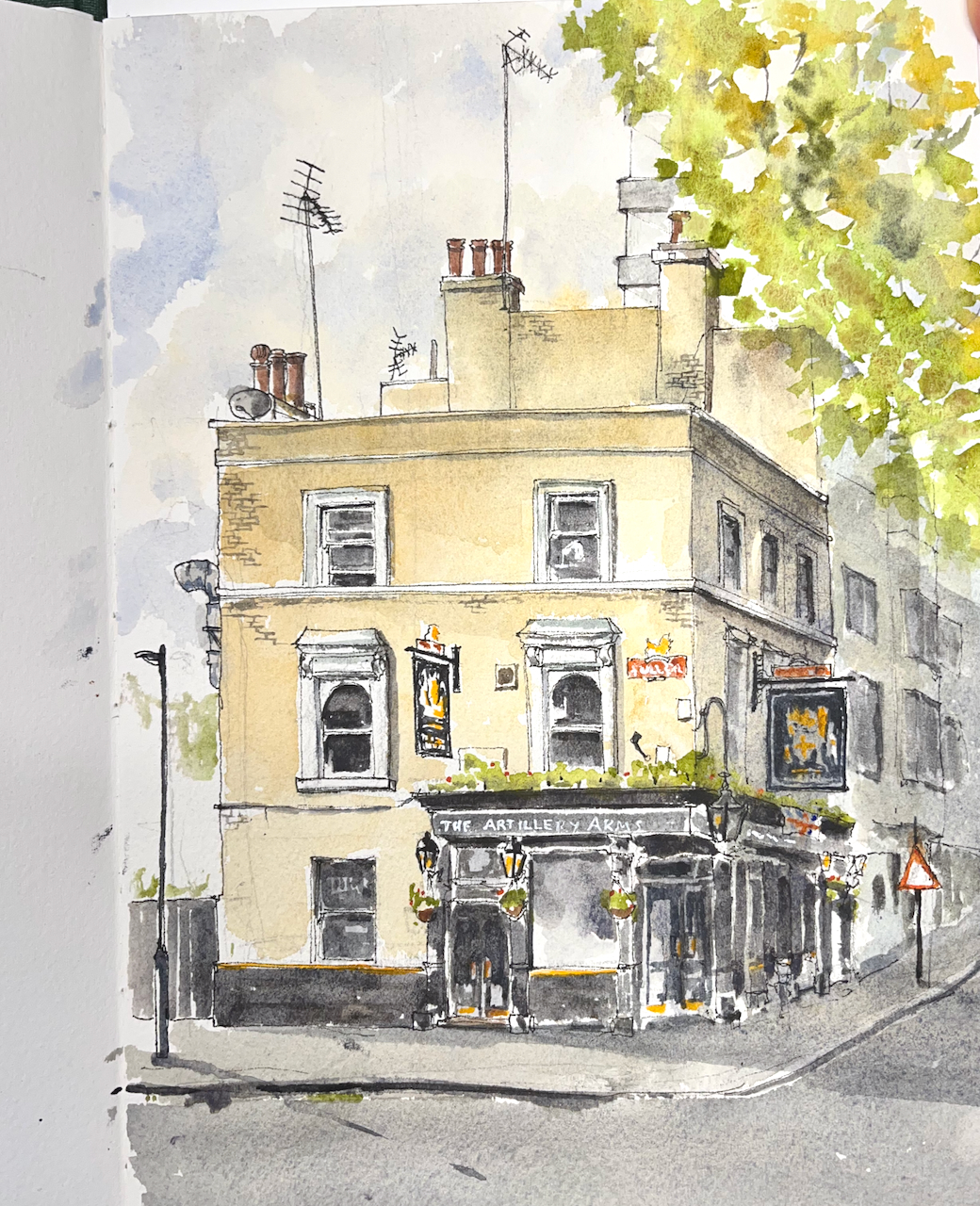
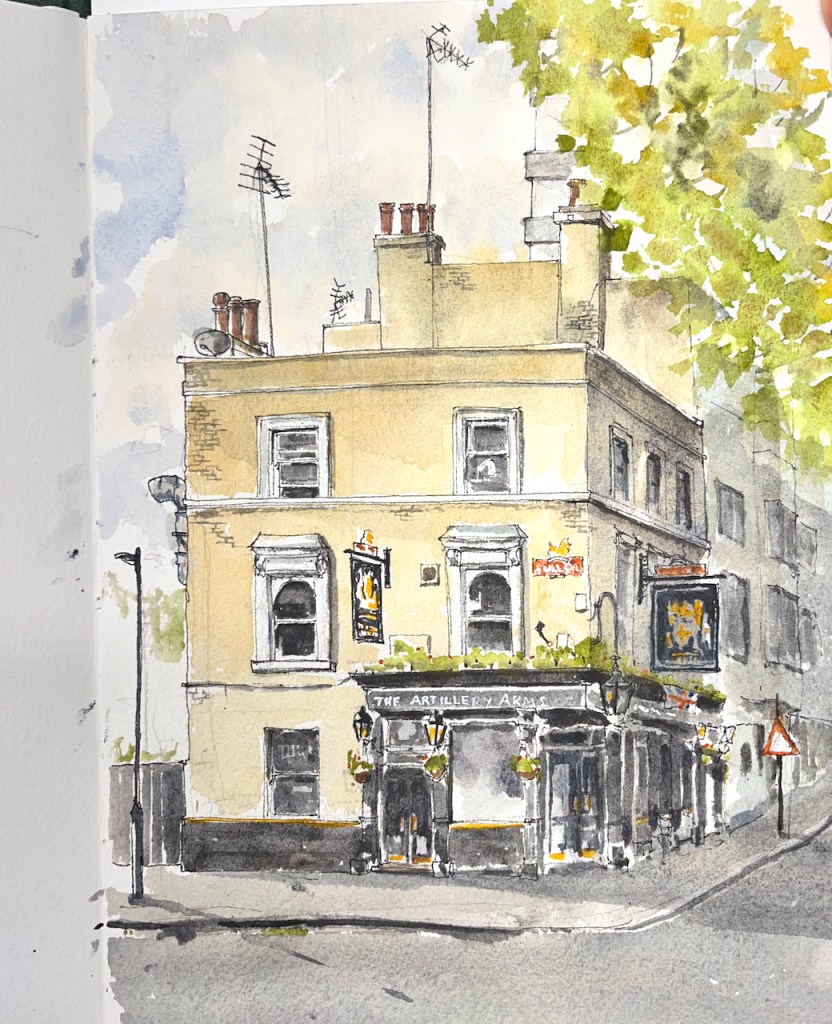
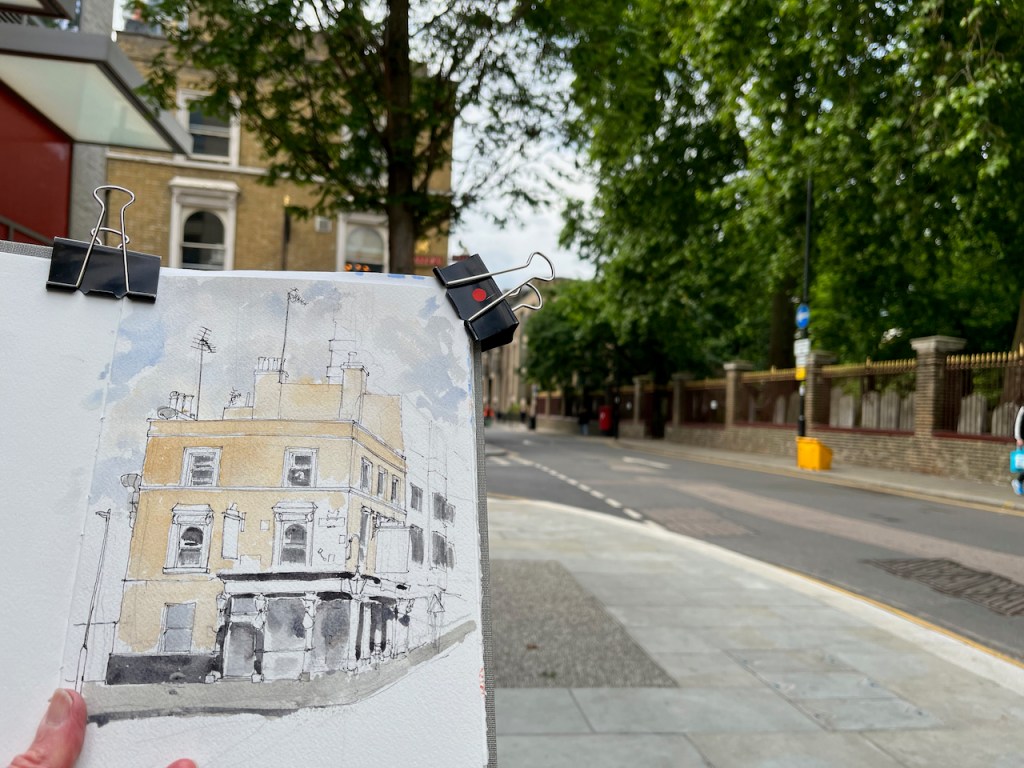
Here is The Artillery Arms, a local pub, on Bunhill Row, London EC1
The Artillery Arms EC1, 10″ x 7″ in Sketchbook 12, 30th May 2022
I sketched this standing outside the fence which surrounds Bunhill fields.
The Artillery Arms is near the Honourable Artillery Company. The Honourable Artillery Company is a regiment of the Army Reserve, and has occupied its current location since 1641, according to their website. It is very active: helicopters land there. Every so often there is a firework display which we can hear from our flat. At least I hope it is a firework display, and not the firing of actual artillery.
The pub is more recent. Up to at least 1852 it was known as the “Blue Anchor”, and became “The Artillery Arms” sometime before 1856 [1].
Here are some photos showing work in progress on the drawing:
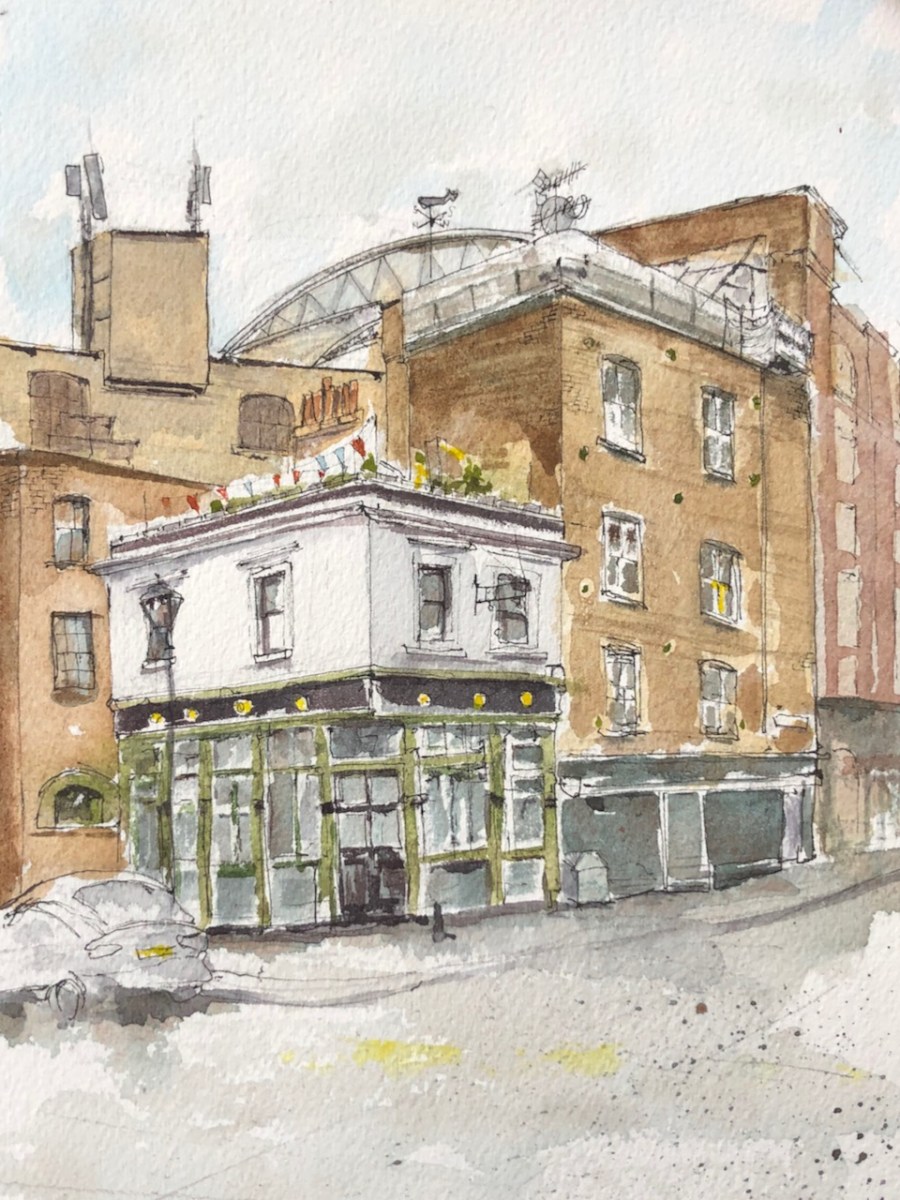
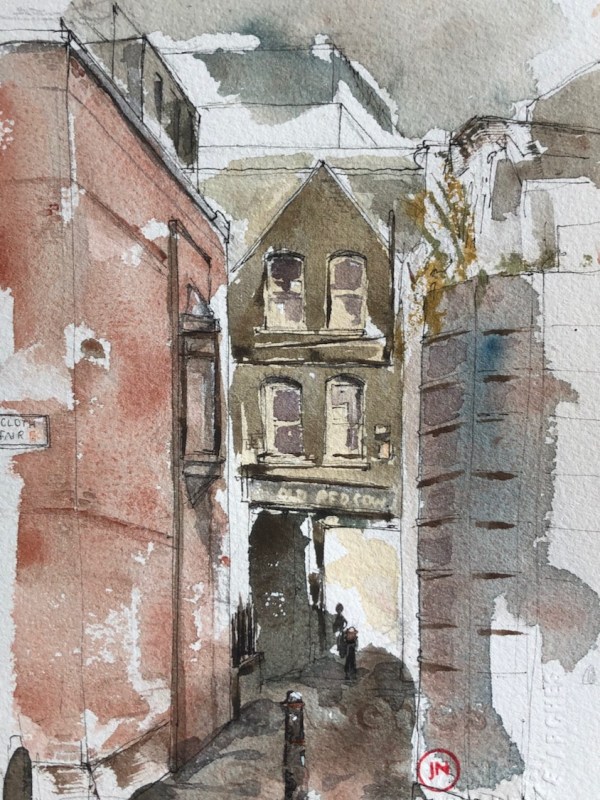
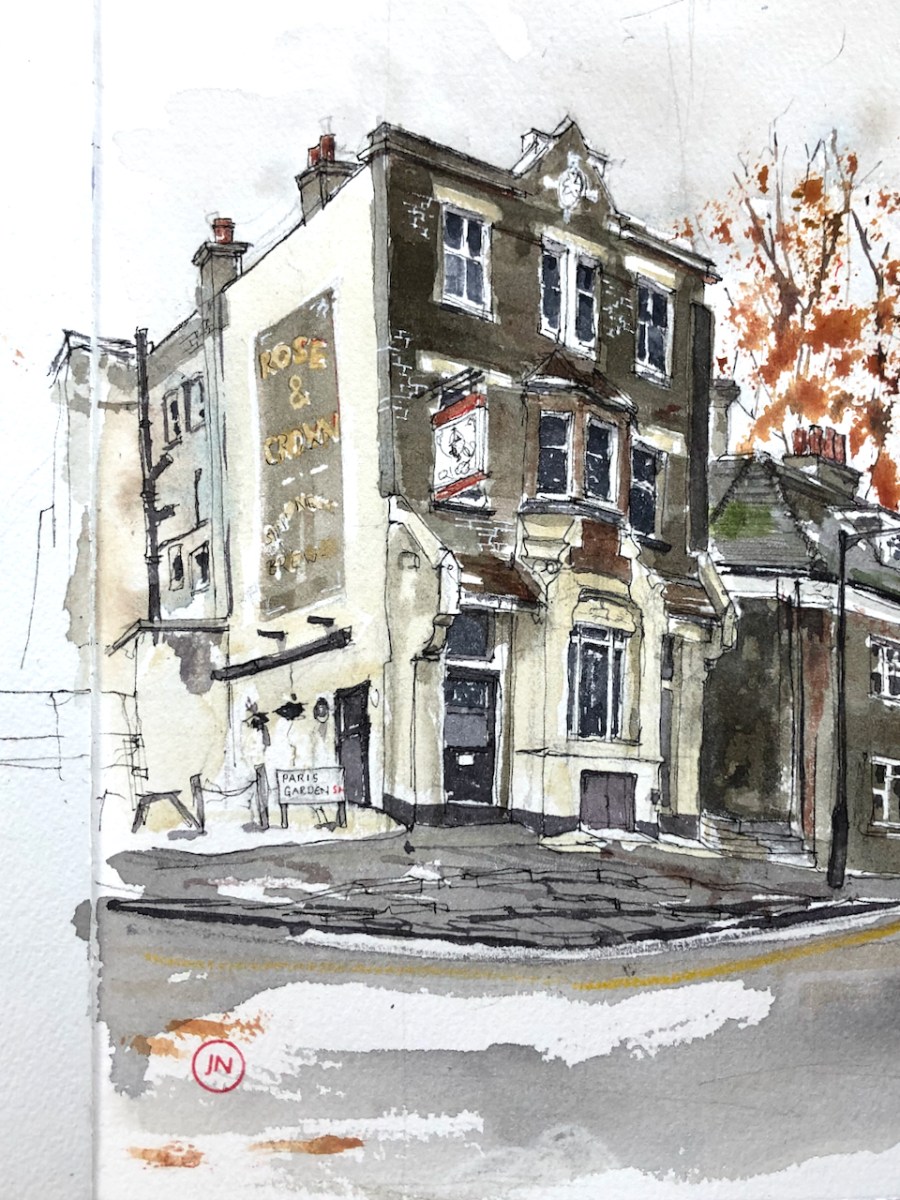
I have sketched several other pubs in the area and further afield. Here is a collection:
Here is The Crown Tavern in Clerkenwell Green. The pub frontage dates from 1900, according to the historic buildings listing1. The building is Grade II listed. There has been a pub here for…
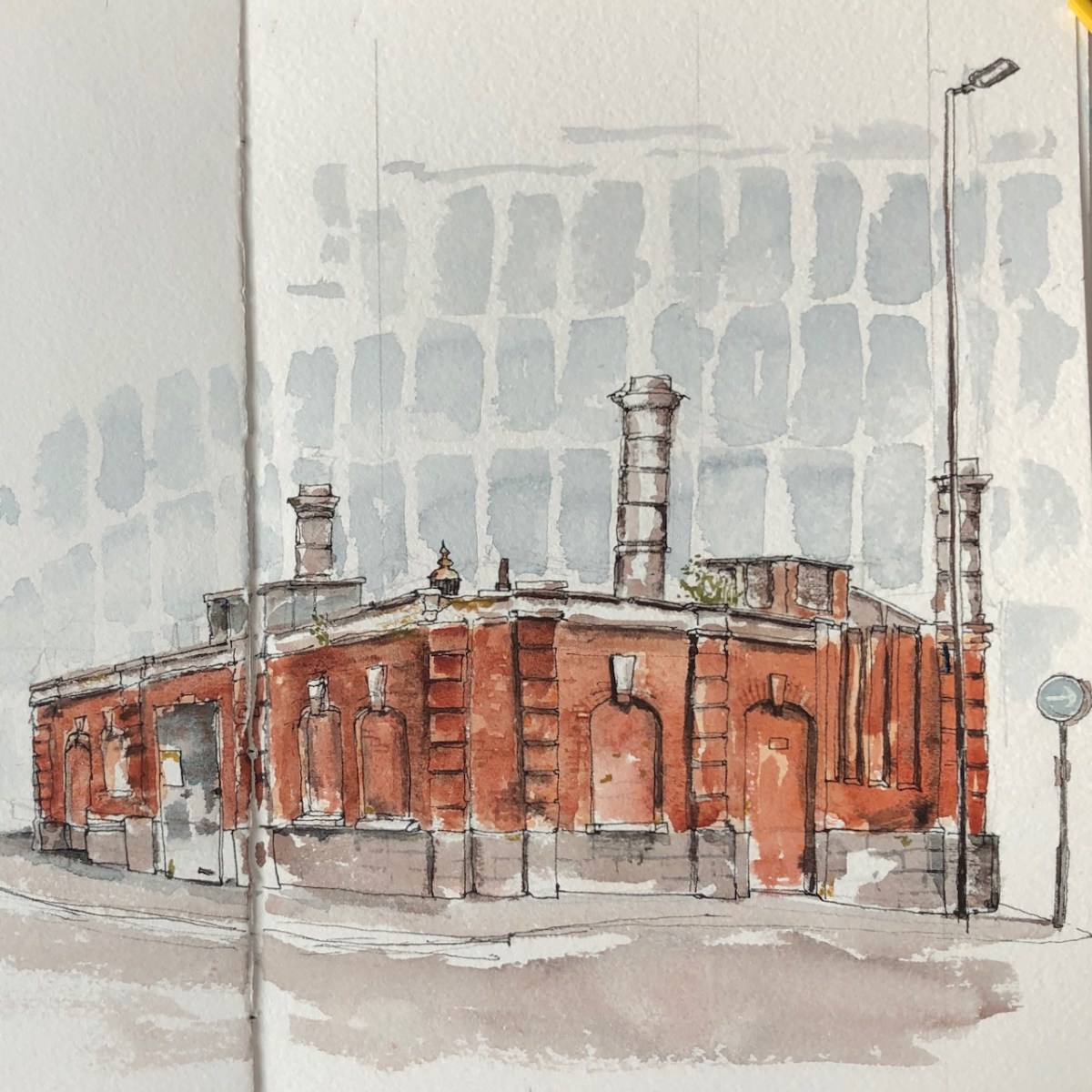
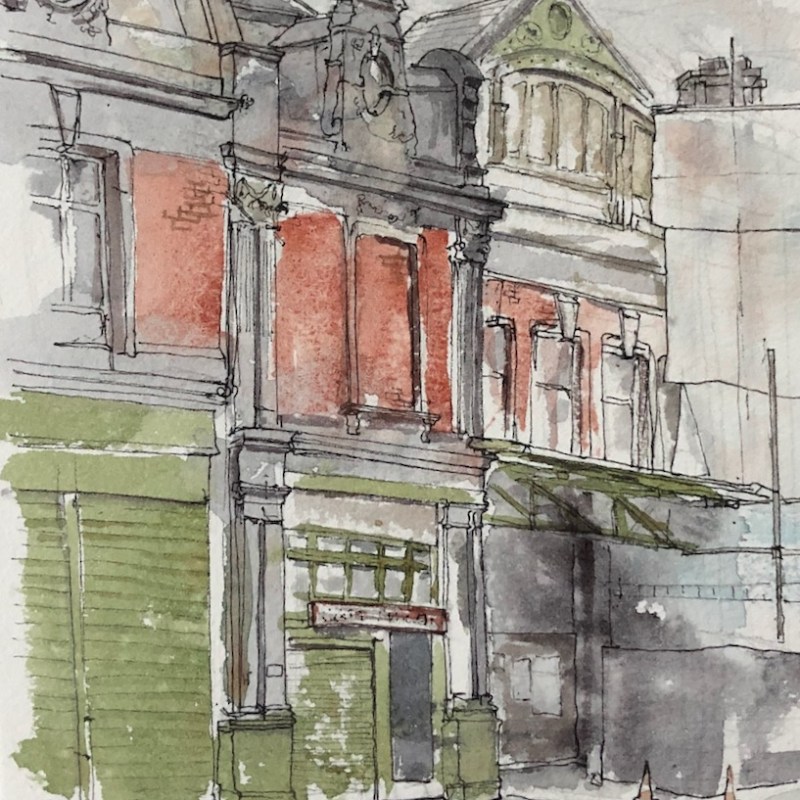
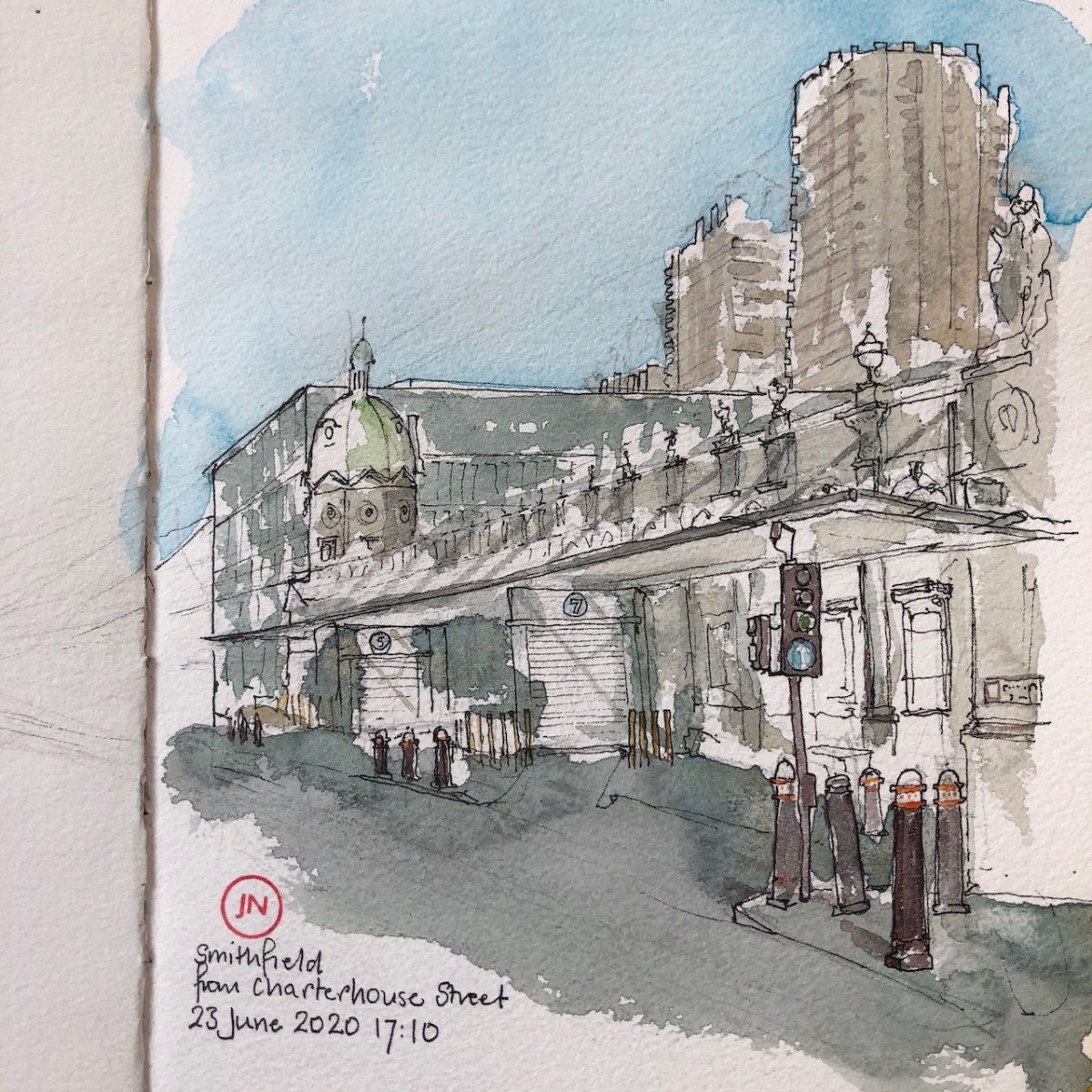
I set off on a warm afternoon intending to sketch a pub in Clerkenwell Green. On the way there, I walked along the north side of Smithfield. Down a side street I spotted…
Here is The Horseshoe, in Clerkenwell Close. I enjoyed the way the pub is slotted into that corner space, amongst the taller buildings. The building behind it looks as though it might be…
Here is a view of the pub “The Old Red Cow”, seen from Cloth Fair. The front of the pub is on Long Lane. When CrossRail opens, it will be very well placed…
Here is the Rose and Crown, just south of Blackfriars Bridge. This pub stands amongst modern blocks: linking past, present and future in a swirling area of change. Behind the pub, unexpectedly, is…
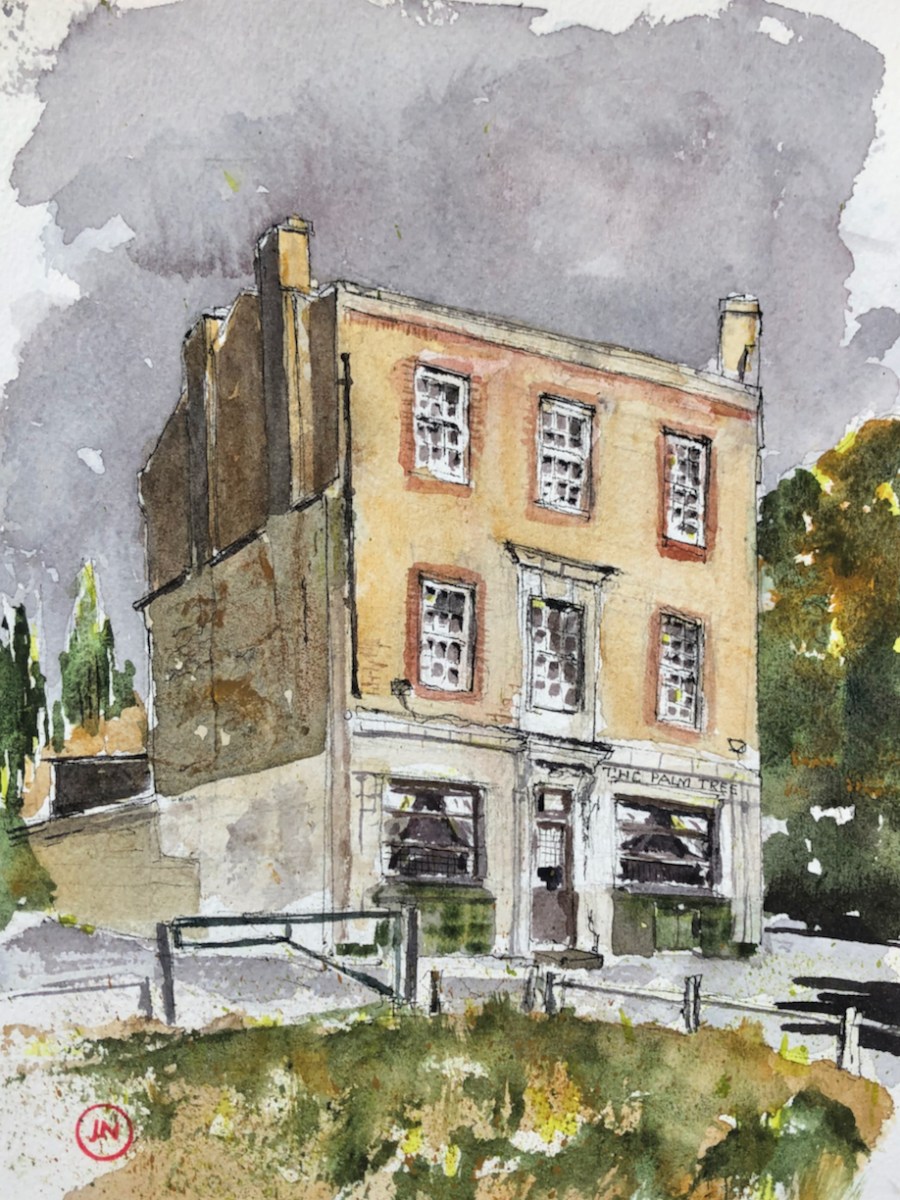
Here is “The Palm Tree” pub, seen from the south. I have often puzzled about this pub. I pass it as I’m cycling or running on the Regent’s Canal towpath. It stands alone,…
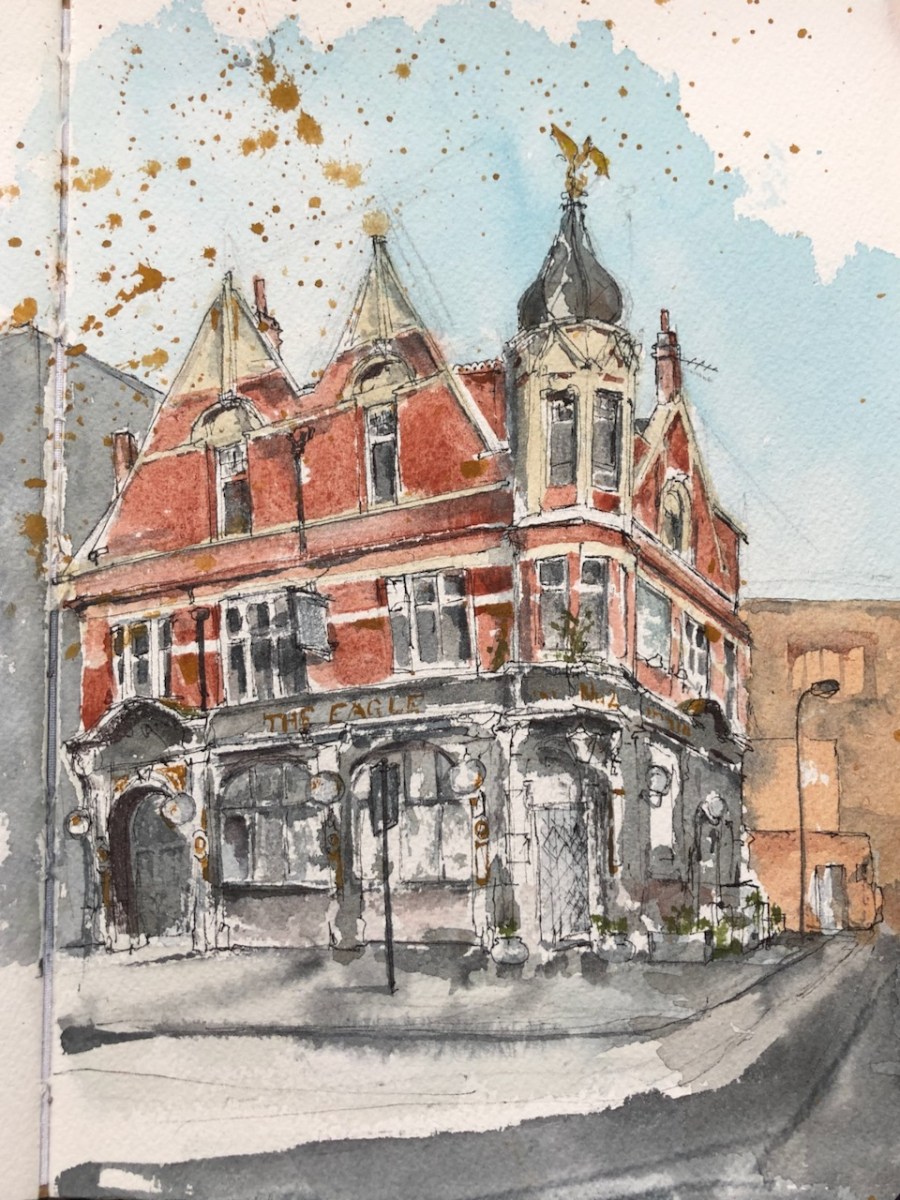
Here is The Eagle. This is a very old pub, located at a significant junction on City Road. In the picture above, the alley on the right of the pub is called “Shepherdess…
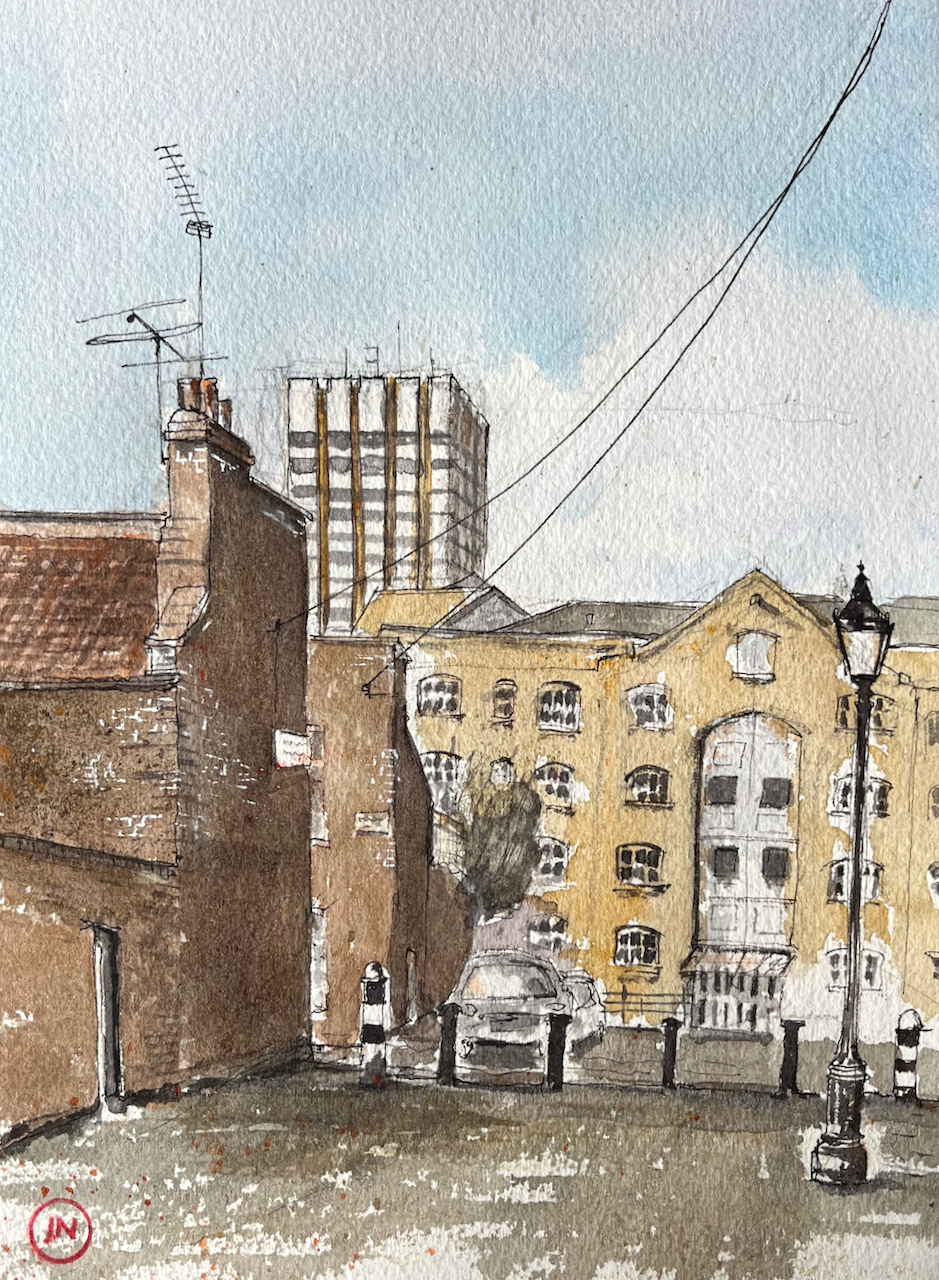
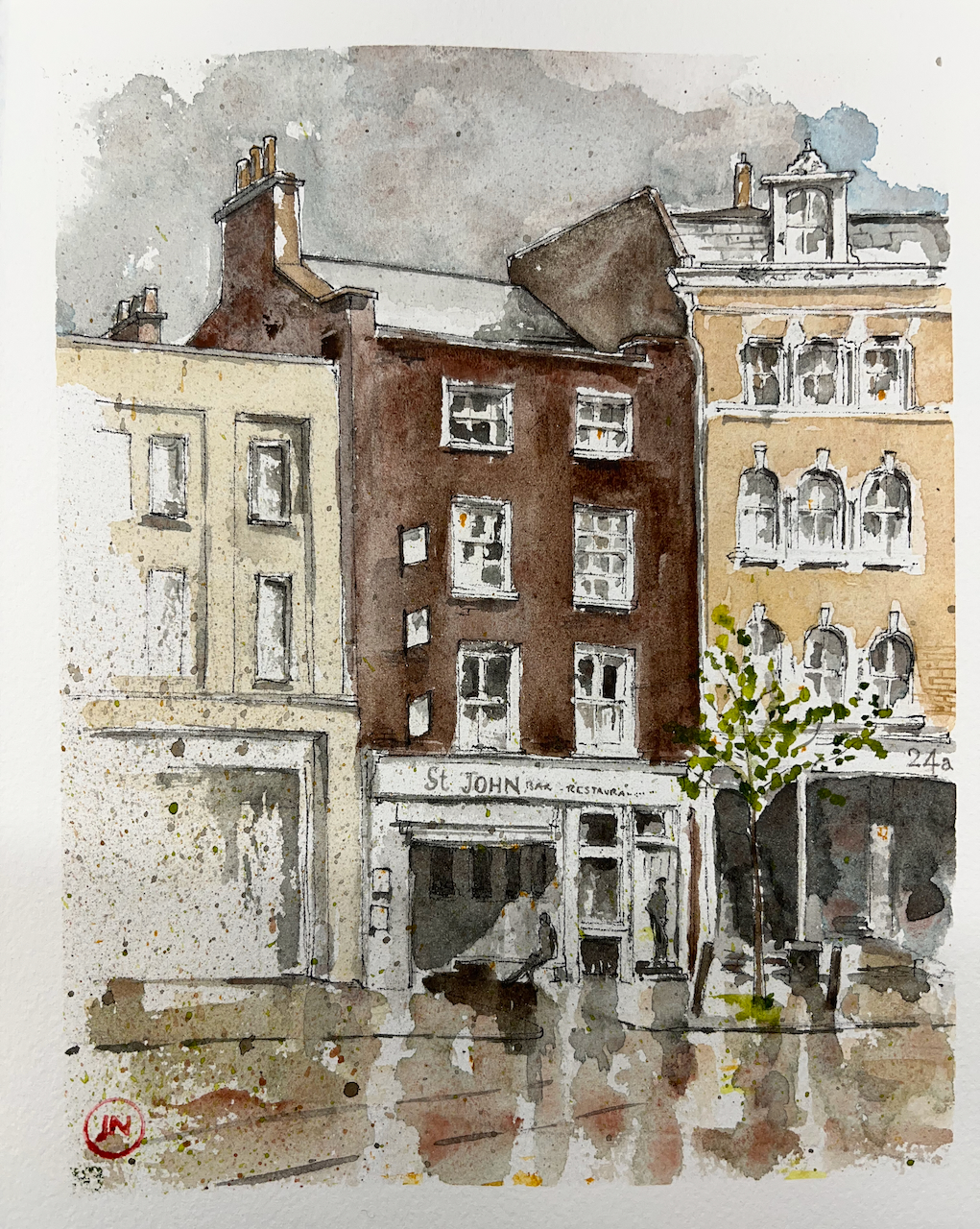
Usually, I use the “pen-and-wash” technique. I draw an urban scene in waterproof pen and then add the wash. This method is fast, and useful for outdoor work on location. Most of my urban sketching work uses this technique. Here’s are example:
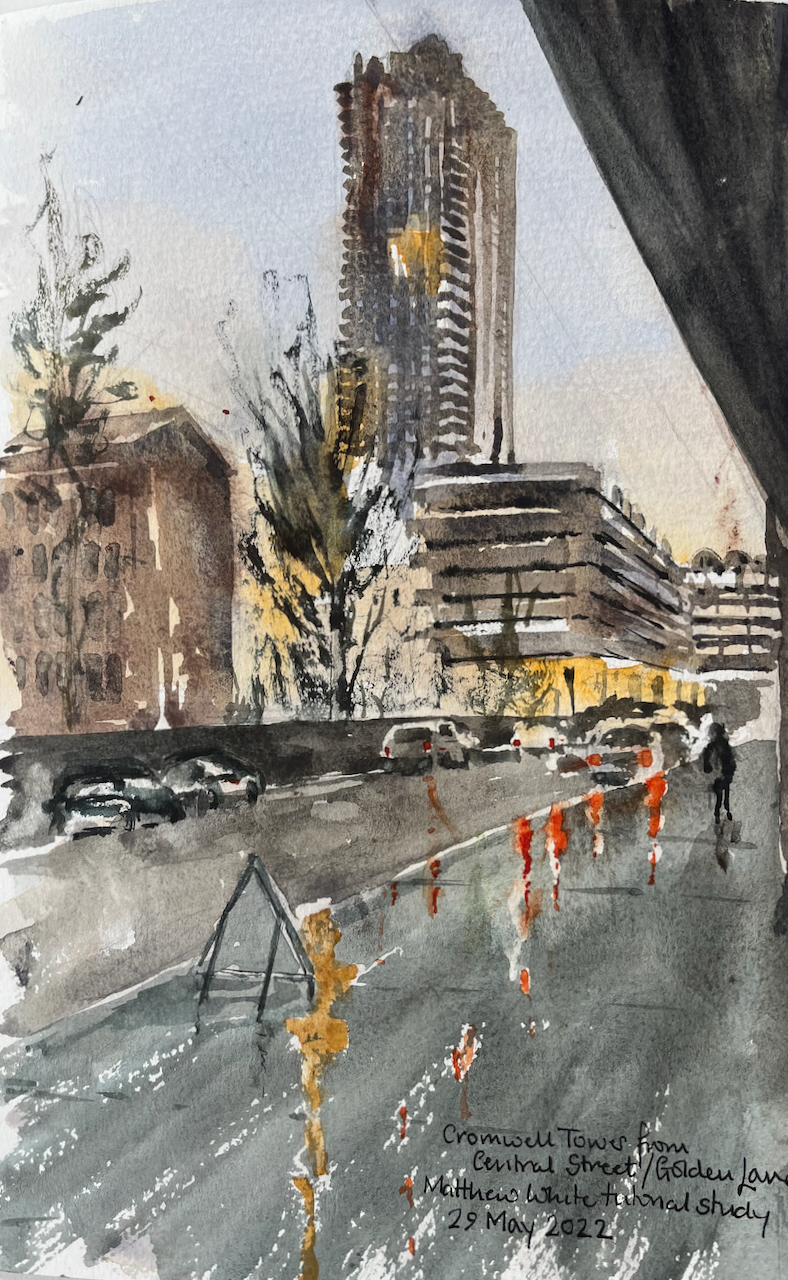
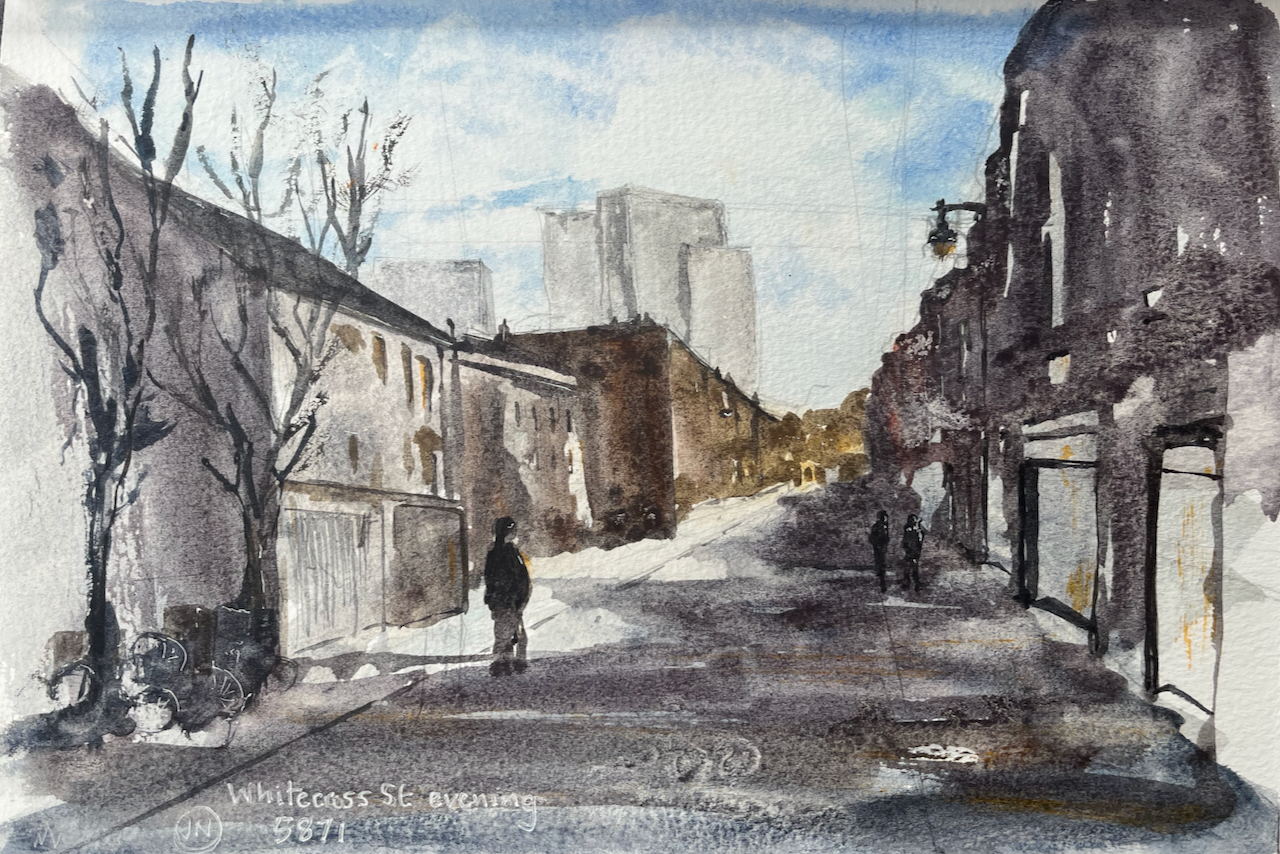
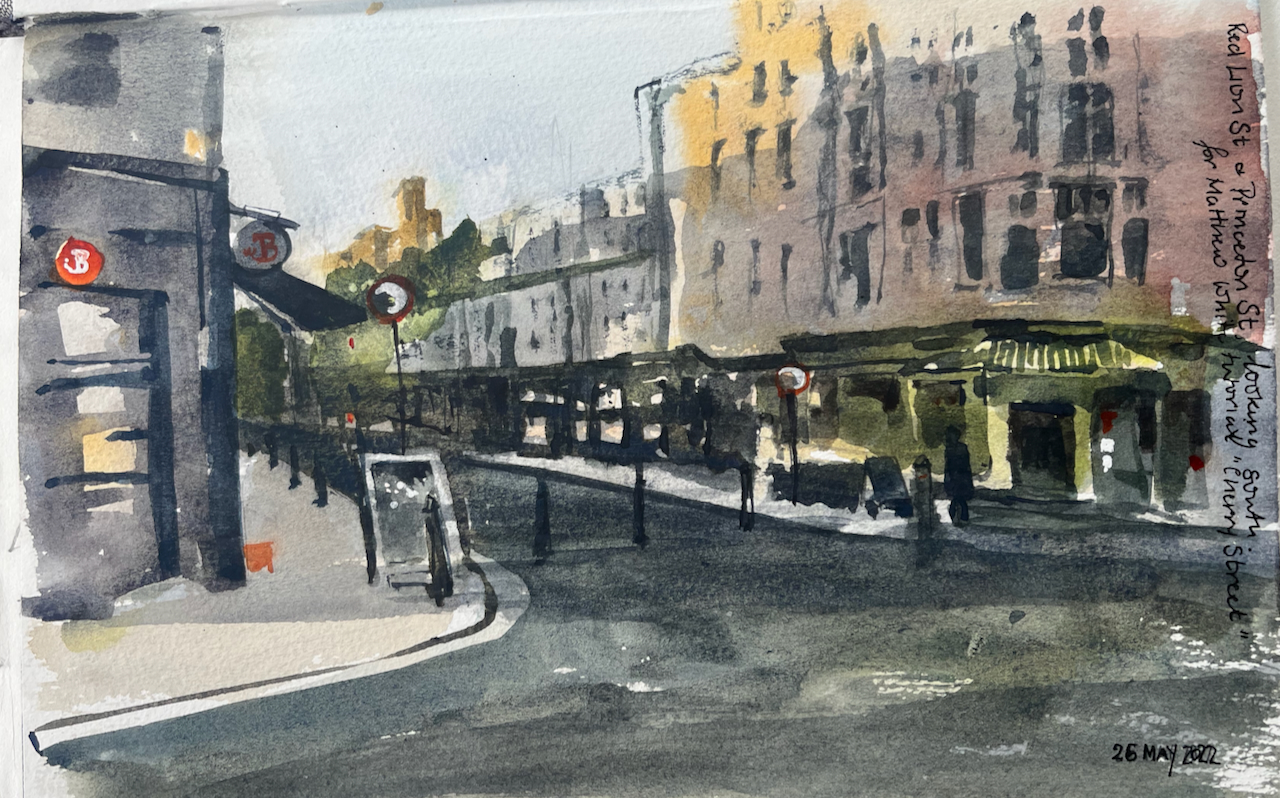
I wanted to try a “straight-to-watercolour” method. This involves looking at the scene differently. To go straight to watercolour I need to learn to see “shapes” rather than “lines”. I practised this with these three watercolours:
Whitecross StreetCromwell Tower from Golden LaneRed Lion Street
I worked learning from demonstrations by Matthew White . I hope to incorporate elements of this practice into my own work.
Click a button below to share this post online, email it, or print it:
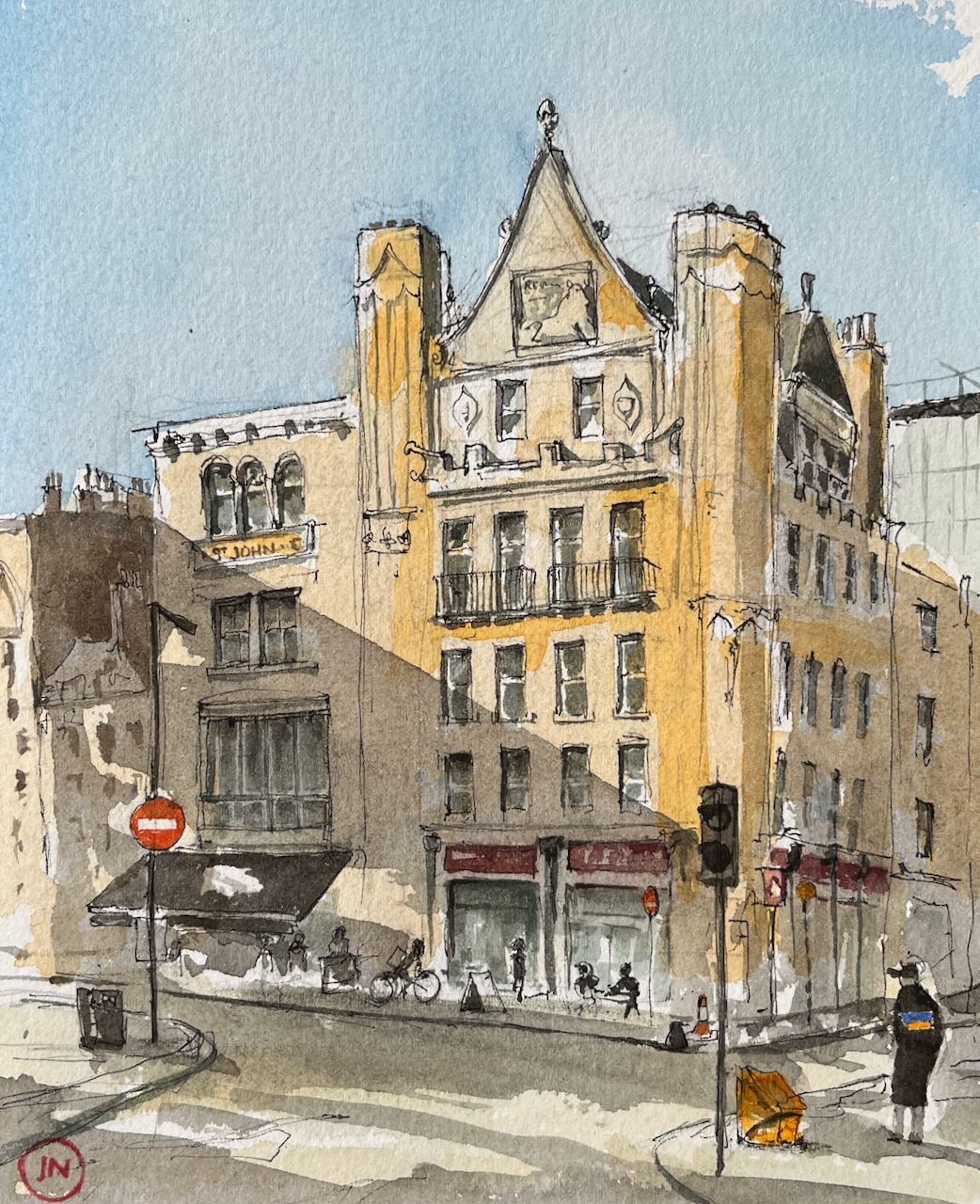
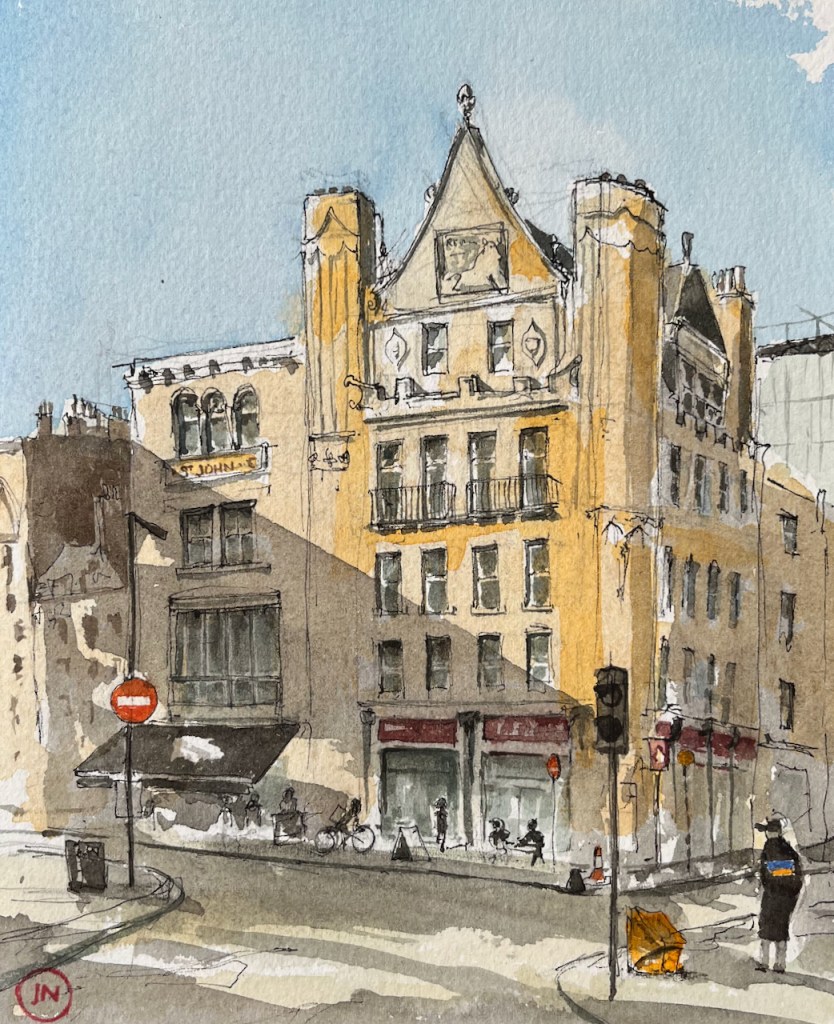
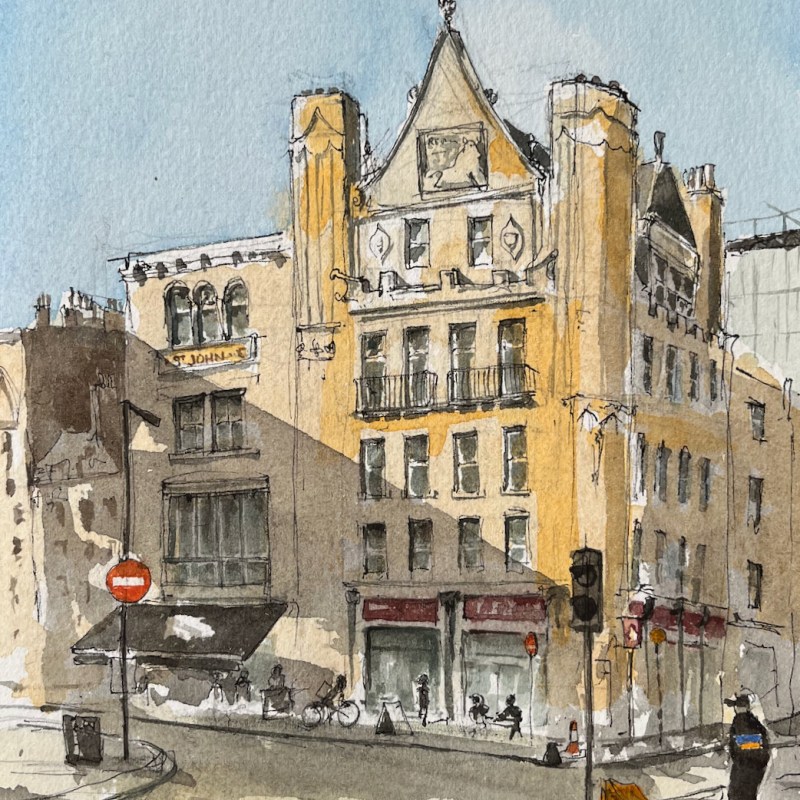
These glorious buildings are at the south end of St John’s Street. This is the view looking north from the Smithfield Meat Market, Central Avenue.
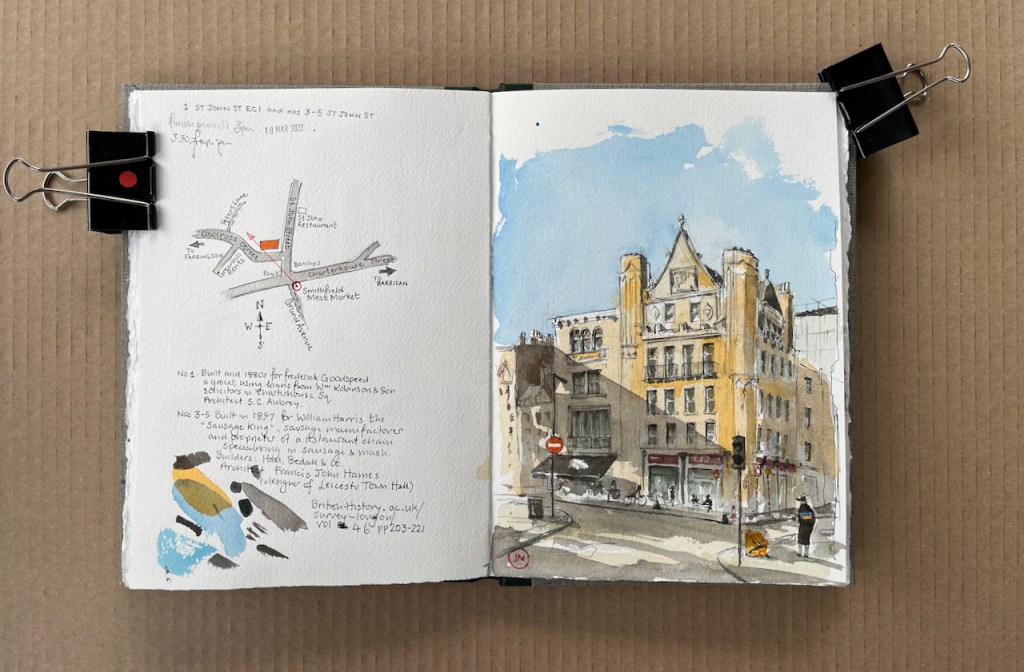
3-5 St John St EC1, 18th March 2022 3:30pm, in Sketchbook 11
It’s a busy corner. I tried to show some the street life: couriers cycling, people sitting at the café, and people, like me, standing and looking. A little further up St John Street, on the right, is construction work.
There was a blue sky as I drew. But do not be deceived: it was cold, as you see from the person on the right, hunched under their coat.
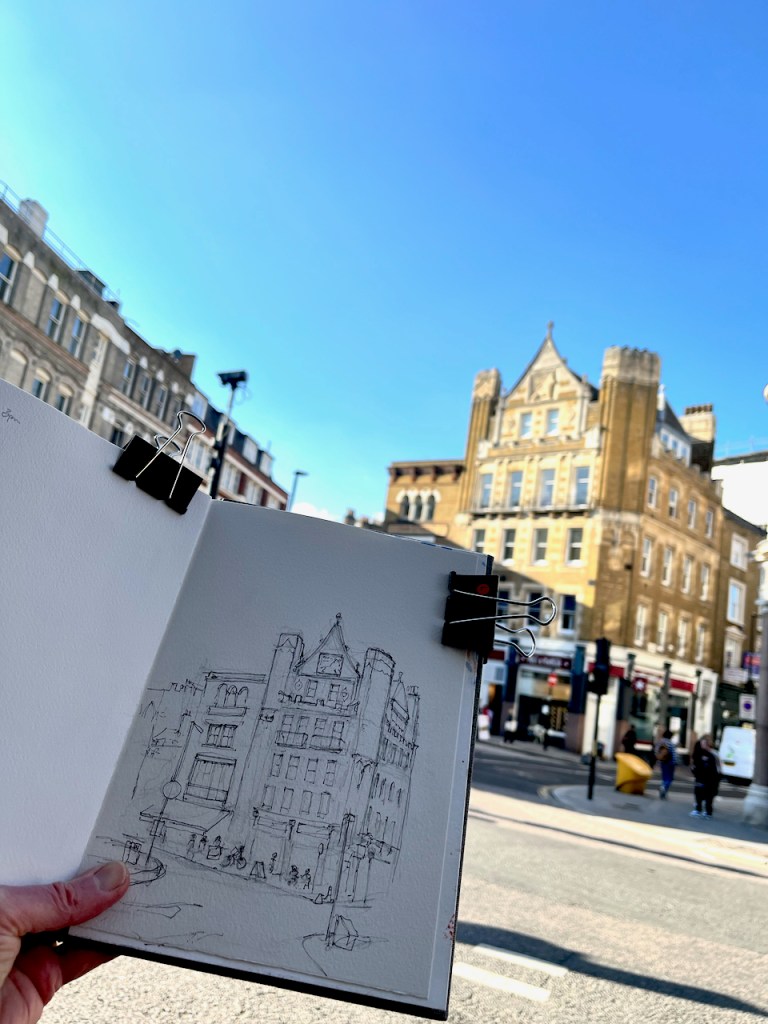
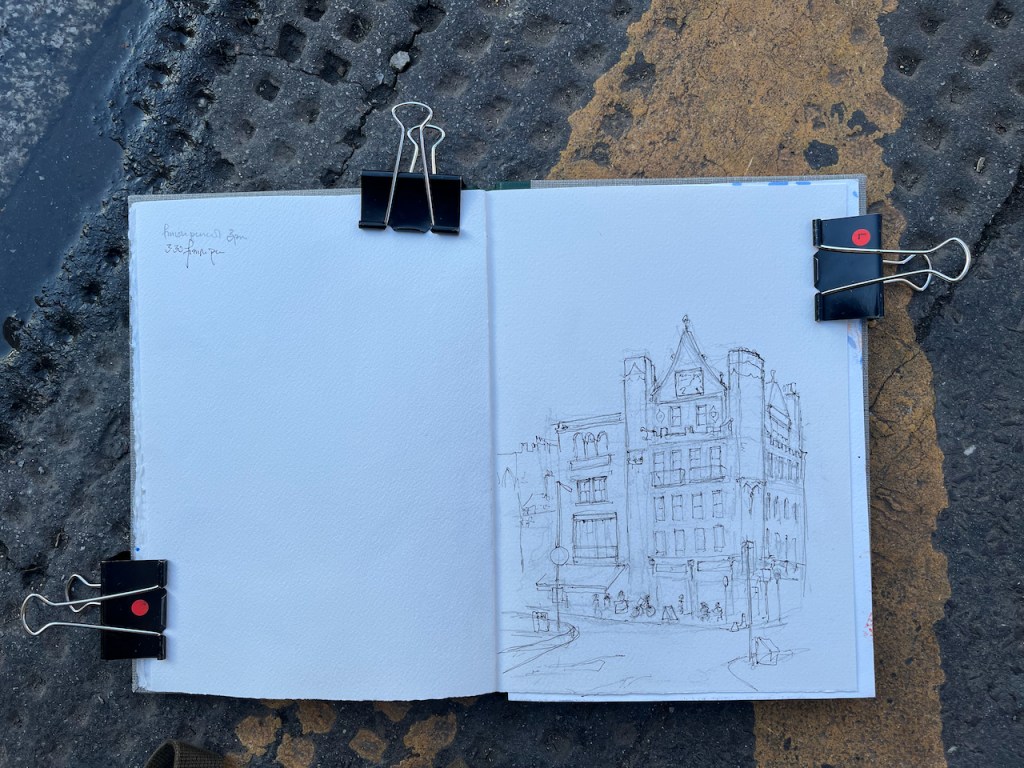
Here is a work-in-progress photo and a map:
Work in progressPen finishedSketchbook spreadMap showing the sightline
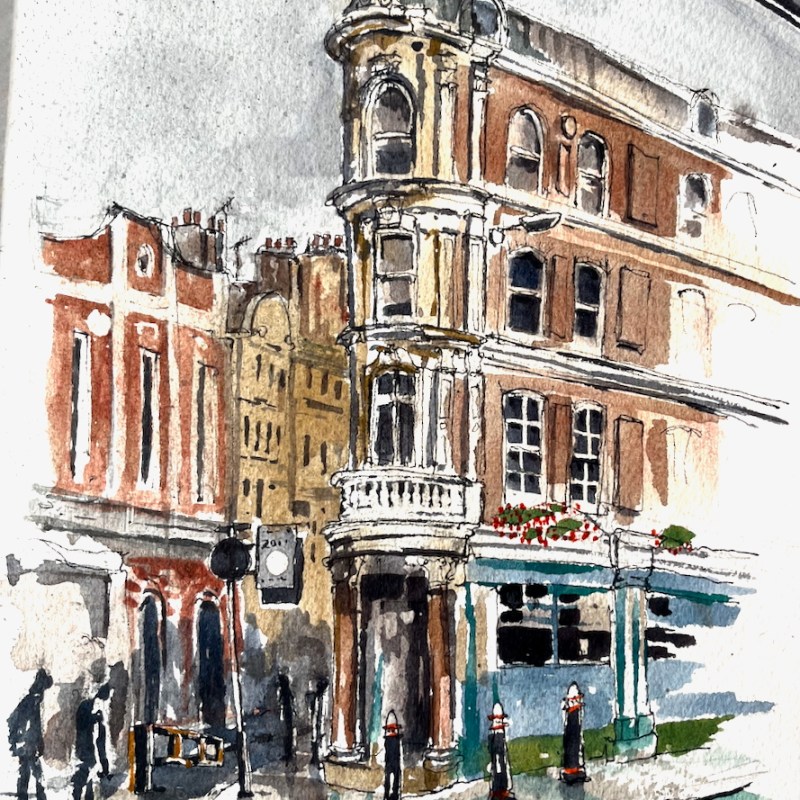
This is an ornate buildings: lots of fluting and complicated brickwork. Who thought all that was a good idea? Who could afford it? Number 1, on the left, slightly more restrained, was built for a Frederick Goodspeed, a grocer, in the mid 1880s. The architect was S.C. Aubrey. (reference 1 below)
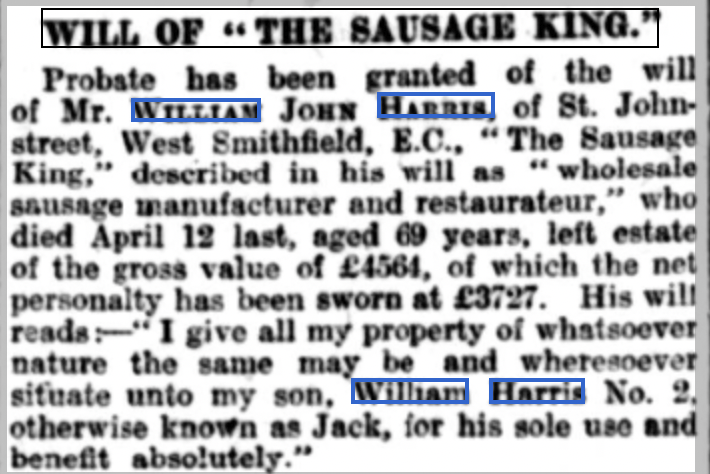
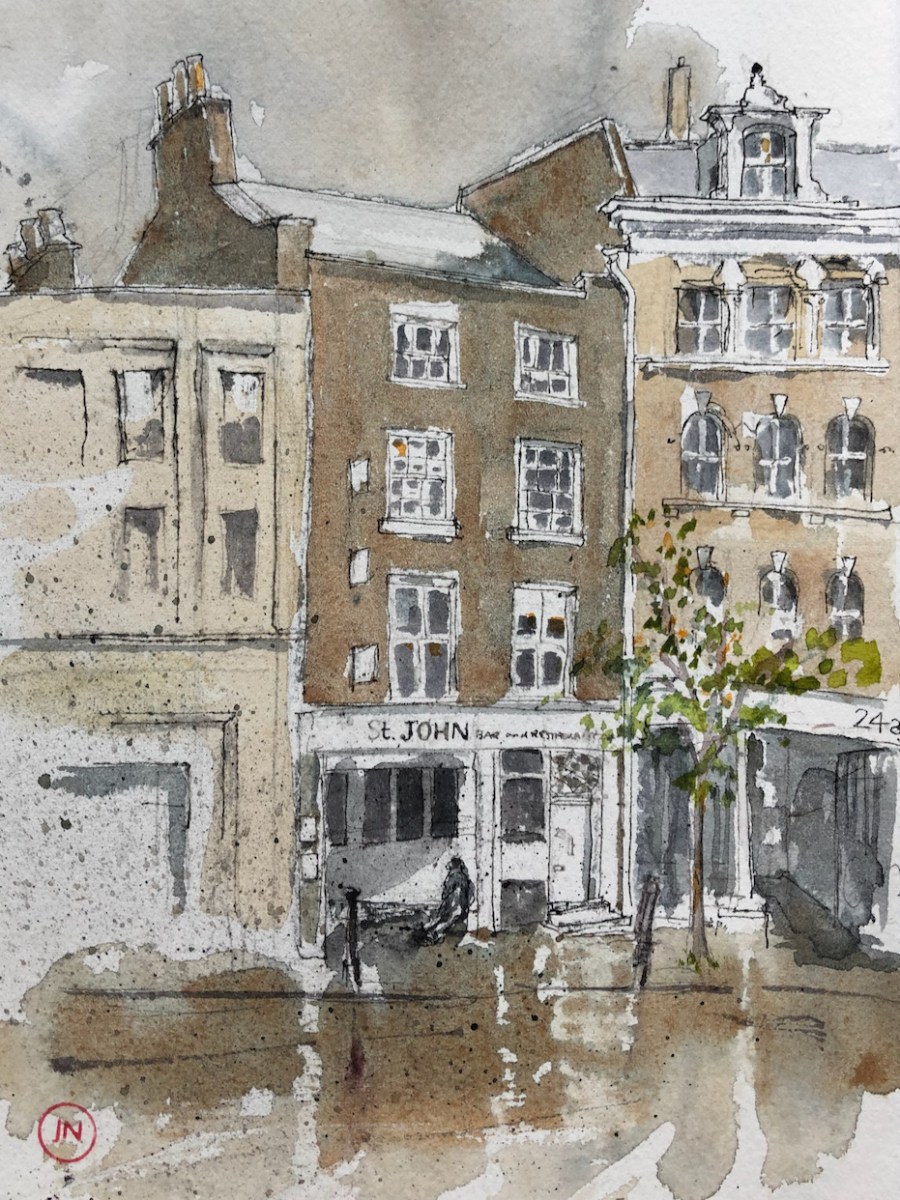
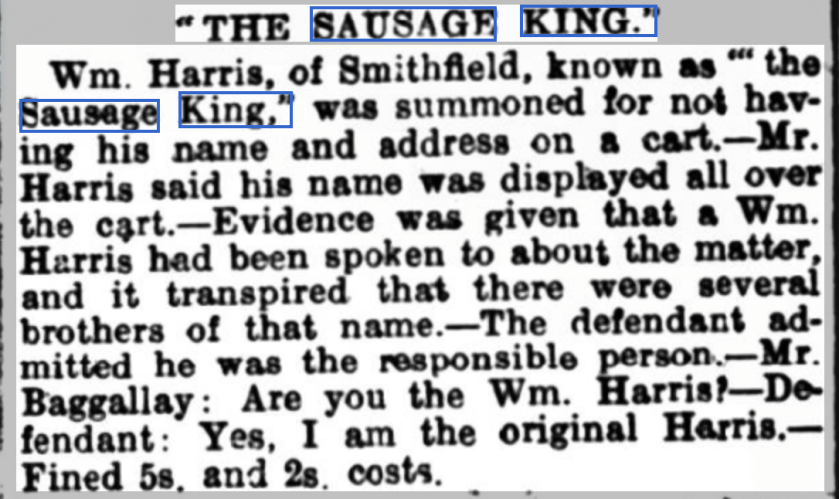
Numbers 3-5, the building on the corner, has chimneys with all kinds of complicated brickwork, and a highly decorative frontage onto Smithfield. It was built in 1897 for William Harris, the “Sausage King”. He was a sausage manufacturer, and proprietor of a chain of restaurants specialising in sausage and mash. Mr Harris was evidently quite a character. He named all his three sons William, and all his four daughters Elizabeth (reference 2 below). This may have had practical problems, but it meant he and his sons could have fun with the Magistrates:
The “Sausage King” was somewhat eccentric, but this was to a large extent due to his love of “personal advertising,” which was his motto for business success. At all times of the day he wore a sort of evening dress, with an opera hat, and a blazing diamond in his white shirt, even when buying in the market, and he used not a scrap of writing or wrapping paper that did not bear his photograph. His trade mark, which he registered about forty years ago, depicts him winning the “Pork Sausage Derby” on a fat porker. His principal catch-phrase was “Harris’s sausages are the best,” and it spread the fame of his sausages all over the world. He also composed a lot of poetic advertisements, which caused much amusement.
This snippet from “London Standard, via the Montreal Gazette, 3 May 1912” reporting his death (reference 2).
He died in April 1912, leaving a considerable fortune. His death was reported far and wide, including papers in many parts of England and Ireland.
Note the reference to “William Harris No. 2”, that is, his second son, to whom he left all his property. I wonder what all the other sons thought – and the four daughters?
I am glad that the flamboyant house of this extraordinary man still stands. The architect was Francis John Hames, who also designed Leicester Town Hall. So you see what kind of league Mr Harris was in.
Reference 1: Thanks to British History Online who alerted me to The Sausage King: ‘St John Street: Introduction; west side’, in Survey of London: Volume 46, South and East Clerkenwell, ed. Philip Temple (London, 2008), pp. 203-221. British History Online http://www.british-history.ac.uk/survey-london/vol46/pp203-221 [accessed 8 April 2022].
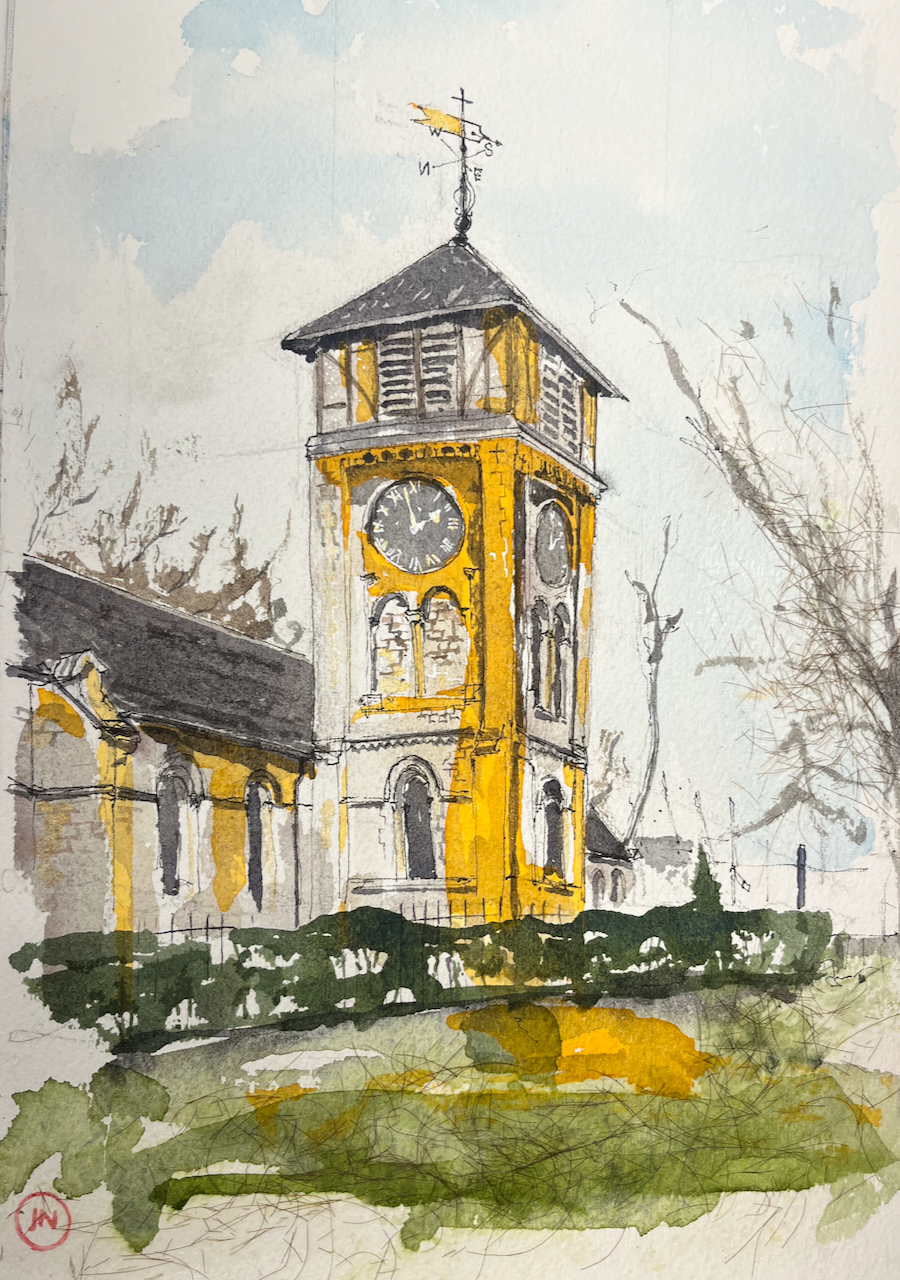
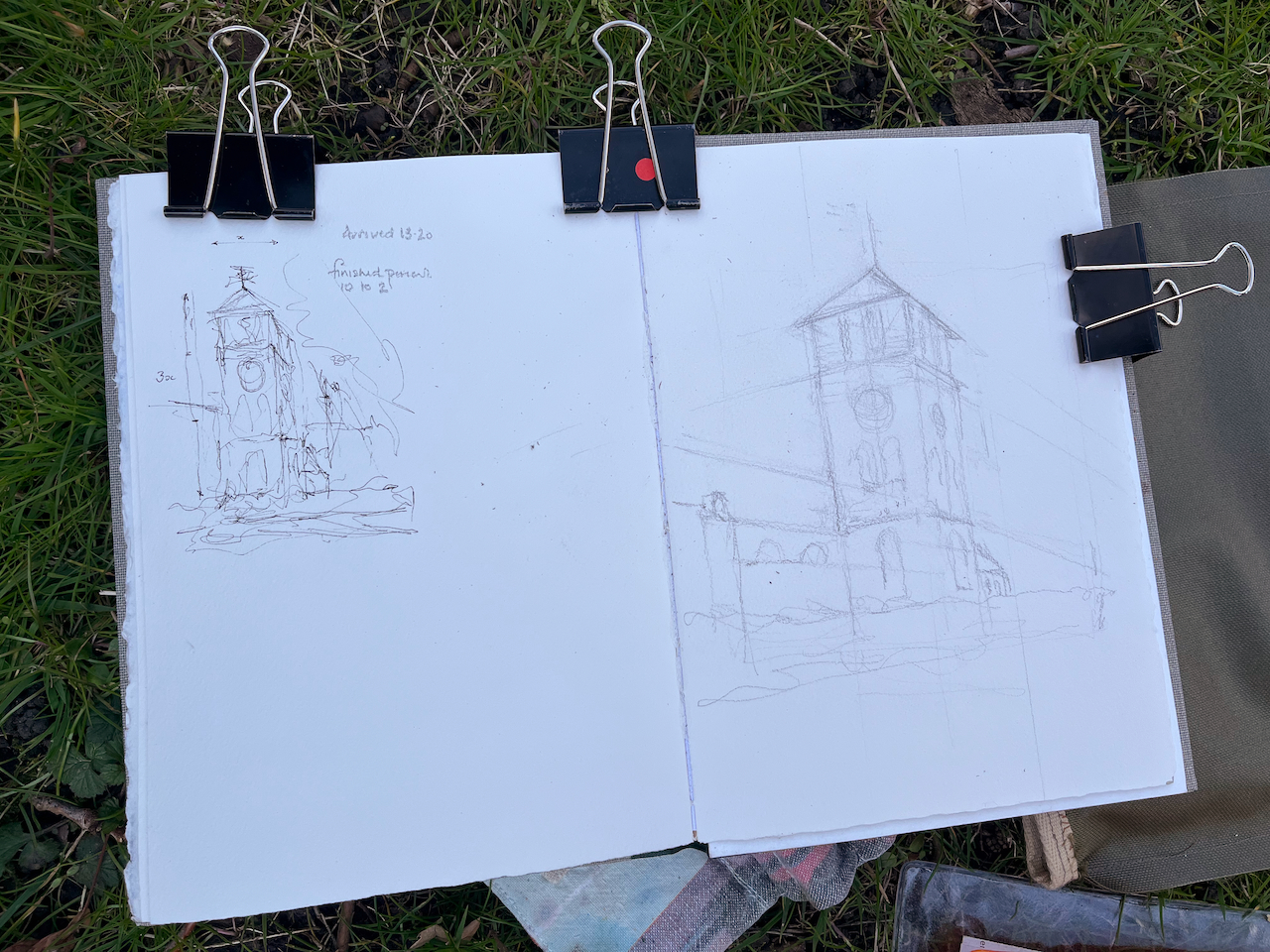
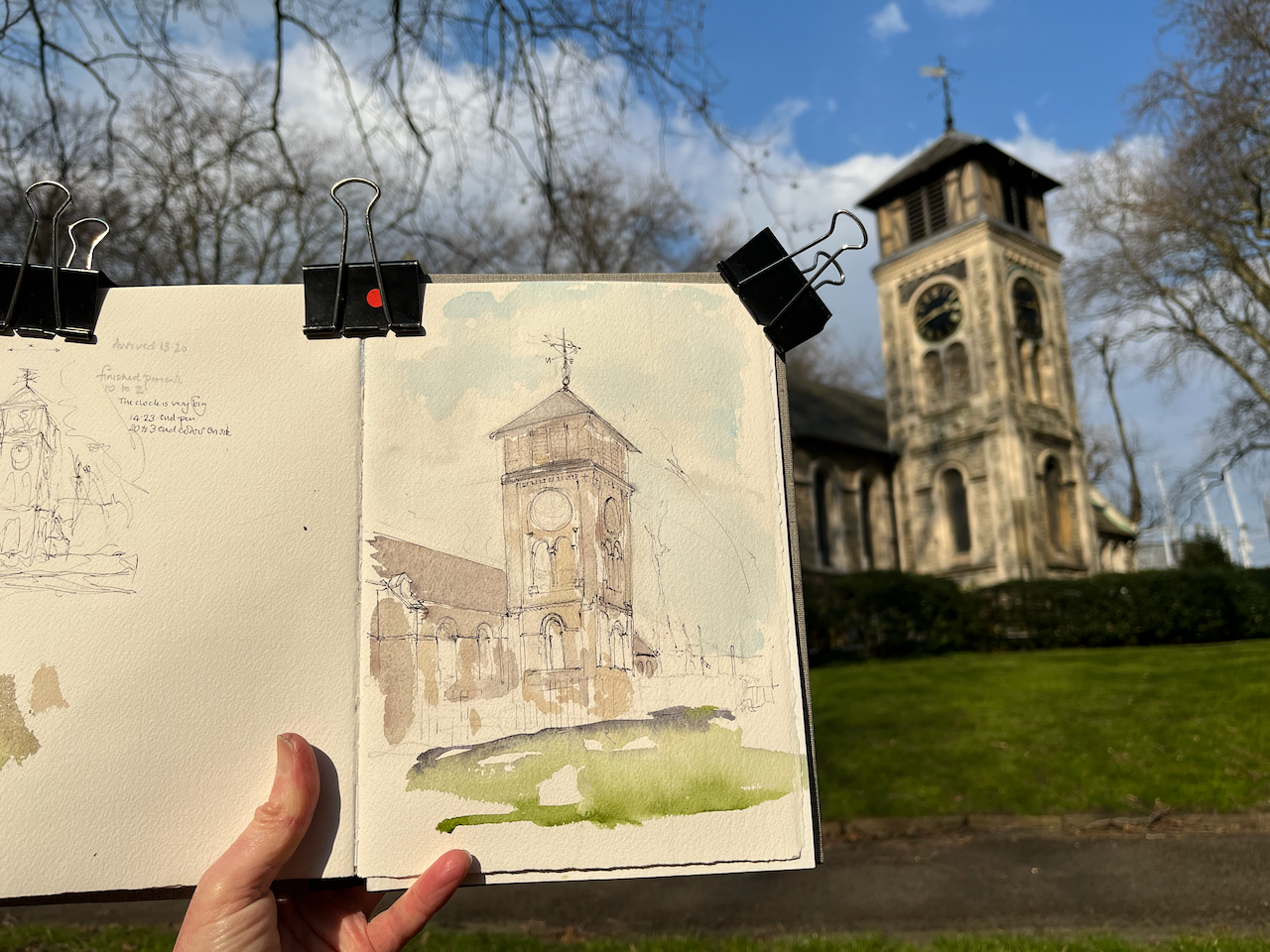
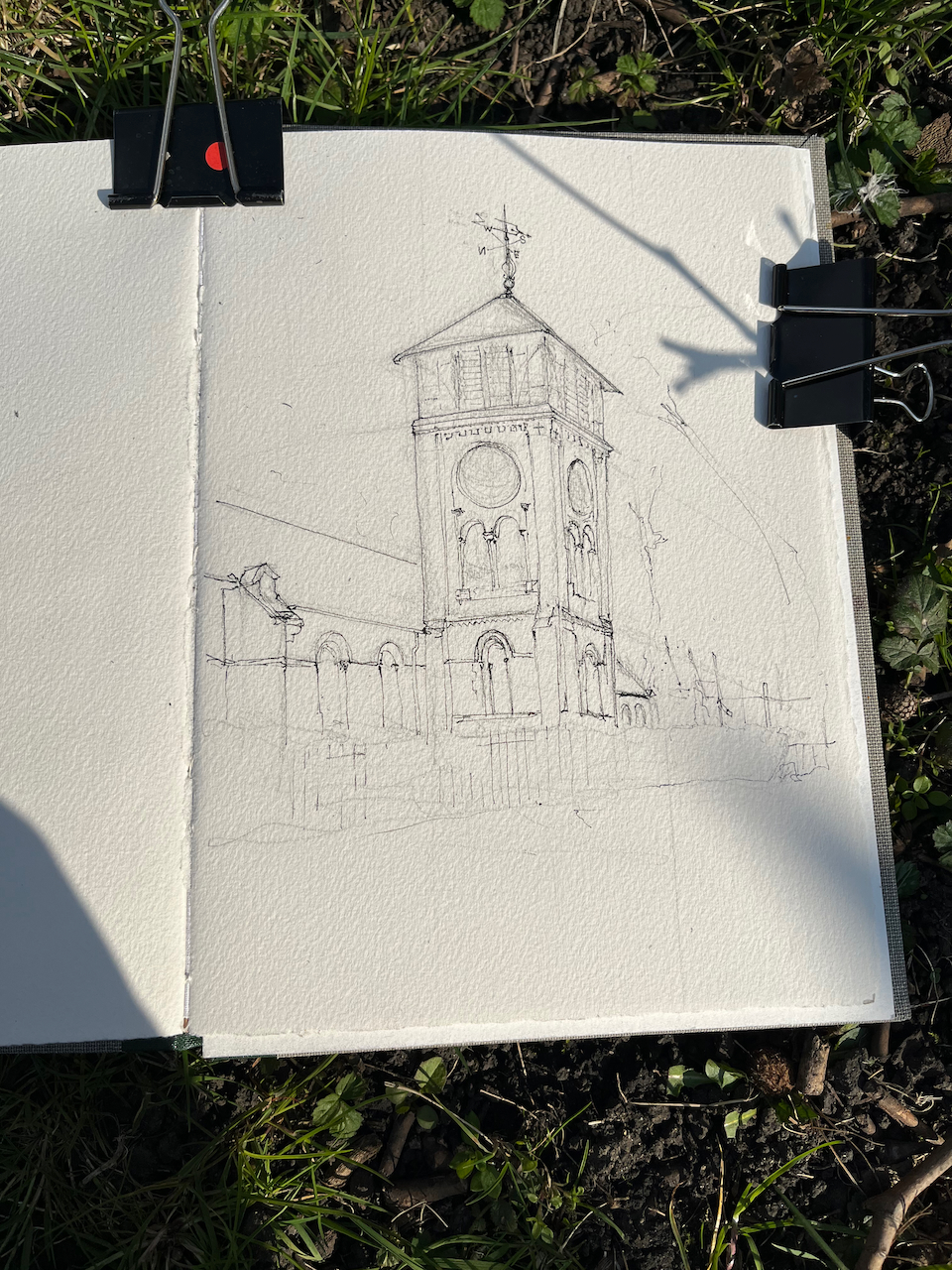
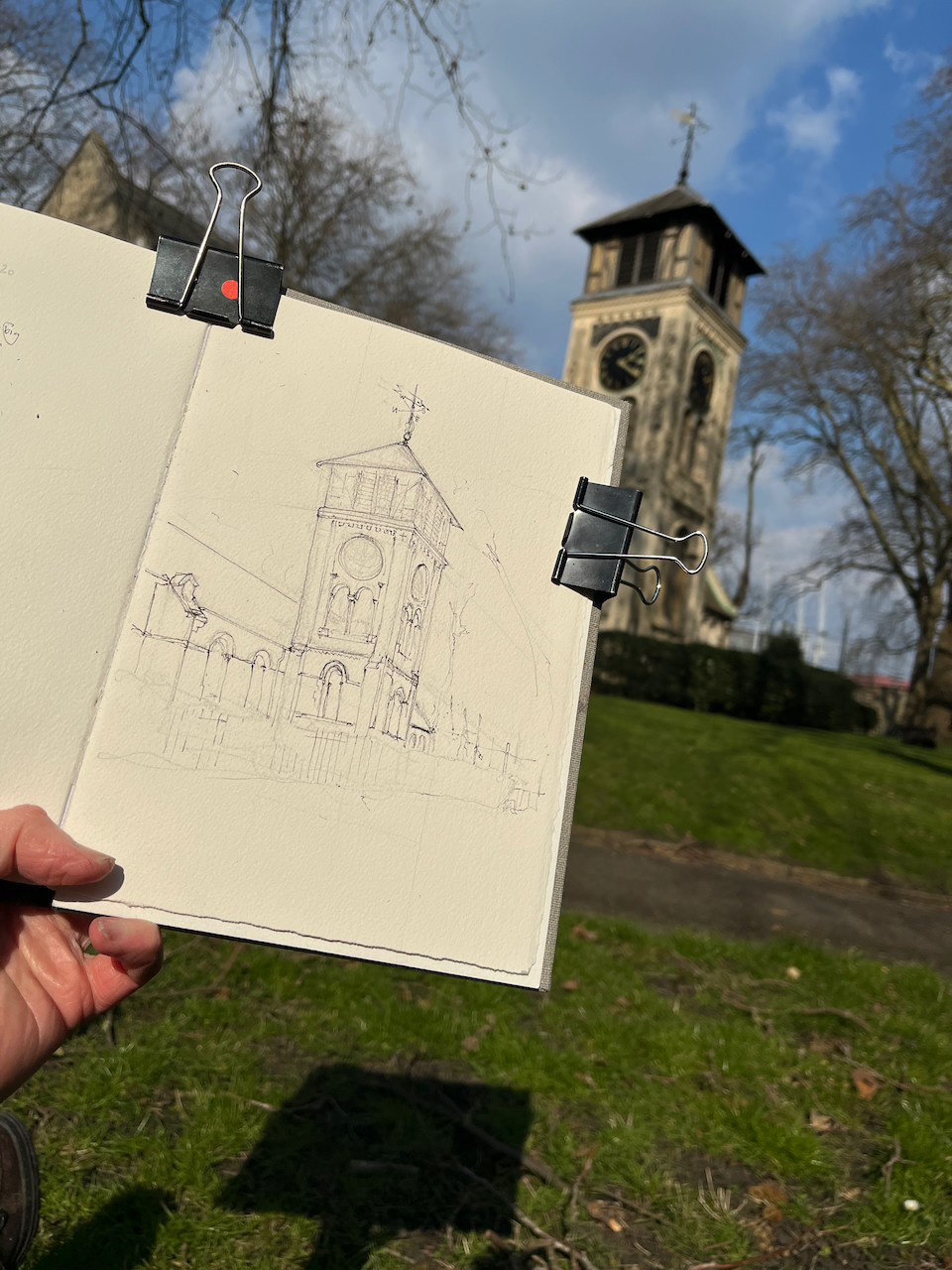
On a sunny day I went to draw a church tower in a country churchyard. The churchyard is near Kings Cross and the church tower is that of St Pancras Old Church.
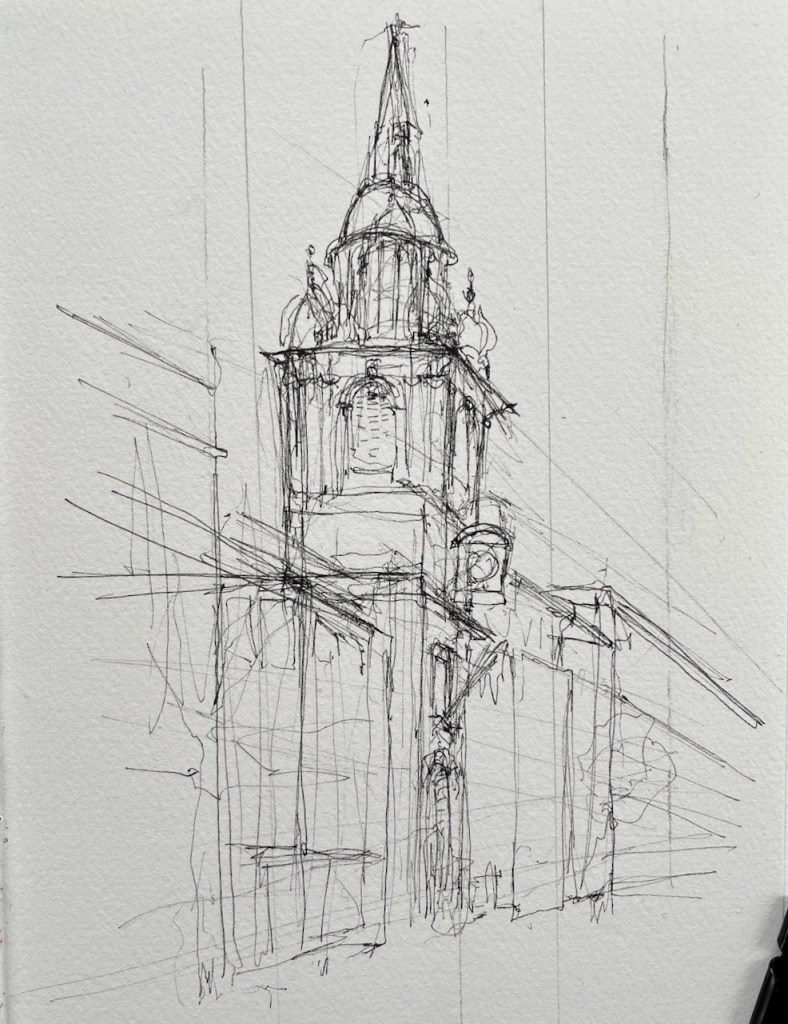
St Pancras Old Church, tower. 20th March 2022 10″ x 7″ in Sketchbook 11
I sketched sitting on the grass beside the River Fleet, while the river flowed behind me, in my imagination.
It’s a real river though. These days it’s under St Pancras Way. But it used to flow by the church.
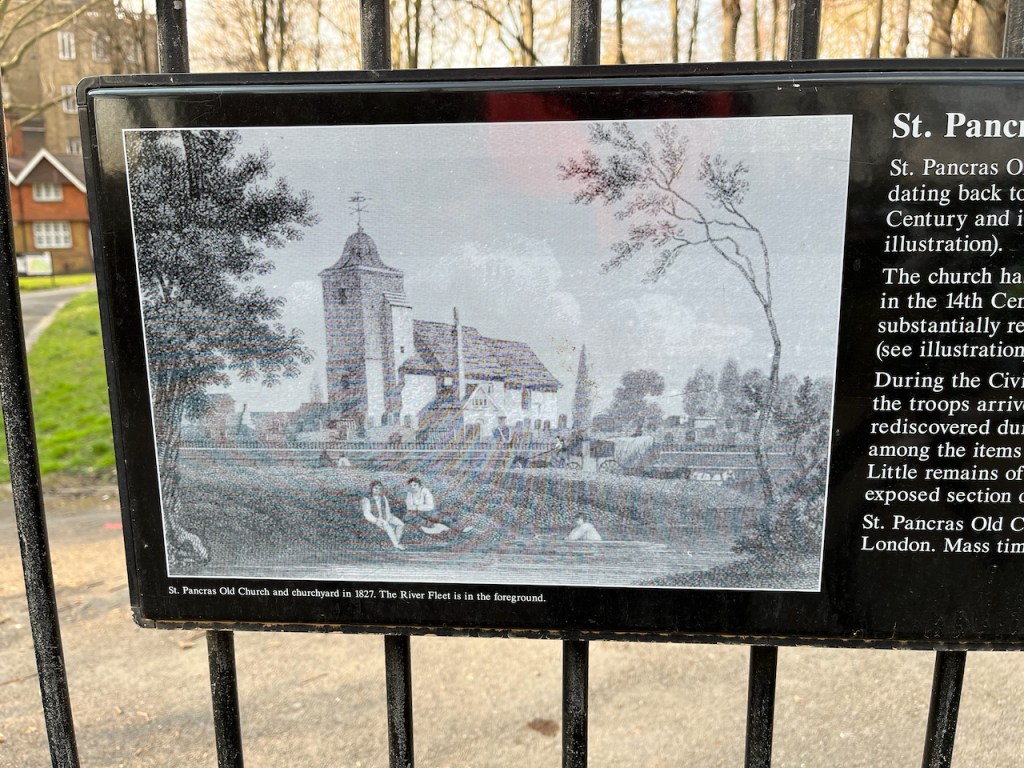
“St Pancras Old Church and churchyard in 1827. The River Fleet is in the foreground.” notice on the railings of the churchyard.
As you see from that picture, in 1827 the church looked very different. The south tower which I sketched is not as ancient as it looks. It was constructed in 1847 to the designs of A.D. Gough.
The church site itself is very ancient. According to the church website, this is one of the oldest sites of Christian worship in London, possibly dating back to the 4th century:
The suggestion that St Pancras Old Church dates back to Roman times has a long tradition, with most suggesting that it was founded in 313 or 314. Most churches in England named for the martyr St Pancras have, or may have, ancient origins, suggesting that veneration of the saint spread quickly after his death in 304.
Today it is an active church, and a music venue. The churchyard is a glorious green space, much used. Many people wandered past on the paths. No-one paid any attention to me drawing. The dogs did though. I was inspected and approved by each dog that went past.
Here is work in progress and a map (click to enlarge the image)
Click a button below to share this post online, email it, or print it:
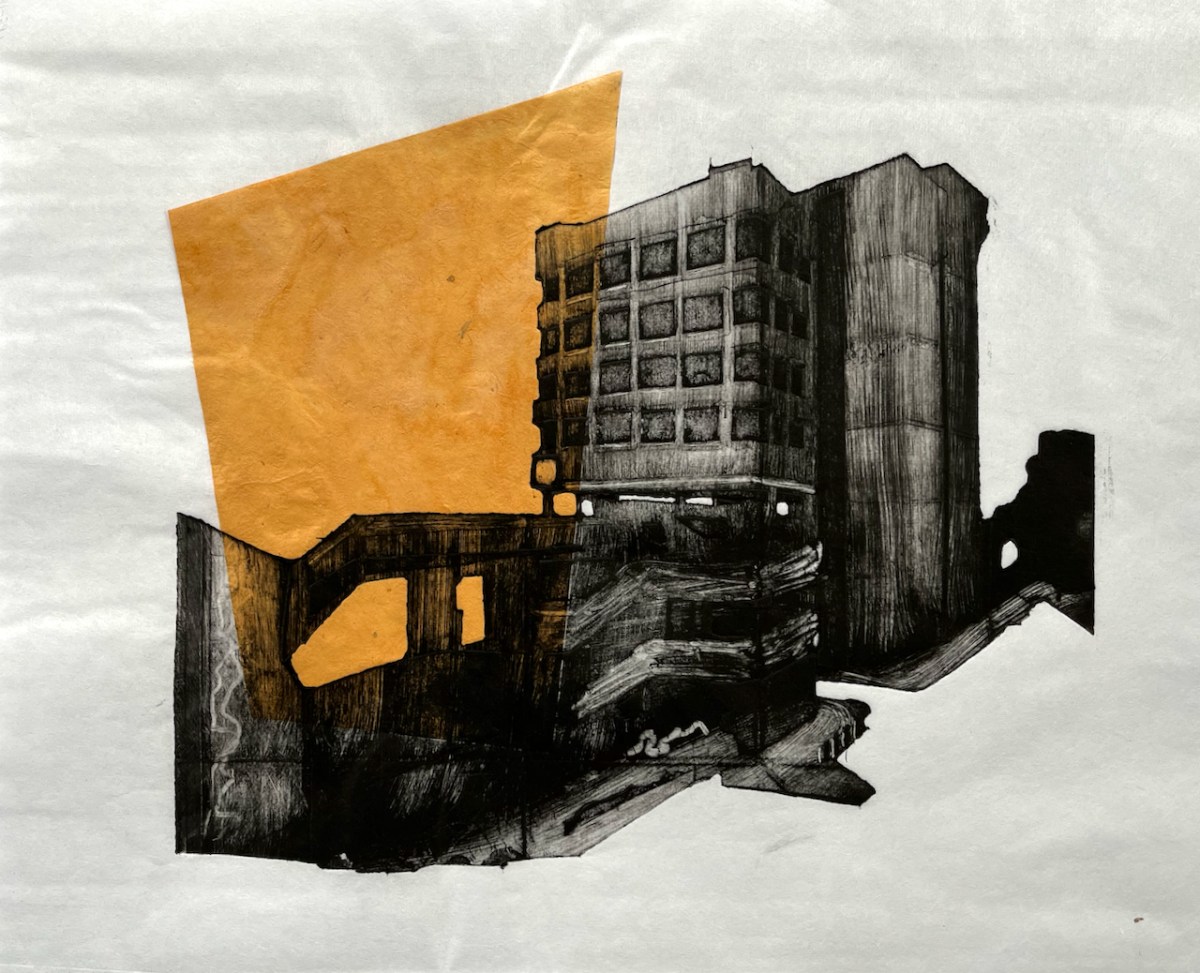
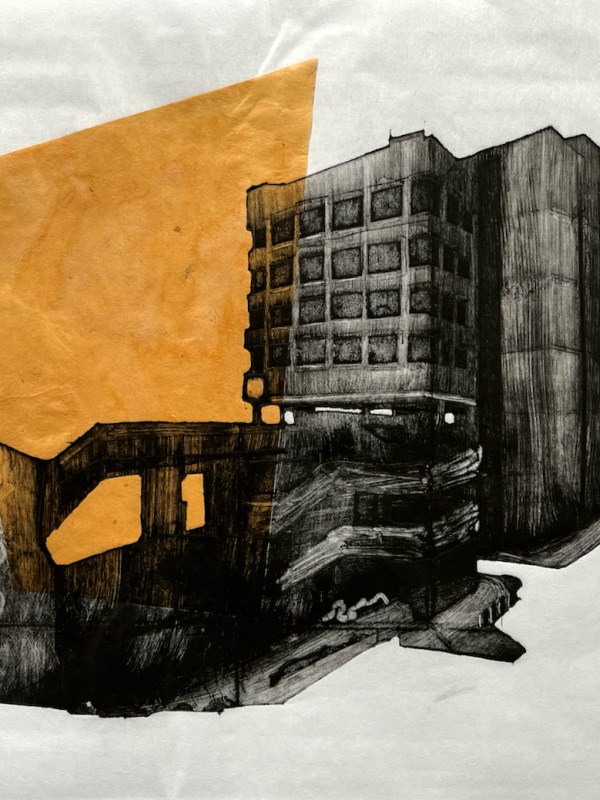
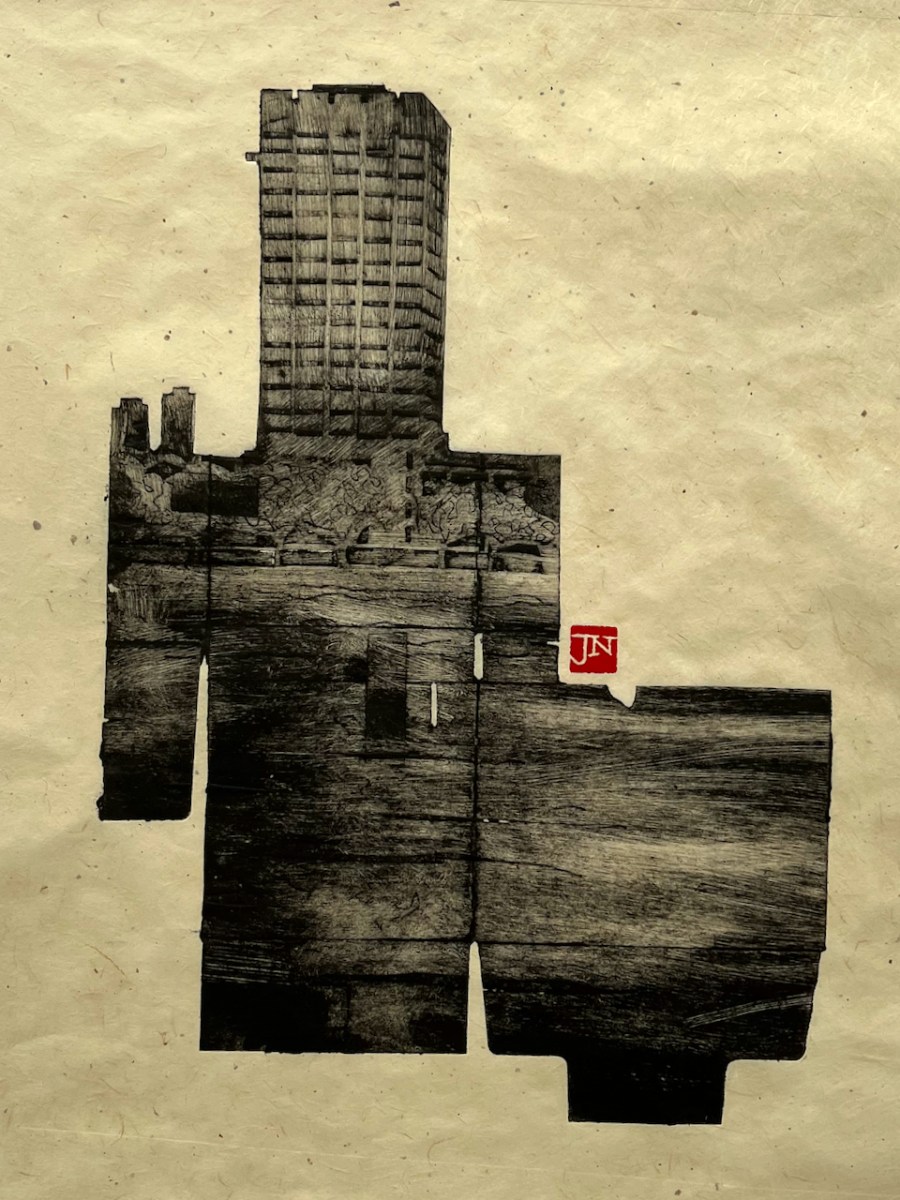
Colechurch House on the South Bank is a brutalist office block. It makes a good subject for a packaging print. Since it is a a 1960s block, I added a 1960s type shape in chine collé.
Colechurch House – monoprint and chine collé, paper size,15″ x 12″ Shoji Baku Japanese Paper
The chine collé paper is Khadi Lokta Coloured saffron washi paper from Atlantis Art (ref: KPNI SA). The background paper for this print is Shoji Baku paper from Shepherds Bookbinders (ref: LRG 1859). The ink is Charbonnel traditional etching ink. I printed this on the Henderson Press at East London Printmakers. Here is a video of the “print reveal” (17seconds, silent):
Thanks to Evonne at East London Printmakers for filming me!
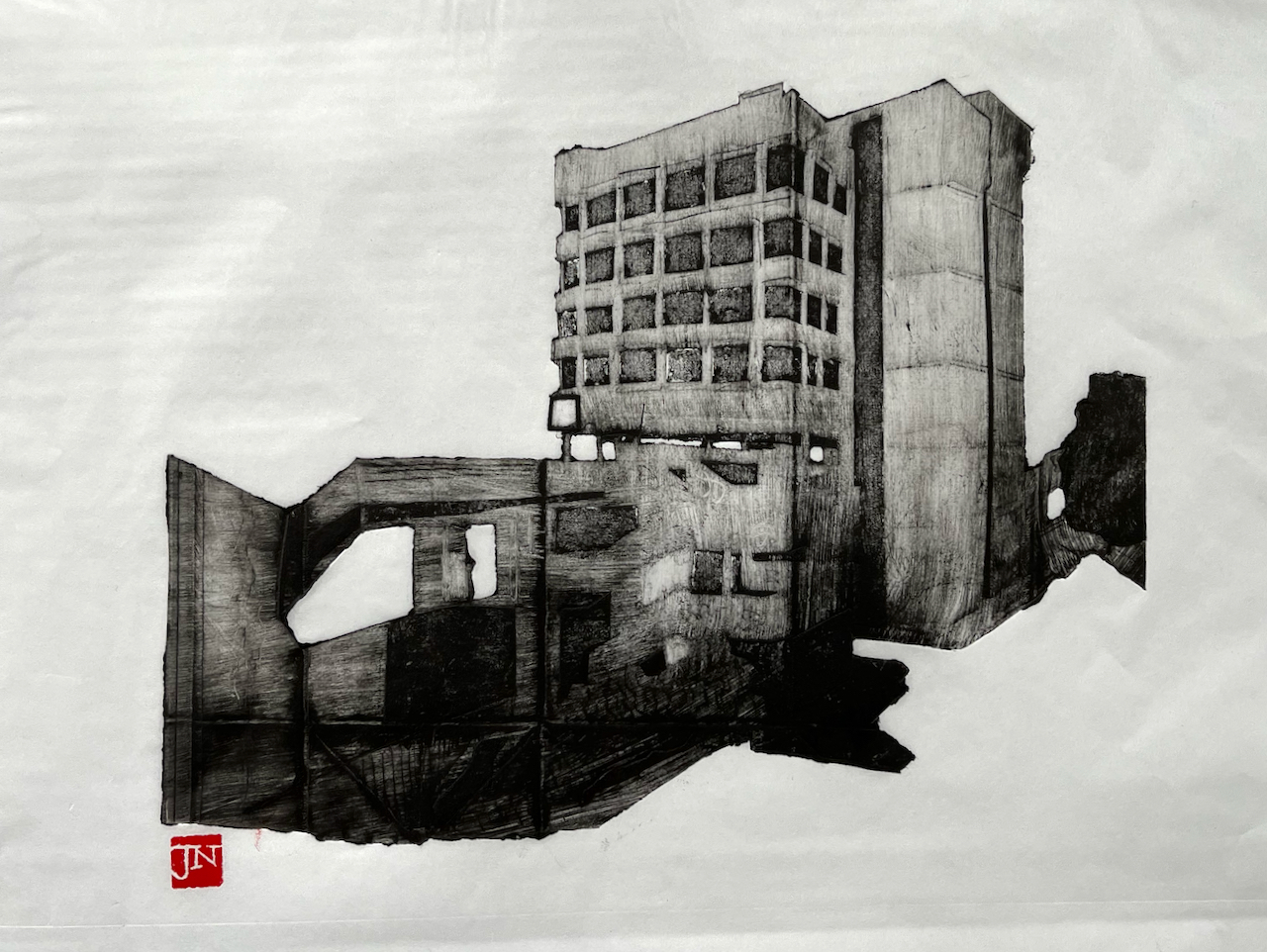
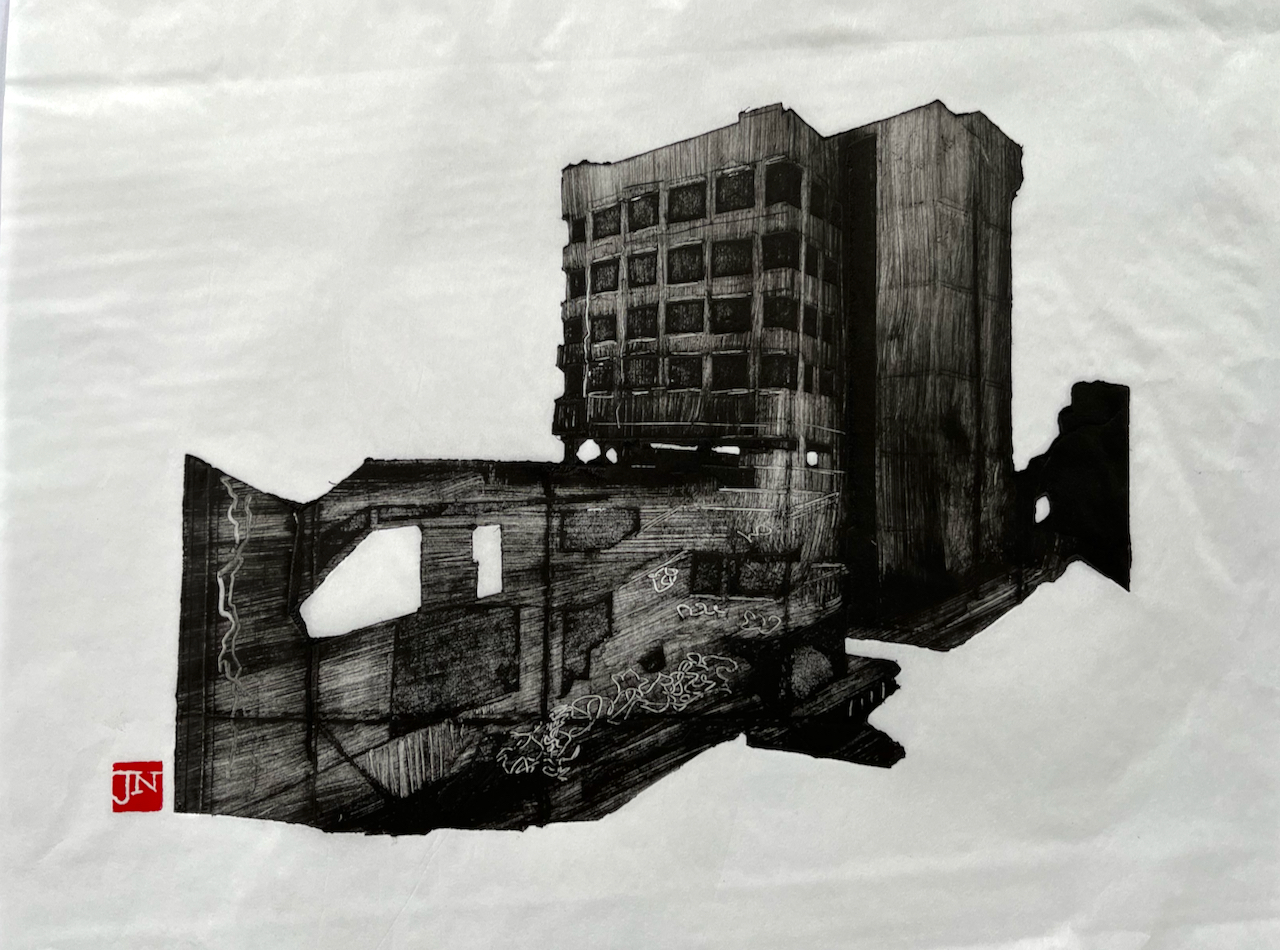
Here are the other 4 prints from this plate. They are all on a different, but similar paper: Tosa Washi from Shepherds, (ref: J632180)
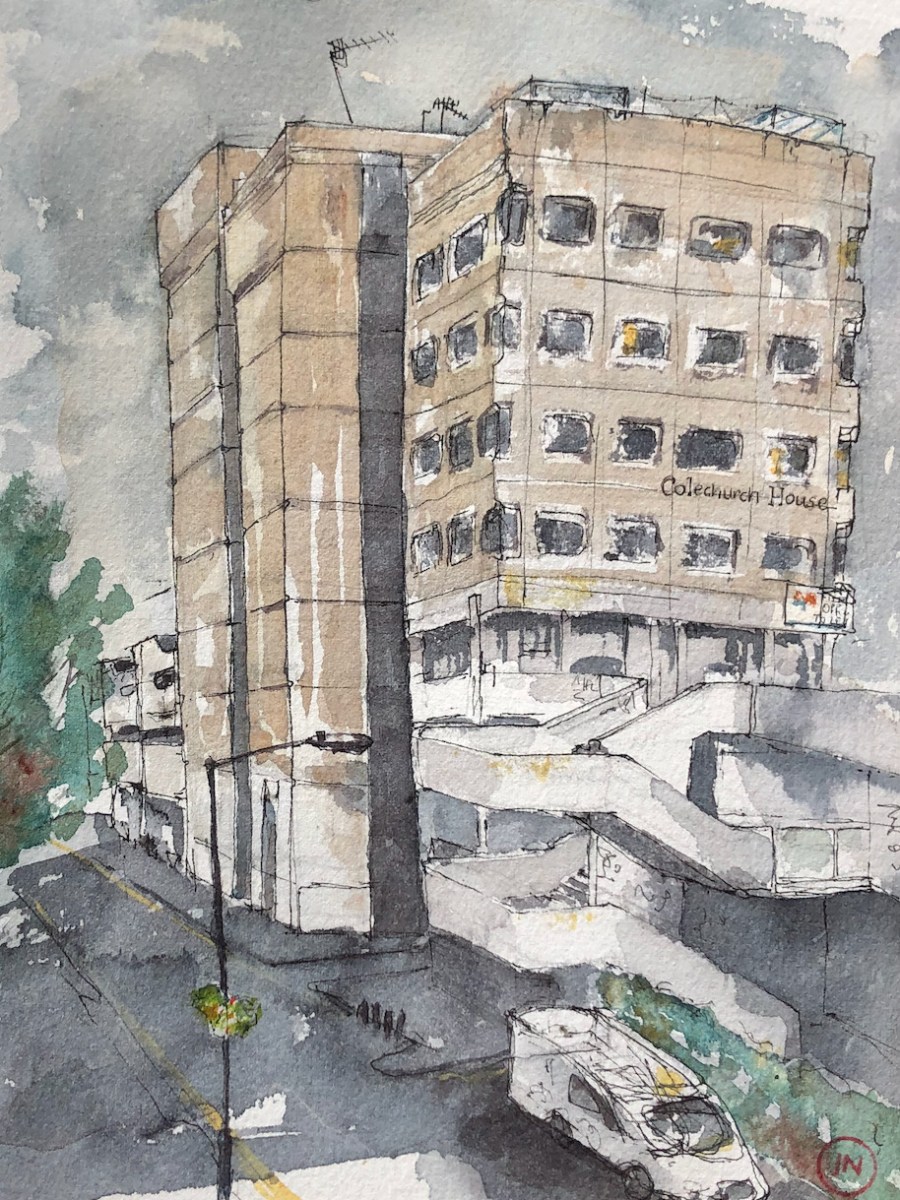
The print was based on a sketch of Colechurch House last year. See this post:
Aficionados of 20th Century brutalist architecture need to hasten to appreciate Colechurch House. It is due for demolition and redevelopment. This month’s post in the marvellous “London Inheritance” site informed me about the planning application, so I rushed over there to draw a picture before the building became swathed in plastic. I drew this picture looking over the railings from London Bridge. This position commanded an excellent view of Colechurch House, but…
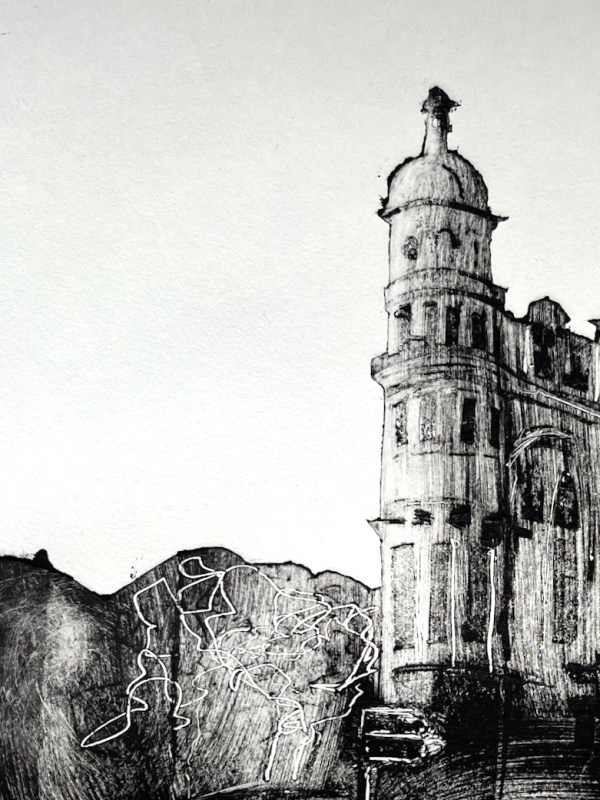
Here are more examples of the technique using a plate made from packaging material. I have written about the process here.
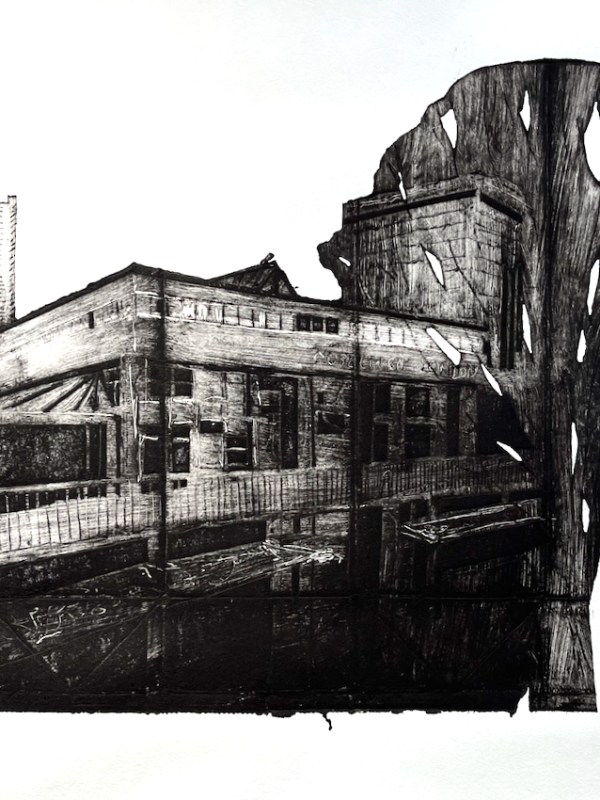
Here is another packaging print. This one shows Bridge ELR-XTD Structure 20 on Cornwall Road (N) between Charing Cross and Waterloo East, South East London. The road that leads off to the left is Sandell…
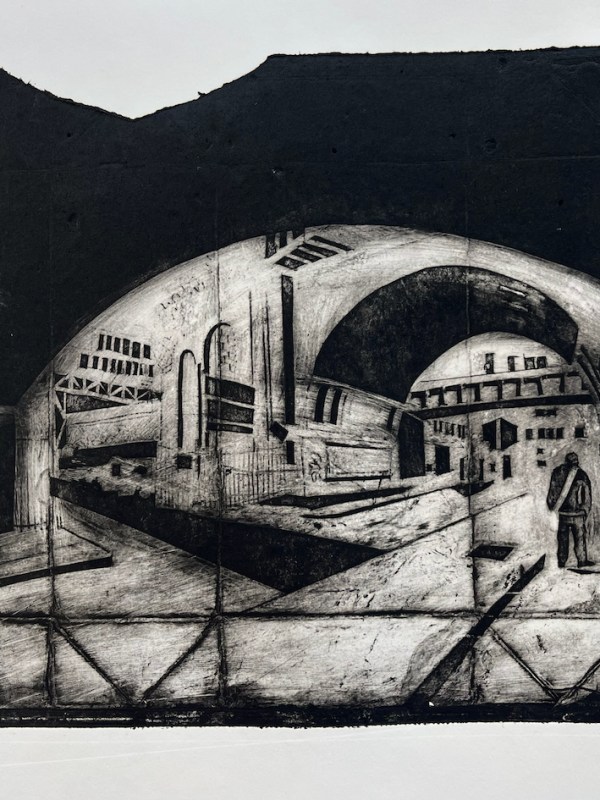
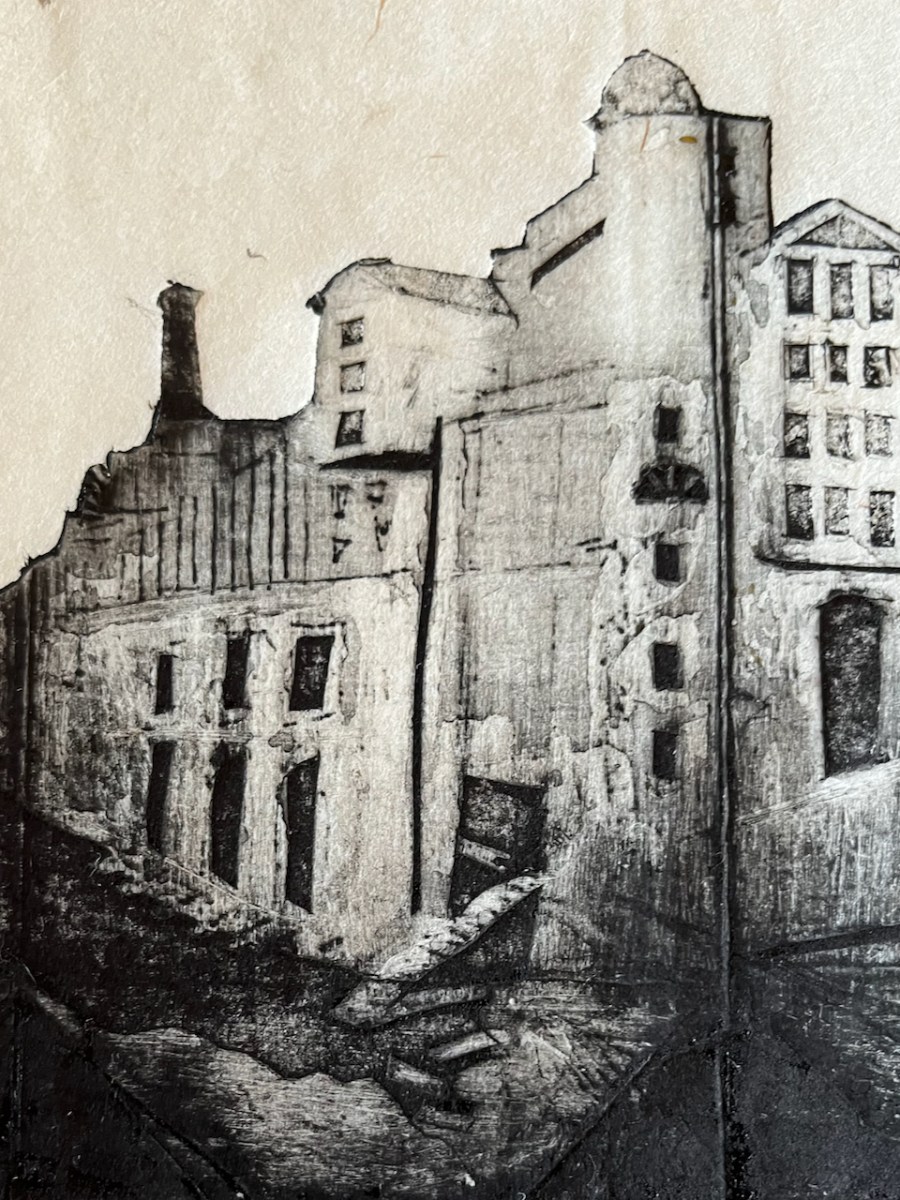
Huge brick arches carry the railway lines into Waterloo Station. Here is a view looking North up Great Suffolk Street. This is a packaging monoprint. It is an intaglio print from a “plate” made from…
Colechurch House on the South Bank is a brutalist office block. It makes a good subject for a packaging print. Since it is a a 1960s block, I added a 1960s type shape in chine…
The Boston Arms is in Tufnell Park, London, 178 Junction Road N19. I love the way this building presides over the junction. This is one of five prints I made with this plate made from…
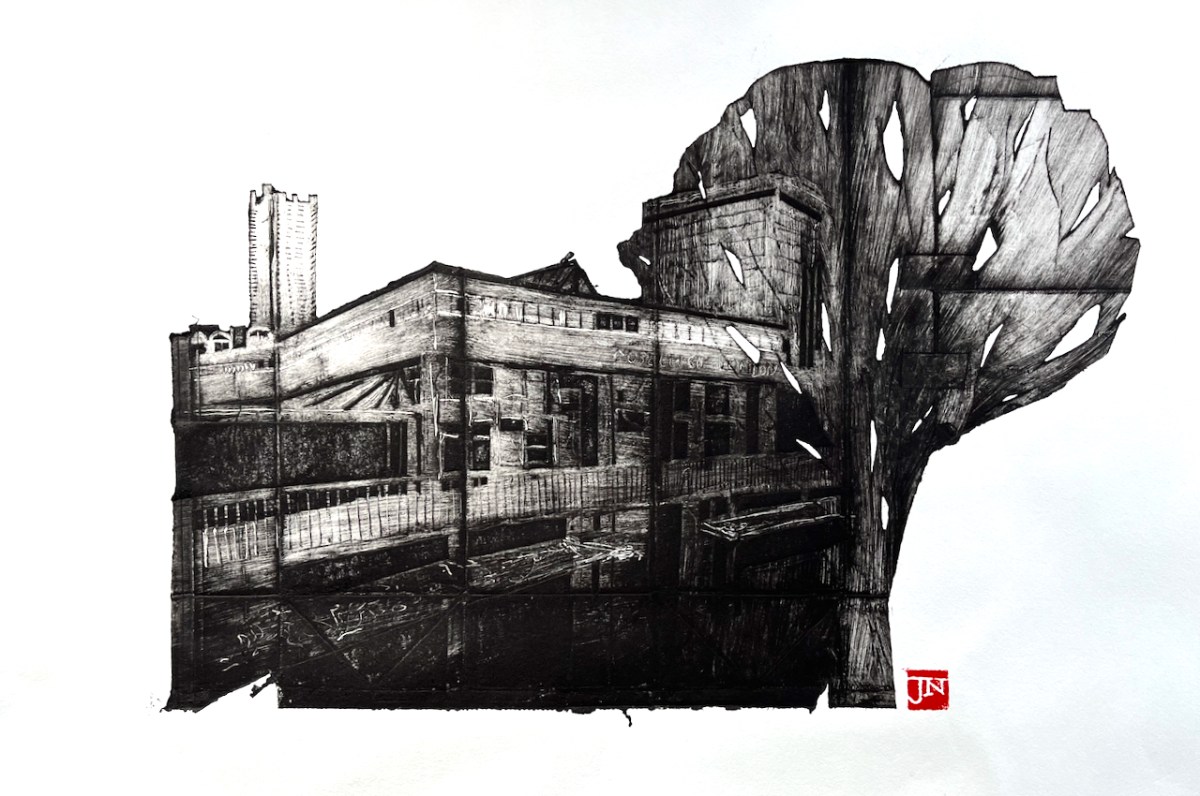
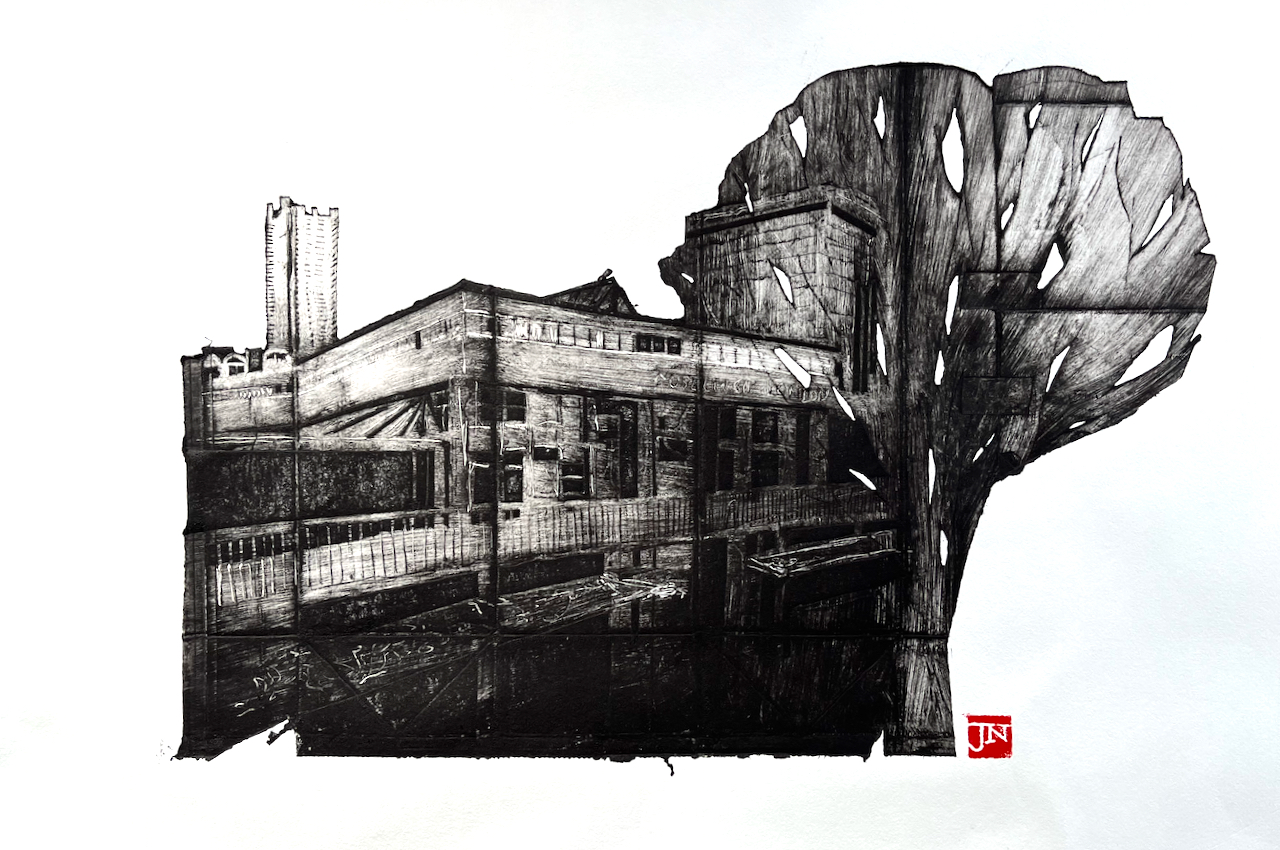
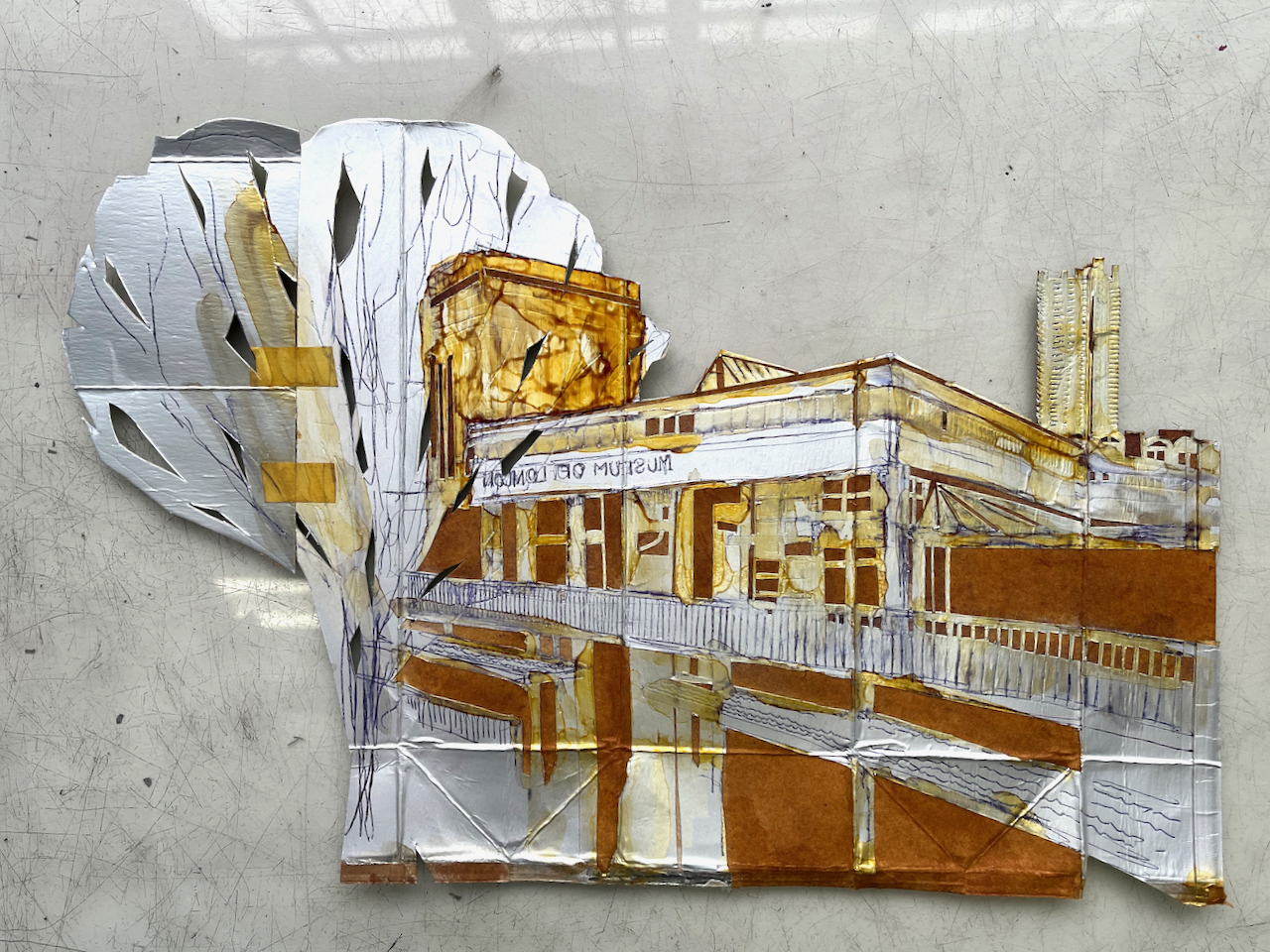
Here is an image of The Museum of London, in the south west corner of the Barbican: The “plate” is made from a UHT milk carton. Here is the back of the used plate: Here…
Here’s another “packaging” monoprint. This was made using an empty box of tissues. This is a tower block on the South bank of the river Thames, seen from the North bank. That’s the river in…
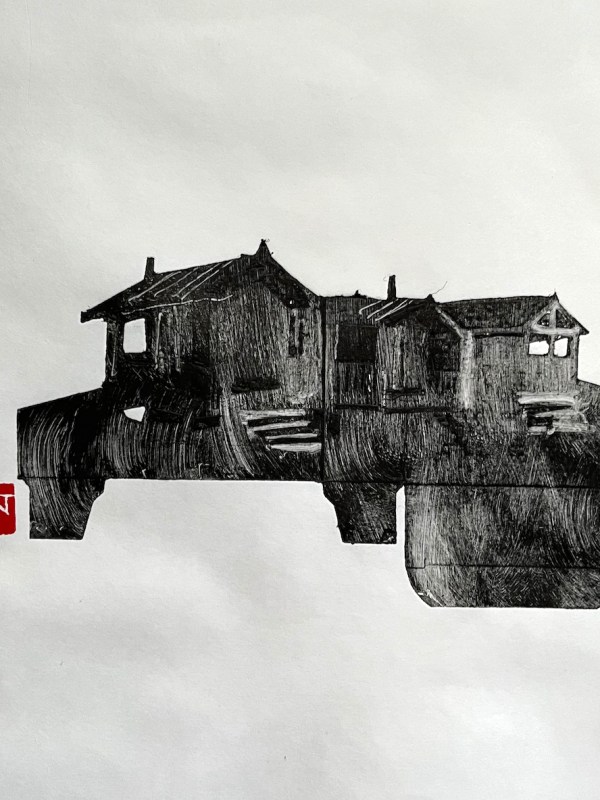
Here is a “packaging” monoprint I made of the huts in Walberswick. The print is made using a discarded carton from a box of aspirin. It looks like this: The brown colour is shellac, a…
I am trying an experimental monoprint technique. The idea is to use packaging material to make intaglio “plates” which are then printed using an etching press. This is the first one. I printed it yesterday…
Click a button below to share this post online, email it, or print it:
From the highwalk on the Rotunda there is a really amazing view of the Museum of London and Bastion House. This whole view going to change radically, if the City of…
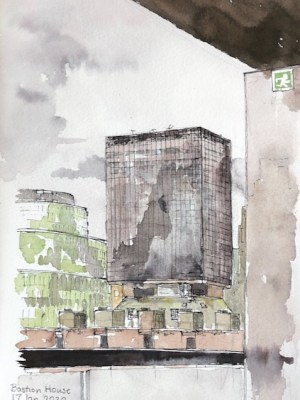
I hastened to draw the magnificent Bastion House, on London Wall. It is due for demolition. In the foreground you see the balcony and privacy screen of the flat in Andrewes,…
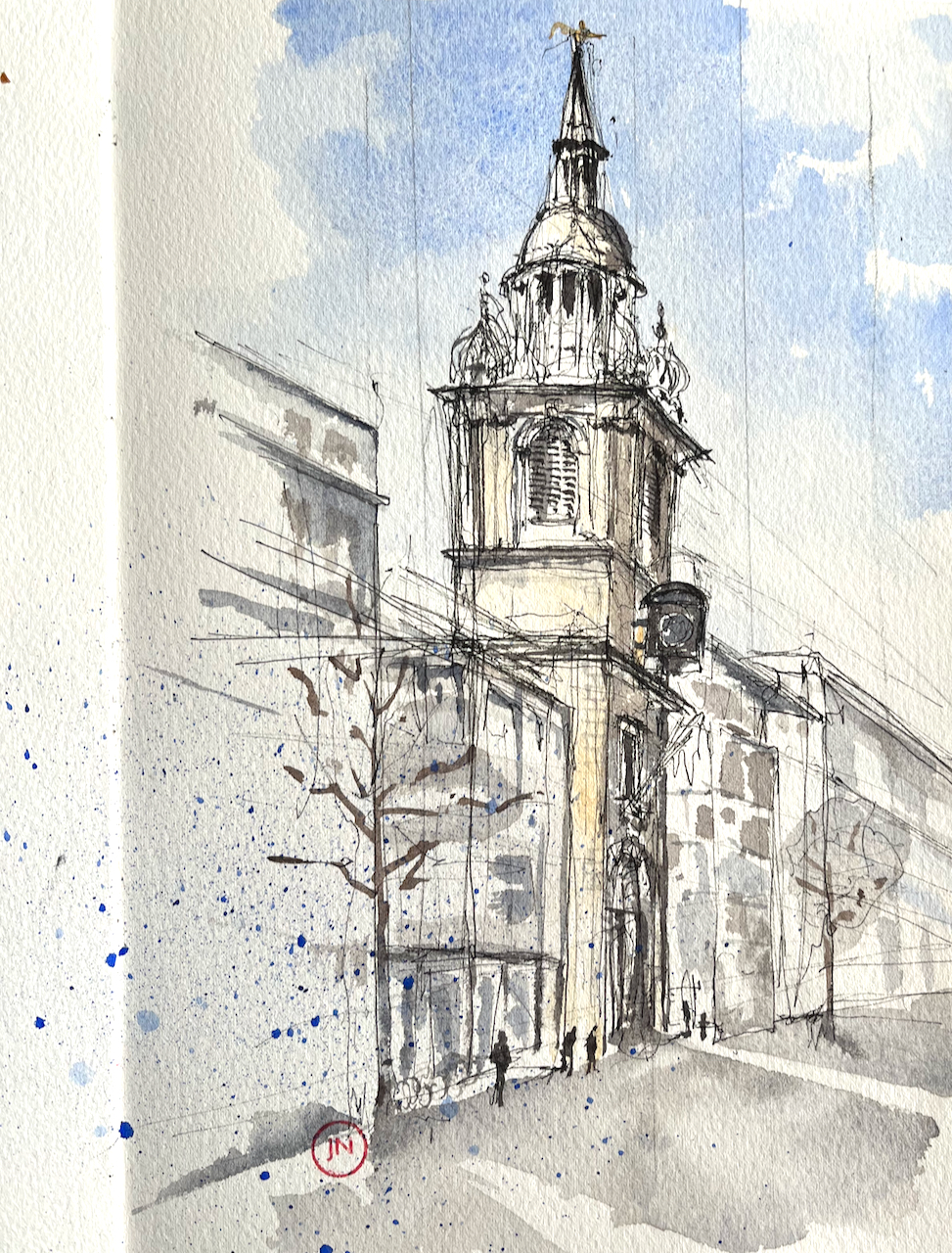
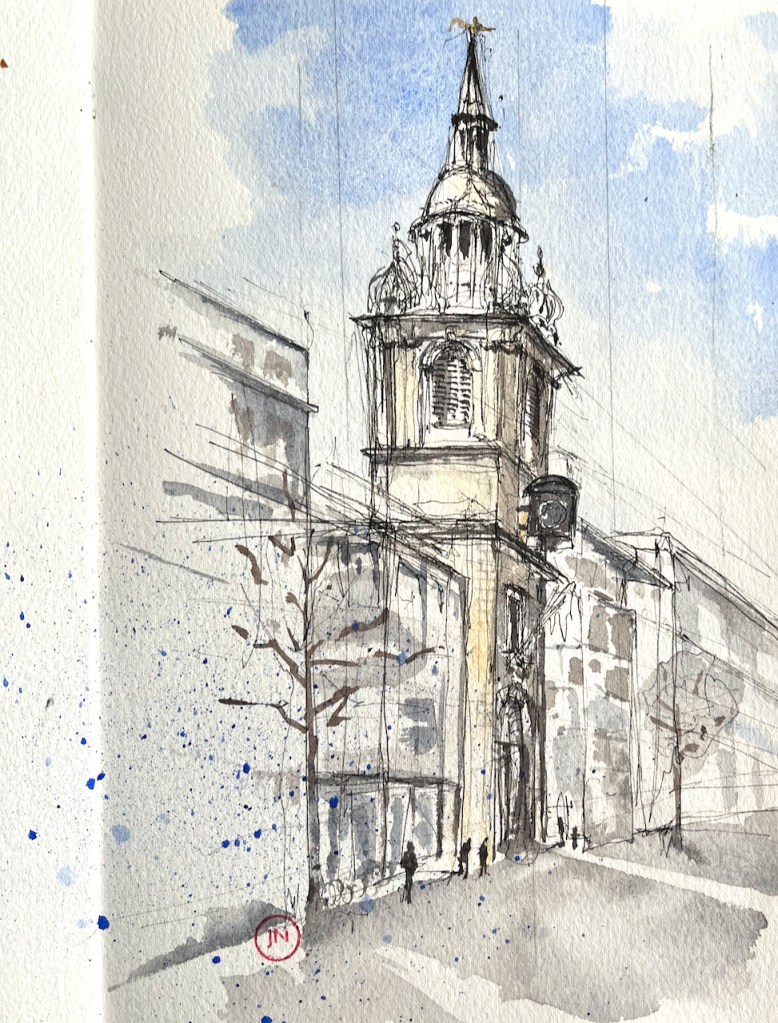
A quick sketch of St Mary Le Bow on Cheapside, London EC2
St Mary Le Bow, from Cheapside 23 Feb 2022 10″ x 7″ in Sketchbook 11
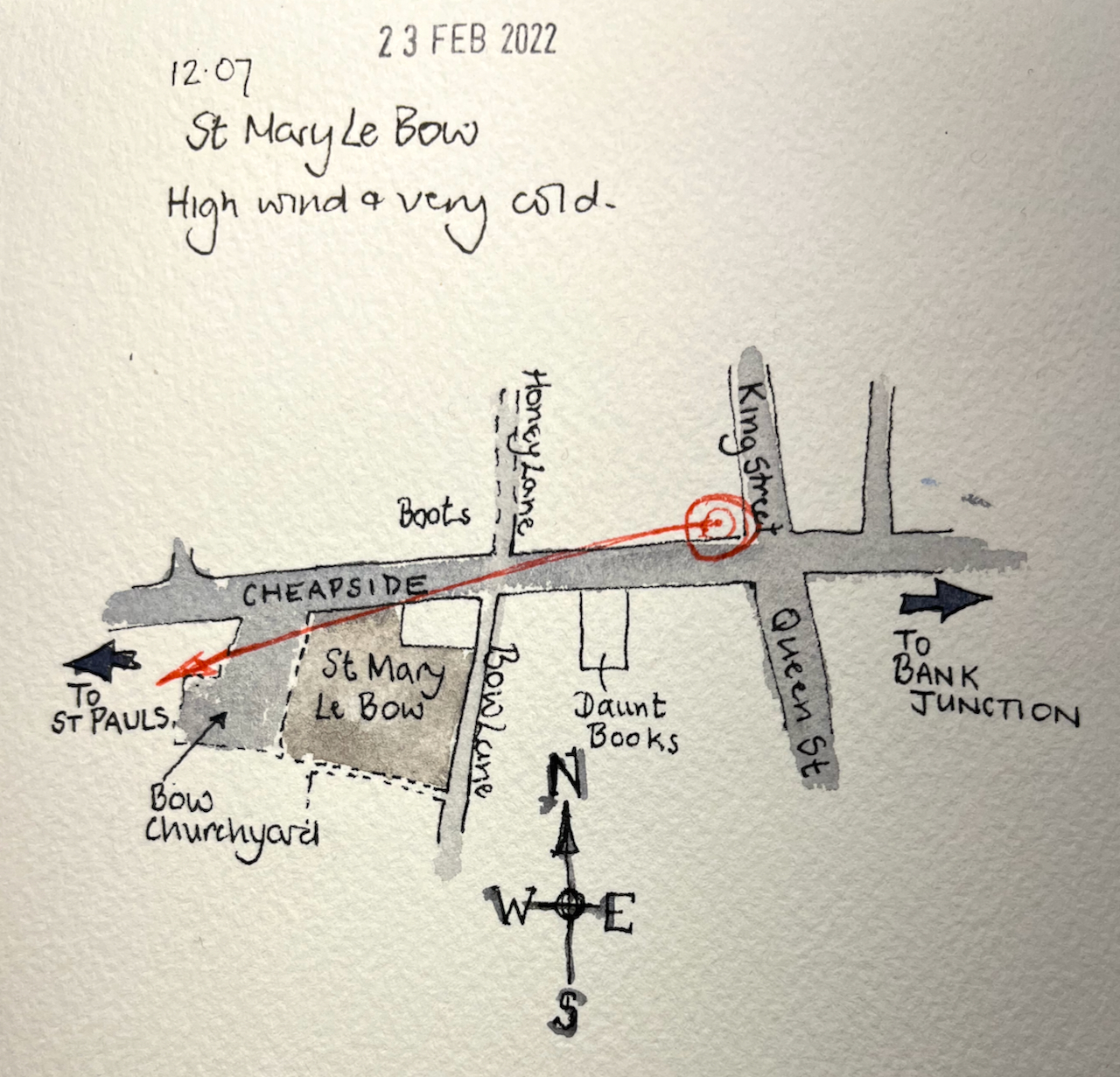
I drew this from the corner of Cheapside and King Street. This seemed like a really good place to stand, since there was a tall junction box next to me, and I could fit myself into a corner of a window. It rapidly became apparent that I chosen the windiest corner in London. My eyes streamed. Everyone coming round the corner took a short cut my side of the junction box, and funnelled past me, their heads down, phones in hand. I felt in the way.
But I persisted. I finished the pen. I did not put the colour on using the convenient top of the junction box, as I had planned, since no paper was going to stay still for a moment in that wind. I retreated, and coloured it at my desk.
Click a button below to share this post online, email it, or print it:
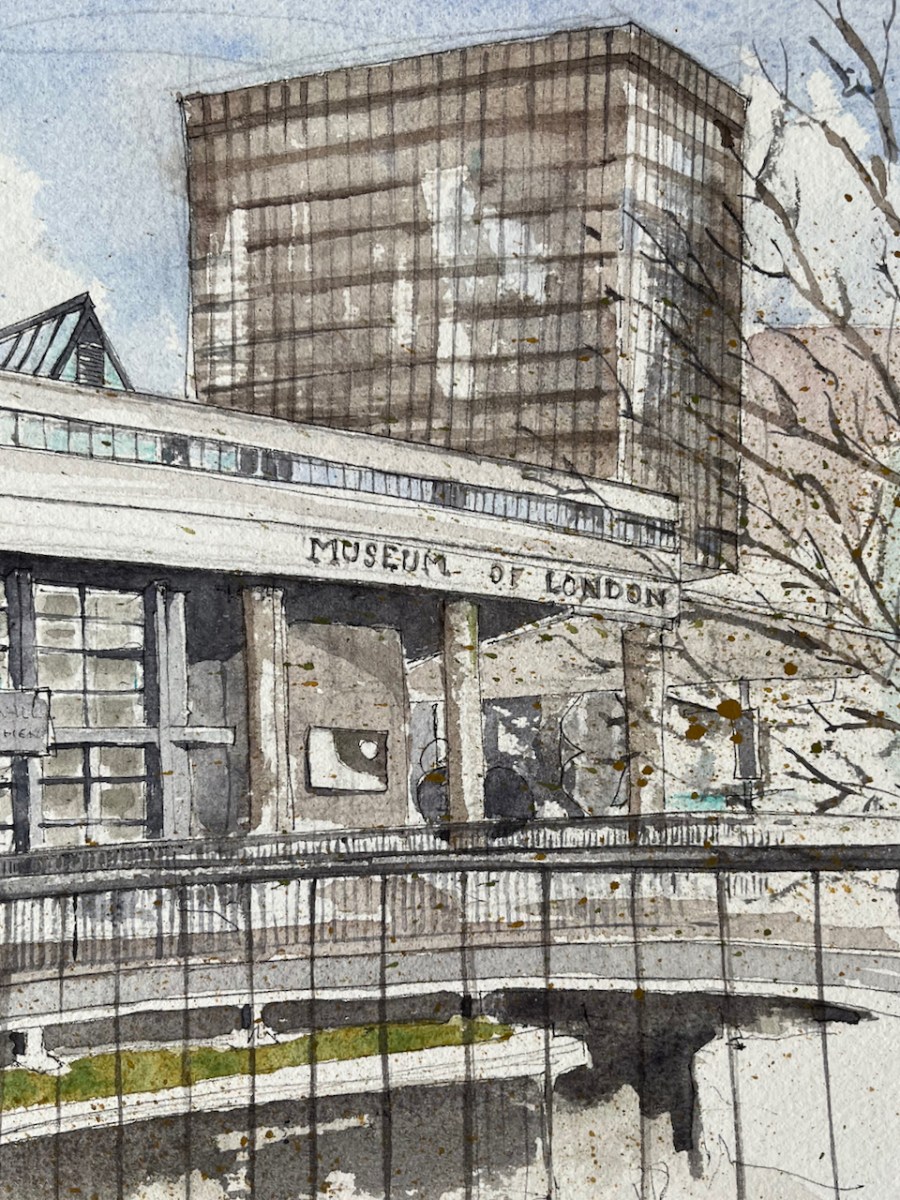
From the highwalk on the Rotunda there is a really amazing view of the Museum of London and Bastion House. This whole view going to change radically, if the City of London plans are approved.
Museum of London from the Rotunda, 15″ x 8.5″ on Arches watercolour paper
The Museum of London is in the South West corner of the Barbican. It was designed by Philip Powell and Hidalgo Moya.
The Museum opened in 1976. The City of London plan to close it in December this year (2022), and then to demolish it, along with the surrounding highwalks and pedestrian bridges over London Wall.
The dark-coloured block in the background on the right is Bastion House. This 17 storey tower block was built to the designs of architects Powell & Moya between 1972 and 1977 as part of the Barbican development. It is on top of part of the Museum of London’s display space.
The City of London now plan to demolish it.
So if the plans go ahead, this view will no longer exist. I rushed to sketch it.
Museum of London and Lauderdale TowerMuseum of London and Bastion House
This drawing is in an aspect ratio new to me: 15″ x 8.5″ or 38cm x 22cm. I wanted to get the whole of the front of the museum in the picture.
Here is comparison of the pen and ink and the the colour versions:
The architecture practice which designed The Barbican is “Chamberlain, Powell and Bon”. This “Powell” is Geoffrey Powell and not the Philip Powell of the Museum of London. The architects involved in designing the Barbican were:GeoffryPowell, Peter “Joe” Chamberlin, Christoph Bon, and Charles Greenberg.
The architects who designed the Museum of London and Bastion House are Philip Powell and Hidalgo Moya of the architecture practice “Powell and Moya”.
Thank you to the reader who clarified this for me.
Click a button below to share this post online, email it, or print it: