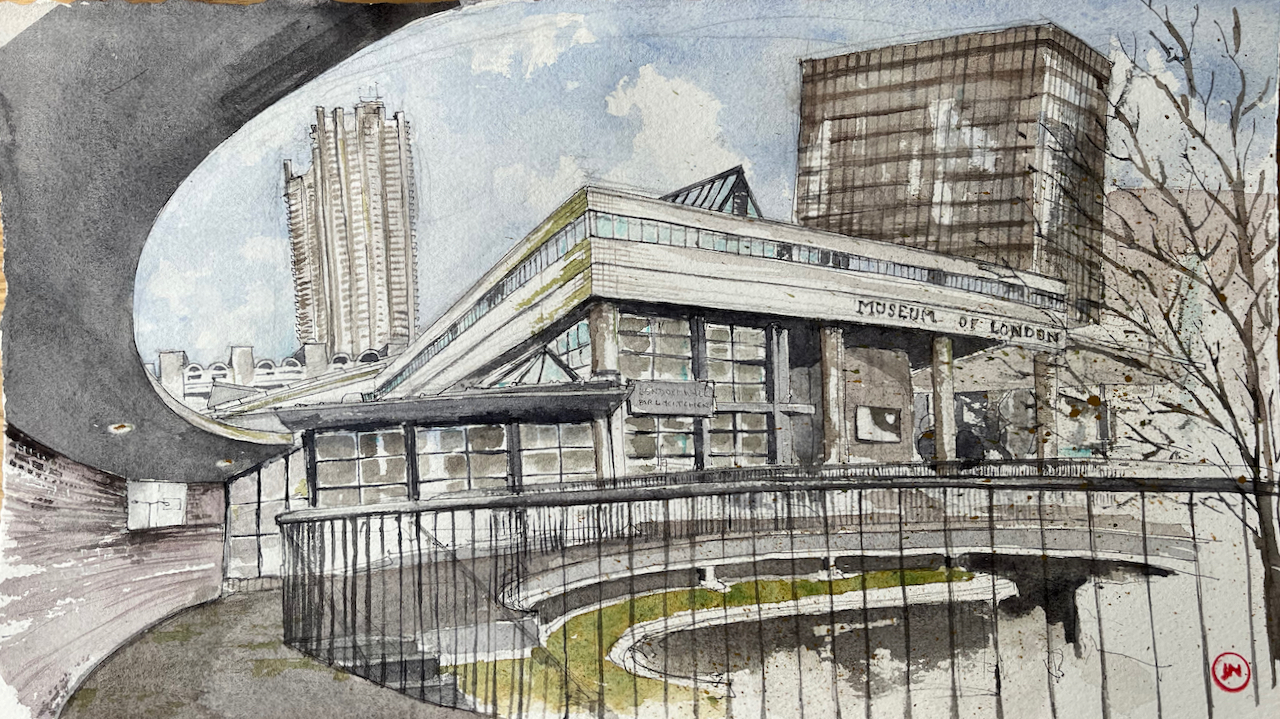
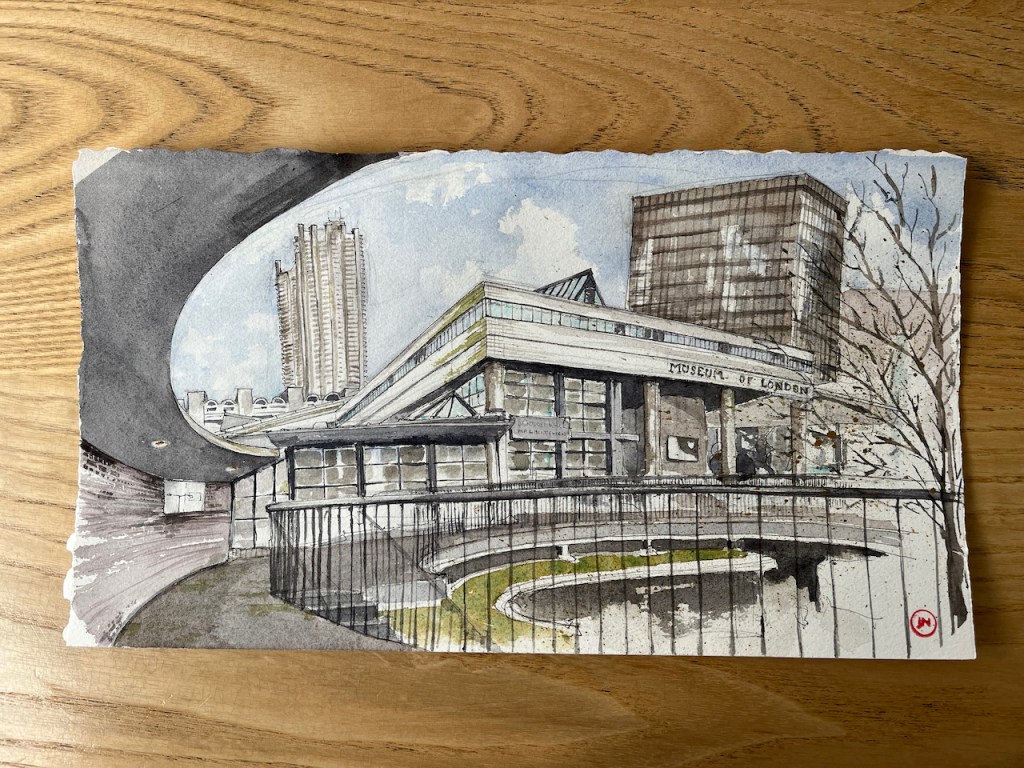
From the highwalk on the Rotunda there is a really amazing view of the Museum of London and Bastion House. This whole view going to change radically, if the City of London plans are approved.
Museum of London from the Rotunda, 15″ x 8.5″ on Arches watercolour paper
The Museum of London is in the South West corner of the Barbican. It was designed by Philip Powell and Hidalgo Moya.
The Museum opened in 1976. The City of London plan to close it in December this year (2022), and then to demolish it, along with the surrounding highwalks and pedestrian bridges over London Wall.
The dark-coloured block in the background on the right is Bastion House. This 17 storey tower block was built to the designs of architects Powell & Moya between 1972 and 1977 as part of the Barbican development. It is on top of part of the Museum of London’s display space.
The City of London now plan to demolish it.
So if the plans go ahead, this view will no longer exist. I rushed to sketch it.
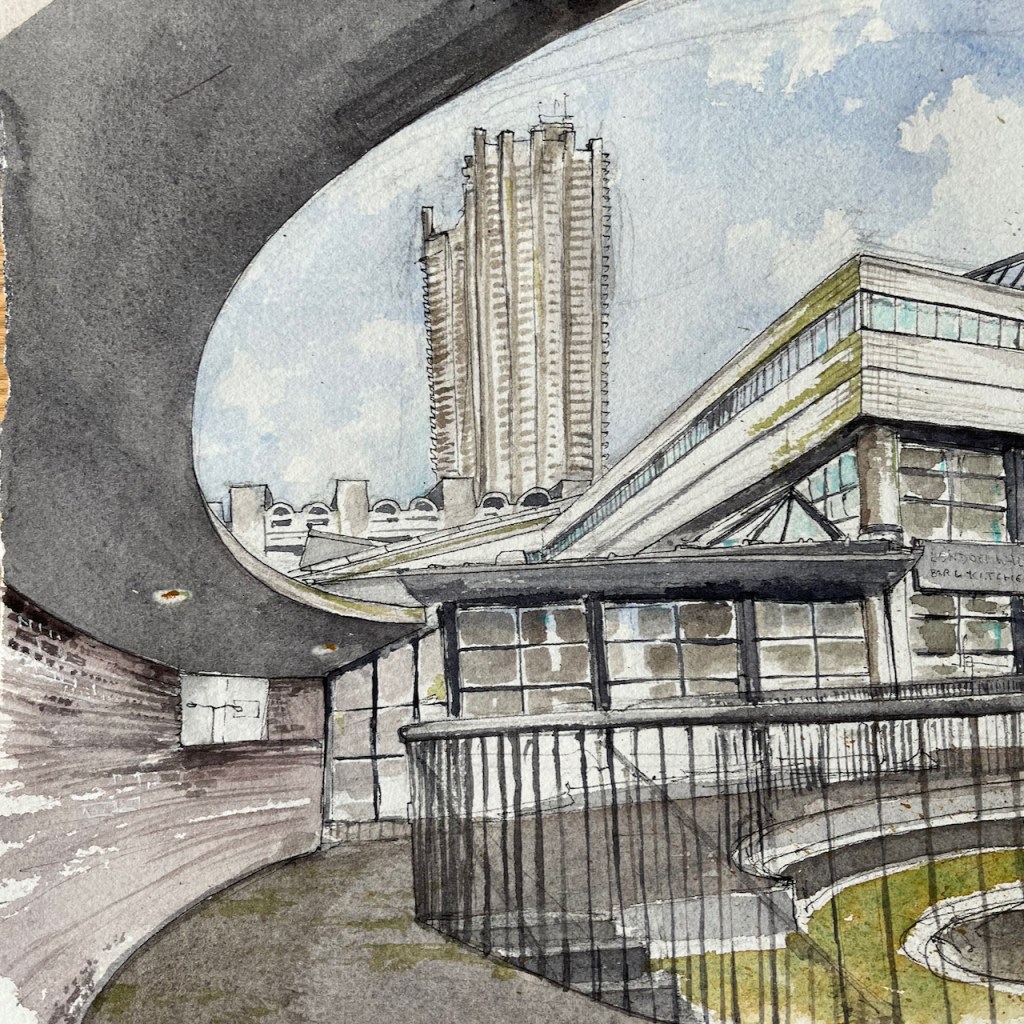
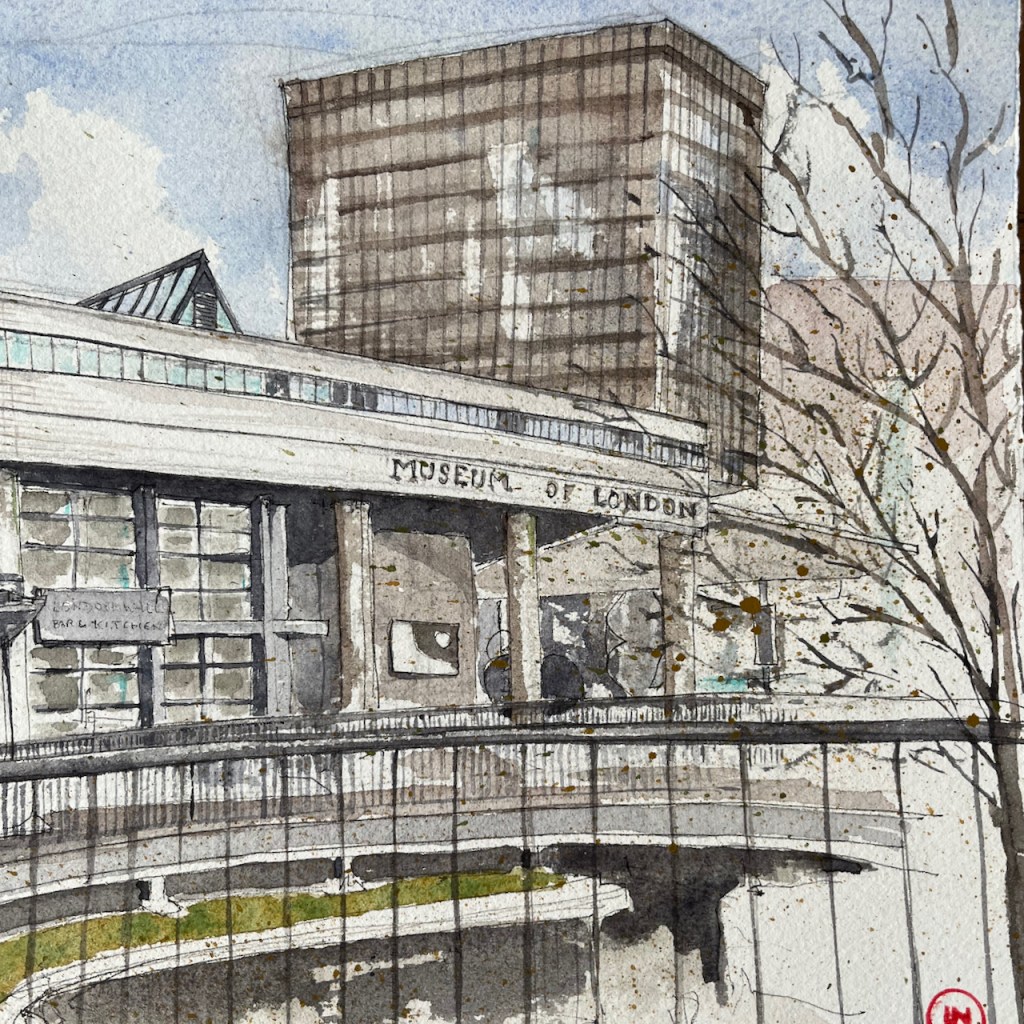
Museum of London and Lauderdale TowerMuseum of London and Bastion House
This drawing is in an aspect ratio new to me: 15″ x 8.5″ or 38cm x 22cm. I wanted to get the whole of the front of the museum in the picture.
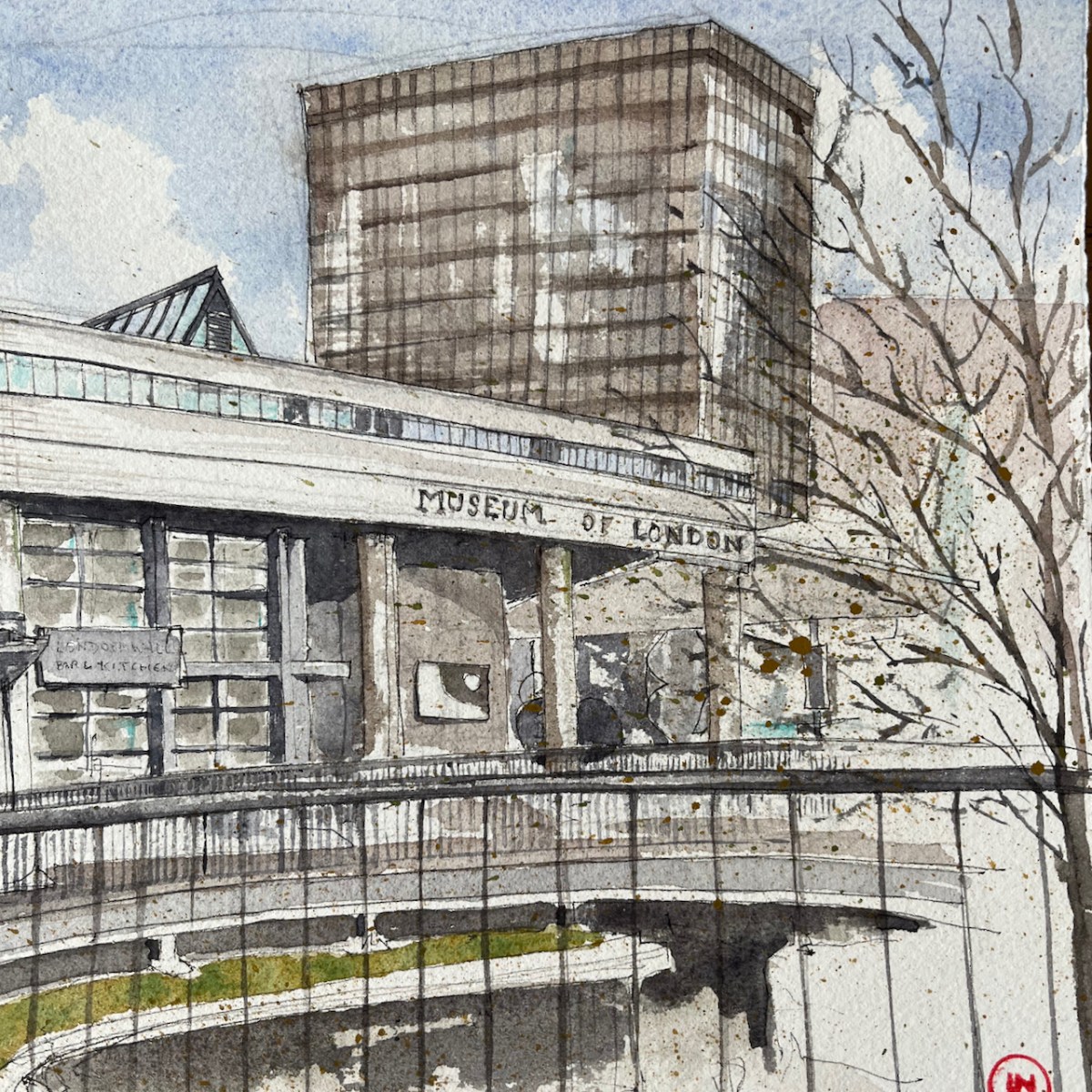
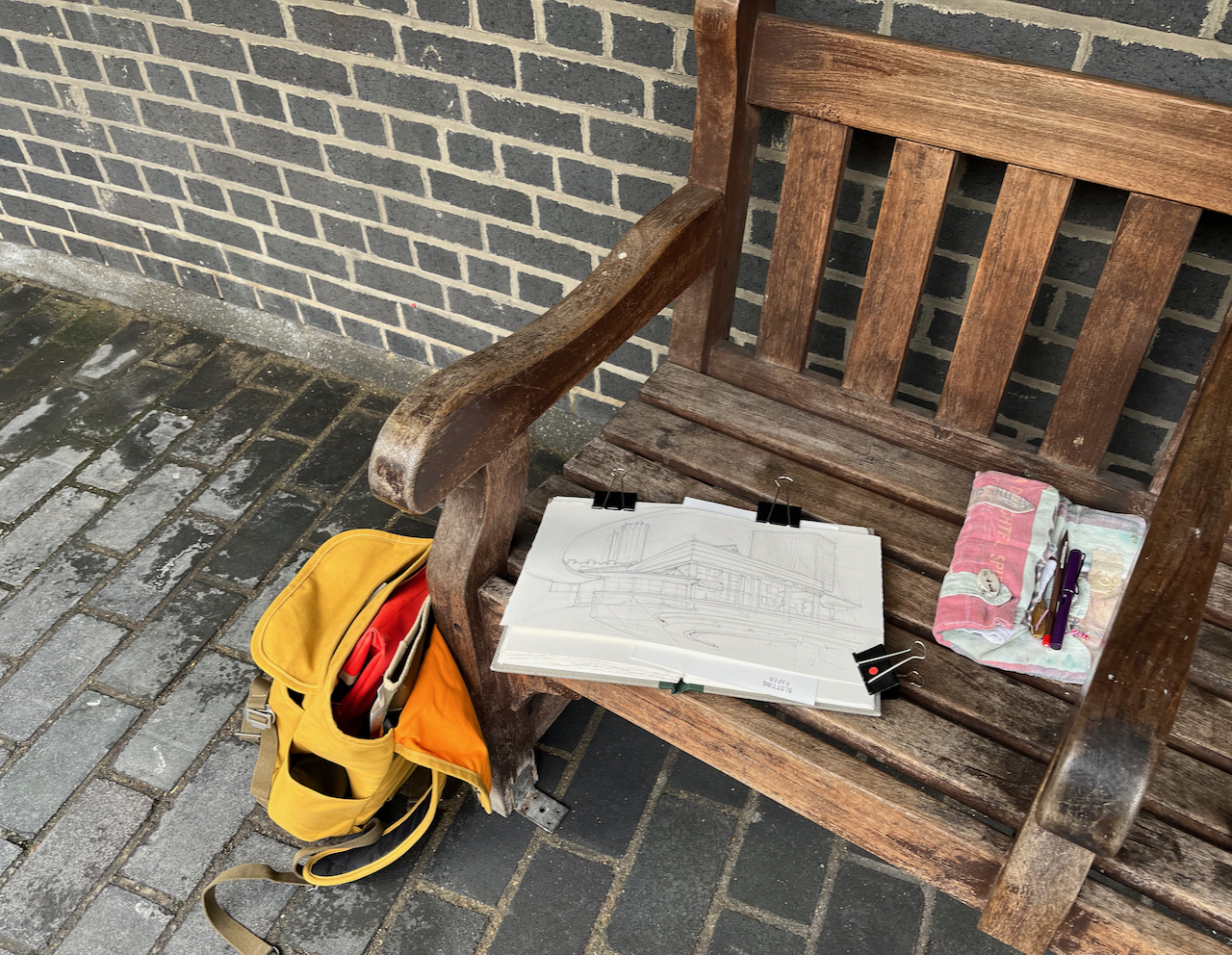
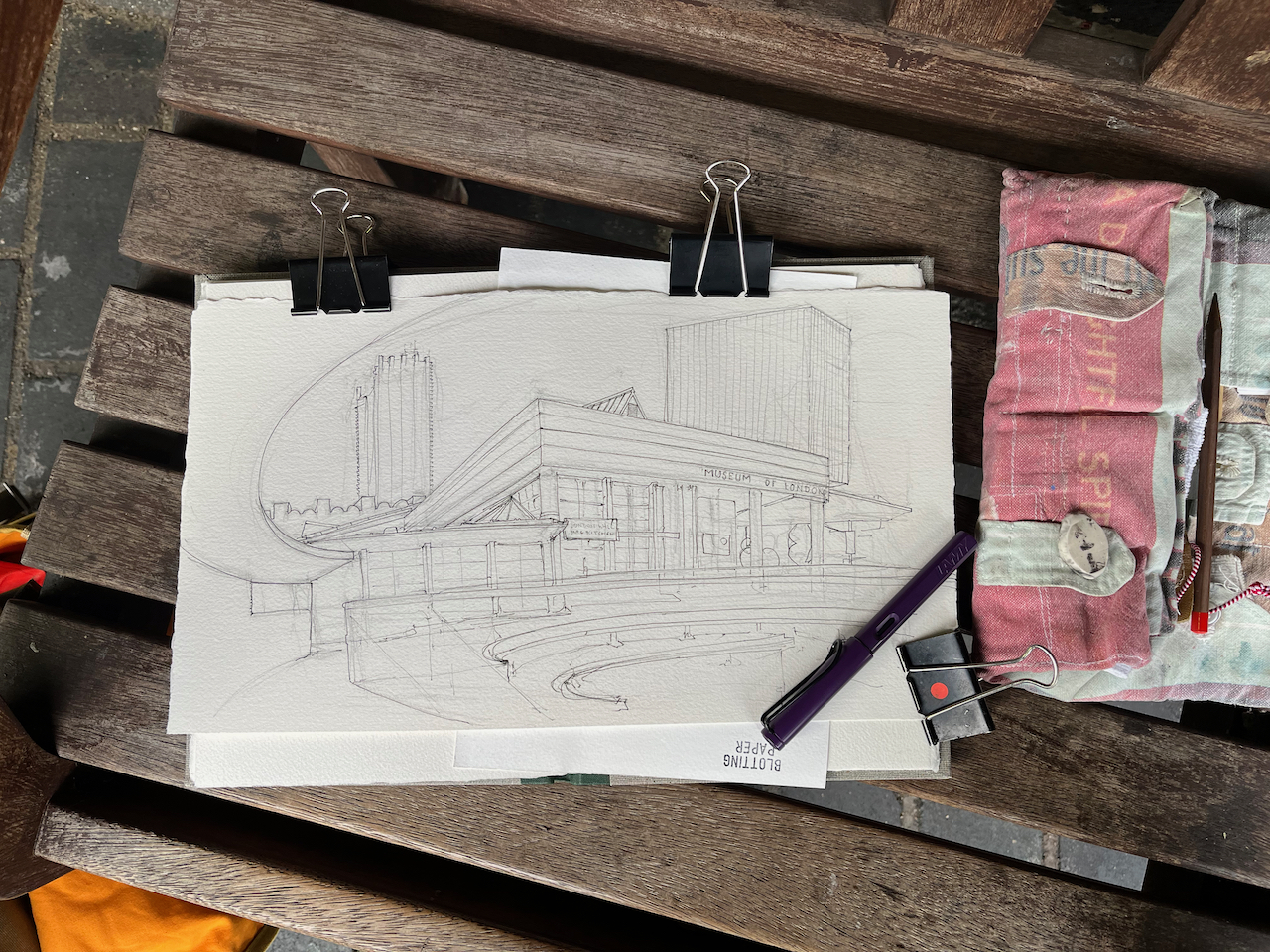
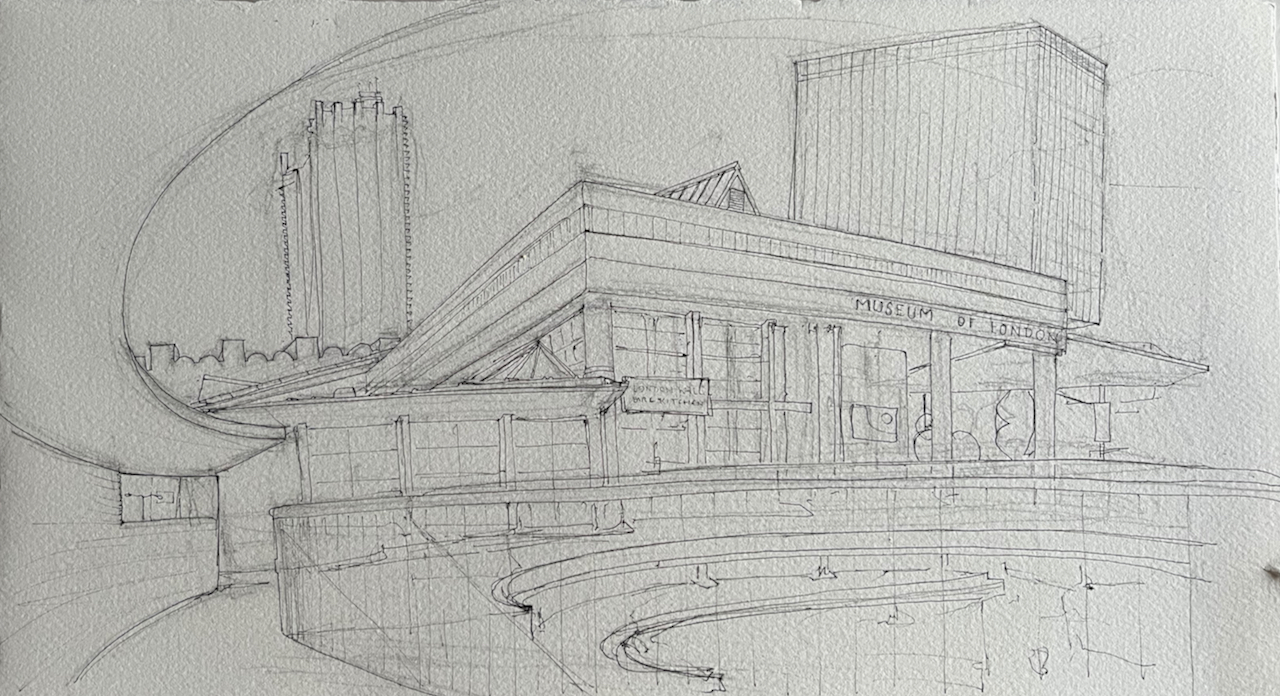
Here is comparison of the pen and ink and the the colour versions:
The architecture practice which designed The Barbican is “Chamberlain, Powell and Bon”. This “Powell” is Geoffrey Powell and not the Philip Powell of the Museum of London. The architects involved in designing the Barbican were:GeoffryPowell, Peter “Joe” Chamberlin, Christoph Bon, and Charles Greenberg.
The architects who designed the Museum of London and Bastion House are Philip Powell and Hidalgo Moya of the architecture practice “Powell and Moya”.
Thank you to the reader who clarified this for me.
Click a button below to share this post online, email it, or print it:
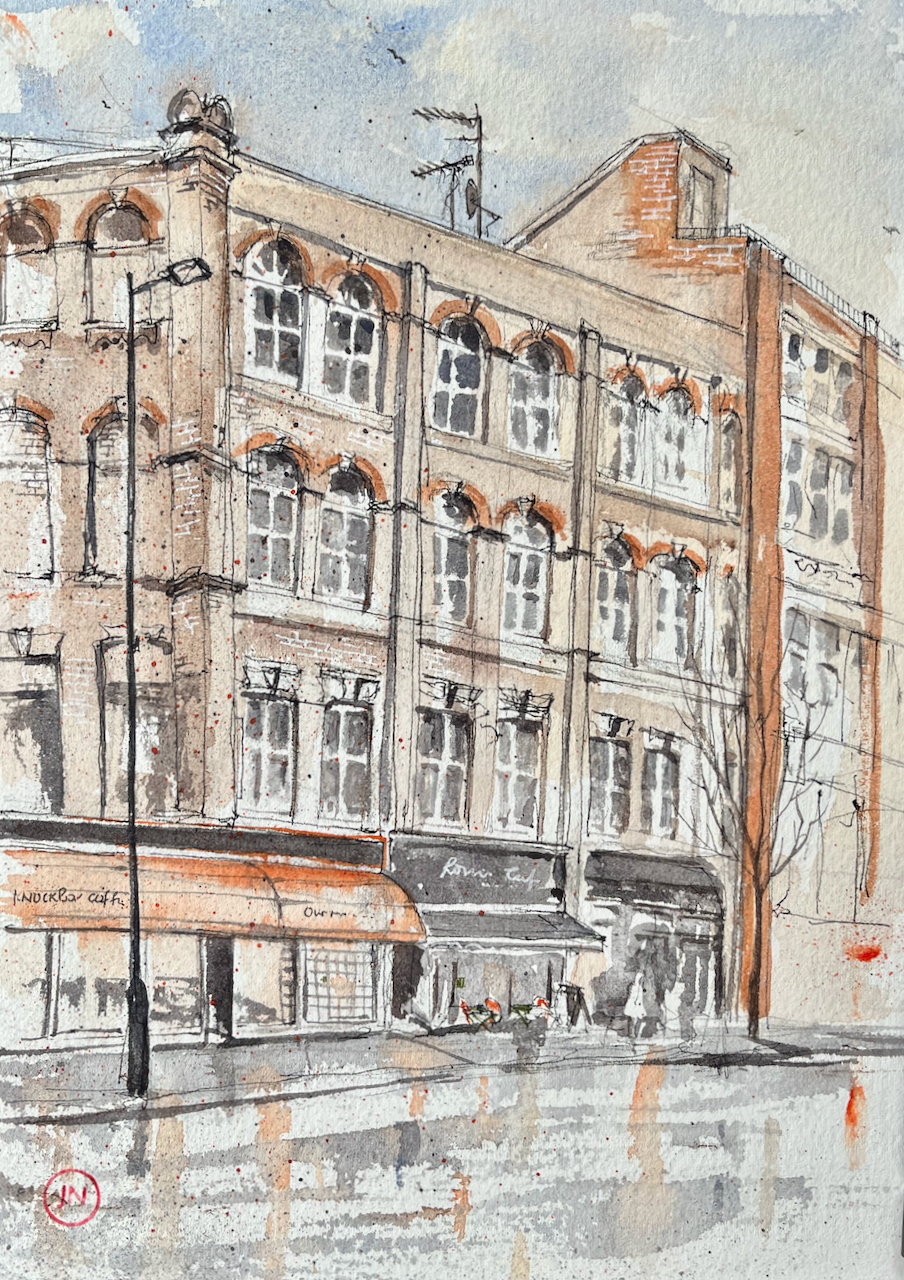
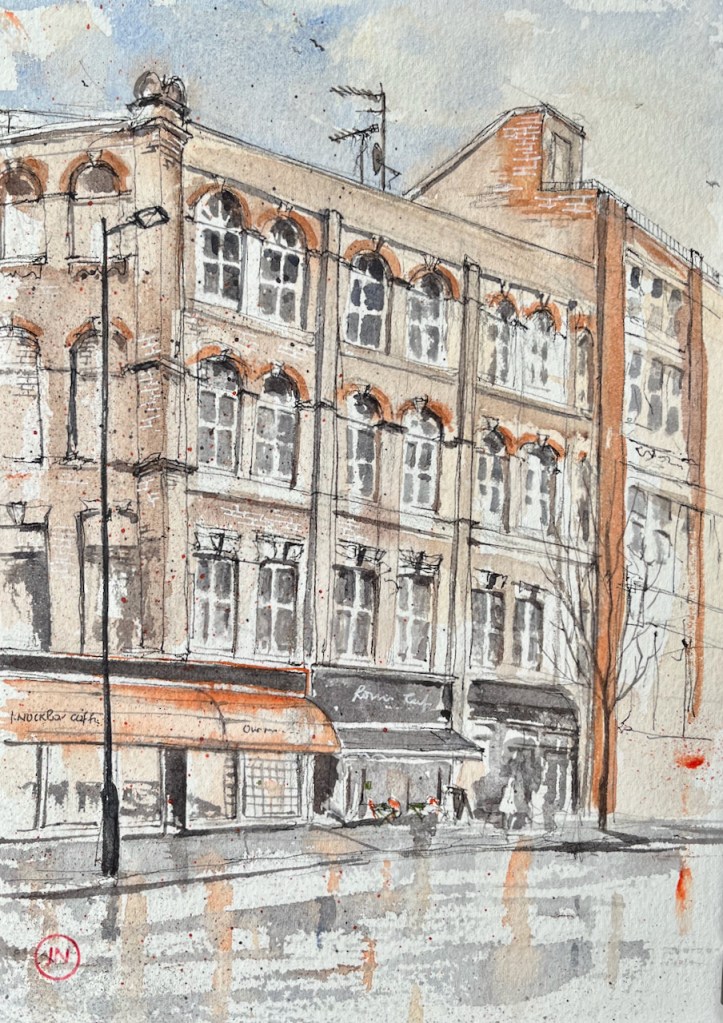
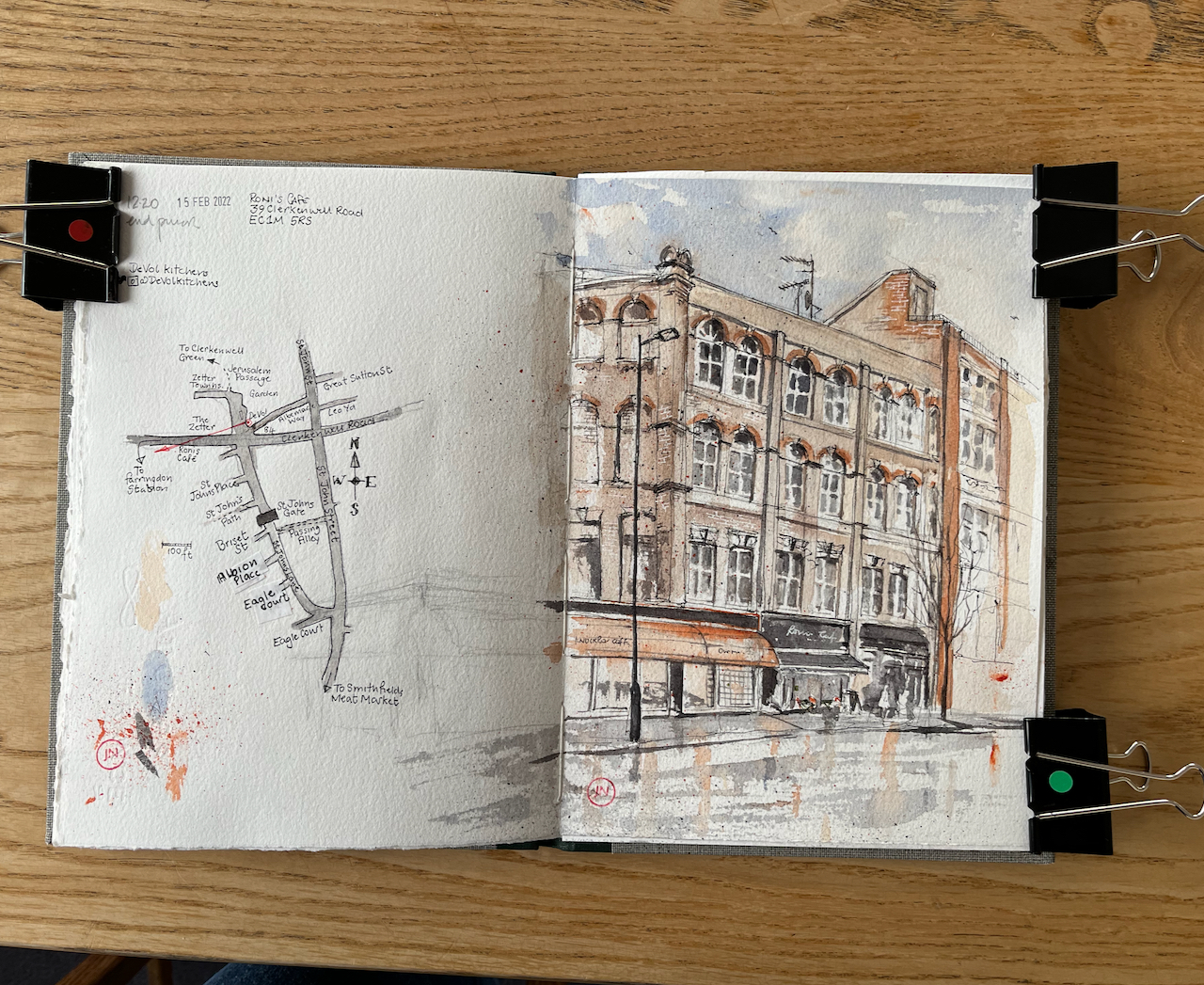
Roni’s Café, 39 Clerkenwell Road, 15th Feb 2022, 10″ x 8″ in Sketchbook 11
In the centre of the picture is Roni’s Café, where I sheltered to finish my drawing of 84 Clerkenwell Road.
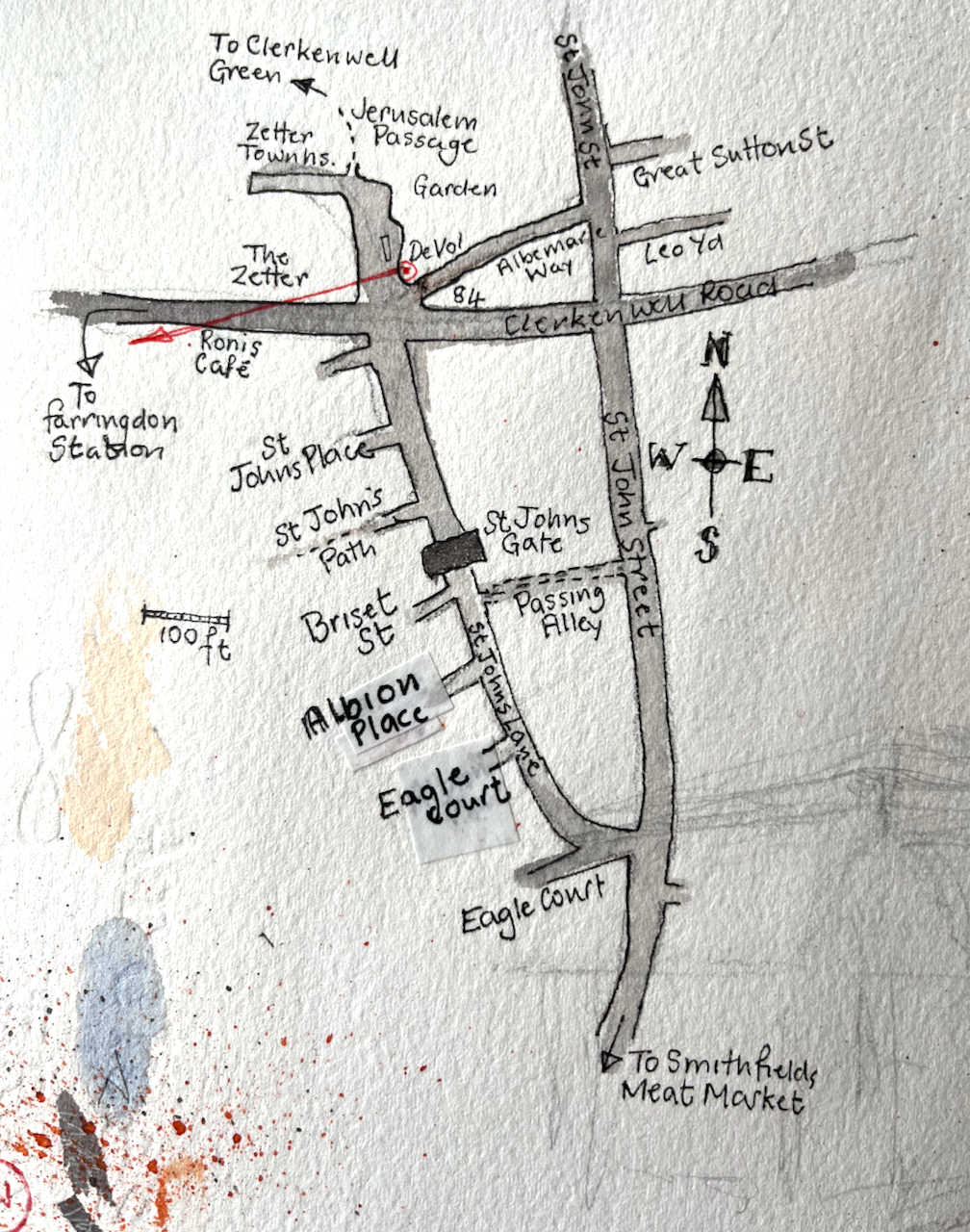
My idea was to draw the view looking West along the Clerkenwell Road, from number 84. By the time I reached the spot, the rain was falling heavily. I spotted a large window. The people inside kindly agreed to host me for 45 minutes while I sketched my lines. Then I went out into the rain. I finished the picture at my desk.
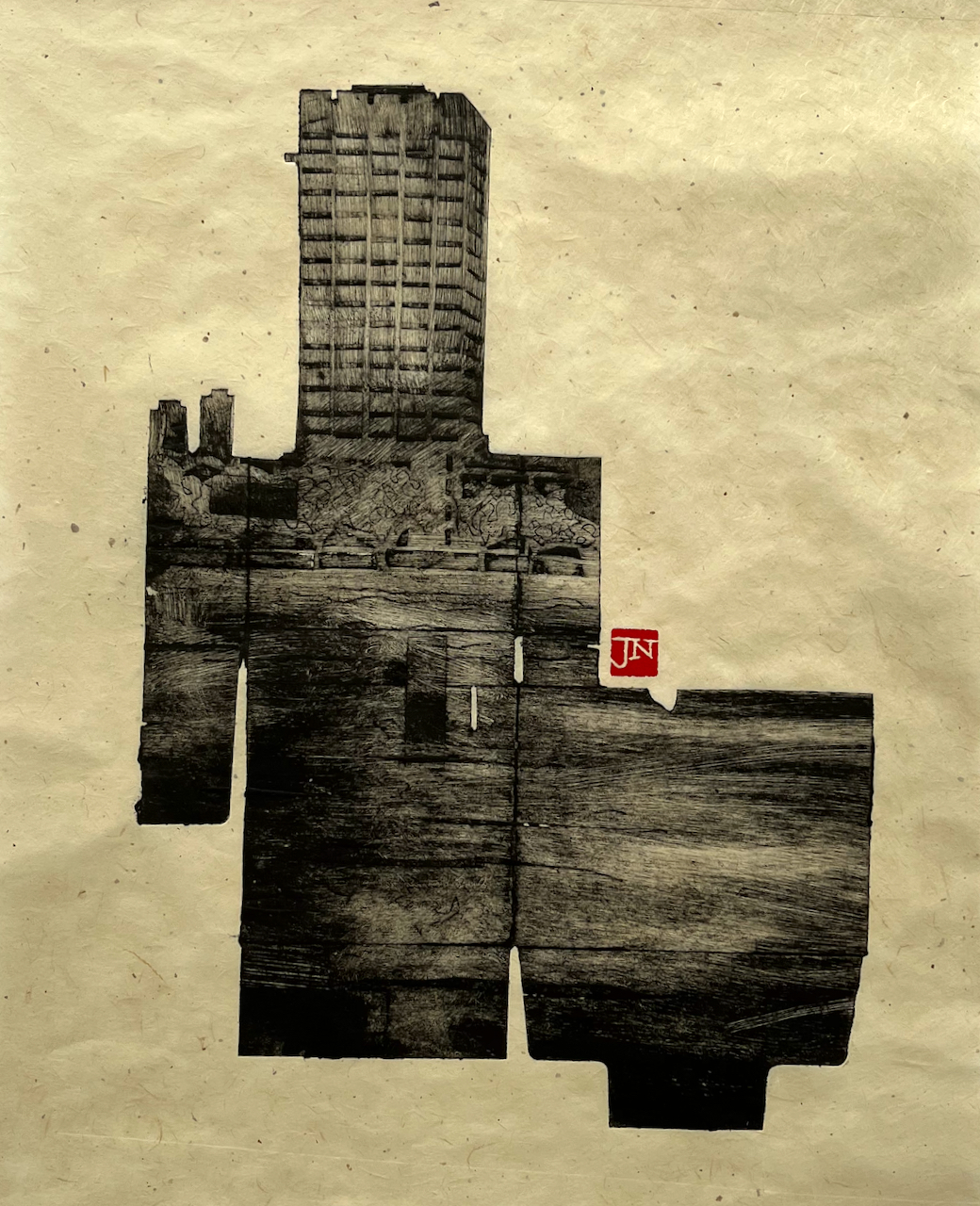
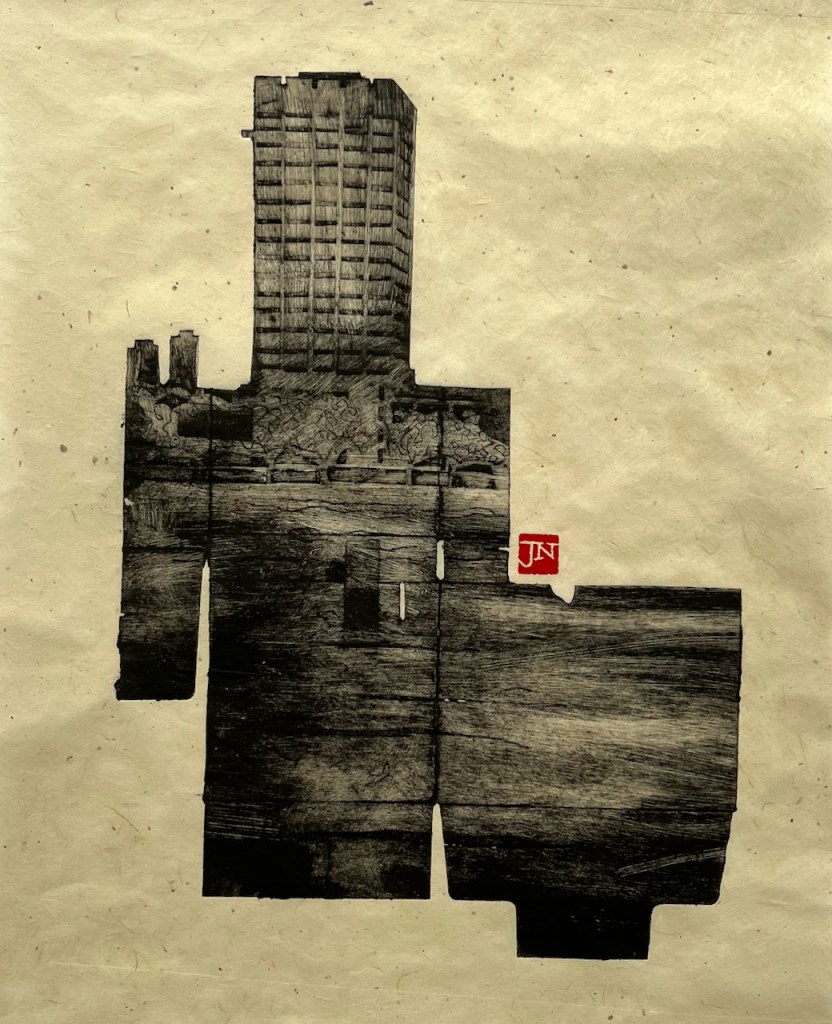
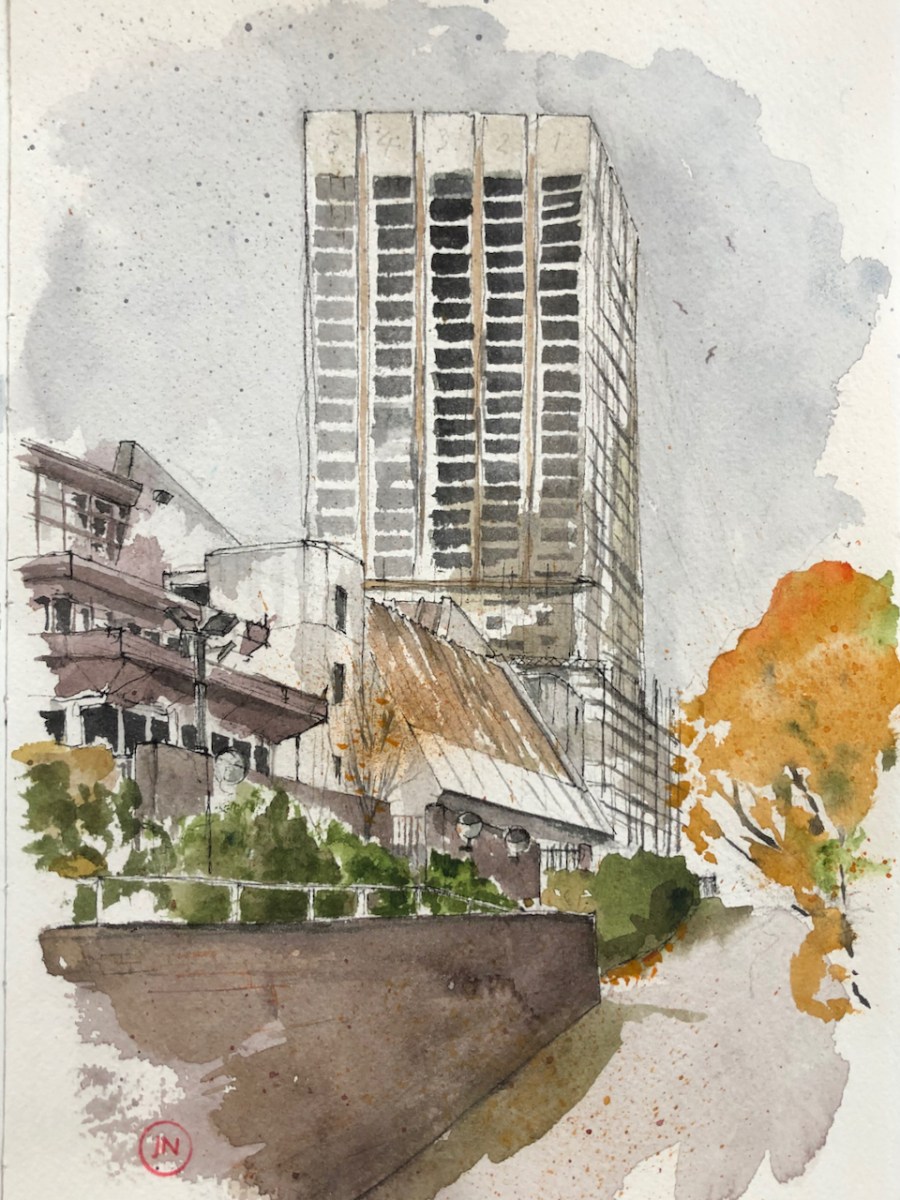
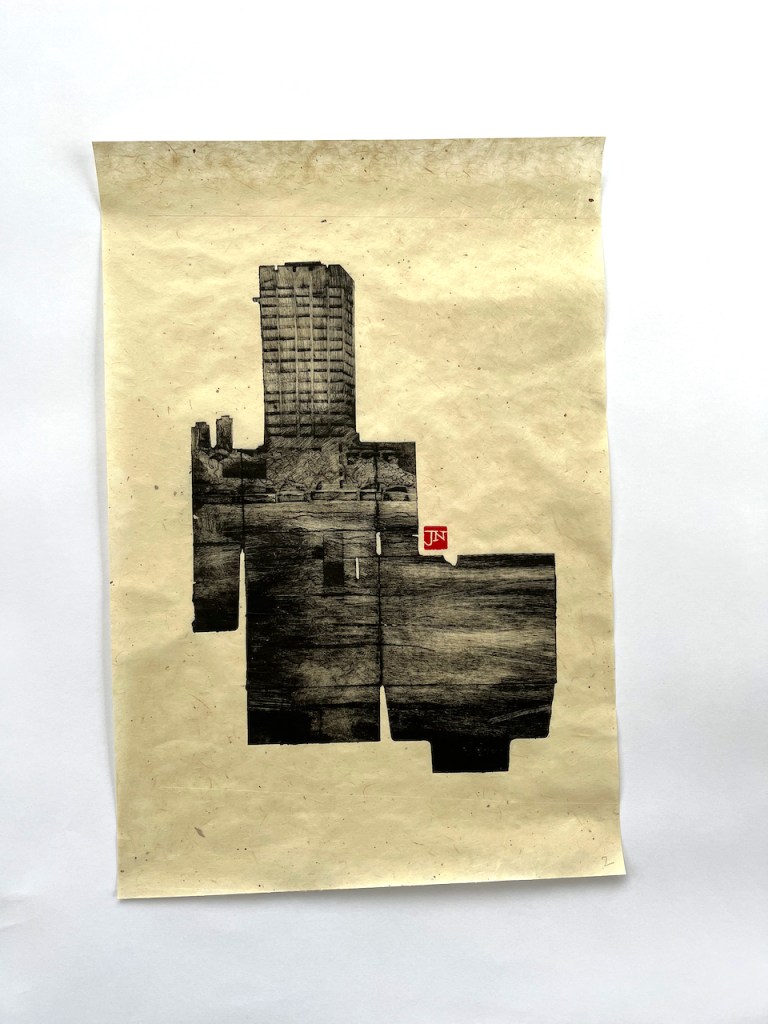
Here is a view of the tower of former London Television Centre building, seen from Windmill Walk, off Roupell Street near Waterloo Station. I…
It’s due for demolition. So using discarded packaging to make an image of this building seemed to be appropriate. The building, though made of concrete and steel, is yet ephemeral, like my fragile plate.
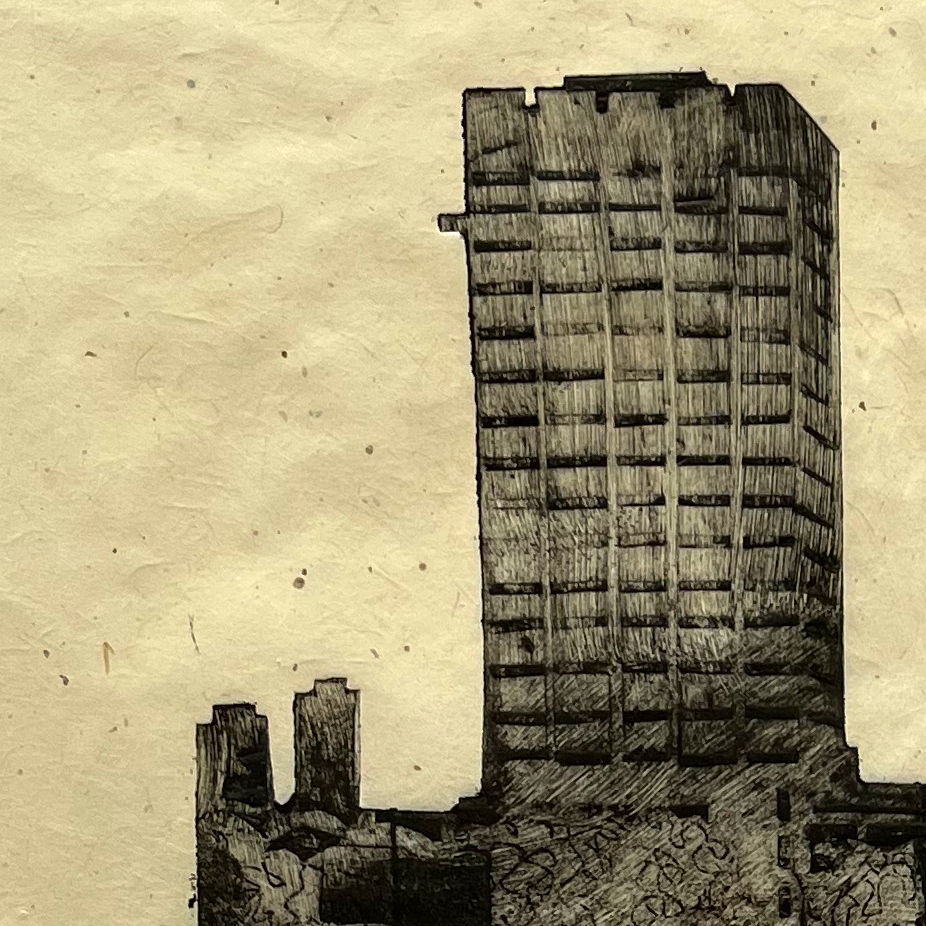
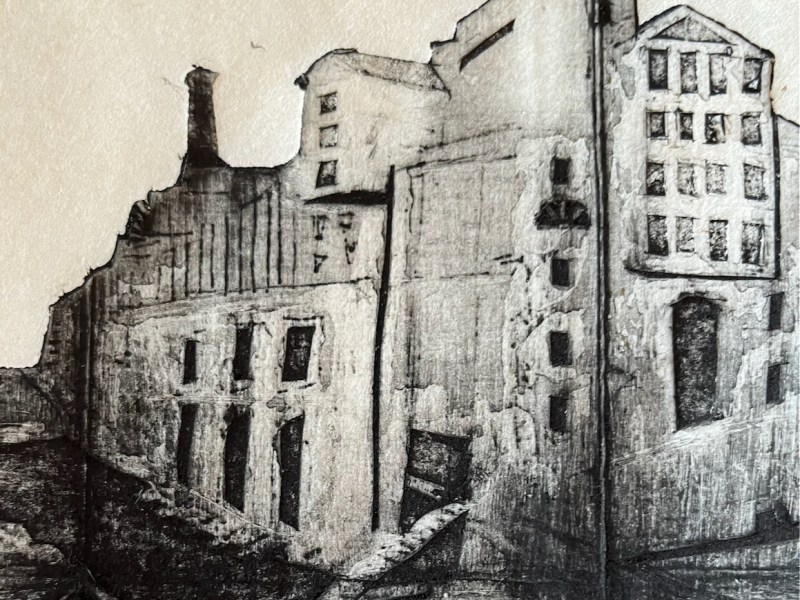
I made the print on “Gampi smooth” paper from Shepherds of London. This handmade paper is thin, translucent, and has small inclusions and imperfections as you see on this detail photo:
The sky in this part of London is never empty. There are always seagulls, falling leaves, windswept paper, aeroplanes, police helicopters. And rain.
The ink for this print is Charbonnel F66 Black traditional etching ink from Intaglio Printmakers. I made the print at East London Printmakers on the Henderson etching press.
London Weekend Television, London South Bank. Paper is a bit over A3 size.
Here are some other prints made using the same technique:
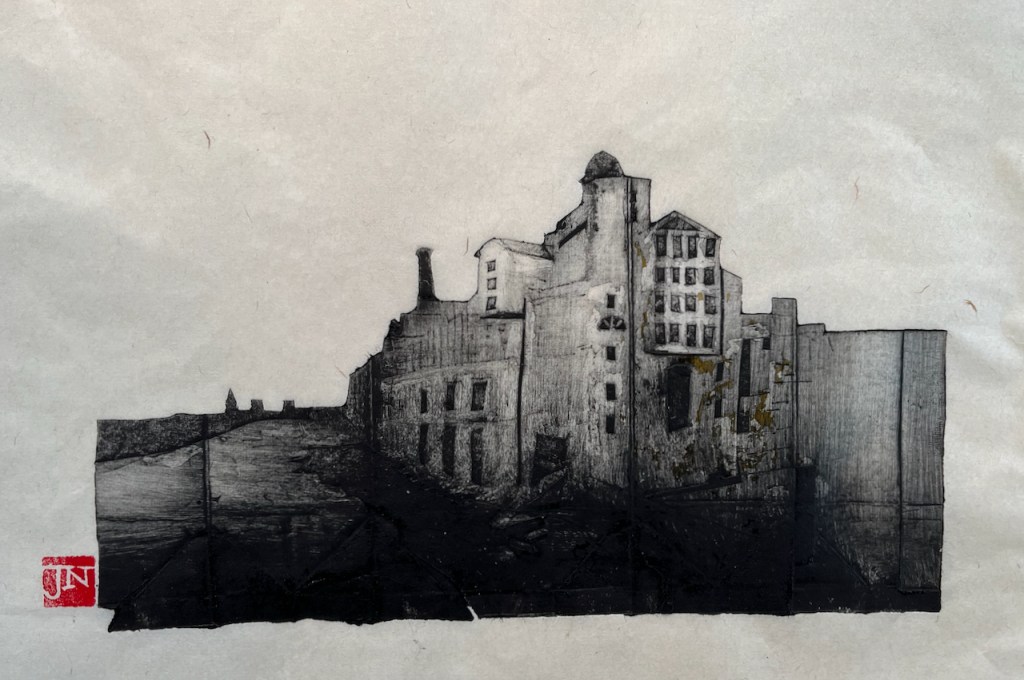
I am trying an experimental monoprint technique. The idea is to use packaging material to make intaglio “plates” which are then printed using an etching press. This is the first one. I printed it yesterday on the Henderson Press at East London Printmakers.
Anchor Brewhouse and Horselydown Old Steps, Monoprint. Image size 10″ x 6″
This is a real building, a former brewery, just to the South and East of Tower Bridge. That’s the river Thames you see on the left of the picture.
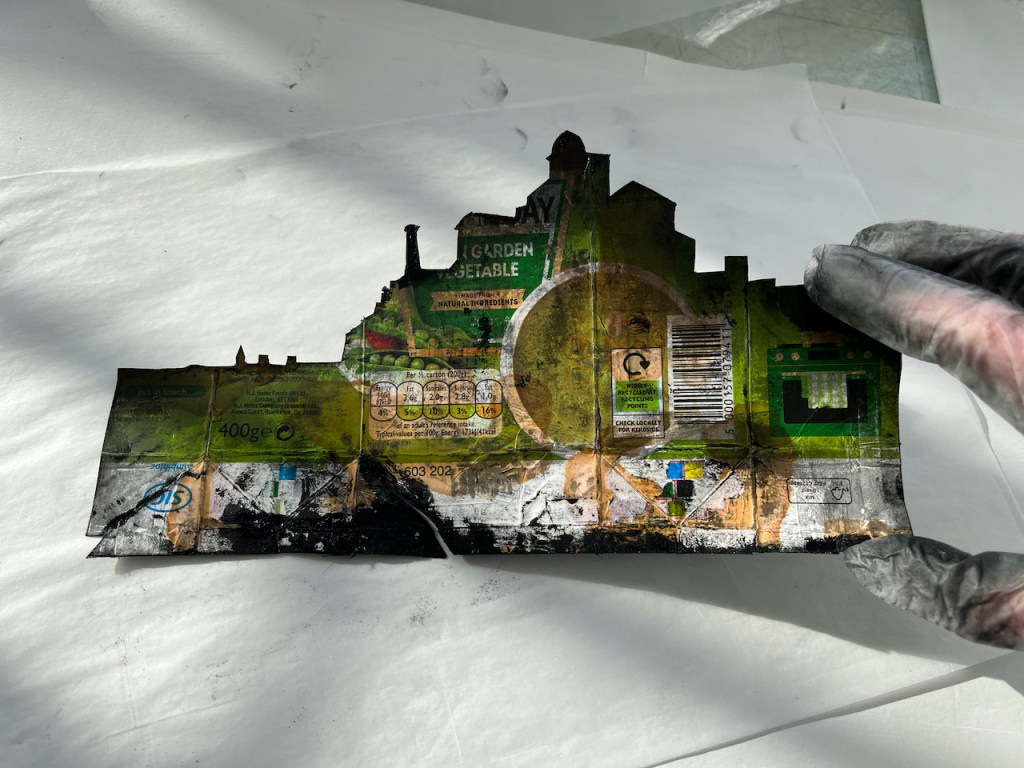
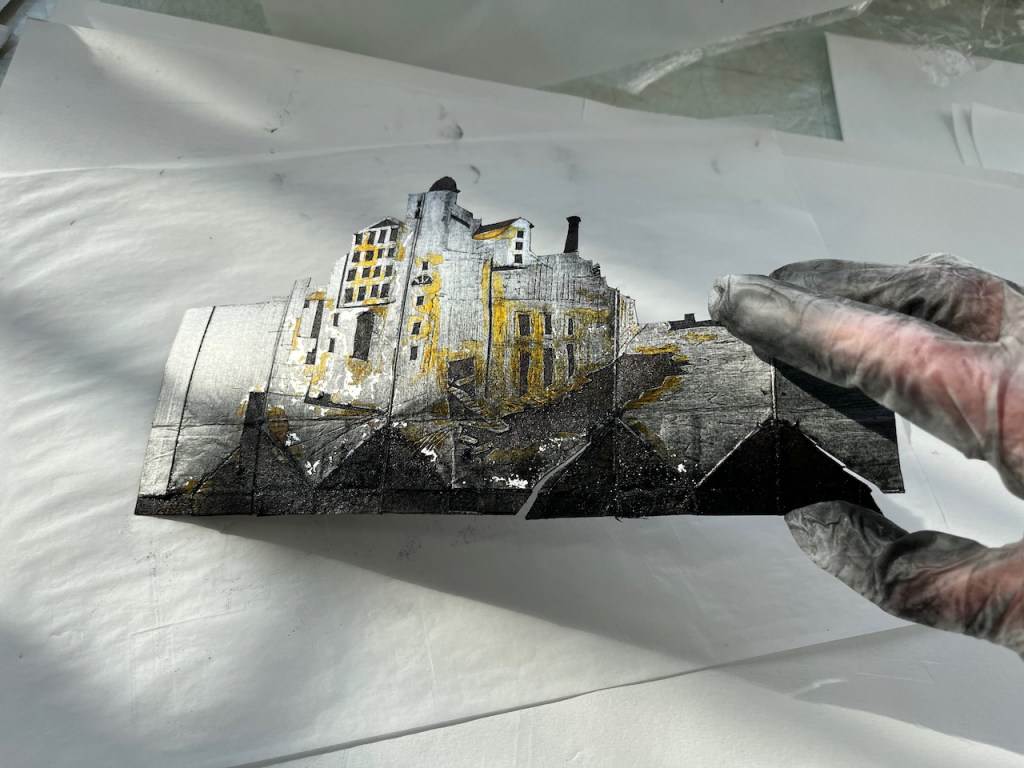
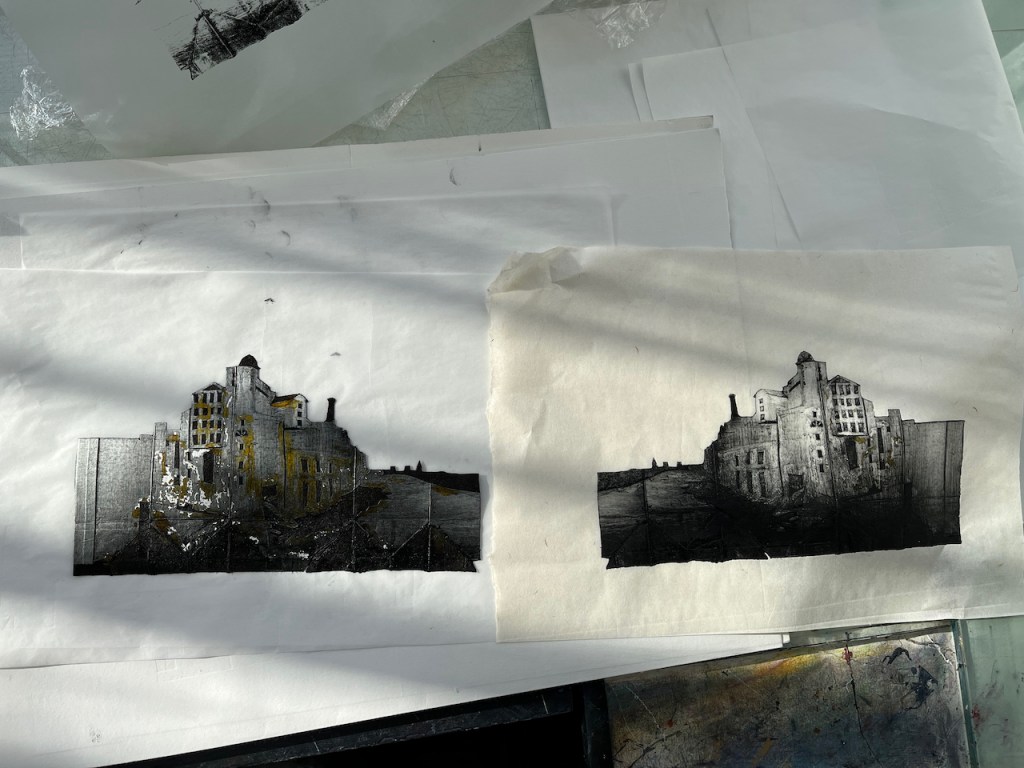
The “plates” are fragile, so I could only make 6 prints before the plate started deteriorating and the contrast started to go. Here is a picture of the plate, front and back. It is made out of a box of soup. I made the picture on the shiny, metallic-looking side, which is the former inside of the soup box.
Back of the plateFront (print side) of the plate, after inking and printing
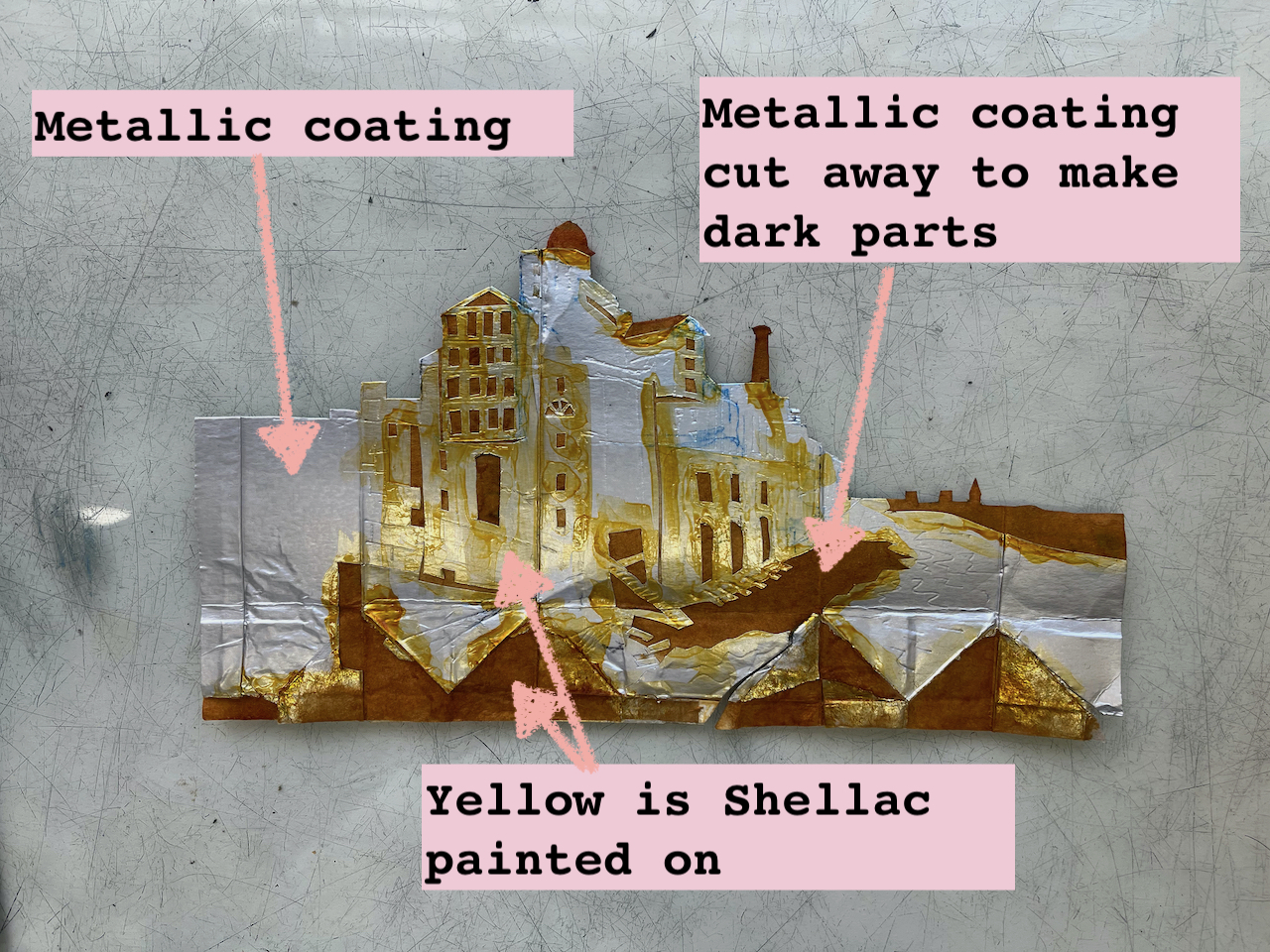
The parts which print dark are made by cutting out the metallic coating of the soup box, leaving the rough cardboard underneath. I painted the plate with button varnish (shellac in alcohol) to make it a bit stiffer and more durable. Here’s what the plate looked like before printing:
Plate before printing, with annotations
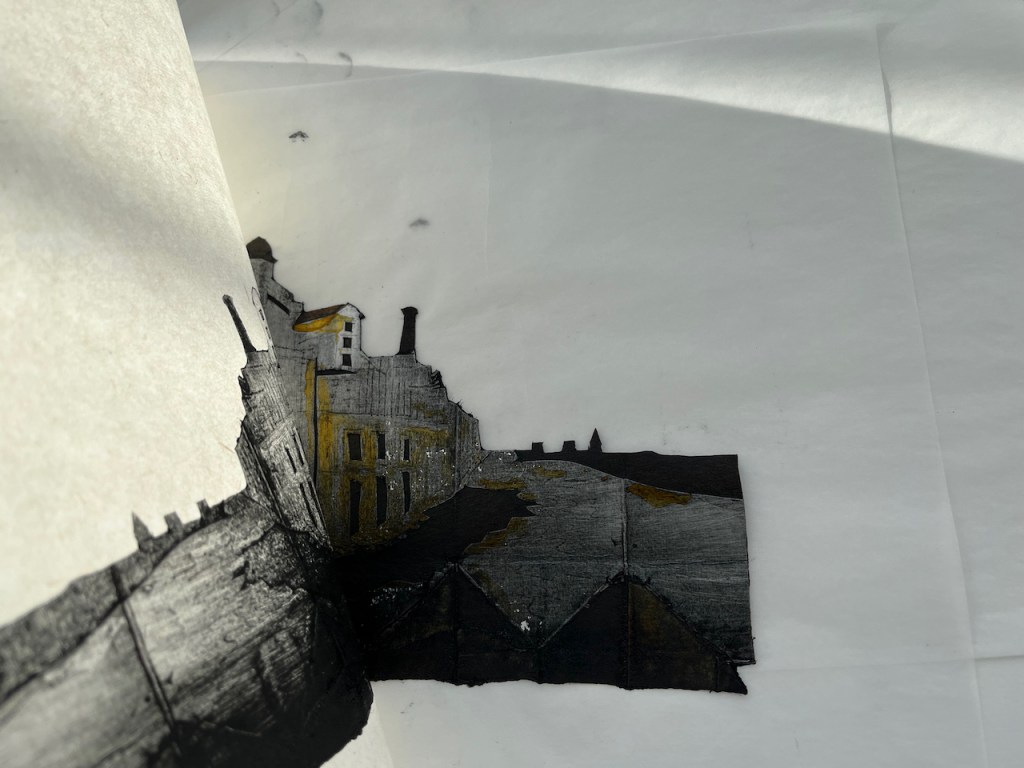
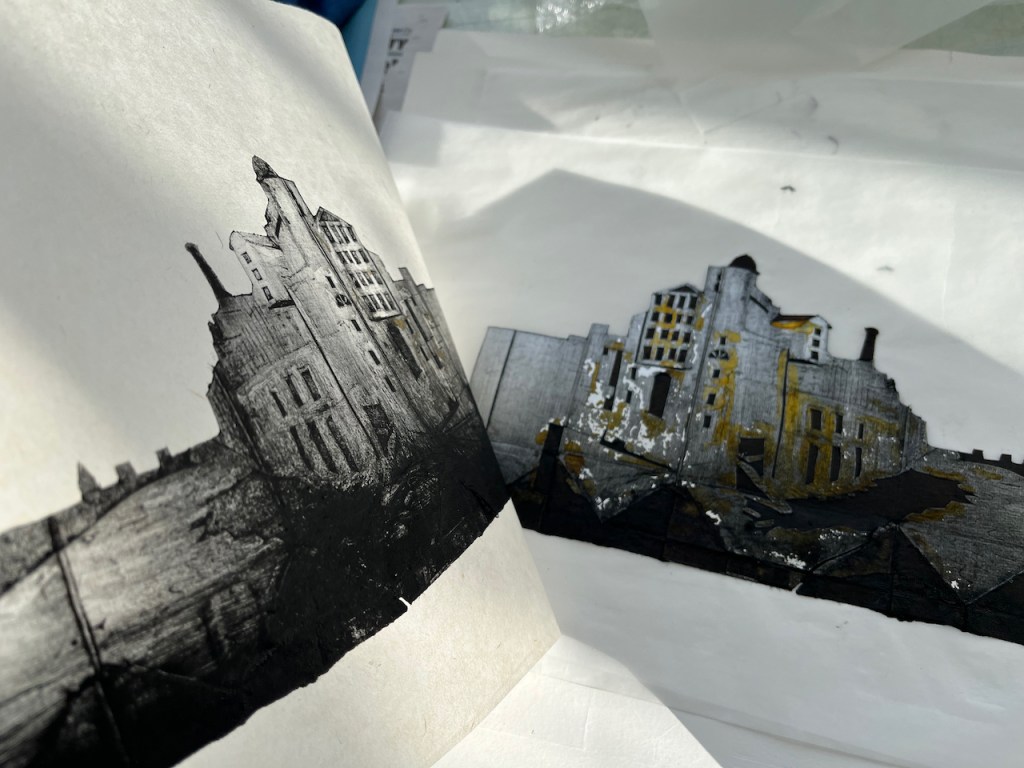
Here is one of the prints peeling off the plate:
Plate (left) and print (right)
I tried making a video, but it was too difficult to hold the plate, the paper and the phone all at once. And there’s ink everywhere which I was trying to avoid getting on my phone. Next time I’ll see if I can get a fellow printmaker to hold the phone.
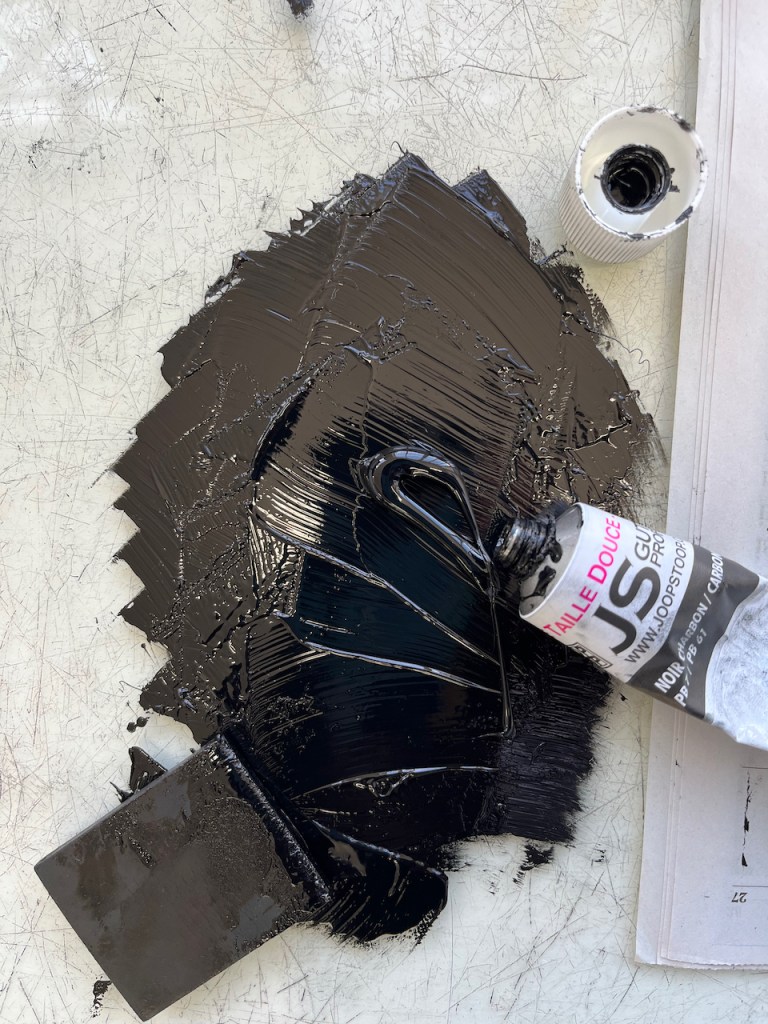
Ink: “JS”carbon black
The ink is traditional black etching ink from Intaglio Printmaker in Southwark. The paper is Zhao Zhe Chinese paper ref 11369 from Great Art on the Kingsland Road. The red seal on the finished print is made with a Japanese stone seal with red ink gifted to me by my friend and mentor Katsuhisa Toda 戸田勝久.
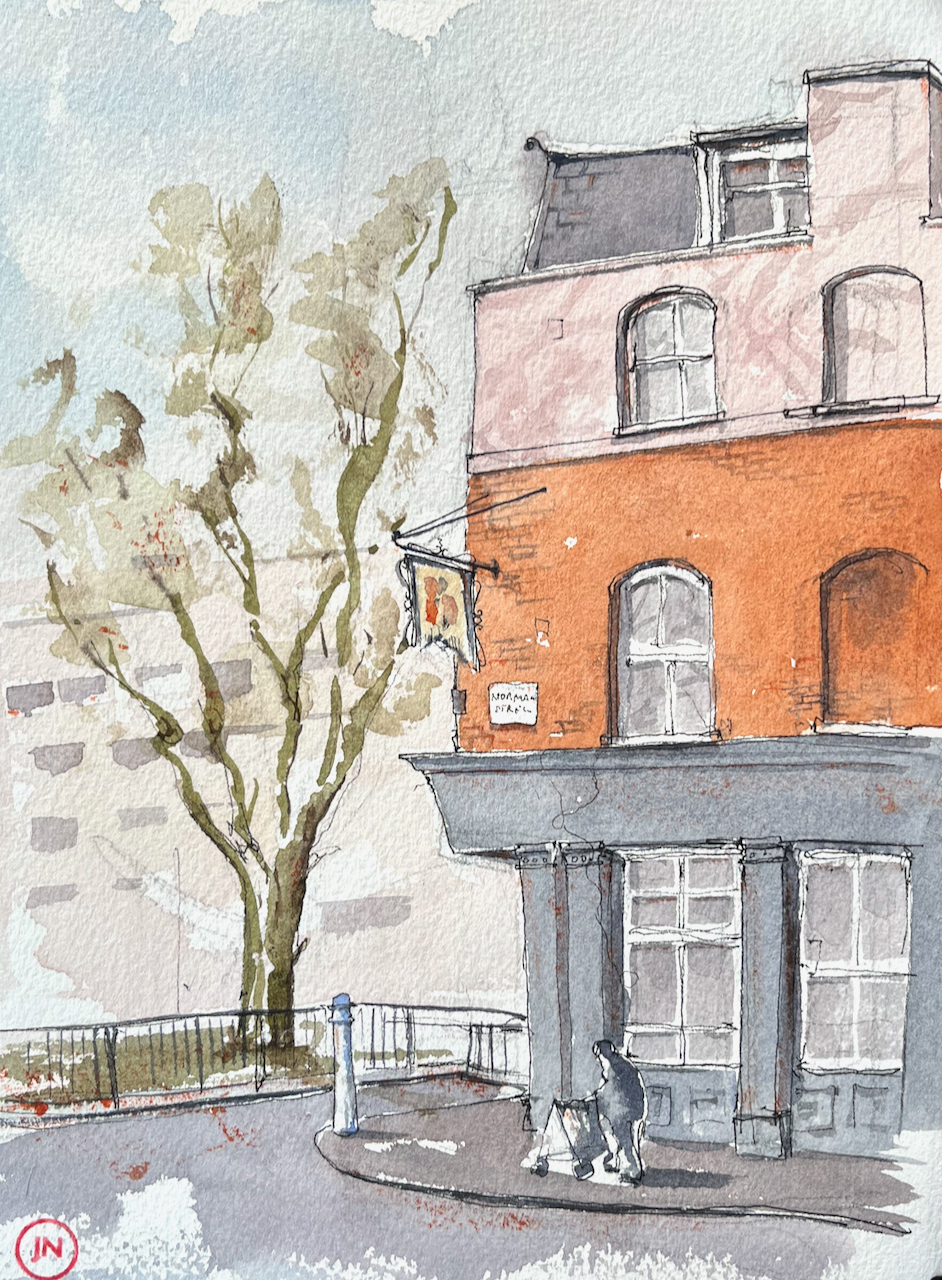
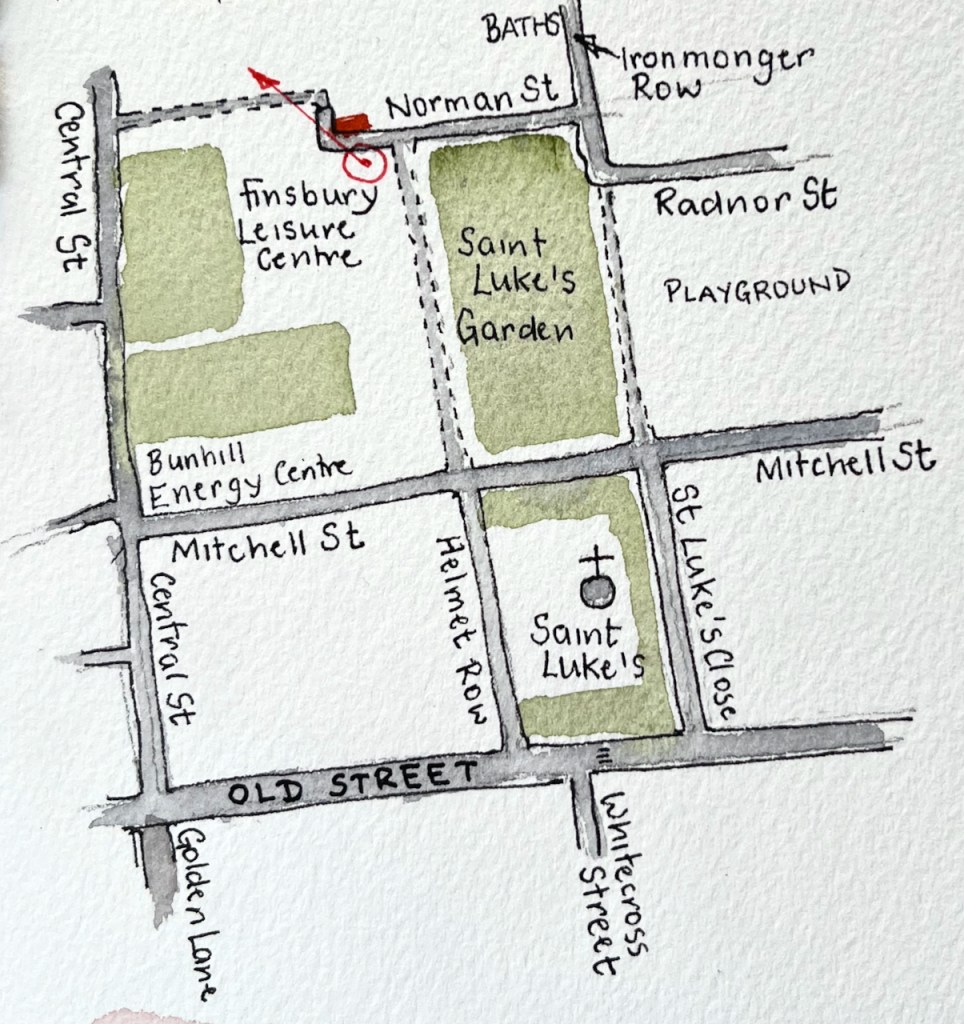
In the late afternoon, I walked round a corner near St Luke’s, and noticed the pub sign.
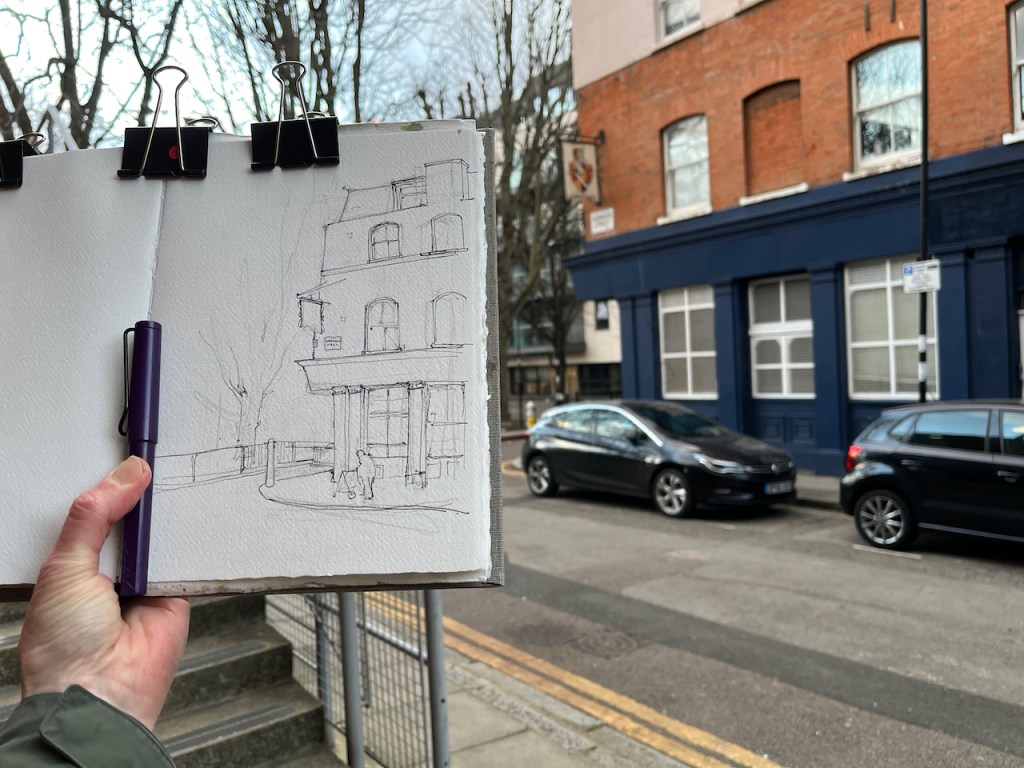
Langton Arms, Norman Street, EC1 sketched 29 Jan 2022, 4:15pm, in Sketchbook 11
The pub closed sometime around 1989, according to https://pubwiki.co.uk. It is now residential flats.
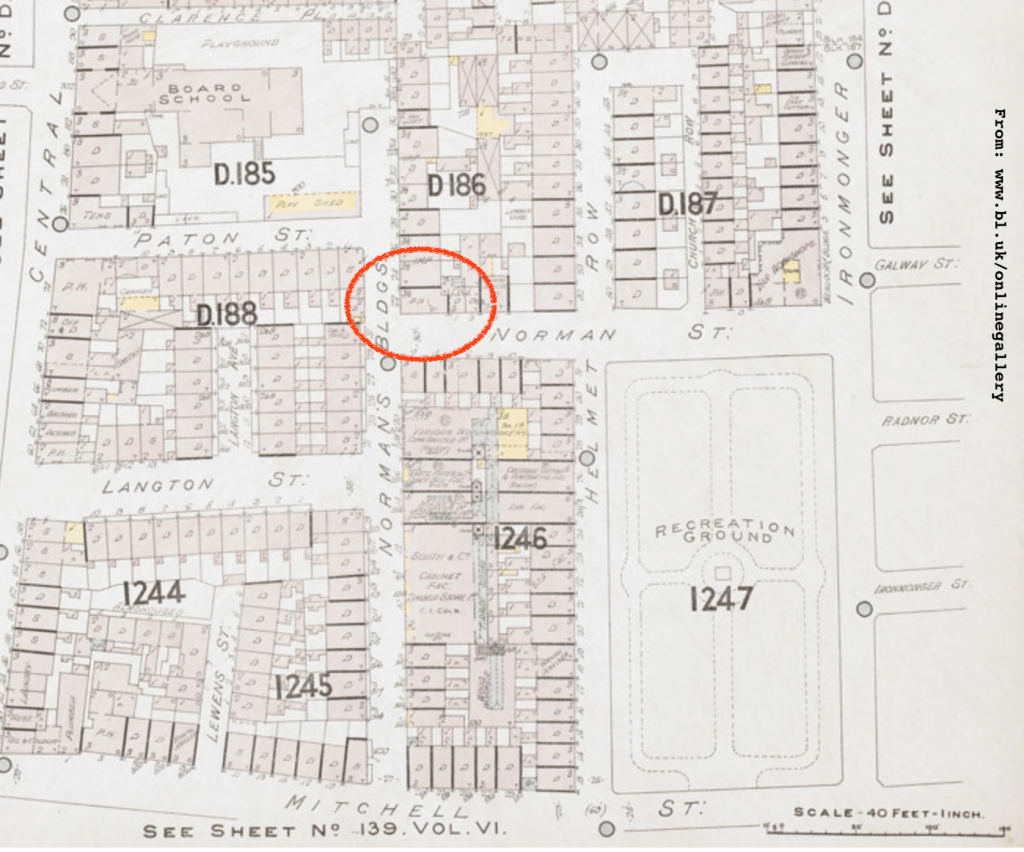
The pub was in existence in 1842, according to “closedpubs.co.uk”. There was a nearby Langton Street, shown on a map from the British Library dated 1901. The Langton Arms is marked “PH”.
1901 map. Langton Arms circled. Insurance Plan of London North District Vol. D: sheet 17 (British Library) Shelf mark: Maps 145.b.23.(.d)
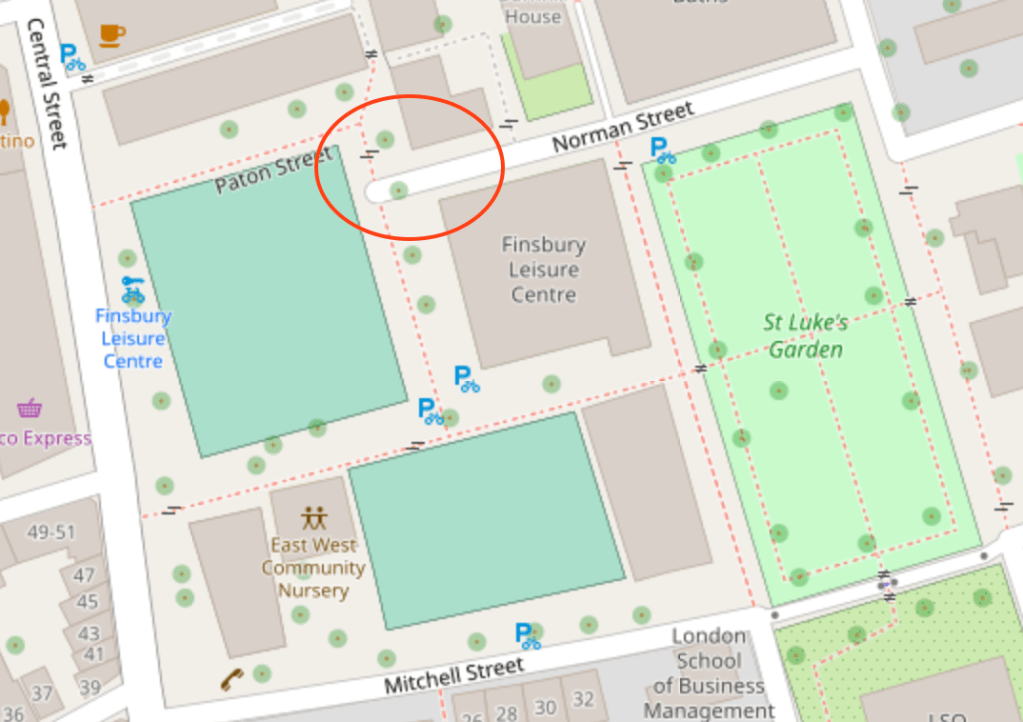
See how dense the housing was in this area in 1901. Here is the same area today. Langton Street has disappeared.
Norman Street area, 2022 (c) Open StreetMap, Langton Arms circled
Pub sign today
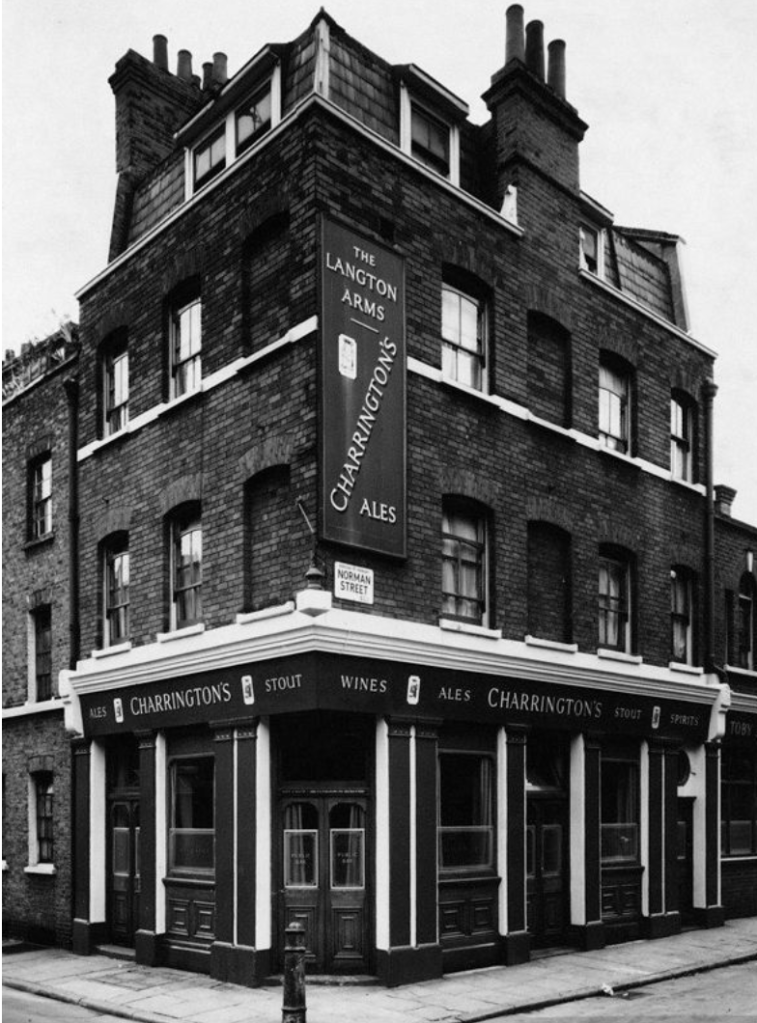
I sketched the closed-down pub at around 4:30pm, as the light faded. The pub sign is still there, but eaten away at the lower edge now. The street sign “Norman Street” is the same one as shown in a photo from 1958. It has “Borough of Finsbury” written above the street name. The Borough of Finsbury was absorbed into Islington in 1965.
This picture is a story of vanishing: vanishing street, eaten away pub sign, closed down pub, a missing borough, sun setting in January. Behind me as I sketched I could hear the squeak of gym shoes on hard floors, the other side of the closed steel doors to Finsbury Leisure Centre.
1958
Click a button below to share this post online, email it, or print it:
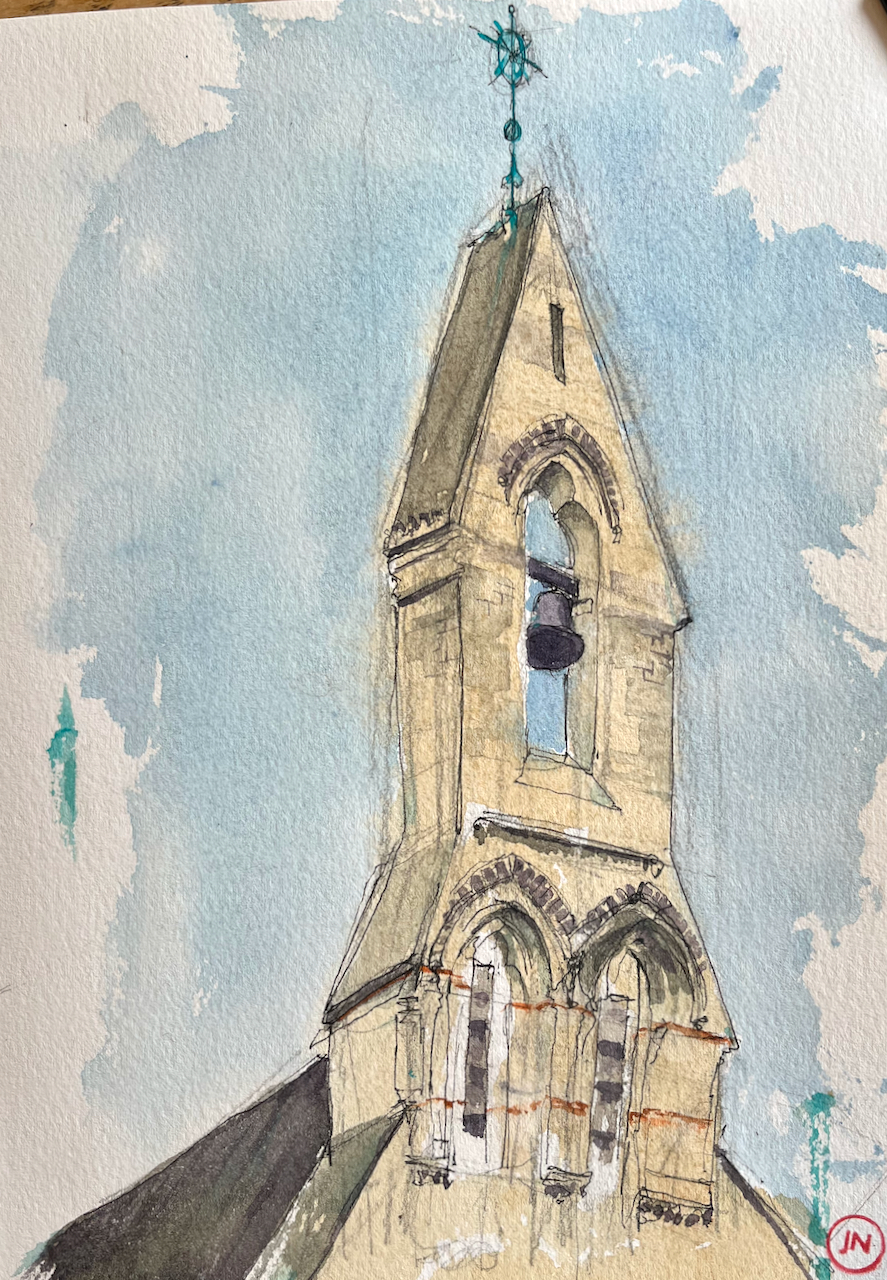
On a cold day, suddenly the sun came out and lit up the stone of St Monica’s Church.
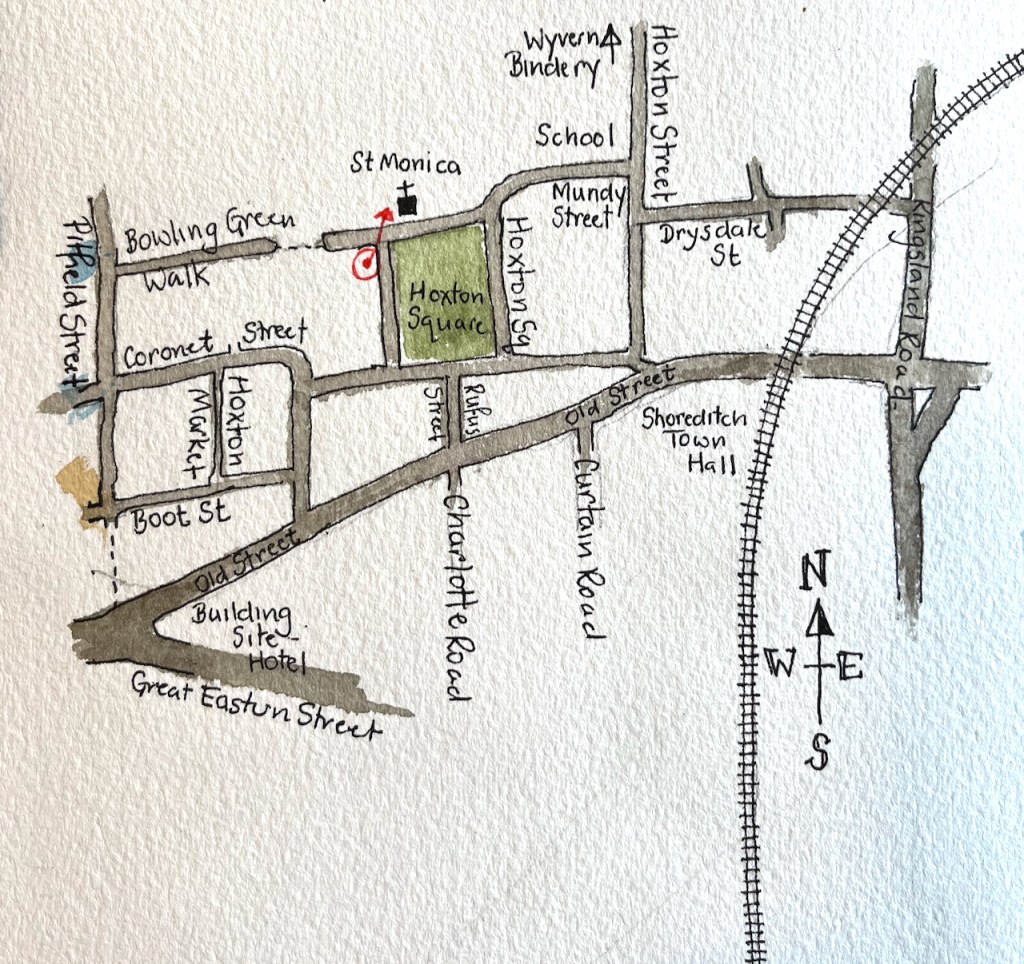
Bell tower of St Monica’s Church, Hoxton Square. 26th January 2022, 13:40 in Sketchbook 11
This church was built in 1866, to the design of E.W. Pugin. It was part of the Augustinian Priory on this side of Hoxton Square.
E.W. Pugin (1834-75) is the son of A.W. Pugin, who collaborated with Charles Barry on the design of the Houses of Parliament. E.W. Pugin designed a large number of churches, 60 English churches are listed in his Wikipedia entry, with another 6 or so in Wales and Scotland and 16 in Ireland.
Click a button below to share this post online, email it, or print it:
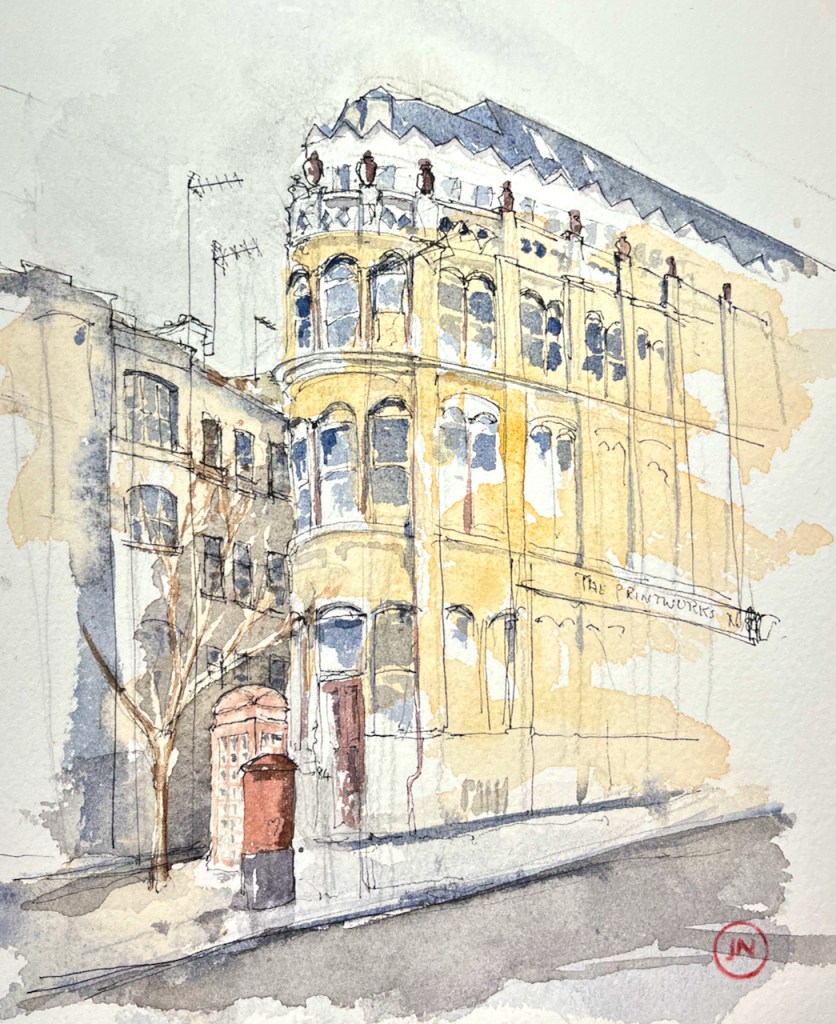
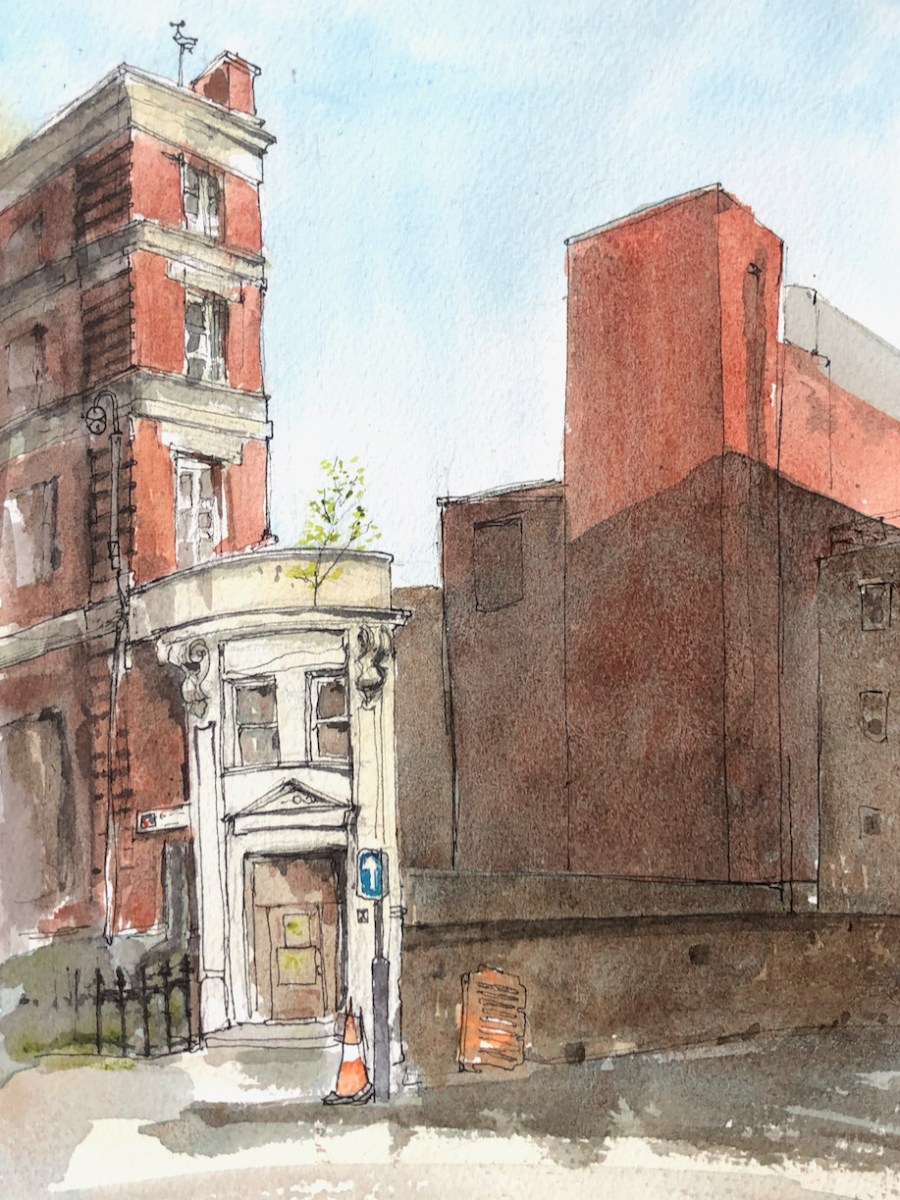
This building is at the junction of Clerkenwell Road and Albermarle Way.
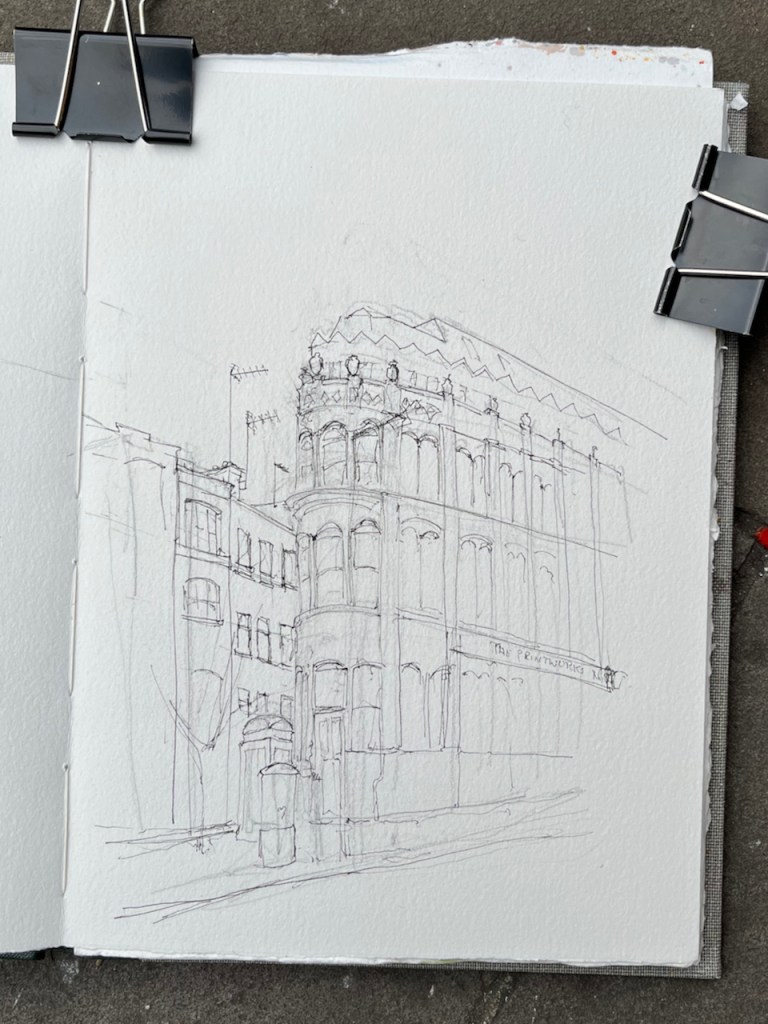
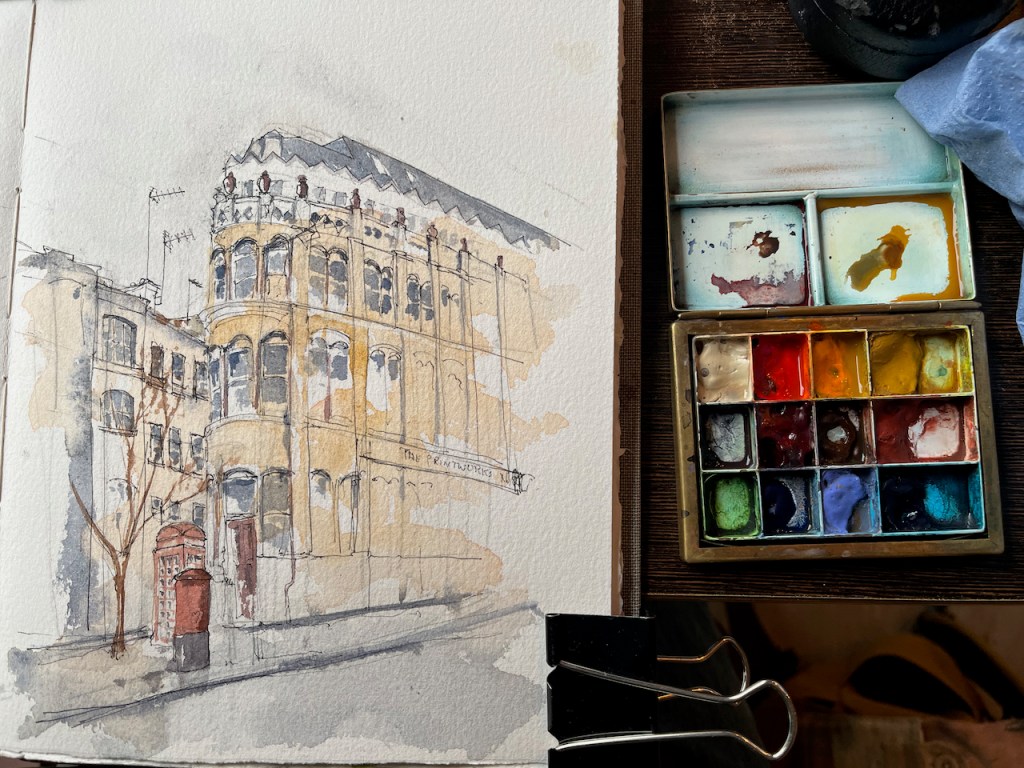
84 Clerkenwell Road, EC1M, 21st January 2022, 14:30, 7″x 10″ in Sketchbook 11
The land, on the recently established Clerkenwell Road, was bought in 1879 by a jeweller, Edward Culver, who funded a new factory for his business on in this rapidly developing area. The building cost £11,ooo, and was finished in October 1879. His business occupied it until about 1894. (from British History online, see Note 1)
In 1915, the ground floor and basement were converted for use by the “London County & Westminster Bank” (Note 1). This turned out to be a long tenancy. A photo in the London Picture Archives shows that a descendant of the same bank, the National Westminster Bank, was there in 1976. (Notes 2 and 3).
The ground floor is now a design company, “Frem”. Before that, it was a hairdressers. The building is labelled “The Printworks” but I am unable to discover when, or indeed if, it was a printworks.
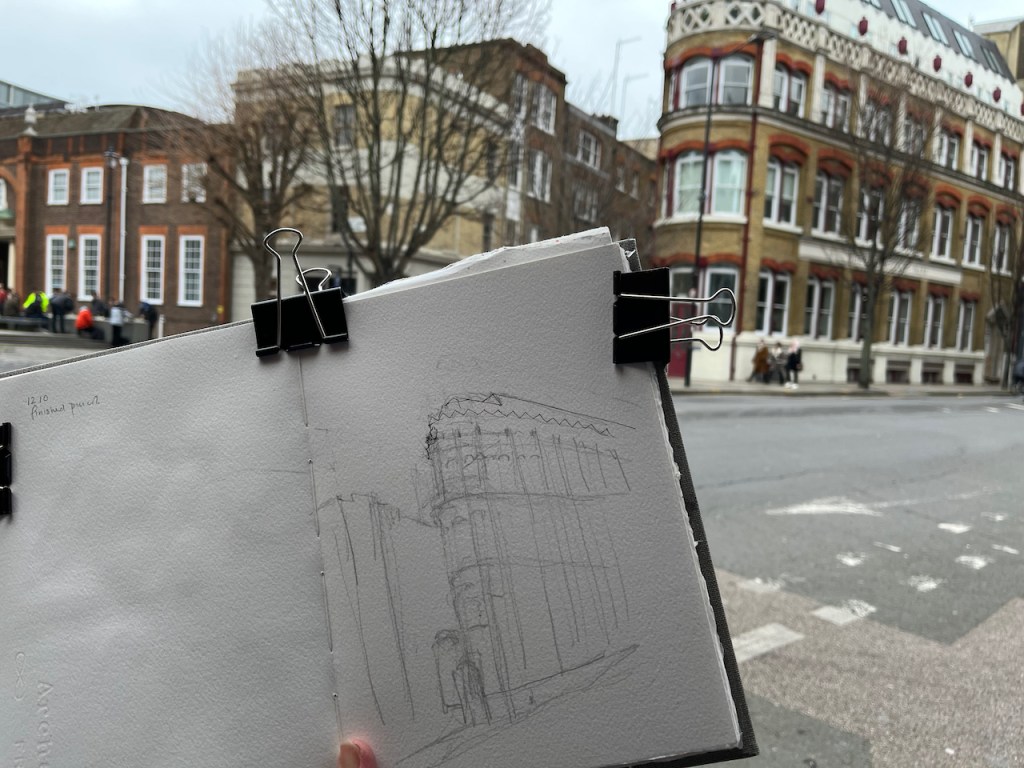
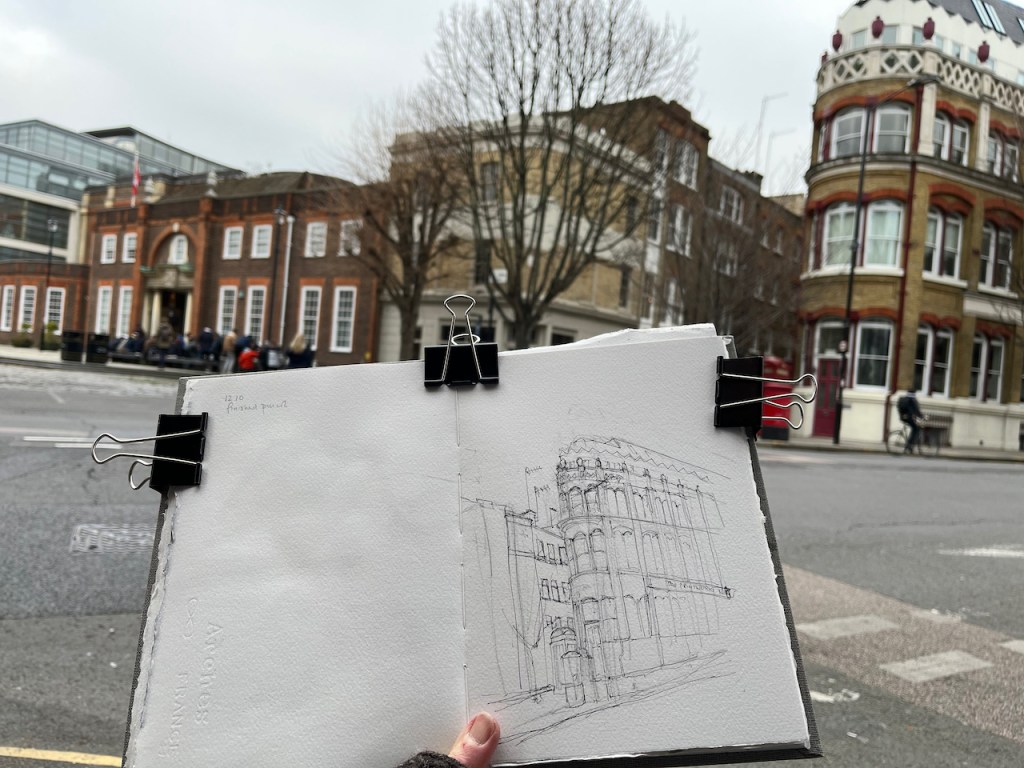
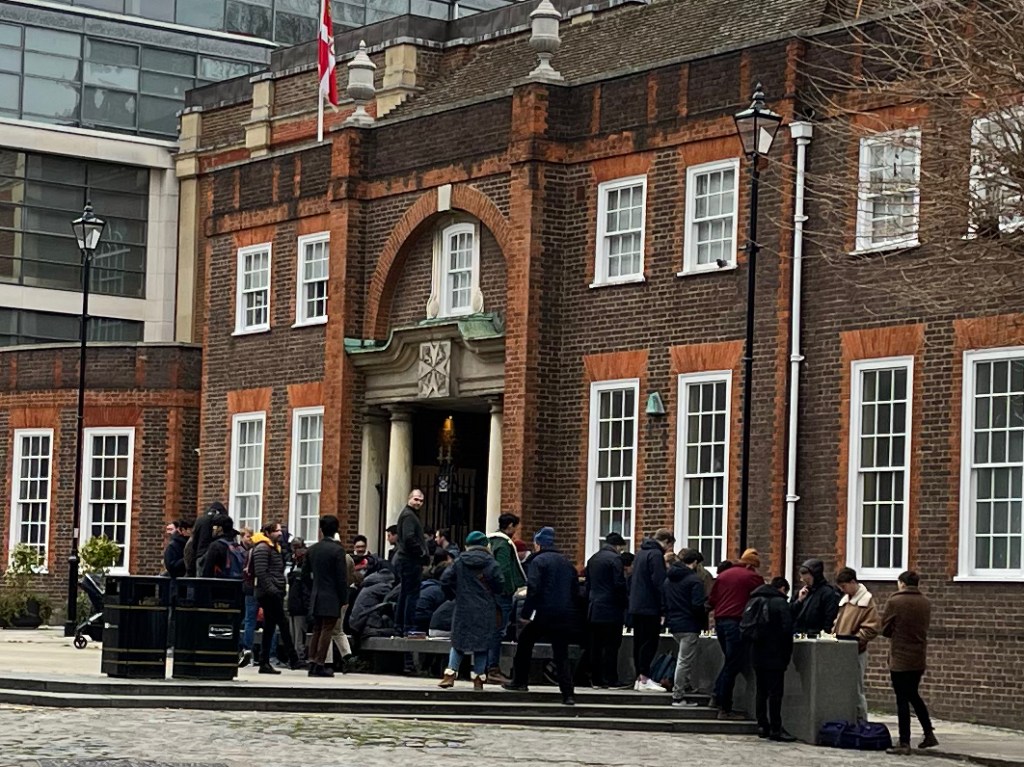
I sketched the building from the corner of the Clerkenwell Road and St John’s Lane. On the other side of the road, I saw a man come and lay out a large flexible chess mat on the stone bench in St John’s Square.
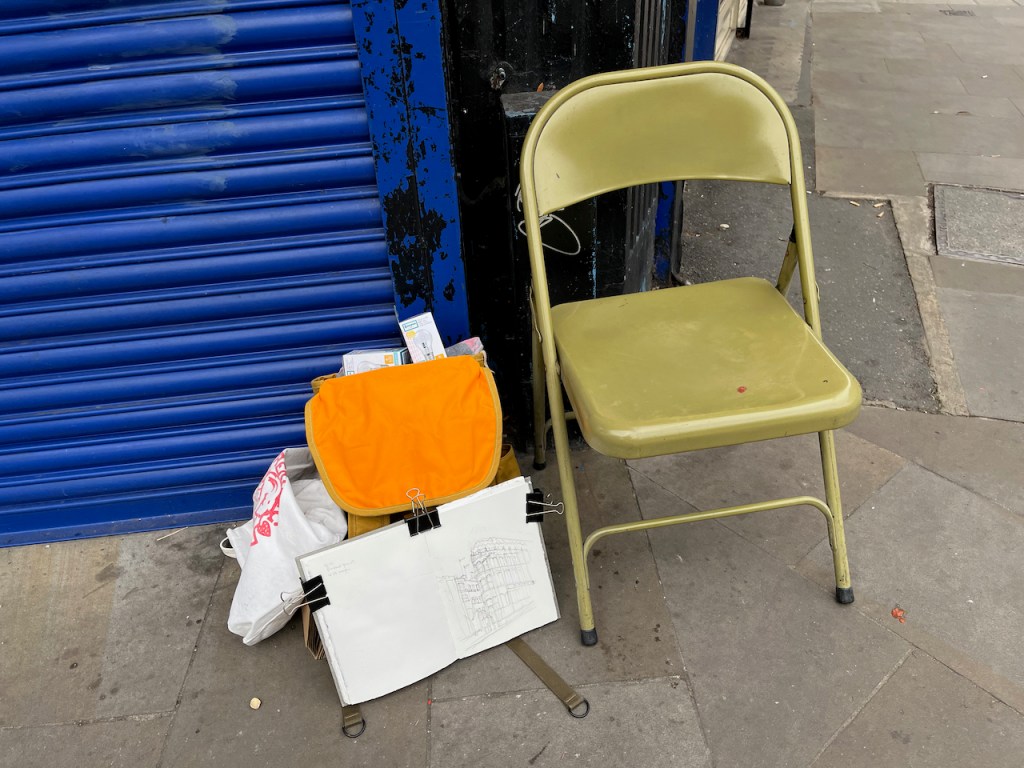
Later, a woman appeared at my elbow carrying a green metal chair. “Would you like to sit down while you draw?” she asked. I would indeed. She told me she was from the café just up the road. Very grateful, I sat down and continued sketching. By the time I’d finished the pen sketch, there were several dozen people clustered round the bench in St John’s Square. There were now many chess sets laid out. And I was very cold.
Pencil underdrawingThe chairPenPen, chess players centre left, just above the book.Chess players on the stone bench.
Roni’s Cafe: warm and friendly
I picked up the green chair and went to the café to give it back. It was warm and friendly in there, so I stopped for a coffee. I learned that the chess players come every Saturday. First there were just a few, now there are dozens. The youngest is 7 years old. As I drank my coffee, some of the chess players came into the café, hopping from one leg to the other with the cold, as I had done earlier. They bought takeaway coffee or hot chocolate, left a phone to charge up by the till, and took off again to join the fray.
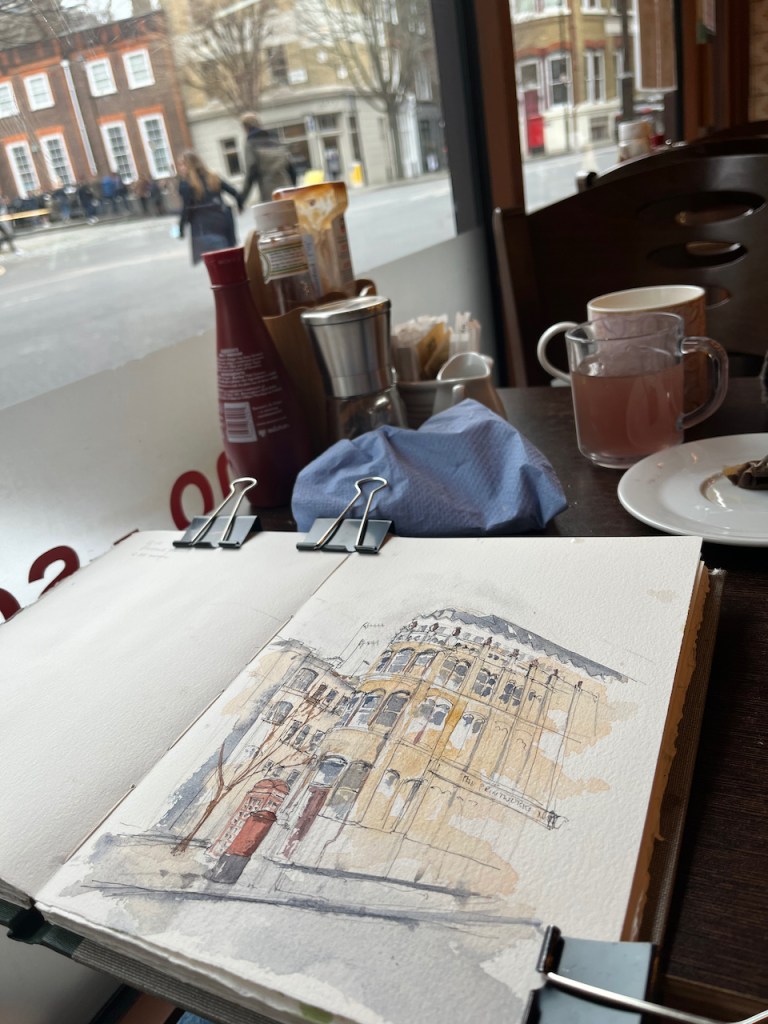
The friendly proprietor of the café admired my picture and pointed out that I could see the building, if I took a certain table by the window. “Then you can do the colour”, she said. I could. She brought a cup of water, a porcelain saucer, and a large amount of paper towel. This is a lady who knows what watercolour painters need. A mug of tea arrived as well. Comfortable and warm, I continued my sketch.
Putting on the colour in Roni’s Café
If some of these road names seem familiar to you, it might be because this area is the setting for much of the story in the novel “Troubled Blood” by Robert Galbraith aka JK Rowling.
————————————————————–
Note 1: 84 Clerkenwell Road, early history: ‘Clerkenwell Road’, in Survey of London: Volume 46, South and East Clerkenwell, ed. Philip Temple (London, 2008), pp. 385-406. British History Online http://www.british-history.ac.uk/survey-london/vol46/pp385-406 [accessed 22 January 2022].
Note 2: 1976 photo: London Picture Archive, Record 60792, on this link
Note 3: NatWest Group has an excellent History section on its website: https://www.natwestgroup.com/heritage.html?intcam=. The current “NatWest” is the result of the acquisition of over 250 banks over several centuries. The London County and Westminster Bank was one of them.
London & Westminster Bank Ltd (1833-1909) opened in 1834 with a head office at 38 Throgmorton Street and a branch at 9 Waterloo Place. It acquired a succession of other banks, then in 1909 it amalgamated with London & County Banking Co to form London County & Westminster Bank Ltd. London County and Westminster Bank underwent a number of amalgamations and mergers, notably merging with the National Provincial Bank in 1968 eventually to form the National Westminster Bank in 1970.
Click a button below to share this post online, email it, or print it:
Hayne Street is a North-South lane just to the East of the new Crossrail station at Smithfield. It has been closed for some time, while the station was built and the office block on top of the station was constructed.
On the west side of Hayne street is this house:
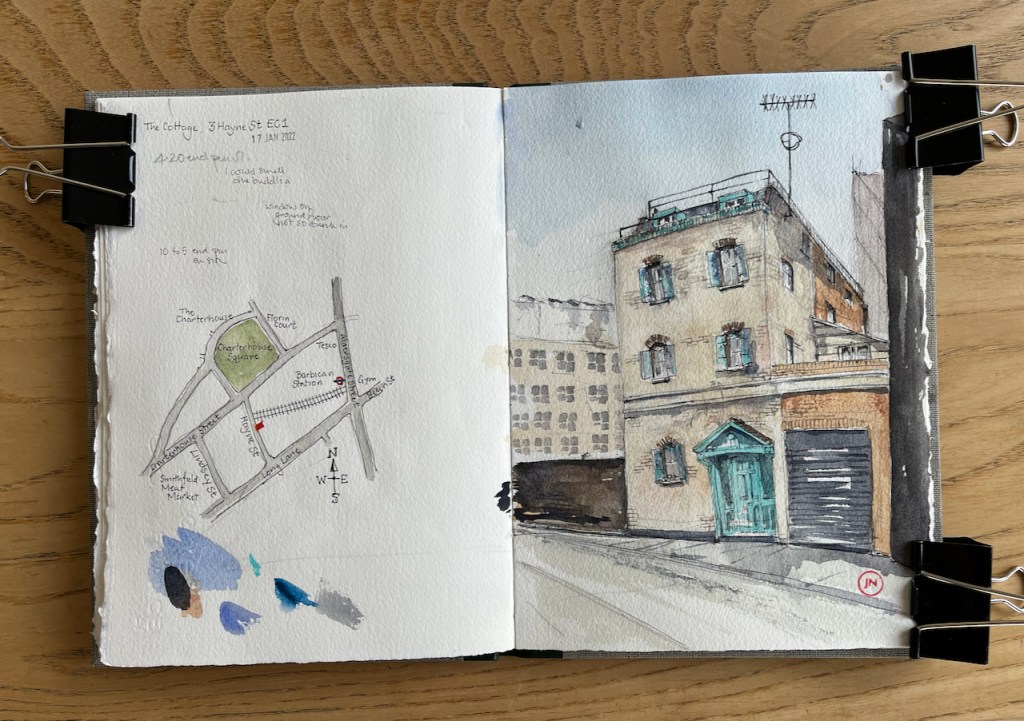
The Cottage, Hayne Street EC1, 17th January 2022, 5pm. 10″ x 7″ in Sketchbook 11
As I sketched, around 4:30 to 5pm, construction workers were coming off shift from the CrossRail site. They walked past me, lighting cigarettes, jostling, and talking in various languages. One person stopped to talk to me: “It’s a funny old building!” he observed. I agreed that it was, and wondered if anyone lived there. “I’ve not seen anyone go in or out,” he told me, “And I’ve been here four weeks.” Another person joined the conversation.
“I’ve seen a car,” said the newcomer. He indicated the black roller door, and made a sweeping gesture, showing how the car went in and out.
We all looked to see if there were lights in the windows at the side of the house. There were none. “It’s railway property,” declared the first person.
“It’s big, isn’t it?” said the second person, “It goes way back!”.
It does go way back. I’ve tried to show this in my drawing.
It’s a bit of a miracle that it has survived. This house is about 150 years old. There are jagged modern offices all around it. The Pevsner guide has a small paragraph on Hayne Street, in the section labelled “Long Lane and Hayne Street”. He says this:
“Long Lane and Hayne Street Long Lane first recorded in 1440[……] The N side, shorter because of the market buildings at the W, is mostly undistinguished medium-sized post-war offices. Not 18-19 are by Morrison, Rose & Partners, 1972-4, brick with smoked gland window bands. The upper storeys step back down Hayne Street, named after its developer in the early 1870s. Of this date the unpretentious brick warehouse at Nos. 8-10 W side and No. 3 opposite, a little house perched on the brink of the railway cutting.”
The Buildings of England London 1: The City of London by Simon Bradley and Nicolaus Pevsner (first published 1997, republished with corrections 1999) page 546
The “unpretentious brick warehouse” which was on the west side of Hayne Street in 1999 has now been replaced by the building above CrossRail. The “little house” remains.
It was there in 1873. At that time it had neighbours! See this map, from the marvellous British History online resource.
‘Charterhouse Square area: Introduction; Charterhouse Square’, in Survey of London: Volume 46, South and East Clerkenwell, ed. Philip Temple (London, 2008), pp. 242-265. British History Online http://www.british-history.ac.uk/survey-london/vol46/pp242-265 [accessed 17 January 2022].
Aldersgate Street Station is now Barbican Station. See the huge number of railway lines in 1873. Today there is just one line on the surface. The new CrossRail line is 40metres below.
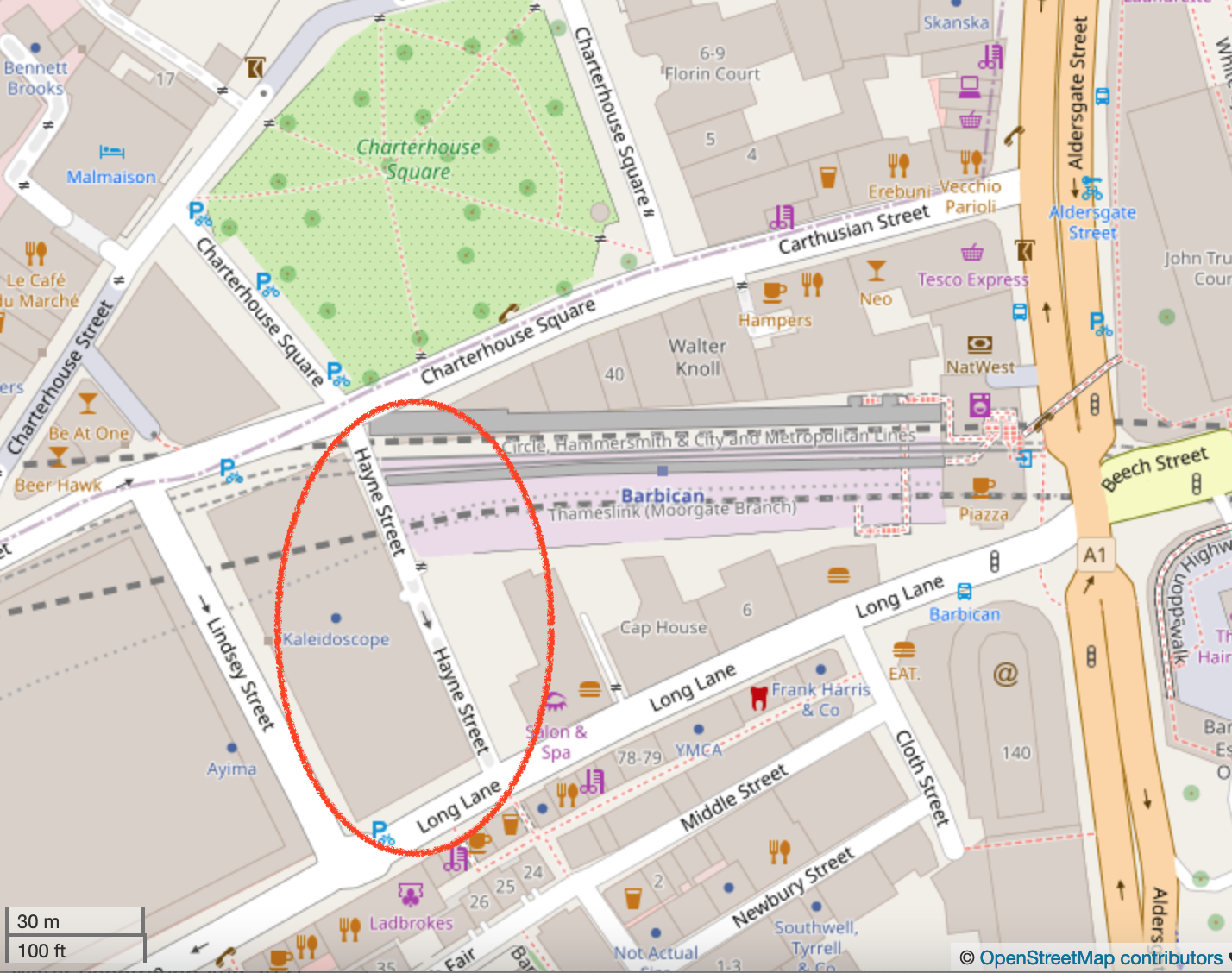
Here is a modern map of the area:
Hayne Street Area 2022, from Open Street Map, (c)OpenStreetMap contributors
Here are some views looking up and down Hayne Street, and my sketch map and sketching location. Click to enlarge.
Sketch map. The small red rectangle shows the location of “The Cottage” Sketching locationSketching in the darkLooking South down Hayne Street towards “The Red Cow”. The new Crossrail building is on the right.Looking North along Hayne Street towards Charterhouse Square, glimpsed on the left. The long wall on the right is above the railway line.
3 Hayne Street has intrigued people. Mr Tim Dunn on Twitter found an “environmental statement” from Crossrail saying they were going to demolish the building. But it doesn’t seem to have happened, so far…..Mr Dunn’s research also contradicts the construction worker’s assertion that the building is “railway property”. From what he’s found, it’s privately owned. Here is his Tweet thread:
Many years ago, I found an odd little house on a @cityoflondon backstreet; The French House, we called it. It’s been hidden by Crossrail works for YEARS but recently 3, Hayne Street has been revealed… and uh-oh! A @Crossrail document says it’s scheduled for demolition… (1/6) pic.twitter.com/Rt2g6KCfES
“The City Gent” published photos of The Cottage in his “Symbols and Secrets” blog on the 6th of January.
I’m glad so many people appreciate this strange building in a back street.
I have sketched in this area before. The building in the back left of my picture is on the other side of the railway line. It is now swathed in plastic and being restored or redeveloped. I sketched the West edge of this building in April last year.
This is a little white building I always enjoy walking past. It is the westernmost end of a thin terrace of warehouses and showrooms, lodged in a triangle between the road and the railway. As I passed it the other day I saw that the tree which has taken root above the door was putting…
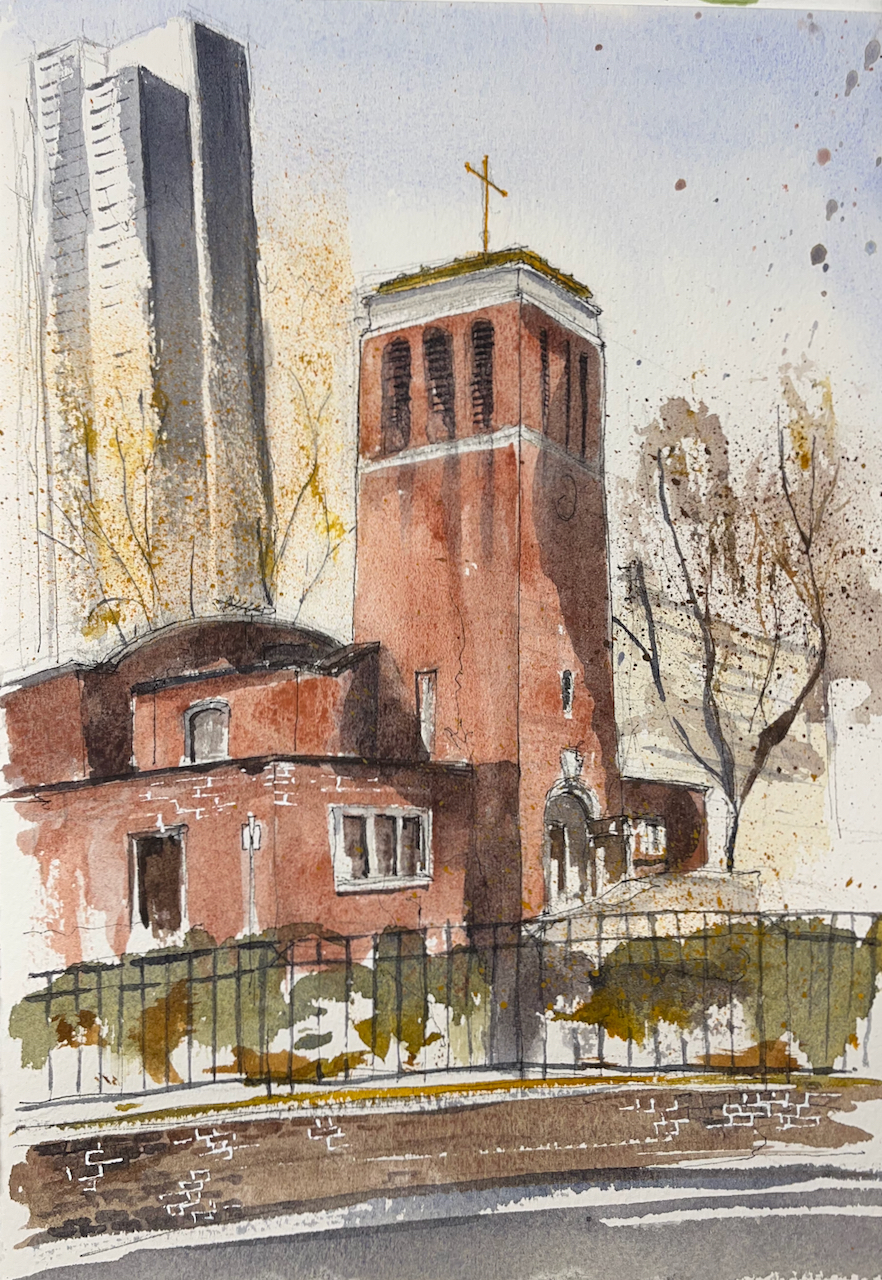
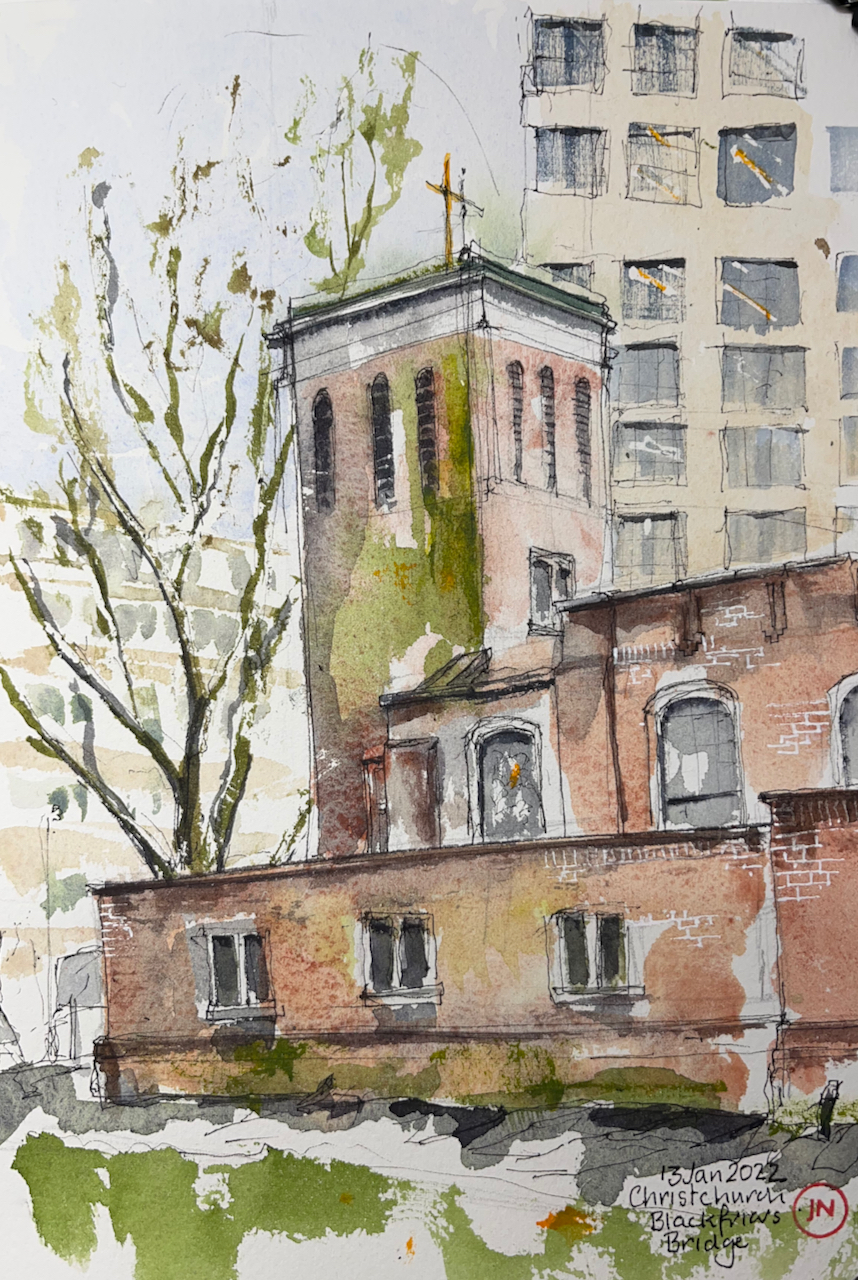
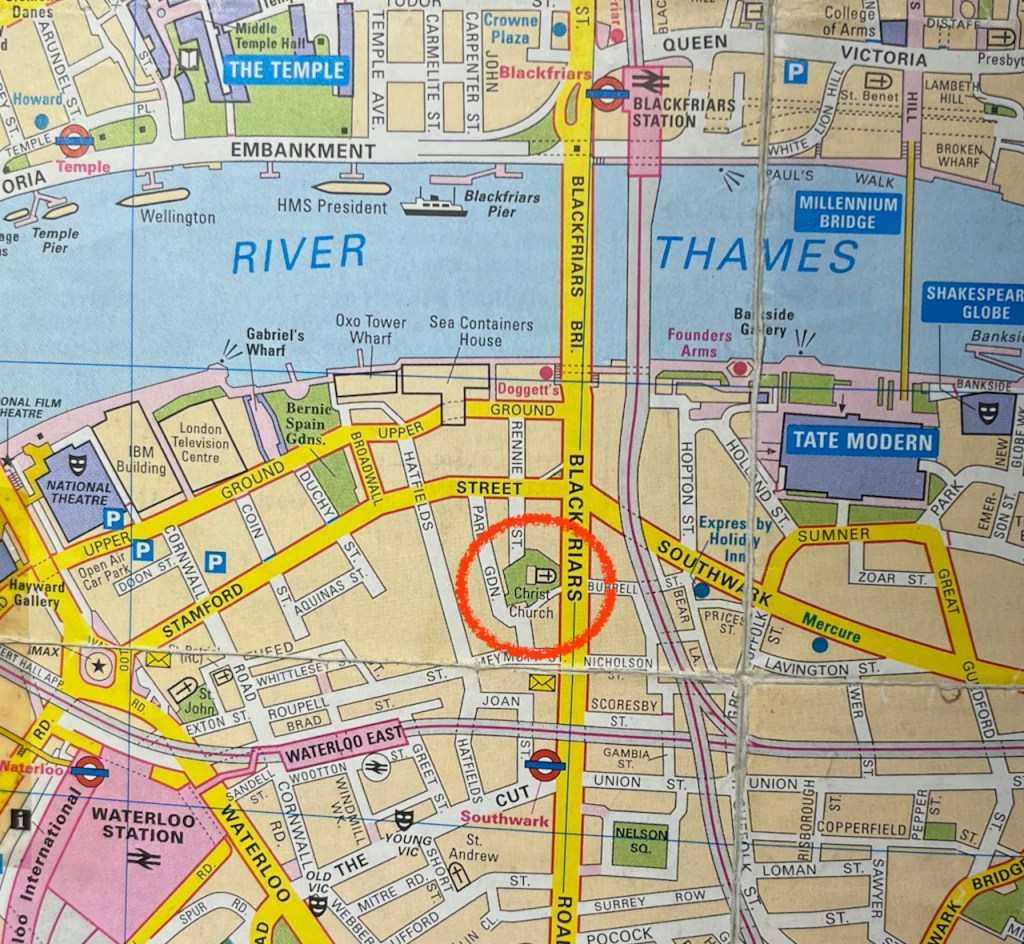
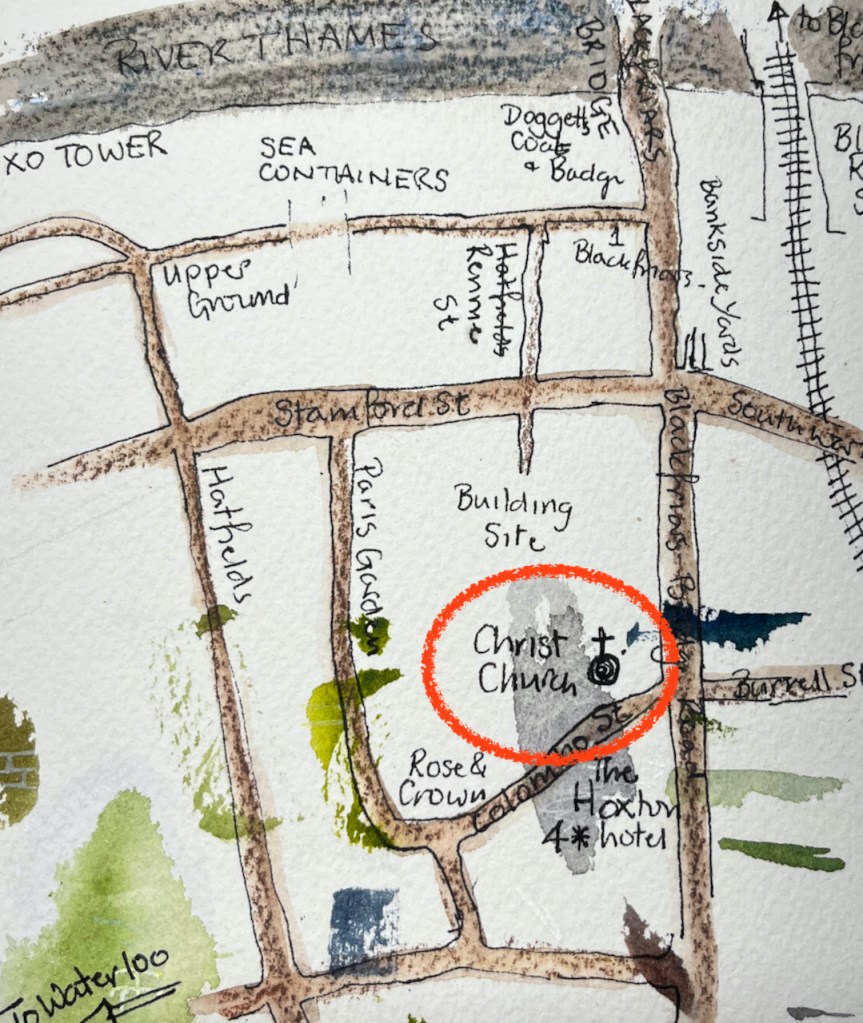
On the South side of Blackfriars Bridge there is a church amongst trees. This is Christchurch Blackfriars Bridge.
Christchurch Blackfriars Bridge, 14th January 2022, 2pm 10″ x 7″ in Sketchbook 11
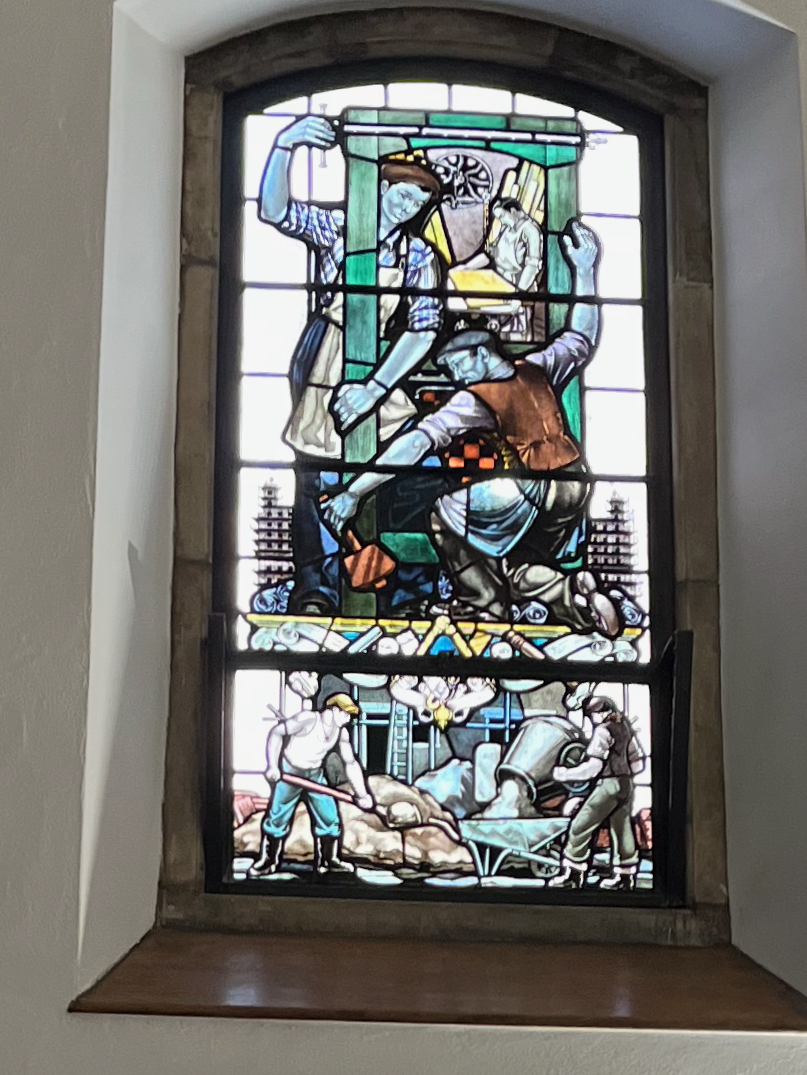
A window showing construction workers
This is the south side of the church, showing its open door. I went in. This is a very welcoming church. I passed three separate notices telling me I was welcome. Inside it is calm, warm and light. There are benches to sit on. There are marvellous stained glass windows. They show not saints and Bible stories, but Londoners. They show builders and printers, river workers, and engineers. There is a power station worker looking at a bank of rotary dial telephones, and a queue of people waiting for a red London bus. All these are beautifully done in stained glass.
This church accepts the idea that people might be “spiritual not religious”. Between 12noon and 2pm: they offer a “lunch time silent space”, and there are other events that include meditation and silence.
A detailed history of the church is in British History Survey of London: ‘Christ Church’, in Survey of London: Volume 22, Bankside (The Parishes of St. Saviour and Christchurch Southwark), ed. Howard Roberts and Walter H Godfrey (London, 1950), pp. 101-107. British History Onlinehttp://www.british-history.ac.uk/survey-london/vol22/pp101-107 [accessed 16 January 2022].
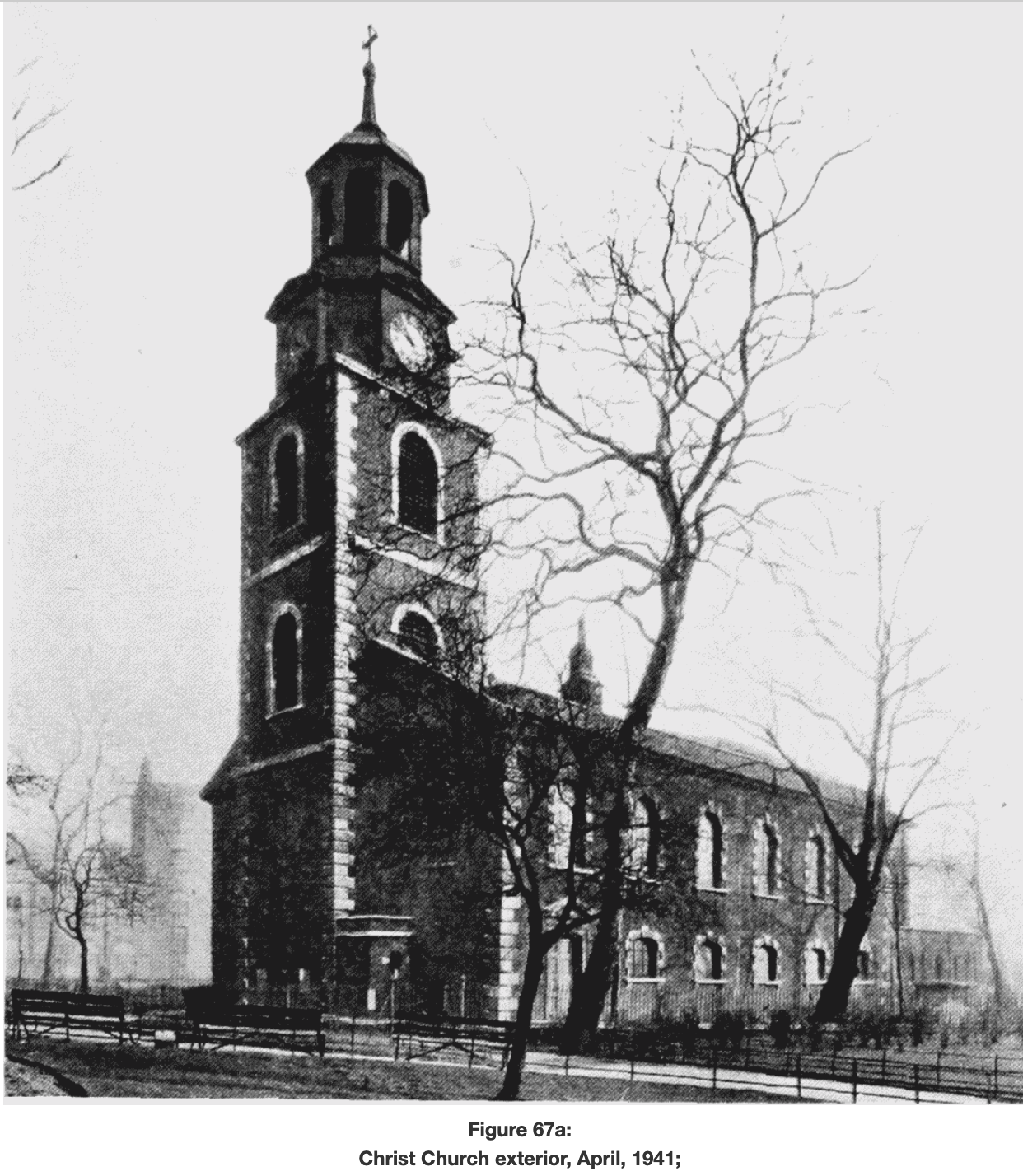
Here is how it looked before 1941.
‘Plate 67: Christ Church. Exterior and watchhouse’, in Survey of London: Volume 22, Bankside (The Parishes of St. Saviour and Christchurch Southwark), ed. Howard Roberts and Walter H Godfrey (London, 1950), p. 67. British History Onlinehttp://www.british-history.ac.uk/survey-london/vol22/plate-67 [accessed 16 January 2022].
It was completely gutted by incendiary bombing in April 1941. The 1950 “Survey of London” cited above describes it as a “shell”. The present church was completed in 1960, according to Pevsner (The Buildings of England, London 2: South, by Nicolaus Pevsner and Bridget Cherry, page 275). The architects were R Paxton Watson & B Costin.
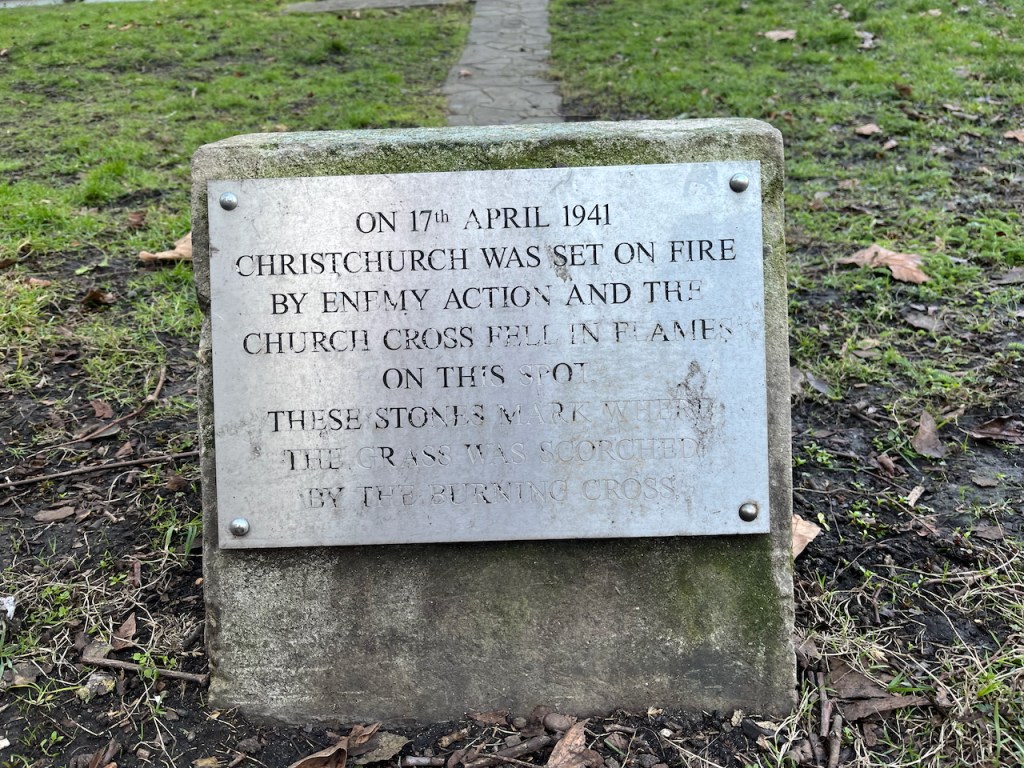
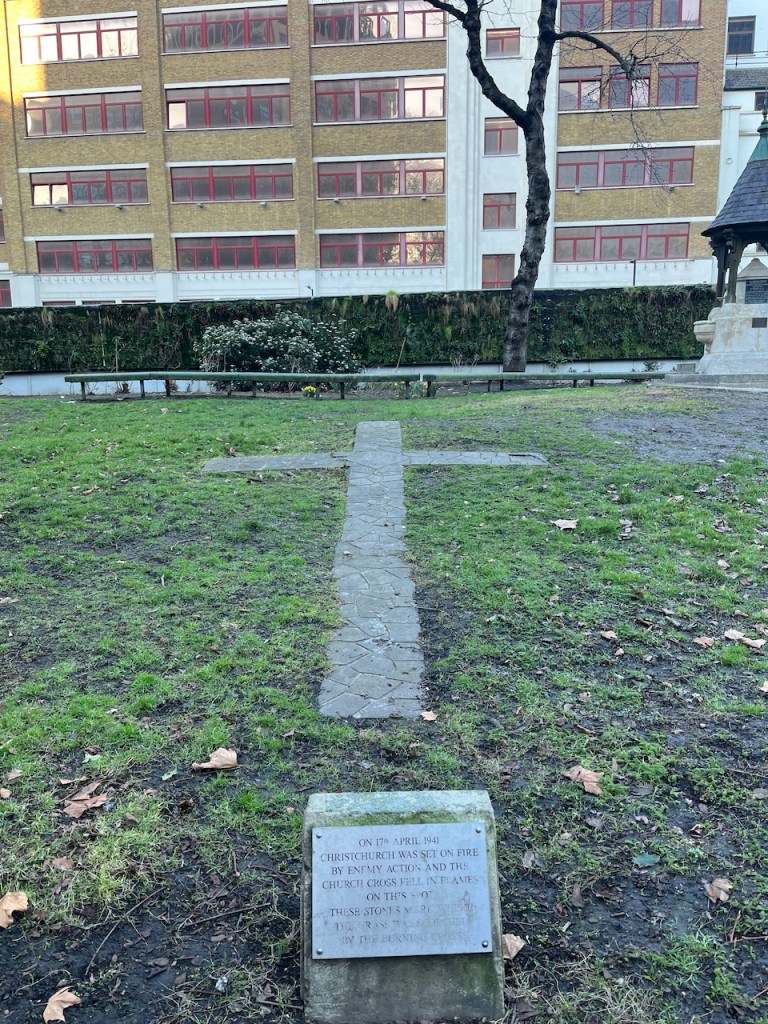
“On 17th April 1941 Christchurch was set on fire by enemy action and the church Cross fell on this spot. These stones mark where the grass was scorched by the burning Cross”A monument on the West side of the church, photographed 6th March 2025. The cross referenced here can be seen in the black and white 1941 photo above.
The church is now surrounded by buildings and trees and is very much alive. Here is the view from the North:
Christchurch Blackfriars Bridge, 13th January 2022, 12:30pm 10″ x 7″ in Sketchbook 11
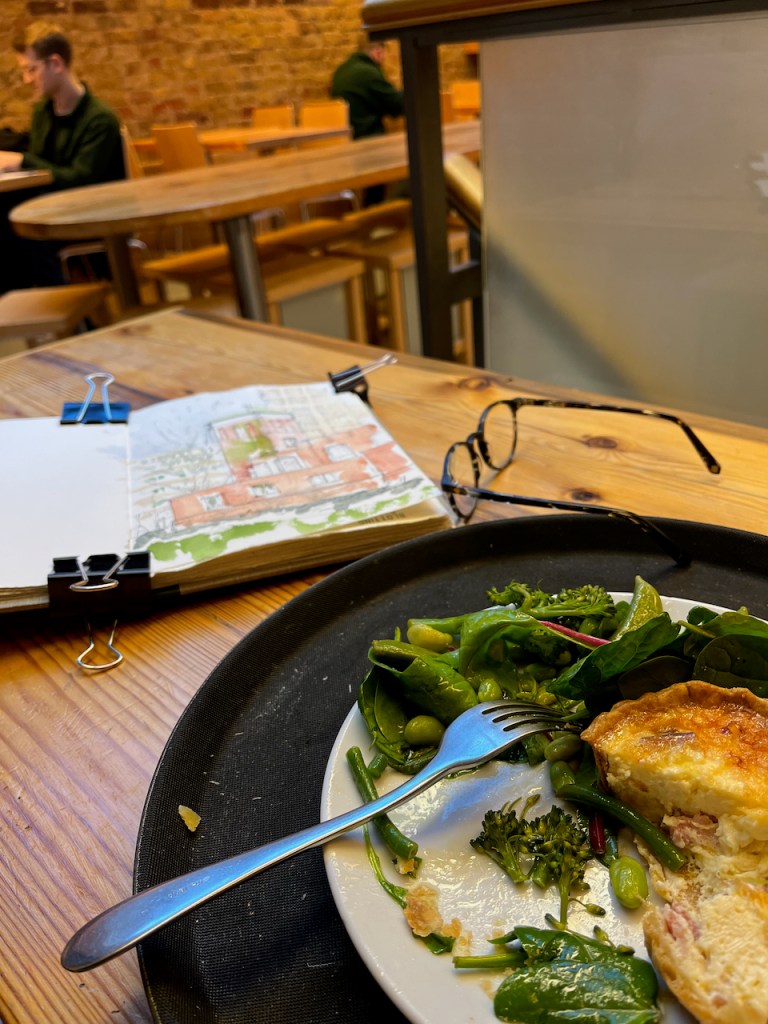
The outside air temperature was 3 degrees C and the paint wasn’t drying. Also I was very cold. I went for lunch in “Greensmiths”in Lower Marsh, and finished the painting there.
“Greensmiths” in Lower Marsh Waterloo.
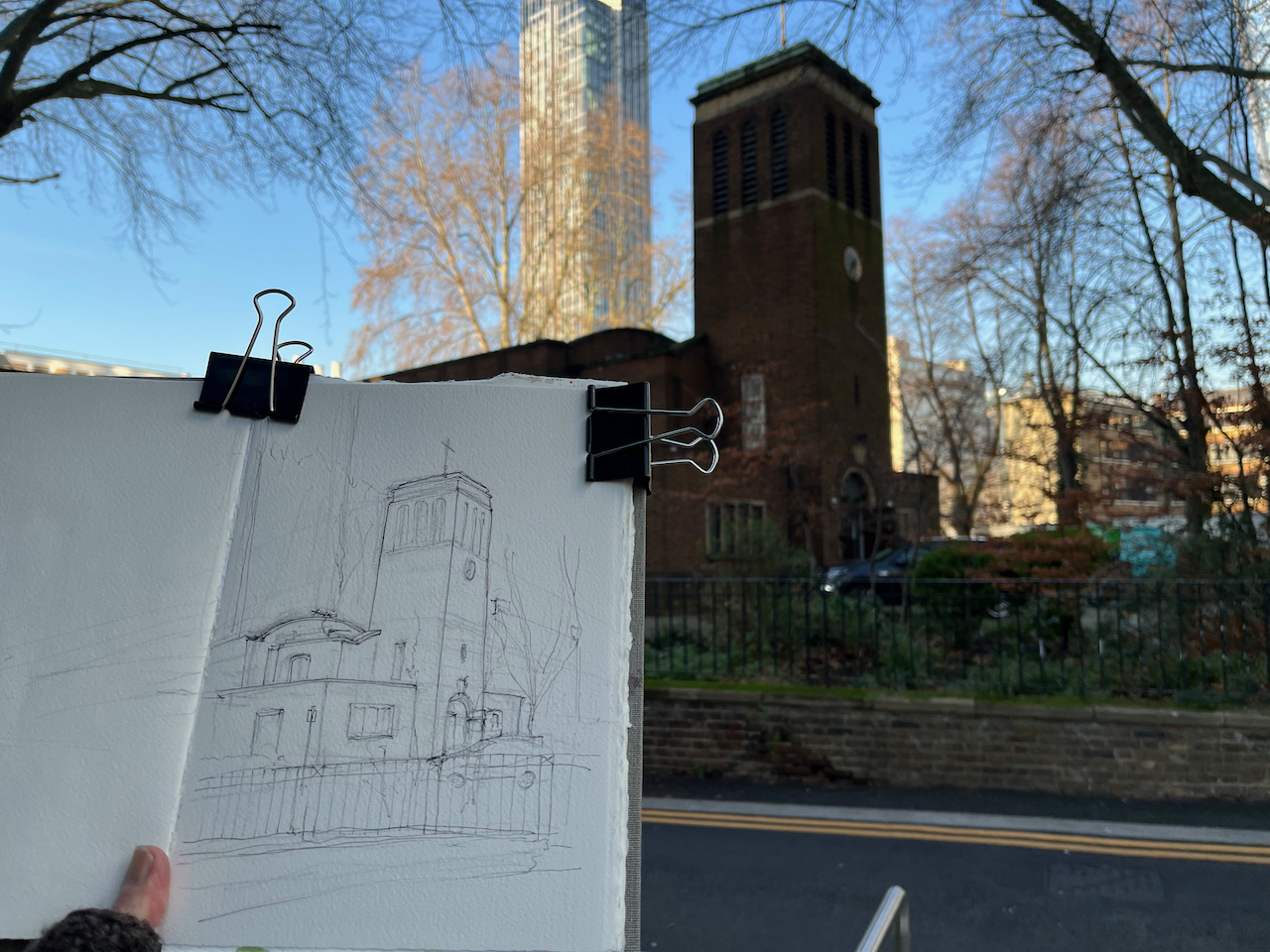
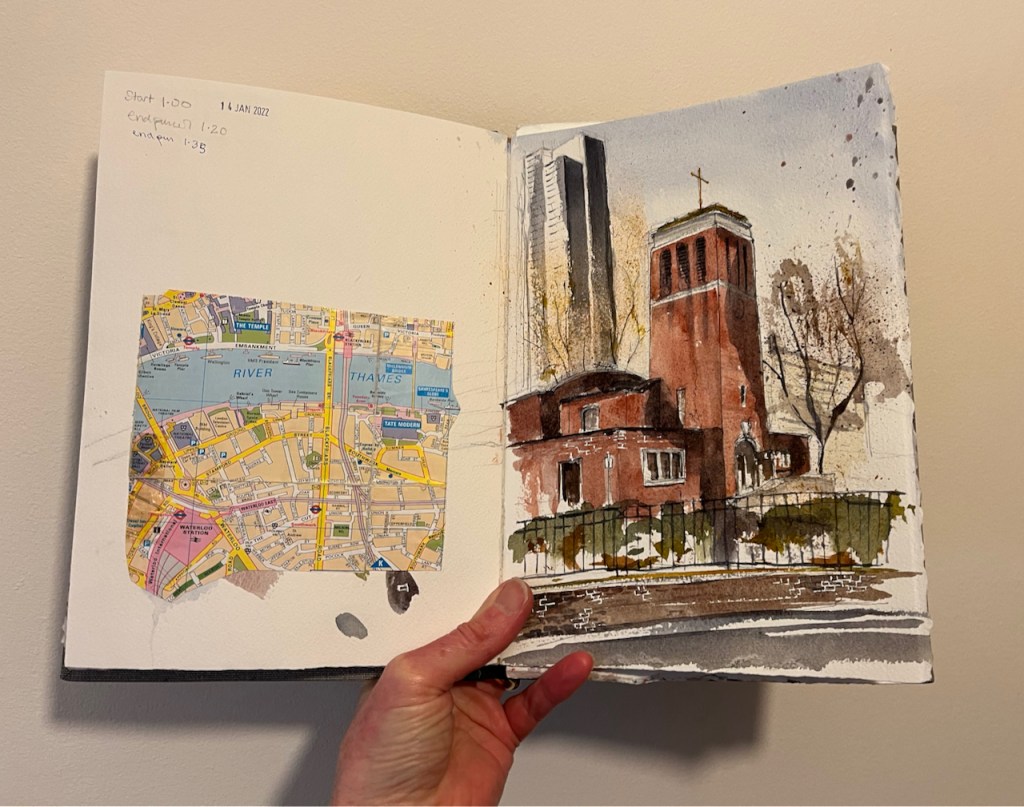
Here is work in progress on the sketches, and some maps to show where this church is.
There were some spectacular shadows that day:
Christchurch Blackfriars Bridge, from the South, 14th January 2022 about 2pm.
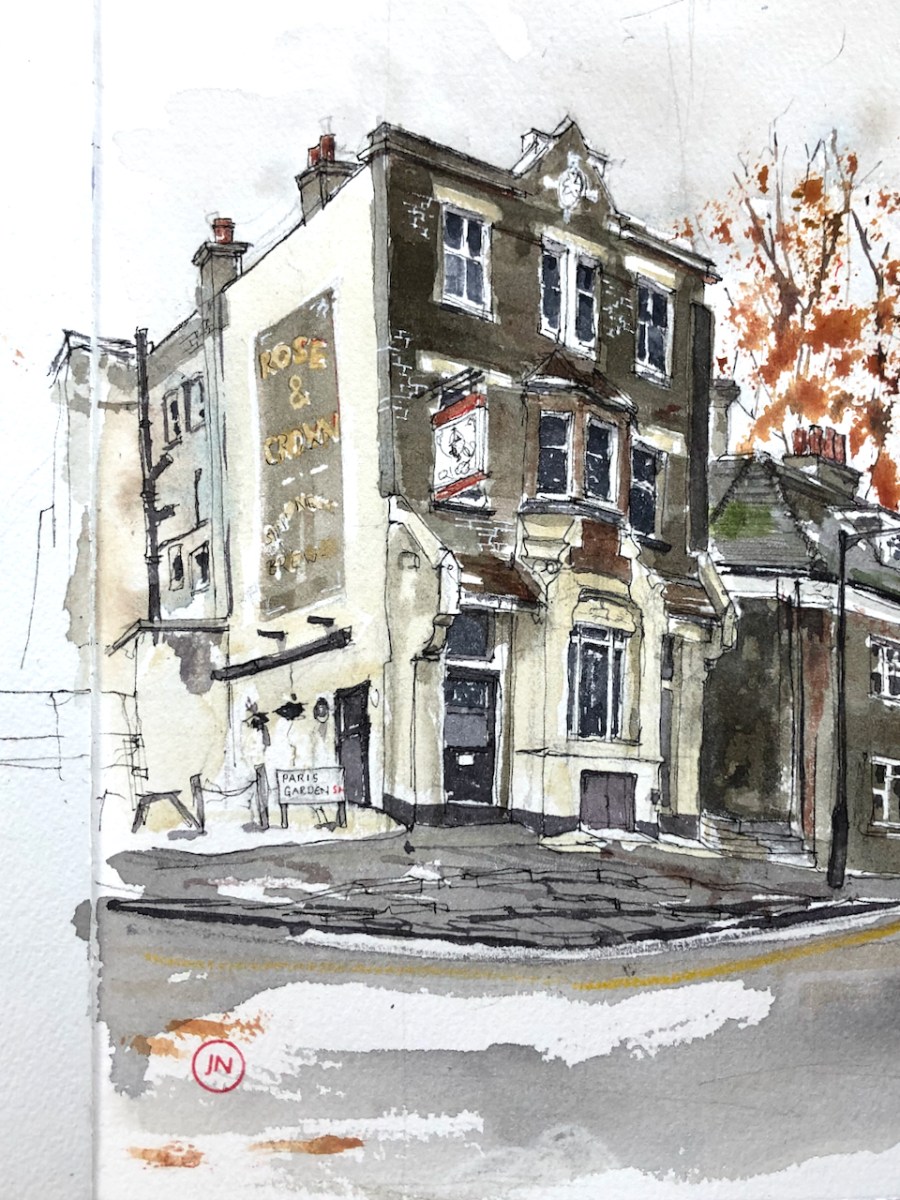
The church community hold some of their events in the adjacent pub, the Rose and Crown:
I was commissioned to paint a picture of this lovely house.
House in South West London , 12″ x 9″ on Arches 300gsm paper, [commission]
This interesting commission took me to a part of London I had not previously explored. Many thanks to the new owner of this painting for allowing me to post it online.
One of the delights of these houses is the chimneys. They sit up there like chess pieces, or individual characters in a play. I tried to show their personalities.
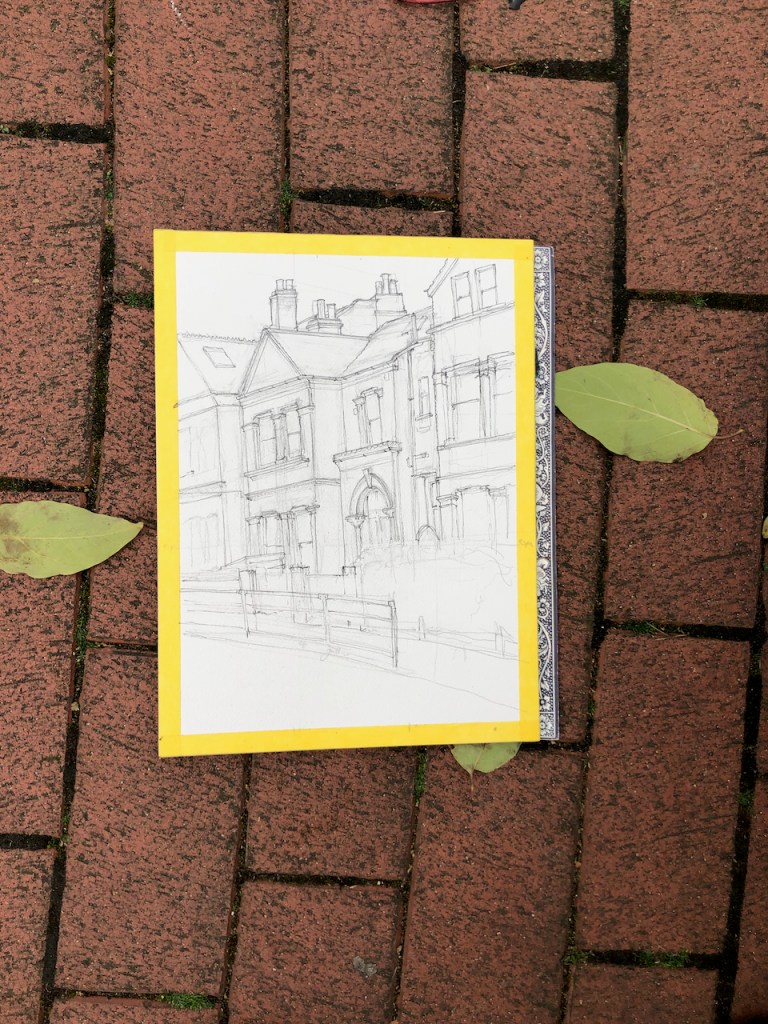
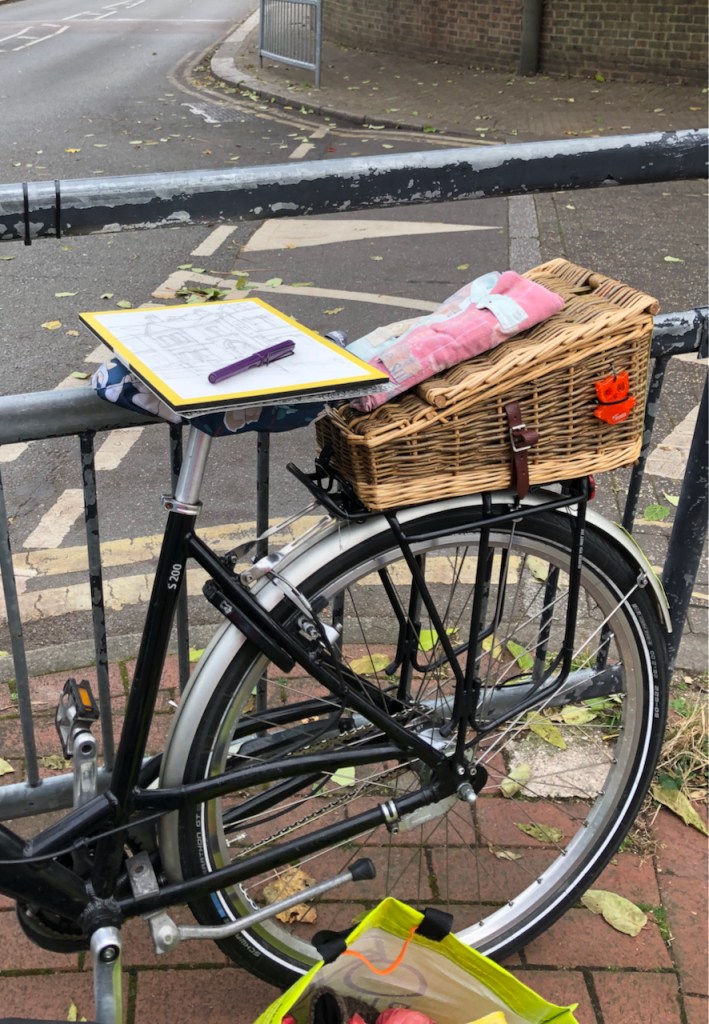
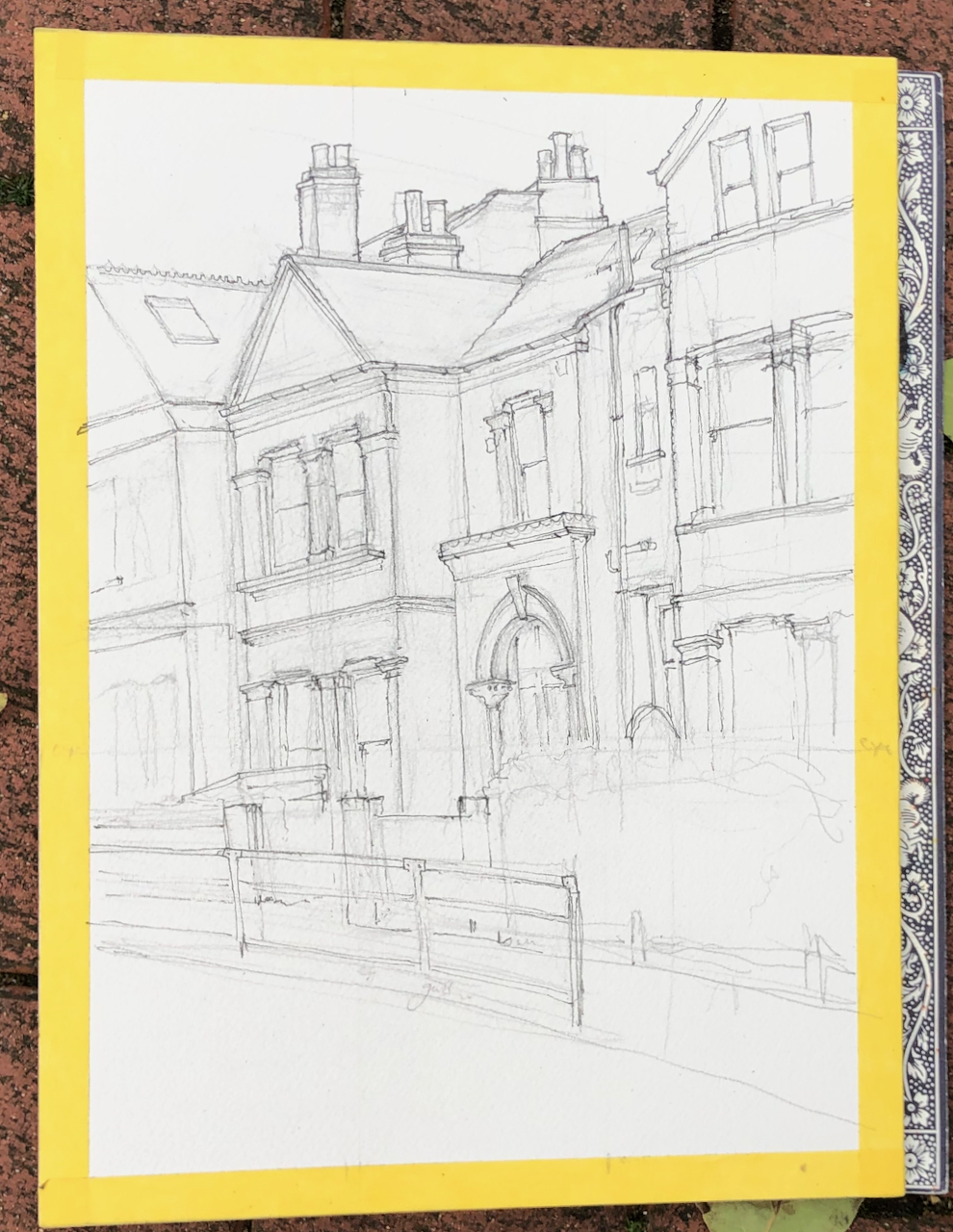
I painted this in November. It was cold, but there were still leaves on the trees. They blew around in the wind and scattered on the road. A road sweeper, a café proprietor, and a woman with a pram all came over at different times to look at my work. I made a preliminary sketch on brown paper to understand how to compose the picture, how the perspective worked and where the light and dark should be. The next stage is the pencil underdrawing, then the pen, then watercolour.
Pen drawing. The yellow tape is to frame the picture, and for me to hold on to while I sketch.Pen drawing. I also make annotations on the yellow tape. Here it says”eye line”Using the bike as a table. The pen is a Lamy Safari fountain pen.Trusty bike Pencil under-drawingPreliminary sketch on brown paper to work out the perspective lines, which are shown here in yellow and red.
Here you see the difference the colour makes:
“before” and “after” the colour went on: move the slider.
The colours are: Buff Titanium, Perylene Maroon, Prussian Blue, Hansa Yellow Mid, Burnt Umber, Fired Gold Ochre. Fired Gold Ochre is “granulating” – it dries unevenly into a pattern of dots. You can see the effect in the brick texture of the house nearest us. The chimneys are Fired Gold Ochre with some Transparent Pyrrol Orange. The greys and black are mixed from Prussian Blue and Perylene Maroon. All the watercolours are Daniel Smith.
The ink I use is De Atramentis Document Ink, Black, which is waterproof, supplied by The Writing Desk. The paper is Arches Aquarelle 300gsm cold-pressed, in a block 12″ x 9″. All paints and paper are from Jacksons Art.
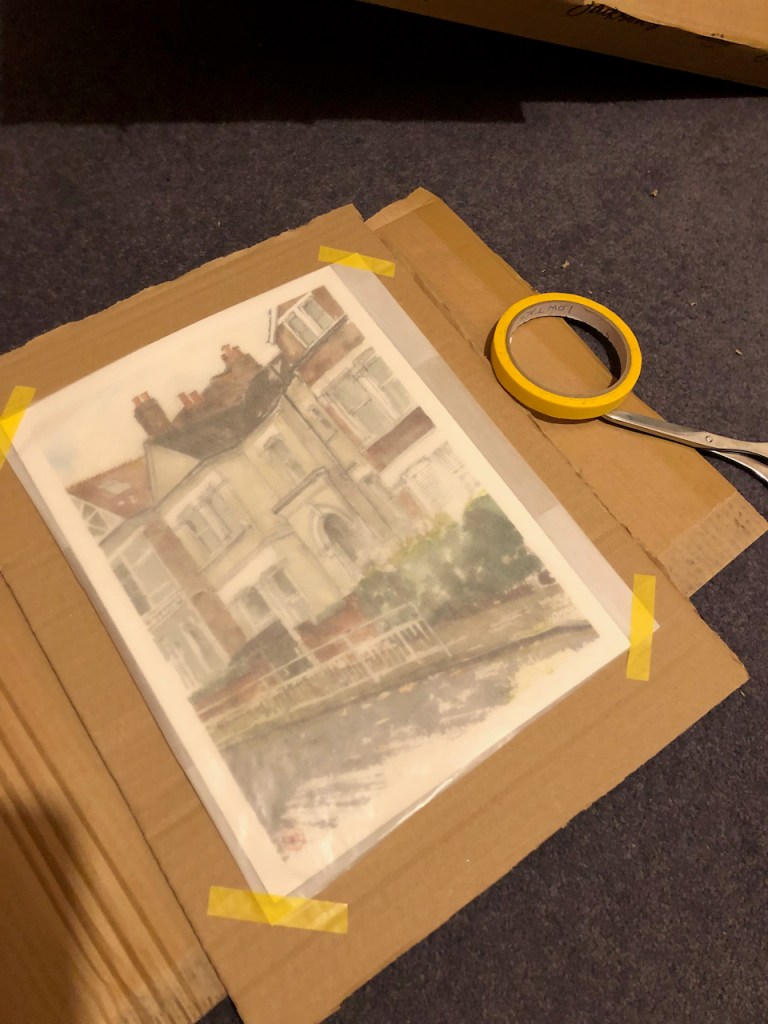
Here is the picture being wrapped ready to go to its new home.
Click a button below to share this post online, email it, or print it:





























 Jane Sketching