Guildhall Yard, London EC2

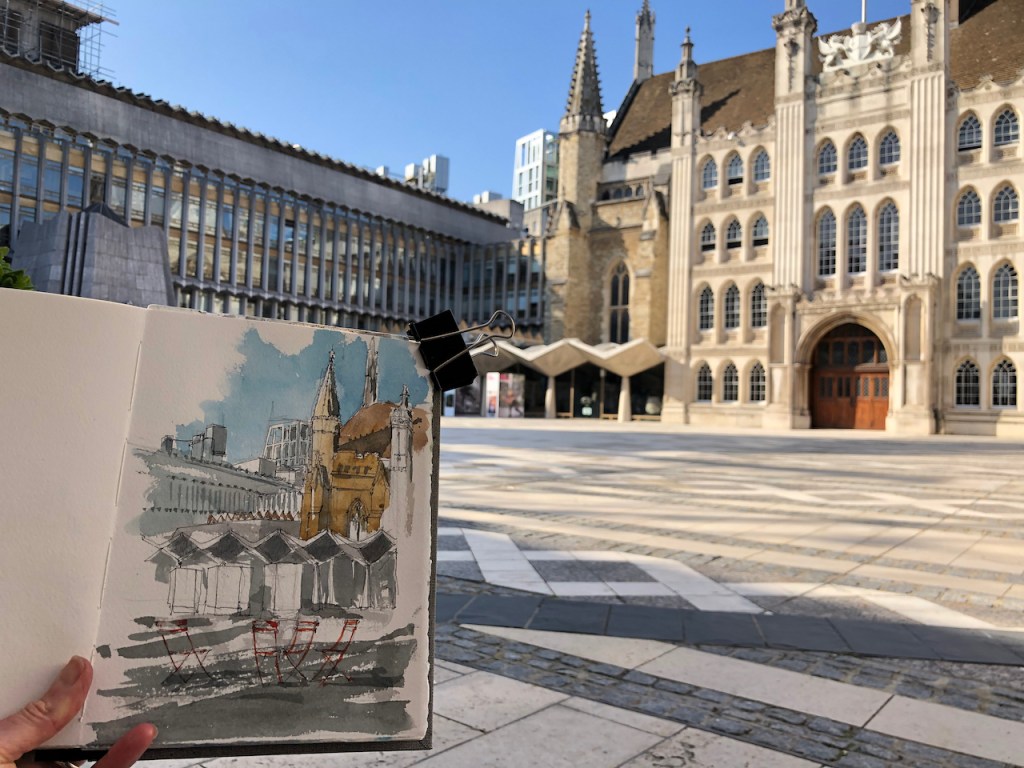
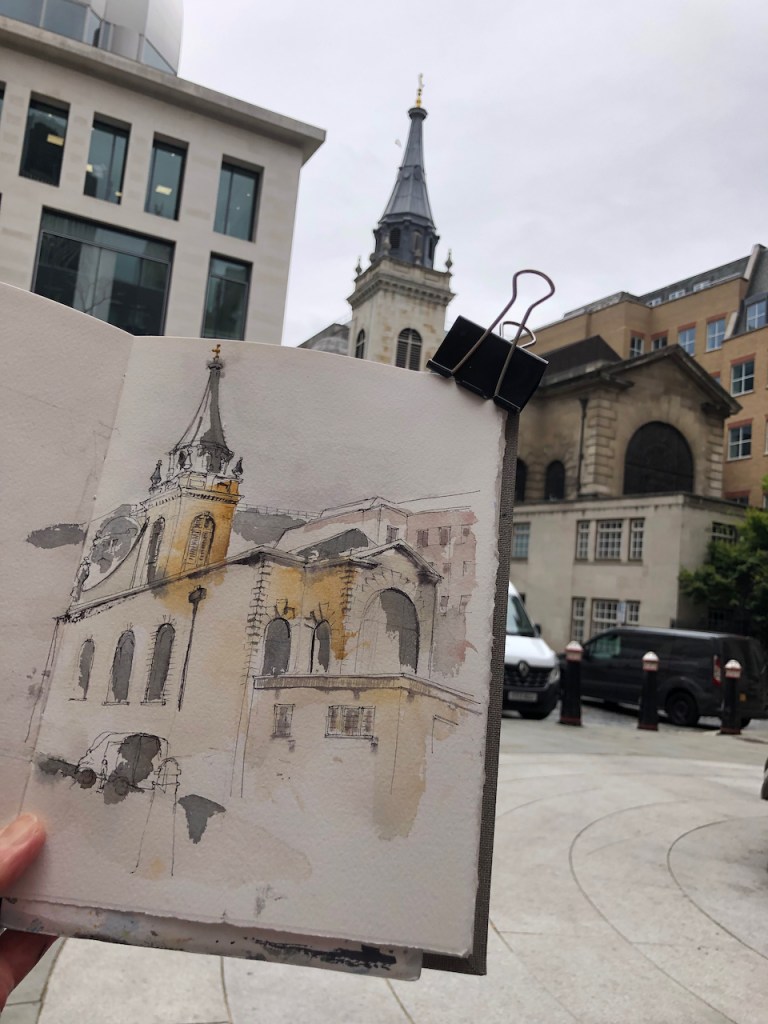
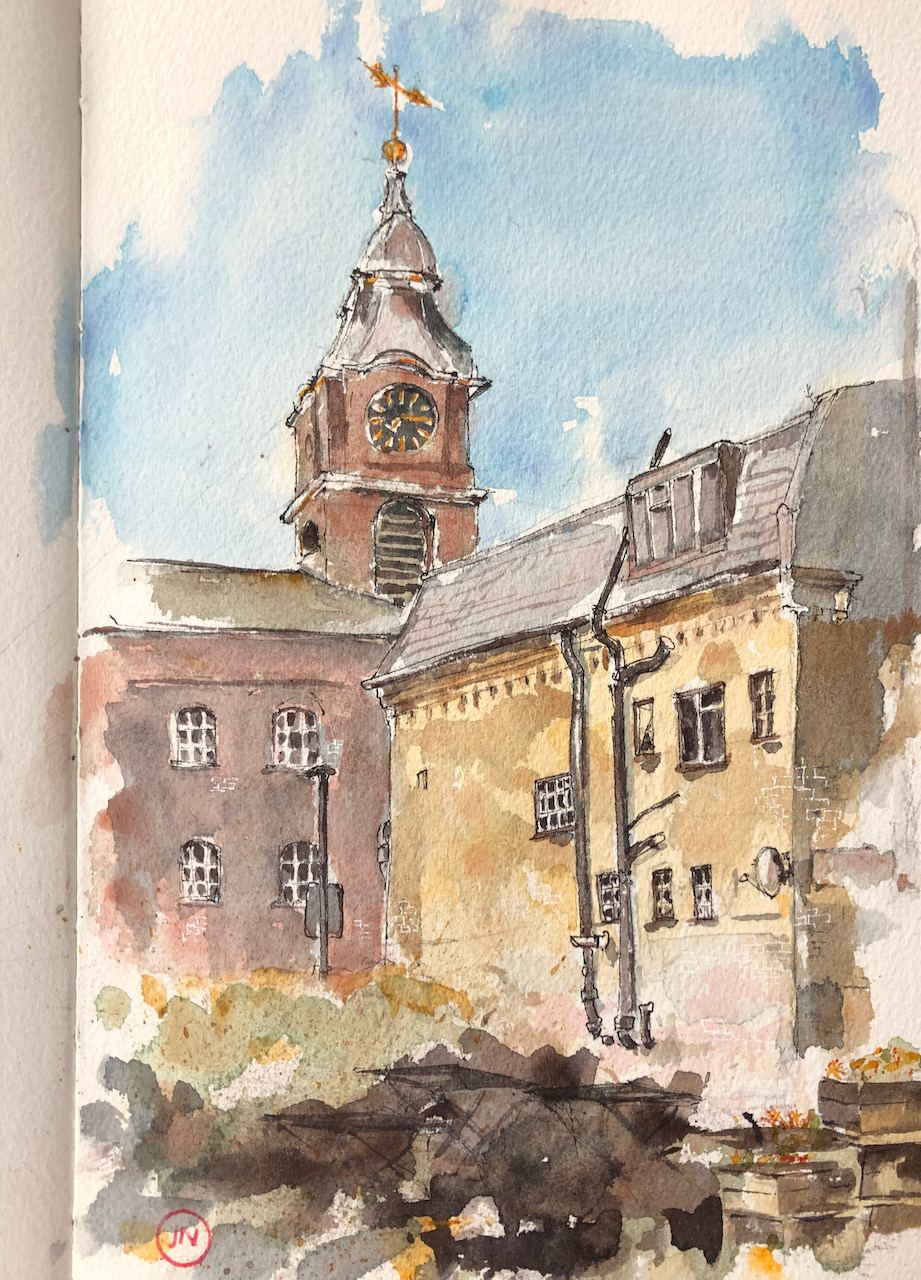
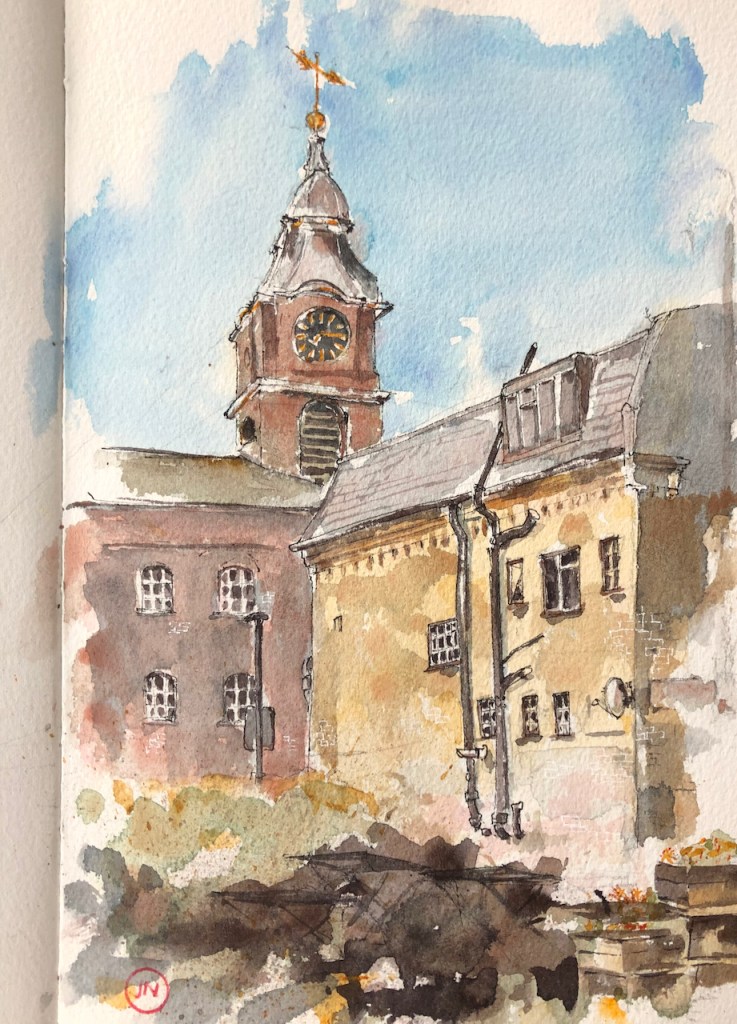
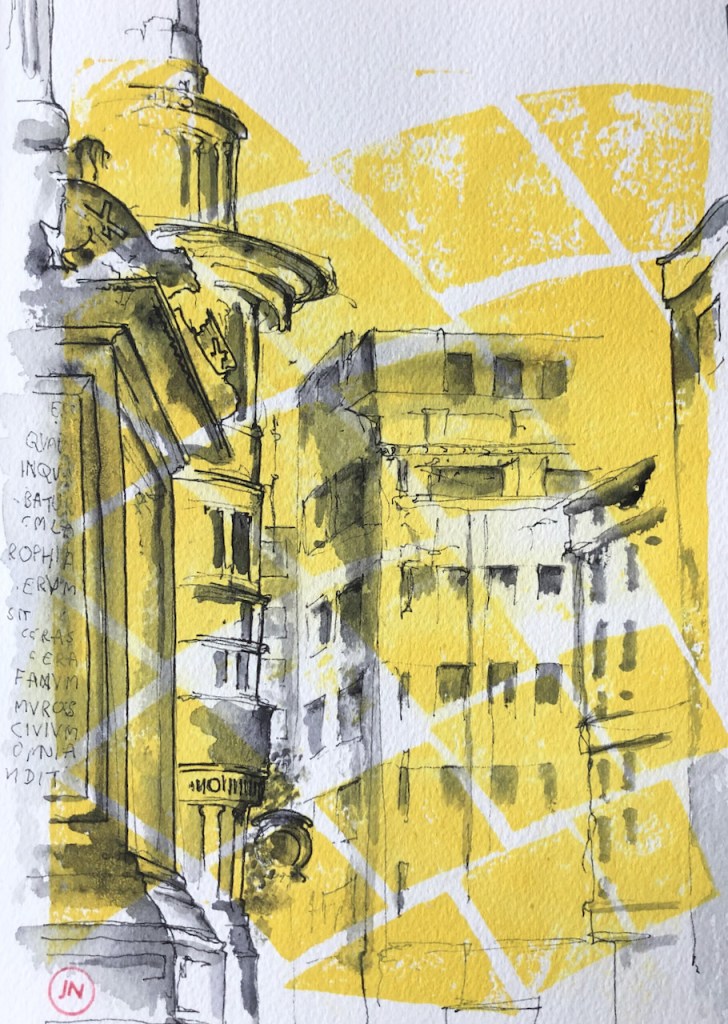
Here is the North West corner of the Guildhall Yard. The modern part is designed by Richard Gilbert Scott (note 1). What we are looking at, in pale concrete, is the Guildhall Library, and offices of the City of London Corporation. Behind it, you see the tops of the buildings on Wood Street.

In yellow stone, on the right of the drawing, is the old Guildhall, built in 1411 (note 2).

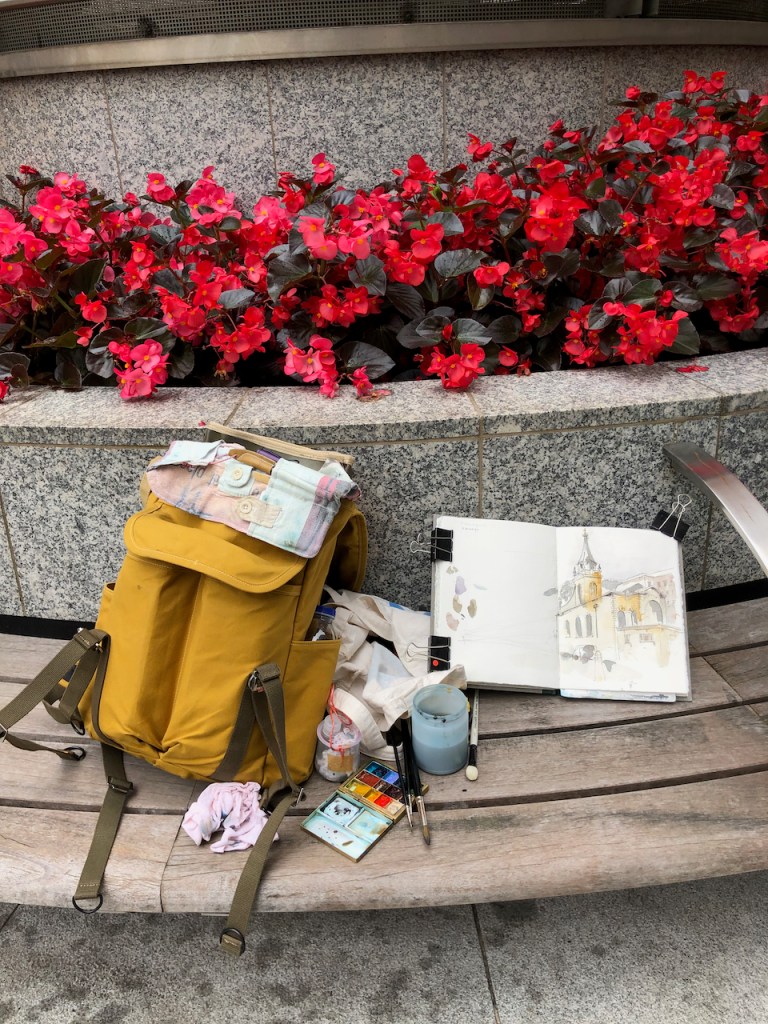
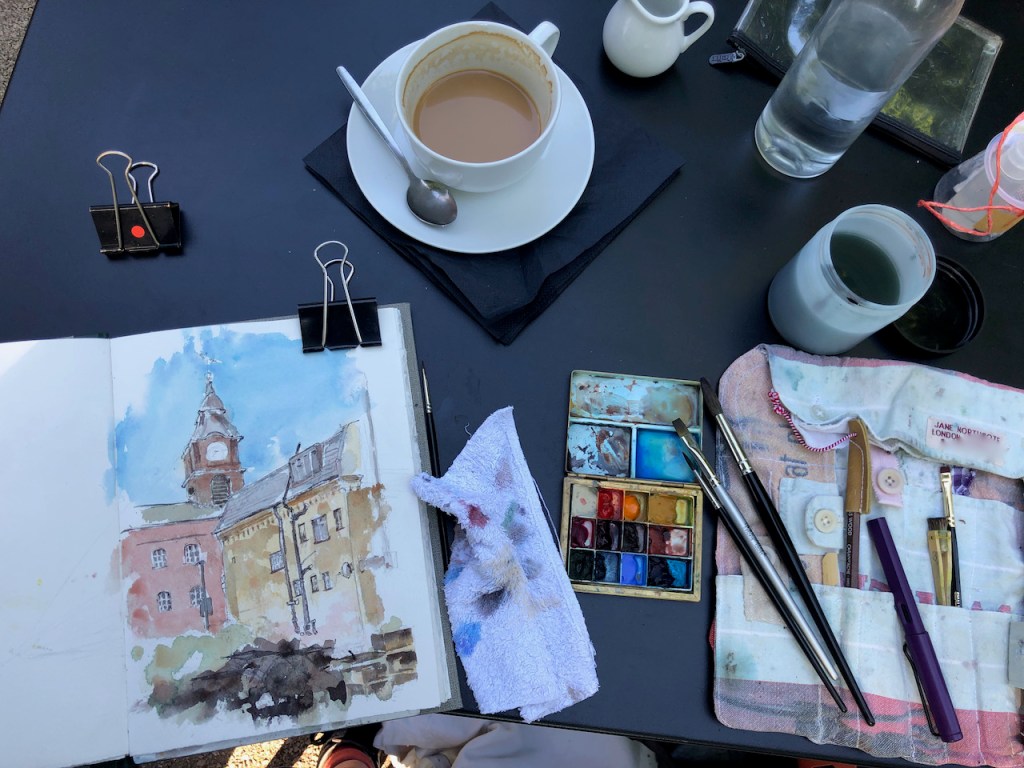
In the foreground you see the chairs, generously provided in the Guildhall Yard by the City of London, for public use. I commandeered a chair and a table and set myself up in a nice shady position next to the South East wall of the yard, between two gigantic plant pots.

Guildhall Yard, North West corner. 7th Sept 2021, 7″x10″ in Sketchbook 10

While I was drawing, someone took up residence the other side of the gigantic plant pot, and started a long and fascinating conversation on their phone. They were a recruitment agent, and embarked on a forceful sales pitch to a potential recruit. They were recruiting on behalf of a large bank in the City. They described the proposed future restructuring of said bank, and the nature of the forthcoming vacancy that was to be filled. They named the bank, which I will not do here. They aired details of the potential salary and work locations. After completing this gripping conversation, they immediately called a work colleague and gave an alarmingly candid opinion on the potential recruit they’d just been talking to. If you are thinking of having a conversation of this nature, the Guildhall Yard is perhaps not the most discrete place to choose!

At 3:45pm precisely, workers arrived and removed the chairs. I completed my drawing sitting on the flagstones.
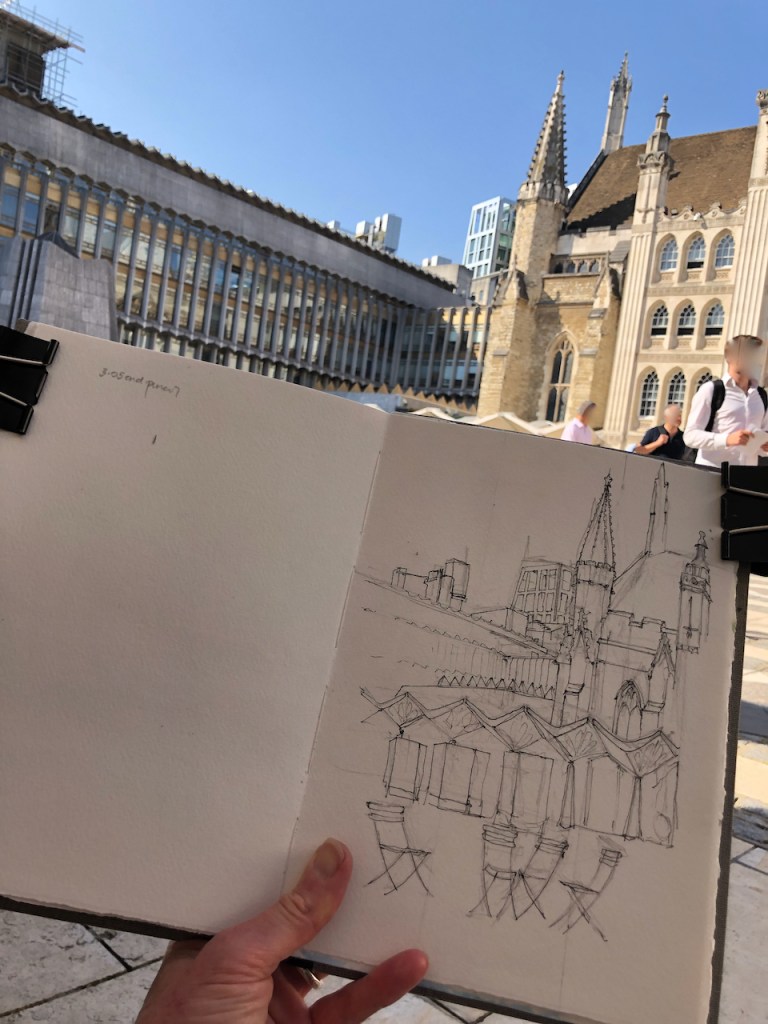
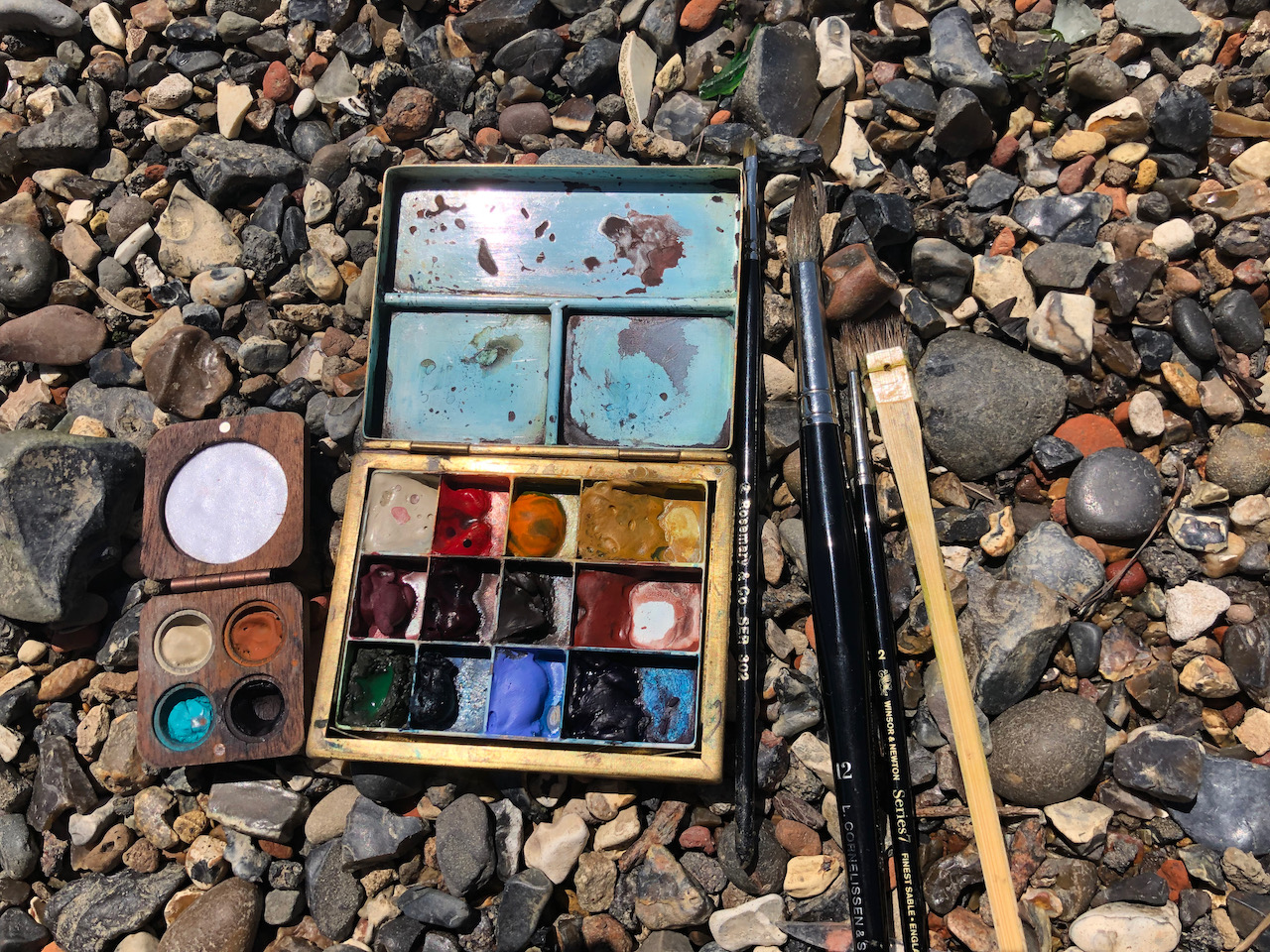
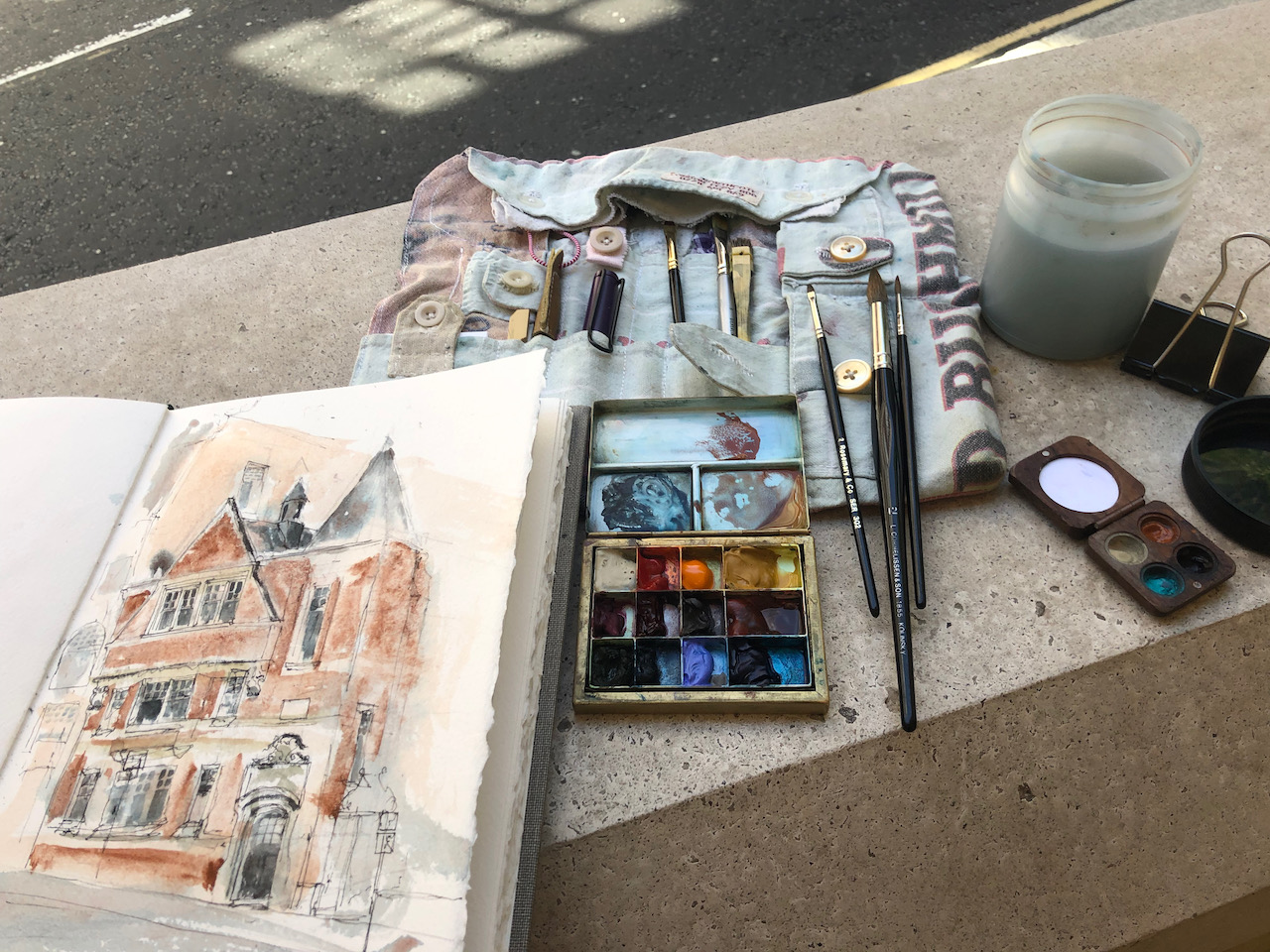
This drawing took about 1½ hours, sketched and coloured on location. The main colours are Mars Yellow, Phthalo Blue Turquoise, and Transparent Brown Oxide, with some Perylene Maroon to make the greys. The chairs are Transparent Pyrrol Orange.

The screens, shown white in my drawing, advertise a performance of dance entitled “Black Victorians”, which is part of the Greenwich and Docklands International Festival.

Note 1: The obituary of Richard Gilbert Scott refers to his work on the Guildhall Art Gallery and the Guildhall West Wing. It is here: https://www.theguardian.com/artanddesign/2017/jul/12/richard-gilbert-scott-obituary

Note 2: The original Guildhall building has a long history, and has been rebuilt and enhanced several times, most recently after bomb damage in the 1939-45 conflict. Its original completion date of 1411 is quoted in this article from 1848: https://www.british-history.ac.uk/old-new-london/vol1/pp383-396

I’ve sketched around the Guildhall often. Also I’ve sketched 65 Basinghall Street, which is another design by Richard Giles Scott.

Guildhall North Wing

From the site of the former St Mary Aldermanbury, I looked across towards the Guildhall, the offices of the City of London. It is dark and green in the former Nave of the church, whose pillars you can see on the right.…

Read more….
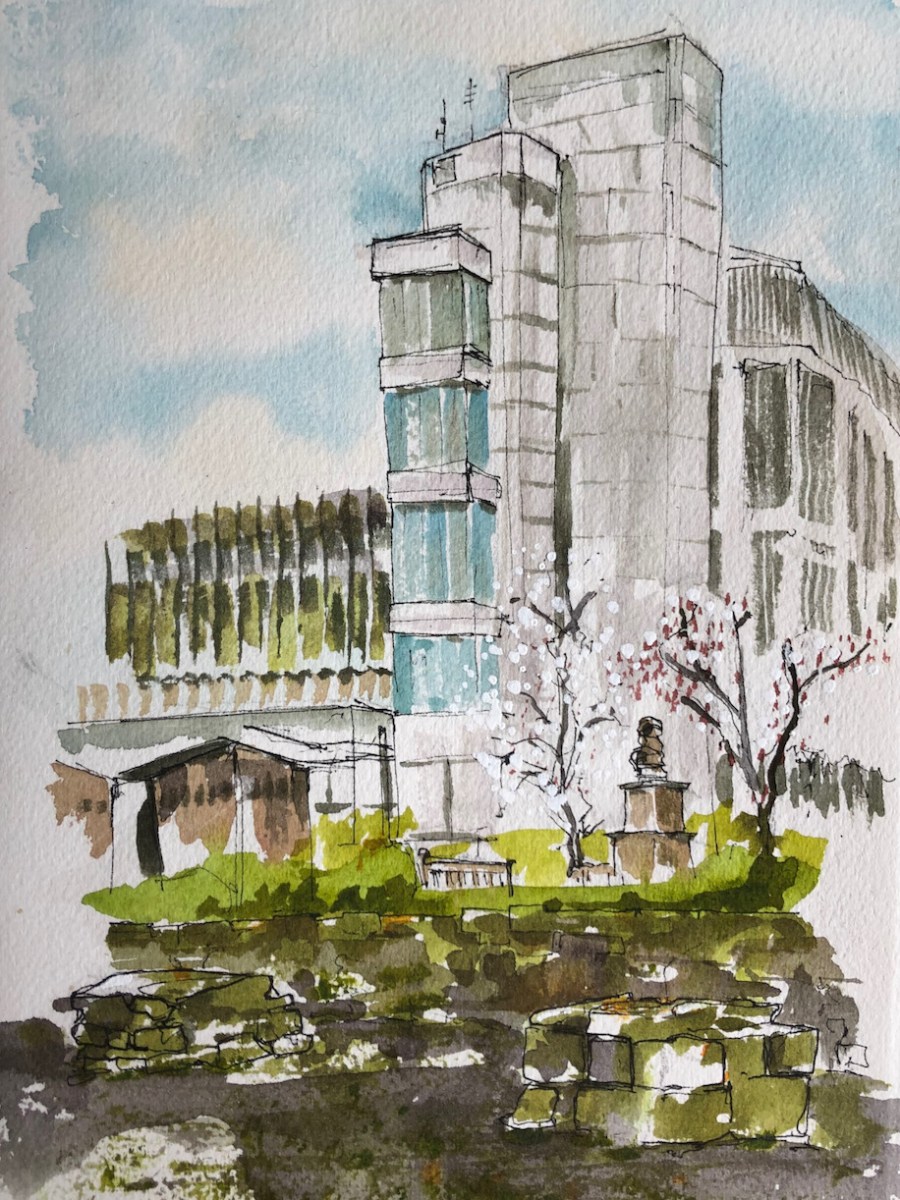
Guildhall from St Mary Aldermanbury EC2

At the junction of Love Lane and Aldermanbury in the City of London, there is a small park. If you are in the area, it’s well worth a visit. The parklet is on the site of St Mary Aldermanbury. A large marble…

Read more….

Gaslight in Guildhall Yard

The winter evening settles down With smell of steaks in passageways. Six o’clock. The burnt-out ends of smoky days. And now a gusty shower wraps The grimy scraps Of withered leaves about your feet And newspapers from vacant lots; The showers beat…

Read more….

65 Basinghall St EC2 from the plaza

In a previous post I presented a drawing of 65 Basinghall Street done from the bridge which is on the North side of the building. Here is the south side. 65 Basinghall Street is the building in front, with the scalloped arches.…

Read more….
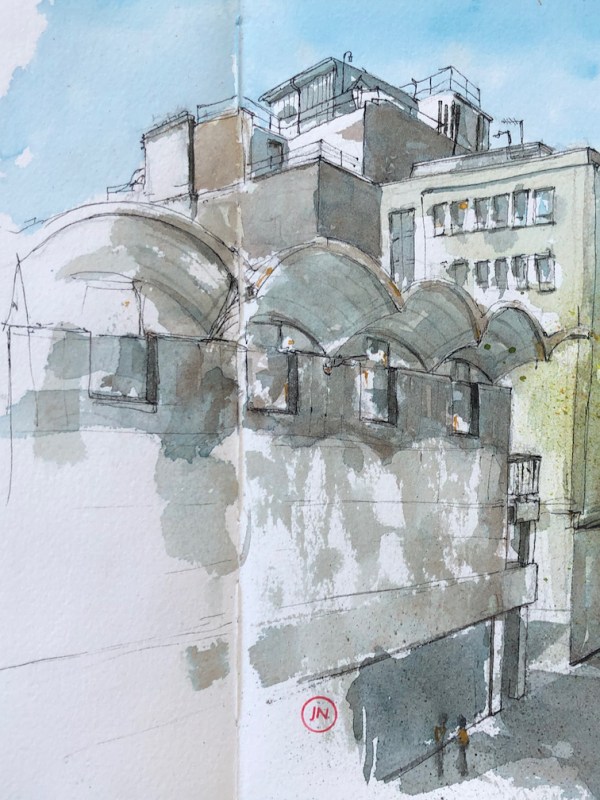
65 Basinghall St EC2 from the bridge

This is a view from the bridge over Basinghall Street, looking at the back of 65 Basinghall Street. There is much of interest in this view. There are the wonderful arching shell-like structures of 65 Basinghall Street. This was built in 1966-7…

Read more….
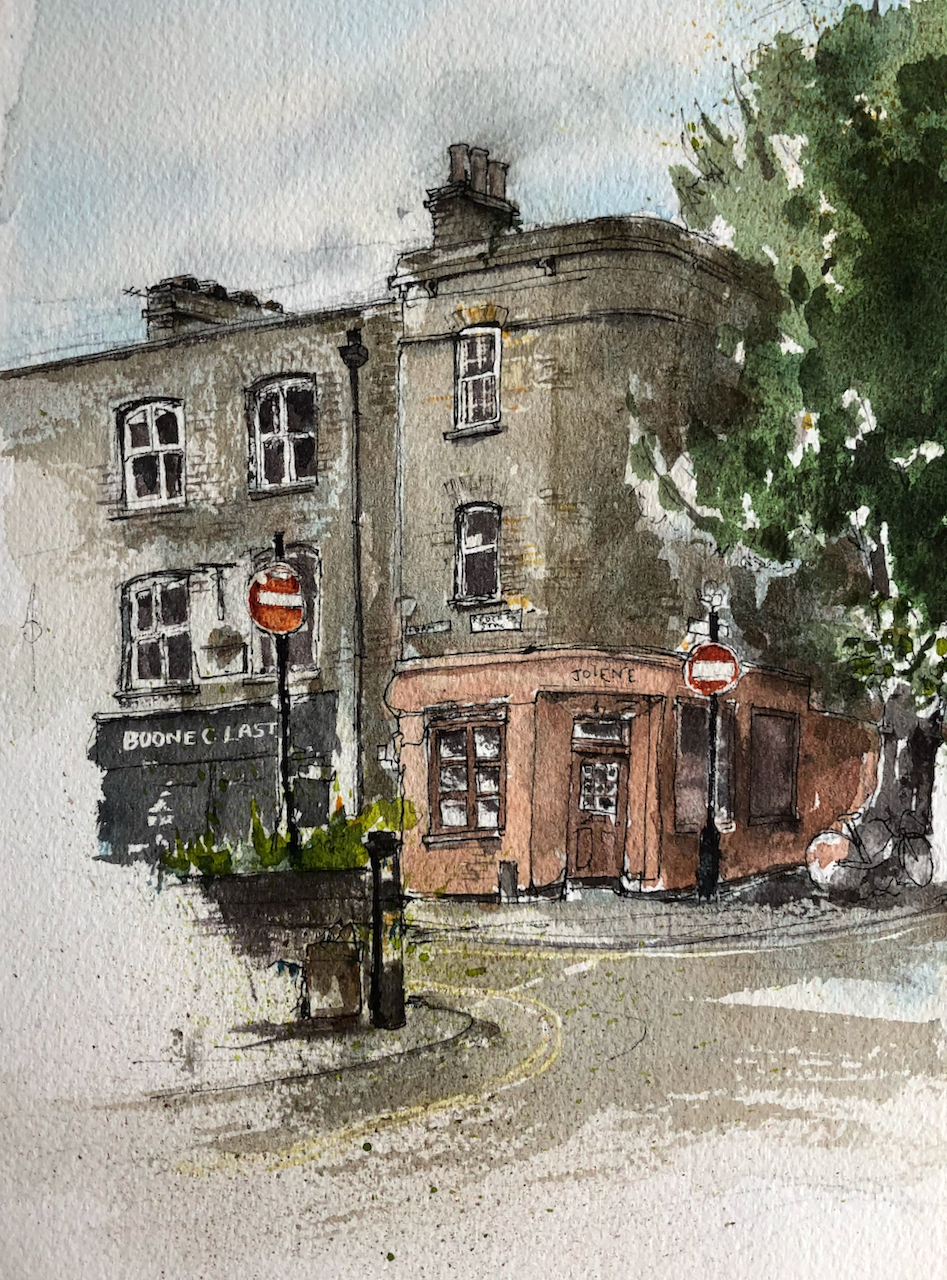
67 Redchurch Street E2, “Jolene” bakery

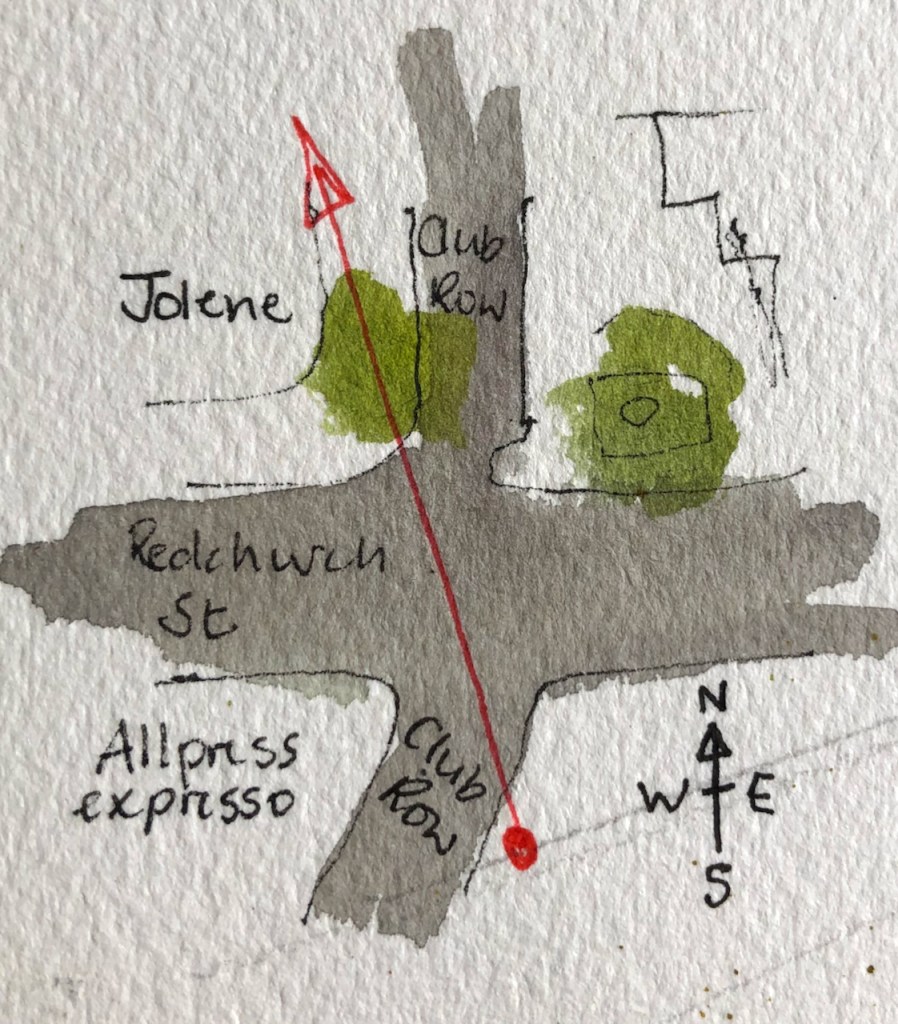
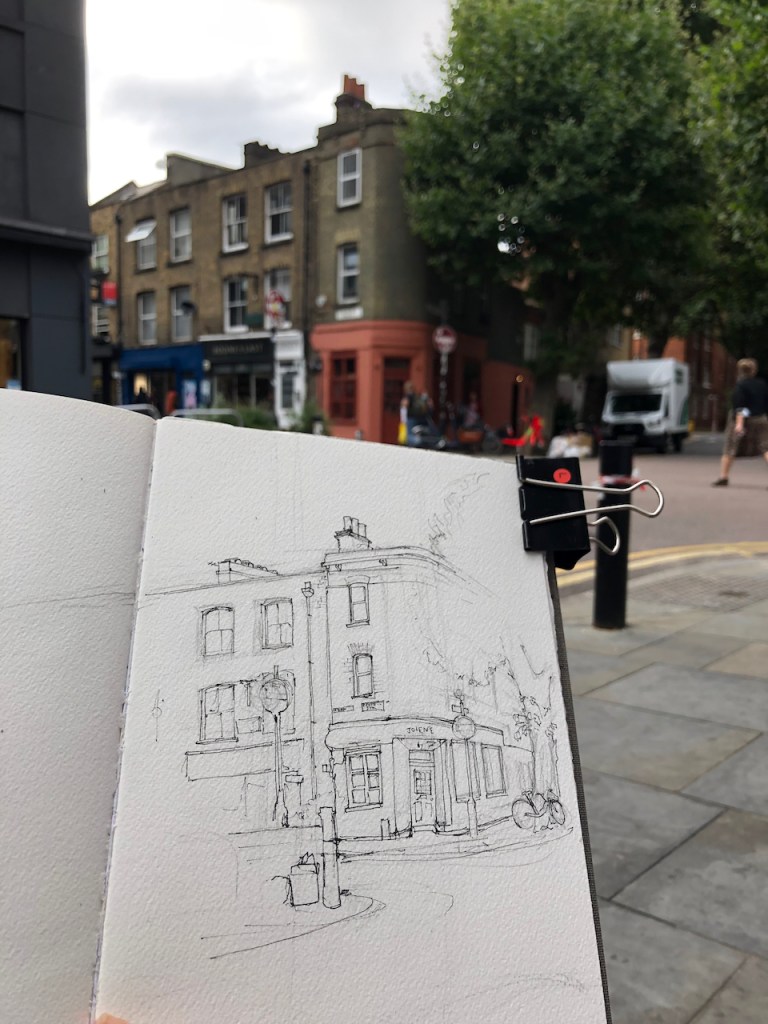
Jolene bakery is on the corner of Redchurch Street and Club Row.
Jolene, 67 Redchurch Street, from across the road. 19th August 2021. 10″ x 7″ in Sketchbook 10

This is a lively corner in a street on various edges: on the edge of the City, at the boundary between a new London and an old one, at the intersection of 21st century entrepreneurial culture and 19th century housing projects.

Redchurch Street is just North and West of Brick Lane. There are restaurants, independent clothes designers, hairdressers, and various 21st century businesses I couldn’t identify but categorised in my mind as broadly “creative”. It’s a good place to walk around, and Jolene is a great place to pause for coffee. They close at 3pm, though, so best be quick.

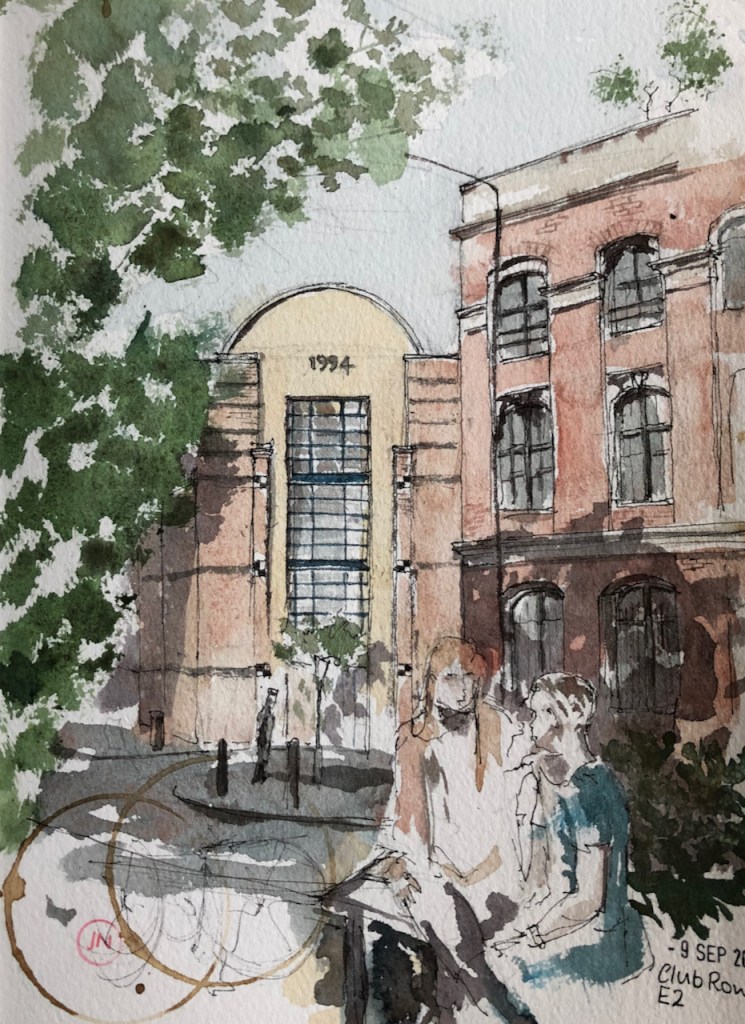
I arrived there at about 1pm today, and sat outside on one of their benches. Here’s the view looking up Club Row.

Looking North up Club Row, from “Jolene” Redchurch St. 9 September 2021, 2:45pm 10″ x 7″ in Sketchbook 10

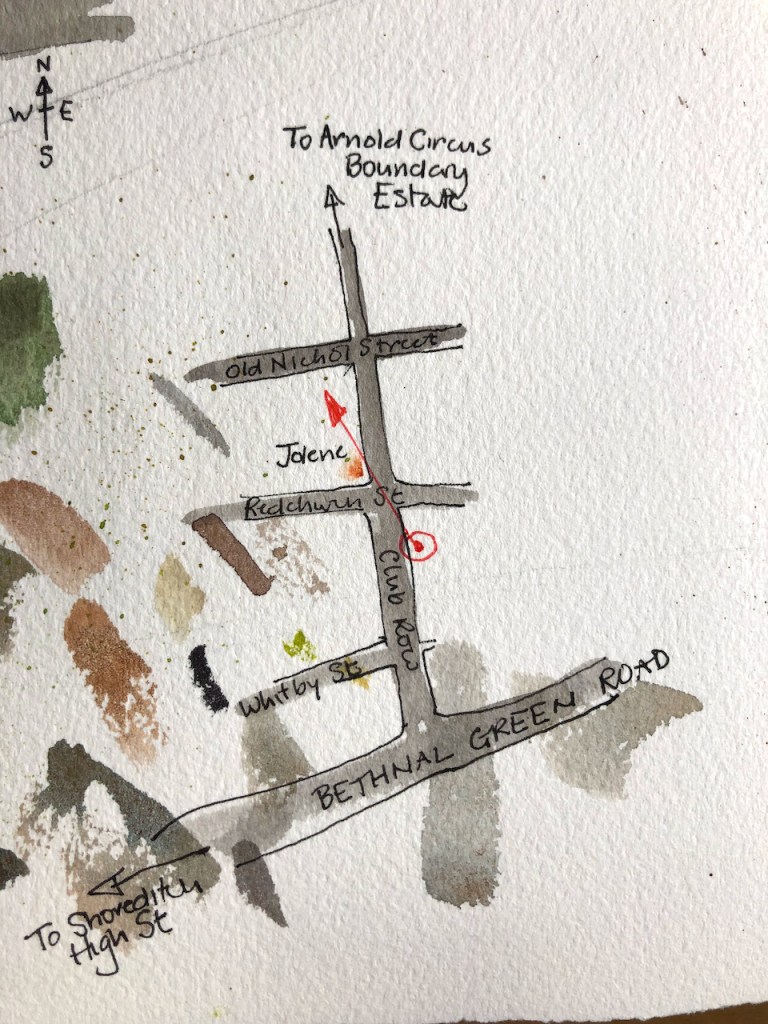
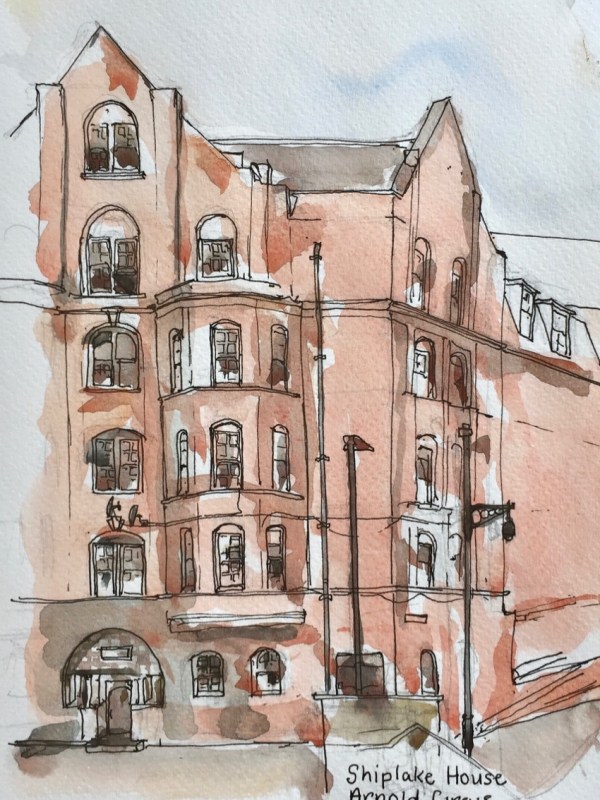
Further North up Club Row, to the left of my drawing, is Arnold Circus. This is the centre point of the Boundary Estate which was the London County Council’s first social housing project, completed on 1900. I have drawn there and written about it here:

Haz St Pauls EC2

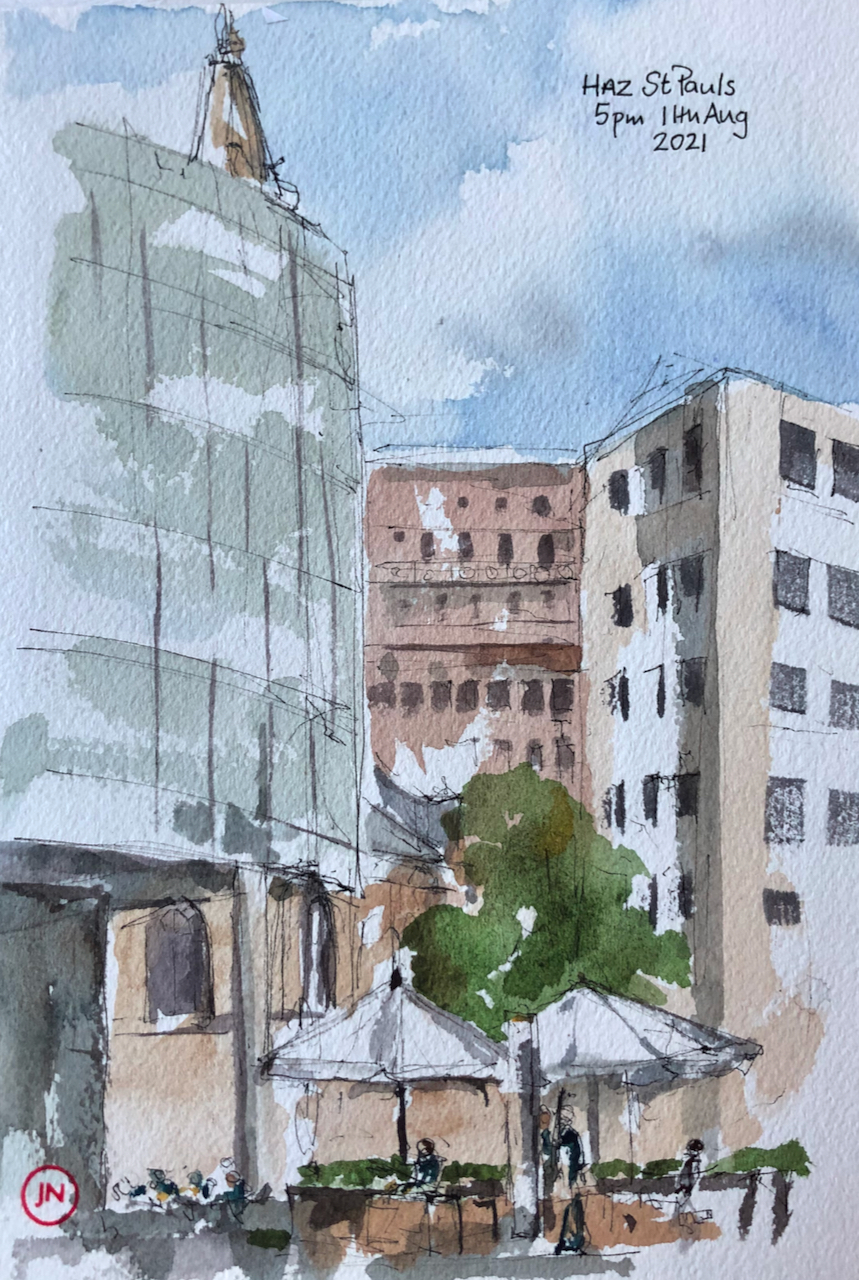
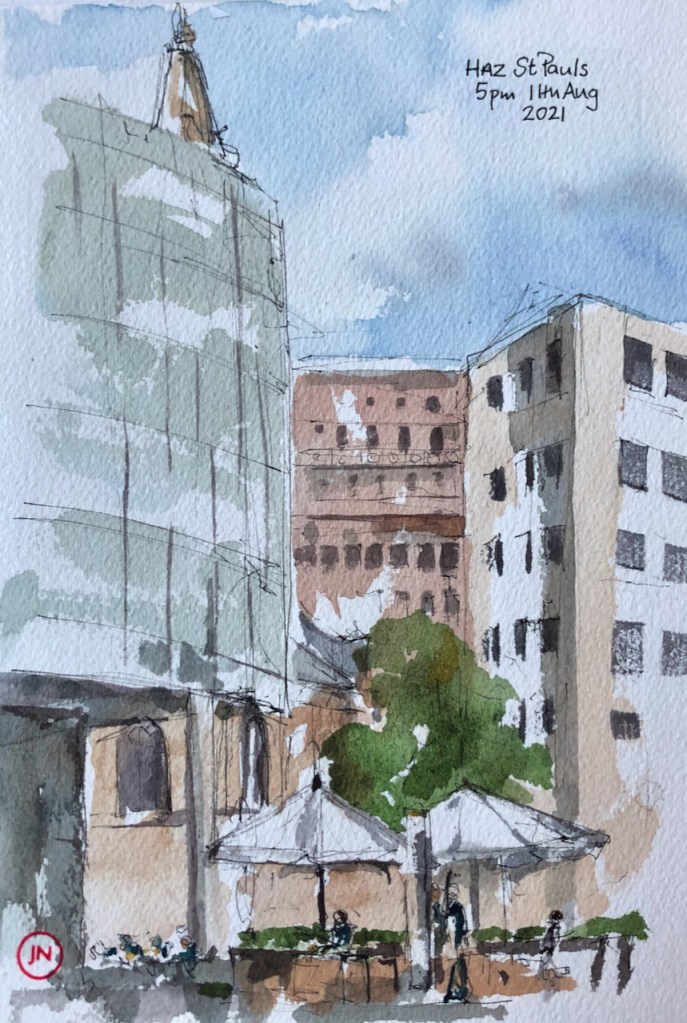
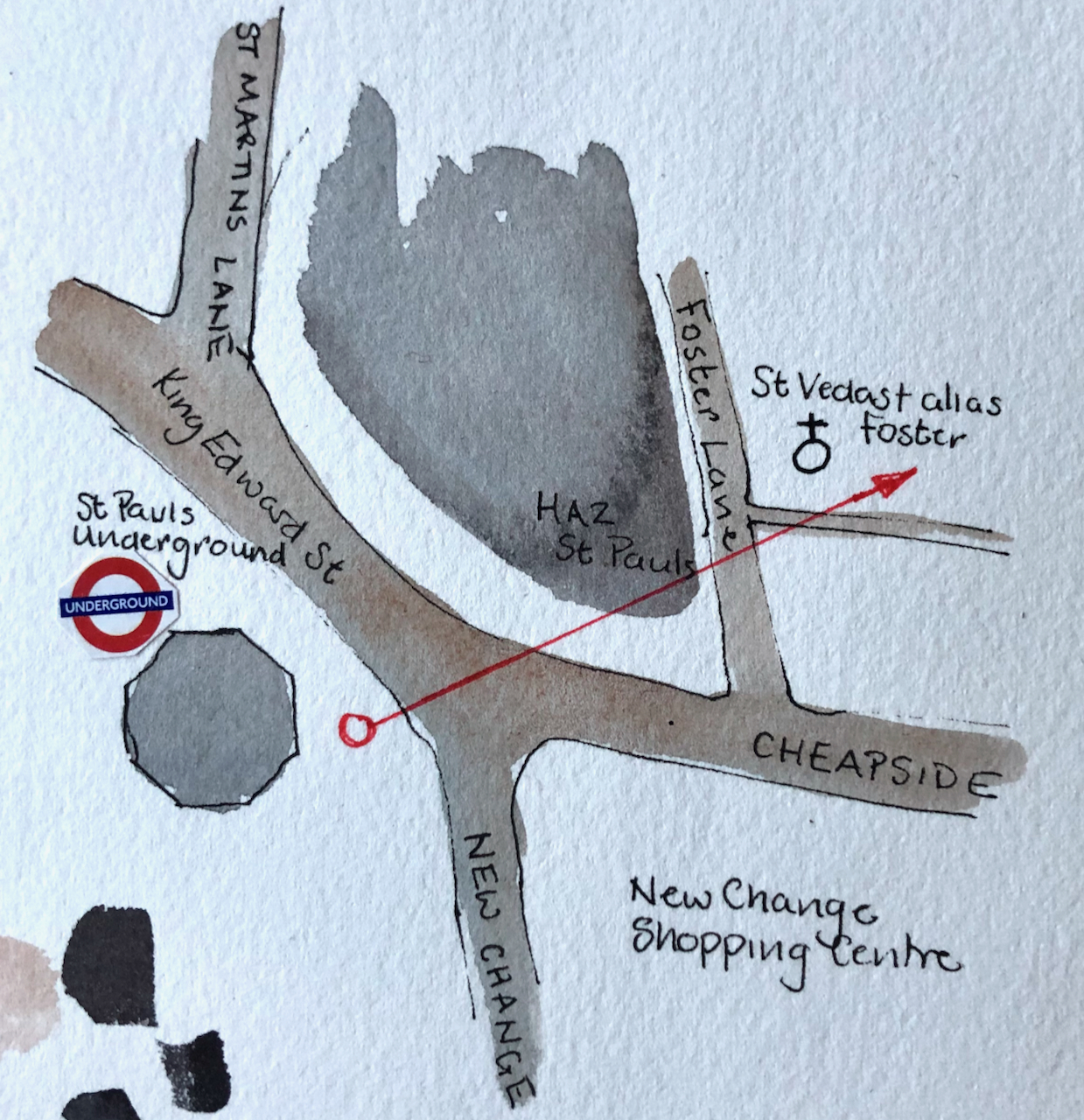
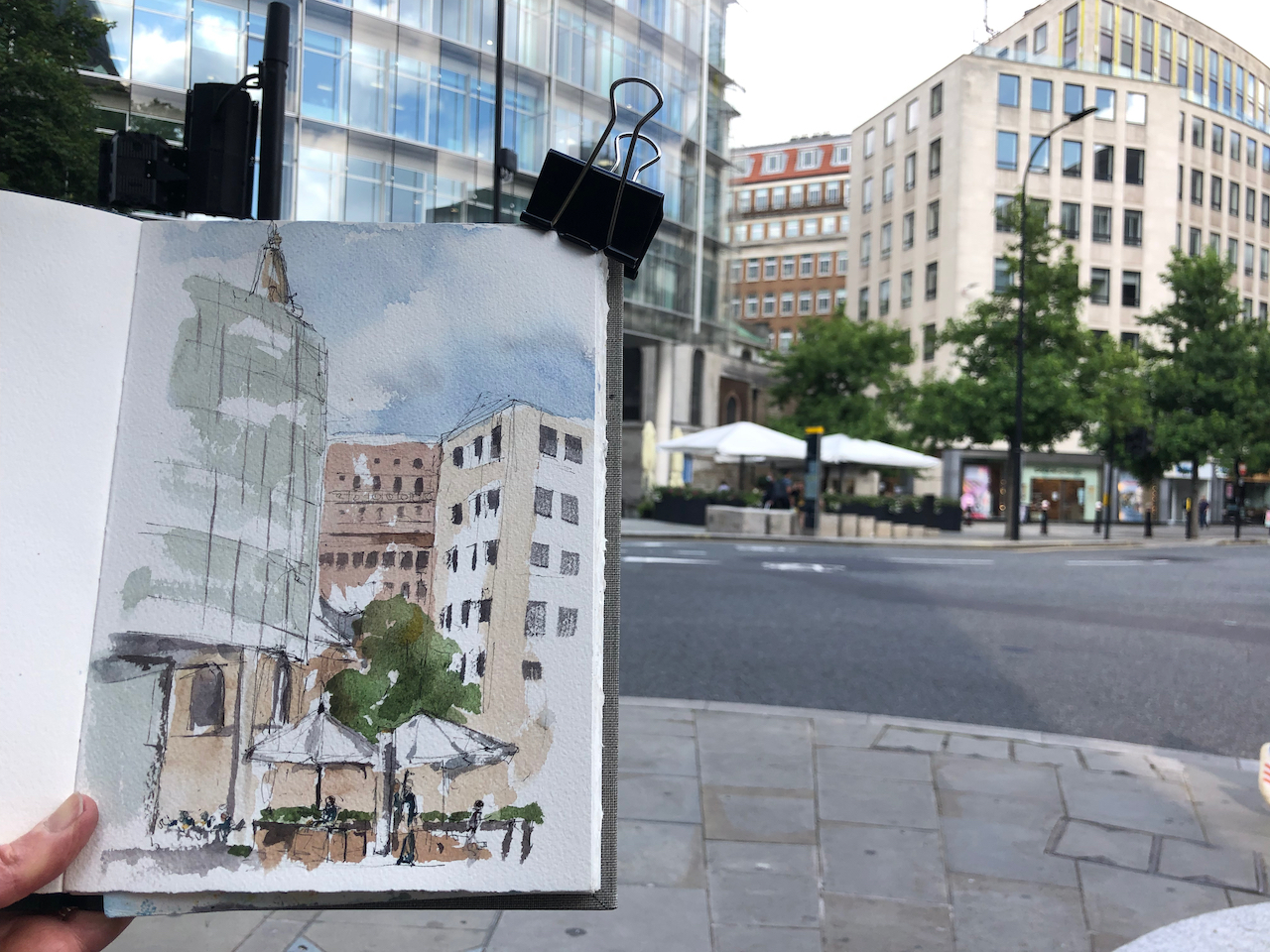
Here is the restaurant “Haz St Pauls“, 34 Foster Lane, London EC2.

“Haz St Pauls” Foster Lane, EC2, sketched from across the road, in Sketchbook 10, 11th August 2021

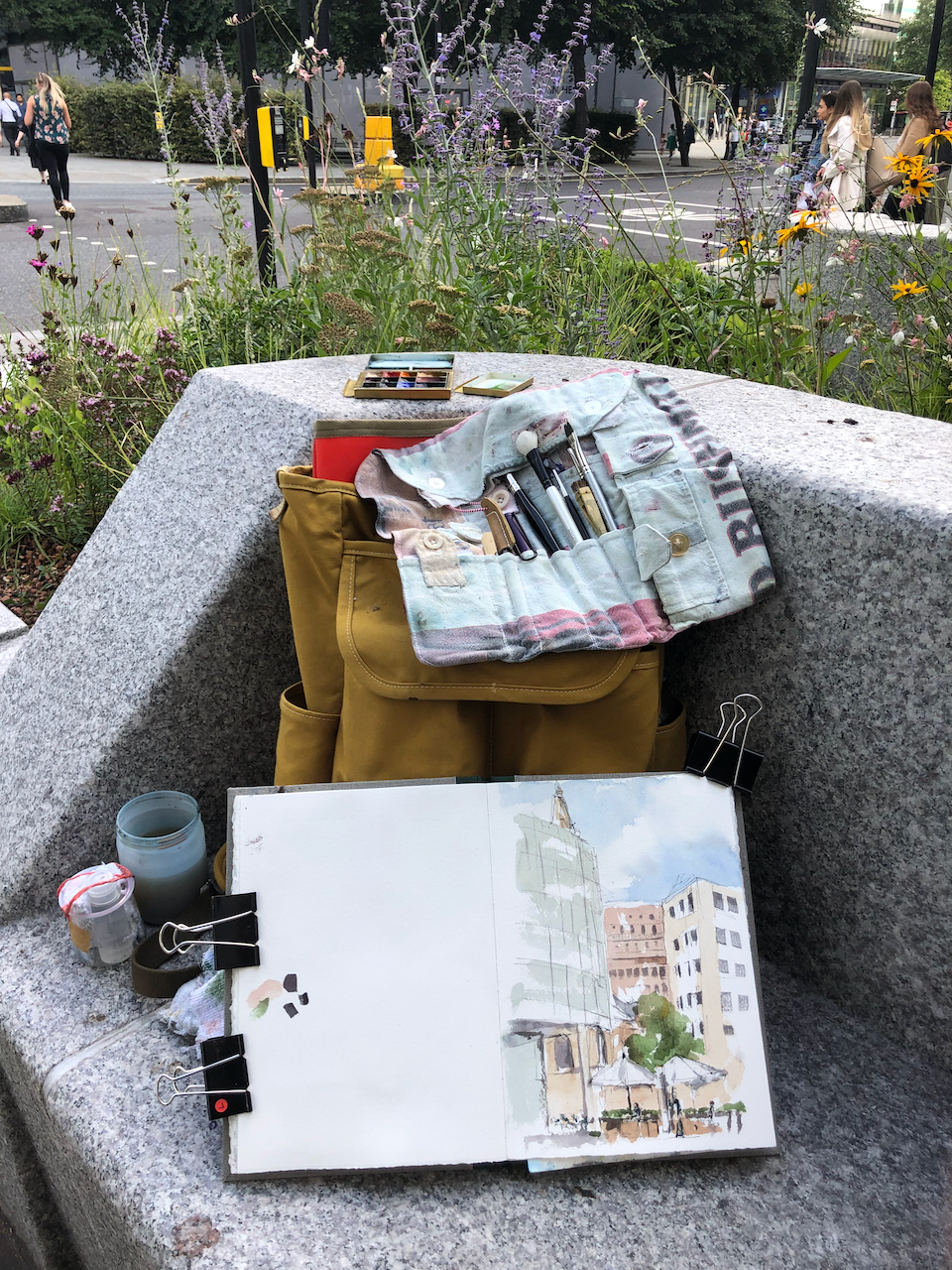
The restaurant has created a wonderful outside seating area on a part of the pavement. This corner has modern offices, the Haz restaurant, a coffee bar (Costa), and a church, St Vedast alias Foster. I sketched it from a new stone seat near St Pauls Underground station.

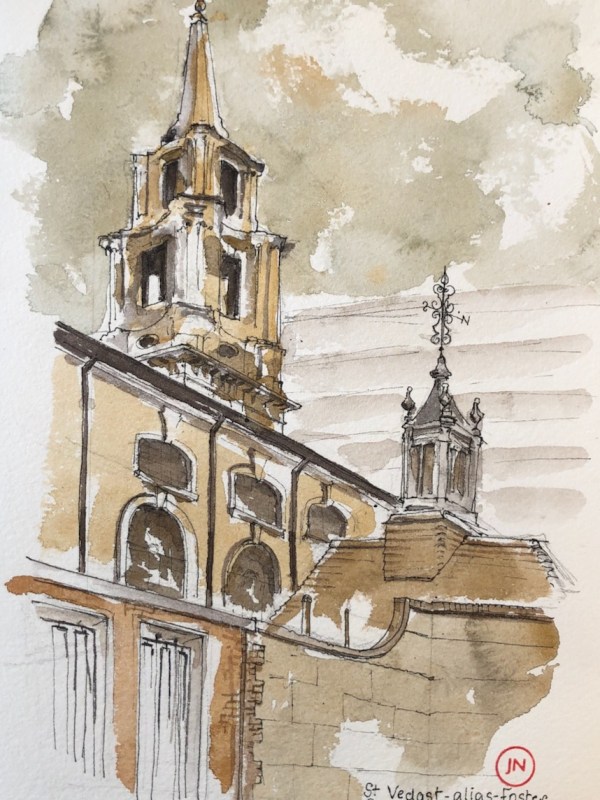
I have sketched St Vedast previously:

St Vedast-alias-Foster, EC2

Here is the Anglican Church of St Vedast-alias-Foster, in the City of London, viewed from Priest’s Court. Before I drew this, I paused a while in the Fountain Court, a tranquil courtyard next to the church. In the shadow,…

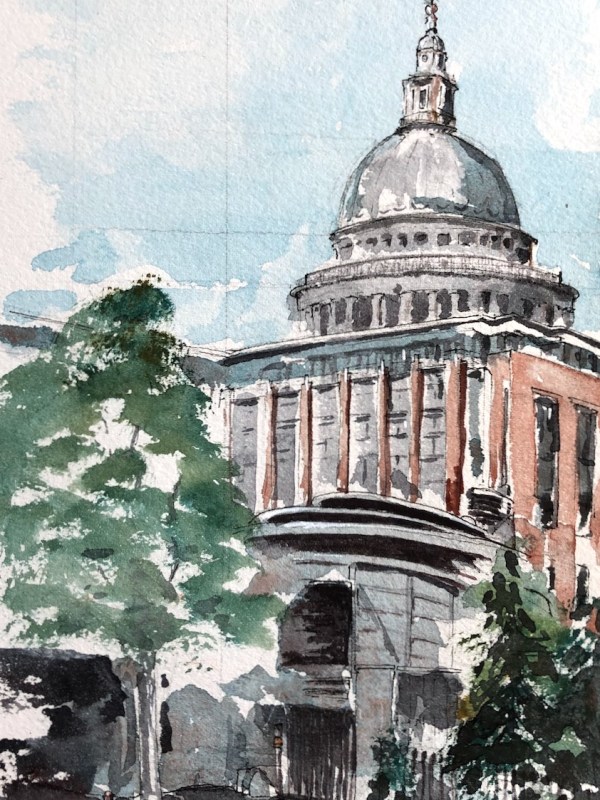
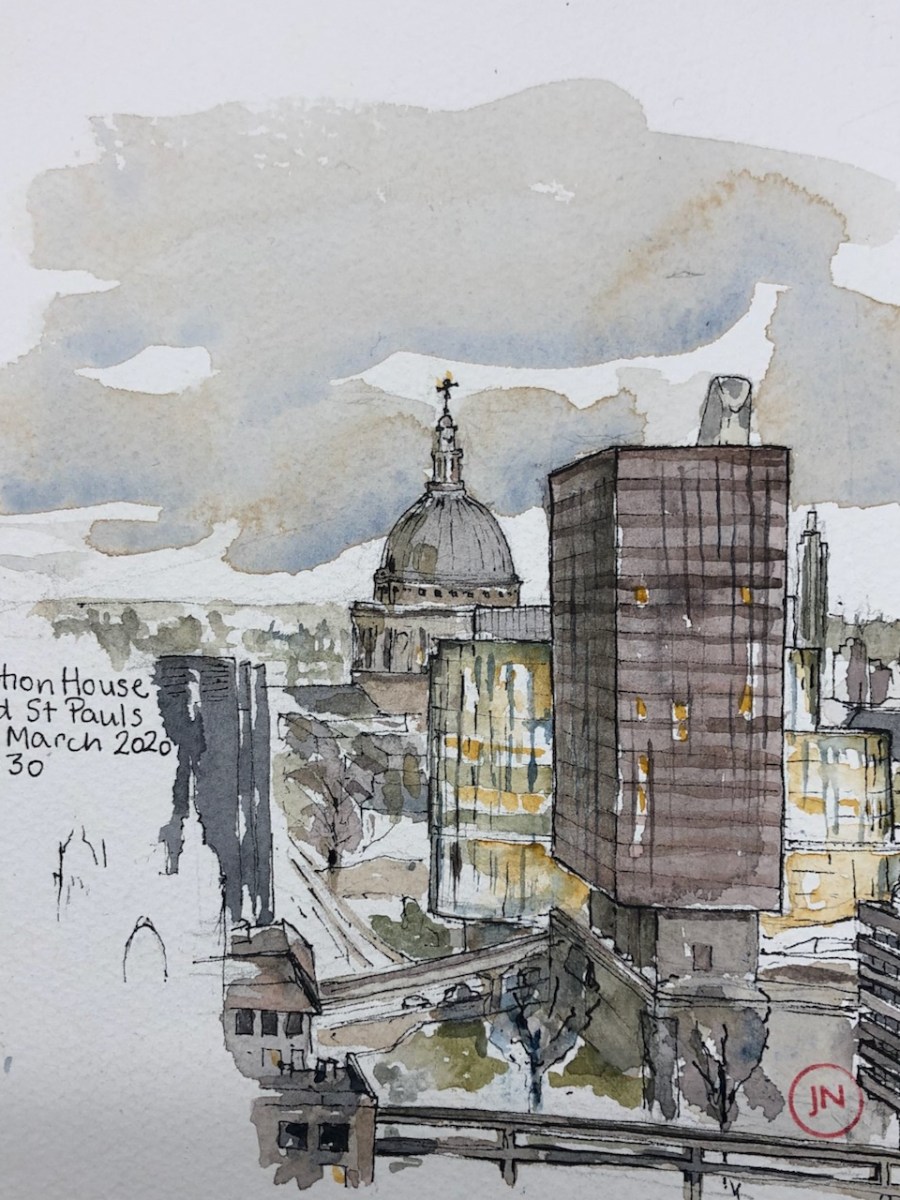
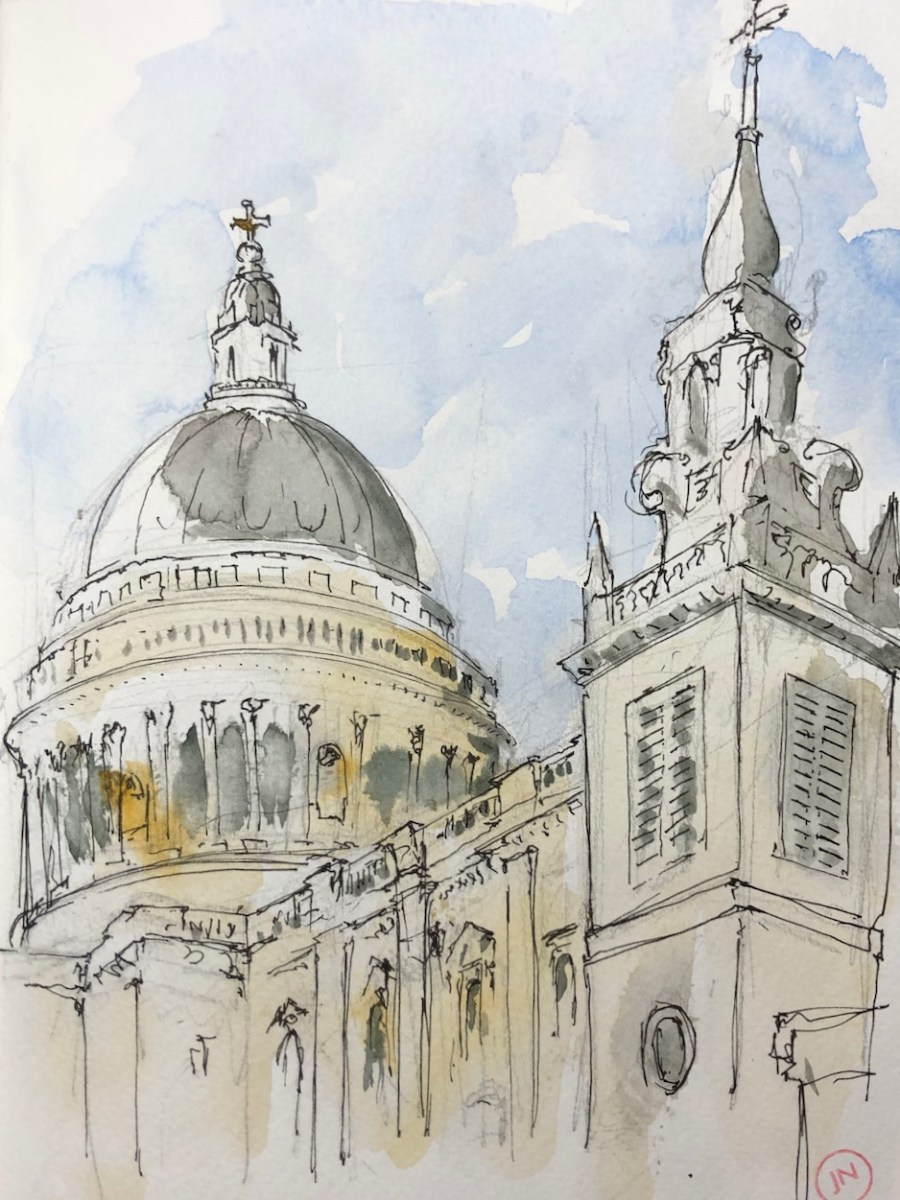
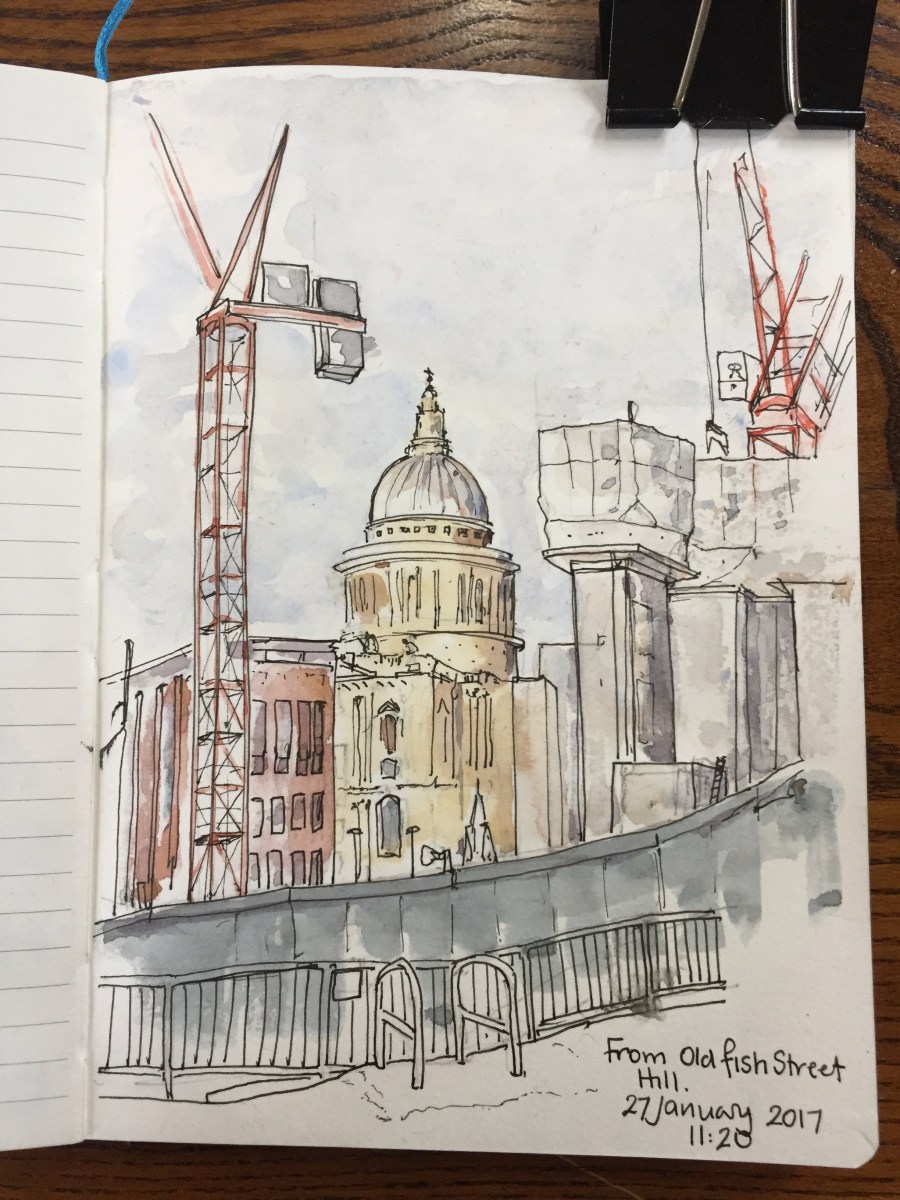
Here are some of my sketches of St Paul’s Cathedral, which was behind me as I sketched Haz.

St Edmund the King EC3

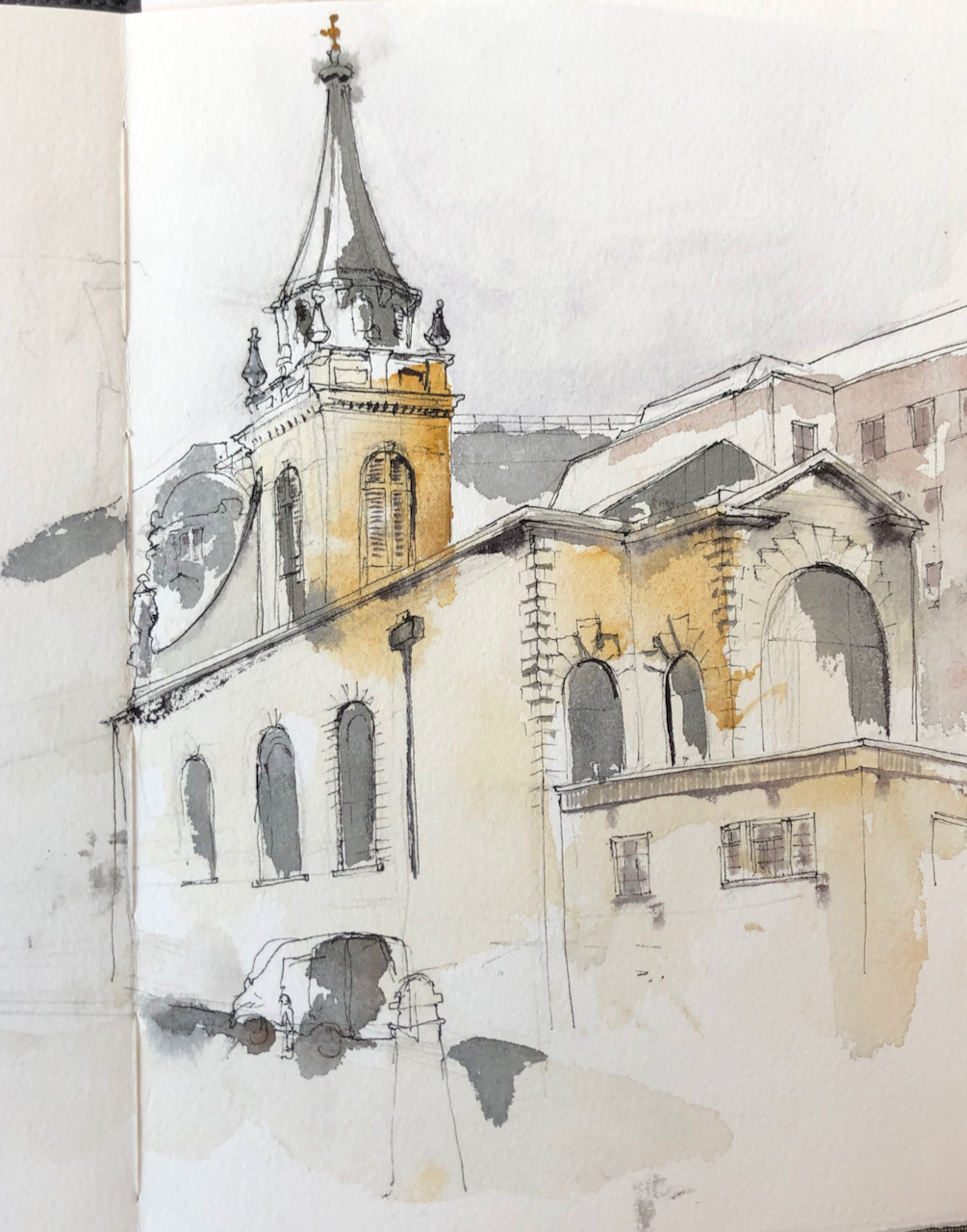
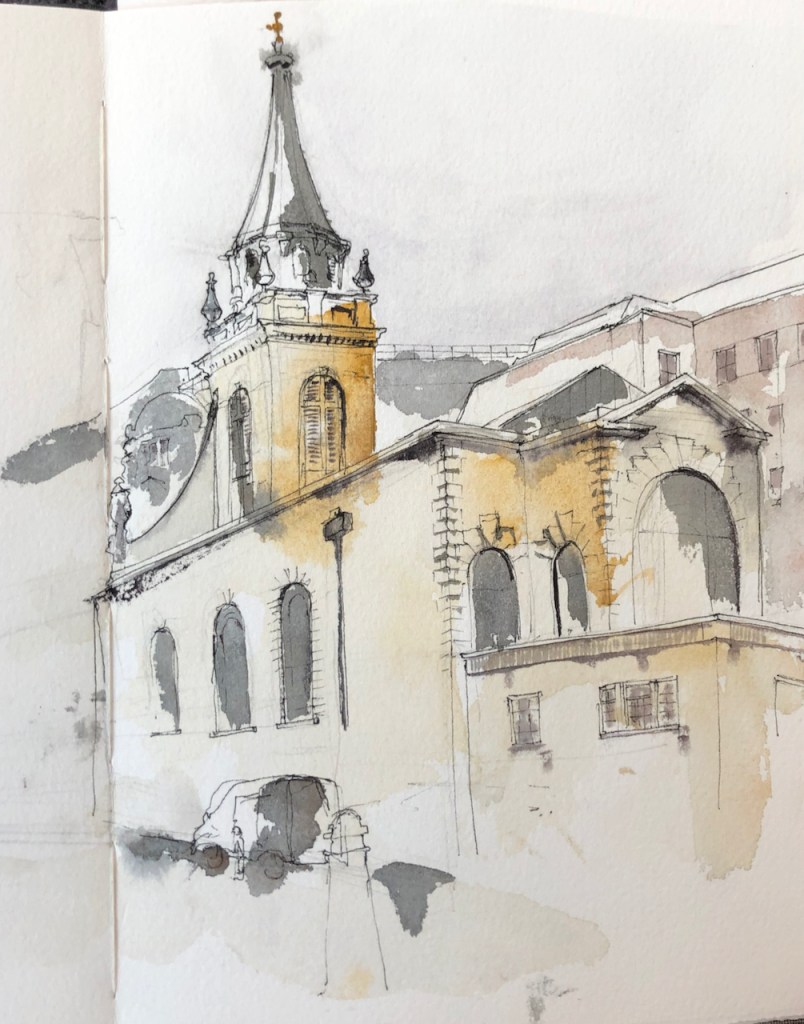
Here is a sketch of the church of “St Edmund King and Martyr” which is on Lombard St, City of London.

St Edmund King and Martyr, Lombard Street, from George Yard, EC3. 7″ x 10″ in Sketchbook 10

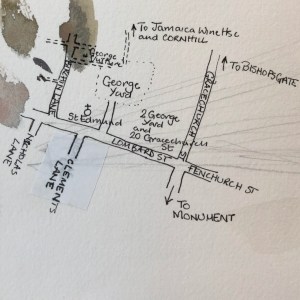
George Yard is at the intersection of a number of city lanes, one of which leads West to “The George and Vulture”, and another leads North to the Jamaica Wine House.

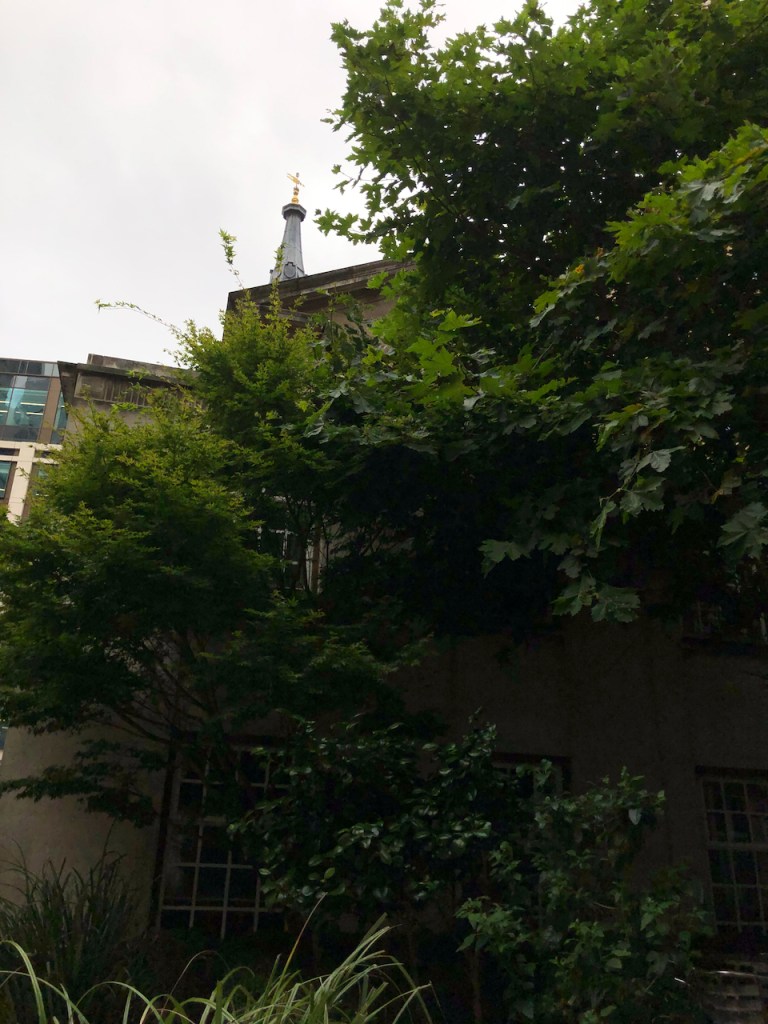
Also in George Yard is a marvellous leafy garden. In the garden, shaded by vegetation, is the tombstone of “Sir Henry Tulse”. Below the tombstone is the inscription telling you about its incumbent:

"Sir Henry Tulse was a benefactor of the Church of St Dionis Backchurch (formerly adjoining)
He was also grocer, Alderman, and Lord Mayor of this City.
In his memory, this tombstone was restored November 1937 by
"The Ancient Society of College Youths" during the 100th year of the society's foundation.
He was also Master of the Society during his Mayoralty in 1684"

St Edmund King and Martyr is an active church. The Church is, according to the notice on Lombard Street, “The Gregory Centre for Church Multiplication”. Church Multiplication has a clear mission statement on their website: “We equip and resource the Church to reach new people, in new places, in new ways with the good news of Jesus Christ.”

The Vestry Hall is the cubical building on the right of my drawing.

Just off the drawing to the left is 2 George Yard and 20 Gracechurch Street, a modern building, where a long list of companies are registered with financial sounding names: “The Close Investment 1988 Fund “A” “, “The Greater Mekong Capital Fund”. This is the City of London, with all its contrasts and juxtapositions.

Here is work in progress on the drawing, and a view of the Church from the leafy garden.

This drawing took about 1 hour and 20 mins. The colours are Mars Yellow, Perylene Maroon, and Phthalo Blue Turquoise.

Guild Church of St Benets, EC4

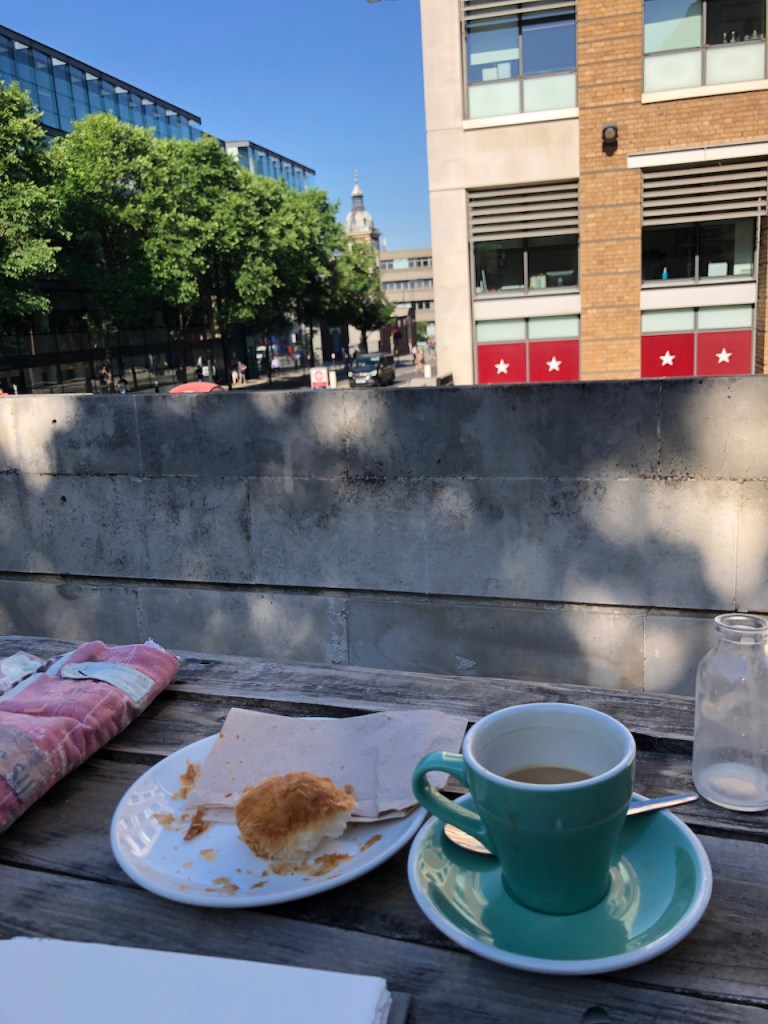
On a lovely sunny morning I walked to the Wren café for breakfast. The Wren is in Saint Nicholas Cole Abbey church on Queen Victoria Street. There is a terrace high above Queen Victoria Street. It commands an excellent view of St Paul’s Cathedral, but I chose to look along the busy road and sketch the Guild Church of St Benets.

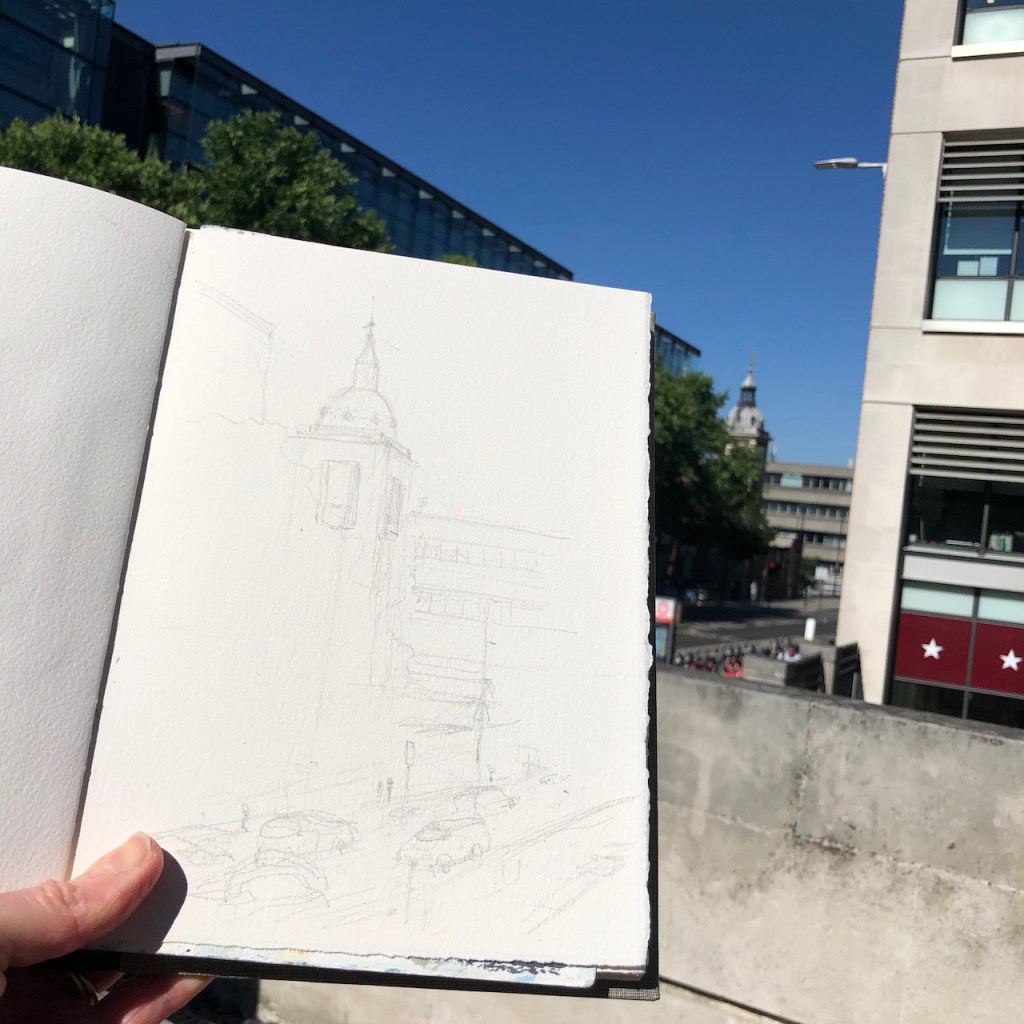
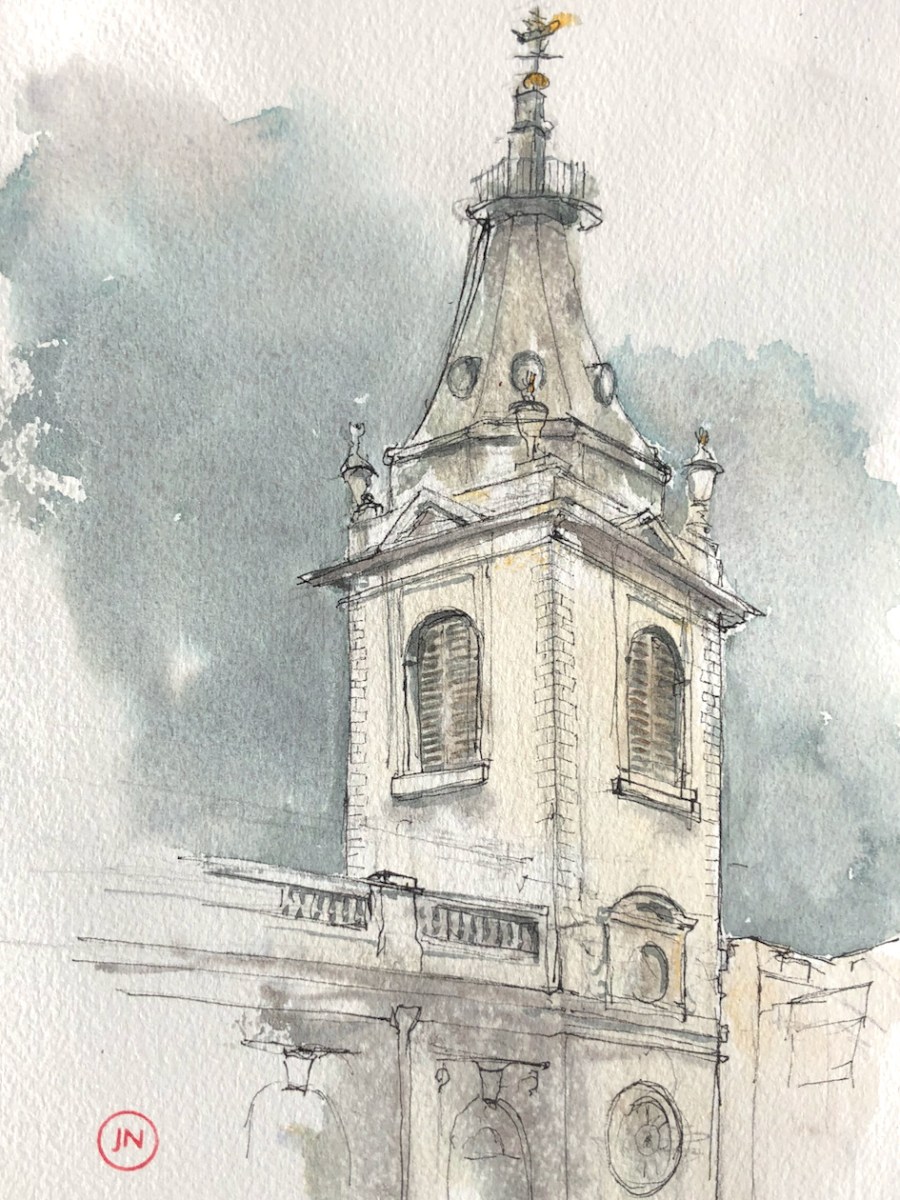
Guild Church of Saint Benets, from St Nicholas Cole Abbey, Queen Victoria Street EC4. 16th June 2021, 08:30 – 10:45am, 10″ x 7″ in sketchbook 10.

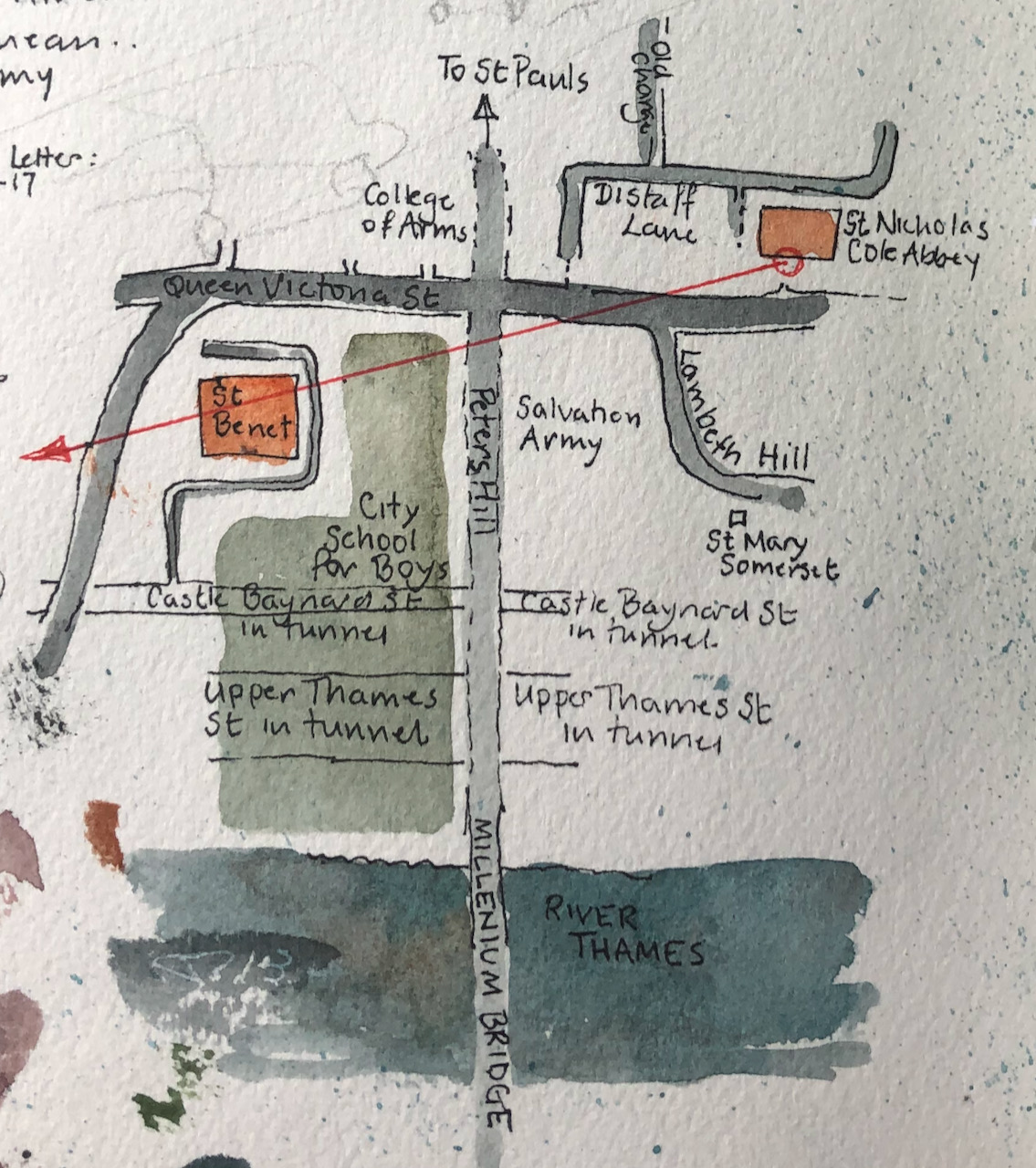
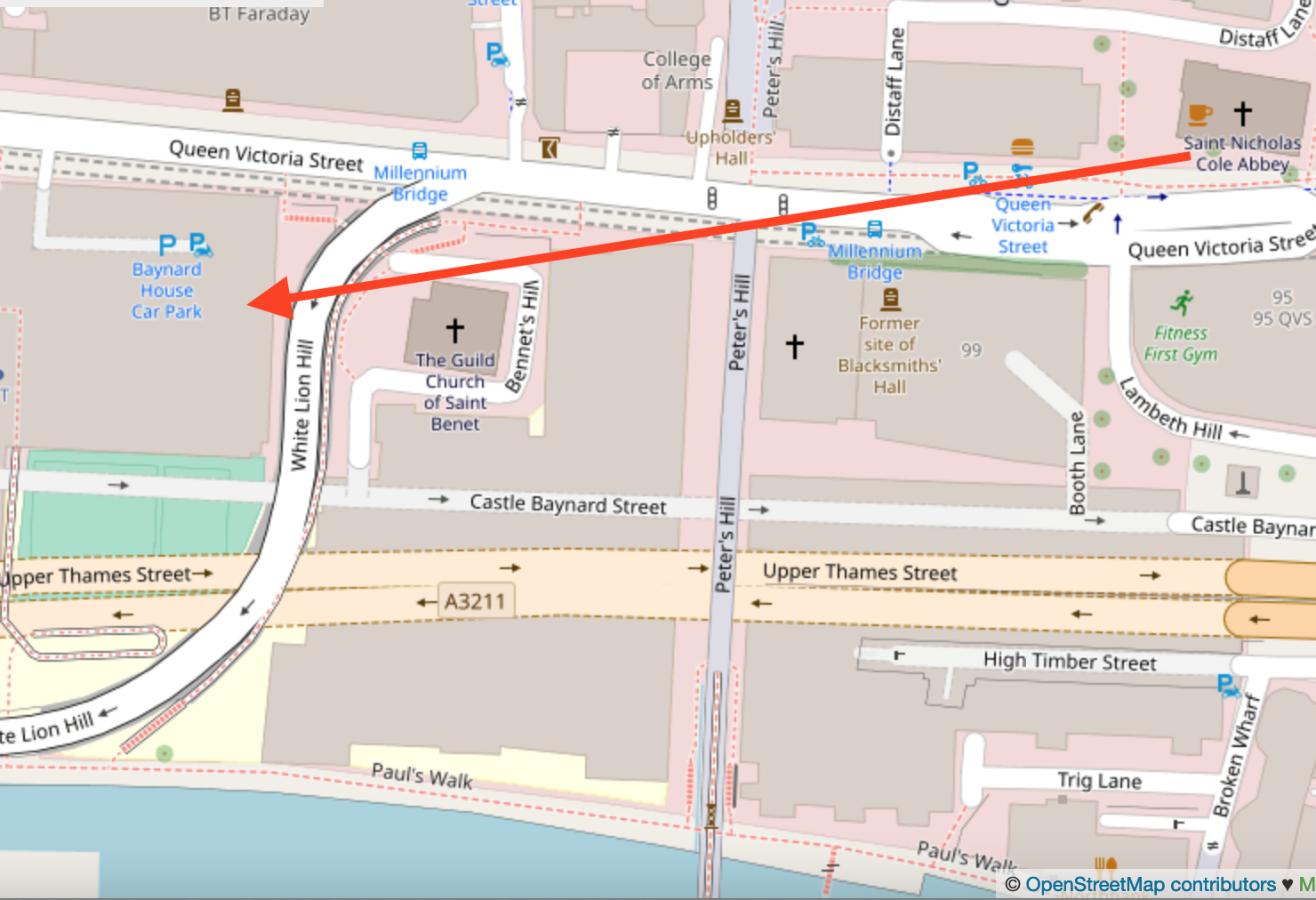
The building in the background is Baynards House, a BT building. In front of the church is the City of London School for Boys. Here are maps:

The Guild Church of St Benets is an active church with services in Welsh. It is a Wren Church, listed Grade I. The listing on the Historic England site says that this is “one of the least altered of Wren’s churches”, since it was not damaged in the 1939-45 war.

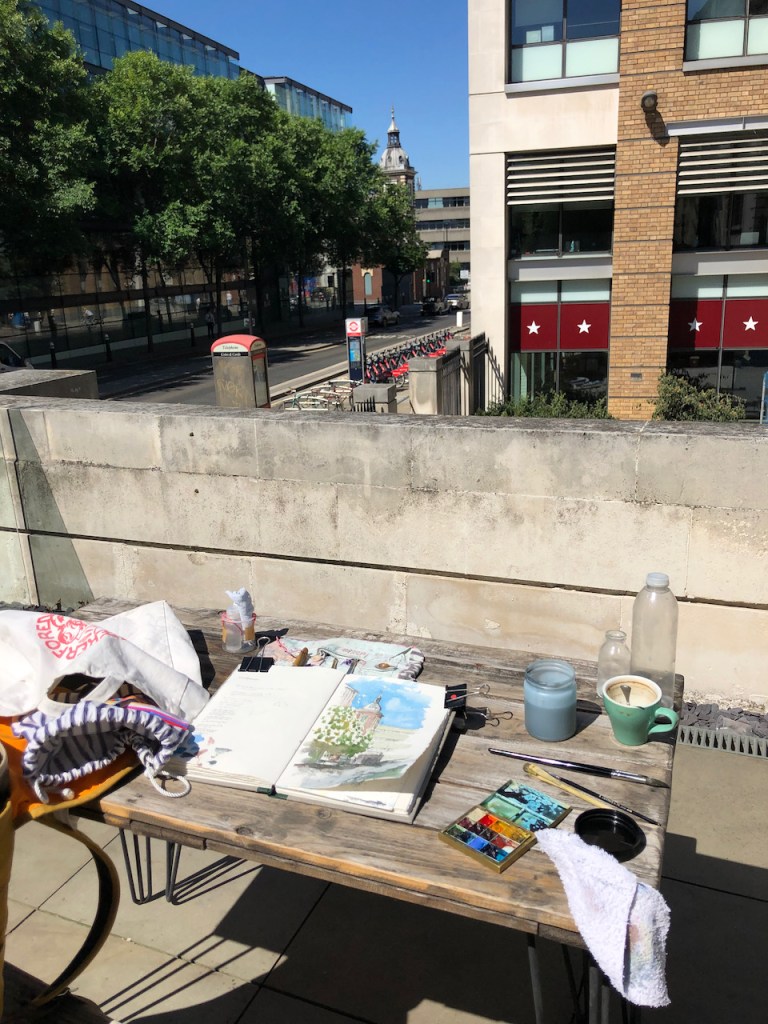
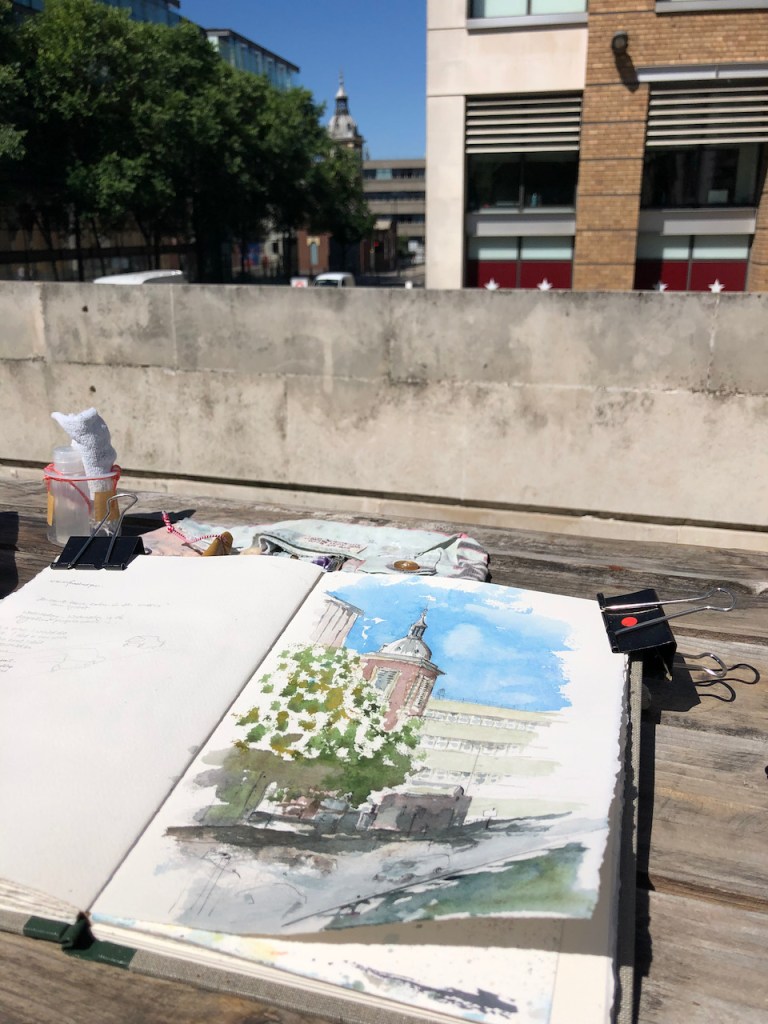
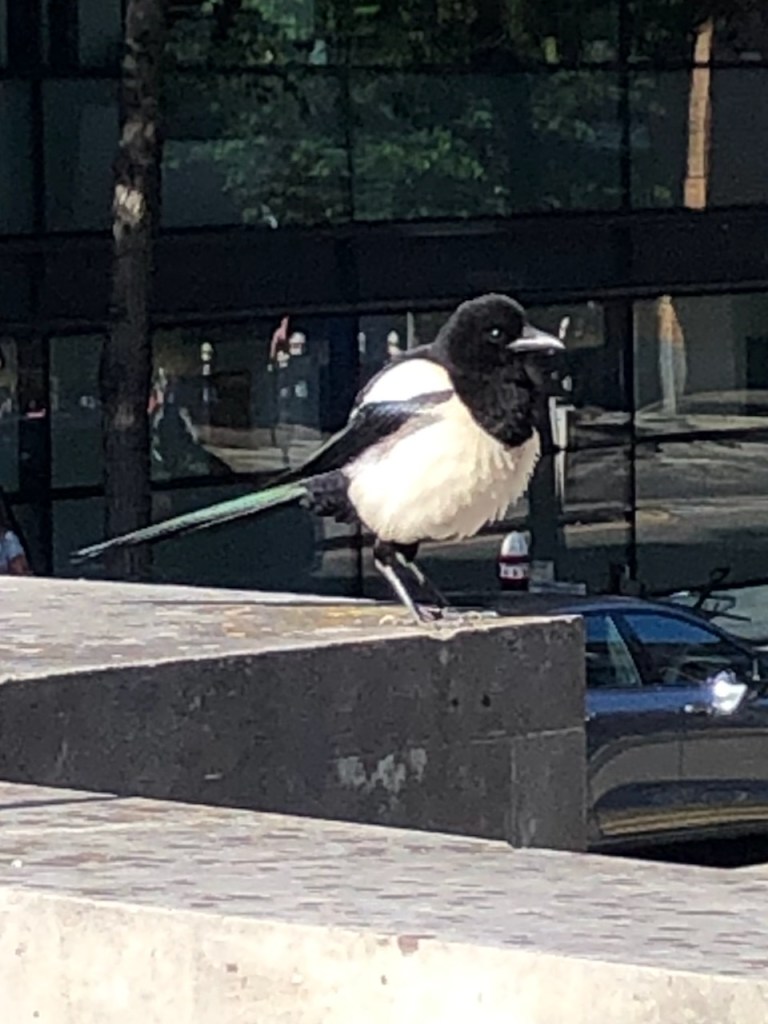
Here are a few photos of work in progress on the drawing, and a portrait of a magpie who came to look at my croissant:

I’ve sketched the view of St Paul’s from the same location:

St Paul’s Cathedral from Wren Coffee

Wren Coffee has re-opened! This is a marvellous coffee shop in the Church of St Nicholas Cole Abbey, on Queen Victoria St. I went there and sat…

I also drew a picture of St Nicholas Cole Abbey, from the North side, in a rainstorm:

St Nicholas Cole Abbey EC4

St Nicholas Cole Abbey is at 114 Queen Victoria Street, EC4V 4BJ.  The City of London entry for this church tells me: The church is dedicated to the…

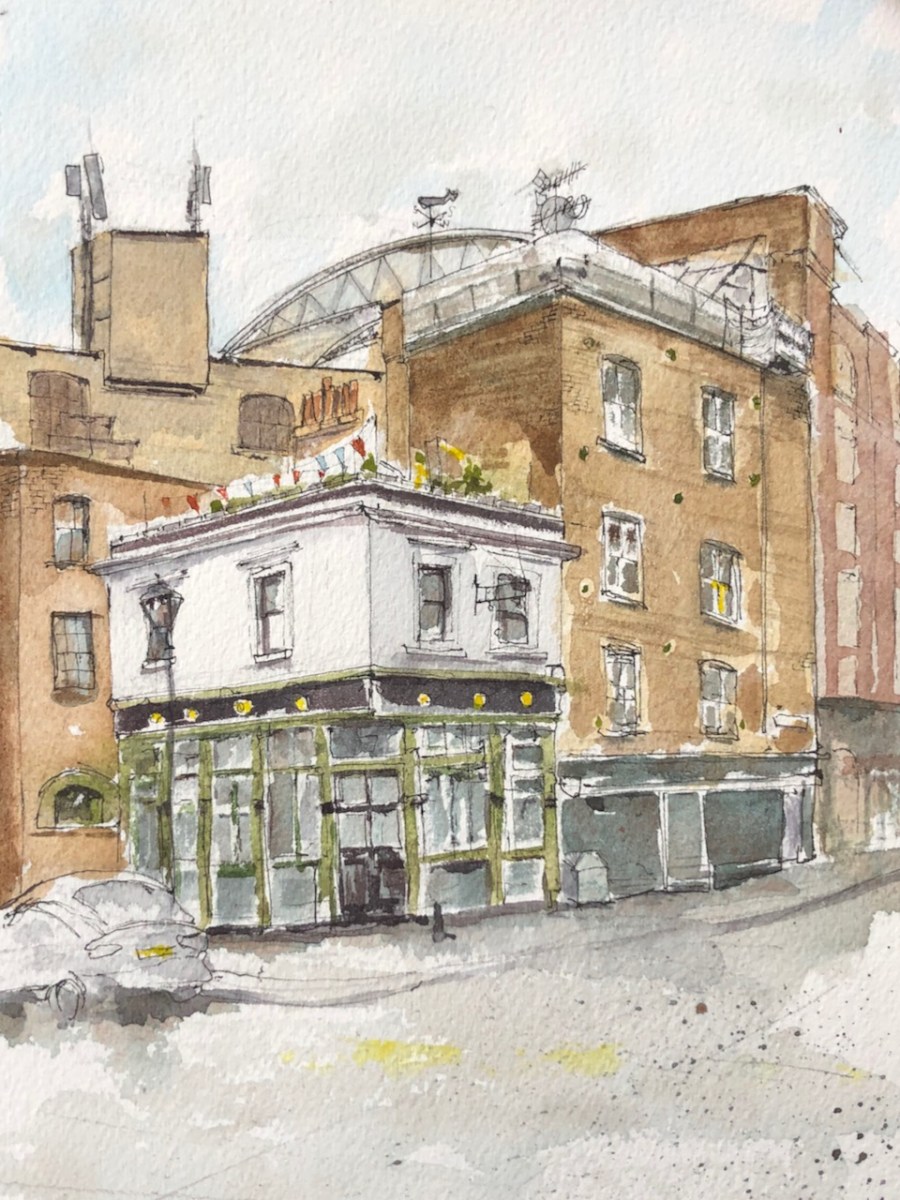
The Captain Kidd, Wapping, E1

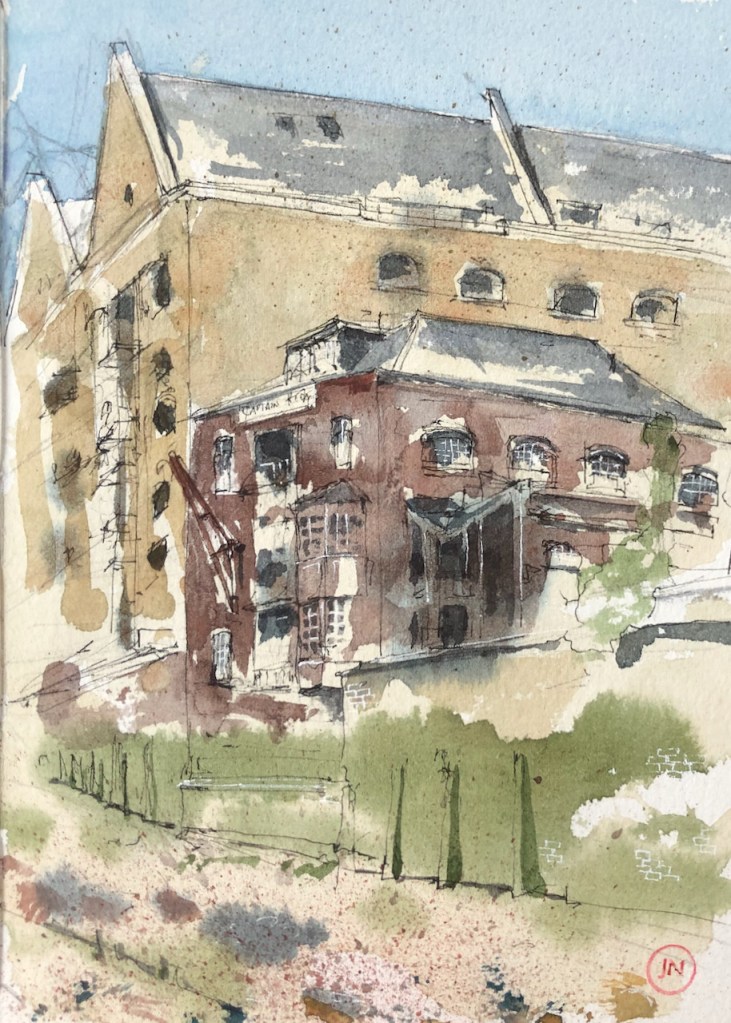
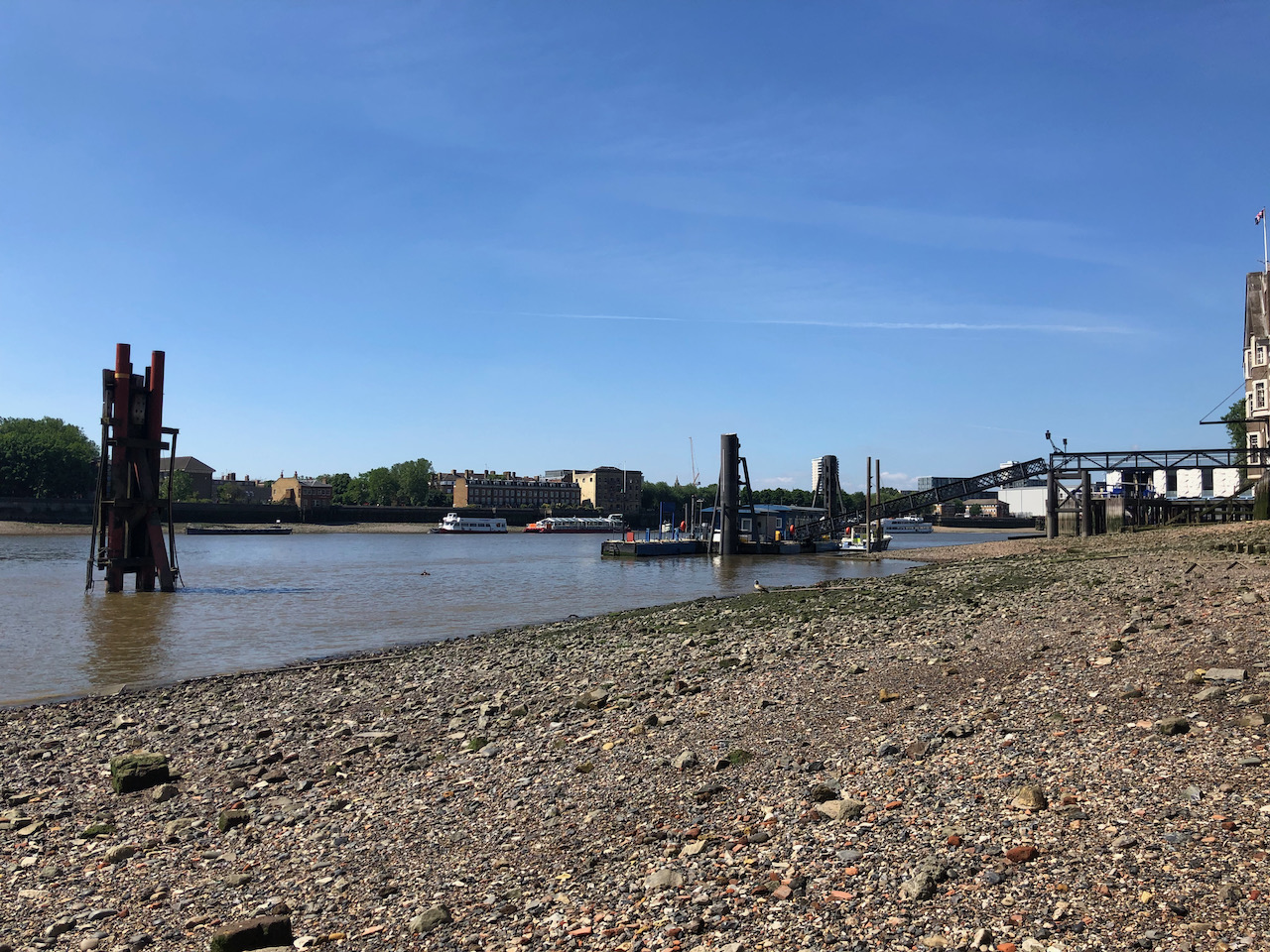
After breakfast at the Turk’s Head ( see this post ) I went down to the river. The tide was out. I sat on the Thames foreshore and sketched The Captain Kidd.

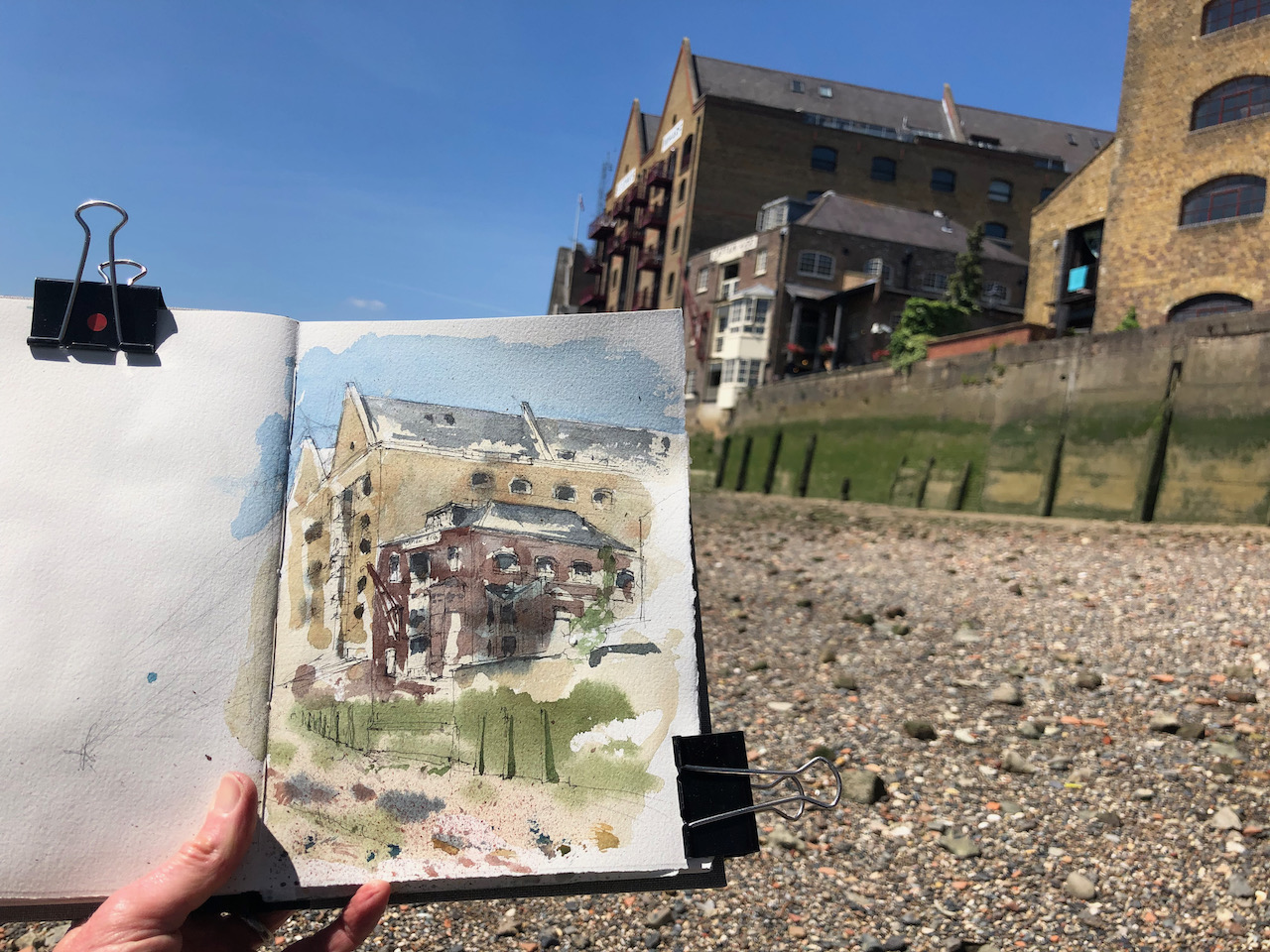
The Captain Kidd, Wapping E1. 12.10pm 14 June 2021. 7″ x10″ in Sketchbook 10

The Captain Kidd is the building at the front. It’s a pub and restaurant. The larger building behind is “St John’s Wharf”, a warehouse now converted into flats.

The “Captain Kidd” is named after a “seventeenth century pirate William Kidd who was executed [in 1701] at the nearby Execution Dock” according to various websites e.g. The Londonist.

However there is no “nearby Execution Dock”. The carefully researched article on “London Inheritance” concludes that “King Henry’s Stairs” were formerly “Execution Dock” (see note 2). The name was changed in the early 19th century to be better in line with the burgeoning use of the area for trade. The London Inheritance author cannot discover a specific “King Henry” connection. He includes a list of some of the people who were executed here, for crimes at sea including piracy, fighting on board ship, murdering shipmates, and treason.

I note with interest that, these days, the headquarters of the Marine Police are just a few hundred yards upstream. This is a very ancient establishment, which started with a one-year trial in 1798 (note 1).

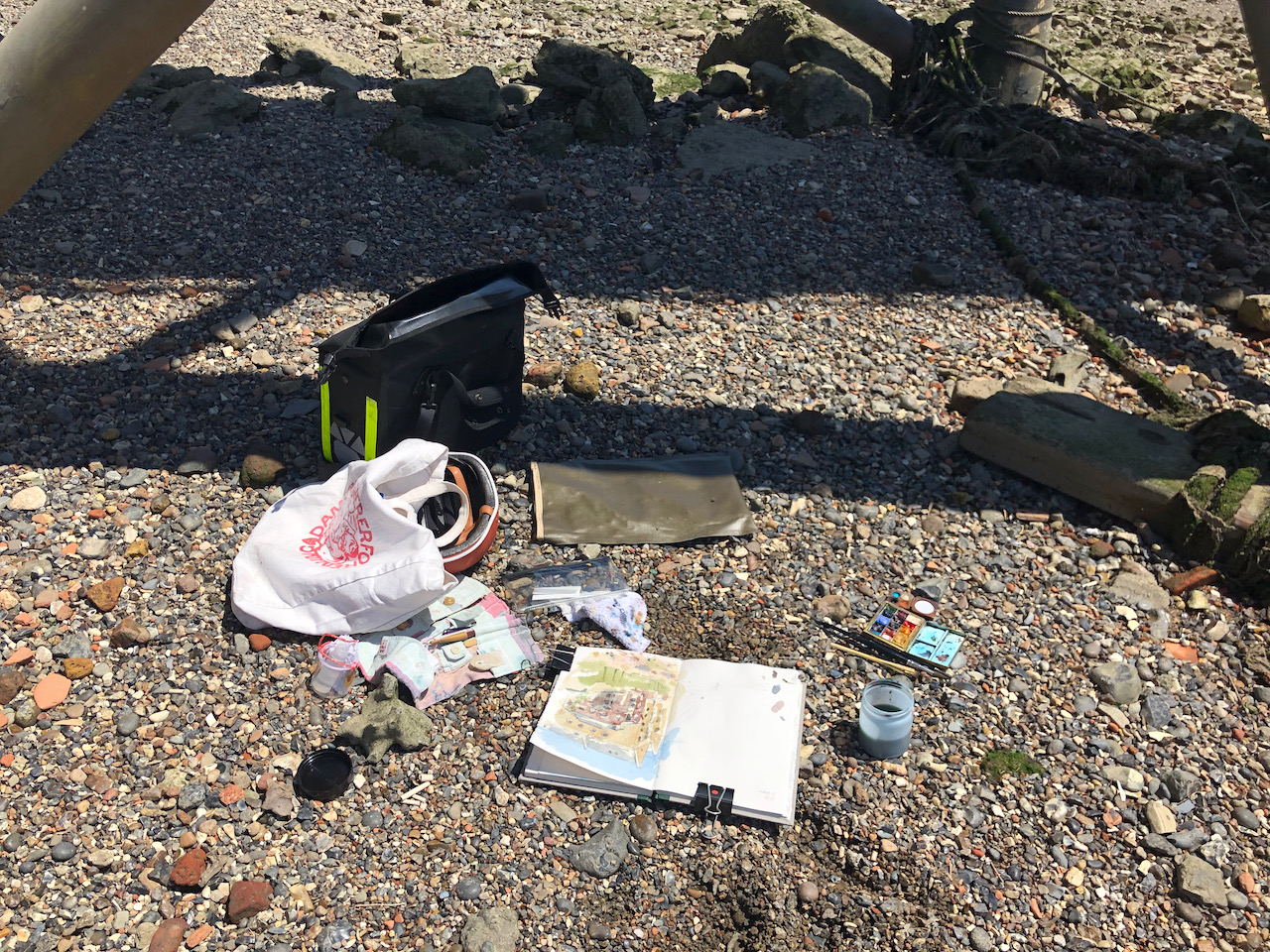
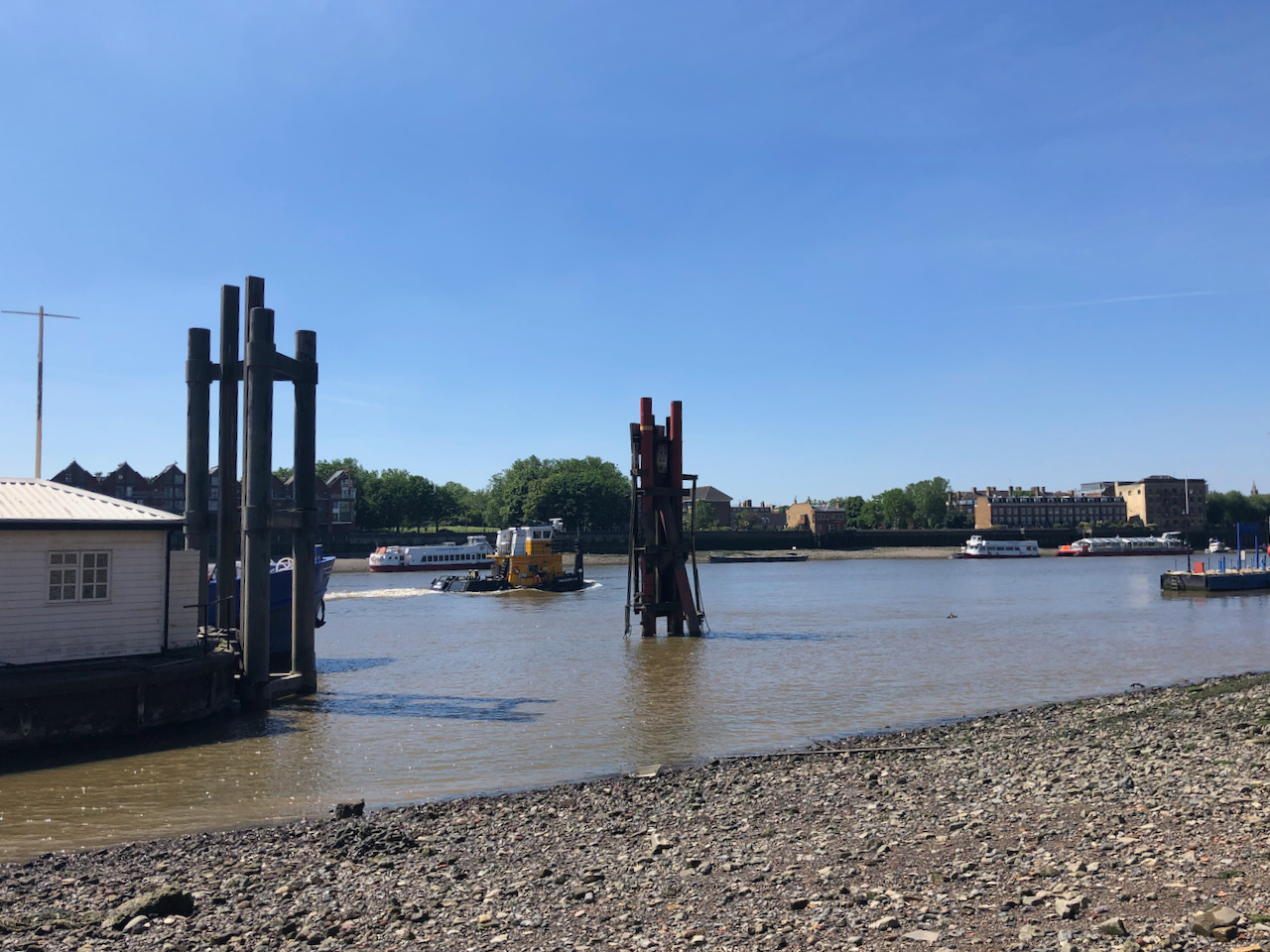
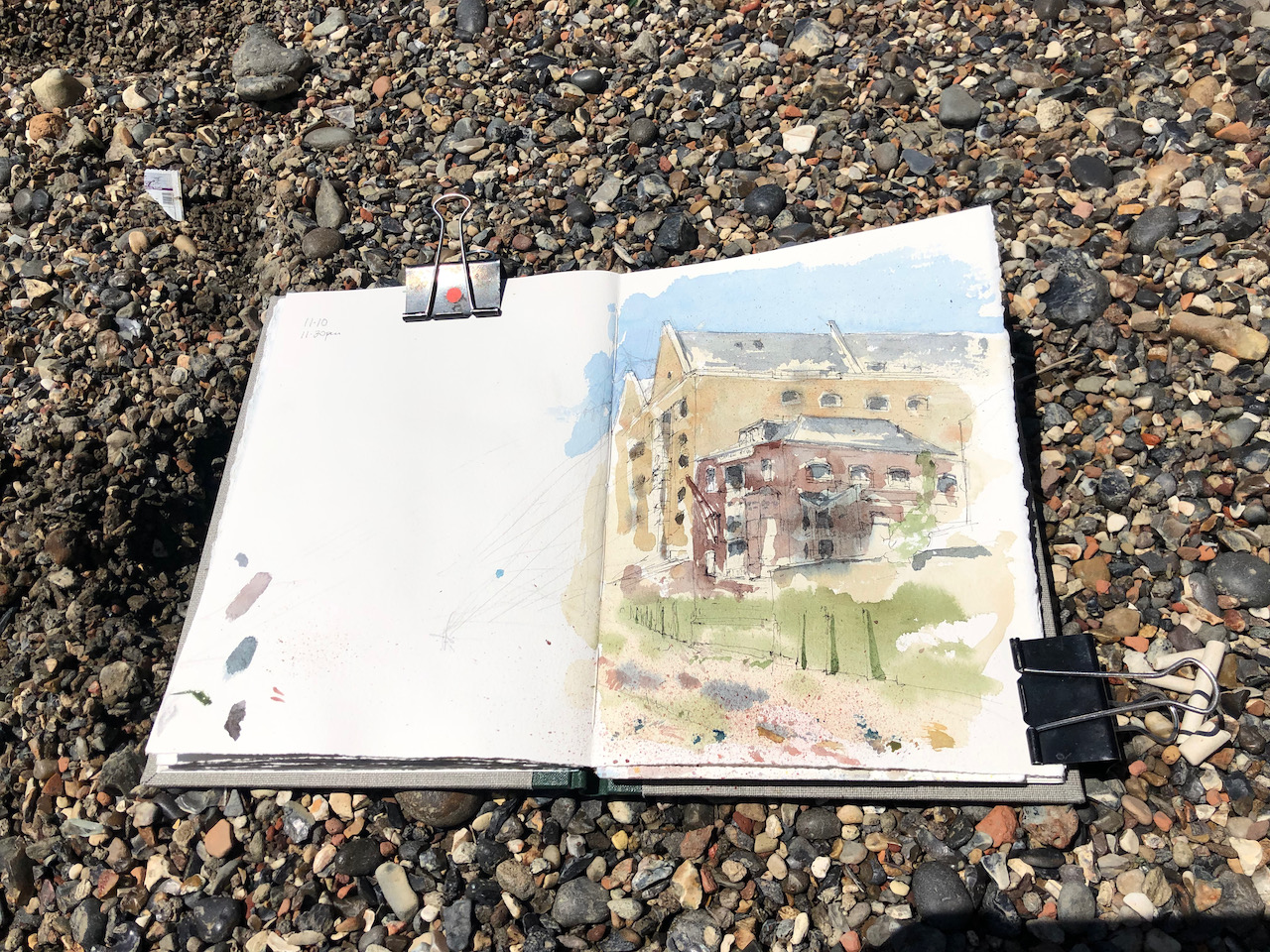
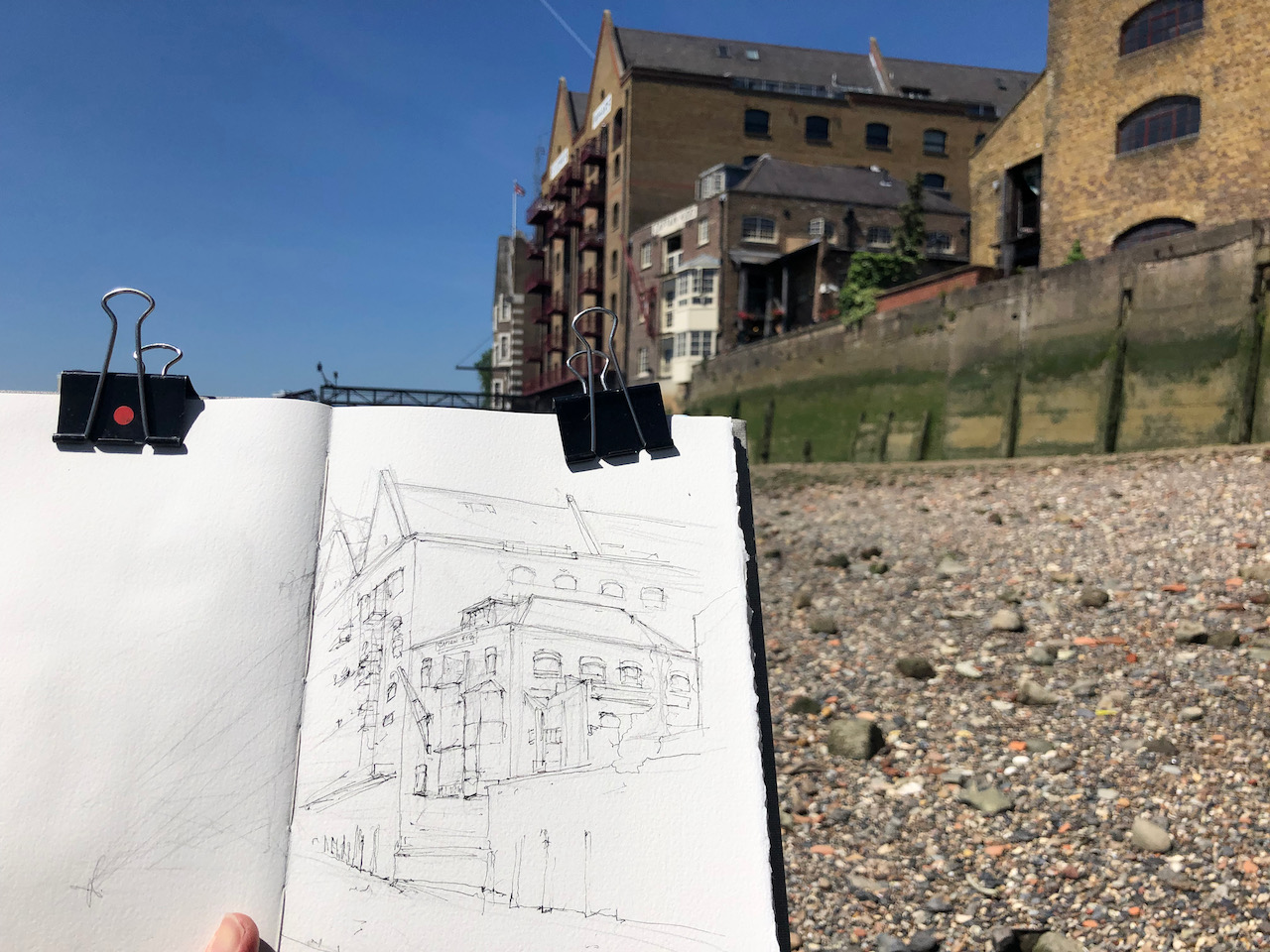
Here is work in progress on the drawing. See the wonderfully clean Thames foreshore.

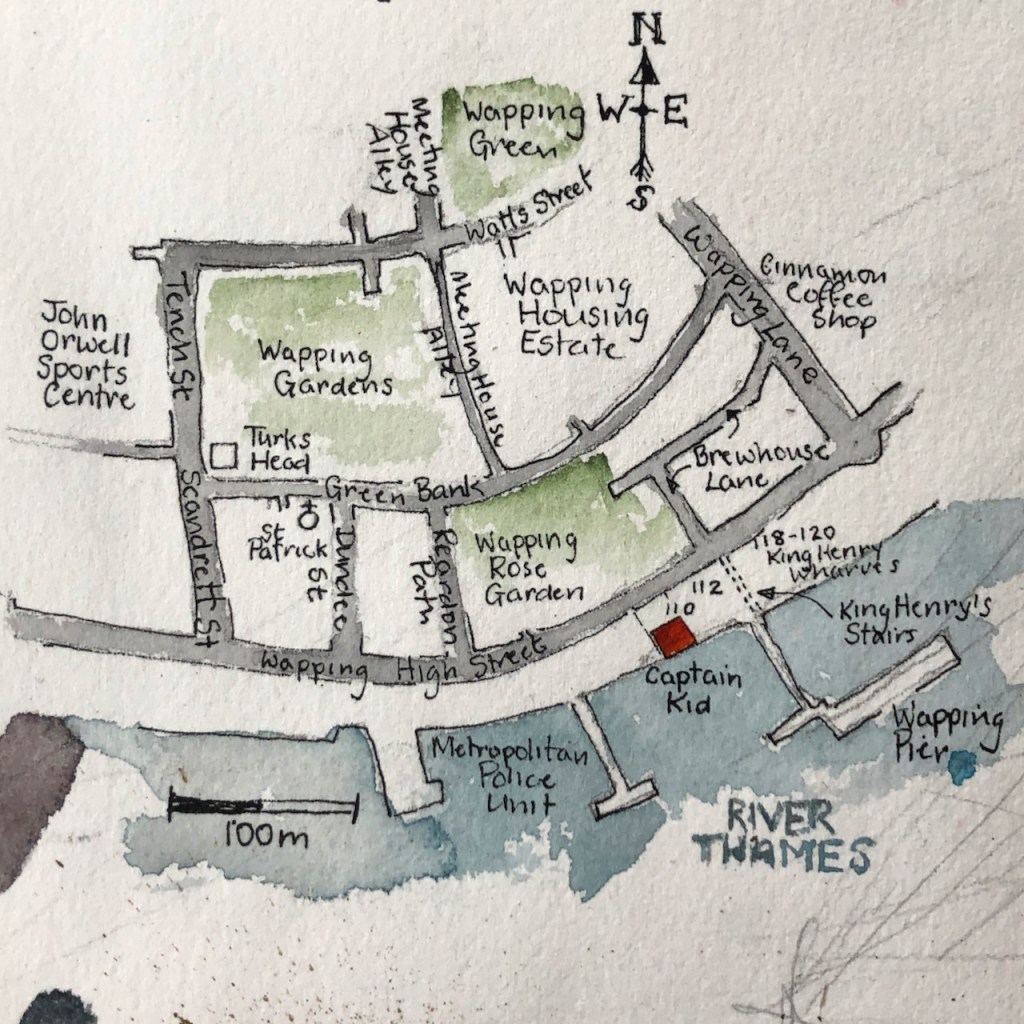
I drew my picture in the shade under Wapping pier. Here is a map:

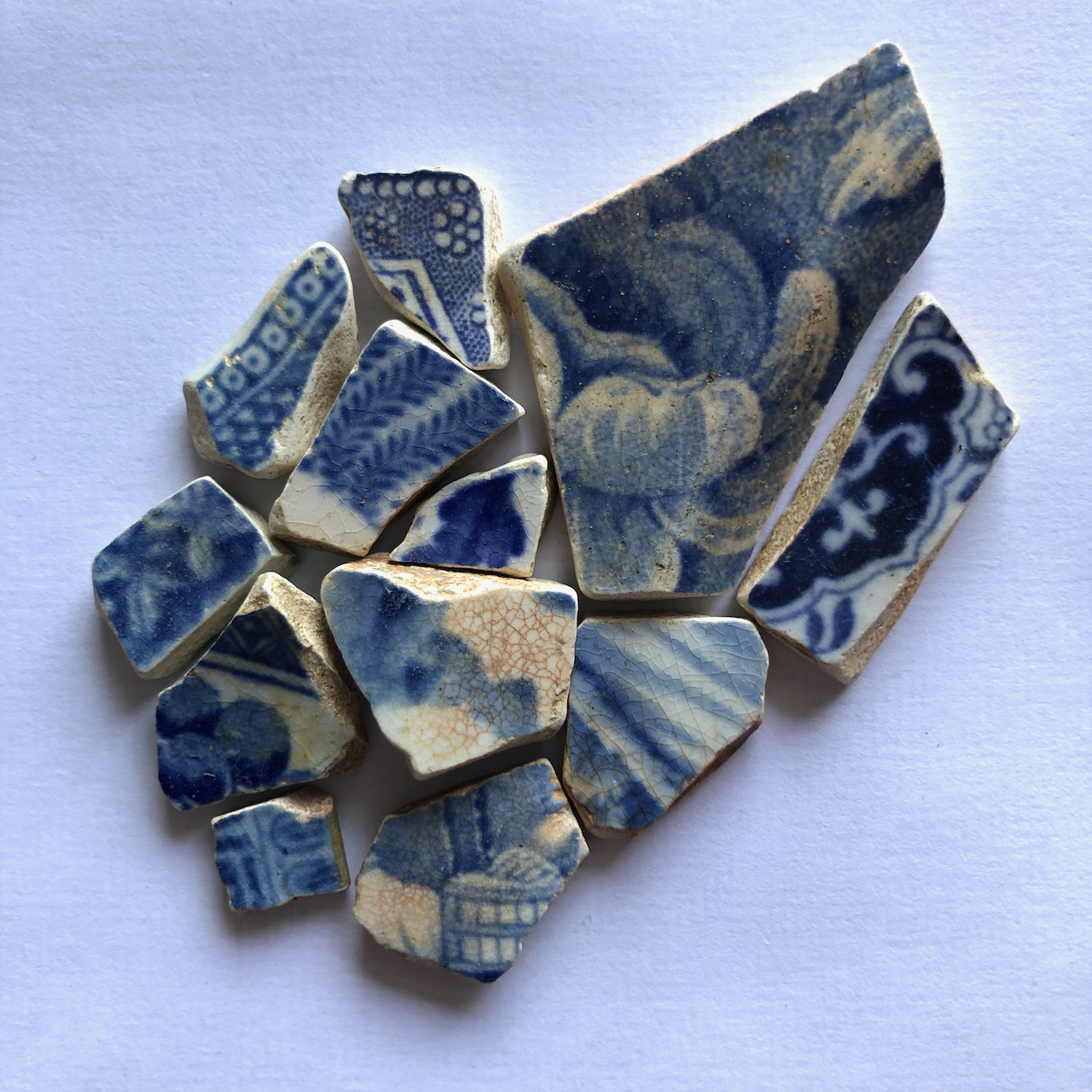
Walking back to the ladder, I collected a handful of porcelain pieces, blue and white. It was as though, years ago, someone threw a china bowl onto the foreshore, and the pieces somehow stayed in the same vicinity, through many tides. Or perhaps it is several bowls.

Note 1: There is a Wikipedia article on the River police: https://en.wikipedia.org/wiki/Thames_River_Police

Note 2. The London Inheritance article is here:

Turk’s Head Wapping E1, from the park

On Monday I cycled out East to the Turk’s Head for breakfast. With a coffee and croissant, in front of me, I sketched the view.

The Turk’s Head Wapping E1, from the park. 09:30am, 14 June 2021. 7″ x 10″ in Sketchbook 10

The Turk’s Head is the building on the right. The church in the picture is the former St John’s Wapping, now converted into flats.

The Turk’s head describes itself on its website:

“La Tète De Turc or The Turks Head is a French – Anglais Bistro. We serve French and English Food. Et Voilà!”

It has tables indoors, and outdoors under cover, and also in the adjacent park. I was outdoors in the park.

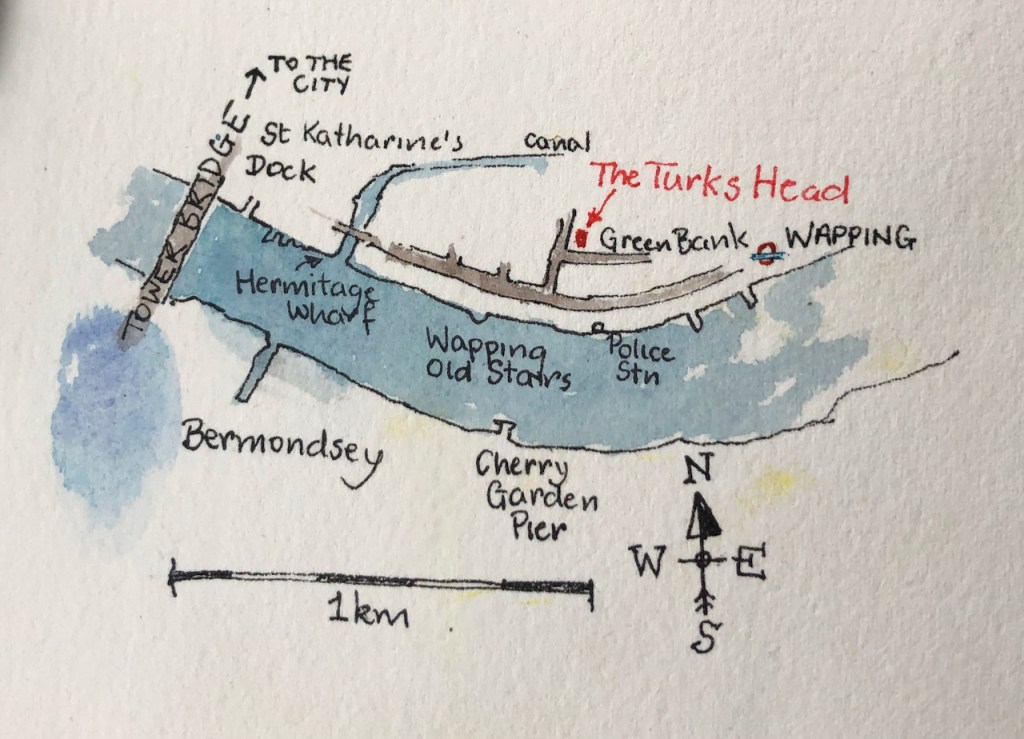
Here is a map showing where it is:

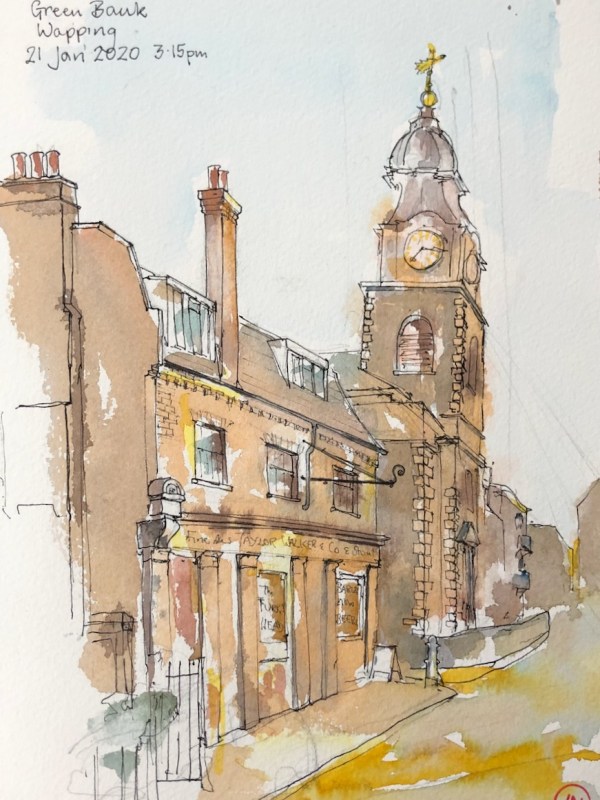
I have sketched the Turks Head before, in January 2020:

Turks Head Café Wapping

Here is the marvellous Turks Head Café, Wapping, rescued from demolition by local residents in the 1980s. Inside, I found warmth, quiet tables, and the gentle murmur of conversations: people actually talking to each other. I felt welcome here. The food was marvellous. Next time I’m going to have the Blueberry Tart. I only noticed it after I’d already had the substantial Chicken and Avocado Sandwich.…

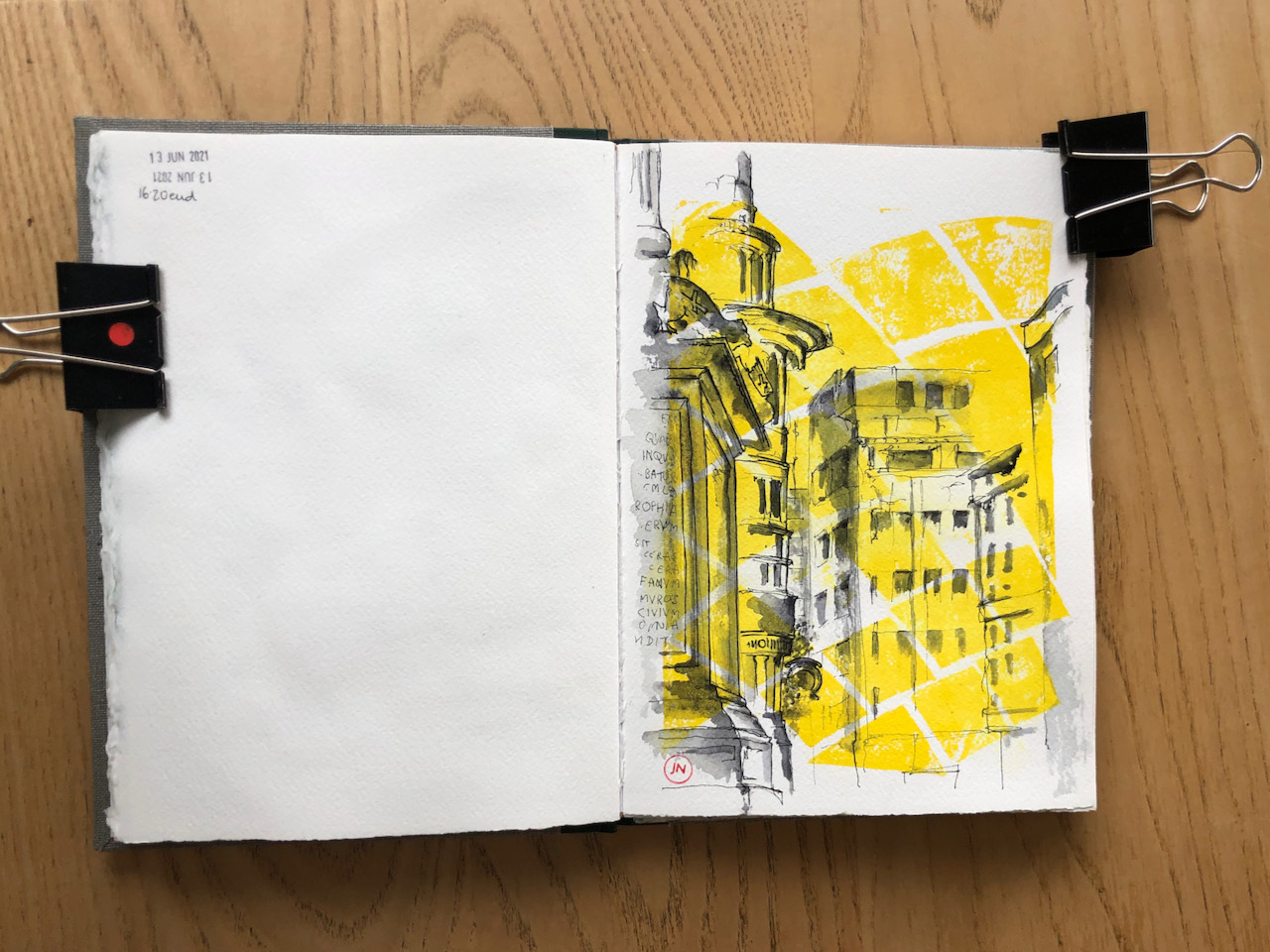
Monument EC3, on a hot day

Le Pain Quotidien at Monument was open on Sunday. I found a table in the shade and sketched.

Back at home I added tone and an experimental print background. What do you think?

Drawing: waterproof ink and watercolour Neutral Tint.

Print: Plate made from cut cardboard. Printed using Schmincke relief ink: “Aqua Linodruck #19210 permanent yellow”. Printed directly into the sketchbook.

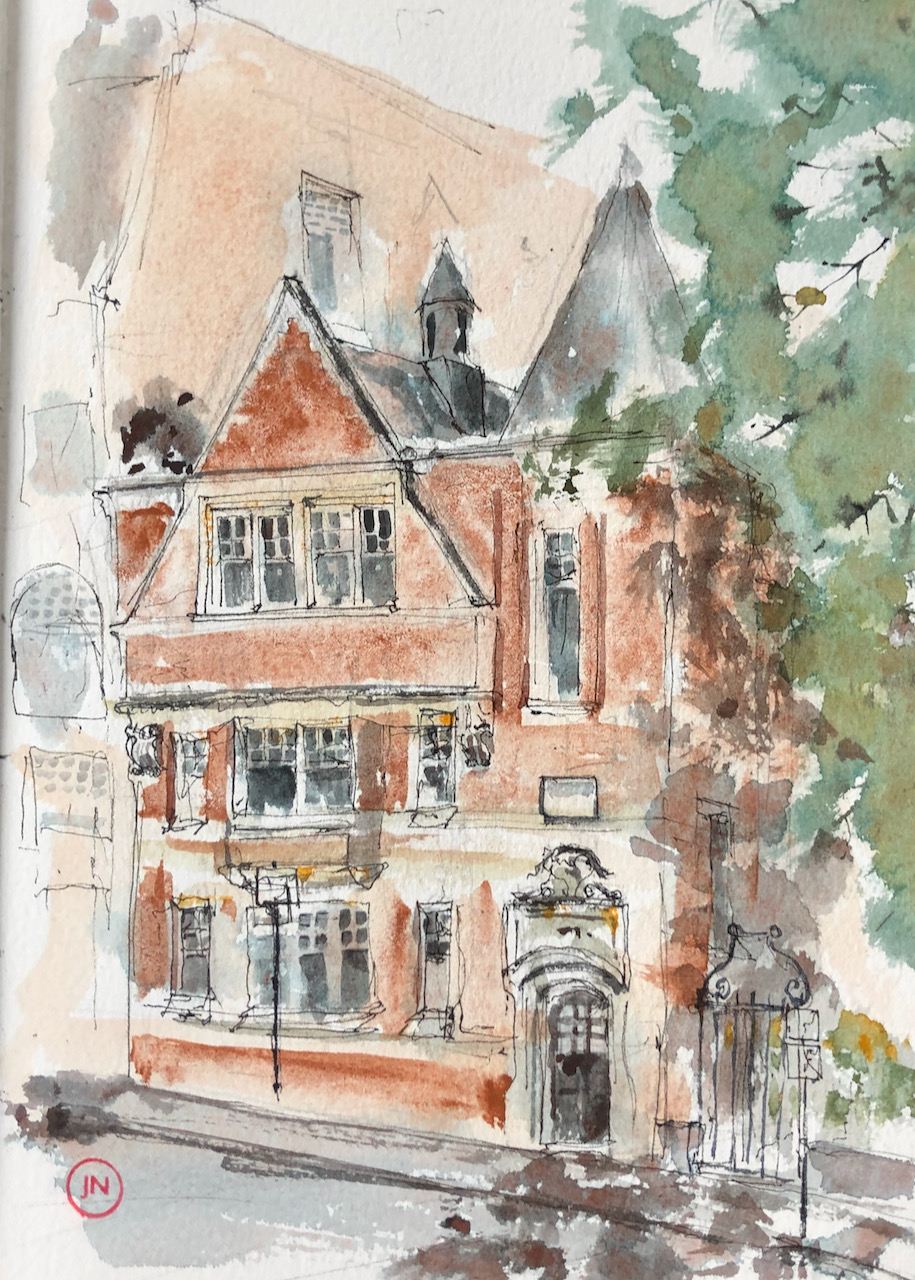
Vestry House EC4

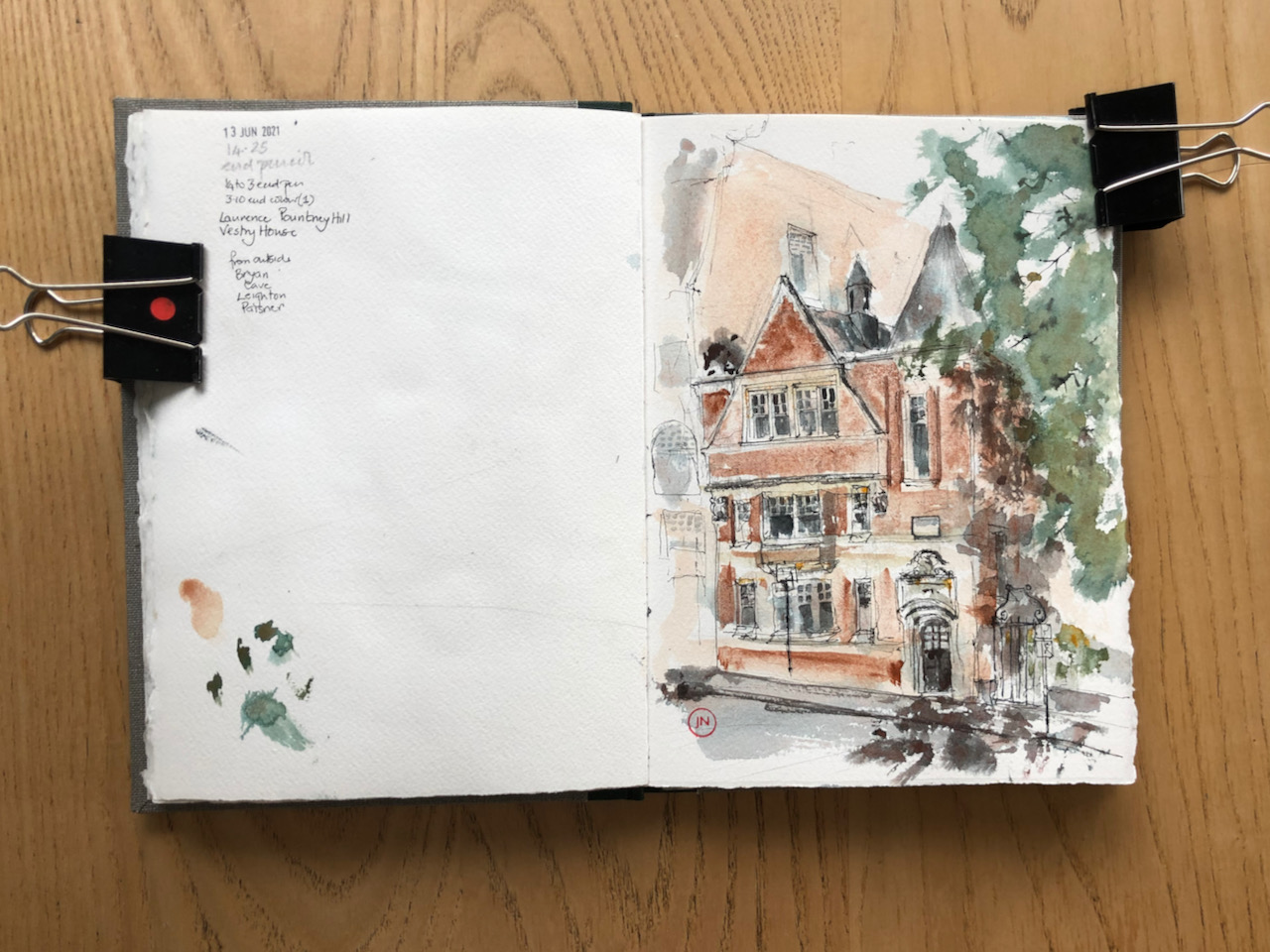
I walked in the back lanes between Cannon Street and Monument. Here is Vestry House on Laurence Pountney Hill EC4.

Vestry House EC4, sketched 13 June 2021, 15:10, 10″ x 7″ in Sketchbook 10

It is Grade II listed, listed in 1977. The listing says:

Late C19, red brick and stone. Stone doorcase with elaborate overdoor and pediment bearing the initials SP over panel of foliage inscribed Vestry House. 1st floor oriel window with big triangular gable over, projecting on scrolled consoles; 2nd floor windows in gable. Octagonal corner stair turret with pointed roof.

There is a blue tile further East along Laurence Pountney Hill. It reads:

Site of Laurence Pountney Church and Corpus Christi College.
Destroyed in the Great Fire 1666

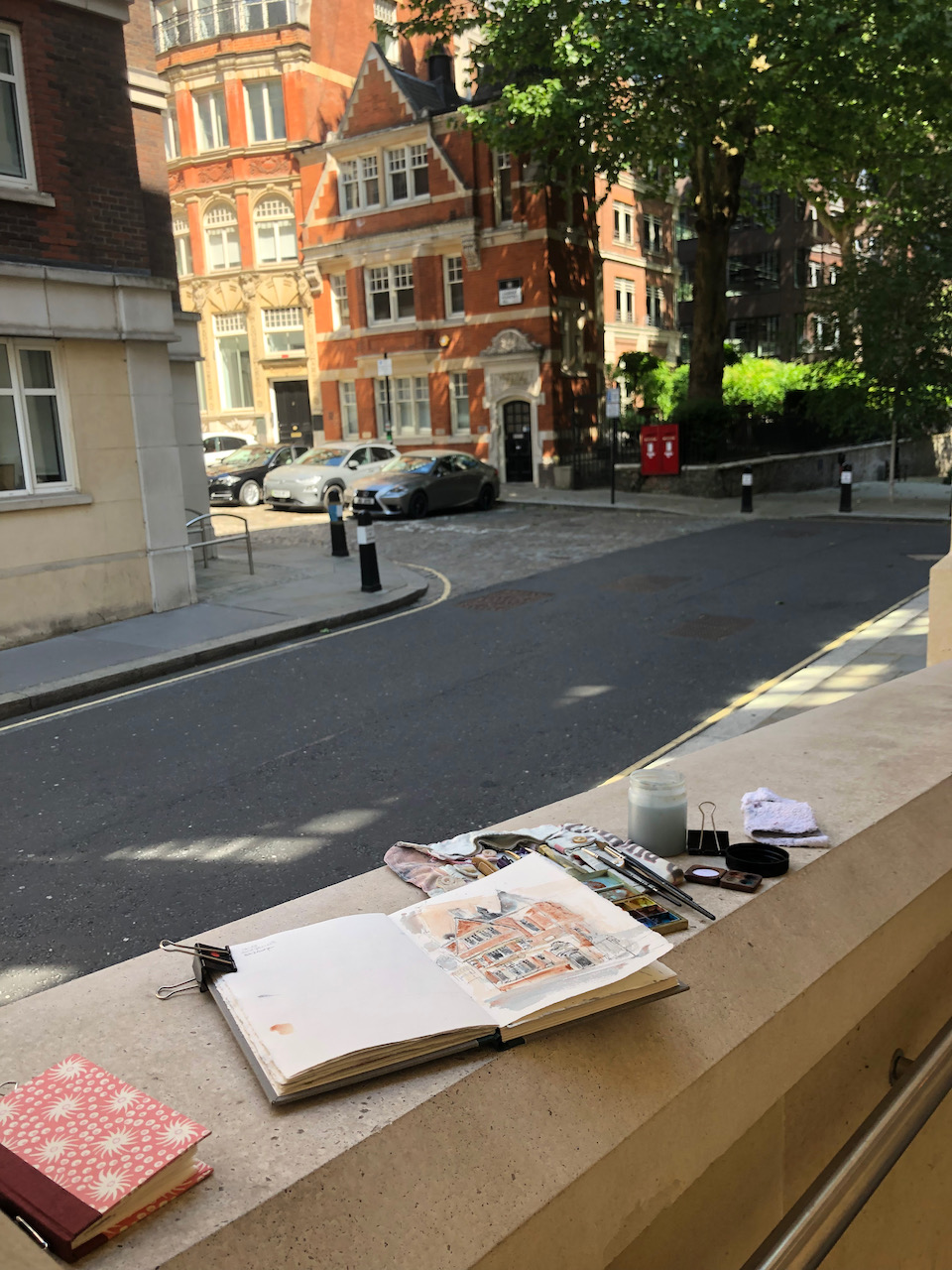
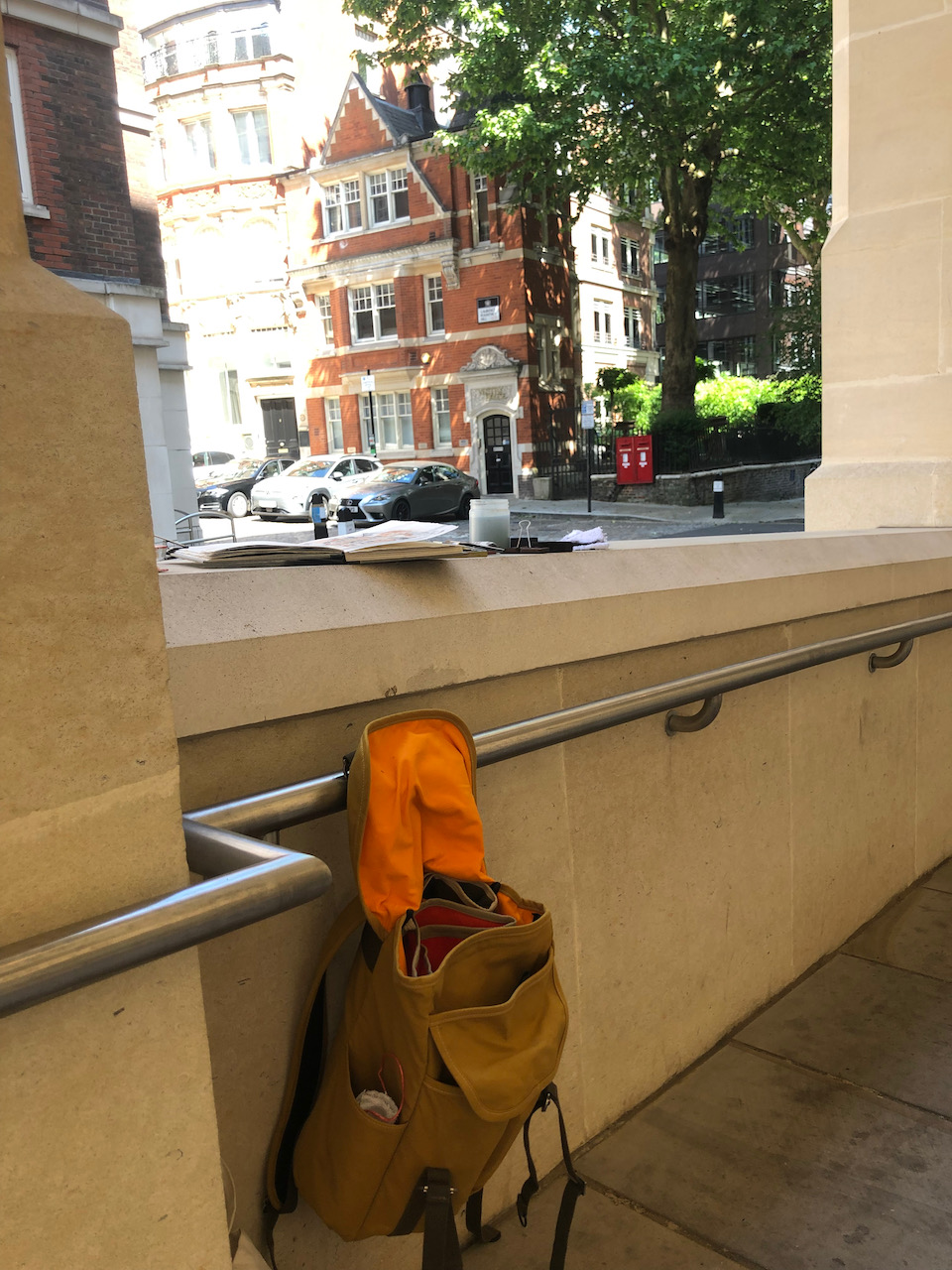
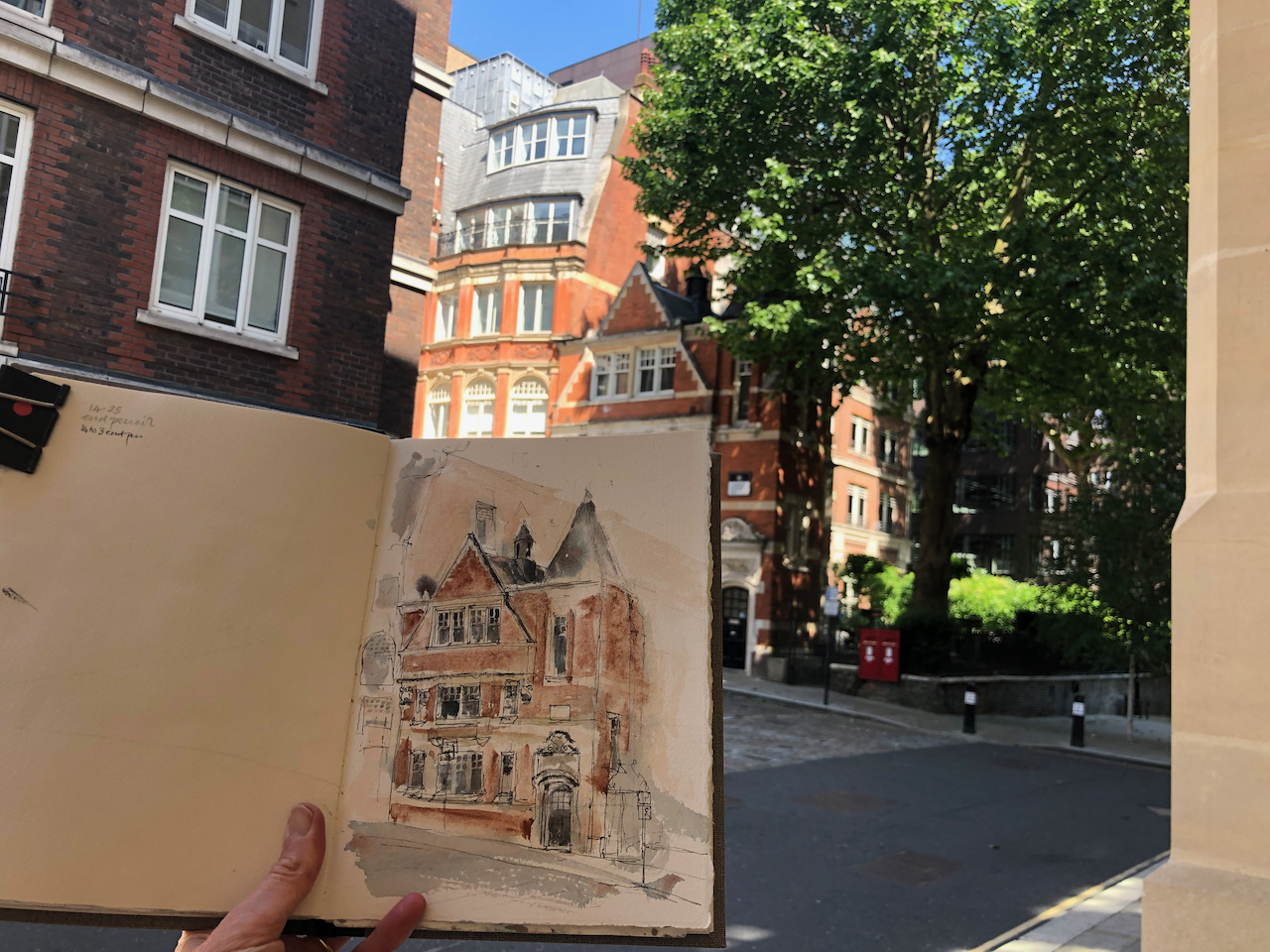
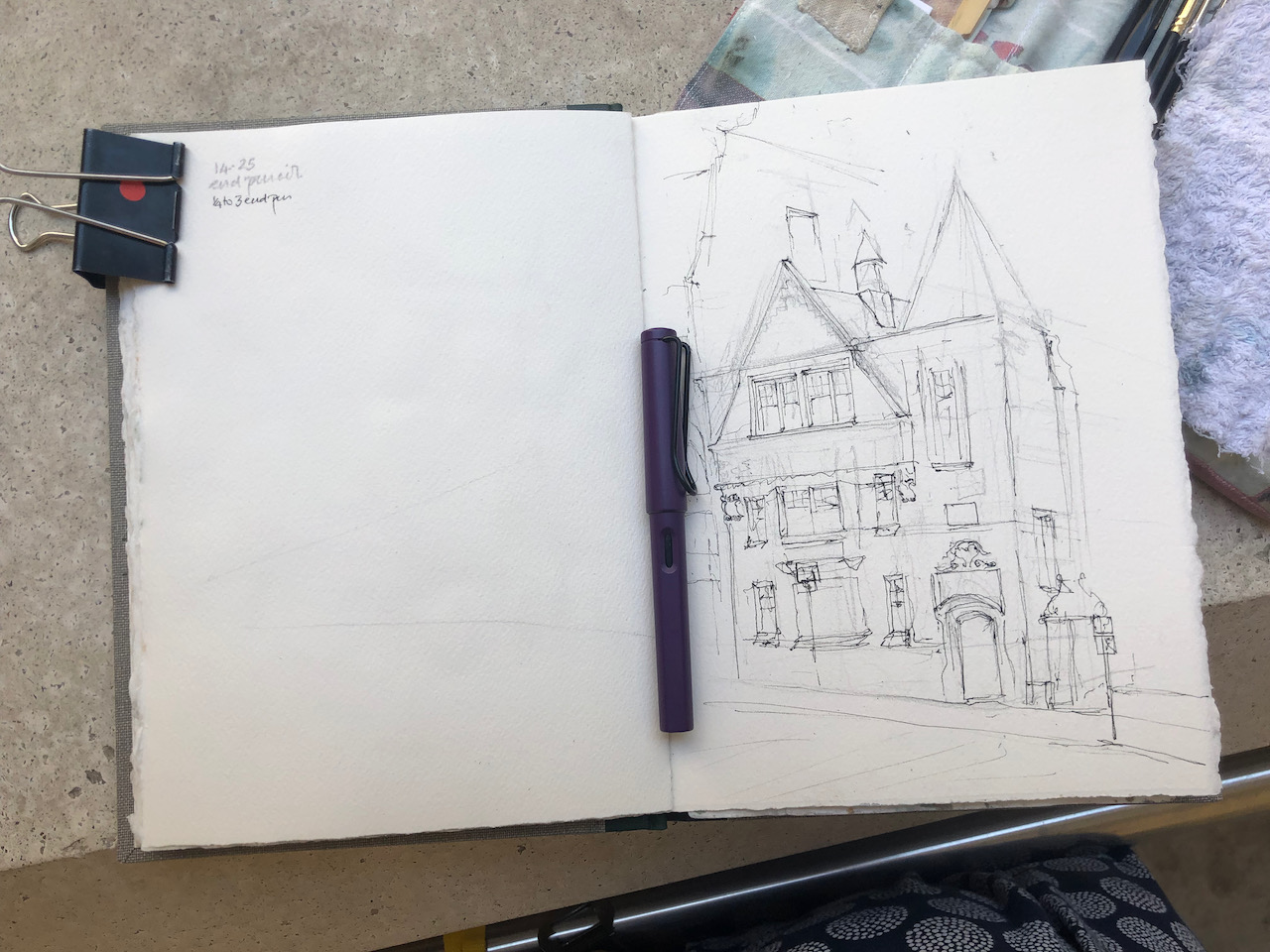
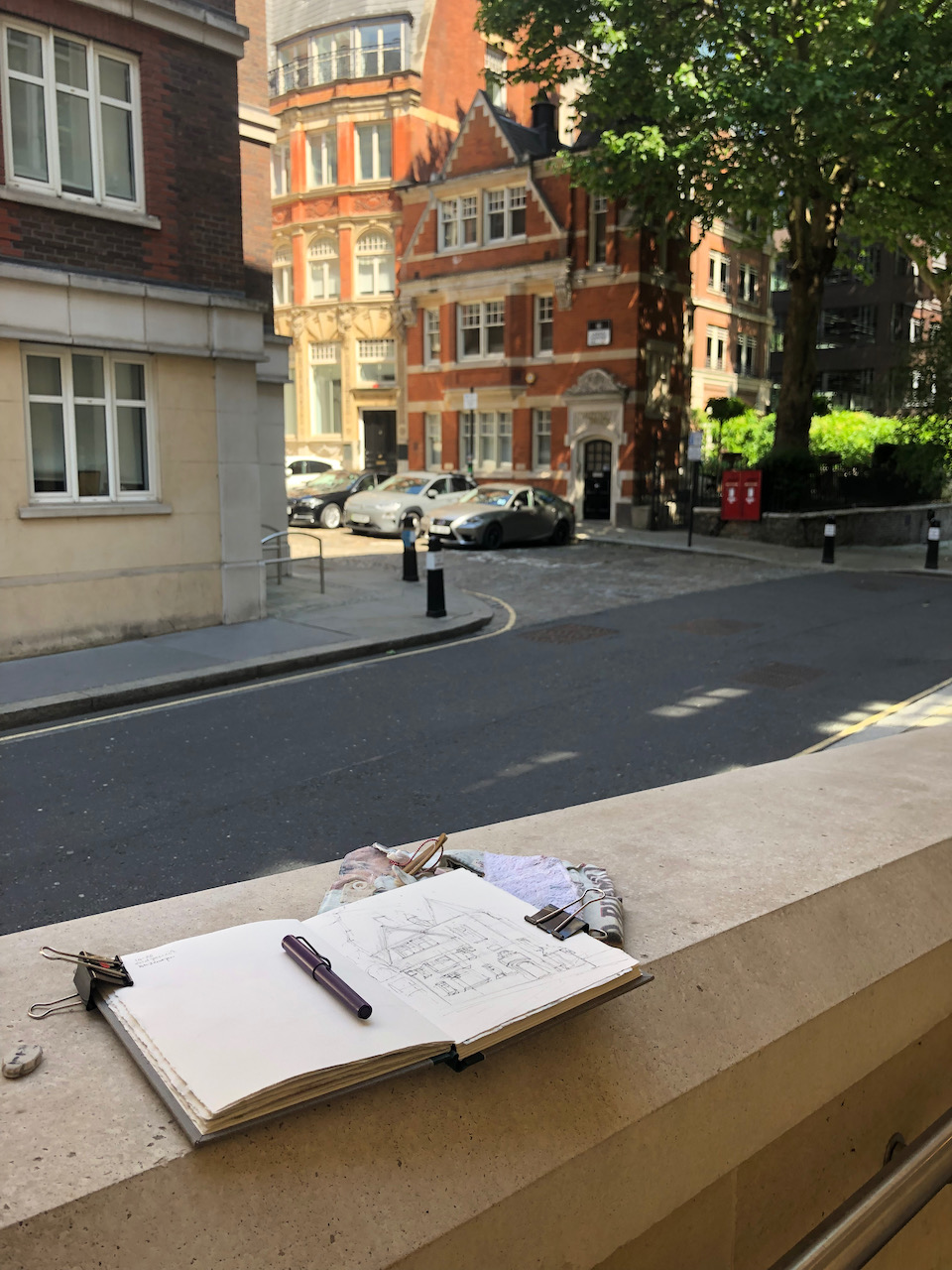
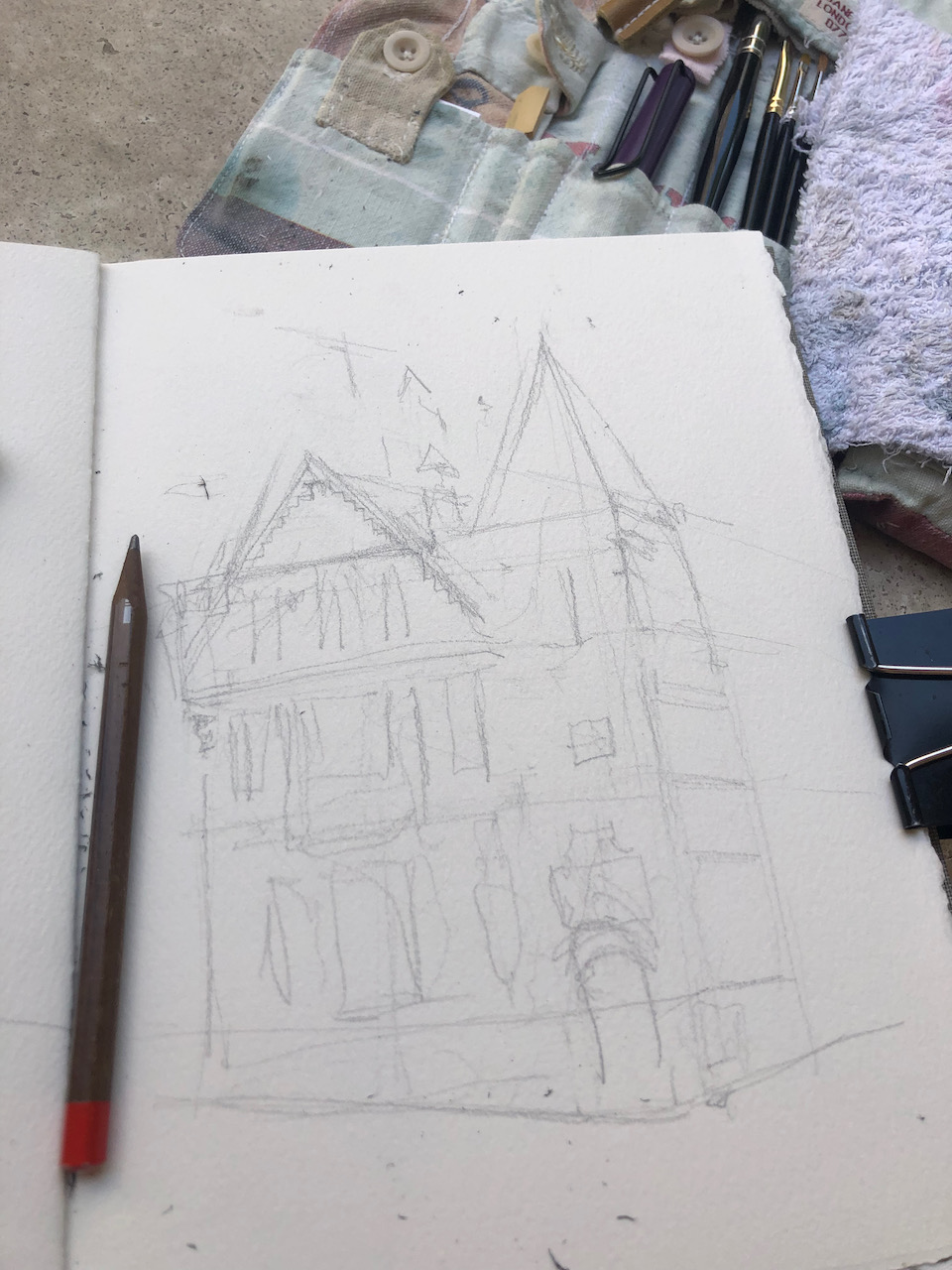
I sketched from a raised walkway on a modern office block opposite. Here are some work-in-progress photos.

I stood in front of the offices of

Bryan 
Cove 
Leighton 
Pilsner 

Their logo cleverly captures all these initials.

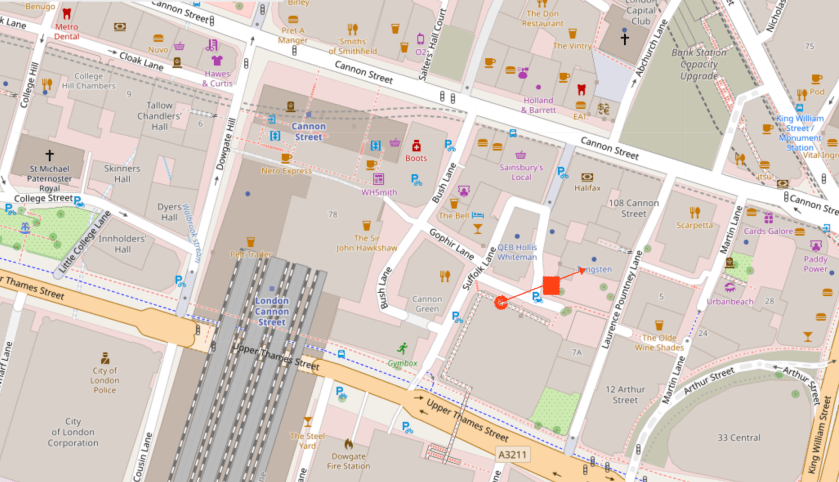
Here is a map showing the location of Laurence Pountney Hill. The red square is Vestry House, the arrow shows the sightline of the drawing.

The colours are Lunar Earth, Mars Yellow, Perylene Maroon. The grey is Perylene Maroon and Phthalo Blue Turquoise. The green is the same blue with Mars Yellow.

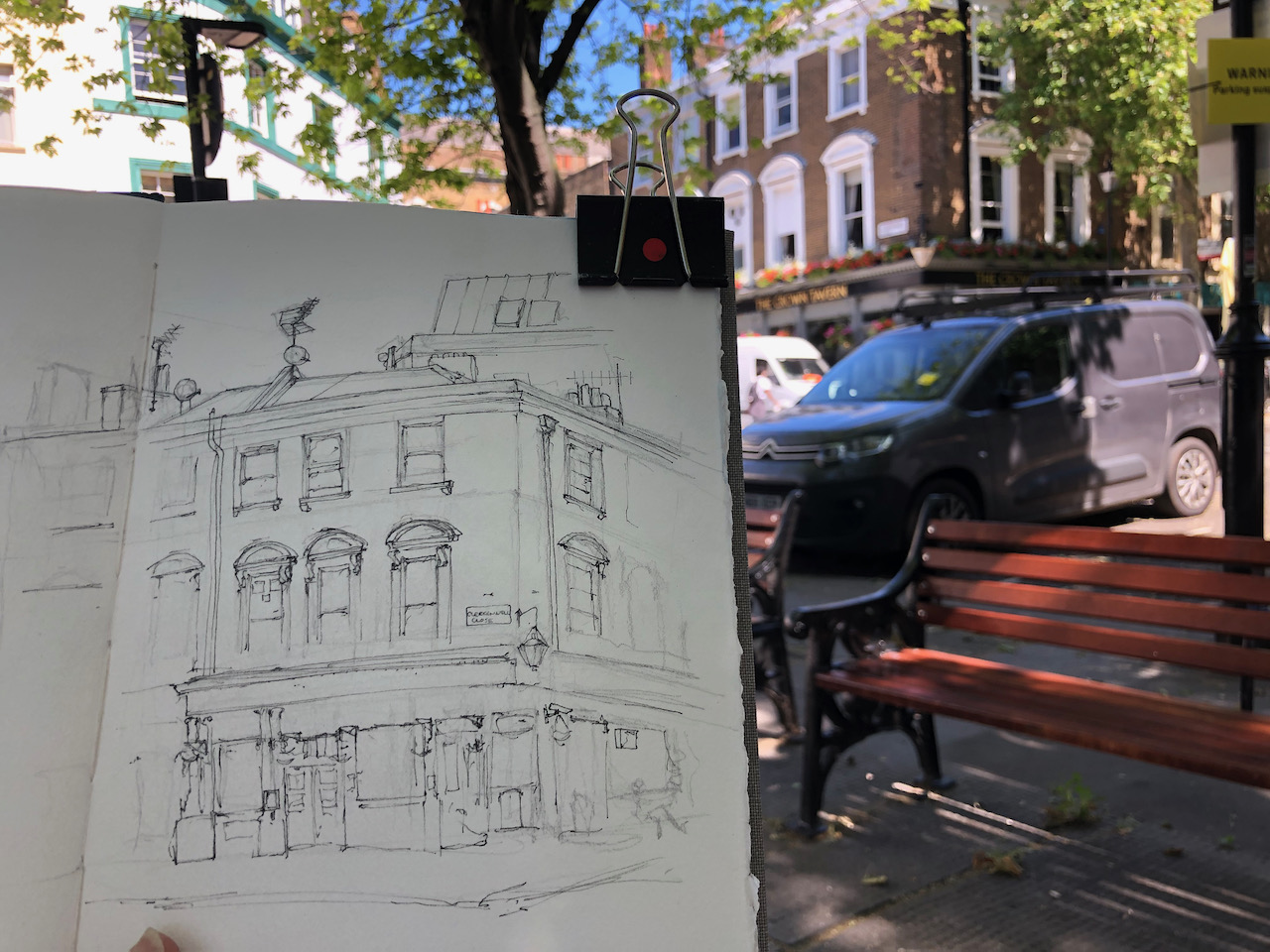
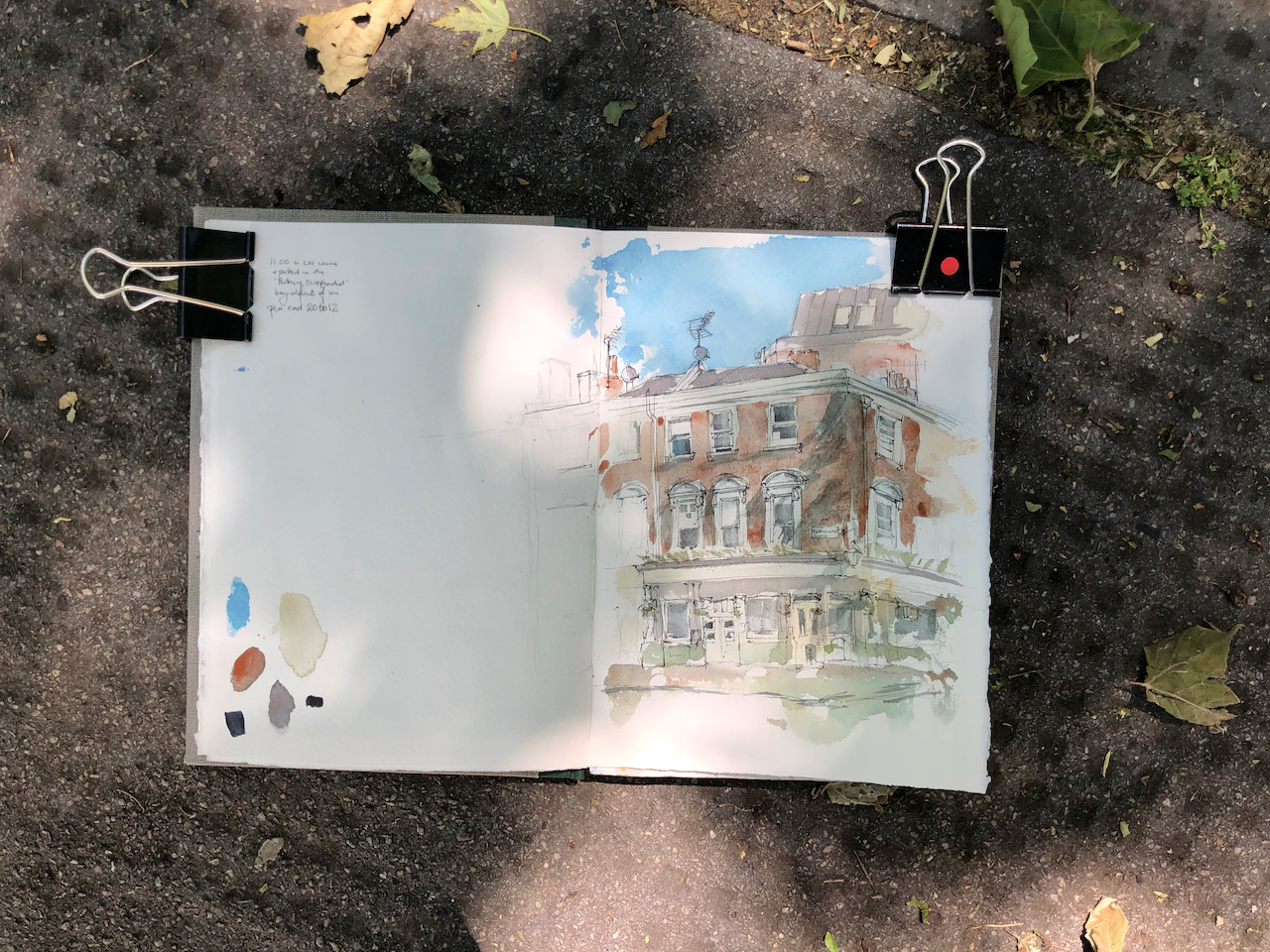
The Crown Tavern EC1

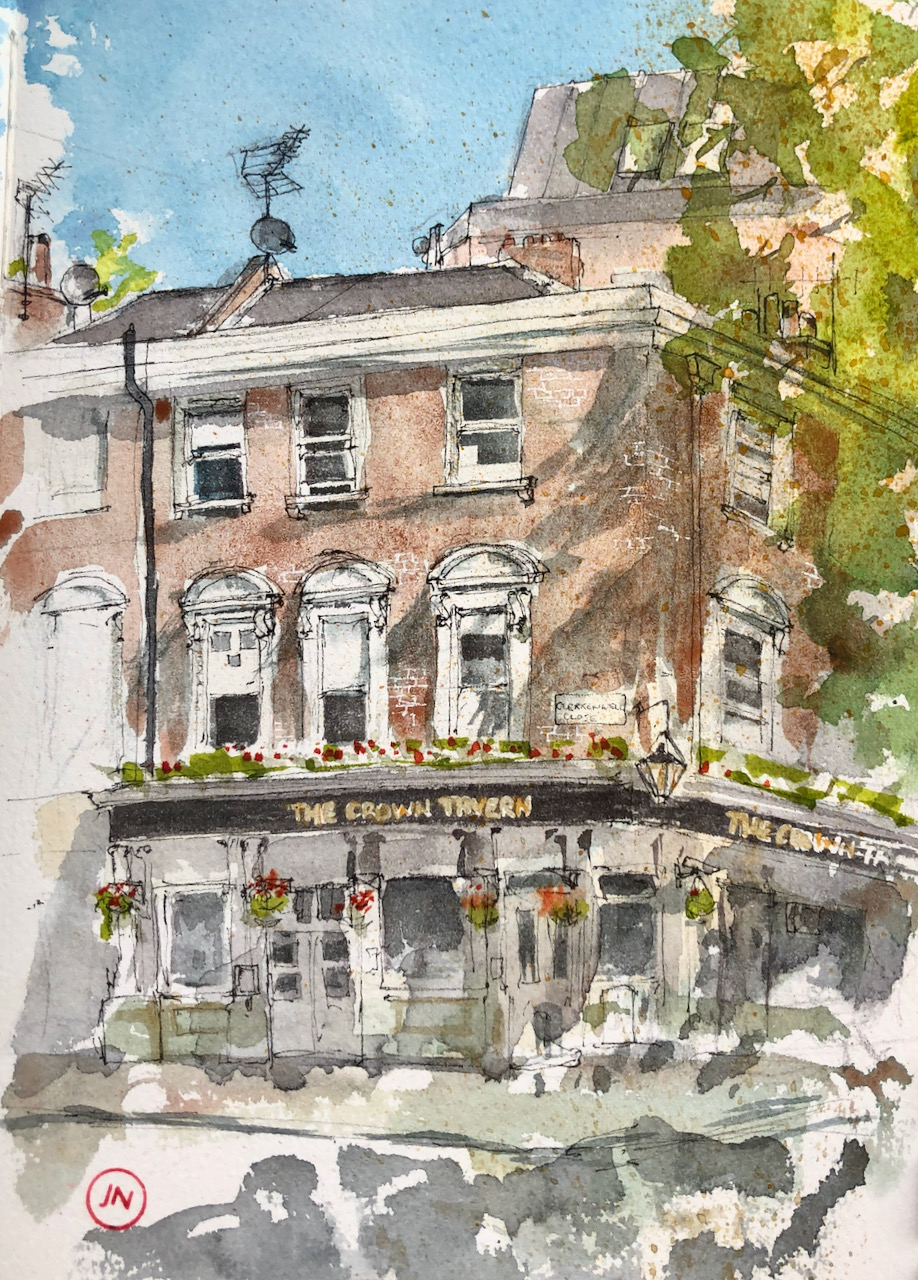
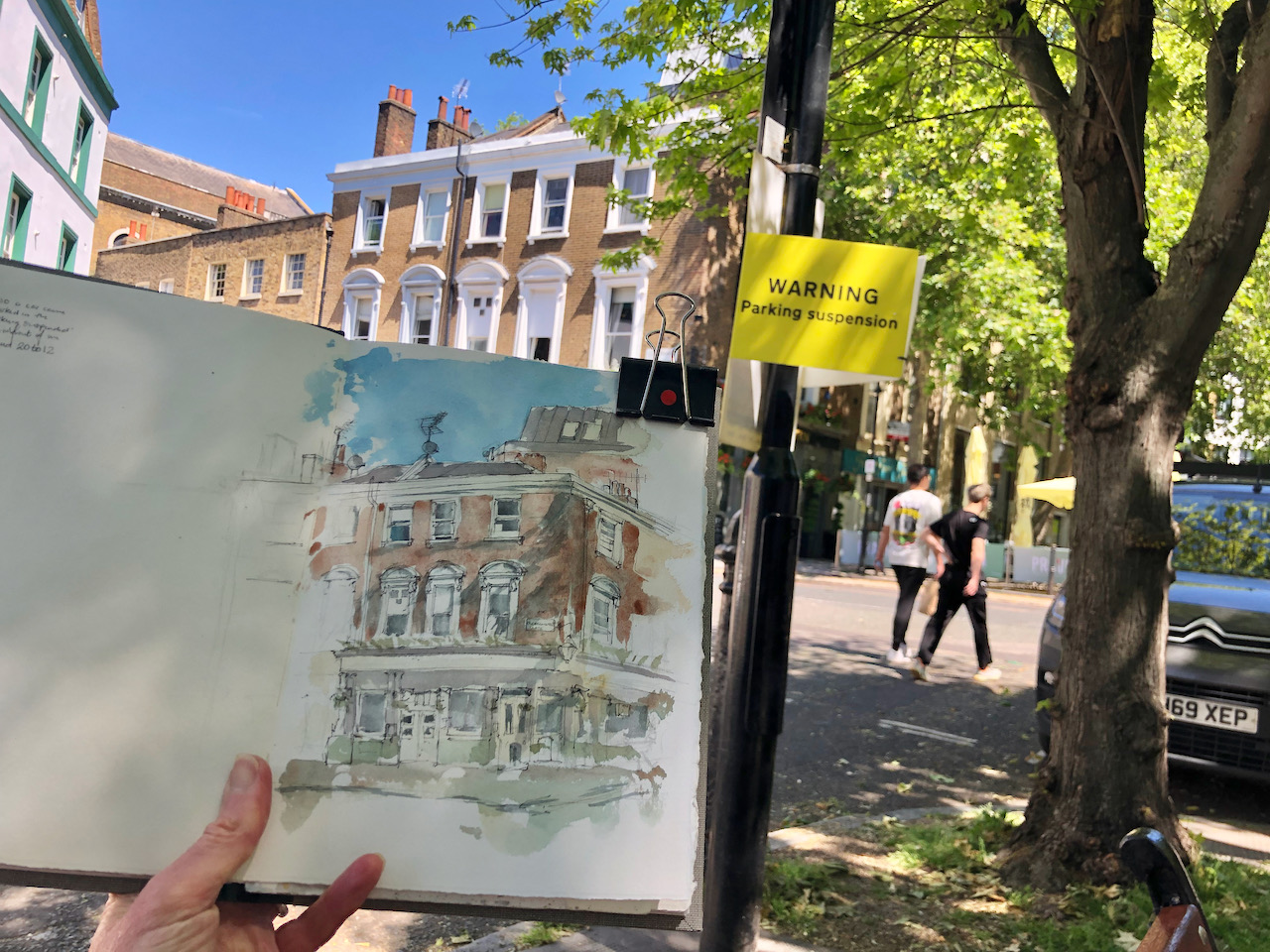
Here is The Crown Tavern in Clerkenwell Green.

The pub frontage dates from 1900, according to the historic buildings listing1. The building is Grade II listed. There has been a pub here for a lot longer than that, though. A Freemasons Meeting here is recorded in 17862

The Crown Tavern EC1, sketched 9th June 2021, 12 noon, 10″ x 8″ in Sketchbook 10.

I sketched the pub on a sunny Wednesday lunchtime. Building work was in progress on the site behind me. The cafés opposite were open and people were sitting outside.

I moved my position several times while sketching this. First I stood by a hoarding, where I had an unobstructed view and something to lean against. After 15 minutes a big car came and parked on the “Parking Suspended” bay in front of me. It was a mini-cab. It sat there, its engine idling. Will someone please explain to me why drivers leave their engines running while stationery? It was a beautiful pristine summer day. And now I had diesel fumes. I considered various courses of action, including abandoning the picture, remonstrating with the driver, or starting my picture again from the other side of the road. I did none of those things, but moved a few paces so to get fresher air and a better view of the top of the building. 15 minutes later, the mini-cab circled round Clerkenwell Green, and came to rest in a new place. I think they were avoiding the traffic warden, who had appeared on a bicycle.

I continued my drawing standing up and then moved to a nearby bench which did not have such a good view, but where I could do my watercolours a lot more easily.

The pub itself was dark and silent until suddenly, at 12 noon exactly, the lights came on and a person emerged and placed the menu board outside.

“Taken fromSt Paul’s letter…”

Under the lamp a beautiful piece of signwriting reads, in gold:

” Taken from St Paul’s letter to the Hebrews Chapter 13 Verse 2″.

I could find no indication of what had been “taken from St Paul’s letter to the Hebrews”. So back in my office I looked it up. Verse 2 reads:

“Forget not to shew love unto strangers: for thereby some have entertained angels unawares”

This is my old school Bible “being the version set forth AD1611 compared with the most ancient authorities and revised”. Online, the New International Version gives “Do not forget to show hospitality to strangers, for by so doing some people have shown hospitality to angels without knowing it.”, which sorts out the double negatives a little better. But the thought that we might have ” … entertained angels unawares” is so succinct and entrancing that it stays in my mind as a beautiful image.

I finished off the drawing at my desk. The pub name is done in “pebeo drawing gum”. This is a synthetic rubber resist solution. I painted the letters with the drawing gum using a fine brush, on the white paper. It takes about 15 min to dry. Then I painted the dark background. Then that has to dry. Then I can rub off the drawing gum to reveal the white letters. It’s like magic.

The colours are, for the main picture: Phthalo Blue Turquoise, Fired Gold Ochre, Perylene Maroon, Mars Yellow, Lunar Earth. Lunar Earth is a strange granulating colour, it dries to a mosaic-like finish, which you can see in the brickwork of the pub.

I added highlights in Green Gold, Permanent Yellow Deep, and Transparent Pyrrol Orange. The pub lettering has some Iridescent Gold.

Here’s a map:

Sketch map showing the sightline of the drawing.

If you have been reading the Robert Galbraith/JK Rowling novel “Troubled Blood” then you will recognise these street names. The novel is wonderfully accurate in its geography.

I have drawn some other pubs and restaurants in this area:

Notes and references:

  1. The Crown Tavern Grade II listing is here: https://historicengland.org.uk/listing/the-list/list-entry/1195546
  2. Freemasons meeting is recorded in “Lane’s Masonic Records” here: https://www.dhi.ac.uk/lane/record.php?ID=1034