The Inns of Court are an ancient area of London, around Fleet Street, close to the Royal Courts of Justice. It’s an area of narrow lanes and quiet courtyards. Lawyers’ practices are there.
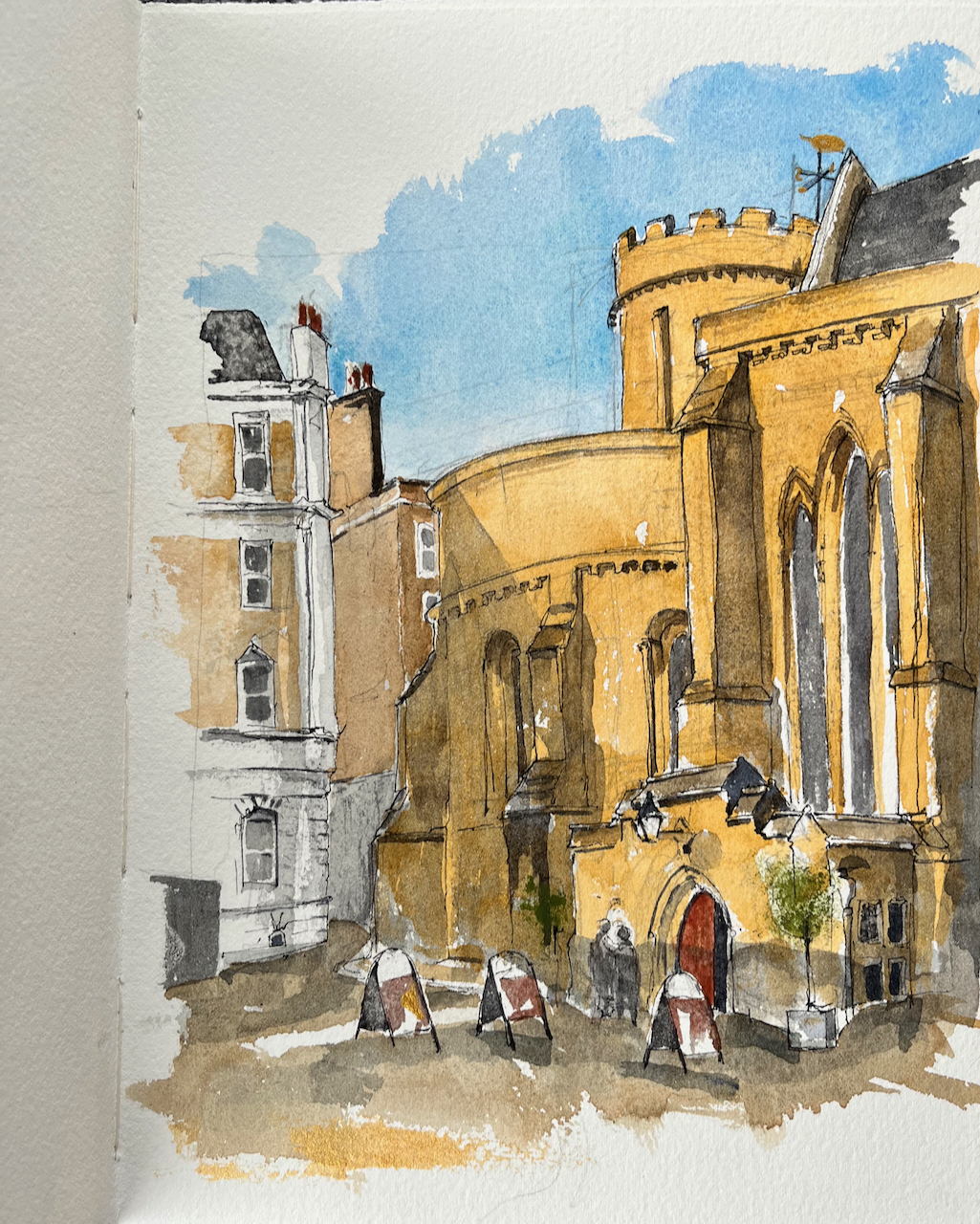
In amongst the buildings is this church, which opened on 10 February 1185.
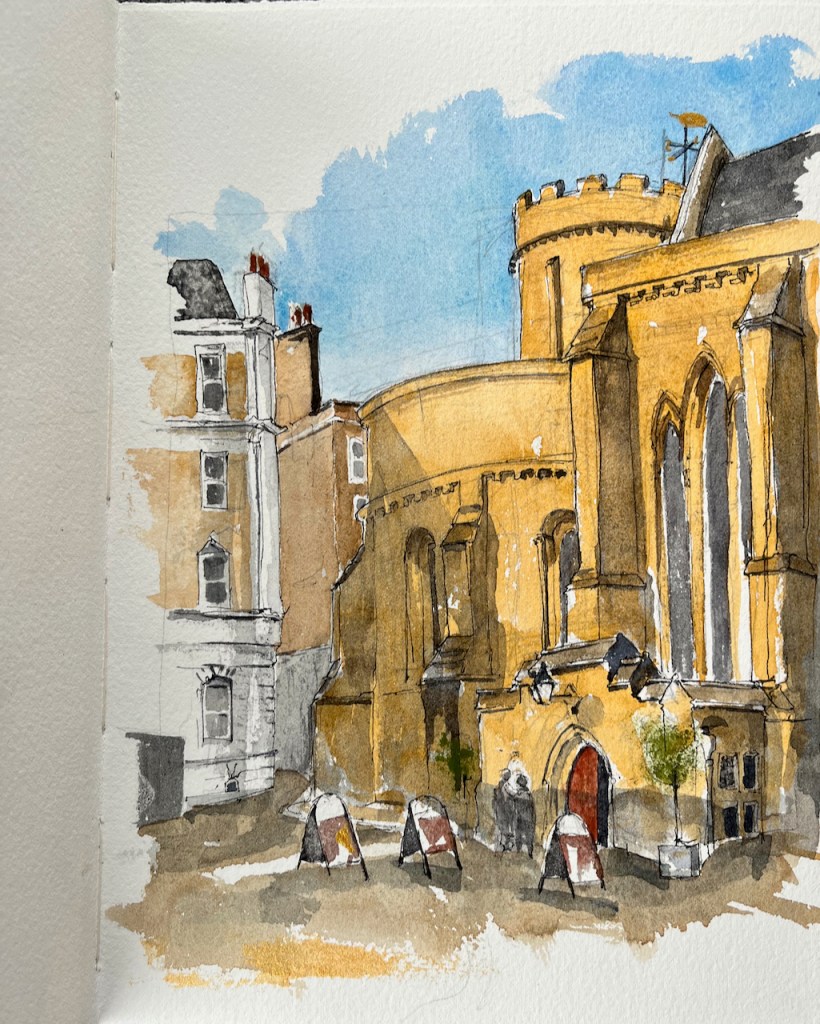
Temple Church, 14th February 2023, in sketchbook 13
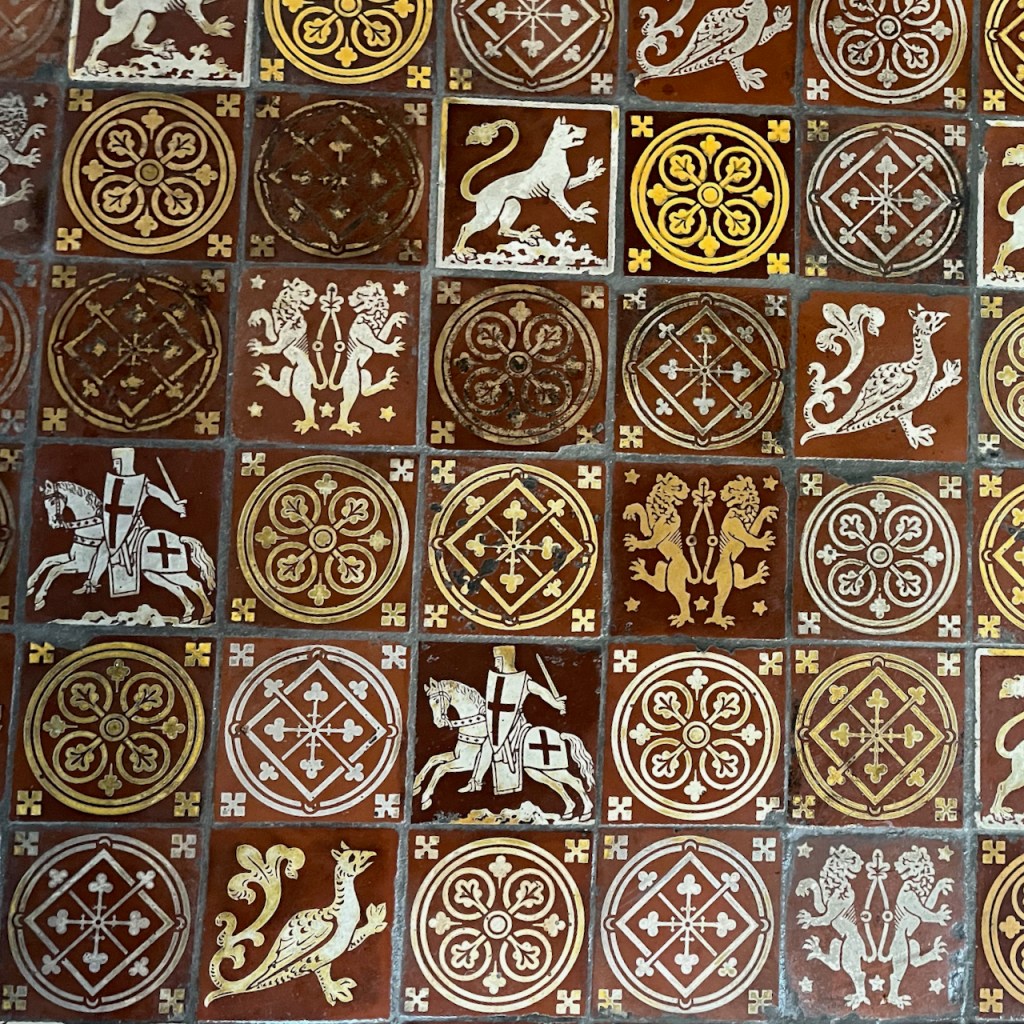
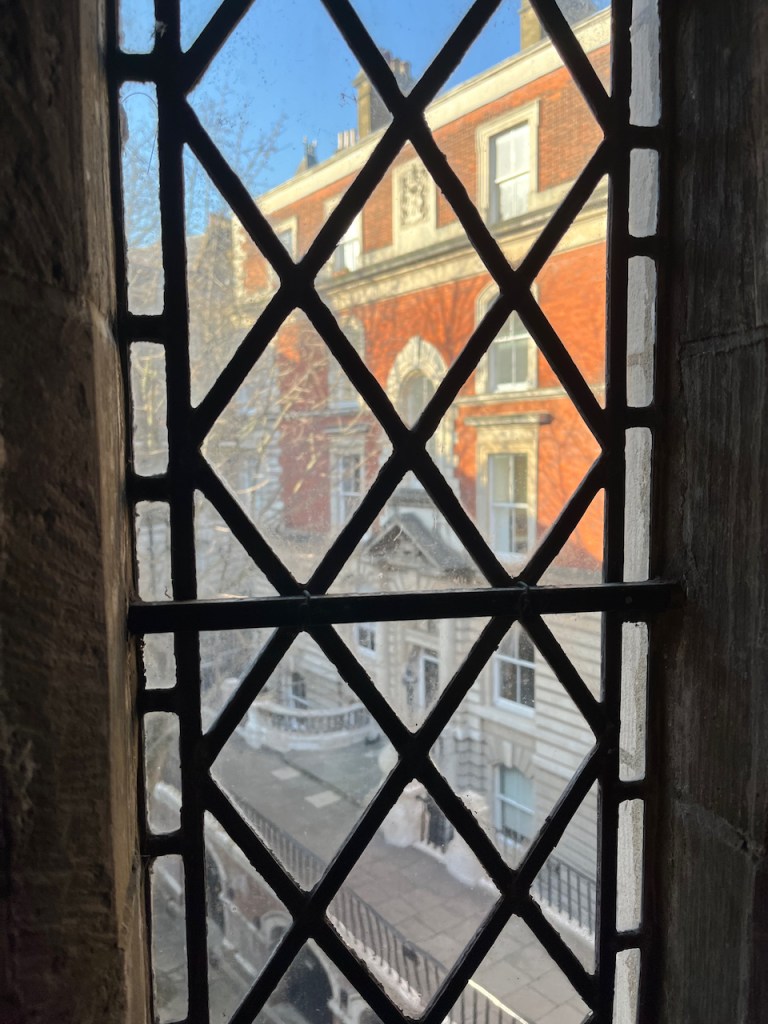
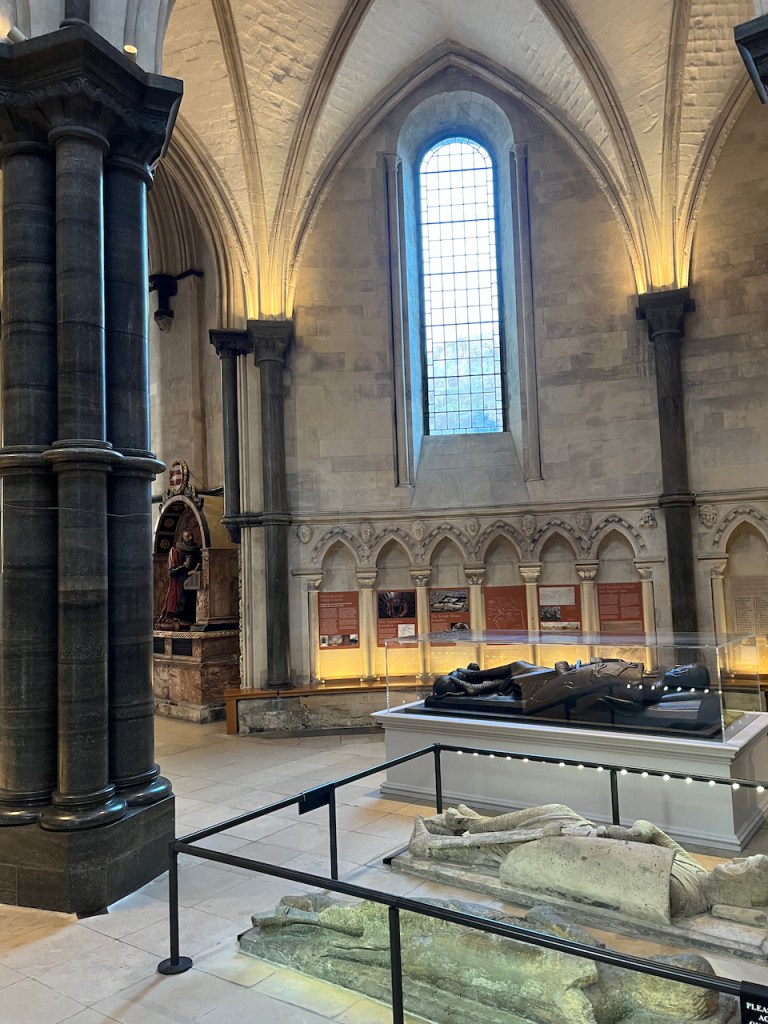
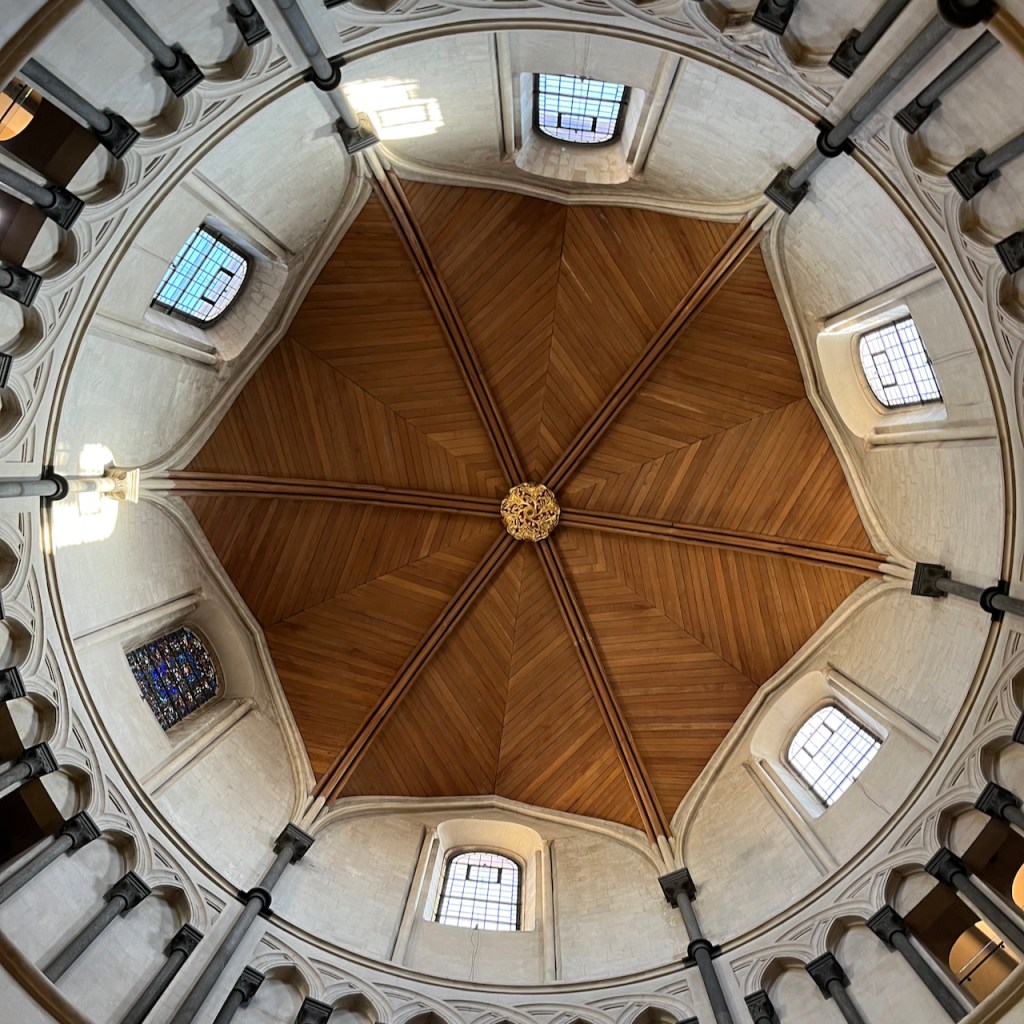
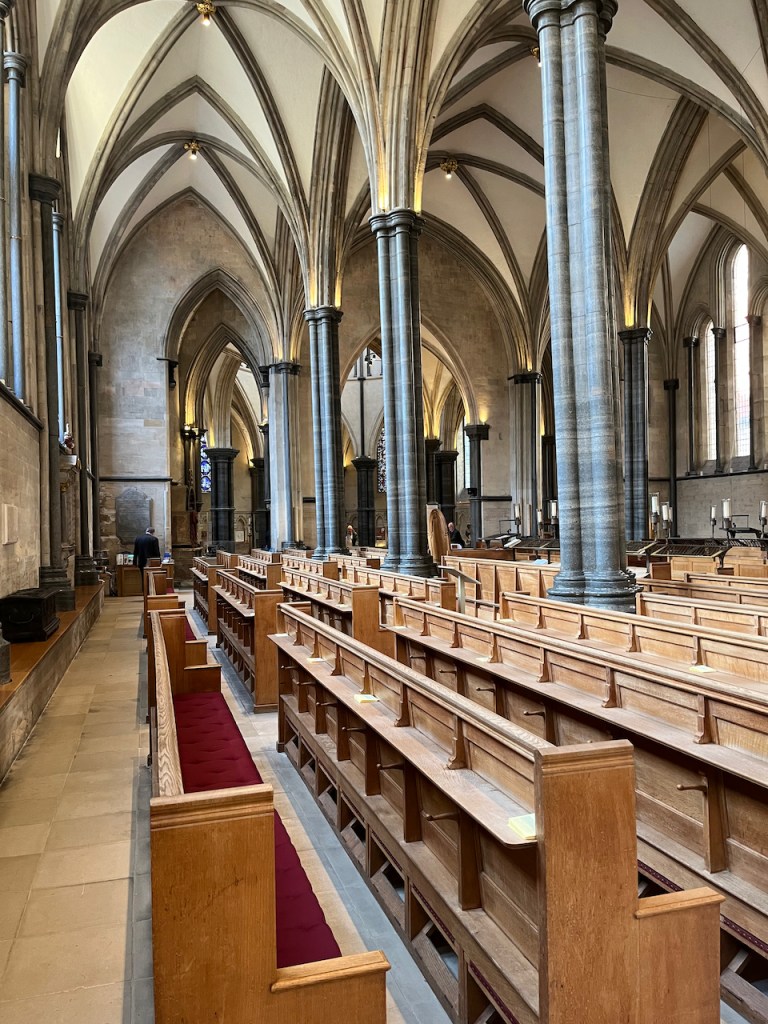
The church is open to visitors. I went in. It’s a splendid space, very calm, beautifully vaulted. You can even go up a narrow winding staircase inside the round structure I have drawn. Here are some photos of the inside.
Victorian tilesA view out over the buildings of TempleThis is a window in my drawing, now inside looking out.Looking up towards the roof A calm space
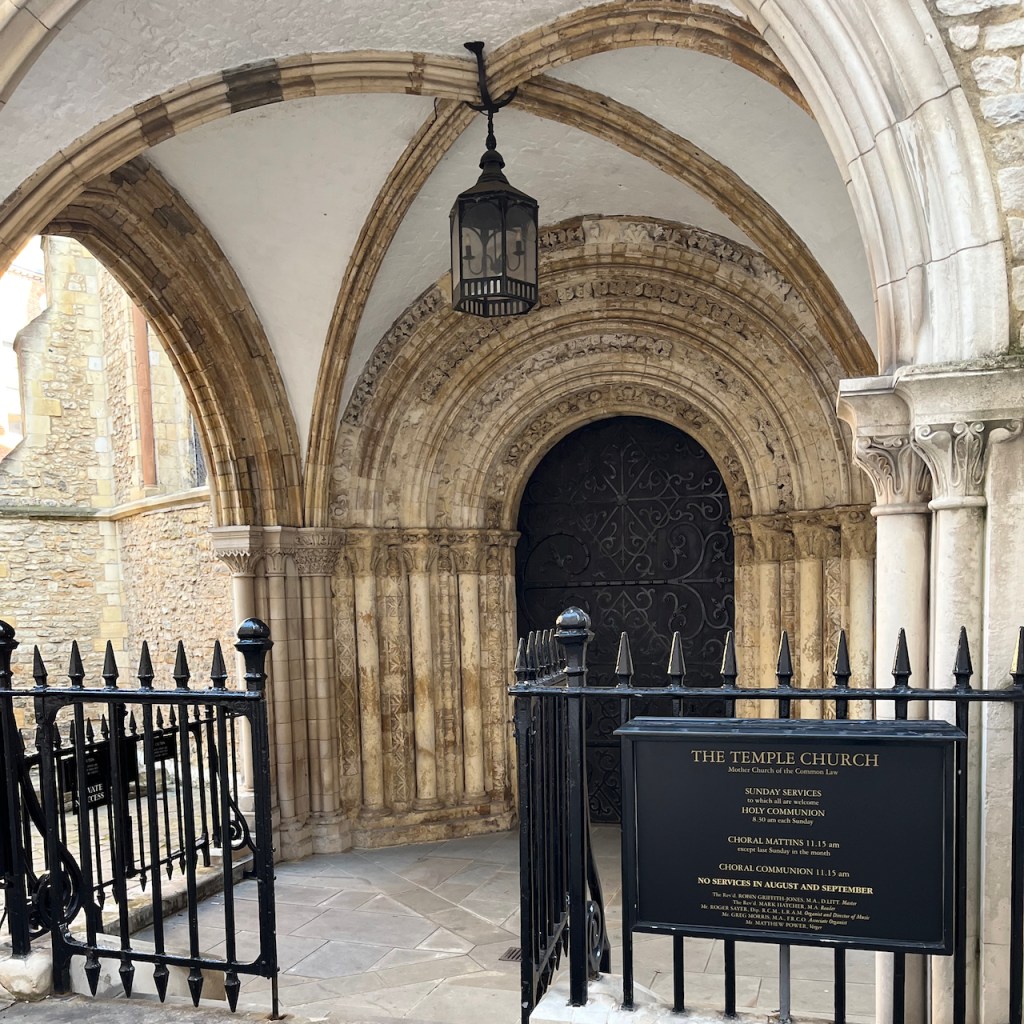
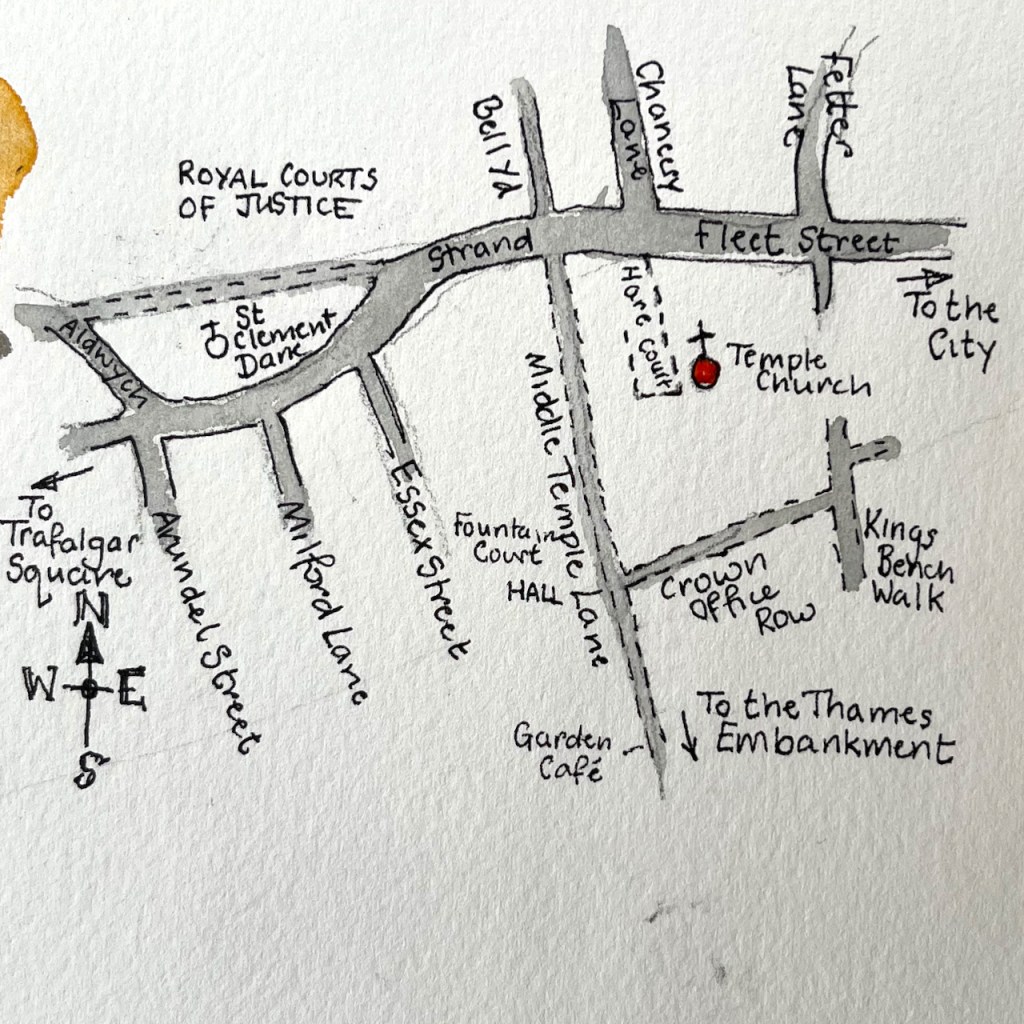
Here’s a map and a photo of the Norman arch on the outside
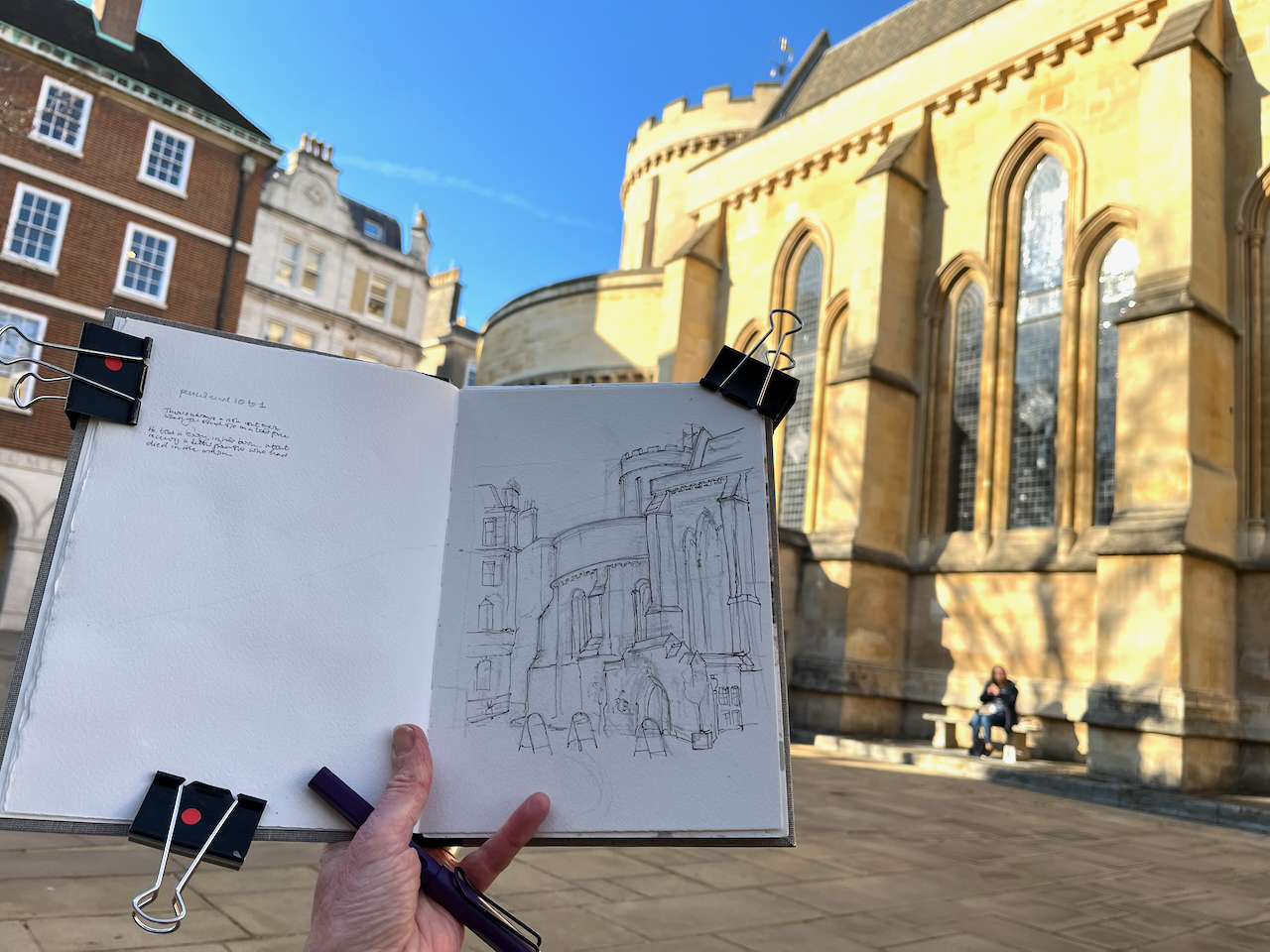
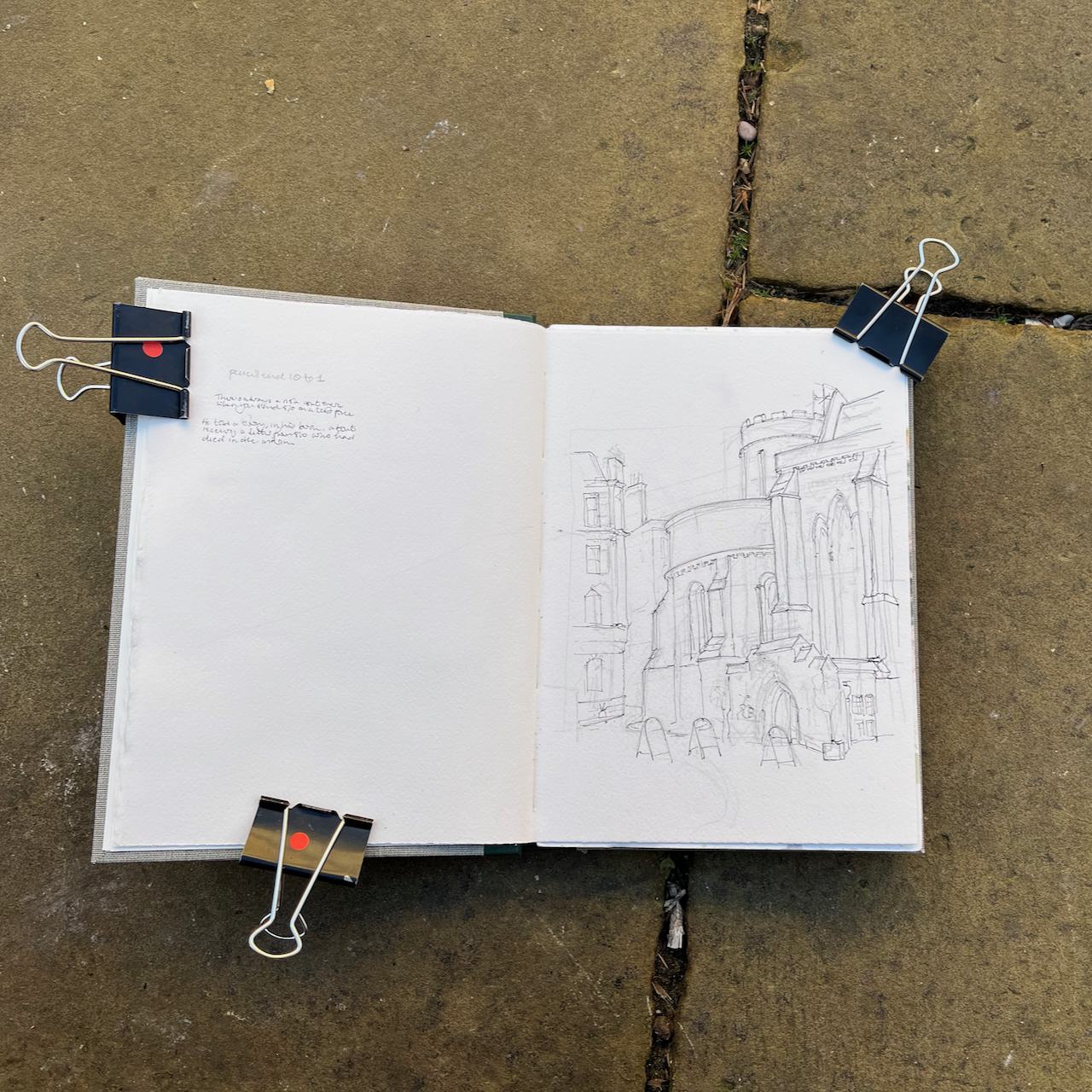
Here are some work-in-progress photos.
Working on the pen drawingIn Pegasus Court
Click a button below to share this post online, email it, or print it:
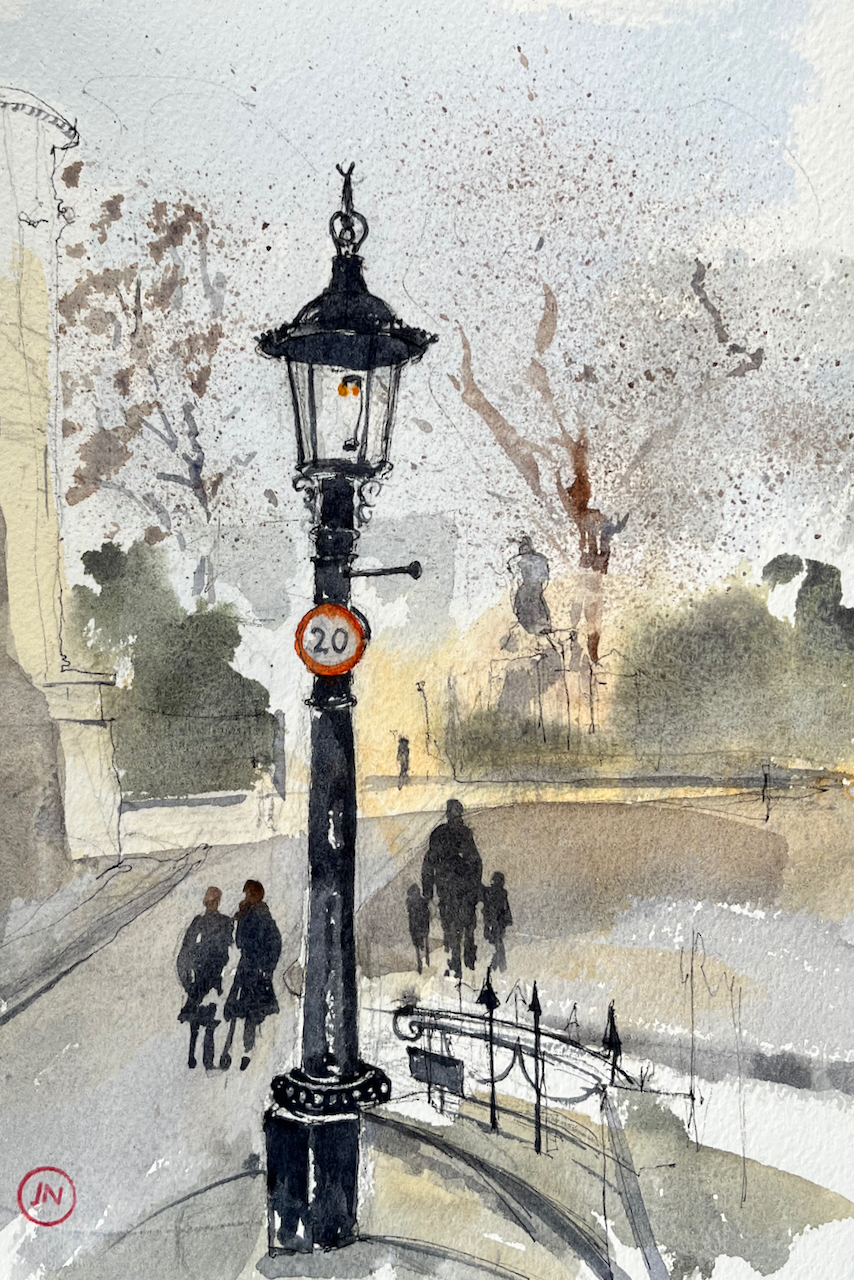
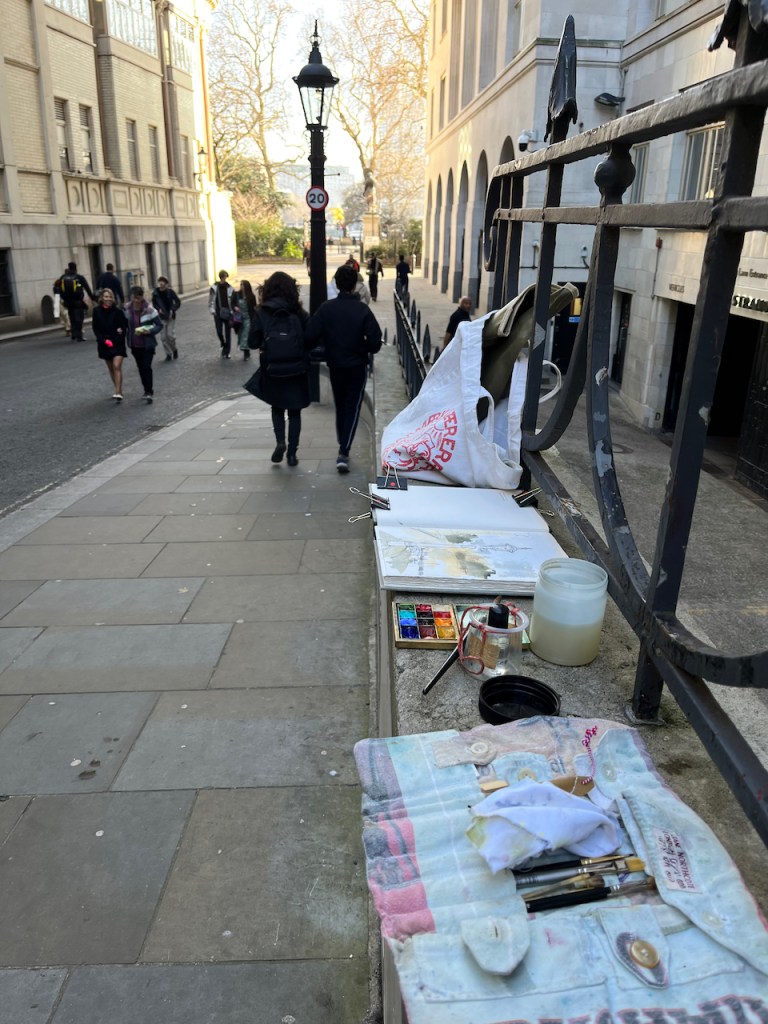
This lamp burns gas from the sewers. It’s an engineering marvel from the Victorian age, together with Wapping Hydraulic Power Station, the Embankment and Tower Bridge. Amazingly, it’s still standing, and still burning sewer gas, now renamed “biogas”. The notice on the fence says:
The adjacent street light is the last remaining sewer gas destructor lamp in the City of Westminster. Installed in association with Sir Joseph Bazalgette’s revolutionary Victoria Embankment sewer which opened in 1870, this cast iron ornamental lamp standard with original lantern continues to burn residual biogas.
City of Westminster, notice in Carting Lane
Carting Lane Sewer Gas Destructor Lamp, sketched 13 Feb 2023, 2pm in Sketchbook 13.
The original purpose of the lamps was not to light the streets but to burn off sewer gas, with the aim of reducing odours, exterminating bacteria in the sewer gas and reducing the explosion risk. Some town gas is drawn in with the sewer gas to make sure the lamp stays alight and does its job. The lamp is alight night and day. This was alight at 2pm.
Carting Lane runs down from the Strand to the Thames Embankment, right next to the Savoy Hotel. I drew the picture standing above the lamp, looking down the lane towards the Thames. Here’s a map.
Here is work in progress:
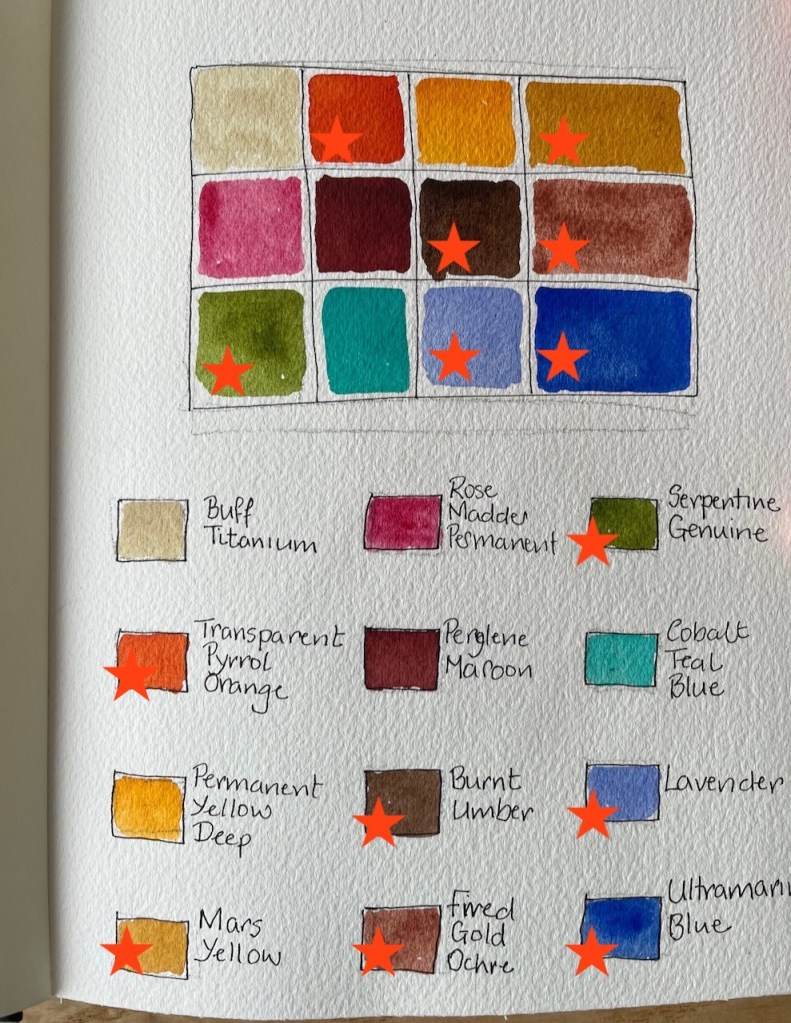
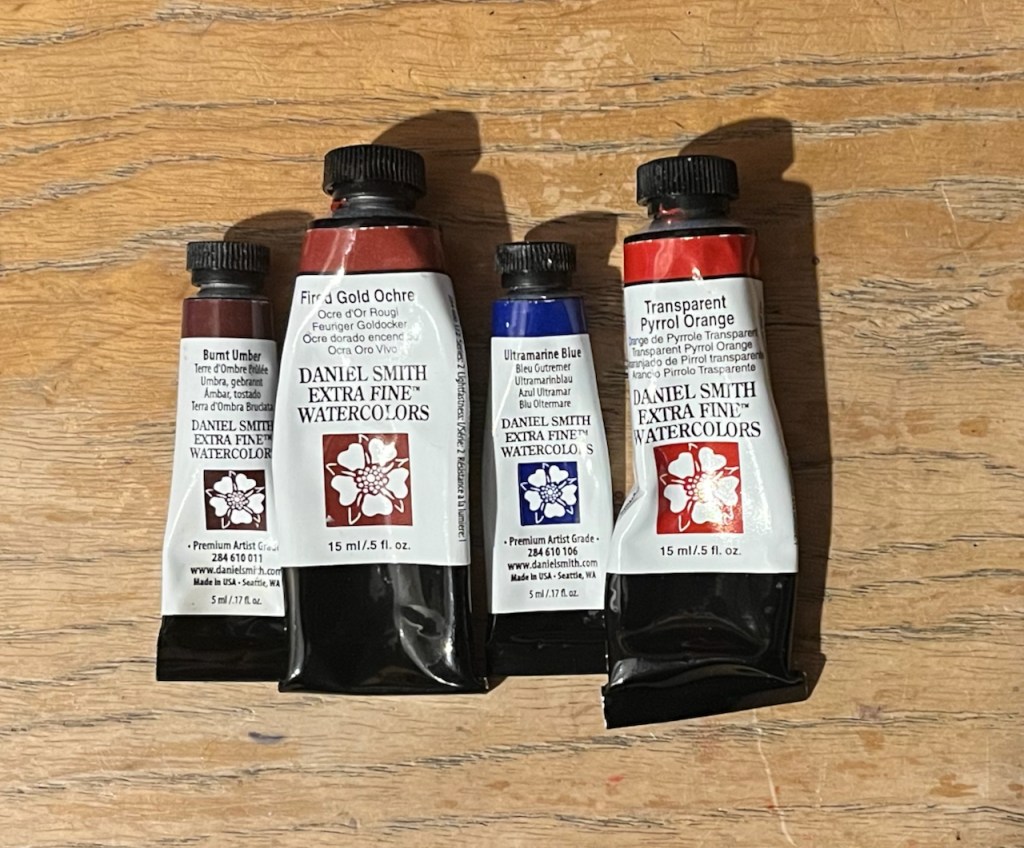
The colours in the picture are:
Ultramarine Blue and Lavender for the sky,
Serpentine Genuine/Burnt Umber/Fired Gold Ochre/ Mars Yellow for the mid-tones
Ultramarine Blue and Burnt Umber mix for the blacks and greys
Transparent Pyrrol Orange for the 20mph sign on the lamppost.
My current watercolour palette. The colours I used for this picture are starred. All Daniel Smith colours.
Click a button below to share this post online, email it, or print it:
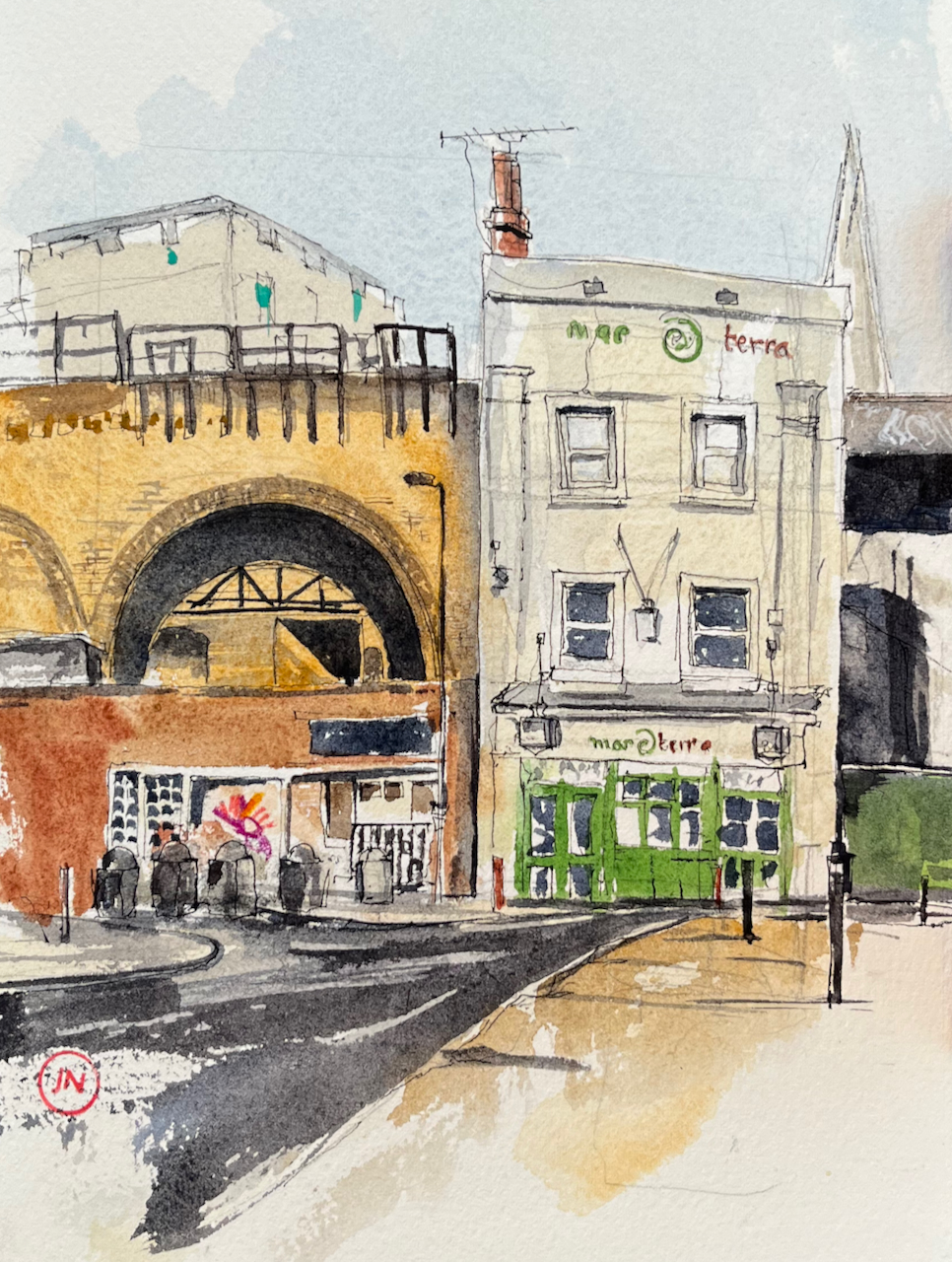
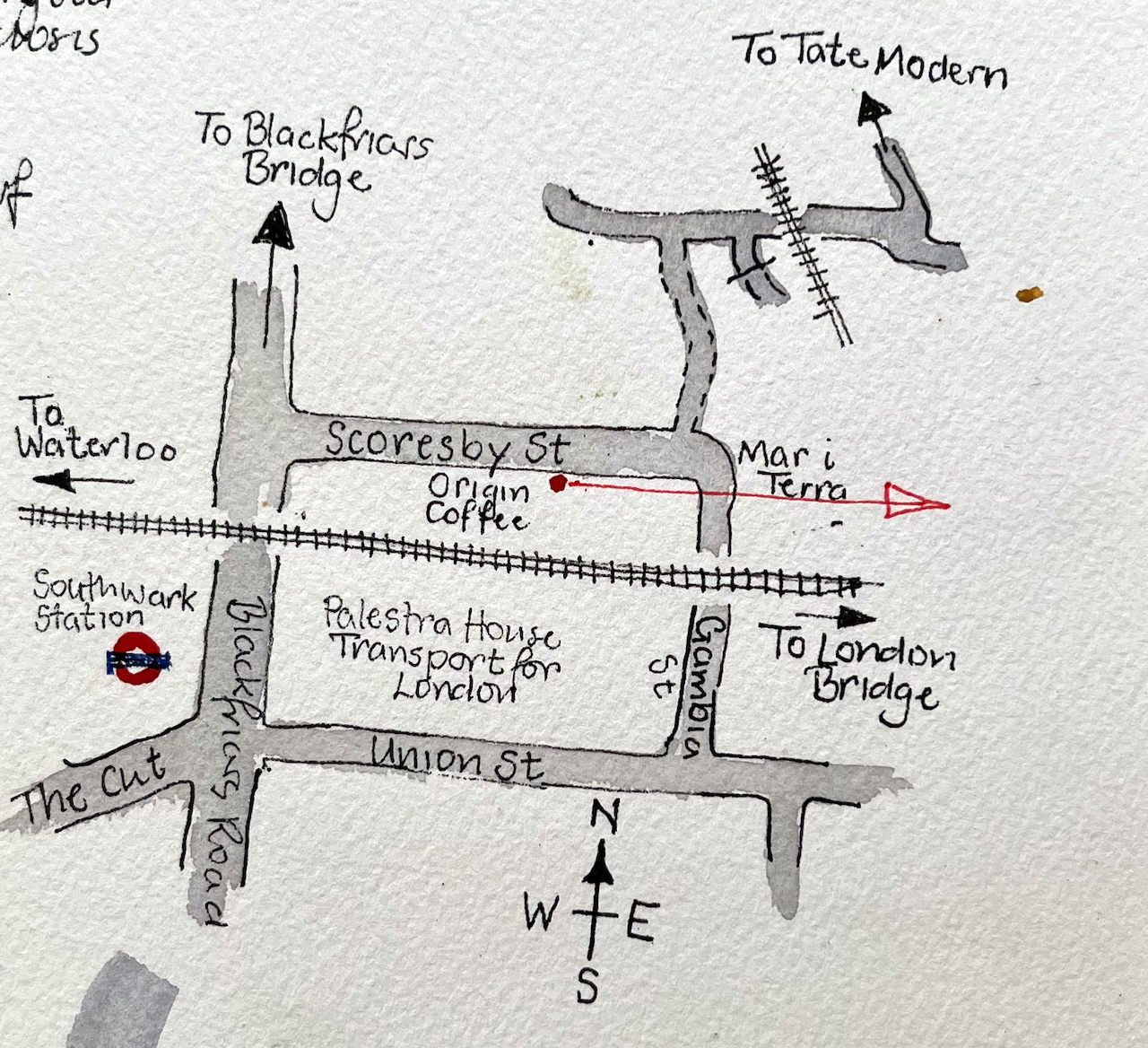
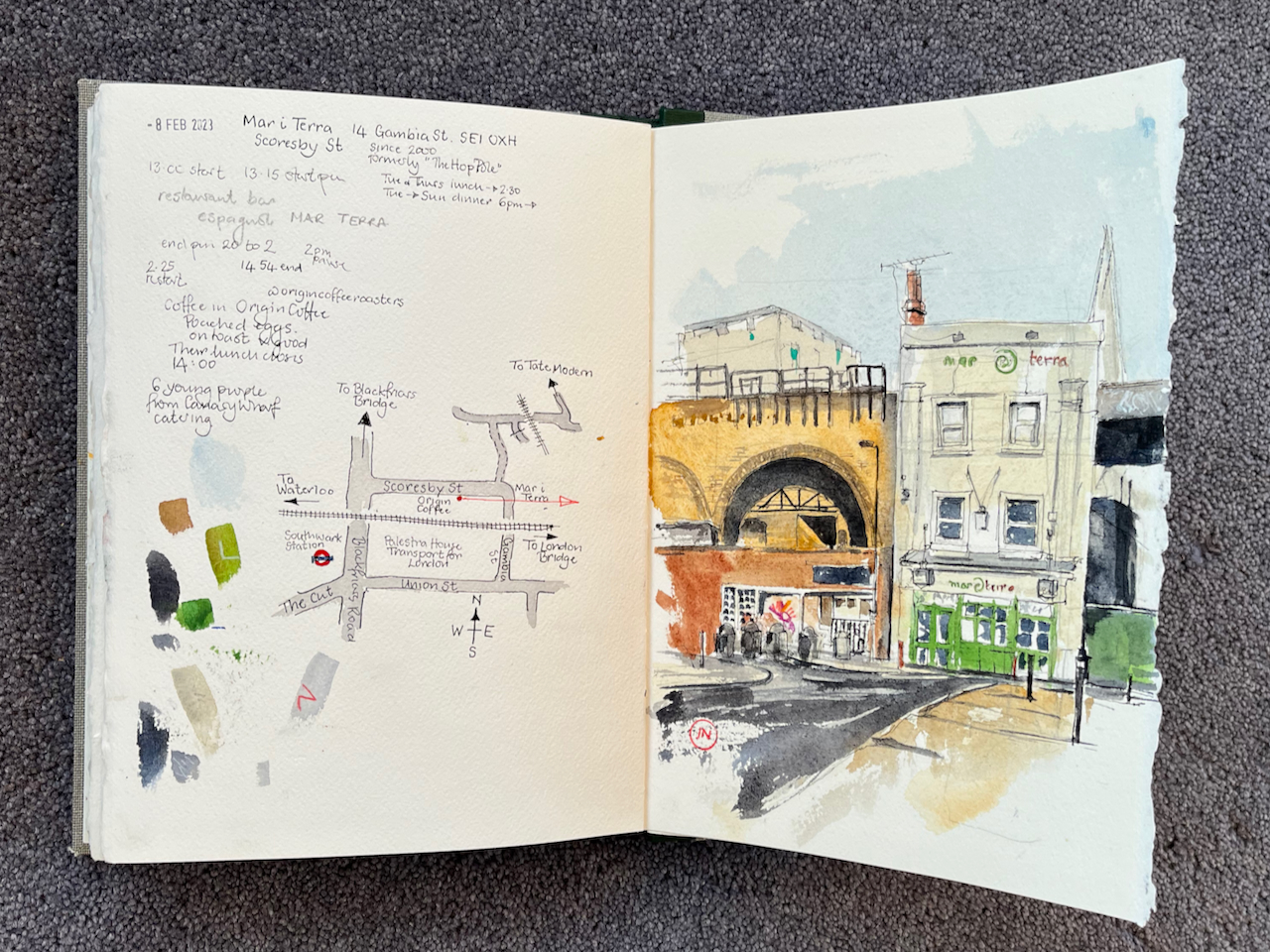
Here is the bar and tapas restaurant “Mar i Terra”, cosily tucked away in a back street near Southwark Station.
“Mar i Terra” Gambia Street SE1, sketched from Scoresby Street. 7″ x 9″ in Sketchbook 12.
There are magnificent Victorian railway arches looping all around, and 21st century buildings in the background, but this building stands defiantly, self-contained and functional.
The restaurant is open Tuesday to Sunday for dinner. It also serves lunch on Tuesdays and Thursdays. I was sketching it on a Wednesday so I sought lunch elsewhere, and discovered the wonderful “Origin Coffee” in Scoresby Street.
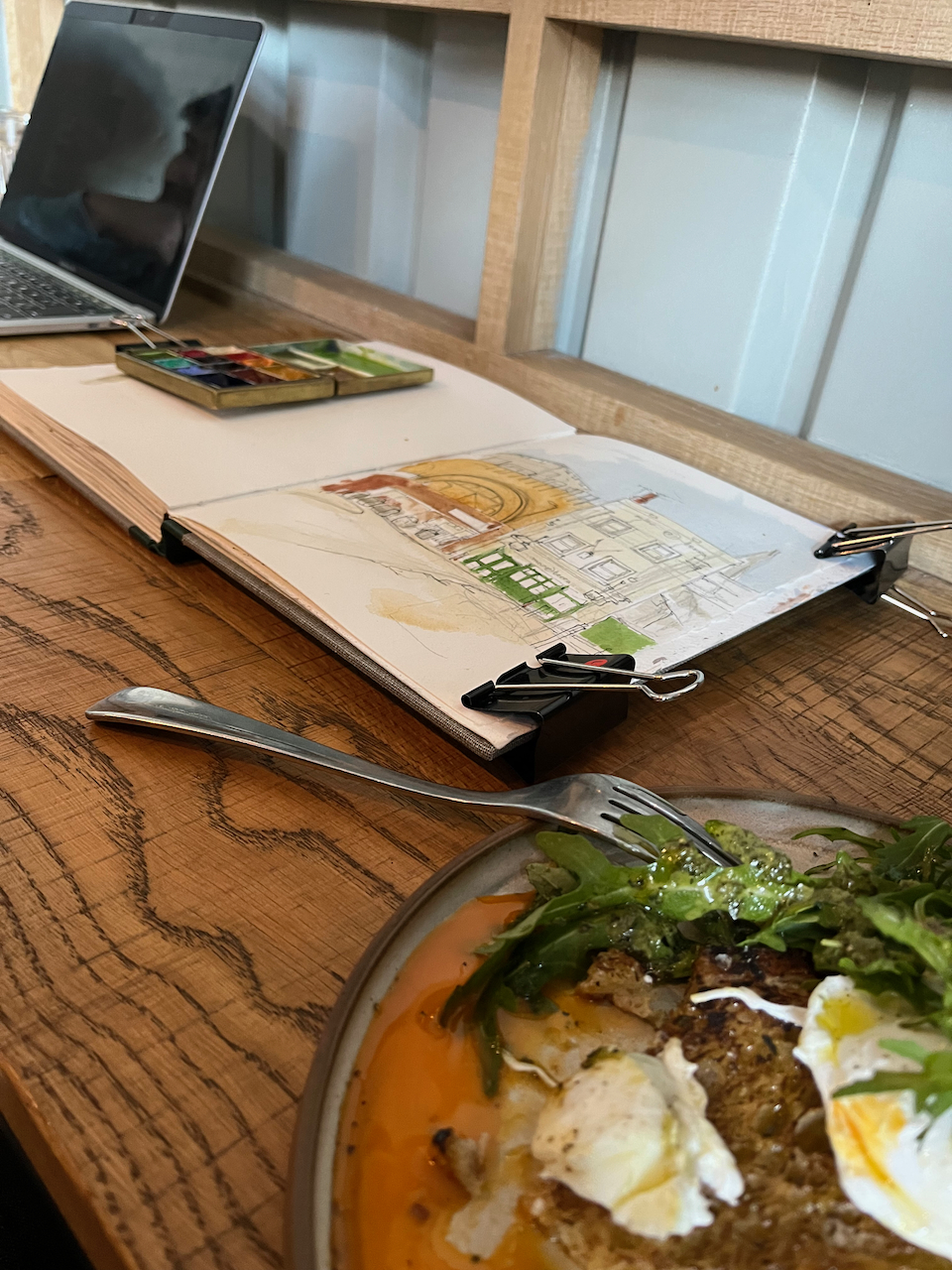
Poached eggs on toast in Origin Coffee, while the first wash dries on the picture.Map showing location of the sketch
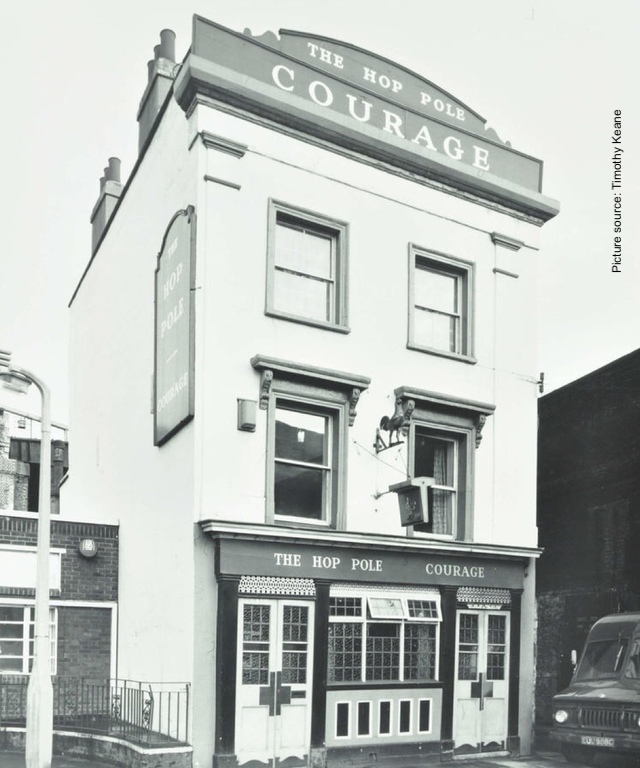
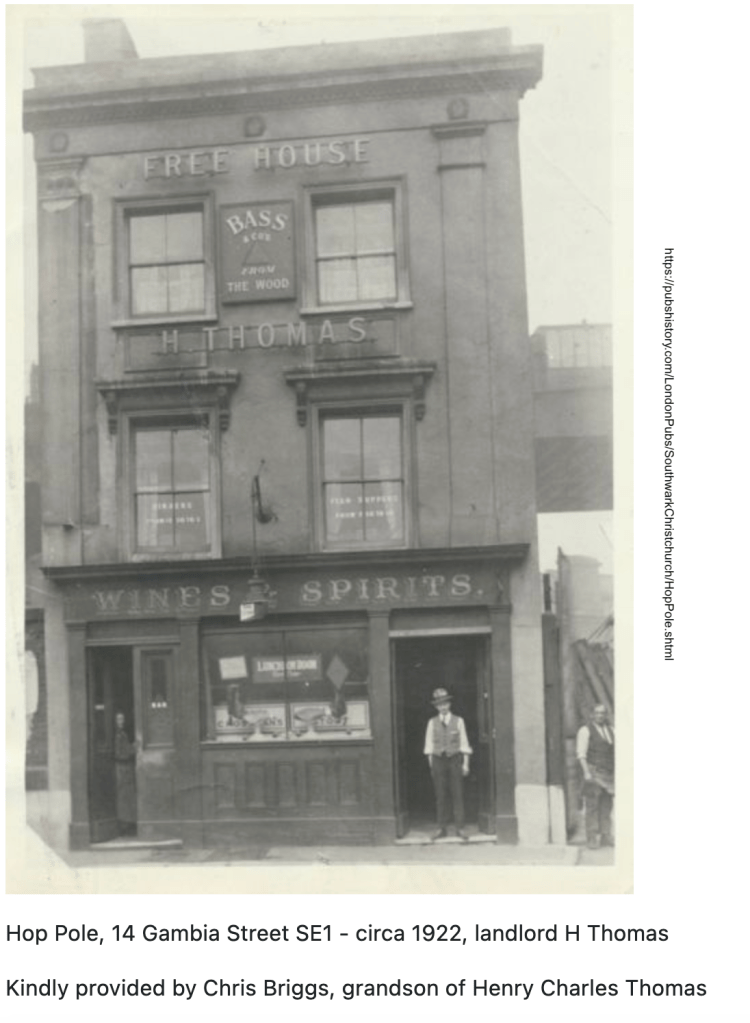
According to their website “Mar i Terra” has been serving the people of the neighbourhood since the year 2000. Up until 1999 this building was “The Hop Pole” pub.
According to the “Pub History” site, victuallers were recorded at this site in 1791. So it was a pub for nearly 200 years.
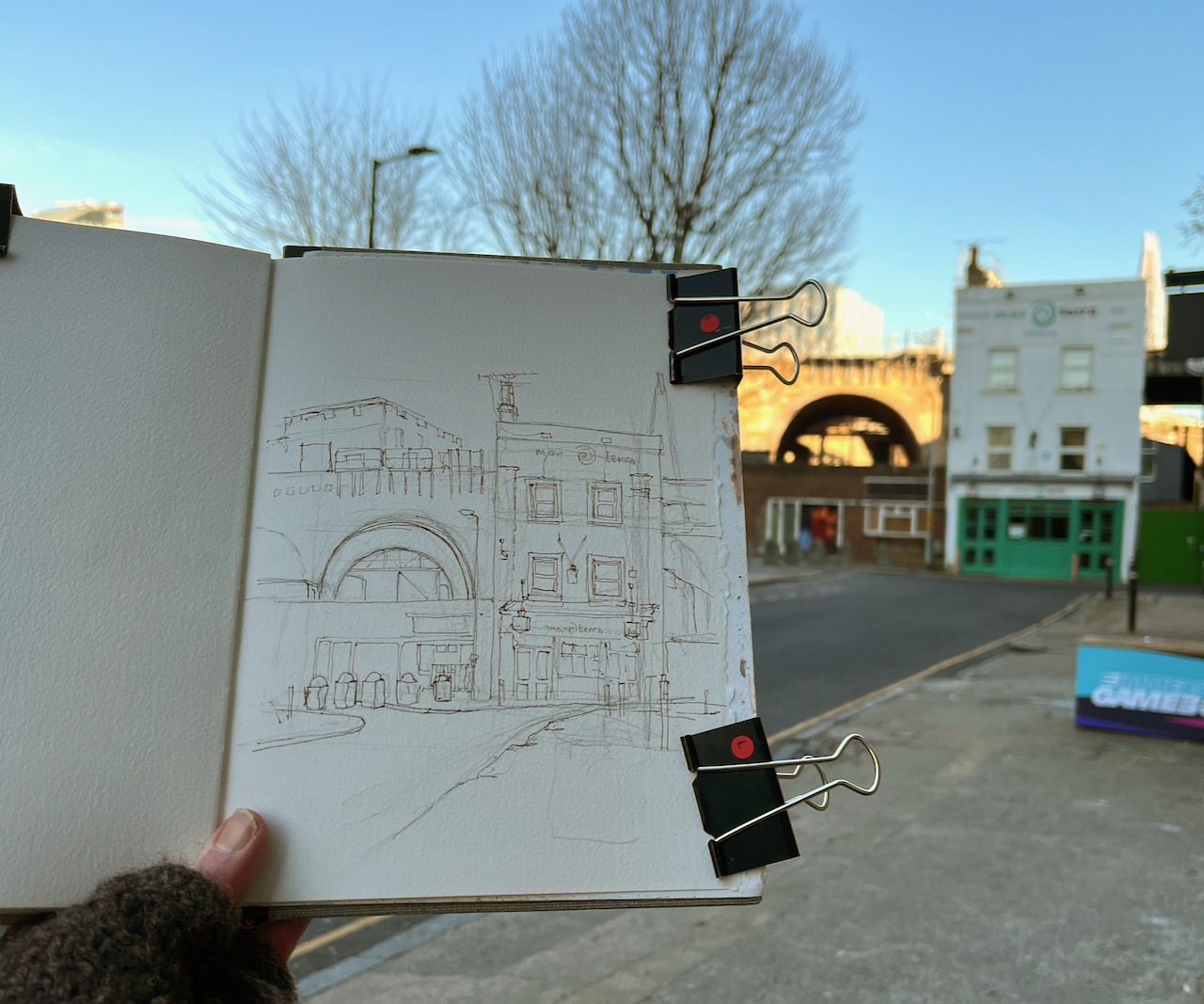
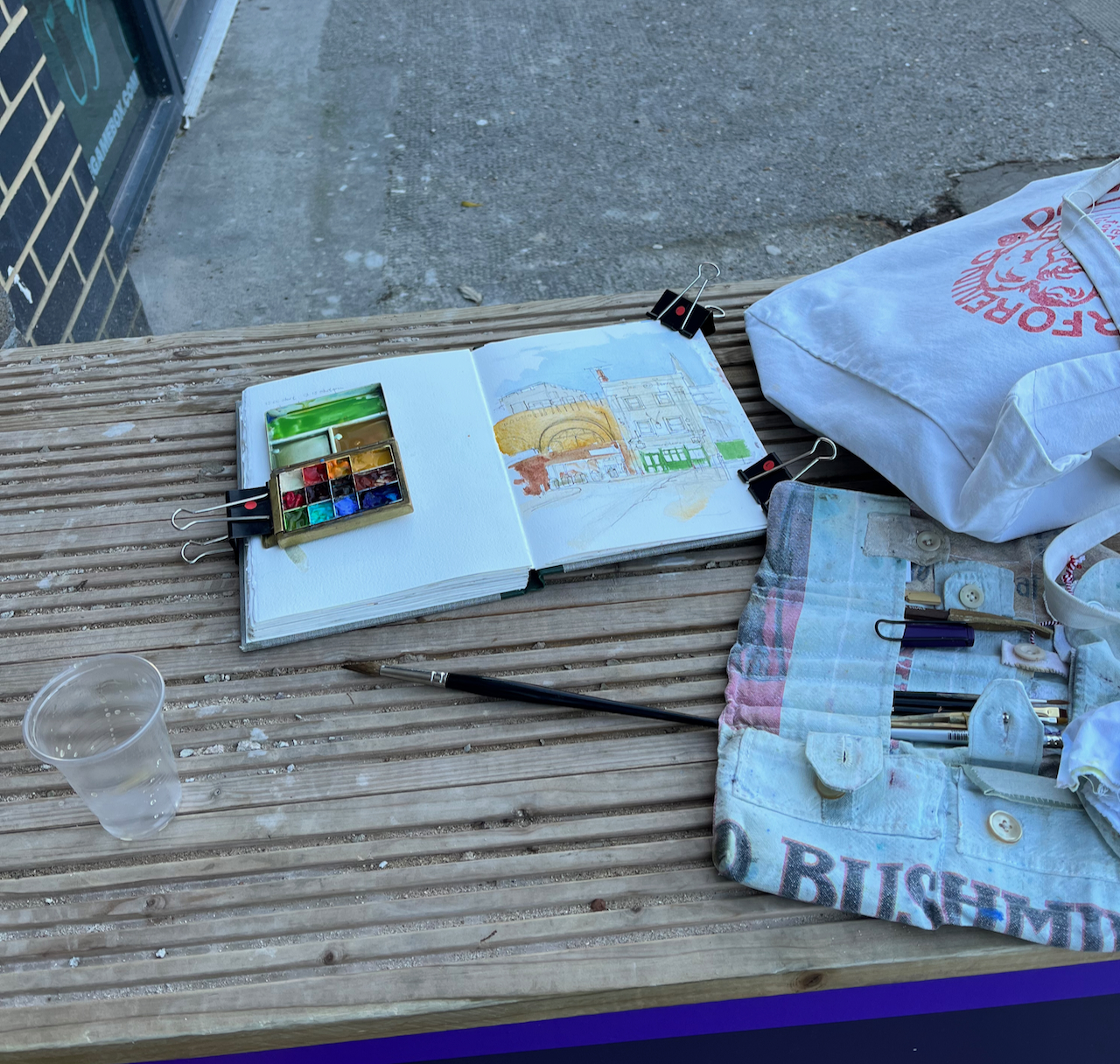
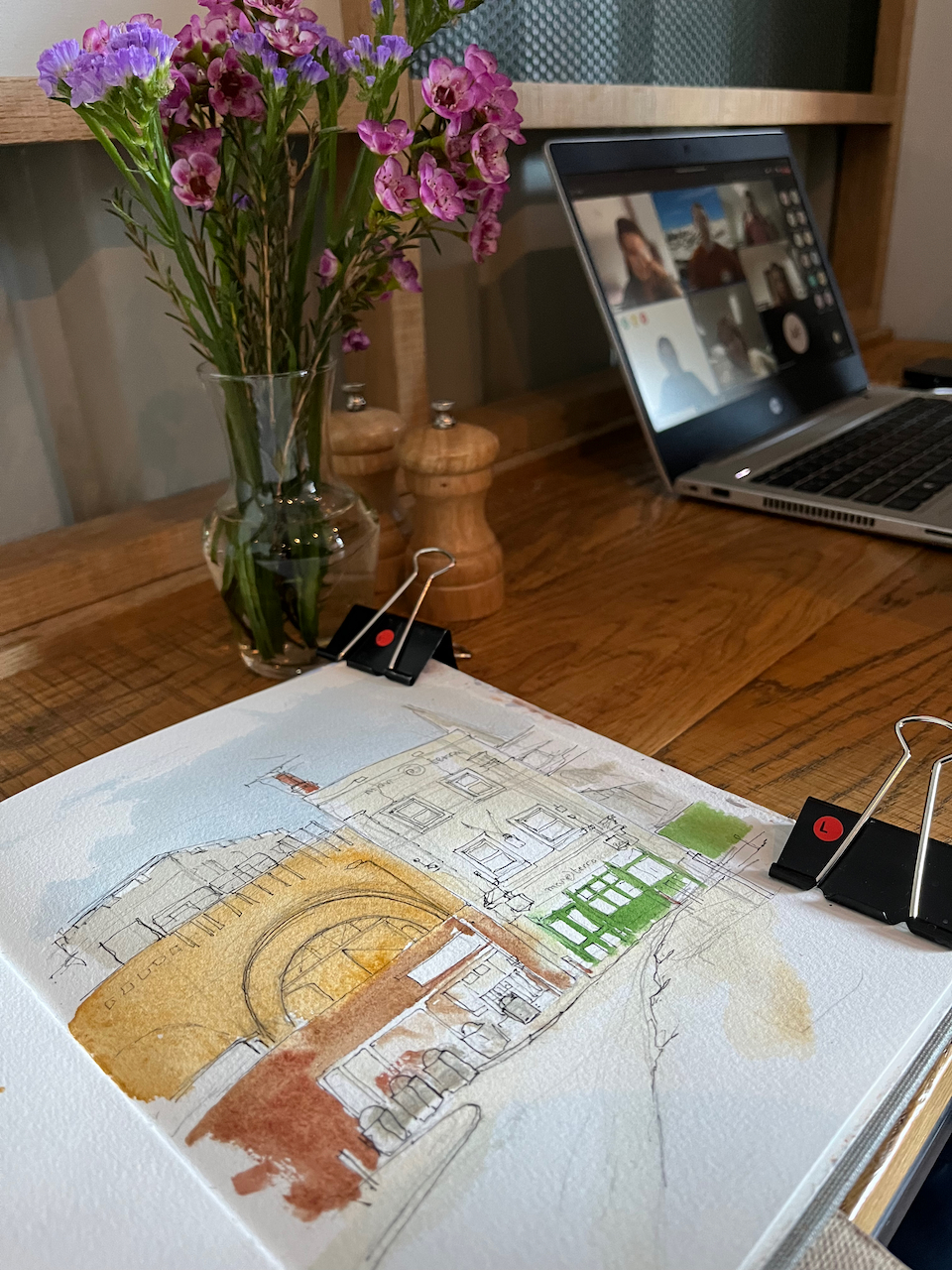
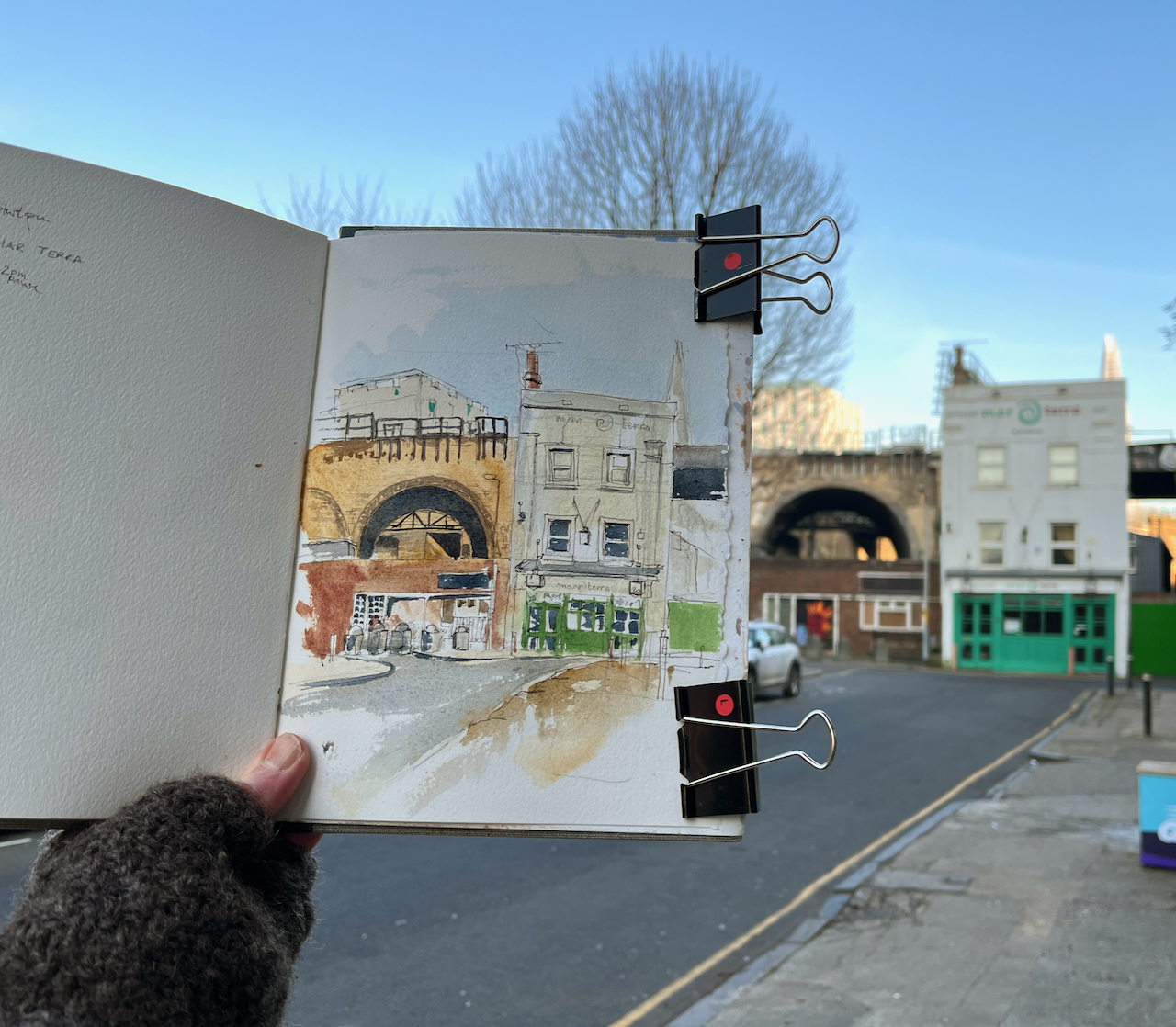
Here is work on progress on the drawing.
PenPainting on locationPaint drying in Origin coffeeSketchbook 12
Colours:
Sky: Ultramarine Blue and Cobalt teal blue
Brickwork: Mars Yellow with some Fired Gold Ochre
Greys and blacks: Ultramarine Blue and Burnt Umber
Green paintwork: Serpentine Genuine moderated with Cobalt Teal Blue
Graffiti added with a red crayon
Here’s an image from the Pub History website. I can just read that the notice on the big window says “Luncheon Room”. So the Mar i Terra continues the tradition, on Tuesdays and Thursdays. The railway bridge behind, on the right of the photo, is still there, too, as well as many of the features of the front of the pub. Amazingly, the door layout seems to have endured. Is that Mrs H Thomas standing behind the door on the left?
Click a button below to share this post online, email it, or print it:
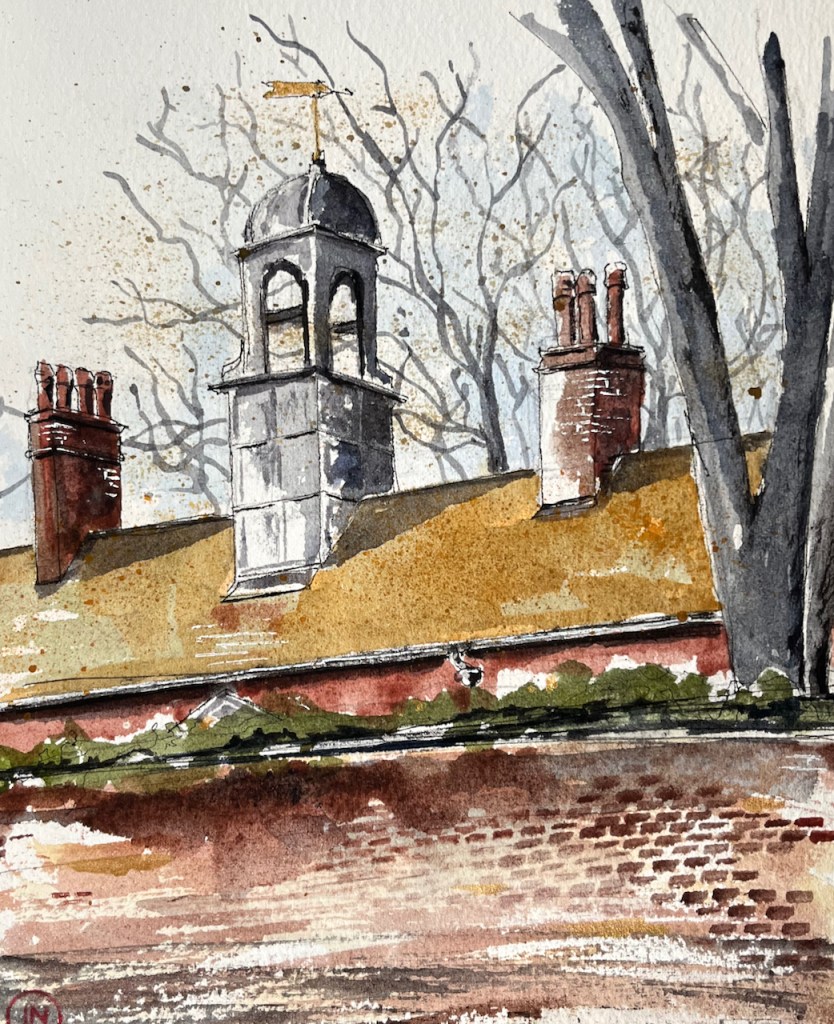
On Geffrye Street near Hoxton Overground station, is the marvellous bakery “Fabrique”. My feet somehow took me there on a sunny day, after I had done my errands in the nearby area. Well, perhaps my errands were not quite nearby. But those cinnamon buns exude an aroma detectable at a considerable distance, like pheromones. So there I was sitting at a table on a sunny pavement and looking for something to sketch. Here’s what I saw.
Roof of the “Museum of the Home” 136 Kingsland Road London E2 8EA, 3rd February 2023, around noon, in Sketchbook 12
The “Museum of the Home” used to be called the “Geffrye Museum”.
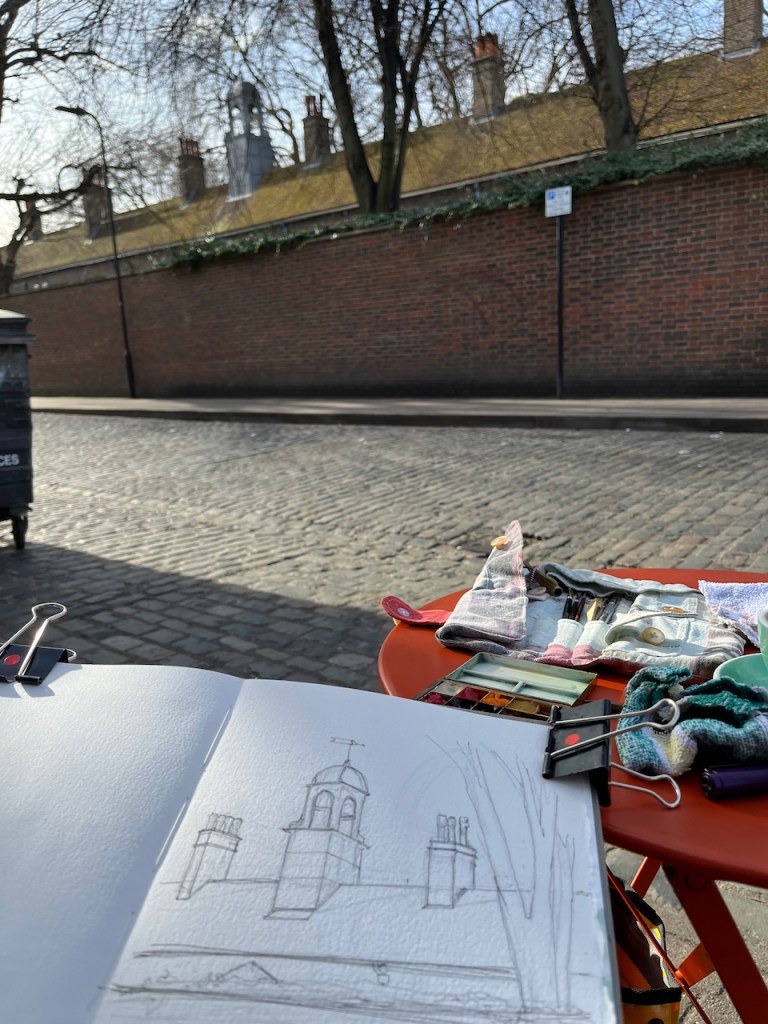
Here is work in progress on the drawing:
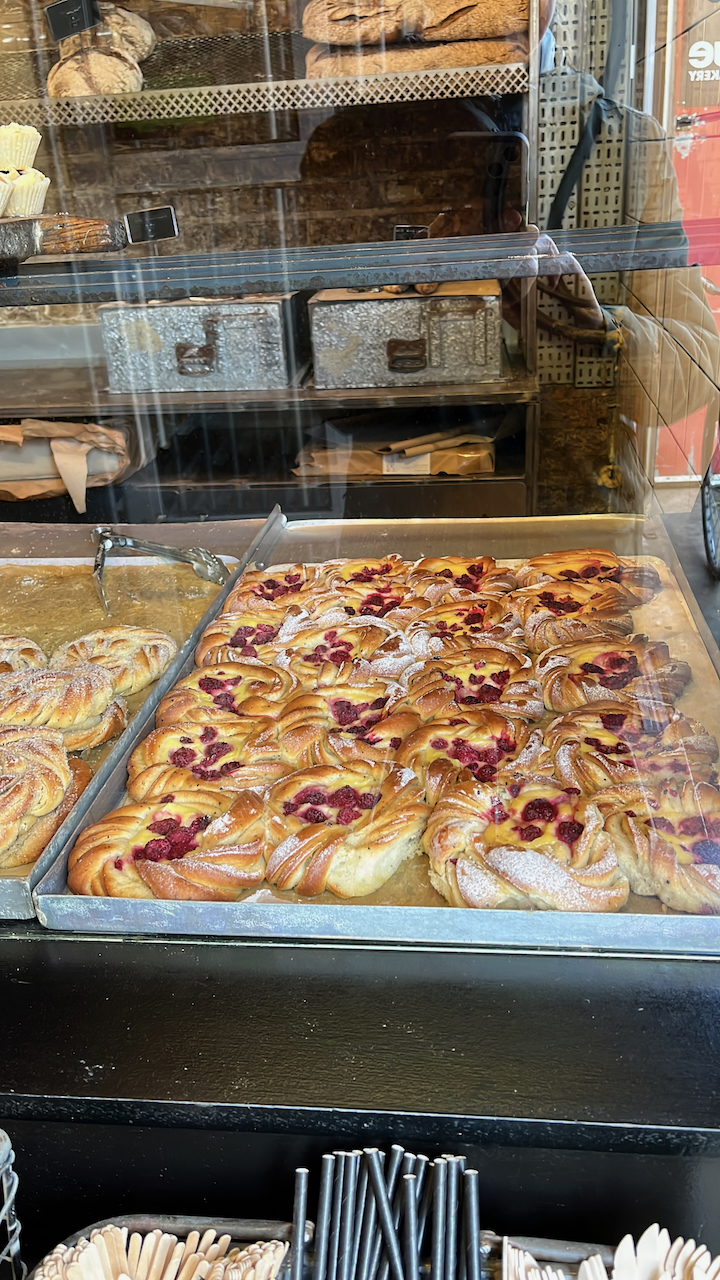
Here are the raspberry buns at Fabrique, and a map so you can find them:
Click a button below to share this post online, email it, or print it:
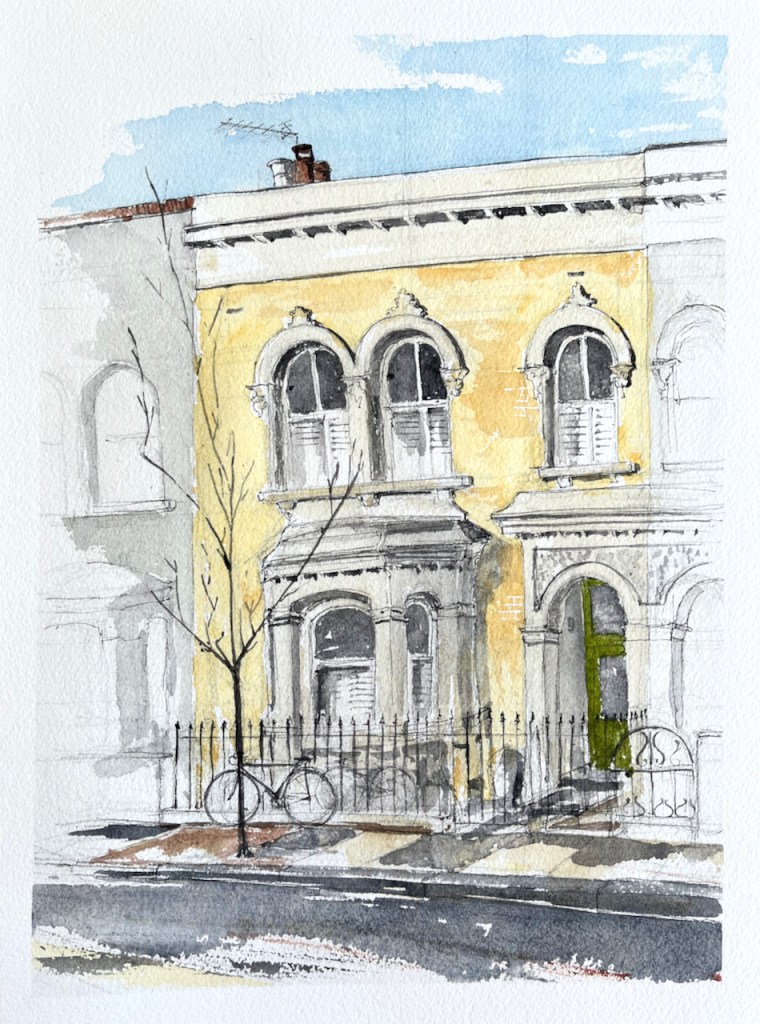
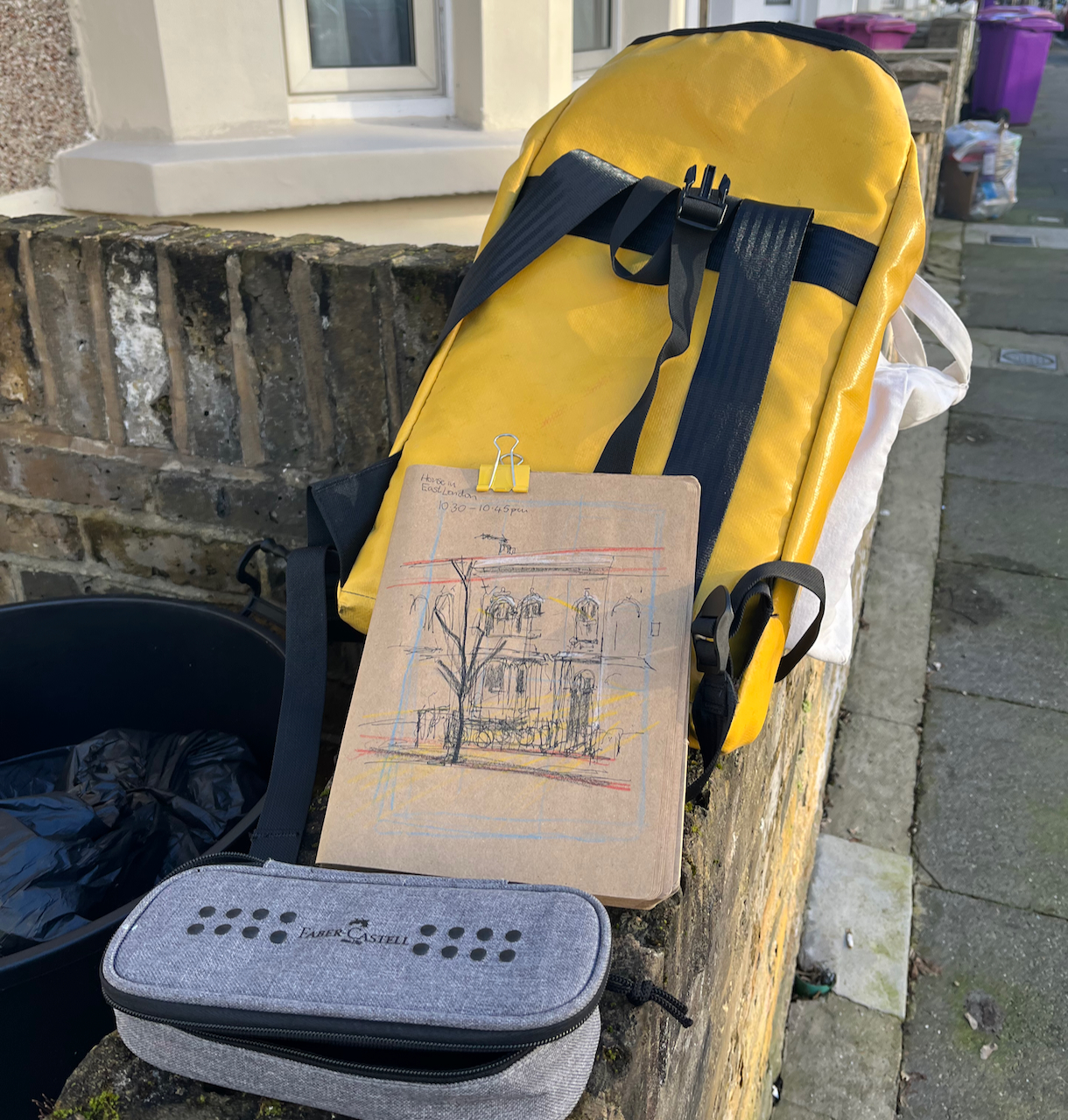
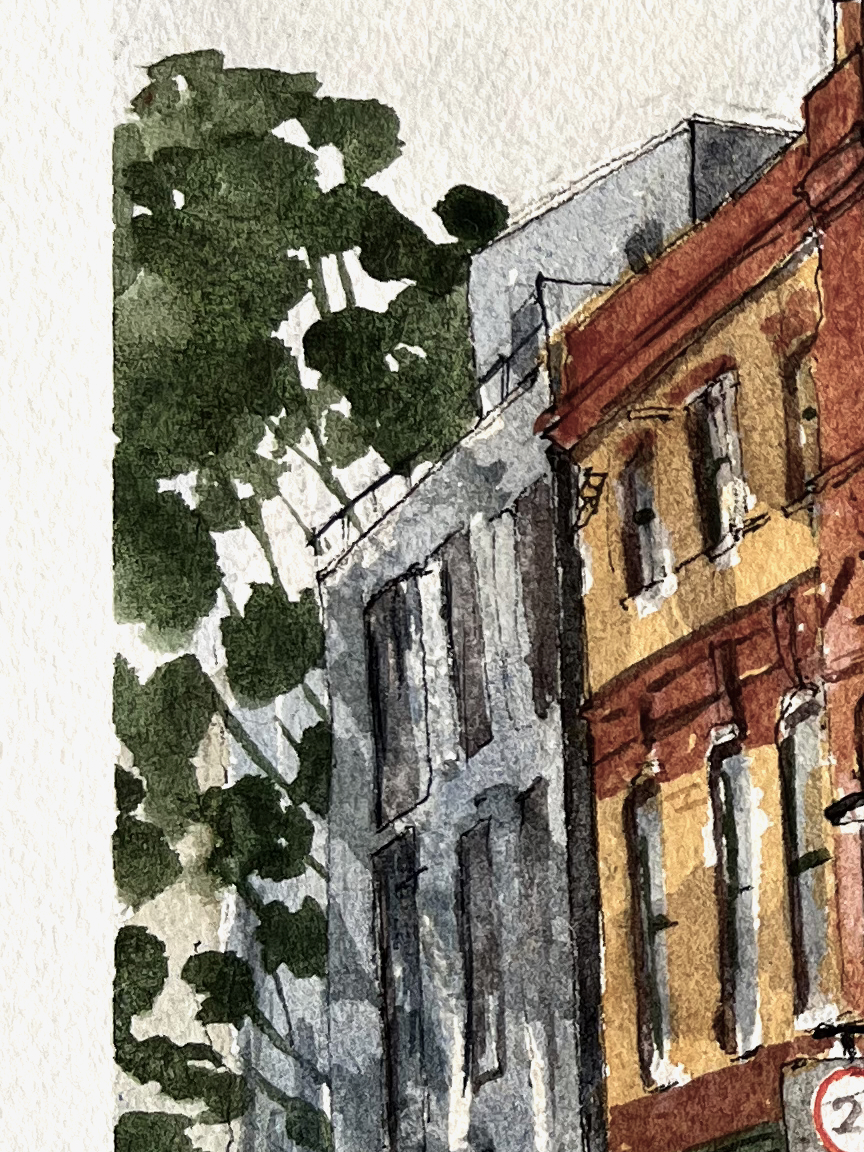
Here is a Victorian terraced house in East London.
A House in East London, 9″ x 12″ 21 January 2023. [commission]
This was a commissioned drawing. Thank you to my client for the commission and for their permission to post the picture here.
There were two interesting challenges in this drawing. One was the fact that the front of the house was obscured by parked cars. The other was the characteristic colour of the brickwork: a clean and lively yellow. I wanted to draw the fence without the cars, so as to show the whole house. And I wanted to get that yellow right.
I was stationed on the other side of the road. There were cars parked nose-to-tail on both sides of the road. To draw the part behind the parked cars, I crossed the road and had a look then come back and sketched and then wandered about sketching and trying to get it right, gradually becoming skilled at envisaging the fence behind the car. Fortunately it was a quiet road. The few passers-by took a friendly interest, bemused by an itinerant artist in their street.
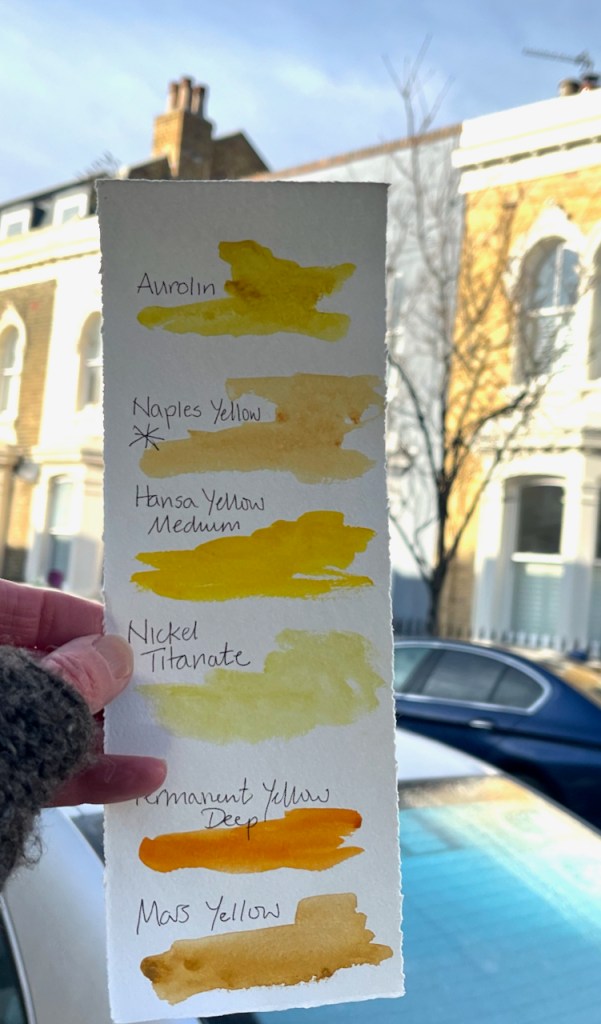
To match the colour of the brickwork, I equipped myself with a colour chart of all the yellows I possess. Usually, old London brickwork is Mars Yellow. But in this case I discovered that it was Naples Yellow, a cleaner, paler colour, less orange than Mars Yellow, more orange than Nickel Titanate Yellow. Naples Yellow also has a pleasant chalky texture, which made it perfect for this brickwork .
Finding the yellowColours used
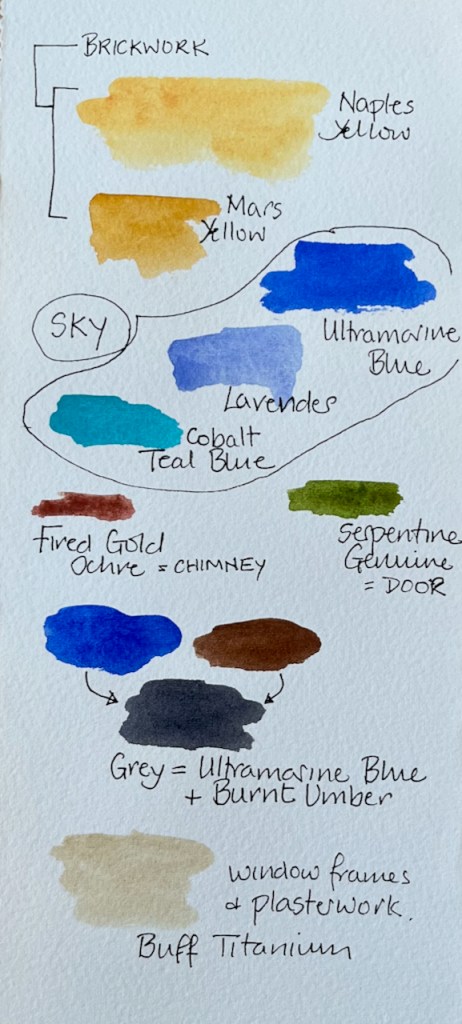
Most of this picture was painted in 3 basic colours: Ultramarine Blue, Naples Yellow and Burnt Umber. Here are the detailed colours, all Daniel Smith:
Sky: Mostly Ultramarine Blue, plus some Lavender and Cobalt Teal Blue
Brickwork: Mostly Naples Yellow plus a bit of Mars Yellow in the darker places
Window surrounds and plasterwork: Buff Titanium (very dilute)
Green door: Serpentine Genuine
Terracotta chimney pots: Fired Gold Ochre
All greys and shadows: a mix of Burnt Umber and Ultramarine Blue.
The paper is Arches Aquarelle 300gsm Cold Pressed in a block. The ink is De Atramentis Document Black, applied with a fountain pen.
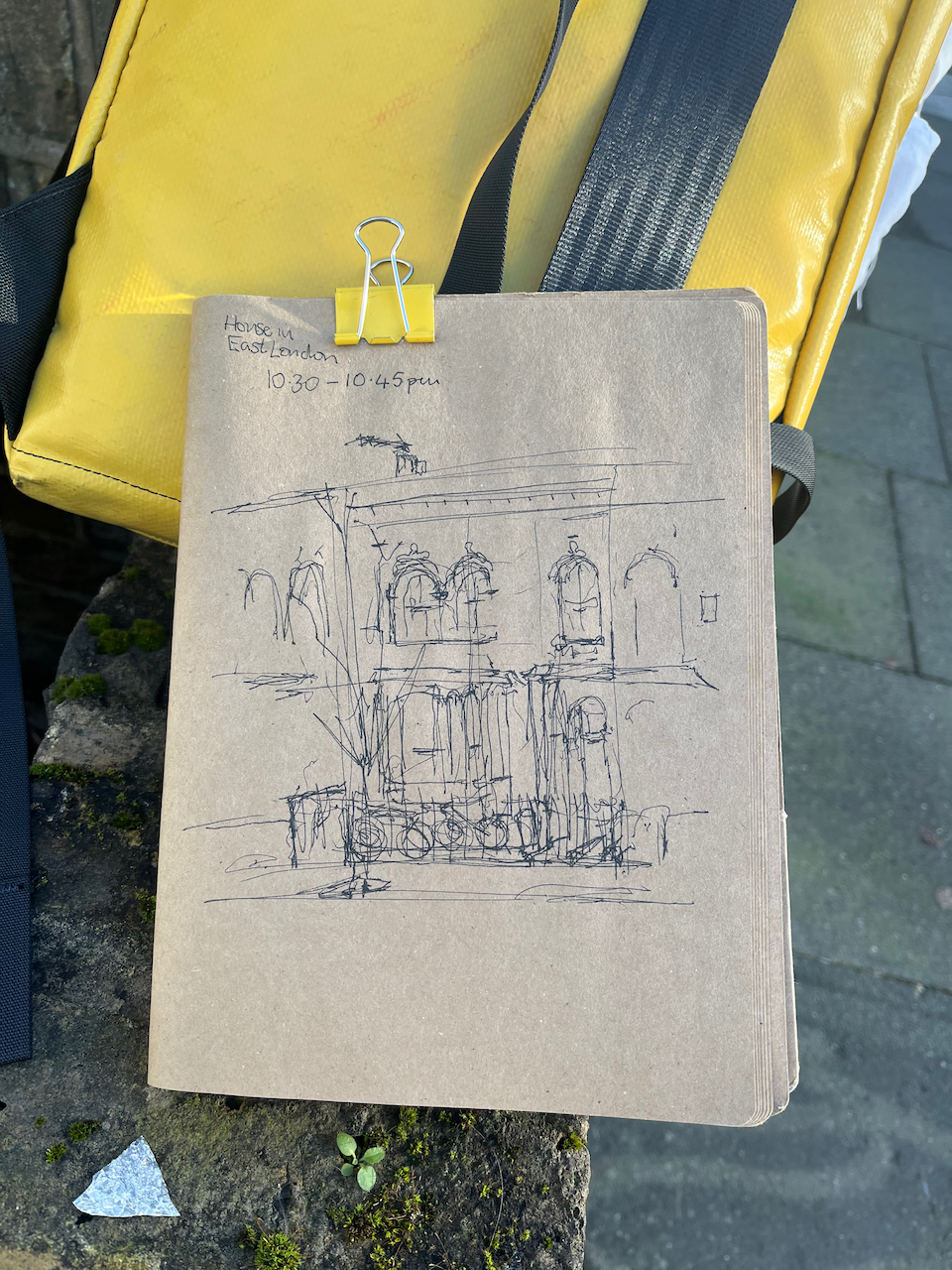
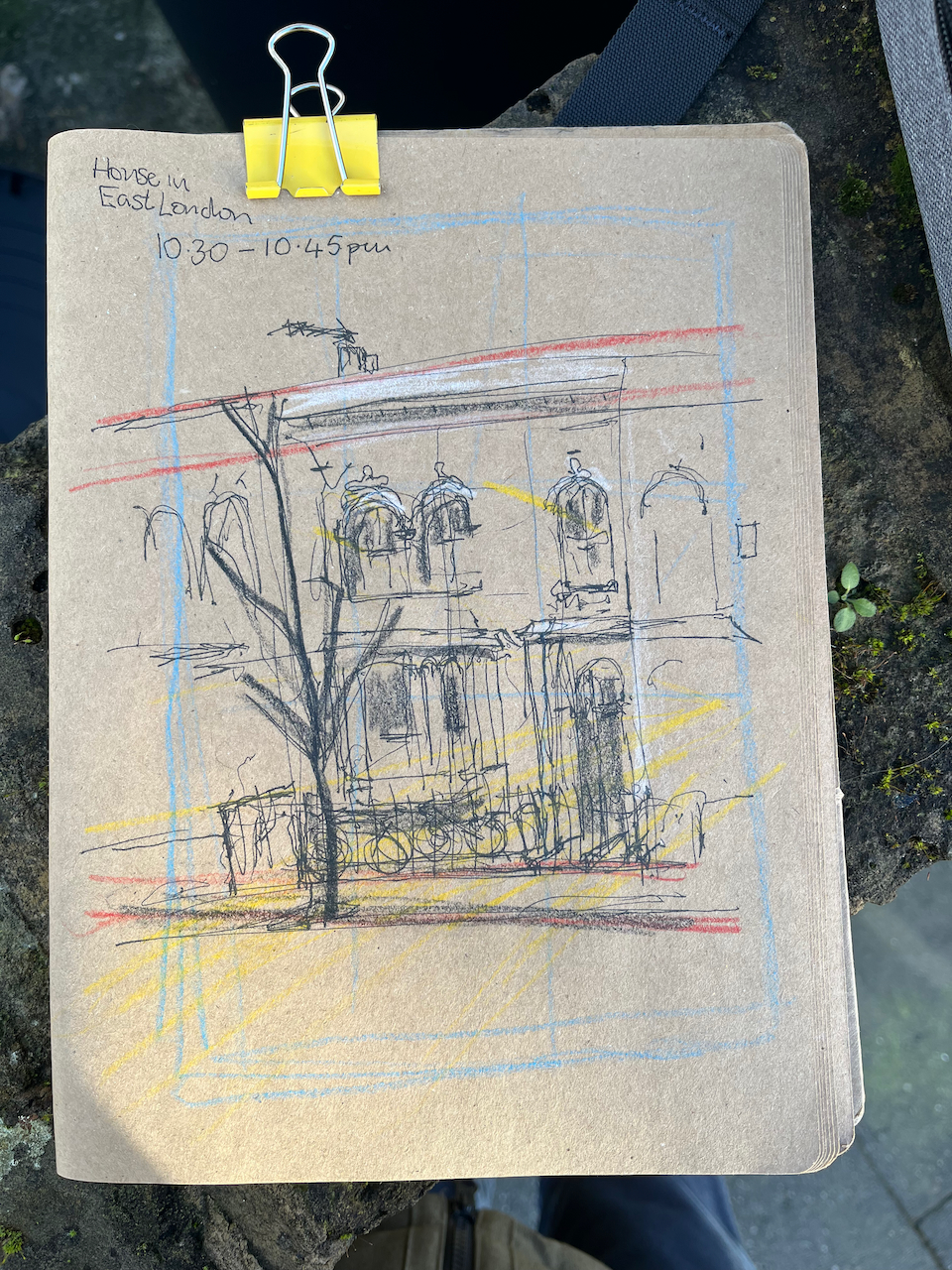
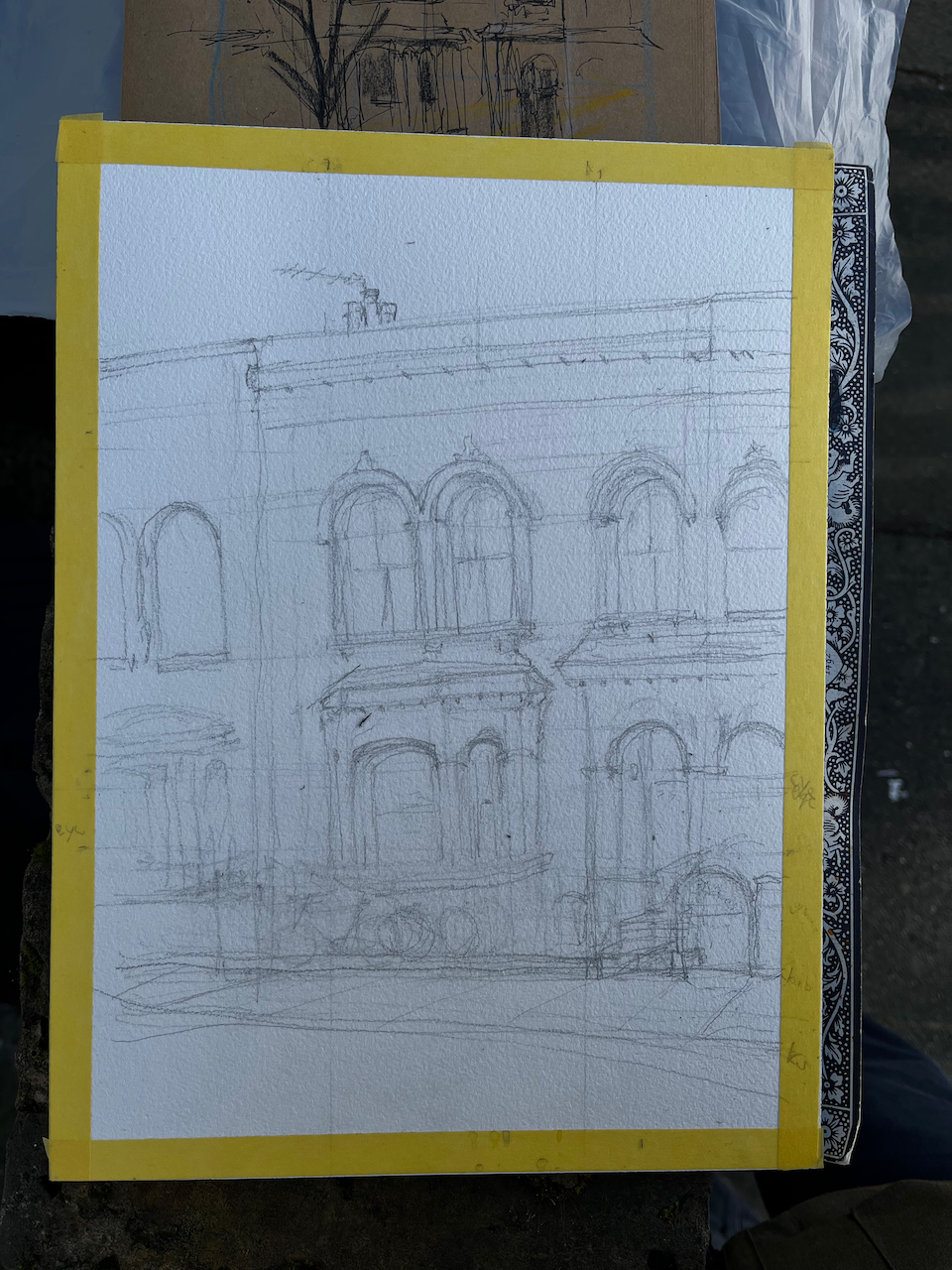
I did a preliminary sketch to understand the perspective and the proportions. Here are some images of work in progress. This was January and very cold. I managed to complete the pen and ink on location and then added the colour at my desk in the warm when I returned home.
Preliminary sketchPreliminary SketchDrawing station on the nearby wallPencilPen drawing, before the colour went on.
Click a button below to share this post online, email it, or print it:
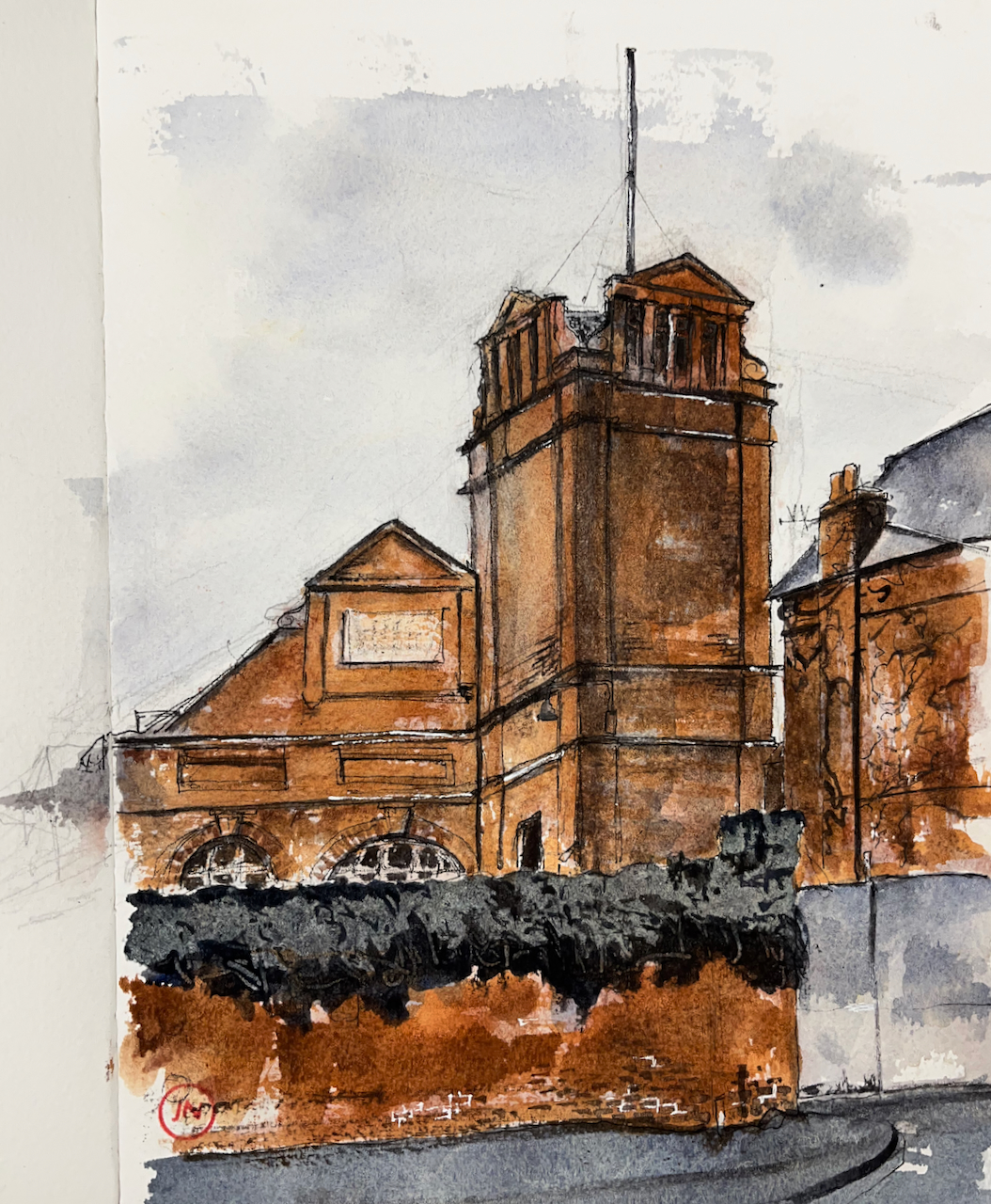
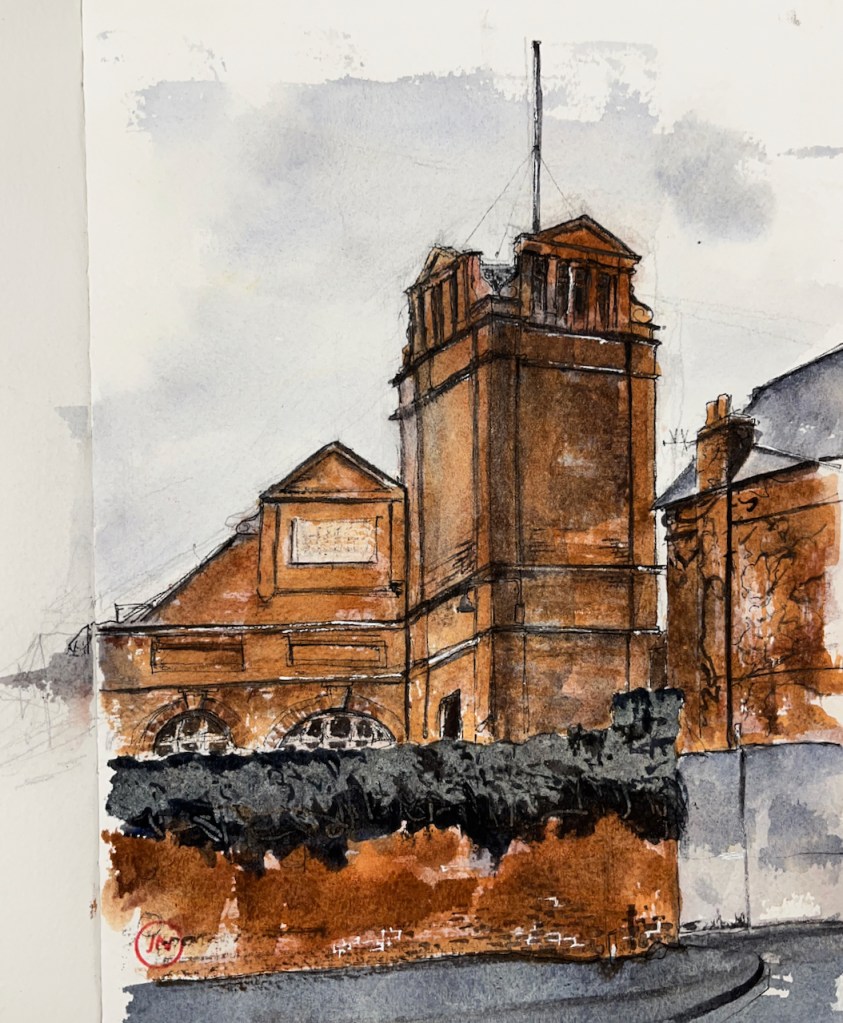
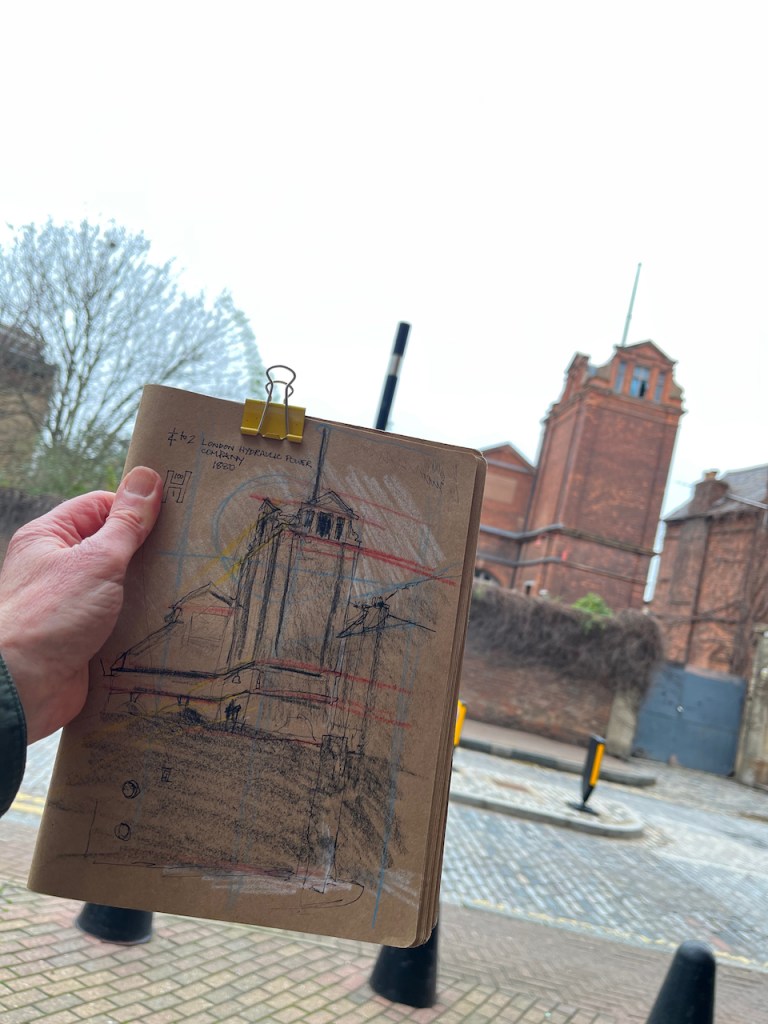
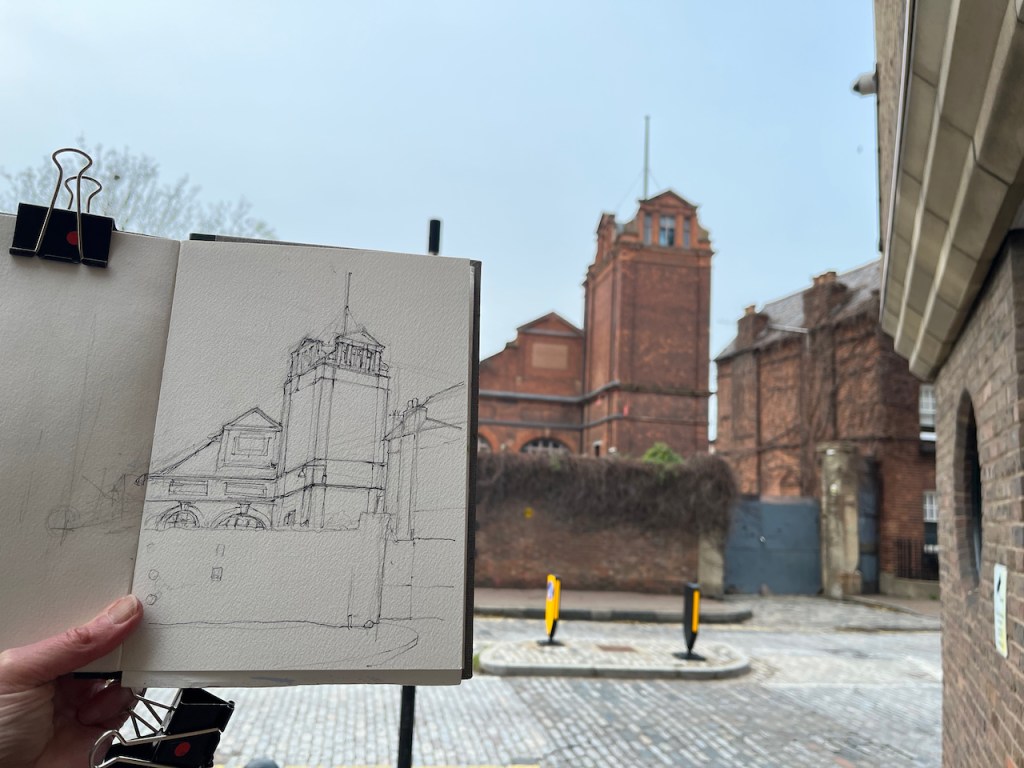
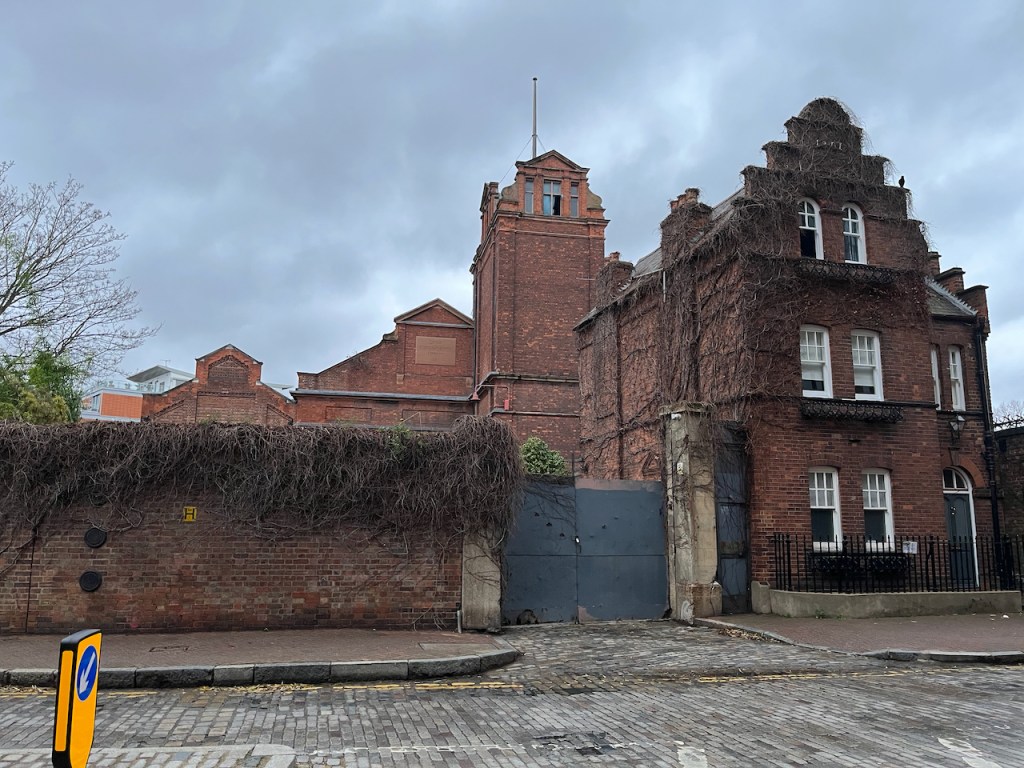
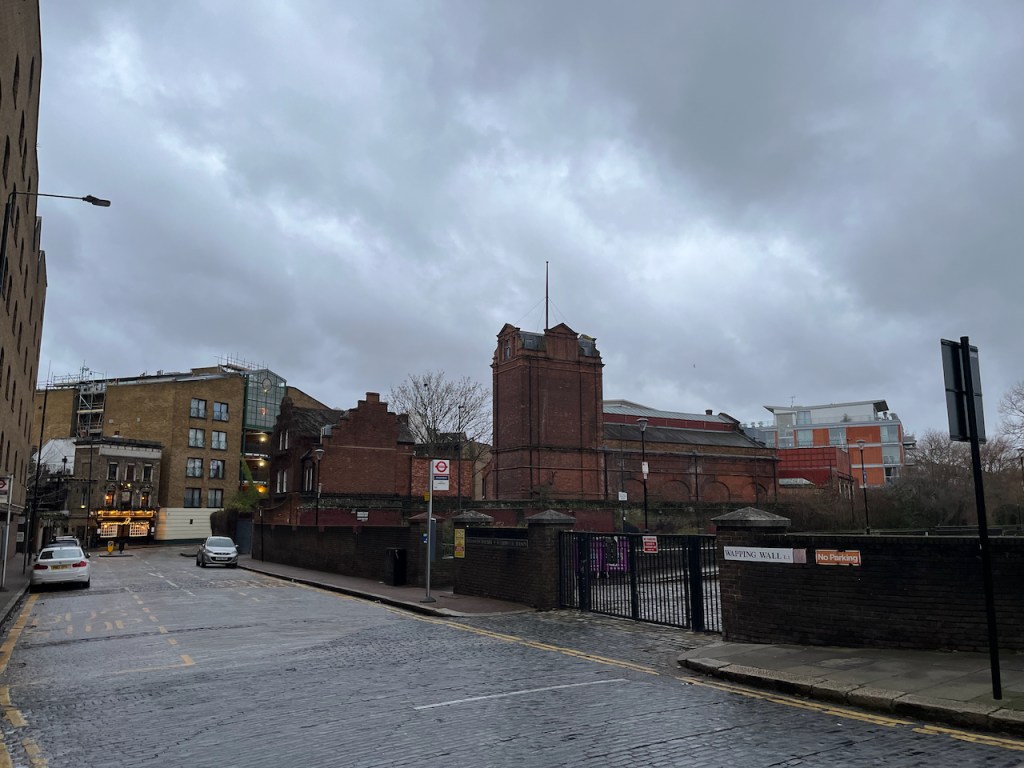
What an amazing building! It presides over a corner of Shadwell Basin, surrounded by a high wall. I spotted it on a long weekend run, and went back later to sketch it.
Wapping Hydraulic Power Station, sketched 1 Jan 2023 in Sketchbook 12, 7″ x 9″
What’s a Hydraulic Power Station? Well, in the late nineteenth century, London’s industry needed a way to exert mechanical force: to operate a printing press for example, or to raise heavy weights, for cranes and metal forming. Also, passenger lifts had been invented, and building engineers needed a way to exert force to operate the lift. One way would be to have a steam engine on site. This wasn’t always practical. Steam engines are noisy and dirty and you don’t want one next to your desirable residence, or even cluttering up your dockyard. So here’s the next idea: instead of lots of little steam engines all over the place, we’ll have a big steam engines in just a few places, and we transmit the power from them by using water. Water? Yes. The big steam engines push water at high pressure down strong cast iron pipes, and the lift engineer at the far end effectively turns on a tap and the force of the water pushes the lift up. That’s the principle.
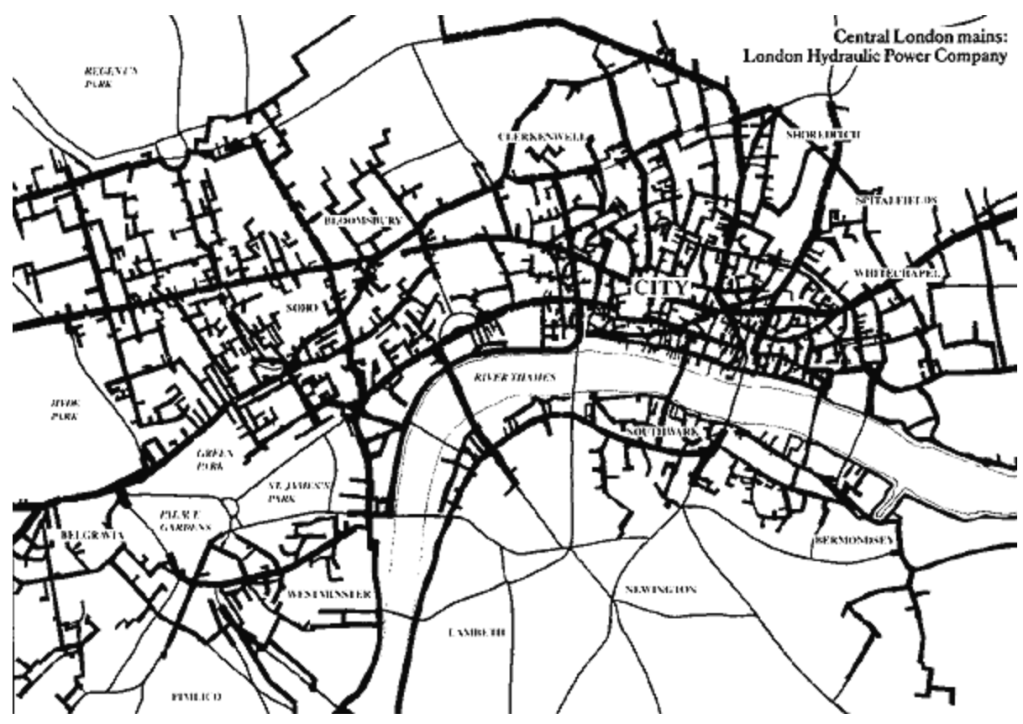
This sounds utterly implausible, but it worked. At the end of the nineteenth century, there was a great network of pipes all over London, holding water at high pressure. This water was used to raise passenger lifts, operate curtains at theatres, and to drive printing presses. It was used for cranes and other static machinery which required a strong, steady force. It’s a steampunk dream. Here’s a map. These pipes were everywhere.
The plaque you can see in the centre of my drawing says “London Hydraulic Power Company 1890”. This was one of the big power stations driving the water along the pipes. The power came from a coal-fired steam engine.
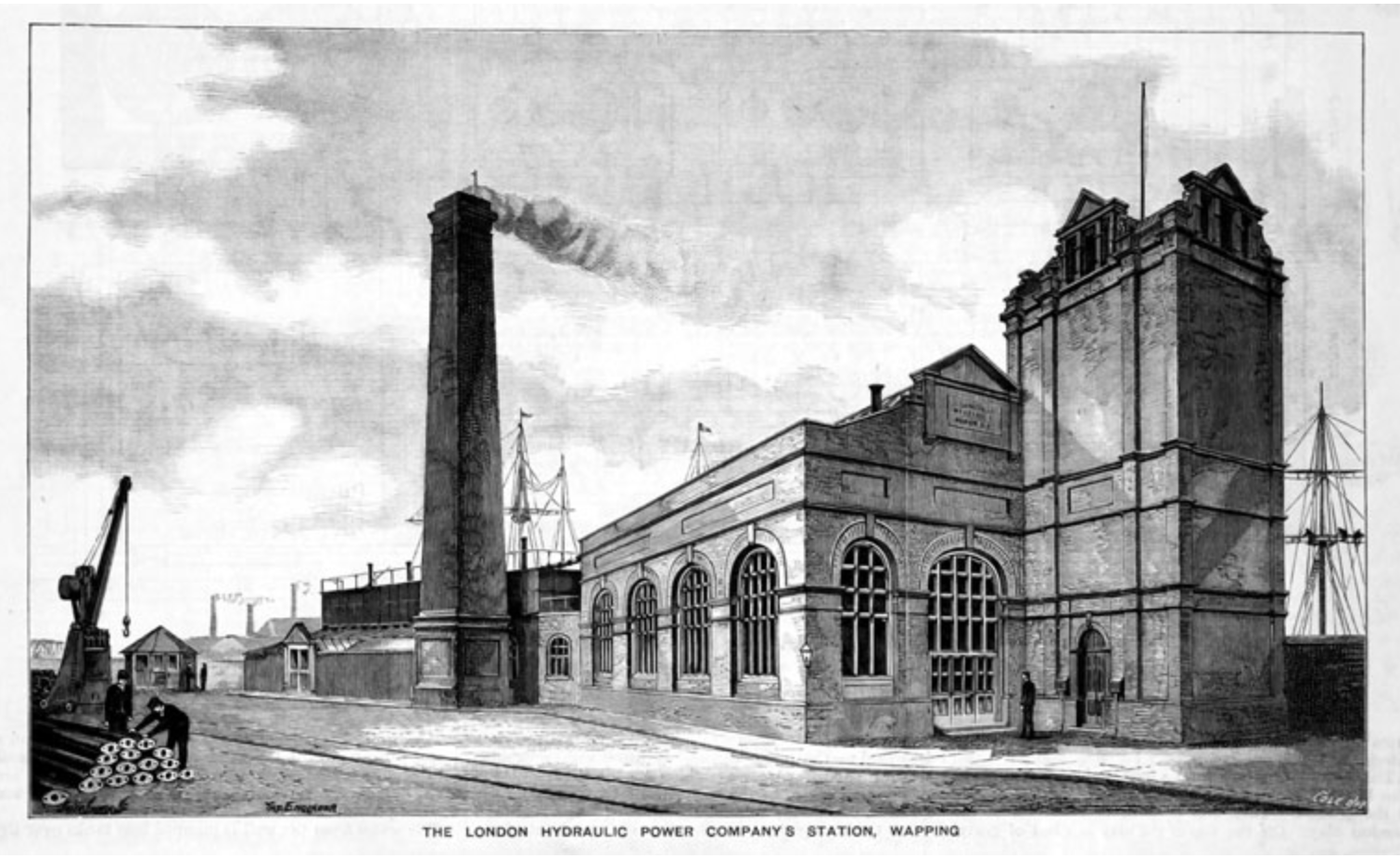
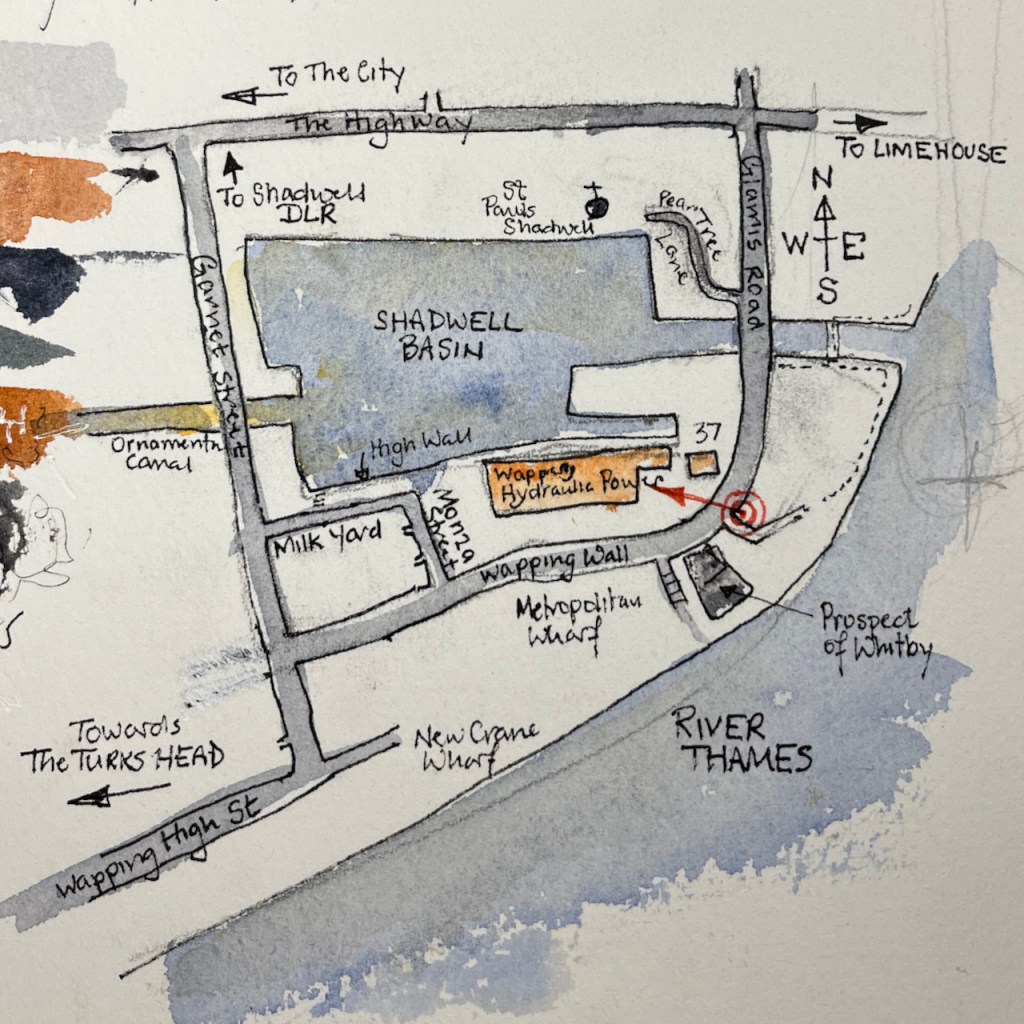
This is a picture from the early twentieth century. The chimney is from the steam engine room. The tall tower houses the “accumulator” where water under pressure is stored as a buffer against variation in demand. It is a sort of “battery”. A big weight sits at the top of a column of water. The weight is raised by pumping water in using steam power. The big weight then rests on the top of the water, keeping it under pressure and forcing it down the pipes. This drawing is from roughly the same place where I did my drawing. Note the sailing boats in Shadwell basin, to the right and in the background. The Thames is off the picture, to the left. Picture from: https://www.gracesguide.co.uk/File:Im1893EnV75-p43.jpg#file (creative commons)Map showing where I stood to do the drawing, which is also the approximate view point of the early twentieth century picture above.
Here is a summary of the history of the building, gleaned from various web searches:
1890: completed and started working. In use until 1977.
September 1973: first listing
June 1977: use discontinued
December 1977: Grade II* listed, including the machinery (listing ref 1242419)
1993-2013 – owned and operated by Jules Wright as “The Wapping Project”: an art and entertainment venue.
2013: Sold to UK Real Estate Limited
March 2019: planning application for an office building in the courtyard, retail and restaurant space and changes to the interior
October 2020: planning permission approved (ref PA/19/00564/NC and PA/19/00571/A1), despite objections from The Victorian Society and the Turks Head Charity.
Meanwhile – it’s an event space.
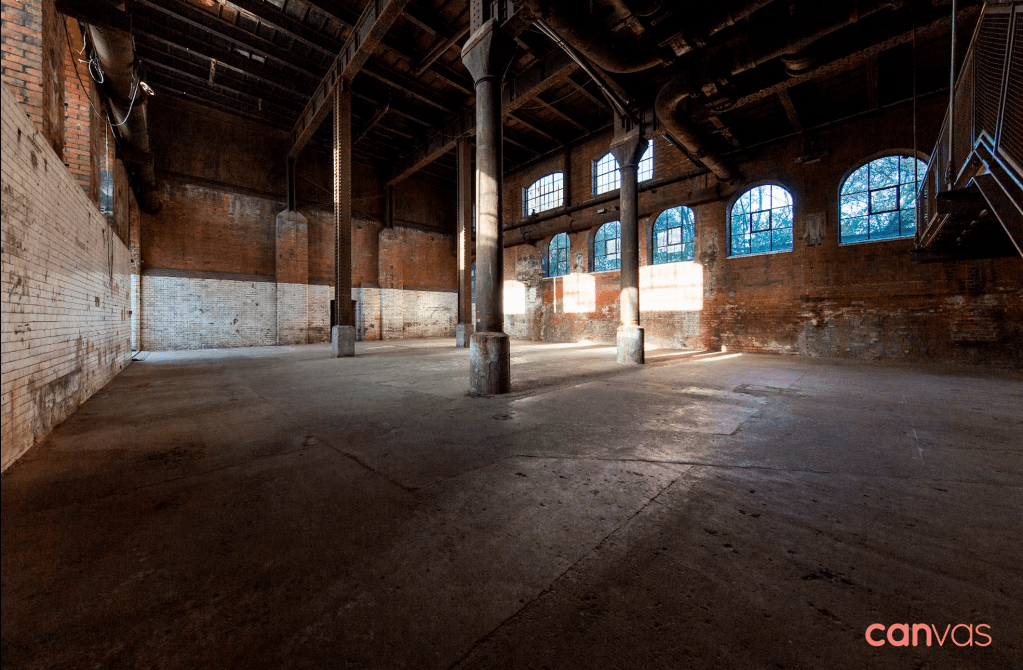
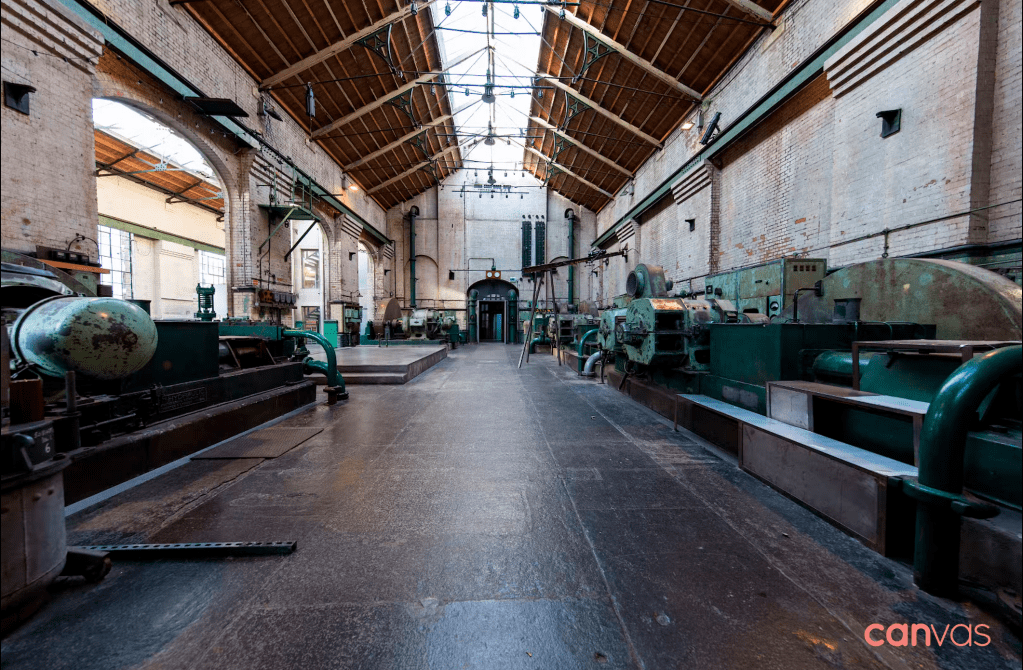
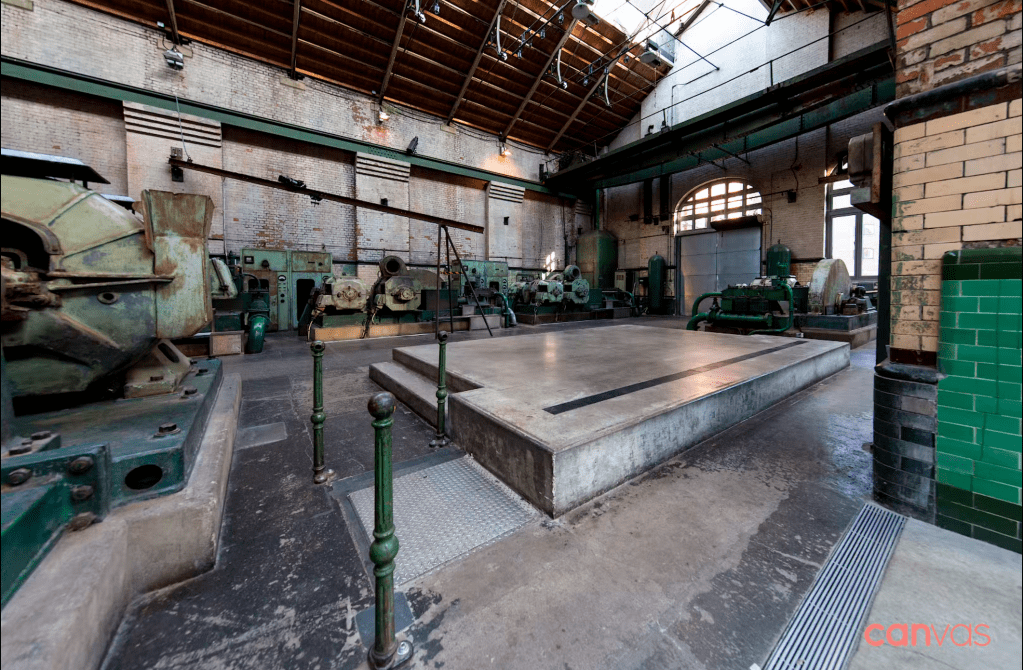
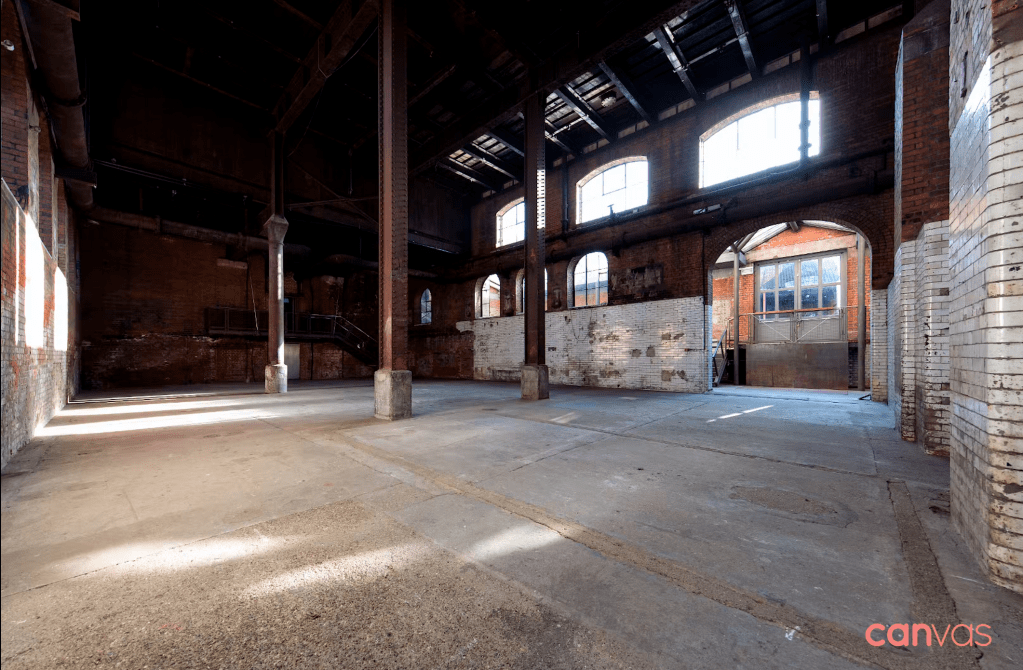
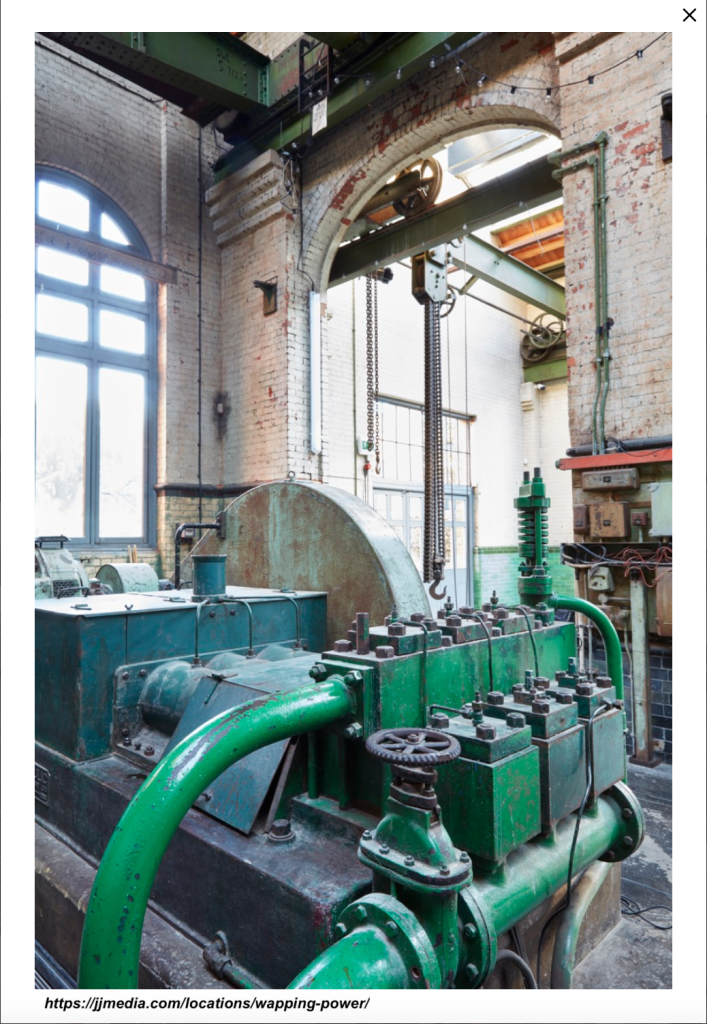
The Wapping building still has its machinery inside. It’s awaiting redevelopment. You can hire it for your fashion shoot, Christmas Party or product launch. The photos below are from the agencies advertising the use of the space: Canvas Events, and JJ Media It looks totally amazing! If you book your event there, please can I come and sketch?
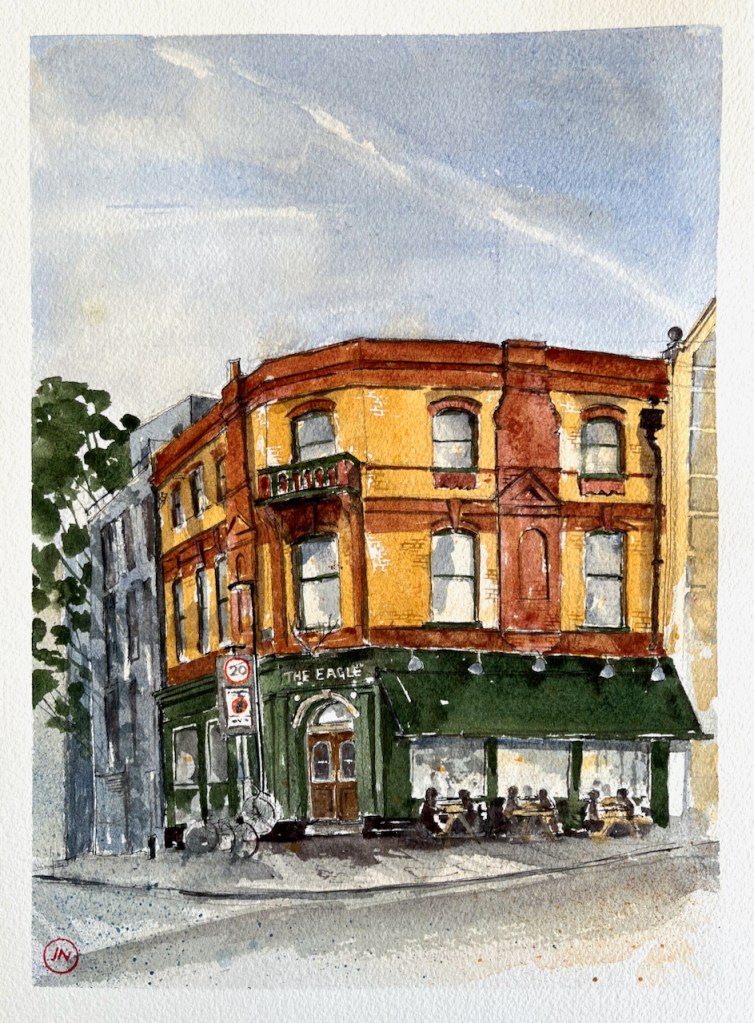
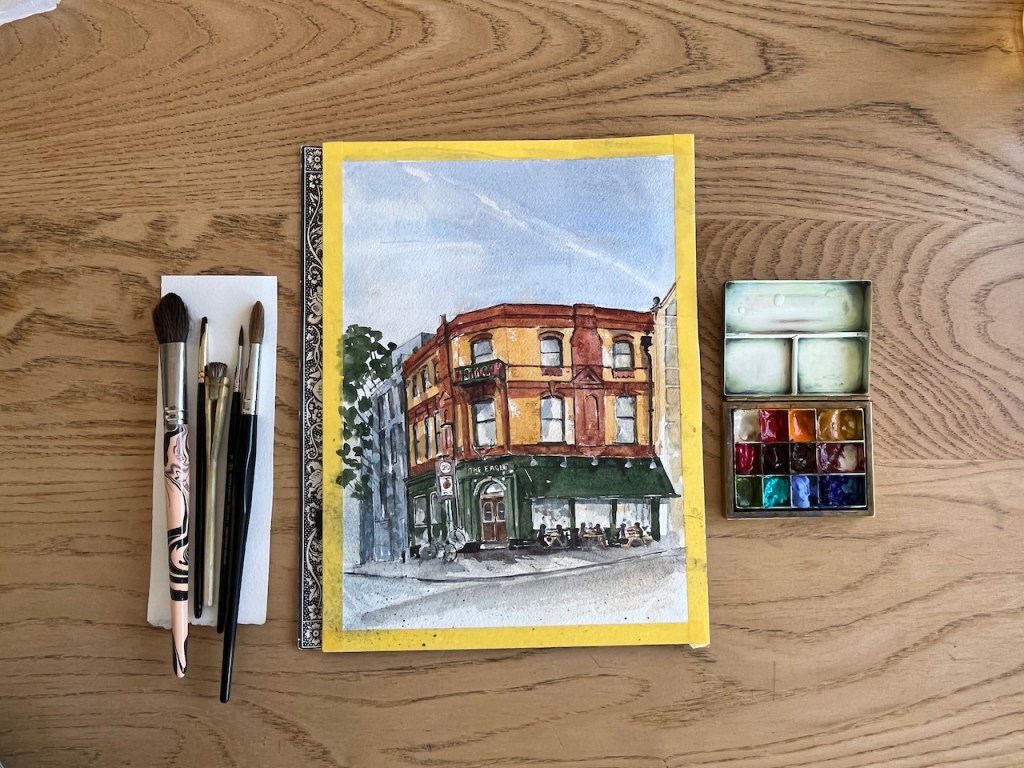
Here is “The Eagle” 159 Farringdon Road, London, EC1.
The Eagle, Farringdon Road, October 2022, 12″ x 9″ [sold]
I painted this as a commission. My client liked the pub and asked for a picture which showed the liveliness of the place. I sketched it from the other side of the Farringdon Road.
There was certainly a lot of activity in the pub. As you see in the picture, people arrived and occupied at the tables in the street, even though this was October, and quite chilly. The lamppost by the door was soon adorned with a collection of bikes.
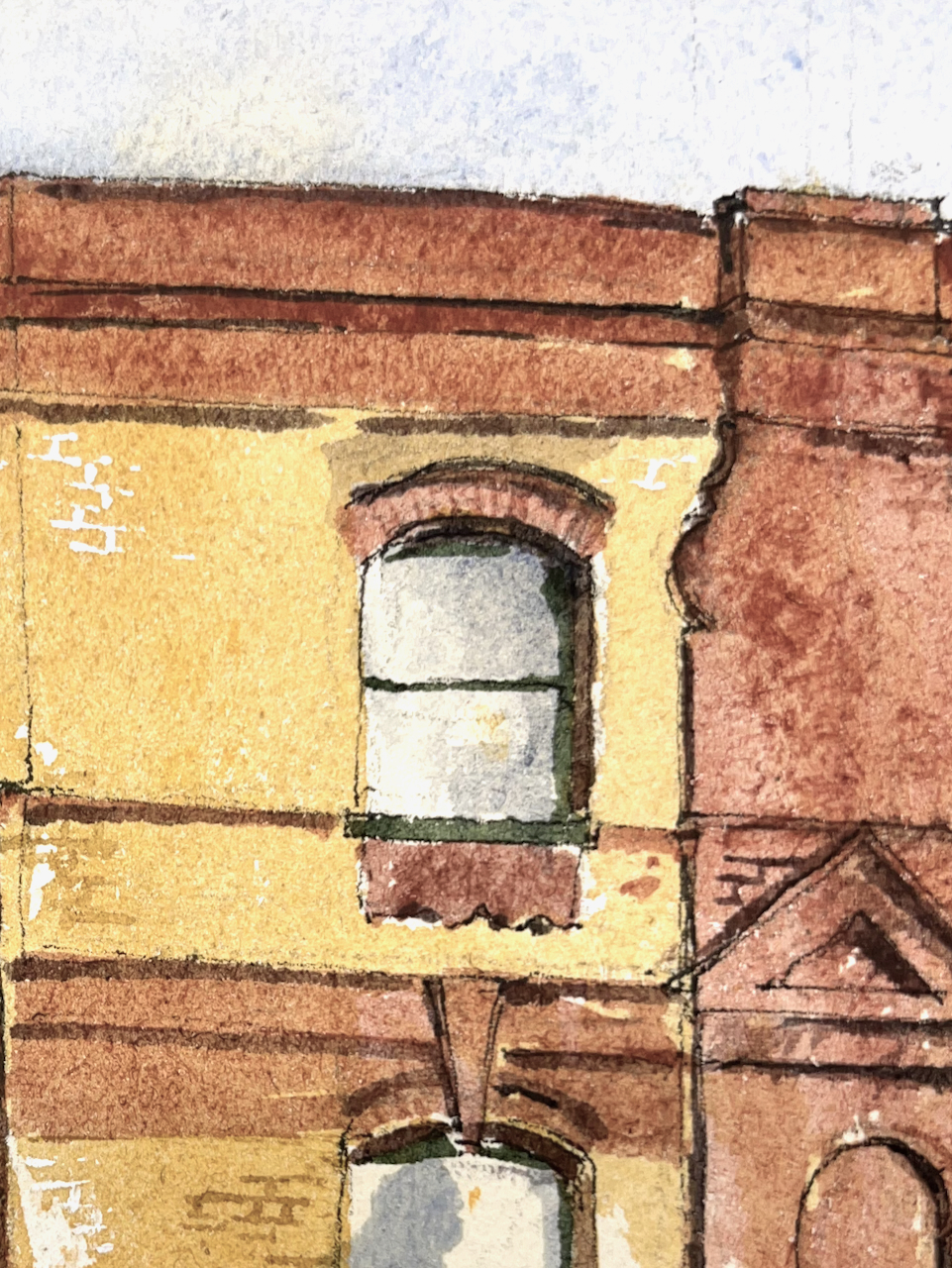
Here are some details from the picture:
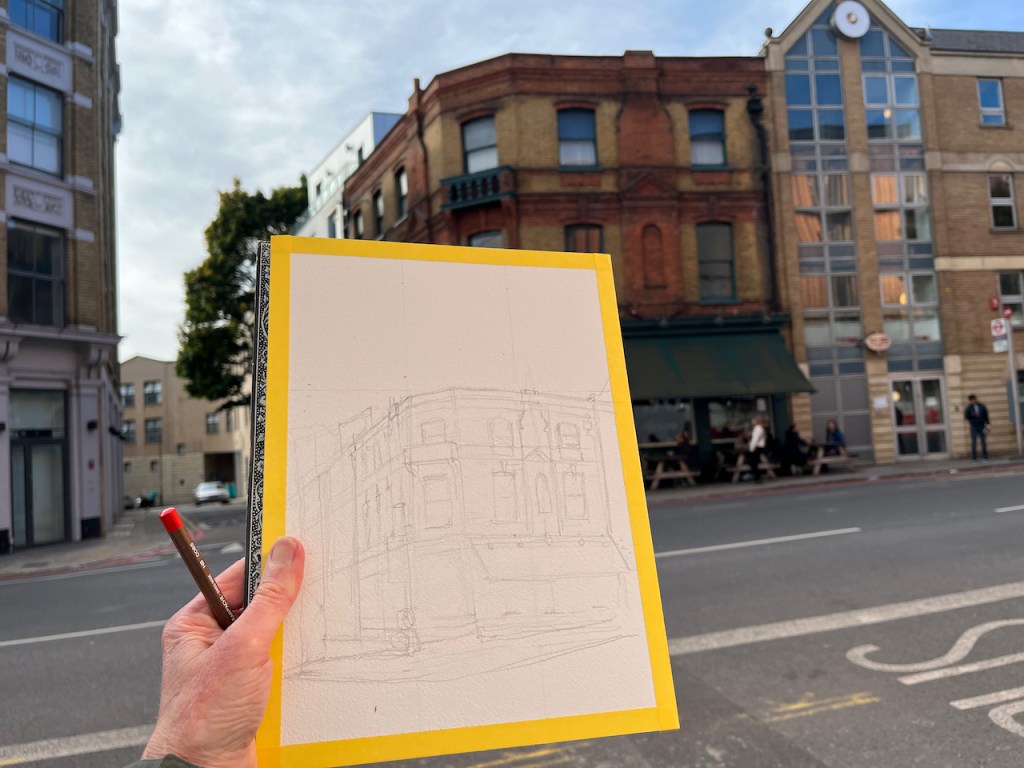
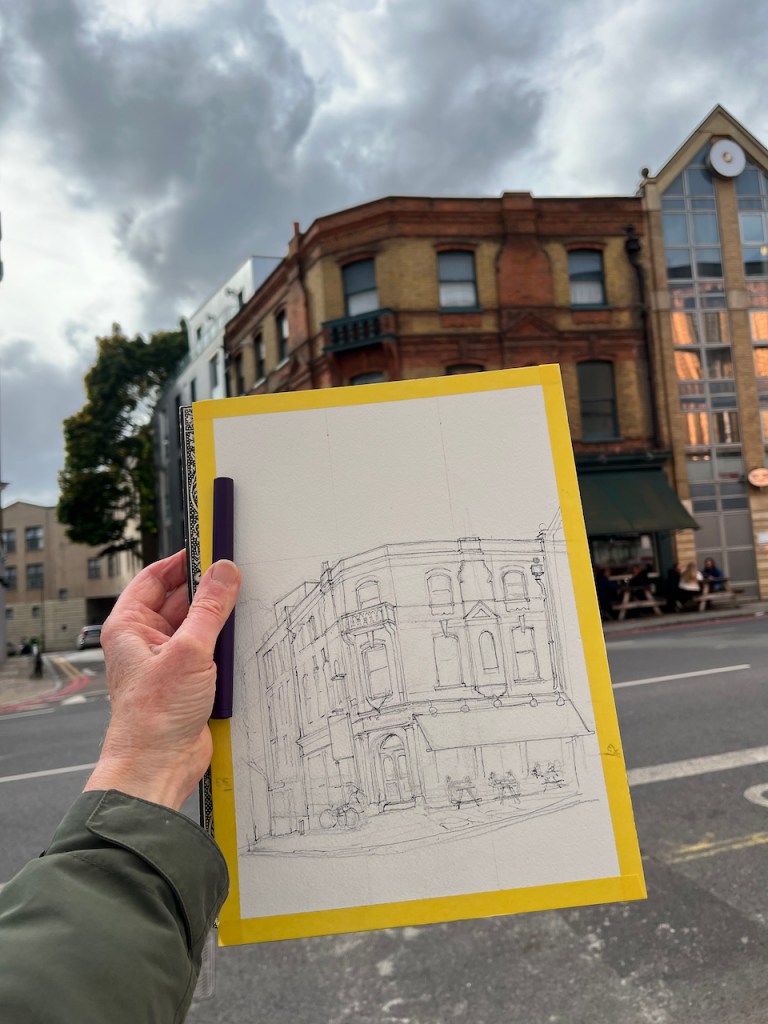
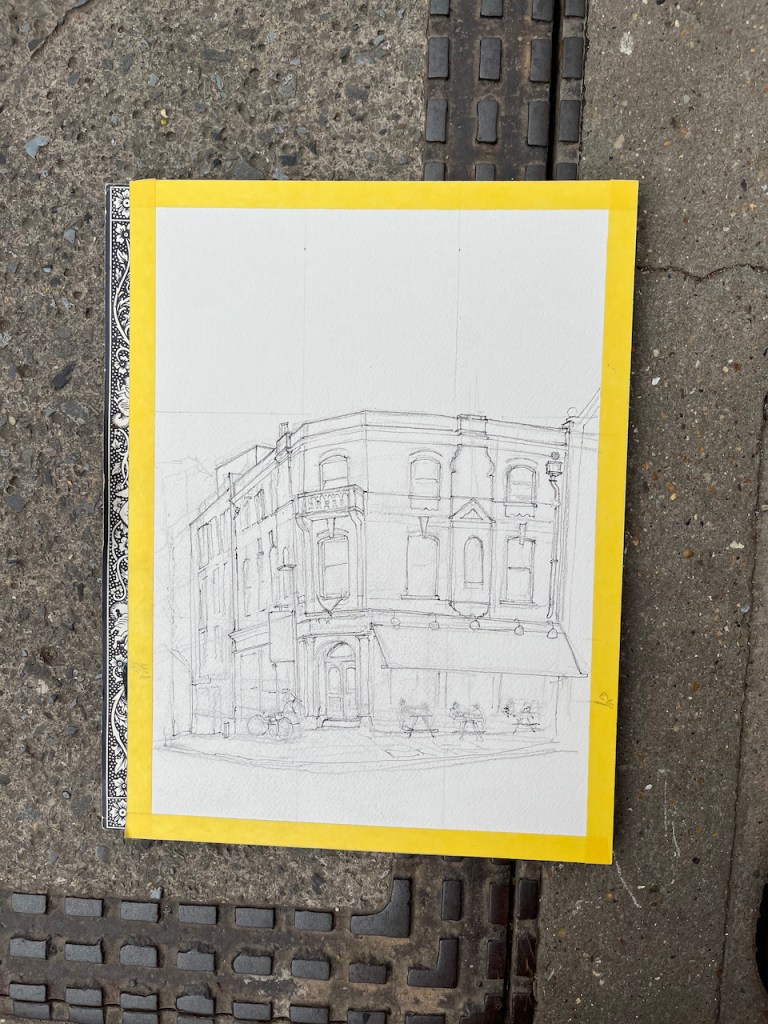
Here is work in progress:
Preliminary sketchPencil underdrawingPen on Arches Watercolour blockPen (Safari Lamy, shown in my hand)Pen complete
I completed the pen drawing on location and added the colour later:
Thank you to my client for this commission, and for allowing me to post the picture here.
I have also sketched The Eagle, 2 Shepherdess Walk. See this post:
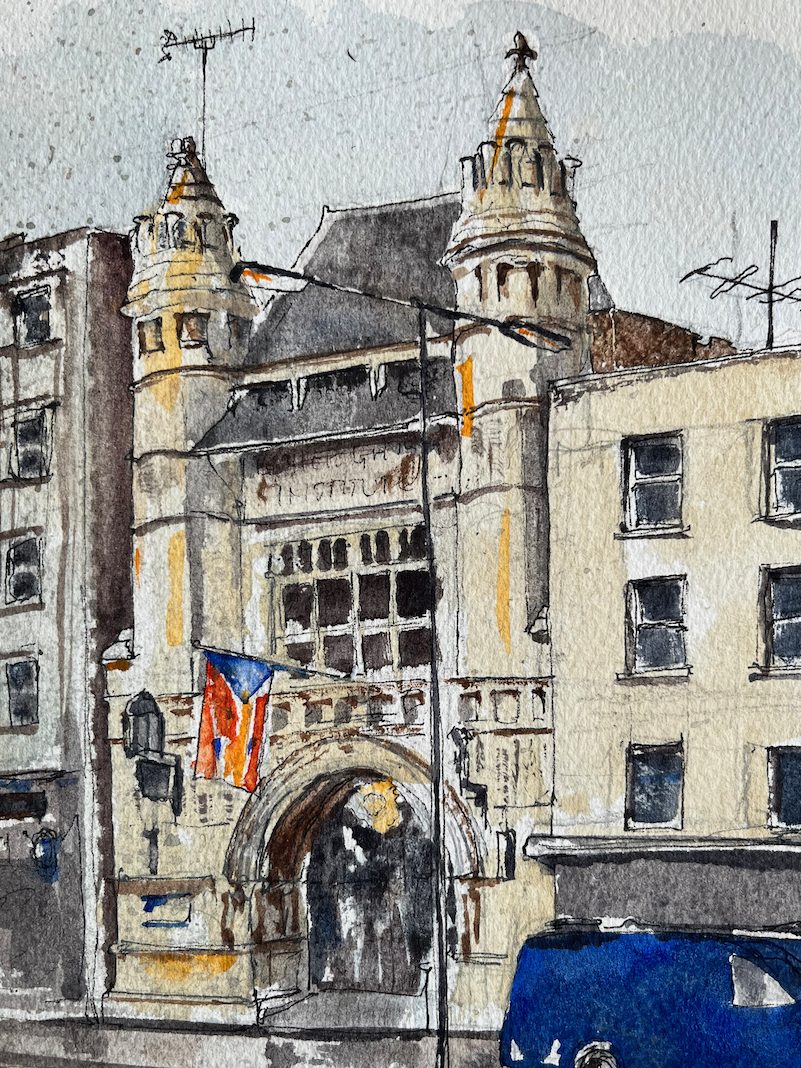
Here is the Bishopsgate Institute entrance, seen from the other side of the road.
Bishopsgate Institute, west entrance, 28th Dec 2022 in Sketchbook 12
The Bishopsgate Institute opened in 1895, as a centre for adult learning. Amazingly, it continues this mission to this day, with a huge range of courses and classes, as well as a library and an event programme: https://www.bishopsgate.org.uk/
The Institute was founded by Reverend William Rogers (1819-1896), a clergyman who took action to improve the lot of London’s poor and provide educational opportunities for people of all backgrounds. He secured funding for his educational initiative by using charitable funds from the City of London:
On arriving at St Botolph’s, Rogers discovered that a pot of charitable donations had been accumulating in the City for over five hundred years. These donations were often death bed bequests, with the donor hoping to secure his or her place in heaven by making a gift of money to the poor.
In Rogers’ view, these funds were no longer being fairly distributed. Rather than going towards “jollies” for the local great and the good (one purpose to which he suggested they were being used by the nineteenth century) he believed the bequests should be redirected towards his proposed polytechnics of the people scheme.
William Rogers began exploiting personal connections established at school and university to petition his friends in high places to introduce a change in the law that would make it possible to divert the City’s charitable income towards educational initiatives. He was successful in this.
The terms of the City of London Parochial Charities Act (1883) allowed Rogers to work with like-minded educationalists to draw up a visionary plan of action. According to this plan, three new learning institutions would be built in the City: the Cripplegate Institute, the St Bride Institute, and our own Bishopsgate Institute.
The building was designed by the architect Charles Harrison Townsend. I particularly enjoy those complicated spires, which Pevsner describes as “sturdy, oddly detailed spires” [Nicolas Pevsner, City of London, p288]
The blue van is a police vehicle. There is a police station just south of Middlesex Street, so the police vehicles park on Bishopsgate.
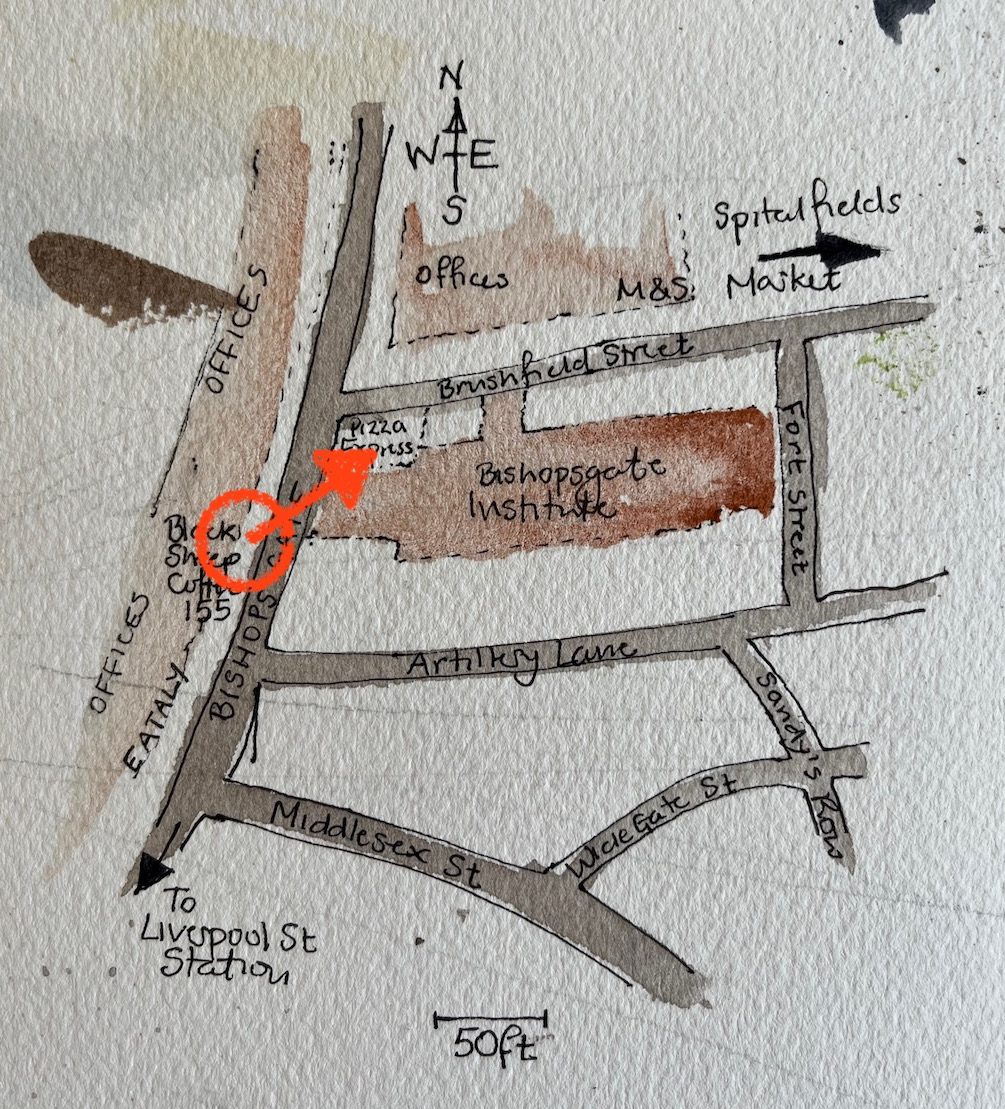
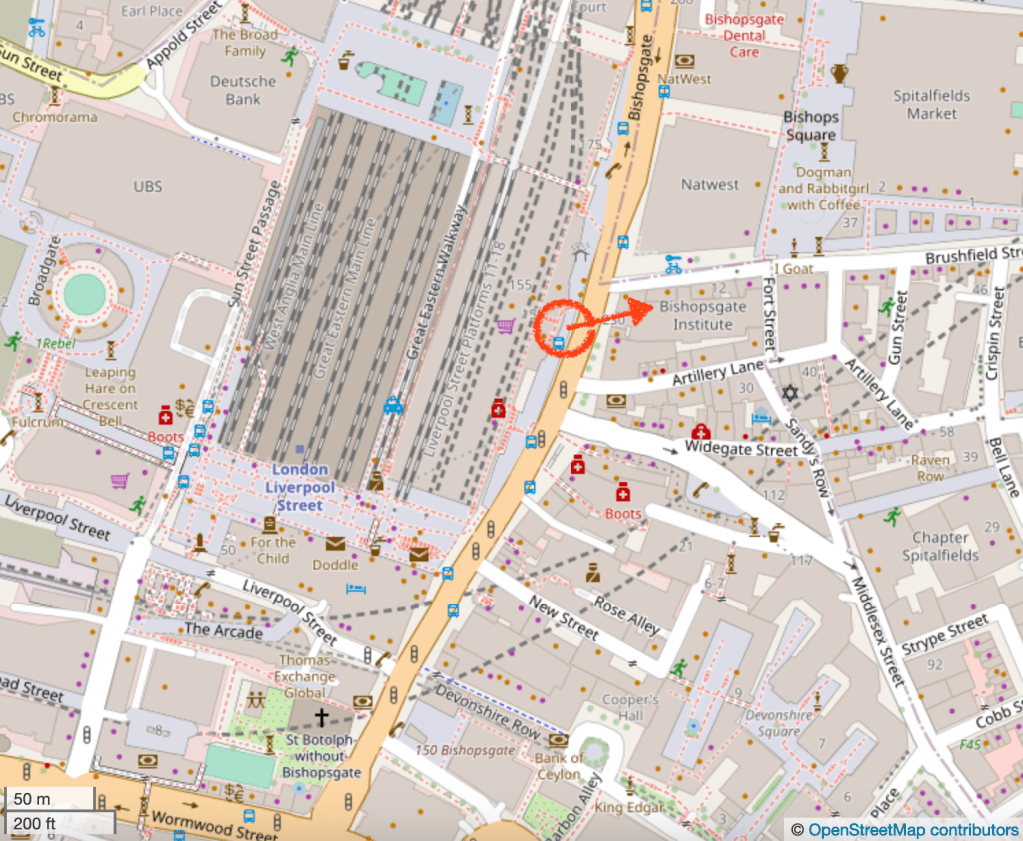
Location of the drawing
Here is work in progress on the drawing:
Preliminary drawingPencilPenTime to go home
It was cold and raining, so I completed the pen on location and then did the colour at my desk.
Click a button below to share this post online, email it, or print it:
On the way back from a visit to the West End, I passed St-Martin-in-the-Fields, standing out against the cold sky.
St Martin-in-the-Fields, Trafalgar Square. Sketched 2nd Dec 2022, in sketchbook 12
The statue in the foreground, left, is the Edith Cavell Memorial, seen from the back. Edith Cavell (1865-1915) was a British nurse. In German-occupied Belgium, guided by her principles of humanity and her Christian faith, she provided medical care to soldiers irrespective of which side they were on. She was executed by a German firing squad 1915, because she had helped Belgian, British and French soldiers to escape the German occupation and reach Britain. Her grave is in Norwich Cathedral.
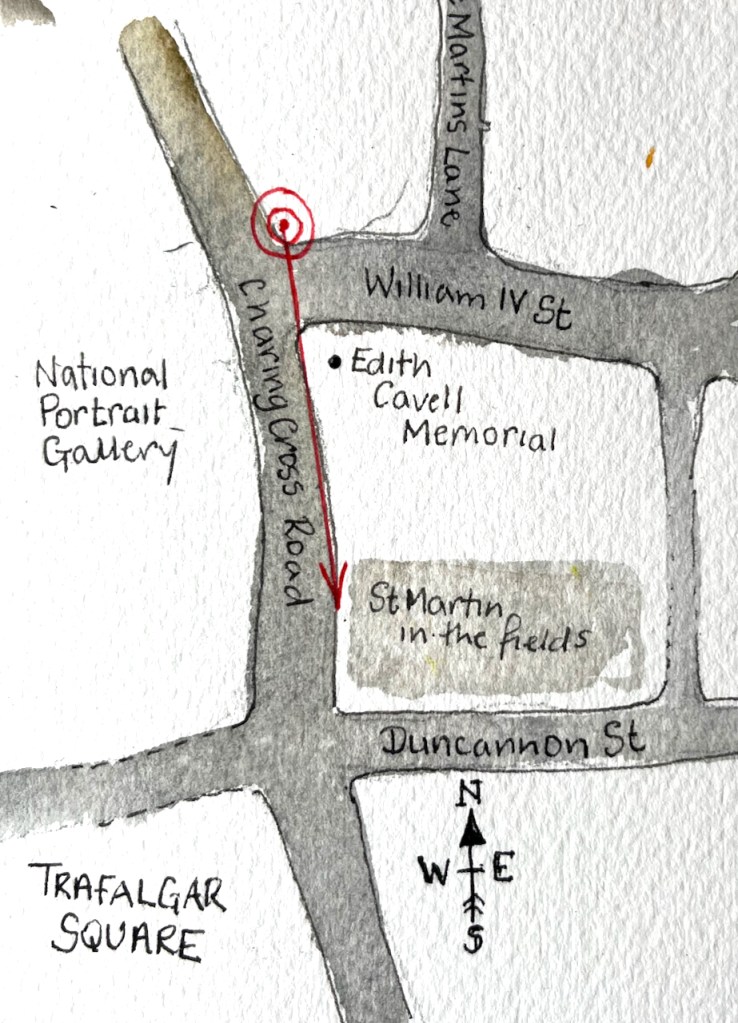
I sketched standing on a corner of the Charing Cross road, see map above. This turned out to be a very noisy location. The National Portrait Gallery is being refurbished and there was continuous drilling and banging. Buses and cars ground their gears, and thundered past, rushing through the traffic lights to shriek to a halt at the next junction.
But St-Martin-in-the-Fields rose above it all. The inscriptions which faced me on the Edith Cavell Memorial were: “Determination”, “Fortitude”.
Click a button below to share this post online, email it, or print it:


















 Jane Sketching