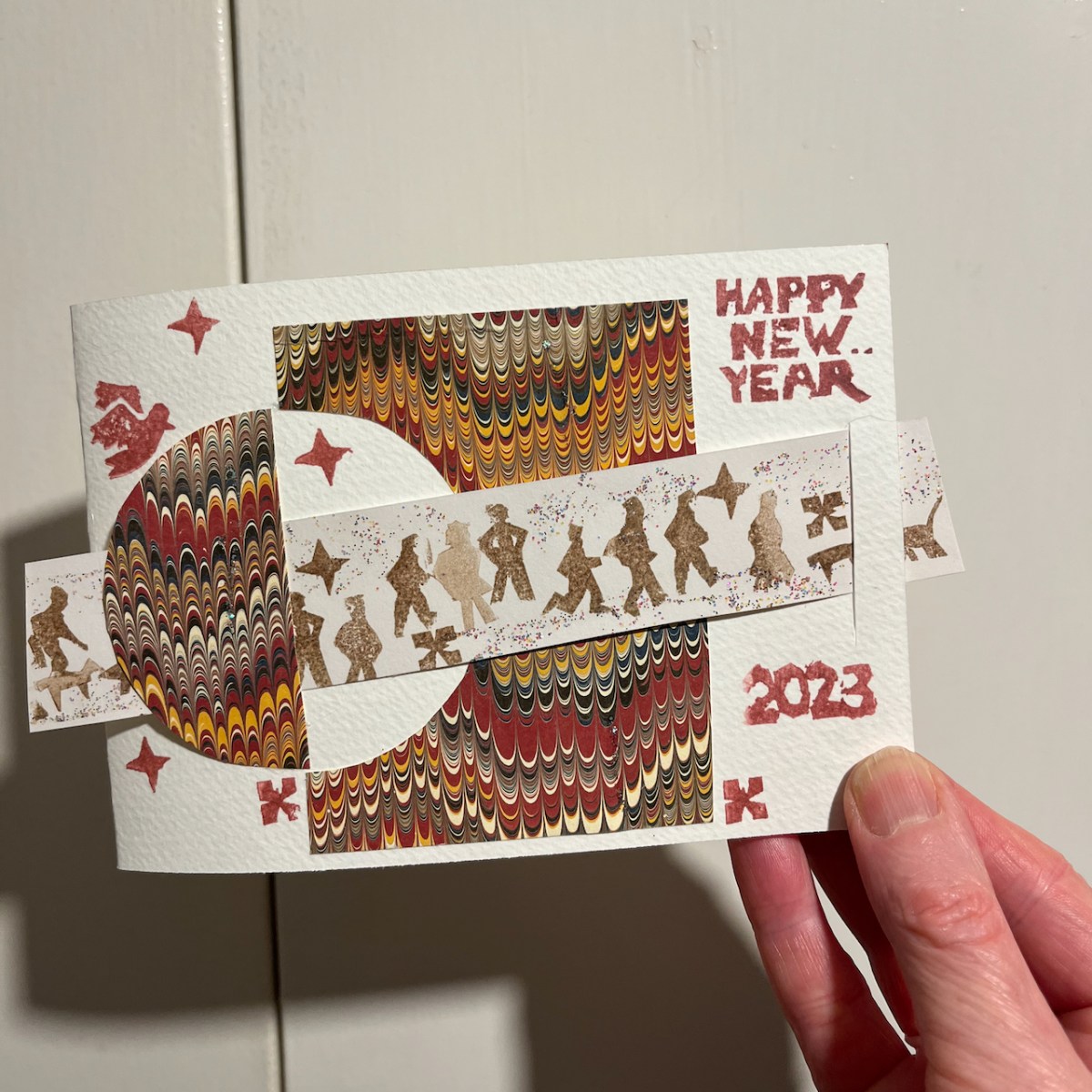
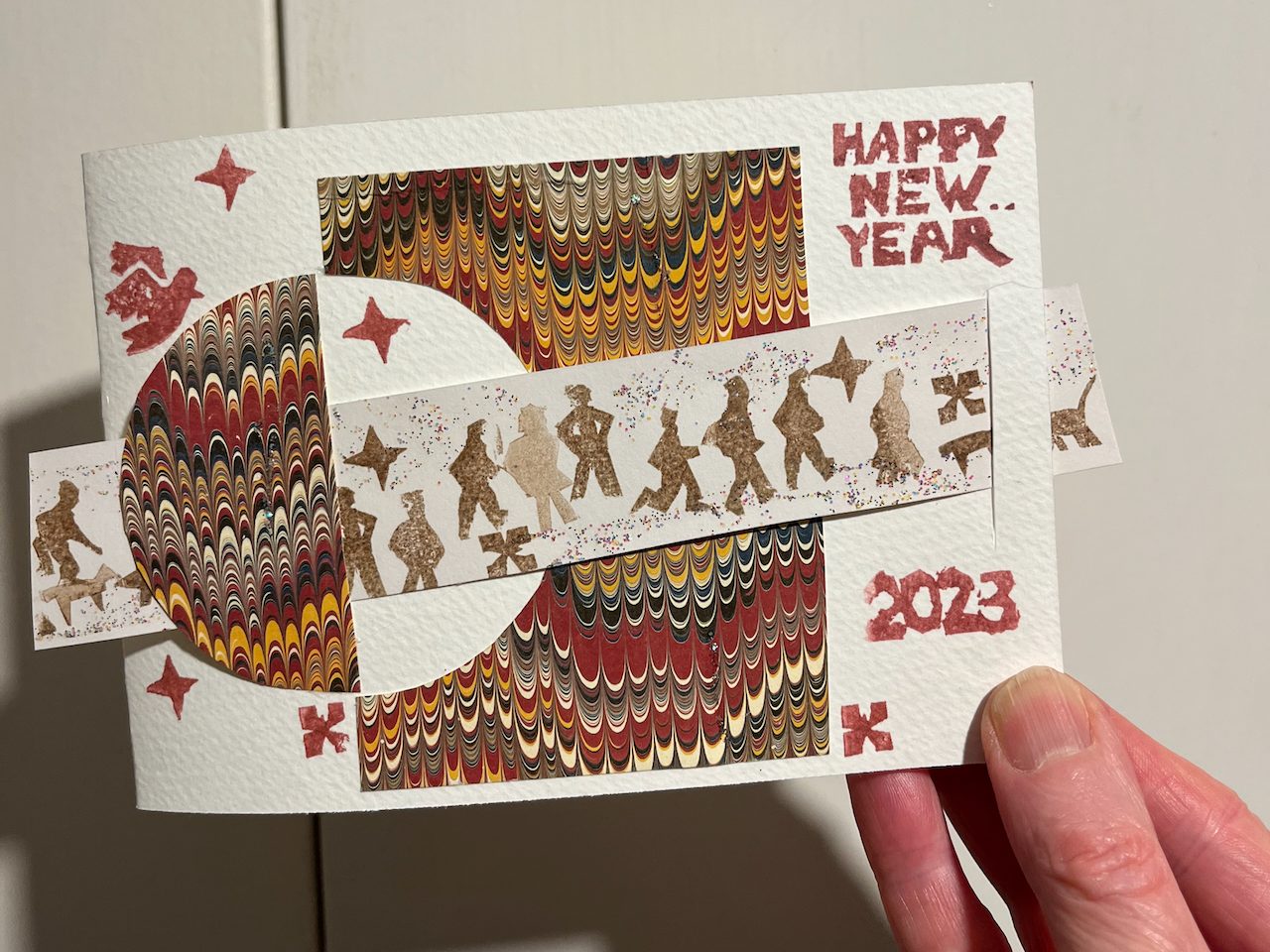
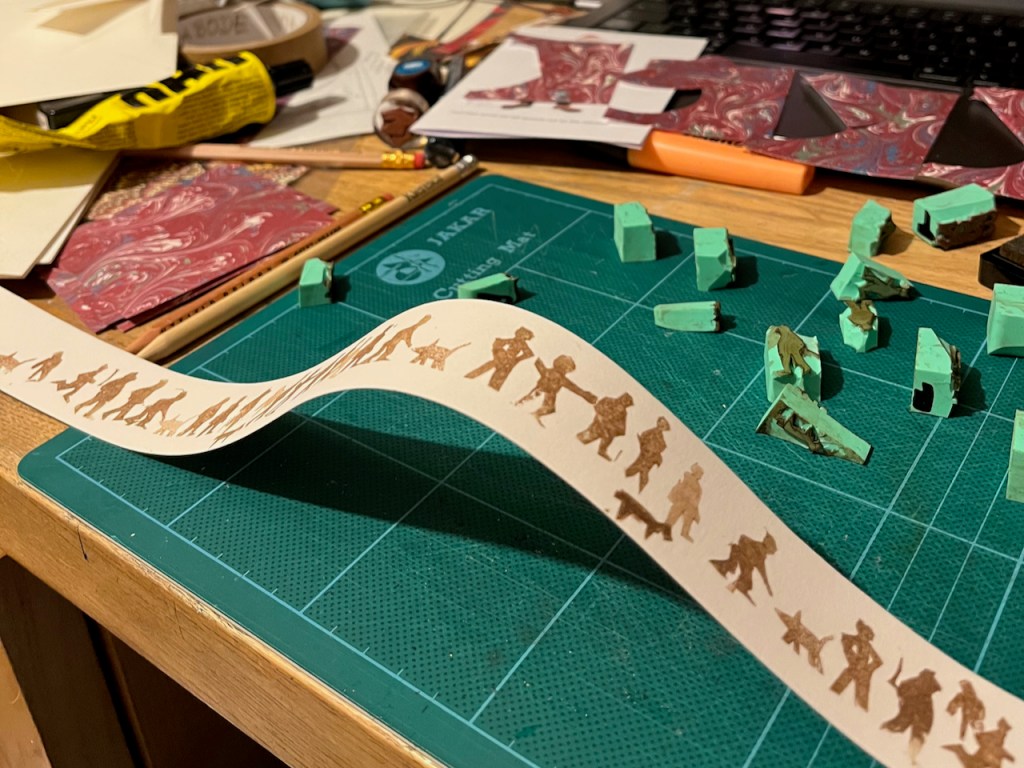
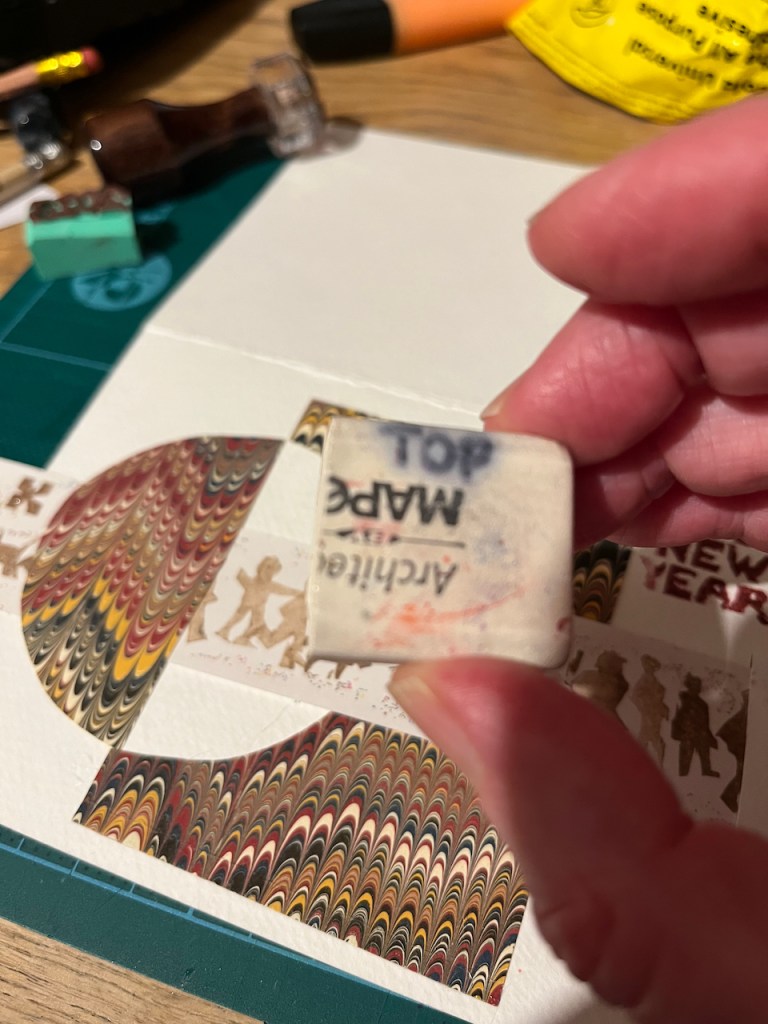
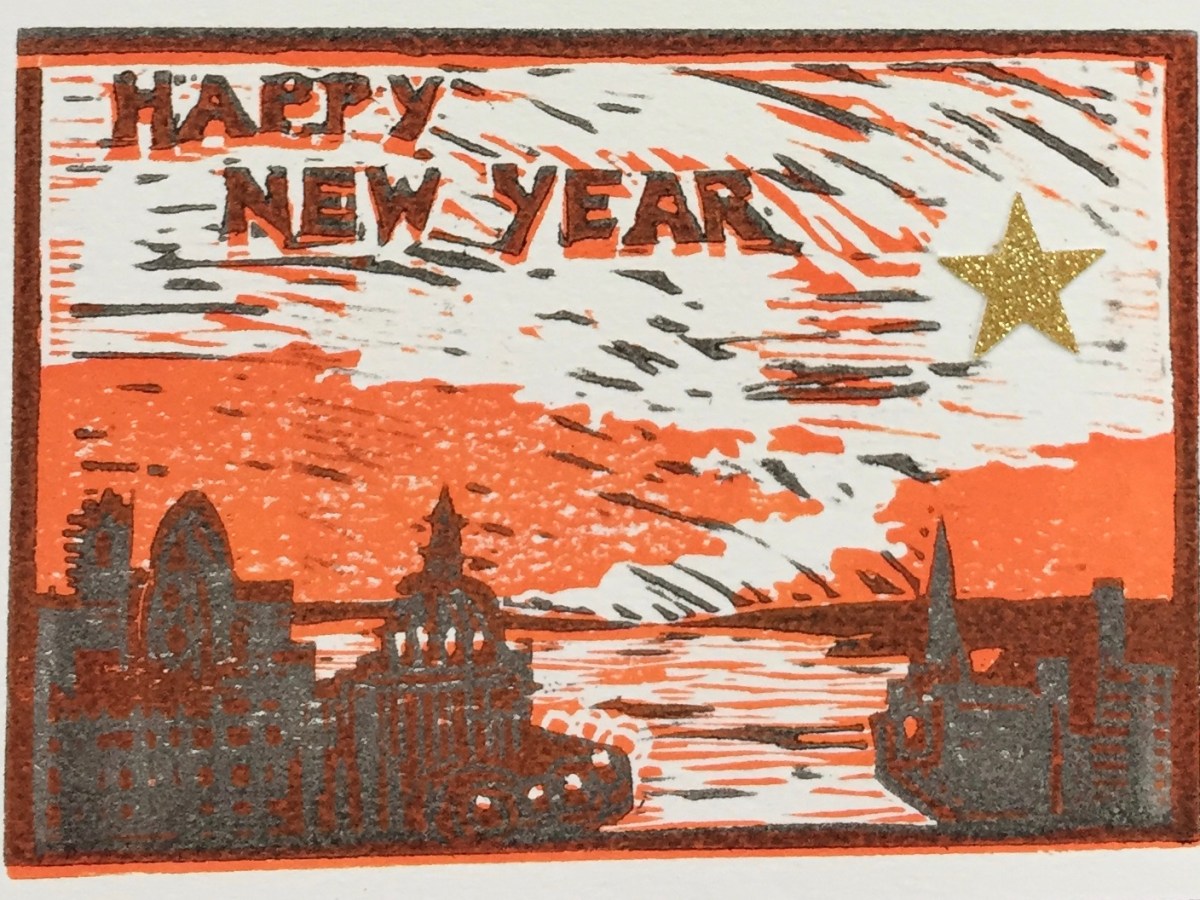
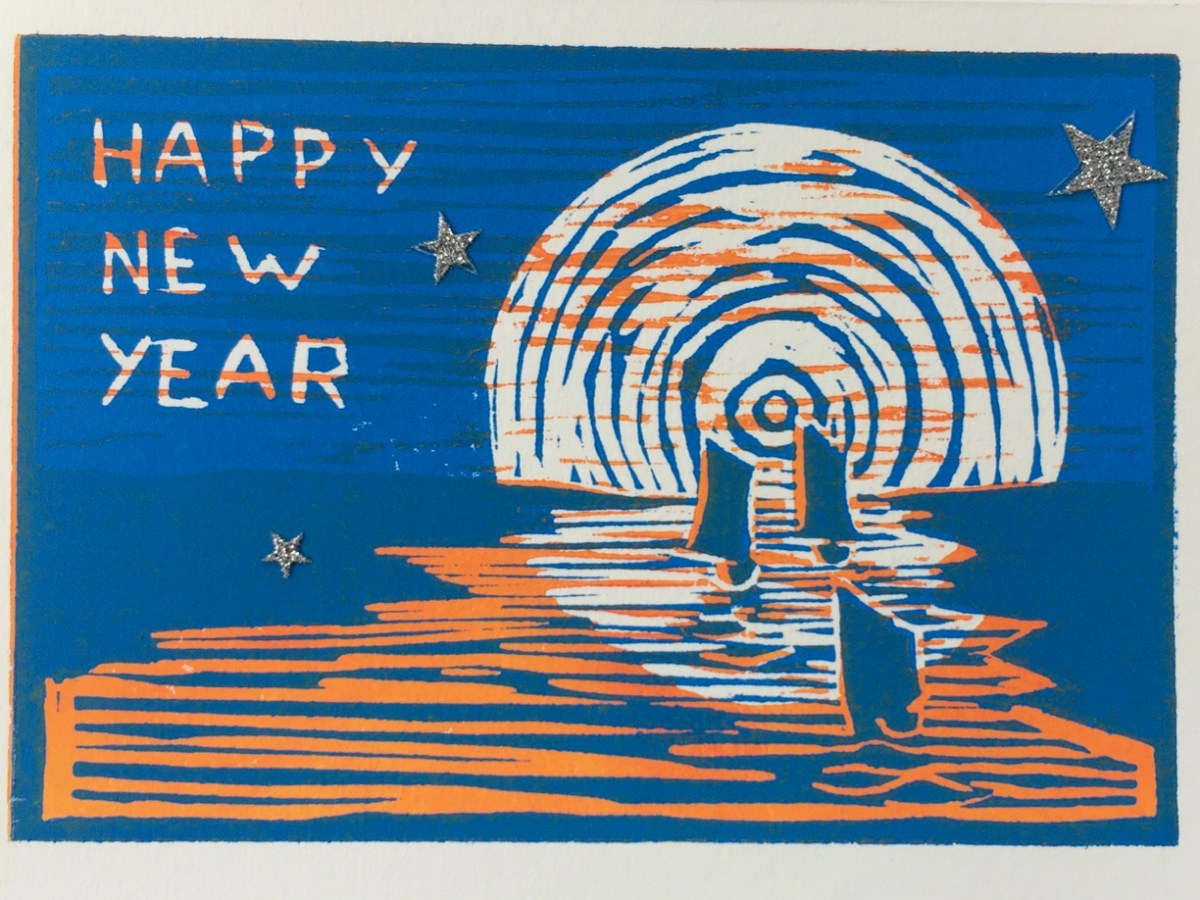
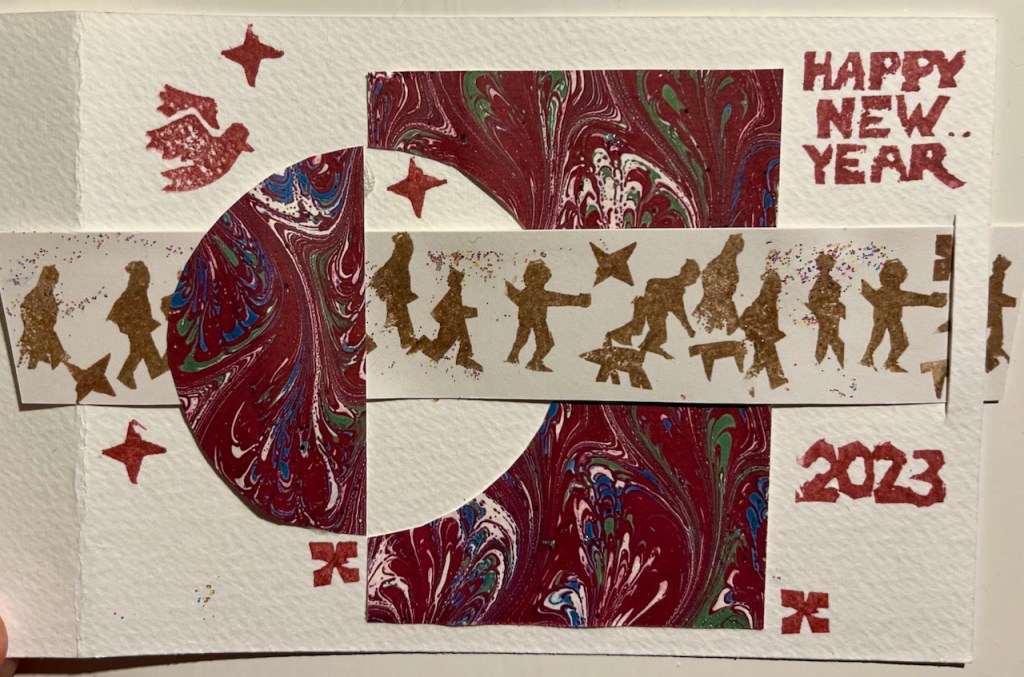
I make New Year cards most years to send to friends and family. In recent years they have been prints: woodcuts or linocuts. This year it was a collage. My card this year is made of marbled paper and a kinetic band of people. The people are printed from carved rubber stamps. The concept was to show “through it all together”: people going under and over and through.
New Year Card 2023
Here is a short video to show how the centre band moves:
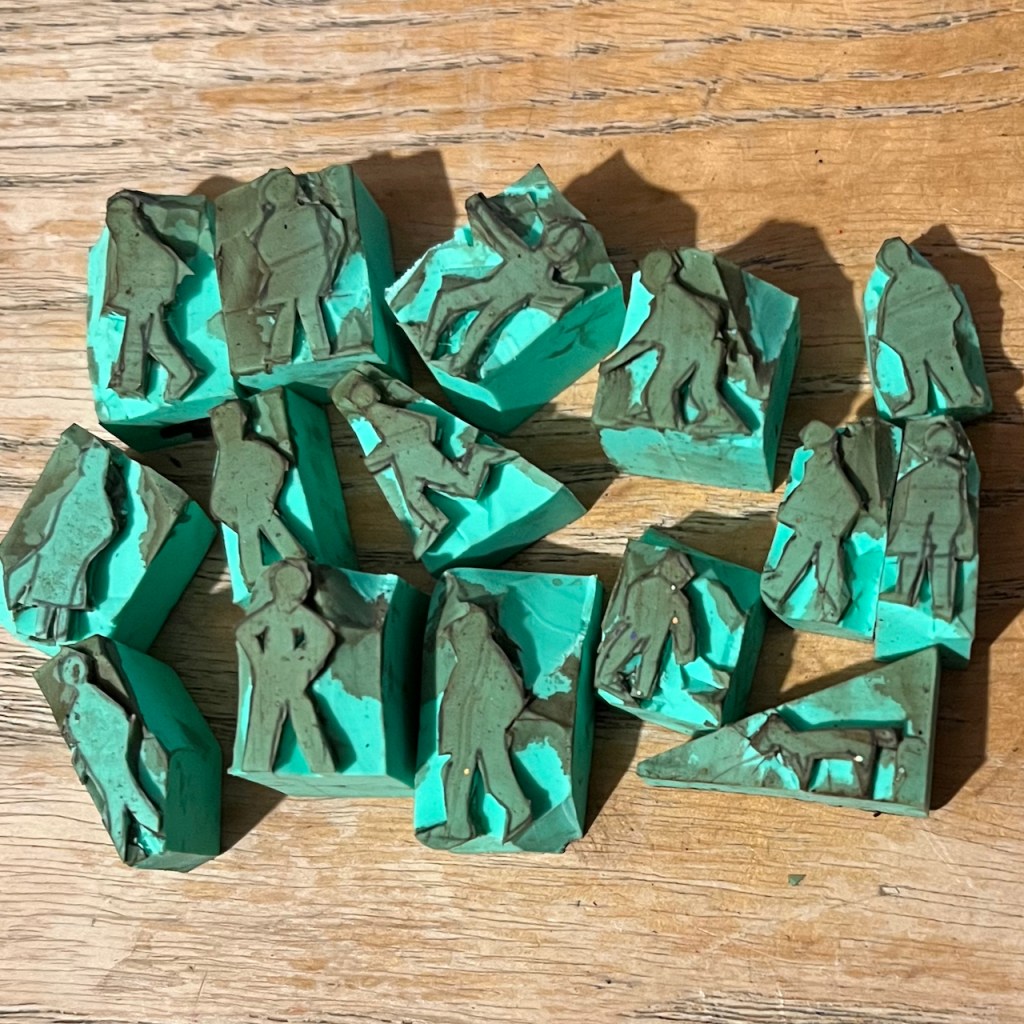
Here are the rubber stamps which made the people and the dogs. I cut them from a large pencil eraser.
Rubber stamps made from pencil eraser. They are each about 1cm high.
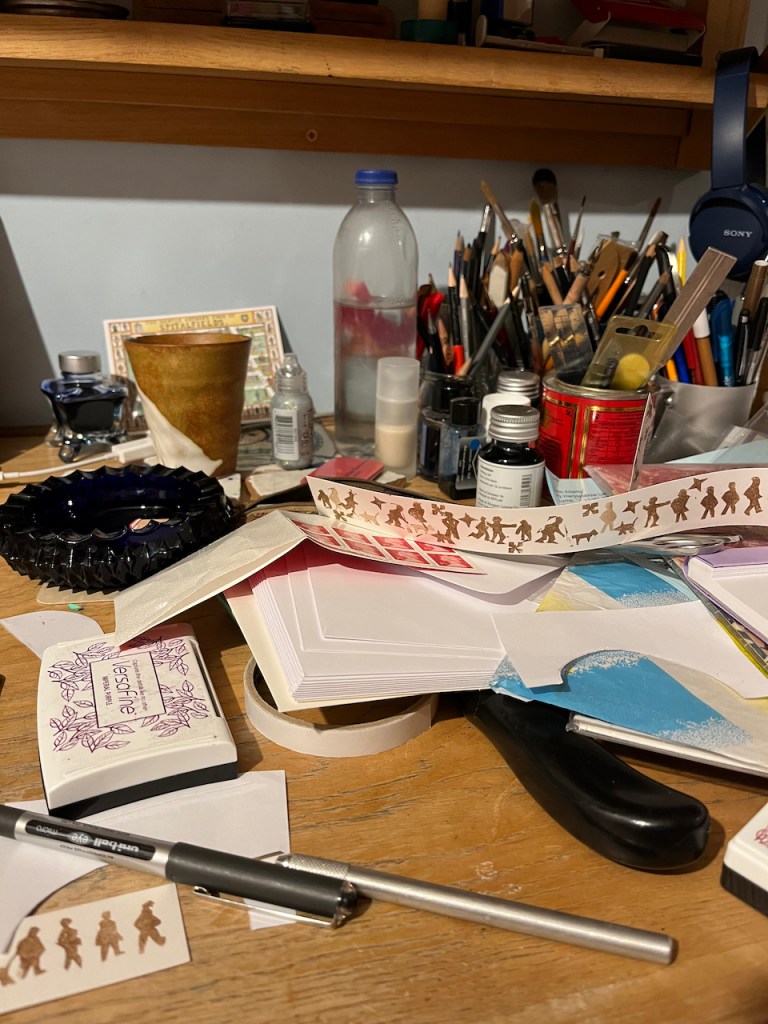
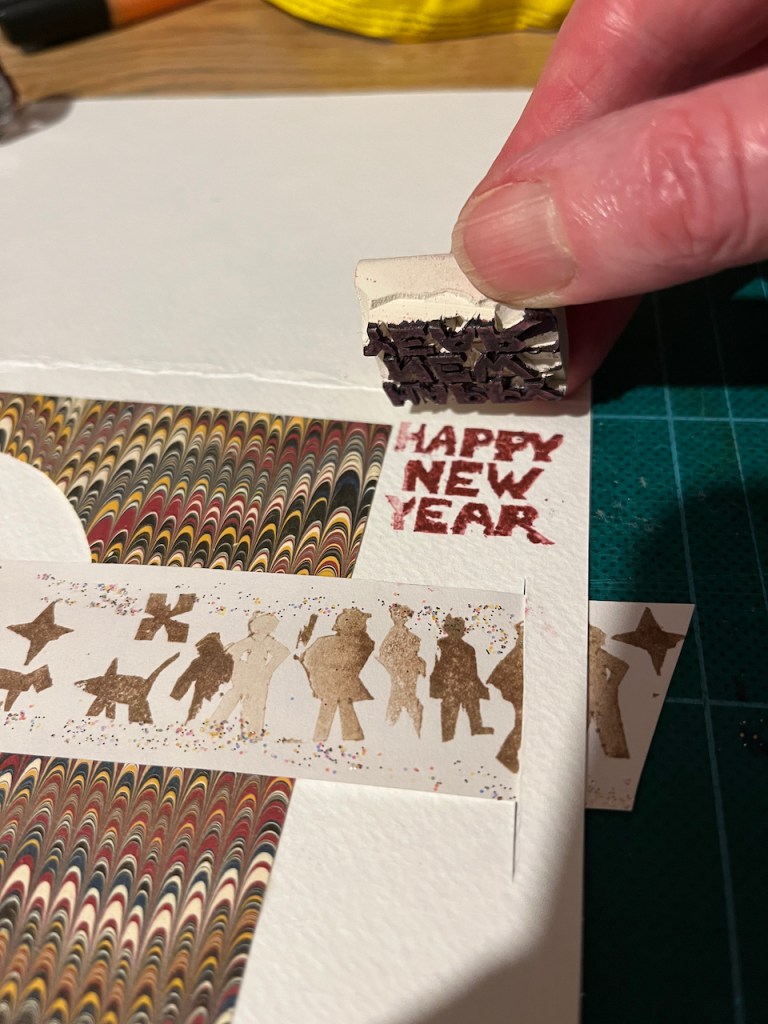
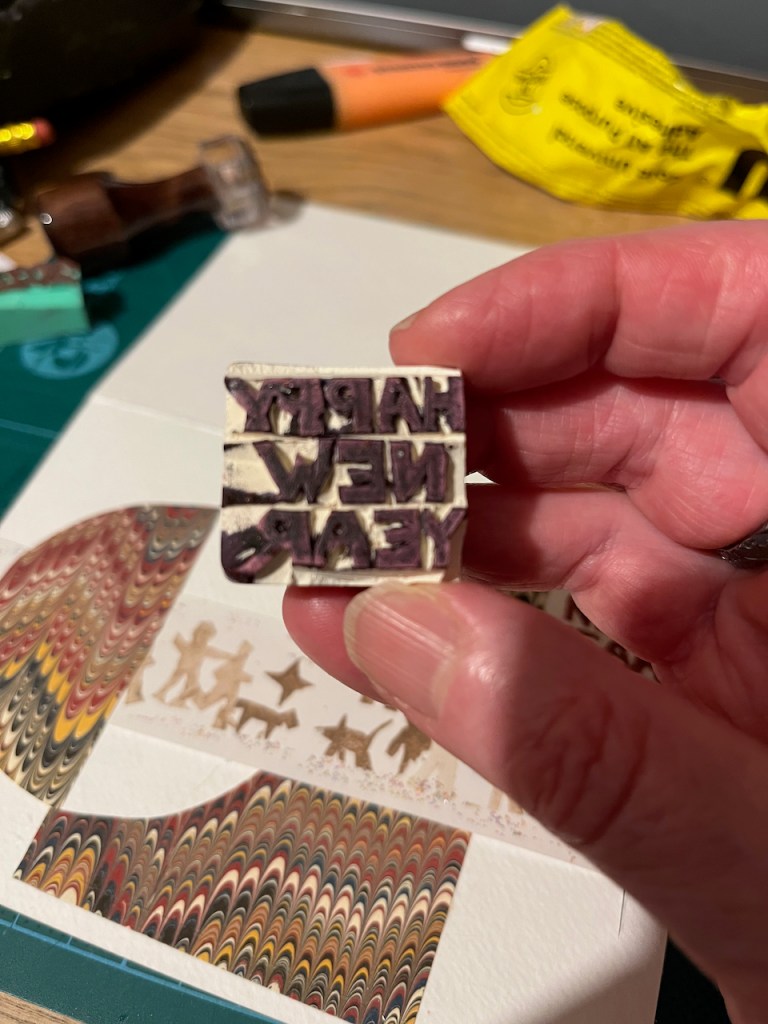
Here are some snaps of work in progress.
The marbled paper is from a pack of offcuts from the Wyvern Bindery. There are several different designs. The white card is watercolour paper from Jackson Art, cut down, with the offcuts used to make the moving band of people. I made about 45.
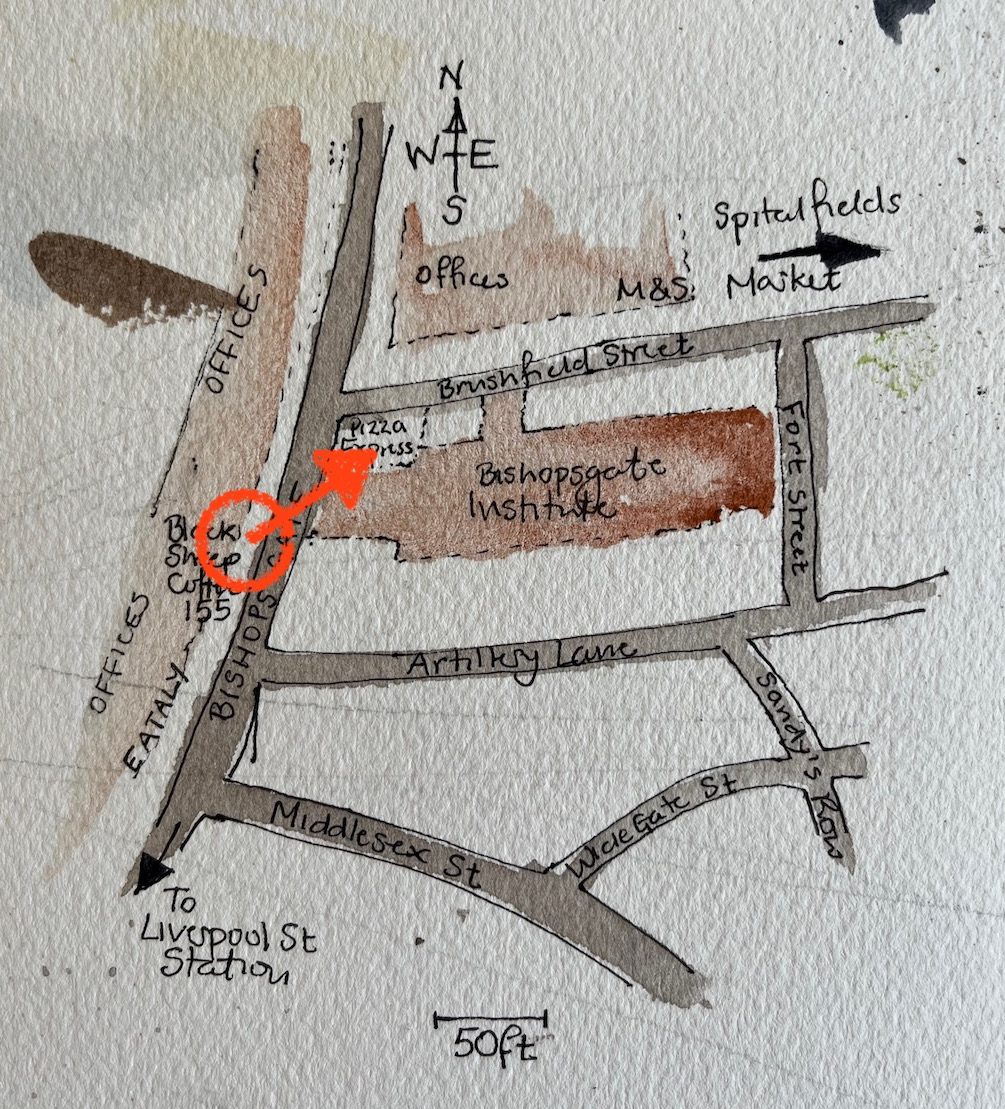
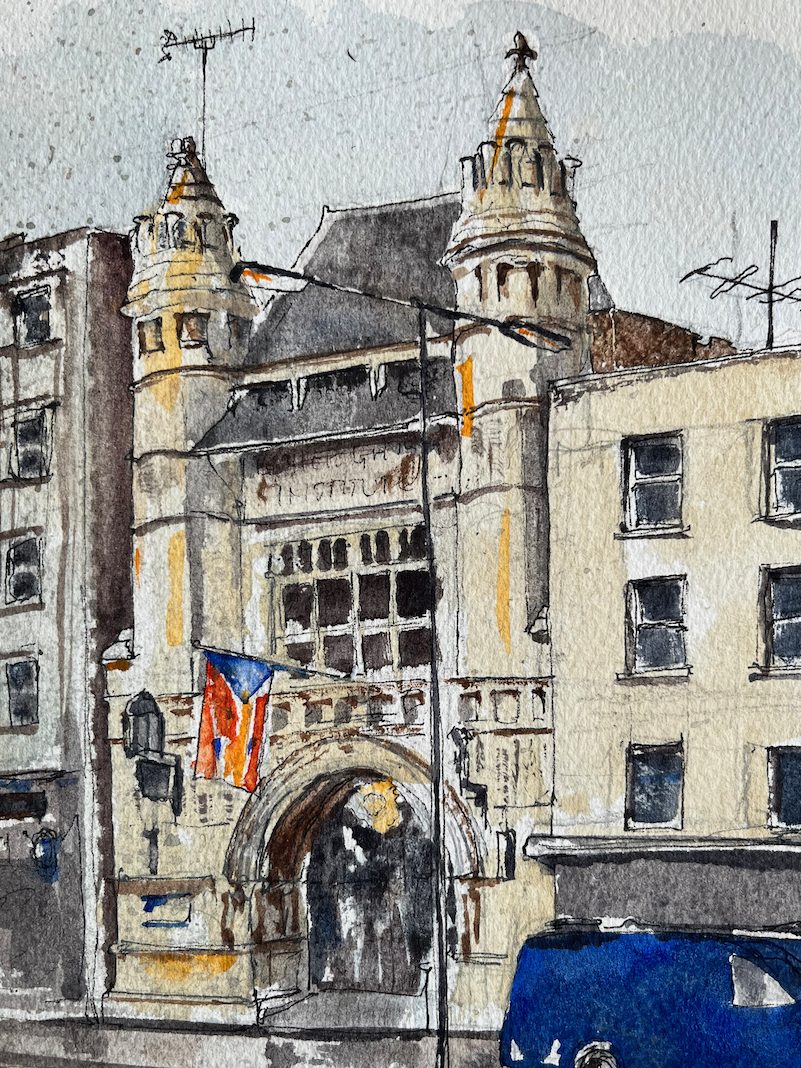
Here is the Bishopsgate Institute entrance, seen from the other side of the road.
Bishopsgate Institute, west entrance, 28th Dec 2022 in Sketchbook 12
The Bishopsgate Institute opened in 1895, as a centre for adult learning. Amazingly, it continues this mission to this day, with a huge range of courses and classes, as well as a library and an event programme: https://www.bishopsgate.org.uk/
The Institute was founded by Reverend William Rogers (1819-1896), a clergyman who took action to improve the lot of London’s poor and provide educational opportunities for people of all backgrounds. He secured funding for his educational initiative by using charitable funds from the City of London:
On arriving at St Botolph’s, Rogers discovered that a pot of charitable donations had been accumulating in the City for over five hundred years. These donations were often death bed bequests, with the donor hoping to secure his or her place in heaven by making a gift of money to the poor.
In Rogers’ view, these funds were no longer being fairly distributed. Rather than going towards “jollies” for the local great and the good (one purpose to which he suggested they were being used by the nineteenth century) he believed the bequests should be redirected towards his proposed polytechnics of the people scheme.
William Rogers began exploiting personal connections established at school and university to petition his friends in high places to introduce a change in the law that would make it possible to divert the City’s charitable income towards educational initiatives. He was successful in this.
The terms of the City of London Parochial Charities Act (1883) allowed Rogers to work with like-minded educationalists to draw up a visionary plan of action. According to this plan, three new learning institutions would be built in the City: the Cripplegate Institute, the St Bride Institute, and our own Bishopsgate Institute.
The building was designed by the architect Charles Harrison Townsend. I particularly enjoy those complicated spires, which Pevsner describes as “sturdy, oddly detailed spires” [Nicolas Pevsner, City of London, p288]
The blue van is a police vehicle. There is a police station just south of Middlesex Street, so the police vehicles park on Bishopsgate.
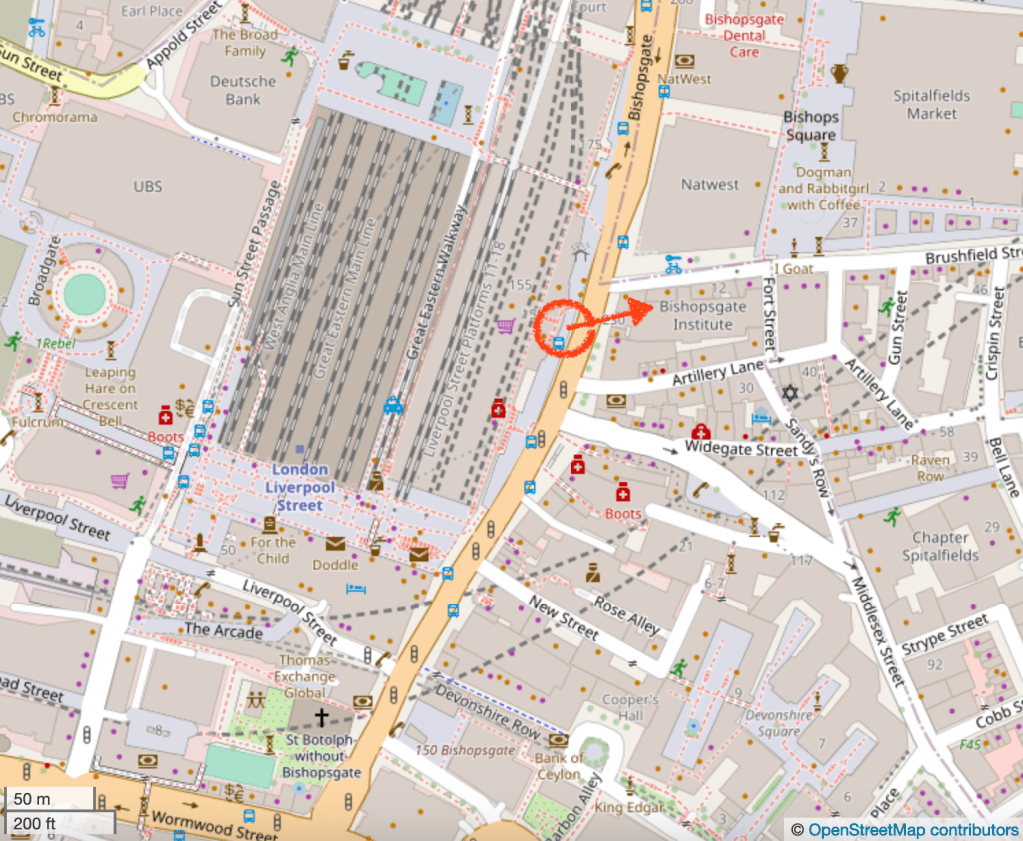
Location of the drawing
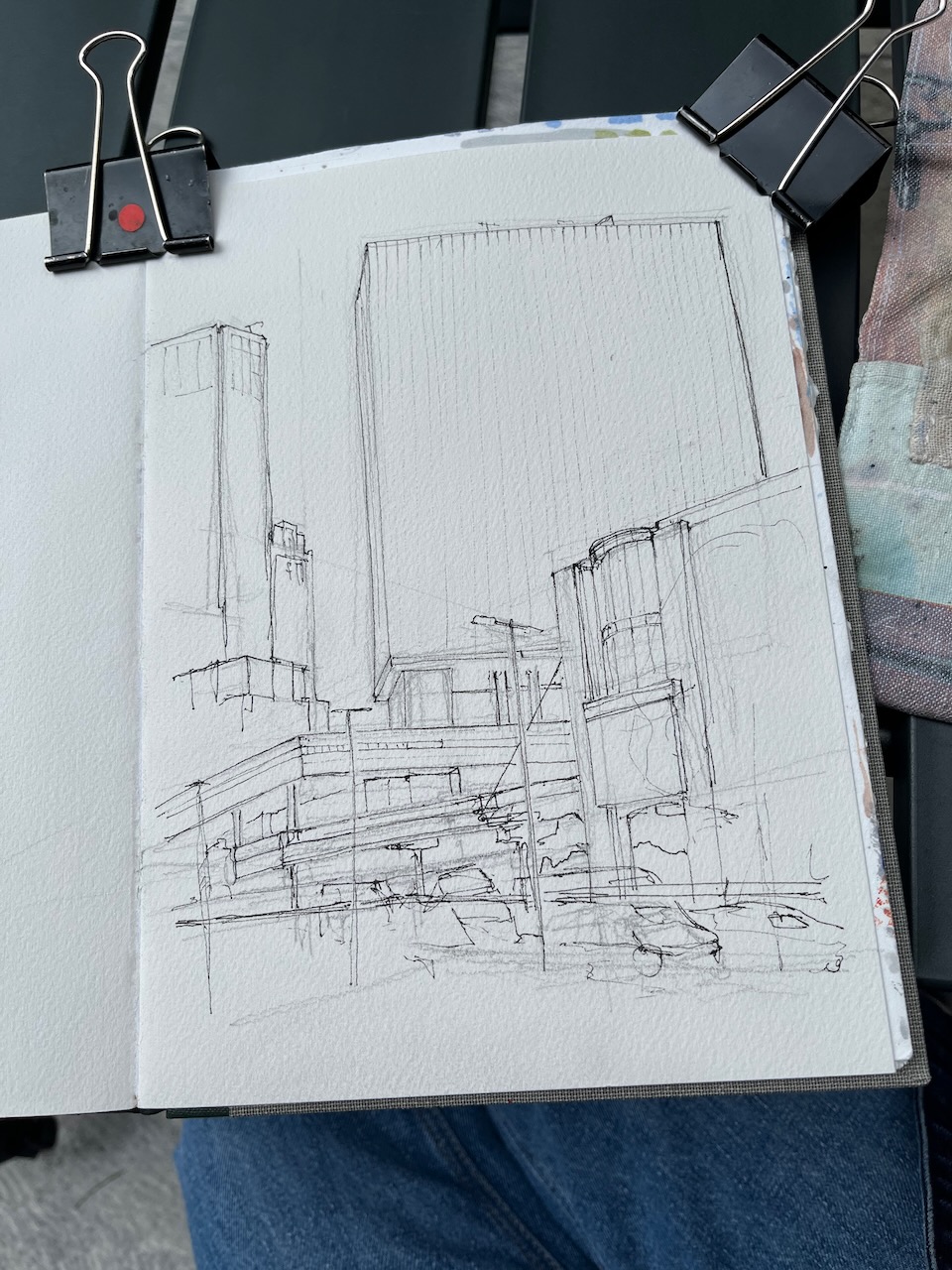
Here is work in progress on the drawing:
Preliminary drawingPencilPenTime to go home
It was cold and raining, so I completed the pen on location and then did the colour at my desk.
Click a button below to share this post online, email it, or print it:
On the way back from a visit to the West End, I passed St-Martin-in-the-Fields, standing out against the cold sky.
St Martin-in-the-Fields, Trafalgar Square. Sketched 2nd Dec 2022, in sketchbook 12
The statue in the foreground, left, is the Edith Cavell Memorial, seen from the back. Edith Cavell (1865-1915) was a British nurse. In German-occupied Belgium, guided by her principles of humanity and her Christian faith, she provided medical care to soldiers irrespective of which side they were on. She was executed by a German firing squad 1915, because she had helped Belgian, British and French soldiers to escape the German occupation and reach Britain. Her grave is in Norwich Cathedral.
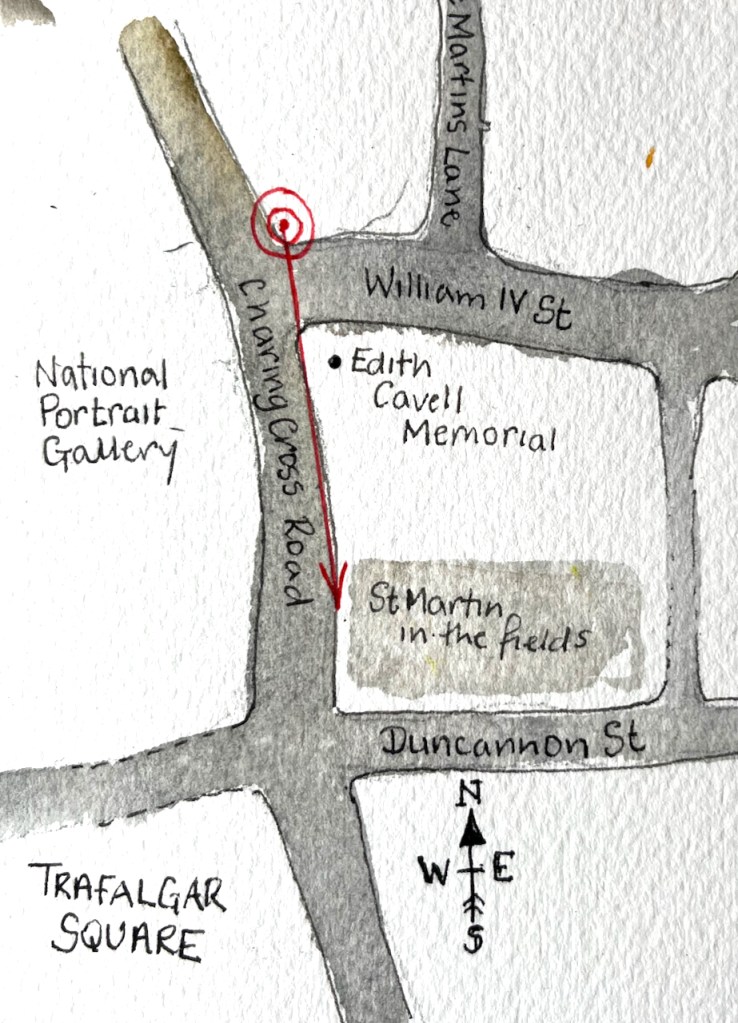
I sketched standing on a corner of the Charing Cross road, see map above. This turned out to be a very noisy location. The National Portrait Gallery is being refurbished and there was continuous drilling and banging. Buses and cars ground their gears, and thundered past, rushing through the traffic lights to shriek to a halt at the next junction.
But St-Martin-in-the-Fields rose above it all. The inscriptions which faced me on the Edith Cavell Memorial were: “Determination”, “Fortitude”.
Click a button below to share this post online, email it, or print it:
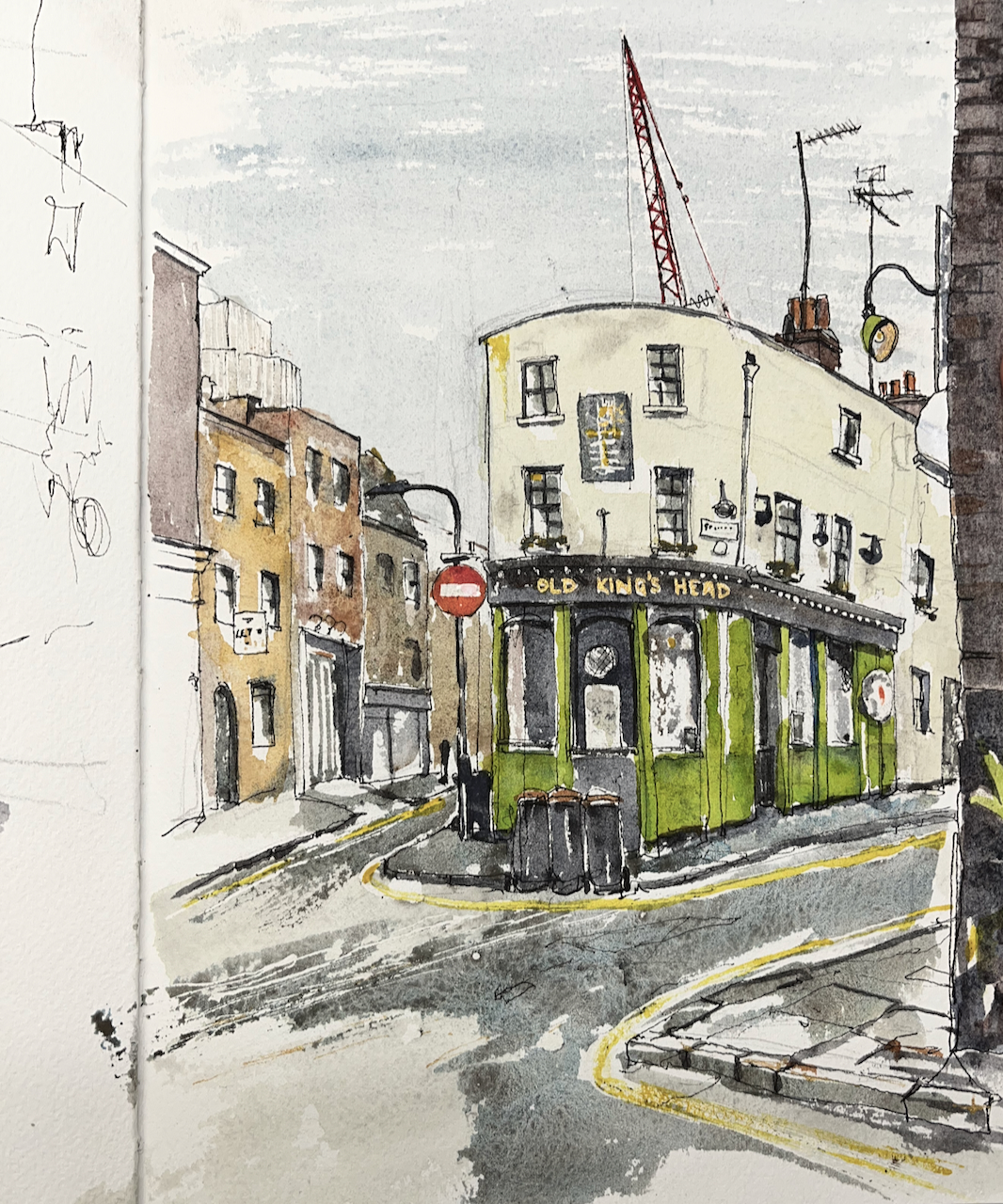
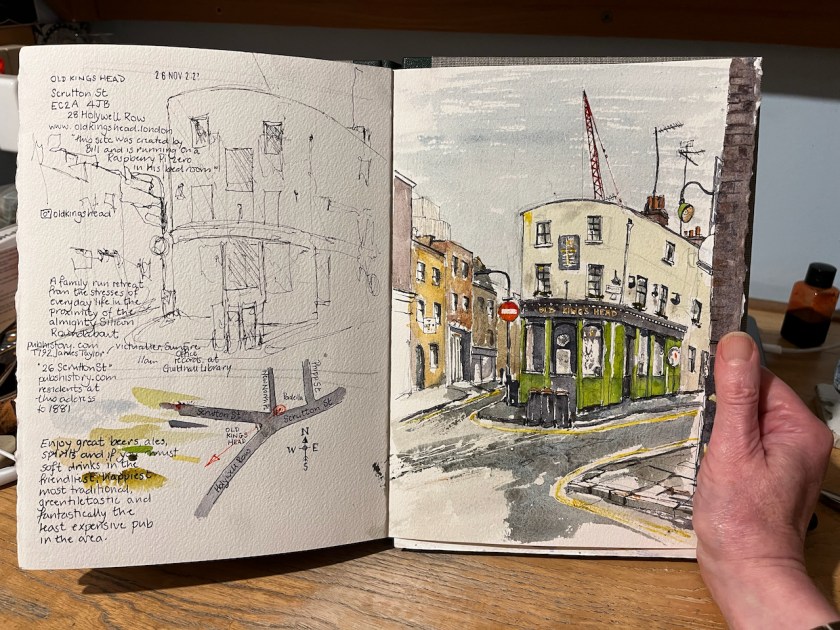
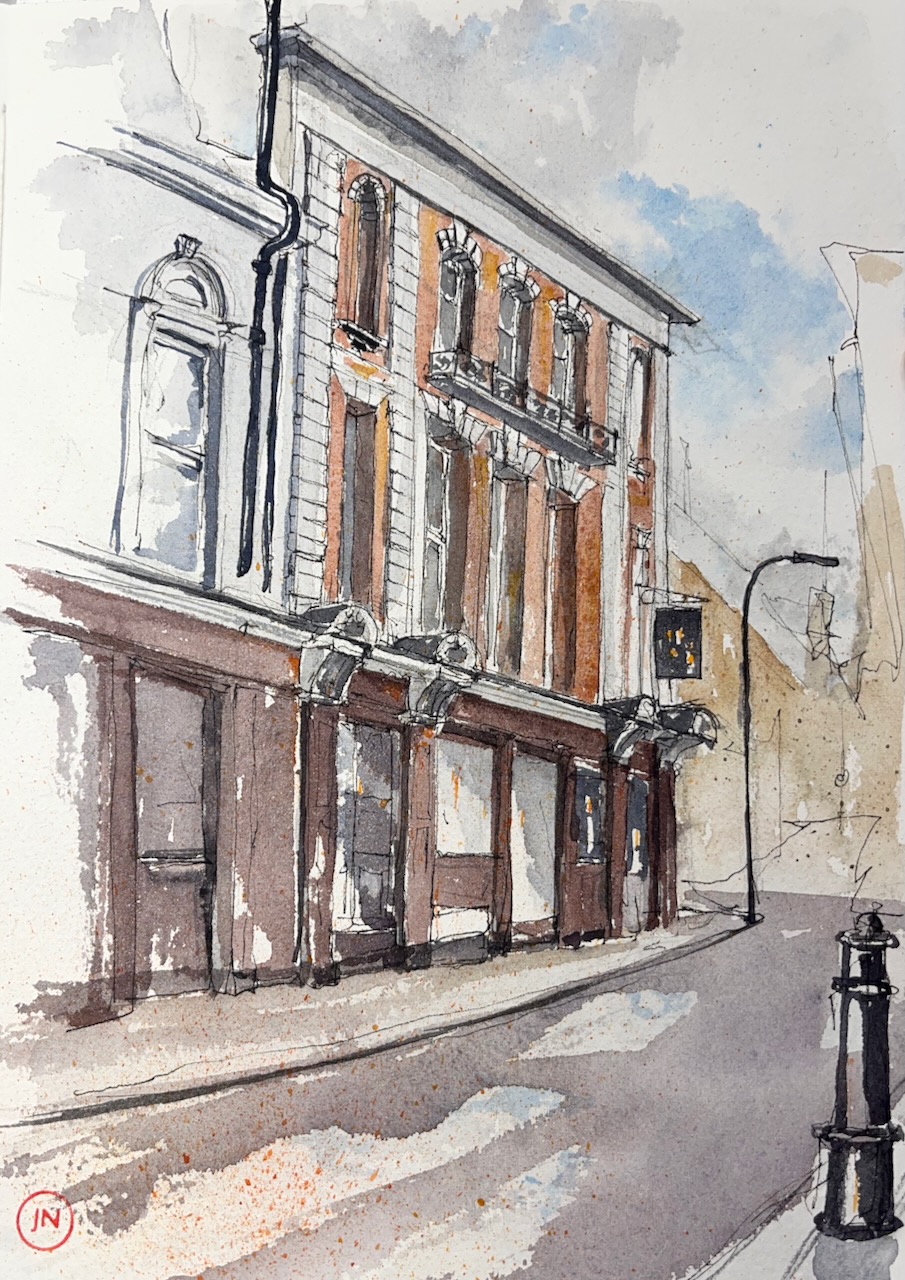
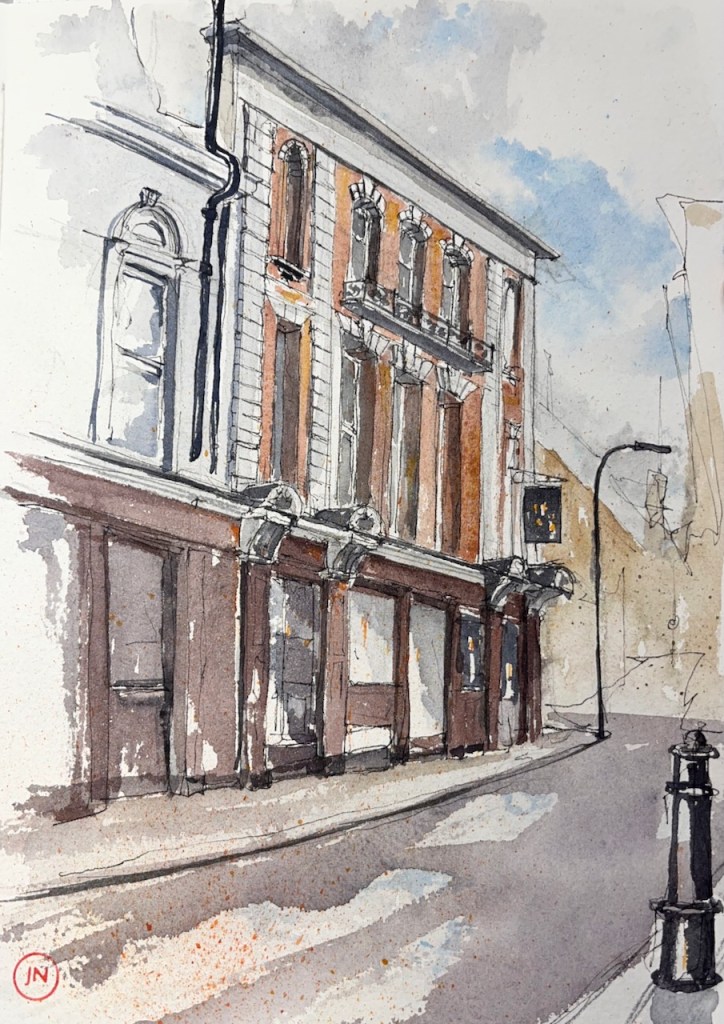
Here is the Old Kings Head, 28 Holywell Row, EC2A 4JB: ” a family-run retreat from the stresses of everyday life in the proximity of the almighty Silicon Roundabout” [oldkingshead.london]
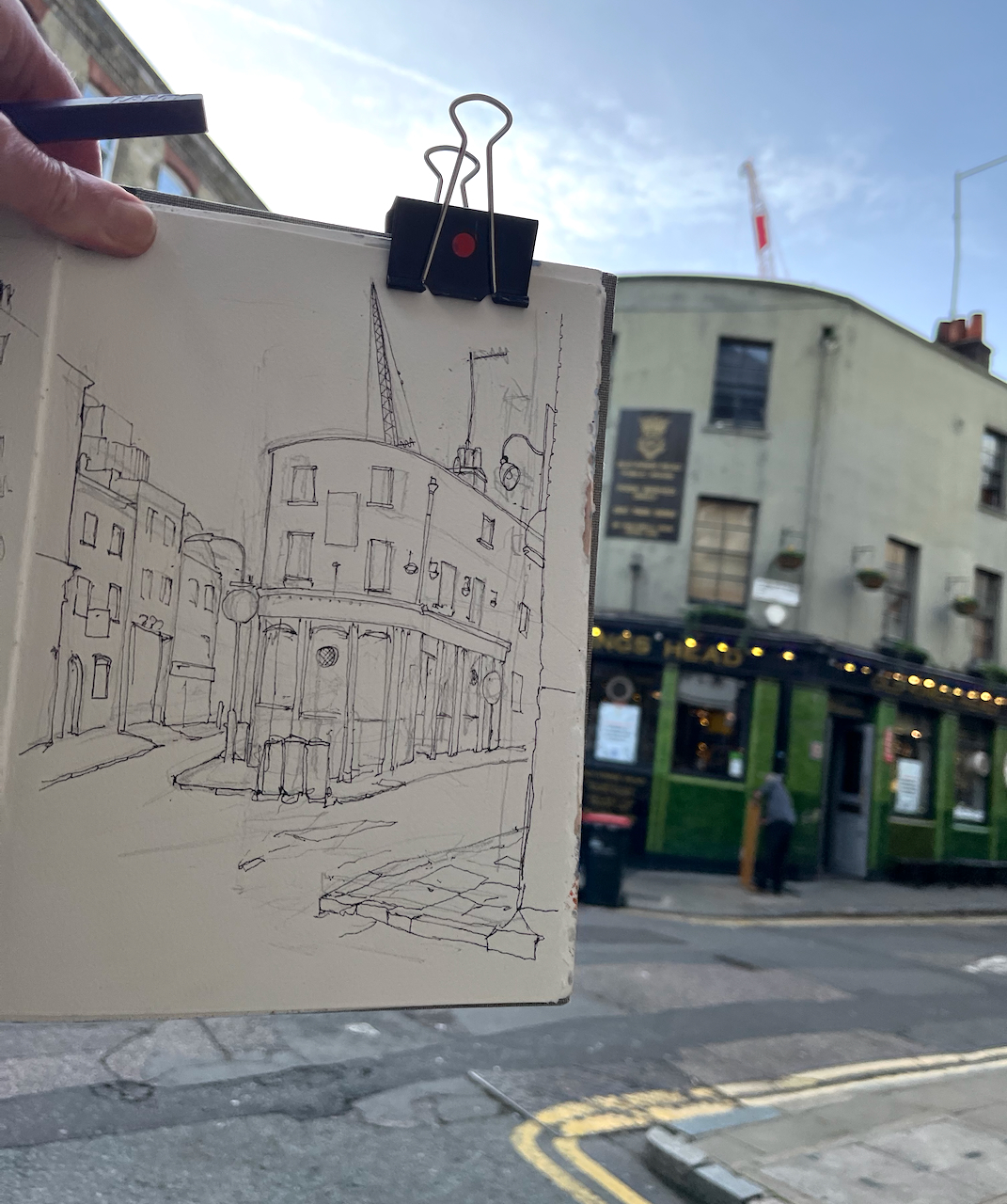
The Old Kings Head, Shoreditch 26 November 2022 in Sketchbook 12
“Enjoy great beers, ales, spirits and, if you must, soft drinks in the friendliest, happiest, most traditional, greentiletastic and fantastically the least expensive pub in the area” continues their website.
I love “greentiletastic“. The green tiles are indeed fantastic: I have tried to show them in my drawing.
This pub is in a network of tiny streets running at all sorts of unexpected angles. As I sketched, I saw, more than once, an expensively dressed person trailing a carry-on size suitcase, picking their way over the broken paving stones and patched up tarmac, in unsuitable shoes. The person drifted on, towards Old Street, bearing a dreamy mystified expression, as though these piebald buildings did not quite correspond to the mental image they had of their destination, or, more likely, the street pattern did not correspond to the image on their mobile phone. They saw neither me, nor the pub, but seemed to exist in another reality.
This pub is old. According to “pubhistory.com” the earliest landlord was “James Taylor, victualler” in 1792. This is from insurance records in the Guildhall Library.
It sounds like a great pub.
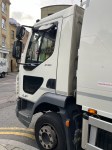
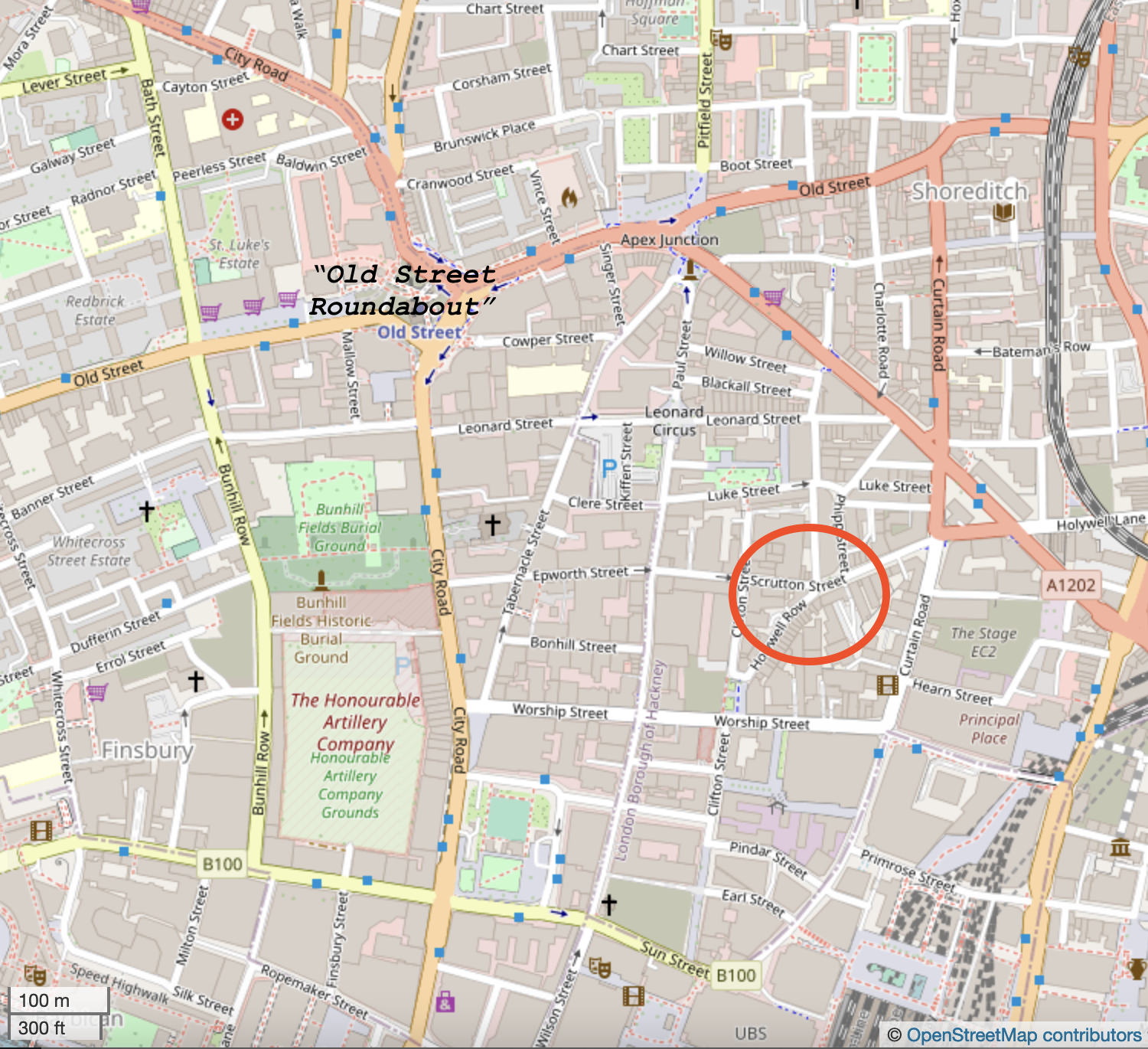
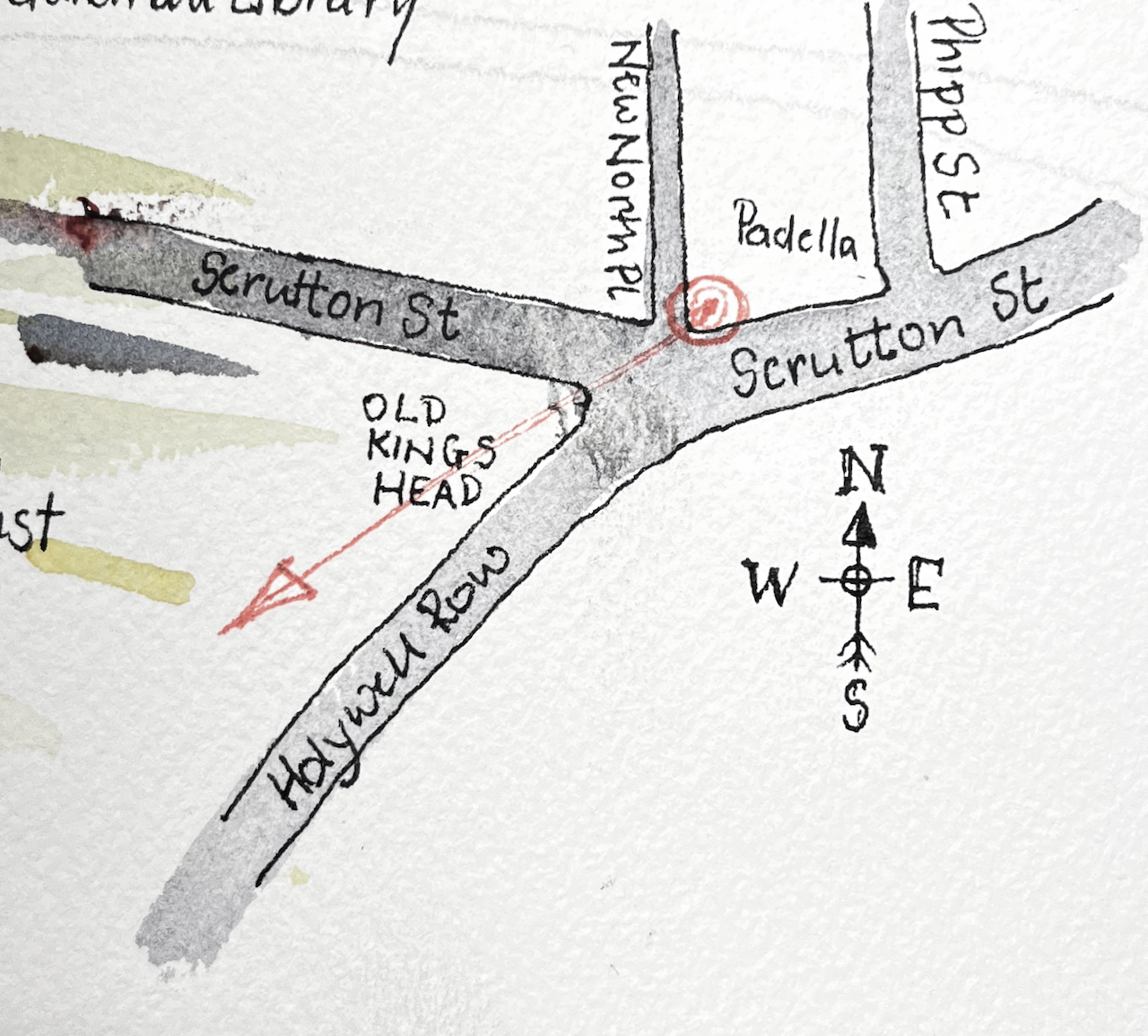
I drew it standing outside the restaurant “Padella”, next to a narrow alley called “New North Place”. New North Place is the opposite of new, but it does go North. To my total astonishment, a huge lorry emerged from this tiny alley, and blocked my view. This is a common hazard sketching in London. It soon moved on though. I was impressed that the driver had ventured into the alley.
Sketchbook 12
Click a button below to share this post online, email it, or print it:
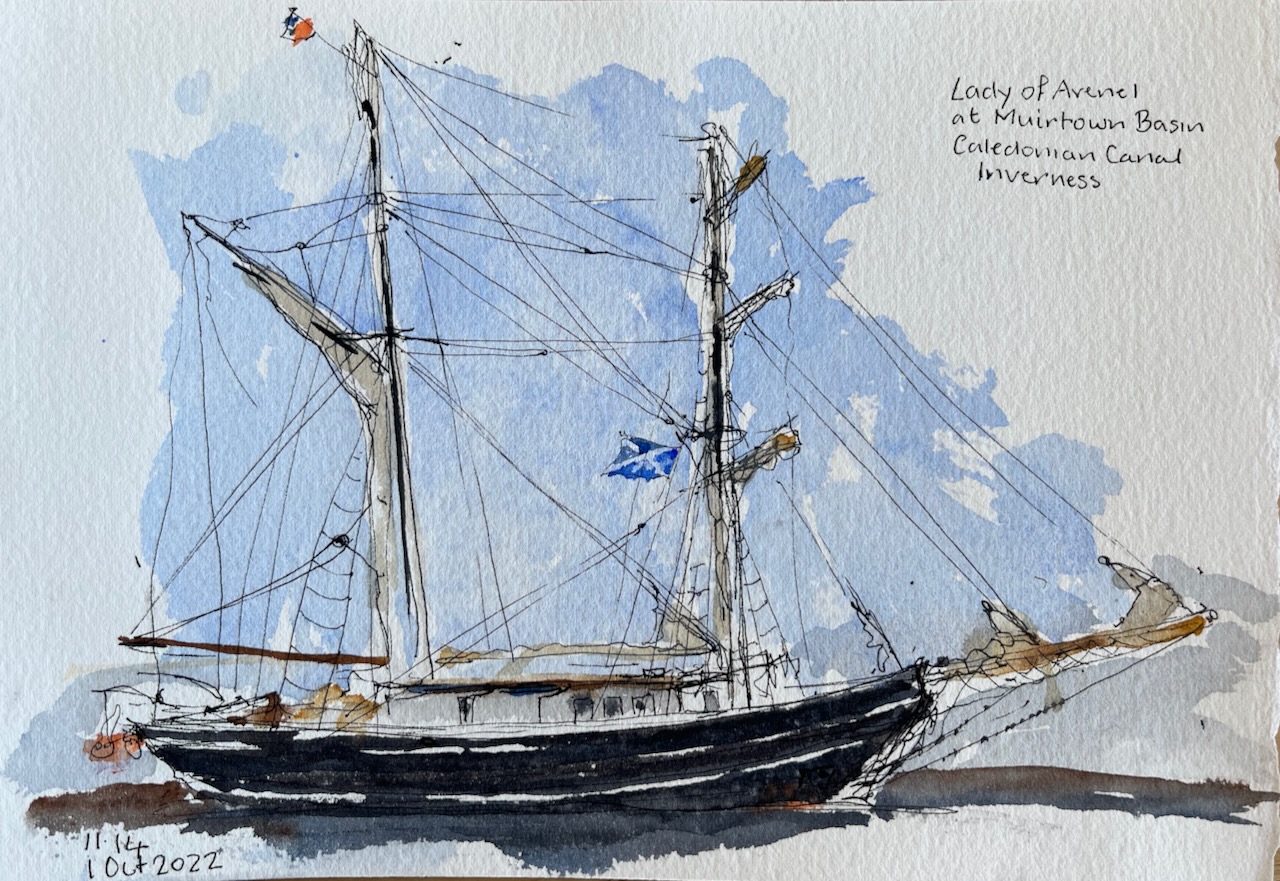
The Lady of Avenel is an 102ft square rigged brigantine. She was on the East coast of Scotland, and needed to be on the West Coast. So a group of us assembled to take her through the Caledonian Canal, from the North Sea to the Atlantic. This whole journey was about 190km or 120miles.
Route of The Lady of Avenel: Inverness to Oban, via Tobermory. 1st Oct to 8th Oct 2022
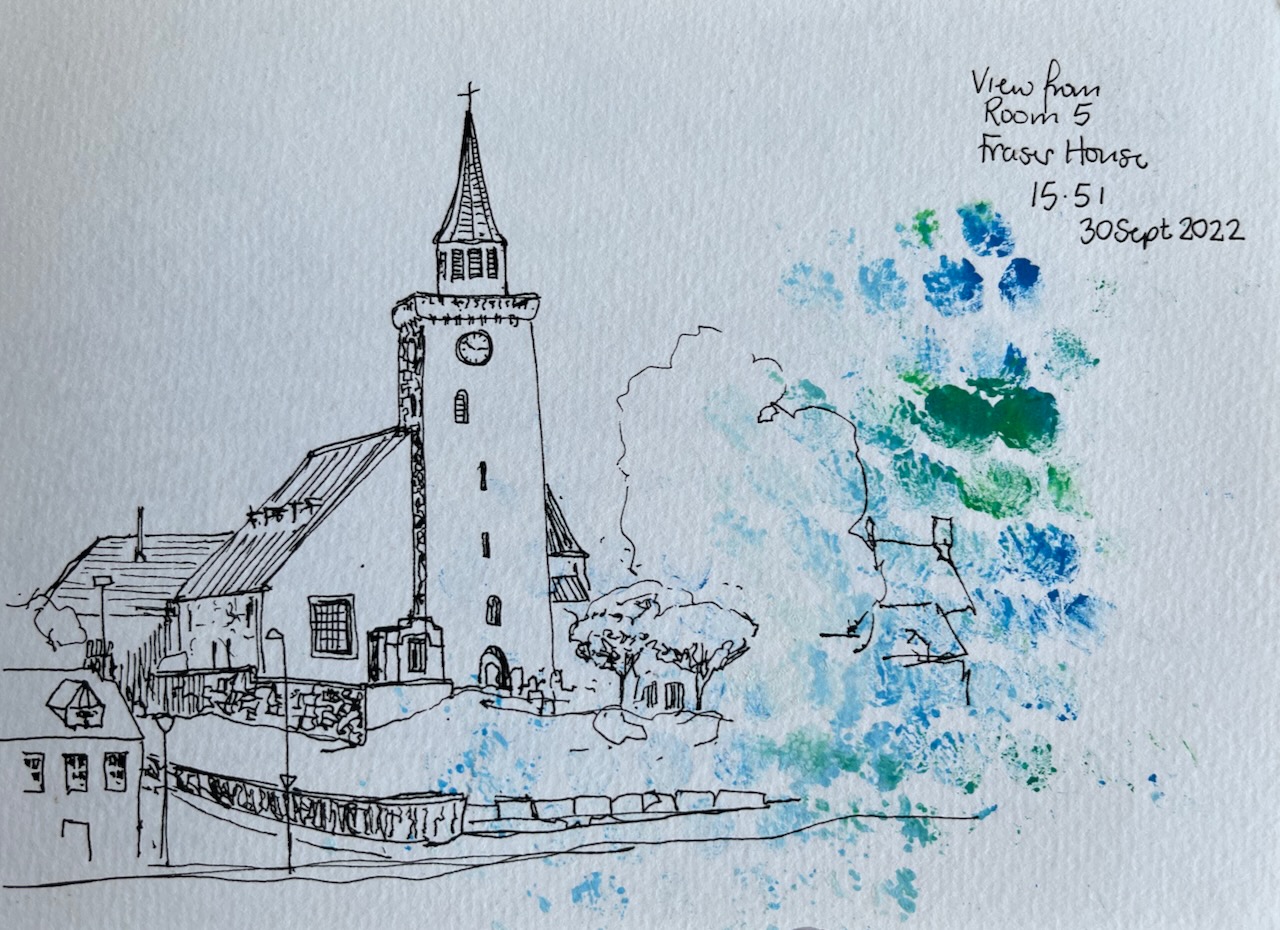
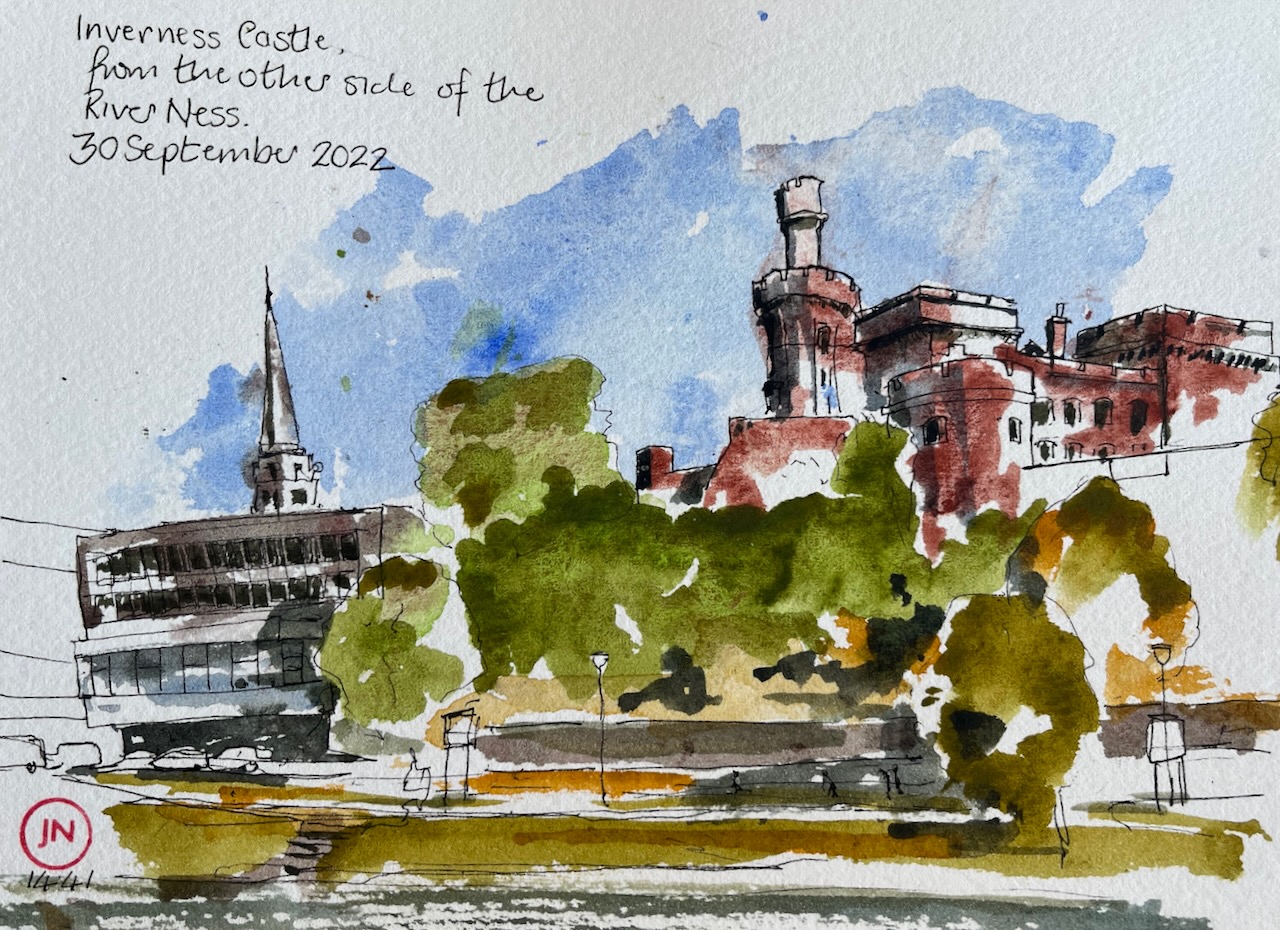
I joined the boat at Inverness. Travel to Scotland was disrupted by rail strikes. To be sure of arriving on time I arrived a day early. This gave me a chance to look around Inverness. There’s a huge river, the River Ness, and a castle and an Art Gallery. I stayed in a lovely hotel, Fraser House, on the river: recommended.
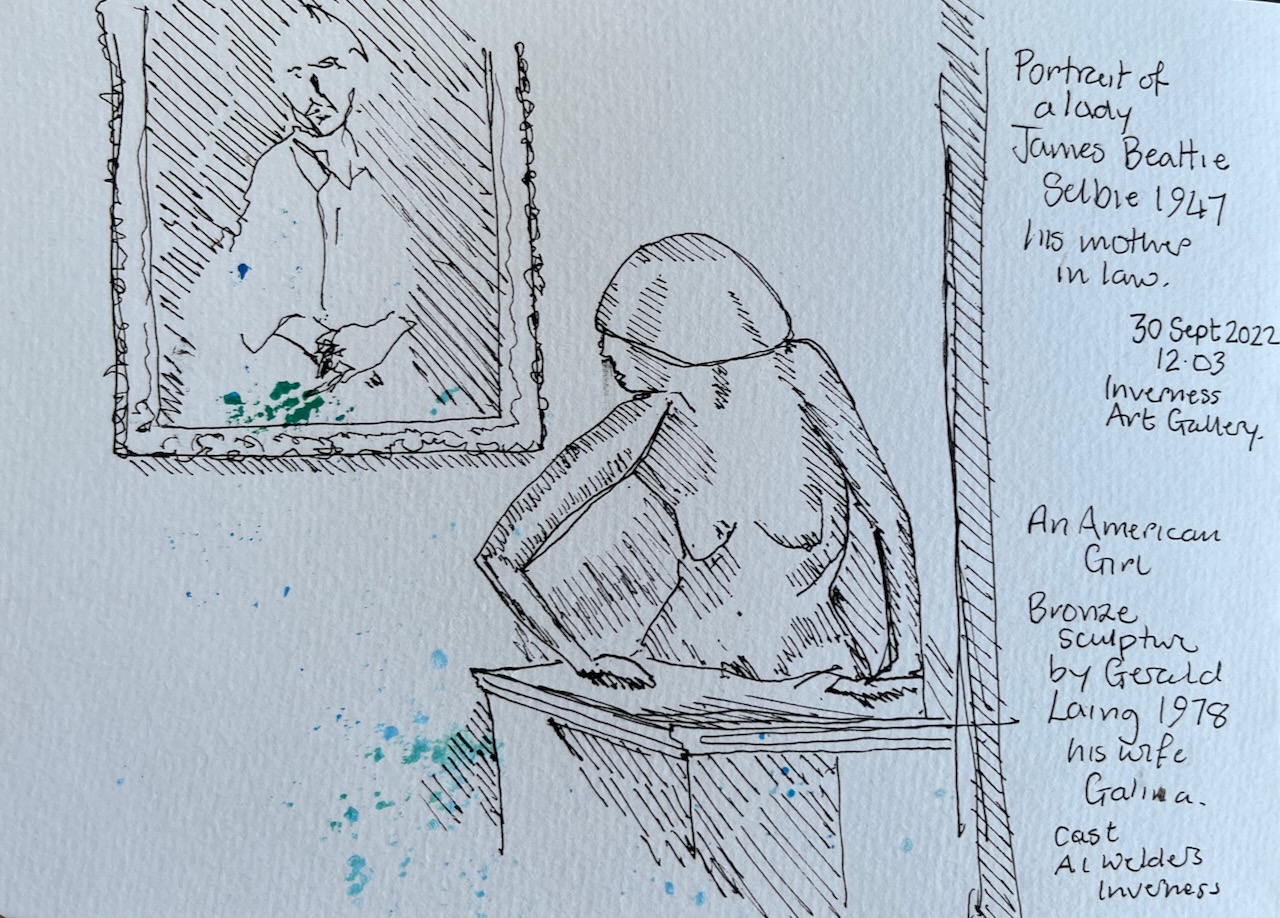
In the Art Gallery, Bronze Sculpture by Gerald Laing 1978 “An American Girl” – his wife Galina.View from my room in Fraser HouseInverness Castle From the other side of the river. Sketching inverness CastleSketching in Inverness
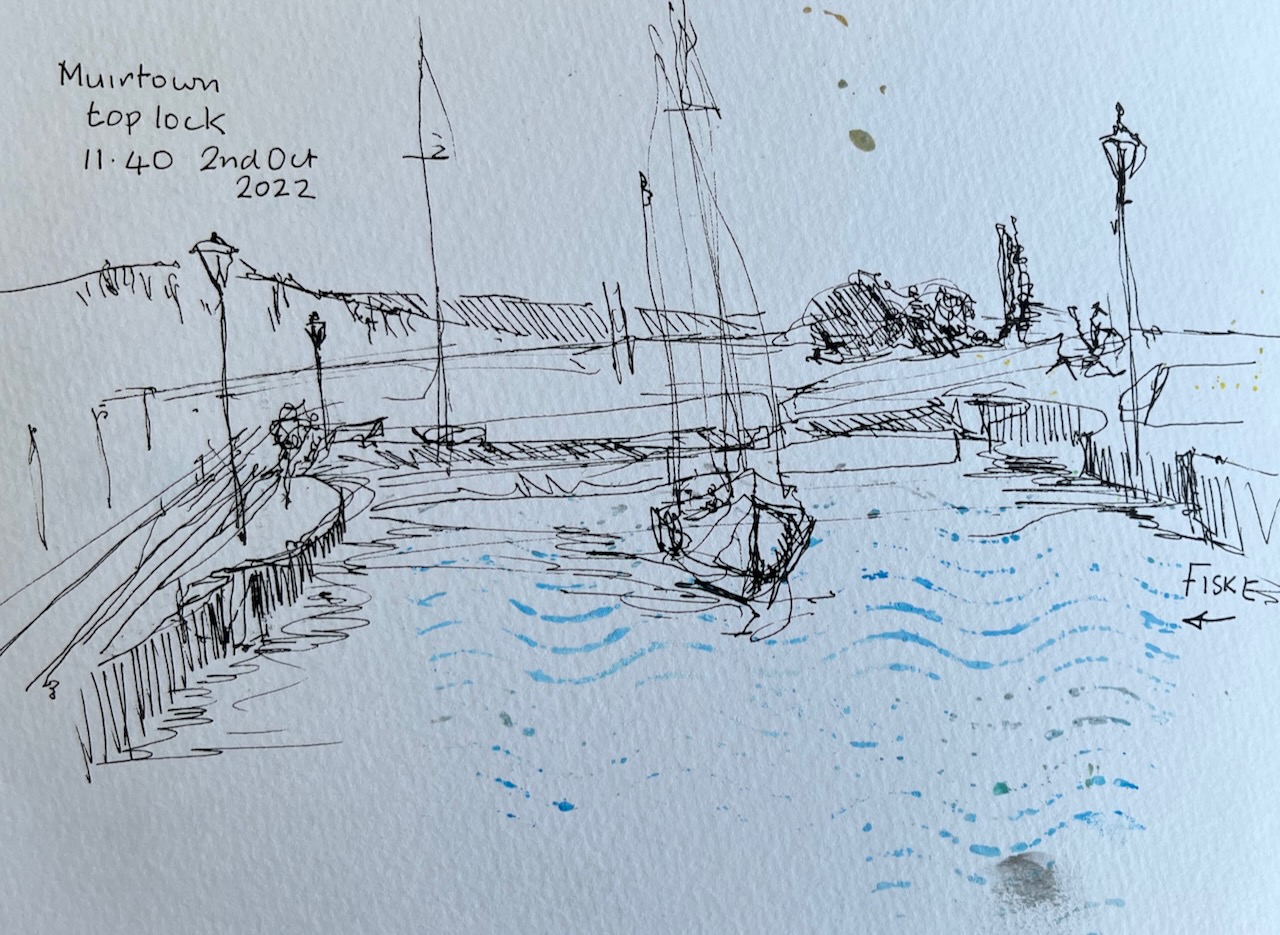
The Lady of Avenel was on the Canal at Seaport. The first Locks were Muirtown Locks, taking us uphill from the North Sea.
Lady of AvenelInside Muirtown LocksSeaport, and Muirtown Locks
Here is the view as we entered Loch Ness:
Entering Loch Ness
I was making these sketches very quickly. The boat kept moving, the light kept changing, and then it rained.
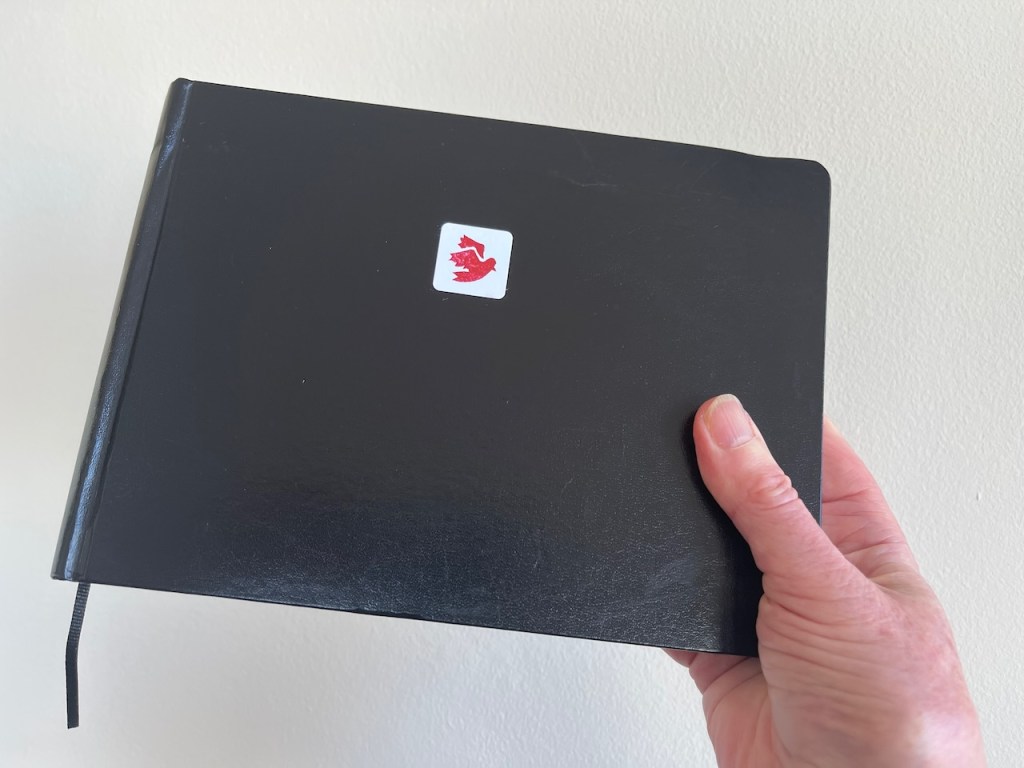
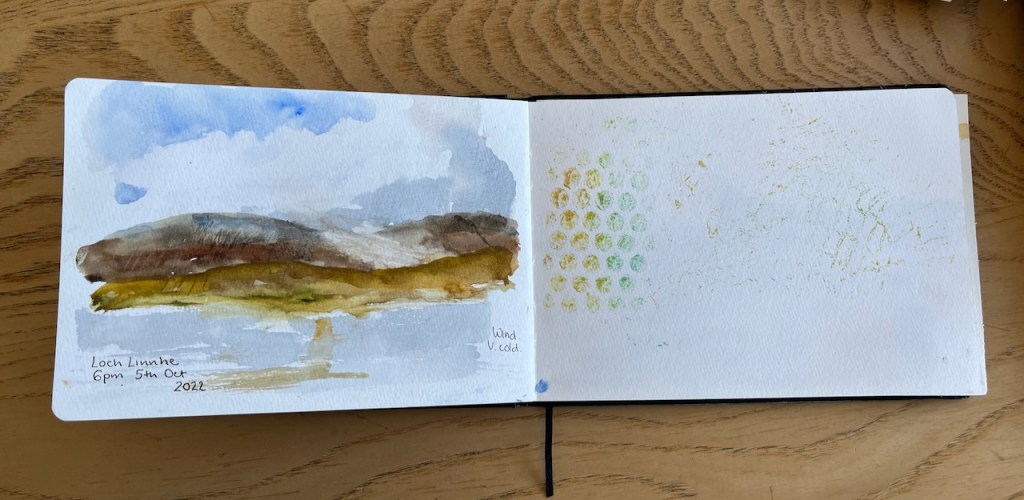
The sketchbook I was using was a Seawhite A5 Travel journal.
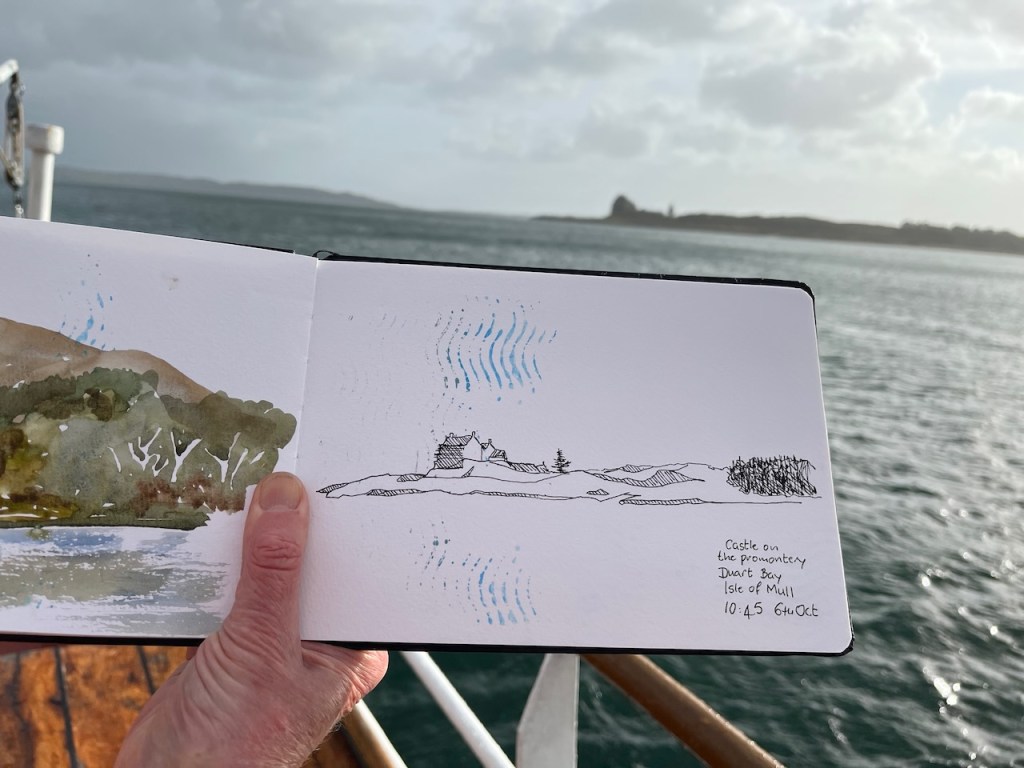
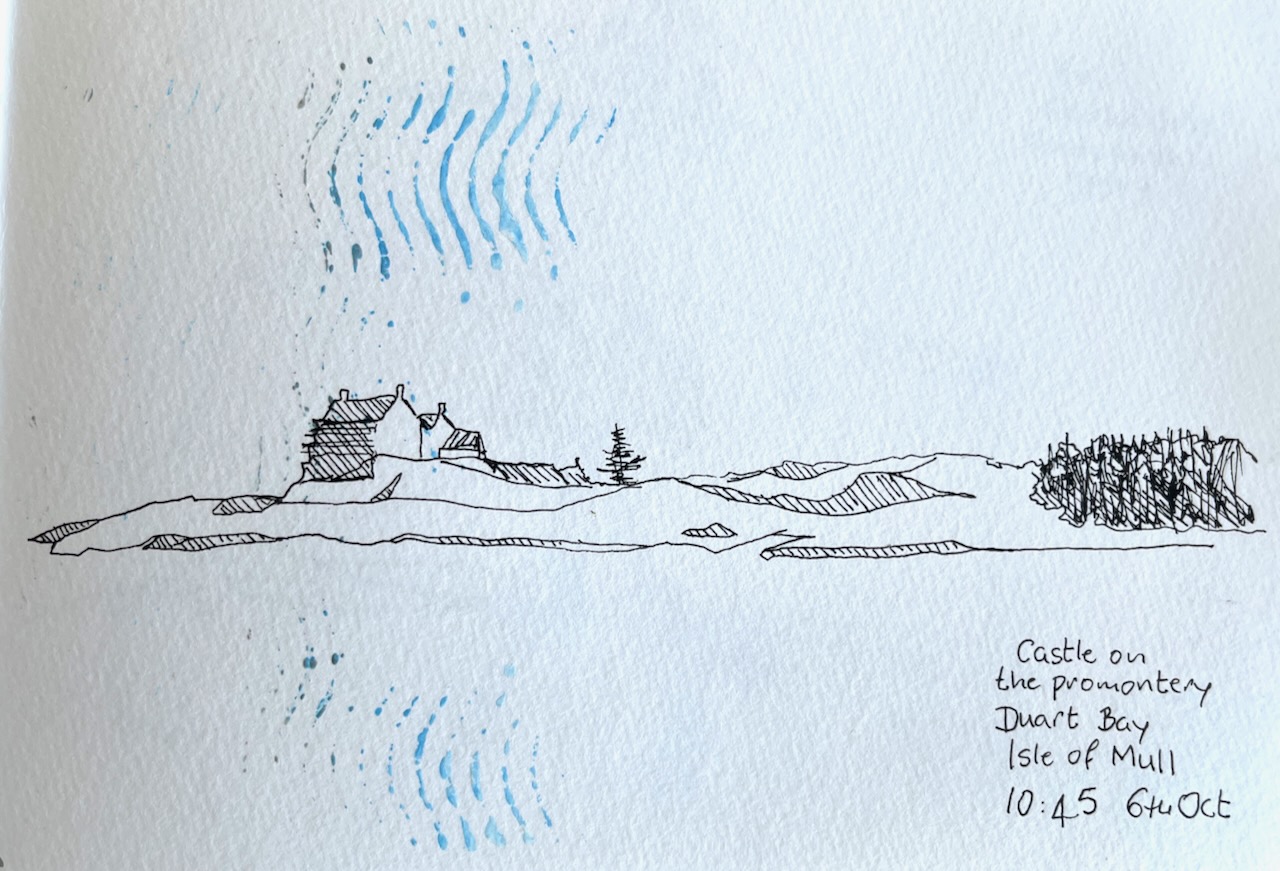
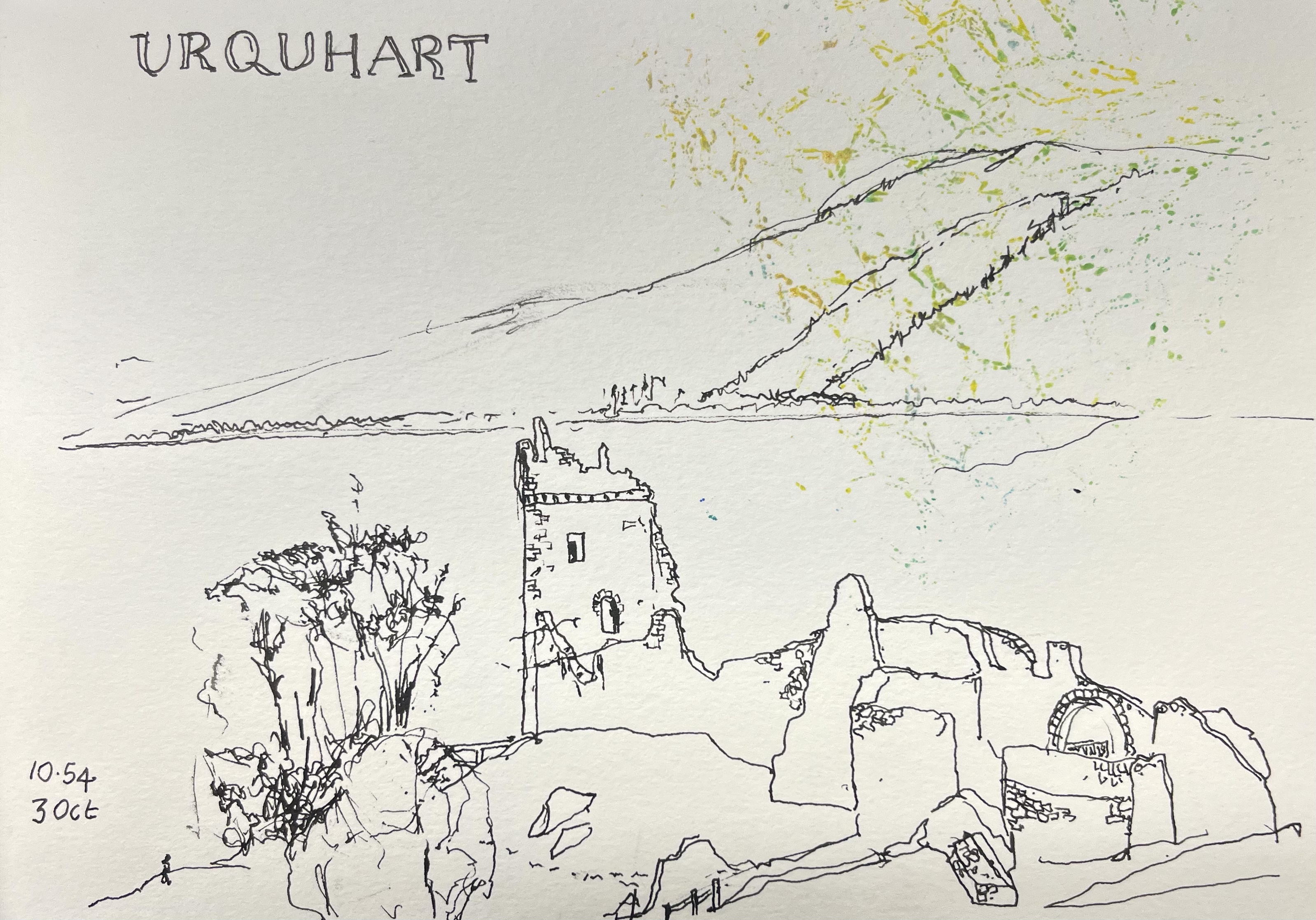
The patterns on some of the drawings were made before the trip. They are relief prints, using the corrugated paper from a coffee cup, corrugated cardboard, bubblewrap, and the net from some oranges. Sometimes these prints really enhanced the drawing, sometimes not. Here’s one where it worked:
Duart castle, printed background from a takeaway coffee cup
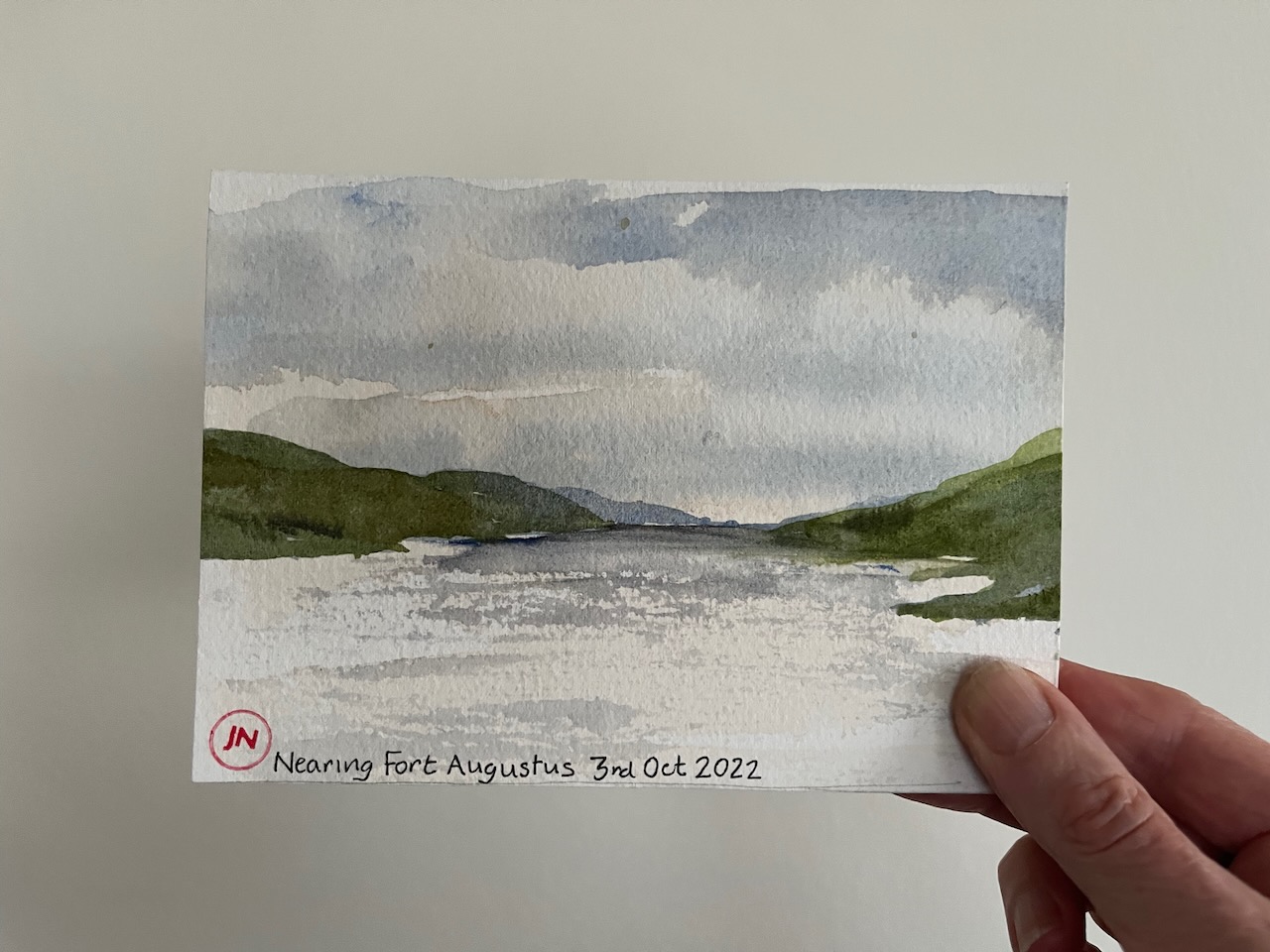
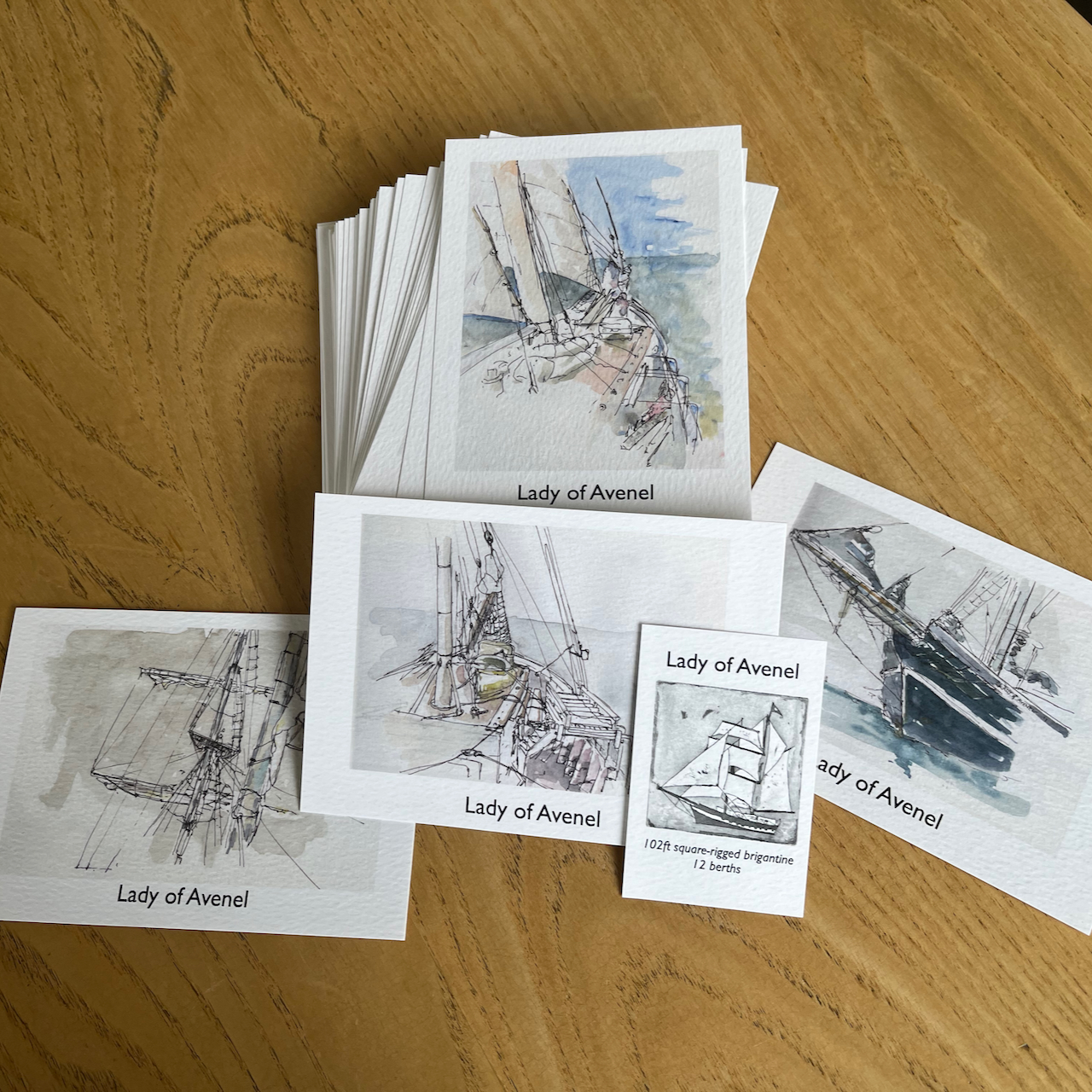
I also made sketches on small pieces of watercolour paper, which I sent as postcards.
Sketching Inverness CastlePostcards from the voyage
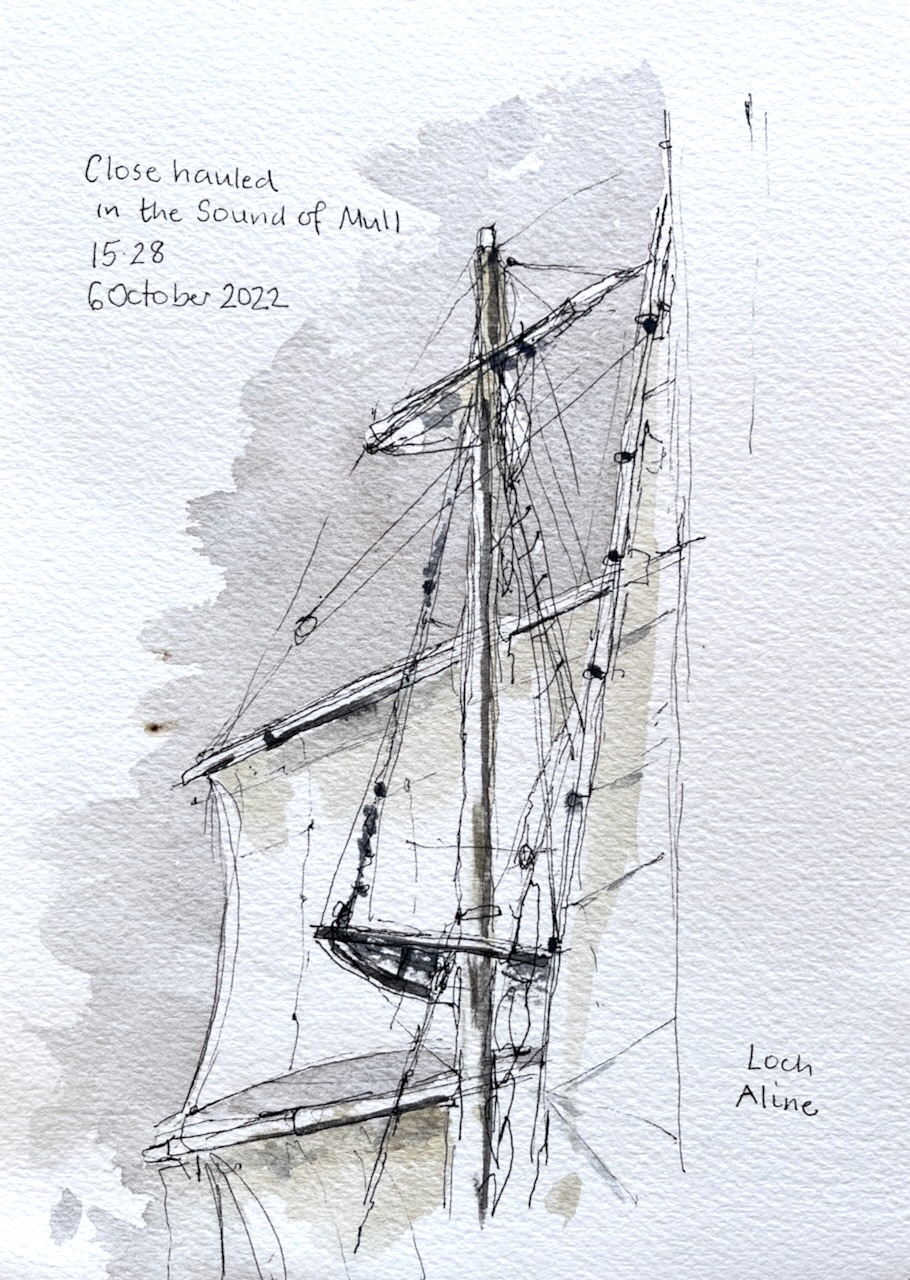
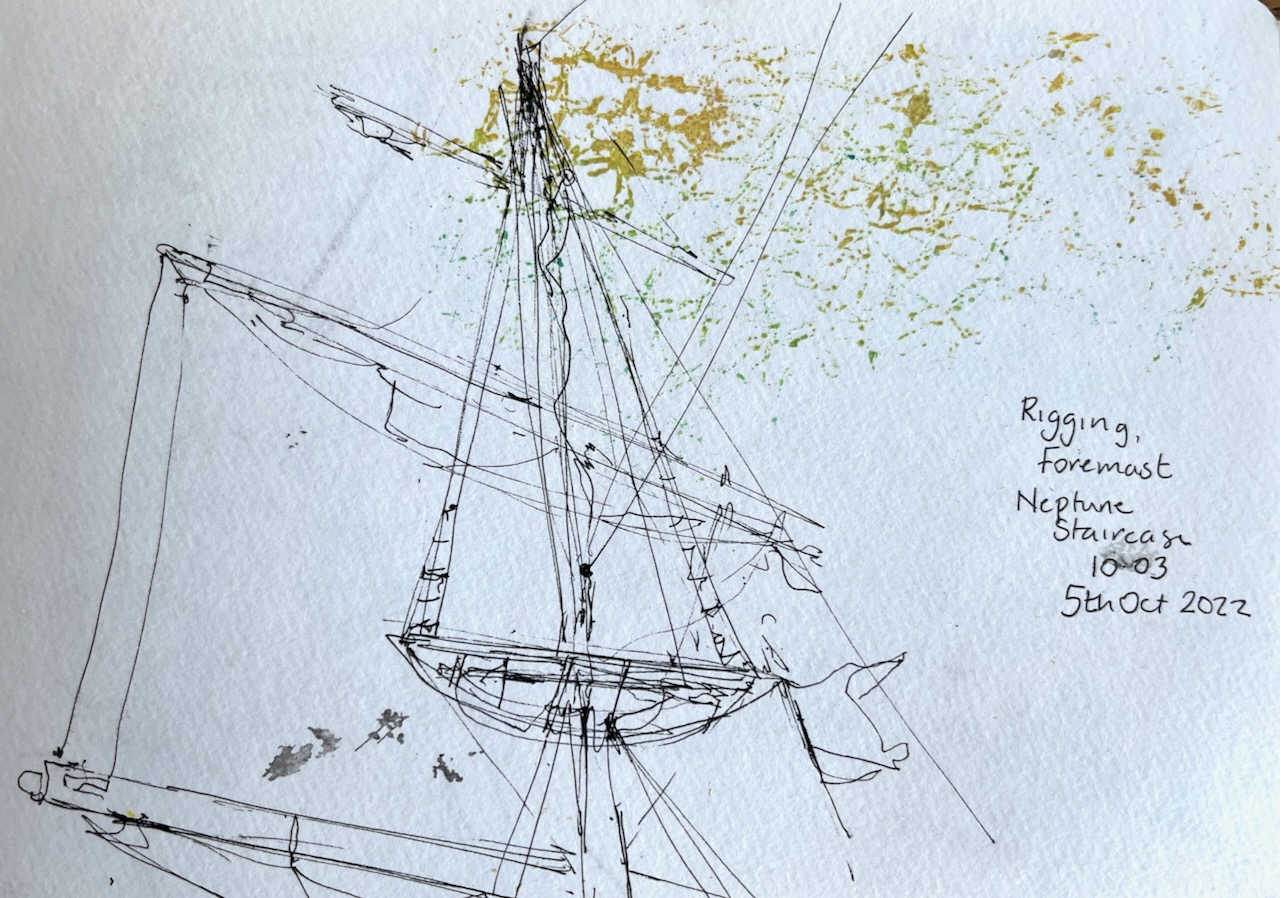
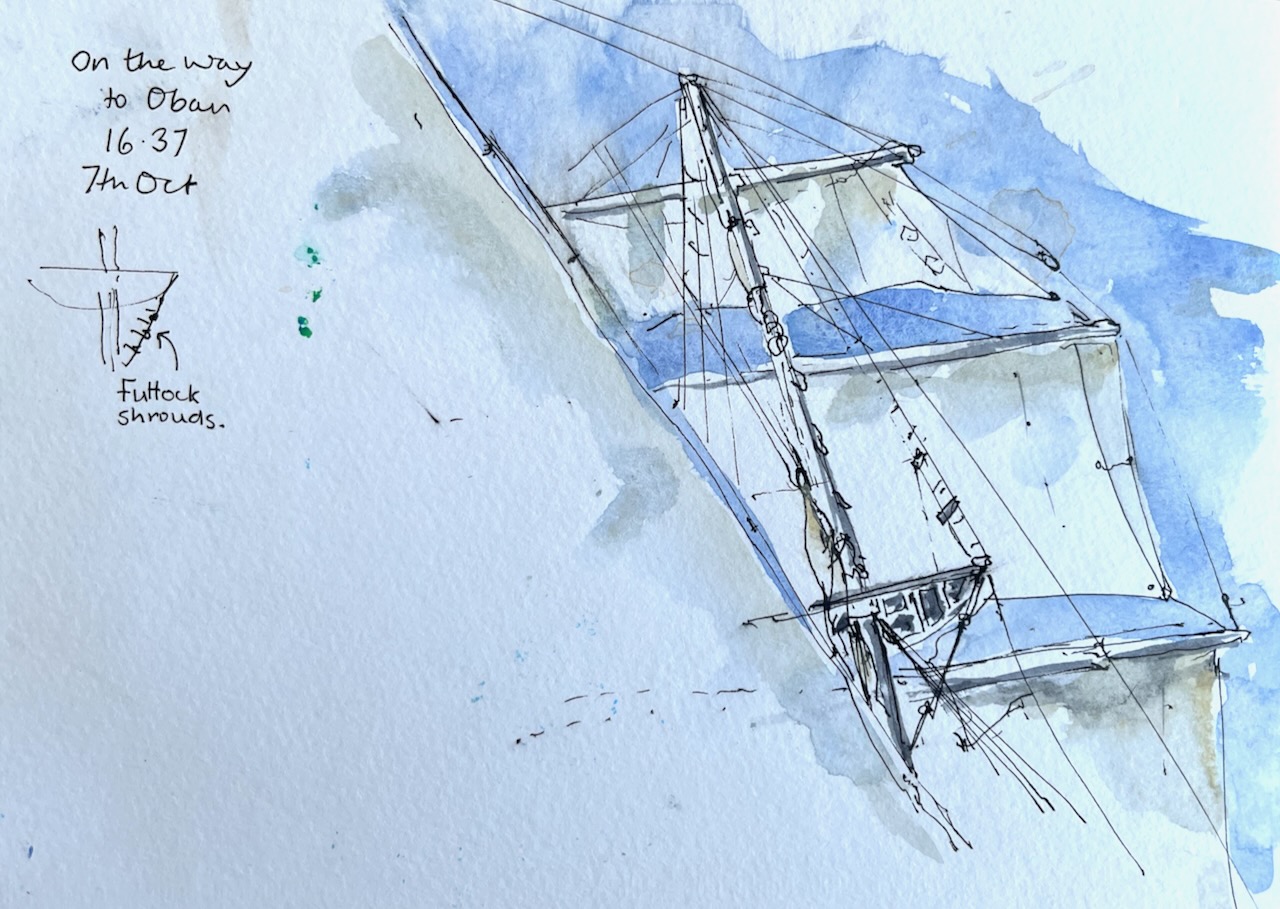
It’s a challenge to draw the rigging.
Rigging sketches
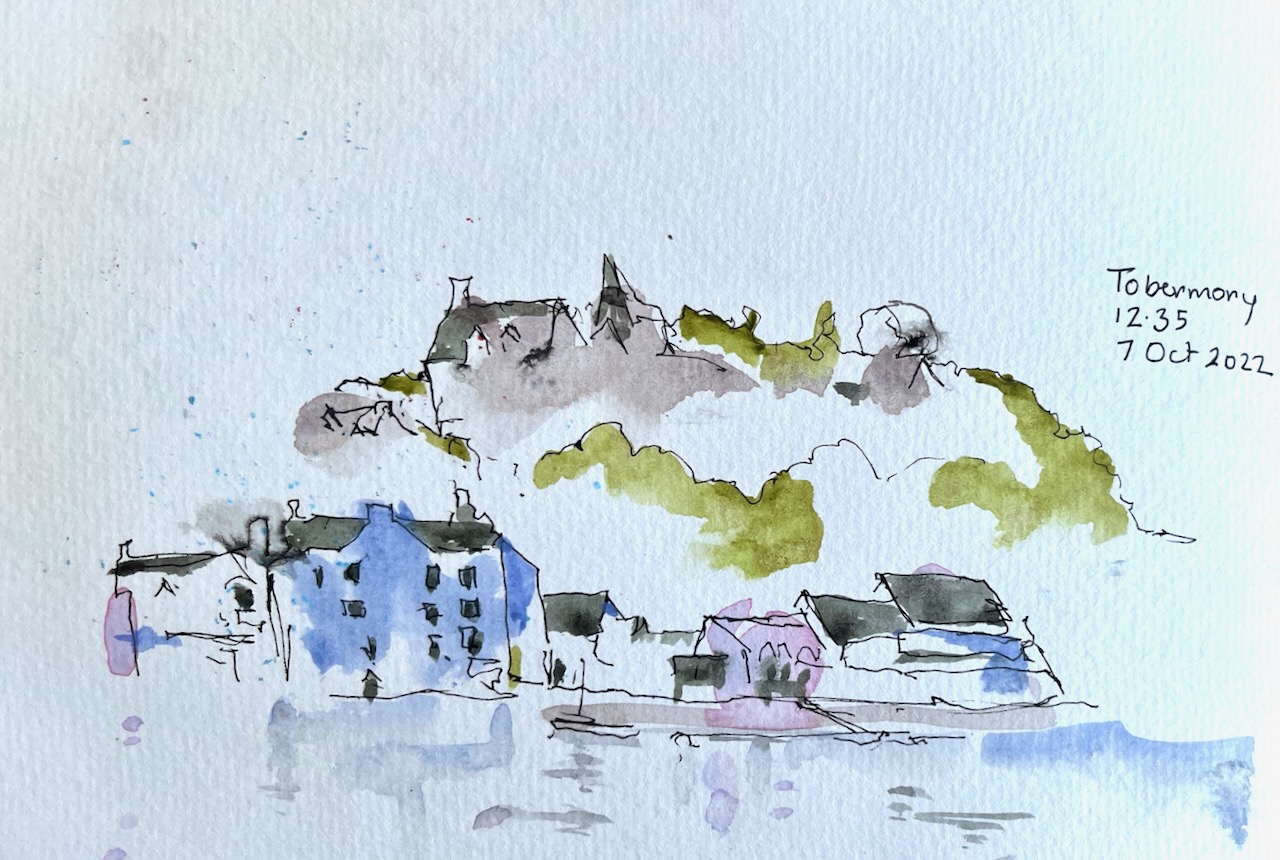
We had some shore leave.
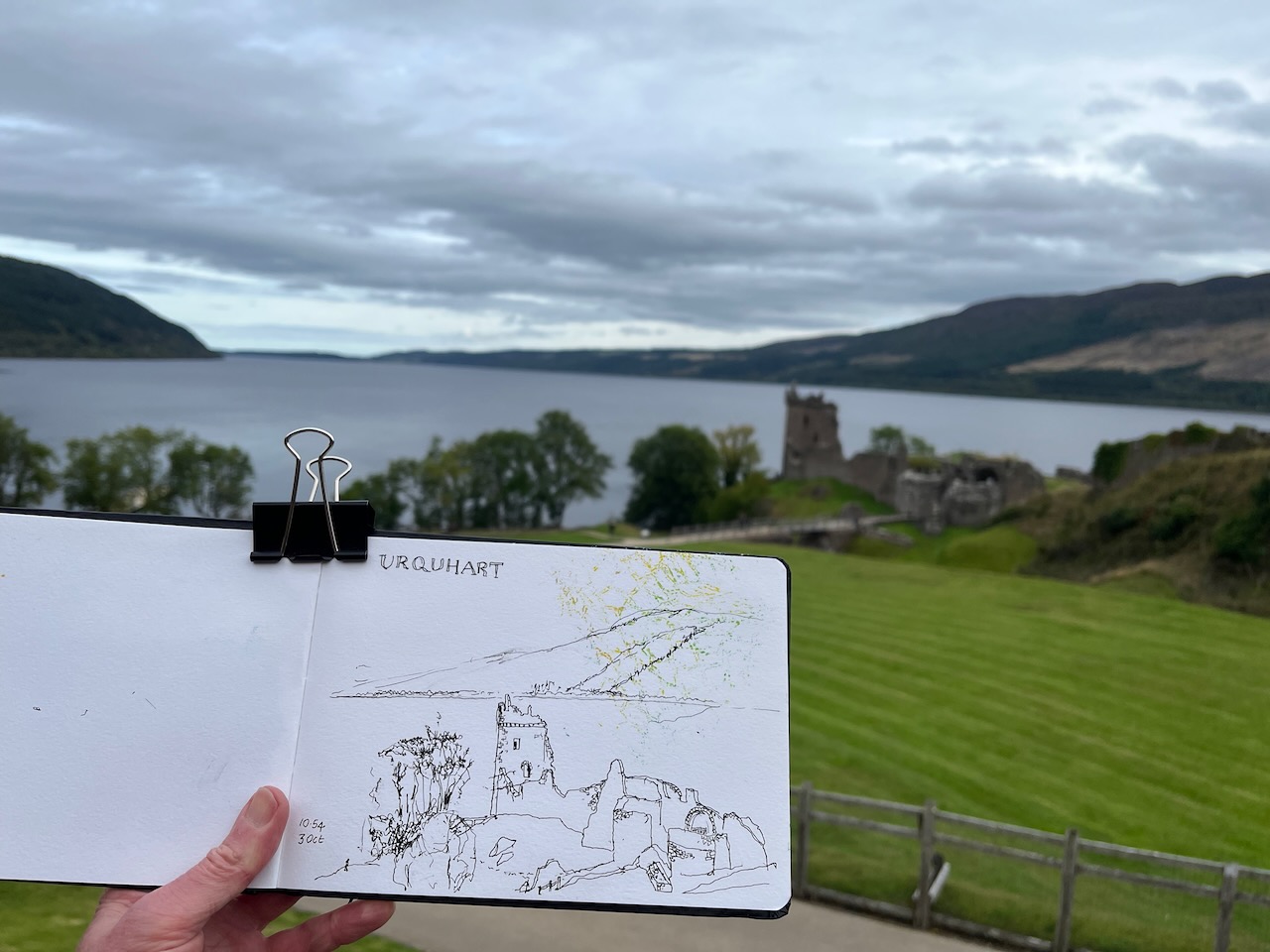
From the Community Arts Centre, An Tobar, in Tobermory Tobermory, from the Lady of AvenelUrquhart CastleSketching at Urquhart CastleSketching on shore leave
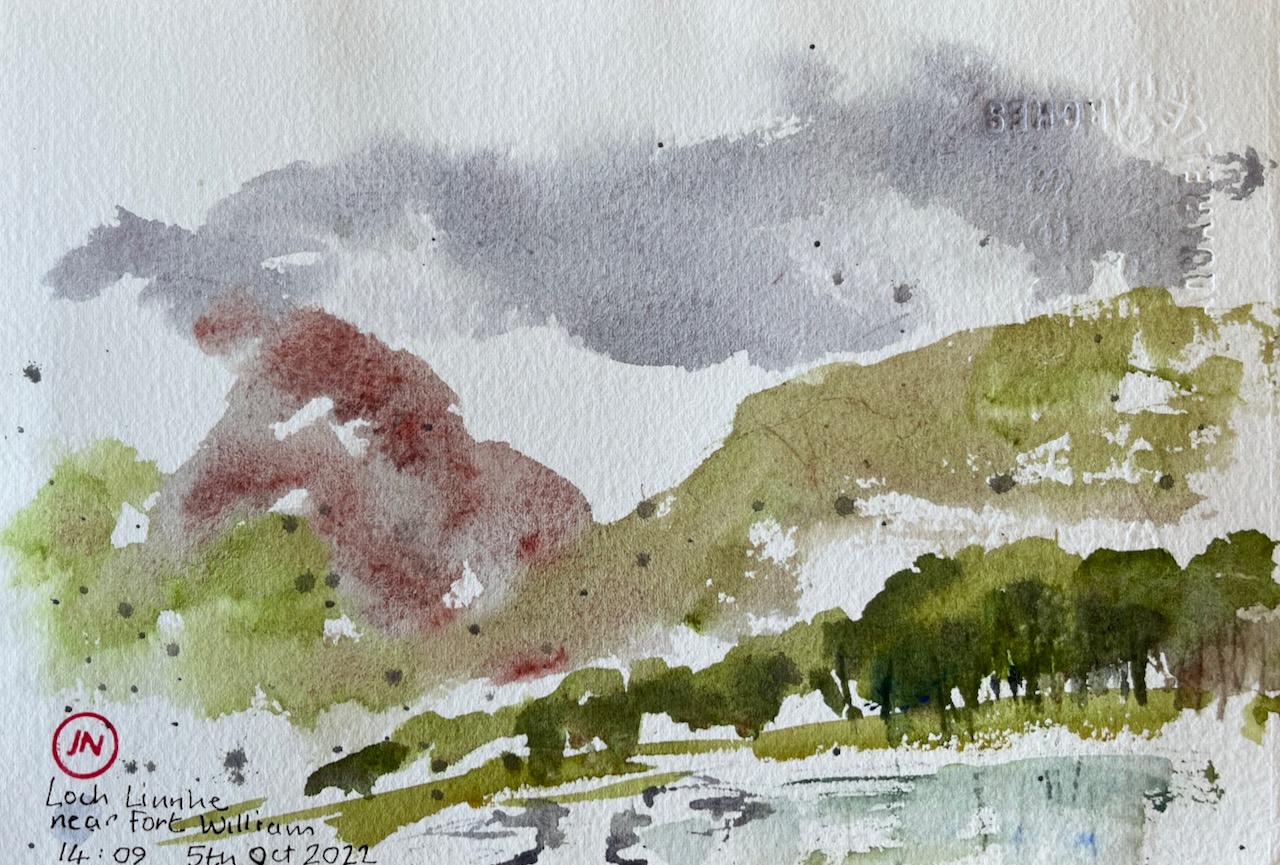
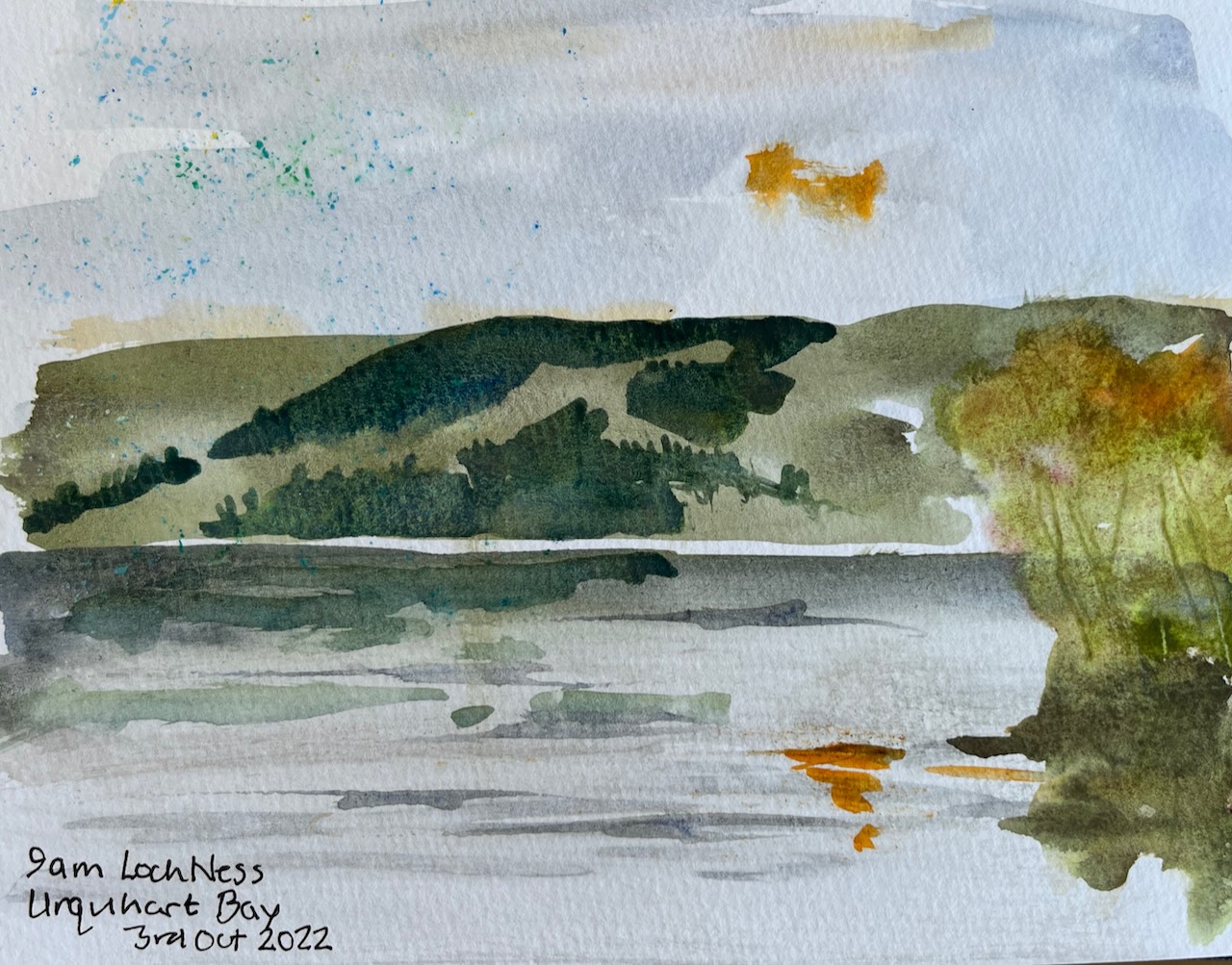
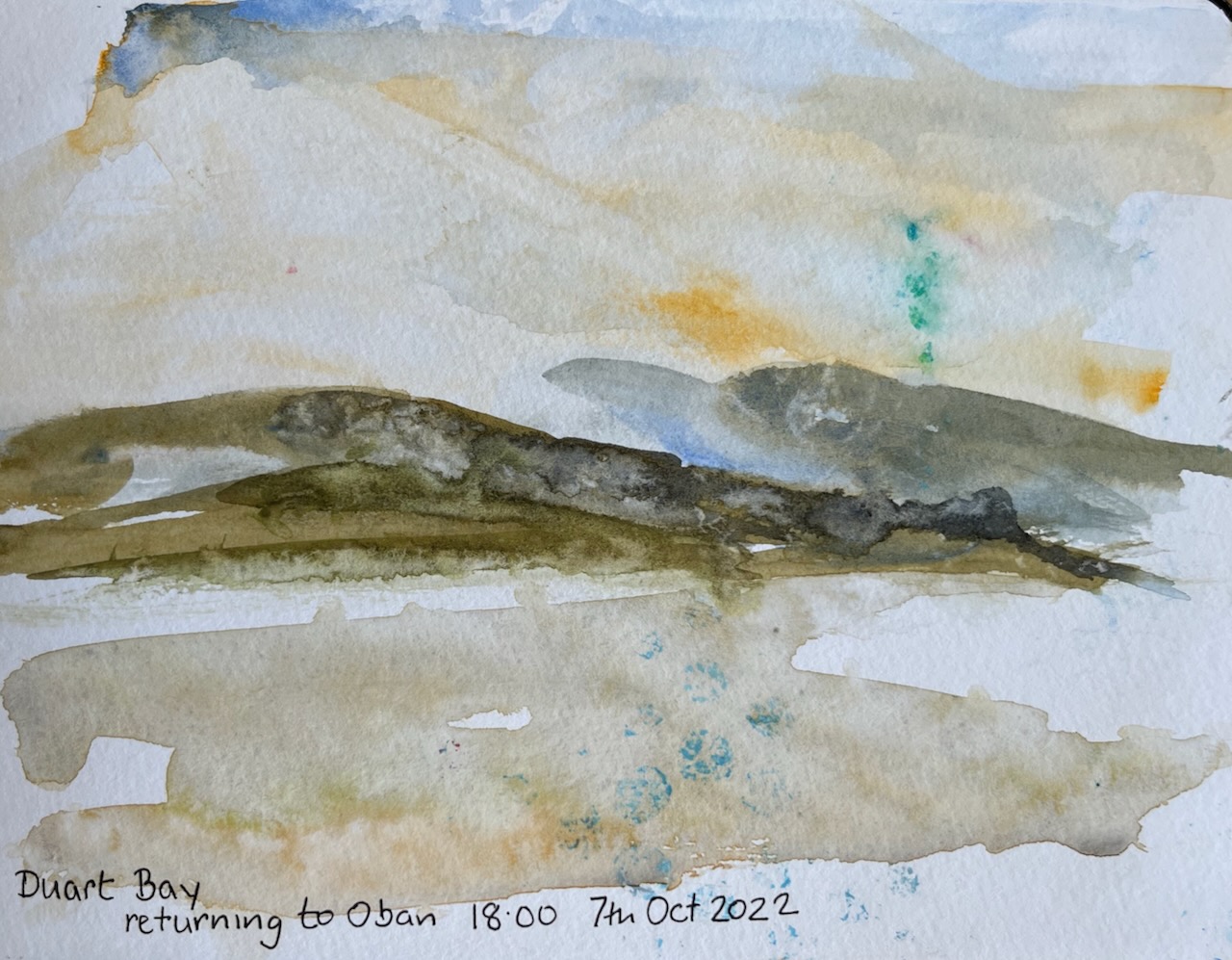
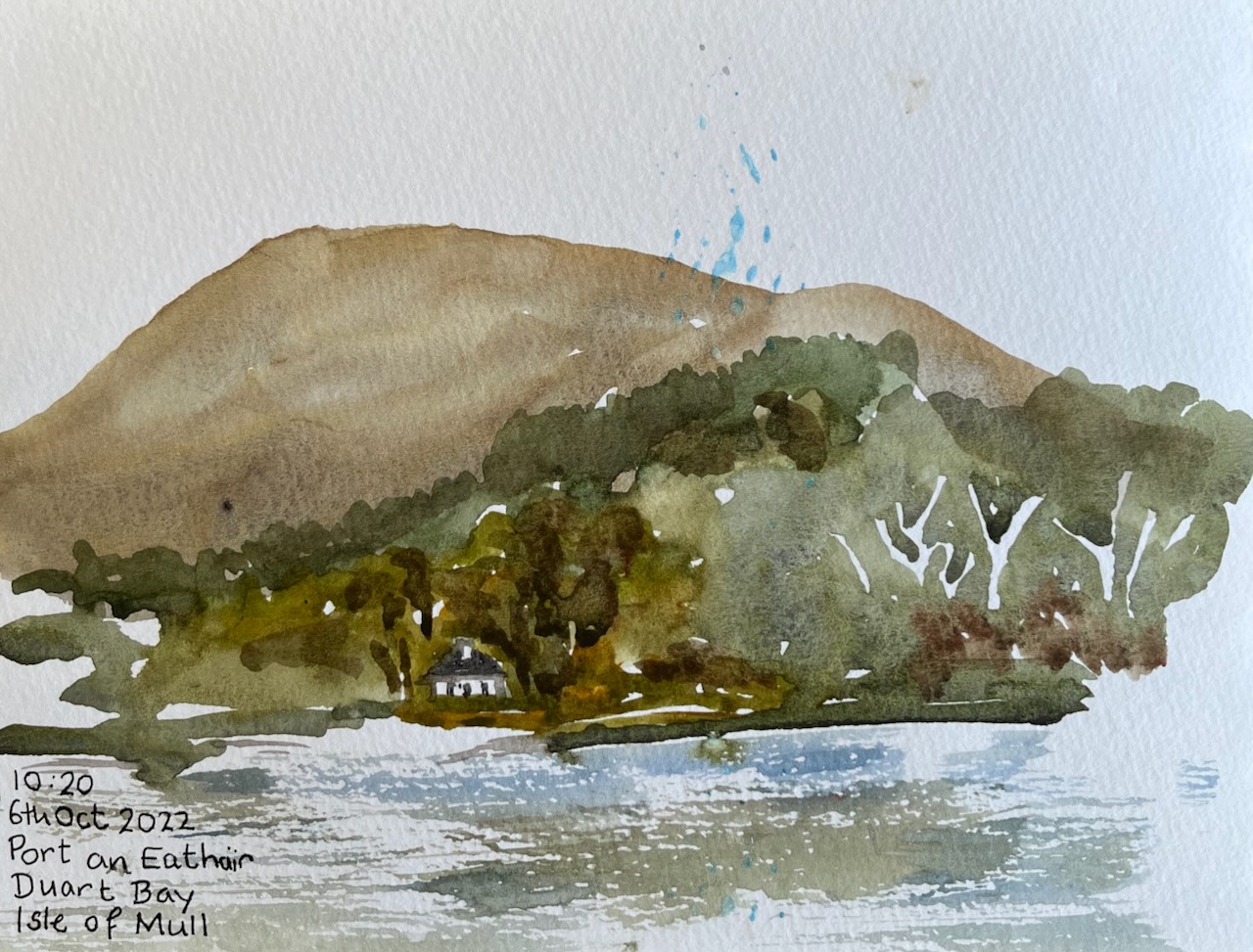
The scenery of the Highlands, seen from the boat, was stunning. I tried to capture the light. All these sketches were made from the boat, which was moving, even when anchored.
Loch Linnhe, near Fort WIlliam. Ben Nevis in cloud on the left.Urquart Bay, Loch Ness, 9amDuart Bay, returning to ObanPine trees on a promontery, Duart Bay, Isle of MullPort An Eathair, Duart Bay, Isle of MullLoch Linnhe, 6pmViews of the Highlands
It was an adventure.
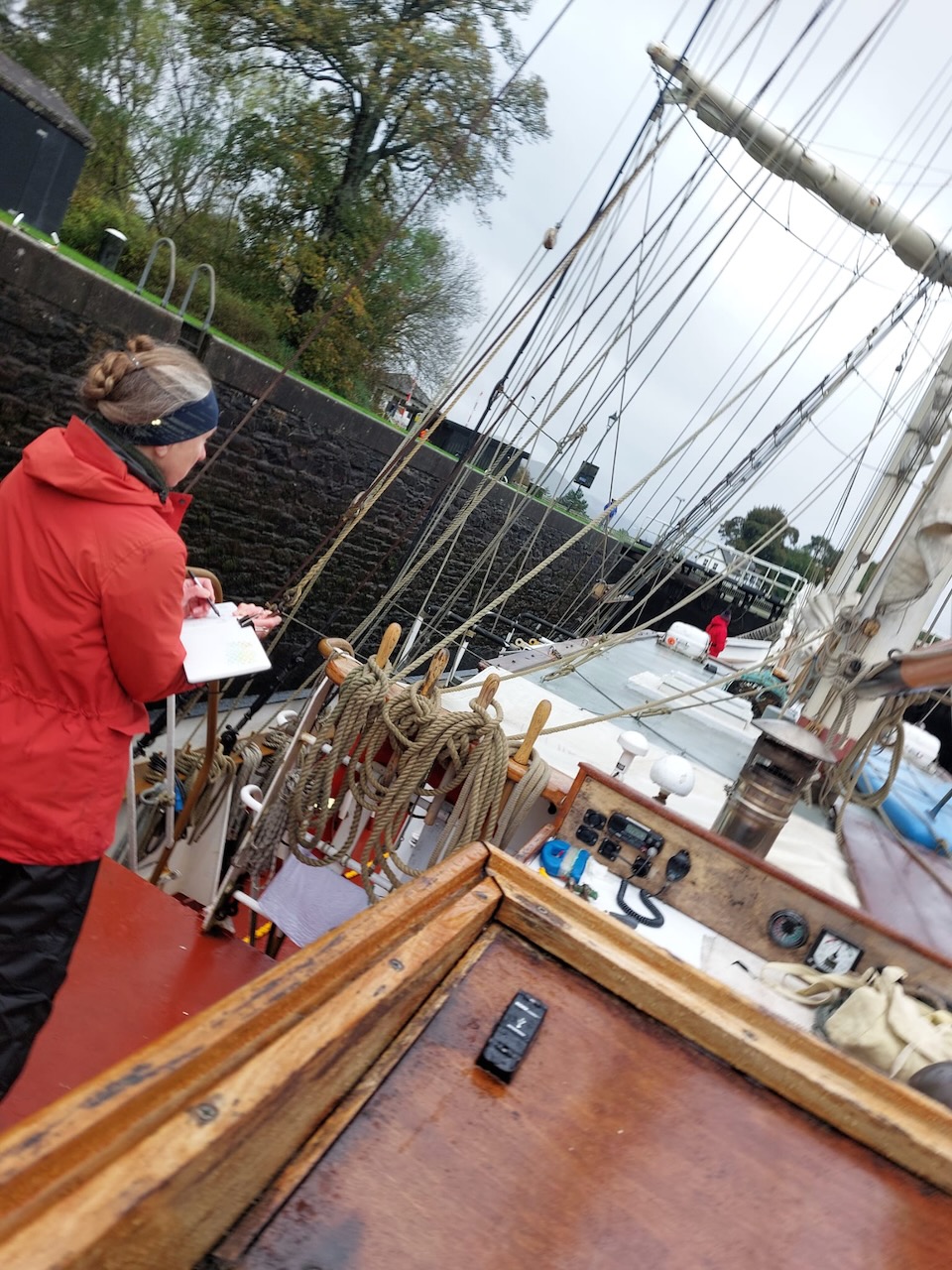
Me sketching on board. Picture Credit: AndyCustom stamp by “stampit.co.uk”
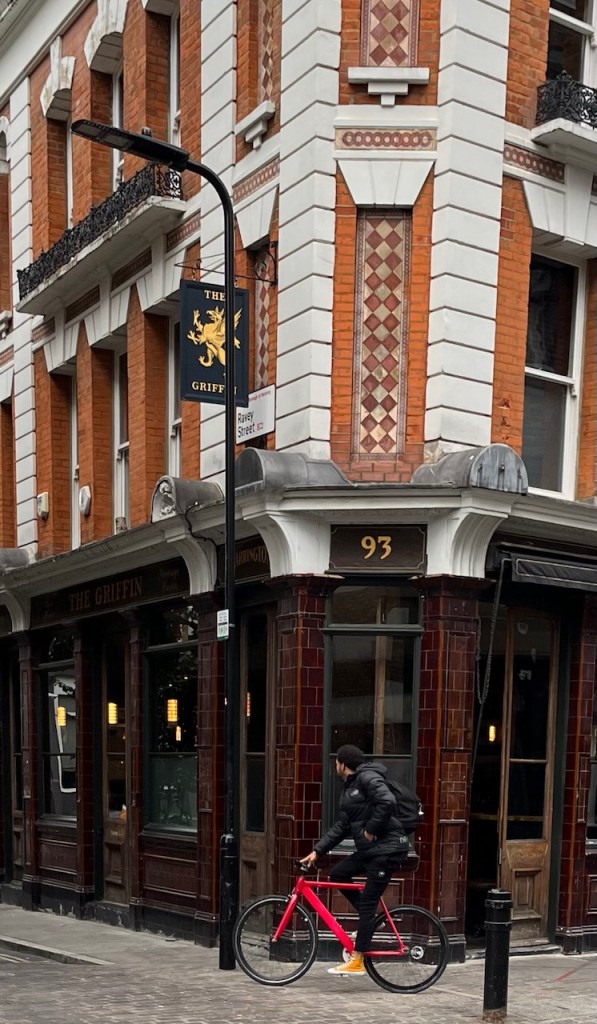
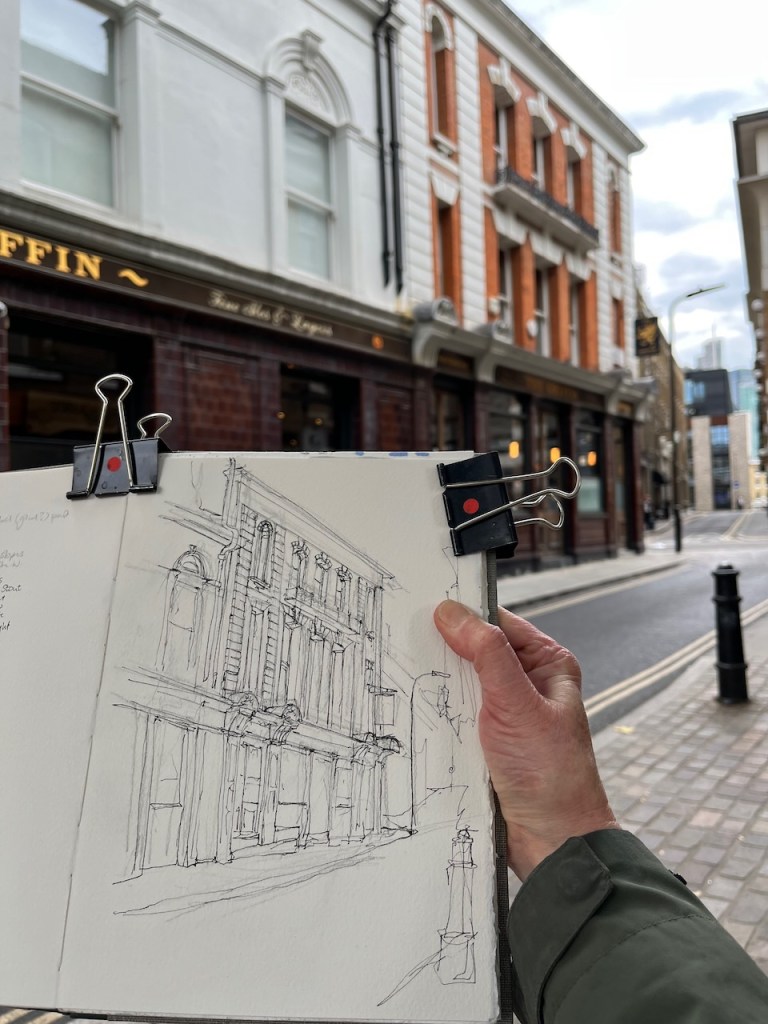
After I’d sketched The Old Blue Last, I left the thundering traffic behind and walked through back streets of Shoreditch. I encountered “The Griffin”. It seemed like a friendly place, with neat brickwork, and welcoming lights inside. I sat on a low wall, and sketched it, as electric taxis glided past. Or should that be “glid”?
The Griffin, Leonard Street EC2. Sketched on 21 September 2022 in Sketchbook 12.
The pub is built on a slight slope. Ravey Street slopes upwards towards Leonard Street.
Map showing where I sat and sketched “The Griffin”
It’s an area of sharp contrasts. Behind me was the “Nobu Hotel” radically modern. Blackall Street, however, looks unkept, like the seamy side of a garment. The people walking by were various. A group of young people speaking a Germanic language rushed past onto Leonard Street following a route on a mobile phone. Several men in florescent jackets walked towards me in a tight group, studiously conversing and referring to a clipboard which one of them carried. As they passed I realised they were speaking another language, perhaps of a Baltic region, with soft “shh” sounds. A young woman strode past in the opposite direction, frowning, speaking no language but with her mobile phone held at her ear. None of these people paid me any heed. Then a totally different person appeared, dancing a jagged line along the street, with hair in long strands, and a huge smile. He noticed me and marched up, asked how I was, commented on the day, admired my drawing, and offered me a fist to bump in greeting. This done, he completed a 36o degree turn on the spot, and walked loosely on up the street, offering his benign greetings to other bemused passers-by. This is London.
Blackall Street, seamy side on the left, Nobu Hotel on the right.The radically modern Nobu Hotel.Nobu Hotel on Willow StreetLooking North up Blackall Street, Nobu on the left, “The Griffin” centre distance.
The Griffin is in an area of contrasts.
The area containing The Griffin has recently been totally redeveloped. A new hotel was constructed on Great Eastern Street. These works took place in 2013-5. They included a renovation of the pub itself, and conversion of its first floor into flats. There is extraordinarily detailed research on the whole site done by “The Historic Environment Consultancy”. See this link.
The pub is Grade II listed, the buildings around were unstable, and archaeological investigations were called for. The Historic Environment Consultancy wrote a scholarly account of the state of The Griffin in 2013, in preparation for the redevelopment. They generously put this report online. You can read it on this link or download it here if that link is no longer valid:
The consultant carefully identified the phases of construction of the pub, by looking at details of its structure. For example they observe:
The timbers in the roof are machine-sawn where visible and thus they date the roof to post 1790 and likely to be post 1840.
The Historic Environment Consultancy, Colin Lacey 2013
They conclude that it was constructed in three phases, the first two between 1799 and 1872, and the later one after 1887. This later phase is dated because it included the installation of a Dumb Waiter which was only invented in 1887. It was built as a pub, and has always been a pub.
At the time of their inspection, the consultants noted that the building was on the “At Risk” register:
The building also appears on English Heritage’s Heritage at Risk Register. It is said to be in ‘poor’ condition because, according to the register, of a lack of maintenance.
The Historic Environment Consultancy, Colin Lacey 2013
This poor state is evident from the photos they include in their report, which show plants growing out of the roof, and crackling stone work.
When I sketched it, the pub was in an excellent state of repair, very neat looking, with beautiful patterned brickwork. Worth a visit.
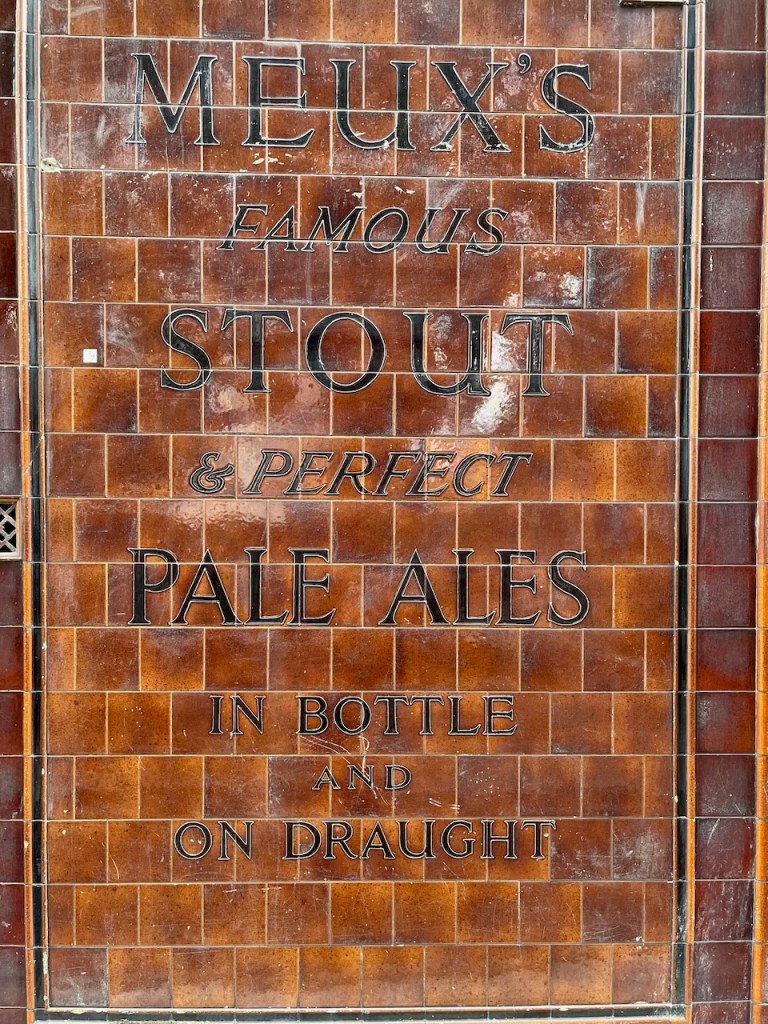
View from Leonard Street (Sept 2022)Meux Brewery brewed on the site of the Dominion Theatre, Tottenham Court Road until 1921, then moved to Nine Elms where brewing ceased in 1964 (https://pubheritage.camra.org.uk/pubs/2020)
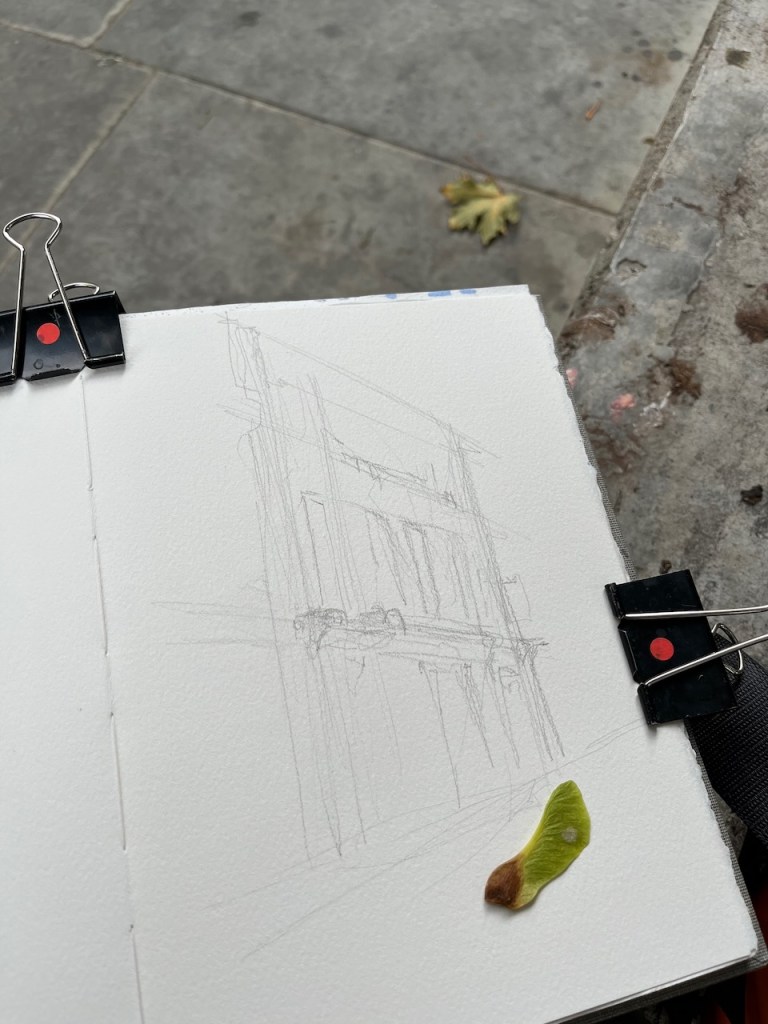
I drew the pub in pen and ink on location and completed the colour at my desk.
Pencil drawing and tree seedPen drawingPen drawing and cigarette butts.
The colours are:
Ultramarine Blue, Lavender and Burnt Umber for the sky
Fired Gold Ochre and Mars Yellow for the brickwork
A mixture of all of the above plus Perylene Maroon for the tiled ground level
All blacks and greys are Ultramarine Blue with Burnt Umber
The drawing is done on Arches Aquarelle 300gsm cold-pressed paper, made into a sketchbook by the Wyvern Bindery. The pen I use is a Lamy Safari with a fine nib and De Atramentis Document Black waterproof ink, both from “The Writing Desk”.
Click a button below to share this post online, email it, or print it:
Yesterday, I went to look for “The Old Blue Last”, a pub which featured in a book I was reading.
“The Old Blue Last stood at the top of Great Eastern Street in Shoreditch, a snub-nosed, imposing three-storey brick building curved like the bow of a boat…..”
‘Career of Evil’ by Robert Galbraith, Chapter 12.
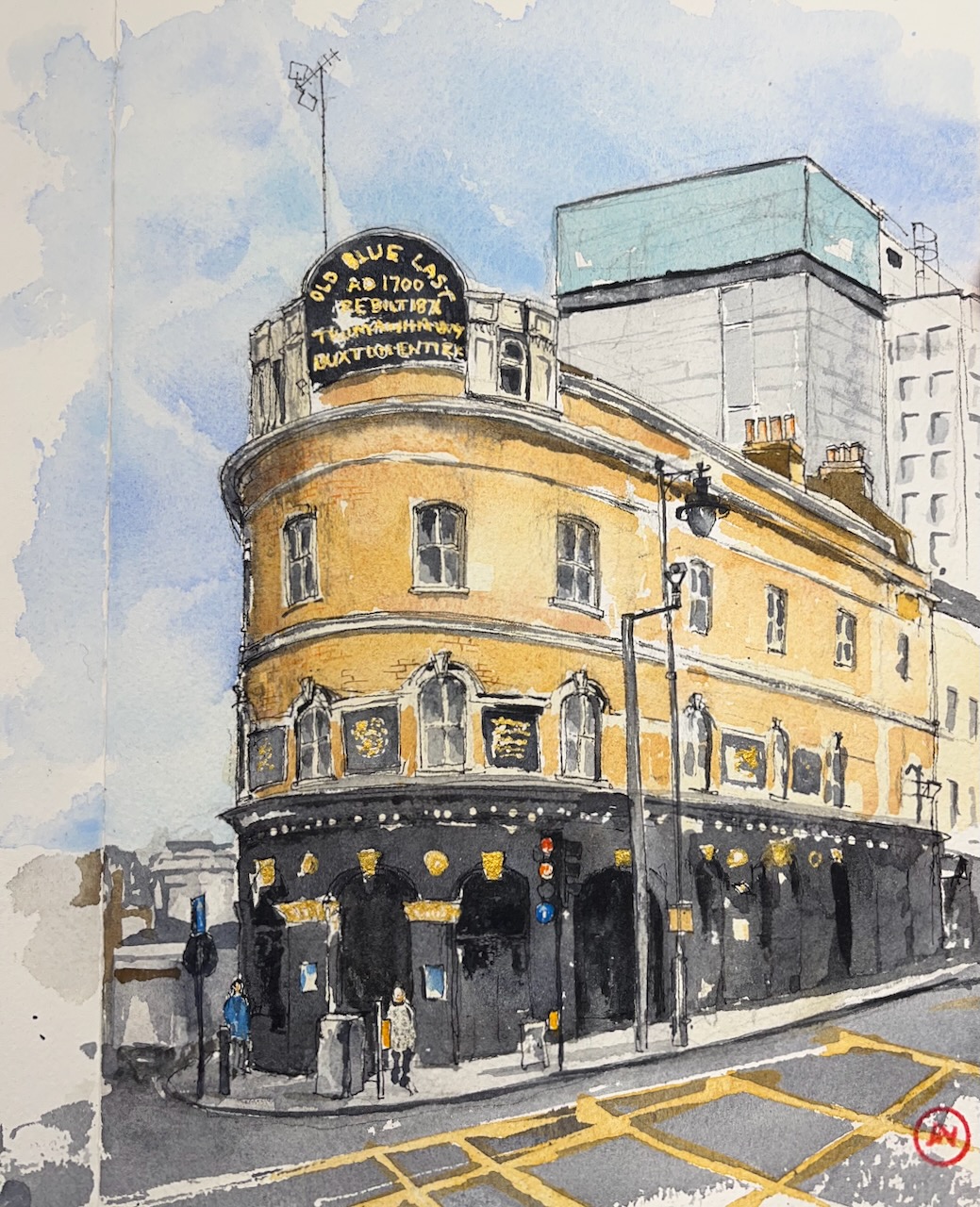
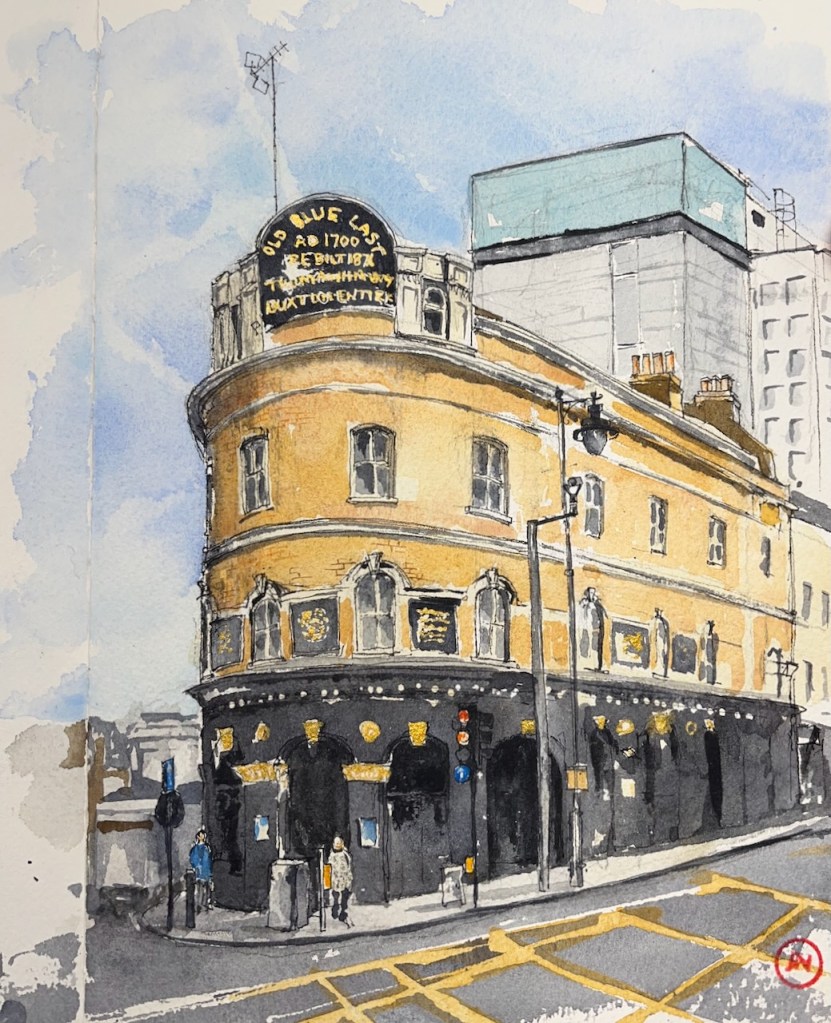
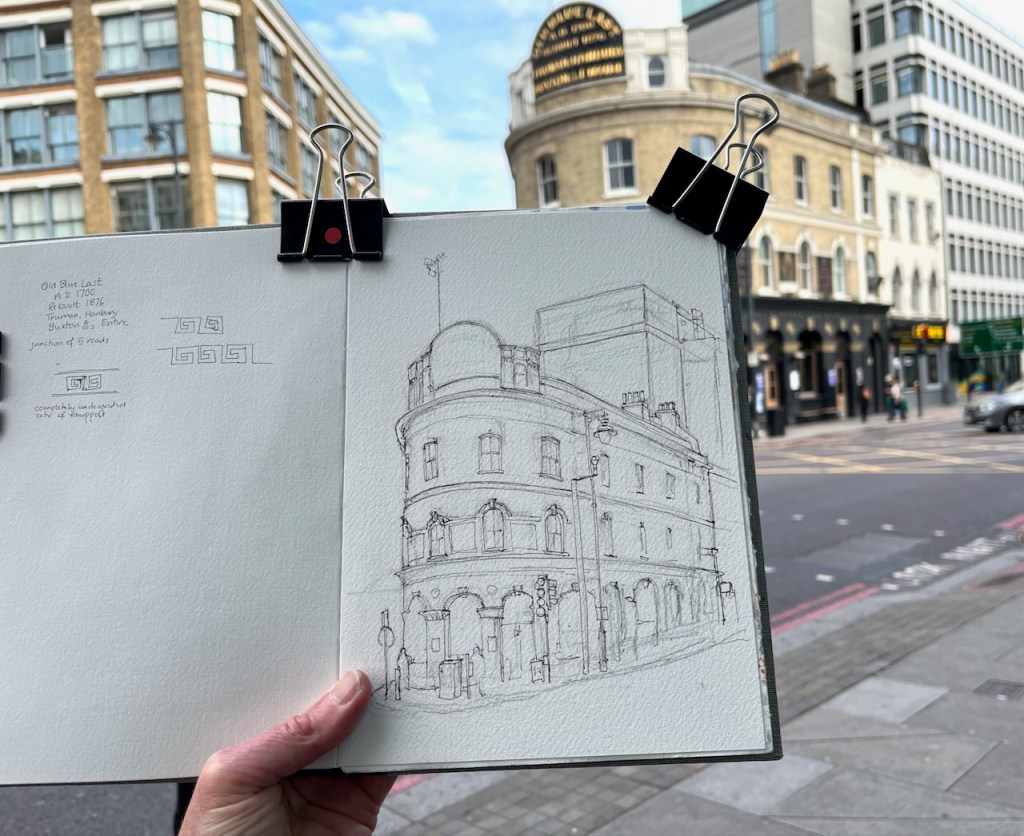
The Old Blue Last, Great Eastern Street, London EC2. Sketched on Wednesday 21st September in sketchbook 12.
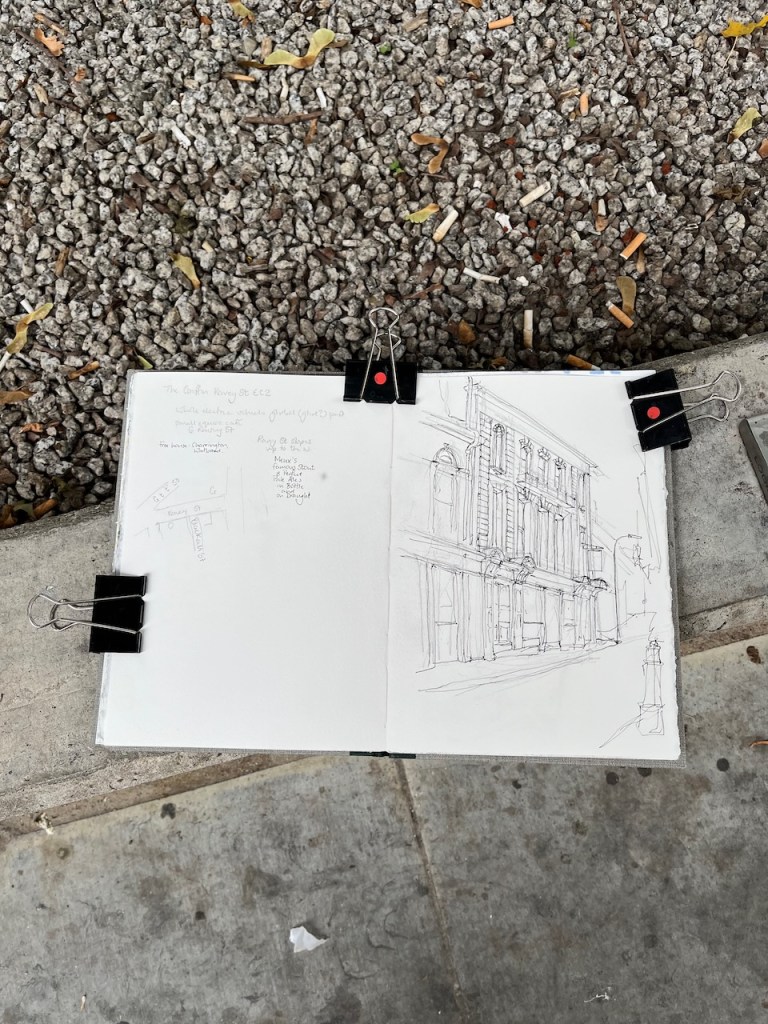
I sketched standing outside the estate agents Fraser and Co.
Map showing where I was standing, outside Fraser and Co, and my viewpoint. I later sketched “The Griffin” which is marked also.
This pub is now owned by “Vice Magazine” (“VICE is the definitive guide to enlightening information.”). Their website helpfully publishes a history of the pub:
“…in 1576 a venture capitalist named James Burbage built a venue called The Theatre where The Old Blue Last currently stands…..Eventually Burbage pulled down The Theatre and moved it south of the river, where it became The Globe….in 1700 a bar was built on the site of the old theater. It was called The Last, which, remarkably boringly, refers to a wooden block that a shoemaker uses to mold a shoe. The Last was owned by a brewer named Ralph Harwood, who went on to achieve a small level of fame when he was pronounced bankrupt one day by Gentleman’s Magazine…..In 1876, Truman’s brewery took over the pub. They pulled The Last down and rebuilt it as The Old Blue Last, which means “the old blue wooden pattern that is used to mold(sic) the shoe….Eventually Truman’s went down the toilet and Grand Metropolitan Hotels took over the OBL…[1970s, 1990s] —At that point, The Old Blue Last was a rough place full of rougher men and people who were afraid of being beaten up by them. It housed an illegal strip club and brothel, which was on the second floor…” [https://www.vice.com/en/article/ex575k/how-vice-bough-a-brothel-v10n12]
“Vice” bought The Old Blue Last in 2004 and turned it into a music venue.
Great Eastern Street is a very busy thoroughfare, taking buses, lorries, delivery vehicles and cars between the Old Street Roundabout and places East. I noticed the crowd of street furniture outside the pub. See the lamp post, which, though modern, attempts to imitate some of the Victorian features of the pub. The CCTV camera next to it, however, is strictly utilitarian, on its unadorned pole. I wonder why they didn’t put the security camera on the lamp post. They are only about 3 feet apart.
I tired of the pounding noise of Great Eastern Street, despite the friendly location outside Fraser and Co. One of their employees, mobile phone clutched in his hand, paused and commented favourably on my drawing, as he re-entered the office. People passed by wrapt in intricate conversations about modules, funding agreements and childcare issues. After I finished the pen drawing, I retreated into the quiet back streets.
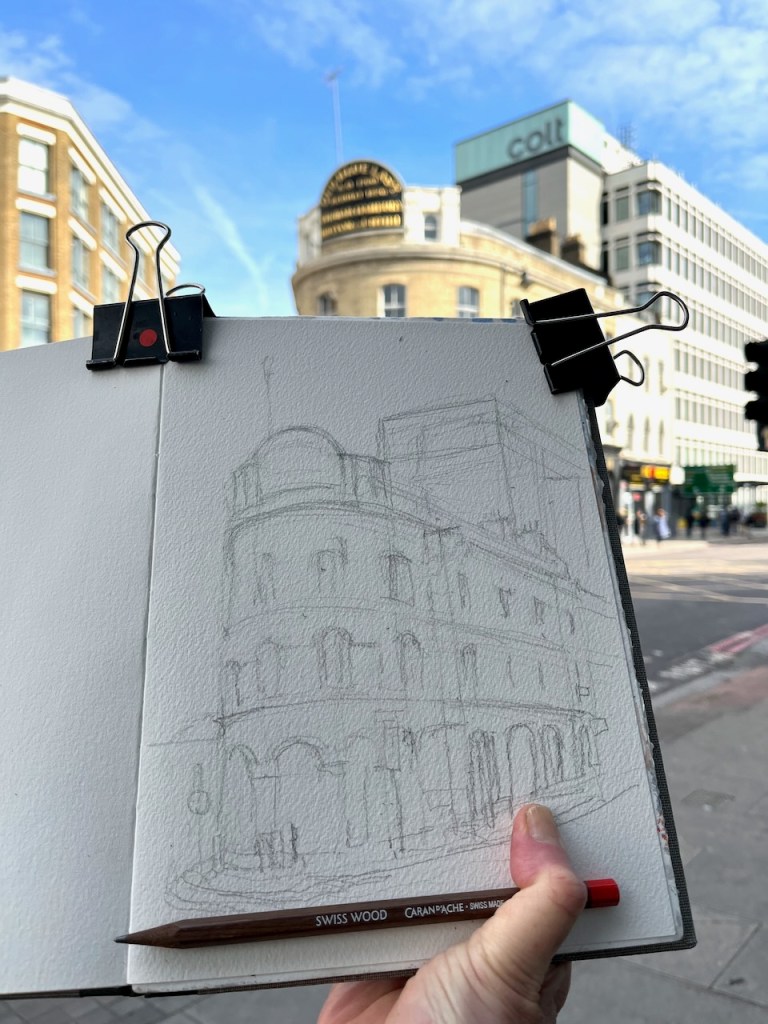
PencilPen
I added the colour later, at my desk.
The colours are:
Ultramarine Blue and Lavender for the sky and street signs, Mars Yellow and Burnt Umber for the brickwork, with some Fired Gold Ochre. The black is made of Ultramarine Blue and Burnt Umber. There’s some Cobalt Turquoise Light on the Colt Technologies building behind the pub. I used acrylic gold paint by Liquitex to pick out the gold on the pub, including the lettering.
Click a button below to share this post online, email it, or print it:
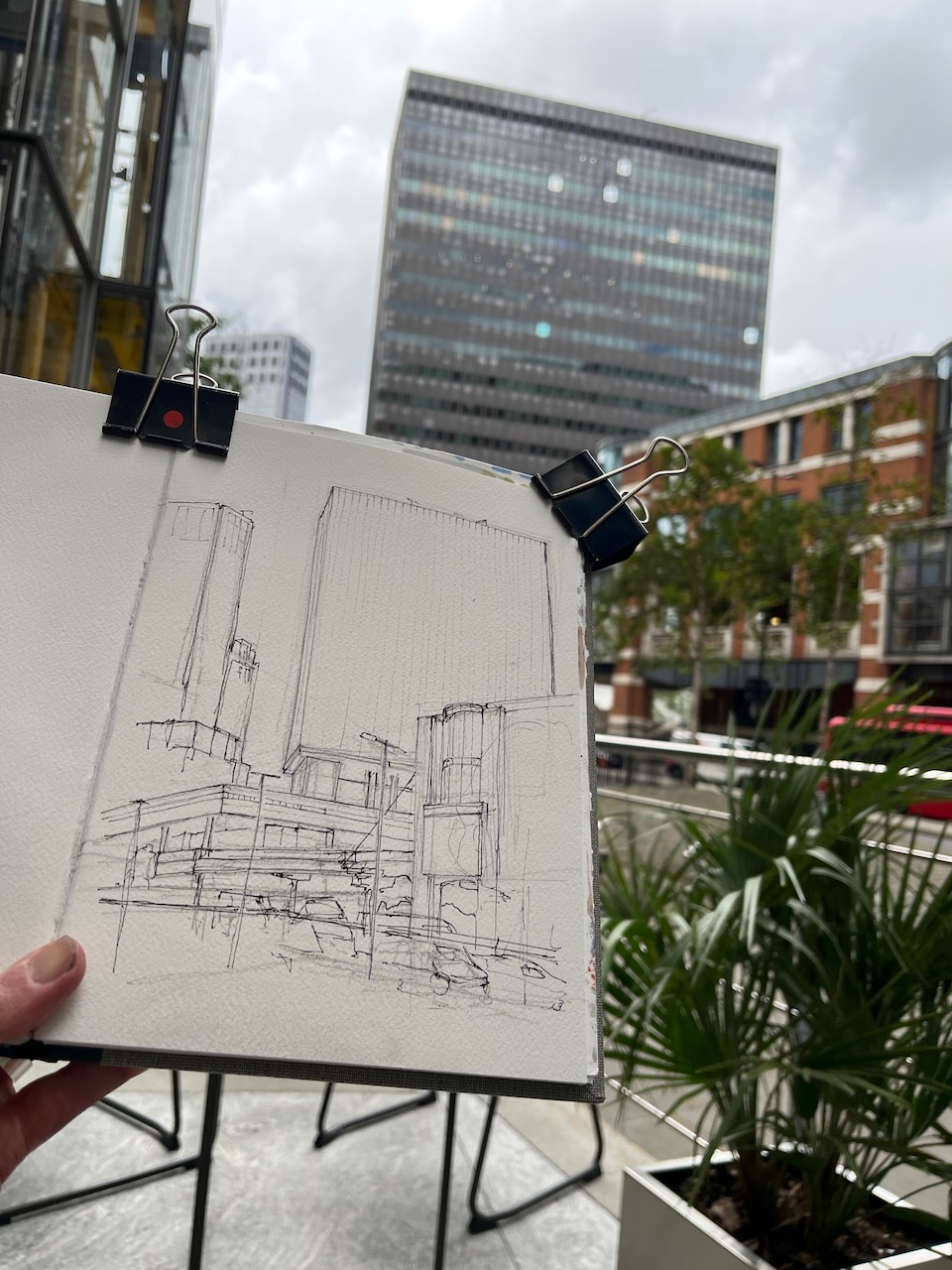
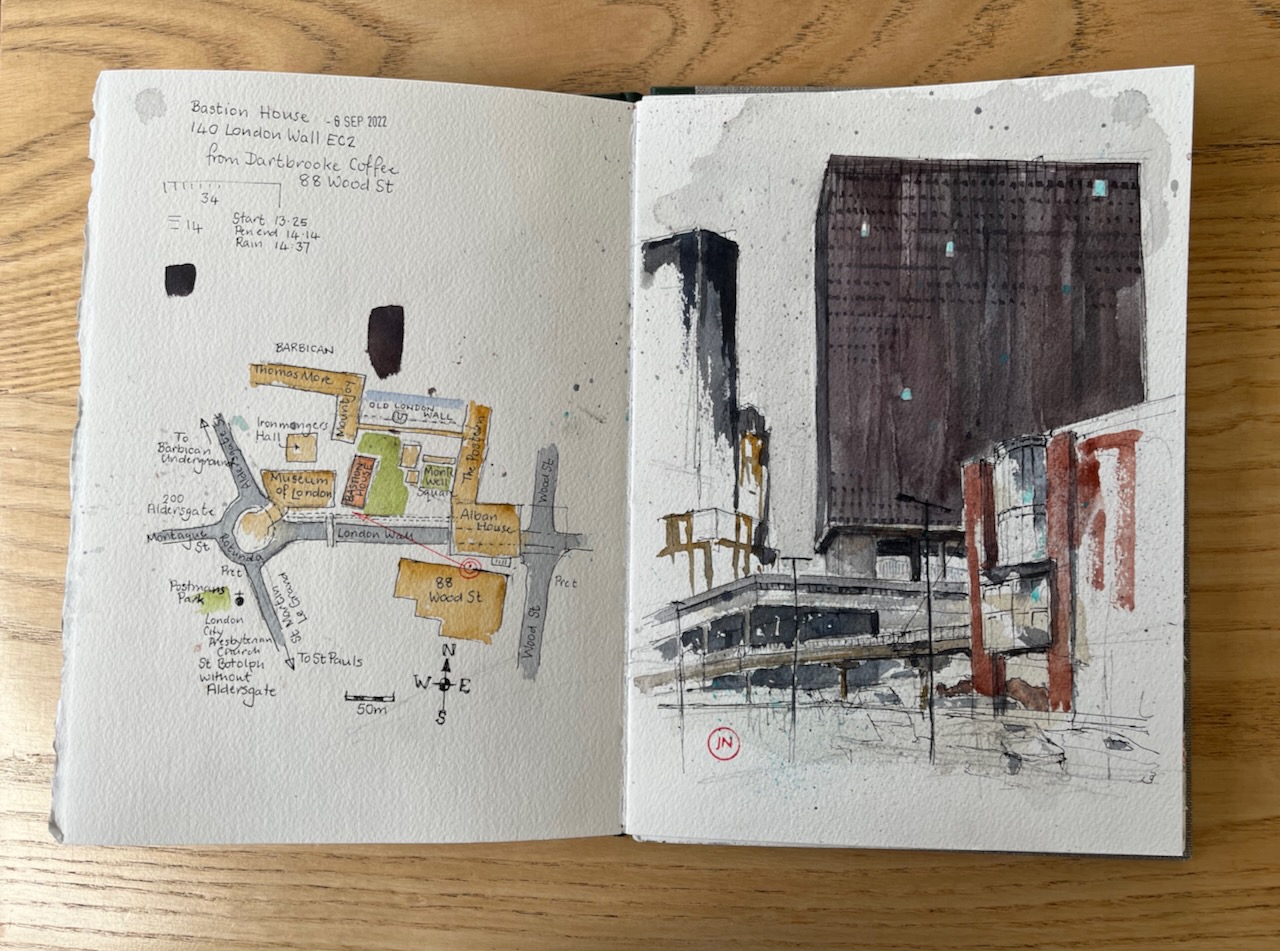
I sketched this from the outside tables at 88 Wood Street. A small coffee shop run by Dartbrooke Coffee has opened in this office block. The coffee was superb, the welcome warm, and they had a selection of food. Also they had tables both indoors and out. Here’s the view from an outdoor table overlooking London Wall.
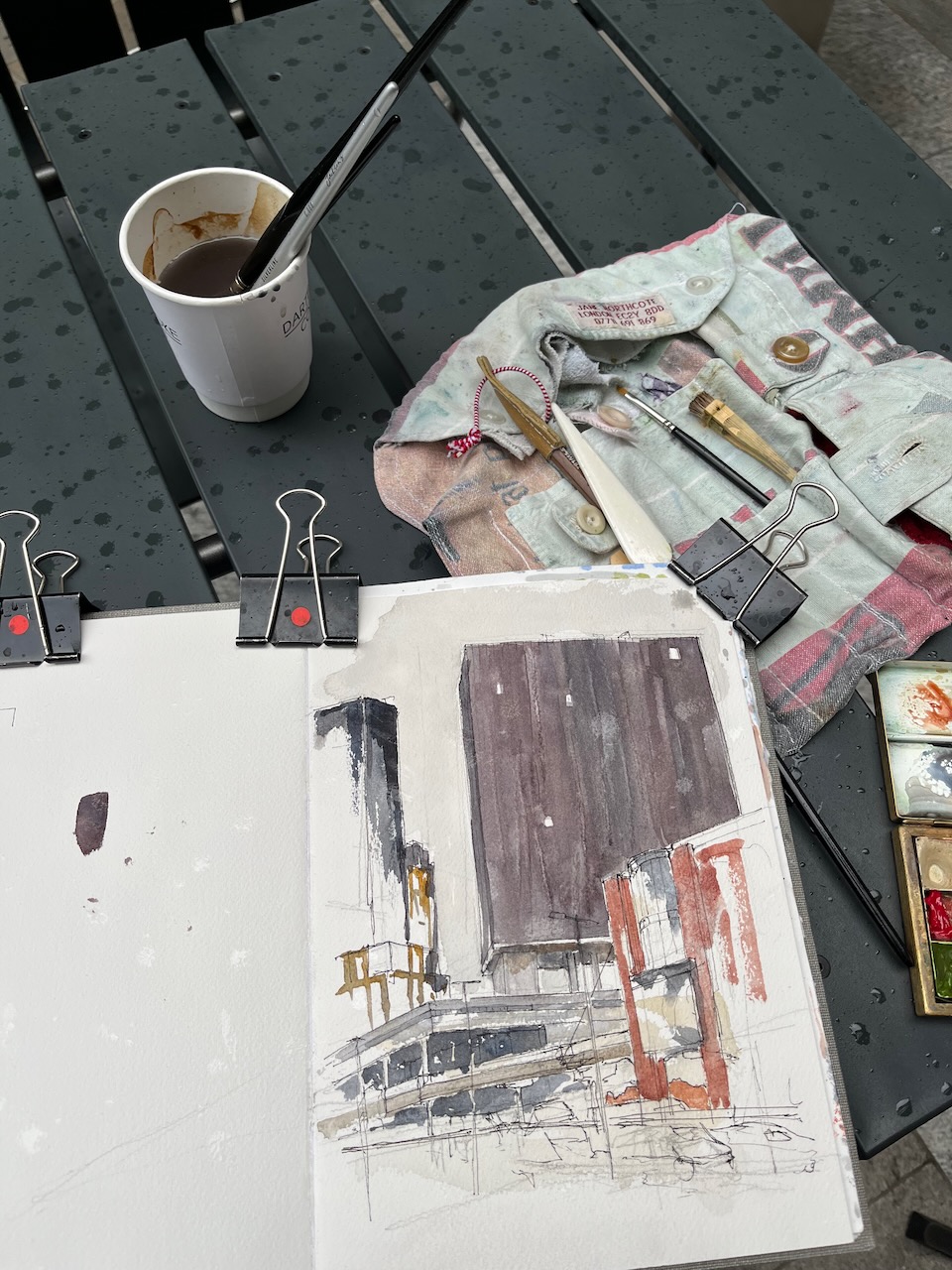
Bastion House EC2 from 88 Wood Street, 6th September 2022 in Sketchbook 12
I liked all the angles.
That’s rain you see in the sky. I had to pack up quickly as the rain came down.
Rain on the painting!
This picture took 1hour 10 minutes up to the point in the photo above when it started raining. Then another 20 minutes at my desk to finish off.
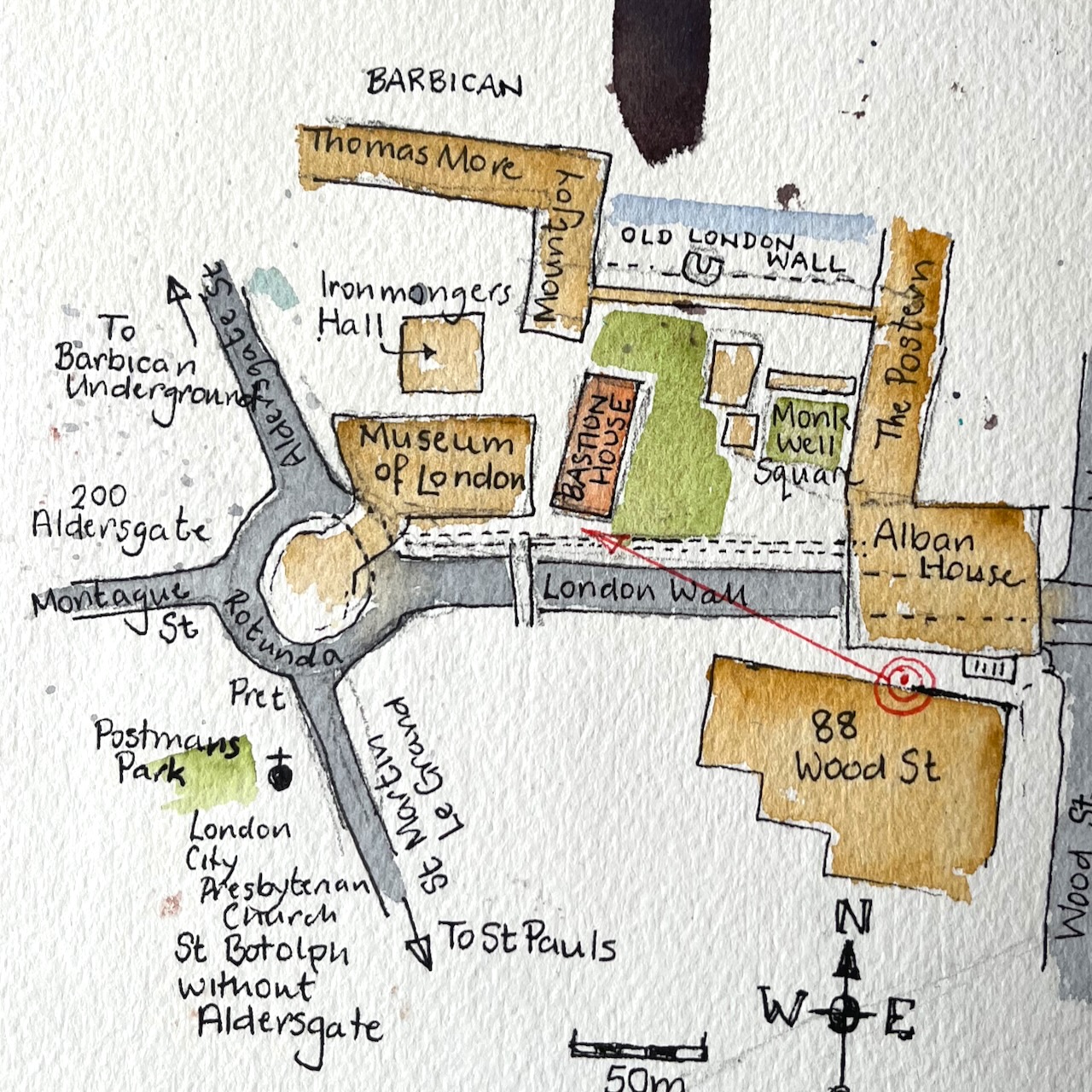
Here’s a map. The building on the left of my drawing is 200 Aldersgate, a huge office block.
Map showing where I was sketching and my viewpoint.
Bastion House is the monolith in the centre of the picture, with the Barbican Highwalks below leading to the Museum of London.
Bastion House, the Highwalks, and the Museum of London are all under threat of demolition by the City of London and replacement with three huge office blocks, overshadowing the Barbican. All the bridges will be removed, and all the highwalks in this area. This is not a good idea, in my view, and I support the residents’ call to the City to stop and think. Do we need yet more huge office blocks…really? Can we not refurbish the existing buildings, as has happened successfully to nearby blocks?
Earlier this month, I made a quick sketch of Bastion House, from London Wall. Here’s a map: The architect was Philip Powell of Powell and Moya. The building…
Bastion House aka 140 London Wall is a huge modernist monolith, reminiscent of the monolith in “2001 – A Space Odyssey”. I couldn’t find a site to draw…
I hastened to draw the magnificent Bastion House, on London Wall. It is due for demolition. In the foreground you see the balcony and privacy screen of the…
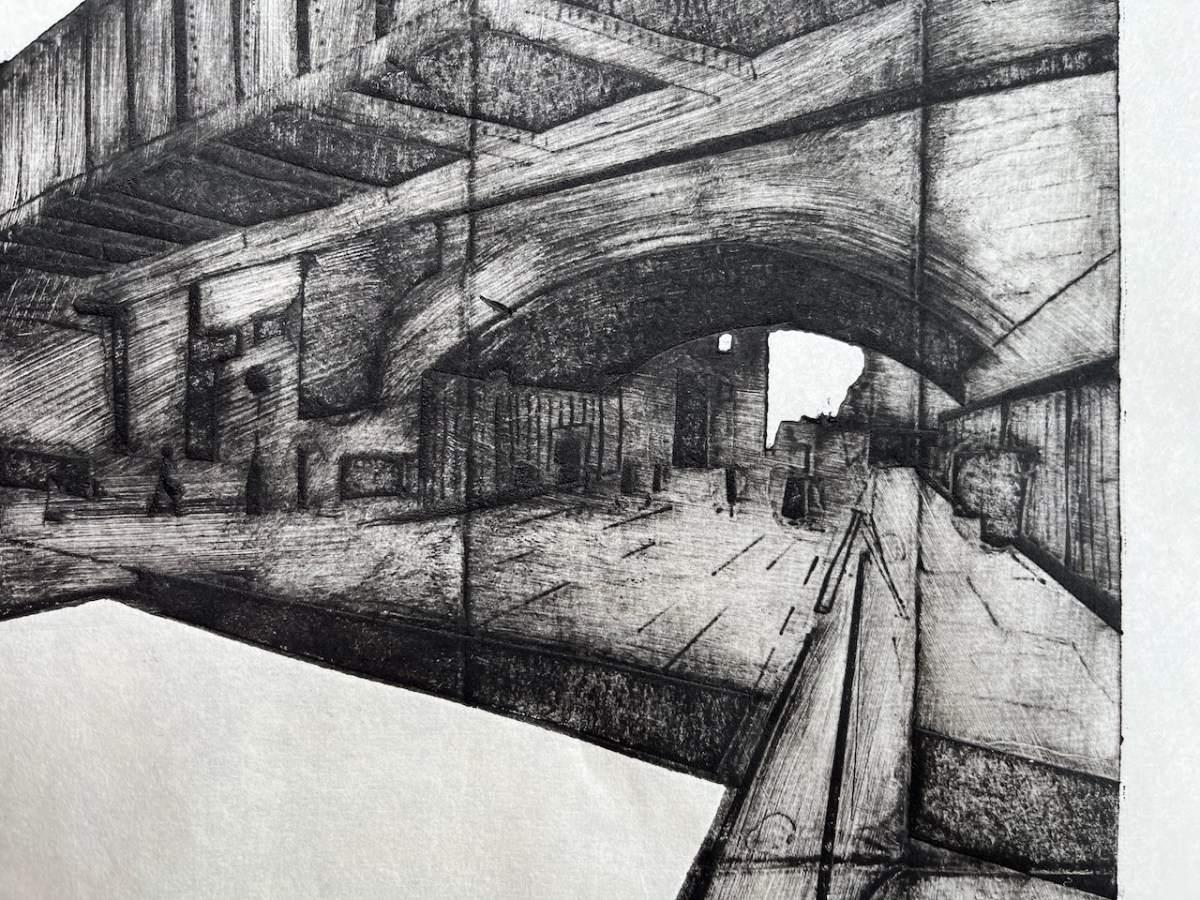
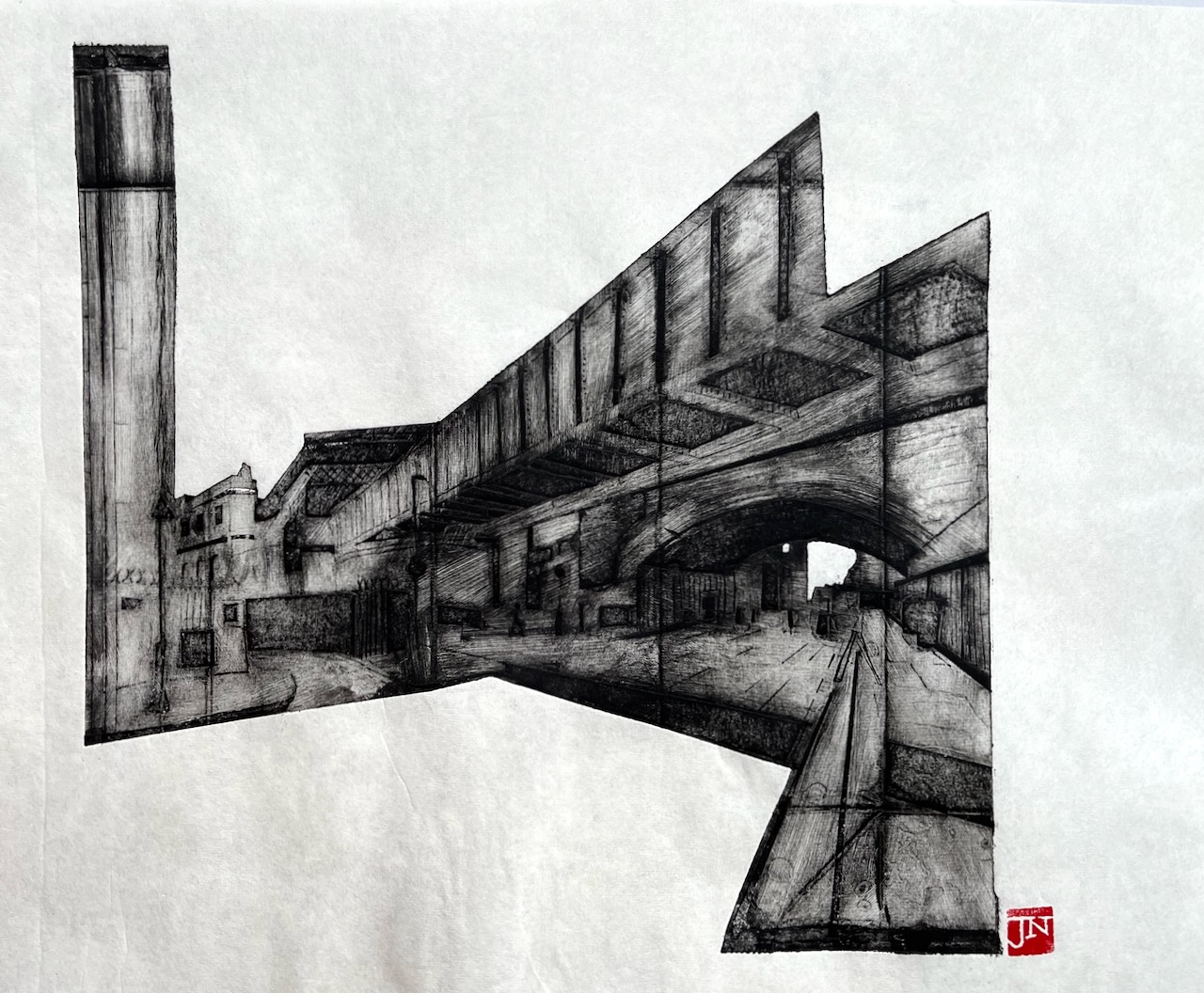
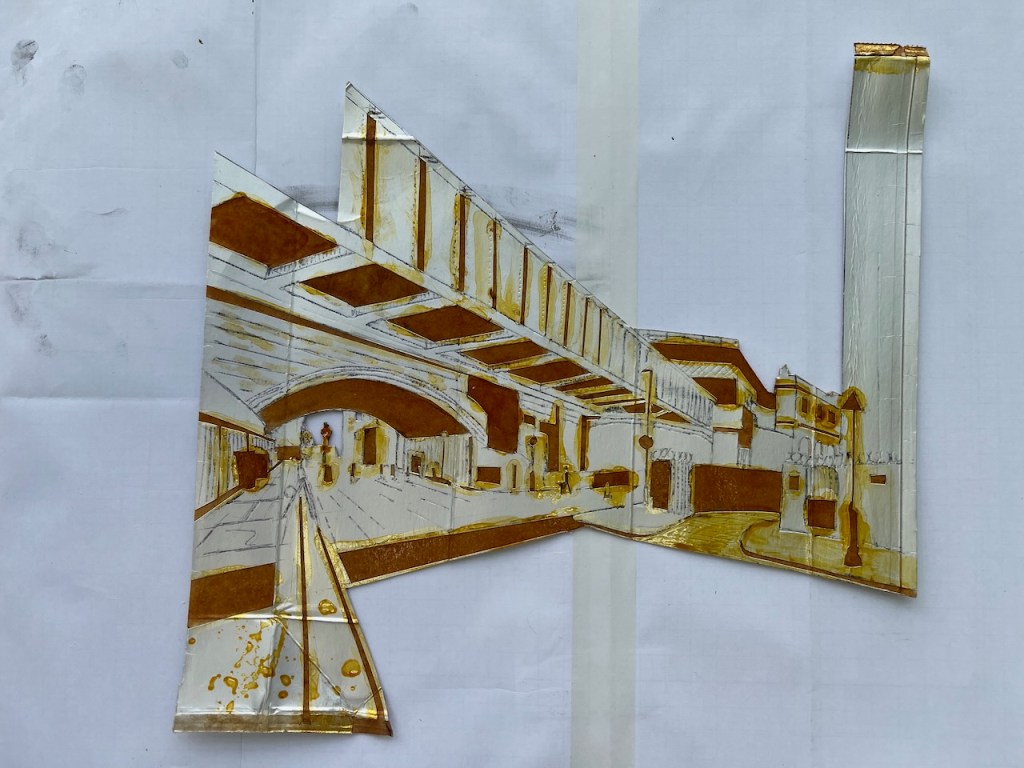
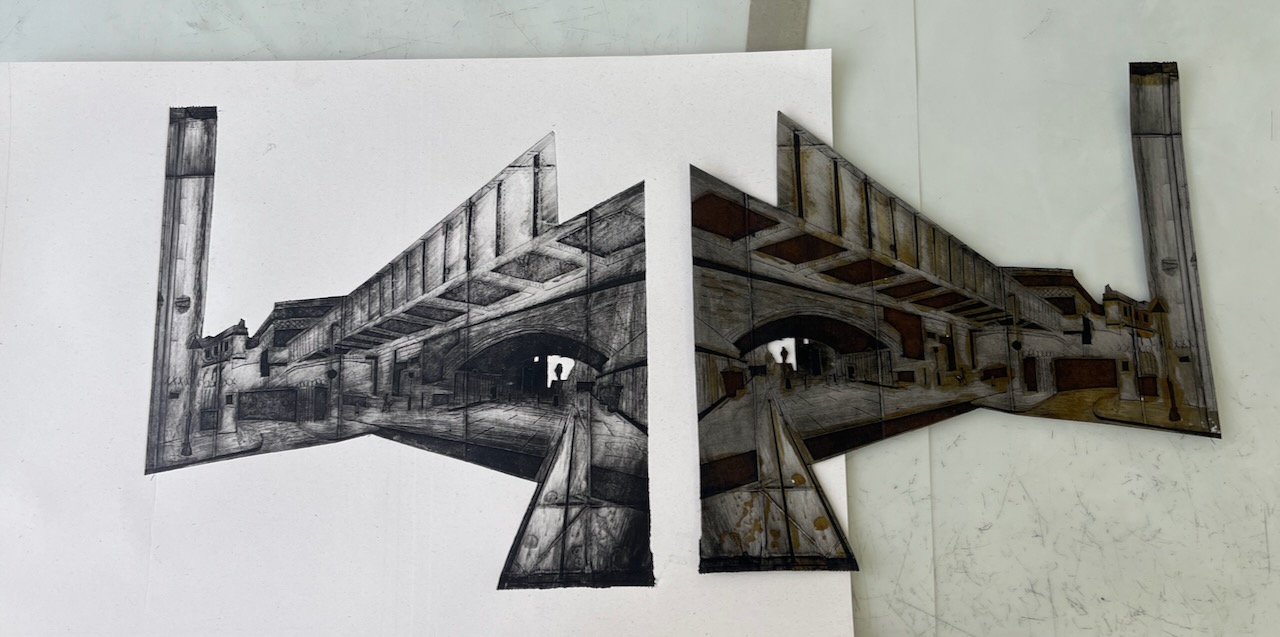
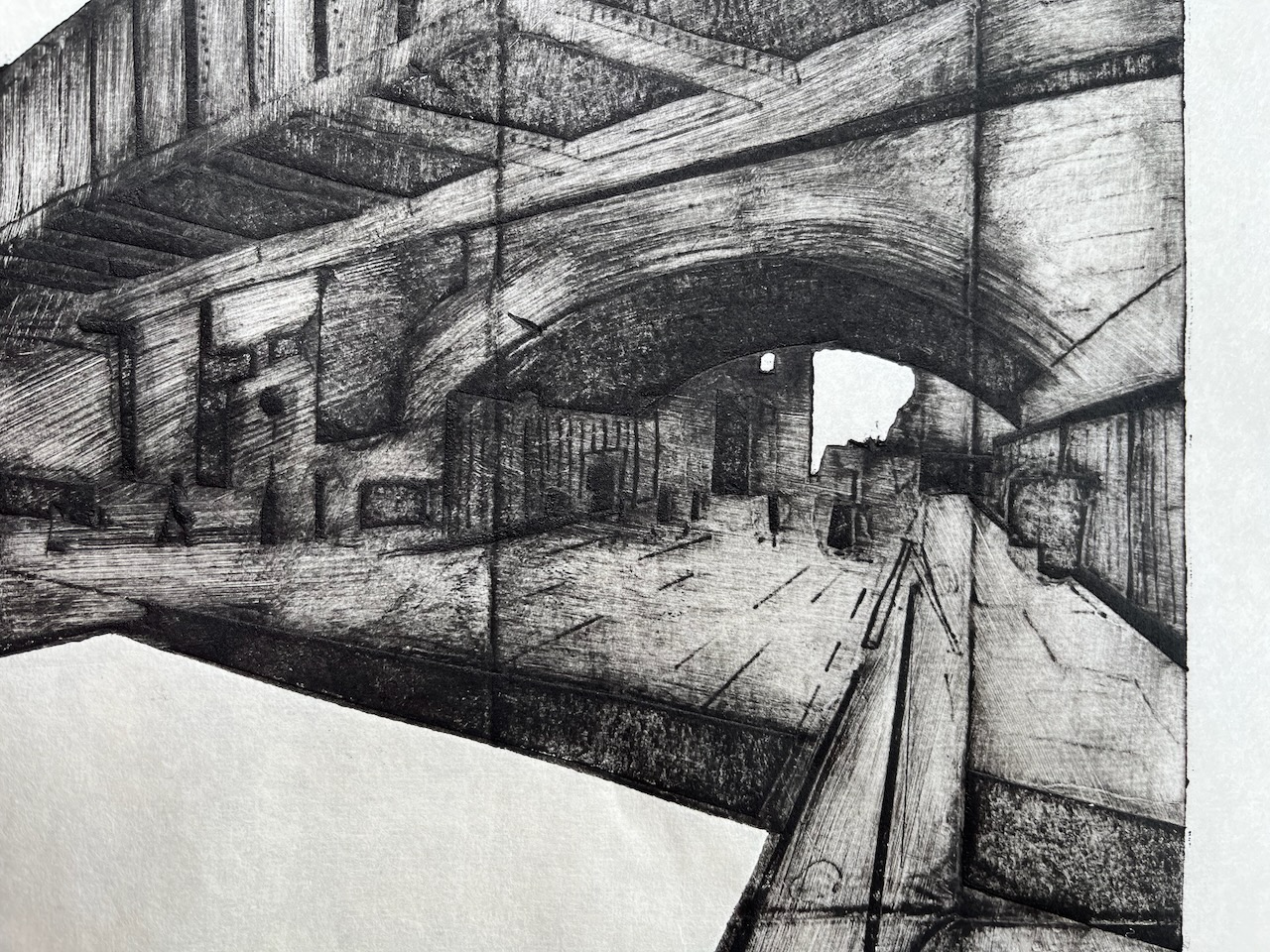
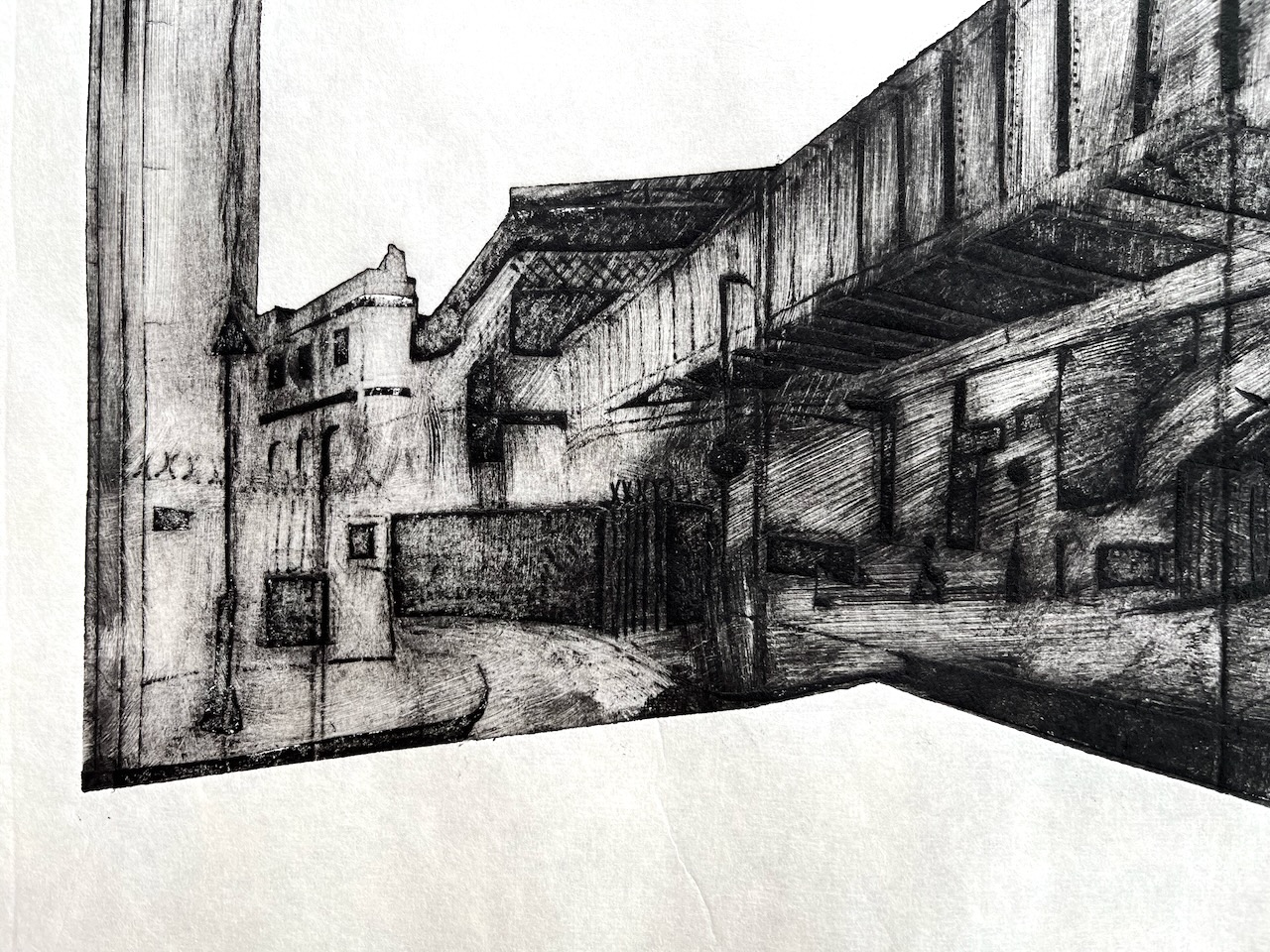
Here is another packaging print. This one shows Bridge ELR-XTD Structure 20 on Cornwall Road (N) between Charing Cross and Waterloo East, South East London. The road that leads off to the left is Sandell Street SE1. The road under the bridge is Cornwall Road.
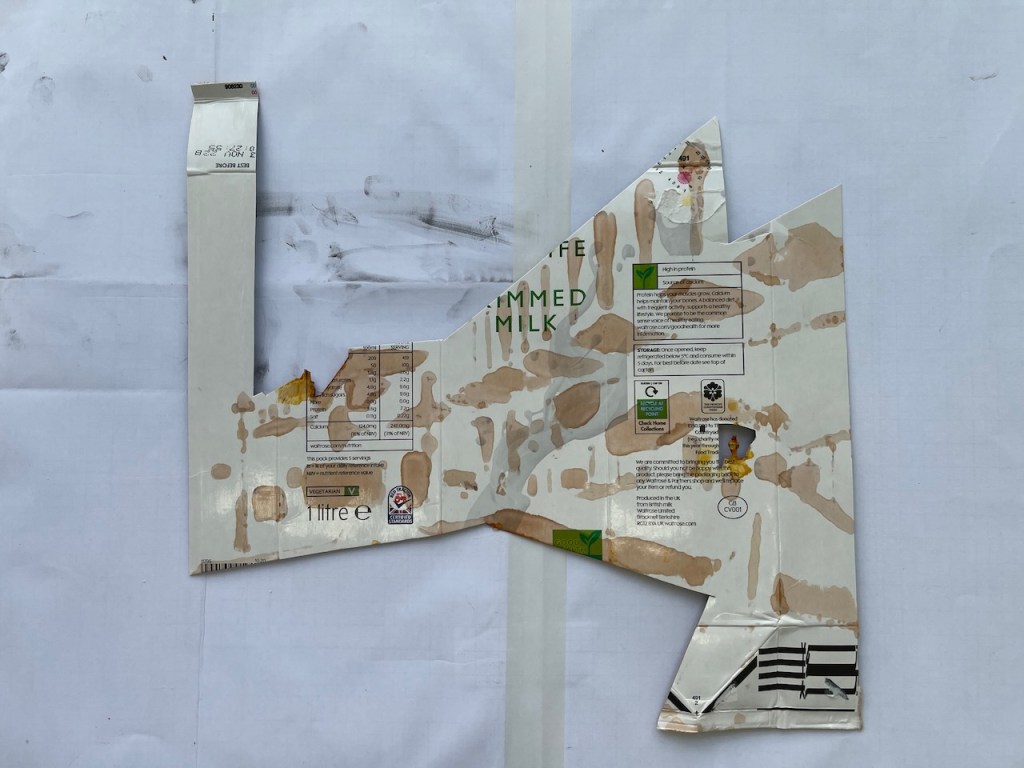
The print is made using the intaglio process. The plate is a milk carton.
Railway bridge on Cornwall Road, SE1, Packaging print made on 3rd September 2022, about A3 size
Here is the plate, front and back:
Plate: print sidePlate: back
The plate is made by peeling away the metallic substance inside the milk carton, then painting it with shellac to make it stronger. I describe the process in this post.
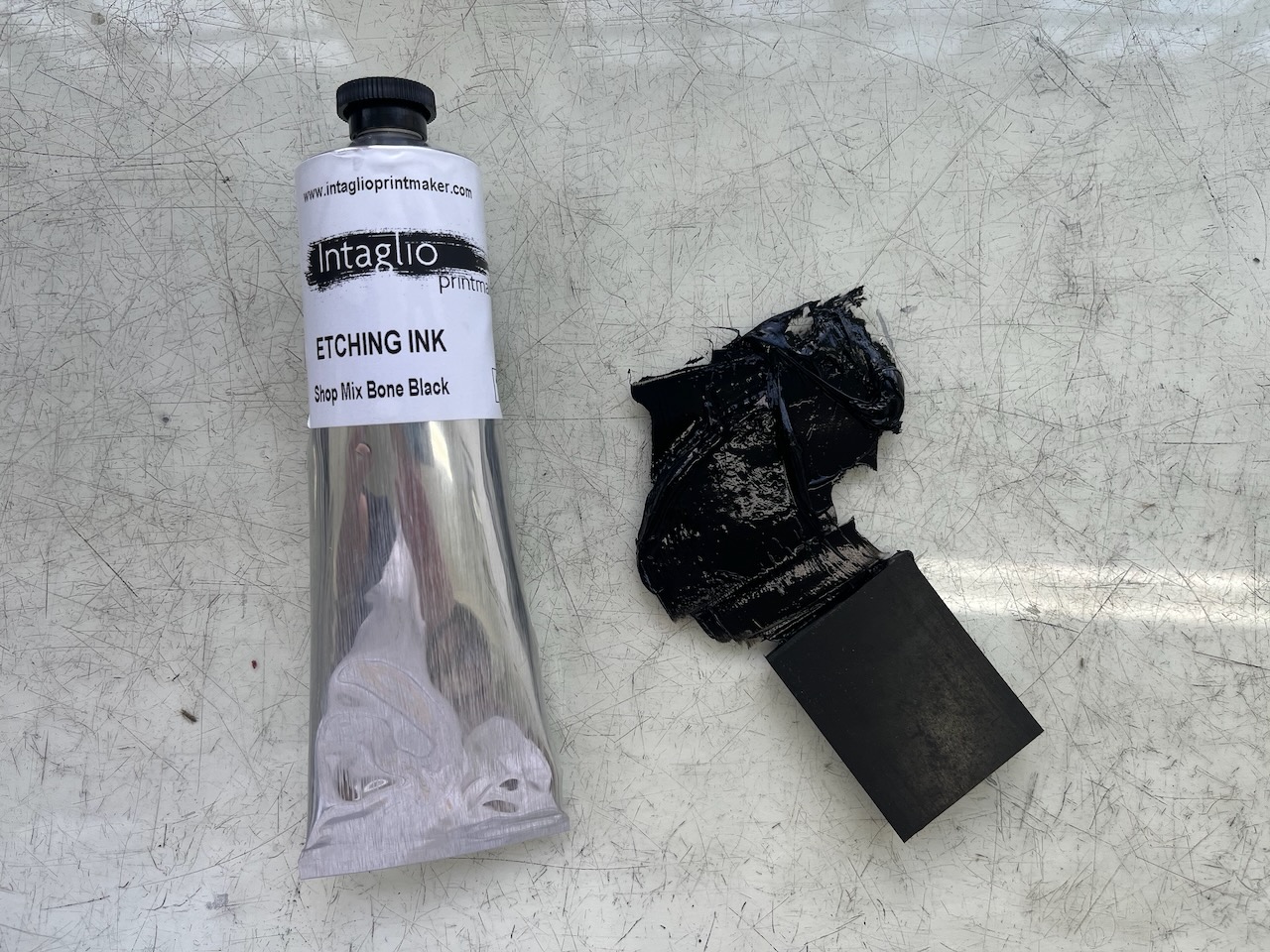
I used traditional etching ink, “Shop mix – Bone Black” from Intaglio Printmaker, whose shop, as it happens, is not far from this railway bridge.
Here’s a video of the print being peeled away:
Here is the print and the plate:
Plate (left) and print (right)
Print (left) and plate (right)
The plate made 8 prints.
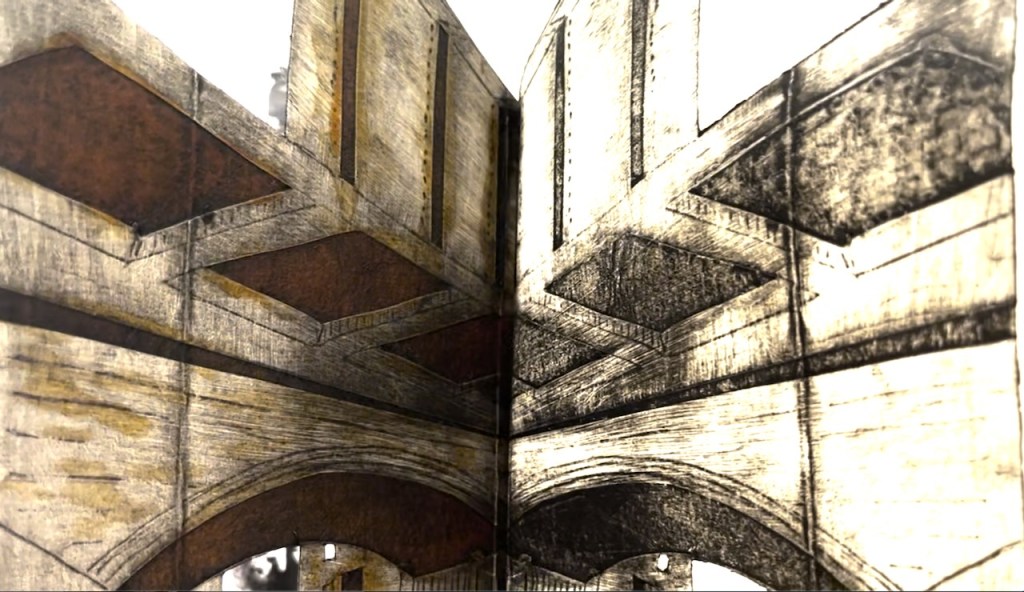
Here is detail of the print:
For more of my prints made with packaging material, click on this link:





























 Jane Sketching