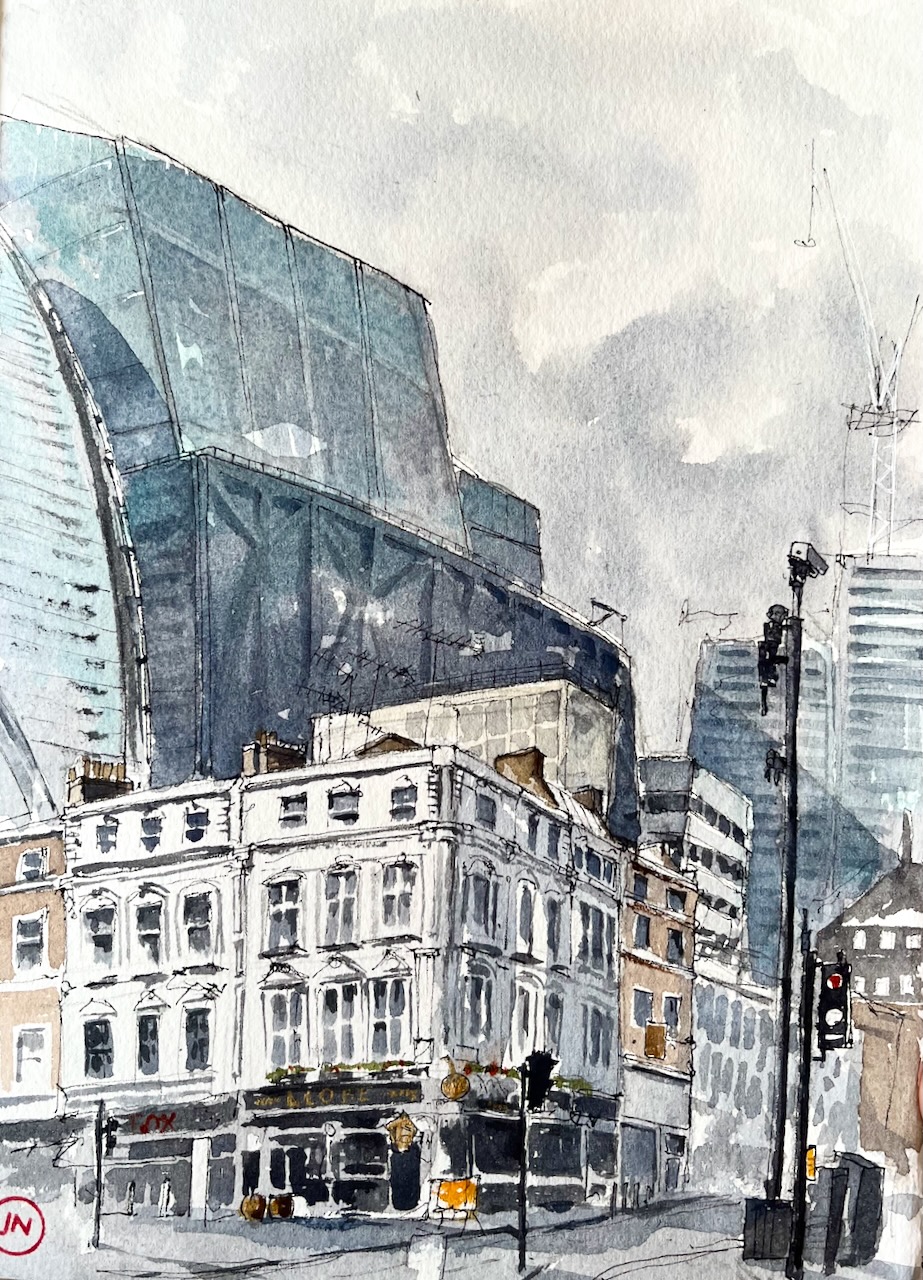
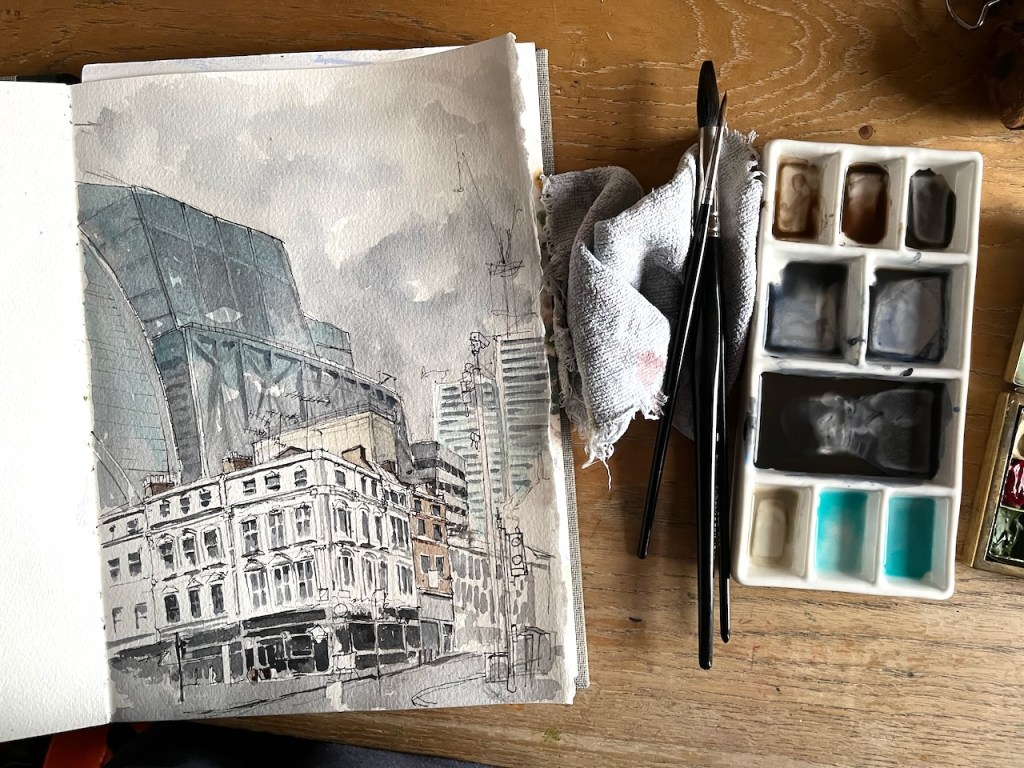
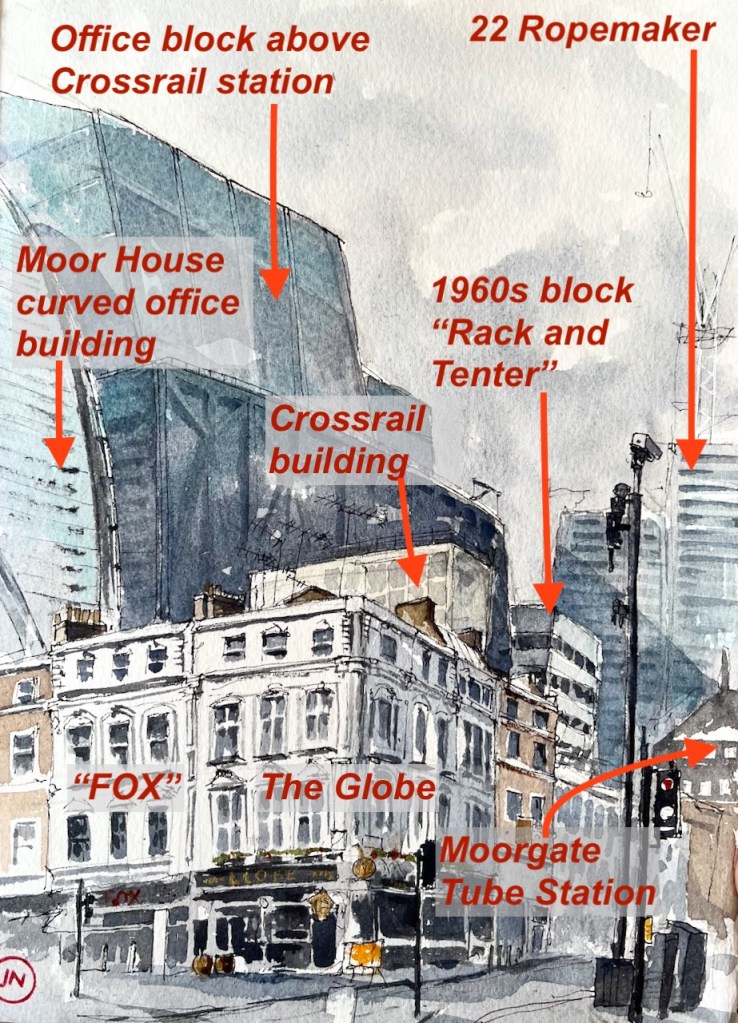
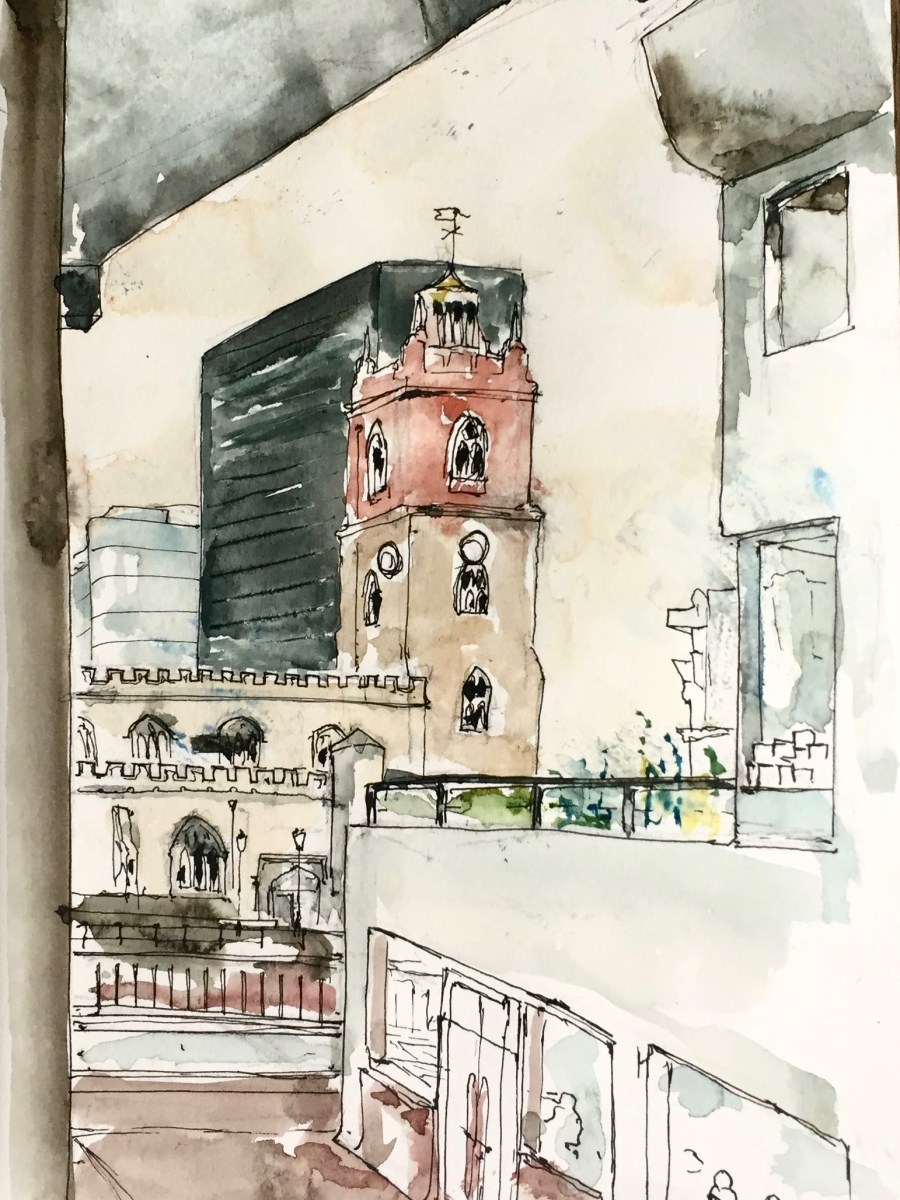
The Globe Moorgate is a magnificent Victorian pub, standing boldly on the corner of London Wall and Moorgate. As you see, it is in the midst of more recent developments. The huge office block you see in the centre left of my drawing is still under construction. It is above the new Crossrail station at Moorgate. Crossrail is now called “the Elizabeth Line”. In the background there are two further blocks going up. These are 22 Ropemaker, on Ropemaker Street.
The Globe Moorgate, EC2, sketched on 29 August 2022, at 5pm in Sketchbook 12
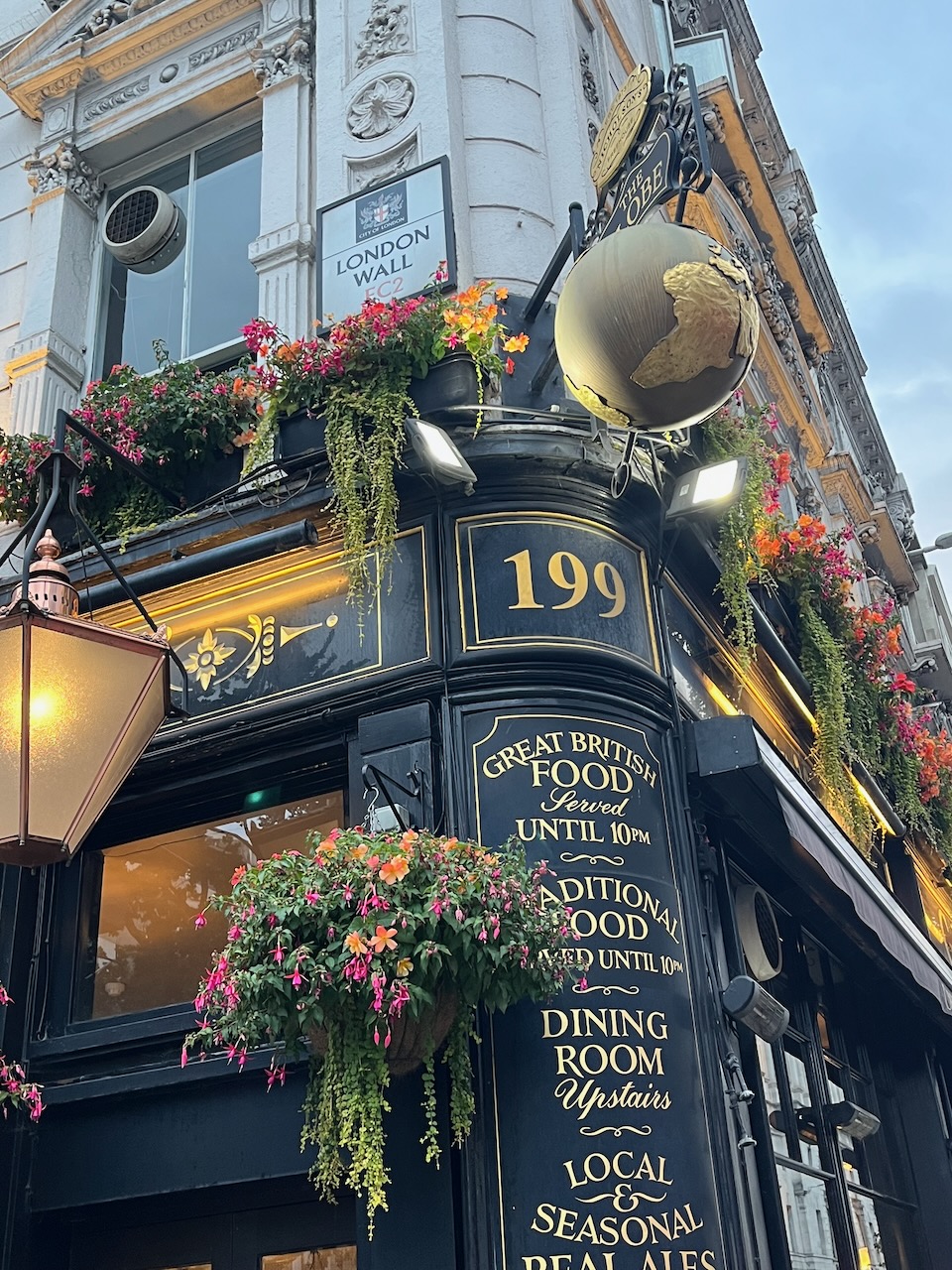
There are various curious things about The Globe. On the corner is the prominent number “199”. You’d think that was the street address, but no, the Globe is 83 Moorgate. I can’t discover where this “199” came from.
The corner of The Globe: “199” in huge lettering. But the Globe is number 83 Moorgate.
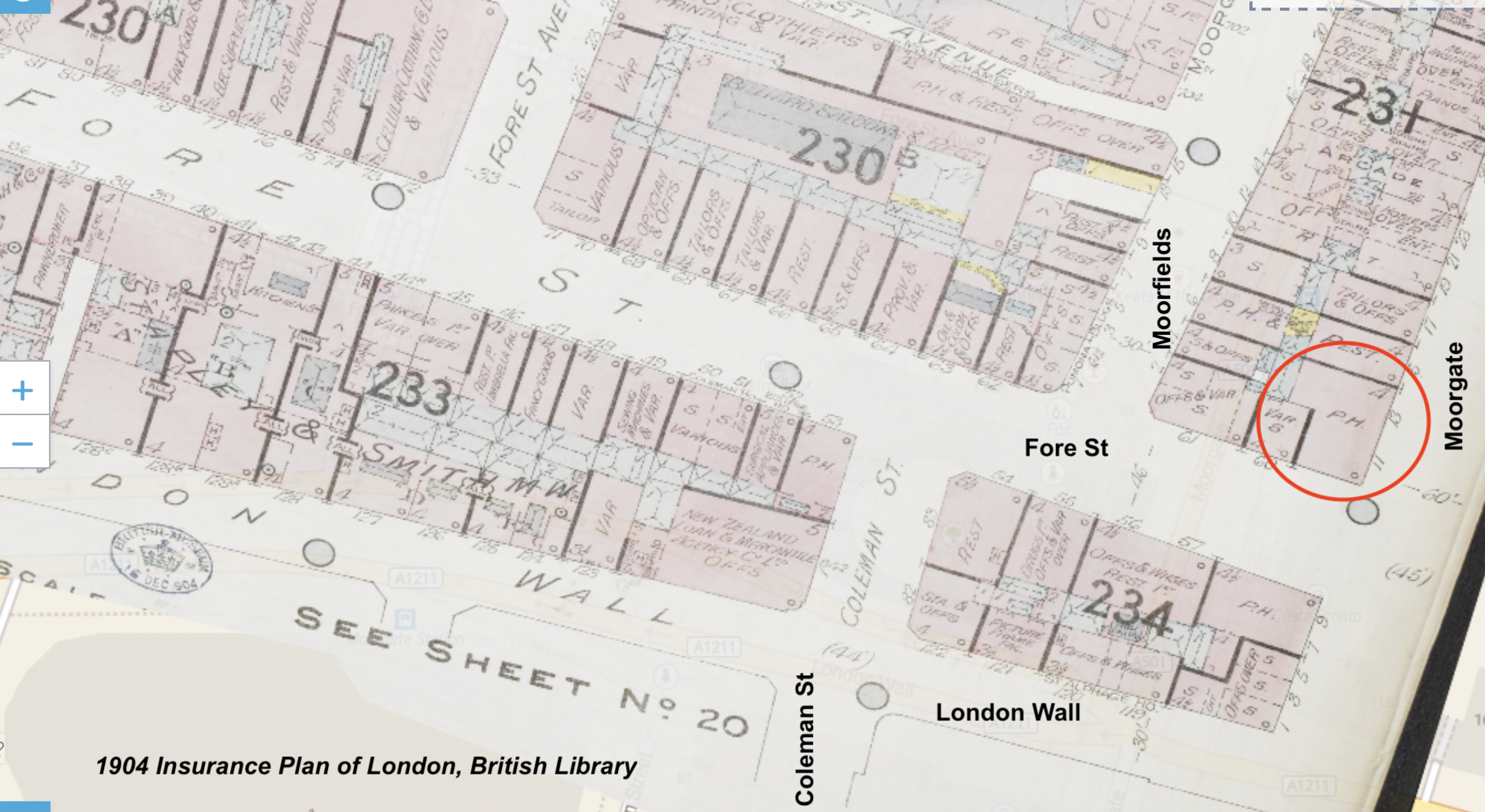
Here’s a 1904 map. The street layout was different then. Fore Street went all the way to Moorgate. But still it’s easy to identify the Globe. On this map it is numbers 11 and 13 Moorgate, certainly not number 199.
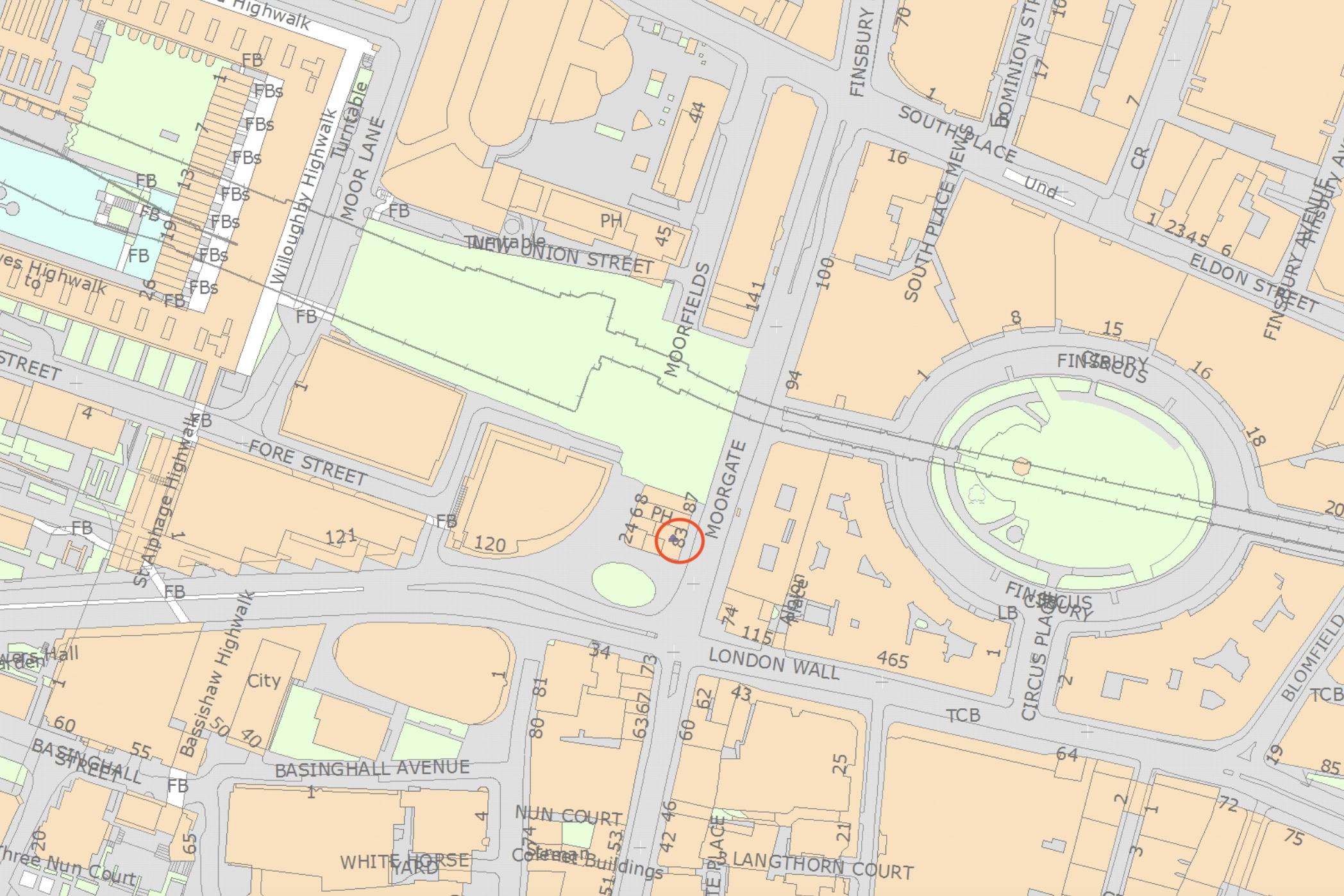
Here’s a map from the Historic England Listing entry for the Globe. This is a 2022 map. The Globe, ringed in red, is shown at number 83.
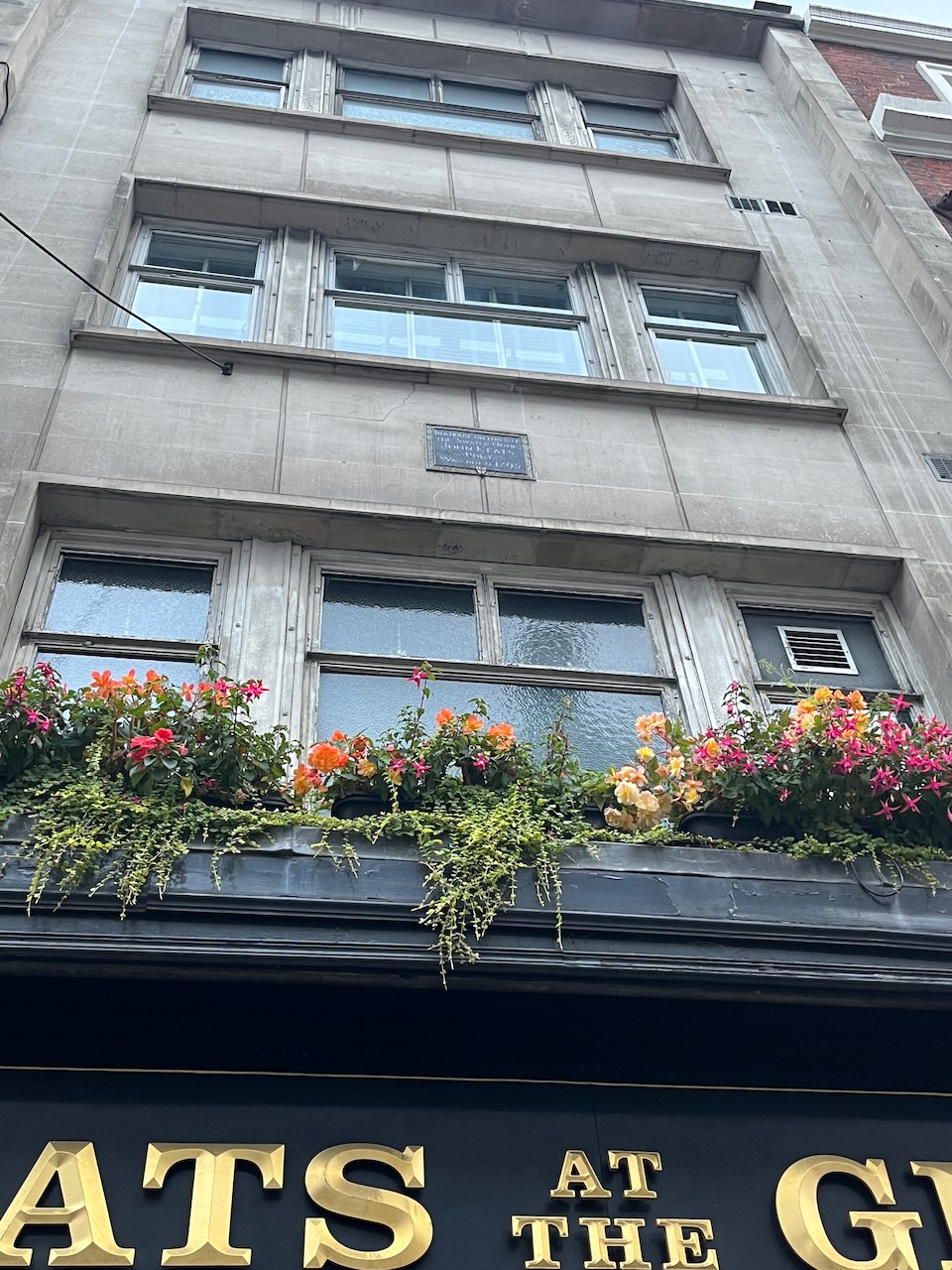
Another interesting thing about the Globe is that it recently absorbed an adjacent pub. There used to be a pub right next door called the John Keats. This was absorbed by The Globe in 2008, according to this Evening Standard article. The connection to John Keats is described on a plaque high up and difficult to read. It says:
IN A HOUSE ON THIS SITE THE “SWAN & HOOP” JOHN KEATS POET WAS BORN 1795
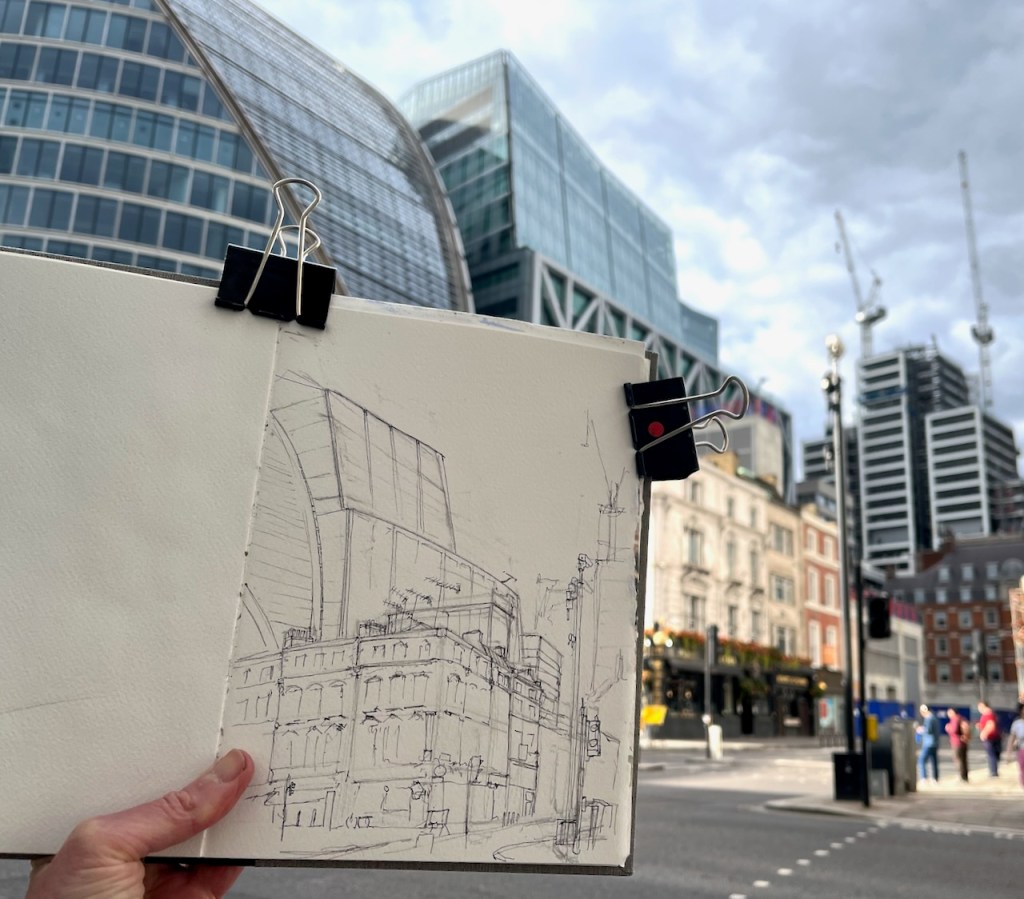
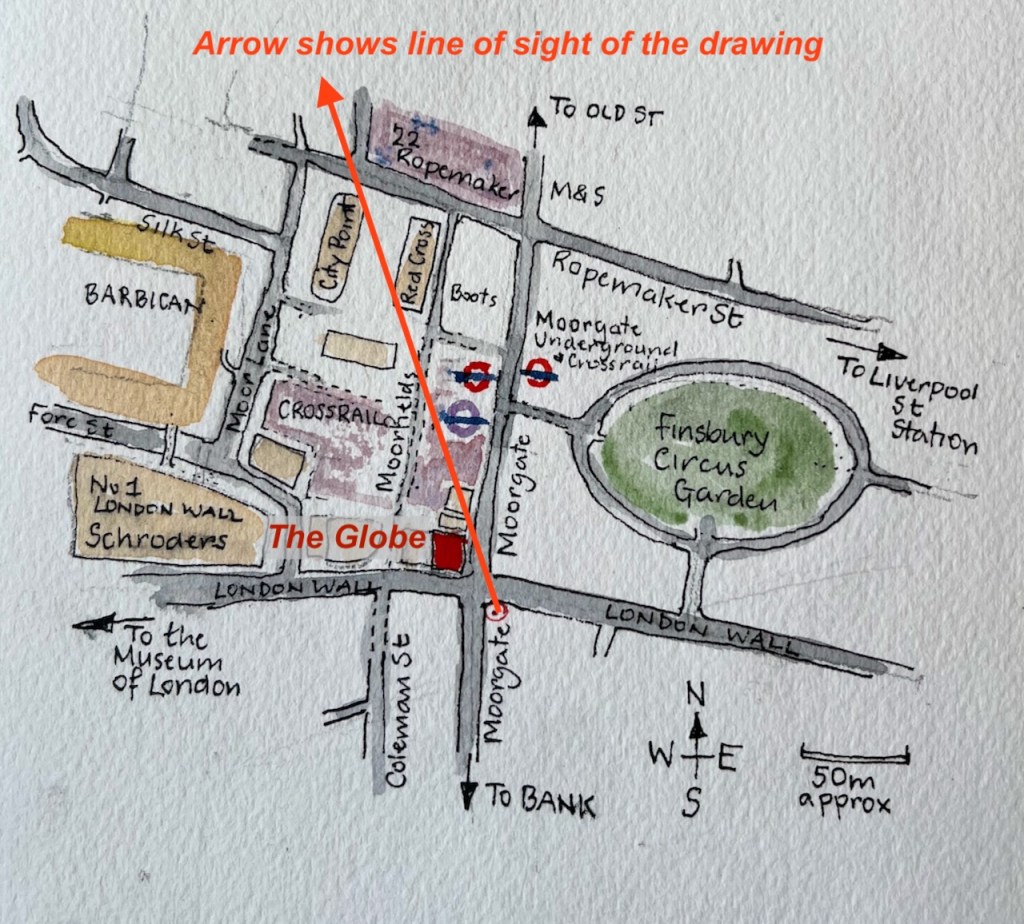
I sketched The Globe from across the junction of London Wall and Moorgate. As it was a Bank Holiday the junction was not as busy as normal. But it was still pretty busy. After a while I had had enough of the people passing in front of me, and the buses and the noise, and I packed up and finished the drawing at my desk. Here is work in progress and another map, showing the direction I was looking.
Here are all the buildings, labelled:
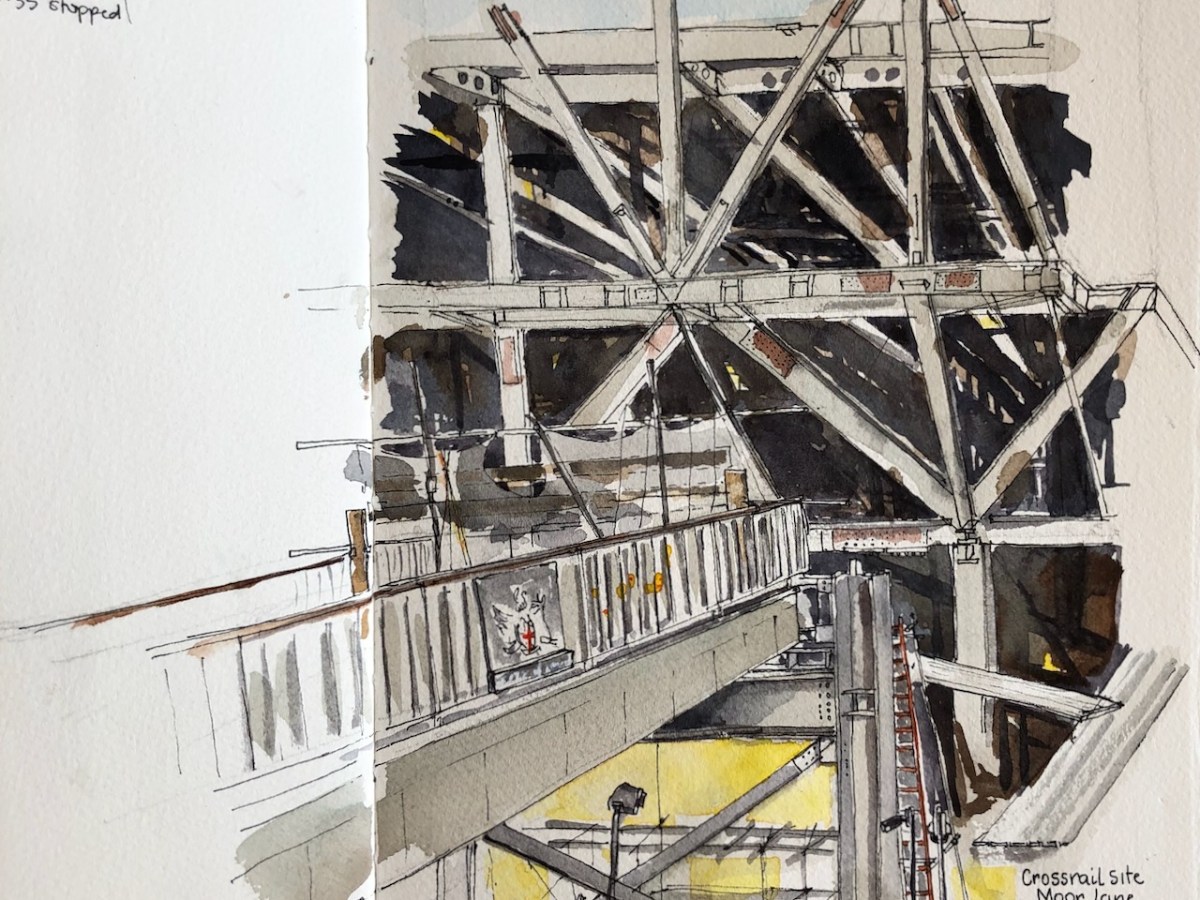
The office block above the Crossrail station is a stupendous feat of engineering, because essentially it is built across a great hole in the ground. From the Barbican Podium on the other side, I saw the great struts, spanning the gap. It is built like a bridge. I drew a picture in this blog post (May 2020):
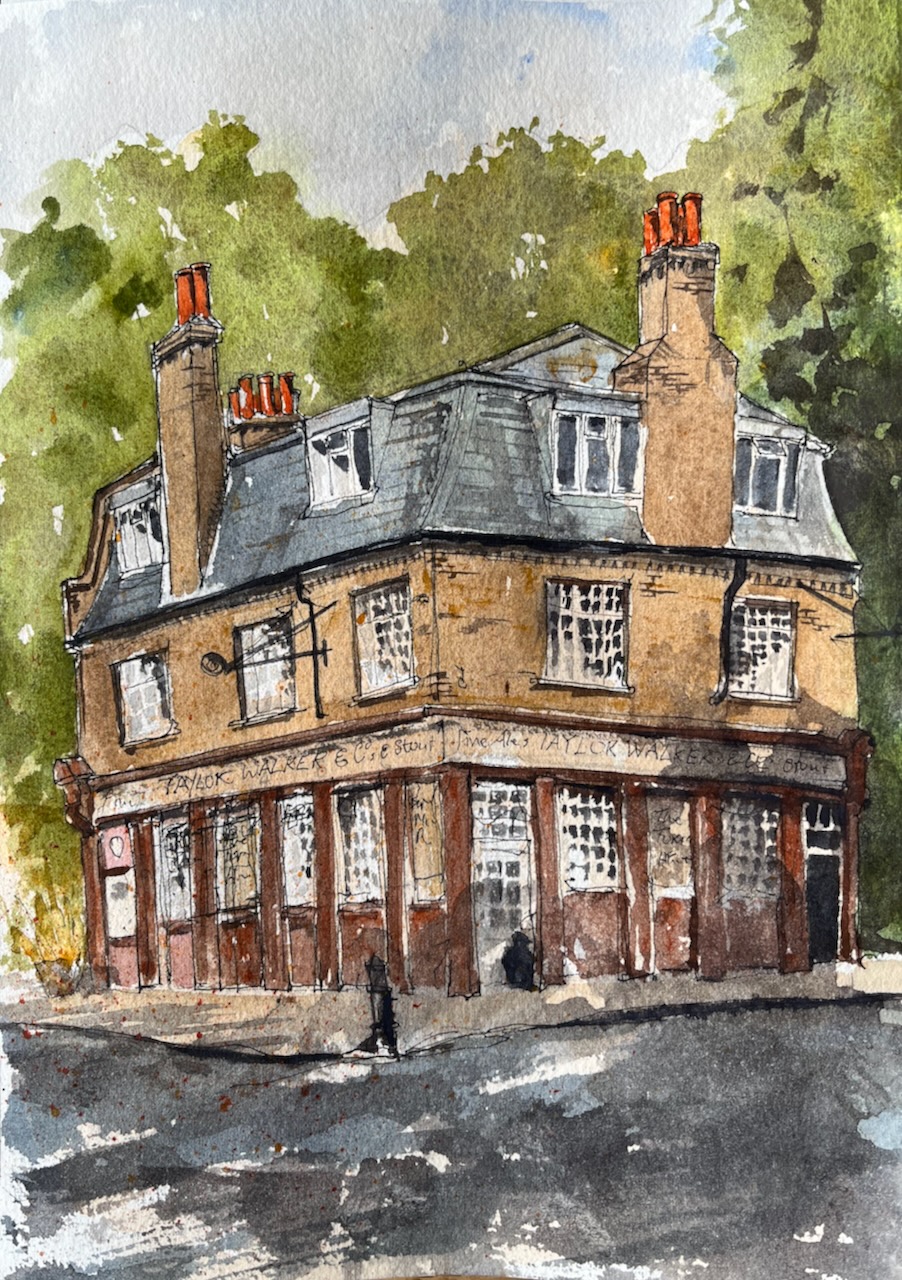
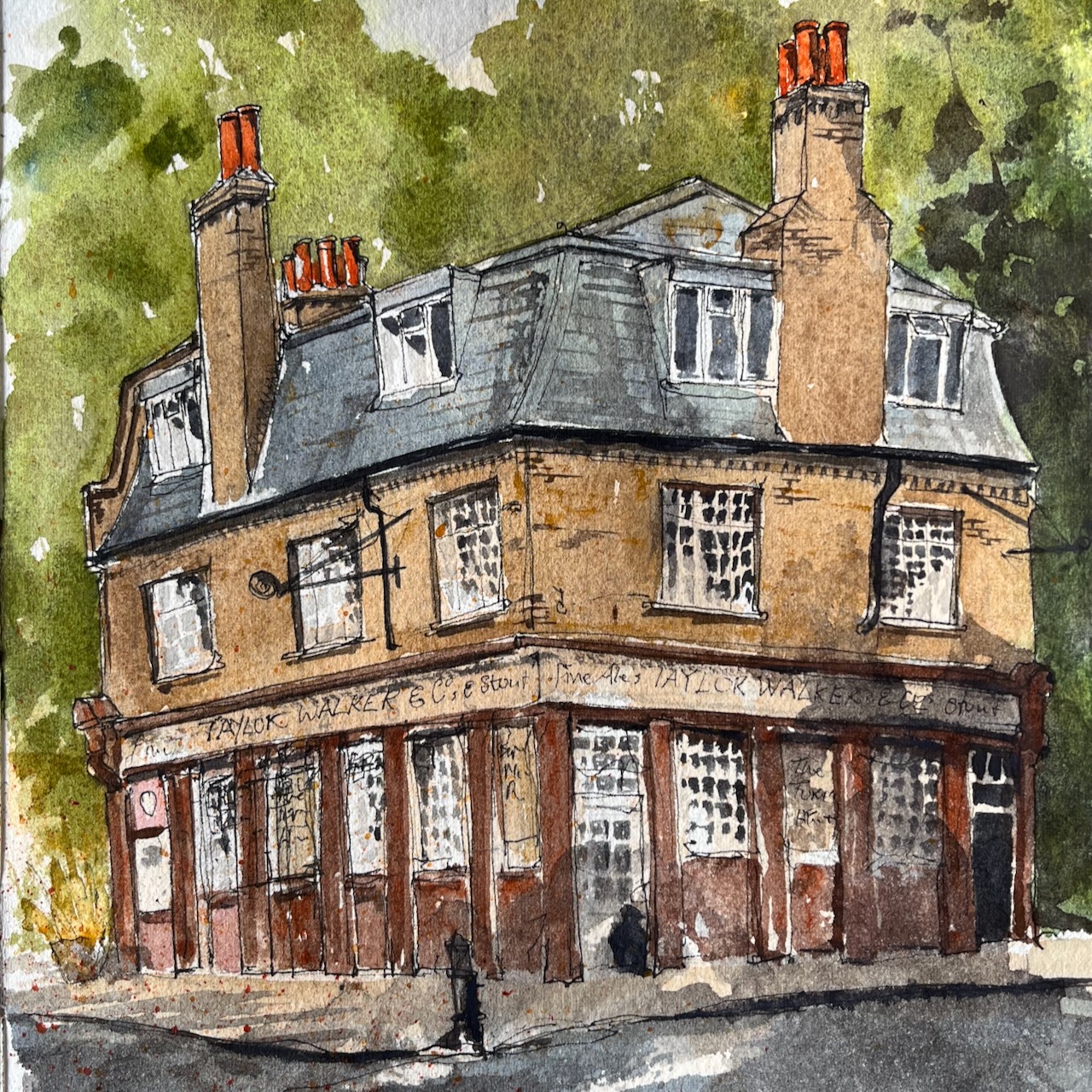
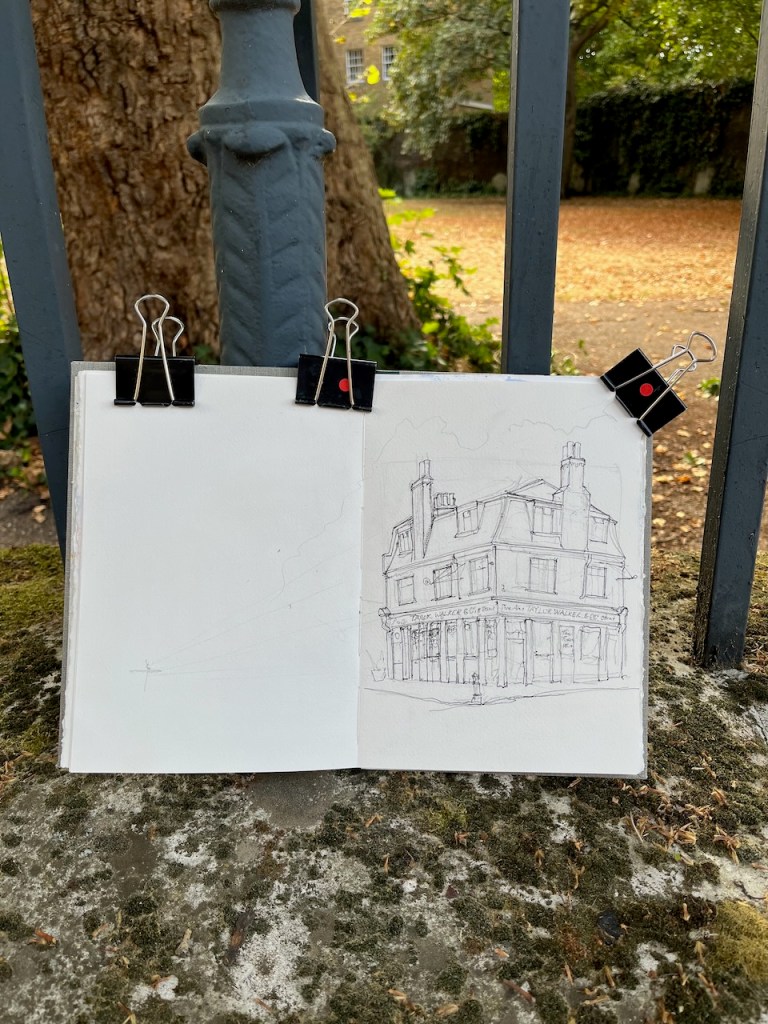
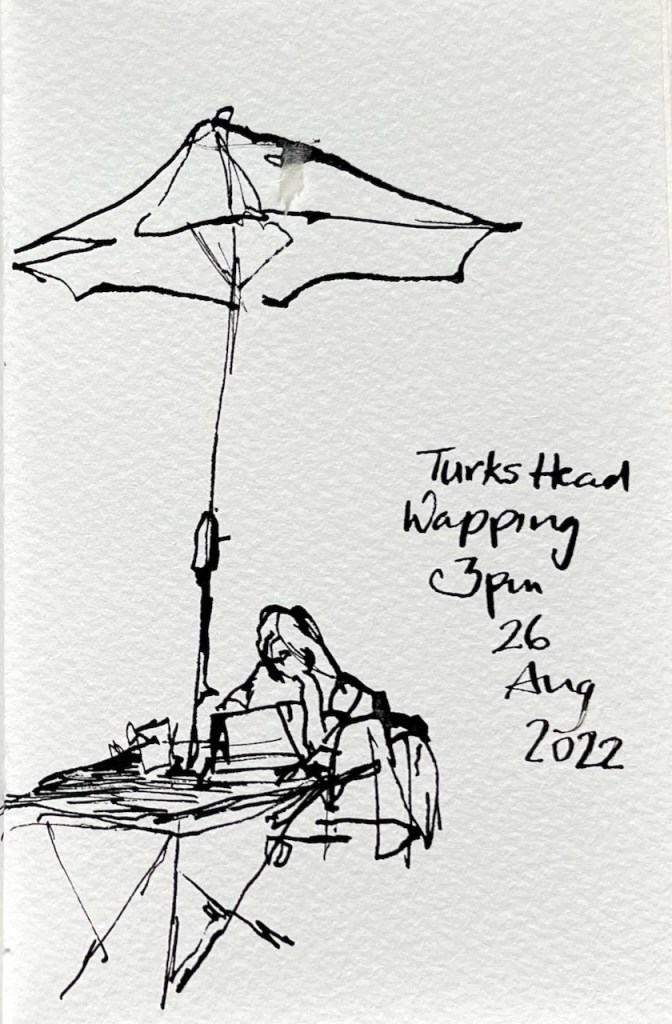
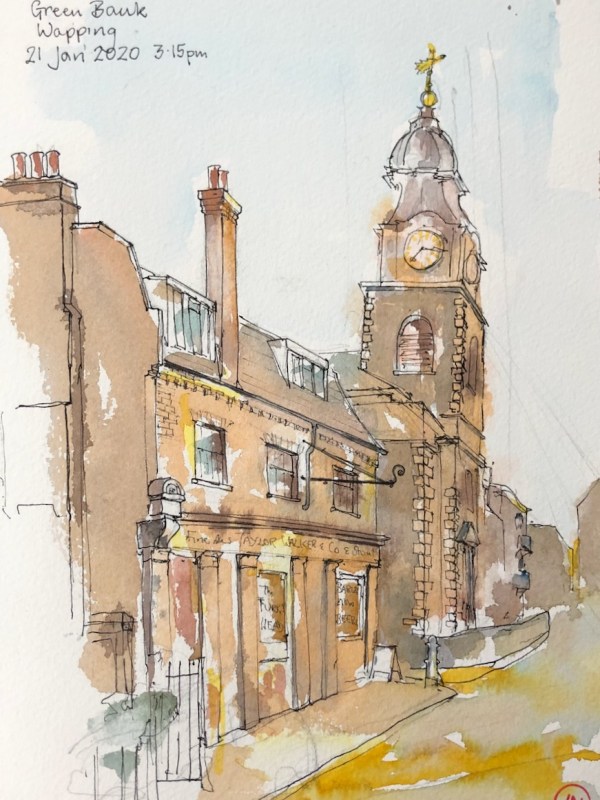
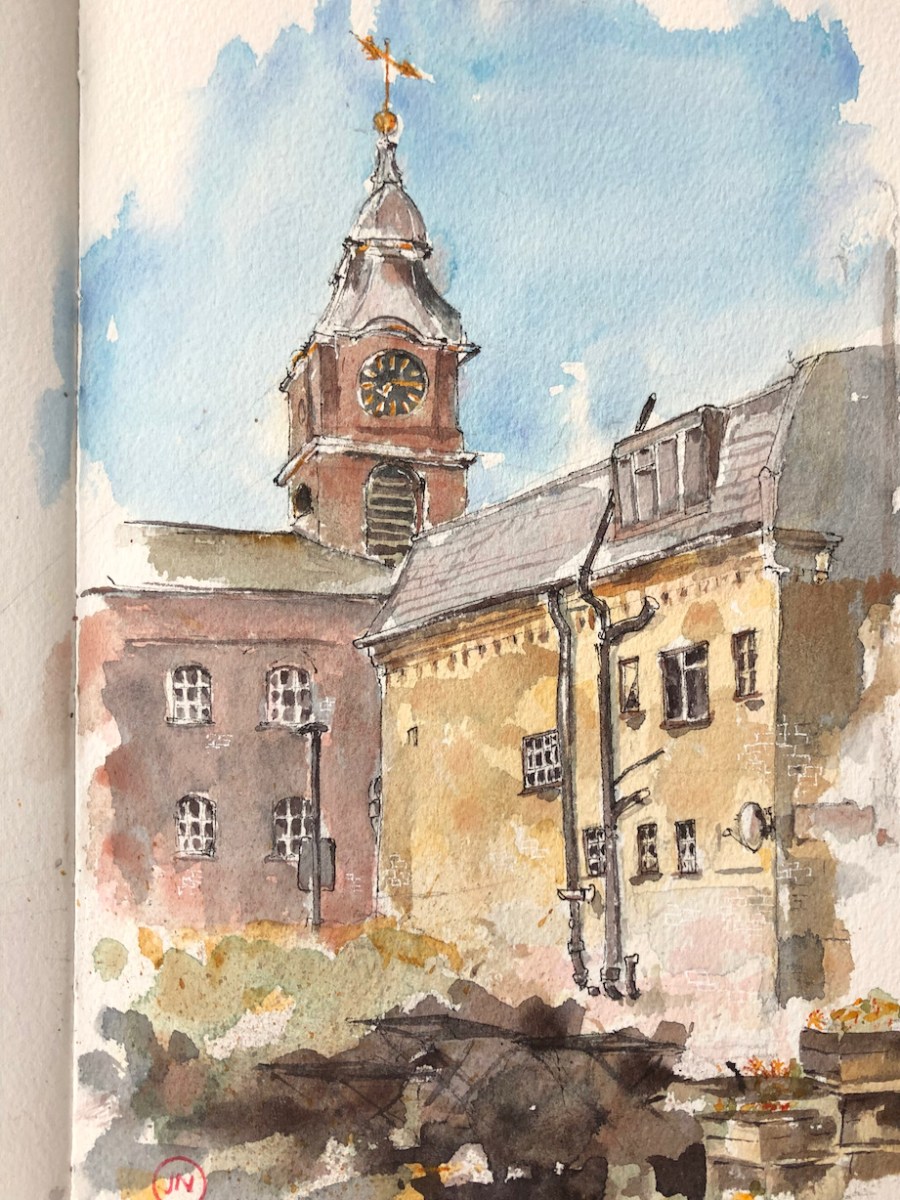
I walked to The Turks Head Wapping: a restaurant among trees. After a splendid lunch, I sketched the building.
The Turks Head Wapping E1, 10″ x 7″ in Sketchbook 12, 26th August 2022, 16:30pm
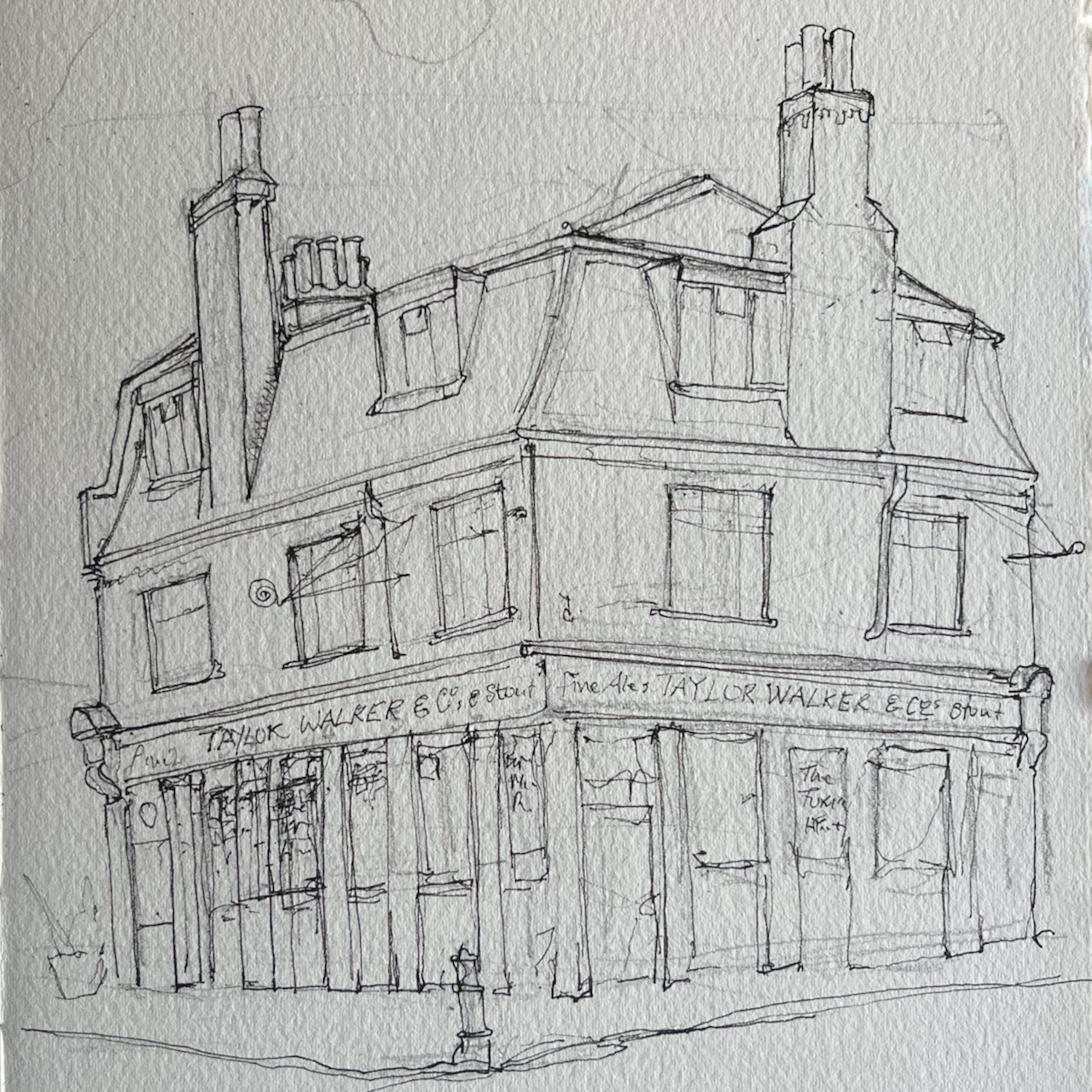
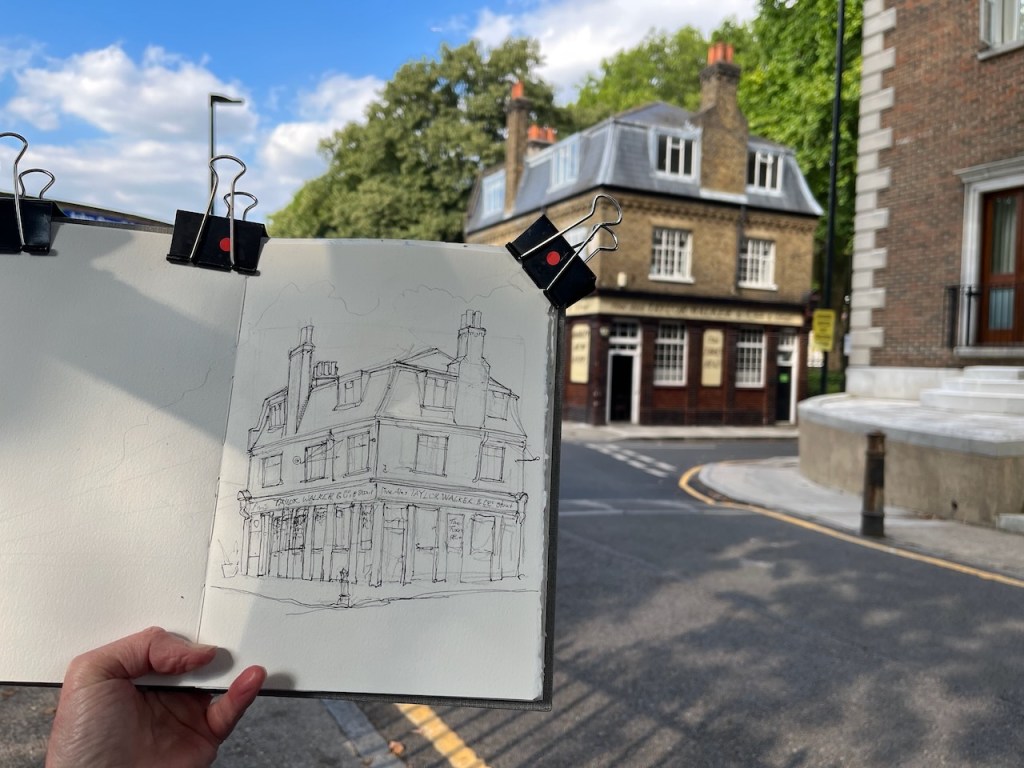
The drawing took me about 50mins on location, pen and ink. I added the colour when I got back to my desk.
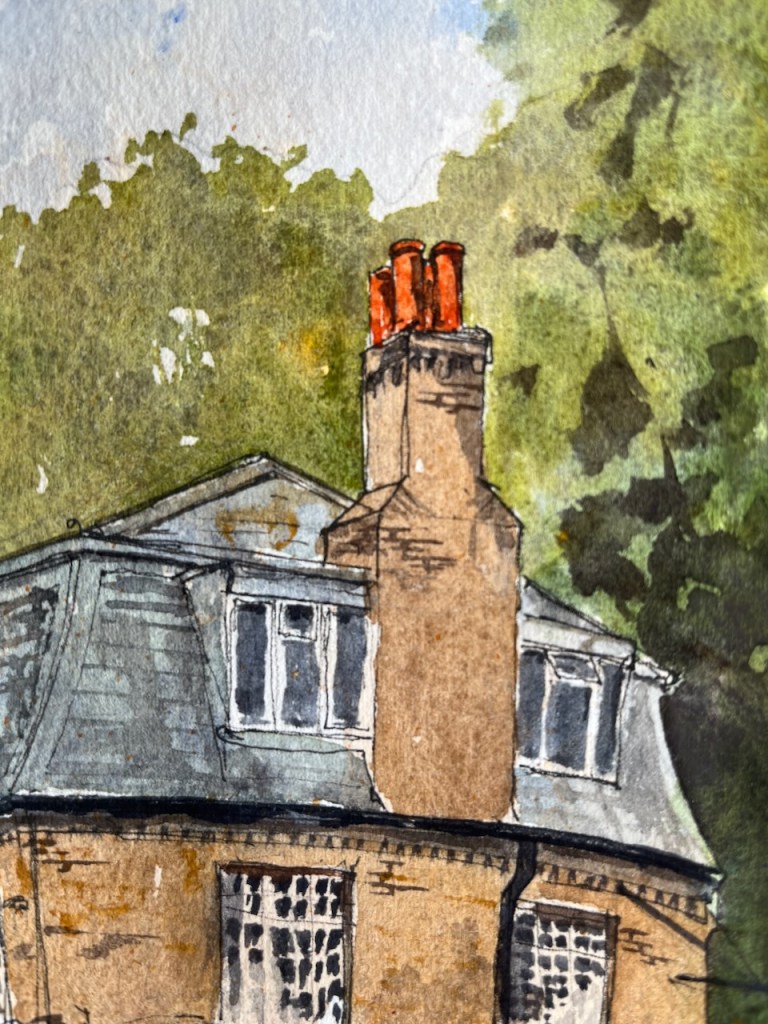
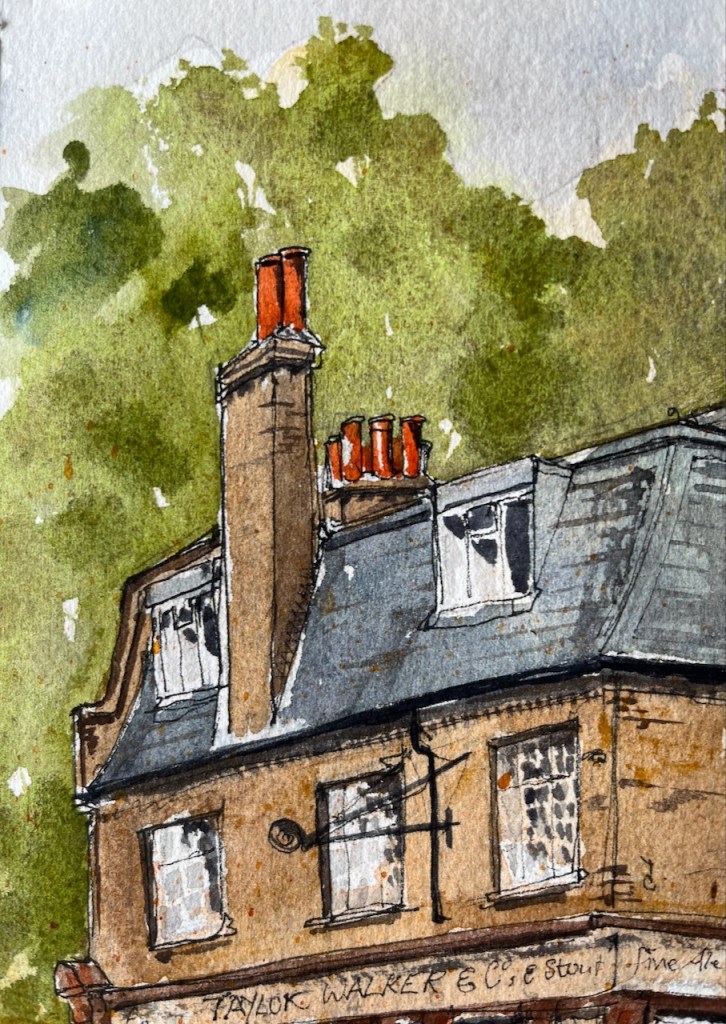
Before and after the colour went on.
Marvellous chimneys!
The chimneys are Transparent Pyrrol Orange. Other colours are: Green Serpentine Genuine, Mars Yellow, Burnt Umber, Ultramarine Blue, Permanent Yellow Deep, and Perylene Maroon to get the darker tiled walls. The blacks and greys are Ultramarine Blue mixed with Burnt Umber. These are all Daniel Smith watercolours. The paper is Arches Aquarelle 300gsm NOT, in a sketchbook made by the Wyvern Bindery in Hoxton.
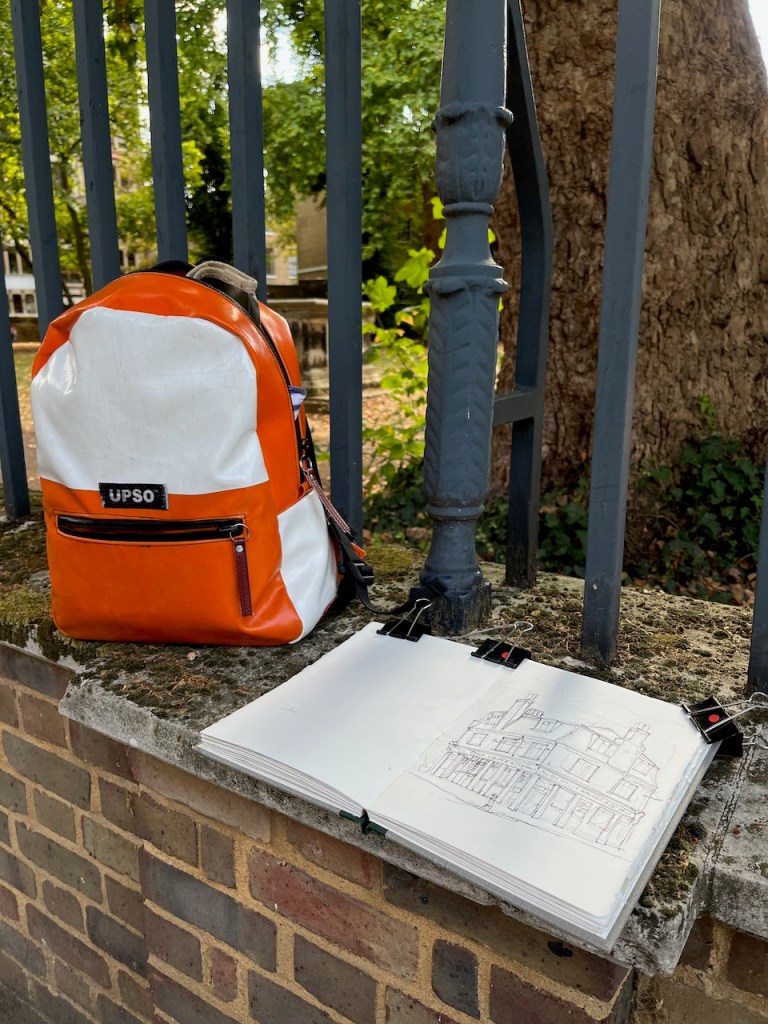
Here is work in progress:
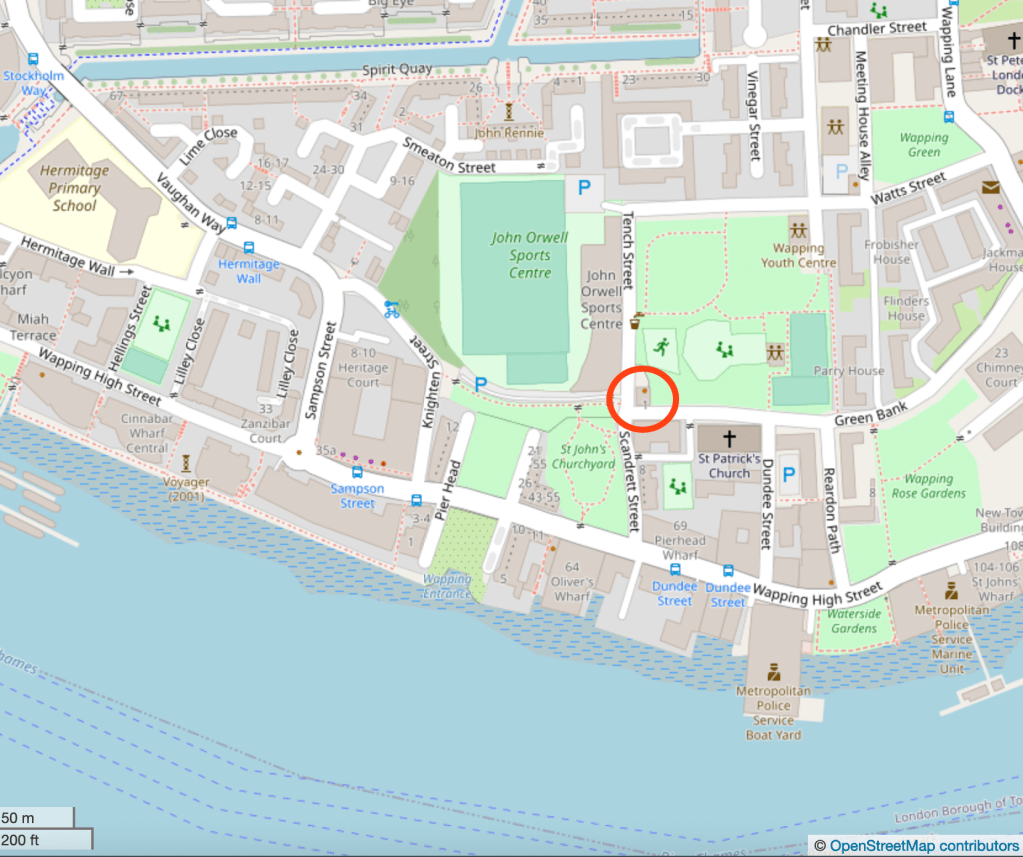
This is a wonderful café-restaurant – recommended. It is east of Tower Bridge, about a 45 minute walk from the City.
map (c) open street map contributorsDip pen and W&N drawing ink.
Here is the marvellous Turks Head Café, Wapping, rescued from demolition by local residents in the 1980s. Inside, I found warmth, quiet tables, and the gentle murmur of conversations: people actually talking to each other.…
On Monday I cycled out East to the Turk’s Head for breakfast. With a coffee and croissant, in front of me, I sketched the view. The Turk’s Head is the building on the right. The…
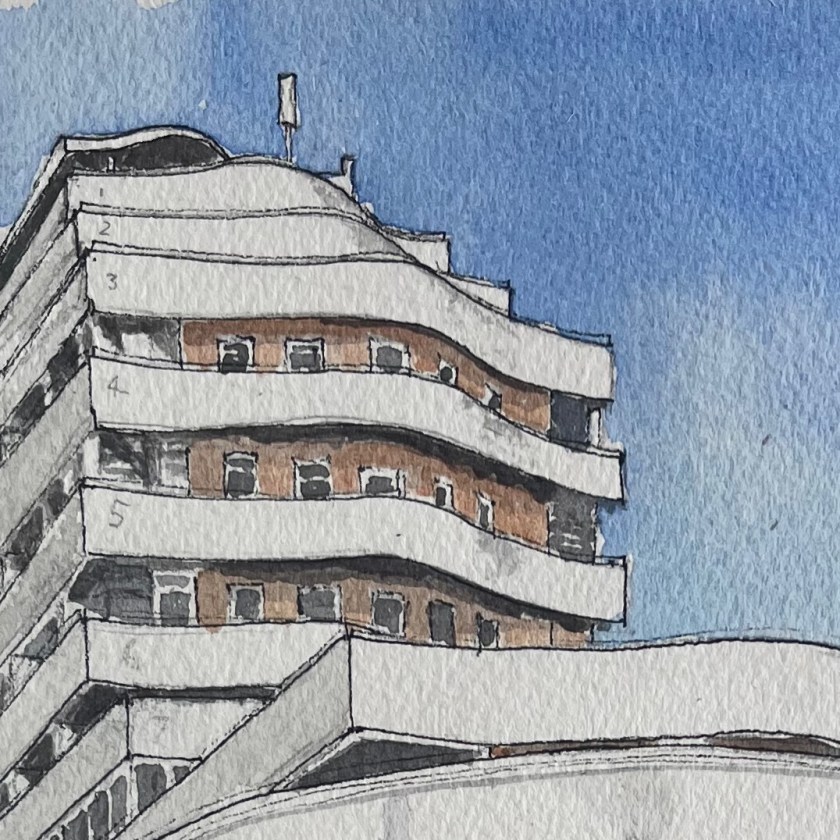
Here is the magnificent Marine Court, a residential building on the coast at St Leonards in Sussex. It was built in the 1930s, although it looks later. It was hugely controversial at the time, as you can imagine. The design emulates that of an ocean liner, the Queen Mary. Wikipedia tells me that the building originally had a rooftop bar, which must have been fun.
Marine Court, St Leonards, in sketchbook 12
I was particularly taken by the design right at the top. From this angle, it looks like waves. This building is on the sea front, the sea is behind me and to the left.
The top of the building looks like waves. I had to number the floors to keep track of where I was…!
It is an Art Deco building, constructed between 1936 and 1938. It was requisitioned for military use in the 1939-45 conflict, and bombed in September 1942. The bomb damage was repaired after the war. It was listed Grade II in 1999.
The original concept was upmarket serviced apartments:
Design for total living environment Marine Court was designed to provide “an environment for total living” – a self-contained lifestyle within the complex, but not necessarily within each apartment. Modest sized flats originally had tiny kitchens – it was assumed that most of the inhabitants would dine in the main restaurant at the eastern end of the building, or avail themselves of room service. There were shops, parking, roof sun decks and recreational facilities (including a dance floor and bar) – and in-house staff to do the chores (there are still some call buttons to summons the now-defunct service).
Hastings Borough Council Marine Court, St Leonards-on-Sea Conservation, Management Plan [1]
It was privately developed. But the construction costs went over budget and sales of flats were slow. The owners, South Coast (Hastings and St. Leonards) Properties Company, went bust. After being occupied by the military, the building passed into the hands of Hastings Borough Council. By 2007, the building was becoming old, and evidently the repairs programme was not coping with the deterioration of the building. Hastings Borough Council proposed an plan [1]. This lists the problems in some detail, including such serious items as:
Condition of building service equipment The condition of building services and utility equipment [gas boilers / water / electricity / air /lifts / other] are the cause of some shared concern amongst the building’s managing agents and the residential leaseholders
Hastings Borough Council Marine Court, St Leonards-on-Sea Conservation, Management Plan [1]
Evidently this plan by Hastings Borough Council did not work out well, because by 2010 the leaseholders had acquired the freehold and formed their own company: “Marine Court (St Leonards On Sea) Freeholders Limited”.
The “Hastings Independent” reported on January 25th 2019: “The Grade II listing in 1999 made the costs of upkeep that much higher. However, the freehold was bought by the residents through a company, Marine Court (St Leonards on Sea) Freeholders Limited in 2010, and the prestige of the address, not to mention the glorious sea views from its upper windows, has ensured that most of the flat owners have been affluent enough, or can charge sufficient rent to sub-tenants, to meet the restoration bills as they are incurred.” The article goes on to describe problems in letting the retail shops which are underneath the canopy. They say: “Current controversies centre on the cost of works to upgrade a series of shared toilets at the rear of the premises with enhanced fire precaution measures including smoke alarms. The shops, which don’t need to provide toilet facilities for their customers, make sparing use of them; on the other hand, they are essential to the bars and restaurants, which do. Either way the projected cost of almost £100,000, charged in advance on the basis of estimates, is widely regarded as completely out of proportion to what is necessary or reasonable. …Some [business owners] are said to be taking legal advice on how to challenge the extent of the charges being levied. Others have simply left. There are several shopfronts now boarded up, which is having an adverse effect not just on general morale, but on the footfall which most of those who remain depend upon. “
That was in 2019. When I walked past in 2022, the majority of the shopfronts were boarded up, which is a great pity, as it is a good location, and shielded from the sun and wind.
Marine Court colonnade, July 2022, looking East.
It is a building on the edge, in many senses.
In case you are a little hazy about the location of St Leonards, here is a map.It is on the English south coast, between Brighton and Dover.
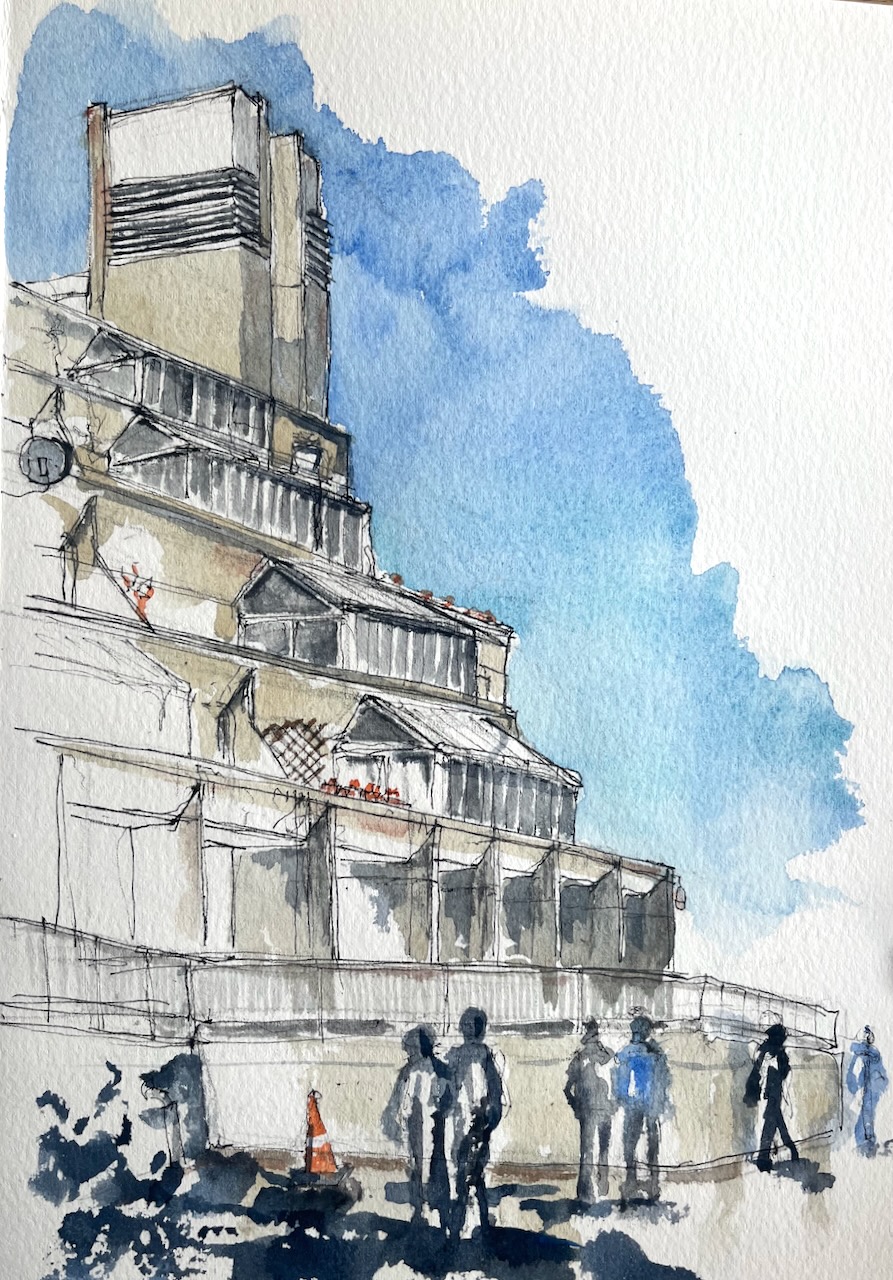
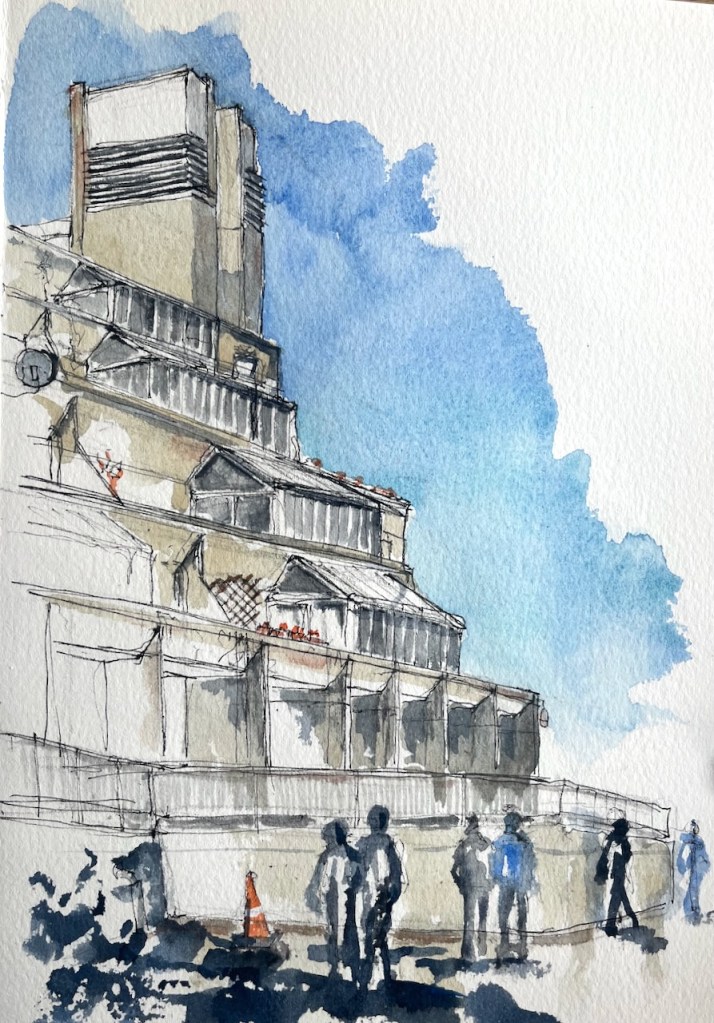
The Brunswick Centre, in Bloomsbury, London has been described as a “heroic prototype for a holistic community” [levittbernstein.co.uk]. There are 560 flats, a cinema, a medical centre and offices in a single development: hence “holistic”. It was radical in that it differs from the Georgian and Victorian houses all around.
Brunswick Centre, Bloomsbury, 13:50 9th August 2022, in Sketchbook 12
It was designed by Peter Hodgkinson during 1966-1970. The original plan was to extend the development all the way up to the Euston Road. There was a significant renovation in 2006 by the architects Levitt Bernstein. They made the shop fronts extend into the plaza in the middle, renovated the flats and added an “anchor supermarket” (Waitrose) at the northern end.
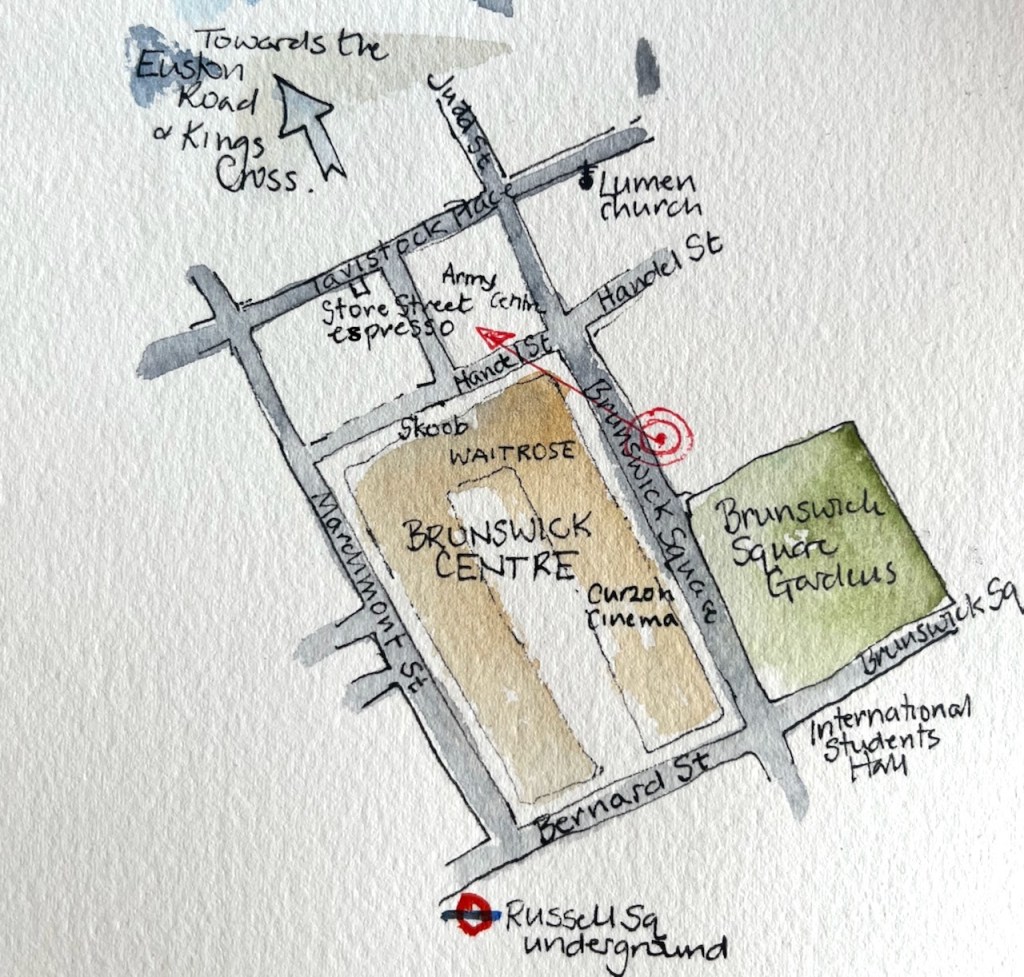
Where I did the drawing
I sketched the pen and ink on location, then repaired to the Store Street espresso on Tavistock Place to do the colour. There are very few colours in the picture: Buff Titanium, Ultramarine Blue, Burnt Umber and a tiny bit of Transparent Pyrrol Orange.
Click a button below to share this post online, email it, or print it:
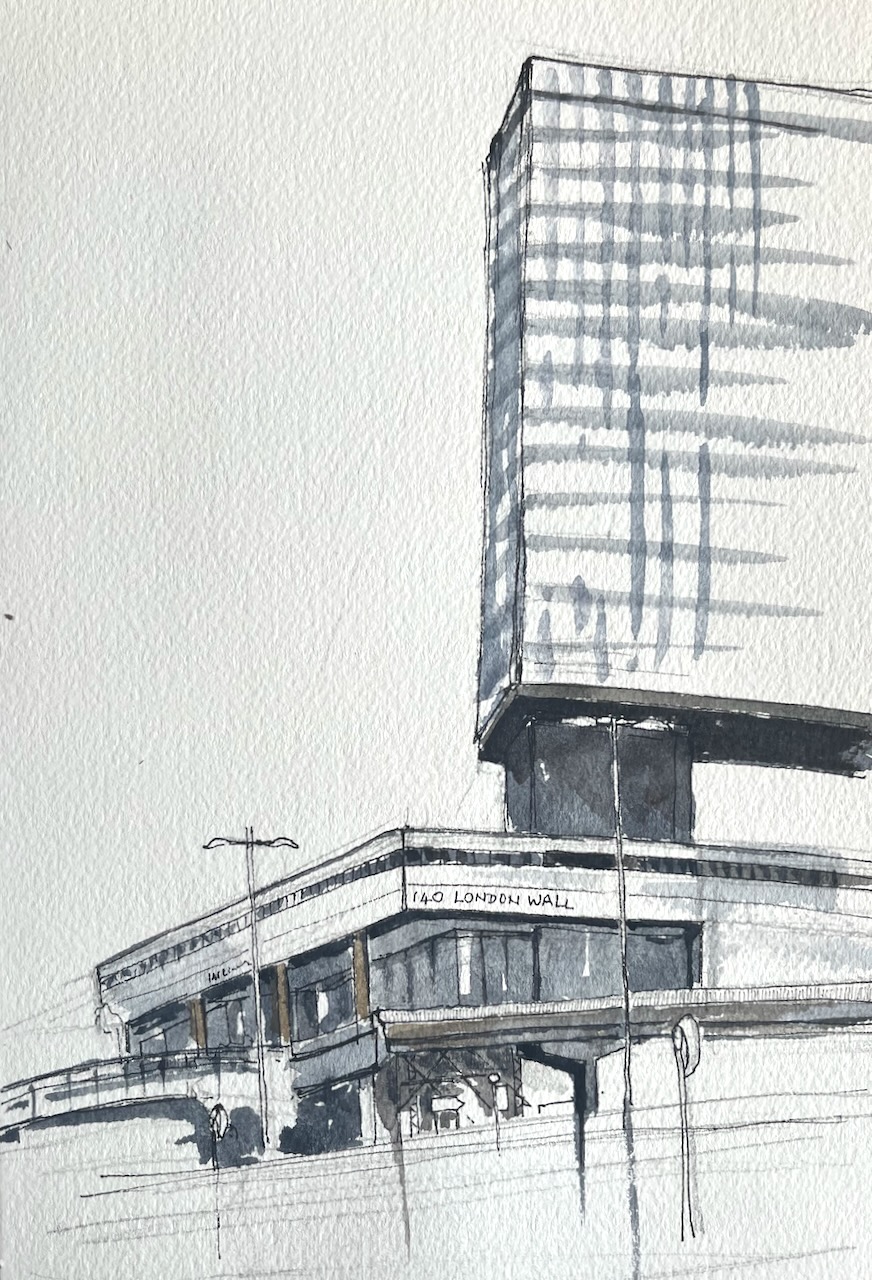
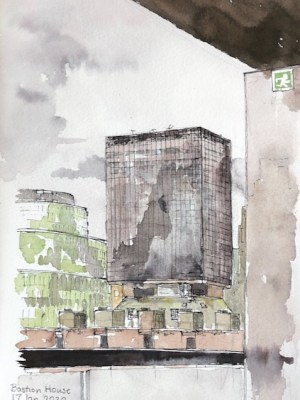
Earlier this month, I made a quick sketch of Bastion House, from London Wall.
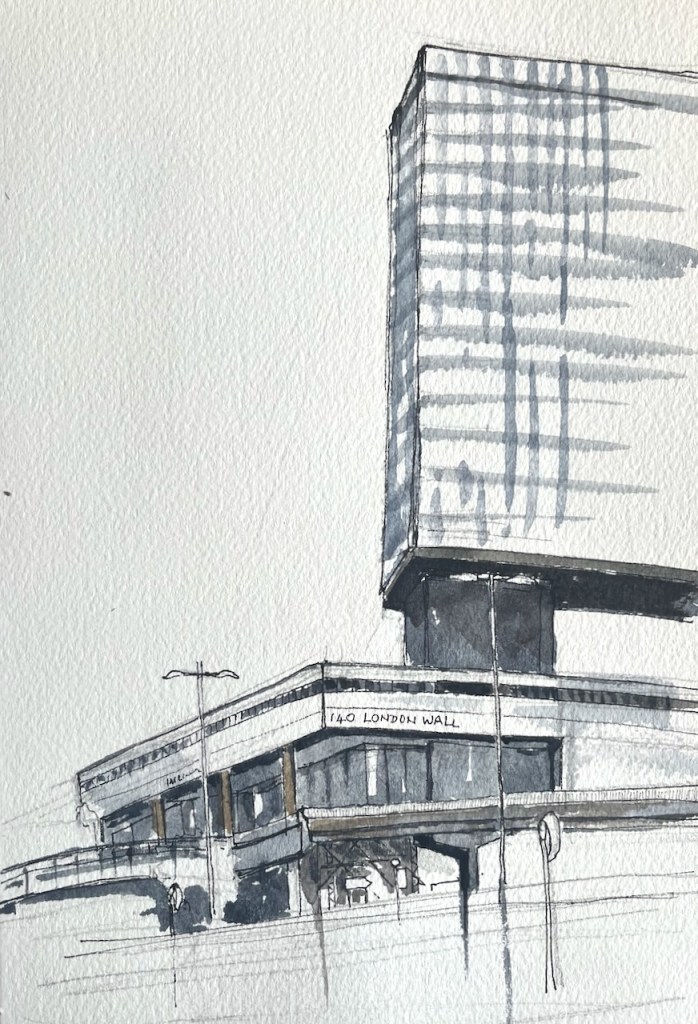
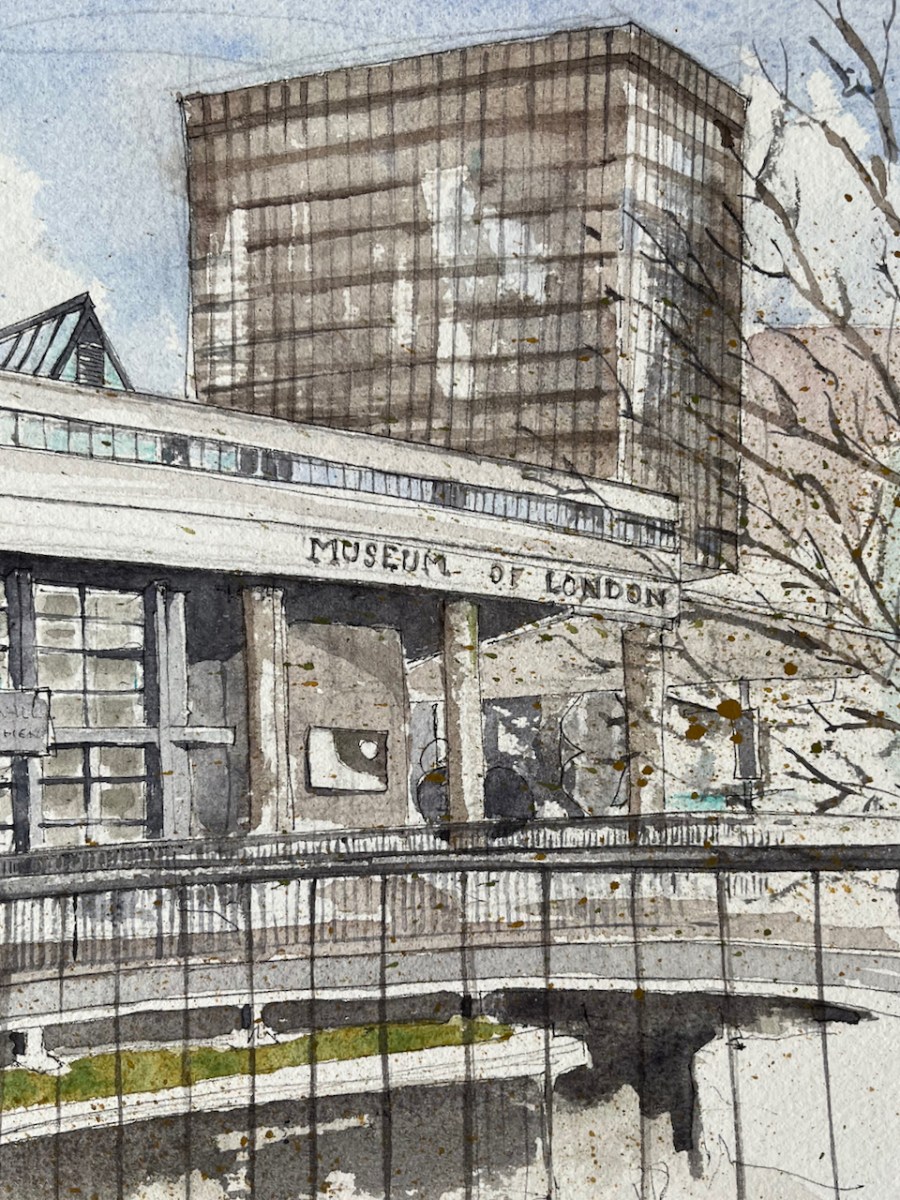
140 London Wall, Bastion House, sketched 2nd August 2022 from London Wall, in sketchbook 12
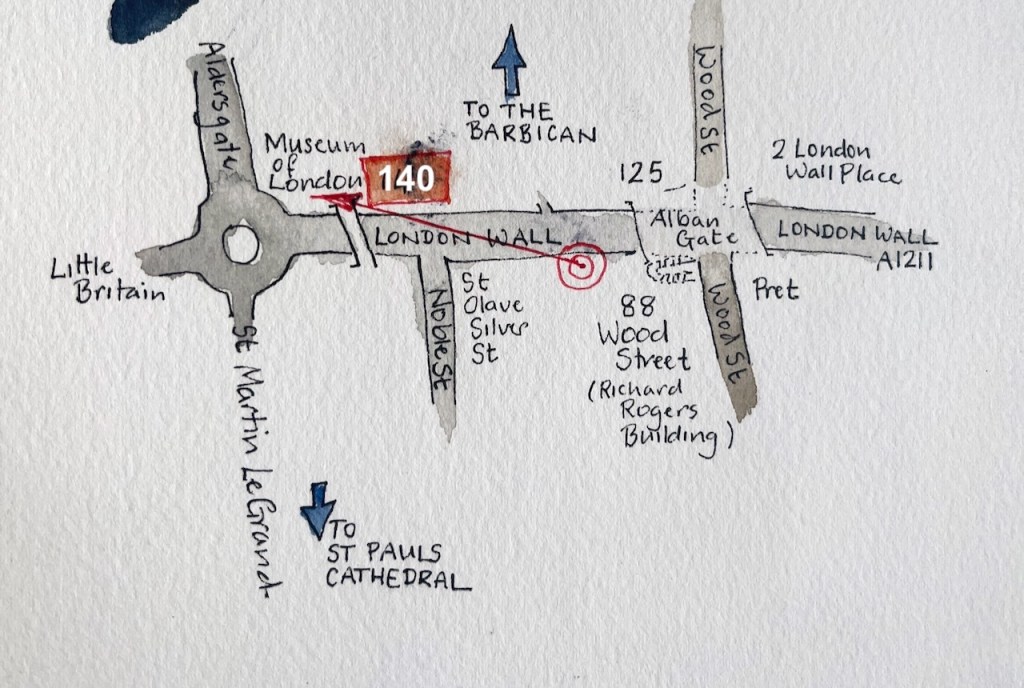
Here’s a map:
The architect was Philip Powell of Powell and Moya. The building was completed in 1976. I like this building. It reminds me of the “obelisk” in the film “2001 – A Space Odessey”.
The City of London have the idea that they are going to demolish this building, and the Museum of London next to it, and build three large office blocks: bigger and wider than the existing buildings, providing some 750sq ft of commercial office space.
This mystifies many of us, as we witness empty office blocks all around this location. It also angers us, as such huge buildings will take sun from the residential estate to the North. There seems to be a case for pausing the proposed project, and considering renovation of the existing buildings. Renovation would be better from a carbon emissions point of view, as demolition and construction are a large source of carbon dioxide emissions.
I hastened to draw the magnificent Bastion House, on London Wall. It is due for demolition. In the foreground you see the balcony and privacy screen of the flat in Andrewes, whose leaseholder had kindly hosted me. The line of red brick, and what looks like chimneys, in the foreground are the rooftops of a part of the Barbican, “The Postern”. Behind them is the Barber-Surgeons’ Hall on Monkwell Square,…
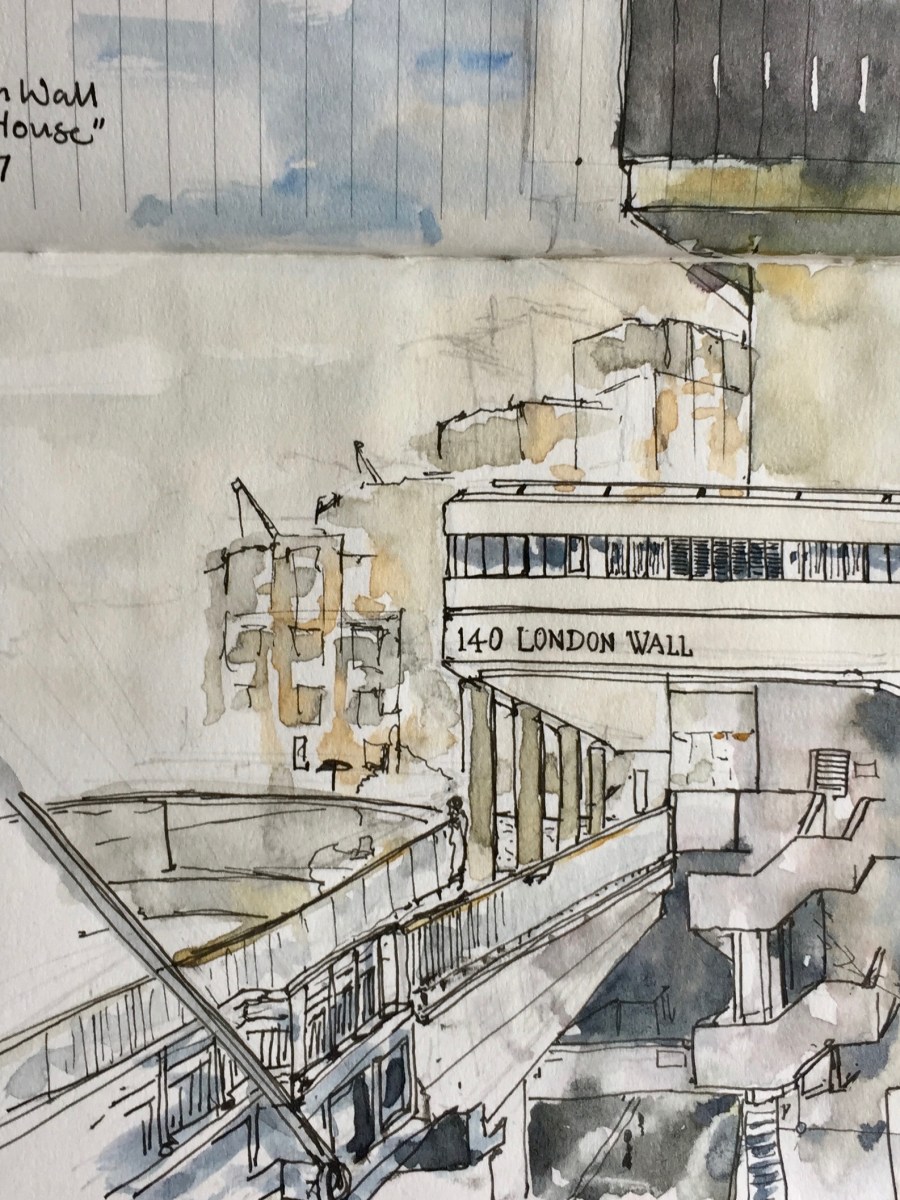
Bastion House aka 140 London Wall is a huge modernist monolith, reminiscent of the monolith in “2001 – A Space Odyssey”. I couldn’t find a site to draw the monolith part today, so here is a view at Podium Level, looking West towards the Museum of London. You see the dark undercroft, walkways and a road to a car park. Also you see the bridge that crosses London Wall. http://postwarbuildings.com…
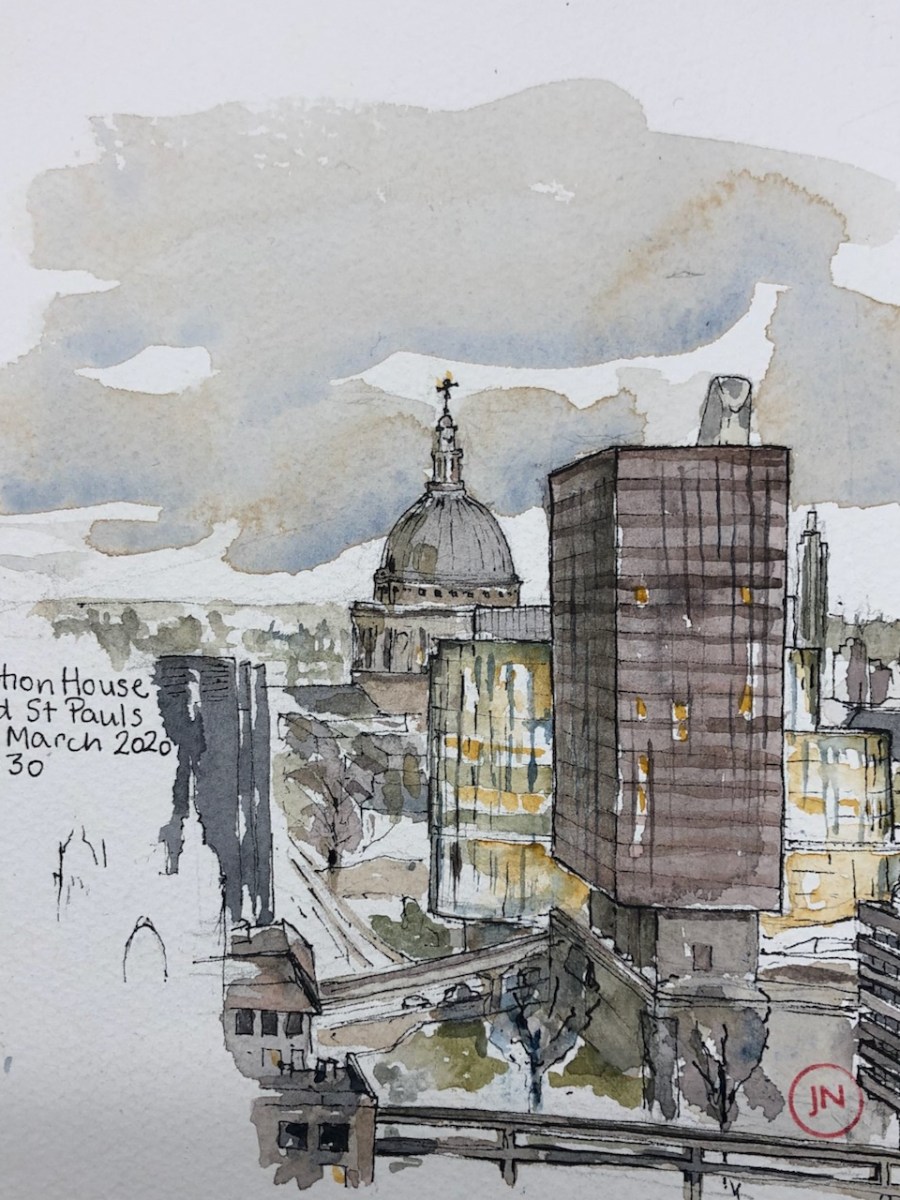
I am sketching the views out of the window. Just visible over the top of Bastion House is the top of “OneBlackfriars”. In the foreground: Mountjoy House, Barbican, on the right. Along the bottom is the Barbican Highwalk which joins Mountjoy House and Wallside. I have drawn Bastion House before: This drawing took rather a long time as I stopped a couple of times. As a result, by the time…
Today Urban Sketchers London held a “sketch crawl” in the Barbican. So I joined them. An astonishing number and diversity of people assembled inside the entrance of the Barbican Centre at the appointed time of 11am. I counted about 35 and then another dozen or so joined. All shapes and sizes of people, tall, short, studious-looking or flamboyant, quiet or talkative, smart or windblown, old or young, all were there.…
From the highwalk on the Rotunda there is a really amazing view of the Museum of London and Bastion House. This whole view going to change radically, if the City of London plans are approved. The Museum of London is in the South West corner of the Barbican. It was designed by Philip Powell and Hidalgo Moya. The Museum opened in 1976. The City of London plan to close it…
Have you seen this amazing annex to the Theatre Royal in York?
Theatre Royal Extension, York. 28 July 2022 in sketchbook 12. 10″ x 7″
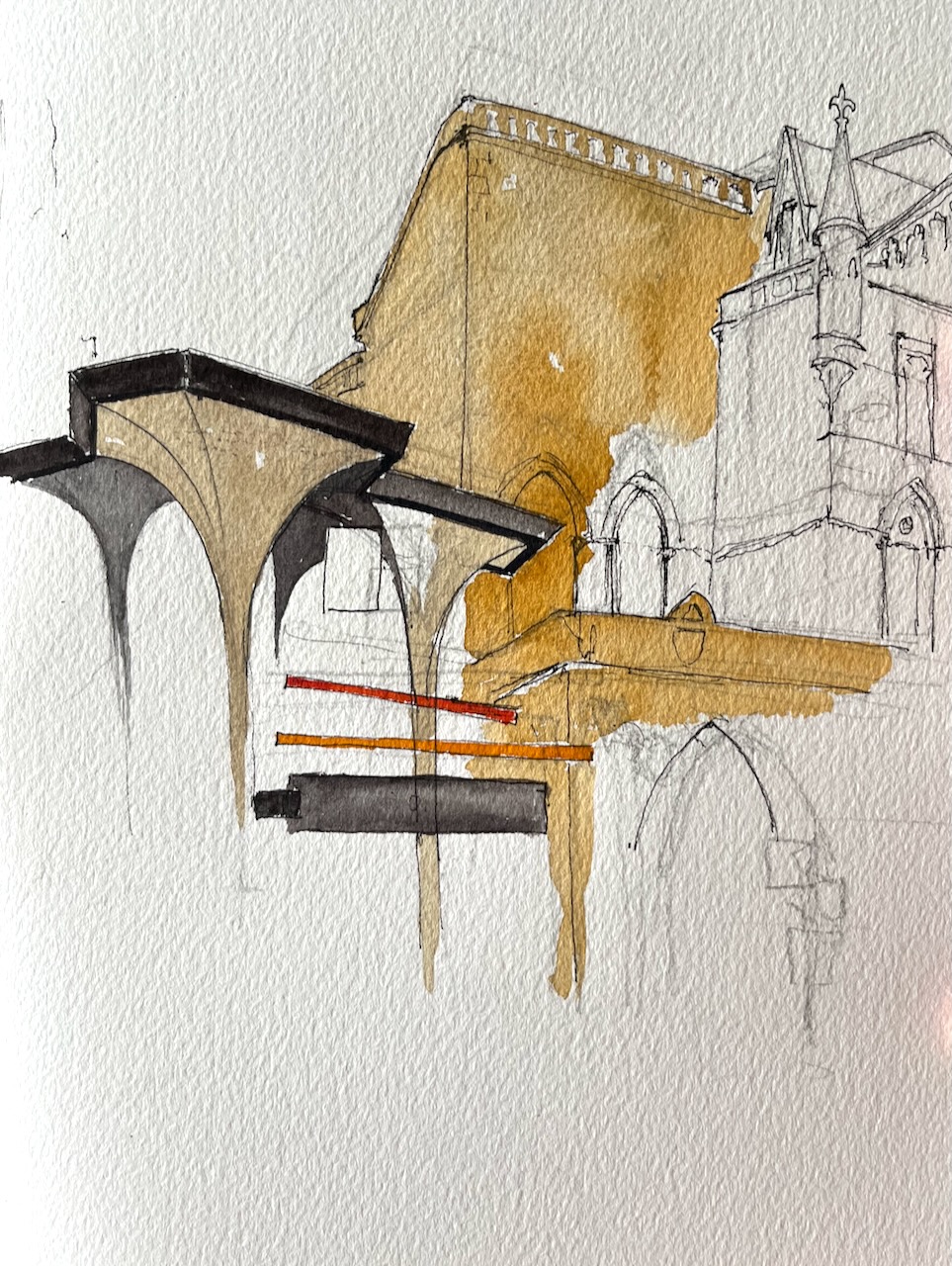
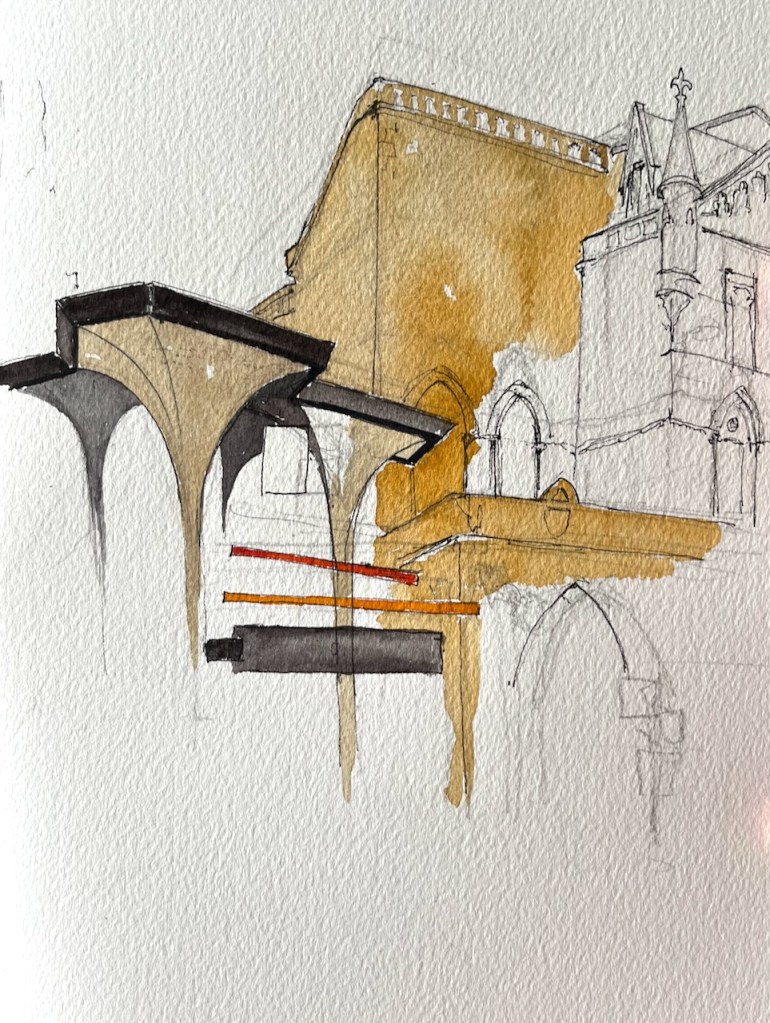
It’s a stunning addition to the Victorian theatre next door. The older part of the theatre, on the right of my drawing, is in the Gothic revival style around 1879, designed by the then city engineer G Styan. The modernist extension, whose amazing soaring shapes are on the left of my drawing, was designed by Patrick Gwynne and RA Sefton, in 1967. The whole thing has been redeveloped in 2016, retaining the external shapes. I love the courage of this modernist extension. It’s not far from the station. I sketched it waiting for the train.
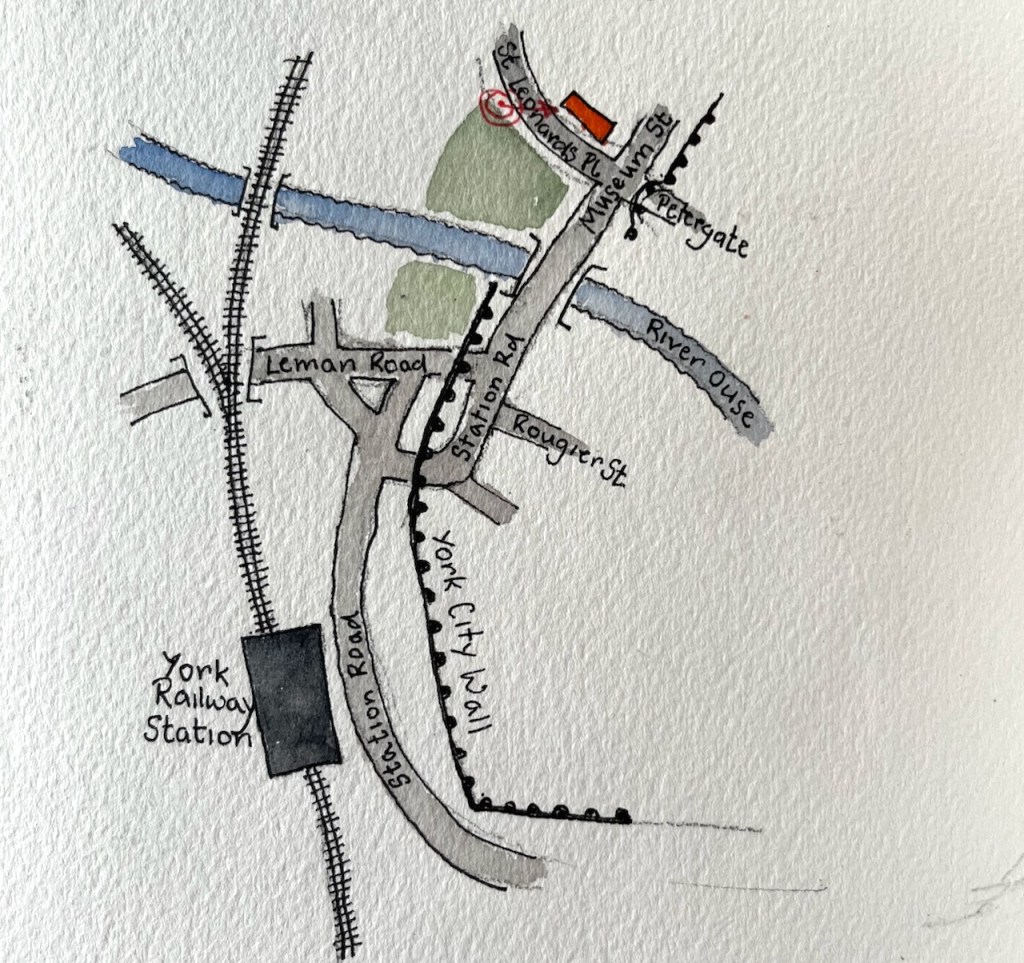
The Theatre Royal (in red) is just a few hundred yards from the station.
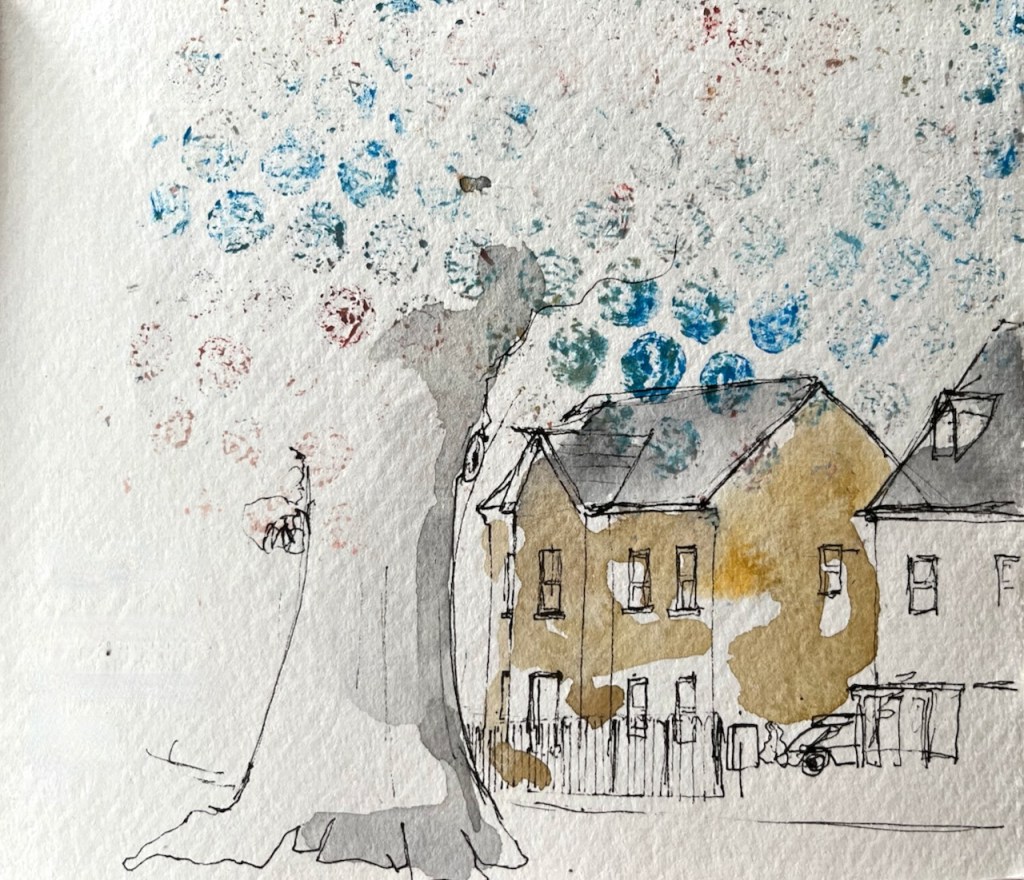
Here is a 21st century housing estate in the area. It’s an interesting contrast to the Theatre Royal extension. In this case the architects made new buildings which look traditional on the outside. They even have chimney pots. Inside they have 21st century standards of insulation, heating and plumbing. The chimney pots are simply decorative.
21st century housing in Yorkshire, in sketchbook 12, July 2022
Here are some smaller sketches I made touring around:
New housingOld high streetIn the Hepworth Wakefield
The Hepworth Wakefield was a revelation: well worth a diversion. It’s a beautiful building itself, which I shall be sure to sketch when I visit again.
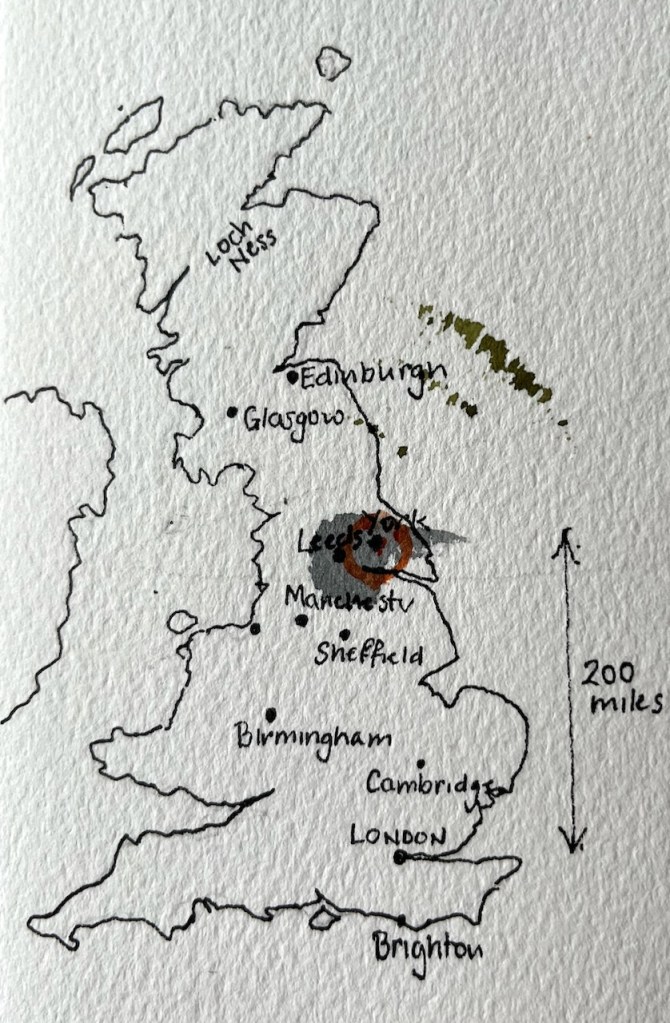
Yorkshire – halfway up the UK mainland.
I’ve sketched in York on a previous visit, see this post:
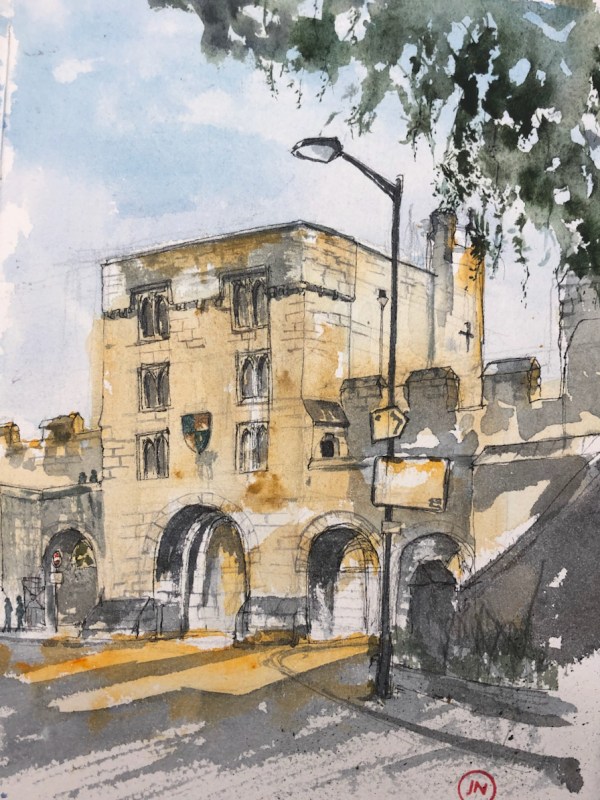
Here is the “Micklegate Bar”, which is one of the great gates through the old City wall into the centre of York. I sketched this outside a bar called “Micklegate Social”. The staff were inside, cleaning and setting up. They…
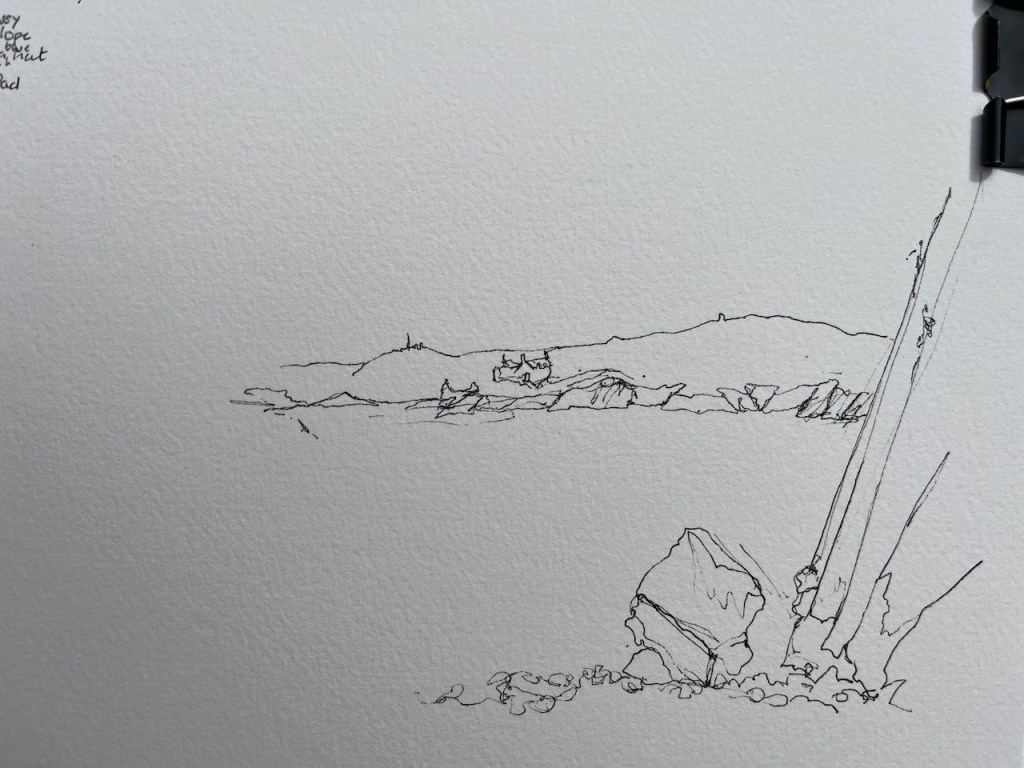
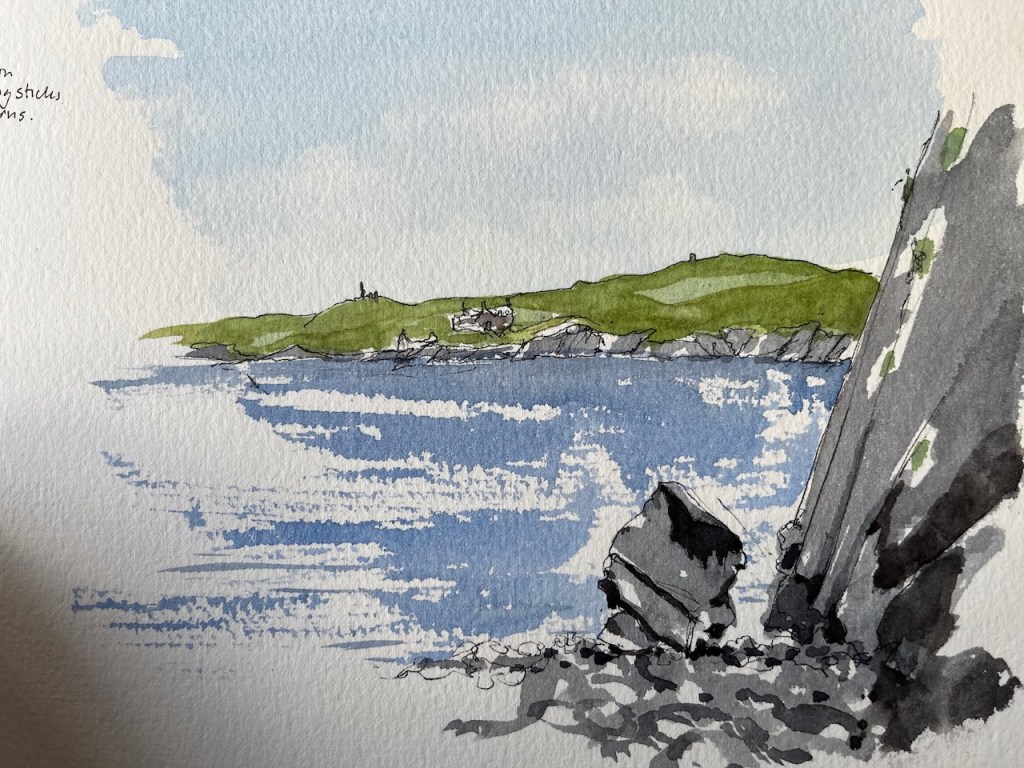
Sketching on the beach out of the wind, I am fascinated by the regular angles in which the rock cleaves.
Beach on the West Side, 27th June 2022, 1pm
The angle of the distant cliffs echoes the slope of the nearby rocks.
The forms of cliffs and rocks
Sketching in the hills, islands and hills are of the same form.
From the hill above BurrastowThe Footabrough ValleySketching on the way to the Virda StaneSketching the Footabrough Valley, 5th July 2022 (note the gloves!)
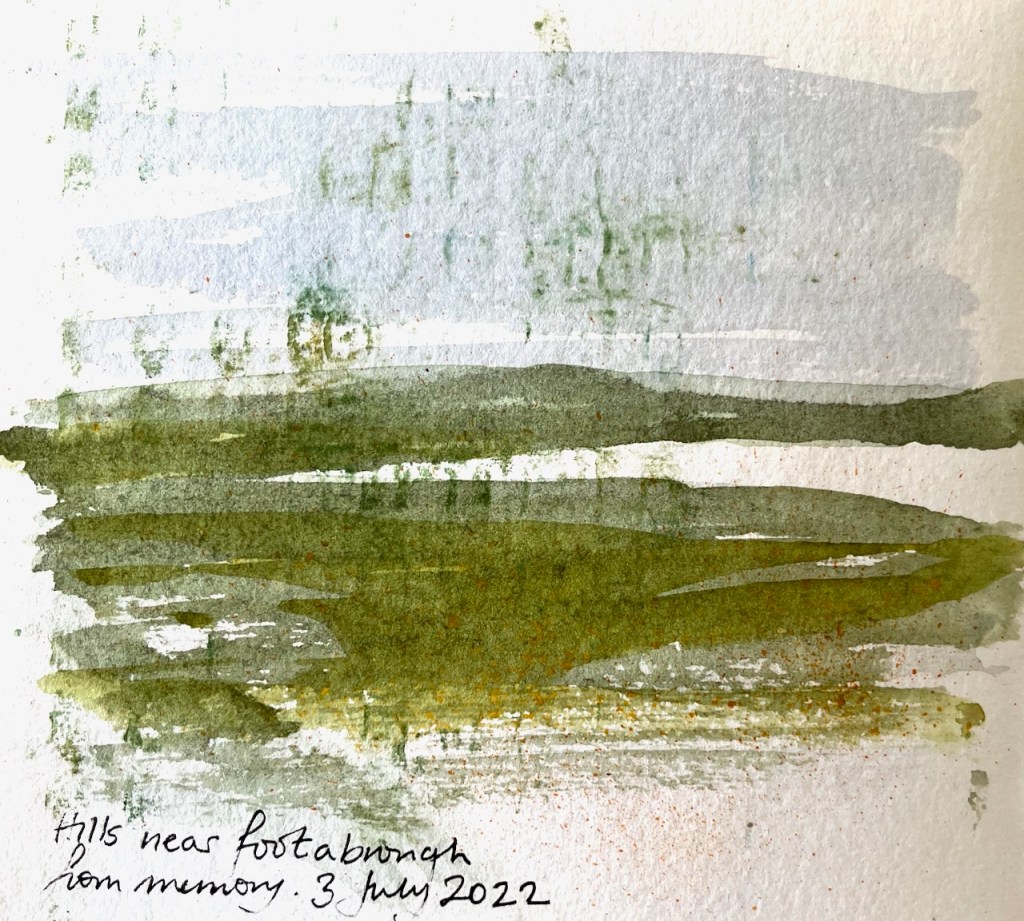
Here’s a sketch in my small sketchbook. The green overlaid pattern is a print, made in advance.
Hills near Footabrough, 3 July 2022
Click a button below to share this post online, email it, or print it:
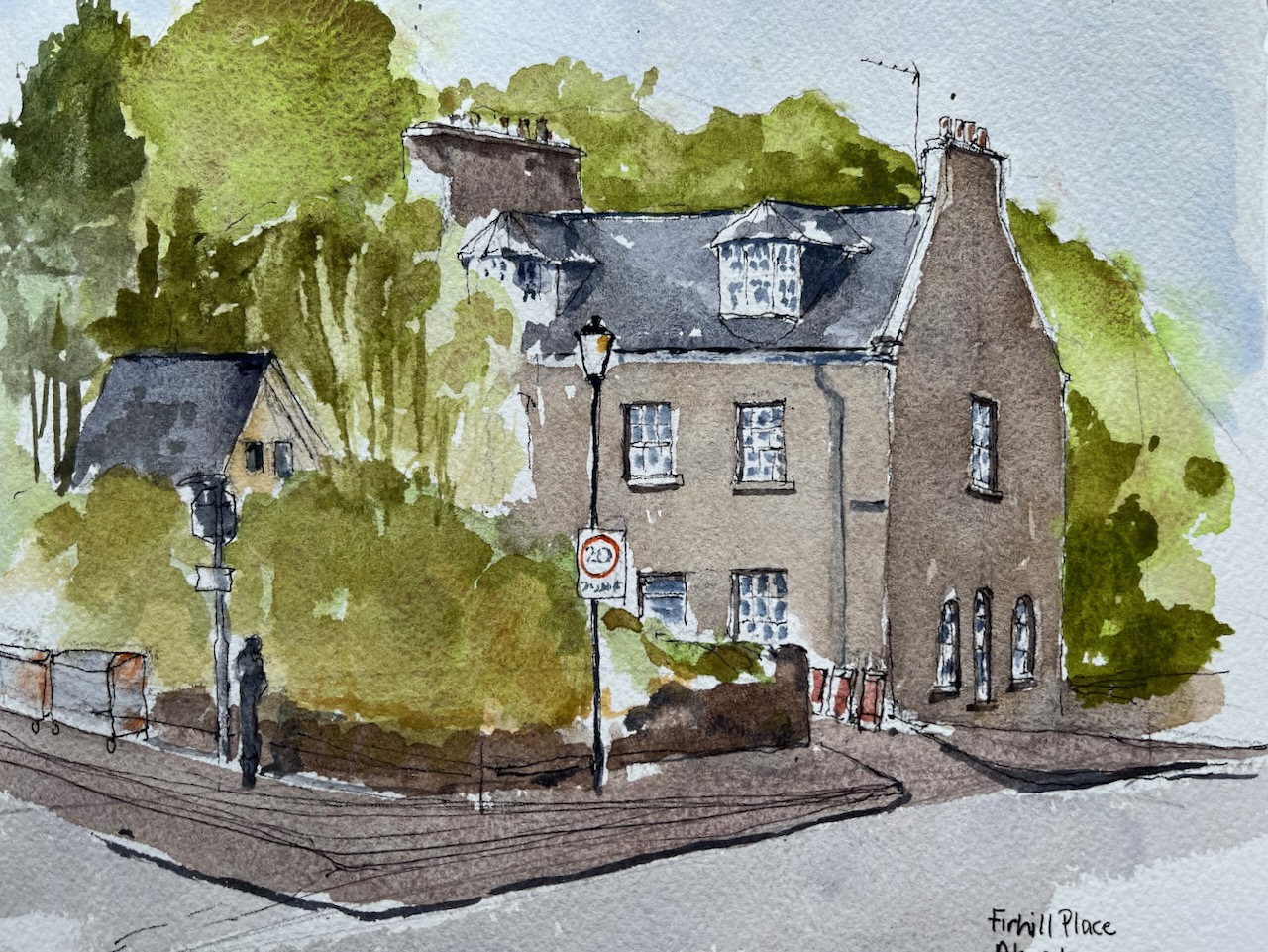
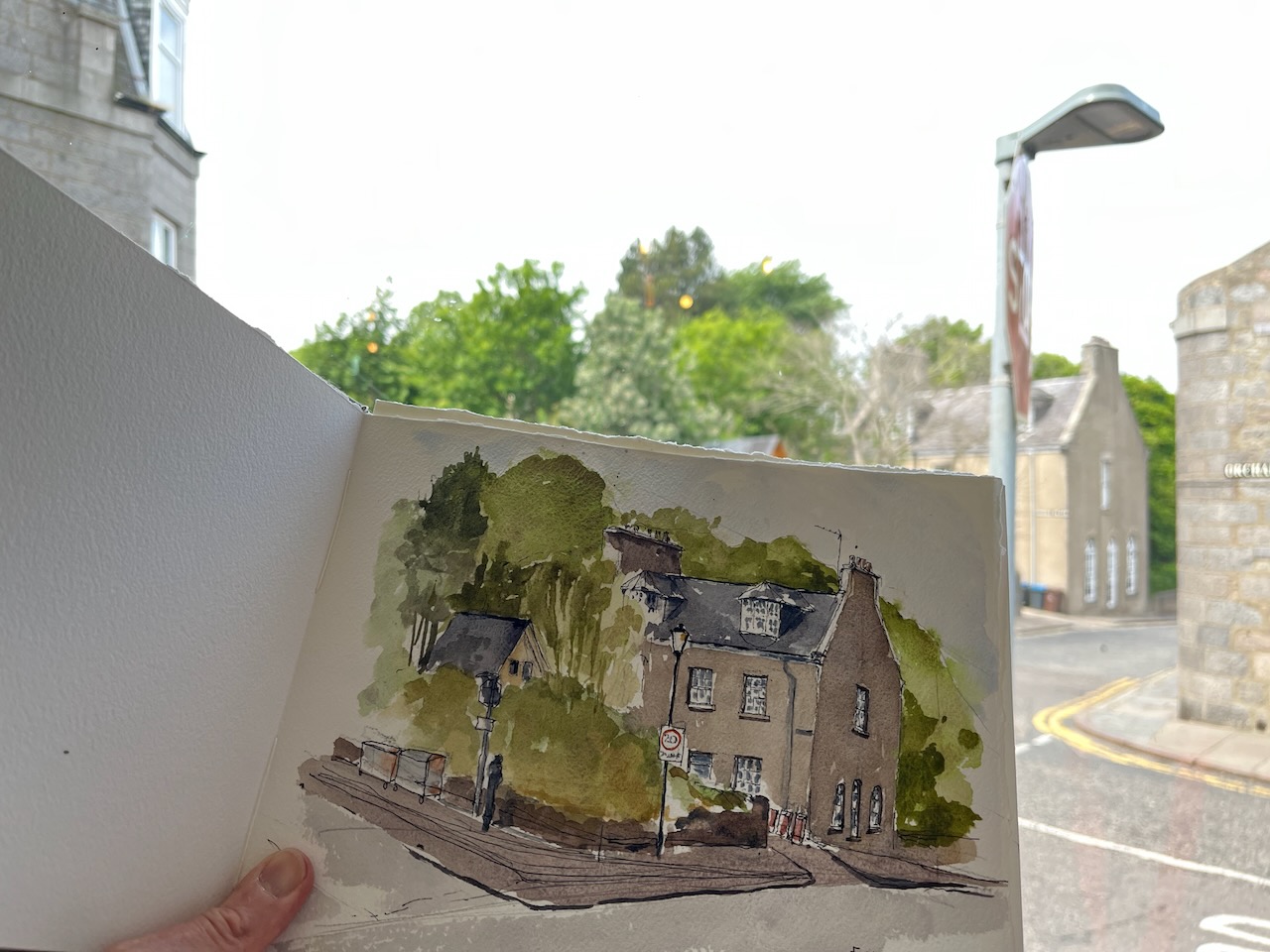
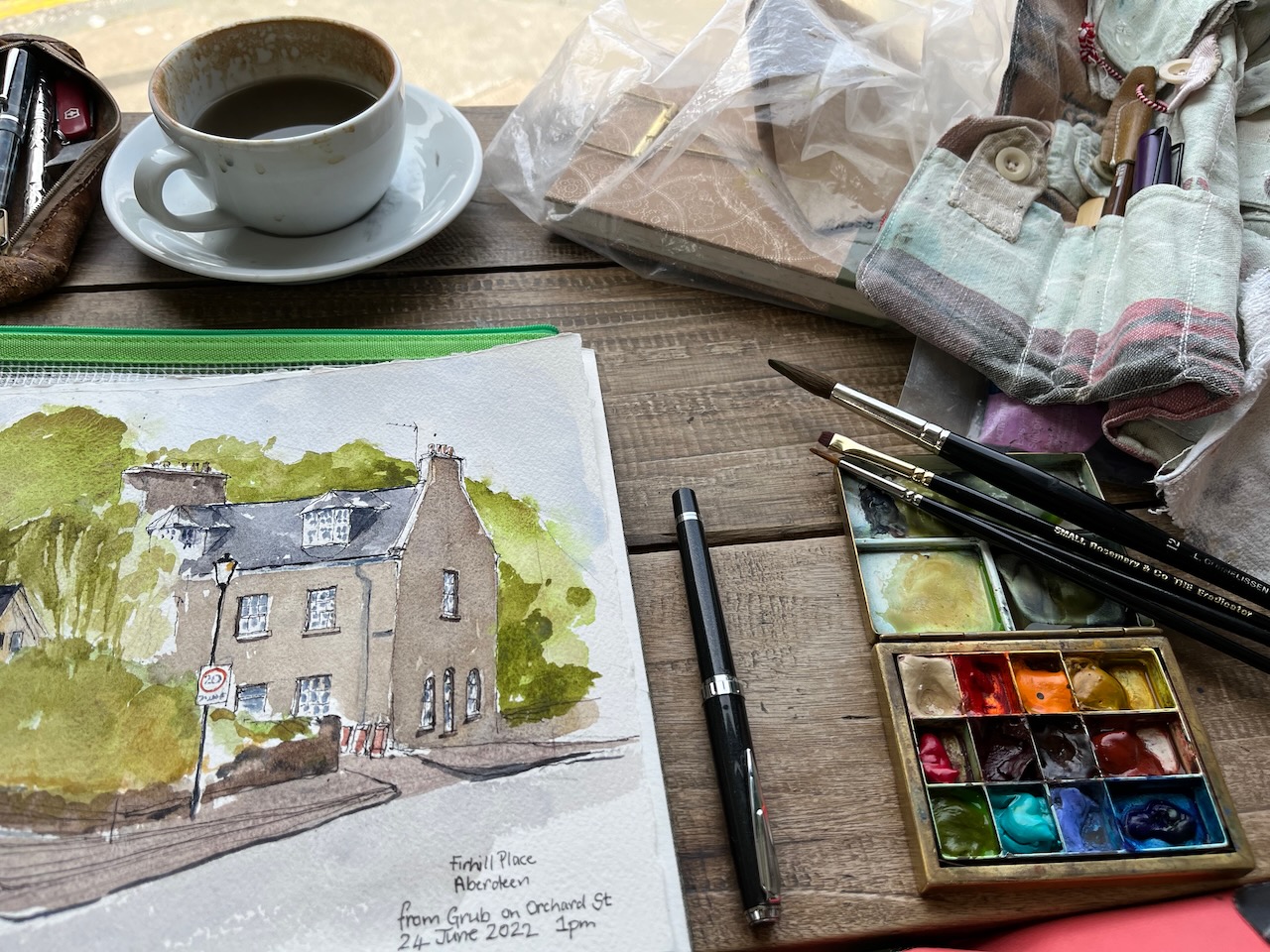
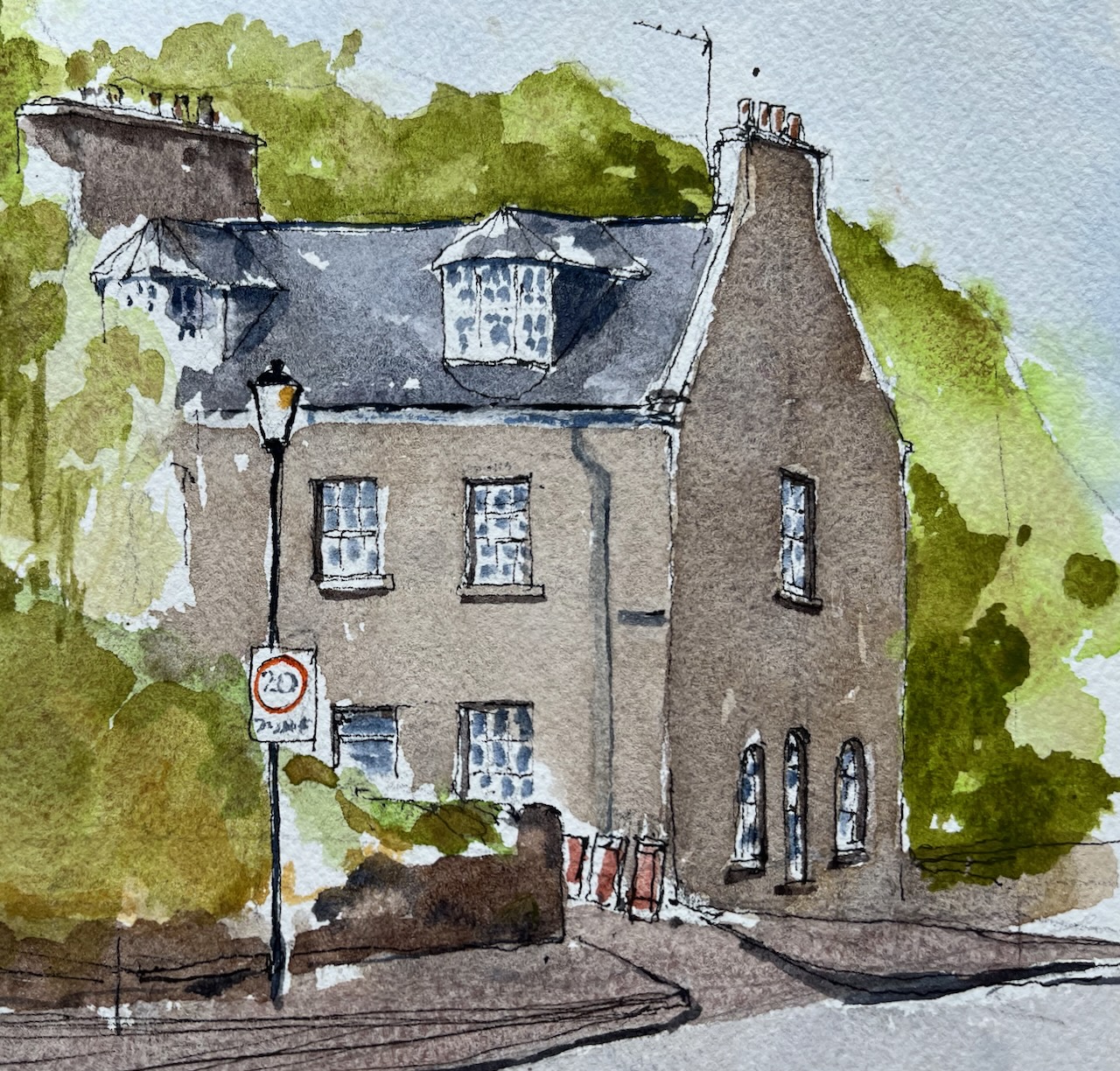
Here is a house in Firhill Place, Aberdeen, near the University.
House in Firhill Place, Aberdeen, 24 June 2022
I sketched it from a coffee shop called “Grub”, on Orchard Street.
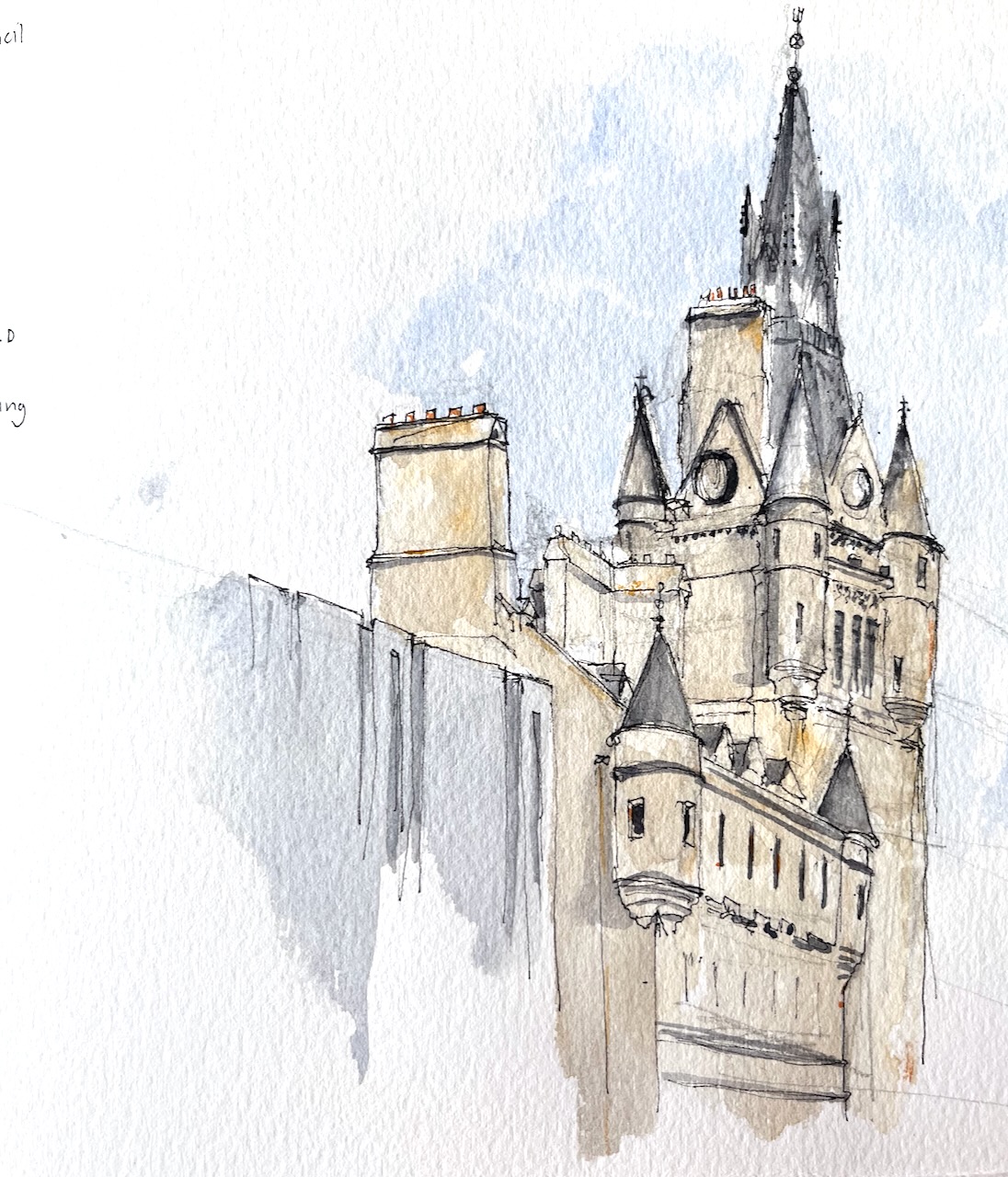
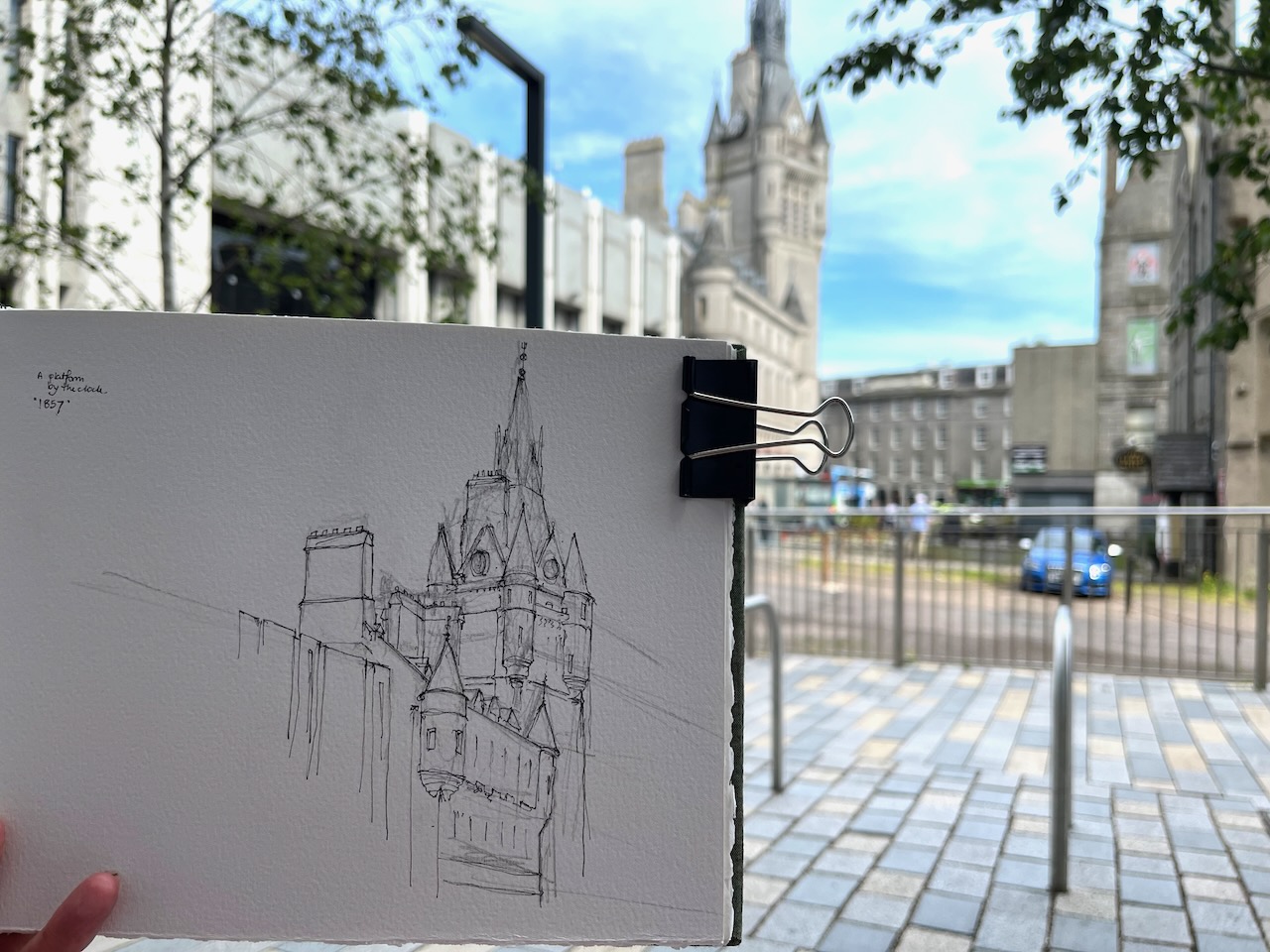
Here’s Aberdeen Town House, with its marvellous turrets.
Aberdeen City Council Town House from Broad Street. 24th June 2022
Aberdeen Town House was built in 1868-74 by John Dick Peddie and Charles George Hood Kinnear. It incorporates the remaining part of the Tolbooth of 1615-29 by Thomas Watson of Old Rayne at the east, and includes the City Chambers to Broad Street, added in 1975 by the Aberdeen City Architect’s Department, with Ian Ferguson and Tom Campbell Watson as its chief architects.
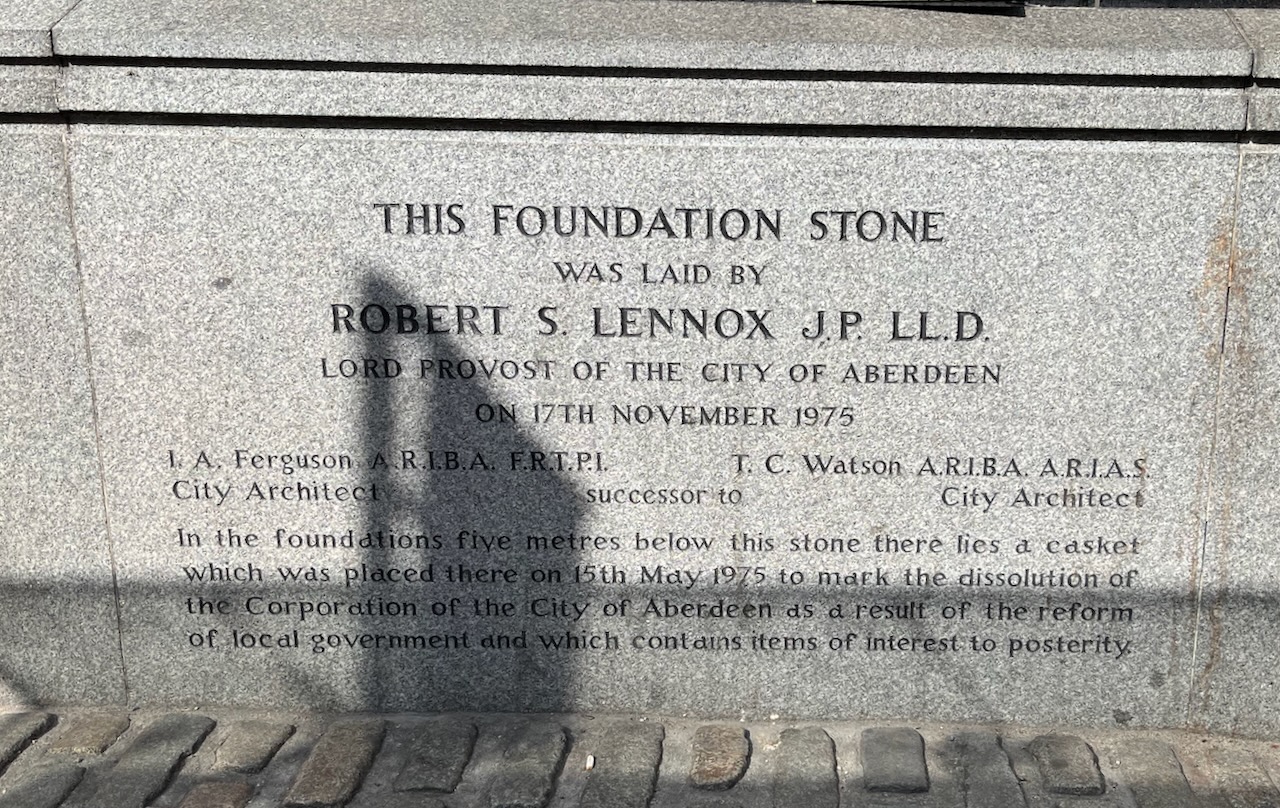
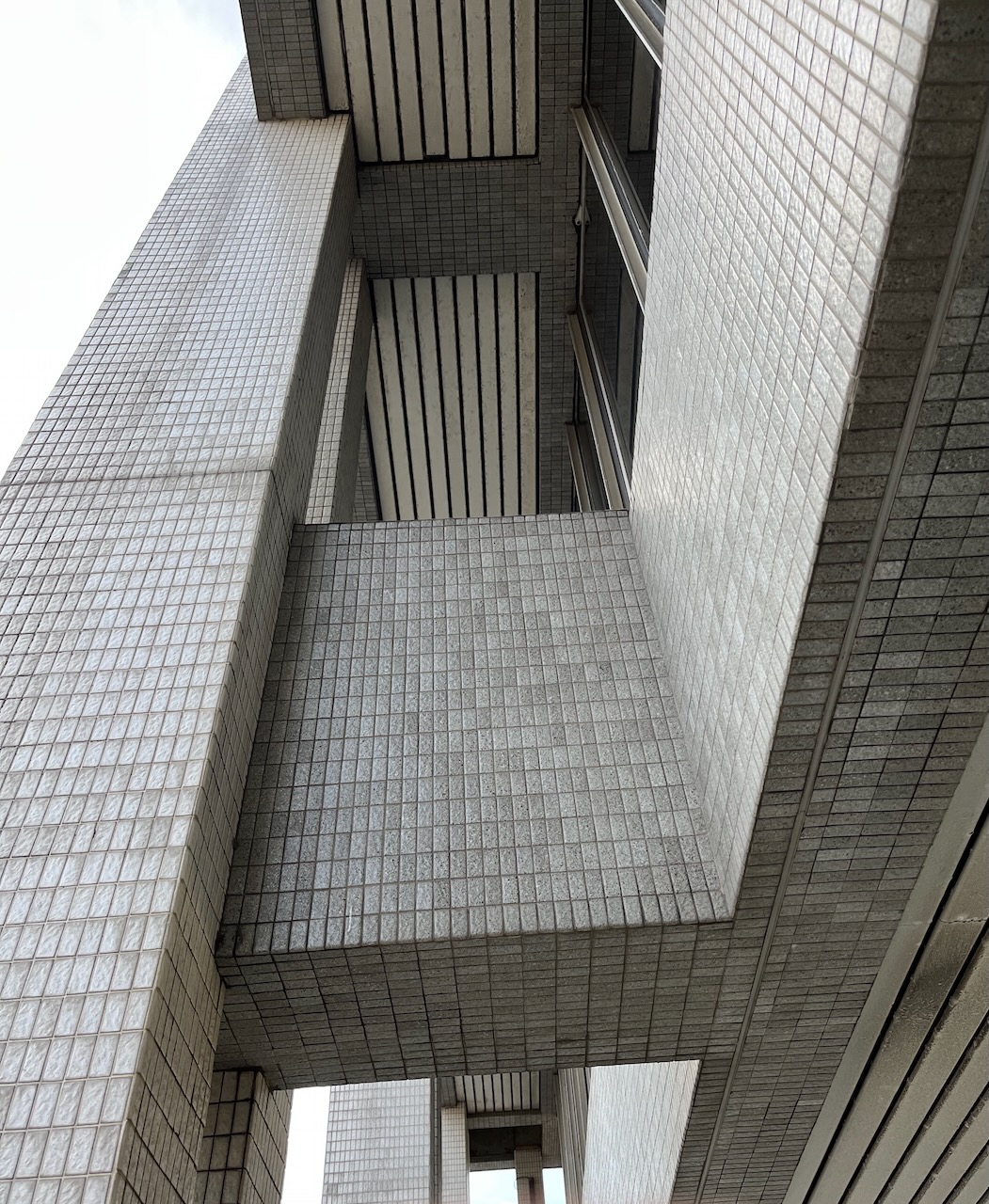
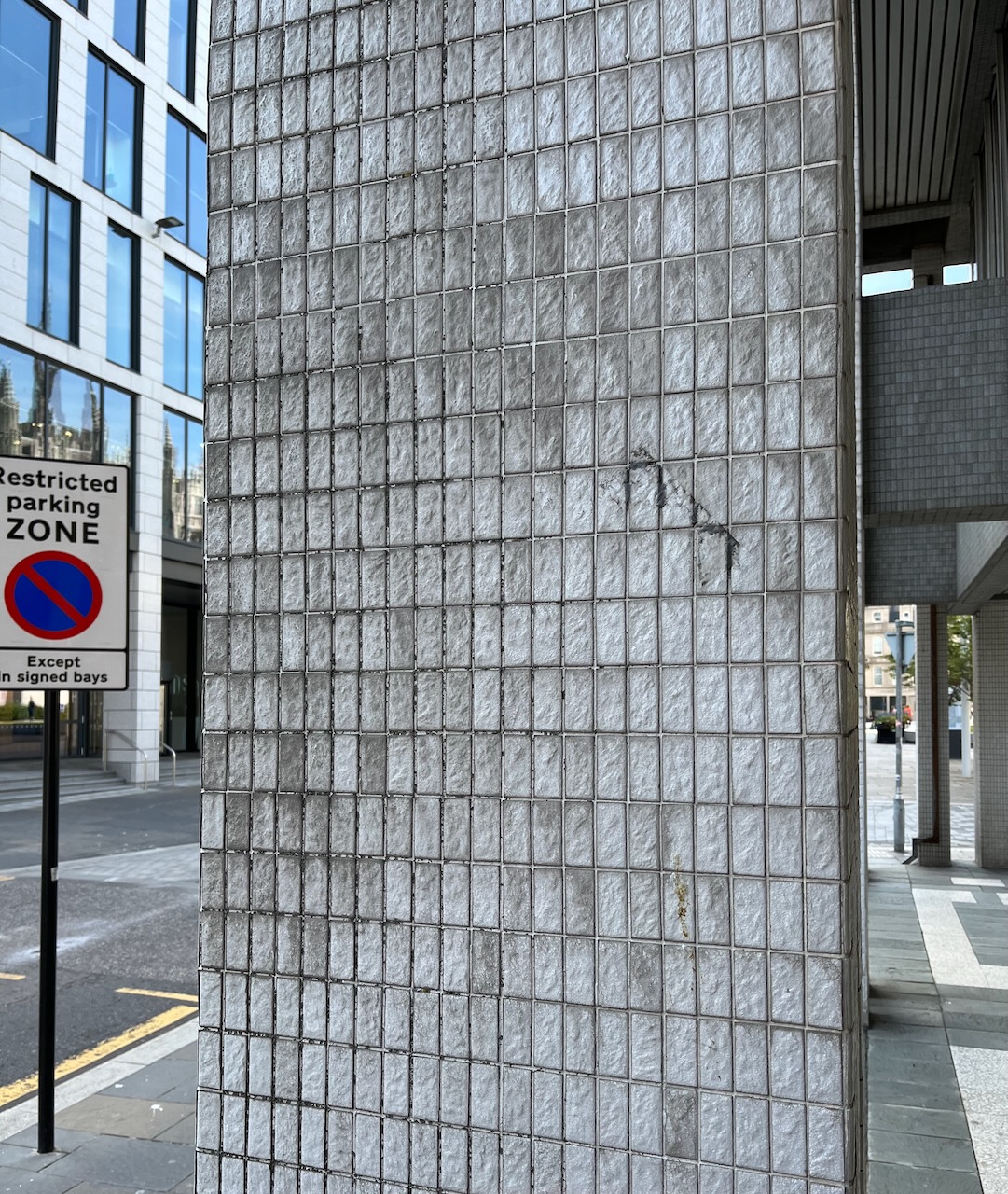
The building on the left of my sketch is the brutalist structure “City Chambers” covered in a tessellation of rectangles of grey marble. Its foundation stone was laid on 17th November 1975, according to the inscription on the foundation stone.
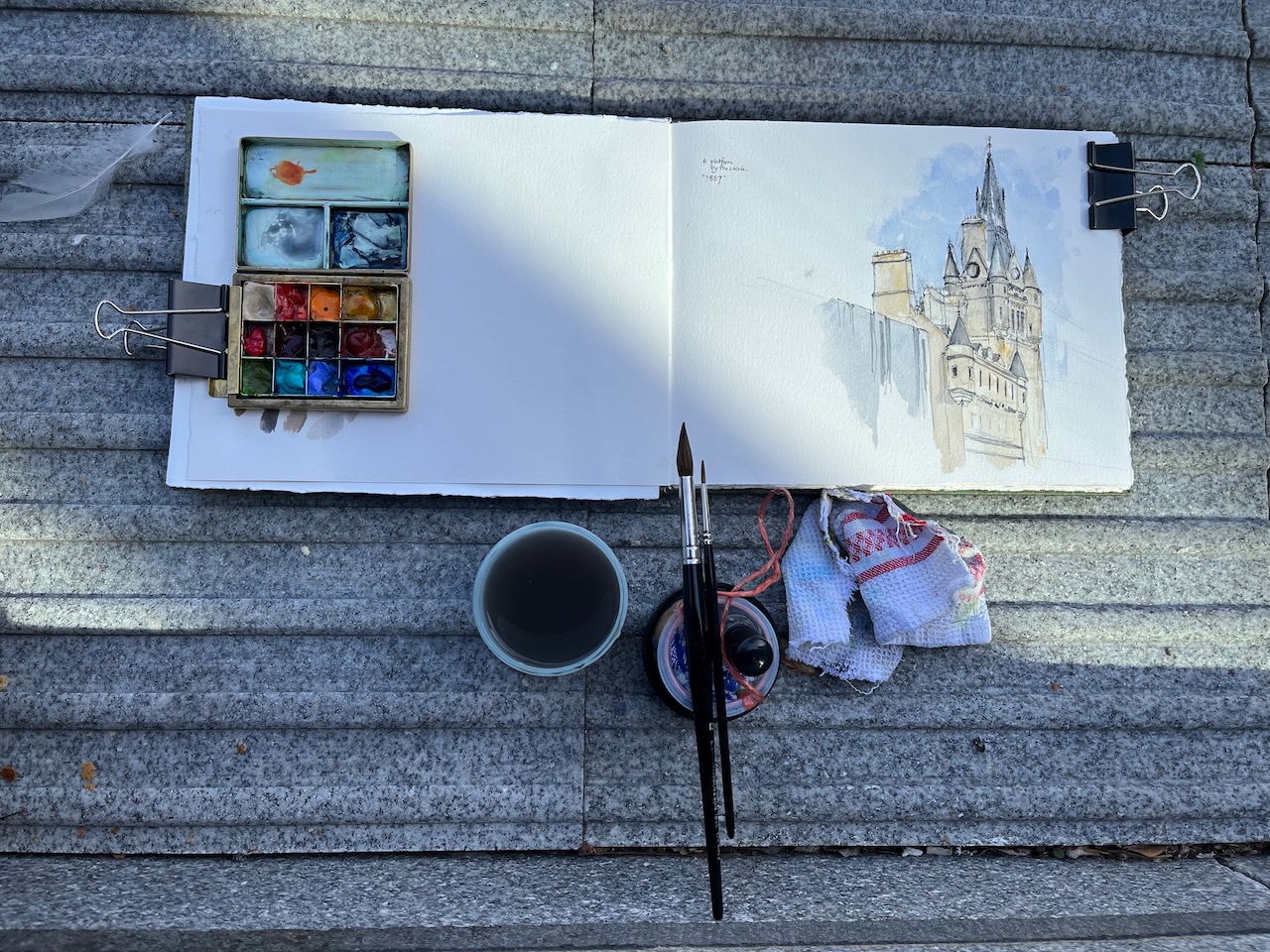
City Chambers foundation stoneCity ChambersCity Chambers, close-up of tessellationWork in progress on the sketchpen and ink
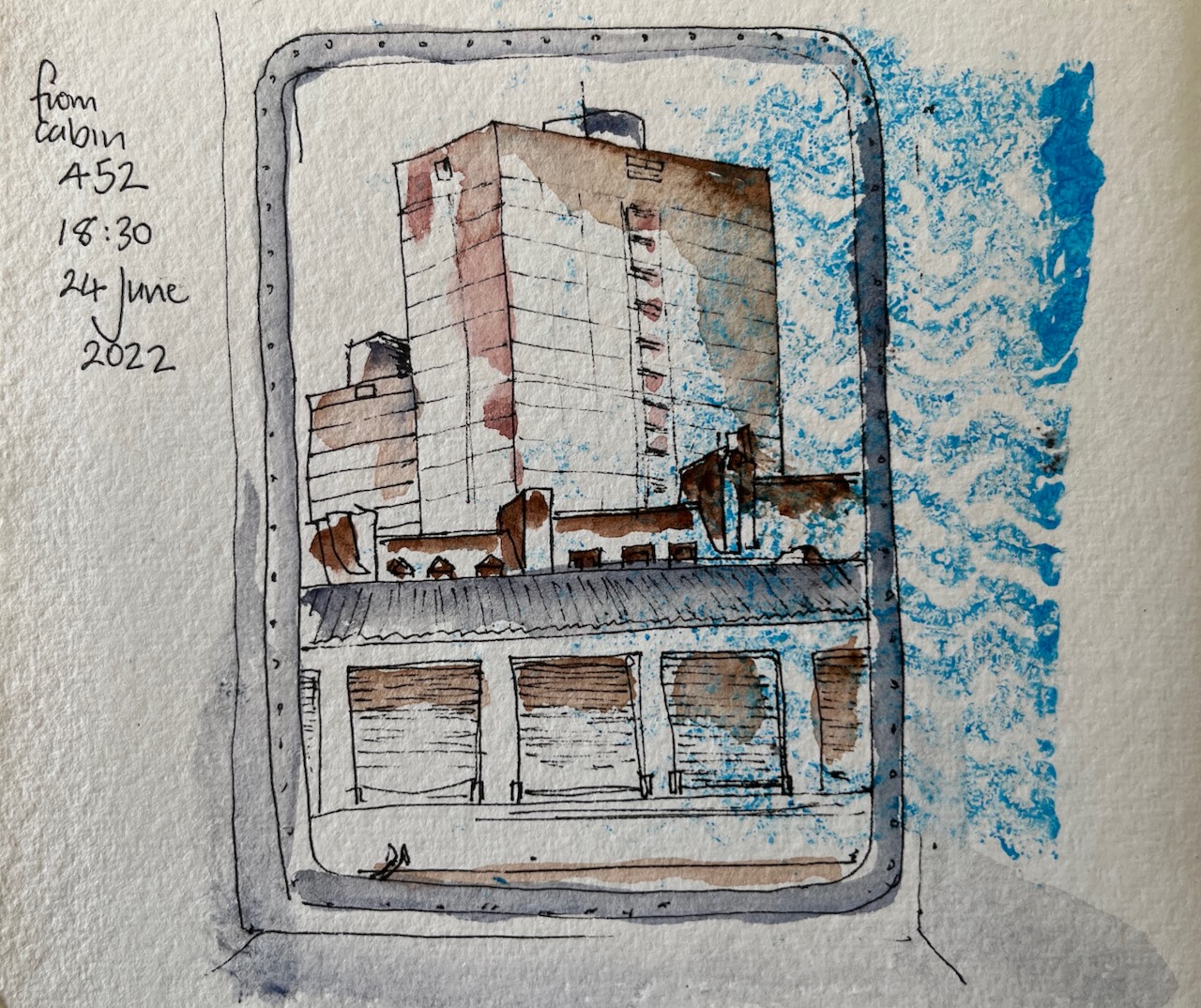
I was on my way to the ferry terminal.
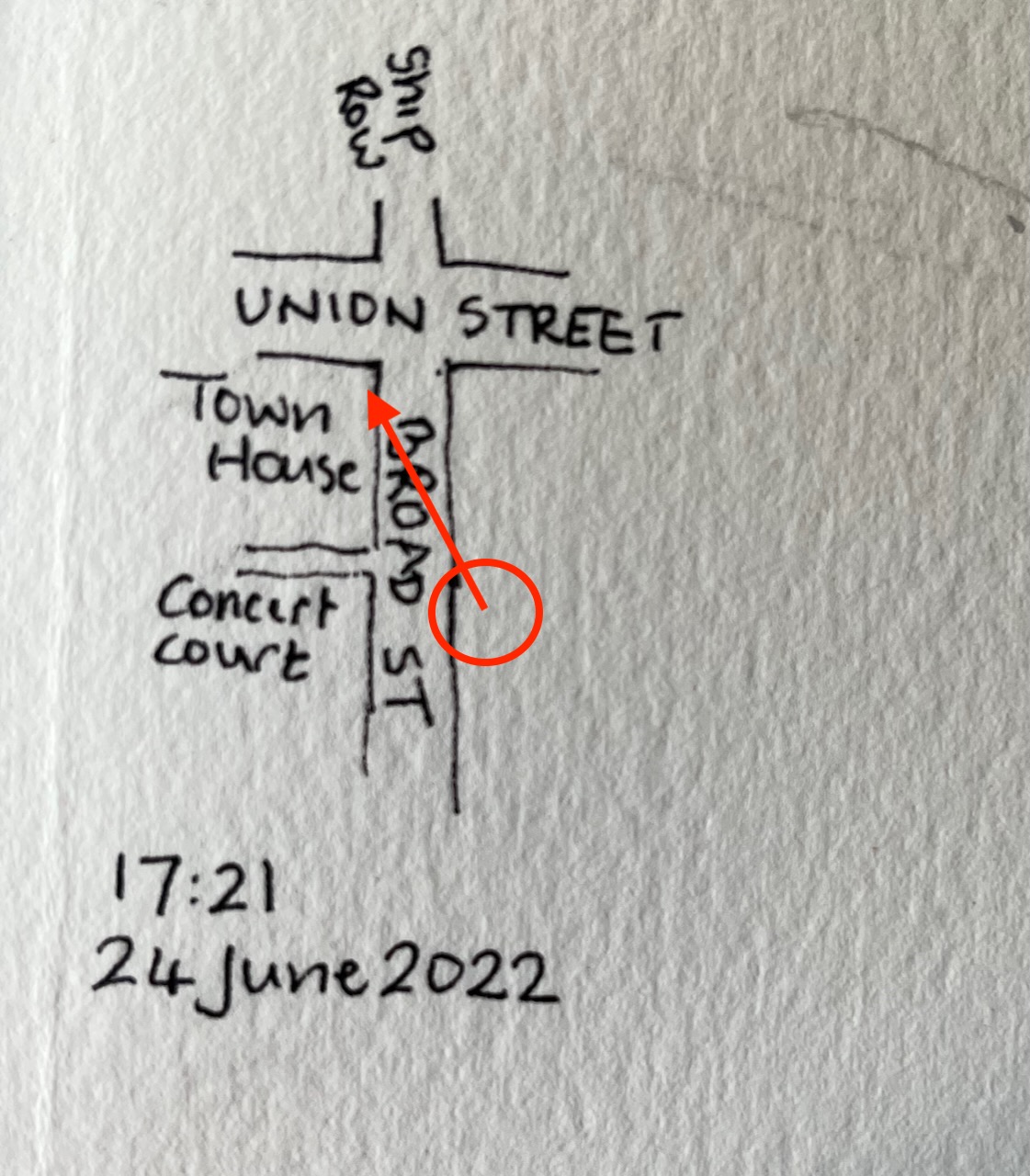
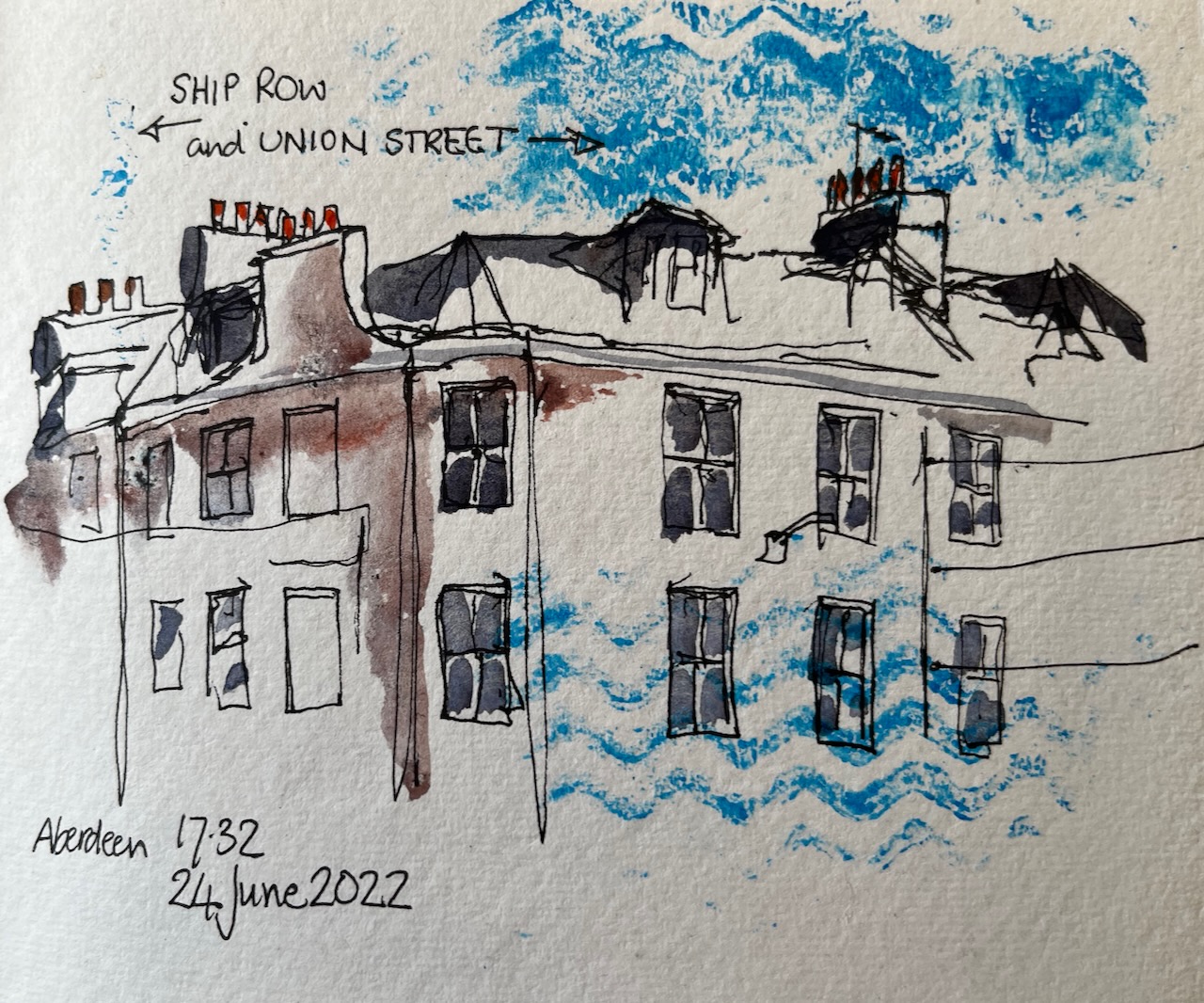
Sightline of the Town House sketchShip RowView from the ferry
Next stop, Shetland.
Click a button below to share this post online, email it, or print it:



















 Jane Sketching