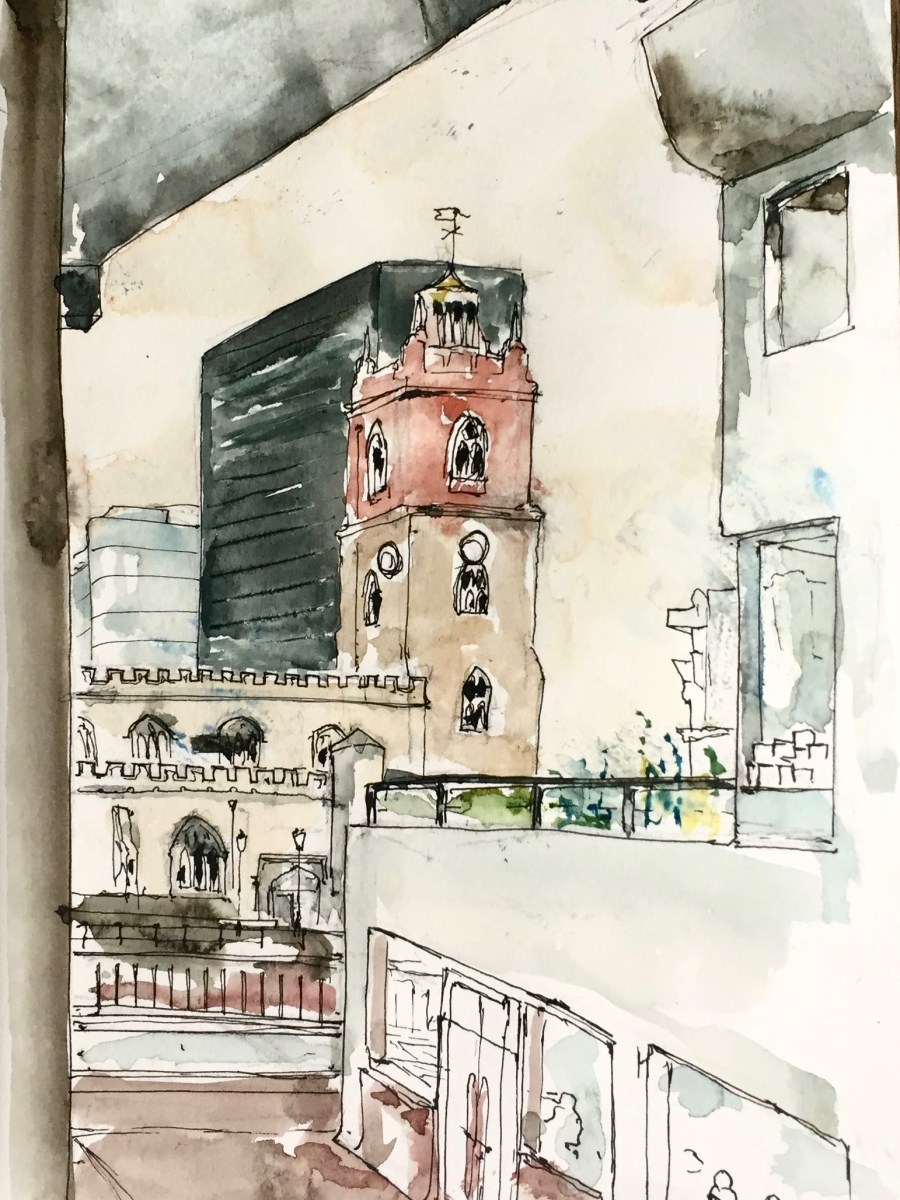
On the way back from a visit to the West End, I passed St-Martin-in-the-Fields, standing out against the cold sky.
St Martin-in-the-Fields, Trafalgar Square. Sketched 2nd Dec 2022, in sketchbook 12
The statue in the foreground, left, is the Edith Cavell Memorial, seen from the back. Edith Cavell (1865-1915) was a British nurse. In German-occupied Belgium, guided by her principles of humanity and her Christian faith, she provided medical care to soldiers irrespective of which side they were on. She was executed by a German firing squad 1915, because she had helped Belgian, British and French soldiers to escape the German occupation and reach Britain. Her grave is in Norwich Cathedral.
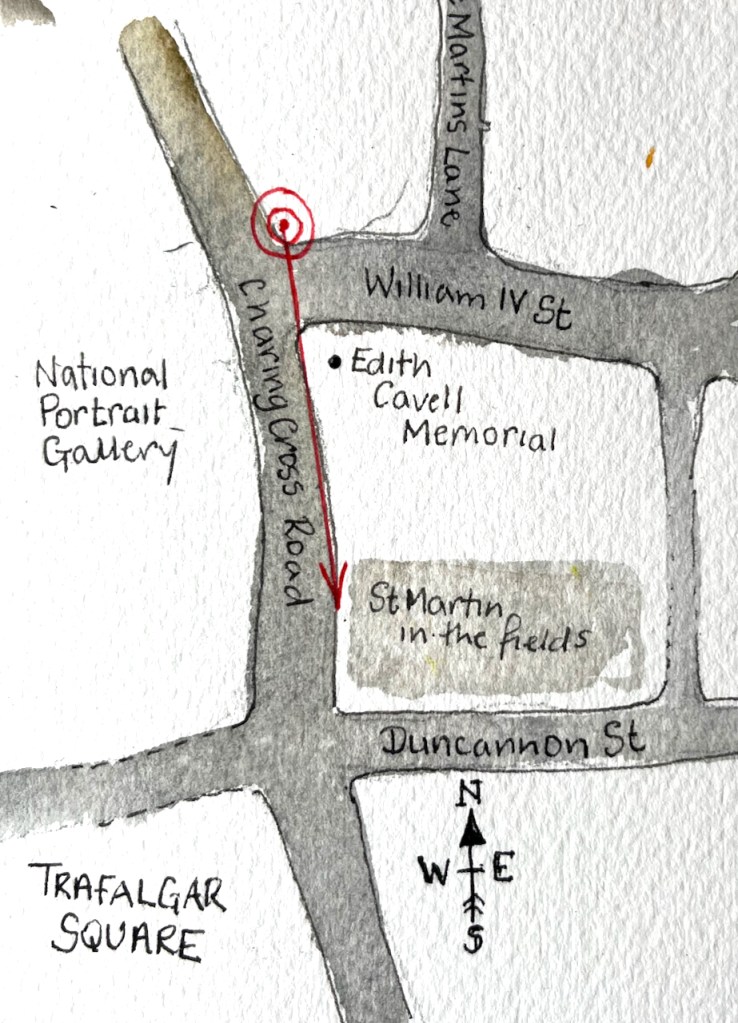
I sketched standing on a corner of the Charing Cross road, see map above. This turned out to be a very noisy location. The National Portrait Gallery is being refurbished and there was continuous drilling and banging. Buses and cars ground their gears, and thundered past, rushing through the traffic lights to shriek to a halt at the next junction.
But St-Martin-in-the-Fields rose above it all. The inscriptions which faced me on the Edith Cavell Memorial were: “Determination”, “Fortitude”.
Click a button below to share this post online, email it, or print it:
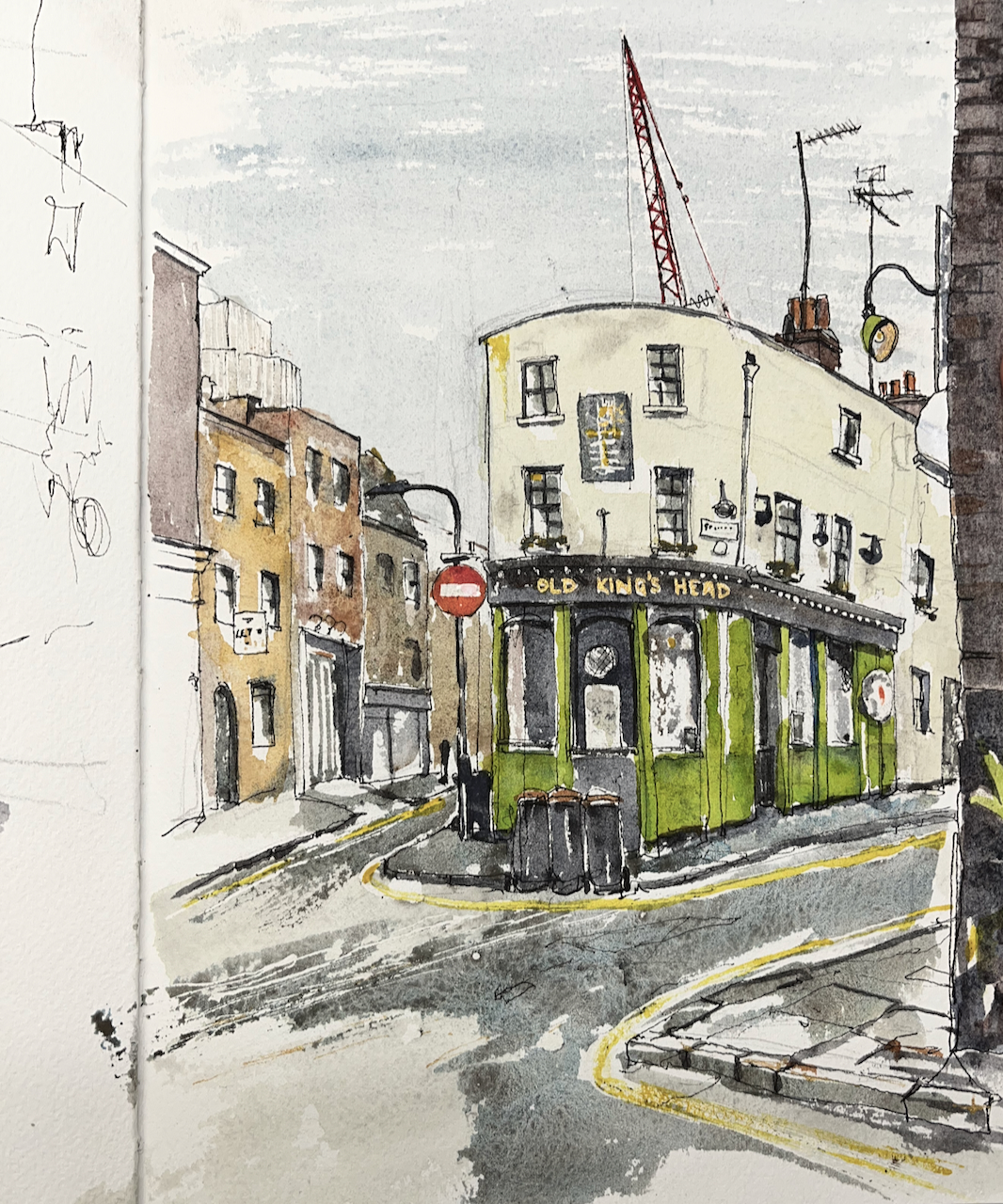
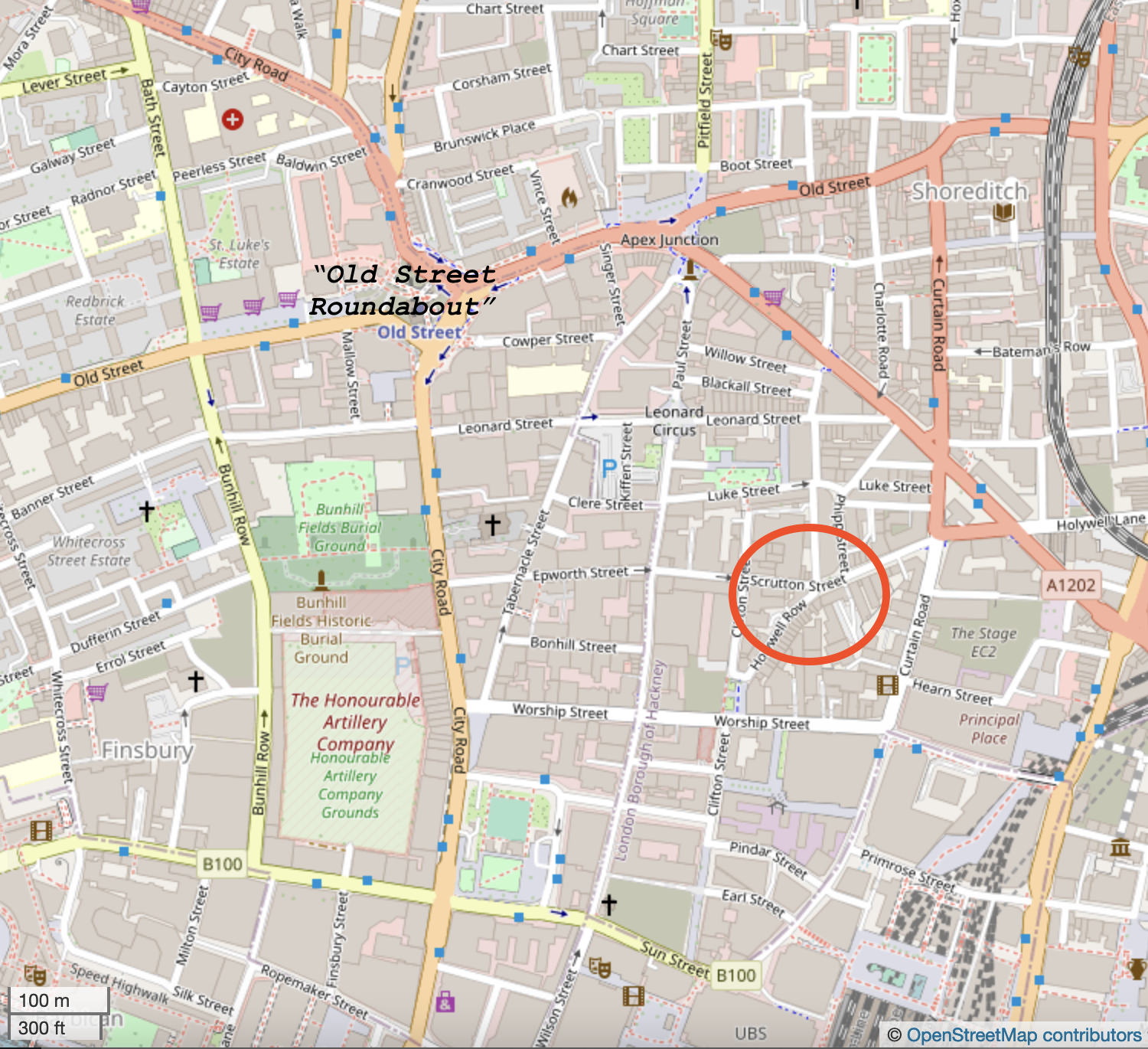
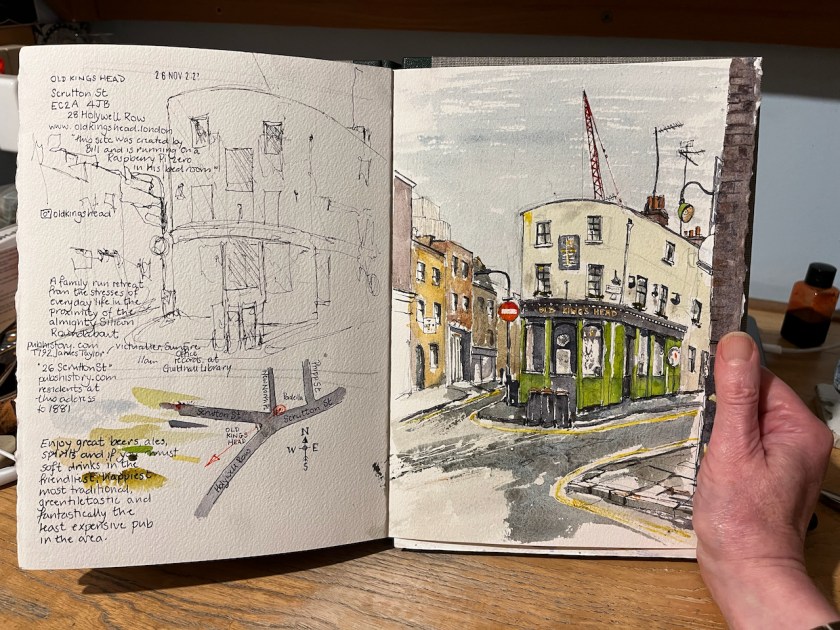
Here is the Old Kings Head, 28 Holywell Row, EC2A 4JB: ” a family-run retreat from the stresses of everyday life in the proximity of the almighty Silicon Roundabout” [oldkingshead.london]
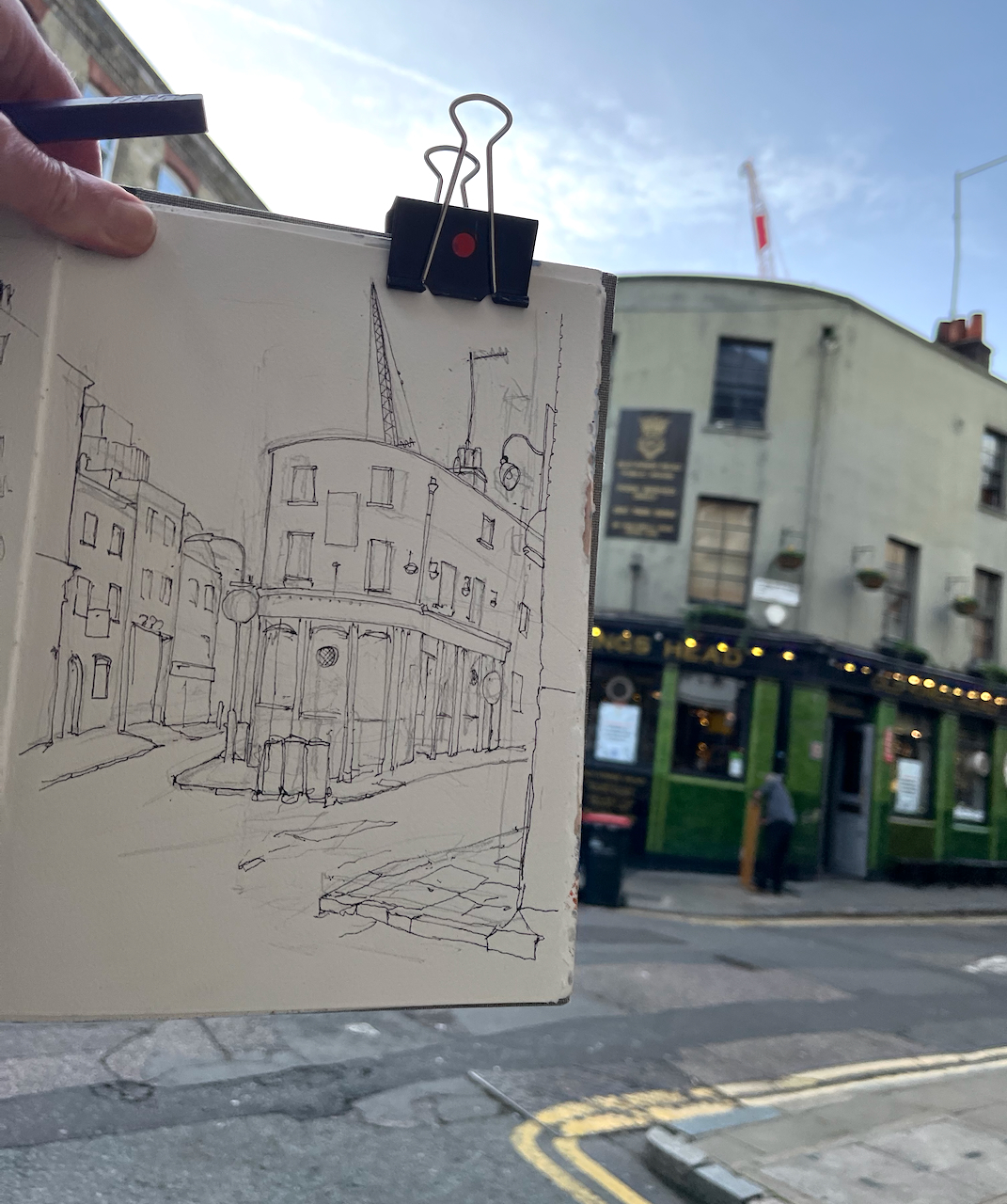
The Old Kings Head, Shoreditch 26 November 2022 in Sketchbook 12
“Enjoy great beers, ales, spirits and, if you must, soft drinks in the friendliest, happiest, most traditional, greentiletastic and fantastically the least expensive pub in the area” continues their website.
I love “greentiletastic“. The green tiles are indeed fantastic: I have tried to show them in my drawing.
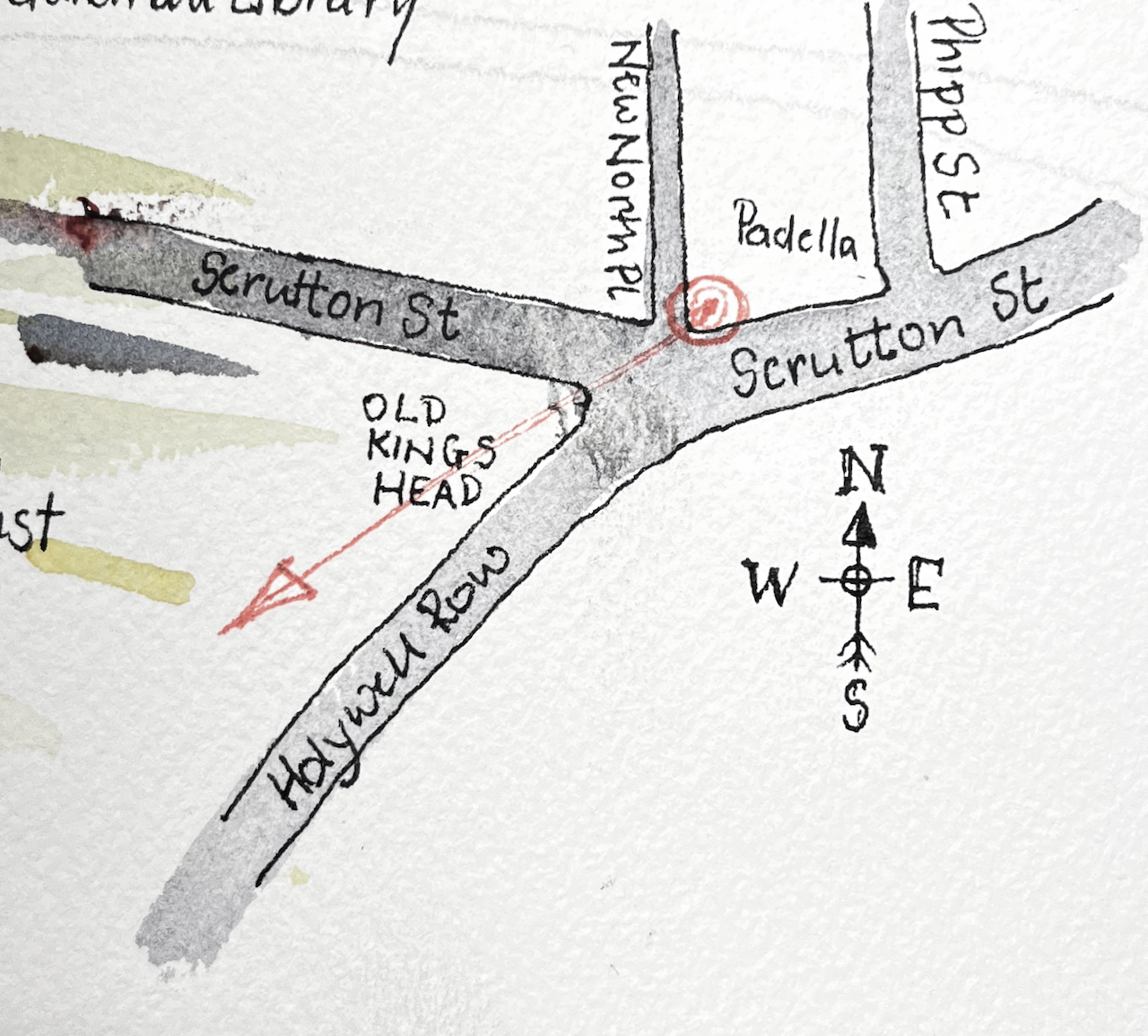
This pub is in a network of tiny streets running at all sorts of unexpected angles. As I sketched, I saw, more than once, an expensively dressed person trailing a carry-on size suitcase, picking their way over the broken paving stones and patched up tarmac, in unsuitable shoes. The person drifted on, towards Old Street, bearing a dreamy mystified expression, as though these piebald buildings did not quite correspond to the mental image they had of their destination, or, more likely, the street pattern did not correspond to the image on their mobile phone. They saw neither me, nor the pub, but seemed to exist in another reality.
This pub is old. According to “pubhistory.com” the earliest landlord was “James Taylor, victualler” in 1792. This is from insurance records in the Guildhall Library.
It sounds like a great pub.
I drew it standing outside the restaurant “Padella”, next to a narrow alley called “New North Place”. New North Place is the opposite of new, but it does go North. To my total astonishment, a huge lorry emerged from this tiny alley, and blocked my view. This is a common hazard sketching in London. It soon moved on though. I was impressed that the driver had ventured into the alley.
Sketchbook 12
Click a button below to share this post online, email it, or print it:
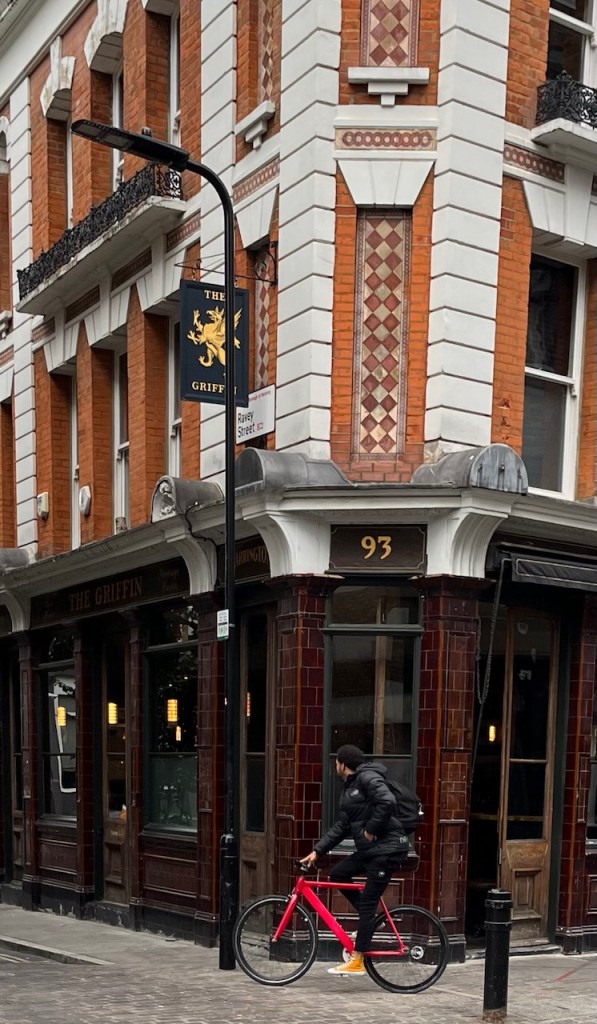
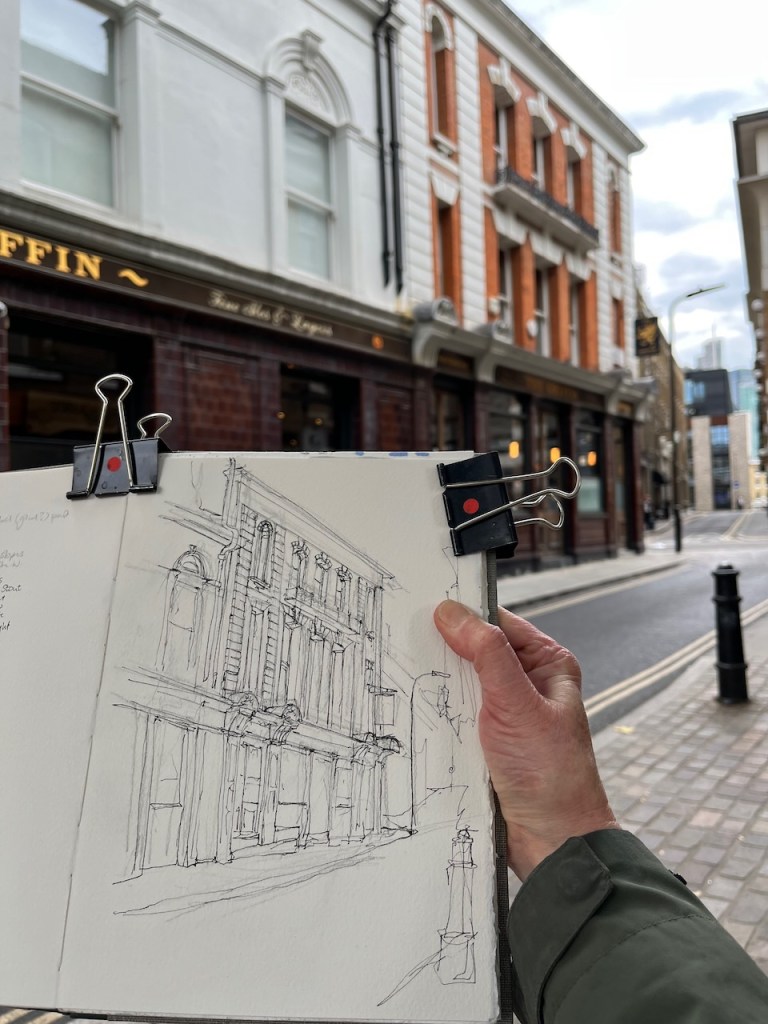
After I’d sketched The Old Blue Last, I left the thundering traffic behind and walked through back streets of Shoreditch. I encountered “The Griffin”. It seemed like a friendly place, with neat brickwork, and welcoming lights inside. I sat on a low wall, and sketched it, as electric taxis glided past. Or should that be “glid”?
The Griffin, Leonard Street EC2. Sketched on 21 September 2022 in Sketchbook 12.
The pub is built on a slight slope. Ravey Street slopes upwards towards Leonard Street.
Map showing where I sat and sketched “The Griffin”
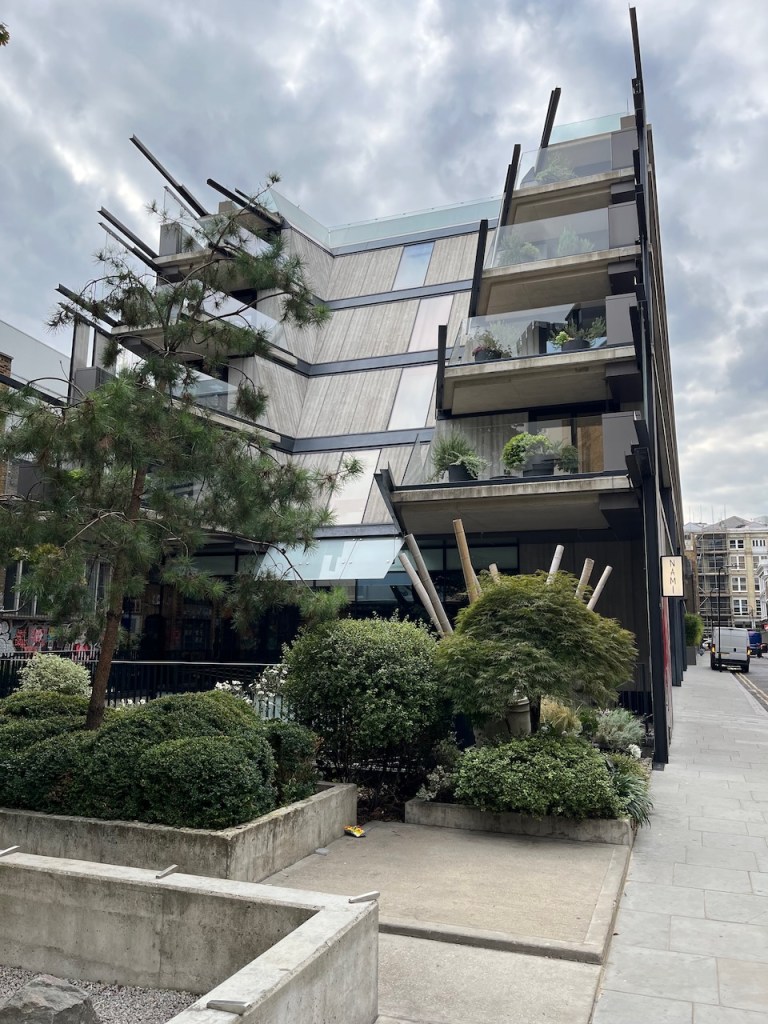
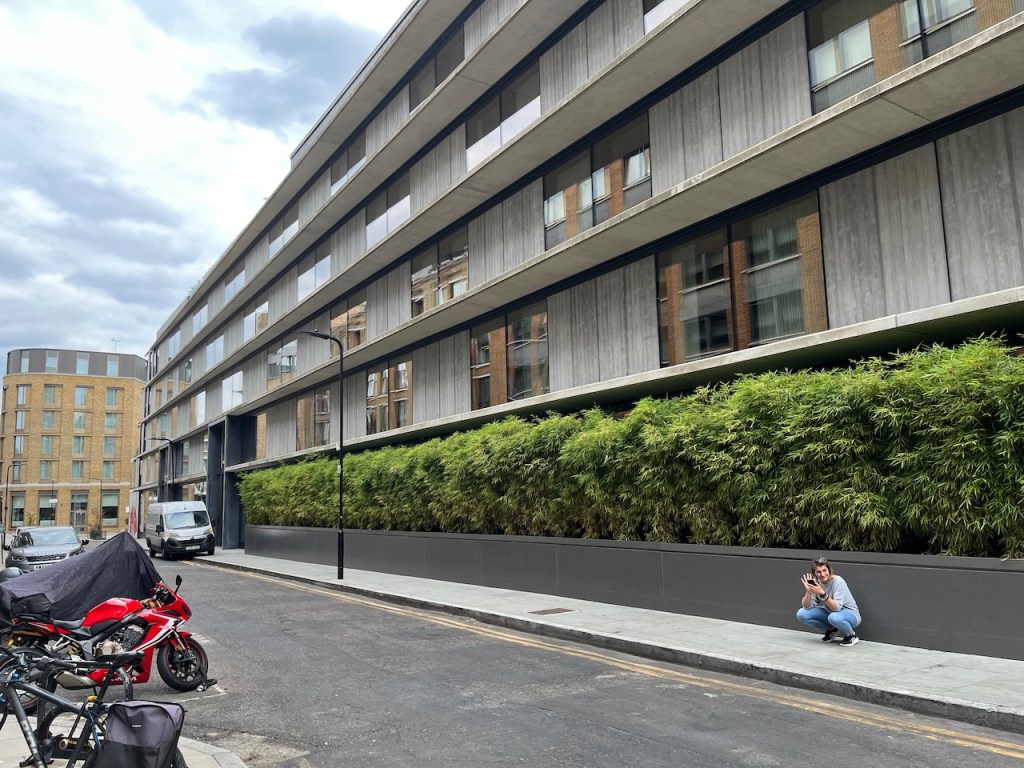
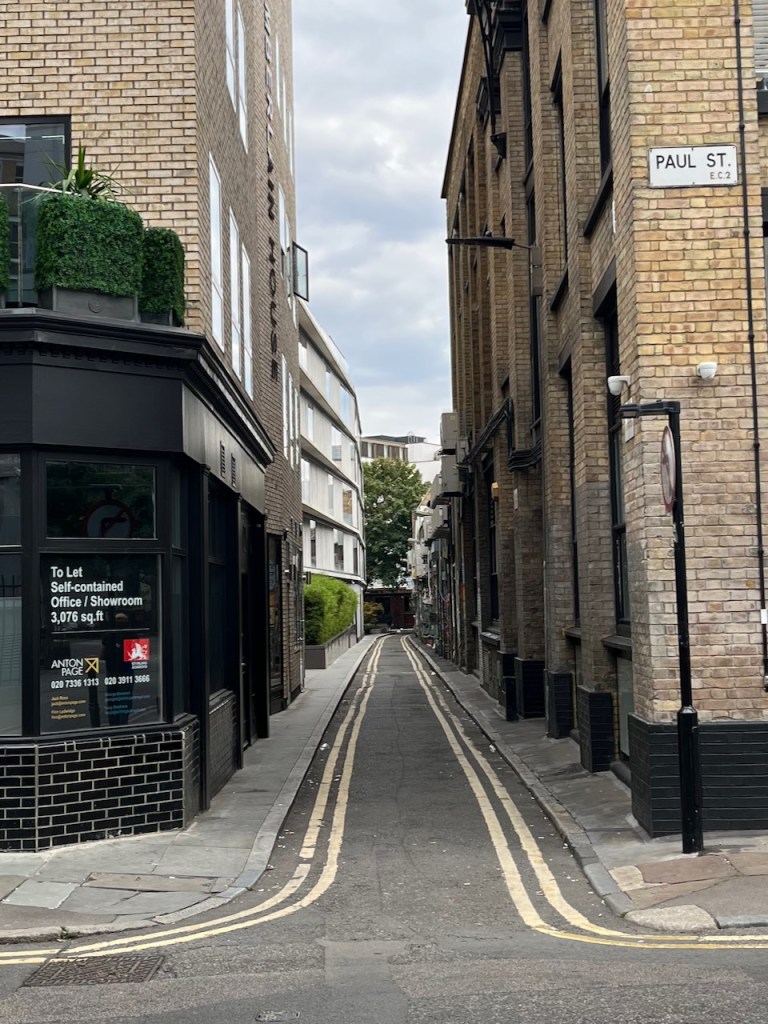
It’s an area of sharp contrasts. Behind me was the “Nobu Hotel” radically modern. Blackall Street, however, looks unkept, like the seamy side of a garment. The people walking by were various. A group of young people speaking a Germanic language rushed past onto Leonard Street following a route on a mobile phone. Several men in florescent jackets walked towards me in a tight group, studiously conversing and referring to a clipboard which one of them carried. As they passed I realised they were speaking another language, perhaps of a Baltic region, with soft “shh” sounds. A young woman strode past in the opposite direction, frowning, speaking no language but with her mobile phone held at her ear. None of these people paid me any heed. Then a totally different person appeared, dancing a jagged line along the street, with hair in long strands, and a huge smile. He noticed me and marched up, asked how I was, commented on the day, admired my drawing, and offered me a fist to bump in greeting. This done, he completed a 36o degree turn on the spot, and walked loosely on up the street, offering his benign greetings to other bemused passers-by. This is London.
Blackall Street, seamy side on the left, Nobu Hotel on the right.The radically modern Nobu Hotel.Nobu Hotel on Willow StreetLooking North up Blackall Street, Nobu on the left, “The Griffin” centre distance.
The Griffin is in an area of contrasts.
The area containing The Griffin has recently been totally redeveloped. A new hotel was constructed on Great Eastern Street. These works took place in 2013-5. They included a renovation of the pub itself, and conversion of its first floor into flats. There is extraordinarily detailed research on the whole site done by “The Historic Environment Consultancy”. See this link.
The pub is Grade II listed, the buildings around were unstable, and archaeological investigations were called for. The Historic Environment Consultancy wrote a scholarly account of the state of The Griffin in 2013, in preparation for the redevelopment. They generously put this report online. You can read it on this link or download it here if that link is no longer valid:
The consultant carefully identified the phases of construction of the pub, by looking at details of its structure. For example they observe:
The timbers in the roof are machine-sawn where visible and thus they date the roof to post 1790 and likely to be post 1840.
The Historic Environment Consultancy, Colin Lacey 2013
They conclude that it was constructed in three phases, the first two between 1799 and 1872, and the later one after 1887. This later phase is dated because it included the installation of a Dumb Waiter which was only invented in 1887. It was built as a pub, and has always been a pub.
At the time of their inspection, the consultants noted that the building was on the “At Risk” register:
The building also appears on English Heritage’s Heritage at Risk Register. It is said to be in ‘poor’ condition because, according to the register, of a lack of maintenance.
The Historic Environment Consultancy, Colin Lacey 2013
This poor state is evident from the photos they include in their report, which show plants growing out of the roof, and crackling stone work.
When I sketched it, the pub was in an excellent state of repair, very neat looking, with beautiful patterned brickwork. Worth a visit.
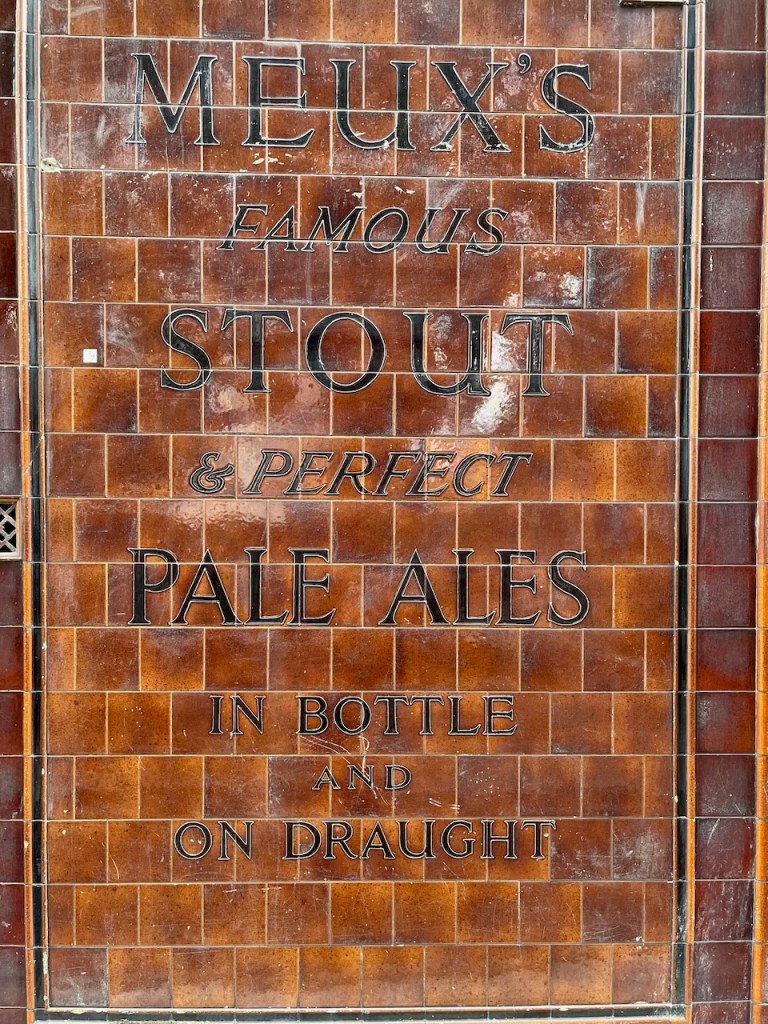
View from Leonard Street (Sept 2022)Meux Brewery brewed on the site of the Dominion Theatre, Tottenham Court Road until 1921, then moved to Nine Elms where brewing ceased in 1964 (https://pubheritage.camra.org.uk/pubs/2020)
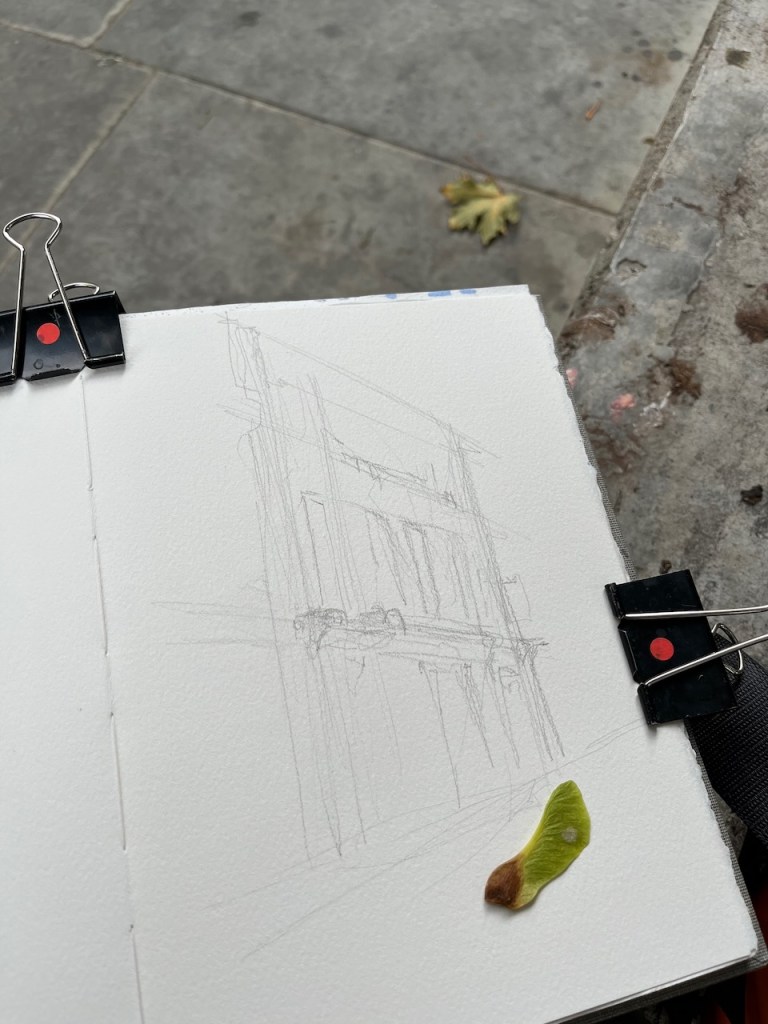
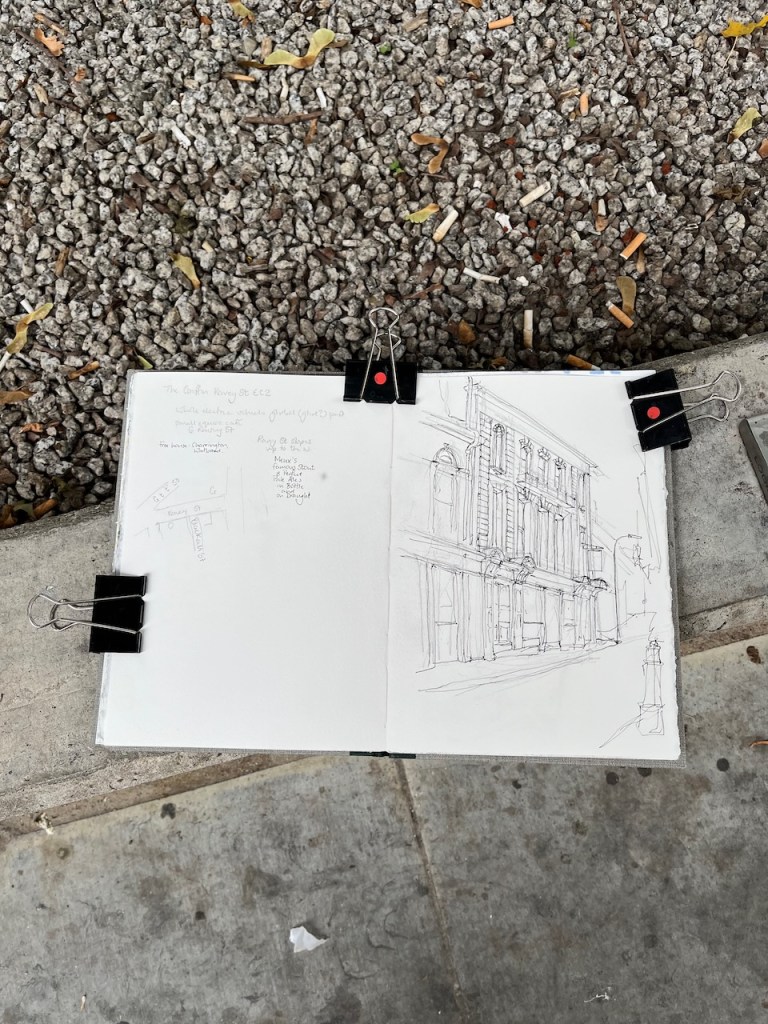
I drew the pub in pen and ink on location and completed the colour at my desk.
Pencil drawing and tree seedPen drawingPen drawing and cigarette butts.
The colours are:
Ultramarine Blue, Lavender and Burnt Umber for the sky
Fired Gold Ochre and Mars Yellow for the brickwork
A mixture of all of the above plus Perylene Maroon for the tiled ground level
All blacks and greys are Ultramarine Blue with Burnt Umber
The drawing is done on Arches Aquarelle 300gsm cold-pressed paper, made into a sketchbook by the Wyvern Bindery. The pen I use is a Lamy Safari with a fine nib and De Atramentis Document Black waterproof ink, both from “The Writing Desk”.
Click a button below to share this post online, email it, or print it:
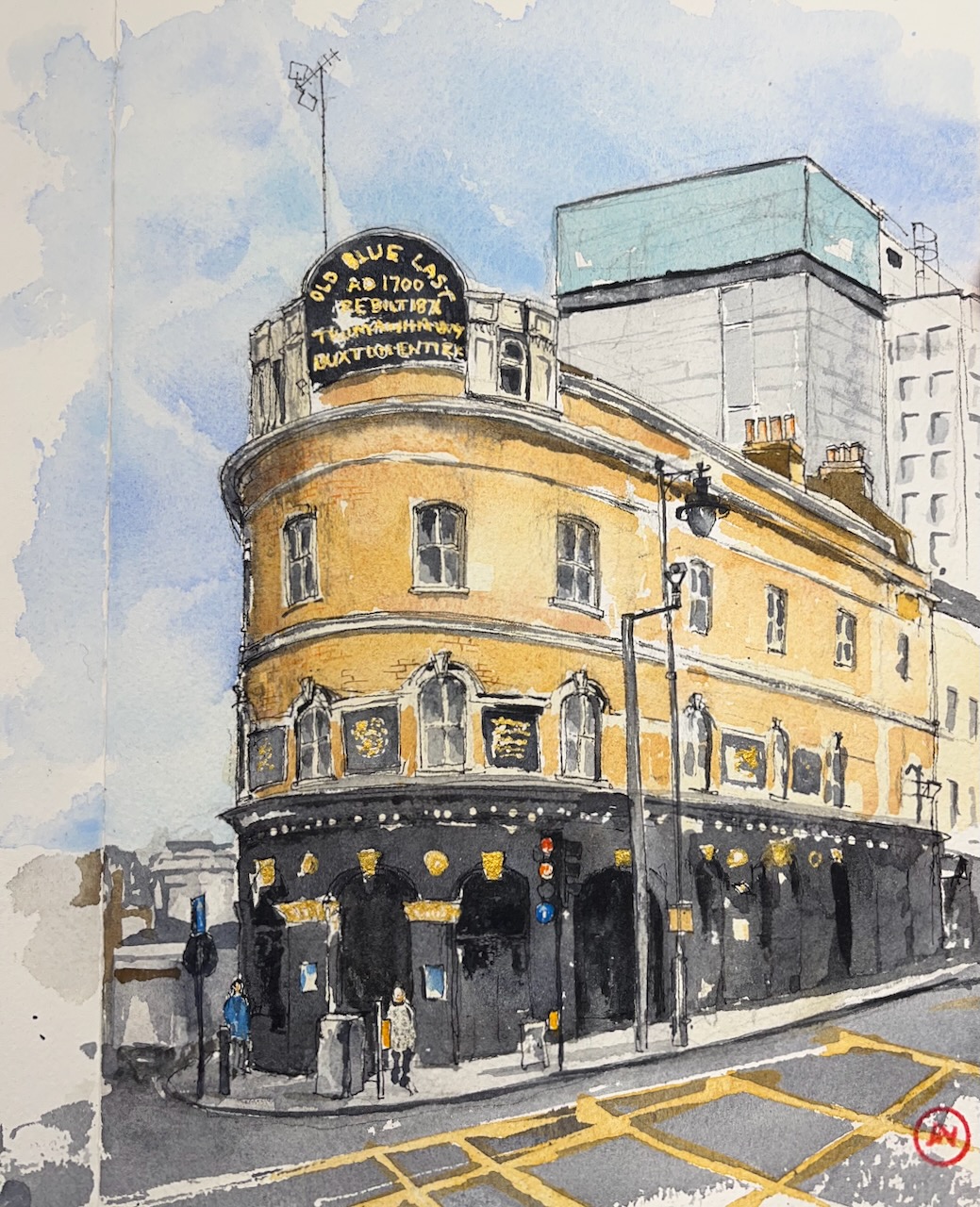
Yesterday, I went to look for “The Old Blue Last”, a pub which featured in a book I was reading.
“The Old Blue Last stood at the top of Great Eastern Street in Shoreditch, a snub-nosed, imposing three-storey brick building curved like the bow of a boat…..”
‘Career of Evil’ by Robert Galbraith, Chapter 12.
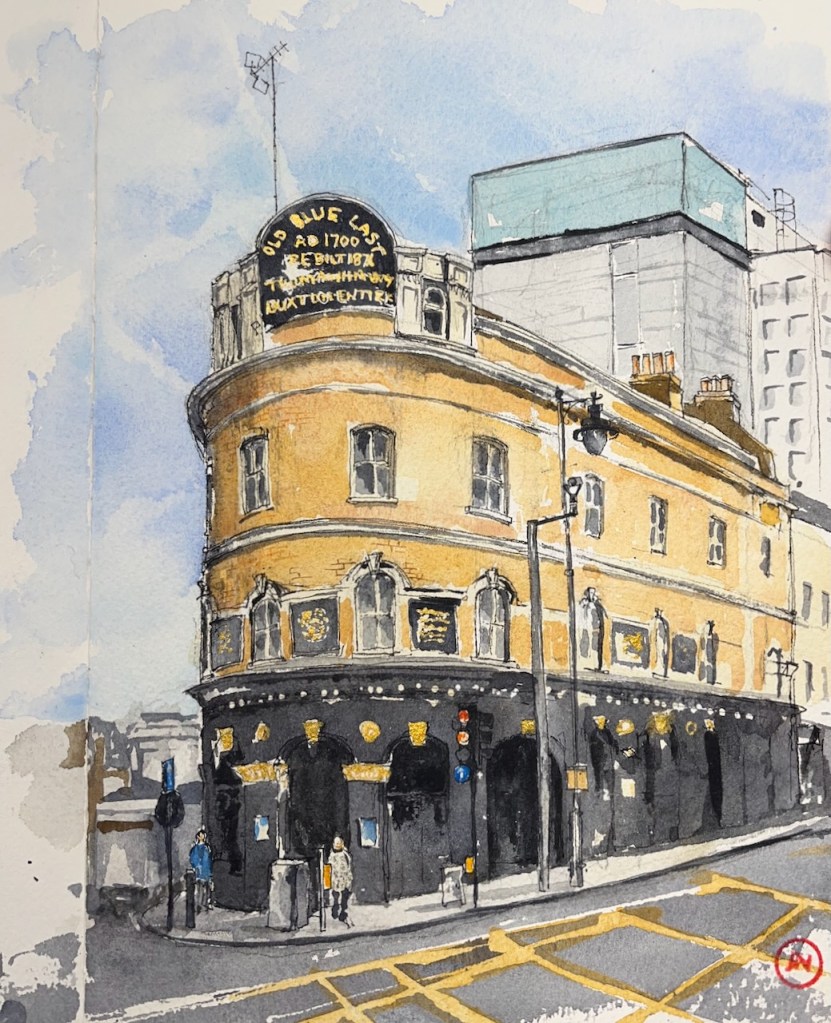
The Old Blue Last, Great Eastern Street, London EC2. Sketched on Wednesday 21st September in sketchbook 12.
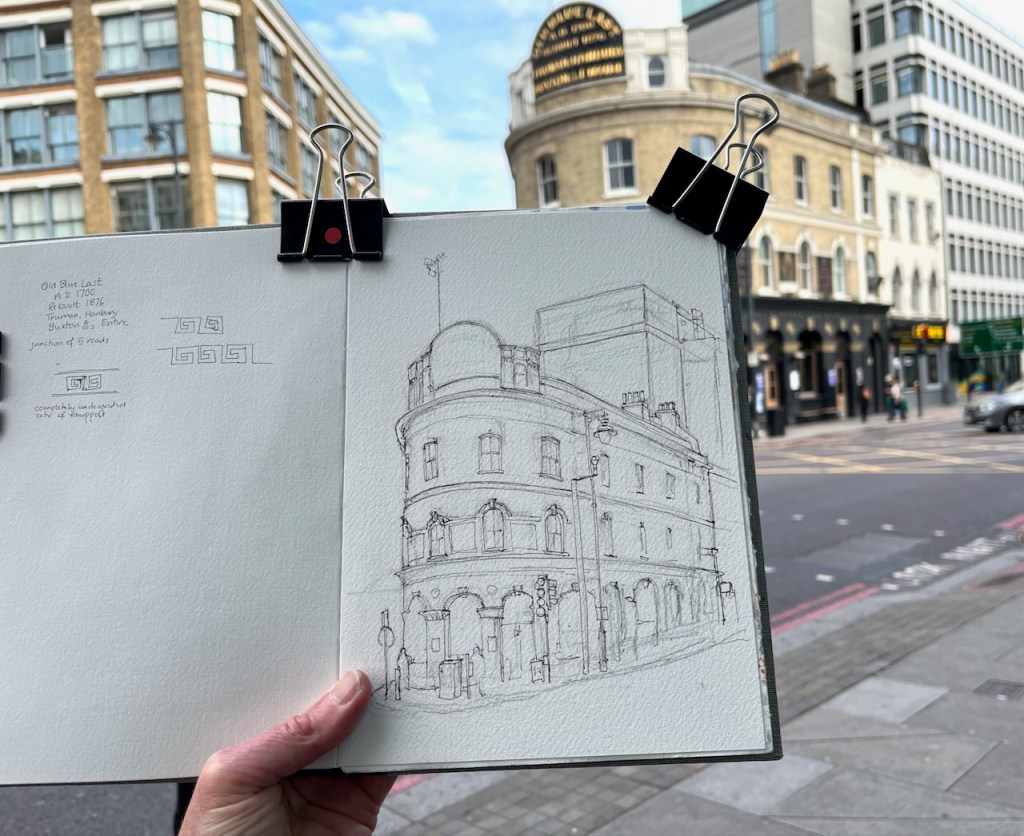
I sketched standing outside the estate agents Fraser and Co.
Map showing where I was standing, outside Fraser and Co, and my viewpoint. I later sketched “The Griffin” which is marked also.
This pub is now owned by “Vice Magazine” (“VICE is the definitive guide to enlightening information.”). Their website helpfully publishes a history of the pub:
“…in 1576 a venture capitalist named James Burbage built a venue called The Theatre where The Old Blue Last currently stands…..Eventually Burbage pulled down The Theatre and moved it south of the river, where it became The Globe….in 1700 a bar was built on the site of the old theater. It was called The Last, which, remarkably boringly, refers to a wooden block that a shoemaker uses to mold a shoe. The Last was owned by a brewer named Ralph Harwood, who went on to achieve a small level of fame when he was pronounced bankrupt one day by Gentleman’s Magazine…..In 1876, Truman’s brewery took over the pub. They pulled The Last down and rebuilt it as The Old Blue Last, which means “the old blue wooden pattern that is used to mold(sic) the shoe….Eventually Truman’s went down the toilet and Grand Metropolitan Hotels took over the OBL…[1970s, 1990s] —At that point, The Old Blue Last was a rough place full of rougher men and people who were afraid of being beaten up by them. It housed an illegal strip club and brothel, which was on the second floor…” [https://www.vice.com/en/article/ex575k/how-vice-bough-a-brothel-v10n12]
“Vice” bought The Old Blue Last in 2004 and turned it into a music venue.
Great Eastern Street is a very busy thoroughfare, taking buses, lorries, delivery vehicles and cars between the Old Street Roundabout and places East. I noticed the crowd of street furniture outside the pub. See the lamp post, which, though modern, attempts to imitate some of the Victorian features of the pub. The CCTV camera next to it, however, is strictly utilitarian, on its unadorned pole. I wonder why they didn’t put the security camera on the lamp post. They are only about 3 feet apart.
I tired of the pounding noise of Great Eastern Street, despite the friendly location outside Fraser and Co. One of their employees, mobile phone clutched in his hand, paused and commented favourably on my drawing, as he re-entered the office. People passed by wrapt in intricate conversations about modules, funding agreements and childcare issues. After I finished the pen drawing, I retreated into the quiet back streets.
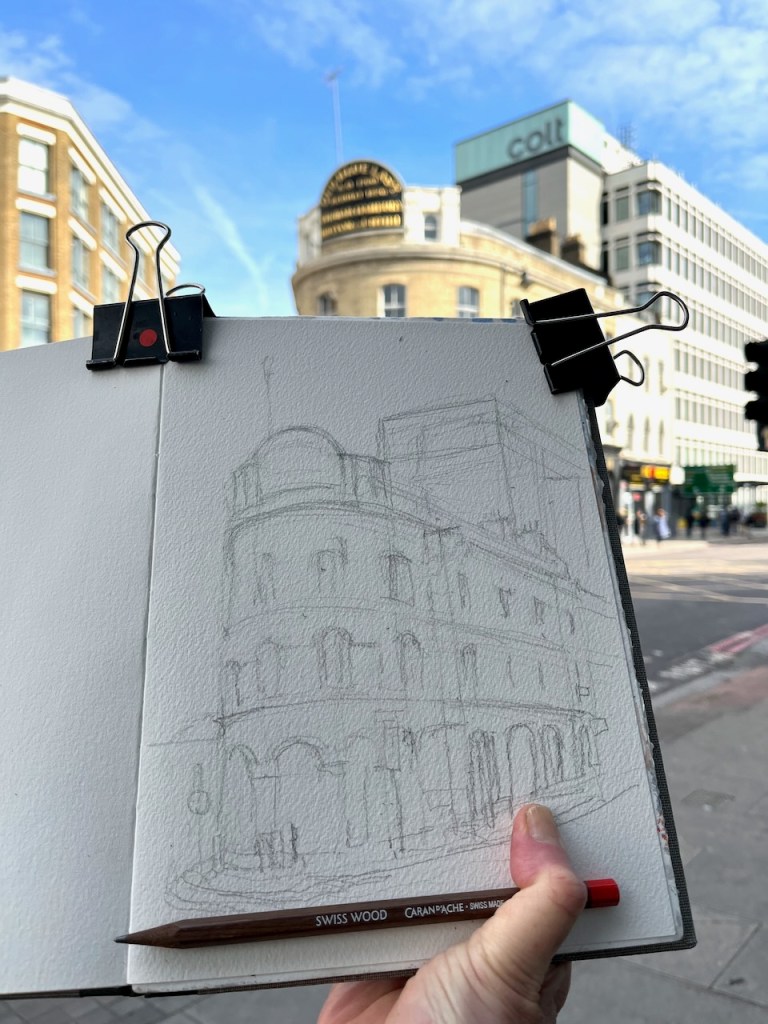
PencilPen
I added the colour later, at my desk.
The colours are:
Ultramarine Blue and Lavender for the sky and street signs, Mars Yellow and Burnt Umber for the brickwork, with some Fired Gold Ochre. The black is made of Ultramarine Blue and Burnt Umber. There’s some Cobalt Turquoise Light on the Colt Technologies building behind the pub. I used acrylic gold paint by Liquitex to pick out the gold on the pub, including the lettering.
Click a button below to share this post online, email it, or print it:
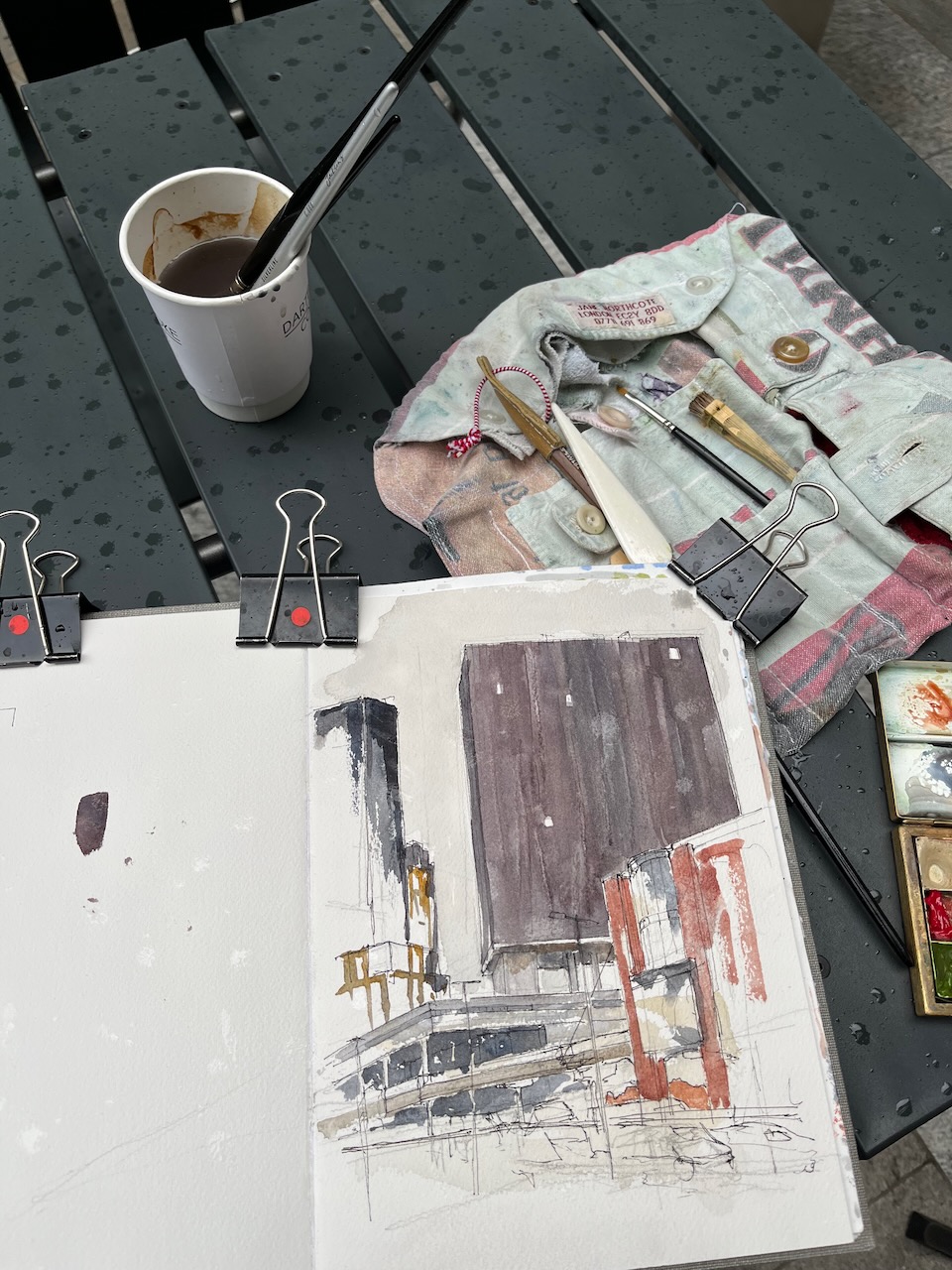
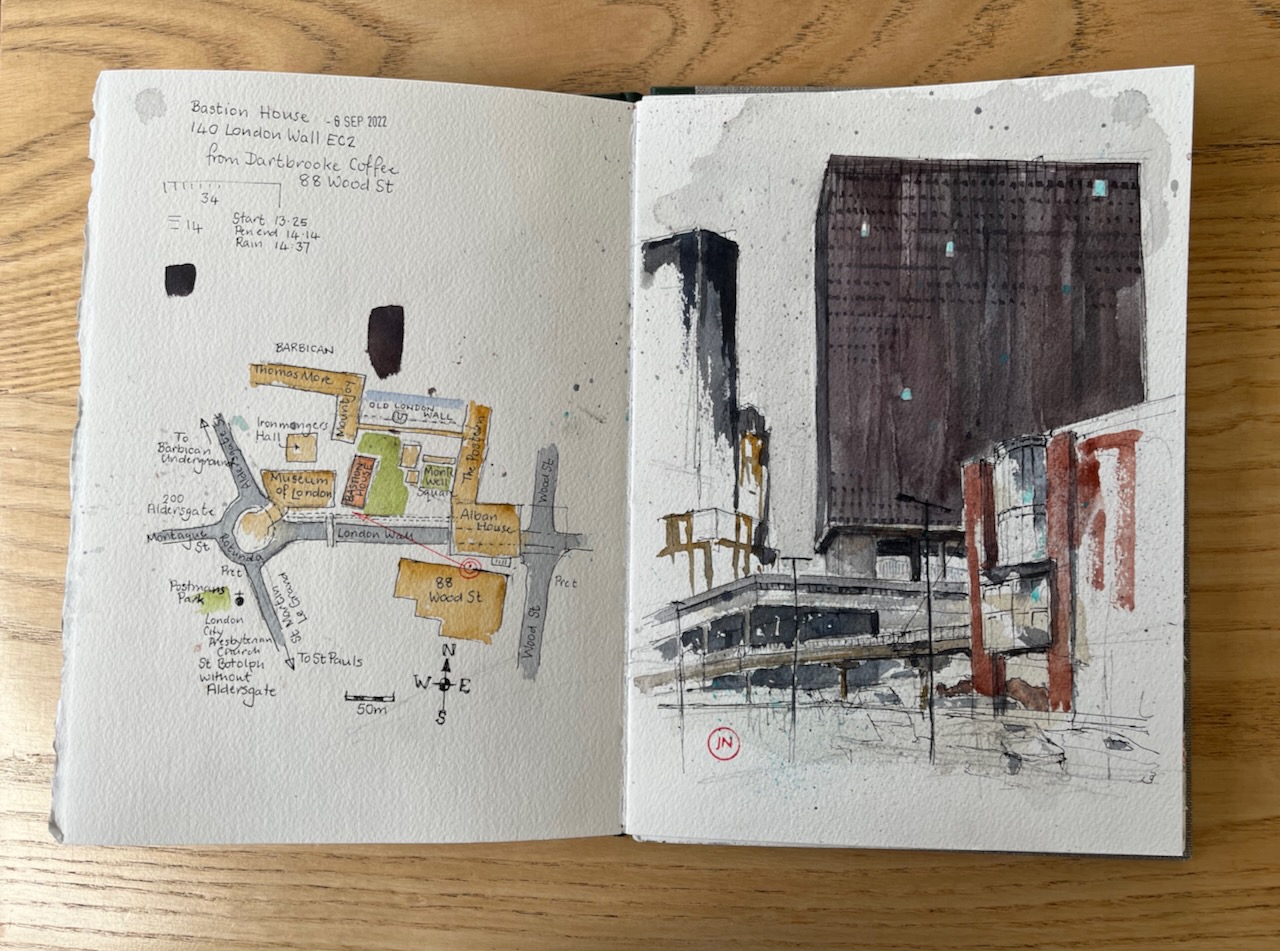
I sketched this from the outside tables at 88 Wood Street. A small coffee shop run by Dartbrooke Coffee has opened in this office block. The coffee was superb, the welcome warm, and they had a selection of food. Also they had tables both indoors and out. Here’s the view from an outdoor table overlooking London Wall.
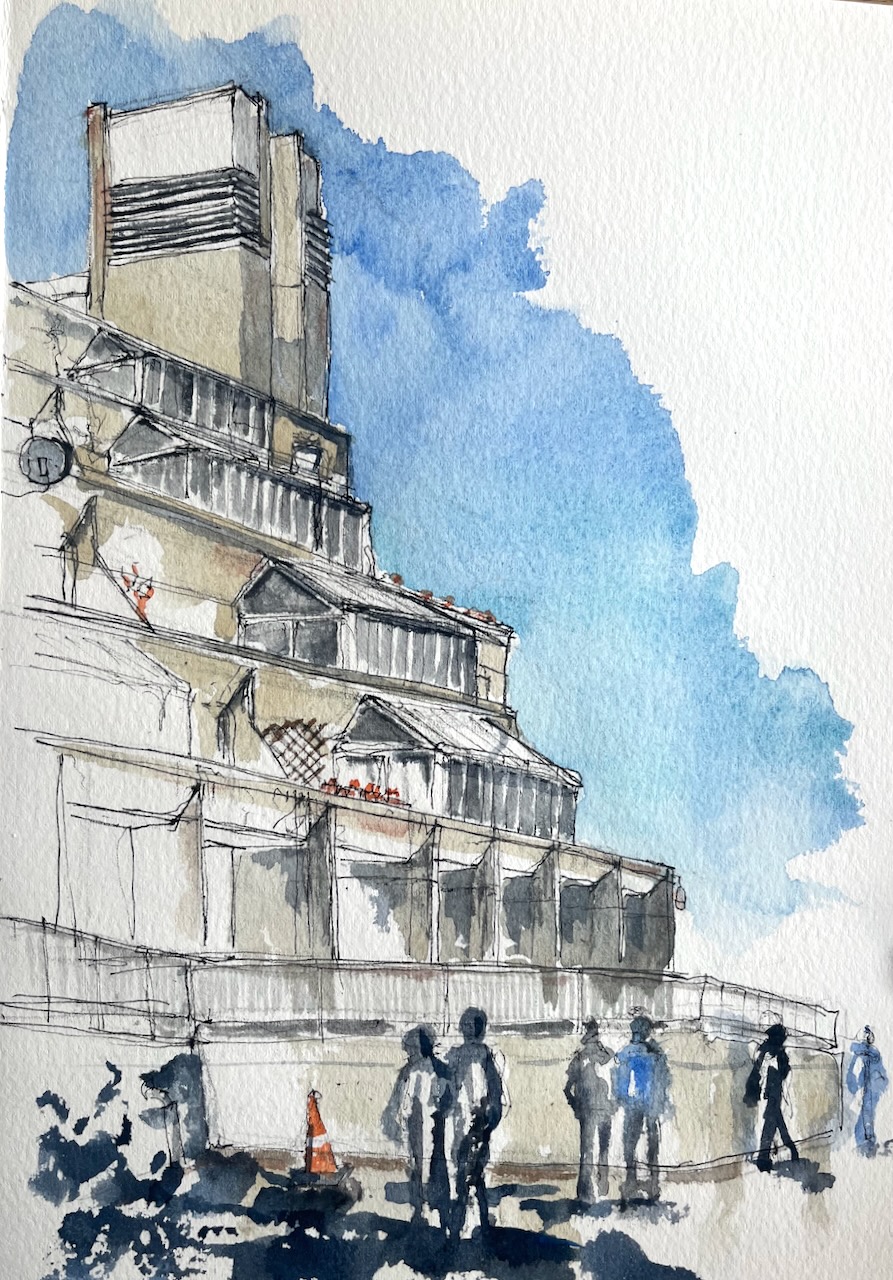
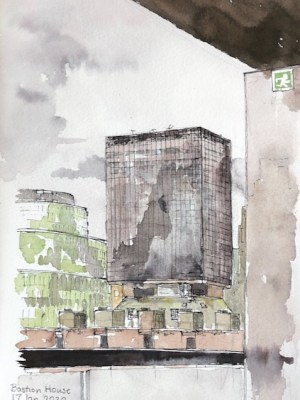
Bastion House EC2 from 88 Wood Street, 6th September 2022 in Sketchbook 12
I liked all the angles.
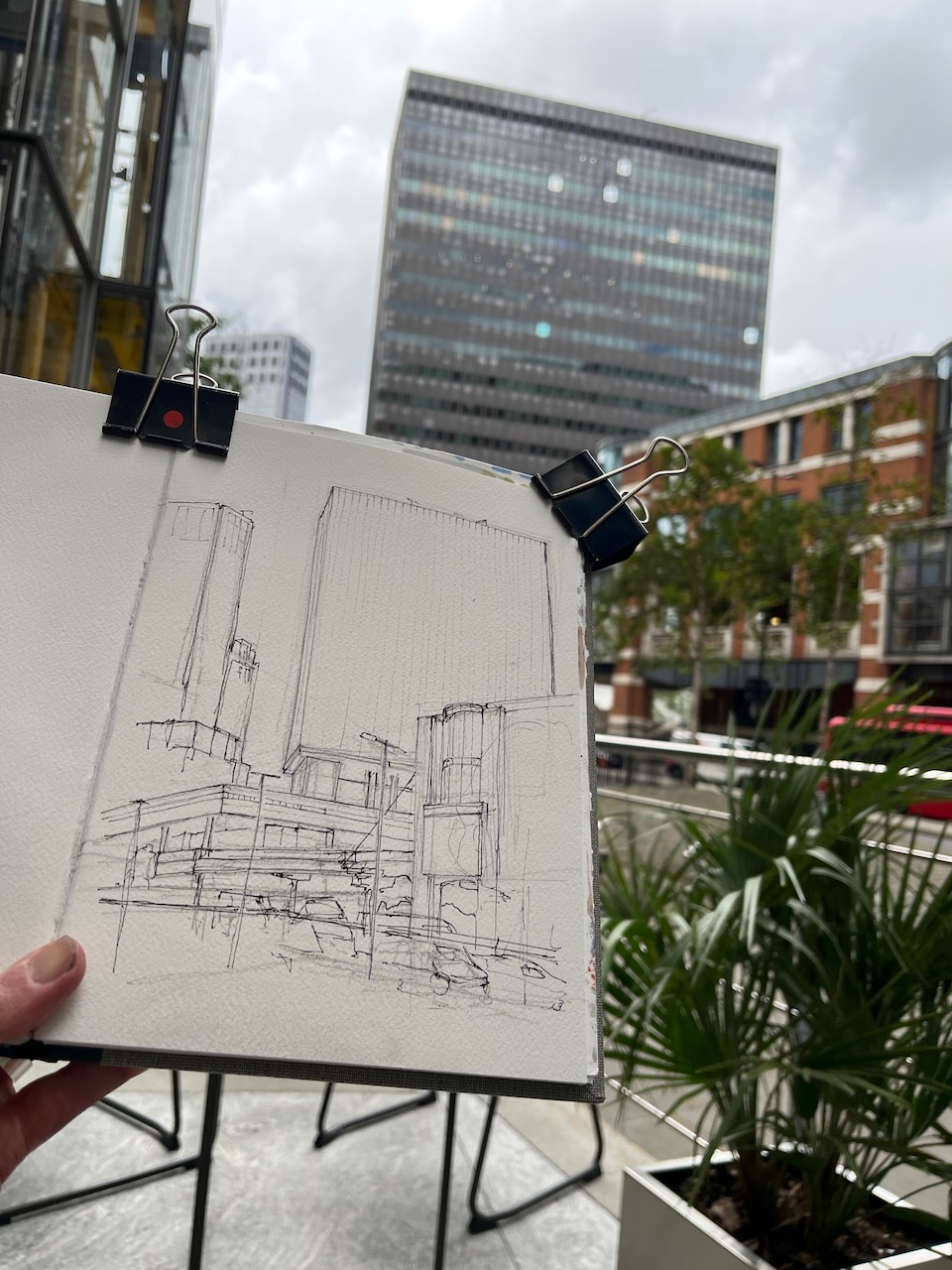
That’s rain you see in the sky. I had to pack up quickly as the rain came down.
Rain on the painting!
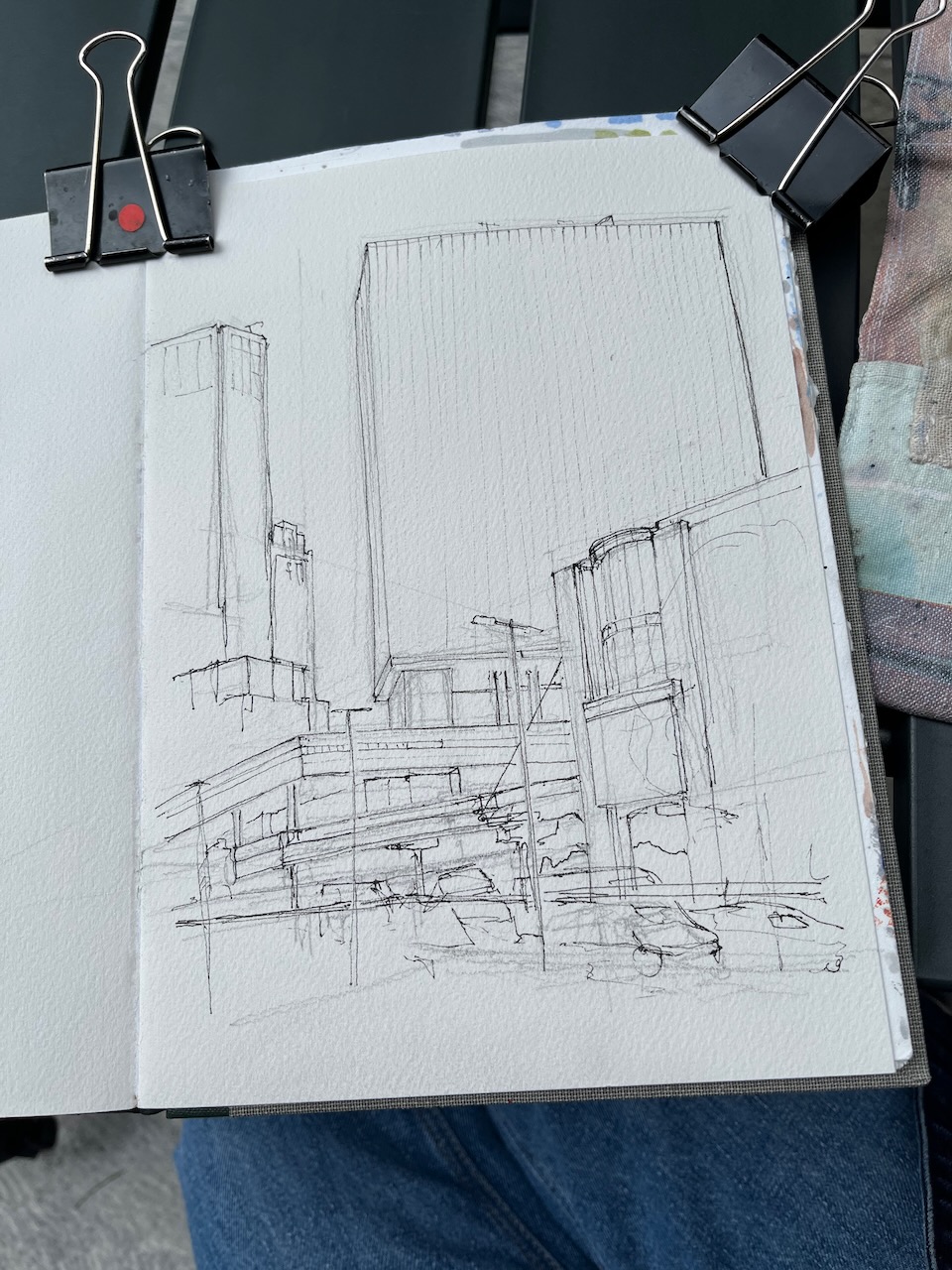
This picture took 1hour 10 minutes up to the point in the photo above when it started raining. Then another 20 minutes at my desk to finish off.
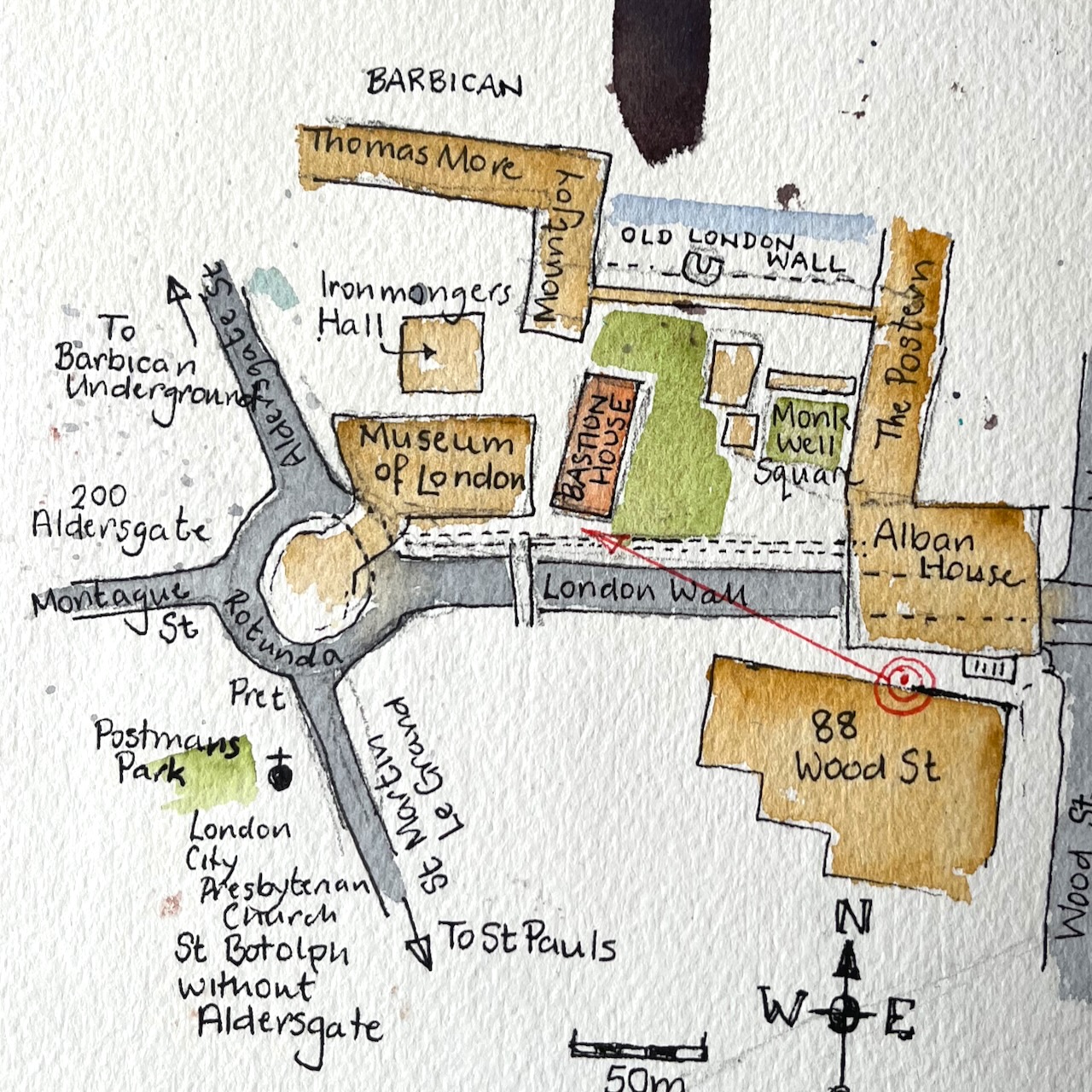
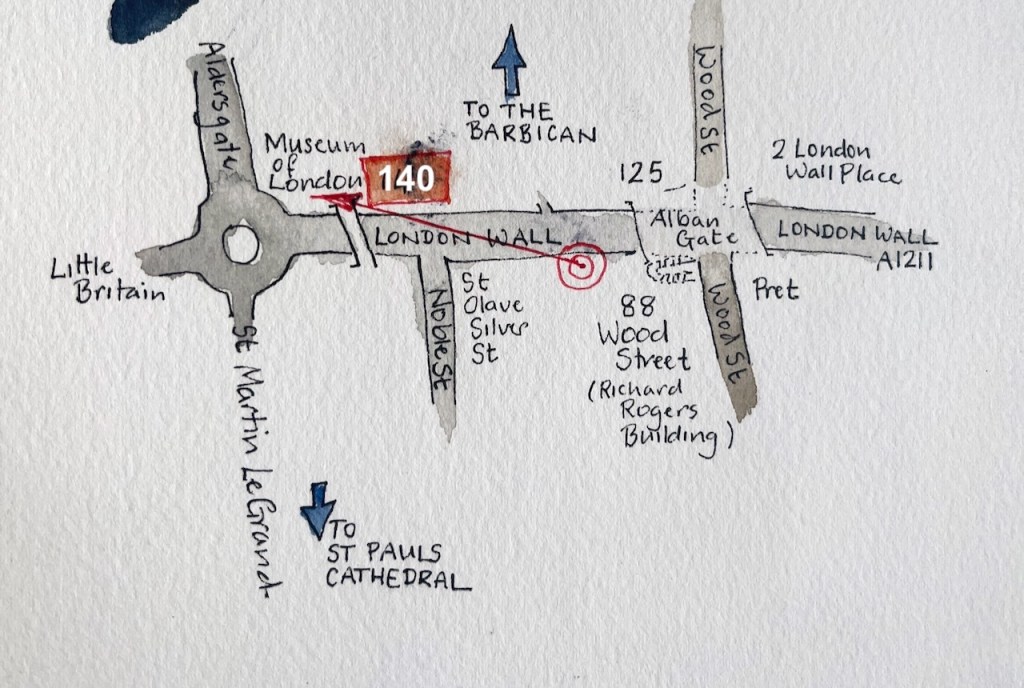
Here’s a map. The building on the left of my drawing is 200 Aldersgate, a huge office block.
Map showing where I was sketching and my viewpoint.
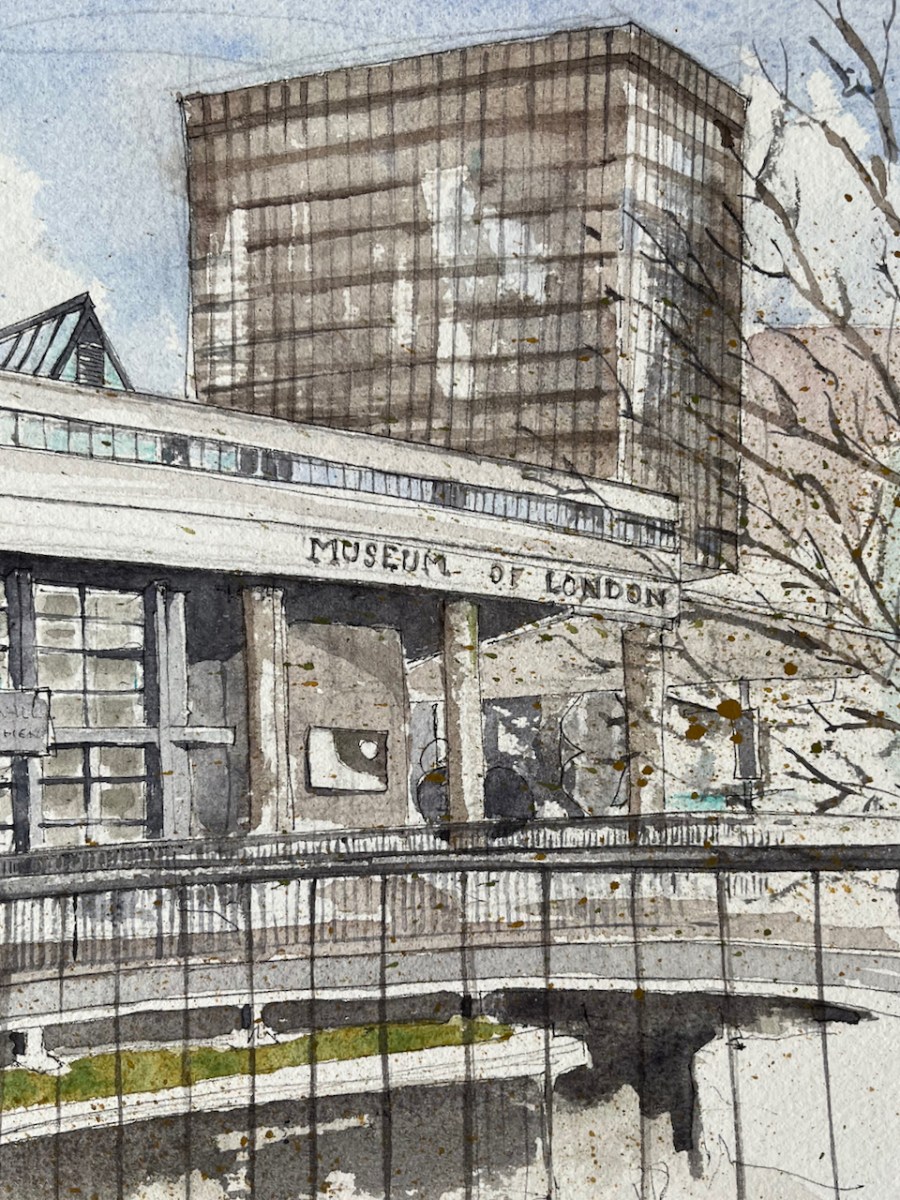
Bastion House is the monolith in the centre of the picture, with the Barbican Highwalks below leading to the Museum of London.
Bastion House, the Highwalks, and the Museum of London are all under threat of demolition by the City of London and replacement with three huge office blocks, overshadowing the Barbican. All the bridges will be removed, and all the highwalks in this area. This is not a good idea, in my view, and I support the residents’ call to the City to stop and think. Do we need yet more huge office blocks…really? Can we not refurbish the existing buildings, as has happened successfully to nearby blocks?
Earlier this month, I made a quick sketch of Bastion House, from London Wall. Here’s a map: The architect was Philip Powell of Powell and Moya. The building…
Bastion House aka 140 London Wall is a huge modernist monolith, reminiscent of the monolith in “2001 – A Space Odyssey”. I couldn’t find a site to draw…
I hastened to draw the magnificent Bastion House, on London Wall. It is due for demolition. In the foreground you see the balcony and privacy screen of the…
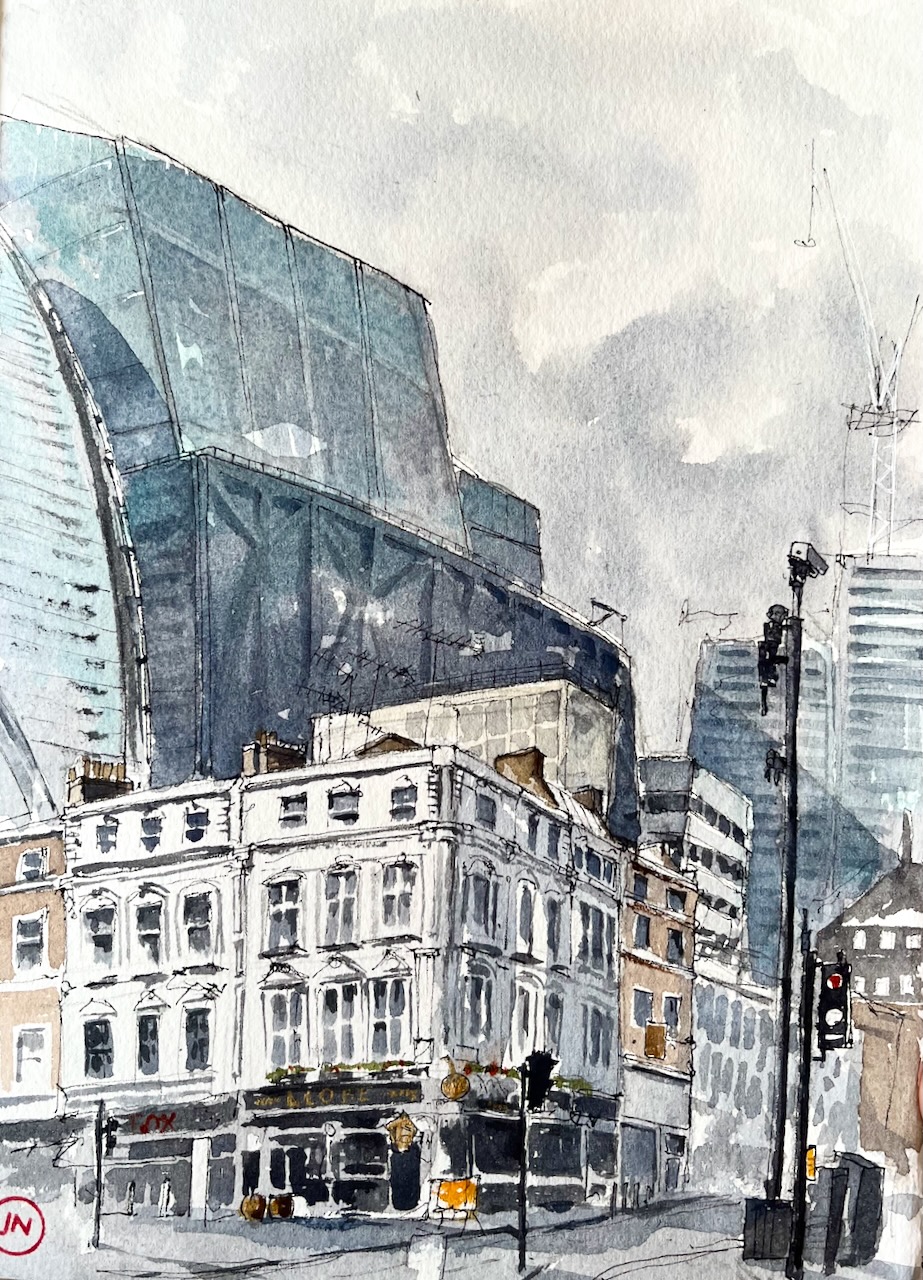
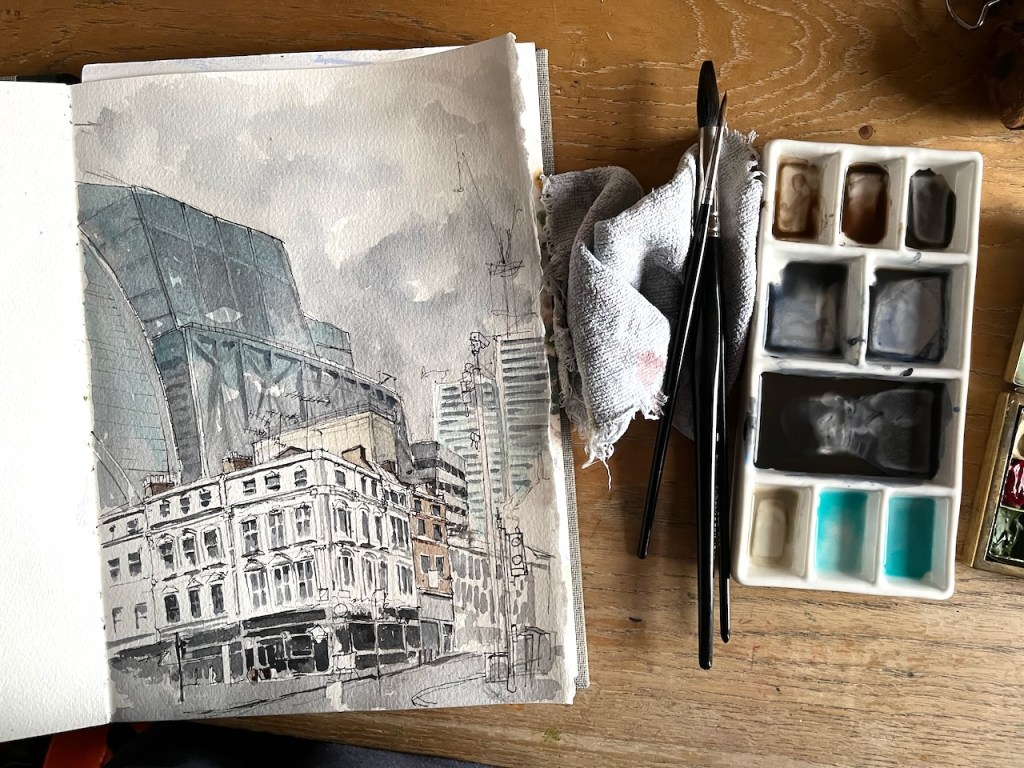
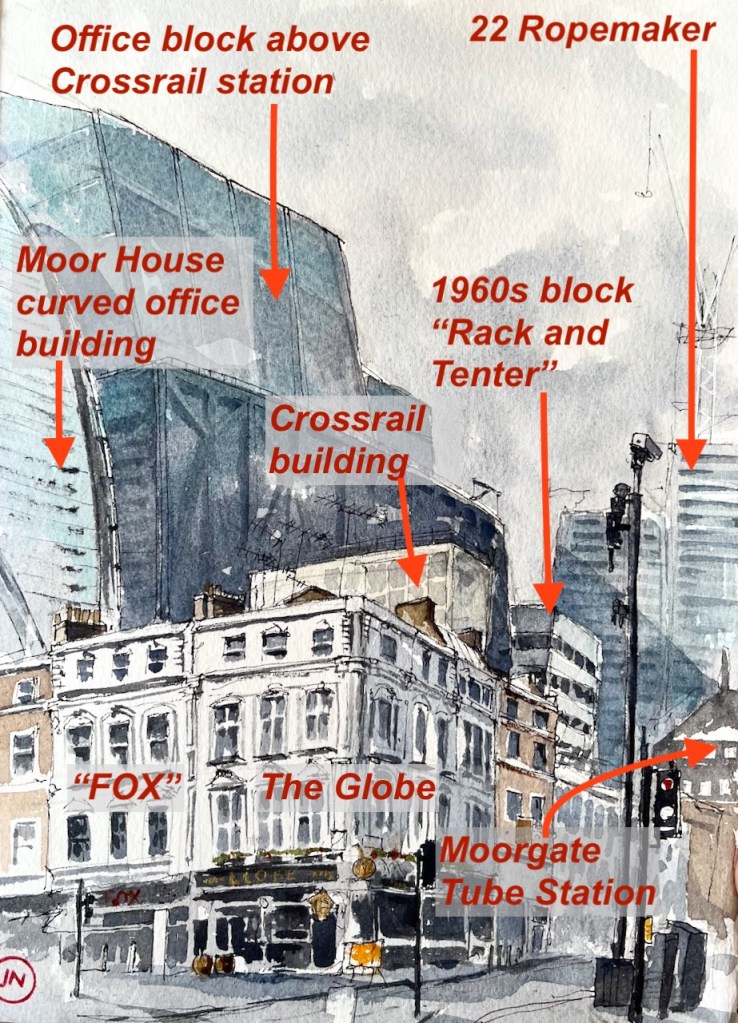
The Globe Moorgate is a magnificent Victorian pub, standing boldly on the corner of London Wall and Moorgate. As you see, it is in the midst of more recent developments. The huge office block you see in the centre left of my drawing is still under construction. It is above the new Crossrail station at Moorgate. Crossrail is now called “the Elizabeth Line”. In the background there are two further blocks going up. These are 22 Ropemaker, on Ropemaker Street.
The Globe Moorgate, EC2, sketched on 29 August 2022, at 5pm in Sketchbook 12
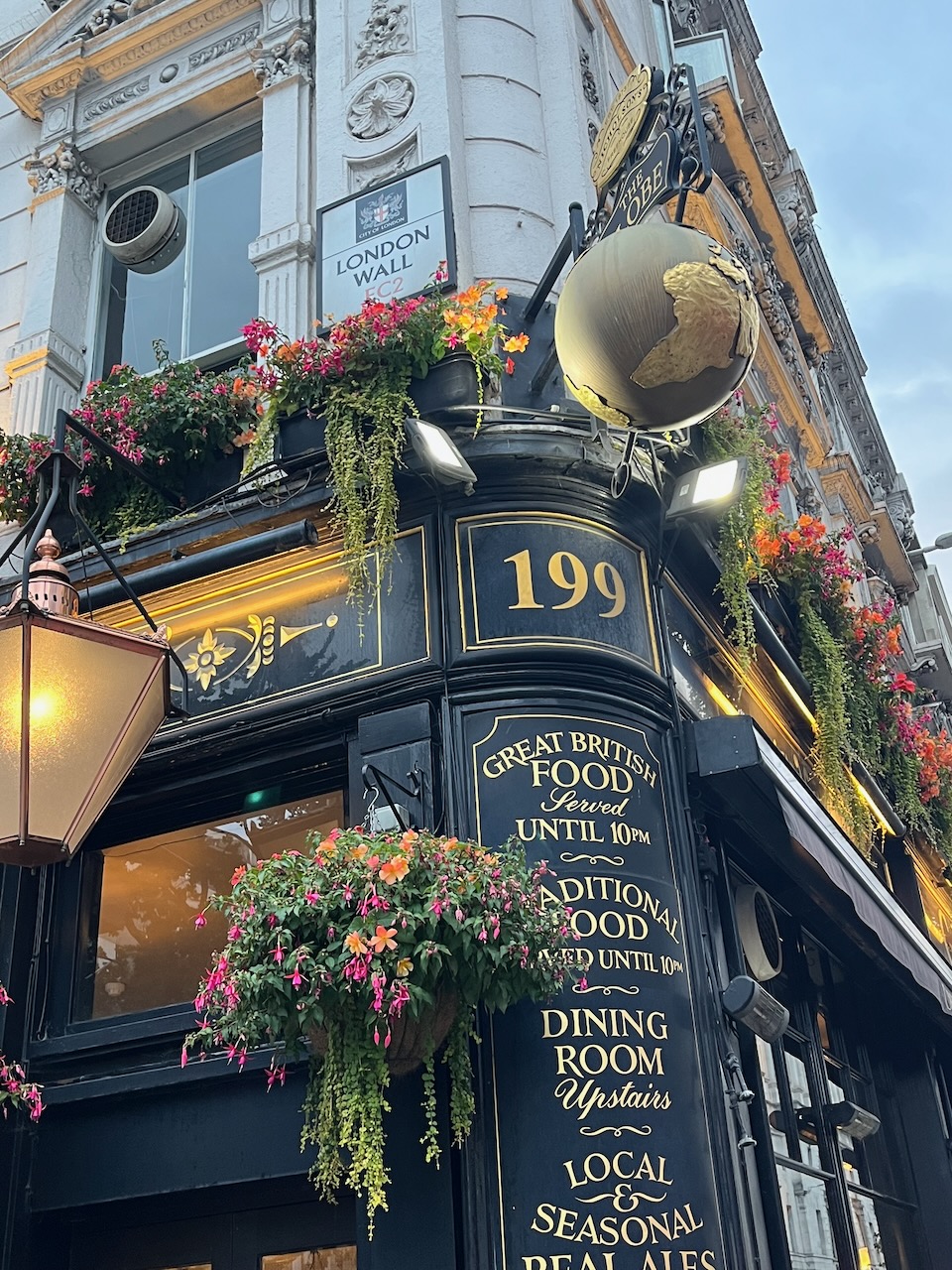
There are various curious things about The Globe. On the corner is the prominent number “199”. You’d think that was the street address, but no, the Globe is 83 Moorgate. I can’t discover where this “199” came from.
The corner of The Globe: “199” in huge lettering. But the Globe is number 83 Moorgate.
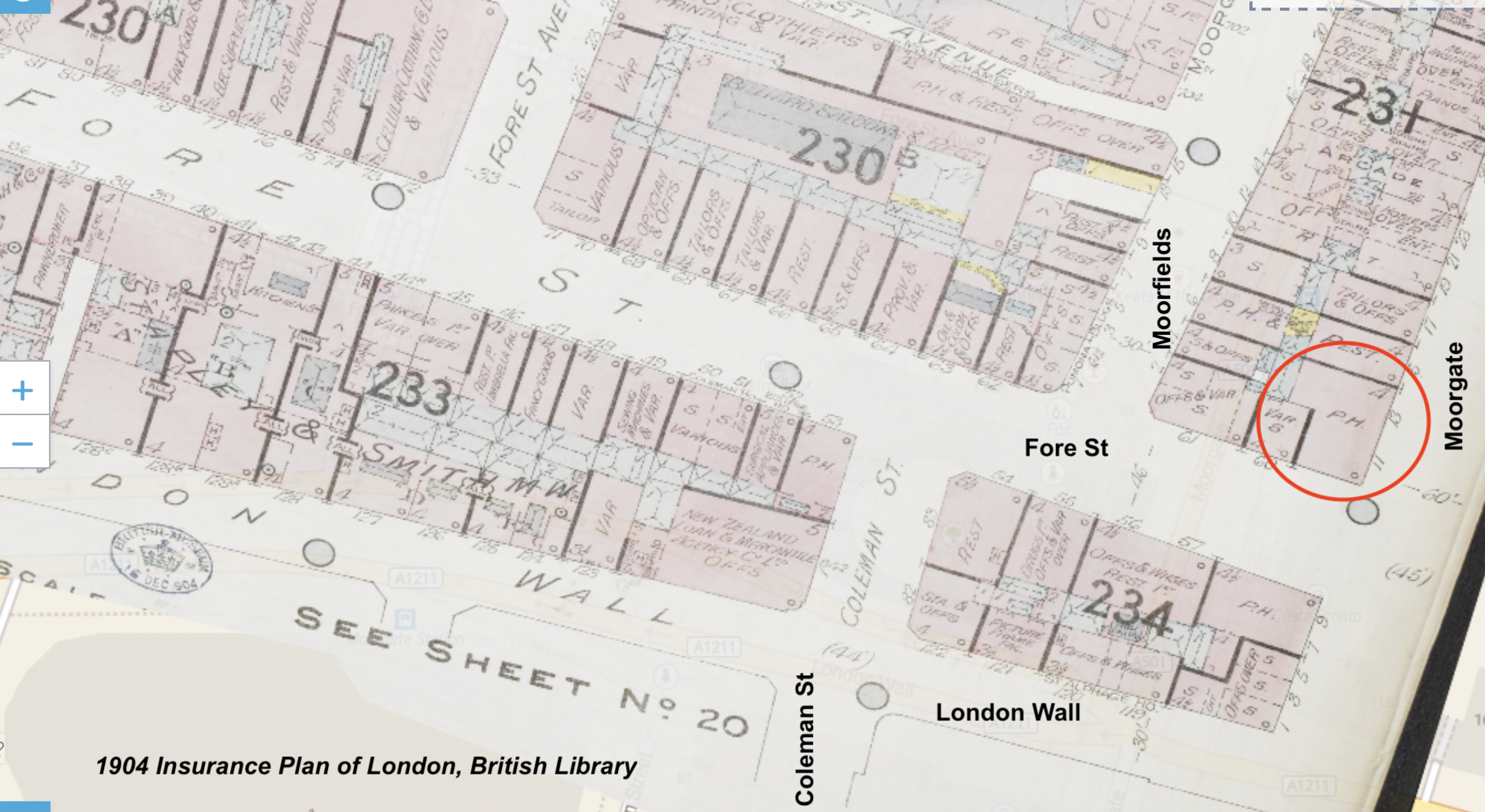
Here’s a 1904 map. The street layout was different then. Fore Street went all the way to Moorgate. But still it’s easy to identify the Globe. On this map it is numbers 11 and 13 Moorgate, certainly not number 199.
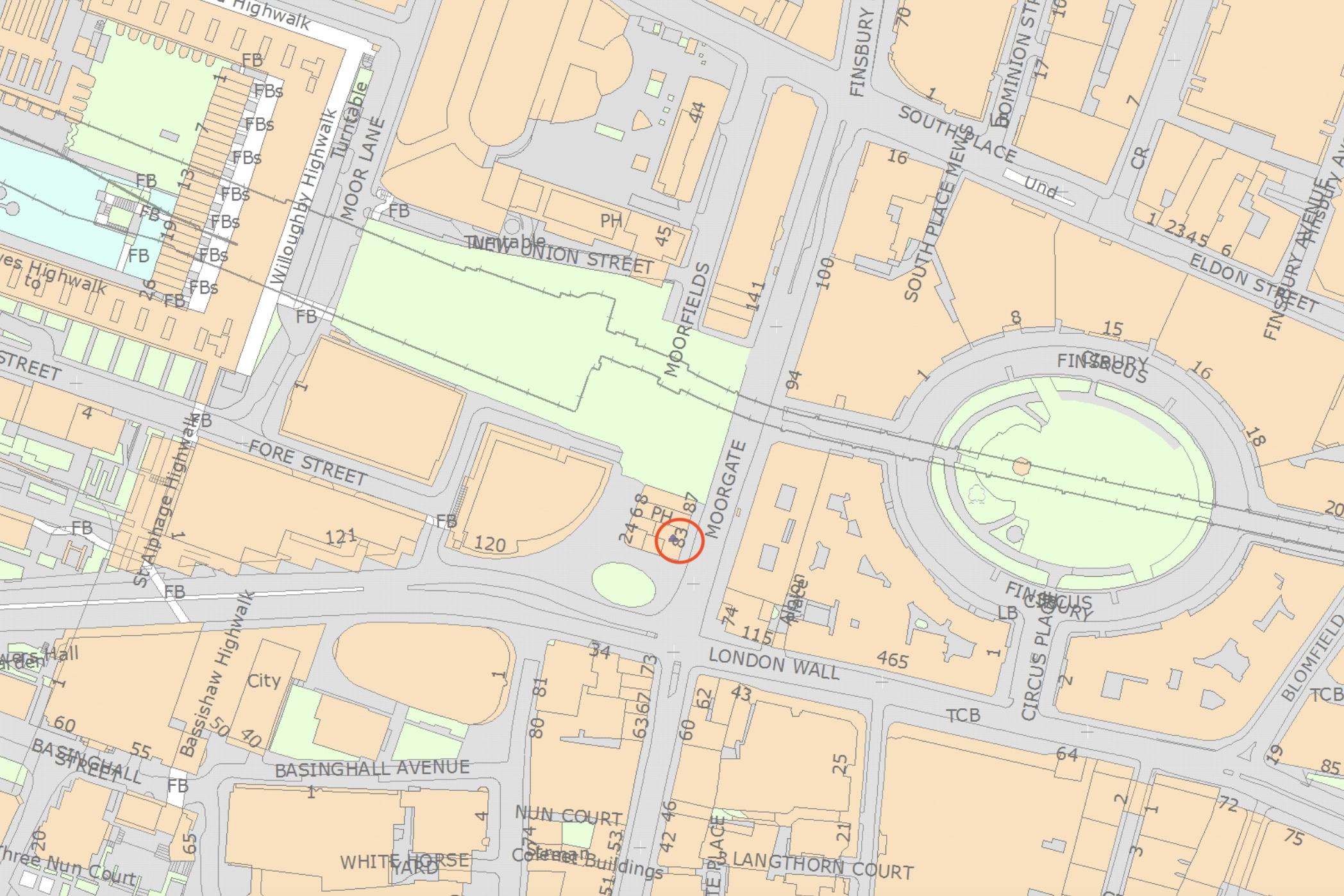
Here’s a map from the Historic England Listing entry for the Globe. This is a 2022 map. The Globe, ringed in red, is shown at number 83.
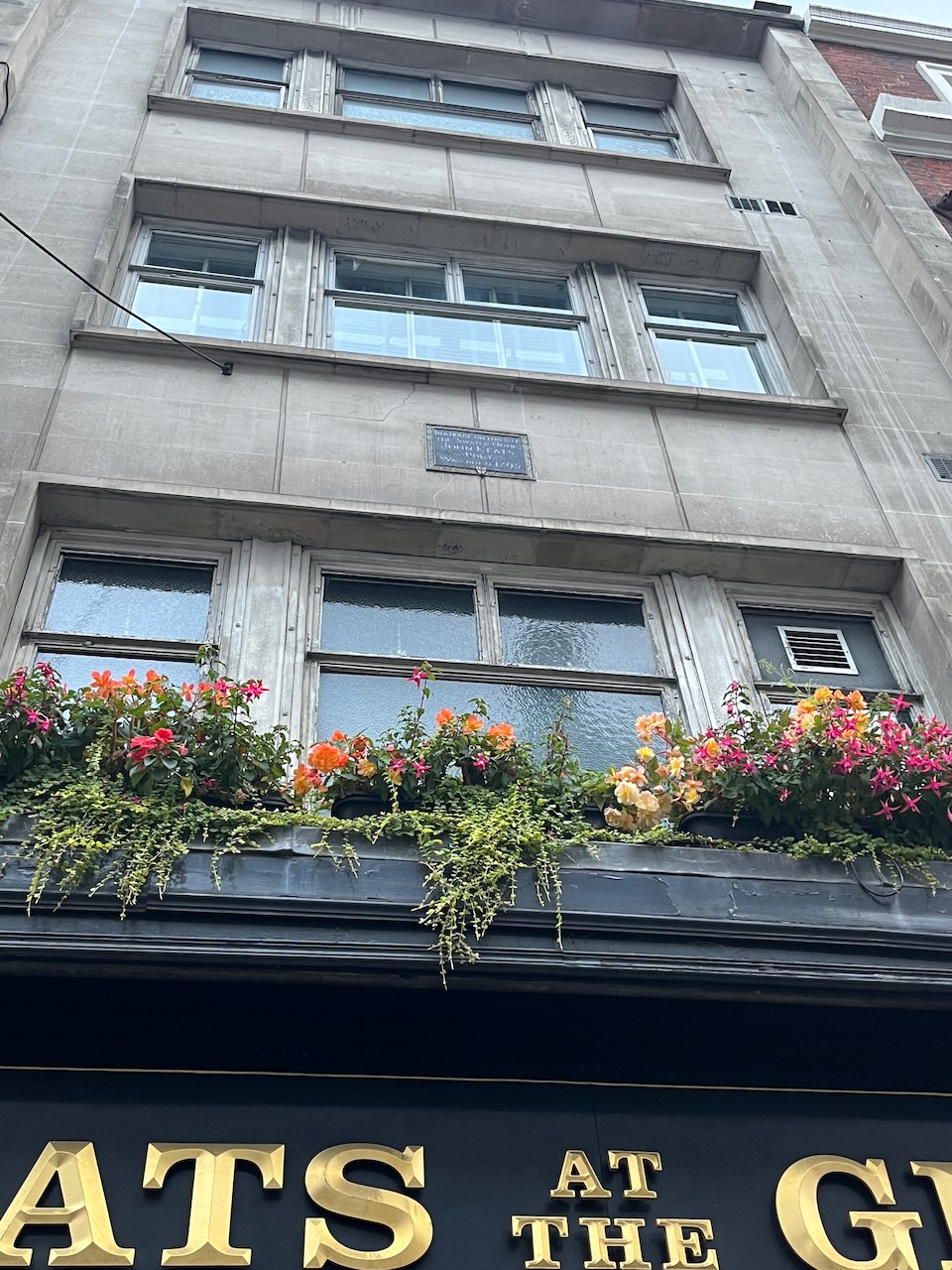
Another interesting thing about the Globe is that it recently absorbed an adjacent pub. There used to be a pub right next door called the John Keats. This was absorbed by The Globe in 2008, according to this Evening Standard article. The connection to John Keats is described on a plaque high up and difficult to read. It says:
IN A HOUSE ON THIS SITE THE “SWAN & HOOP” JOHN KEATS POET WAS BORN 1795
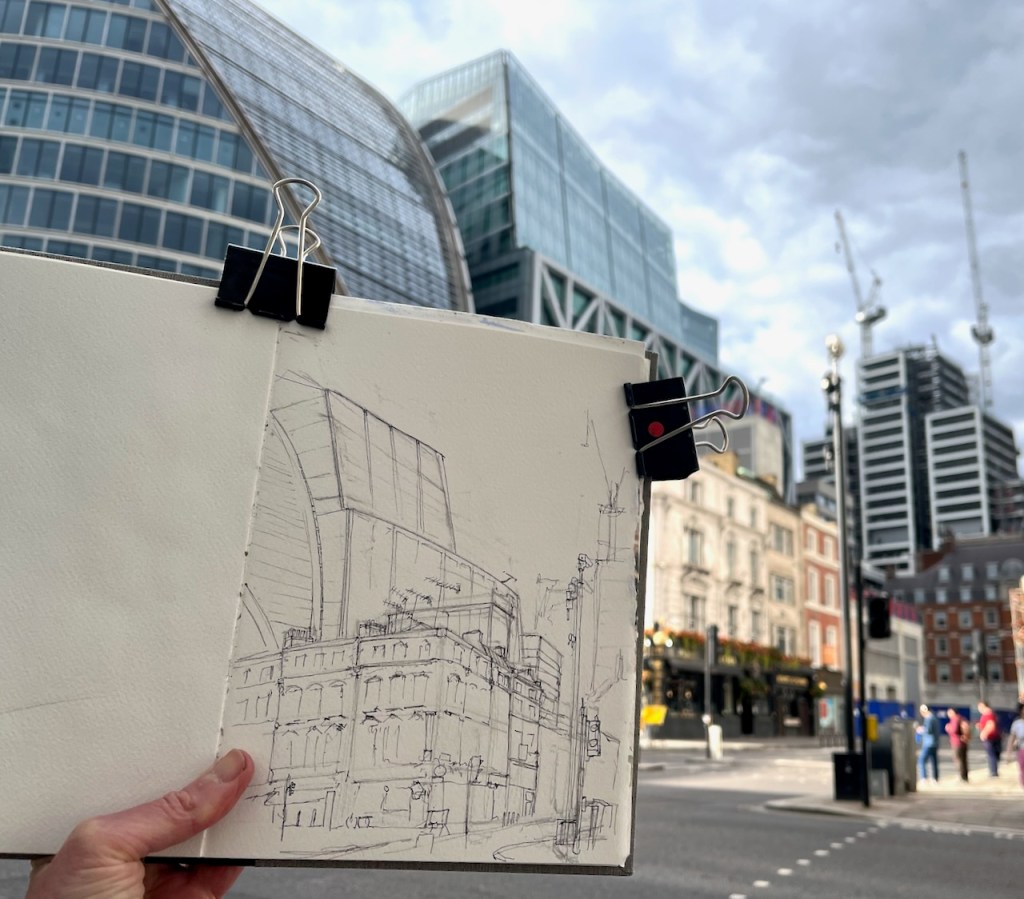
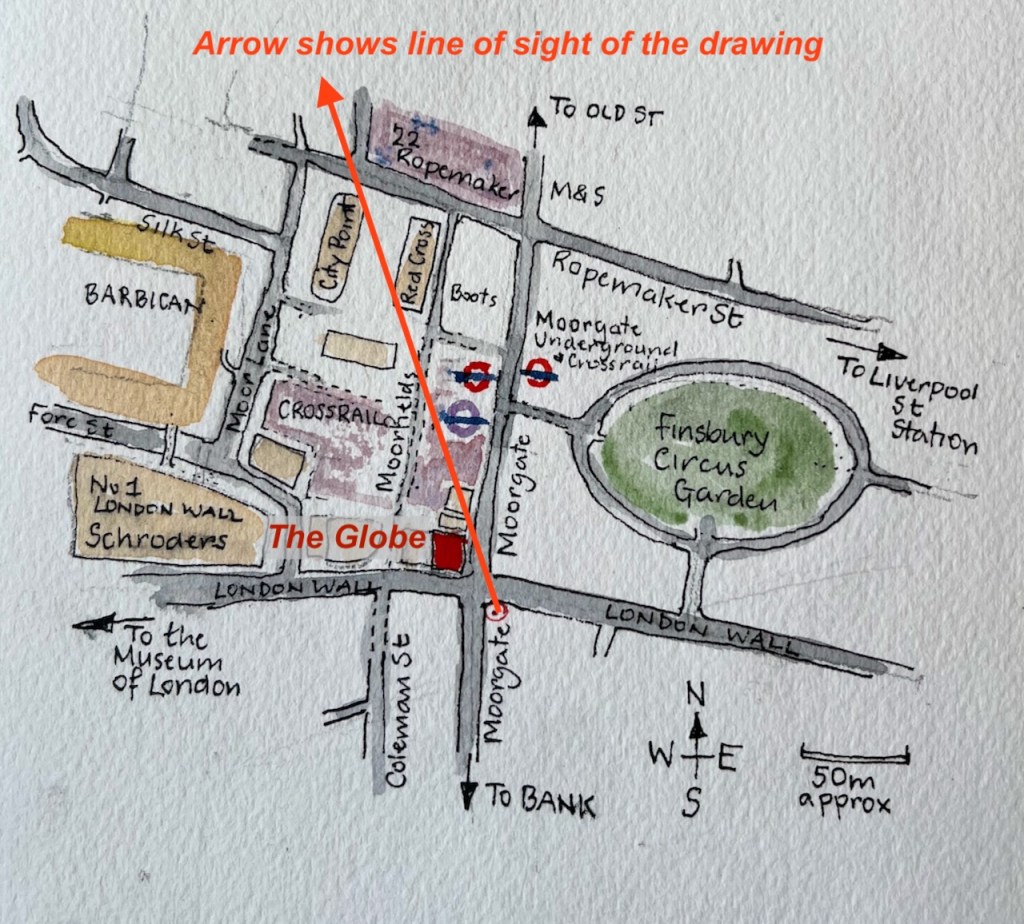
I sketched The Globe from across the junction of London Wall and Moorgate. As it was a Bank Holiday the junction was not as busy as normal. But it was still pretty busy. After a while I had had enough of the people passing in front of me, and the buses and the noise, and I packed up and finished the drawing at my desk. Here is work in progress and another map, showing the direction I was looking.
Here are all the buildings, labelled:
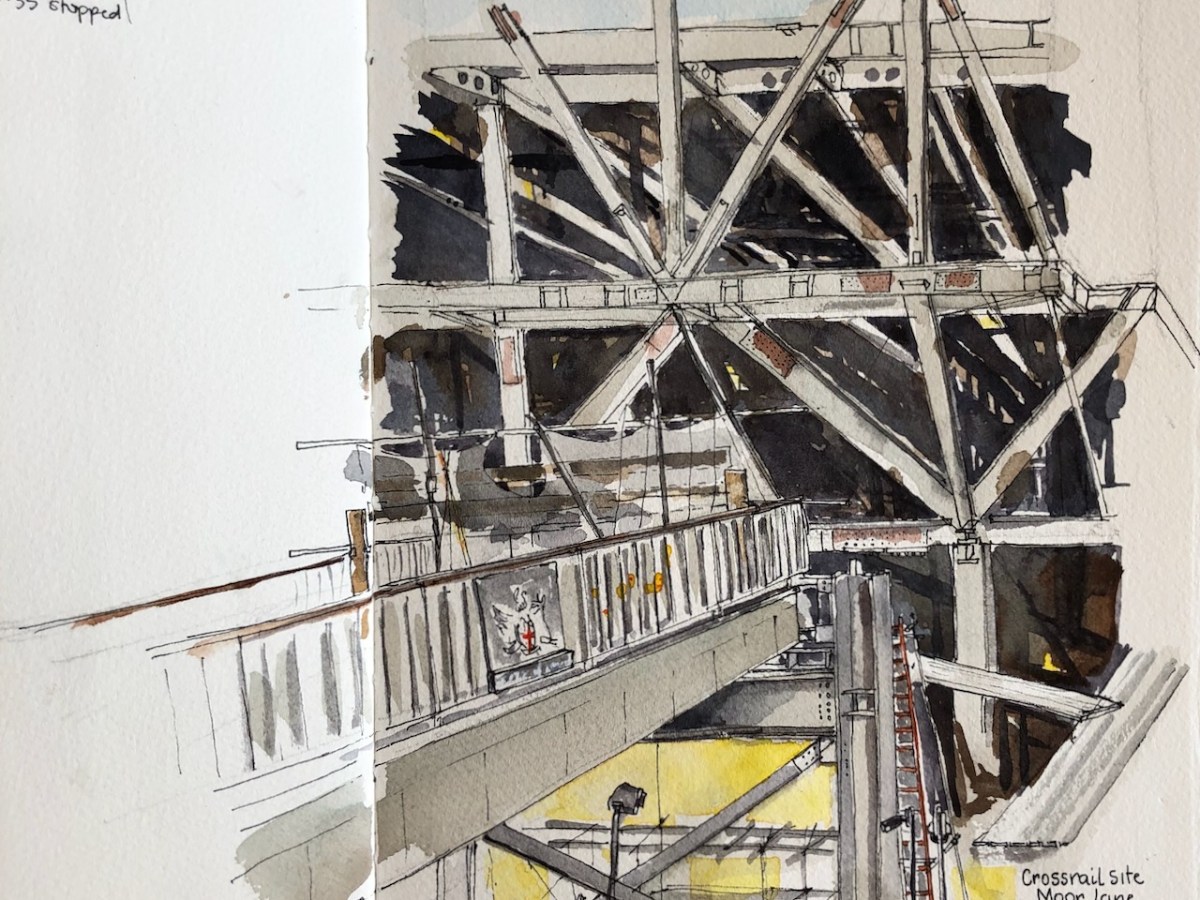
The office block above the Crossrail station is a stupendous feat of engineering, because essentially it is built across a great hole in the ground. From the Barbican Podium on the other side, I saw the great struts, spanning the gap. It is built like a bridge. I drew a picture in this blog post (May 2020):
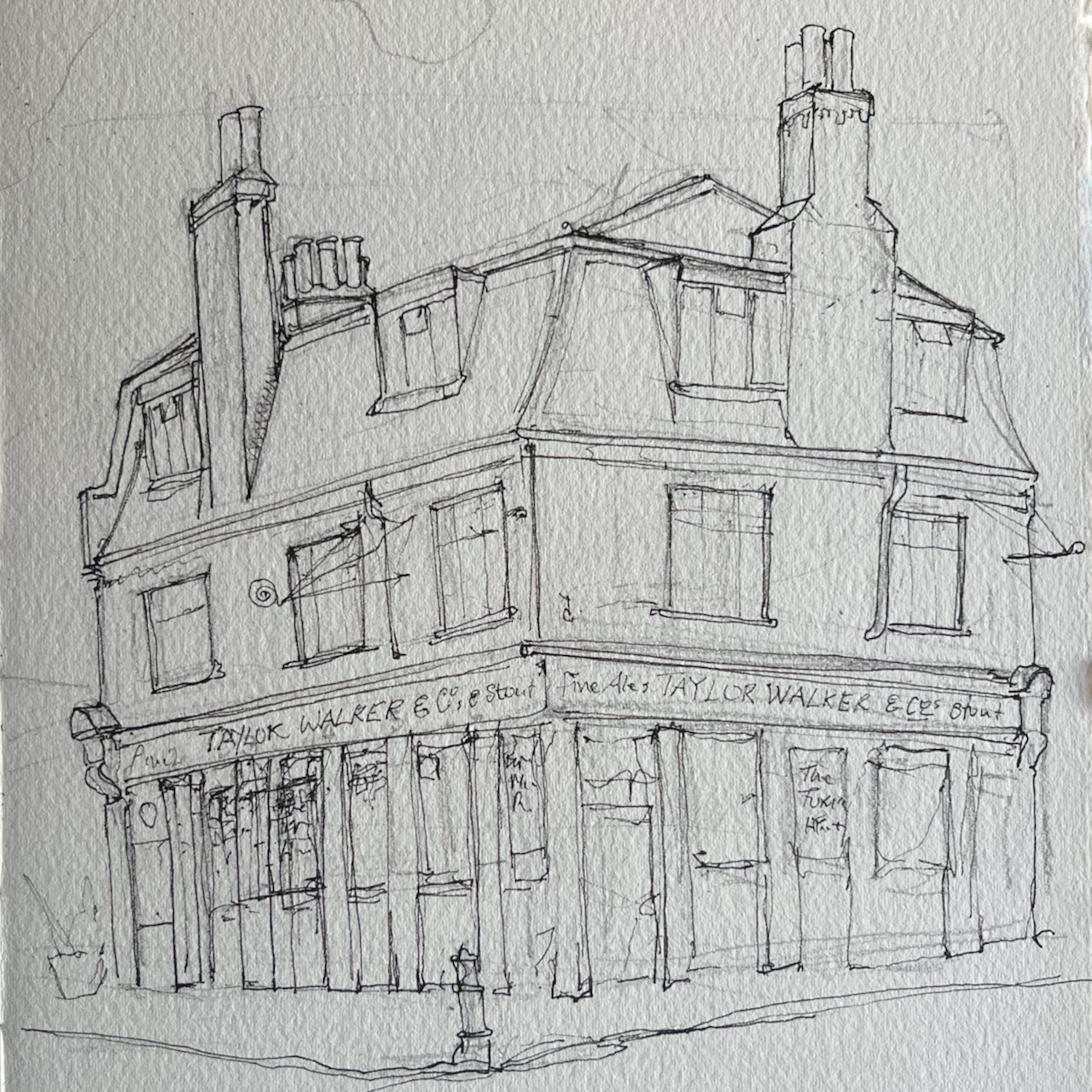
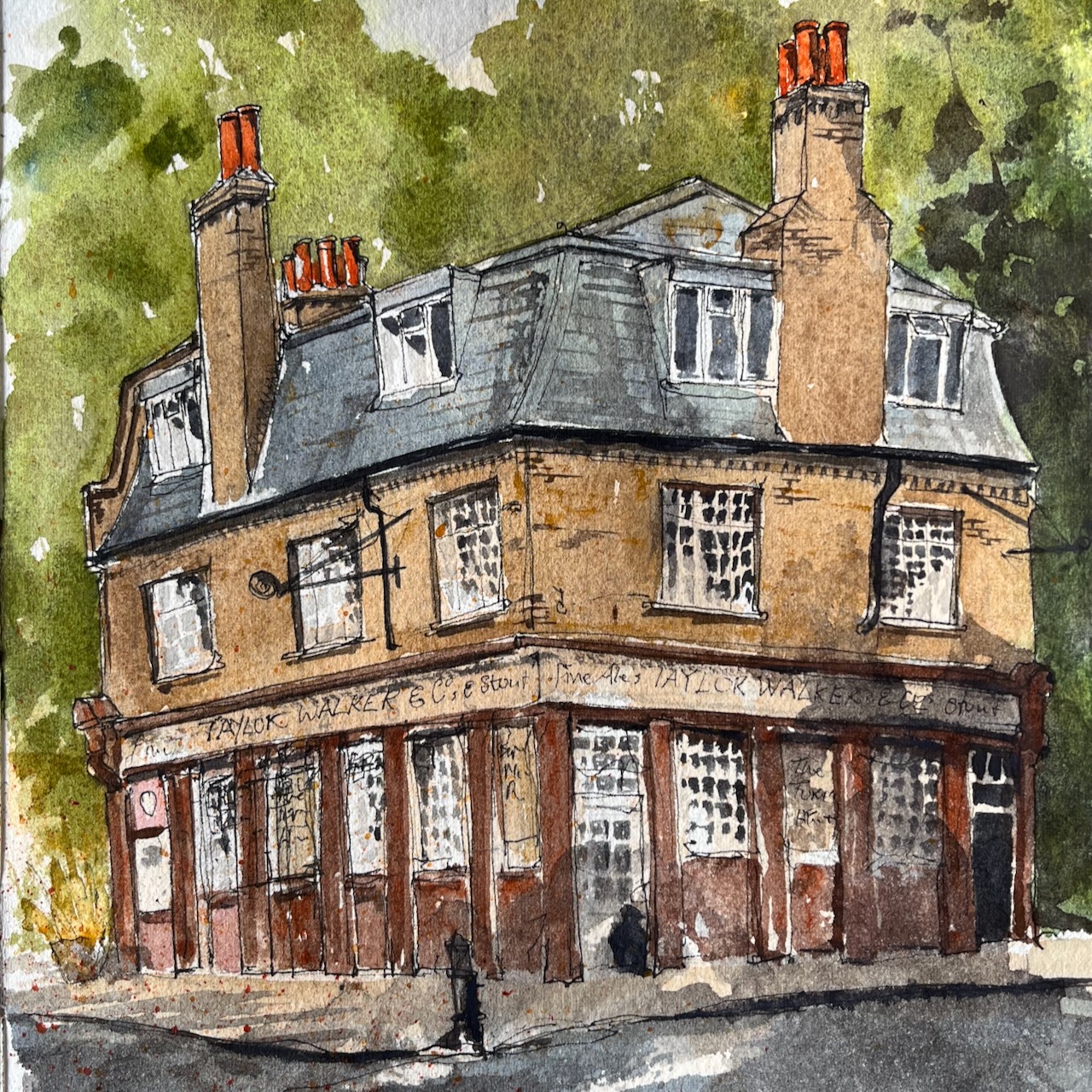
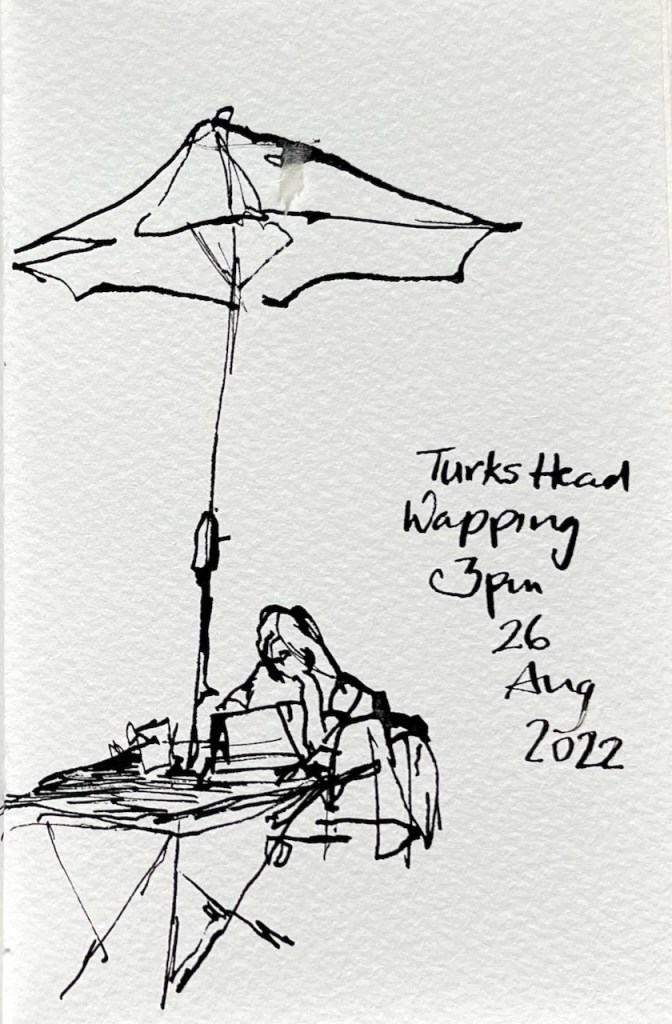
I walked to The Turks Head Wapping: a restaurant among trees. After a splendid lunch, I sketched the building.
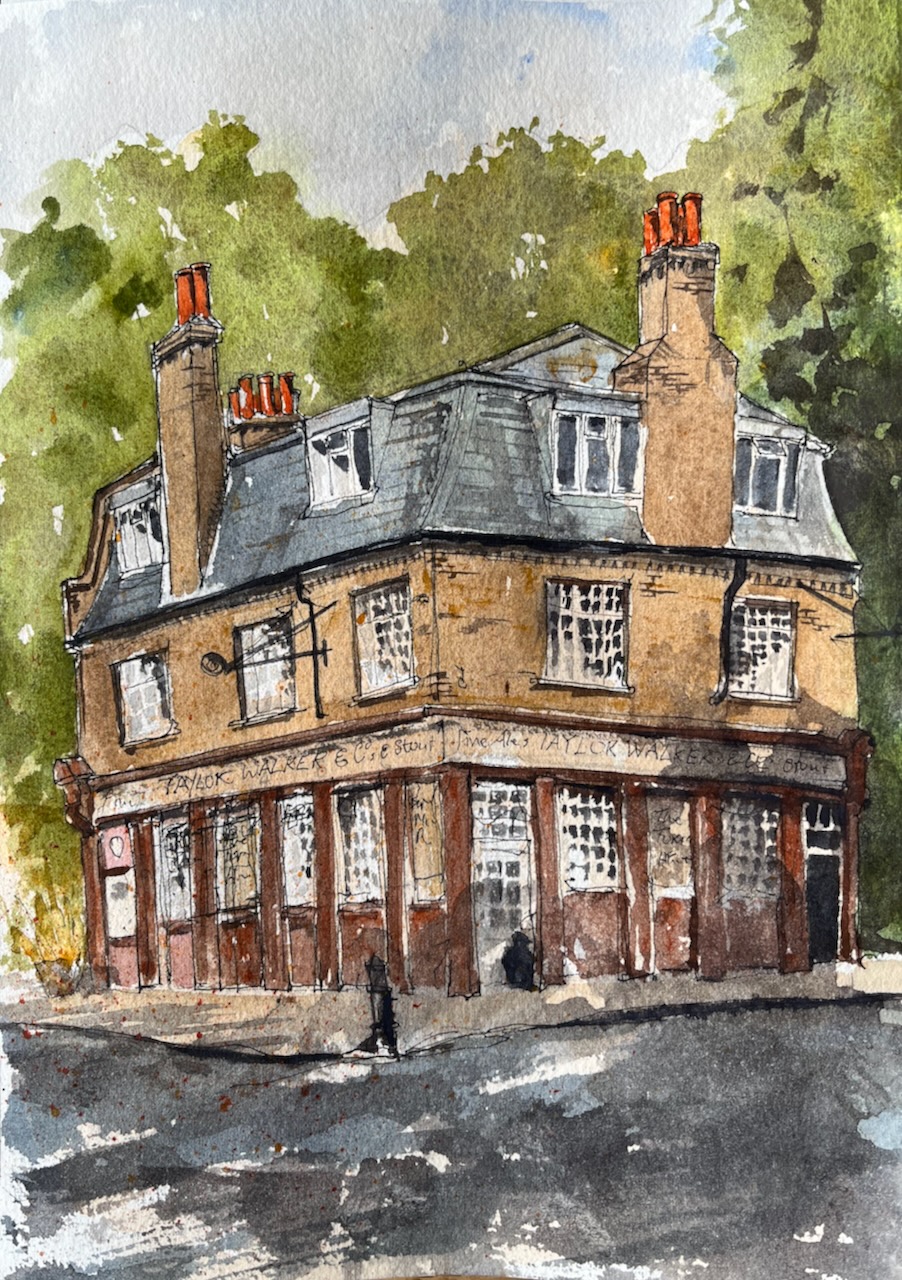
The Turks Head Wapping E1, 10″ x 7″ in Sketchbook 12, 26th August 2022, 16:30pm
The drawing took me about 50mins on location, pen and ink. I added the colour when I got back to my desk.
Before and after the colour went on.
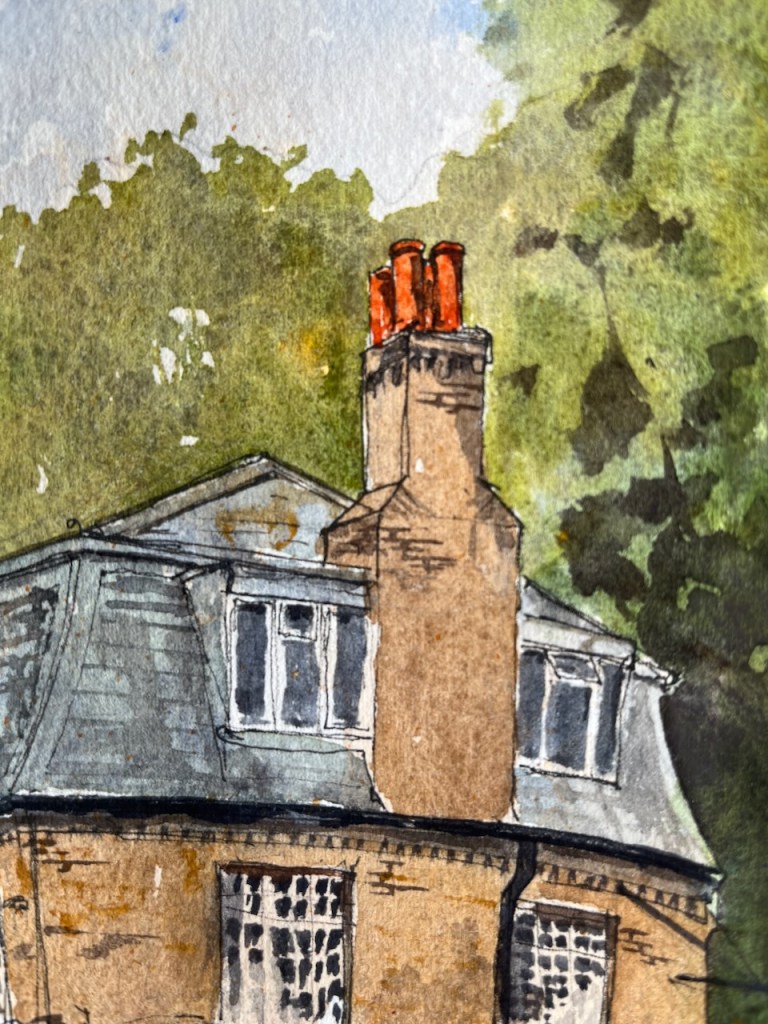
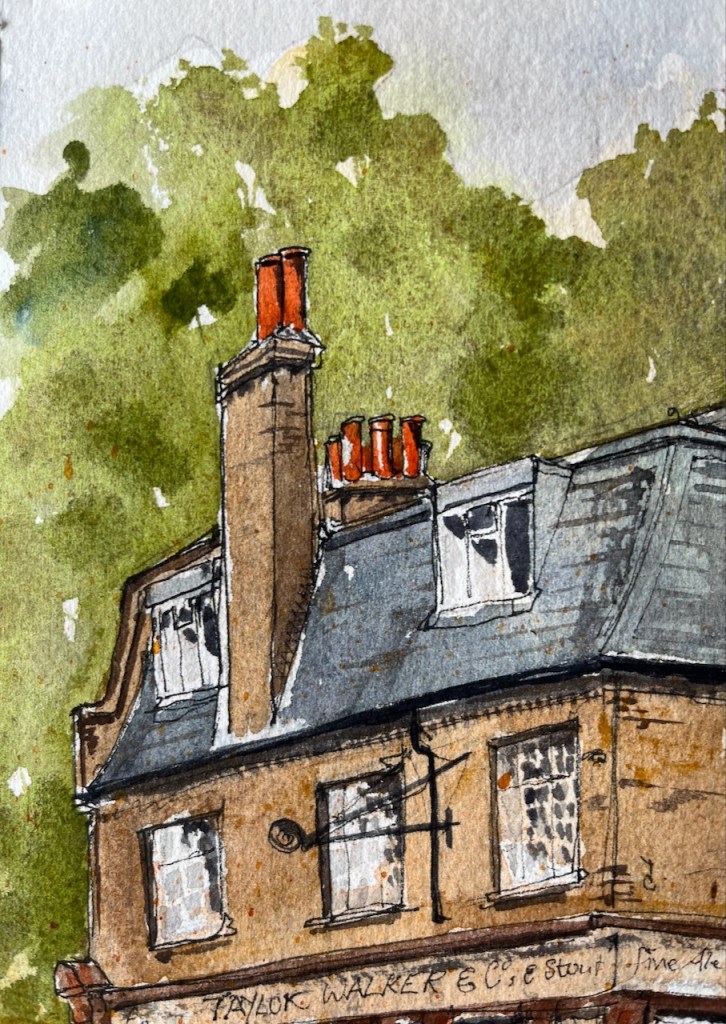
Marvellous chimneys!
The chimneys are Transparent Pyrrol Orange. Other colours are: Green Serpentine Genuine, Mars Yellow, Burnt Umber, Ultramarine Blue, Permanent Yellow Deep, and Perylene Maroon to get the darker tiled walls. The blacks and greys are Ultramarine Blue mixed with Burnt Umber. These are all Daniel Smith watercolours. The paper is Arches Aquarelle 300gsm NOT, in a sketchbook made by the Wyvern Bindery in Hoxton.
Here is work in progress:
This is a wonderful café-restaurant – recommended. It is east of Tower Bridge, about a 45 minute walk from the City.
map (c) open street map contributorsDip pen and W&N drawing ink.
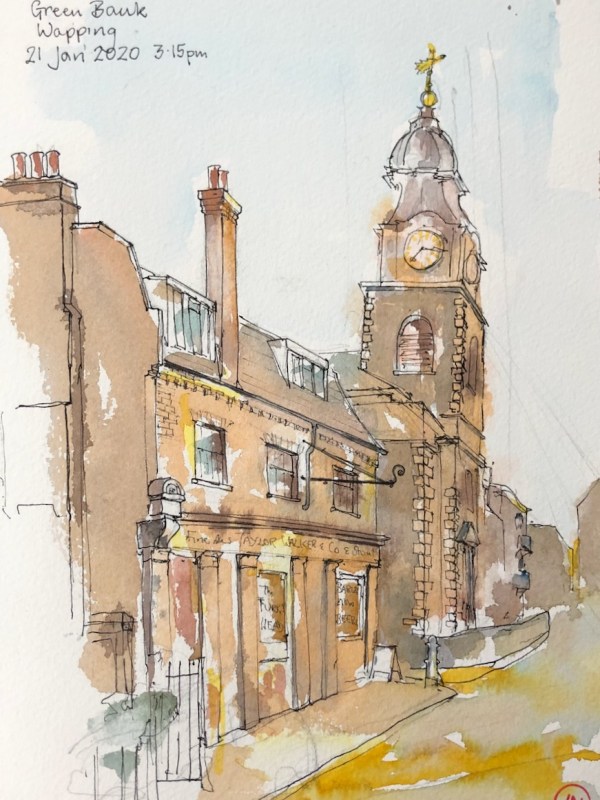
Here is the marvellous Turks Head Café, Wapping, rescued from demolition by local residents in the 1980s. Inside, I found warmth, quiet tables, and the gentle murmur of conversations: people actually talking to each other.…
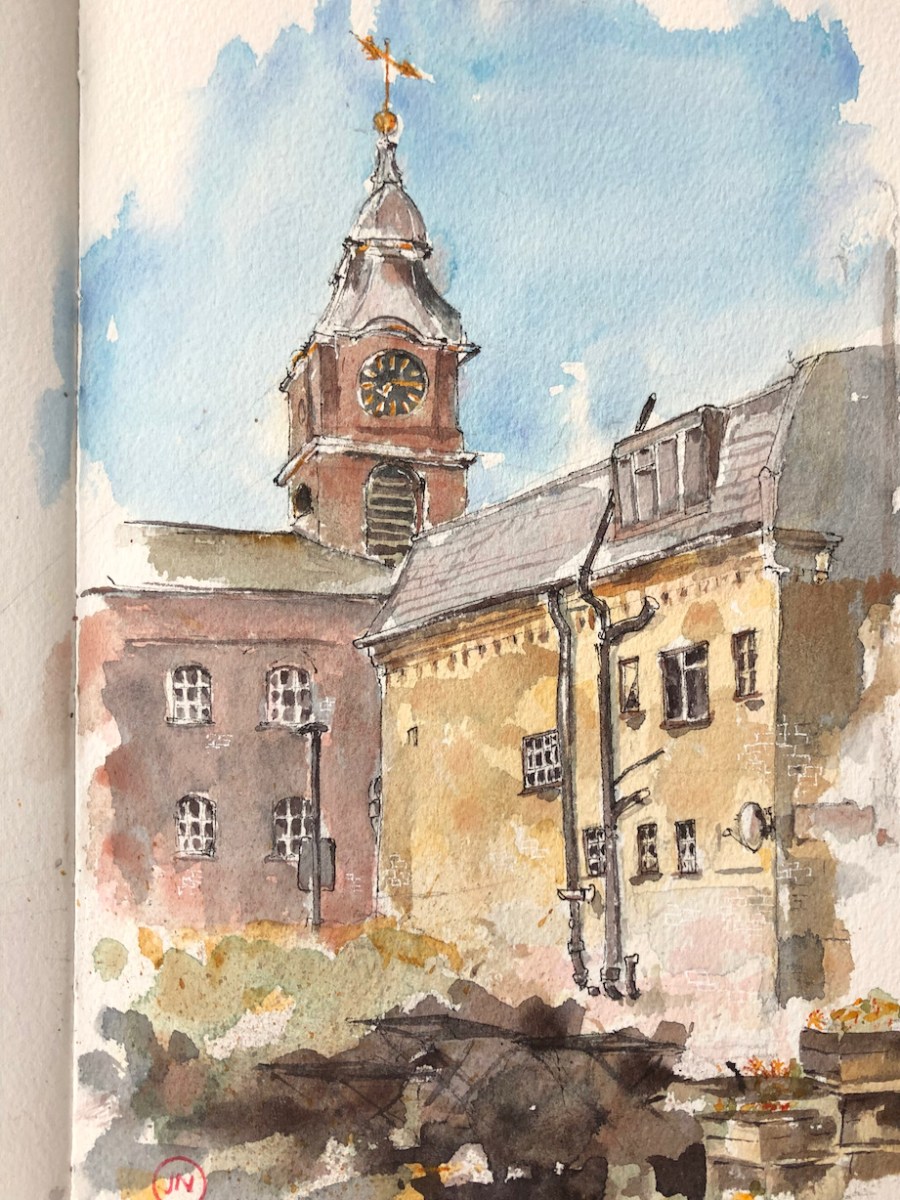
On Monday I cycled out East to the Turk’s Head for breakfast. With a coffee and croissant, in front of me, I sketched the view. The Turk’s Head is the building on the right. The…
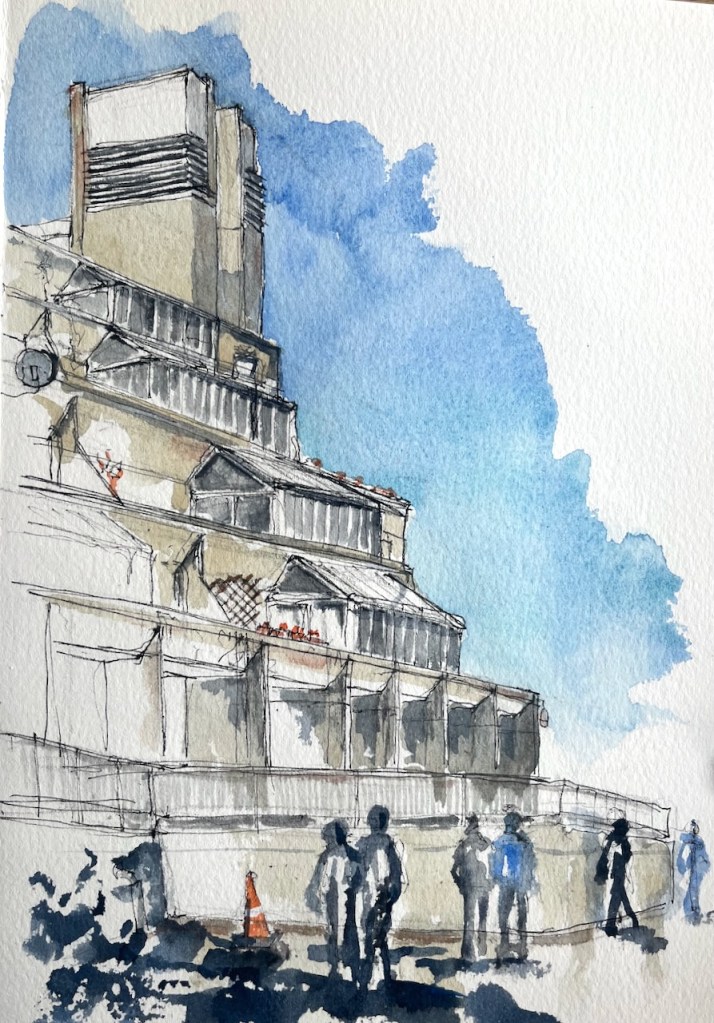
The Brunswick Centre, in Bloomsbury, London has been described as a “heroic prototype for a holistic community” [levittbernstein.co.uk]. There are 560 flats, a cinema, a medical centre and offices in a single development: hence “holistic”. It was radical in that it differs from the Georgian and Victorian houses all around.
Brunswick Centre, Bloomsbury, 13:50 9th August 2022, in Sketchbook 12
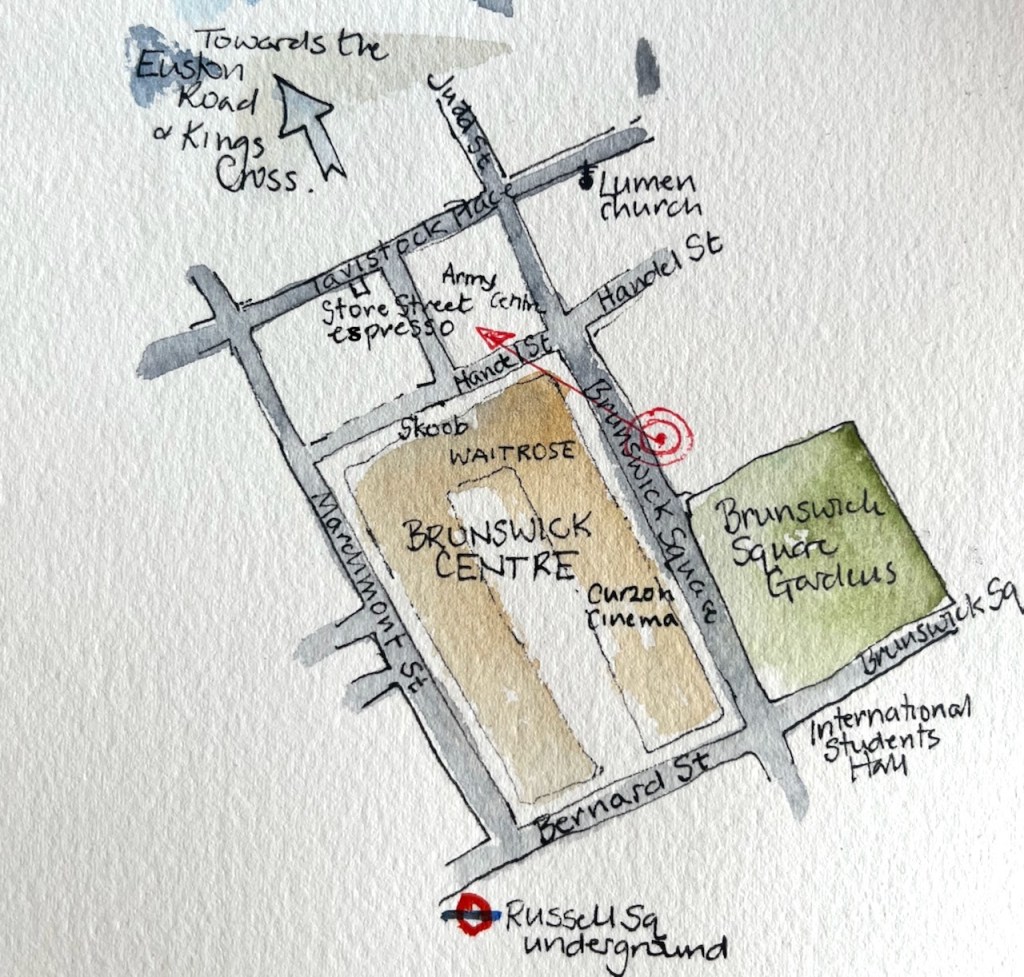
It was designed by Peter Hodgkinson during 1966-1970. The original plan was to extend the development all the way up to the Euston Road. There was a significant renovation in 2006 by the architects Levitt Bernstein. They made the shop fronts extend into the plaza in the middle, renovated the flats and added an “anchor supermarket” (Waitrose) at the northern end.
Where I did the drawing
I sketched the pen and ink on location, then repaired to the Store Street espresso on Tavistock Place to do the colour. There are very few colours in the picture: Buff Titanium, Ultramarine Blue, Burnt Umber and a tiny bit of Transparent Pyrrol Orange.
Click a button below to share this post online, email it, or print it:
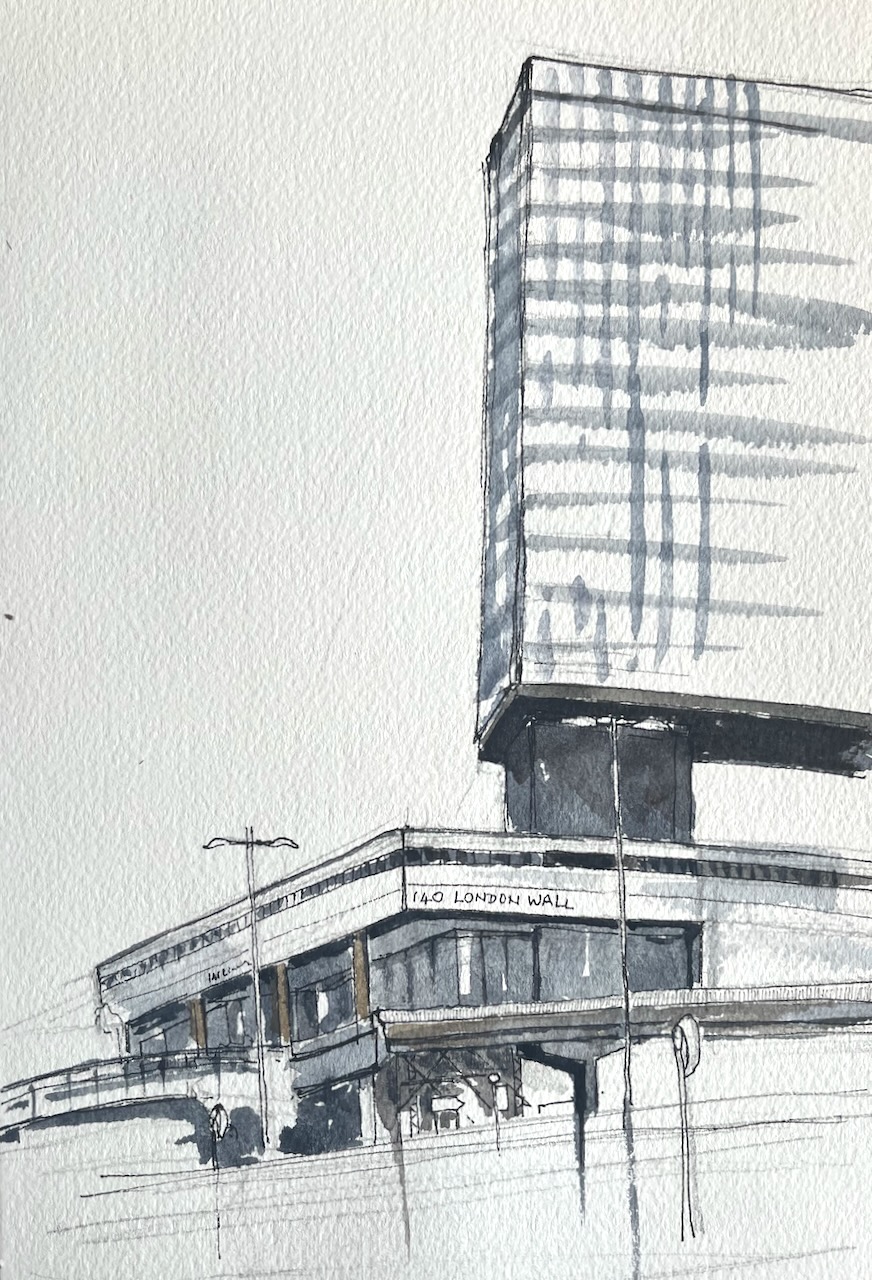
Earlier this month, I made a quick sketch of Bastion House, from London Wall.
140 London Wall, Bastion House, sketched 2nd August 2022 from London Wall, in sketchbook 12
Here’s a map:
The architect was Philip Powell of Powell and Moya. The building was completed in 1976. I like this building. It reminds me of the “obelisk” in the film “2001 – A Space Odessey”.
The City of London have the idea that they are going to demolish this building, and the Museum of London next to it, and build three large office blocks: bigger and wider than the existing buildings, providing some 750sq ft of commercial office space.
This mystifies many of us, as we witness empty office blocks all around this location. It also angers us, as such huge buildings will take sun from the residential estate to the North. There seems to be a case for pausing the proposed project, and considering renovation of the existing buildings. Renovation would be better from a carbon emissions point of view, as demolition and construction are a large source of carbon dioxide emissions.
I hastened to draw the magnificent Bastion House, on London Wall. It is due for demolition. In the foreground you see the balcony and privacy screen of the flat in Andrewes, whose leaseholder had kindly hosted me. The line of red brick, and what looks like chimneys, in the foreground are the rooftops of a part of the Barbican, “The Postern”. Behind them is the Barber-Surgeons’ Hall on Monkwell Square,…
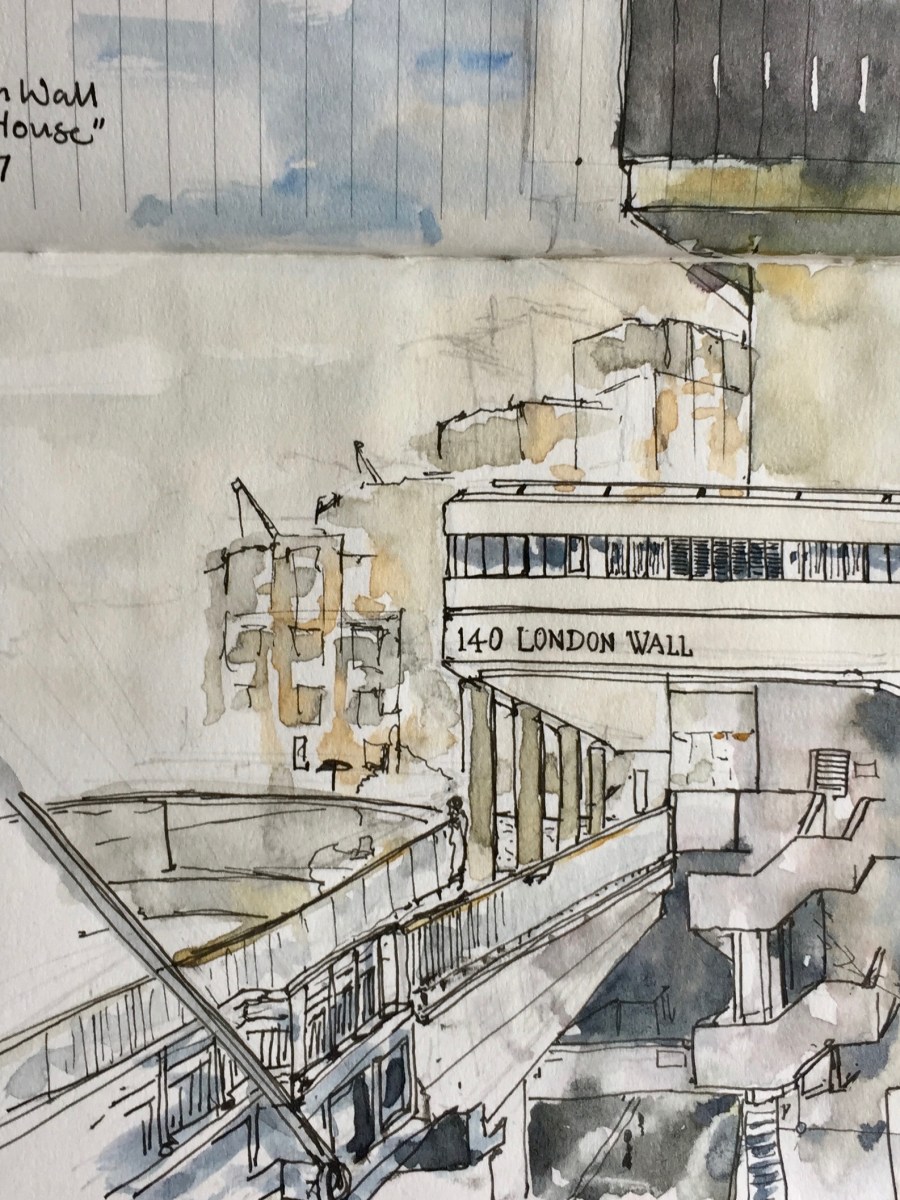
Bastion House aka 140 London Wall is a huge modernist monolith, reminiscent of the monolith in “2001 – A Space Odyssey”. I couldn’t find a site to draw the monolith part today, so here is a view at Podium Level, looking West towards the Museum of London. You see the dark undercroft, walkways and a road to a car park. Also you see the bridge that crosses London Wall. http://postwarbuildings.com…
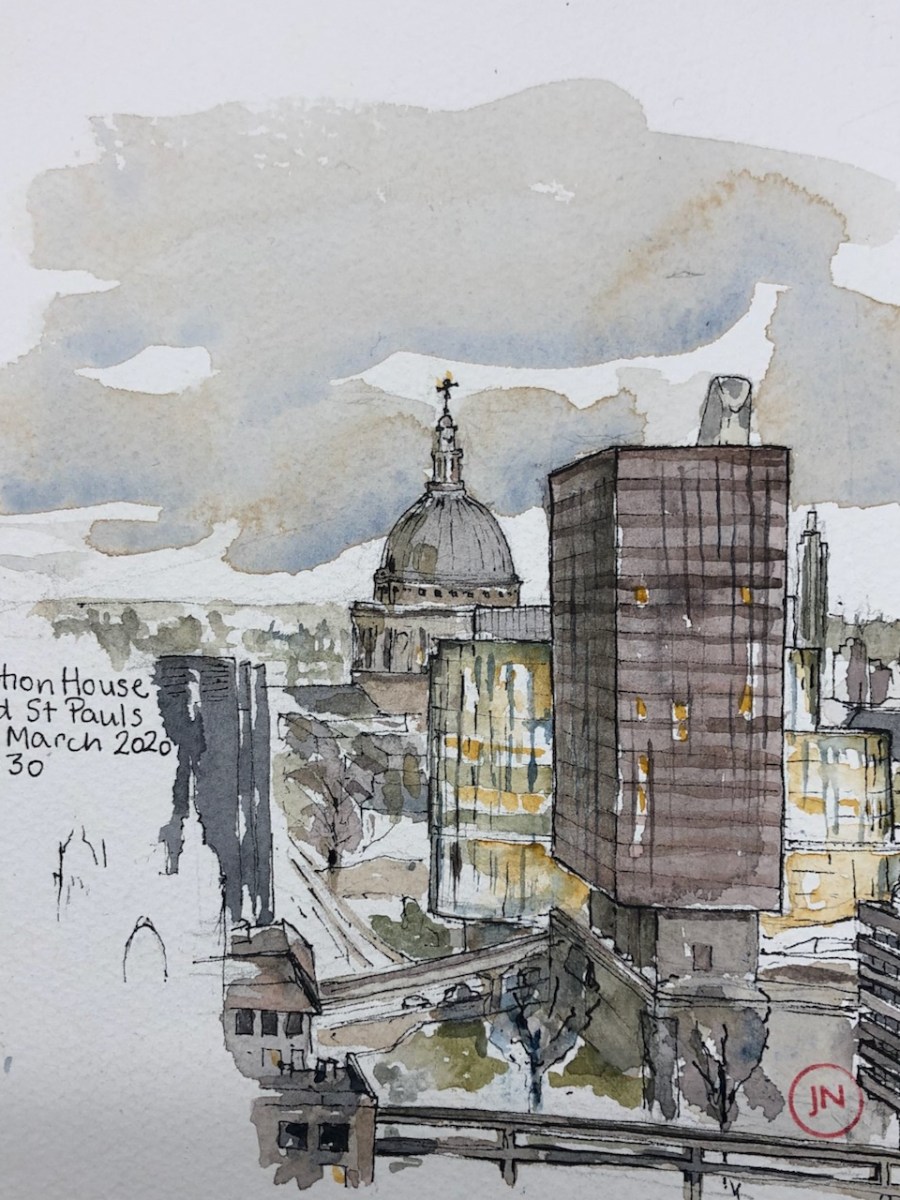
I am sketching the views out of the window. Just visible over the top of Bastion House is the top of “OneBlackfriars”. In the foreground: Mountjoy House, Barbican, on the right. Along the bottom is the Barbican Highwalk which joins Mountjoy House and Wallside. I have drawn Bastion House before: This drawing took rather a long time as I stopped a couple of times. As a result, by the time…
Today Urban Sketchers London held a “sketch crawl” in the Barbican. So I joined them. An astonishing number and diversity of people assembled inside the entrance of the Barbican Centre at the appointed time of 11am. I counted about 35 and then another dozen or so joined. All shapes and sizes of people, tall, short, studious-looking or flamboyant, quiet or talkative, smart or windblown, old or young, all were there.…
From the highwalk on the Rotunda there is a really amazing view of the Museum of London and Bastion House. This whole view going to change radically, if the City of London plans are approved. The Museum of London is in the South West corner of the Barbican. It was designed by Philip Powell and Hidalgo Moya. The Museum opened in 1976. The City of London plan to close it…


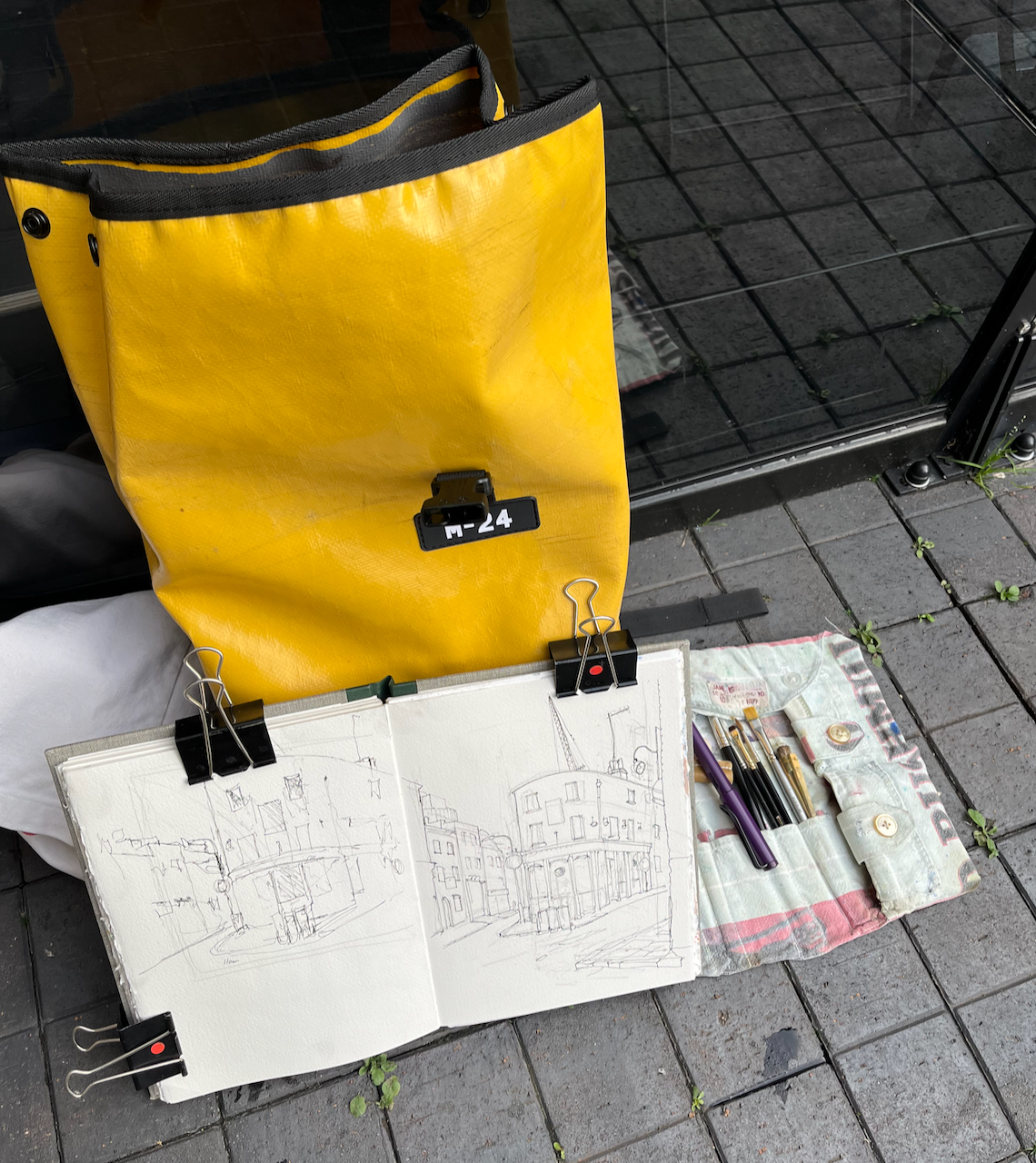







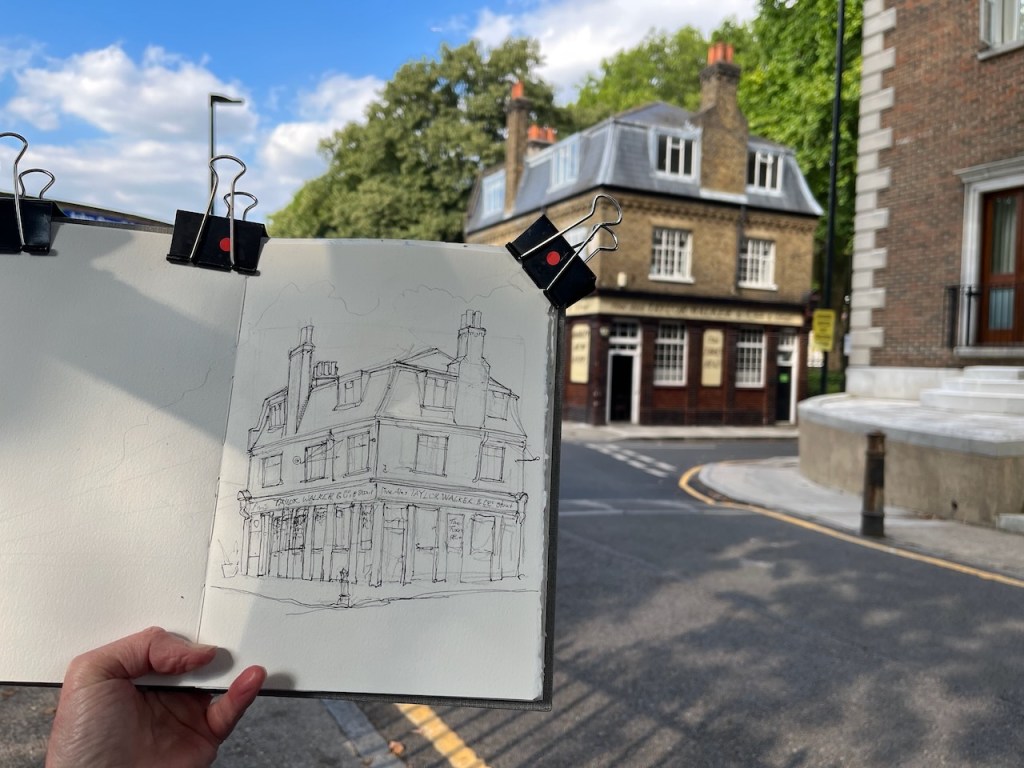

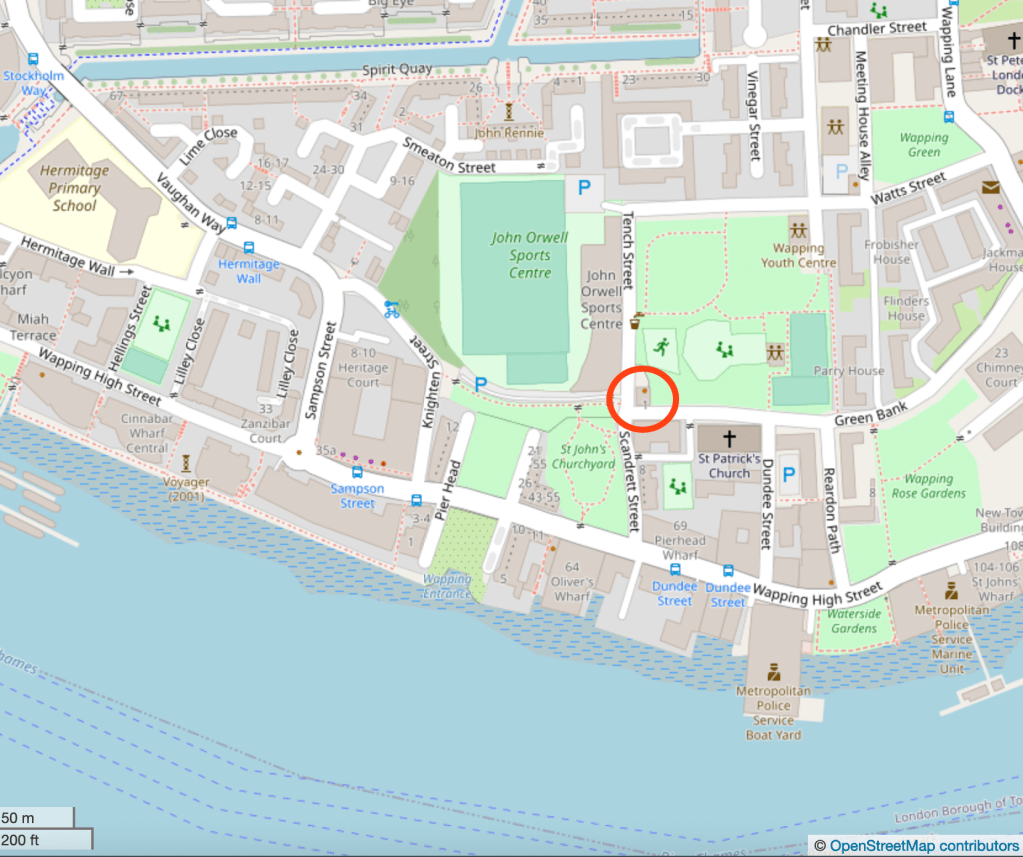
 Jane Sketching