The Jamaica Wine House, EC3

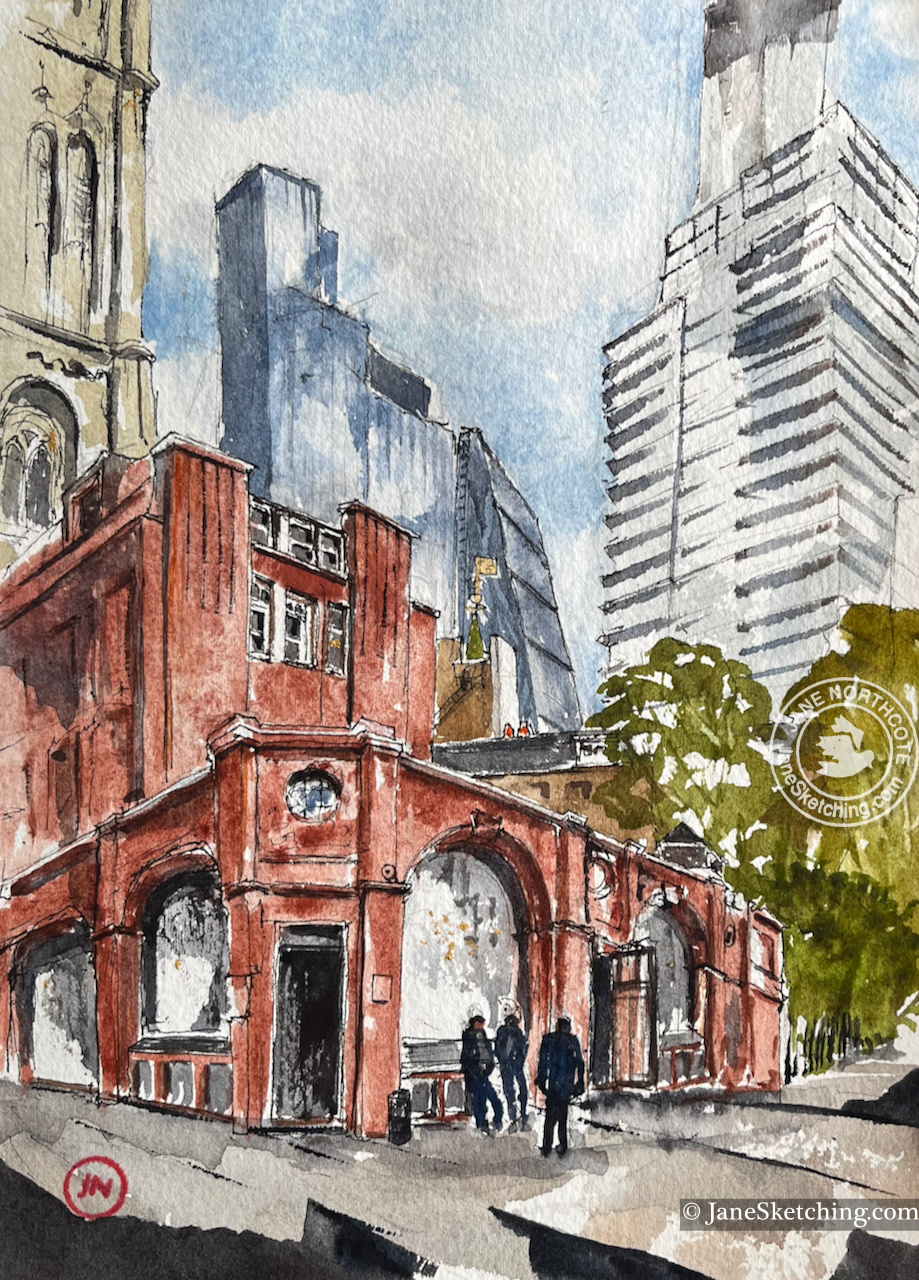
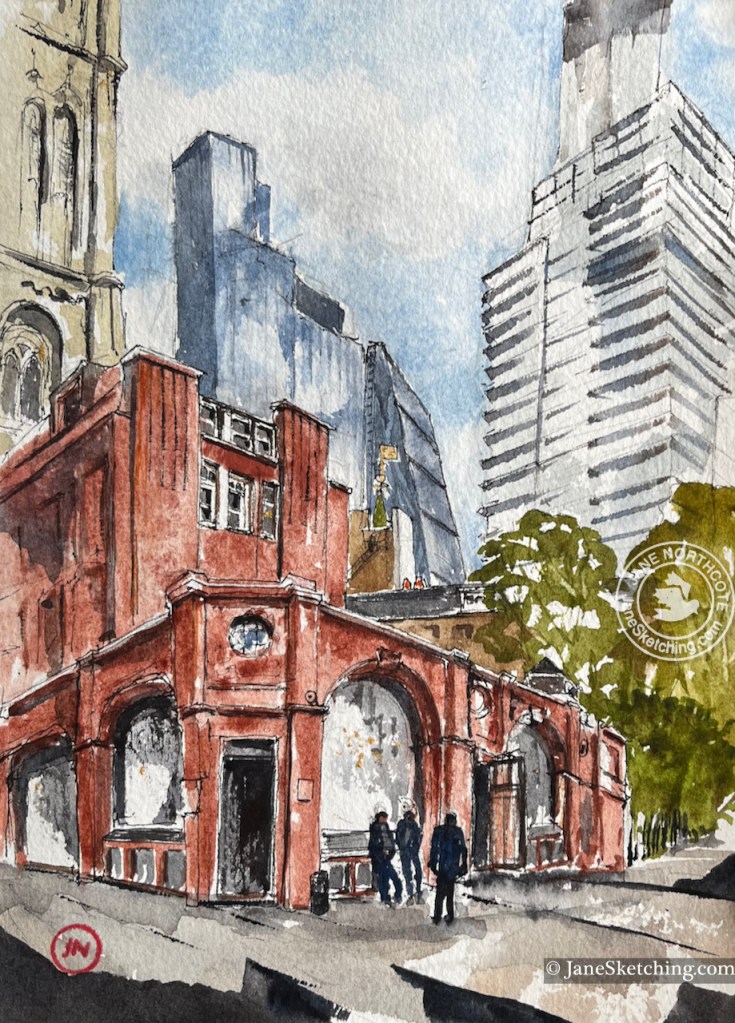
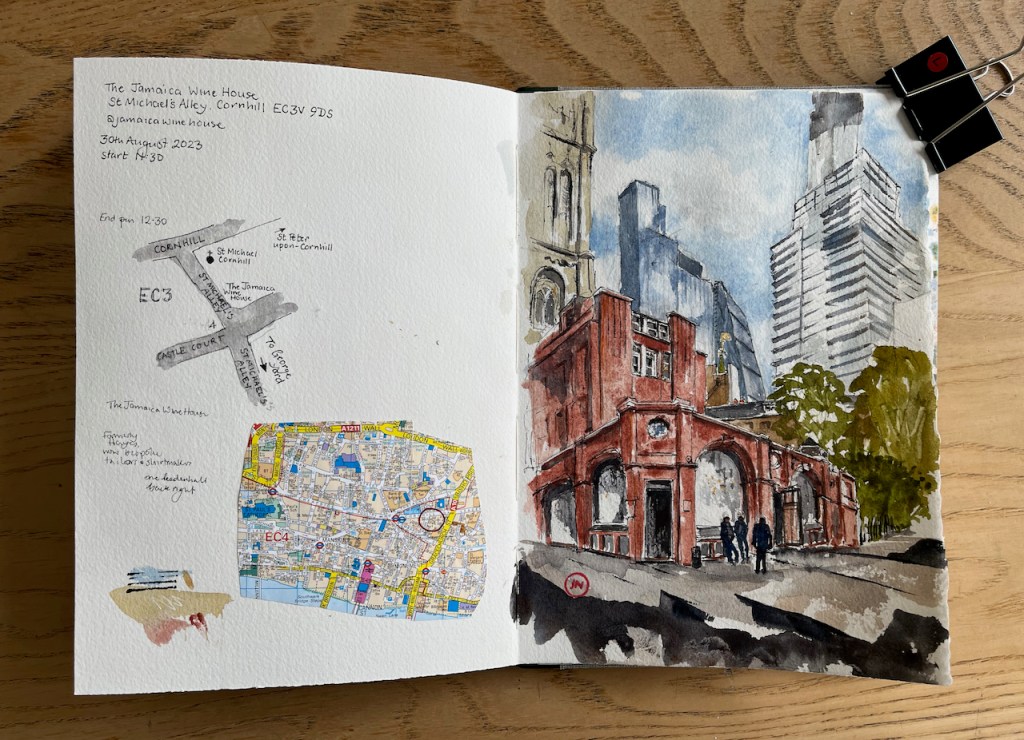
I walked through the City lanes towards London Bridge and passed by the Jamaica Wine House embedded, as it seemed, in a canyon amongst towers.

Jamaica Wine House, 12:30pm 30th August 2023 in Sketchbook 13.

The Cheesegrater and 22 Bishopsgate are the office blocks in the left background and One Leadenhall is under construction on the right.

This is a very old part of the City. Although some buildings have changed, the road layout still retains something of the feeling of Dickensian London. There has been a pub or coffee house on the site of the Jamaica Wine House since 1652. The current building dates from 1868 according to the Historic England List Entry (number 1079156).

Off the picture to the left is MacAngusWainright bespoke tailors and shirtmakers, at number 4 St Michael’s Alley. This shop used to be John Haynes&Co, the jewellers.

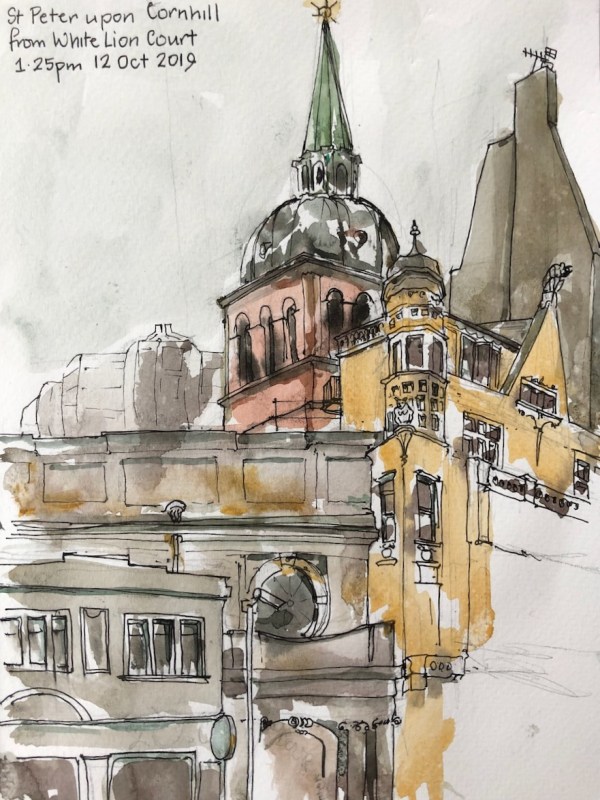
St Michael Cornhill is visible to the left in the background, and you can just see the weathervane on St Peter upon Cornhill in the centre of the picture.

My drawing of St Peter upon Cornhill is in this post:

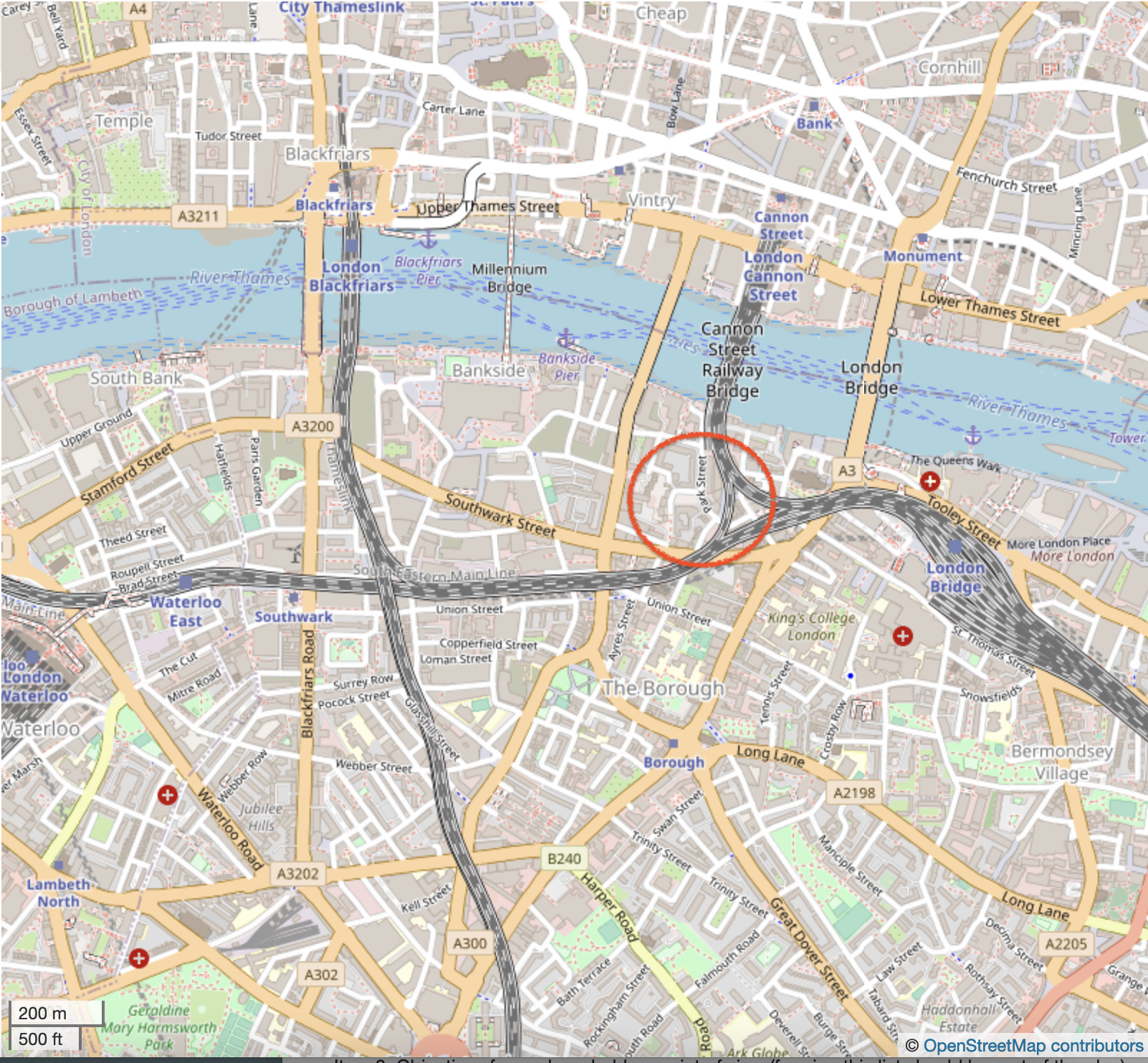
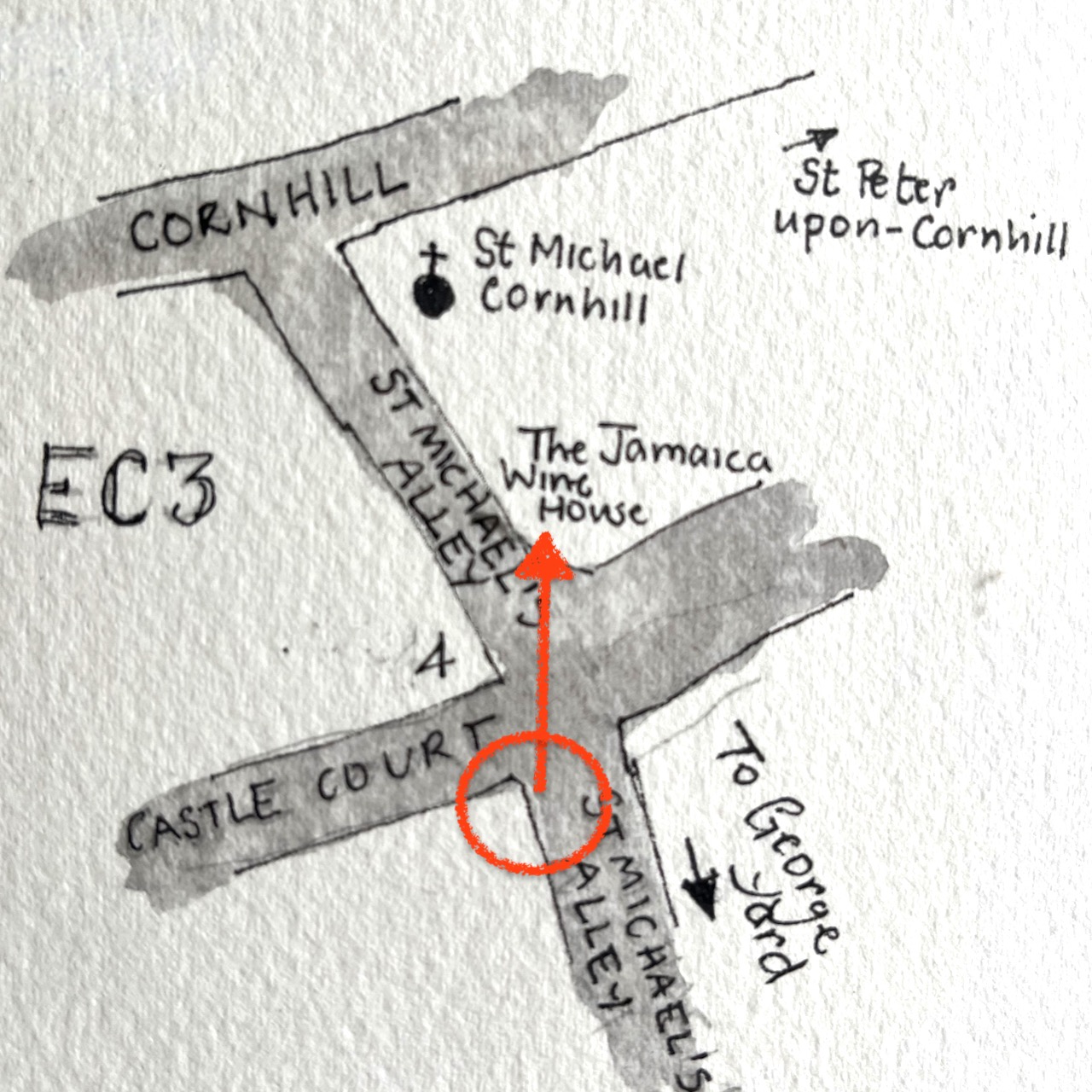
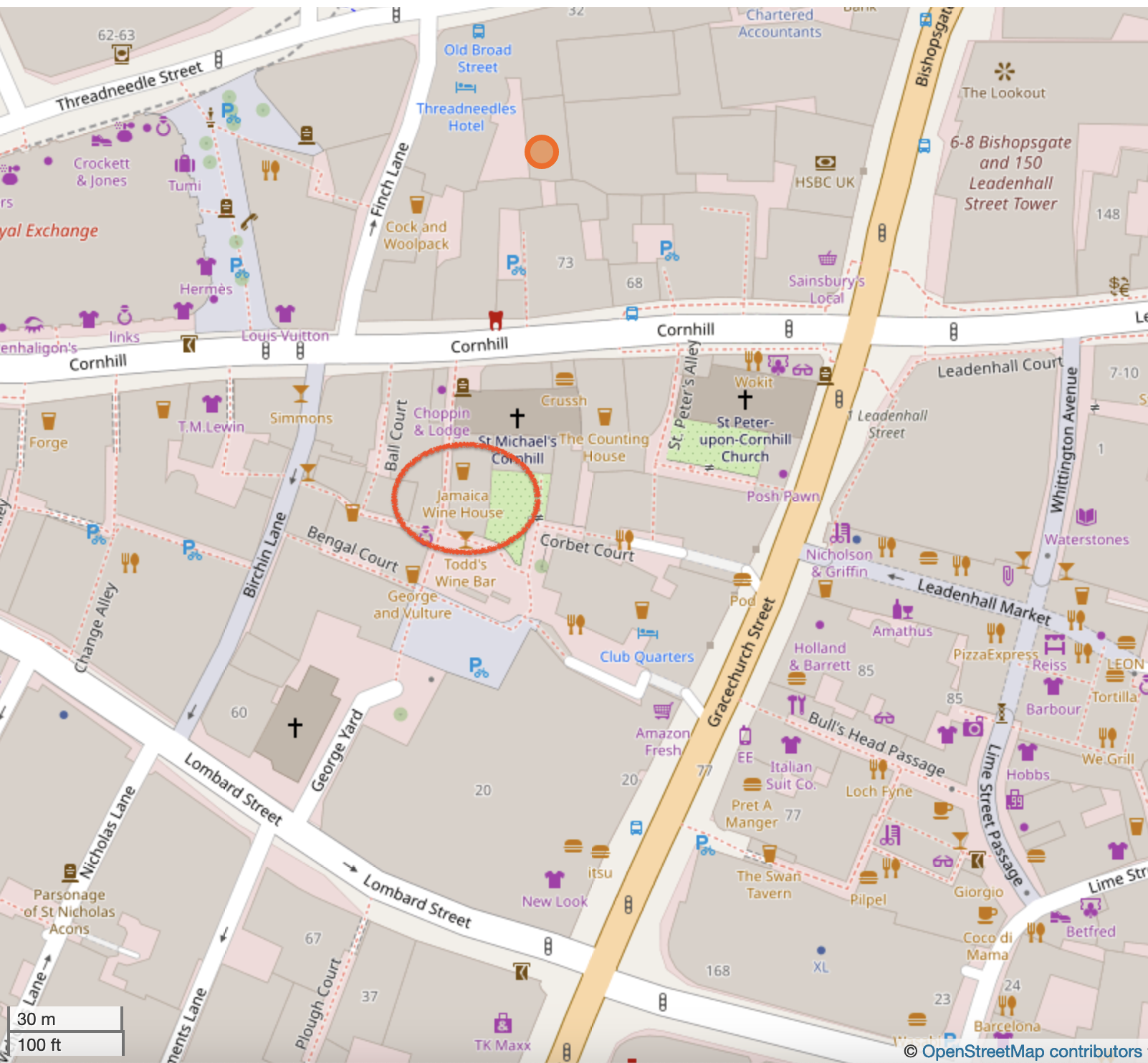
Location of the Jamaica Wine House in the alleys between Lombard Street and Cornhill. (Map (c) OpenStreetMap contributors)

The picture took an hour on location and I finished it at my desk.

The colours in the picture are:

  • Fired Gold Ochre – my go-to colour for brick and sandstone
  • Ultramarine blue, Lavender, and Cerulean Blue for the sky
  • Burnt Umber in the sky
  • All greys and blacks are Ultramarine Blue with Burnt Umber
  • There’s a bit of Iridescent Gold on the weathervane of St Peter upon Cornhill
  • The trees in St Michael’s garden are Serpentine Genuine with some Permanent Yellow Medium.
  • St Michael on Cornhill is Buff Titanium with some Burnt Umber and Ultramarine Blue.

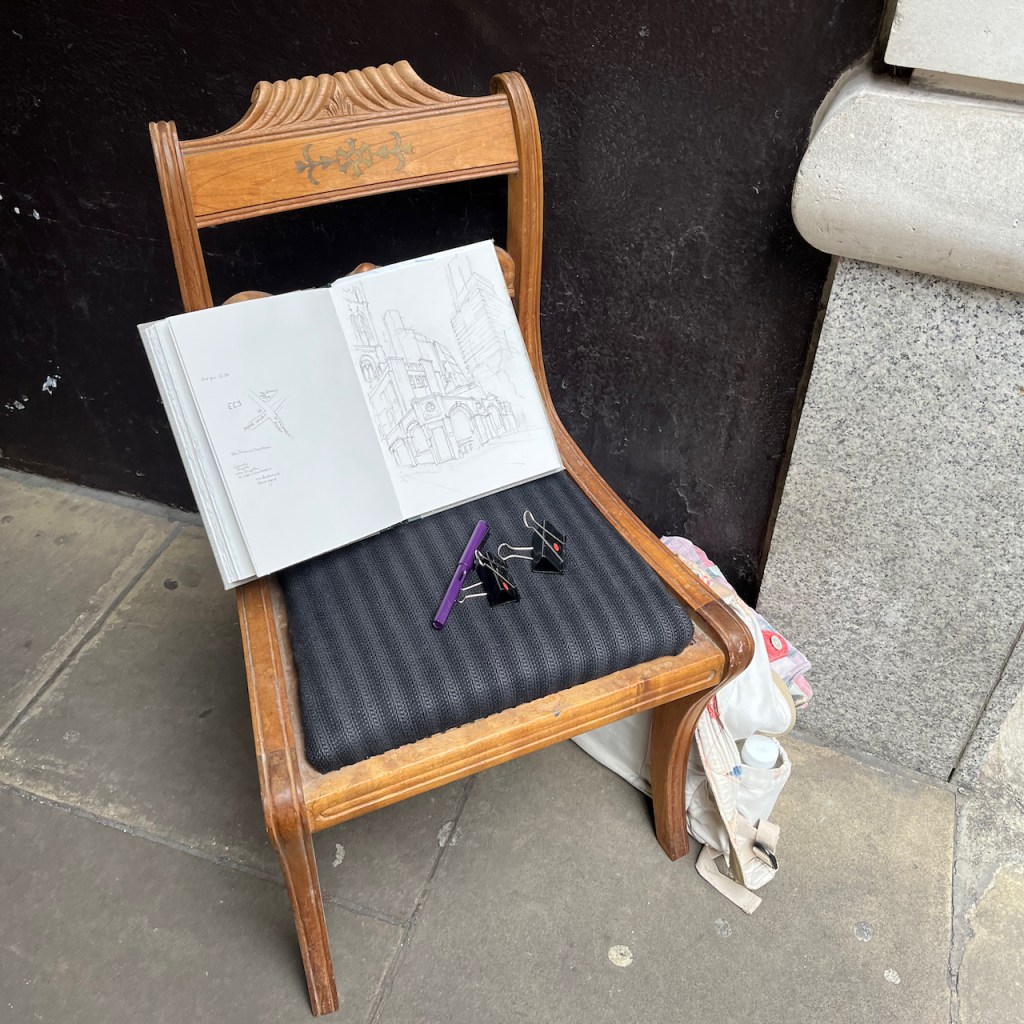
Done on Arches 300gsm NOT watercolour paper in a sketchbook by Wyvern Bindery, Hoxton. Thank you to McAngusWainwright, city tailor, for the kind loan of the chair.

London Liverpool Street, EC2

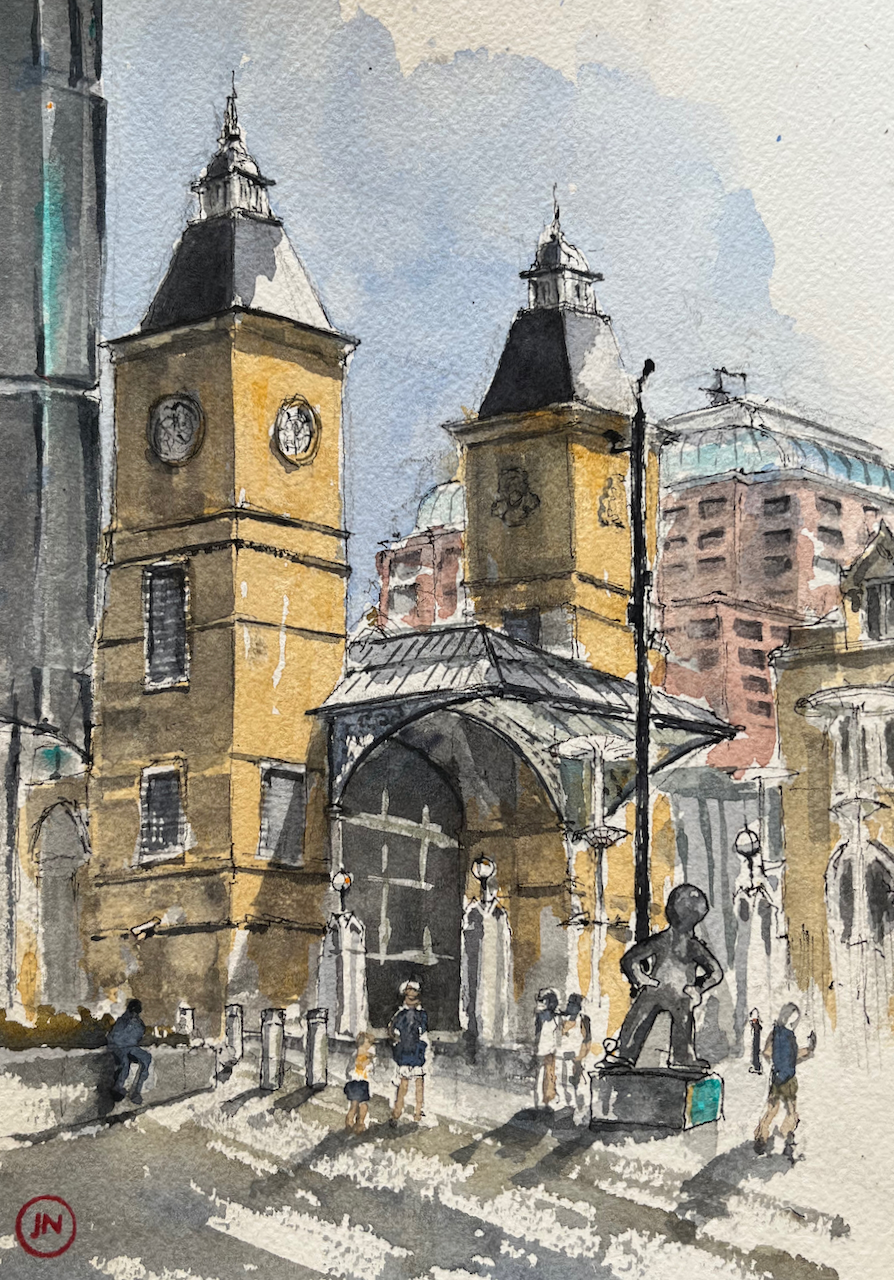
Here is Liverpool Street Station, main entrance, sketched today from outside the “Railway Tavern”.

Liverpool Street Station, 25th June 2023, 1pm. 8″ x 10″ in sketchbook 13.

The humanoid figure on the plinth is Morph, part of a temporary art trail.

The area in front of the main entrance is like an art installation in itself, a collector’s assembly of street furniture: two different types of bollards, long ribbons of fencing, several species of street lamps, and that enormous CCTV stand which is just behind Morph. It’s surprising that people can find their way into the station in amongst the obstacles. I haven’t drawn them all.

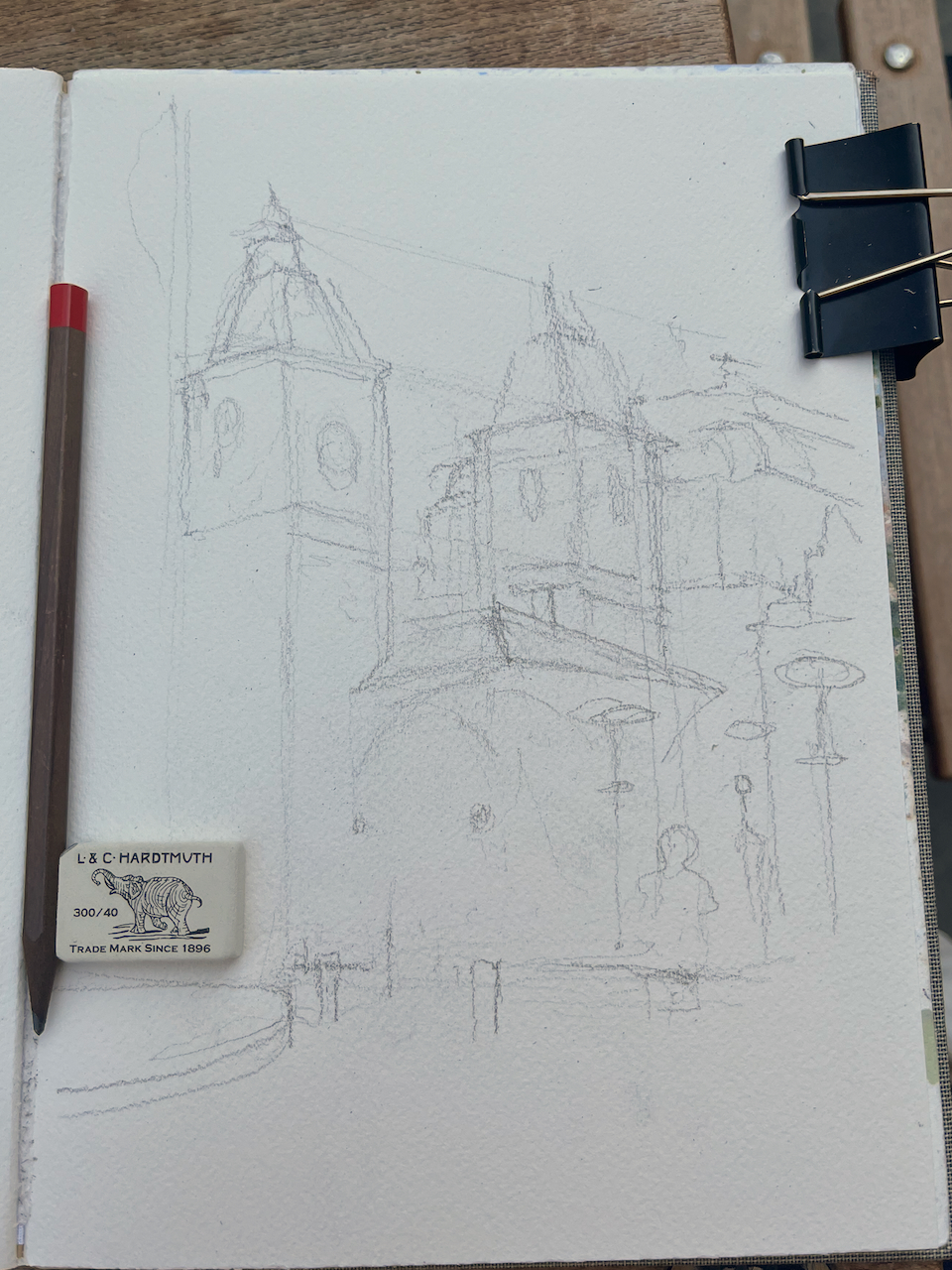
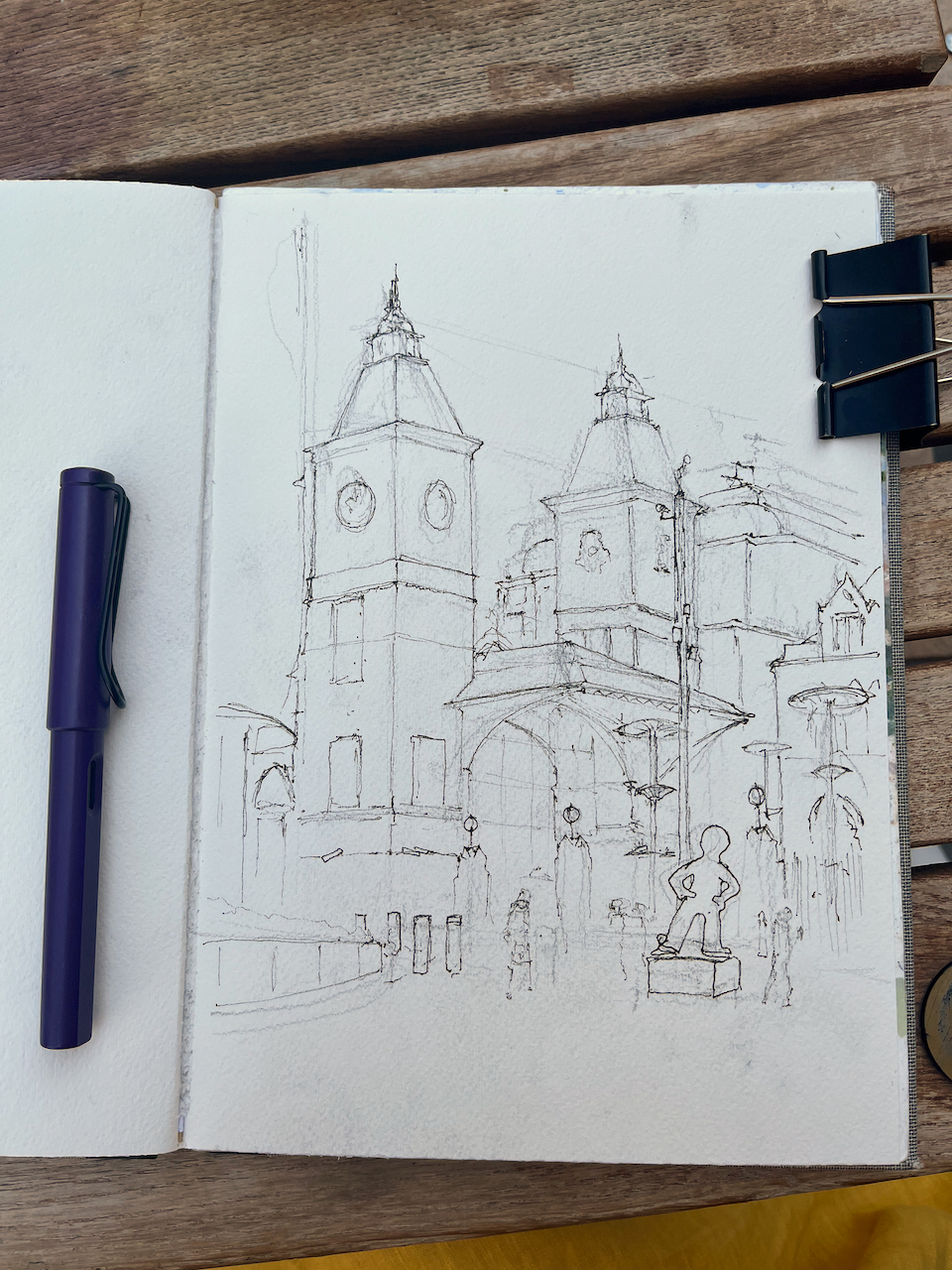
Here’s work in progress on the sketch:

This section of Liverpool Street Station was built in 1875 as the new London terminus of the Great Eastern Railway. The building on the right of my drawing is the edge of the former Great Eastern Hotel (1884), now the Andaz London Liverpool Street. The pink building in the background is an office block on Bishopsgate.

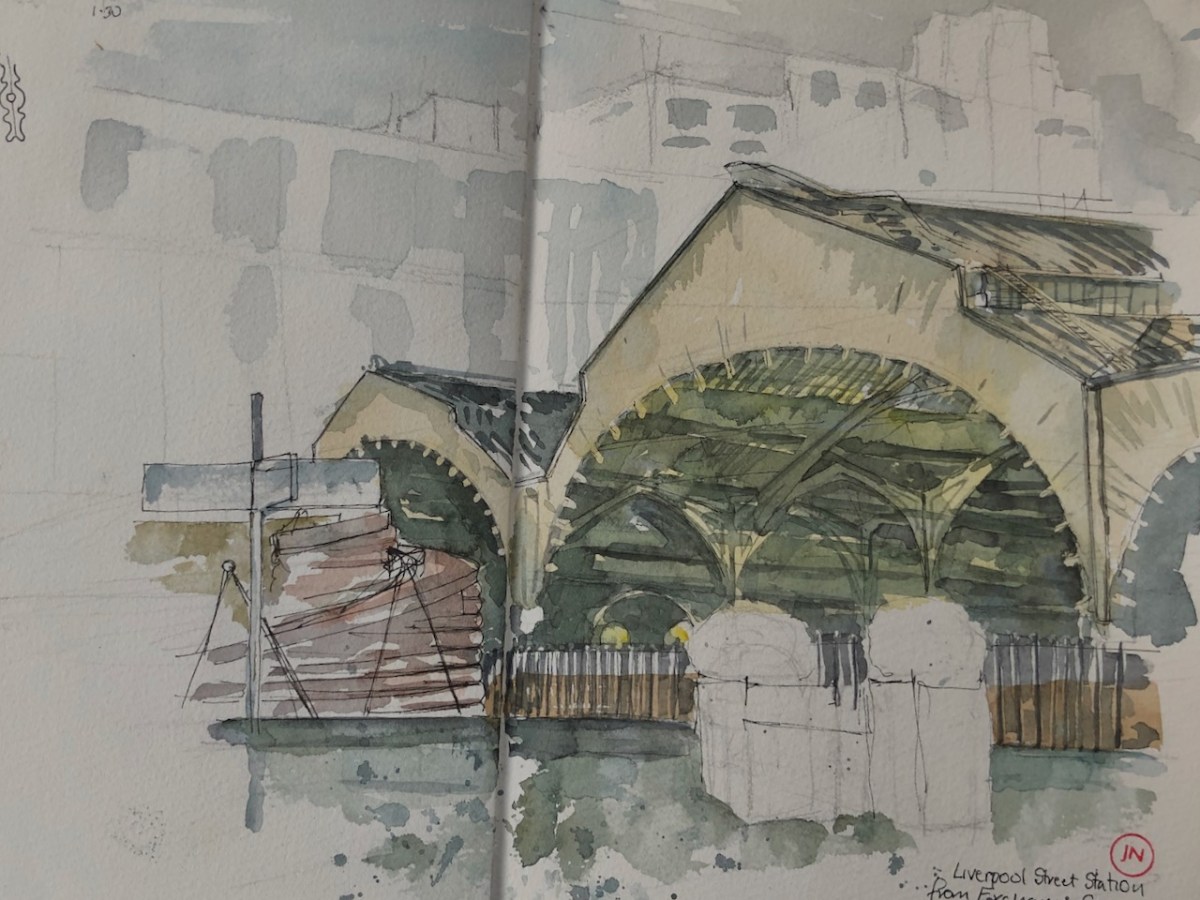
I’ve sketched in this area before. This post contains more information about the history of Liverpool Street:

Liverpool Street Station from Exchange Square

Here are the magnificent 19th Century arches of Liverpool Street Station, seen from Exchange Square. Liverpool Street Station opened in 18751 Now the question is: what curve is that arch? I thought it might be a CYCLOID. A cycloid is the shape made by a dot on the edge of a rolling wheel. I made…

Keep reading

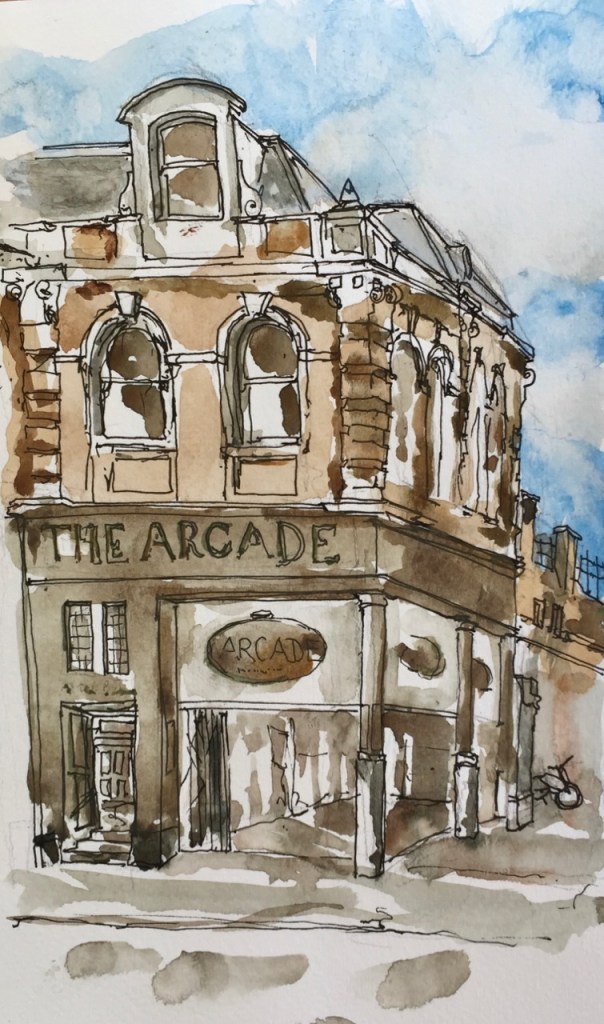
In 2019 I sketched the entrance to “The Arcade” which is shown on my sketch map. See this post for more about this sketch of The Arcade.

Wycliffe Hall Chapel, Oxford OX2

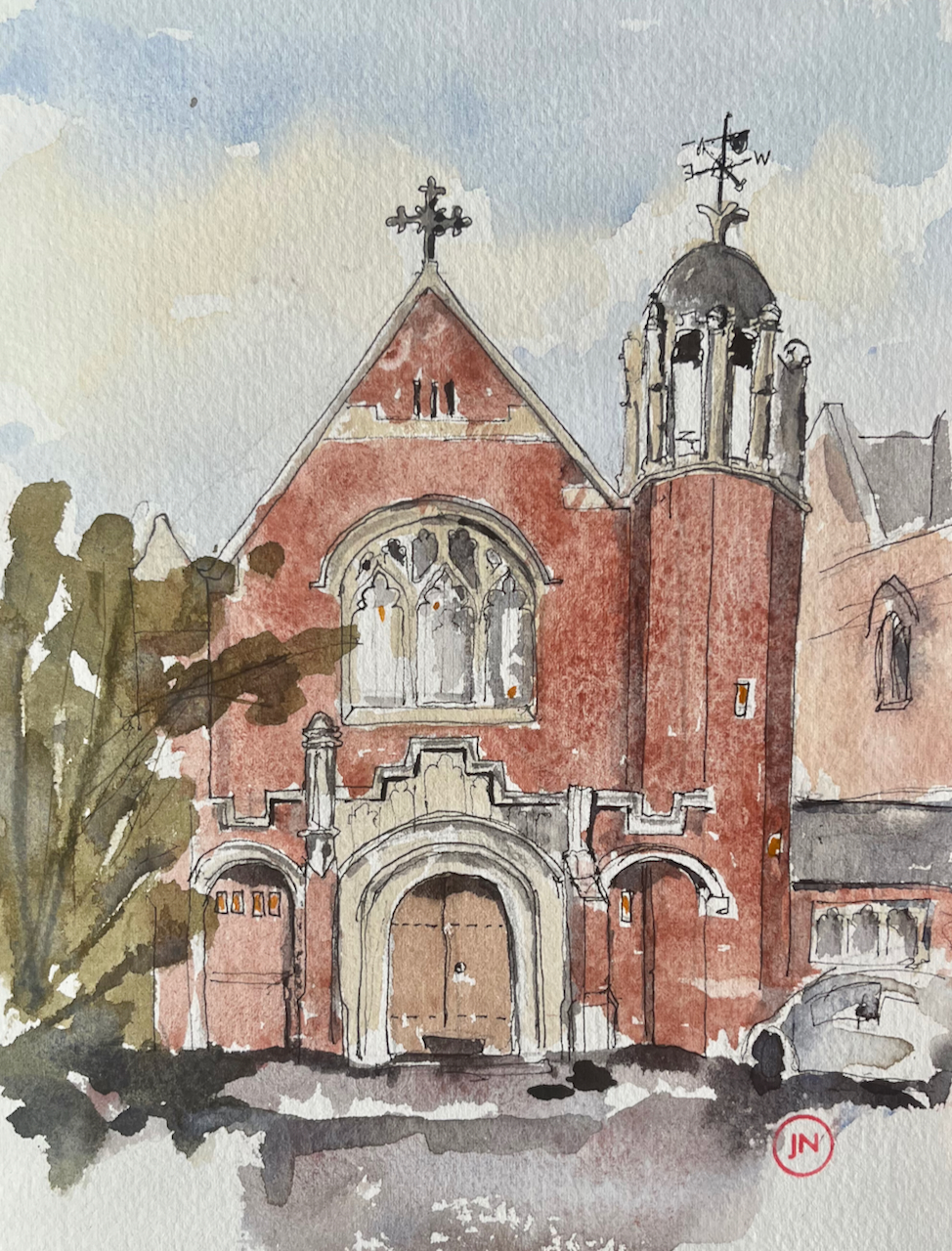
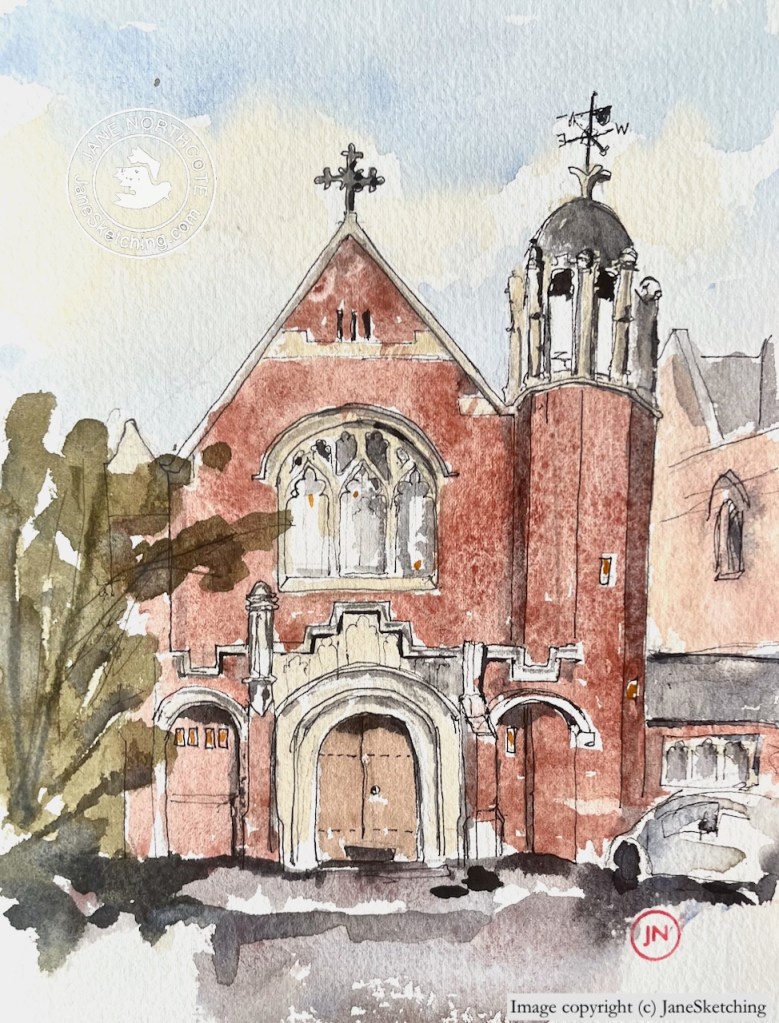
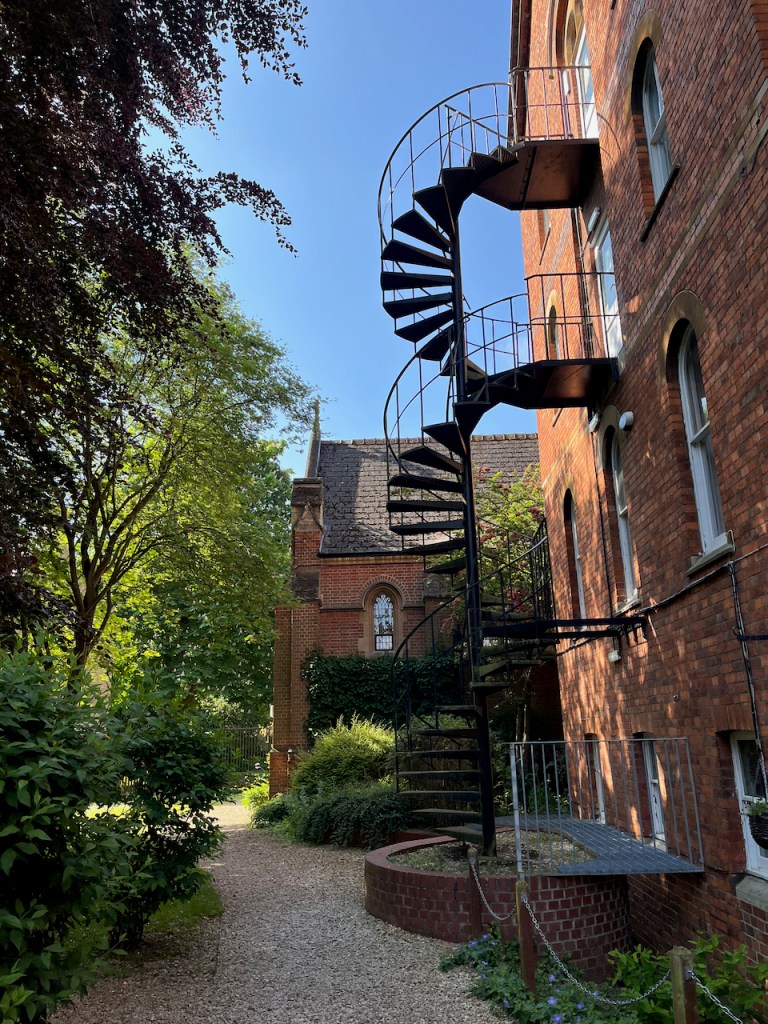
On a visit to Oxford recently, I stayed at Wycliffe Hall as a Bed and Breakfast guest. Wycliffe Hall is on the Banbury Road in North Oxford. It offers theological training to women and men who wish to become ordained or lay ministers in the Church of England. The hall was established in 1877, on the current site, and is named for John Wycliffe, bible translator and master of Balliol College in the 14th century.

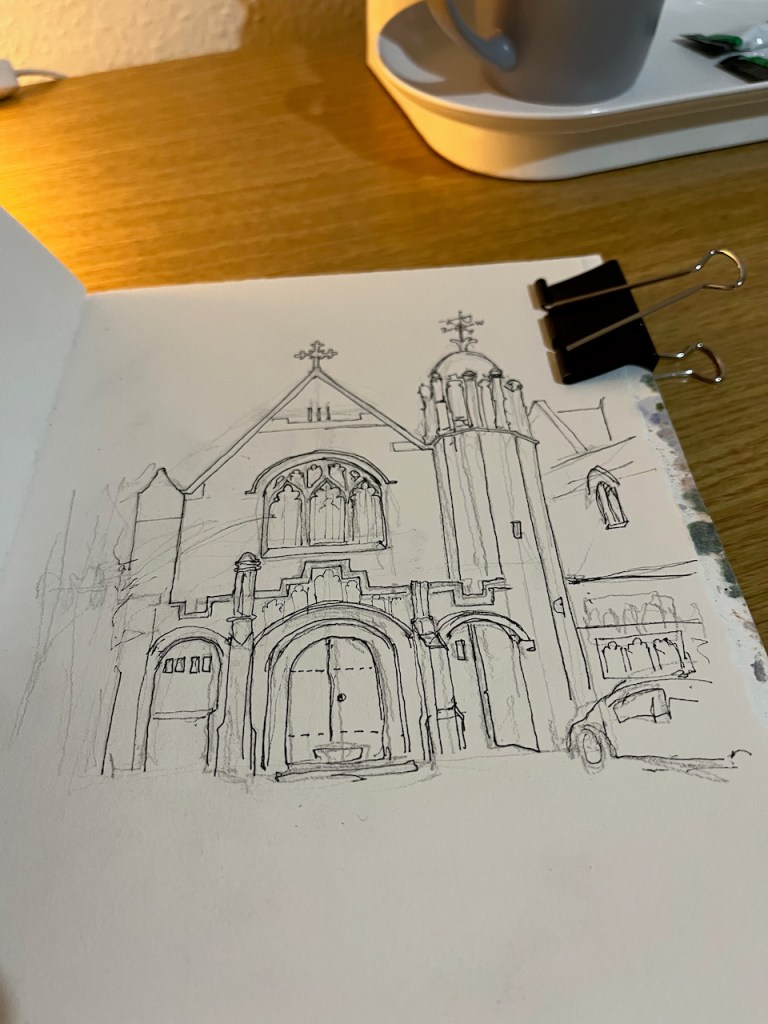
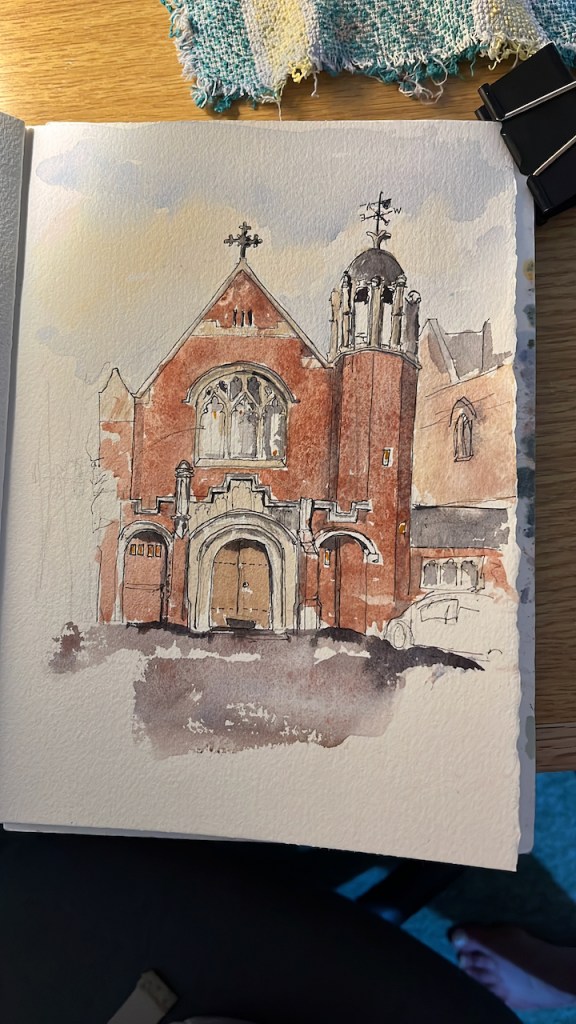
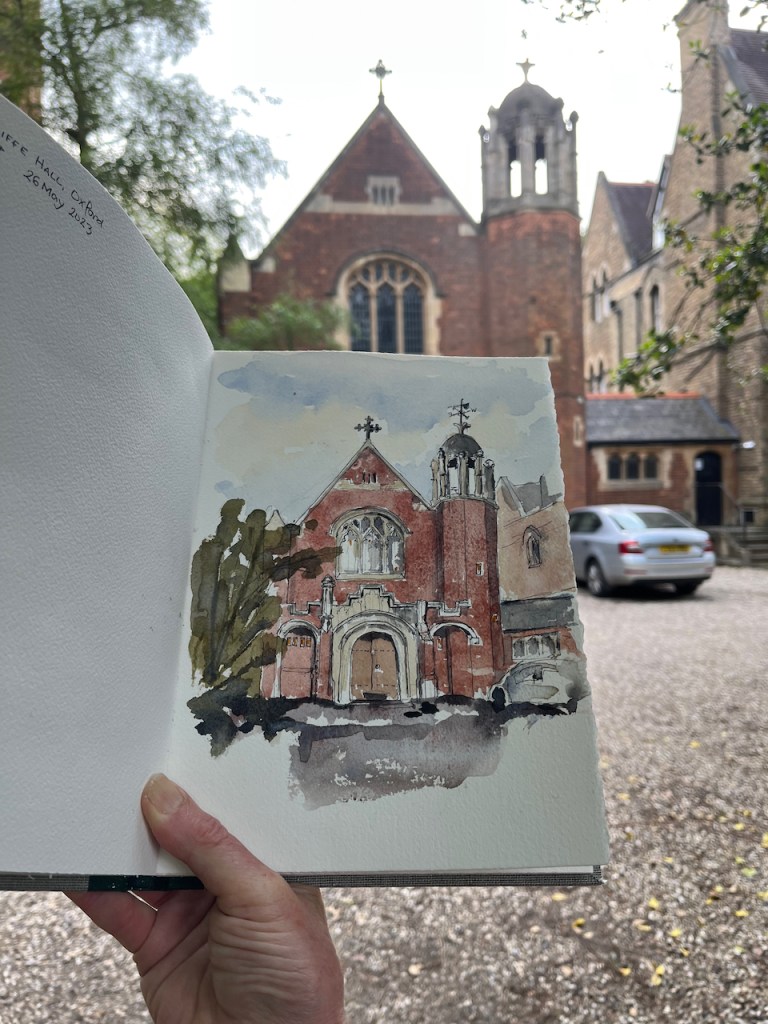
I sketched the chapel which was added in 1896, designed by architect George Wallace.

Wycliffe Hall Chapel, 54 Banbury Road, Oxford, sketched 26 May 2023, in Sketchbook 13

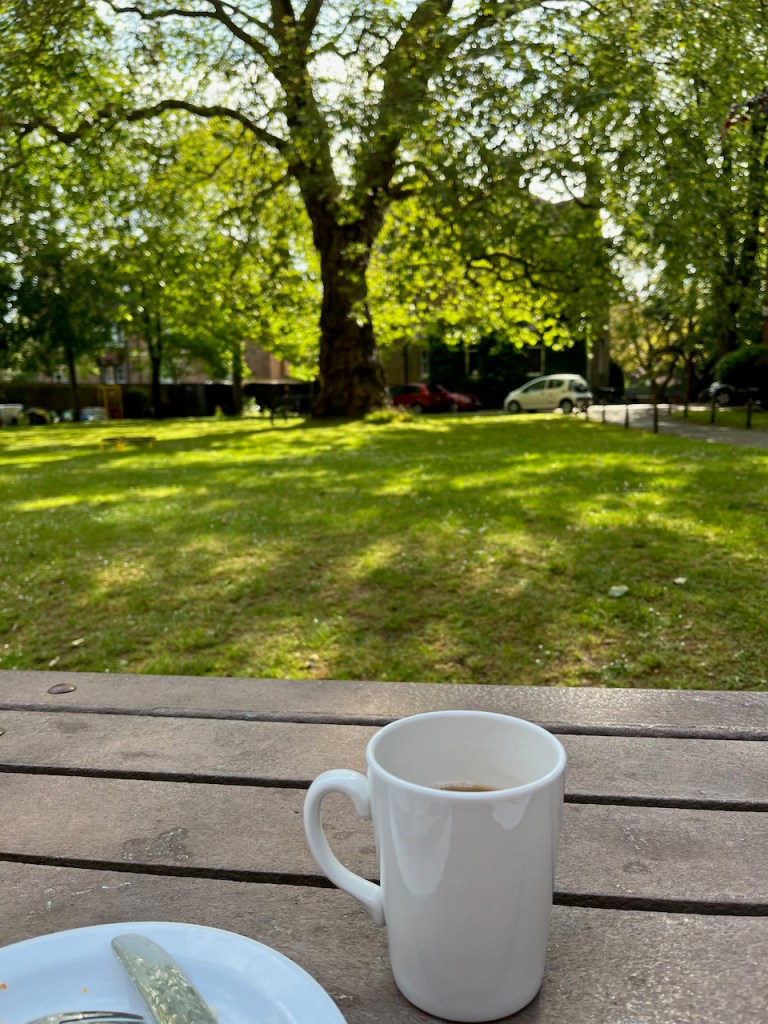
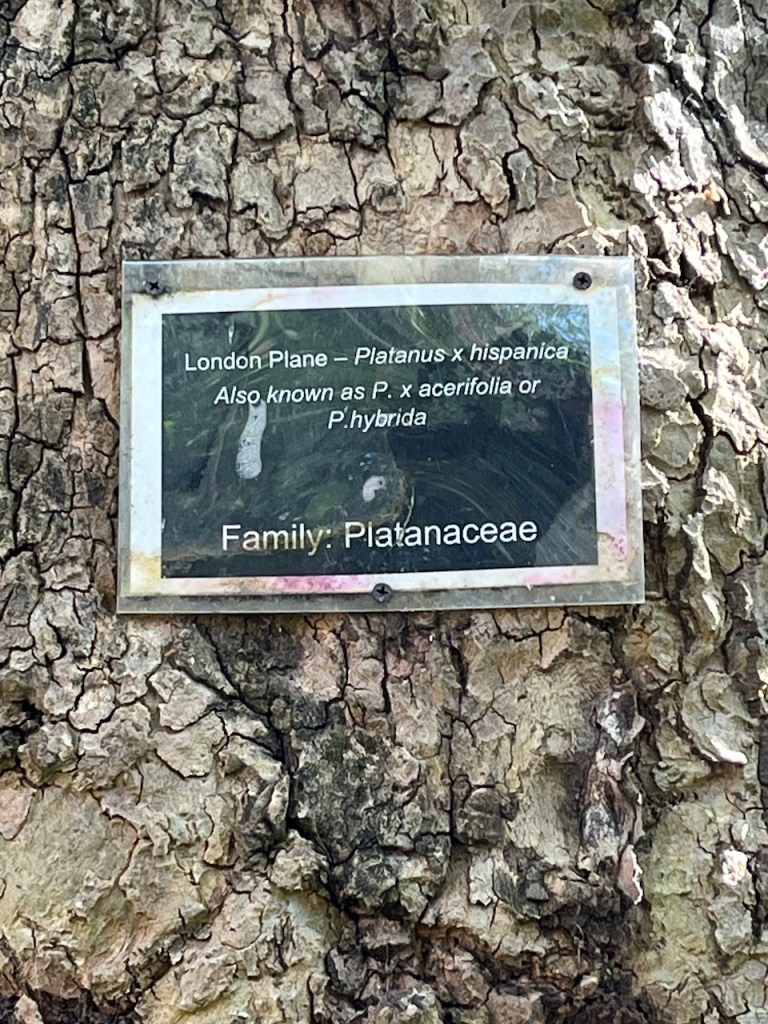
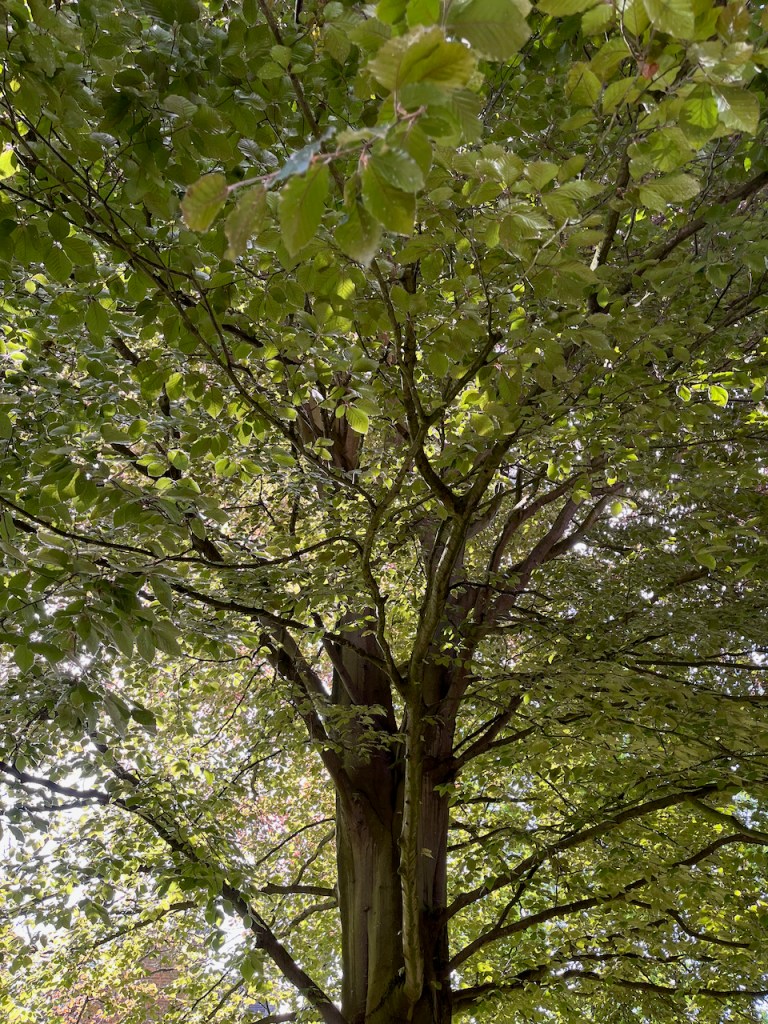
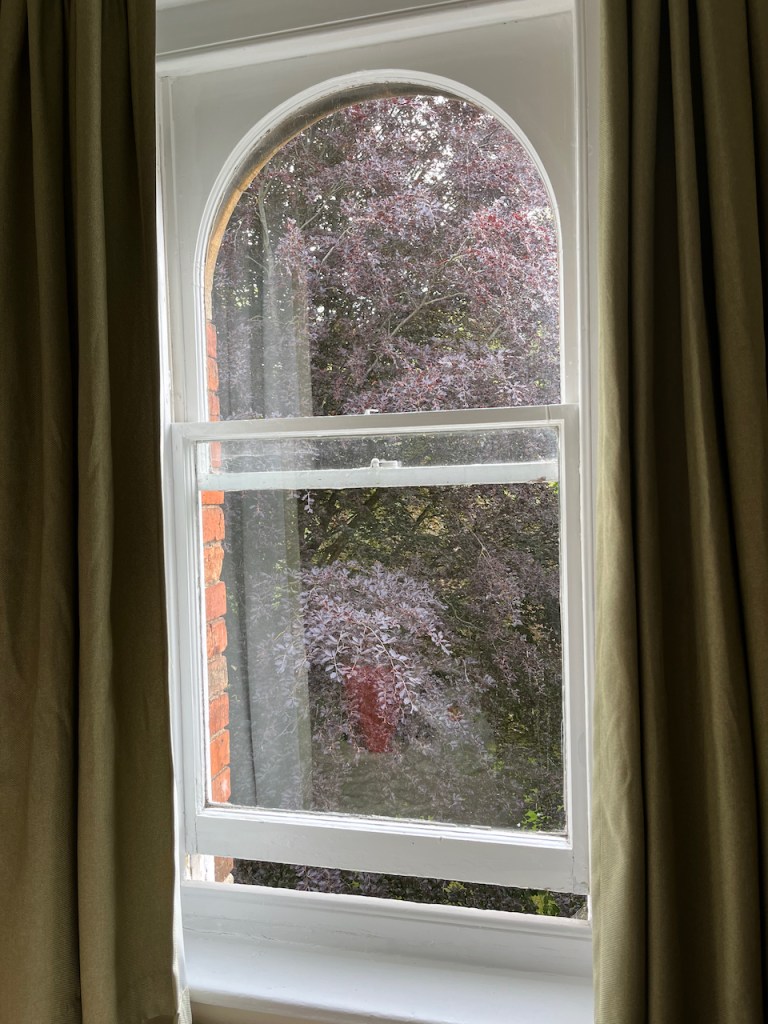
There are amazing trees in this part of Oxford. The houses are large, but the trees are larger. I had my breakfast outdoors in the garden at Wycliffe Hall, looking at a gigantic London Plane. The view from my bedroom was filled with beech tree.

I sketched the chapel in the evening and finished the sketch the next morning.


For a sketch of the west side of the Hall, see this post.

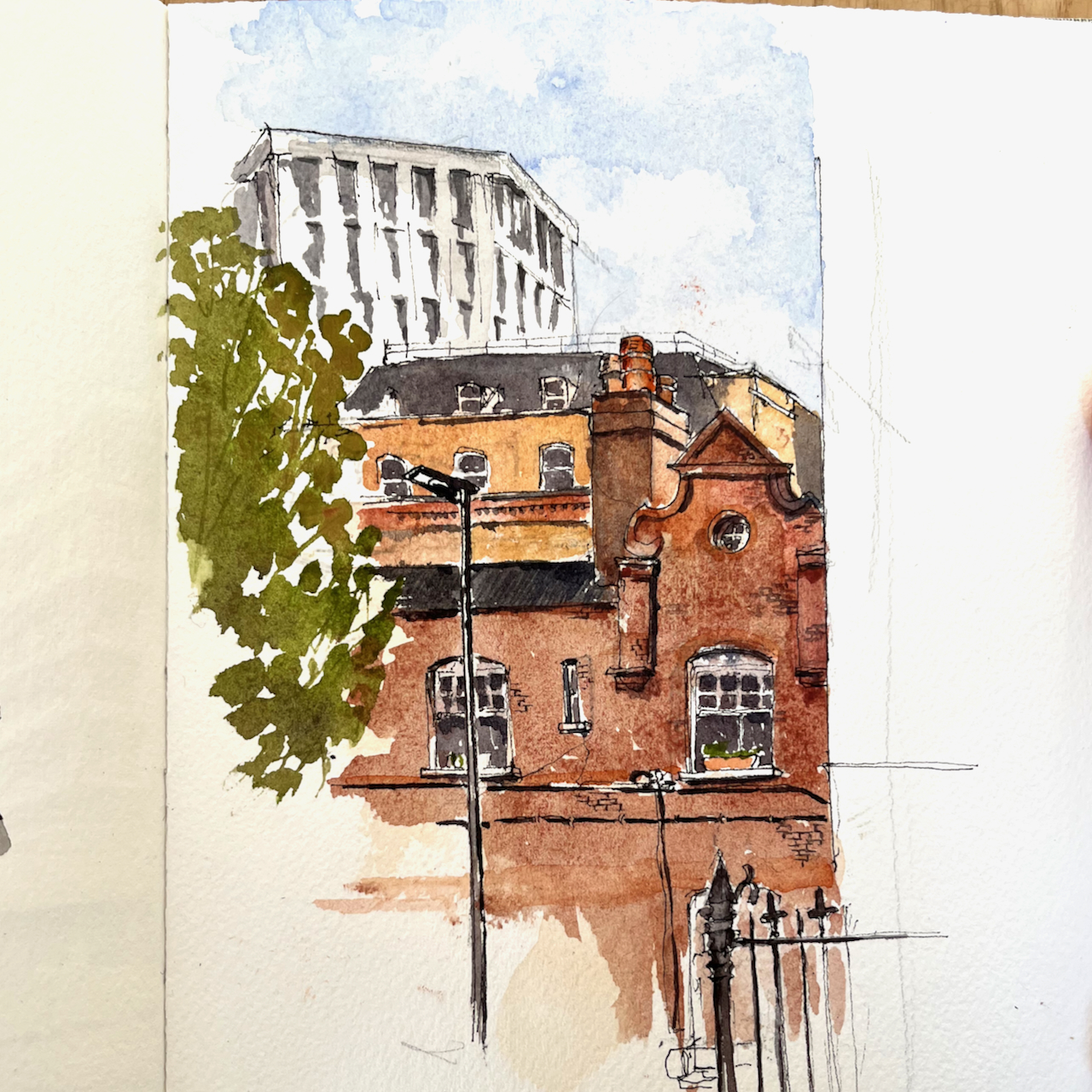
Roofscape from Macklin Street, London WC2

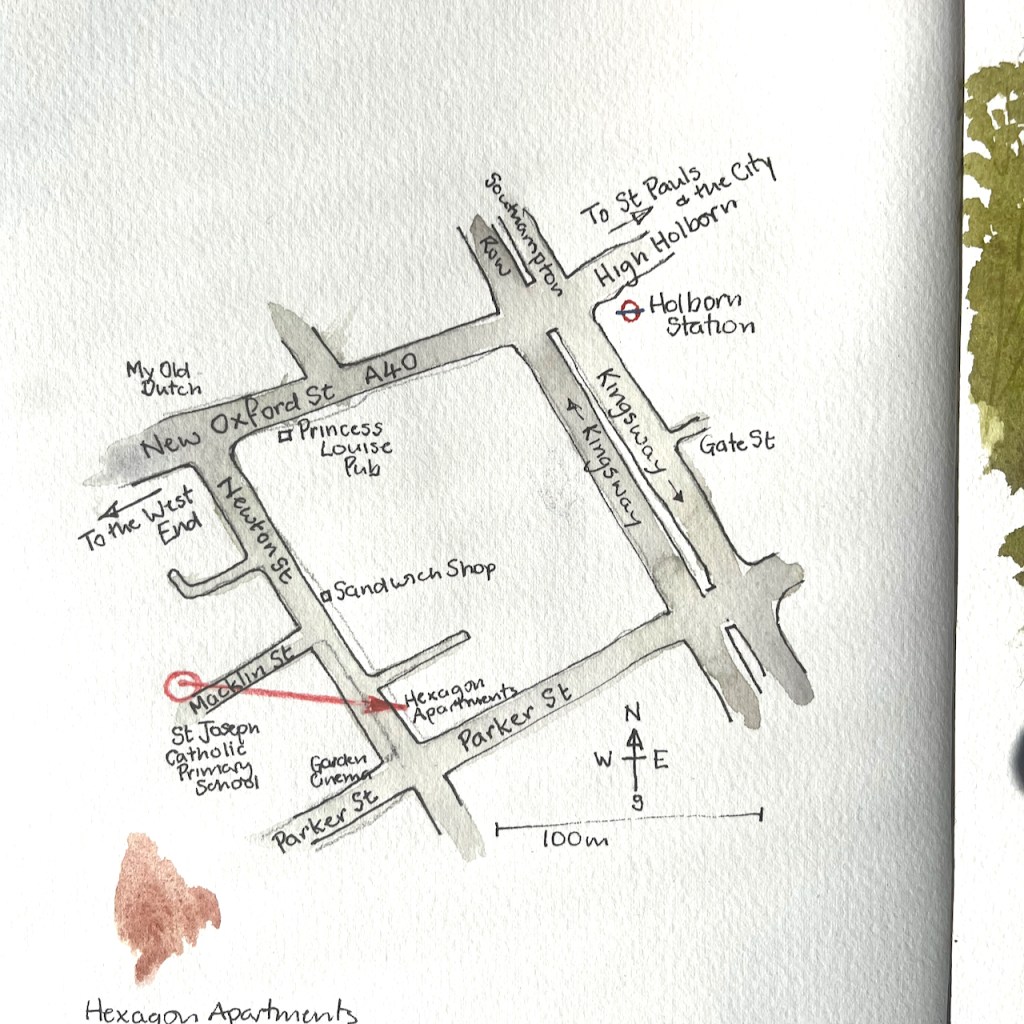
Walking through the back streets of Covent Garden, I came across a row of Victorian brick-built houses. This is Macklin Street. I made a quick sketch of the roofs.

Roofscape from Macklin Street, 5th June 2023 in Sketchbook 13

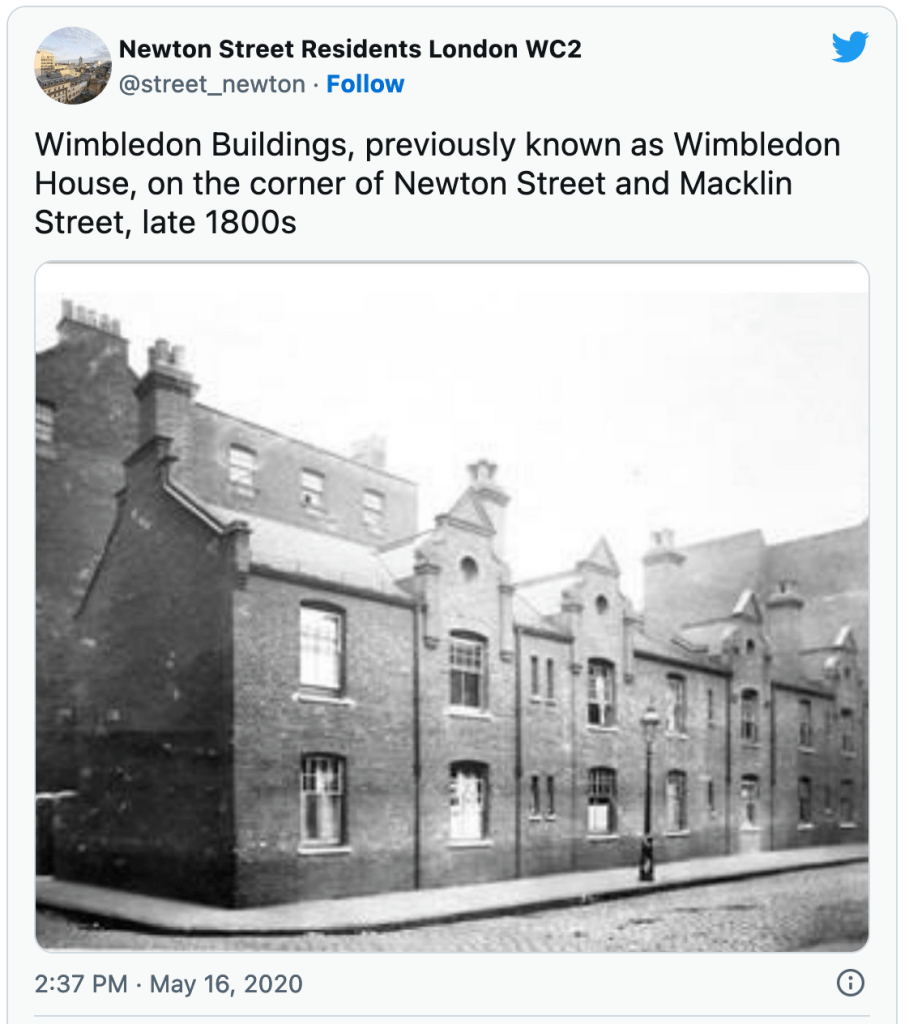
While sketching I noticed a peculiar thing. There are no doors onto the street. It turns out the entrance to this row of buildings is on the nearby Newton Street, overhung by greenery and climbing plants.

The brick building in my sketch is Wimbledon Buildings, formerly Wimbledon House, built in 1893.

In 1893 the Parker Street Lodging House was
completed for 345 people. In 1896 Aldwych, Cotterell
and Lindsey (demolished in the 1960s), Powis and
Wimbledon buildings were completed for 284 people.
Twenty workshops were also provided. The scheme also
widened Parker Street and Macklin Street.

page 9, Camden Conservation Area Statement (undated) [https://www.camden.gov.uk/documents/20142/7905860/Seven+Dials+Estate+CAS.pdf]

It is now part of a “Central London residential street with a community of social housing and owner occupying flats”, with its own Twitter account. Here is a interesting picture from that Twitter feed, showing the roof gable I sketched. This is the view from Newton Street, with Macklin Street going off to the right. Note the absence of front doors. The entrances are through a gate at the left of the photo.

St Joseph’s Primary School is on Macklin Street. Its former name, Macklin Street Catholic School, is still clearly inscribed in the stonework high up. As I sketched, the children came out into the street at the end of their school day.

The Camden Conservation Area statement mentioned above is on this link . If that doesn’t work, you can download it from the link below. It is 36 pages.

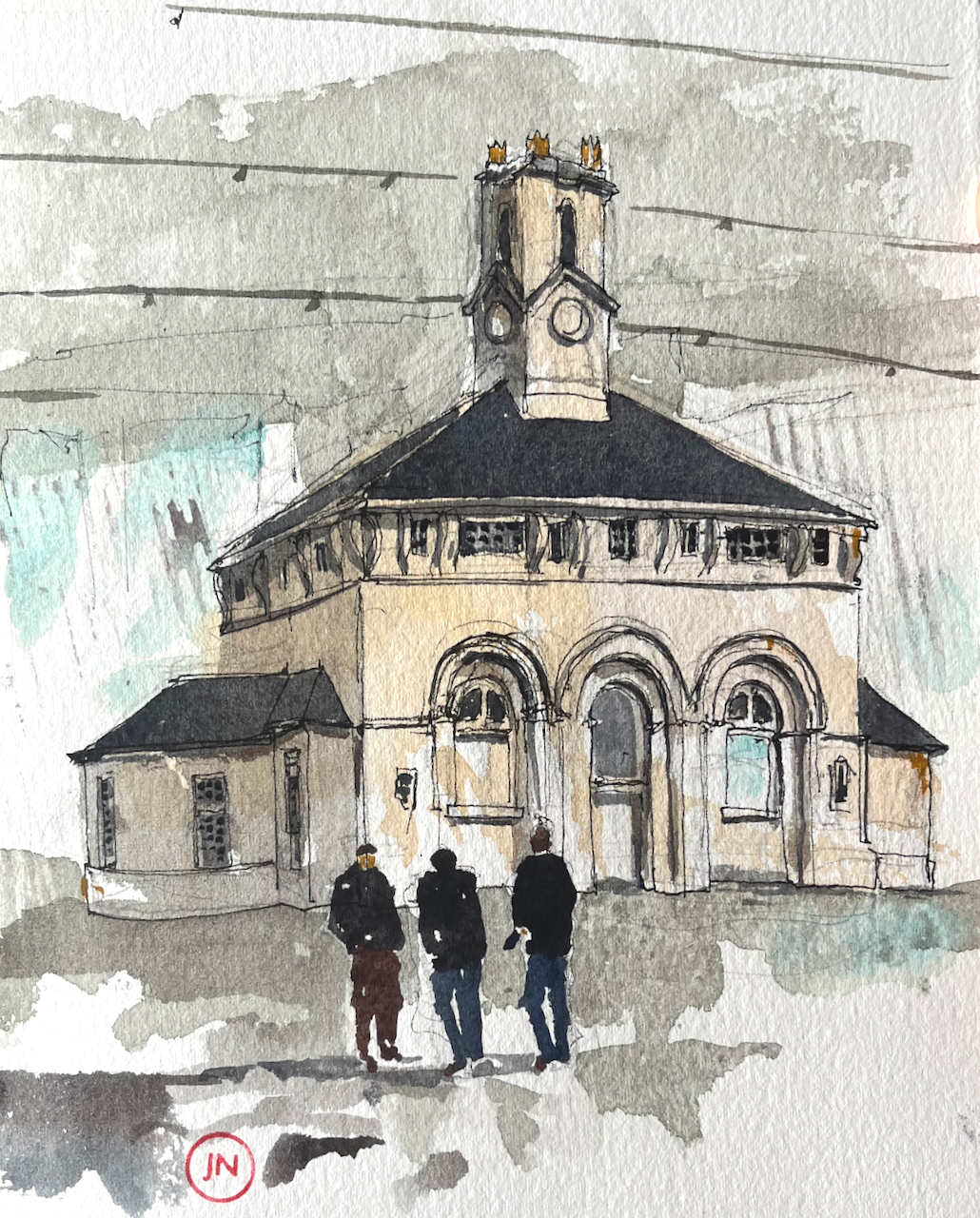
Market Keepers’ House, Newcastle

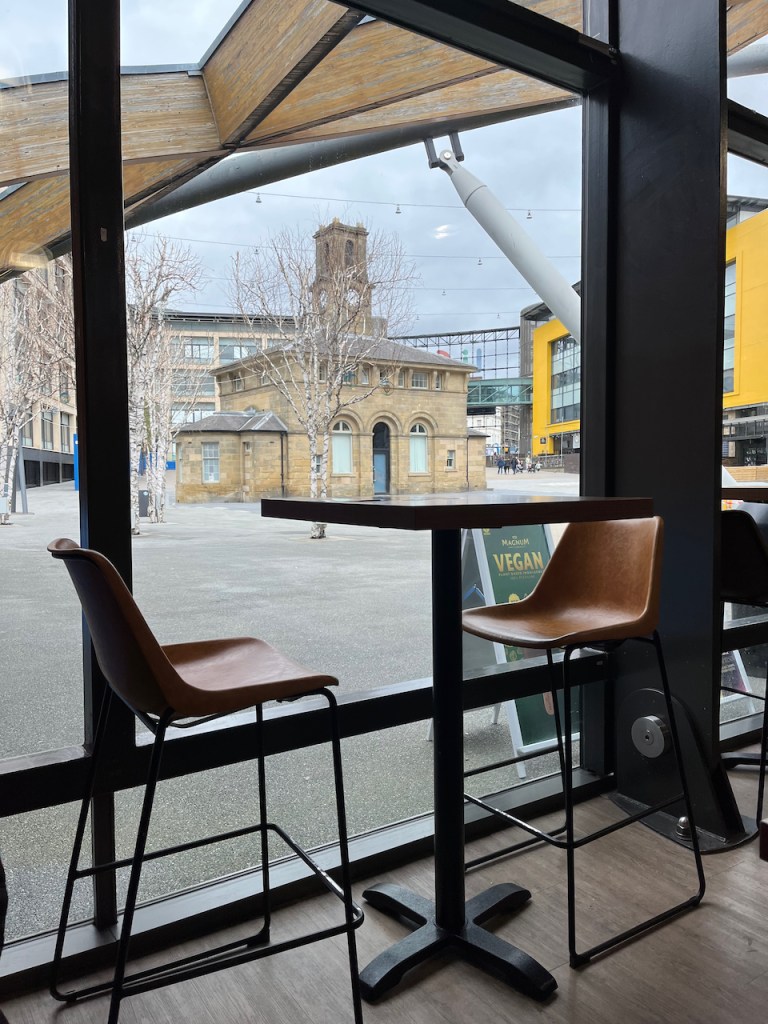
Near Newcastle Central Station there is a new development called the “Centre for Life” Times Square, Newcastle upon Tyne NE1 4EP. It includes scientific research establishments, an interactive science museum for children, and various cafés and events spaces. It was built 1996-2000 to the designs of Terry Farrell and Partners on parts of an old cattle market. In the centre of the wide windswept space is this delightful building, from another era.

Market Keepers’ House, Times Square, Newcastle NE1, sketched from the Centre for Life museum café, 7th April 2023 in Sketchbook 13. About 9″ x 7″.

It is the Market Keepers’ House, 1840, designed by John Dobson, a prolific Newcastle architect of the time. His work is everywhere in the City. He designed the Church of St Thomas the Martyr, for example, and the Central Station. And he also gave us this miniature masterpiece, with its pleasing curves and symmetry. The building was restored in 1998 by Ainsworth Spark. This information is from “Pevsner Architectural Guides, Newcastle and Gateshead” by Grace McCombie 2009. We arrived at Times Square after following “Walk 5” in the book.

The people in the foreground are refuse collectors and cleaners. The two on the right are just coming off shift and the person on the left is just coming on shift. There is a lively exchange of views about their boss, a comparison of anecdotes concerning the unbelievable behaviour of the general public, and an analysis of recent decisions by the manager of Newcastle United. I couldn’t, of course, hear a word they were saying. Their articulate body language inspired me to pay attention to their conversation and include them in the picture.

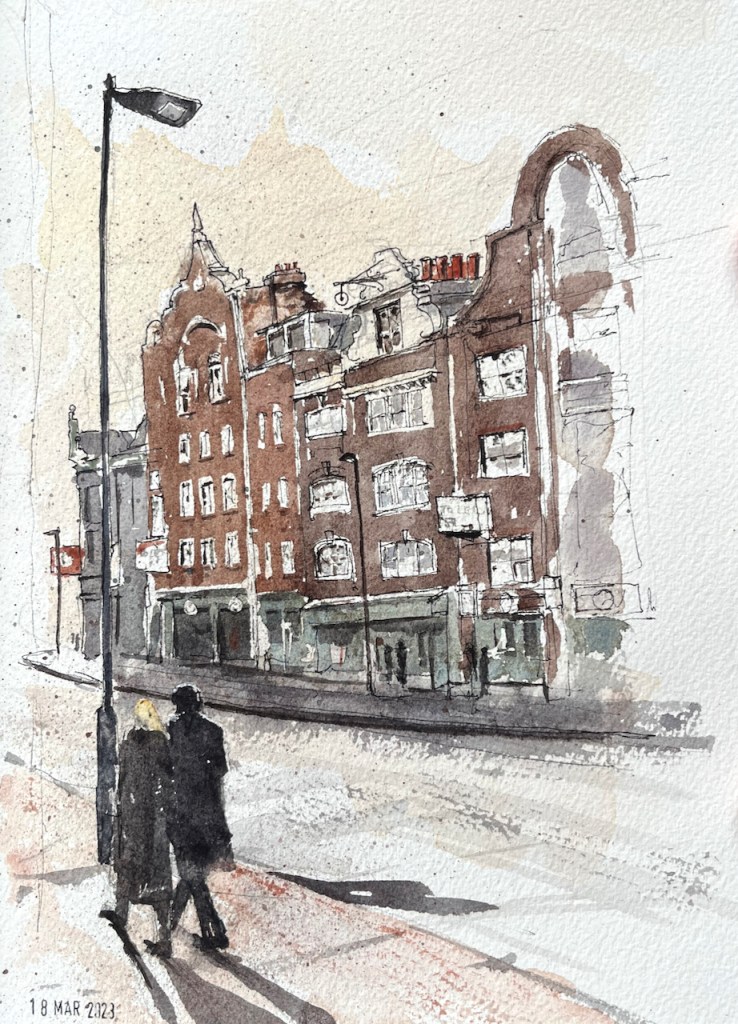
St John St EC1M, numbers 55-65, looking south

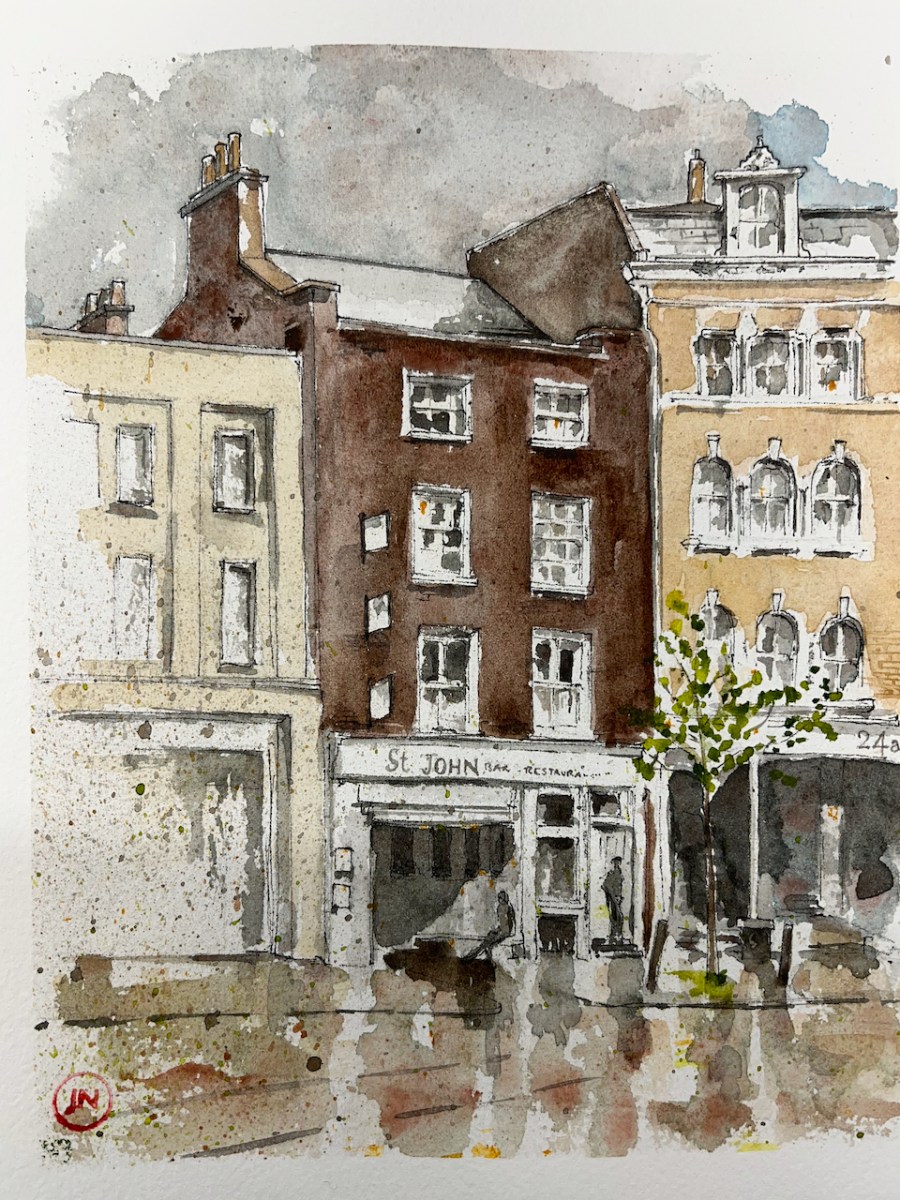
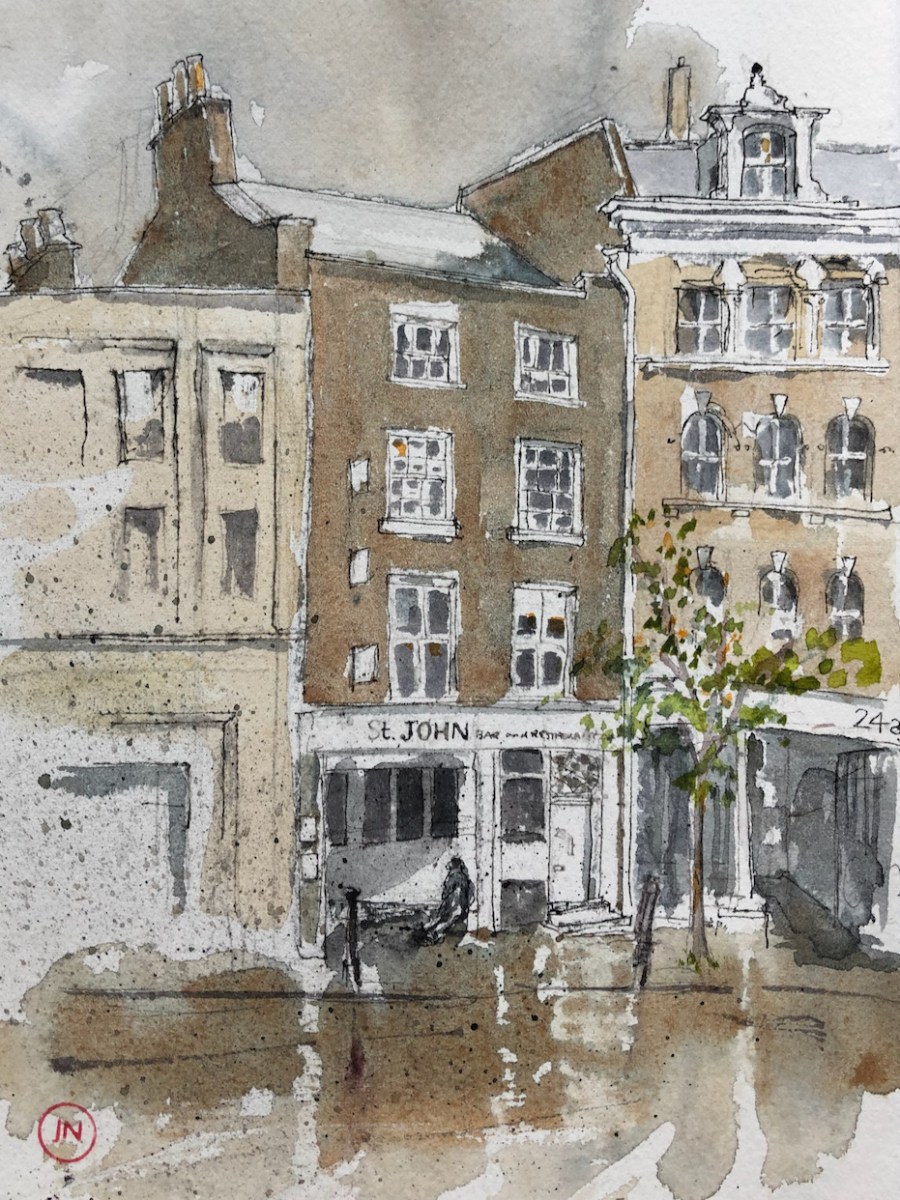
Here is a sketch looking south down St John St, Islington, towards Smithfield Meat Market, which is off to the left. The building with the pointed gable is the pub “The White Bear”.

55-65 St John St, London EC1M. 18 March 2023 in Sketchbook 13
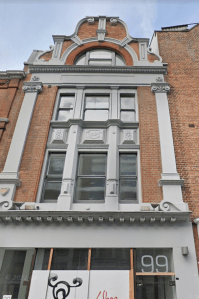
No. 99: the former “Horns”, no longer a pub.

The White Bear has “1899” written on its tall gable. “British History Online” points to two pubs built around that time on St John St, of which only the White Bear survives as a pub:

.. two public houses from the same period: the White Bear at No. 57 [], rebuilt in 1898–9 by the City of London Brewery Co., along with the adjoining house No. 59; and the former Horns of 1887 at No. 99, by Alexander & Gibson, architects []

British History Online https://www.british-history.ac.uk/survey-london/vol46/pp203-221

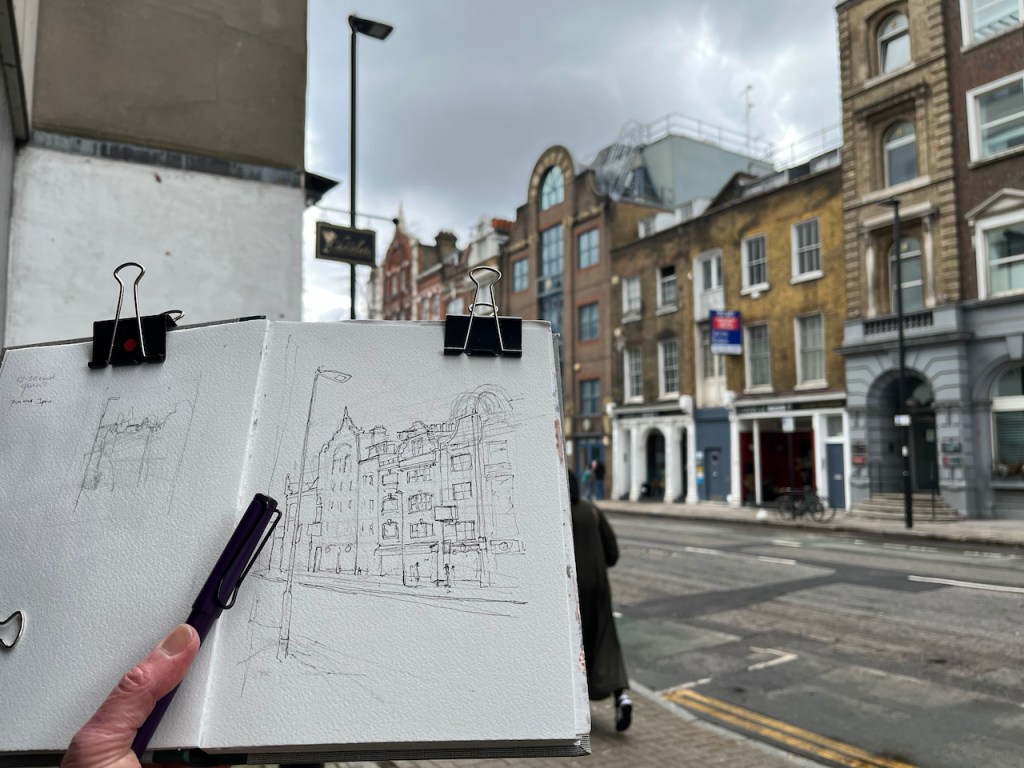
Here is a map and a photo of the ink drawing. I was sketching on a somewhat damp day, ‘rain with sunny intervals’. I went home at this point to finish the colours at my desk.

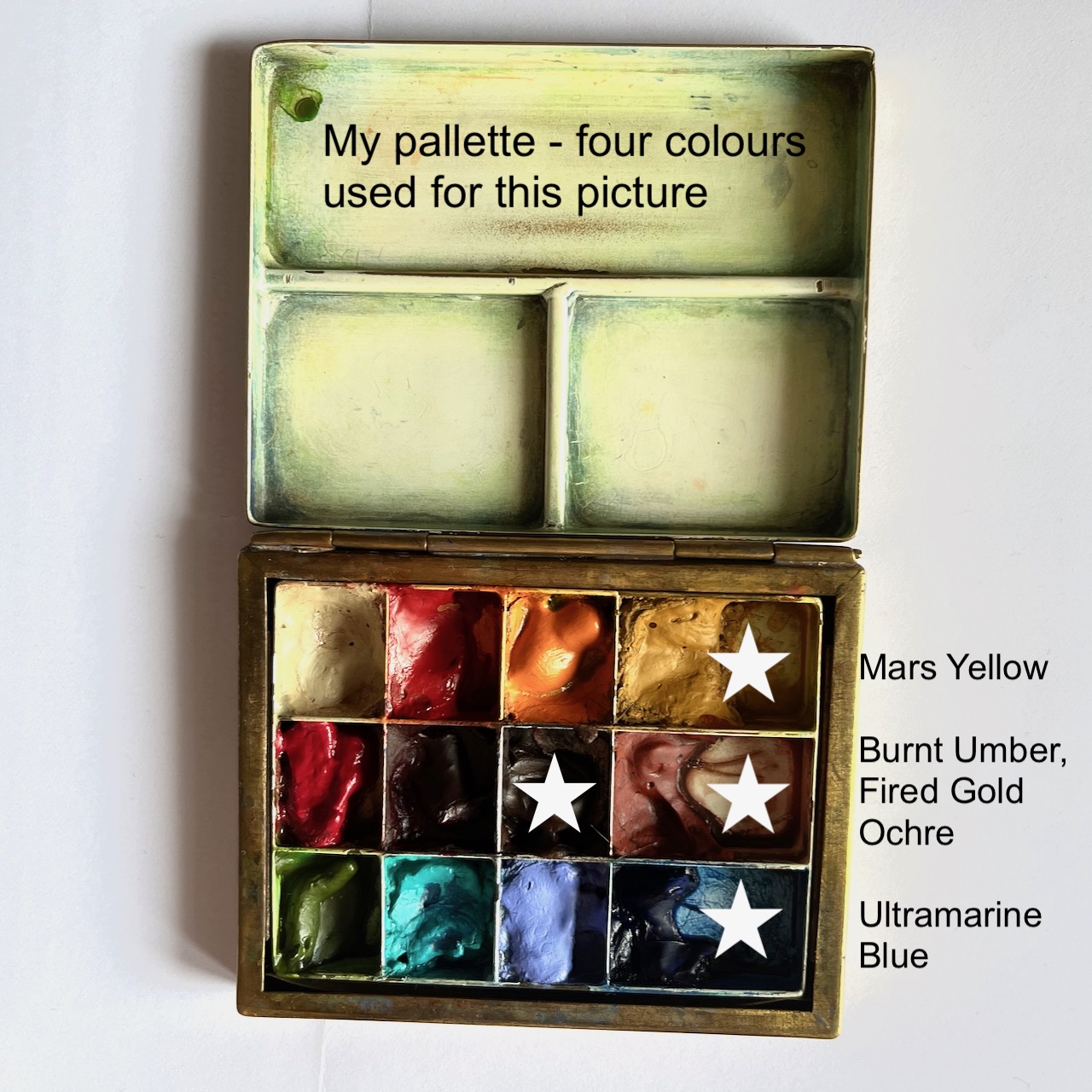
Here are the colours I used in this sketch. As you see, there are only four.
Here are a few other sketches I’ve done in the area.

77 St John St EC1M: the ASLEF building

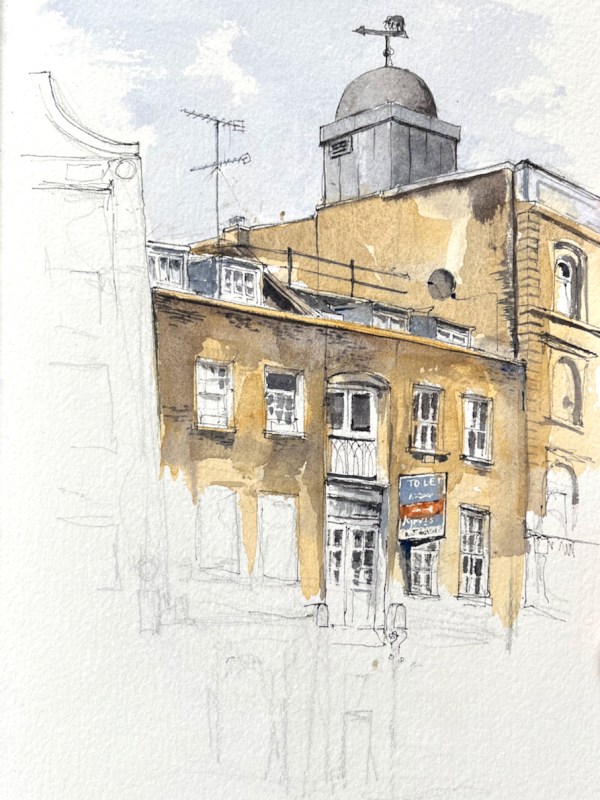
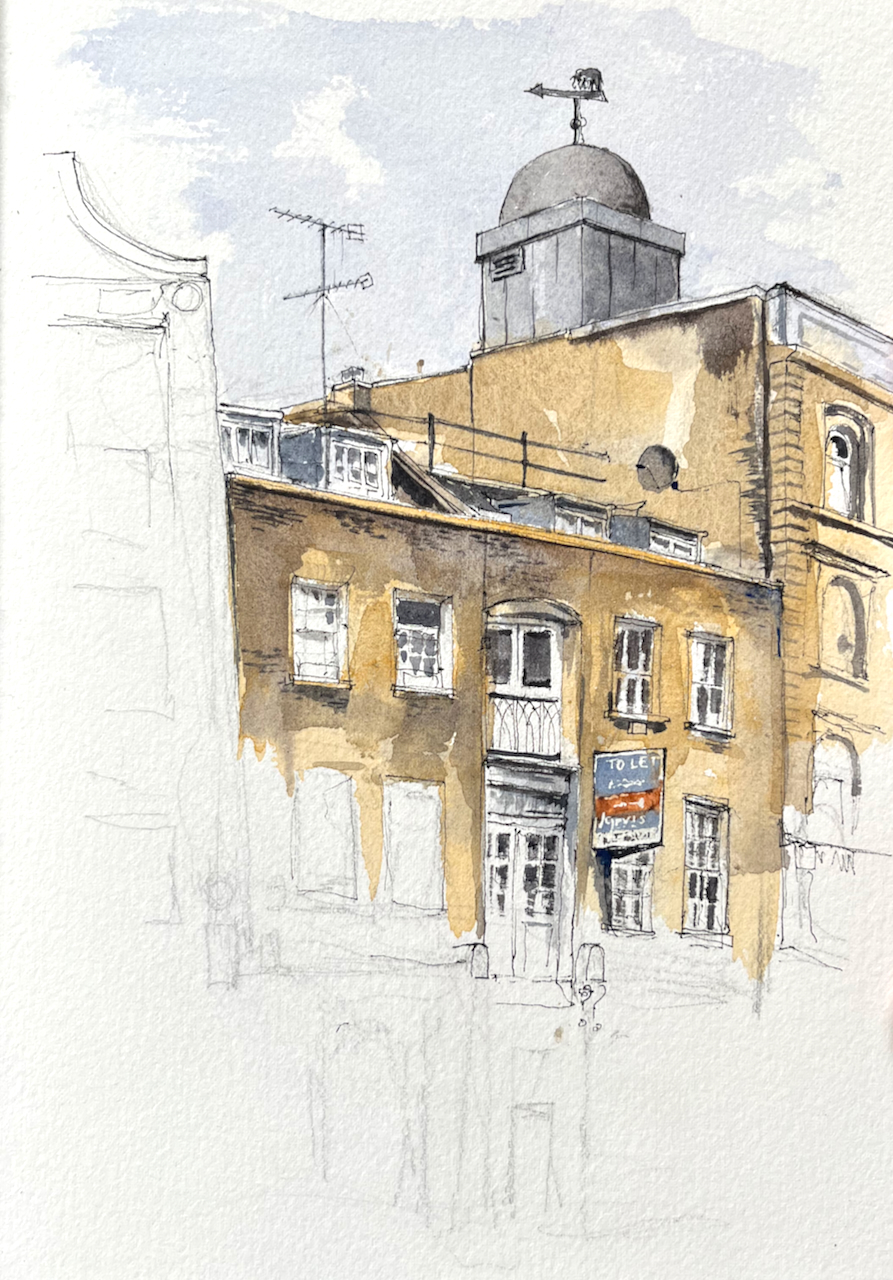
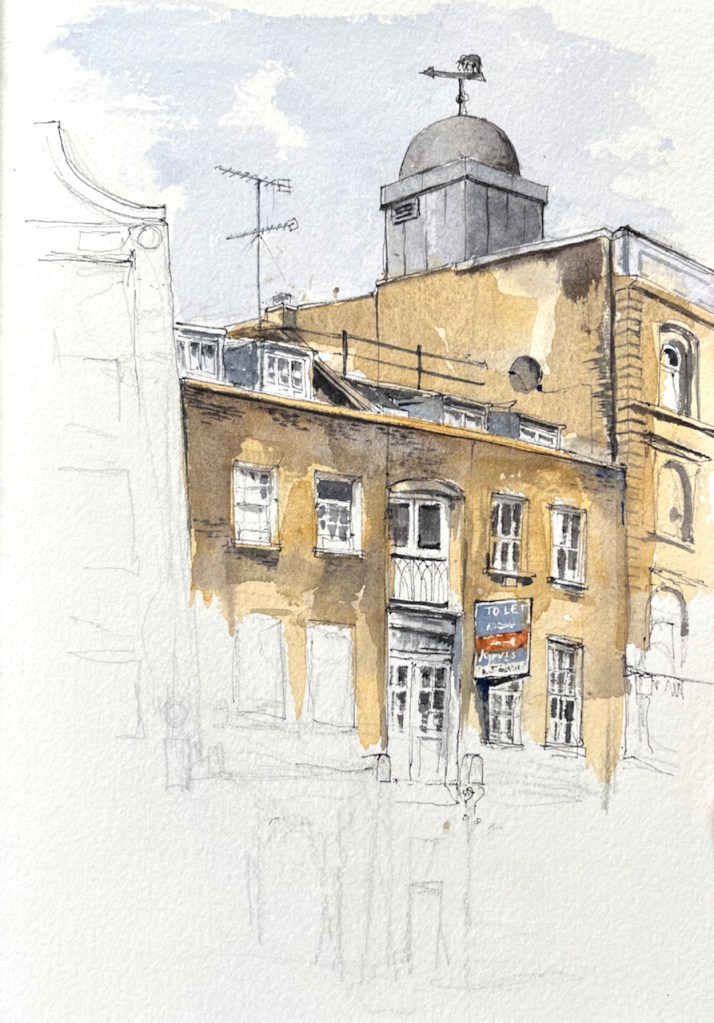
Next time you are walking along St John St, look out for this dome, with the elephant wind vane. It’s on the West side, just a bit further North than the White Bear pub.

77 St John St EC1M, 9″ x 7″ in Sketchbook 13, 17th March 2023

I can’t find out anything about why there’s an elephant up there. The wind vane is on number 77 St John St, currently occupied by, amongst others, ASLEF the train drivers union, and “Liberation – Justice for Colombia”

JFC was set up in 2002 by the British trade union movement to support Colombian civil society in its struggle for human rights, labour rights, peace and social justice.

All JFC work is carried out in response to the demands of our partners in Colombia: the political activists, trade unionists, peasant organisations, human rights defenders, and other civil society groups who are on the front line in demanding peace and social justice.

JFC promotes links of solidarity between British and Irish trade unions and organisations in Colombia and gives a political voice internationally to Colombian civil society through our work in the British, Irish and EU Parliaments

“Justice for Colombia website: https://justiceforcolombia.org

The building in the centre of my drawing is numbers 69, 71 and 73 St John St. These buildings are listed Grade II, list entry no: 1195730.

In 2015 there was an application to build another floor on top of number 69, for residential use. As part of the planning submission, the applicant commissioned a detailed historical study from Paul Edwards, Dip Arch (Oxford) IHBC, Historic Environment Specialist. His 15-page report provides fascinating information about the houses. For example:

Nos 69-73 are depicted in Tallis London Street View, drawn 1838-1840,
… There were three bays, at the centre an alley leading to an internal yard flanked by buildings of
three storeys and attics, each with two windows each side of the alley.
The facades had classical Georgian or Regency proportions, with tall
sash windows at 1st and second floor levels and continuous small pane shop windows at ground floor level. A gambrel roof was set behind an eaves parapet.
The northern house was leased by John Newton a cork manufacturer
who took over the whole premises and whose firm remained there
until the First World War.
The ground floor front of No 69 was re-modelled in the mid-19th century with arched openings and Ionic pilasters in stucco. The shop front of No 73 dates from 1884. There had been a fire in the cork
warehouse in 1882 which was then partly rebuilt with No 69 being extended over the alley between the two houses. In 1896 the two buildings were made into one.

Paul Edwards, 69 St John Street, Islington, Historic Asset Assessment (Version 1) February 2015.

The proposal was rejected by the Islington planning officer in 2018, after appeal.

Here is a sketch map showing where I was standing and my view-line:

St John Street is a fascinating area, with layers of history, and still evolving. I’ve sketched here a number of times.

Carting Lane Sewer Gas Destructor Lamp, London WC2

This lamp burns gas from the sewers. It’s an engineering marvel from the Victorian age, together with Wapping Hydraulic Power Station, the Embankment and Tower Bridge. Amazingly, it’s still standing, and still burning sewer gas, now renamed “biogas”. The notice on the fence says:

The adjacent street light is the last remaining sewer gas destructor lamp in the City of Westminster. Installed in association with Sir Joseph Bazalgette’s revolutionary Victoria Embankment sewer which opened in 1870, this cast iron ornamental lamp standard with original lantern continues to burn residual biogas.

City of Westminster, notice in Carting Lane
Carting Lane Sewer Gas Destructor Lamp, sketched 13 Feb 2023, 2pm in Sketchbook 13.

The original purpose of the lamps was not to light the streets but to burn off sewer gas, with the aim of reducing odours, exterminating bacteria in the sewer gas and reducing the explosion risk. Some town gas is drawn in with the sewer gas to make sure the lamp stays alight and does its job. The lamp is alight night and day. This was alight at 2pm.

There’s an article about the lamps on this link .

Carting Lane runs down from the Strand to the Thames Embankment, right next to the Savoy Hotel. I drew the picture standing above the lamp, looking down the lane towards the Thames. Here’s a map.

Here is work in progress:

The colours in the picture are:

  • Ultramarine Blue and Lavender for the sky,
  • Serpentine Genuine/Burnt Umber/Fired Gold Ochre/ Mars Yellow for the mid-tones
  • Ultramarine Blue and Burnt Umber mix for the blacks and greys
  • Transparent Pyrrol Orange for the 20mph sign on the lamppost.
My current watercolour palette. The colours I used for this picture are starred. All Daniel Smith colours.

A House in East London

Here is a Victorian terraced house in East London.

A House in East London, 9″ x 12″ 21 January 2023. [commission]

This was a commissioned drawing. Thank you to my client for the commission and for their permission to post the picture here.

There were two interesting challenges in this drawing. One was the fact that the front of the house was obscured by parked cars. The other was the characteristic colour of the brickwork: a clean and lively yellow. I wanted to draw the fence without the cars, so as to show the whole house. And I wanted to get that yellow right.

I was stationed on the other side of the road. There were cars parked nose-to-tail on both sides of the road. To draw the part behind the parked cars, I crossed the road and had a look then come back and sketched and then wandered about sketching and trying to get it right, gradually becoming skilled at envisaging the fence behind the car. Fortunately it was a quiet road. The few passers-by took a friendly interest, bemused by an itinerant artist in their street.

To match the colour of the brickwork, I equipped myself with a colour chart of all the yellows I possess. Usually, old London brickwork is Mars Yellow. But in this case I discovered that it was Naples Yellow, a cleaner, paler colour, less orange than Mars Yellow, more orange than Nickel Titanate Yellow. Naples Yellow also has a pleasant chalky texture, which made it perfect for this brickwork .

Most of this picture was painted in 3 basic colours: Ultramarine Blue, Naples Yellow and Burnt Umber. Here are the detailed colours, all Daniel Smith:

  • Sky: Mostly Ultramarine Blue, plus some Lavender and Cobalt Teal Blue
  • Brickwork: Mostly Naples Yellow plus a bit of Mars Yellow in the darker places
  • Window surrounds and plasterwork: Buff Titanium (very dilute)
  • Green door: Serpentine Genuine
  • Terracotta chimney pots: Fired Gold Ochre
  • All greys and shadows: a mix of Burnt Umber and Ultramarine Blue.

The paper is Arches Aquarelle 300gsm Cold Pressed in a block. The ink is De Atramentis Document Black, applied with a fountain pen.

I did a preliminary sketch to understand the perspective and the proportions. Here are some images of work in progress. This was January and very cold. I managed to complete the pen and ink on location and then added the colour at my desk in the warm when I returned home.

Pen drawing, before the colour went on.

Wapping Hydraulic Power Station, London E1

What an amazing building! It presides over a corner of Shadwell Basin, surrounded by a high wall. I spotted it on a long weekend run, and went back later to sketch it.

Wapping Hydraulic Power Station, sketched 1 Jan 2023 in Sketchbook 12, 7″ x 9″

What’s a Hydraulic Power Station? Well, in the late nineteenth century, London’s industry needed a way to exert mechanical force: to operate a printing press for example, or to raise heavy weights, for cranes and metal forming. Also, passenger lifts had been invented, and building engineers needed a way to exert force to operate the lift. One way would be to have a steam engine on site. This wasn’t always practical. Steam engines are noisy and dirty and you don’t want one next to your desirable residence, or even cluttering up your dockyard. So here’s the next idea: instead of lots of little steam engines all over the place, we’ll have a big steam engines in just a few places, and we transmit the power from them by using water. Water? Yes. The big steam engines push water at high pressure down strong cast iron pipes, and the lift engineer at the far end effectively turns on a tap and the force of the water pushes the lift up. That’s the principle.

This sounds utterly implausible, but it worked. At the end of the nineteenth century, there was a great network of pipes all over London, holding water at high pressure. This water was used to raise passenger lifts, operate curtains at theatres, and to drive printing presses. It was used for cranes and other static machinery which required a strong, steady force. It’s a steampunk dream. Here’s a map. These pipes were everywhere.

The network of pipes supplying hydraudic power.
Map from https://www.subbrit.org.uk/features/hydraulic-power-in-london/

The plaque you can see in the centre of my drawing says “London Hydraulic Power Company 1890”. This was one of the big power stations driving the water along the pipes. The power came from a coal-fired steam engine.

This is a picture from the early twentieth century. The chimney is from the steam engine room. The tall tower houses the “accumulator” where water under pressure is stored as a buffer against variation in demand. It is a sort of “battery”. A big weight sits at the top of a column of water. The weight is raised by pumping water in using steam power. The big weight then rests on the top of the water, keeping it under pressure and forcing it down the pipes.
This drawing is from roughly the same place where I did my drawing. Note the sailing boats in Shadwell basin, to the right and in the background. The Thames is off the picture, to the left. Picture from: https://www.gracesguide.co.uk/File:Im1893EnV75-p43.jpg#file (creative commons)
Map showing where I stood to do the drawing, which is also the approximate view point of the early twentieth century picture above.

Here is a summary of the history of the building, gleaned from various web searches:

  • 1890: completed and started working. In use until 1977.
  • September 1973: first listing
  • June 1977: use discontinued
  • December 1977: Grade II* listed, including the machinery (listing ref 1242419)
  • 1993-2013 – owned and operated by Jules Wright as “The Wapping Project”: an art and entertainment venue.
  • 2013: Sold to UK Real Estate Limited
  • March 2019: planning application for an office building in the courtyard, retail and restaurant space and changes to the interior
  • October 2020: planning permission approved (ref PA/19/00564/NC and PA/19/00571/A1), despite objections from The Victorian Society and the Turks Head Charity.
  • Meanwhile – it’s an event space.

The Wapping building still has its machinery inside. It’s awaiting redevelopment. You can hire it for your fashion shoot, Christmas Party or product launch. The photos below are from the agencies advertising the use of the space: Canvas Events, and JJ Media It looks totally amazing! If you book your event there, please can I come and sketch?

The project sheet for the planning application is here: https://www.cma-planning.co.uk//images/projects/wapping_hydraulic_pumping_station/Wapping_Hydraulic_Pumping_Station_Project_Sheet.pdf

If that doesn’t work, here’s the file:

Here are some snapshots taken while I was drawing. The chimney shown in the early twentieth century drawing has vanished.

Colours used in the drawing:

  • Fired Gold Ochre
  • Ultramarine Blue
  • Burnt Umber
  • Some Transparent Pyrrol Orange, but not much.

Additional references:

https://www.rbhistory.org.uk/post/london-hydraulic-and-power-company