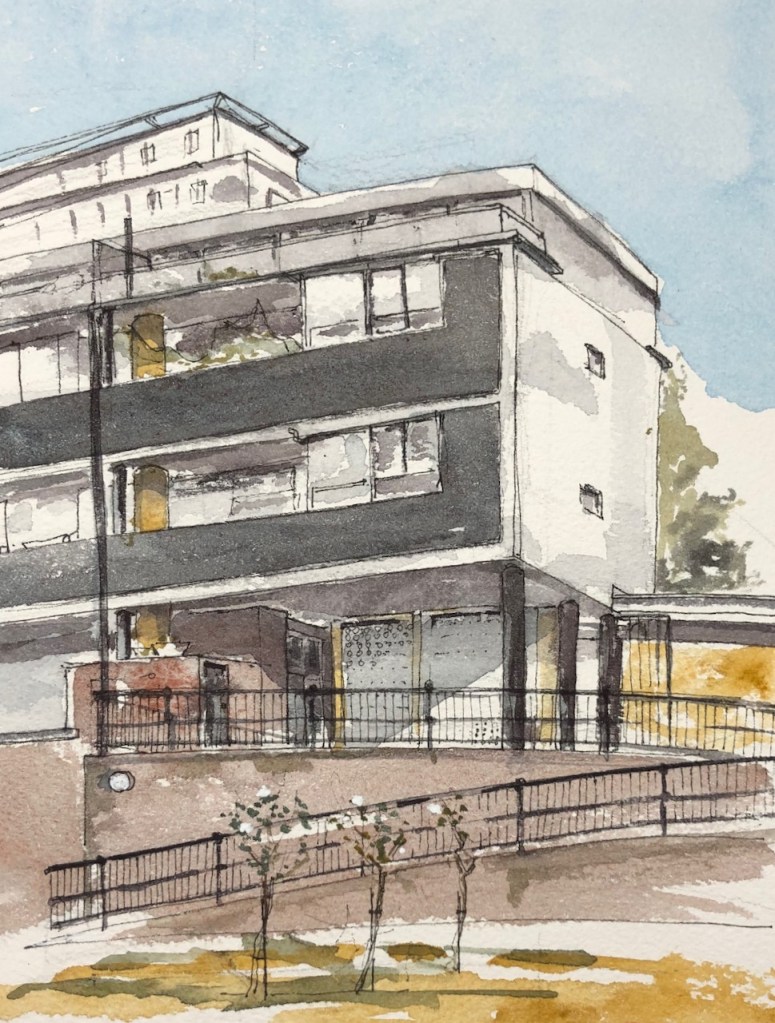
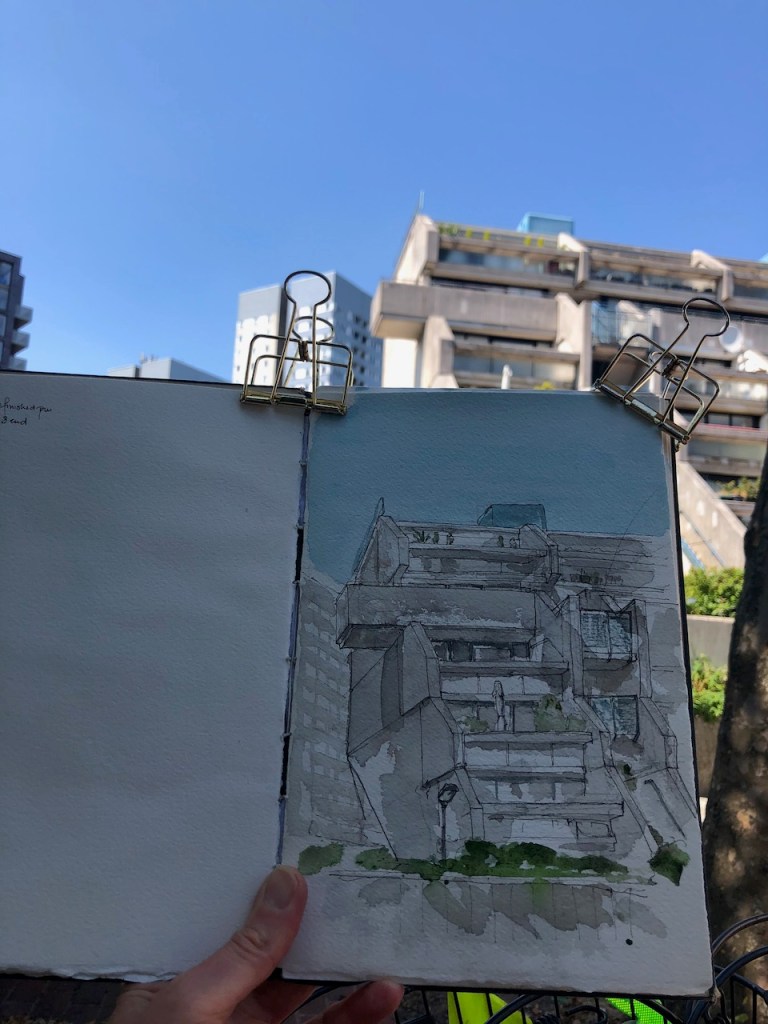
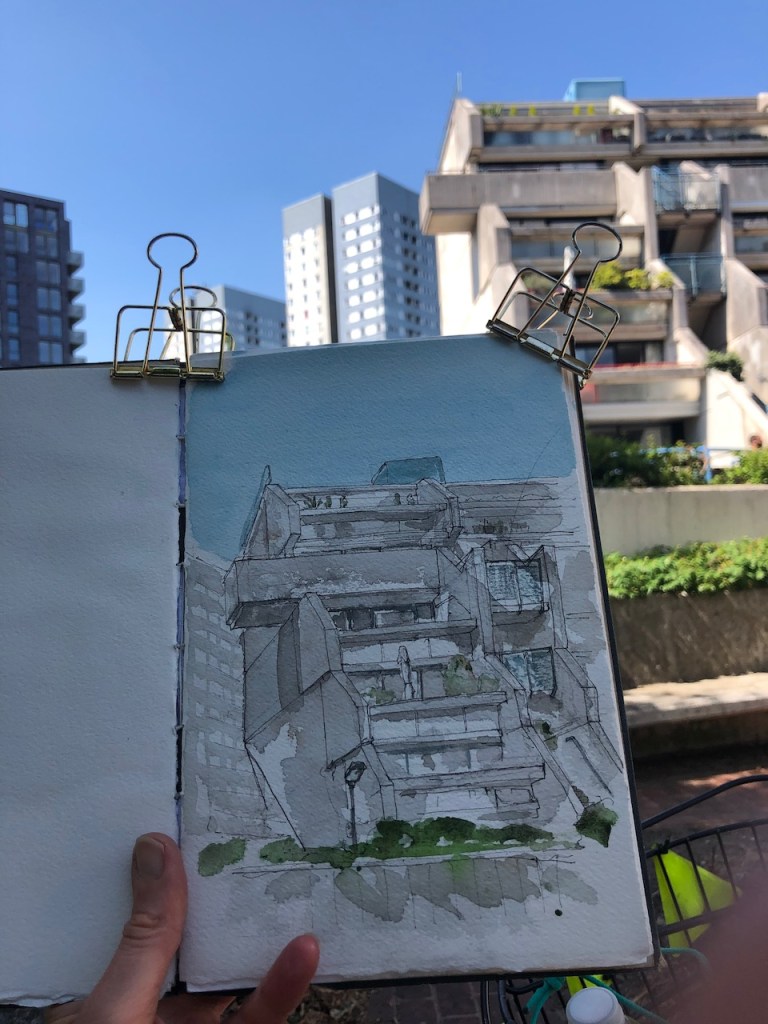
Stanley Cohen House, on the East side of the Golden Lane Estate. Peabody House in the background.
I enjoyed the bold statement of the vertical yellow rubbish chute, visible above the balconies.
There were many plants on people’s balconies. I didn’t draw them all. Many people had window boxes, with geraniums and trailing leaves. On the upper floor, a length of camouflage netting hung across the balcony. You can just see it towards the middle of the picture. Then there were the three rose bushes, sketched in the foreground. All the while, the fountain played. There were lilies in the pond.
Stanley Cohen was chairman of the City of London public health committee in 1954. His name appears on the almost-indecipherable Foundation stone on Bowater House, near where I did this drawing.
The almost-indecipherable Foundation Stone. The part that says “George Wimpey” however, has been carefully highlighted! Here’s what the stone says: The Corporation of London This Foundation Stone was laid by the Rt. Hon. The Lord Mayor of London Sir Noel Vansittart Bowater BT MC on the Twenty First Day of July 1954 Stanley Edward Cohen Esq Chairman of the Public Health Committee Thomas Cuthbert Harrowing Esq Late Chairman Architects Chamberlain Powell and Bon Substructure Contractors Griggs & Son Ltd Superstructure Contractors George Wimpey & Co Ltd
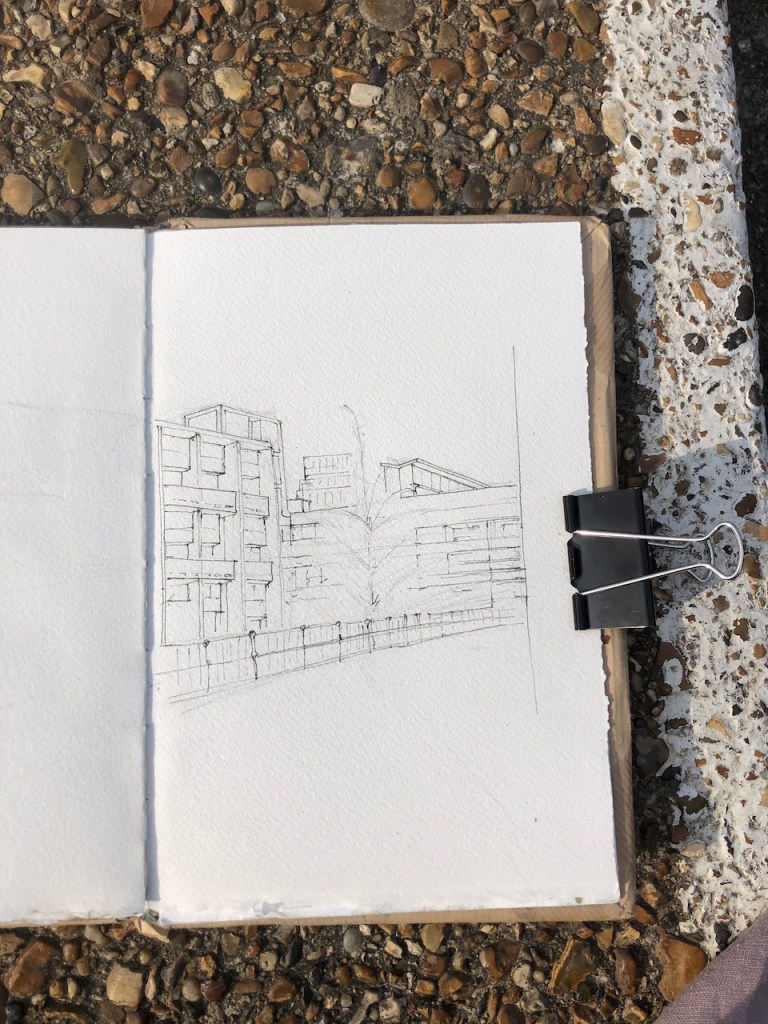
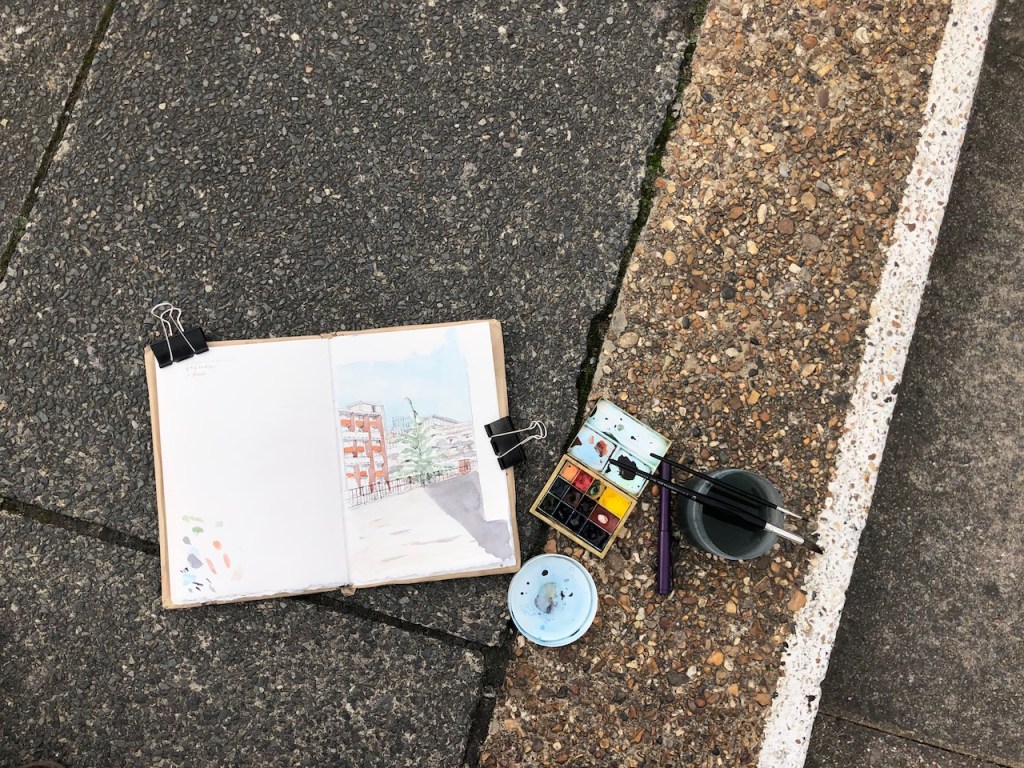
Here is work in progress and a map.
This drawing is 25cm by 16cm, 10 inches by 6½ inches on Arches 300gsm watercolour paper. It took 1½ hours. After a preliminary sketch, shown in the gallery above, I started work on this drawing at 14:30 and finished at 16:00. The colours are Fired Red Ochre, Mars Yellow, Perylene Maroon, and Phthalo Turquoise, over De Atramentis document black ink.
Here is a collection of my drawings of the Golden Lane Estate:
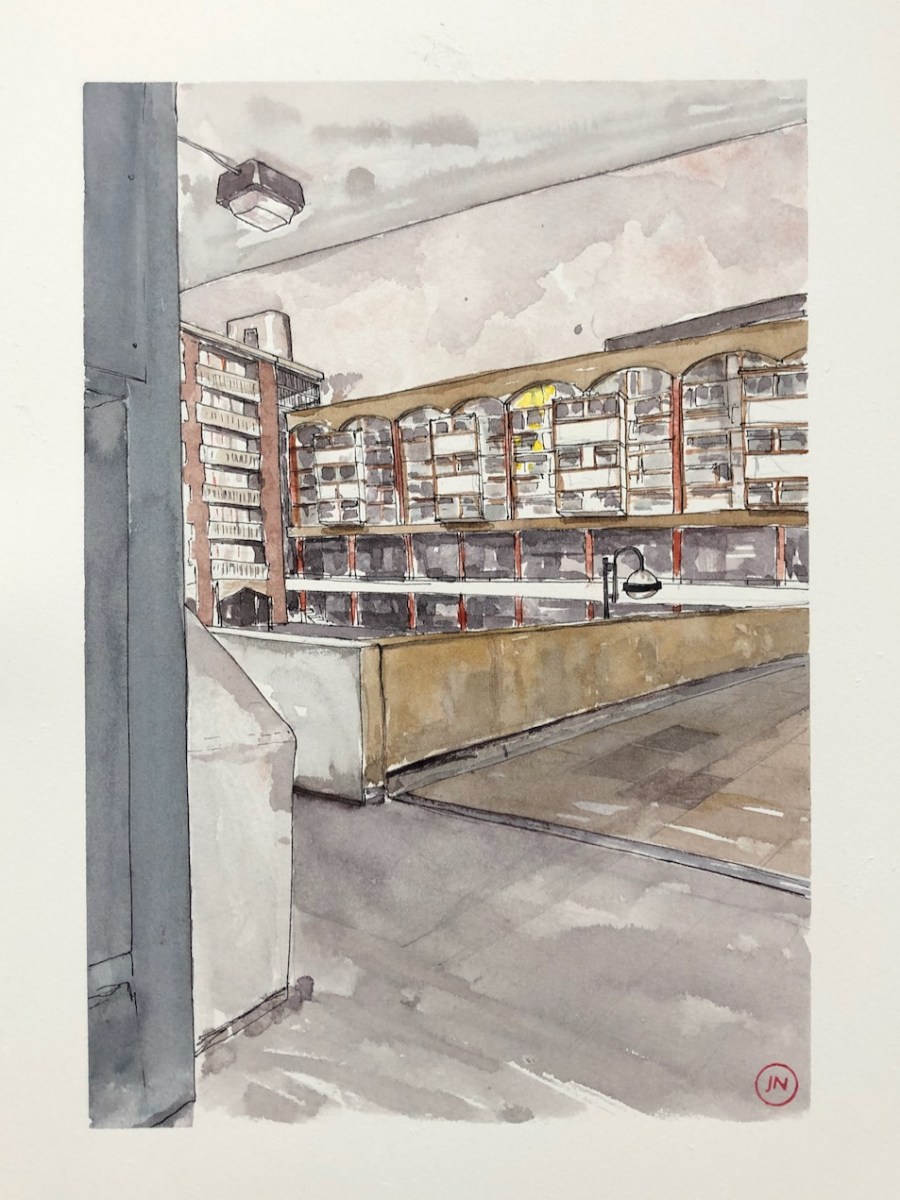
Yesterday I drew Basterfield House, sitting on some steps in the shadow of Great Arthur House.
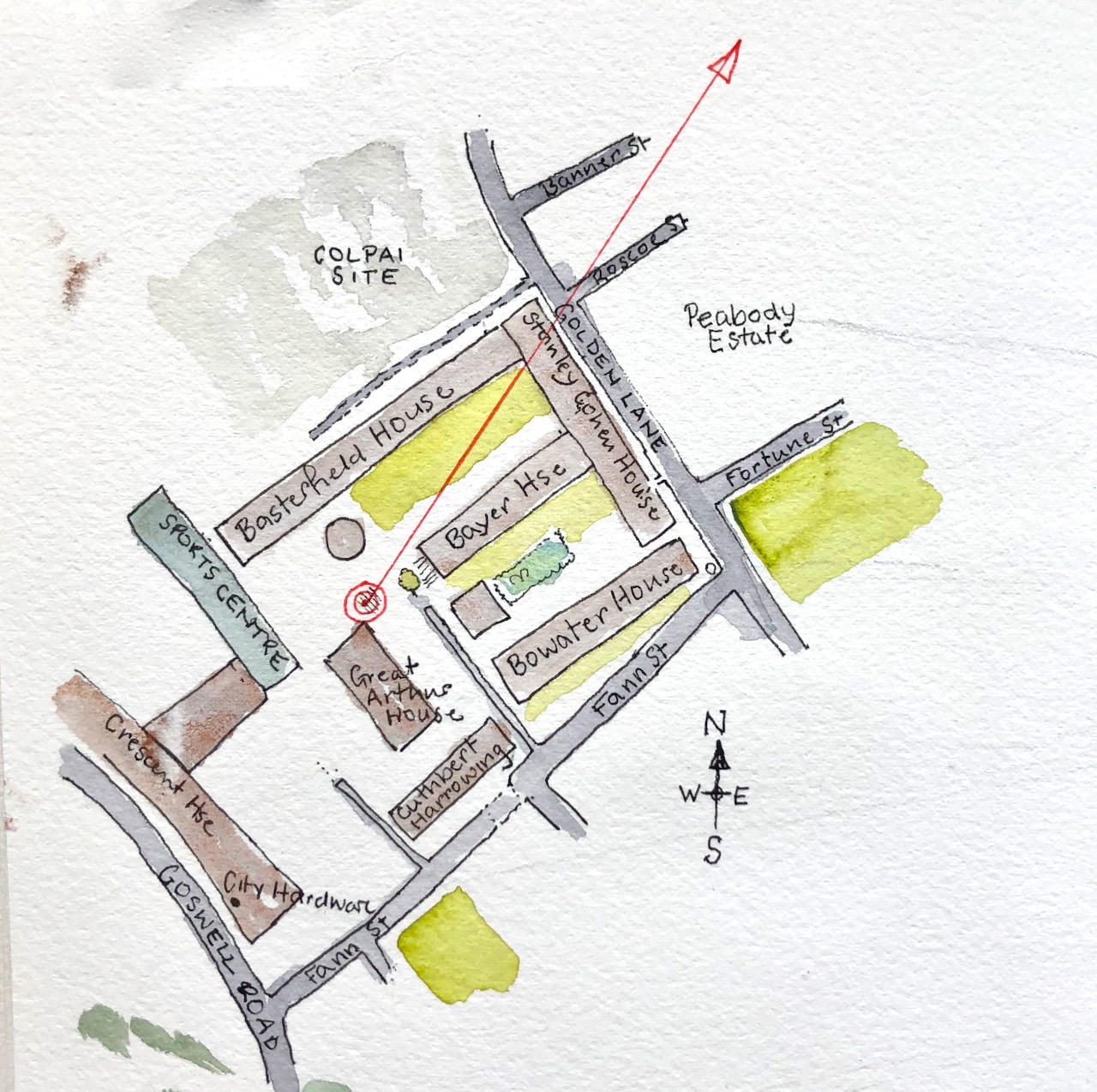
Basterfield House is at the North of the Golden Lane Estate. Here is a map. Great Arthur House was over my right shoulder, and cast its huge shadow in the afternoon sun.
Sketch map showing the view shown in the drawing.
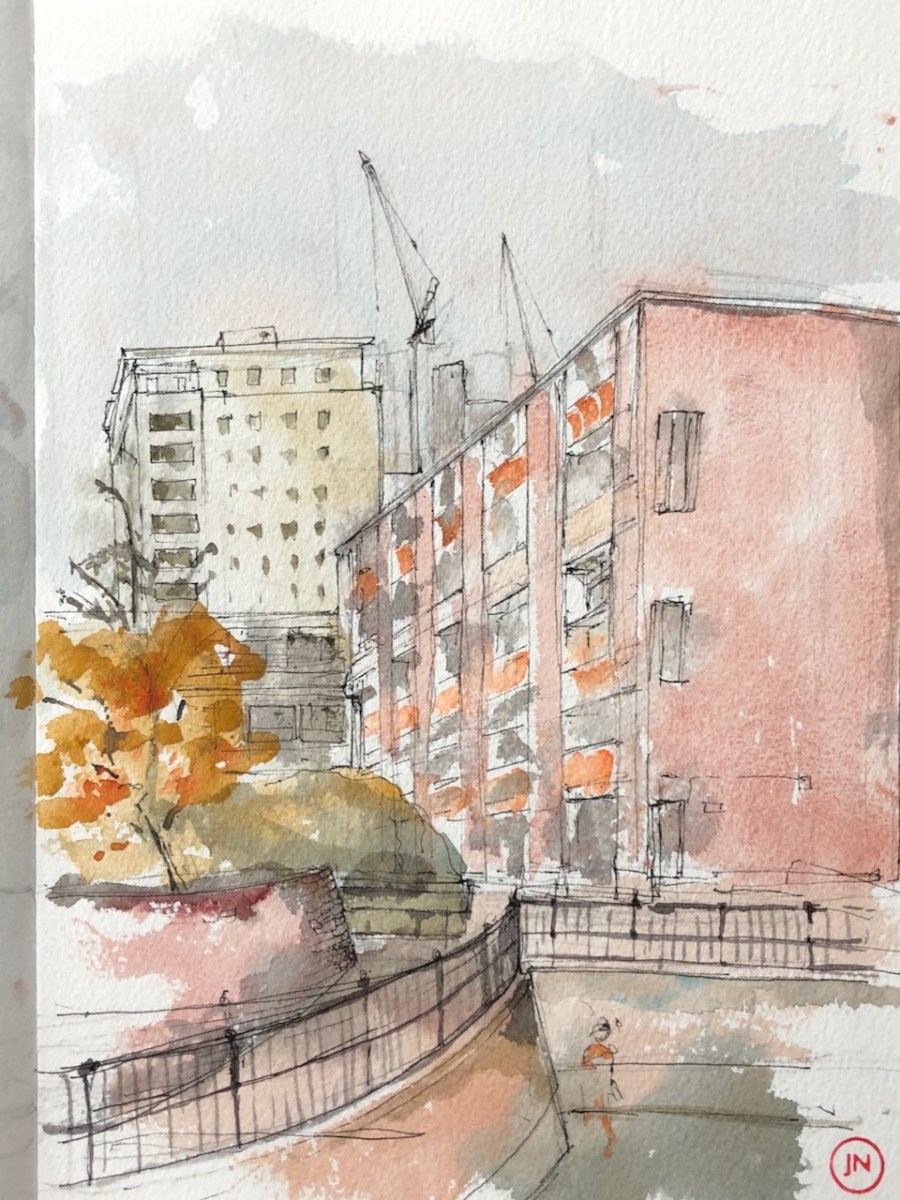
Behind the tree, the low-rise block is Stanley Cohen House. In the background of the drawing is the Atlas Building, just to the left of the tree. On the right of the tree is the architect’s practice at 88 Golden Lane.
On the right is Godfrey House, Bath Street, Islington, part of the St Luke’s Estate managed by the London Borough of Islington. It’s former “council housing” built in 1965. Today many of the flats are privately owned, as is evident from the number listed for sale. On the left is the Atlas Building, on City…
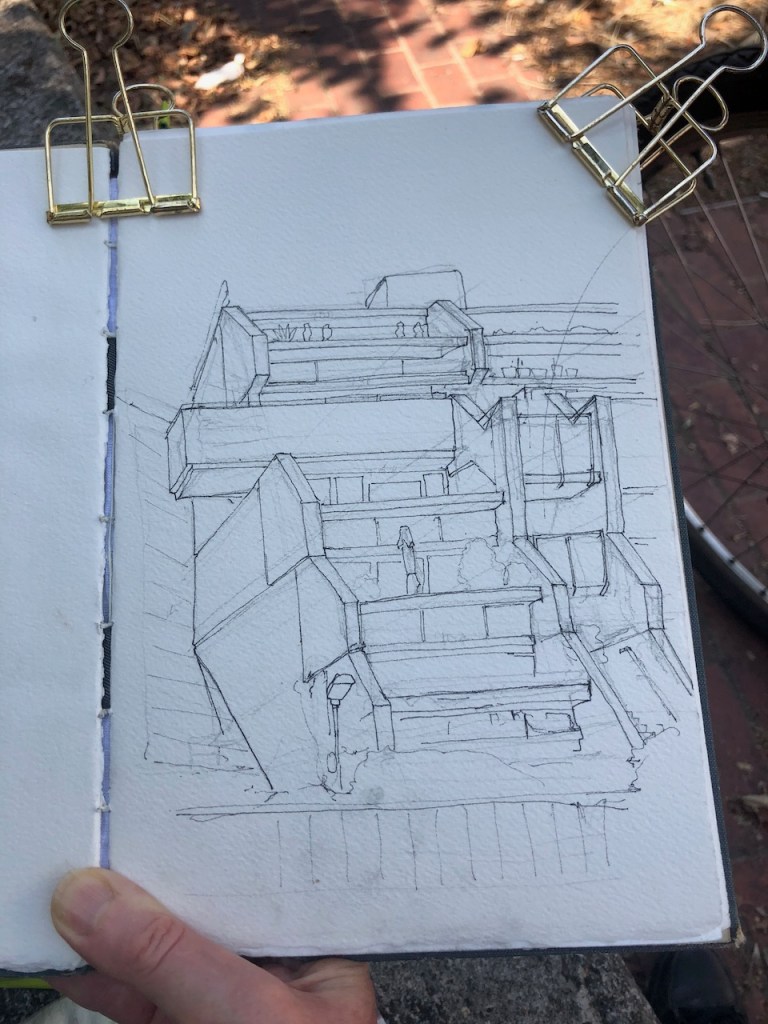
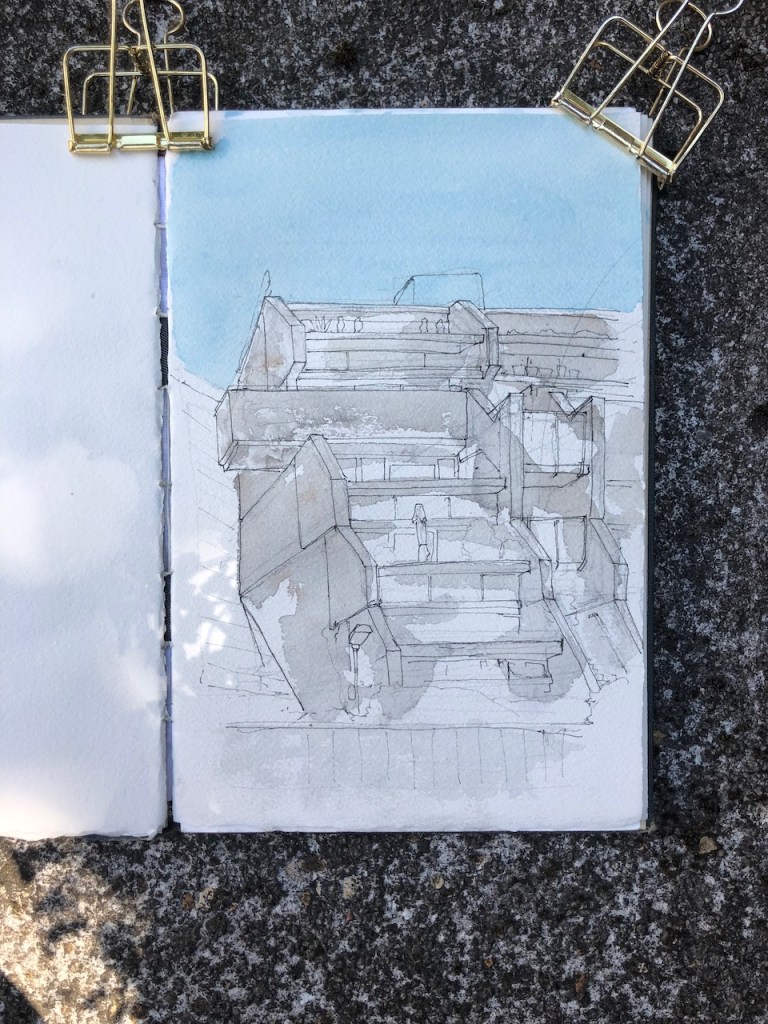
Today was a glorious sunny day. I walked out into the sun and everywhere was worthy of a sketch. Here is 88 Golden Lane, a strange thin building. It is an architects’ practice: Blair Architecture. I sketched this standing on the side of the road in the sun, then retreated to sit on my case…
This drawing is 25cm by 16cm, 10 inches by 6½ inches on Arches 300gsm watercolour paper. It took 1½ hours. I did a preliminary sketch first, shown in the work-in-progress photos below. The colours are Fired Gold Ochre, Phthalo Turquoise, Transparent Pyrrol Orange, and Mars Yellow, watercolours over De Atramentis document black ink.
Preliminary Sketch with Winsor and Newton watercolour sticks.
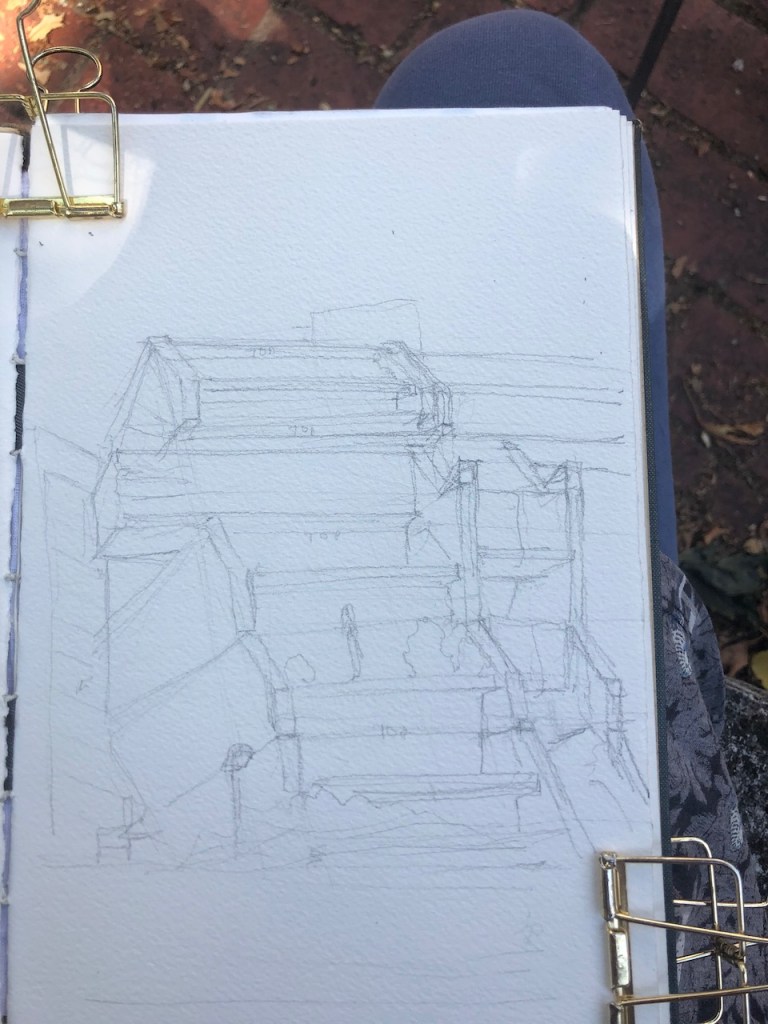
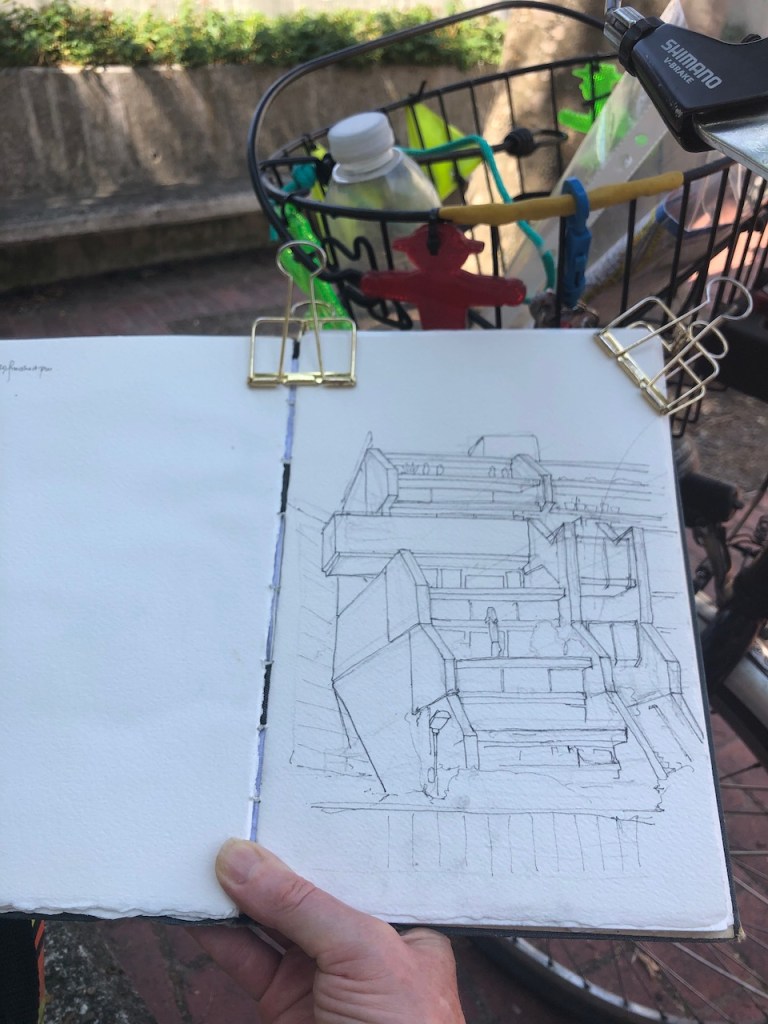
Preliminary sketch, and work in Progress.
I have drawn the Golden Lane Estate before. Here is a selection of drawings in this area:
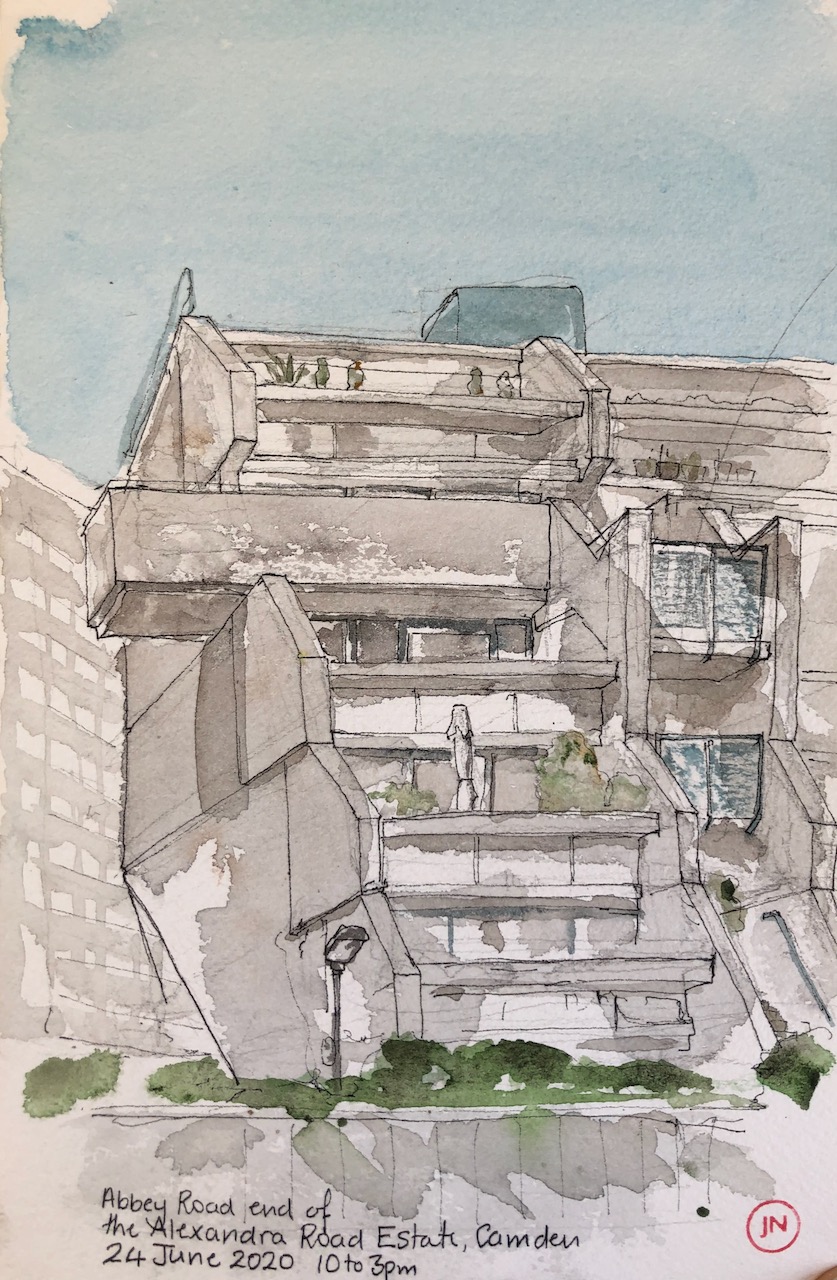
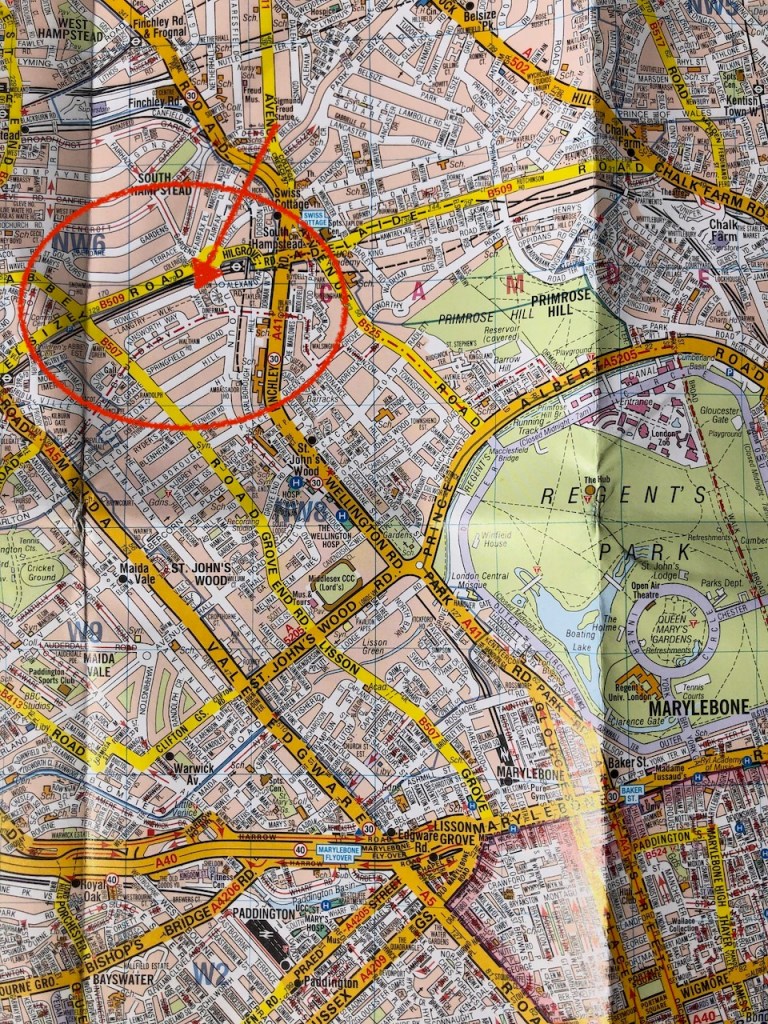
I cycled to the North West of Regent’s Park, in search of the Alexandra Road Estate. This estate is a truly astonishing work, testament to the vision and social ideals of the Camden councillors and architects who made it happen.
I cycled past the large and stately houses of Queens Grove, Marlborough Road, Loudoun Road, going north, uphill. I went left on Boundary Road, which is the north edge of Westminster and the south Edge of Camden. There on the right I glimpsed brutalist concrete. This is it. But the side road I followed, Rowley Way, led downwards into a disappointing loading bay, with barriers, delivery drivers and much disorganised parking. It was hot, and I’d cycled what felt like a long way. Then I remembered that this was a 1960s development. There must be a podium level, above the cars. There was. I looked for, and found, the slope upwards.
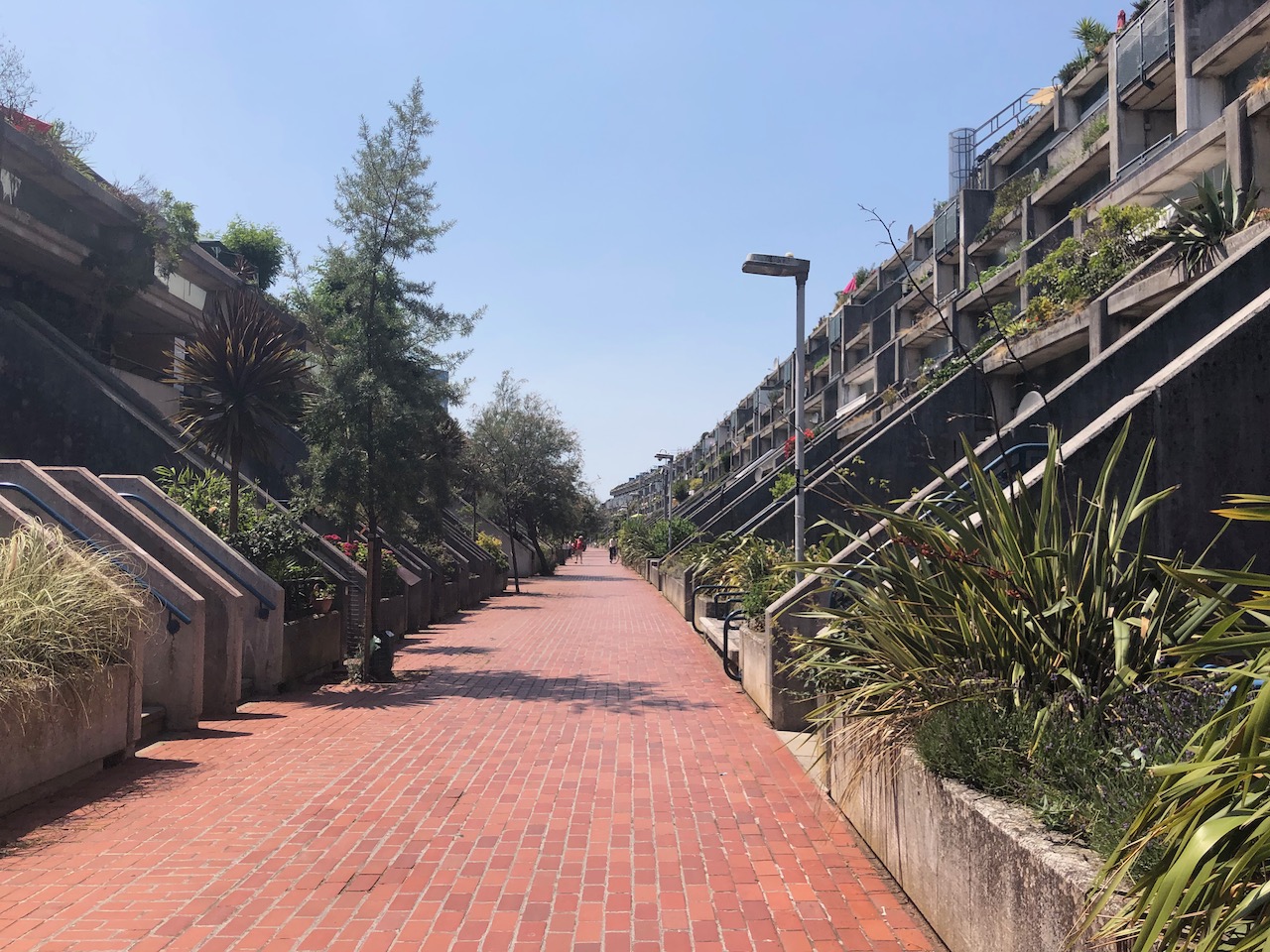
Rowley Way, Alexandra Road Estate
At the top of the slope was another world. A long village street led into the distance, with tranquillity, with greenery, and with concrete benches. People walked about immersed in conversation, leading children. Two lads sat on a bench, chatting and looking at their feet. Everywhere, there were trees, bushes and flowers. The street was tiled with red terracotta tiles. Each side the flats sloped up, looking irregular, like houses I have seen built into the hill in Crete.
I walked all along the tiled street, pushing my bike. There were concrete benches, but from those the view would give directly onto someone’s home, so I didn’t feel that would be good manners to sit down and draw there. Many features I recognised as typically 1960s: wood-marked concrete, thick iron railings, slabs of exposed concrete, round stairwells. The flats were all interlocked, so it was not clear where one flat started and the next stopped. It was most intriguing architecture. There were ledges, and low doors, gardens on ledges, and stairways climbing high up right to the roof.
At the end of the street, there was a small tiled public area, with a tree, and a viewpoint, and more concrete benches. Here I had a view of the end of the terrace of flats.
“..monoliths of tower blocks..” behind the Alexandra Road Estate.
I particularly enjoyed the way that the architect had made that walkway protrude at the end of the block, to provide a viewpoint, a special place. I didn’t go up there. To the north, there were the tall monoliths of tower blocks. Trains rumbled. The railway line is immediately behind the terrace I was drawing.
The architect of the Alexandra Road Estate was Neave Brown, of the Camden Architecture Department. It was designed in 1968 and built 1972-78. The construction was controversial. Inflation was 20% at times in the seventies, and so costs went up. Neave Brown fought hard to complete the scheme, and he prevailed.
There is a wonderful description of the estate and its history on the Municipal Dreams website on this link:
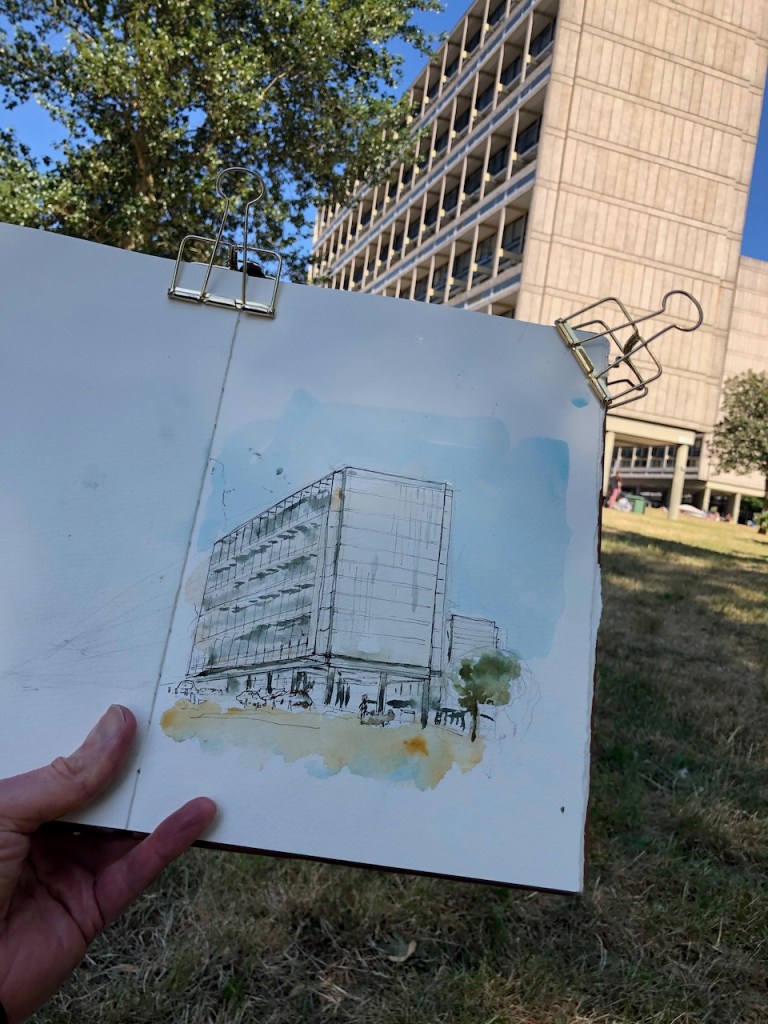
Here is a sketch of Charcot House, one of the five tower blocks in the Alton West Estate, Roehampton, SW15.
The Alton West estate was completed in 1958, as social housing. It was designed by a London County Council team led by Rosemary Stjernstedt (1912-1998).
The five tower blocks stand in a huge green space, on a hill, with many trees. When I visited, people were picnicking on the dry grass. You can see some of them in the centre of the picture.
I went there by bike, it took about two hours, partly because I also went to look at the Dover House Estate, nearby, which was built in 1918. Also it took me a while to find the Alton West estate. There are a number of hills in the area.
Here is a map:
The arrow shows the sightline of the drawing.
Local map
Work in progress
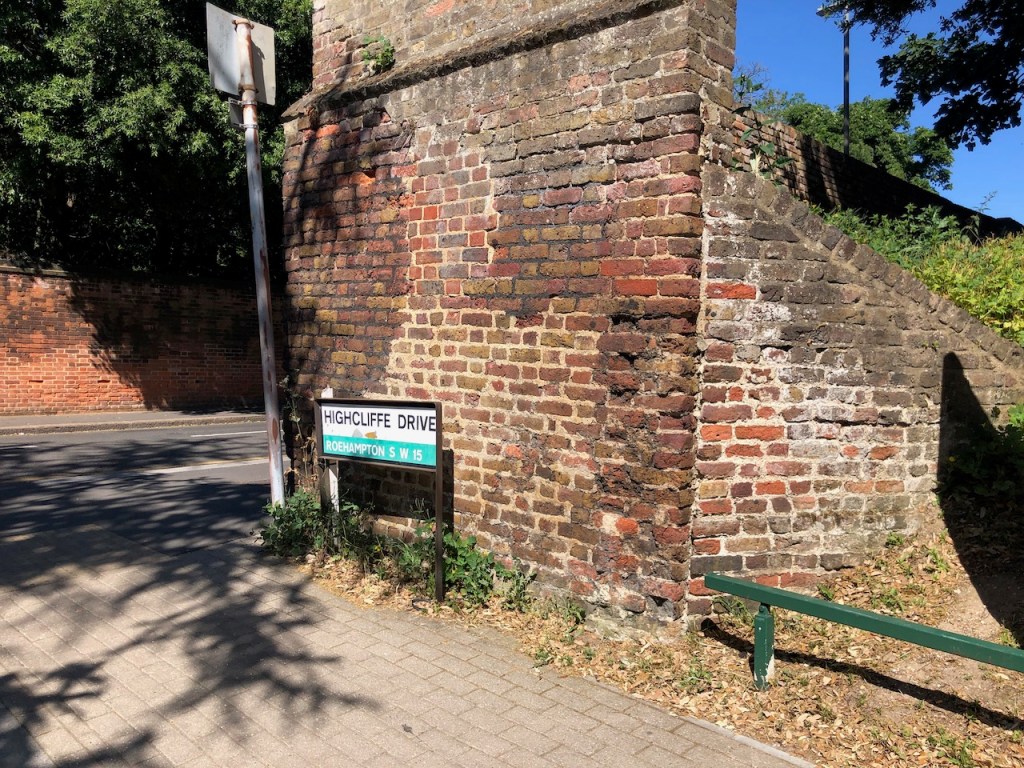
This lovely old wall pre-dates the estate, I imagine.
The flats are maisonettes.
Local photos. Click to expand.
Drawing time: 45 min. Colours: Mars Yellow (DS), Phthalo Turquoise (W&N), Burnt Umber (Jacksons).
Click a button below to share this post online, email it, or print it:
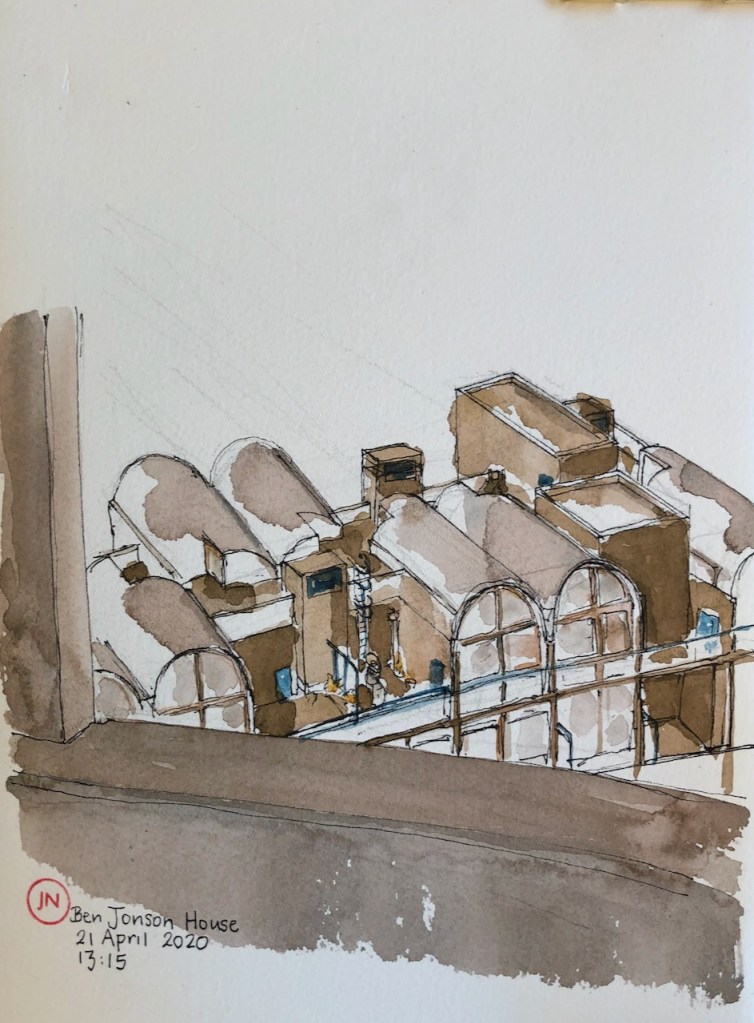
Sketching from the window, here is Ben Jonson, part of the Barbican estate.
The people who live on the top floor of Ben Jonson have sunlit roof gardens. You can see one person enjoying his garden. He sits just at the bottom of the blue fire escape ladder.
There is also an interesting void space shown in the lower right of the picture. It was empty when I was drawing, but sometimes someone’s legs are visible, using the space for sunbathing. Sometimes they set up a table and chairs there.
Here is work in progress. I used colours: Mars Yellow, Burnt Umber, Prussian Blue and a bit of Perinine Orange.
Click a button below to share this post online, email it, or print it:
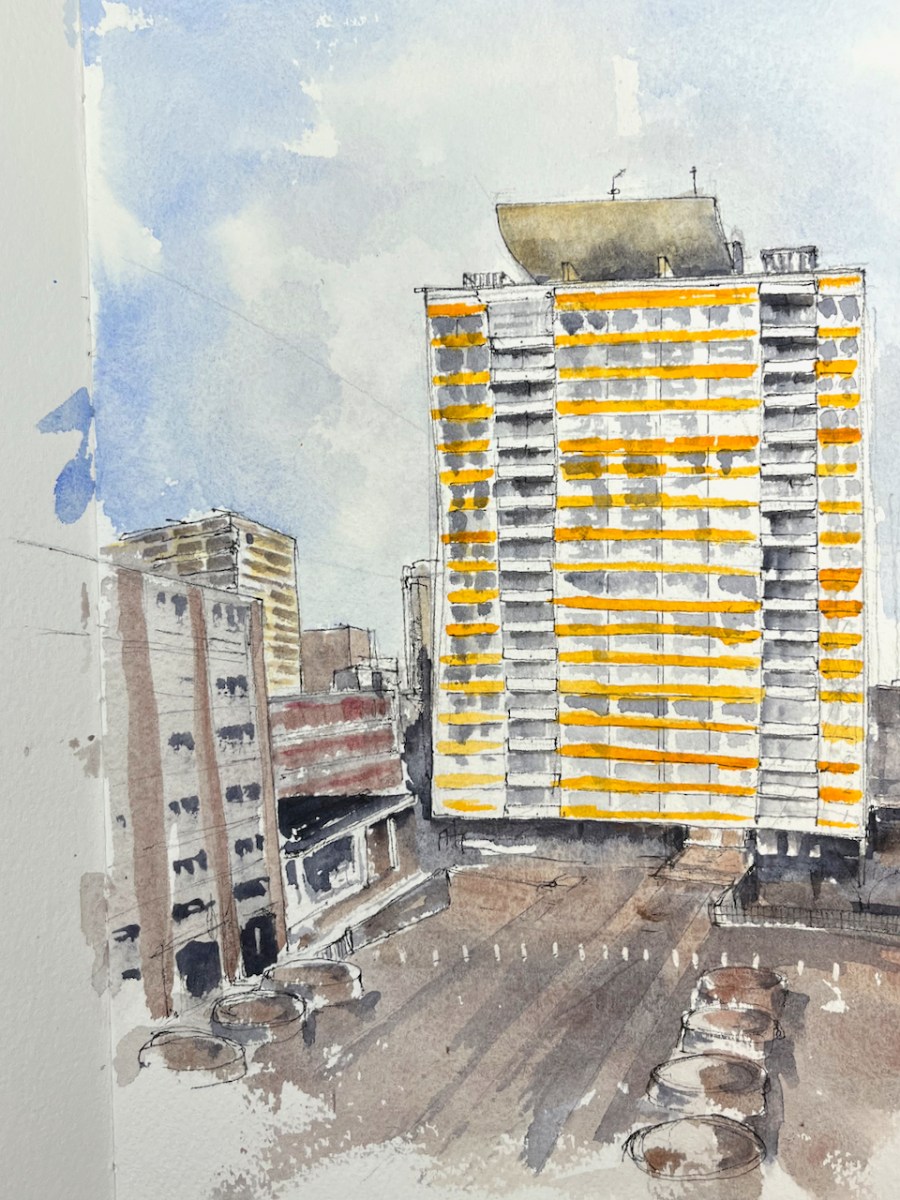
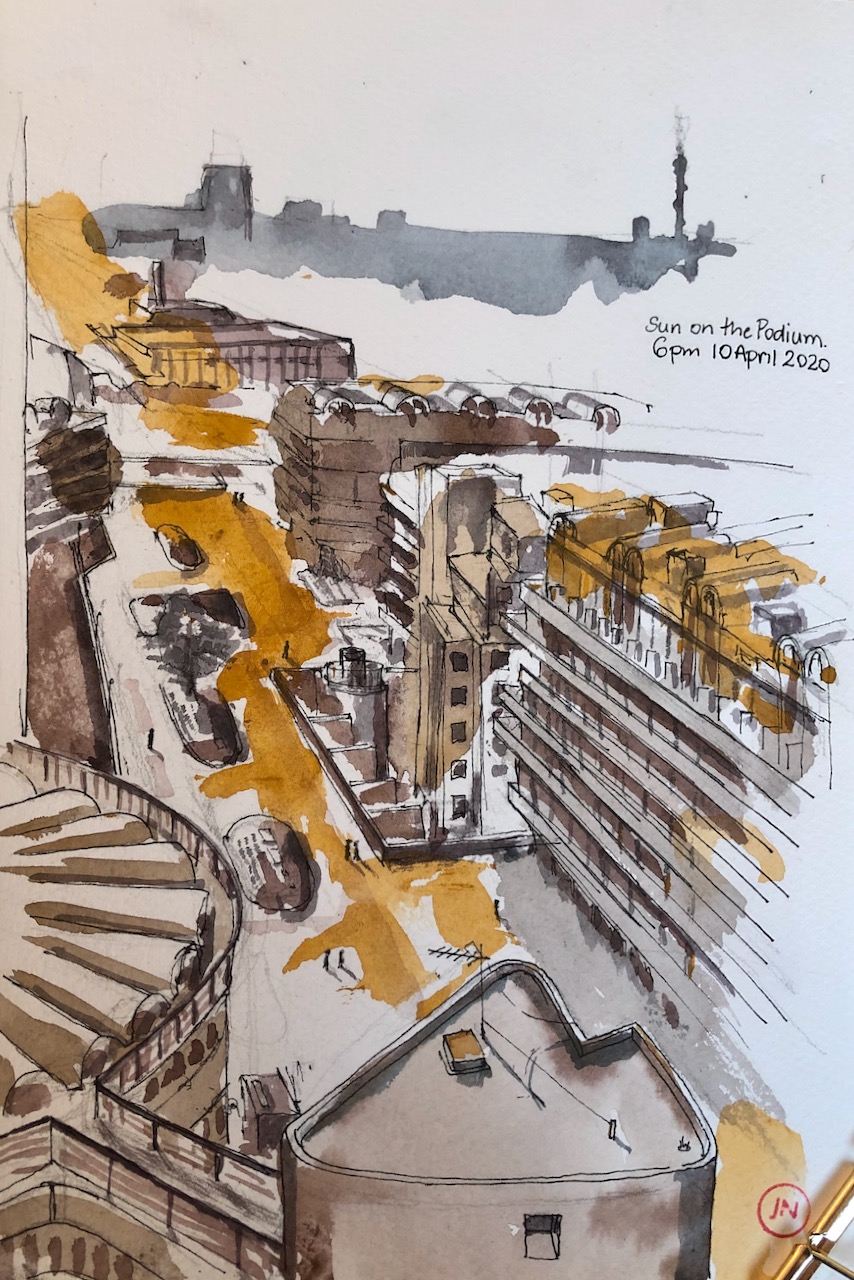
The tower in the foreground is part of Frobisher Crescent. Frobisher Crescent itself is on the left. Ben Jonson House is on the right. On the horizon you can see Centrepoint, and the Post Office Tower.
This took 2 hours. The sun moved, of course.
Colours: Mars Yellow, Perylene Maroon, Prussian Blue, all Daniel Smith watercolours.
Click a button below to share this post online, email it, or print it:
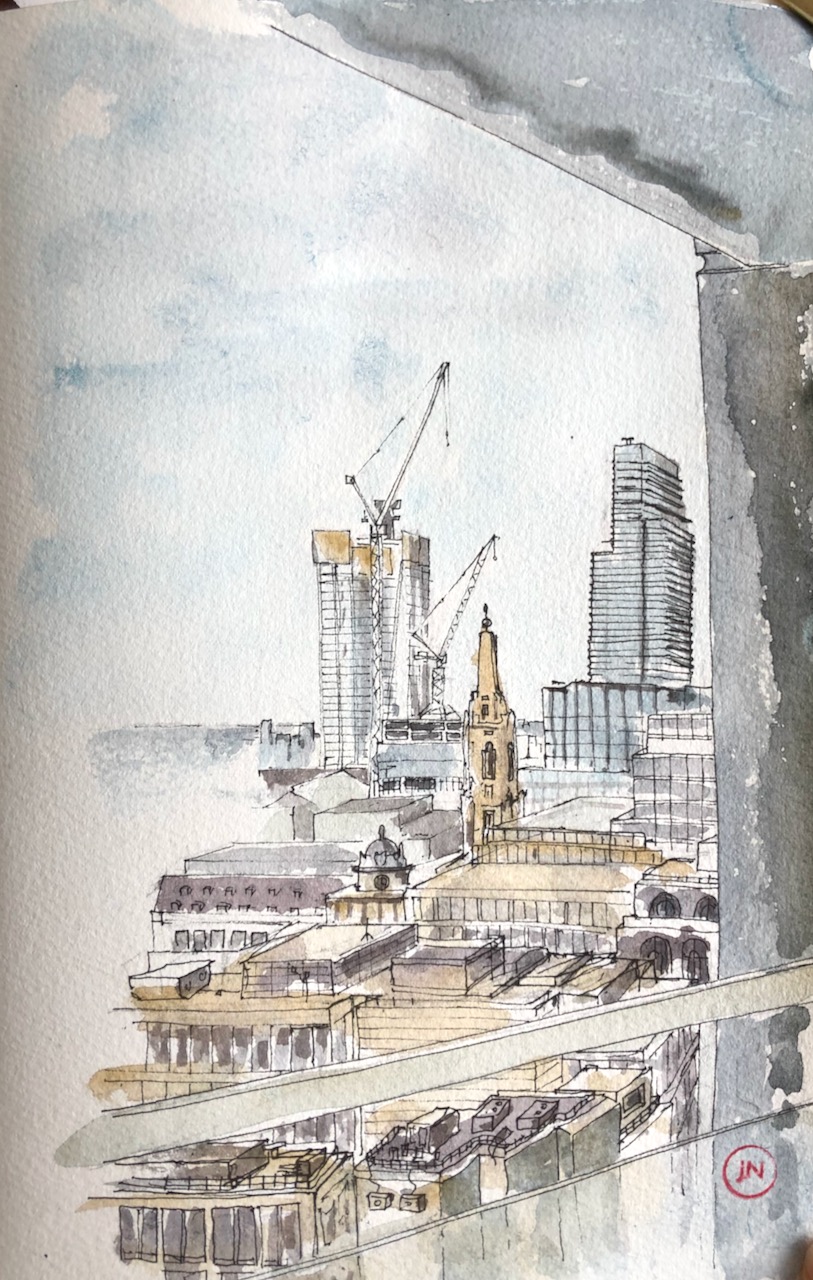
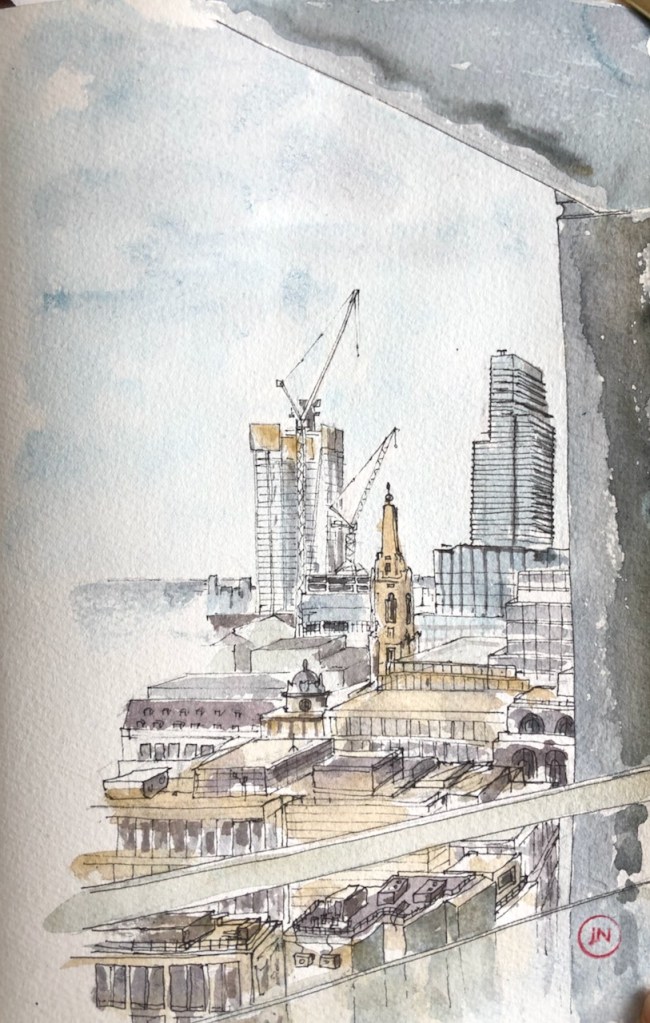
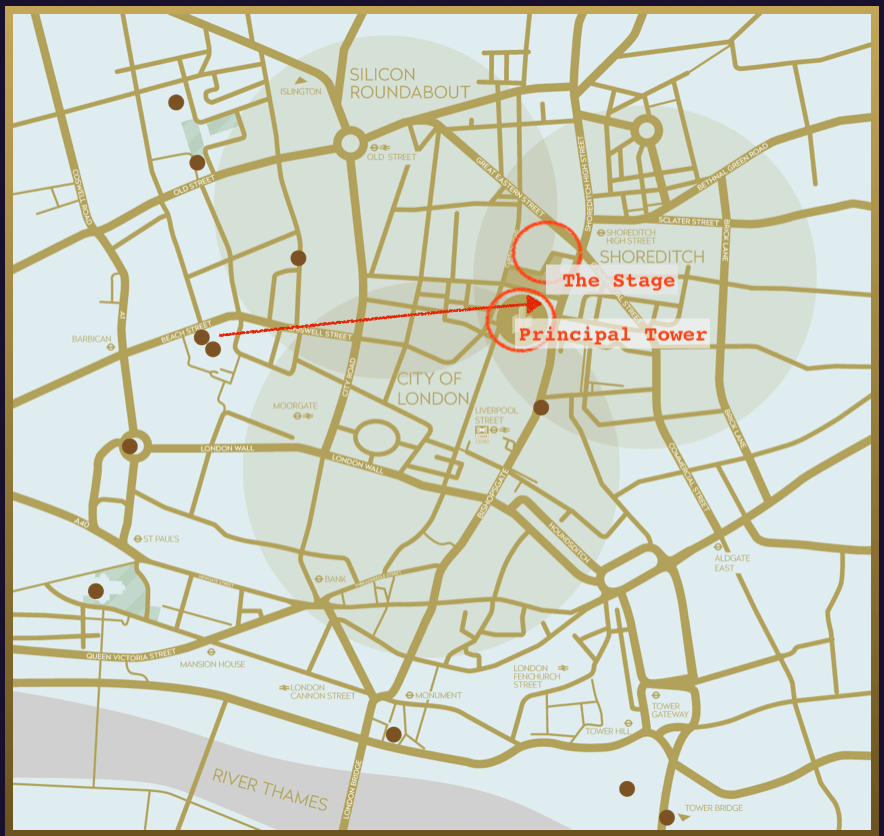
If I look East, along a narrow angle, I can see two new tall buildings in Shoreditch: the “Principal Tower”, and “The Stage”. They are on adjacent sites, about a mile away.
Looking East: The Stage and Principal Tower
The Stage is the tall building on the left, under construction. Their website tells me this will be a “dynamic 37 level landmark for luxury living”. The reason it’s called The Stage is because the remains of the Curtain Theatre were discovered on the site. This theatre was a location for the staging of Shakespeare’s plays, and dates back to 1577. The tower is provides luxurious accommodation. The planning report says:
The scheme does not include any affordable housing, and the viability appraisal confirms that it is not possible to deliver any due to the financial burdens of excavation and archaeological work to the remains of Curtain Theatre in order to create a cultural facility.
planning report D&P/2975/02 18 December 2013, Mayor’s decision*
The architects are Perkins+Will. The developer cited on the planning application was Plough Yard Developments Ltd. That company was dissolved on 23rd Aug 2019. The current owner/developer is “The Stage Shoreditch Development Limited” according to the website “New London Development”.
The building with the truncated spire in front of The Stage is “Triton Court”, which is on the North side of Finsbury Square. The little dome is part of the same building. This dome in on the older, western, part, which was built in 1904-5. The taller part with the spire was later, 1929-30. It was the headquarters of the Royal London Mutual Assurance Society. The building interior was redeveloped in 2013-15 and is now an office development called “Alphabeta”
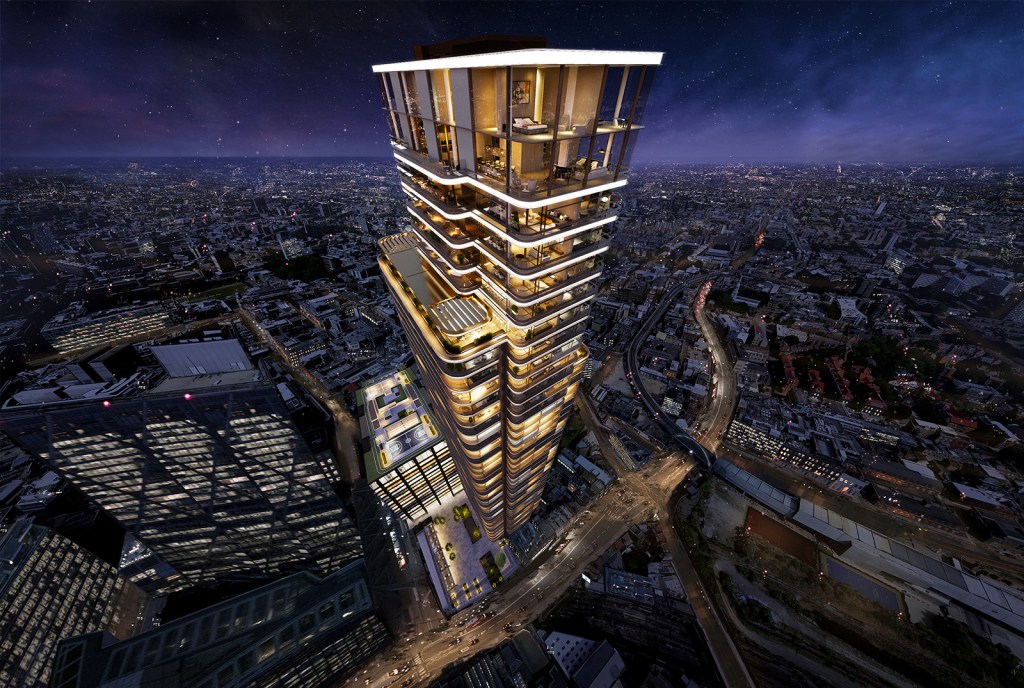
The tall block on the skyline to the right of picture is “Principal Tower”. This is a residential tower which, according to the website:
“..offers the opportunity to own an architectural masterpiece, equivalent to a priceless piece of art that will give constant pleasure and lasting value.”
from the sales website: PrincipalTower.com, copied on 2nd April 2020
The architect is Foster+Partners. The developer is Brookfield Property Partners. Alongside and beneath the residential tower are offices and shops, in a space called “Principal Place”. One tenant of the office space is Amazon.
Here are some pictures from the sales website:
Picture credit: PrincipalTower.com
Map of Principal Place, from the PrincipalTower website.
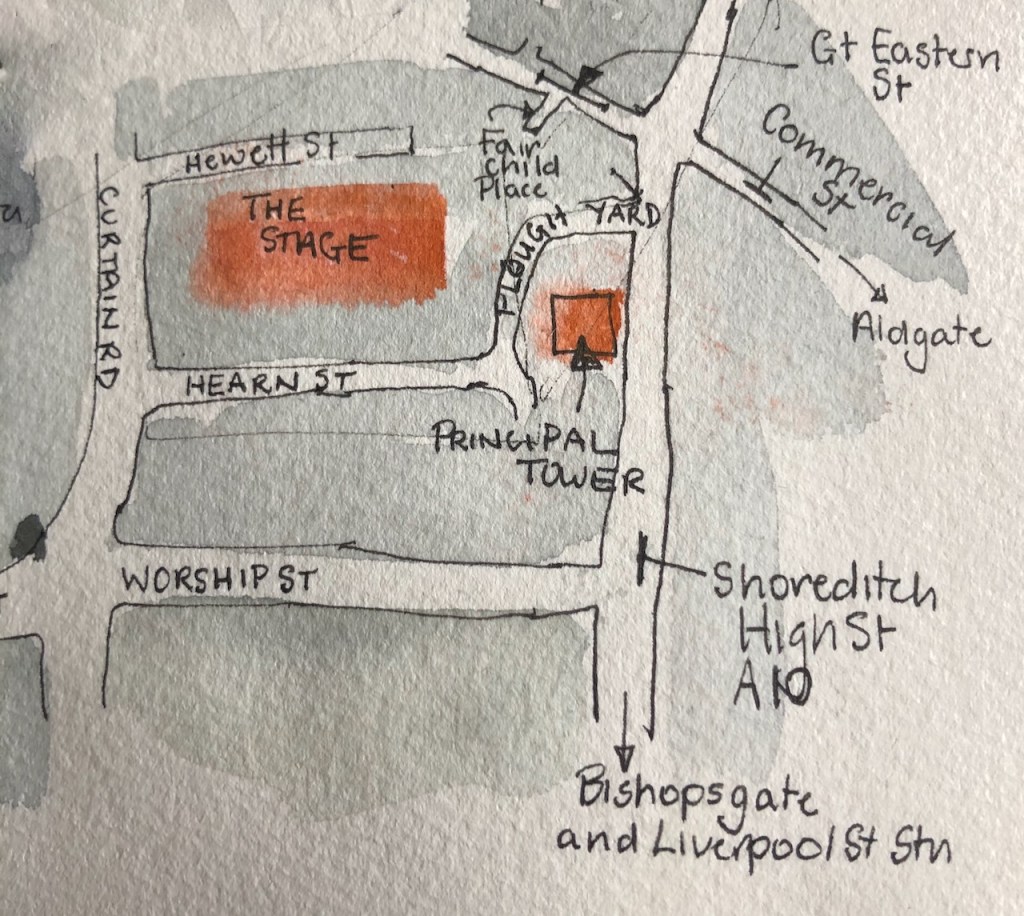
Here are some maps:
My sketch map showing the locations of the towers in the pictureMap downloaded from the Principal Tower website. The brown dots are “cultural locations”. The red arrow shows the sightline in the picture.
The drawing took just over 2 hours. The colours are: Phthalo Turquoise (W&N), Mars Yellow(DS), Perylene Maroon (DS) and a bit of Perinone Orange (DS).
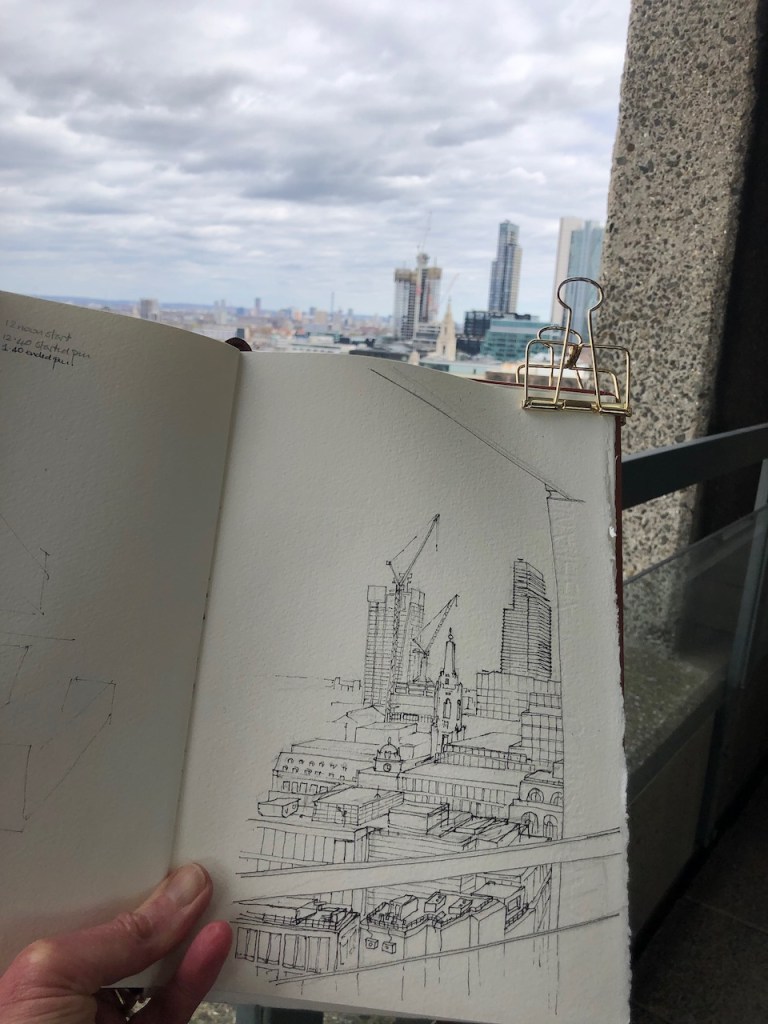
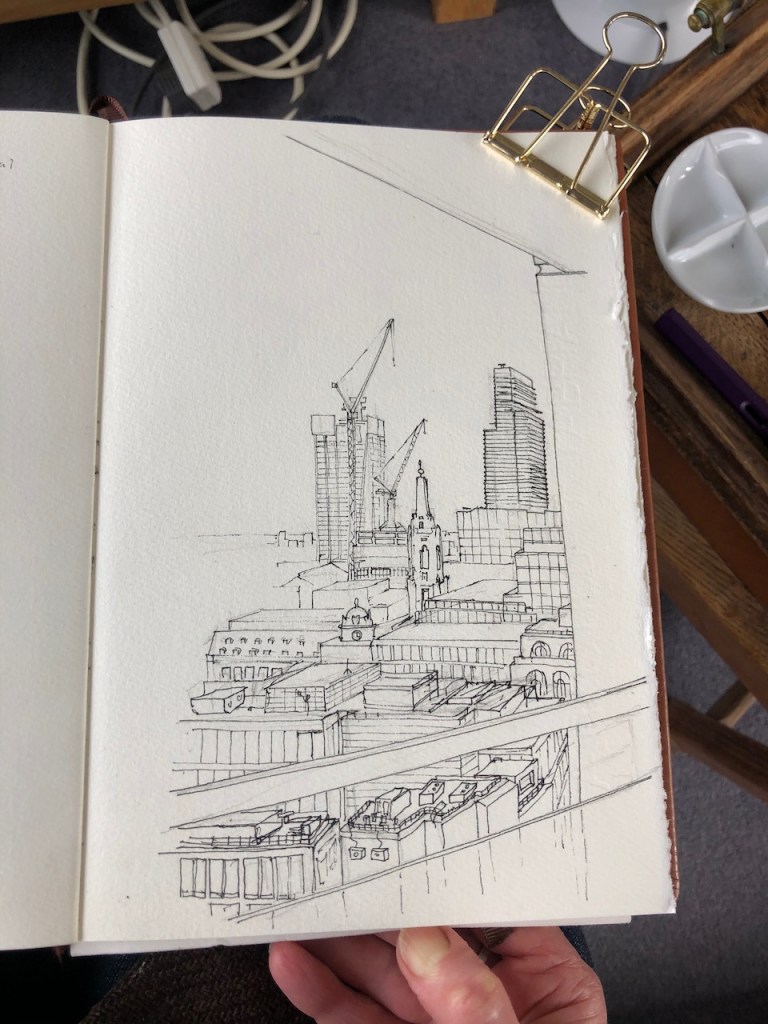
Work in progress
*The document is on the http://www.london.gov.uk site at this link: (downloaded 2nd April 2020) Planning Application 2012/3871
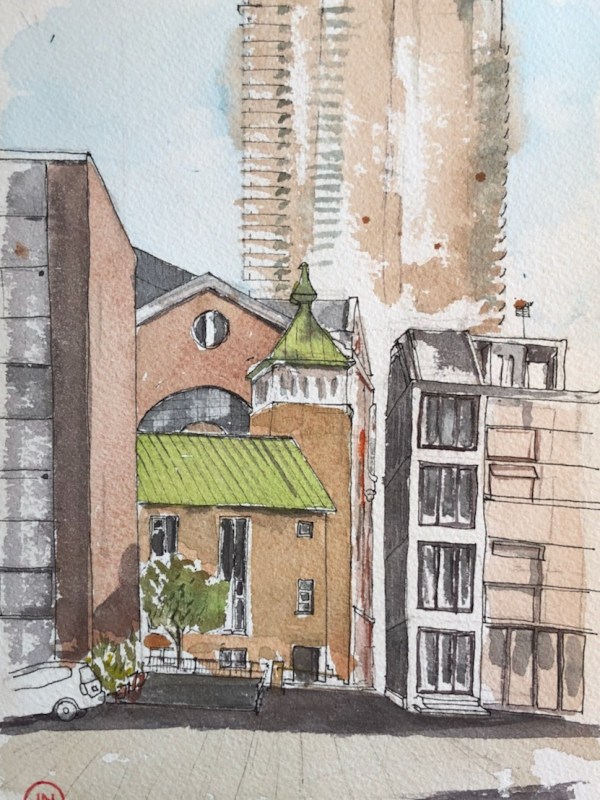
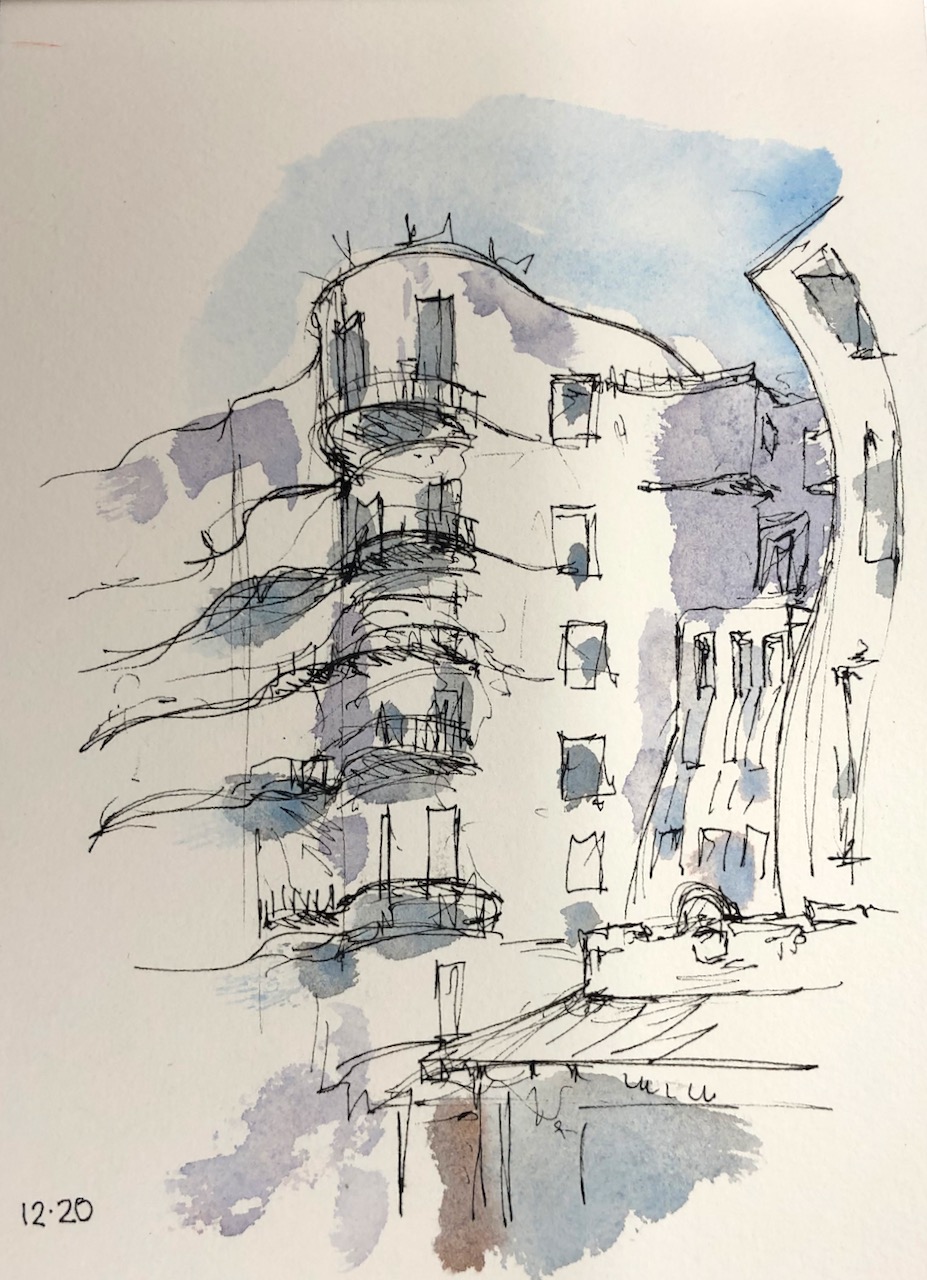
On a shopping expedition in Islington, I made a diversion through the new development: “Islington Square”, opposite St Mary’s Church. It’s not a square, more of a passage, a covered road, very high. Lots of huge empty windows wait like empty stages for the retail theatre to begin. At the end is an open-air space, also not a square, more of a rectangle. Here is a grand kitchen equipment shop, where you can buy a saucepan in copper, or other high-grade metal such as stainless steel. Then looking back towards the passage, I made a sketch:
This was a very quick sketch, about 20 minutes (that’s quick, for me). Drawn and coloured sitting on one of the benches near the kitchen shop.
As I was finishing a man emerged from the passage and announced “We have our first artist!”. He meant me. Other men followed. I asked him if he lived here, as I was interested in the flats I had been drawing. He said no, he was the Manager of the Development. I said I appreciated the fine wooden bench, which was placed in a good position for drawing. He looked at my drawing and said I should come back in different seasons – and put on a show! Good idea.
He was a busy person and walked off. One of the other men came up and very kindly offered to fetch me a cup of tea or coffee. I was just packing up though, and so declined. It was nice of him.
“Islington Square, just an eight-minute walk to Angel Underground Station, offers 263 new homes and 108 serviced apartments at a maximum height of just eight floors, fusing Edwardian grandeur and contemporary style. The build will be complemented by 170,000 square feet of retail, dining and leisure amenities including a luxury Odeon cinema and a premium Third Space gym.” (Olivier Heath, writing in “House Beautiful” April 11th 2019)
The new development is around and about the former postal sorting office, which has been empty for some time. The dates I could see in the brickwork said “1905”. The new buildings are curved, as you see in my sketch, and one group is covered in purple tiles. I thought it looked good. At least they haven’t just imitated the Victorian architecture, but courageously added something decidedly 21st Century.
Click a button below to share this post online, email it, or print it:
The Hallfield Estate is a modernist estate in Bayswater, W2 6EH. It’s a short walk south from Royal Oak Station on the Hammersmith and City Line.
It was constructed in the 1950s, to a design of Berthhold Lubetkin. The construction was supervised by Lindsey Drake and Denys Lasdun. Now it’s Grade 2 listed. Here’s what the listing says:
Reasons for Designation
The fourteen blocks and laundry at Hallfield Estate are listed at Grade II for the following principal reasons:
Architectural interest: a sophisticated and distinctive aesthetic approach to social housing, whereby the facades are treated like works of abstract art;
Planning: the estate fulfilled its brief to provide mass housing and open space in a crowded urban borough, in a plan inspired by Le Corbusier’s ‘Radiant City’
Authorship: designed by Berthold Lubetkin and Tecton, and constructed under the supervision of Lindsay Drake and Denys Lasdun, the estate is the work of some of the C20’s most significant architects;
Historic interest: a seminal post-war housing estate that was widely exhibited and published, and provoked divergent contemporary responses which illuminate post-war architectural theory.
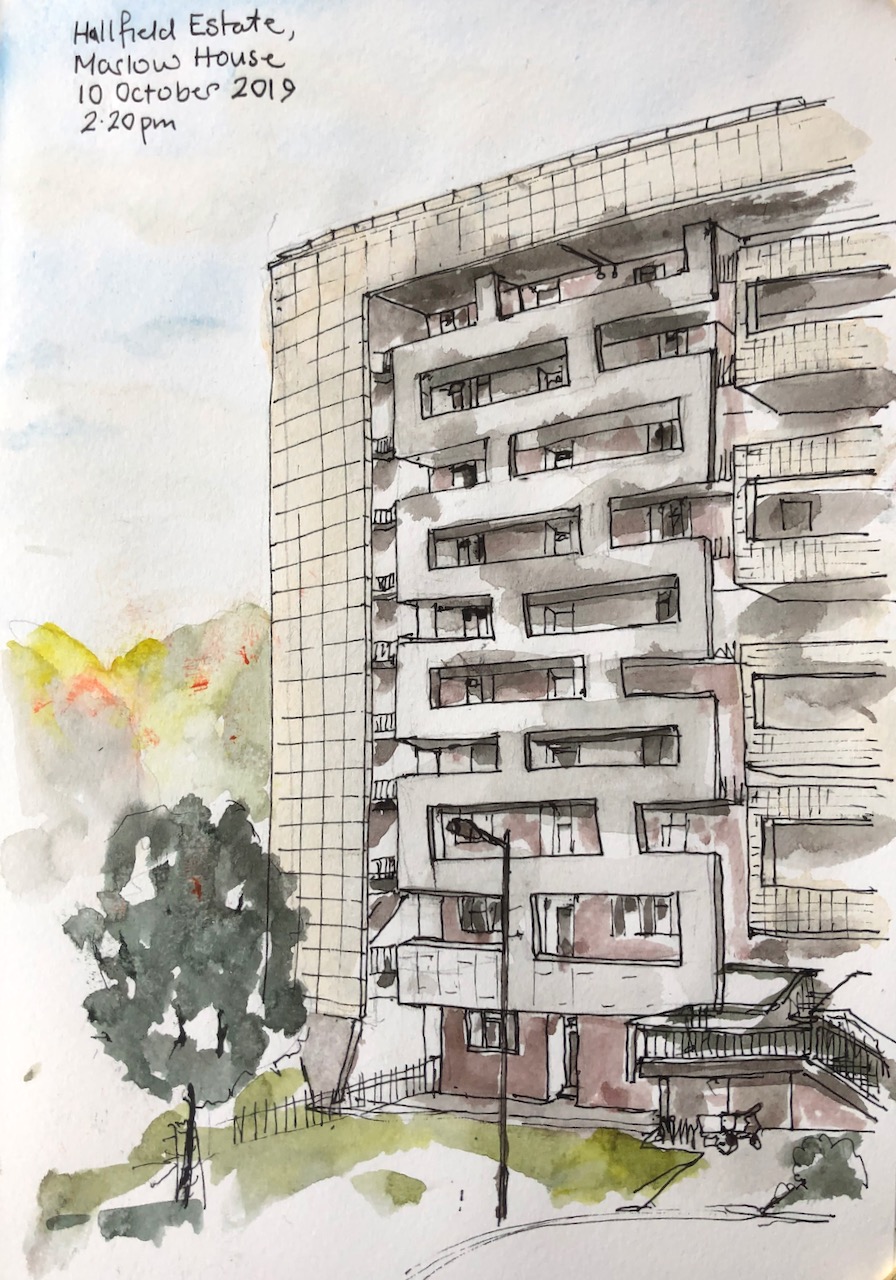
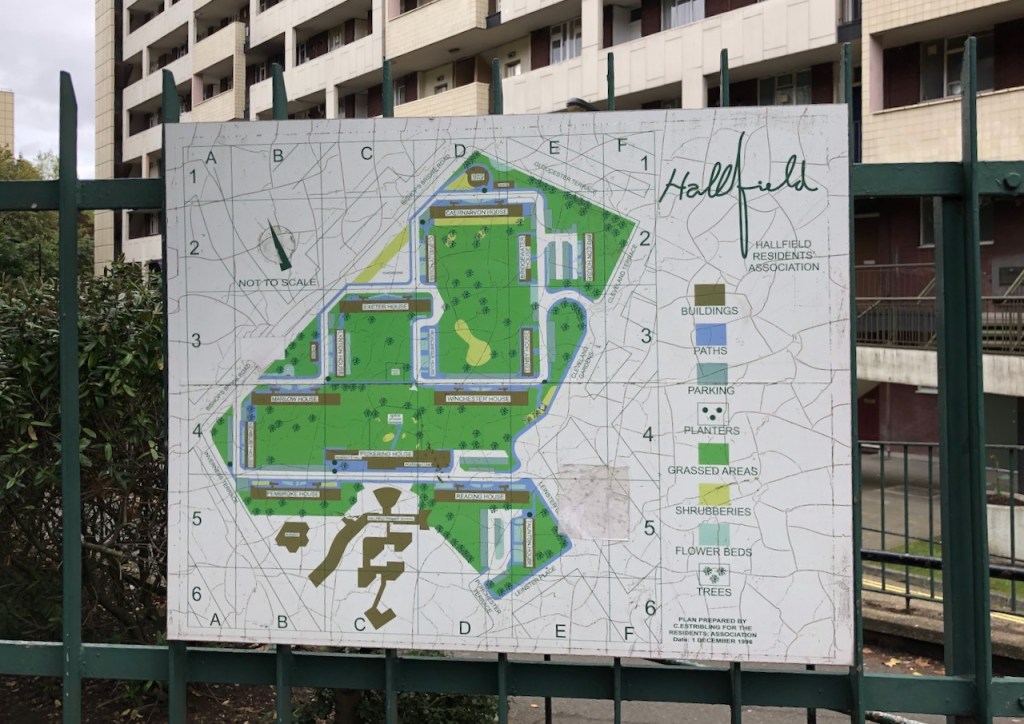
Here is a sketch of Marlow House. I drew it standing on a strange hummock, a small hill, inside the estate near the Battle Bridge Road.
Marlowe house sketched on location 19th October 2019 in sketchbook 5
“The estate presents a convincing riposte to criticism that postwar council housing is grey, drab and utilitarian. At Hallfield, the exteriors of each block are treated like works of abstract art – some are patterned with a chequerboard of blue and red brickwork; others have a zigzagging screen of white concrete panels. The estate now exists amongst an elite group of 16 listed post warhousing estates estate in London – estates that are successful as places to live and are cared for by their residents.” Hannah Parham, the English Heritage Designation Advisor (2011).
Shown in my picture is the “zigzagging screen of white concrete panels”.
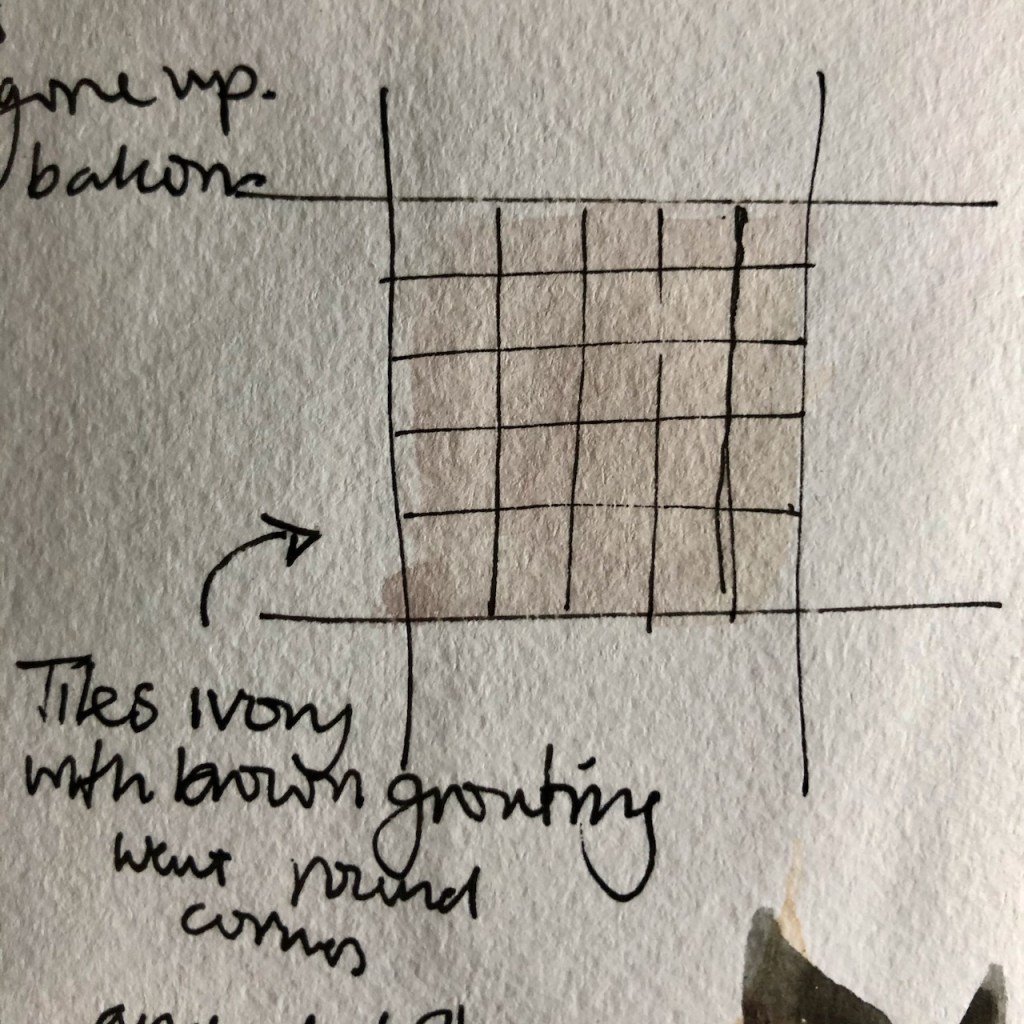
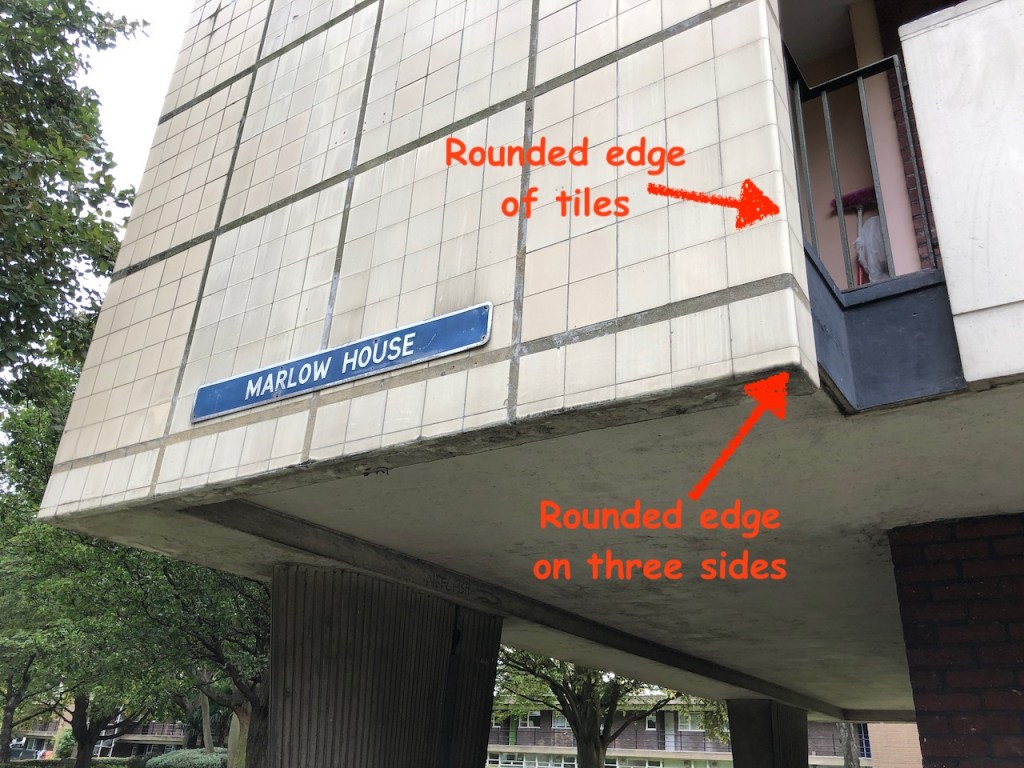
The gardens were beautiful, and well maintained. The buildings themselves are showing signs of wear. Tiles are chipped and cracked at the edges, and staircases look covered in soot from a previous era. But it’s still a stately collection of buildings. The white tiling is a work of art. On Marlowe House, the frame of the building is covered in ivory tiles, in squares of 25 tiles arranged in 5×5 grids, which are themselves arranged in a grid. So the effect is that of graph paper. I was impressed that these tiles are carefully made, and the edge ones are shaped, with rounded edges.
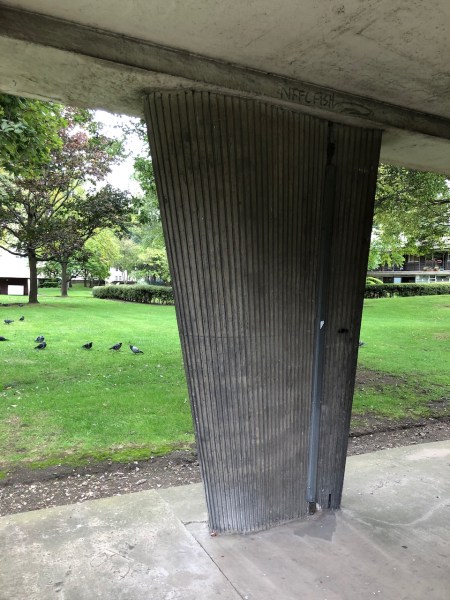
I also enjoyed the pillar, in the lower left of my drawing. It is fluted.
Fluted pillar. The lighting conductor rather mars the effect.
The stairwells are completely open. I could have gone up, but I didn’t. The postman did, however. While I was drawing I saw him doing his rounds, his black woollen hat moving along the balconies, passing behind the facade and down the stairs.
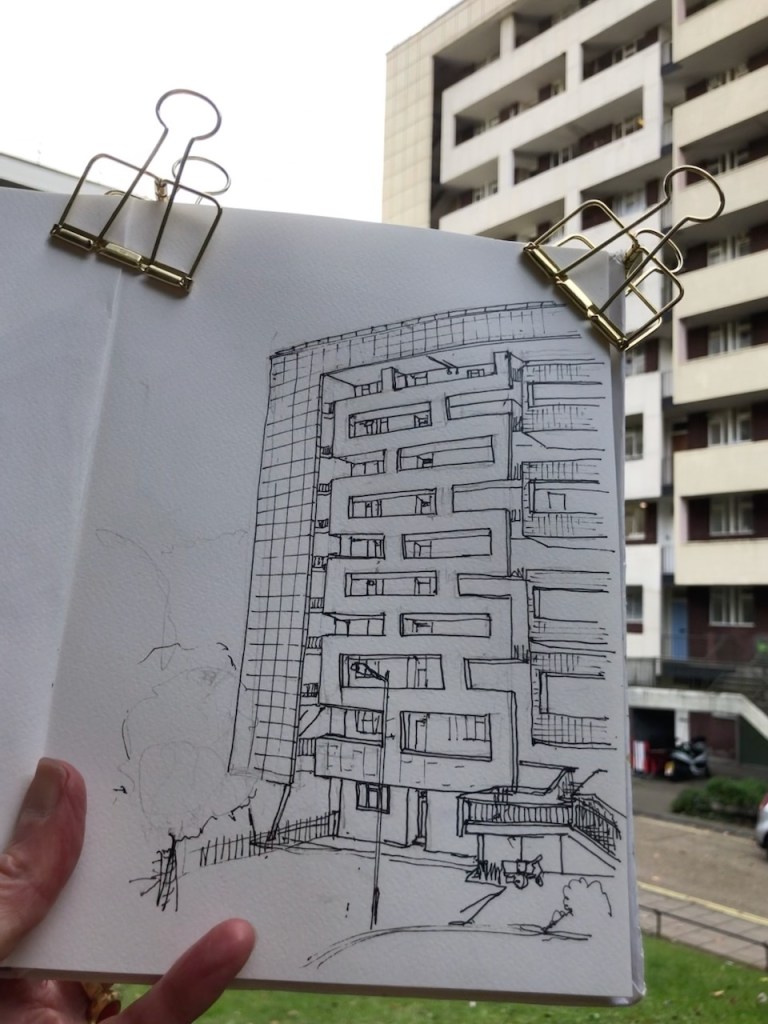
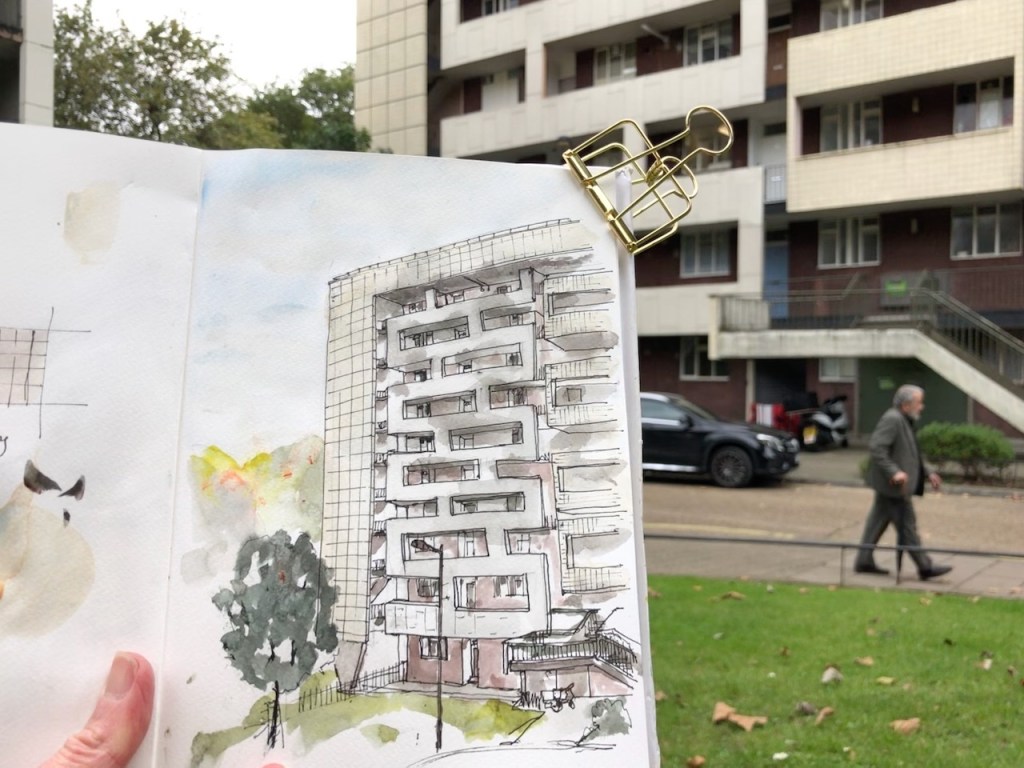
Here is a map and work in progress. Click to expand the picture.
Drawing took 1½ hours, drawn and coloured on location.
Click a button below to share this post online, email it, or print it:
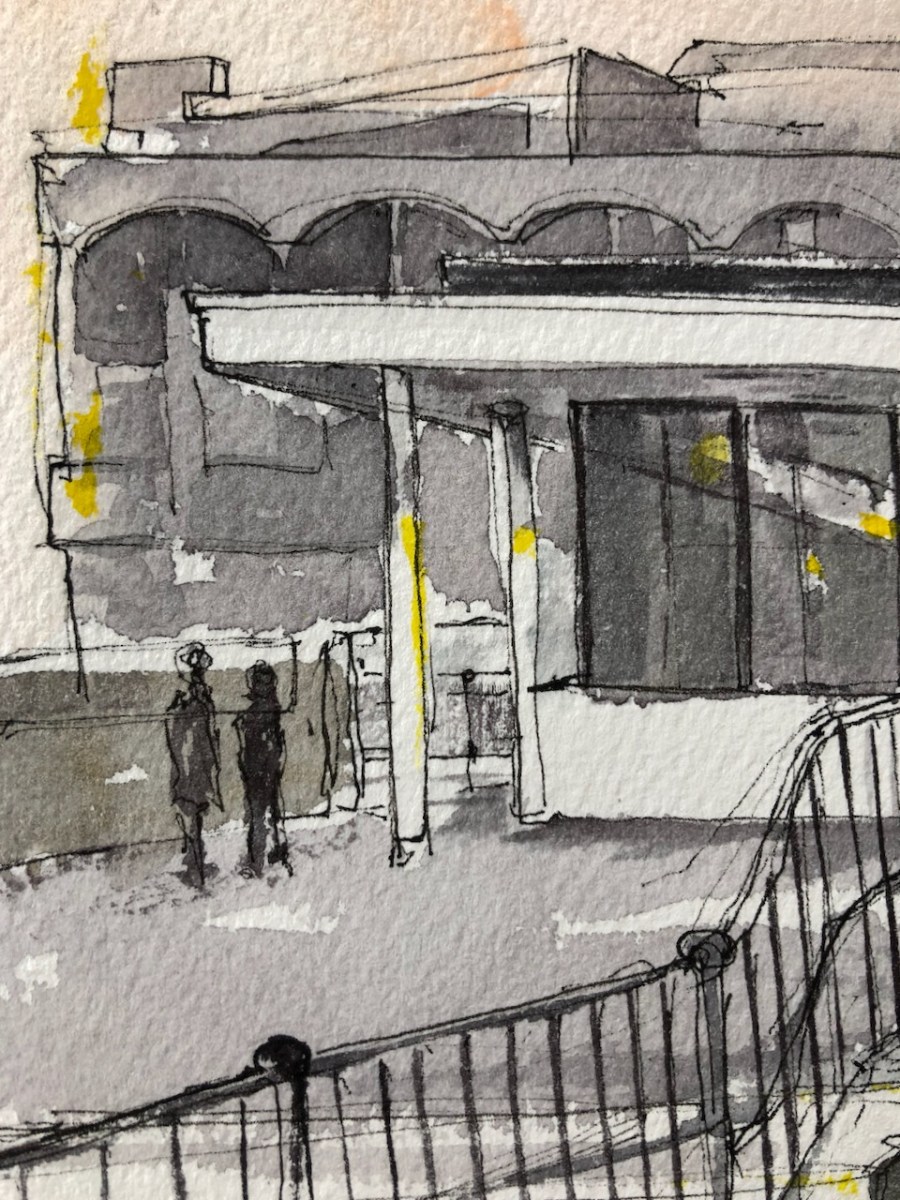
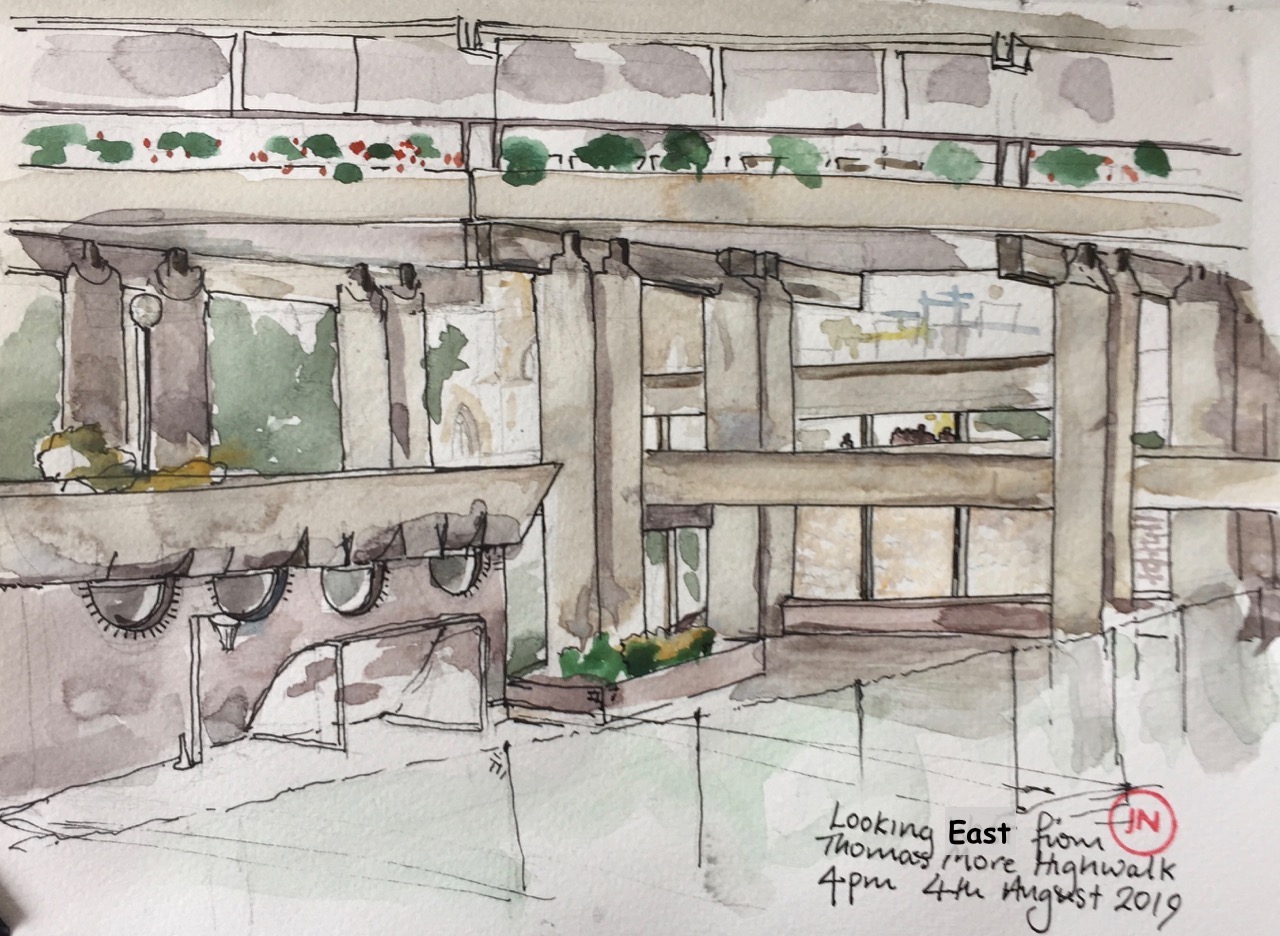
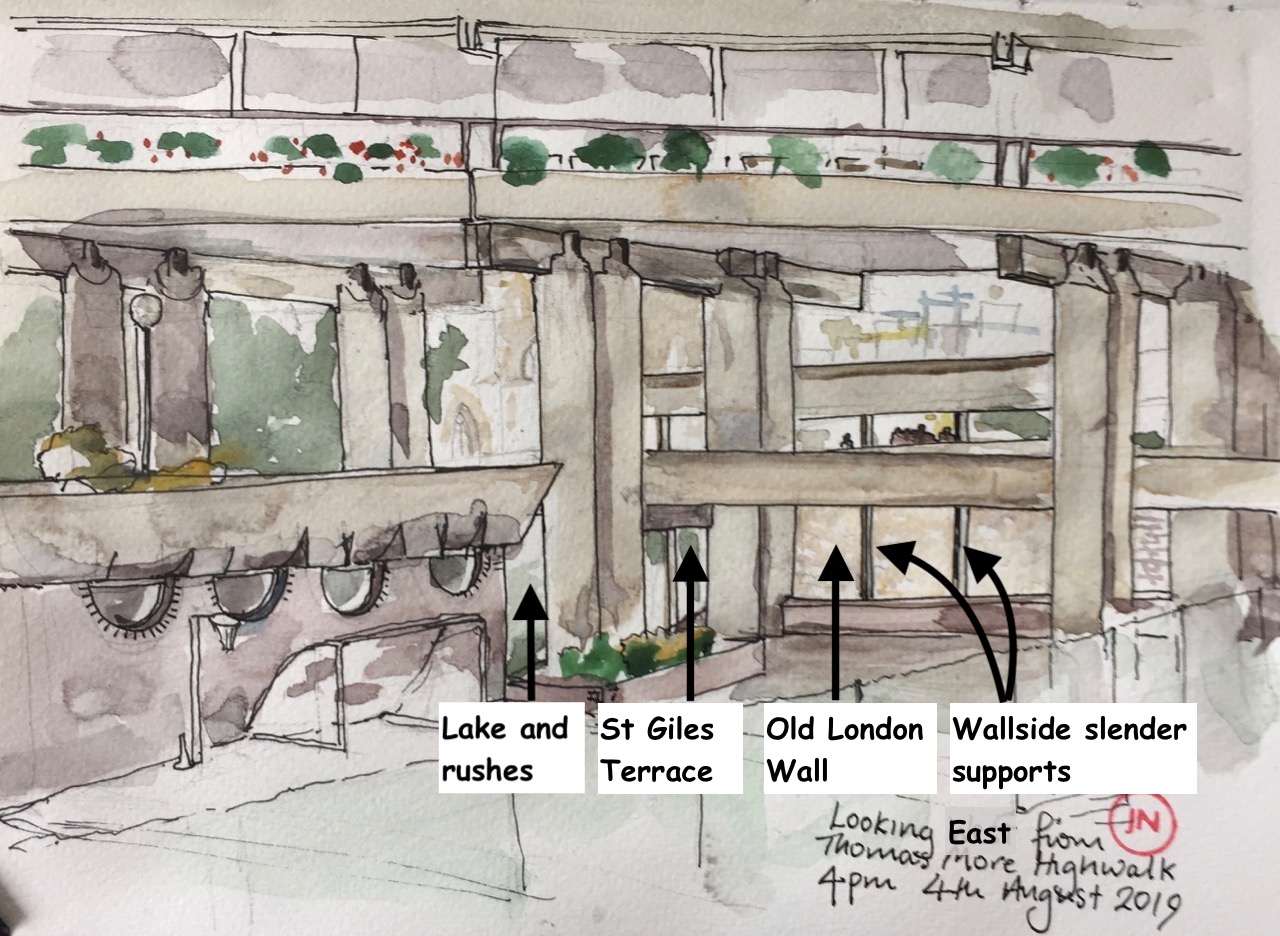
Today I found another view of the view under Mountjoy. This is from the high walk that goes north from the Museum of London, looking East.
Under the Mountjoy Highwalk there are a number of “framed” pictures. The old London Wall fortification is visible. The sun reflected from the lake and threw patterns onto the old stone. I couldn’t get all that in the picture so you have to take my word for it.
A group of tourists stopped on the “Wallside” highwalk. You can see them in the centre right of the picture.
These “windows” will all be obliterated by the proposed City of London School for Girls expansion.
This view is from the place where the north bound highwalk turns abruptly left (click map to expand it).
This picture took about an hour. I tried hard not to overdo it.
At the top of the picture are the flats of Mountjoy House, with their impressive window boxes.
Click a button below to share this post online, email it, or print it:






























 Jane Sketching