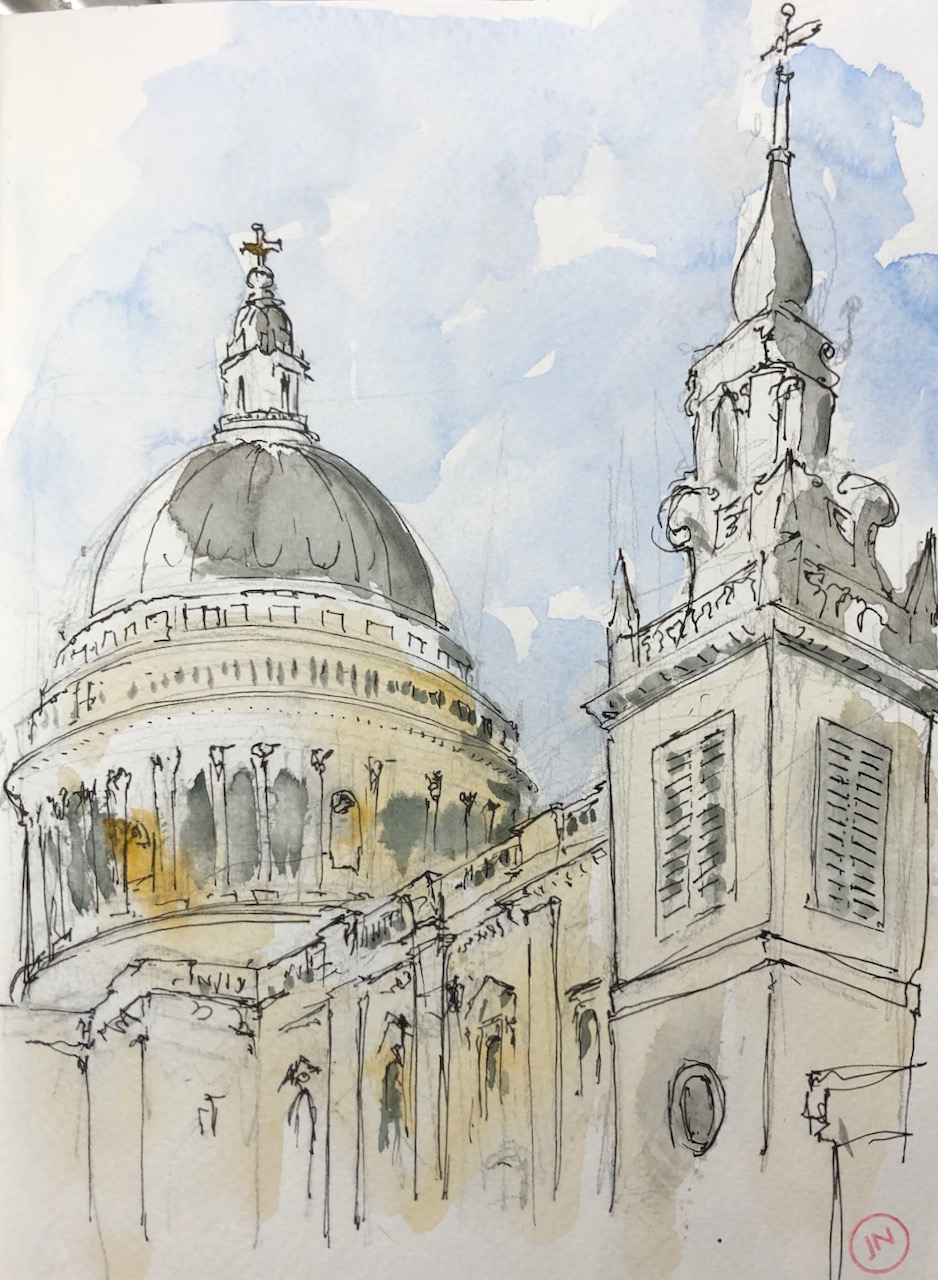
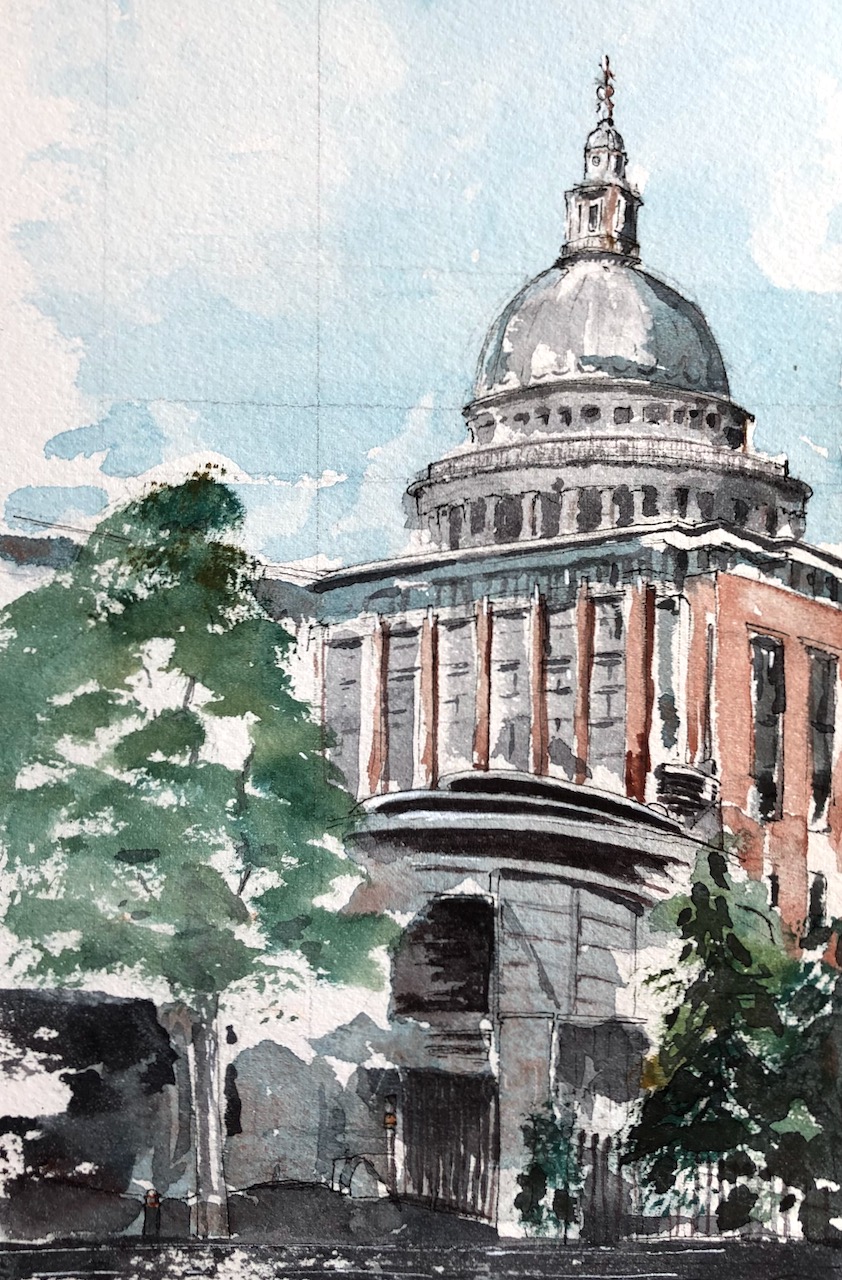
St Paul’s Cathedral from Wren Coffee

Wren Coffee has re-opened! This is a marvellous coffee shop in the Church of St Nicholas Cole Abbey, on Queen Victoria St.

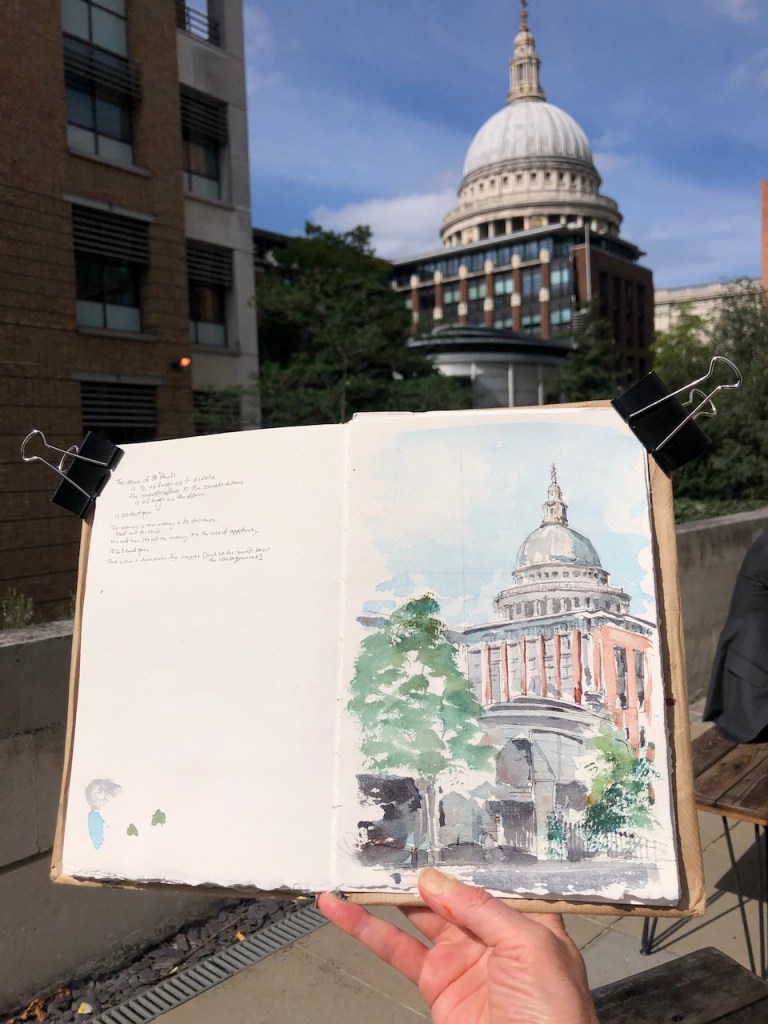
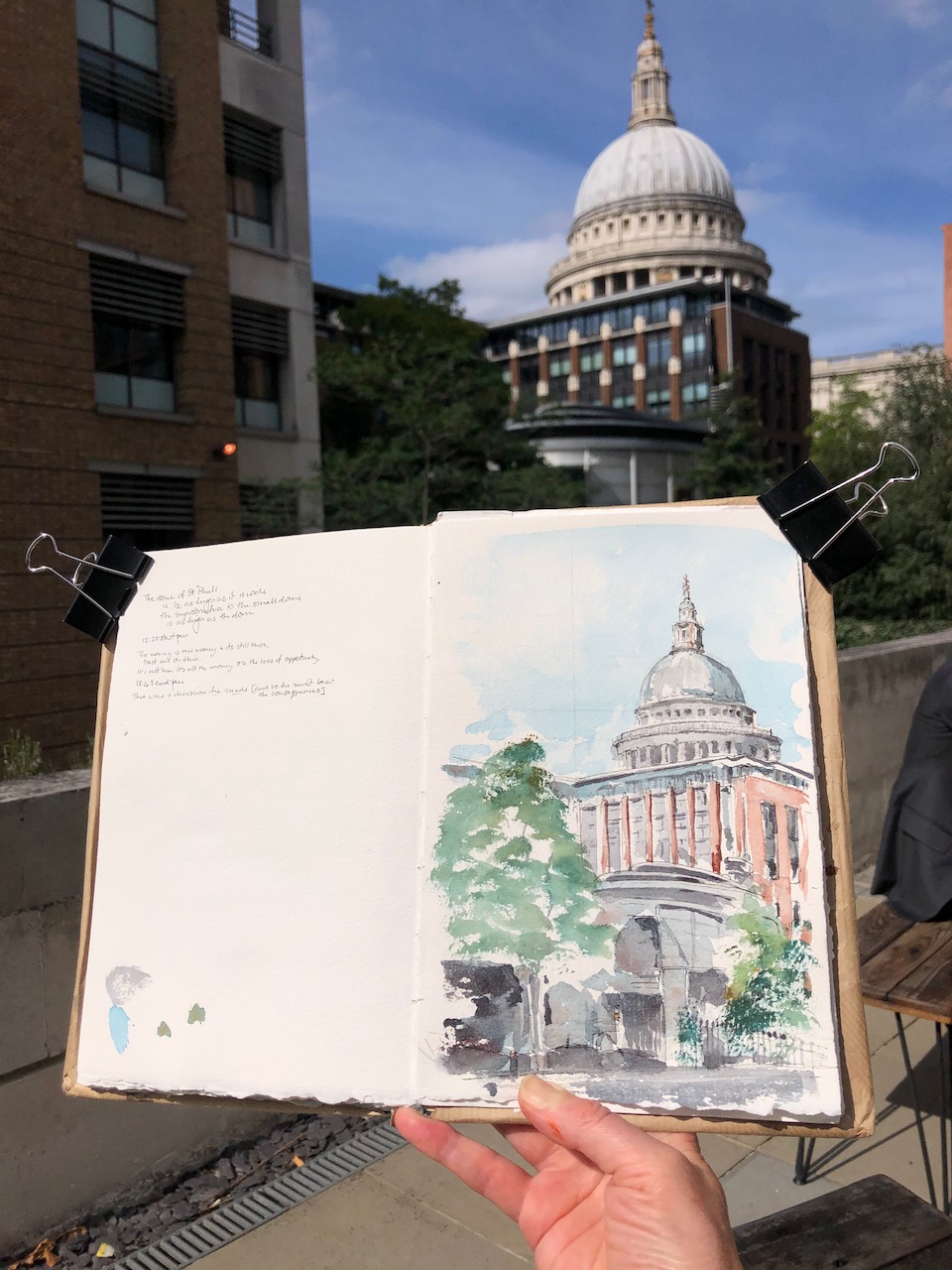
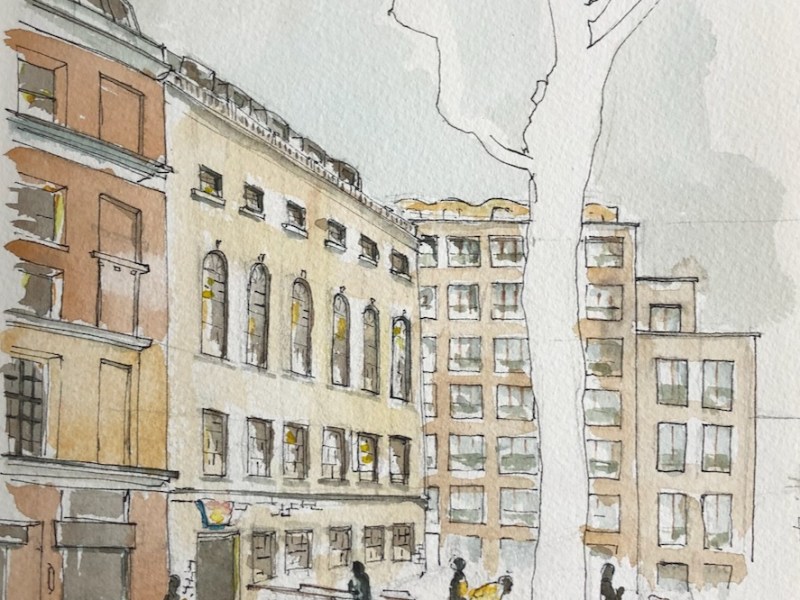
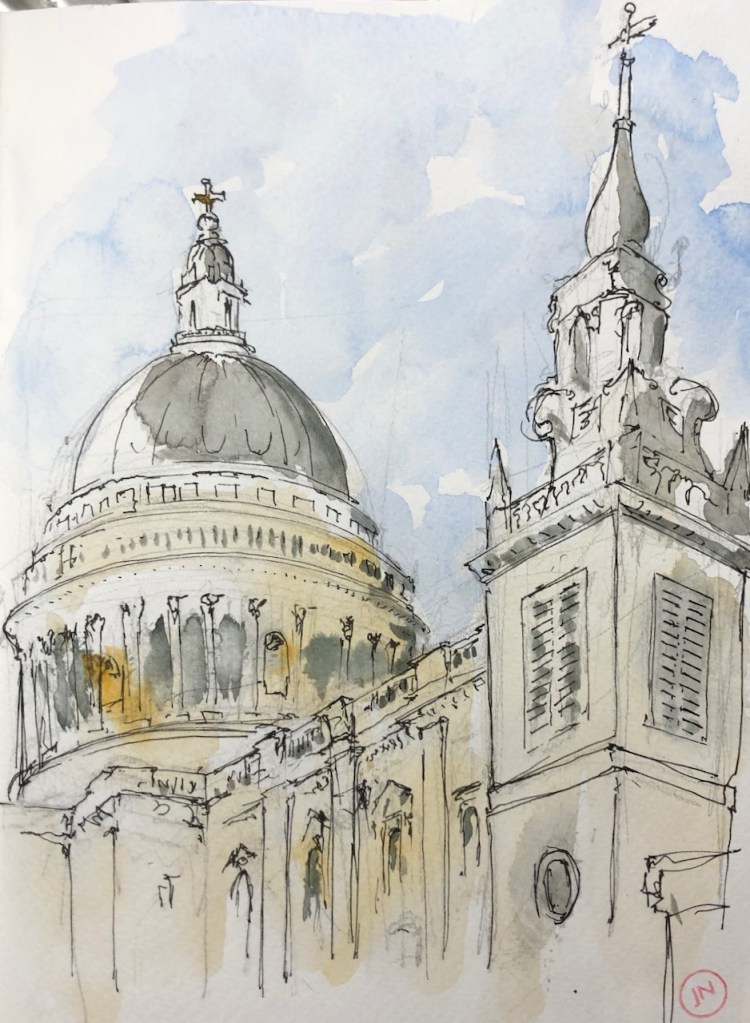
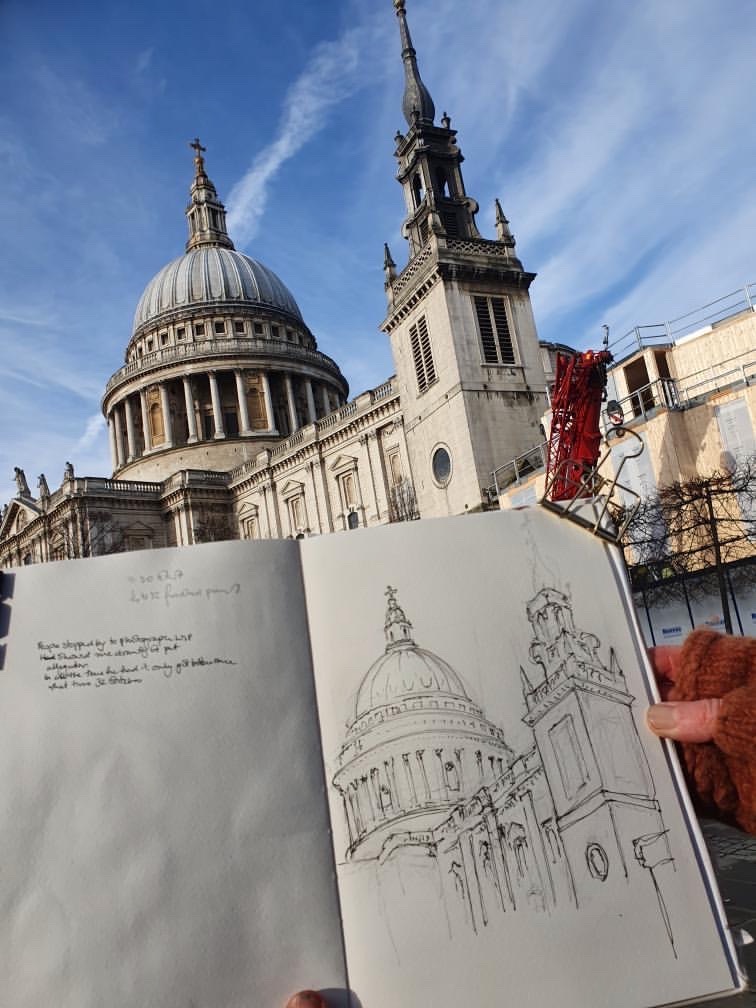
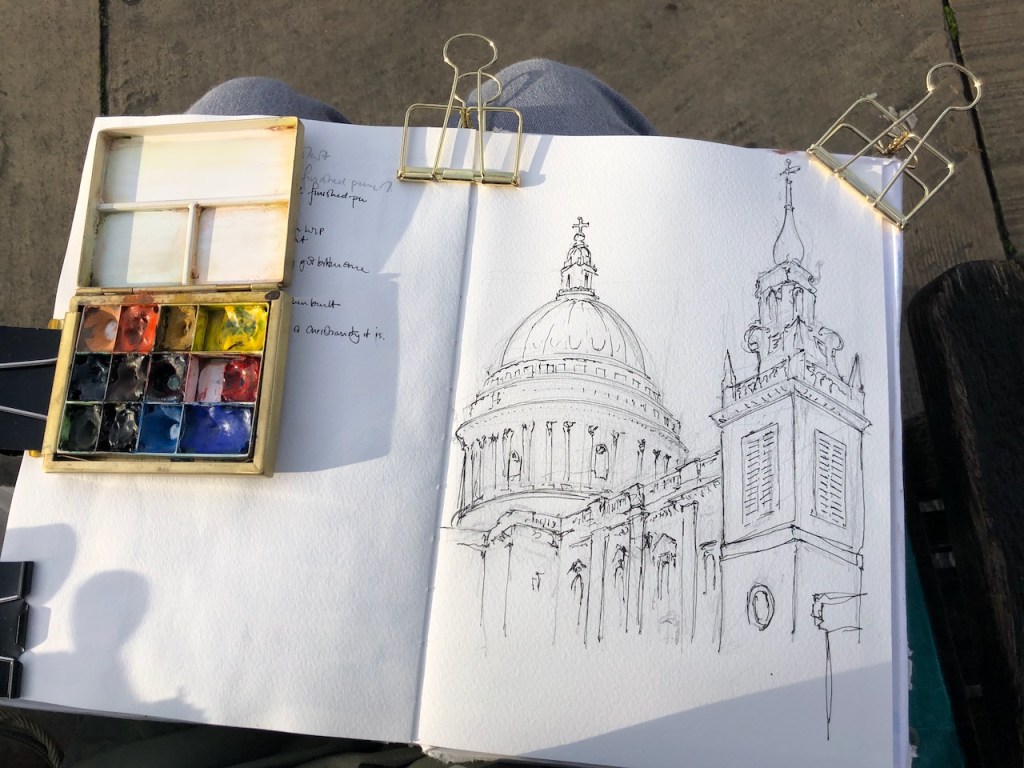
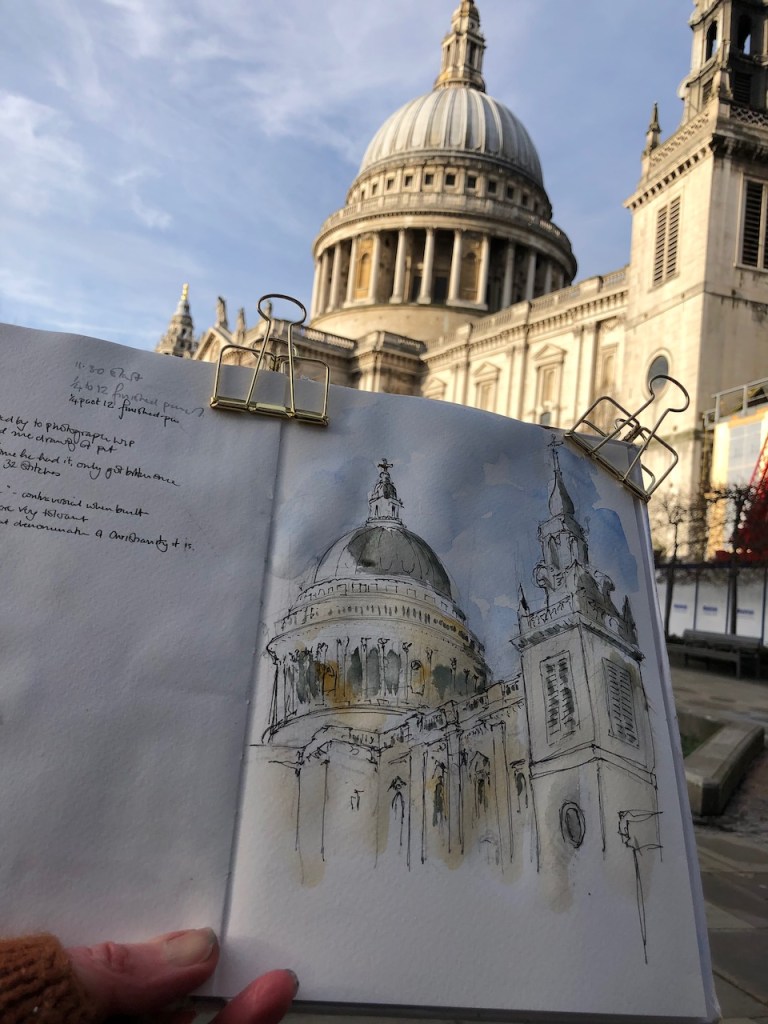
I went there and sat on the raised terrace, sketching the view Northwards towards St Paul’s Cathedral.
St Paul’s, from Wren Coffee

The grey building in the foreground is a nightclub. It has dark windows, and a barred loading bay.

Raised voices from the table behind me grabbed my attention as I sketched. High drama was in progress. One of them defended himself in a loud voice, “The money is real money, and it’s still there. Trust me on this!”.

When someone declares “Trust me on this!” all sorts of red and amber alert lights come on in my head. Was the money still there? Did I trust him on this? I thought not. The other two men were not convinced either.

I kept my gaze firmly forwards, towards the view I was sketching. I did not observe the participants in this conversation, I did not join the debate. I cannot even be sure there were three men rather than two. Certainly at least three points of view were expressed. It was hard to follow the conversation, especially for someone trying to concentrate on tone differences, perspective lines and the symmetry of domes. And not all of the conversation was conducted in the strident tones of the accused party.

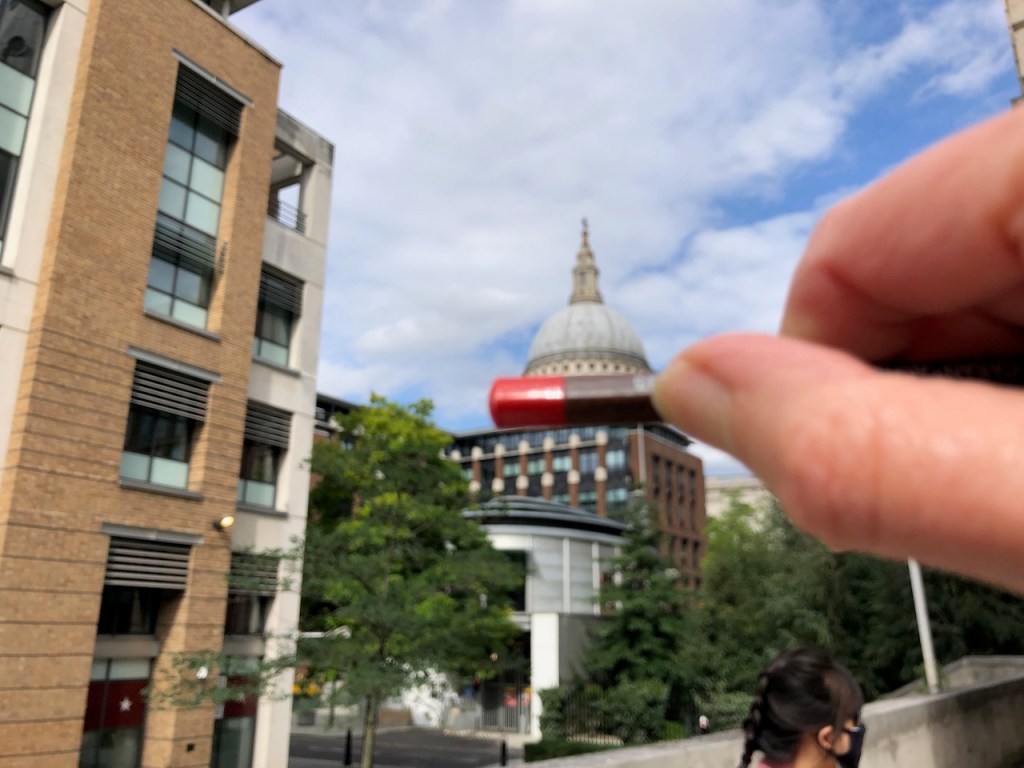
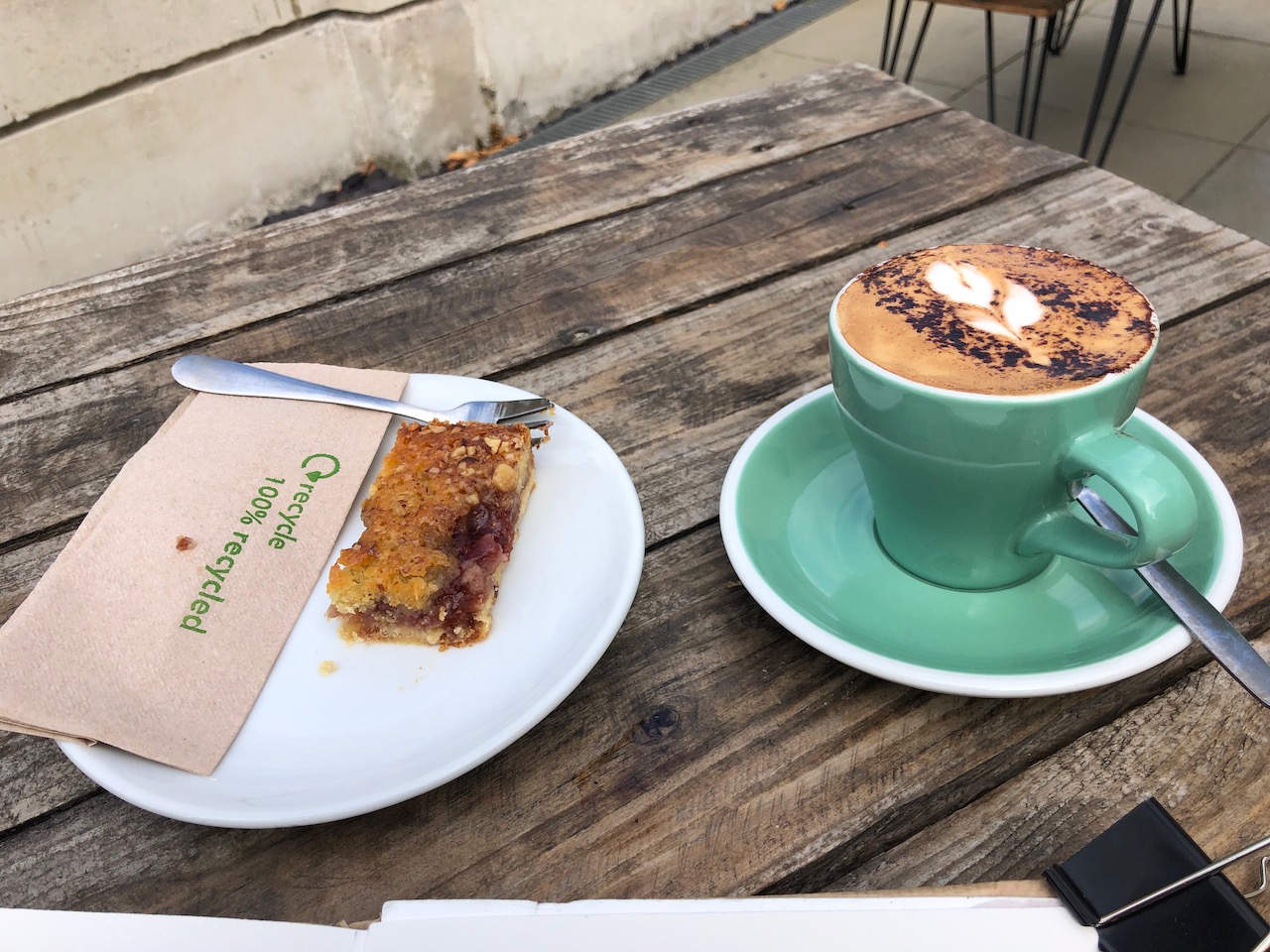
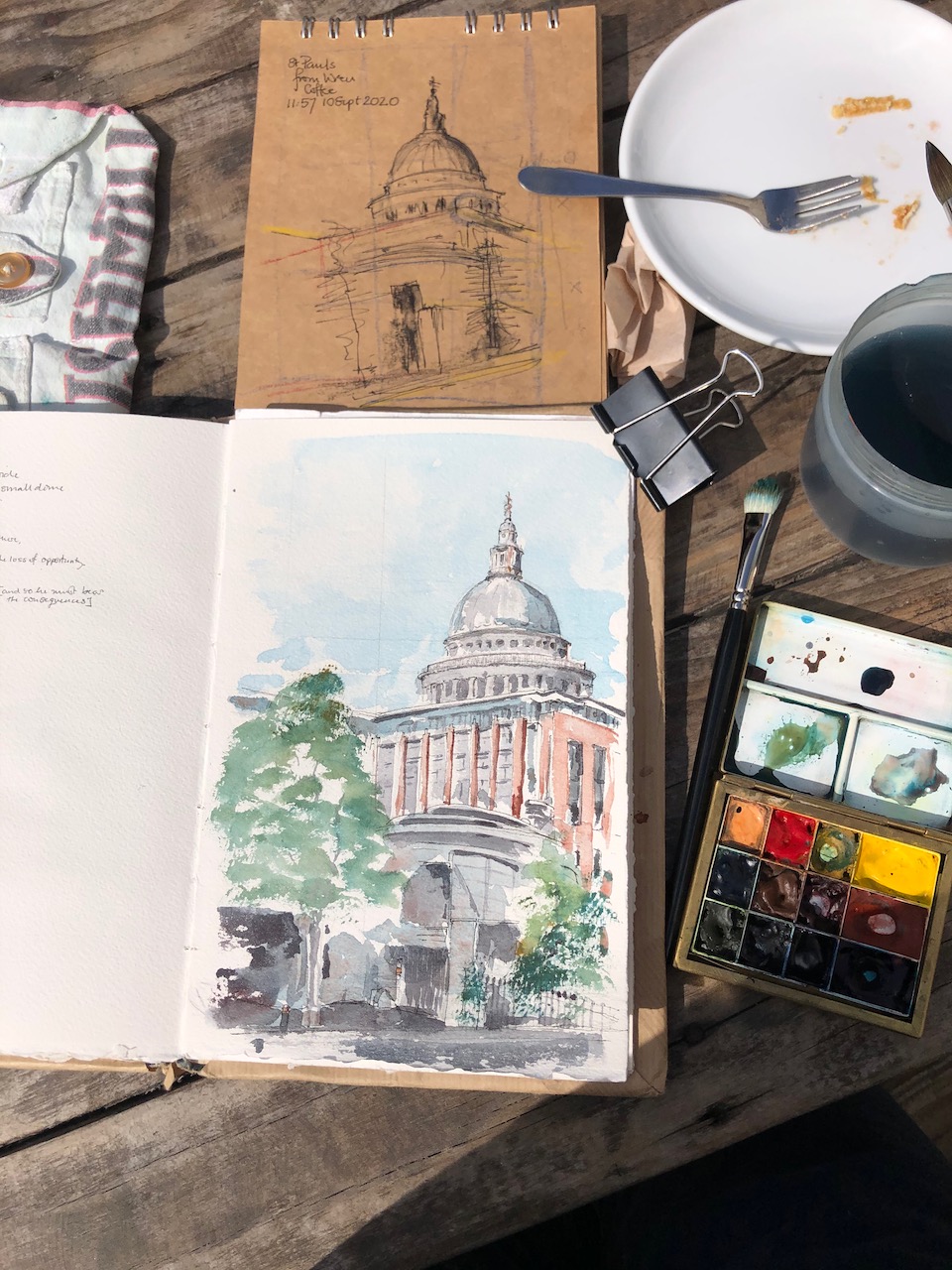
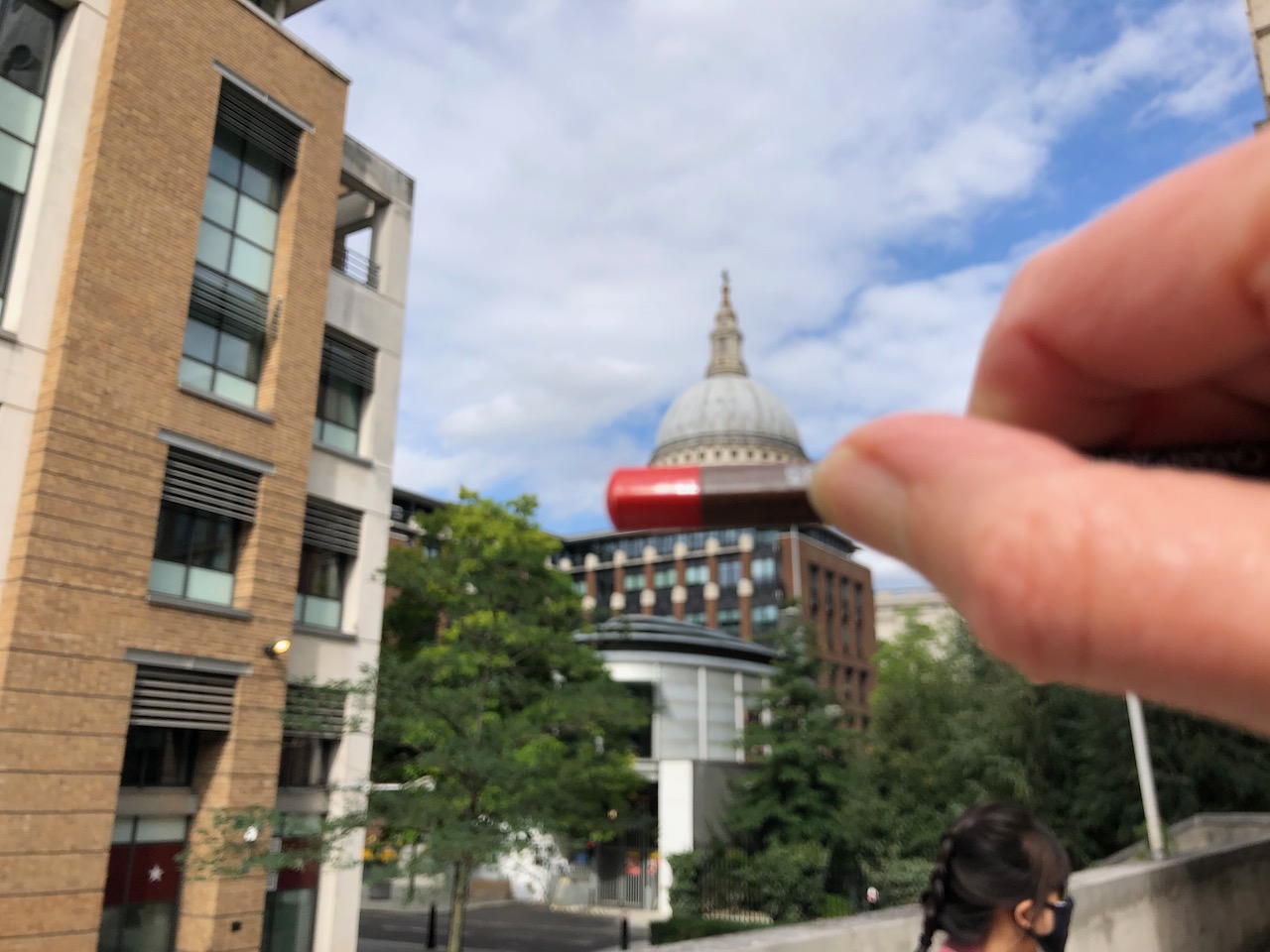
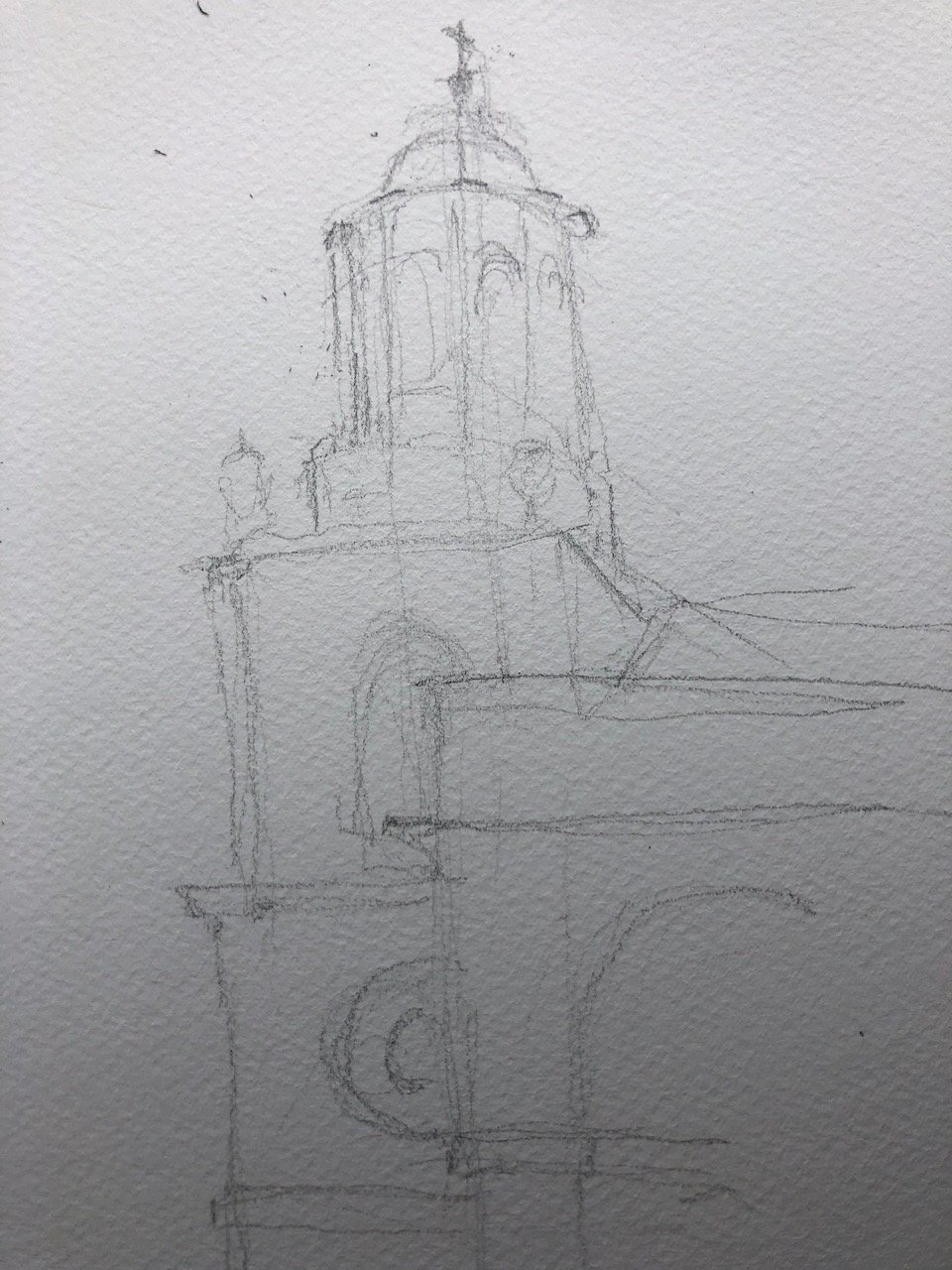
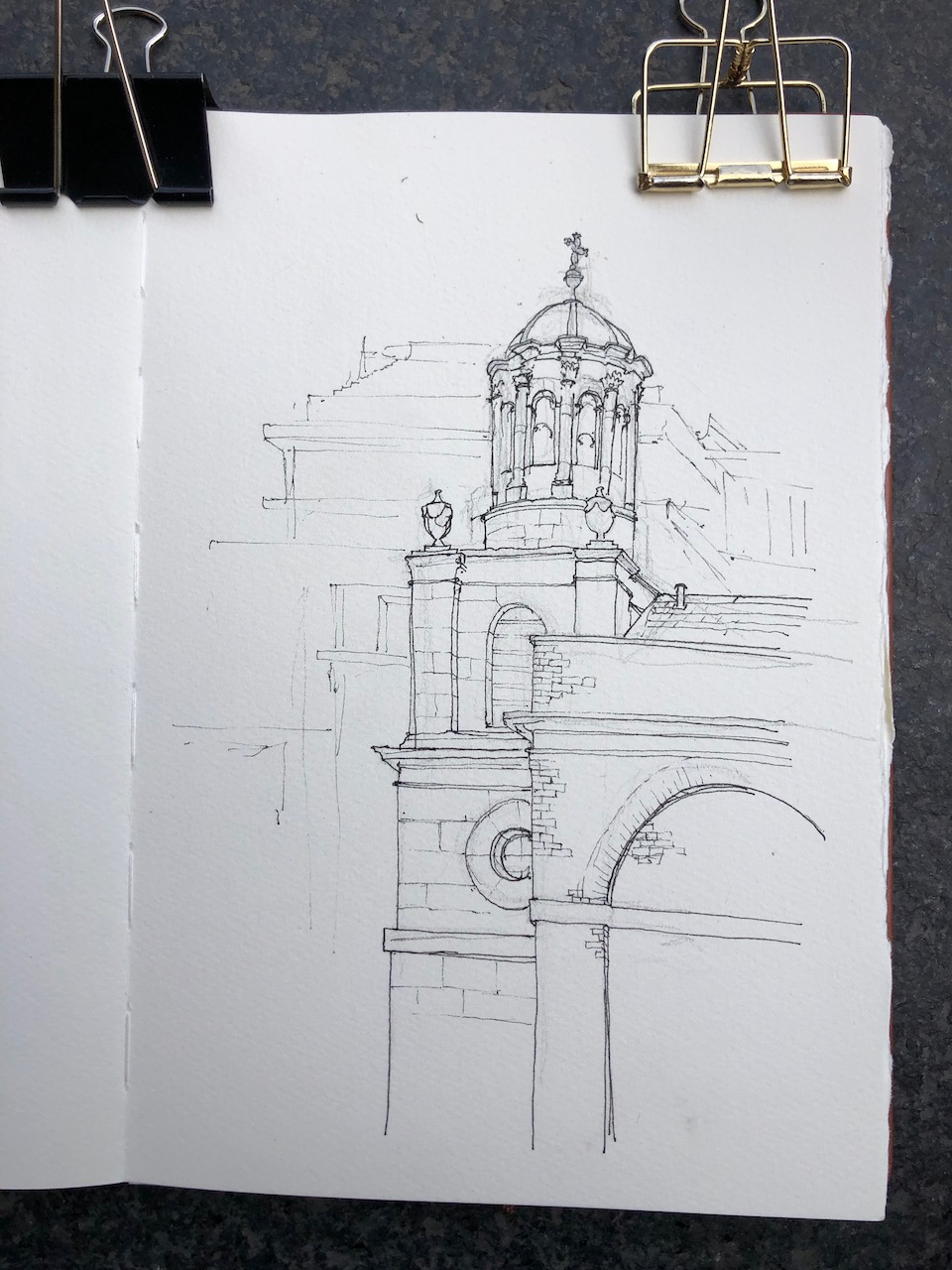
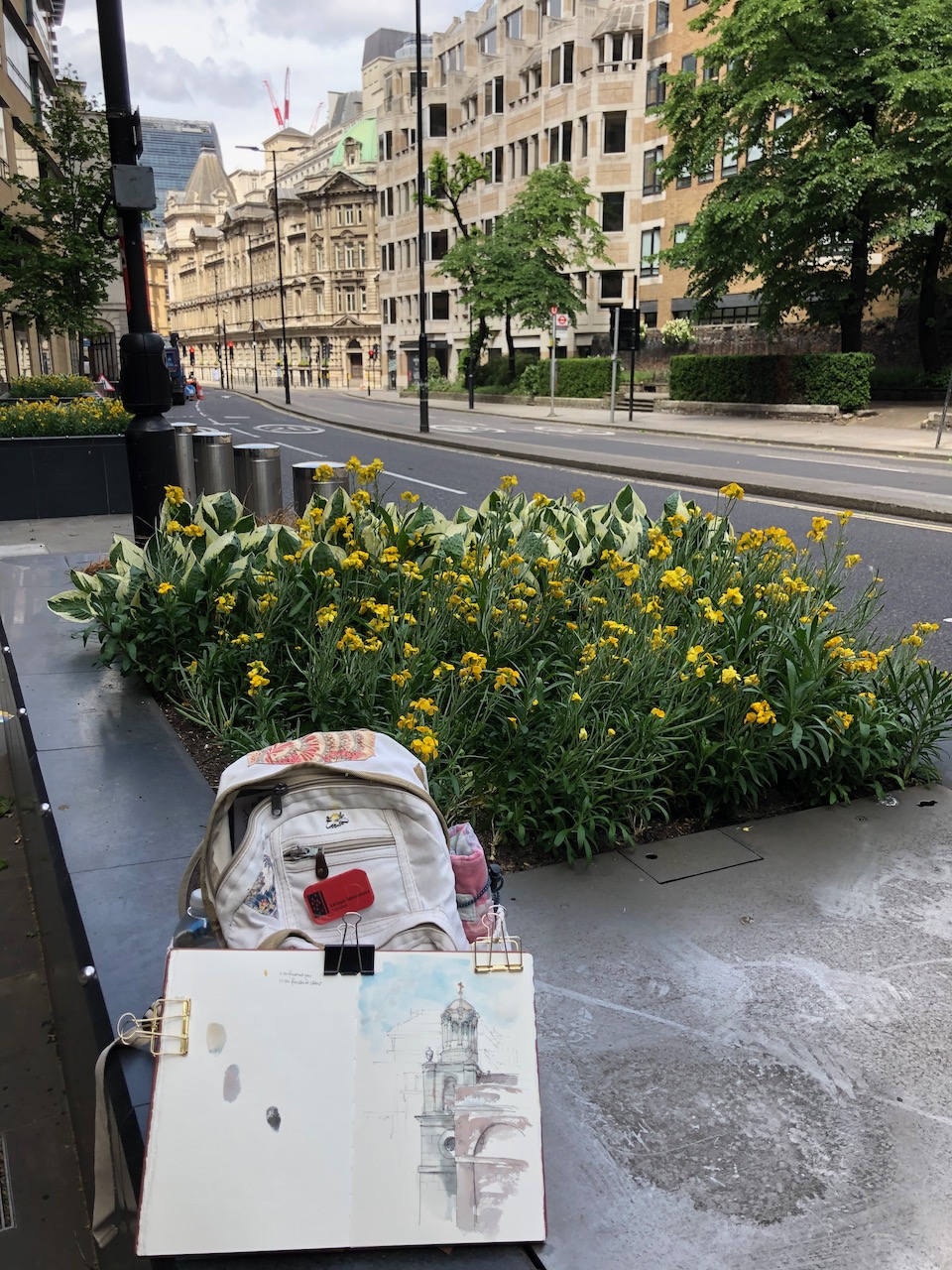
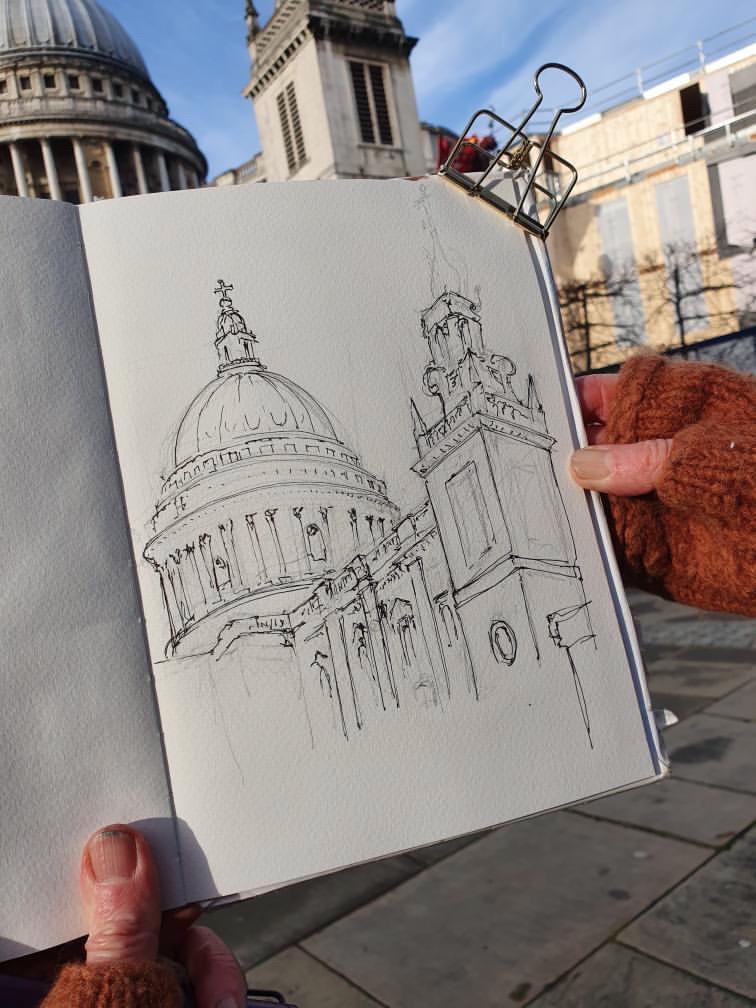
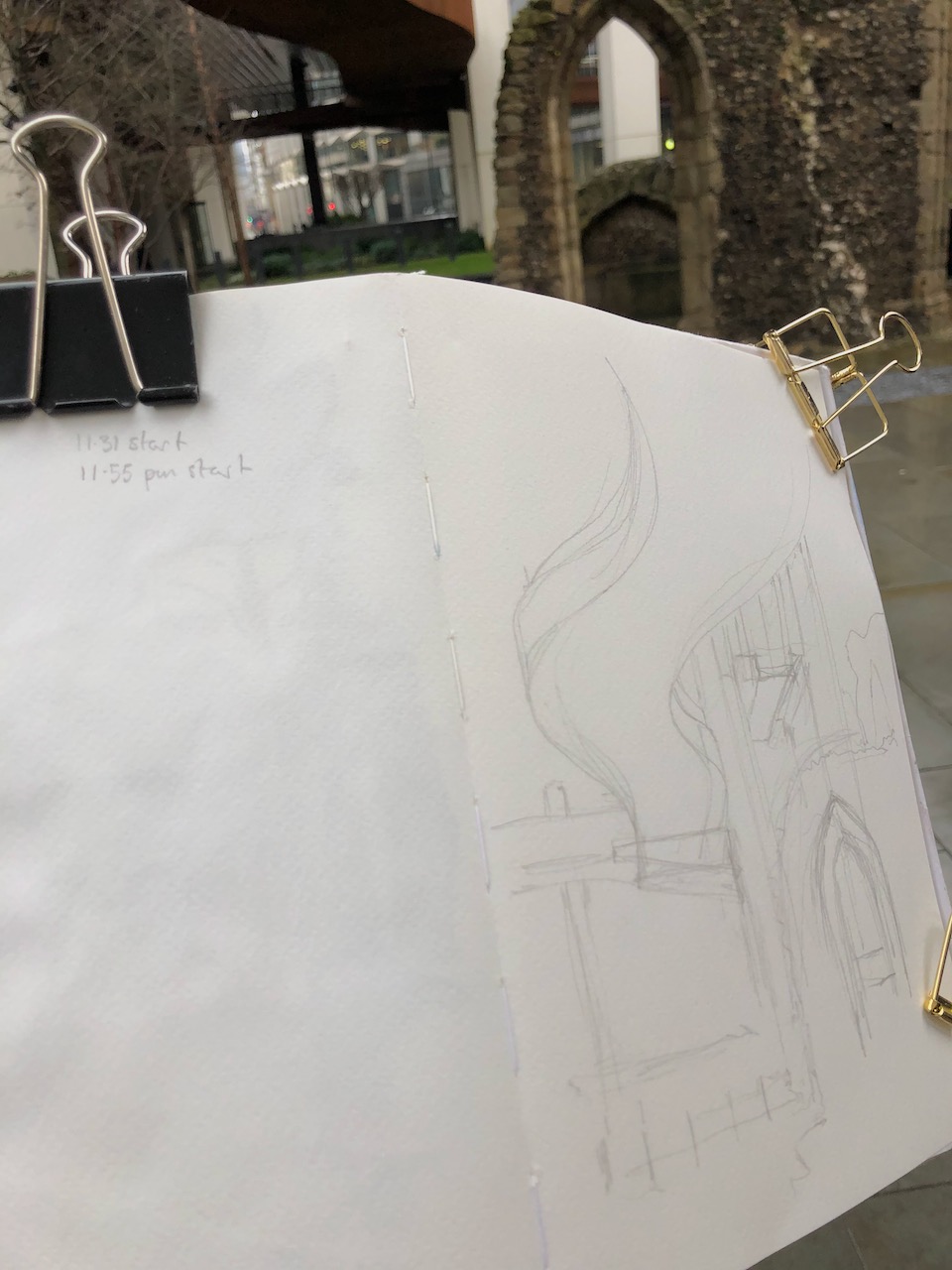
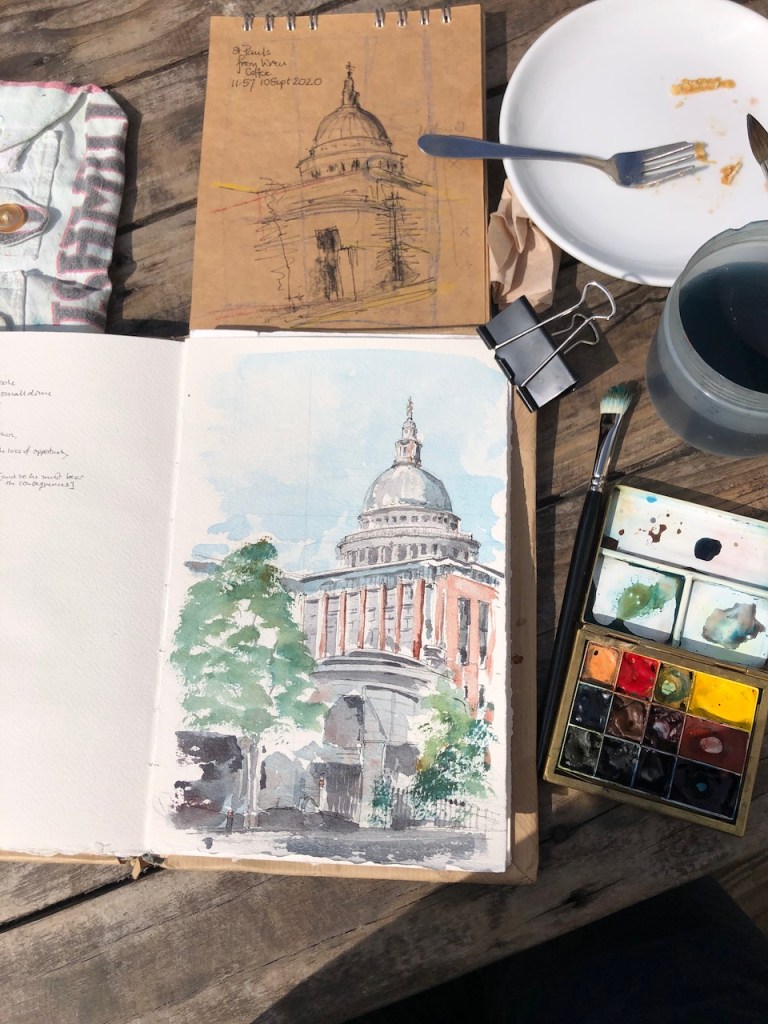
Here are some photos of work-in-progress on the sketch, and a picture of the beautifully crafted capaccino made by the server at Wren Coffee.
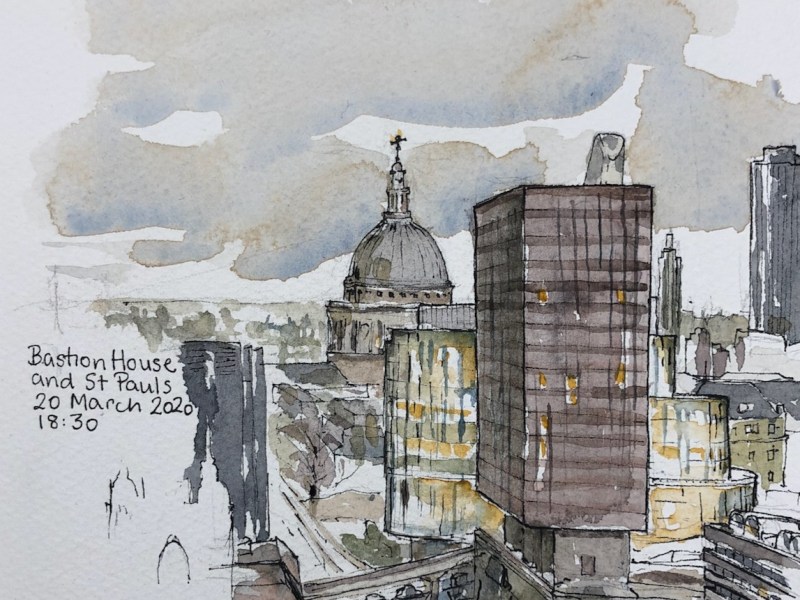
I have sketched St Paul’s before:

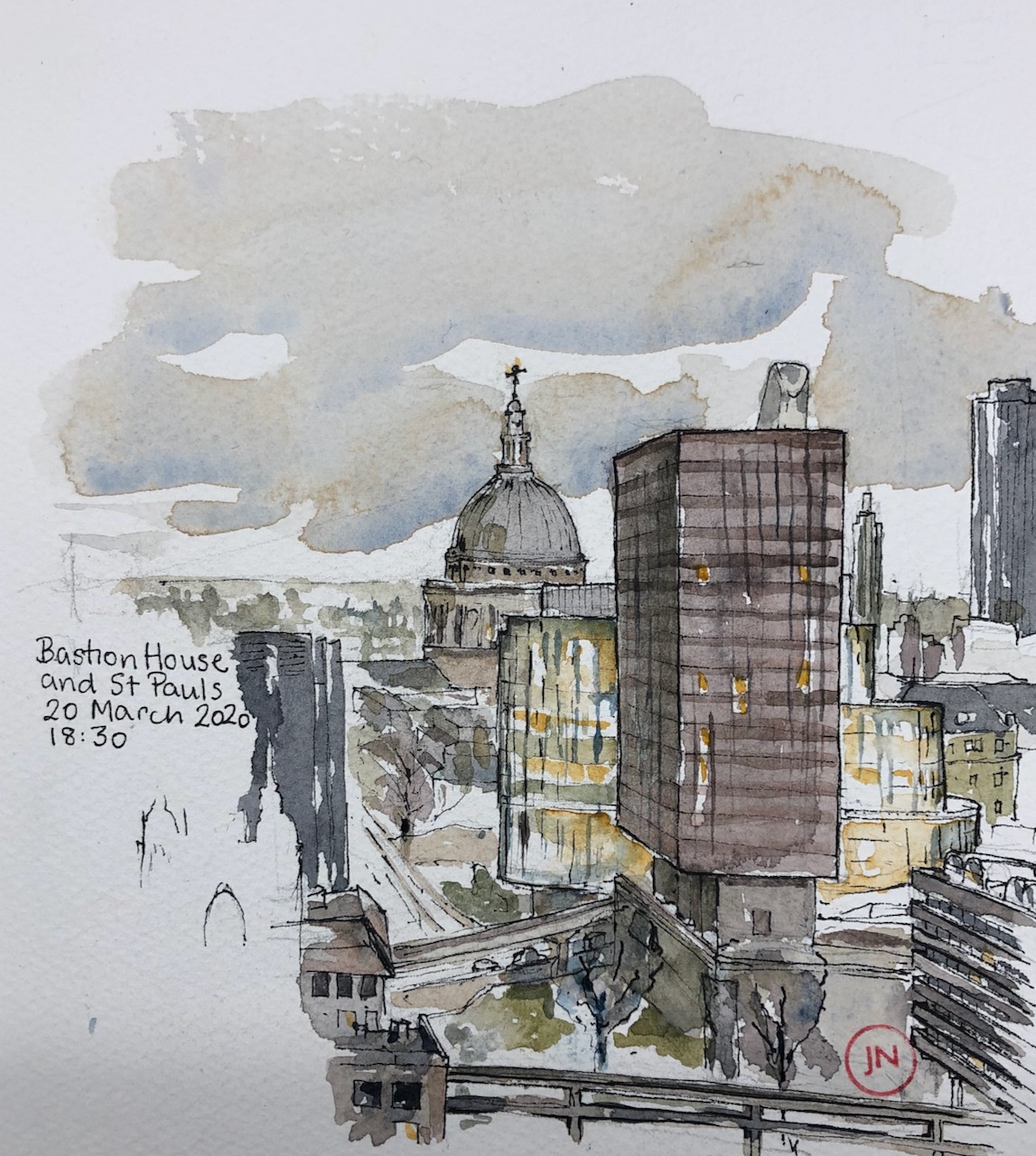
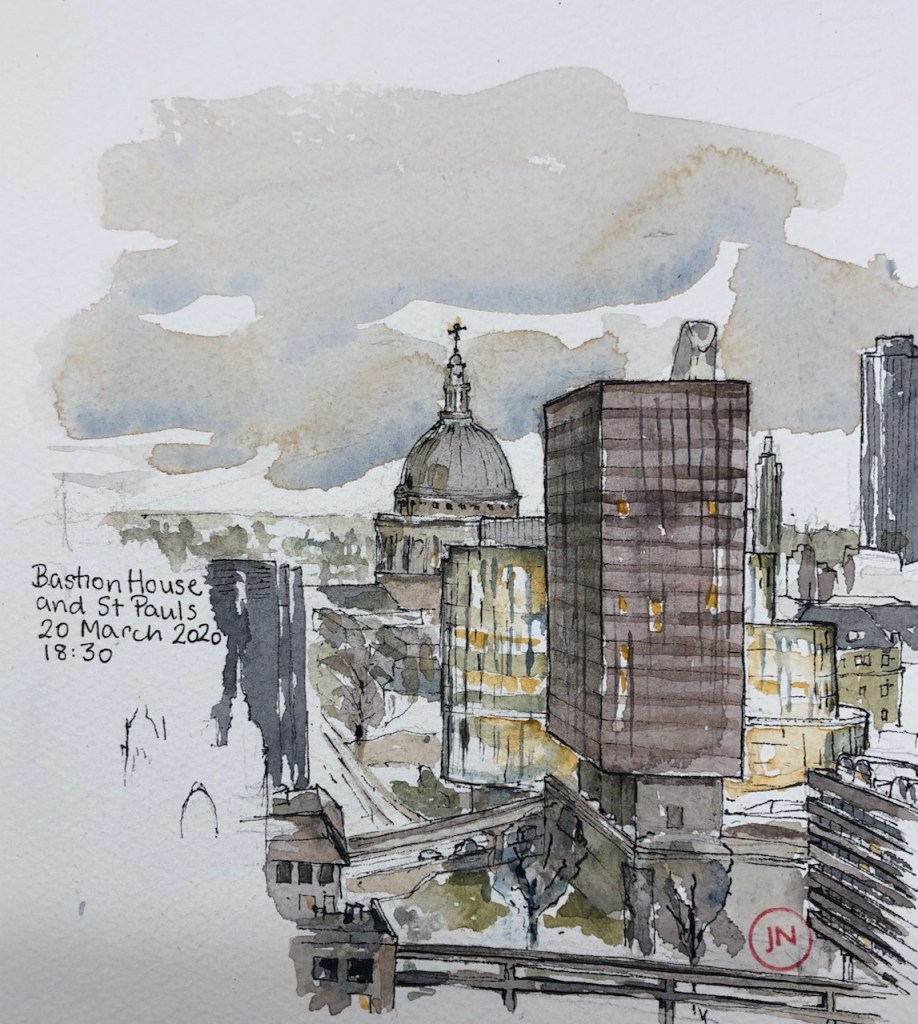
St Pauls and Bastion House

I am sketching the views out of the window. Just visible over the top of Bastion House is the top of “OneBlackfriars”. In the foreground: Mountjoy House, Barbican, on the right. Along the bottom is the Barbican Highwalk which joins Mountjoy House and Wallside. I have drawn Bastion House before: This drawing took rather a…
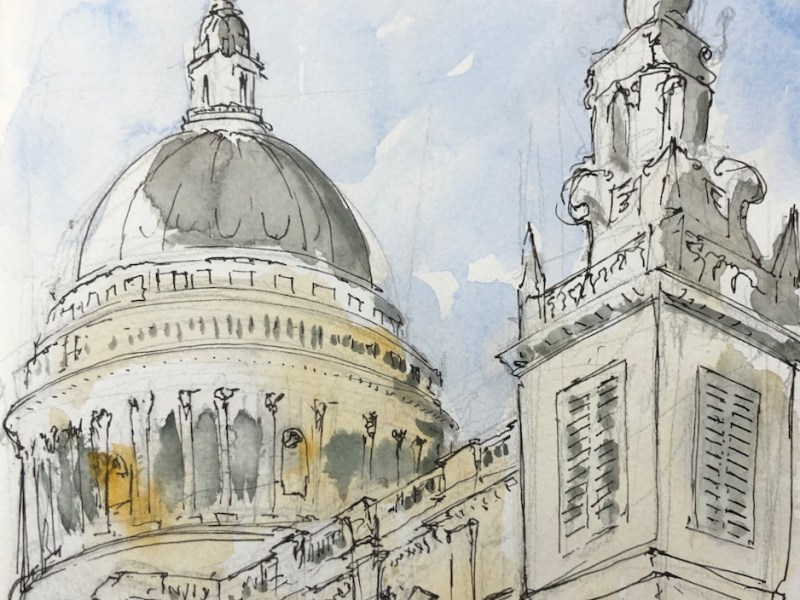
St Paul’s from Old Fish Street Hill EC4

I was keen to draw this view of St Paul’s before it vanished behind the new building on 2-4 Cannon Street. “PLP’s scheme, for global property firm Pembroke Real Estate, will replace a 1959 modernist office building by Theo Birks called Scandinavian House. The north facade, facing the cathedral, is the most orthogonally formal, with red…

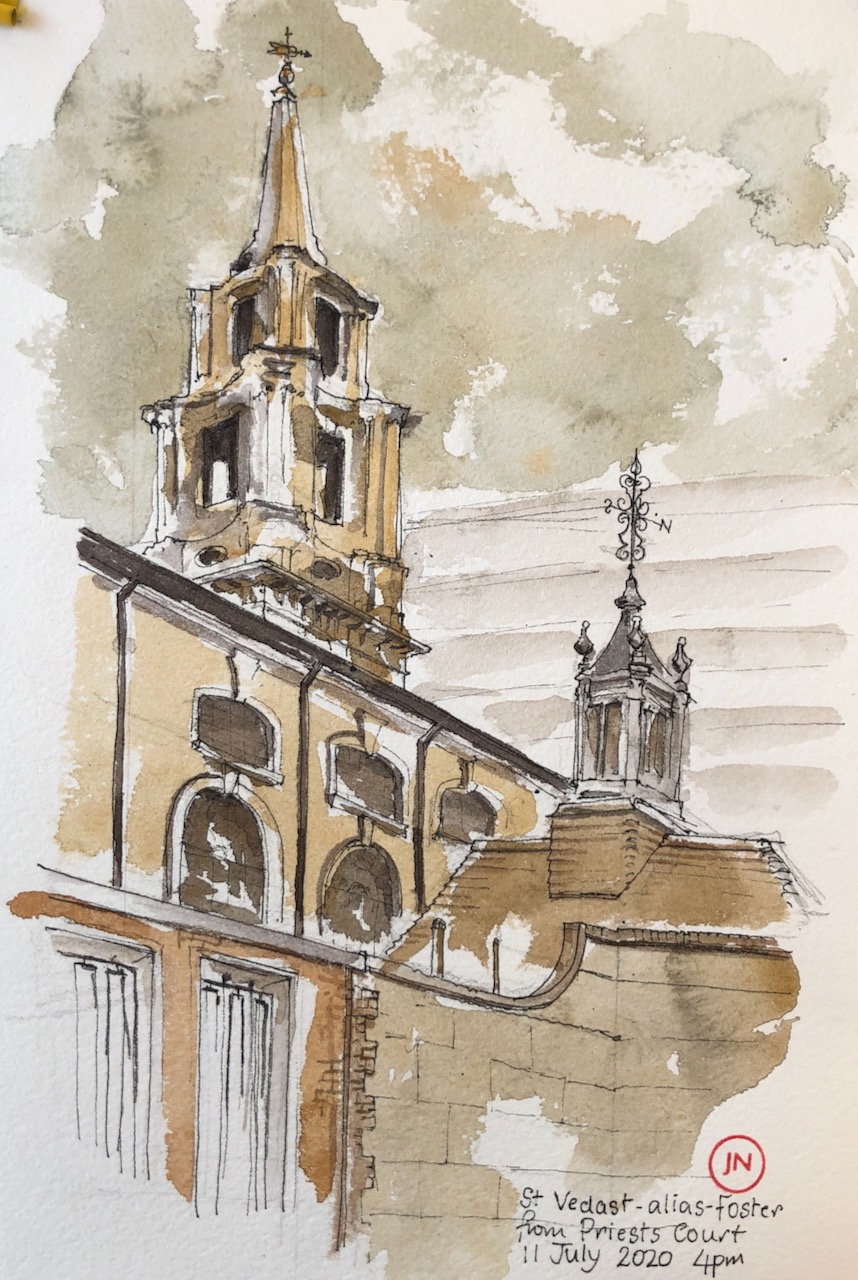
St Vedast-alias-Foster, EC2

Here is the Anglican Church of St Vedast-alias-Foster, in the City of London, viewed from Priest’s Court.

St Vedast-alias-Foster
Memorial stone to Petro, Major Wladimir Vassilievitch Petropavlovsky

Before I drew this, I paused a while in the Fountain Court, a tranquil courtyard next to the church. In the shadow, there is a monument to “Petro”, Major Wladimir Vassilievitch Petropavlovsky. His friends awarded him the epitaph “This was a Man”. I had a look online to see if I could find out more about this person.

He was a member of the Special Expeditionary Force in the 1939-45 war in Europe. This was an organisation formed for espionage in Nazi occupied areas. I can find the record quoted, but the “National Archives” link is not working at present. There is little online that I can find.

Downloaded from http://www.academia.edu, from a list compiled by Eliah Meyer.

However he did write a book, under the name, “W Petro”. I have it on order, so I shall find out more about this interesting character.

The drawing took an hour and 45 minutes. Here are some photos of work in progress.

Fountain Court, I found out afterwards, is named not after a fountain, for there is none, but after a pub that used to be in the area.

All Hallows on the Wall

London Wall is the old Roman Wall around the City of London. It is also the name of a road. In normal times London Wall is a very busy road, an arterial route in the City, full of buses and cars and bikes, with people thronging the pavements looking at mobile phones. Now it is empty, and you can see the scenery. Here is a view All-Hallows-on-the-Wall, sketched from the opposite pavement, outside Deutsche Bank. The church occupies a narrow site, between the present-day road and the old London Wall.

The “Friends of City Churches” site says: “The previous church on this site escaped destruction in the Great Fire but was rebuilt by George Dance the Younger in 1765/67. He was just 24 years old, but achieved an exquisite small interior of neo-classical simplicity regarded by Betjeman as one of the most successful of the London interiors.”

The Church is only open at certain times, and in the pandemic not atall. It has been the headquarters of various groups seeking to help people. Currently it is the headquarters of “XLP” and has their banners outside. Here is an extract from the XLP website:

“XLP is about creating positive futures for young people growing up on inner-city estates, struggling daily with issues such as family breakdown, unemployment and educational failure, and living in areas that experience high levels of anti-social behaviour and gang violence. Every year XLP helps thousands of young people recognise their full potential. We believe positive, long-term relationships can restore a young person’s trust in people, nurture the belief that things can change and encourage them to set positive goals and work hard to achieve​ them”

Here is work in progress on the sketch. See how empty the road is.

You can see the old London Wall under the big tree. Here is a picture from over there near the church.

Old London Wall is on the left. The modern street called “London Wall” is on the right. All Hallows main entrance is in the centre, below the tree. I did my sketch from the pavement on the other side of the road, on the right. The pale-coloured offices there are Deutsche Bank.

Sketch took about an hour, drawn and coloured on location.

St Pauls and Bastion House

I am sketching the views out of the window.

Left to right: St Pauls, an office block on London Wall, Bastion House, tower in Vauxhall, South Bank Tower.

Just visible over the top of Bastion House is the top of “OneBlackfriars”. In the foreground: Mountjoy House, Barbican, on the right. Along the bottom is the Barbican Highwalk which joins Mountjoy House and Wallside.

I have drawn Bastion House before:

Bastion House, London Wall, from Andrewes House

I hastened to draw the magnificent Bastion House, on London Wall. It is due for demolition. In the foreground you see the balcony and privacy screen of the flat in Andrewes, whose leaseholder had kindly hosted me. The line of red brick, and what looks like chimneys, in the foreground are the rooftops of a…

Bastion House from Podium Level

Bastion House aka 140 London Wall is a huge modernist monolith, reminiscent of the monolith in “2001 – A Space Odyssey”. I couldn’t find a site to draw the monolith part today, so here is a view at Podium Level, looking West towards the Museum of London. You see the dark undercroft, walkways and a…

St Giles and Bastion House

Today Urban Sketchers London held a “sketch crawl” in the Barbican. So I joined them. An astonishing number and diversity of people assembled inside the entrance of the Barbican Centre at the appointed time of 11am. I counted about 35 and then another dozen or so joined. All shapes and sizes of people, tall, short,…

This drawing took rather a long time as I stopped a couple of times. As a result, by the time I finished, the lights were coming on in the office buildings, and the sky was dark.

Click here to see my drawing of St Paul’s last year

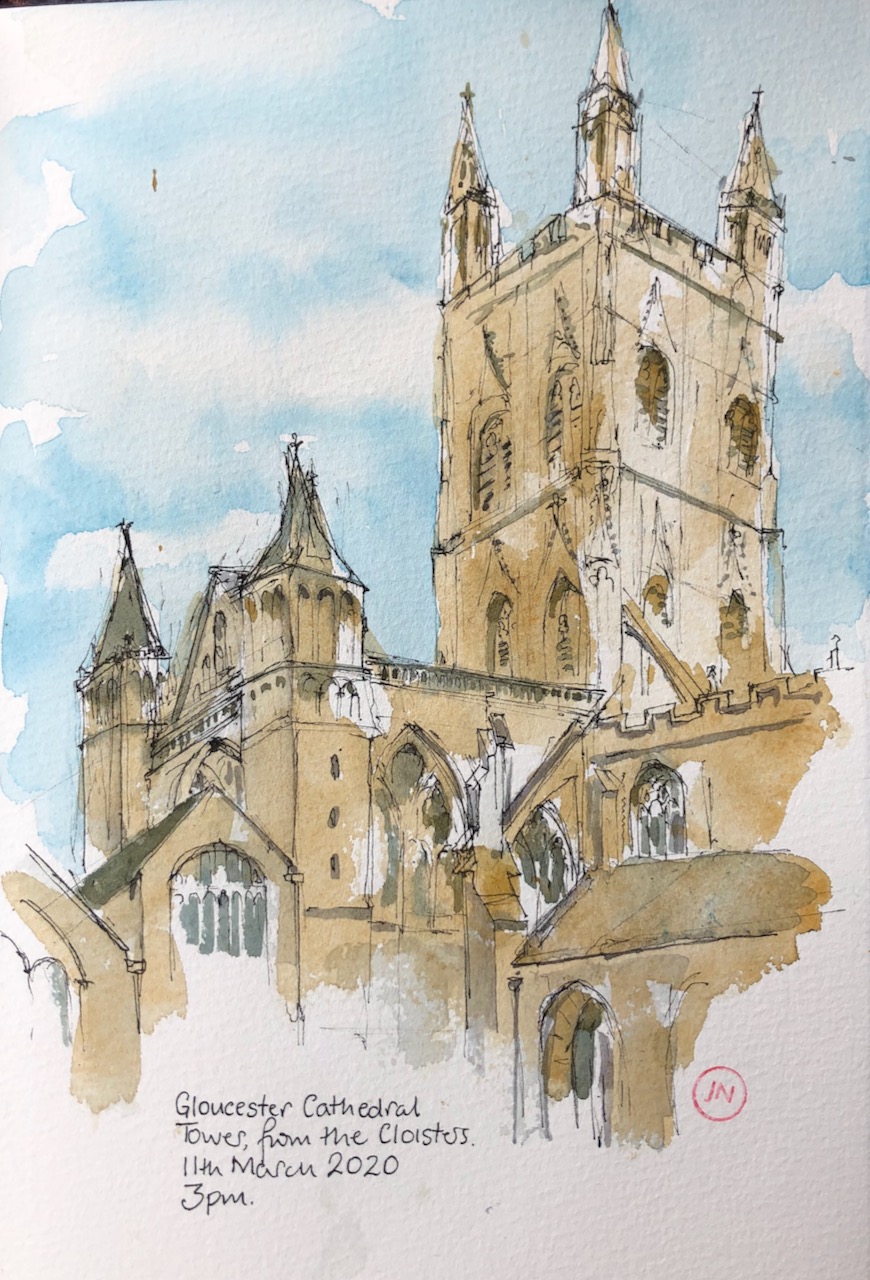
Gloucester Cathedral

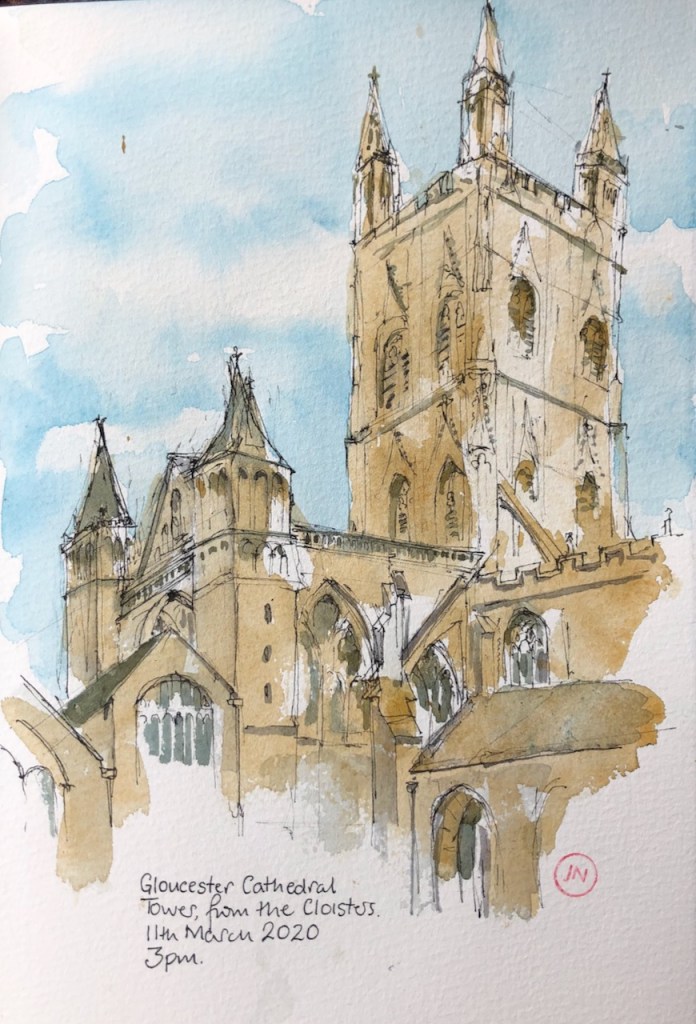
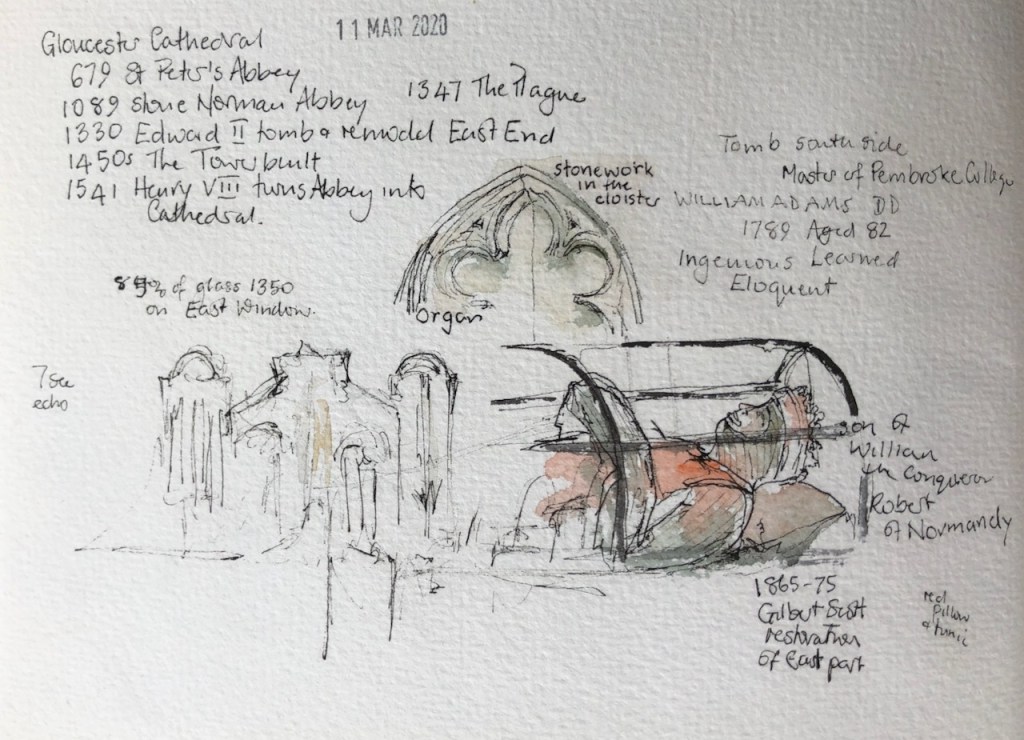
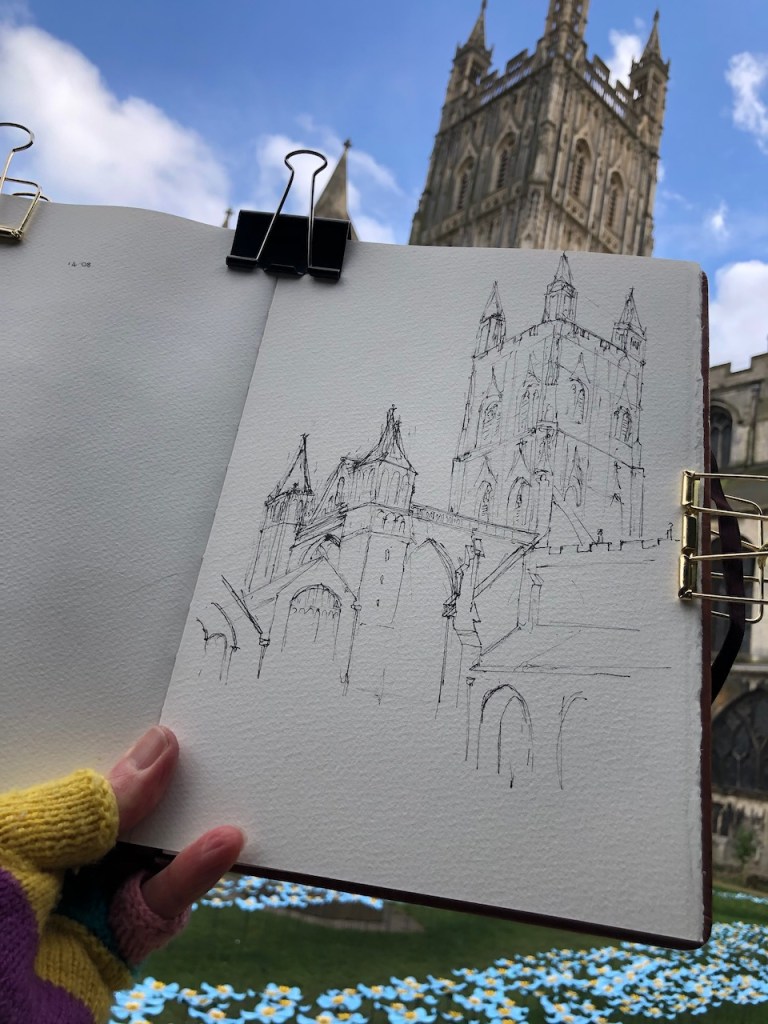
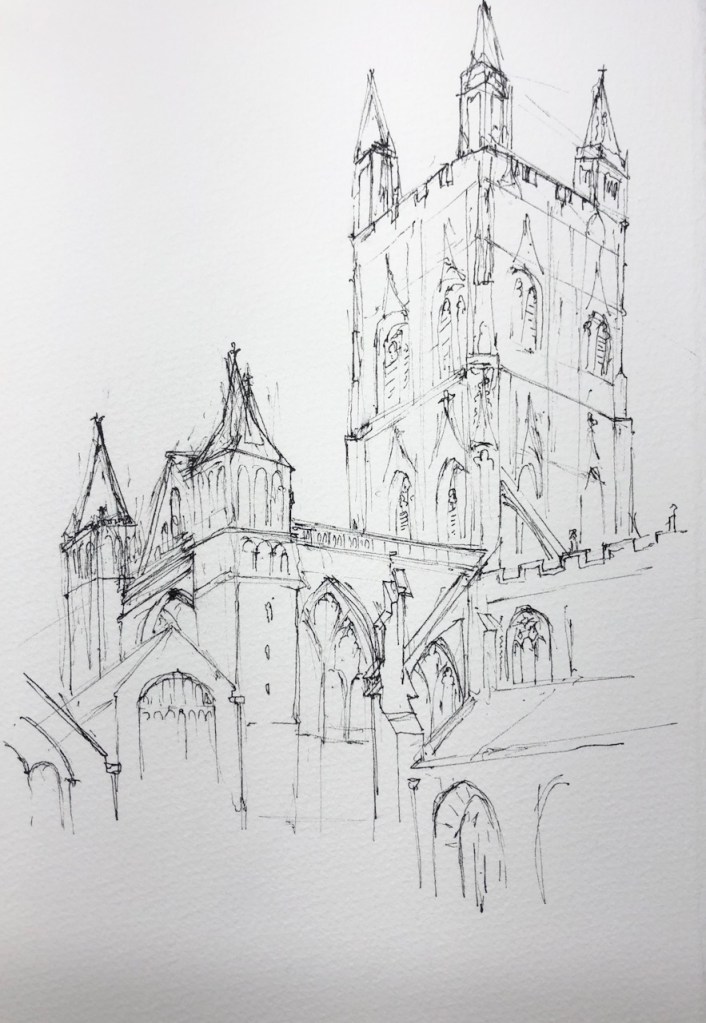
This is Gloucester Cathedral Tower from the cloisters.

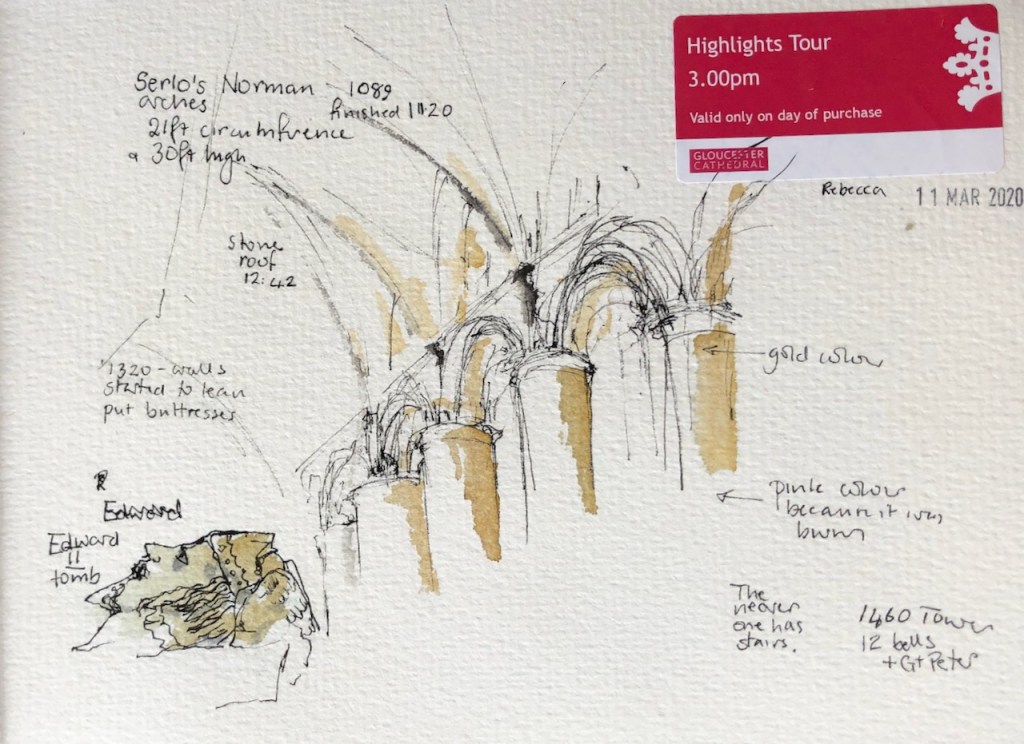
It’s an amazing place. Inside there are huge Norman pillars from 1089. They seem so solid and magnificent that you’d think no-one would ever want to change them. But someone did. At the East End, there are a few pairs of pillars in a totally different style: the “perpendicular” style, which means they are fluted, like vertical clusters of pipes. This remodelling project was started in around 1330, but didn’t get far. Our guide, Rebecca, offered several explanations for why this project was stopped. There was a war with France, the start of the “Hundred Years War”. France invaded Dover and Folkestone in 1339 . And on the north border, English armies were attempting to stop Scotland from going independent. So there was a lot going on, and remodelling a cathedral might have gone down the list of economic priorities. Then, to cap it all, there was the Plague in 1347-51 which must have depleted the workforce and caused economic disruption. So best leave the Norman pillars as they are.

Here are some sketches as we toured the cathedral. Thank you to Rebecca, who was a brilliant guide: patient with our questions and interruptions, and extremely knowledgeable.

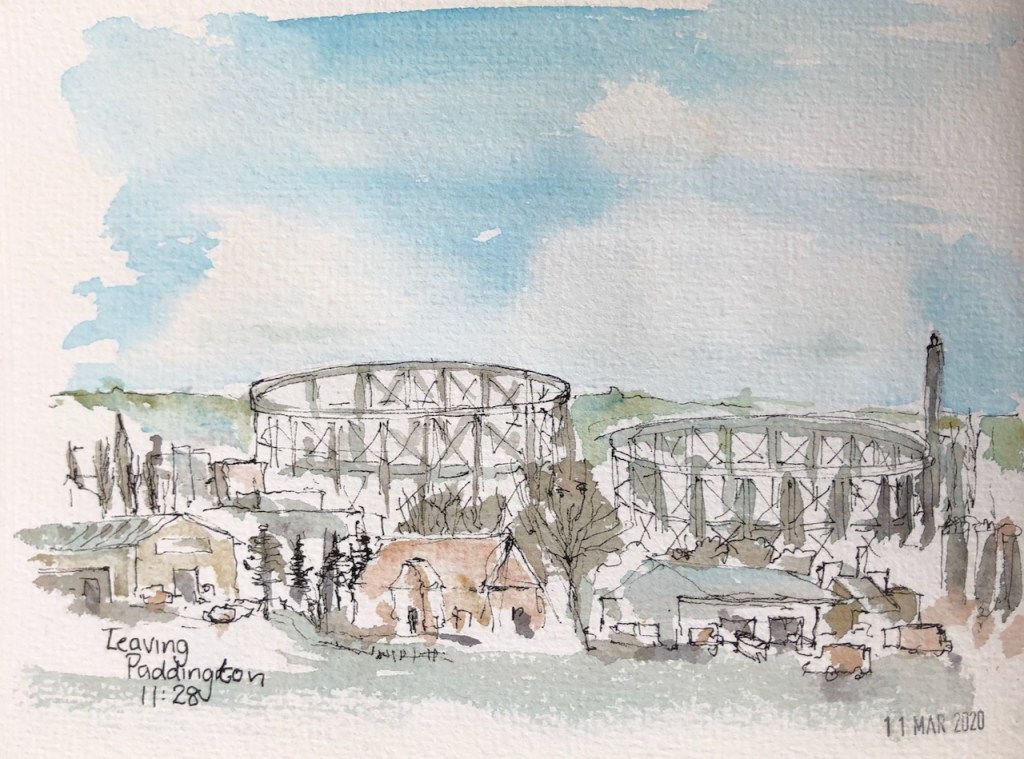
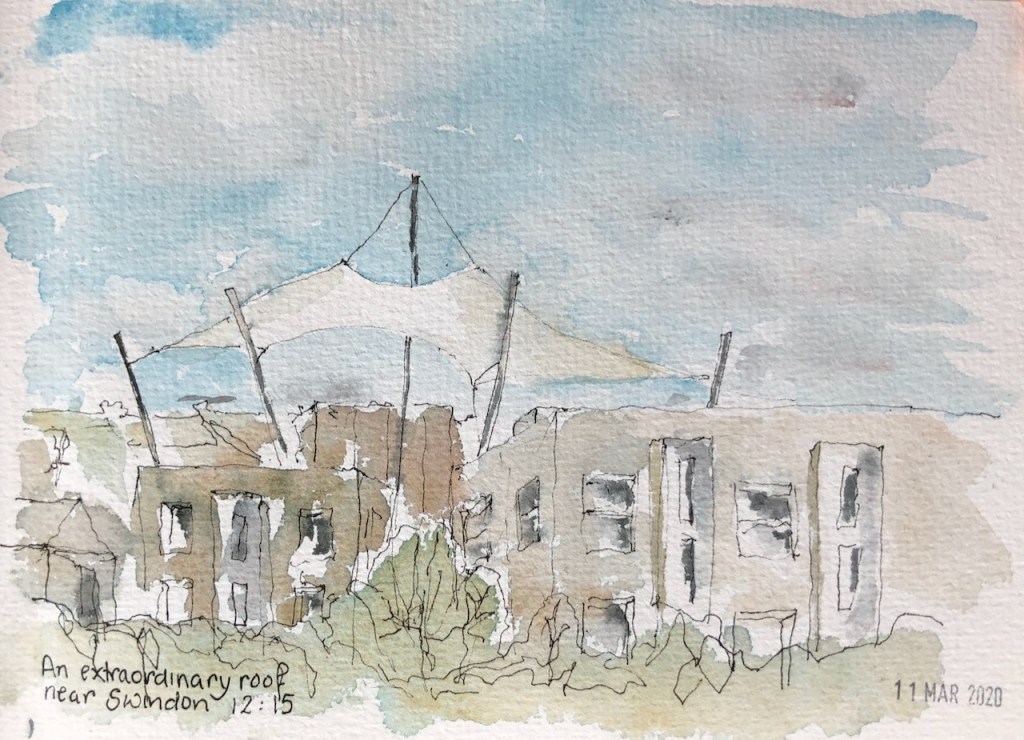
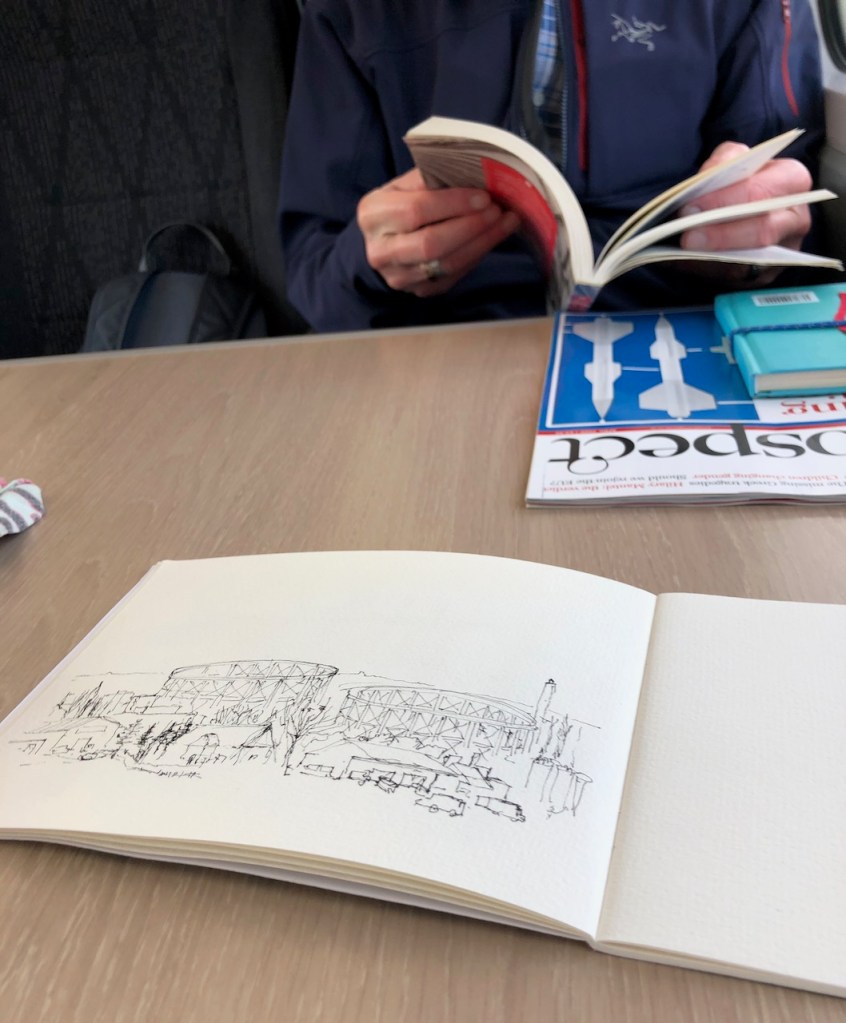
It’s 1hr45mins from Paddington to Gloucester. Here are some drawings done on the train.

The drawing of the Tower was a quick pen and ink sketch, coloured later. The pen and ink took about 45 minutes. The colours are: Phthalo Turquoise (W&N), Mars Yellow (DS) and Perinone Orange (DS). Here is work in progress, including some of the drawing on the train.

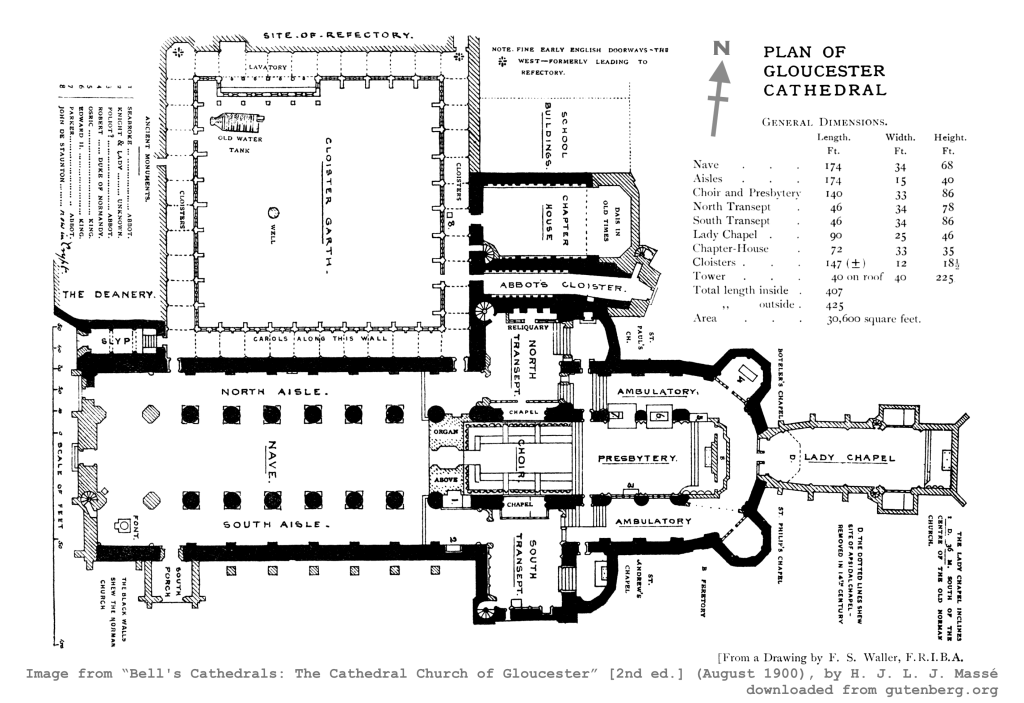
Map of Gloucester Cathedral (1900):

Footnote: Concerning things that were going on in the 1330s: the Butchers Guild was granted the right to regulate the meat trade in London in 1331. See this post for a picture of the Butchers Hall:

Barts Square, Butchers’ Hall

Continuing my exploration of Barts Square, EC1, today I drew Butchers’ Hall. Butchers’ Hall is the building with the arched windows, in the centre left of the picture. It is the headquarters of The Worshipful Company of Butchers. This livery company is very old, the Arms were granted in 1540 and the charter by James…

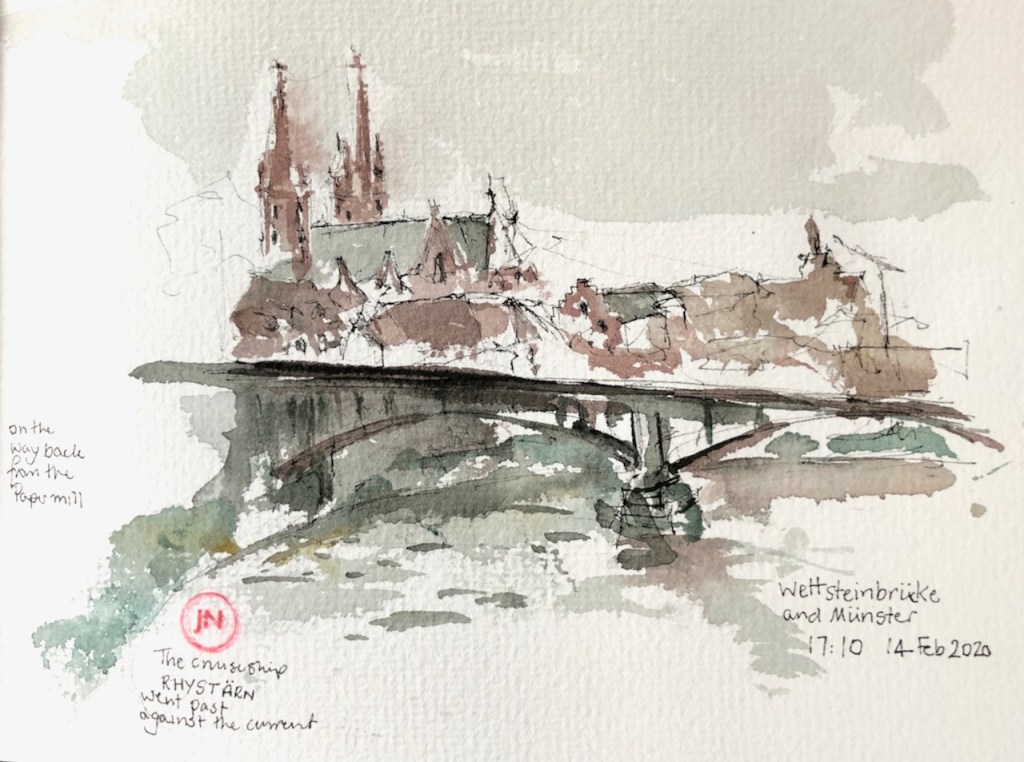
Basel, February 2020

In the streets of Basel, you can hear your own footsteps.

There are fountains.

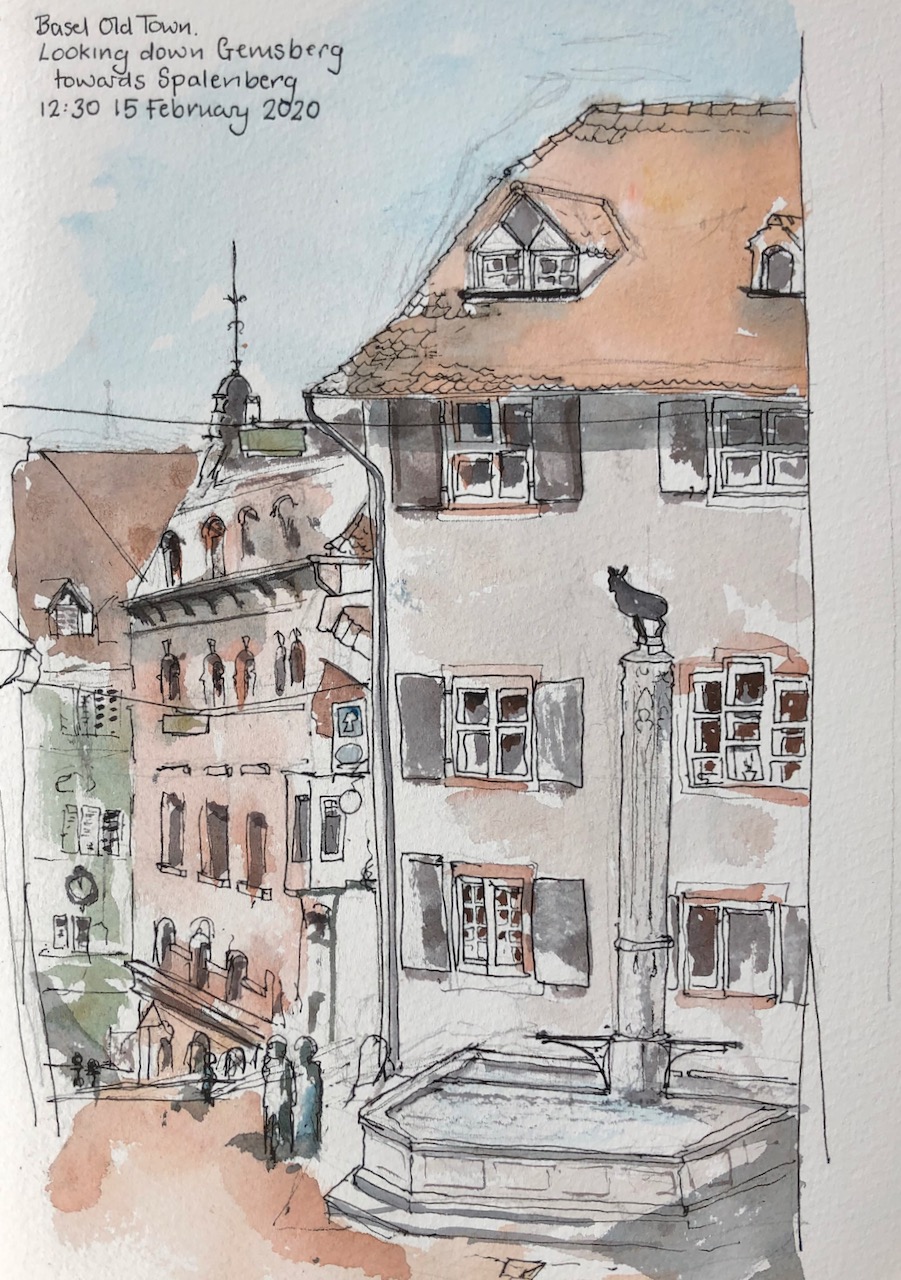
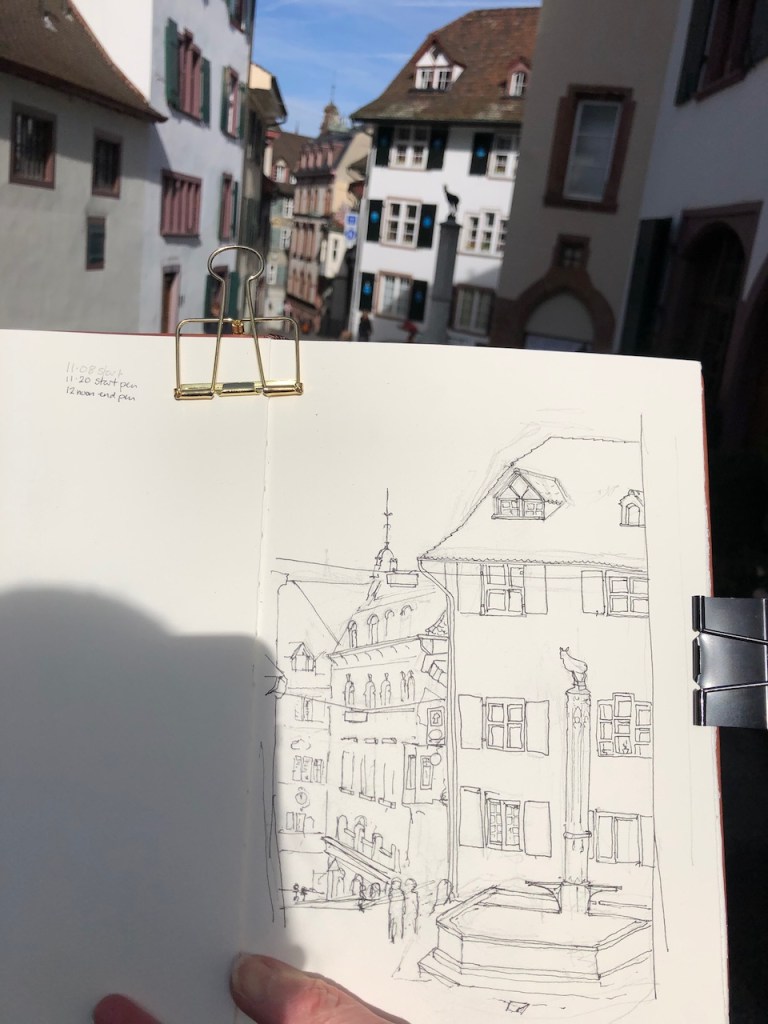
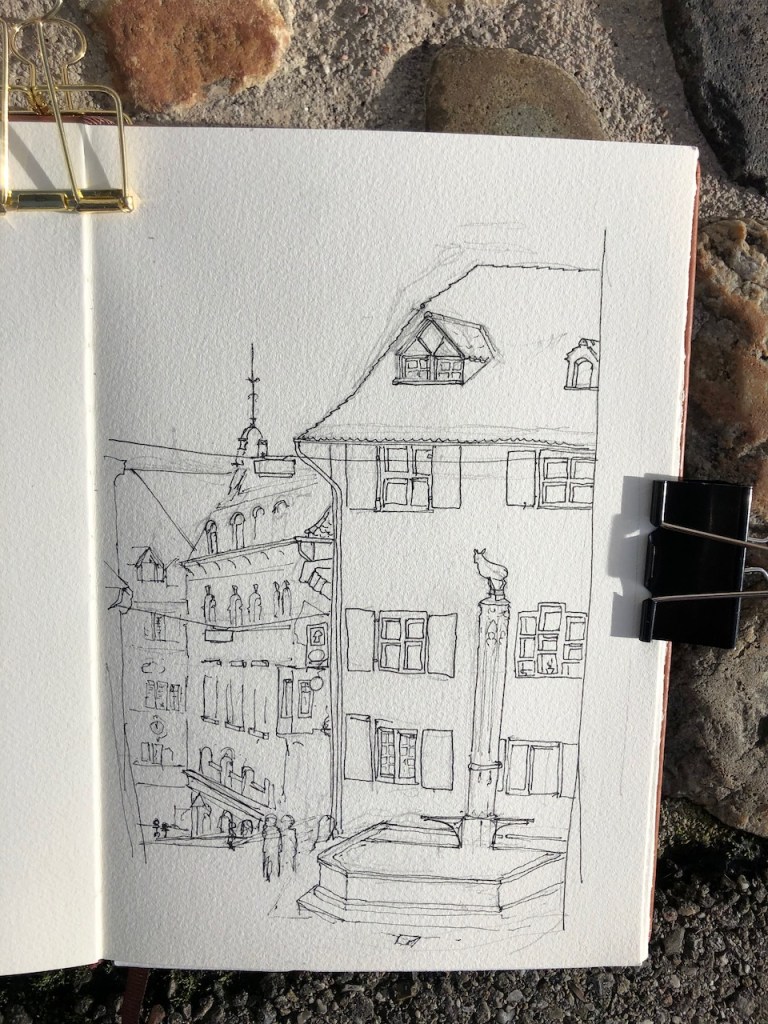
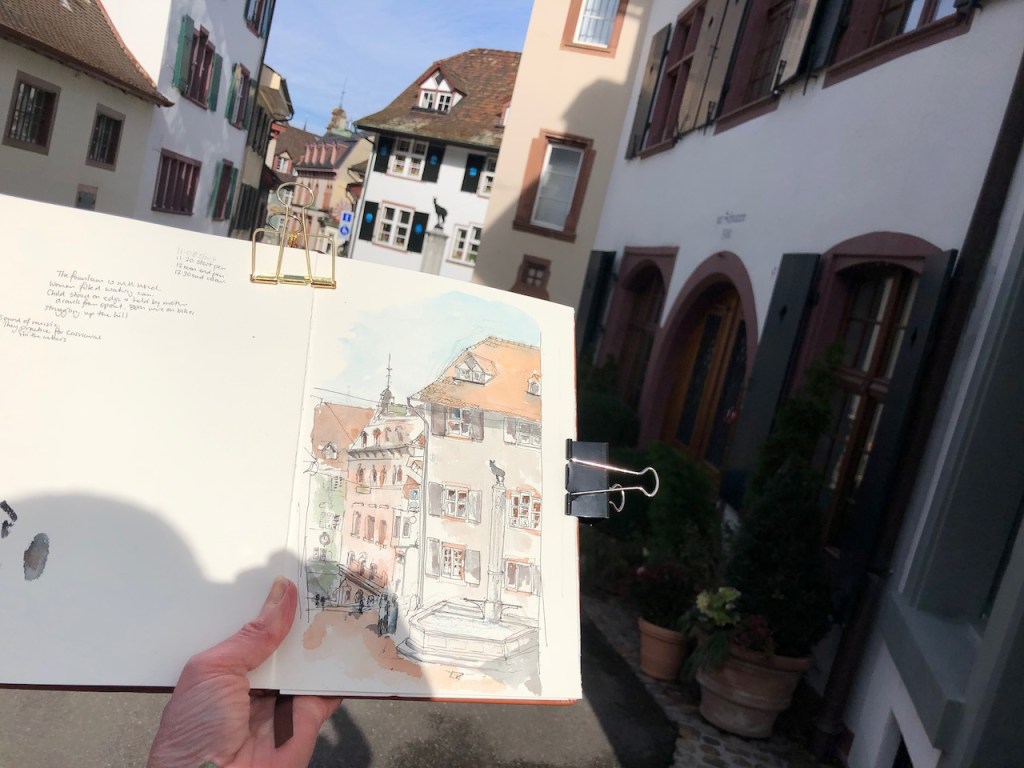
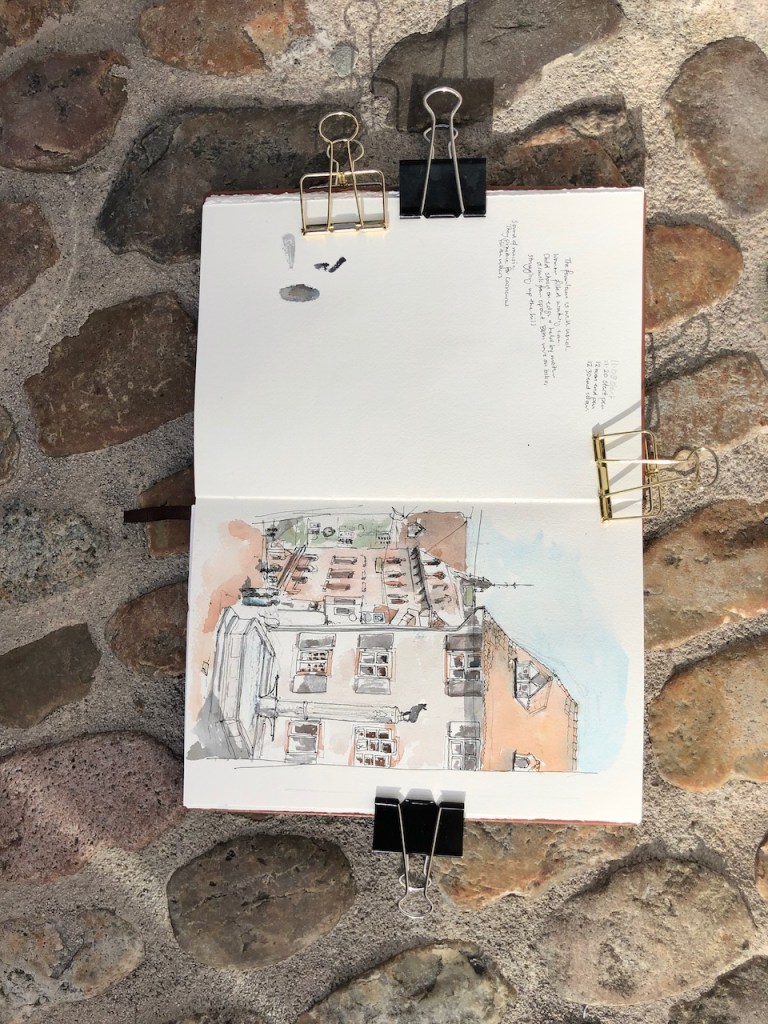
Gemsberg, Basel Old Town, 7″ x 10 ” on Fabriano Artistico paper, [sketchbook 6]

In the hour and half that it took me to draw this picture, people made use of the fountain. Someone came out of one of the adjacent houses and filled a watering can. A woman helped a child to stand on the white marble edge and then to walk cautiously on the iron bars across the water. The child dipped her hands in the flowing water and drank. She played with the water that came from the spouts. Then the woman and the child returned to their bicycles, and continued their ascent of the hill. Elderly people, climbing the hill, paused here to rest. A runner lent over the water and sluiced his face, before pacing on up the slope towards me.

This part of town is very old. Basel has the fine custom of telling you a little about each street, on the street sign. The one for Gemsberg says:

“Zum Gemsberg, 1661 erstmals erwähnter Hausname”

So this street was named after a house which stood here in 1661. [German speakers reading this: please correct me if I got that wrong!]

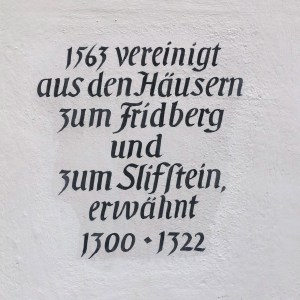
The house on the right has an inscription in magnificent script. My German-speaking consultant enables me to state with some confidence that this reads as “In 1563 [this house was created] by joining together two houses: “To the Fridberg” and “To the Slifstein”, both mentioned in 1300-1322″

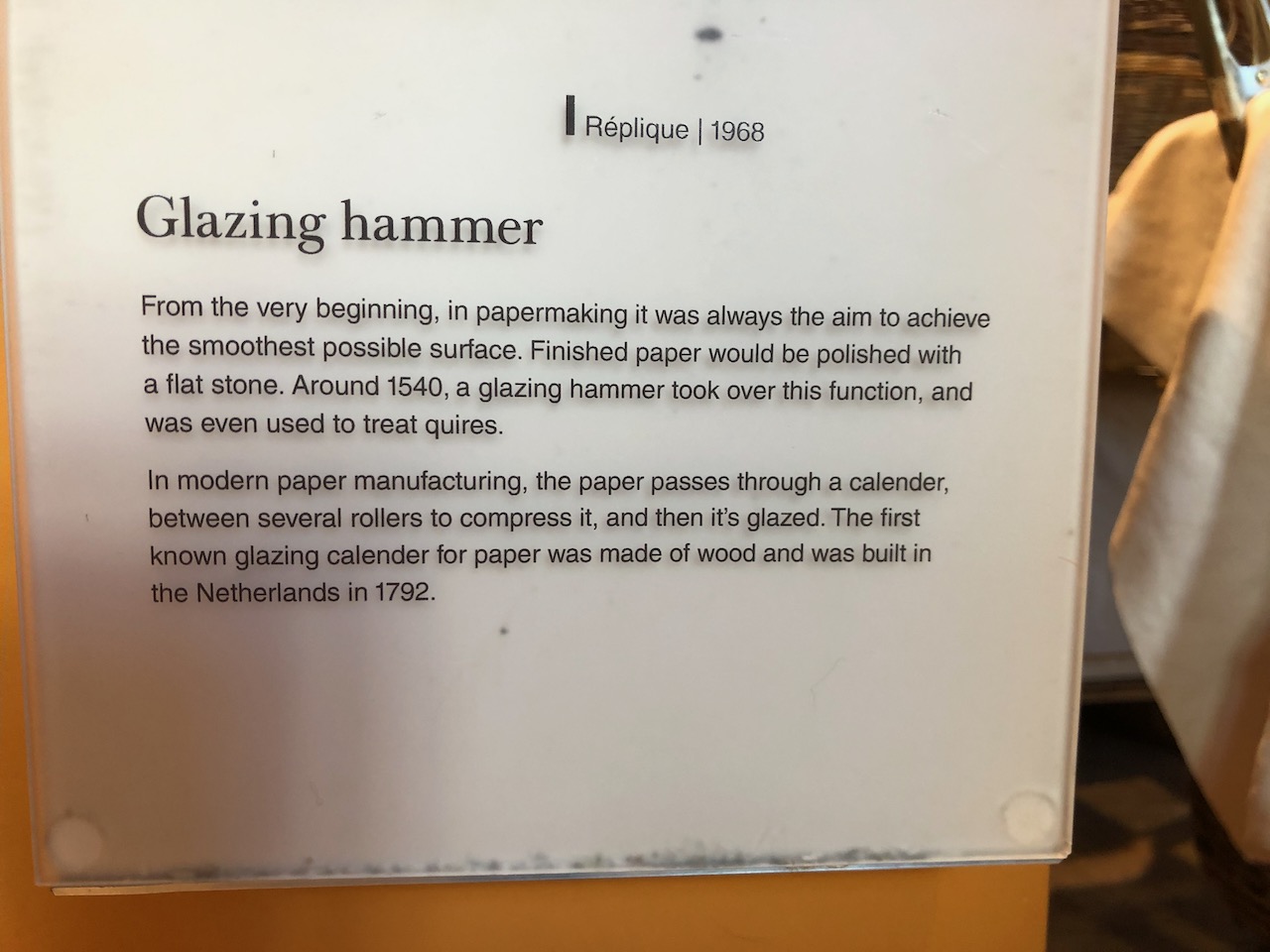
“Fridberg” might mean “Tranquil mountain” and “Slifstein” might mean polishing stone, or polished stone. Perhaps these were people’s names. I learned at the Basel Paper Mill that in those times smooth stones were used to polish paper, so may be Herr or Frau Slifstein was a paper polisher. But that’s just surmise.

Caption beneath a reproduction of a glazing hammer, Basel Paper Mill.

Here’s work in progress on the drawing.

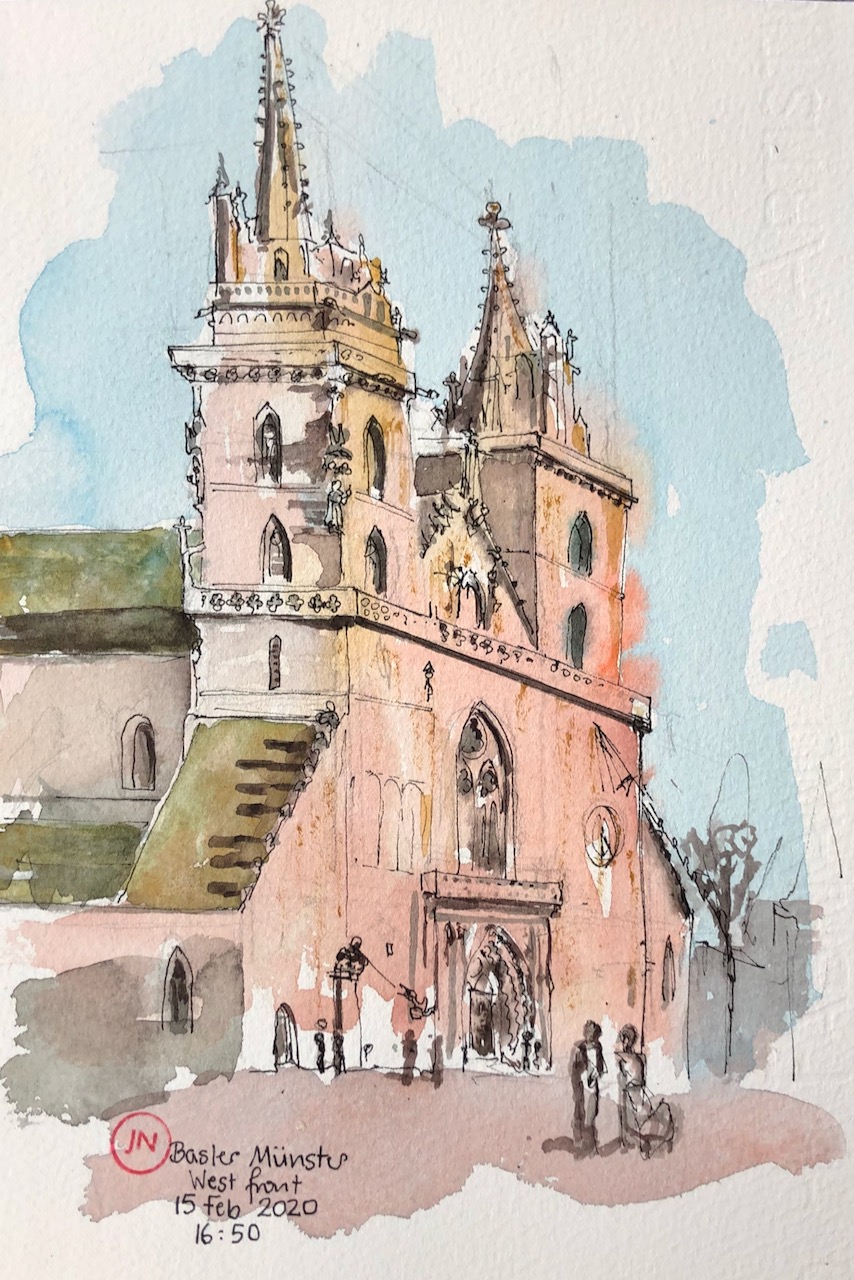
Later I tackled a tough assignment: Basel Cathedral, “Basler Münster”.

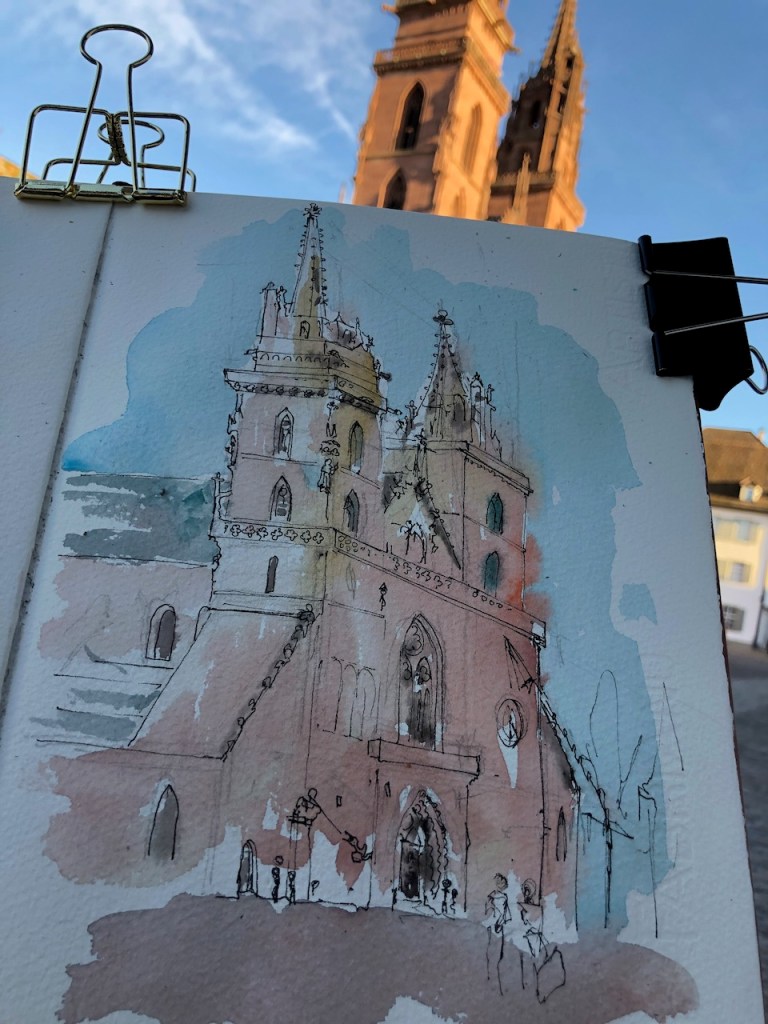
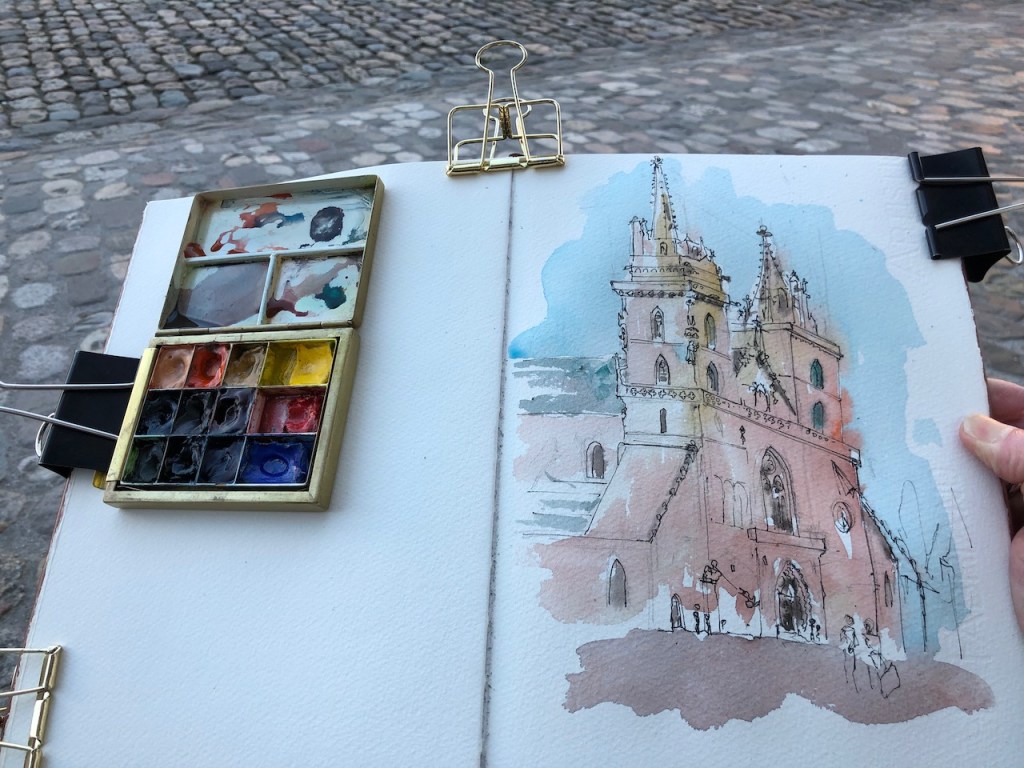
Basler Münster, West Front, 7″ x 10 ” on Fabriano Artistico paper, [sketchbook 6]

This is a magnificent medieval construction, the present building dates from about 1500. It is a real challenge for the Urban Sketcher. Each edge is decorated. Each corner hosts a saint, or often two. Every planar surface has decoration, low relief, a statue. Not content with simply a sundial, they added also a clock. And on top of all this, the two towers are by no means identical. They each support a forest of spires, some octagonal. The main spire on the right seems to have curving edges, unless that was a cunning optical illusion. Even the roof is decorated with a pleasing coloured diamond pattern in tiles. I did my best, but those medieval stonemasons got the better of me.

To the left of the door is St George and the Dragon, a very realistic statue which I had to put in. St George’s horse prances on a firm plinth. St George himself wields a real metal lance, copper or some copper-containing alloy, since it is green. The dragon, some distance away, is made to balance on a precarious shelf, endangered by the thrust of the lance. It’s a dynamic and three dimensional scene.

Here is work in progress on the drawing.

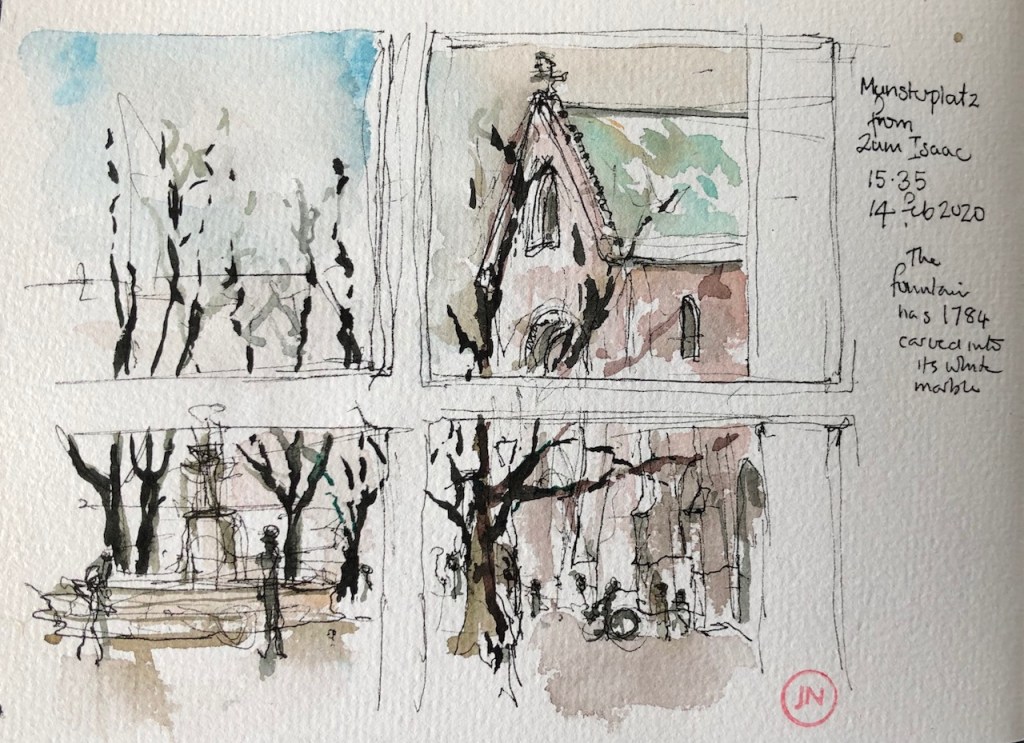
I made more sketches around the city:

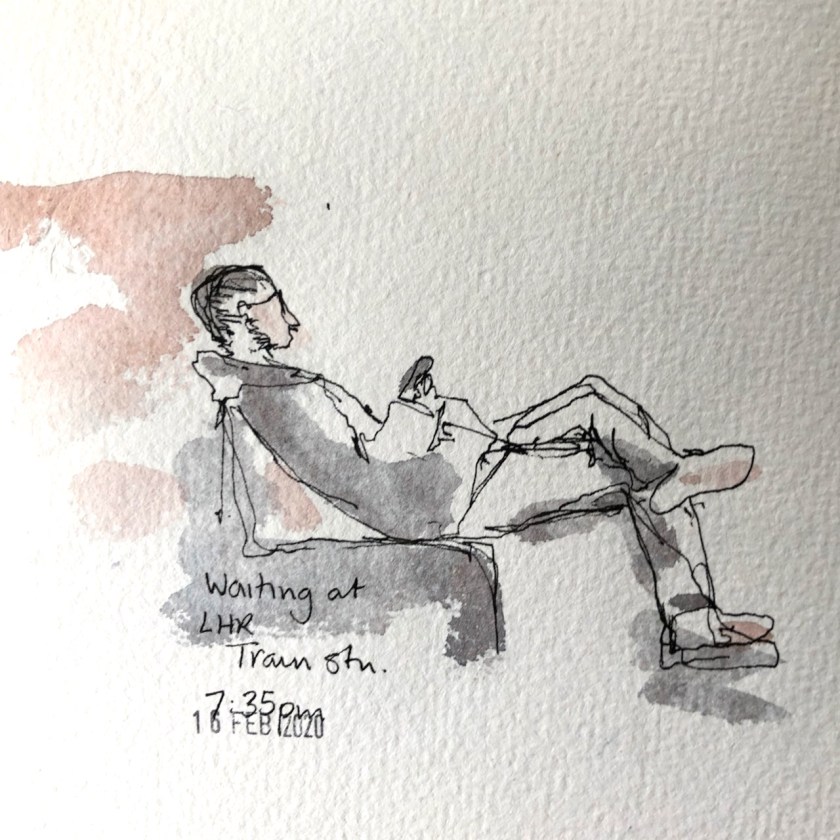
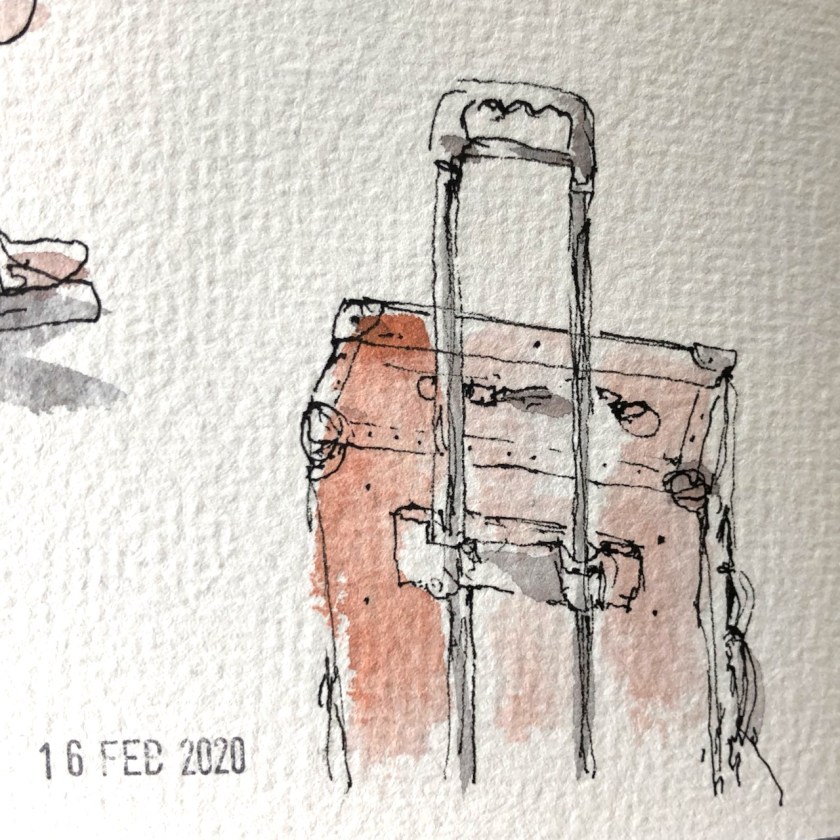
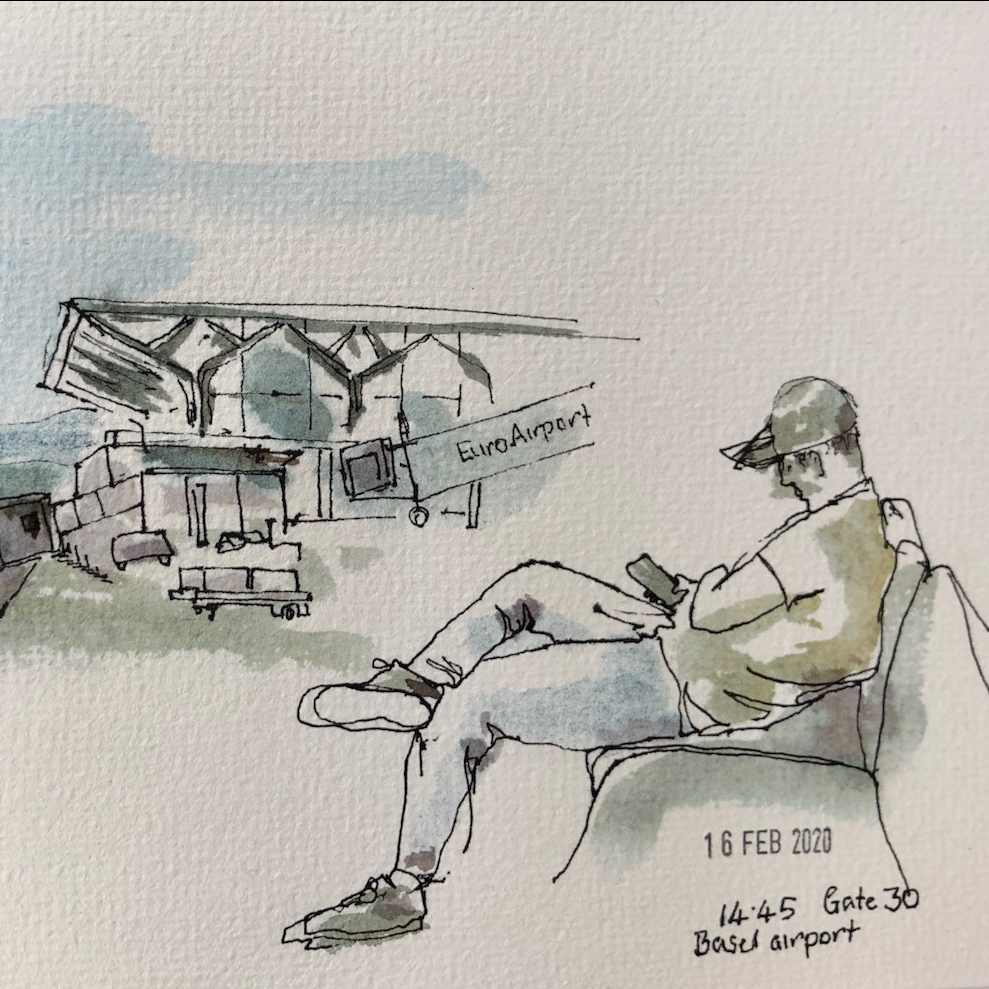
On the long journey home, I sketched the people, and my luggage.

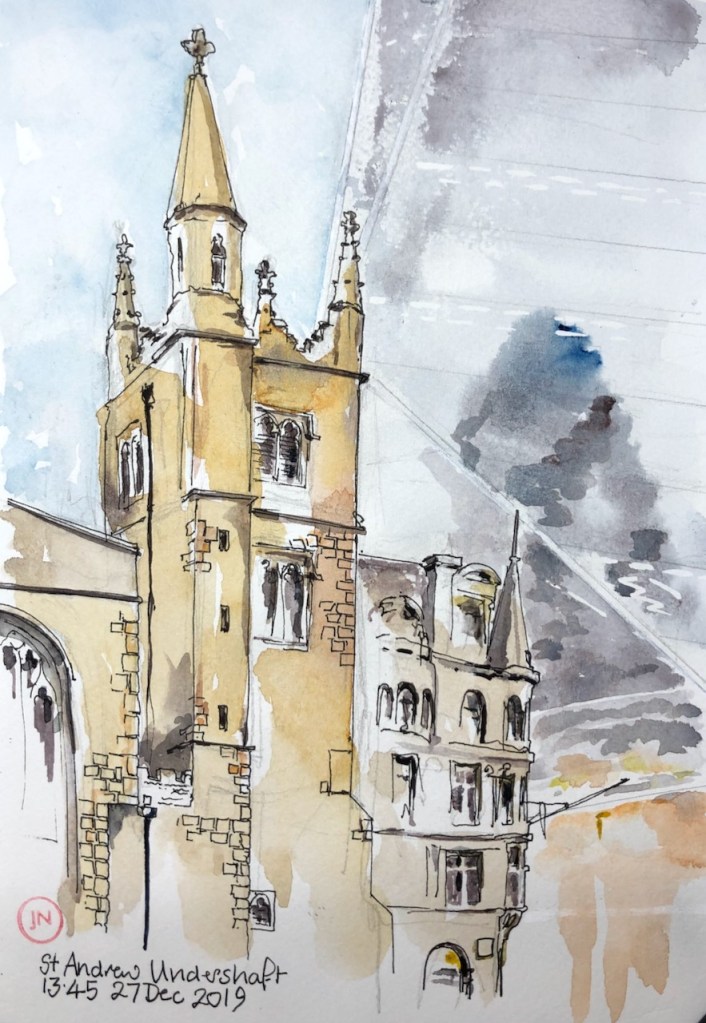
St Andrew Undershaft

Here is St Andrew Undershaft, constructed in 1532. It survived both the Great Fire of London, and the Blitz. Next to it is a branch of Lloyds Bank. Behind, with its huge reflective walls, is the Scalpel Building, 52 Lime Street EC3, finished this year. Reflected in the walls of the Scalpel is 30 St Mary Axe, The Gherkin, finished in 2003.

On the West side of the Square, diminished by the monumental canopy of the Leadenhall Building, is a Victorian statue entitled “NAVIGATION”. Navigation is a big strong man, inadequately clad for Northern seas, but he doesn’t mind. In his right hand he grasps the ship’s wheel. In his left arm, he cradles a ship. Next to him, incongrouously, is a multi-coloured wooden column. At first I thought it was some kind of antenna. Then perhaps it might be a 21st century version of a Barber’s Pole, no longer red and white only, but now yellow too. But there is no Barbers Shop. I was just about to conclude it must be “Art”, when I saw the explanatory notice, low down and in shadow. It is a Maypole.

“Until the 16th Century, a famous maypole used to be put up on feast days at the corner of St Mary Axe. Its shaft overtopped the original church, which got its name St Andrew Undershaft as a result. When not in use, the shaft was stored in an alley near here, which became known as Shafts Court”.

“NAVIGATION” and the Maypole.

About 45 minutes on location, finished at home. It was very cold. Colours used: Mars Yellow, Perinine Orange, Prussian Blue, Perylene Maroon. The sky is dilute Prussian Blue.

Here is work in progress and my location:

St Paul’s Cathedral from the East

St Paul’s Cathedral and the restored tower of St Augustine Watling Street.
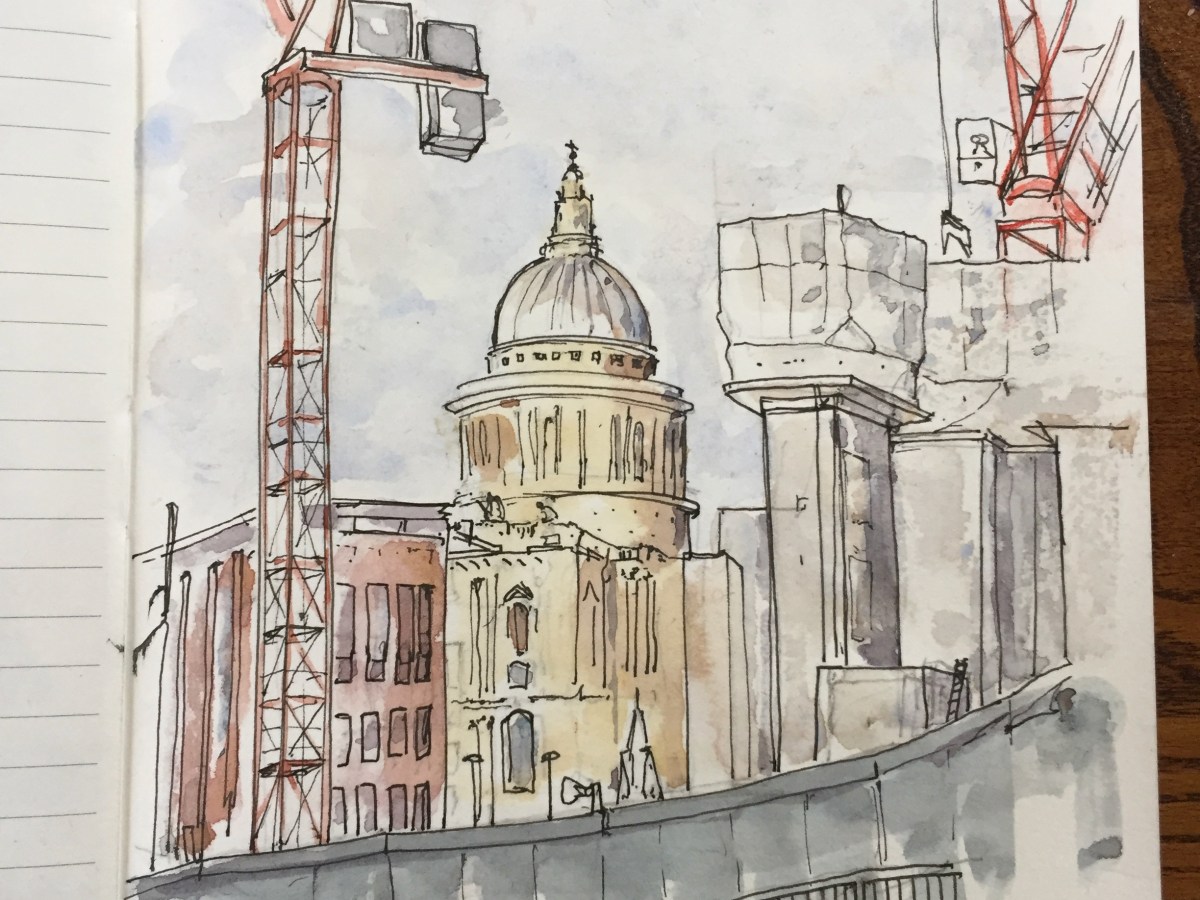
St Paul’s Cathedral and the tower of St Augustine Watling Street

To the East of St Paul’s is another church tower, on the right of my drawing. It is what remains of a medieval church, St Augustine Watling Street. Reconstructed after the 1666 Fire of London, St Augustine was then destroyed again by bombing in 1941. The Tower was reconstructed in 1954, and made part of St Paul’s Choir School which occupies this area. The Choir School was completed in 1967, in good modernist style, but is rarely noticed, even though it is right next to St Paul’s Cathedral. The school is currently being extended, which is amazing since it occupies such a constricted site. There is scaffolding off to the right of the drawing.

I drew this sitting on a bench in “Festival Gardens” which is the lawn south of St Paul’s. It turns out that this is right on a tourist route, and groups of people passed by. A woman approached and respectfully asked if she could look at the drawing. She was interested in my picture, and said her daughter painted also. Then her companion approached and showed me a detailed picture of an alligator on his mobile phone. He said this picture was drawn by their daughter. The alligator was his pet. In the six years he had it, it had only bitten him once. But that time he needed 32 stitches.

I was just finishing the pen when a young man stopped and looked. He smiled, and went away. Then he came back and, like the woman, showed me his mobile phone. This time there was a message on it. In neat and polite English, the message told me that he was a visitor from Korea. He thought my drawing was very good and would I mind if he took a picture of it?

I said that would be fine, and held up the book so he could photograph it. Then I had a thought. I dug out one of my cards and pointed to the @janenorthcote written in clear letters at the bottom. “Instagram” I said, hoping that brand names would communicate between cultures. He nodded and smiled, and went back to join his group. Sure enough, when I’d finished the sketch, a ping on my phone announced that an Instagram message had arrived. @si_hyeonv had posted his photos, and written to say thank you.

Here are other photos of work-in-progress, taken by me.

Drawing took one hour, including colour. Three colours used: Mars Yellow, and the grey is Phthalo Green (BS) and Perylene Maroon, all Daniel Smith watercolours.

St Alphege, from outside Barbie Green

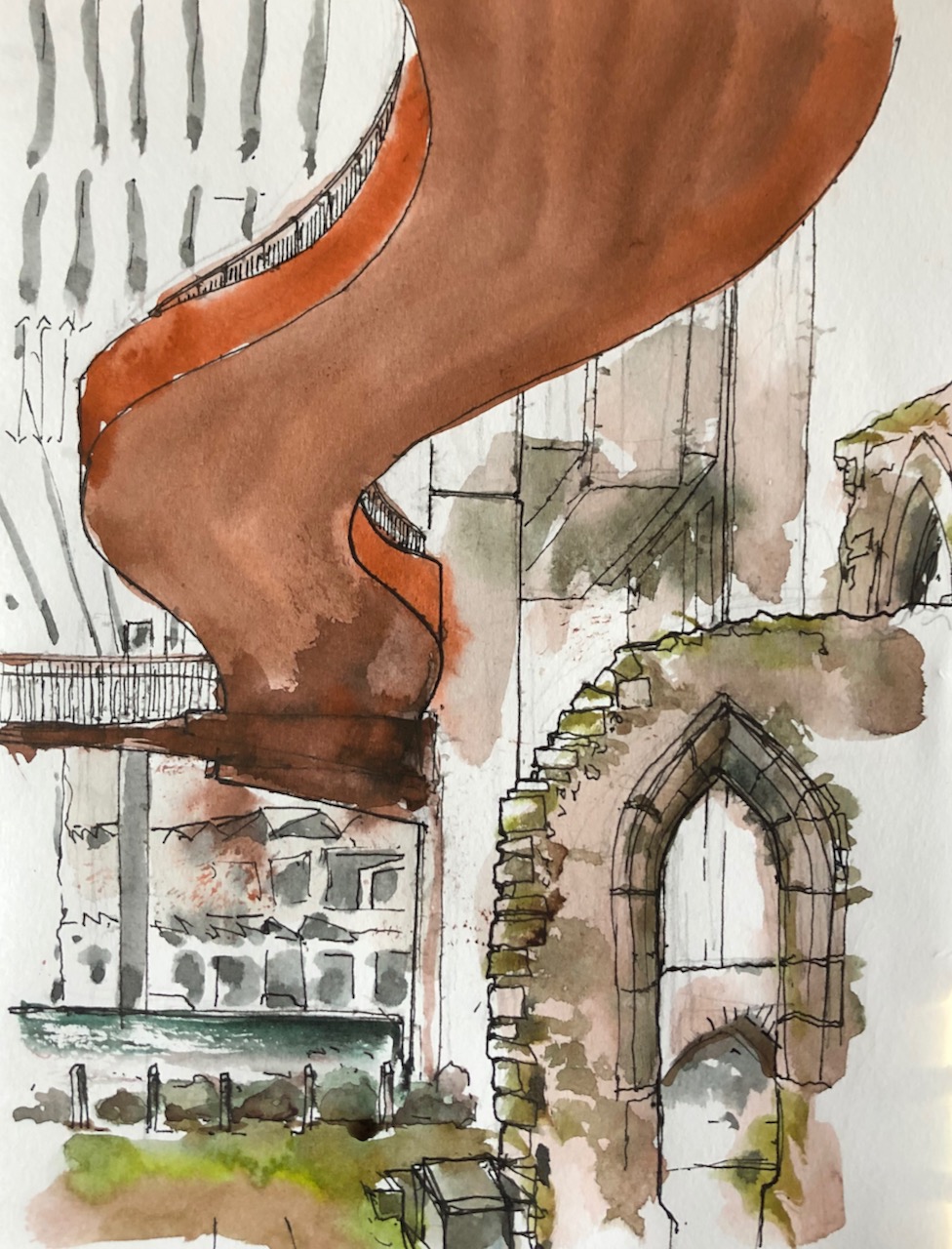
Here’s another drawing on London Wall place. This is a view of the highwalk from underneath. I was standing by the new café, Barbie Green, sheltering from the rain.

IMG_0535

The shelter was not very good, and there was a lot of wind, so raindrops arrived on the picture. I went to go in the café to finish the colouring, but no, there were “no tables”.

So I finished the drawing outdoors, sitting on a damp bench.

I very much enjoy this highwalk. It curves in all dimensions. The side walls undulate, the walkway becomes wider and narrower, and it tilts up and down. It’s made of some iron-like metal, so it has rusted and is now a deep brown. The shape of it respectfully frames the ruins of the old church.

I appreciated all this while observing, through the picture windows of the cafe, three empty tables, which remained empty for the whole time.

1hr10, drawn and coloured on location.

More drawing expeditions in this area:

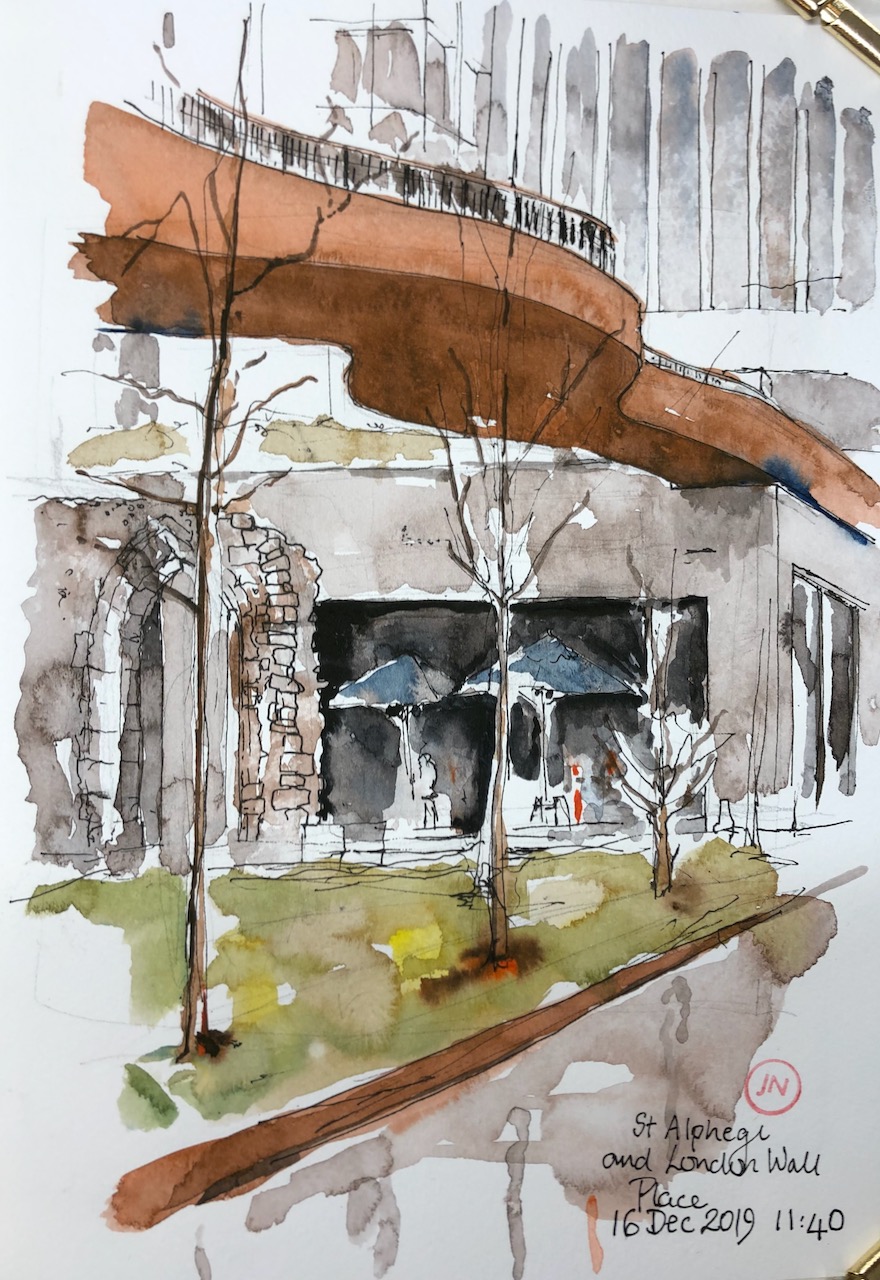
St Alphege, Barbie Green and London Wall Place

On the way back from the Post Office, I paused to draw the view under the new Highwalk of London Wall Place. There is a new café called “Barbie Green”.

IMG_0514

I drew this by the water pond and the plants. sheltered by the highwalk. Other people were there too, mostly smokers. Except that people don’t smoke anymore, but wander around leaving trails of mist with strange synthetic smells, nearly but not quite vanilla.

Screen Shot 2019-12-17 at 17.05.28
Location of London Wall Place shown in yellow. View of drawing in red.

I have sketched in this area before. Here’s a similar view, drawn last year in the summer, just after the highwalk was constructed:

IMG_4173
St Alphege

The drawing above is from this post:
St Alphege, London Wall