Scalpel from Bank

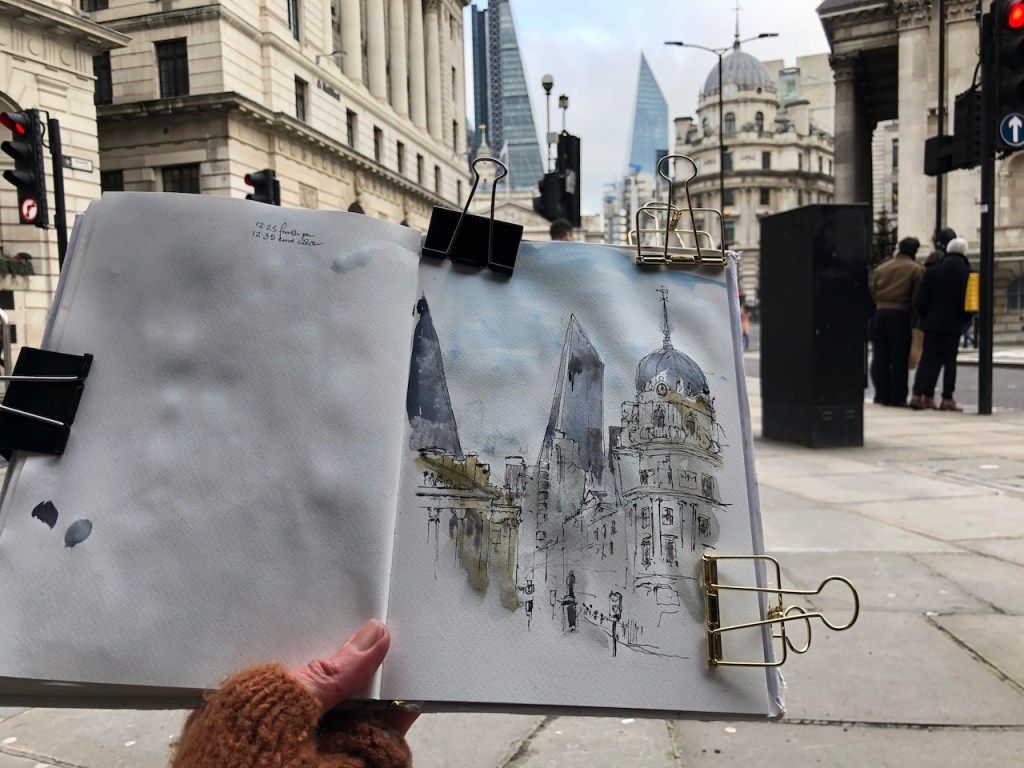
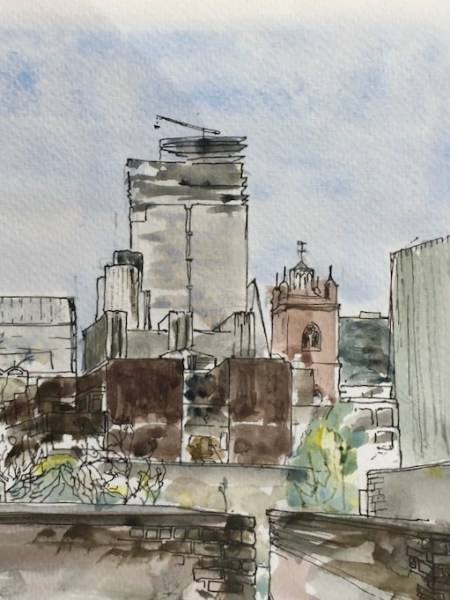
Here is the Scalpel Building, seen from Bank Junction.
The statue in the centre of the bottom of the picture is neither a statesman, nor a warrior, nor a monarch. It celebrates an engineer: J.H. Greathead, “inventor of the travelling shield that made possible the cutting of the tunnels of London’s deep level tube system”. There is a picture of his invention on the plinth.

The “travelling shield” depicted on the plinth of Greathead’s statue in Cornhill.

Greathead’s idea was to make the shield cylindrical, rather than rectangular as it had been previously. He also invented ways to spray concrete and grouting on the walls, and also to pressurise the tunnel, so as to make the workers a bit safer from cave-ins. His later shields were equipped with cutting jaws or teeth, to excavate the earth ahead.

“Most tunnelling shields are still loosely based on Greathead’s Shields design” says Wikipedia, including the “Tunnel Boring Machines” which are used, for example, for Crossrail.

The statue was created in 1994, and stands, appropriately enough, on a ventilation shaft for the Waterloo and City Line.

J.H. Greathead on his plinth/ventilation shaft.

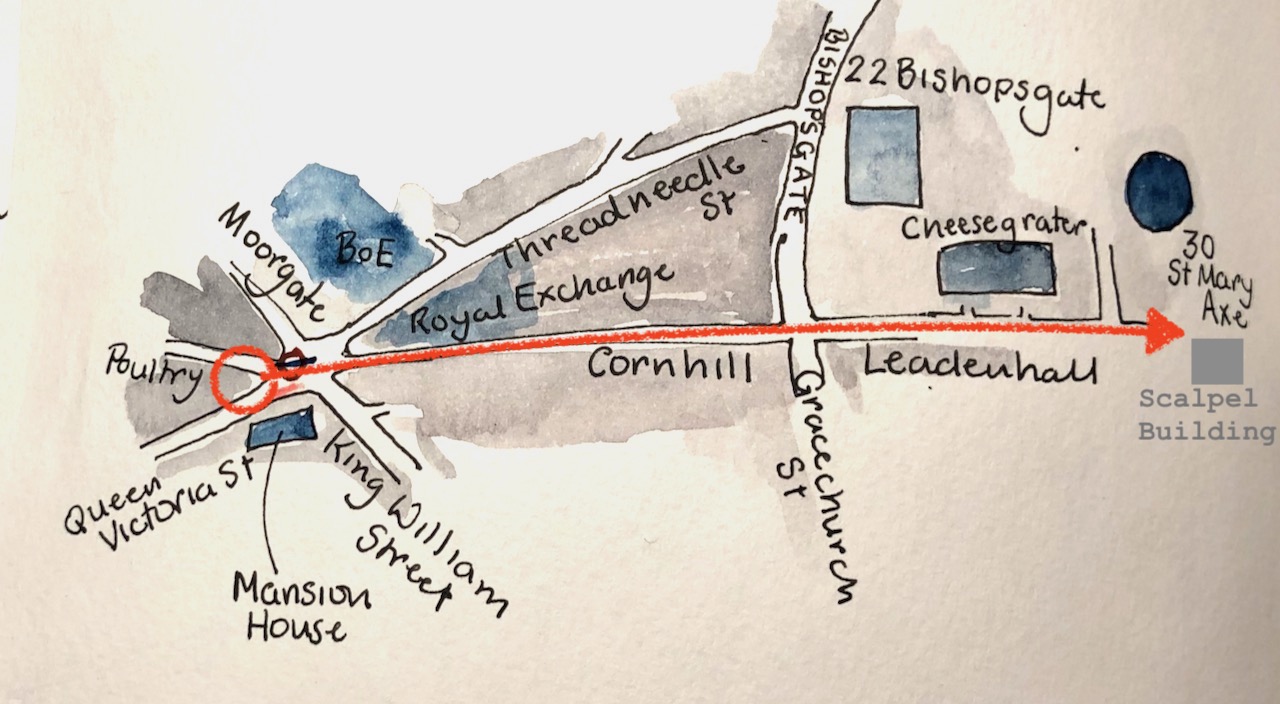
I drew this picture standing at One Poultry. Here are maps:
Here is work in progress:

Work in progress, the scene from One Poultry.

About 45 minutes. The sky is Prussian Blue, very dilute. The other colours used are Mars Yellow, and Perylene Maroon, all Daniel Smith watercolours. The grey is Perylene Maroon and Prussian Blue. The traffic lights are Pyrrol Red.
TwentyTwo Bishopsgate above the Royal Exchange

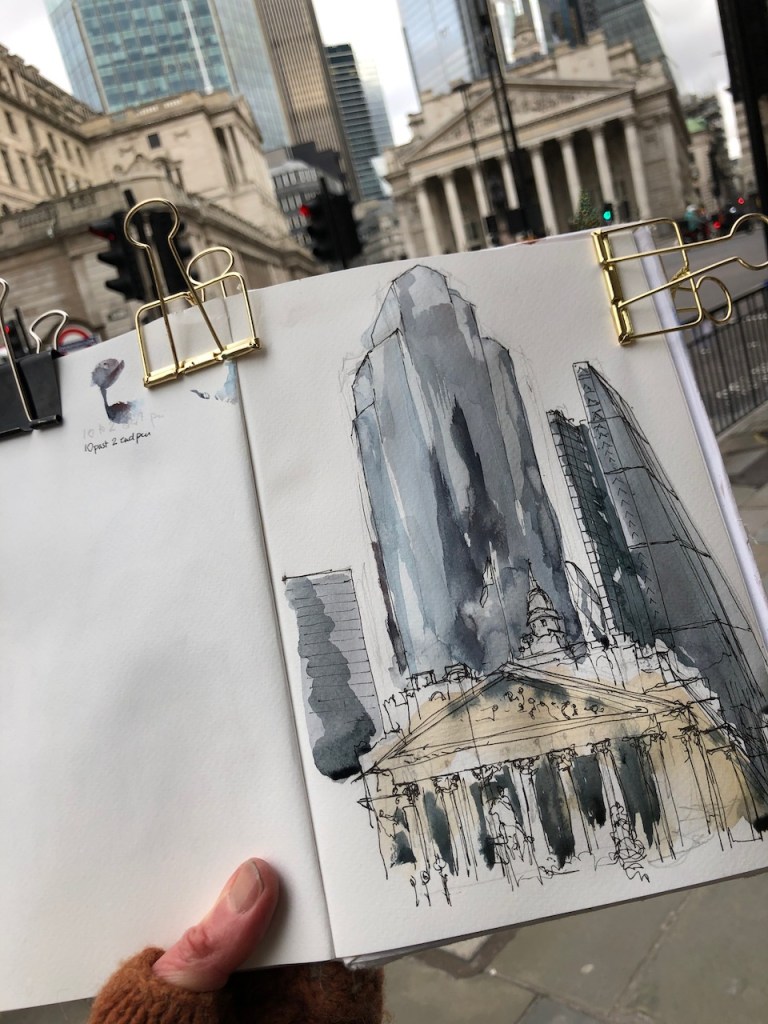
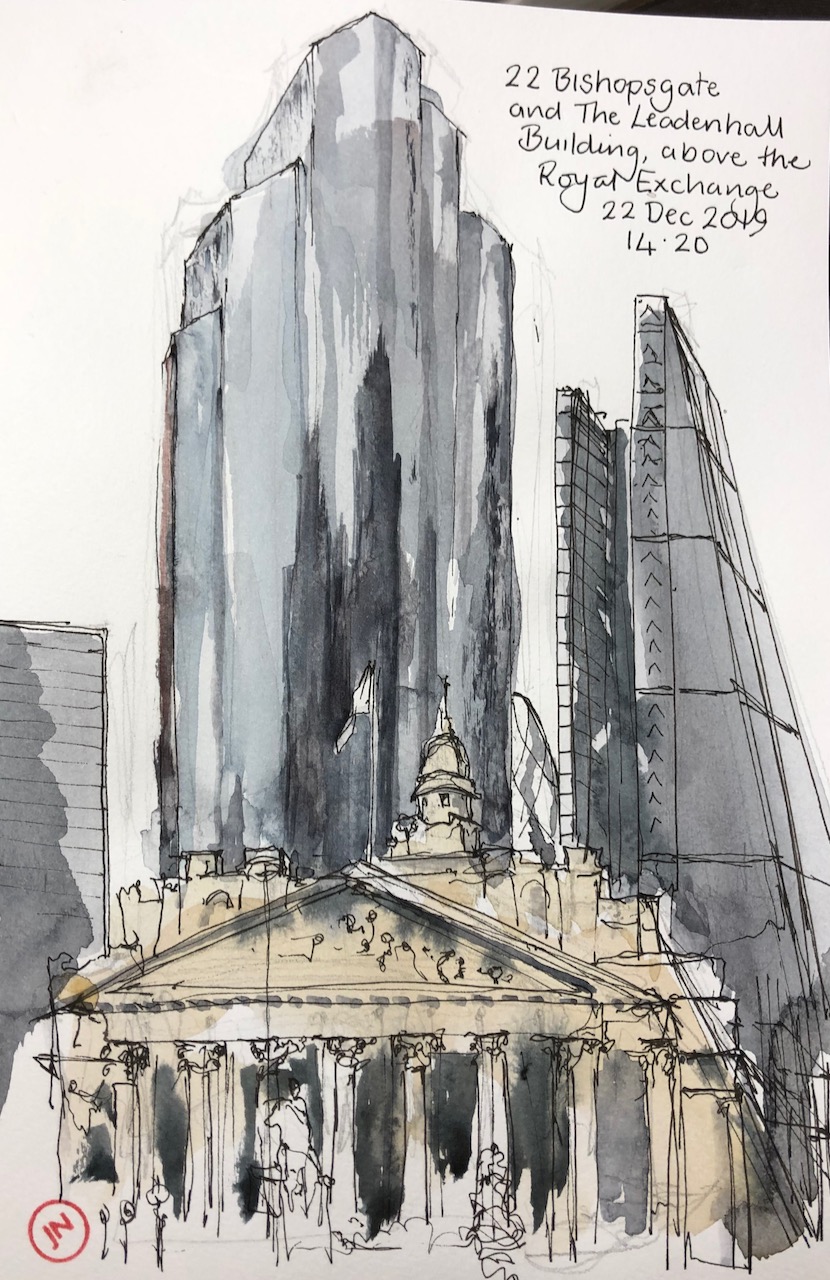
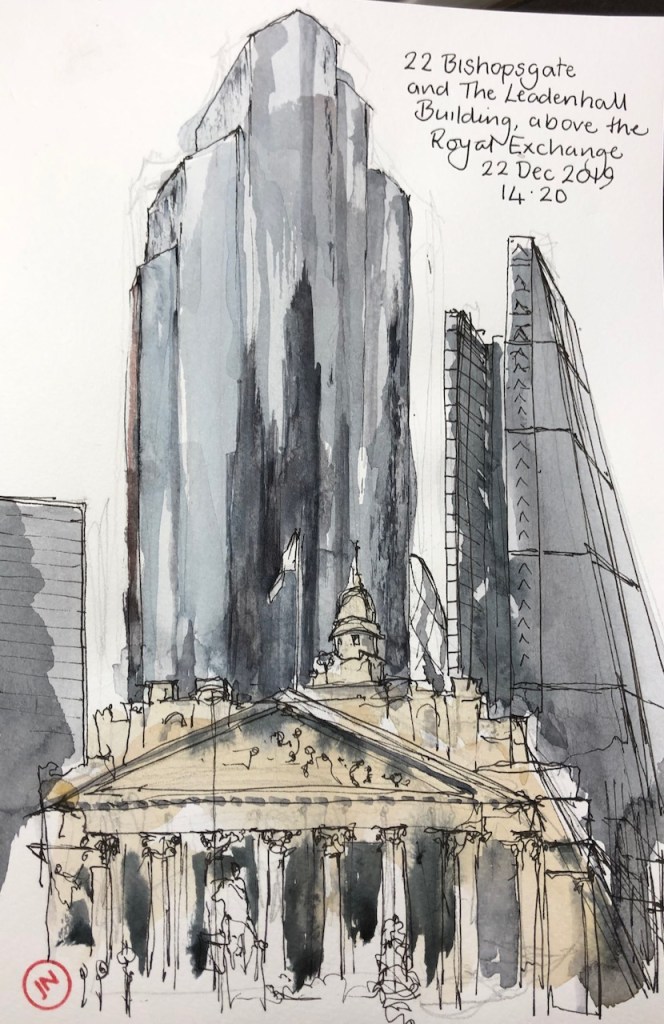
The huge new construction which is “TwentyTwo Bishopsgate” towers above the Royal Exchange. Since it was Sunday, it was possible to appreciate the vista without being trampled underfoot by financiers or overcome with traffic fumes. I took advantage of these benign conditions to do a quick sketch.

TwentyTwo Bishopsgate, and the Leadenhall Building, above the Royal Exchange.

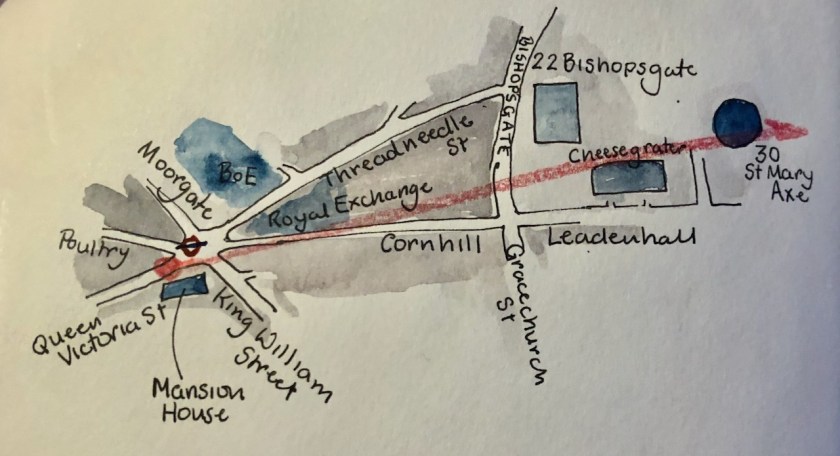
This was a very quick sketch, about half an hour. I was not trampled underfoot. I was standing on the pavement, in a sort of an alcove, just outside Mansion House. There was still quite a bit of hustle and bustle. That’s Mansion House the building, not Mansion House the Underground station, in case you were confused. Here’s a map, the red line shows the direction I was looking.

Map showing where I was: Bank Station, outside the Mansion House.

In the drawing you can just see, rather scribbly in the foreground, the statue of the Duke of Wellington on Horseback, and to the right of him, a Christmas Tree. The Gherkin, 30 St Mary’s Axe, is just visible between the buildings.

I’ve drawn TwentyTwo Bishopsgate a few times, as it is conspicuous on the City skyline now.

This drawing is in just three colours: Mars Yellow, Prussian Blue, and Perylene Maroon.

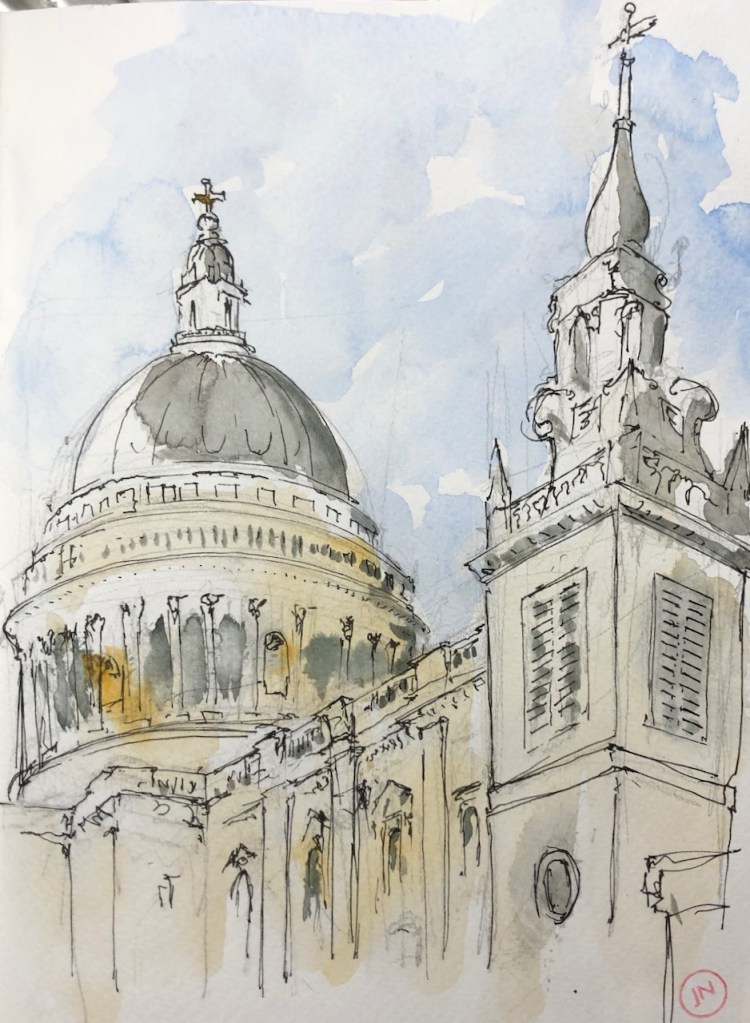
St Paul’s Cathedral from the East

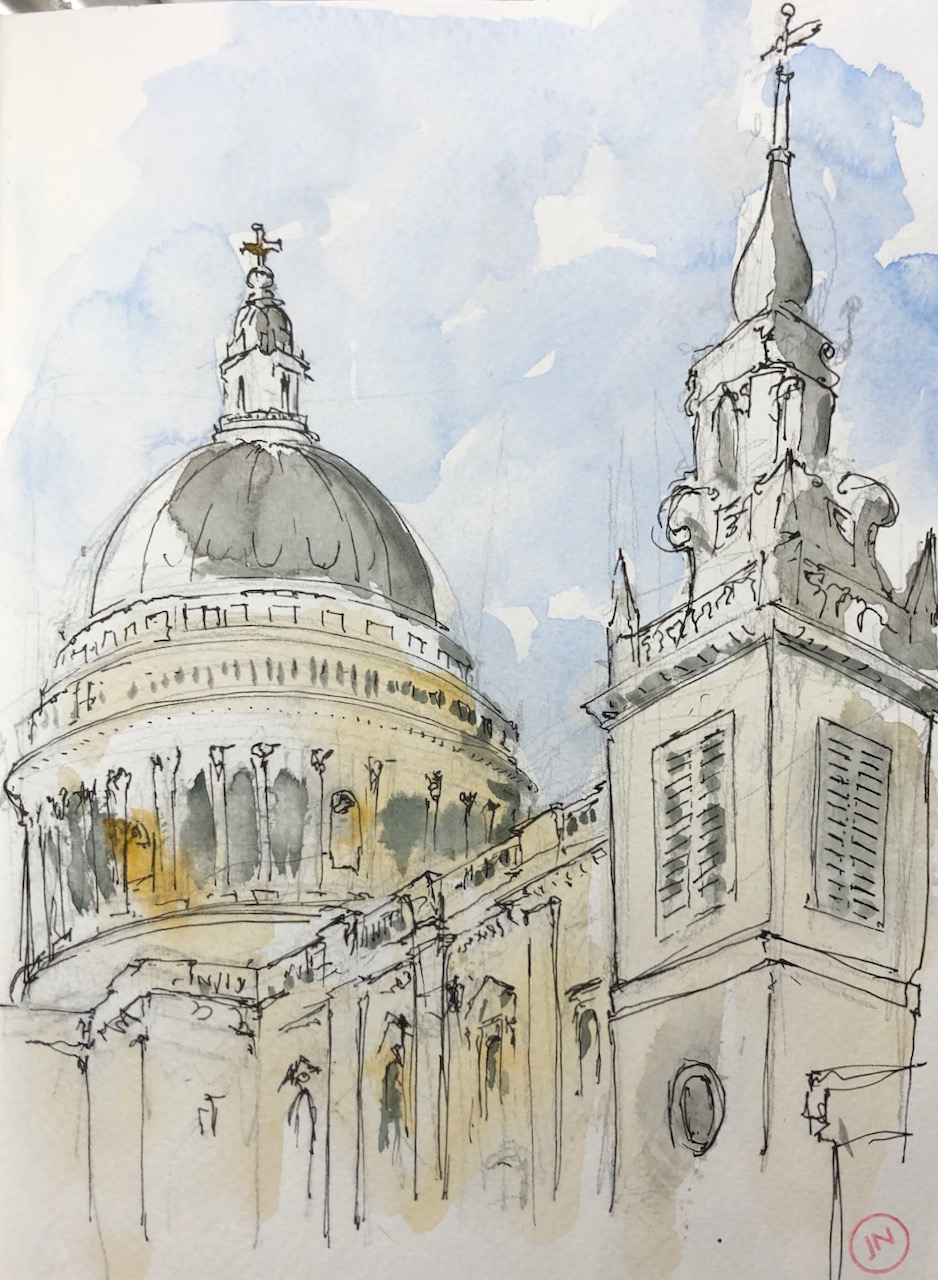
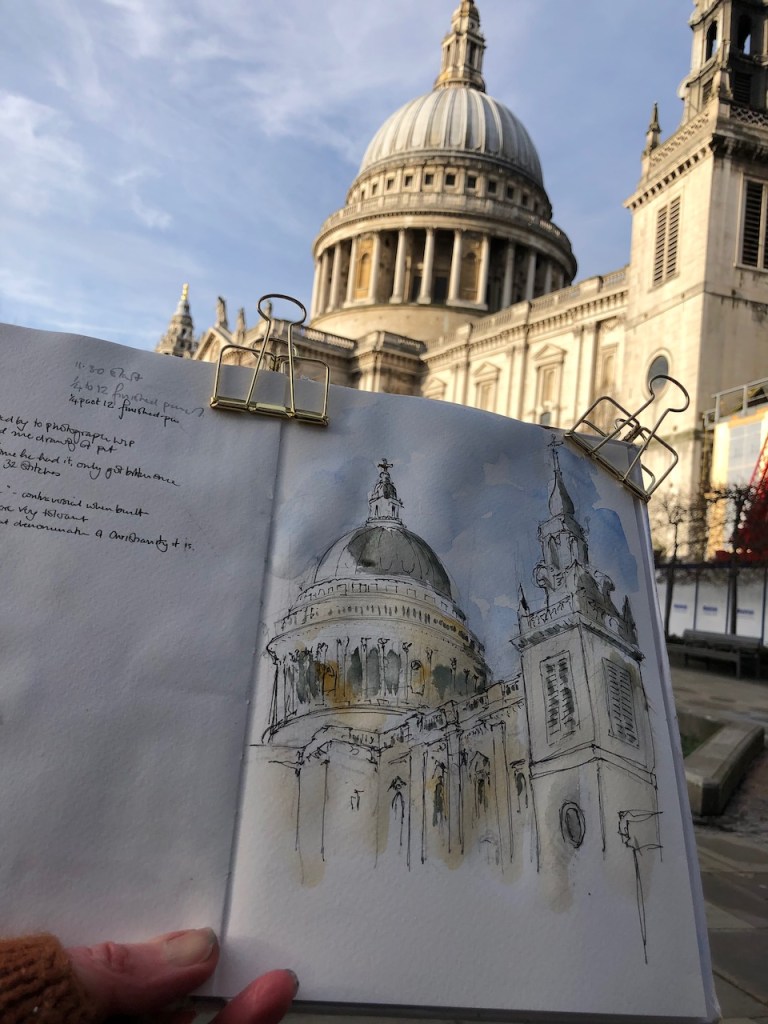
St Paul’s Cathedral and the restored tower of St Augustine Watling Street.

St Paul’s Cathedral and the tower of St Augustine Watling Street

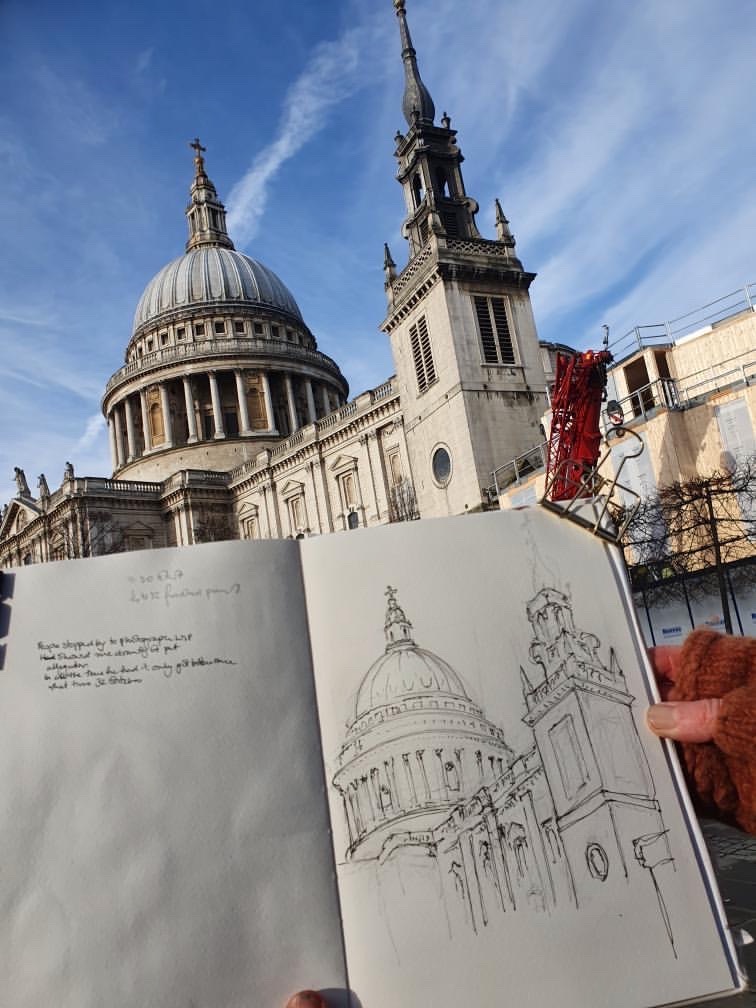
To the East of St Paul’s is another church tower, on the right of my drawing. It is what remains of a medieval church, St Augustine Watling Street. Reconstructed after the 1666 Fire of London, St Augustine was then destroyed again by bombing in 1941. The Tower was reconstructed in 1954, and made part of St Paul’s Choir School which occupies this area. The Choir School was completed in 1967, in good modernist style, but is rarely noticed, even though it is right next to St Paul’s Cathedral. The school is currently being extended, which is amazing since it occupies such a constricted site. There is scaffolding off to the right of the drawing.

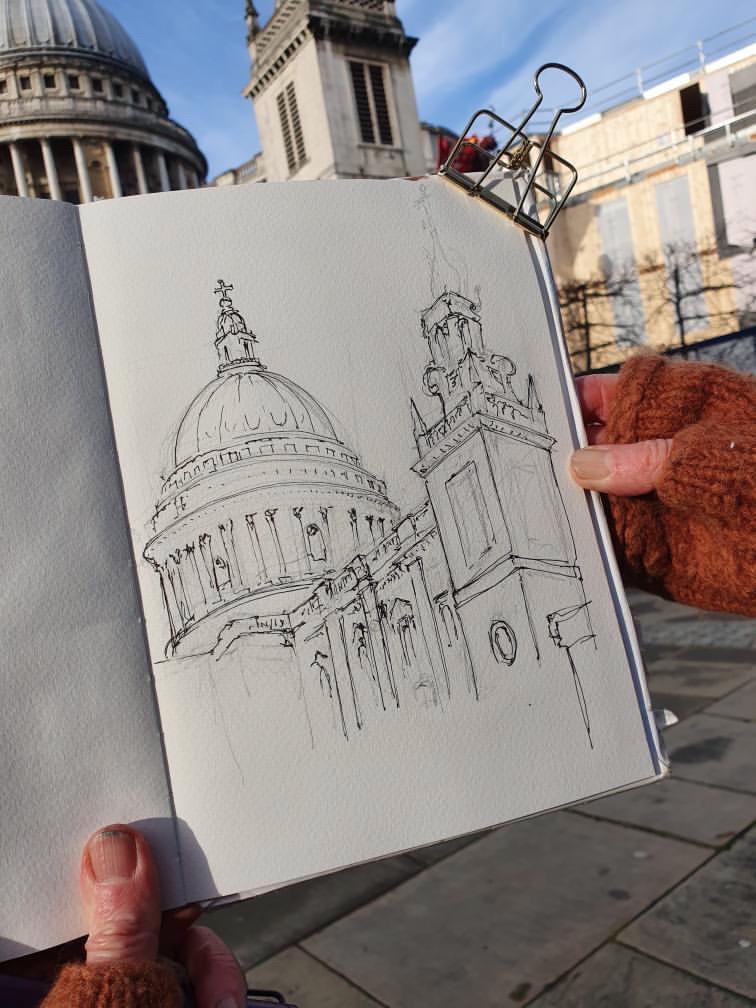
I drew this sitting on a bench in “Festival Gardens” which is the lawn south of St Paul’s. It turns out that this is right on a tourist route, and groups of people passed by. A woman approached and respectfully asked if she could look at the drawing. She was interested in my picture, and said her daughter painted also. Then her companion approached and showed me a detailed picture of an alligator on his mobile phone. He said this picture was drawn by their daughter. The alligator was his pet. In the six years he had it, it had only bitten him once. But that time he needed 32 stitches.

I was just finishing the pen when a young man stopped and looked. He smiled, and went away. Then he came back and, like the woman, showed me his mobile phone. This time there was a message on it. In neat and polite English, the message told me that he was a visitor from Korea. He thought my drawing was very good and would I mind if he took a picture of it?

I said that would be fine, and held up the book so he could photograph it. Then I had a thought. I dug out one of my cards and pointed to the @janenorthcote written in clear letters at the bottom. “Instagram” I said, hoping that brand names would communicate between cultures. He nodded and smiled, and went back to join his group. Sure enough, when I’d finished the sketch, a ping on my phone announced that an Instagram message had arrived. @si_hyeonv had posted his photos, and written to say thank you.

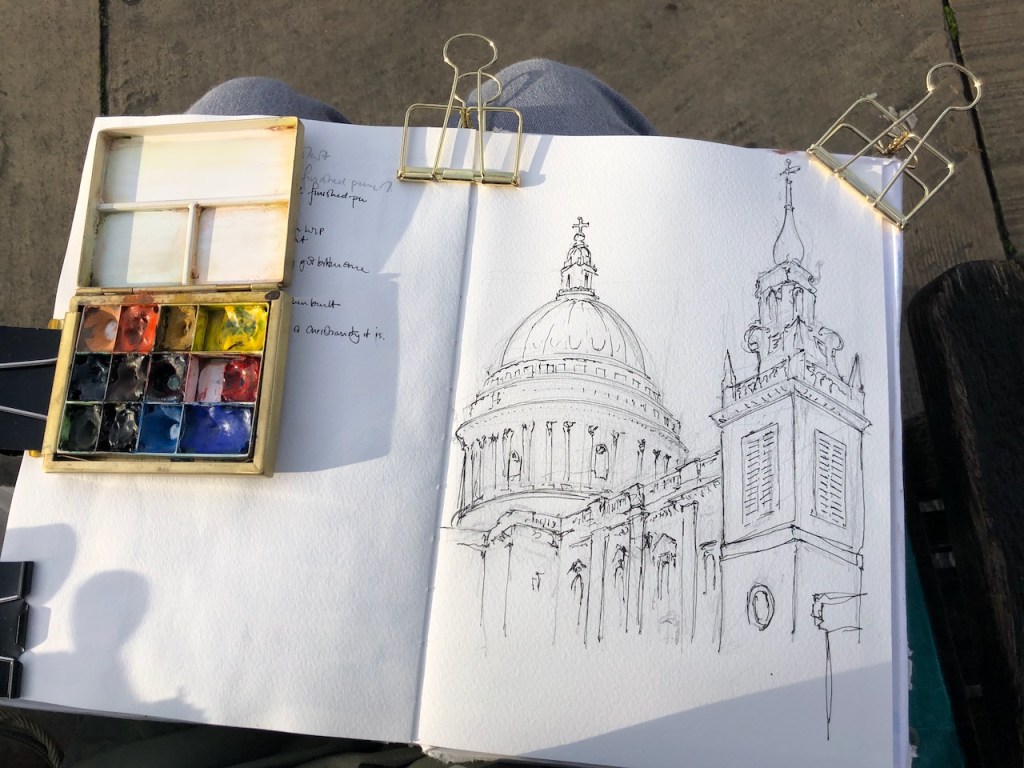
Here are other photos of work-in-progress, taken by me.

Drawing took one hour, including colour. Three colours used: Mars Yellow, and the grey is Phthalo Green (BS) and Perylene Maroon, all Daniel Smith watercolours.

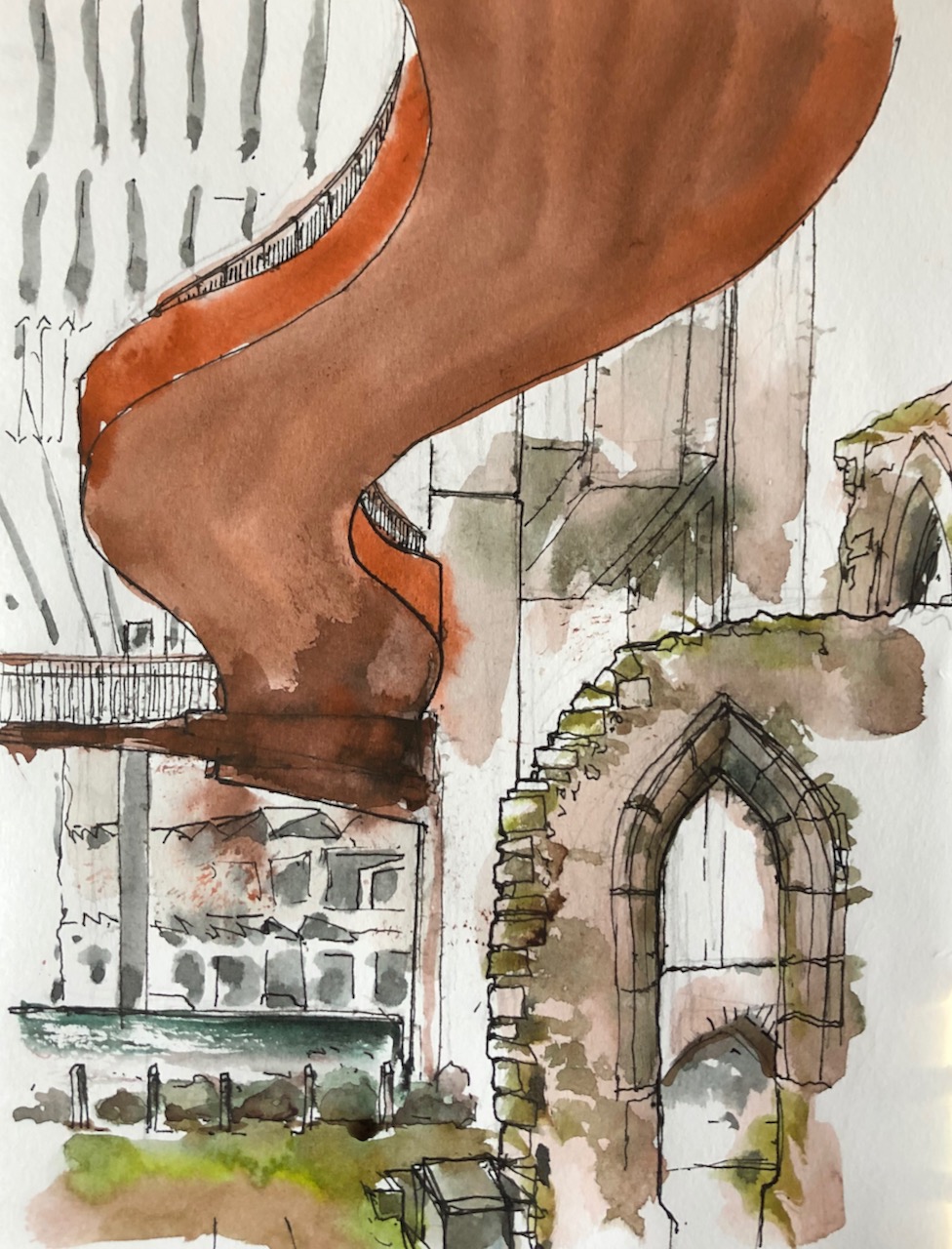
St Alphege, from outside Barbie Green

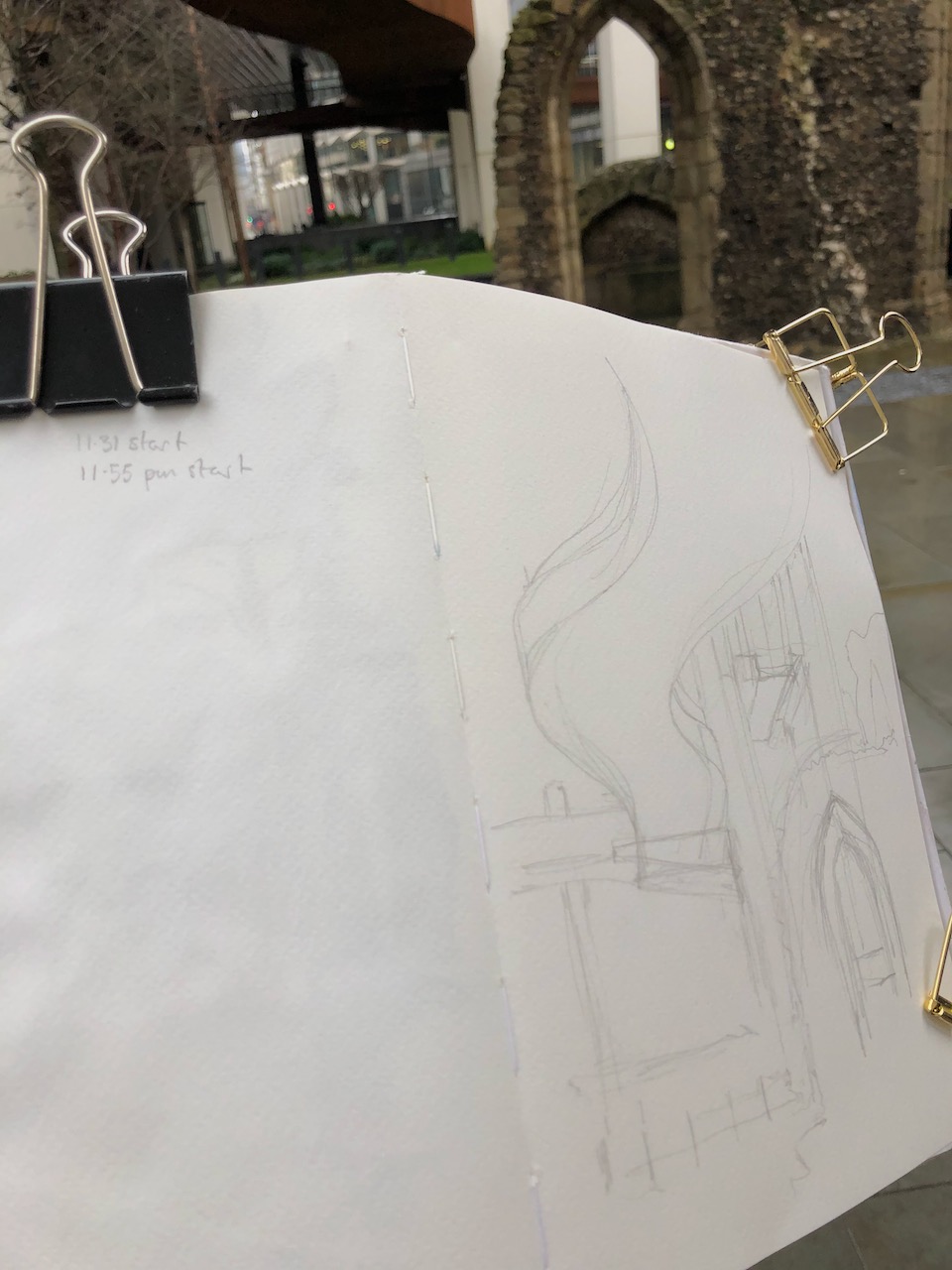
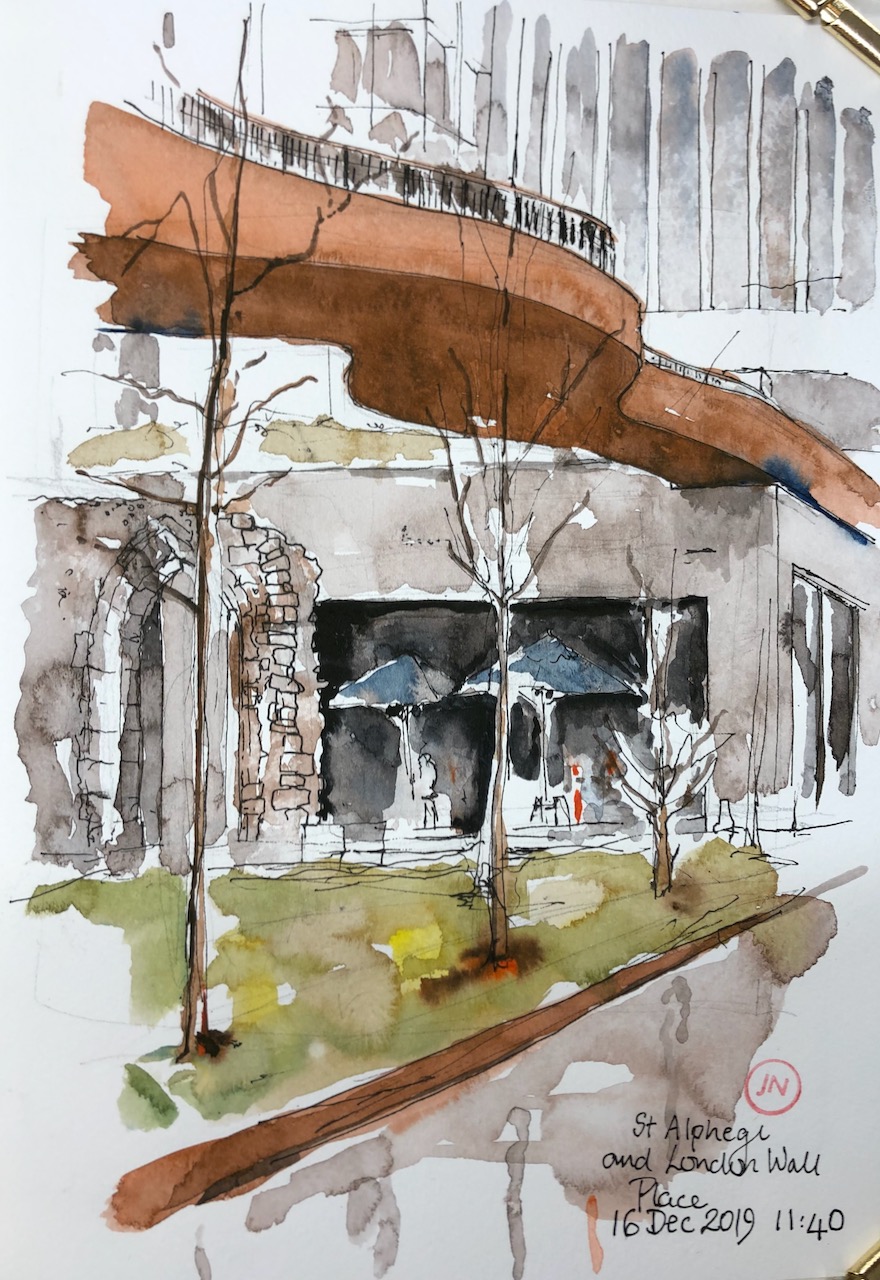
Here’s another drawing on London Wall place. This is a view of the highwalk from underneath. I was standing by the new café, Barbie Green, sheltering from the rain.

IMG_0535

The shelter was not very good, and there was a lot of wind, so raindrops arrived on the picture. I went to go in the café to finish the colouring, but no, there were “no tables”.

So I finished the drawing outdoors, sitting on a damp bench.

I very much enjoy this highwalk. It curves in all dimensions. The side walls undulate, the walkway becomes wider and narrower, and it tilts up and down. It’s made of some iron-like metal, so it has rusted and is now a deep brown. The shape of it respectfully frames the ruins of the old church.

I appreciated all this while observing, through the picture windows of the cafe, three empty tables, which remained empty for the whole time.

1hr10, drawn and coloured on location.

More drawing expeditions in this area:

St Alphege, Barbie Green and London Wall Place

On the way back from the Post Office, I paused to draw the view under the new Highwalk of London Wall Place. There is a new café called “Barbie Green”.

IMG_0514

I drew this by the water pond and the plants. sheltered by the highwalk. Other people were there too, mostly smokers. Except that people don’t smoke anymore, but wander around leaving trails of mist with strange synthetic smells, nearly but not quite vanilla.

Screen Shot 2019-12-17 at 17.05.28
Location of London Wall Place shown in yellow. View of drawing in red.

I have sketched in this area before. Here’s a similar view, drawn last year in the summer, just after the highwalk was constructed:

IMG_4173
St Alphege

The drawing above is from this post:
St Alphege, London Wall

St Bartholomew the Less – etchings (2)

Here is an etching for the City Music Foundation.IMG_0305

Here are photos of work in progress and some more prints:

See this post for earlier sessions on this project: St Bartholomew the Less – etchings(1)


Austin Friars, City of London

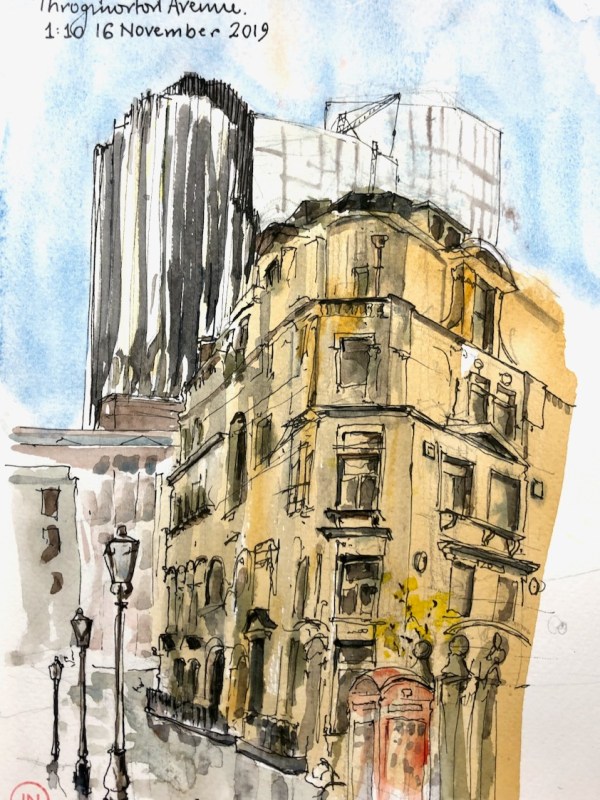
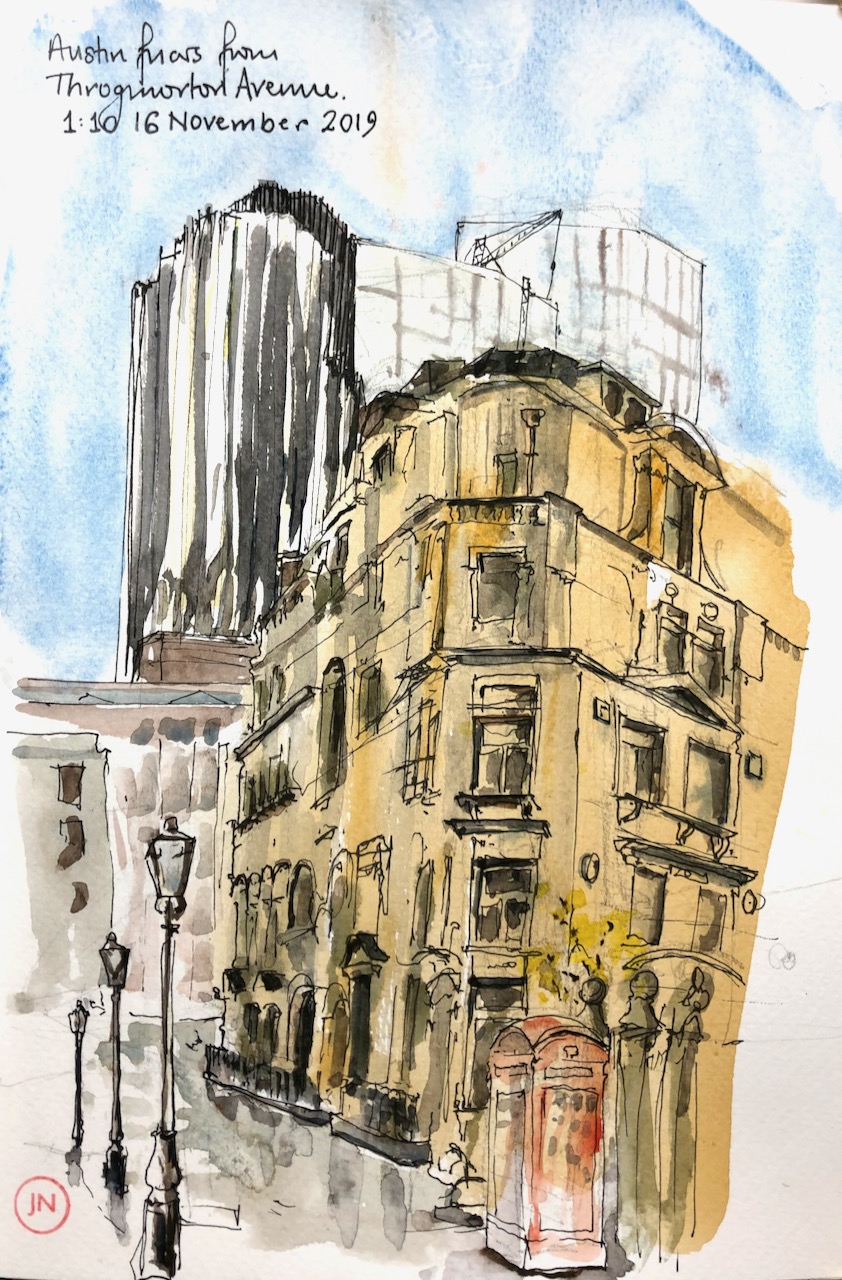
The City is quiet on a Saturday. Here is a view along one of the City lanes, Austin Friars. I drew it from the back (east side) of Drapers Gardens, which is a new office block on Copthall Avenue.

IMG_0309

I struggled with the sky. This is “cerulean blue chromium”. It granulated, didn’t go on flat.  I think I had the paper too wet – I wetted it before I put the paint on, which was probably a bad idea. The actual sky was a clear and uniform blue, extraordinary in England in November. Don’t be deceived though, it was very cold where I was standing. You can see my hand shaking – look at the phone box.

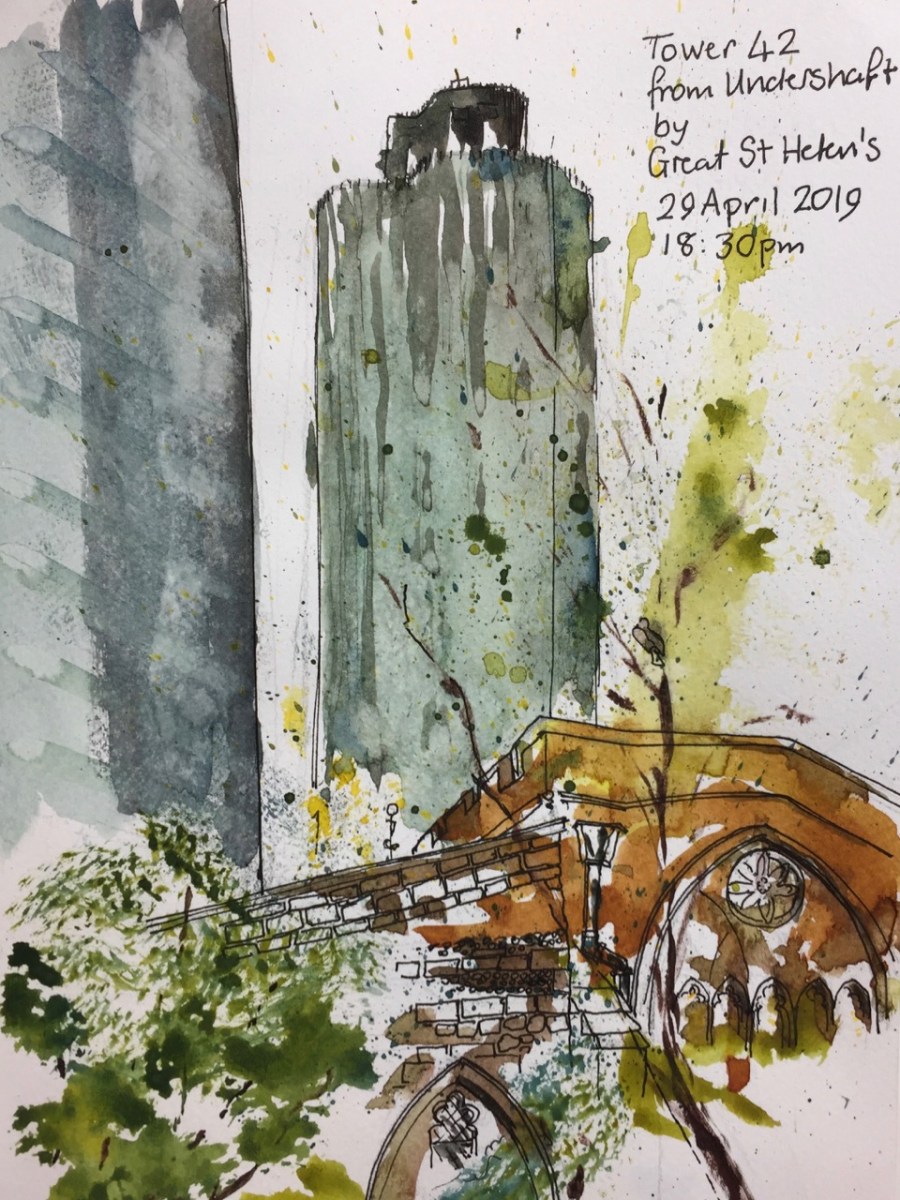
In the distance you see the Natwest Tower on the left, now called “Tower42”. To the right and high up is the new building “TwentyTwo Bishopsgate”. The NatWest Tower was the highest in London in its day (1980). TwentyTwo will be the highest in the City to date.

Austin Friars, the road, bisects a site formerly occupied by an Augustinian Friary, hence the name. The monastery is long gone, except that the church survives, rebuilt after the Blitz. It is the “Dutch Church” in London, just out of the picture along Austin Friars.

IMG_0310
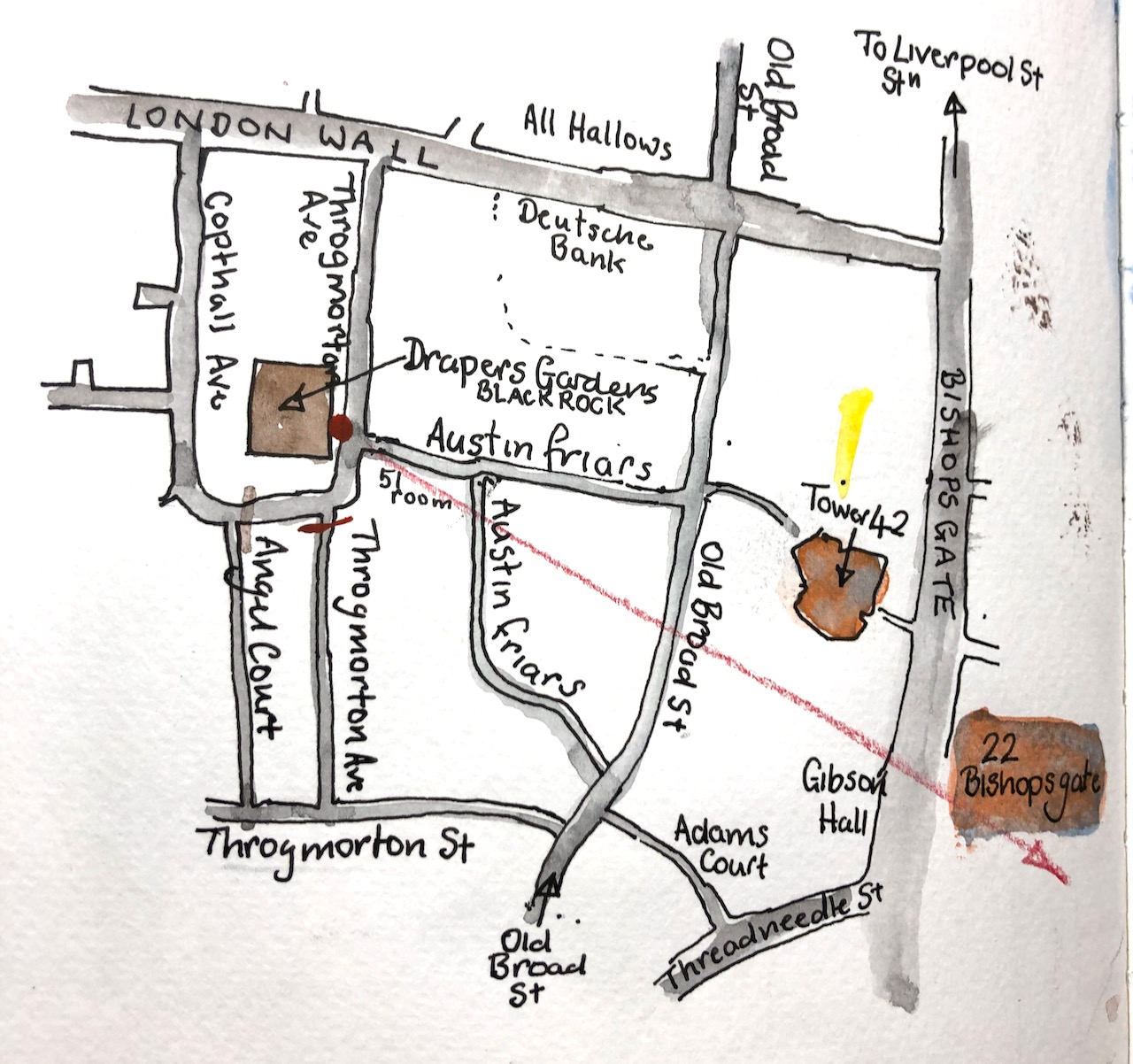
Map showing the sightline in the drawing

I sat on the ground to put the watercolour on. A man came up and asked me if I would like a hot drink, coffee or tea? He called me Ma’am. He told me he worked nearby, in the office block behind me. Very shortly he returned with tea in a takeaway cup, including a lid. Seeing that I was still sitting on the pavement, he offered to fetch me some cardboard to sit on. This was a really nice man. I was about to stand up again though, so I thanked him for the tea and he went back indoors.

He revived my faith in human nature. I was very glad of the tea, and of the warm feeling that even here amongst city skyscrapers, there are human humans.

The drawing took about 1hour30min, drawn and coloured on location. Daniel Smith watercolours, mostly Mars Yellow, Perinone Orange and Prussian Blue, with Cerulean Blue Chromium sky, and a bit of Pyrrol Red for the phone box.


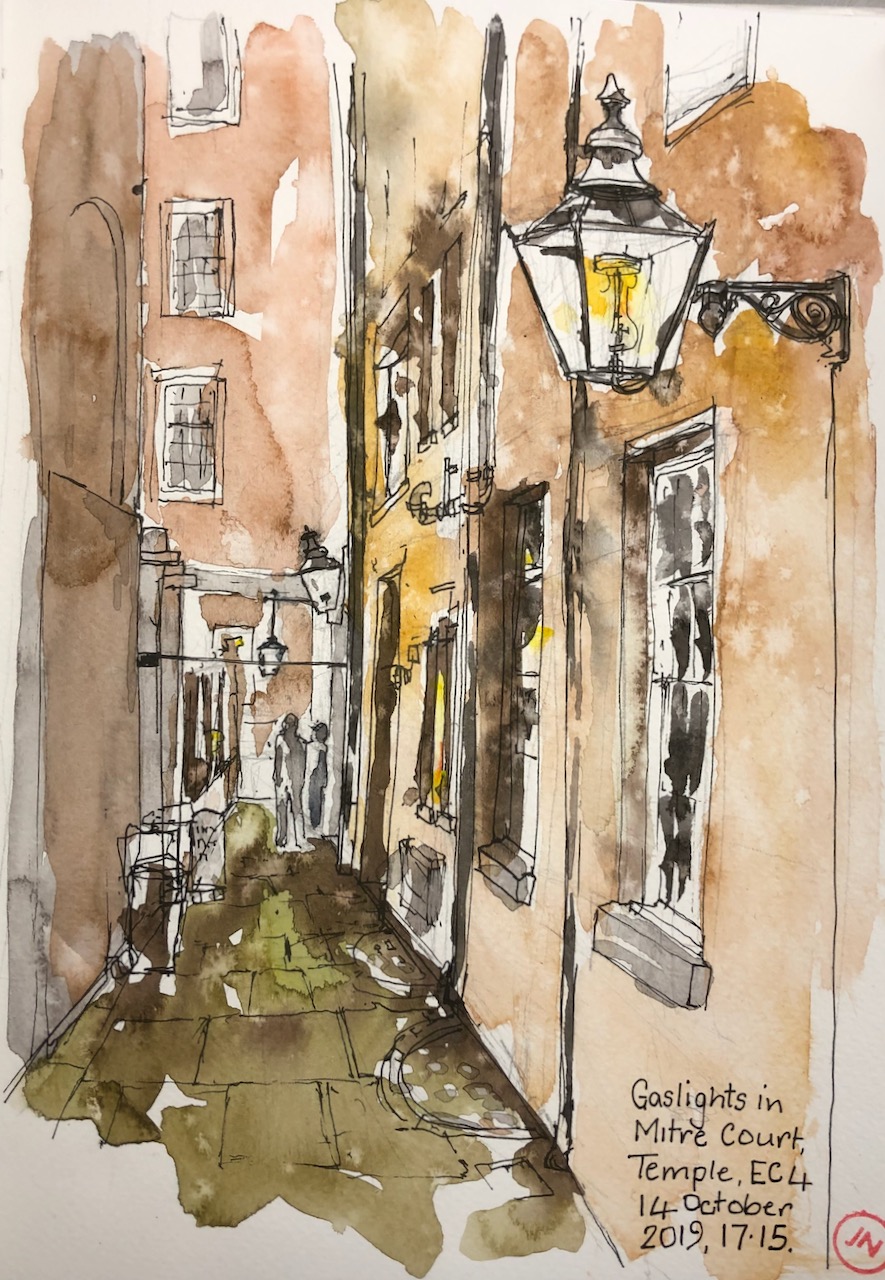
Gaslights on 1 & 2 Mitre Buildings, Temple

Here is a back alley off Fleet Street, London EC4.

IMG_0060

It is Old Mitre Court. The buildings on the right are 1 & 2 Mitre Court Buildings. They are listed Grade 2. Here’s what Historic England says in the listing:

Early/mid C19. 4 storeys plus basement. Plain classical, south elevation of Portland stone with channelled ground storey and cornice below top floor. Arched passage through centre. Plain, rear elevation of yellow brick with railings and gates.

It’s the “rear elevation of yellow brick” that you see in the picture. There are three gas lamps, at least one of which works. The other two look very rickety.

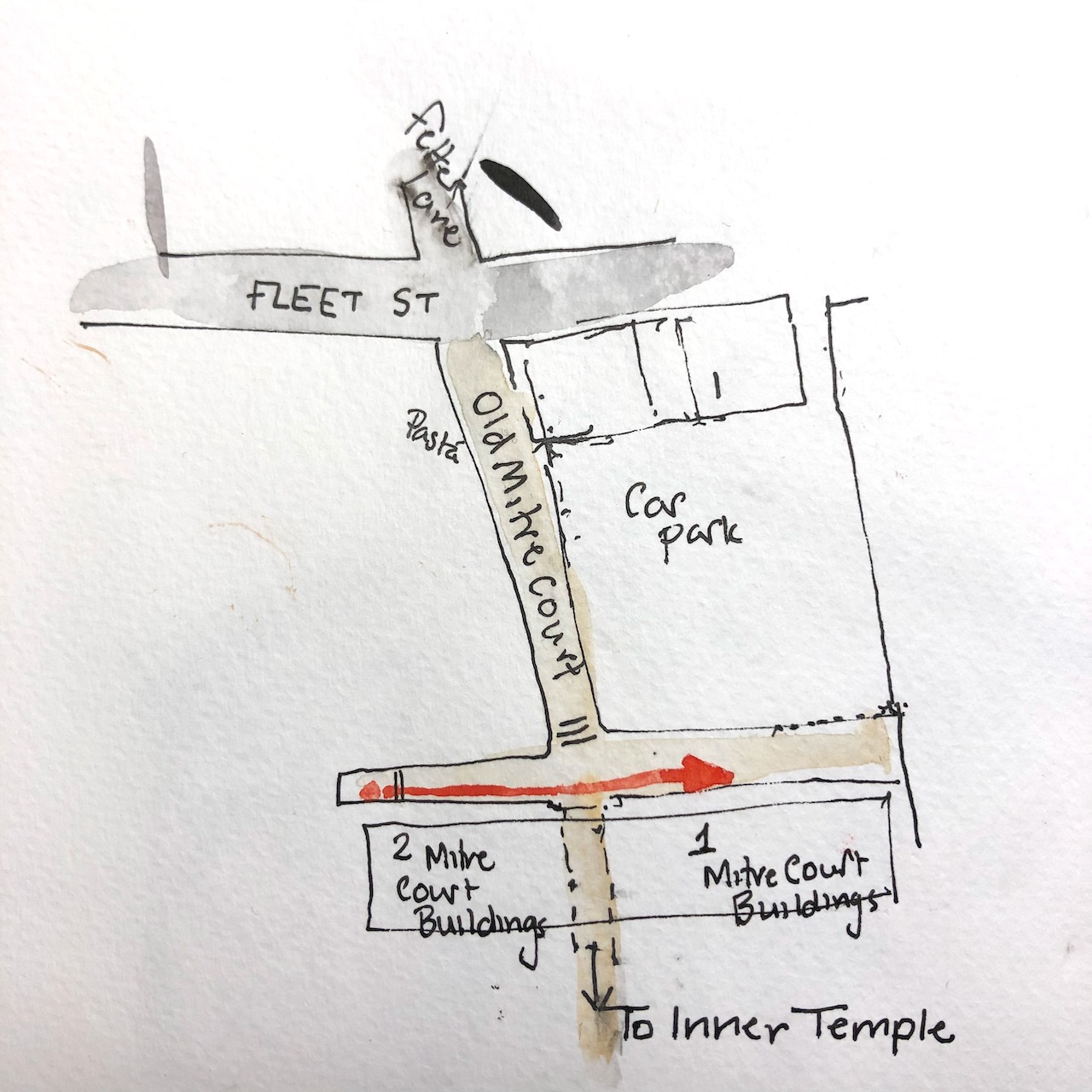
The buildings, 1 & 2 Mitre Court Buildings, are legal practices, housing Barristers and their associates. A list of the barristers is by the doors. The notice on the pavement says “Inner Temple Treasury Office, Open 10am – 4pm”. This is the office underneath the furthest gas light, the one with the right-angled support above it.

The paving slabs at the bottom of the picture were in fact green, as I have drawn them. It was damp, and there was a coating of moss-type algae on the paving slabs. A saying of my late father was, “The plants will win in the end”. When I see such a green coating on stone, in the middle of the City, I am reminded of his words, and I think he is right.

Eventually I had to stop drawing as the rain came down. The drawing got a bit wet.

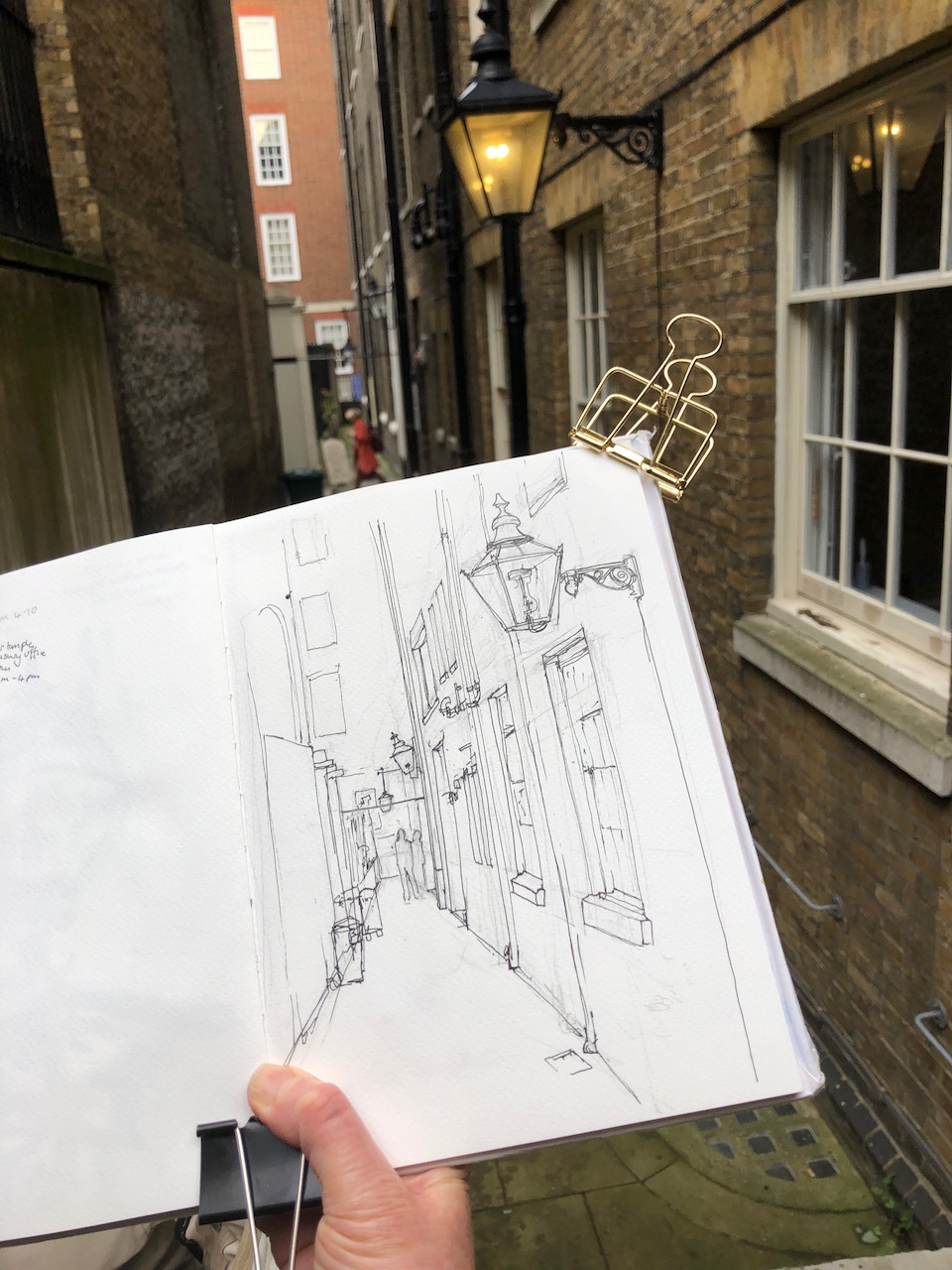
Here is work in progress and a map:

Drawing took 1hour 15 mins. Colours used mostly Perinone orange, and Prussian blue, with a bit of burnt umber. Indian yellow for the gas lights. All Daniel Smith colours. Pen is Lamy Safari EF nib, with De Atramentis document (waterproof) black ink.

Later note: Article in Private Eye, Autumn 2021 (Westminster council is removing the Gas Lights)

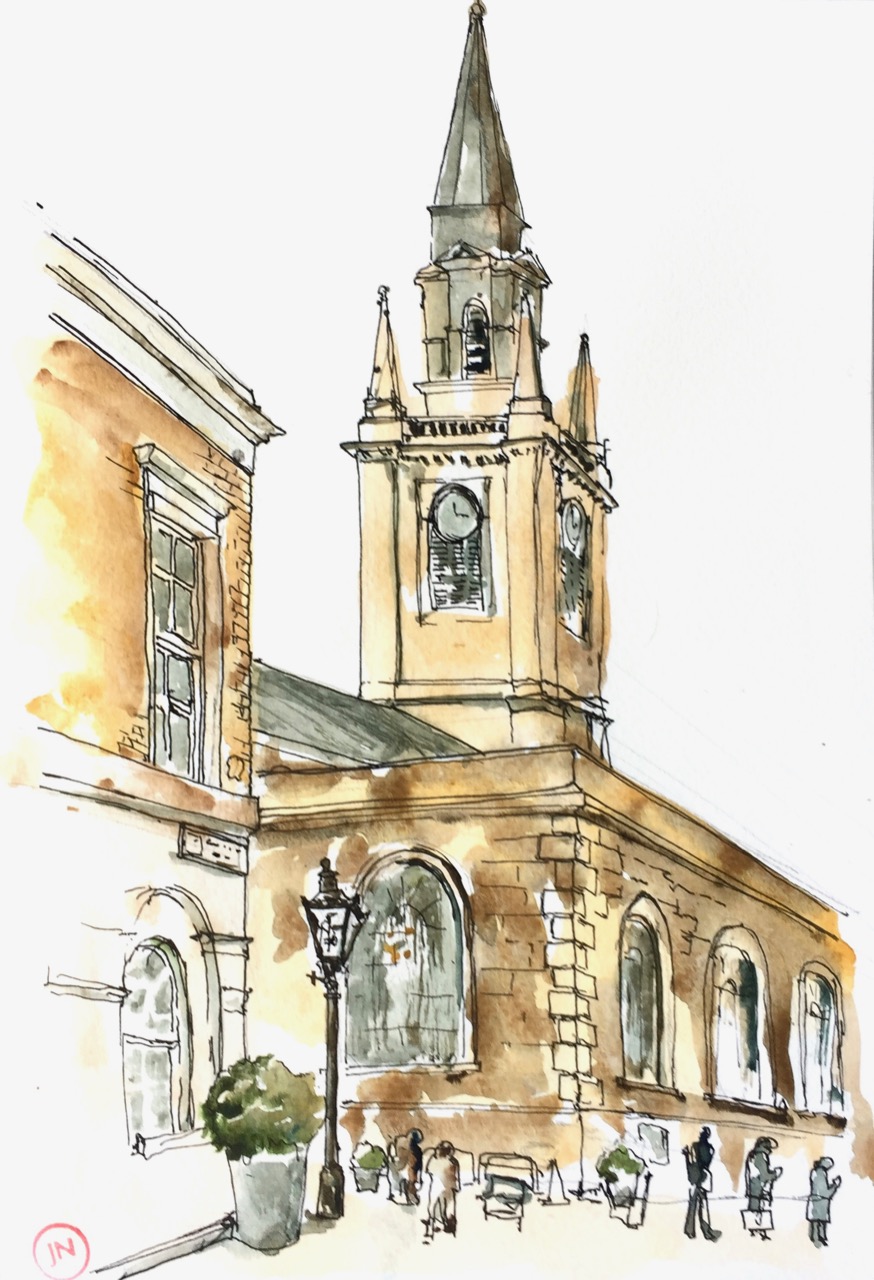
St Peter upon Cornhill

I went out to look for more gas lights in the City. There was rain, and the back alleys were wet. I couldn’t find any more gaslights.

At the South East extreme of my peregrination I looked up and saw St Peter upon Cornhill. It is wedged in between other buildings.

The adjacent building is labelled “54 & 55” Cornhill, in lovely art-deco writing. There is a branch of “EAT” on the ground floor. High up, there are three strange devils (ringed in red on the annotated picture above). The two larger and higher ones are definitely female devils, with big breasts and strong muscles. The smaller devil is yelling from his position above a window.

I drew this picture from the shelter of White Lion Court, which is on the North side of Cornhill. This is one of those City of London back-alleys. It doesn’t go anywhere, just to the door of what looks like an insurance company, and off to the side is a doorway with ecclesiastical carving above. It looks like the entrance to a monastery. But that can’t be right. The modern iron gate is adorned with modern litter.

As I was drawing a man came round from the nearby branch of Sainsbury’s to eat his sandwich and smoke.

Then later another man came by and asked me if I had seen the fire brigade. I said no, because I hadn’t. He said the fire alarm in one of the offices had gone off. He said he’d be wandering about for a bit, while he contacted the key holder. I could hear him calmly making phone calls. He was still there when I finished my drawing and packed up. I waved goodbye to him, and he nodded and half waved back, constrained in his movements as he was holding his phone to his ear and consulting a notebook.

It is astonishing how many tourist groups go down Cornhill. If I have done nothing else today, I have at least inspired a few tourists and other passers-by to look upwards to the onion spire of St Peter upon Cornhill. People pause, see that I am drawing, wonder what I can possibly be drawing in that dingy back-alley, and then look in the direction I’m looking and see the spire.

The tourist groups pause in the shelter of nearby Sun Court. I guess they are being told anecdotes about why there are she-devils on 54 and 55 Cornhill. I looked online. I can only find anecdotes, no facts. The building is by Runtz, 1853.

There has been a church at St Peter upon Cornhill since the 2nd Century AD, according to a tablet whose inscription was recorded and copied on various printed media, and now on Wikipedia. The tablet doesn’t exist any more as it was destroyed in the fire of London. The current building is by Christopher Wren, and was constructed between 1677 and 1684. There is also an entrance on Gracechurch St, which I must go and have a look at.

Here is work in progress.

The drawing took 1½ hours.


Gaslight in Guildhall Yard

The winter evening settles down
With smell of steaks in passageways.
Six o’clock.
The burnt-out ends of smoky days.
And now a gusty shower wraps
The grimy scraps
Of withered leaves about your feet
And newspapers from vacant lots;
The showers beat
On broken blinds and chimney-pots,
And at the corner of the street
A lonely cab-horse steams and stamps.
And then the lighting of the lamps.

T.S. Eliot – Preludes

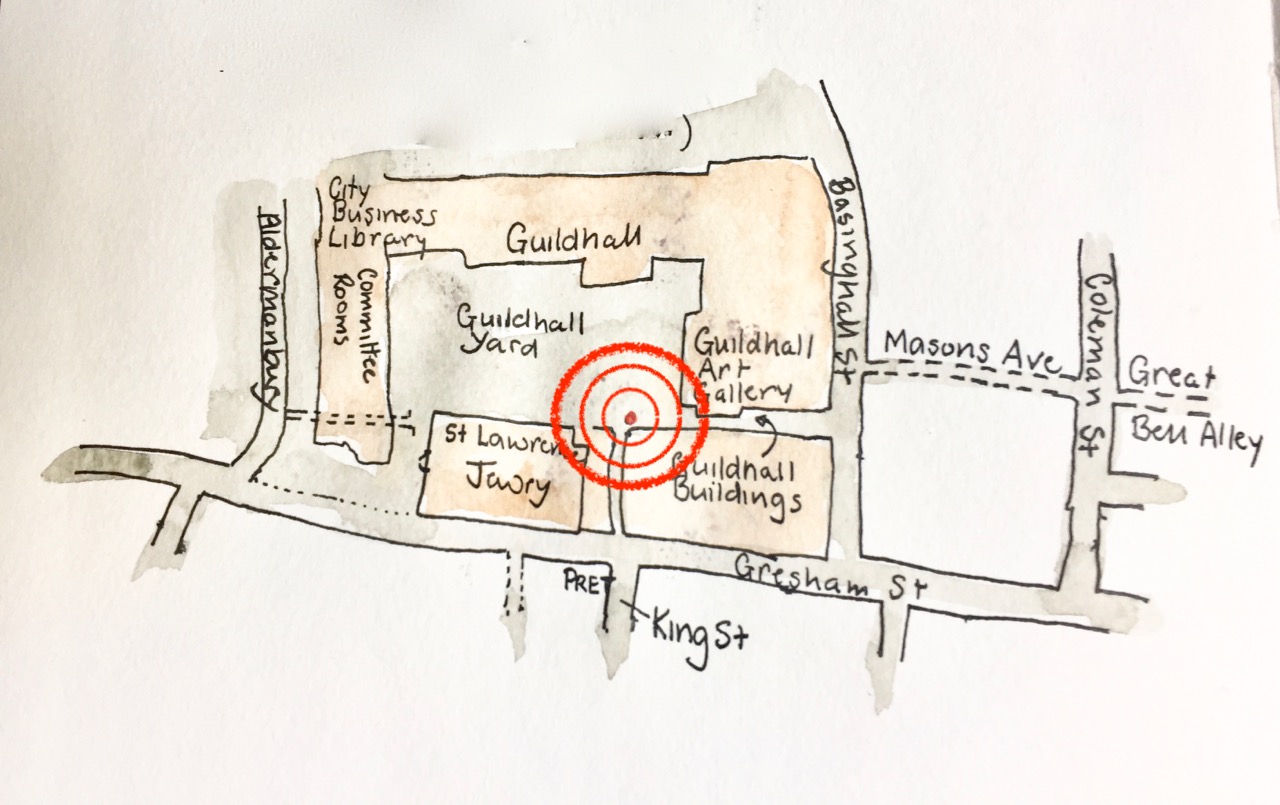
There are still quite a few gas lights in London. I aim to draw as many as possible before they are taken out of service. It’s quite remarkable that there are so many in operation. This one is in Guildhall Yard, in the City of London. St Lawrence Jewry is in the background.

IMG_3845
Gaslight, and St Lawrence Jewry, from Guildhall Buildings

IMG_3848

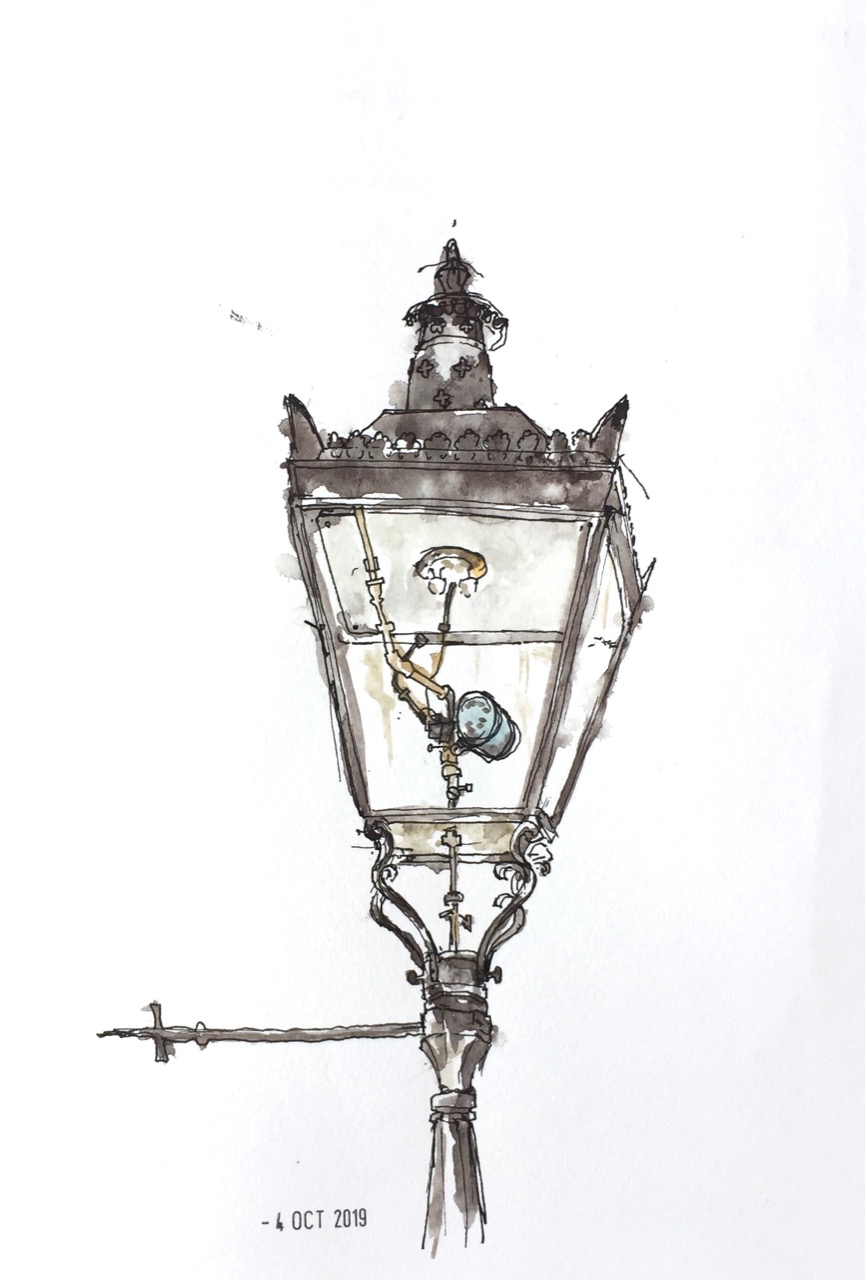
Here is the gas light close up, drawn from Guildhall Yard, looking south.

IMG_3846

Written on the little blue canister are the words:

NEWBRIDGE
HORSTMANN
GEAR Co
LTD
BATH ENG

It is a timing device. According to the marvellous website “Grace’s Guide to British Industrial History”,  in 1904 the Horstmann Gear Company patented….

“…the Solar Dial which automatically adjusted lighting times at dusk and dawn throughout the year. It was the start of nearly eighty years of Horstmann’s manufacturing involvement in the street lighting controls market.”

However before this innovation, the gas might have been lit by a person, because there is the arm for the ladder, as shown in my drawing. Perhaps that arm was always there, though, even after automation, in case someone needed to inspect the light. The North face of the light, the one shown in my picture, includes hinges on the left, and evidently could be opened.

I do not know if this light still functions. I shall take a diversion that way in the night, and let you know.*

I have drawn another local gas light, which does still function, off King Edward Street.


All pictures drawn and coloured on location. Pen and wash.

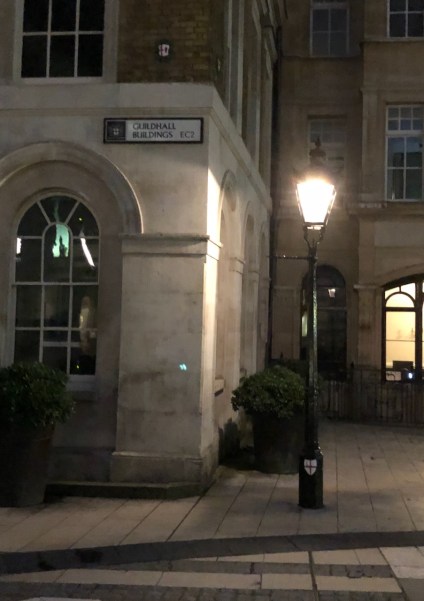
*Update: It works!

IMG_0065
06:45 15th October 2019, Guildhall Buildings