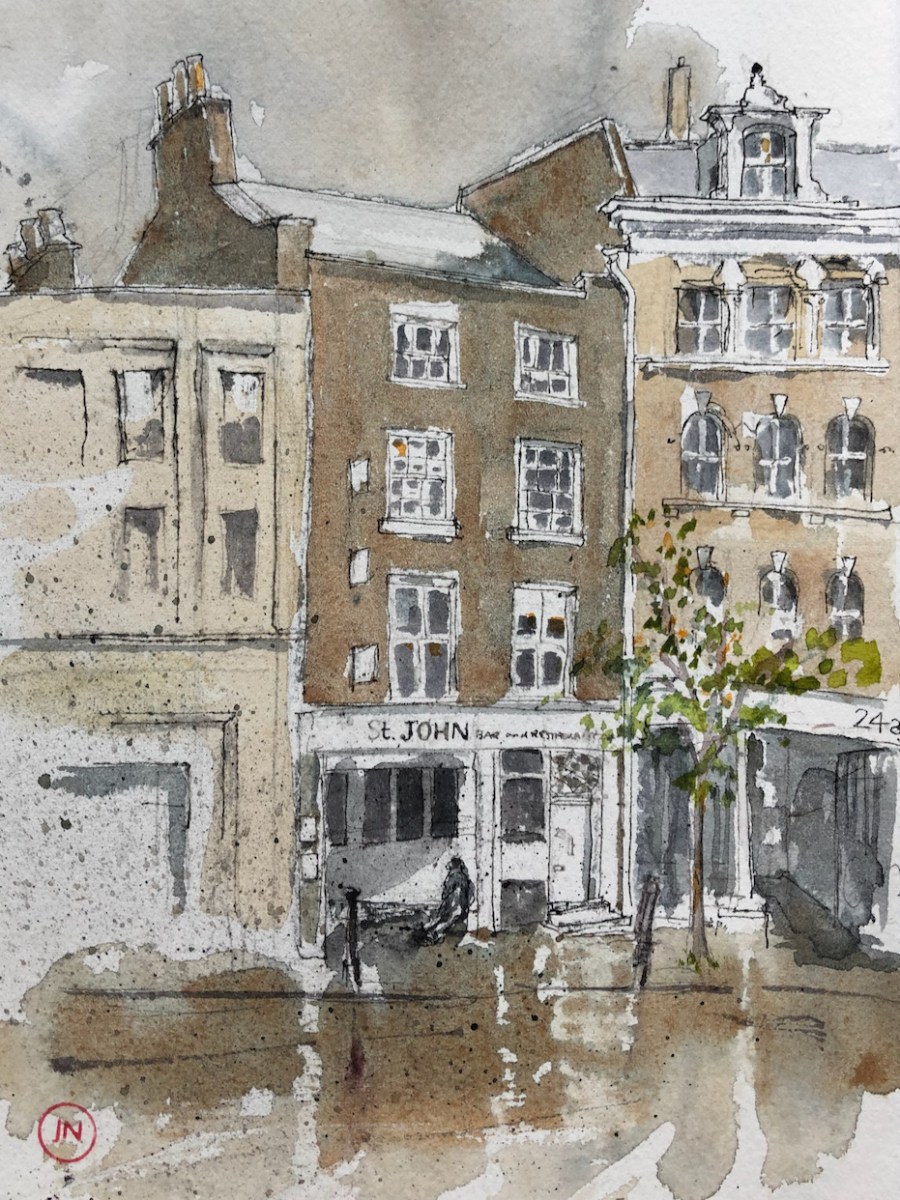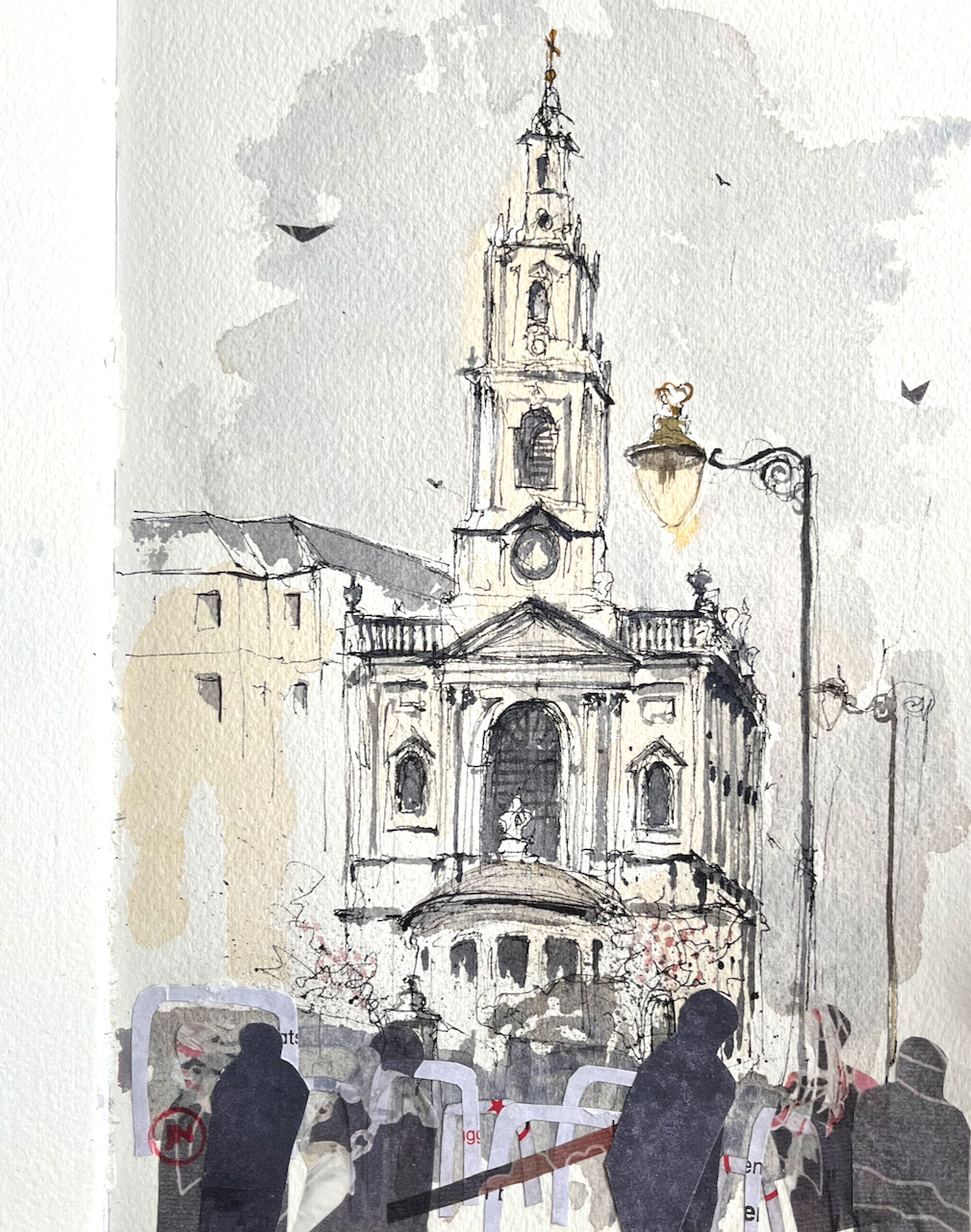
Postcards from Crete

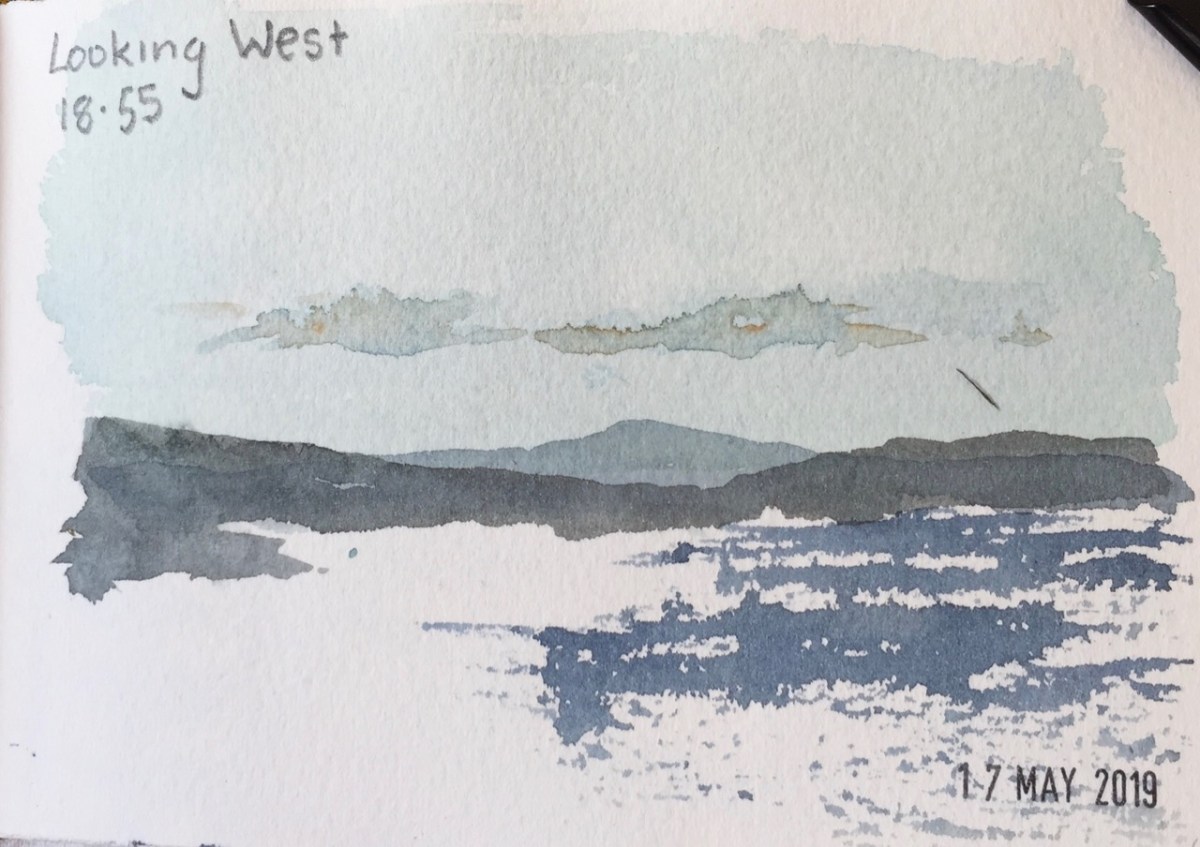
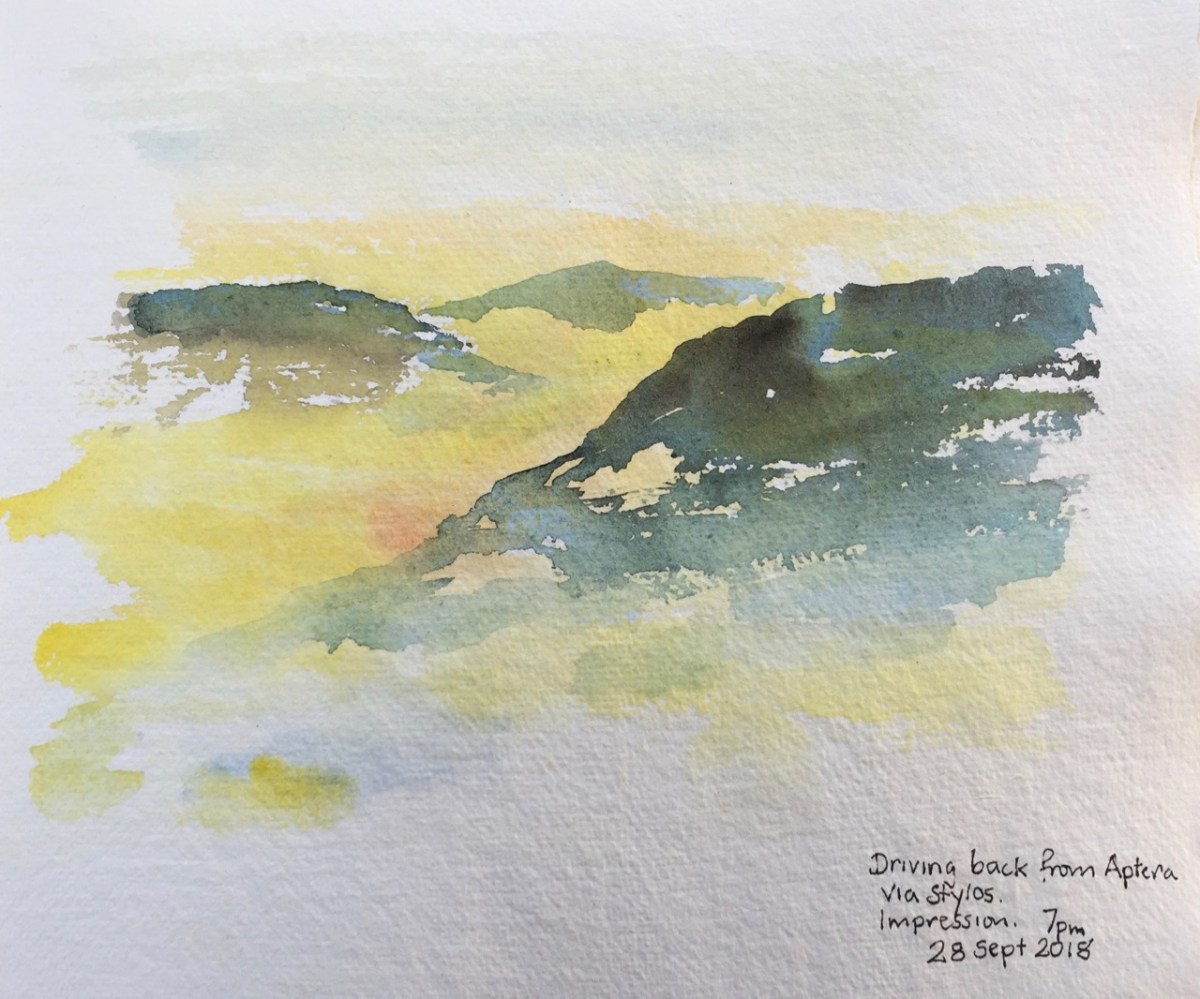
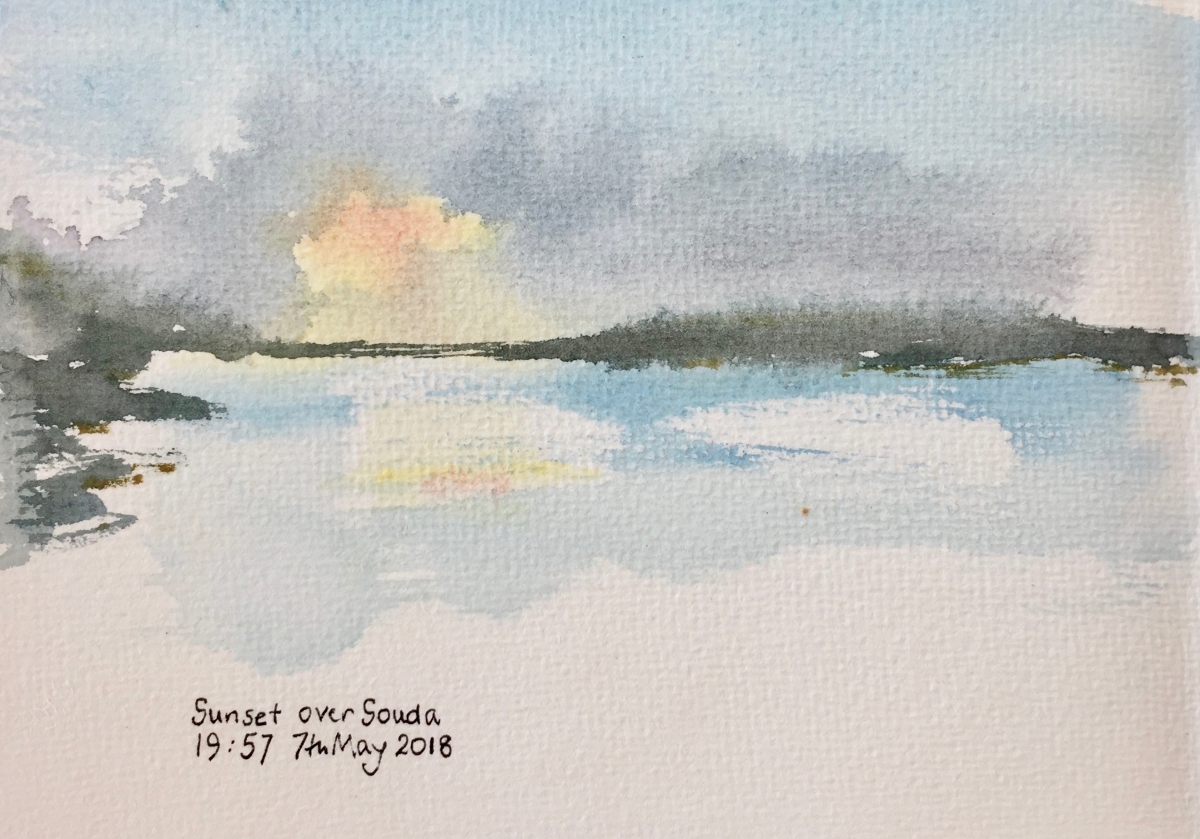
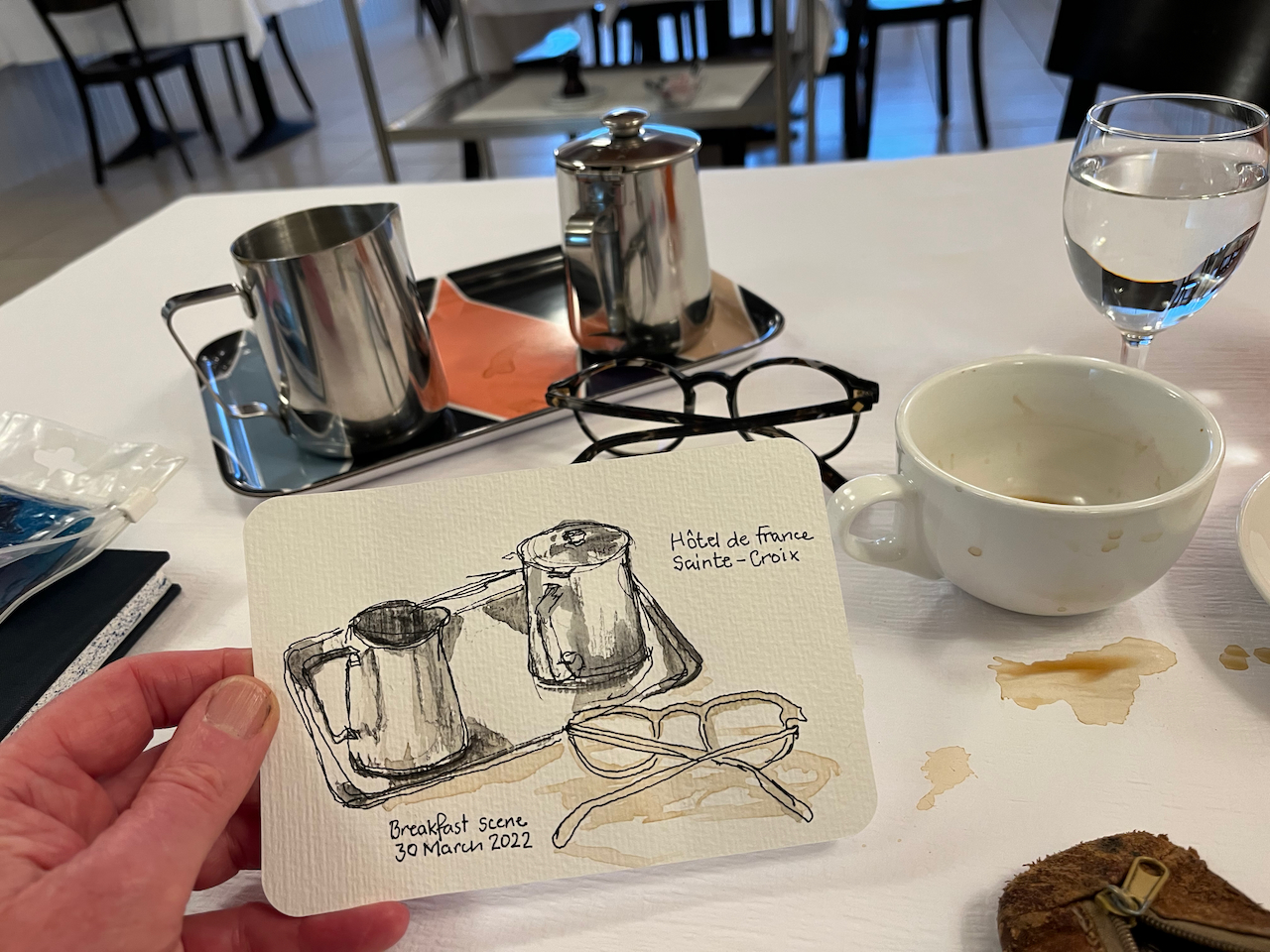
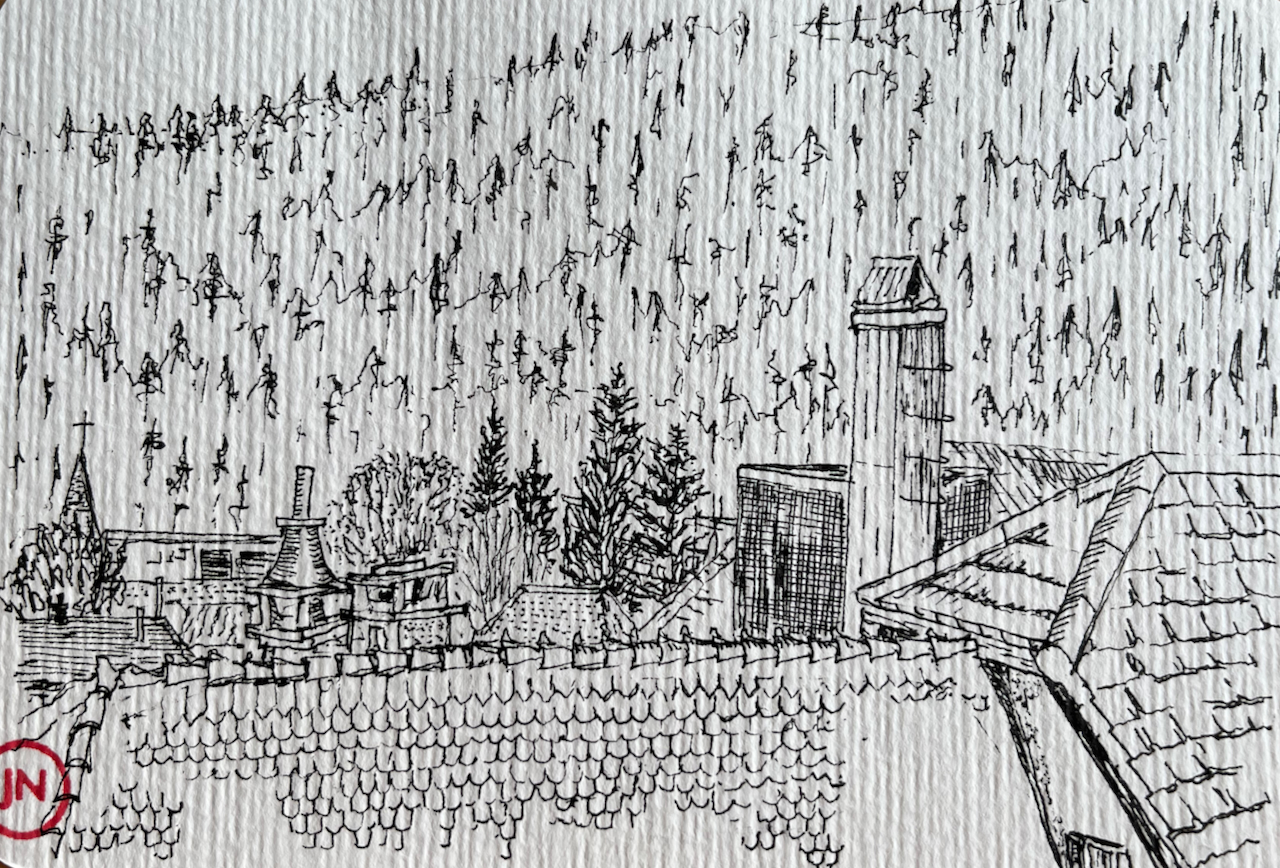
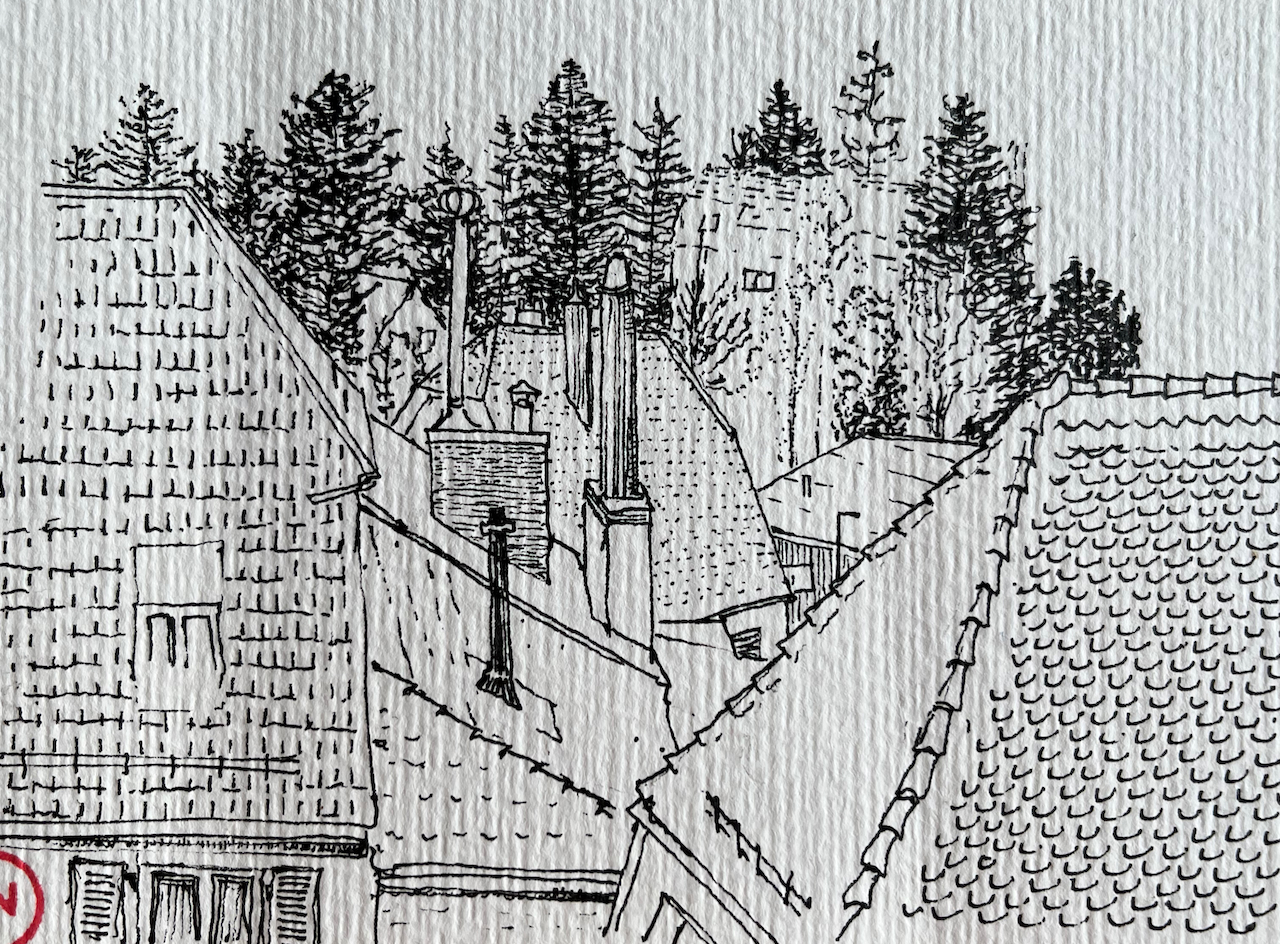
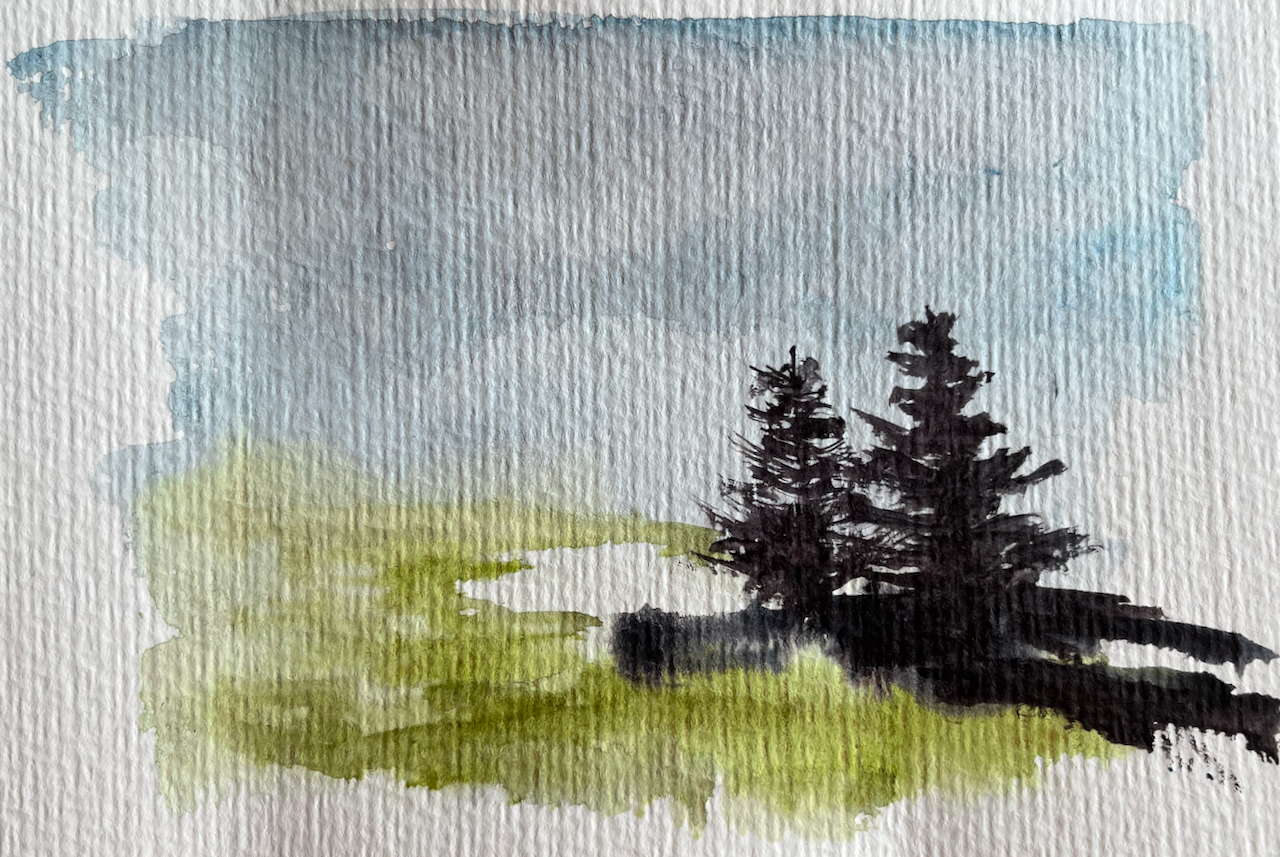
I sent some hand-drawn postcards from Crete.
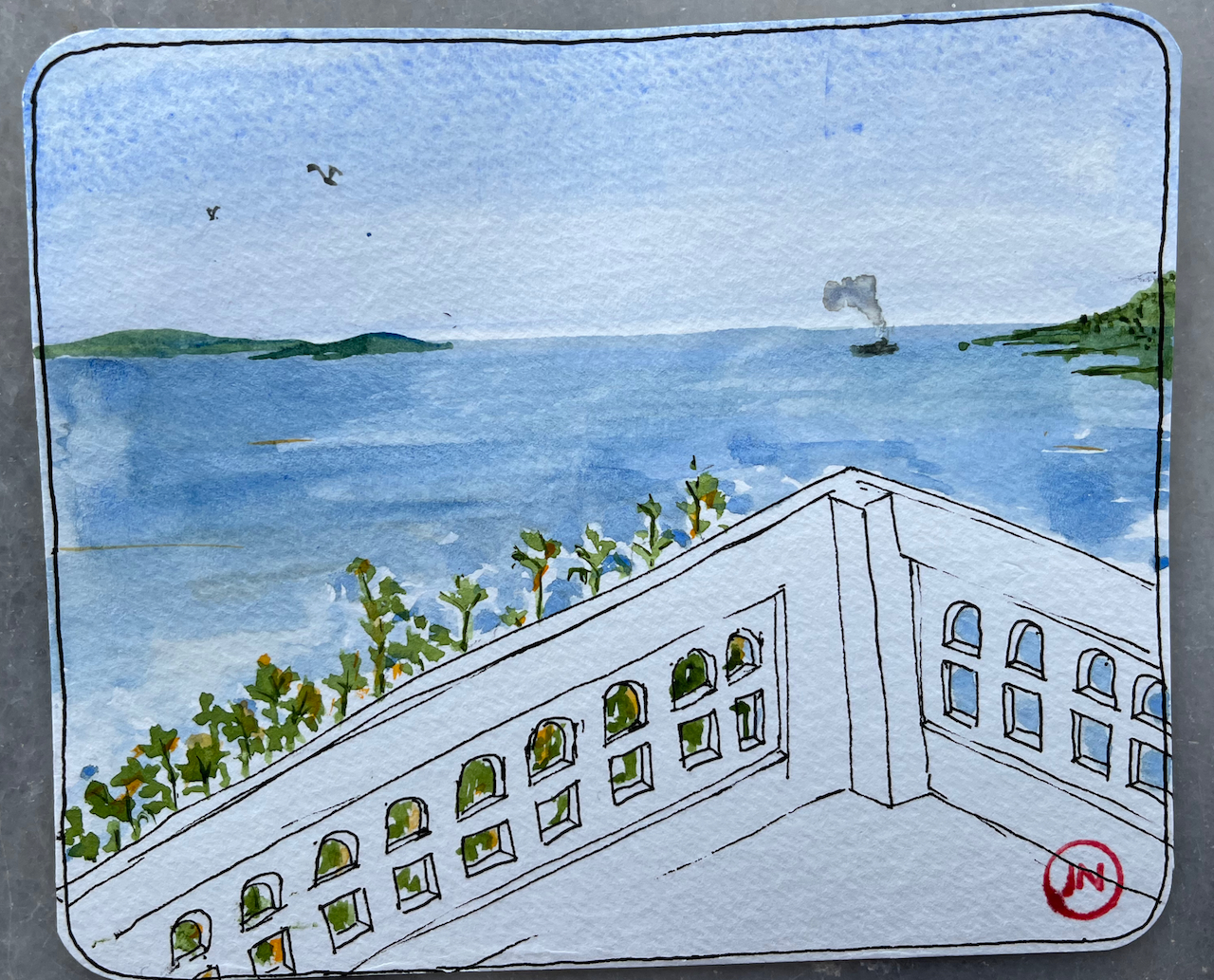
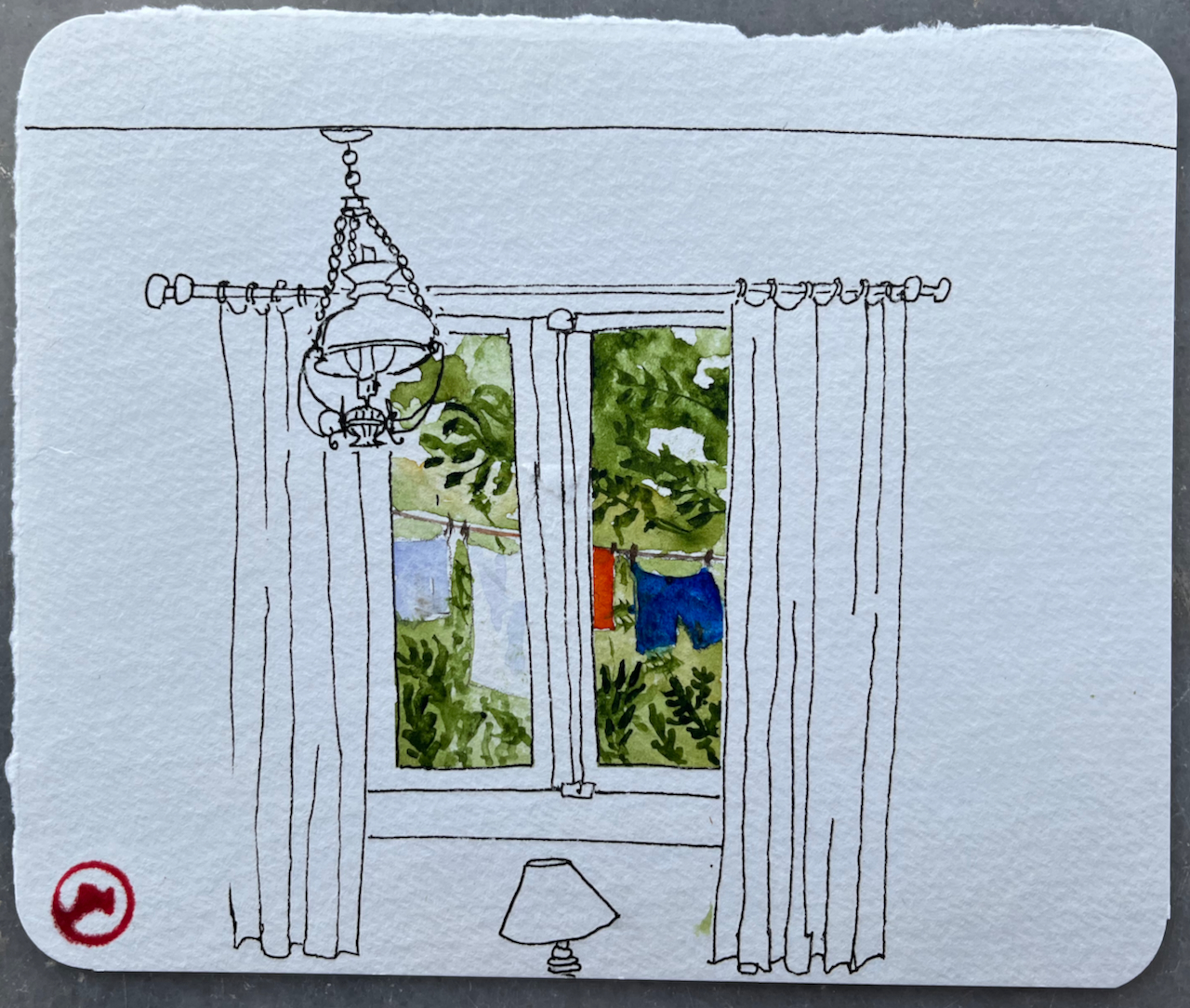
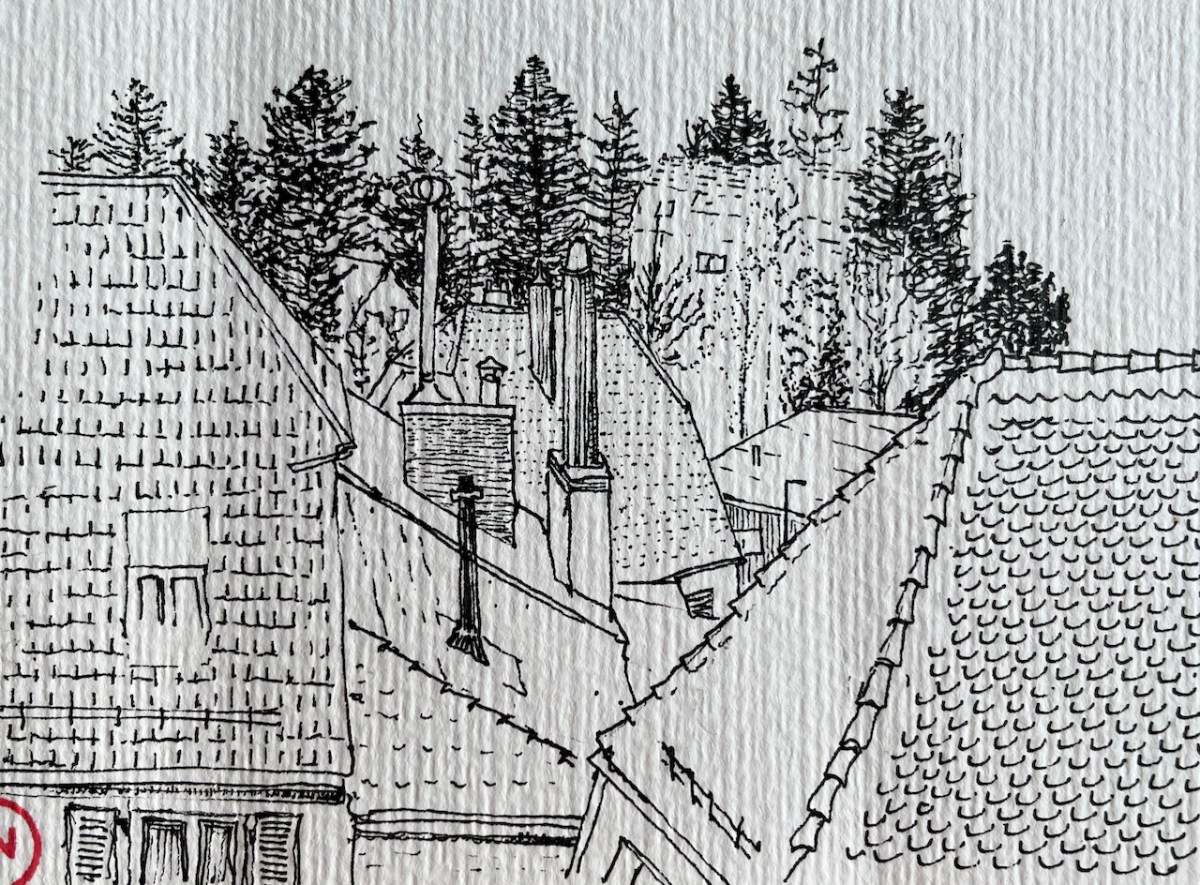
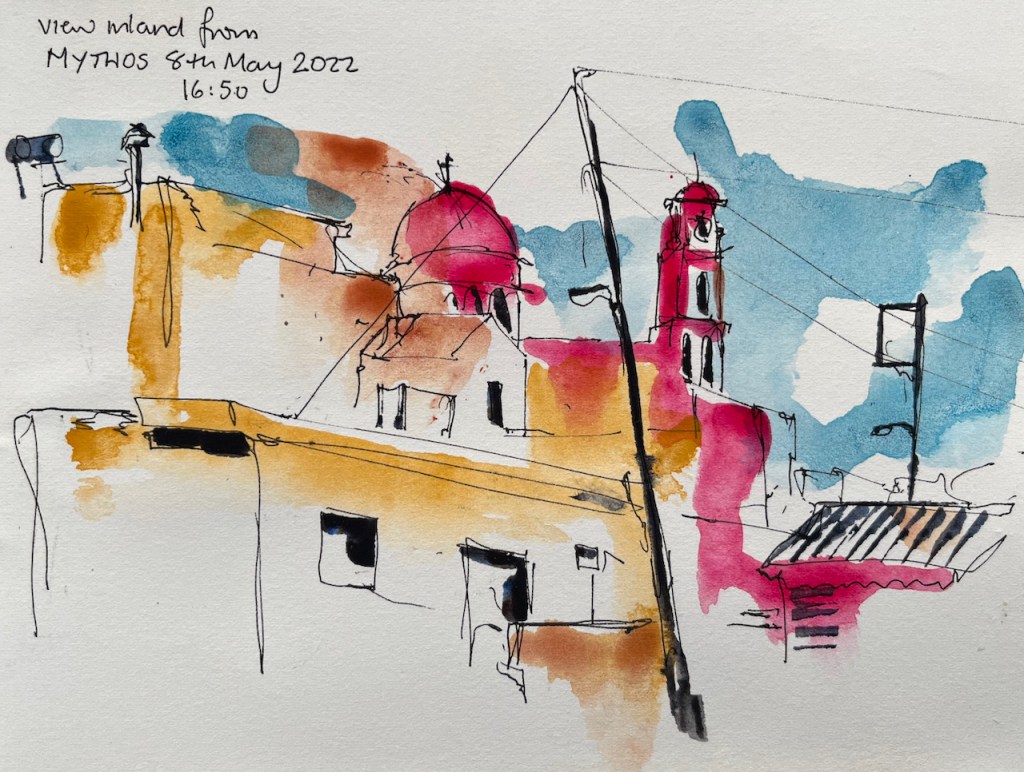
An experimental view from a restaurant:

Kalyves, looking inland to the church

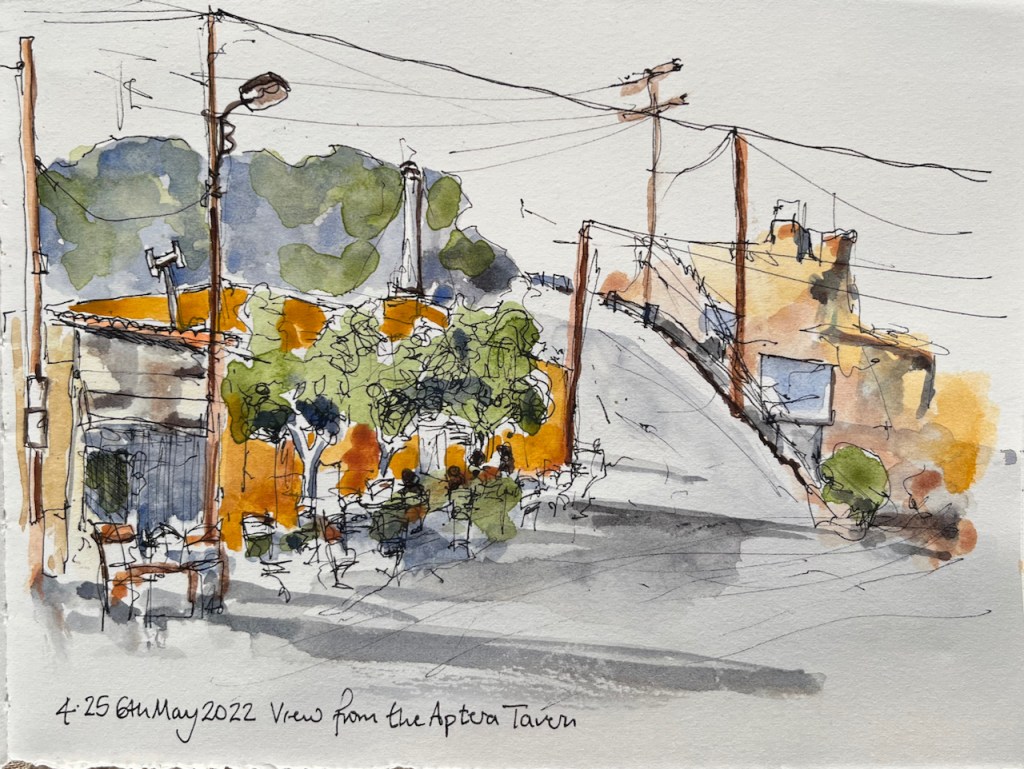
Another view from a restaurant:

View from the Aptera Tavern

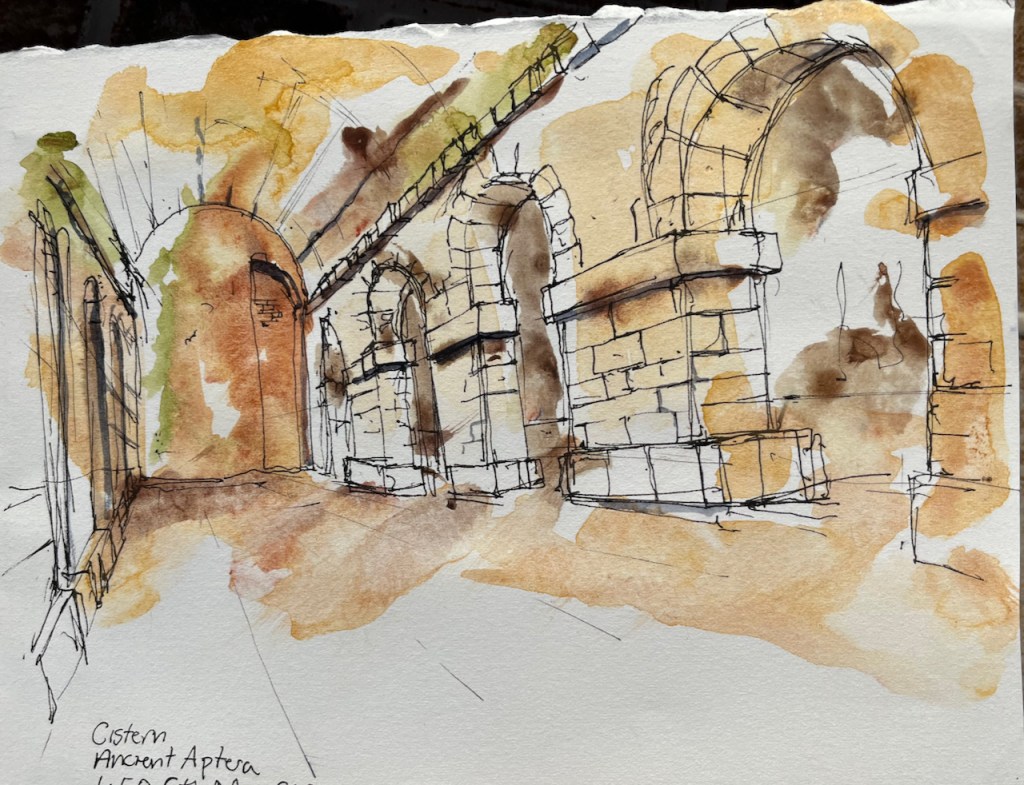
The Roman water cisterns at Aptera:

Roman water cisterns. Totally amazing. Still here, strong and standing.

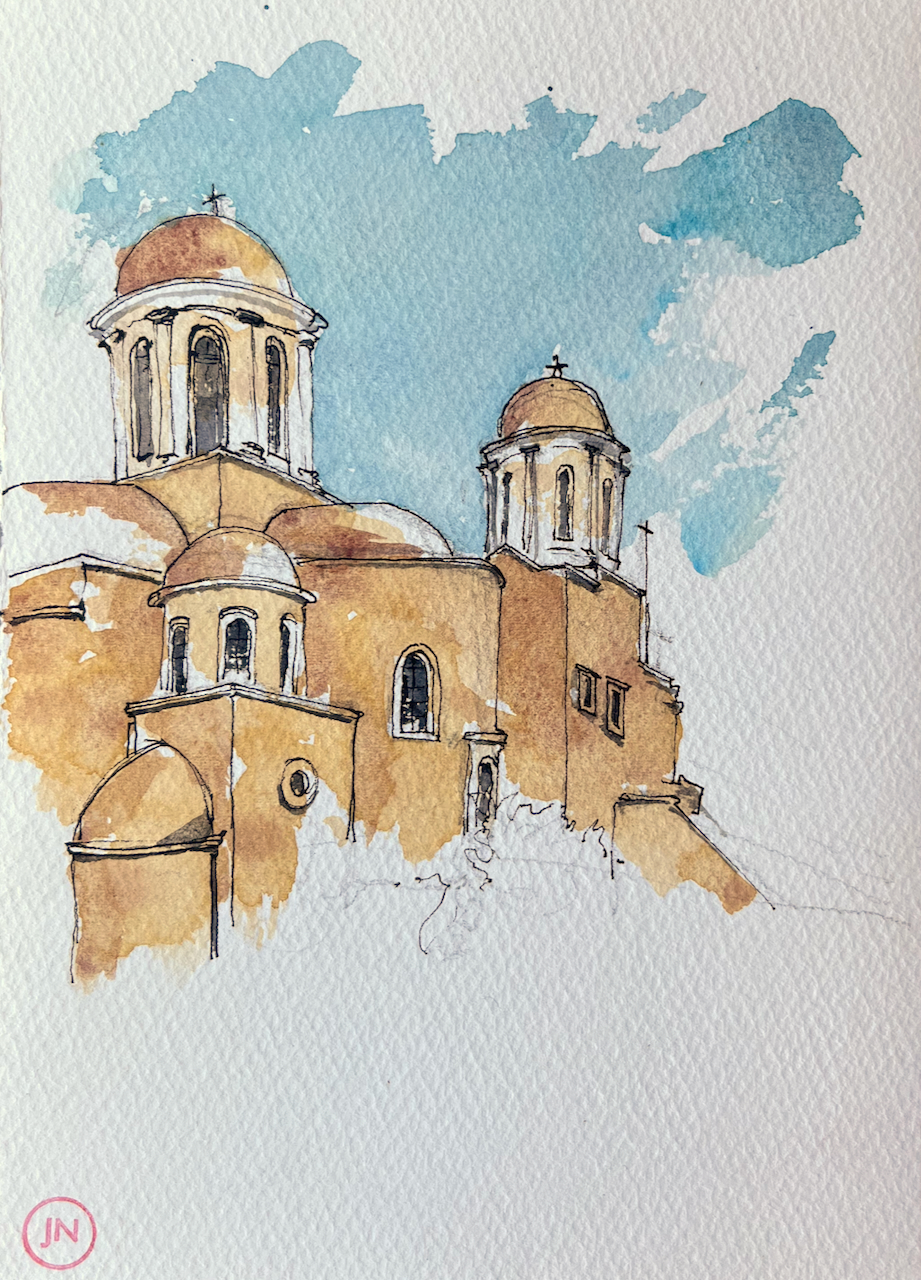
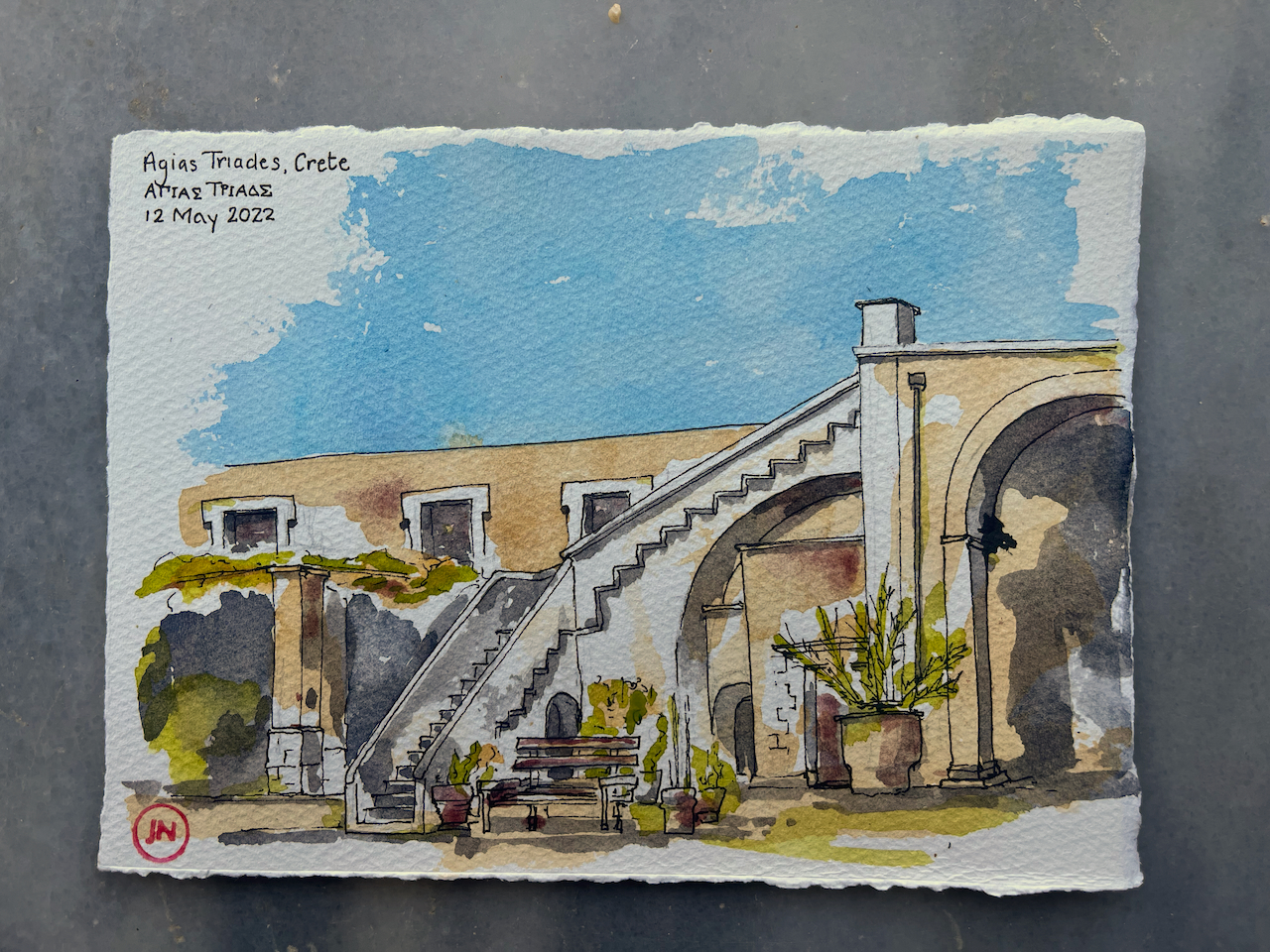
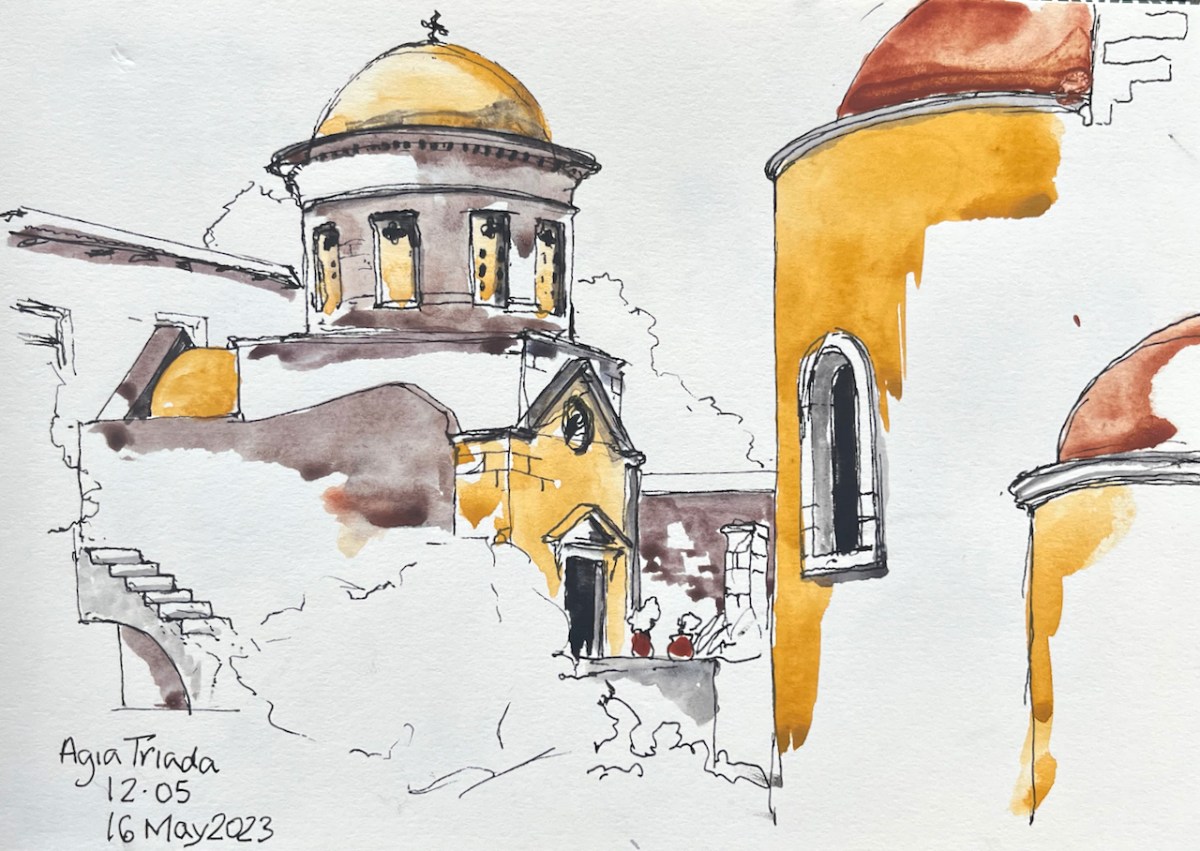
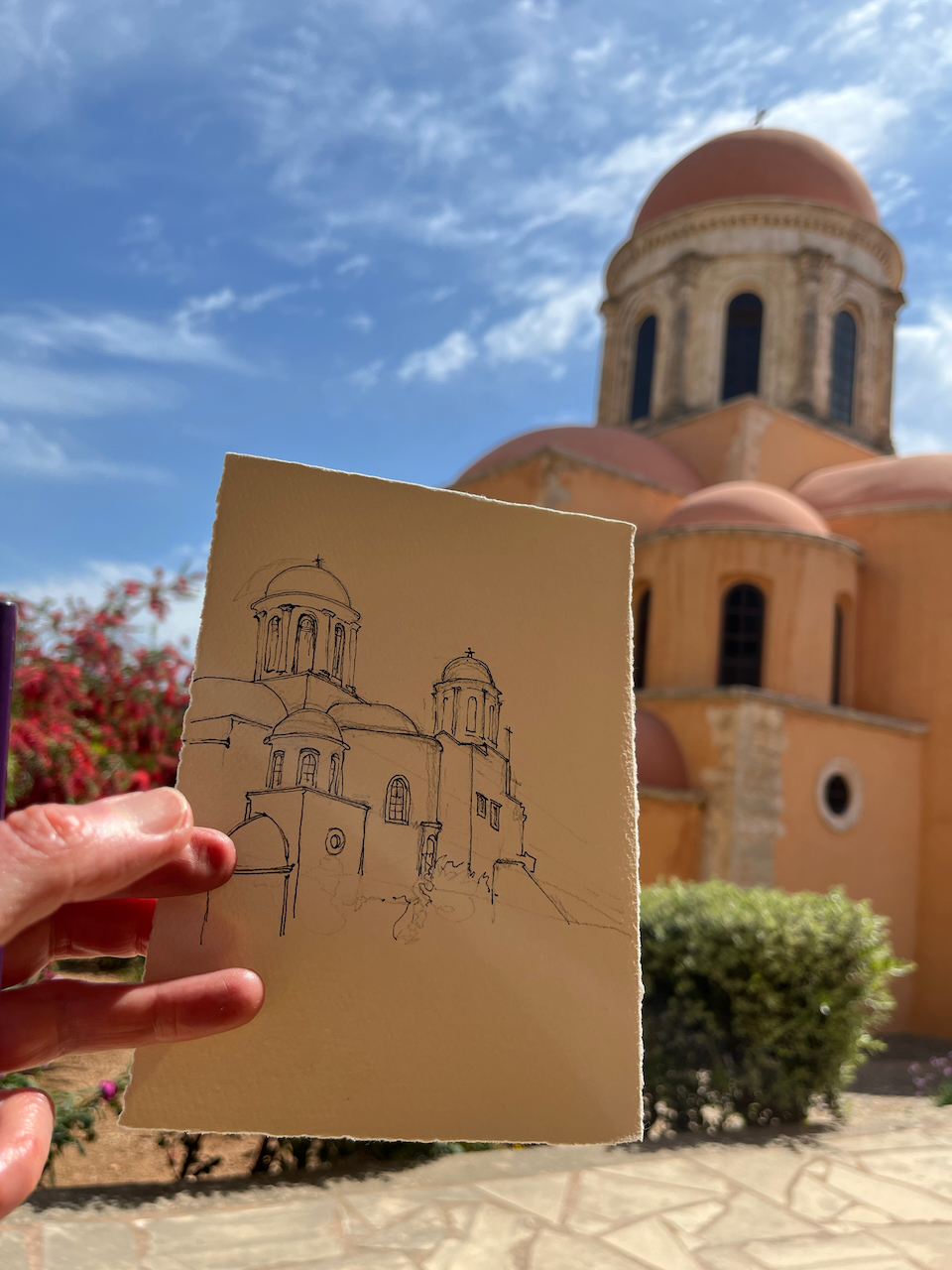
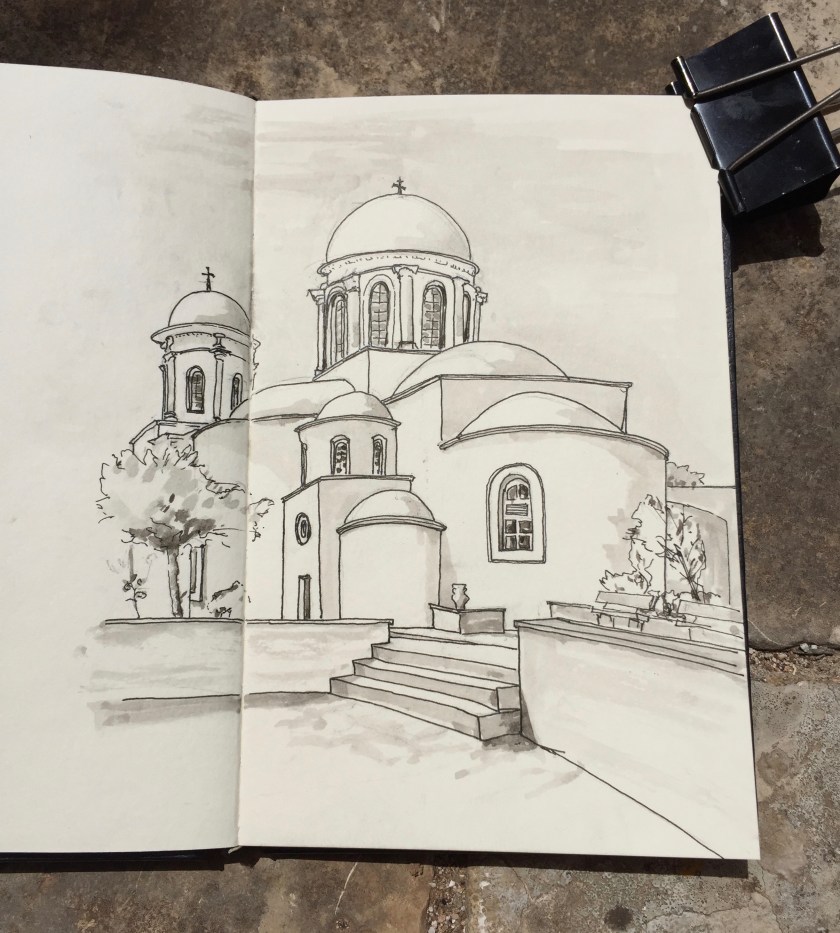
The beautiful monastery of Agias Triados

I’ve sketched here in previous years, here is a 2017 sketch:

2017: https://janesketching.com/2017/05/13/agias-triada/

Paint dries really quickly here!

Crete blog posts:

  • Crete sketches 2024

    Crete sketches 2024

    Here are a selection of sketches made in Crete. The sketchbook is Jackson’s Art Supplies’ own brand, 160gsm watercolour paper, cotton blend, about 8″ x 9″. I used some of the local earth as pigment, to make a watercolour, using Schmincke watercolour binder. I ground the earth using a stone, breaking it up to make…


  • Sketching in Crete, May 2023

    Sketching in Crete, May 2023

    There was a bit of a delay at Gatwick. When we arrived in Crete, there were thunderstorms. As the storm clouds cleared, we saw the red streaks where soft earth had been washed into the sea. I sketched the headlands. Eventually the sun came out. Up the hill is the Roman city of Ancient Aptera.…


  • Postcards from Crete

    Postcards from Crete

    I sent some hand-drawn postcards from Crete. An experimental view from a restaurant: Another view from a restaurant: The Roman water cisterns at Aptera: The beautiful monastery of Agias Triados I’ve sketched here in previous years, here is a 2017 sketch: Paint dries really quickly here! Crete blog posts:

  • Insects Collage

    Insects Collage

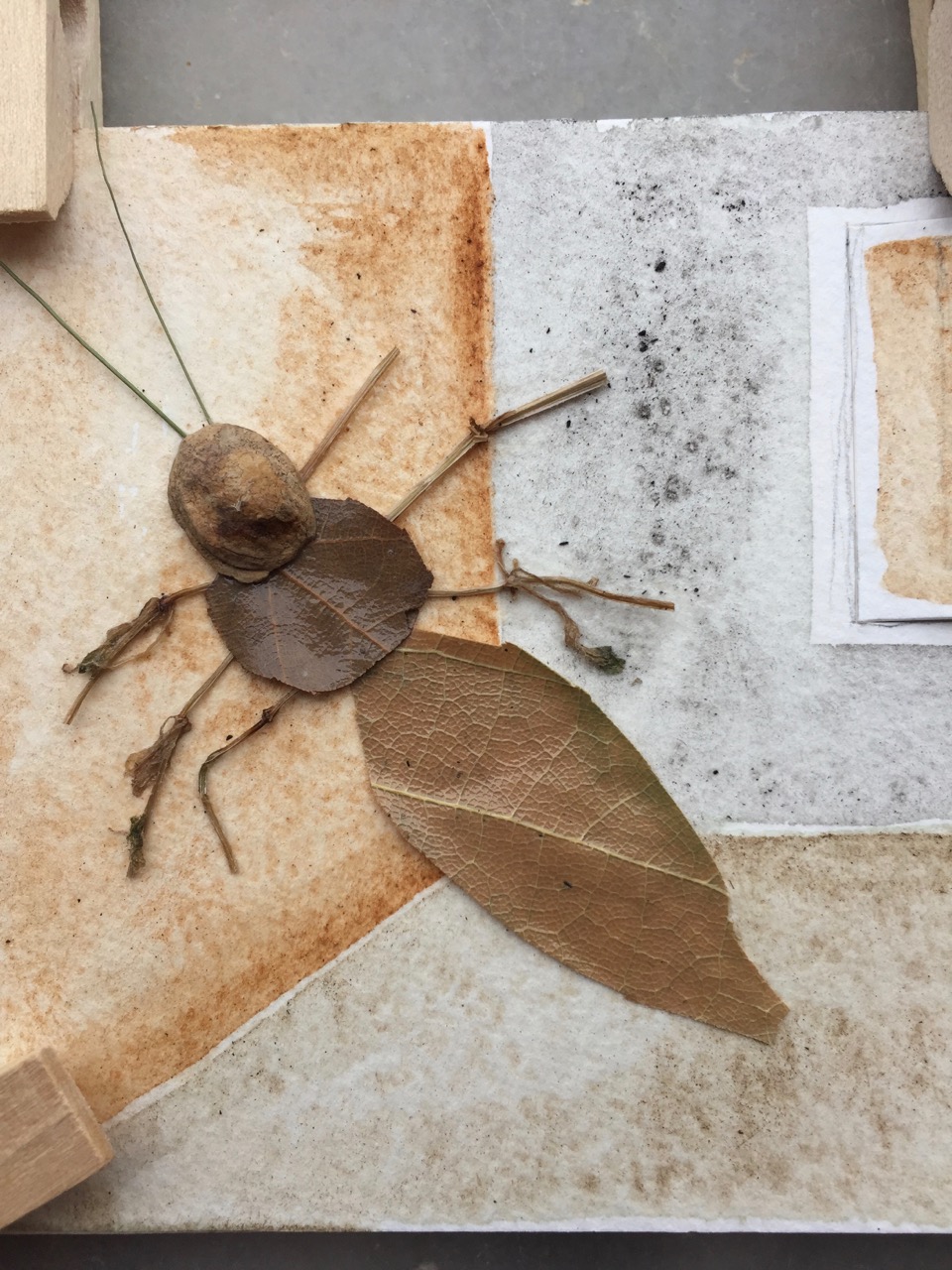
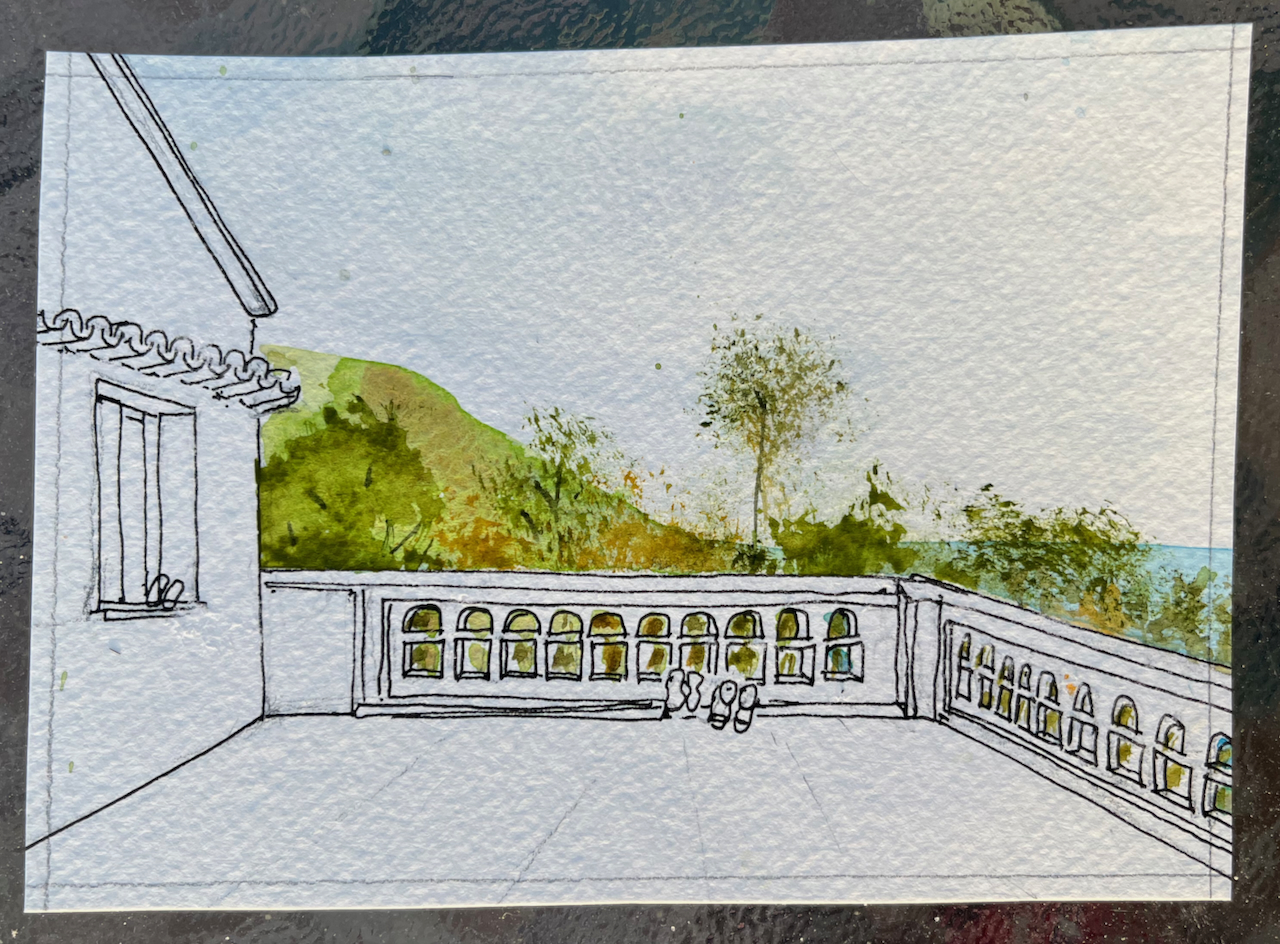
    I made a postcard for friends in Basel. It shows the insect life in Crete. Here are some details, and the work under construction.     The idea was that the flies would jump out of the window when it was opened. The postcard is painted using pigments made from the earth. Update 28th May:…


  • Sketching in Crete 2019

    Sketching in Crete 2019

    The air in Crete was warm and damp. This affected the paper. See how the ink has spread in this pen and ink sketch at the airport: This is De Atramentis Black document ink on high quality watercolour paper, Saunders Waterford, in a small book 6″ by 4″ from the Vintage Paper Company. After that,…


  • Sketches in Crete – Sept 2018

    Sketches in Crete – Sept 2018

    I was experimental. I had a large sketchbook with rough pages, given to me for my birthday. I turned over the pages and tried things. As we drove back from Aptera one evening, the sun was setting and fired up the mist between the hills. Back at the kitchen table, I had a go: It…


  • Sketching in Crete: May 2018

    Sketching in Crete: May 2018

    Aptera was a city in Greek and Roman times. The people went to the Theatre. From the small slab in the centre, the acoustics are perfect. John gave a rendition of the speech of Richard III “Now is the winter of our discontent….”.  I heard it perfectly, at this distance. The place where we stayed…


  • The Guardian of the Vines

    The Guardian of the Vines

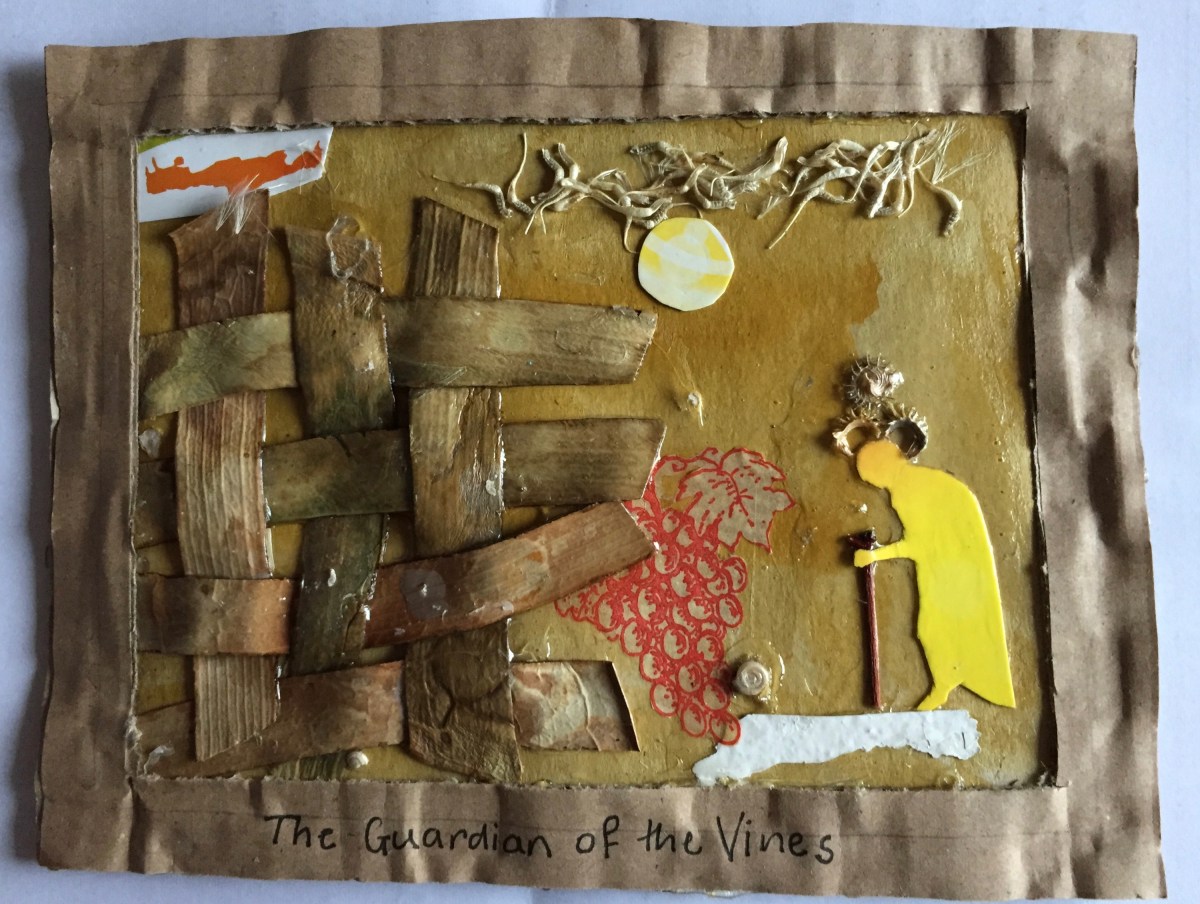
    Another collage postcard. I posted this one in London 18th May. It looks a bit crinkled because the cardboard was damp with PVA glue, and then dried. The white shape on the bottom right is a flake of white paint I found on the ground. It must have been polyurethane paint, because it was flexible…


  • The journey to the chapel of St Antonis
    The journey to the chapel of St Antonis

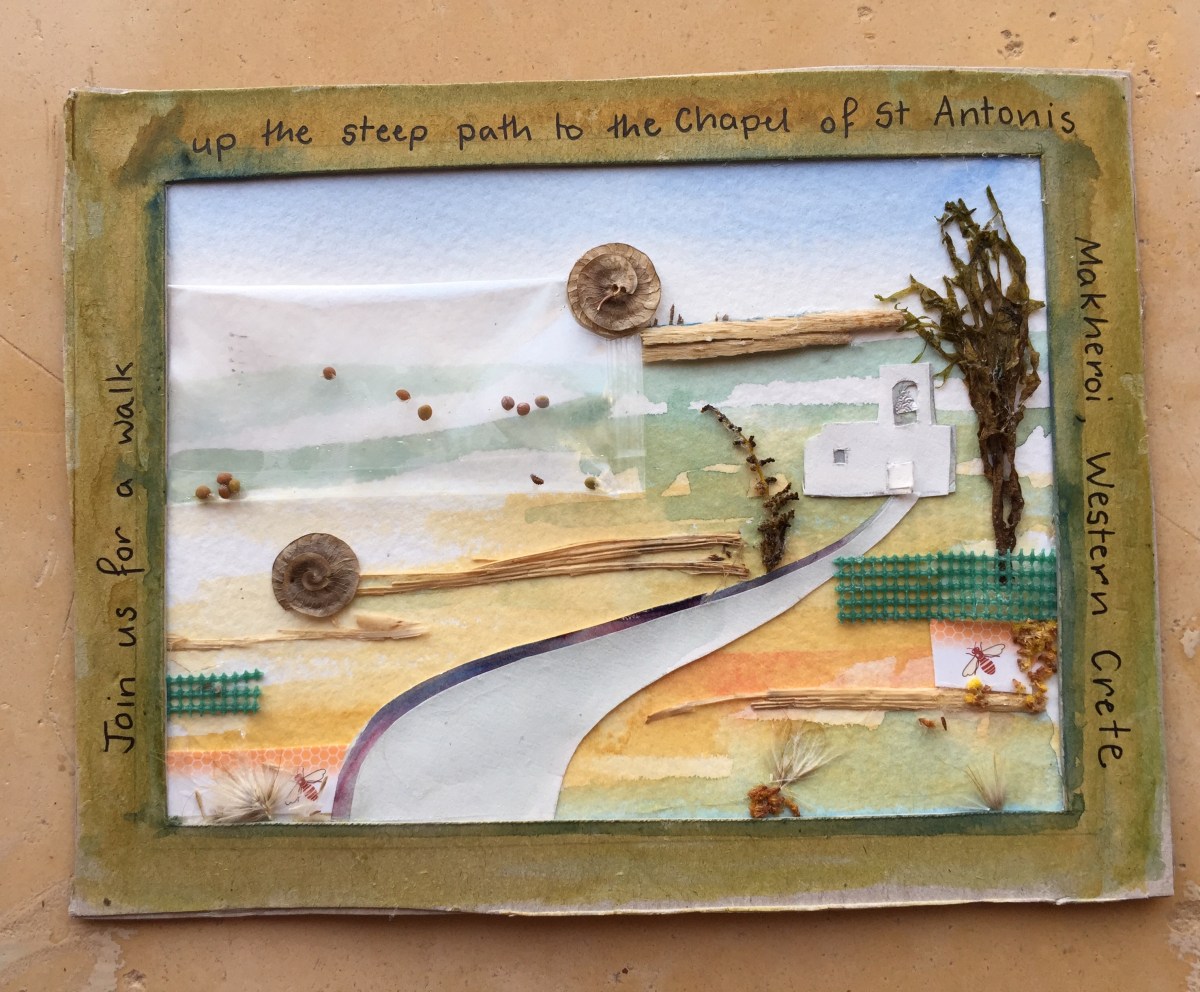
    Here is a collage made for friends in Switzerland. I posted it at the Post Office in Kalami on 8th May. The official there did not seem to be concentrating very hard. He looked dubiously at the word “Switzerland” on the address. I think I need to find out what “Switzerland” is in Greek. The…
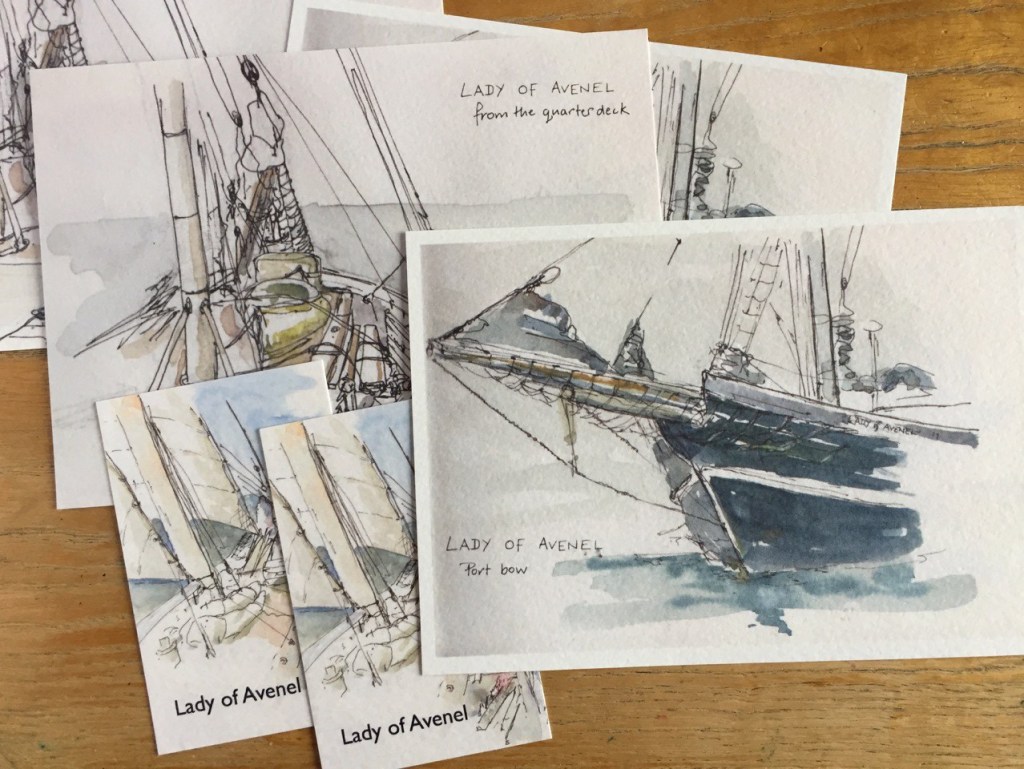
Sketching near Oban, Argyle and Bute, Scotland

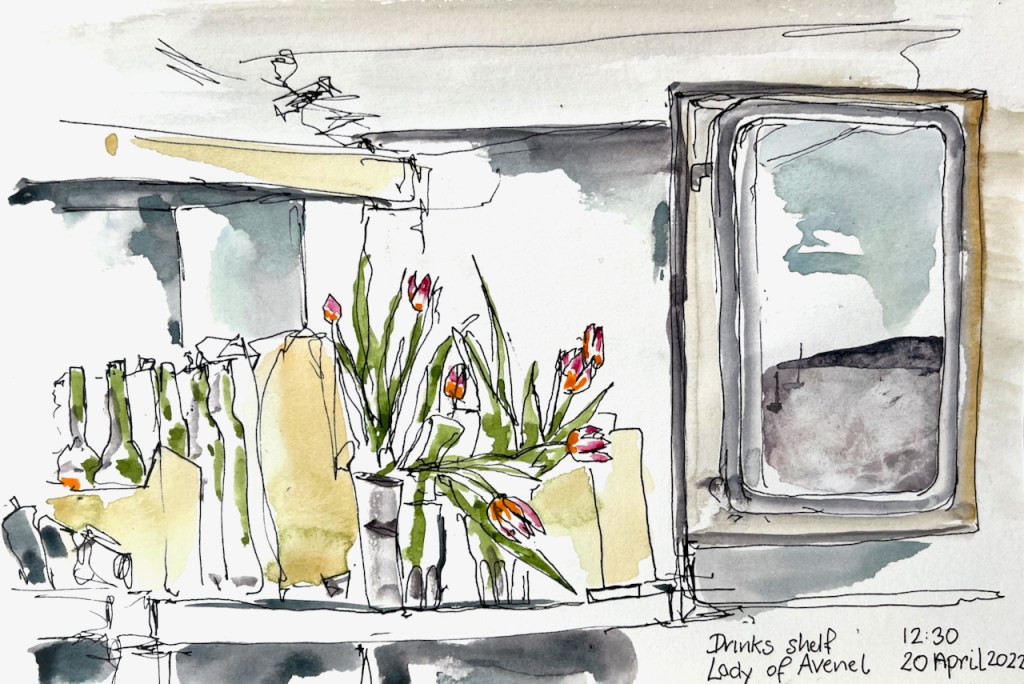
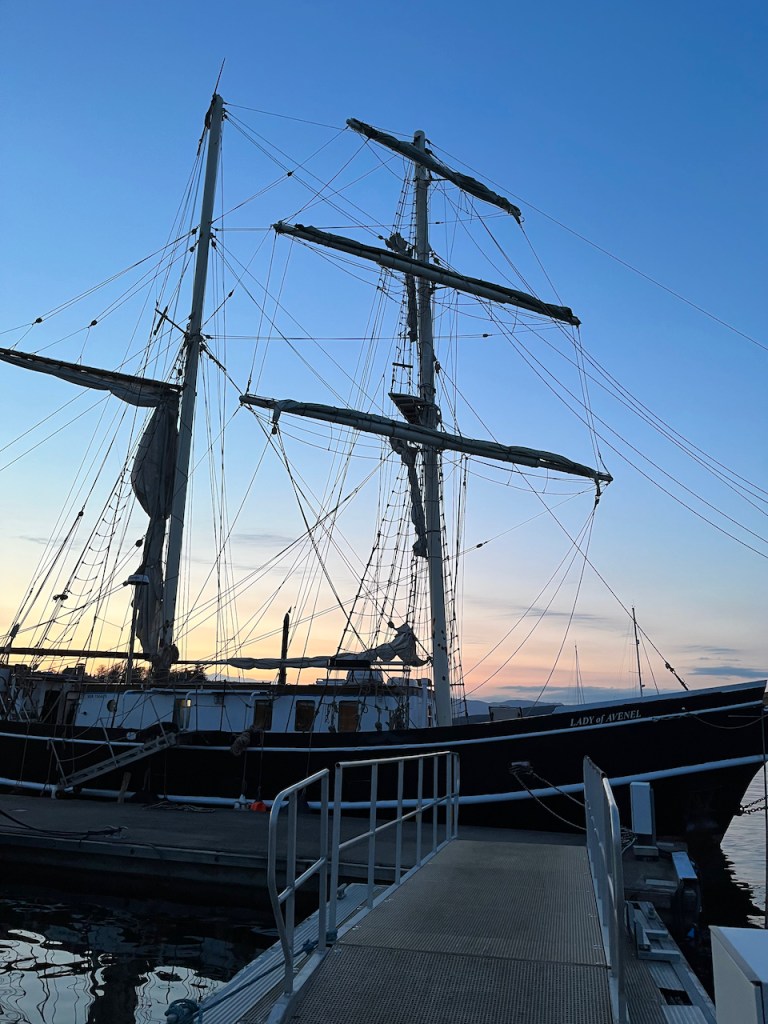
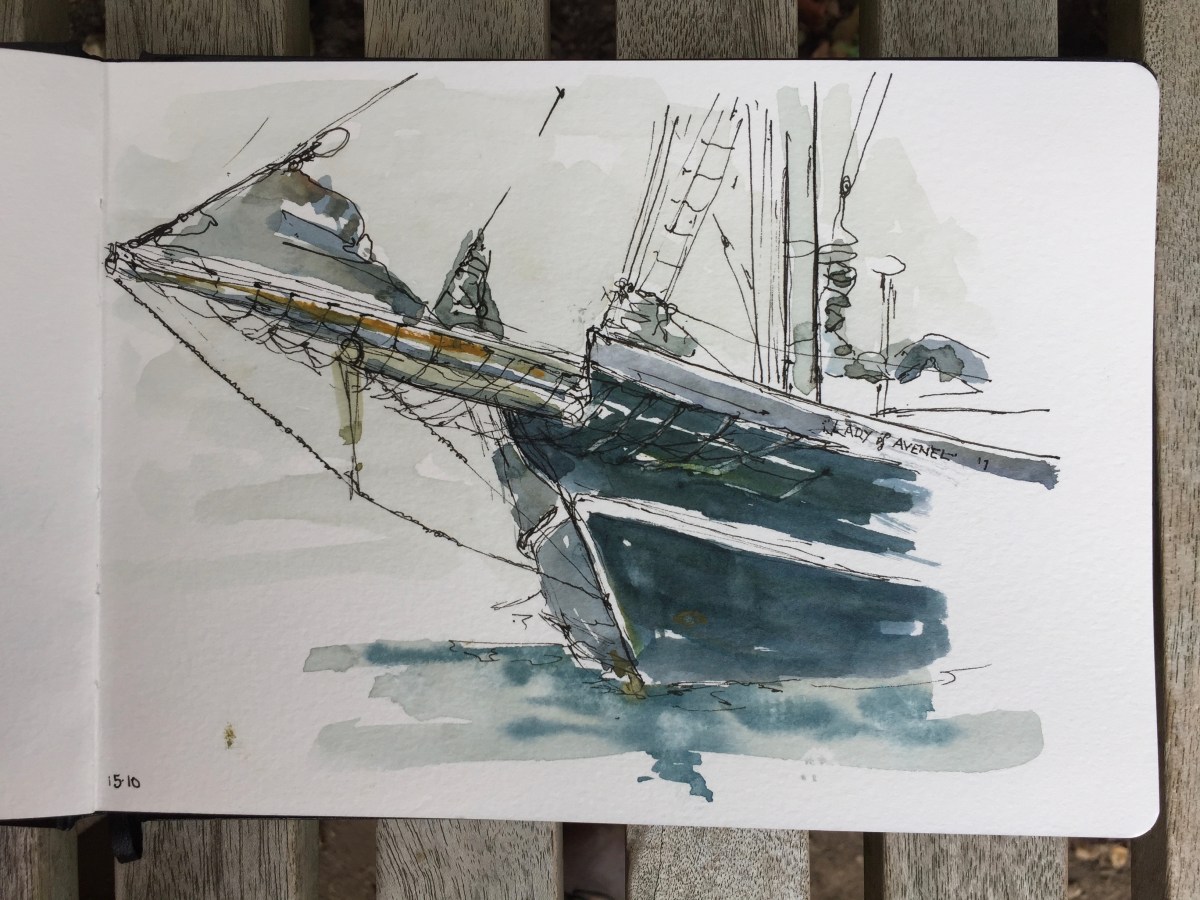
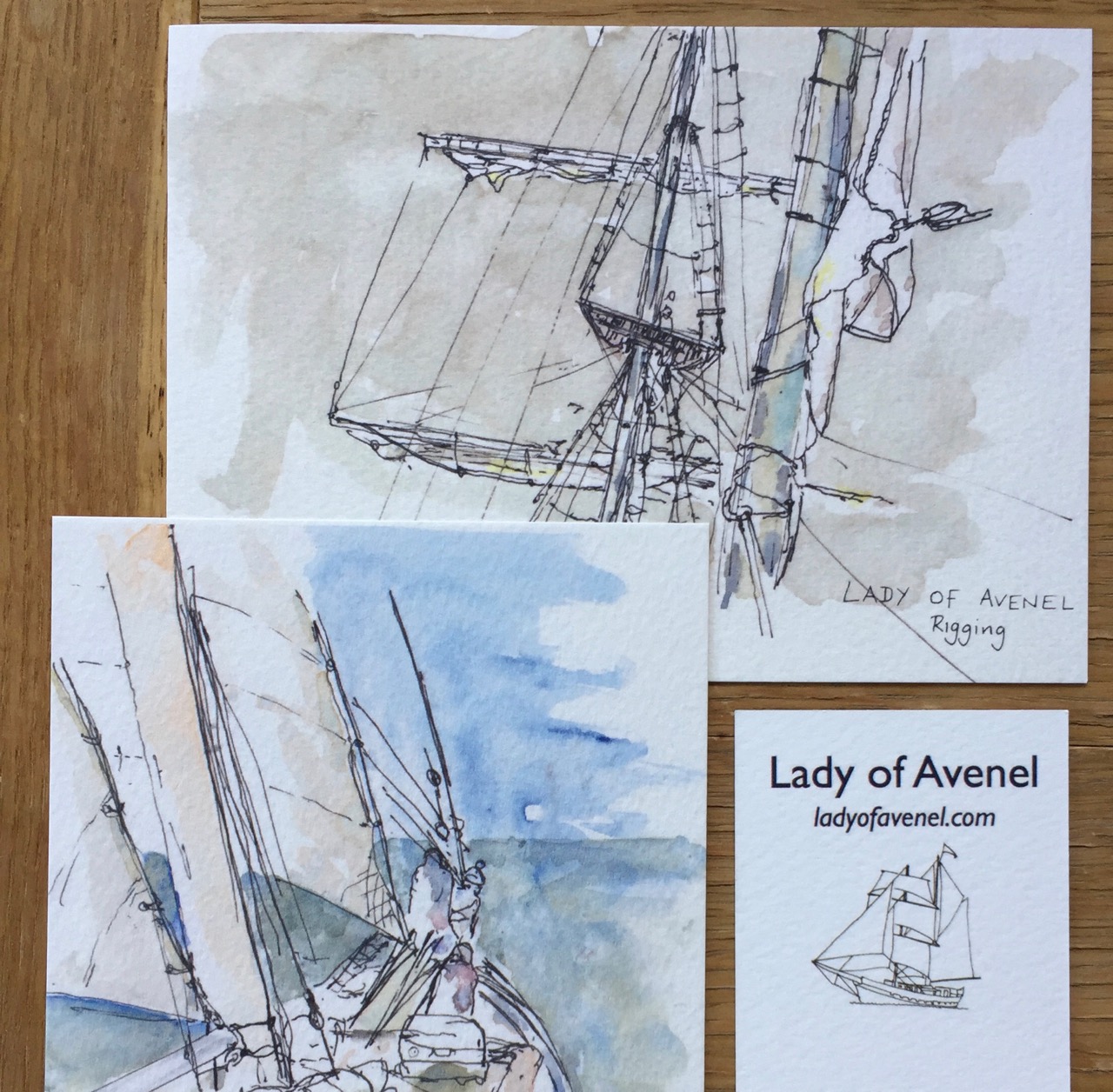
The Lady of Avenel is an 102ft square rigged brigantine, currently based near Oban, on the west coast of Scotland.

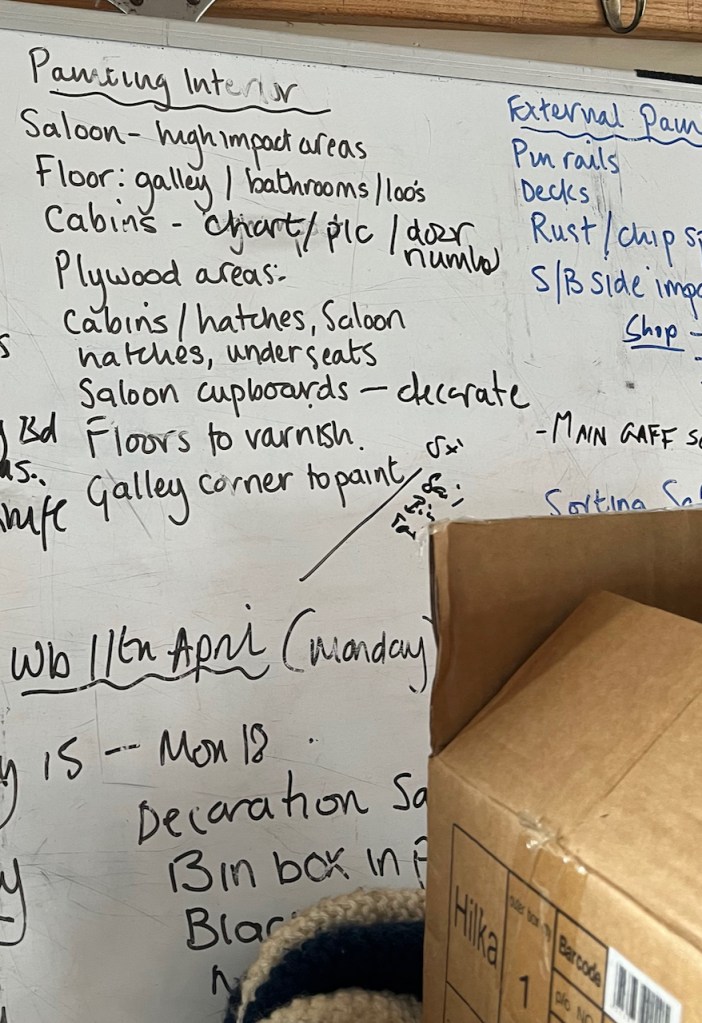
Every year the Lady of Avenel needs a refit to prepare her for her working season. This year I went up there to join the working party for the refit.

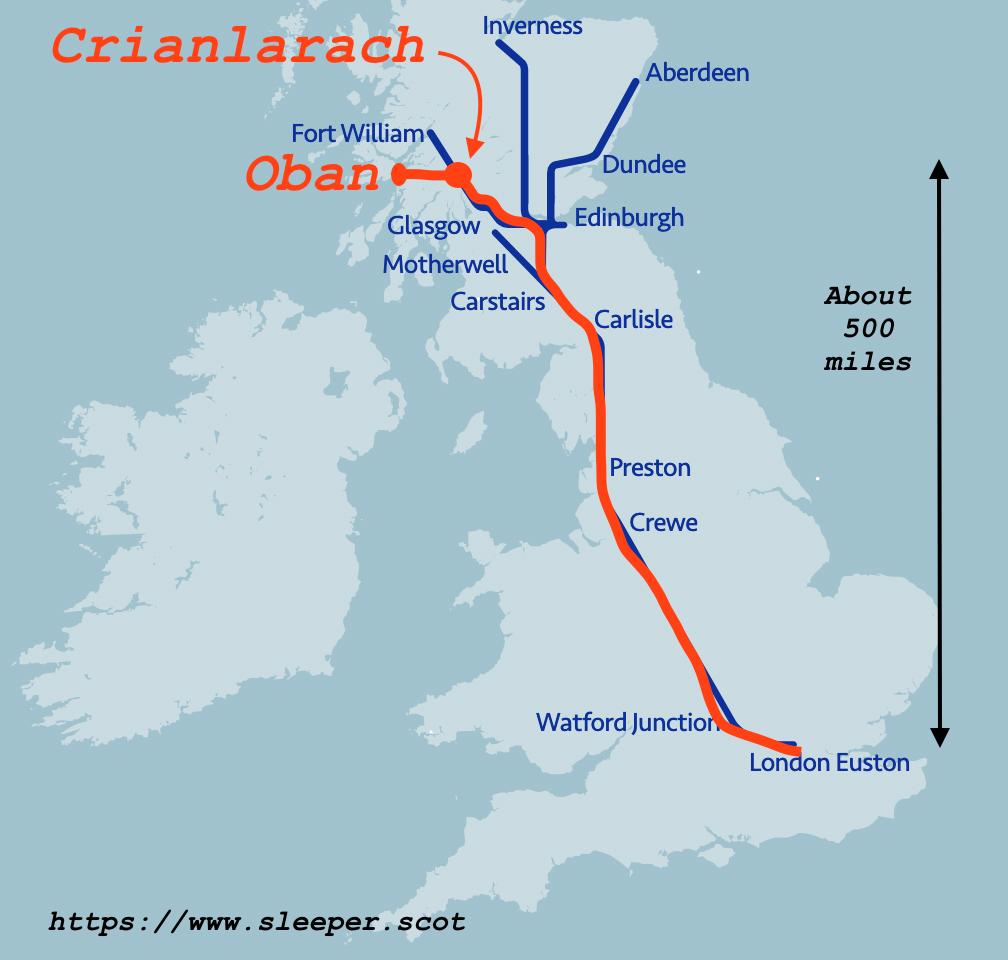
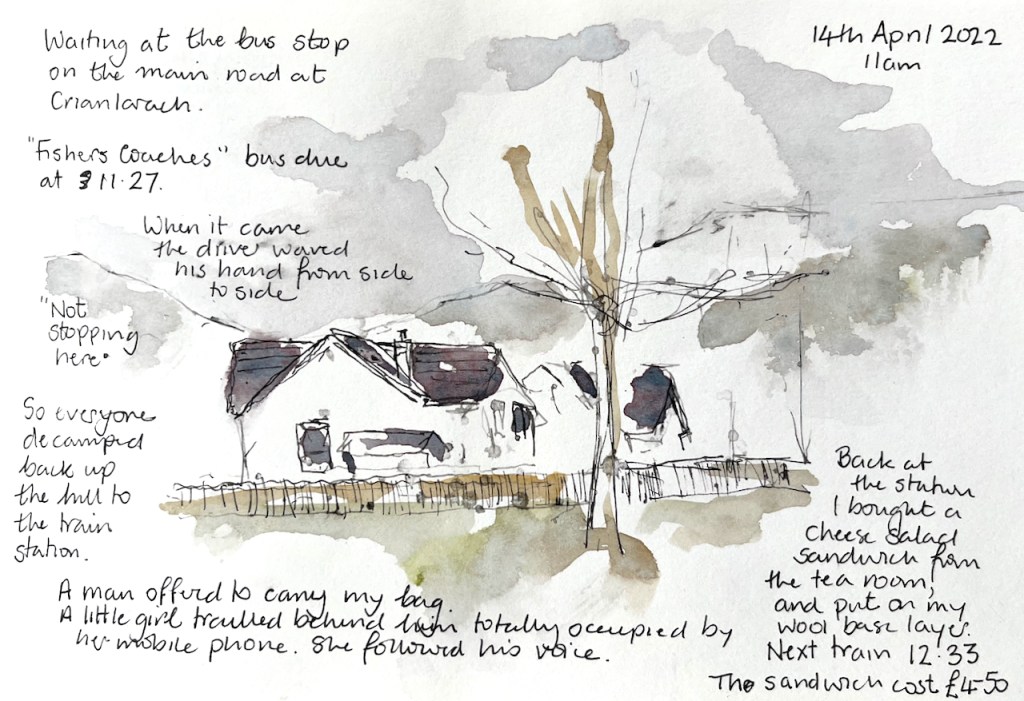
I travelled by overnight train from Euston to Crianlarach.

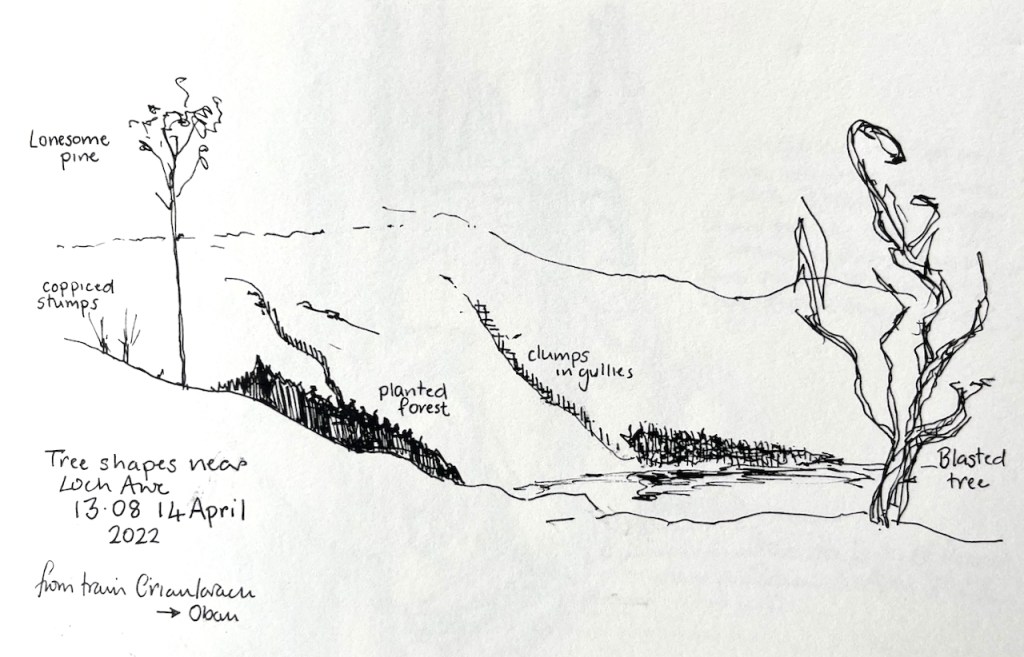
Journey via the Caledonian Sleeper from London to Oban. Map from the Caledonian Sleeper webpage. The overnight journey takes about 10 hours Euston-Crianlarach. Then I caught a local train Crianlarach to Oban.

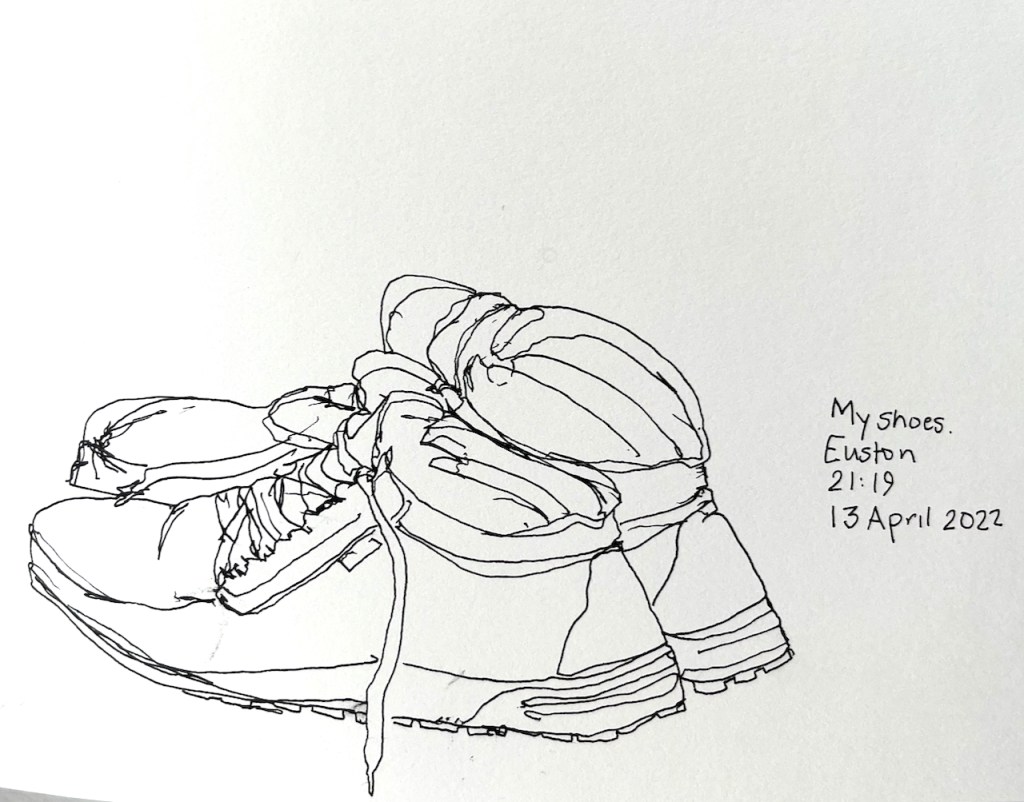
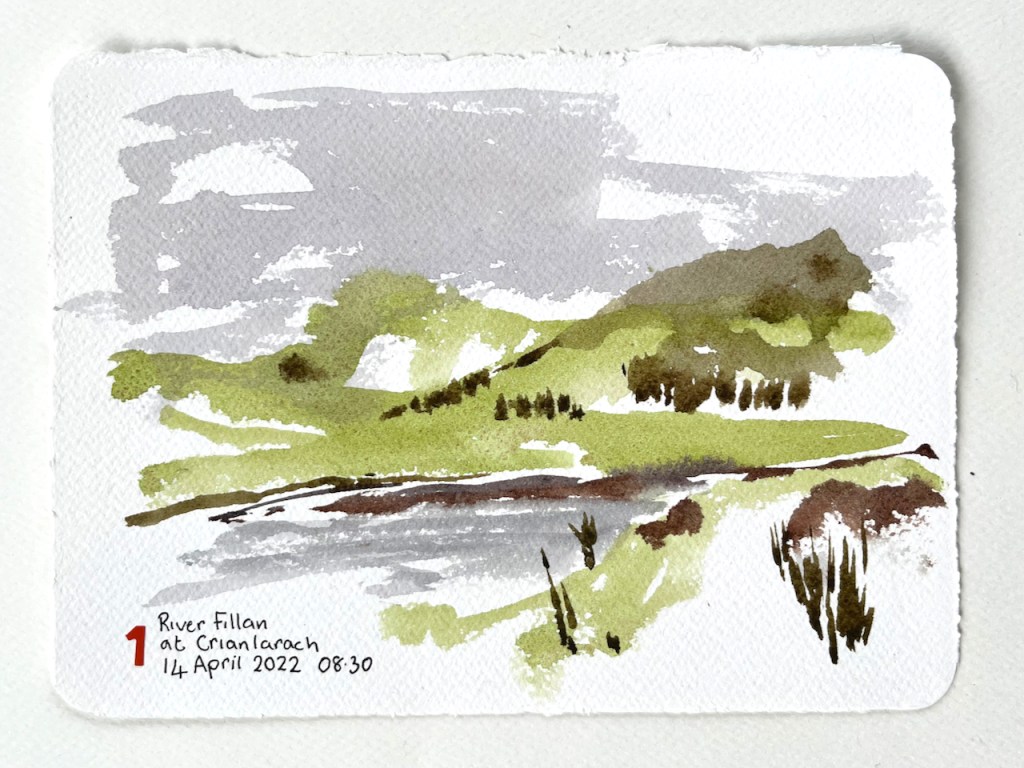
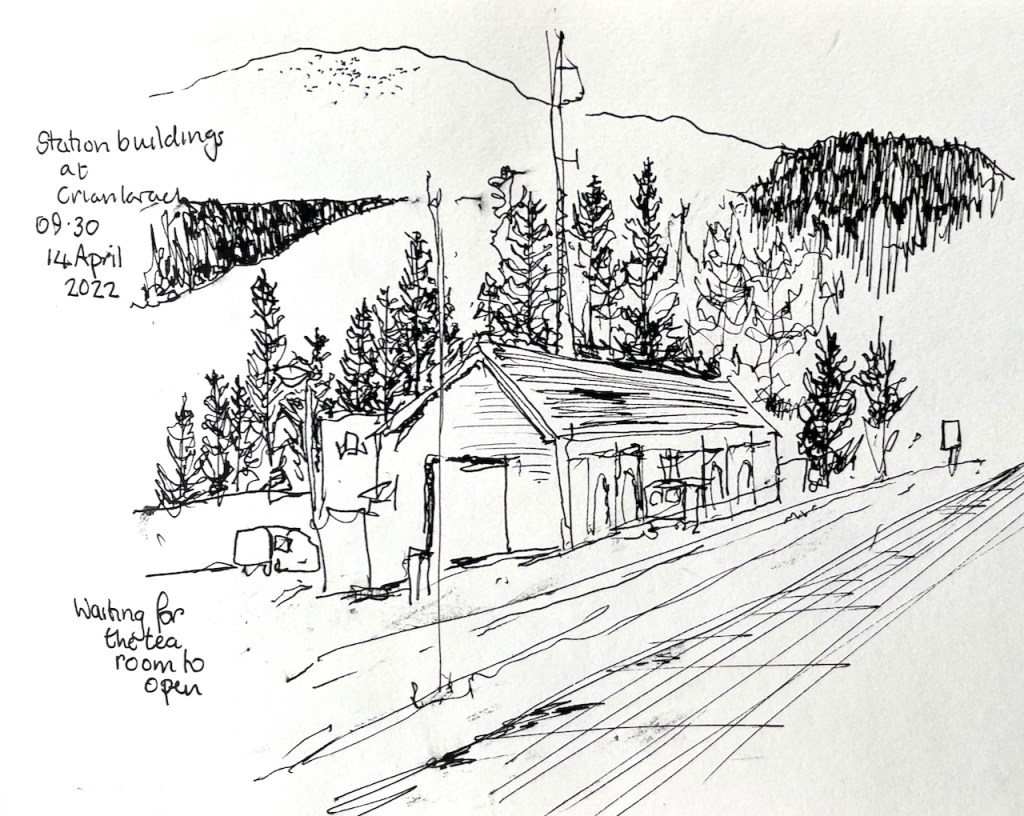
I drew some sketches on the journey.

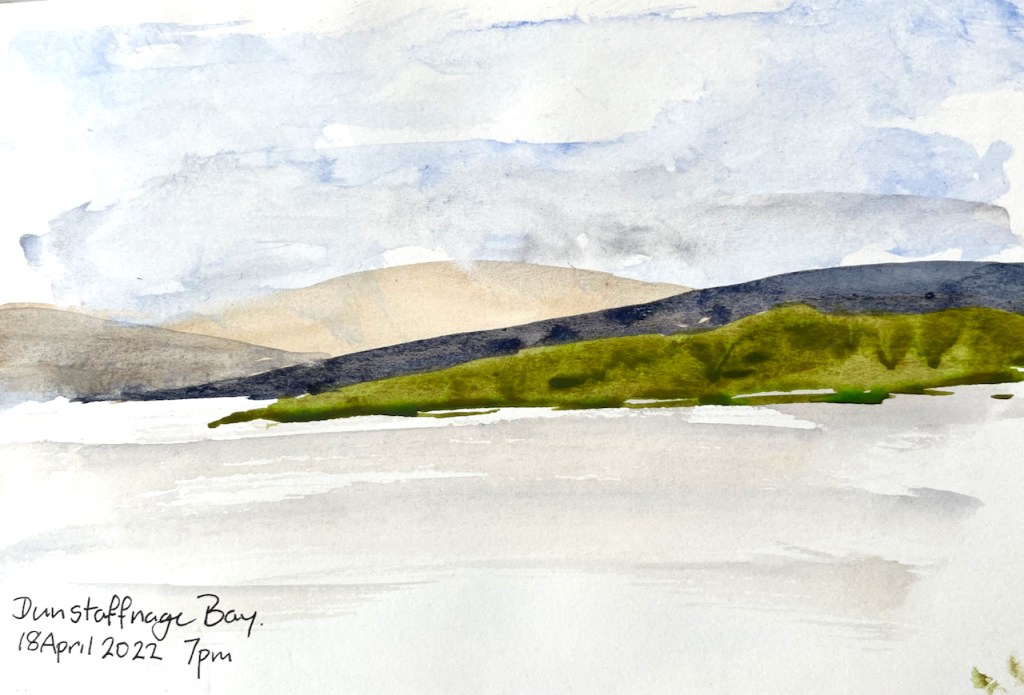
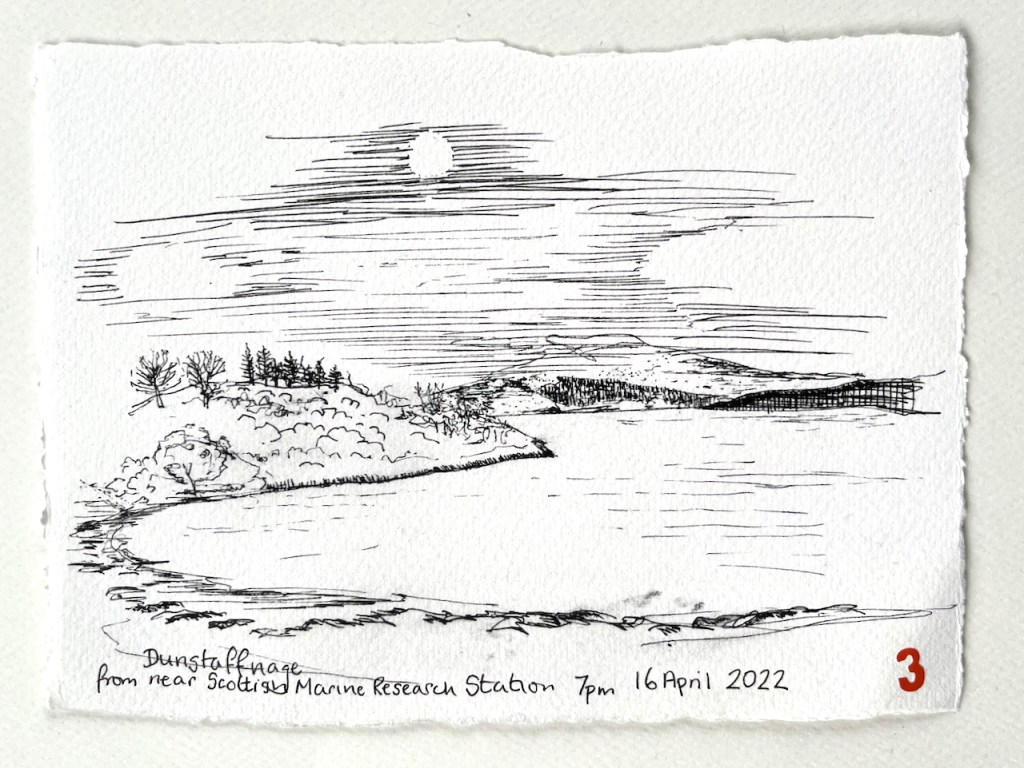
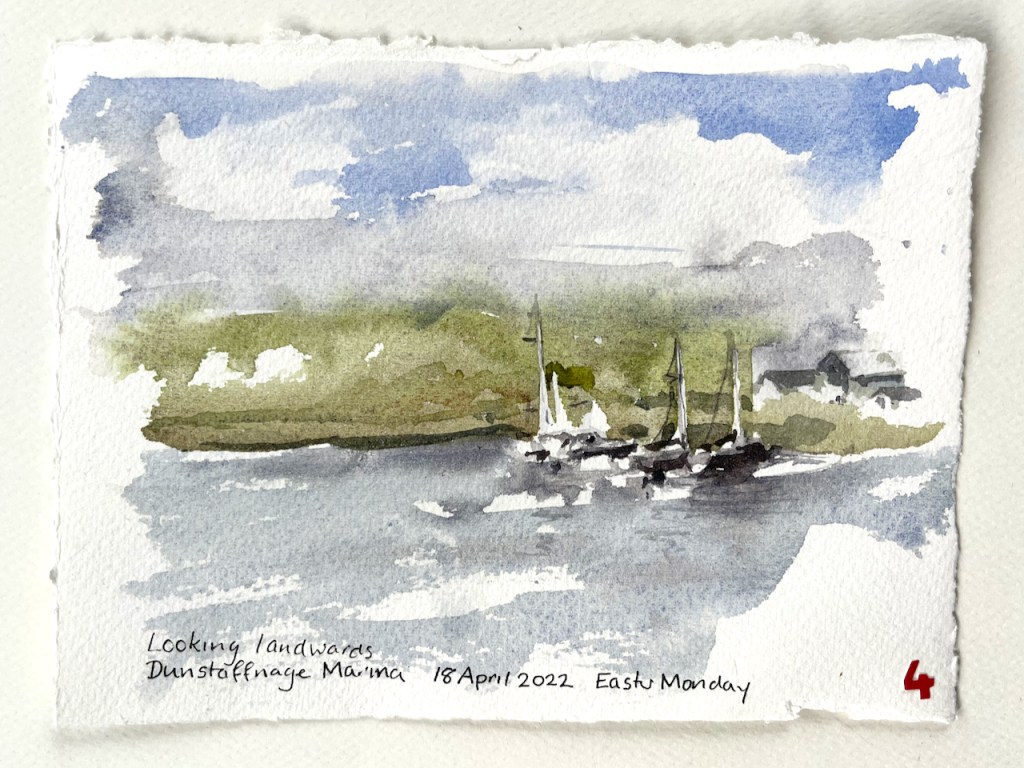
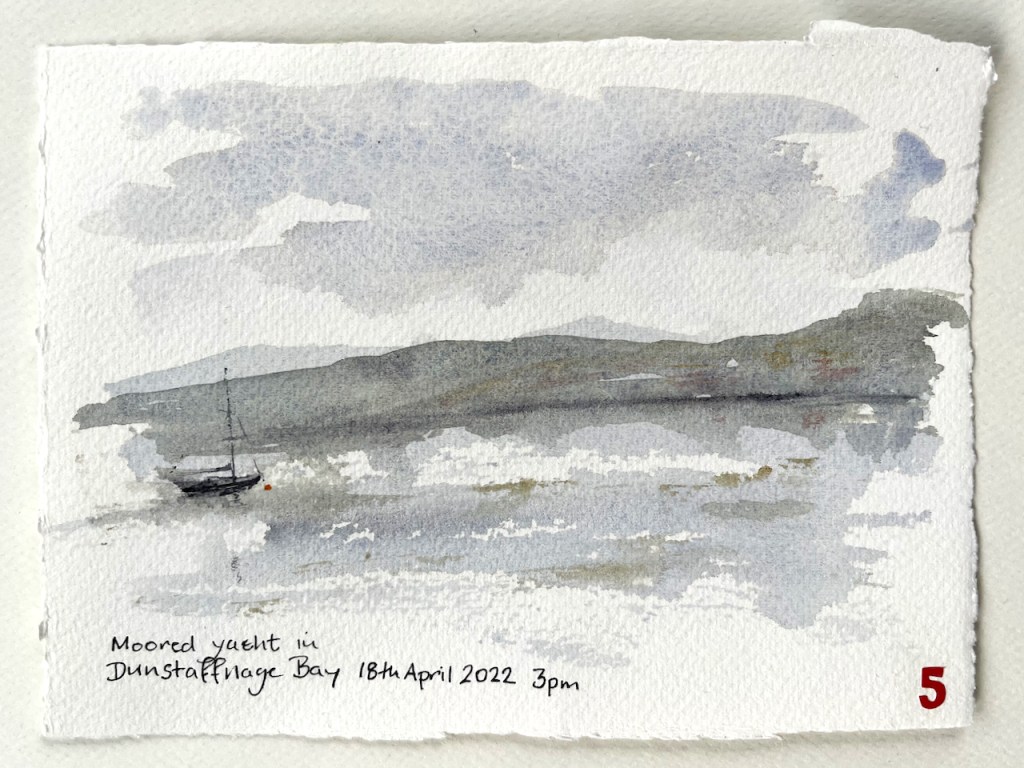
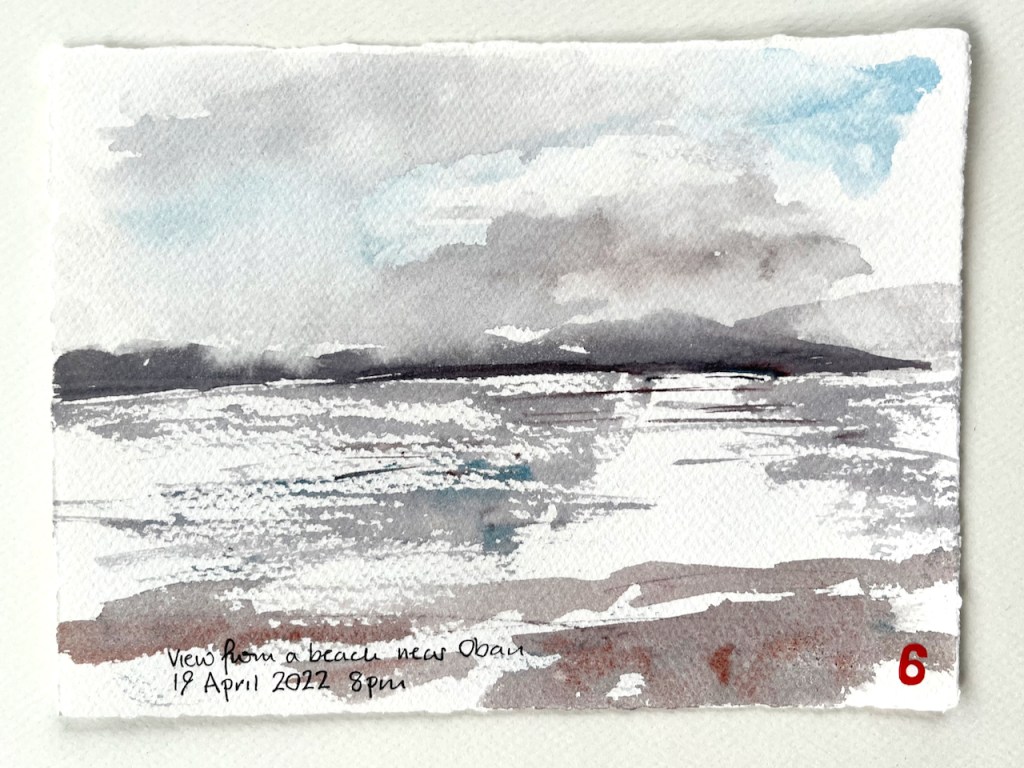
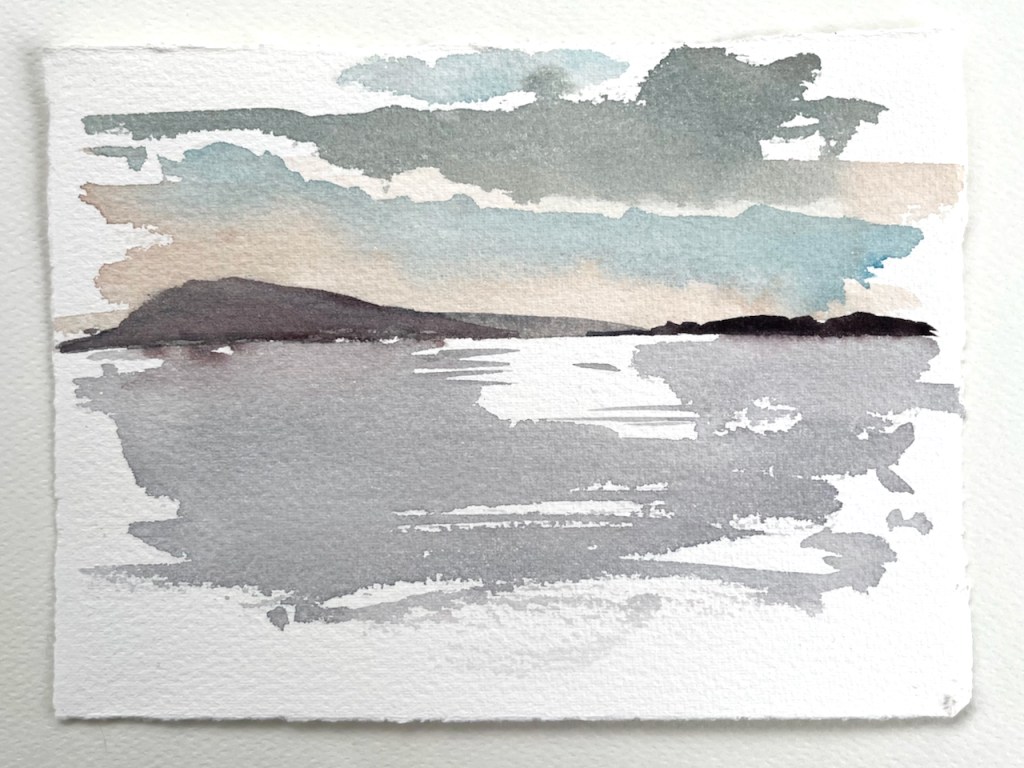
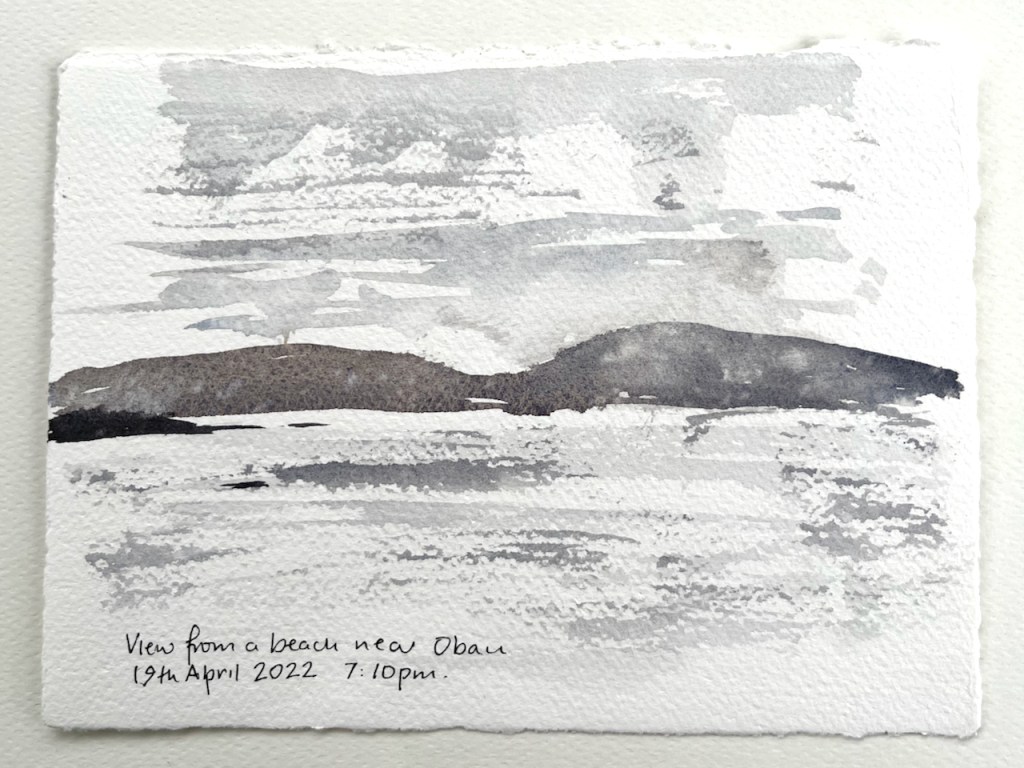
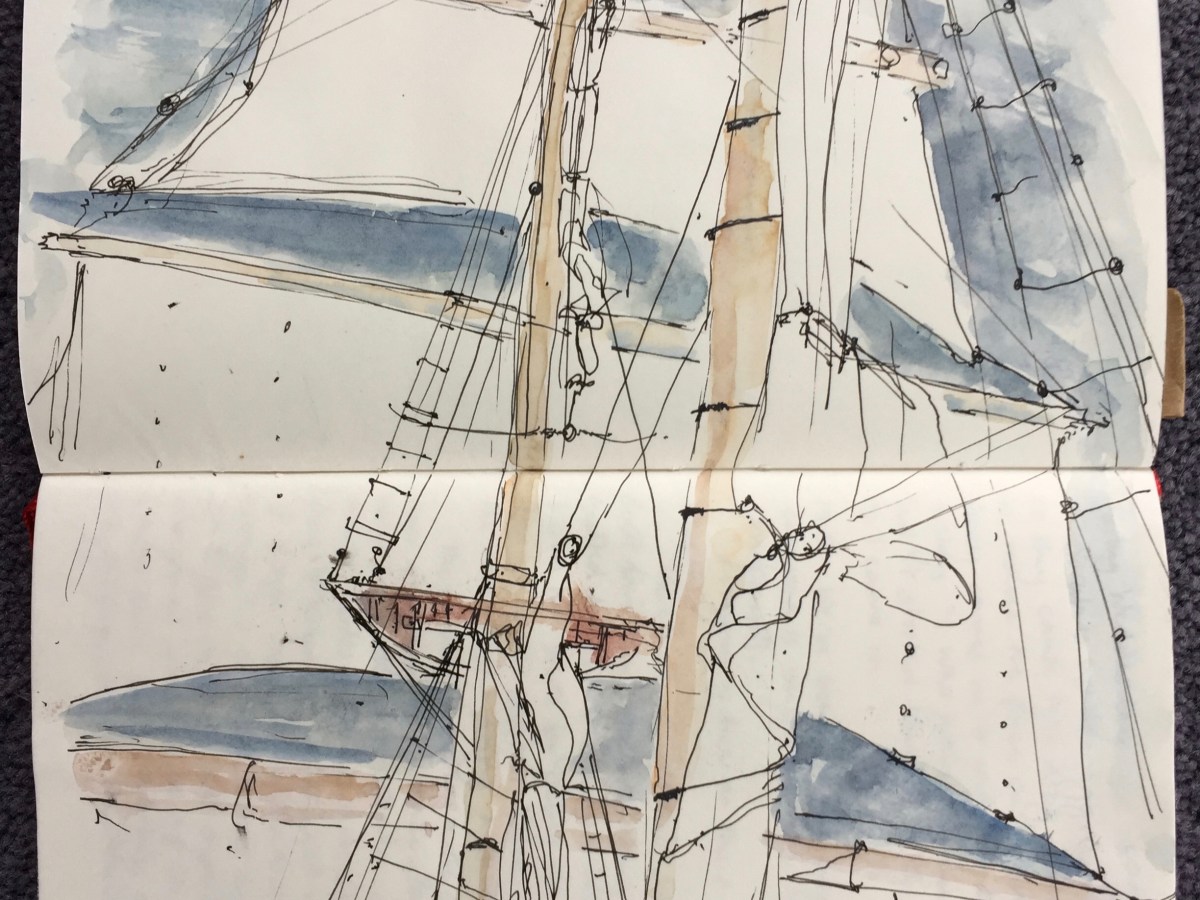
The boat was at Dunstaffnage Marina. In between work sessions I drew some pictures.

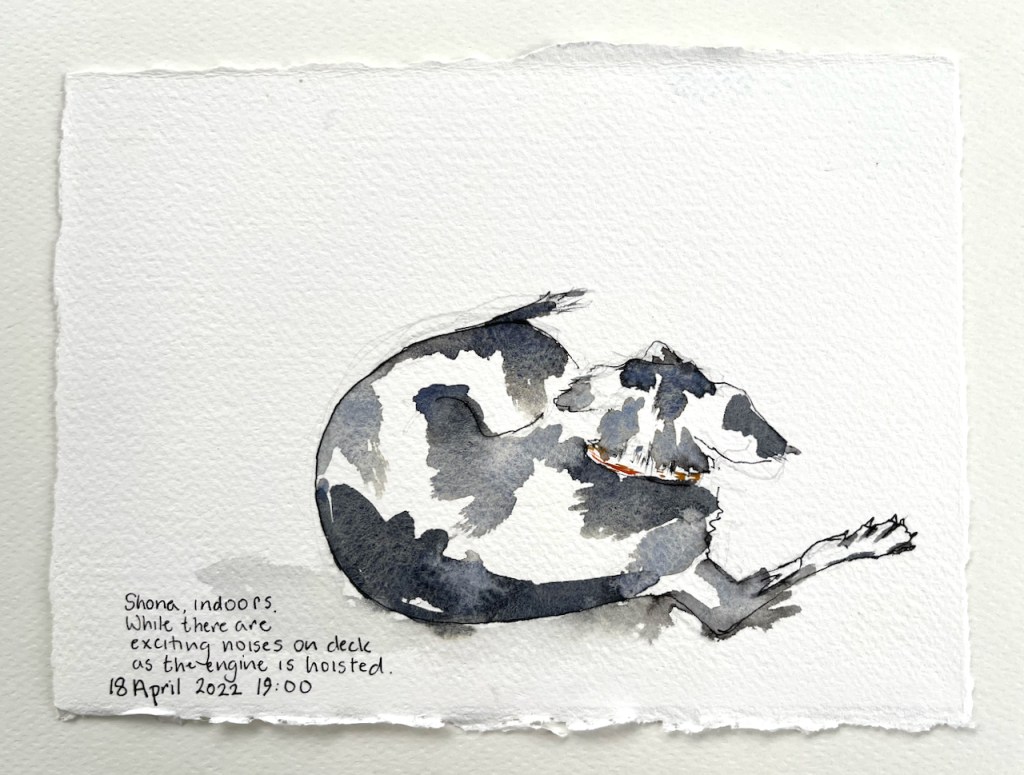
On the boat was a sea dog, Shona. She had to be locked indoors while crew members were hoisting the engine out. I was not part of the engine-hoisting gang. So I kept the dog company and drew her picture.

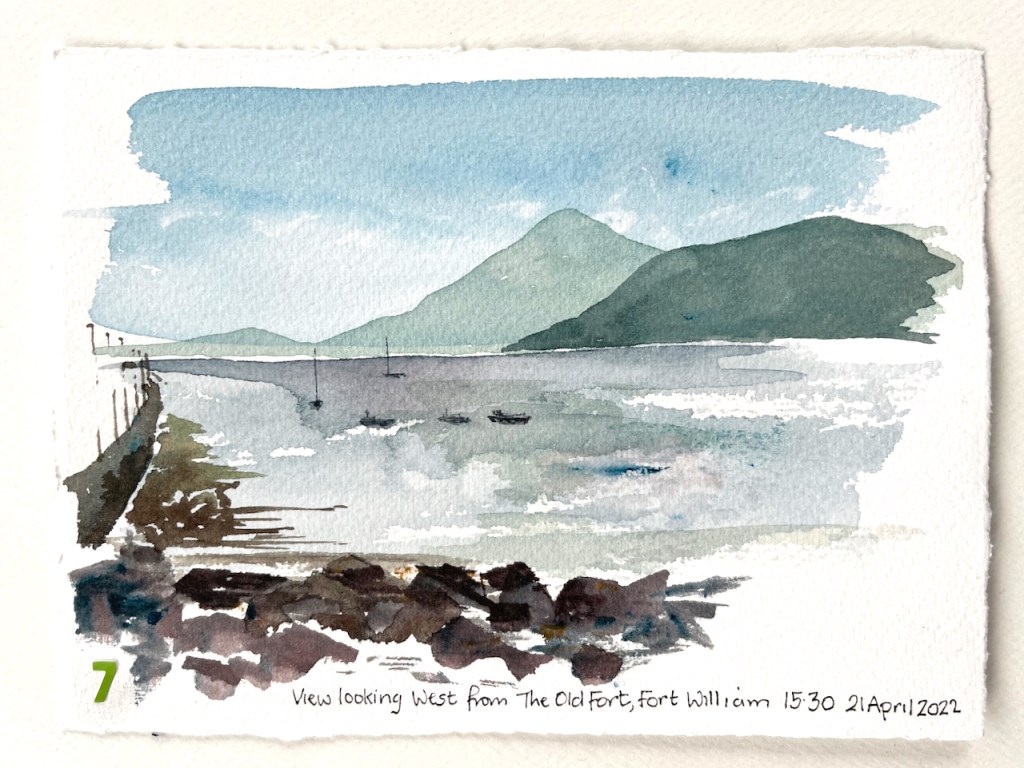
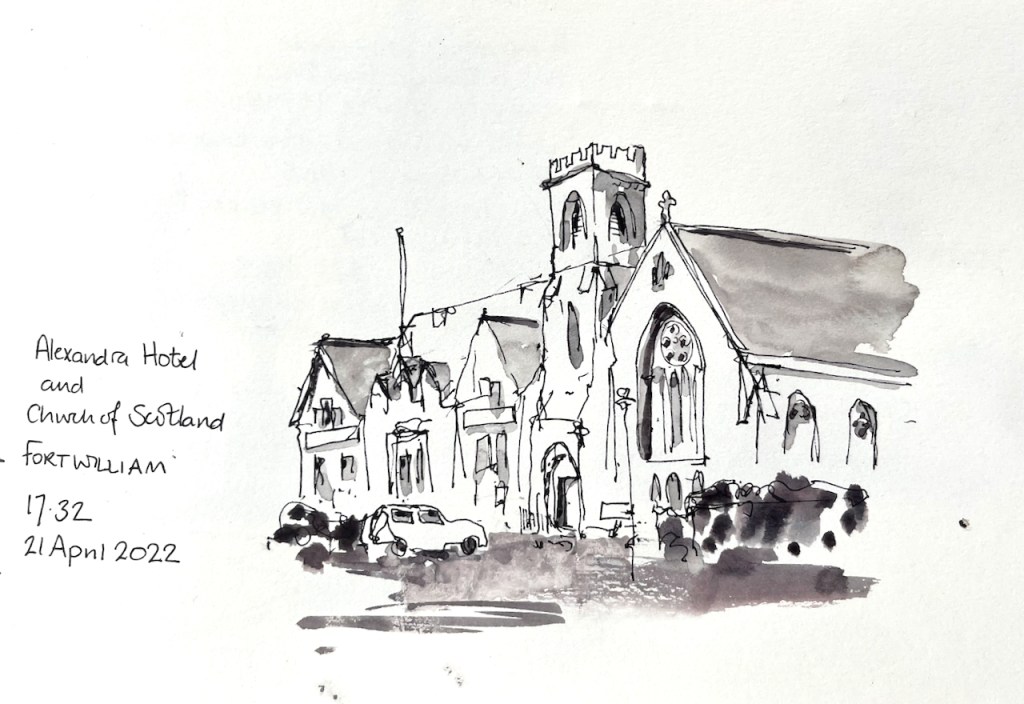
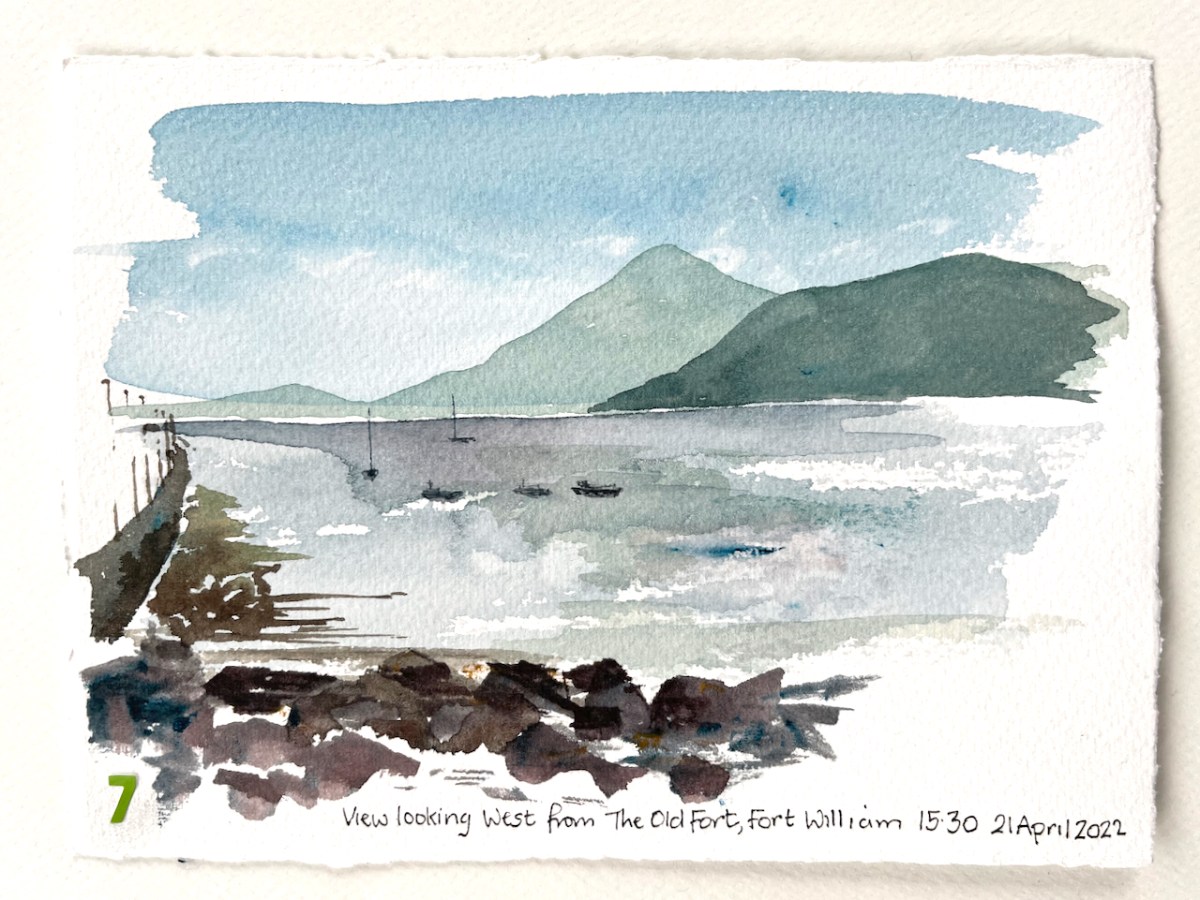
I travelled back via Fort William. The High Street caters for climbers and walkers and has a large number of shops stocking all brands of outdoor gear. I examined some of them, then rested by the Old Fort.

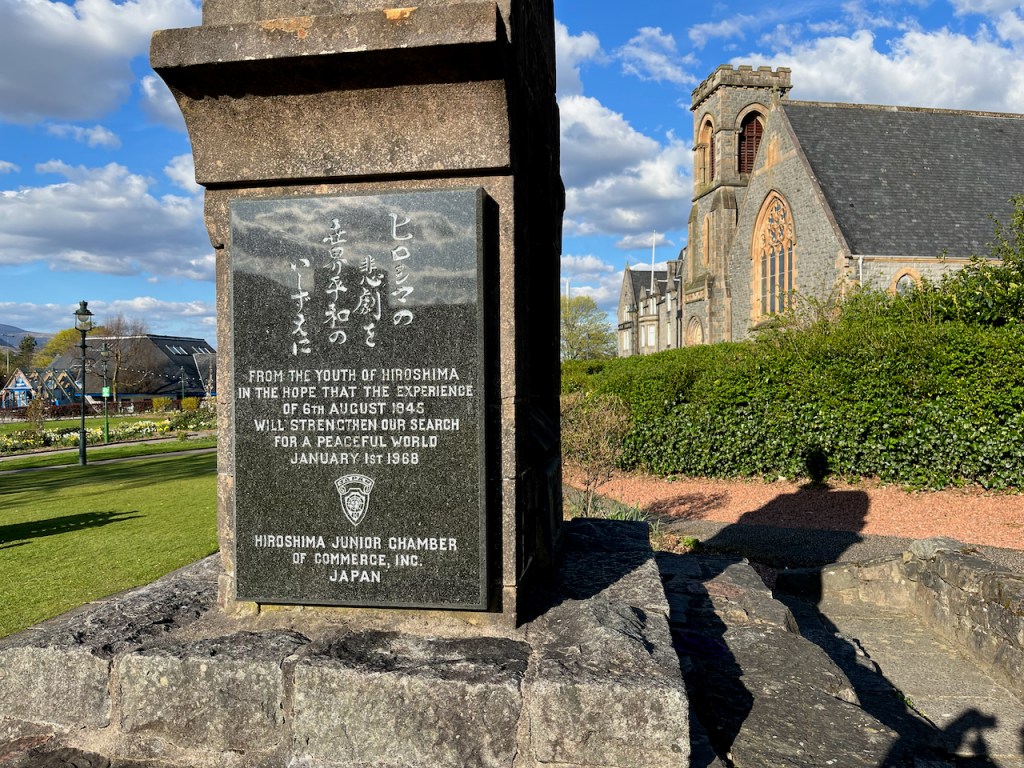
Near the train station there is a park with several war memorials, and a poignant plaque from the young people of Hiroshima:

“From the youth of Hiroshima in the hope that the experience of 6th August 1945 will strengthen our search for a peaceful world. January 1st 1968. Hiroshima Junior Chamber of Commerce.”

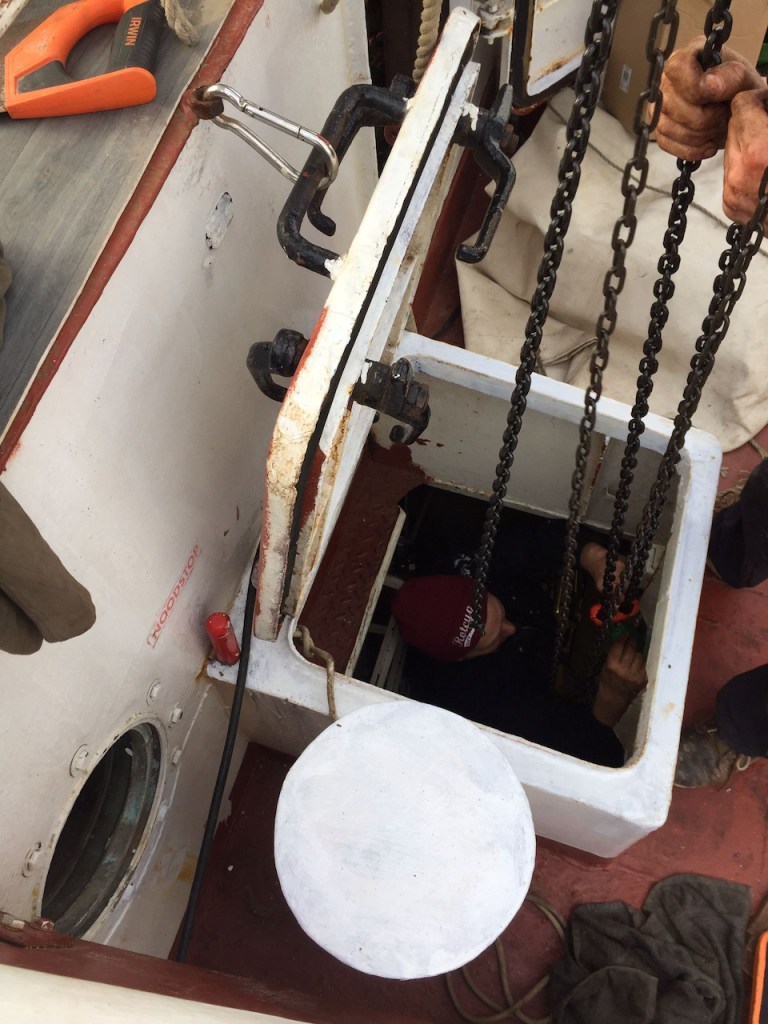
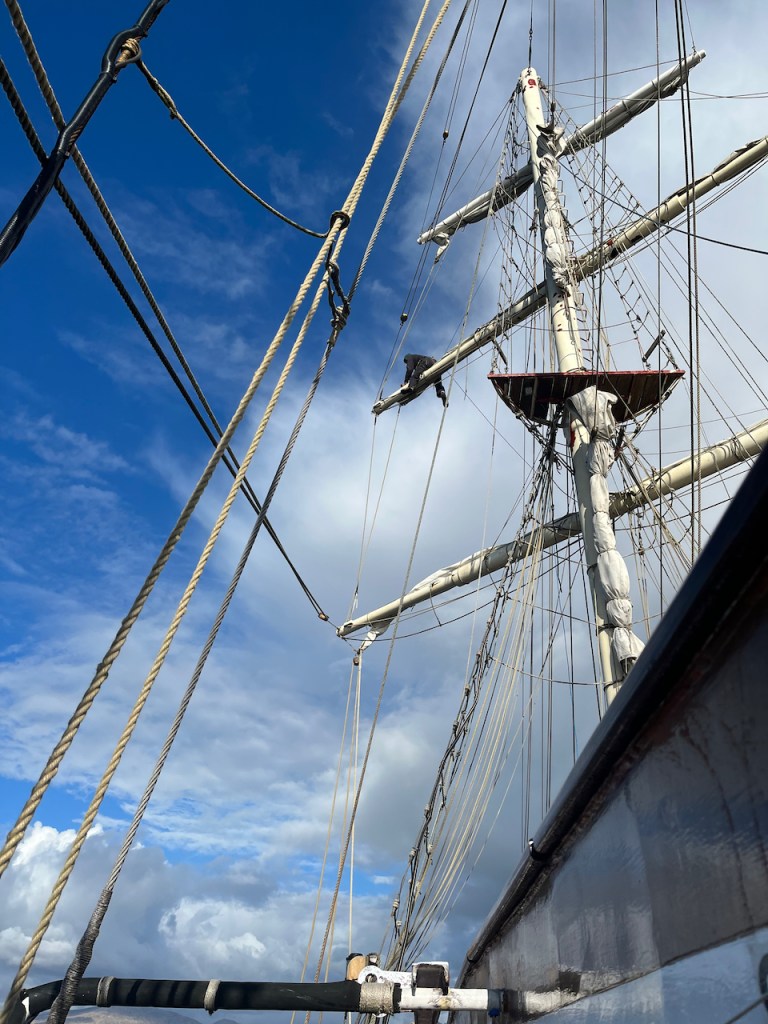
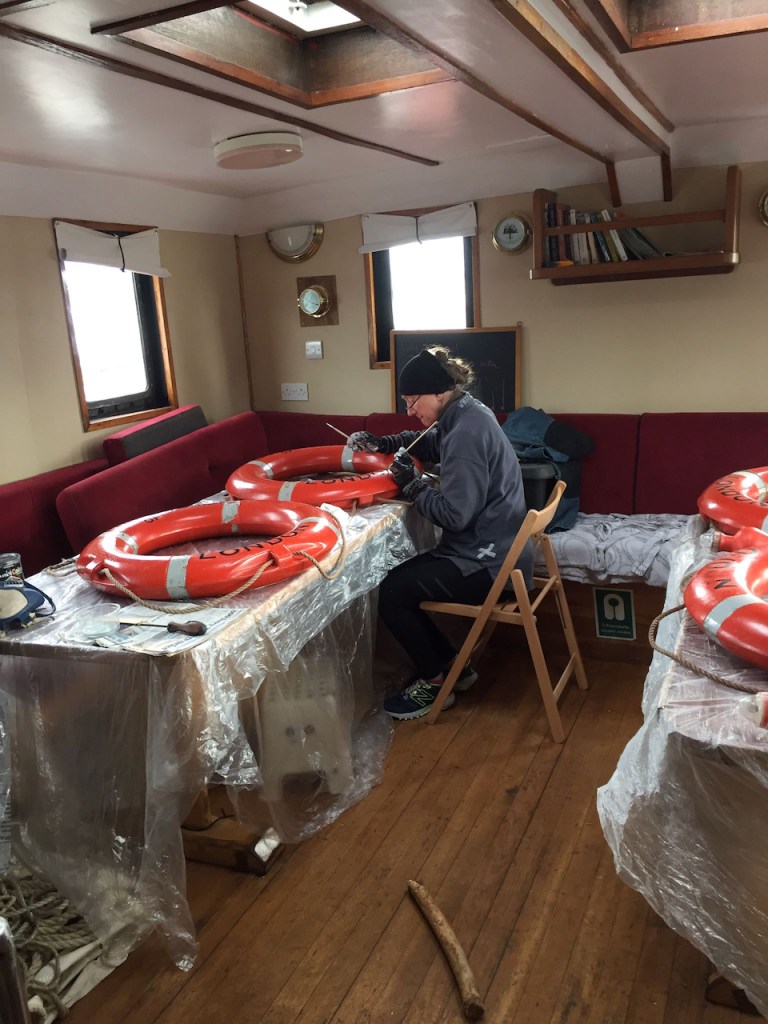
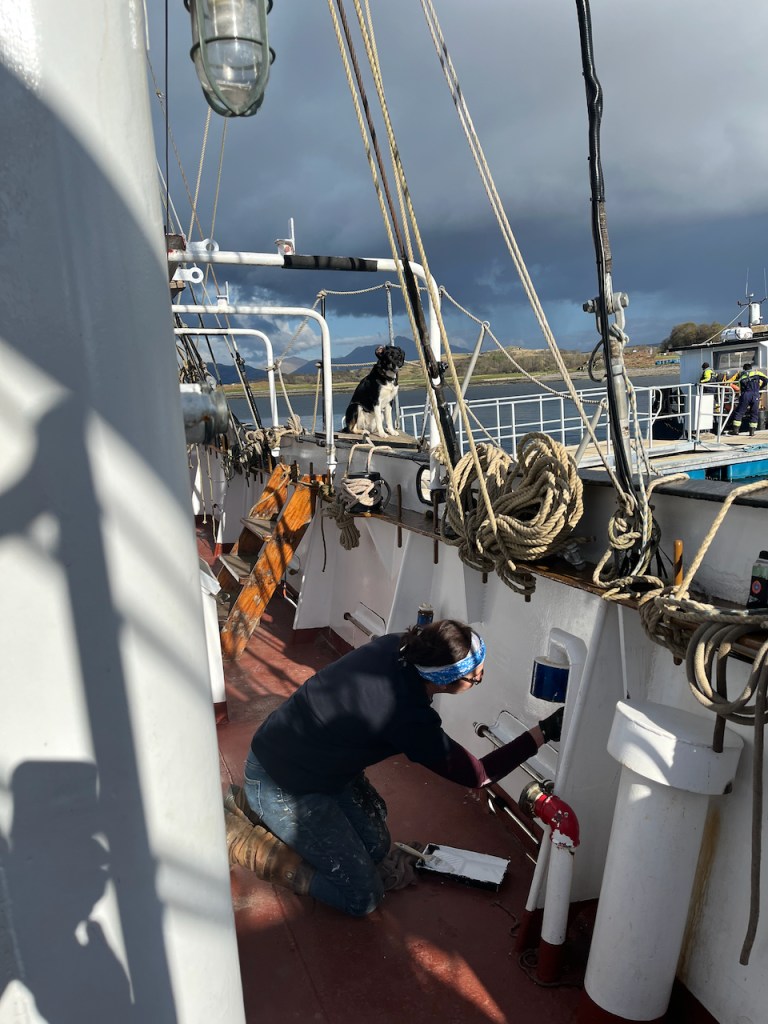
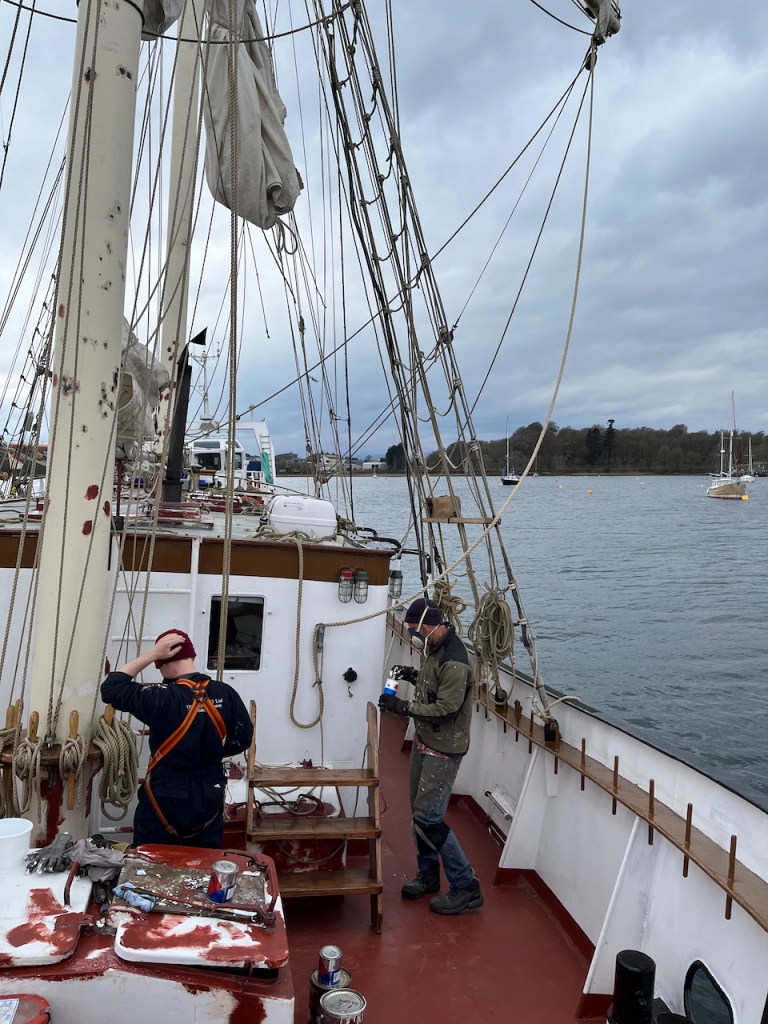
Here are a few photos of the Lady of Avenel during the refit.

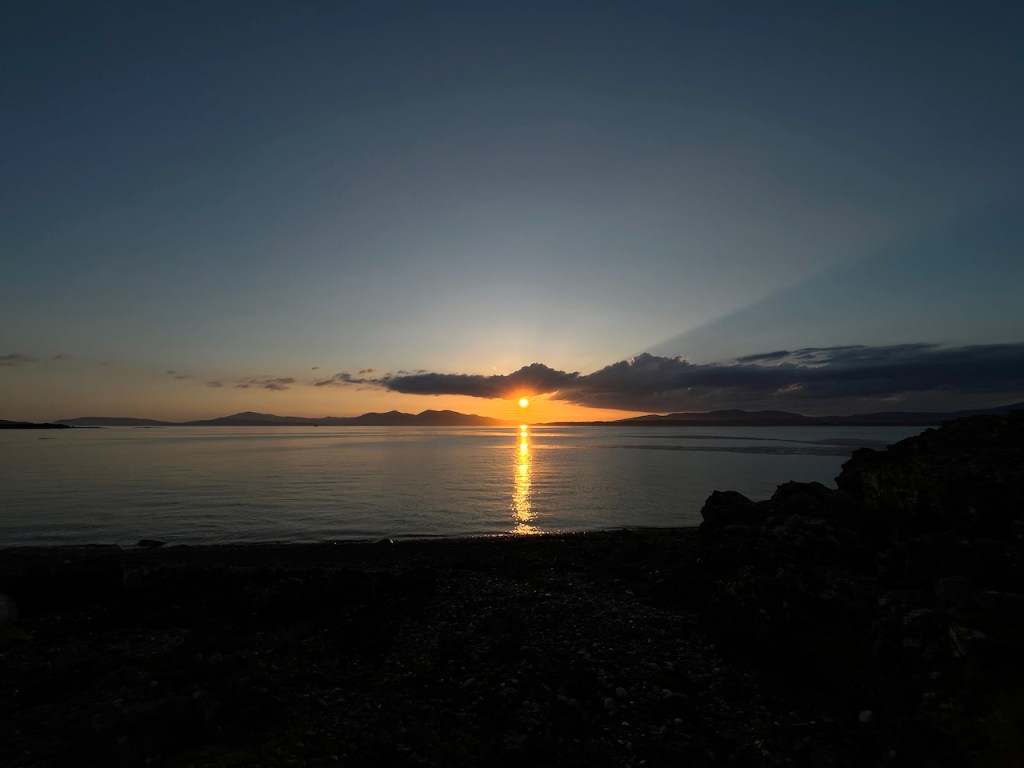
Scotland is beautiful.

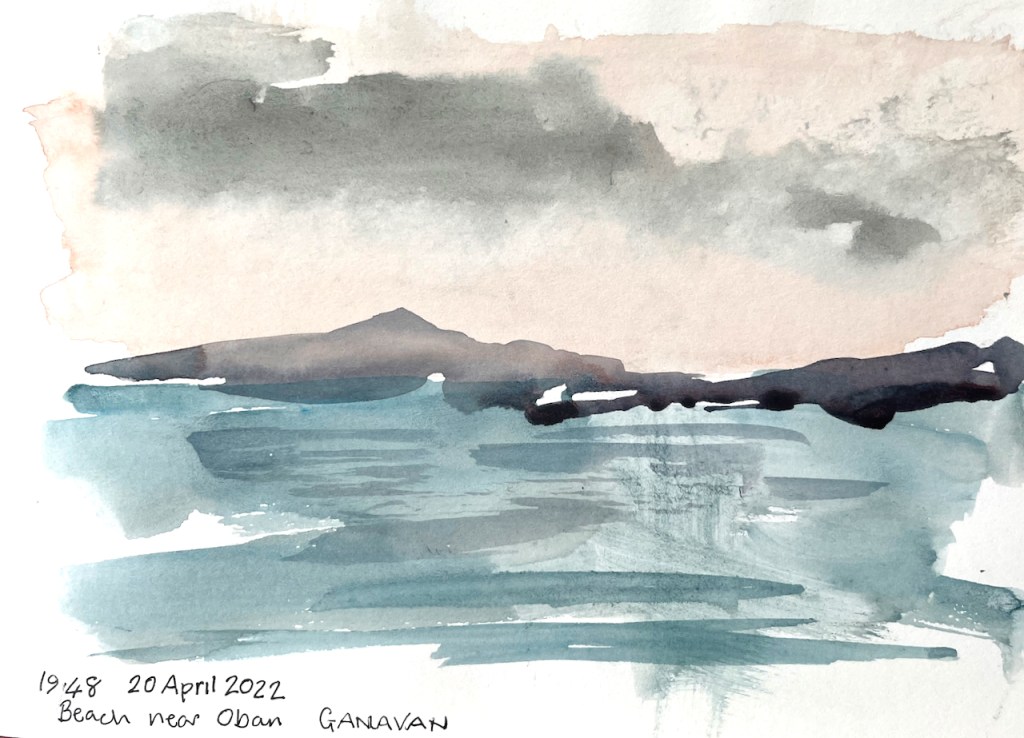
Sunset after a swim. Beach called “Ganavan” near Oban.

I have sailed on the Lady of Avenel in previous years:

Outer Hebrides 2017

I took my sketching things on a swimming expedition to the Outer Hebrides with Swimtrek. We were on the wonderful Lady of Avenel 102ft square rigged brigantine. We started in Oban. It was raining when I…

Read more…

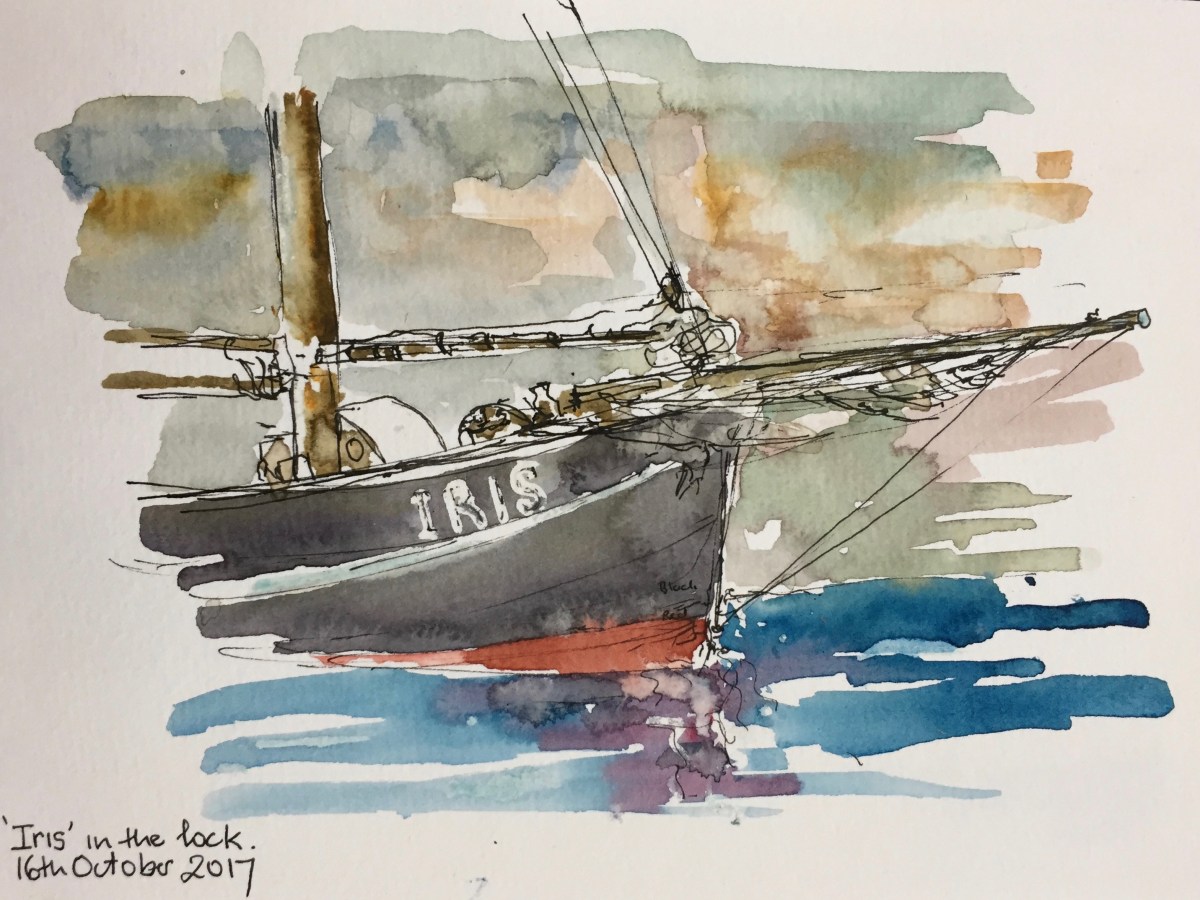
Lady of Avenel at Heybridge Basin

Here is Lady of Avenel, 102ft Brigantine. This was the third of three sketches. Here are the first two. I have drawn Lady of Avenel previously: Outer Hebrides 2017 See also these pages for pictures of and…

Read more…
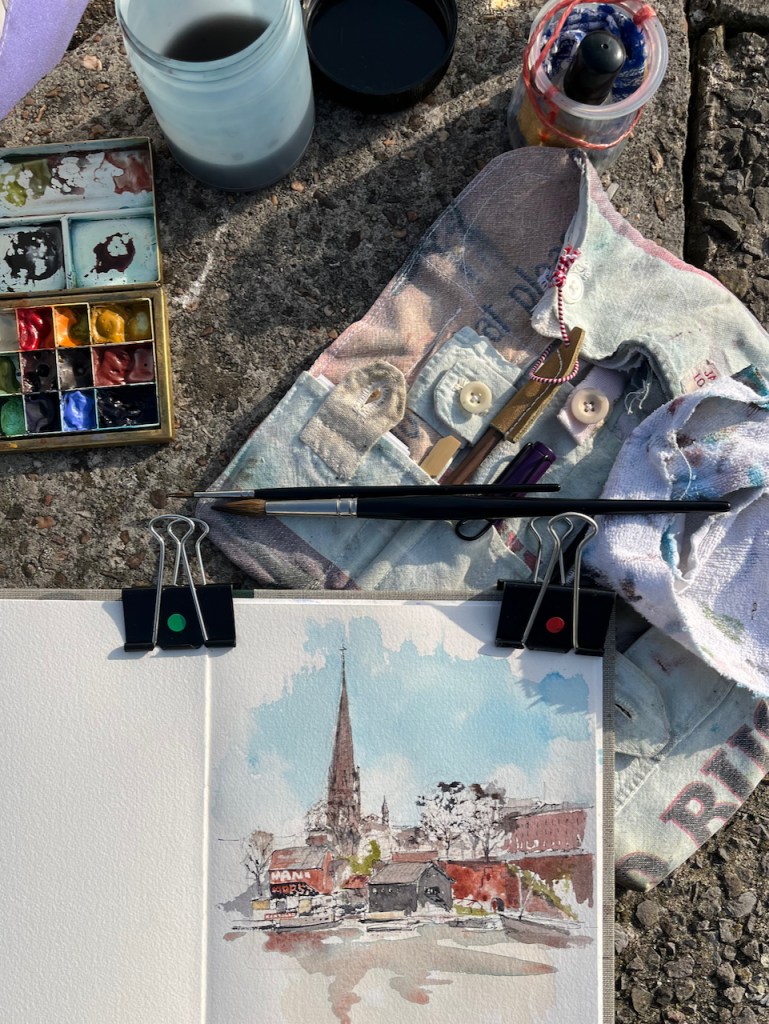
Sketch notes from maritime Holland

This is Noordermarkt, as seen from Café Hegeraad, in the Jordaan district of Amsterdam. It was a lovely autumn day, warm with a light breeze. I had the apple cake and a coffee. I had arrived from…

Read more…

I’ve written about my experiences of sketching and swimming here:

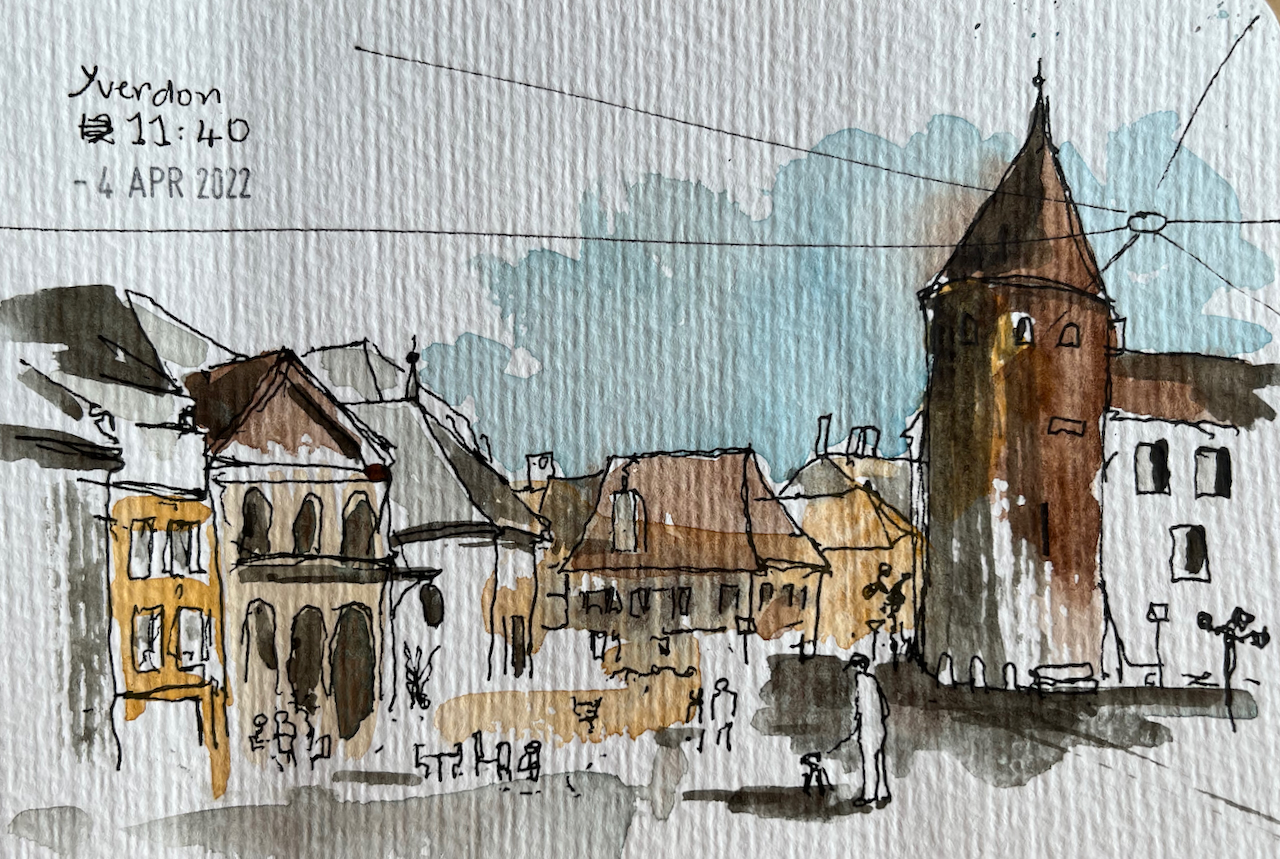
Sketches in Switzerland – Spring 2022

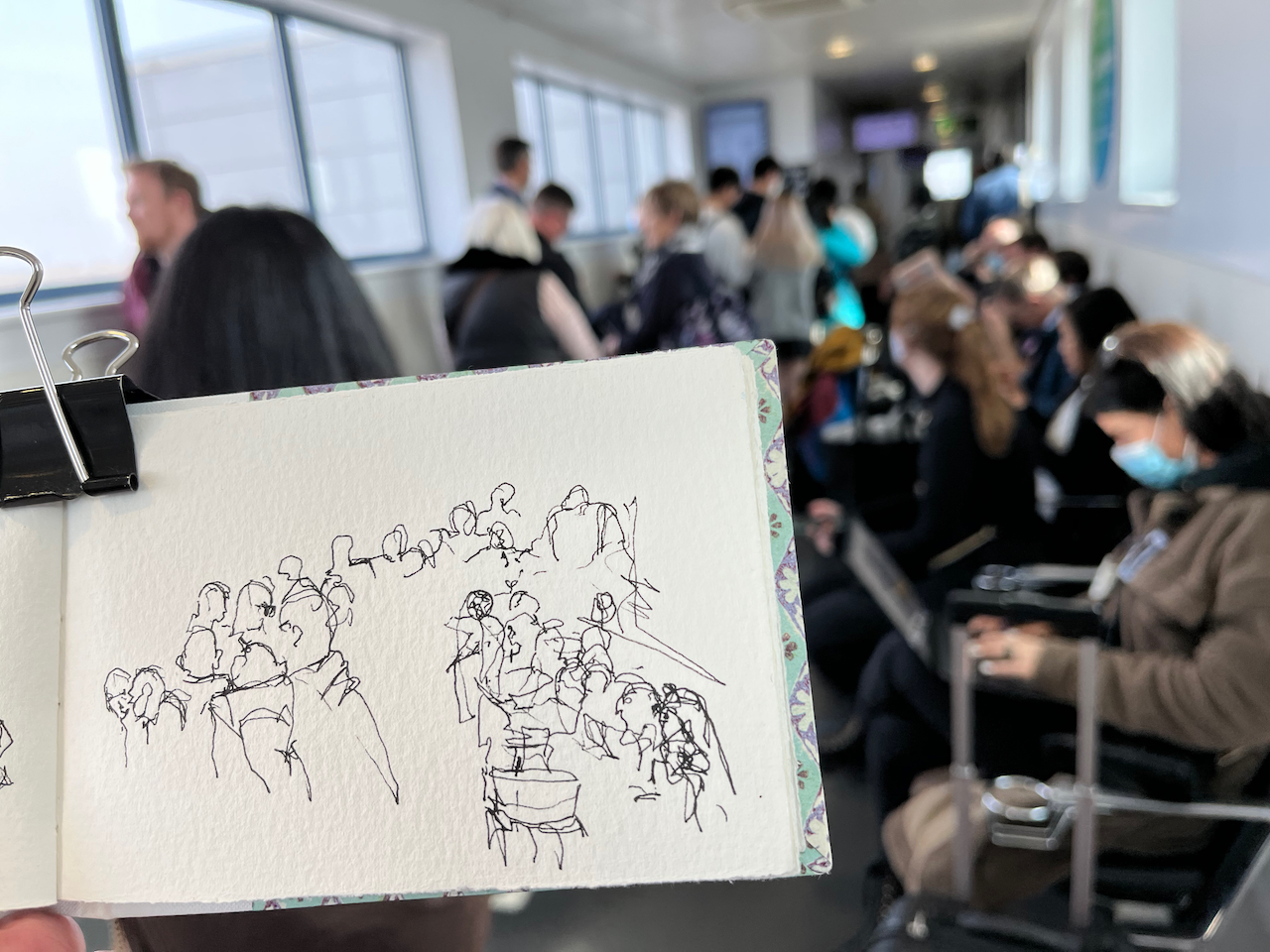
Waiting in London City airport…

Breakfast…

Looking out of the window…

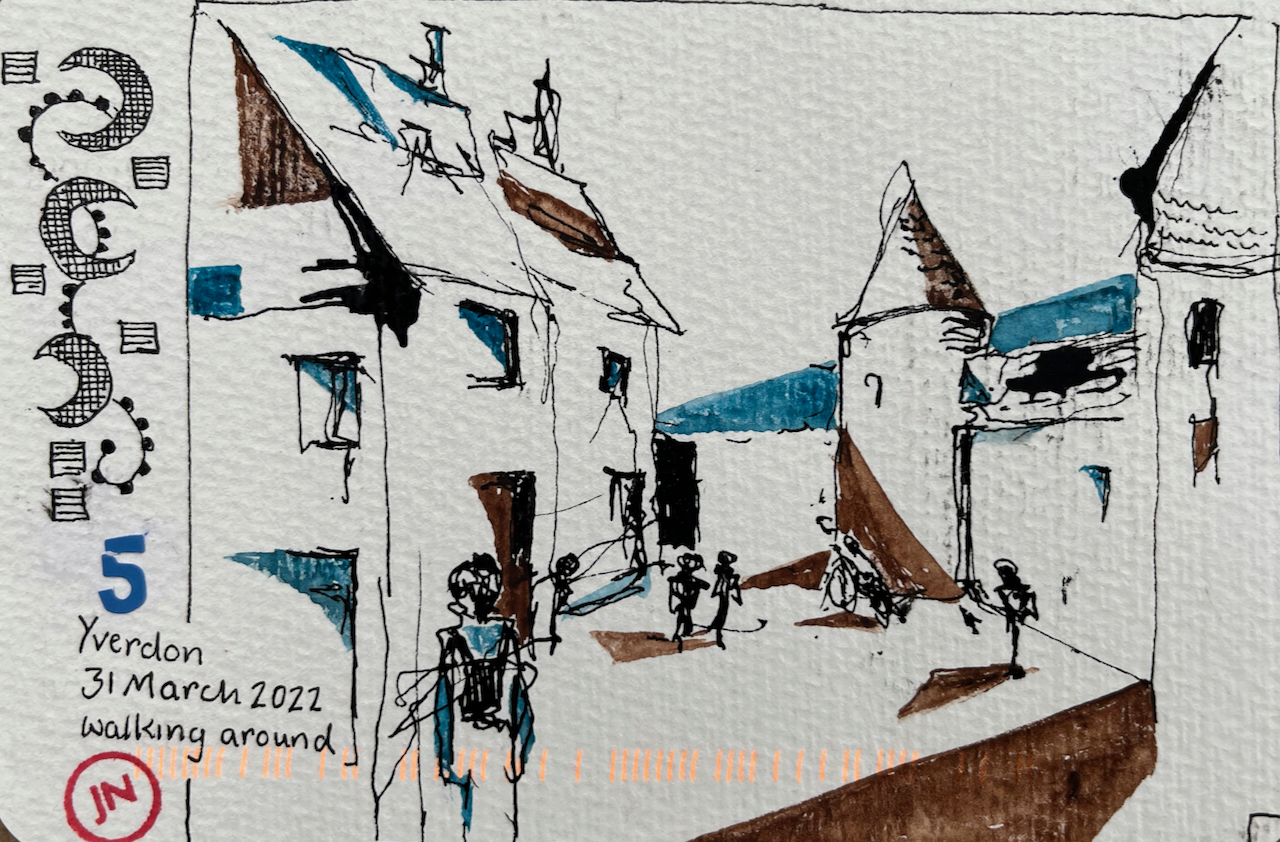
Walking around…

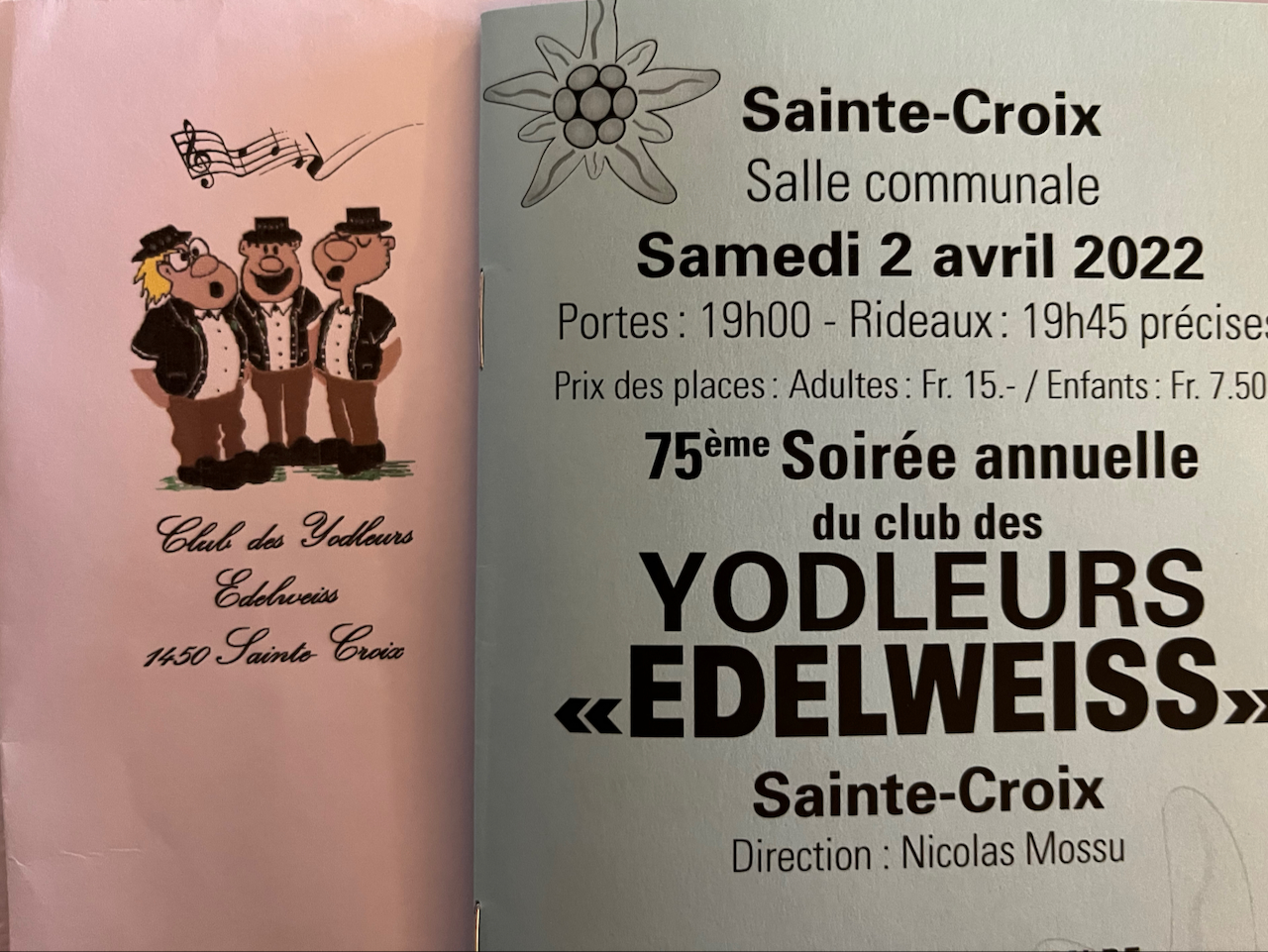
A rich cultural spectacle:

Photographs absolutely not allowed, but sketching was OK. It was very crowded, and great fun to hear the expert yodleurs. They sung in French.

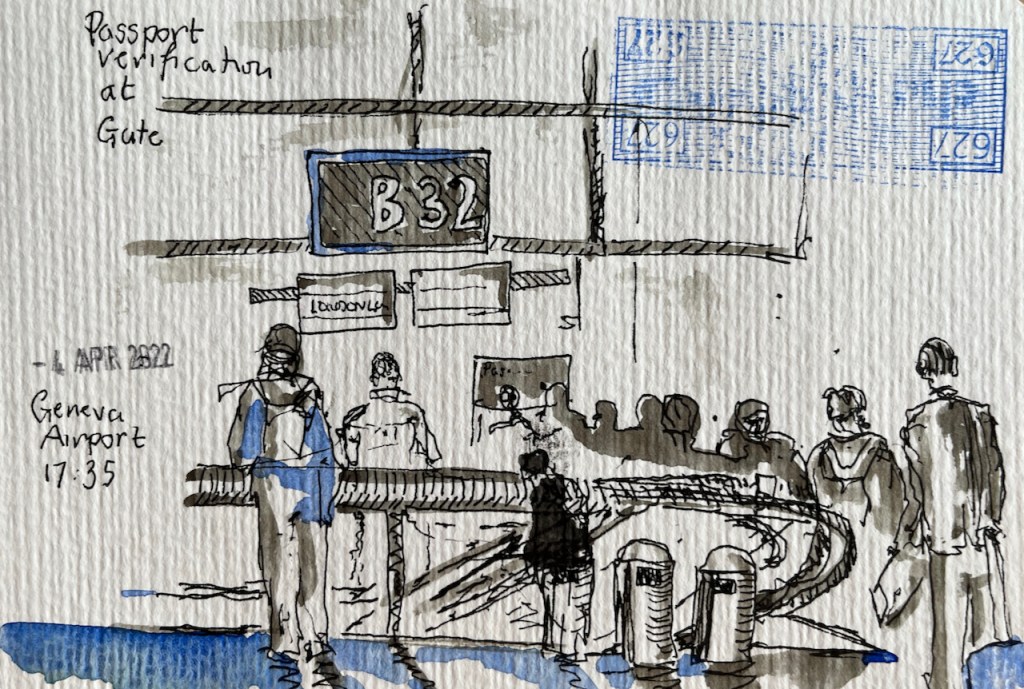
Sketching on the journey back to London. Passports were checked four times: at check-in, at border passport control, and again at the gate in Geneva (shown below), and again on arrival in the UK.

The friendly passport officer at Gate B32 kindly agreed to add his stamp to my picture. You see his blue rectangular contribution in the top right.

Sketching on the plane:

In between all this sketching I did some work…..and went walking in the snow.

Near Sainte-Croix, Vaud.

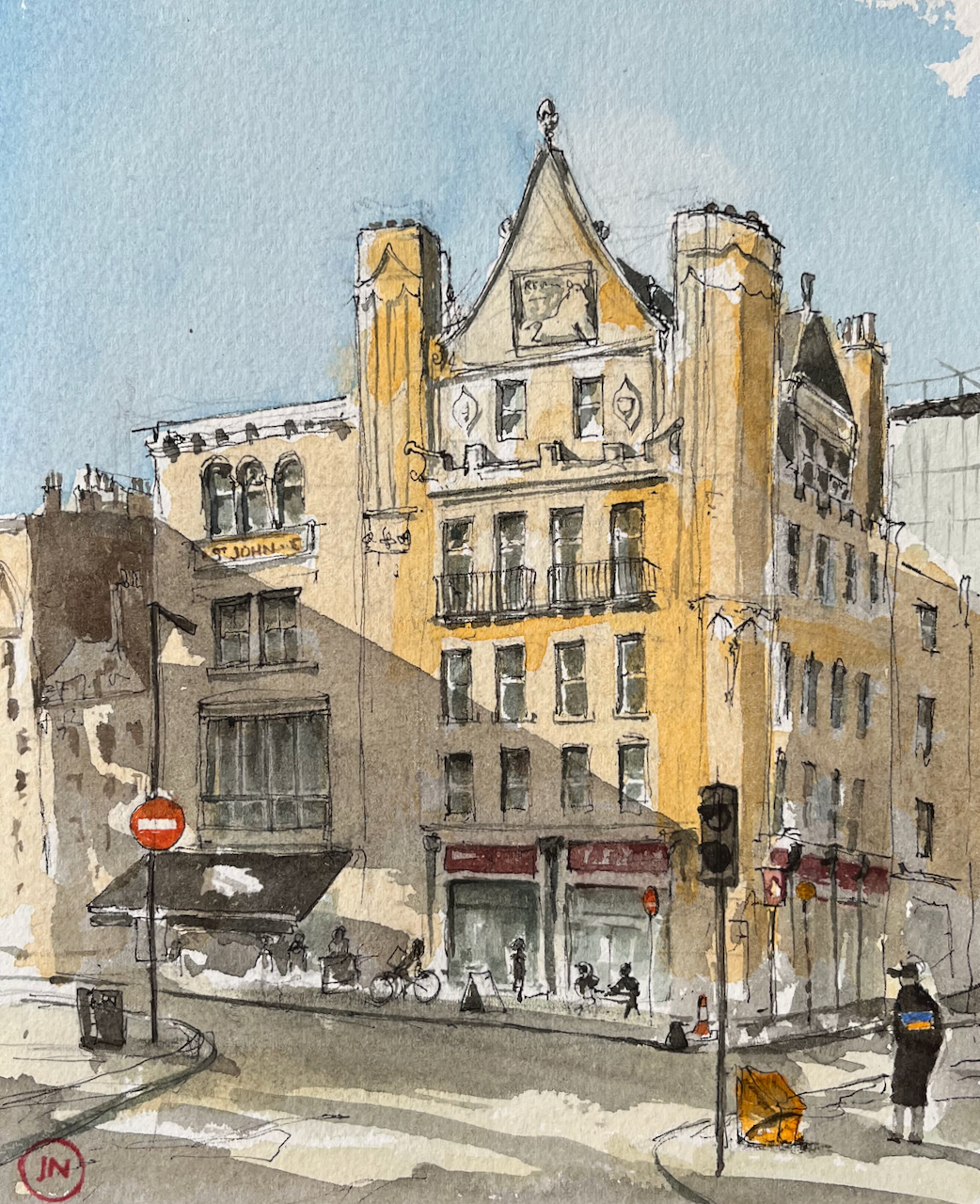
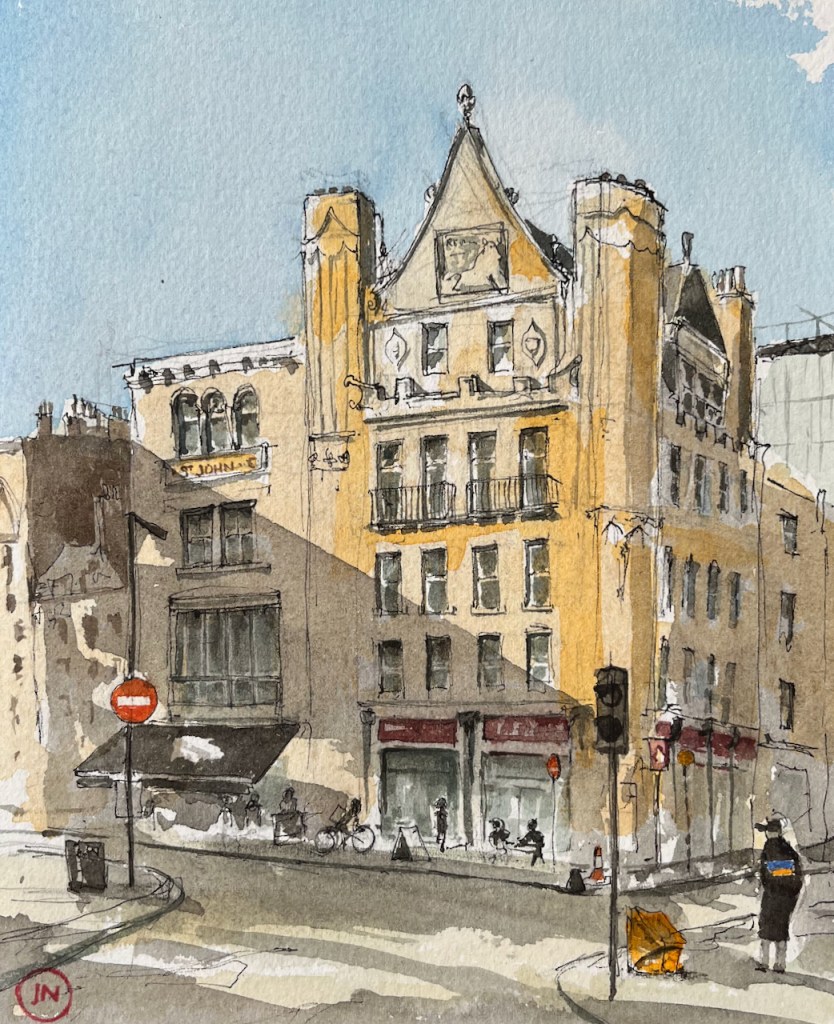
3-5 St John Street – William Harris

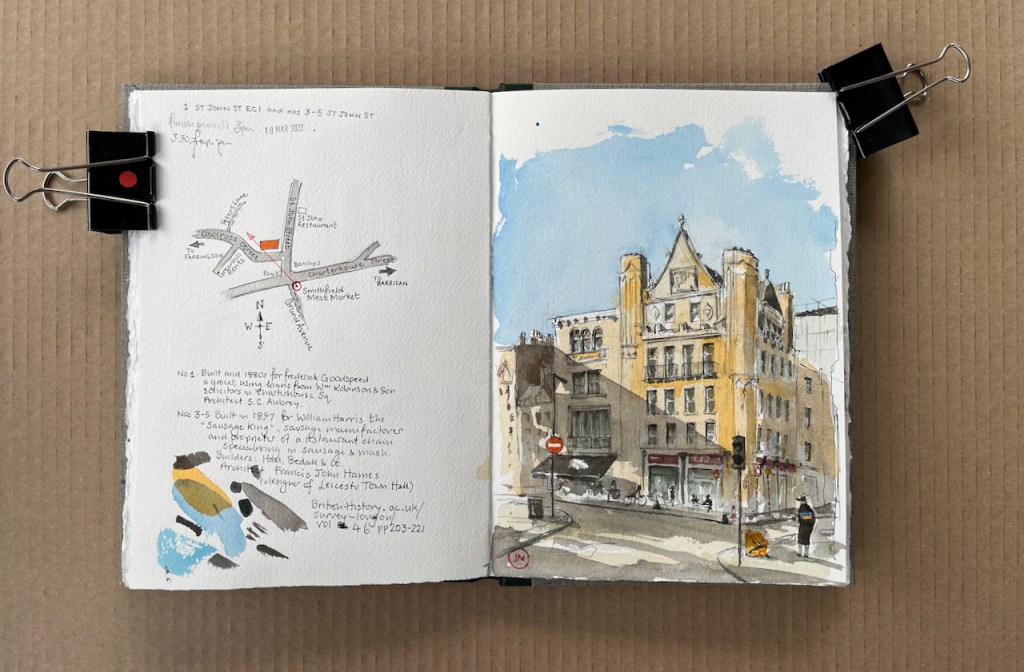
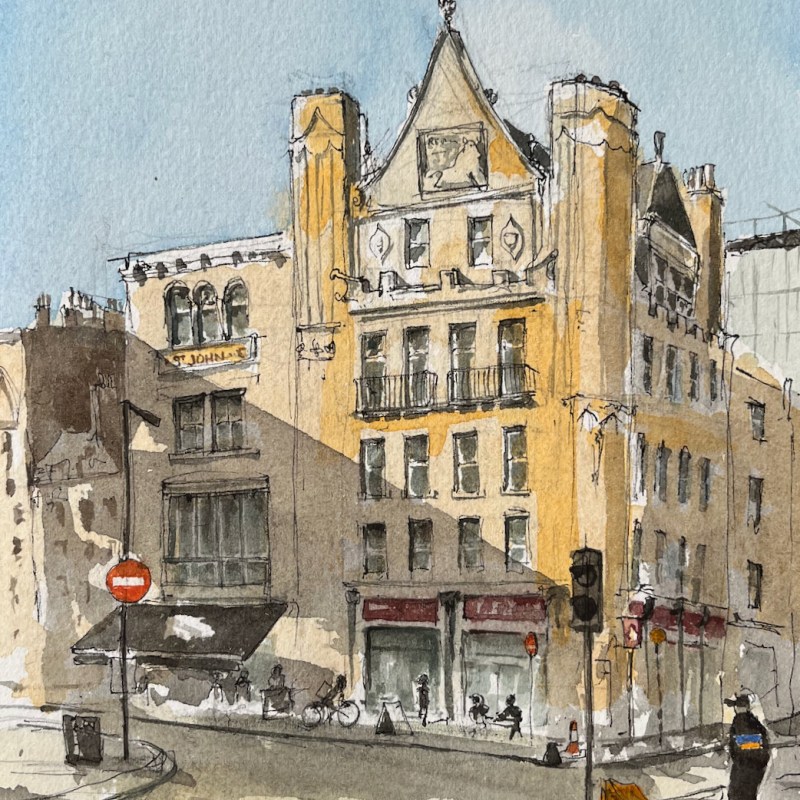
These glorious buildings are at the south end of St John’s Street. This is the view looking north from the Smithfield Meat Market, Central Avenue.

3-5 St John St EC1, 18th March 2022 3:30pm, in Sketchbook 11

It’s a busy corner. I tried to show some the street life: couriers cycling, people sitting at the café, and people, like me, standing and looking. A little further up St John Street, on the right, is construction work.

There was a blue sky as I drew. But do not be deceived: it was cold, as you see from the person on the right, hunched under their coat.

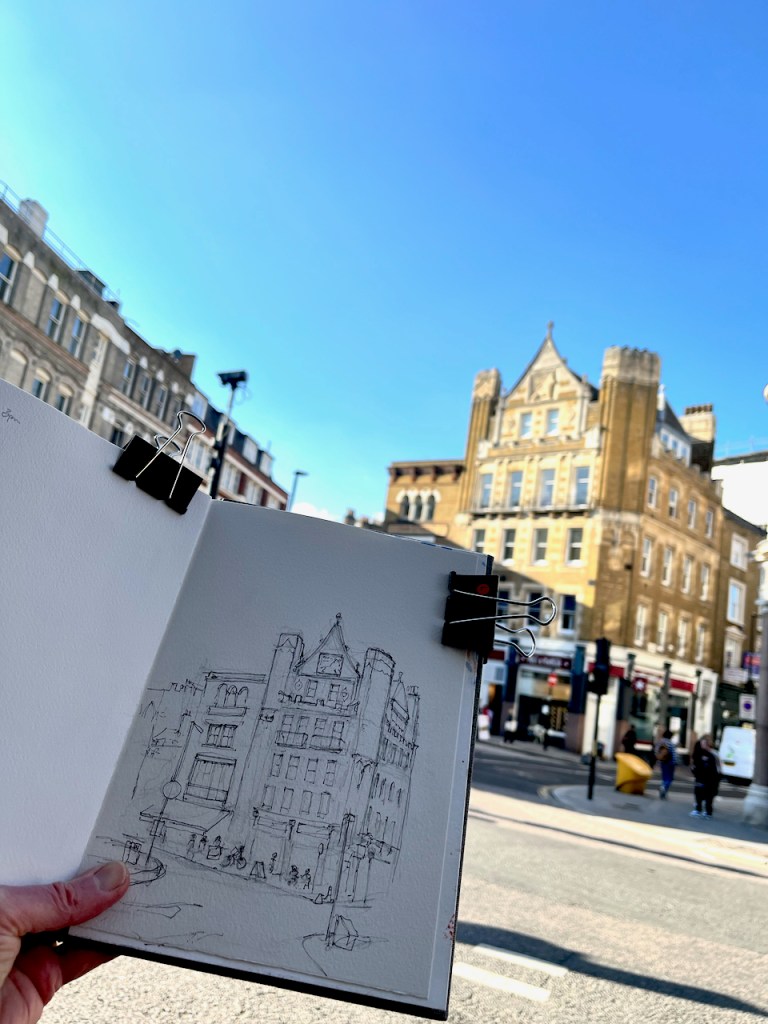
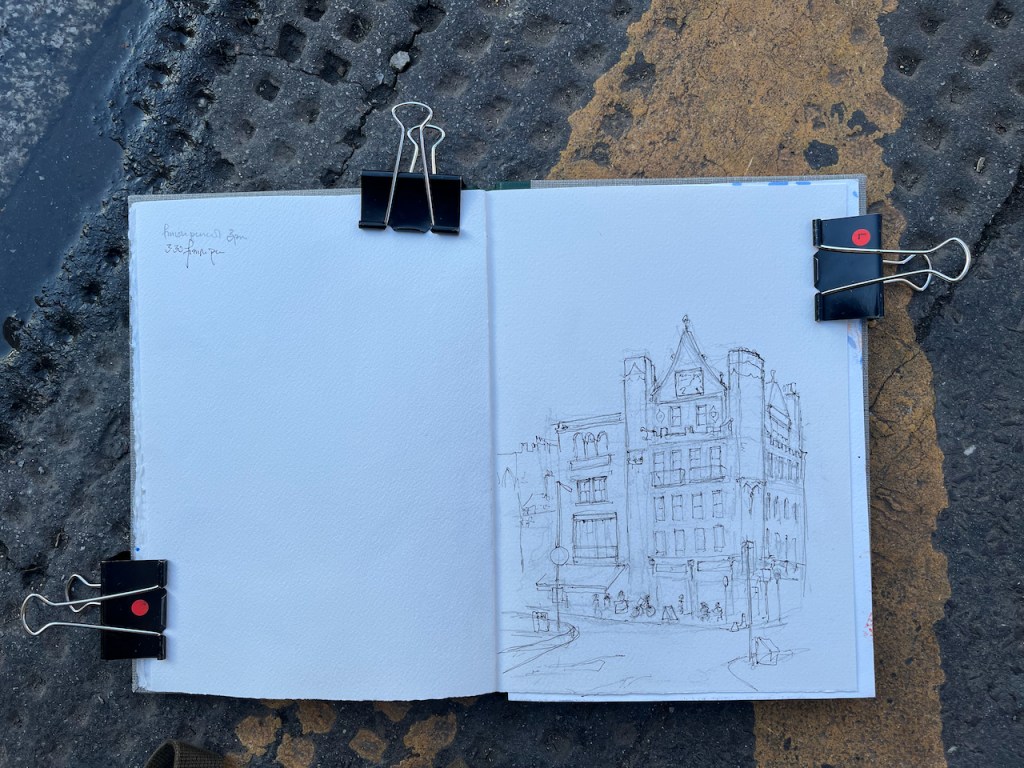
Here is a work-in-progress photo and a map:

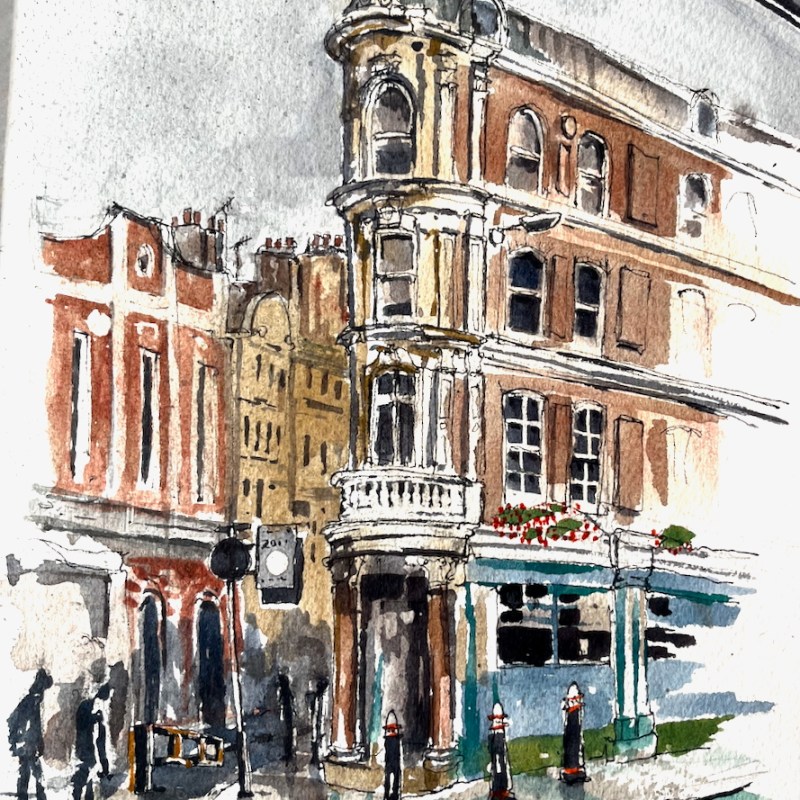
This is an ornate buildings: lots of fluting and complicated brickwork. Who thought all that was a good idea? Who could afford it? Number 1, on the left, slightly more restrained, was built for a Frederick Goodspeed, a grocer, in the mid 1880s. The architect was S.C. Aubrey. (reference 1 below)

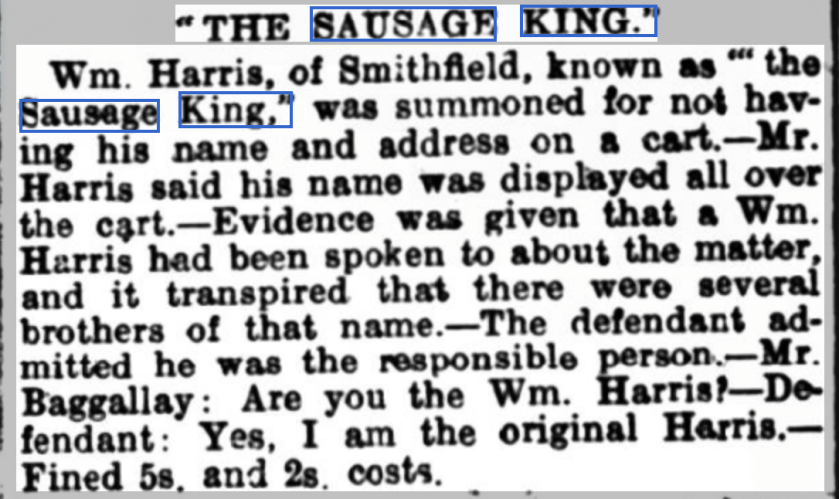
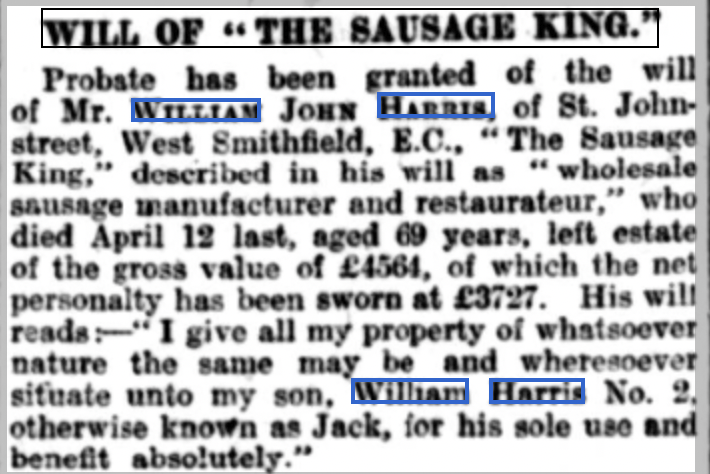
Numbers 3-5, the building on the corner, has chimneys with all kinds of complicated brickwork, and a highly decorative frontage onto Smithfield. It was built in 1897 for William Harris, the “Sausage King”. He was a sausage manufacturer, and proprietor of a chain of restaurants specialising in sausage and mash. Mr Harris was evidently quite a character. He named all his three sons William, and all his four daughters Elizabeth (reference 2 below). This may have had practical problems, but it meant he and his sons could have fun with the Magistrates:

Woolwich Gazette – Friday 10 November 1905 from “https://www.britishnewspaperarchive.co.uk”

The “Sausage King” was somewhat eccentric, but this was to a large extent due to his love of “personal advertising,” which was his motto for business success. At all times of the day he wore a sort of evening dress, with an opera hat, and a blazing diamond in his white shirt, even when buying in the market, and he used not a scrap of writing or wrapping paper that did not bear his photograph. His trade mark, which he registered about forty years ago, depicts him winning the “Pork Sausage Derby” on a fat porker. His principal catch-phrase was “Harris’s sausages are the best,” and it spread the fame of his sausages all over the world. He also composed a lot of poetic advertisements, which caused much amusement.

This snippet from “London Standard, via the Montreal Gazette, 3 May 1912” reporting his death (reference 2).

He died in April 1912, leaving a considerable fortune. His death was reported far and wide, including papers in many parts of England and Ireland.

London Evening Standard – Thursday 06 June 1912 from “https://www.britishnewspaperarchive.co.uk”.

Note the reference to “William Harris No. 2”, that is, his second son, to whom he left all his property. I wonder what all the other sons thought – and the four daughters?

I am glad that the flamboyant house of this extraordinary man still stands. The architect was Francis John Hames, who also designed Leicester Town Hall. So you see what kind of league Mr Harris was in.

Reference 1: Thanks to British History Online who alerted me to The Sausage King: ‘St John Street: Introduction; west side’, in Survey of London: Volume 46, South and East Clerkenwell, ed. Philip Temple (London, 2008), pp. 203-221. British History Online http://www.british-history.ac.uk/survey-london/vol46/pp203-221 [accessed 8 April 2022].

Reference 2: The piece from the Montreal Gazette is online at https://charlespearce.org/people/william-harris.html

I have drawn extensively in this area, both in St John St and around the meat market.

Here are my drawings of and around Smithfield meat market:

Bristol – Jacobs Wells Road Dance Centre and former baths

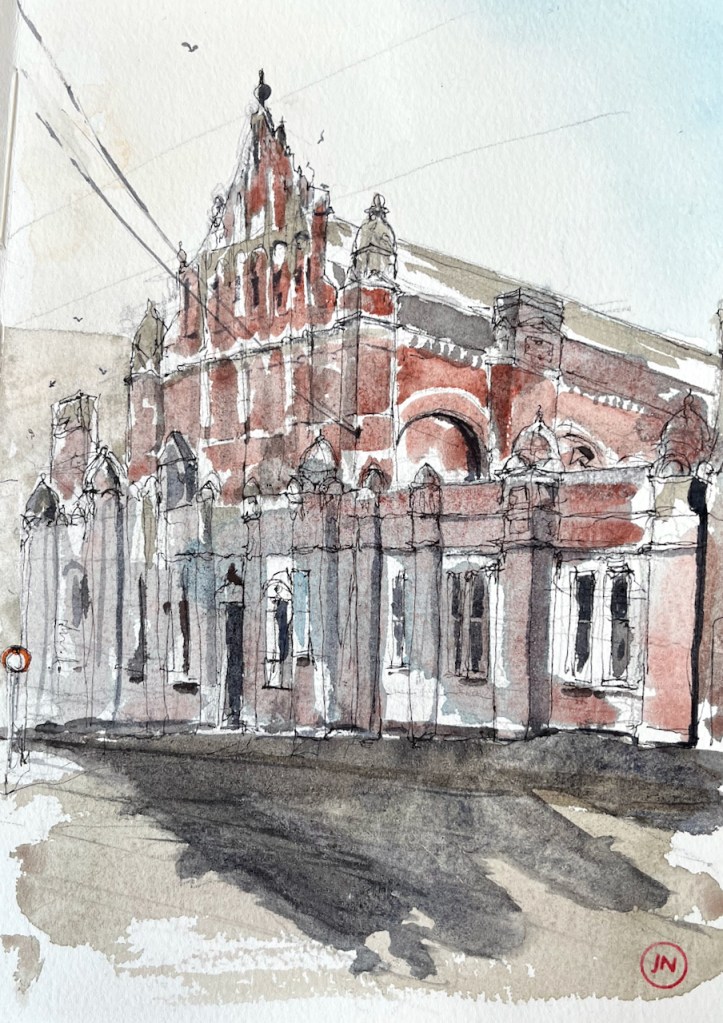
Here is the Bristol Community Dance Centre on the Jacobs Wells Road.

Bristol Community Dance Centre, Jacobs Wells Road. 12:15, 23rd March 2022 in Sketchbook 11

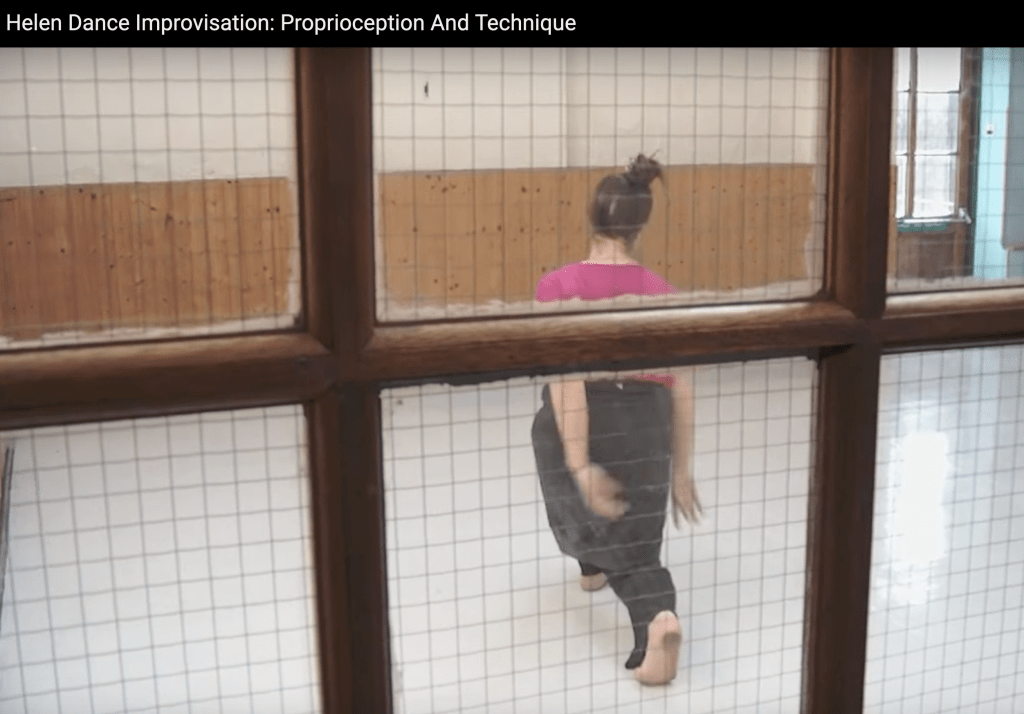
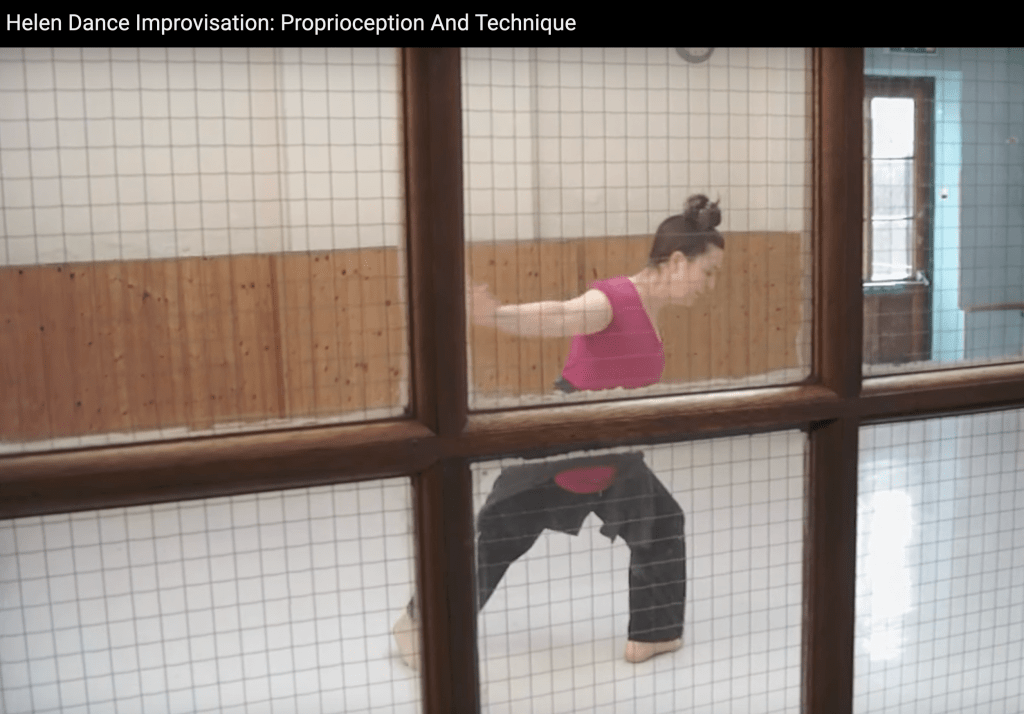
This is building is special for me. Here I learned how to stand up straight, and I learned where my feet were. Or rather, I learned how to learn those physical things, or I learned that they could be learned. My teacher was a dancer, Helen Roberts.

Earlier on, many years previously, in another town, in a different life, I had been to a performance by London Contemporary Dance Theatre. There I saw, for the first time, movement as language. The way I described it to myself was: “First they teach you a language, then they talk to you in it.” That, for me, was Contemporary Dance. Once I’d seen it, I wanted to do it.

Life events unfolded and I was in another town, another life. And still, the idea of Contemporary Dance remained. Searching through printed events listings, in fuzzy type on thin paper, I found a Contemporary Dance class, for beginners. It was in Bristol, half an hour’s train journey from Bath, where I was living. So I turned up to this building, with shoulders hunched from stress and aching from desk work, and body strong from running and swimming, but uncoordinated. Without ceremony or introduction, the class started. This was the early 1980s.

I kept on with the beginners’ class, for years. It didn’t get any easier, but I felt that I was learning something. Recently I found a word for what I was learning: kinaesthesia, awareness of where my hands and feet are.

Helen Roberts was up at the front, calmly demonstrating the movements. Sometimes there was recorded music, once or twice a drummer. Sometimes she simply counted or sung a rhythmic click-type song. I copied the movements as best I could, and tried to follow her directions. Arms up, arms wide. “Arms wide” she repeated, with a bit of a glance my way. I was concentrating. My arms are wide. “My arms are wide” I said to myself, “just like Helen’s!”.

“Look at your shadow” suggested Helen, gently. There weren’t any mirrors. I looked at my shadow and I saw me. Rather than ‘soaring bird’, I was ‘drooping tree’. I lifted up my arms. It felt far too high, far too difficult. And that was the beginning. Holding your arms out wide is hard, it takes practice, it takes proprioception, which (I now know) is the sense of where your limbs are in space. It can be learnt, improved, refined, made easier, made more intuitive. I’m still learning.

I learned what it feels like to stand up straight, to line up my spine, to tauten my legs. I learned to “uncurl” from a deep fold into this upright standing position. It’s a pleasant feeling. We did it again and again in this beginners’ class. I did it again and again also outside the class, and it helped me: movement as medicine.

Life moved on again, another town, a different life, moving from place to place.
Now it’s 35 years later. I’m getting older and need to stretch stiffening muscles, aching joints. I have a sequence of exercises given to me by an NHS physio after an injury. In the sequence was that very same uncurling exercise: medicine as dance. With the remembered movement came Helen Roberts’ voice, instructing me, encouraging me.

I incorporate several more of Helen Roberts’ movements into my routine now. I reach upwards, the energy “flowing along the arm and out of the fingertips” as she described all those years ago. Although I don’t know quite what that means, I find it makes a difference to think of it that way: a static movement made dynamic.

I hold my arms out wide, and catch a glimpse of my shadow. I check that my arms are really out there, in the widest possible preparation for an embrace. Even if I don’t do it perfectly, I know now how to learn. I know there is something there to learn, even in this simple movement. And I do it again, and again, with more knowledge, more awareness. It is strangely satisfying.

Helen Roberts – if you are reading this, thank you!

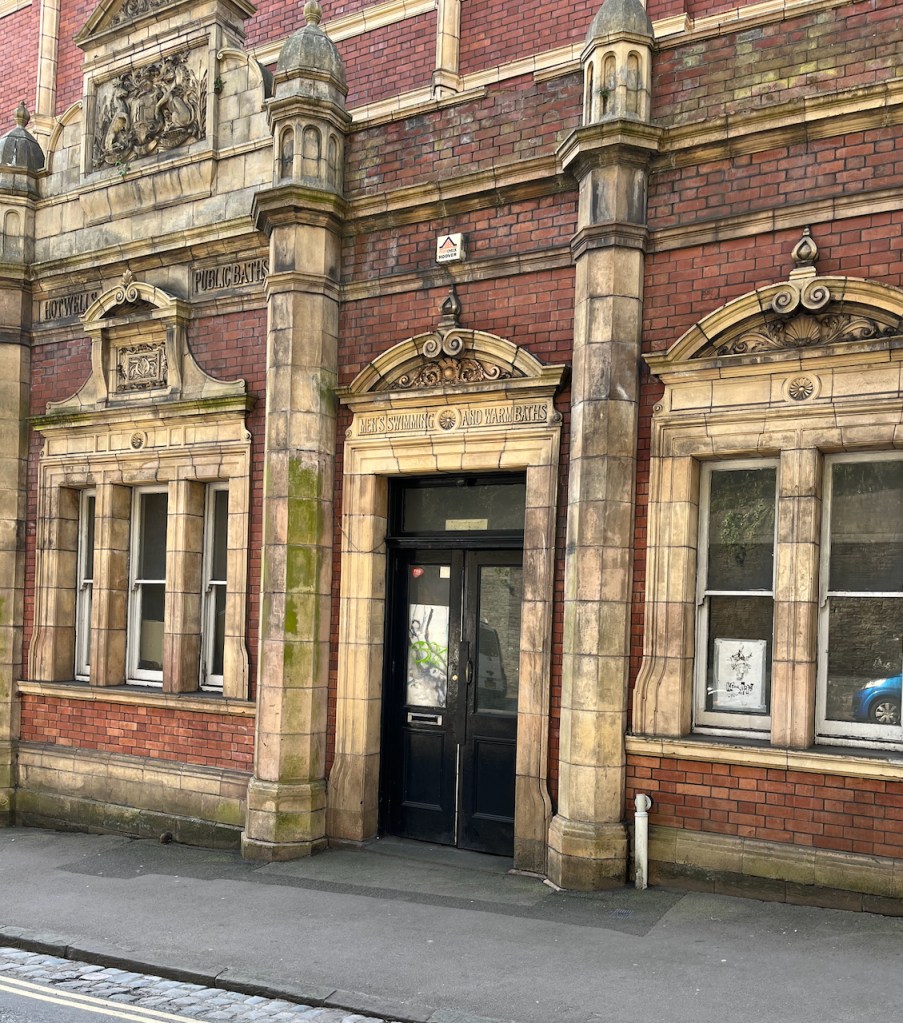
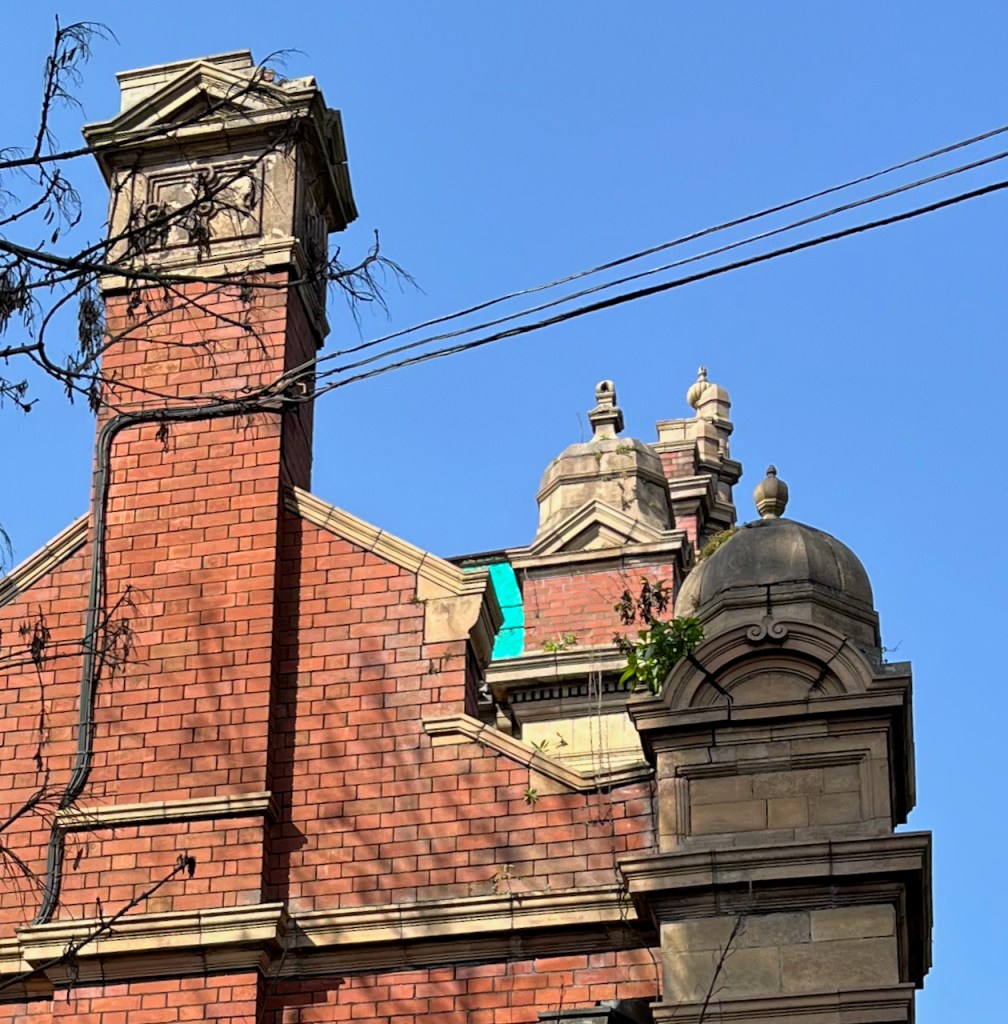
Here are some photos of the dance centre now, and work in progress on the drawing. It seems that the dance centre is closed. It looked closed when I saw it.

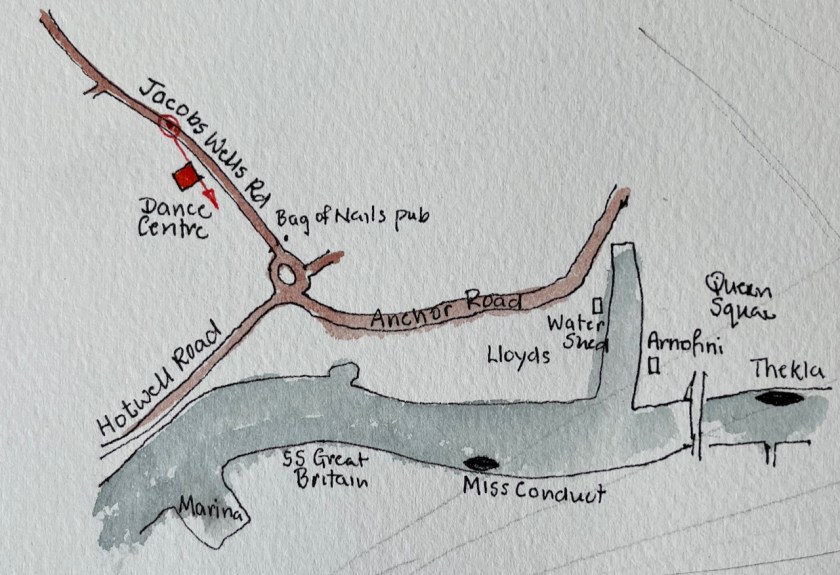
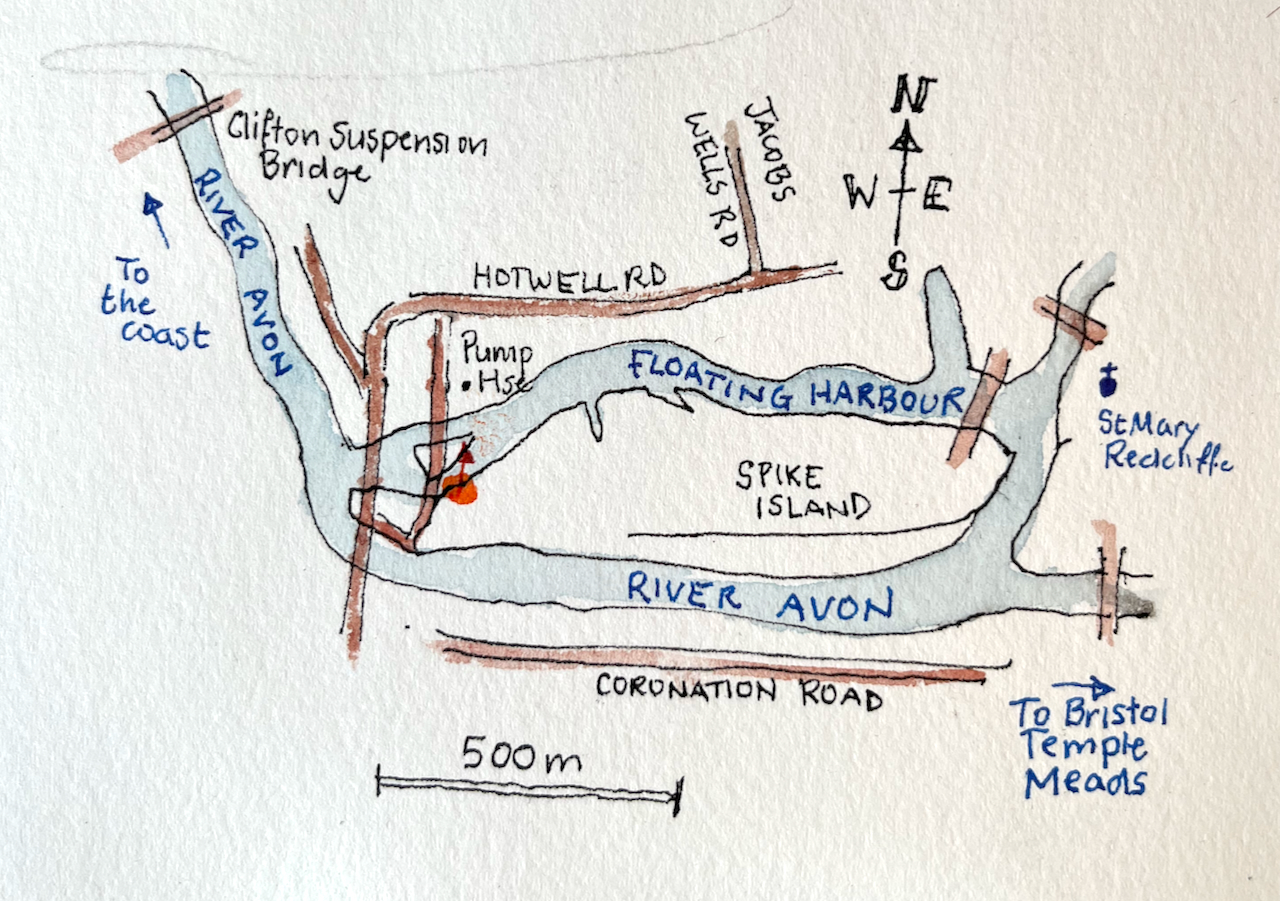
Here’s a map:

Sketch map of Bristol Harbour area showing the Jacob Wells Road and sightline of the drawing.

Here is a 2012 video of Helen dancing and describing her work:
https://www.youtube.com/watch?v=TJxSshFh6PM&ab_channel=JudithJarvisgyroscopic

Bristol – St Mary Redcliffe BS1

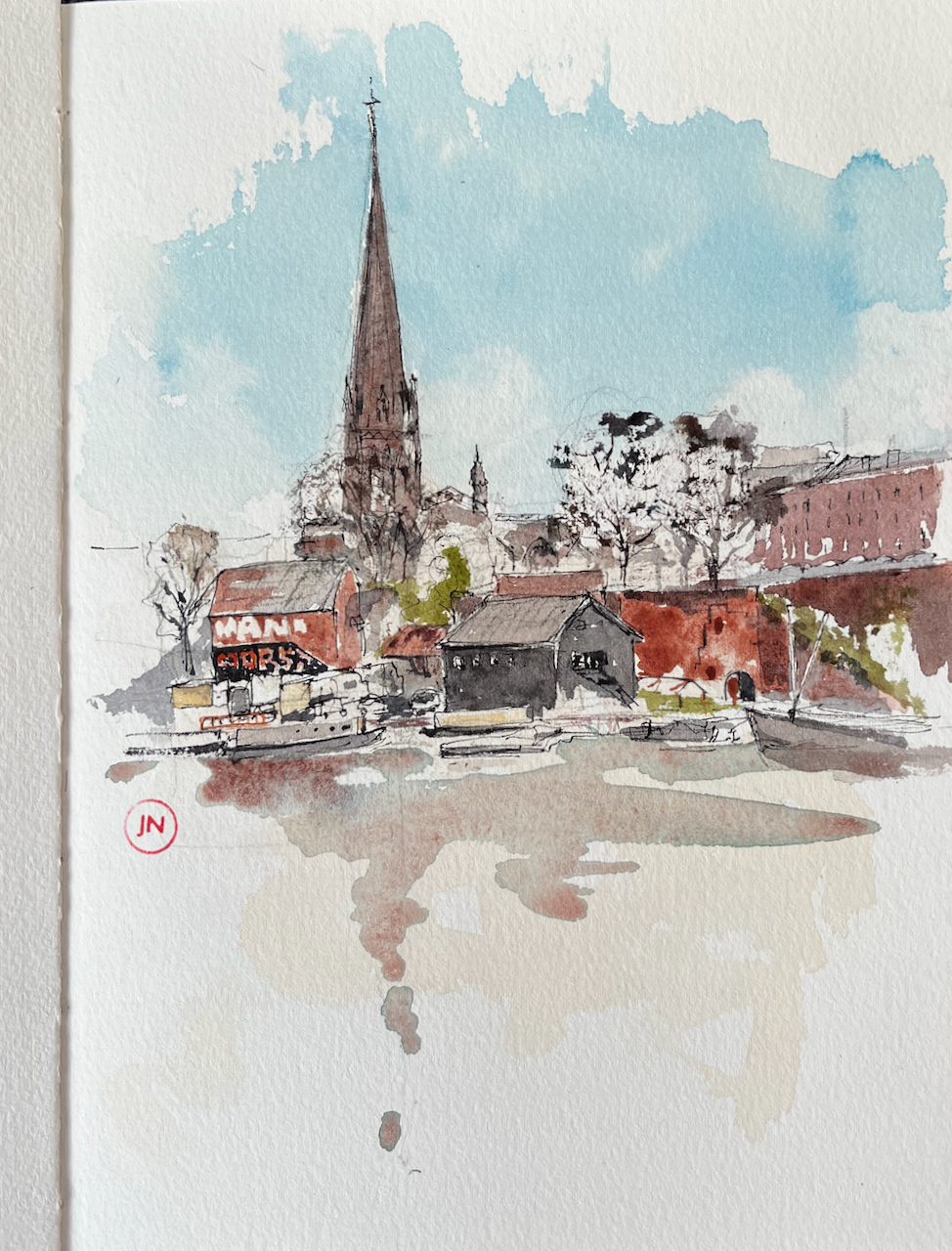
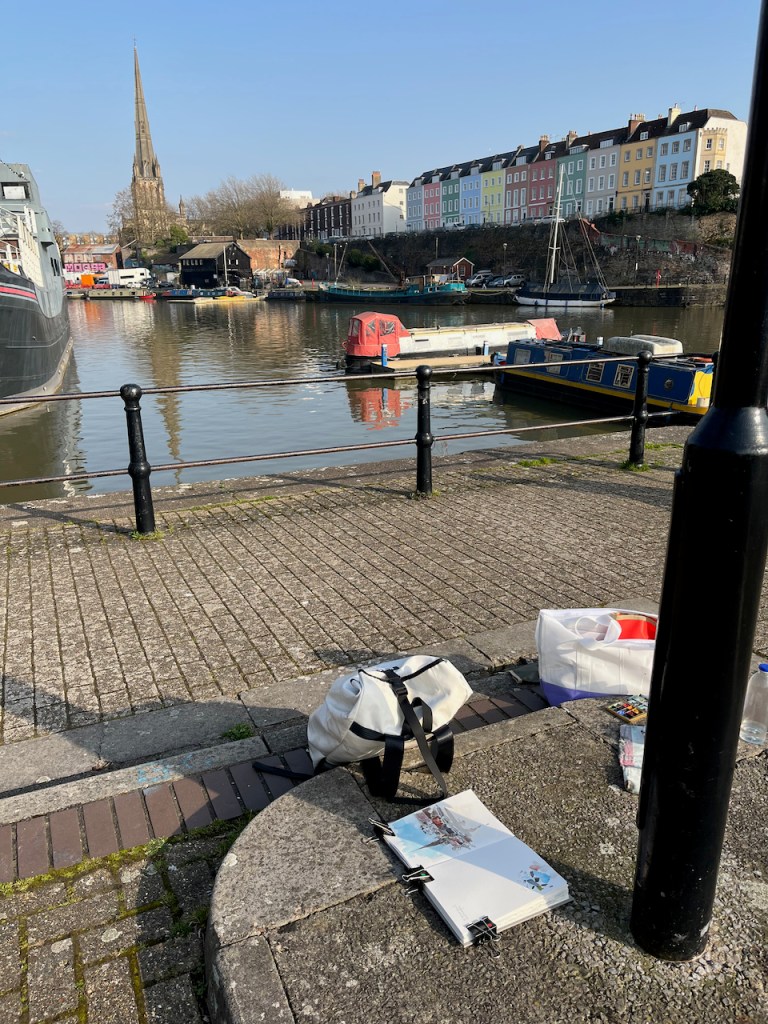
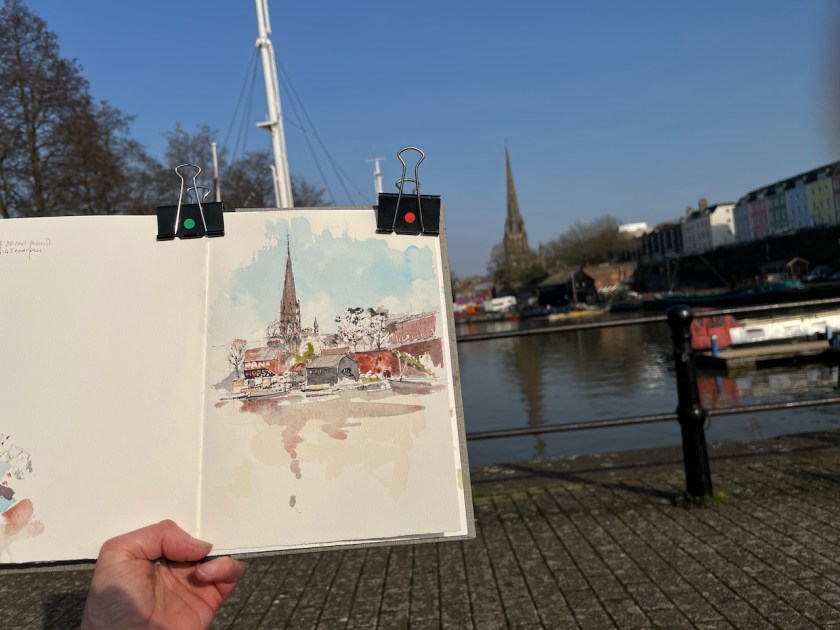
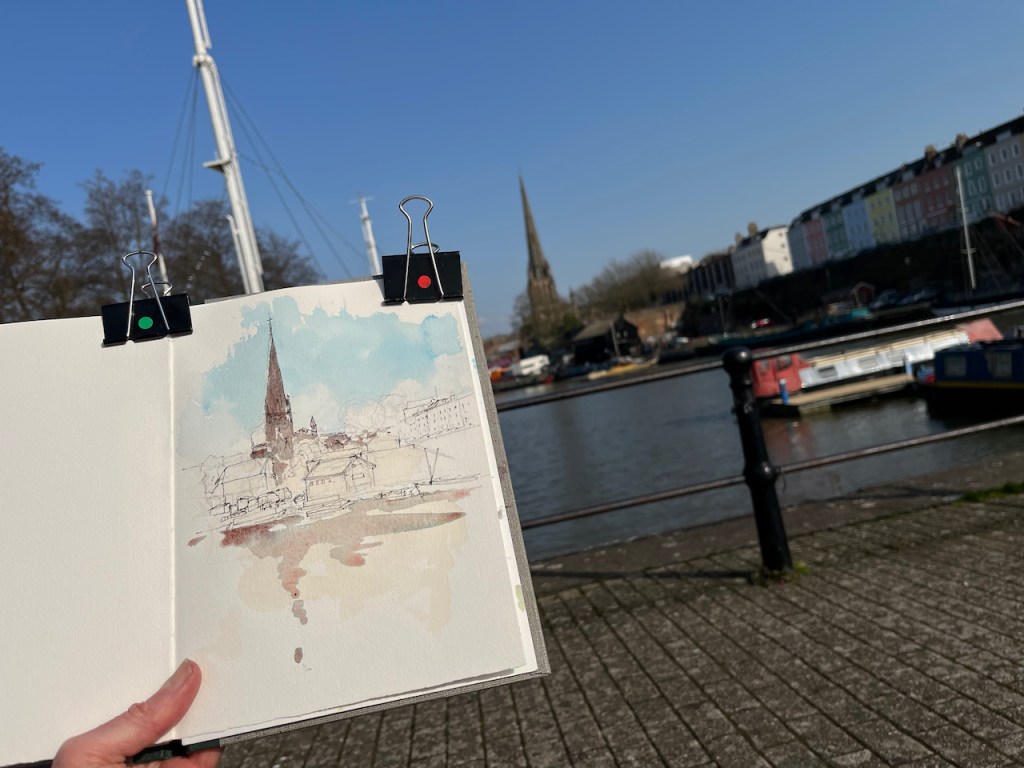
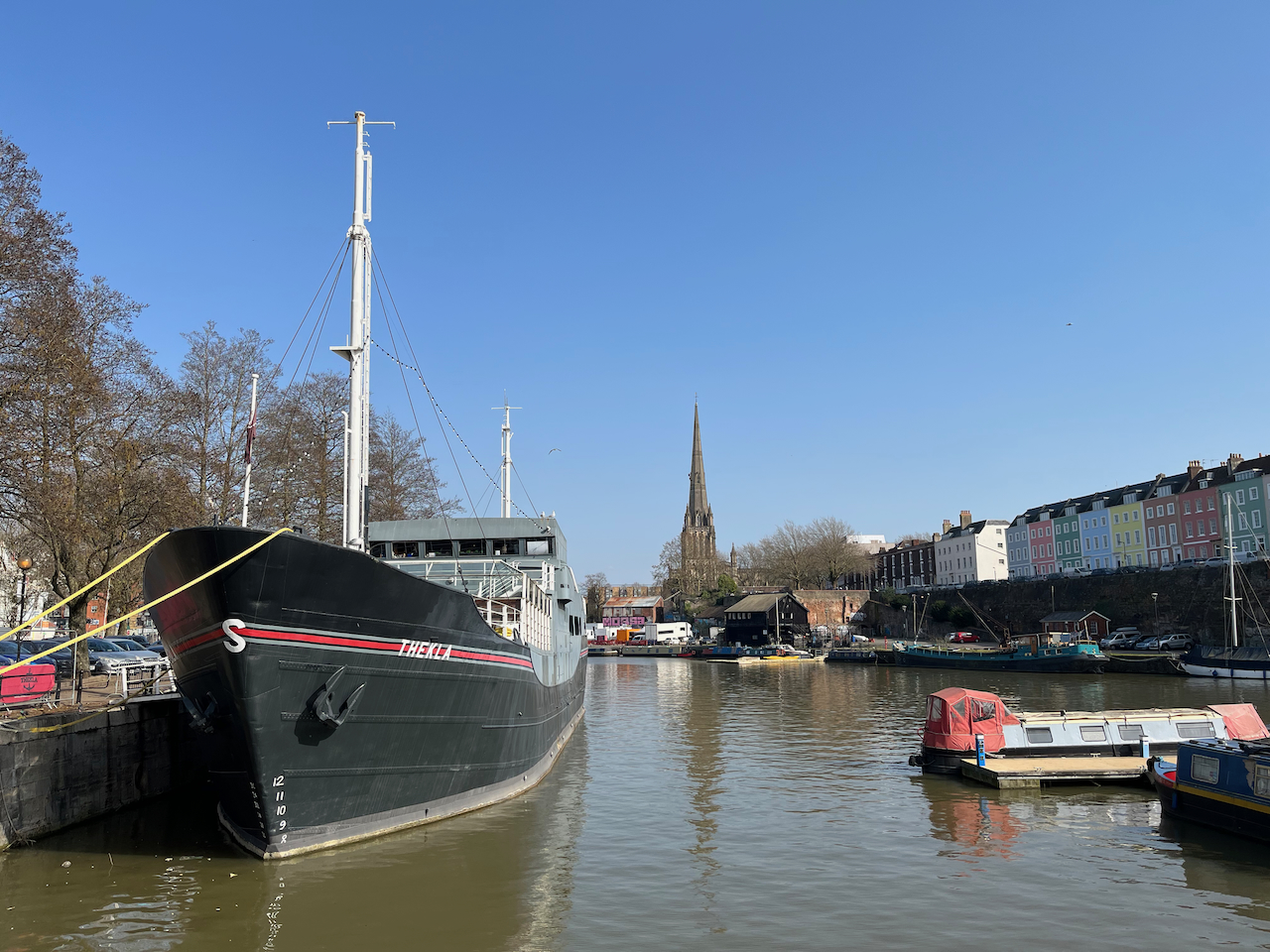
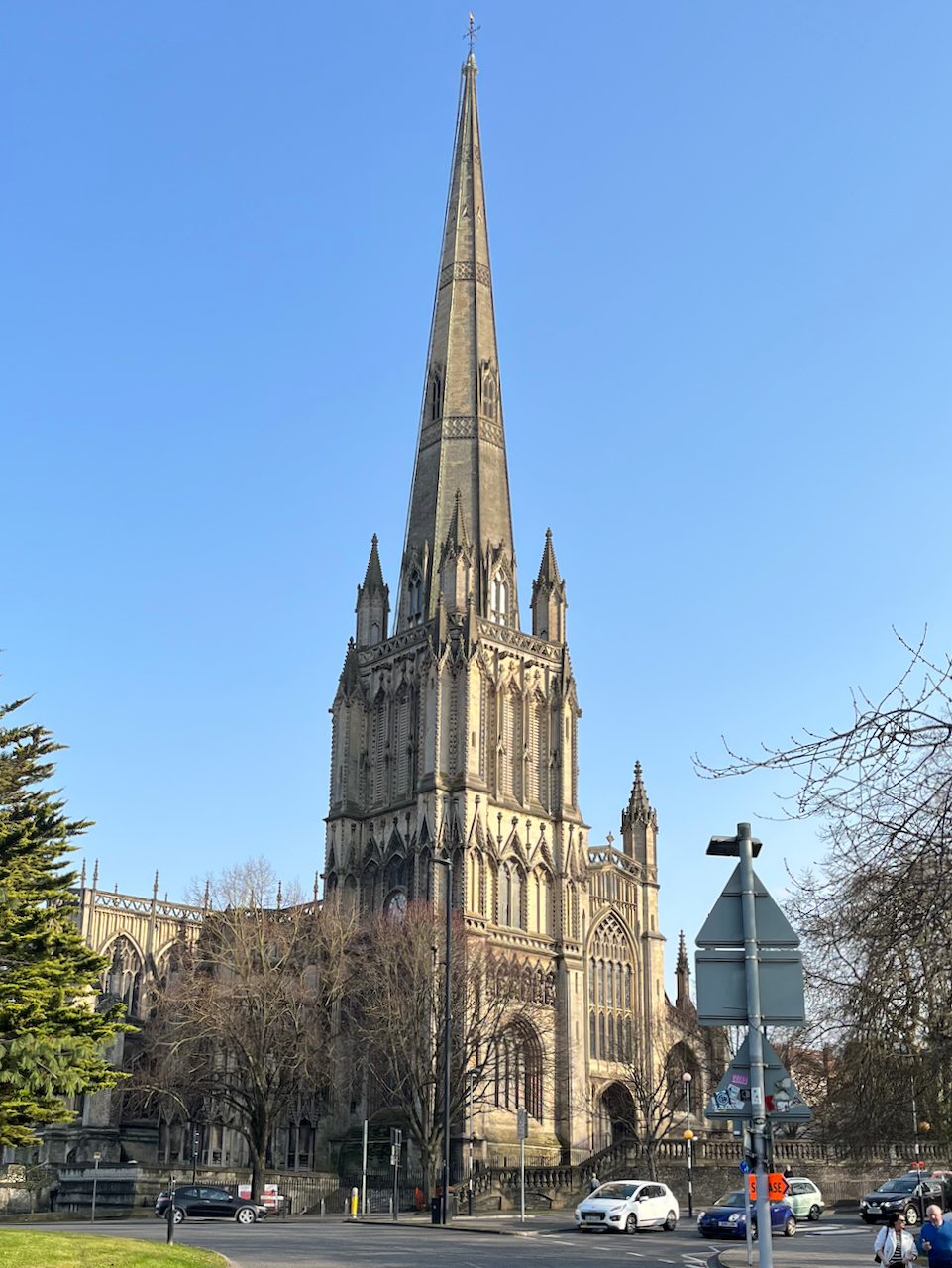
Walking back to Bristol Temple Meads I stopped by the “Thekla” boat and music venue. Much of Bristol docklands area has changed radically in the last 35 years, in appearance and use. But the Thekla is still there, still in the same place, still a music venue, although the music has changed somewhat. I looked across the water as I thought these things, and saw St Mary Redcliffe.

St Mary Redcliffe from The Grove car park, next to Thekla, 23rd March 4pm in Sketchbook 11
The future: “Redcliffe Wharf” – photo from https://www.generatorgroup.co.uk/development/redcliffe-wharf/

St Mary Redcliffe has been there since the 12th century. The current building dates from the 13th and 14th century, and the spire was rebuilt in 1872.

On the left of my drawing, the building with the graffiti, that’s the last remaining undeveloped parts of the docks. The vans and lorries parked in front of it turned out to be a film crew. As I walked past, I saw the big hoardings advertising the redevelopment of the site to become “Redcliffe Wharf”. The developer’s website tells me:

This exciting development is the last direct waterside location on Bristol’s Harbourside. Once complete the development will create around 41,000 sq ft of highly sustainable Grade A office accommodation plus 45 two and three bedroom apartments, two waterside restaurants and space for local businesses.

website for the “Redcliffe Wharf” redevelopment

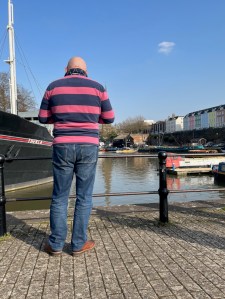
As I was drawing, a person came and stood, for quite some considerable time so it seemed to me, directly in my field of view. This person was a member of a group. They all walked past, saw me sitting on the kerbstone drawing, and then wondered what I was drawing and went to have a look across the water for themselves. This particular person then chose to align themselves exactly in front of me, adjusting a camera and taking multiple shots. I practised Zen patience, cleaned my palette, mixed some colour, looked at the seagulls, and waited. Then I decided to take a photo.

When I finished my drawing, I walked on into the picture, and past St Mary Redcliffe.

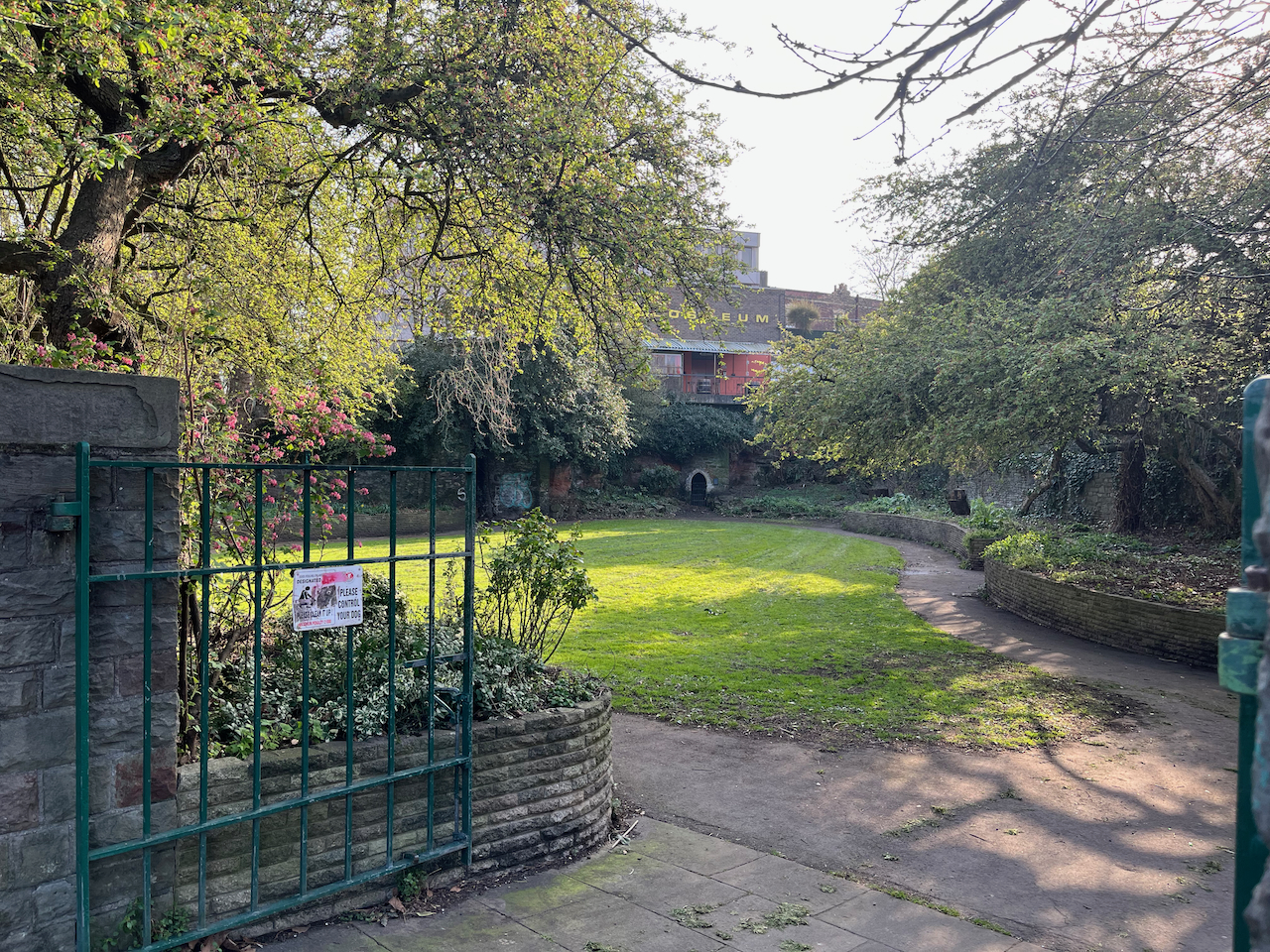
I hope the redevelopment does not touch the beautiful tranquil garden at the top of the hill.

Map from about 2005, showing the sightline of the drawing

Bristol – view from Nova Scotia Place BS1

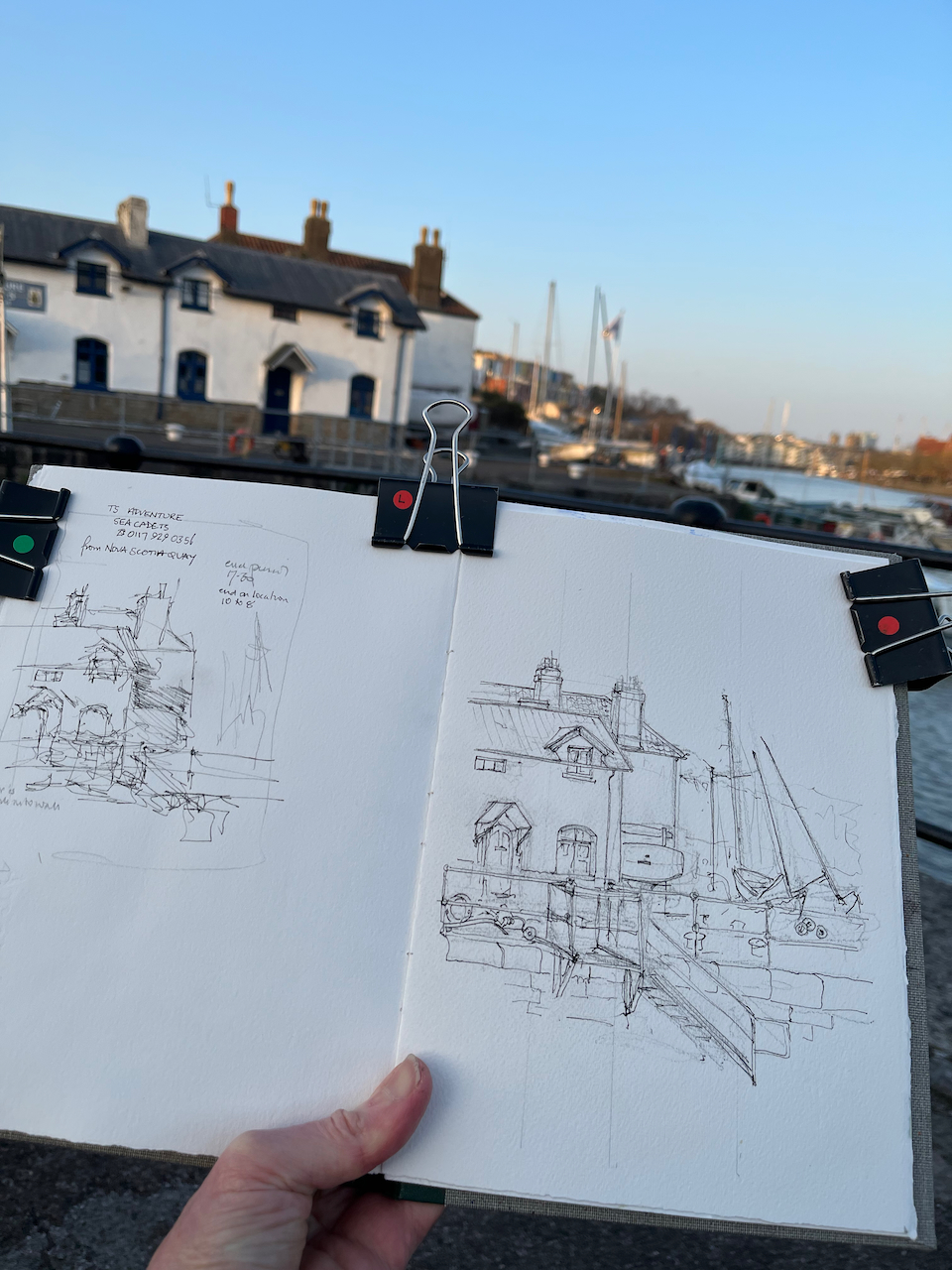
Wandering in a warm Bristol evening I rounded the harbour and found myself in Nova Scotia Place. This is a secluded domain, enclosed by water, and main roads. There is a pub, the Nova Scotia Hotel. People occupied the outdoor tables, with pints and conversation. I walked onto the small promontory and looked at the little cottages opposite.

Sketching at Nova Scotia Place, 22nd March 2022, 6pm

The warm evening became rather cooler. I packed up when I’d done the pen sketch. The bench that I had been using was a memorial bench:

In memory of Alan Helliwell (German) remembered by family, freinds and work colleagues of Underfall Yard who died too early. 7/2/1961 – 03/10/2009 after several near misses.

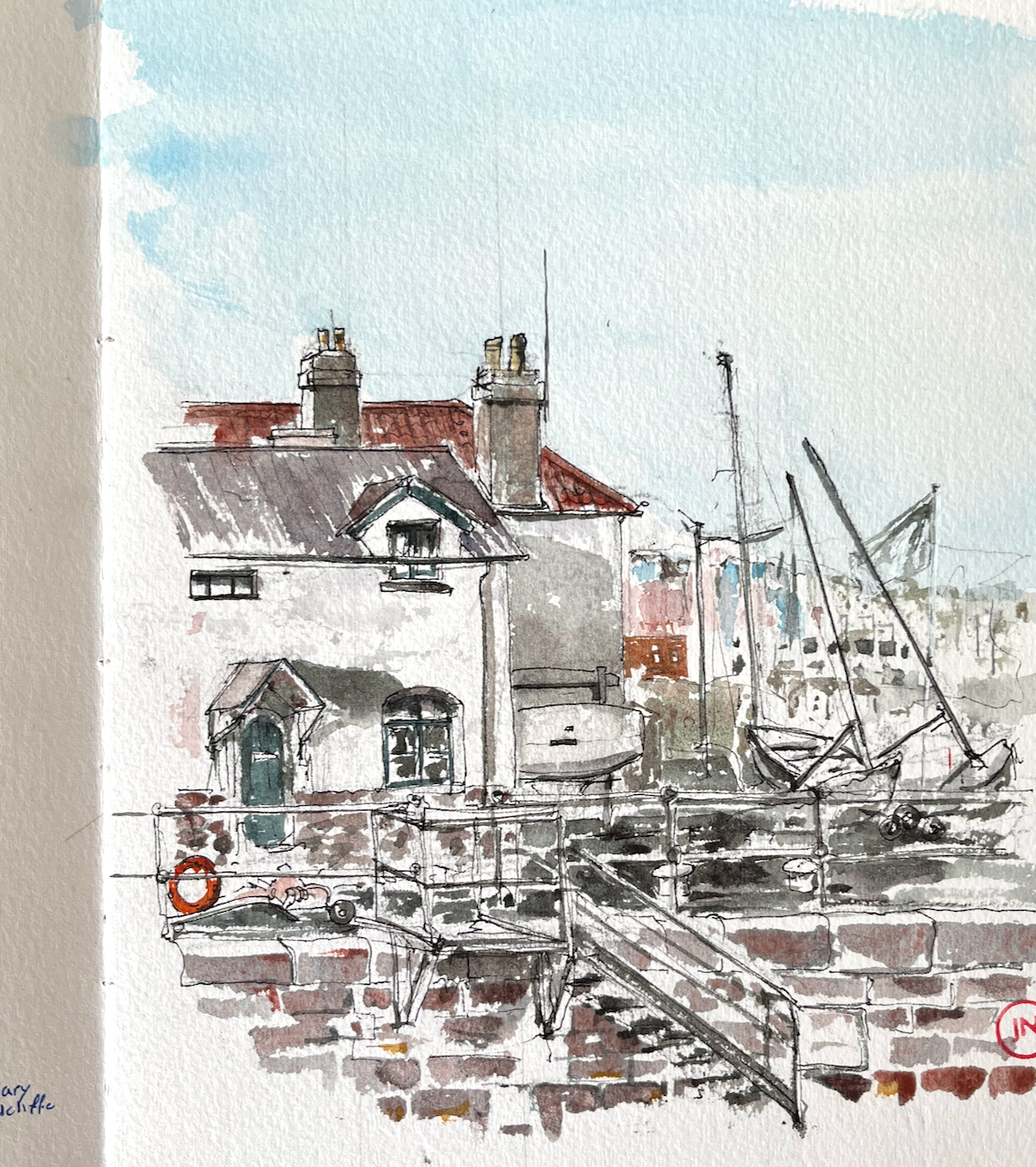
Later I put on some colour:

“TS Adventure Sea Cadets” cottages seen from Nova Scotia Place

St Pancras Old Church NW1

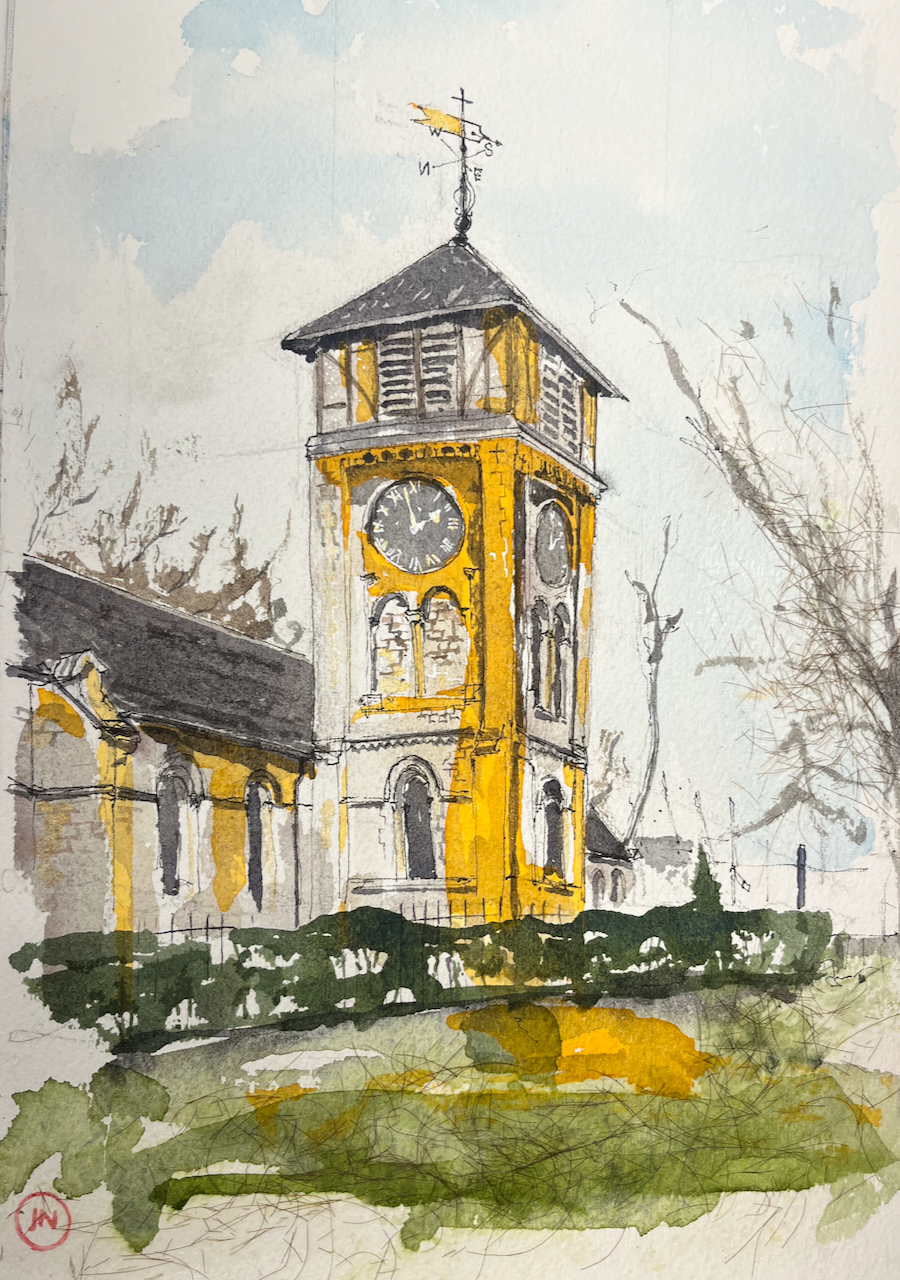
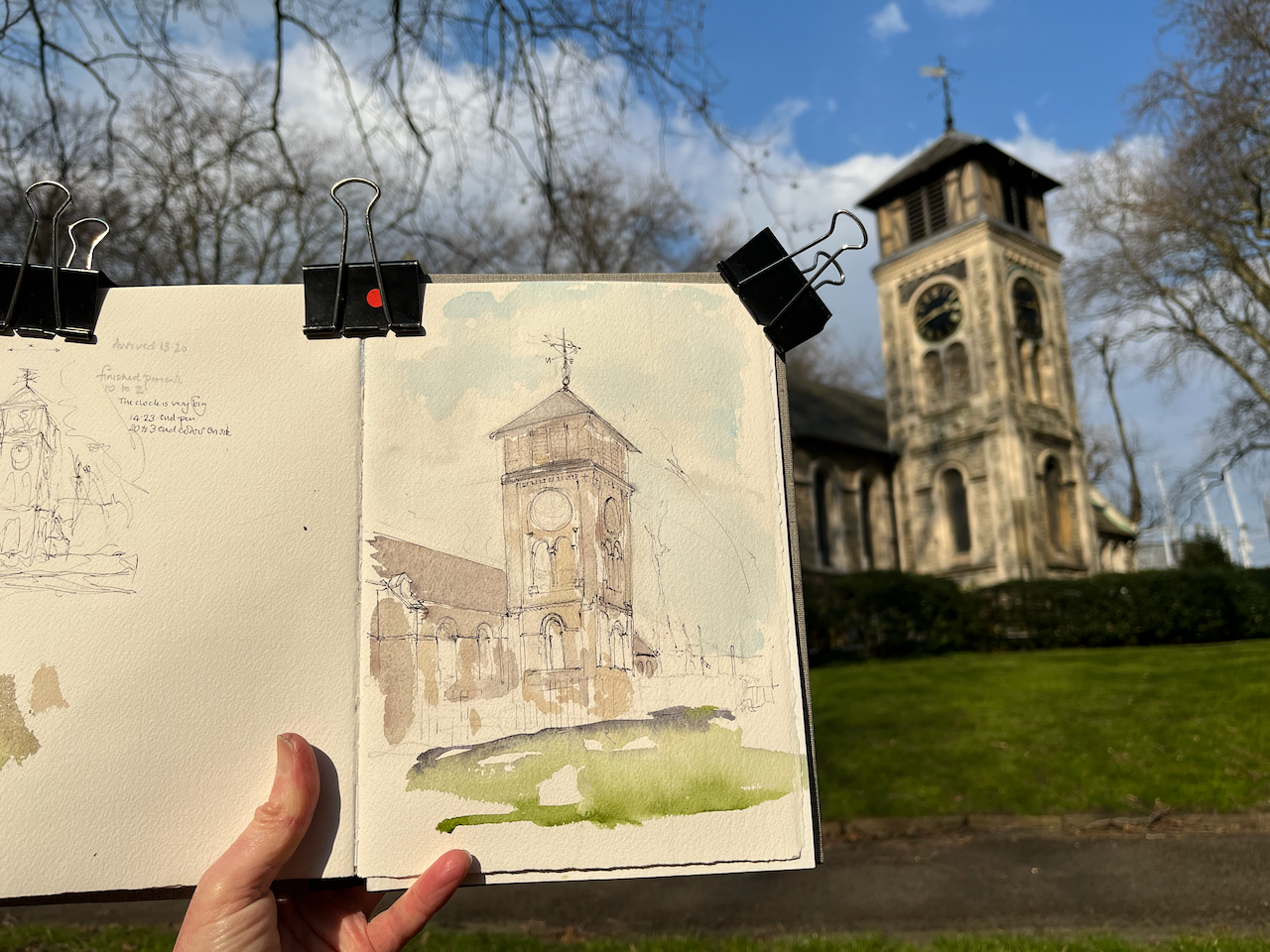
On a sunny day I went to draw a church tower in a country churchyard. The churchyard is near Kings Cross and the church tower is that of St Pancras Old Church.

St Pancras Old Church, tower. 20th March 2022 10″ x 7″ in Sketchbook 11

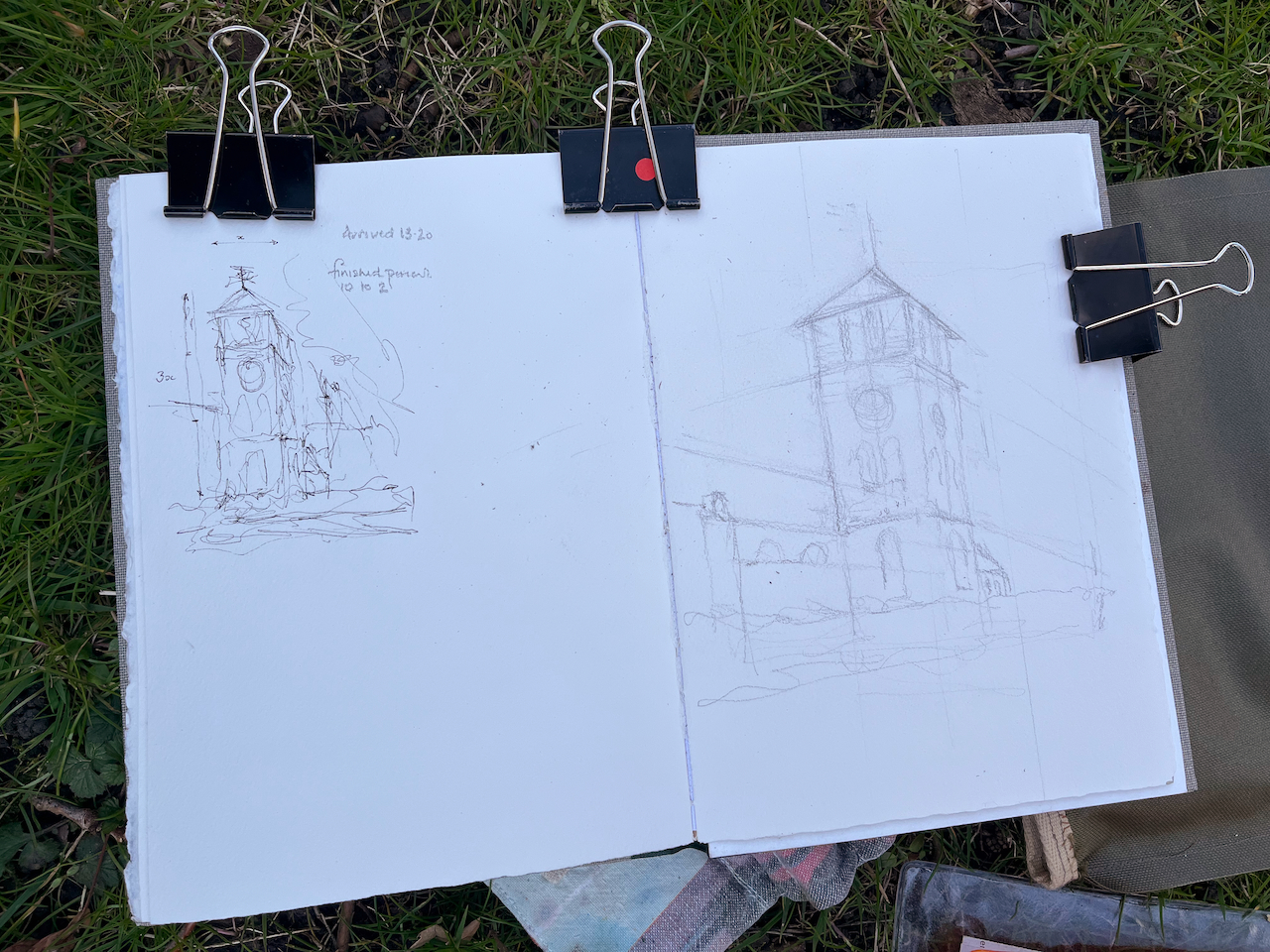
I sketched sitting on the grass beside the River Fleet, while the river flowed behind me, in my imagination.

It’s a real river though. These days it’s under St Pancras Way. But it used to flow by the church.

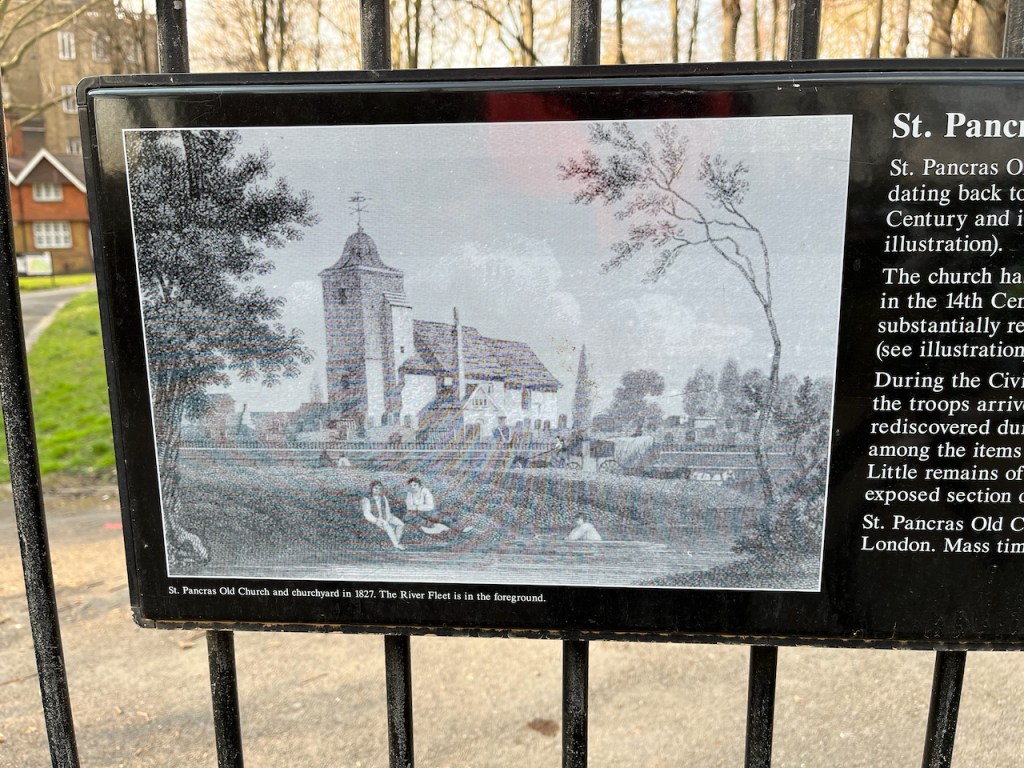
“St Pancras Old Church and churchyard in 1827. The River Fleet is in the foreground.” notice on the railings of the churchyard.

As you see from that picture, in 1827 the church looked very different. The south tower which I sketched is not as ancient as it looks. It was constructed in 1847 to the designs of A.D. Gough.

The church site itself is very ancient. According to the church website, this is one of the oldest sites of Christian worship in London, possibly dating back to the 4th century:

The suggestion that St Pancras Old Church dates back to Roman times has a long tradition, with most suggesting that it was founded in 313 or 314. Most churches in England named for the martyr St Pancras have, or may have, ancient origins, suggesting that veneration of the saint spread quickly after his death in 304.

https://stpancrasoldchurch.posp.co.uk/history/church-history/

Today it is an active church, and a music venue. The churchyard is a glorious green space, much used. Many people wandered past on the paths. No-one paid any attention to me drawing. The dogs did though. I was inspected and approved by each dog that went past.

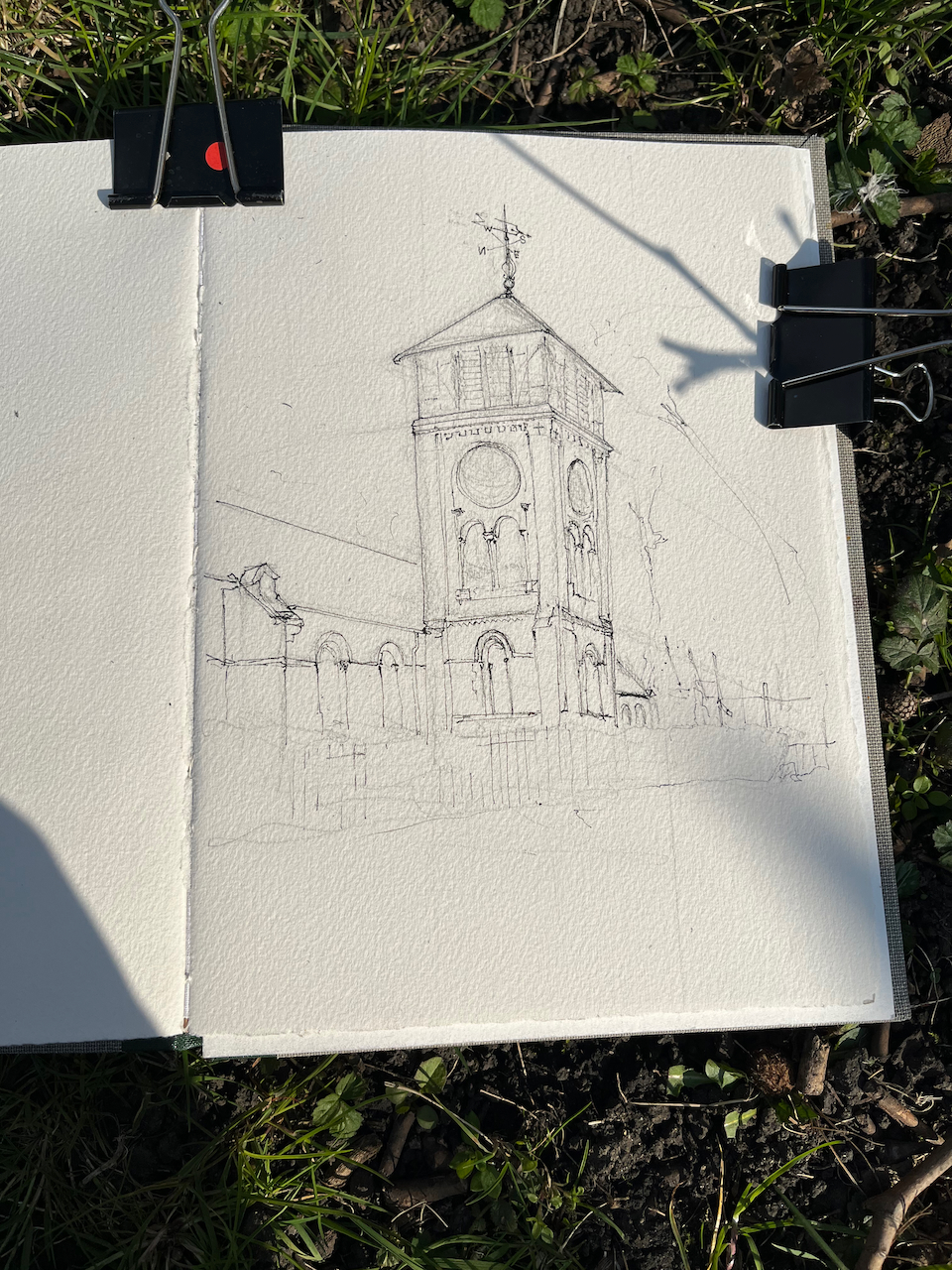
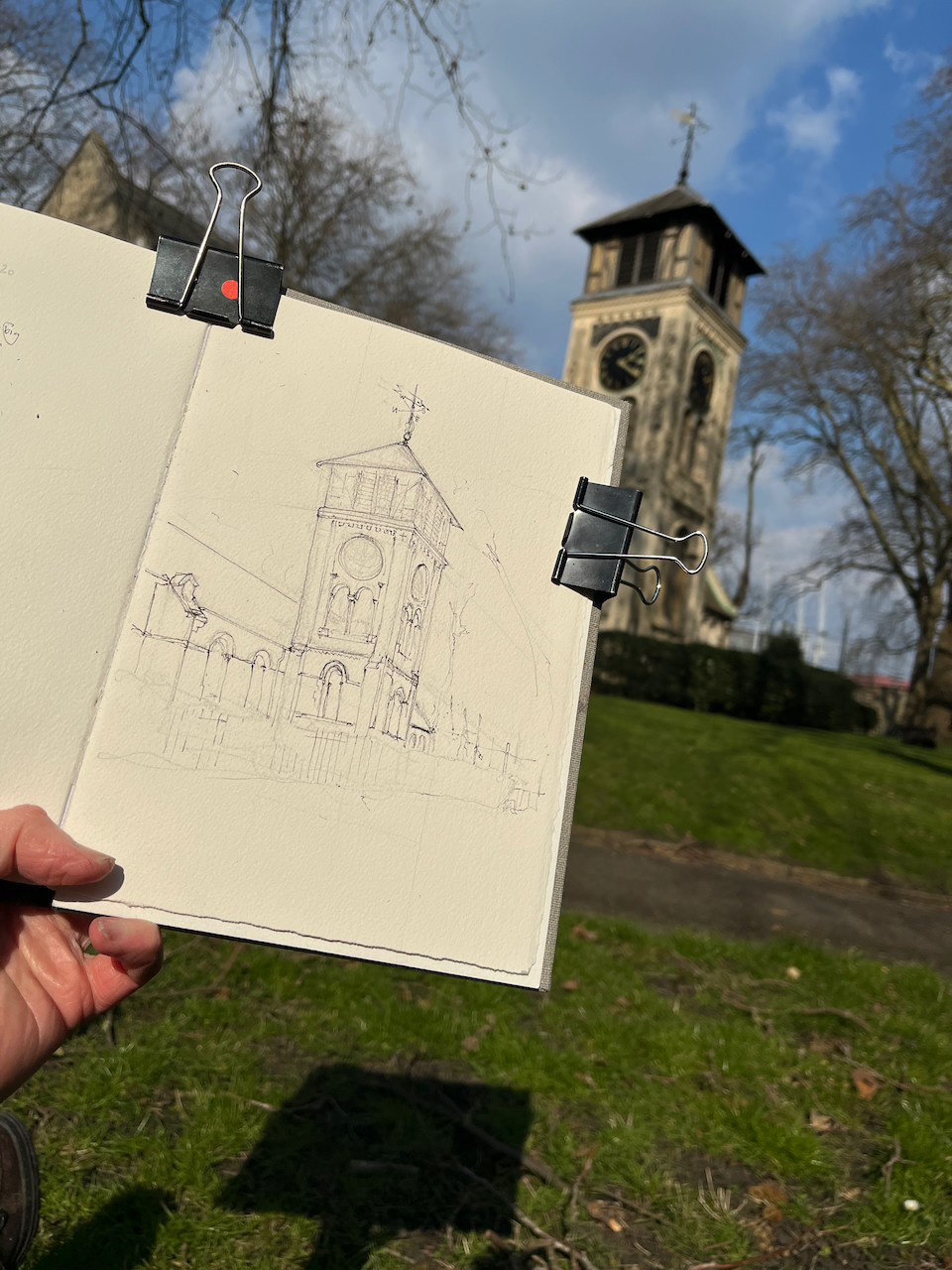
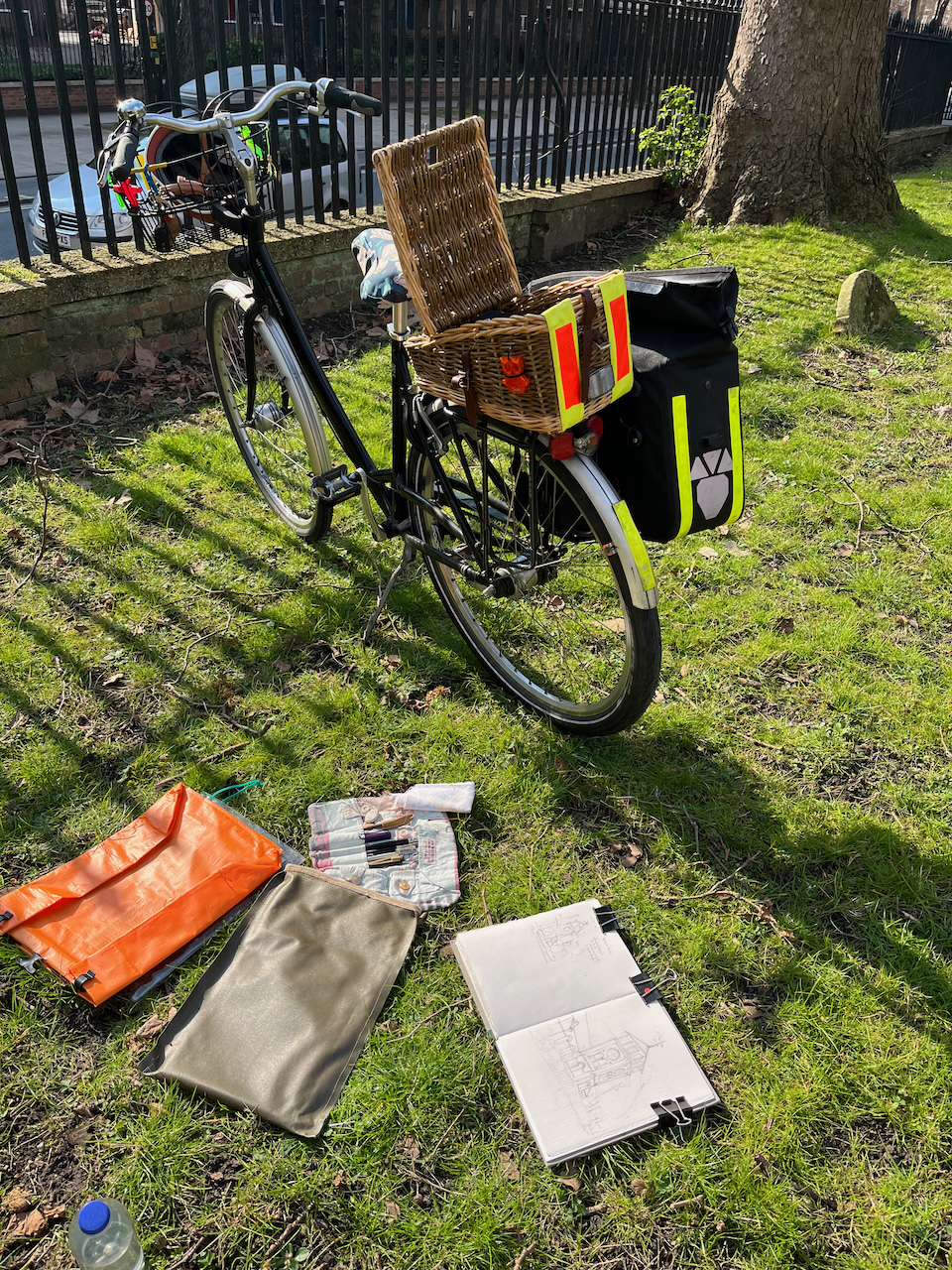
Here is work in progress and a map (click to enlarge the image)

Shakespeare Tower, Barbican EC2

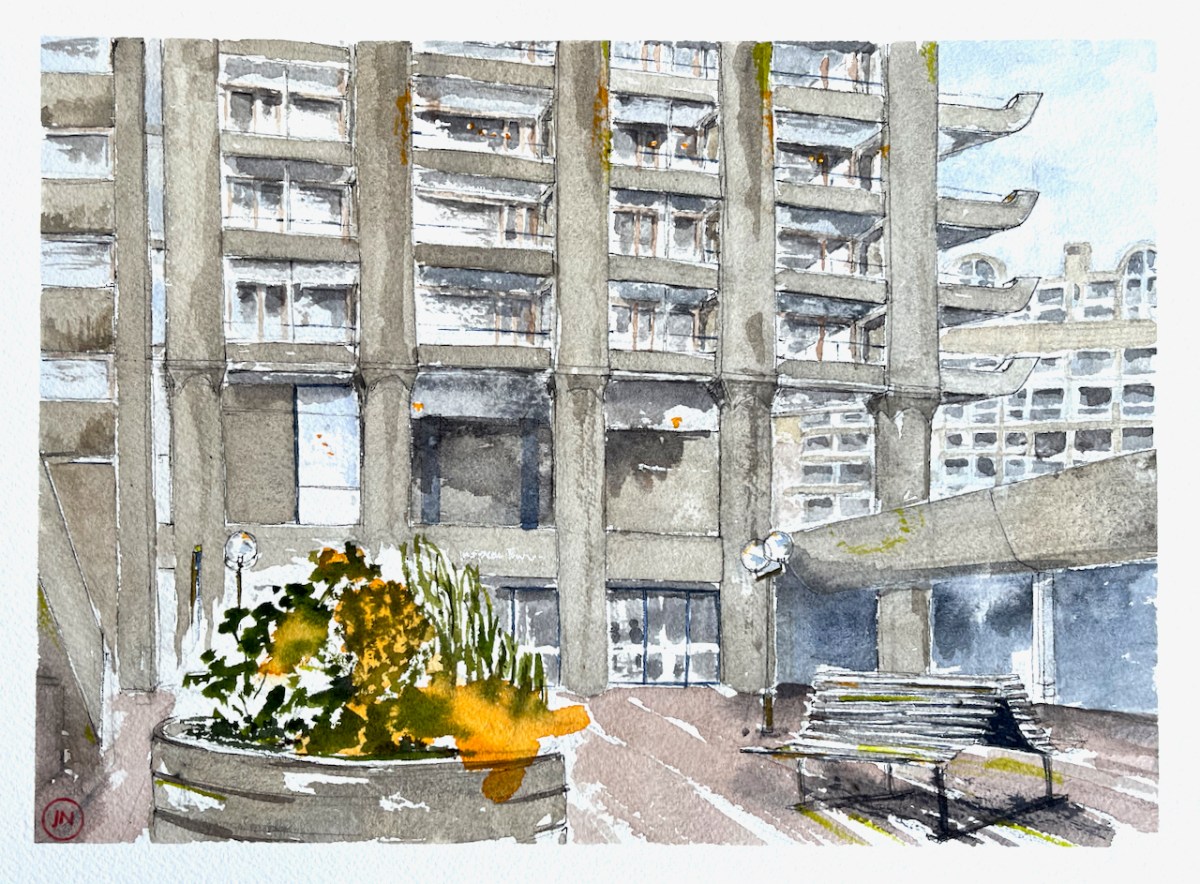
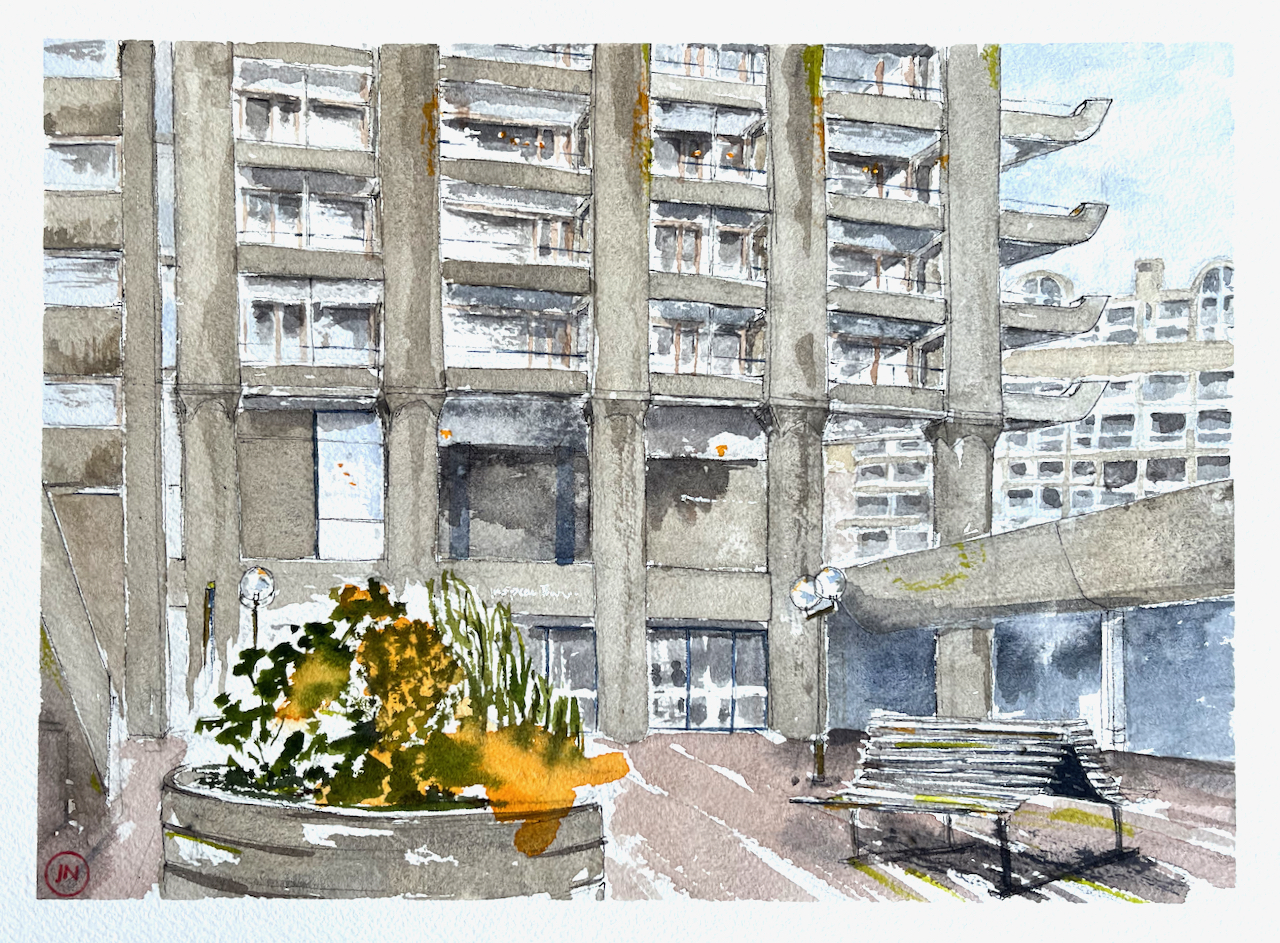
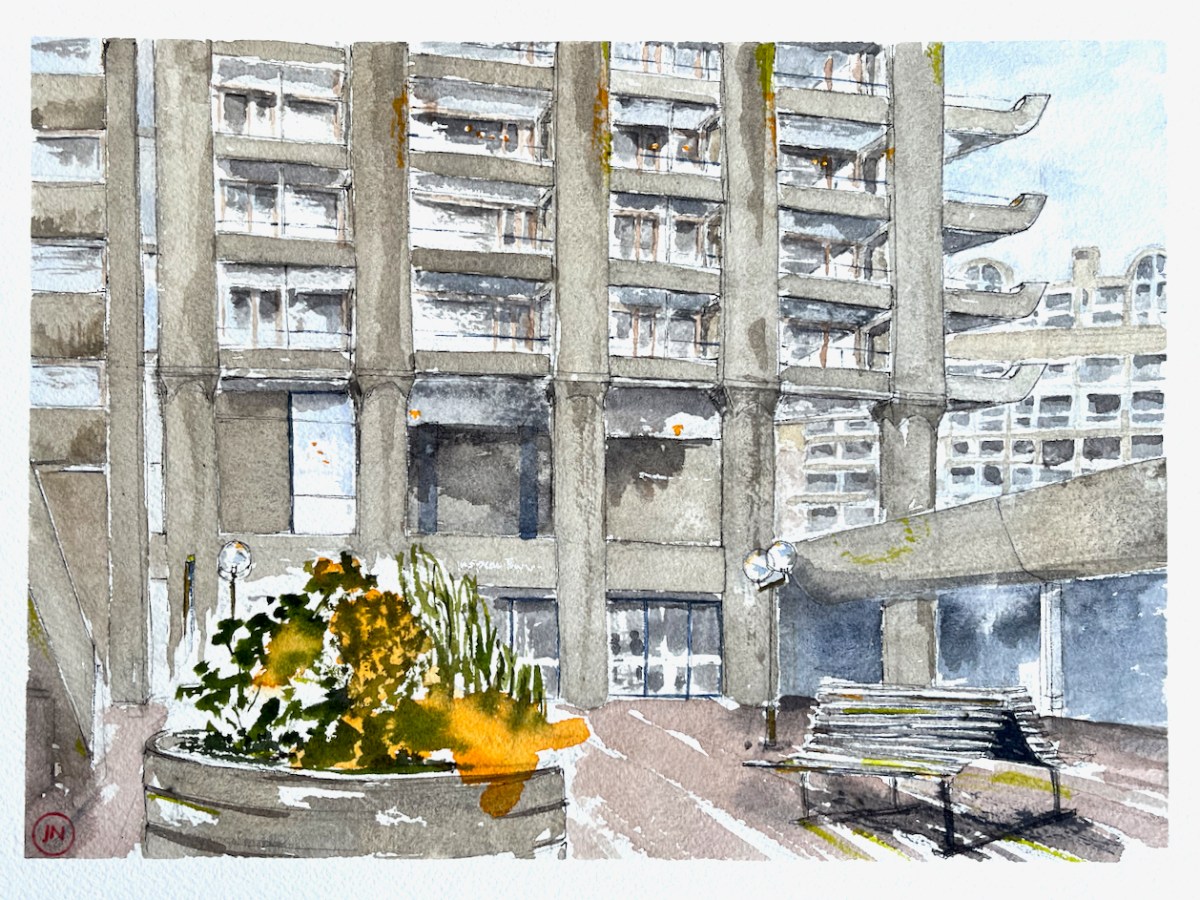
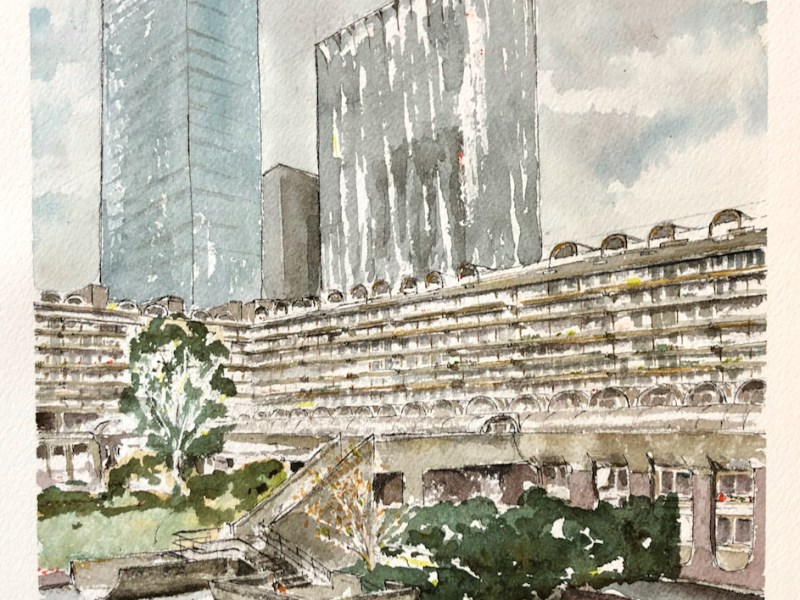
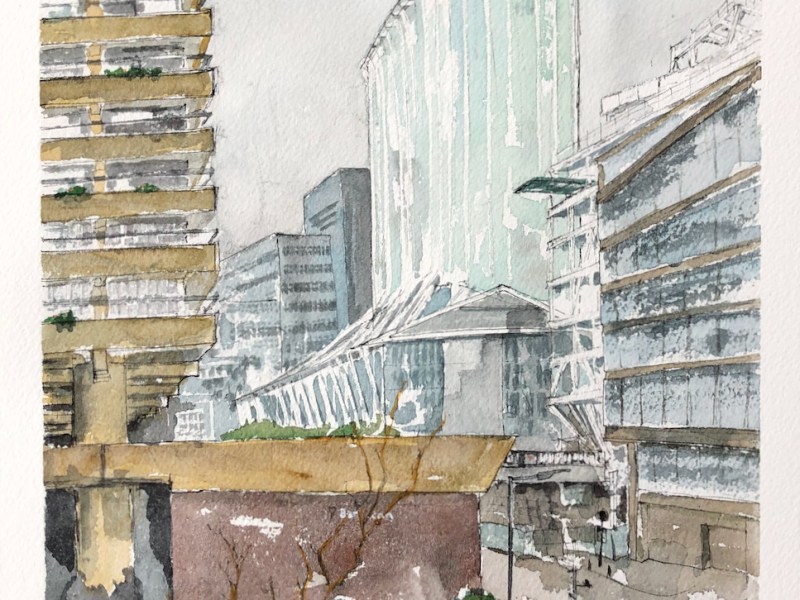
Here is a view of the east face of Shakespeare Tower, Barbican, from Defoe Place, near the Barbican Centre. You can see the main entrance to the tower. On the right is Cromwell Highwalk, and Ben Jonson House beyond. On the left you can just see the stairs that go down into Defoe Place from the highwalk.

Shakespeare Tower from Defoe Place, 12″ x 9″ [commission]
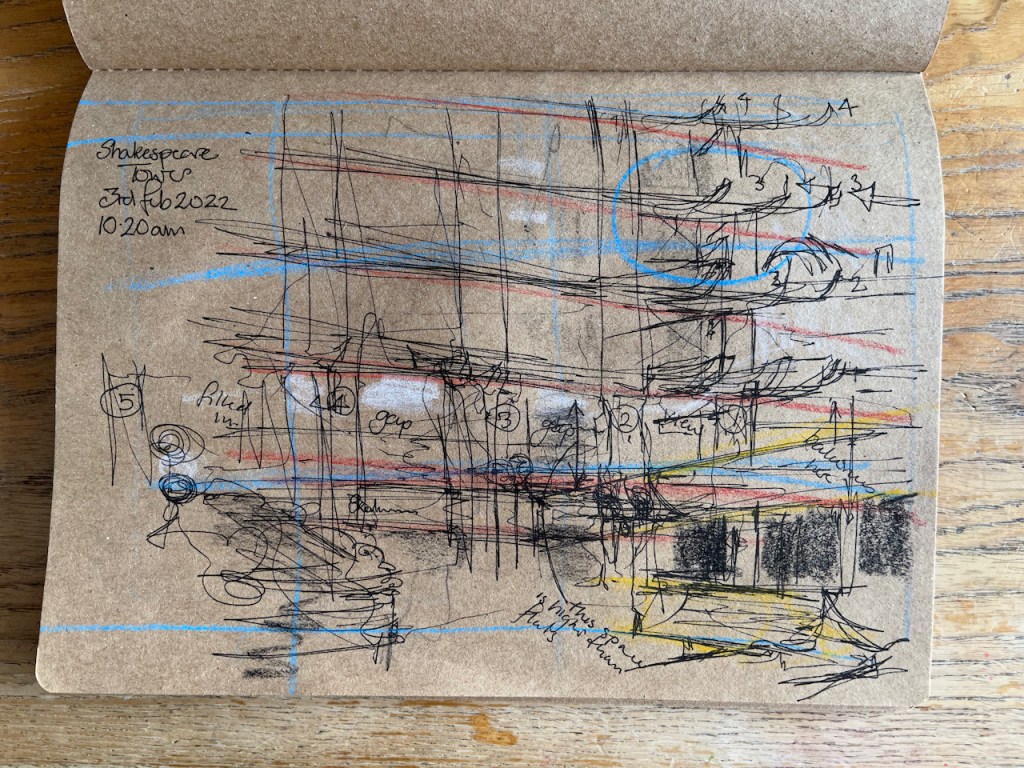
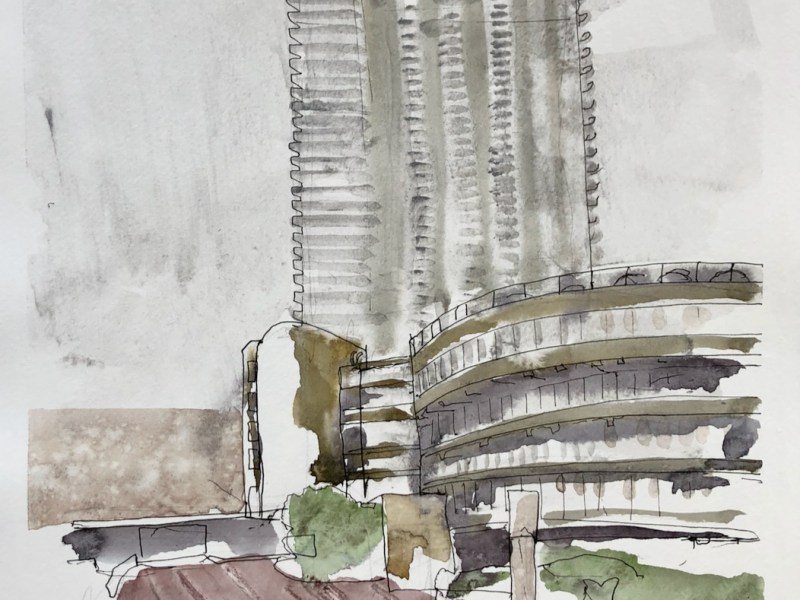
Preliminary sketch

I wanted this picture to give an impression of what it is like to walk around the Barbican. There are different depths, and sharp contrasts of dark and light, and large open spaces. Workers from the library looked out of their windows, saw me drawing and came to look at the picture. This was drawn in February, but still there were some flowers in the planters, even though this particular planter was in a shaded and windy place. The smell, however, was not of flowers but cigarette ends. People evidently use the area under the stairs as a smoking area, and drop their butts. So that’s the Barbican: people who talk to you, soaring towers, great perspective views, wide open spaces and a certain shabbiness around the edges.

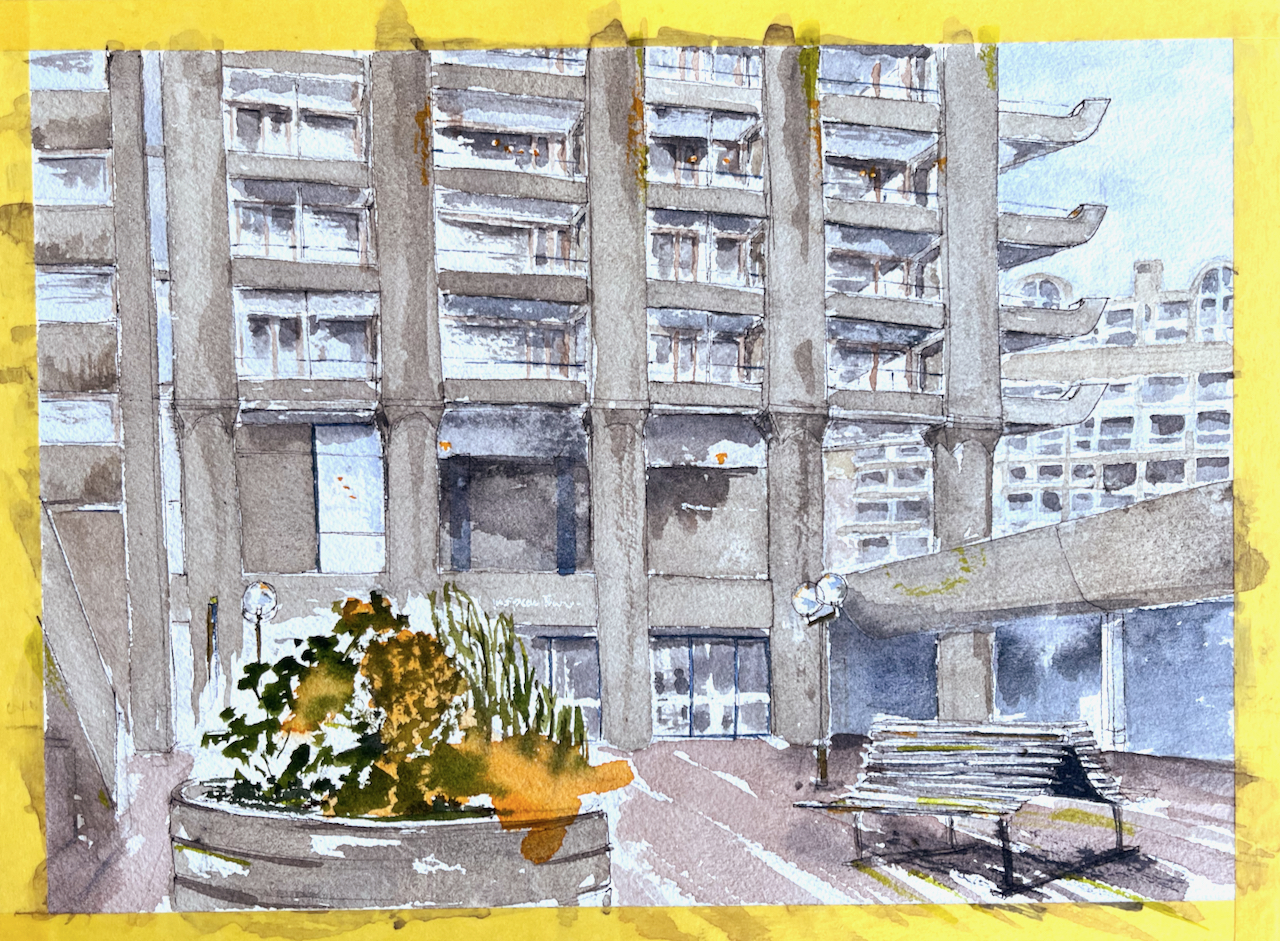
Here is the pen-and-ink compared with the colour:

Before and after the colour went on

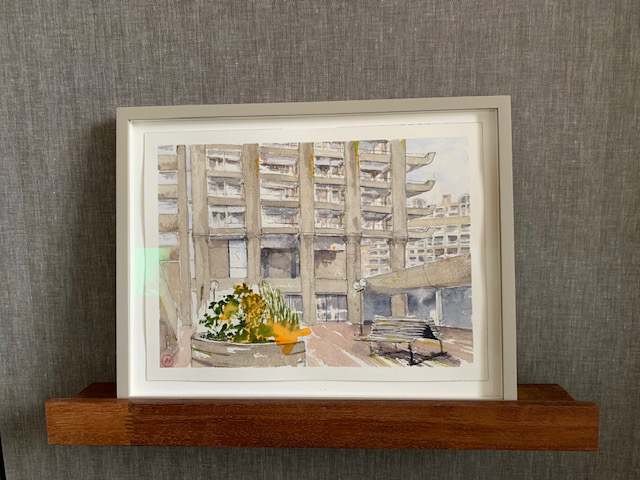
This was a commission. I am grateful to my client for the prompt to examine the Tower from this unusual angle. And also for sending me this photo of the framed watercolour:

Framed watercolour. Photo credit: NM

A collection of my drawings of the Barbican is here:

Something went wrong. Please refresh the page and/or try again.

St Mary Le Strand, WC2

Here is a sketch of St Mary Le Strand, which is the church in the middle of the Strand at Aldwych. I sketched this from outside Somerset House. As you see it was really busy there. The south part of Aldwych is being closed off to motor traffic and made a pedestrian-only route. It will be great when it’s finished, but right now it means that the busy pavements are narrowed with barriers and there are many types of confusion.

St Mary Le Strand WC2, 1st March 2022, 10″ x 7″ in Sketchbook 11

The foreground is collage, added after the drawing.

Here is work in progress and a map.