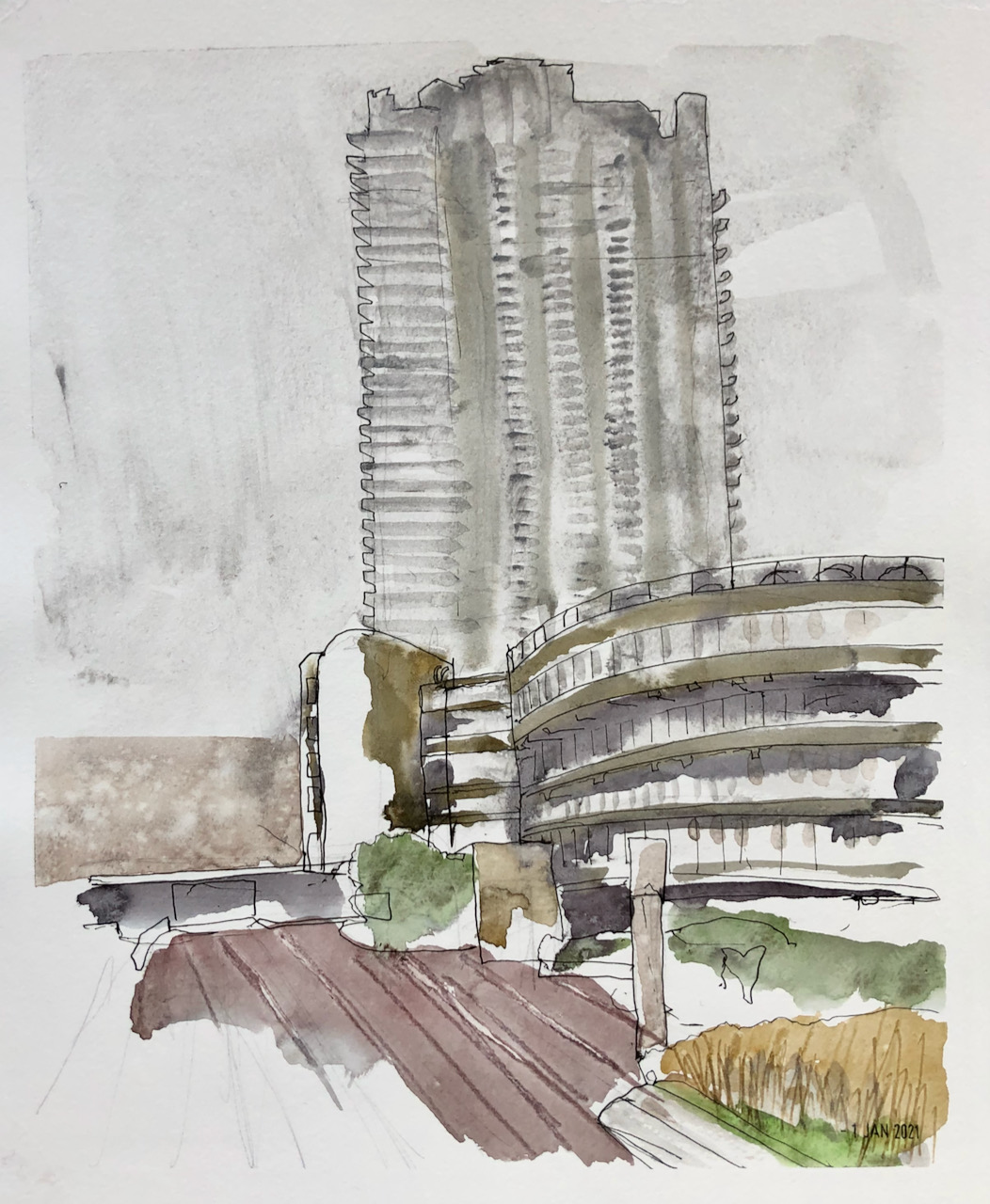
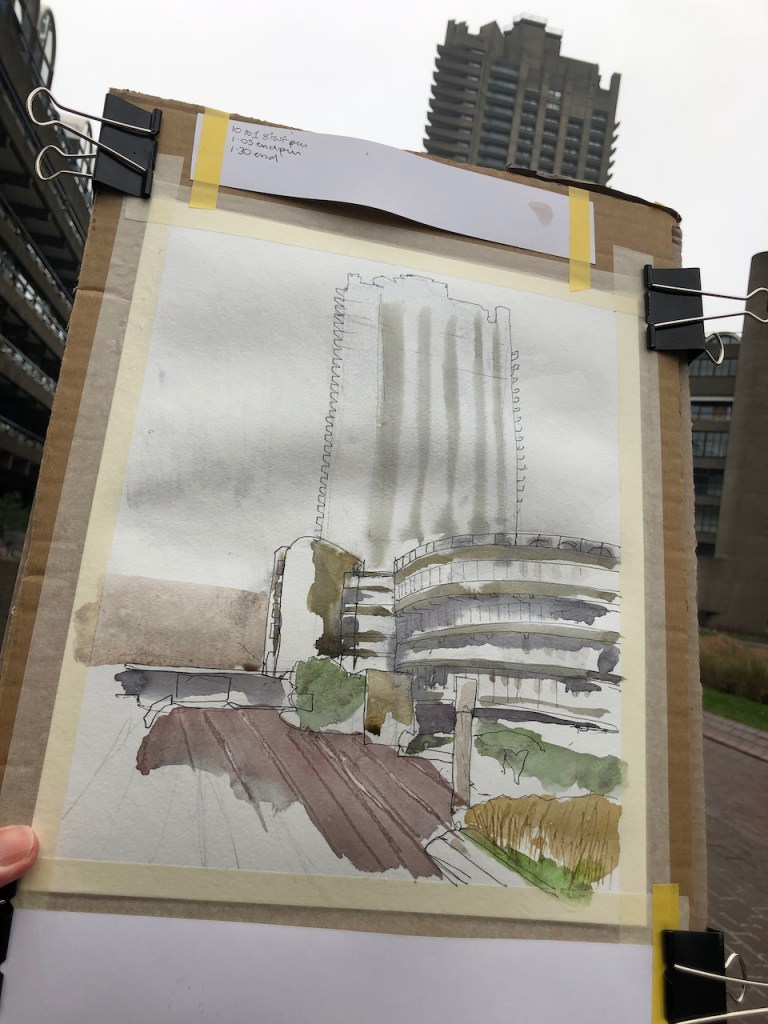
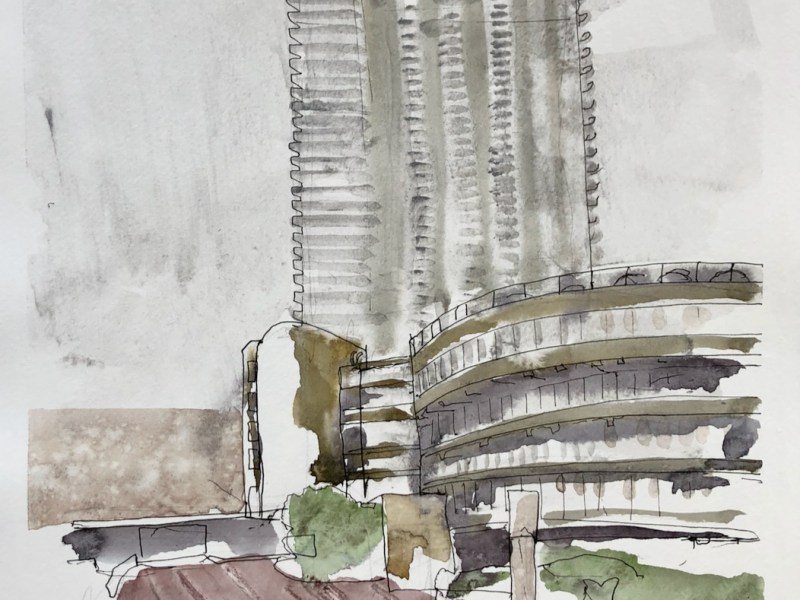
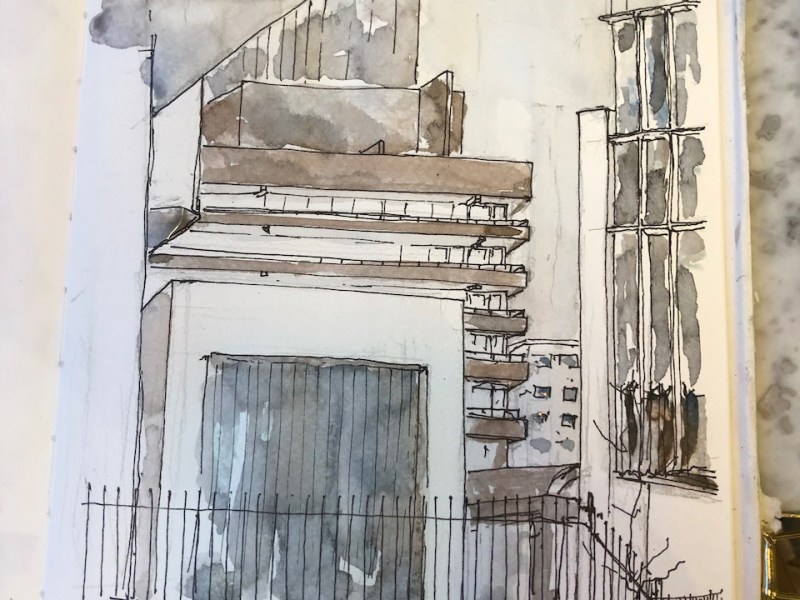
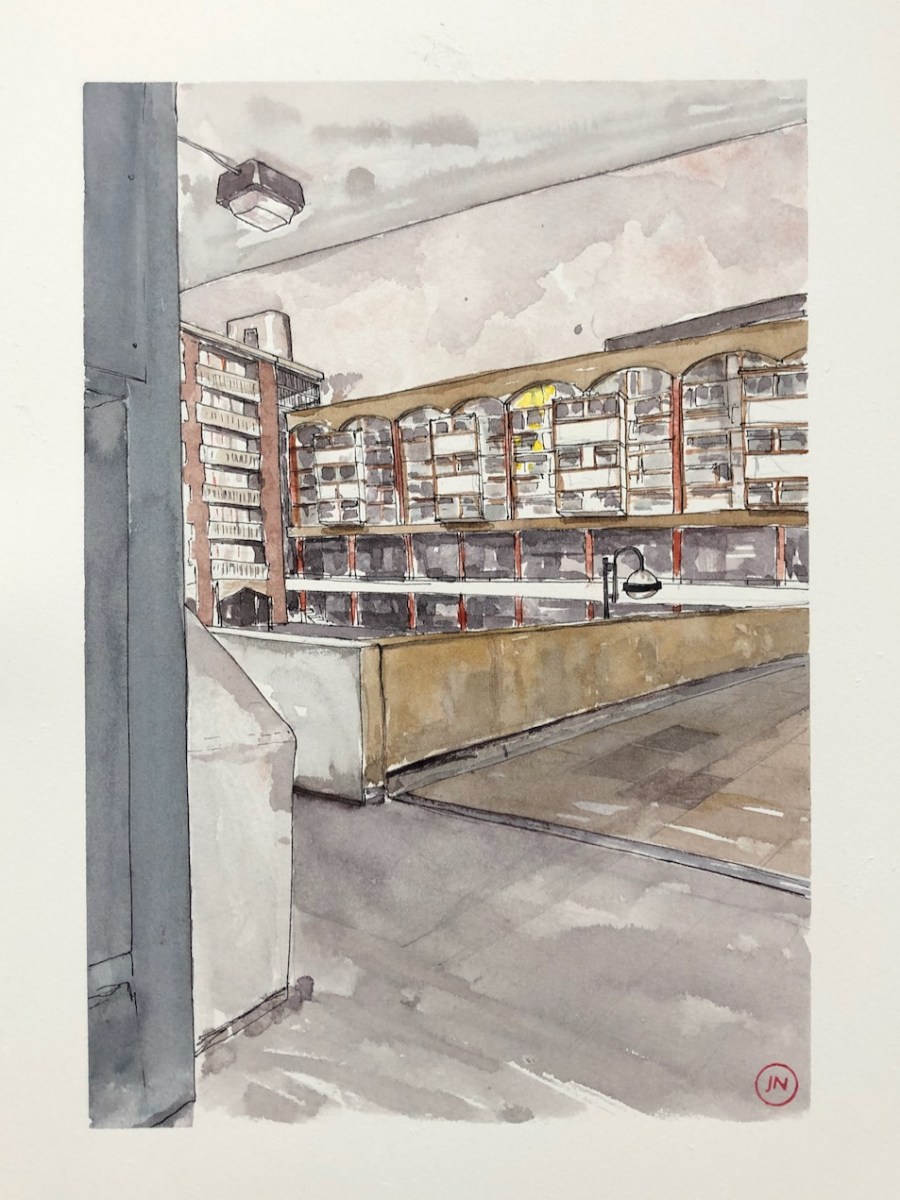
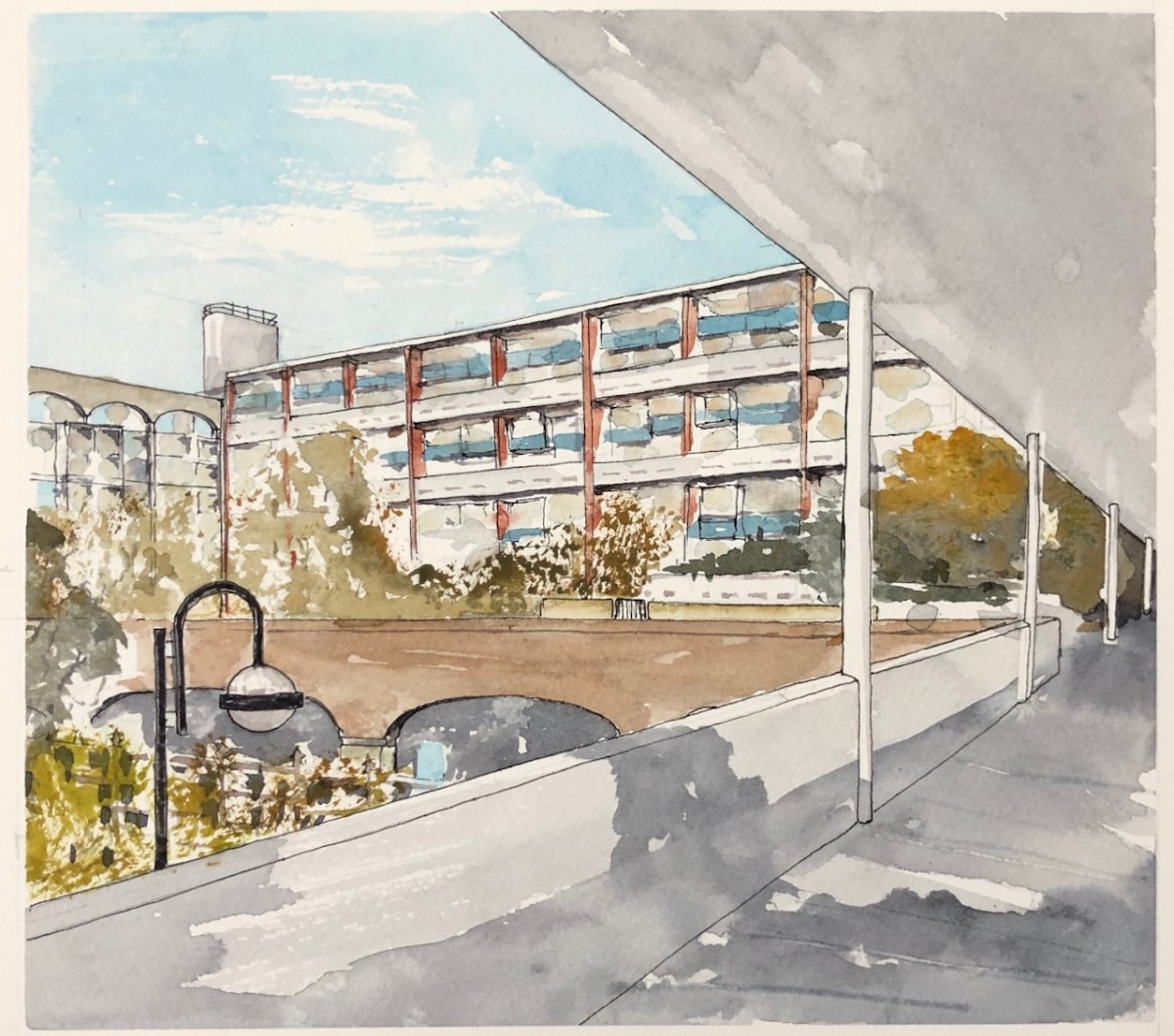
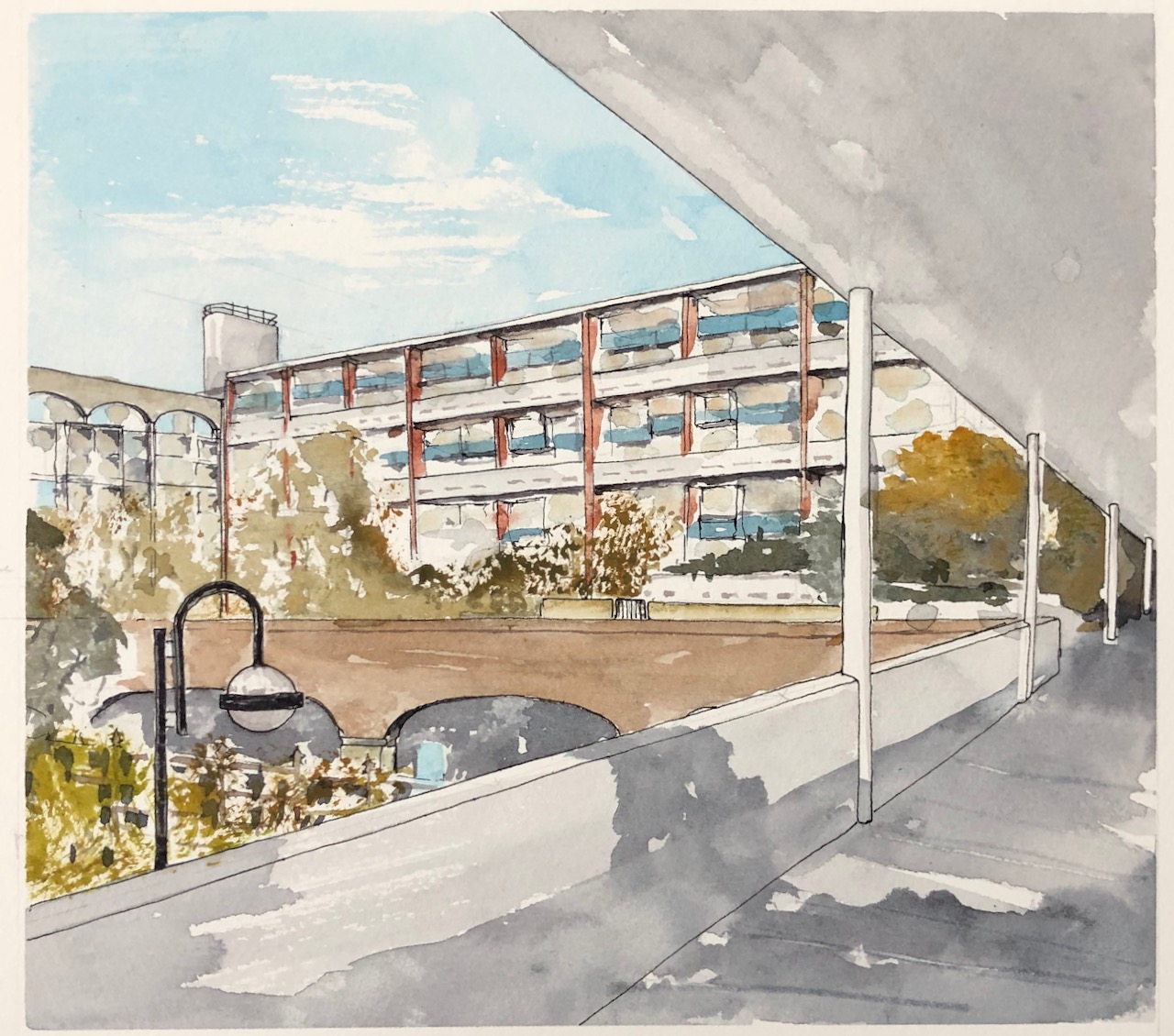
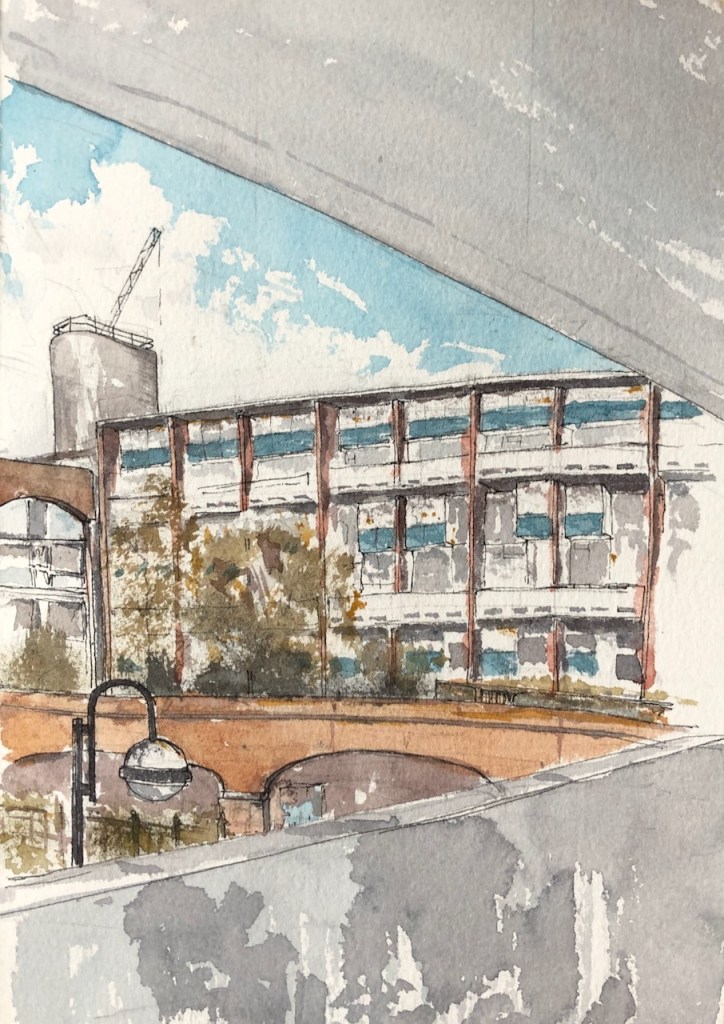
Here is Cromwell Tower, in the Barbican, with Frobisher Crescent to the right, sketched pre-lockdown, from the Podium.
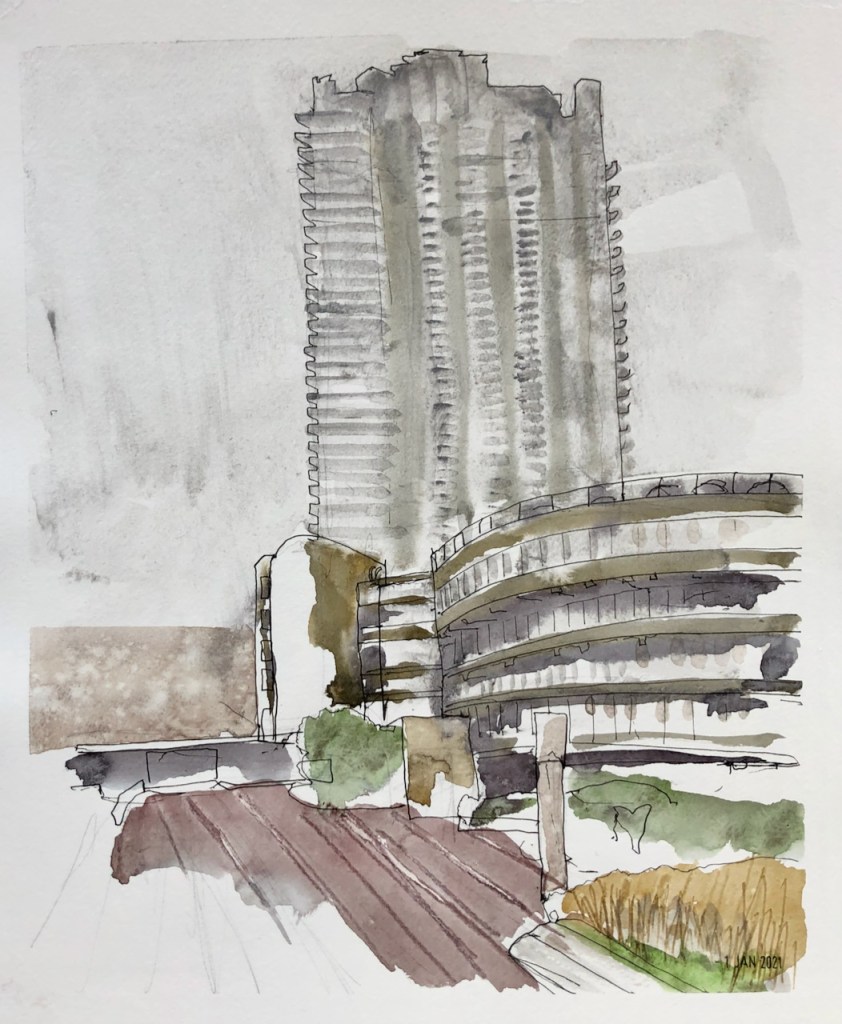
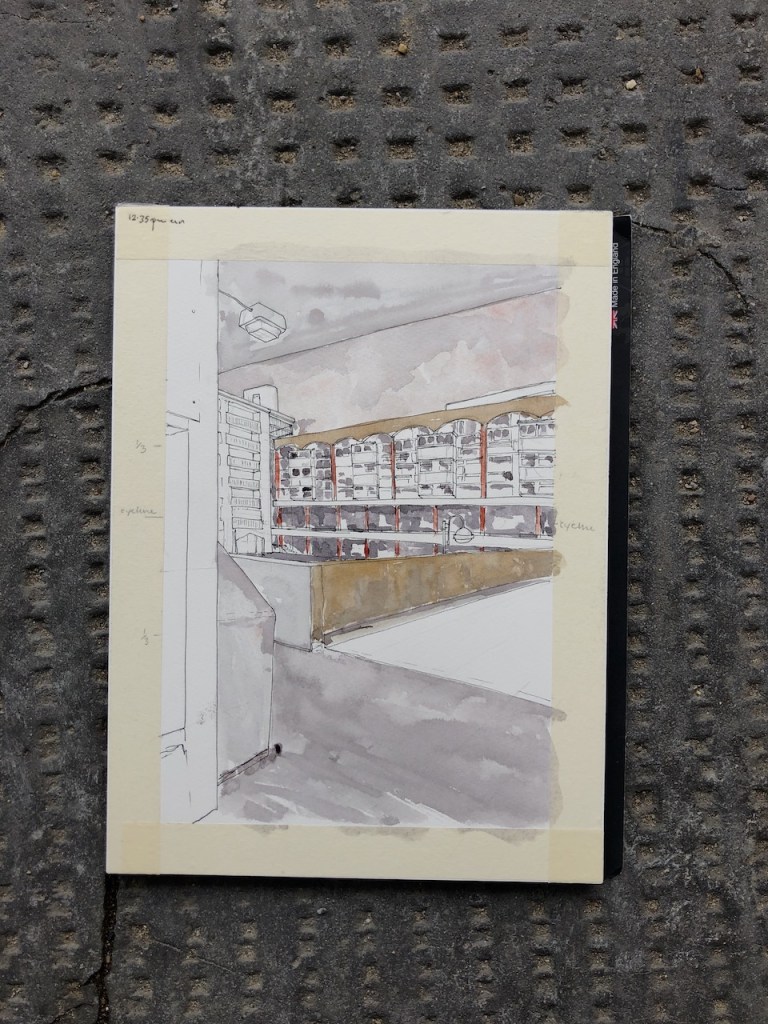
Cromwell Tower from the Barbican podium, 1st January 2021, 10″x 12″
This was a very cold day, and it started to sleet. That pitted effect you see on the left? That’s not a clever artistic technique, that’s ice crystals dropping on the painting from the sky!
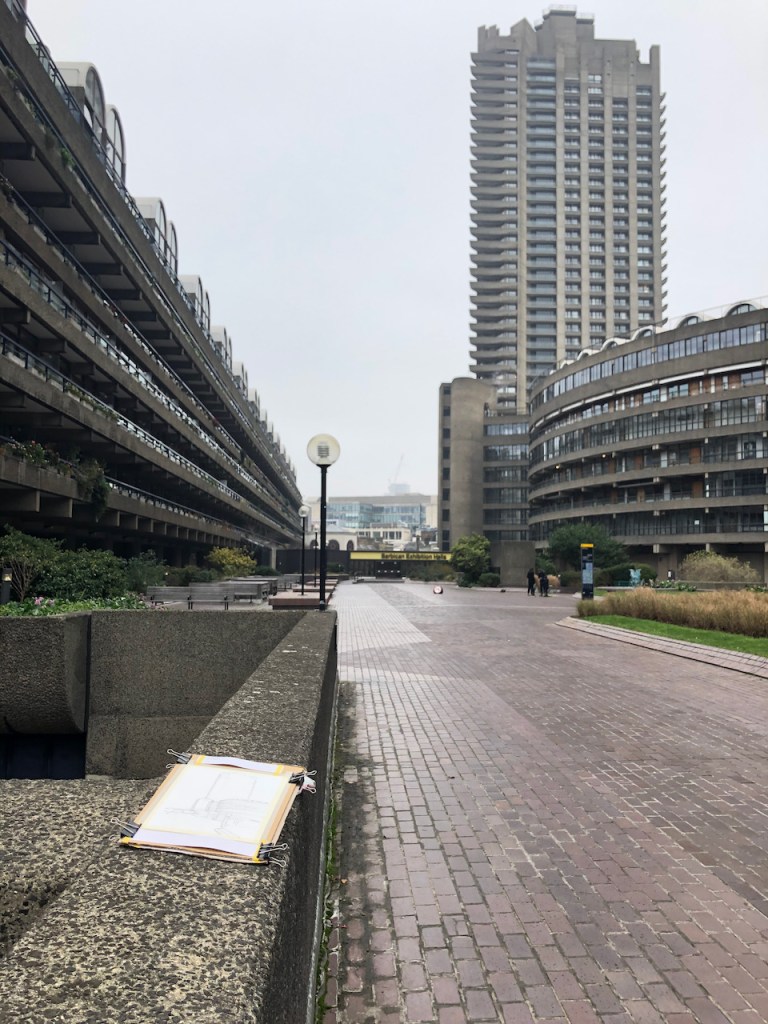
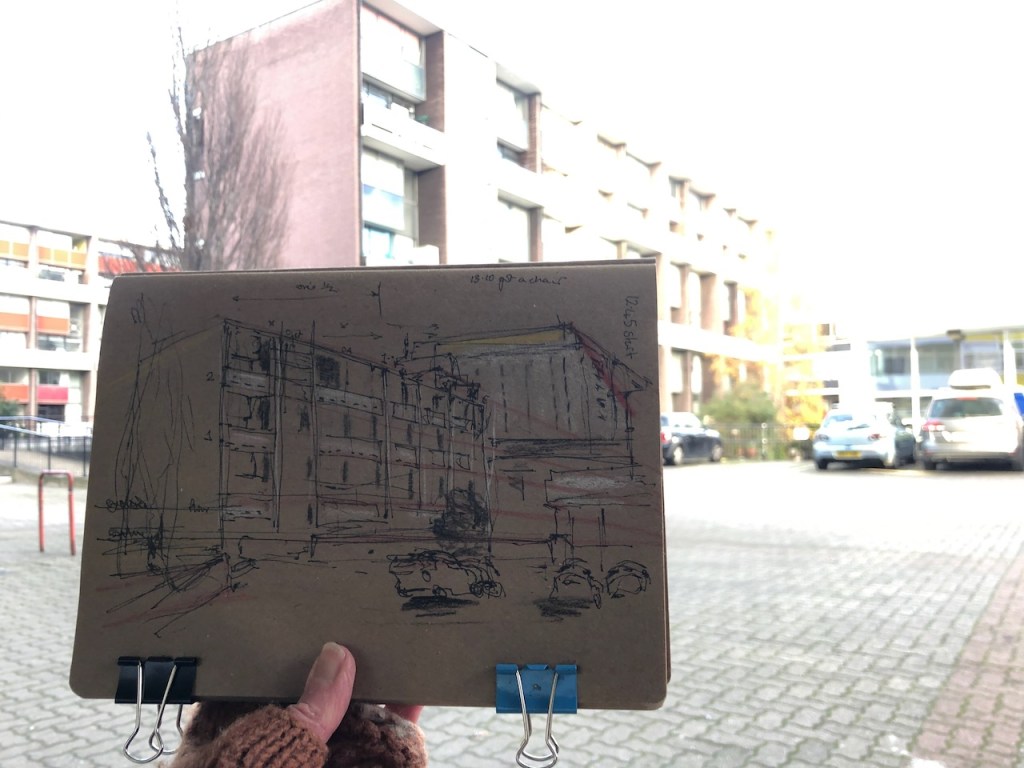
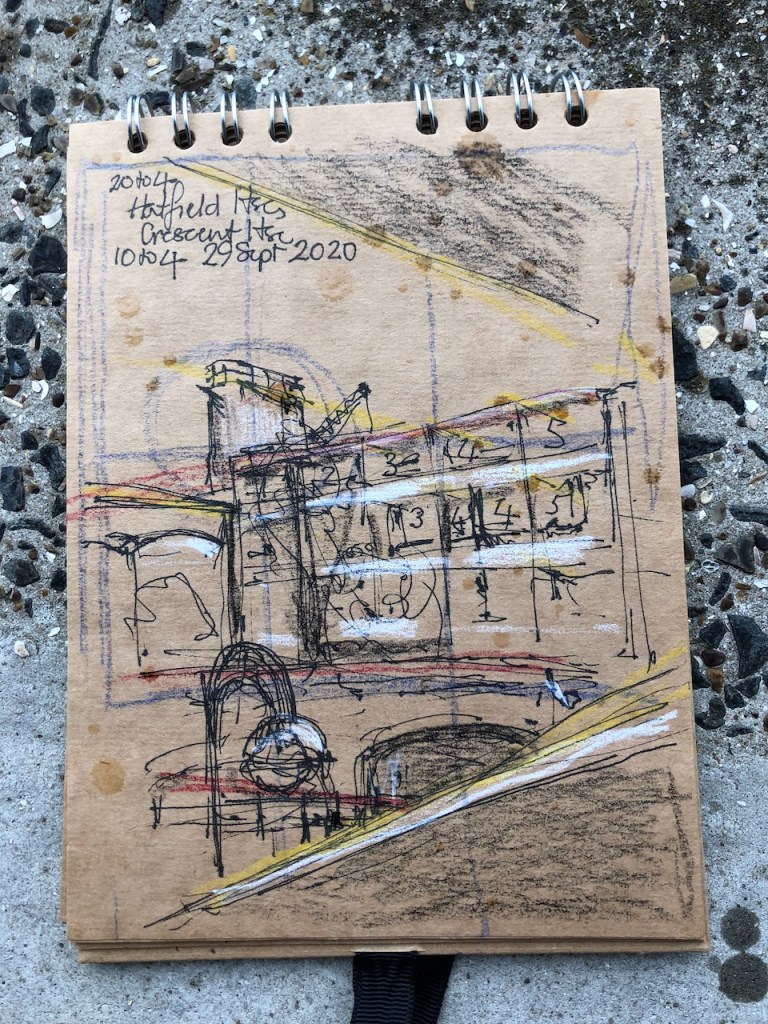
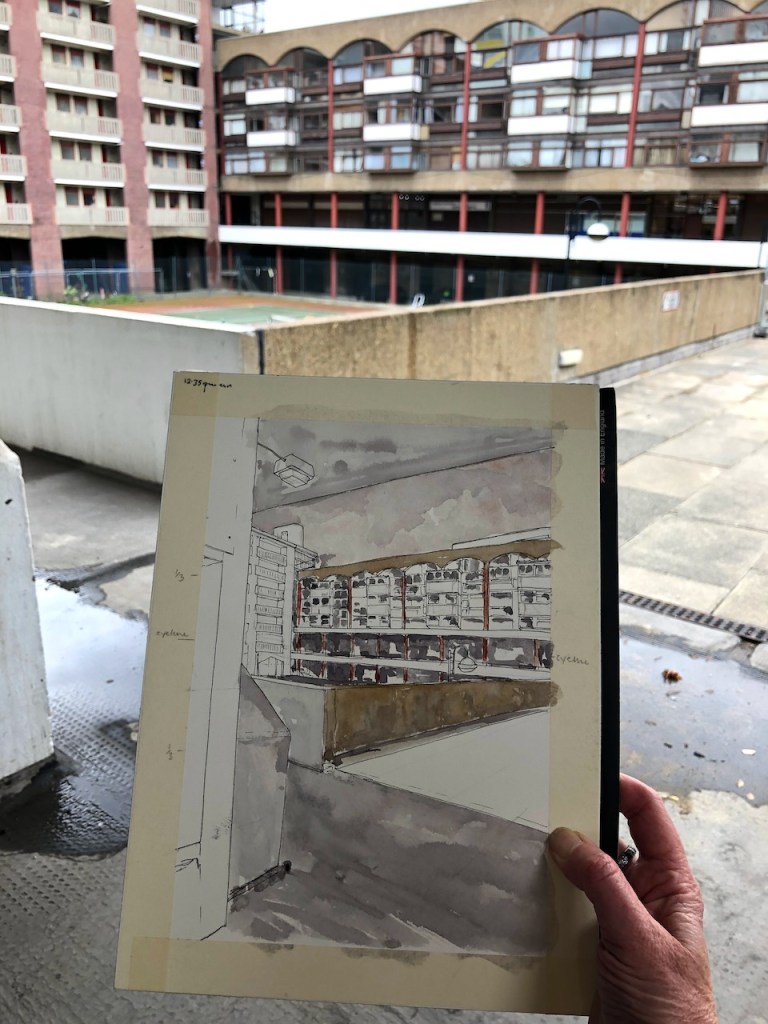
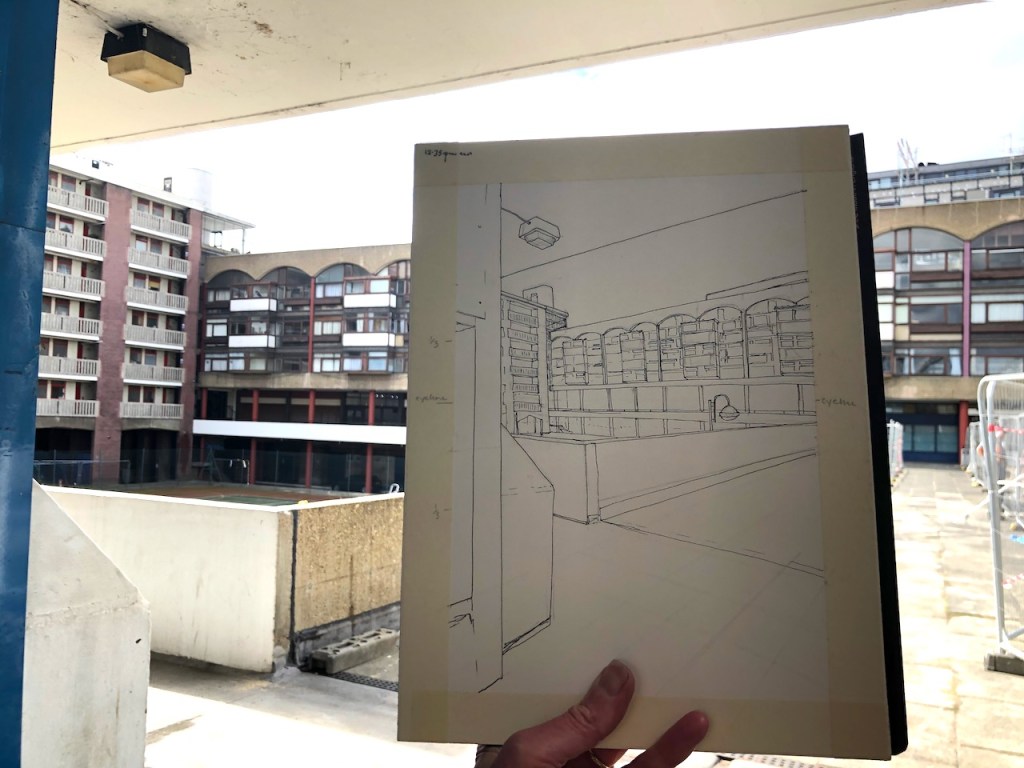
My viewpoint
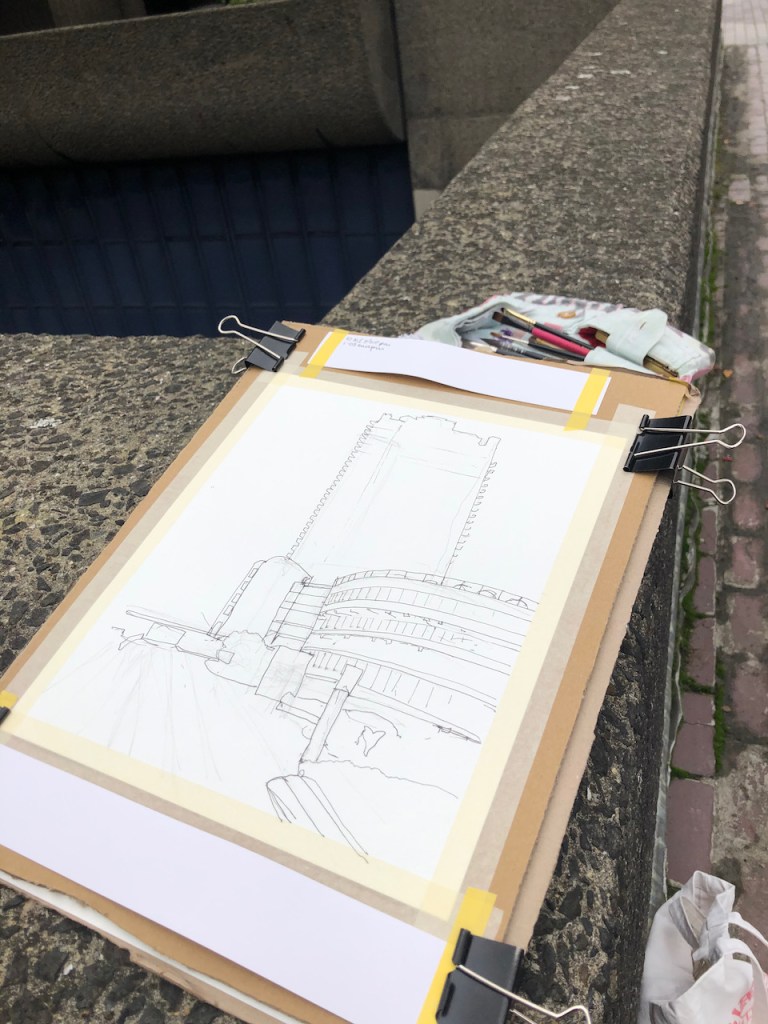
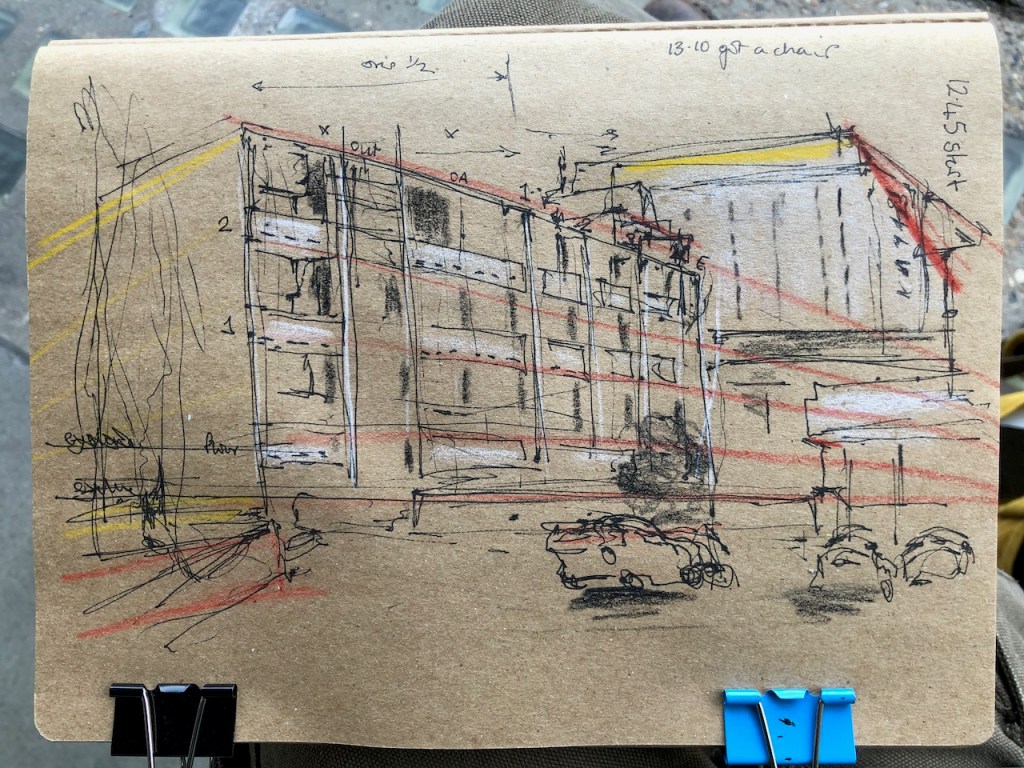
Pen sketch
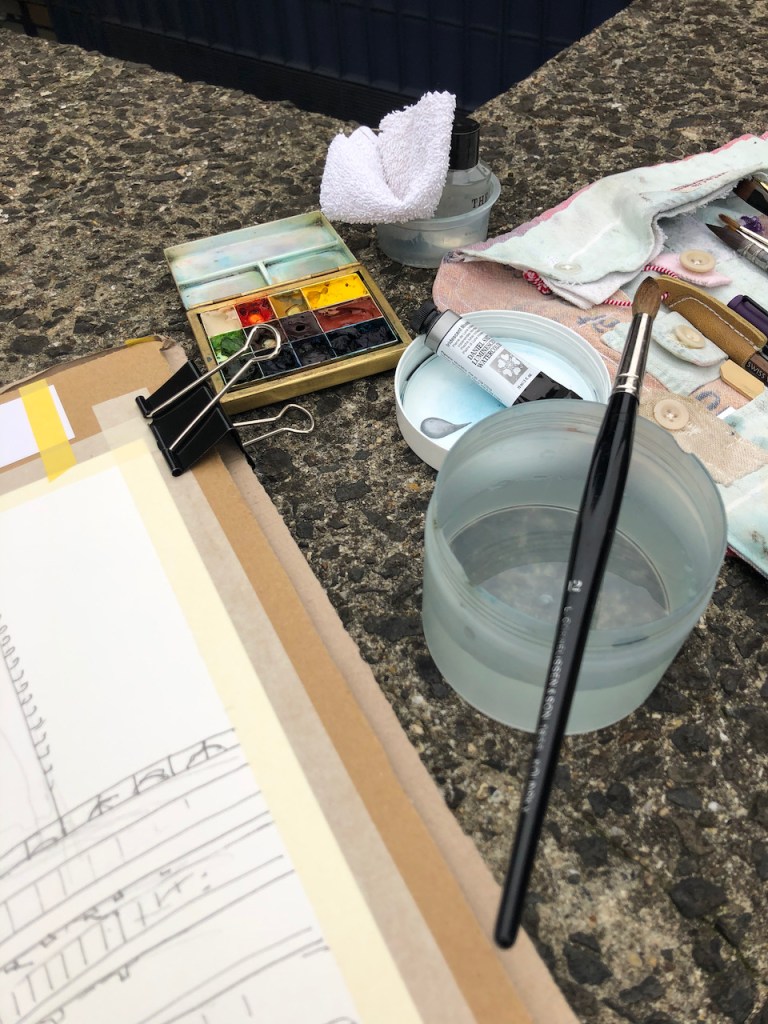
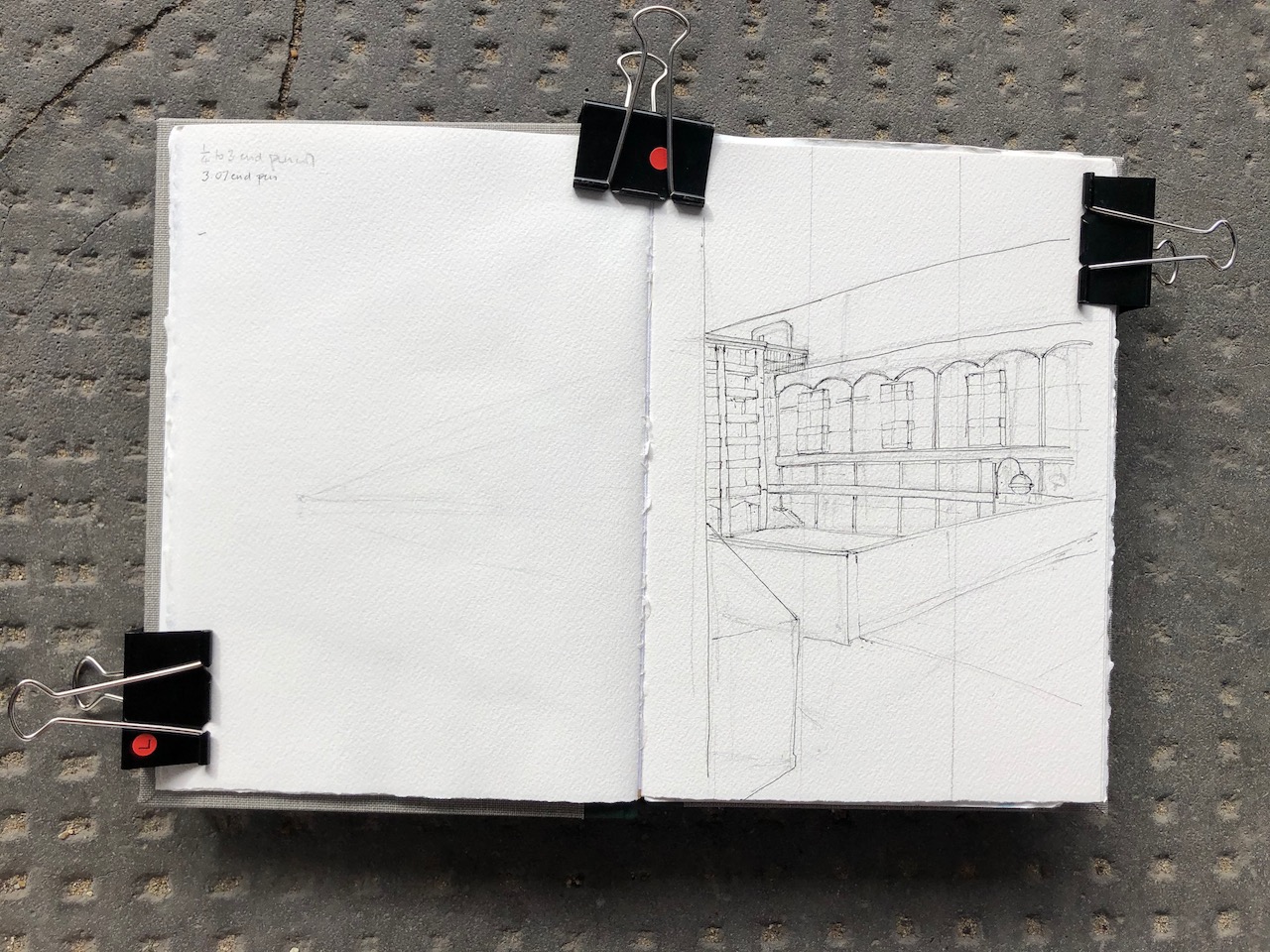
Tools
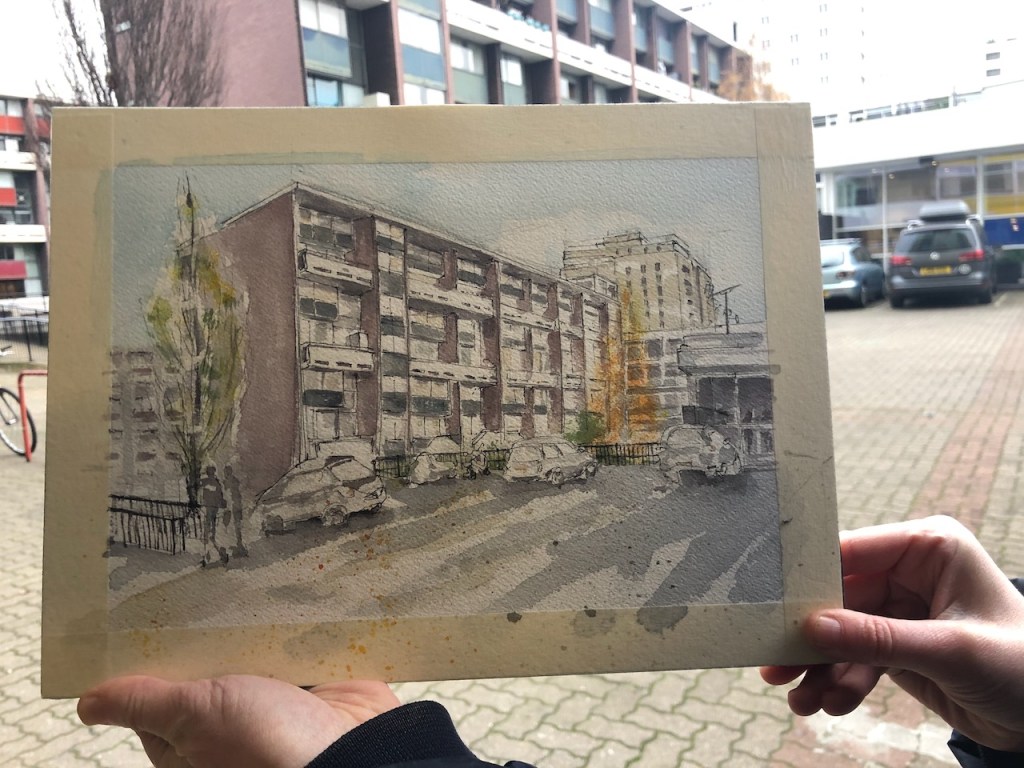
Painting on location
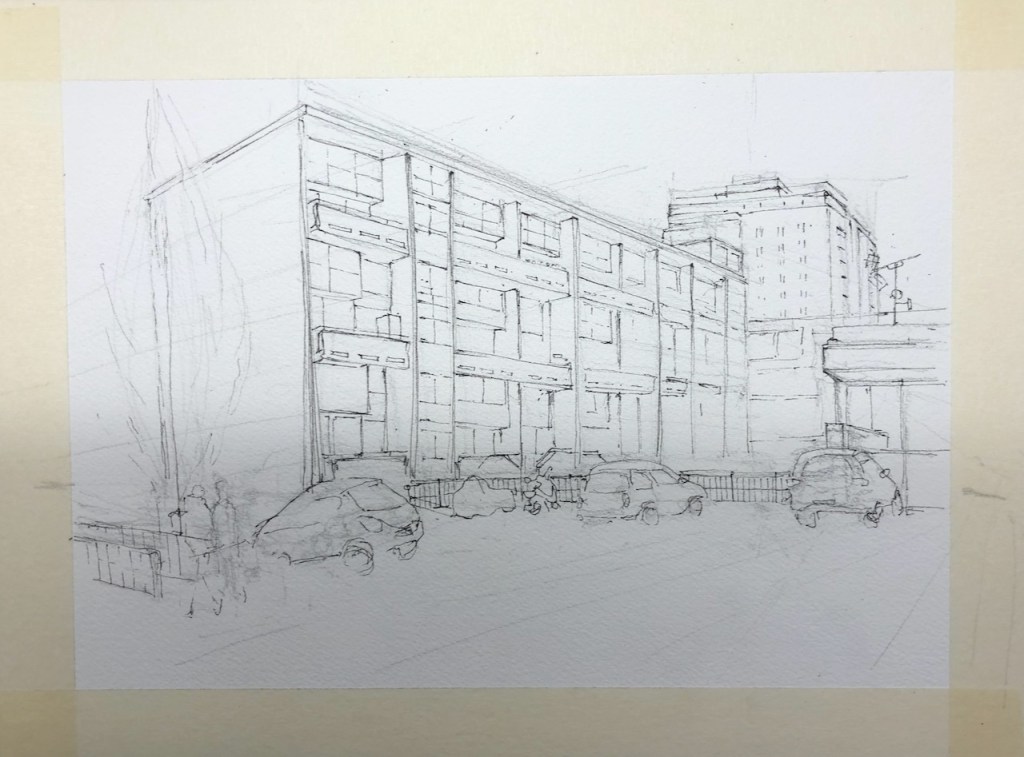
Work in progress.
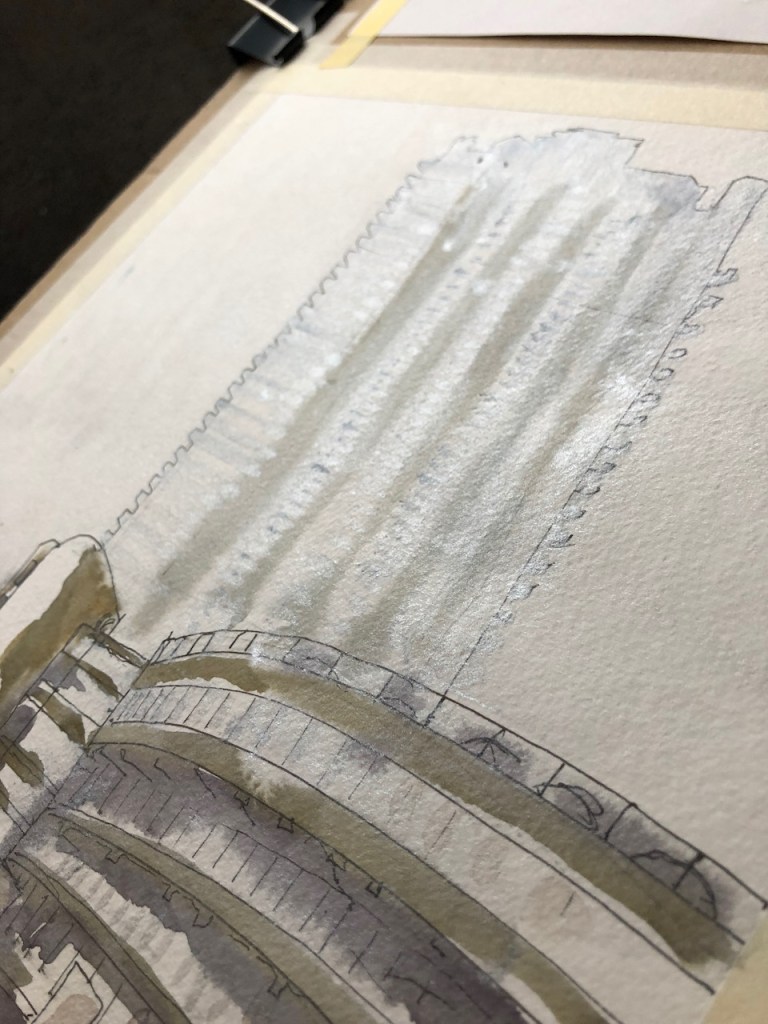
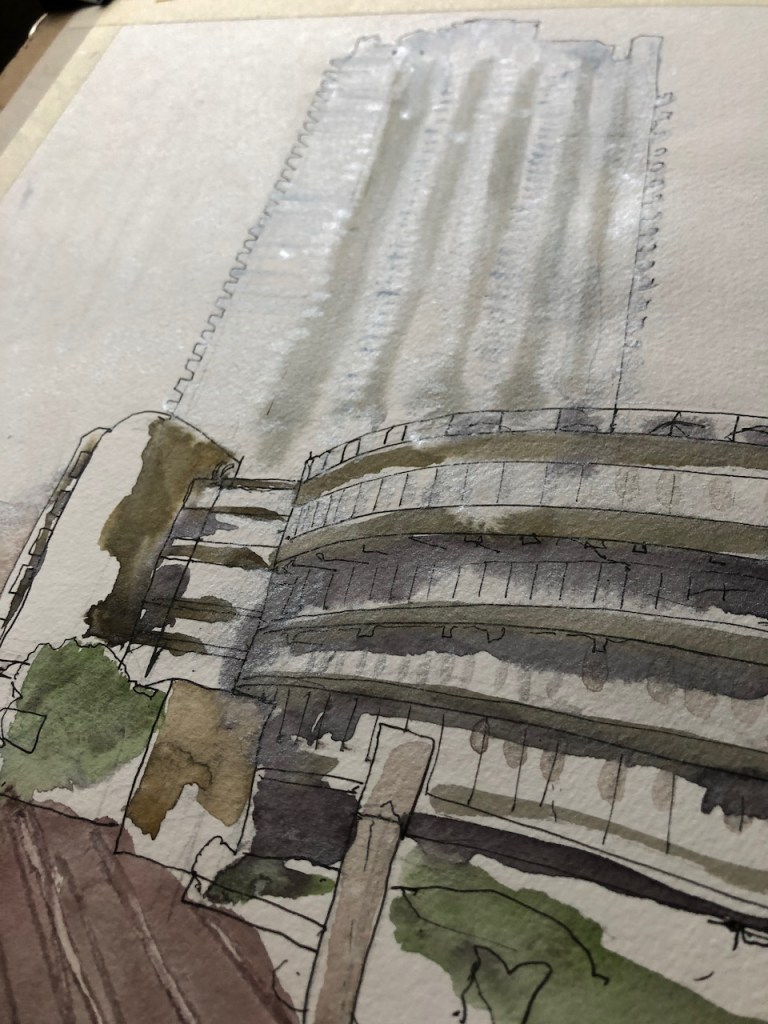
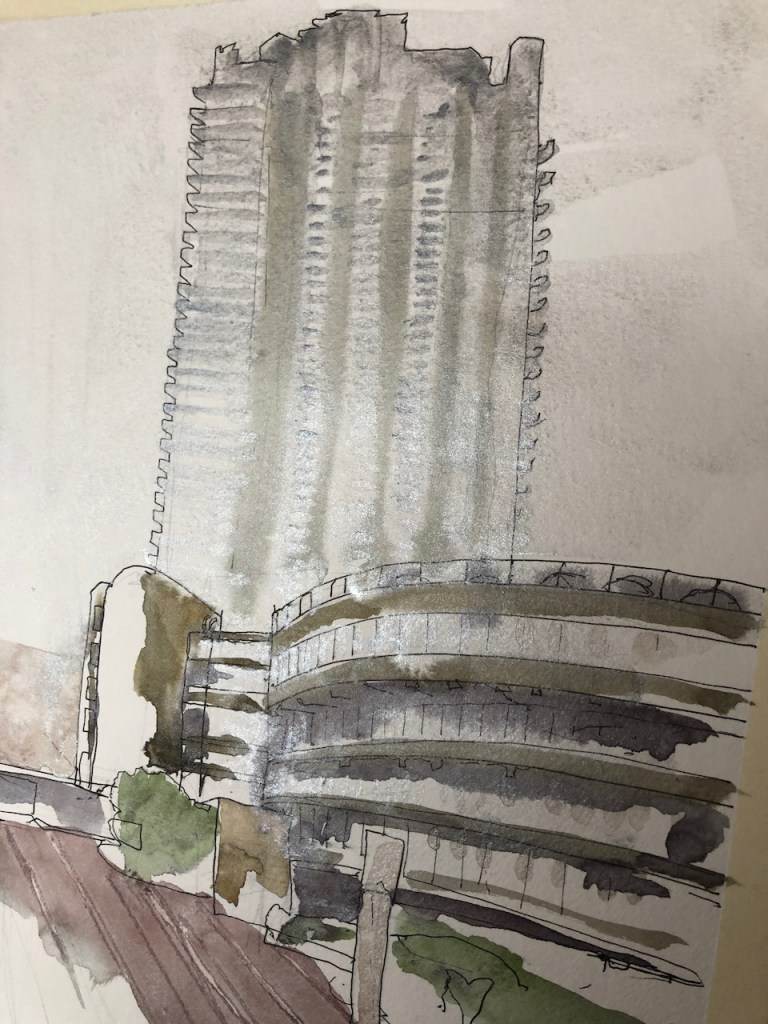
I finished off the tower indoors. I used Daniel Smith Iridescent Moonstone watercolour paint. See how it catches the light!
Daniel Smith Iridescent Moonstone watercolour paint in action
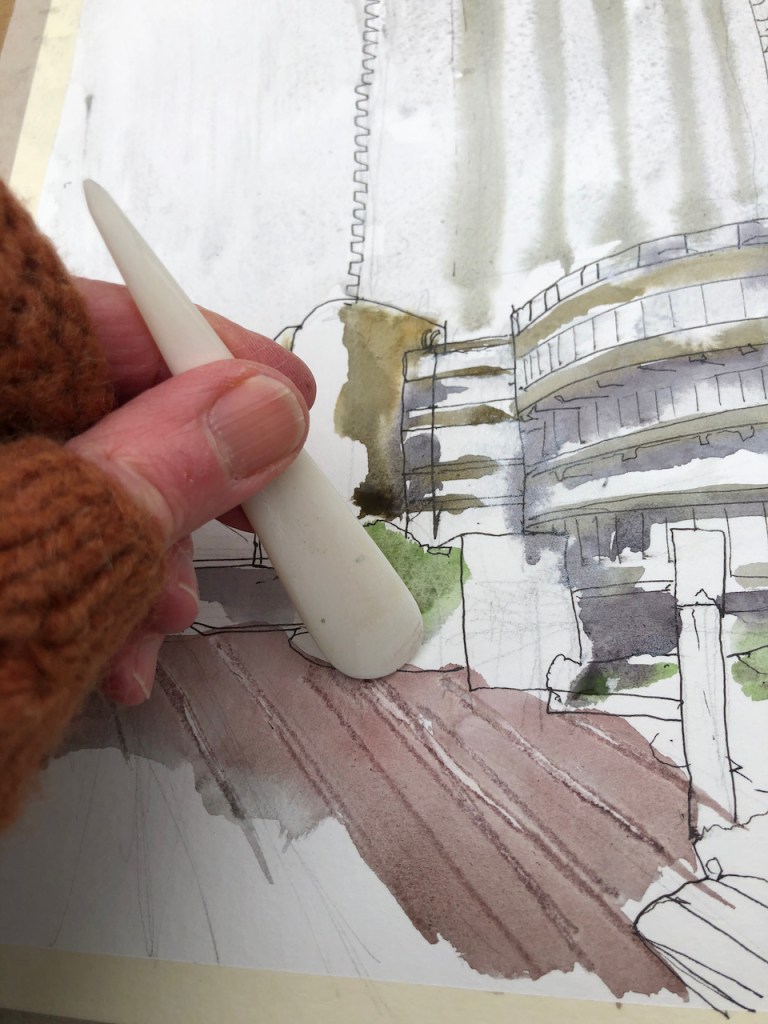
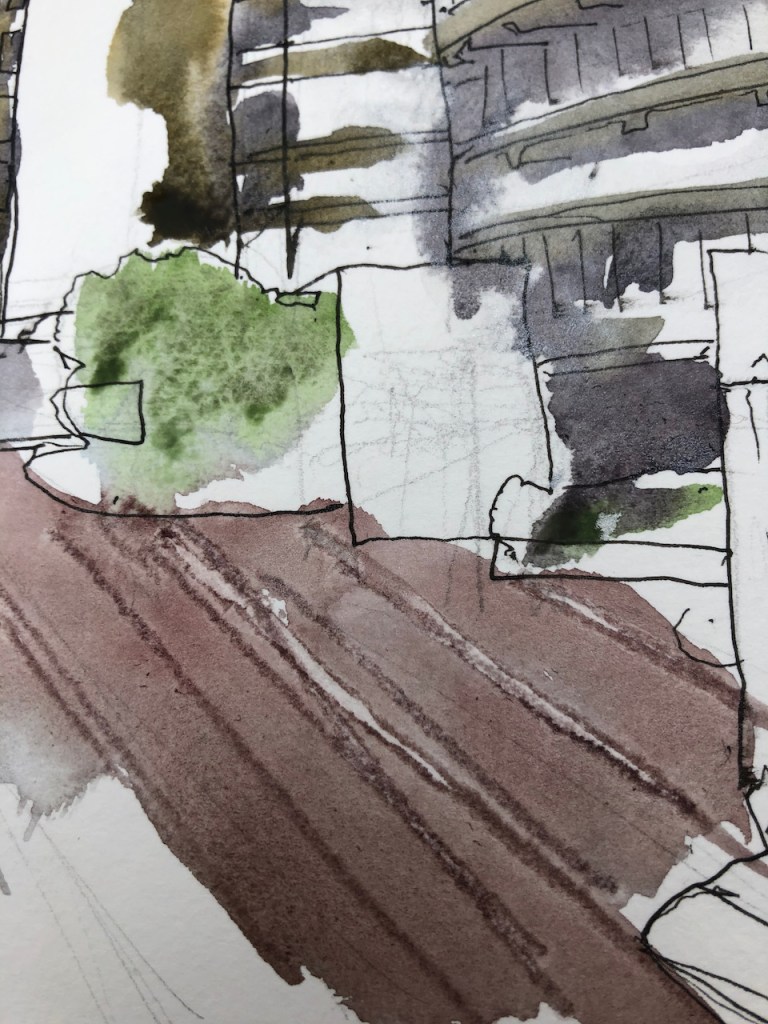
For the podium tiling I used an experimental effect: scratching. I was in a bit of a hurry (it was really cold) and it was hard to get the angle right as I was holding the painting and standing up. It created an interesting effect, not quite what I intended, but I liked it.
Using a bone implement to make lines in wet watercolour.
Sometimes the lines came out dark, sometimes white.
Scratching technique
This is one of a series of drawings on Jackson’s watercolour sheets: 10″ x 12″ cold-pressed, 300gsm. The bone implement I used for scratching is from the Vintage Paper Company and is a “bone folder”, intended for folding paper. It is good because it is not entirely sharp, and it’s nice to hold.
The colours are Daniel Smith watercolours: Prussian Blue, Perylene Maroon, and Mars Yellow, with a bit of Green Apatite Genuine for the plants, and Iridescent Moonstone mixed in, especially for the tower.
I’ve drawn in and around the Barbican before. Here’s a collection: (click “load more posts” to see more posts of the Barbican.)
It was getting dark but I’d been indoors all day. I set off into the gloom with my drawing things.
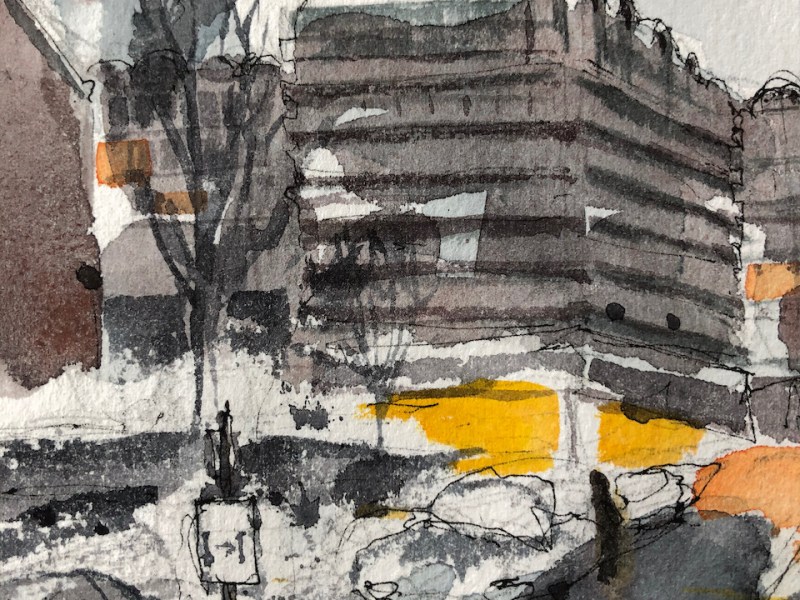
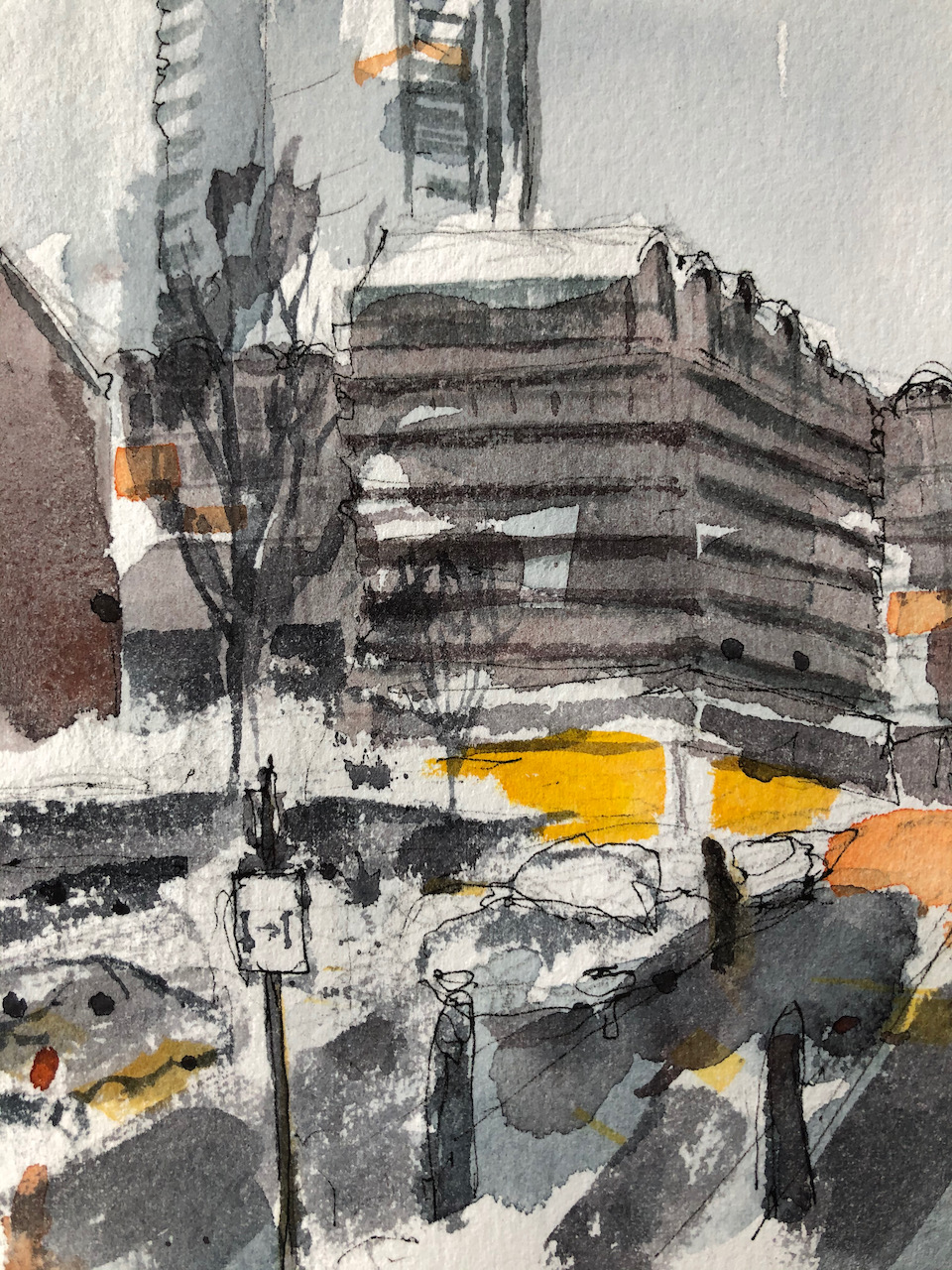
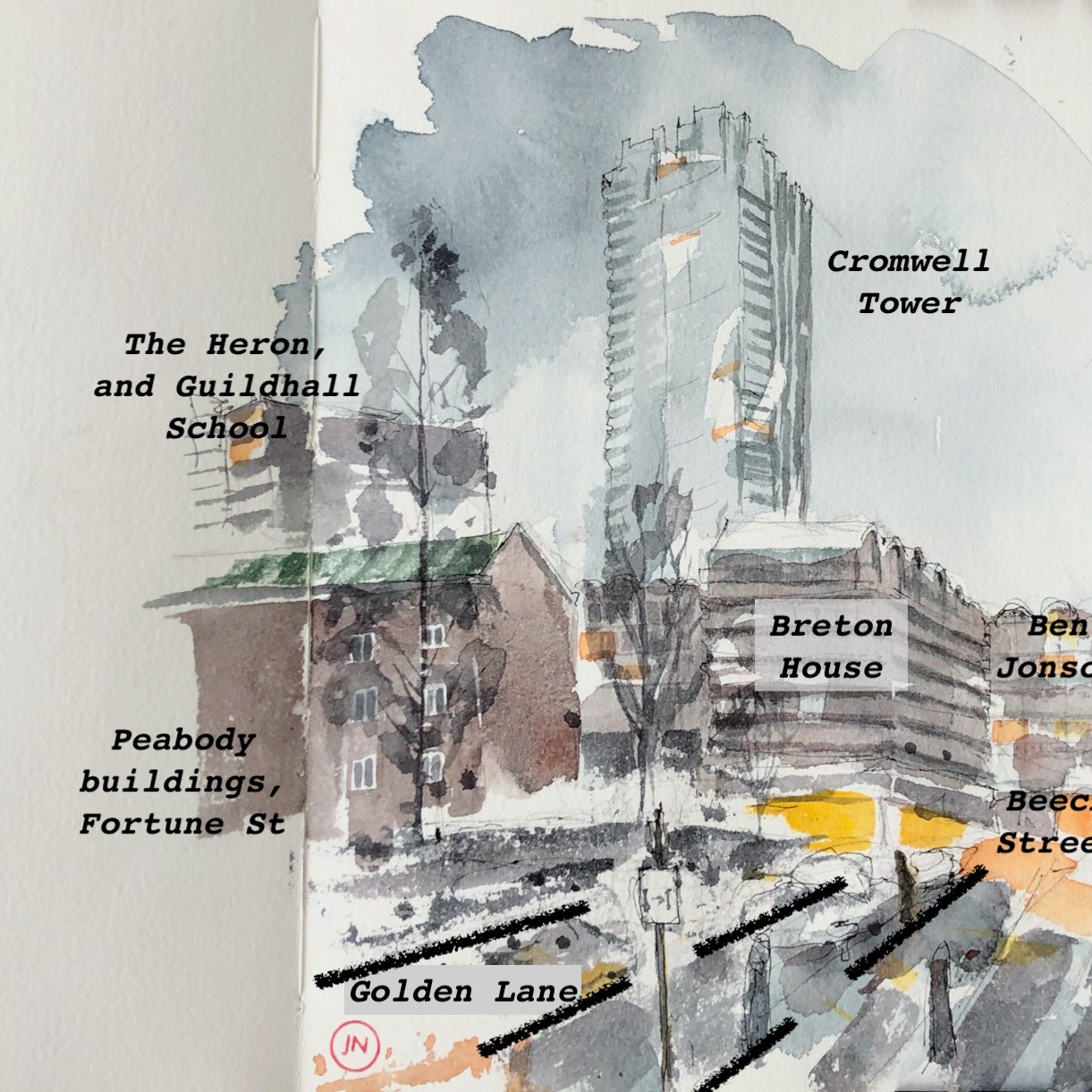
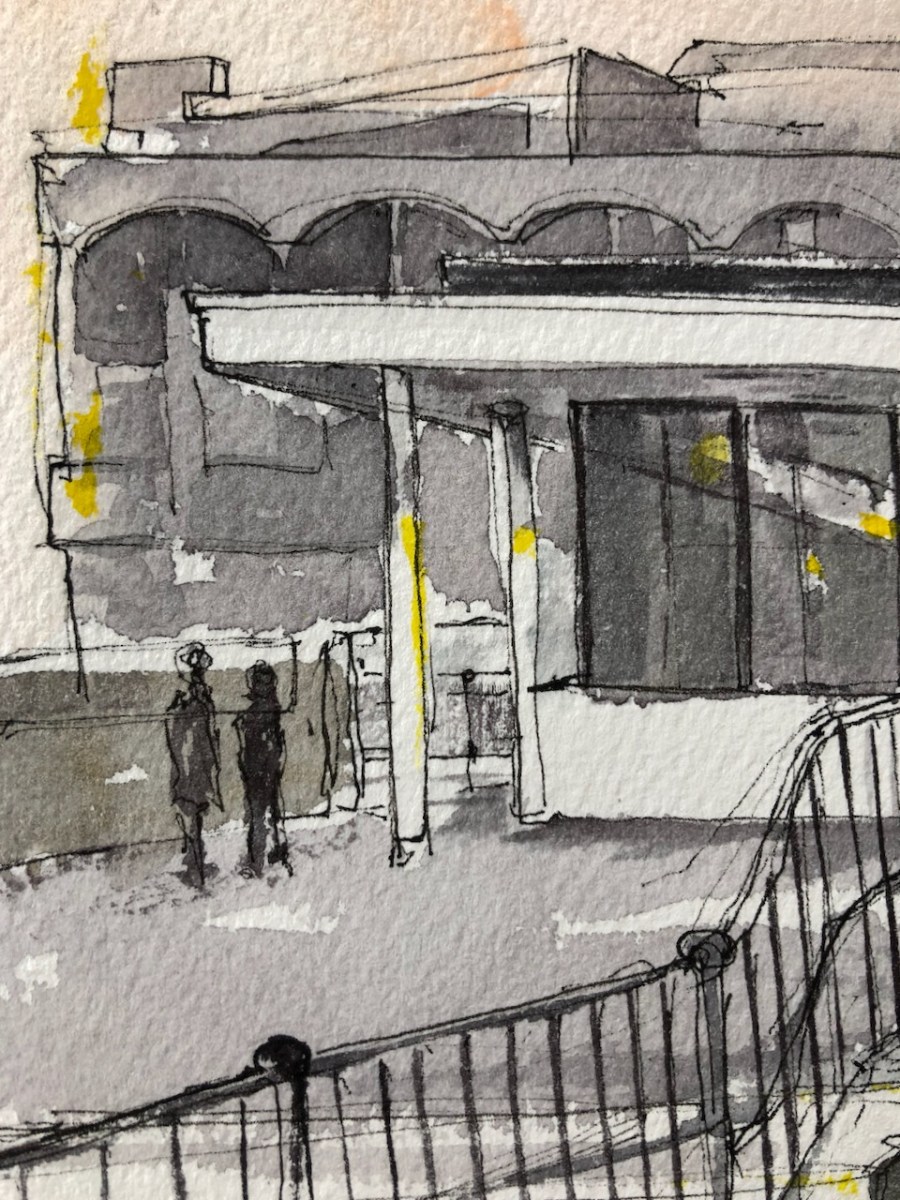
Looking towards the Barbican from Golden Lane, 5th January 2021, 4:15pm (detail)
It also started raining. Or maybe it was sleet.
I continued my peregrination through the dim streets. I like this time of day. In this weather, it’s not the “violet hour” of Mediterranean sunsets, but more like an Indigo hour, as the colours fade and go into dark smudges. I enjoyed the squares of light, each a little theatre of activity.
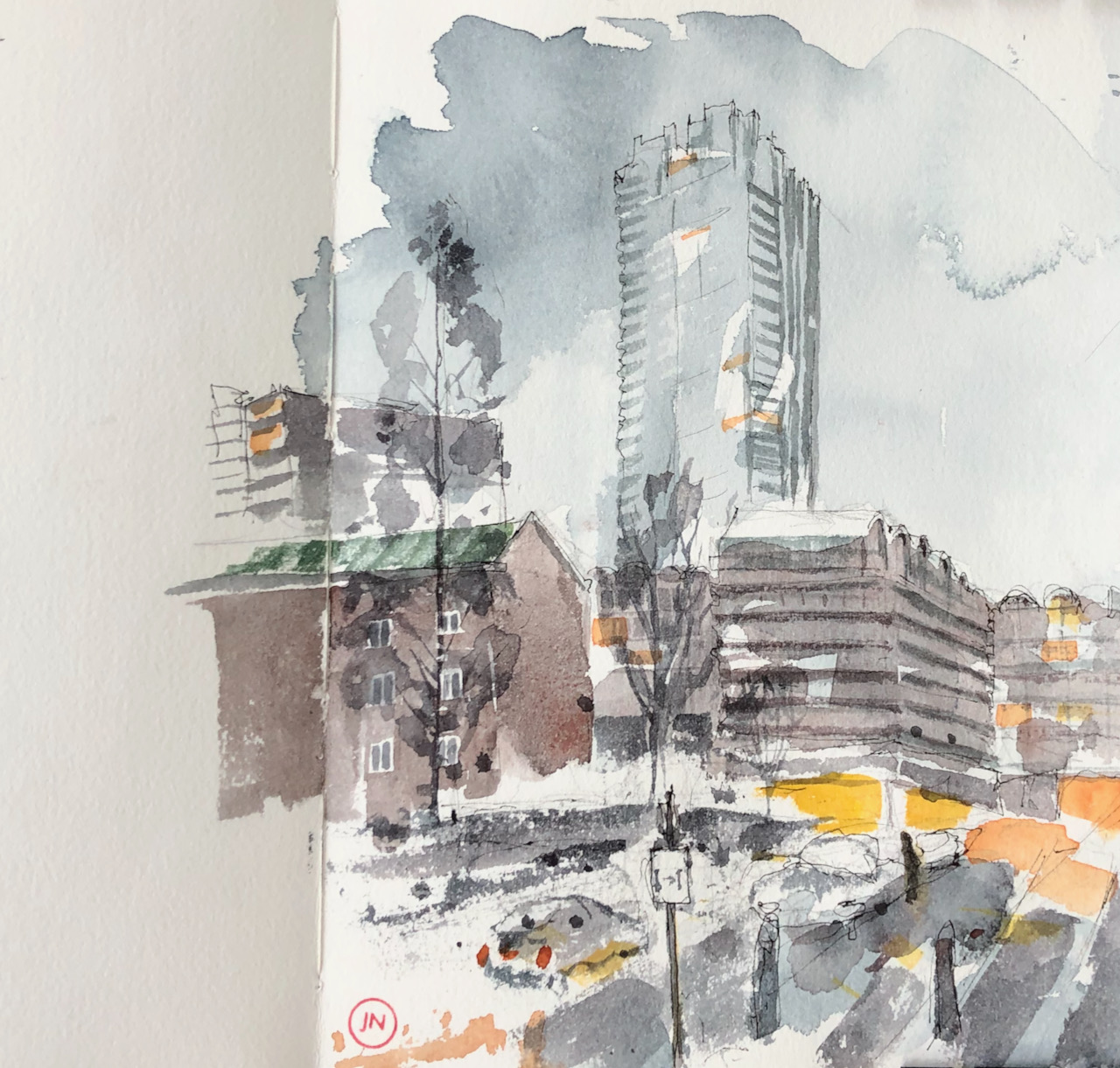
Here’s the picture I drew. It was sketched quickly on my walk, with the colour completed at home.
Looking towards the Barbican from Golden Lane, 5th January 2021, 4:15pm
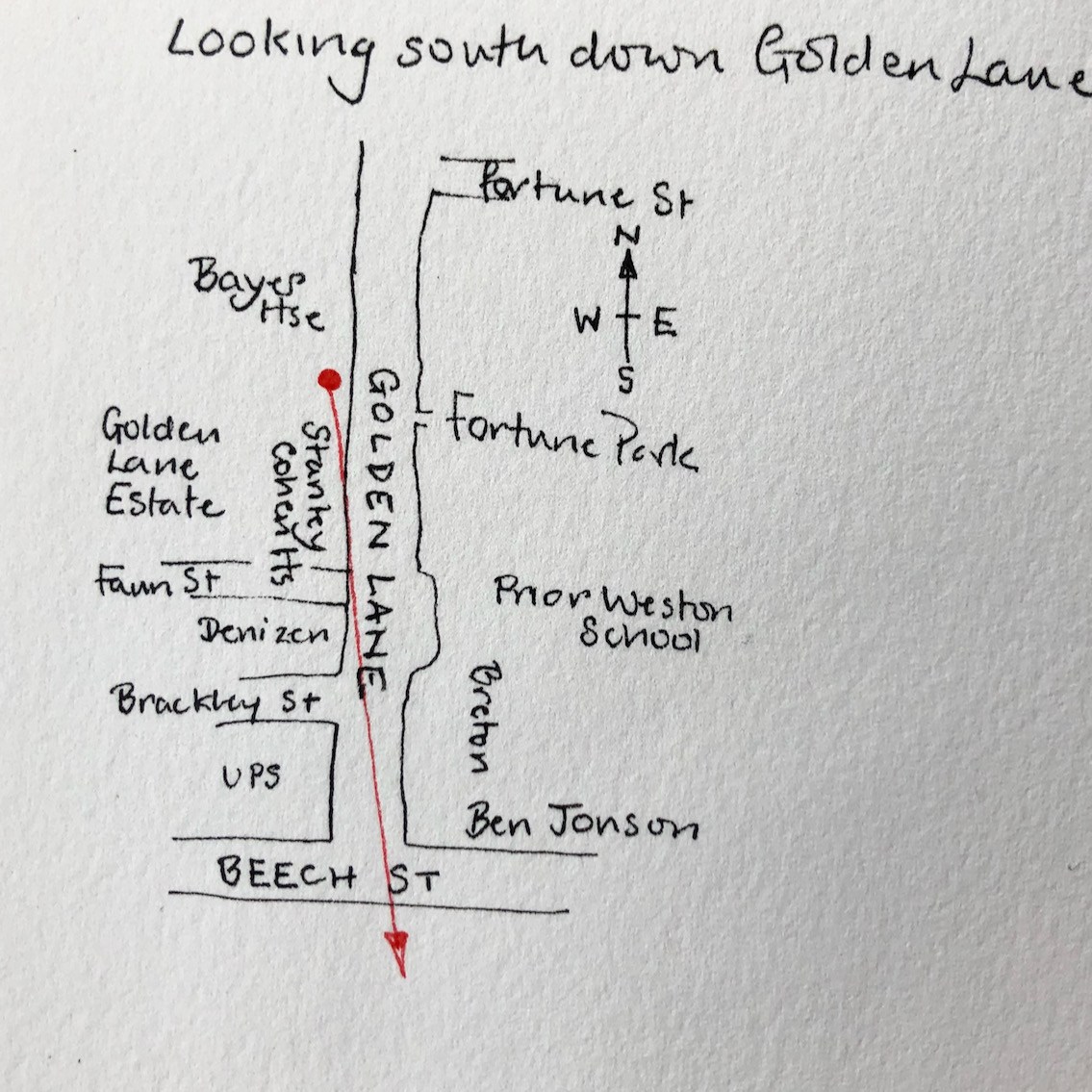
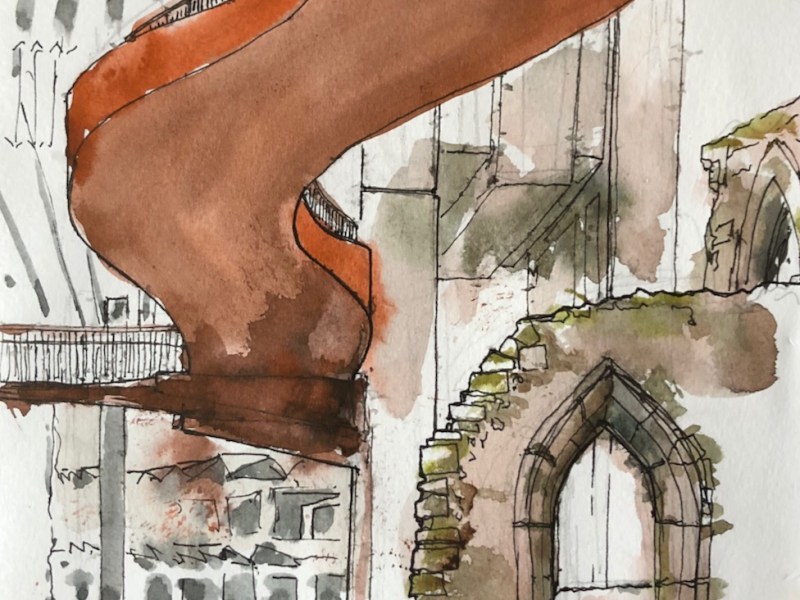
Here are the buildings:
In Wyvern sketchbook, on Arches paper, using Hansa Yellow mid (DS), and Transparent Pyrrol Orange (DS), with Perylene Maroon (DS) and Phthalo Blue Turquoise (W&N) for the sky and the darker greys. Fired Gold Ochre (DS) is in the mix for the Peabody Building.
I have drawn in and around the Barbican before. Here is a collection:
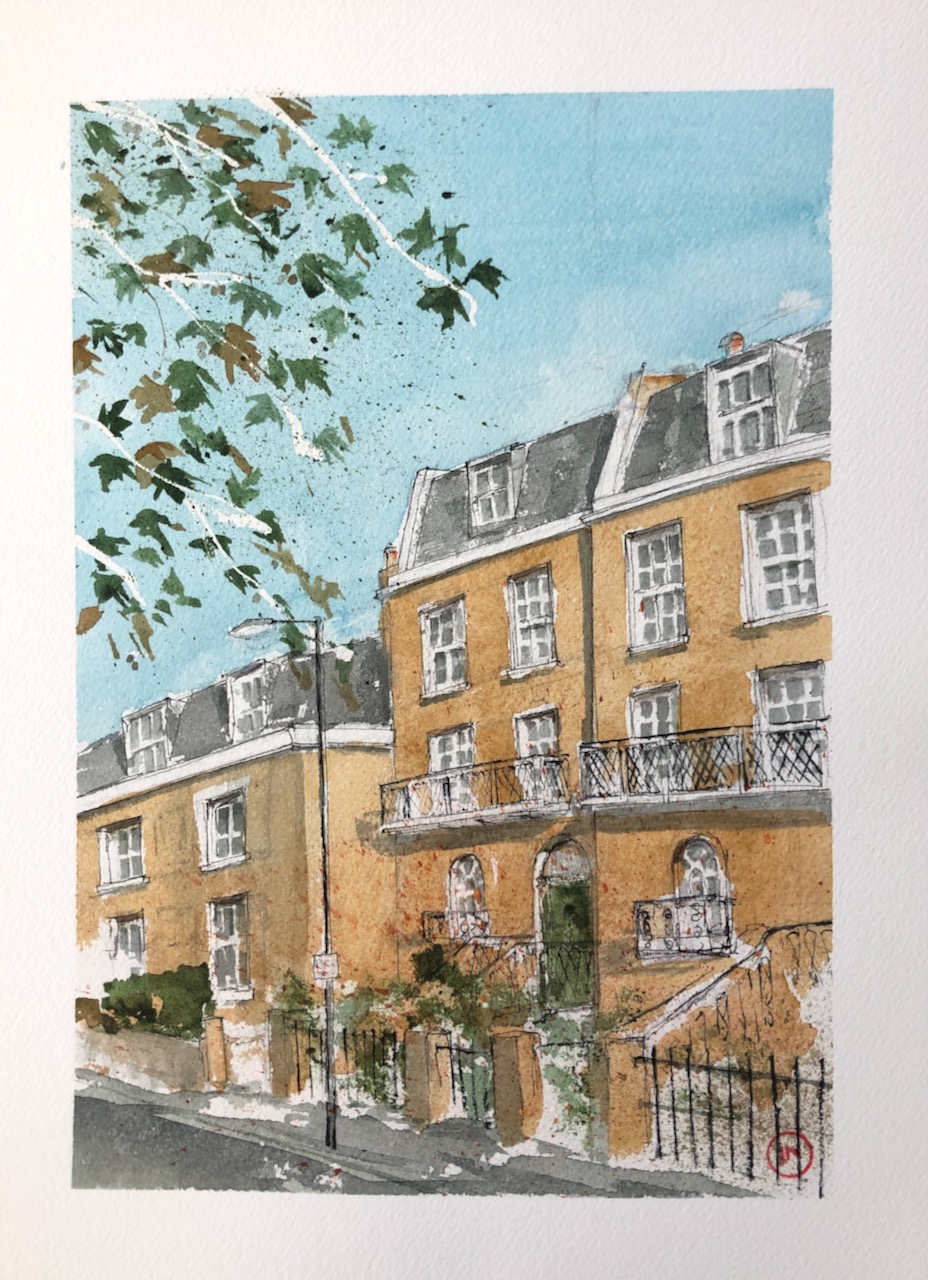
Here are houses on Grove Lane, Camberwell, London SE5.
Grove Lane, Camberwell. 12″ x 9″ watercolour on Arches paper. Drawn on location, 5th December 2020.
I drew this standing in the street. People passed to and fro with prams, dogs and delivery parcels. Although it was December, there were still a few roses out in the bushes behind the fences. The sky really was blue, as you see from the pictures below. It was very cold though, note the gloves. I finished the colour at home, as my hands were freezing.
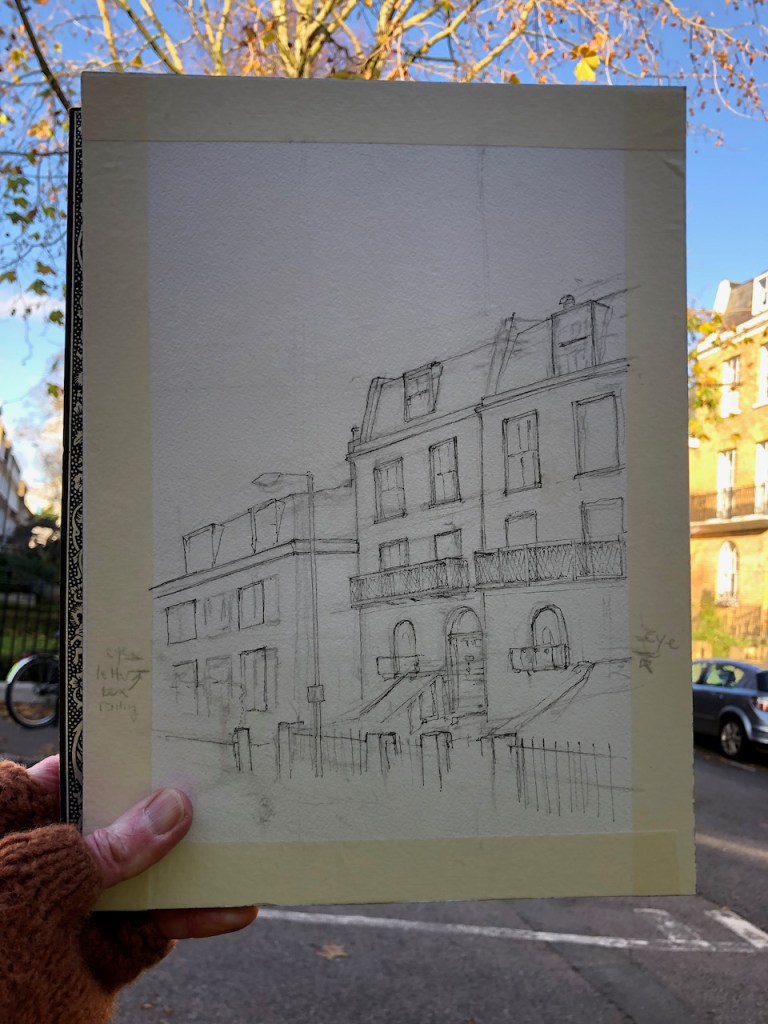
Here is work in progress.
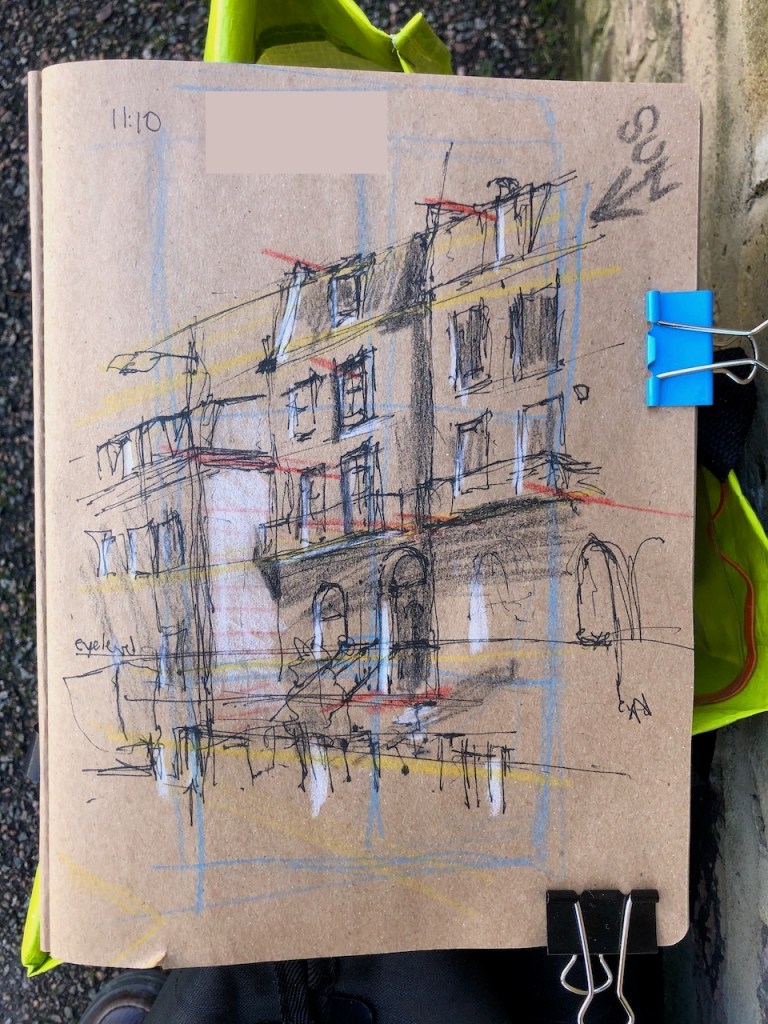
Preliminary Sketch and perspective
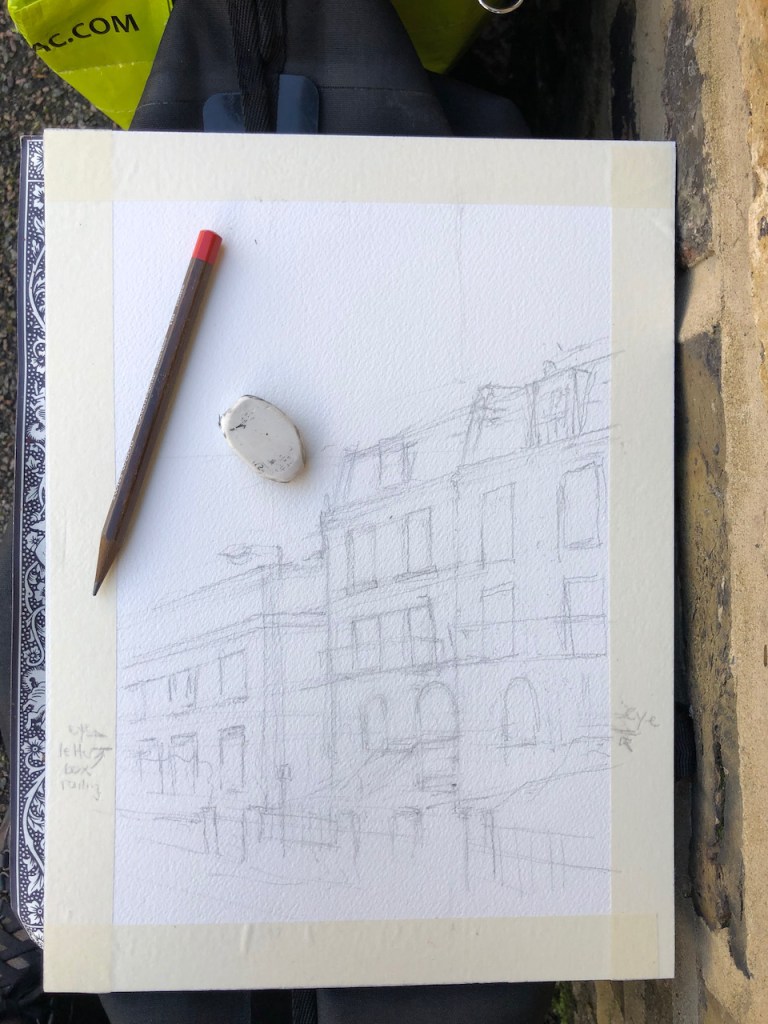
Pencil underdrawing.
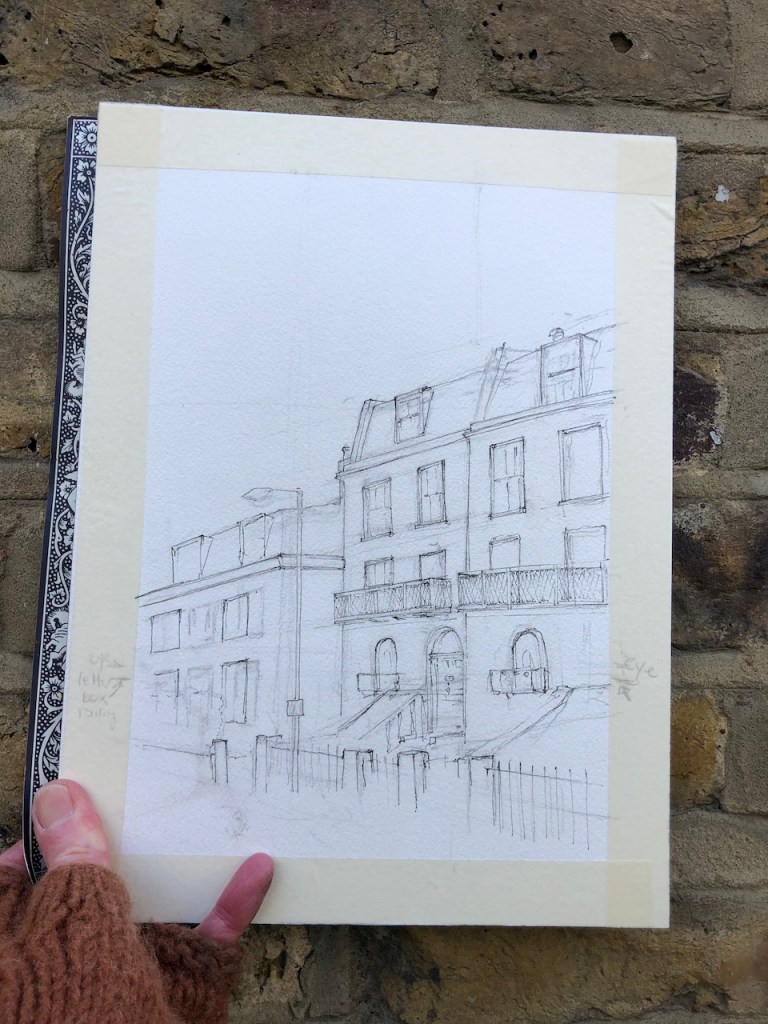
Pen in progress
The main colours are Phthalo blue turquoise for the sky, Mars Yellow, Fired Gold Ochre, and Green Apatite Genuine. The paper is a block of Arches 300gsm Cold Pressed watercolour paper.
This was a commission! Thank you to my client for the commission, and for introducing me to this interesting area. I found a new cycle route through Elephant and Castle.
Click a button below to share this post online, email it, or print it:
Here is Bayer House, on the Golden Lane Estate. This is the view from the South.
Bayer House, Golden Lane Estate, from the South, 9 inches by 12 inches [SOLD]
The building on the right is the Golden Lane Community Centre. It was in active use as I drew the picture. There is a food bank outside, and a lot of activity inside. For more information on the tree which is to the left of the picture, see this post. It was planted on the 9th December 1989.
I drew this picture from a position close to Great Arthur House. People from the Community Centre came and had a look at my drawing. One of them very kindly came and brought me a chair. If you look inside the community centre you can see those kind people behind the window.
The van.
I was a good way into the drawing when a van drew up, right in my line of sight. I finished the parts of the drawing at the top of the building, and to the sides of the building. A good hour had elapsed, but the van was still there. I really needed to draw that part of the building which was behind the van. The driver, dimly visible through the windscreen, was asleep, or may be just resting. Having carefully considered the pros and cons, and the social acceptability of asking a potentially exhausted van driver to move, and the likely consequences, I got up from my chair and walked over to the van in what I hoped was a polite and respectful manner. The van driver was awake, and immediately understood my request. “No problem!” he declared without hesitation, and with extraordinary consideration asked me “Where would you like me to park?”. I indicated an empty slot far over to the other side of the Community Centre. He climbed out of his van, and went into a door under Great Arthur House to confer with “The Office”. “The Office” having been brought onside, he jumped back into the van and made off into the middle distance waving cheerily. I wish all problems were solved so easily.
Here is work in progress:
preliminary sketch
Pen and ink
Finished drawing on Arches 12 inches by 9 inches block 300gsm
This was a commission. For the same commission I also made a drawing of the North side of the same building.
Bayer House, North side, 12 inches by 9 inches [SOLD]
For more information about Bayer House, including maps, see this post.
Both drawings on Arches 300gsm watercolour paper block, 12 inches by 9 inches.
Here is a collection of my drawings of the Golden Lane Estate:
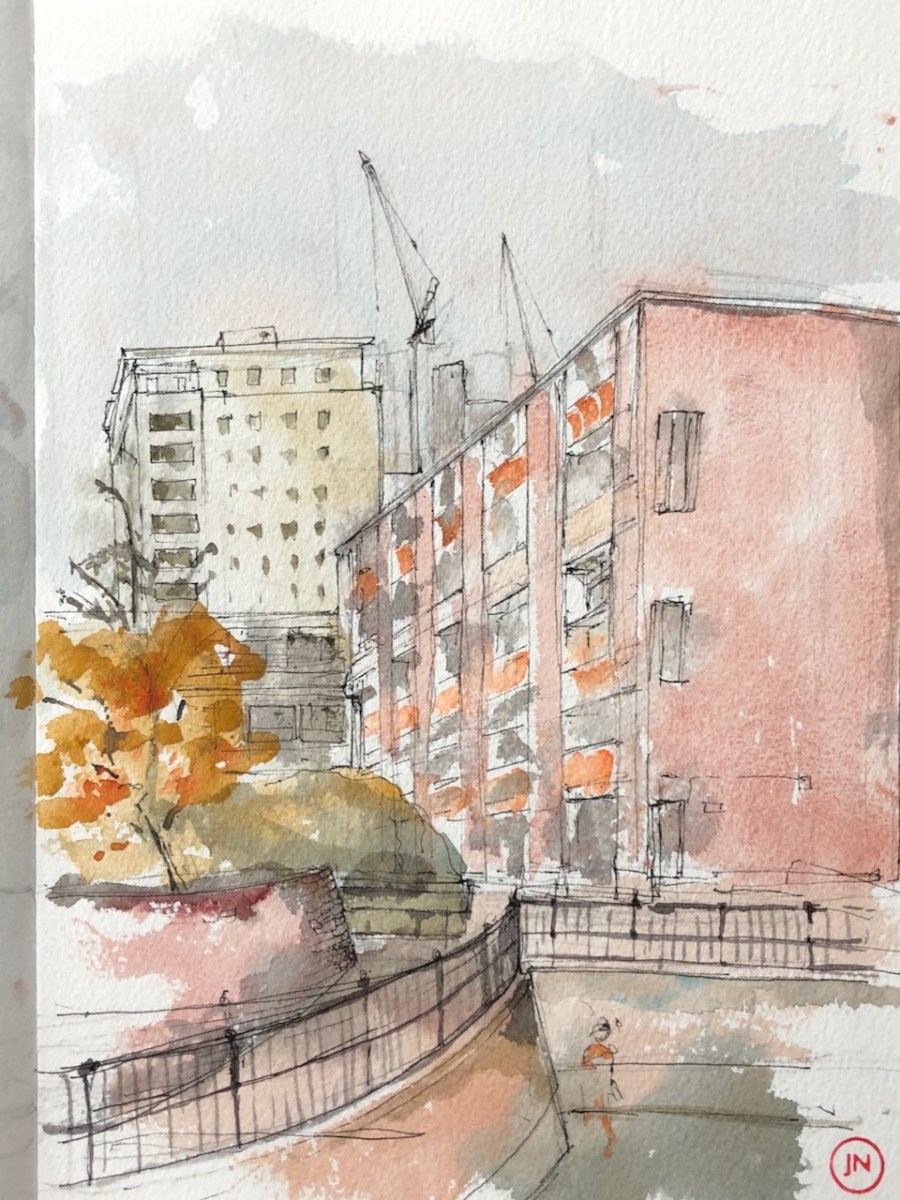
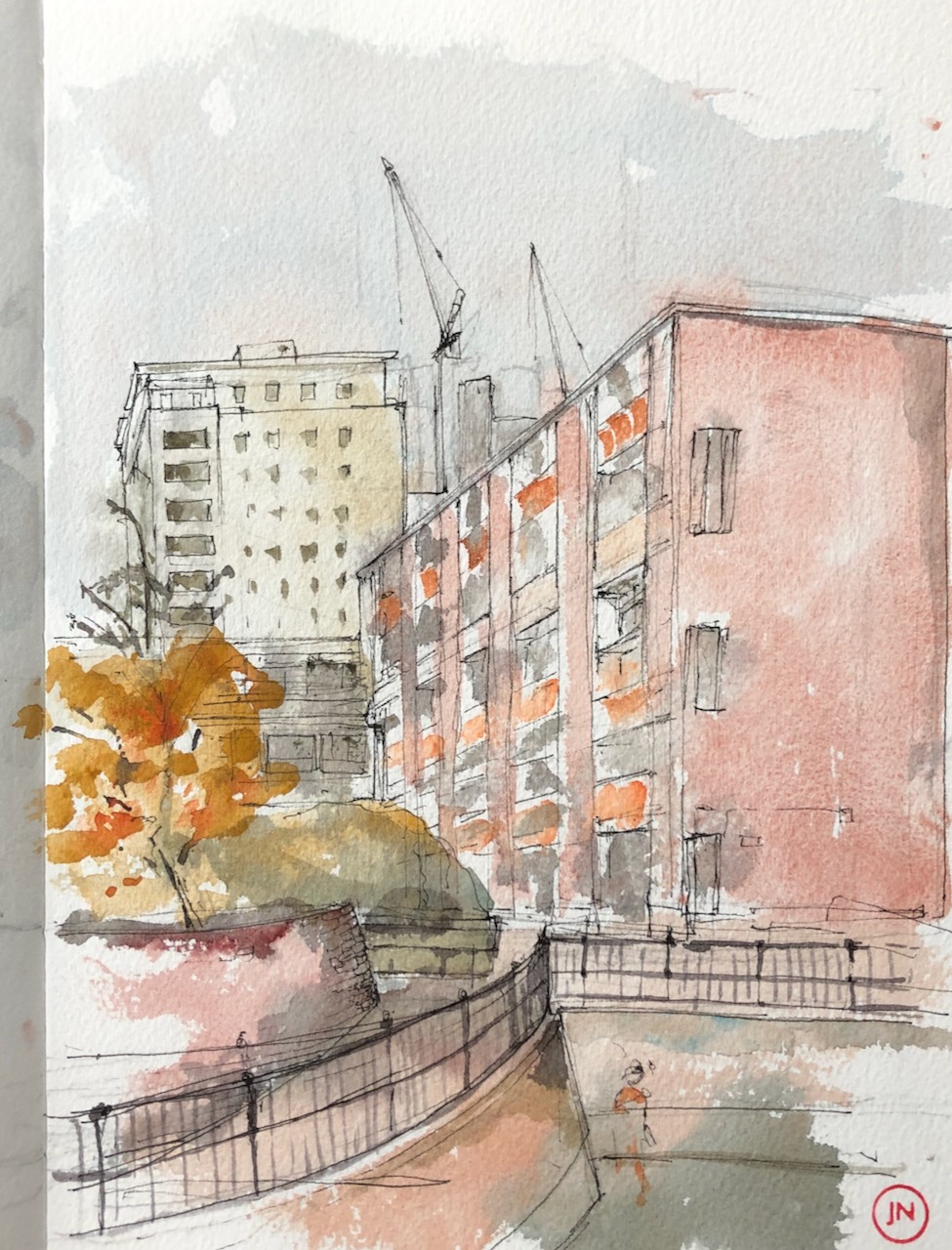
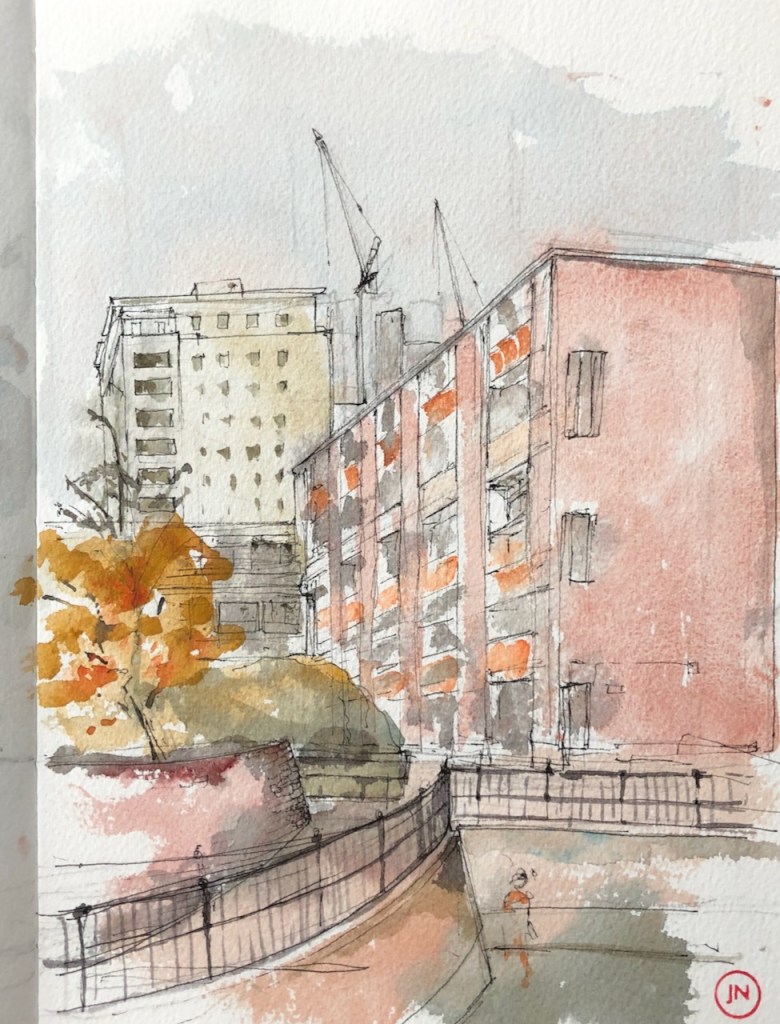
I drew Bayer House from a quiet spot above the Leisure Centre. Bayer House is the brick building on the right. The white building in the centre is Peabody Tower, on the Peabody Estate, the other side of Golden Lane.
In the background, you see the “HYLO” tower on Bunhill Row, under construction.
Bayer House (right), Golden Lane Estate.
Bayer House is three rows of 2 storey maisonettes: like three terraced streets, stacked. The brick walls are pink brinks with pink mortar: very pink. The architects are Chamberlain, Powell and Bon.
I drew this picture from the podium level, one storey up. In the sunken playground area, children played. I could hear their voices below me, and caught an occasional glimpse as they dashed into my field of view. Then I heard another noise, a rhythmic beat or clunk. I thought the children must have some kind of percussive instrument that they were playing with, like two large rocks. May be they were slapping two boxing gloves together. Then their voices opened into greetings. Just at that moment, two enormous police horses came into view, walking at my level. The police officers had paused their mounts, and were waving to the children below. I called out a hello, and then the police officers saw me too. “Hey look, there’s someone drawing!” They moved their horses on, hoofs clip-clopping on the concrete, very loud, and now, of course, utterly distinctive.
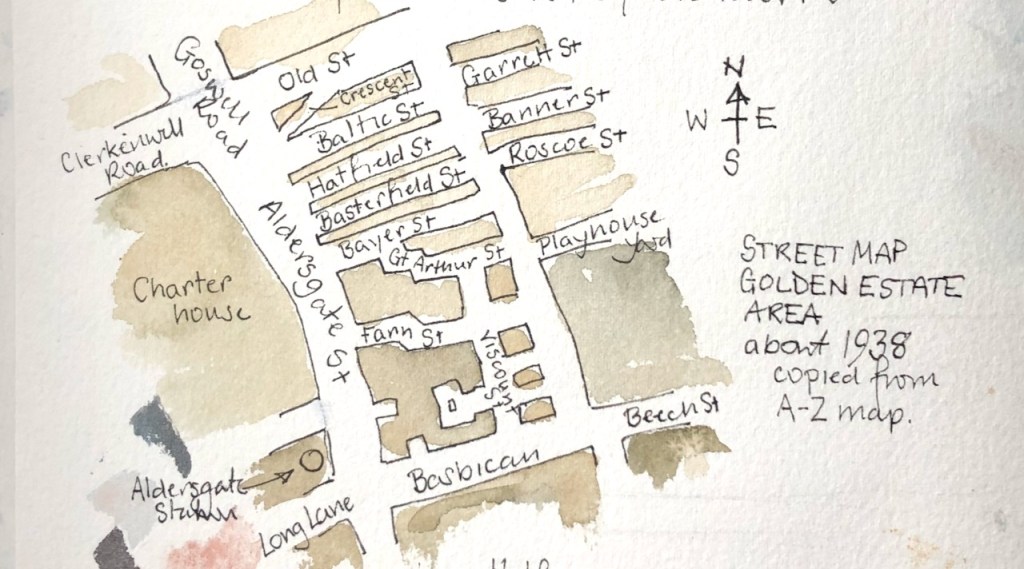
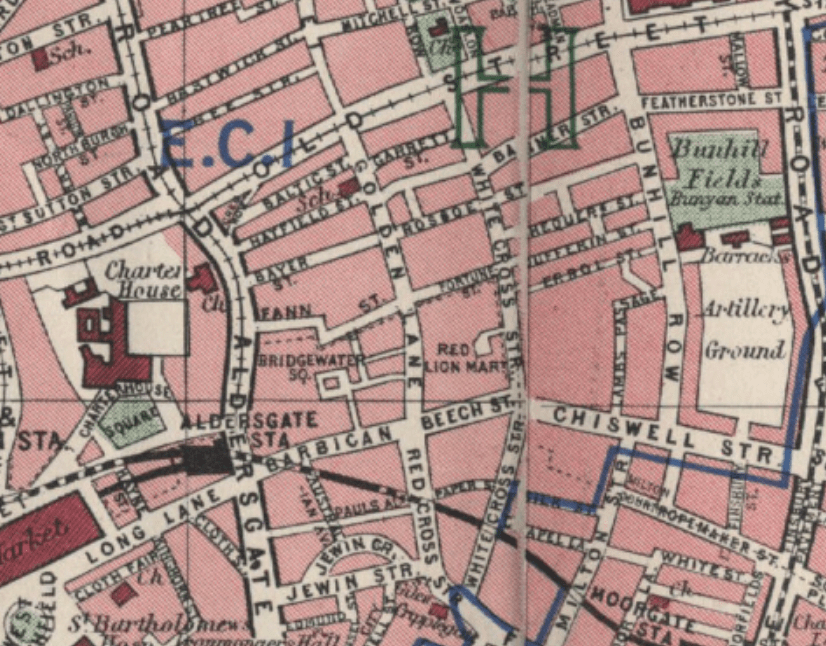
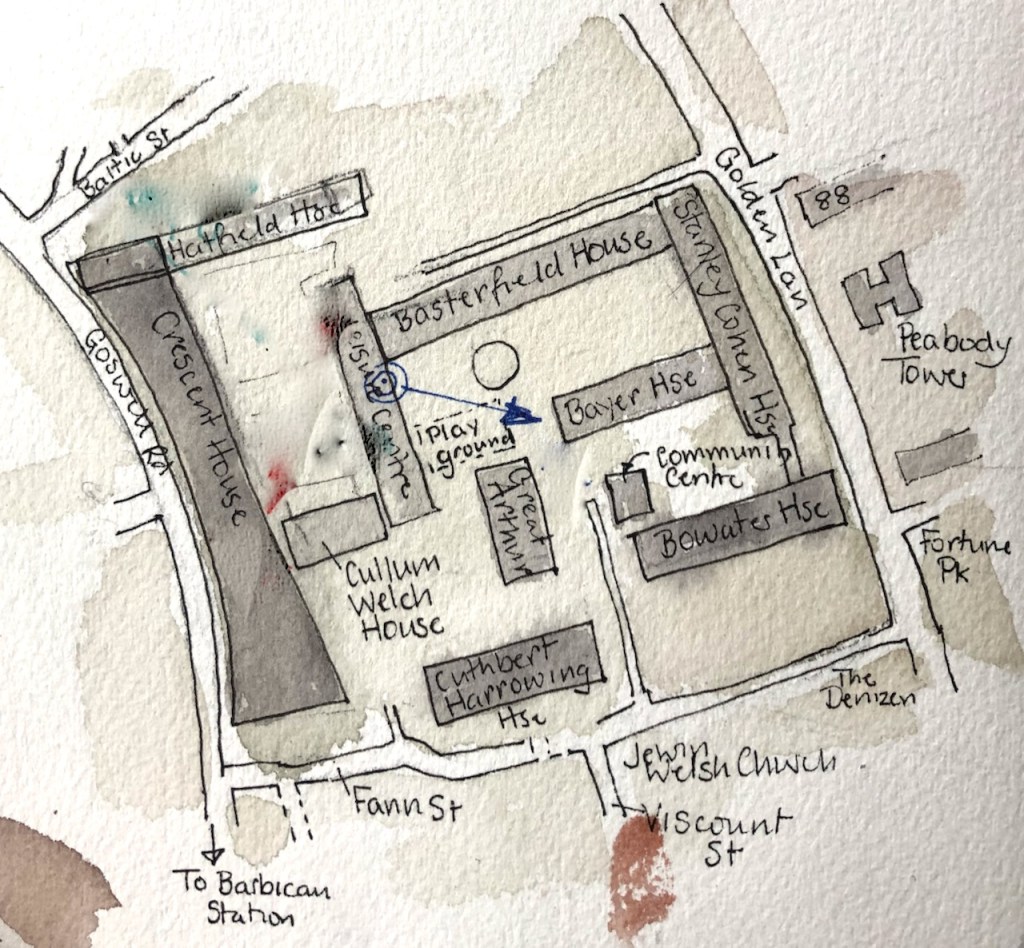
Many of the blocks on the Golden Lane Estate are named for councillors or other officials of the City of London who were in post at the time the Estate was under construction. But I could not find a “Bayer”. “Hatfield”, of “Hatfield House” which I drew previously, was also not to be found in the lists. After a long search, the marvellous London Metropolitan Archives turned up the answer. Hatfield St, and parts of Basterfield St, were subject of a compulsory purchase order in 1954. Bayer St, Great and Little Arthur Street, and the intriguing “Hot Water Court” were compulsorily purchased in 1951. So these houses are named after streets. More searching revealed the maps, see below. You see the former Bayer St in approximately the position of Bayer House, and Great Arthur St where Great Arthur House is now. Hatfield House and Basterfield House are also in the position of their corresponding streets. There is still a vestige of Basterfield St north of Basterfield House. Click to enlarge the maps below.
My sketch map of the former street layout, from the maps.
Historical A-Z Map of London about 1935
“Maps-of-London.com” Finsbury, about 1940
Golden Lane Estate, blue arrow shows sightline of my drawing.
Historical maps showing the street layout before the Golden Lane Estate was built.
The colours in this picture are Fired Gold Ochre (DS), Phthalo Turquoise (W&N), Mars Yellow(DS), Buff Titanium (DS), and Perylene Maroon (DS). There a bit of Transparent Pyrrol Orange (DS) in the tree and the balconies of Bayer House. It was very cold and the colours did not dry which is why they are a bit blurry.
The collection of my Golden Lane Estate drawings is here:
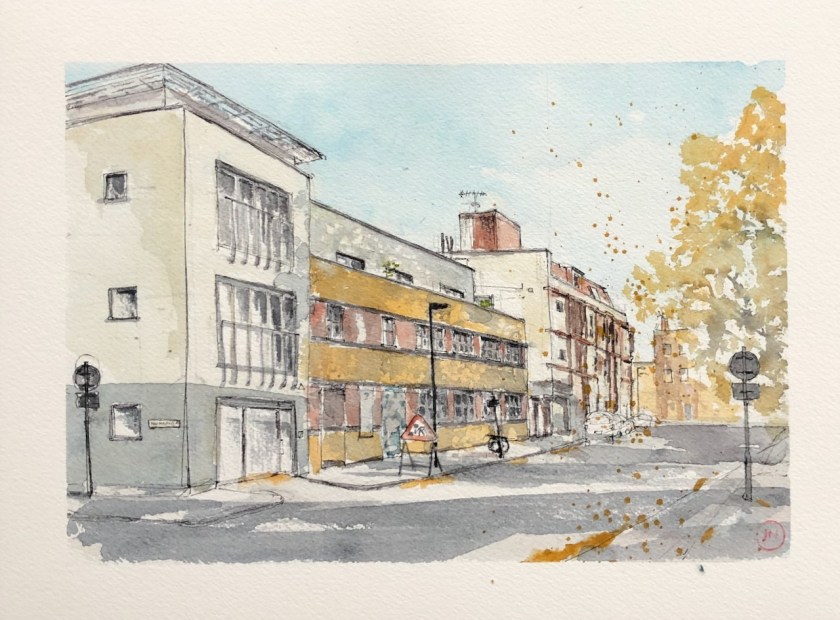
Cosser St SE1 – North West side. 12 inches by 9 inches [SOLD]
It was a blustery day, as you see. In the background are the buildings on the other side of the Kennington Road.
There are many parked cars in this street. They are constantly on the move, coming and going. You can see some ghostly images of them in the distance. The main point of the picture was the building. I didn’t draw all the cars. A Civil Enforcement Officer wove her way amongst them, checking number plates.
A man came by carrying a large musical instrument in a black case on his back. I think it was a ‘cello. Then he came back the other way. Then he went back a third time. I noticed him all three times, and he saw me noticing him. On the third time, he came over and politely asked to see the picture. He obviously felt some explanation was needed for his criss-crossing the street multiple times. He said, “I’ve left my mobile phone at my friend’s house. And you don’t realise….” He trailed off, because it seemed redundant to repeat the modern problem: I can’t even phone him because, obviously, my phone is at his house and…”. “I’ll get it”, he went on, “So long as he’s up.” He grinned and shrugged, and carried on across the road. I was not entirely convinced by this story. Why, then, was he carrying his heavy musical instrument back and forth?
This is the final sketch in a series of three made for a commission. Here are the three. All are 12″ by 9″ on Arches 300gsm watercolour paper.
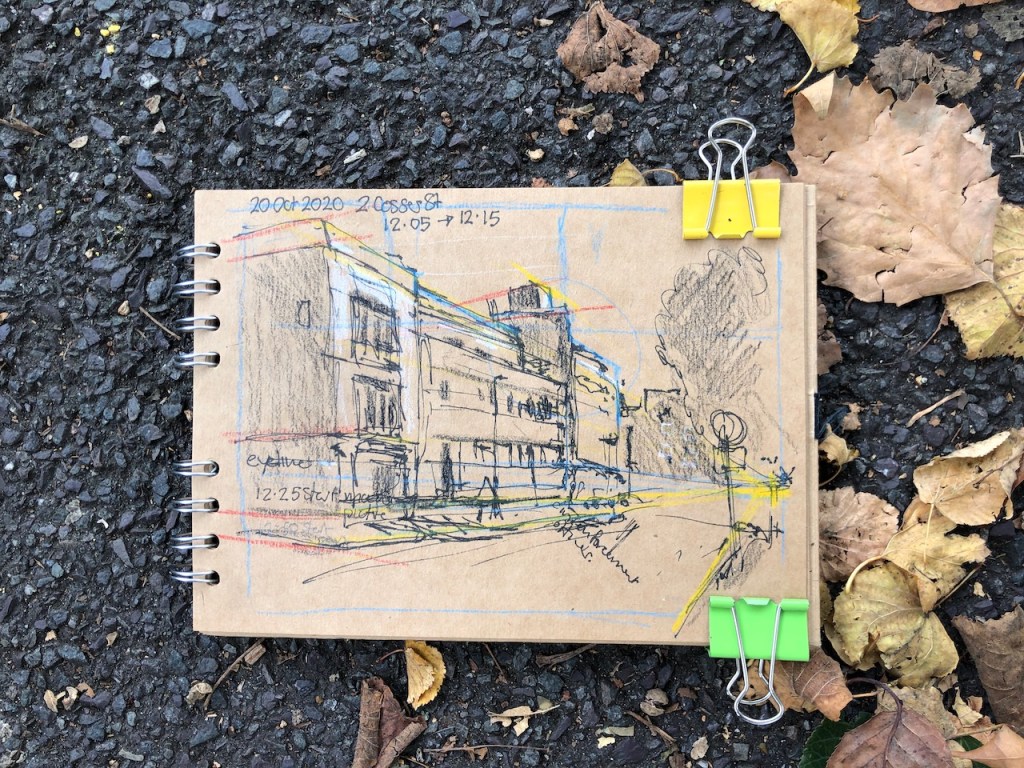
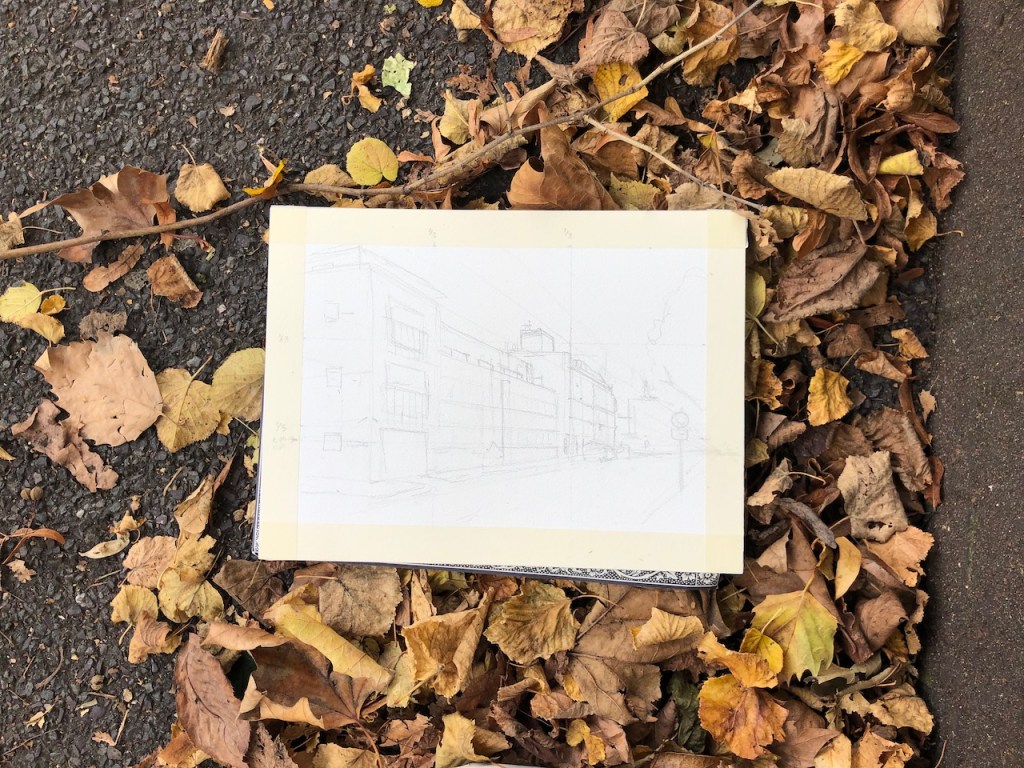
The colours in this picture are: Buff Titanium (DS), Perylene Maroon (DS), Mars Yellow (DS), Fired Gold Ochre (DS) and Phthalo Turquoise (W&N). I did a preliminary sketch, which you see in these work-in-progress pictures.
Here is a building in Cosser St, near Lambeth North tube station. This is the first of three drawings in the area, for a commission. Someone who had enjoyed living here was going to be moving to the country, and asked me make some pictures for them, to remember the locality. Ambulances park in this…
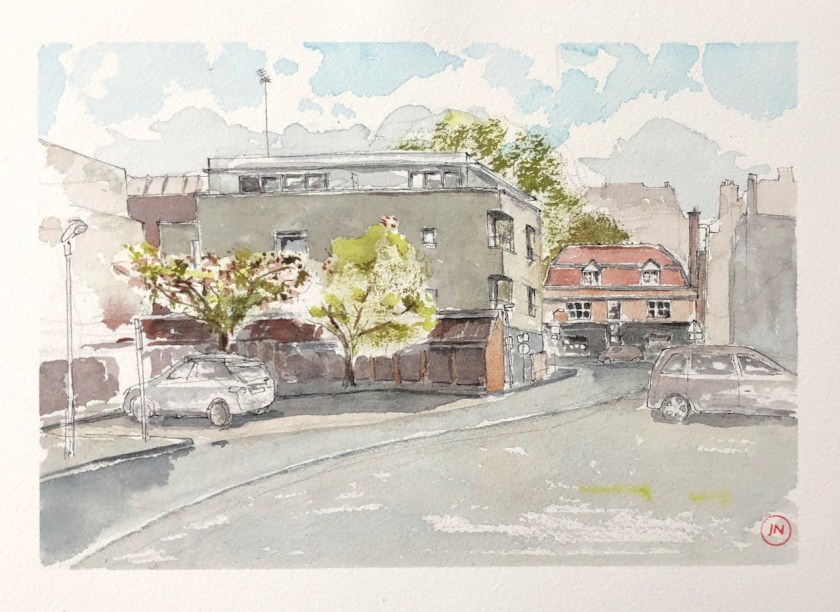
Here is the second sketch of Cosser St. From this angle you can see “The Steam Engine” pub, which is the red-roofed building in the picture, fronting onto Cosser St. The day when I drew this was a surprisingly hot October day. The blue sky is accurate. I was drawing standing up, with a dull…
Click a button below to share this post online, email it, or print it:
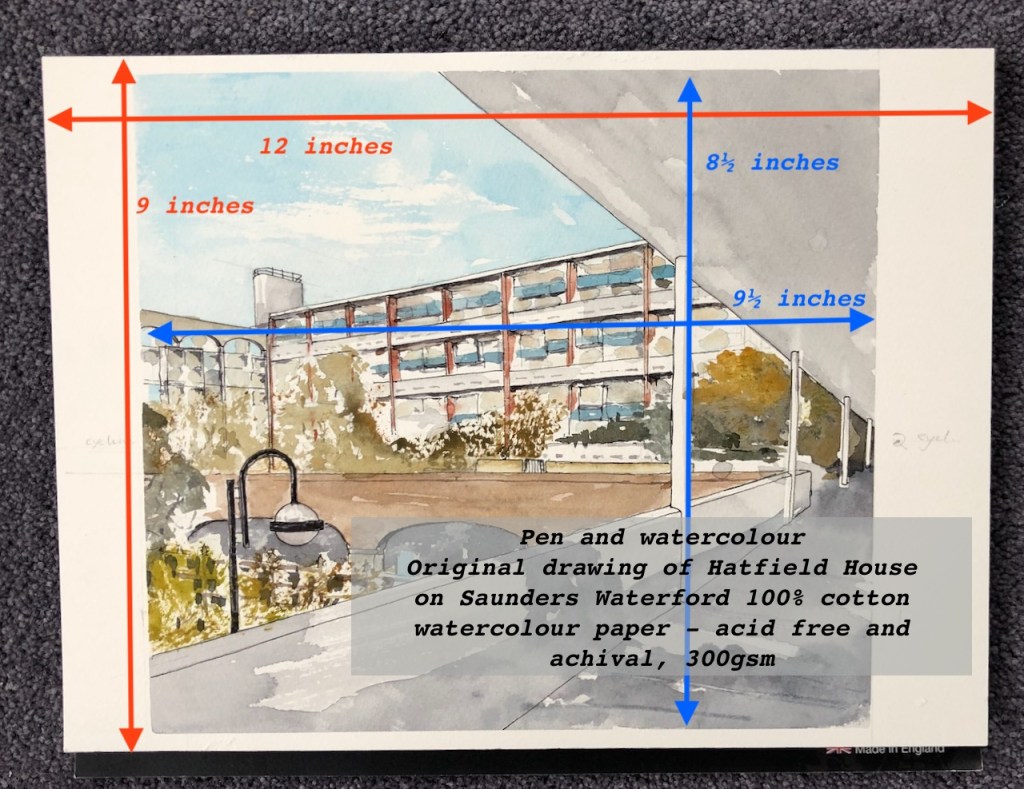
This is Hatfield House, at the North side of the Golden Lane Estate, EC1.
Hatfield House, Golden Lane Estate, 12″x9″ watercolour [SOLD]
The arches in the middle of the picture are above the Golden Lane Leisure Centre, which is closed at the moment. You can just see the blue vending display, which has goggles and other items for use in the swimming pool.
While I was drawing the picture, I caught movement in the side of my vision. A man appeared below me, indoors, by the side of the swimming pool. I looked at him through the window. He was fully dressed, with covers over his shoes, stirring a bucket with a long pole. After a long period of patient stirring, he poured the contents of the bucket into the swimming pool. Then he refilled the bucket, set it on the edge of the pool, and started stirring again. At that point I stopped watching and resumed my drawing. When I looked back again, he had gone.
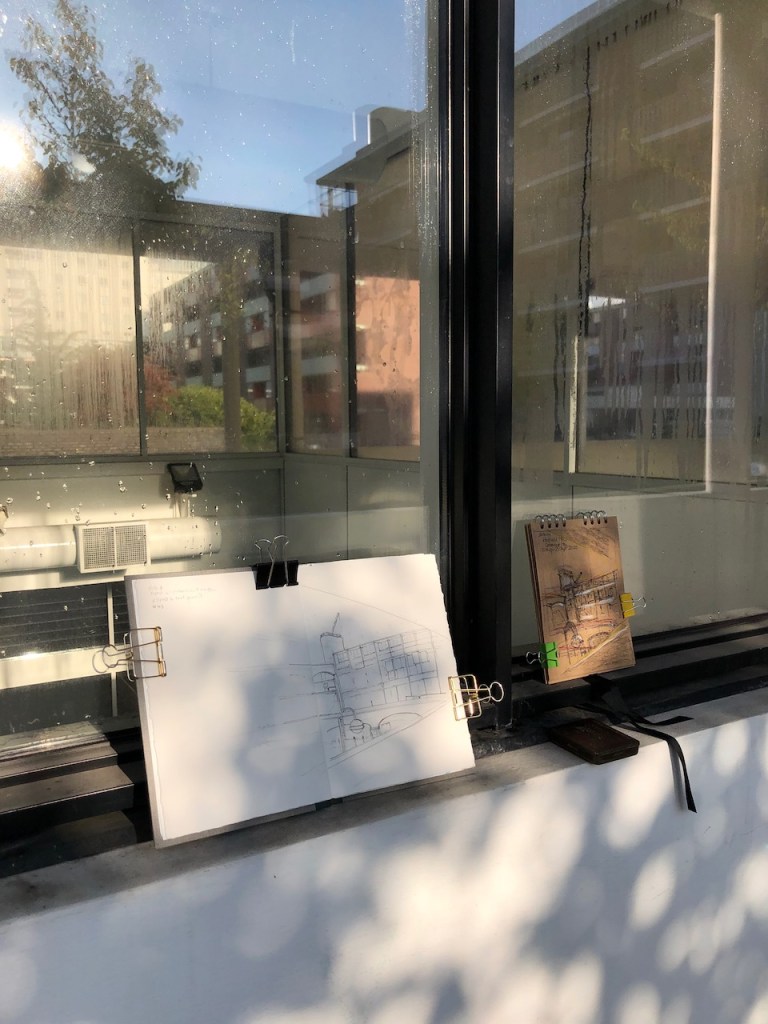
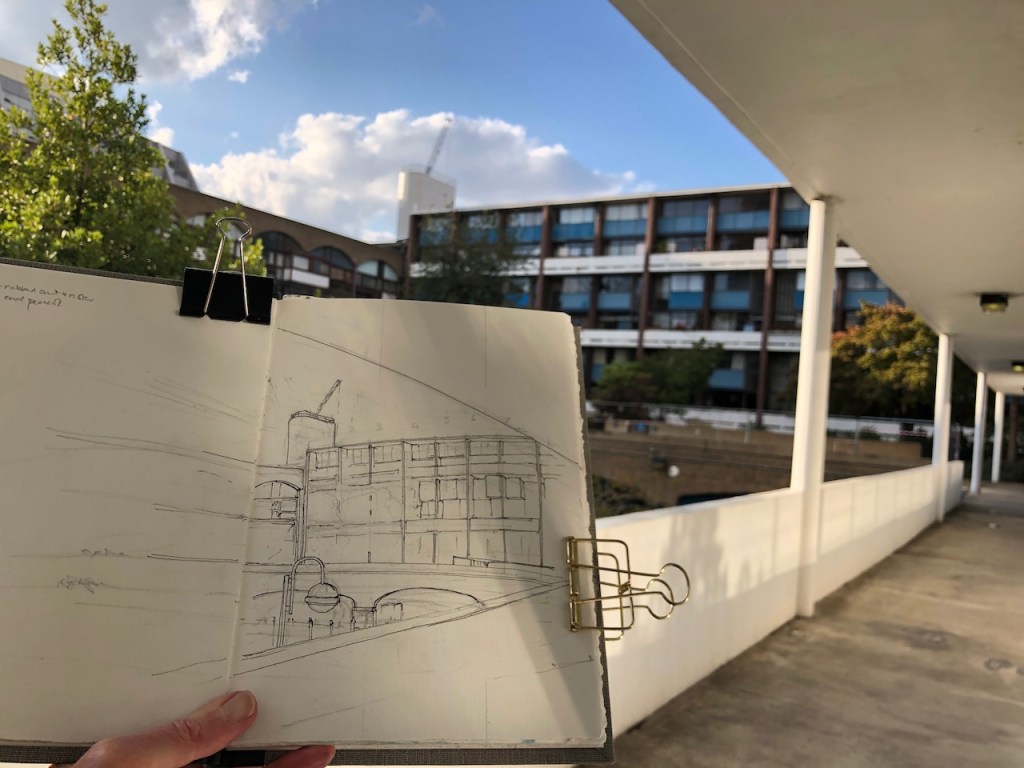
This picture was drawn for a commission. I made a preliminary drawing, and various sketches. Here is work in progress. The big challenge was to get the perspective lines right, to show the depth and distance.
Quick sketch, working on perspective
Preliminary sketch in sketchbook
Sketchbook on the window of the swimming pool
Pen.
Specification for the commission
This drawing was done on 29th September 2020.
Here are more sketches in the Golden Lane Estate:
Click a button below to share this post online, email it, or print it:
A resident of Crescent House commissioned me to draw his block.
Crescent House – 12″x9″ original watercolour (SOLD)
This is a view from the podium level, above the Golden Lane Leisure centre. The block on the left is Cullum Welch House. The yellow colour in the centre is a reflection of Great Arthur House in the windows of Crescent House.
Map showing the view of Crescent House in the drawing (North is on the right)
The pavement by the wall was being re-laid. Just off the picture, to the right, people who were laying the paving stones sang merry tunes, and insulted each other. “Dean, I don’t believe how long that’s taken you. It’s a five minute job!”
Dean was moving the metal fencing around, making a sound like a drum roll. They needed to reconfigure their enclosure as they finished one section of paving and moved onto the next. I didn’t catch Dean’s repost, but the answer was, “No…no.. it’s just because you are lazy….”
Here is work in progress on this final drawing. It is made on a block of Saunders Waterford Hot Press 300gsm paper.
Finished drawing, 12″ by 9″ (SOLD)
Work in progress
The tapes round the edge are to give me something to hold, also they make a nice border to the picture.
Pen and ink
On the concrete
Work in progress with pen and ink
Work in progress. You can see the enclosure of the pavers in the background.
Pencil under-drawing
Work in progress on the final sketch, 9th October 2020
I made some preliminary drawings a few days previously, to get my head around the composition and the perspective challenges.
Sketchbook and perspective study
Sketchbook and palette
Pen
Pen sketch in progress
Pen
Working on perspective
Sketch in sketchbook – 5th October 2020
Sketch in sketchbook, 5th October 2020, and work in progress.
At the bottom left of the sketch is that strange sloping block. It is pointed. I didn’t get the whole of it in the sketch as it is so fascinating that it would have distracted from the main object of the drawing which is Crescent House. But it is worthy of examination. It looks like a tank trap. But what is it doing there? There are two of them.
As you see they are wonderful sculptural objects, worthy of a drawing in their own right.
Probably they are to stop people from sitting on that convenient ledge.
Click a button below to share this post online, email it, or print it:
I found a good viewpoint at Podium level, underneath Crescent House. At ground level a woman ran circuits of the tennis courts. After a while she started doing interval training: running up and down the stairs near where I was standing. Then she came and asked if she could see the picture.
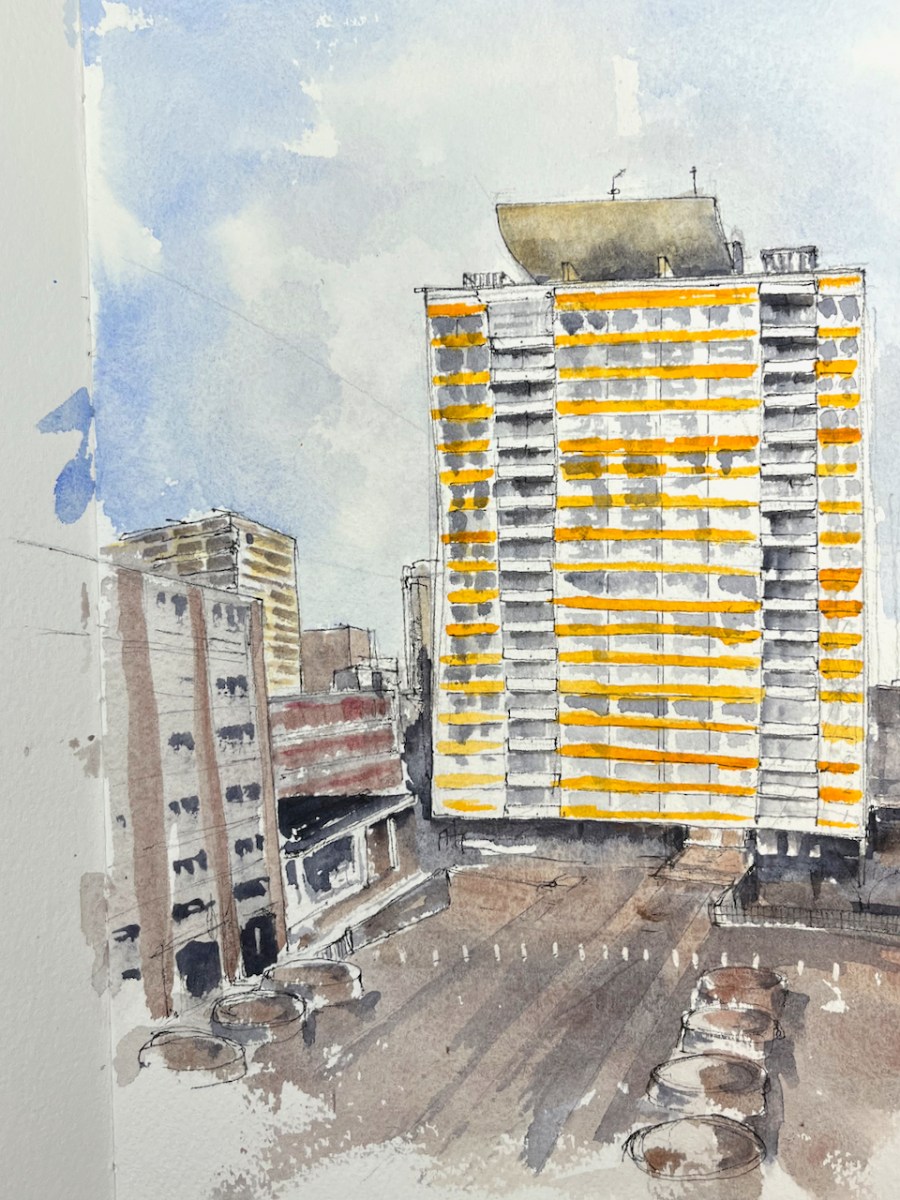
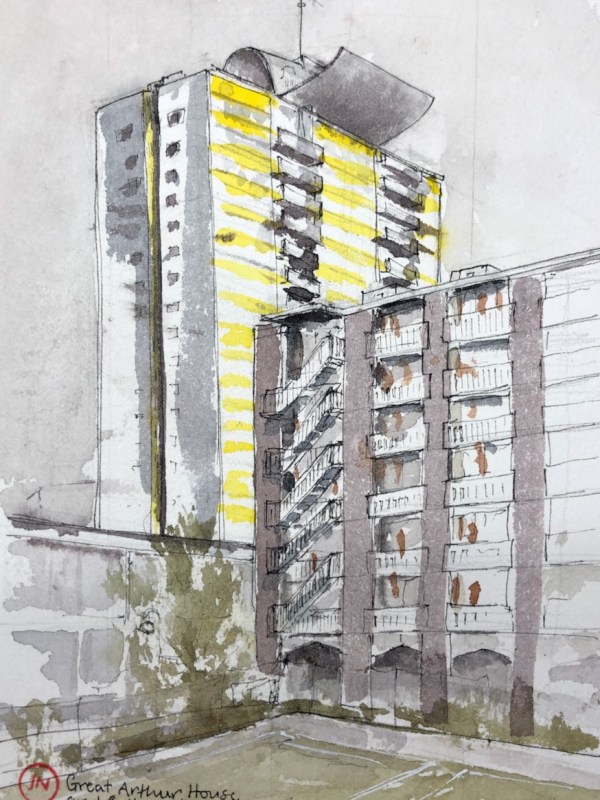
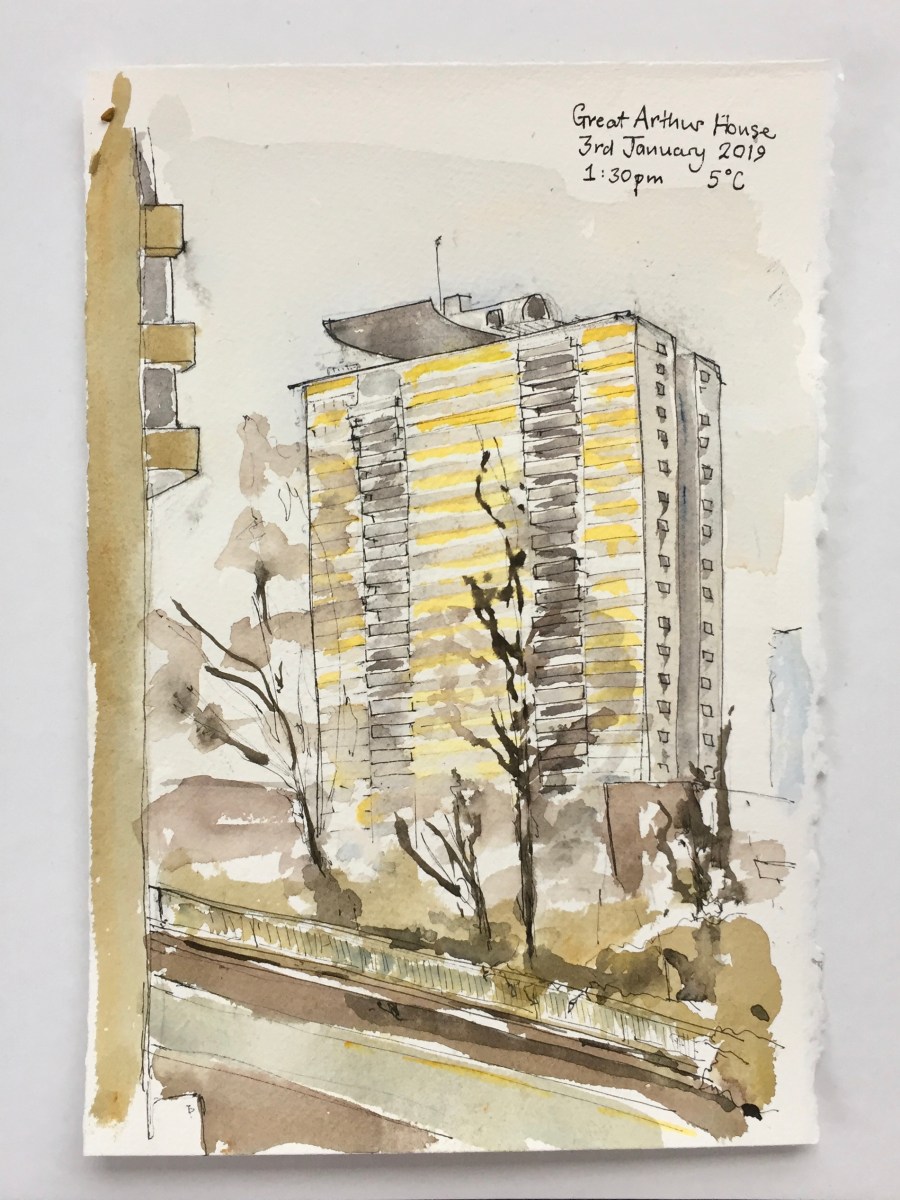
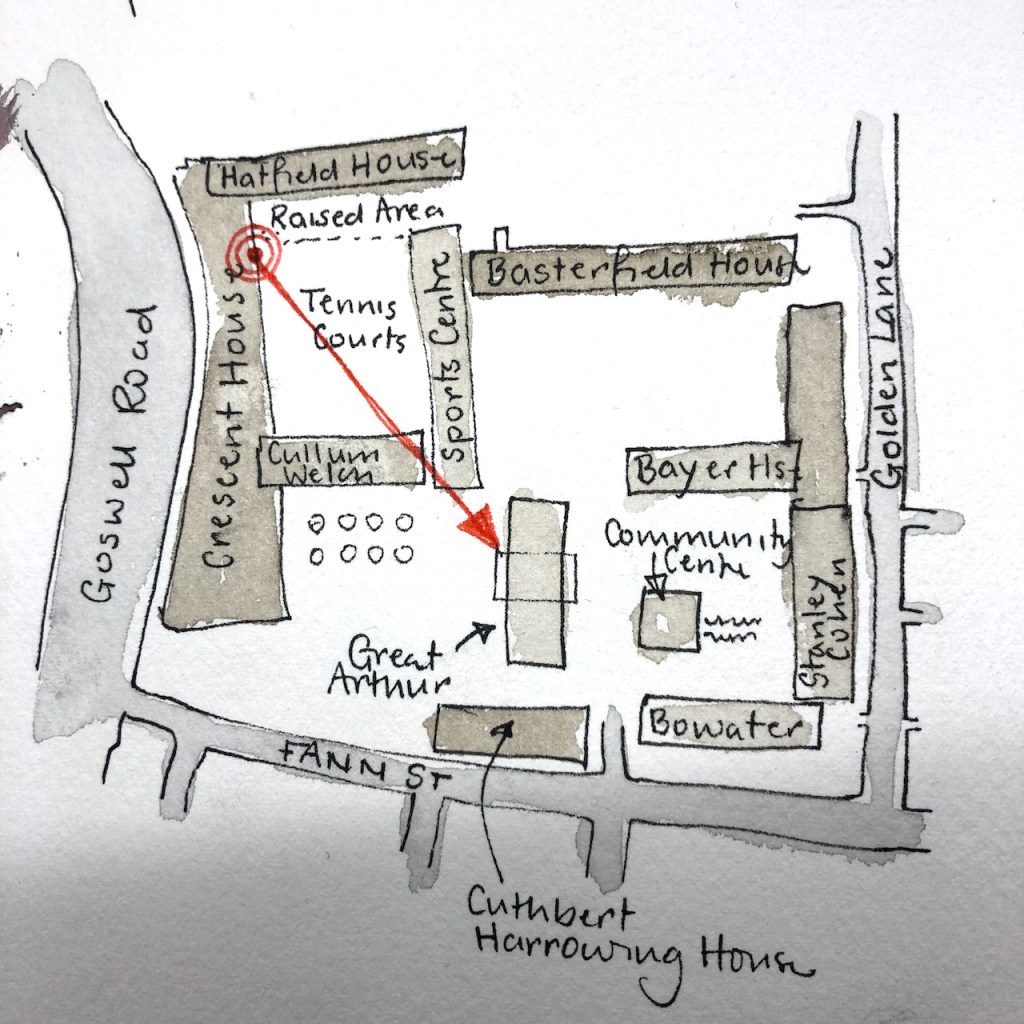
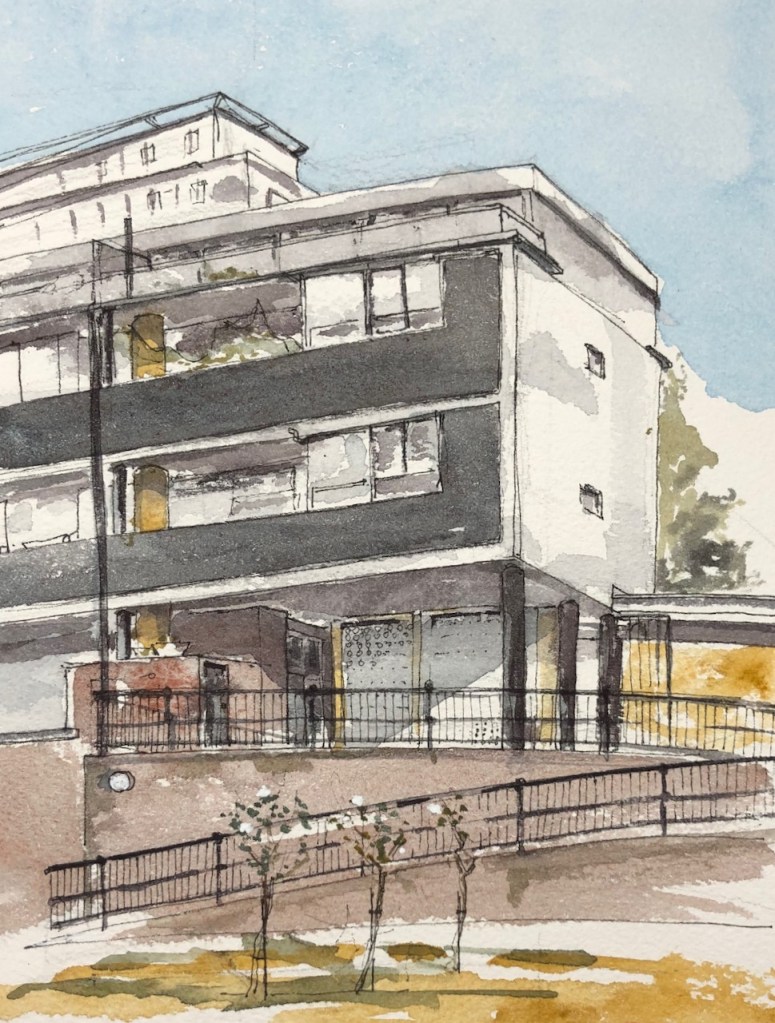
Great Arthur House and Cullum Welch House, Golden Lane Estate, from Crescent House.
Cullum Welch House is named for Sir George James Cullum Welch O.B.E., M.C. He was Sheriff of London, then knighted, then Lord Mayor of London in 1956, which was when the Golden Lane Estate was being built. He was knighted in the 1952 New Year Honours. He served in the army in 1914-18 and 1939-45 conflicts, and gained the rank of Lieutenant-Colonel.
Cullum Welch House and Great Arthur House, together with other buildings in the Golden Lane Estate are listed Grade II. The listing was in December 1997. Here is an extract from the listing on the Historic England site.
REASONS FOR DESIGNATION: Cullum Welch House, part of the Golden Lane Estate, is designated at Grade II for the following principal reasons:
* Architectural interest: as a self-sufficient ‘urban village’, in which every element of space is accounted for and every detail carefully considered, the Golden Lane Estate has claim to be the most successful of England’s housing developments from the early 1950s.
* Planning interest: the estate reflects the formality, mixed with picturesque attention to landscape, which was emerging in British architecture in the early 1950s, this saw the spaces between the buildings being almost as important as the buildings themselves.
The strong formality of the estate became a key characteristic of the work of Chamberlin, Powell and Bon, as did the provision of a wide range of facilities on the site other than just housing. These are features that can also be seen at their Barbican development.
Here’s the description of Great Arthur House from the Historic England website:
Great Arthur House was built in 1953-7 from reinforced concrete. The 17 floor building was the first to break the London County Council’s 100 ft height restriction and was briefly the tallest inhabited building in England. The flats were designed for single people and couples such as nurses and policemen who had to live near their work. The architects for the estate were Chamberlin, Powell and Bon.
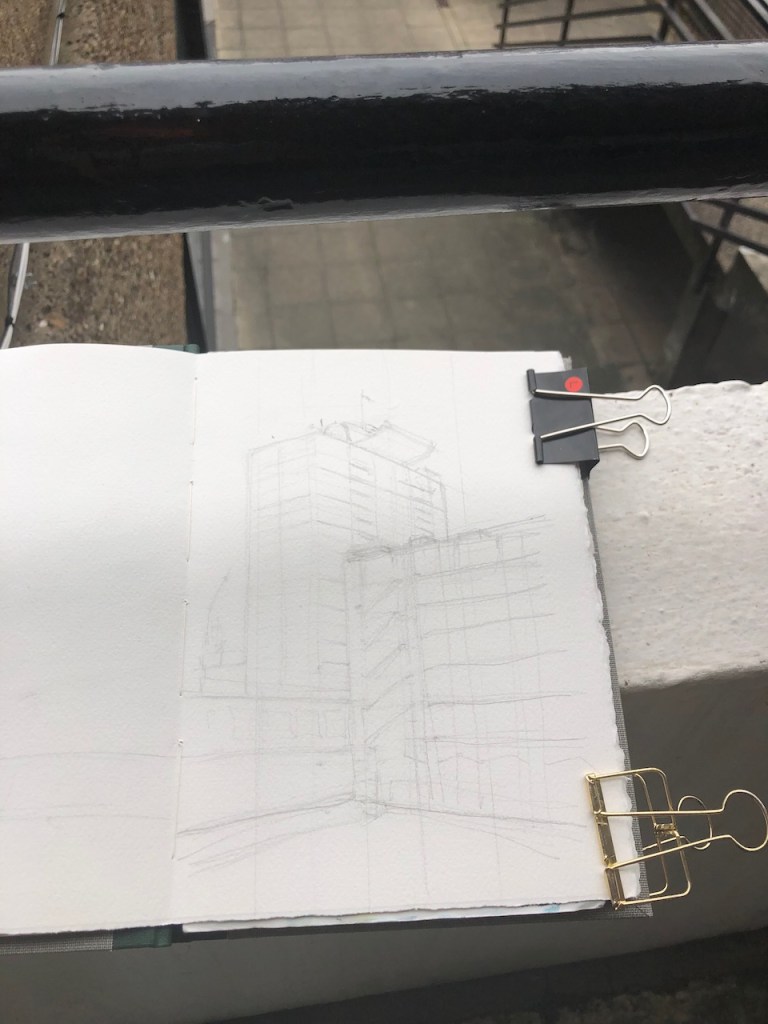
It was cold when I drew the picture, 10 degrees C. I wore a hat and gloves. Here are photos of work in progress, and a map.
Preliminary Sketch: working on the perspective lines
Pencil
This picture took about two hours overall, plus 15 minutes for the preliminary sketch.
The colours are Perylene Maroon and Prussian Blue, which make the grey tones, plus Hansa Yellow Mid which is the exact colour of the yellow cladding on Great Arthur House.
Here is a collection of my recent drawings of the Golden Lane Estate. Click on the picture to read more about the picture.
Click a button below to share this post online, email it, or print it:
Stanley Cohen House, on the East side of the Golden Lane Estate. Peabody House in the background.
I enjoyed the bold statement of the vertical yellow rubbish chute, visible above the balconies.
There were many plants on people’s balconies. I didn’t draw them all. Many people had window boxes, with geraniums and trailing leaves. On the upper floor, a length of camouflage netting hung across the balcony. You can just see it towards the middle of the picture. Then there were the three rose bushes, sketched in the foreground. All the while, the fountain played. There were lilies in the pond.
Stanley Cohen was chairman of the City of London public health committee in 1954. His name appears on the almost-indecipherable Foundation stone on Bowater House, near where I did this drawing.
The almost-indecipherable Foundation Stone. The part that says “George Wimpey” however, has been carefully highlighted! Here’s what the stone says: The Corporation of London This Foundation Stone was laid by the Rt. Hon. The Lord Mayor of London Sir Noel Vansittart Bowater BT MC on the Twenty First Day of July 1954 Stanley Edward Cohen Esq Chairman of the Public Health Committee Thomas Cuthbert Harrowing Esq Late Chairman Architects Chamberlain Powell and Bon Substructure Contractors Griggs & Son Ltd Superstructure Contractors George Wimpey & Co Ltd
Here is work in progress and a map.
This drawing is 25cm by 16cm, 10 inches by 6½ inches on Arches 300gsm watercolour paper. It took 1½ hours. After a preliminary sketch, shown in the gallery above, I started work on this drawing at 14:30 and finished at 16:00. The colours are Fired Red Ochre, Mars Yellow, Perylene Maroon, and Phthalo Turquoise, over De Atramentis document black ink.
Here is a collection of my drawings of the Golden Lane Estate:
Click a button below to share this post online, email it, or print it:














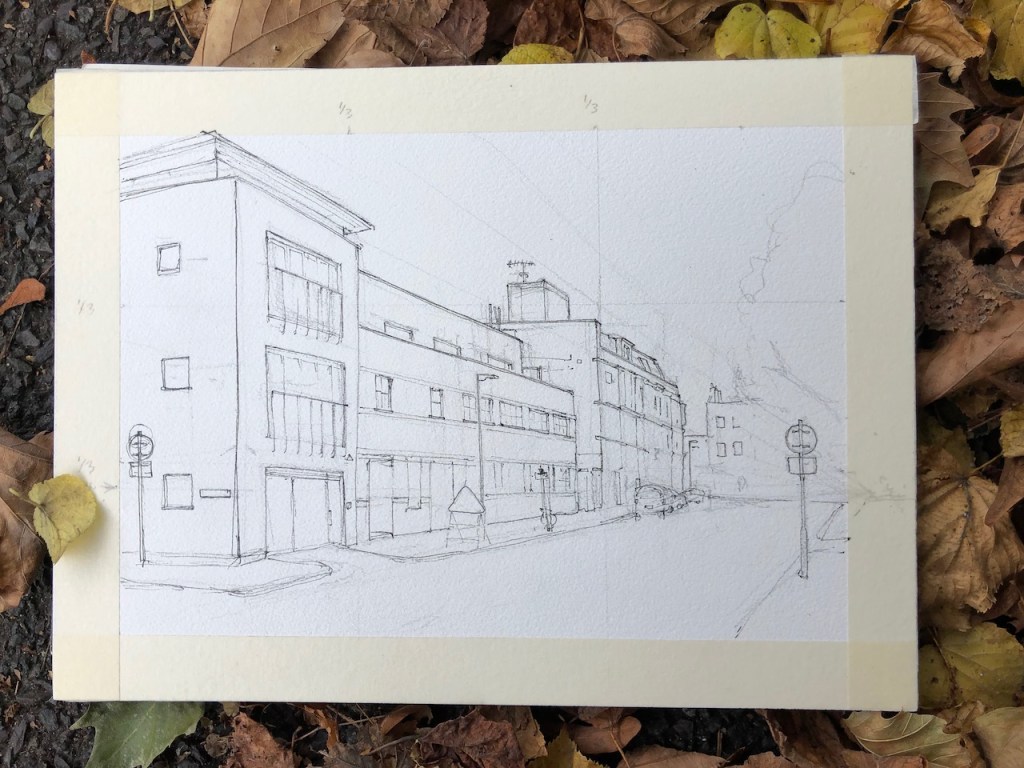
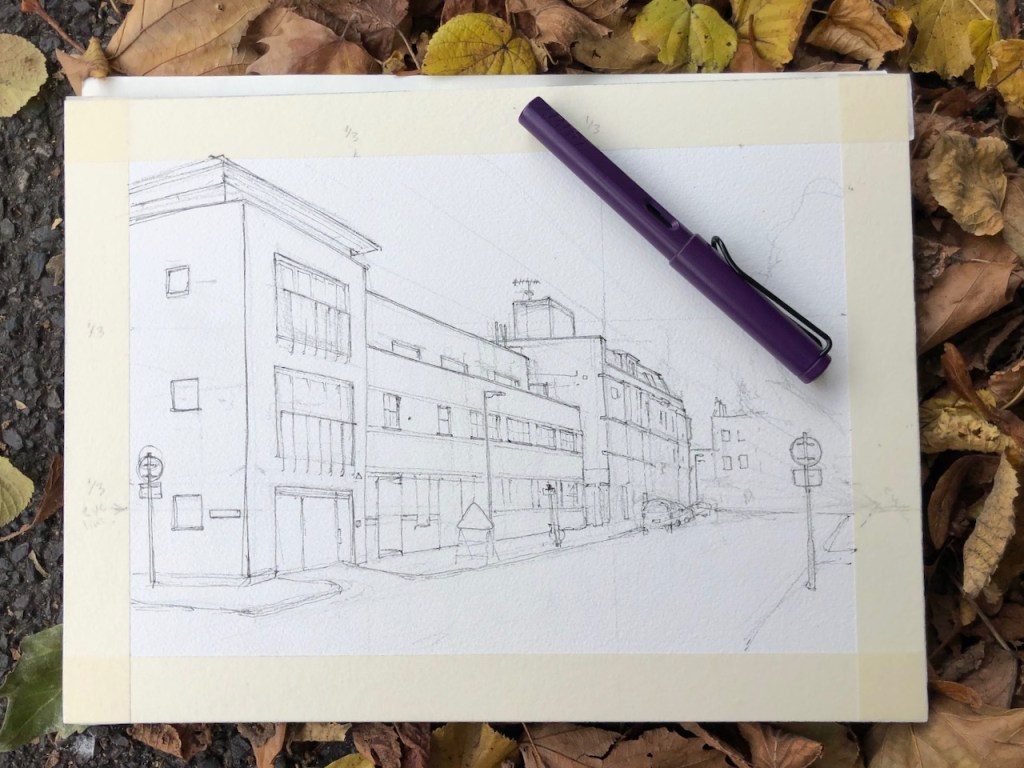
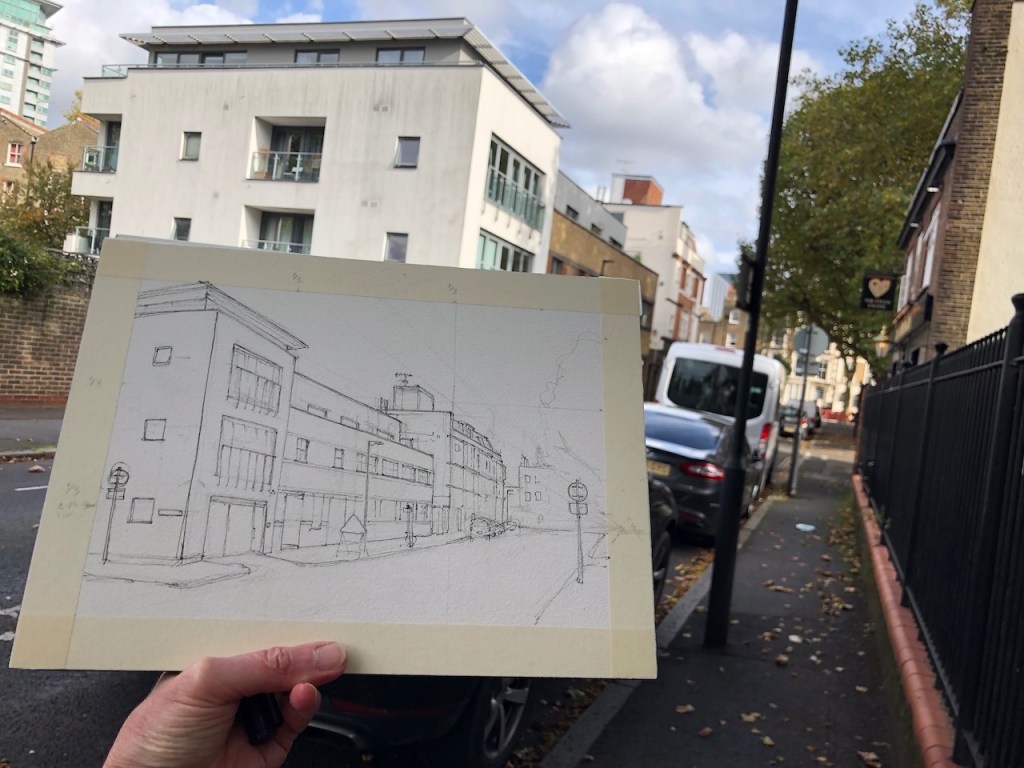
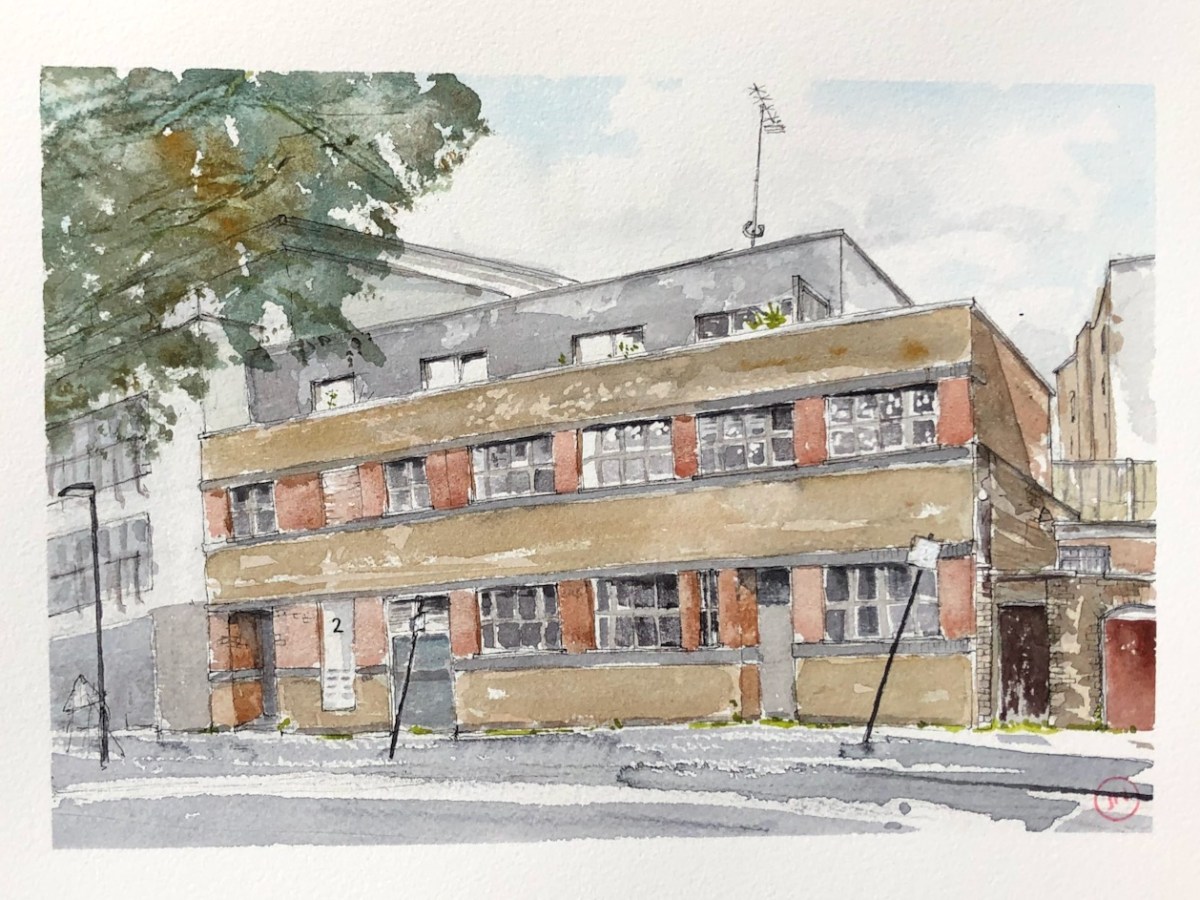



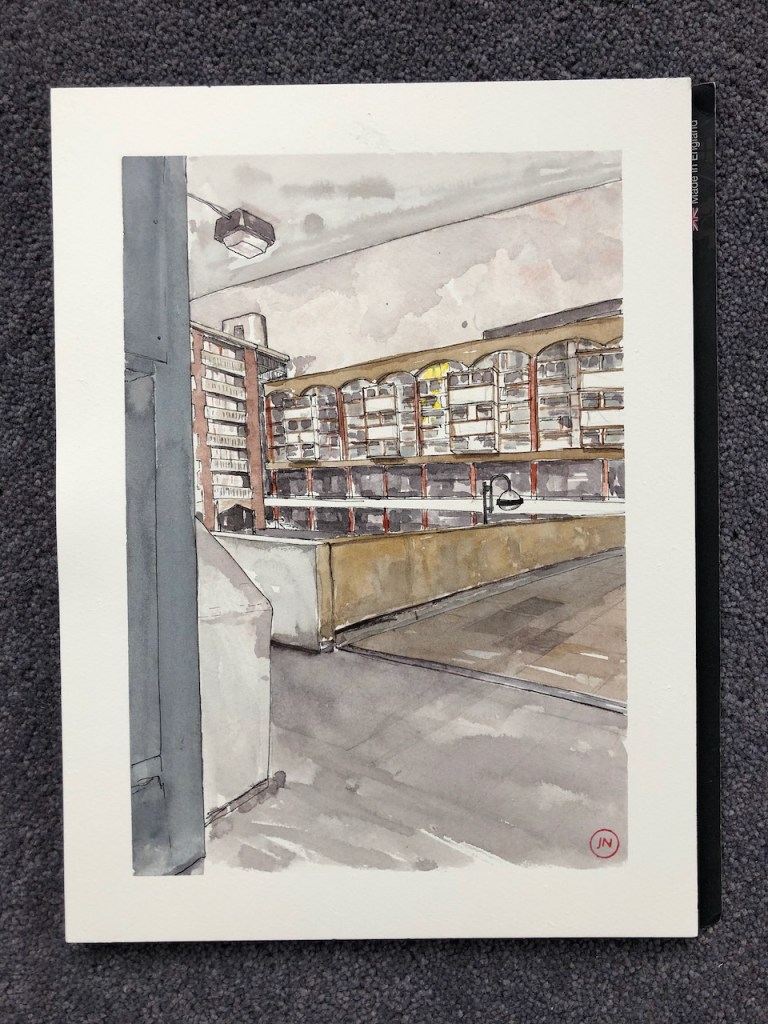











 Jane Sketching