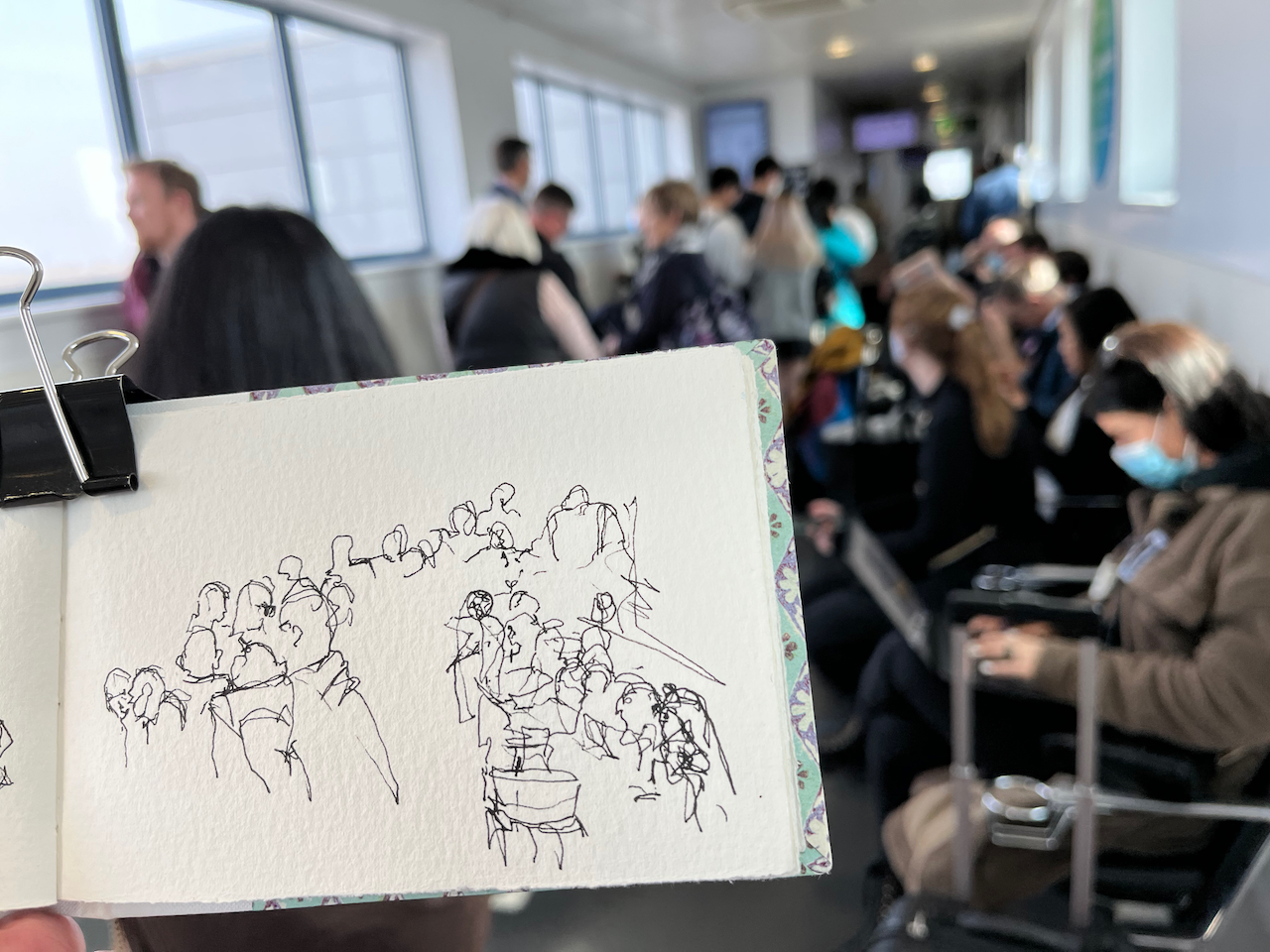
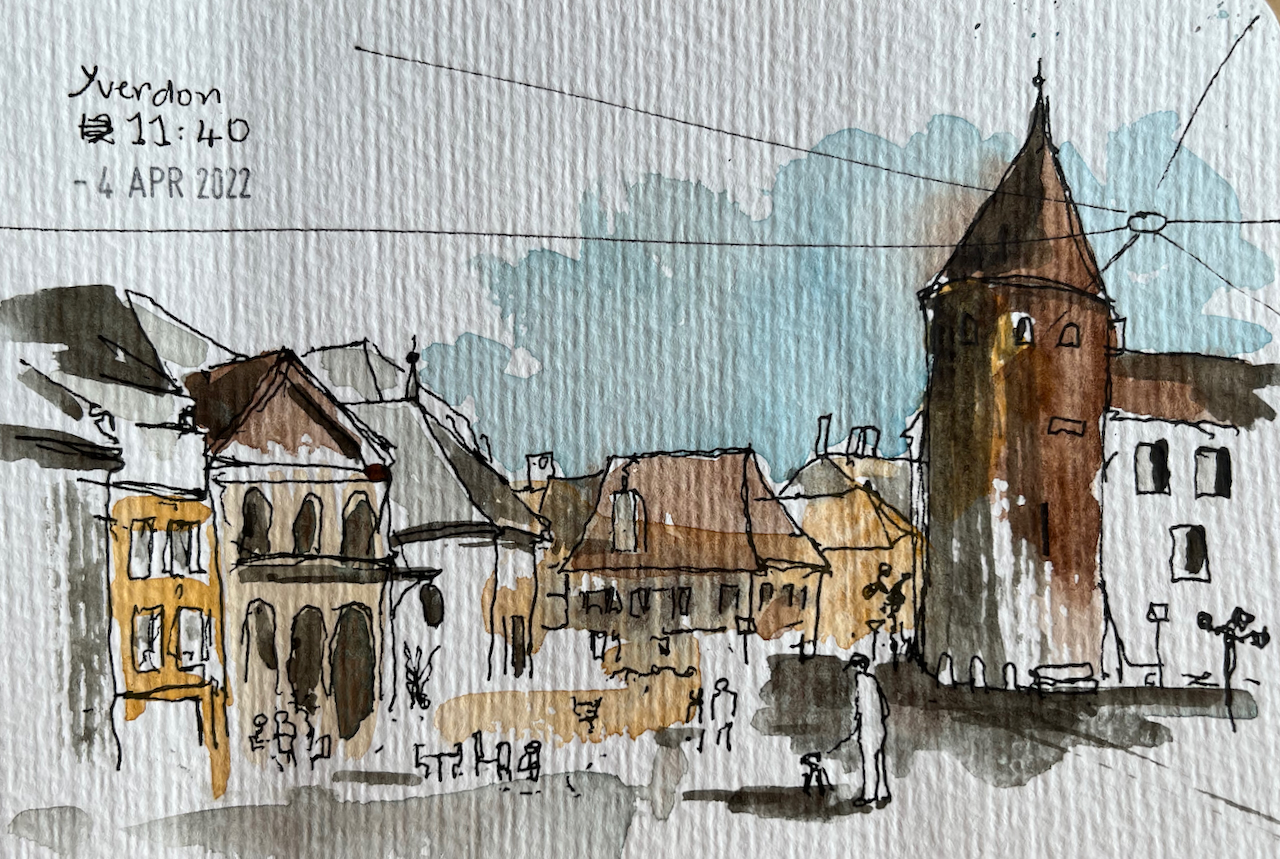
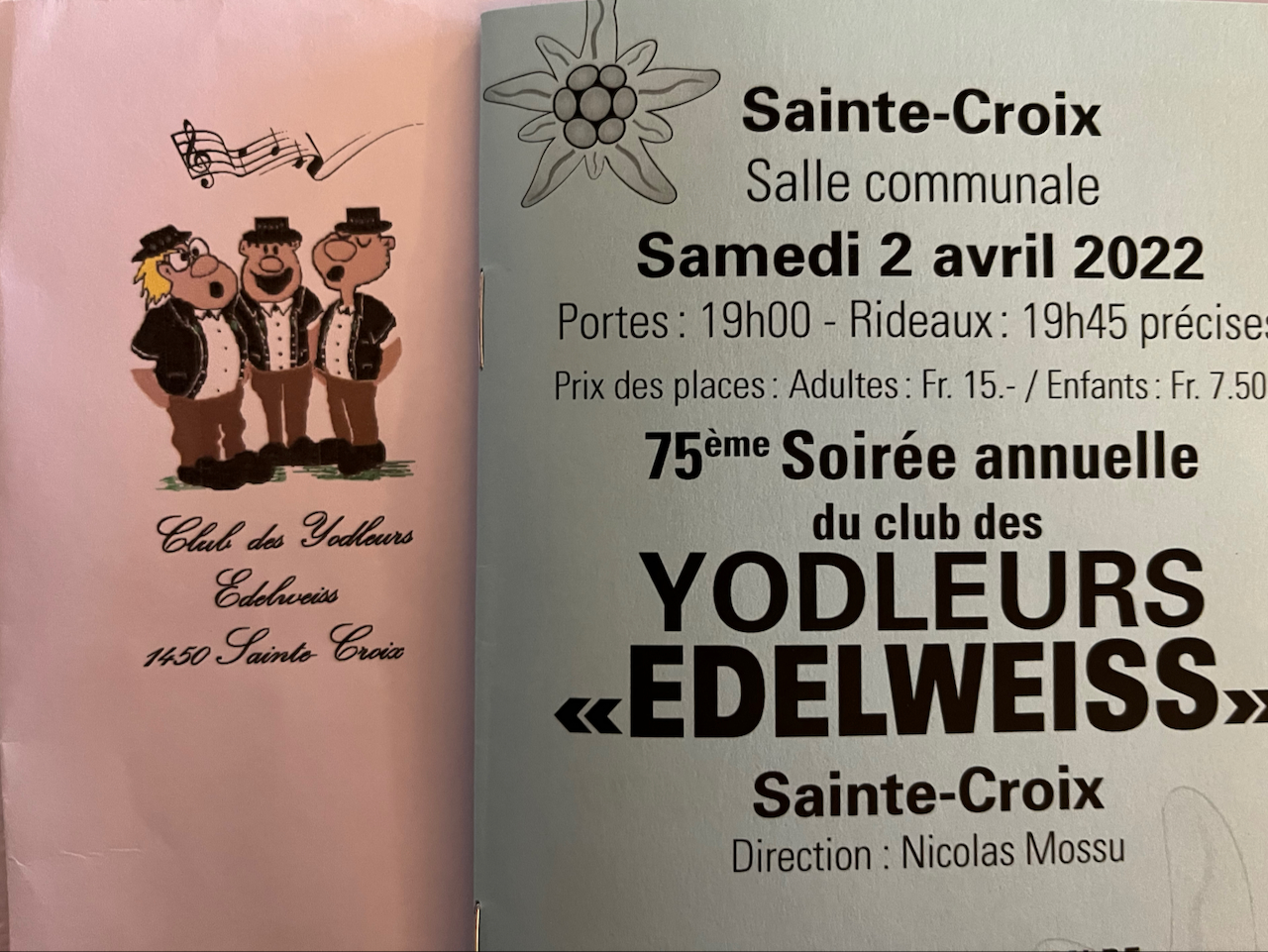
Photographs absolutely not allowed, but sketching was OK. It was very crowded, and great fun to hear the expert yodleurs. They sung in French.
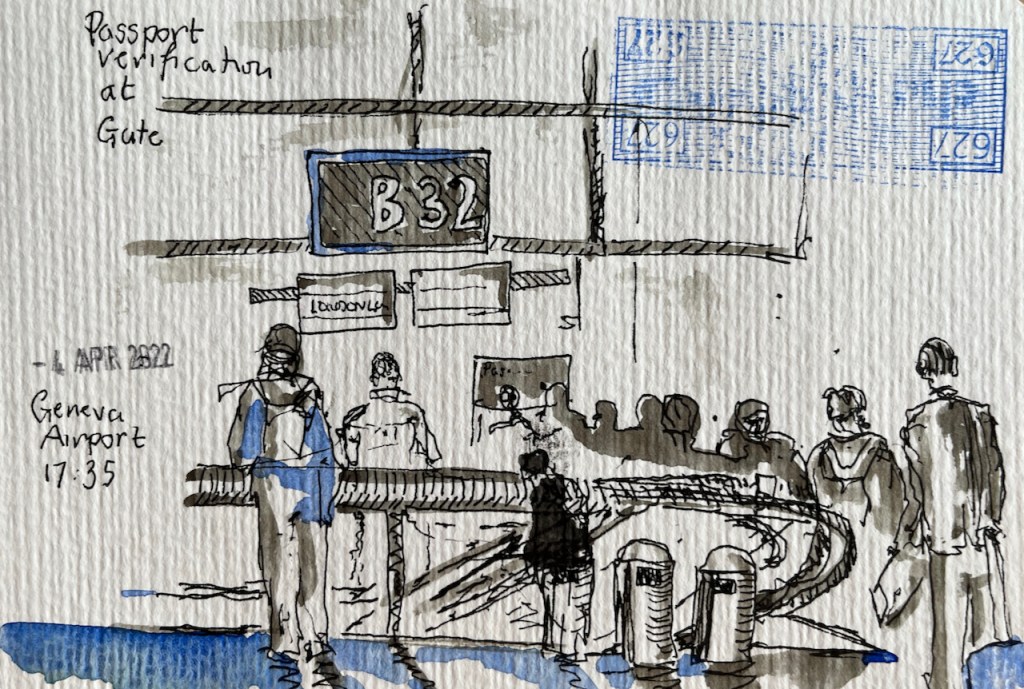
Sketching on the journey back to London. Passports were checked four times: at check-in, at border passport control, and again at the gate in Geneva (shown below), and again on arrival in the UK.
The friendly passport officer at Gate B32 kindly agreed to add his stamp to my picture. You see his blue rectangular contribution in the top right.
Sketching on the plane:
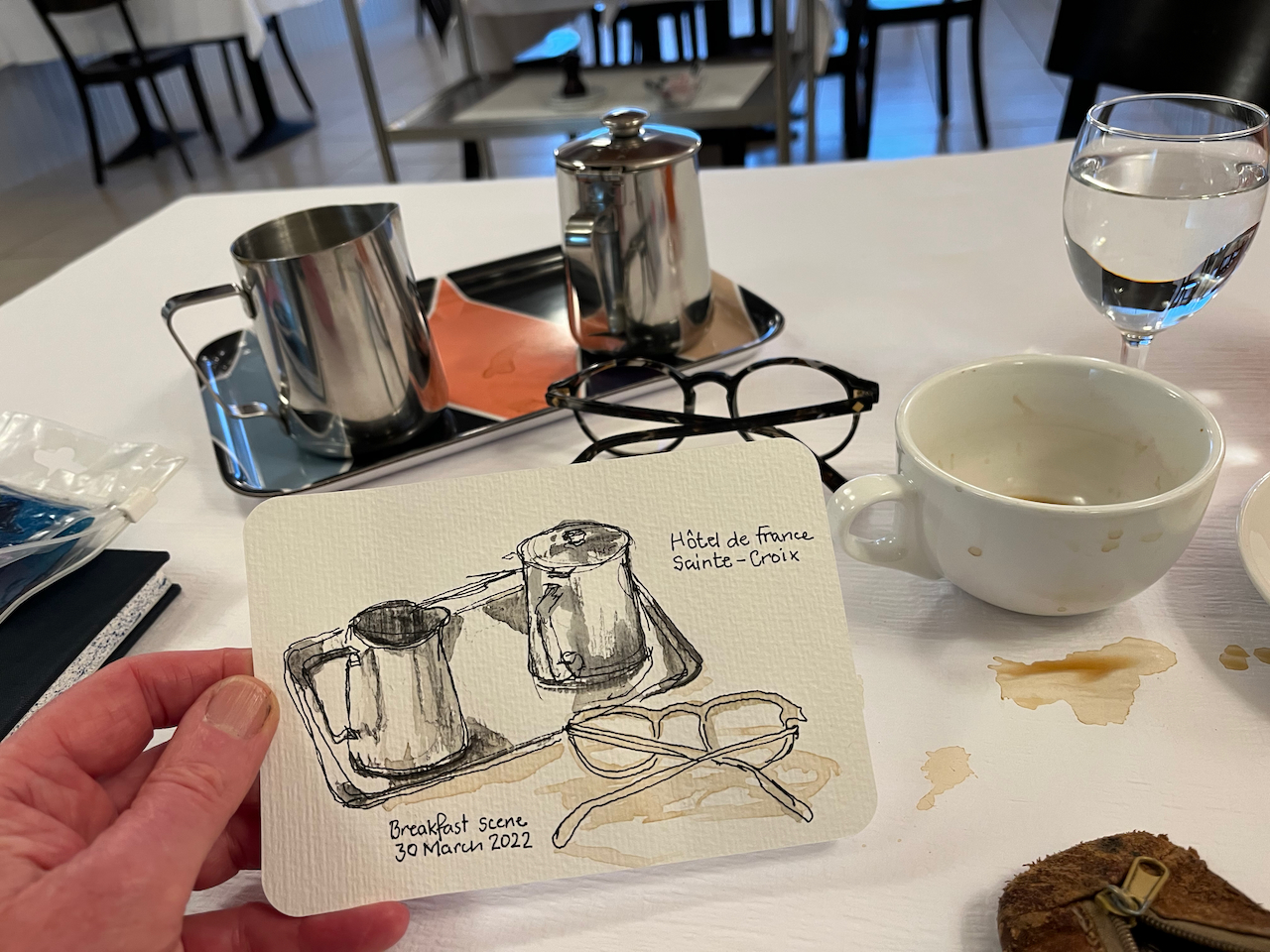
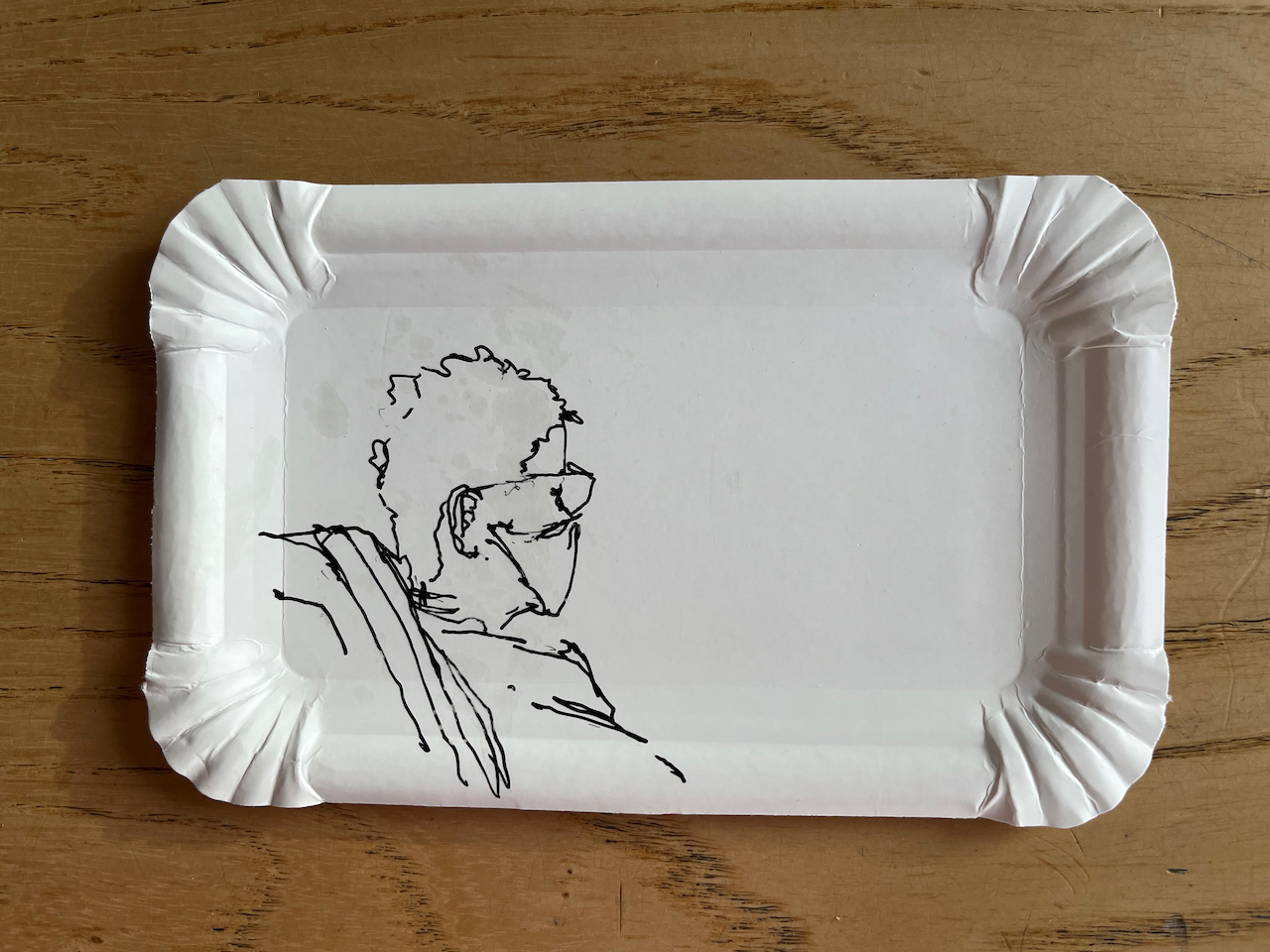
Sketching on a paper plate.
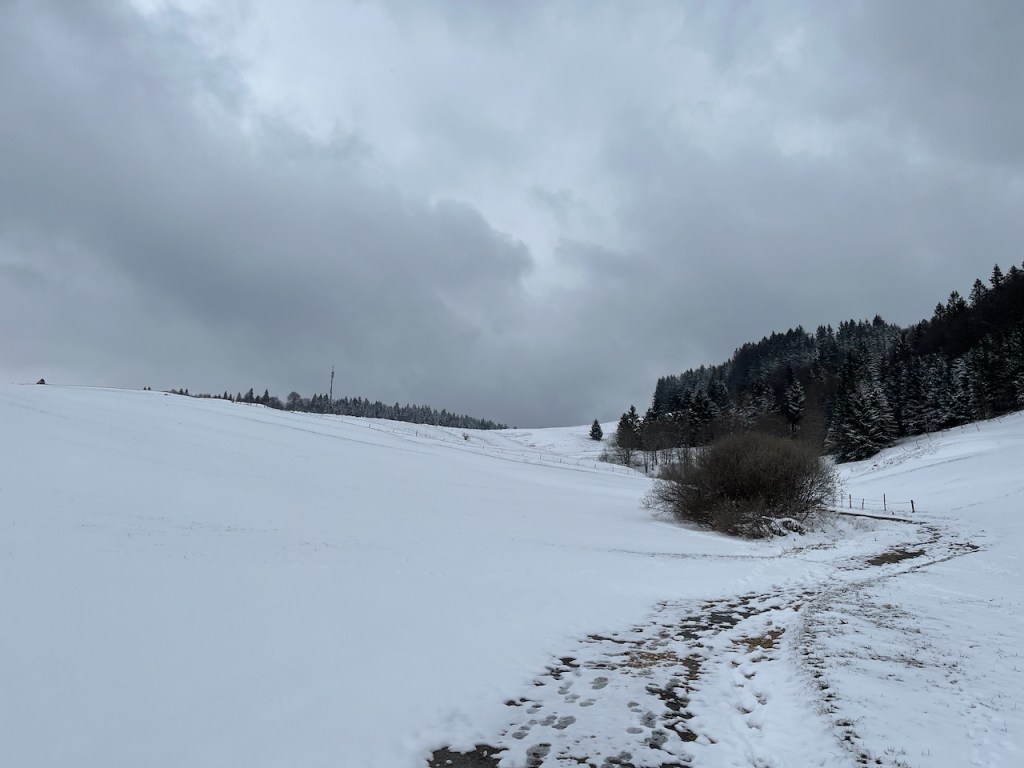
In between all this sketching I did some work…..and went walking in the snow.
Near Sainte-Croix, Vaud.
Click a button below to share this post online, email it, or print it:
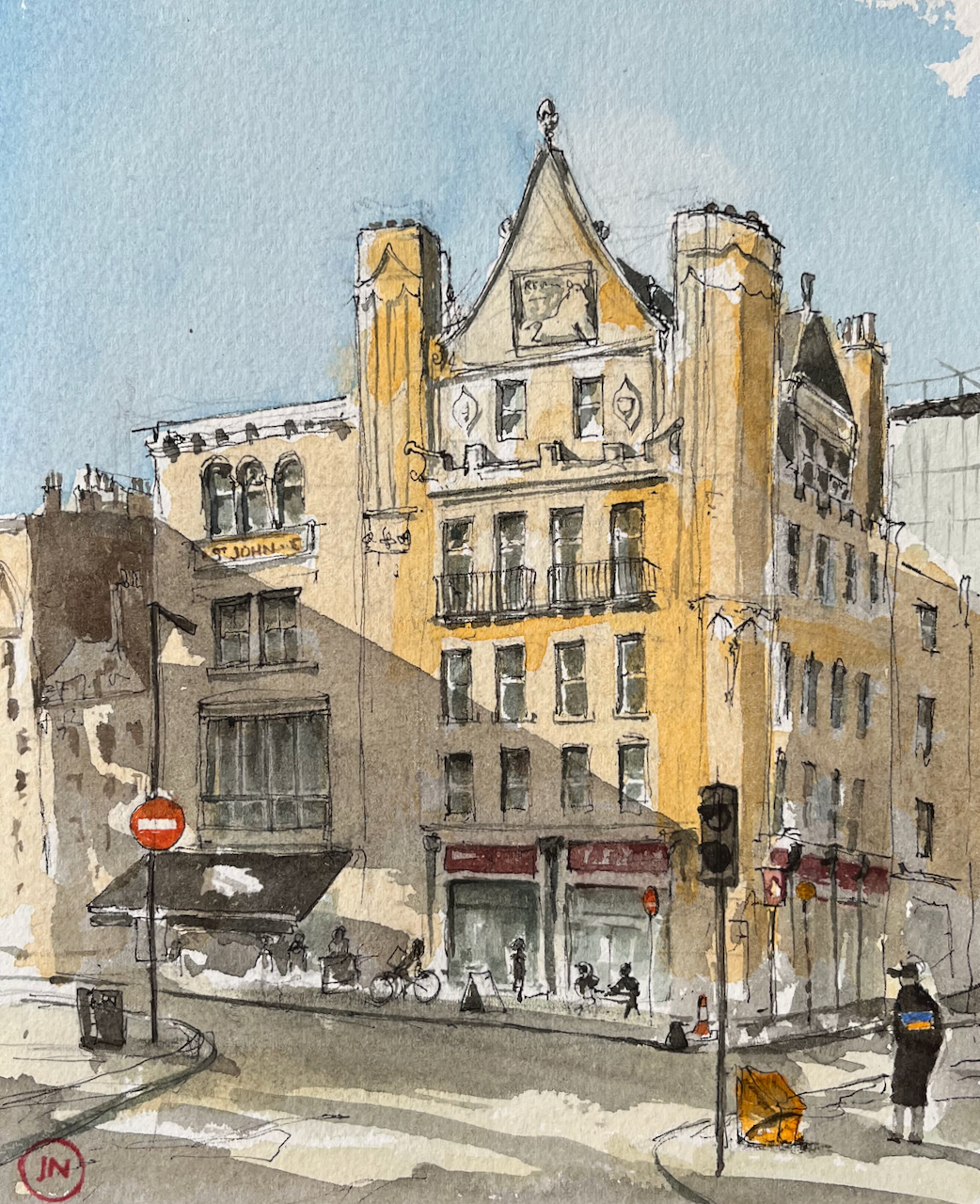
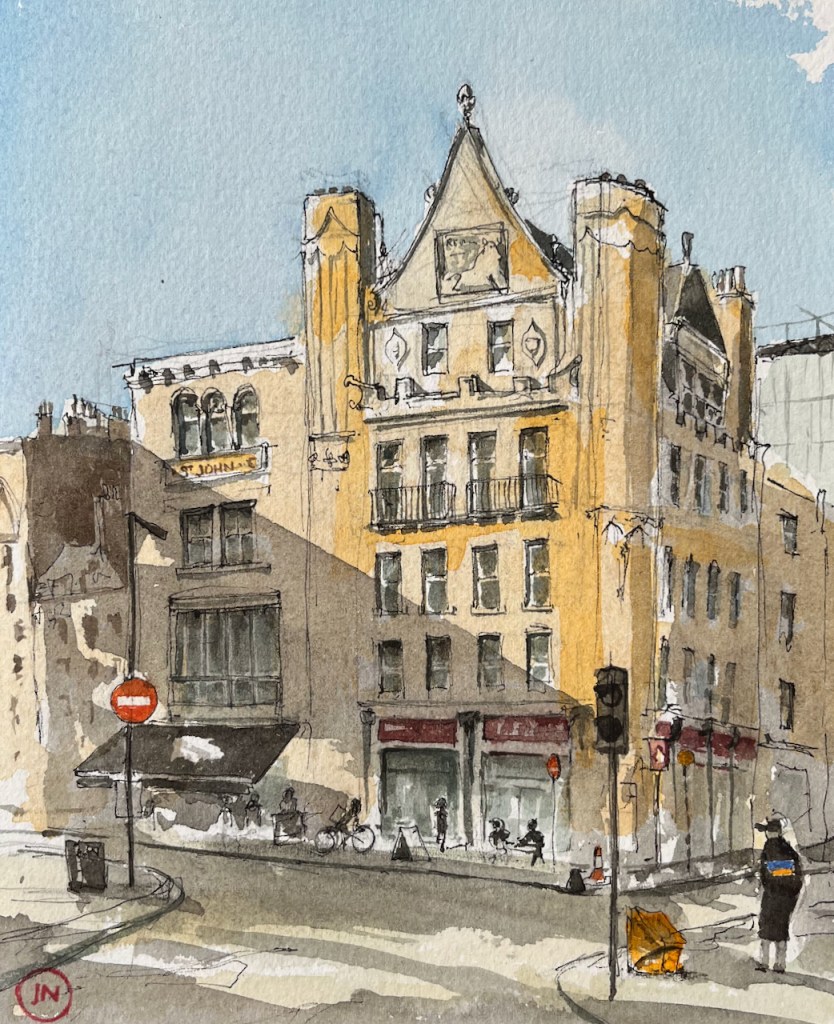
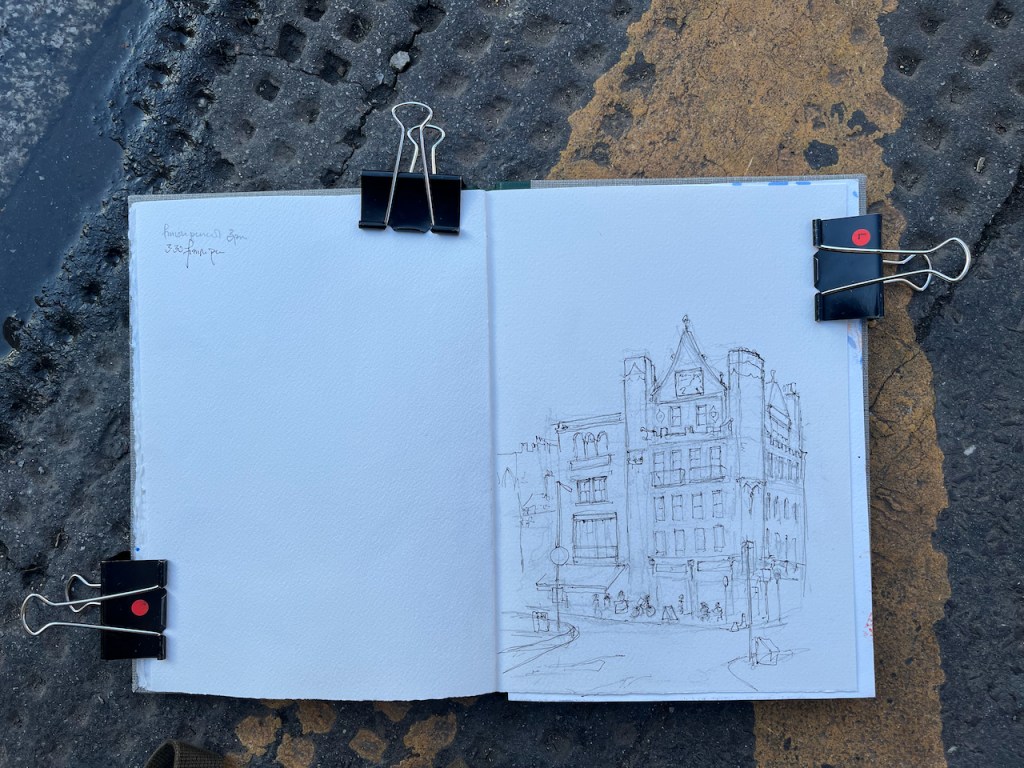
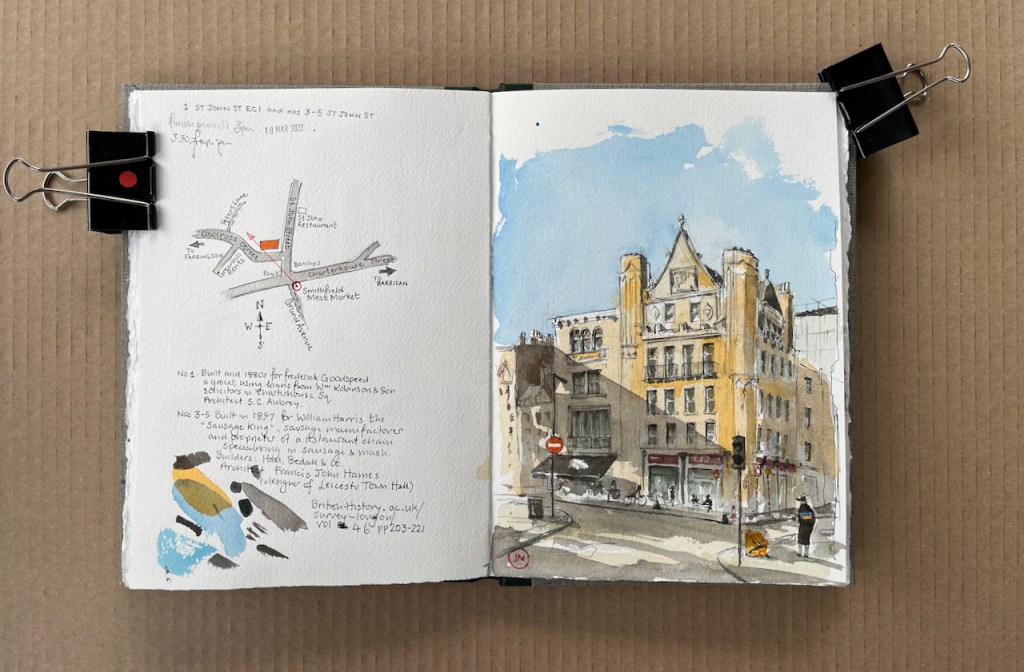
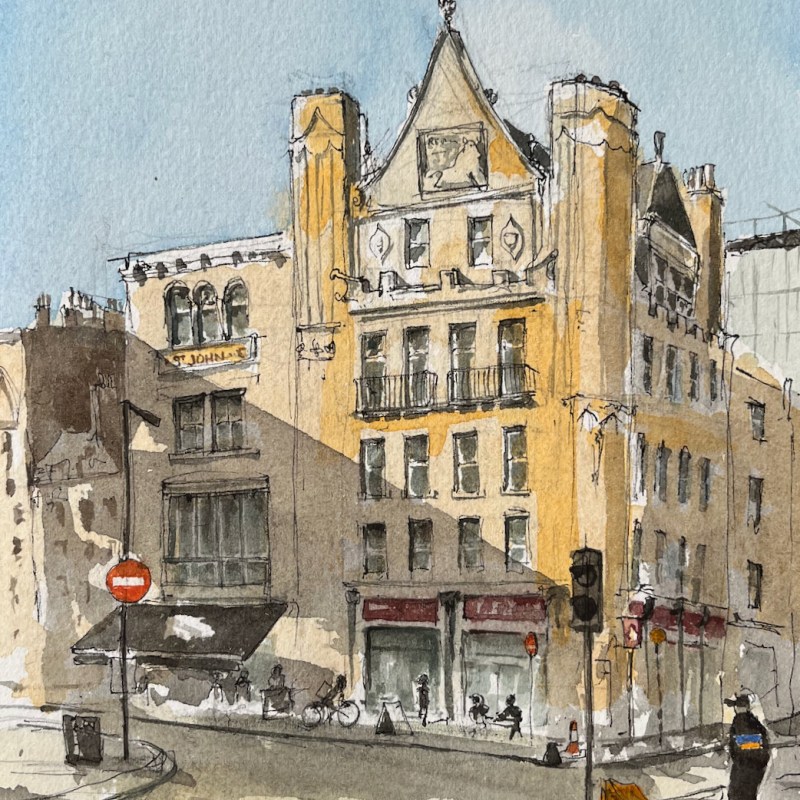
These glorious buildings are at the south end of St John’s Street. This is the view looking north from the Smithfield Meat Market, Central Avenue.
3-5 St John St EC1, 18th March 2022 3:30pm, in Sketchbook 11
It’s a busy corner. I tried to show some the street life: couriers cycling, people sitting at the café, and people, like me, standing and looking. A little further up St John Street, on the right, is construction work.
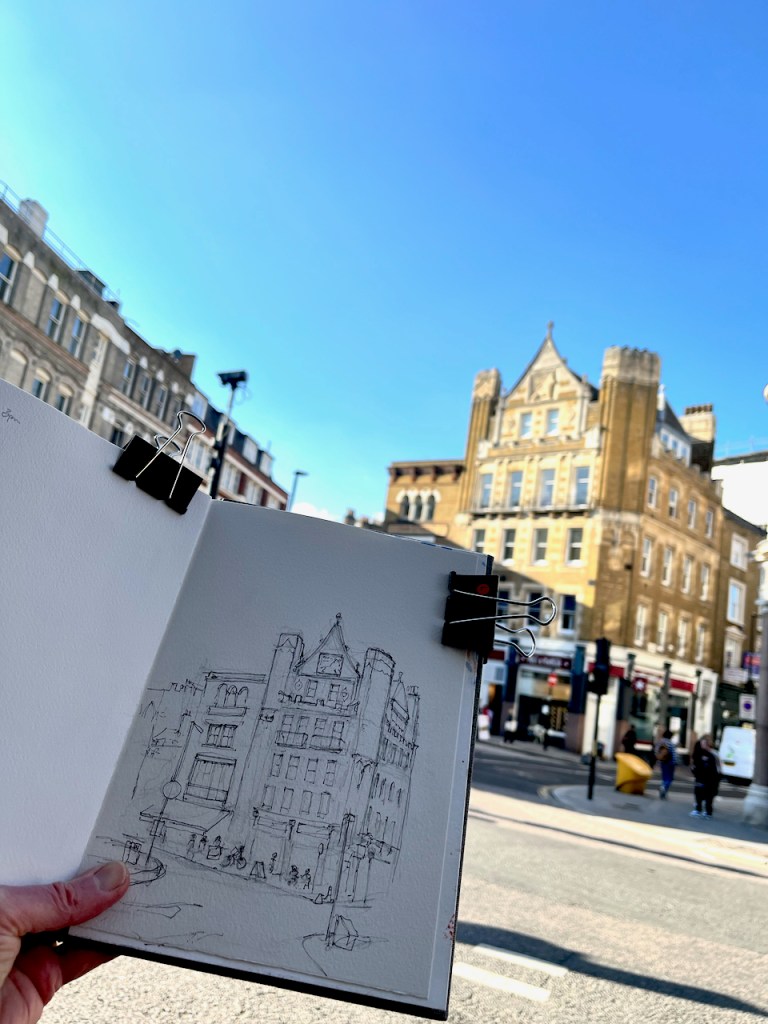
There was a blue sky as I drew. But do not be deceived: it was cold, as you see from the person on the right, hunched under their coat.
Here is a work-in-progress photo and a map:
Work in progressPen finishedSketchbook spreadMap showing the sightline
This is an ornate buildings: lots of fluting and complicated brickwork. Who thought all that was a good idea? Who could afford it? Number 1, on the left, slightly more restrained, was built for a Frederick Goodspeed, a grocer, in the mid 1880s. The architect was S.C. Aubrey. (reference 1 below)
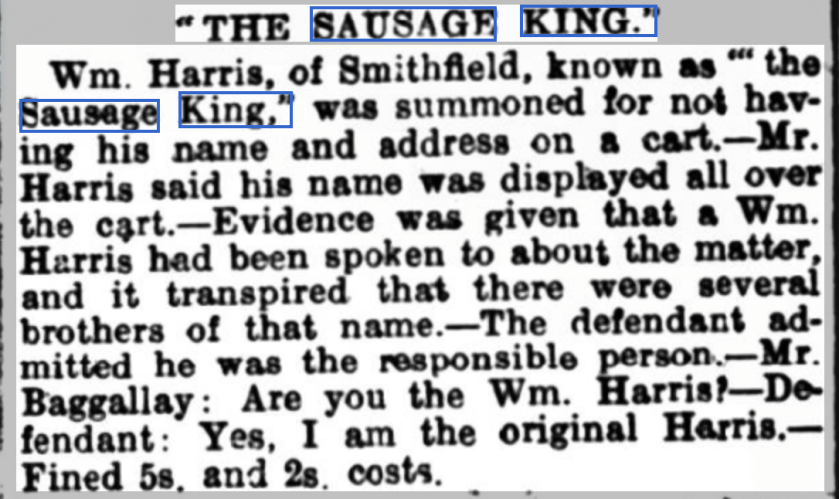
Numbers 3-5, the building on the corner, has chimneys with all kinds of complicated brickwork, and a highly decorative frontage onto Smithfield. It was built in 1897 for William Harris, the “Sausage King”. He was a sausage manufacturer, and proprietor of a chain of restaurants specialising in sausage and mash. Mr Harris was evidently quite a character. He named all his three sons William, and all his four daughters Elizabeth (reference 2 below). This may have had practical problems, but it meant he and his sons could have fun with the Magistrates:
The “Sausage King” was somewhat eccentric, but this was to a large extent due to his love of “personal advertising,” which was his motto for business success. At all times of the day he wore a sort of evening dress, with an opera hat, and a blazing diamond in his white shirt, even when buying in the market, and he used not a scrap of writing or wrapping paper that did not bear his photograph. His trade mark, which he registered about forty years ago, depicts him winning the “Pork Sausage Derby” on a fat porker. His principal catch-phrase was “Harris’s sausages are the best,” and it spread the fame of his sausages all over the world. He also composed a lot of poetic advertisements, which caused much amusement.
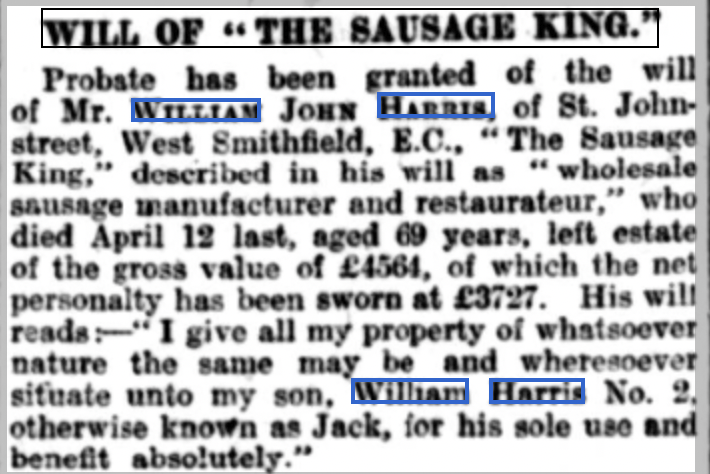
This snippet from “London Standard, via the Montreal Gazette, 3 May 1912” reporting his death (reference 2).
He died in April 1912, leaving a considerable fortune. His death was reported far and wide, including papers in many parts of England and Ireland.
Note the reference to “William Harris No. 2”, that is, his second son, to whom he left all his property. I wonder what all the other sons thought – and the four daughters?
I am glad that the flamboyant house of this extraordinary man still stands. The architect was Francis John Hames, who also designed Leicester Town Hall. So you see what kind of league Mr Harris was in.
Reference 1: Thanks to British History Online who alerted me to The Sausage King: ‘St John Street: Introduction; west side’, in Survey of London: Volume 46, South and East Clerkenwell, ed. Philip Temple (London, 2008), pp. 203-221. British History Online http://www.british-history.ac.uk/survey-london/vol46/pp203-221 [accessed 8 April 2022].
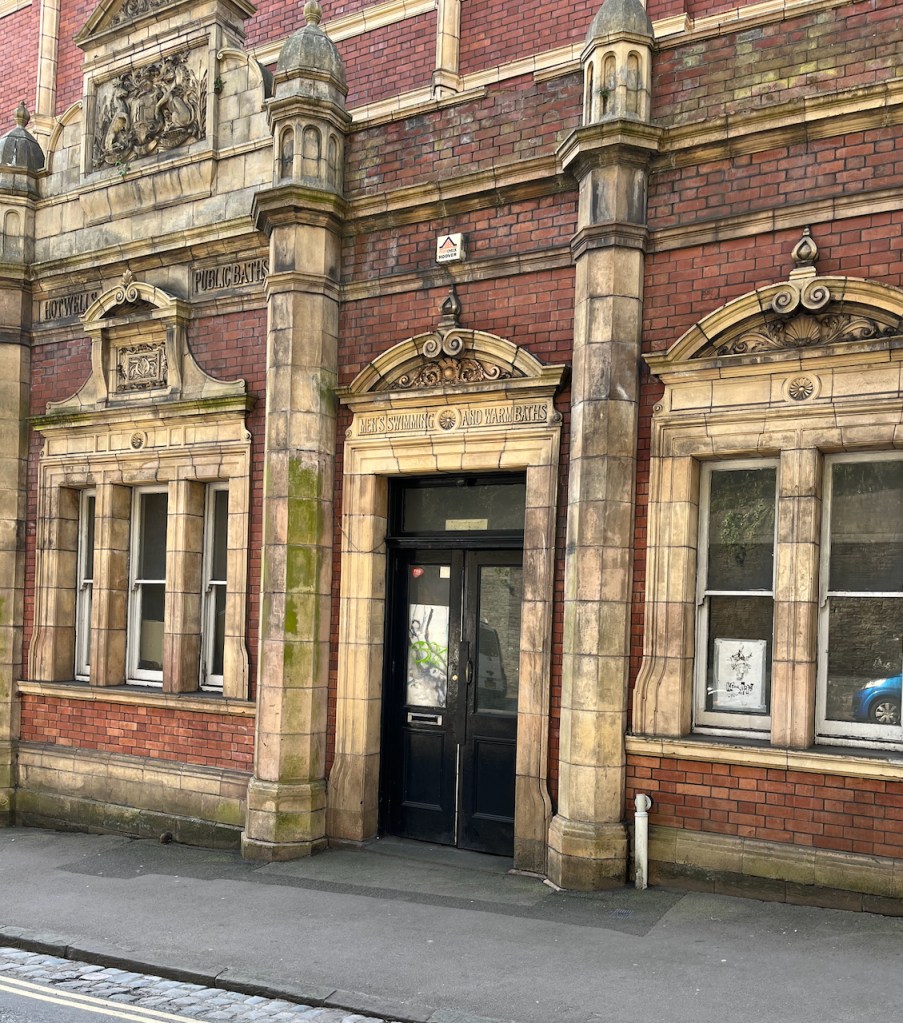
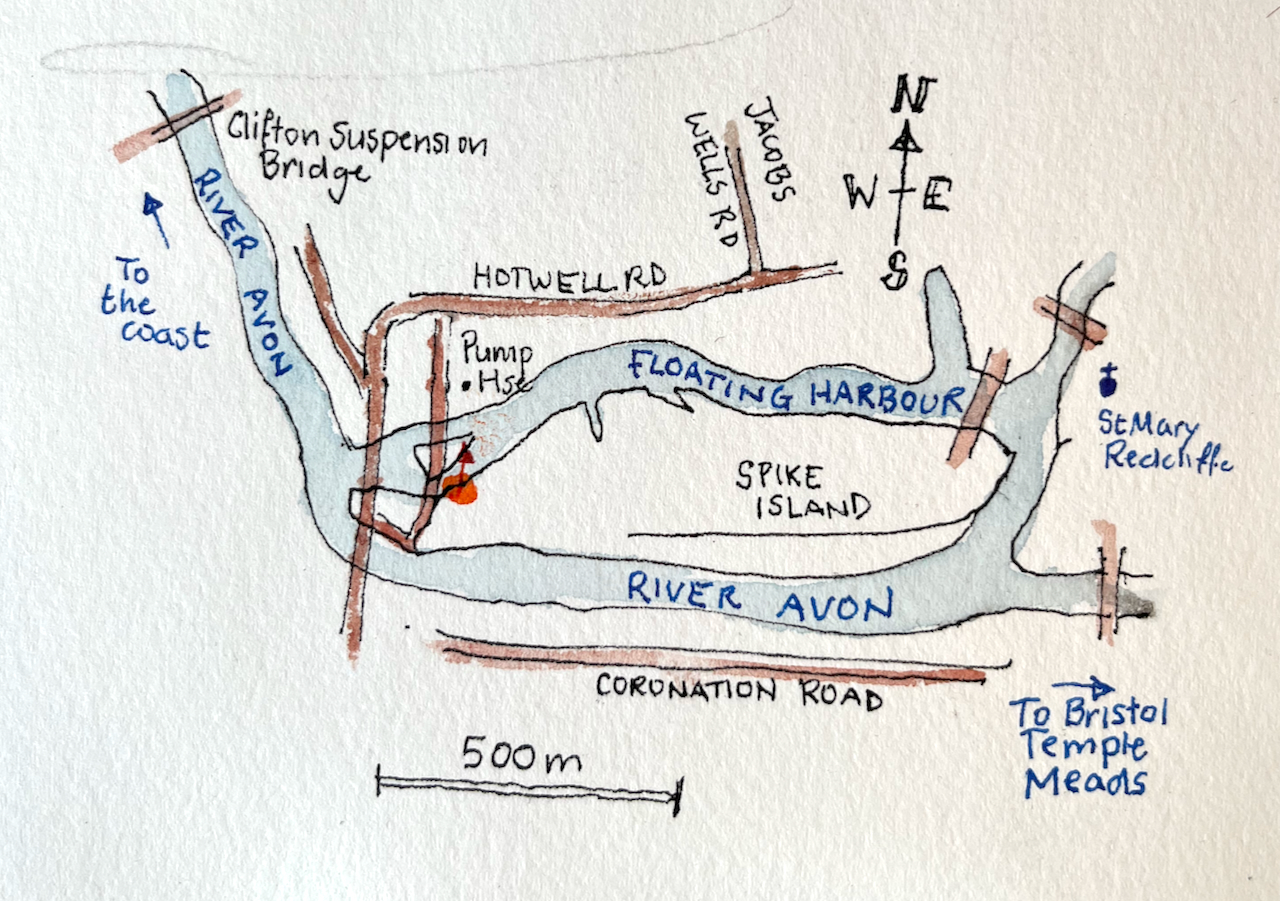
Here is the Bristol Community Dance Centre on the Jacobs Wells Road.
Bristol Community Dance Centre, Jacobs Wells Road. 12:15, 23rd March 2022 in Sketchbook 11
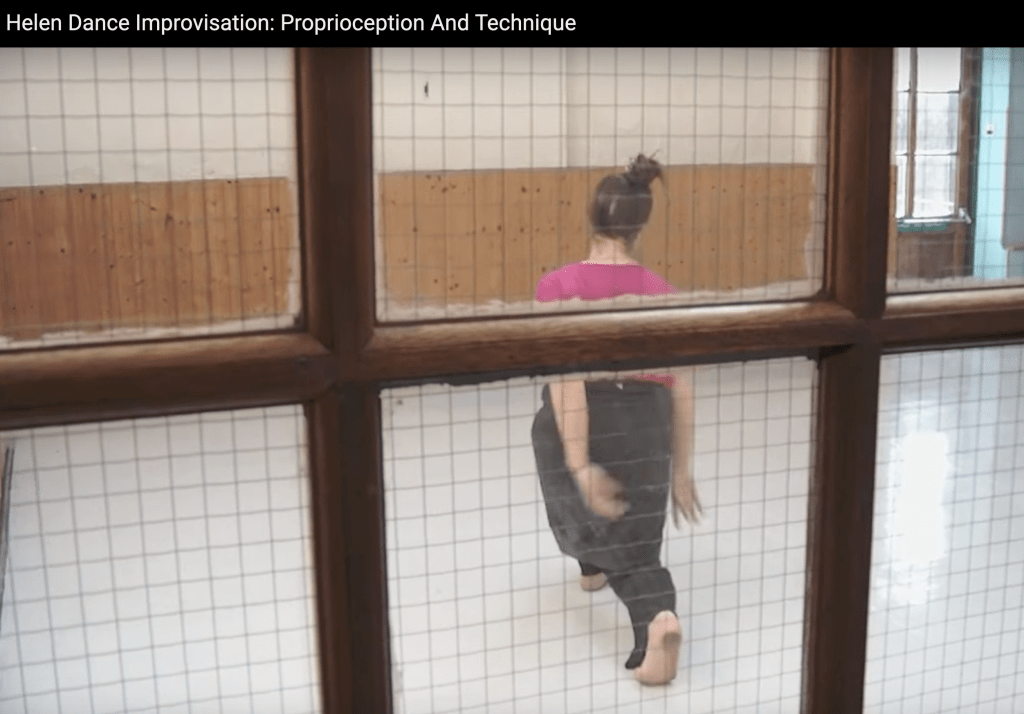
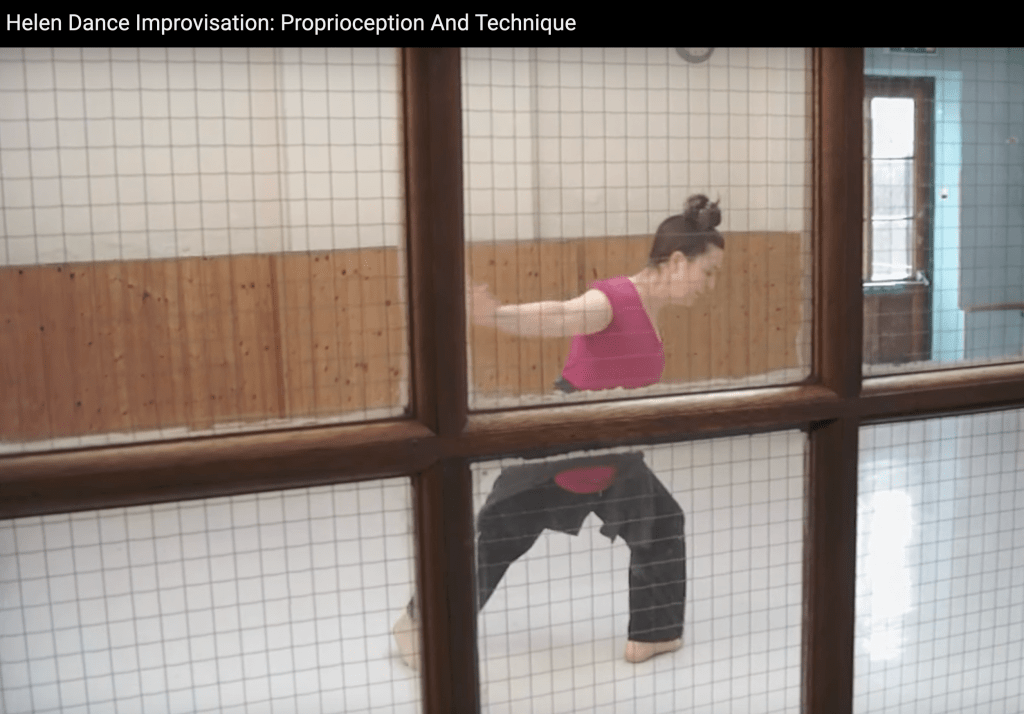
This is building is special for me. Here I learned how to stand up straight, and I learned where my feet were. Or rather, I learned how to learn those physical things, or I learned that they could be learned. My teacher was a dancer, Helen Roberts.
Earlier on, many years previously, in another town, in a different life, I had been to a performance by London Contemporary Dance Theatre. There I saw, for the first time, movement as language. The way I described it to myself was: “First they teach you a language, then they talk to you in it.” That, for me, was Contemporary Dance. Once I’d seen it, I wanted to do it.
Life events unfolded and I was in another town, another life. And still, the idea of Contemporary Dance remained. Searching through printed events listings, in fuzzy type on thin paper, I found a Contemporary Dance class, for beginners. It was in Bristol, half an hour’s train journey from Bath, where I was living. So I turned up to this building, with shoulders hunched from stress and aching from desk work, and body strong from running and swimming, but uncoordinated. Without ceremony or introduction, the class started. This was the early 1980s.
I kept on with the beginners’ class, for years. It didn’t get any easier, but I felt that I was learning something. Recently I found a word for what I was learning: kinaesthesia, awareness of where my hands and feet are.
Helen Roberts was up at the front, calmly demonstrating the movements. Sometimes there was recorded music, once or twice a drummer. Sometimes she simply counted or sung a rhythmic click-type song. I copied the movements as best I could, and tried to follow her directions. Arms up, arms wide. “Arms wide” she repeated, with a bit of a glance my way. I was concentrating. My arms are wide. “My arms are wide” I said to myself, “just like Helen’s!”.
“Look at your shadow” suggested Helen, gently. There weren’t any mirrors. I looked at my shadow and I saw me. Rather than ‘soaring bird’, I was ‘drooping tree’. I lifted up my arms. It felt far too high, far too difficult. And that was the beginning. Holding your arms out wide is hard, it takes practice, it takes proprioception, which (I now know) is the sense of where your limbs are in space. It can be learnt, improved, refined, made easier, made more intuitive. I’m still learning.
I learned what it feels like to stand up straight, to line up my spine, to tauten my legs. I learned to “uncurl” from a deep fold into this upright standing position. It’s a pleasant feeling. We did it again and again in this beginners’ class. I did it again and again also outside the class, and it helped me: movement as medicine.
Life moved on again, another town, a different life, moving from place to place. Now it’s 35 years later. I’m getting older and need to stretch stiffening muscles, aching joints. I have a sequence of exercises given to me by an NHS physio after an injury. In the sequence was that very same uncurling exercise: medicine as dance. With the remembered movement came Helen Roberts’ voice, instructing me, encouraging me.
I incorporate several more of Helen Roberts’ movements into my routine now. I reach upwards, the energy “flowing along the arm and out of the fingertips” as she described all those years ago. Although I don’t know quite what that means, I find it makes a difference to think of it that way: a static movement made dynamic.
I hold my arms out wide, and catch a glimpse of my shadow. I check that my arms are really out there, in the widest possible preparation for an embrace. Even if I don’t do it perfectly, I know now how to learn. I know there is something there to learn, even in this simple movement. And I do it again, and again, with more knowledge, more awareness. It is strangely satisfying.
Helen Roberts – if you are reading this, thank you!
—
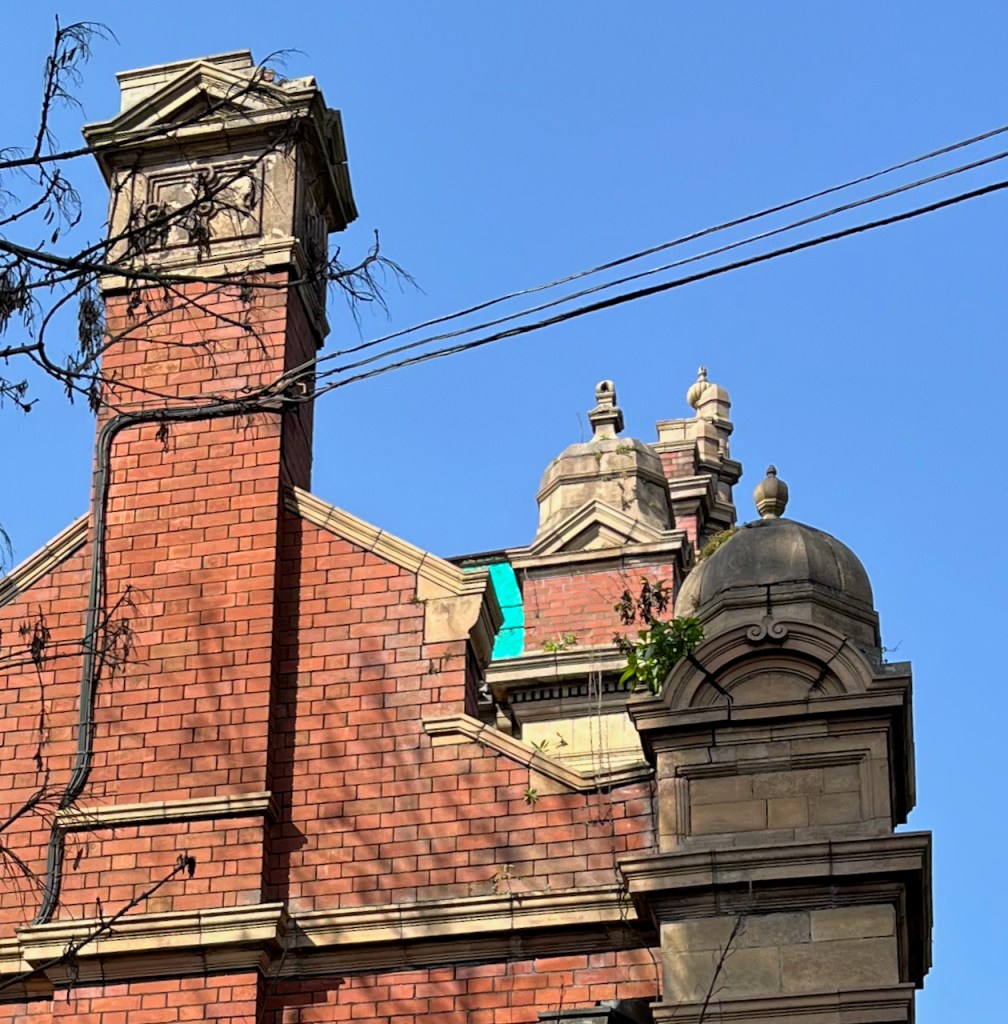
Here are some photos of the dance centre now, and work in progress on the drawing. It seems that the dance centre is closed. It looked closed when I saw it.
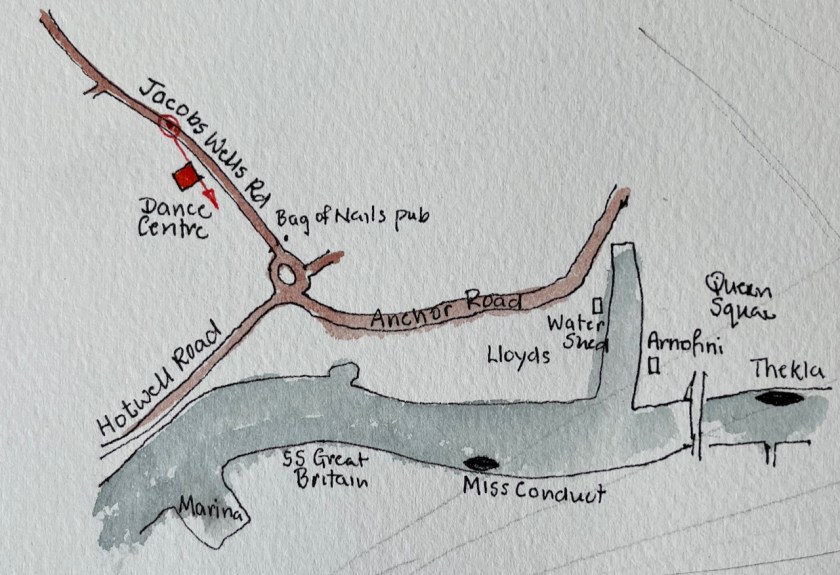
Here’s a map:
Sketch map of Bristol Harbour area showing the Jacob Wells Road and sightline of the drawing.
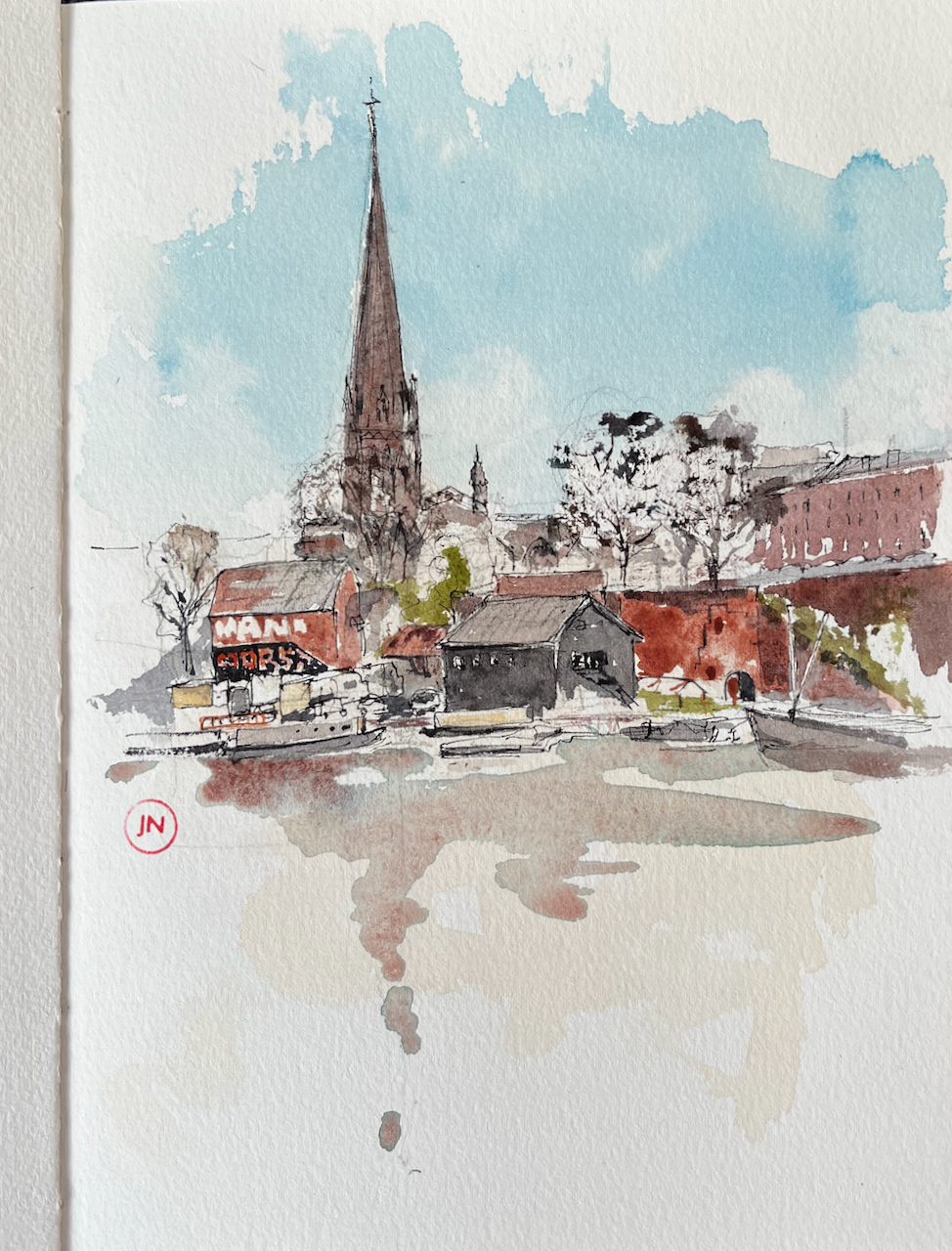
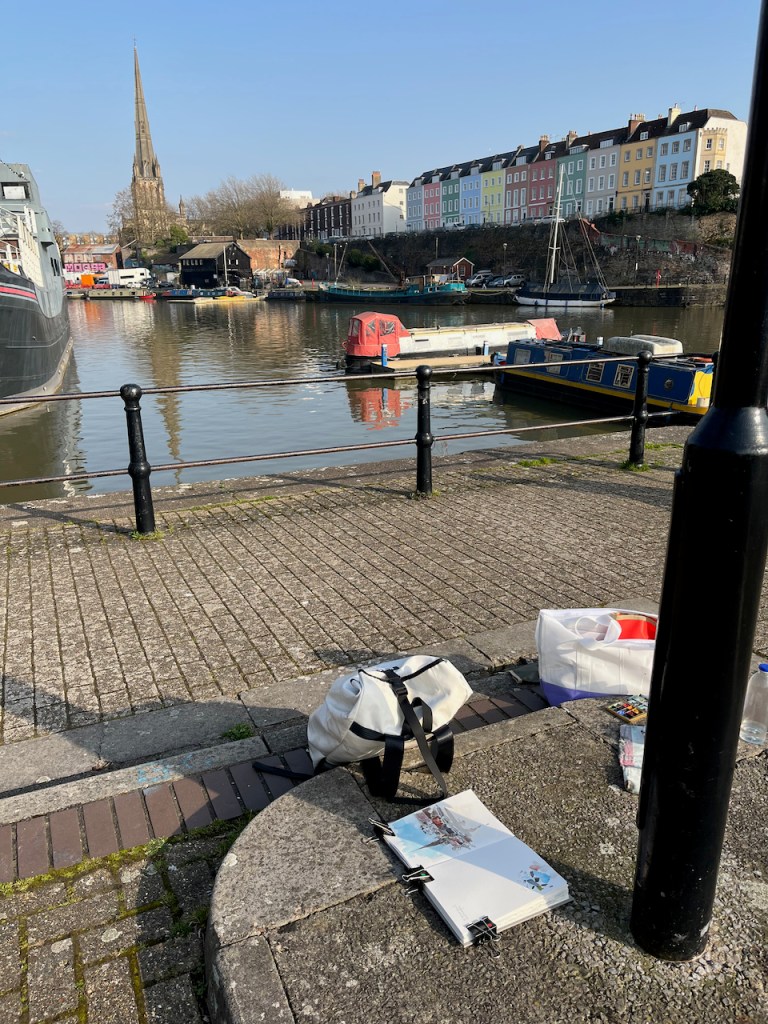
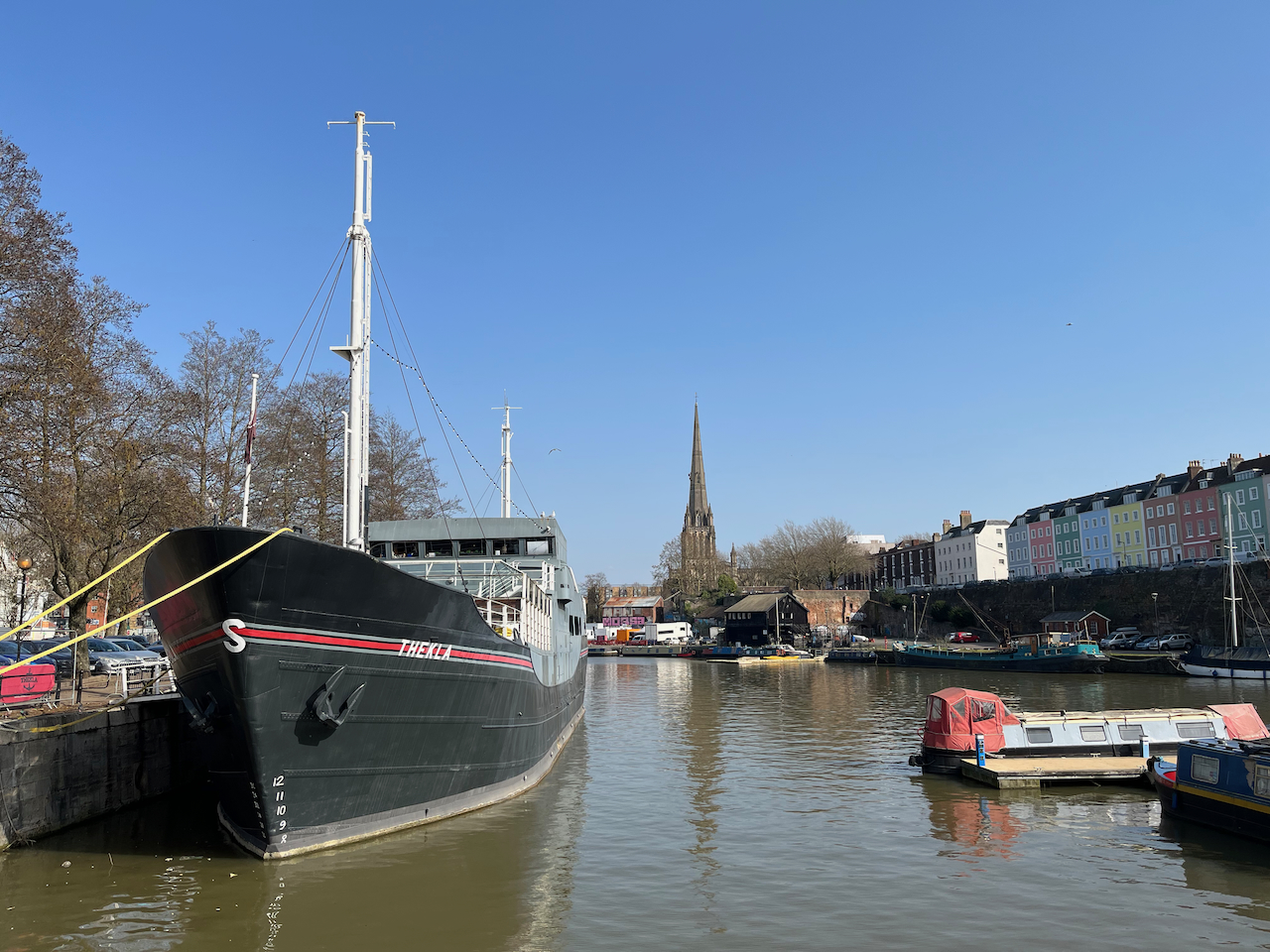
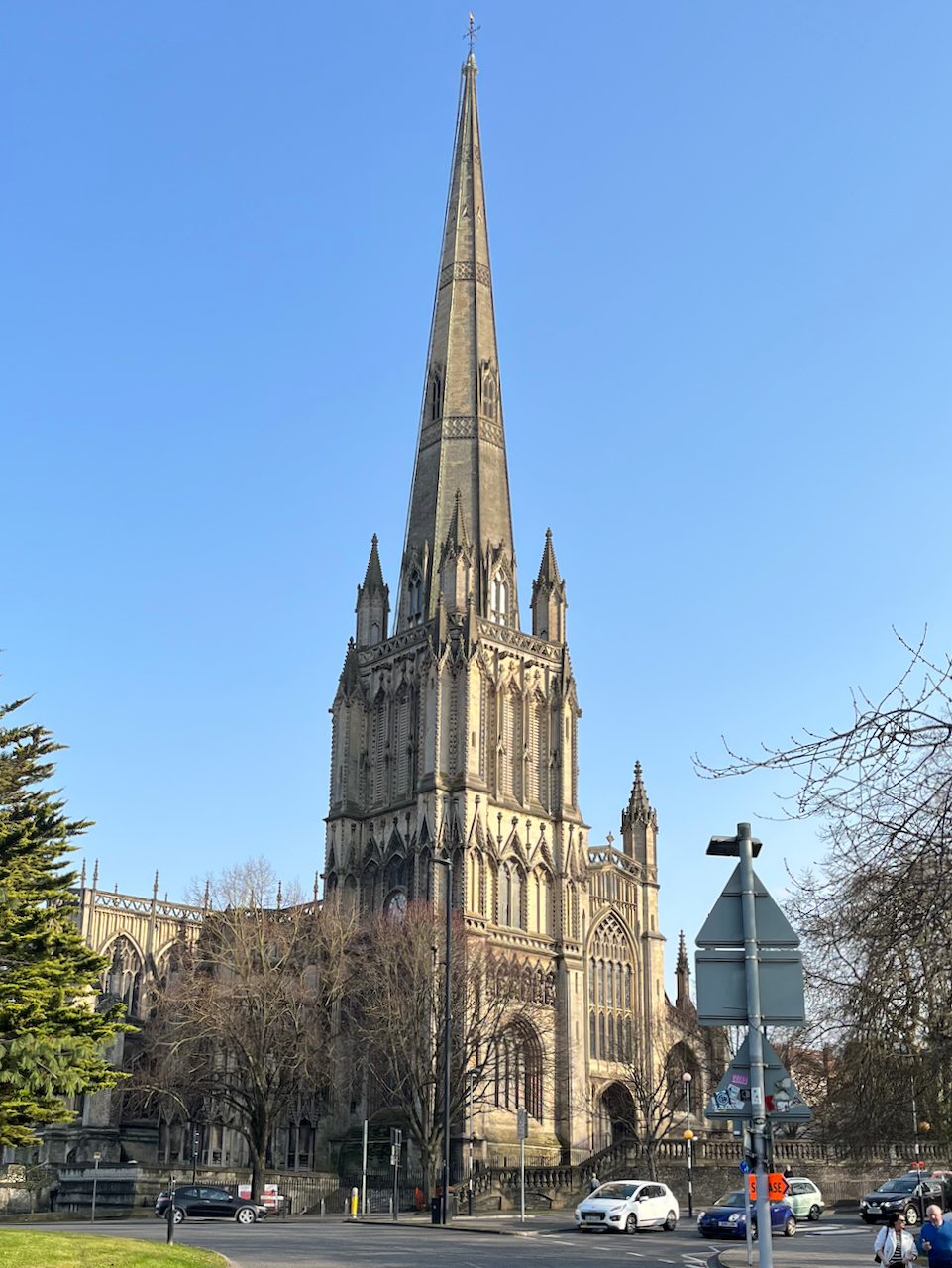
Walking back to Bristol Temple Meads I stopped by the “Thekla” boat and music venue. Much of Bristol docklands area has changed radically in the last 35 years, in appearance and use. But the Thekla is still there, still in the same place, still a music venue, although the music has changed somewhat. I looked across the water as I thought these things, and saw St Mary Redcliffe.
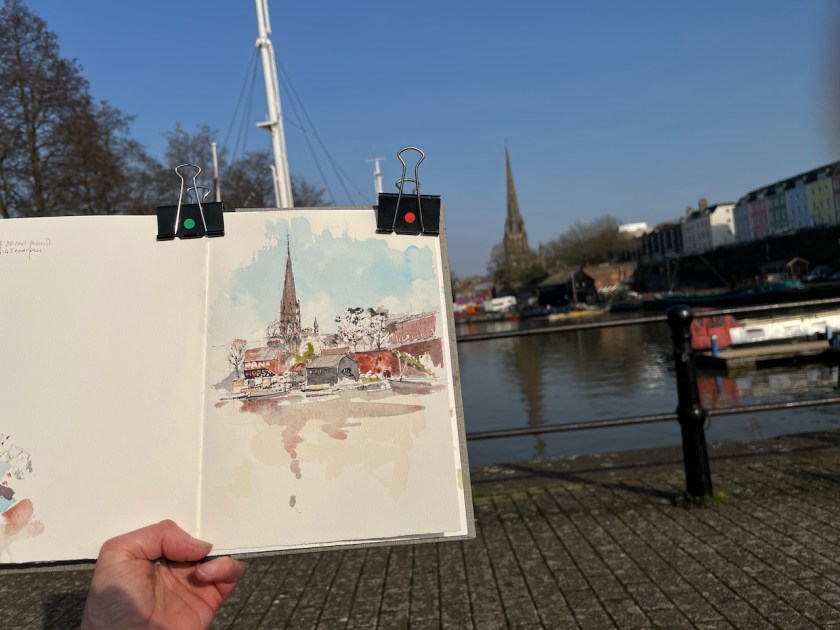
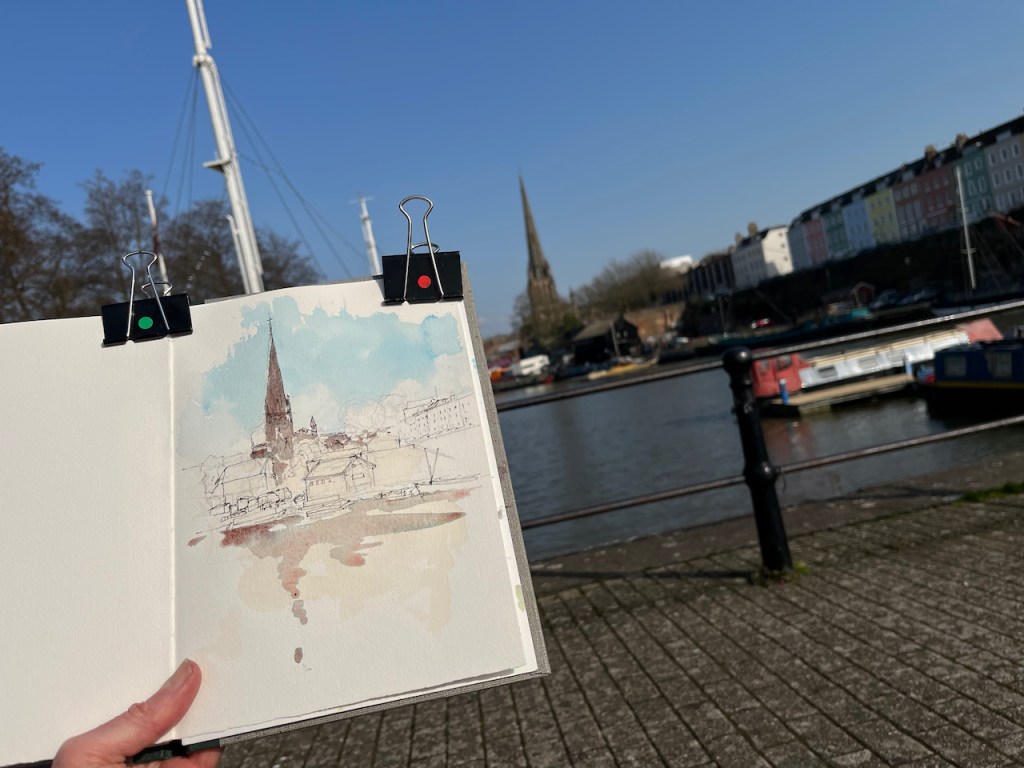
St Mary Redcliffe from The Grove car park, next to Thekla, 23rd March 4pm in Sketchbook 11
St Mary Redcliffe has been there since the 12th century. The current building dates from the 13th and 14th century, and the spire was rebuilt in 1872.
On the left of my drawing, the building with the graffiti, that’s the last remaining undeveloped parts of the docks. The vans and lorries parked in front of it turned out to be a film crew. As I walked past, I saw the big hoardings advertising the redevelopment of the site to become “Redcliffe Wharf”. The developer’s website tells me:
This exciting development is the last direct waterside location on Bristol’s Harbourside. Once complete the development will create around 41,000 sq ft of highly sustainable Grade A office accommodation plus 45 two and three bedroom apartments, two waterside restaurants and space for local businesses.
website for the “Redcliffe Wharf” redevelopment
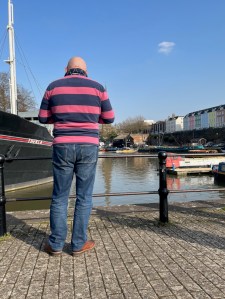
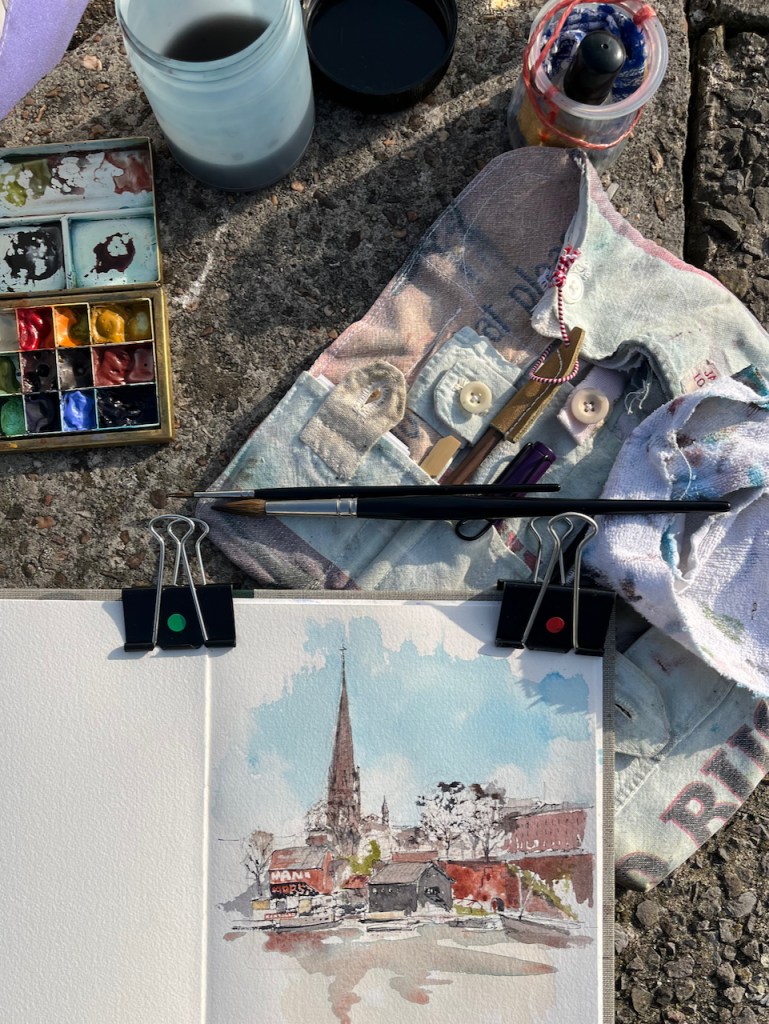
As I was drawing, a person came and stood, for quite some considerable time so it seemed to me, directly in my field of view. This person was a member of a group. They all walked past, saw me sitting on the kerbstone drawing, and then wondered what I was drawing and went to have a look across the water for themselves. This particular person then chose to align themselves exactly in front of me, adjusting a camera and taking multiple shots. I practised Zen patience, cleaned my palette, mixed some colour, looked at the seagulls, and waited. Then I decided to take a photo.
Work in progress
When I finished my drawing, I walked on into the picture, and past St Mary Redcliffe.
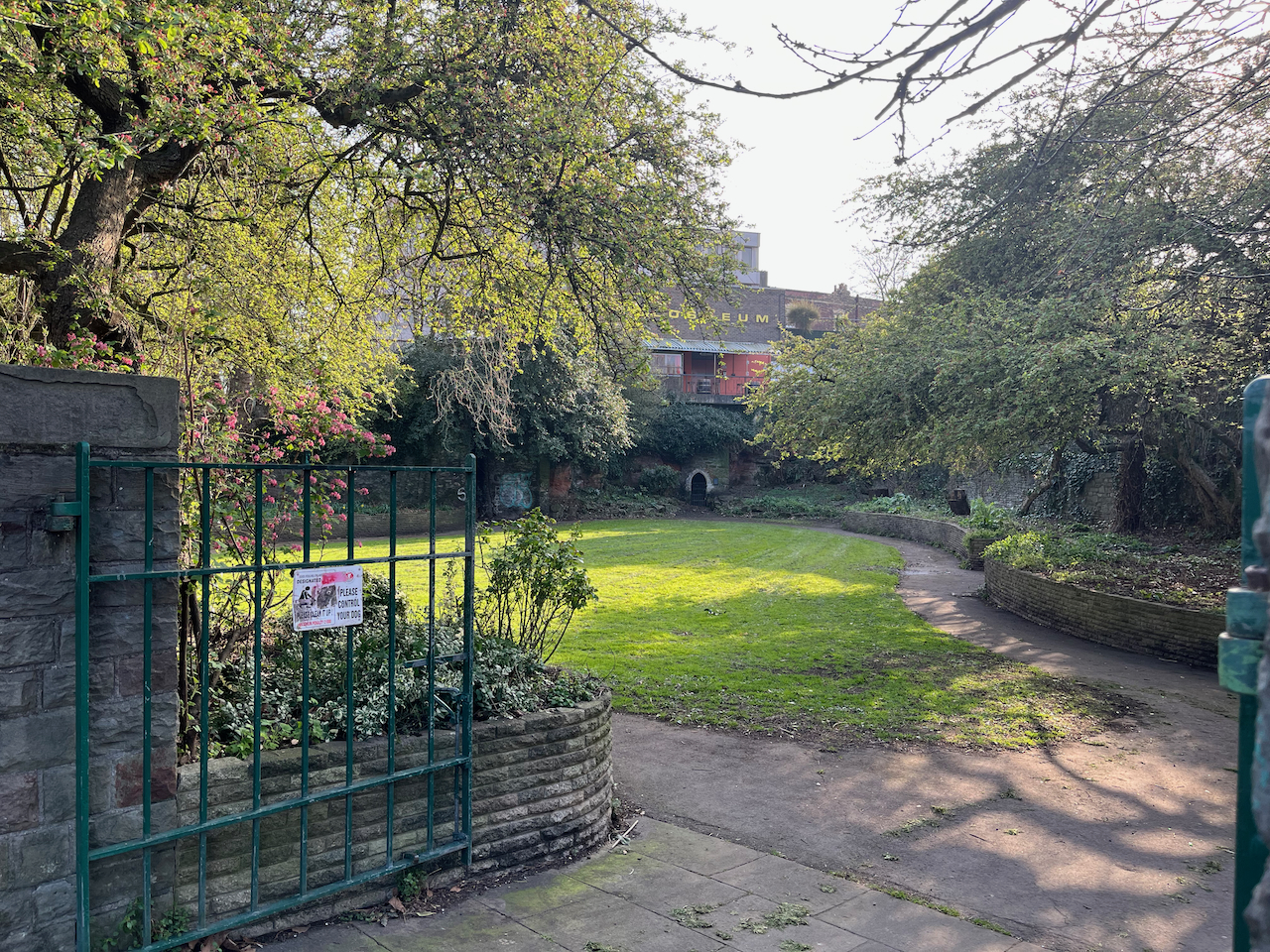
I hope the redevelopment does not touch the beautiful tranquil garden at the top of the hill.
Quakers’ Garden near St Mary Redcliffe, above and behind the building with graffiti in my drawing.Map from about 2005, showing the sightline of the drawing
Click a button below to share this post online, email it, or print it:
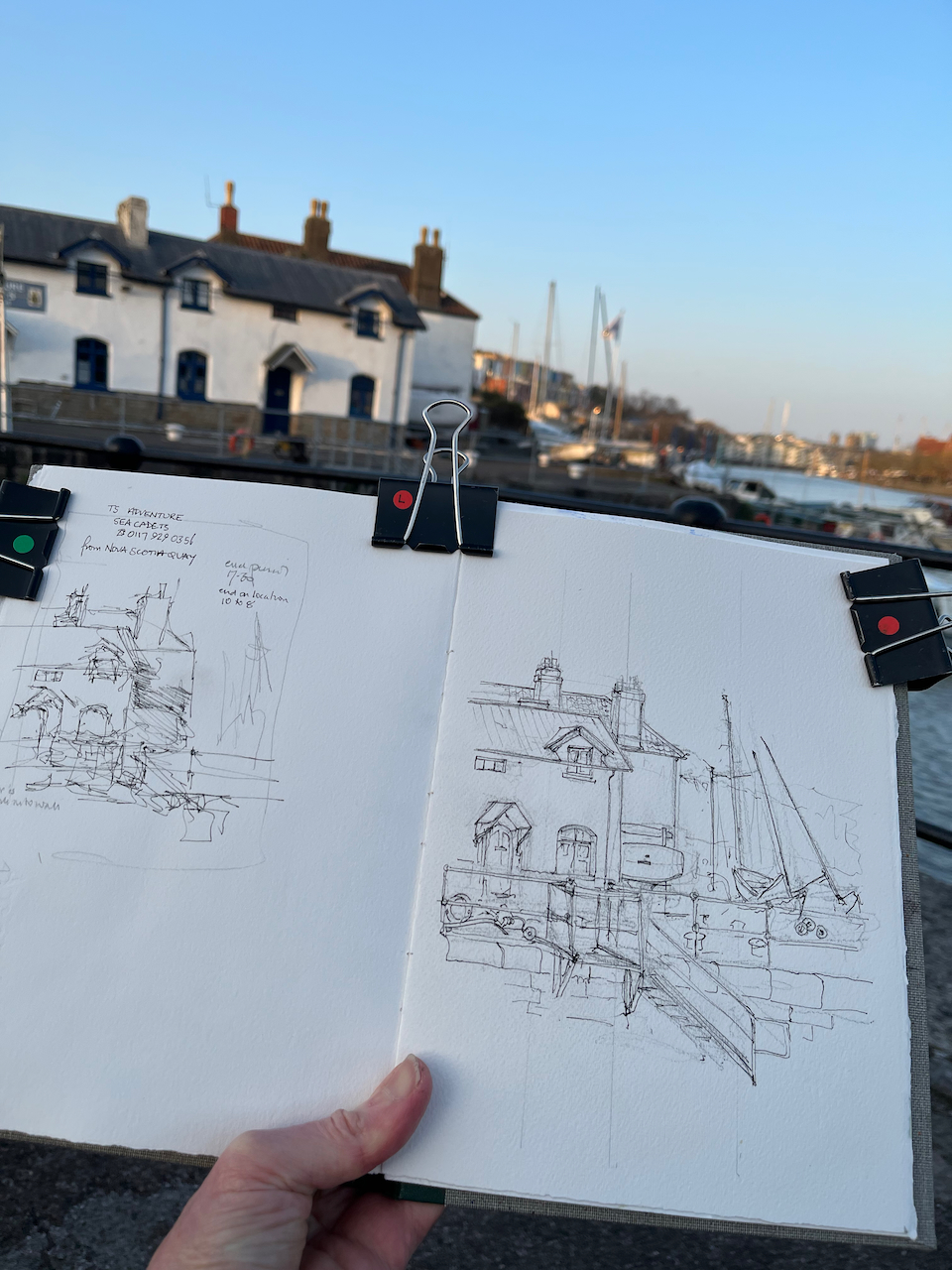
Wandering in a warm Bristol evening I rounded the harbour and found myself in Nova Scotia Place. This is a secluded domain, enclosed by water, and main roads. There is a pub, the Nova Scotia Hotel. People occupied the outdoor tables, with pints and conversation. I walked onto the small promontory and looked at the little cottages opposite.
Sketching at Nova Scotia Place, 22nd March 2022, 6pm
The warm evening became rather cooler. I packed up when I’d done the pen sketch. The bench that I had been using was a memorial bench:
In memory of Alan Helliwell (German) remembered by family, freinds and work colleagues of Underfall Yard who died too early. 7/2/1961 – 03/10/2009 after several near misses.
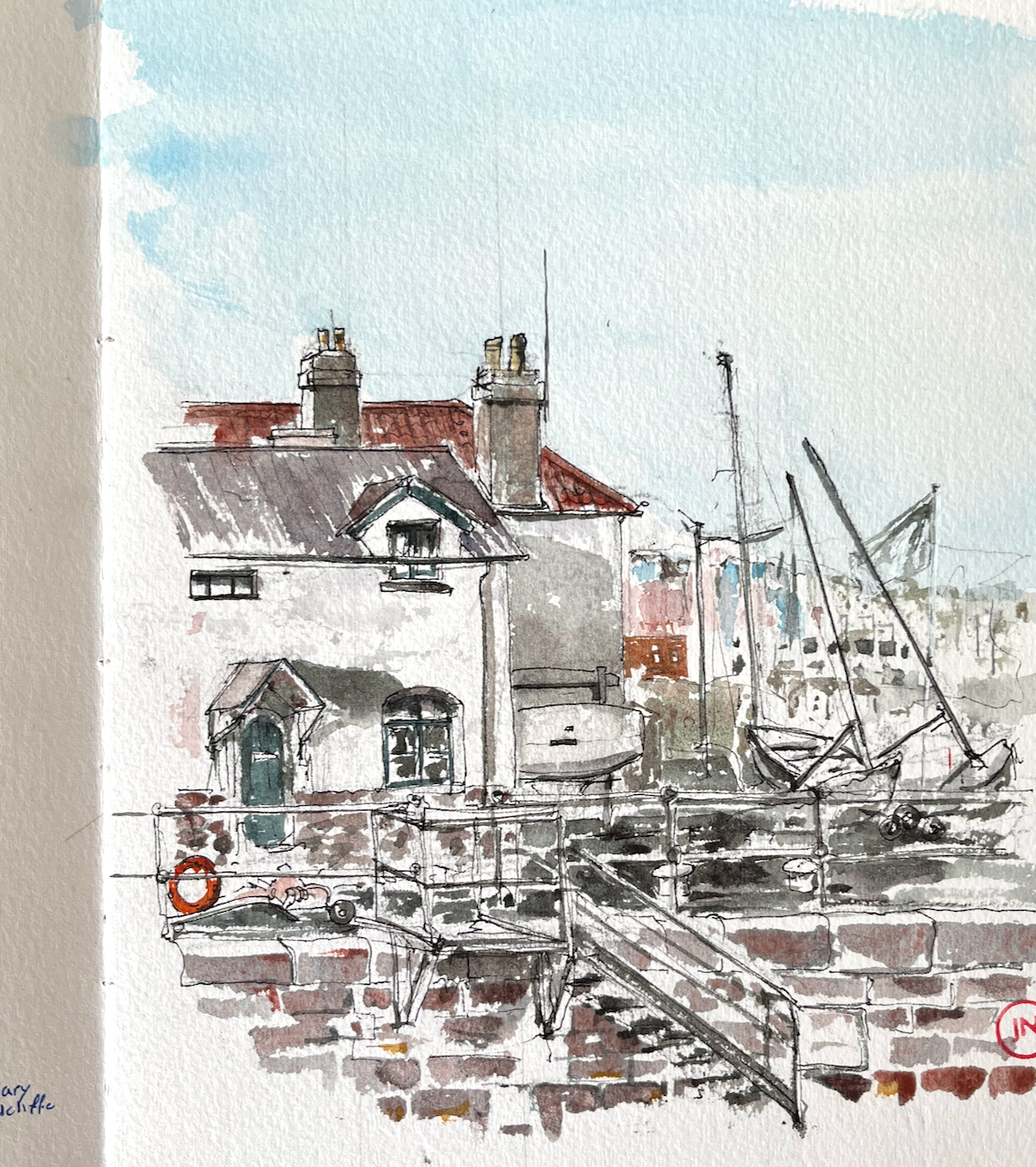
Later I put on some colour:
“TS Adventure Sea Cadets” cottages seen from Nova Scotia Place
Click a button below to share this post online, email it, or print it:
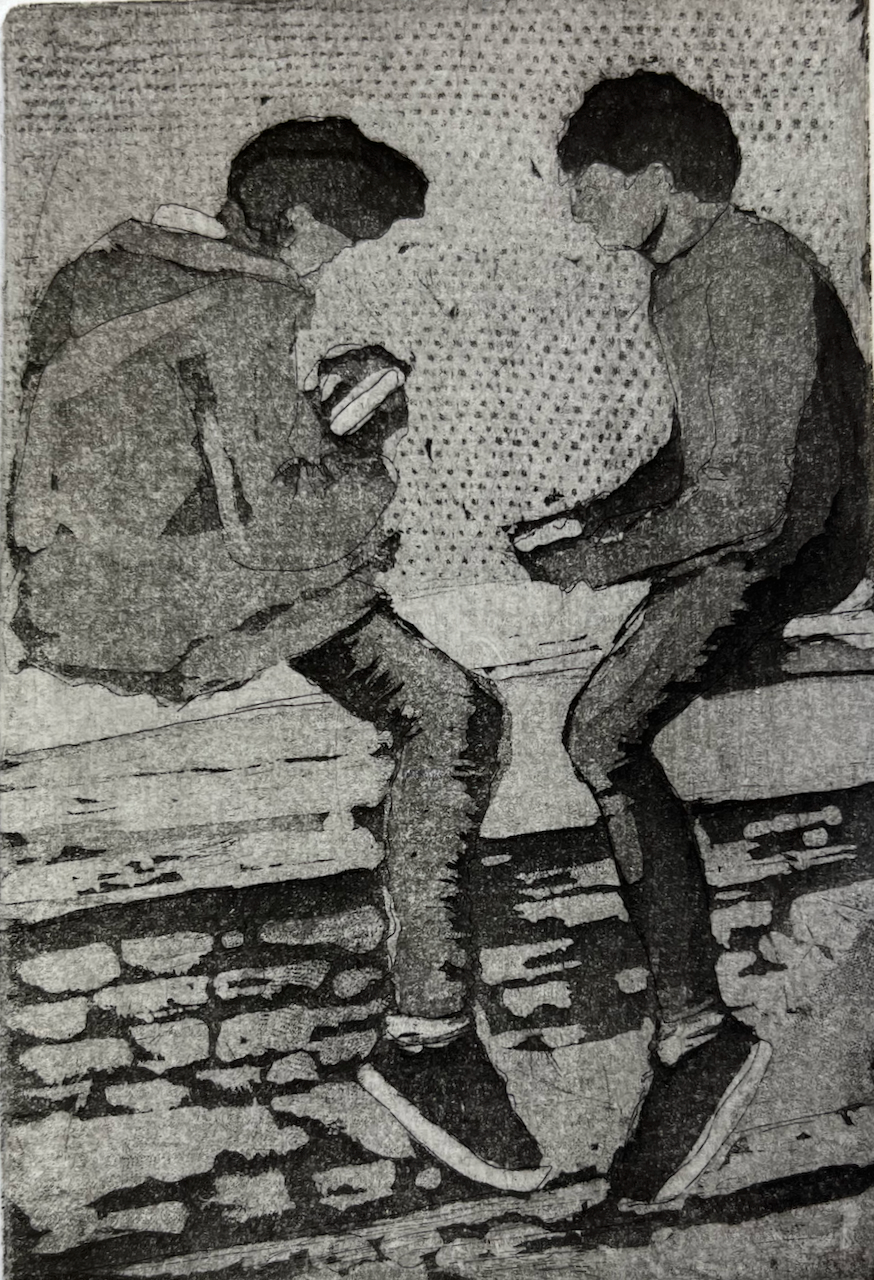
Here’s a print I made at East London Printmakers last week.
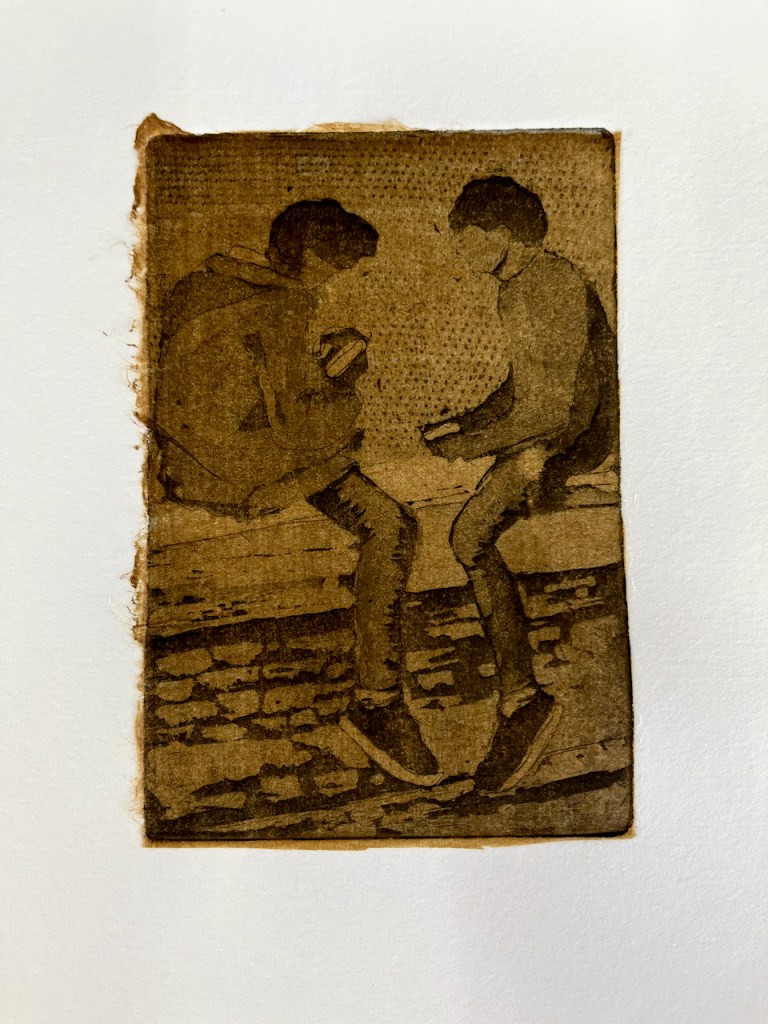
Two boys, etching, image size about 5inches by 3inches
I wanted to show how concentrated these people were, immersed in what they were doing, sitting on the wall.
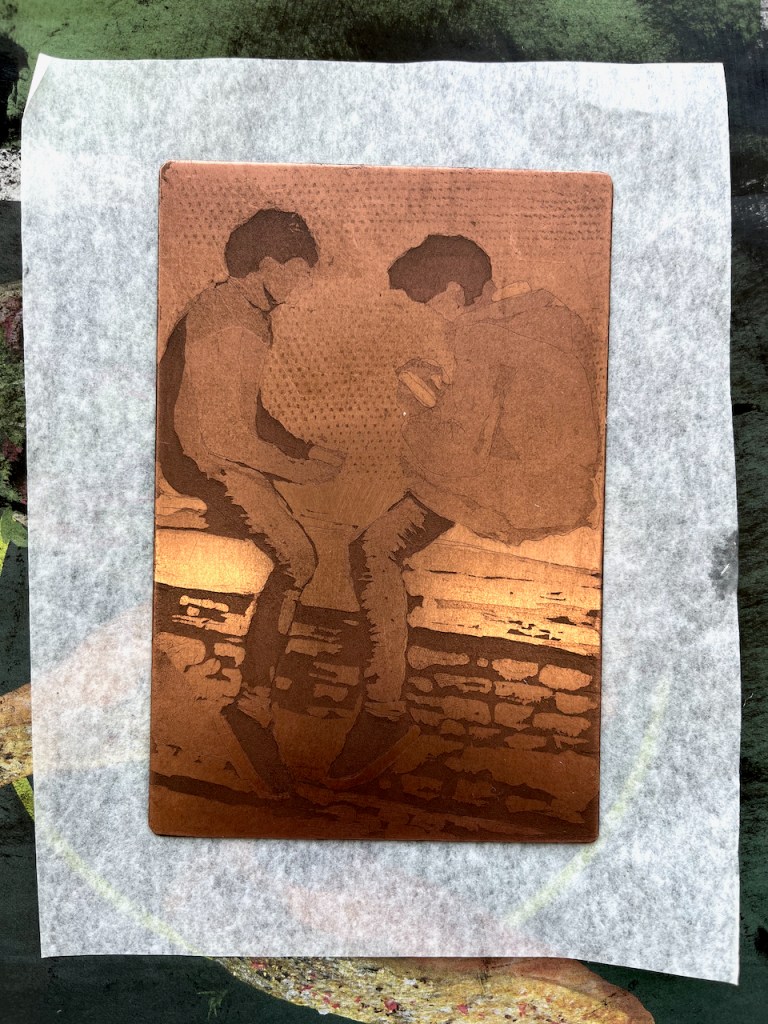
It is printed on Fabriano Unica paper, using Charbonnel F66 traditional etching ink. Here is the copper plate:
The plate is made with hard ground lines, soft ground patterns, and three aquatint sessions.
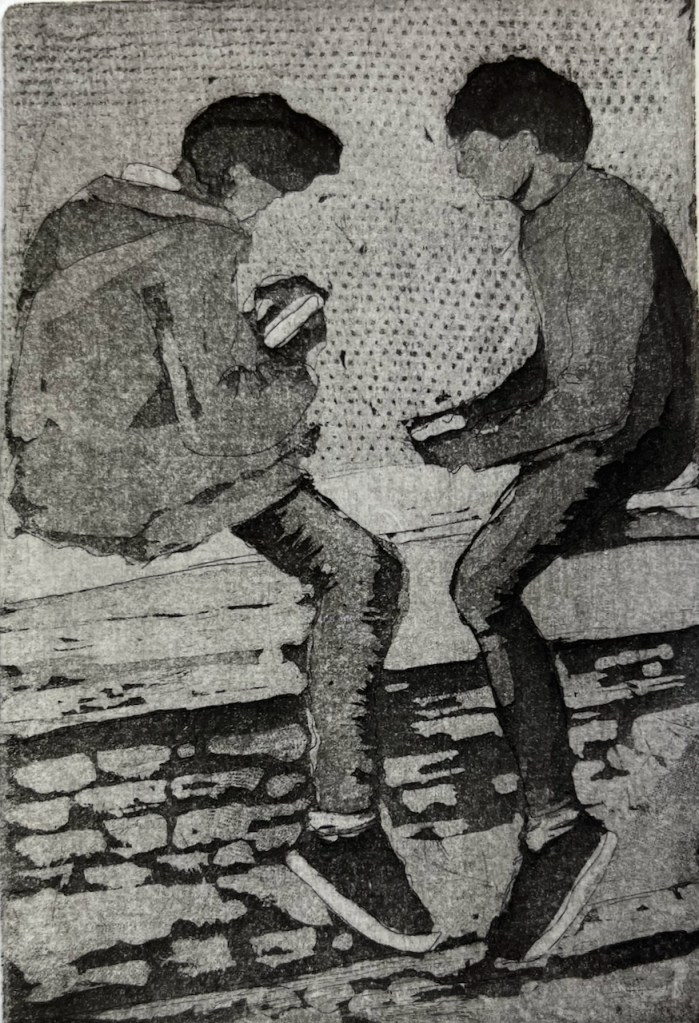
I made some variations of this print. Here is one, using chine-collé.
Two boys, warm brown chine-collé
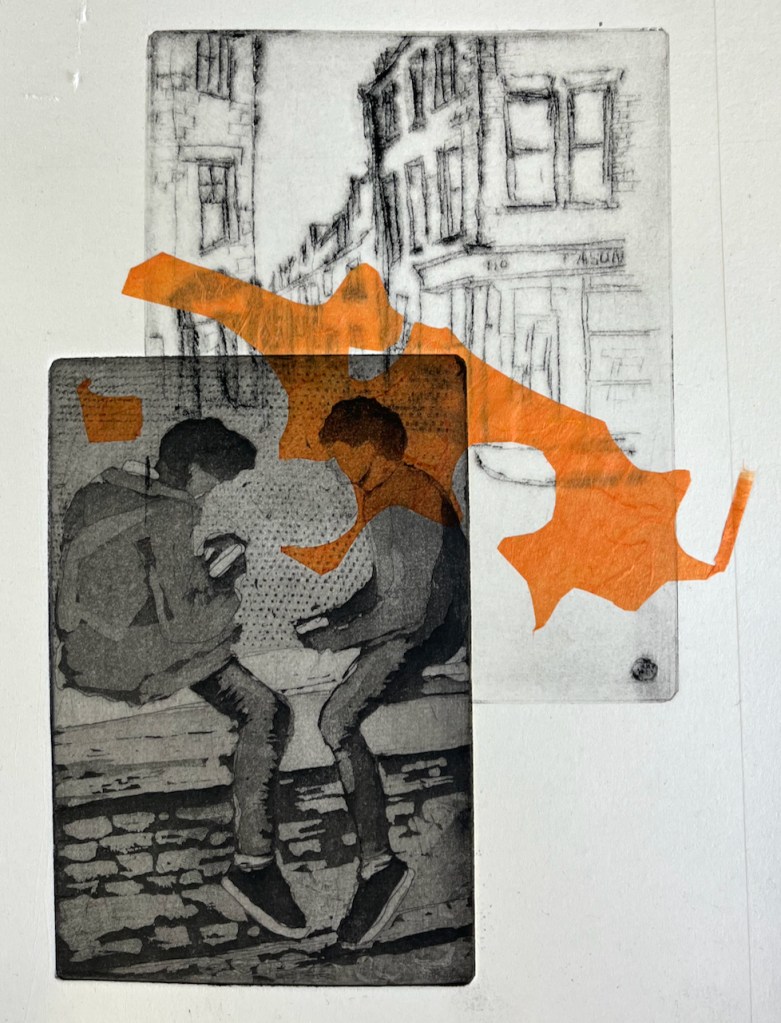
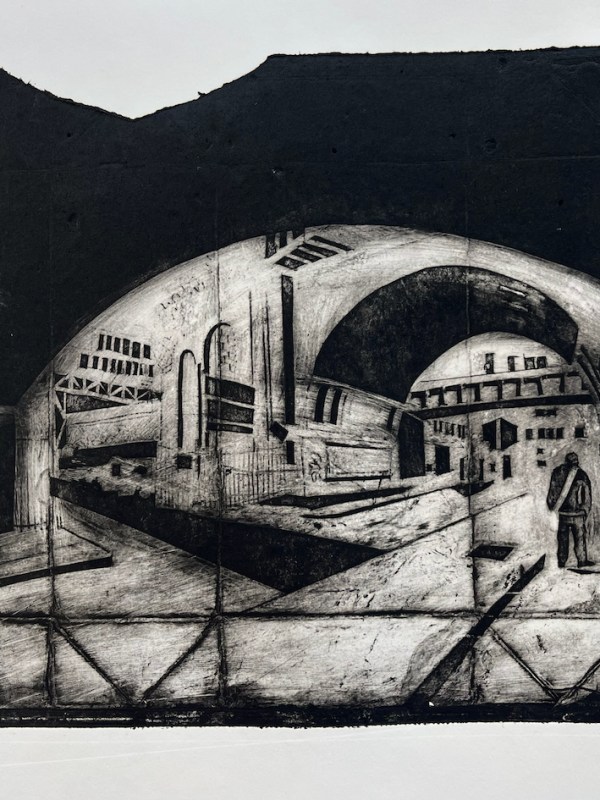
Sometimes in the printing process, magic happens. As I was packing for this print session, searching for paper, tissues, gloves, and other printing essentials, I encountered a thick envelope labelled “Old Prints”. I pulled out one of those, a street scene, with a vague idea of overprinting it. It is a drypoint I made years ago. The vague idea turned into a plan, and then a print. Here it is. I was really pleased with how it came out. The chine-collé is also a leftover from another project.
Two boys and street, combined image size about A5. Etching, drypoint and chine-collé.
Click a button below to share this post online, email it, or print it:
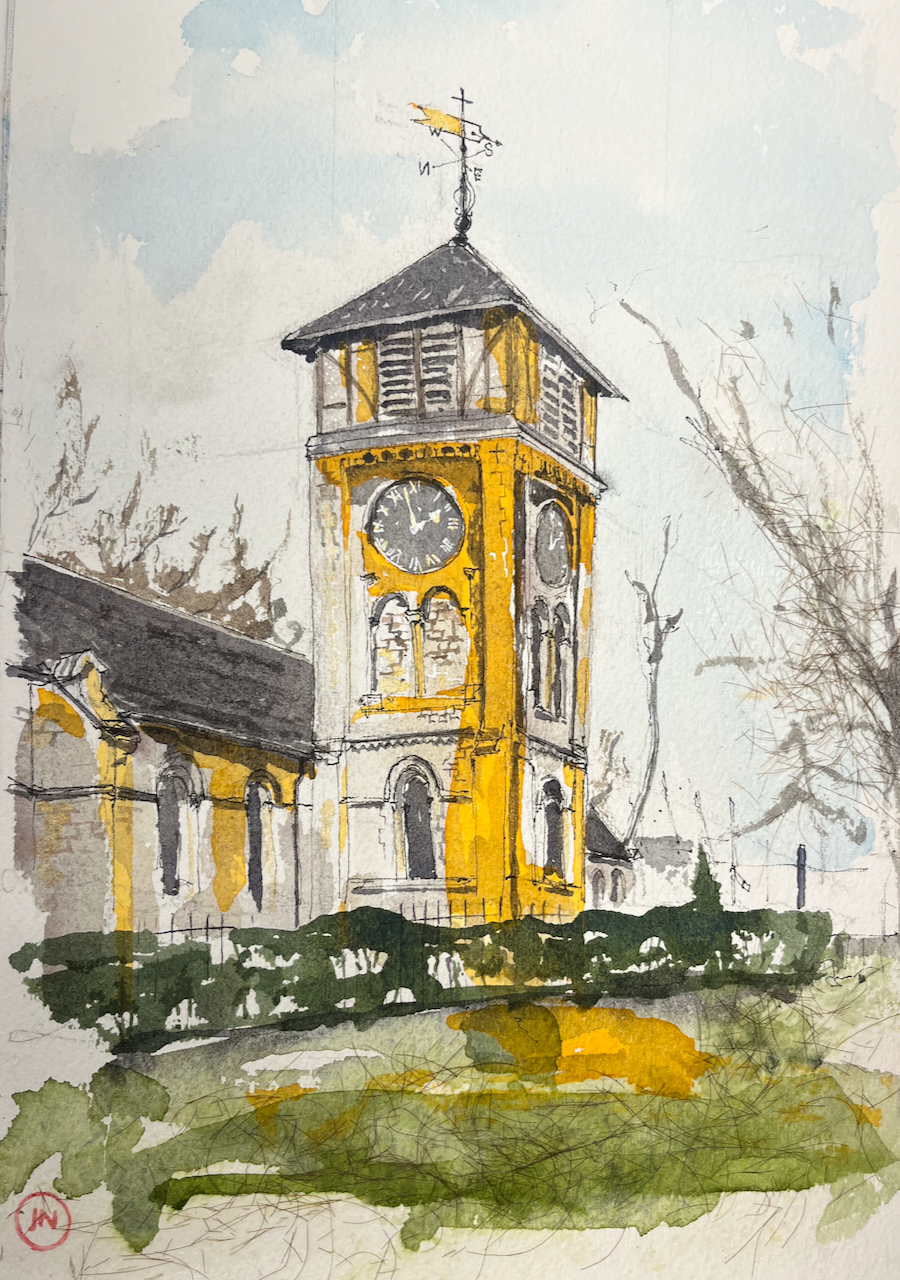
On a sunny day I went to draw a church tower in a country churchyard. The churchyard is near Kings Cross and the church tower is that of St Pancras Old Church.
St Pancras Old Church, tower. 20th March 2022 10″ x 7″ in Sketchbook 11
I sketched sitting on the grass beside the River Fleet, while the river flowed behind me, in my imagination.
It’s a real river though. These days it’s under St Pancras Way. But it used to flow by the church.
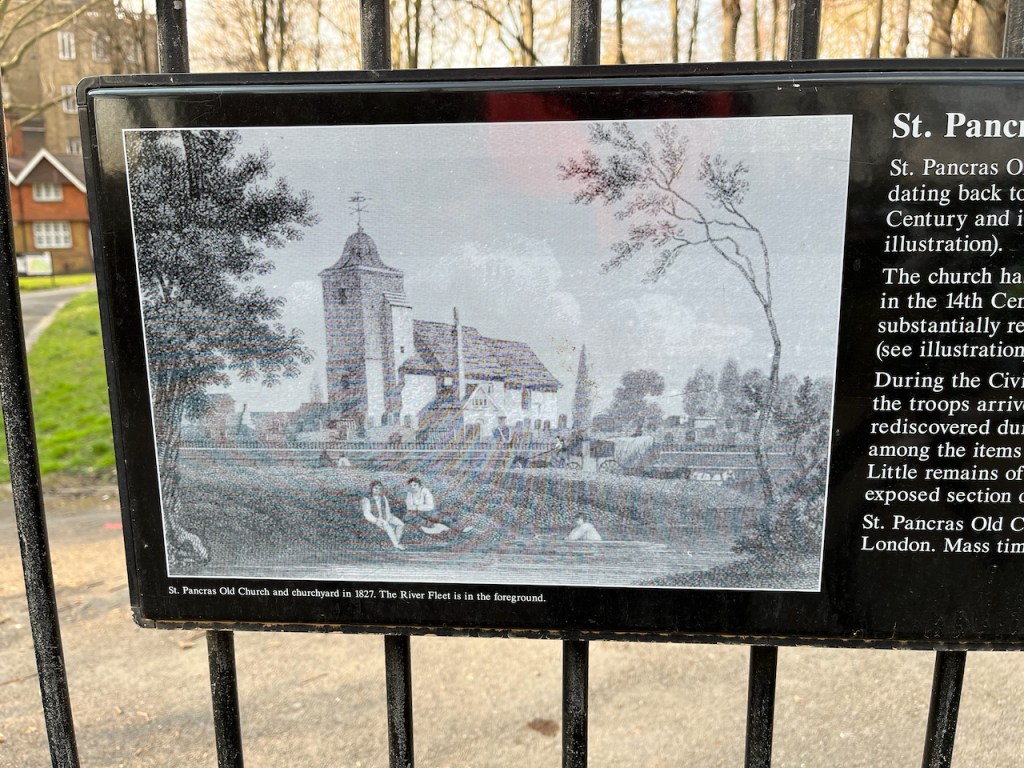
“St Pancras Old Church and churchyard in 1827. The River Fleet is in the foreground.” notice on the railings of the churchyard.
As you see from that picture, in 1827 the church looked very different. The south tower which I sketched is not as ancient as it looks. It was constructed in 1847 to the designs of A.D. Gough.
The church site itself is very ancient. According to the church website, this is one of the oldest sites of Christian worship in London, possibly dating back to the 4th century:
The suggestion that St Pancras Old Church dates back to Roman times has a long tradition, with most suggesting that it was founded in 313 or 314. Most churches in England named for the martyr St Pancras have, or may have, ancient origins, suggesting that veneration of the saint spread quickly after his death in 304.
Today it is an active church, and a music venue. The churchyard is a glorious green space, much used. Many people wandered past on the paths. No-one paid any attention to me drawing. The dogs did though. I was inspected and approved by each dog that went past.
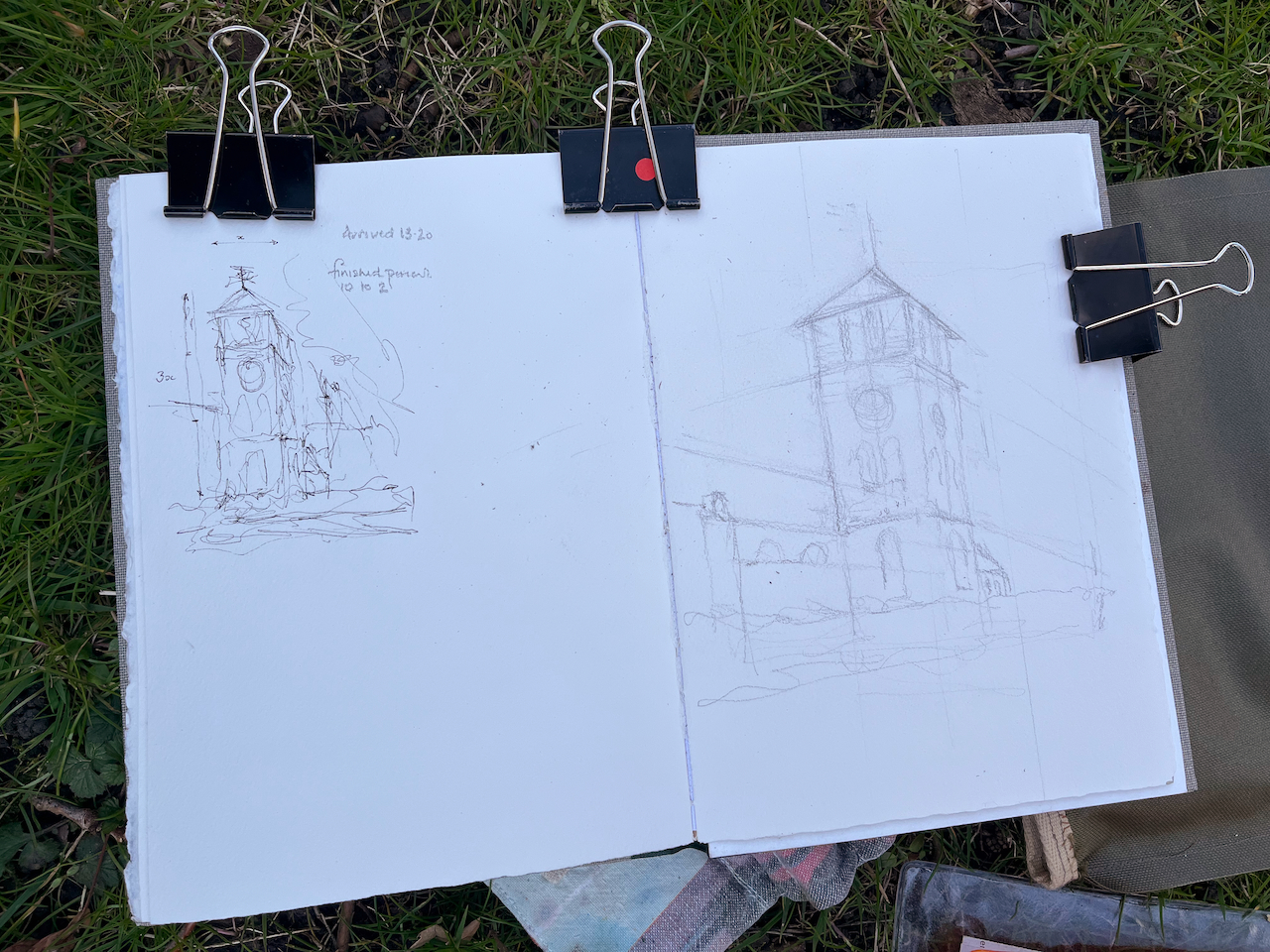
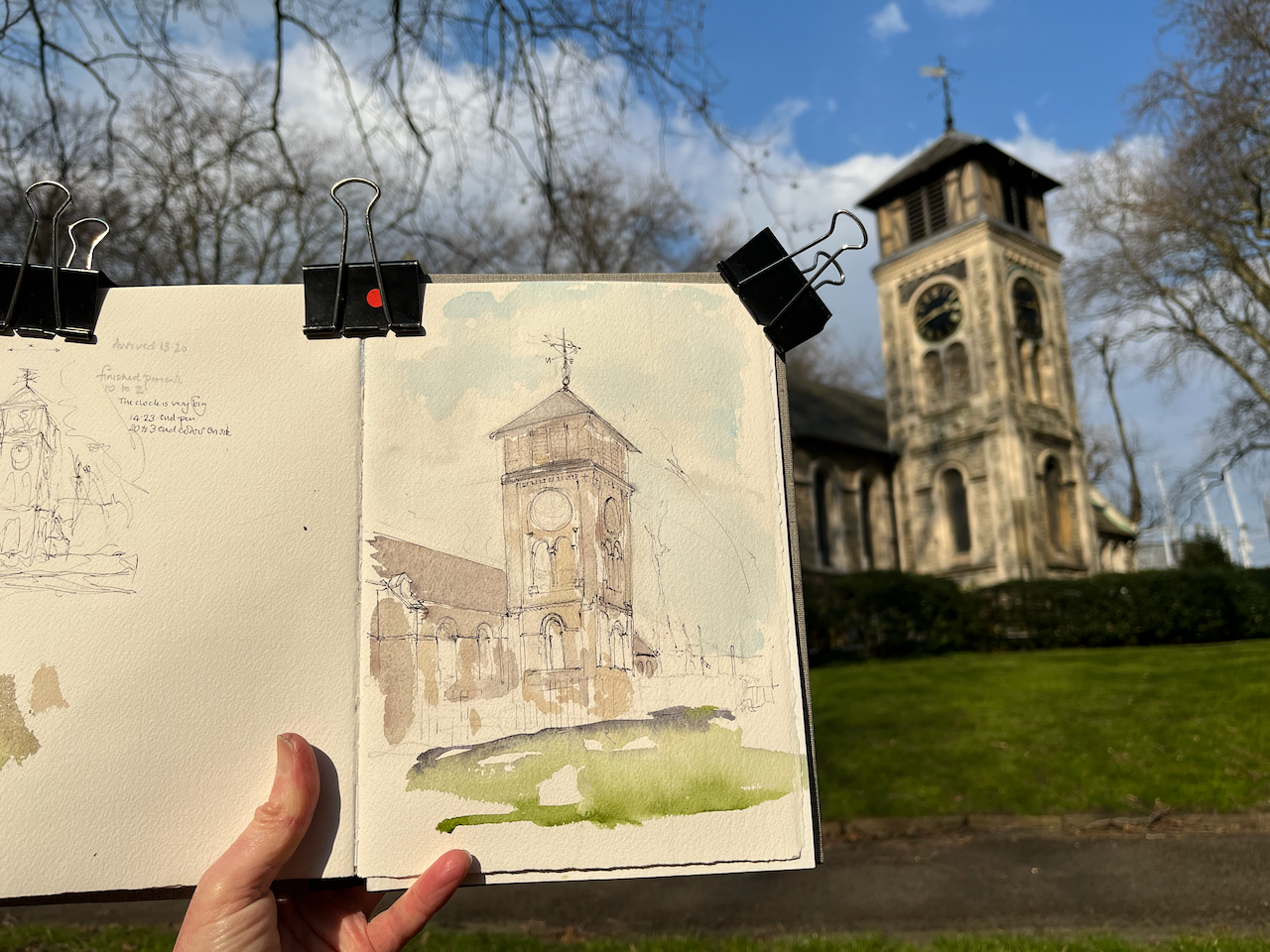
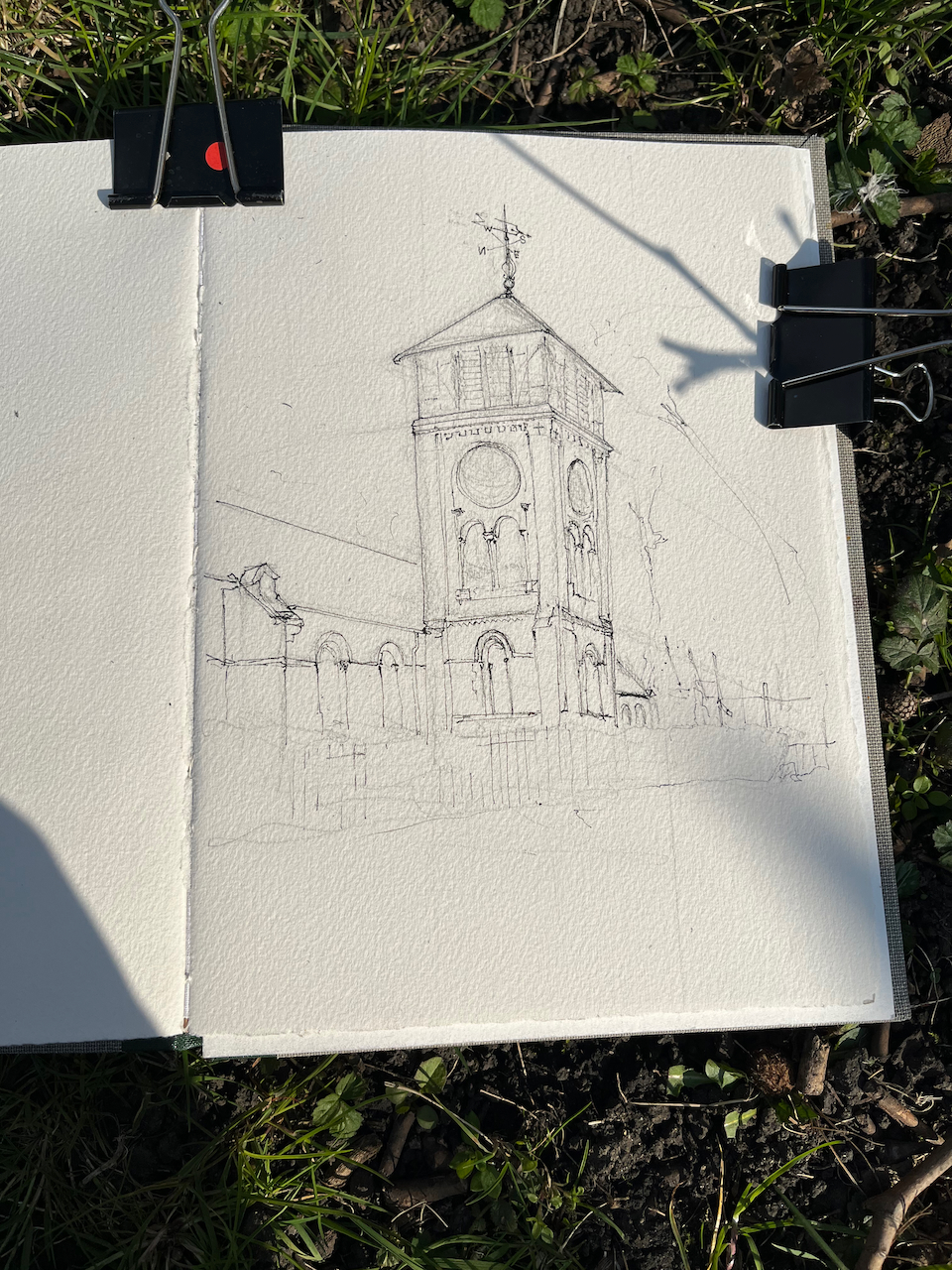
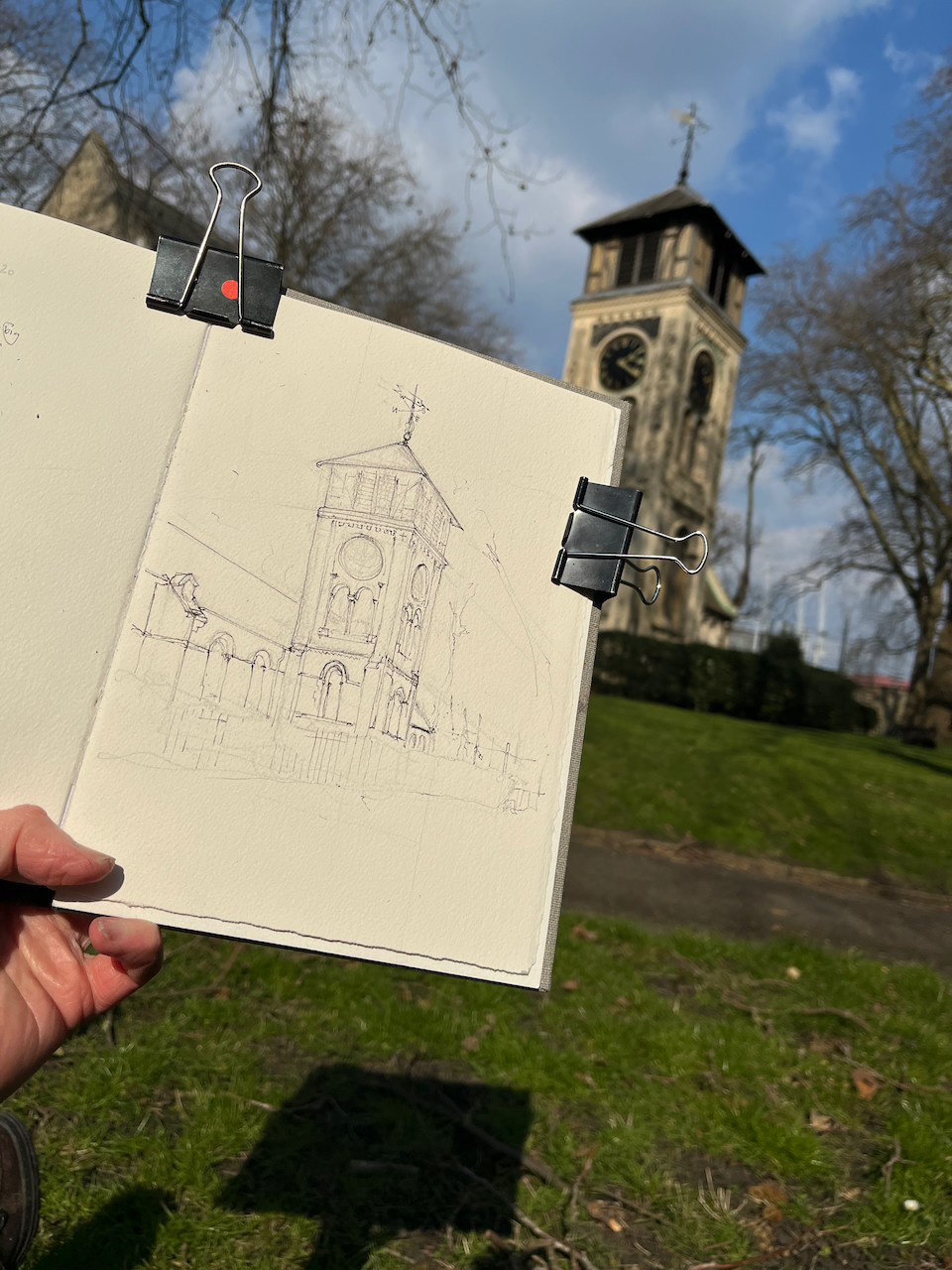
Here is work in progress and a map (click to enlarge the image)
Click a button below to share this post online, email it, or print it:
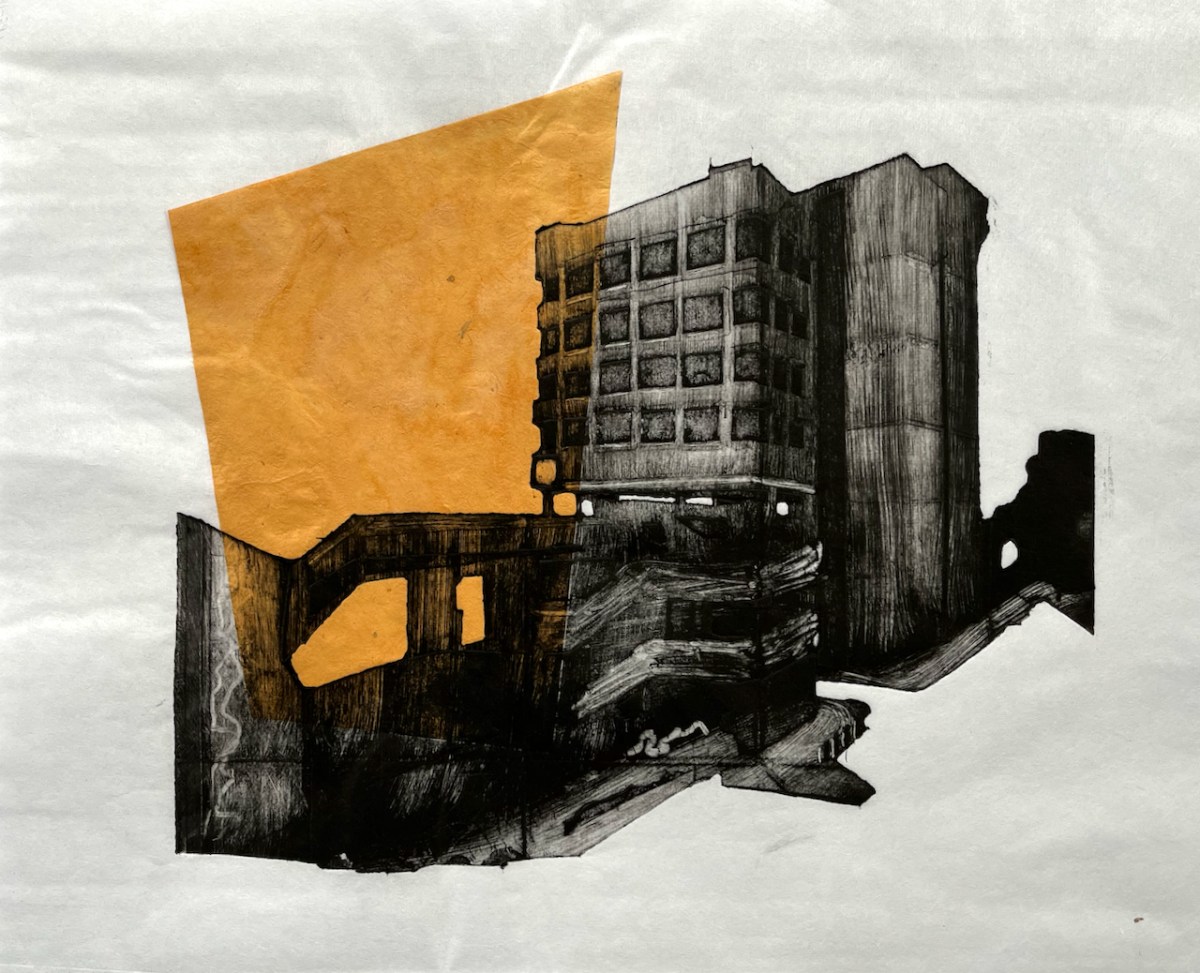
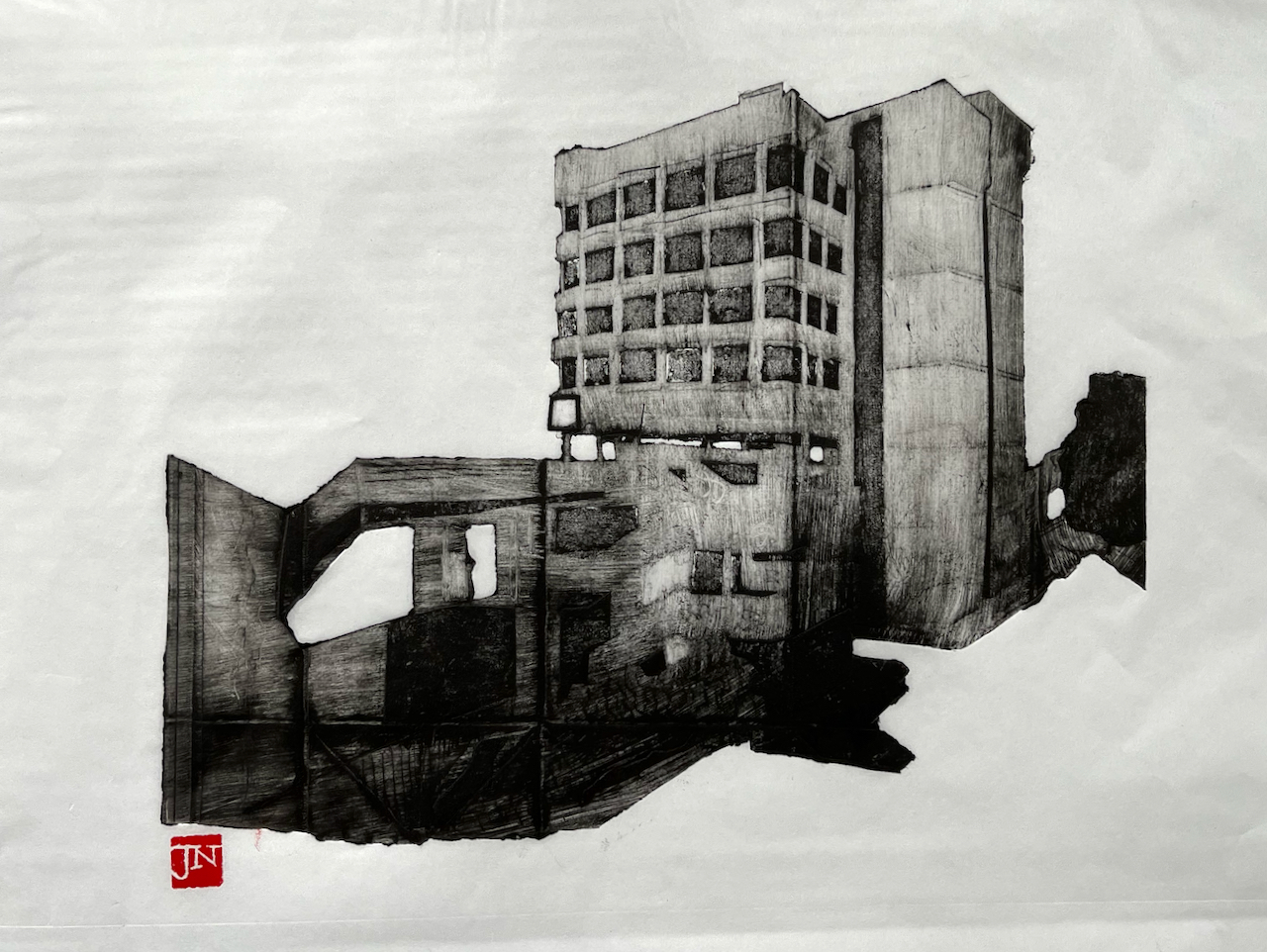
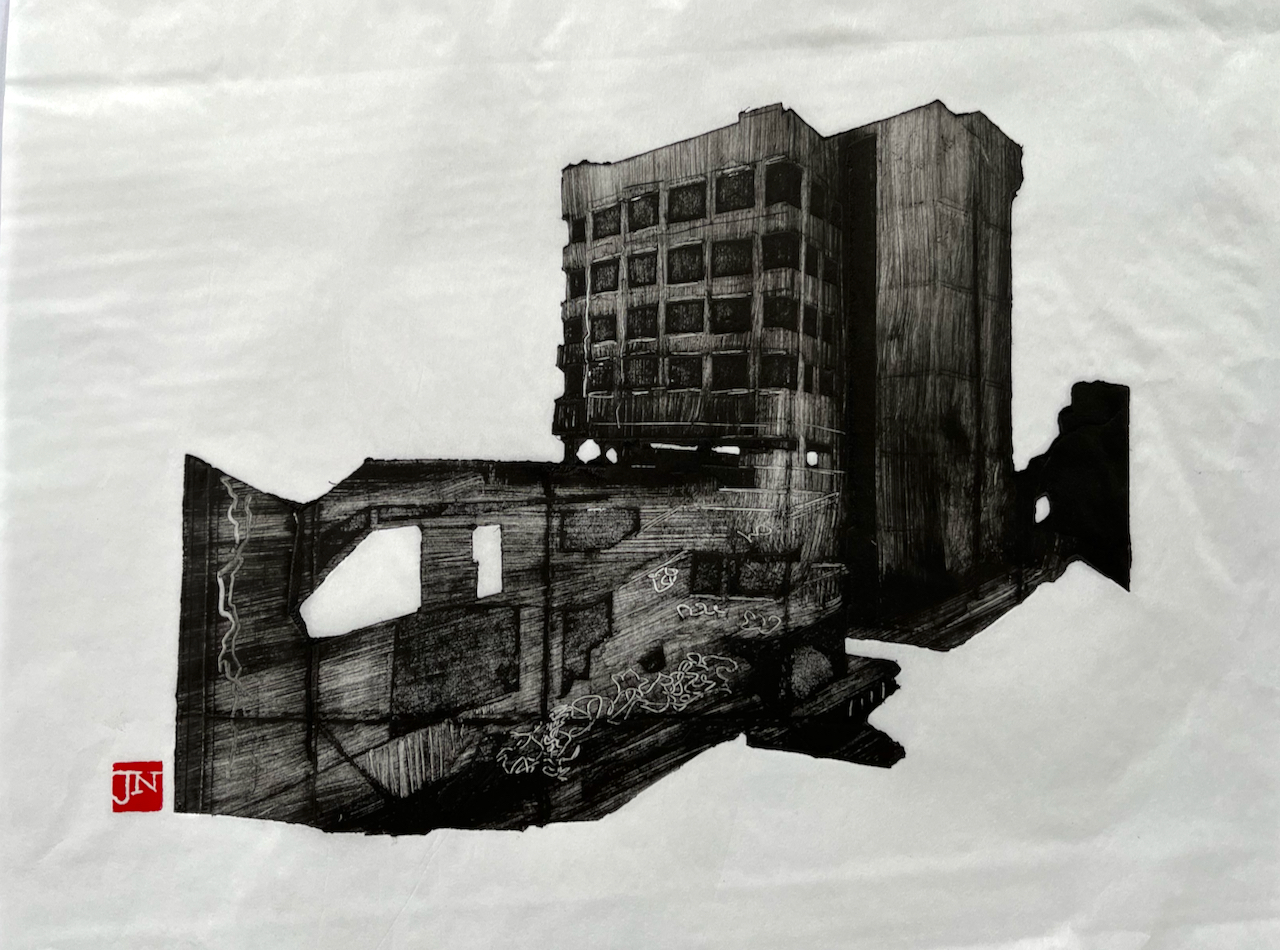
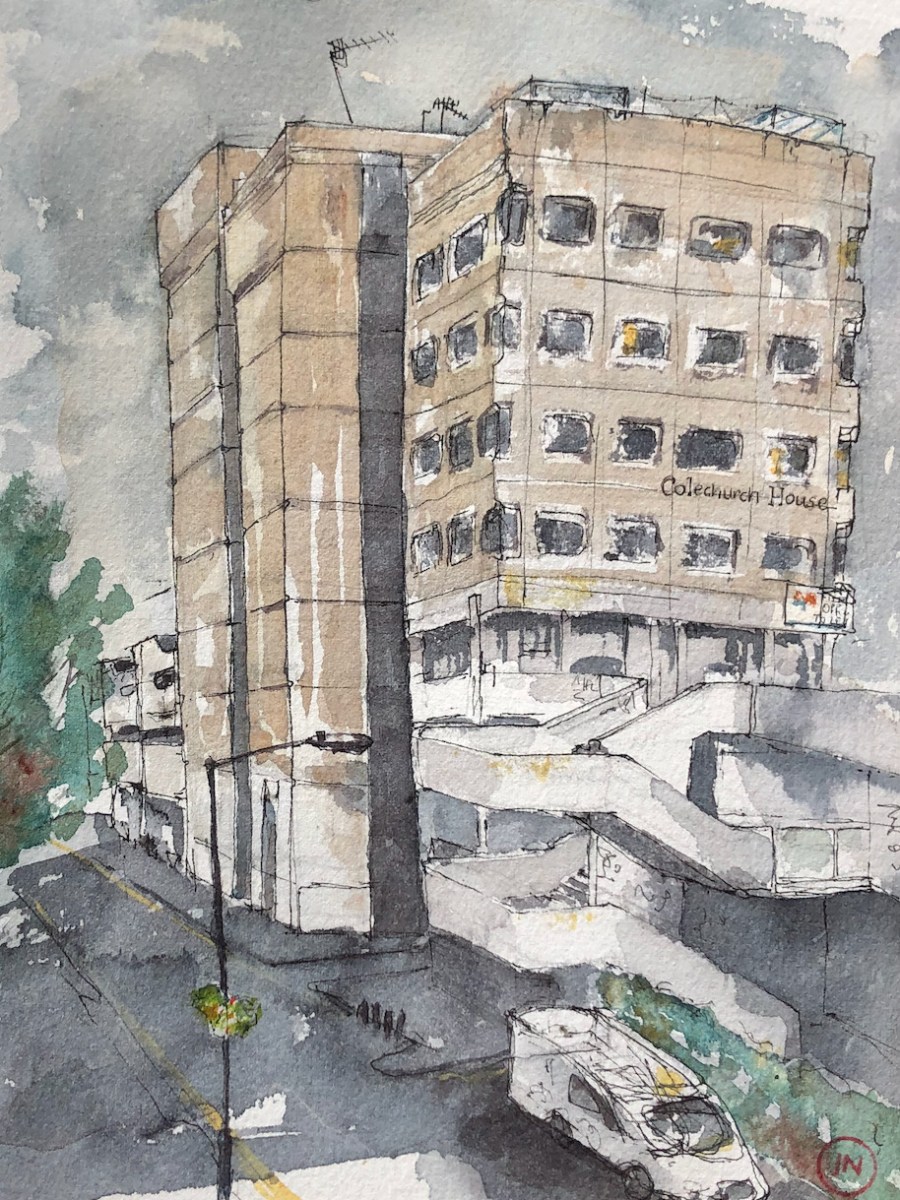
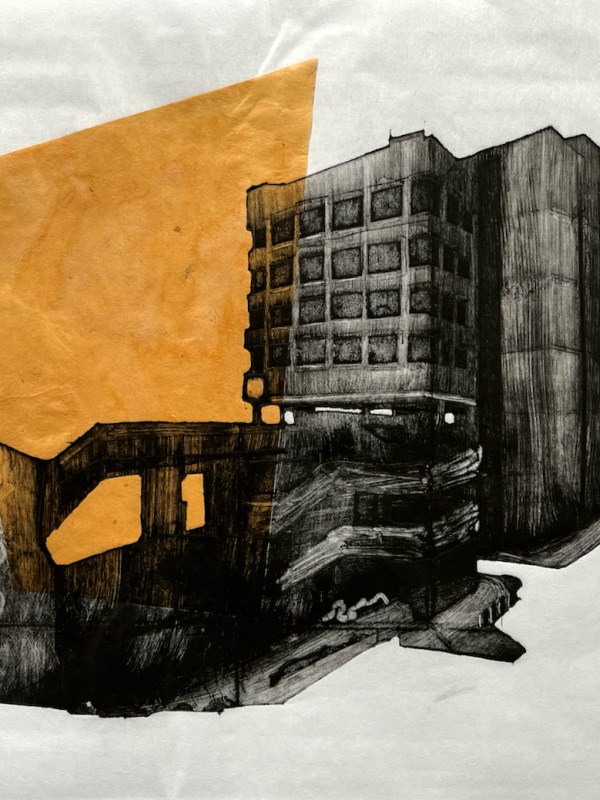
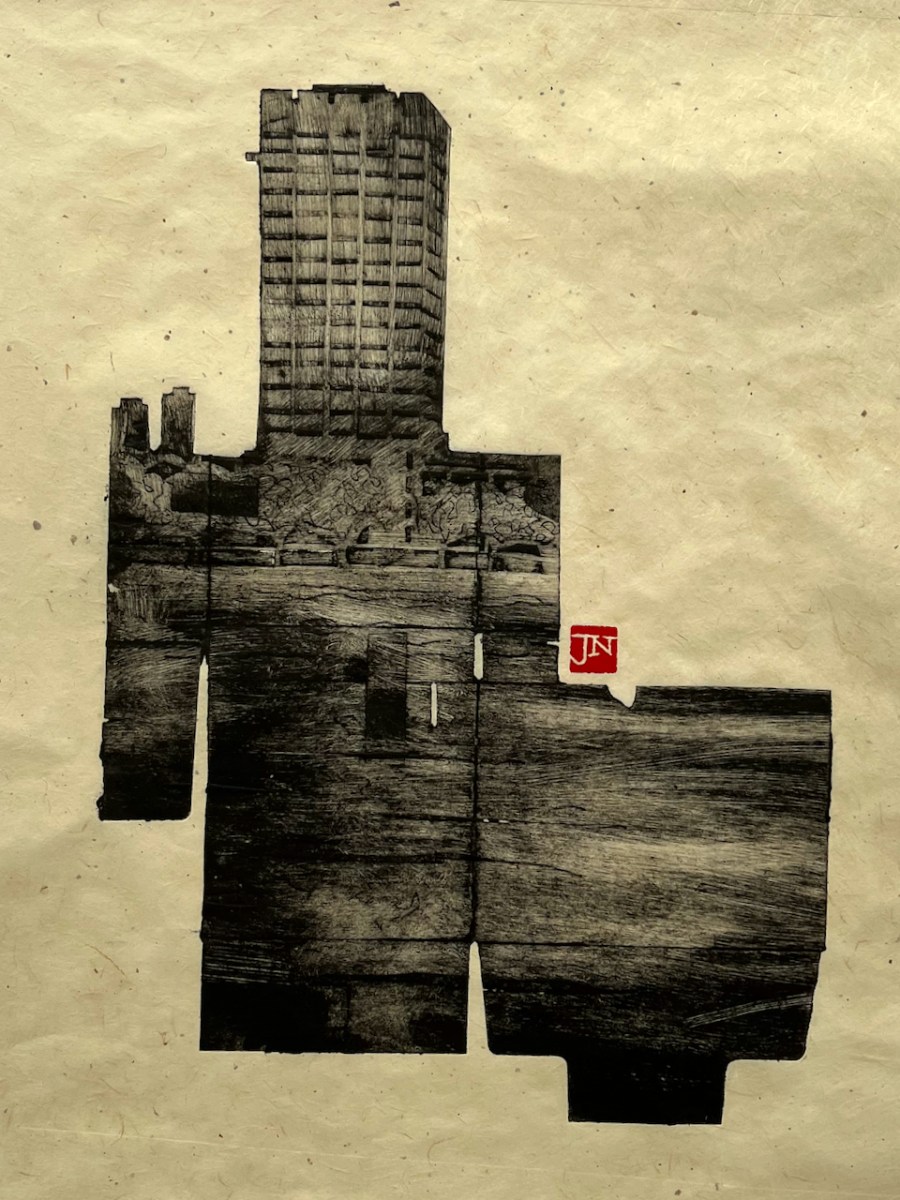
Colechurch House on the South Bank is a brutalist office block. It makes a good subject for a packaging print. Since it is a a 1960s block, I added a 1960s type shape in chine collé.
Colechurch House – monoprint and chine collé, paper size,15″ x 12″ Shoji Baku Japanese Paper
The chine collé paper is Khadi Lokta Coloured saffron washi paper from Atlantis Art (ref: KPNI SA). The background paper for this print is Shoji Baku paper from Shepherds Bookbinders (ref: LRG 1859). The ink is Charbonnel traditional etching ink. I printed this on the Henderson Press at East London Printmakers. Here is a video of the “print reveal” (17seconds, silent):
Thanks to Evonne at East London Printmakers for filming me!
Here are the other 4 prints from this plate. They are all on a different, but similar paper: Tosa Washi from Shepherds, (ref: J632180)
The print was based on a sketch of Colechurch House last year. See this post:
Aficionados of 20th Century brutalist architecture need to hasten to appreciate Colechurch House. It is due for demolition and redevelopment. This month’s post in the marvellous “London Inheritance” site informed me about the planning application, so I rushed over there to draw a picture before the building became swathed in plastic. I drew this picture looking over the railings from London Bridge. This position commanded an excellent view of Colechurch House, but…
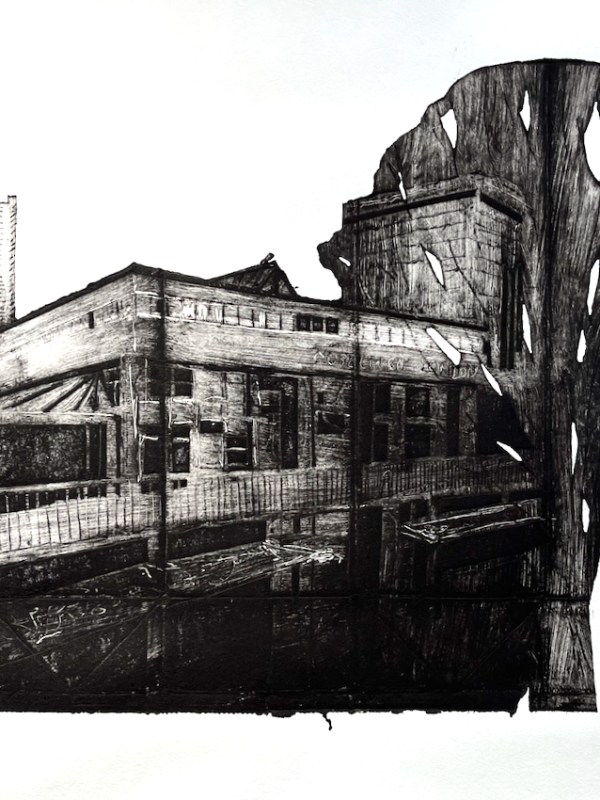
Here are more examples of the technique using a plate made from packaging material. I have written about the process here.
Here is another packaging print. This one shows Bridge ELR-XTD Structure 20 on Cornwall Road (N) between Charing Cross and Waterloo East, South East London. The road that leads off to the left is Sandell…
Huge brick arches carry the railway lines into Waterloo Station. Here is a view looking North up Great Suffolk Street. This is a packaging monoprint. It is an intaglio print from a “plate” made from…
Colechurch House on the South Bank is a brutalist office block. It makes a good subject for a packaging print. Since it is a a 1960s block, I added a 1960s type shape in chine…
The Boston Arms is in Tufnell Park, London, 178 Junction Road N19. I love the way this building presides over the junction. This is one of five prints I made with this plate made from…
Here is an image of The Museum of London, in the south west corner of the Barbican: The “plate” is made from a UHT milk carton. Here is the back of the used plate: Here…
Here’s another “packaging” monoprint. This was made using an empty box of tissues. This is a tower block on the South bank of the river Thames, seen from the North bank. That’s the river in…
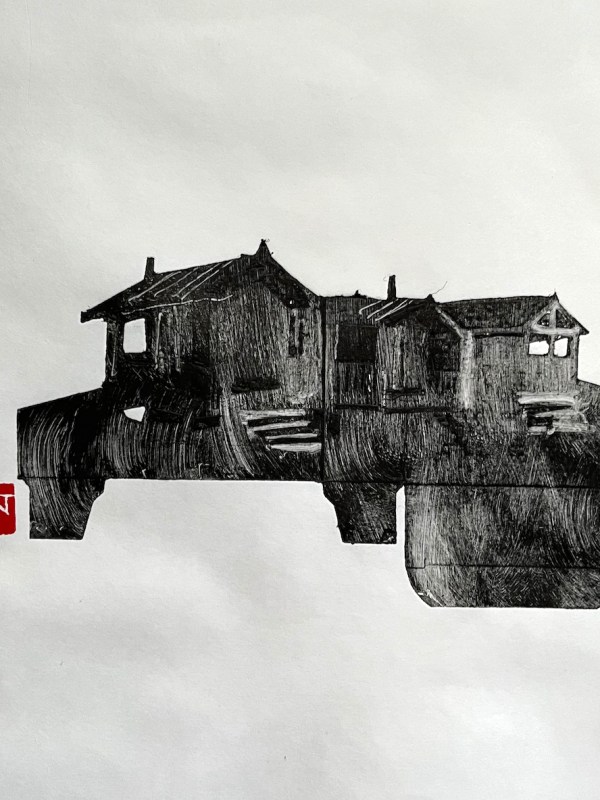
Here is a “packaging” monoprint I made of the huts in Walberswick. The print is made using a discarded carton from a box of aspirin. It looks like this: The brown colour is shellac, a…
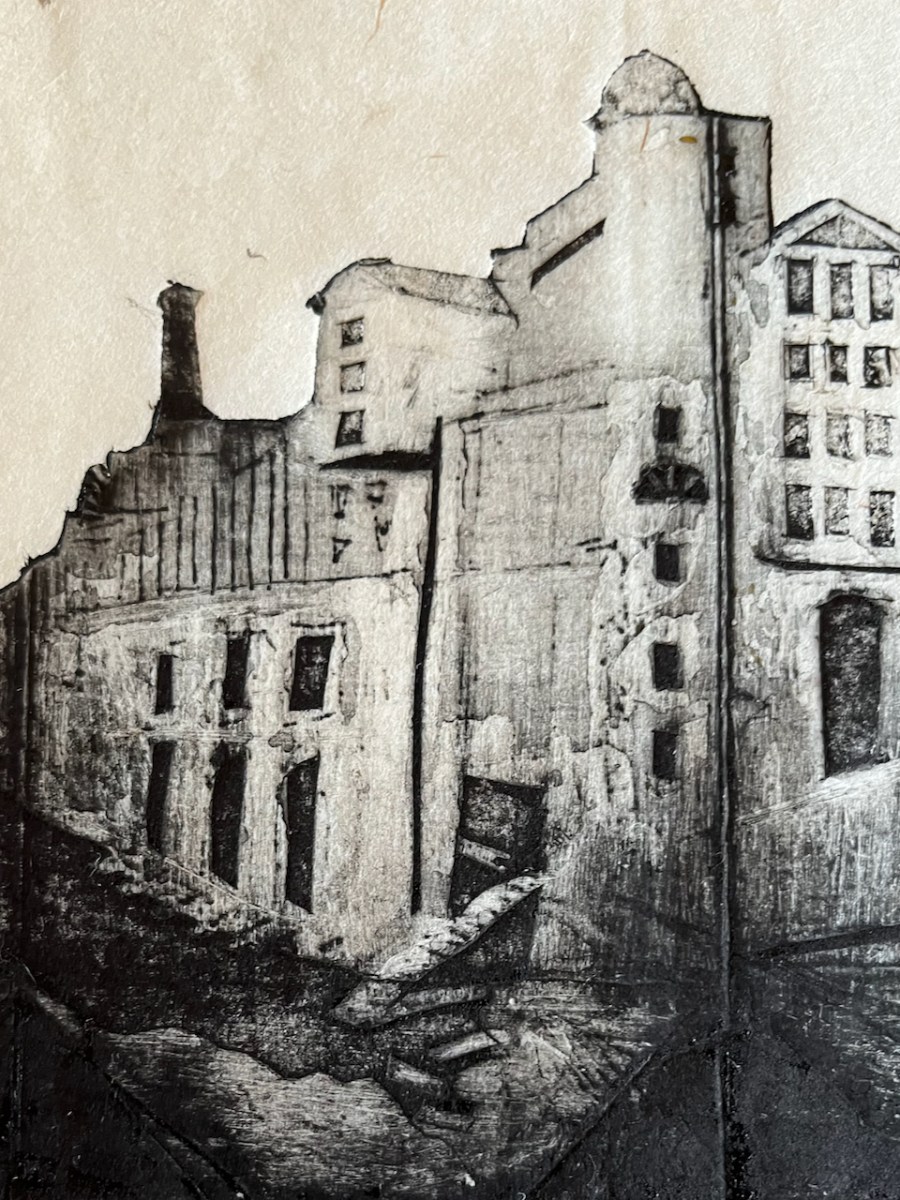
I am trying an experimental monoprint technique. The idea is to use packaging material to make intaglio “plates” which are then printed using an etching press. This is the first one. I printed it yesterday…
Click a button below to share this post online, email it, or print it:
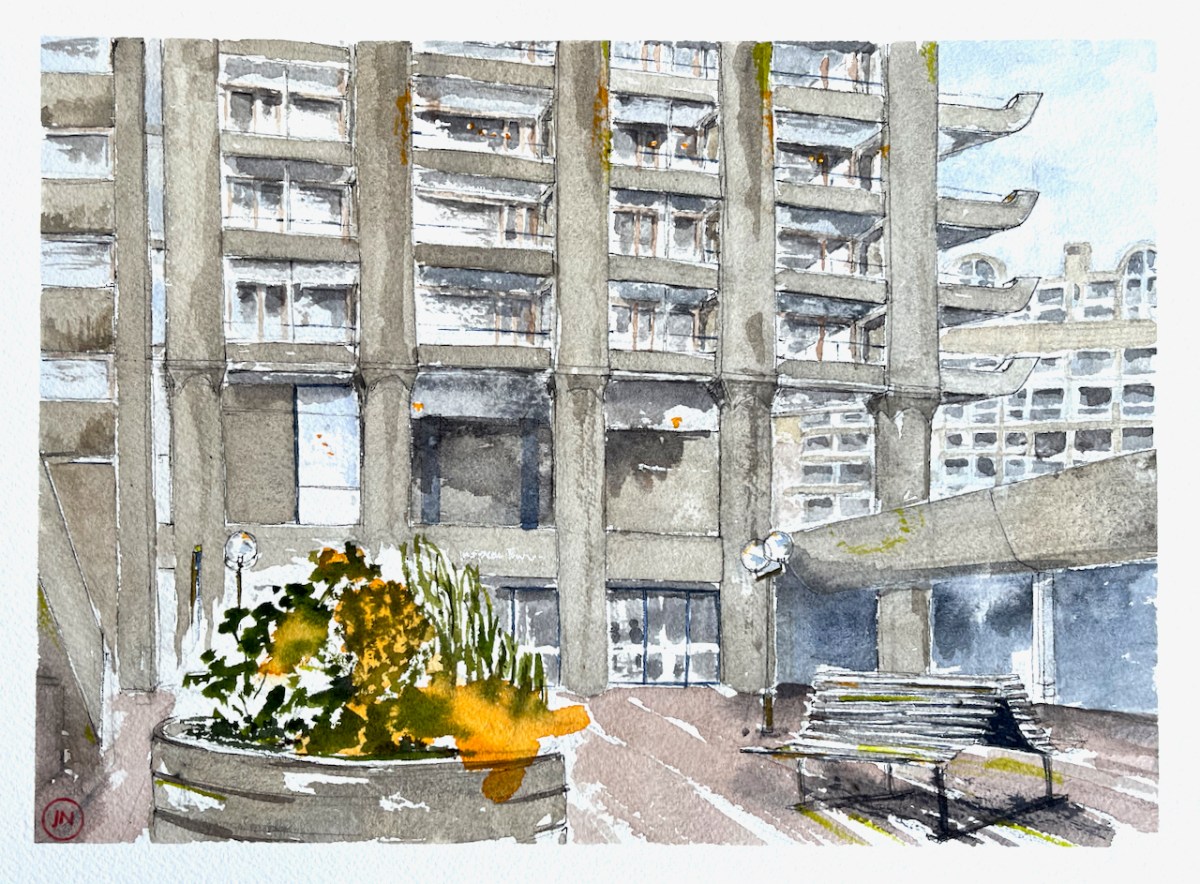
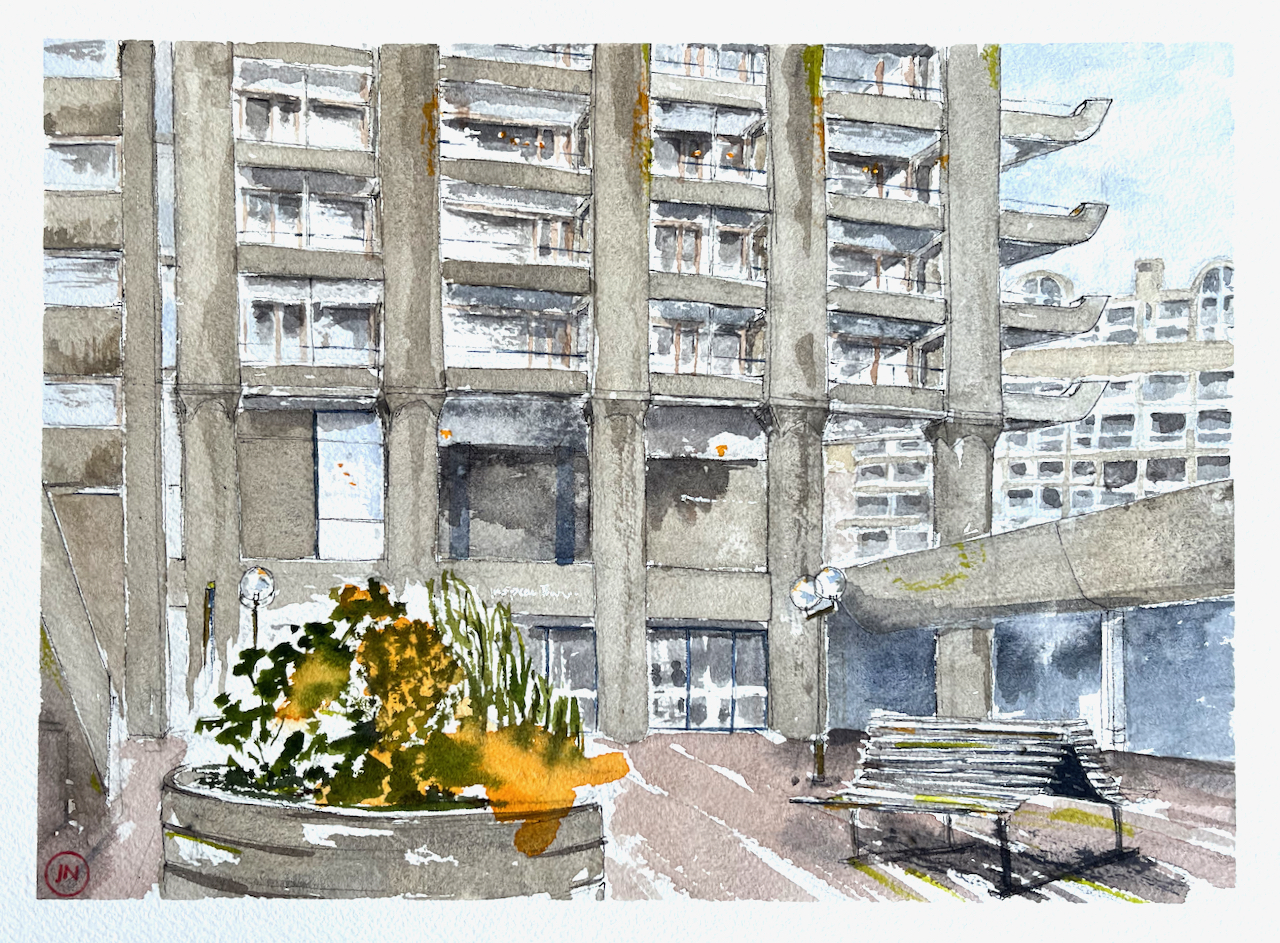
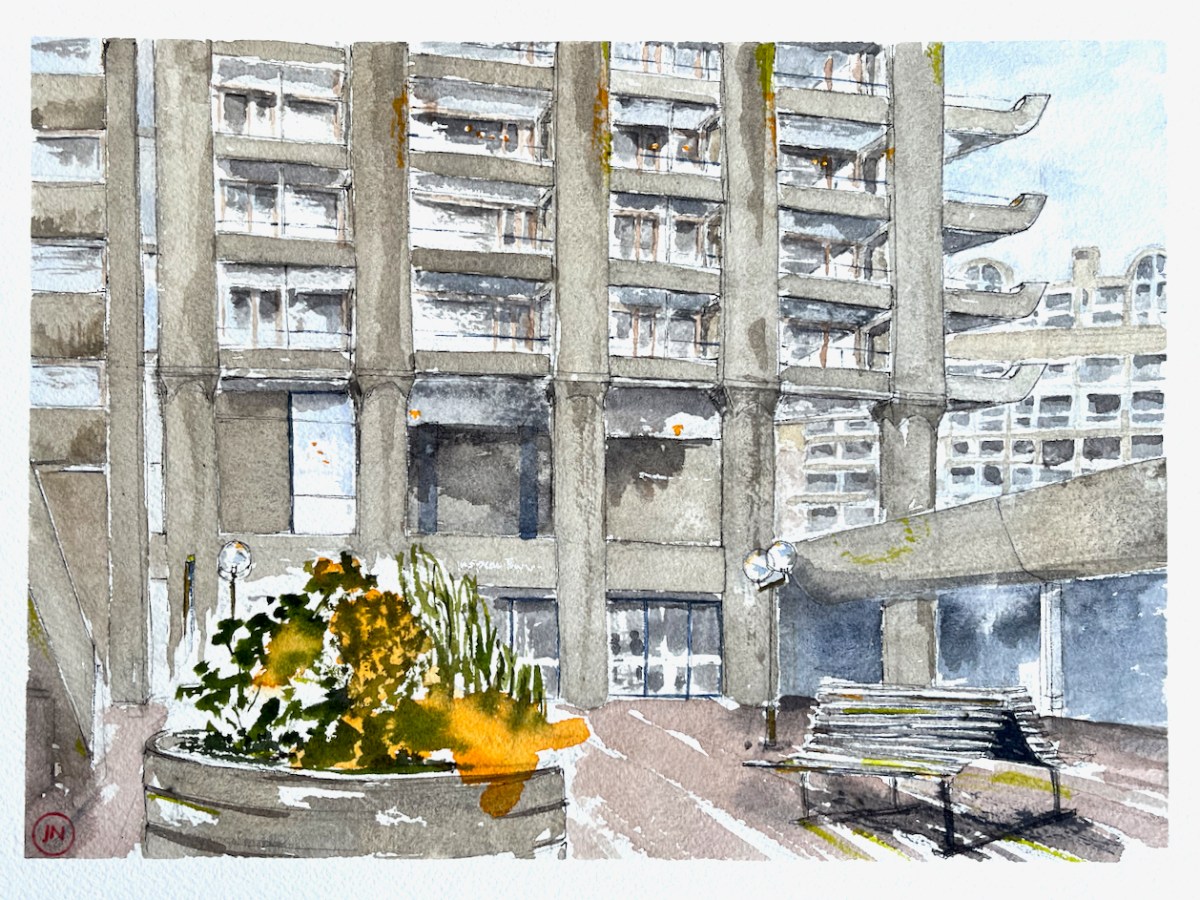
Here is a view of the east face of Shakespeare Tower, Barbican, from Defoe Place, near the Barbican Centre. You can see the main entrance to the tower. On the right is Cromwell Highwalk, and Ben Jonson House beyond. On the left you can just see the stairs that go down into Defoe Place from the highwalk.
Shakespeare Tower from Defoe Place, 12″ x 9″ [commission]
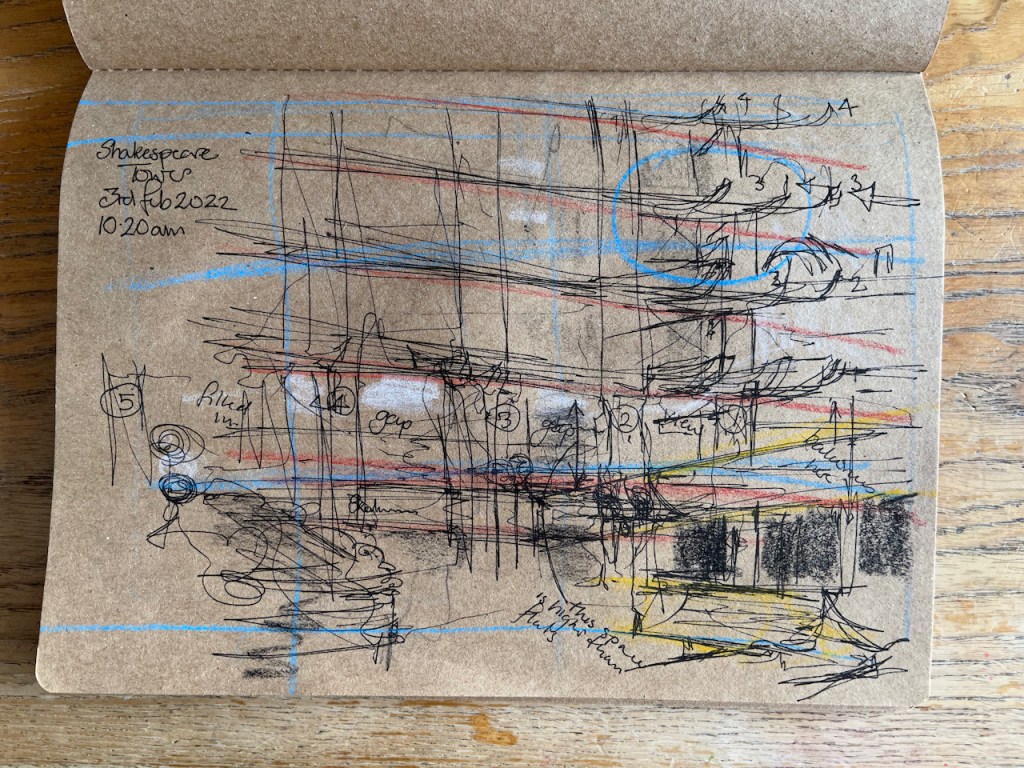
Preliminary sketch
I wanted this picture to give an impression of what it is like to walk around the Barbican. There are different depths, and sharp contrasts of dark and light, and large open spaces. Workers from the library looked out of their windows, saw me drawing and came to look at the picture. This was drawn in February, but still there were some flowers in the planters, even though this particular planter was in a shaded and windy place. The smell, however, was not of flowers but cigarette ends. People evidently use the area under the stairs as a smoking area, and drop their butts. So that’s the Barbican: people who talk to you, soaring towers, great perspective views, wide open spaces and a certain shabbiness around the edges.
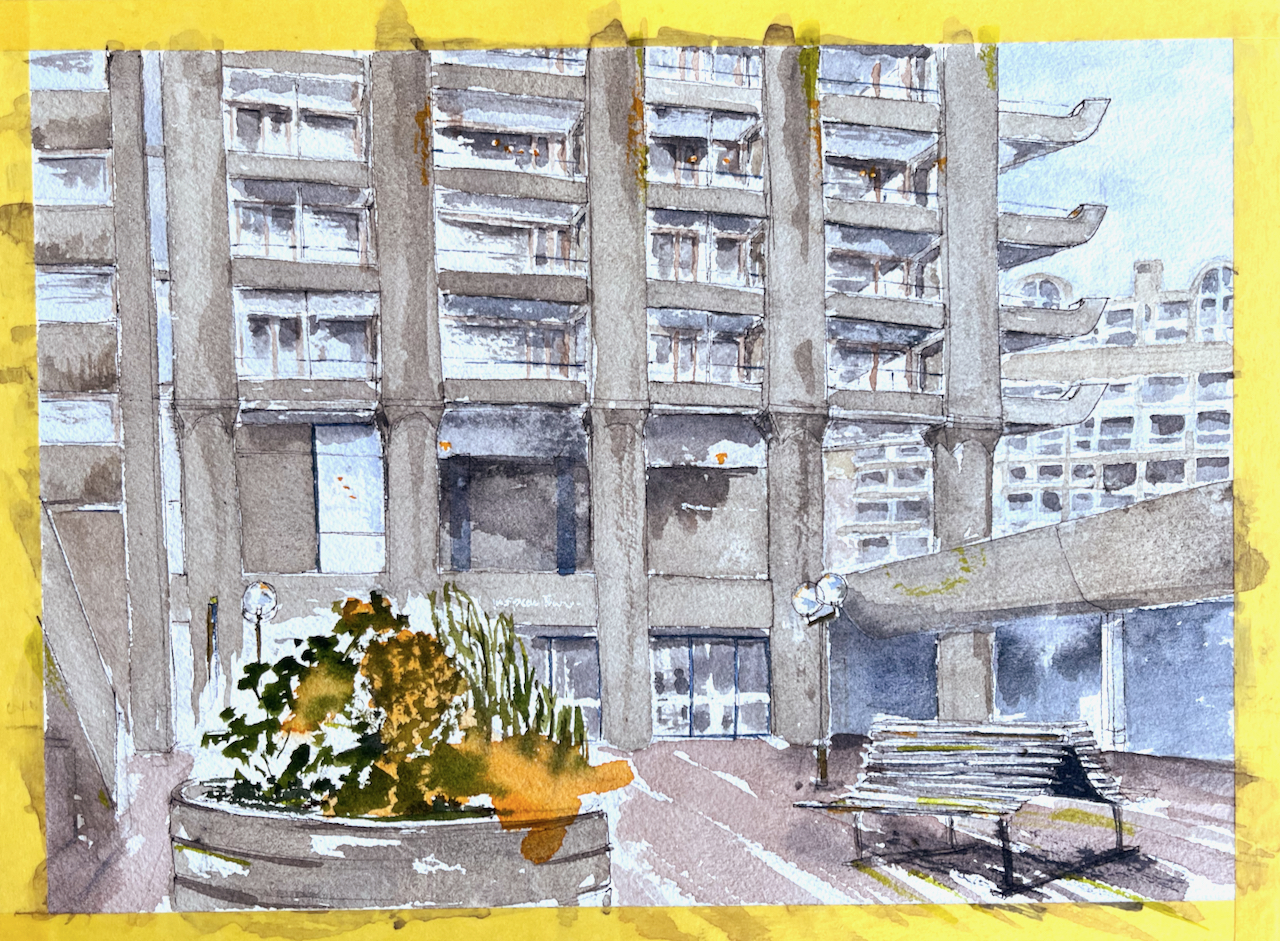
Here is the pen-and-ink compared with the colour:
Before and after the colour went on
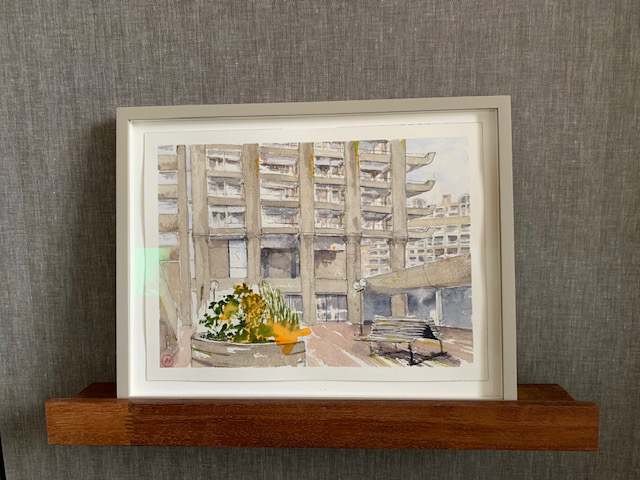
This was a commission. I am grateful to my client for the prompt to examine the Tower from this unusual angle. And also for sending me this photo of the framed watercolour:
Framed watercolour. Photo credit: NM
A collection of my drawings of the Barbican is here:
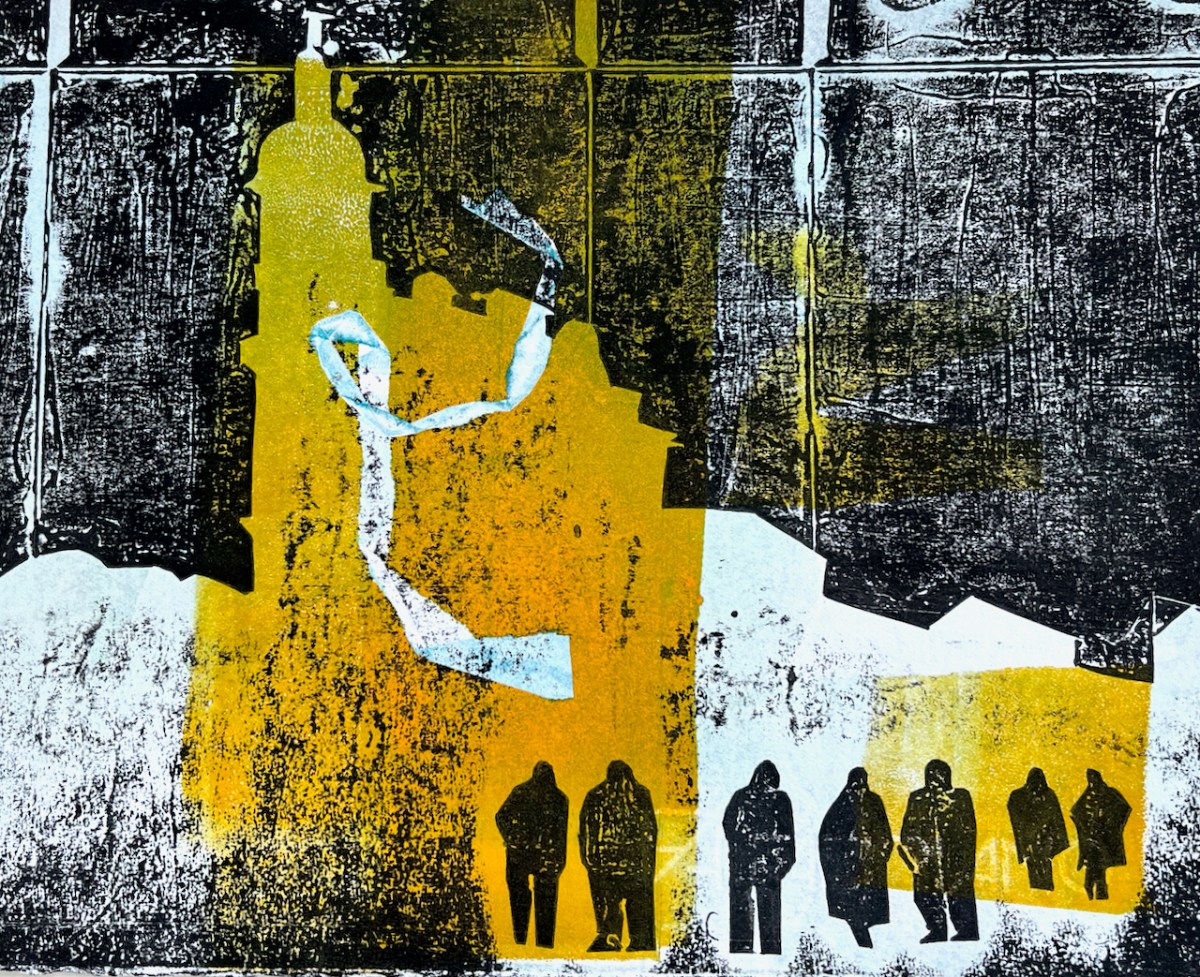
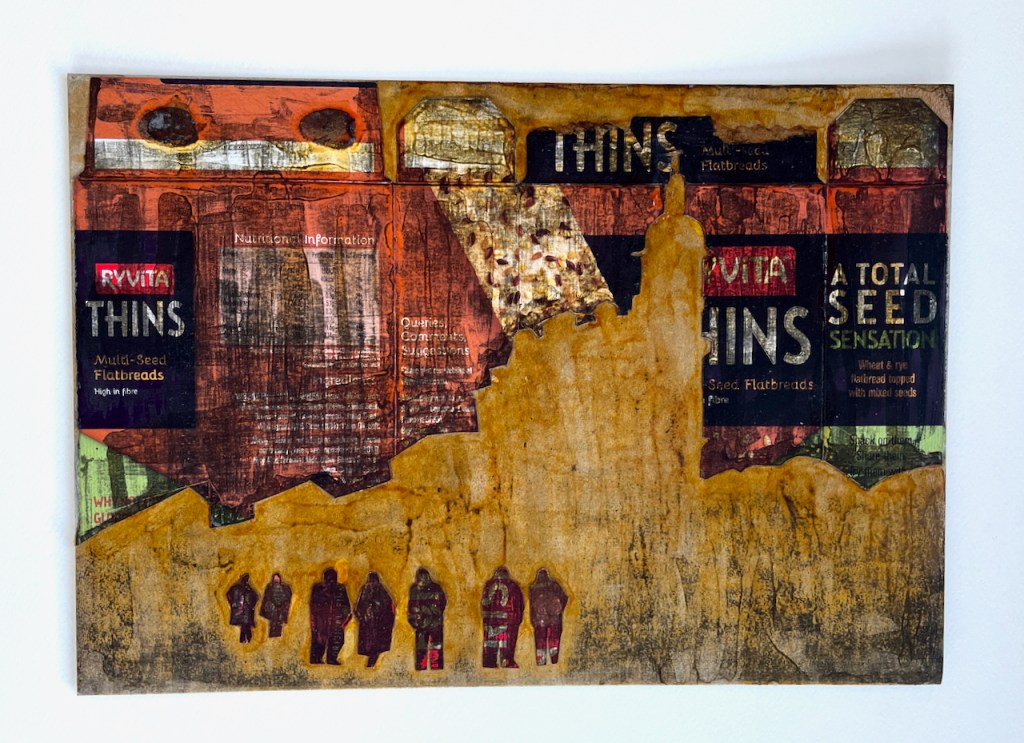
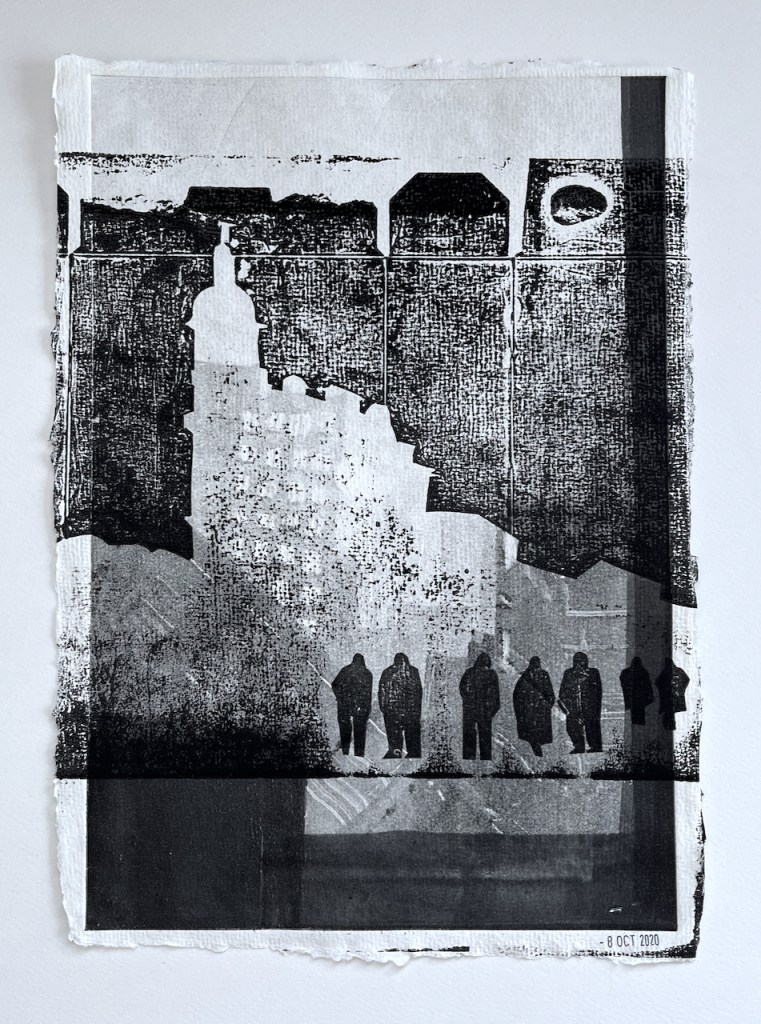
After I had cut out the packaging print plate of the Boston Arms, I was left with the “negative”: the top part of the plate. As it was on its way to the bin, I realised that I could use this to make another picture. So I retrieved it, and made this plate:
Relief plate*: top half is made of a biscuit packet. The bottom half of the biscuit packet was used to make the packaging print – see this post
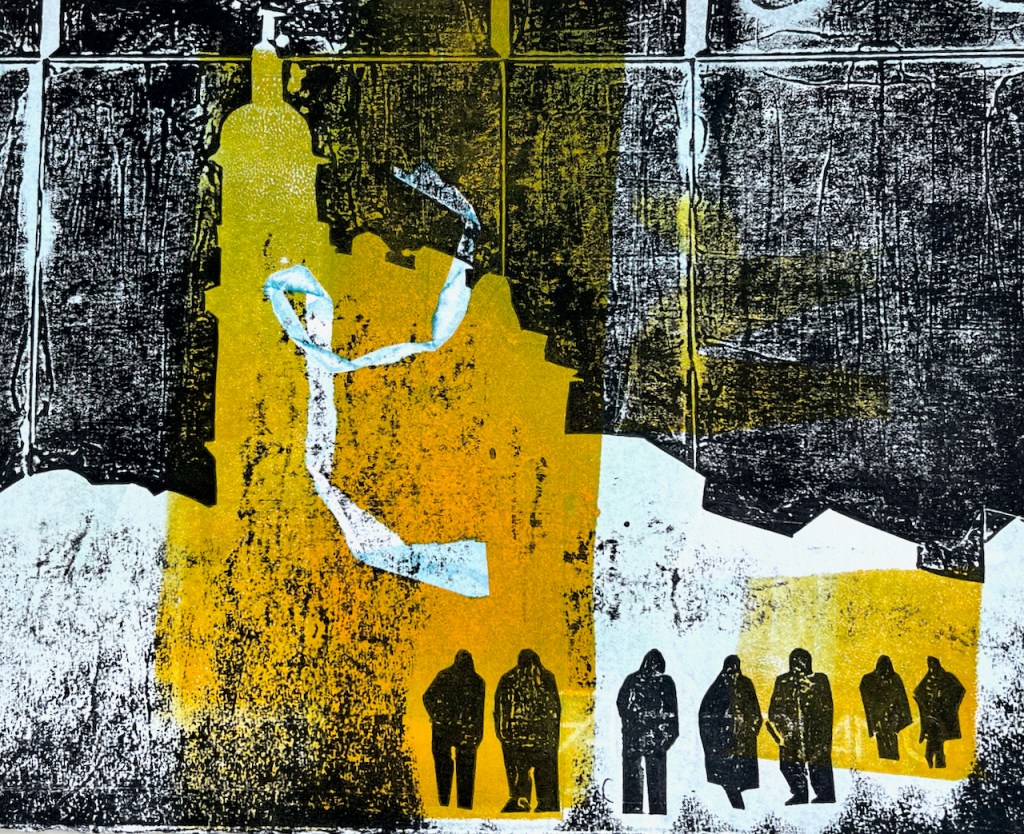
I added a few people. This is a pub, so these are some people on their way to the pub.
I used this cardboard plate to make some prints. I painted it with shellac, to make it stronger.
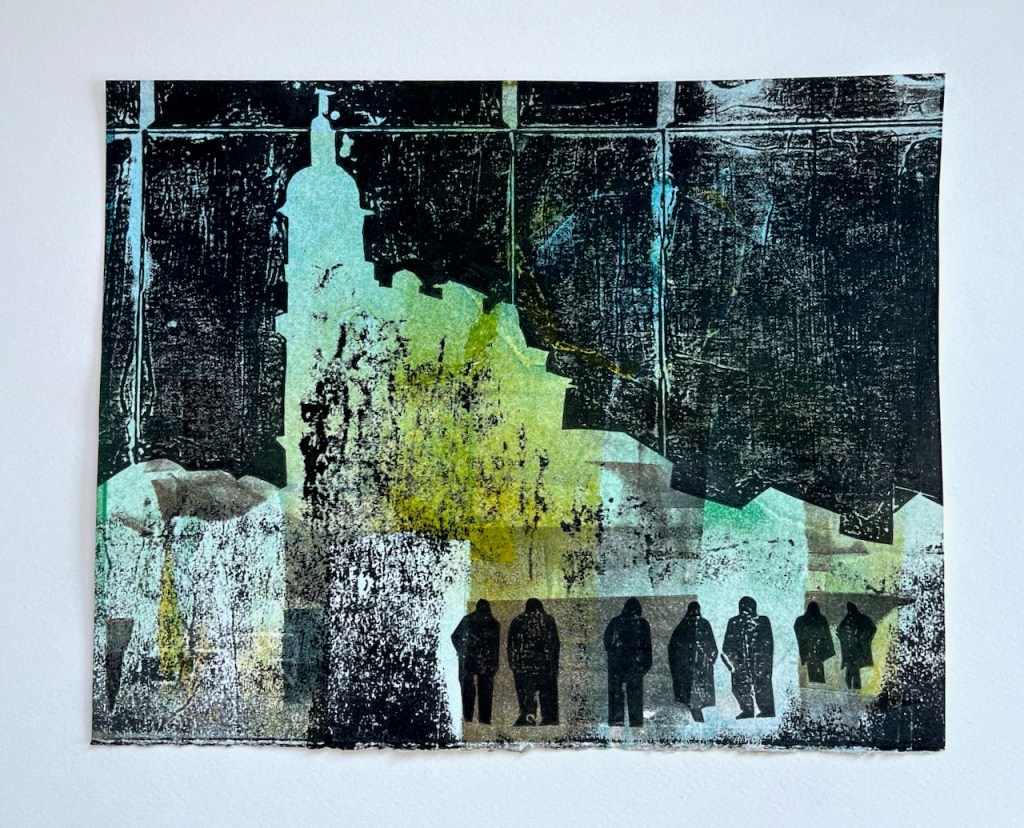
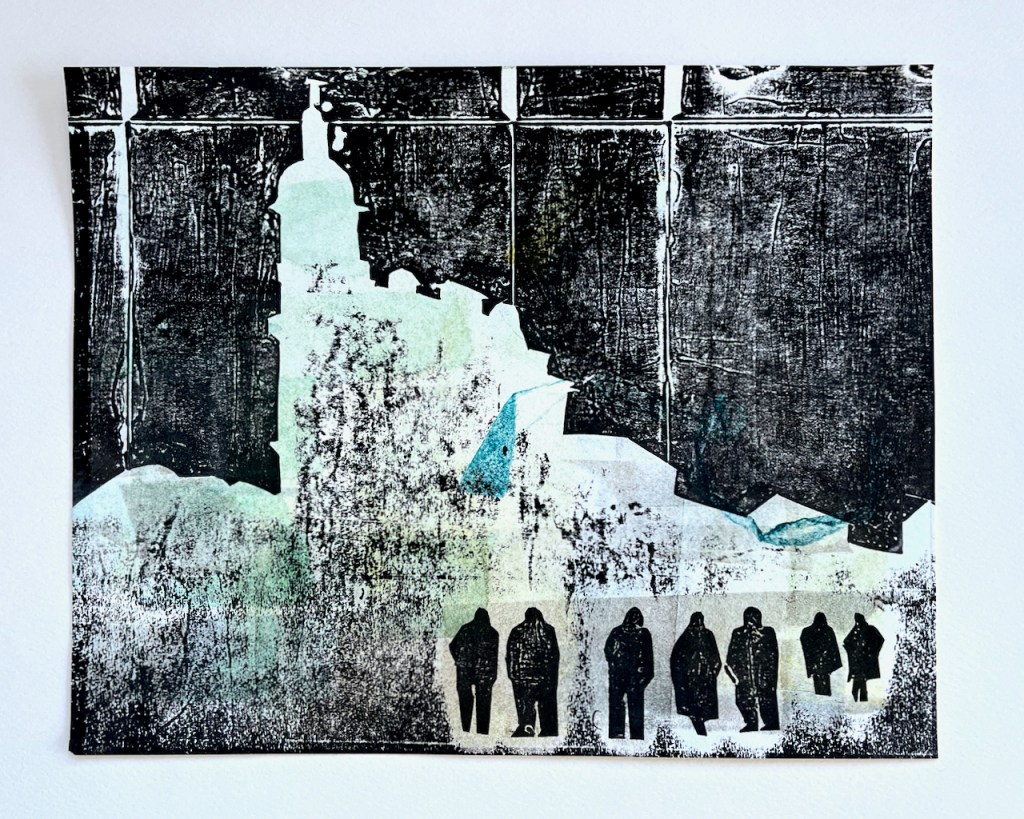
Here are the prints, made on the Albion press at East London Printmakers. The prints are”collographs”: relief* prints.
I made the prints on top of some experimental monoprints made last year.
*A “relief” plate is one in which the ink is rolled onto the raised part of the plate. The raised parts print dark. A potato print, a lino print, woodcut or an ordinary rubber stamp is a relief print. This is by contrast to an “intaglio” print, in which the ink is wiped into the indentations and into engraved lines on the plate. The raised parts print light, and the lower parts print dark. My etchings and packaging prints are intaglio prints.
Click a button below to share this post online, email it, or print it:


































 Jane Sketching