Guildhall North Wing

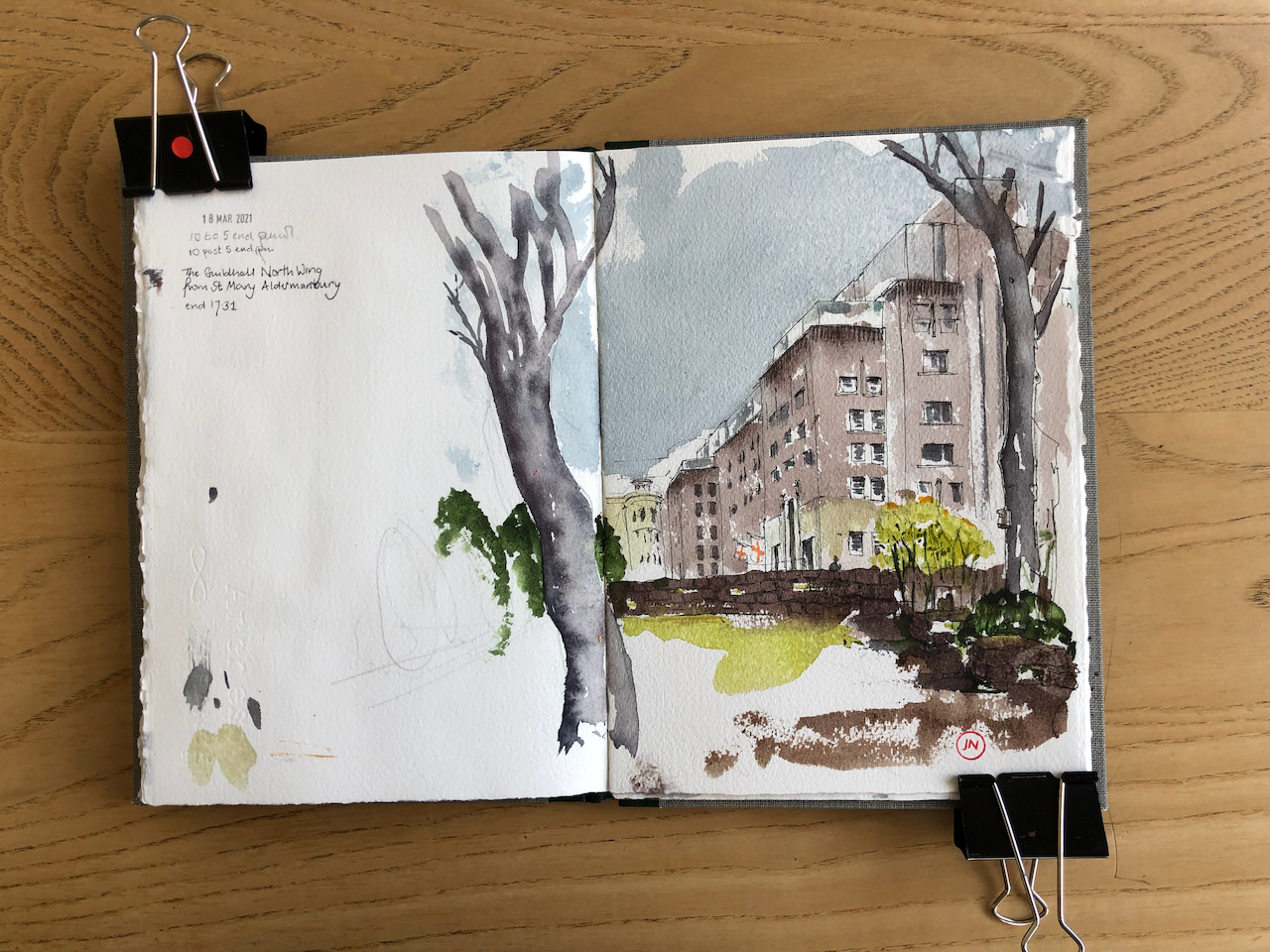
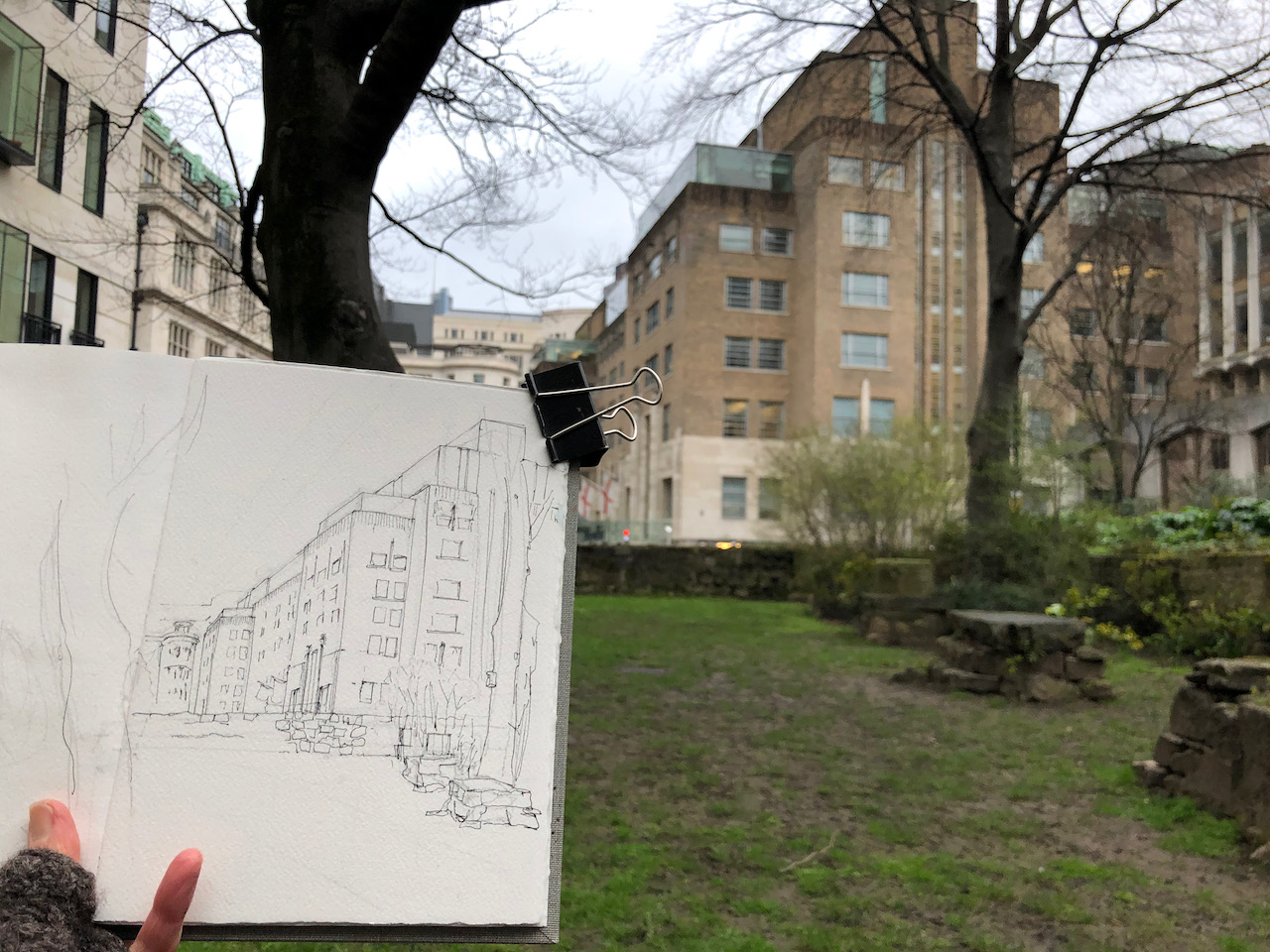
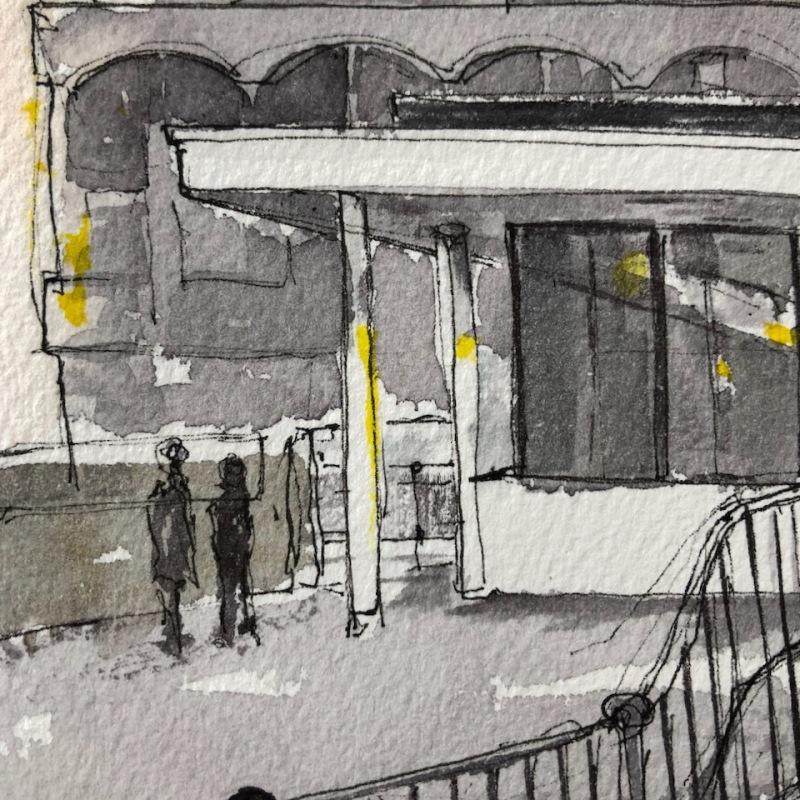
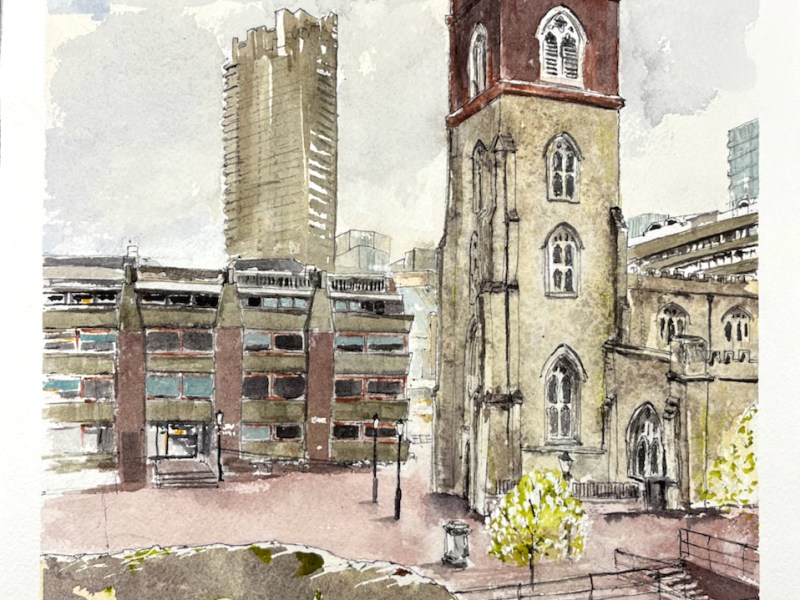
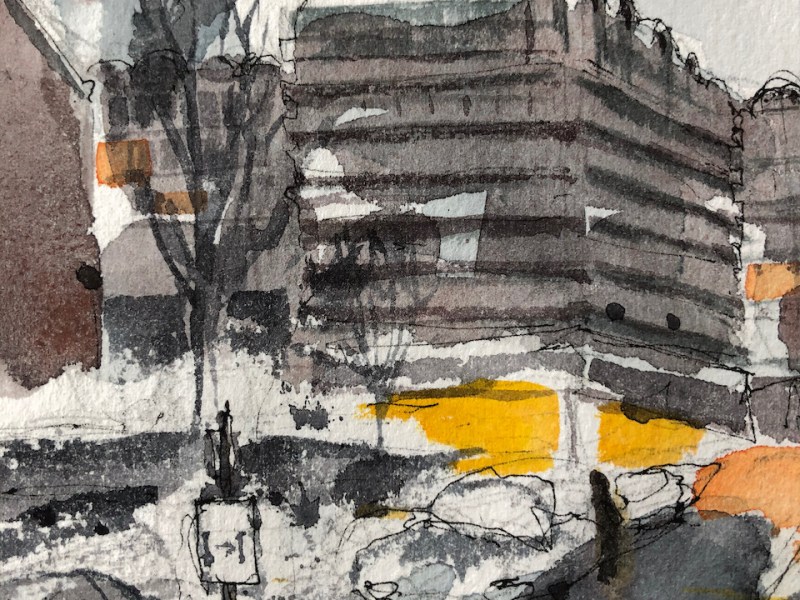
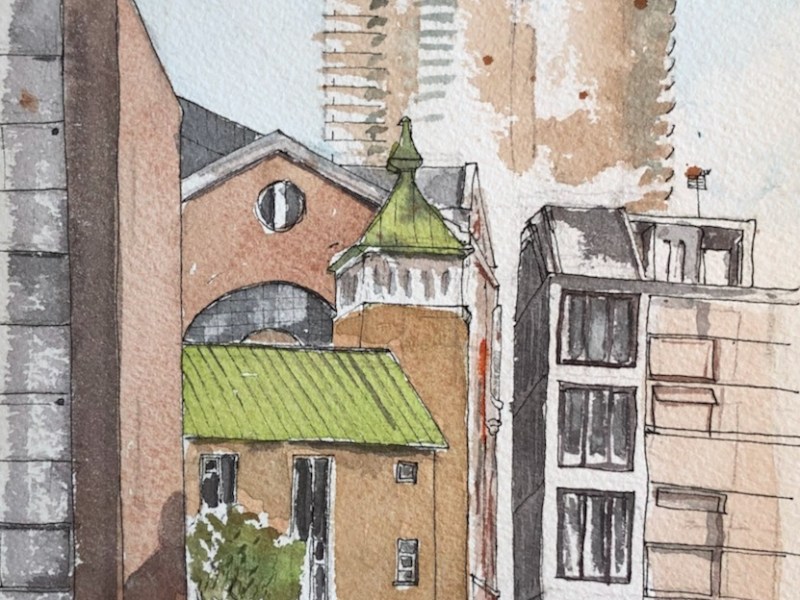
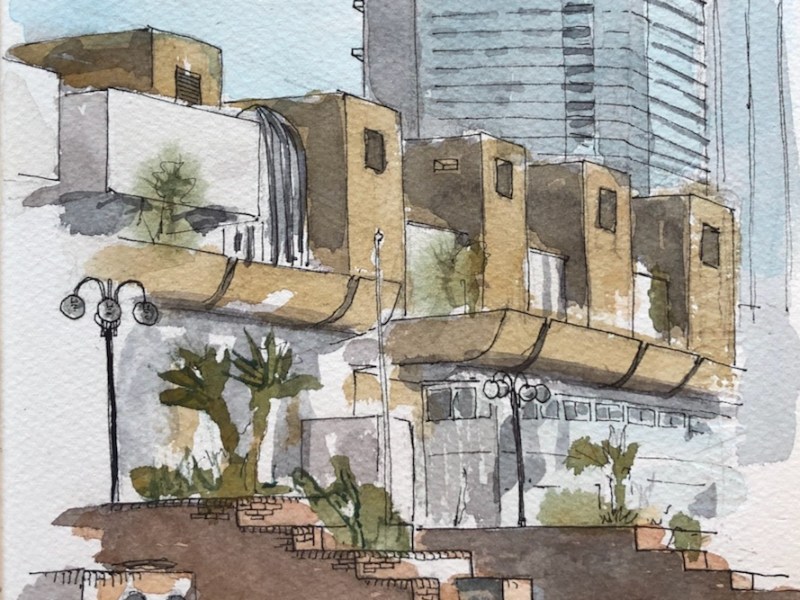
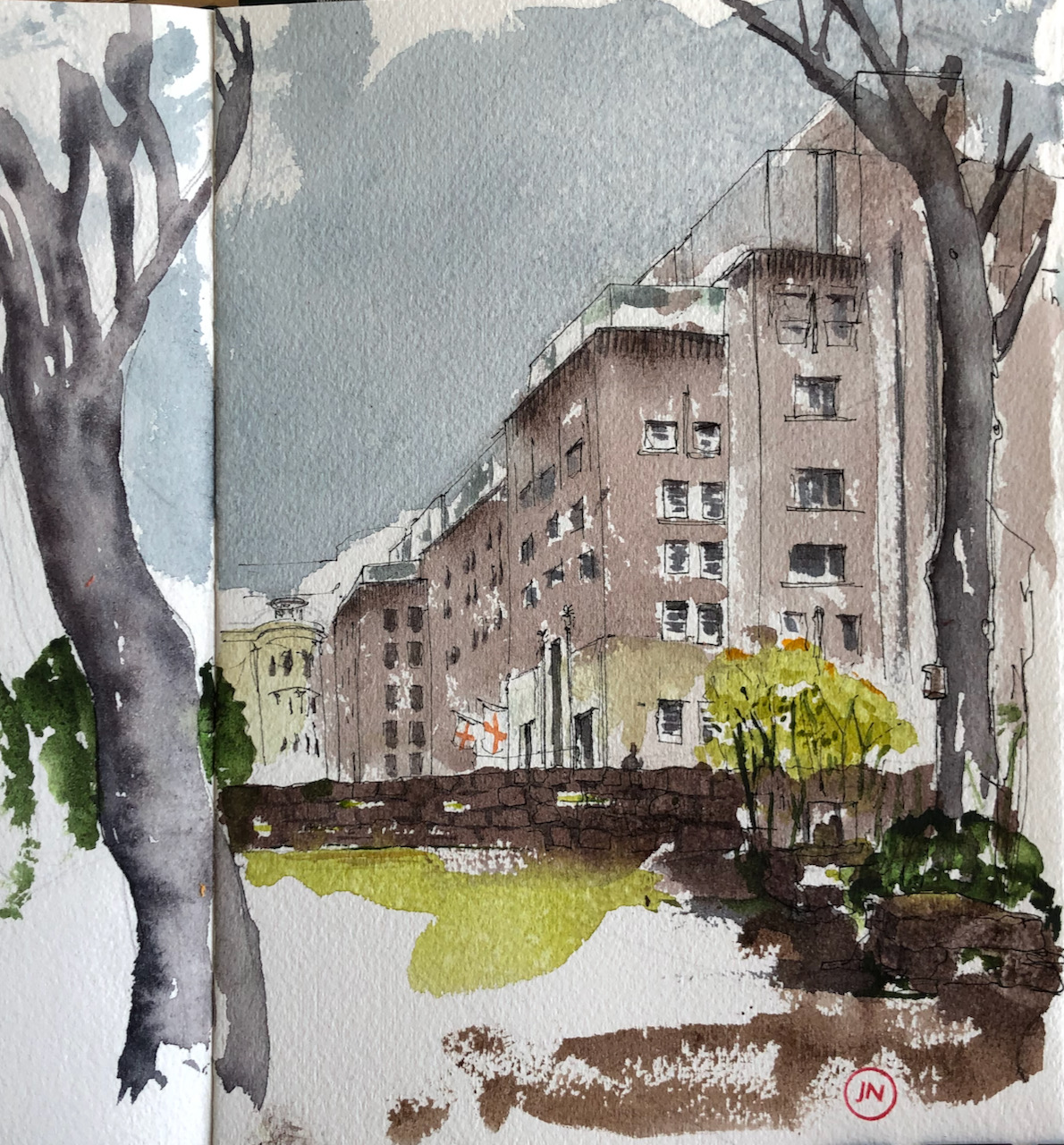
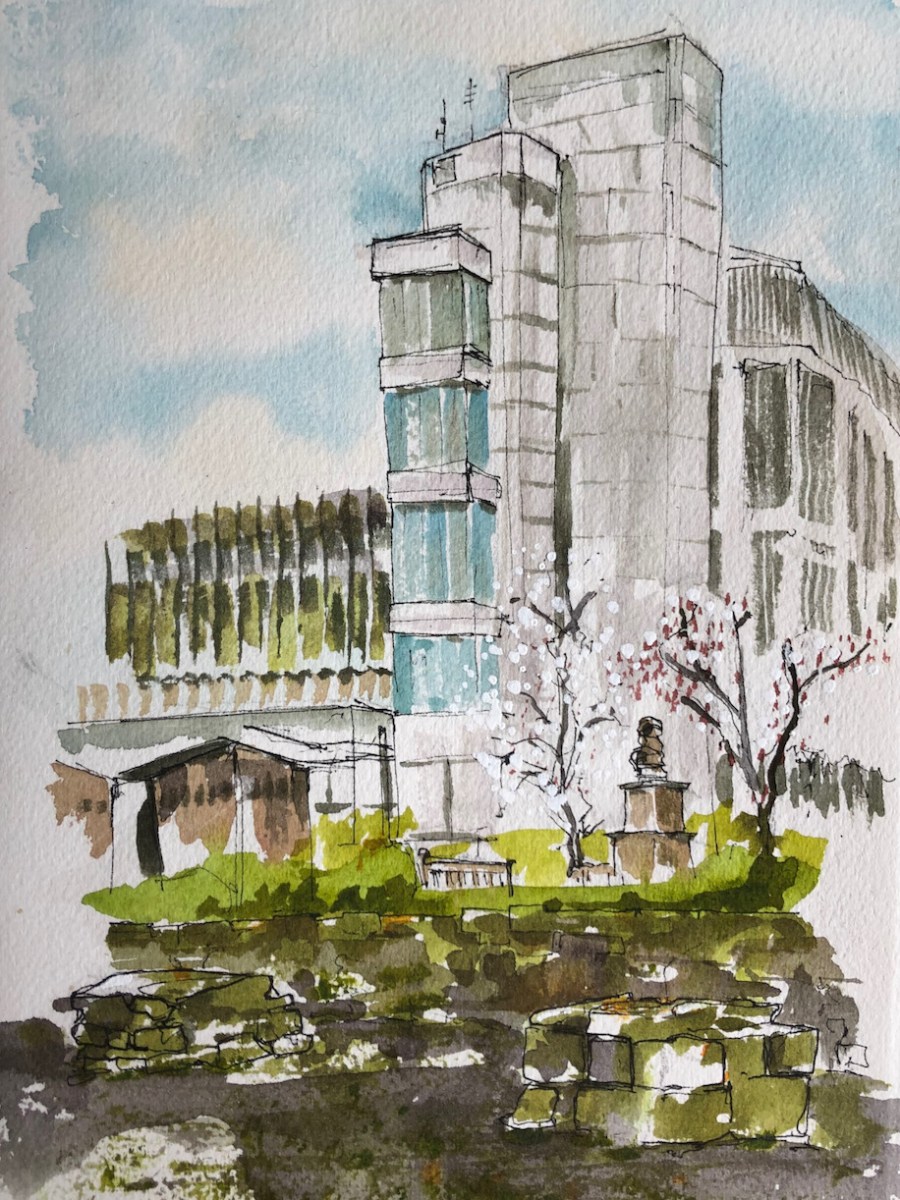
From the site of the former St Mary Aldermanbury, I looked across towards the Guildhall, the offices of the City of London.
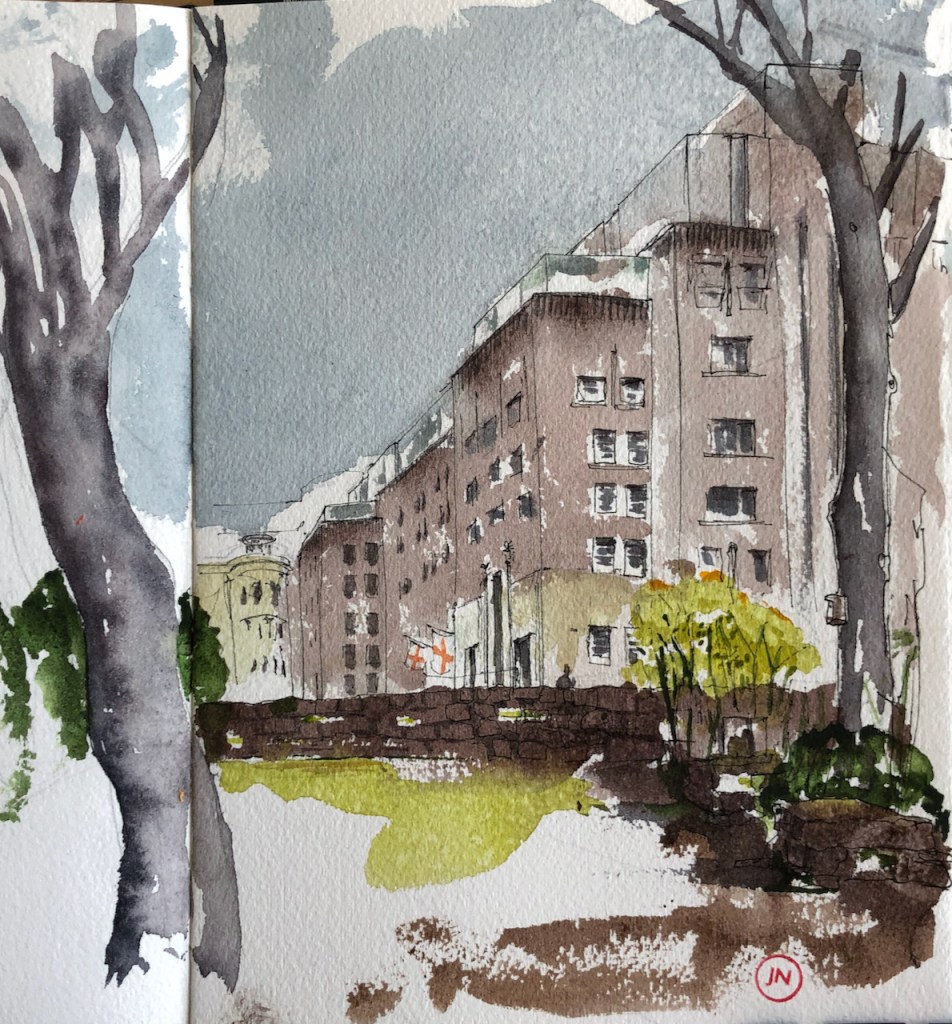
Guildhall North Wing, 7″ x 10″, in Sketchbook 9. 19 March 2021

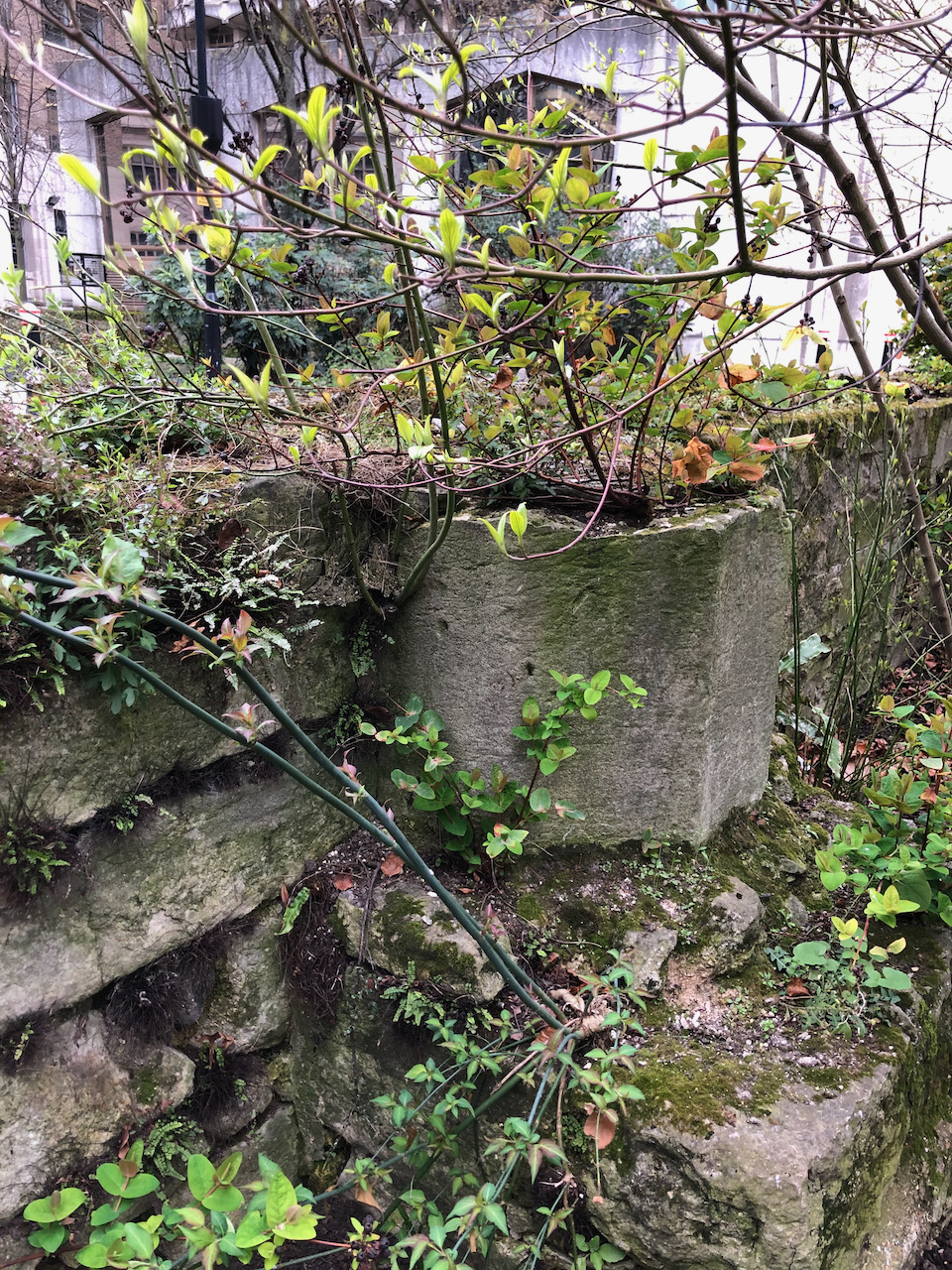
It is dark and green in the former Nave of the church, whose pillars you can see on the right. The stones are covered in moss, which is almost phosphorescent.

The North Wing of the Guildhall was designed by Giles Gilbert-Scott2 in the 1930s and built in the 1950s. He also designed the red telephone kiosks, Battersea Power Station and Cambridge University Library.

The North Wing, and the area to the North of it, were redeveloped in the period 2002 – 2016 at a total cost of £112.6M1 . The architects were TP Bennett. They comment on their website:

The street entrance was lowered to give step-free access from the lowered landscaped piazza, and the two confusing entry points were replaced by one entrance anchored by a lively reception area, now the main business hub for the City of London.
Internally, cellular offices and gloomy corridors – unchanged since the 1950s – were refitted to offer more open-plan accommodation and social space, as well as extra accommodation at rooftop level. The familiar front entrance façade was retained but the internal elevation facing the Great Hall was removed and the building extended, re-glazed and given scenic lifts, offering good views over a landscaped courtyard and the Great Hall itself. Enhancing the City’s new agenda of openness and accessibility, the North Wing’s refurbishment has invigorated the Guildhall campus.

The area North of the Guildhall is flat and has a variety of obstacles and inclines, which make it an ideal venue for skateboarders.

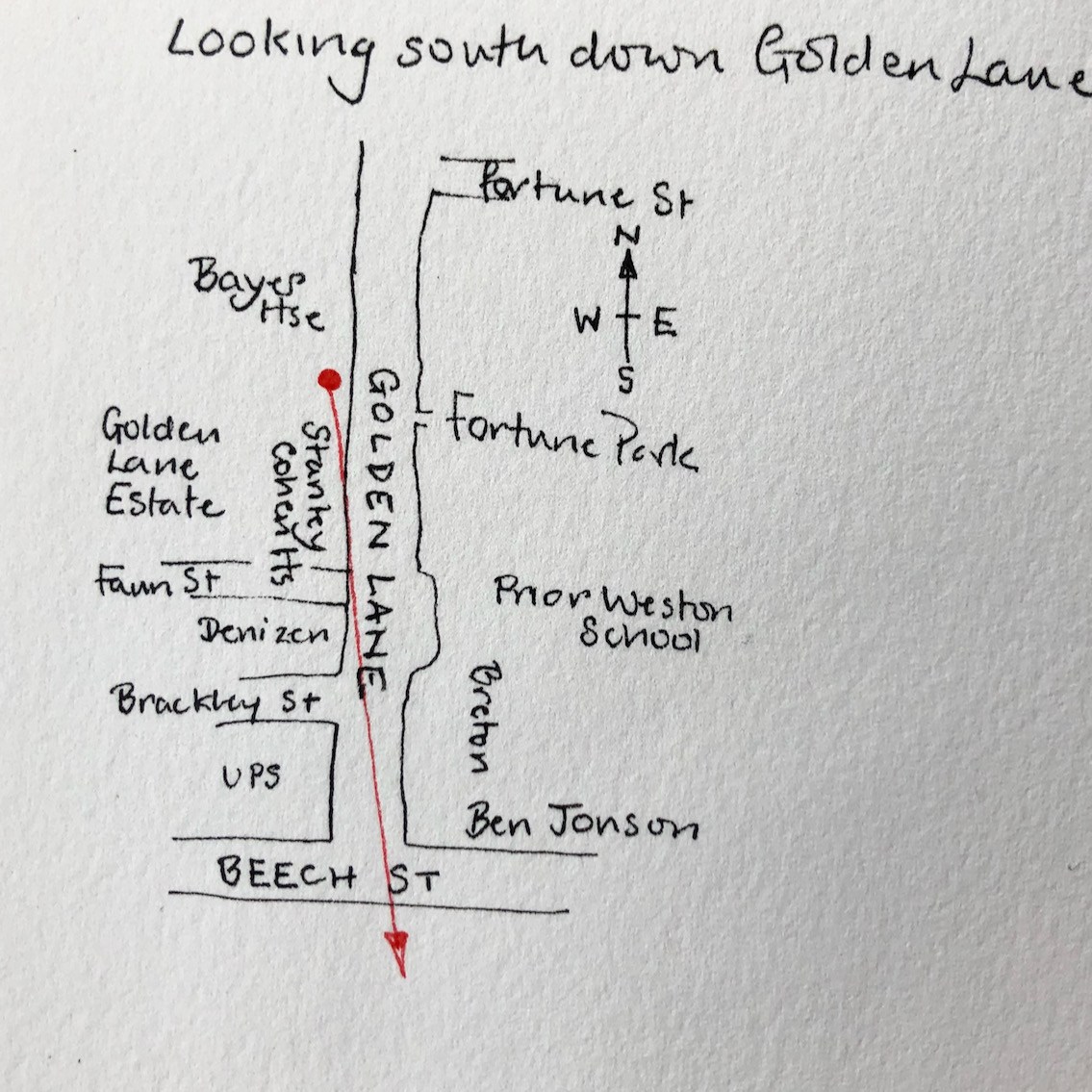
I have described the site of St Mary Aldermanbury in a previous post. Here are maps:

In the corner of the site, where Aldermanbury meets Love Lane, there is a drinking fountain. Miraculously, this one still has the drinking cup on a chain. There is, however, no water.
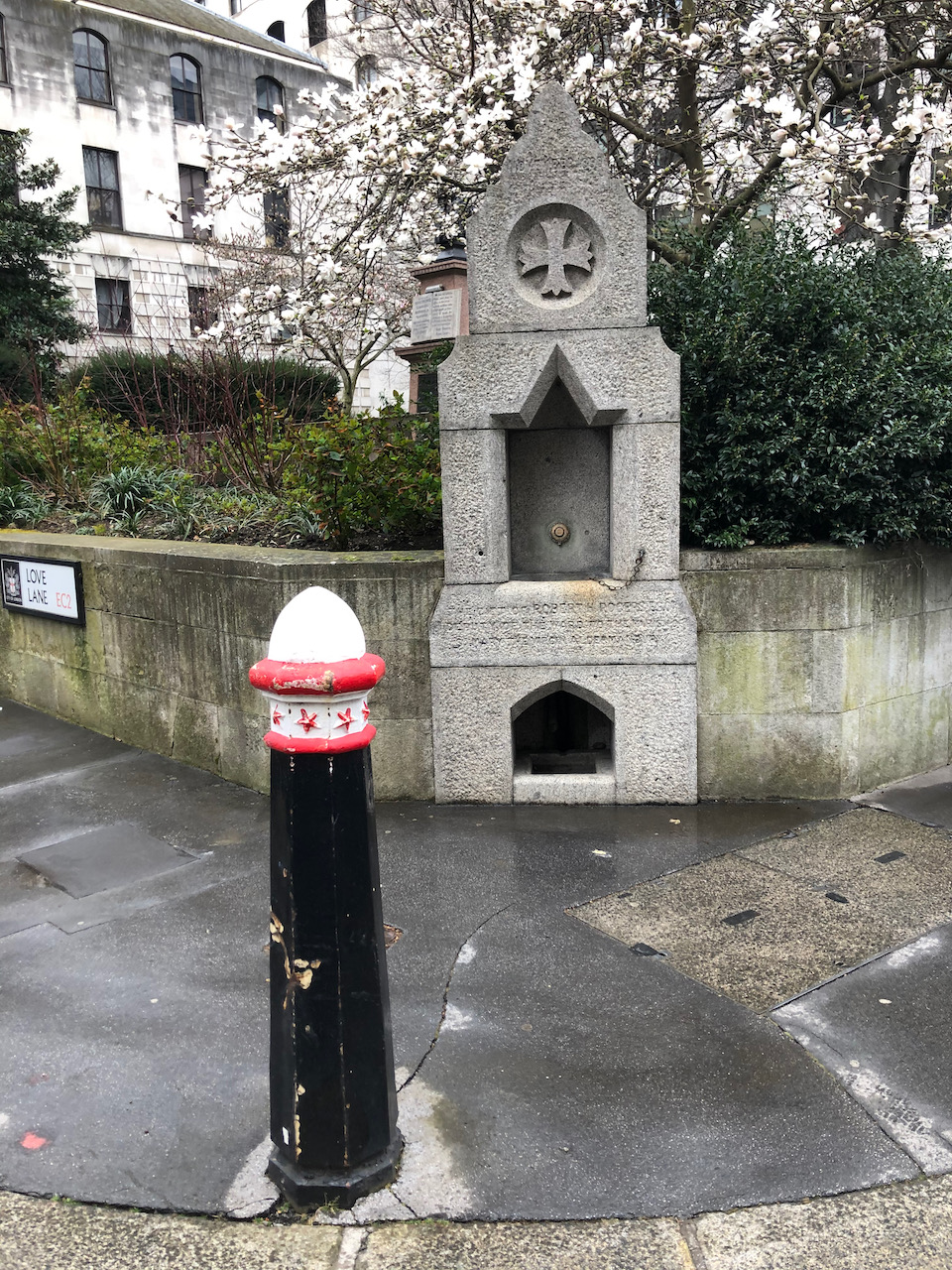
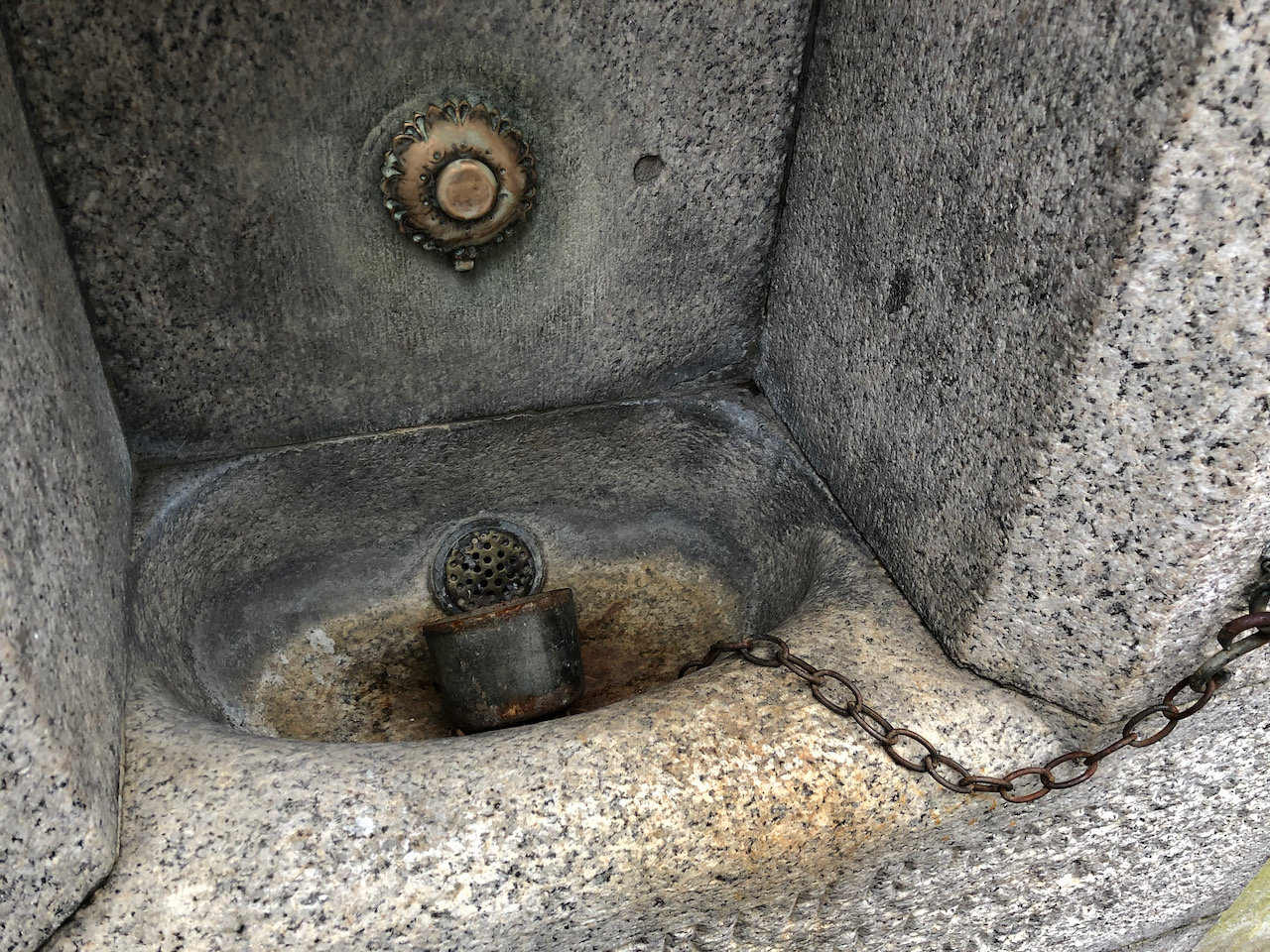
The inscription is worn and hard to decipher. I could make out this:

"November 1890
The Gift of Robert ROGERSESO(N?)
Deputy of the Ward of the Parish of 
S Mary Aldermanbury"

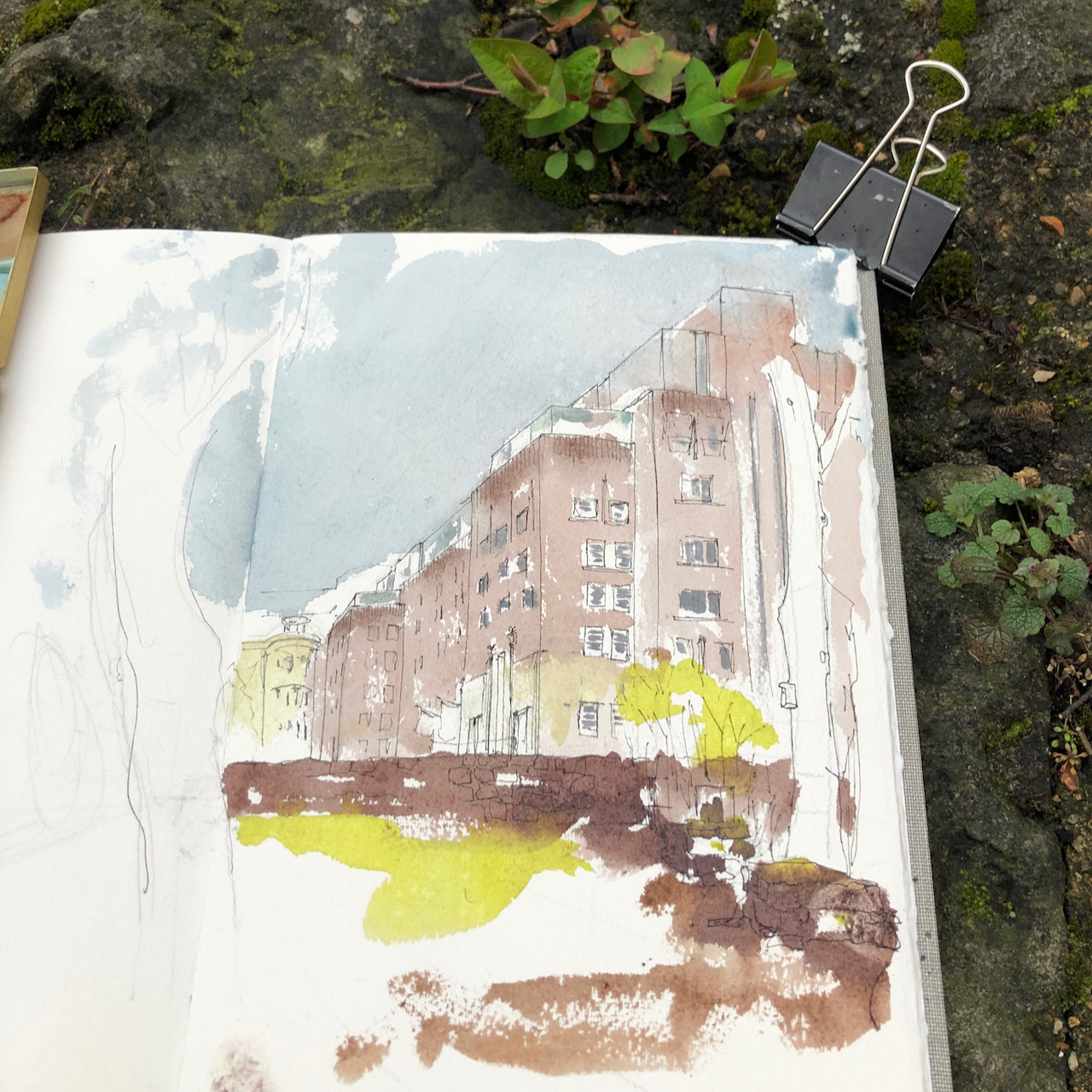
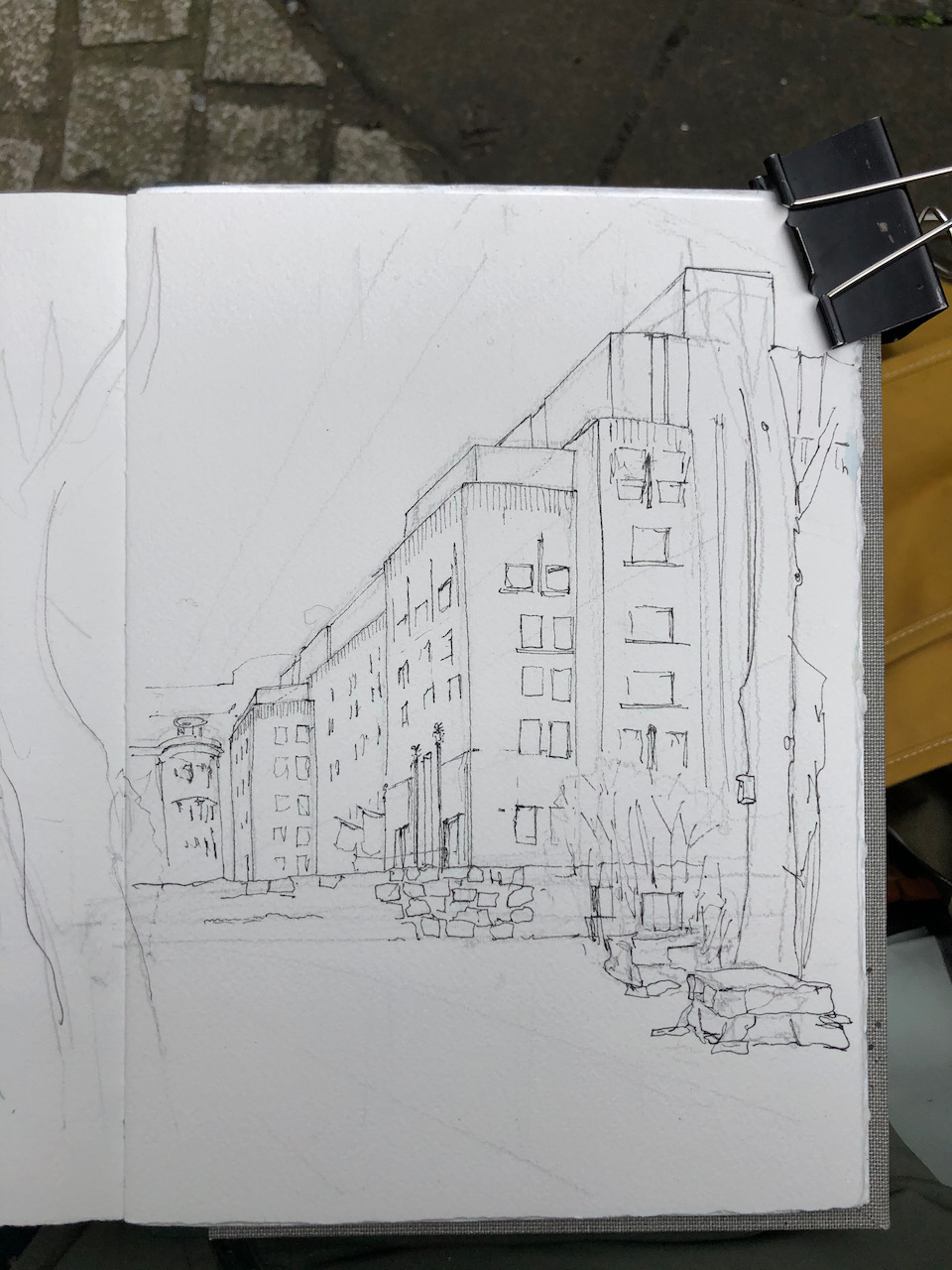
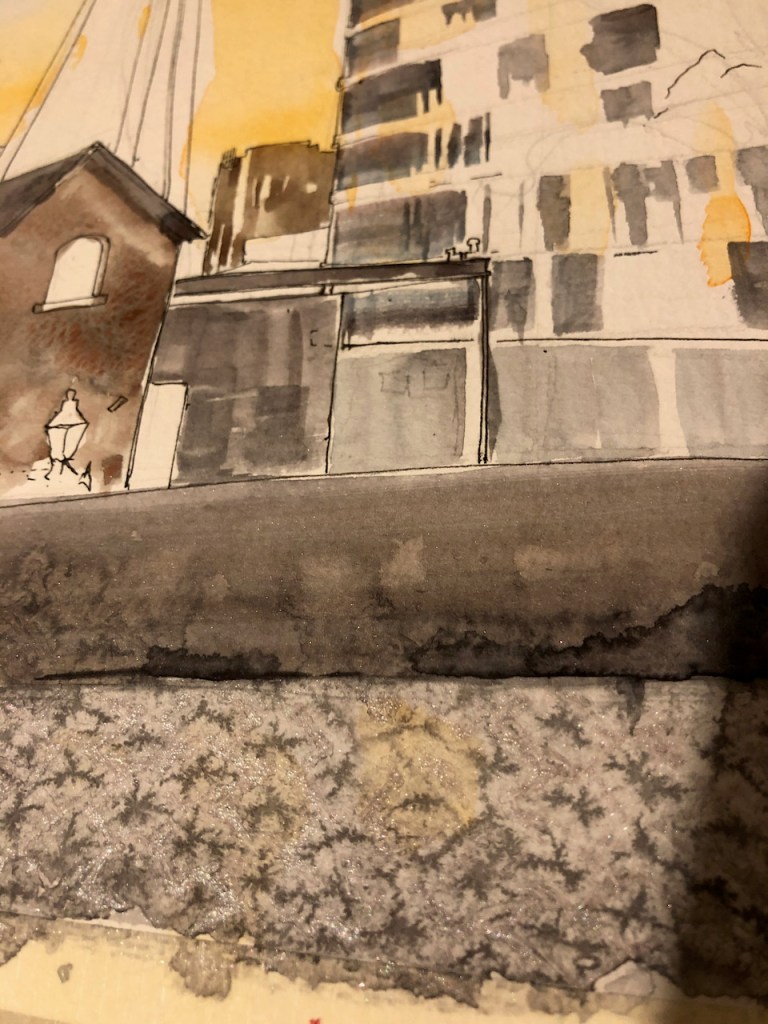
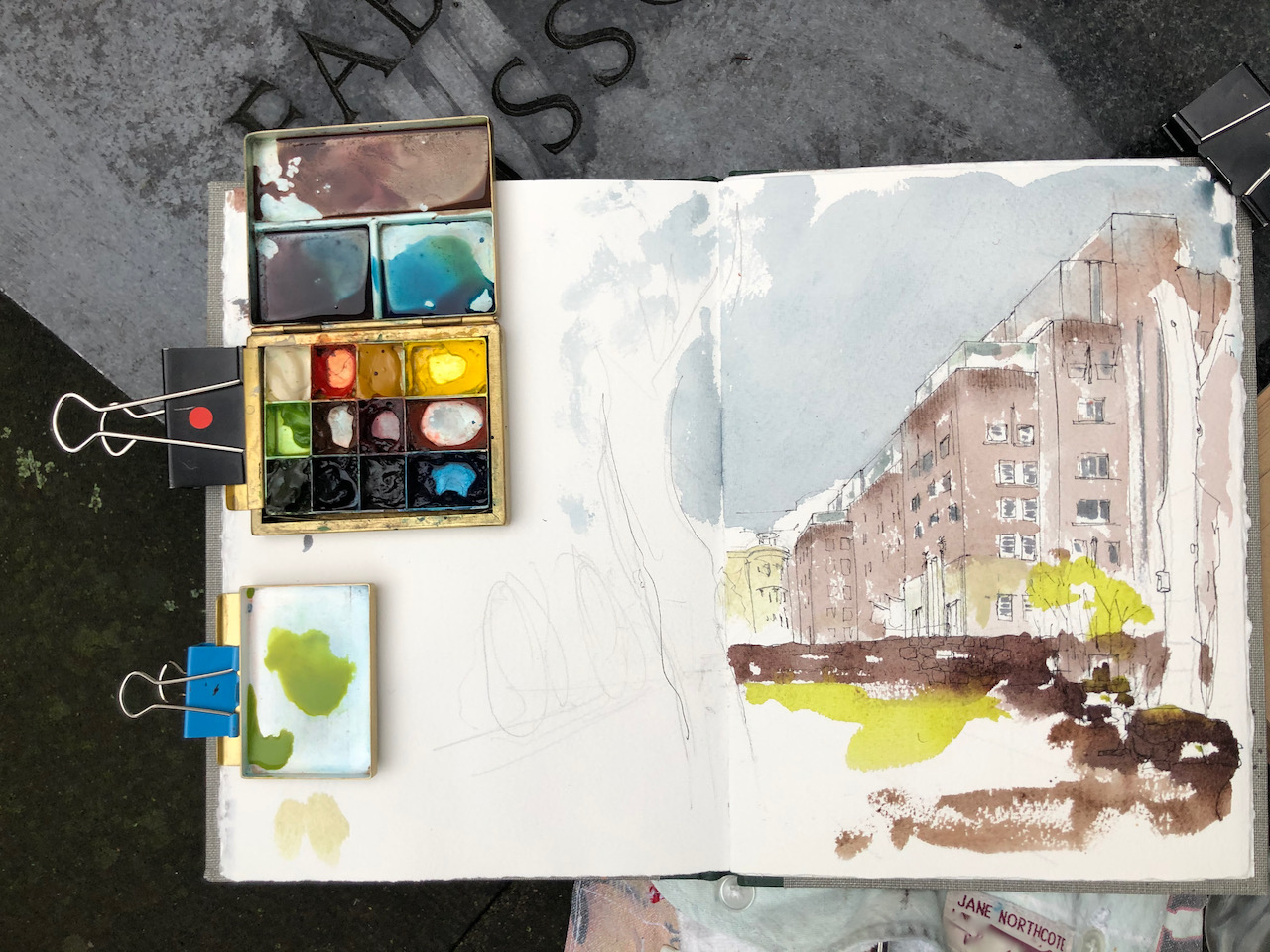
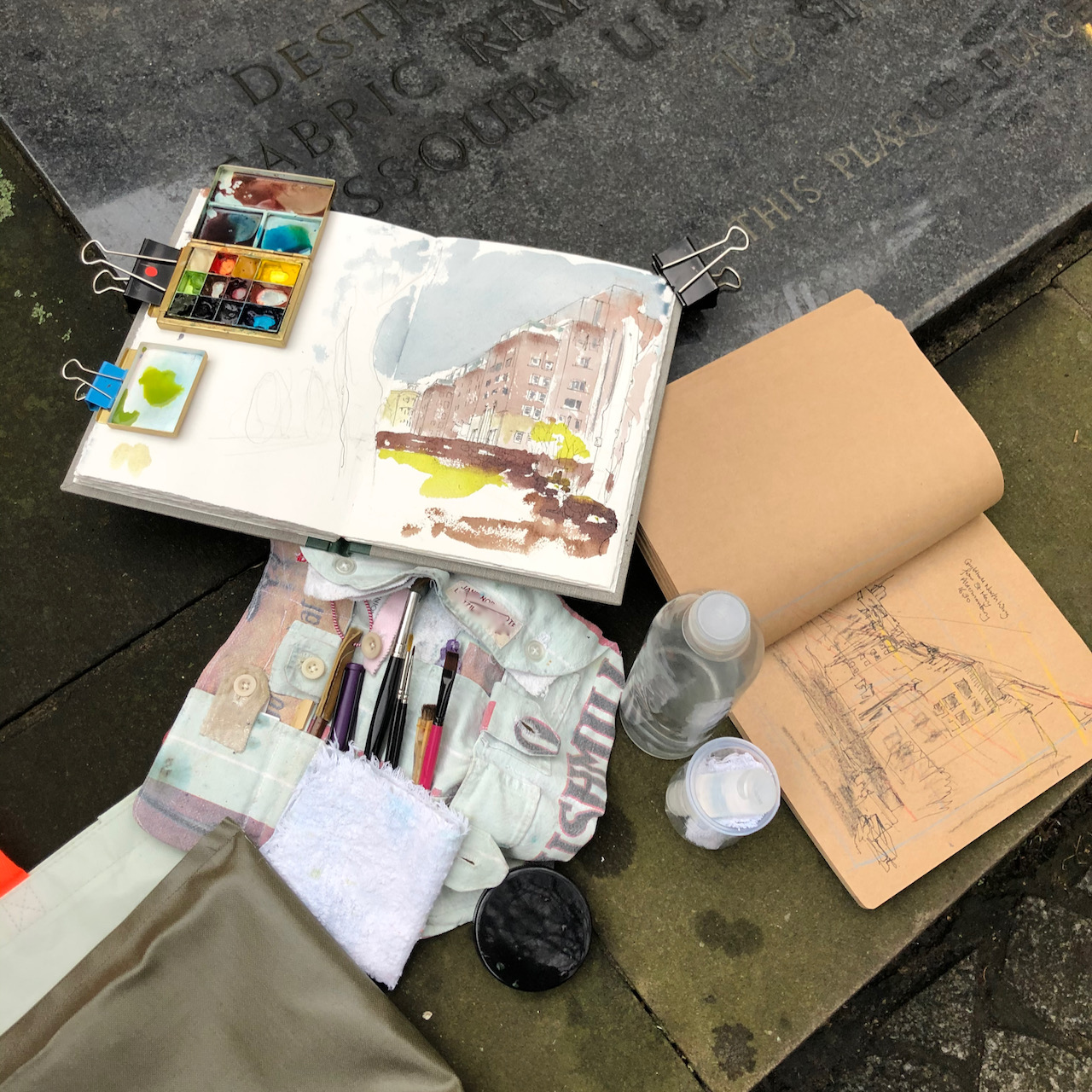
This drawing took about 45minutes on location and half an hour finishing off at my desk. The colours are Green Gold (DS), Green Apatite Genuine (DS) Burnt Umber (Jacksons), Prussian Blue (DS), Permanent Yellow Deep (DS) and Perylene Maroon (DS). Here are pictures of work in progress:
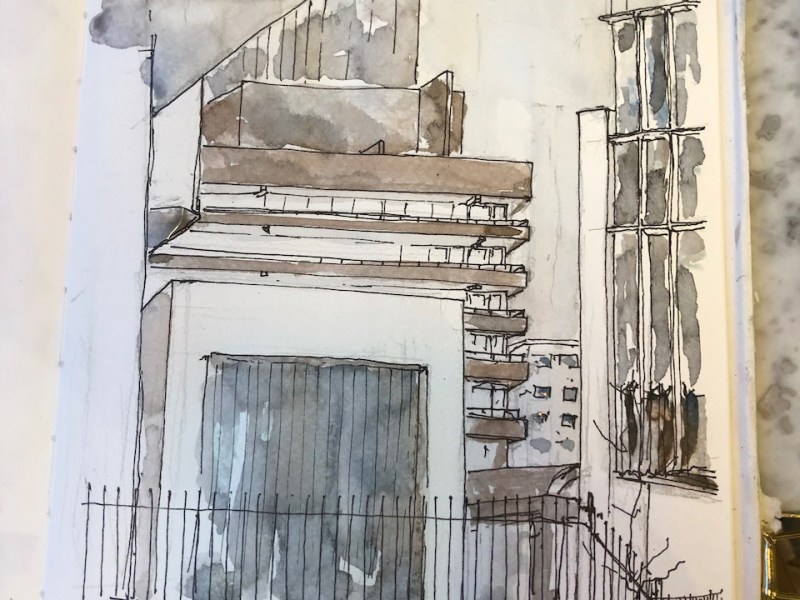
Here in another drawing in the area:
NOTES

1 Guildhall redevelopment 2002-2016

These dates and the cost of £112.6M are from a paper dated 21st April 2016, a concluding report of the Guildhall Improvement Committee. The paper was on this link: https://democracy.cityoflondon.gov.uk/documents/s63283/ITEM%2021%20-%20GIC%20-%20Closure.pdf

It can be downloaded from that link, or if not available there, try this link:

2 Giles Gilbert-Scott

Giles is the third in a line of architects. His son Richard followed him into the profession. From father to son here is the line:

  • George Gilbert-Scott (1811-78) – Albert Memorial, Midland Hotel, St Pancras Station
  • George Gilbert-Scott Junior (1839-1897)- St Agnes Kennington, [In 1884, he was declared ‘of unsound mind’]
  • Giles Gilbert-Scott (1880-1960) – Guildhall North Wing, Battersea Power Station, Telephone Kiosk, LMH Chapel, Bankside Power Station (=Tate Modern), Cambridge University Library, Cropthorne Court (Maida Vale)
  • Richard Gilbert-Scott (1923-2017) Guildhall Art Gallery, Guildhall Library

Giles Gilbert-Scott’s brother, Adrian Gilbert-Scott (1882-1963), was also an architect. He designed St Joseph’s Catholic Church in the Lansbury Estate in Poplar, East London.

Guildhall from St Mary Aldermanbury EC2

At the junction of Love Lane and Aldermanbury in the City of London, there is a small park. If you are in the area, it’s well worth a visit.

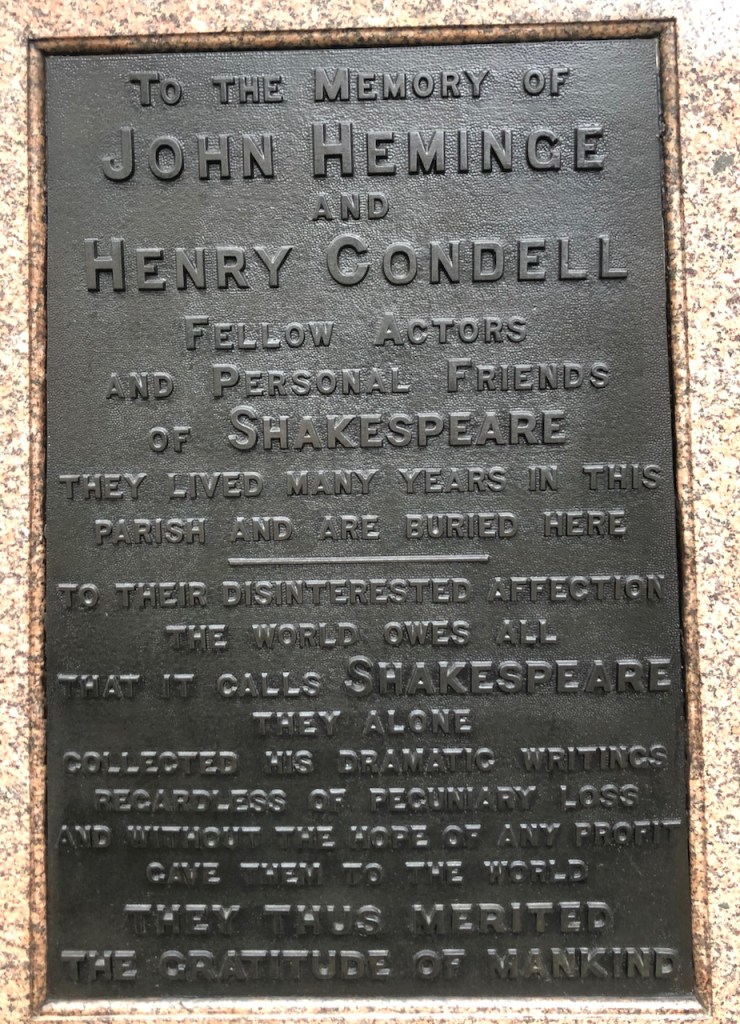
The parklet is on the site of St Mary Aldermanbury. A large marble plaque tells the history.

Site of the Church of St Mary Aldermanbury 
First mentioned in 1181. Destroyed by the  Great Fire in 1666. Rebuilt by Wren. 
Destroyed by bombing in 1940. The remaining 
fabric removed to Westminster College, Fulton, 
Missouri, USA 1966 and restored as a memorial 
to Sir Winston Churchill. 
This plaque placed by Westminster College.

The plaque has a picture of the restored church:

Picture in the plaque

I sat next to the plaque, under what must have once been the West window. Here is the view, looking South.

Guildhall West Wing, seen from St Mary Aldermanbury, 7″ x 9″ in Sketchbook 9. 17 March 2021

In the foreground of the picture you see ancient stones, which look like the bases of the pillars of the Nave. Evidently not quite all of the church was exported to Fulton, Missouri.

The two flowering trees are magnolia, currently in bud. Between them, on that raised garden, is a bust of Shakespeare, and a memorial to two actors who published Shakespeare’s First Folio.

To the Memory of  
John Heminge and Henry Condell Fellow Actors 
and Personal Friends 
of Shakespeare 
They lived many years in this  parish and are buried here 
--- 
To their disinterested affection 
the world owes all 
that it calls Shakespeare 
They alone collected his dramatic writings 
regardless of pecuniary loss 
and without the hope of any profit gave them to the world 
They thus merited  
the gratitude of mankind

Equally interesting is the inscription below this plaque:

“Given to the Nation by Charles Clement Walker Esq. Lilleshall, Old Hall, Shropshire. AD 1896”

Charles Clement Walker (1822-1897) was a benefactor for various memorials in London, according to this post on the marvellous “London Remembers” site. He was a wealthy civil engineer, employing 400 people in Shropshire.

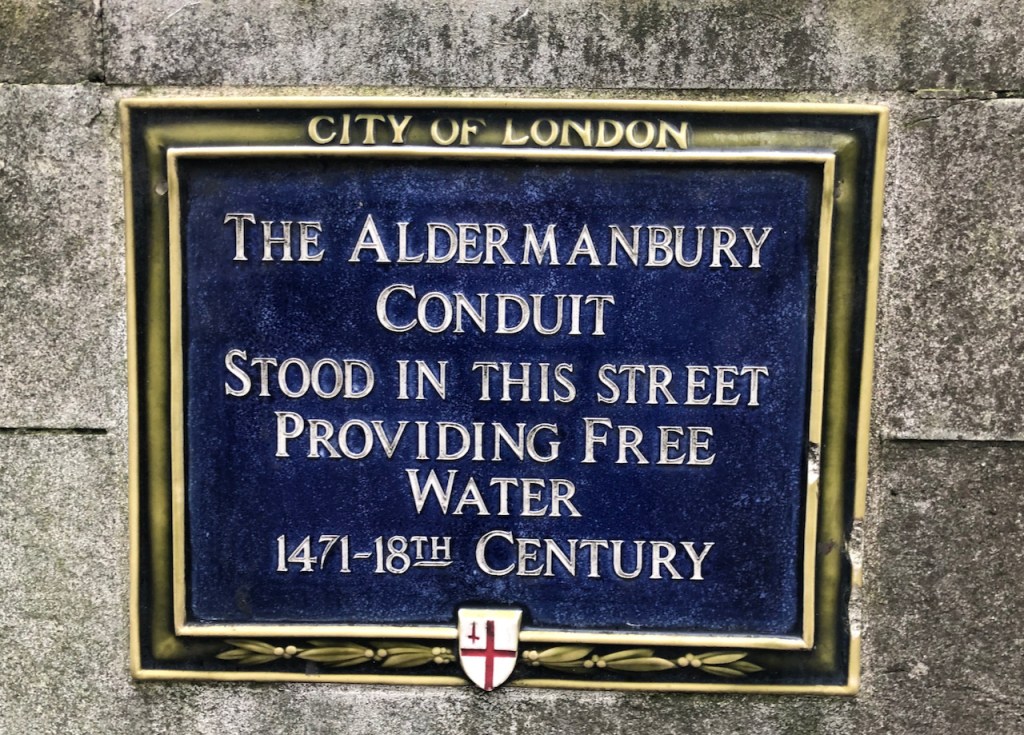
Near this monument is a tile let into the low wall:

The Aldermanbury 
Conduit
Stood in this street
Providing Free
Water
147-18th Century.

The water for this conduit originally came from the Tyburn river near Bond Street, according to a post in LostCityofLondon.co.uk.

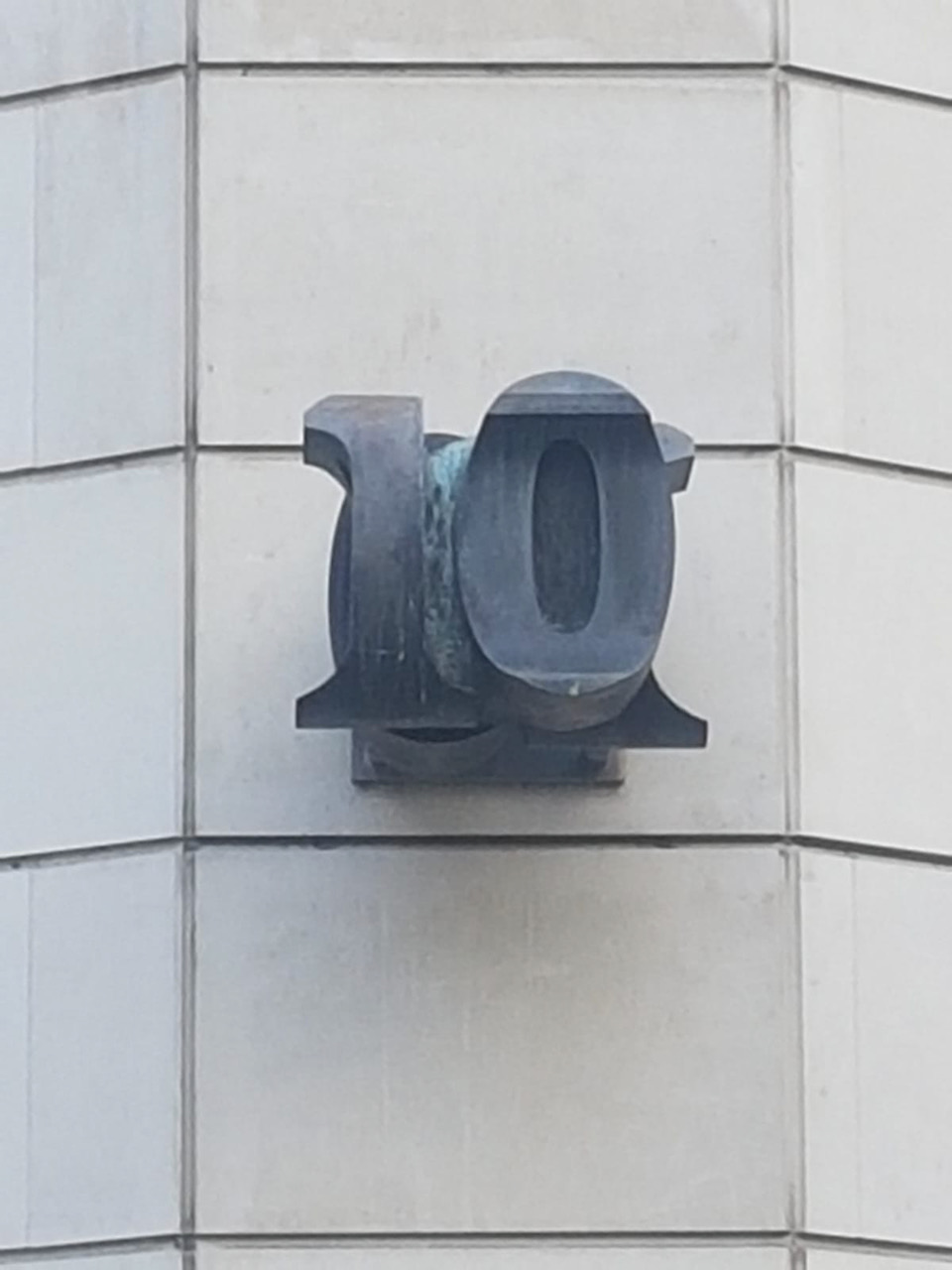
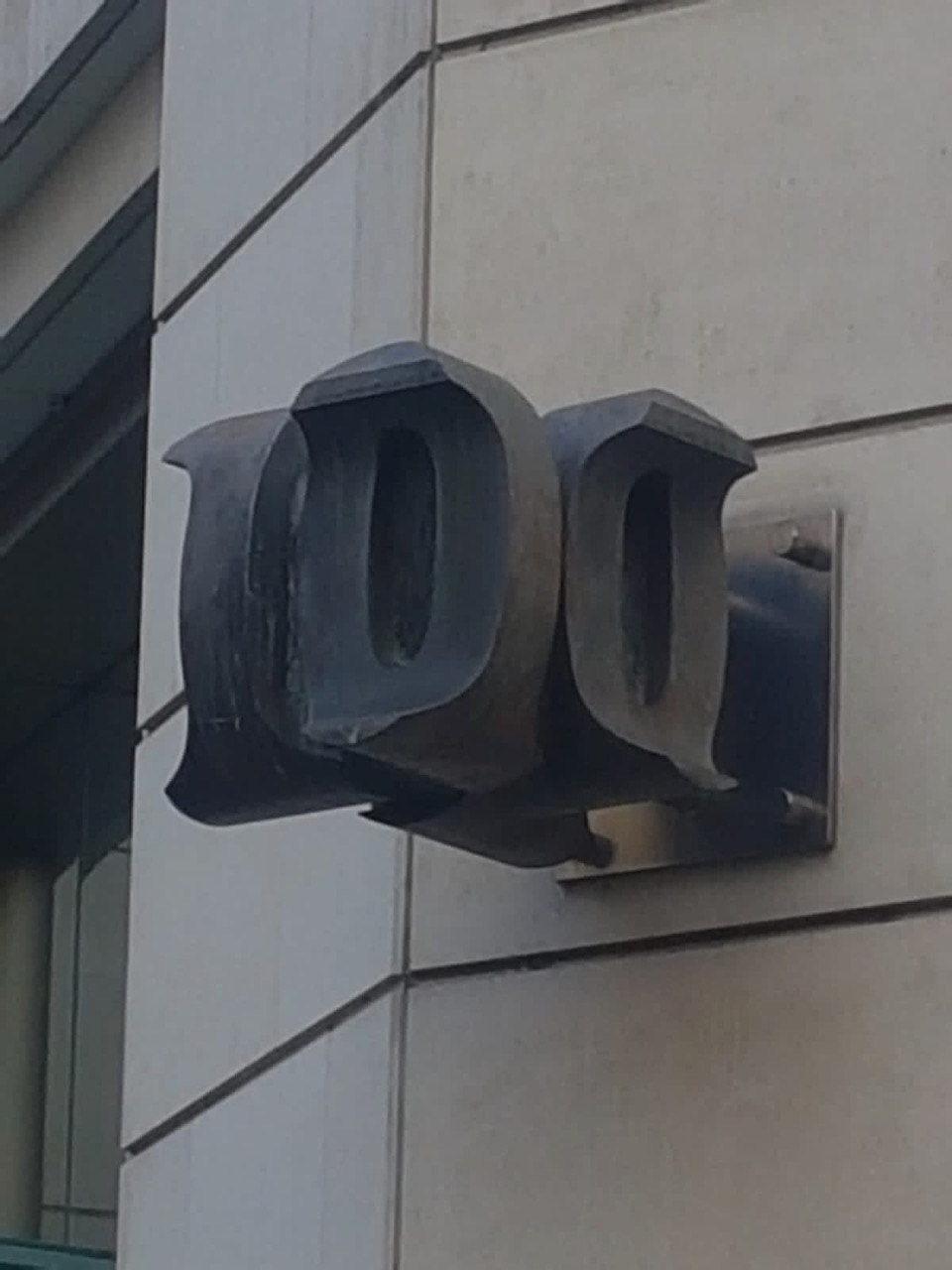
There is much of interest in this small space. Across the road is 10 Aldermanbury. This was built in 2000, by Legal and General as an HQ office for a broker called Flemings. It is now a multi-use office occupied by financial services and consultancy organisations. Do not miss the amazing artwork on the corner. At first I thought it was just a weird artwork. Then I realised it was the building number: 10.

The picture was drawn on location and coloured later. Here is work in progress and maps. I will return to this location, it’s a wonderful tranquil green spot. Recommended.

From Stanley Cohen House

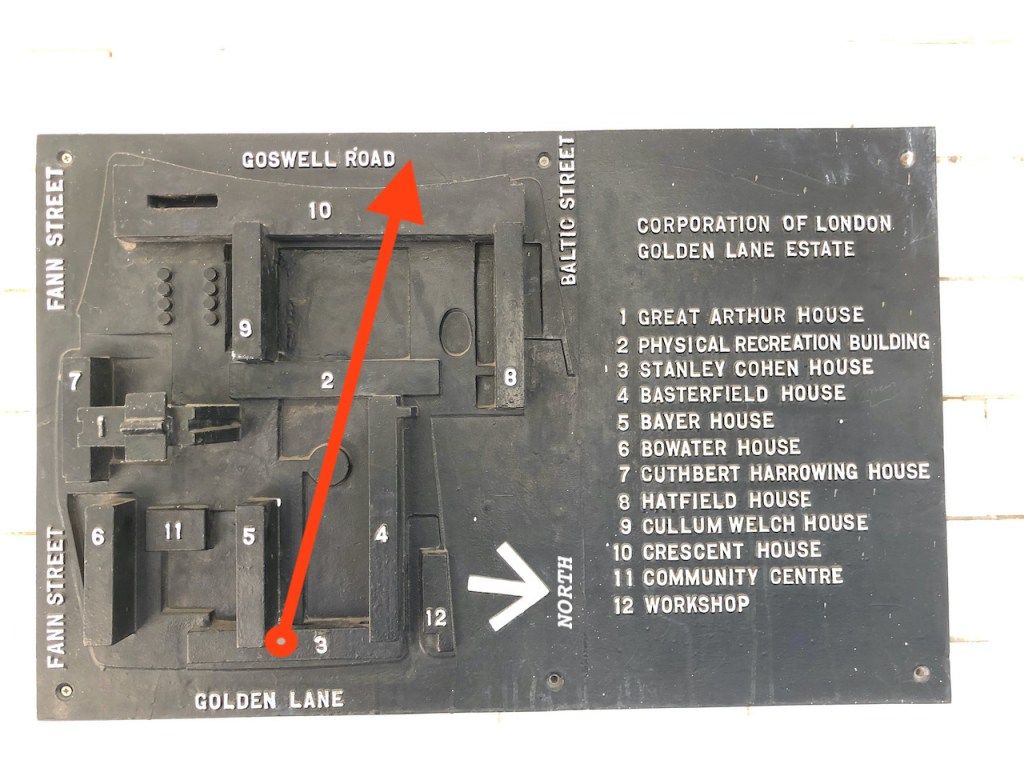
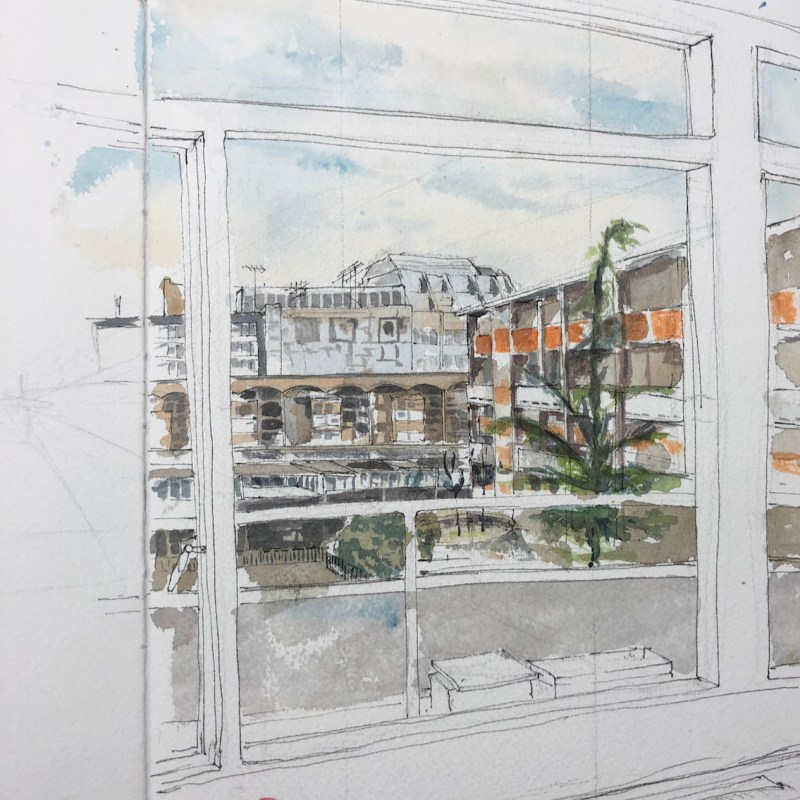
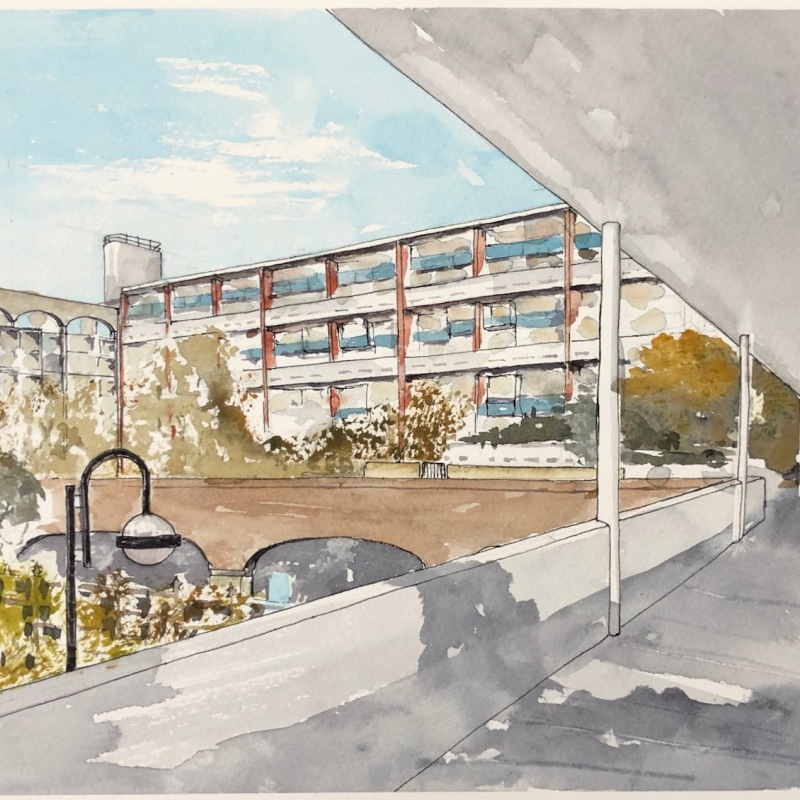
Here is the view from a top floor flat in Stanley Cohen House, Golden Lane Estate.

View from Stanley Cohen House, 7″ x 10″ in Sketchbook 9

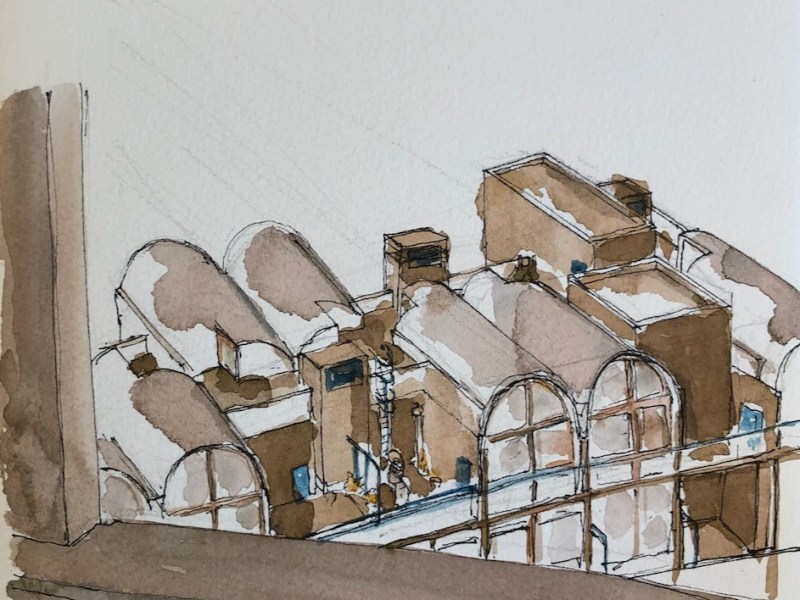
You can see right across the estate to buildings on the far side of the Goswell Road. That’s Basterfield House on the right, and Crescent House in the middle, with the scalloped roof.

Here are some maps:

“Outdoors Room” arrowed.

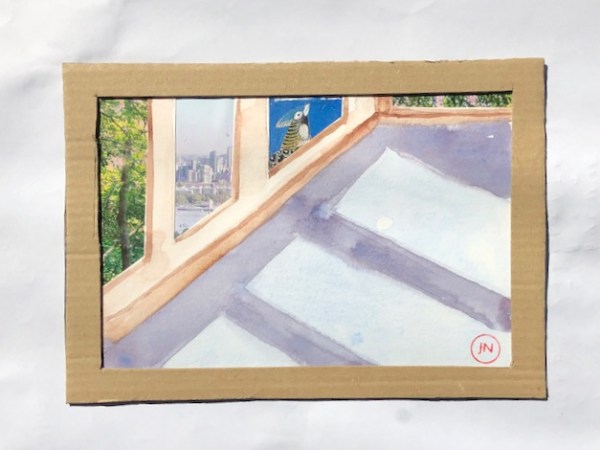
In the centre of this drawing is one of the features I particularly admire in the Golden Lane Estate. There is an “outdoors room” at Podium Level integrated into the Leisure Centre. The space feels like a room: it is roughly square and has a roof. On one side are glass windows which overlook the swimming pool, and on the other side the windows look down into the indoors exercise space. I feel sure that the architects in the 1970s anticipated that this outdoors space would be used for Yoga, or Martial Arts, or perhaps storytelling. They might have envisaged yoga mats, bean bags. It seems to me to be so clearly part of the Leisure Centre, that it must have been intended for a group exercise of some sort. It is now well maintained, but not used (as far as I can tell), except as a transit route. I drew a picture from there.

There was also an “outdoor room” on the way to the top floor flat in Stanley Cohen House, as well as splendid outdoor walkways with long views out to the west.

“Outdoor Room” on the top floor of Stanley Cohen House, Golden Lane Estate.

This generosity with public, communal and informal spaces seems to me to characterise a certain view of society, in which people would want to meet, improvise, and interact with strangers and neighbours. There is a certain value placed on “empty” and unallocated space: it represents “possibility” offered to residents, who may have better ideas than the architects about how to use their space. This shows humility and humanity in the design. A vacant outdoor room represents an invitation to residents and passers-by: “come in, make of this what you will, do something here”. There is a space in which to pause and breathe. It is very different from the modern developments, such as the Atlas Building or Eagle Point, whose stark vertical walls cut off the Outside from the Inside. Every square inch has an allocated use. The architects have decided in advance which space is to be a “lounge” or a “cinema” or a “gym”. There is no “empty” communal space. The designers have decided in advance what you will do here.

I applaud the empty spaces and white-walled “outdoor rooms” in the Golden Lane estate, just as I value the huge areas of unadorned public space in the Barbican: they are places in which your mind is free. Long may they remain.

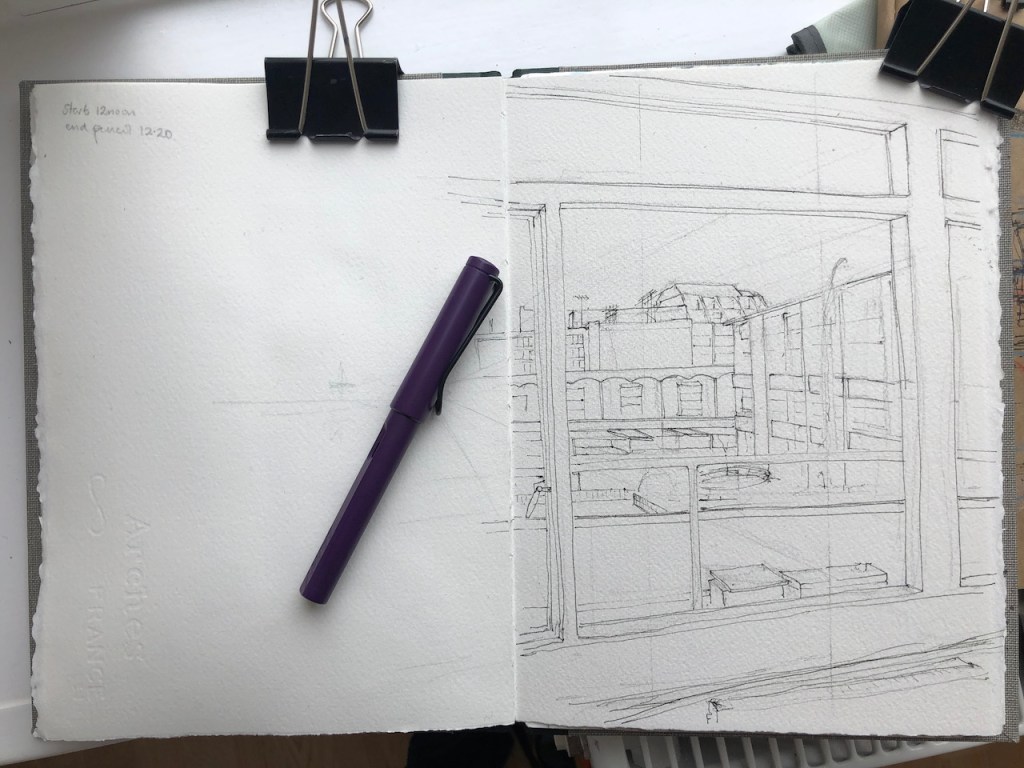
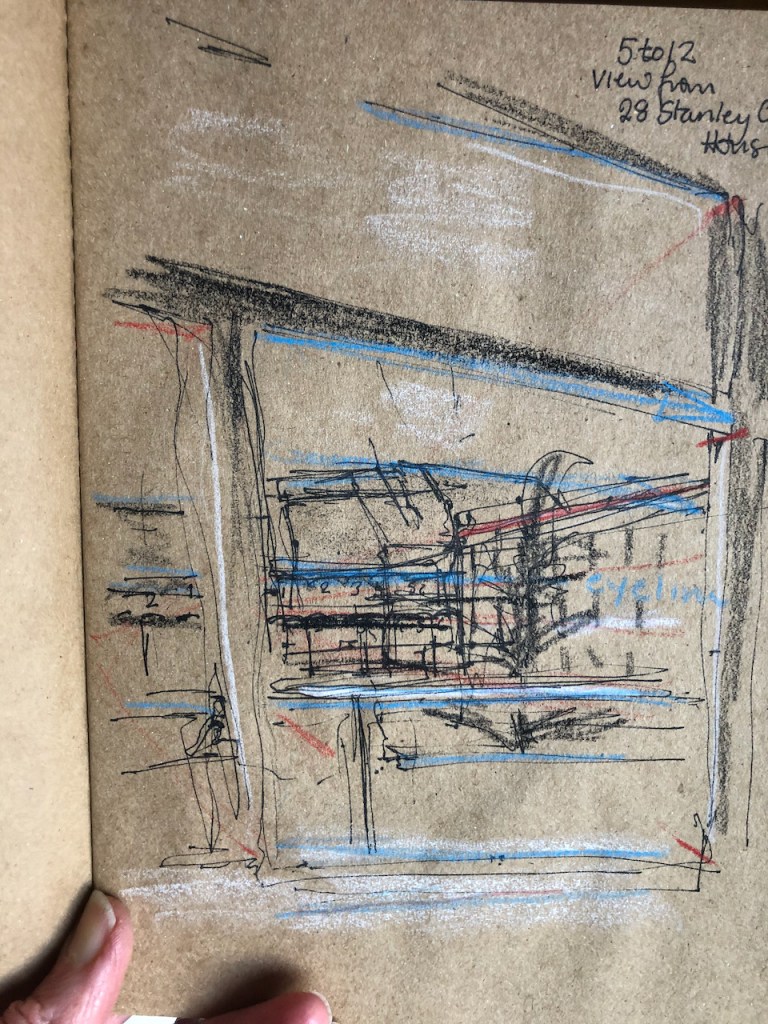
I perhaps had these thoughts because I was drawing my picture from an empty unfurnished flat. I was kindly given access by the owner, while the flat was being redecorated between tenants. Here is work in progress on my drawing.

The main colours in this picture are: Phthalo Blue Turquoise (W&N), Prussian Blue (Jacksons), Perylene Maroon (DS), Mars Yellow (DS), plus Transparent Pyrrol Orange (DS) for the balconies on Basterfield House, and a small bit of Green Gold (DS) on the lighter parts of the tree.

Here are tools:

Here is a list of the drawings I have done in the Golden Lane Estate:

Something went wrong. Please refresh the page and/or try again.

St Magnus the Martyr

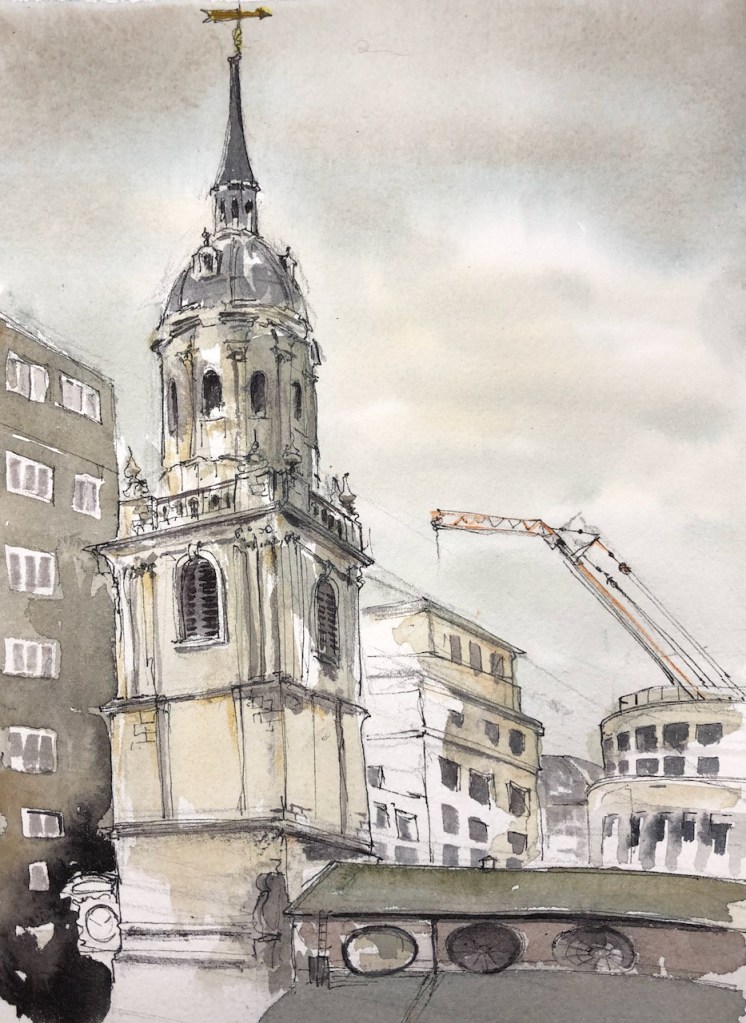
Here is a view of St Magnus the Martyr, a Wren church next to London Bridge.

St Magnus the Martyr, 7″ x 10″, in sketchbook 9

St Magnus Martyr has a foundation that goes back before the first stone bridge across the Thames, which was built in 1209.

The church of St Magnus Martyr escaped the fire of London Bridge in 1633. However it was one of the first churches to be destroyed in the Great Fire of London in 1666. It is only a few hundred yards from Pudding Lane, where the fire started. The present church was built 1671-76 to the designs of Christopher Wren. The steeple which I have drawn was added in 1703-6.

At this time, the road going to London Bridge was just to the left (west) of the Church. The clock which you see in my picture, bottom left, hung over the road. I have all this information from the extensive history set out on the St Magnus Martyr website, which includes this marvellous story about the clock:

It was presented to the church in 1709 by Sir Charles Duncombe (Alderman for the Ward of Bridge Within and, in 1708/09, Lord Mayor of London). Tradition says “that it was erected in consequence of a vow made by the donor, who, in the earlier part of his life, had once to wait a considerable time in a cart upon London Bridge, without being able to learn the hour, when he made a promise, that if he ever became successful in the world, he would give to that Church a public clock … that all passengers might see the time of day.” The maker was Langley Bradley, a clockmaker in Fenchurch Street, who had worked for Wren on many other projects, including the clock for the new St Paul’s Cathedral.

The current London Bridge was built 1825-1831. It is a little upstream (west) of the old London Bridge, so the approach road no longer goes past St Magnus Martyr.

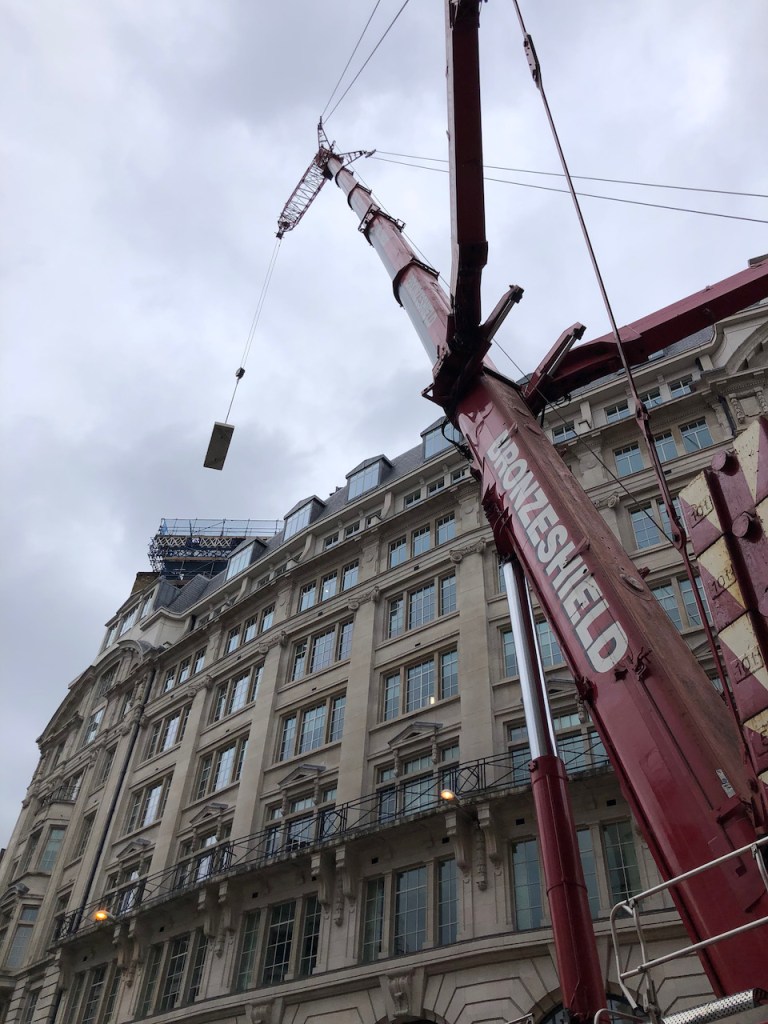
The crane in my picture is at the junction of Gracechurch St and Eastcheap, next to Monument Station. It occupies the whole width of Gracechurch Street. It appears to be lifting concrete blocks onto the top of the building that was, for a short while, House of Fraser.

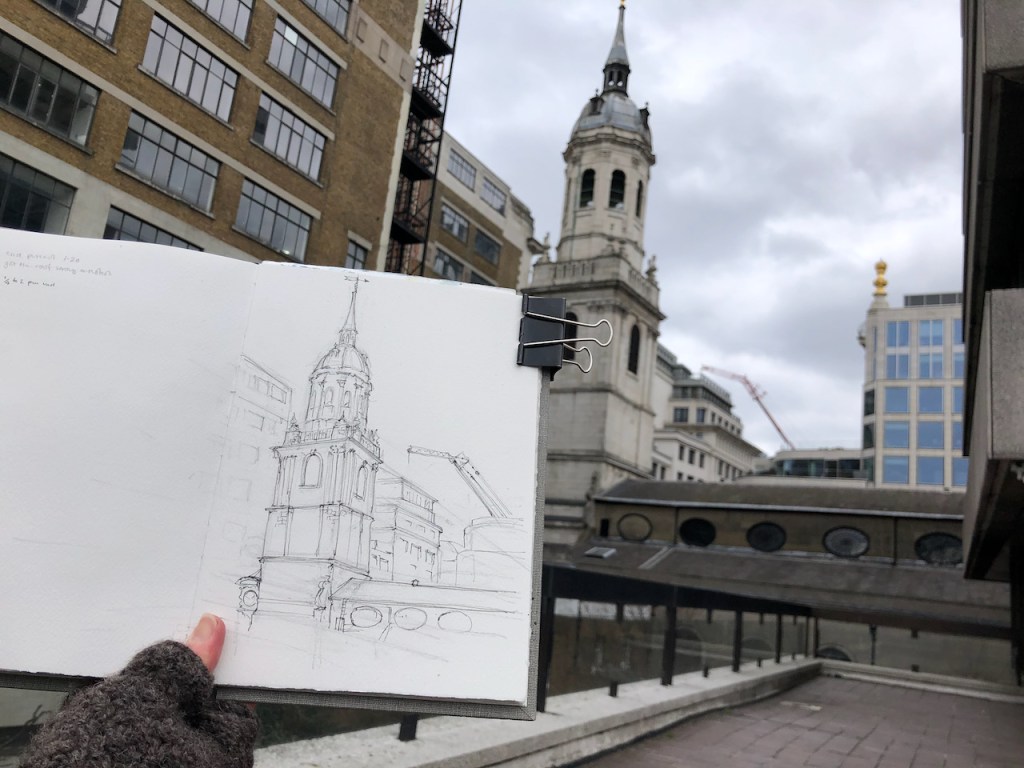
I drew this from a deserted platform, high up near the river Thames.

Inked on location, coloured back home. The outside air temperature was 4 degrees C.

St Albans, Wood Street, EC2

Here is the tower of the former church, St Albans. It stands firmly in the middle of Wood Street, in the City of London.

35 Wood Street. Tower of the former St Albans. 8″ x 10″

This is no longer a church. It’s listed as residential: some lucky person lives in there!

  • Foundation:medieval
  • Rebuilt 1634
  • Burnt down in the Fire of London 1666
  • Then rebuilt to a design by Christopher Wren 1685
  • Restored to designs by George Gilbert Scott 1858-9
  • Pinnacles replaced 1879
  • Then destroyed in the Blitz 1940
  • Listed Grade II* 1950

Here’s a link with more information about this building, including pictures of what it used ot look like.

St Alban, Wood Street: an old library book and a lonely church tower

Plumage House, N1

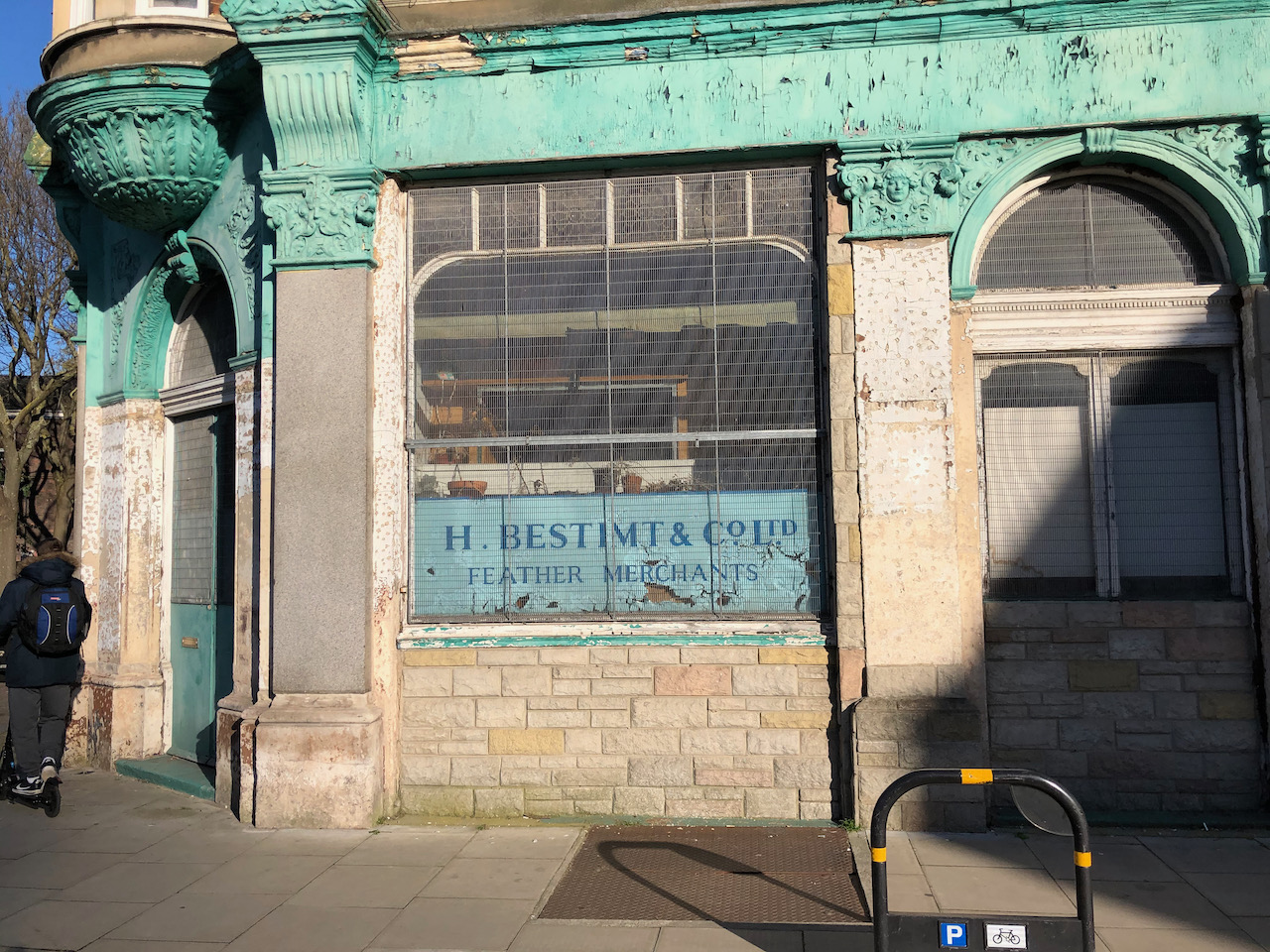
Here is Plumage House, 106 Shepherdess Walk, London N1.

Plumage House, 7″ x 10″

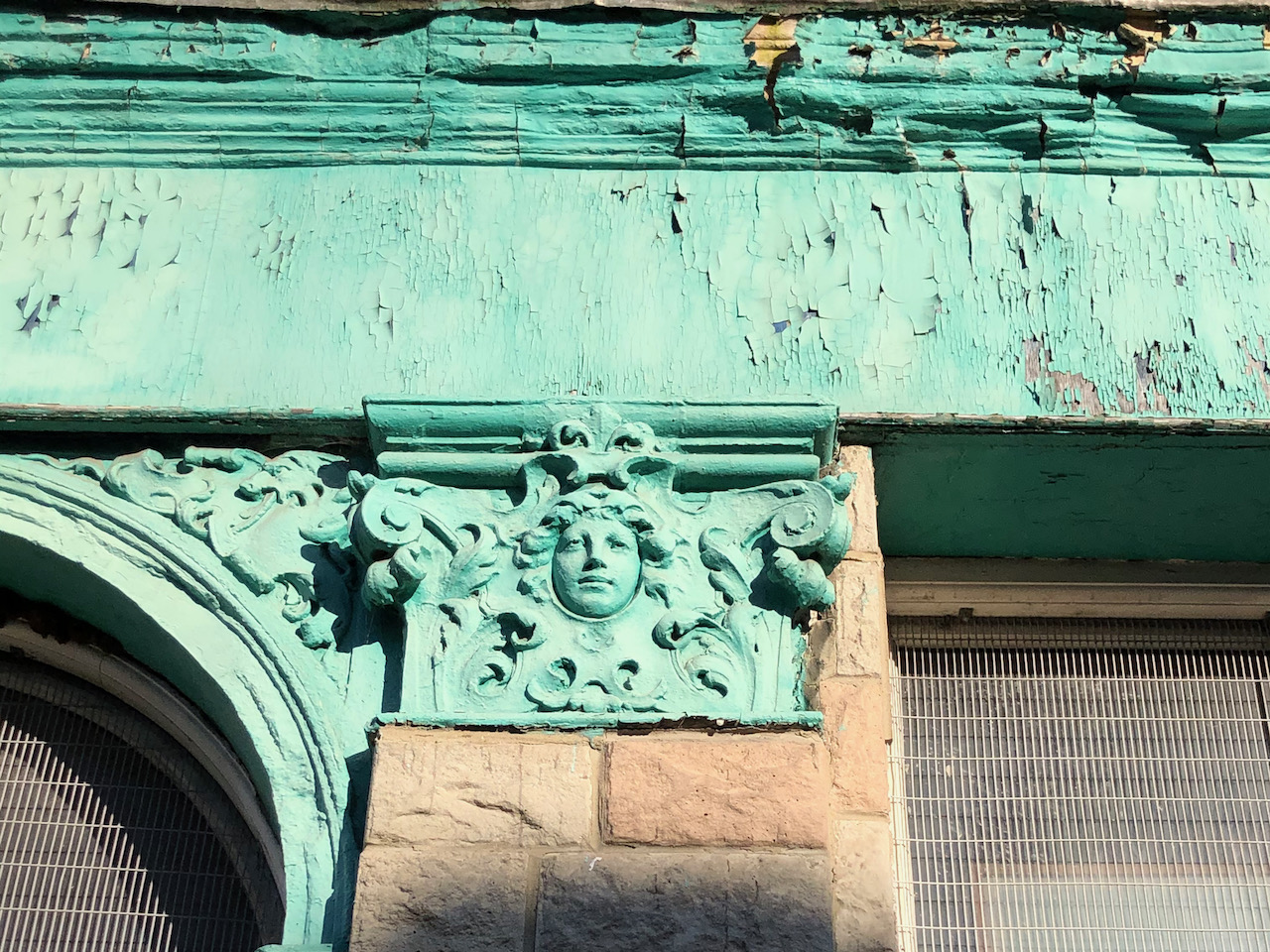
This was a feather factory. According to Spitalfields Life this operated until 1994. The building is now rather shabby, though in a dignified way.

I wonder what will happen to it?

In the drawing, the main colours are Fired Gold Ochre, Buff Titanium, Phthalo Turquoise, and Perylene Maroon, with Mars Yellow and Green Apatite Genuine for the green.

Shepherdess Walk (the main street North-South) and the location of Plumage House.

A Townhouse in Shoreditch

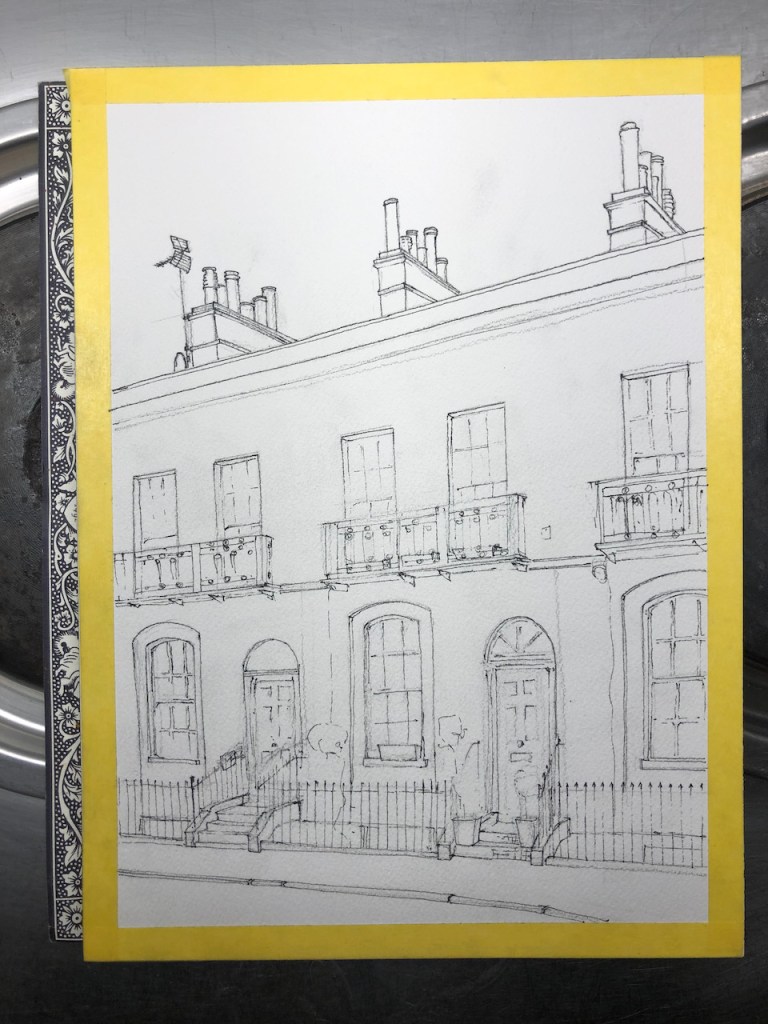
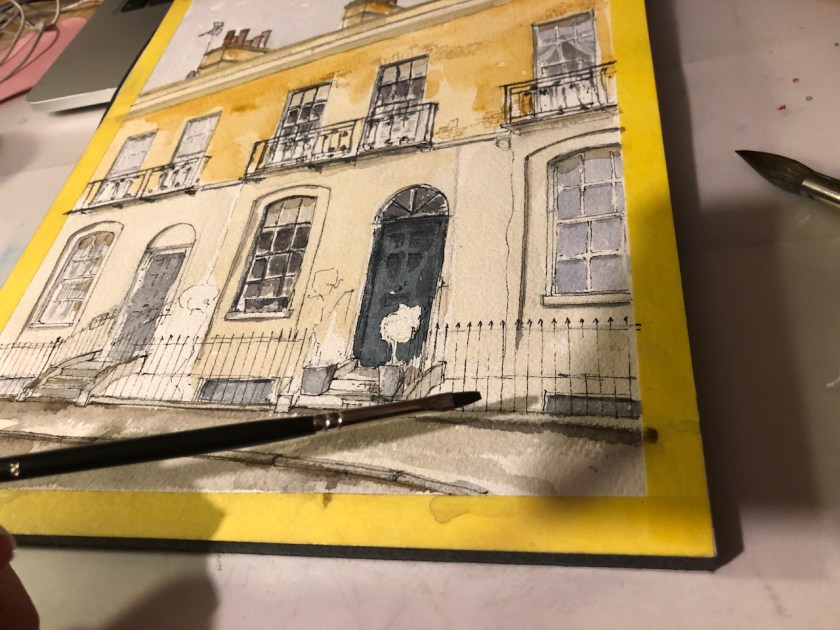
This house is in a lovely row of Georgian houses in Shoreditch, London N1

A Townhouse in Stoke Newington, Hackney, N1. 9″ x12″ [SOLD]

The drawing was done for the people who live in the house.

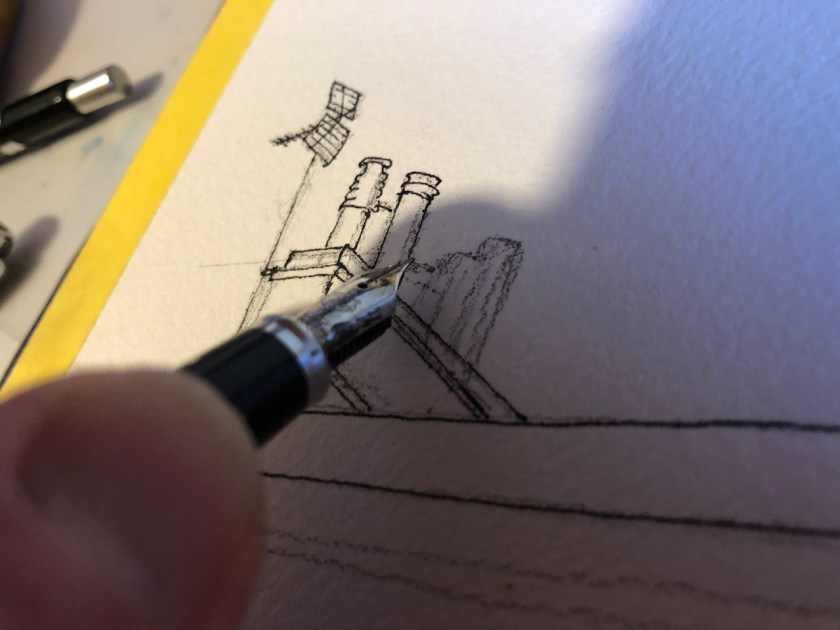
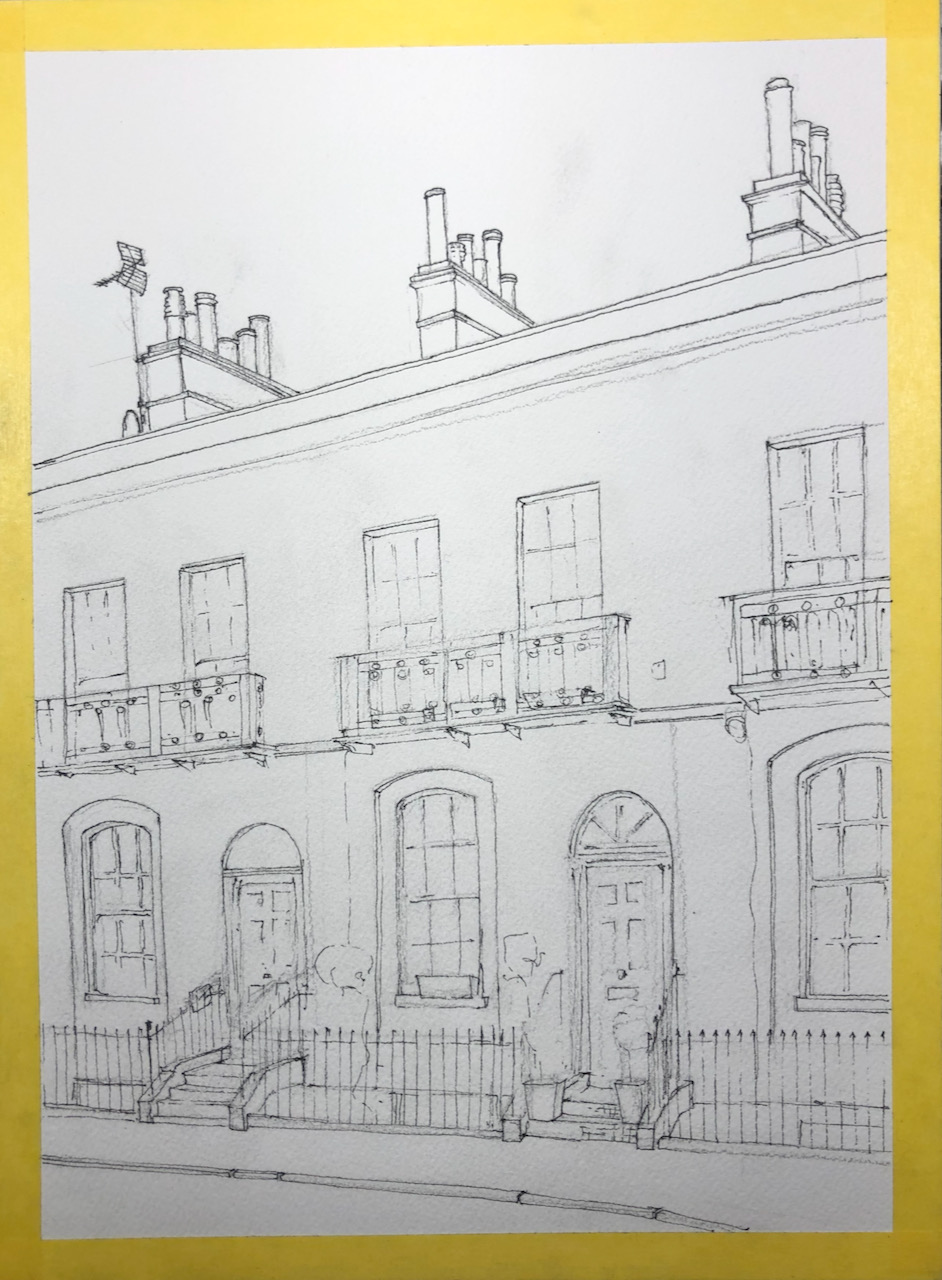
I made the drawing from sketches on location, photographs, and memory. Here is work in progress:

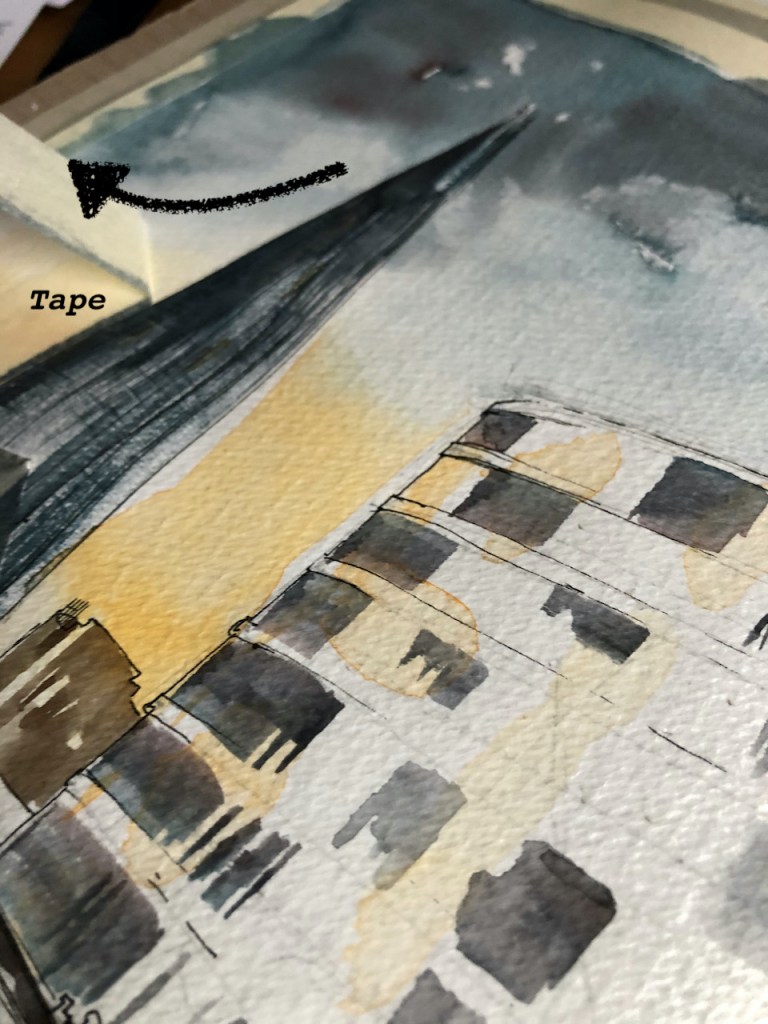
Here is a juxtaposition of the “ink” image with the “colour” image. Move the slider to compare the two. The yellow frame round the ink image is masking tape, which I use to protect the edges of the picture while I am working.

The colours used in this sketch are: Mars Yellow, Buff Titanium, Phthalo Turquoise (W&N), Perylene Maroon, Prussian Blue, Lavender, and Fired Gold Ochre. All colours are Daniel Smith except the Phthalo Turquoise which is Winsor and Newton. The ink is De Atramentis Document Ink Black, which is waterproof, applied with a Sailor fountain pen (pictured). The brushes I used were:

  • Rosemary Brushes Series 302 size 2, which is a small flat brush, useful for windows,
  • Rosemary Brushes “Rose of England” series 201 size 12 which is a large synthetic round brush. It goes to a fine point as well, so it’s incredibly useful.
  • I did the railings and other small details with a Winsor and Newton Series 7 size 2 sable round brush.

The paper is Arches 300gsm cold-pressed (“NOT”) 9″ x 12″ in a block.

Thank you to @ministry_of_junk for the commission!

Cromwell Tower from the Podium

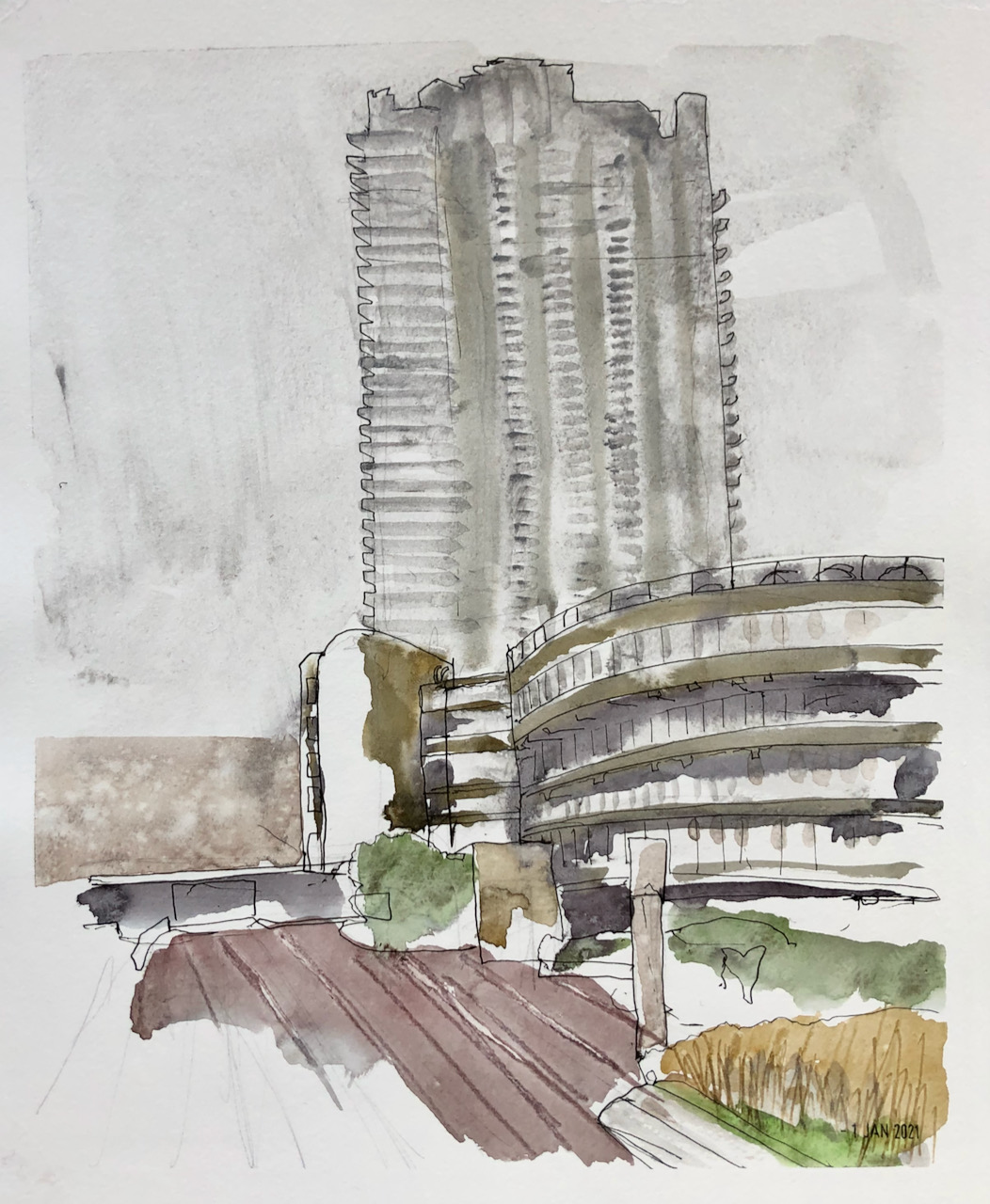
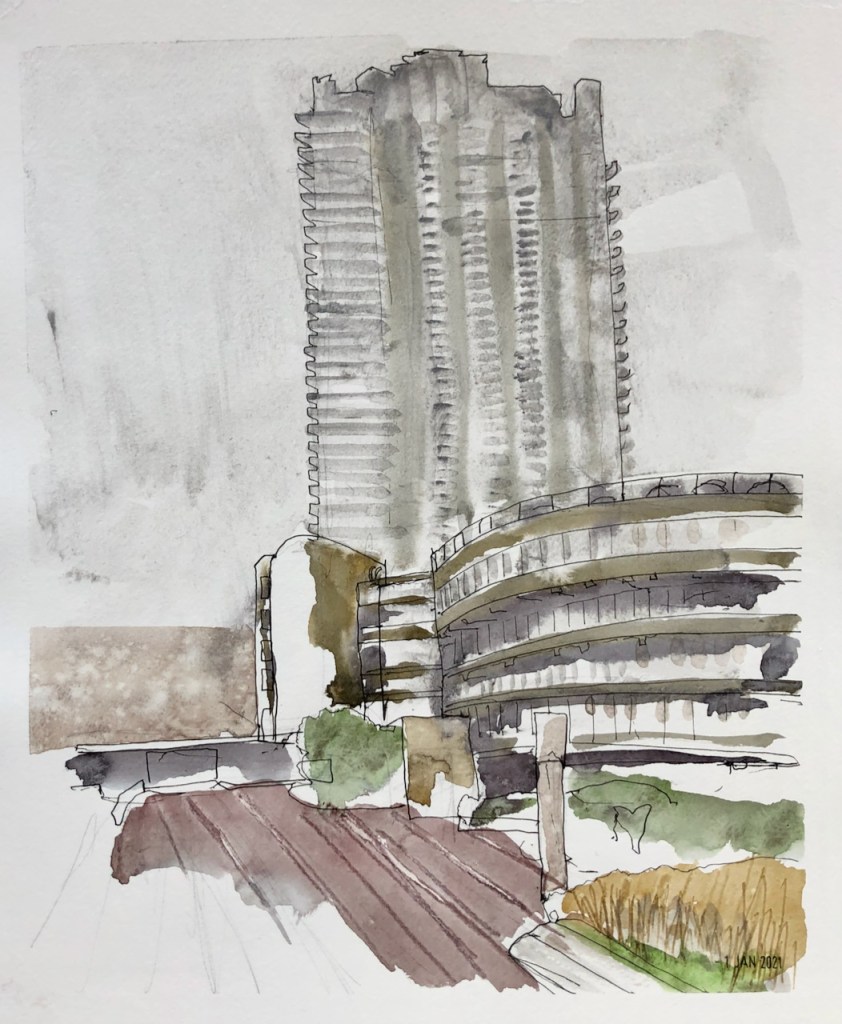
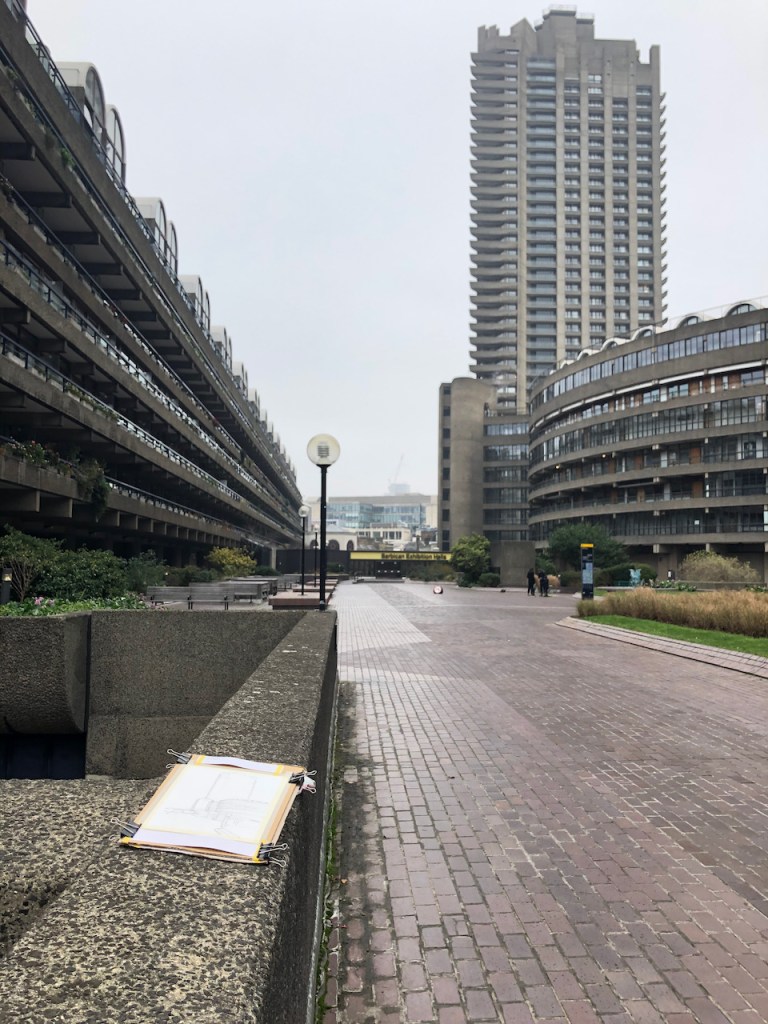
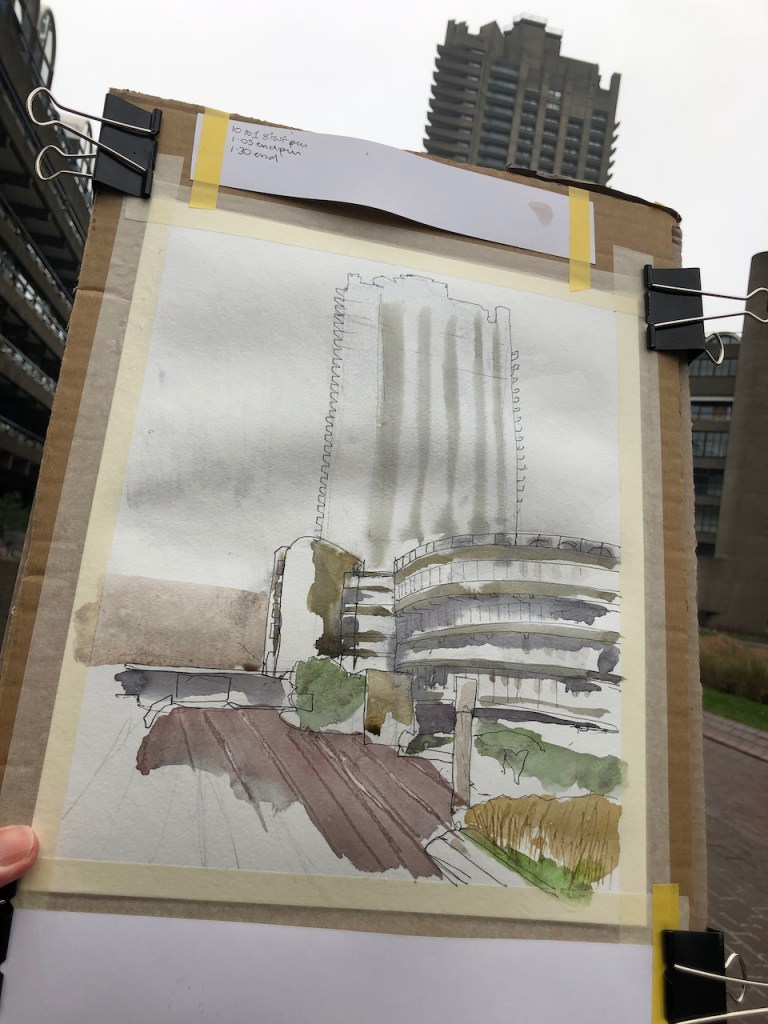
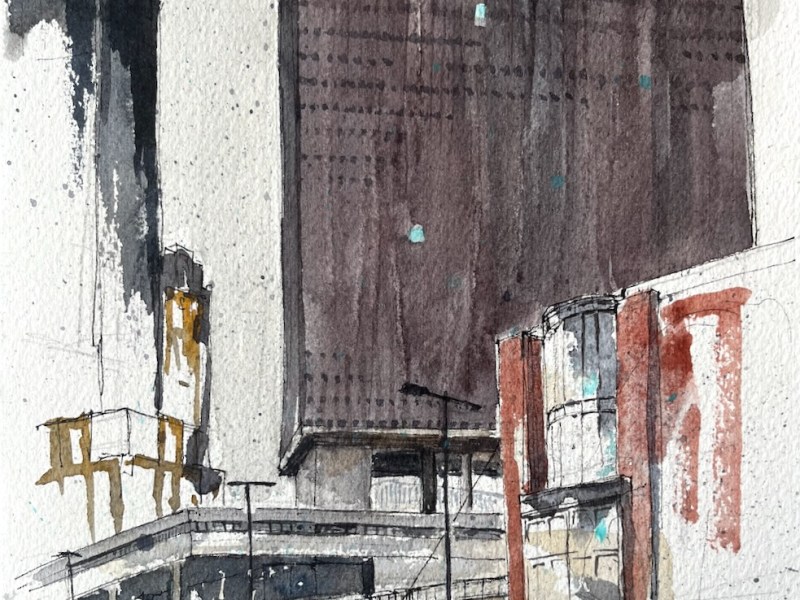
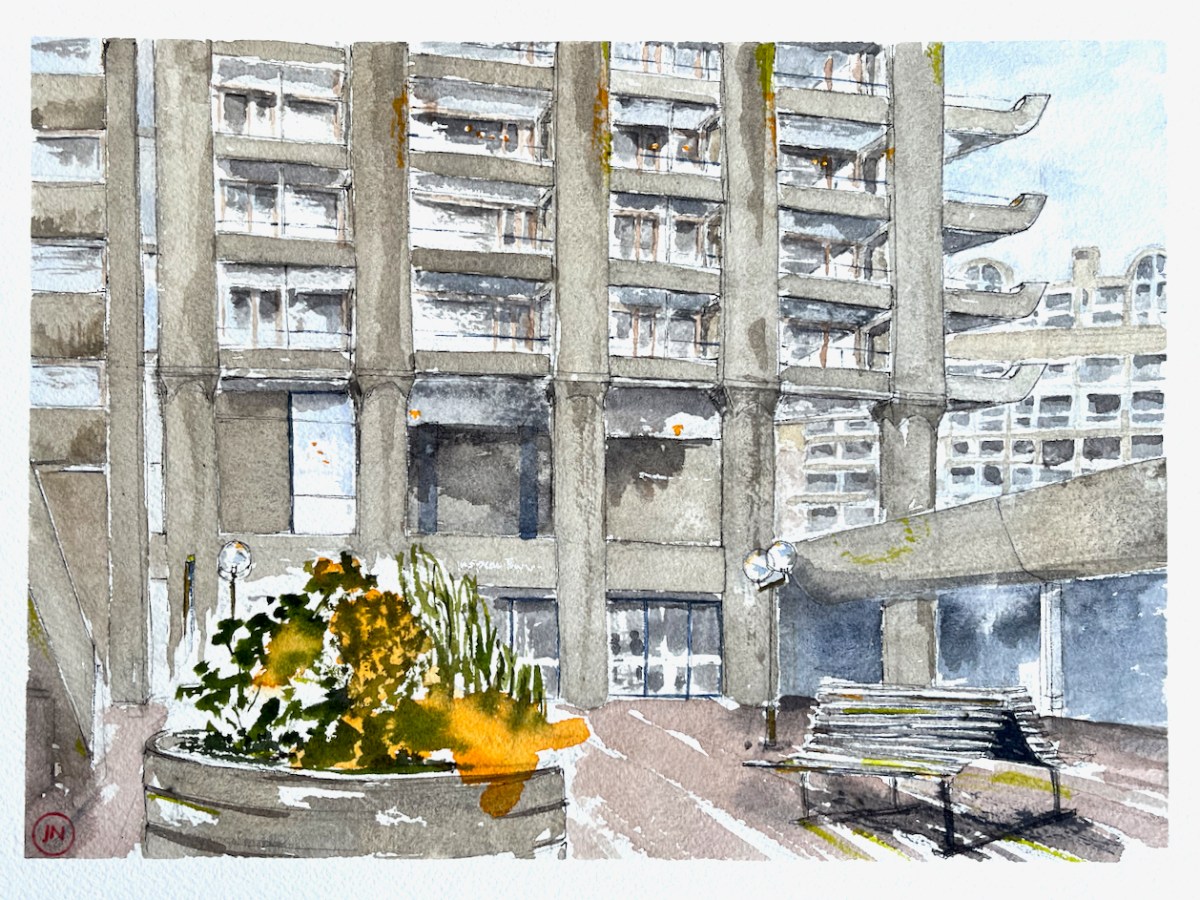
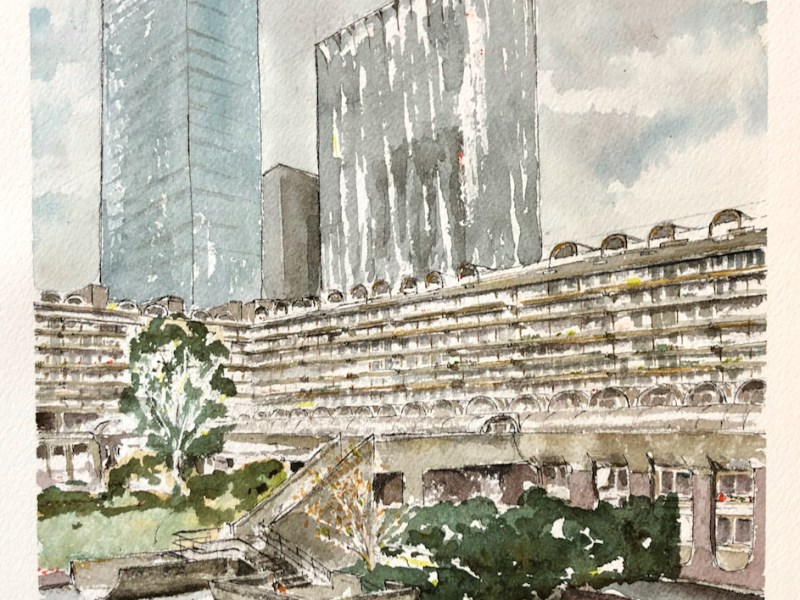
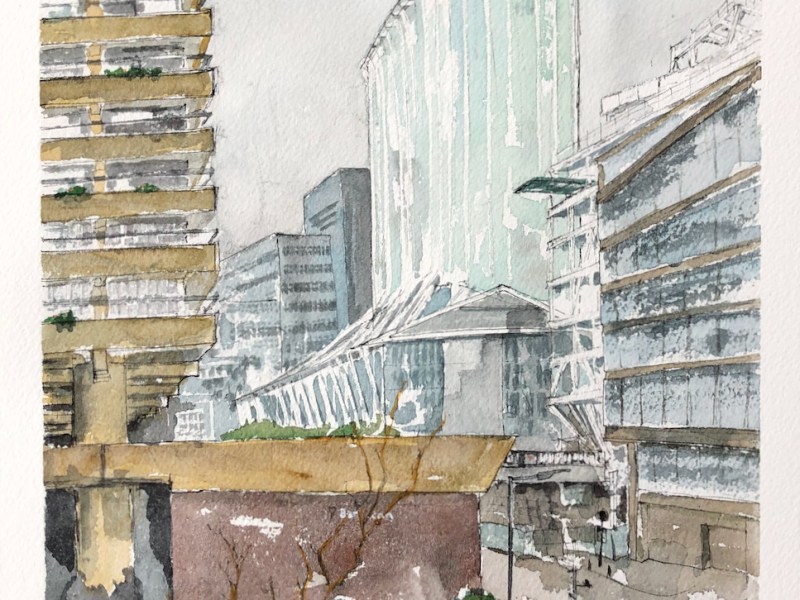
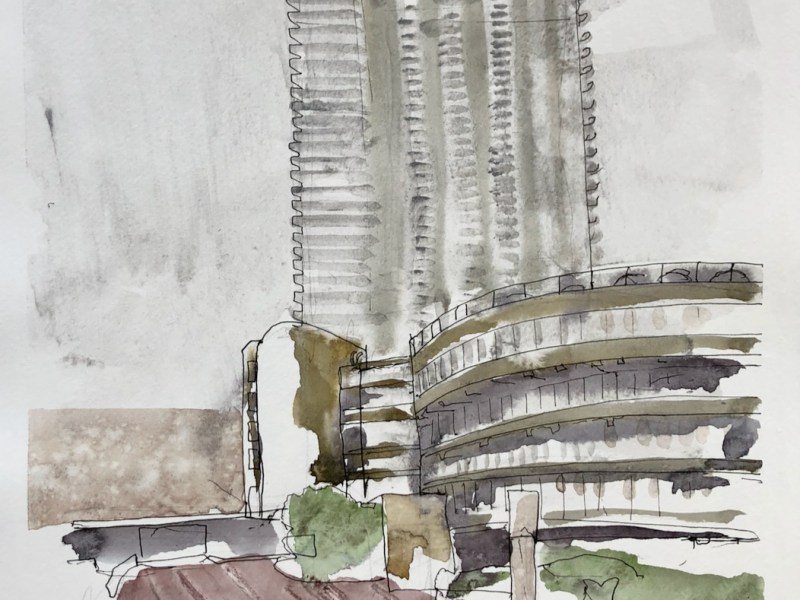
Here is Cromwell Tower, in the Barbican, with Frobisher Crescent to the right, sketched pre-lockdown, from the Podium.

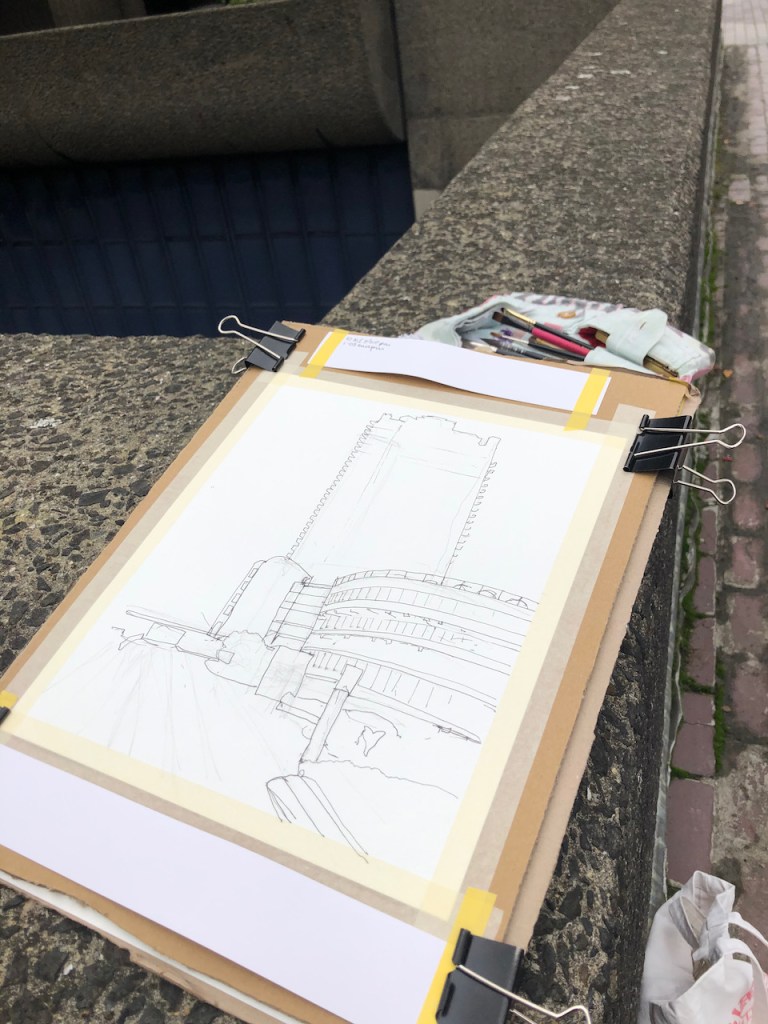
Cromwell Tower from the Barbican podium, 1st January 2021, 10″x 12″

This was a very cold day, and it started to sleet. That pitted effect you see on the left? That’s not a clever artistic technique, that’s ice crystals dropping on the painting from the sky!

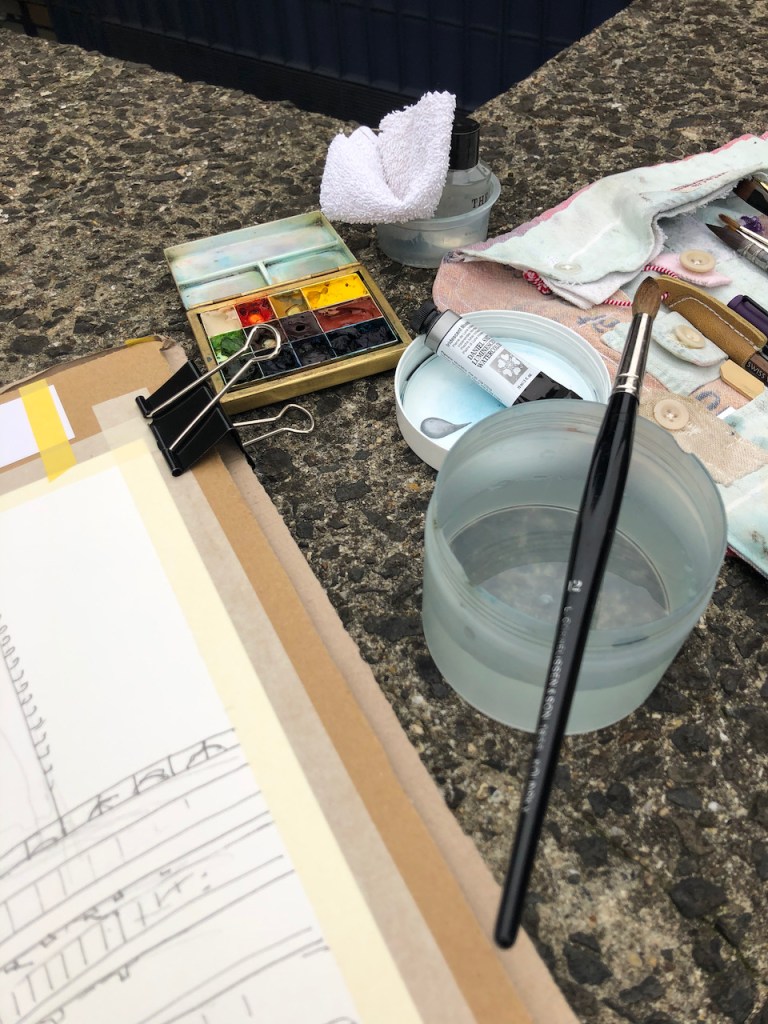
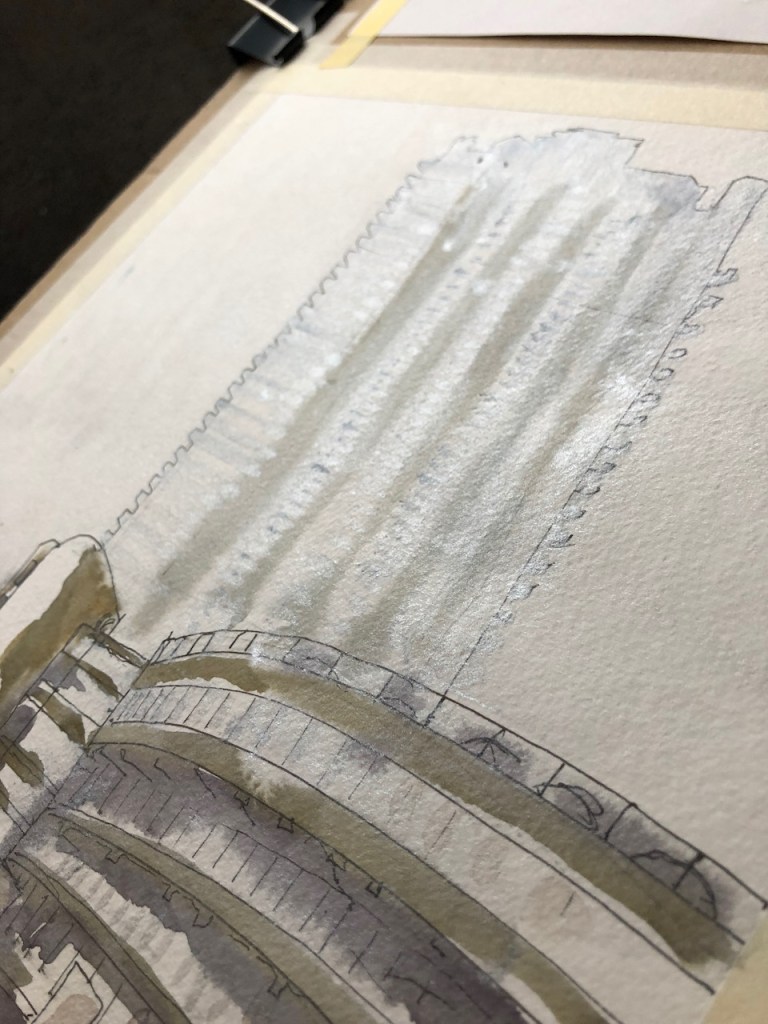
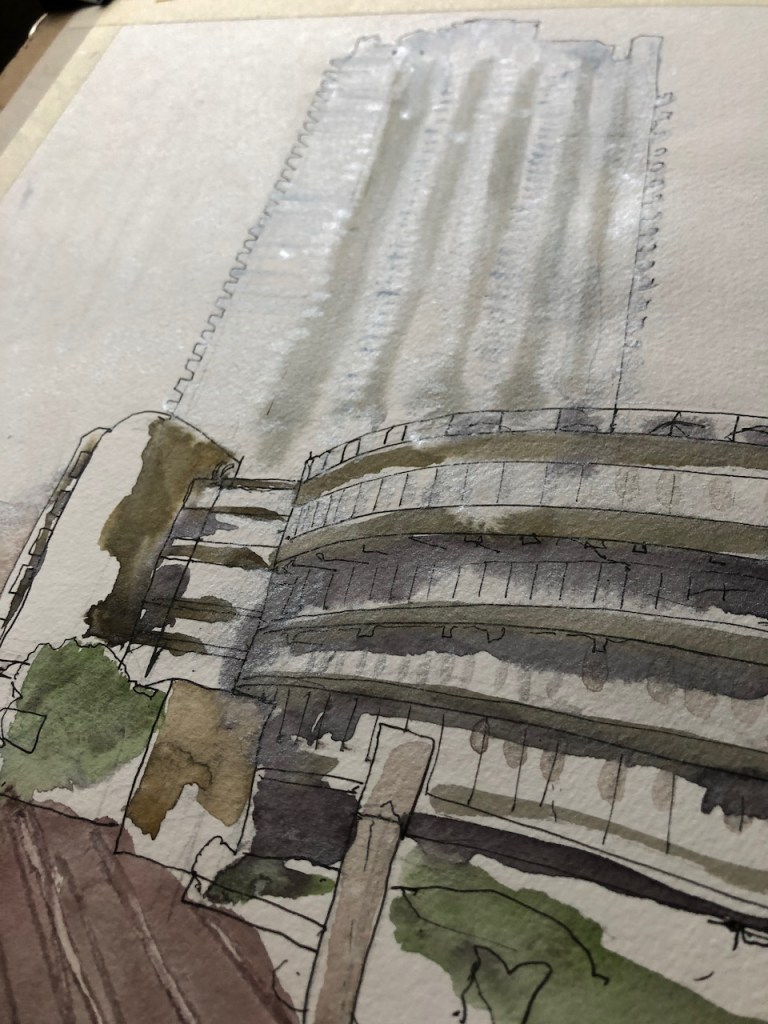
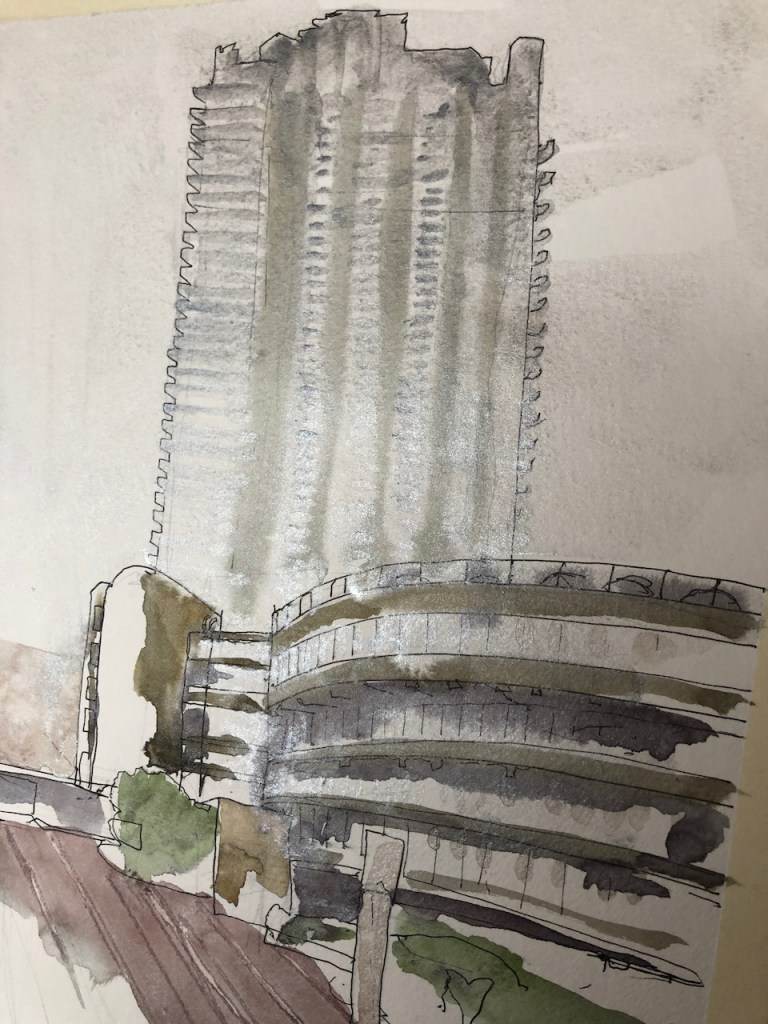
I finished off the tower indoors. I used Daniel Smith Iridescent Moonstone watercolour paint. See how it catches the light!

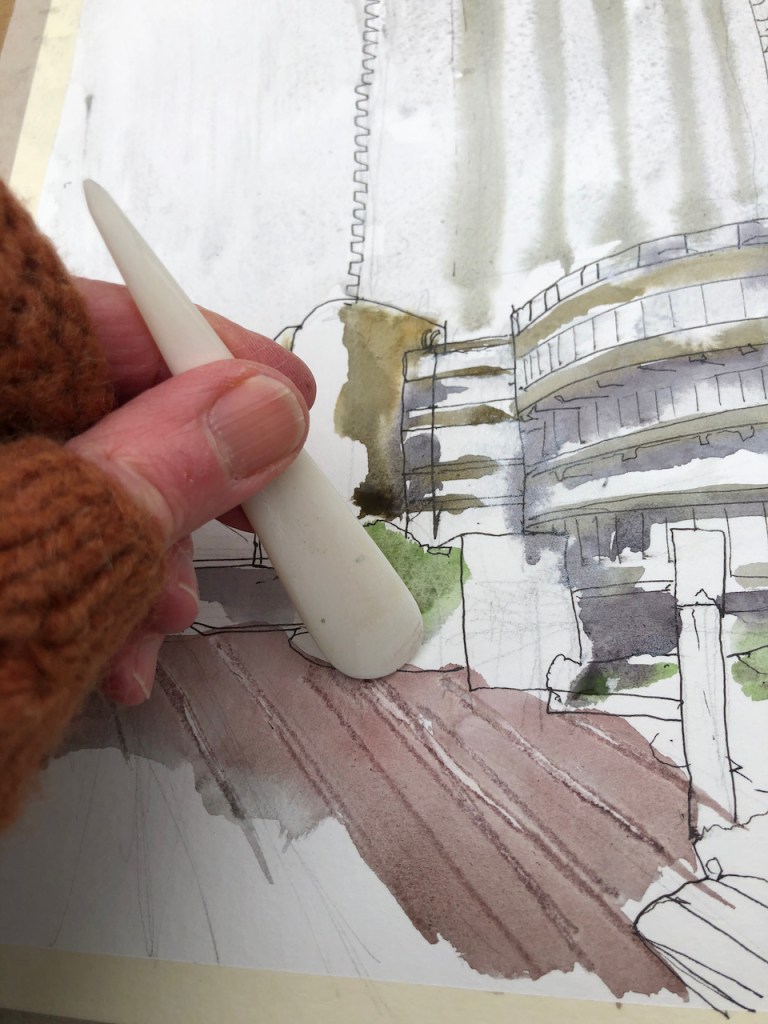
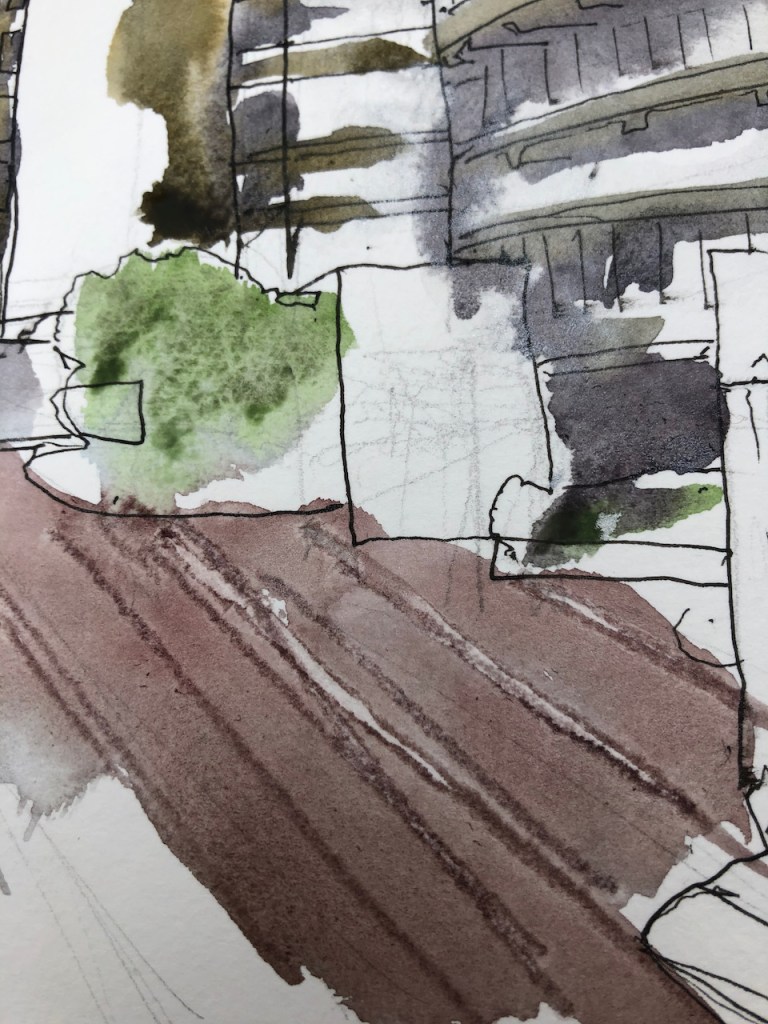
For the podium tiling I used an experimental effect: scratching. I was in a bit of a hurry (it was really cold) and it was hard to get the angle right as I was holding the painting and standing up. It created an interesting effect, not quite what I intended, but I liked it.

This is one of a series of drawings on Jackson’s watercolour sheets: 10″ x 12″ cold-pressed, 300gsm. The bone implement I used for scratching is from the Vintage Paper Company and is a “bone folder”, intended for folding paper. It is good because it is not entirely sharp, and it’s nice to hold.

The colours are Daniel Smith watercolours: Prussian Blue, Perylene Maroon, and Mars Yellow, with a bit of Green Apatite Genuine for the plants, and Iridescent Moonstone mixed in, especially for the tower.

I’ve drawn in and around the Barbican before. Here’s a collection: (click “load more posts” to see more posts of the Barbican.)

Something went wrong. Please refresh the page and/or try again.

The Shard from The Tower

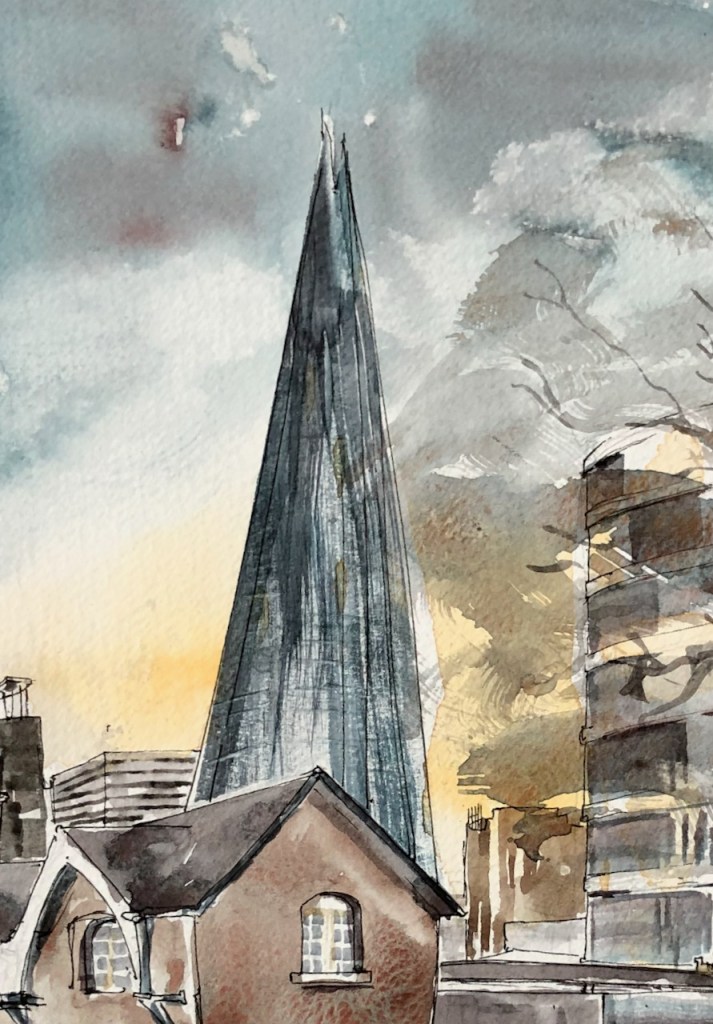
From the Tower of London on the North bank of the Thames, you can see the Shard on the South Bank.

The Shard from The Tower, 3rd Jan 2021, 12″ x 10″

Pre-lockdown, I sketched this sitting on a stone bench on the slope to the West of the Tower of London. There were seagulls in the air. Children hurtled down the slope on bicycles, with parents jogging awkwardly behind. Young people threw their arms around each other and photographed themselves.

I worked on my drawing.

It started to rain. Then it really poured with rain. The children scuttled under the overhanging roof of the visitor centre. The young people laughed and rushed off. I had to pack up very quickly. The seagulls remained.
I had finished the pen and ink. I added the colour at home. I tried out some experimental techniques.

For the cobbles I used the wrapping of a pack of mandarin oranges.

To get the sharp edges of the Shard, I used masking tape.

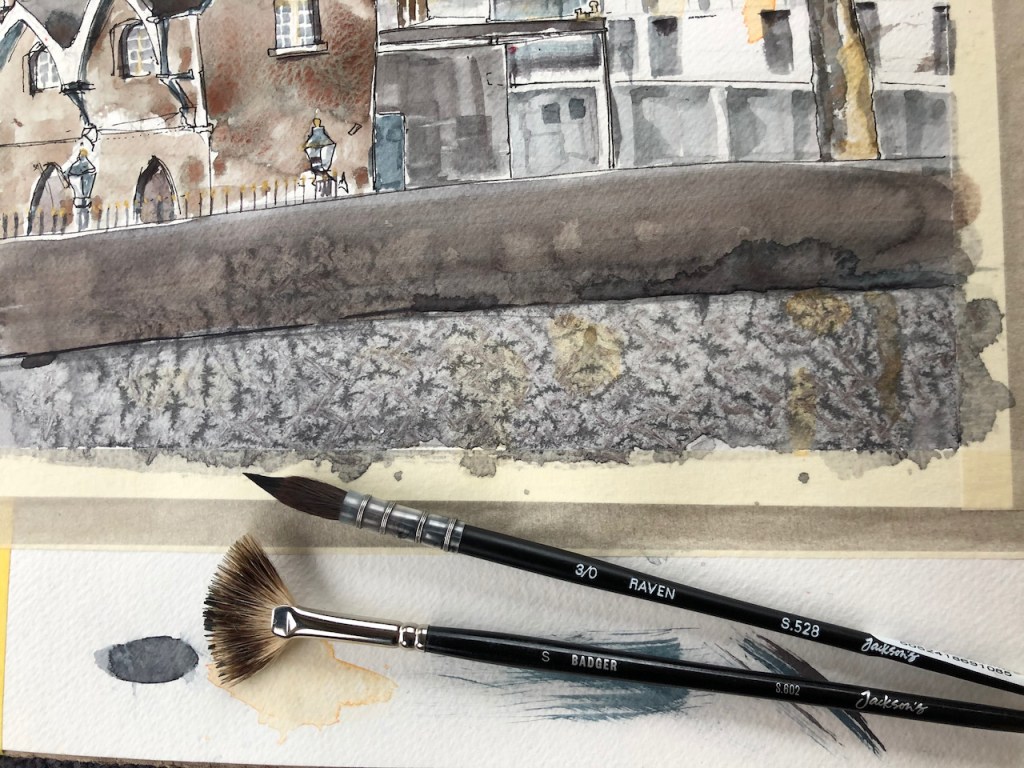
I made this picture on a sheet of Jackson’s 300gsm cold-pressed watercolour paper, 12″ x 10″, using Daniel Smith and Winsor and Newton watercolours. The colours are Phthalo Turquoise (W&N), Fired Gold Ochre (DS), Perylene Maroon (DS) and Mars Yellow (DS). The cobblestones also have some Iridescent Moonstone (DS), which makes them sparkle. I made the tree with a marvellous new Tree Brush, also from Jackson’s.

Brushes: Jackson’s “Badger” tree brush series 602, and Jackson’s “Raven” brush series 528.

Barbican at dusk

It was getting dark but I’d been indoors all day. I set off into the gloom with my drawing things.

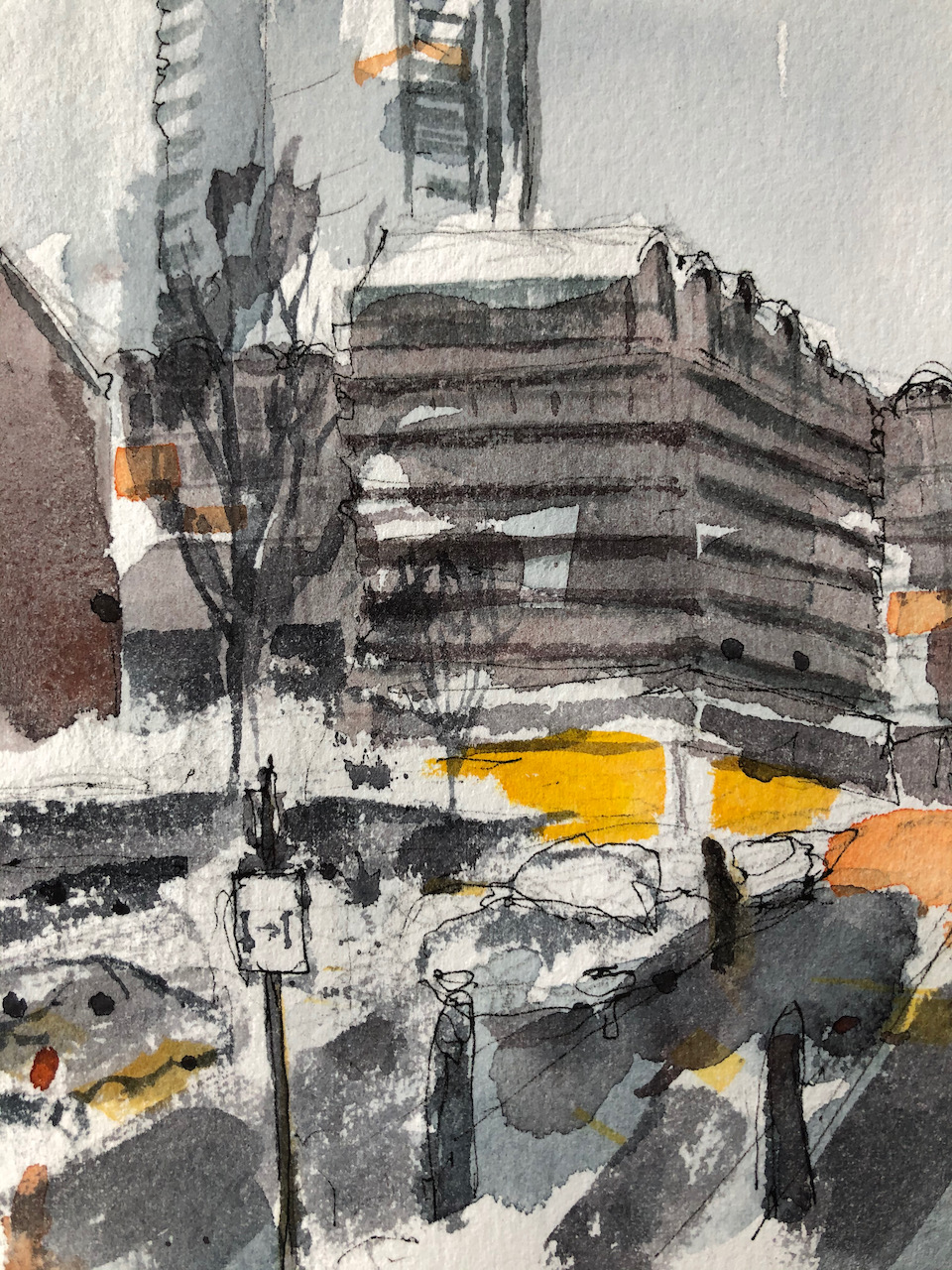
Looking towards the Barbican from Golden Lane, 5th January 2021, 4:15pm (detail)

It also started raining. Or maybe it was sleet.

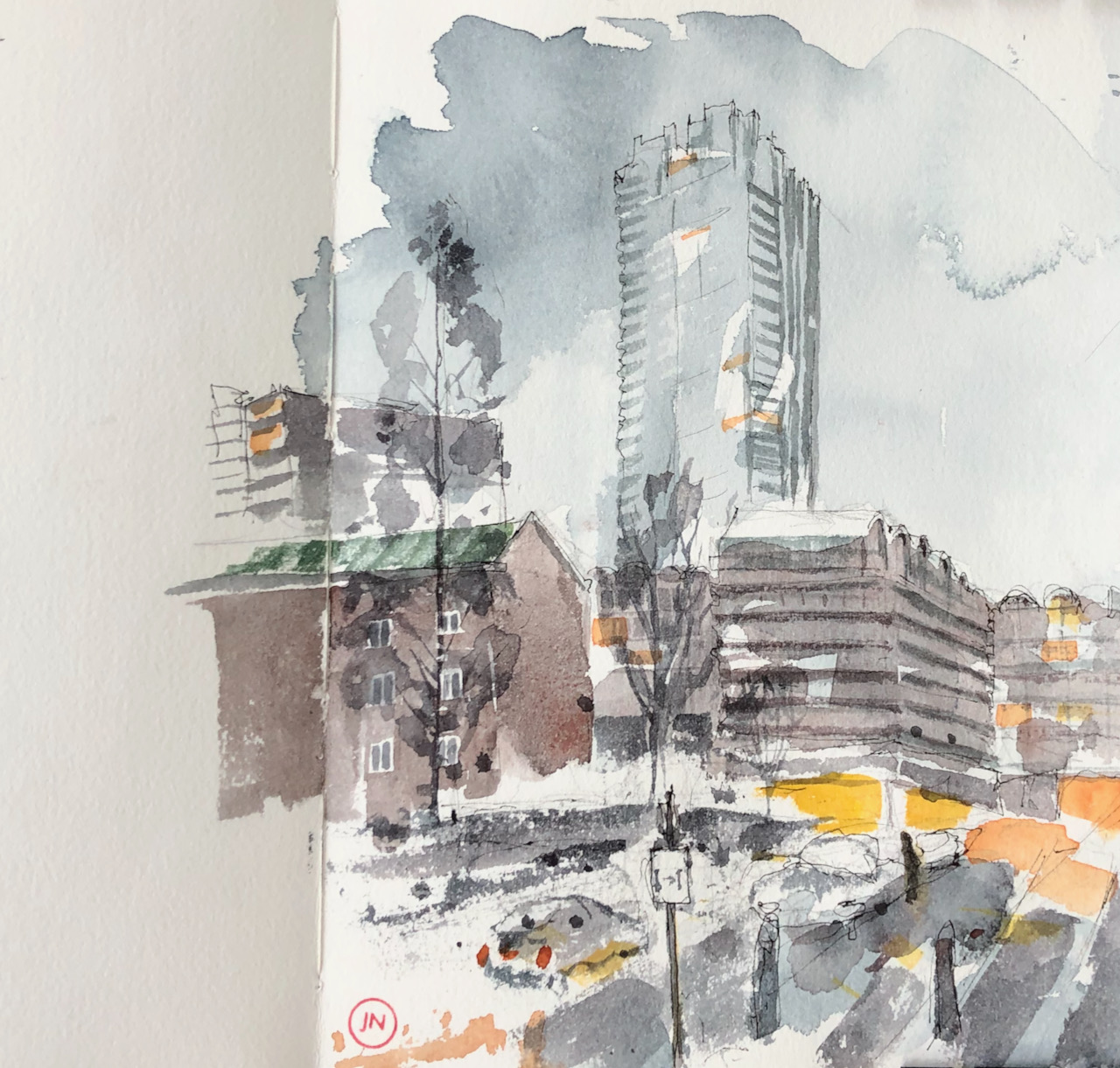
I continued my peregrination through the dim streets. I like this time of day. In this weather, it’s not the “violet hour” of Mediterranean sunsets, but more like an Indigo hour, as the colours fade and go into dark smudges. I enjoyed the squares of light, each a little theatre of activity.

Here’s the picture I drew. It was sketched quickly on my walk, with the colour completed at home.

Looking towards the Barbican from Golden Lane, 5th January 2021, 4:15pm

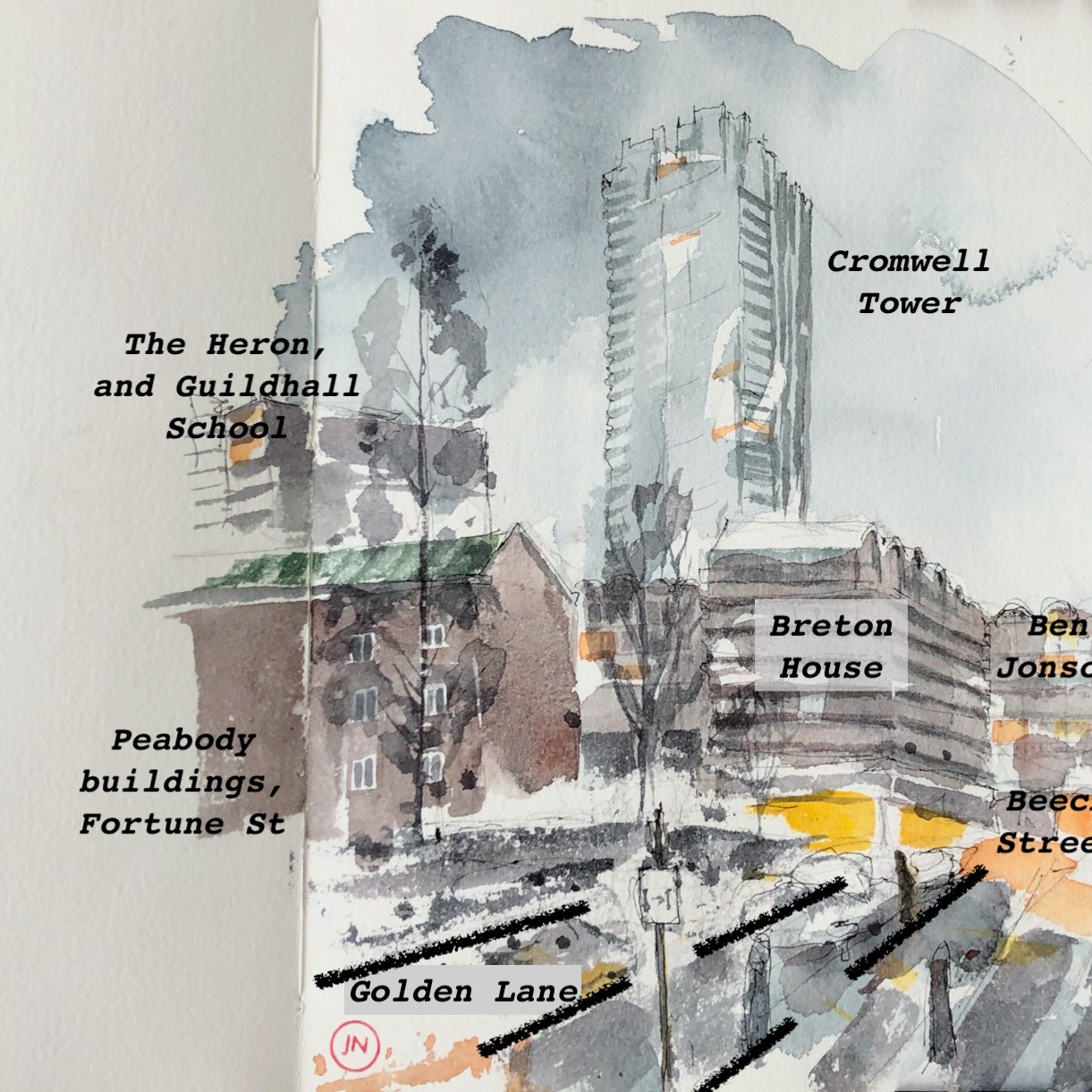
Here are the buildings:

In Wyvern sketchbook, on Arches paper, using Hansa Yellow mid (DS), and Transparent Pyrrol Orange (DS), with Perylene Maroon (DS) and Phthalo Blue Turquoise (W&N) for the sky and the darker greys. Fired Gold Ochre (DS) is in the mix for the Peabody Building.

I have drawn in and around the Barbican before. Here is a collection:

Something went wrong. Please refresh the page and/or try again.