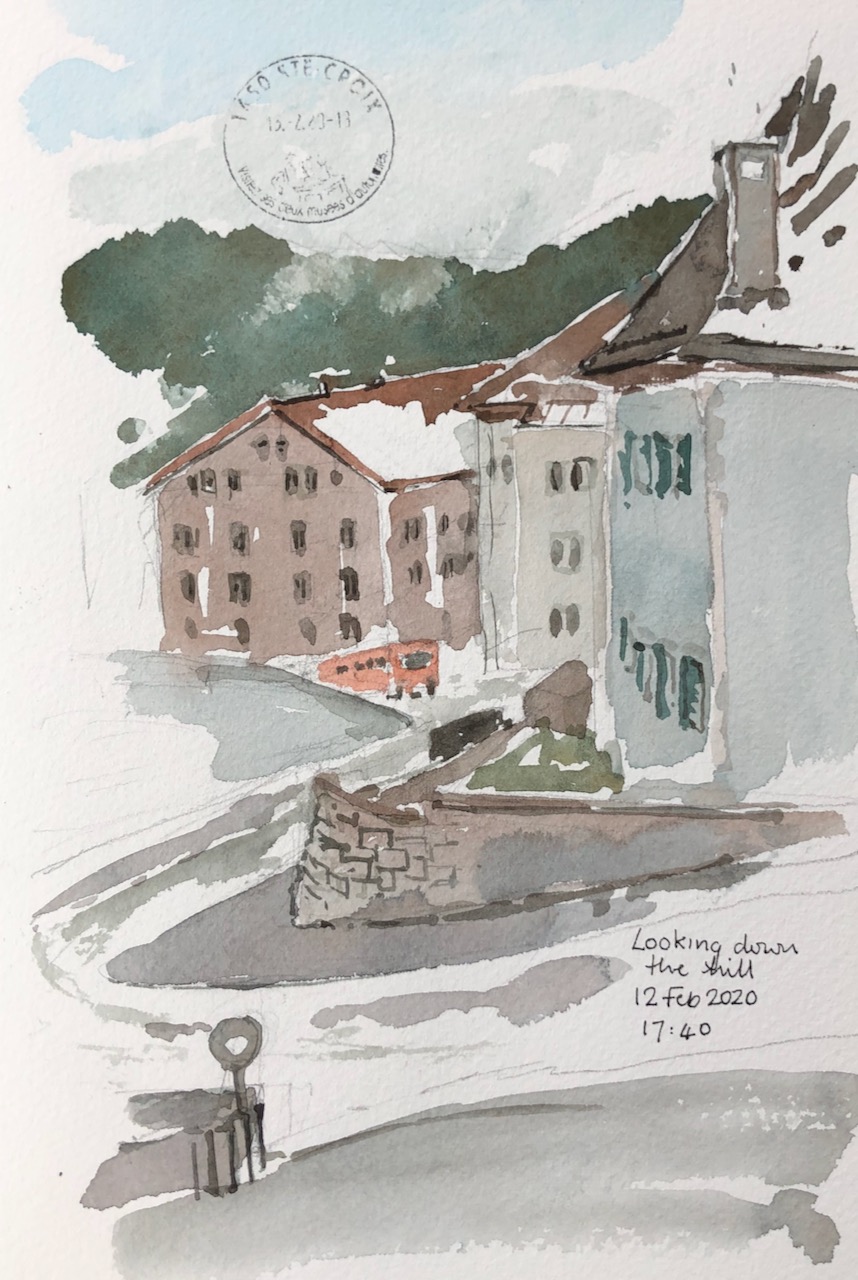
The weather in the Jura mountains is changing. This is climate change, the residents tell me. Once, the snow came reliably every year, bringing skiers. Now, the snow is unreliable. “It shouldn’t be like this,” they said, looking out at the slushy rain. This is February: high skiing season. “It should not be like this,” they say again, sadly.
Here is a sketch made looking out of the window into the rain and melting snow. The lady at the Post Office added the stamp.
Sainte-Croix, February 12th 2020, looking down the hill towards the station.
I made that picture with just watercolour: no pen.
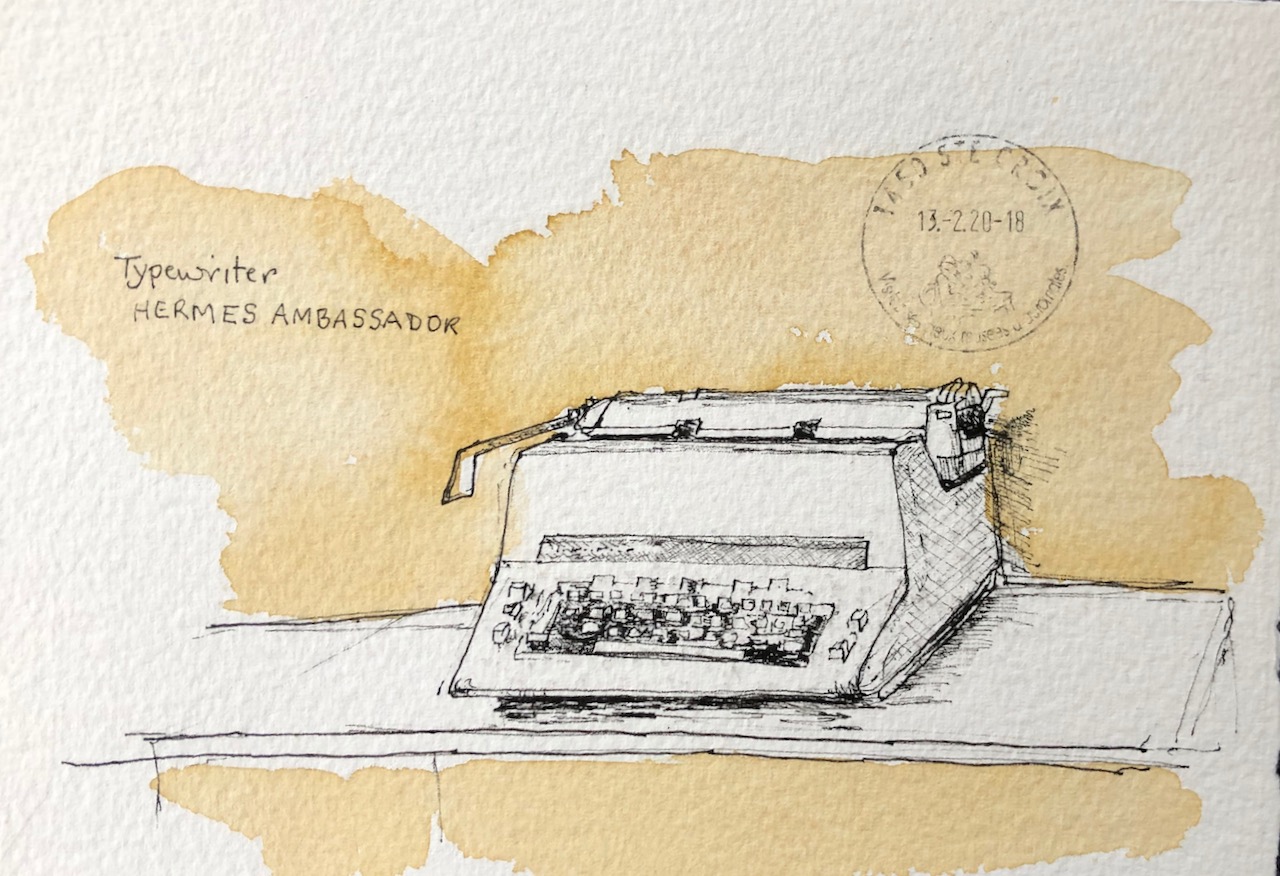
The Hôtel de France celebrates the fine engineering expertise of the area with a collection of typewriters. There were several in the meeting room where we worked. Here is one of them.
Typewriter. The Post Office lady obliged with the stamp.
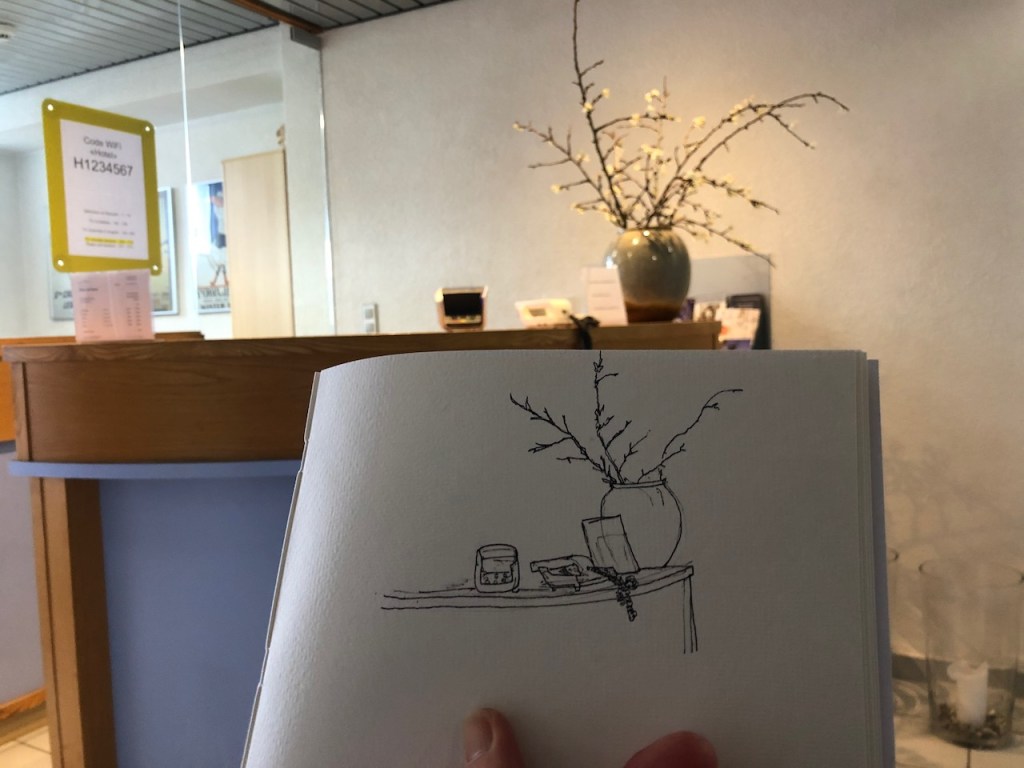
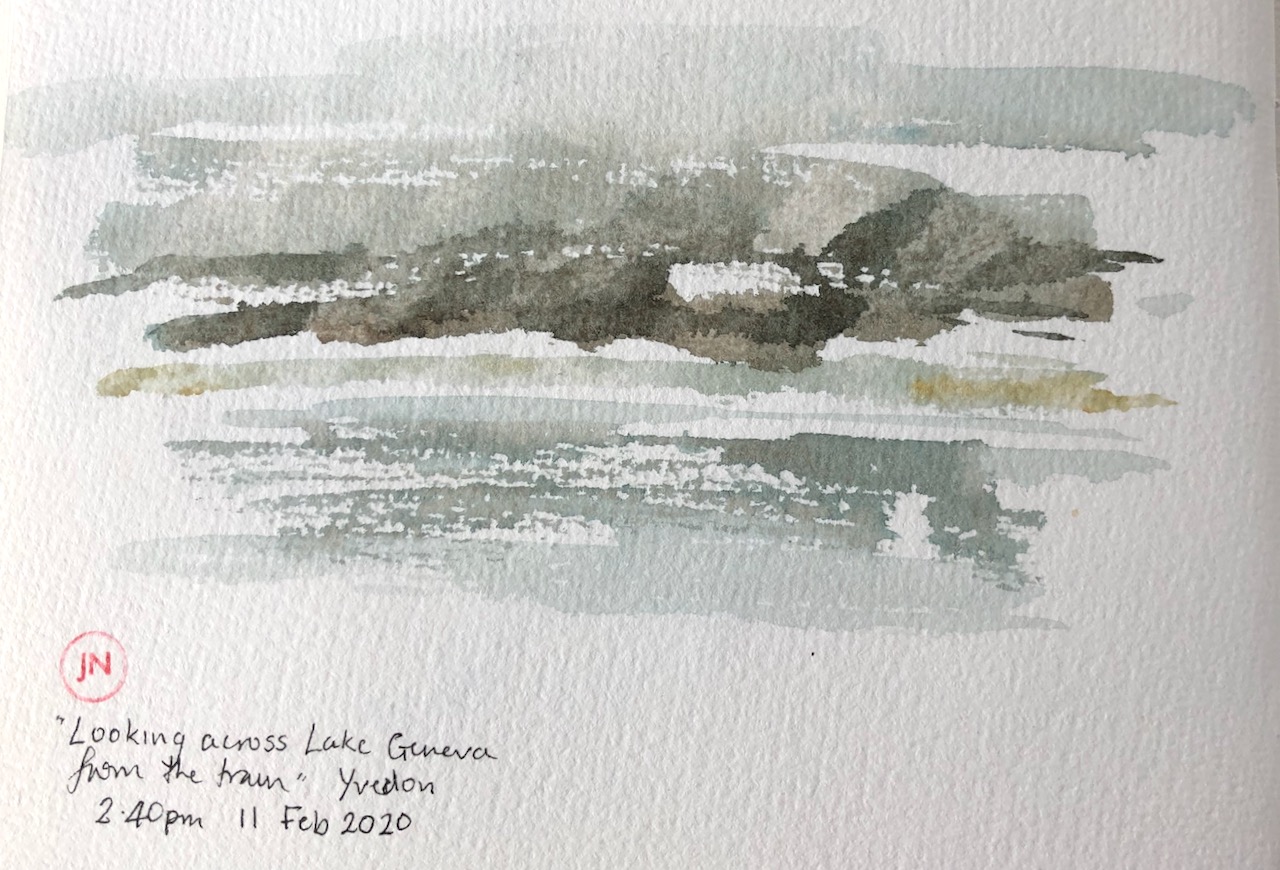
This was a busy visit. My arrival had been delayed by a storm, and so work was compressed into a few hours. My next sketching opportunity was while I waited for a lift to the station.
Here’s a view across Lake Geneva in the rain.
Click a button below to share this post online, email it, or print it:
On a radiantly bright day I walked East from the City in search of horizons. Wapping, east of Tower Bridge, is where the buildings at last are of human size, and you can see the sky.
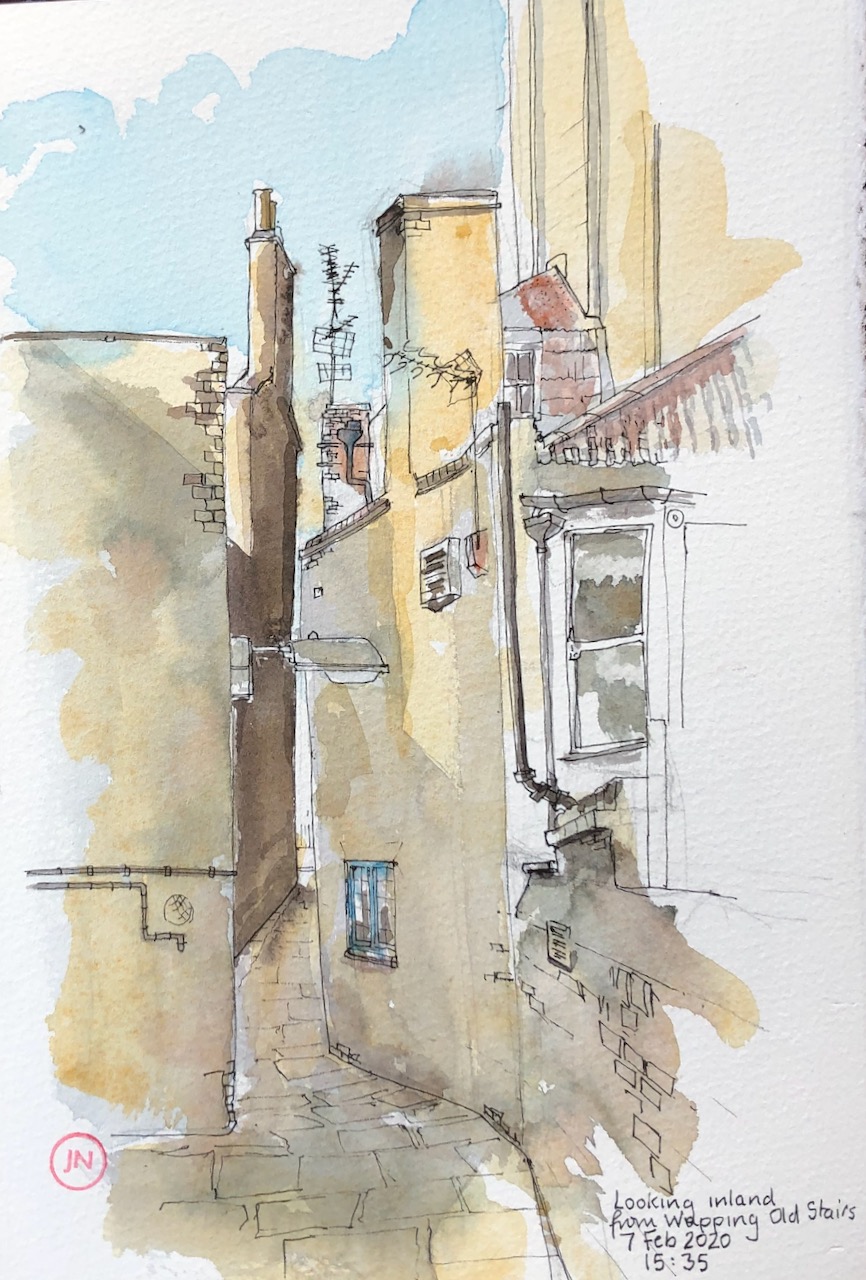
Next to the pub called “Town of Ramsgate” on Wapping High Street, there is a small passage, a slot between buildings. I darted down there, and found a long view over the Thames, and the stone steps leading down to the river. This is Wapping Old Stairs E. Turning round, to go back, I saw this mix of buildings.
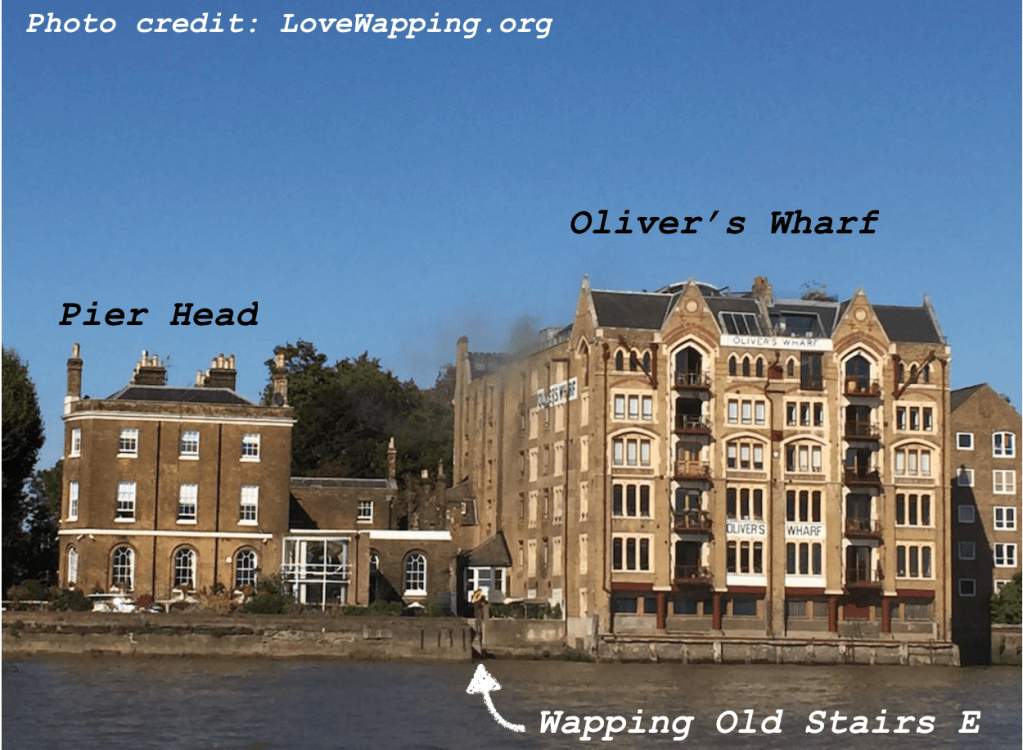
On the right, with the blue window, is the “Town of Ramsgate”. High above it are the walls of the former warehouse “Oliver’s Wharf”, built in 18691 The warehouse was turned into flats in 1970-1972, making it one of the very early warehouse conversions. Warehouse conversions later extended all the way down the river on both sides.
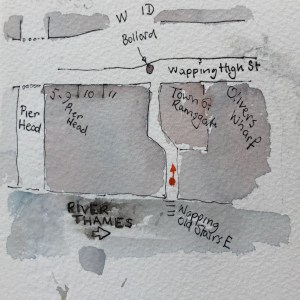
Sketch map showing the buildings around Wapping Old Stairs E.
On the left are the backs of the houses on “Pier Head”, which is a wide elegant road joining Wapping High Street to the river. There is a chain across the road to deter those of us who would like to look at the river from there.
One of the things I notice doing these sketches is the amazing number of television aerials that persist on rooftops, in defiance of the proliferation of broadband services. In this view there are two, both seriously complex and business-like examples of the genre. I think it is time for a exhibition of Television Aerials, as Art. If you are the V&A reading this, consider it now, before they all disappear, or become very valuable.
Wapping Old stairs is not a lonely place. It must feature in books. During the hour and a quarter I was there four couples and individuals walked along the passageway, looked out to the river, took photos and walked back. A man came with his tiny dog. The dog showed an unwise interest in my water pot, which by that time contained an unhealthy mix of Perinone Orange, Phthalo Turquoise and Mars Yellow. I tried to deter the dog from drinking it, and then had to explain to the dog’s owner that I didn’t mind the dog atall, but I didn’t think he should drink that particular water. They were going to go for a walk on the foreshore, but the tide was still high and sloshing over the steps, which put paid to that idea.
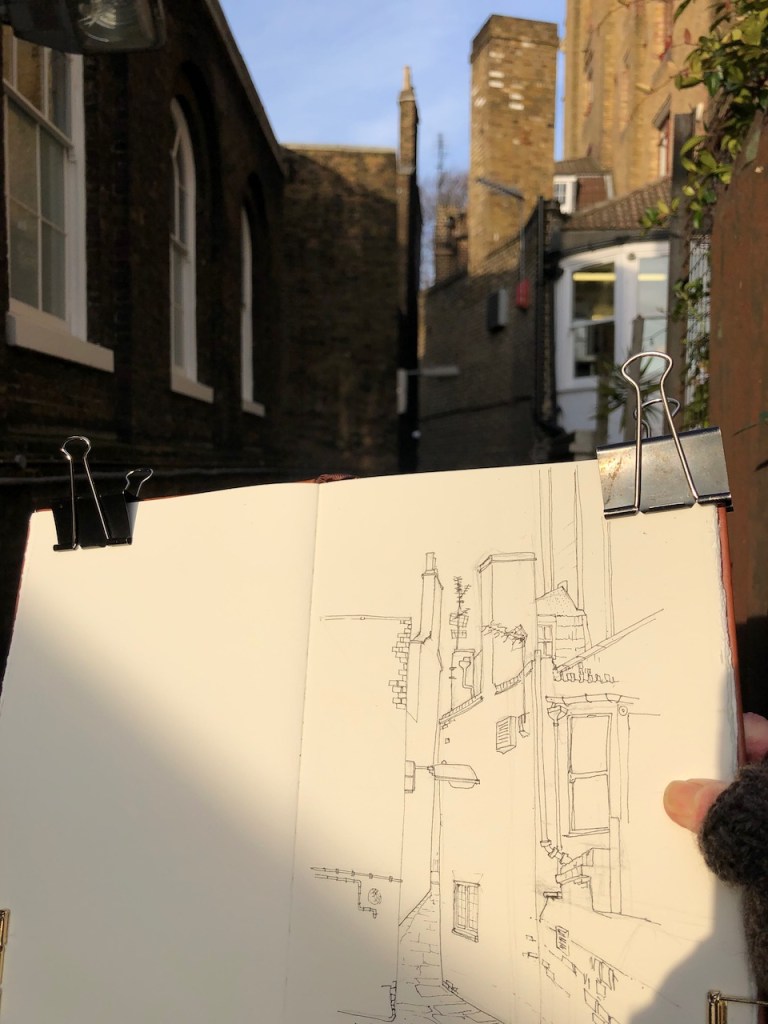
Here is work in progress.
(1) F. & H. Francis. 1869-70. Wapping, London E1. Built for George Oliver “in the Tudor gothic style, this wharf handled general cargo but had special facilities for tea” [Craig, Charles, et al. London’s Changing Riverscape: Panoramas from London Bridge to Greenwich. London: Francis Lincoln, 2009. Quoted in “victorianweb.org”]
View from the South side of the river, photo from “LoveWapping.org”. This photo shows the smoke from a fire which broke out in one of the flats, Sept 2019.
Click a button below to share this post online, email it, or print it:
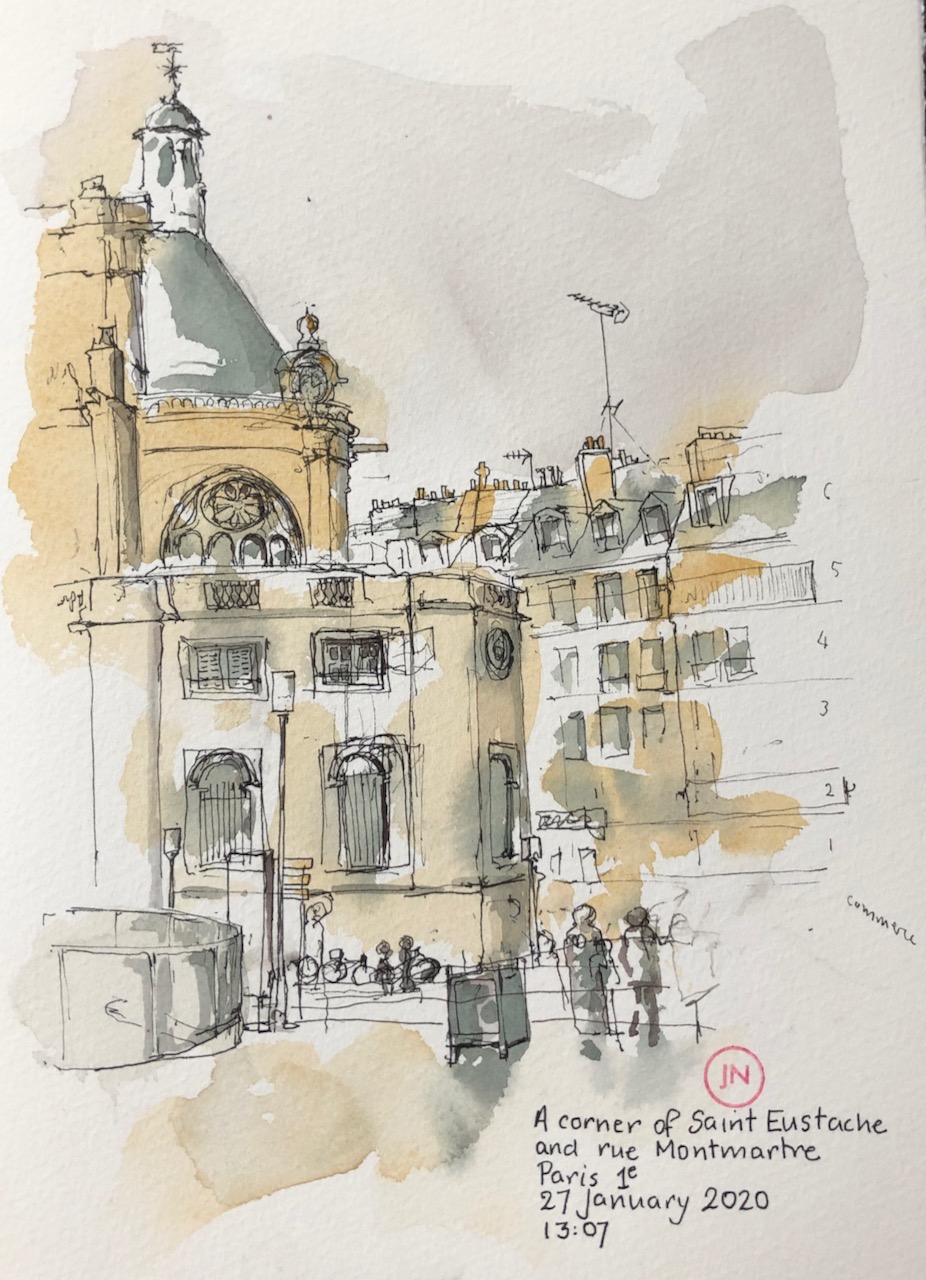
Here is a corner of St Eustache, near Les Halles in central Paris.
St Eustache was built between 1532 and 1632. I drew it standing in the pedestrian area near Les Halles, as people flowed by. I enjoyed the fact that there were huge chimneys on the church, shown high up on the left edge of the picture.
Drawing St Eustache on location
The sky was overcast. It was a Monday. A group of lively young people were hanging about, calling to each other.
Meeting point for Public Calm
This pedestrian area was one of those liminal zones: between public and private, not quite a pavement, not quite a plaza, partly a thoroughfare, partly a resting zone. As a result, the social rules were ambiguous. People were hanging around, people were passing through. Evidently there have been incidents. A large poster said: “City of Paris, Meeting Point, Public Calm. The operatives of the City of Paris in charge of Public Calm welcome your feedback and comments between 6pm and 6:30pm, Monday to Friday. To report an incident (“incivilité”) call 3975 or go to Paris.fr/incivilité”.
I was intrigued by the idea of City operatives charged with “public calm” (“tranquillité publique”), and wonder how and whether it works.
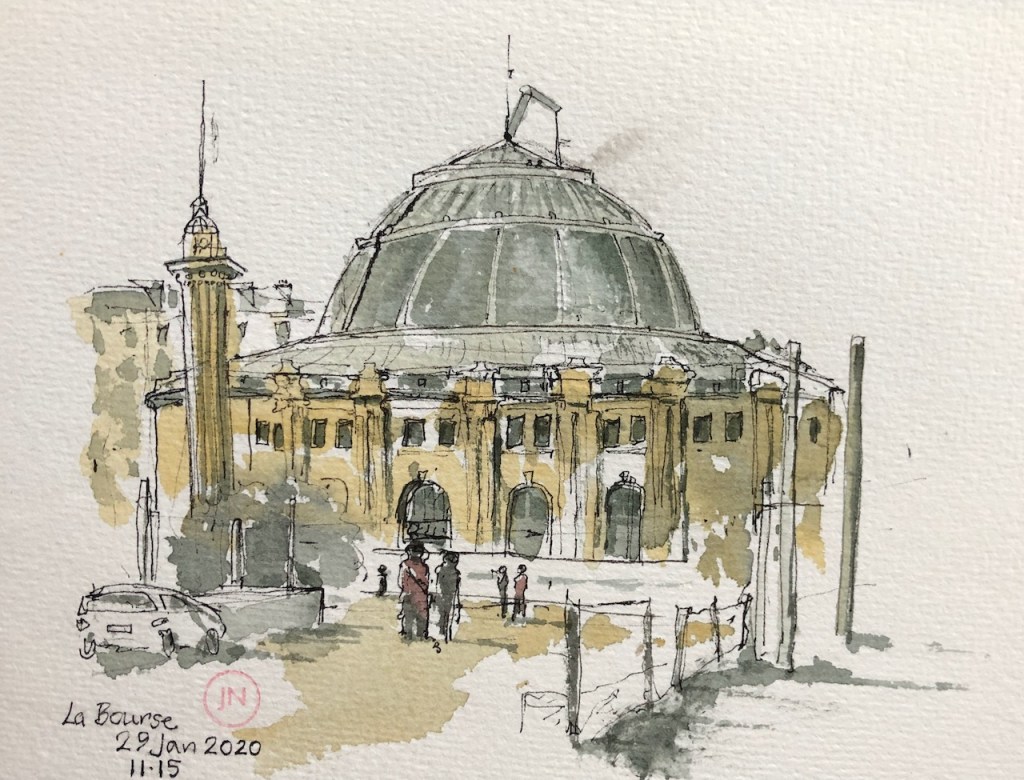
Here’s another sketch in the same area. This the “Bourse de Commerce”, the Commodities Exchange. It’s now the former Commodities Exchange, with massive building work going on to convert it into a contemporary art space. The architect for the conversion is Tadao Ando.
Bourse de Commerce, with crane and hoardings.
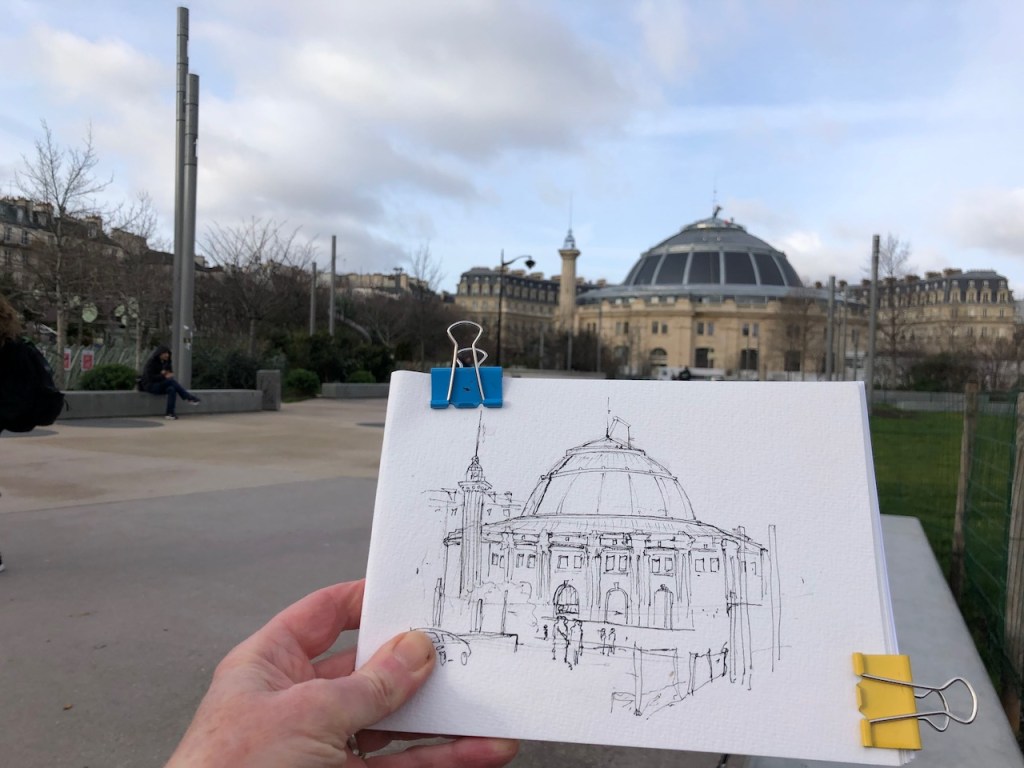
This was a sketch as I was waiting for the swimming pool to open.
Drawing on location
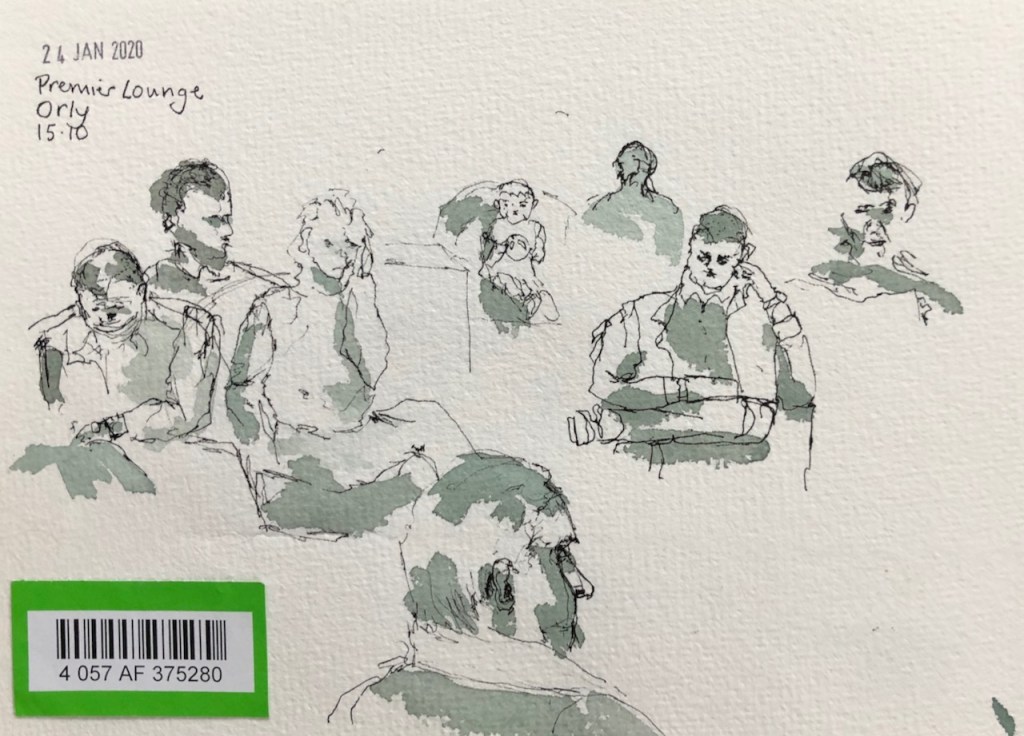
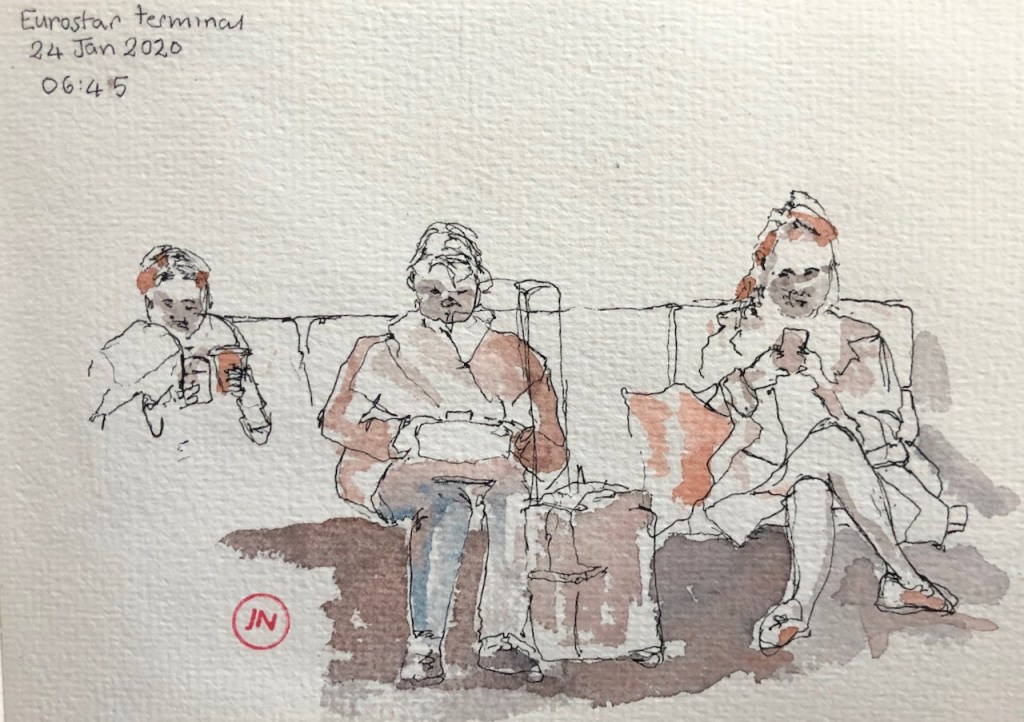
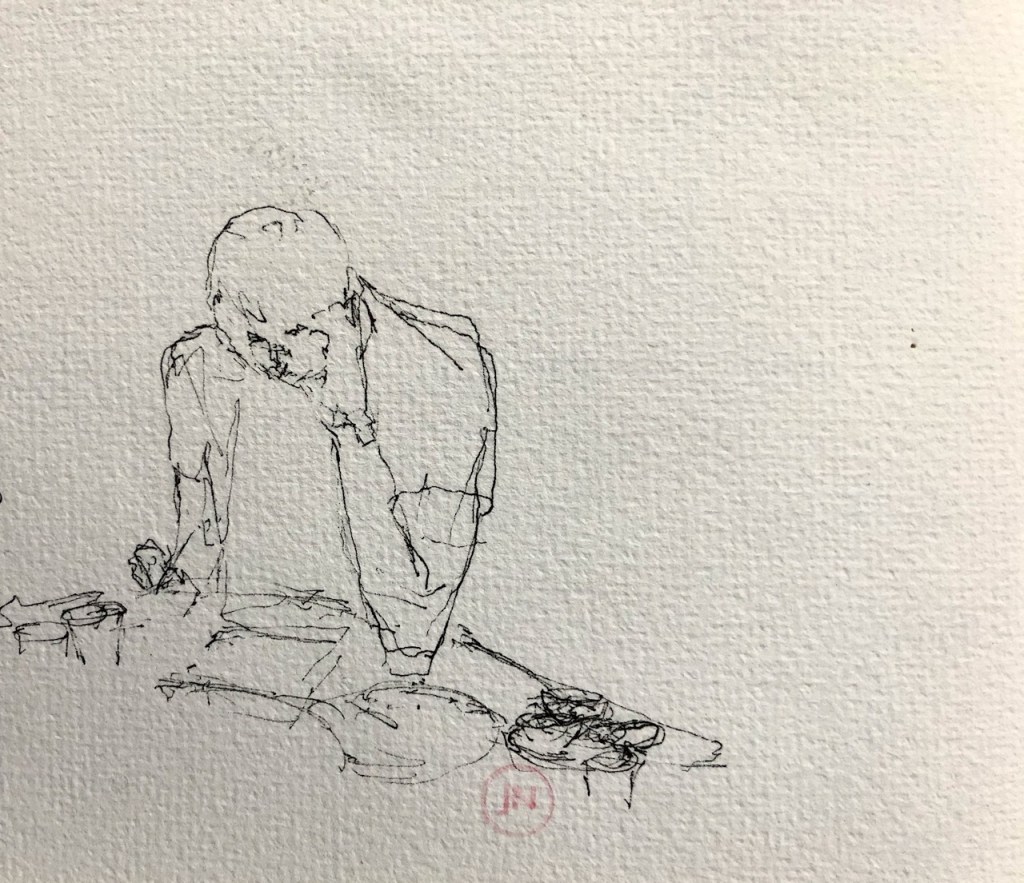
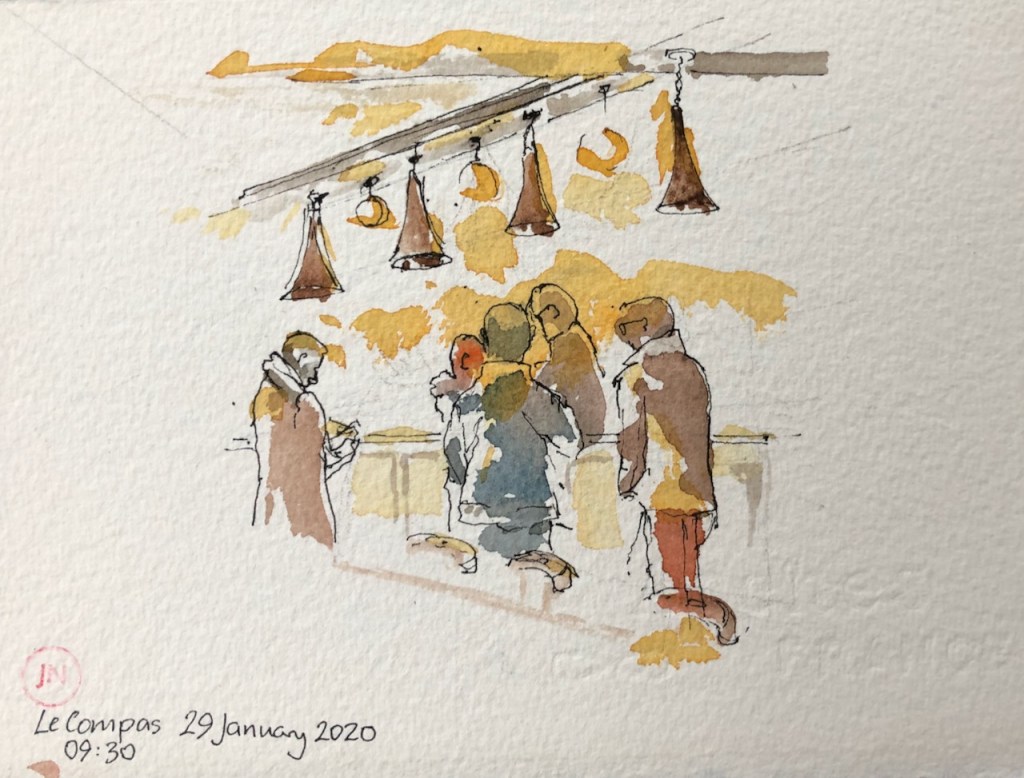
I did some people-sketching in a café and in waiting areas on the trip. I am on a mission to get more people into my drawings, so I practice.
Airport lounge
Eurostar lounge
Doing the crossword
Men in the café
People watching
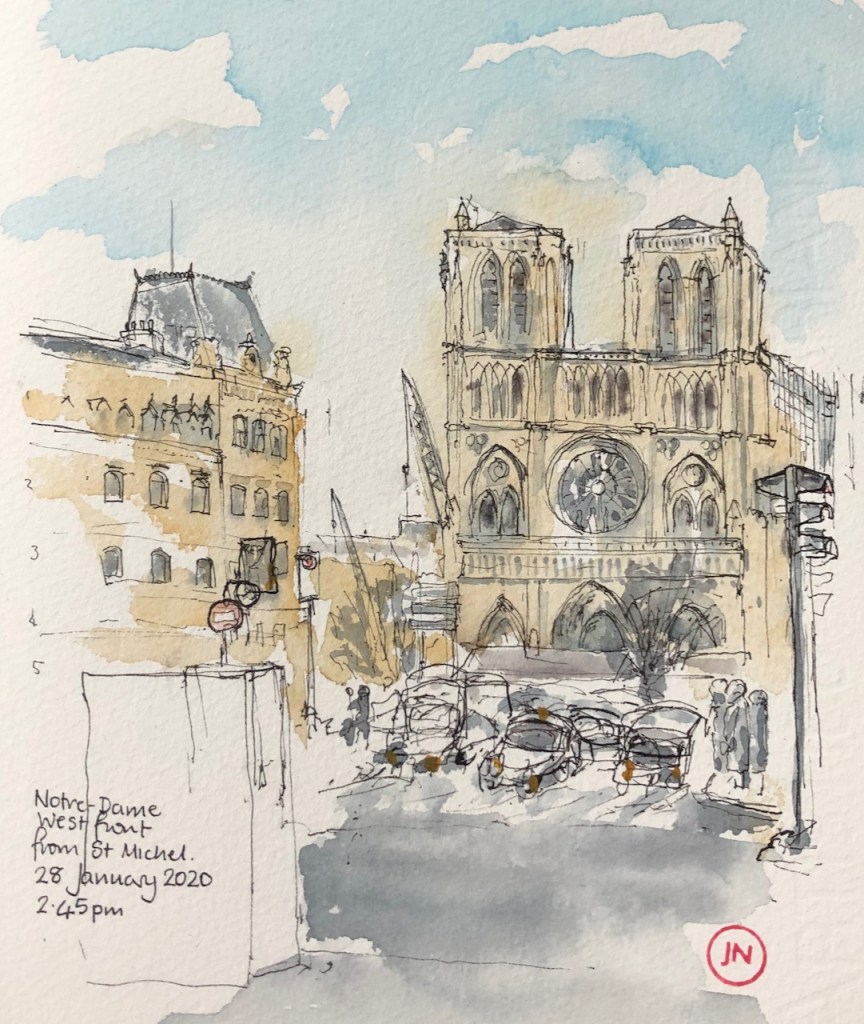
I walked across to the Left Bank, searching for “Maison Charbonnel”, the home of the maker of the etching ink that I favour. The place was there, on the Quai Montebello, just across the river from Notre Dame. However, because of the Métro strikes, or because of the weather or for some other reason or no reason atall, the shop was closed “until the 3rd of February”.
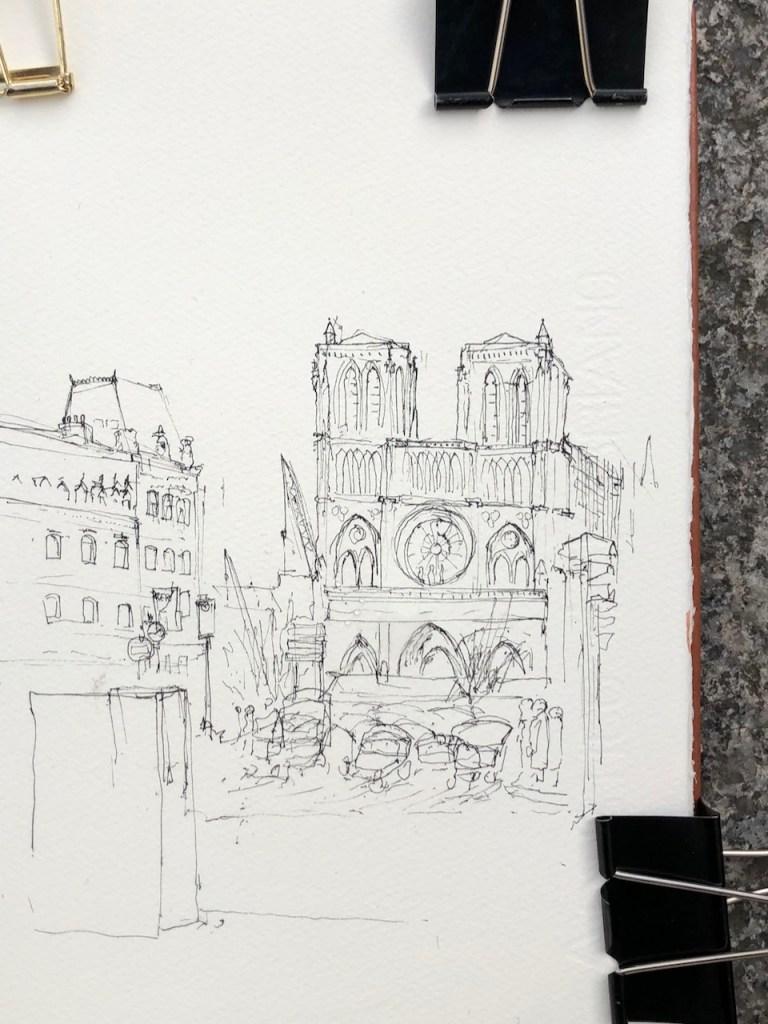
I drew a picture of Notre Dame.
Notre Dame, West front, from St Michel.
This took about one hour 35 minutes. The temperature was 7 degrees C.
Straight to pen
On the pavement
Putting the colour on
Red arrow shows the line of sight of the drawing
Drawing on location, Notre Dame from St Michel
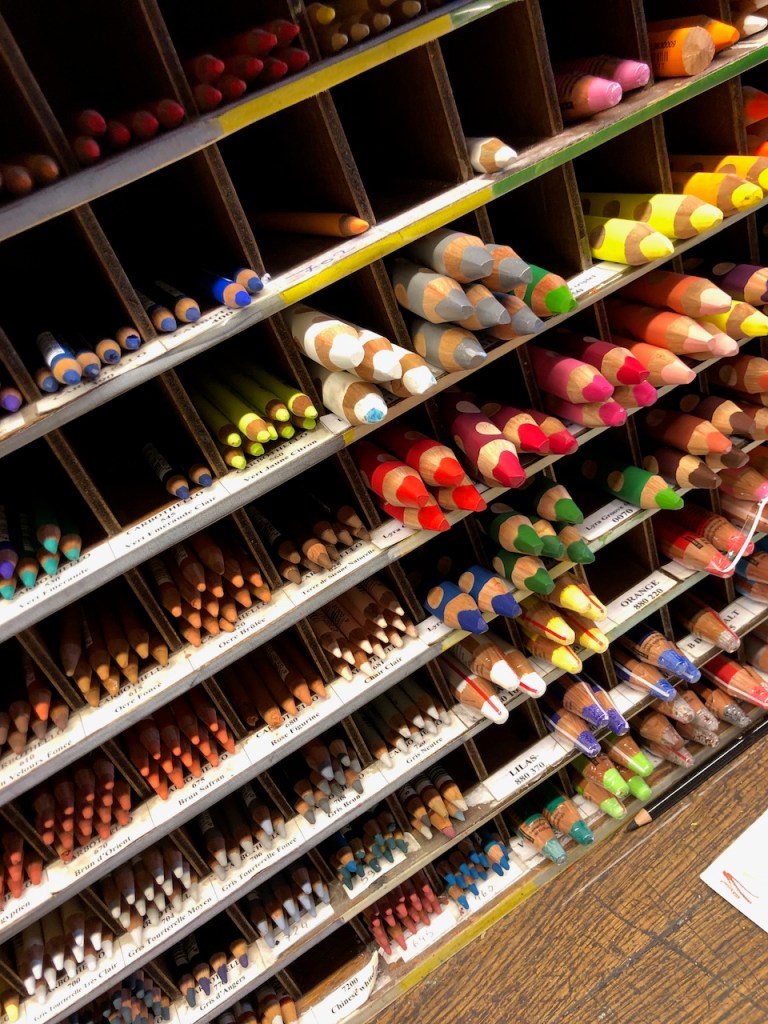
Then I took sanctuary in a marvellous art shop I found: “Magasin Sennelier”, 3 Quai Voltaire. I was served by a gentleman who might have been there since the 1950s. He was pleased to tell me he knew L. Cornelissen & Son of London, and Green and Stone, and he knew Mr Rowney, of Daler Rowney paints, personally. Or had done. Sennelier paints were superior, I was authoritatively, if not entirely objectively, informed.
Magasin Sennelier
Crayons
“Don’t use the crayons.”
Paints on the top floor
Japanese paints
A little brush I bought
Inside Magasin Sennelier, Quai Voltaire
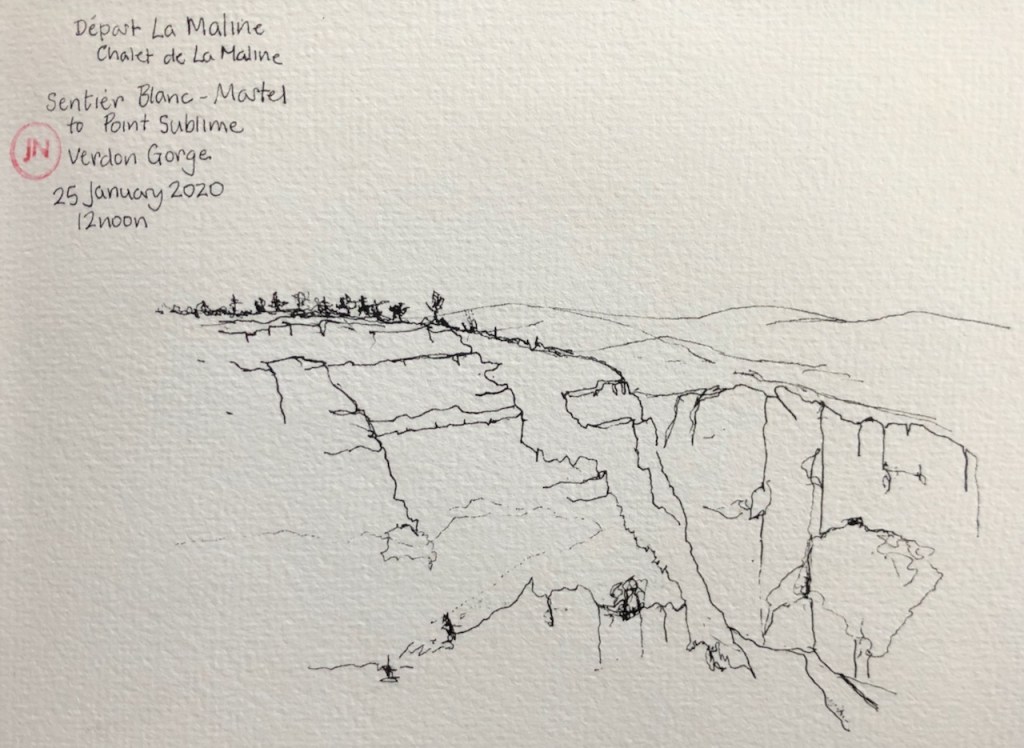
In the South I made a pen sketch of a vast canyon:
Blanc-Martel hiking trail, start point.
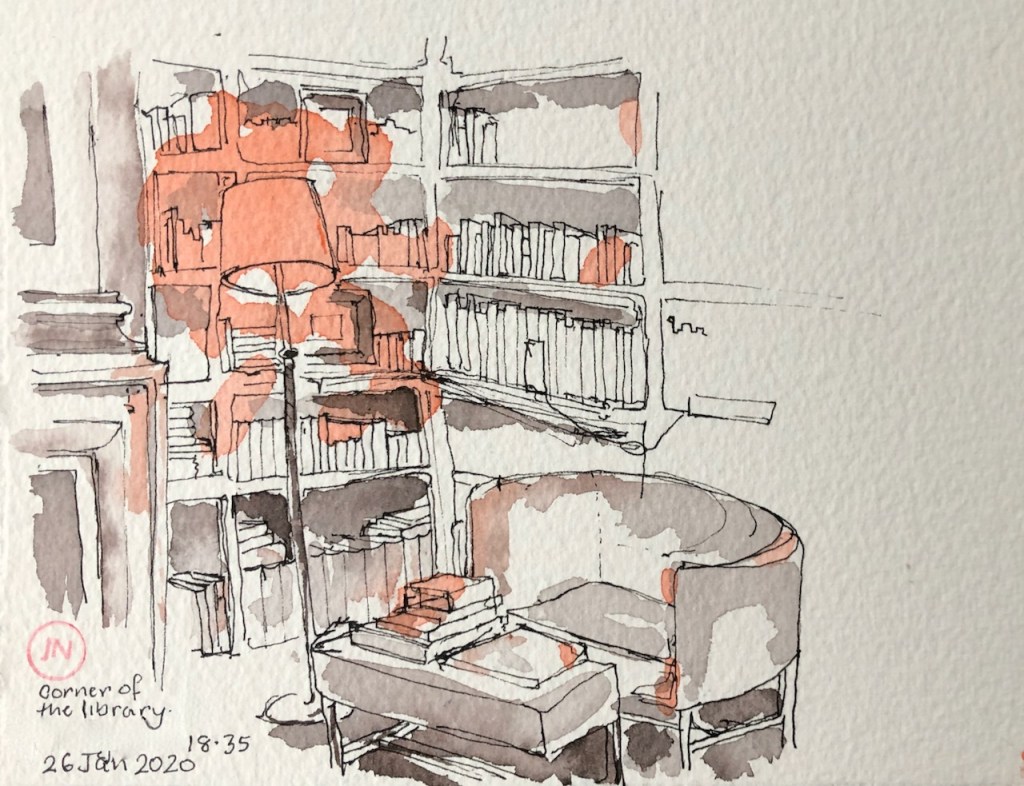
And here’s a quick sketch in the library, before dinner:
Corner of the library
Click a button below to share this post online, email it, or print it:
Here is the marvellous Turks Head Café, Wapping, rescued from demolition by local residents in the 1980s.
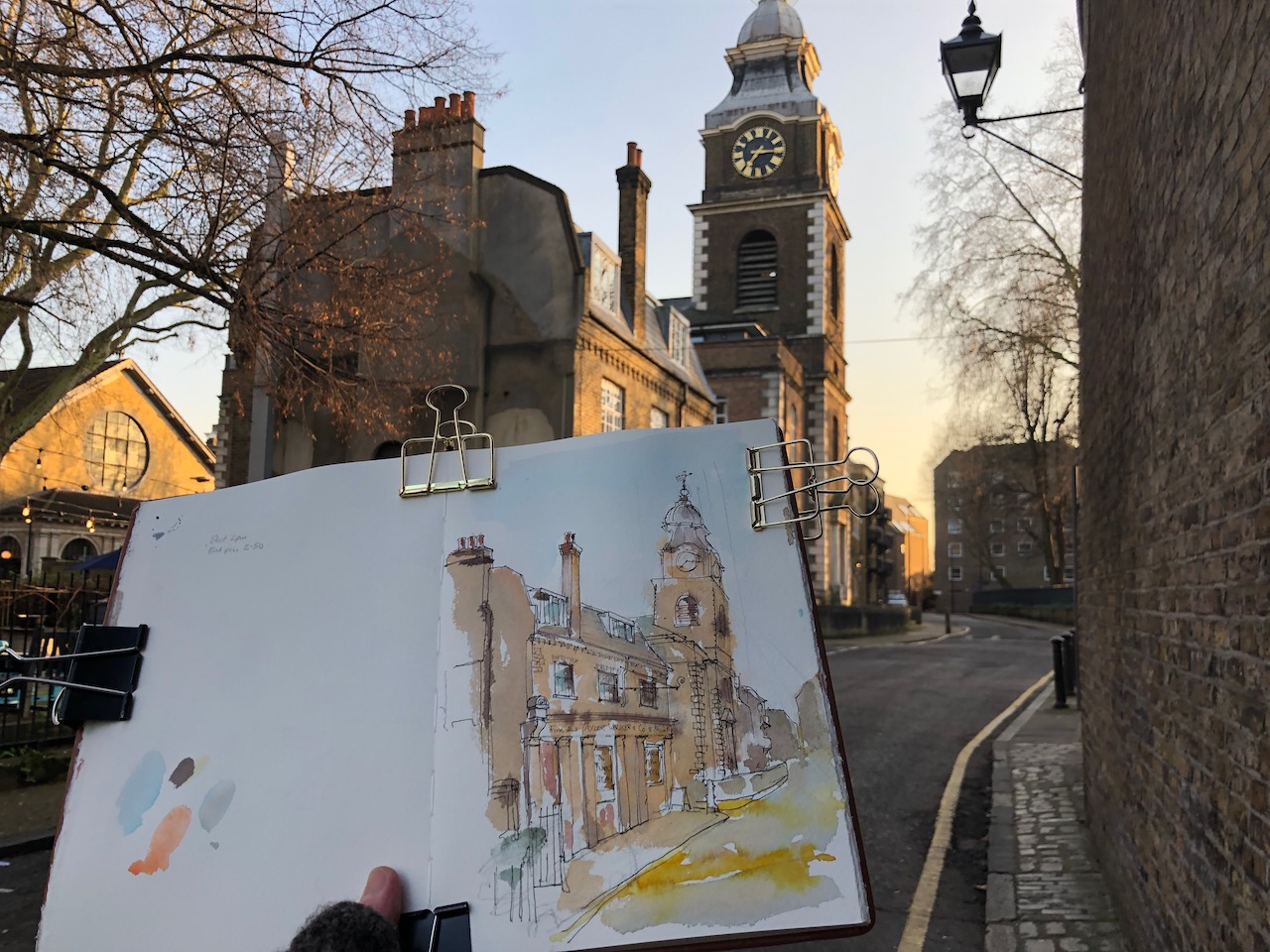
The Turks Head Cafe, in front of St John’s Tower
Inside, I found warmth, quiet tables, and the gentle murmur of conversations: people actually talking to each other. I felt welcome here. The food was marvellous. Next time I’m going to have the Blueberry Tart. I only noticed it after I’d already had the substantial Chicken and Avocado Sandwich.
Inside the Turks Head Café
I went to pay my bill. When I returned to my table, there was a little group of people admiring the sketch (above). I chatted to a man called Mark, who, it turns out, runs the website “lovewapping.org“. We exchanged anecdotes about the representation or otherwise of residents’ views on local councils. His group grapples with Tower Hamlets Council.
Then I went outside to draw the café.
The tower in the background is St Johns Tower. The tower is “all that remains of the parish church of St Johns circa 1756 … the surrounding ground was rebuilt as flats in the 1990s to an attractive design reflecting the previous building on the site” says the Knight Frank website (an estate agent).
This drawing took 1hour 15 mins, done from the pavement by a huge brick wall. The colours are Perinone Orange, Phthalo Turquoise, Mars Yellow and Hansa Yellow Mid. As you see, the front of the cafe faces West, and caught the setting sun.
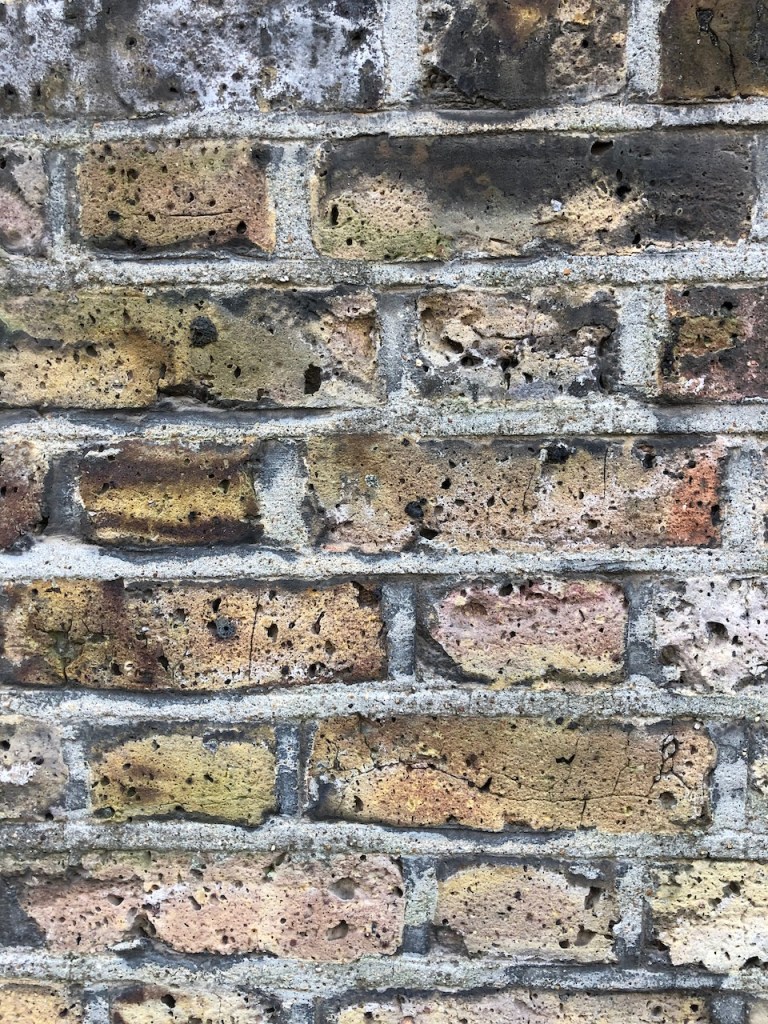
Here is the wall next to where I was standing.
London Bricks in Wapping.Notice outside the caféA man with a tiny cup of espresso coffee
Click a button below to share this post online, email it, or print it:
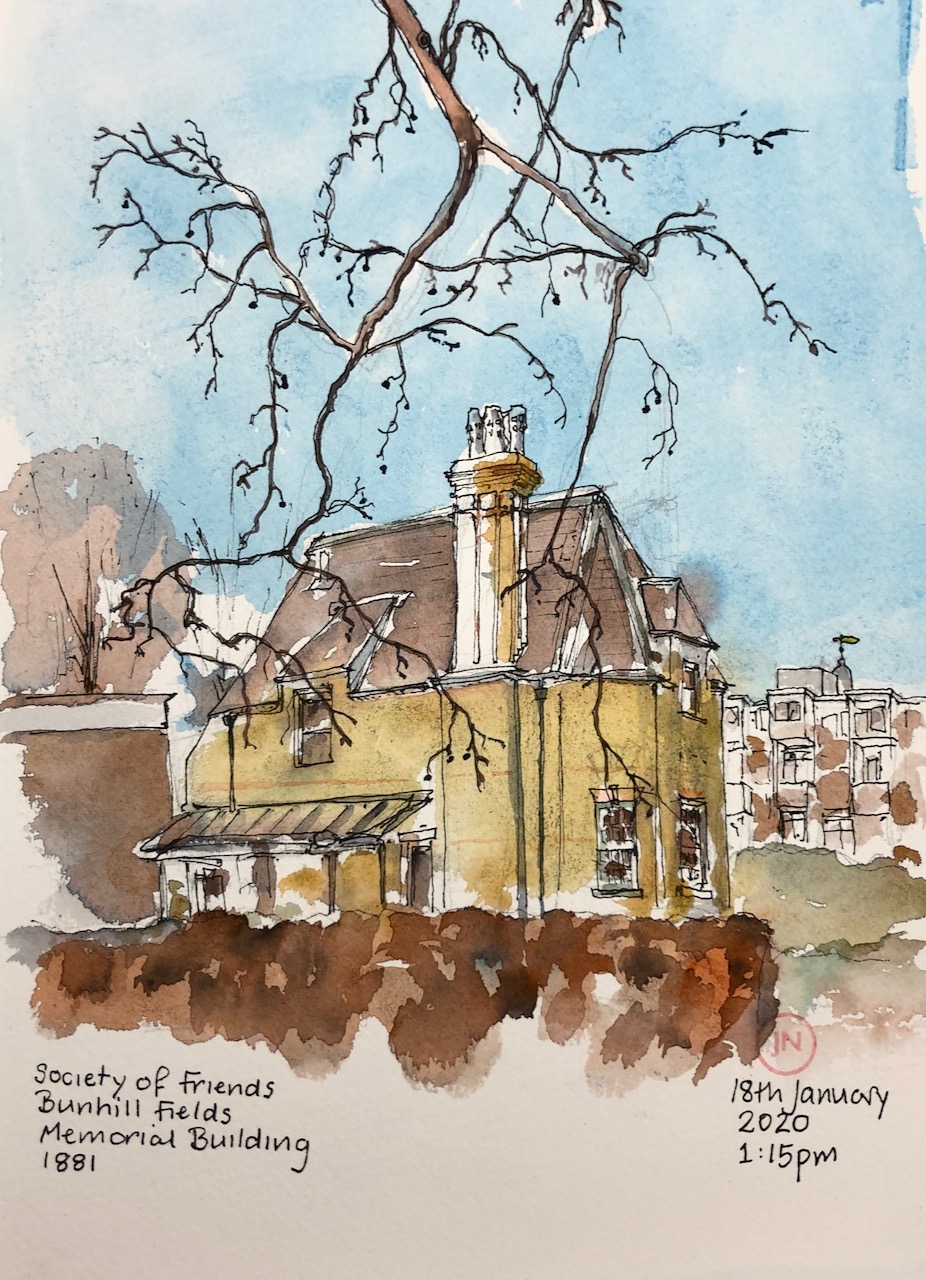
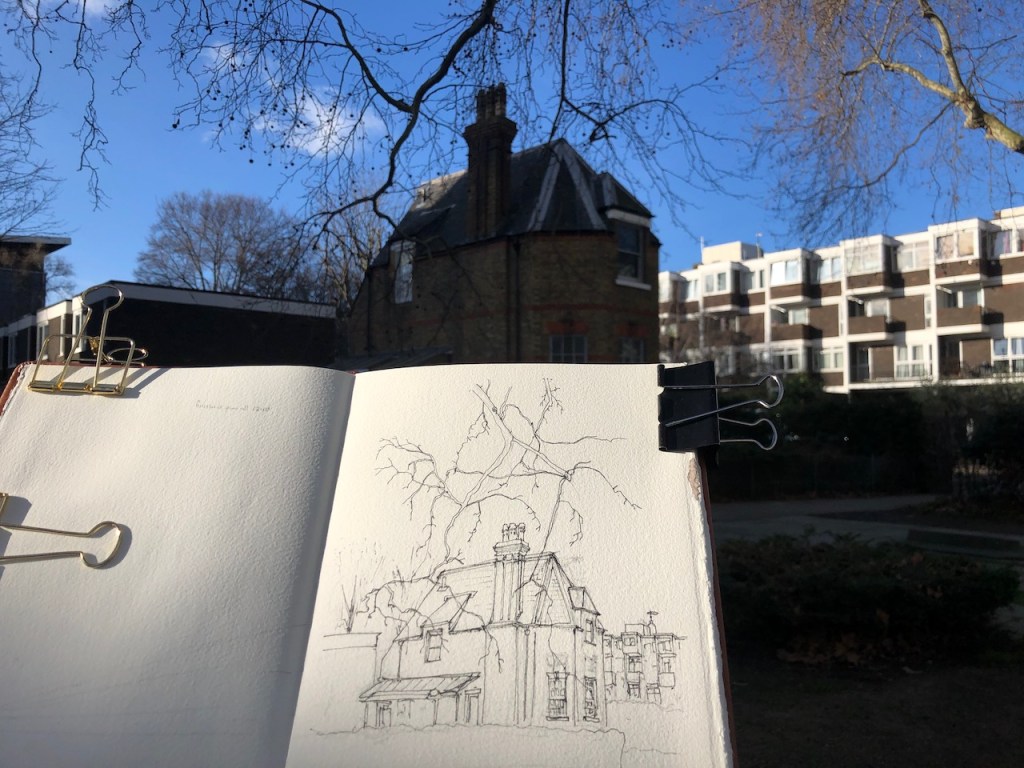
This small building stands peacefully in a garden, surrounded by later developments. It is the local Quaker Meeting House.
According to the very interesting leaflet produced by the Bunhill Quakers, the current building is the sole remnant of a once large establishment, the Memorial Buildings, completed 1881. These Memorial Buildings housed “a coffee Tavern, mission rooms for the adult schools and breakfast meetings, Sunday schools, a medical mission, and a large meeting house”. The construction was funded by money obtained when the Metropolitan Board of Works wanted to widen Roscoe Street, and purchased land owned by the Quakers to do so. Roscoe Street was then called Coleman Street. “The success of the Adult School brought in funds for the erection of an Extension building in 1888”, they write. 300-400 people attended the meeting in those days.
Bombing raids in 1940, ’41, and ’44 destroyed “all but the caretakers’ house”, and the council “re-zoned” the area to “allow only residential building”. Friends Meetings continued, however, and still continue, in the former Caretakers’ House, which is the building I have drawn. As well as the Quaker Meetings, it is the centre for a travelling library. A small notice by the door says that this is the drop-in centre for an organisation called “At Ease” which provides a “Free, independent and confidential advisory service for people in the Armed Forces.”
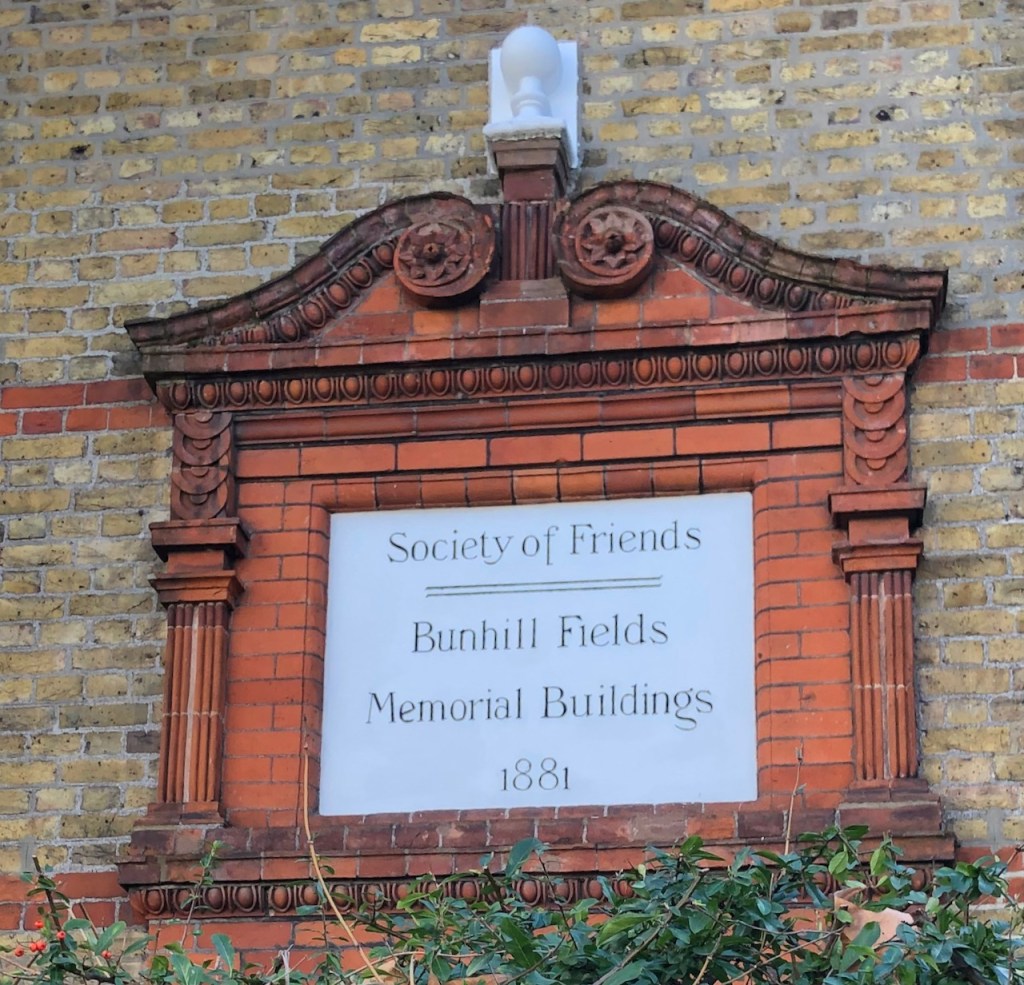
The stone tablet on the north side of the building.
Quaker Meetings are held here every Sunday and monthly on a Wednesday.
The leaflet from the Bunhill Quakers is on their website and also here:
I made the drawing from the Quaker Garden on the site of the Bunhill Fields Burial Ground.
The drawing took about 1 hour 30mins. The sky is a new colour: Phthalocyanine Turquoise, a Winsor and Newton colour, pigment PB16. Other colours are Perinone Orange, and Mars Yellow, both Daniel Smith Watercolours. Here is work in progress:
The air temperature was 5 degrees C. That blue sky was not a “warm blue” whatever the photos seem to say.
Click a button below to share this post online, email it, or print it:
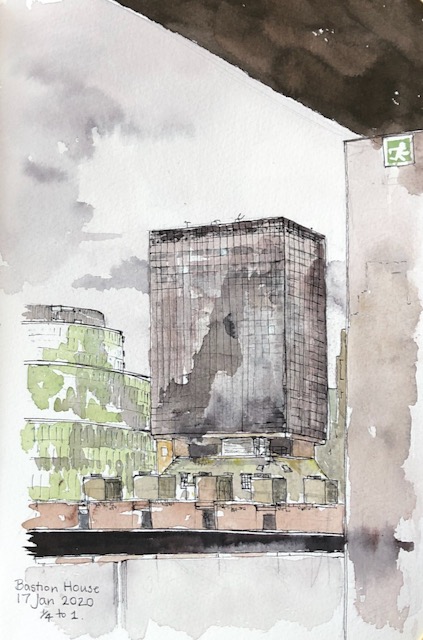
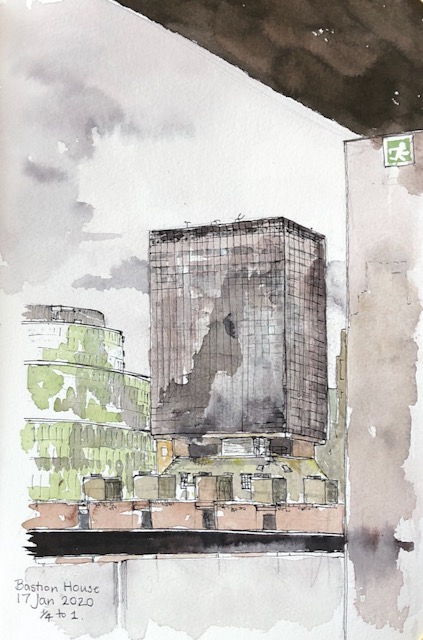
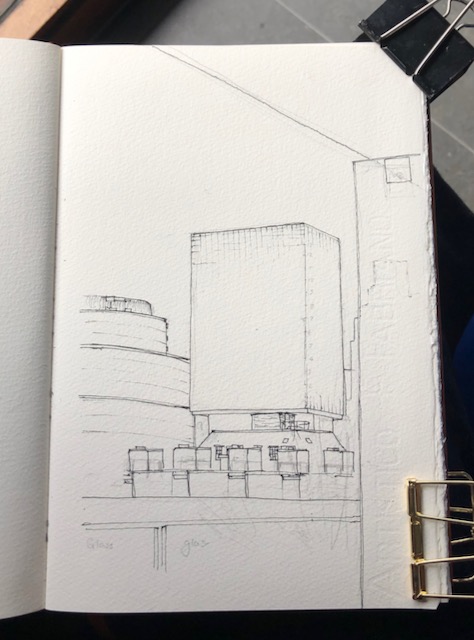
I hastened to draw the magnificent Bastion House, on London Wall. It is due for demolition.
In the foreground you see the balcony and privacy screen of the flat in Andrewes, whose leaseholder had kindly hosted me.
The line of red brick, and what looks like chimneys, in the foreground are the rooftops of a part of the Barbican, “The Postern”. Behind them is the Barber-Surgeons’ Hall on Monkwell Square, where I have been to give blood. The curved green building on the left is on the other side of London Wall. It is “One London Wall” near the Museum of London Rotunda: multi-use office space.
Bastion House is the huge monolith in the centre of the drawing. It reminds me of the monolith in the 1968 film “2001 – A Space Odyssey”, and indeed it dates from that period. It was proposed in 1955, and started in 1972, completed in 1976. The architect was Philip Powell of Powell and Moya. This practice also designed the Skylon for the 1951 South Bank Festival of Britain, and Churchill Gardens in Pimlico.
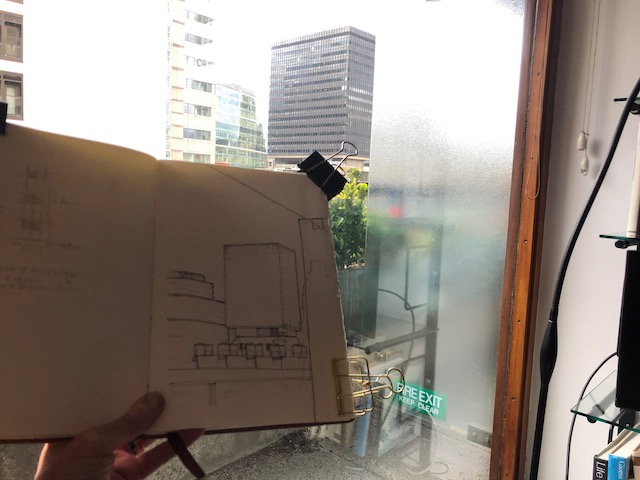
Here is drawing work in progress.
Work in progress
This drawing took me about 2 hours. This is my first drawing in a new sketchbook: the “Perfect Sketchbook” from Etchr. This will be Urban Sketching sketchbook number 6.
Bastion House aka 140 London Wall is a huge modernist monolith, reminiscent of the monolith in “2001 – A Space Odyssey”. I couldn’t find a site to draw the monolith part today, so here is a view at Podium Level, looking West towards the Museum of London. You see the dark undercroft, walkways and a…
Today Urban Sketchers London held a “sketch crawl” in the Barbican. So I joined them. An astonishing number and diversity of people assembled inside the entrance of the Barbican Centre at the appointed time of 11am. I counted about 35 and then another dozen or so joined. All shapes and sizes of people, tall, short,…
Click a button below to share this post online, email it, or print it:
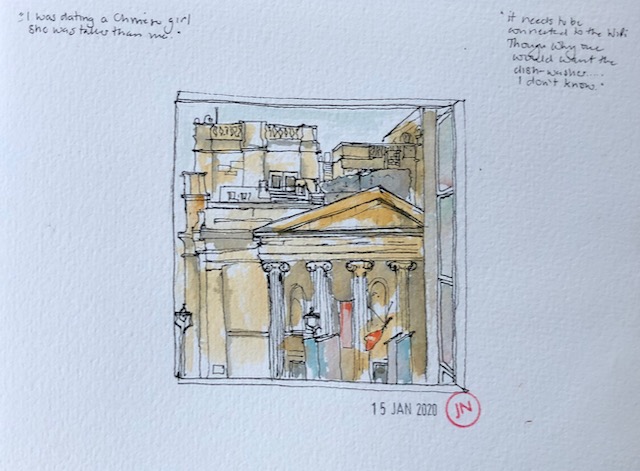
Here’s a quick sketch of Canada House on Trafalgar Square, seen though the modern windows of the National Gallery Sainsbury wing.
While I sketched, I overheard fragments of conversations: “I was dating a Chinese girl, and she was taller than me…..”, and someone on a mobile phone: “It needs to be connected to the WiFi…yes…though why one would want the dishwasher… I don’t know!”
About 30mins pen and ink on location, colour added later.
Click a button below to share this post online, email it, or print it:
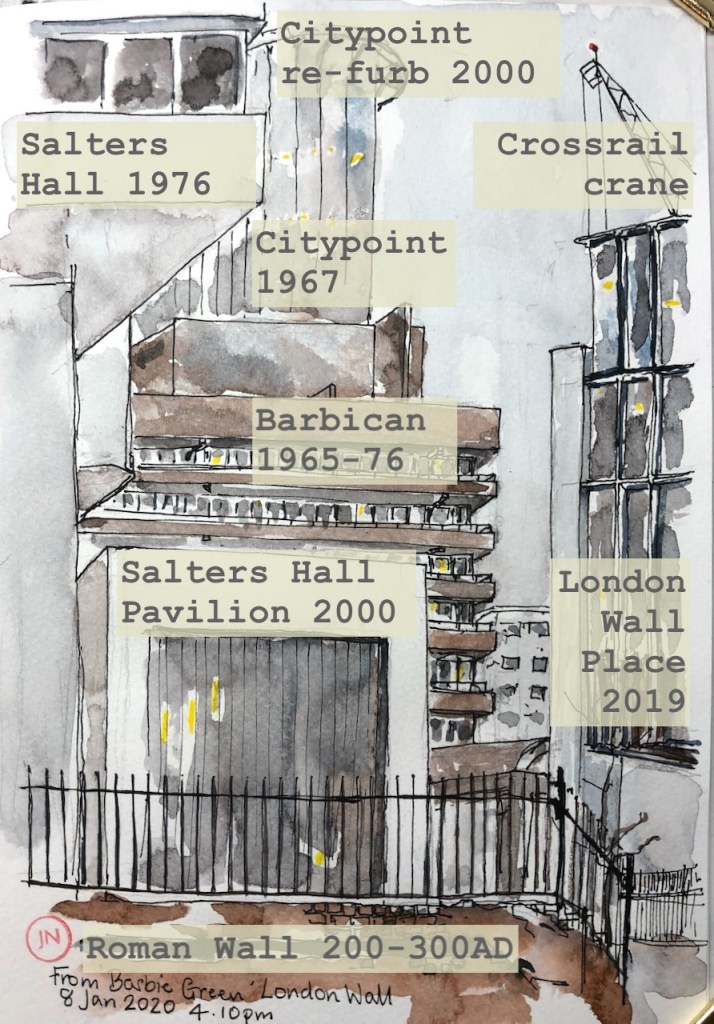
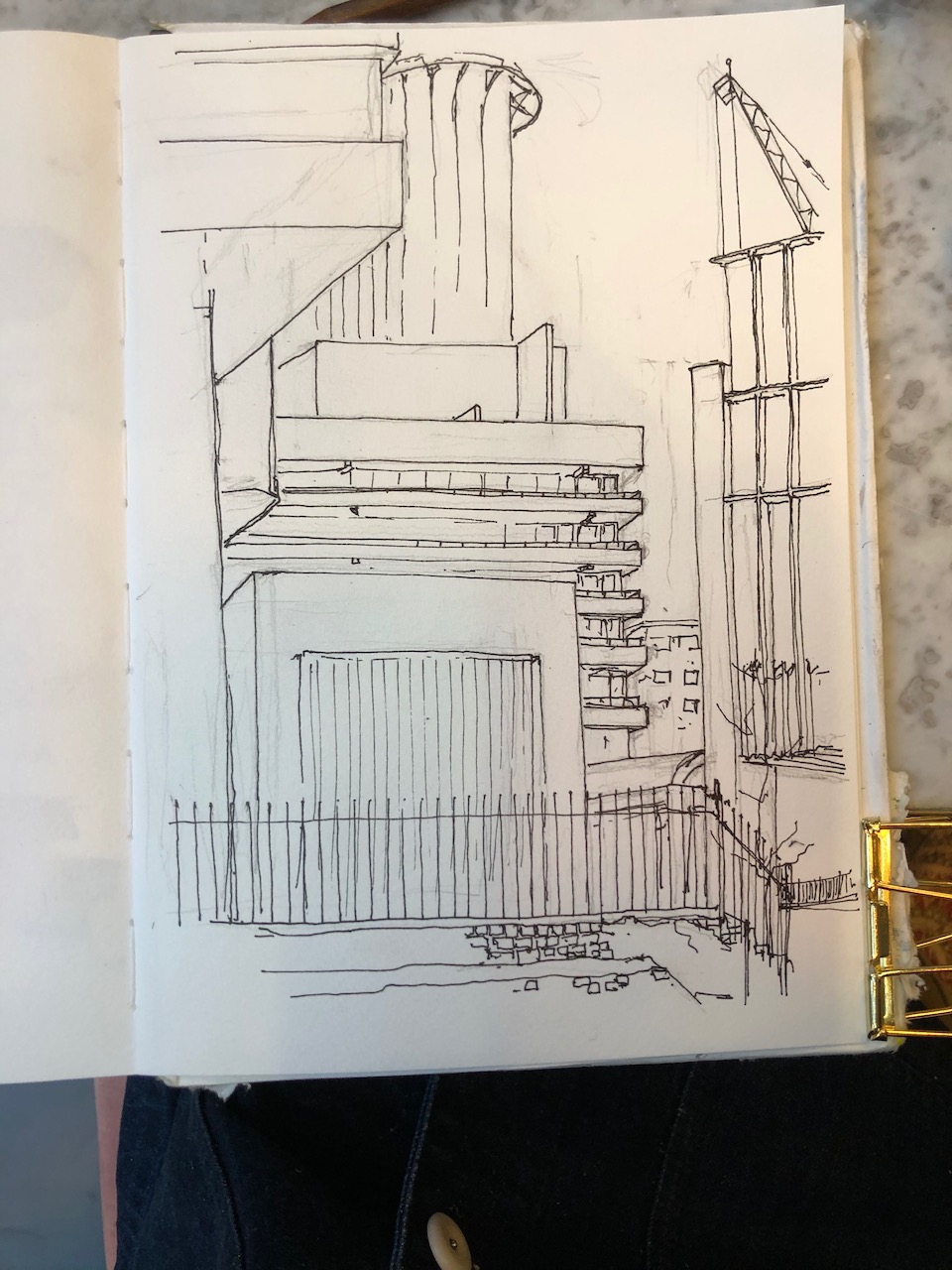
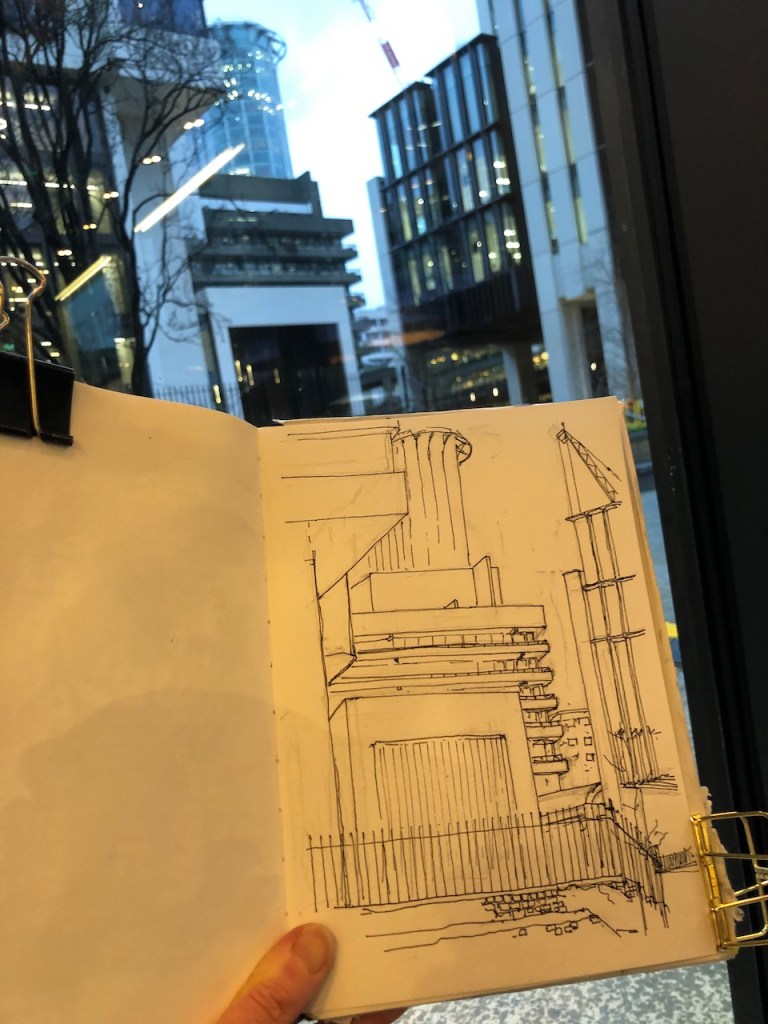
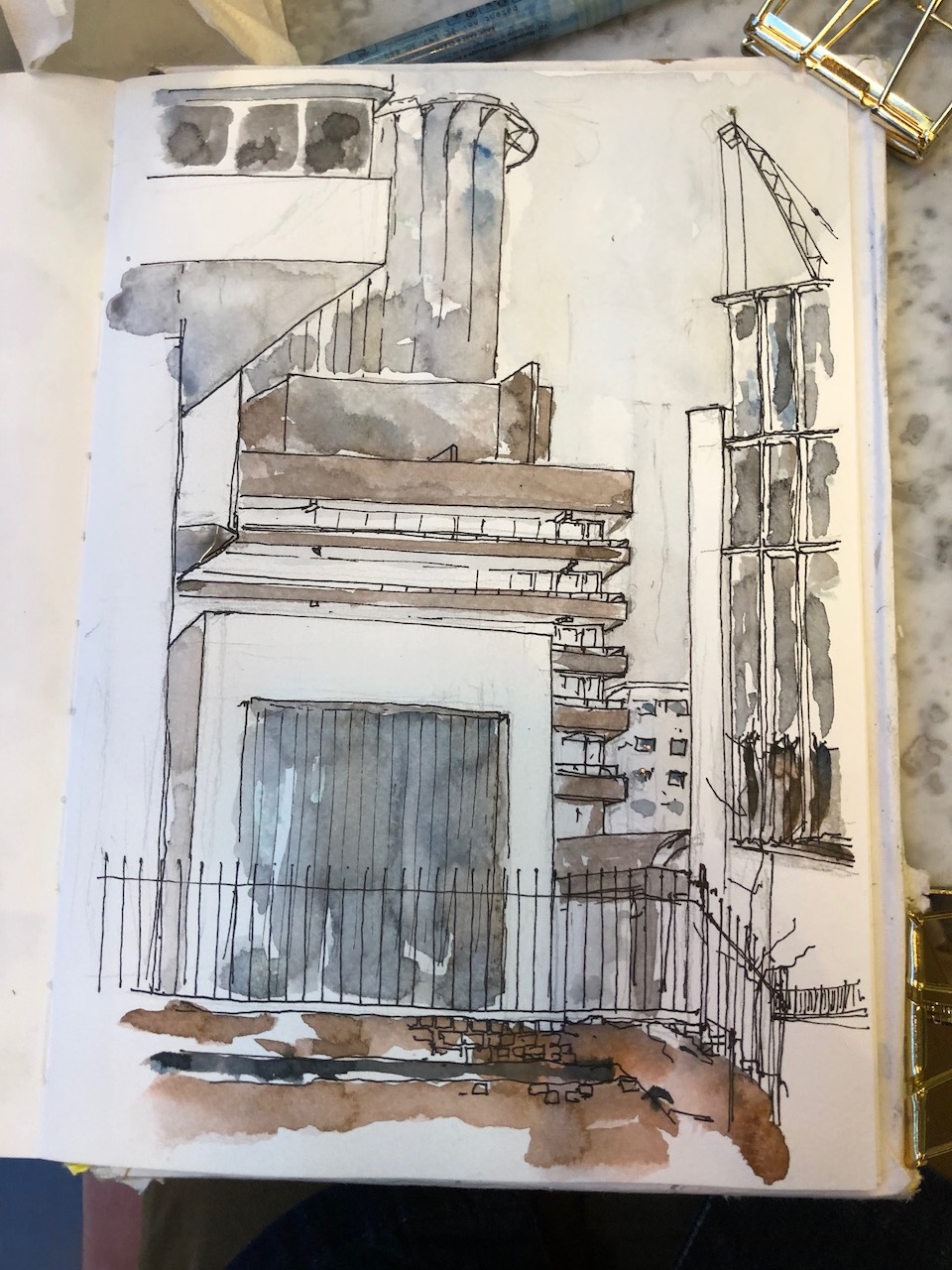
Here is a view from the Australian café, “Barbie Green” on London Wall. In this picture you see:
a vestige of the old roman London Wall, red-bricked. It has a modern fence on top of it because there is a 20ft drop on the other side. Built around 200-300AD.
Salters Hall, the white building on the left, and the square building in the middle. Built in 1976 to the designs of Sir Basil Spence, and extensively redeveloped in 2019.
Willoughby House in the Barbican Estate, behind Salters Hall, built 1965-76 to the designs of Chamberlain, Powell and Bon
CityPoint, in the middle background, built 1967 to the designs of F. Milton Cashmore and H. N. W. Grosvenor. It was refurbished in 2000 and that top structure added.
London Wall Place on the right of the picture, just finished in 2019 and now becoming occupied. The architects were “make architects”
the crane, high up to the right, is on the Crossrail site at Moorgate.
From Barbie Green London Wall, 2000 years of London architecture
Barbie Green is a new cafe which has appeared as part of the new London Wall Place development. Its huge windows have great views out over St Alphege Church and the surrounding buildings. They have very friendly staff who don’t seem to mind atall that I used their table as a vantage point for sketching. I had great food and great coffee too. Thank you Barbie Green.
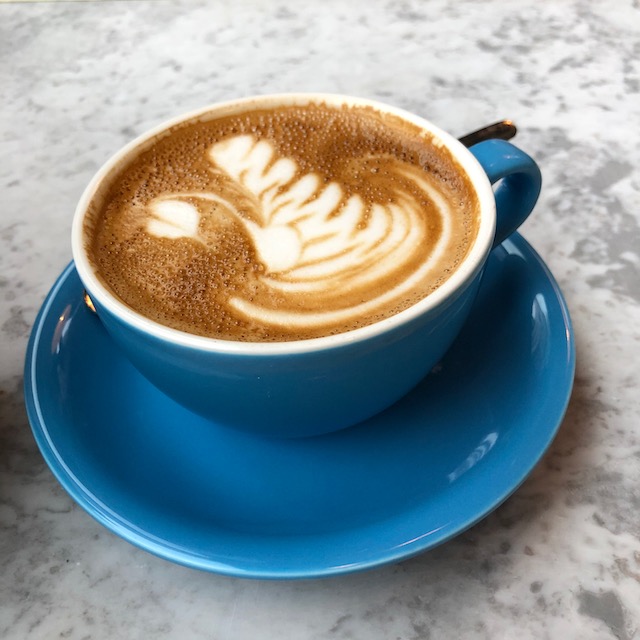
Great coffee. This is their “flat white”
From the brunch menu: Celeriac toast and poached egg
Barbie Green café, London Wall
This drawing took about an hour and a half. It is almost all Prussian Blue and Perinone Orange, Daniel Smith Watercolours, over pen and ink. The ink is “De Atramentis Document Ink Black”, which is waterproof.
Here is work in progress. As you see, it was getting dark!
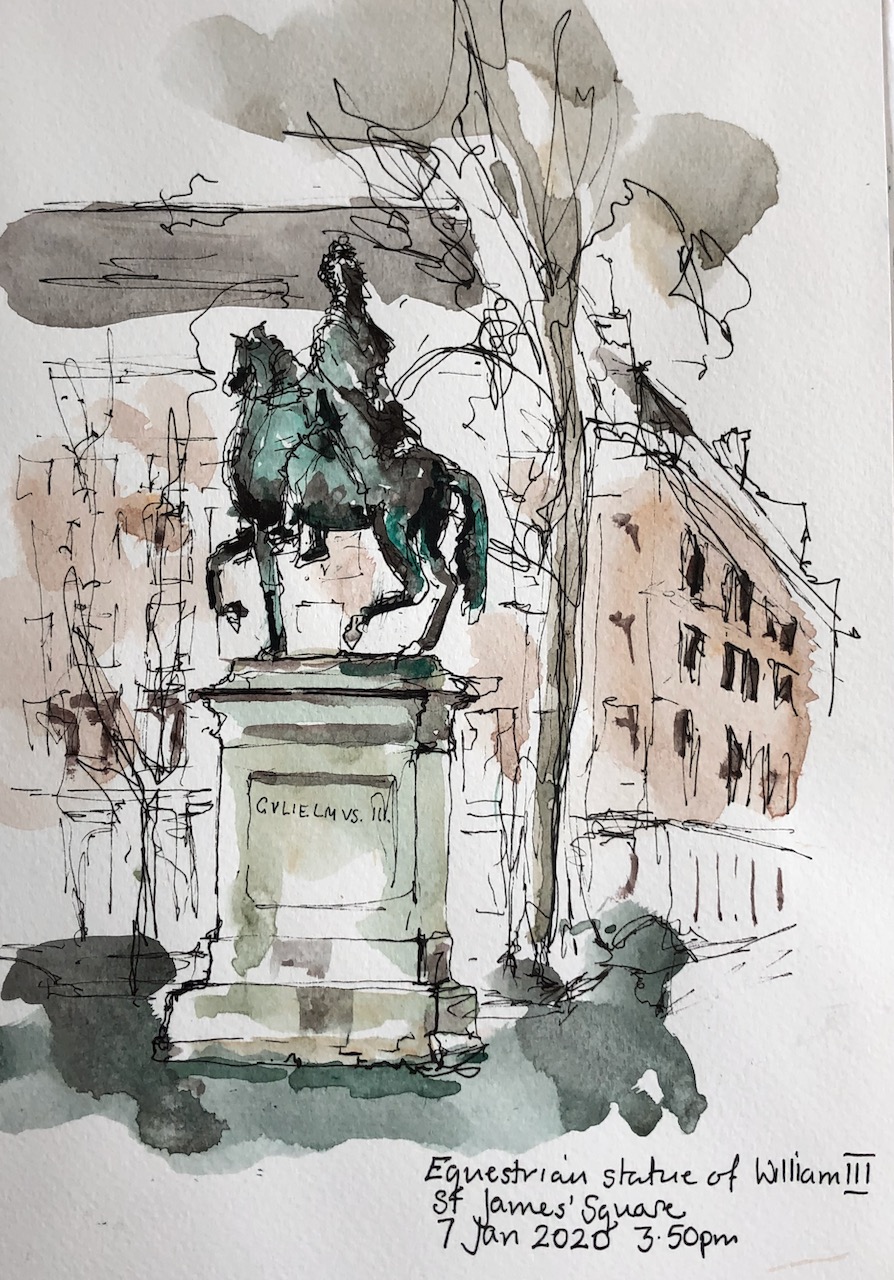
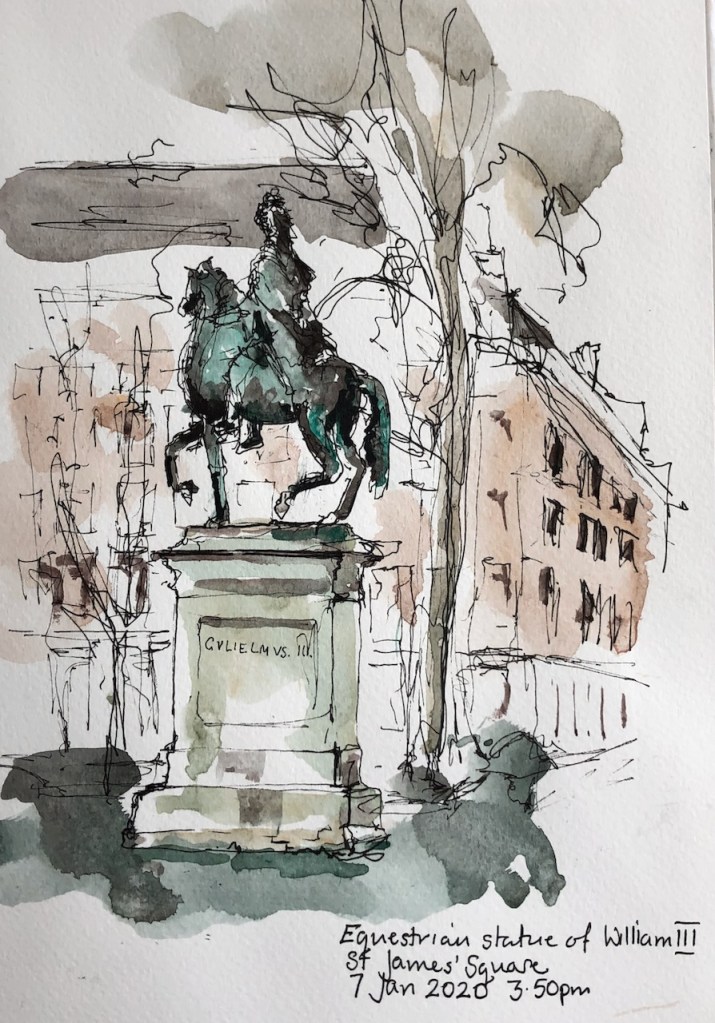
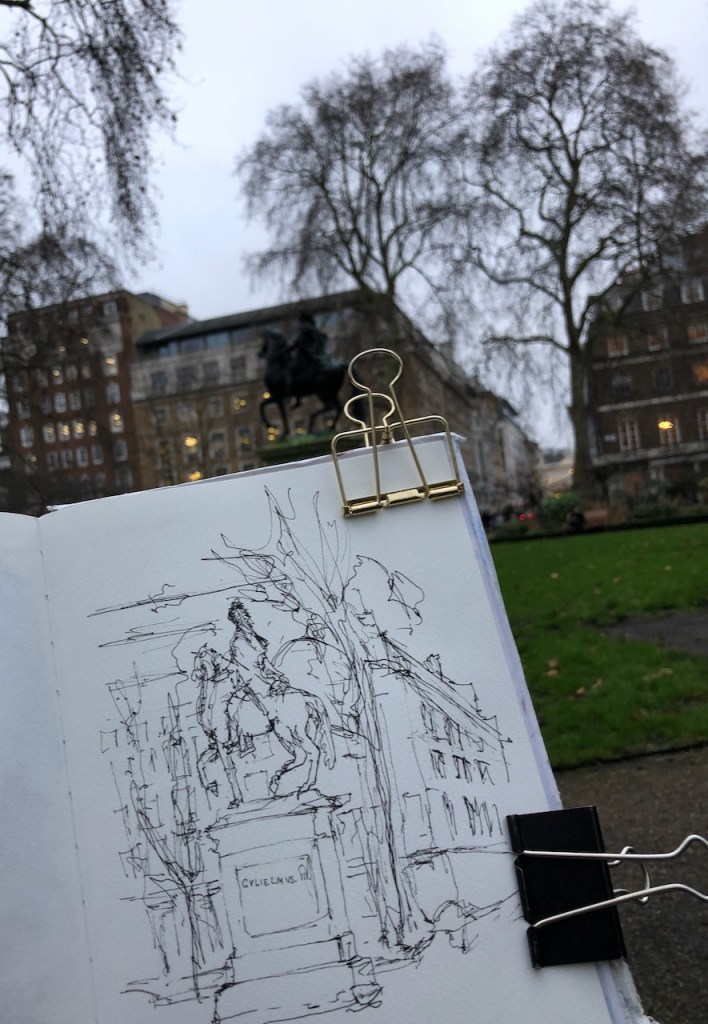
This statue is in the centre of St James’ Square, SW1, London.
William III is William of Orange. He was King of England, Scotland and Ireland from 1688 to 1702. The statue was originally proposed in 1687. It was completed in 1807, which is the date on the plinth. There were a number of delays. The first commissioned sculptor, John Bacon Senior, died. The sculpture was eventually created by his son John Bacon junior.
As you see, the statue has green highlights. This is how it was. It is bronze, which is an alloy of copper and tin: tin 12% roughly. The green is verdigris: a mixture of copper compounds. Wikipedia is lyrical on the subject:
“Verdigris is a variable chemical mixture of compounds, complexes and water. The primary components are copper salts of acetate, carbonate, chloride, formate, hydroxide, and sulphate…..All the components are in an ever-changing and complex reaction equilibrium that is dependent on the ambient environment.”
Wikipedia entry for verdigris
This makes it sound like a 21st century environmental art project.
Written on the plinth is: GVLIELMUS. III. And on the other side:
I.BACON.IVNR. SCVLPTR.1807
The sketch took about half an hour. Colours are mostly Phthalo Green, Prussian Blue, and Perinone orange. In Jackson Watercolour sketchbook.
Click a button below to share this post online, email it, or print it:
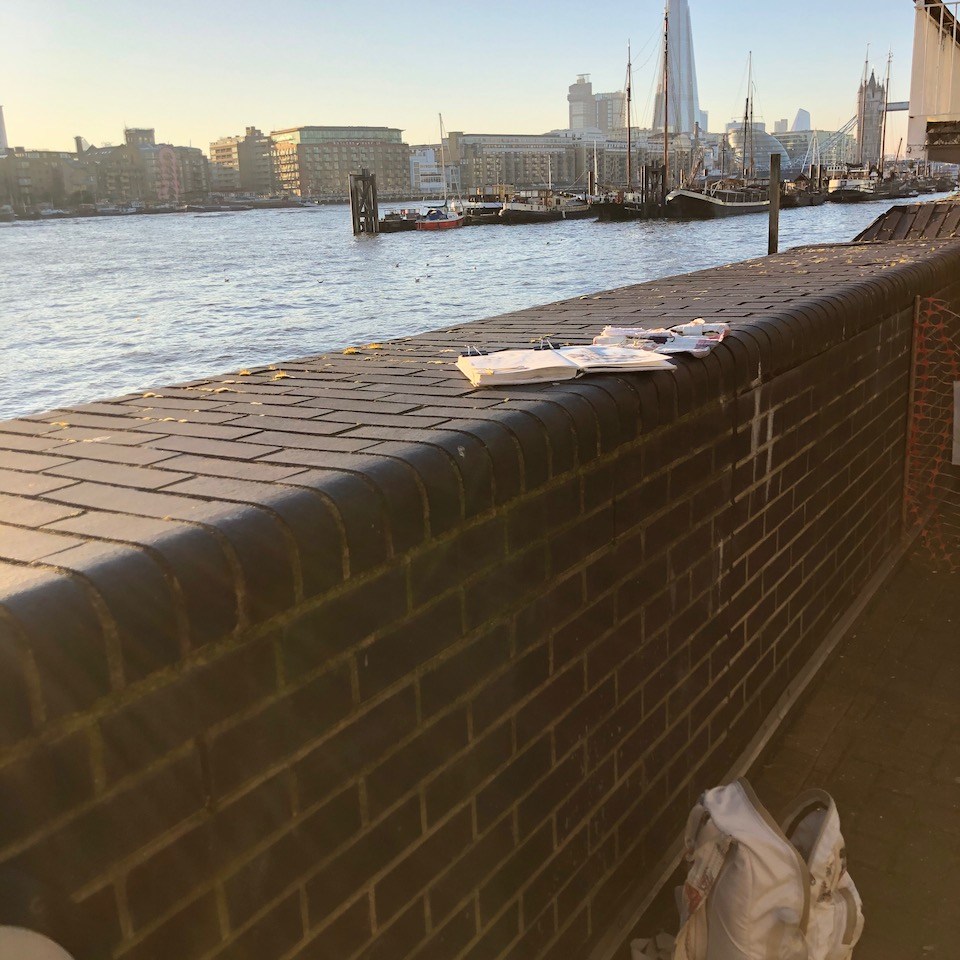
Walking east, downriver, the crowds left behind, suddenly there is space and silence.
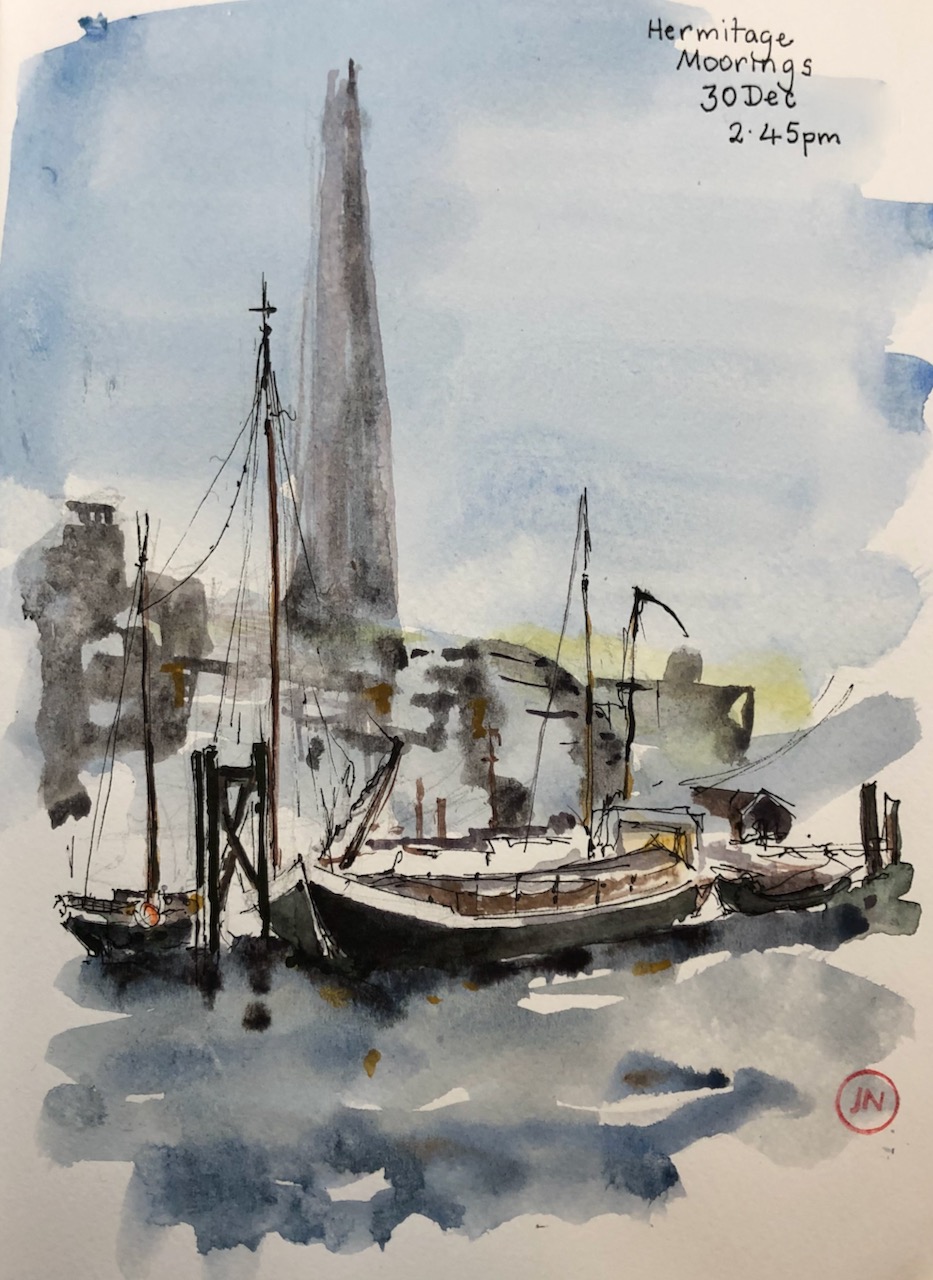
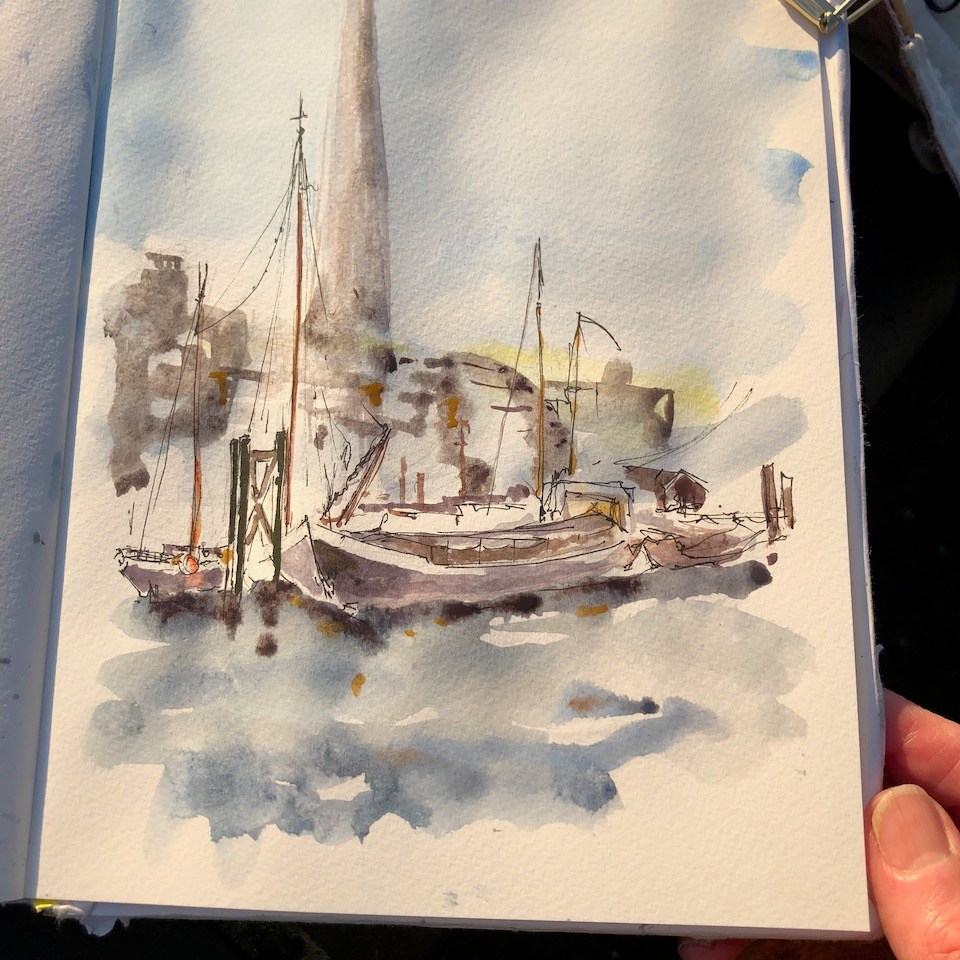
Hermitage Moorings, with the boat “Twee Artsen”
This drawing is a view across the river from the North bank. Tower Bridge is just off to the right. Opposite you see The Shard, and the waterfront buildings of Hays Galleria. The curved building in the background houses the Greater London Authority (GLA).
In the foreground is the boat which is called “Twee Artsen”. As far as I can work out, that is Dutch for “Two Doctors”, as in medical practitioners. It seems a strange name for a boat, so perhaps I got that wrong. Can anyone advise me?
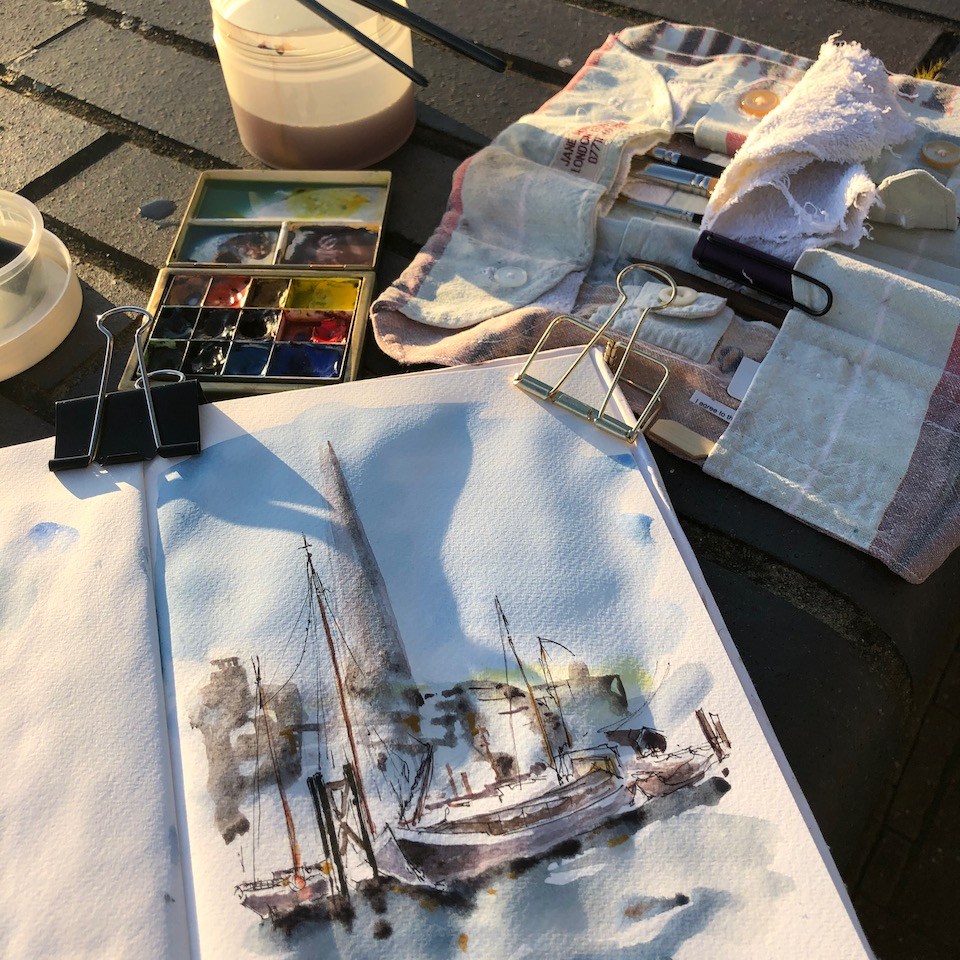
This was a lovely place to draw.
The drawing took about half an hour. The sky is cobalt blue, knocked back a bit with Naples Yellow Red. There’s some Mars Yellow and Perinone Orange for the masts of the boats. The Thames is Cobalt blue with Burnt Umber. The boat black is made from Phthalo Green (BS) and Perylene Maroon. There’s some Hansa Yellow Mid in there too, for the lower sky. Quite a lot of colours in this one. The Naples Yellow Red is a Rembrandt colour, all the rest are Daniel Smith.
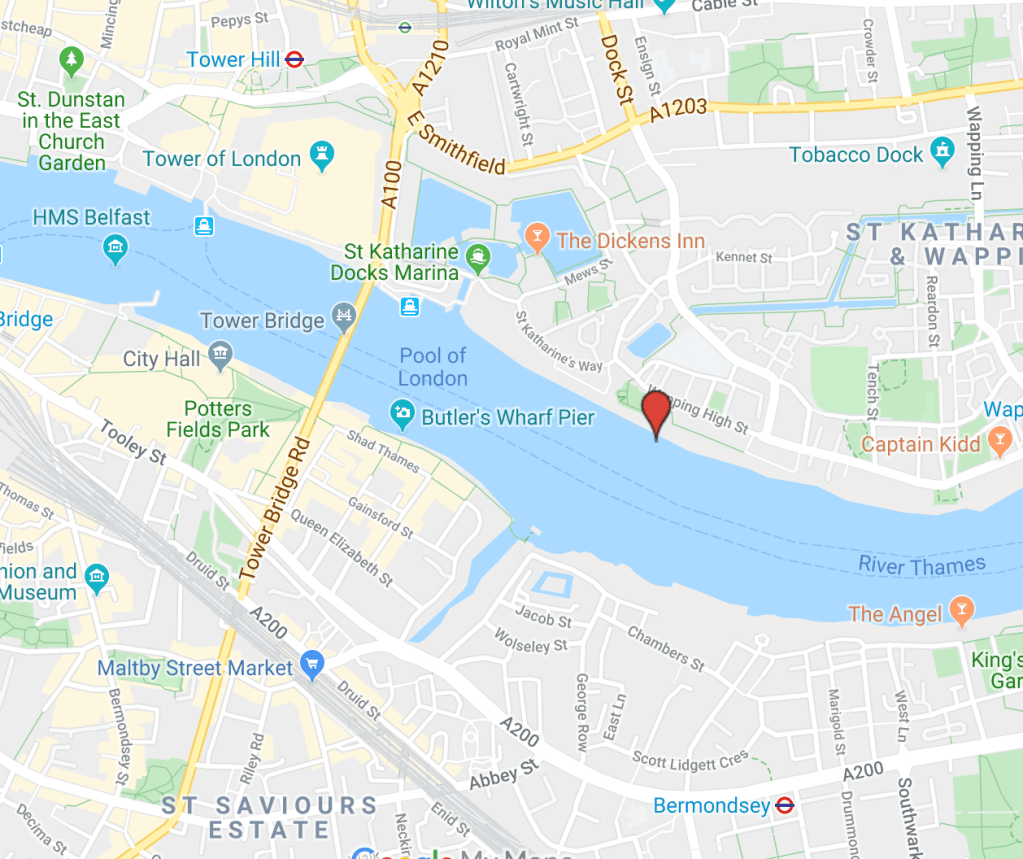
Where Hermitage Moorings is.
Click a button below to share this post online, email it, or print it:


































 Jane Sketching