It was getting dark but I’d been indoors all day. I set off into the gloom with my drawing things.
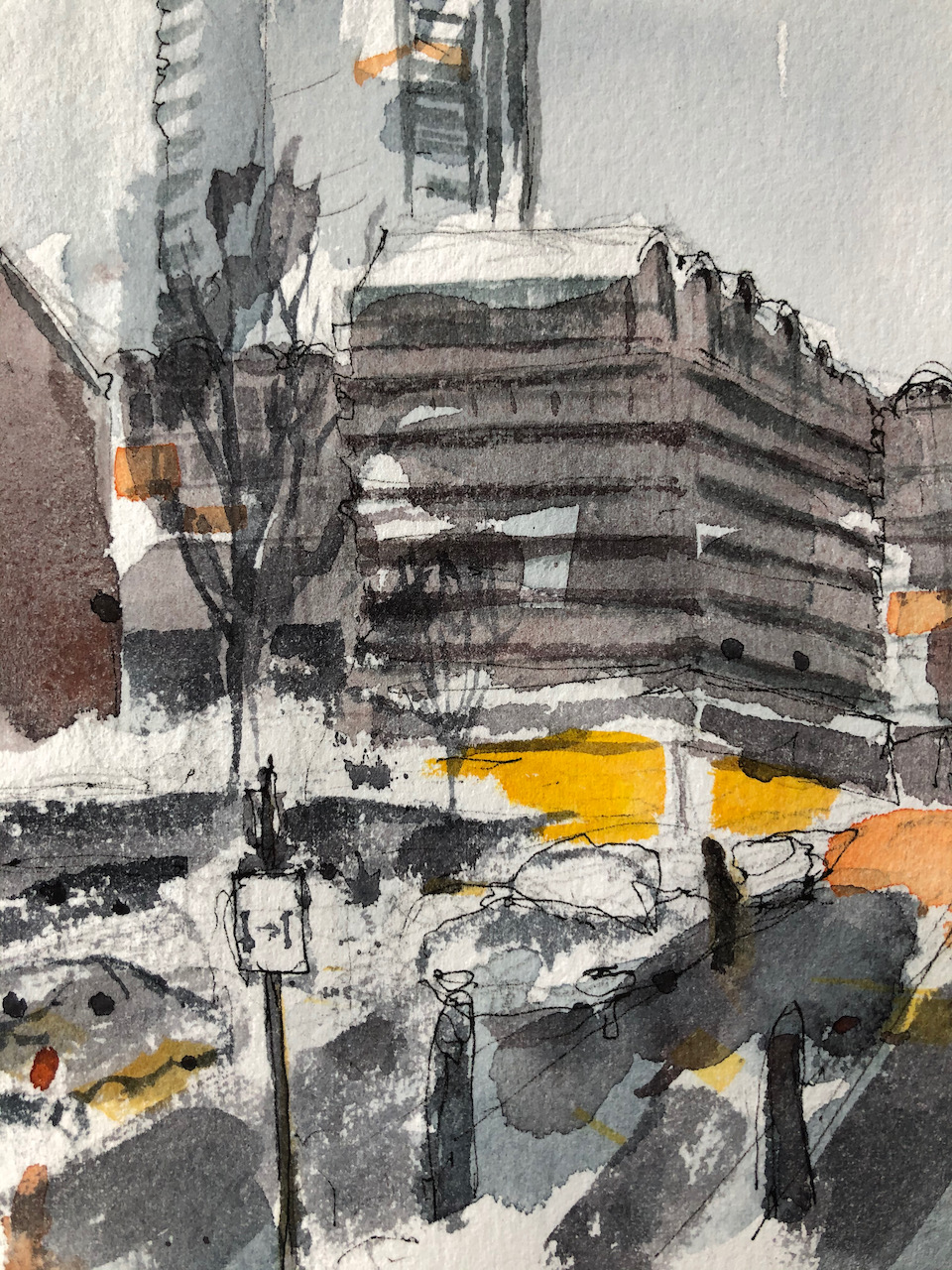
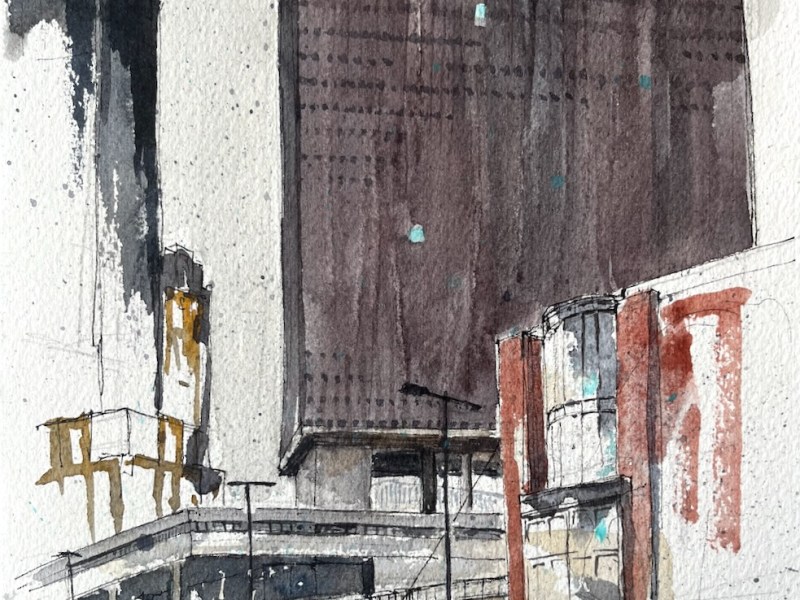
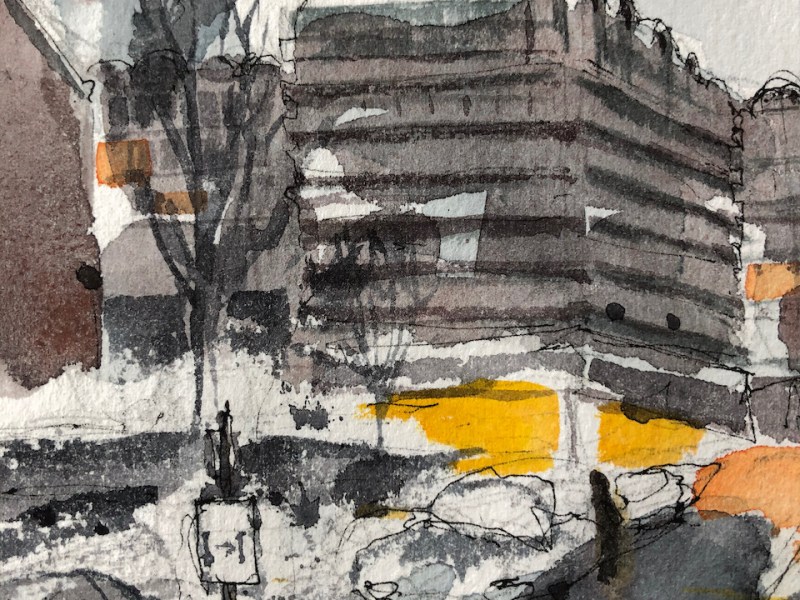
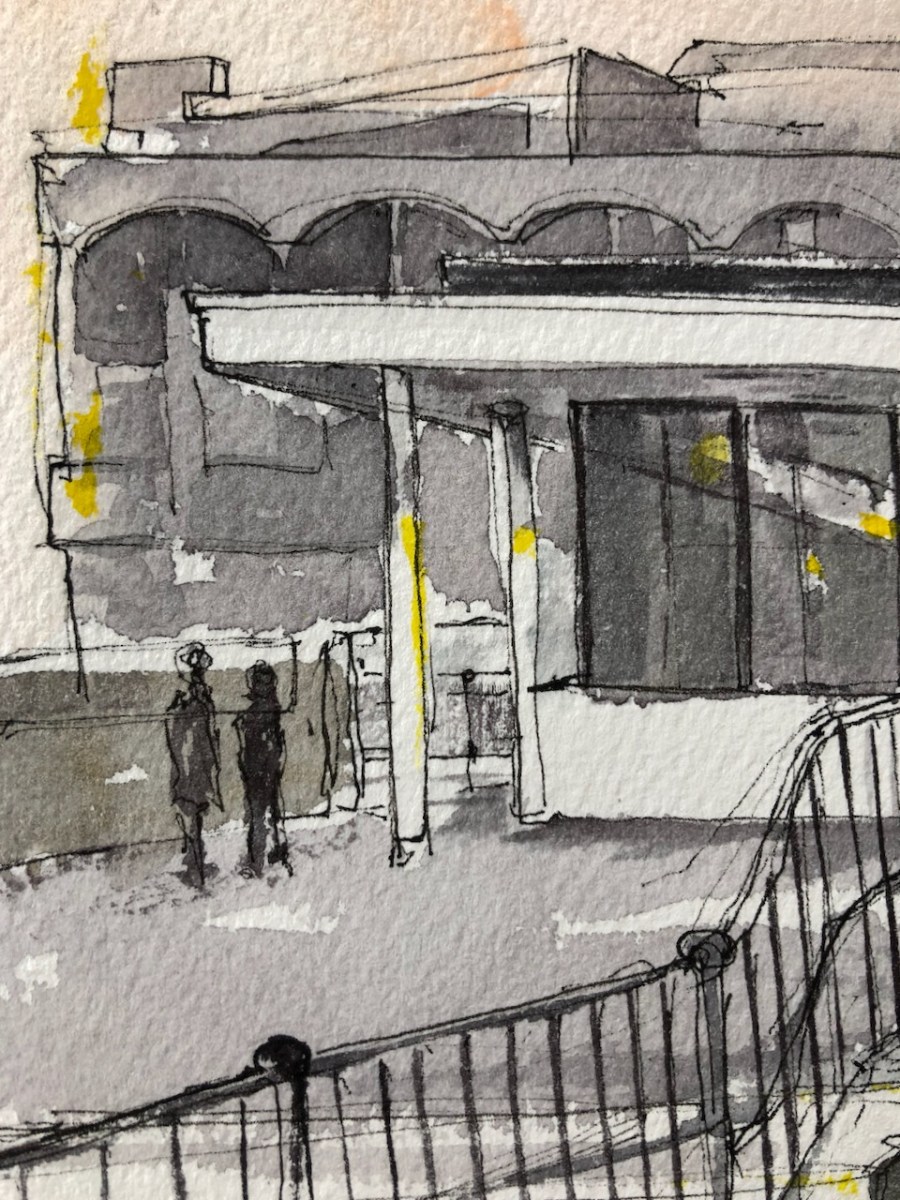
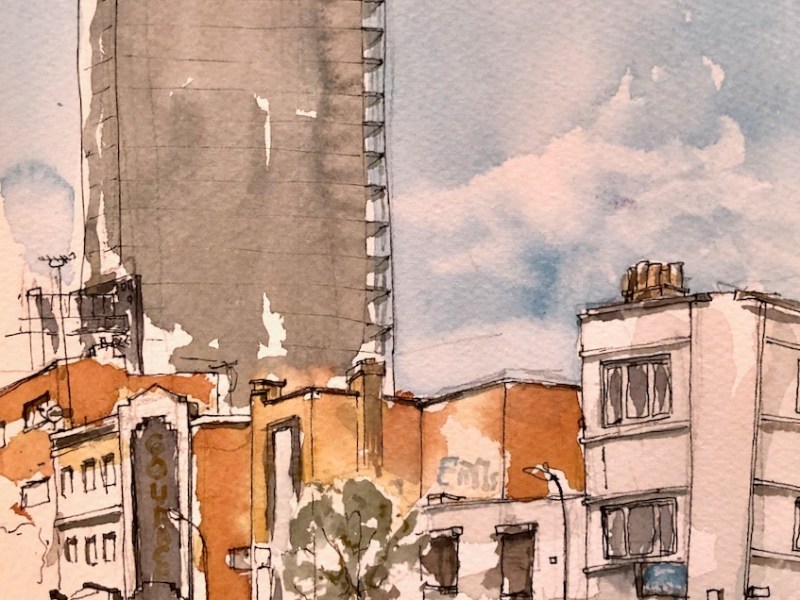
Looking towards the Barbican from Golden Lane, 5th January 2021, 4:15pm (detail)
It also started raining. Or maybe it was sleet.
I continued my peregrination through the dim streets. I like this time of day. In this weather, it’s not the “violet hour” of Mediterranean sunsets, but more like an Indigo hour, as the colours fade and go into dark smudges. I enjoyed the squares of light, each a little theatre of activity.
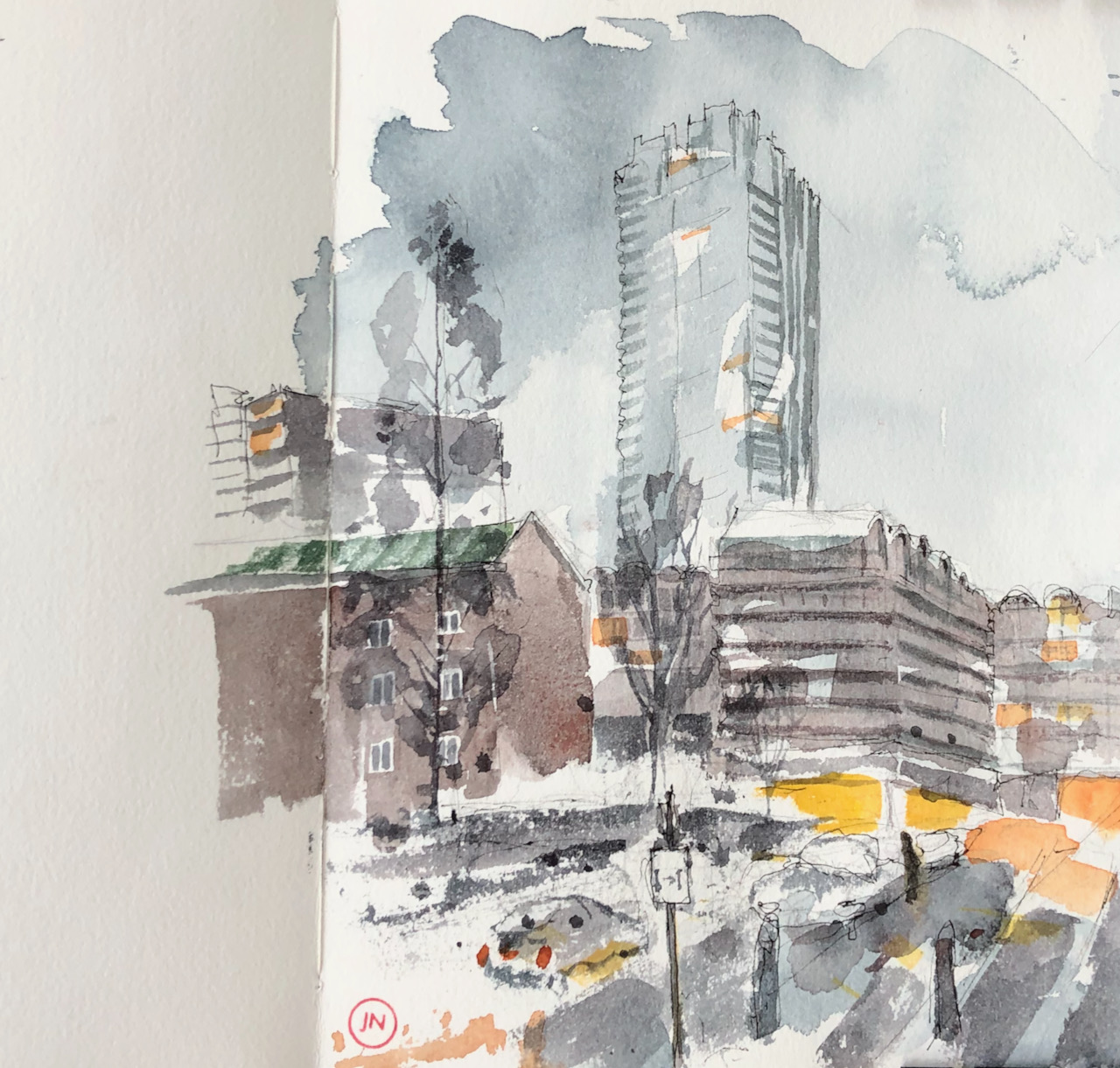
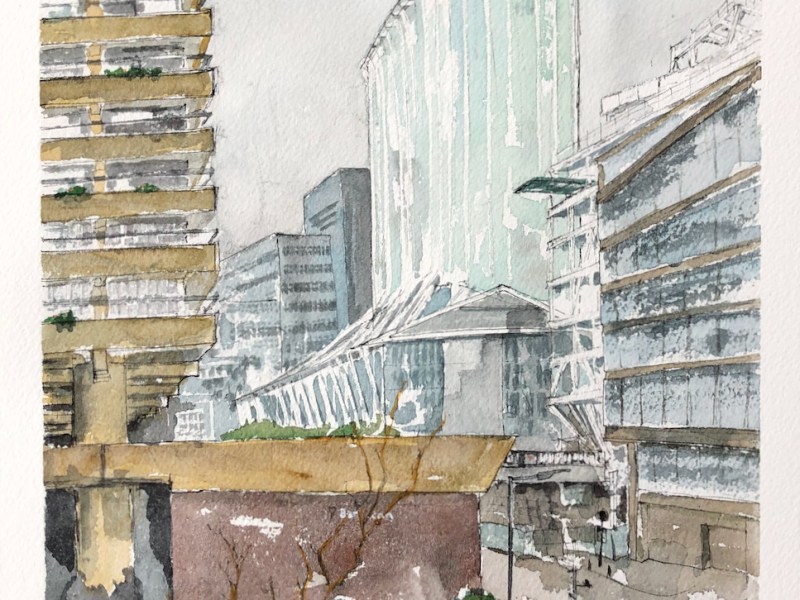
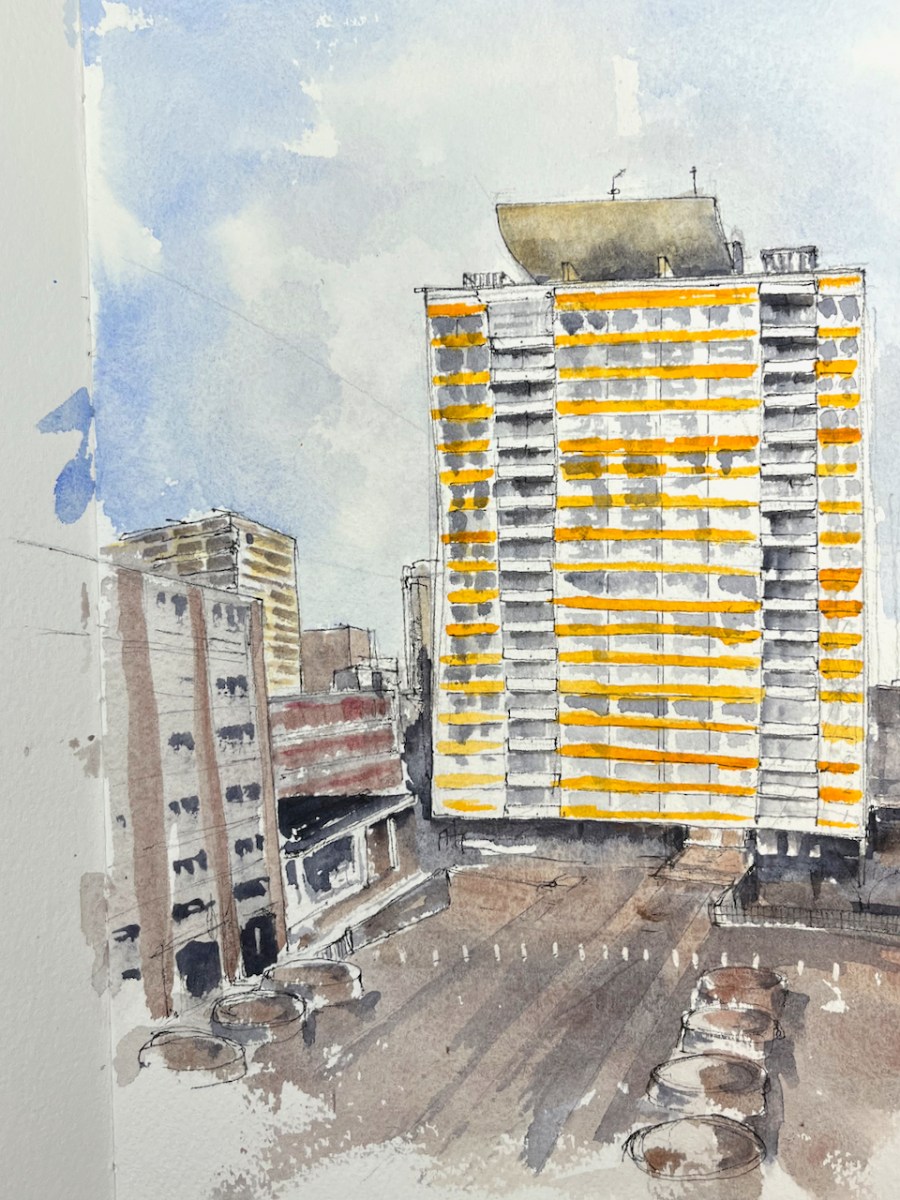
Here’s the picture I drew. It was sketched quickly on my walk, with the colour completed at home.
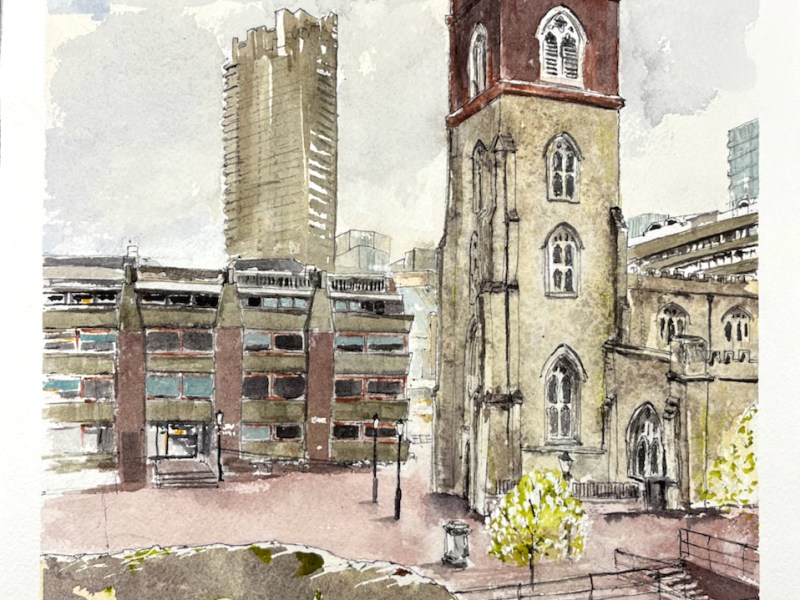
Looking towards the Barbican from Golden Lane, 5th January 2021, 4:15pm
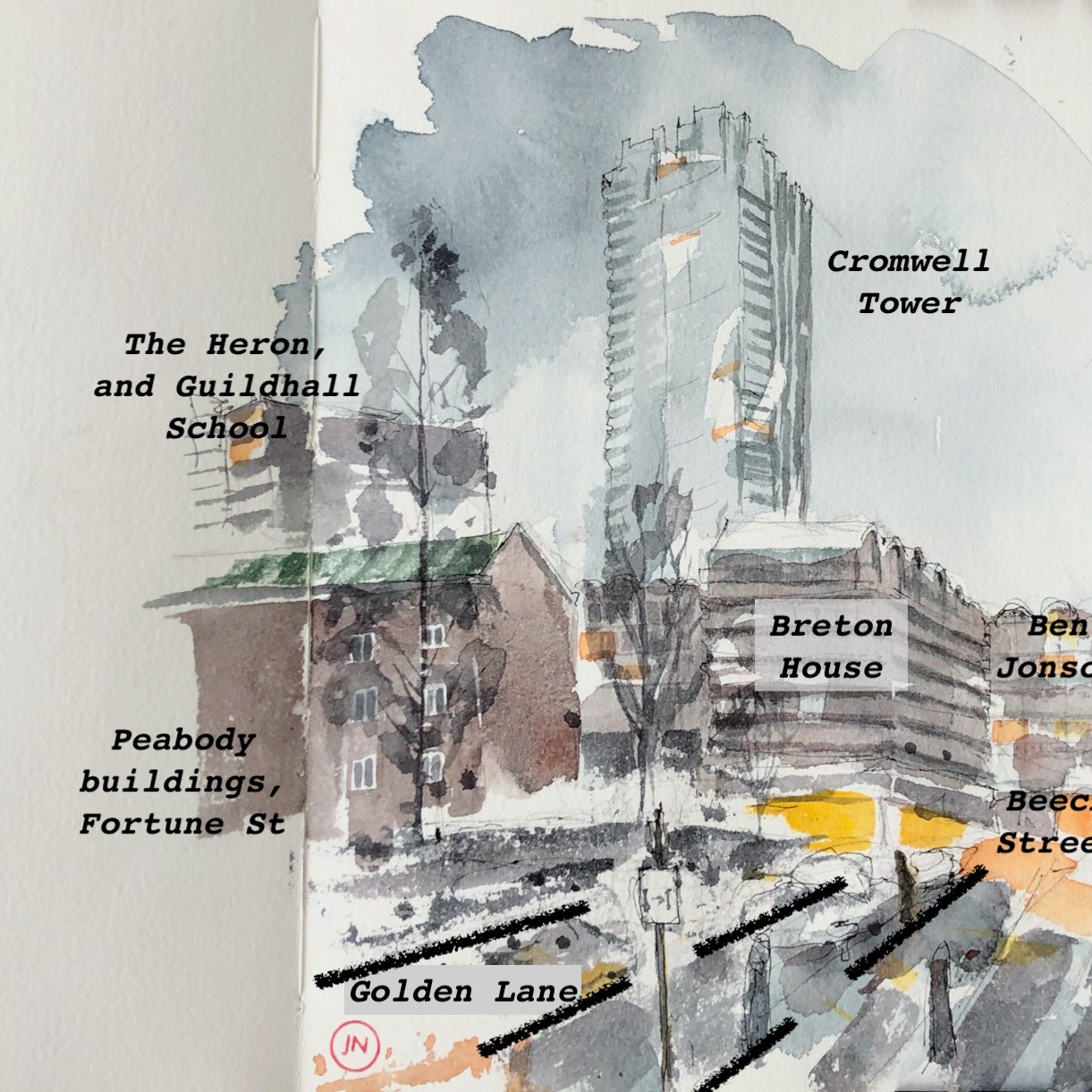
Here are the buildings:
In Wyvern sketchbook, on Arches paper, using Hansa Yellow mid (DS), and Transparent Pyrrol Orange (DS), with Perylene Maroon (DS) and Phthalo Blue Turquoise (W&N) for the sky and the darker greys. Fired Gold Ochre (DS) is in the mix for the Peabody Building.
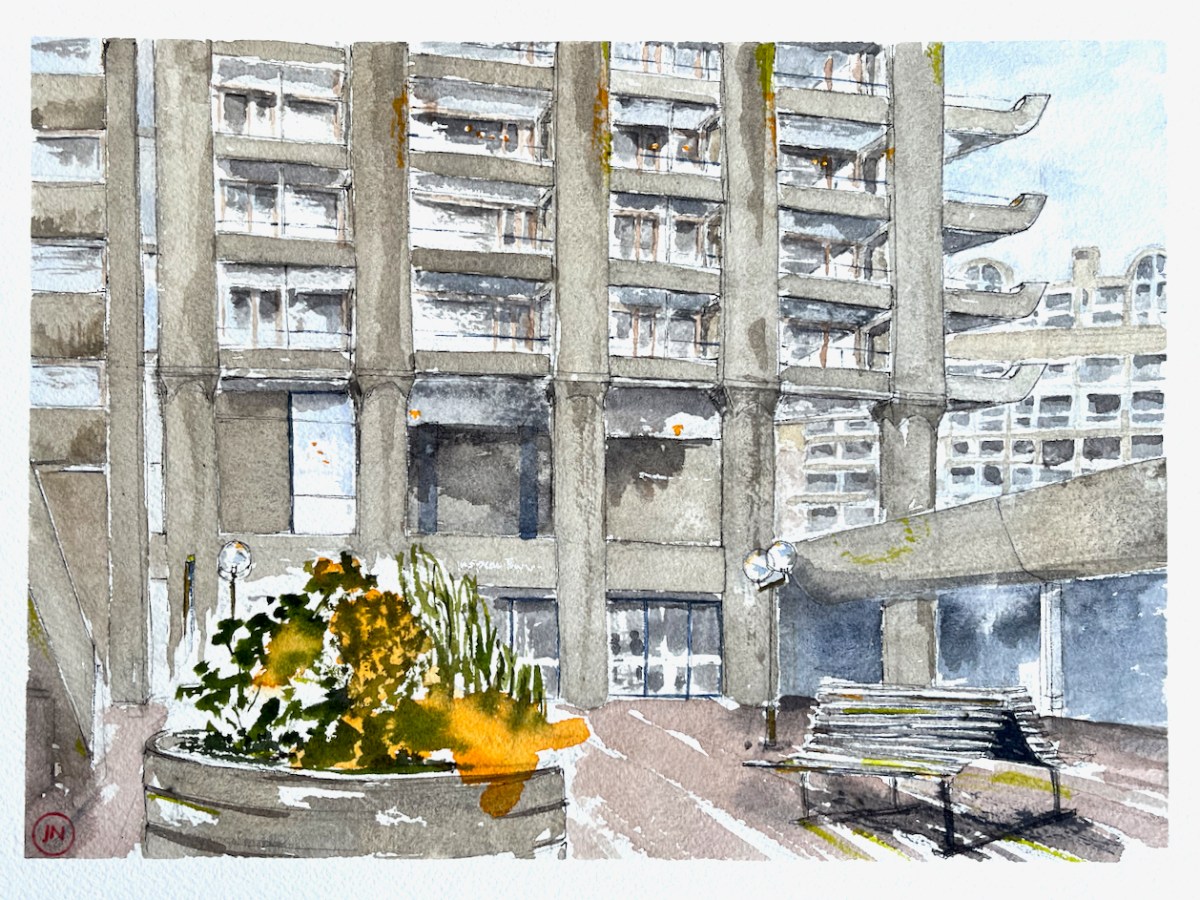
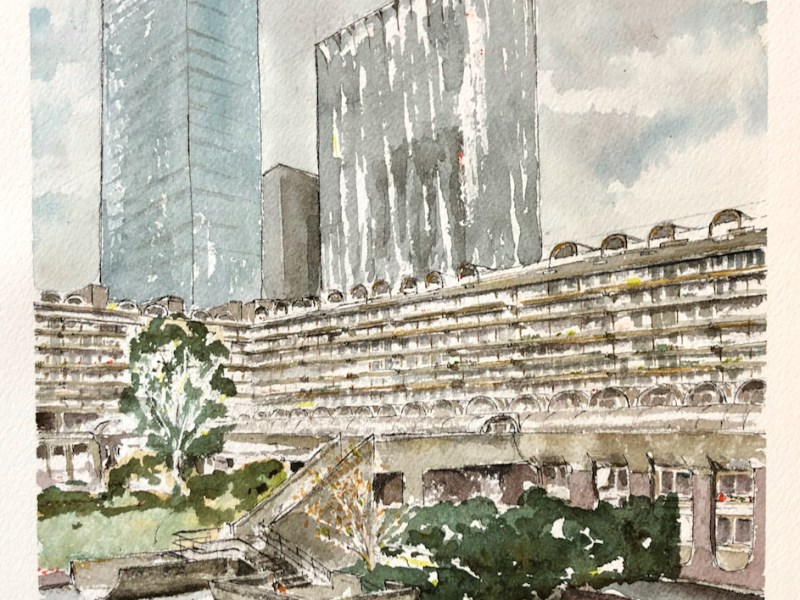
I have drawn in and around the Barbican before. Here is a collection:
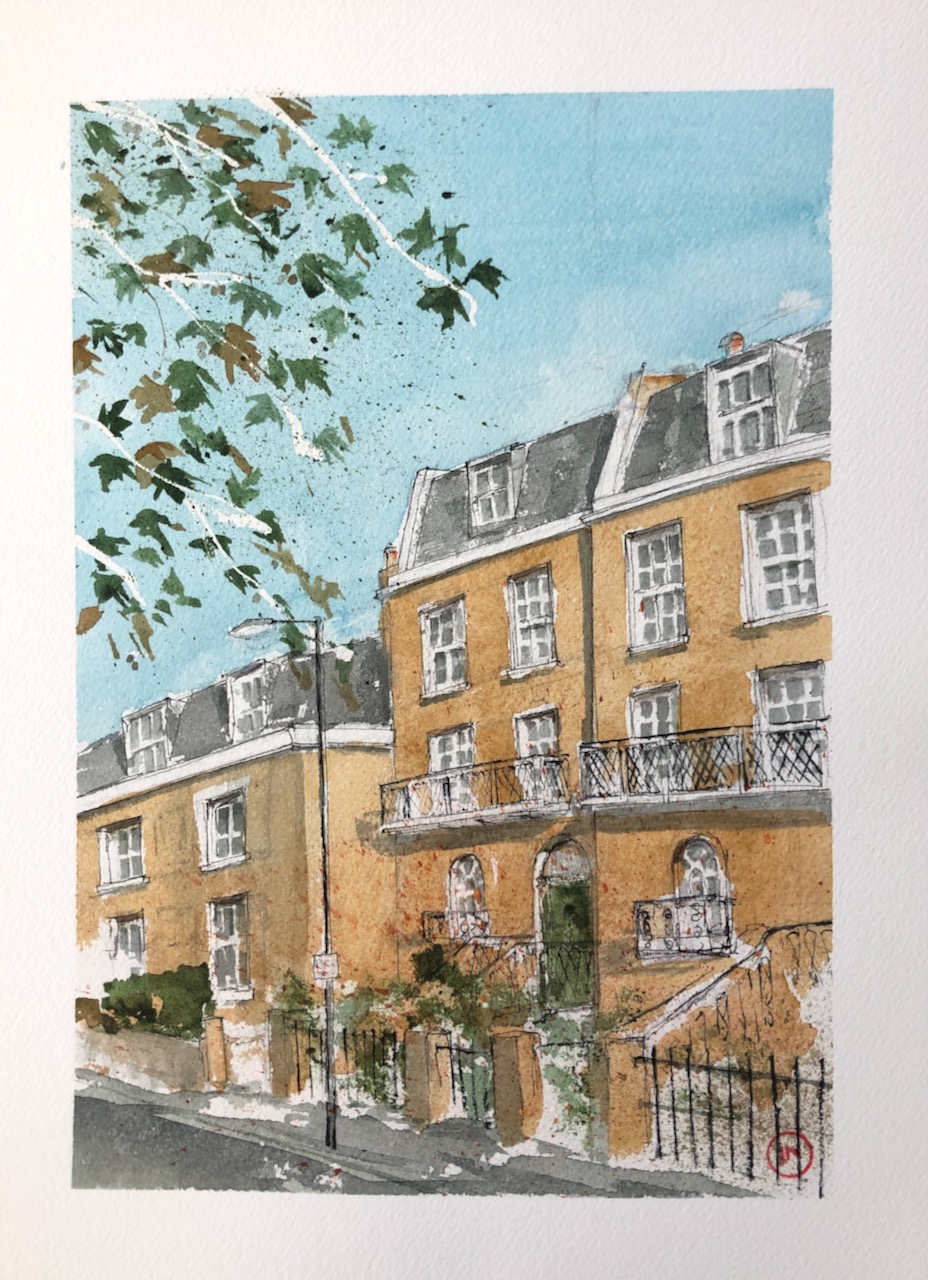
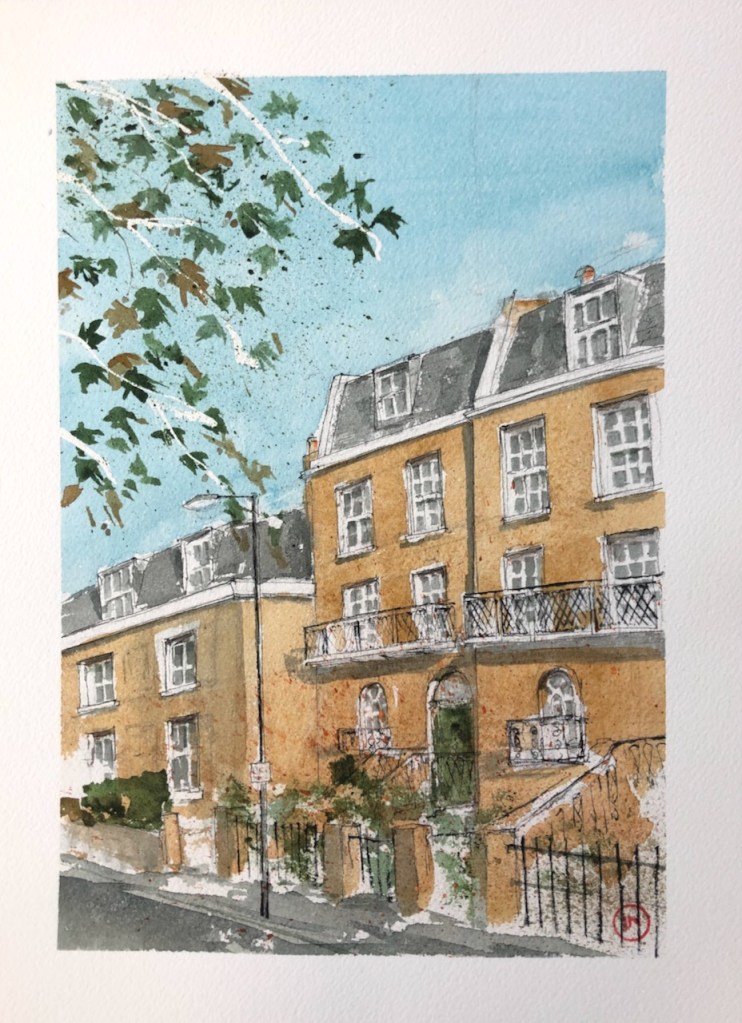
Here are houses on Grove Lane, Camberwell, London SE5.
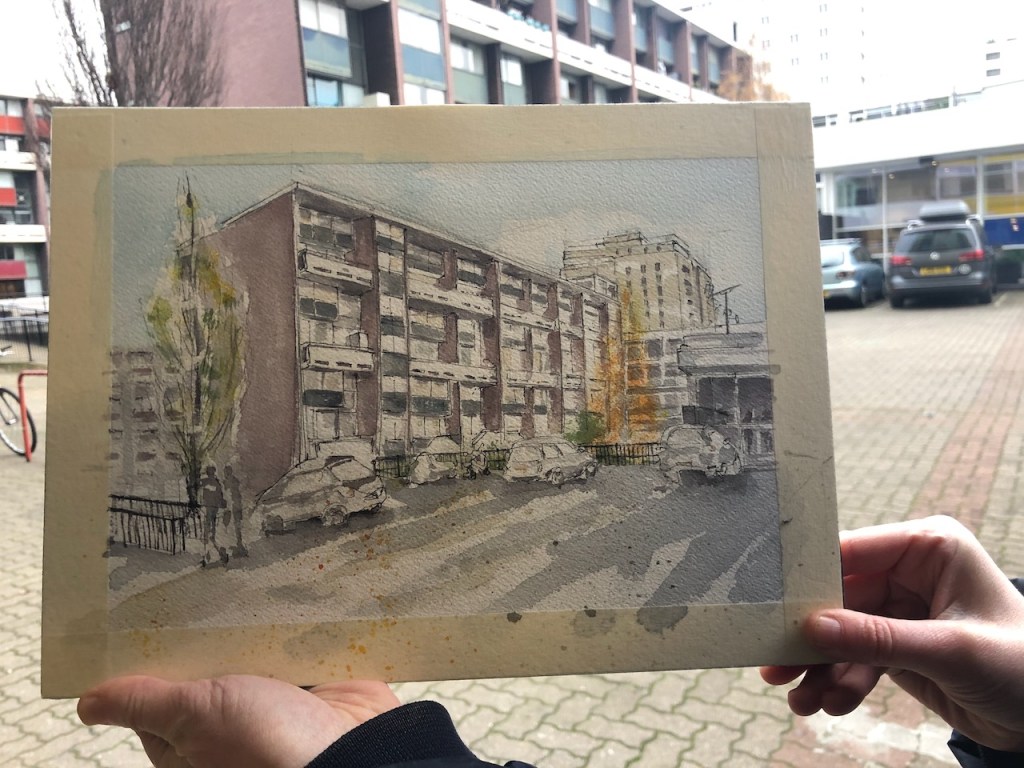
Grove Lane, Camberwell. 12″ x 9″ watercolour on Arches paper. Drawn on location, 5th December 2020.
I drew this standing in the street. People passed to and fro with prams, dogs and delivery parcels. Although it was December, there were still a few roses out in the bushes behind the fences. The sky really was blue, as you see from the pictures below. It was very cold though, note the gloves. I finished the colour at home, as my hands were freezing.
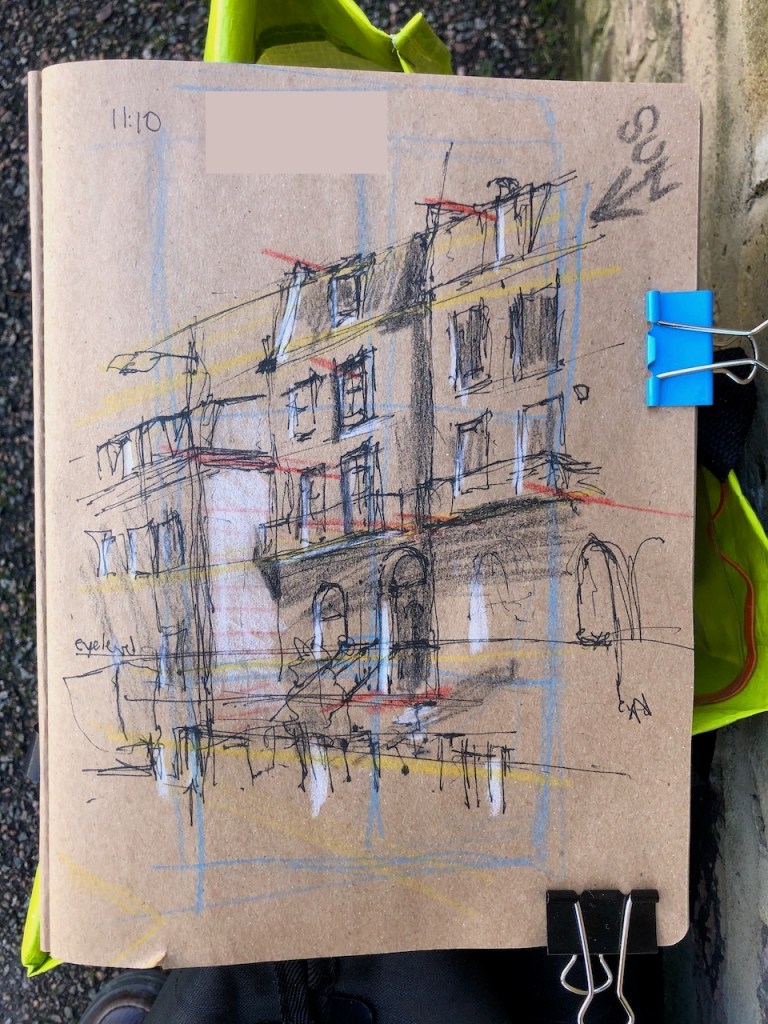
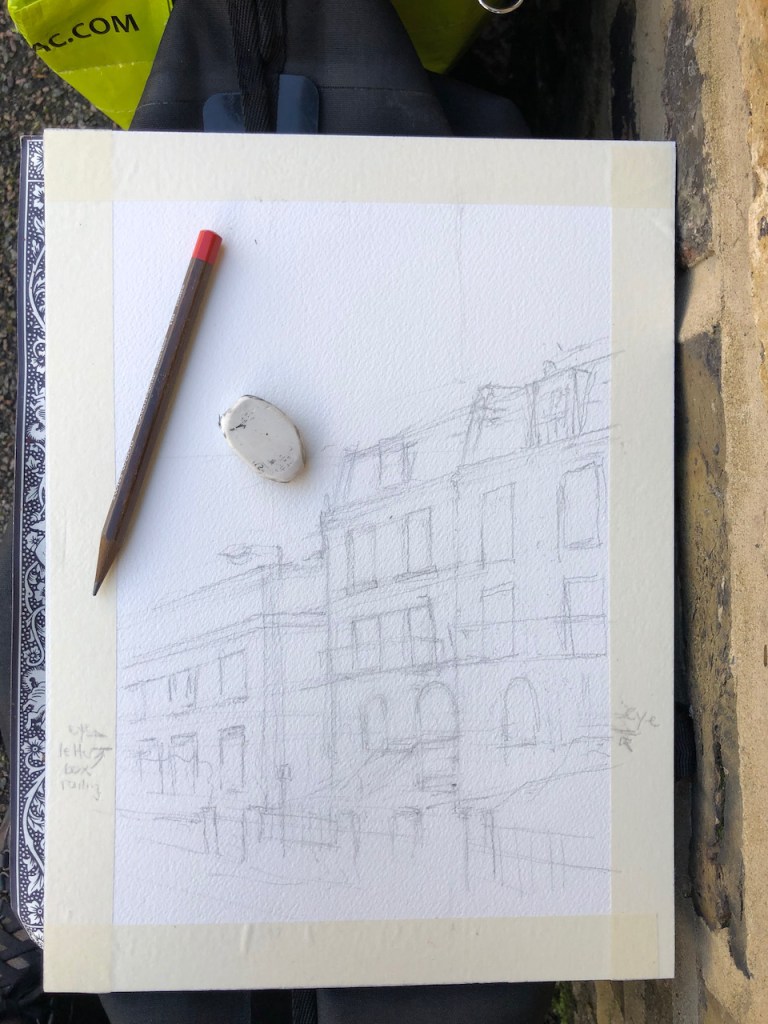
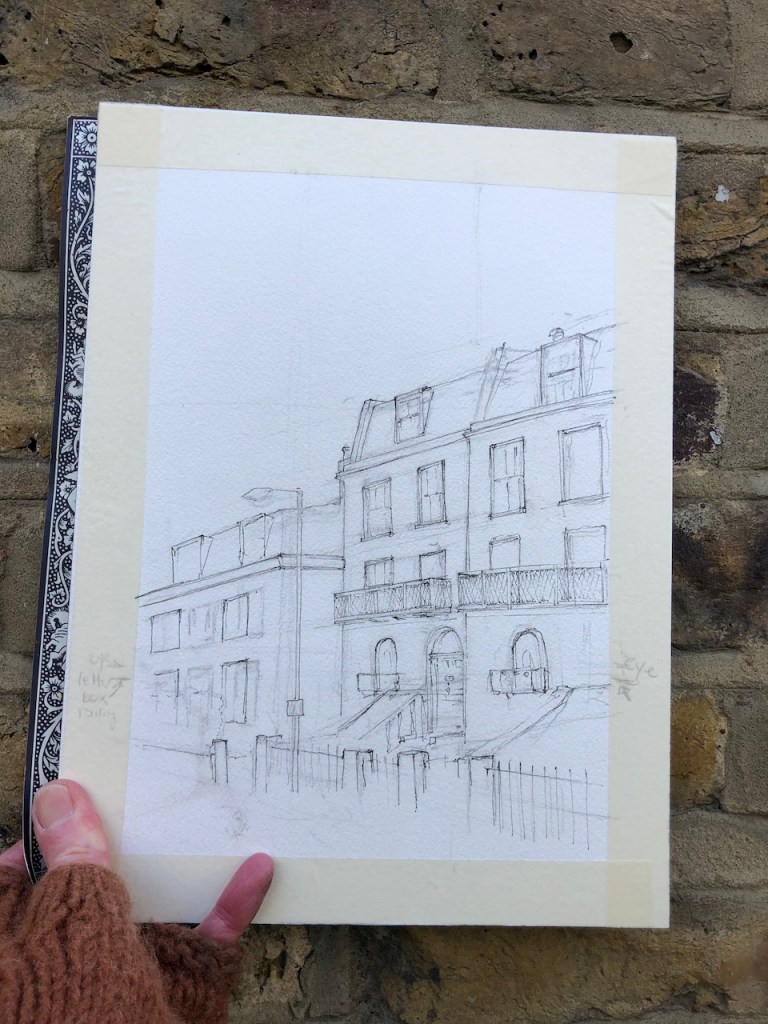
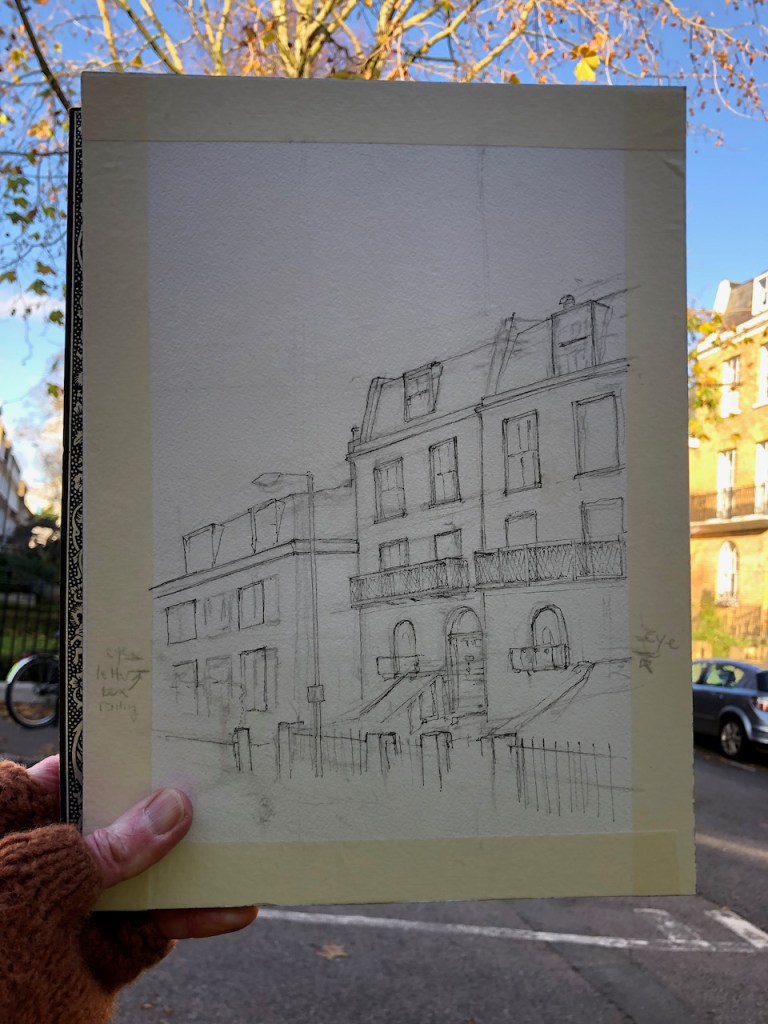
Here is work in progress.
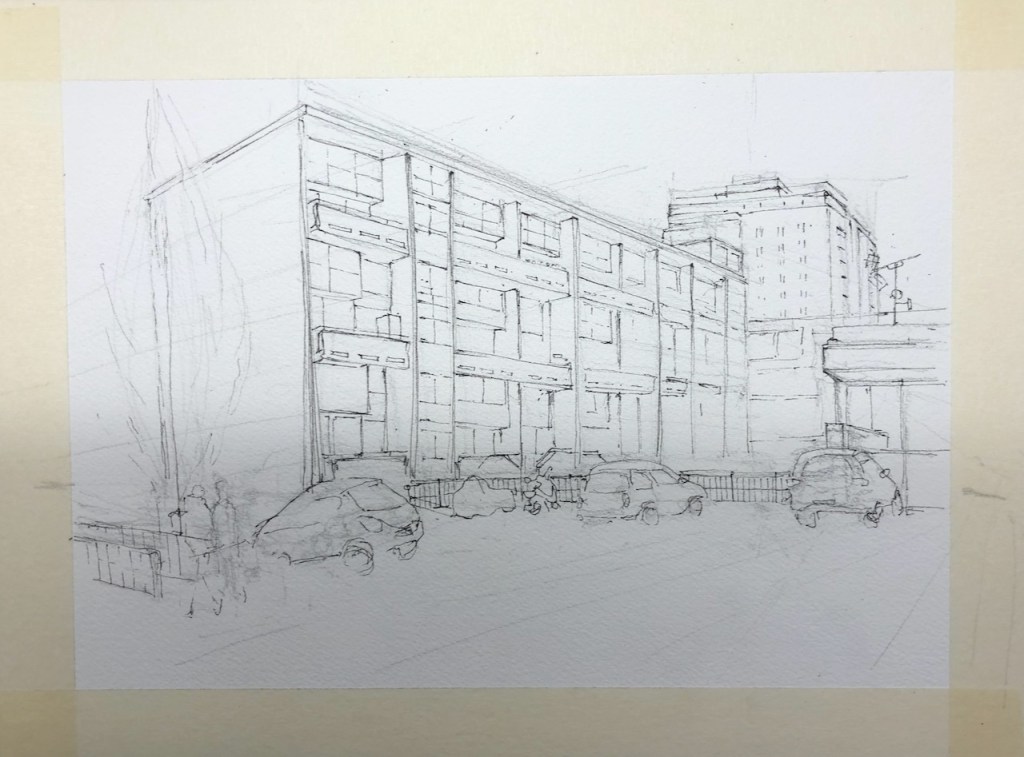
Preliminary Sketch and perspective
Pencil underdrawing.
Pen in progress
The main colours are Phthalo blue turquoise for the sky, Mars Yellow, Fired Gold Ochre, and Green Apatite Genuine. The paper is a block of Arches 300gsm Cold Pressed watercolour paper.
This was a commission! Thank you to my client for the commission, and for introducing me to this interesting area. I found a new cycle route through Elephant and Castle.
Click a button below to share this post online, email it, or print it:
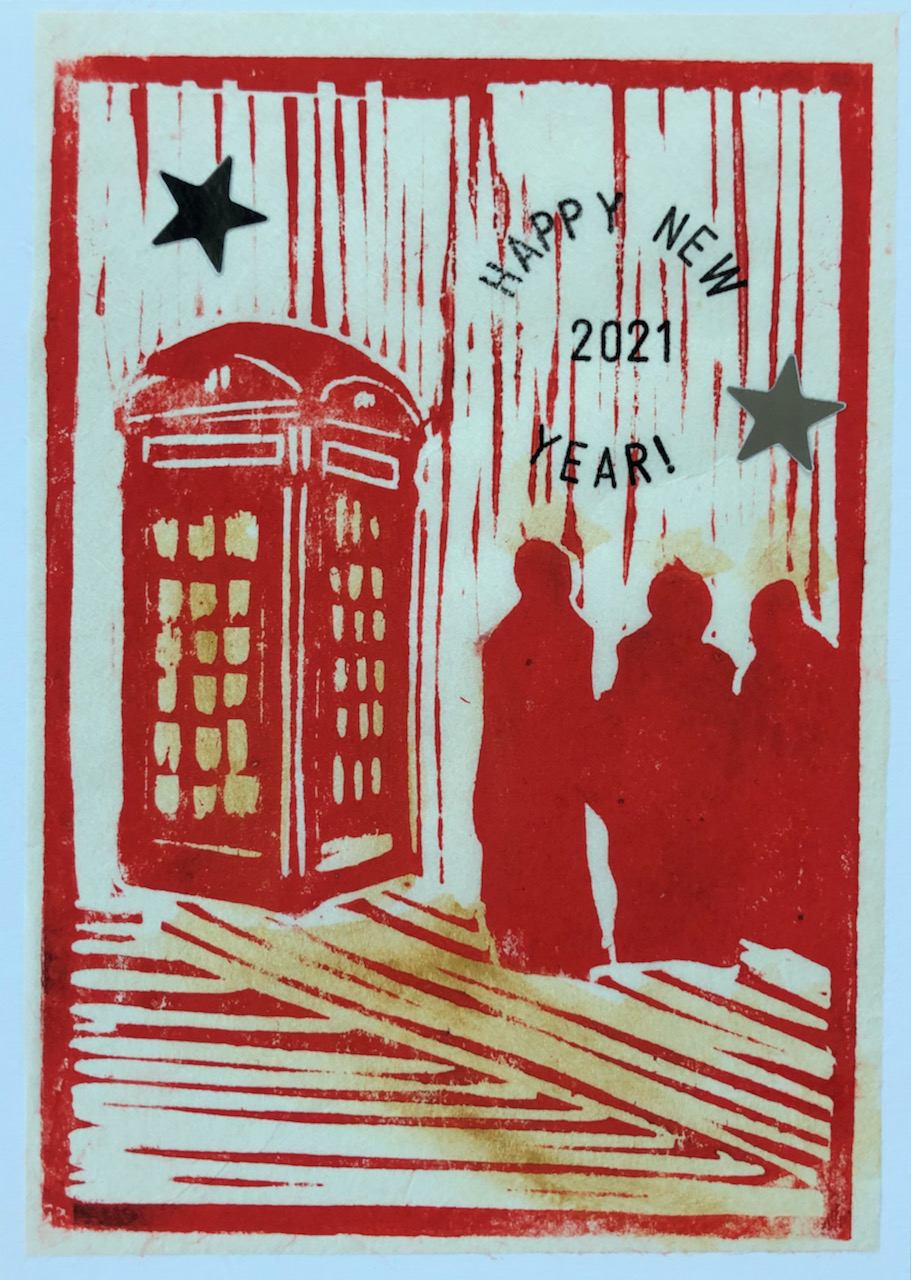
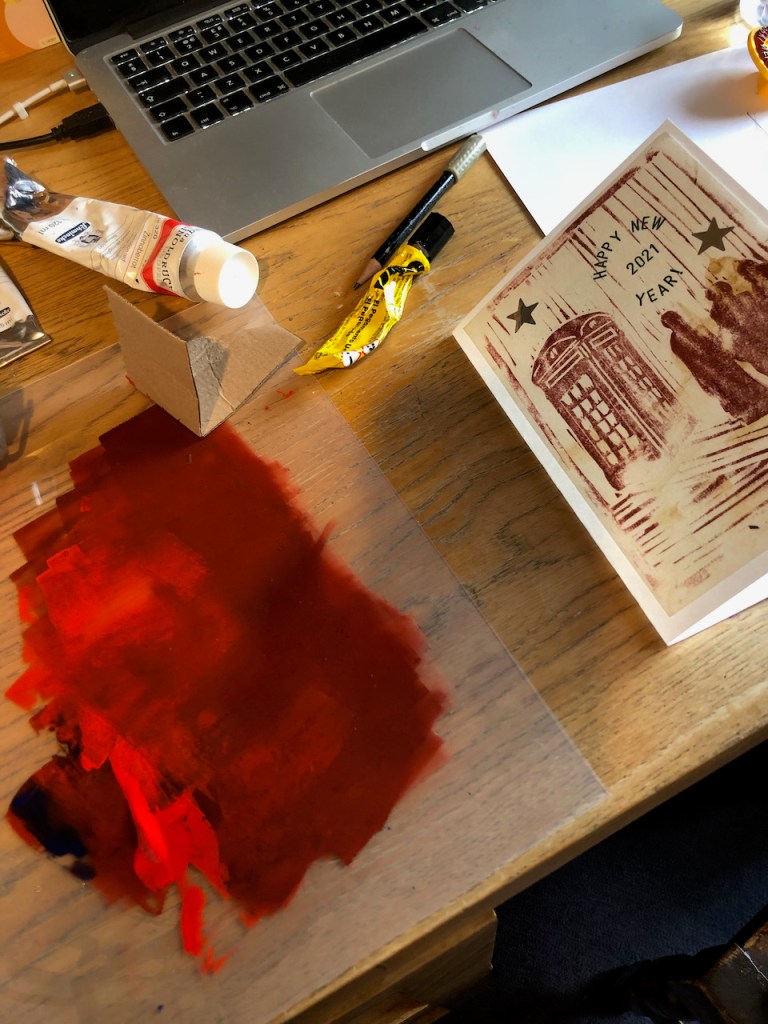
My New Year card for 2021 shows a telephone kiosk.
New Year, 2021, “Connection”, woodcut 6″ x4″, on Japanese Kozo paper
I am of a generation for whom the telephone kiosk was, at one time in my life, an important feature of communications. You looked for them. You found them. They were either working or not. The inside smelt of old metal, coinage, leaves and urine. The phone was heavy and cold. The thick cord was twisted. You had to have the right coins. Sometimes coins jammed in the slot, or went straight through the mechanism without registering. So if you were experienced, and organised, you had a whole series of coins of different denominations ready to put in, in case the first one didn’t work. If your call was important, or if you needed to write something down, it was helpful to have a friend with you in the telephone kiosk, standing by with the coins, poised to enter them rapidly as the pips went. There was a risk-based calculation about what denomination of coin to enter, and in what order. You might enter small change first, while you worked out if the person you wanted was in, then drop in the big money for the important conversation, so that the pips did not cut you off at a critical point. You might enter a variety of change at the beginning in the hope that some of it would be returned if the call was shorter than you expected. But your money was not always returned.
Above all, a telephone kiosk represented hope: the hope of connection. That’s my hope for 2021.
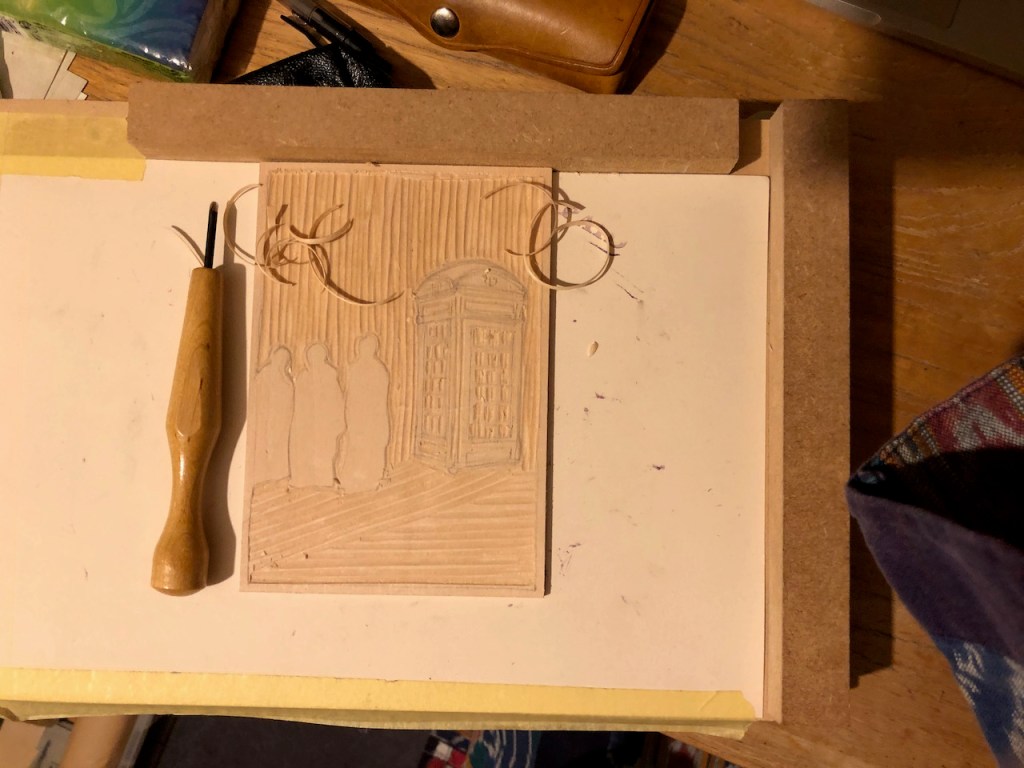
Also in the woodcut I put some people. These might be the three wise men, looking for hope and salvation in a humble building.
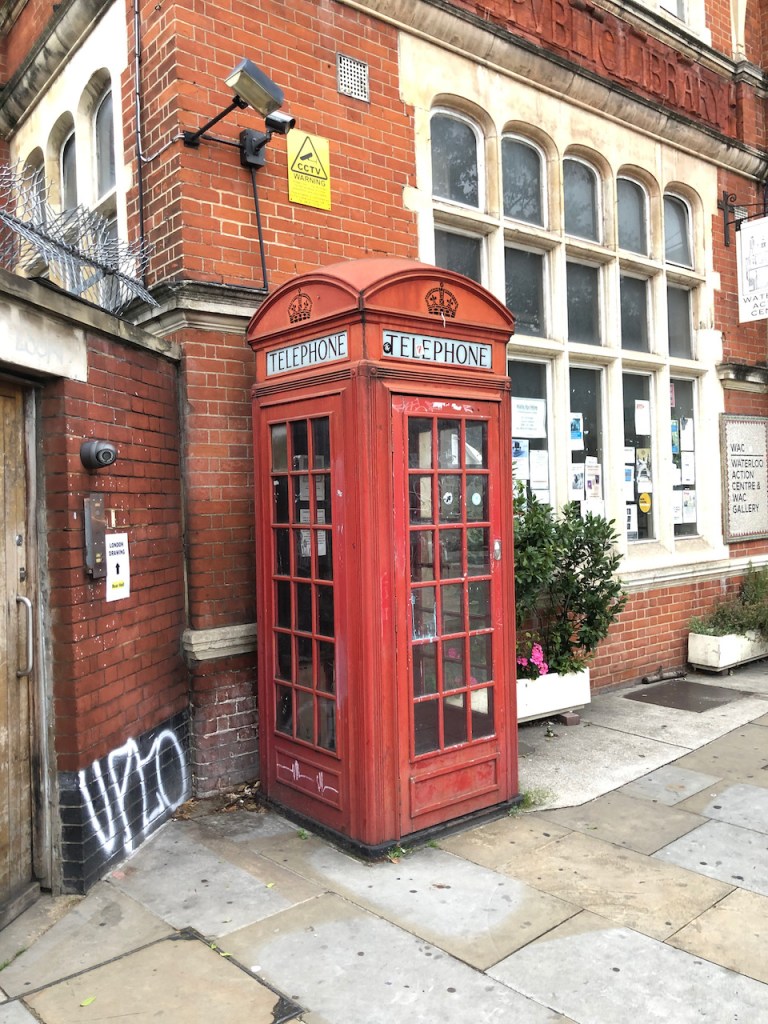
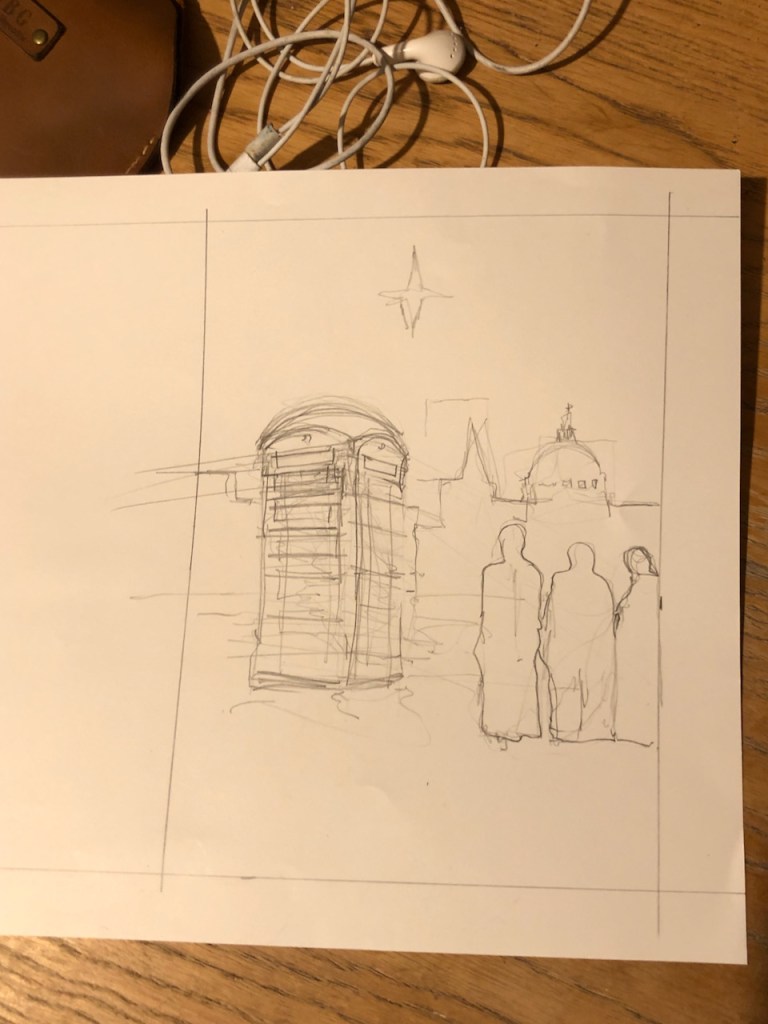
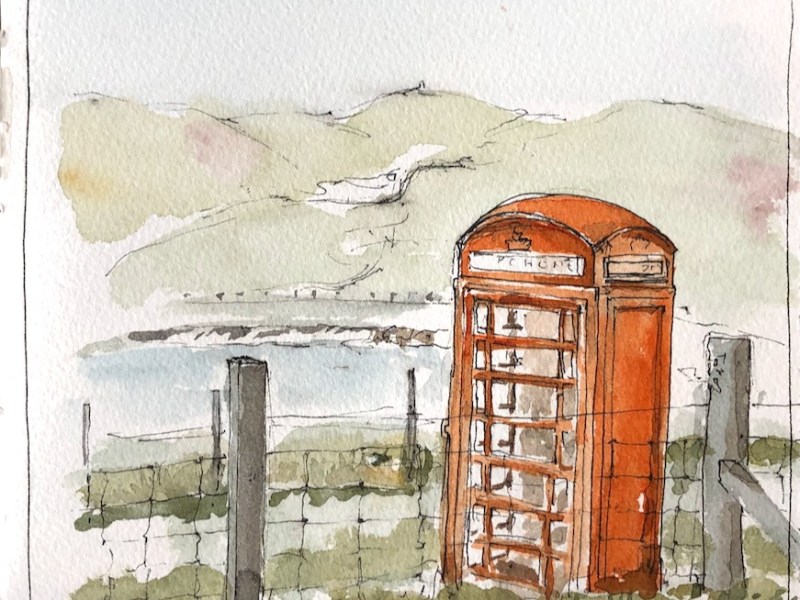
I based my woodcut on phone boxes I have encountered recently. It is a K2 phone box, like the one at Lower Marsh, Waterloo. You can tell, because it has six rows of windows.
Lower Marsh, Waterloo
Lera Voe, Shetland
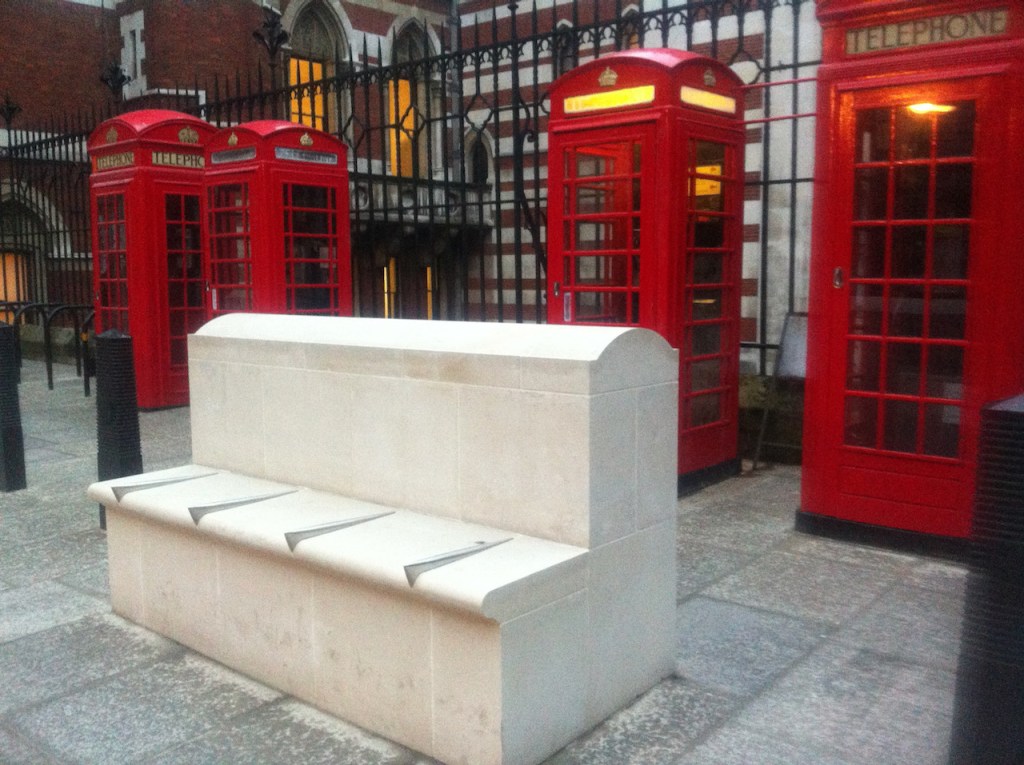
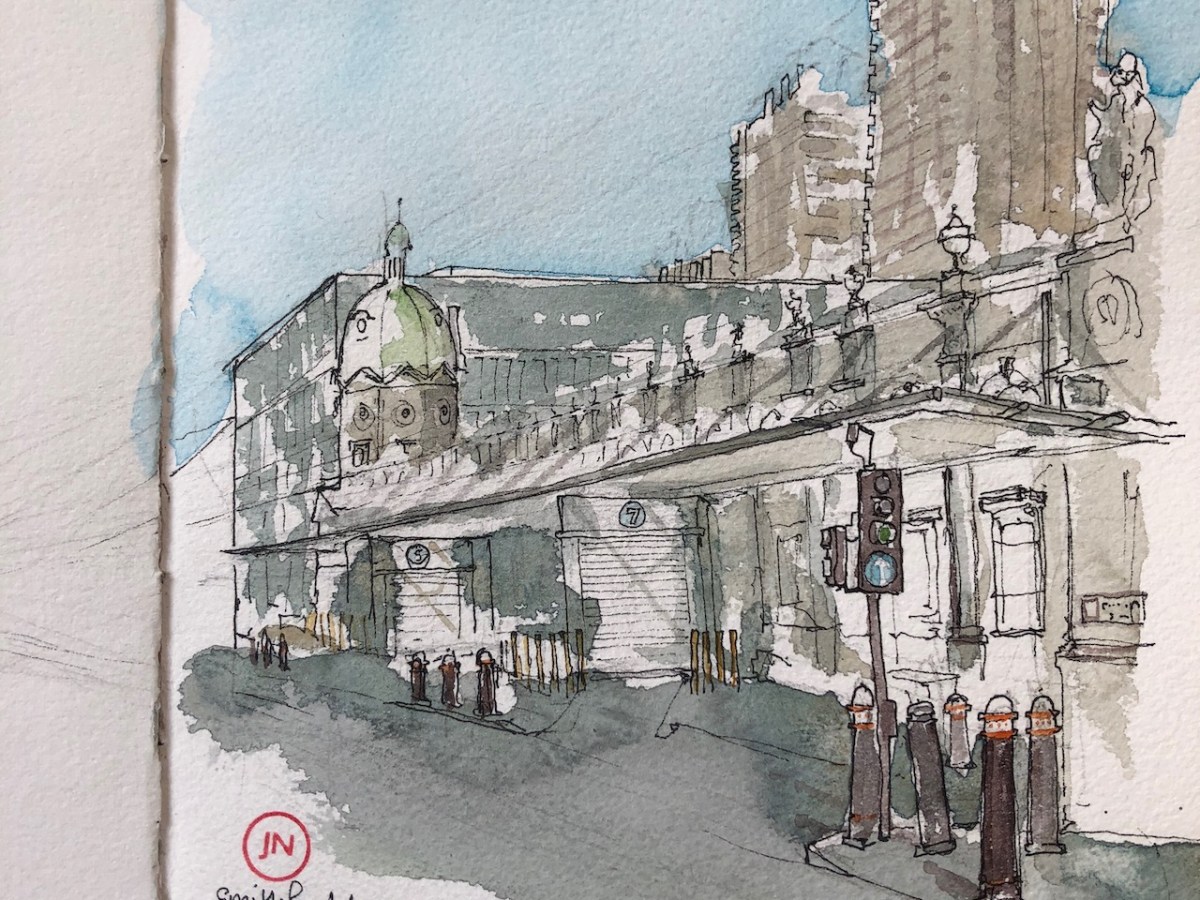
Royal Courts of Justice
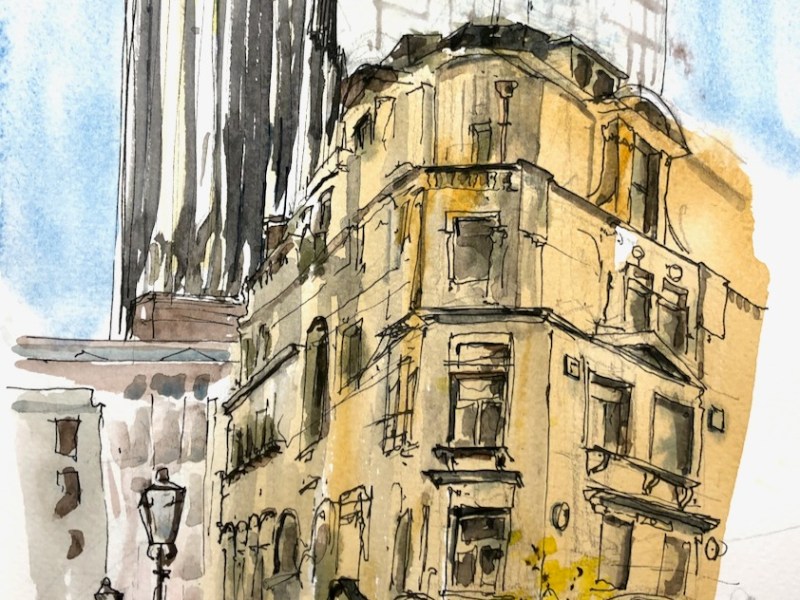
Aldermanbury
Walberswick
Here is work in progress:
Sketch
Wood carving
Inking
Watercolour gold
Relief ink
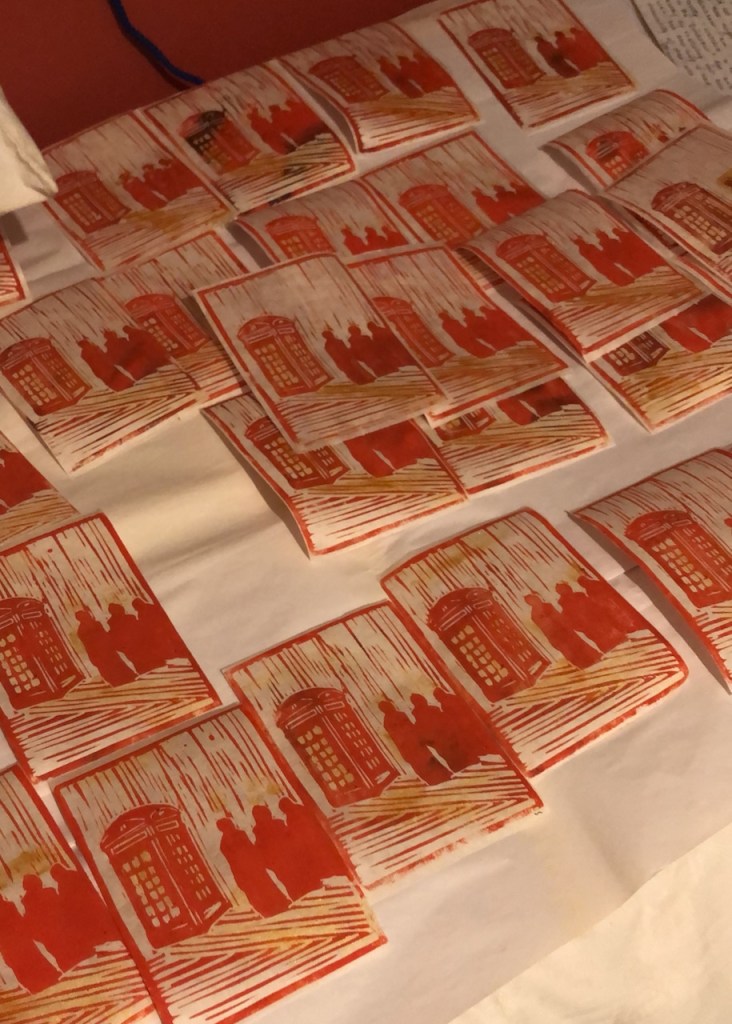
Prints drying
Inking
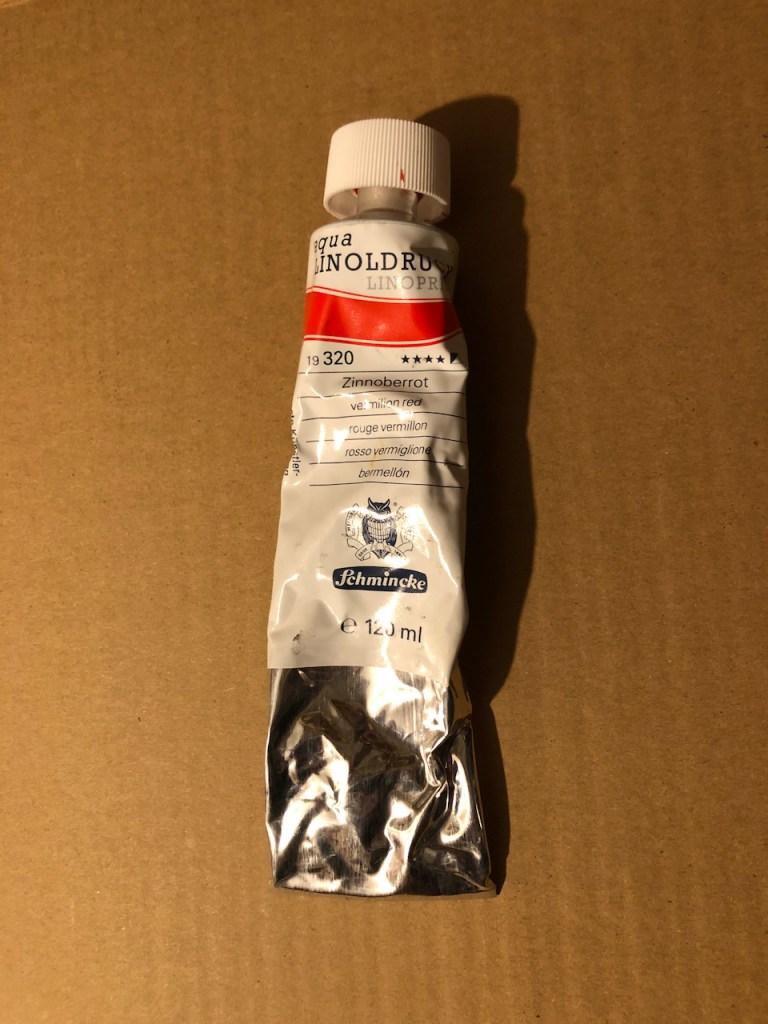
The background gold colour is, amazingly, watercolour: Daniel Smith Iridescent Gold. The red is Schmincke relief printing ink. The paper came, via friends, from “Paper Nao” in Tokyo. It is kozo paper, I think K-148, and brilliant for hand-printing. It doesn’t crinkle, it takes the colour well, and it’s really strong so it doesn’t tear when you pull it off the plate.
I like phone boxes. They appear in various of my drawings, see for example, these posts:
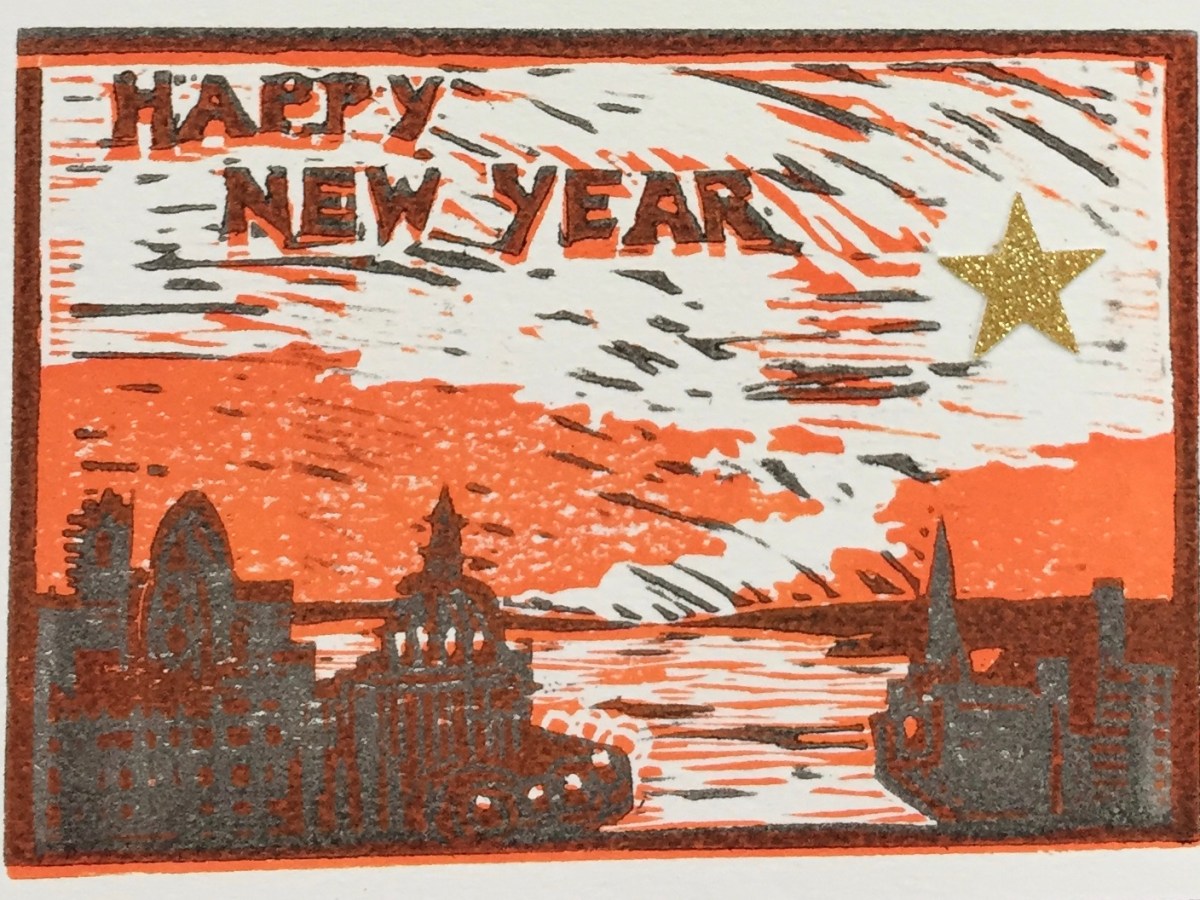
Here are my greetings for the New Year, sent as cards. They are woodcuts, two plates. The orange/red colour was printed first. The black colour is the Schminke “Aquadruck” black relief ink diluted with extender kindly lent to me by Connie at East London Printmakers. Her extender was from the Caligo range, and was slightly…
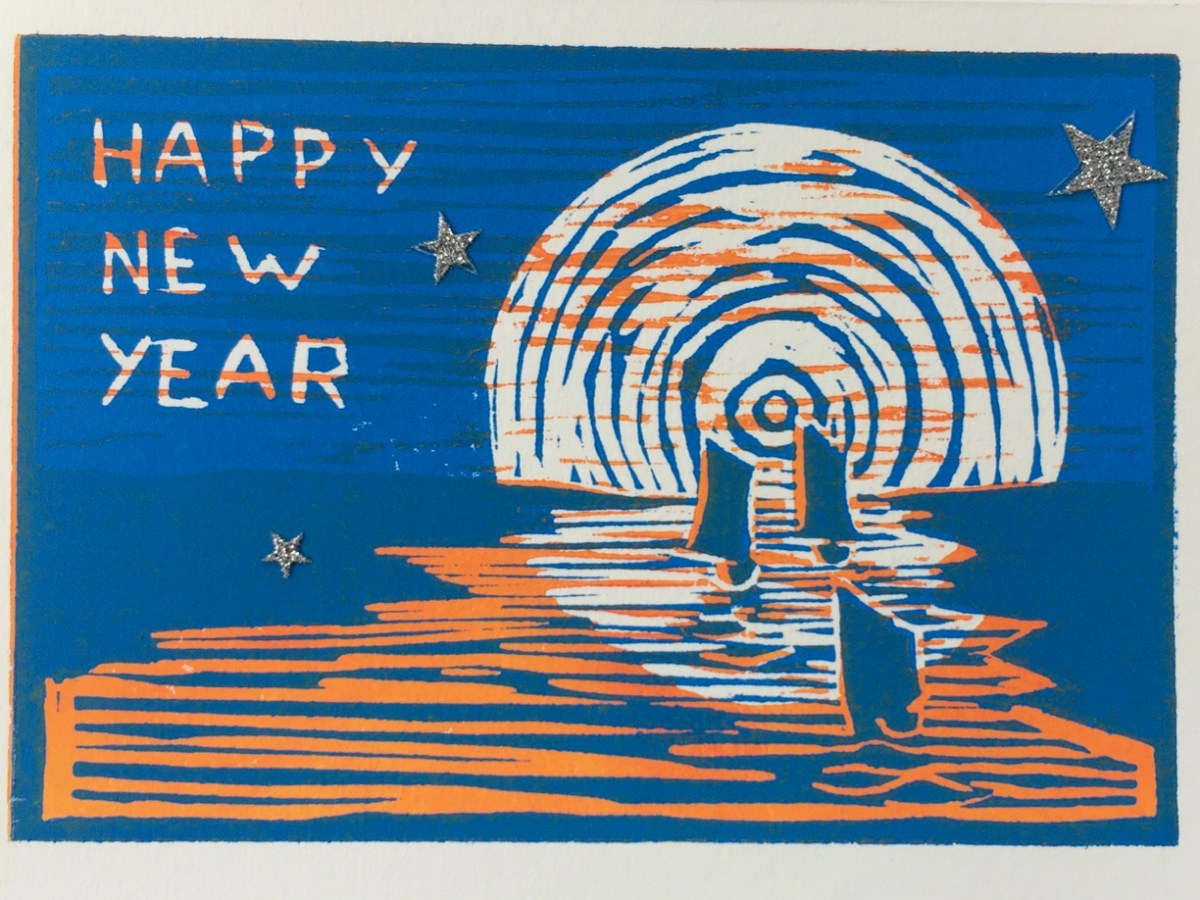
Happy New Year! I made a woodcut. This is a greetings card, about 7″x5″. It is from two woodblocks, one orange and one blue. Here is work in progress at East London Printmakers: In the background you see the Albion press I used for printing. It is a wonderful cast-iron machine. As well as the…
Click a button below to share this post online, email it, or print it:
Here is Bayer House, on the Golden Lane Estate. This is the view from the South.
Bayer House, Golden Lane Estate, from the South, 9 inches by 12 inches [SOLD]
The building on the right is the Golden Lane Community Centre. It was in active use as I drew the picture. There is a food bank outside, and a lot of activity inside. For more information on the tree which is to the left of the picture, see this post. It was planted on the 9th December 1989.
I drew this picture from a position close to Great Arthur House. People from the Community Centre came and had a look at my drawing. One of them very kindly came and brought me a chair. If you look inside the community centre you can see those kind people behind the window.
The van.
I was a good way into the drawing when a van drew up, right in my line of sight. I finished the parts of the drawing at the top of the building, and to the sides of the building. A good hour had elapsed, but the van was still there. I really needed to draw that part of the building which was behind the van. The driver, dimly visible through the windscreen, was asleep, or may be just resting. Having carefully considered the pros and cons, and the social acceptability of asking a potentially exhausted van driver to move, and the likely consequences, I got up from my chair and walked over to the van in what I hoped was a polite and respectful manner. The van driver was awake, and immediately understood my request. “No problem!” he declared without hesitation, and with extraordinary consideration asked me “Where would you like me to park?”. I indicated an empty slot far over to the other side of the Community Centre. He climbed out of his van, and went into a door under Great Arthur House to confer with “The Office”. “The Office” having been brought onside, he jumped back into the van and made off into the middle distance waving cheerily. I wish all problems were solved so easily.
Here is work in progress:
preliminary sketch
Pen and ink
Finished drawing on Arches 12 inches by 9 inches block 300gsm
This was a commission. For the same commission I also made a drawing of the North side of the same building.
Bayer House, North side, 12 inches by 9 inches [SOLD]
For more information about Bayer House, including maps, see this post.
Both drawings on Arches 300gsm watercolour paper block, 12 inches by 9 inches.
Here is a collection of my drawings of the Golden Lane Estate:
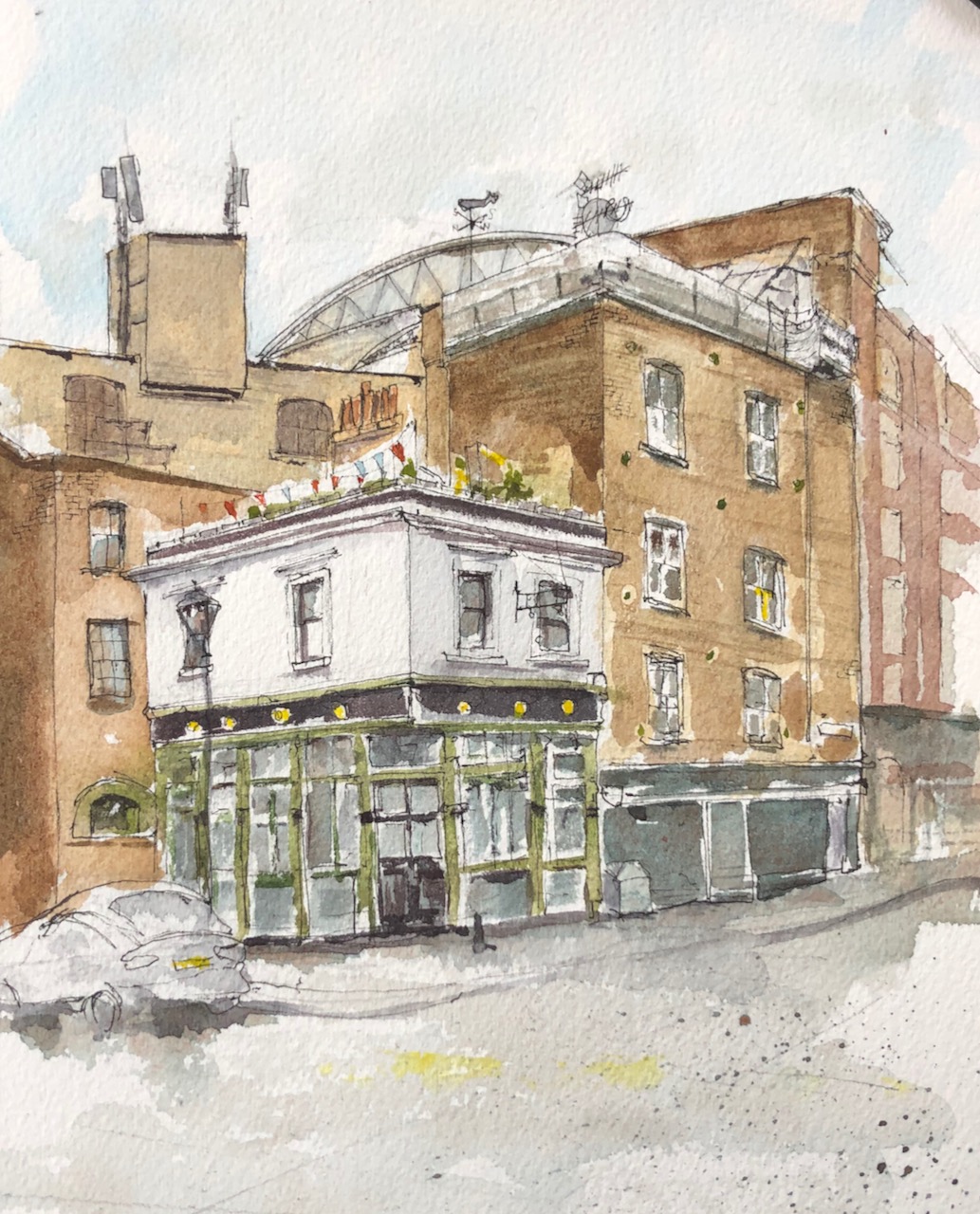
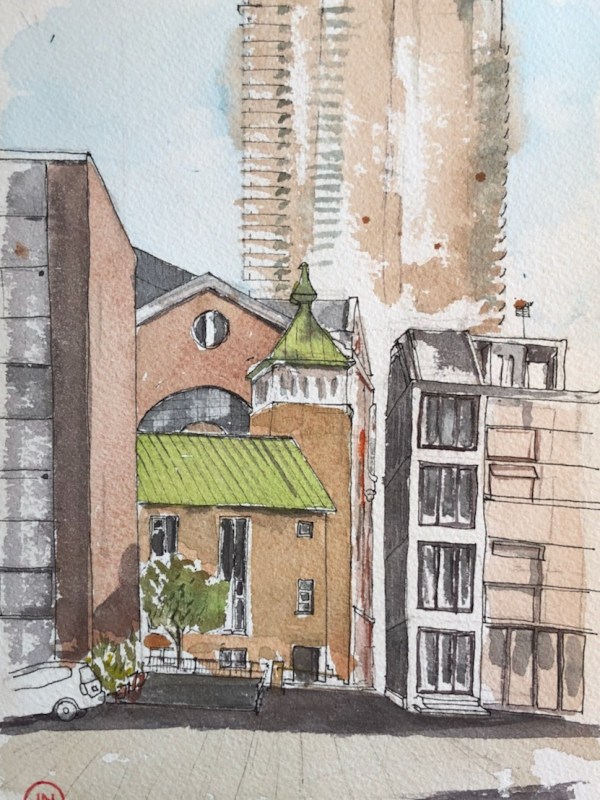
I enjoyed the way the pub is slotted into that corner space, amongst the taller buildings. The building behind it looks as though it might be older than the pub. The arched window-alcove to the left, above the car, has been partly obscured by the wall of the pub. The purpose of this alcove is unclear. It isn’t an ordinary window, and can’t let much light into the building as it is so recessed. It looks as though it might have had some industrial purpose.
And much is happening at roof level. On the right of the pub, high up, someone has made a roof garden. They have a glasshouse, and a weathervane in the shape of a whale. Behind that, even higher up, is a huge bridge-like construction, with arched supports, which looks as though it is a roof on top of a courtyard, behind the buildings I could see. Notice also the formidable collection of communications equipment: a satellite dish and three aerials near the whale, and on the building in the background there were at least two mobile phone masts, with antennae like loudspeakers, pointing in different directions.
The pub itself has a roof garden, with brightly coloured bunting and many flowerpots. I drew this picture yesterday, during Lockdown 2, so sadly it is closed. However it is going on my “After Lockdown” list.
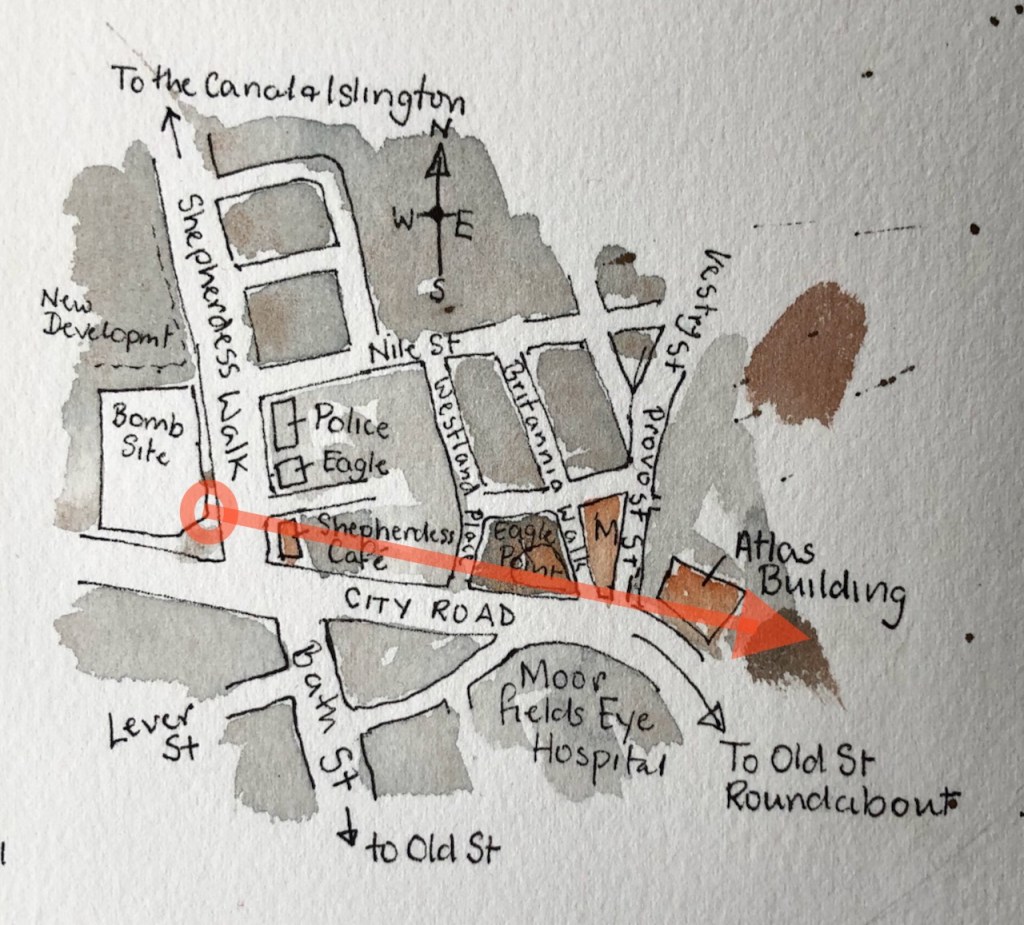
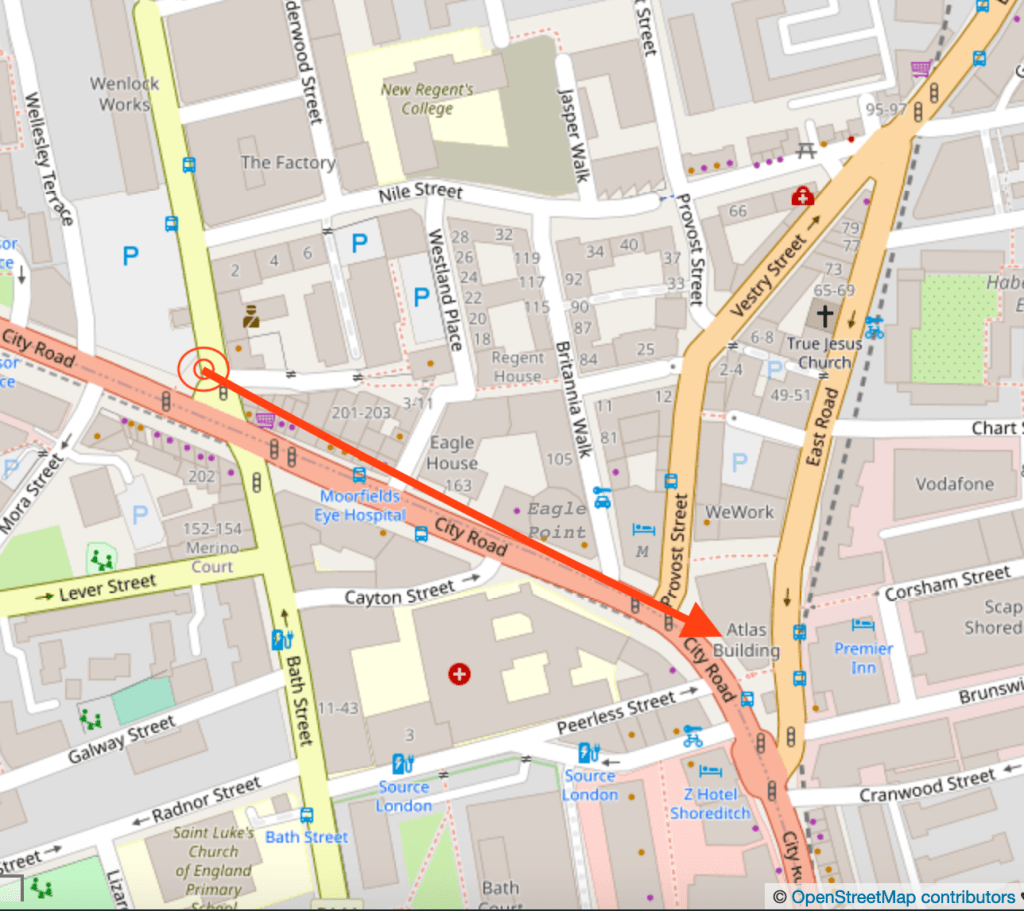
Here are maps:
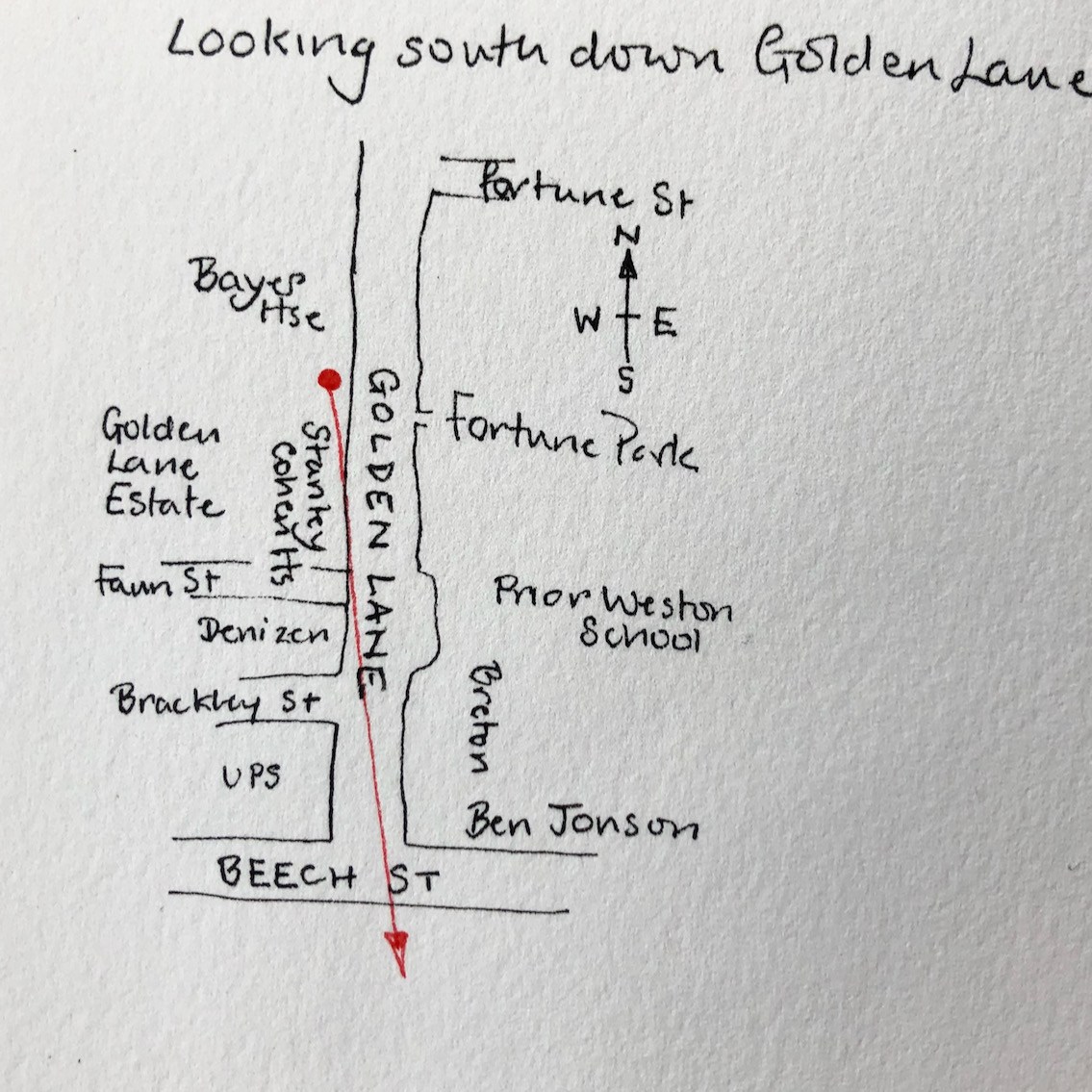
Maps showing the location of the drawing, and sightline.
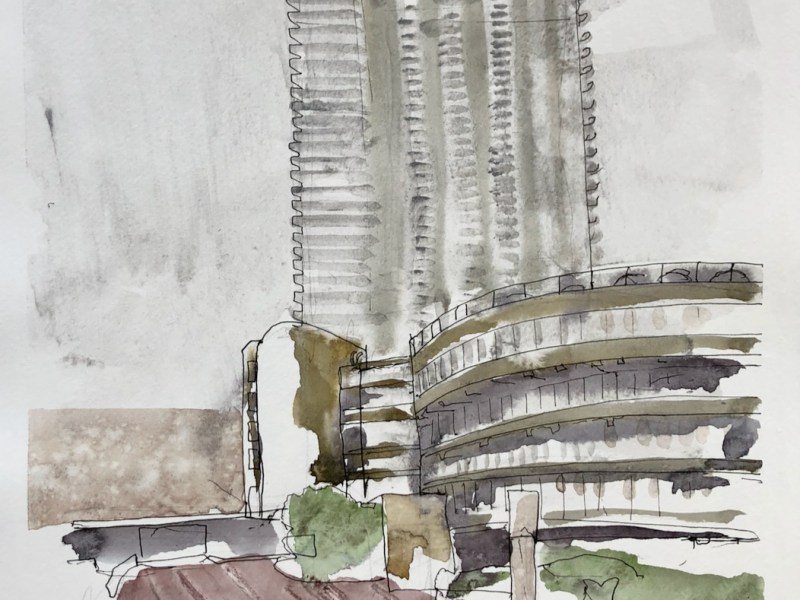
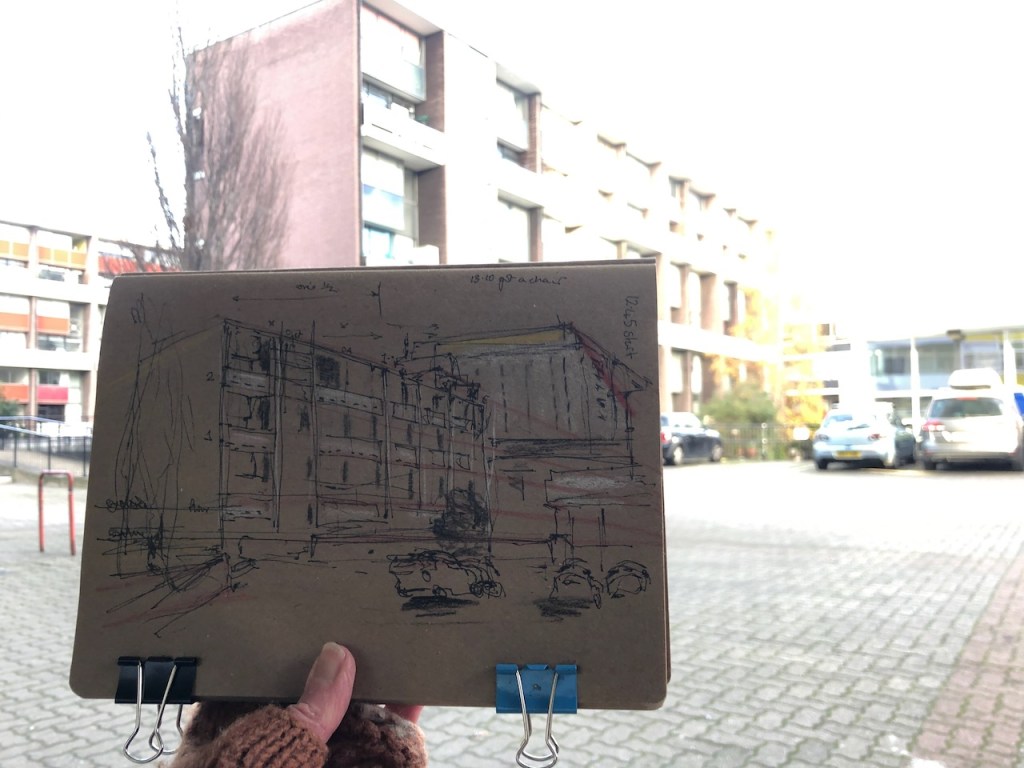
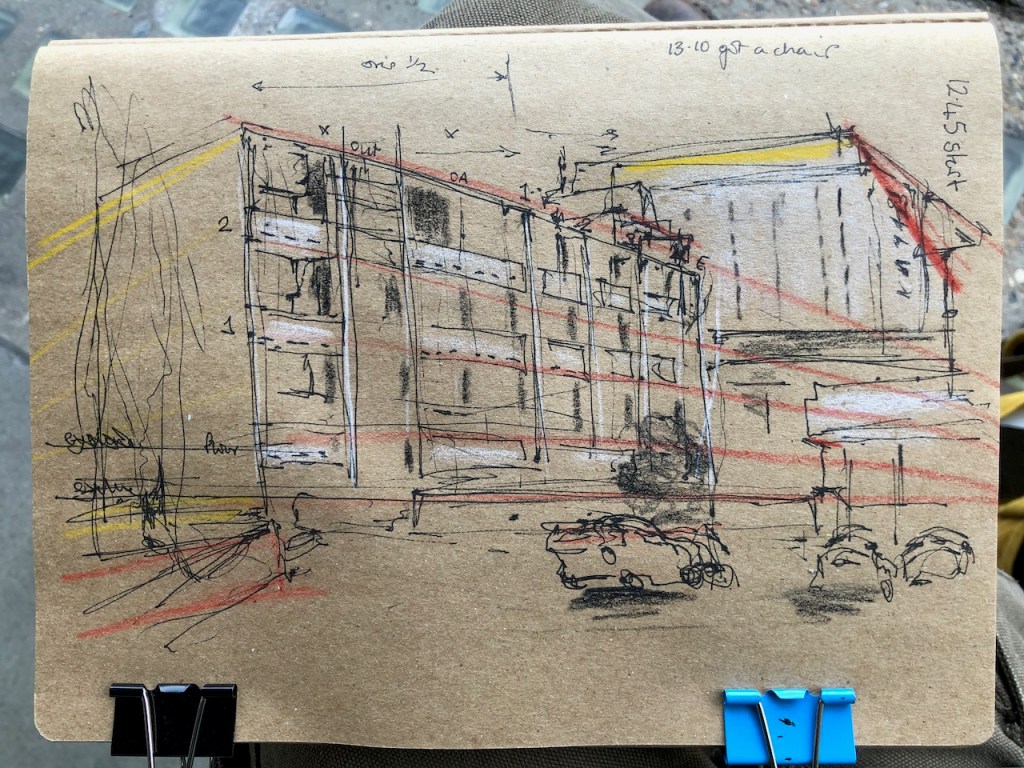
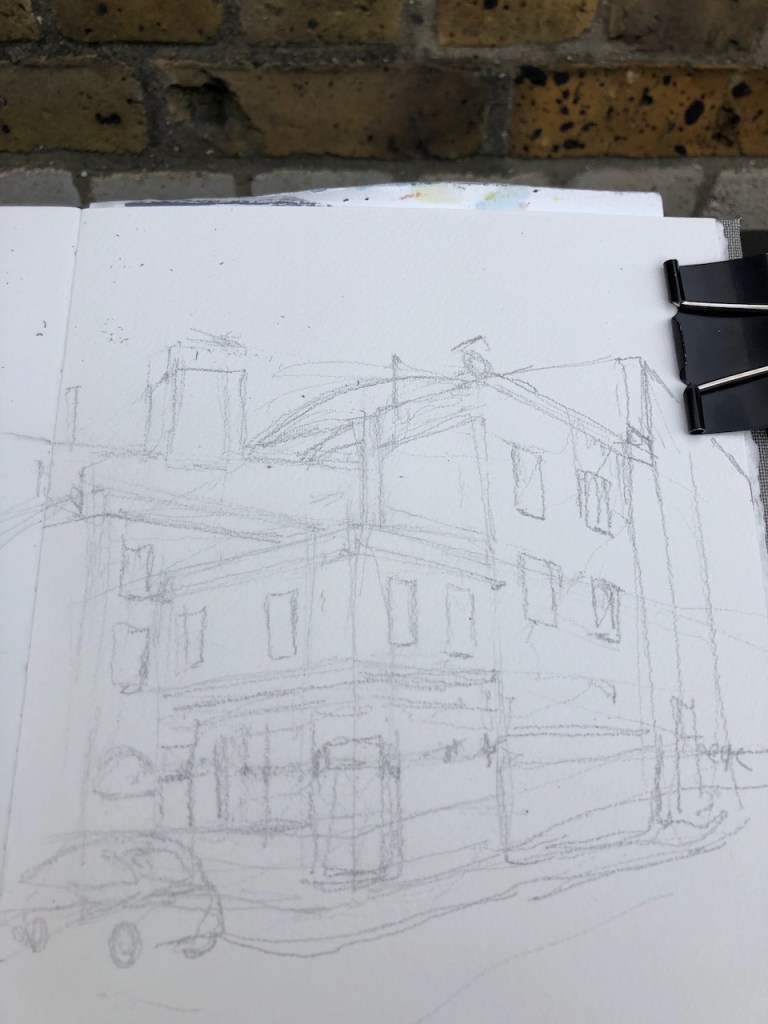
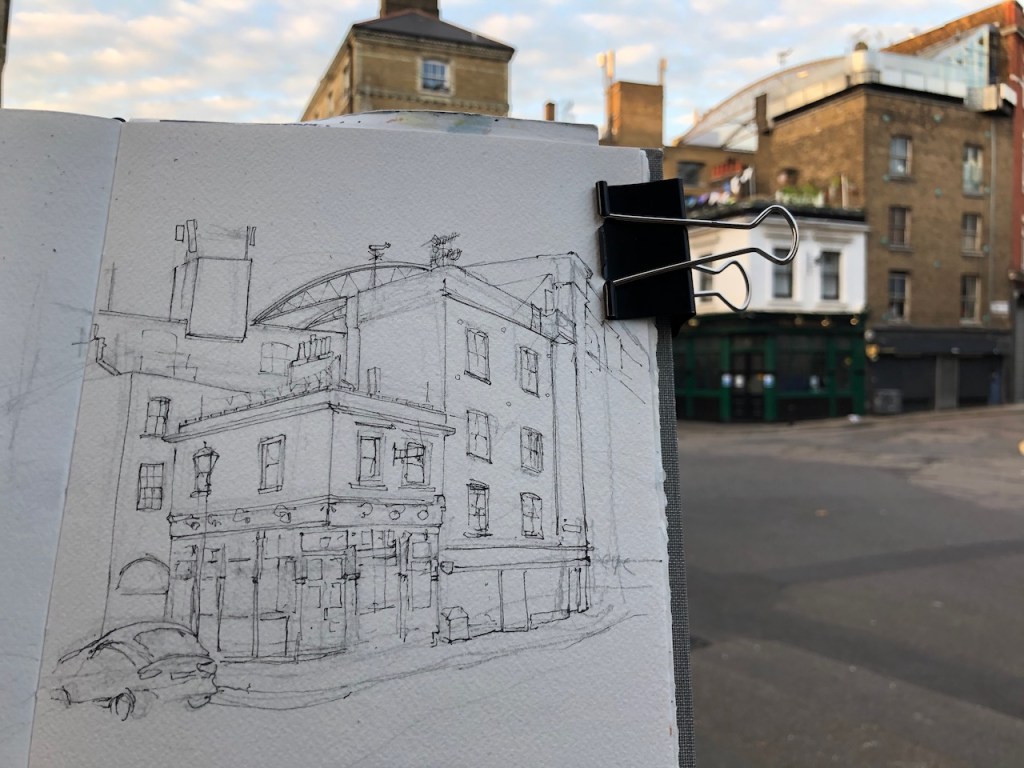
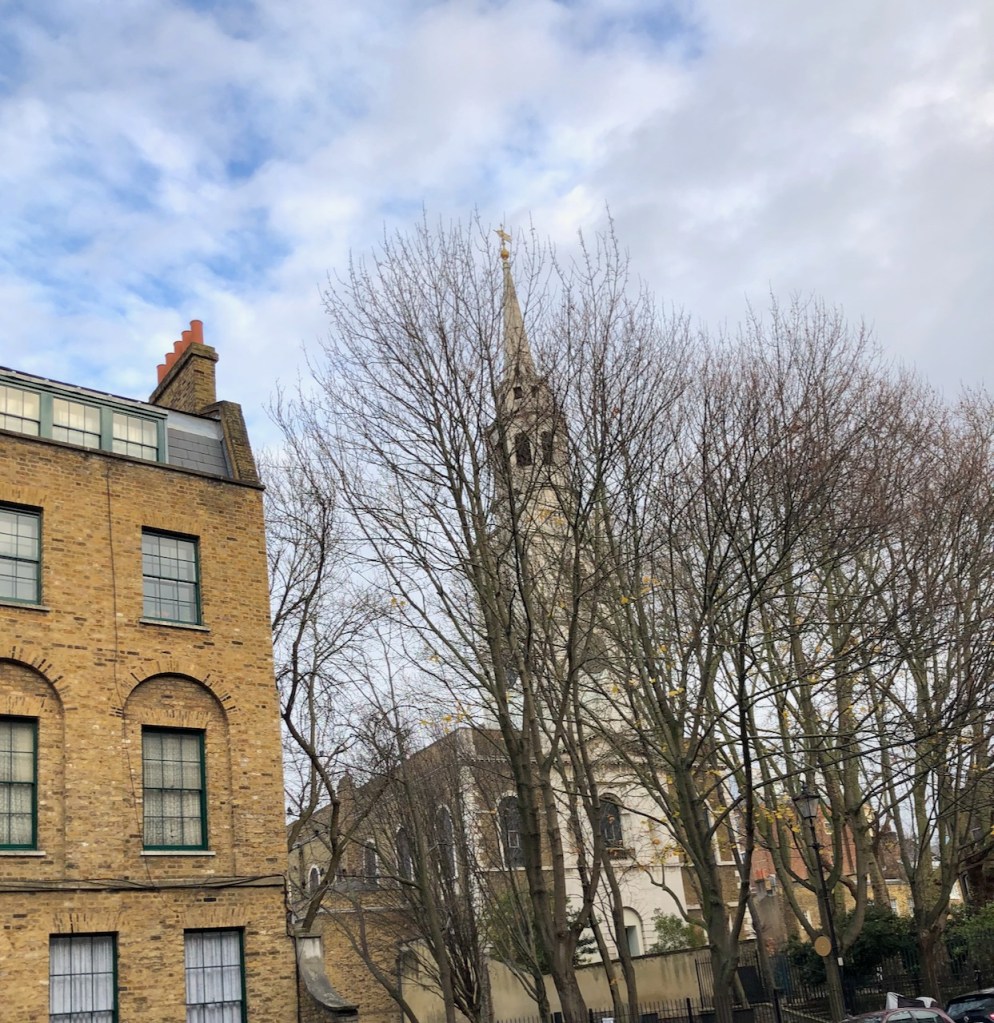
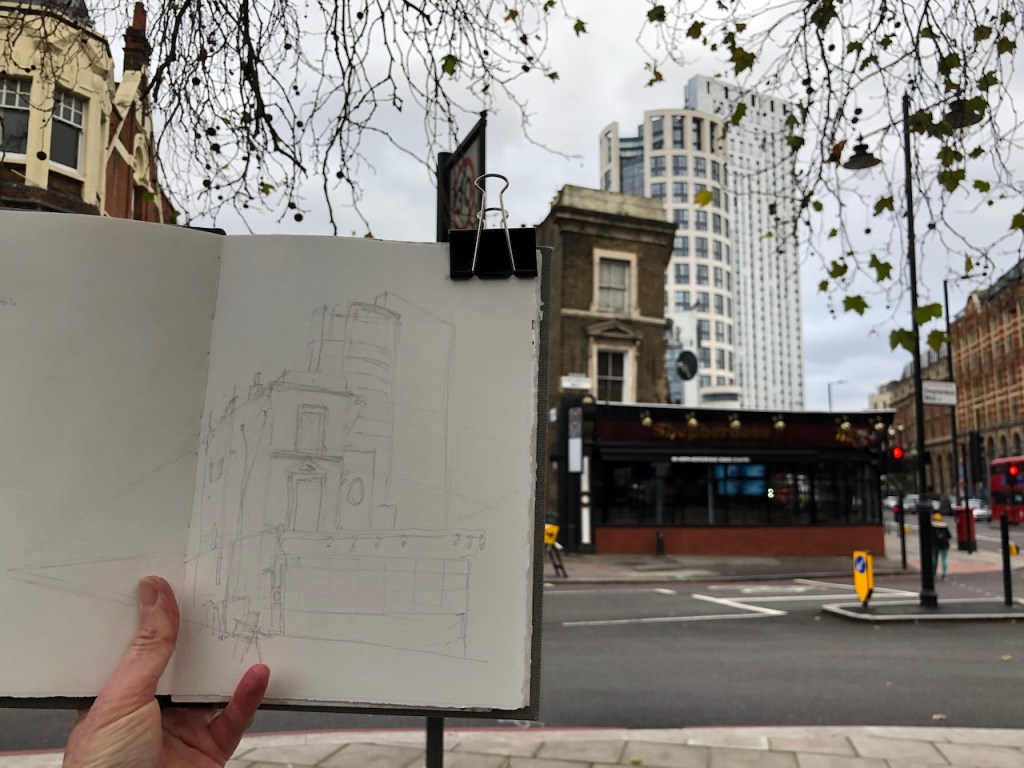
Here are sketches of work in progress, and some snapshots of the location. I did a preliminary sketch on brown paper, as you see. It was cold, 6 degrees C. I didn’t manage to finish the colour outdoors, but scuttled home to complete the detail in the warm.
This picture took about 1 hour 45 minutes on location, including a chat with a friend who passed by on his afternoon stroll. Then another half hour at home working on the colour detail. The colours are: Phthalo Turquoise (W&N), Burnt Umber (DS), Mars Yellow (DS), Green Apatite Genuine (DS), Fired Red Ochre (DS), with some Perylene Maroon and Prussian Blue to get the greys, and a few dots of Transparent Pyrrol Orange, Hansa Yellow Mid, and Green Gold (all DS). The picture is size 7 inches by 10 inches on Arches Aquarelle 300gsm watercolour paper, in a Wyvern sketchbook (Sketchbook 9)
Preliminary sketch
Preliminary sketch
Pencil
Pencil
Pen
Watercolour
St James’ Church
Peabody Estate
Work in progress and snapshots from the location. Note the gloves.
This is one of an emerging series of drawings of pubs in the Clerkenwell area. Here are some others in the series:
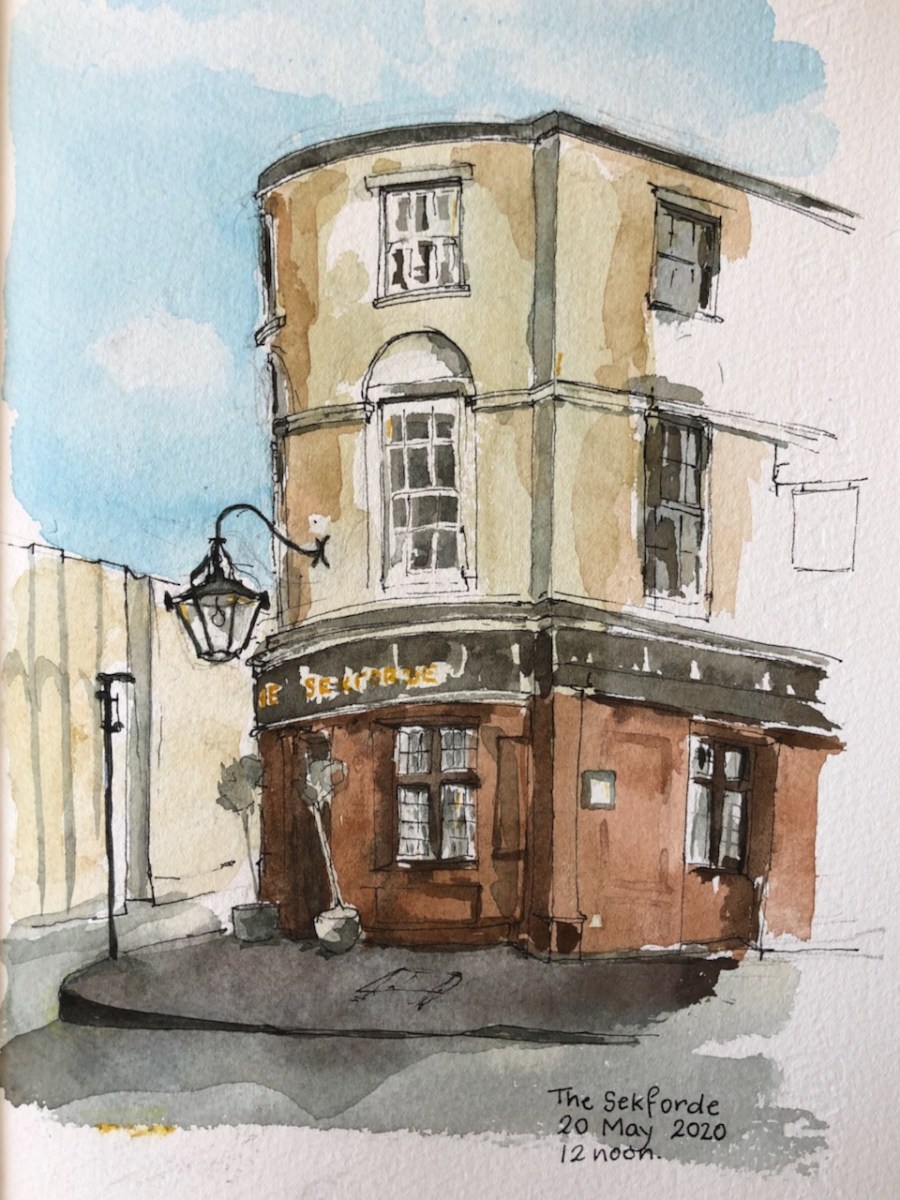
I sketched The Sekforde, sitting on a step on the other side of the road. The pub was closed today. It looked like a good pub. While I was sketching I received confirmation of this. Two portly men strolled past, paused, and asked me if I was waiting for the pub to open. I said…
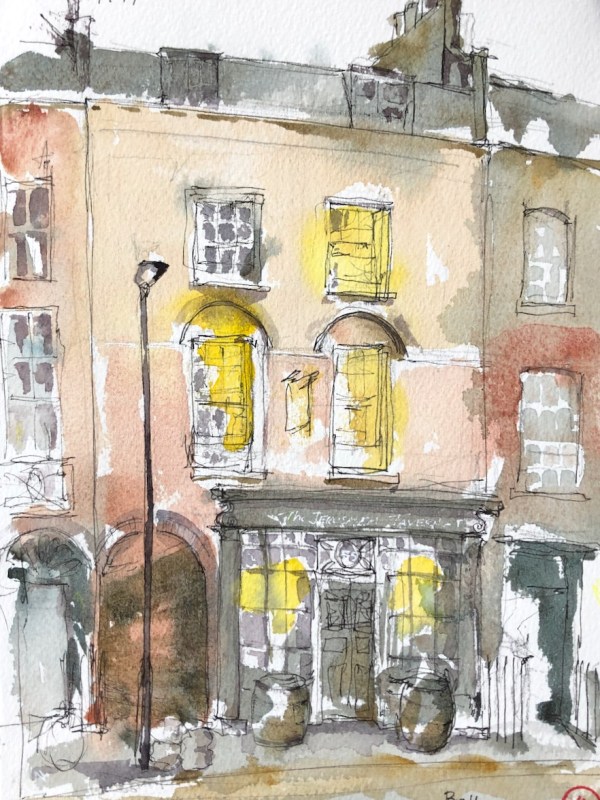
Here is a sketch of The Jerusalem Tavern, Britton St, Clerkenwell, made as the light faded. I find this a particularly lovely building. The curves over the windows are semicircles and there is a pleasing symmetry to the upper floors. The semicircle over St John’s Passage exactly matches the door to its left, on another…
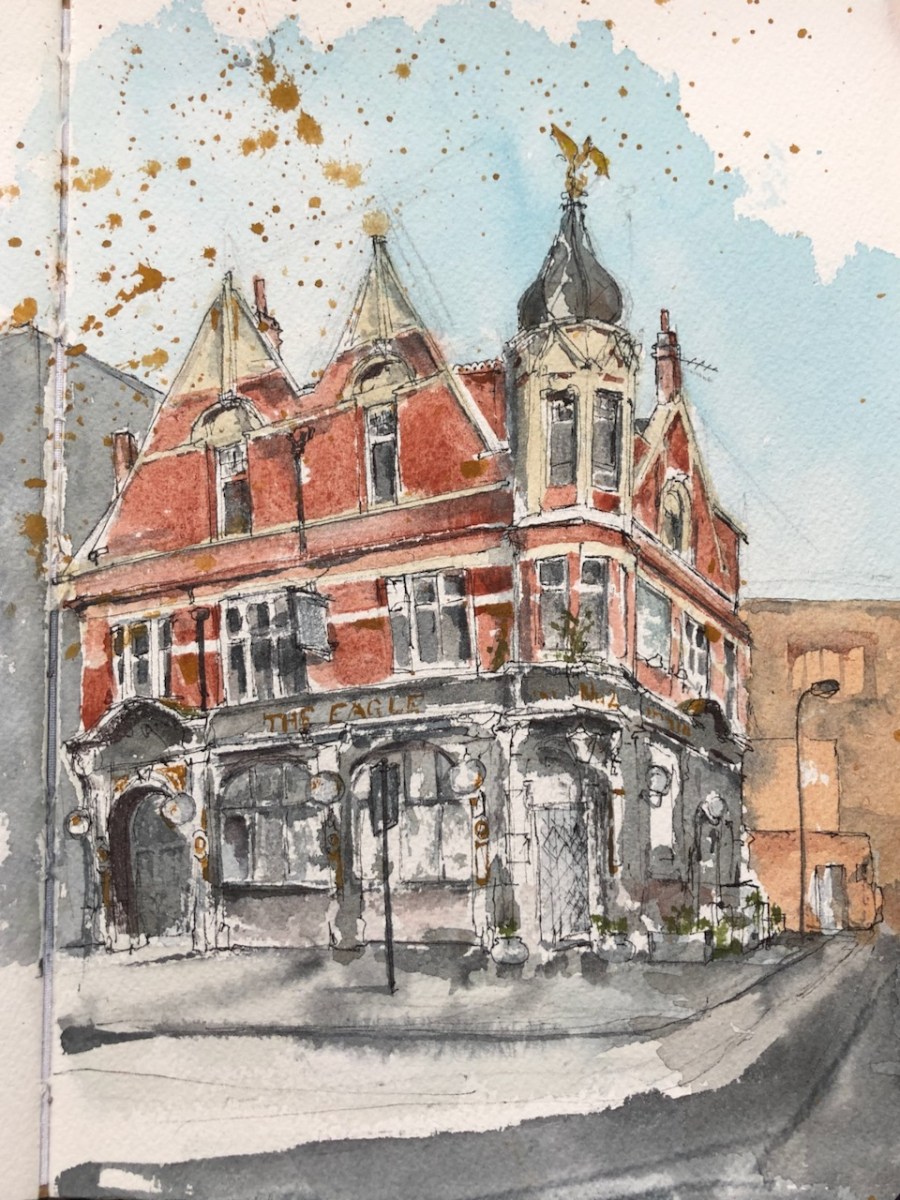
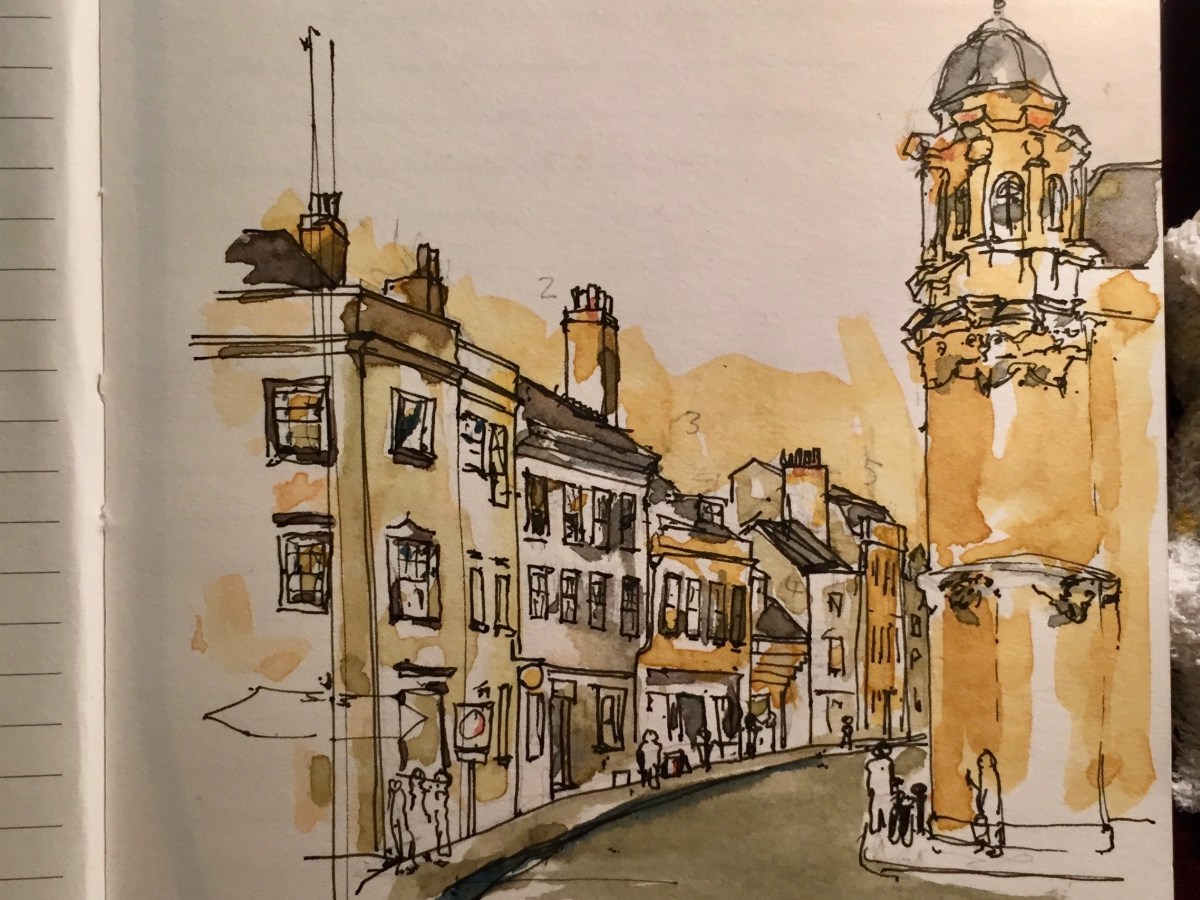
Here is The Eagle. This is a very old pub, located at a significant junction on City Road. In the picture above, the alley on the right of the pub is called “Shepherdess Place”. It leads to a police car park, and several office blocks. I went down there to draw a picture of The…
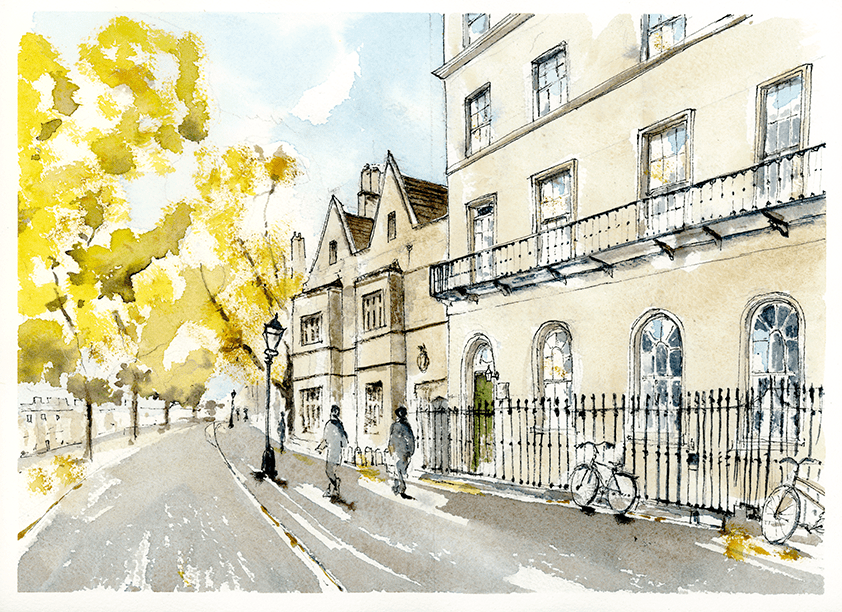
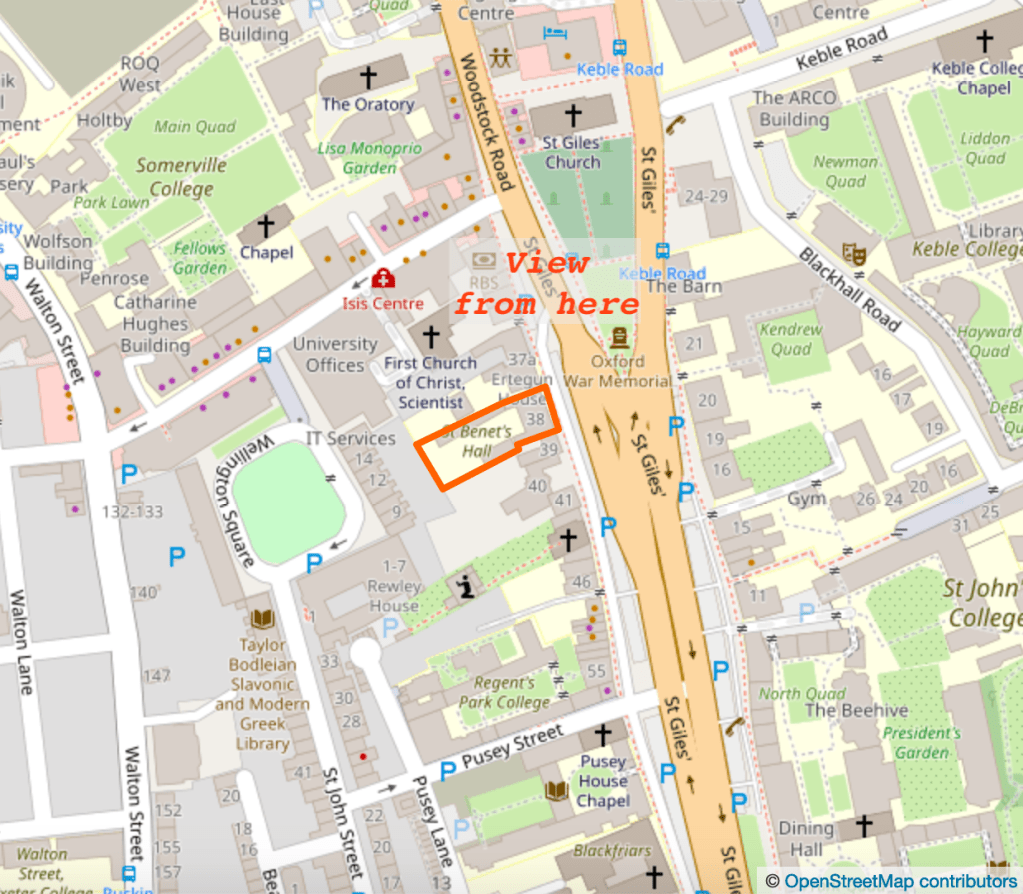
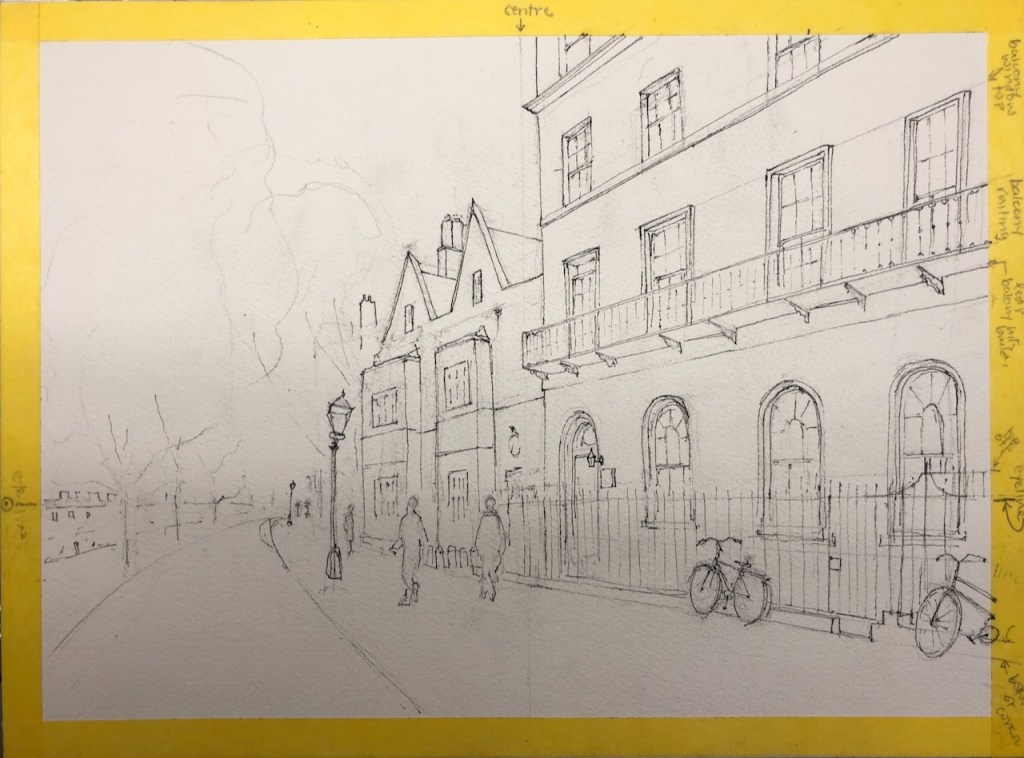
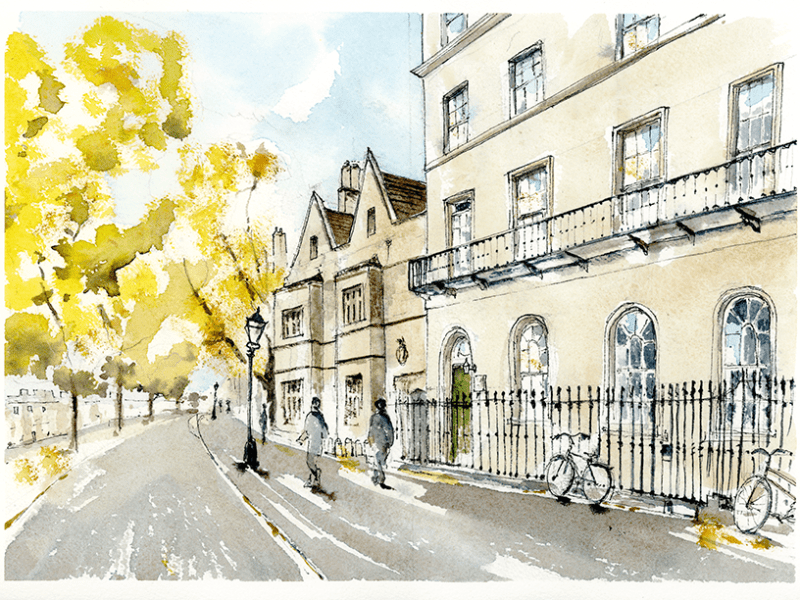
This is a view of the front of St Benet’s Hall, in St Giles, Oxford, looking South.
St Giles, Oxford.
I drew this as a commission, for Ken Craig of Canongate Design. It will form the front cover of a publication.
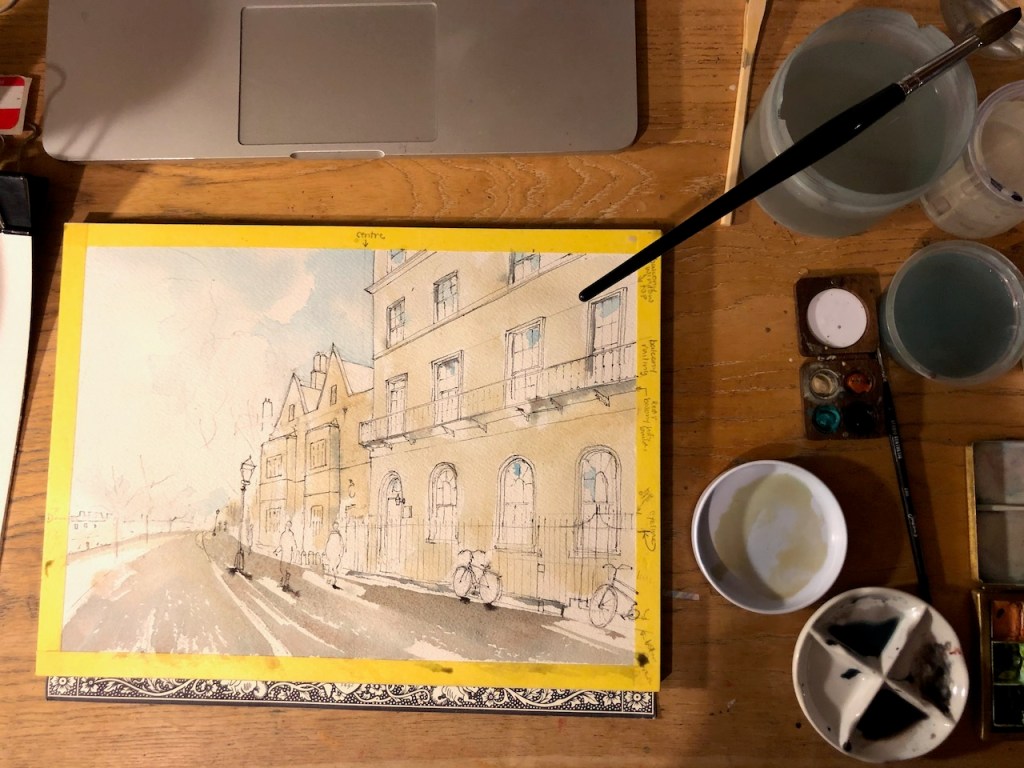
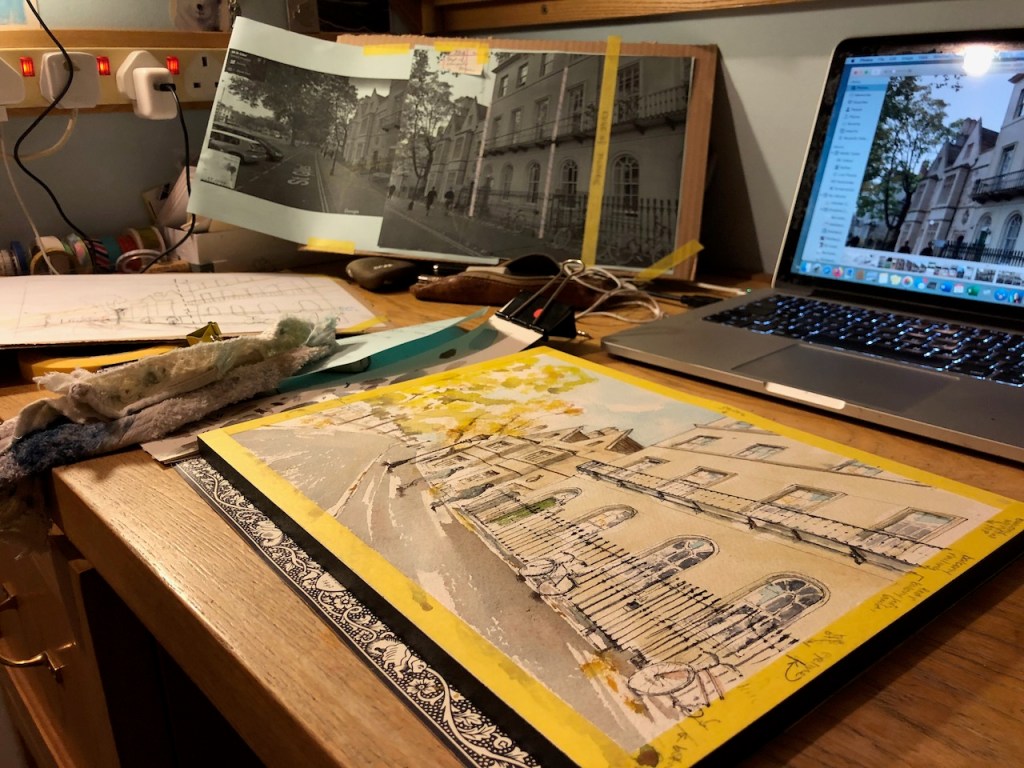
The challenge was to fit the view onto a sheet with A4 aspect ratio, in such a way that the façade of St Benet’s Hall is on the right. The front door had to be to the right of the centre line. Because the timescales were short, and the country was in Covid-related restrictions, I worked from photos, memory and imagination.
Janet Smart kindly provided photo references, including pictures of the architectural details.
Thankyou to Ken Craig for the commission, and for providing the scanned image of my drawing at the head of this post.
The colours are Buff Titanium, Green Gold, Phthalo Turquoise, Mars Yellow, Burnt Umber and some Perylene Maroon to make the greys. I drew it on a paper block of Arches 300gsm NOT watercolour paper, 9″ x 12″.
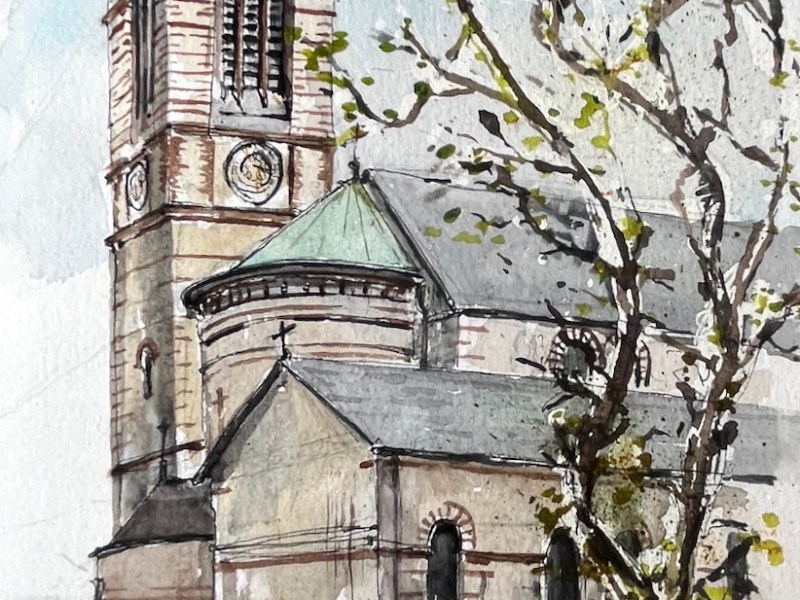
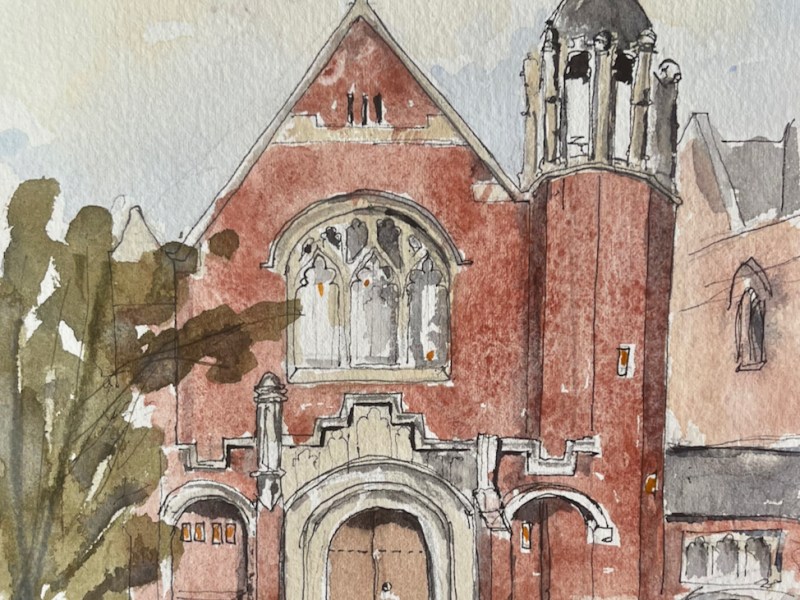
Walking through Jericho on my way to the station, I glimpsed this church tower, and heard its bells. I wove through the small streets until I found it. This is St Barnabus Jericho. Its website says that it is also known as “Oxford Basilica”. It was built as the daughter church of St Paul’s, which…
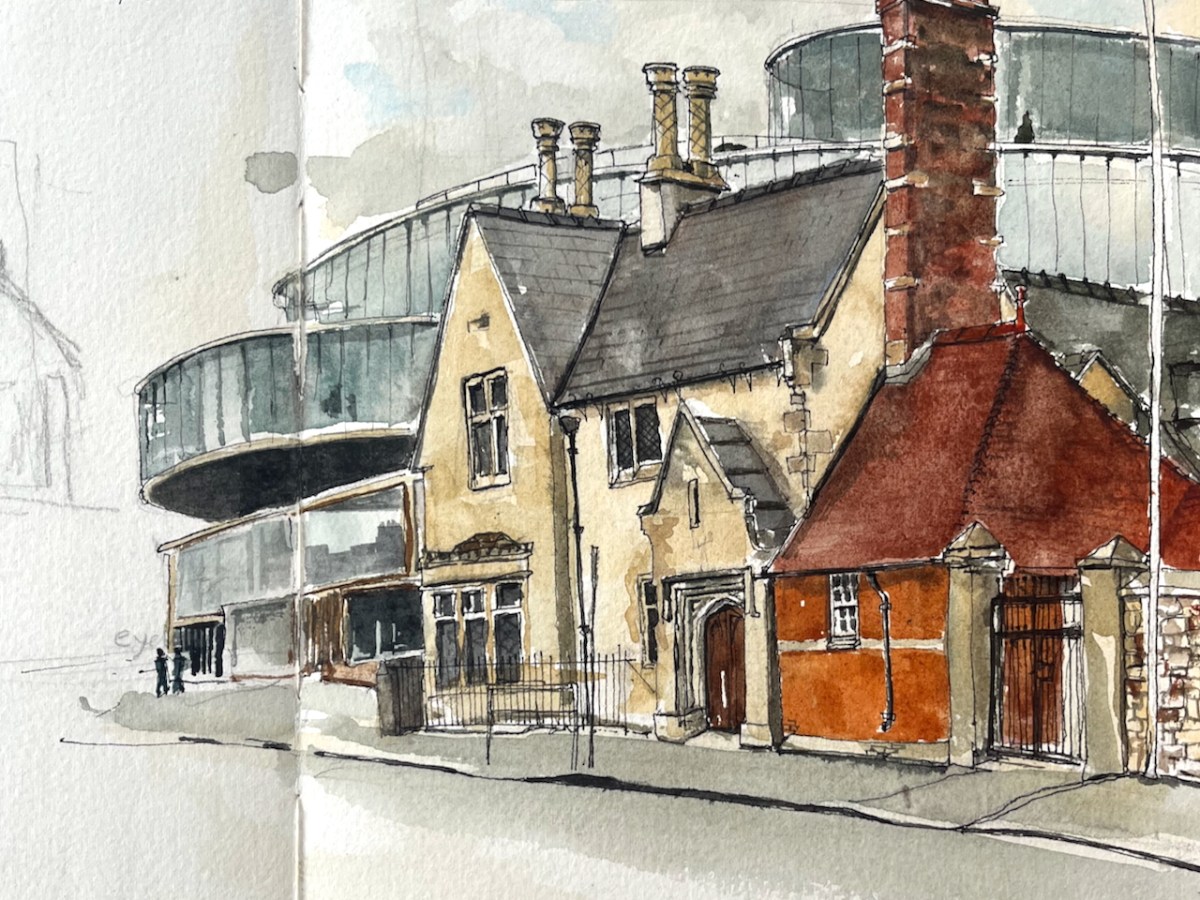
This 19th Century building on Walton Street is a nursery school. It contrasts with the huge sweeping curves of the Blavatnick School of Government behind. The building now houses a co-ed nursery: “St Paul’s Nursery is a 16-place day nursery that caters for children between the ages of 3 months and 5 years. The Nursery…
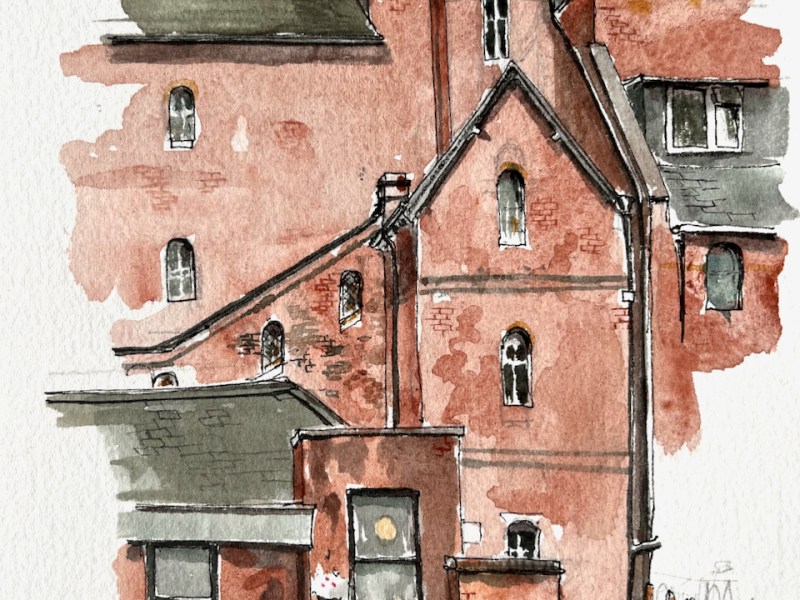
Wycliffe Hall is a “permanent private hall” in the University of Oxford. A permanent private hall is like a college, in that it provides accommodation and tuition for its students. The difference is that a college is governed by its Master and Fellows, whereas the Hall is governed, at least in part, by the Church…
Here is the view from room D17 in Somerville College, OX2 6HD. I sketched it quickly, before leaving, just as the sun was coming up. Somerville College was women-only for the first 115 years of its existence. It started to admit men in 1994.
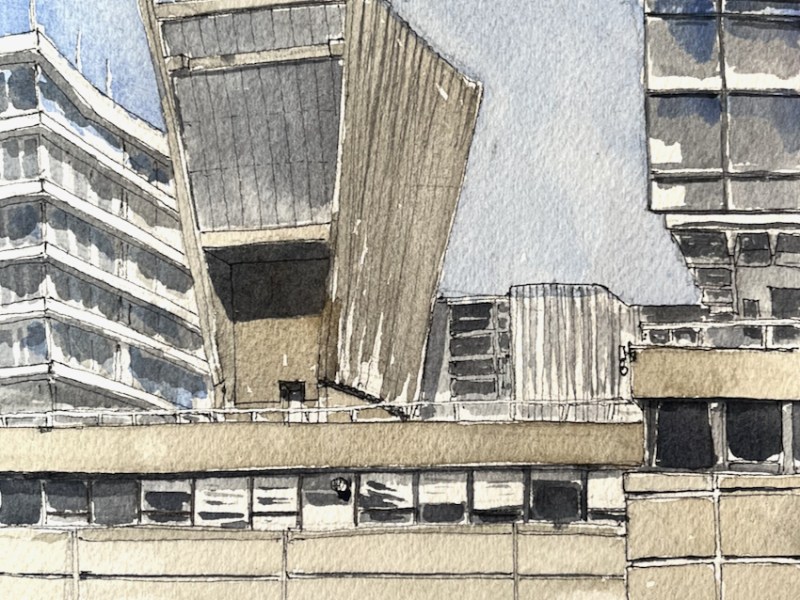
Here is the University of Oxford Nuclear Physics building, seen from the Banbury Road. The building was renamed the “Denys Wilkinson Building” in 2002. It was built in 1967 to the designs of architect Philip Dowson of Arup. The fan-shaped structure originally housed a Van der Graff particle accelerator, now dismantled. [https://manchesterhistory.net/architecture/1960/denyswilkinson.html] Professor Wilkinson (1922-2016)…
On a visit to Oxford recently, I stayed at Wycliffe Hall as a Bed and Breakfast guest. Wycliffe Hall is on the Banbury Road in North Oxford. It offers theological training to women and men who wish to become ordained or lay ministers in the Church of England. The hall was established in 1877, on…
This is a view of the front of St Benet’s Hall, in St Giles, Oxford, looking South. I drew this as a commission, for Ken Craig of Canongate Design. It will form the front cover of a publication. The challenge was to fit the view onto a sheet with A4 aspect ratio, in such a…
Here is a view looking south down Walton Street, from The Jericho Café, Oxford. It was raining outside. People peered in through the windows. One person actually came inside the café to look at my picture. Or maybe it was to escape temporarily from the rain. They looked at the picture, in any case, and…
What is the purpose of a museum? The previous evening, I’d been to a lecture by Tim Reeve, Deputy Director of the V&A. He had described, with great conviction, a new building they plan for East London, in “Here East” on the former Olympic Park. It will open up the V&A storage and logistics centre…
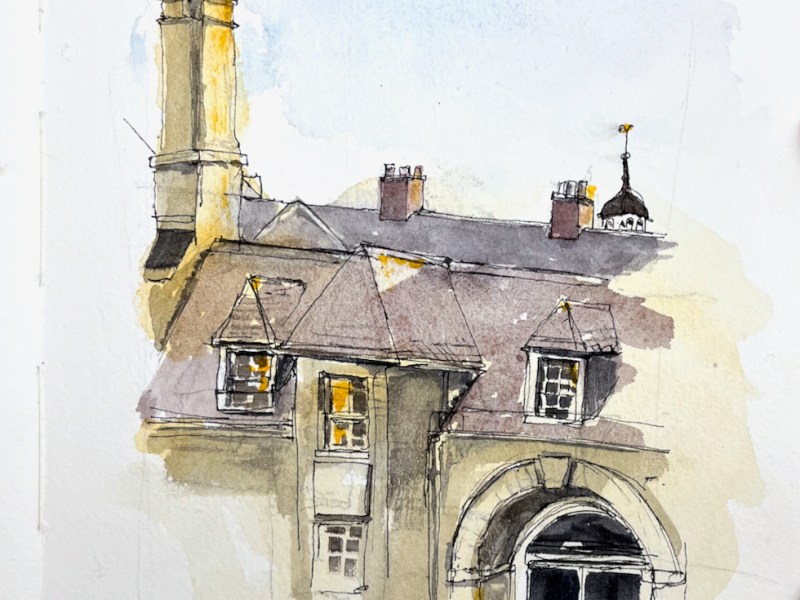
This little building to the right (South) of the Pitt Rivers Museum has often intrigued me. It has four chimneys. one in each corner. After I’d drawn it, I went to try to find out what it is. It appears to be connected to the Pitt Rivers Museum, but has no special name itself, and…
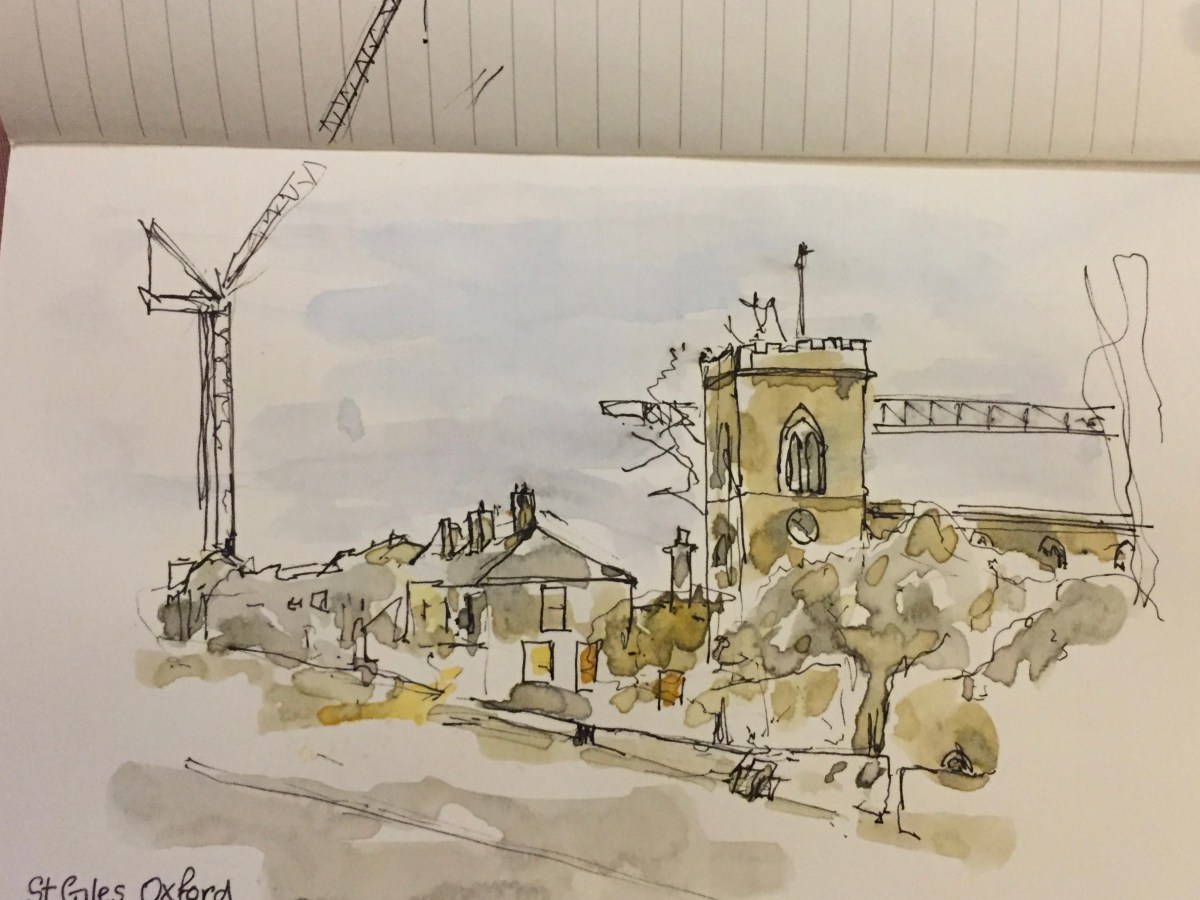
As the daylight faded, I made this sketch from outside 37 St Giles, Estagun House. St Giles is the name of the road going North out of Oxford, and also of the Church, which where the road starts. There has been a “St Giles” church near Oxford from at least 1120. “St Giles is supposed…
Here is the corner of Catte Street. On the left is the Kings Arms, a Youngs pub. The marvellous turret on the right is part of the Oxford Martin School. This building was originally the “Indian Institute”. It was designed by Basil Champneys in 1884. The weathercock is an elephant. It now houses the Oxford…
This is a very old pub, located at a significant junction on City Road.
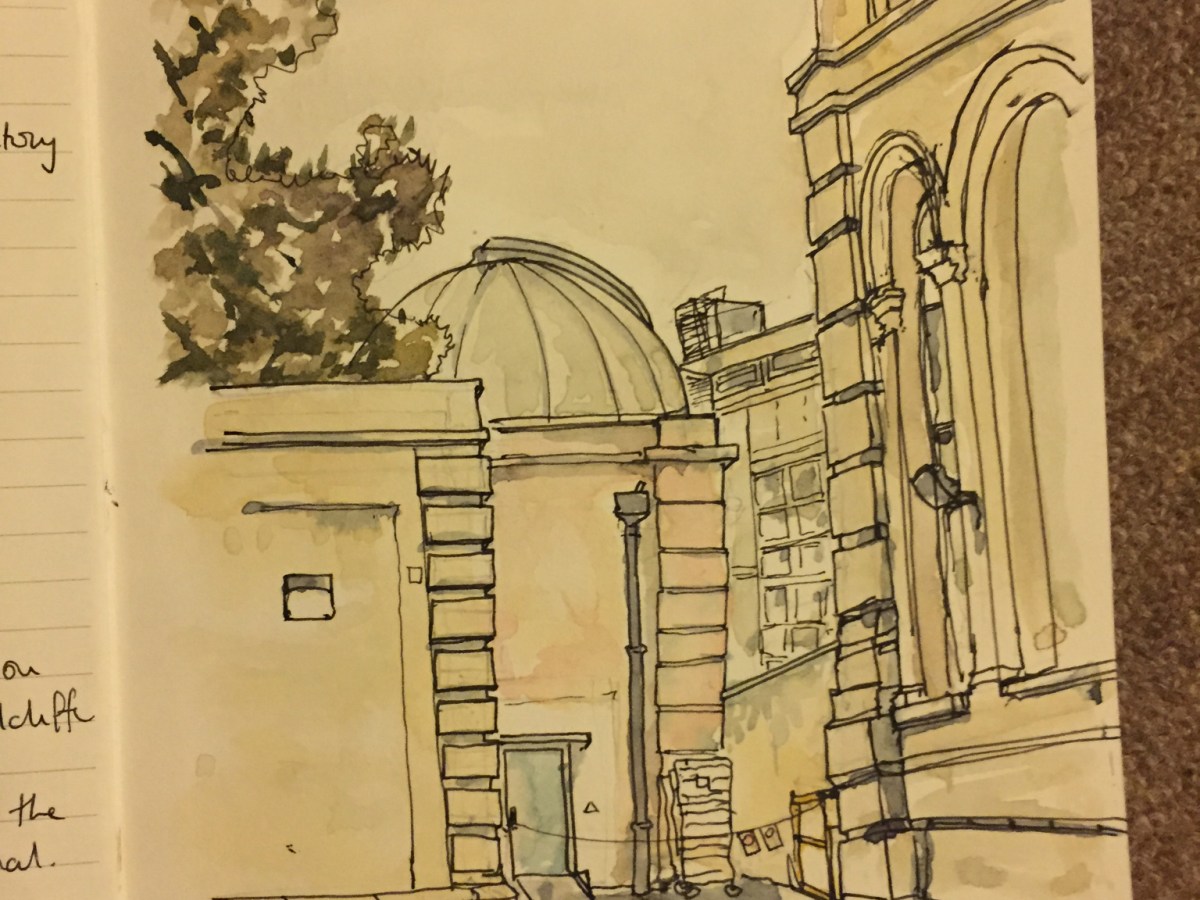
In the picture above, the alley on the right of the pub is called “Shepherdess Place”. It leads to a police car park, and several office blocks. I went down there to draw a picture of The Eagle from the other side.
The Eagle from Shepherdess Place. The plants on the right are some sort of vine, climbing on, or falling off the building. In the background are the towers of the new development 250 City Road.
The Eagle is mentioned in the nursery rhyme. We used to sing it as children without the least idea what it meant.
Half a pound of tuppenny rice,
half a pound of treacle
That's the way the money goes
Pop goes the weasel
Up and down the City Road
In and out the Eagle
That's the way the money goes
Pop goes the weasel
Placard on “The Eagle” with lines from the nursery rhyme.
This needs translation. I don’t know what the reference to “tuppenny rice” means. It could simply mean “rice” of course, but given that the rest of the song is in rhyming slang, I wonder what ‘Tuppenny rice’ might mean. Tuppenny is “two pence worth”. That would be old pennies, of course, pre-decimal.
“Treacle” is rhyming slang: “Treacle tart”. Hence “treacle” is an affectionate term for “woman”, or perhaps “female sex-worker”. I have been called “treacle” by the market traders where I used to live. It was a friendly kind of a word. “Weasel” is rhyming slang: “Weasel and stoat”, hence “coat”.
So my translation is:
A little bit for food,
A little bit for the lady-friend
Then I don't have any money left
So I pawn my overcoat
Having visited the [betting?] shops on the City Road
and partaken of refreshment in the Eagle
I don't have any money left
So I pawn my overcoat
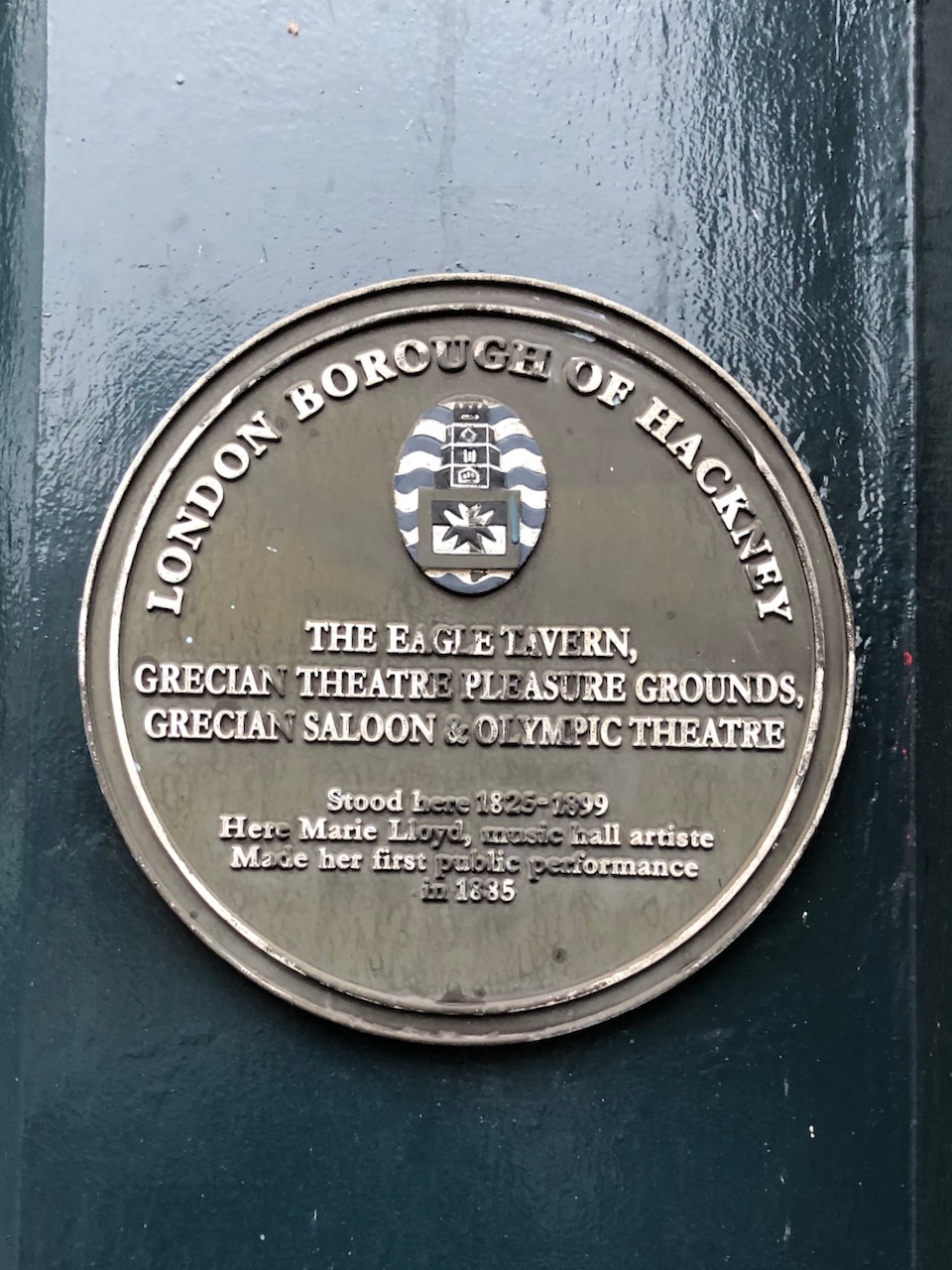
“Grecian Theatre Pleasure Grounds, Grecian Saloon and Olympic Theatre”.
The Eagle was not just a pub. It was also a theatre. I wonder if the huge pitched roof I have drawn (top right in the second picture) covers a large hall. According to a plaque on the outside (pictured)
The Eagle Tavern, Grecian Theatre Pleasure Grounds, Grecian Saloon and Olympic Theatre, stood here 1825-1899. Here Marie Lloyd, music hall artiste, made her first public performance in 1885.
I wonder what “Grecian” meant in this context?
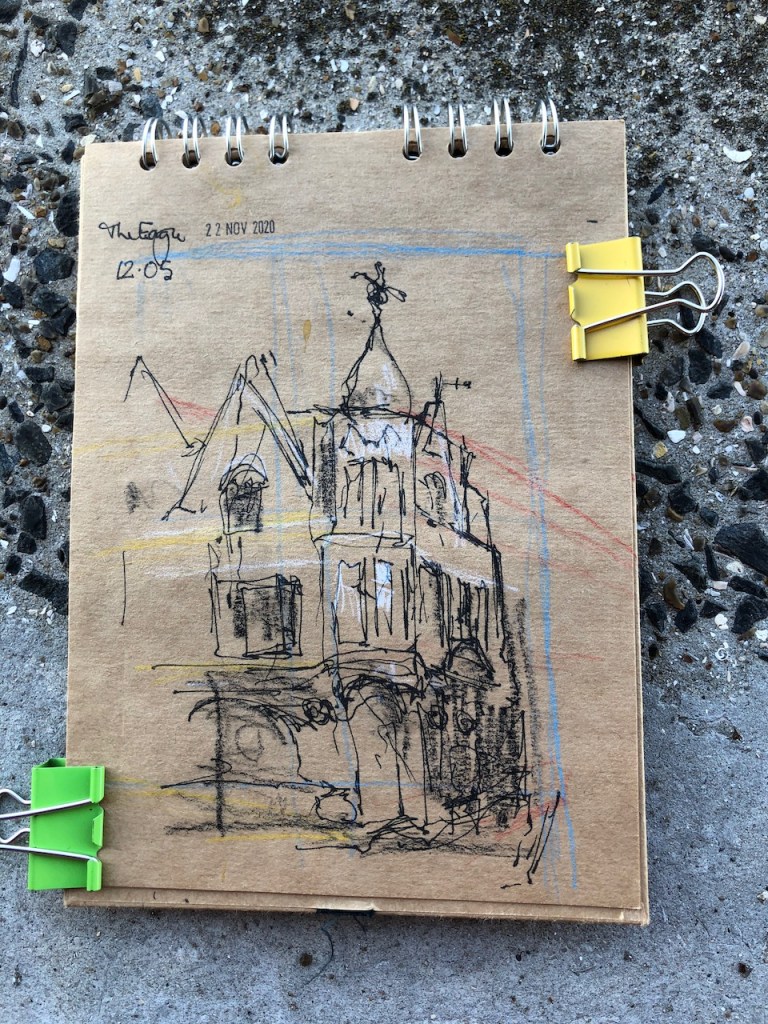
Here are some pictures of work in progress.
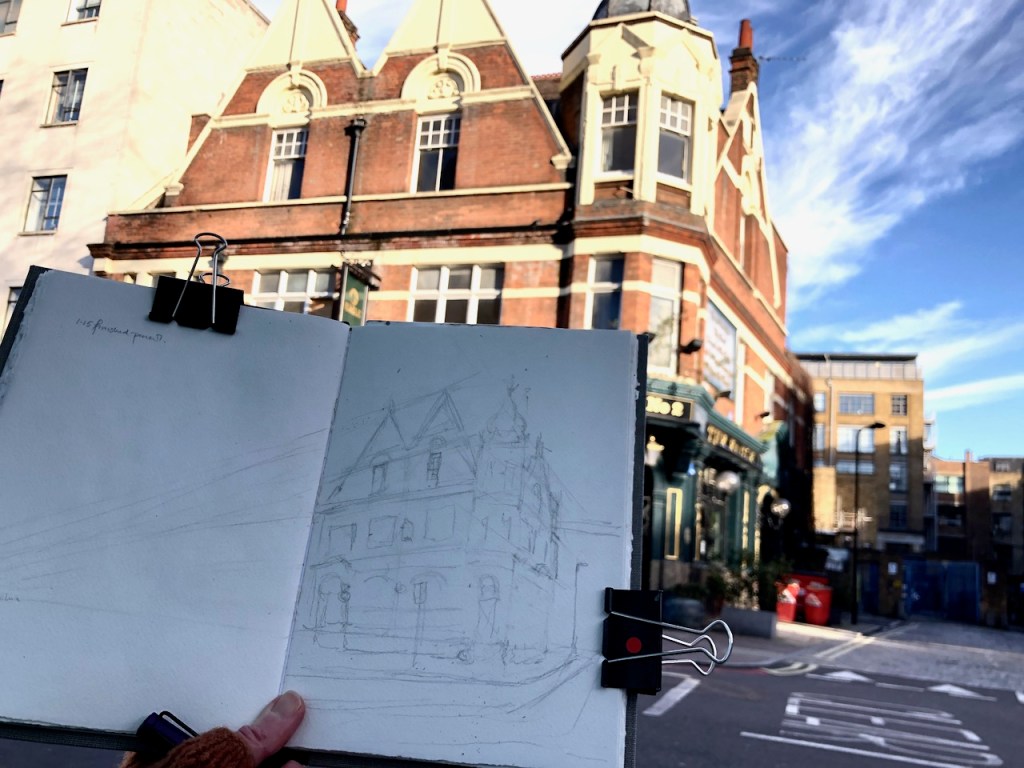
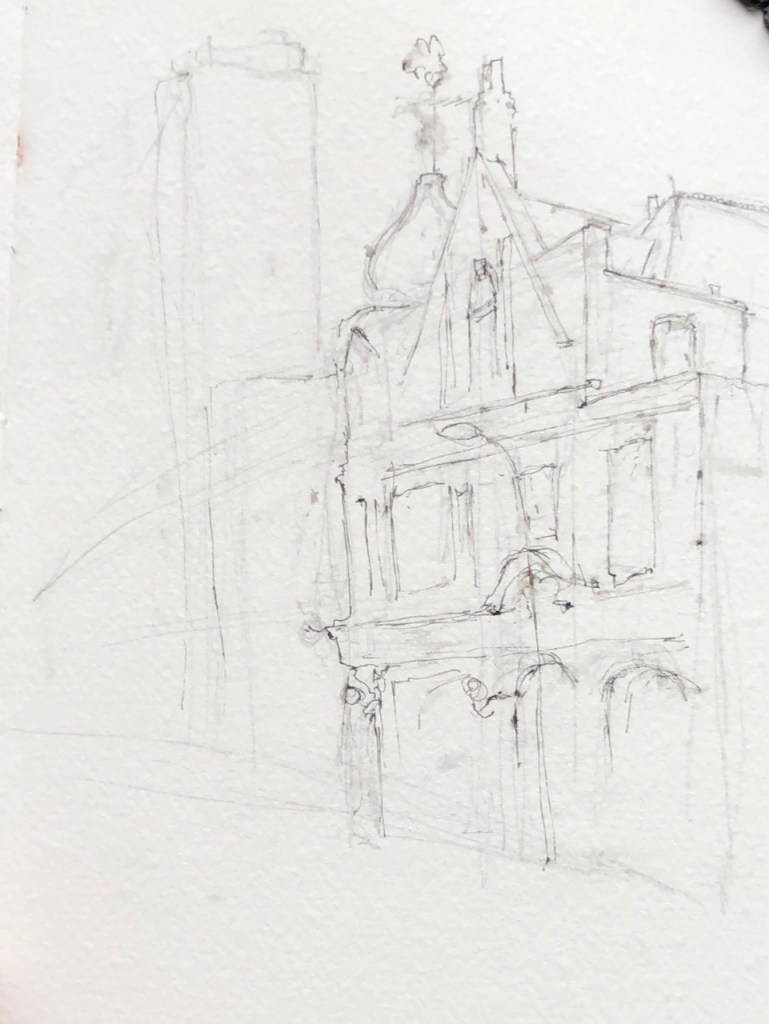
Preliminary sketchToolsThe Eagle, view from Shepherdess Walk , work in progress and maps.A crowded locationThe Eagle from Shepherdess Place, work-in-progress and maps
This junction is changing rapidly. The empty site on the other side of the road, an old bomb-site, now has construction vehicles in action. I took some photos just for the record, and found out a bit more about the site. See the page on this link if you are interested, and please comment if you know more.
Here are some other drawings I have done in the area:
This is at the junction of Shepherdess Walk and the City Road. Just off the picture to the left is the Eagle pub. Both the Eagle pub and the narrow building I’ve drawn are remarkably dilapidated, given their location in a trendy part of town, right near Old Street Roundabout. I feel their existences are…
Gambier House constructed 1968, 20 stories, 115 flats. Owned and managed by Islington. Planning proposal for external cladding, 18 Sept 2014. Eagle Dwelling 212 City Road, on the left of the picture, is a “specialist supported housing scheme for single homeless people who may also have additional complex needs”. It seems to be owned and managed…
This is the view looking West from the junction of Nile St and East St, in the borough of Hackney, London N1. I was leaning against a wall on a wide pavement, on the corner. I judged that I was easy to avoid there, and social distance could easily be maintained. In fact, there were…
There is another local “Eagle” pub, on the Farringdon Road. See this post:
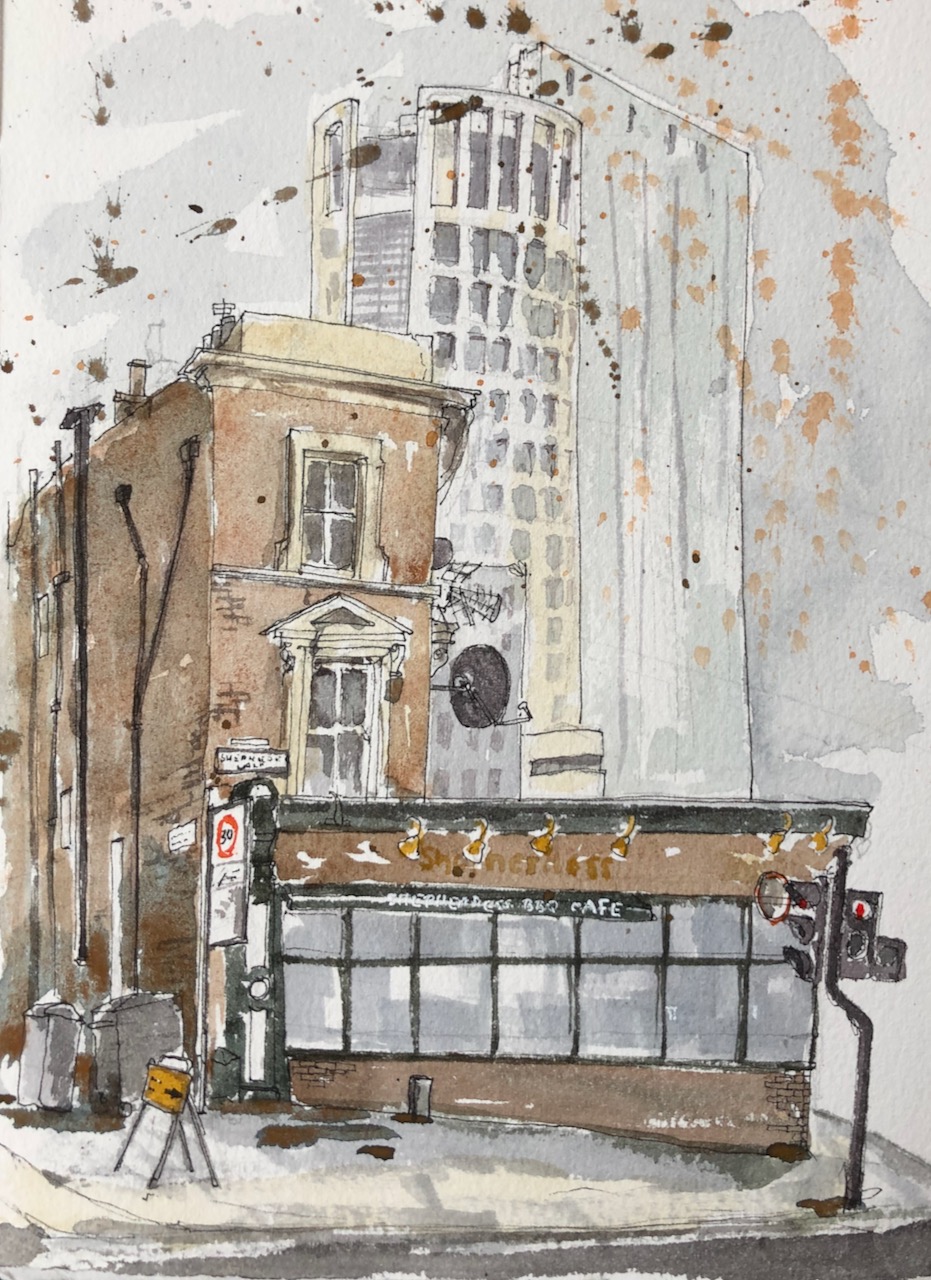
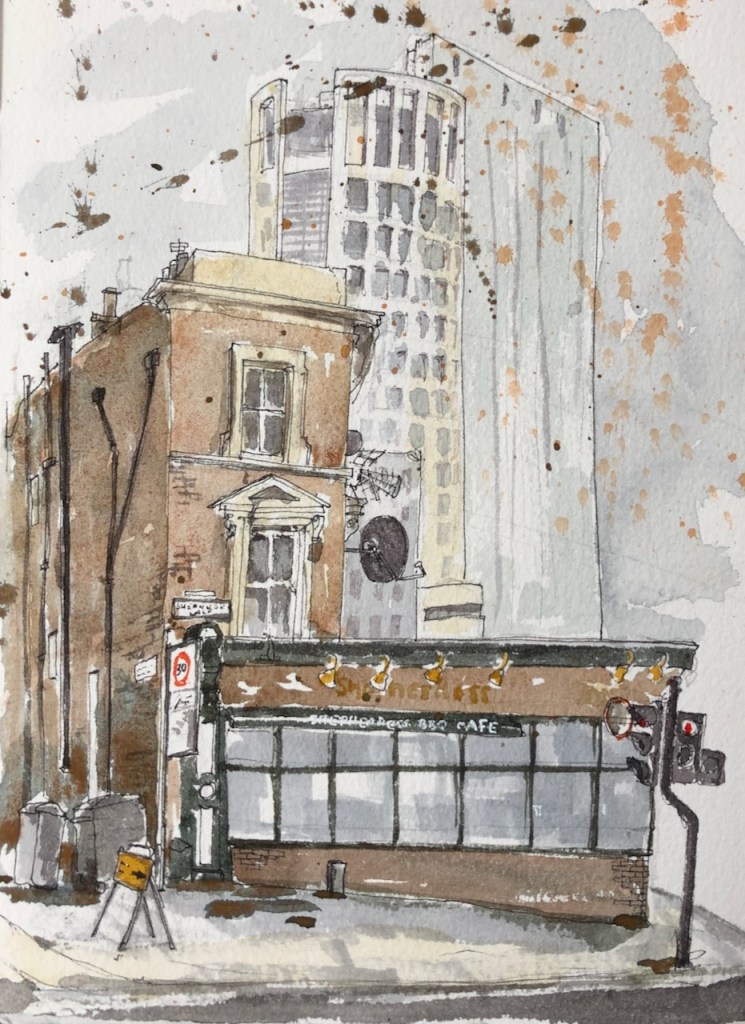
This is at the junction of Shepherdess Walk and the City Road.
Shepherdess Café, with Eagle Point and The Atlas Building in the background.
Just off the picture to the left is the Eagle pub. Both the Eagle pub and the narrow building I’ve drawn are remarkably dilapidated, given their location in a trendy part of town, right near Old Street Roundabout. I feel their existences are somewhat precarious. See the huge shiny towers, only a few hundred metres away.
But that building above the café has its dignity, for all that it is cracked, and its walls are leaning several degrees off the vertical. Its windows are surrounded by scrollwork and stucco. It is much used, and much modified. There is a spectacular network of pipes and conduits at the back of the building, and an impressive array of TV aerials and satellite dishes on the front.
The alley on the left of my drawing is Shepherdess Place.
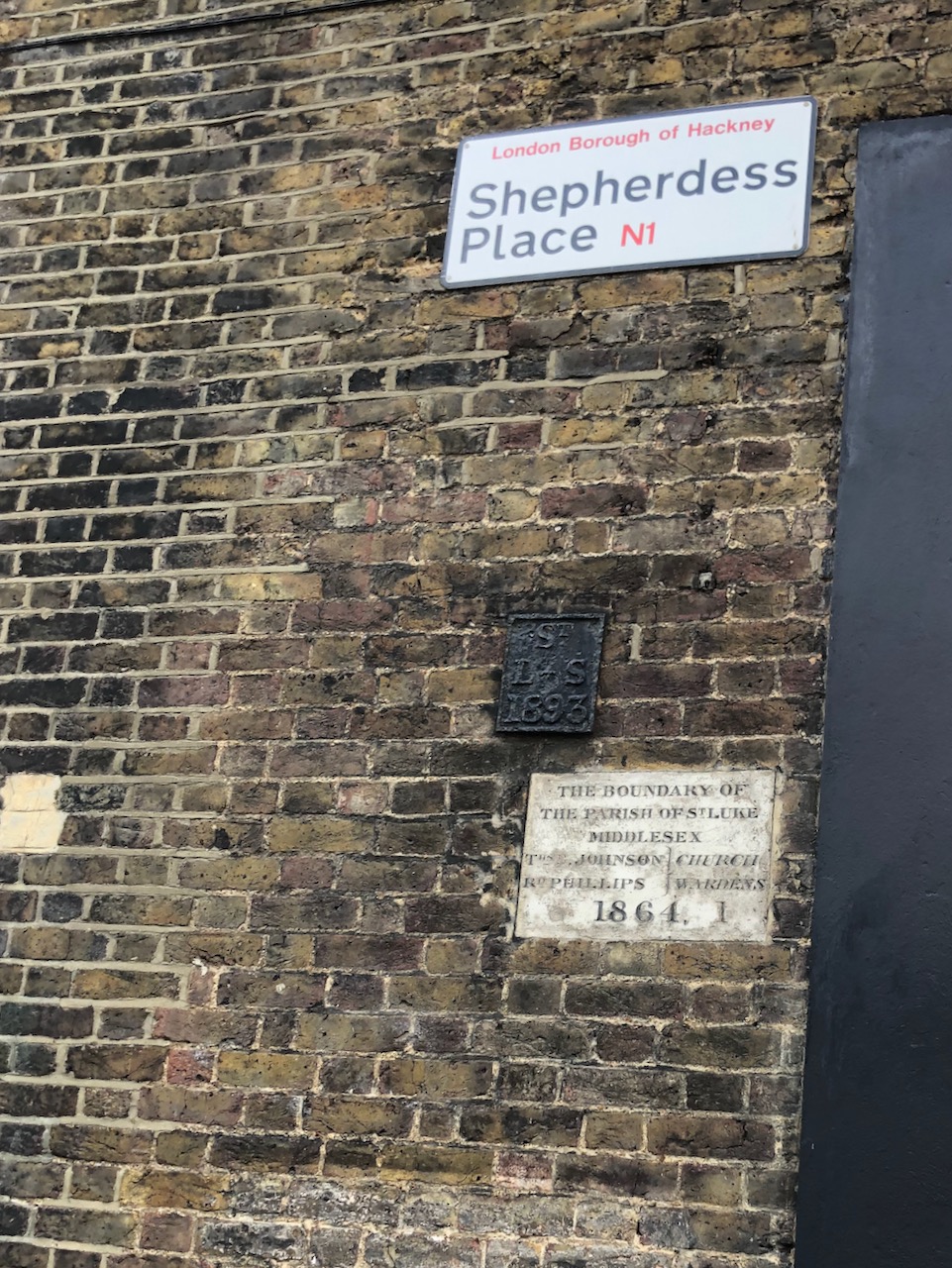
Notices on Shepherdess Place.
The white stone in the brickwork tells us that this small street marks a parish boundary. It says “The Boundary of the Parish of St Luke Middlesex, Ths B Johnson, Rd Phillips, Church Wardens, 1864“, with an additional figure “1” whose meaning is obscure to me. Can we assume “Ths” is “Thomas” and “Rd” is Rudyard? The black notice confirms this boundary “St L-S 1893“, 29 years later.
See how lovely the brickwork is! All those pinks and browns!
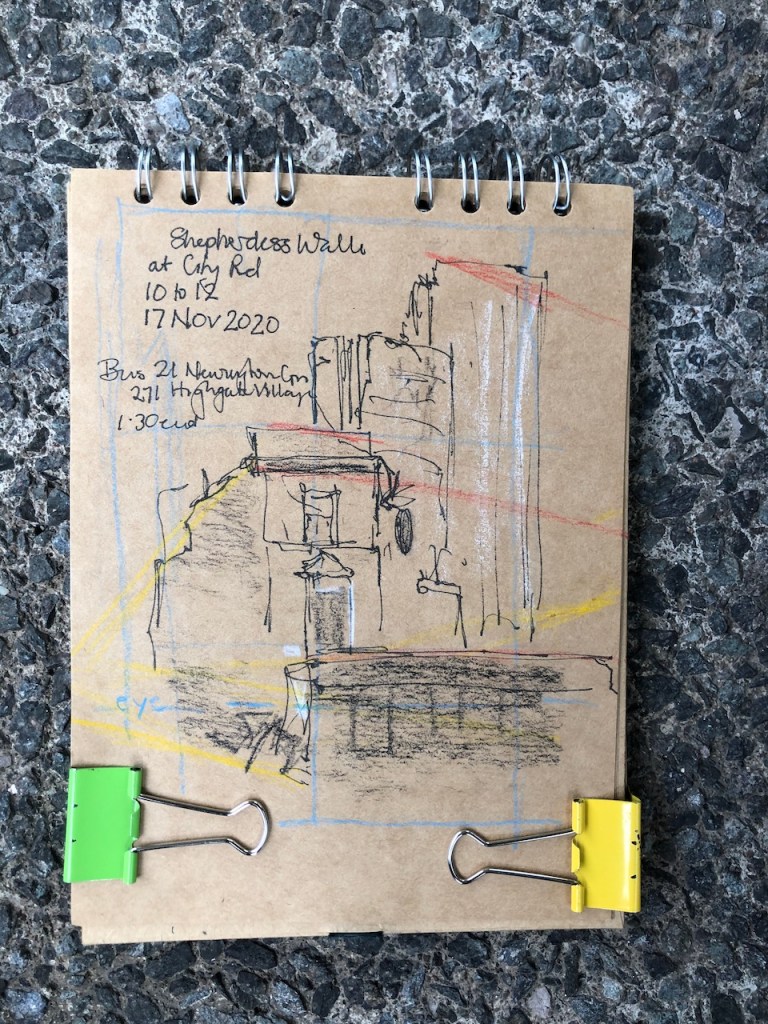
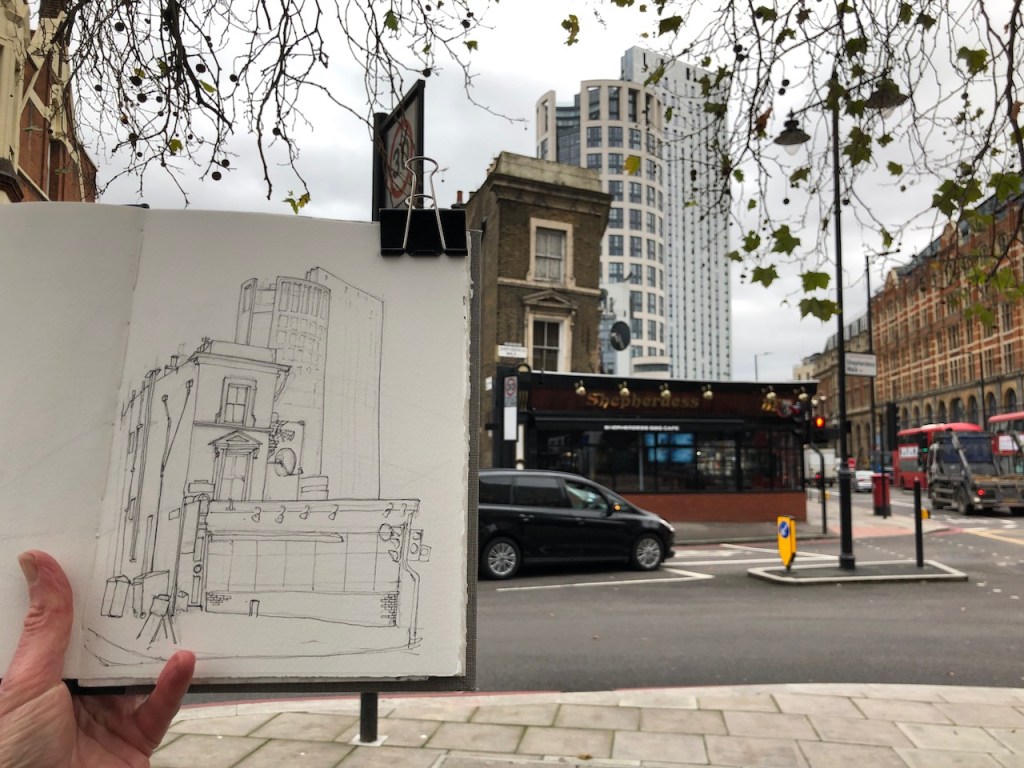
Here is work in progress on the drawing and some maps.
Preliminary sketch
Tools
Pen
Pen
Pencil
Pencil
Sketch map of the location and sight line
Map (C) OpenStreetMap contributors showing nearby Old St Roundabout, bottom right
Five different buses pass the spot where I was drawing. They all head North up Shepherdess Walk:
21 to Newington Green
271 to Highgate Village
394 to Homerton Hospital
141 to Palmers Green
76 to Tottenham Hale
There is a police station next to the Eagle pub, offices and housing all around. Moorfields Eye Hospital is just across the City Road. It’s a busy corner. The Shepherdess Café was closed because of lockdown.
There are many colours in this picture, all Daniel Smith colours: Lunar Earth, Buff Titanium, Burnt Umber and Prussian Blue for the brickwork, Perylene Maroon is in there too, for the grey and black, and Mars Yellow and Transparent Pyrrol Orange for the street signs. This is in Sketchbook 9 on Arches Aquarelle 300g NOT paper. The picture is 10″ x 7″ and took 1hr30min approx.
Click a button below to share this post online, email it, or print it:
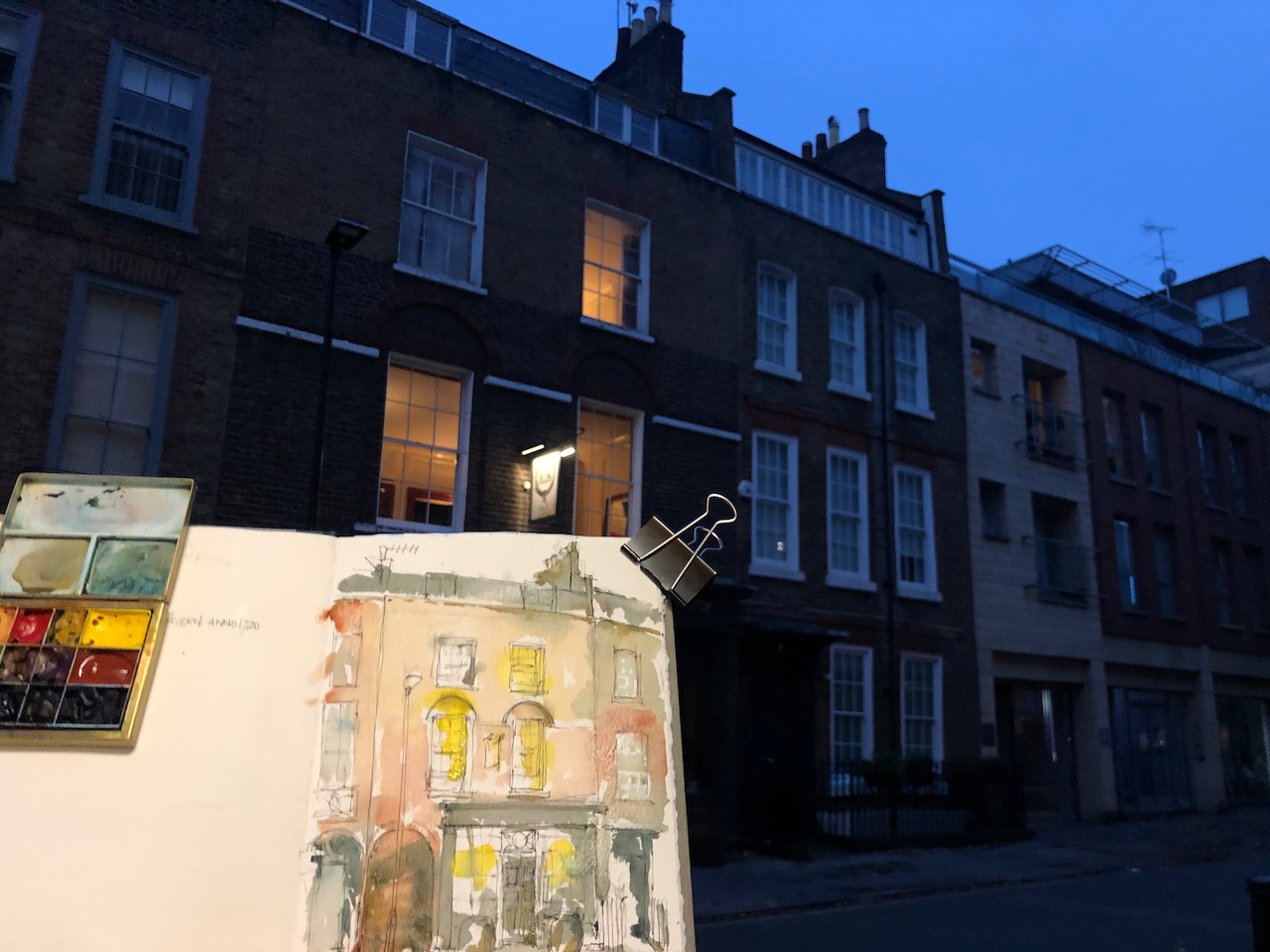
Here is a sketch of The Jerusalem Tavern, Britton St, Clerkenwell, made as the light faded.
Jerusalem Tavern, 55 Britton St, 16 Nov 2020
I find this a particularly lovely building. The curves over the windows are semicircles and there is a pleasing symmetry to the upper floors. The semicircle over St John’s Passage exactly matches the door to its left, on another lovely house which has amazing tall windows on the first floor.
Britton Street was surprisingly lively on that Monday afternoon. There are offices along the street and people rushed in and out of doors, or came and stood on the pavement smoking. Delivery drivers were the main traffic, both vans and bicycles. They all seemed to know each other. A package was delivered to the office next to me. A woman came out to receive it. It was evidently expected. The driver returned to his van, and sorted more packages inside.
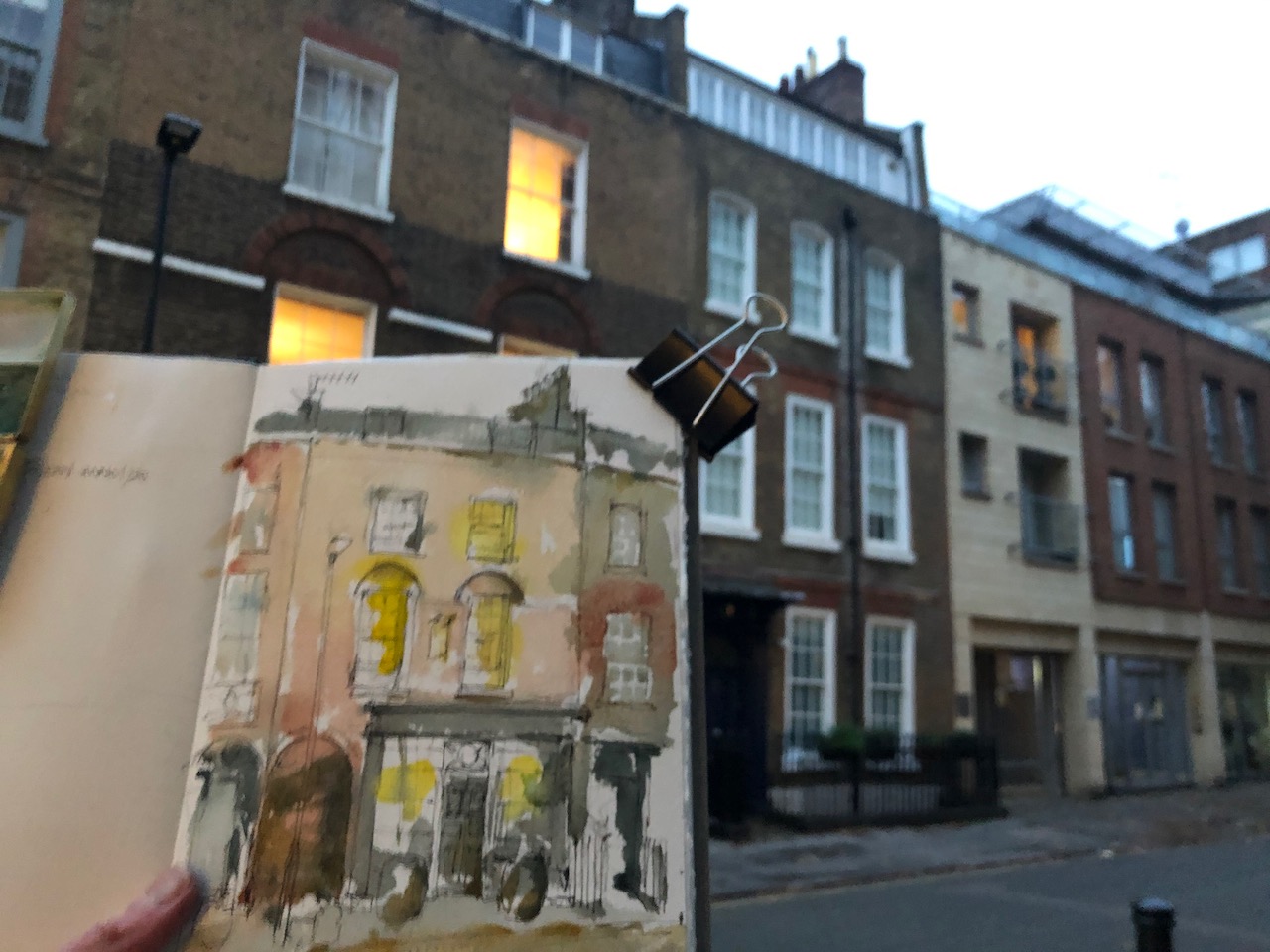
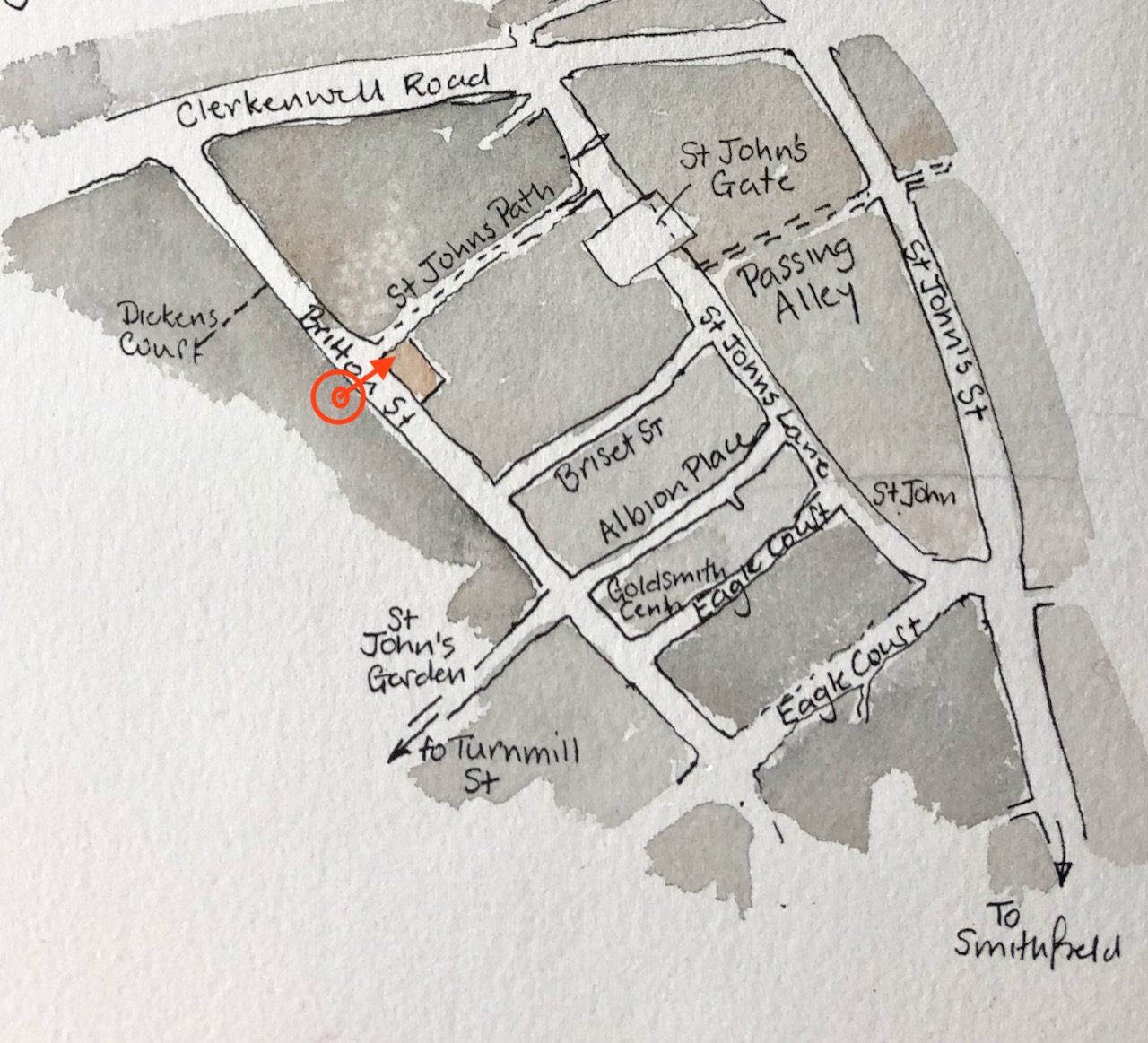
Here are some work in progress pictures and a map. I have just finished reading “Troubled Blood” by Robert Galbraith. If you’ve read the book you’ll know that much of the action takes place in these streets in Clerkenwell. As far as I can work out, all the streets mentioned in the book exist, and the routes described are realistic.
This drawing took about an hour. The colours are: for the walls – Fired Gold Ochre (DS), Mars Yellow (DS) and Phthalo Turquoise (W&N) , for the light in the windows Hansa Yellow Mid (DS). The drawing is 7″ x 10″, done in a sketchbook on 300gsm Arches Aquarelle Paper.
While I was drawing, I detected a movement in my peripheral vision. A spider of alarming size was climbing the wall against which I was leaning. It was making little spurts across each brick, then secreting itself into the mortar, trying to become invisible, before making its next jump. As I watched, it turned around meaningfully, and started heading down towards my rucksack, which was upright on the pavement, open, leaning against the brickwork like a spider-catching bucket. I moved the rucksack, and closed its flap. I was more-than-usually disconcerted, because we had been watching “Dr No” the previous night. I could recall rather too vividly that scene of the poisonous spider which crawls on James Bond while he is sleeping. I stood away from the wall, and monitored the spider’s progress. I did not have long to wait. It reached pavement level, no doubt disappointed that the bright yellow rucksack had somehow disappeared. Then it went into a pavement-level crack to decide what to do next. I decided to stop worrying about it.
To see the spider, scroll down – if you dare. Trigger warning: SPIDER.
Spider. It is about half the height of a house brick. Those are bricks on the wall, against which I was leaning.
Click a button below to share this post online, email it, or print it:
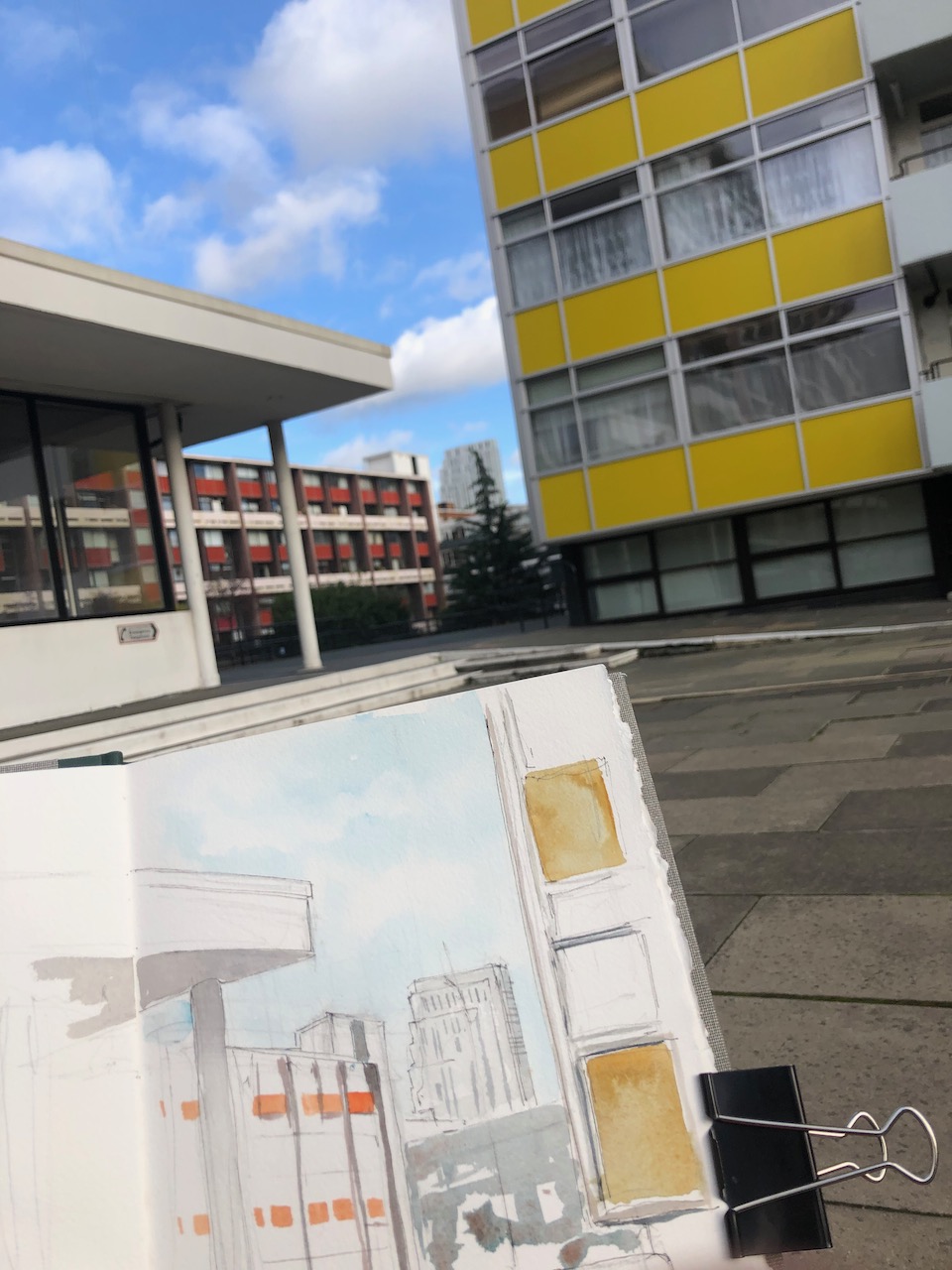
On Golden Lane Estate there is a Leisure Centre in the Modernist style. Its roof floats on slender columns, and there are huge windows so you can see the activity inside.
Here’s a view of the south end. The tree is in the garden in front of Basterfield House.
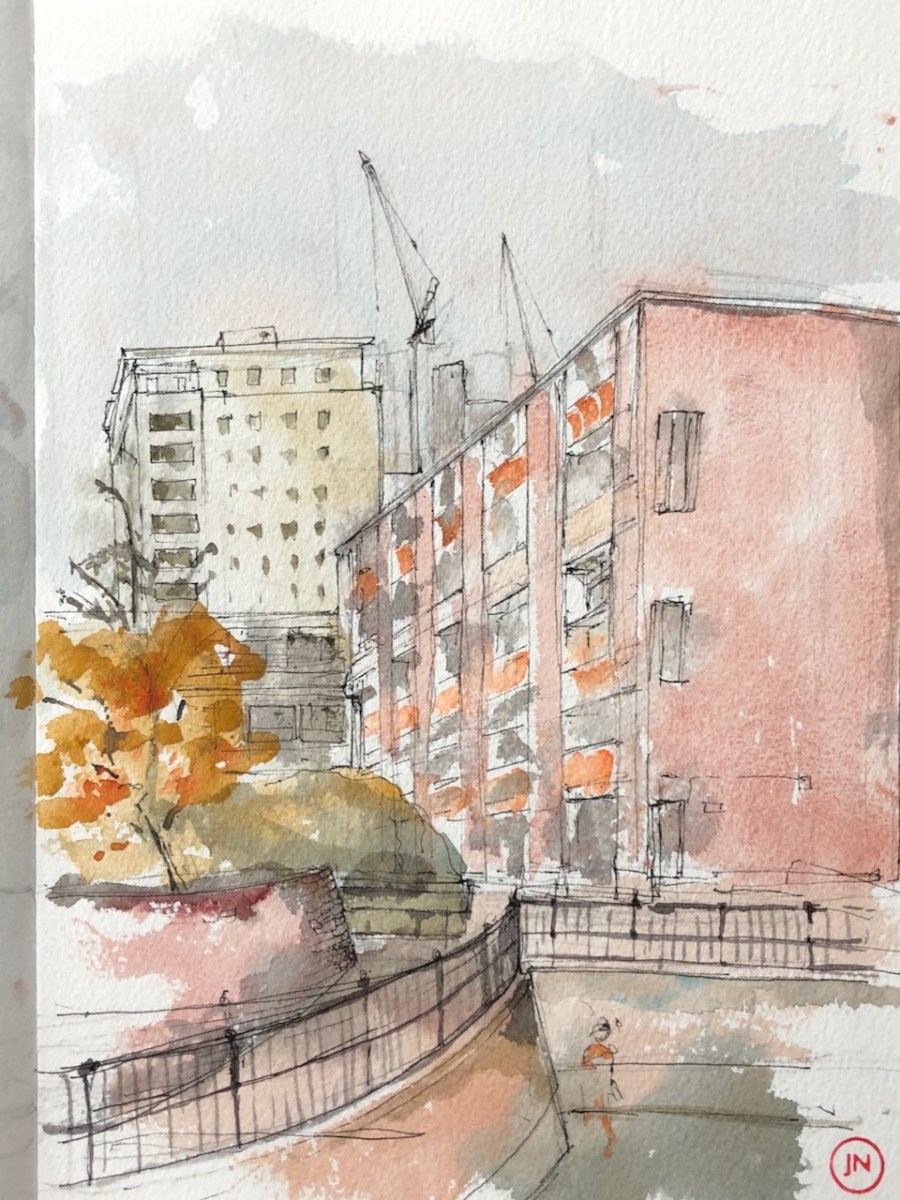
Golden Lane Leisure Centre (left), Basterfield House (with orange balconies), Atlas Building (in distance) and Great Arthur House (on the right)
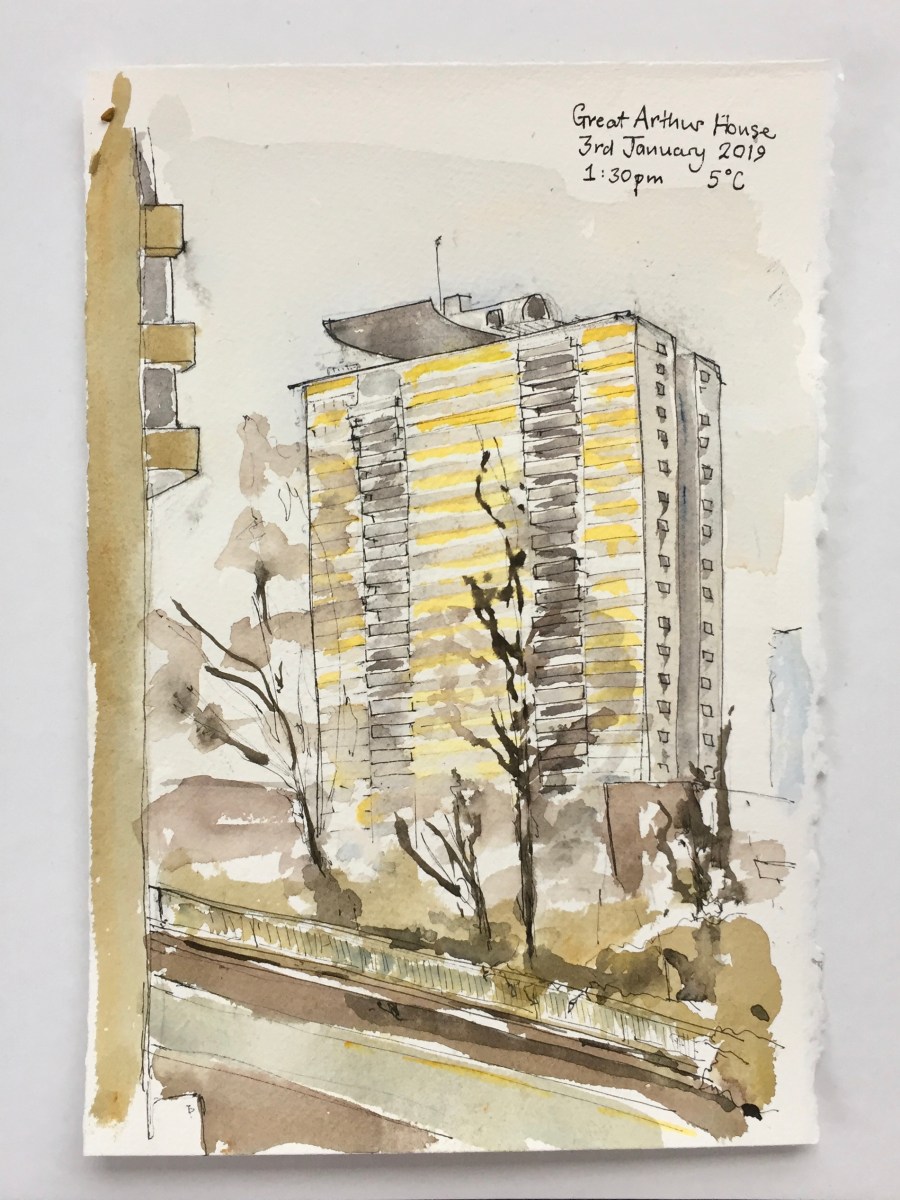
I drew this picture sitting on the paving stones outside Cullum Welch House. This was the location I’d chosen, because from that precise spot I could see the Atlas Building in the gap between Basterfield House and Great Arthur House. It’s a huge empty space. A woman walked past me, intrigued by my equipment spread around. She looked critically at the plastic carrier bag I was using to insulate myself from the concrete. “I’m glad to see you are sitting on something,” she told me. “My mother used to say you should not sit on cold concrete or you would get…now what was it you would get?” Since this woman was herself somewhat elderly, I was guessing that the advice from her mother dated way back into the previous century. We smiled at each other, thinking of mothers. She walked away, puzzling over what it was that her mother had been concerned about. I continued my drawing, thinking about advice from mothers, and how it endured.
Work in progress
Art materials on the concrete.
The low view.
A day or so later, I made a sketch in the evening, looking the other way.
Great Arthur House on the left, Golden Lane Leisure Centre, in the background Blake House and Crescent House.
It was evening, and very cold. This time I was standing up, looking West, as the sky dimmed.
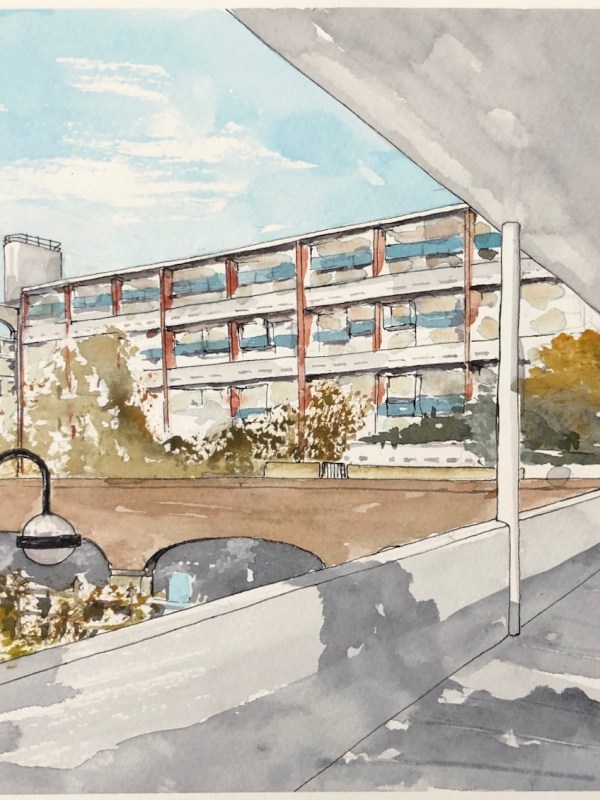
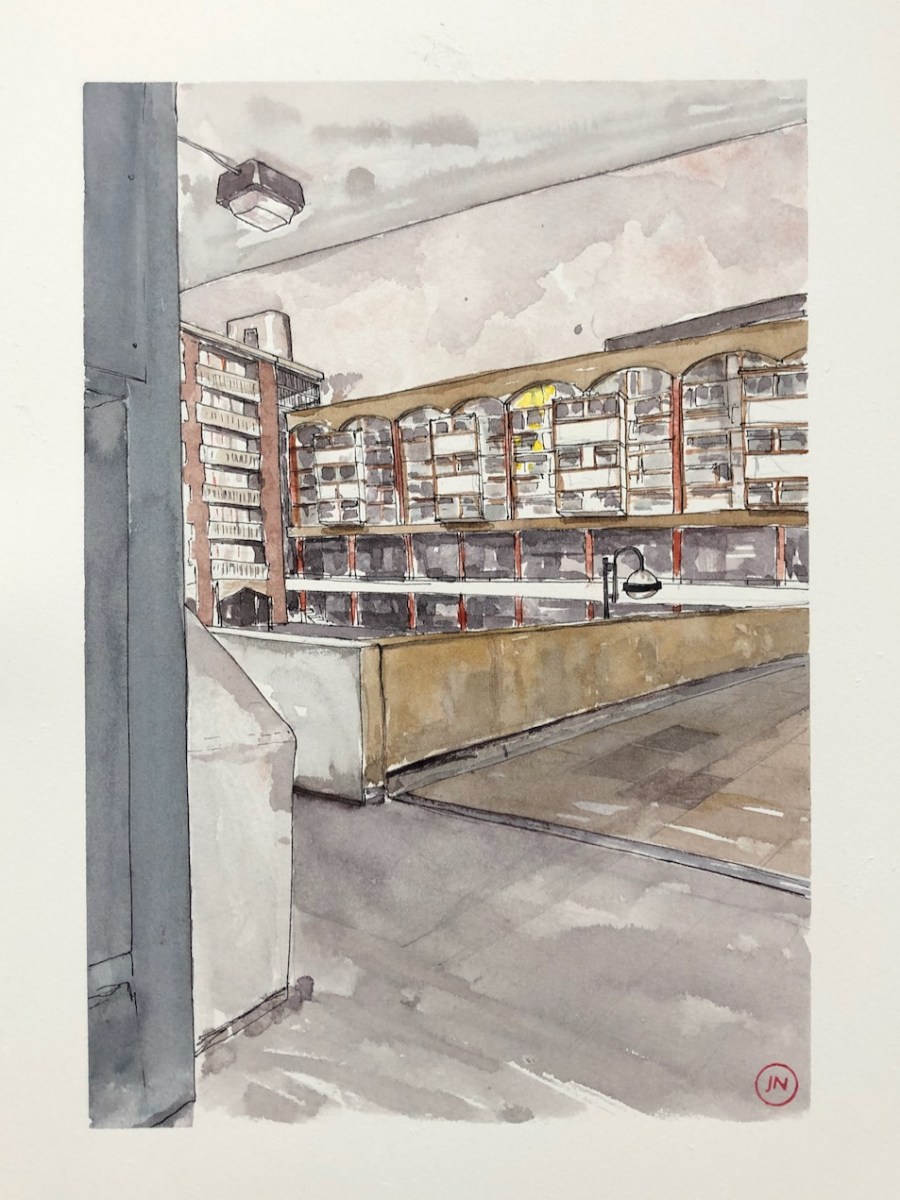
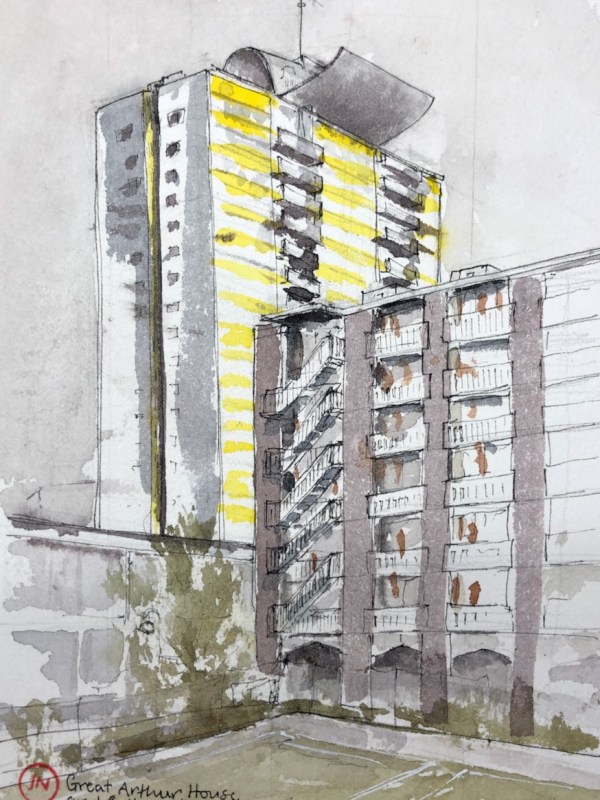
Here is a collection of my sketches in the Golden Lane Estate.









































 Jane Sketching