Here is the magnificent Marine Court, a residential building on the coast at St Leonards in Sussex. It was built in the 1930s, although it looks later. It was hugely controversial at the time, as you can imagine. The design emulates that of an ocean liner, the Queen Mary. Wikipedia tells me that the building originally had a rooftop bar, which must have been fun.
Marine Court, St Leonards, in sketchbook 12
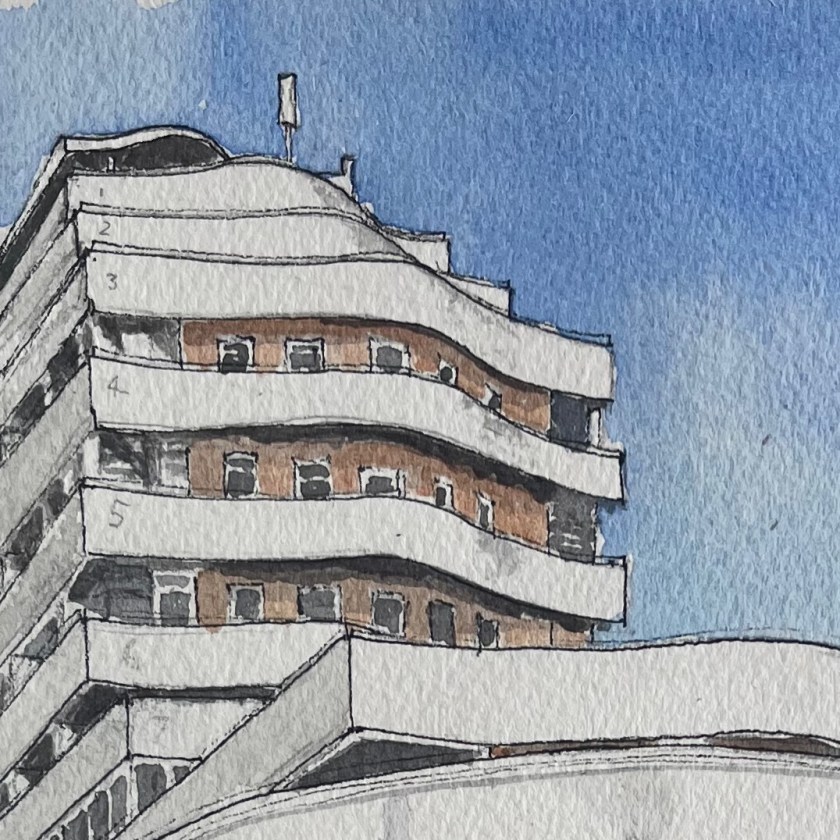
I was particularly taken by the design right at the top. From this angle, it looks like waves. This building is on the sea front, the sea is behind me and to the left.
The top of the building looks like waves. I had to number the floors to keep track of where I was…!
It is an Art Deco building, constructed between 1936 and 1938. It was requisitioned for military use in the 1939-45 conflict, and bombed in September 1942. The bomb damage was repaired after the war. It was listed Grade II in 1999.
The original concept was upmarket serviced apartments:
Design for total living environment Marine Court was designed to provide “an environment for total living” – a self-contained lifestyle within the complex, but not necessarily within each apartment. Modest sized flats originally had tiny kitchens – it was assumed that most of the inhabitants would dine in the main restaurant at the eastern end of the building, or avail themselves of room service. There were shops, parking, roof sun decks and recreational facilities (including a dance floor and bar) – and in-house staff to do the chores (there are still some call buttons to summons the now-defunct service).
Hastings Borough Council Marine Court, St Leonards-on-Sea Conservation, Management Plan [1]
It was privately developed. But the construction costs went over budget and sales of flats were slow. The owners, South Coast (Hastings and St. Leonards) Properties Company, went bust. After being occupied by the military, the building passed into the hands of Hastings Borough Council. By 2007, the building was becoming old, and evidently the repairs programme was not coping with the deterioration of the building. Hastings Borough Council proposed an plan [1]. This lists the problems in some detail, including such serious items as:
Condition of building service equipment The condition of building services and utility equipment [gas boilers / water / electricity / air /lifts / other] are the cause of some shared concern amongst the building’s managing agents and the residential leaseholders
Hastings Borough Council Marine Court, St Leonards-on-Sea Conservation, Management Plan [1]
Evidently this plan by Hastings Borough Council did not work out well, because by 2010 the leaseholders had acquired the freehold and formed their own company: “Marine Court (St Leonards On Sea) Freeholders Limited”.
The “Hastings Independent” reported on January 25th 2019: “The Grade II listing in 1999 made the costs of upkeep that much higher. However, the freehold was bought by the residents through a company, Marine Court (St Leonards on Sea) Freeholders Limited in 2010, and the prestige of the address, not to mention the glorious sea views from its upper windows, has ensured that most of the flat owners have been affluent enough, or can charge sufficient rent to sub-tenants, to meet the restoration bills as they are incurred.” The article goes on to describe problems in letting the retail shops which are underneath the canopy. They say: “Current controversies centre on the cost of works to upgrade a series of shared toilets at the rear of the premises with enhanced fire precaution measures including smoke alarms. The shops, which don’t need to provide toilet facilities for their customers, make sparing use of them; on the other hand, they are essential to the bars and restaurants, which do. Either way the projected cost of almost £100,000, charged in advance on the basis of estimates, is widely regarded as completely out of proportion to what is necessary or reasonable. …Some [business owners] are said to be taking legal advice on how to challenge the extent of the charges being levied. Others have simply left. There are several shopfronts now boarded up, which is having an adverse effect not just on general morale, but on the footfall which most of those who remain depend upon. “
That was in 2019. When I walked past in 2022, the majority of the shopfronts were boarded up, which is a great pity, as it is a good location, and shielded from the sun and wind.
Marine Court colonnade, July 2022, looking East.
It is a building on the edge, in many senses.
In case you are a little hazy about the location of St Leonards, here is a map.It is on the English south coast, between Brighton and Dover.
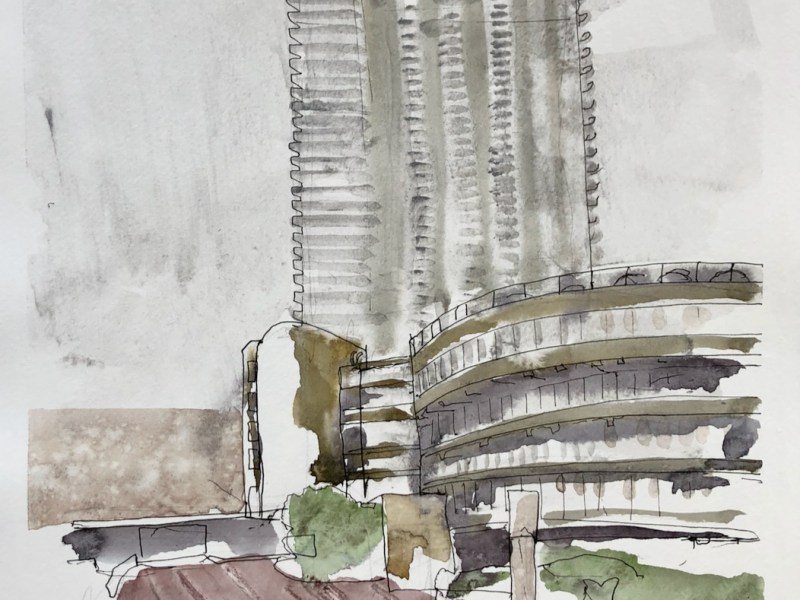
The Brunswick Centre, in Bloomsbury, London has been described as a “heroic prototype for a holistic community” [levittbernstein.co.uk]. There are 560 flats, a cinema, a medical centre and offices in a single development: hence “holistic”. It was radical in that it differs from the Georgian and Victorian houses all around.
Brunswick Centre, Bloomsbury, 13:50 9th August 2022, in Sketchbook 12
It was designed by Peter Hodgkinson during 1966-1970. The original plan was to extend the development all the way up to the Euston Road. There was a significant renovation in 2006 by the architects Levitt Bernstein. They made the shop fronts extend into the plaza in the middle, renovated the flats and added an “anchor supermarket” (Waitrose) at the northern end.
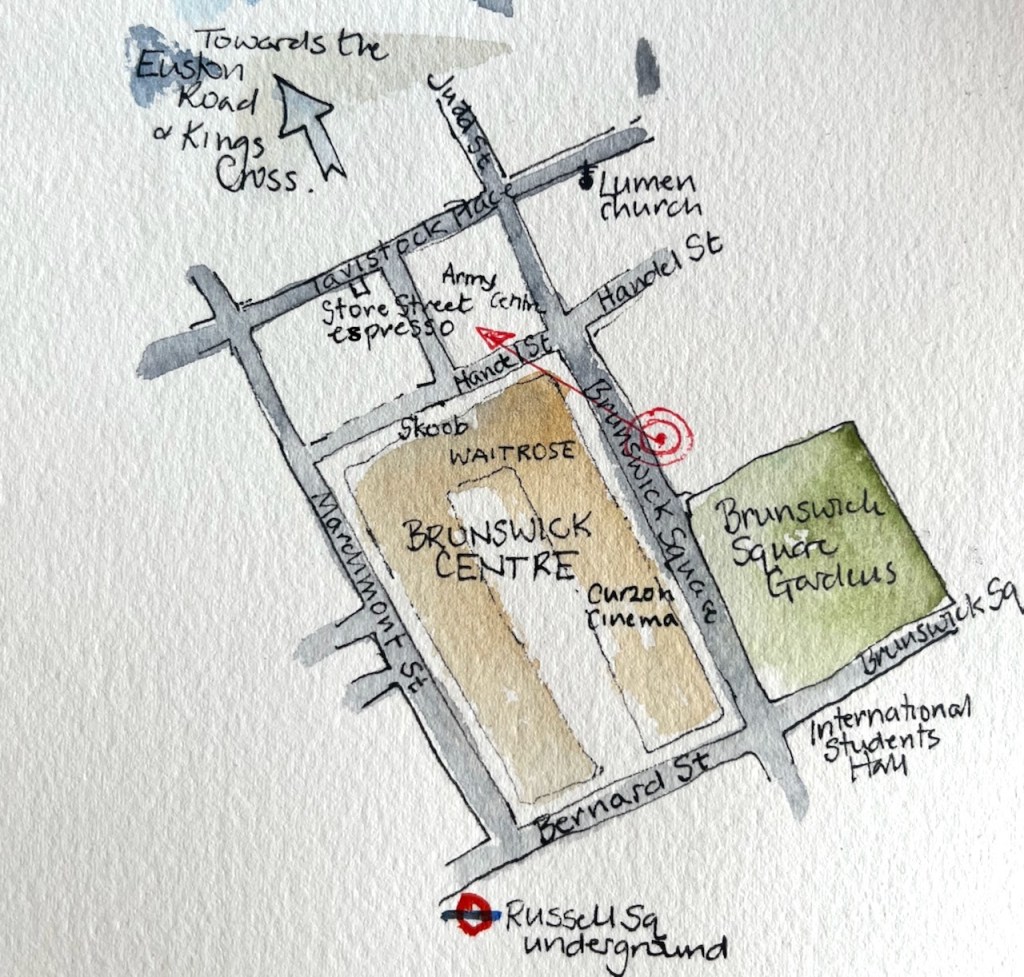
Where I did the drawing
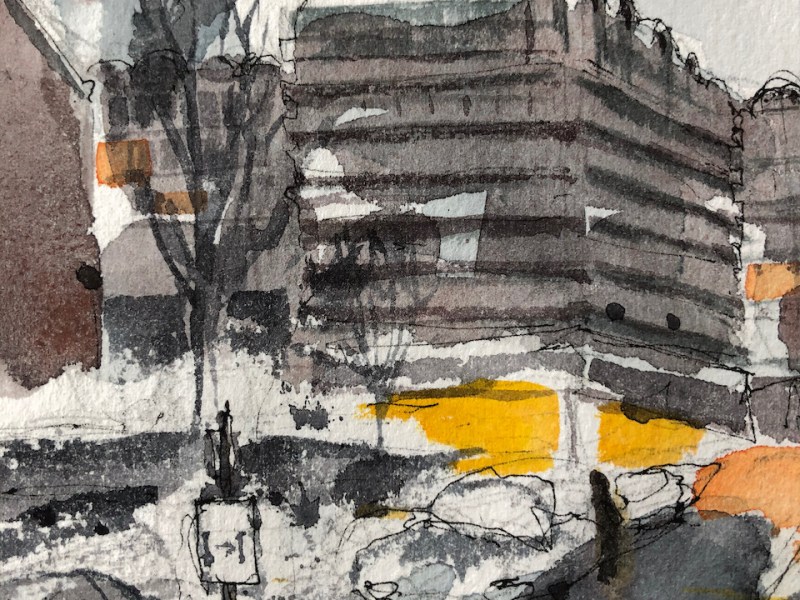
I sketched the pen and ink on location, then repaired to the Store Street espresso on Tavistock Place to do the colour. There are very few colours in the picture: Buff Titanium, Ultramarine Blue, Burnt Umber and a tiny bit of Transparent Pyrrol Orange.
Click a button below to share this post online, email it, or print it:
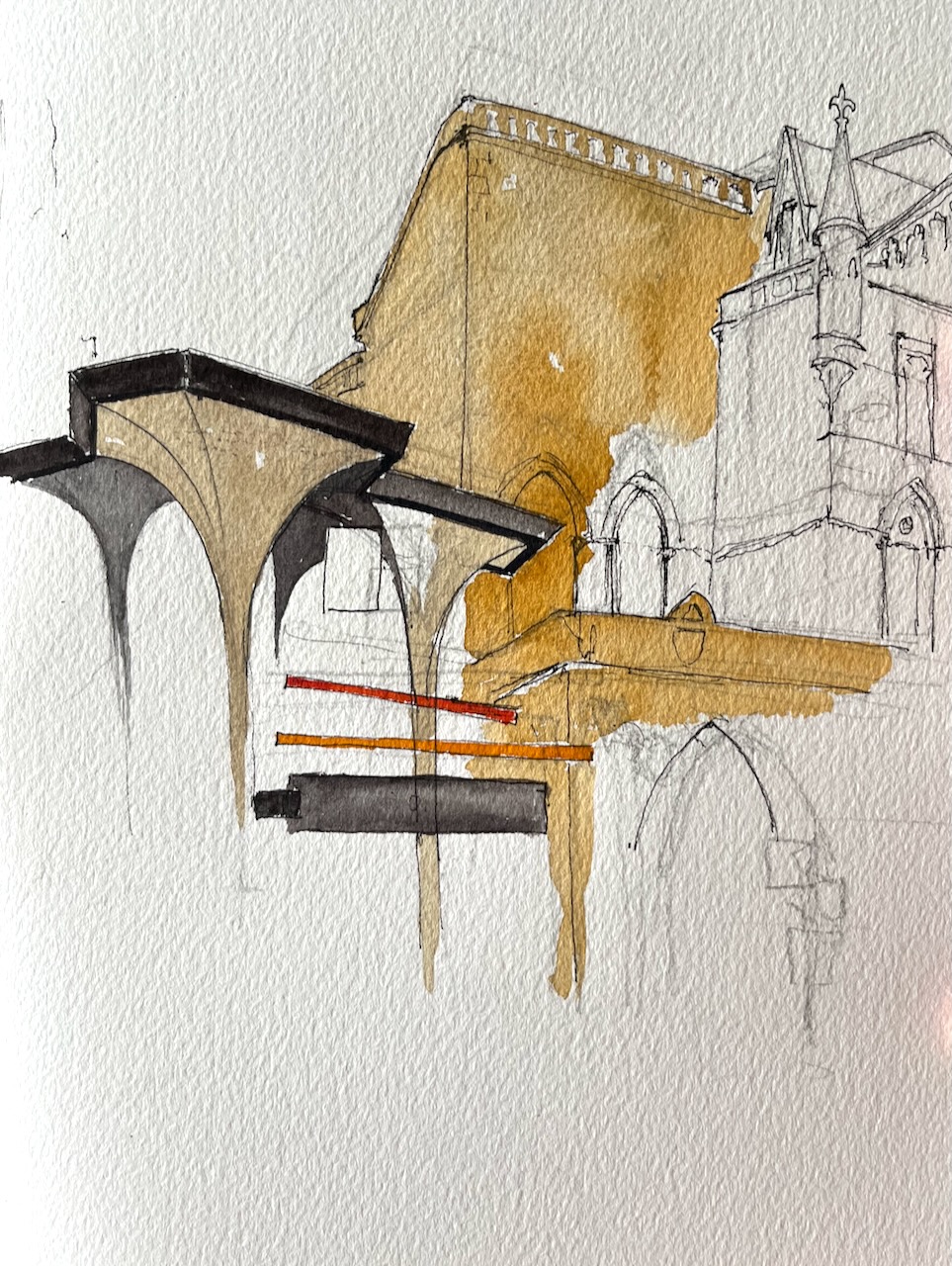
Have you seen this amazing annex to the Theatre Royal in York?
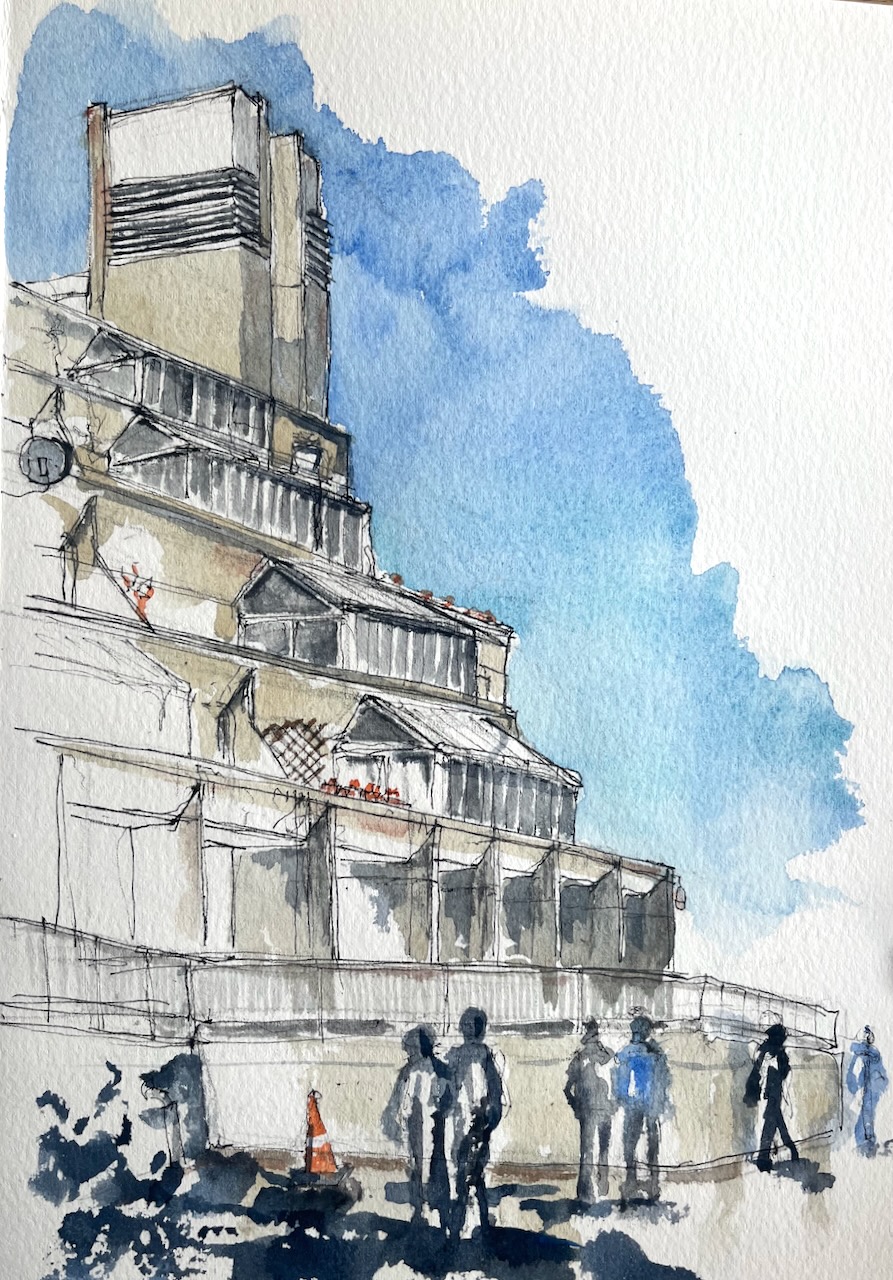
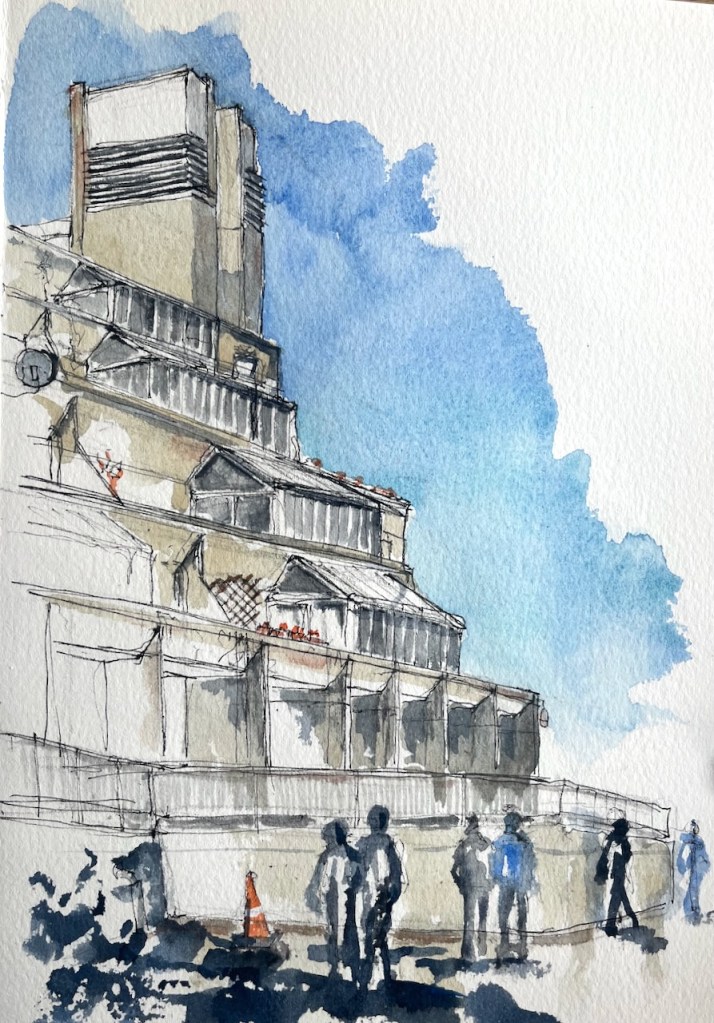
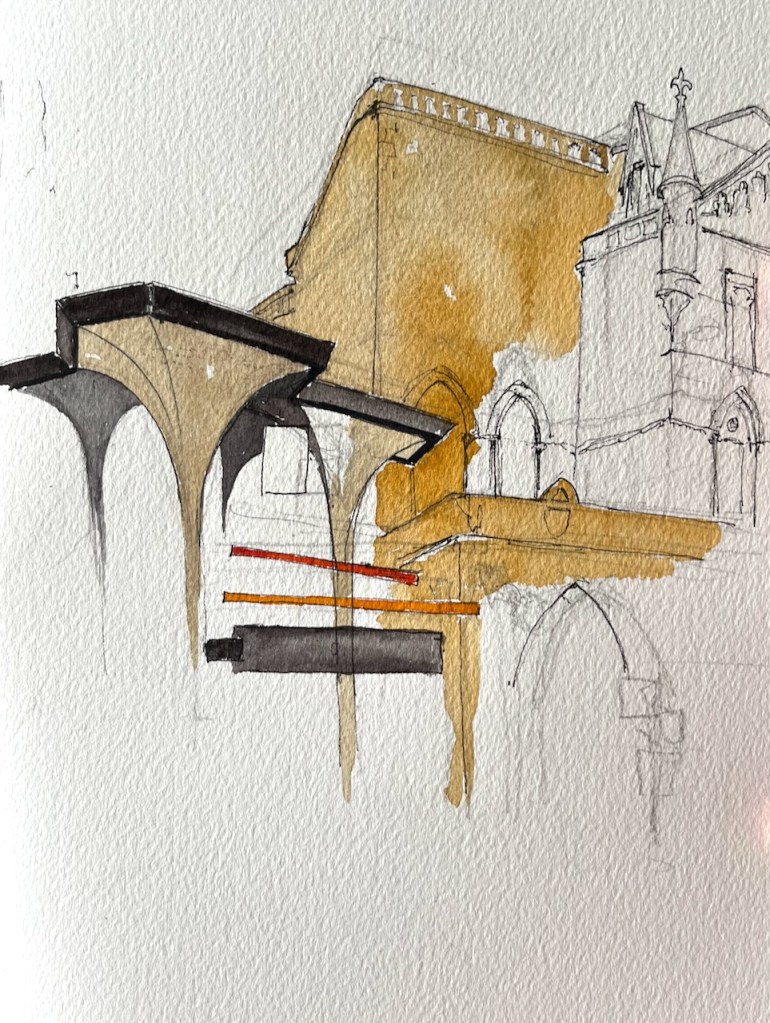
Theatre Royal Extension, York. 28 July 2022 in sketchbook 12. 10″ x 7″
It’s a stunning addition to the Victorian theatre next door. The older part of the theatre, on the right of my drawing, is in the Gothic revival style around 1879, designed by the then city engineer G Styan. The modernist extension, whose amazing soaring shapes are on the left of my drawing, was designed by Patrick Gwynne and RA Sefton, in 1967. The whole thing has been redeveloped in 2016, retaining the external shapes. I love the courage of this modernist extension. It’s not far from the station. I sketched it waiting for the train.
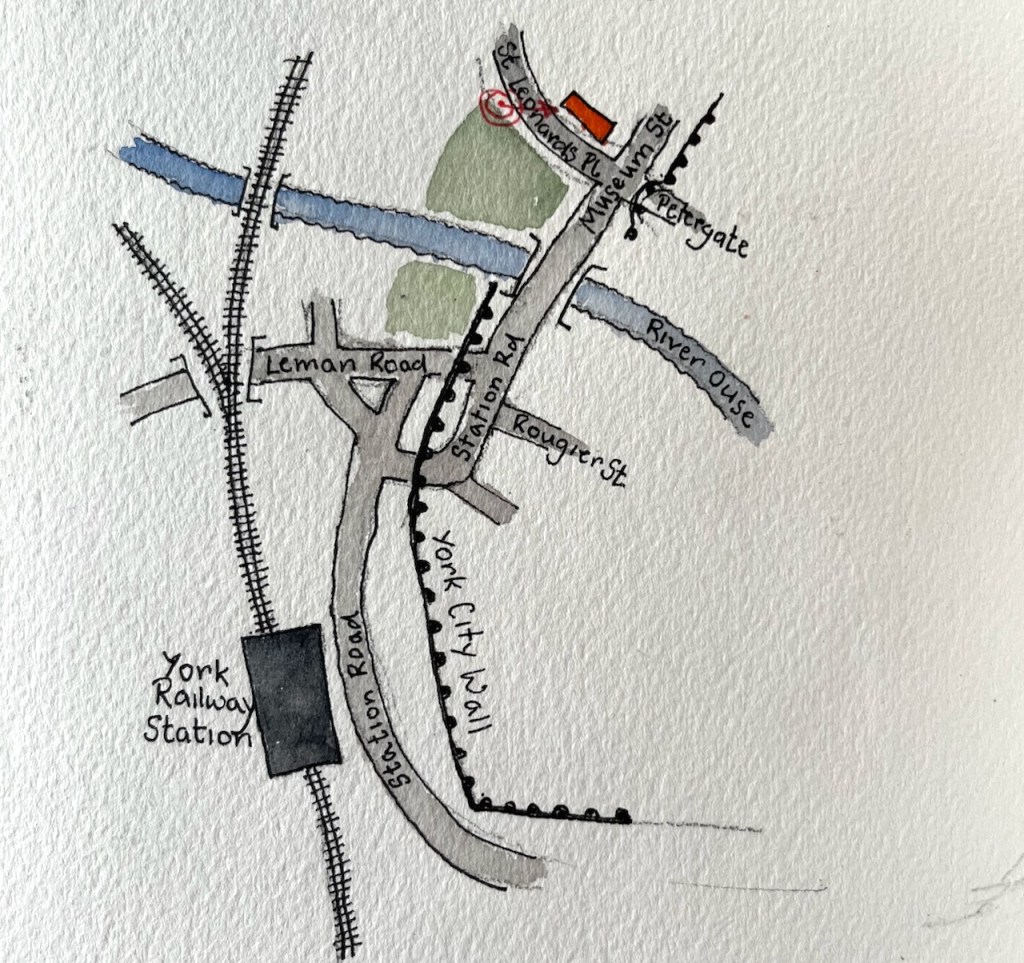
The Theatre Royal (in red) is just a few hundred yards from the station.
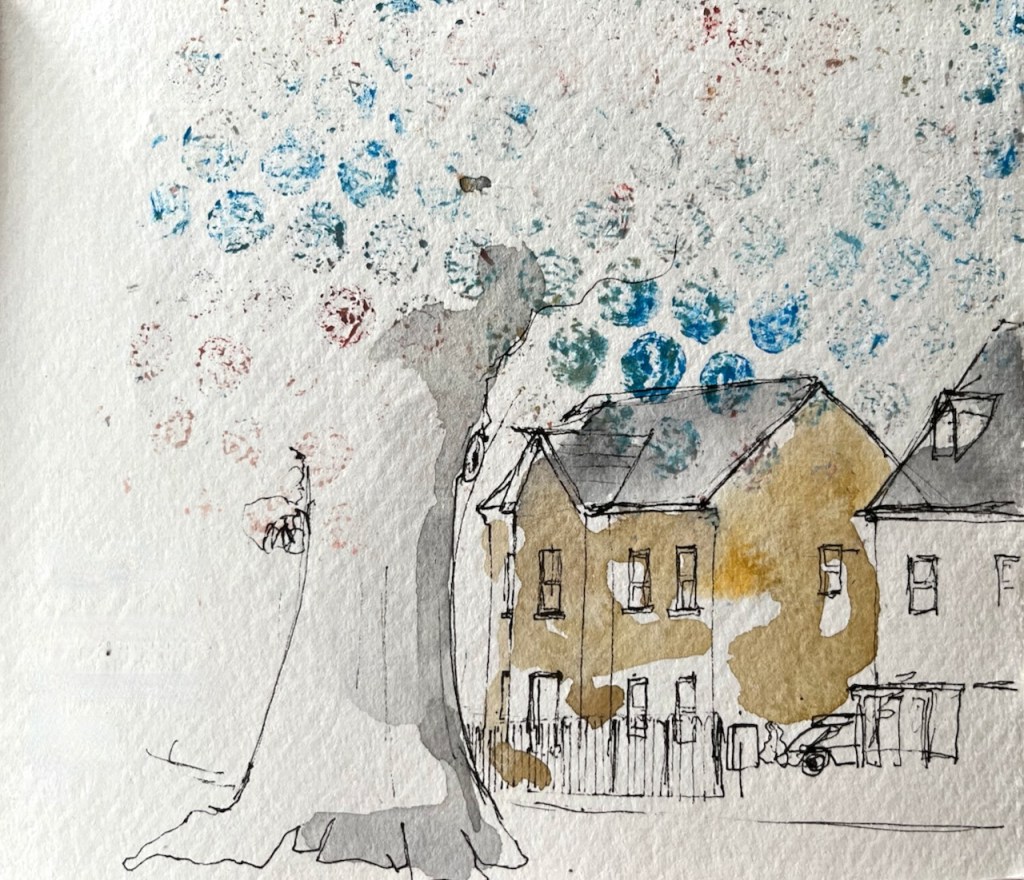
Here is a 21st century housing estate in the area. It’s an interesting contrast to the Theatre Royal extension. In this case the architects made new buildings which look traditional on the outside. They even have chimney pots. Inside they have 21st century standards of insulation, heating and plumbing. The chimney pots are simply decorative.
21st century housing in Yorkshire, in sketchbook 12, July 2022
Here are some smaller sketches I made touring around:
New housingOld high streetIn the Hepworth Wakefield
The Hepworth Wakefield was a revelation: well worth a diversion. It’s a beautiful building itself, which I shall be sure to sketch when I visit again.
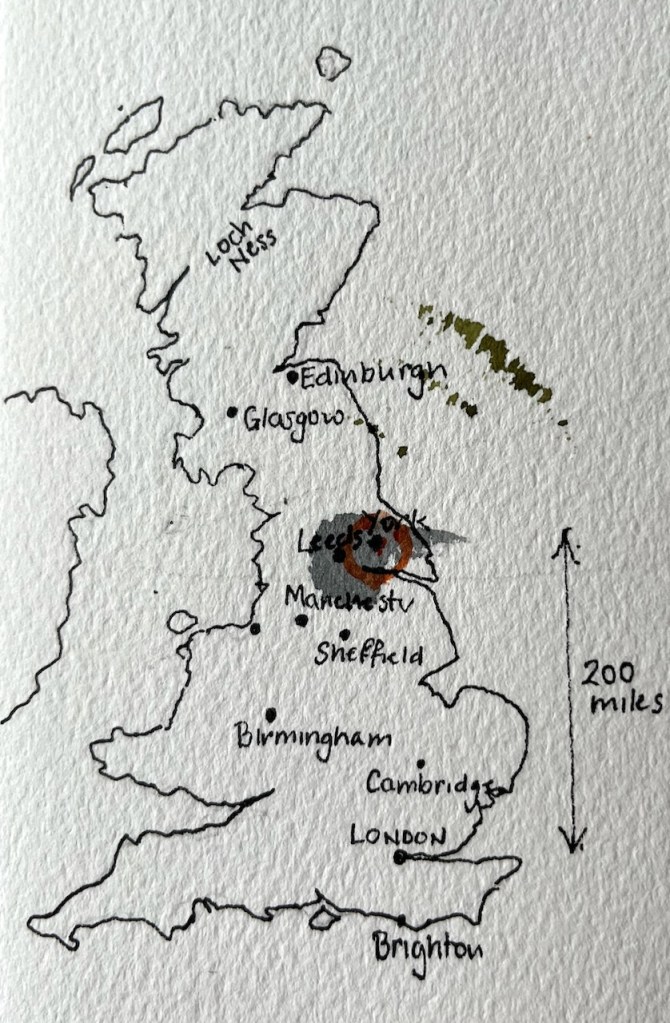
Yorkshire – halfway up the UK mainland.
I’ve sketched in York on a previous visit, see this post:
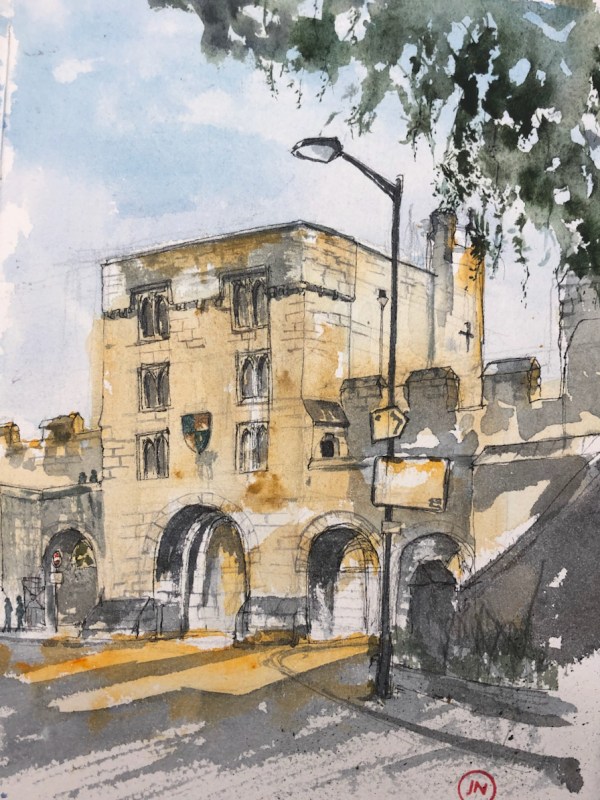
Here is the “Micklegate Bar”, which is one of the great gates through the old City wall into the centre of York. I sketched this outside a bar called “Micklegate Social”. The staff were inside, cleaning and setting up. They…
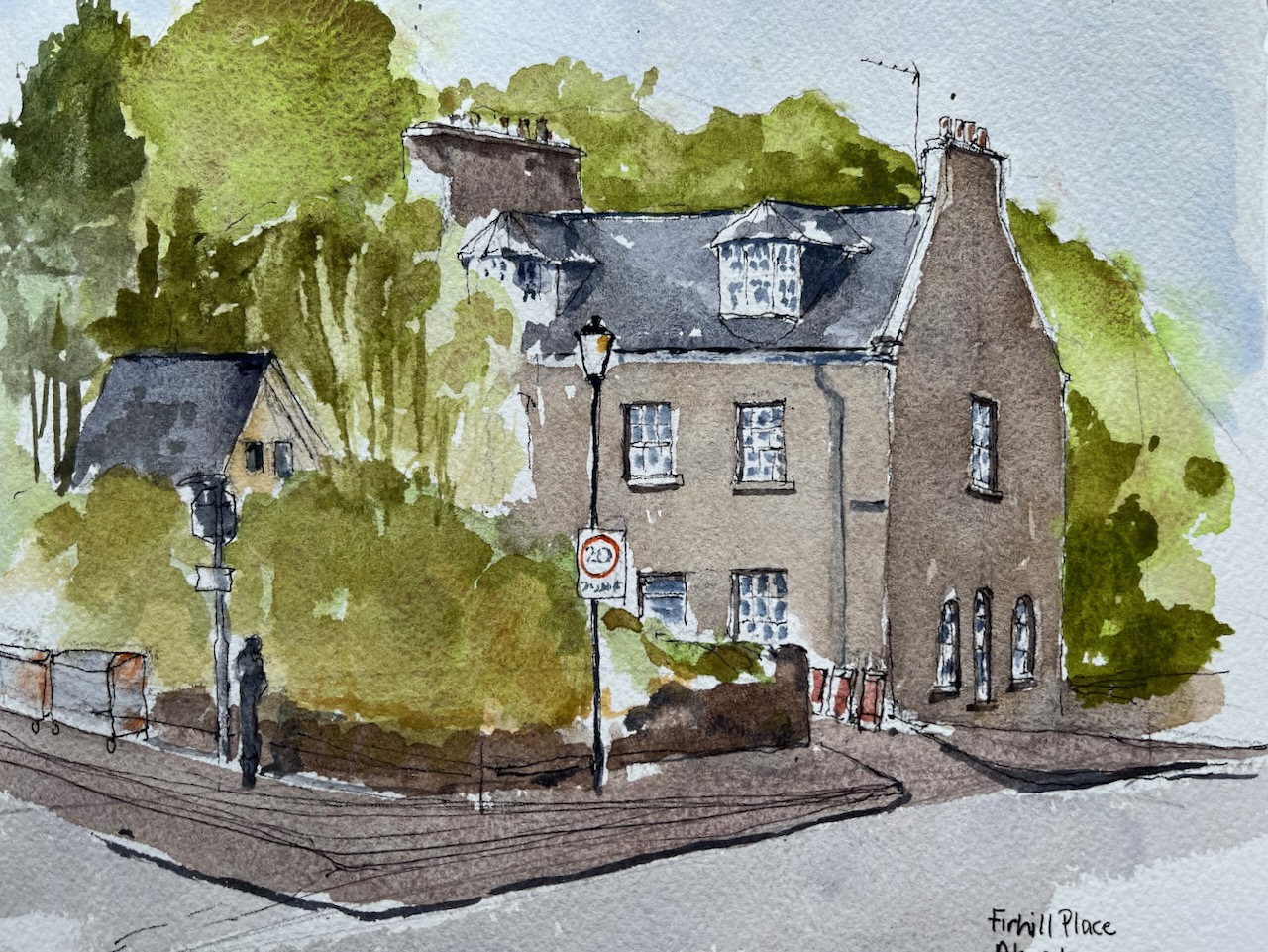
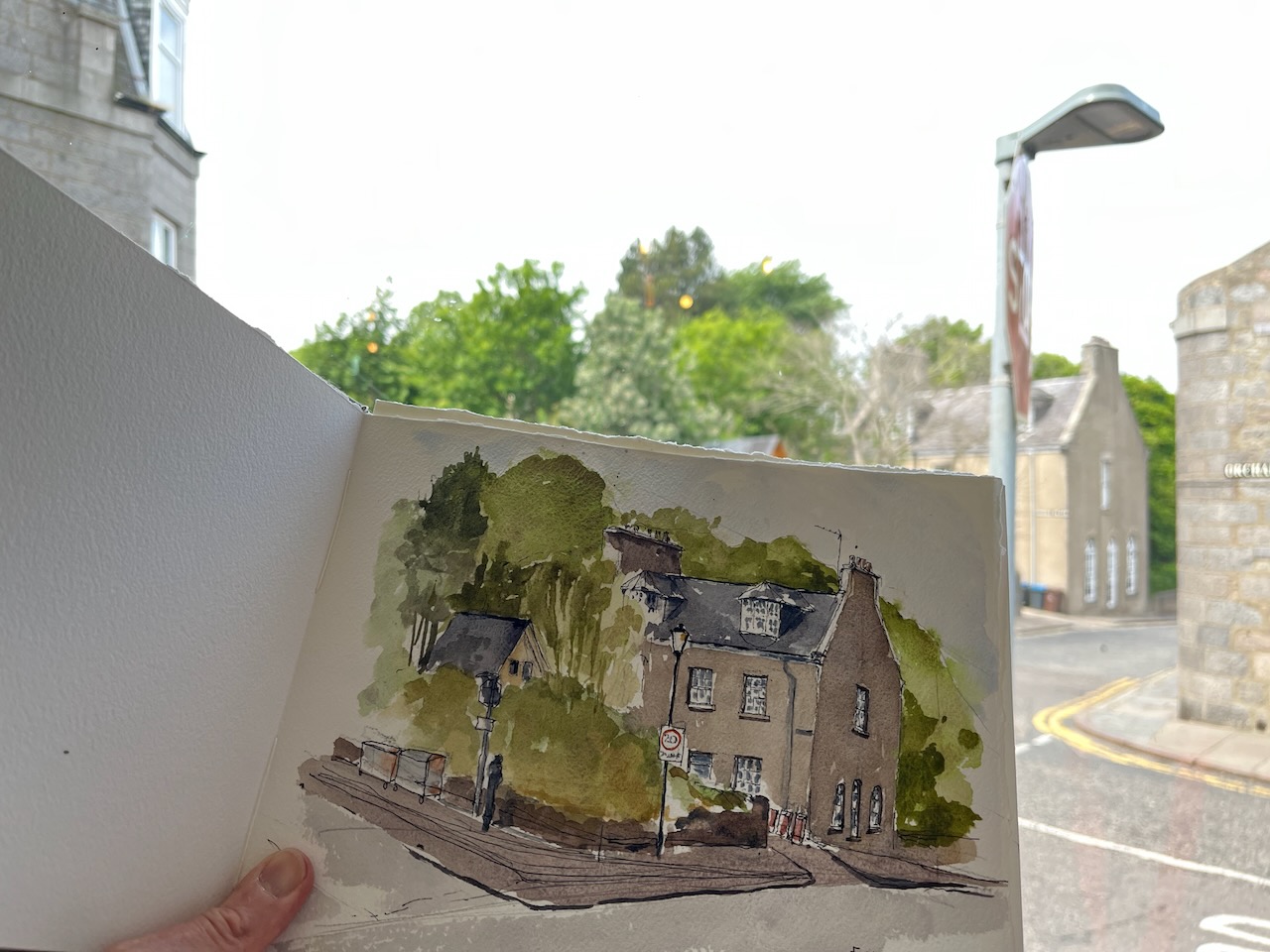
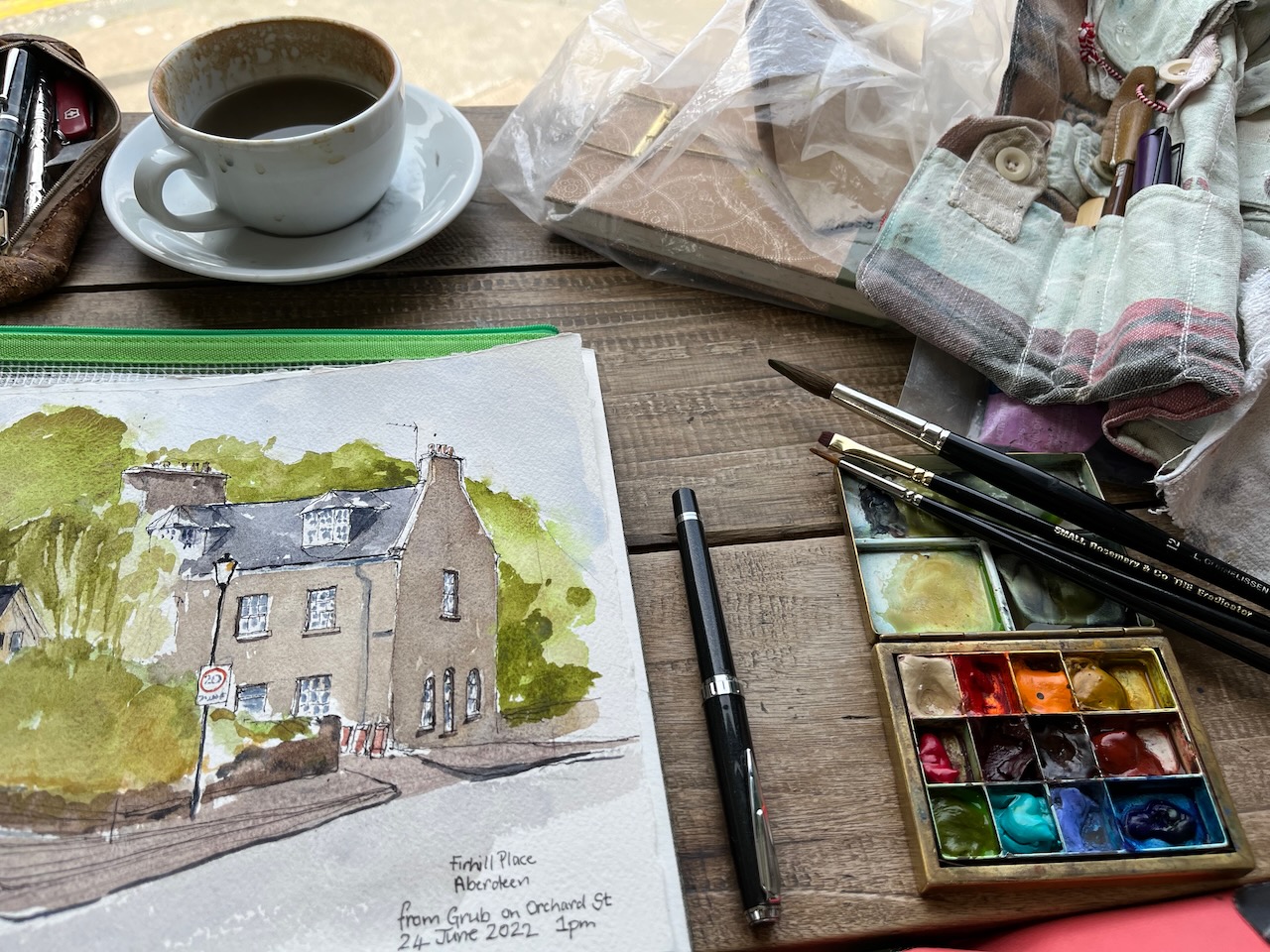
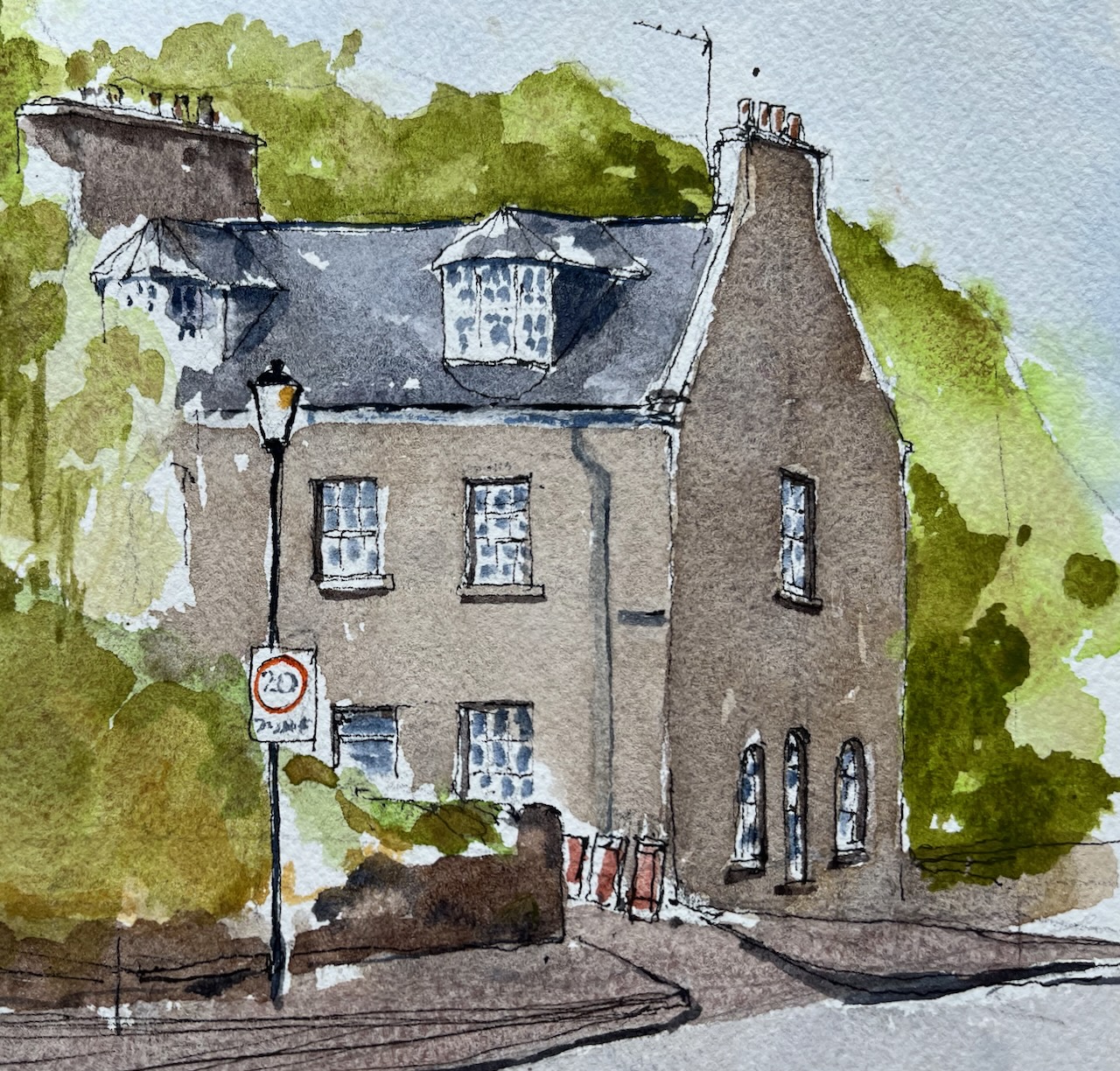
Here is a house in Firhill Place, Aberdeen, near the University.
House in Firhill Place, Aberdeen, 24 June 2022
I sketched it from a coffee shop called “Grub”, on Orchard Street.
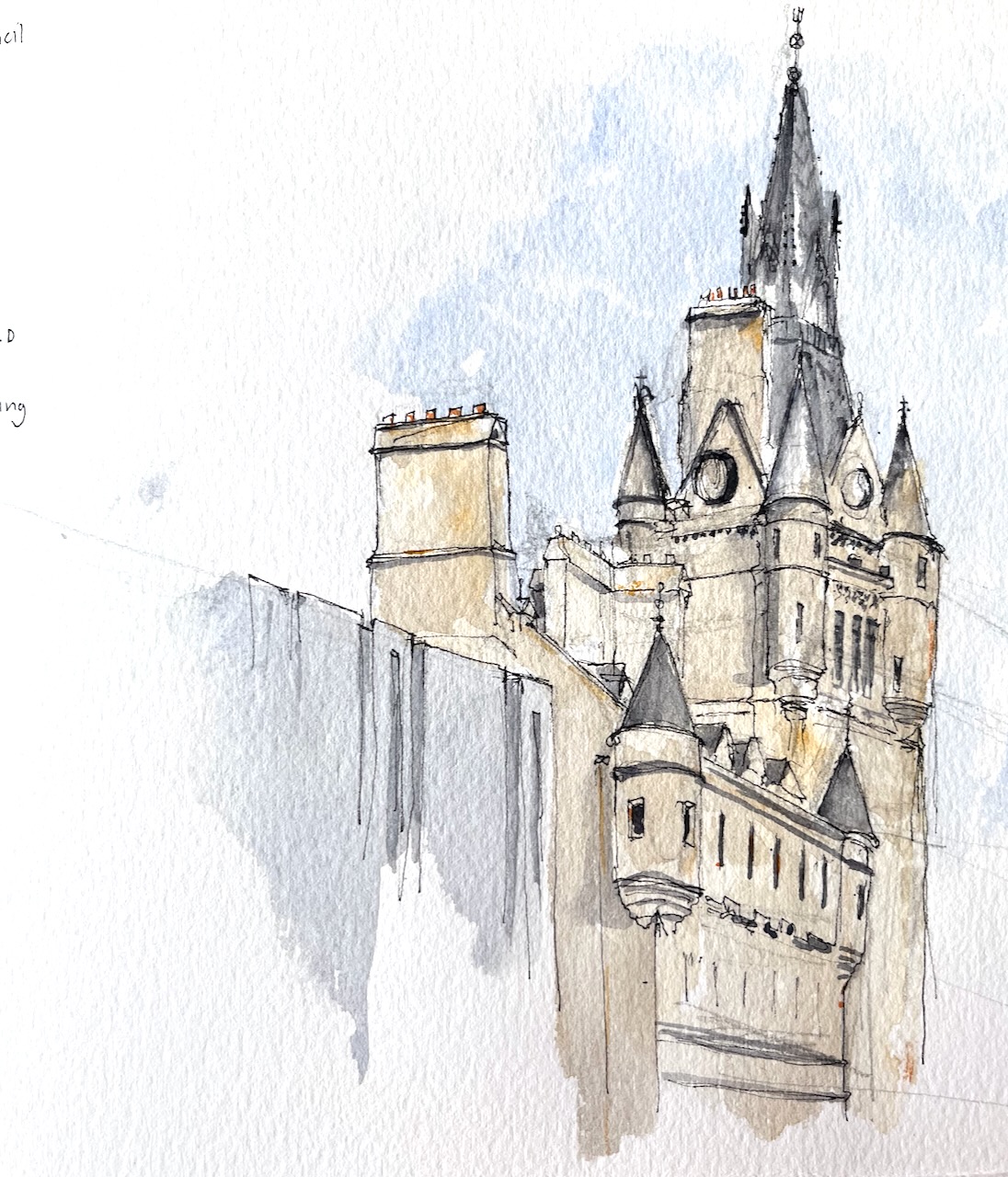
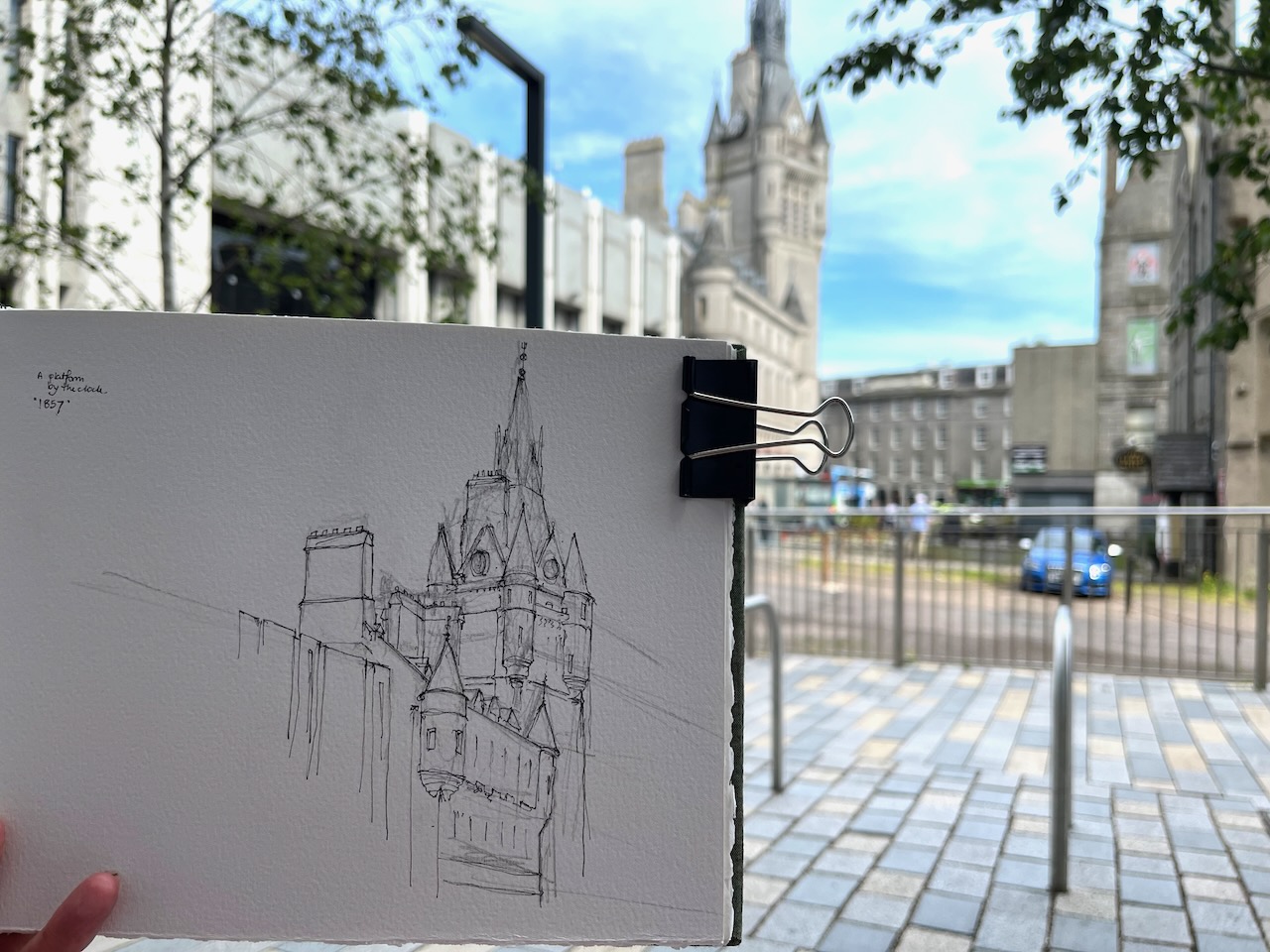
Here’s Aberdeen Town House, with its marvellous turrets.
Aberdeen City Council Town House from Broad Street. 24th June 2022
Aberdeen Town House was built in 1868-74 by John Dick Peddie and Charles George Hood Kinnear. It incorporates the remaining part of the Tolbooth of 1615-29 by Thomas Watson of Old Rayne at the east, and includes the City Chambers to Broad Street, added in 1975 by the Aberdeen City Architect’s Department, with Ian Ferguson and Tom Campbell Watson as its chief architects.
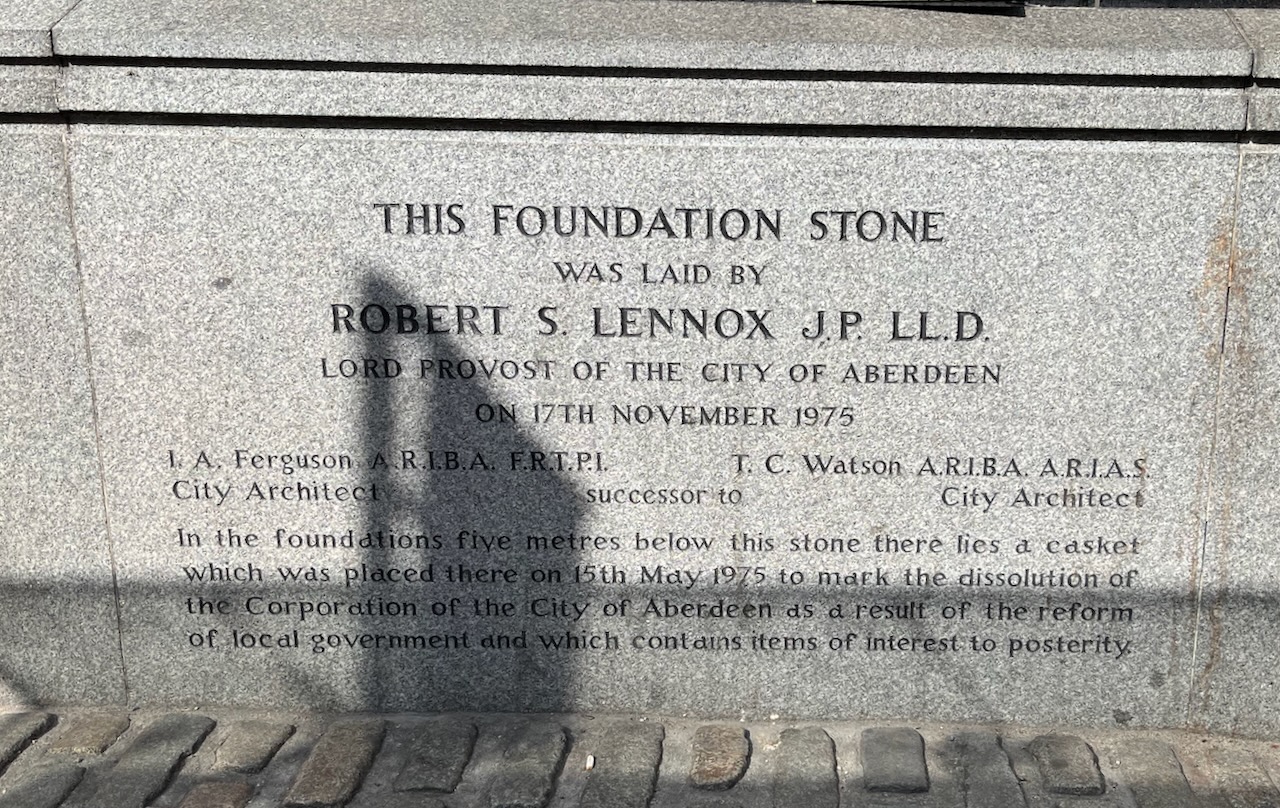
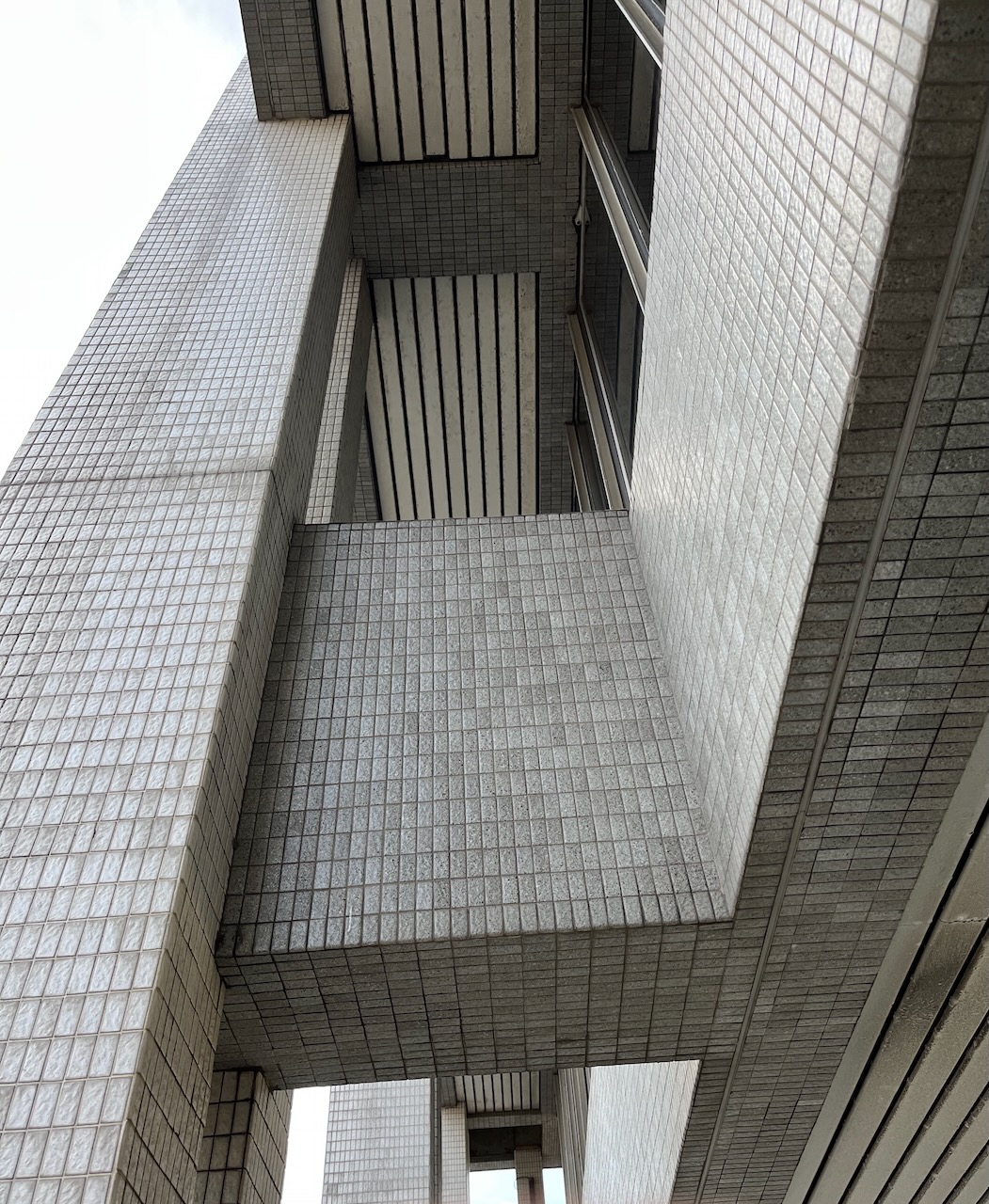
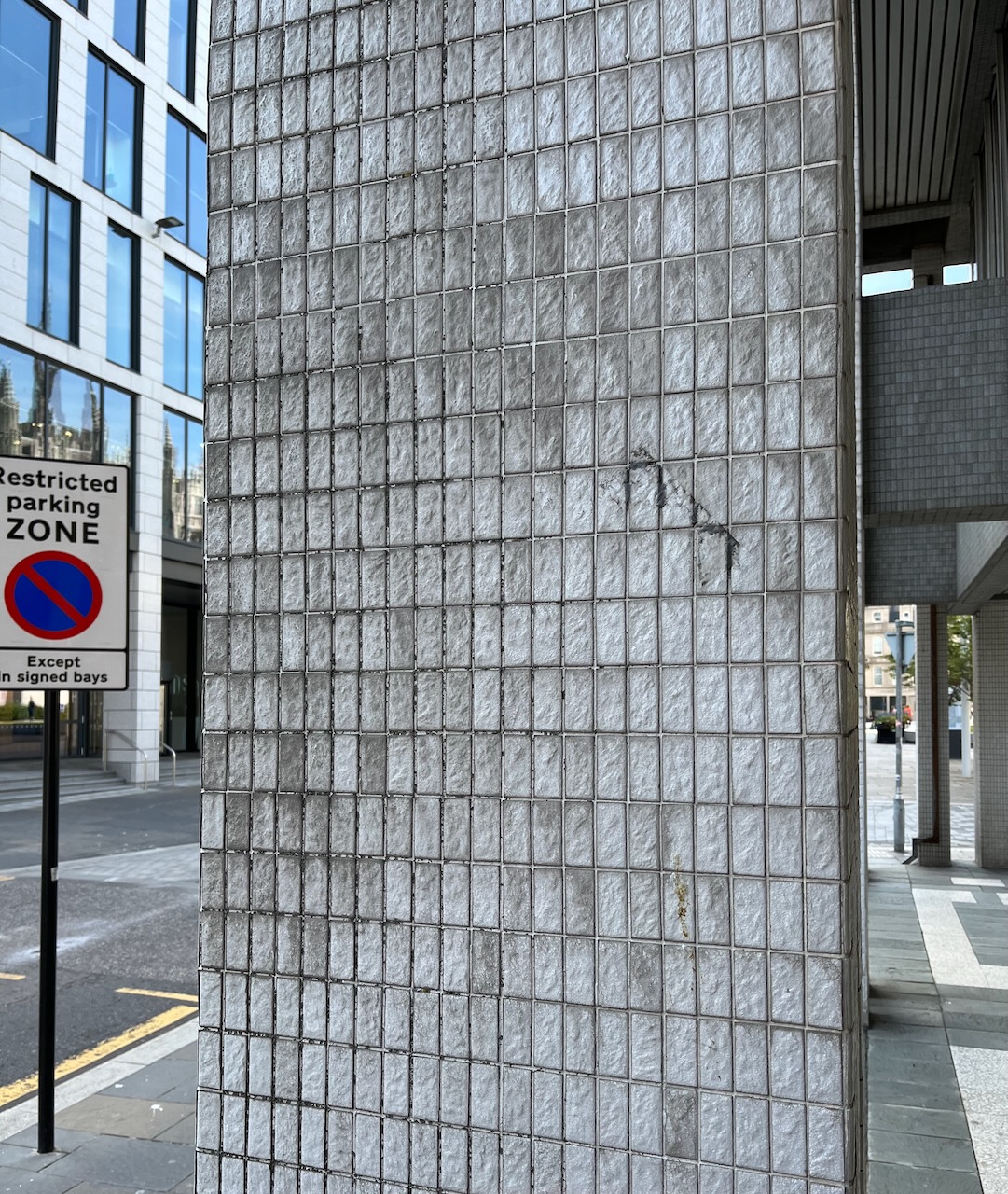
The building on the left of my sketch is the brutalist structure “City Chambers” covered in a tessellation of rectangles of grey marble. Its foundation stone was laid on 17th November 1975, according to the inscription on the foundation stone.
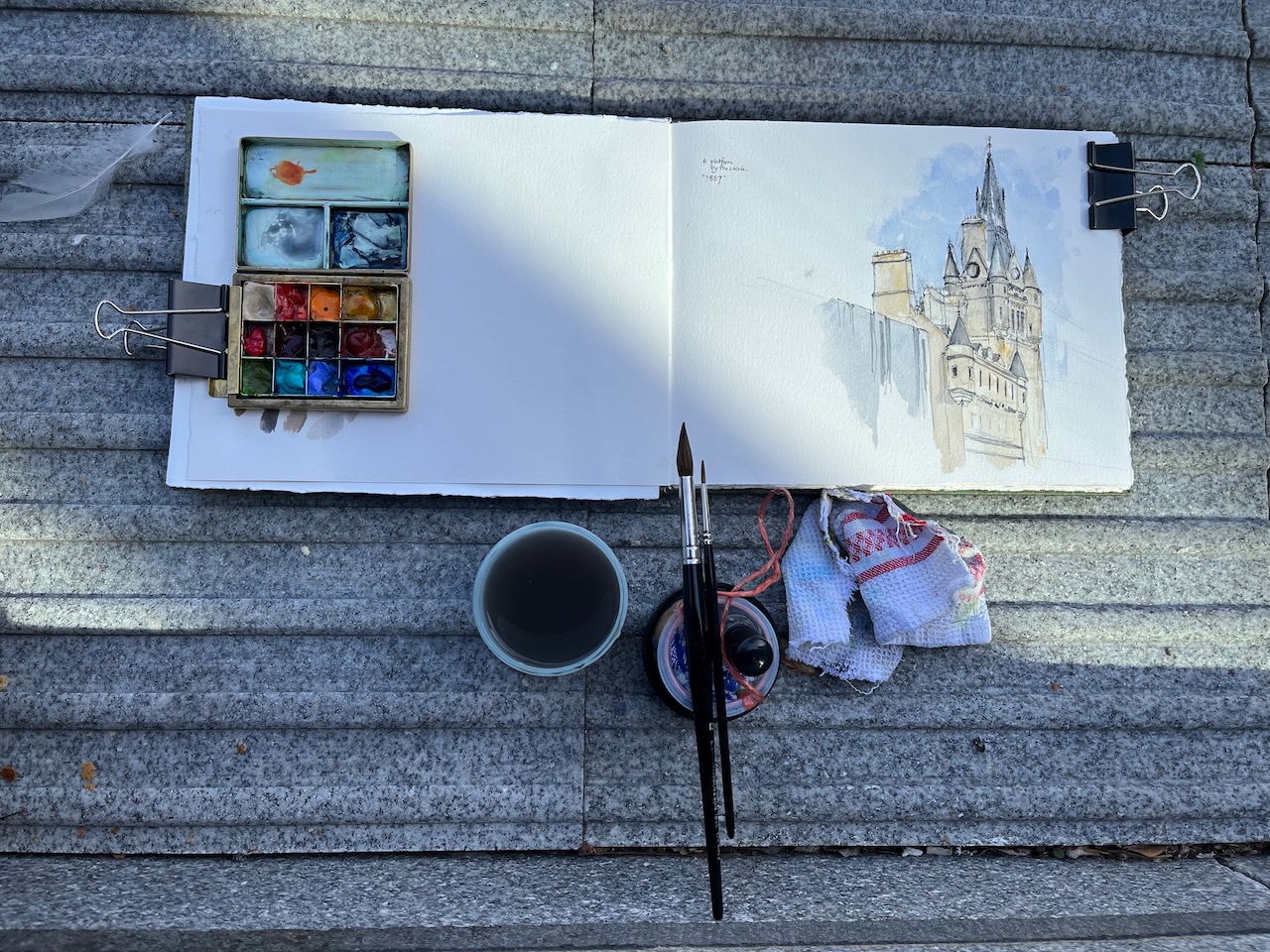
City Chambers foundation stoneCity ChambersCity Chambers, close-up of tessellationWork in progress on the sketchpen and ink
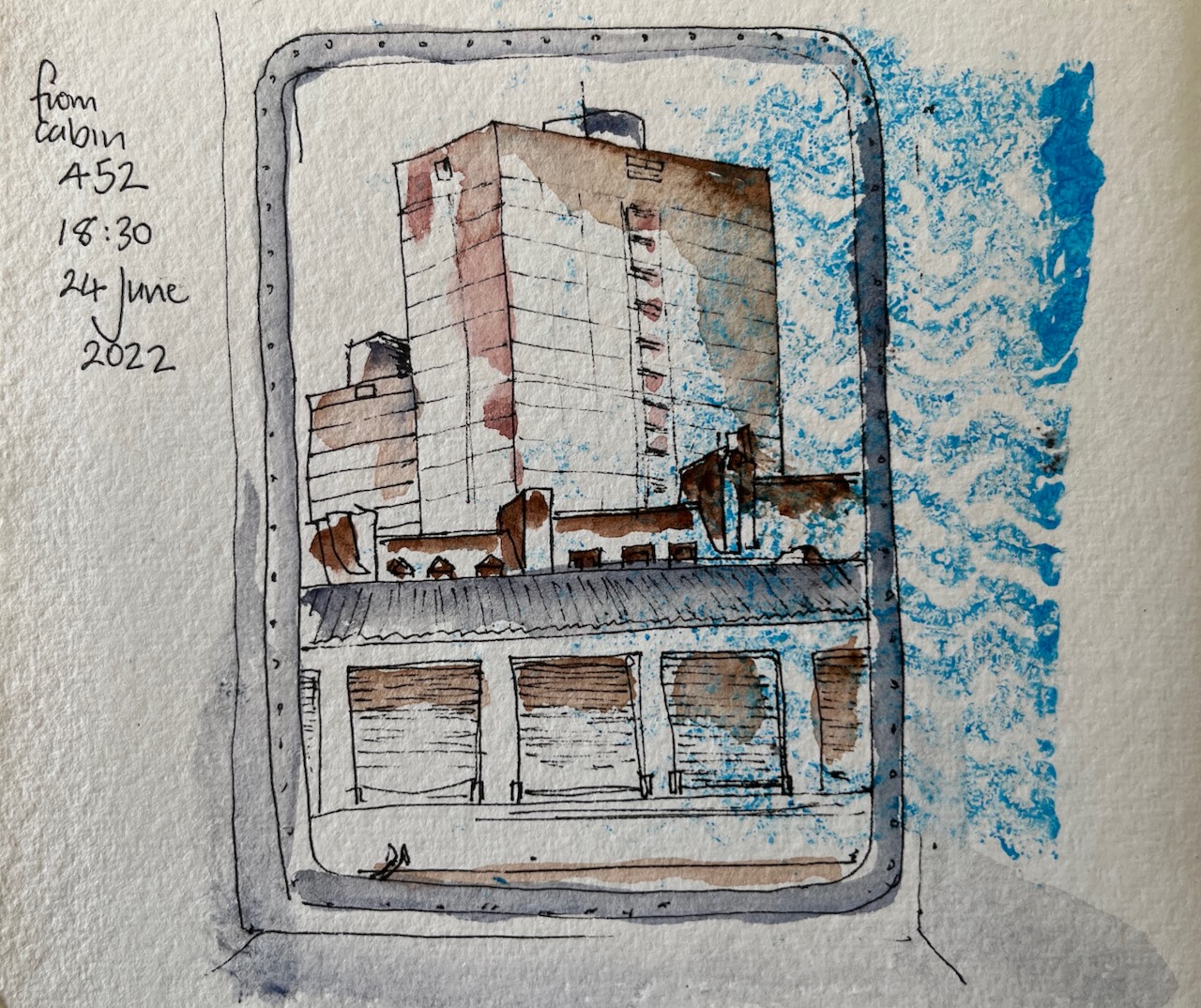
I was on my way to the ferry terminal.
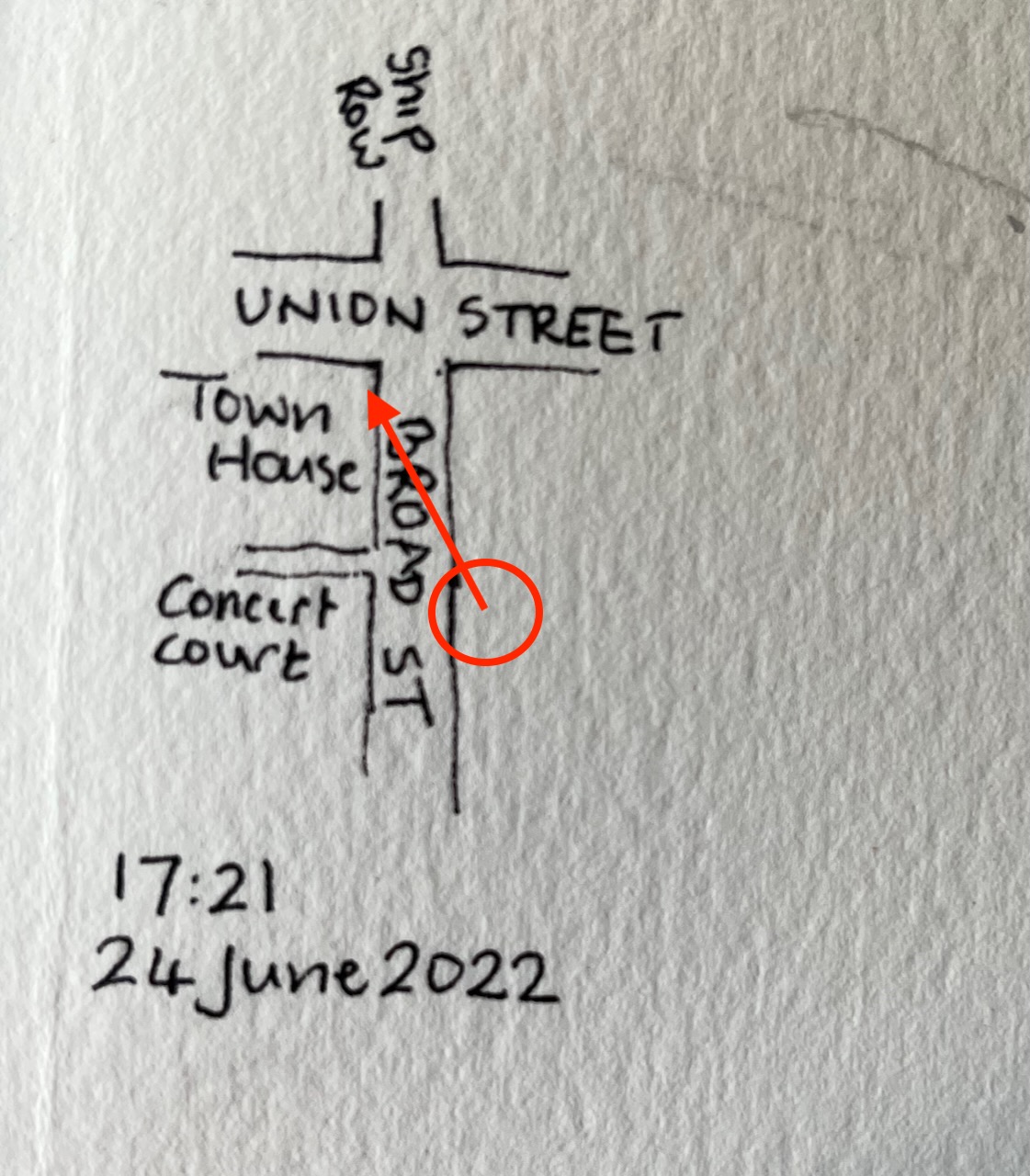
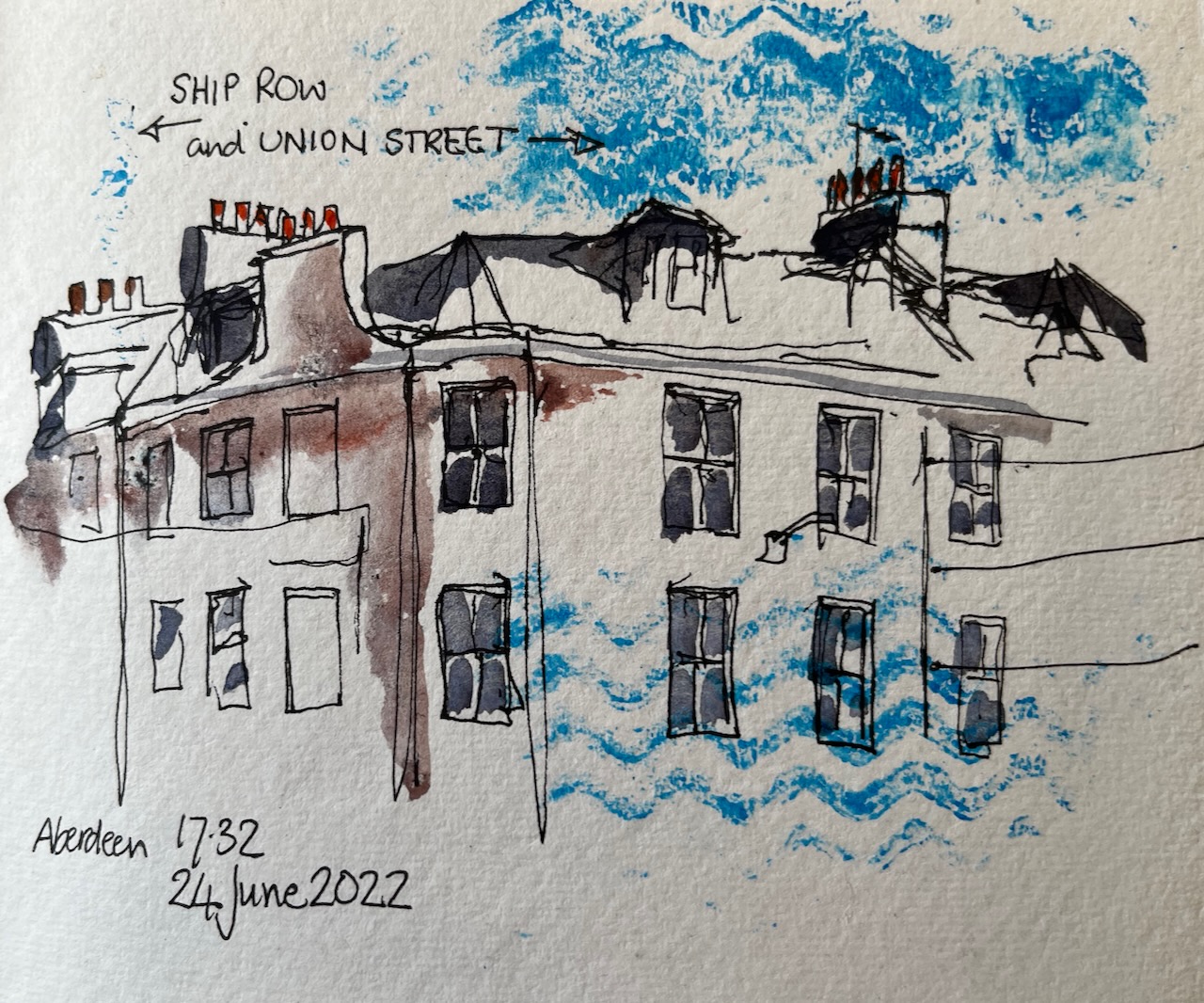
Sightline of the Town House sketchShip RowView from the ferry
Next stop, Shetland.
Click a button below to share this post online, email it, or print it:
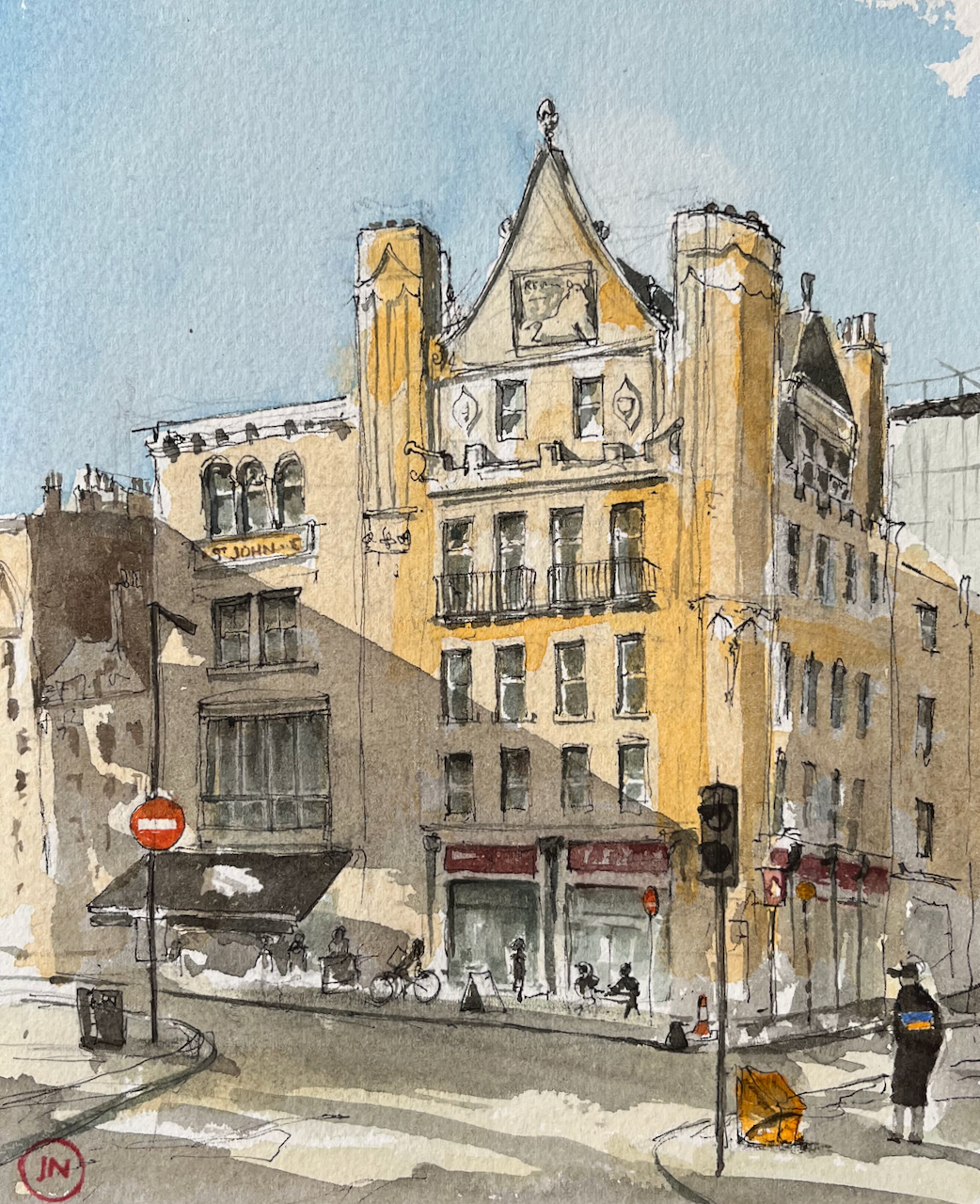
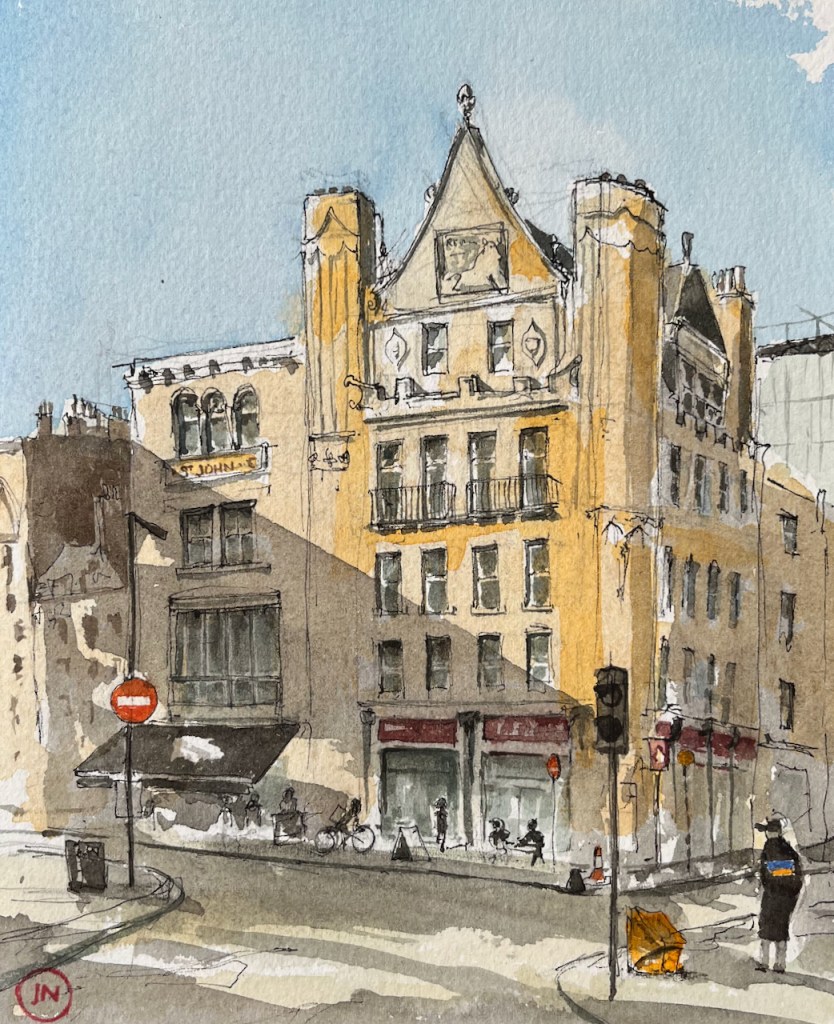
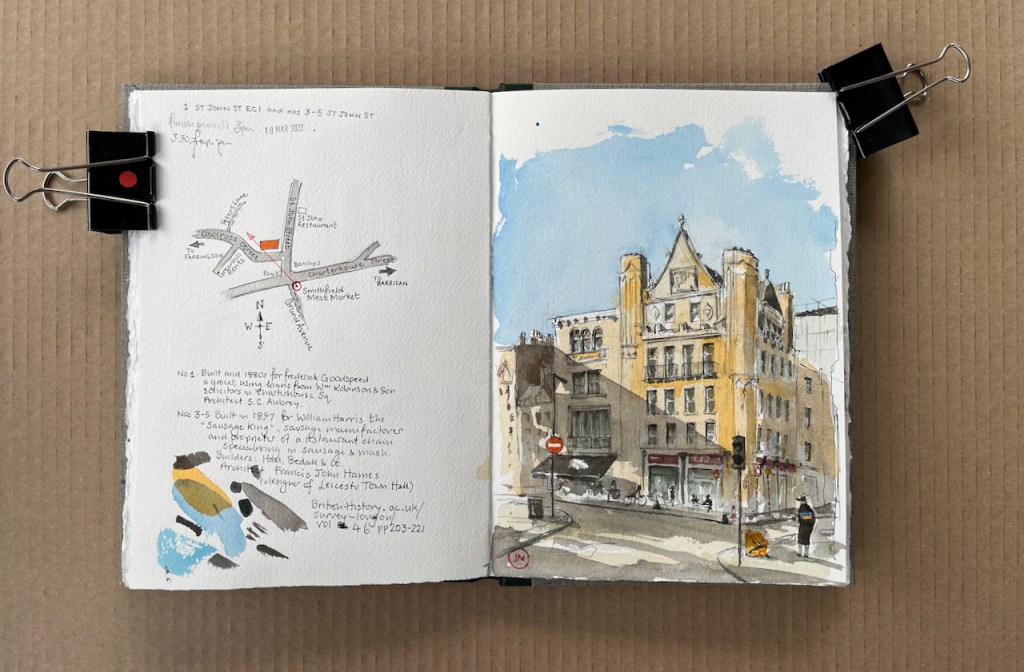
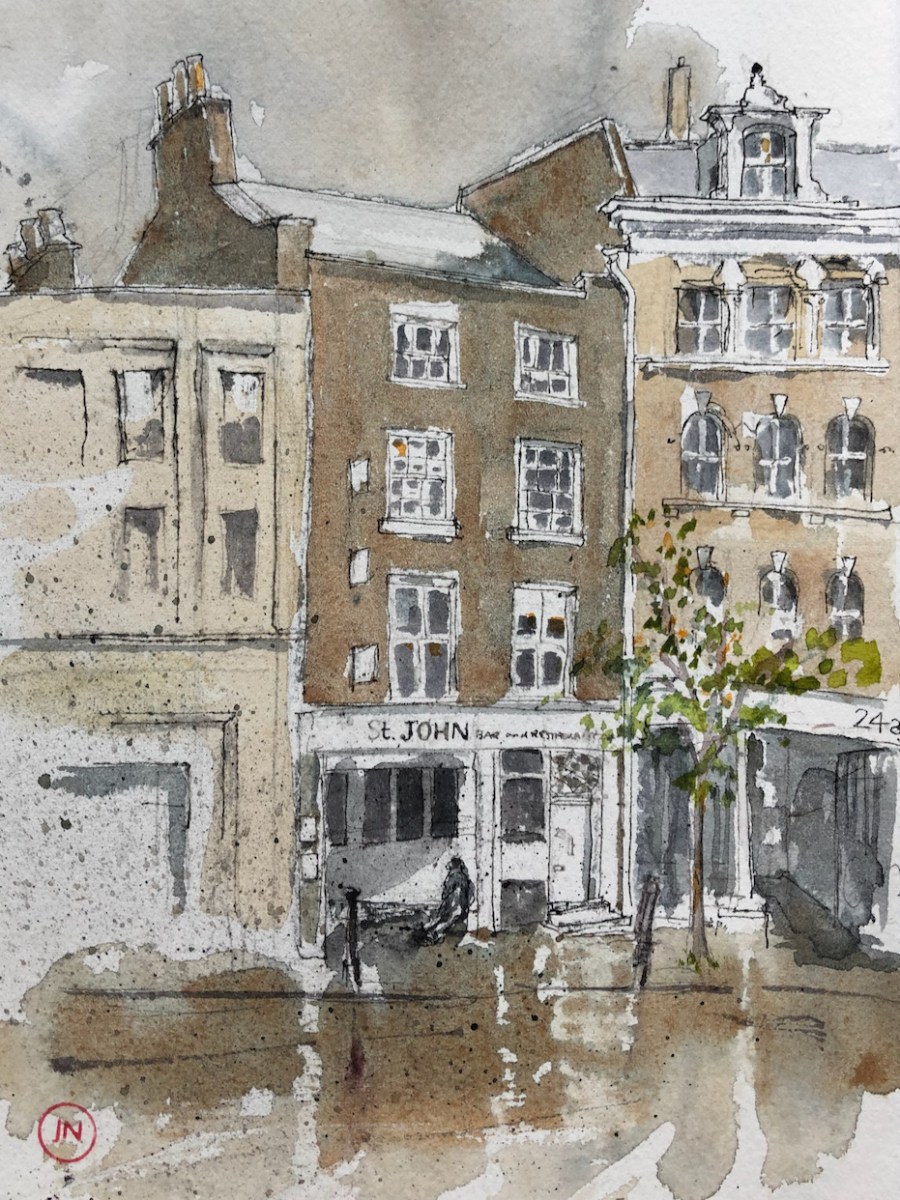
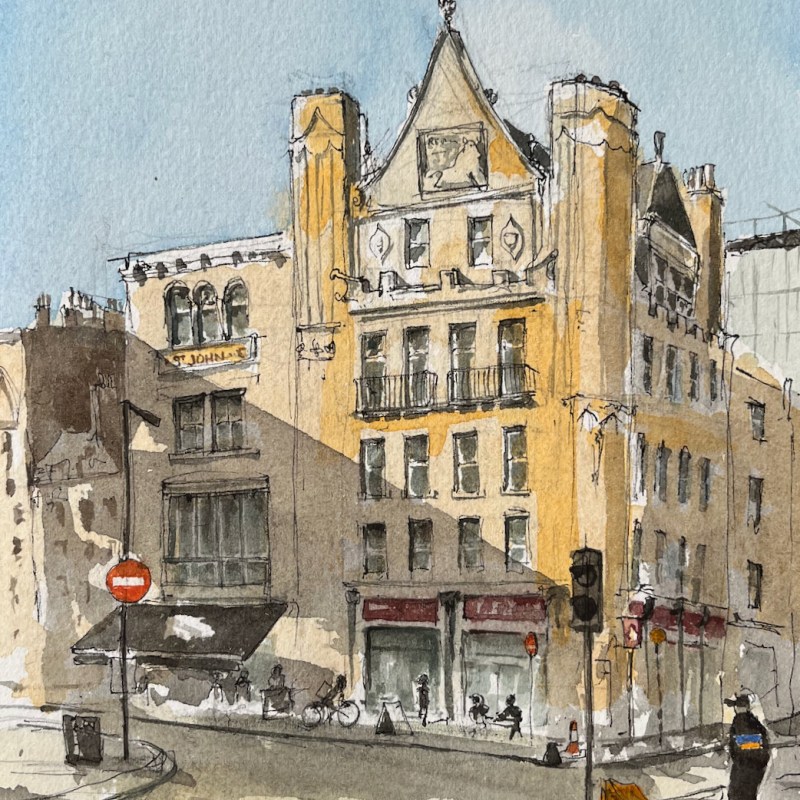
These glorious buildings are at the south end of St John’s Street. This is the view looking north from the Smithfield Meat Market, Central Avenue.
3-5 St John St EC1, 18th March 2022 3:30pm, in Sketchbook 11
It’s a busy corner. I tried to show some the street life: couriers cycling, people sitting at the café, and people, like me, standing and looking. A little further up St John Street, on the right, is construction work.
There was a blue sky as I drew. But do not be deceived: it was cold, as you see from the person on the right, hunched under their coat.
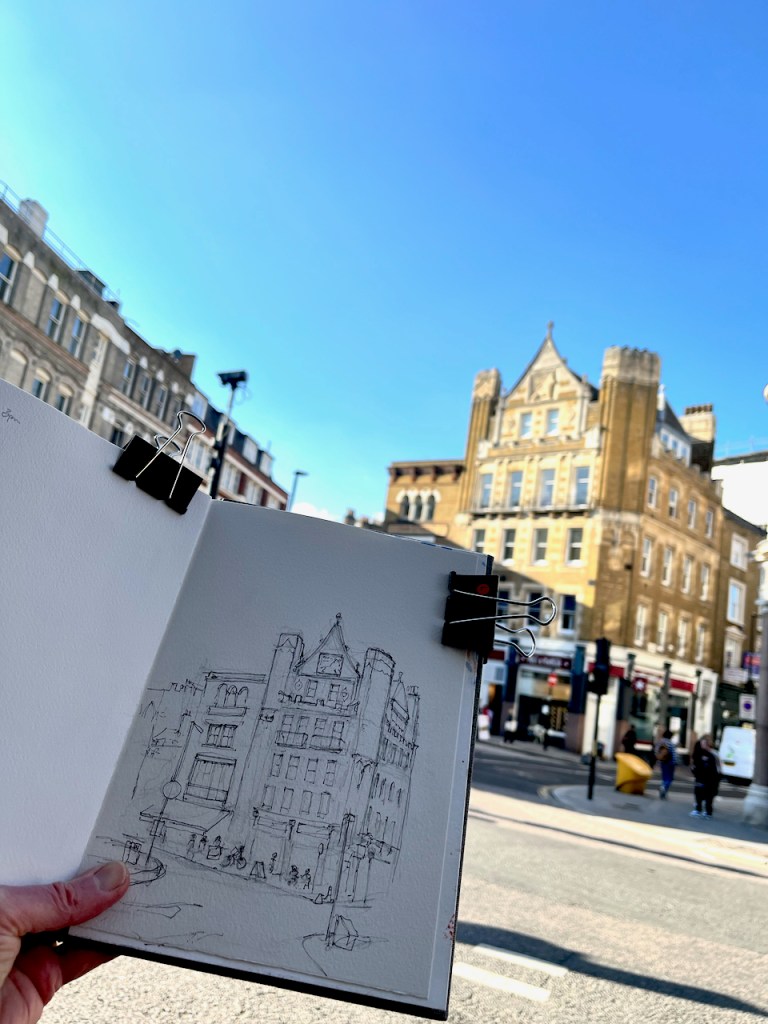
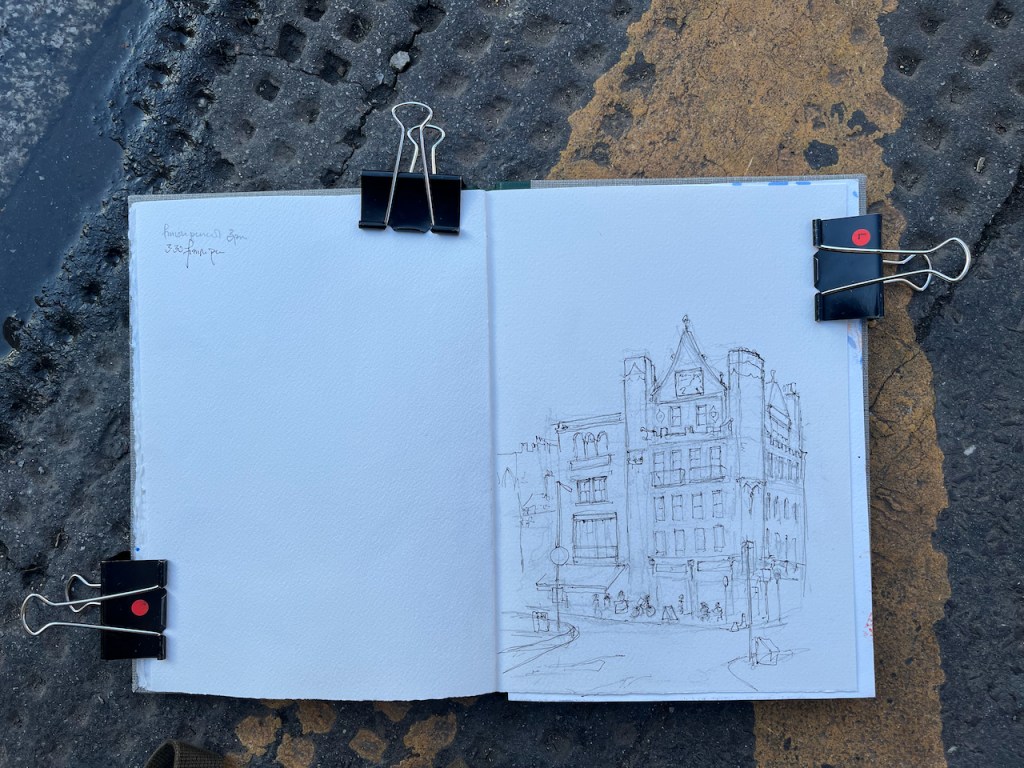
Here is a work-in-progress photo and a map:
Work in progressPen finishedSketchbook spreadMap showing the sightline
This is an ornate buildings: lots of fluting and complicated brickwork. Who thought all that was a good idea? Who could afford it? Number 1, on the left, slightly more restrained, was built for a Frederick Goodspeed, a grocer, in the mid 1880s. The architect was S.C. Aubrey. (reference 1 below)
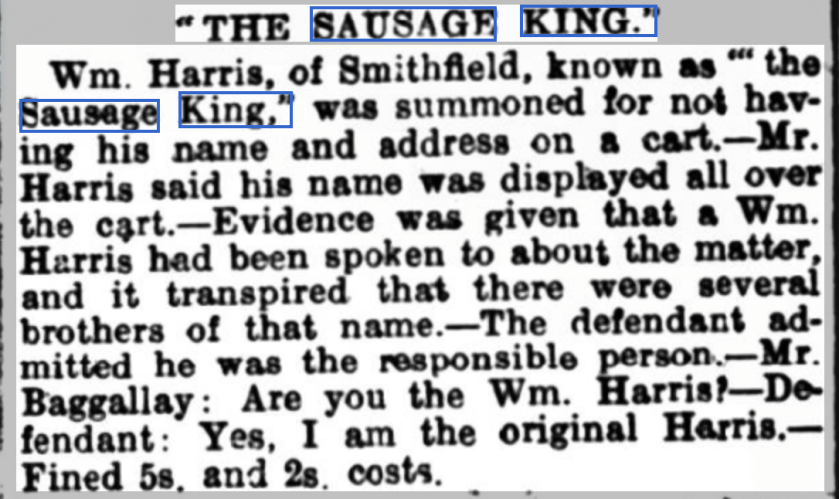
Numbers 3-5, the building on the corner, has chimneys with all kinds of complicated brickwork, and a highly decorative frontage onto Smithfield. It was built in 1897 for William Harris, the “Sausage King”. He was a sausage manufacturer, and proprietor of a chain of restaurants specialising in sausage and mash. Mr Harris was evidently quite a character. He named all his three sons William, and all his four daughters Elizabeth (reference 2 below). This may have had practical problems, but it meant he and his sons could have fun with the Magistrates:
The “Sausage King” was somewhat eccentric, but this was to a large extent due to his love of “personal advertising,” which was his motto for business success. At all times of the day he wore a sort of evening dress, with an opera hat, and a blazing diamond in his white shirt, even when buying in the market, and he used not a scrap of writing or wrapping paper that did not bear his photograph. His trade mark, which he registered about forty years ago, depicts him winning the “Pork Sausage Derby” on a fat porker. His principal catch-phrase was “Harris’s sausages are the best,” and it spread the fame of his sausages all over the world. He also composed a lot of poetic advertisements, which caused much amusement.
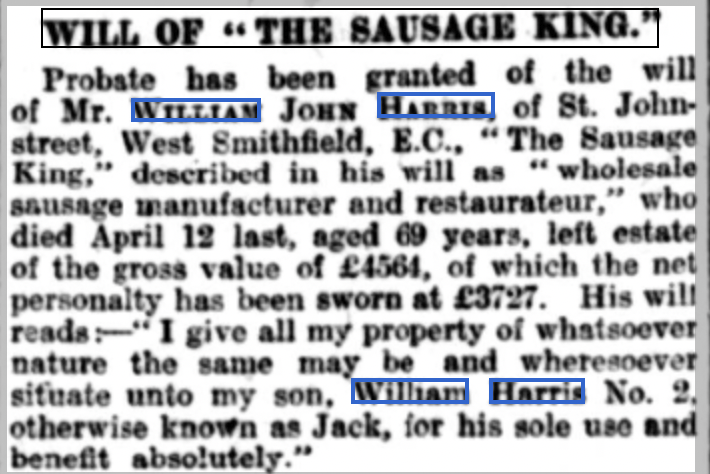
This snippet from “London Standard, via the Montreal Gazette, 3 May 1912” reporting his death (reference 2).
He died in April 1912, leaving a considerable fortune. His death was reported far and wide, including papers in many parts of England and Ireland.
Note the reference to “William Harris No. 2”, that is, his second son, to whom he left all his property. I wonder what all the other sons thought – and the four daughters?
I am glad that the flamboyant house of this extraordinary man still stands. The architect was Francis John Hames, who also designed Leicester Town Hall. So you see what kind of league Mr Harris was in.
Reference 1: Thanks to British History Online who alerted me to The Sausage King: ‘St John Street: Introduction; west side’, in Survey of London: Volume 46, South and East Clerkenwell, ed. Philip Temple (London, 2008), pp. 203-221. British History Online http://www.british-history.ac.uk/survey-london/vol46/pp203-221 [accessed 8 April 2022].
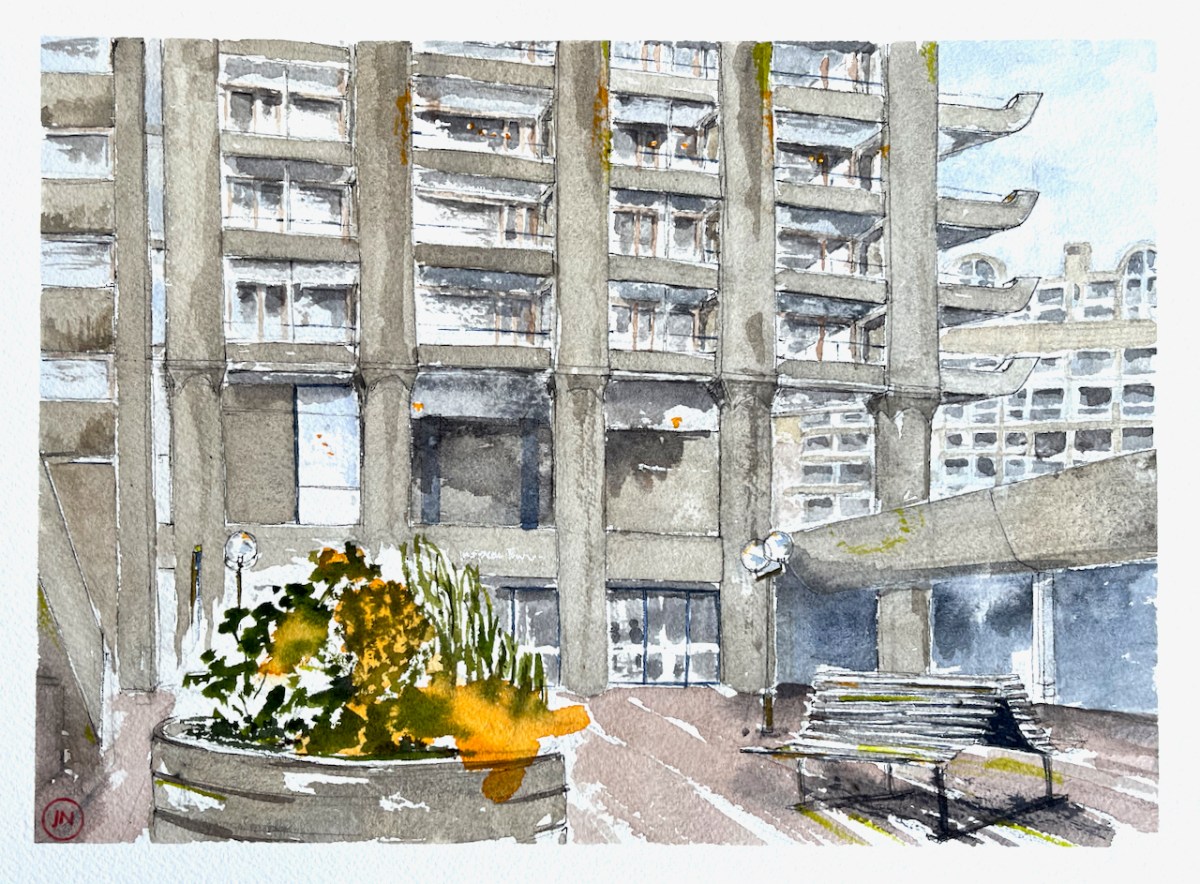
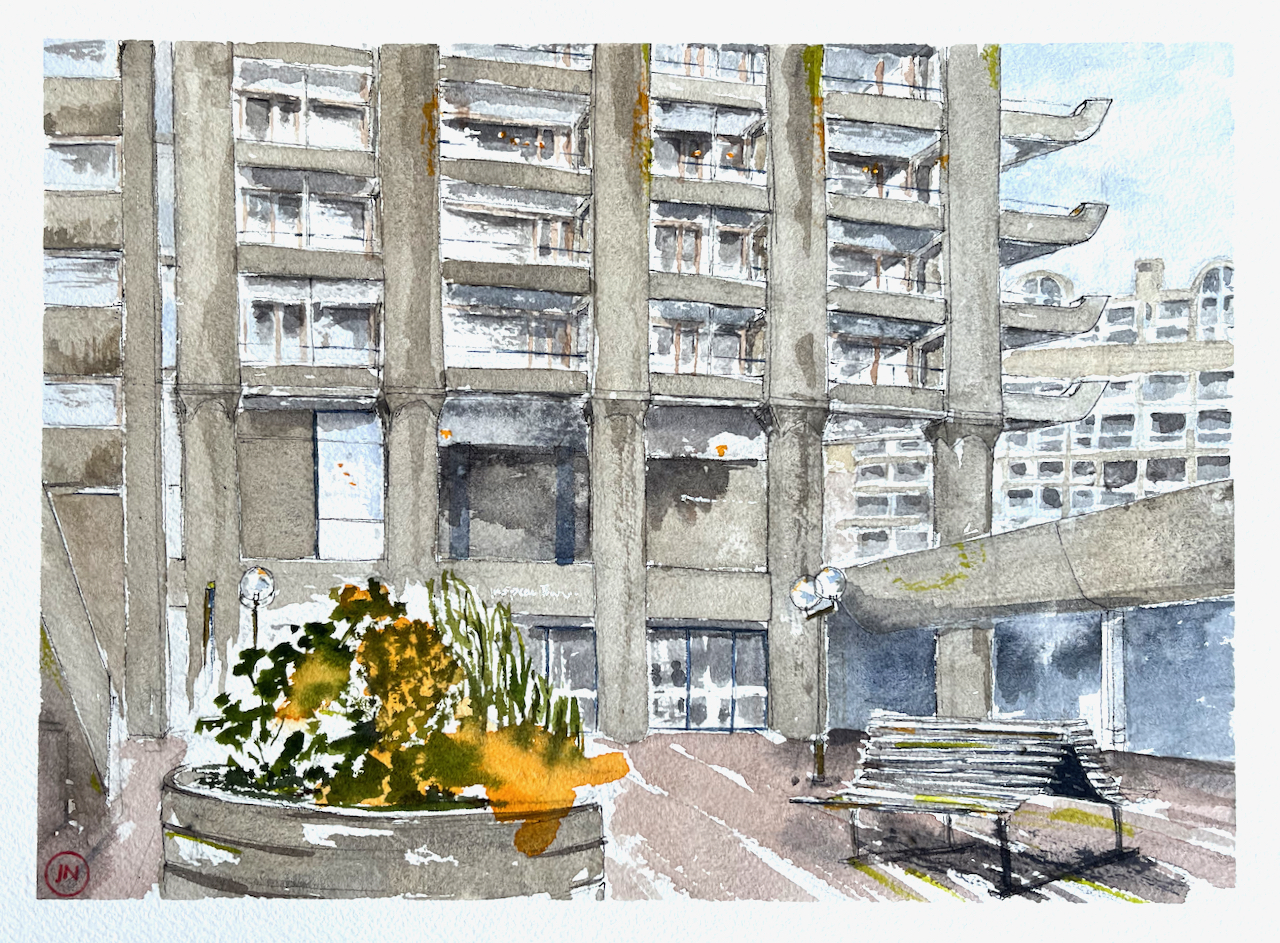
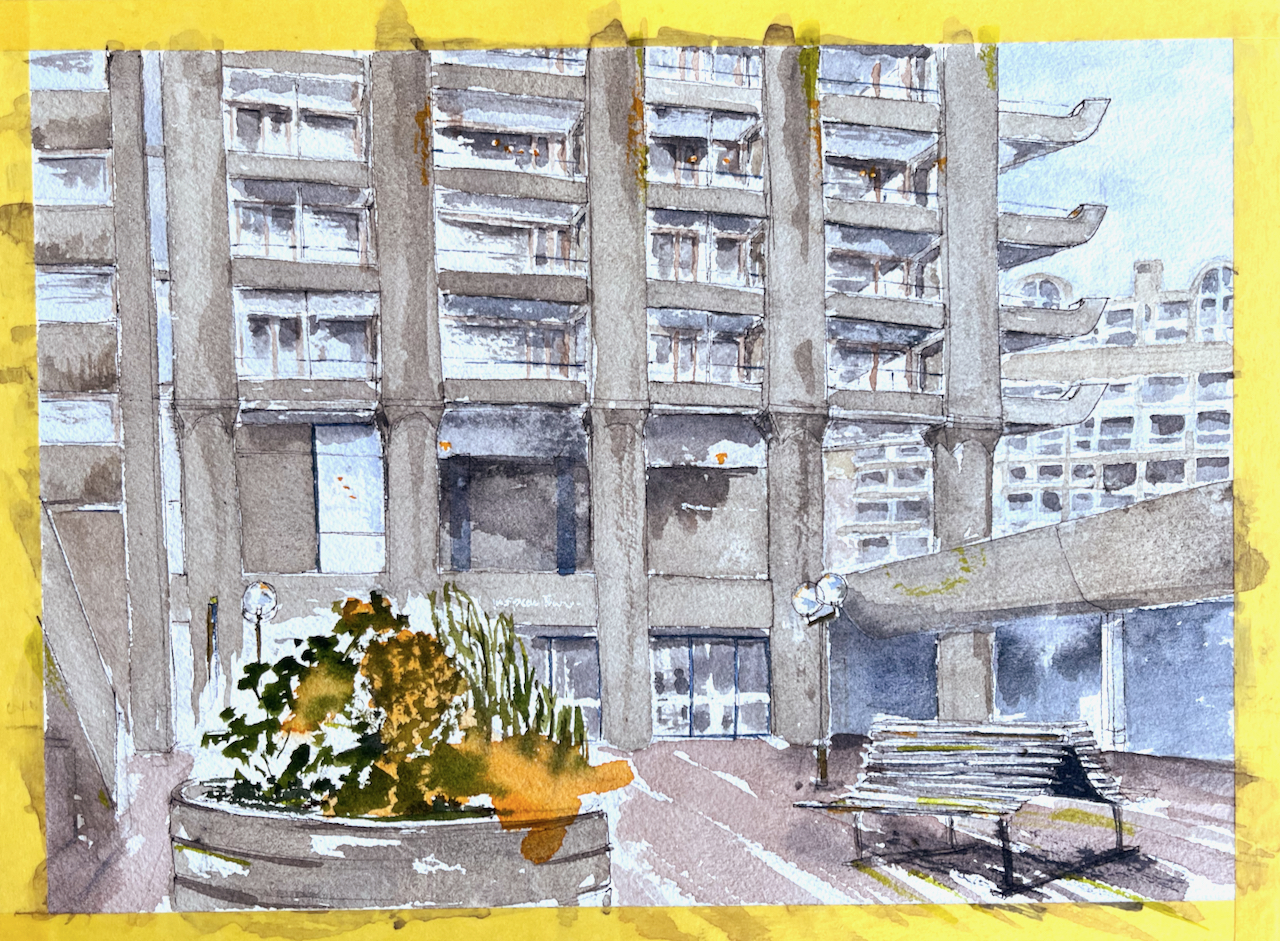
Here is a view of the east face of Shakespeare Tower, Barbican, from Defoe Place, near the Barbican Centre. You can see the main entrance to the tower. On the right is Cromwell Highwalk, and Ben Jonson House beyond. On the left you can just see the stairs that go down into Defoe Place from the highwalk.
Shakespeare Tower from Defoe Place, 12″ x 9″ [commission]
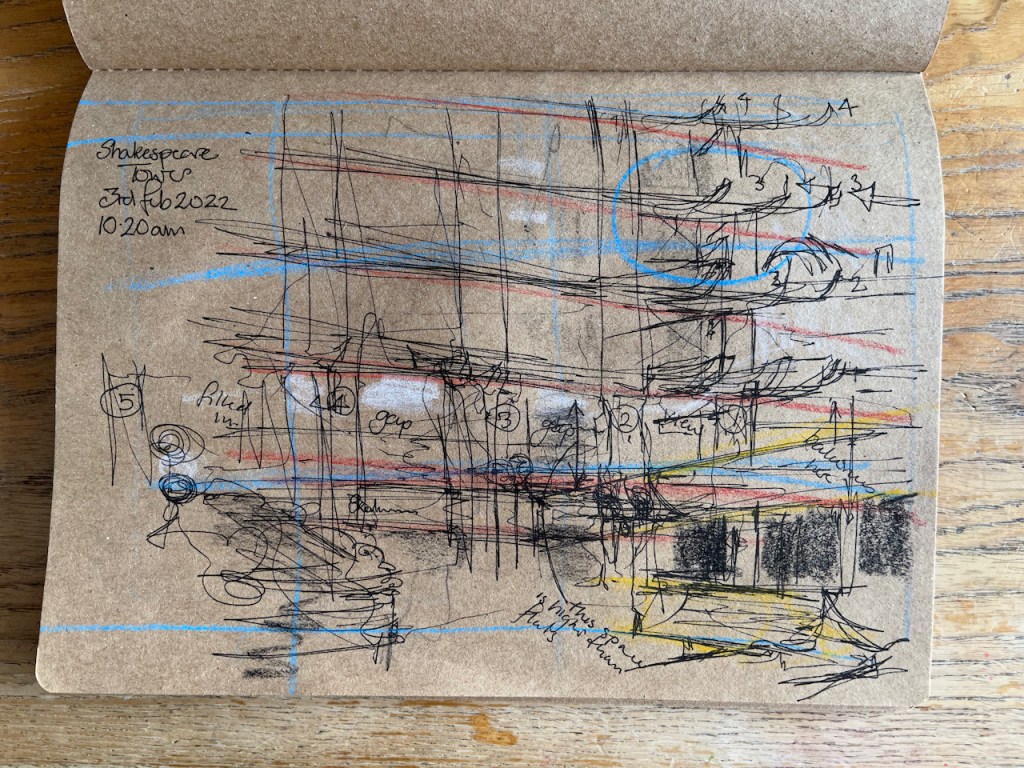
Preliminary sketch
I wanted this picture to give an impression of what it is like to walk around the Barbican. There are different depths, and sharp contrasts of dark and light, and large open spaces. Workers from the library looked out of their windows, saw me drawing and came to look at the picture. This was drawn in February, but still there were some flowers in the planters, even though this particular planter was in a shaded and windy place. The smell, however, was not of flowers but cigarette ends. People evidently use the area under the stairs as a smoking area, and drop their butts. So that’s the Barbican: people who talk to you, soaring towers, great perspective views, wide open spaces and a certain shabbiness around the edges.
Here is the pen-and-ink compared with the colour:
Before and after the colour went on
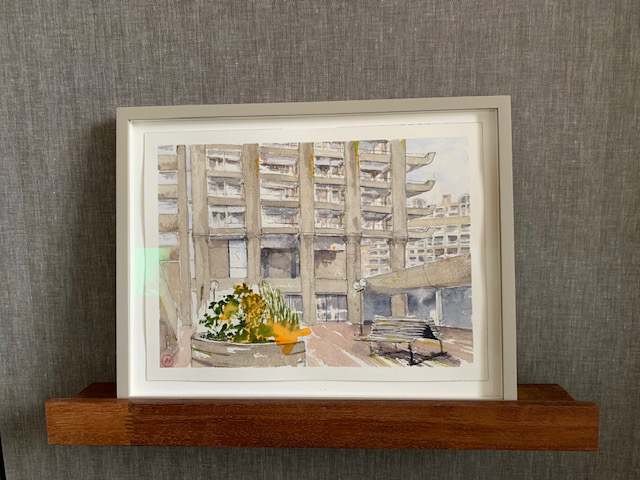
This was a commission. I am grateful to my client for the prompt to examine the Tower from this unusual angle. And also for sending me this photo of the framed watercolour:
Framed watercolour. Photo credit: NM
A collection of my drawings of the Barbican is here:
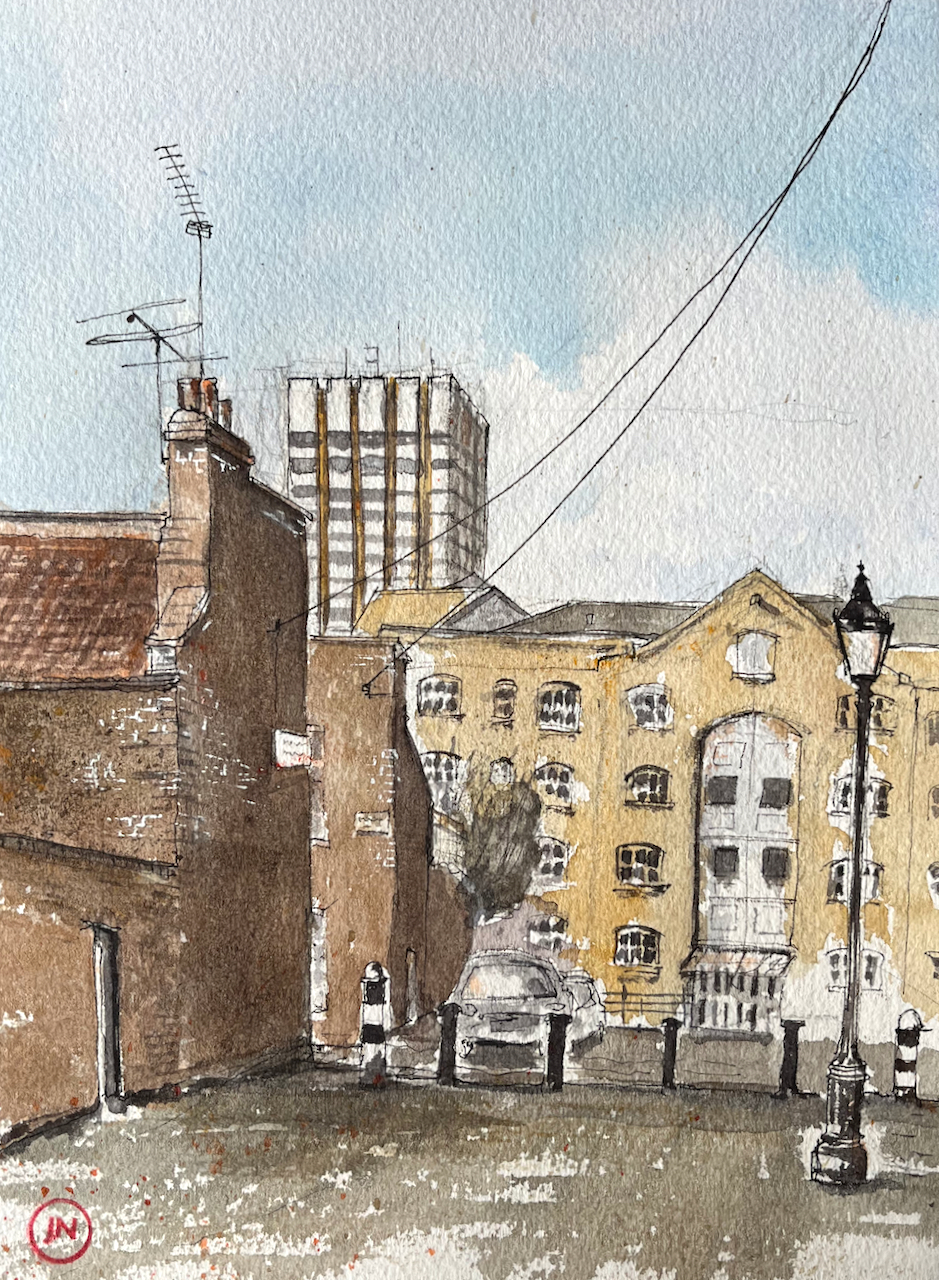
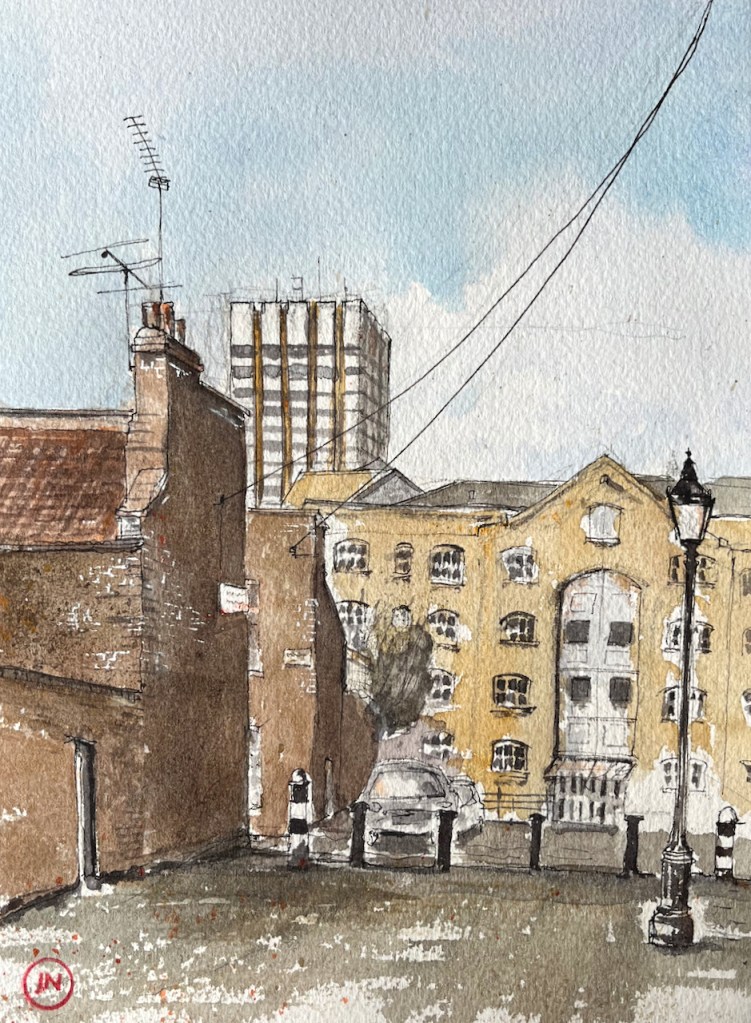
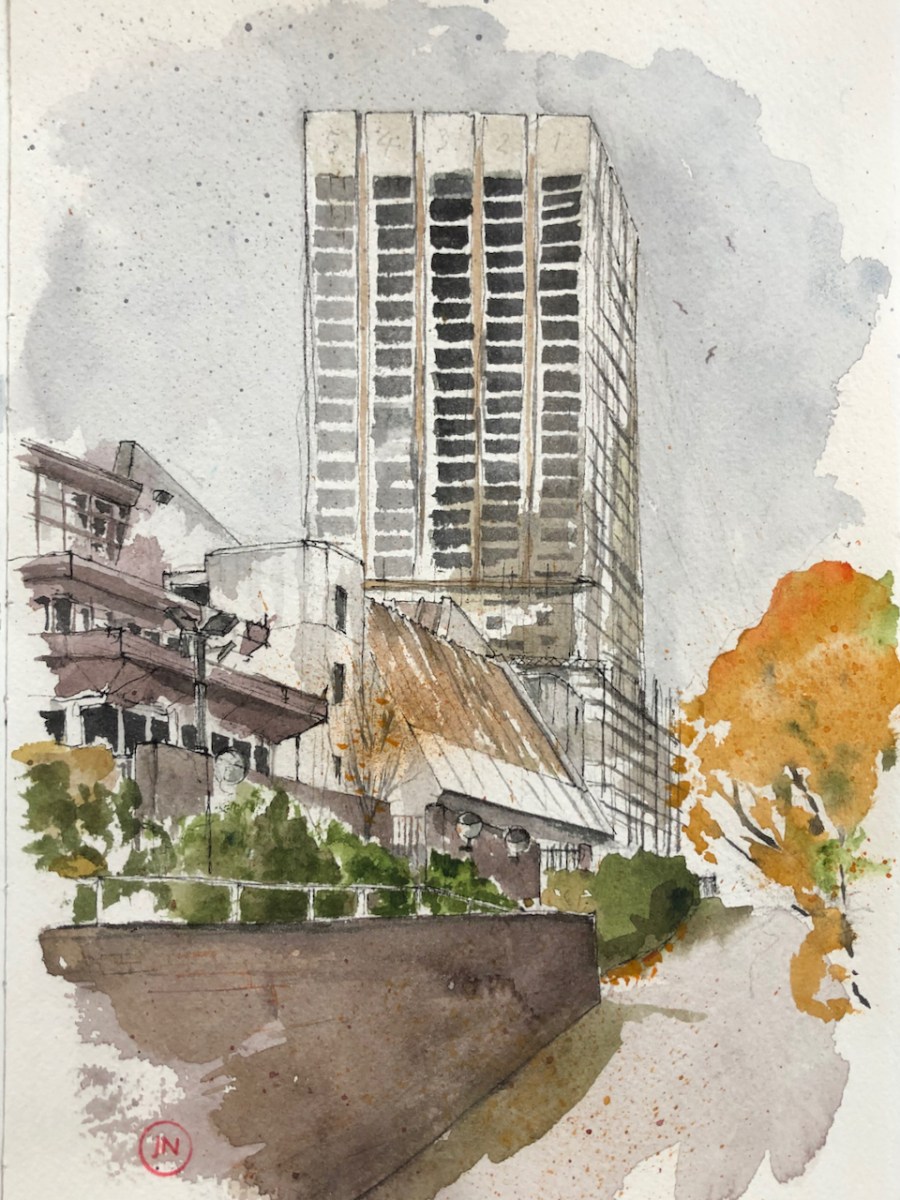
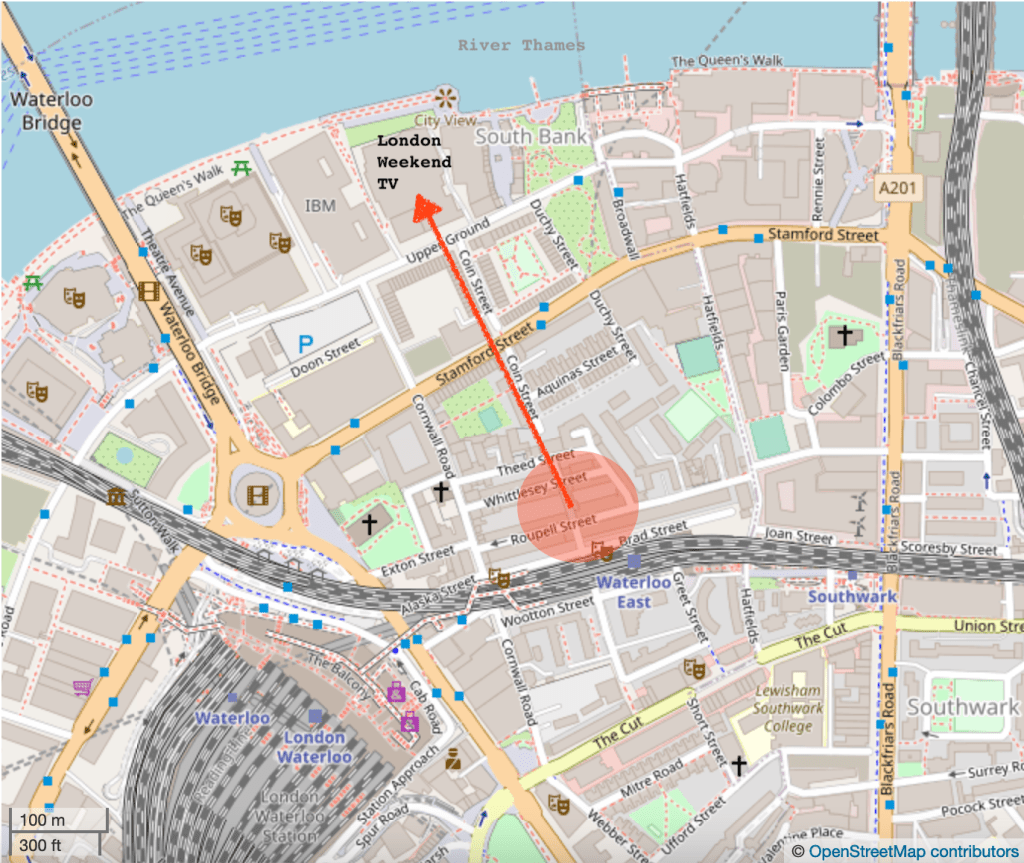
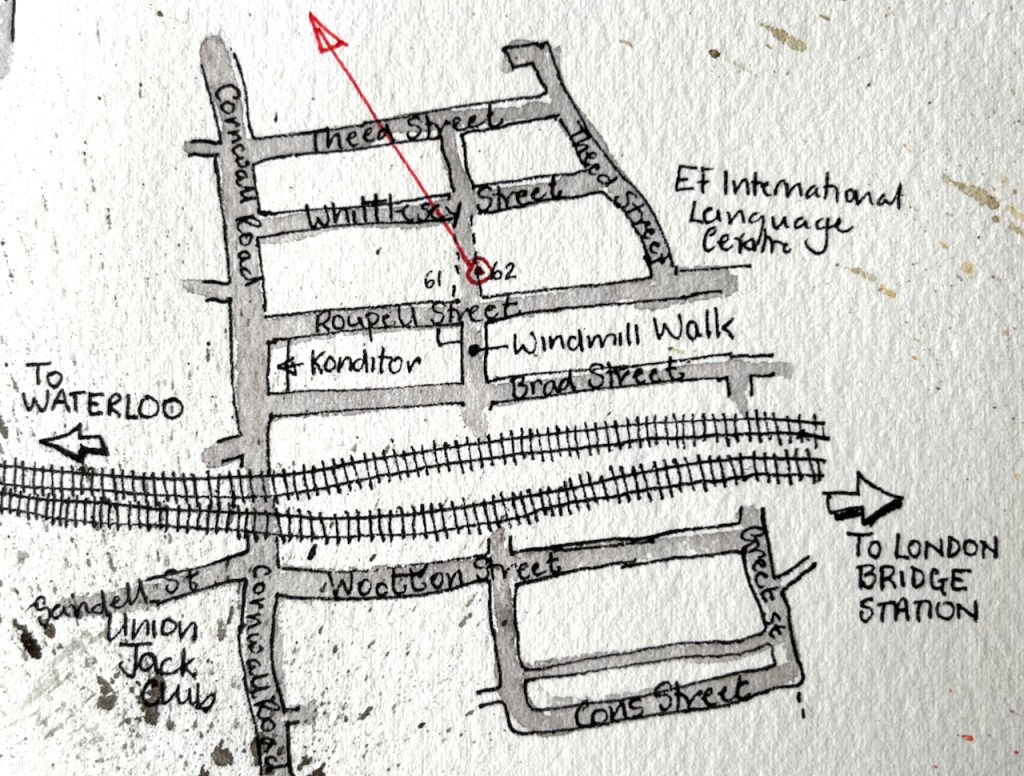
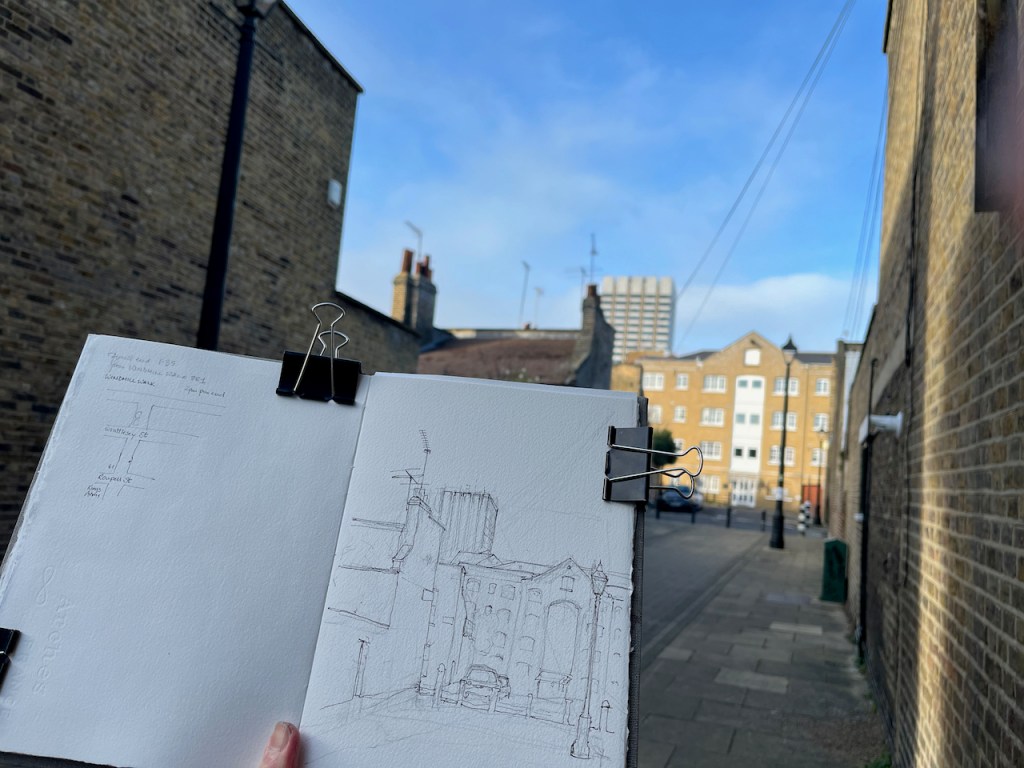
Here is a view of the tower of former London Television Centre building, seen from Windmill Walk, off Roupell Street near Waterloo Station.
LWT Building from Windmill Walk, 7th Feb 2022, in sketchbook 11
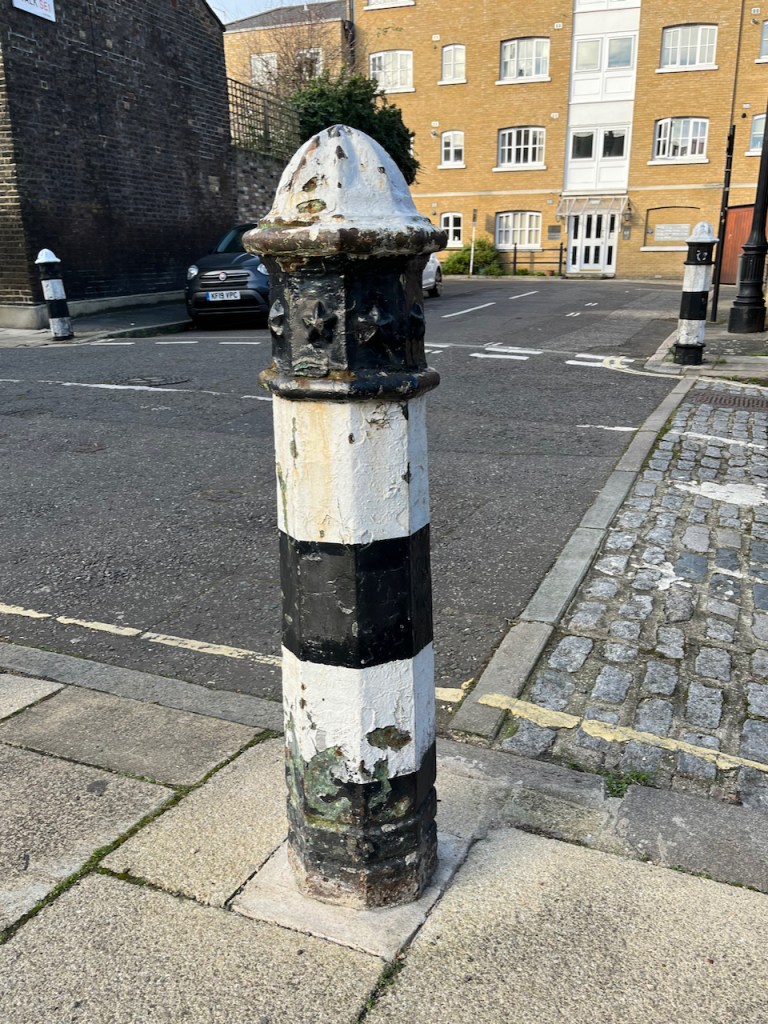
Bollard with stars.
I enjoyed all the wires and aerials! The swooping wire from the top right is a telephone wire or electrical cable. It’s unusual to see them above ground in London. Note also the marvellous bollards, which are mentioned in the Conservation Area Statement (Note 1).
Here you see layers of London development. In the foreground is Windmill Walk, part of the Roupell Street residential area built around 1824, and still residential. The paler building in the mid-distance is on Theed Street. It is a converted factory. It now contains some residential properties which I found listed on a holiday lettings site, and some offices listed on an estate agents’ site. Different accounts list it as a Violin Factory and/or a “Komptulicon Works”. Komptulicon was a sort of floor covering made of cork and rubber.
On the skyline is the London Television Centre, 1972, which I have drawn previously:
Here is a view of the London Television Centre, 60-72 Upper Ground, SE1. It is on the South Bank of the river Thames, a little to the East of the National Theatre and the Royal Festival Hall. It was completed in 1972 to the design of…
“[Roupell] street was laid out and construction started around 1824….. Roupell had built the street for what were described as “artisan workers” and the 1841 census provides a view of the professions of what must have been some of the first people living in the street. This included; painters, labourers, clerks, printers, bakers, carpenters, bricklayers, compositors, paper hanger, hatter, an excise officer, lighterman, warehouseman – all the typical jobs that you expect to find in such a street in 1840s London.” (A London Inheritance)
“Roupell Street Conservation Area” statement by Lambeth Council, 2007, describes the streets and details what can and cannot be done in modifications to the houses. It also mentions the “Komptulicon Works”, north of Windmill Walk.
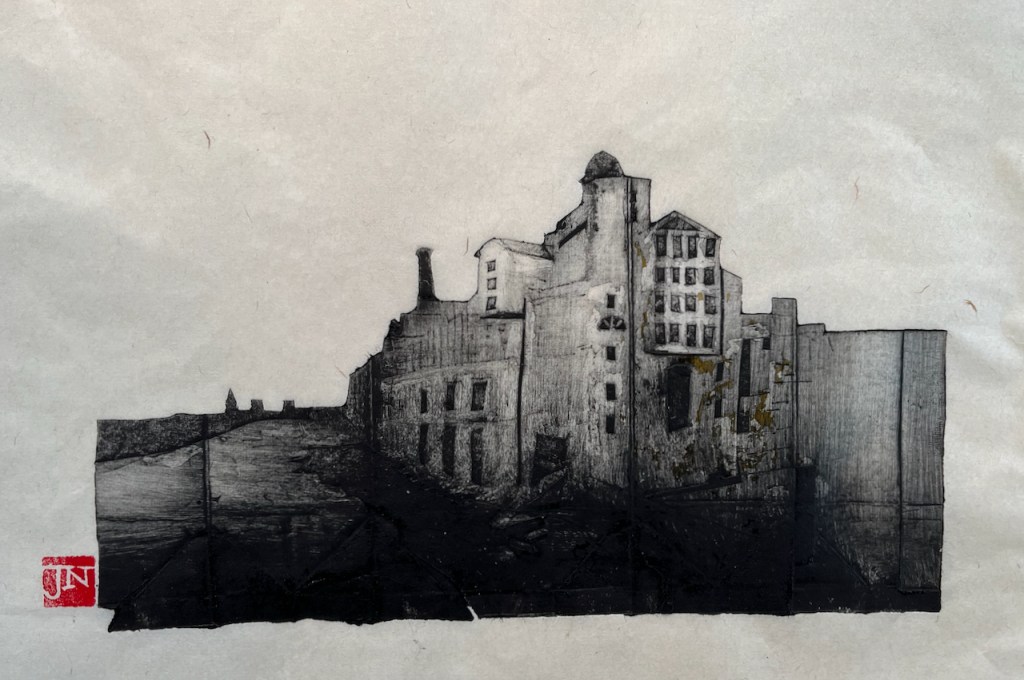
I am trying an experimental monoprint technique. The idea is to use packaging material to make intaglio “plates” which are then printed using an etching press. This is the first one. I printed it yesterday on the Henderson Press at East London Printmakers.
Anchor Brewhouse and Horselydown Old Steps, Monoprint. Image size 10″ x 6″
This is a real building, a former brewery, just to the South and East of Tower Bridge. That’s the river Thames you see on the left of the picture.
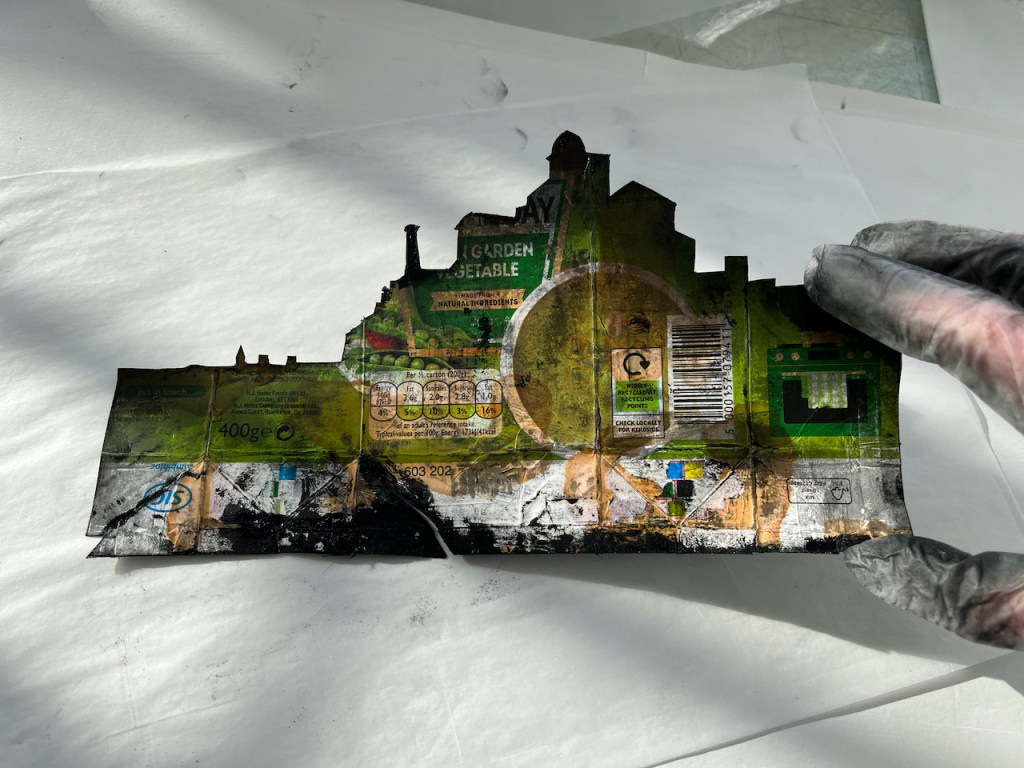
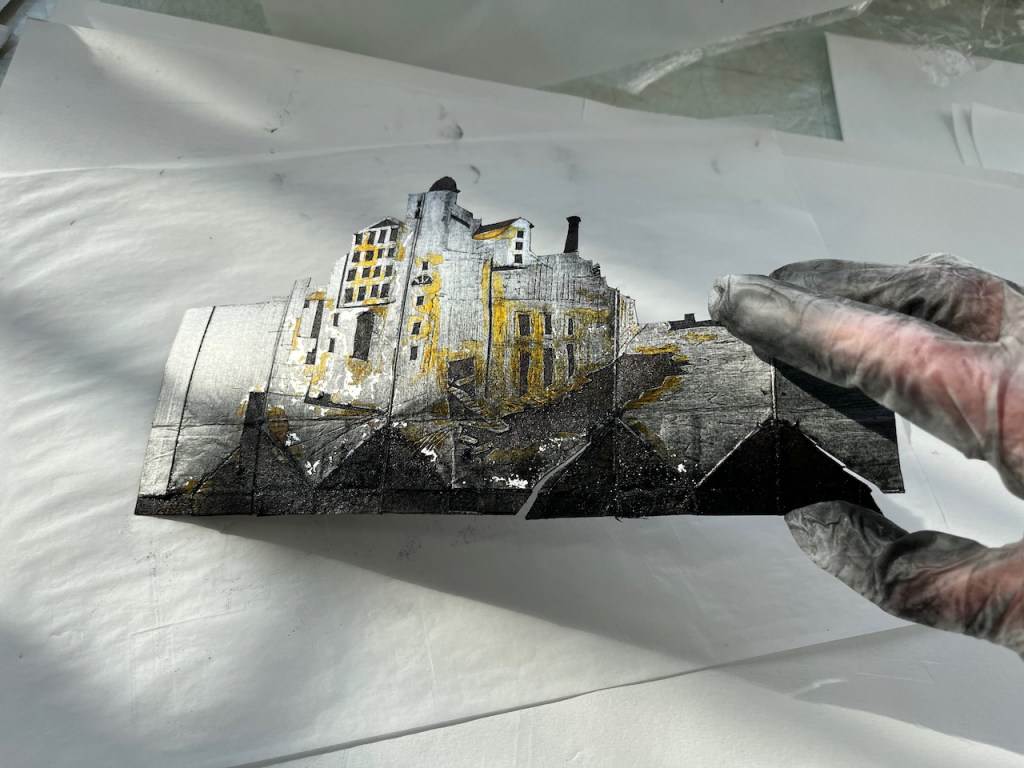
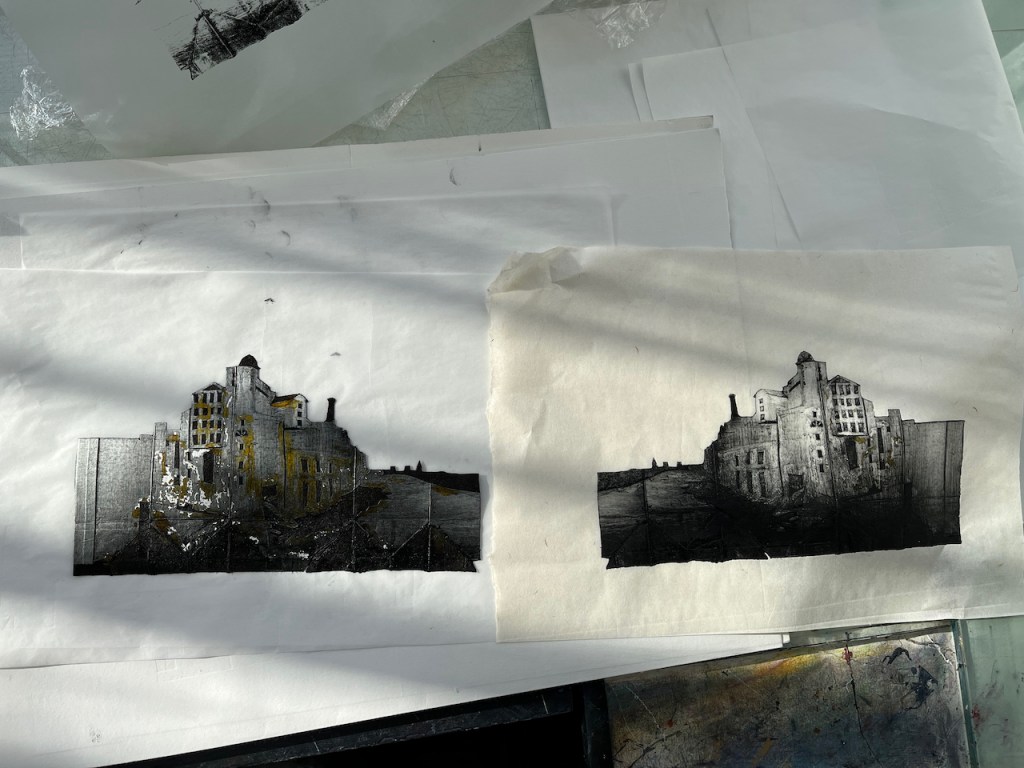
The “plates” are fragile, so I could only make 6 prints before the plate started deteriorating and the contrast started to go. Here is a picture of the plate, front and back. It is made out of a box of soup. I made the picture on the shiny, metallic-looking side, which is the former inside of the soup box.
Back of the plateFront (print side) of the plate, after inking and printing
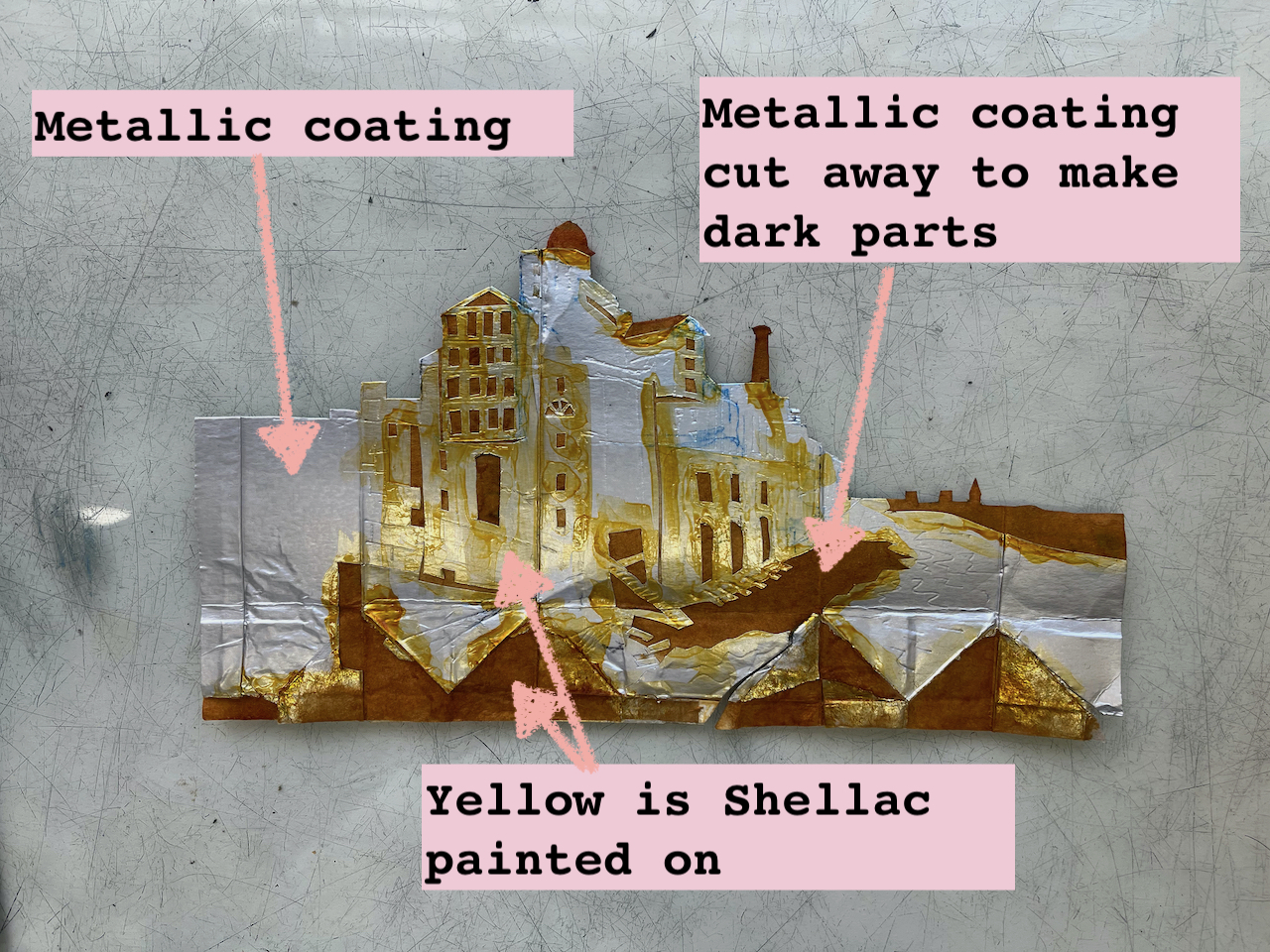
The parts which print dark are made by cutting out the metallic coating of the soup box, leaving the rough cardboard underneath. I painted the plate with button varnish (shellac in alcohol) to make it a bit stiffer and more durable. Here’s what the plate looked like before printing:
Plate before printing, with annotations
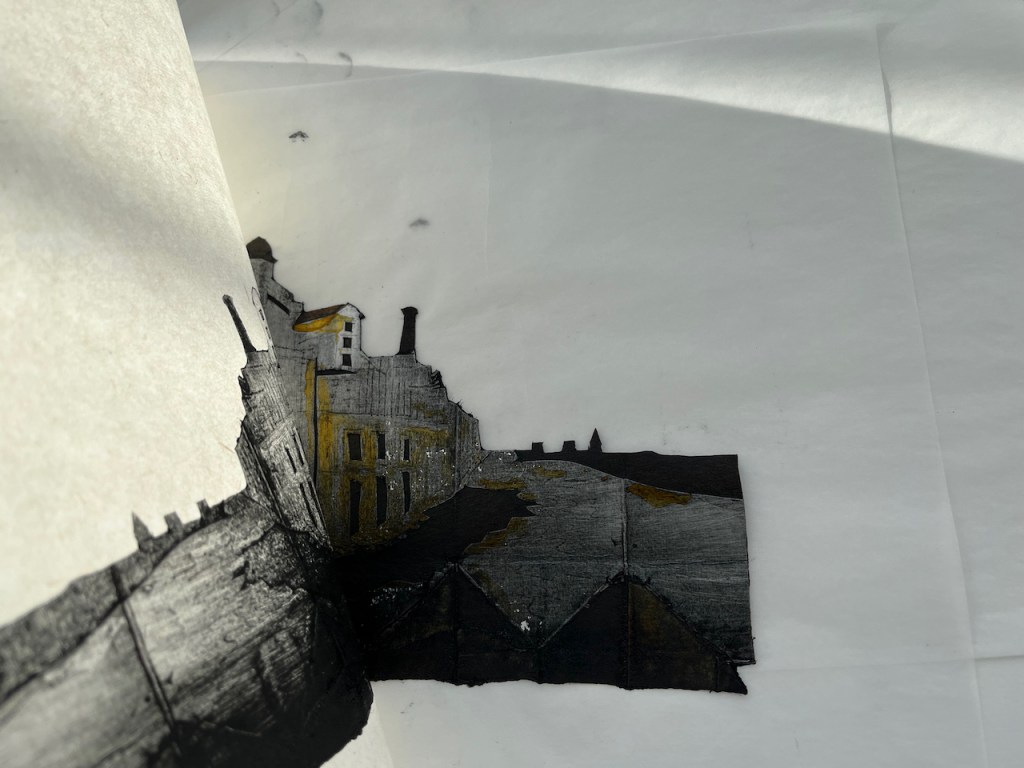
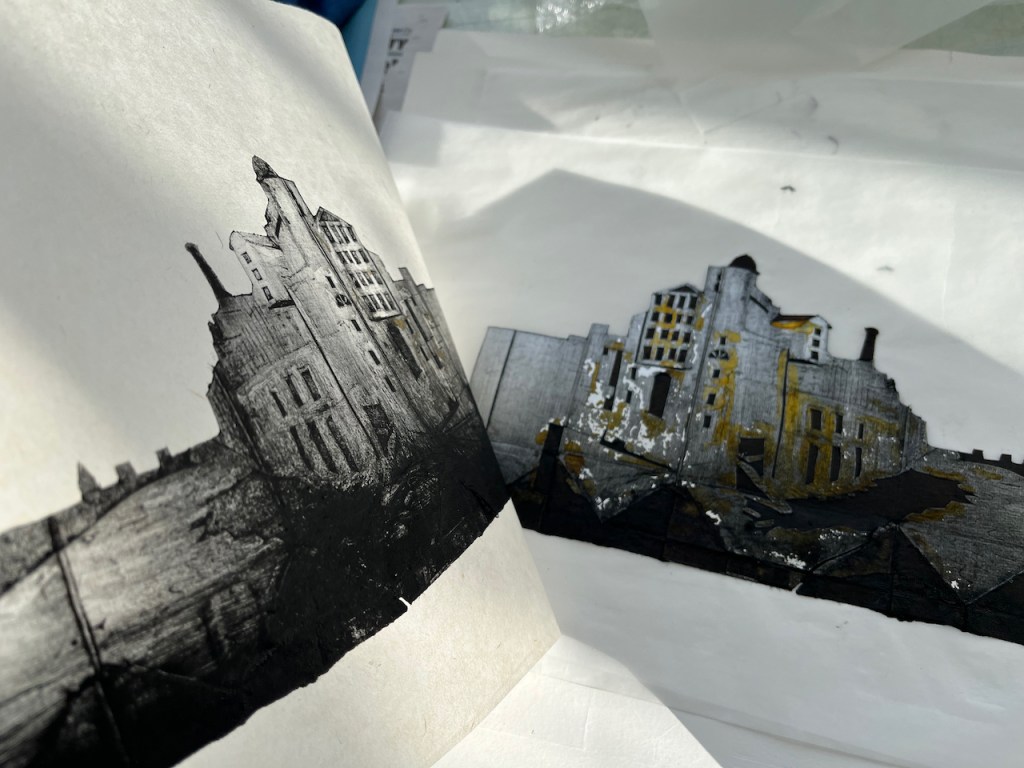
Here is one of the prints peeling off the plate:
Plate (left) and print (right)
I tried making a video, but it was too difficult to hold the plate, the paper and the phone all at once. And there’s ink everywhere which I was trying to avoid getting on my phone. Next time I’ll see if I can get a fellow printmaker to hold the phone.
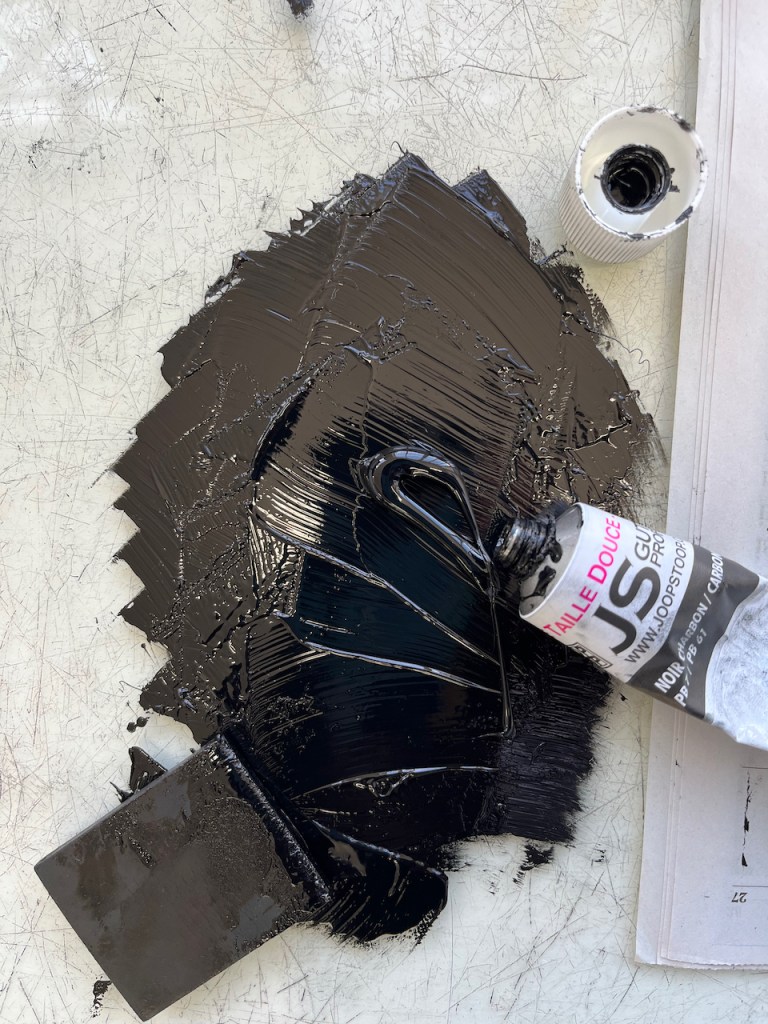
Ink: “JS”carbon black
The ink is traditional black etching ink from Intaglio Printmaker in Southwark. The paper is Zhao Zhe Chinese paper ref 11369 from Great Art on the Kingsland Road. The red seal on the finished print is made with a Japanese stone seal with red ink gifted to me by my friend and mentor Katsuhisa Toda 戸田勝久.
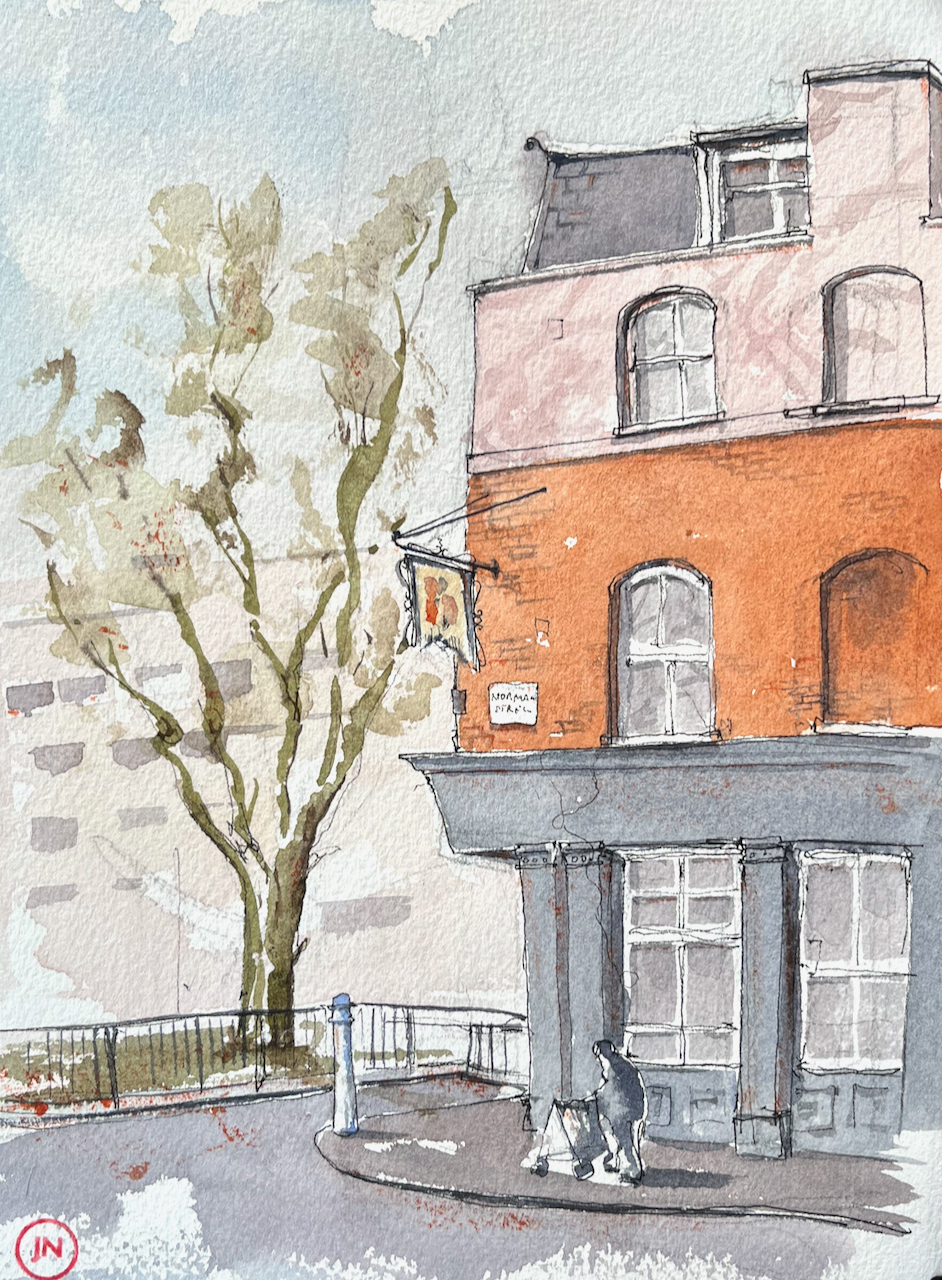
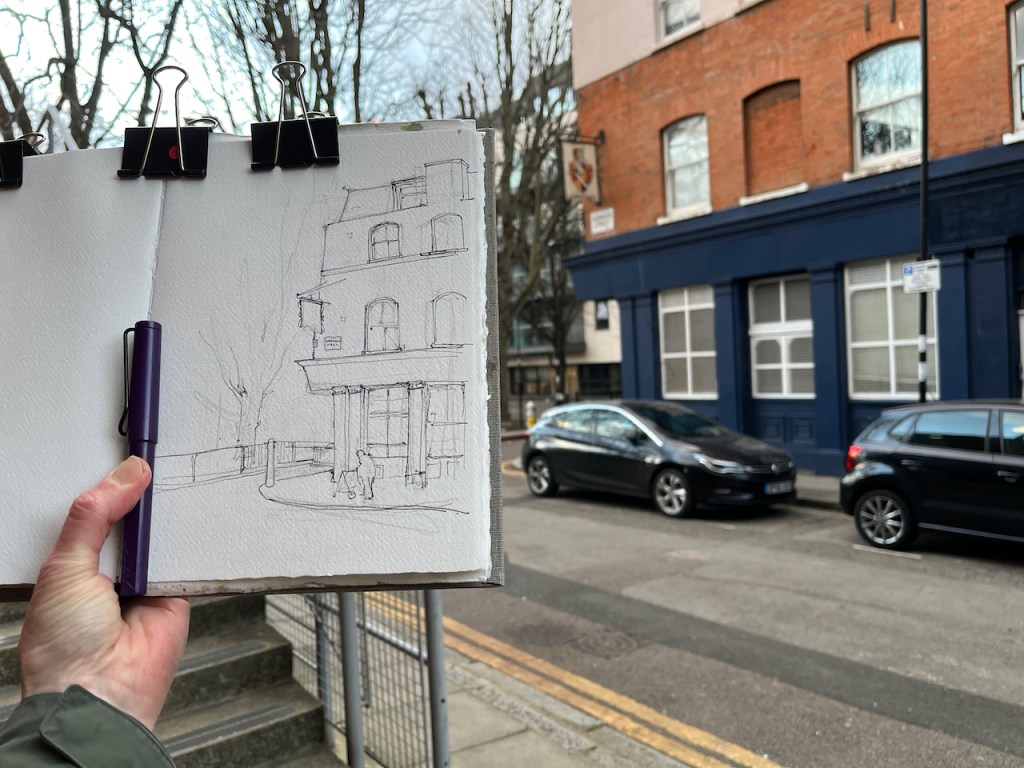
In the late afternoon, I walked round a corner near St Luke’s, and noticed the pub sign.
Langton Arms, Norman Street, EC1 sketched 29 Jan 2022, 4:15pm, in Sketchbook 11
The pub closed sometime around 1989, according to https://pubwiki.co.uk. It is now residential flats.
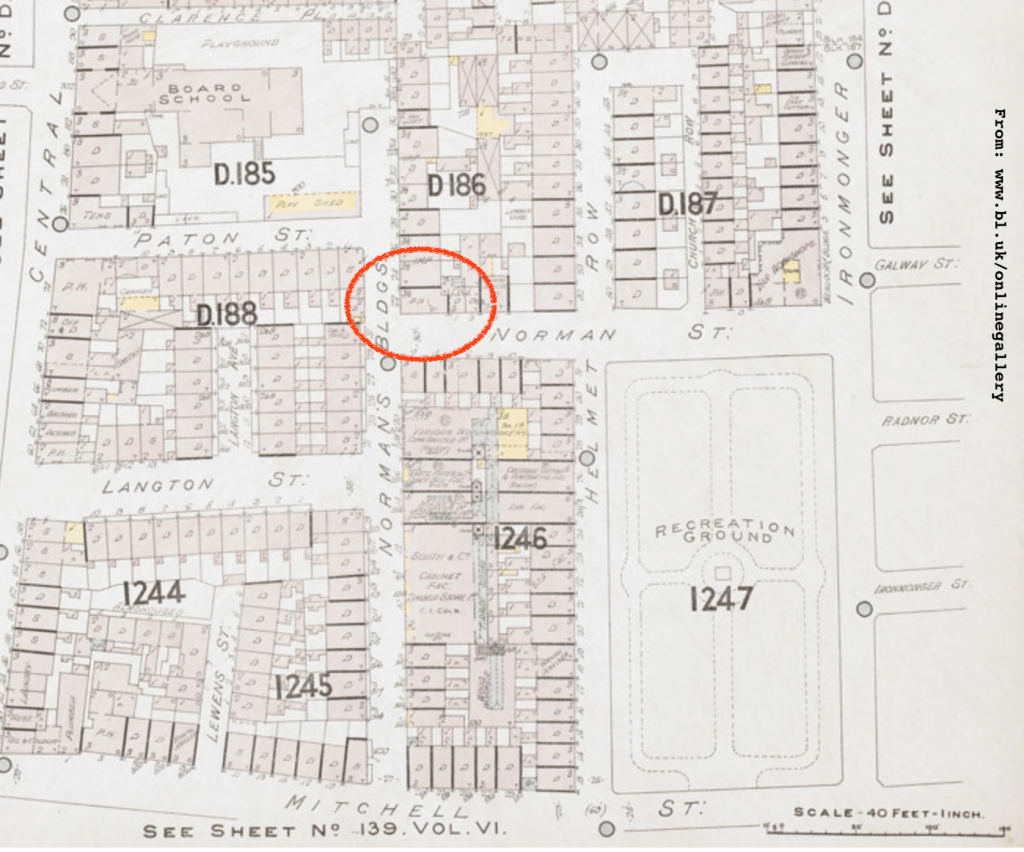
The pub was in existence in 1842, according to “closedpubs.co.uk”. There was a nearby Langton Street, shown on a map from the British Library dated 1901. The Langton Arms is marked “PH”.
1901 map. Langton Arms circled. Insurance Plan of London North District Vol. D: sheet 17 (British Library) Shelf mark: Maps 145.b.23.(.d)
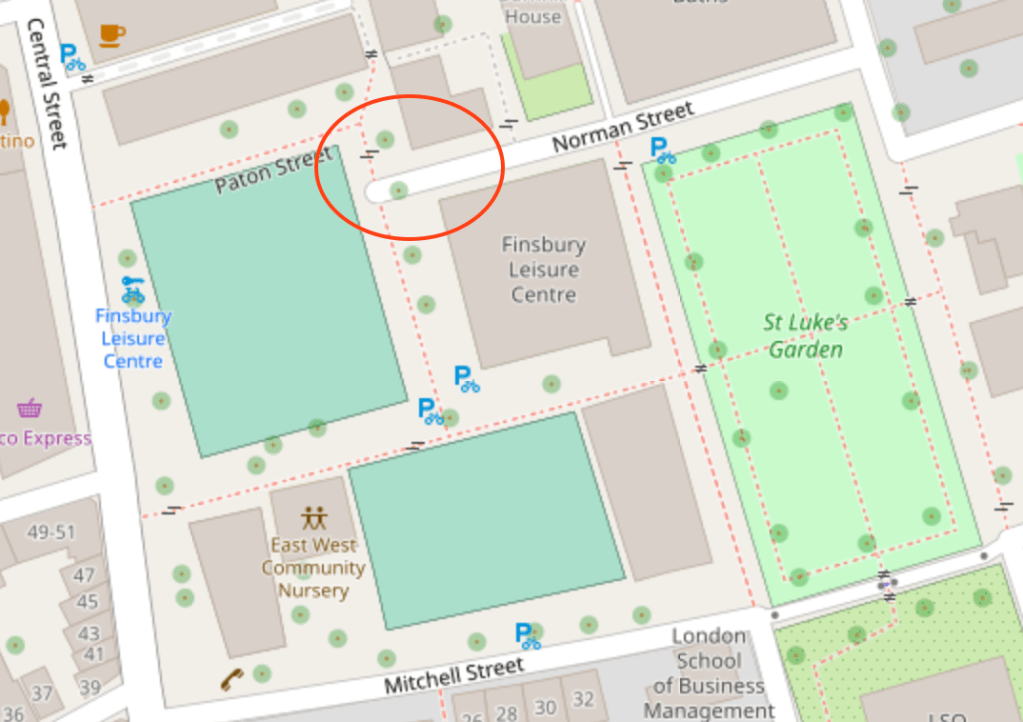
See how dense the housing was in this area in 1901. Here is the same area today. Langton Street has disappeared.
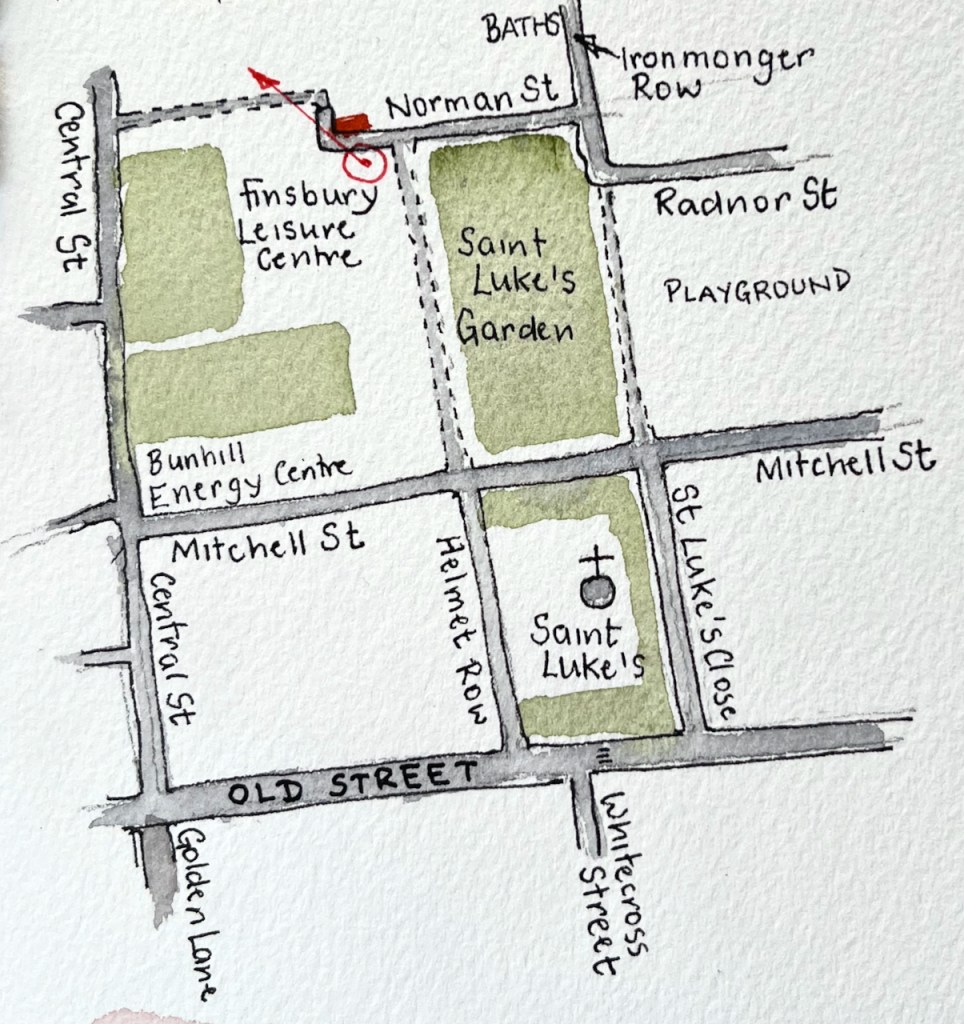
Norman Street area, 2022 (c) Open StreetMap, Langton Arms circled
Pub sign today
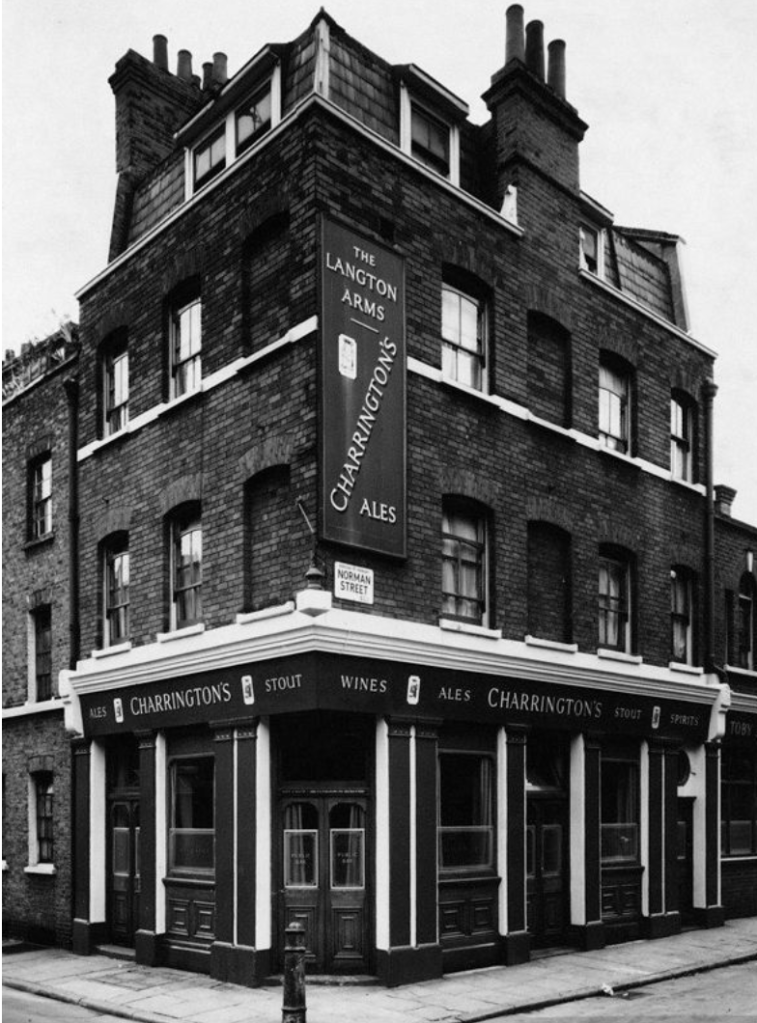
I sketched the closed-down pub at around 4:30pm, as the light faded. The pub sign is still there, but eaten away at the lower edge now. The street sign “Norman Street” is the same one as shown in a photo from 1958. It has “Borough of Finsbury” written above the street name. The Borough of Finsbury was absorbed into Islington in 1965.
This picture is a story of vanishing: vanishing street, eaten away pub sign, closed down pub, a missing borough, sun setting in January. Behind me as I sketched I could hear the squeak of gym shoes on hard floors, the other side of the closed steel doors to Finsbury Leisure Centre.
1958
Click a button below to share this post online, email it, or print it:
























 Jane Sketching